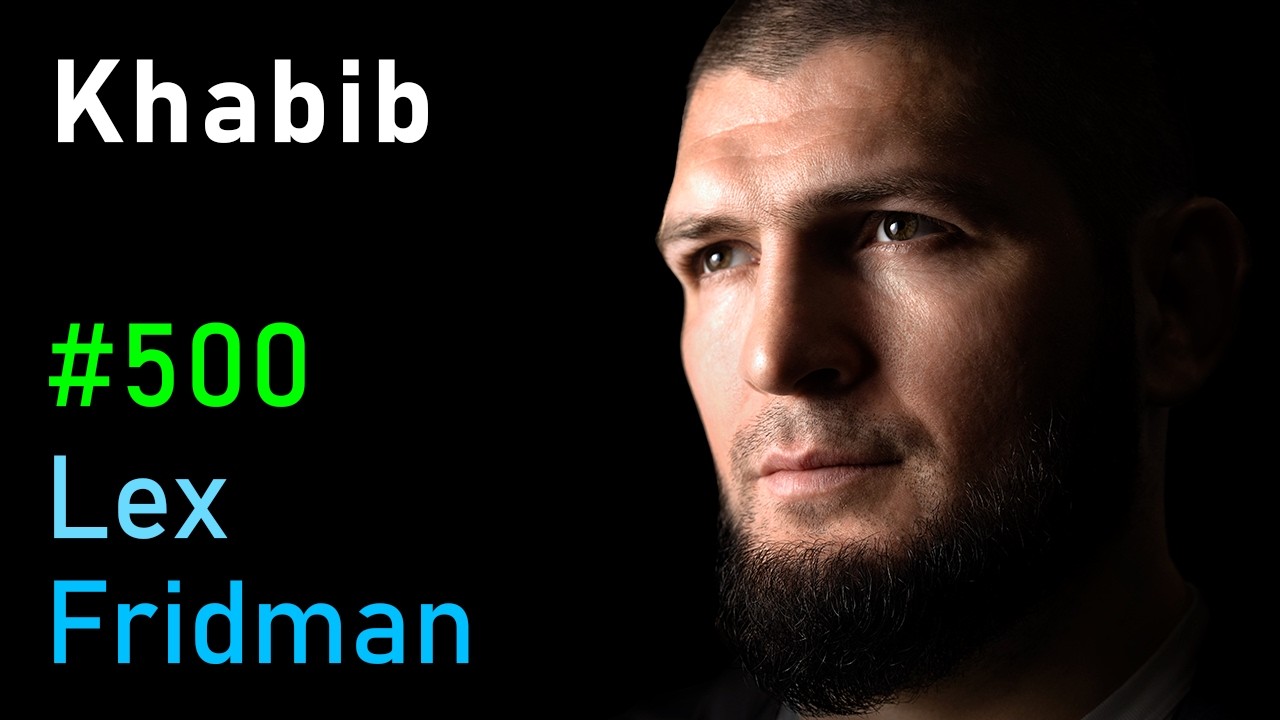
Хабиб Нурмагомедов раскладывает ключевые факторы успеха в ММА
Lex Fridman
Абсолютное доминирование в смешанных единоборствах достигается благодаря жесточайшей дисциплине горного лагеря, преодолению страха и полному отказу от благ комфорта.
## Background
Видео опубликовано на YouTube-канале Лекса Фридмана (Lex Fridman) 12 августа 2026 года. В описании к выпуску под номером 500 отмечается, что разговор с непобежденным чемпионом UFC Хабибом Нурмагомедовым (29-0) впервые в истории подкаста полностью записан на русском языке, а также доступны перевод и дубляж на английский язык.
## TL;DR
В этом выпуске Хабиб Нурмагомедов подробно рассказывает о суровой школе своего отца Абдулманапа Нурмагомедова, спартанских условиях тренировок в Дагестане и культуре горцев, сформировавшей чемпионский менталитет. Он делится воспоминаниями о переломных моментах карьеры, включая переход из вольной борьбы в боевое самбо, противостояние с Конором Макгрегором и финальный бой против Джастина Гейджи. Также Нурмагомедов обсуждал наследие кумиров юности (Федора Емельяненко и Жоржа Сен-Пьера), свою нынешнюю тренерскую работу, страсть к футболу и ключевую роль религиозной веры и дисциплины в жизни.
## Atmosphere & style
Беседа пронизвана духом глубокого взаимного уважения, дисциплины и жизненной мудрости. Атмосфера подкаста спокойная и философская, где спортивные истории переплетаются с личными откровениями о дисциплине, преодолении страха, утрате отца и исламской вере. Слушатель погружается в размеренный, но эмоционально насыщенный диалог двух людей, сфокусированных на поиске истины, скромности и передаче опыта следующему поколению.
## Key takeaways
- [00:00](https://www.youtube.com/watch?v=l6USUAIKJls&t=0s) Эпизод #500 стал первым выпуском подкаста Лекса Фридмана, полностью записанным на его родном русском языке с использованием дубляжа от ElevenLabs.
- [01:35](https://www.youtube.com/watch?v=l6USUAIKJls&t=95s) Суровые условия тренировок в горах и спартанские залы Дагестана сформировали уникальную школу боевых искусств, выросшую из культуры высокогорного выживания.
- [20:11](https://www.youtube.com/watch?v=l6USUAIKJls&t=1211s) Абдулманап Нурмагомедов создал базовый тренировочный лагерь в селе Сильди на высоте 1500–1600 метров для естественного повышения выносливости и дисциплины атлетов.
- [24:53](https://www.youtube.com/watch?v=l6USUAIKJls&t=1493s) Слава, деньги и комфорт разрушают большинство спортсменов, а удержание на вершине требует осознания собственного равенства со всеми перед лицом смерти.
- [35:34](https://www.youtube.com/watch?v=l6USUAIKJls&t=2134s) Главным двигателем Хабиба в карьере был страх поражения, заставлявший его переходить на жесточайший режим дисциплины и трехразовых тренировок за 100 дней до боя.
- [01:07:18](https://www.youtube.com/watch?v=l6USUAIKJls&t=4038s) Переломным моментом в карьере Хабиба стало осознание эффективности удушающих и болевых приемов в 2002 году, после чего он совмещал вольную борьбу с боевым самбо.
- [01:15:15](https://www.youtube.com/watch?v=l6USUAIKJls&t=4515s) Тактика топ-контроля Хабиба строилась на перенаправлении энергии соперника и непрерывном давлении на его самые слабые стороны в партере.
- [01:18:40](https://www.youtube.com/watch?v=l6USUAIKJls&t=4720s) Бой против Конора Макгрегора вышел за рамки спортивного события, превратившись в культурно-историческое противостояние мирового масштаба.
- [01:31:25](https://www.youtube.com/watch?v=l6USUAIKJls&t=5485s) Поединок против Джастина Гейджи стал самым тяжелым эмоциональным испытанием для Хабиба из-за потери отца и данного матери обещания завершить карьеру.
- [01:39:12](https://www.youtube.com/watch?v=l6USUAIKJls&t=5952s) Хабиб считает величайшими бойцами в истории MMA Федора Емельяненко, Жоржа Сен-Пьера и Маурисио «Сёгуна» Руа.
- [02:06:49](https://www.youtube.com/watch?v=l6USUAIKJls&t=7609s) В зале AKA под руководством Хавьера Мендеса и Хабиба сформировалась непрерывная дагестанская «цепочка преемственности», ярчайшим представителем которой является Ислам Махачев.
- [04:25:33](https://www.youtube.com/watch?v=l6USUAIKJls&t=15933s) В футболе величие достигается только теми игроками, которые готов брать на себя ответственность и рисковать в решающие моменты матча.
- [04:34:14](https://www.youtube.com/watch?v=l6USUAIKJls&t=16454s) Вера в предопределение и строгое соблюдение пятикратной молитвы (Салях) стали главным духовным фундаментом, позволившим Хабибу пережить смерть отца.
- [04:39:17](https://www.youtube.com/watch?v=l6USUAIKJls&t=16757s) Главный совет Хабиба молодому поколению основан на кораническом призыве «Икра» («Читай»), побуждающем к постоянному поиску знаний и саморазвитию.
## Detailed walkthrough
### [00:00](https://www.youtube.com/watch?v=l6USUAIKJls&t=0s) Introduction and Podcast Format in Russian
Lex Fridman opens episode #500 of his podcast by introducing Khabib Nurmagomedov, one of the greatest mixed martial artists in history, who retired from the UFC undefeated with an iconic 29-0 record. Expressing immense gratitude and honor, Lex explains that this conversation was recorded entirely in Russian—marking his very first time conducting an episode in his native tongue. He details the translation and dubbing framework, noting that while viewers can toggle between original Russian audio and an English dub via YouTube settings, the voice synthesis was developed in partnership with ElevenLabs alongside human translators. Lex offers a heartfelt thank you to his global audience before transitioning directly into the sit-down conversation in Russian.
As the interview begins, Lex expresses a slight nervousness about speaking fluent Russian for an extended dialogue, remarking that while he feels the language in his heart and soul, finding the precise words can sometimes be challenging. Khabib immediately offers a warm, reassuring response: "I can help you out if you need... We got this, brother." The mutual respect between the two sets an intimate, candid tone for the rest of the discussion.
* Khabib Nurmagomedov retired with a perfect **29-0** professional MMA record.
* This interview marks the **first time** Lex Fridman conducted an entire podcast in Russian.
---
[01:35](https://www.youtube.com/watch?v=l6USUAIKJls&t=95s) The Legendary Dagestani Gym and Spartan Conditions
Lex opens the substantive dialogue by asking about Khabib’s legendary childhood training roots in Dagestan, referencing the infamous spartan conditions of their early gym. He notes that despite having only a single cold shower for up to seventy fighters, this modest, under-resourced space produced over twenty world champions across various combat sports, including multiple UFC champions. Lex asks Khabib to reflect philosophically on how such extreme austerity produced an unprecedented density of elite martial artists.
Khabib clarifies the evolution of their training environments. The famous gym in Makhachkala—the capital of Dagestan—was where they trained throughout the 2000s and 2010s until opening a modern, large facility in 2019. Before then, the gym was literally just an old school gymnasium equipped with nothing more than wrestling mats, a single heavy bag, a climbing rope, and an indoor basketball court. Going back even further to his early childhood before moving to Makhachkala, Khabib recalls living in his native mountain village, where his father, Abdulmanap Nurmagomedov, built a gym inside their own house to train local youths.
Khabib shares vivid, nostalgic memories from when he was five to seven years old, waking up inside his family home to the rhythmic, echoing thuds of wrestlers drilling takedowns and throws. He vividly remembers hearing the heavy impacts on the mats accompanied by his father’s booming voice shouting instructions, pushing athletes, and coaching technique.
> "You hear the hitting, the throwing over and over. And my father's voice, how he's shouting, giving instructions, pushing someone, coaching, teaching. I lived with those sounds."
---
[05:02](https://www.youtube.com/watch?v=l6USUAIKJls&t=302s) Comfort as the Enemy of Champions
Continuing the discussion on their harsh environment, Lex poses a philosophical query: Is comfort the ultimate enemy of a champion, and do the best results inherently stem from the worst conditions? Khabib offers a nuanced perspective, noting that it depends heavily on the sport. In a sport like football (soccer), proper infrastructure, academies, and quality fields are essential by the age of ten or twelve. Combat sports, however, require very little financial investment—just wrestling shoes, shorts, mats, a great coach, and tough sparring partners.
Khabib argues that growing up in luxury or extreme comfort actively hinders the development of elite fighters. He questions whether a wealthy father who lives in luxury would ever subject his child to the daily brutality, physical exhaustion, and injuries of combat training, or whether a child raised in affluence would possess the mental drive to endure it voluntarily. Statistically, he asserts, world-class fighters come from positions of genuine physical and financial need. Hunger and adversity are the indispensable engines of martial success.
* **Cost of Entry:** Combat sports only require bare essentials—mats, shoes, shorts, and elite coaching—making them accessible to impoverished regions.
* **The Luxury Trap:** Affluence suppresses the requisite psychological "hunger" and willingness to suffer daily bodily harm.
---
[06:47](https://www.youtube.com/watch?v=l6USUAIKJls&t=407s) Why Dagestan Dominates Combat Sports vs. Global Ecosystems
Lex compares Dagestan’s dominance in wrestling and MMA to Brazil and Argentina’s legendary production of football players, asking what cultural dynamics create these specialized talent pipelines. Khabib attributes Brazil's football success to a massive population of over 200 million paired with a deep, passionate culture and a highly organized system. He points out that while young people in Dagestan love football just as much, playing on the streets and on PlayStation, Dagestan lacks the institutional ecosystem—academies, scouting ladders, and club pipelines—to turn raw talent into global football stars.
In contrast, Dagestan possesses an unmatched, highly structured pipeline for combat sports. In Makhachkala alone, there are 40 to 50 combat sports gyms, every single one packed to capacity. The competitive ladder is crystal clear: an athlete wins local tournaments, moves to the North Caucasus regional level, competes at the Russian National Championships, and advances to the World Championships or professional MMA promotions. This clear, meritocratic ladder, combined with a fierce level of internal competition, guarantees that anyone who emerges at the top is world-class.
```
Dagestani Combat Sports Ladder:
Local Gym Competition ➔ North Caucasus Regionals ➔ Russian National Championships ➔ World Championships / UFC
```
* Makhachkala houses **40 to 50 dedicated combat sports gyms**, all operating at full capacity.
* Competition depth is immense: every single weight class features 10 to 15 elite, world-caliber sparring partners in a single room.
---
[10:36](https://www.youtube.com/watch?v=l6USUAIKJls&t=636s) The Legacy of Coaching and Dagestani Wrestling Culture
When Lex asks whether Dagestani success stems more from grueling work or superior technique, Khabib attributes it to a deeply rooted coaching heritage starting in the mid-20th century. He highlights Ali Aliyev—a legendary five-time world champion wrestler who competed in three Olympic Games—and Zagalav Abdulbekov as the foundational figures who triggered the Dagestani wrestling boom in the 1950s. When those early pioneers retired, they transitioned into coaching, passing down high-level technique, philosophy, and training methodology to the next generation.
Khabib notes that while his father, Abdulmanap, became famous globally due to the media exposure surrounding Khabib's UFC title run, Dagestan is filled with countless unsung coaches who possess identical levels of technical mastery and philosophical depth. Over time, these freestyle wrestling coaches adapted their methods to combat sports like Combat Sambo, Grappling, and MMA, creating an unbroken chain of elite instruction.
Beyond coaching, Khabib emphasizes that fighting is fundamentally intertwined with Dagestani culture and heritage. Every parent in Dagestan expects their children—especially boys—to wrestle and grow up physically strong. Being able to defend oneself, protect one's family, and represent one's clan is an ancient cultural expectation passed down through generations.
* **Ali Aliyev:** 5-time World Champion freestyle wrestler who sparked the modern Dagestani wrestling movement in the 1950s.
* **Cultural Expectation:** Physical toughness and wrestling ability are viewed as basic prerequisites for manhood and family honor.
---
[12:25](https://www.youtube.com/watch?v=l6USUAIKJls&t=745s) Ancient Empires, Geography, and the High-Altitude Warrior Ethos
Lex notes that this warrior culture is not a recent phenomenon but spans centuries. Khabib expands on this historical context, explaining that Dagestan’s geographical location made it a perpetual battleground for history's greatest conquerors. Bordered by the Caspian Sea on the east and the impassable Caucasus Mountain range on the west, Dagestan formed a narrow geographical bottleneck connecting Europe and Asia.
Khabib details how wave after wave of massive empires—including the Khazar Khaganate, the Arab Caliphate, the Persian/Iranian Empire, the Mongol hordes, Timur (Tamerlane), and the Russian Empire—attempted to conquer and pass through these lands. He singles out the ancient city of Derbent, historically known in Arabic as *Babul Abwab* ("The Gate of Gates"), as one of the oldest cities in the world and a critical choke point along ancient trade and military routes.
```
Historical Empires Invading Dagestan:
Khazar Khaganate ➔ Arab Caliphate ➔ Persian Empire ➔ Mongol Empire ➔ Timurid Empire ➔ Russian Empire
```
This intense historical turmoil created an astonishing level of diversity. Today, Dagestan is home to over thirty distinct languages and dozens of ethnic groups. To illustrate, Khabib shares that his star pupil, UFC champion Islam Makhachev, is ethnically Lak, while Khabib is Avar. Their native languages are completely mutually unintelligible—not merely different dialects. Only because Islam has trained alongside Khabib’s family for nearly 25 years has he picked up some Avar over time.
> "Derbent... used to be called Babul Abwab. It means the gate of gates. Very major trade routes went through there. Very large armies passed through, and it was bound to leave a mark on the people."
---
[15:15](https://www.youtube.com/watch?v=l6USUAIKJls&t=915s) Mountain Isolation and Historical Resistance
Khabib explains how geography directly shaped the resilience and independence of the highlanders. When massive conquerors like Timur invaded the Caspian lowlands with hundreds of thousands of troops, cavalry, and supply lines, they deliberately avoided advancing into the steep, roadless mountains. The brutal cold, vertical terrain, and lack of infrastructure made mountain campaigns suicidal for large armies. Consequently, while the coastal lowlands frequently changed hands between global empires, the mountain highlanders maintained complete independence for centuries.
This brutal environment forged an enduring psychological resilience. Khabib emphasizes that genetics, environment, harsh upbringing, and a legacy of constant physical struggle naturally merged within the people over generations.
* **Derbent / Babul Abwab:** Historical gateway city controlling the trade corridor between the Caspian Sea and the Caucasus Mountains.
* **Ecosystem of Diversity:** Over **30 distinct languages** exist within Dagestan due to isolated mountain valleys.
---
[17:36](https://www.youtube.com/watch?v=l6USUAIKJls&t=1056s) Imam Shamil and the Harsh Struggle of Mountain Life
Lex brings up Imam Shamil, referencing Khabib's past writings about him as a foundational hero of the region. Khabib speaks with deep reverence about Shamil, explaining that his legendary status stems from leading a prolonged 25-year resistance (after serving 10 years as a soldier—35 years of continuous warfare in total) against the massive Russian Empire. Despite commanding a tiny, isolated population with limited resources, Shamil held out against one of the most formidable military empires of the 19th century.
Beyond military conflicts, Khabib details how daily survival in the harsh Dagestani mountains demanded relentless physical labor. Winters in the high altitudes were unforgiving, bringing heavy snowfall that completely cut off mountain villages from the outside world for months. To survive, villagers spent every waking hour of the summer constructing intricate stone agricultural terraces on steep slopes—most notably the famous Chokh terraces—to grow crops.
Khabib highlights the tactical genius of these ancient villagers: they purposefully chose to live in the most rugged, inaccessible cliffs rather than down on the fertile land where they farmed (such as Marghit across from his native village of Sildi). Living on flat, farmable land left families vulnerable to sweeping cavalry raids, whereas building homes on sheer cliffs forced invading armies to fight at a massive tactical disadvantage.
* **Imam Shamil:** Led 35 years of active military resistance against the Russian Empire.
* **Chokh Terraced Farms:** Ancient hand-built stone terraces used for mountain farming on steep cliffs.
* **Sildi:** Khabib's native mountain village, named after the local word *Si*, situated on precipitous terrain to deter enemy invasions.
[20:11](https://www.youtube.com/watch?v=l6USUAIKJls&t=1211s) The Fortress Topography and Cultural Crucible of Dagestan
Khabib describes the historical architecture of Dagestani villages, where fortresses and towers were intentionally constructed high in the mountains to make military invasion nearly impossible. For an attacking army, reaching a village meant descending one mountain and scaling another, all while the inhabitants farmed terraced crops like grains and potatoes in isolated pockets. Had they built their living quarters directly on the farmable land, raiders could simply walk up and lay siege to their food supply.
This extreme environment shaped the physical and psychological DNA of the region over generations. Living in such conditions meant there was no room for mental weakness; survival itself demanded absolute toughness. Building on this legacy, Khabib's father, Abdulmanap Nurmagomedov, envisioned a high-altitude sports complex in their native village of Sildi to train future champions.
- **Location Altitude:** Sildi training base sits at 1,500 to 1,600 meters (roughly 5,000 feet) above sea level.
- **Physiological Benefits:** Training at this elevation for 3–4 weeks boosts oxygen capacity in the blood, elevates natural testosterone, and builds endurance.
- **Capacity & Legacy:** Started around 2016–2017 under tight financial constraints and expanded after Abdulmanap's passing in 2020, the facility now houses, feeds, and trains up to 100 fighters simultaneously.
- **Purpose Beyond Profit:** Khabib emphasizes that the base generates zero financial profit and exists purely to create local jobs, honor his father's dream, and forge fighters physically and spiritually.
When Lex Fridman asks if he could visit Sildi, Khabib warmly invites him, noting that while the winding mountain drive takes about 3 hours and 40 minutes from Makhachkala, they could easily take a 40-to-50-minute helicopter ride. When Lex jokes that he isn't built for a wealthy lifestyle and prefers a ground journey, Khabib quips that they will take a car rather than horses to save time.
---
[24:53](https://www.youtube.com/watch?v=l6USUAIKJls&t=1493s) The Traps of Fame, Money, and Staying a Champion
Transitioning to the psychological toll of elite success, Khabib explains why staying at the top is exponentially harder than reaching it. Once an athlete becomes a champion, a flood of distractions—lucrative contracts, media appearances, endless travel, and public attention—begins to disrupt their daily discipline. Skipping one workout leads to missing two, then three, eroding the essential "hunger" that fueled their initial rise.
For many, achieving the belt creates an existential vacuum: "They live their whole life just to become, stay on the top. As soon as they get there, what are they supposed to do? That's it. They already made it." Without a serious mindset, champions slide back down the mountain rapidly—a dynamic Khabib witnessed firsthand watching his father's former students and elite athletes across various sports.
```
AMATEUR CAREER
(Building the Springboard)
│
▼
PROFESSIONAL MMA
(Climbing to the Title)
│
▼
WORLD CHAMPIONSHIP
(Peak Attained / Massive Distractions)
│
┌──────────────┴──────────────┐
▼ ▼
THE SINKHOLE THE RETENTION
(Money, Travel, Fame) (Grounded Mindset)
│ │
▼ ▼
Rapid Decline & Loss Legendary Legacy
```
The true test of a person's character happens when constraints are removed. Wealth, power, and fame reveal a fighter's true self. To remain grounded amidst adulation, Khabib keeps a radical sense of humility about human frailty: "At the end of the day, after all, we are not really such big, important people... we can't even control the basic need to go to the restroom." He stresses that regardless of status, wealth, or religion, every human ultimately ends up in the exact same grave, buried a meter or two beneath the earth.
- **Historical Scale:** Over ~35 years of modern MMA, only around 30 to 50 fighters have truly maintained dominance at the top out of hundreds of thousands who tried.
- **Coach-Student Dynamic:** True elite champions know how to accept constructive criticism from mentors without letting ego or sensitivity destroy their willingness to learn.
- **Mindset Boundary:** Outside the cage, a fighter should remain a righteous, humble person; inside the cage, humility must be set aside to clear out the opponent standing between them and their goal.
---
[35:34](https://www.youtube.com/watch?v=l6USUAIKJls&t=2134s) The Obsessive Fuel: Fear of Loss and Total Domination
When asked whether his relentless drive came from a love of winning or a hatred of losing, Khabib confirms it was strictly the hatred of losing. Exactly 100 days before every professional fight, he would enter an almost panicked state of hyper-fixation and commitment. He adjusted every travel plan and daily engagement to ensure his strict 4-to-5-hour training schedule remained completely unbroken.
For instance, if traveling to Moscow 85 days before a fight, he would fly at midday only after completing a morning session. Upon arrival, he would bring in elite sparring partners, wrestlers, or strength coaches so that his evening session maintained the requisite intensity. Playing around was never an option; he demanded real resistance.
> "After Fajr, the dawn prayer... every morning, six, seven, we'd be out doing our warm-up. Some people might call it a warm-up, but when you show up at the stadium in the morning, you run five kilometers, you do sprints, you work with resistance bands, you work on the pull-up bar... You drop two, two and a half kilos there. Not really a warm-up, but Father always called it that."
Khabib recounts meeting two-time Olympic wrestling champion Abdulrashid Sadulaev by chance in a hotel gym late at night. Both elite athletes ended up training at odd hours because neither could tolerate losing, and both sought outright domination rather than simple victory. Khabib's daily routine under his father was brutal: a two-hour "warm-up" at 6:00 AM, a home rest, followed by intense gym work from 5:00 PM to 7:00 PM. Yet even with that volume, the fear of losing would drive Khabib to squeeze in extra midnight sprint sessions on the beach sand.
<ElicitationsGroup message="Explore further details from this conversation:">
<Elicitation label="Read the walkthrough for Part 3 of this transcript" query="Please provide the detailed walkthrough for Part 3 of the Lex Fridman podcast transcript with Khabib Nurmagomedov."/>
</ElicitationsGroup>
[41:01](https://www.youtube.com/watch?v=l6USUAIKJls&t=2461s) "A Fanatical Approach": Training Three Times a Day
Khabib details the grueling training volume that set him apart during his fighting career. Even when his father, Abdulmanap, instructed him to rest in preparation for a heavy workload the following morning, Khabib would secretly sneak out at night. He would call a close friend to pick him up, drive to the sea, and complete a third training session for an hour or an hour and a half before heading home to crash—only to restart the entire cycle early the next morning. Expressing disbelief at fighters who take mid-week rests or settle for a light evening sauna session 50 days out from a major bout, Khabib emphasizes that true top-tier dominance requires an uncompromising, near-obsessive mindset: rest belongs on Sunday after a full Saturday morning workout and evening sauna.
Addressing Lex's observation about elite coaches like John Danaher, whose athletes also train three times daily, Khabib stresses that staying at the absolute peak demands being "a little bit crazy in a good sense." Millions of athletes train hard, but standing out from the crowd requires a fanatical devotion to the craft.
- **Secret Night Workouts:** Khabib frequently added an unsanctioned third daily training session by heading to the seashore late at night while others slept.
- **Fight Camp Standard:** Believes fighters scheduled to compete in 50 days should never take mid-week rest days (such as Wednesday afternoons off).
- **The Fanaticism Requirement:** Asserts that entering the top 1% of world-class athletes is impossible without an obsessive, "crazy" passion that goes far beyond routine dedication.
---
[44:11](https://www.youtube.com/watch?v=l6USUAIKJls&t=2651s) The Unforgiving System and the Steel-Tempering Grind
Elaborating on elite training environments, Khabib uses the metaphor of a "black room"—an uncomfortable, high-pressure system like John Danaher's or the elite Dagestani wrestling camps. Many fighters enter these environments, break mentally under the relentless pressure within a year or two, and walk away forgotten. The few who endure for years prove not only their physical prowess but extraordinary mental fortitude. Khabib notes that individuals capable of surviving 10 to 15 years in such punishing systems possess the leadership and resilience required to run major corporate projects or, as he puts it metaphorically, "rule entire cities" 2,000 years ago.
Reflecting on his own upbringing, Khabib recounts being thrown into his father's high-level training camps in the winter of 2004 at just 14 or 15 years old. Surrounded by active world champions aged 22 to 30, he was the youngest in the gym. Subject to the strict hierarchy where the youngest had to do all the chores, accept every harsh correction, and constantly get thrown and struck on the mats, Khabib was forged through adversity. He likens this relentless process to tempering steel: striking the metal repeatedly until it transforms into a sharp, durable sword.
- **The "Black Room" Concept:** Strict, high-pressure training systems weed out the majority who break mentally, leaving behind elite champions built to handle extreme adversity.
- **2004 Winter Camp:** At age 14–15, Khabib was embedded in Abdulmanap's senior Dagestani combat Sambo and no-holds-barred national team camp alongside world champions in their twenties.
- **Gym Hierarchy:** As the youngest member, Khabib was required to handle domestic tasks and endure constant physical testing from senior fighters, which built his mental toughness early.
- **The Steel Analogy:** Reiteration of the classic proverb *"How the steel was tempered"*—highlighting that a sword is created only through repeated, punishing strikes.
---
[49:03](https://www.youtube.com/watch?v=l6USUAIKJls&t=2943s) Abdulmanap’s Educational Rigor: "Countries and Peoples"
Beyond physical conditioning, Abdulmanap Nurmagomedov insisted on developing his son into a well-rounded, intellectually disciplined individual. Khabib recalls how older team members often assumed he would grow up to become a scholar or scientist because his father constantly forced him to read and manually copy entire books by hand. Abdulmanap possessed a legendary memory, meticulously tracking every task assigned to Khabib and holding him accountable with zero room for excuses.
A central element of this intellectual training was a multi-volume geographical reference book titled *Countries and Peoples*, gifted to Abdulmanap. Covering roughly 193 nations, the book detailed each country's geography, borders, major rivers, mountains, history, and economy. To teach Khabib financial responsibility and broaden his worldview, Abdulmanap offered a cash incentive: Khabib had to read about the countries in alphabetical order (starting from Andorra and Angola), rewrite the facts by hand, and present an oral report on blocks of 40 countries at a time to collect his earnings. This two-to-three-year childhood exercise sparked Khabib's lifelong passion for global travel and left him with a vast knowledge of world geography.
- **Manual Book Copying:** Abdulmanap forced Khabib to copy texts by hand to improve his focus, reading comprehension, eyesight, and handwriting.
- **The "Countries and Peoples" System:** Covered detailed profiles (geography, history, economy, major landmarks) of approximately 193 nations.
- **Alphabetical Recitation:** Khabib learned the countries in strict alphabetical order (A to Z) and was tested in batches of 40 before earning allowance money.
- **Parenting Philosophy:** Abdulmanap rarely gave his children unearned money or gifts, instilling the principle that financial rewards must be earned through intellectual or physical labor.
---
[56:49](https://www.youtube.com/watch?v=l6USUAIKJls&t=3409s) Constructive Labor and Managing Adolescence
Continuing his reflections on his father's parenting philosophy, Khabib recounts summers spent between 2005 and 2007 at a high-altitude Soviet-era pioneer camp in the Dagestani mountains, located approximately 1,200 meters above sea level amid coniferous forests. The fighters built their own training grounds from scratch, setting up pull-up bars, punching bags, ropes, and resistance bands. Between morning mountain runs and evening training sessions, Abdulmanap ensured the teenagers had no idle time to fall into bad habits.
To keep them productively engaged during mid-day downtime, Abdulmanap assigned manual labor tasks, such as digging deep pits into the mountain earth. When the tired young fighters questioned why they were digging continuous 2-to-3-meter-deep holes, Abdulmanap explained that deep earth pits acted as natural subterranean refrigerators to keep perishable food like milk and cheese cold. Khabib emphasizes that keeping teenagers constantly busy with education, physical labor, and skill-building is critical: free, unguided time during adolescence invites dangerous distractions.
> "It's very dangerous to give a child free time in adolescence. They should always be busy learning new information, improving, acquiring new skills... By sixteen, you should already be investing in what you want to turn into."
- **Mountain Camp Era (2005–2007):** Summer training camps held at a former Soviet pioneer site situated 1,200 meters above sea level in a conifer forest.
- **DIY Sports Infrastructure:** Built their own basic outdoor gym equipment using ropes, pull-up bars, resistance bands, and primitive mats.
- **Subterranean Pits:** Abdulmanap made the boys dig 2–3 meter deep earth holes to serve as natural cooling pits for food, instilling a hard work ethic.
- **Core Parenting Maxim:** Idle time is considered a major risk factor for teenagers; daily schedules must be packed with structured learning and physical discipline.
---
[59:15](https://www.youtube.com/watch?v=l6USUAIKJls&t=3555s) Street Fights and Household Rules in Makhachkala
Addressing stories shared by his brother Abubakar on other podcasts, Khabib clarifies his history with street fighting in Dagestan. Khabib stresses that he never bullied anyone or initiated street altercations despite possessing the physical capability to do so. However, he frequently ended up in street brawls due to his hot-headed cousins and brothers—particularly Abubakar—who routinely started trouble and relied on Khabib as physical protection. During their youth, family loyalty meant jumping into a fight immediately without asking who was right; only as mature adults in their twenties did Khabib start pulling Abubakar aside to scold him for getting involved in unnecessary street conflict.
Khabib paints a vivid picture of communal life after moving to Makhachkala at the end of 1999. Over ten brothers, cousins, and orphaned relatives lived under one roof in a house run by Abdulmanap with strict, military-style discipline. Without mothers present in the household, the young men cooked, cleaned, washed laundry, and completed schoolwork entirely by themselves while maintaining a punishing daily routine of morning and evening training sessions.
```
1999 MAKHACHKALA HOUSEHOLD ROUTINE
┌─────────────────────────────────────────────────────────────────────────┐
│ 1. Morning Training Session │
│ 2. School / College / University Classes │
│ 3. Return Home: Household Chores (Cooking, Cleaning, Laundry) │
│ 4. Homework & Academic Study │
│ 5. Evening Training Session │
│ 6. Dinner & Complete Recovery │
└─────────────────────────────────────────────────────────────────────────┘
```
- **Makhachkala Move (Late 1999):** Abdulmanap established a communal house accommodating over 10 young relatives, including orphans and nephews.
- **Military-Style Self-Sufficiency:** The young fighters managed all domestic duties (cooking, cleaning, laundry) without parental assistance.
- **Street Fighting Dynamics:** Khabib never initiated fights, but frequently stepped in to defend his brothers—especially troublemaker Abubakar—during street confrontations in Dagestan.
- **Evolution of Kinship:** Reflects on how youth dynamics prioritized blind solidarity, whereas maturity brought accountability and conflict resolution.
<FollowUp label="Want to continue with Part 4 of the transcript walkthrough?" query="Please provide the detailed walkthrough for Part 4 of the Khabib Nurmagomedov Lex Fridman podcast transcript."/>
[01:02:03](https://www.youtube.com/watch?v=l6USUAIKJls&t=3723s) Growing Up and Street Fights in Dagestan
Khabib reflects on his youth growing up in Dagestan, surrounded by a tight-knit community of relatives and neighborhood kids. Living together in the settlement near a local football field, misunderstandings and skirmishes were an everyday occurrence. The older brothers kept a watchful eye over the younger kids to steer them out of serious trouble, constantly telling them to mind their words. However, Khabib belonged to a core group of five or six kids with only a two-to-three-year age gap who played football together every day. Whenever their team started losing, the casual match would instantly deteriorate into an entirely different, no-holds-barred sport. Over the nearly ten years spent living and training together, chaotic situations were frequent, though Khabib notes he was rarely the one initiating conflict, as his father constantly drilled into him that strength should never be misused on the street.
Drawing a clear line between street fighting and formal sports, Khabib emphasizes that the two worlds operate on completely different rules. In a structured environment like wrestling, combat Sambo, or MMA, a superior athlete can easily dominate an opponent on points or technique under the watchful eye of a referee. The street, however, presents an unpredictable arena stripped of referees, points, or regulations. A fighter’s pure athletic credentials do not automatically translate when there are no boundaries.
- **Neighborhood dynamic:** Lived alongside relatives and local youth for 6 to 10 years, frequently playing physical football matches that turned into fights.
- **Father's rule:** Abdulmanap Nurmagomedov strictly instructed Khabib never to initiate street fights or use his force outside the gym.
- **Street vs. Sport distinction:** Controlled sports rely on rules, points, and refs; street fights are defined by pure unpredictability and an absence of limits.
[01:04:18](https://www.youtube.com/watch?v=l6USUAIKJls&t=3858s) The 2002 Turning Point: Discovering Combat Sambo and MMA
Khabib recounts a critical psychological turning point around 2002 or 2003, when he was 14 years old. At the time, his father kept him strictly focused on freestyle wrestling at the School of Higher Sports Mastery, even though Abdulmanap himself coached MMA and combat Sambo. Khabib’s older cousin, Abdurakhman, whose freestyle wrestling was weaker, was sent to train at Khabib's wrestling gym. Soon after arriving, Abdurakhman got into a heated argument with a top-tier local wrestler who was a weight class heavier and a champion of both the city and Dagestan. The two agreed to settle their feud outside after practice.
It was pouring rain when they stepped outside to fight one-on-one. Expecting his cousin to lose to the accomplished wrestler, Khabib was mentally preparing himself to step in and fight next. Instead, the opponent shot in and took Abdurakhman down, only for Abdurakhman to throw up a tight triangle choke from his back and choke the wrestler unconscious. It was the first time Khabib witnessed someone being put to sleep with a submission. Astonished by the outcome, Khabib went home and declared to his father that he was switching to combat Sambo, realizing that while a traditional wrestler's game ends when put on their back, an MMA fighter's game is only beginning. Recognizing the power of a mixed style, Khabib began splitting his training—three days with his father and three days at freestyle wrestling—laying the foundation for his complete combat skillset.
- **Key event location:** School of Higher Sports Mastery (Makhachkala, Dagestan) around 2002–2003.
- **Participants:** Khabib's cousin Abdurakhman versus a city/regional freestyle wrestling champion.
- **Outcome:** Abdurakhman submitted the heavy favorite via triangle choke, choking him unconscious in the rain.
- **Realization:** Traditional wrestling ends when a fighter is grounded on their back, whereas MMA/combat Sambo utilizes submissions from the bottom position.
- **Training compromise:** Split time evenly—3 days of freestyle wrestling and 3 days of combat Sambo training under his father.
[01:08:39](https://www.youtube.com/watch?v=l6USUAIKJls&t=4119s) Competitions Across Every Discipline and the Mindset of Growth
Khabib details how his father systematically forced him to compete across a wide spectrum of combat sports, including freestyle wrestling, judo, sport Sambo, combat Sambo, grappling, hand-to-hand combat, and pankration. Initially, Khabib questioned this approach, complaining when he was sent to judo tournaments where he would win two matches and lose two matches against stacked 50-man brackets. His father explained that the true value lay in soaking up competitive pressure, cutting weight, and accumulating raw ring experience. Handling four intense matches in a single day at age 15 built a deep psychological resilience that normalized high-stakes competition.
This relentless exposure transformed Khabib's mindset over time. In his youth, he wasn't overly confident and feared losing, especially knowing that many sons of famous coaches fail to succeed. But after stringing together 16 professional victories across the post-Soviet scene and entering the UFC, his mind hardened into "concrete." By the time he faced Conor McGregor in Las Vegas in 2018 at age 30, Khabib felt fully prepared. He entered the cage without fear of injury, driven purely by an impatience to test his opponent's energy, knowing that 15 minutes was more than enough time to systematically drain anyone's stamina.
- **Disciplines competed in:** Freestyle wrestling, judo, sport Sambo, combat Sambo, Brazilian jiu-jitsu/grappling, hand-to-hand combat (*rukopashny boi*), and pankration.
- **Pre-UFC record:** 16 professional fights across the post-Soviet circuit before signing with the UFC.
- **Peak preparation:** Age 30 during the 2018 fight against Conor McGregor in Las Vegas, benefiting from 15 years of continuous multi-discipline competition.
- **Mindset shift:** Evolved from a self-doubting 15-year-old into a fighter whose mind was like "concrete," viewing time inside the cage as a systematic process of draining the opponent's energy.
[01:15:15](https://www.youtube.com/watch?v=l6USUAIKJls&t=4515s) The Philosophy of Top Pressure and Draining Opponents
Explaining the mechanics of his legendary top control, Khabib references the philosophy of aikido—a sport he otherwise isn't particularly fond of—which centers on redirecting an opponent’s own force against them. Khabib applied this concept ground-fighting by forcing opponents into uncomfortable positions where every escape attempt burned massive amounts of energy. Recalling a recent grappling session with Lex Fridman, Khabib notes that he deliberately applied heavy, suffocating pressure not out of disrespect, but to let Lex experience the distinct, exhausting weight that sets high-level top control apart from standard grappling. Lex compares the feeling only to training with BJJ icon Roger Gracie.
Khabib shares a piece of advice passed down from his grandfather: "A dog that latches onto that one weak spot always wins." In fighting, success comes from identifying an opponent's specific weakness and relentlessly attacking it. Facing a high-level striker like Conor McGregor, whose primary strengths were speed, timing, and boxing, Khabib saw no reason to stand and trade punches. Instead, his strategy was to pressure McGregor’s weakest areas, demonstrating the tactical clarity required to achieve ultimate success at the sport's highest level.
- **Tactical inspiration:** Aikido's principle of using an opponent's force and energy against them.
- **Grandfather's adage:** "A dog that latches onto that one weak spot always wins."
- **Comparison:** Lex Fridman compares Khabib's suffocating top pressure to BJJ legend Roger Gracie.
- **Game plan vs. Conor McGregor:** Avoid standing boxing exchanges to focus entirely on pressuring McGregor's weaker grappling control.
[01:18:40](https://www.youtube.com/watch?v=l6USUAIKJls&t=4720s) Historic Rivalries: Khabib vs. Conor and Sports History
Reflecting on his historic clash with Conor McGregor, Khabib and Lex discuss whether MMA will ever see another event of that magnitude. Khabib points out that MMA is still a very young sport—roughly 35 years old—compared to boxing, which spans over a century and a half. Examining boxing's history, Khabib observes that even legendary fighters like Mike Tyson lacked a single defining arch-rival. The gold standards for global magnitude remain the iconic battles between Muhammad Ali and Joe Frazier (such as the *Thrilla in Manila*), and historical political showdowns like Joe Louis versus Max Schmeling in the 1930s.
Lex uses Perplexity during the conversation to look up top historical fights, highlighting the massive global audience of Ali vs. George Foreman in 1974, as well as classic clashes like Sugar Ray Leonard vs. Roberto Durán, Marvin Hagler vs. Thomas Hearns, and the 21st-century blockbuster between Manny Pacquiao and Floyd Mayweather. Khabib notes that fights like Louis vs. Schmeling (backed symbolically by Franklin D. Roosevelt and Adolf Hitler) and Ali vs. Frazier transcended athletics because they combined sports, politics, race, and culture. In the same way, Khabib vs. McGregor crossed over into global pop culture, drawing the attention of athletes and fans across soccer, basketball, and boxing worldwide. Khabib concludes that as long as champions and deep rivalries exist, MMA will eventually host another mega-fight of equal or greater scale.
- **Age of MMA:** Described as a young sport (~35 years old) compared to boxing (~150 years old).
- **Historical boxing rivalries cited:**
- Muhammad Ali vs. Joe Frazier (Thrilla in Manila)
- Joe Louis vs. Max Schmeling (1936 & 1938 – framed by WWII-era geopolitics between Roosevelt and Hitler)
- Muhammad Ali vs. George Foreman (1974 - *Rumble in the Jungle*, watched by up to 1 billion people)
- Roberto Durán vs. Sugar Ray Leonard / Thomas Hearns / Marvin Hagler
- Floyd Mayweather vs. Manny Pacquiao (21st century financial peak)
- **Cultural impact:** Khabib vs. Conor McGregor transcended MMA, captivating athletes across football, soccer, and basketball globally.
<FollowUp label="Want me to break down the technical details of Khabib's triangle chokes or his wrestling chain-takedowns?" query="Can you break down the technical details of Khabib's submission techniques and wrestling chain-takedowns based on his fight history?"/>
[01:22:55](https://www.youtube.com/watch?v=l6USUAIKJls&t=4975s) Controlling Emotions and the Fire of the Conor McGregor Rivalry
Reflecting on the historic matchup with Conor McGregor, Khabib emphasizes that the massive scale of the event was built on a foundation of genuine rivalry. Unlike modern fights with staged banter, their feud was authentic—McGregor crossed deep personal boundaries by targeting Khabib’s family and religion, setting up a clash between a charismatic, self-promoting champion and an undefeated fighter from the Dagestani mountains. Khabib explains that despite the chaotic buildup, maintaining absolute emotional control was essential. Losing control in the cage leads to early exhaustion, poor decision-making, and falling for traps; every detail had to remain meticulously organized until the fight concluded and the built-up emotion could finally be released.
Looking back nearly eight years later, Khabib admits he is somewhat surprised at how well he managed to keep a cool head during the media circuses, press conferences, and weigh-ins. He attributes this mental fortitude entirely to his father, Abdulmanap, who grounded him from afar during his two-month training camp in the United States. In Dagestani culture, the relationship between a son and father carries strict traditional boundaries—comparable to a soldier standing at attention before a general—where formal respect takes precedence over casual camaraderie. Because his father could not attend due to visa issues, Khabib focused solely on his father's perspective, completely ignoring the opinions of millions of global spectators.
During one pivotal phone call, his father offered a metaphor that stayed with Khabib throughout the fight: diamonds are created under immense pressure, leaving a person with the choice to break or to refine themselves and rise with dignity. This singular advice gave Khabib absolute focus and conviction. He felt physically and mentally superior to McGregor, operating with an unshakable faith in his abilities. While McGregor had famously broken other opponents psychologically, Khabib remained entirely unaffected by the mind games.
- **Key Factors of the Rivalry:** Conor McGregor’s trash talk crossed lines into family and religion, contrasting his superstar persona against Khabib’s undefeated background from Dagestan.
- **Father-Son Cultural Dynamic:** A traditional Dagestani father-son bond involves strict discipline, respect, and emotional restraint, akin to a soldier before a general.
- **The Diamond Metaphor:** Abdulmanap advice to Khabib: high pressure either breaks a man or forms a diamond; the key was to make weight, execute the plan, and settle the score definitively.
---
[01:31:25](https://www.youtube.com/watch?v=l6USUAIKJls&t=5485s) The Tough Challenge of Justin Gaethje and the Final Fight
While the McGregor bout was Khabib's toughest mental challenge up to that point due to the extreme psychological stakes, his final fight against Justin Gaethje proved to be the hardest experience of his entire career. Preparing for Gaethje was fraught with emotional and physical hardship following the death of his father. Training without the very person he fought for made it difficult to muster his usual drive. To make matters worse, Khabib suffered a sequence of severe injuries during camp, leaving him in poor physical condition even though his mind stayed sharp.
Unbeknownst to the public, Khabib had promised his mother that the fight against Gaethje would be his last. He knew the immense anxiety his three-month training camps caused her and was determined not to put her through that stress again. Entering the cage on fight night, Khabib experienced a unique, bittersweet awareness, consciously soaking in every exchange and movement because he knew he would never step into the Octagon again. He notes that the specific competitive adrenaline of competing at the highest level is impossible to replicate elsewhere in life.
Khabib compares that singular feeling of victory to a quote by legendary Olympic wrestler Buvaisar Saitiev: the peak emotion of becoming a champion lasts only for the fleeting moments spent standing on the podium. The next morning, the routine resets, bringing new problems and daily tasks. True legacy, Khabib explains, is not just titles or public fame, but leaving behind genuine inspiration for the younger generation. He notes that many champions achieve success without ever becoming real role models because they lose themselves along the way.
- **Context of the Gaethje Fight:** Occurred after the passing of Khabib's father, alongside a string of severe injuries during training camp.
- **Secret Retirement:** The decision to retire was made beforehand to fulfill a personal promise to his mother and spare her further stress.
- **Concept of Legacy:** True legacy is defined by public recognition and inspiring youth to live with integrity, rather than merely collecting belts.
---
[01:39:12](https://www.youtube.com/watch?v=l6USUAIKJls&t=5952s) The Greatest MMA Fighters of All Time and Analyzing Pride Era Fights
When discussing the all-time greats in MMA, Khabib highlights Mauricio "Shogun" Rua, Georges St-Pierre, and Fedor Emelianenko as key influences on his development. During his teenage years (around 15 and 16 years old), the Japanese promotion Pride FC was the absolute pinnacle of mixed martial arts, featuring icons like Fedor, Mirko Cro Cop, Wanderlei Silva, Anderson Silva, Alistair Overeem, Dan Henderson, and the Nogueira and Emelianenko brothers. Among them, Shogun Rua stood out for his relentless ability to pop back up when taken down, his devastating Muay Thai clinch, and his trademark soccer kicks.
Khabib recalls renting videotapes with his father from a local video rental shop before they had home internet or computers. Rather than watching simply for entertainment, father and son spent hours analyzing the technical nuances of every match. They rewatched major bouts like Georges St-Pierre vs. Sean Sherk and St-Pierre vs. BJ Penn II, paying close attention to St-Pierre's flawless distance control and the seamless timing of his takedowns following striking combinations.
This analytical foundation during his formative years shaped Khabib's understanding of the sport. He followed the evolution of MMA closely as the UFC purchased Pride around 2006–2007, ushering in a major global boom. Studying these top-tier fighters alongside his father provided Khabib with the foundational blueprint for his own undefeated career.
- **Khabib's Ultimate Greats:** Mauricio "Shogun" Rua, Georges St-Pierre, and Fedor Emelianenko.
- **Pride FC Era (2005–2006):** Watched via rented VHS tapes with his father, analyzing legendary fighters like Shogun, Fedor, and Cro Cop.
- **Technical Analysis:** Abdulmanap specifically praised Georges St-Pierre's timing, level changes, and setup of takedowns off striking combinations.
[01:43:23](https://www.youtube.com/watch?v=l6USUAIKJls&t=6203s) Fedor Emelianenko's Surprise Visit to Dagestan in 2004
Khabib reminisces about Fedor Emelianenko's legendary status, noting how Fedor inspired him early on simply by being a Sambo fighter from Russia who trained in a discipline close to Khabib's heart. He recounts a vivid memory from 2004 when Khabib was just 15 years old. Khabib's father, Abdulmanap, had sent out invitations to various combat sports schools, including Fedor's gym in Stary Oskol. To everyone's amazement, Fedor—who was the reigning Pride Heavyweight Champion at the time, having already defeated legends like Antonio Rodrigo Nogueira, Mark Coleman, and Kevin Randleman—actually showed up to compete in the Dagestan Open Combat Sambo Championship in Makhachkala.
Fedor traveled with his brother, Alexander Emelianenko. Both brothers fought through their brackets in a venue that held only about 1,500 people, defeating all local opponents to reach the heavyweight final. Rather than fighting each other, Fedor took first place and Alexander took second. Khabib vividly remembers sitting near the partition wall where fighters warmed up, mesmerized by Fedor. While few attendees recognized Fedor's global stature at the time, Khabib knew exactly who he was. He watched Fedor warm up his face, nose, and ears—a routine Khabib had never seen before—and noticed how Fedor calmly drank tea from a massive thermos and ate honey between his fights. Khabib jokingly tells Lex to ask Fedor what herbs (like thyme or mint) were in that thermos, prompting Lex to ask for Khabib's help in securing Fedor for an interview.
- **Prize purses at the 2004 Dagestan Championship**: $5,000 for 1st place, $3,000 for 2nd place, $1,000 for 3rd place, plus a car awarded to the heavyweight winner.
- **Fedor's warm-up routine**: Focused heavily on massaging and warming up his ears, nose, and facial muscles.
- **Notable matchup**: Fedor fought Ibragim Magomedov, a legendary Dagestani heavyweight who also competed in Pride.
---
[01:47:28](https://www.youtube.com/watch?v=l6USUAIKJls&t=6448s) Fedor's Aura and Controlling Internal Fear
Lex compares Fedor's calm demeanor to Khabib's own stoicism, noting how Fedor maintained a cool head through the wild Pride era. Khabib agrees, describing Fedor's aura as uniquely imposing—a fighter who famously looked like a mild-mannered "kindergarten teacher" off the mat, only to enter the ring and dismantle towering giants. Khabib notes that while Fedor might be naturally calmer, every top-level fighter experiences an internal storm. True elite athletes are defined not by the absence of fear or anxiety, but by their ability to remain cold-blooded on the surface while structuring and managing those intense emotions.
Khabib breaks down the psychological pressure of high-level competition, emphasizing that a fighter's primary battle is always against themselves. Fear, self-doubt, fear of failure, and stage fright all hit simultaneously; if allowed to create chaos in the mind, emotional defeat precedes physical defeat. Quoting Fedor's famous line—"The only person who can defeat me is me"—Khabib explains that mastering oneself is the prerequisite to competing against an opponent.
Addressing Adam Saitiev's philosophy on fear, Khabib agrees that fear cannot be ignored or swept under the rug. Instead, an athlete must confront it directly, analyze why it exists, and work through it through repetitive experience. He explains that young fighters often suffer from extreme jitters, sleeplessness, and anxiety, but continuously putting oneself into competitive pressure is the only way to condition the mind and body to channel those nerves constructively.
---
[01:53:54](https://www.youtube.com/watch?v=l6USUAIKJls&t=6834s) Pre-Fight Mindsets and Georges St-Pierre
Lex brings up Georges St-Pierre (GSP), sharing that GSP sent his regards and jokingly texted Lex before his training session with Khabib: "If you die, you die." Khabib chuckles, calling GSP a wise man. Lex highlights how GSP, despite being one of the greatest mixed martial artists in history, openly admits to feeling intense fear before every fight. Khabib observes that GSP is a deeply analytical and sensitive individual who processed the pressure meticulously, whereas other fighters approach bouts with a loose, carefree attitude.
Khabib reflects on his own unique ability to stay calm during fight week, attributing it to a gift from God. While many fighters suffer from insomnia for days leading up to a bout—overwhelmed by a mix of panic, jitters, and stress—Khabib would arrive at the arena four hours early, finish his administrative duties (doping control, weigh-ins, hand wrapping), and casually take a nap in his dressing room.
> "I would lie down. I could sleep there for an hour, maybe an hour and a half. That's it. Wake up, warm up, and then I could go out and fight. And some guys, they don't sleep for two days before the fight."
---
[01:56:57](https://www.youtube.com/watch?v=l6USUAIKJls&t=7017s) The Art of Coaching and the Guidance of Javier Mendez
Transitioning to his current role as a mentor and team leader, Khabib discusses how he tailors his approach to fighters like Islam Makhachev, Umar Nurmagomedov, and Usman Nurmagomedov. Because each fighter possesses a different temperament, style, and mindset, a head coach cannot impose a rigid, one-size-fits-all regimen. Having known these athletes from their childhoods through their rise to world championships, Khabib tailors his guidance to each individual.
Khabib attributes much of his coaching success to Javier Mendez, his long-time head coach at American Kickboxing Academy (AKA) since 2012. He praises Javier's unparalleled track record, spanning from Frank Shamrock to Islam Makhachev. Khabib explains that Javier's true genius lies not in drill work or holding pads, but in his deep tactical understanding of MMA, fight camp structure, and cage-sparring oversight.
- **Javier Mendez's consistency**: He has not missed a single sparring session since 2012, attending every morning and evening practice to watch, analyze, and guide his athletes.
- **Sparring philosophy**: Rather than chaotic gym-wide brawls, Javier brings in two or three high-level fresh partners to rotate continuously against a fighter preparing for a five-round bout.
- **Cornering philosophy**: Javier refuses to corner fighters who did not complete their full training camp under his supervision, as he cannot gauge their conditioning or mental fortitude in deep water—a rule Khabib now strictly enforces himself.
---
[02:02:30](https://www.youtube.com/watch?v=l6USUAIKJls&t=7350s) The Greatness of Daniel "DC" Cormier
Lex and Khabib turn their attention to Daniel Cormier, with Lex noting that their playful banter often hides just how legendary "DC" truly is. Khabib traces Cormier's athletic trajectory, highlighting his pedigree as a two-time U.S. Olympian in freestyle wrestling (2004 and 2008) in the 96 kg division before transitioning to mixed martial arts.
Khabib breaks down Cormier's rapid rise through the regional scene, his dominant run to win the Strikeforce Heavyweight Grand Prix, and his seamless transition to the UFC. He highlights Cormier's selflessness in dropping down to the 205-pound light heavyweight division solely to avoid competing against his close friend and teammate, Cain Velasquez, who held the heavyweight title. Both men went on to become UFC champions simultaneously, cementing Cormier's legacy as one of the most uniquely gifted dual-division champions in combat sports history.
[02:03:52](https://www.youtube.com/watch?v=l6USUAIKJls&t=7432s) Daniel Cormier's Legacy and His Rivalry with Jon Jones
Khabib reflects on the extraordinary athletic career of his close friend and long-time teammate, Daniel Cormier. He marvels at DC's resume: competing at the World Championships and the Olympic Games in freestyle wrestling, before transitioning to mixed martial arts to become the Strikeforce Heavyweight Champion, the UFC Light Heavyweight Champion, and the UFC Heavyweight Champion. Beyond his physical feats, Khabib praises DC as an educated, articulate, and well-mannered person who excels as a commentator and serves as a true inspiration. Lex notes that while they share a playful, banter-filled relationship, DC is a unique athlete whose legacy is sometimes unjustly overshadowed by his rivalry with Jon Jones.
When asked who usually won when they wrestled, Khabib laughs off the comparison by explaining the massive weight difference during their competitive peaks. When Khabib was active at lightweight, he walked around at 84–86 kg (around 185–190 lbs), whereas DC was a heavy 107–110 kg (235–242 lbs). Khabib admits that back then, DC's Olympic-level wrestling and immense size made him nearly impossible to handle, joking that "now I can go after him" since DC is older. Khabib stresses that he learned an incredible amount from Cormier as a person, a wrestler, and a fighter during their prime years together at American Kickboxing Academy (AKA) from 2012 to 2020. Addressing the Jon Jones rivalry, Khabib acknowledges Jones as the superior natural athlete, but insists people must remember that DC forced Jones to train harder than anyone else ever did, pushing Jones to his absolute limits in the toughest fights of his life.
- **Weight Difference at Peak:** Khabib weighed ~84–86 kg in his prime; Daniel Cormier weighed ~107–110 kg.
- **Teammate History:** Khabib and DC spent their peak athletic years together at AKA in San Jose from 2012 to 2020.
- **Legacy:** Khabib firmly ranks Daniel Cormier as an indisputable top 10 greatest MMA fighter of all time.
---
[02:06:49](https://www.youtube.com/watch?v=l6USUAIKJls&t=7609s) Islam Makhachev and the Dagestani Gym Chain
Lex shifts the conversation to Islam Makhachev, one of Khabib’s closest "brothers" who sits at the top of the MMA world. Khabib explains that Islam’s rise is no coincidence; he has been training his entire life, having grown up in the same neighborhood, attended the same school, and trained in the same gym under Khabib’s father, Abdulmanap Nurmagomedov. Islam was one of Abdulmanap's favorite and most dedicated students because he possessed the rare ability to step into "the dark, uncomfortable room and stay there for a long time," making extreme personal sacrifices and maintaining unwavering discipline. While natural talent is a gift from God, Khabib emphasizes that Islam reached the absolute peak because he dedicated his entire life—sacrificing sleep, parties, and leisure—to a endless loop of training, eating, and sleeping.
Khabib describes the generational chain system that exists inside their Dagestani gym, which continuously produces world champions. Being three years older and slightly larger, Khabib initially trained with the older veterans while Islam trained behind him, using Khabib as his benchmark and primary sparring partner. When Khabib retired, Islam stepped directly into the leadership spot at the front of the line, and now younger fighters like Usman Nurmagomedov and Amrutalla (Amru) are developing by chasing Islam. Khabib notes that this gym chain has been operating continuously for 23 years (from 2003 up through 2026). With Islam turning 35 in October, Khabib acknowledges that time moves quickly, but takes comfort in knowing that the cycle will keep pulling the next generation forward as older fighters step aside.
- **Age Gap:** Khabib is three years older than Islam Makhachev.
- **Gym Chain Duration:** The training system created by Abdulmanap Nurmagomedov has been running for 23 years (2003–2026).
- **Upcoming Milestone:** Islam Makhachev turns 35 in October.
---
[02:11:29](https://www.youtube.com/watch?v=l6USUAIKJls&t=7889s) Khabib’s Passion for Grappling and Islam’s GOAT Potential
Lex notes that despite retiring six years ago, Khabib still exhibits a deep, infectious love for the grind of training. Khabib agrees, admitting that even after six years away from professional competition, he simply cannot let go of wrestling and grappling. He shares that just the previous week, he logged 200 minutes of live grappling. He explains the unique mental state required: a 20-minute roll with Lex or Islam is barely a warm-up, as he needs at least 40 solid minutes of continuous wrestling to reach that total "100% feeling" of satisfaction. Khabib mentions that he almost never allows cameras in his training sessions—rejecting even UFC *Embedded* crews—because external media and celebrity culture distract from the pure, internal work of preparation.
When asked whether Islam Makhachev has the potential to become the greatest MMA fighter of all time (GOAT), Khabib states that his own goal was never to be called "the greatest," but rather to prove to himself that he could be the best in his division and become a world champion. However, he strongly believes Islam has the skills to surpass legends like Georges St-Pierre, Demetrious Johnson, Jon Jones, and Fedor Emelianenko. The main obstacle is time: weight divisions like 155 and 170 lbs rely heavily on reaction speed and agility, making age a much harsher opponent at 35, 32, or 38 compared to the heavyweight divisions where fighters like Jon Jones can age more gracefully.
- **Grappling Output:** Khabib logged 200 minutes of live grappling in a single week prior to the interview.
- **Workout Threshold:** Requires at least 40 minutes of intense wrestling to feel fully satisfied with a session.
- **Camera Ban:** 99.9% of Khabib's training sessions occur strictly without cameras or media present.
---
[02:16:46](https://www.youtube.com/watch?v=l6USUAIKJls&t=8206s) Dana White and the UFC’s Business Genius
Lex asks Khabib about UFC CEO Dana White, describing him as a rare genius in sports promotion. Having ran his own MMA promotion (Eagle FC) for a couple of years, Khabib explains that he understands the fight industry from both sides—as a fighter dealing with a promoter and as a promoter managing fighters. He praises Dana's ability to ruthlessly separate business from personal relationships, noting that in business, Dana is completely cold-blooded. Dana makes high-stakes decisions purely for the growth of the UFC brand, adopting a mentality akin to classic mafia films where "family comes first"—except for Dana, the UFC brand is the family.
Khabib points out that while figures like Bruce Buffer and Joe Rogan gave the UFC its iconic identity, Dana White is the "cherry on top" who built an unmatched global brand power. Over more than 30 years, the UFC has established a level of brand equity where even if an event underperforms or enters a new international market with a weak card, fans still buy tickets simply because it is the UFC. Khabib highlights the UFC's major deal with Paramount as a prime example of their rapid growth, pointing out that Dana took a sport to mainstream global dominance in 30 years—a feat that took traditional sports 100 to 150 years to achieve.
- **UFC Brand Equity:** Built over 30+ years into the undisputed premier global MMA brand.
- **Promotional Speed:** UFC achieved in ~30 years what traditional sports leagues took 100–150 years to accomplish.
---
[02:20:16](https://www.youtube.com/watch?v=l6USUAIKJls&t=8416s) Joe Rogan, Podcasting, and Learning Arabic
Khabib gives massive credit to Joe Rogan, placing him directly behind Dana White as the second most vital figure in the global promotion and success of the UFC. He admits that it is difficult to imagine the UFC without Rogan's commentary, voice, and charisma. Khabib speaks highly of Rogan’s mastery in podcasting and communication, stating that an appearance on *The Joe Rogan Experience* is inevitable for him in the future, provided they have the time and health. However, Khabib playfully notes that going on Rogan's podcast is "a mental battle" where you have to show up fully prepared, joking that "if you show up unprepared, he will just eat you alive."
The conversation turns to the nuance of language, with Lex noting that speaking in Russian allows for deeper expression. Khabib shares that he is currently studying Arabic to build conversational fluency. While he has read the Quran since childhood and thoroughly understands the Arabic alphabet and pronunciation rules, he explains that classical Quranic text differs from everyday spoken Arabic, requiring a distinct focus on grammar to speak conversationally.
- **UFC Importance:** Ranks Joe Rogan second only to Dana White in driving the UFC's global growth.
- **Arabic Studies:** Khabib can read Quranic Arabic with proper rules but is actively learning conversational Arabic and grammar.
---
[02:22:31](https://www.youtube.com/watch?v=l6USUAIKJls&t=8551s) Ali Abdelaziz: Love Him or Hate Him
Lex brings up prominent MMA manager Ali Abdelaziz, asking what makes him such a successful and polarizing figure in the sport. Khabib shares that he met Ali back in 2014 and has worked with him ever since. Over those 12 years, Khabib brought dozens of Dagestani and international fighters to Ali's management agency. Khabib highlights Ali's incredible track record, noting that out of the hundreds of elite fighters Ali has represented, barely a couple have ever left him, proving his deep loyalty and effectiveness as a manager.
Khabib observes that Ali possesses a rare, polarizing quality: no one holds a neutral opinion about him. People either intensely love Ali or deeply hate him; nobody ever says, "Yeah, I know Ali, he's an okay guy." Khabib places himself firmly in the category of people who love Ali, describing him as a close personal friend whose children he watched grow up from two or three kids to a larger family. According to Khabib, once you get to know Ali personally, you realize he is the type of fiercely loyal partner who will stand by you until the very end.
- **Relationship Duration:** Khabib and Ali Abdelaziz have worked together for 12 years (since 2014).
- **Client Retention:** Out of hundreds of fighters represented by Ali over the years, only a couple have ever left his management.
### [02:24:46](https://www.youtube.com/watch?v=l6USUAIKJls&t=8686s) Ali Abdelaziz's Legacy and Intro to Football
Lex Fridman and Khabib Nurmagomedov wrap up their discussion about manager Ali Abdelaziz, noting how fighters who truly know and work with him remain loyal and respect him for life. After a brief joke about Ali’s judo skills and their recent grappling session, Lex transitions the conversation to football (soccer). Lex admits feeling intimidated about discussing the sport because Khabib's depth of knowledge completely blew him away during their conversations the previous day. Khabib teasingly warns Lex not to make any mistakes and hopes he did proper research.
- Lex acknowledges that Ali Abdelaziz builds lifelong loyalty and deep respect with his fighters.
- Khabib lightheartedly warns Lex to tread carefully regarding football knowledge.
---
### [02:25:34](https://www.youtube.com/watch?v=l6USUAIKJls&t=8734s) Falling in Love with Football in Dagestan
Khabib recounts how his lifelong passion for football began in his Dagestani village. His father, Abdulmanap, was a skilled player, and football was deeply embedded in the local culture. Village streets organized competitive tournaments featuring group stages and knockouts. Khabib's earliest vivid football memory was watching the Euro 1996 semifinal between Germany and England alongside his father, followed by the final where Oliver Bierhoff came off the bench to score the winning goal for Germany against the Czech Republic.
His devotion solidified during the 1998 Champions League final, where Real Madrid defeated Juventus 1-0, cementing Real Madrid as his lifelong favorite club. As a 10-year-old child, Khabib was often the only kid in his settlement who actually owned a football. He used this leverage to play with 15- and 16-year-olds: "If I bring the ball, I'm playing." He also recalls running home to his grandfather’s house to catch the opening ceremony of the 1998 World Cup in France on Channel One just to watch the Brazilian star Ronaldo.
- First conscious football memory: Germany vs. England (Euro 1996 semifinal) and Germany vs. Czech Republic (Euro 1996 final).
- Real Madrid became his absolute favorite team after their 1-0 victory over Juventus in the 1998 UEFA Champions League final.
- Leverage strategy as a 10-year-old: Khabib gained entry into matches with 16-year-olds by making his ownership of the football a non-negotiable condition for his participation.
- Favorites as a youth: Brazilian and Dutch national teams. He praises classic Dutch legends such as Edwin van der Sar, Michael Reiziger, Giovanni van Bronckhorst, Marc Overmars, Edgar Davids, Clarence Seedorf, Ruud van Nistelrooy, Roy Makaay, and Patrick Kluivert.
---
### [02:31:21](https://www.youtube.com/watch?v=l6USUAIKJls&t=9081s) Modern Leagues and Premier League Dynamics
While Real Madrid remains Khabib's singular club passion, he follows the English Premier League closely due to its high level of competition. He discusses Manchester City's decade-long dominance, noting a slight dip in their form over the past two seasons, and highlights the rise of Mikel Arteta’s Arsenal. Khabib compliments Arsenal’s structure and strong performances across both the Premier League and the Champions League as they pursue a potential treble.
- Primary club allegiance: Real Madrid.
- Top overall league preference: English Premier League for its depth and competitive parity.
- Expresses admiration for Manchester City’s decade-long reign and Mikel Arteta’s tactical structuring at Arsenal.
---
### [02:32:23](https://www.youtube.com/watch?v=l6USUAIKJls&t=9143s) Messi vs. Ronaldo and Historical Club Eras
Lex and Khabib dive into the legendary 20-year rivalry between Cristiano Ronaldo and Lionel Messi. Khabib breaks down Ronaldo's greatness, describing him as a natural-born athlete who paired genetic gifts with unyielding hard work and mental resilience. He highlights Ronaldo’s incredible achievements in 2008 at Manchester United, where he swept every individual award (including the Golden Boot and top scorer titles) while winning the Premier League and Champions League. Khabib points out that Ronaldo sustained peak performance under immense pressure across three major leagues: Manchester United (5 years), Real Madrid (9 years), and Juventus (3 seasons, where he scored 100 goals and won Serie A).
Although Khabib is a staunch Real Madrid fan, he refuses to diminish Lionel Messi’s accomplishments. He emphasizes that the two icons directly fueled each other's longevity: "Would Messi be Messi without Ronaldo? Would Ronaldo be Ronaldo without Messi? Those are big questions." Khabib compares the greatest club teams in modern history, putting Barcelona’s 2008–2012 era (featuring Messi, Xavi, Iniesta, Busquets, Puyol, and Piqué) on equal footing with Real Madrid’s 2014–2018 squad (featuring Ronaldo, Modrić, Kroos, Casemiro, Benzema, Marcelo, Carvajal, and Casillas) which won four Champions League titles in five years. On the national level, Khabib singles out France (1998), Brazil (2002), and Spain (2008–2012) as near-perfect dream teams.
- Ronaldo's career milestones: Dominated at Manchester United (2003–2009), Real Madrid (2009–2018), and Juventus (100 goals in 3 seasons). Approaching 1,000 career goals.
- Greatest Club Eras: Barcelona (2008–2012) vs. Real Madrid (2014–2018).
- World Cup/National Dream Teams: France (1998), Brazil (2002 with Ronaldo, Rivaldo, Ronaldinho, Roberto Carlos, Cafu, Lucio), and Spain (Euro 2008, 2010 World Cup, Euro 2012).
---
### [02:39:41](https://www.youtube.com/watch?v=l6USUAIKJls&t=9581s) Zinedine Zidane and Undefinable Charisma
Lex brings up Zinedine Zidane, referencing the famous "headbutt to the chest" against Marco Materazzi in the 2006 World Cup final as an emotional breakdown similar to high-stakes fighting moments. Khabib declines to judge Zidane for the incident, choosing instead to celebrate his unmatched legacy, relentless stamina, and magnetic charisma. Khabib remembers Zidane running until sweat poured off him, combining technical perfection—where the ball looked "glued to his feet"—with a commanding presence.
Khabib explains that while many modern players possess elite physical attributes—speed, power, efficiency—they often lack the raw aura that makes fans unable to look away. He lists iconic football figures whose unique energy made them unmissable icons: Zinedine Zidane, Cristiano Ronaldo, David Beckham, Edgar Davids charging around in his signature protective glasses, Fabien Barthez, the intimidating Oliver Kahn in goal, Roberto Carlos storming the left flank, Cafu, Míchel Salgado, Patrick Vieira, Paolo Maldini, Rio Ferdinand, and Iker Casillas. Lex and Khabib reflect on charisma as an intangible quality: you either have it or you don't.
- Highlighted Zidane triumphs: 1998 World Cup, Euro 2000, Champions League, Serie A, and La Liga titles.
- Attributes Zidane's greatness to a rare mix of extreme endurance, technical brilliance, and magnetic presence.
- Unique Football Personalities: Edgar Davids (glasses and bouncing hair), Oliver Kahn (a goalkeeper who intimidated strikers one-on-one), Roberto Carlos (explosive left-flank runs and free kicks), and Fabien Barthez.
---
<ElicitationsGroup message="Explore more from Khabib's Lex Fridman interview:">
<Elicitation label="Walk through Khabib's analysis of Islam Makhachev and coaching" query="Walk through Khabib's analysis of Islam Makhachev and his transition to coaching from episode 500 of the Lex Fridman Podcast."/>
<Elicitation label="Walk through Khabib's breakdown of the Conor McGregor fight" query="Walk through Khabib's breakdown of his fight against Conor McGregor from episode 500 of the Lex Fridman Podcast."/>
<Elicitation label="Walk through Khabib's thoughts on Dagestani wrestling culture" query="Walk through Khabib's explanation of Dagestani warrior culture and mountain training from episode 500 of the Lex Fridman Podcast."/>
</ElicitationsGroup>
Here is a detailed, faithful walkthrough of this transcript section:
[02:43:33](https://www.youtube.com/watch?v=l6USUAIKJls&t=9813s) Football Greats and Taking Initiative
Lex Fridman and Khabib Nurmagomedov discuss the mesmerizing qualities of legendary football players, focusing on how stars like Ronaldo (the Brazilian "Phenomenon"), Zinedine Zidane, and Diego Maradona captivated audiences world-wide. Khabib highlights the 2006 World Cup as the twilight peak of an extraordinary generation of legends—names like Ronaldo and Zidane were no longer at their physical peak, yet millions tuned in simply to watch them play. Khabib advises football fans to look up the 2006 World Cup team rosters to appreciate how every single squad possessed iconic stars.
When asked what style of football he prefers, Khabib emphasizes his love for players who take initiative and are not afraid to take responsibility on the pitch. He recounts a recent conversation with Zlatan Ibrahimović, who expressed frustration over teammates who immediately pass the ball away out of fear of making a mistake. As long as a team has three leaders willing to drive forward and risk failing, they can carry the squad. Khabib illustrates this courage with Cristiano Ronaldo missing a penalty only to step right back up for a second one later in the same match; taking risks, Khabib asserts, is the fundamental prerequisite for true greatness.
- **2006 World Cup rosters:** Featured an unparalleled concentration of global legends (Zidane, Ronaldo Nazário, etc.) at the culmination of an era spanning from 1998 through 2004.
- **Zidane coaching rule:** A famous directive noted by coaches was simple: "If you don't know what to do with the ball, give it to Zidane. He'll figure it out."
- **Risk and Greatness:** "The bigger the risk, the bigger the potential for greatness. If there's no risk... you can't put yourself in the category of athletes people will talk about as some of the best ever."
---
[02:47:09](https://www.youtube.com/watch?v=l6USUAIKJls&t=10029s) The Shadow of Maradona, Messi's Triumph, and Zlatan's Leadership
The conversation turns to Diego Maradona, who single-handedly elevated Napoli to Italian league championships and earned near-mythic status. Khabib observes that Maradona left such a massive footprint that every subsequent player transferring to Napoli remains trapped in his shadow, forever compared to an unapproachable standard. Lex notes how remarkable it is that Lionel Messi managed to emerge from Maradona's immense shadow for Argentina by winning the World Cup. Khabib agrees, pointing out that even die-hard Real Madrid fans must concede Messi's objective greatness after that achievement.
Lex asks about Zlatan Ibrahimović's famed self-confidence. Khabib, who has known Zlatan for years and knows his family, praises his personality, leadership, and unwavering self-belief. Zlatan was a proven goal scorer who transformed every club he joined—whether AC Milan, Inter Milan, Juventus, Paris Saint-Germain, or the LA Galaxy—into a winning environment through sheer presence and drive.
- **Maradona at Napoli:** Transformed the club into champions; the club's stadium was eventually renamed in his honor.
- **Zlatan Ibrahimović:** Carried every team he played for across Italy, France, and the US as a true leader, regardless of whether his national team (Sweden) possessed elite depth to win major international titles.
---
[02:50:23](https://www.youtube.com/watch?v=l6USUAIKJls&t=10223s) Dubai, the Emirates, and Royal Support
Lex asks about Khabib’s frequent presence in the United Arab Emirates and his relationship with Dubai's crown prince, Sheikh Hamdan. Khabib explains that his training team has used the Nad Al Sheba (NAS) Sports Complex in Dubai as their primary training base for seven to eight years. He speaks with deep gratitude about Sheikh Hamdan’s limitless hospitality and personal support, treating Khabib’s entire team like younger brothers.
Beyond individual support, Khabib emphasizes how Dubai and Abu Dhabi have transformed into global sporting and business hubs. With major MMA promotions like the UFC hosting flagship events in Abu Dhabi and the PFL staging events in Dubai, the region provides world-class infrastructure backed by top leadership, including Sheikh Mohammed, Sheikh Tahnoon, and Sheikh Mansour. Khabib contrasts the Emirates' rapid development over just a few decades—building a global magnet out of a local population under 1.5 million—with legacy global megacities like New York, London, Paris, or Tokyo that required centuries to evolve.
- **Training Base:** Nad Al Sheba (NAS) Sports Complex under Sheikh Hamdan's office.
- **Local Population:** Under 1.5 million native citizens, yet attracting worldwide commerce, tourism, and elite athletics.
---
[02:54:14](https://www.youtube.com/watch?v=l6USUAIKJls&t=10454s) Faith, Prayer, and Coping with Loss
Lex asks Khabib about the central role that God and his Islamic faith play in his life. Khabib explains that as a devout Muslim, his entire existence—training, studying, meetings, and podcasts—is strictly structured around *Salah* (the five daily prayers). For instance, he specifically scheduled this podcast interview to take place directly after the midday prayer (*Dhuhr*) so he could fulfill his religious duty before and after the recording. Faith provides him with ultimate purpose, keeping him grounded and preventing fame or success from going to his head.
In an emotional reflection, Khabib shares how faith was the *only* thing that enabled him to survive the devastating loss of his father, Abdulmanap. Believing in predestination (*Qadar*) and understanding that all humans belong to God and will ultimately return to Him allowed him to process his grief. He notes that without religious conviction, the overwhelming emotional weight and existential questions surrounding a loved one's death would be impossible to endure.
- **Daily Structure:** "Since childhood, religion's always been the most important thing for me... My entire life in general... has always been built around Salah. The rest was scheduled around it."
- **On Death and Predestination:** "When I lost my father, I remember thinking to myself, 'If I didn't believe in the Almighty... I don't know how I would have coped with it.'... This was the only thing that helped. Nothing else worked."
---
[02:59:17](https://www.youtube.com/watch?v=l6USUAIKJls&t=10757s) Humility, "Alhamdulillah," and Final Advice to Youth
Khabib reflects on why he frequently says "Alhamdulillah" (All praise to God). Quoting the adage "the tongue speaks what the heart is full of," Khabib stresses that true humility requires attributing all worldly accomplishments back to the Almighty rather than personal arrogance. Throughout history, powerful and wealthy individuals fell into the trap of thinking their success was purely due to their superior intelligence or vision, ignoring the millions of equally hard-working people who were not given the same gifts. Khabib views his achievements not as proof of personal superiority, but as a test from God to see how he uses his blessings before the Day of Judgment.
To conclude, Lex asks what advice Khabib would offer to the millions of young people who look up to him. Khabib directs them to the very first word revealed in the Quran: *"Iqra"* ("Read"). He urges young people to constantly read, educate themselves, observe, and seek knowledge rather than remain static. Reading sparks an internal search for truth and spiritual clarity that passive listening cannot match. He closes with a sobering reminder of mortal temporality, noting how quickly human generations pass into history and the grave, emphasizing the importance of understanding life's ultimate divine purpose.
- **The First Command:** "Read" (*Iqra*). "When a person reads, what they read enters into their body, their heart, their mind, and it triggers a search... a search for knowledge."
- **Attributing Success:** "Everything the Almighty has given to me is not because of who I am. It's simply something God has given me as a test to test me and, in the end, see which of my deeds outweigh the others."
<FollowUp label="Want to continue to Part 10 of the transcript?" query="Please provide the detailed, faithful walkthrough for Part 10 of the transcript."/>
[03:04:25](https://www.youtube.com/watch?v=l6USUAIKJls&t=11065s) Faith, Eternity, and the Day of Judgment
The conversation transitions into deeply philosophical and spiritual territory as Khabib considers the fleeting nature of human existence. He poses a rhetorical question about people who have been in the grave for two thousand years after living a lifespan of seventy or a hundred years: which period truly matters more, those brief decades on Earth or the millennia in the grave? More importantly, what happens once those two thousand years pass? Khabib explains that the fundamental divide between a believer and a non-believer rests on the belief in resurrection and the Day of Judgment. Compared to eternity, even thousands of years in the grave are nothing. He points out the tragic miscalculation many make by prioritizing seventy or eighty years of worldly desires over eternal life, emphasizing that Earthly existence is merely a test to prepare for eternity in heaven rather than hell.
Lex echoes this perspective, noting that true understanding of one's role in life requires contemplating eternity, which naturally deters individuals from committing evil or mistreating others. Khabib expands on this by painting a sobering picture of what happens when power, wealth, and fame intersect with a lack of spiritual accountability. A powerful and famous individual who does not believe in the Day of Judgment or ultimate accountability becomes "like a nuclear bomb," capable of inflicting widespread harm because they feel entirely unchecked. Conversely, knowing that every action will be held to account forces a person to rein themselves in and stay grounded. It shatters the grandiose self-image people construct in their minds, forcing them to walk humbly on the earth rather than flying in delusion.
* Believing in the Day of Judgment instills fear of accountability, motivating people to perform good deeds and restrain themselves from evil.
* Power, wealth, and fame without belief in ultimate divine judgment create a dangerous combination that can lead to rampant destruction.
* True humility comes from recognizing that earthly importance is an illusion compared to divine judgment and eternal life.
---
[03:07:50](https://www.youtube.com/watch?v=l6USUAIKJls&t=11270s) Keeping Wealth in the Hand, Not the Heart
Lex references one of Khabib's well-known sayings: that money and fame should stay in one's hands, never entering the heart. Elaborating on this principle, Khabib explains that having wealth in your hands is a positive tool if it is directed toward good causes—supporting family, relatives, friends, and needy people in one's hometown. However, the moment wealth creeps into a person's heart, it corrupts them entirely, making it nearly impossible to share with others or pull back out. Expressing his conviction as a believer, Khabib candidly remarks, "I believe that most people in hell will be wealthy."
When Lex commends Khabib for growing into a wise leader without letting fame or fortune alter his core values, Khabib remains remarkably guarded against self-congratulation. He notes that the public only sees the curated, positive side of celebrities, much like how people only post their best photos online. Because human beings are naturally biased toward themselves, hide their flaws, and highlight their virtues, it is easy to fall into the trap of believing a fake version of oneself. Khabib stresses that his constant aim is simply to remain honest and authentic to who he truly is, acknowledging that while not everyone agrees with his views on religion, sports, or life, his ultimate hope is to reach a good ending.
* Wealth held in the hand serves useful purposes, such as aiding family, community, and the less fortunate.
* Wealth that penetrates the heart corrupts the individual and makes generosity almost impossible.
* Khabib warns against public adulation, pointing out that people naturally display their best traits while hiding their flaws, which can create a false self-image.
---
[03:11:28](https://www.youtube.com/watch?v=l6USUAIKJls&t=11488s) Real Madrid, Barcelona, and Final Reflections
Lightening the mood, Lex humorously commends Khabib's personal growth by noting that he even managed to say something nice about Barcelona during their talk. Khabib warmly acknowledges the necessity of the rivalry, arguing that without Barcelona, Real Madrid wouldn't be what it is today, and vice versa. The two iconic clubs have been competing in Spanish football for roughly 120 years, creating a legendary dynamic that defines the entire league. Despite granting Barcelona their due credit, Khabib enthusiastically reinforces his allegiance, calling Real Madrid "the royal club" and insisting it remains the absolute best.
Lex closes the historic 500th episode by expressing profound gratitude and humility, telling Khabib what an immense honor it was to sit down with him and share such warmth. He highlights what Khabib represents to millions of fans around the world, thanking him deeply for the conversation. Khabib returns the affection and gratitude, as Lex concludes the podcast with a warm message to his audience.
* Real Madrid and Barcelona have sustained a world-defining football rivalry for approximately 120 years.
* Khabib affirms that while Barcelona deserves credit for elevating the sport, Real Madrid stands supreme as the "royal club."
* The conversation finishes with mutual respect and heartfelt gratitude between Lex and Khabib.
## Notable quotes
> [00:00](https://www.youtube.com/watch?v=l6USUAIKJls&t=0s) I can help you out if you need... We got this, brother. — Khabib Nurmagomedov
> [01:35](https://www.youtube.com/watch?v=l6USUAIKJls&t=95s) You hear the hitting, the throwing over and over. And my father's voice, how he's shouting, giving instructions, pushing someone, coaching, teaching. I lived with those sounds. — Khabib Nurmagomedov
> [12:25](https://www.youtube.com/watch?v=l6USUAIKJls&t=745s) Derbent... used to be called Babul Abwab. It means the gate of gates. Very major trade routes went through there. Very large armies passed through, and it was bound to leave a mark on the people. — Khabib Nurmagomedov
> [24:53](https://www.youtube.com/watch?v=l6USUAIKJls&t=1493s) They live their whole life just to become, stay on the top. As soon as they get there, what are they supposed to do? That's it. They already made it. — Khabib Nurmagomedov
> [24:53](https://www.youtube.com/watch?v=l6USUAIKJls&t=1493s) At the end of the day, after all, we are not really such big, important people... we can't even control the basic need to go to the restroom. — Khabib Nurmagomedov
> [35:34](https://www.youtube.com/watch?v=l6USUAIKJls&t=2134s) After Fajr, the dawn prayer... every morning, six, seven, we'd be out doing our warm-up. Some people might call it a warm-up, but when you show up at the stadium in the morning, you run five kilometers, you do sprints, you work with resistance bands, you work on the pull-up bar... You drop two, two and a half kilos there. Not really a warm-up, but Father always called it that. — Khabib Nurmagomedov
> [56:49](https://www.youtube.com/watch?v=l6USUAIKJls&t=3409s) It's very dangerous to give a child free time in adolescence. They should always be busy learning new information, improving, acquiring new skills... By sixteen, you should already be investing in what you want to turn into. — Khabib Nurmagomedov
> [01:53:54](https://www.youtube.com/watch?v=l6USUAIKJls&t=6834s) Я ложился. Мог поспать там час, может быть, полтора часа. Все. Проснулся, размялся и мог идти драться. А некоторые парни не спят по два дня перед боем. — Хабиб Нурмагомедов
> [04:25:33](https://www.youtube.com/watch?v=l6USUAIKJls&t=15933s) The bigger the risk, the bigger the potential for greatness. If there's no risk... you can't put yourself in the category of athletes people will talk about as some of the best ever. — Khabib Nurmagomedov
> [04:34:14](https://www.youtube.com/watch?v=l6USUAIKJls&t=16454s) Since childhood, religion's always been the most important thing for me... My entire life in general... has always been built around Salah. The rest was scheduled around it. — Khabib Nurmagomedov
> [04:34:14](https://www.youtube.com/watch?v=l6USUAIKJls&t=16454s) When I lost my father, I remember thinking to myself, 'If I didn't believe in the Almighty... I don't know how I would have coped with it.'... This was the only thing that helped. Nothing else worked. — Khabib Nurmagomedov
> [04:39:17](https://www.youtube.com/watch?v=l6USUAIKJls&t=16757s) When a person reads, what they read enters into their body, their heart, their mind, and it triggers a search... a search for knowledge. — Khabib Nurmagomedov
> [04:47:50](https://www.youtube.com/watch?v=l6USUAIKJls&t=17270s) I believe that most people in hell will be wealthy. — Khabib Nurmagomedov
## Mentioned
Khabib Nurmagomedov, Lex Fridman, Abdulmanap Nurmagomedov, Ali Aliyev, Zagalav Abdulbekov, Islam Makhachev, Imam Shamil, Abdulrashid Sadulaev, John Danaher, Abubakar Nurmagomedov, UFC, ElevenLabs, Makhachkala, Sildi, Derbent, Dagestan, Абдурахман Нурмагомедов, Конор Макгрегор, Джастин Гейджи, Маурисио «Сёгун» Руа, Жорж Сен-Пьер, Федор Емельяненко, Александр Емельяненко, Мирко Кро Коп, Вандерлей Силва, Андерсон Силва, Алистар Оверим, Дэн Хендерсон, Антонио Родриго Ногейра, Марк Коулман, Кевин Рэндлман, Ибрагим Магомедов, Мухаммад Али, Джо Фрейзер, Джо Луис, Макс Шмелинг, Джордж Форман, Роберто Дюран, Томас Хирнс, Марвин Хаглер, Флойд Мейвезер, Мэнни Пакьяо, Бувайсар Сайтиев, Адам Сайтиев, Школа высшего спортивного мастерства, Pride FC, American Kickboxing Academy (AKA), Хавьер Мендес, Даниэль Кормье, Кейн Веласкес, Джон Джонс, Умар Нурмагомедов, Усман Нурмагомедов, Perplexity, Cristiano Ronaldo, Zinedine Zidane, Diego Maradona, Ronaldo Nazário, Zlatan Ibrahimović, Lionel Messi, Sheikh Hamdan, Sheikh Mohammed, Sheikh Tahnoon, Sheikh Mansour, Napoli, AC Milan, Inter Milan, Juventus, Paris Saint-Germain, LA Galaxy, Real Madrid, Barcelona, Nad Al Sheba (NAS) Sports Complex, PFL
Former UFC lightweight champion Khabib Nurmagomedov argues that sustained combat dominance is forged not by talent or affluence, but by extreme environmental austerity, multidisciplinary discipline, generational coaching systems, and an uncompromising spiritual foundation.
Austerity and Dagestan's Highlander Warrior Ethos (5:02)
Nurmagomedov attributes Dagestan's dense concentration of world champions to an interplay between historical geography and spartan conditions. Situated in a mountain bottleneck between the Caspian Sea and the Caucasus, the region resisted centuries of imperial invasions—from the Mongol hordes to the Russian Empire—forging a durable highlander survival ethos. In modern training, this heritage manifested in gyms with a single cold shower serving seventy athletes, as well as high-altitude camps such as Sildi at 1,500 to 1,600 meters above sea level to enhance aerobic capacity and endurance.
Contrasting combat sports with infrastructure-heavy games like football, Nurmagomedov contends that affluence actively undermines fighter development. Combat sports require only basic mats, shoes, shorts, and elite instruction. In his view, growing up in luxury strips athletes of the psychological hunger and willingness to endure daily physical exhaustion and injury, leaving genuine adversity and material need as the primary engines of elite martial success.
Abdulmanap's Pedagogical Rigor and Combat Diversification (44:11)
Nurmagomedov credits his late father, Abdulmanap Nurmagomedov, with establishing an unforgiving 'black room' training system designed to weed out mental frailty. As a teenager training alongside adult world champions, Khabib was subjected to strict gym hierarchies, grueling three-a-day workouts, and structured manual labor during high-altitude summer camps—such as digging two-to-three-meter pits into mountain soil to serve as subterranean refrigerators. To prevent adolescence from drifting into idle distraction, Abdulmanap also enforced intellectual discipline, requiring Khabib to manually copy geographical texts and memorize profiles of roughly 193 nations from the book *Countries and Peoples*.
Athletically, Abdulmanap mandated cross-disciplinary competition across freestyle wrestling, judo, sport Sambo, combat Sambo, and pankration to normalize tournament pressure and weight-cutting. After witnessing his cousin Abdurakhman execute a fight-ending triangle choke against an elite wrestler in 2002, Khabib shifted focus toward combat Sambo, realizing that traditional wrestling leaves an athlete vulnerable once placed on their back, whereas mixed disciplines turn defensive positions into offensive opportunities.
Top-Control Mechanics, Fight Psychology, and Rivalries (75:15)
Nurmagomedov's competitive approach was driven strictly by a profound hatred of losing rather than an affection for victory, prompting rigid 100-day countdowns of four-to-five-hour daily training blocks before every professional bout. Inside the cage, he adapted principles from aikido by forcing opponents into compromised positions where every escape attempt drained their energy reserves, guided by his grandfather's maxim that a dog latching onto a single weak spot always wins.
While his 2018 bout against Conor McGregor crossed over into global pop culture due to deep personal, political, and cultural tensions, Nurmagomedov identifies his final career title defense against Justin Gaethje as his most difficult ordeal. Grappling with severe camp injuries and profound grief following his father's death, he honored a private promise to his mother that the Gaethje contest would be his last. Channeling Fedor Emelianenko’s philosophy that a fighter's true duel is internal mastery over stage fright and self-doubt, Nurmagomedov maintained outward composure while consciously absorbing his final moments inside the Octagon.
Coaching Philosophy and the Generational Gym Chain (126:49)
Transitioning from competitor to mentor alongside American Kickboxing Academy head coach Javier Mendez, Nurmagomedov emphasizes individualized coaching over rigid templates. He describes their training system as a continuous generational chain: having developed behind veteran champions, he became the benchmark for his long-time training partner Islam Makhachev, who now occupies the leadership role for emerging fighters like Usman Nurmagomedov.
Nurmagomedov asserts that Makhachev has the technical pedigree to surpass historical greats such as Georges St-Pierre, Demetrious Johnson, and Fedor Emelianenko. However, he qualifies this forecast by noting that lighter weight classes (155 and 170 pounds) rely heavily on reaction speed and agility, making biological aging a much steeper obstacle for lighter fighters than for heavyweights.
Spiritual Grounding, Wealth Ethics, and Football (174:14)
Nurmagomedov structures his daily life entirely around Islamic practice, anchoring his commitments around the five daily prayers (*Salah*). He attributes his ability to endure his father's passing strictly to faith in divine predestination (*Qadar*), warning that worldly prominence without spiritual accountability turns individuals into destructive forces. On wealth and celebrity, he advocates keeping financial resources strictly in the hands to assist family and charitable causes rather than allowing material success to corrupt the heart.
Outside combat sports, Nurmagomedov maintains an encyclopedic passion for football, tracing back to Euro 1996 and Real Madrid's 1998 Champions League victory. He prizes decisive players like Zinedine Zidane, Zlatan Ibrahimović, and Cristiano Ronaldo who assume personal responsibility and take calculated risks on the pitch, arguing that the courage to risk failure is the indispensable quality separating iconic leaders from ordinary competitors.
While Nurmagomedov retired with an unblemished 29-0 record to fulfill a family promise, his insights leave open the question of whether modern commercial success and growing regional affluence in Dagestan will eventually soften the spartan, high-adversity pipeline that established its combat dynasty.
[0:00] Khabib Nurmagomedov: I can help you out if you need... We got this, brother.
[1:35] Khabib Nurmagomedov: You hear the hitting, the throwing over and over. And my father's voice, how he's shouting, giving instructions, pushing someone, coaching, teaching. I lived with those sounds.
[12:25] Khabib Nurmagomedov: Derbent... used to be called Babul Abwab. It means the gate of gates. Very major trade routes went through there. Very large armies passed through, and it was bound to leave a mark on the people.
[24:53] Khabib Nurmagomedov: They live their whole life just to become, stay on the top. As soon as they get there, what are they supposed to do? That's it. They already made it.
[24:53] Khabib Nurmagomedov: At the end of the day, after all, we are not really such big, important people... we can't even control the basic need to go to the restroom.
[35:34] Khabib Nurmagomedov: After Fajr, the dawn prayer... every morning, six, seven, we'd be out doing our warm-up. Some people might call it a warm-up, but when you show up at the stadium in the morning, you run five kilometers, you do sprints, you work with resistance bands, you work on the pull-up bar... You drop two, two and a half kilos there. Not really a warm-up, but Father always called it that.
[56:49] Khabib Nurmagomedov: It's very dangerous to give a child free time in adolescence. They should always be busy learning new information, improving, acquiring new skills... By sixteen, you should already be investing in what you want to turn into.
[113:54] Хабиб Нурмагомедов: Я ложился. Мог поспать там час, может быть, полтора часа. Все. Проснулся, размялся и мог идти драться. А некоторые парни не спят по два дня перед боем.
[265:33] Khabib Nurmagomedov: The bigger the risk, the bigger the potential for greatness. If there's no risk... you can't put yourself in the category of athletes people will talk about as some of the best ever.
[274:14] Khabib Nurmagomedov: Since childhood, religion's always been the most important thing for me... My entire life in general... has always been built around Salah. The rest was scheduled around it.
[274:14] Khabib Nurmagomedov: When I lost my father, I remember thinking to myself, 'If I didn't believe in the Almighty... I don't know how I would have coped with it.'... This was the only thing that helped. Nothing else worked.
[279:17] Khabib Nurmagomedov: When a person reads, what they read enters into their body, their heart, their mind, and it triggers a search... a search for knowledge.
[287:50] Khabib Nurmagomedov: I believe that most people in hell will be wealthy.
Original transcript
[0:00] - The following is a conversation
with Khabib Nurmagomedov,
[0:04] one of the greatest fighters of
all time, who retired from the
[0:07] UFC undefeated with a perfect twenty-nine
and O record. It was a huge honor for me
[0:14] to meet him, to train together, and
to have this deep conversation.
[0:20] We had this conversation
entirely in Russian.
[0:24] This was my first time
doing so on this podcast.
[0:28] And even these words I'm saying
right now are spoken in Russian.
[0:32] So if you're hearing me in English,
you're actually listening to the
[0:36] English dub. On YouTube, you can
switch between language audio
[0:40] tracks by clicking the settings
gear icon, then clicking
[0:44] audio track, and then selecting
the language you prefer.
[0:50] For the original Russian
version, select Russian. And
[0:54] for the English dub, select English. Subtitles
are also available in both languages.
[1:01] The translation and dubbing
are a collaborative effort of
[1:05] translators, real human beings,
including myself and AI.
[1:11] Thanks to the incredible team
at ElevenLabs for their help.
[1:17] And now, please allow me to take
this moment to say thank you
[1:21] from the bottom of my heart for your
love and support all these years.
[1:26] I love you all. This is the Lex Fridman
Podcast. And now, dear friends,
[1:32] here's Khabib Nurmagomedov. Let's try in
Russian if we can, like you suggested.
[1:39] - I can help you out if you need.
[1:40] - Yeah, thanks, brother. I kind of
feel it in my heart and soul, but
[1:44] sometimes I can't find the right words.
[1:47] - I know, brother. We got this.
[1:49] - Great. Let's start from the beginning.
So that gym back in Dagestan where you
[1:55] trained is legendary for
its spartan conditions.
[1:59] There was just one shower for
seventy people, only cold
[2:03] water. And yet, this
humble little gym managed
[2:07] to raise more than twenty world champions,
including several UFC champions.
[2:14] Can you try to explain or maybe reflect on
[2:17] what factors in that gym, those
training sessions, that life in
[2:21] Dagestan created so many champions?
[2:24] - Sure. So we're talking about the
gym, the one located in Makhachkala.
[2:30] And Makhachkala, for the people who
don't know, it's the capital of
[2:33] Dagestan. This was back around the
years from two thousand to two
[2:37] thousand and ten, and even
later on. In twenty nineteen,
[2:41] we opened up a big gym, a
major facility that is still
[2:45] functioning to this day.
But before twenty nineteen,
[2:49] we all actually trained in that
gym where there was practically
[2:53] nothing. It was just a school
gym with nothing but mats, a
[2:57] single punching bag, one climbing rope,
and a kind of indoor basketball court.
[3:04] And if we go even further back, before
two thousand, before we moved to
[3:08] Makhachkala, we lived in a village.
[3:11] In the village, we had a gym right
inside our house. My father,
[3:15] he built a gym at home, and he was training
all the local village kids right there.
[3:20] And there were times back when I
was a child, let's say when I was
[3:24] maybe six or seven years old, I would
occasionally wake up to the sound of,
[3:30] people training, doing their
drills right there in the gym.
[3:34] You know, like with judo or freestyle
when they're drilling, one guy throwing
[3:38] another. Those are my first
conscious memories. I was maybe
[3:42] five, six, seven years old
at that time. So my father
[3:46] set up this gym in the village
and trained local kids, including
[3:50] me, my older brother, and all
our close and distant relatives,
[3:54] anyone who wanted to come.
A lot of kids came to him.
[3:57] - So you would wake up and
there are these sounds.
[4:00] - Yeah. Yeah. Yeah. You hear the
hitting, the throwing over and
[4:04] over. And my father's voice,
how he's shouting, giving
[4:08] instructions, pushing someone,
coaching, teaching. I
[4:12] lived with those sounds. But that
was in the village. And later
[4:16] when we moved to Makhachkala,
[4:18] well, you couldn't say the gym
there was wow either. There were
[4:22] only mats. And of course, the
most valuable thing an athlete
[4:26] can have, a coach, my father.
So he trained us there.
[4:33] And to be honest, let's say, until I
[4:36] became a champion and had
big success, we never had a
[4:40] good big gym where we could, you know,
[4:44] all take a shower together at
the same time after training.
[4:48] We always had just one shower for
everyone, no proper amenities.
[4:53] - So your life story began in
the mountains of Dagestan in
[4:57] Sildi, then Kirovaul,
and then Makhachkala.
[5:02] And in all these situations, there
are very interesting stories. But
[5:06] one of the things I heard you say is that
the best results are born out of the worst
[5:10] conditions. What can you say about that?
[5:13] Philosophically, is it correct to say
that comfort is kind of the enemy for
[5:17] champions?
[5:19] - It depends on the sport. For example,
let's say in football, you have to
[5:23] have conditions. You can't really
play if there is practically no
[5:27] field. Of course, you can play in the
dirt, and it happens sometimes. You
[5:31] can start there. But when you are ten or
twelve years old, you already have to
[5:35] be at a certain level. You must have
conditions. But if we look at our sport,
[5:42] then what is the most
important thing? The coach.
[5:45] You also need sparring partners who will
[5:48] push you in the gym, as they
say, right? And you need the
[5:51] mats. Our sport is not
expensive. You just buy your
[5:55] wrestling shoes, singlets,
shorts, a T-shirt. And
[5:59] if there's a mat, you wrestle,
you become a champion, you fight.
[6:04] But when you live too well, let's
say, you know, you're never
[6:08] in need. For example, you were
born into a wealthy family
[6:12] and you already have everything.
[6:14] Would that same wealthy father, would
he force you to do such a brutal
[6:18] sport? A sport where you come
home every day with injuries
[6:25] where you come home with an exhausted
body, you come home with bruises.
[6:29] Would he really do that? That's the
question. And the kid himself, who
[6:33] lives a life of luxury, would
he even want to do this?
[6:38] When we look at it statistically,
the answer is no. This
[6:42] is where you need that hunger. You have
to be in a position where you are truly
[6:46] in need.
[6:47] - And it's interesting that there's
a psychological side to this as
[6:50] well, that you need a tough
situation to create champions.
[6:54] But what's really interesting is how
Dagestan has produced so many wrestling
[6:58] champions. You mentioned
football. Let's look at other
[7:02] countries. Why has Brazil produced
so many great football players?
[7:06] Why does Argentina have so many
football players? Of course, you have
[7:10] Germany, France, and all that.
[7:12] - European, yeah.
[7:12] - The whole European side. But those
are completely different cultures.
[7:16] - Yes. Well, in Brazil, their strength is
in their numbers. How many people do
[7:20] they have? The population is huge,
more than two hundred million.
[7:24] And people really love it there.
It's a huge tradition. Because, you
[7:28] know, without a real love for this
sport, you can never achieve any
[7:32] success. You truly have to love what
you are doing. So they have the
[7:35] tradition and they have the love for it,
and that is why they play for all the
[7:39] top clubs. Well, I think
they just win by numbers.
[7:43] - Yeah, that's a powerful aspect of
their culture. How much people,
[7:47] how much the whole nation loves to play
football. And if you add to that a
[7:51] system that creates strong teams, that's
how you can produce so many football
[7:55] legends.
[7:56] - Yes. Take Dagestan, for example. We
love football. I just know how much
[8:00] people in Dagestan love football. Yes, we
have wrestlers, fighters. There are many
[8:04] of us. But for football players, there
is no ecosystem like that. Not so well
[8:08] organized where a kid can, for
example, play at school, then go to
[8:12] some academy, then get noticed there, and
then get picked up by a club. We don't
[8:16] have that system. It's just
kids running on the streets,
[8:21] playing on the streets, following football.
Let's say playing on PlayStation.
[8:27] There is no system. There is no
selection process where kids can go and
[8:31] show themselves, so they can be
noticed and get signed. I think
[8:35] Brazil and other countries, and
of course Europe, they have it.
[8:40] So yeah, we have big problems with
football. However, in our sports
[8:44] where you can, where you can wrestle,
where you can fight, in that sense, we
[8:48] have a system. For example, the gyms,
you know, in Makhachkala, let's say
[8:52] for combat sports. I'm not
even counting like freestyle
[8:56] wrestling or other styles. There
may be forty or fifty gyms for
[9:00] combat sports, and all are full. If
you win in Dagestan, you move on to
[9:04] the North Caucasus level, then to the
Russian nationals. If you're champion
[9:08] of Russia, you go to the Worlds.
In amateurs, they notice you and
[9:12] you make a name for yourself.
There is a certain ladder here.
[9:16] But in many other sports here in
Dagestan, we don't have such a
[9:20] well-structured ladder
for people to climb.
[9:23] - Can we look at this philosophically again?
I mean, you've seen so many wrestlers,
[9:27] fighters. Why exactly were
these gyms creating so
[9:31] many champions? I'm just honestly
curious because it's rare
[9:35] in any sport, one gym or a small number
of gyms creating so many champions.
[9:40] - Well, first important factor is the
competition level is incredibly high.
[9:47] You come to the gym, and in every
spot you have good wrestlers,
[9:51] ten or fifteen guys right there,
and the coaches are great.
[9:56] You know, it so happened that my
father broke through in the media,
[10:01] and then I became a champion, and
the other guys became champions too.
[10:07] And my father's philosophy, it really
resonated, and he became known for it.
[10:13] But there are coaches in Dagestan
that not many people know
[10:17] about. They are known
locally, but they are
[10:21] very good, and actually they have
the knowledge, they have the
[10:25] approach, they have the philosophy.
[10:28] They could also be at the same level
as my father was. I believe there
[10:32] are really quite a few of them.
In terms of the coaching, I think
[10:36] Dagestan was extremely lucky.
It probably goes back to the
[10:39] nineteen fifties when wrestling
really took off here, starting
[10:43] with Ali Aliyev, our legendary
wrestler, a five-time world champion
[10:47] who went to the Olympics three times.
That's where it started, with his
[10:51] generation. There was Zagalav
Abdulbekov, Ali Aliyev.
[10:55] Those are the well-known names. I mean,
those guys are famous, but there were
[10:59] so many other less known wrestlers
who later on, after they
[11:03] retired, they all became great coaches
themselves. And these coaches, they
[11:07] raised a very large number of
guys who are really good at
[11:10] wrestling. And then some of
those coaches, they kind of
[11:14] switched over to fighting, let's say to
[11:18] grappling, to MMA, and they
started coaching in combat Sambo
[11:22] as well. And it just kept going like
that, you know. It was moving forward
[11:28] step by step. And so we have
a huge number of really great
[11:32] coaches. I believe this is one of
the single most important keys
[11:36] to the success of Dagestani wrestlers and
fighters, the coaching staff of Dagestan.
[11:42] - Is it more about technique or is it really
just about serious, incredibly hard work?
[11:48] - Well, you have to look at the traditions,
because generally it's just the way it is
[11:52] in Dagestan. Everyone wrestles.
Everyone fights. It's part of
[11:56] our culture. You know yourself, fighting
is like fifty percent wrestling.
[12:02] Every parent wants their children to
wrestle, to be physically strong.
[12:06] Our approach to kids is that
a child must be strong.
[12:10] They must be able to stand
up for themselves, for their
[12:13] family. It's something that
has traditionally always
[12:17] been in every single one of our
clans, every family, every village.
[12:22] It's just in our blood.
[12:25] - I mean, it's worth pointing out, and you've
actually written about this, that this isn't just a
[12:29] recent thing. It's been going
on for hundreds of years.
[12:33] - Yes, that's right. These
lands, Dagestan specifically,
[12:37] have seen powerful armies sweep
through time and time again.
[12:42] Because of that, people here have
always had to fight to survive.
[12:46] - Refusing to back down, refusing to give
up their land or lose their identity.
[12:51] - Their homes, their villages,
yeah, their families, and land.
[12:56] If we look back a thousand years in
history, maybe fifteen hundred years,
[13:01] there was the Khazar Khaganate,
the Arabic Caliphate, then
[13:05] the Iranian Empire, or the
Persian Empire, I should say.
[13:10] Then the Russian Empire,
Timur passed through
[13:14] there, the Mongols. And if
we look at the geographical
[13:18] location of Dagestan, for
those who don't know, the
[13:22] Caucasus range runs across the
whole region like a wall, and
[13:26] then it slopes down right where
the Caspian lowlands are.
[13:31] So you've got the sea on the right,
the mountains on the left, and the
[13:34] Caspian lowlands right here. And there was
a city there that's still standing today.
[13:41] It's one of the oldest cities in
the world, not just in Russia. It's
[13:45] Derbent. It used to be called Babul Abwab.
[13:49] It means the gate of gates.
Very major trade routes
[13:53] went through there. Very large
armies passed through, and it
[13:57] was bound to leave a mark on the people.
[14:02] we have so many languages, more than
thirty different languages, and
[14:06] people just don't understand each other.
[14:09] Take Islam and me. We have different
languages, come from different backgrounds.
[14:13] Islam is Lak, and I'm Avar.
When we talk, it's not like
[14:17] it's a dialect. We don't
understand each other at all.
[14:20] But since Islam has been with us
for nearly twenty-five years,
[14:24] he actually picked up
some Avar over time. But
[14:28] anyway, the deep history
of the region, it all left
[14:32] its mark. It created many different
languages and traditions.
[14:38] Basically, of course, Islam
is our primary religion, but
[14:42] Dagestan has actually absorbed
a lot of cultures and
[14:46] faiths. Even our food culture, it is incredibly
rich. We have European and Asian and
[14:53] Caucasian, our own unique cuisine. So on
the people, on the people themselves, the
[15:00] last fifteen hundred years
of history have left a huge
[15:04] mark. If you're into history
and you start reading about
[15:08] Dagestan, I think you'll get
completely immersed and be amazed
[15:12] by what a unique place it is.
[15:15] So all of this left a huge mark. Look
at the terrain. It's a coastal plain,
[15:19] and then the mountains rise up.
For instance, take someone like
[15:22] Timur. When he passed through with a
huge army, he stayed in the Dagestan
[15:26] lowlands but never went up into
the mountains. Why? Because
[15:30] you've got hundreds of thousands
of troops, soldiers traveling with
[15:34] horses and supplies. If they
had started going up into
[15:38] the mountains where it's
cold and there are no roads,
[15:42] it would have been too tough for
them. So the highlanders somehow
[15:46] managed to stay independent. But the
lowlands, the Caspian lowlands of
[15:52] Dagestan, they kept
changing hands. Massive
[15:56] empires would roll in, and all of
that left a mark on the people.
[16:01] Gate of the gates, Babul Abwab.
Historians wrote about it, say,
[16:06] a thousand or fifteen hundred
years ago, great historians
[16:10] from various countries. People
have written so much about
[16:13] Dagestan. It went by different
names back then, but
[16:17] they wrote a ton about this exact region.
[16:21] Many people, many empires
invaded our land.
[16:25] - So do you feel that inside you, in your
blood, your heart, like all of this history?
[16:30] - Well, in the past, it's not like I
really felt it. I knew Dagestan's
[16:34] history, but maybe with time, you
start to see it in a whole new
[16:38] light. Every year, you change a bit
on a mental and psychological level.
[16:46] Now I understand. I really
do. You cannot just
[16:52] be born physically and
mentally strong. Your
[16:56] environment shapes you no matter
what, where you grew up, how you
[17:00] grew up, the conditions, and who
you had around you. And after
[17:04] all, genetics are also
a part of who you are.
[17:07] So when you add all this up, yeah,
I just feel like all of this
[17:11] has come together inside me.
[17:14] - It's interesting because in
sports, we know many of the
[17:18] names of the great fighters and wrestlers.
[17:22] Yet when it comes to war, there
are so many people who fought,
[17:26] heroes, truly great warriors. Some we know
by name, but most of them we'll never
[17:33] actually know and-
[17:35] - We'll never know.
[17:36] - You write about Imam Shamil,
[17:39] that he's an important figure for
this region and a hero as well.
[17:44] - Well, Imam Shamil, he was known for
resisting an empire as huge as Russia.
[17:51] Dagestan is so small, and he
had so few people with him. How
[17:55] did he get famous? He got famous because he
held out for a very long time. He didn't
[17:59] just resist for a couple
of years. He was like a
[18:03] regular fighter, let's say,
a soldier for ten years, and
[18:07] then when he became the leader, he
went on for another twenty-five years.
[18:13] So, 35 years of his conscious
life he spent fighting
[18:17] not just some random empire,
but what was then, if not
[18:20] the most powerful, definitely one of
the strongest empires of that era.
[18:27] And that is what made him famous.
[18:30] And so there are villages in
Dagestan that deeply honor the
[18:34] memory of particular warriors
who came from their villages,
[18:39] from their clan, from their ethnic group.
But in, well world history, they're
[18:47] barely known. Like, take Shamil. He's
a leader, right? So everybody knows
[18:52] him. But there are plenty of heroes
who've been forgotten. But yeah, their
[18:56] own people remember.
[18:58] - Villages hold on to history.
Plus, we have to admit
[19:02] that conditions in the mountains are
incredibly harsh. That's part of it
[19:06] too. Just surviving up
there is a real struggle.
[19:10] - See, back then, people in the mountains
worked all through the summer just to
[19:13] survive the winter, because winters
are harsh, with heavy snow,
[19:17] completely cutting off villages. People
just stay inside and try to outlast it.
[19:24] And in the summer, they work. Terrace
farming was a huge thing for us.
[19:29] Our terraces are among the
most, you could say, famous and
[19:33] ancient in the world. They're
known as the Chokh terraces. Now,
[19:37] those are the famous ones. But
every village had terraces.
[19:41] There's a place out there called
Marghit, right across from our
[19:44] village. People worked over there,
but here, in the village, is
[19:48] where they lived. I mean, you'd think,
why didn't they just build a village
[19:52] right there, in the place where
we grow all our food? Because
[19:56] enemies could easily ride in
on horseback. An army could
[20:00] easily get to you there, so they'd
build a village in rugged terrain-
[20:04] ... somewhere tough to invade.
[20:07] For instance, our village is Sildi.
It's from the word si, which is like
[20:11] a castle or a fortress or a tower.
[20:14] They built it that way so an army
couldn't reach them. You'd have to hike
[20:18] down one mountain and then
climb up a whole different
[20:21] mountain. And right there, they'd
plant things like grain, potatoes,
[20:26] basically, you know, all their food.
[20:29] See, if we had built over there, if
we lived there and grew our crops
[20:33] in the same place, since it's all
terraced land, an army could just walk
[20:37] right up, launch raids, and so on. Back
in the day, that's how people lived.
[20:42] And so all of this took a toll on people,
physically, psychologically, and mentally.
[20:50] And honestly, well, you
just can't be born in these
[20:53] conditions, live here, stay
here, and be mentally weak.
[20:58] You just have to be tough.
There's no other way to survive.
[21:02] - So you just built a sports complex there.
[21:05] Pretty legendary, you know.
Could you talk about that?
[21:08] - Yes, that was my father's whole
plan. He really wanted it way up in
[21:12] the mountains. First, it's great
for the fighters. Right now,
[21:16] I just flew out here to Las
Vegas. We're sitting here, like,
[21:20] doing this podcast together, but
I came out here for Umar's fight.
[21:25] And I should say, Umar did his main
training there at the new base in Sildi.
[21:32] He spent almost a month at
that place. And because it's
[21:36] 1500 to 1600 meters above sea level,
man, it's tough to train there. And
[21:44] And the thing is, when you spend
about three to four weeks there,
[21:48] you just have more oxygen in
your blood, you have more
[21:52] testosterone, you improve
physically, you know, your
[21:56] stamina builds up, and so on. And
[22:00] this base was sort of my father's dream.
He started building it back in 2016, 2017.
[22:08] Money was tight back then. It was really
hard, but we built it little by little.
[22:13] In 2020, my father passed
away, but I kept the
[22:17] project going just a little
differently, on a bigger scale.
[22:22] Right now, the base is open, and
100 people can be there at the
[22:26] same time, training, eating, sleeping.
[22:31] And our guys hold their
training camps up there.
[22:37] So this was sort of my father's dream
that I have pretty much brought to life.
[22:44] - It's a powerful story. To return to the
place where you were born up in the
[22:48] mountains in order to build a sports
complex where champions train.
[22:53] Makhachkala Gym is a great place,
but the mountains are special.
[22:58] - Mountains are mountains.
[22:59] - Mountains are mountains.
[22:59] - Your home village, no matter what,
on some sort of deeper level,
[23:04] somehow gives you that, you know,
like Americans love to say,
[23:07] positive energy. Not everything
has to be done for money.
[23:11] And you know, you shouldn't
just look for profit in
[23:15] everything, let's say financially.
[23:18] There are certain things that don't
bring me anything at all except for
[23:22] expenses, but I still do
all of it because, um,
[23:27] because it brings me a lot
of happiness and meaning.
[23:31] First of all, it creates a lot of jobs.
People can work and earn a living.
[23:37] Second, it's because my father
really wanted this. Third,
[23:41] let's say the guys can
train and improve up there,
[23:45] both physically and spiritually. There
are just so many benefits there.
[23:51] - I don't know if it's okay to ask something
like this, but I would dream of coming
[23:54] out there to Dagestan, and not
just to Makhachkala, but to Sildi.
[23:59] Is that even possible for me?
[24:02] - I think we could film a really good story
out there. I'm not sure about a podcast,
[24:08] but I'm sure we could shoot
a really nice vlog there.
[24:13] - So can you tell me a bit about the journey
from Makhachkala all the way to Sildi?
[24:18] - Four hours. Well, 3:40.
[24:19] - Through the mountains?
[24:20] - Yeah, 3:30, 3:40 through the
mountains. The road is a real winding
[24:23] one, not an easy ride. If it gets to be
too hard for you, we can just take a
[24:27] helicopter. It's no problem at
all. Like 40 to 50 minutes from
[24:33] Makhachkala to Sildi. Otherwise,
keeping it more down to earth, we go
[24:37] by car, so there's absolutely no problem.
[24:39] - I could never get used to a wealthy life.
It's just, it's not in my blood to be
[24:43] like that.
[24:44] - All right, then we'll go by car.
[24:46] - Yeah, we could go on horseback,
but a car is better.
[24:49] - No, no, by car is better. On
horseback takes way too long.
[24:52] - Um, so you mentioned money,
[24:57] and we were just talking about comfort
because right now there are so many
[25:00] champions. They win so
much. Things are going so
[25:04] well. How much harder is it to
stay a champion when the money
[25:08] and the fame start coming in, when
all that stuff starts showing up?
[25:13] - Well, those are all distracting
things. When you become a champion,
[25:17] there's a massive amount of attention
on you. Sometimes it's contracts,
[25:22] sometimes you end up having to fly a
lot, you start getting busy with things,
[25:26] and little by little you begin to
miss your workouts. You miss one, you
[25:29] miss two, you miss three.
[25:33] And all of that takes a toll, and the
person who used to train with such
[25:37] a drive, with a hunger to be the
best, as soon as they actually
[25:41] become the best, they just
don't know what to do next. And
[25:45] they live their whole life just
to become, stay on the top.
[25:54] As soon as they get there,
what are they supposed to do?
[25:59] That's it. They already made it. They've
reached their goal, and there are just so
[26:03] many distracting factors:
money, flights, you
[26:07] know, meetings, contracts,
video shoots. There
[26:11] are just so many distracting
factors. And so if a
[26:14] person doesn't know how
to handle all of this,
[26:18] then that person comes down from
the top real fast. And I'm saying
[26:22] this based on my own experience,
from what I've seen all around me
[26:26] with the ones who came before me.
[26:28] And back then when I was training
with my father, his students who
[26:33] went on to become world champions, just
how they finished their careers and
[26:37] so on. And it's what I saw from my
[26:41] own observations of other types of
sports, how they came back down,
[26:45] as far as I've learned. This is a
very delicate moment. If a person
[26:50] climbing all the way to the top, if
they can handle all of that, that
[26:54] already shows they have an incredibly
serious mindset. Reaching the
[26:58] championship and staying there,
reaching it is one thing, but
[27:02] staying a champion, that's totally
different. It's incredibly tough.
[27:07] - You're saying that even on a local level,
once you become a champion, that's already
[27:13] the tough moment because a lot of people
[27:17] who start winning, like you
said, they stop fighting,
[27:21] they quit doing MMA and switch over to
fitness. They find themselves that comfort.
[27:27] But holding onto it is hard,
even on a local level.
[27:32] Every single time you become more
and more of a champion, you won the
[27:36] Sambo championship, you keep winning more
and more, and every time it gets harder.
[27:42] - Yes, and it depends on the person's
goals. If you want to become an
[27:46] amateur champion just to prove
something to yourself, that's one
[27:50] thing. But if you view amateur
sports as a springboard
[27:54] to jump right into professional
sports and become a champion among
[27:58] professionals, that's a whole
different thing. There are different
[28:02] paths. First, you build an
amateur career just to get
[28:05] into the pros and go even
further from there. Second,
[28:10] after you've made it into the
pros, you become a champion. And
[28:14] third, after you become a
champion, you have to stay there.
[28:18] Not everyone has what it takes. It is
incredibly tough. If you look at the
[28:22] numbers, you can literally count these
champions on one hand. How many of
[28:26] them are there? Maybe 15, 20, 30 people?
[28:30] Let's say 50 over the last
30 years, and how many have
[28:34] tried? For example, 50
achieved it over 30 years,
[28:38] over 35 years of MMA combat sports.
[28:42] But how many tried? Hundreds of
thousands. And look at that number. Such
[28:46] a tiny amount actually
reached the end goal.
[28:49] So for you to actually make it
into this tiny list, you really
[28:53] have to be like just a truly unique,
[28:58] person and a fighter and,
and you know, a student,
[29:04] and a person who can accept
guidance from a coach
[29:07] who when they are being
guided, discard the cons and
[29:11] take only the pros. But there
are people who take criticism
[29:15] very hard and very negatively,
and are very sensitive,
[29:19] let's say, when they take criticism-
[29:22] ... from a mentor. So it all has to click,
and some accept criticism at the very
[29:29] beginning, but then once they become
champions, it's hard for them to take it.
[29:34] It happens differently. A man
sometimes doesn't even know what
[29:38] he is capable of. Sometimes
he just can't really
[29:42] understand himself until
he achieves success or
[29:46] becomes famous, wealthy,
and powerful. That
[29:49] is exactly when he discovers
his true qualities.
[29:54] When he is limited in something,
in money, in power, in
[29:58] everything that success
eventually brings him,
[30:02] he doesn't really know
how he's going to act
[30:07] in this new role, doesn't know
how he'll behave once he becomes
[30:11] big, famous, and a champion.
Nobody knows. Some people
[30:15] say and wish, "Oh, if only I'd made it
like that, I would do things this way."
[30:20] I think it's better if people
don't throw around such big words
[30:25] because you never know how you'll carry
yourself once you actually get there.
[30:31] You know, it's such a delicate thing,
getting up there and still remaining human.
[30:39] - When it comes to you, I see that
everyone here just loves you. Even early
[30:43] on in your career, millions of
people loved you. That is also a,
[30:48] a tough thing to deal with because
maybe you start believing it.
[30:53] And you can lose yourself in all of
it. So is it all in the mind? I mean,
[30:59] what actually goes on in a
champion's head? In yours
[31:04] when you sat alone thinking about
your life, "Who am I really,
[31:09] and what do I do to keep being
a champion or to become one?"
[31:14] - Well, first of all, from the very
beginning, if you realize that what you're
[31:18] chasing isn't the most important
thing in life, then it gets
[31:22] easier for you. And then, you
know, there are some people
[31:25] whose, let's say, ultimate goal is to be
successful, powerful, and to make it big.
[31:33] At the end of the day, after all, we are
not really such big, important people.
[31:39] And, like, I believe it's wrong to
just crown yourself king because,
[31:49] uh if we put it, to put it bluntly,
if we're being honest here,
[31:57] we can't even control the basic need to go
to the restroom. Maybe to some... Yeah.
[32:05] To some people this will probably
seem a bit crude, but we all go
[32:09] to the restroom, excuse my
language. If we can't control
[32:13] even this, so what can we actually
[32:16] control in this life? Look how many
people we know, how many great
[32:21] people have left this earth. It
doesn't really matter how, like,
[32:25] big, strong, or famous you are, how
wealthy you are, champion or no
[32:29] champion. Either way, they put us all
in the exact same grave, you know,
[32:33] two meters down or, like, a
meter or a meter and a half.
[32:37] Different confessions, different religions,
they bury people in different ways.
[32:42] So I actually believe that every single
person should have this realization that we
[32:48] are just not some kind of big, important
[32:52] people here who just decide and get to
control everything. We don't get to do that.
[32:59] In my case, I was raised under the guidance
of my father. My father was a coach,
[33:05] and my goal was always to become... To prove
to my father that out of everyone, even
[33:12] though he trains many other people, he
trains everyone, I mean, I'm also here.
[33:18] I can show him. He doesn't have to
look very far. I'm right there,
[33:23] and under his guidance, I
can become a champion. I
[33:27] looked up to him and followed his example,
trained hard, and it was like, you know,
[33:33] a kind of a challenge to
prove to him that, "Look, I
[33:37] am right here, Father, and
everything you teach, I will take it
[33:41] all in zealously, worthily.
I'll follow your program,
[33:45] do it right, and I will become
a champion." And that was
[33:49] exactly the kind of goal I had,
to prove it first and foremost
[33:53] to my father and secondly to
the entire world that I can
[33:57] become the best wrestler
or fighter. But I never
[34:02] thought of being crowned
king after I became a
[34:06] champion. I was never going to
walk around like, "Look how cool
[34:10] I am." That was never in my
head, and I'm really glad
[34:14] that the Almighty protected me
from all of that because many
[34:18] people end up in a bad place
if they act like that.
[34:22] - This is a profound wisdom, not
thinking about being crowned.
[34:26] But even if you don't, a fire should
burn within you, driving you to
[34:30] become a champion, right? As you
said, hundreds of thousands,
[34:34] millions of people want to be a
champion, but only one can be.
[34:37] - Yeah, but that is actually
about you confronting your
[34:41] opponent. You've got to put
a barrier inside your mind
[34:46] where on one side you're a
humble person, but on the
[34:50] other side you're different because
you have a goal, your goal.
[34:54] Of course, you should still follow a
code of honor. You should be a man,
[34:58] a righteous man, and know what you can
and cannot do. You should always do that.
[35:04] But in the end, your opponent is the
person who wants to stop your dream.
[35:10] So here the boundaries
expand just a little bit.
[35:14] Right here, you're already not playing
humble. Right here, you just step out
[35:18] and you want to clear your opponent out
of your way, and that's it, because your
[35:25] goal is to be the best in the
world and they are blocking you.
[35:29] Excuse me, but in this situation,
there's no way you can act all humble.
[35:35] - But when you were training in the gym,
what was it that gave you this strength?
[35:39] A hatred of losing or a love for winning?
[35:45] - I think it was the hatred
of losing. Yes, definitely.
[35:49] I mean, you know, of course you
want to win, but for me there
[35:53] was always this driver like, "No
way. I am not losing," you know.
[36:00] When they would give me a fight, I always
tell this to my guys, whenever they
[36:04] would give me a fight on a
professional level, 100 days before it
[36:10] I was... How do you say it? Addiction.
[36:16] I was fixated like when people
have this addiction. But for me it
[36:20] was commitment, that I absolutely
had to prepare perfectly for the
[36:23] fight. I couldn't miss any training
sessions. I would literally have,
[36:27] like, this panic. Like, for
example, I'd fly somewhere and
[36:32] I have, let's say, eighty-five
days left until the fight.
[36:36] Like, I knew that I had to fly.
For example, if I was flying to
[36:39] Moscow, I would always
pick a ticket so I could
[36:43] absolutely do my morning
training session first. Then I'd
[36:47] take off around lunchtime. And
once I arrived in Moscow, for
[36:50] whatever reason, I had to fit it
all around my training schedule.
[36:56] Either I had to meet up before my training
sessions or I had to meet up after my
[37:00] training sessions. And I simply could
not miss that evening training session
[37:04] because I had to train during
the day from four to five
[37:08] hours, two in the morning and two
to two and a half in the evening.
[37:12] And I needed to I would prepare
myself that way. Looking
[37:16] at who was in Moscow right then,
wondering who I could, like
[37:20] pull into a training session there. Well,
they also had to-- the person had to
[37:24] match my level as well. Not just like I
showed up there, you know, played around with
[37:28] him. I needed a fight back.
[37:31] I would arrange in advance who was gonna
come. Maybe some sparring, maybe I'd do
[37:35] wrestling, maybe I'd hit the
weights, maybe a striking workout.
[37:40] So I had this, let's say I
always had this tough and
[37:43] scientific approach to it. So I believe
that more than anything, I didn't want to
[37:51] lose rather than I wanted to win,
you know? Of course, winning is
[37:54] also a huge pleasure, but more than
anything, I just didn't want to lose.
[37:59] - So in all those hard training sessions,
you were thinking about not losing.
[38:03] That's the fuel.
[38:04] - The fuel.
[38:04] - Four to five hours every single day.
[38:06] - Every day.
[38:07] - There is a story that I heard. Sadulaev,
[38:11] the legendary wrestler, told a
story that he went to a hotel,
[38:15] I think it was in Moscow, to
train in the gym, and he was the
[38:19] only-- It was during the night, I don't
know. He was the only one who was there.
[38:24] And you came down- ... And you actually
trained together. And he said he, he
[38:30] said a lot of great things about
you. He said that you gave him some
[38:33] really deep wisdom, which helped him to
win the gold medal, at the Olympic Games.
[38:42] I'm curious, could you tell us now what you
told him? What kind of wisdom did you give
[38:46] him?
[38:47] - I can't remember exactly, but we
had really great conversations.
[38:51] - It's a great story that the two of
you, like two legends like that, just
[38:54] met completely by chance.
[38:56] - Well, look, he's a two-time
Olympic champion, right?
[38:59] - Right.
[39:00] - I think he doesn't skip his training
either. He never missed one back
[39:04] then. I believe that we both
ended up there because we both,
[39:08] you know, hate to lose,
and we both really want to
[39:12] win. And, you know, recently
I came across this idea.
[39:17] There are athletes who simply want
to win, and then there are some for
[39:21] whom victory isn't enough.
They want domination.
[39:25] I believe that he is one of those as
well. They want domination. And for
[39:29] that, what does a person have
to do? They have to train.
[39:34] They have to grind morning and night. And
[39:38] there was this thing with us.
After the morning, my father never
[39:42] let us sleep. When I say the
morning, I mean after Fajr,
[39:46] the dawn prayer. He just wouldn't
sleep himself, so we couldn't either.
[39:51] So every morning, six, seven,
we'd be out doing our warm-up.
[39:55] Some people might call it a warm-up, but
when you show up at the stadium in the
[39:59] morning, you run five kilometers,
you do sprints, you work with
[40:03] resistance bands, you work on the
pull-up bar, you do push-ups,
[40:07] dips, jumps, you know the bands then
work with a partner, drilling and so on.
[40:15] That's about two hours of work.
You drop two, two and a half kilos
[40:19] there. Not really a warm-up, but
Father always called it that, right?
[40:23] That was a full morning training
at seven AM. Then I came
[40:27] home to rest, and at four
o'clock, we'd head to the gym.
[40:32] The training would start at
five o'clock and end at seven.
[40:36] By eight, I'd be home, and
by eleven, I'd rest up.
[40:41] And yet I kept thinking
that something was missing.
[40:45] Like, I know that I have a start,
a competition coming up in
[40:49] like forty or thirty days, and I would
wake up and I'd be like, "Let me go
[40:53] to the sea. I'm gonna go down to the
sea, do some running, some sprints on
[40:57] the sand, work out, and so on."
And so many times, I ended
[41:01] up going out for a third
training session as well.
[41:05] Sometimes Father would say, "Rest. In
the morning, we're gonna have a heavy
[41:08] workload." But sometimes I wouldn't
tell Father. I'd just go out at
[41:12] night, head out, and train. At
night when everyone's asleep, when
[41:16] nobody's around, I'd grab one of my
close friends, give them a call, have
[41:20] them pick me up, then hop in the
car and head to the sea. I'd train
[41:24] for an hour or an hour and a
half, come back, and crash.
[41:28] Next morning, I'd get up and start all over
again. And just this routine, nonstop.
[41:34] And when I see guys, you know, when
they do just one training session or
[41:37] like they say, "On Wednesday, we
have a morning training, then an
[41:41] evening sauna session."
[41:43] What do you mean? You have to
fight in fifty days. You have a
[41:47] huge fight ahead and you want to take
a rest in the middle of the week?
[41:52] Well, rest on Sunday.
[41:54] On Saturday, do a morning training, hit the
sauna in the evening, take a complete rest on
[41:58] Sunday, and start all
over again on Monday.
[42:02] That was just my approach. Everyone
does it differently. I don't know.
[42:06] I just think it has to be in your head.
You've got to want it incredibly badly.
[42:12] - So you believe that to be a champion, you have
to train like that, you have to be that serious
[42:17] for the majority of people?
[42:18] - Let's say I believe that to be
at the top, the top tier, right?
[42:25] One of the best in the world
[42:29] A person has to always be, you
know, a little bit, let's say
[42:32] just a little bit crazy,
but in a good sense of the
[42:36] word. You have to be addicted to
it and to want this incredibly
[42:40] bad. You have to take a fanatical
approach to the training process.
[42:45] Just showing up and working
out, that's what hundreds of
[42:49] thousands of guys are doing around
the world. To stand out from
[42:53] that, from this crowd, let's
say, who have the exact
[42:57] same goals as you do, to
stand out from that, you have
[43:01] to take a fanatical approach to it.
[43:03] - Well, look, I'm training
with John Danaher.
[43:07] And they train like that too.
They train three times a day.
[43:10] And it actually feels right this way. I mean,
of course, this is how you have to train.
[43:15] - 'Cause of that, John has one of the best-
[43:17] - Yeah, he makes champions
[43:18] - ... students in the world, and after all,
they don't just take some random place.
[43:21] I mean, they're not
somewhere in the middle.
[43:24] They're at the top, and look at
their whole approach. Some people...
[43:31] Look, a person with that kind of approach
just can't be somewhere in the middle. It's
[43:35] impossible. If you have a fanatical
attitude, the right attitude toward
[43:41] the training process, on top of that,
you have to be fanatical about it.
[43:47] You love what you do, and in the end,
[43:51] there will be results. Well, just look
at John and look where his guys are.
[43:55] He creates champions. He finds a champion
in everyone, across every category, right?
[44:01] - He creates champions, not just one or two,
[44:05] but all of them. He finds a champion
in everyone, across every category.
[44:11] - Look, the people who come to him,
he has a system, let's say, right?
[44:15] Under this roof, under his
roof, there is a system.
[44:19] People come here, and they
become champions in this system.
[44:24] So there are people there who are champions.
These are specific established names.
[44:30] And there are other
people who came and left.
[44:34] They entered that black room, so to say,
an uncomfortable place. They went in,
[44:40] stood for a year, a year and a
half or two, and left. Nobody
[44:44] talks about them. These are the
people who came in, broke mentally,
[44:48] and left, and there aren't just
a few of them. There are a lot.
[44:52] Usually, most people give up.
There are many who give up, but
[44:56] then there are the ones who come
in and stay there for a long time.
[45:00] Long, long time. And after some time, they
achieve success. They become the best.
[45:08] They prove to themselves that once
they enter the system, they could stay
[45:12] there for a long time,
endure, and become the best.
[45:16] They prove that they are
already capable of many things.
[45:21] They can be trusted to supervise
big, important projects.
[45:26] I would even say, for example,
2,000 years ago, they
[45:30] could easily rule entire cities.
[45:34] So a person who has gone through
it physically, who has lived
[45:38] through it, who has faced challenges, passed
the tests, they are capable of a lot,
[45:45] highly capable. You don't just walk
into martial arts and become the
[45:49] best. It's very difficult. It means that
[45:52] you go through pain, you
make sacrifices, you give
[45:56] your time, you face setbacks
and failures in training.
[46:01] The mental strength and
capacity mean a lot there. And
[46:05] when I talk about his system,
look, I mean those schools that
[46:08] became the best, let's
say, in football or in
[46:12] freestyle wrestling or, let's
say, in MMA, in grappling,
[46:16] or in judo. It's really hard
to enter one of the best
[46:20] schools in the world, to stay
when they are breaking you,
[46:24] throwing you, choking you,
to improve as a person
[46:27] and as an athlete, and to
become a champion. It takes
[46:31] at least 12 years, 10 to 12 years,
maybe 15. For some, it took longer.
[46:39] And to get through the grind
for these 15 years and
[46:42] then to break through and
become the best is worth a lot.
[46:47] - Have you had those tough moments where
you're almost broken psychologically?
[46:53] You know, just sitting there,
finding it hard to breathe,
[46:57] and everything is going wrong,
lost in some situations.
[47:03] And when you were young, was
there ever a moment like that?
[47:08] 'Cause the guys from Dagestan on the team,
[47:11] really great guys, by the way, all say
they've never seen you broken in training,
[47:18] not even losing really. But when
you were young, did it ever happen?
[47:23] - Look, I've been in this
grind since I was a kid.
[47:27] Wherever my father coached, there
were always... Let's take the
[47:31] year 2004, for example.
My father put together
[47:35] the Dagestan national team for
combat Sambo and in mixed martial
[47:39] arts, which was called
no-holds-barred fighting. There were
[47:42] training camps, too. I was 15.
It was the winter of 2004,
[47:49] and I was the youngest guy
there. The others were, let's
[47:53] say, between 22 and 30, all active
[47:57] world champions. At that time,
I was, like, 14, 15 years old.
[48:03] I wrestled with them, grappled, was in
this uncomfortable environment for myself,
[48:09] where we always had the rule that
the youngest has to do everything,
[48:13] and he is always wrong, and
I had to deal with that.
[48:19] Especially in the gym, they throw
you, hit you again and again.
[48:23] You have to show up morning and
evening, day after day. This
[48:27] place hardens you. They say
How the steel was tempered.
[48:31] Steel isn't tempered for nothing.
How many times do you have to
[48:35] strike the steel before it becomes a
sword? That doesn't just happen by itself.
[48:41] - Did you believe in yourself then?
[48:43] - Some of the guys who were at those
camps back then, they're grown men
[48:47] now. Even then, they were older than me by
[48:50] 10, 12, maybe 15 years. And they
always used to say, "Khabib,
[48:56] we honestly thought you were
going to become some kind of
[48:59] scholar or scientist." Because my father
[49:03] was always making me read
and write, read and write.
[49:09] I would copy out entire books
by hand. There was always
[49:13] this control. It wasn't like
he'd say, "Khabib, go do this",
[49:17] and you could just walk away and not
do it. When he said, "Go do it", you
[49:21] did it. My father never
forgot anything. He had a
[49:24] phenomenal memory. He'd be like,
"Did you do it?" And everything he
[49:28] told you, he remembered. He just did.
[49:31] - He checked you.
[49:31] - He was like, "Come here." And he'd
check. I knew it wasn't something
[49:35] I could get away with. So,
you know, since childhood, I
[49:39] was lucky that my father
always kept me close, and I
[49:44] found myself in this environment
among fighters who at that time-
[49:50] ... were, I don't know, they just didn't
compete in America and Europe back
[49:54] then. But in the post-Soviet space,
they were the best at that time.
[50:00] And it helped me a lot to
become mentally strong.
[50:04] - Tell me more about your
father. You've read a lot.
[50:09] You didn't just fight. You were well-rounded
and you told several stories about
[50:13] this. There was a book, what is
it called? Countries and Peoples.
[50:19] - Yes, from my childhood.
[50:20] - It is, really.
[50:22] - Yes.
[50:22] - And it went on-
[50:23] - The approach was the same.
[50:25] - Tell that story because I think it's
important for the parents listening to us
[50:29] to understand this. You're
not just trying to create a
[50:33] champion. You're trying to
raise a well-rounded person, a
[50:36] wise person, a person with depth.
[50:40] - Yes, you have to give the right
motivation to kids with proper
[50:44] communication. My father
was very good at this. I
[50:47] now realize interacting with
my own kids how wise he
[50:51] was and how deeply he understood this.
[50:55] Because when a child is eight,
10 years old, and when they are
[50:59] just beginning to form as a
person, it is important to have
[51:03] the right approach. I now understand how
farsighted my father's approach was.
[51:09] First, he tried not to give
me anything for free. Only
[51:13] sometimes I could get something
for free. For example, before a
[51:17] holiday, like Eid al-Fitr or before school
[51:21] started, Father would
give money. I'd go buy
[51:25] clothes at the market for back to
school, that kind of thing, you know?
[51:29] And at other times, he always told me,
"Well, if you want it, you need to
[51:33] earn it. You want me to give
you money just like that?"
[51:37] There would be some work around the
house and so on that I had to do.
[51:41] And I knew that encouragement
would always be there.
[51:45] My father always had this kind
of approach. He set a very
[51:49] strong personal example, very
strong, and I really learnt a
[51:53] lot from him. Took a lot.
And then, as you mentioned,
[51:57] there was the book, Countries
and Peoples. Someone gave it to
[52:01] him as a gift. My father read
through it, and he realized
[52:05] that it was perfect for me, for a child
who was 10, 11, maybe 12 at the time.
[52:13] That book was part of my life for about
two or three years, something like that.
[52:18] - It was about 193 countries. The
geography, history, all the details.
[52:23] - For each country, it describes
its geographical location,
[52:27] which countries it bordered,
its major rivers, mountains,
[52:32] cities, history, economy,
finances. Just brief
[52:35] information about every country.
My father said, "You'll
[52:39] tell me about each country, and
I'll give you money for it."
[52:44] And I thought, "All right."
[52:46] I knew this was like my own little capital
just sitting there waiting for me.
[52:51] All I had to do was come, take
that book, read it, understand
[52:55] it. Then my father would
take the book and say,
[52:58] "Now, tell me what you
read." And he would check.
[53:02] He would look through it. The countries
were arranged alphabetically. A
[53:06] for Andorra, Angola, and so
on. B for Belgium, Brazil, and
[53:10] so on. Everything went in
alphabetical order. I started
[53:14] from A and read them all
straight to the very end.
[53:18] Like every single time when
I needed the money, I did
[53:22] that. And for example, I go
over the first 40 countries,
[53:26] he'd check a box, and then I continued.
That's how my father would test me.
[53:34] Let's just say that my knowledge
of geography comes from back then.
[53:41] - Did you realize how big the world was?
[53:44] - No.
[53:45] - As a child, you don't understand?
[53:46] - At that time, I didn't understand.
But since then, I've had this desire
[53:50] to travel. I really wanted
to travel, visit different
[53:54] countries, see wonders of the
world, the Colosseum, the pyramids.
[53:59] But all of this is from childhood,
from what I read and wrote.
[54:05] It wasn't just about reading. I also had
to rewrite it. I had to write it down.
[54:10] I always wrote down what
I read. And actually,
[54:16] this is very good advice for
parents, you know. They can use this
[54:20] with their children too. They can tell
them to sit down and copy books by hand.
[54:28] First of all, eyesight improves. Reading
improves. Writing, how you write improves.
[54:36] Your handwriting. And it stays
with you when you read and write.
[54:41] It really develops a child.
Not only I believe that,
[54:46] I actually do advise parents
to motivate their kids
[54:50] this way. You can simply
create some kind of challenge
[54:55] that children benefit from and
reward them for it after it is done.
[55:02] This really helps develop a child's mind.
[55:06] - I actually saw advice
from the great writers
[55:11] who said that they remembered doing
the same thing when they were young.
[55:15] When they first started writing,
they just simply copied
[55:19] other legendary writers. You read their
work and then you type it out yourself,
[55:26] and you start absorbing that
style into your bloodstream.
[55:29] - Well, it needs to be done in childhood.
[55:32] When the child is ready to
learn and his mind is open,
[55:37] let's say as a metaphor,
when his table is clean,
[55:41] not occupied with clutter,
then as a father,
[55:45] you can help them place all the right
things on the table in their proper place.
[55:51] Let's say put the food in one place,
flowers in another, something
[55:57] like that. It is important. That's
why I believe I was very lucky. My
[56:04] father did the right thing. He provided
me with the right kind of information,
[56:09] and I learned a lot just
from being around him. I
[56:13] learned so much just from his presence.
[56:16] He was there at home, and then
we also went to competitions.
[56:21] He was always there at trainings and at
camps, so I absorbed a lot from him,
[56:28] and it was interesting
for me too. Of course,
[56:34] when you're a teenager, sometimes
you're tired, sometimes you want to
[56:37] break free. All of that was there. But
[56:44] my father had the right approach. He
influenced me a lot and in the right way.
[56:49] - And there's the physical
component too of hard work.
[56:53] There's a story you told about the
time he made you dig a big hole
[56:57] just because it was difficult.
There's wisdom in that.
[57:02] That you just need to work. You
need to stay busy all the time.
[57:05] - These were training camps from two thousand
and five to two thousand and seven.
[57:09] In the summer, we went to the mountains.
There was a children's camp there, an
[57:13] old Soviet-style pioneer camp where we
stayed doing our runs in the forest.
[57:19] Together, we built a small
training area there with a rope, a
[57:23] punching bag, a pull-up bar. We
did sprints there. We pulled
[57:27] resistance bands. After running in
the mountains, we would come back
[57:31] and work there. There were almost
no mats. We built the base
[57:35] ourselves. It had a dining
room on the first floor and an
[57:38] attic space where we slept. We
would come downstairs, eat,
[57:42] go outside, train in that little
sports area, then run in the
[57:46] forest. It was somewhere
around twelve hundred meters
[57:50] above sea level, a conifer
forest. We spent the whole
[57:54] summer there. There we'd train
in the morning, then there was
[57:58] nothing to do all day, and in the
evening we had training sessions again.
[58:03] But during the day, so we wouldn't
be busy with unnecessary things,
[58:07] my father sometimes gave us
work. And we'd ask, "Why are we
[58:11] digging this pit?" He'd say, "Well,
people used to use it like a
[58:15] refrigerator. When you dig
two or three meters down, it
[58:18] is cold inside. You can put milk there,
cheese, things like that, so the
[58:23] food does not go bad." And
we were like, "Okay, but do
[58:27] we really need these
refrigerators every day?"
[58:30] So in that sense, this was his
approach back then. He always had this
[58:34] kind of unique approach.
[58:36] - Well, what's the philosophy here?
That you gotta be busy all the time,
[58:40] working hard, doing something difficult.
[58:42] - Yes, it's very dangerous to
give a child free time in
[58:46] adolescence. They should
always be busy learning new
[58:50] information, improving,
acquiring new skills. A person
[58:54] should always be busy. When you're
sixteen, well, what can be on your
[58:58] mind? You should constantly
develop and improve.
[59:03] And by this time, you should already, I
believe, have decided what you want to
[59:06] become. You should already be investing
in what you want to turn into.
[59:15] - By the way, you had several very
good conversations with Nurlan, with
[59:19] Adam, which I highly recommend.
In one of them, your brother
[59:23] Abubakar told a story
that when you were young,
[59:27] there were several street fights,
maybe many, I don't know. He
[59:31] said he was the one who got you
into it. You were kind of bigger,
[59:35] and he needed protection at that
time. You were that protection.
[59:39] Can you tell us these stories? How often
did you fight on the streets of Dagestan?
[59:46] - Well, let's start with the fact
that I never bullied anyone. Never.
[59:50] Although I physically could bully,
yes, let's say I had the capability.
[59:56] I wasn't the kind of person
who started the fights.
[60:00] - You didn't start?
[60:01] - I didn't. Well—
[60:03] - Tried to finish.
[60:04] - Well, maybe there were some moments,
but mostly no. Mostly I didn't start.
[60:10] Abubakar, sure, he was like that.
[60:13] In my circle, I had some guys
who were a little bit like that.
[60:17] - He said that he's a bit of—
[60:19] - He was a troublemaker.
[60:21] He was a troublemaker, and because of
him, I got into trouble many times.
[60:27] When you're, let's say, fourteen,
[60:29] fifteen years old and your
brother is fighting. You don't
[60:33] really ask who's right or
who's wrong. You just go in,
[60:37] you start to, as we say, you
interfere. You just have
[60:41] to go in, right? But when
you're older, more conscious,
[60:46] when you're twenty, twenty-five
or thirty years old,
[60:49] this is when you really start telling him,
[60:53] "You know, Abubakar, I think
you're wrong here. Yes,
[60:57] we'll finish this right now, but
in the future, I wouldn't want
[61:01] you to get involved because
I think it's wrong, right?"
[61:05] Well, as kids, we just didn't
ask. We just went right in.
[61:09] When we moved to Makhachkala in 1999,
[61:13] let's say the end of 1999, so
there were—we were many brothers,
[61:20] more than ten of us. We lived in one
house. Some were in school, some
[61:24] in college, some in university.
But we all had one routine. We
[61:28] trained in the morning, then went
to school. We'd come home, rest,
[61:32] do homework, then train in the
evening, come home and rest,
[61:36] without mothers, just by
ourselves. Father gathered
[61:40] everyone. He took in close
friends and family, his
[61:43] nephews, cousins, relatives,
those who didn't have a father,
[61:47] and so on. He took them in, and
we all lived in one house. We
[61:51] cooked, cleaned, did laundry
all by ourselves. It was like,
[61:55] well, some kind of army life, you know?
And when the brothers had some problems,
[62:03] let's say misunderstandings, we
didn't go easy on those guys.
[62:10] And even those who lived
around there near that house,
[62:14] in that district, in the settlement,
everyone knew that there were lots
[62:18] of brothers living there. So they had to
be careful. And we had a football field
[62:25] there. It was right in front of the house,
and everyone who came to play there,
[62:32] we constantly had fights there,
misunderstandings. There were older brothers.
[62:39] They were always watching us, keeping us
from trouble. "Don't do this. Don't do"
[62:43] that. Watch your mouth." But
we had our own little group.
[62:47] The age difference between
us was maybe two, three
[62:51] years. There were five or six of us. We'd
always go outside and play football.
[62:58] If our team was losing,
then the game would just
[63:02] turn into a whole different sport,
and that's how we were growing up.
[63:07] We spent six, seven years there, almost ten
years. We were living together, growing,
[63:15] training. A lot has happened over
that time, but I was never...
[63:21] Well, maybe just a couple of
times, okay? Mostly, I was
[63:25] never the initiator of
fights with some exceptions.
[63:30] I just remember since childhood,
my father always told me,
[63:34] "You don't need to use force on the
street." My father looked at all of this
[63:41] in a completely different way.
[63:44] - What is your understanding of the difference
between the street fight and sports?
[63:49] - There is a very big difference.
I saw many fights where
[63:56] if you put those same guys into sparring,
in wrestling, MMA or combat Sambo,
[64:03] one guy could beat the other
very easily. But the street is
[64:07] completely different. There are
no rules, no referees, no points.
[64:13] You just fight there, and
it's totally different.
[64:18] I can say I actually had a
major turning point in my life.
[64:26] Let's say the one that, in terms of
psychology, really changed my whole attitude
[64:33] towards MMA.
[64:37] Back in twenty oh two, twenty oh
three, my father kept me in wrestling.
[64:42] He trained MMA combat Sambo,
but wanted me to stay
[64:46] in wrestling. My cousin, who was
older than me by a couple of months,
[64:52] he was training with my father.
His freestyle wrestling was weak,
[64:56] so my father sent him to me, to
the place where I was training.
[65:00] It was called the School of Higher
Sports Mastery. The local guys
[65:04] from the city know this place. He came
to practice and got into it with a guy
[65:11] in our gym who was heavier, maybe one
[65:14] class heavier. This guy was
the best in his weight,
[65:18] winning Dagestan and the city
too. So they got into a conflict.
[65:25] They were arguing. My brother
had just joined. He was new to
[65:32] our freestyle wrestling gym,
right? But I knew the other guy
[65:36] well. They paired up and they got into
it. Well, that's my brother, right?
[65:42] So the guy goes, "Let's
meet up after." And they
[65:46] agreed, as we say, to step
outside after the training.
[65:50] I remember it was raining heavily, a real
downpour. The guy brought his brother. I
[65:58] came with mine. We went outside and
they started fighting one-on-one.
[66:05] I remember he shot in,
lifted and took him down.
[66:09] Abdurakhman, my brother, threw up
a triangle and he choked him out.
[66:15] When we went out, I was thinking
Abdurakhman will lose to this guy. I even
[66:21] visualized it happening, the whole thing.
Like, this guy beats him, and then
[66:27] I start fighting. Well, I'm not
going there for my brother to lose.
[66:31] In my head, I was getting into a fight.
[66:34] But he threw him locked up in a
triangle. For the first time I saw
[66:38] with my own eyes how someone
chokes another person with a
[66:42] triangle and they lose consciousness.
[66:45] - Wow.
[66:46] - They fought, he put him to sleep. We had
to pull them apart, me and other guys.
[66:55] Fights over, Abdurrahman won. And on the
way home, I'm like, "Abdurrahman, wow.
[67:01] You impress me." I came home
and immediately told my father.
[67:07] I said... That was in 2002
or '03, if I'm not mistaken.
[67:12] I am 14 years old. I said, "I'm
switching to combat Sambo."
[67:17] I said, "What Abdurrahman did,
the one he choked out, he's
[67:20] not just anyone in the gym.
He's one of the best wrestlers,
[67:24] but he couldn't do anything."
[67:27] My father said, "You'll go to
wrestling, but you'll come to me,
[67:31] I'll teach you. You'll learn
techniques here and so on.
[67:36] But I want you to gain wrestling
skills." I started going three
[67:40] days to train with my father,
three days to wrestling.
[67:44] And at that moment, I realized that
no matter how strong the wrestler is,
[67:49] lying on the back is where
the wrestling normally ends,
[67:53] but MMA only begins there. And I was like,
[67:58] I thought, "I need this. I need this
mixed style." I realized this was for me.
[68:03] I started going to my father's
trainings, despite that he didn't
[68:07] let me. He didn't want me to do
fighting. I think most people
[68:11] don't know this. My father wanted
me to do freestyle wrestling or
[68:15] judo, but in my head, I already
had this mixed style. I
[68:18] always wanted to compete. I
was already getting tapes to
[68:22] watch. I always wanted to
compete where there are no
[68:26] rules, where I could fully use my skills.
[68:29] - Maximum freedom.
[68:30] - Yes, judo, Sambo, freestyle, grappling,
[68:34] jujitsu. More people knew
jujitsu than grappling.
[68:39] After that, I switched, and
from there my journey slowly
[68:42] started, which I had already begun. That's
when I started the amateur journey.
[68:49] Then when I started getting
good results as an amateur, I
[68:53] realized that I can switch
to pro and achieve success.
[68:57] Sambo. In combat Sambo.
Combat Sambo. I competed in
[69:01] all kinds of sports. Everything
that involves wrestling and
[69:05] fighting. I competed everywhere.
I competed in freestyle, in
[69:09] judo, in grappling, in combat
Sambo. I competed in sport
[69:13] Sambo, in hand-to-hand combat,
in pankration. My father
[69:17] put me in all competitions.
He would say, "You have a
[69:20] competition here and another
one there. Now you are
[69:24] preparing for this one. You will
compete in this weight, under these
[69:28] rules, in this sport." And he was
sending me everywhere. He would tell
[69:32] me, "You will need this in the future.
The more competition experience you have,
[69:36] the more relaxed and confident you'll
feel. It builds up over time."
[69:40] When I was young, I was losing as
well. I go to a judo competition,
[69:44] win two matches and lose two matches.
I would ask, "Father, why are
[69:48] you sending me there? This is not my
sport." And he'd say, "No, go and compete."
[69:53] So, okay, I went, I cut
weight. The next day you
[69:57] come in, you see 50 competitors
in your weight class. You
[70:01] let this weight, this
competitive energy pass
[70:05] through you, and psychologically
you get better, better,
[70:09] better each time. You become
more relaxed about it.
[70:13] And this moment really affected
me, although then I didn't
[70:17] agree with my father. Back
then I thought, "Why should I
[70:21] compete in other sports?" He said, "You
can wrestle, right? Well, go wrestle."
[70:28] I was saying, "But judo isn't my
sport. It's hard for me there."
[70:32] He says, "Well, you went on
four times. Look, you won
[70:36] twice, then lost twice. You
competed four times. You're
[70:40] 15 years old. You're just developing.
[70:43] Do you know how valuable
this experience is for you?
[70:47] Four matches in one day."
Now when I'm coaching,
[70:51] I understand the psychological approach,
how important it is. I realize now how
[70:58] correctly he prepared
me for the big stage.
[71:03] The preparation was already
happening then when I was
[71:06] 15 years old. For example,
when I went into the biggest
[71:11] fight in combat sports
history, when I fought in
[71:15] 2018 here in Las Vegas. At that point,
I was already at my peak, prime time.
[71:23] I was 30 years old. I went through all
possible competitions as an amateur
[71:29] and a professional. And you
know what? I was ready.
[71:35] This preparation, it started
back then when I was 15.
[71:40] It's not like they give you a fight
and you prepare for two months.
[71:44] Preparation starts long before
you even step into the octagon.
[71:50] - So this experience of competitions, which
started at 15, it continued, it expanded.
[71:55] - Yeah, of course.
[71:56] - So can you explain what
was going on in your head?
[72:01] - I didn't want to lose. I just didn't. It
[72:05] never occurred to me that I could
get hurt, that someone could
[72:09] hurt me, that I might break
a finger somewhere. I never
[72:12] had that in my head, that I could get
hit, that I'd get a scratch, and so on.
[72:18] I don't know if you can
call it perfectionism.
[72:21] I didn't want to lose. And
to not lose, I knew I needed
[72:25] to compete a lot and improve. Training is
[72:29] one thing, but competing is
different. I understood that the more
[72:33] I competed, the more experience I
would gain. I had to go through it.
[72:38] It was constantly on my mind.
This understanding that I
[72:42] must compete a lot came to
me at an early age, since
[72:46] I was fifteen, sixteen,
seventeen, eighteen, and I
[72:50] never stopped thinking about it. So
it was always in the back of my mind.
[72:56] - Were you confident that you would win?
[72:58] - In my youth? No.
[73:00] - Were you afraid to lose?
[73:01] - Yeah, in my youth, I wasn't
always so sure. I just wasn't.
[73:05] Because I never stood out.
Yes, I had a coach for a
[73:09] father, and how many, how
many trainers have kids who
[73:14] compete but aren't successful?
And then when I went to
[73:18] the big leagues, you know, I
had already fought. I had done
[73:22] sixteen professional fights
across the post-Soviet space.
[73:26] Later, when I was already
signed to the UFC,
[73:30] there I already had this
feeling. You know, with
[73:33] each fight, I was getting
mentally stronger.
[73:37] My mind was becoming more and
more solid, like concrete.
[73:43] When I went out there, I knew, yes, these
are fights. Yes, you can take a hit.
[73:50] Yes, anything can happen when
knees, elbows, fists are flying,
[73:55] when you can get caught
in a choke, you know?
[73:59] But I thought, "If they don't knock
me out, how will they beat me?
[74:05] I have fifteen minutes. Fifteen minutes
is enough to make a person tired."
[74:11] I'm like, "Okay, if you wanna stop me,
come here. I'll give you that chance.
[74:17] Let's get in the octagon." I had
this impatience during fight week.
[74:23] I wanted to go in there and
feel my opponent. I just
[74:27] wanted to be inside the
cage for them to close
[74:31] us in, for the referee to
say, "Ready? Ready. Fight."
[74:36] And here I wanted to feel,
to grapple with him and
[74:40] feel his strength, his skills, his energy,
[74:44] and for it not to stop.
And with any opponent I
[74:48] felt from the beginning, and I didn't
actually have superhuman strength.
[74:53] But from the beginning, when I
grabbed them in the first minute and
[74:58] then in the sixth or seventh
minute, I could feel them fading.
[75:04] I was, let's say, like squeezing
this energy out of them,
[75:09] and I was getting better and
better minute by minute.
[75:15] - Can you break down the technical
details of your top pressure?
[75:19] That pressure you put on in
wrestling, on the ground, all of it.
[75:26] How does it work? Can you explain
the philosophy behind it?
[75:29] - Over the years, I've learned to
use my strength properly. There's
[75:33] this sport called aikido.
I don't like it much, but
[75:37] I like their philosophy, where your
strength might work against you.
[75:43] I think for a lot of listeners, this is
gonna be a brand-new sport. But there
[75:47] is this sport called aikido,
and the whole philosophy
[75:50] behind it is using your opponent's force
against them. That's what I learned to do.
[75:57] And I have learned to force
an opponent into positions
[76:02] where they have to escape wasting their
energy. Like when we were sparring
[76:05] yesterday. That's exactly what I wanted.
I wanted you to feel that energy,
[76:11] that heavy top pressure. We
could have just played around.
[76:15] I could have gone easy on you, but I wanted
you to feel the real heavy pressure.
[76:21] And of course, please don't think it was a
sign of disrespect. It's quite the opposite.
[76:25] - No, it was respect.
[76:26] - I just wanted you to feel that,
[76:30] you know, how exhausting it can be.
I think you felt it yourself that it
[76:34] was a bit different from the
kind of grappling you've dealt
[76:38] with before. I'm sure of it.
[76:40] - The only one who's even close to that is,
I mean, you're the absolute number one.
[76:44] But the only thing is, when I trained with
Roger Gracie in a different sport, you get that
[76:48] same feeling with him. Like,
the guy is just insanely heavy.
[76:50] - Mm-hmm. Pressure. Pressure.
Well, Roger, he's the
[76:54] greatest, too. He's the
greatest in his own sport. What
[76:58] makes a person unique is his
style, his style and his approach
[77:04] to his work. I always approach my
craft very professionally, you know,
[77:10] respectfully. I believe that if
you're gonna be in this game,
[77:15] in this sport, you have to
completely dedicate yourself to it.
[77:20] - But I think you had a deep understanding
of how to break an opponent, both
[77:23] physically and psychologically,
just looking at your style.
[77:28] - I've always been right there, always
fighting for position. I always--
[77:34] Look, I mean that I just always
had this thought in my head.
[77:41] My grandfather always told me, "A
dog that latches onto that one weak
[77:45] spot always wins."
[77:48] It's the same with a fighter. When
you're fighting on pure instinct, you
[77:52] feel your opponent's weakness. You know
where they're weak, and you have to
[77:56] keep pressing right there. For
example, let's say I'm fighting Conor,
[78:03] right? His strengths are his striking,
his timing and his speed, his boxing.
[78:11] Why would I stand and strike with him?
What am I supposed to do? I have to
[78:15] put pressure on his weak spot. So,
[78:18] That's what separates the
fighters who reach success, the
[78:22] highest level of success, and
become the best of the best.
[78:27] They know how to find an
opponent's weakness, and
[78:31] they pressure it relentlessly. So, mm,
[78:36] so it all comes down to having
the right strategy here.
[78:40] - Your fight with Conor, I
think, was the biggest
[78:43] fight in UFC history. That's for sure.
[78:46] Well, actually, in all of sports. Do
you think there will ever be another
[78:50] fight of that magnitude in
the UFC? Is it even possible?
[78:55] - Well, let's look at the history here.
[79:00] I mean, our sport is still
very young, say thirty-five
[79:04] years old, starting from
the '90s. Put it this way.
[79:09] Take, for example, the
sport most similar to MMA,
[79:14] which is, well, let's say boxing. How old
is boxing? A hundred and fifty years?
[79:19] Like, when you think boxing, what pops
into your head? Thrilla in Manila?
[79:24] - Yeah, yeah. Well, I love
Mike Tyson a lot too, so.
[79:27] - Well, Tyson had big fights,
but Mike Tyson never had that,
[79:31] Signature rival like Muhammad
Ali had in Joe Frazier.
[79:35] Yeah, he just didn't have one.
[79:38] I mean, who do we have? Evander Holyfield?
Look, Holyfield-Tyson is no Muhammad Ali.
[79:44] Take Ali and Frazier,
Thrilla in Manila, right?
[79:48] People called it the greatest rivalry,
[79:51] and it still is. In the 20th
century, there was nothing
[79:55] that could compare. In the 21st
century, the only thing you could
[79:59] compare to it, purely based on the
numbers, is Pacquiao and Mayweather.
[80:04] Yes, there was public interest, but there
wasn't the energy that there was with Muhammad
[80:08] Ali and Joe Frazier.
[80:11] - Yeah, if I can just pause for a
second, I'll check on Perplexity.
[80:15] List the biggest boxing fights of all
time. It's Ali and Frazier, like you said.
[80:19] - Yeah, yeah.
[80:20] - The first, the third.
[80:22] - Well, when he lost, and then the
third fight, the Thrilla in Manila.
[80:25] - And Foreman, I must say
Ali versus Foreman.
[80:28] - Well, Foreman, that was the
year, I think, '74, right?
[80:31] - The fight was watched by up to
a billion people worldwide.
[80:34] - Yeah, yeah, yeah. It was one of those
things. Politics got mixed into it too.
[80:39] Well, it was actually a very big fight.
[80:41] - Sugar Ray Leonard, Duran, Sugar
Ray Leonard versus Thomas Hearns,
[80:46] Hagler versus Hearns.
[80:47] - Well, Hagler. Hagler
and Duran in Montreal.
[80:51] Sugar Ray Leonard and Duran in
Montreal when they fought, when
[80:55] he admitted after the fight that he lost
the mental game and broke down before
[80:59] the fight. But then Sugar
Ray beat him later.
[81:02] - Yeah, he came back and won.
[81:03] - Yeah. Well, if you look at it out of
everything that stands out, I think,
[81:08] You can mention Frazier and
Muhammad Ali. And there was also
[81:12] Joe Louis against German
Max Schmeling. Hitler stood
[81:16] behind Schmeling, and Roosevelt stood
behind Louis. For those who don't know
[81:20] this story, I just watched it recently.
[81:24] It was something incomparable. They
were so big. They were two of the most,
[81:29] the most famous athletes of their time.
Roosevelt was promoting Joe Louis, you know?
[81:37] At that moment for America, it was
like something incredible that a
[81:40] white president was promoting
a Black world champion.
[81:45] And on the other hand, Hitler
stood behind Schmeling.
[81:48] - It was what? Nineteen thirty-six,
nineteen thirty-eight. They had-
[81:52] - They fought twice?
[81:53] - Twice.
[81:54] - Yeah, yeah, yeah, yeah.
They fought two times.
[81:56] - This wasn't just a good boxing
match, just a good fight.
[82:00] This was politics. Those were nations.
[82:03] - This was politics. This was nations.
[82:05] - Everything.
[82:06] - It all came together.
[82:07] - And it's the same thing with Ali
too. Muhammad Ali with the Vietnam
[82:11] War, all that stuff.
[82:12] - Yes, yes.
[82:13] - And his, and even religion is tied into
it. Everything here came together.
[82:17] - They simply went beyond sports.
[82:20] It was the exact same thing
when I fought Conor. That fight
[82:24] went beyond our sport. It
impacted every sport because
[82:30] athletes of all kinds of different sports,
[82:33] everyone who loves to compete,
it didn't matter if it was
[82:37] football, basketball, soccer,
or boxing, everyone was
[82:41] following this. And honestly,
will there be a fight like that?
[82:47] Well, it's hard for me to say, but
I think it'll happen. It'll happen
[82:51] for sure. There will always be champions.
There will always be rivalries.
[82:55] But when it'll happen, that's
just a matter of time.
[82:59] - So it's not entirely about the athletes.
It's about everything combined.
[83:02] - Yeah. It's everything combined. The way
he talked, what he stirred up, the lines
[83:06] he crossed, touching on
family, religion. And
[83:09] then somehow on one side
you had Conor, this really
[83:13] interesting champion who knew how to hype
himself up, and on the other side, you
[83:17] had this undefeated somebody from
nowhere, from the mountains.
[83:22] You know how it is. It all somehow, all
of it just kind of happened naturally.
[83:28] And it wasn't staged. It
was real. We had a real
[83:32] rivalry, unlike the way a lot of people
now just hype up interest in a fight,
[83:36] but people feel that energy.
It doesn't go anywhere.
[83:40] People can tell what's real and what's
fake. And because of that, we went,
[83:44] we went beyond our own sport. That's
what made this fight so massive.
[83:49] - Well, when you look into your
heart back then and now,
[83:53] did you have anger? Did
you have hatred for him?
[83:57] - Back then and even now, I'd
still keep a cool head.
[84:02] Nothing has changed. When you
let your emotions take over,
[84:06] when they're off the charts
and you completely lose
[84:10] control, that's a very bad place to be. So
[84:15] you'll tire out faster. You'll fall. You'll
fall for any kind of bait and so on. I
[84:23] just knew that I needed
to stay calm, composed,
[84:29] to stick to the plan no matter what happened,
and not go beyond my emotional limits.
[84:37] This is a very, very dangerous moment
when you give in to your emotions
[84:45] You have to control them. Every
single detail, every little thing
[84:49] has to be perfectly in place.
The second you let it all
[84:53] slip, everything becomes a total mess.
[84:57] So once the fight was finally done,
I just let all my emotions out.
[85:02] I had to step right in and prove
it, and punish him, and show them
[85:06] I'm better, that I'm better than him,
and put a final end to this whole
[85:10] bitter rivalry. When all of that was over-
[85:13] - Your emotions came out?
[85:14] - ... that's when my emotions just went
over the edge. But until the fight was
[85:18] completely finished, starting
from training, you know,
[85:22] at the press conferences, at the weigh-ins,
everywhere, in front of the media,
[85:26] everywhere, I kept myself completely
under control, and I was very good at it.
[85:31] Honestly, looking back it's
been almost eight years now.
[85:37] Looking back, well, I'm a little
surprised. At that point, I was a very
[85:41] emotional guy, too. Over these
eight years a lot has happened
[85:45] in my life, but I'm surprised
that I kept it together. And
[85:49] well, you know, it wasn't
easy for me to keep myself
[85:53] within my limits, to keep
myself under control like that.
[85:57] But here, again, I'll come
back to what I said, I was
[86:01] very lucky. My father called me at that time
I was here two months before the fight.
[86:10] His advice helped me out so
much because for me it was
[86:15] not just that it mattered, it
was actually the most important
[86:18] thing for me back then just to know my
[86:22] father's reaction, how
he was taking everything
[86:26] that was happening, because
there was just so much media
[86:30] coverage, so I knew my
father was watching.
[86:34] It was important for me to
know his take. I'd call and
[86:38] ask, and my father would even tell
me things I hadn't even asked him
[86:42] about. He'd bring it up on his
own. Because you know the way it
[86:46] is with us, between me and my
father, in our traditions, in our
[86:50] part of the world, in our family for
generations, in our village, there's
[86:54] just always this distance with your
father. Like, when you walk in, there
[86:58] are just so many things you can't let
yourself do in front of your father.
[87:02] You have to be like, sort of
like a soldier in front of a
[87:06] general, right? If you can even
make that comparison. If a soldier
[87:10] stands at attention like that, then with
us it's even, even stricter. Like even,
[87:18] just to give an example
here. For instance,
[87:22] imagine you're a father sitting
there, right? And your two-year-old
[87:26] kid walks up to you and
wants to play with you.
[87:29] You can't even, like, do that baby
talk thing with your own kid.
[87:33] - You don't have that kind of friendship.
[87:35] - You know it's a friendship, but-
[87:36] - It's different, yes.
[87:37] - There's a certain distance that you must
keep around your father. You always
[87:41] have to be, like, completely buttoned up.
[87:45] You have to stand like a soldier in front
of your father. You don't let your emotions
[87:49] take over. At that point, just to know
[87:53] what my father thought, who was,
like, all the way across the ocean,
[87:57] who couldn't just fly out and
be there to support his son
[88:02] and just be there by my side. But
for me, since he didn't have a
[88:06] visa, I just had to know exactly
what he thought. I didn't care what
[88:10] anyone else thought. I didn't
care about the opinions of, like,
[88:14] millions, tens of millions,
hundreds of millions watching this
[88:18] fight. I only ever cared about
one person and his take,
[88:22] what he thought and what he'd say to
me. But I couldn't call him and say,
[88:28] "Father, what do you think about this?"
[88:30] Well, we never had that. Well, you
had to wait. I would just call
[88:34] and wait to hear what he'd
say. And my father, he knew
[88:38] exactly where to draw the line
because he was in the exact
[88:42] same position with his own father
since his own father was still
[88:46] around. And then he had a son, too, right?
[88:50] And he understood me, how I
felt about him, since his
[88:53] relationship with his own
father was the same way.
[88:57] And in that sense, back then, my father
really kept me grounded mentally.
[89:02] He even told me something once.
[89:08] Do you know how diamonds are, like,
actually made? Under great pressure.
[89:14] He says, "You're under great
pressure, and you have a choice.
[89:19] You can break down and give up,
or you can get through it all
[89:24] properly, clearly, with dignity.
[89:28] Go in, prepare right, make
weight, recover, go in, win, and
[89:31] settle it once and for all."
And those exact kinds of
[89:35] moments, they really,
they deeply impacted me.
[89:40] - So because of those words, you
could cut everything off? Focus.
[89:45] - Well-
[89:46] - Mentally.
[89:47] - Mentally. Like, if a million
people showed up right there
[89:51] and told me right outside where I
was staying, at the hotel, right?
[89:55] Like, if a million people gathered
right under my window and
[89:59] said, "Hey, we've got your back."
[90:01] And honestly, just one call from
my father, it wouldn't even
[90:05] compare, because that one call
from my father, that one piece of
[90:09] advice, his support, his
voice, it charged me up
[90:13] way more than absolutely
everything else combined.
[90:17] - But I must say, José Aldo,
who is one of the greatest
[90:21] fighters of all time, and still Conor was
[90:25] arguably able to
psychologically break him.
[90:29] But with you, it seems like
Conor was not able to mentally
[90:33] affect you. Did he manage to get
into your head even a little?
[90:37] - No, not at all. I had a
clear understanding that
[90:44] physically and mentally I was just way
stronger than him. I didn't doubt myself for
[90:51] even 1%. Well, people,
[90:56] they can say whatever they want.
He's got a massive fan base too.
[91:00] Maybe they won't agree with that.
[91:03] But the Almighty gave me this unshakable
confidence that is just really hard for
[91:07] me to even put into words. And I just
deeply believe that I was better than
[91:15] him and that I was stronger than
him, and that in this matchup, well,
[91:21] I was supposed to win. I just had
this rock solid faith in myself.
[91:26] - Up until that moment, is it fair to
say that this was your toughest fight?
[91:32] - Up until that moment?
[91:33] - Correct.
[91:34] - One hundred percent. Because
fighting's all psychology, you know?
[91:40] It's a mental game. Mentally
speaking, that was my toughest fight.
[91:47] At that point, yeah. But a
tougher fight came later.
[91:50] - With Gaethje?
[91:51] - With Gaethje.
[91:52] - There were a lot of factors
that made it so tough.
[91:55] - Yes.
[91:55] - So can you explain? You said
somewhere that actually,
[92:00] unfortunately, or at least from my
perspective, unfortunately, we never
[92:04] got to see your absolute
limit. Were you, uh-
[92:08] - Not in fights, no. You've
never seen my limit in fights.
[92:12] - But you said that Gaethje
was the closest to it
[92:17] 'cause of the whole process. Can you
explain why it was a tough fight,
[92:21] your last one?
[92:22] - First and foremost, it was because I
had lost my father. It was hard to pull
[92:26] myself together. Everything
piled up at once. My father was
[92:30] gone. And training without my father,
[92:35] without the person I was doing
all of this for, the person I
[92:39] wanted to become champion for, first
and foremost, to prove to him,
[92:44] uh, to prove to him that
I could become the best.
[92:50] And then the training
camp itself, physically
[92:54] I was not in the best shape. I had
injury after injury after injury.
[93:00] But mentally speaking, I stayed
completely sharp. Well, this is when you
[93:08] got injuries, your mental
game can slip a little,
[93:12] or things at home are going bad.
All of that impacts a person.
[93:16] One, two, three, four. All these things
affect you. You become, let's say not,
[93:22] not sharp. You lose your fire. Your fire
[93:26] leaves you, your focus leaves
you, your head is somewhere else.
[93:30] Even though you are physically
there, mentally you are somewhere
[93:34] else. But I always
stayed there. I knew it.
[93:38] Nobody had any idea that was
going to be my last fight. No
[93:42] one knew about the talk
I had with my mother.
[93:45] - But you knew and you were sure?
[93:46] - Well, I knew for myself. This is my
last fight. I was never going to
[93:50] step into the cage again. I
knew it, and I had to finish it
[93:54] right then and there because
[93:57] putting myself through all of that yet
again, it would have just been too
[94:01] hard on me if I got injured
and the fight fell through.
[94:06] And putting my mother through all that
stress again. I knew that all the
[94:10] anxiety I go through for three months
leading up to a fight, my mother
[94:14] goes through it too. I understood all of
that. I wanted to put an end to it because
[94:20] we'd already had that
talk. We already had an
[94:23] agreement. All of that combined,
I mean, mentally it just-- I was,
[94:28] you know, I was right on the edge. Like,
[94:32] it was a fine line and I
really was on the edge.
[94:37] - And I heard or maybe read somewhere
[94:40] that you said you were already
starting to miss it while the fight
[94:44] was still going on.
[94:46] - Yeah, inside the octagon. I knew
it would never happen again.
[94:50] I stepped in there and I just took
it all in. I was fighting and just
[94:55] every single moment, every moment,
every single move, I felt it deep down.
[95:02] And in my head, I already
knew this was the final run.
[95:07] Everything I'd been doing my entire
life, it all came down to this.
[95:11] That competitive rush, I'll
never feel that anywhere else.
[95:15] I knew deep down this was my last fight.
[95:18] - What kind of feelings were those?
[95:20] - I've never felt anything like that
again. Those feelings could only be
[95:23] experienced right there on that
exact day, that very evening, with
[95:27] that opponent inside that cage.
I've never had them before that
[95:31] night and never had them since.
And I don't think I'll ever be
[95:35] able to feel that way again.
[95:38] I think Buvaisar said that these
feelings, standing on the podium,
[95:42] becoming an Olympic champion, you
only feel them in that moment when
[95:46] they announce you. You step
onto the podium. That's it.
[95:49] They announced you. You won.
You leave. That's it. You
[95:53] only feel them there. You don't feel them
anywhere else. And athletes live for those
[95:57] feelings. They train their
whole lives for them.
[96:01] - Do you ever think about that? That
in our lives, if we're lucky, we
[96:05] only get maybe one or two moments
like that at that absolute peak.
[96:10] - Yes. Yes. Yes. Very rarely. It's so rare.
What is happiness really? The way I see
[96:17] it is when you experience certain
feelings for a very short
[96:21] time. You can't be constantly
happy. Like you achieve
[96:25] something and then you're happy for
years. It just doesn't work that way.
[96:30] The Almighty didn't build us that
way. You get there even when you
[96:34] become a champion and you
fully feel that moment, you
[96:38] win. And then you wake up the next morning
and that's it. Is that all I worked for?
[96:44] There's nothing more like that. You
know? Like, can I have seconds?
[96:50] You can't have seconds. It's like in
our cafeteria. Can I have seconds?
[96:56] So well, you become champion, you
win, then you wake up the next
[97:00] day. That's it. Your daily routine
continues. It doesn't end.
[97:04] You've already got different things
going on, different problems, other
[97:08] tasks now, and you're like, "It all
went by so fast." Then you wake
[97:12] up the next day, pack your bags,
head to the airport, fly out,
[97:16] land back home, everyone's
celebrating. And just like that, the
[97:20] next day everyone's gone. That's it.
Everyone lives their own life. And well...
[97:27] But later on, there are
moments, well, you know,
[97:32] when you still feel the impact
of that success, let's say.
[97:37] Like let's say public recognition,
for example, people's recognition
[97:41] and recognition is legacy. A lot
of people get it twisted when
[97:45] we start talking about legacy. What even
is a legacy? What does legacy mean, right?
[97:52] For me personally, it is
public recognition. Like
[97:56] when people come up to you, like parents
come up with their kid and they say,
[98:00] "You know, you inspire our son to get
into sports. You're a real role model
[98:04] for him." And in that exact
moment, it's like you just--
[98:10] you start to realize that
none of this was in vain.
[98:14] But here's the thing. Does everyone
approach every champion like that?
[98:17] Every successful person? Do people
even come up to them at all?
[98:22] That's the question. There are
people who became champions.
[98:26] There are people who rose
to the top of their field,
[98:30] but they just don't inspire anyone.
[98:33] And well, people look at
you like, "Yeah, you were a
[98:37] champion, you know, but
nobody wants to be like you."
[98:41] There are so many people like that
who achieve success, but they,
[98:47] they don't inspire the younger
generation because the youth,
[98:53] they look at you and they just
don't see you as a good person.
[98:59] And looking at it that way, sports,
it's such a double-edged sword.
[99:06] - They lost themselves in it
when they became champions.
[99:09] Or maybe they never truly were.
[99:13] If we can, I want to talk about MMA
and football in that same context.
[99:18] Let's start with MMA. Who do you think
are the greatest fighters of all time?
[99:24] You said you have a few favorites. Shogun,
George St-Pierre, and Fedor Emelianenko.
[99:33] Let's talk about those fighters and
maybe others who interest you. They all
[99:37] had different distinct styles.
So tell me why Shogun.
[99:41] You've always said that he was important
to you as a fighter, and naturally
[99:45] he had legendary moments in
Pride in two thousand and five.
[99:49] - His soccer kick.
[99:50] - Yes, that's right.
[99:51] - Well, Shogun Rua, when I was fifteen,
[99:55] sixteen years old, he was the
Pride champion. At that time, for
[99:59] me, it was the best organization in
the world. The best fighters in the
[100:03] world competed there.
Fedor, Cro Cop, Shogun,
[100:07] Wanderlei Silva, Anderson
Silva. Man, they had
[100:11] everybody. Overeem, Dan
Henderson, the Nogueira
[100:14] brothers, the Emelianenko
brothers. They were the best at
[100:18] that time for me and honestly
for MMA as a whole. And
[100:22] right there in second place, in my opinion,
shining right behind Fedor was Shogun.
[100:29] And the way he fights, no matter how
they took him down, he'd get right back
[100:33] up. They couldn't do a thing to him.
Yeah, his wrestling was lacking, but
[100:37] his striking, Thai clinch, punches, kicks,
[100:41] knees. When he landed those
soccer kicks, well, he really
[100:44] appealed to me as a fighter. Very calm,
careful, very emotionally restrained and,
[100:52] and his fight style. His style was
actually at a very high level.
[100:56] The way he fought, no
other fighter ever did.
[101:00] At that time, he really
impressed me. Then he
[101:04] crossed over to the UFC and
became the UFC champion.
[101:11] And UFC fights and the
Pride fights at that time,
[101:15] I didn't have a computer,
internet, none of that.
[101:19] I remember there was this
video rental place. We'd grab
[101:23] tapes and watch all these
fights with my father.
[101:29] Mauricio Shogun Rua to me was
like the gold standard of a
[101:33] fighter back then. I'd say right
alongside Fedor and George St-Pierre.
[101:40] - And by the way, when you watched the fights
with your father, did you watch them for
[101:44] fun or analyze them too?
[101:47] - Mostly we analyzed them. My father
always loved to analyze fights.
[101:52] We'd sit like this and he'd
say this, this, chokes,
[101:56] striking, wrestling. We
were constantly analyzing.
[102:00] There was a fight in two thousand
and six or two thousand and
[102:03] seven. I don't even
remember the exact year.
[102:07] Approximately around that time when
George St-Pierre fought Sean Sherk.
[102:12] We even re-watched that
fight a couple of times.
[102:16] Then George St-Pierre fought B.J. Penn,
[102:19] the second fight, I think, after
the fourth round when there was a
[102:23] stoppage. Then, well, there
were many, many fights
[102:27] and my father actually
admired the fighting
[102:31] style, the fighting style
of George St-Pierre.
[102:35] He really impressed us. And
my father, my father always
[102:39] emphasized his timing of takedowns after
striking how he closed the distance. Um,
[102:47] and honestly, my whole, you
know, like teenage conscious
[102:51] years growing up, like my
formative years transitioning
[102:54] into an adult, it was all tied to
[102:58] tied to Pride in its prime.
And after the UFC bought
[103:02] Pride and those fighters
crossed over, that whole boom
[103:06] in 2006, '7, '8 and '9,
the rise of the UFC,
[103:12] I remember that era so vividly.
My father and I re-watched so
[103:16] many of those UFC fights.
[103:19] - Well, I have to ask about Fedor. What
can you say about him? He had some
[103:23] legendary fights. He beat Cro
Cop, Big Nog, Mark Coleman.
[103:28] - Yeah, and Kevin Randleman.
And then he had those
[103:32] legendary fights with the
Japanese fighters who were big
[103:36] stars over there. Man, I loved
it. Honestly, he inspired
[103:40] me just by the fact that he was
from Russia and he was a Sambo
[103:44] fighter. He was closer to our school
of training, Sambo, combat Sambo.
[103:50] And there was this
moment back in 2004, the
[103:56] Dagestan Combat Sambo
Championship. Can you imagine?
[104:00] 2004, the Dagestan Combat Sambo Championship,
and Fedor showed up. He showed up.
[104:07] - He came.
[104:08] - To compete in the Dagestan Open
Combat Sambo Championship while
[104:11] being the reigning Pride champion.
I was 15 years old at the time.
[104:17] I was right there in the venue. My
father actually invited him. He
[104:21] was sending out invitations to
different schools back then. It was
[104:25] Stary Oskol where he used to train.
Fedor's coaches were sent an invitation.
[104:32] He came with his brother, Alexander. They
both made it to the finals back then.
[104:37] I just remember $5,000, $3,000, $1,000,
[104:41] first, second, third place. At
heavyweight, they gave a car.
[104:45] When the two brothers arrived, they
beat everyone to get to the finals.
[104:50] They didn't fight each other. One
of them took first place. That was
[104:53] Fedor. Alexander took second
place. I remember back then
[104:57] when he was warming up, I was standing next
to him while he warmed up. It was this
[105:01] building, you know, a venue
that fits maybe 1,500 people,
[105:05] and over there was this partition,
like a wall, and everyone was
[105:09] warming up behind that wall. At that time,
well, practically very few people even knew
[105:13] who Fedor was, but I knew
Fedor. I knew who he was,
[105:17] that he was the Pride champion. At
that time, he beat Nogueira, beat
[105:21] Mark Coleman, beat Randleman. This
was before his championship fight
[105:25] against Cro Cop. I would come over
and just sit there watching how
[105:28] he warmed up, what he did.
I just remember very well,
[105:33] I don't know, maybe Fedor will see
this podcast. He had a thermos.
[105:37] He had a thermos, and he was just
drinking tea. And I remember he
[105:41] fought Ibragim Magomedov. He
was also a legendary fighter of
[105:45] ours, a heavyweight who
fought in Pride, too.
[105:49] He fought against him. It was either
his first or second fight, and he was
[105:53] warming up incredibly well. I
remember how he was warming up
[105:57] his nose and his ears. I watched
him, and it was unusual for me
[106:01] at that time. I never warmed up my
nose and ears. I just remember--
[106:05] I just remember how Fedor was really
working on his nose, his ears, his
[106:09] whole face. And he went,
fought, came back.
[106:13] This was in Makhachkala
2004. It's the same as a
[106:17] UFC champion now coming
and fighting at the
[106:20] Dagestan Combat Sambo Championship.
Can you imagine that? Back then, it
[106:24] was the best heavyweight organization
in the world. He comes there and
[106:28] fights. So he finished a fight, goes back,
and he had this big thermos with him.
[106:34] His team was sitting
separately over there.
[106:37] He was drinking tea. He
just fought, walked back,
[106:41] poured some tea, and drank it. He had
something to snack on with it, maybe honey or
[106:45] something. I just don't remember. And
I was, "Wow, Fedor is right here."
[106:49] For me, that was just such a, you
know, great source of motivation back
[106:53] then. It's really hard to
put those emotions into
[106:57] words. By the way, maybe you could
ask him about that on the podcast.
[107:01] - About the thermos?
[107:03] - No, no. About the tea. What was in it?
Thyme? Mint? What did he put in there?
[107:09] - Uh, well, I would love to
talk to him on this podcast,
[107:13] but I think he rarely does interviews.
[107:17] - I think you can reach him. I can help you.
[107:22] - Well, if you could put
in a good word for me.
[107:23] - Yeah, of course. I think it would be
interesting for people to hear him.
[107:28] - Absolutely. But psychologically,
he's kind of like you in a way.
[107:35] - You mean calm?
[107:37] - Yeah. Yes, that calmness.
[107:40] You see the Pride era, those huge
fights, those really tough matchups,
[107:47] and still he always stayed calm.
[107:50] - It's his aura.
[107:51] - Yeah?
[107:52] - I don't know about others, but for
me, that was his aura. The fact
[107:56] that he'd come out with such a
calm, cool-headed look and knock
[108:00] out giants, strong fighters
at that time, right?
[108:04] You know, we used to joke
about his face, that he,
[108:11] kind of looks like a kindergarten teacher,
you know? And then he goes out there and
[108:17] knocks out absolute giants.
[108:20] And he was like that. Both before
and after the fight, he never showed
[108:24] much emotion. But I think we're a little
different in that regard. I think Fedor,
[108:31] by temperament, is calmer than
I am. That's my impression.
[108:36] But with that cold-blooded calmness of
his, I think he got to a lot of people
[108:42] mentally.
[108:45] - It's like something's happening inside
both of you, like something's boiling
[108:50] inside. So when we look at your face-
[108:54] - Of course it's boiling. What do
you think? You know what? It's
[108:58] one thing when it's boiling inside
and you show it, but there are
[109:02] some who can't hide their feelings.
[109:05] But it's a different thing when it's
boiling inside and on the surface you stay
[109:09] cold, cold-blooded, calm, and you
can handle all these different
[109:13] emotions that hit you at the same time.
There are a lot of them, and they
[109:17] all hit differently. When
you compete, what makes a
[109:21] fighter, an athlete at the
highest level so unique is
[109:25] that so many different
emotions hit you at the same
[109:29] time. Fear, nerves, the
fact that people are
[109:33] watching you, the thought that you
might perform badly, that you might
[109:39] not show what you've trained
for, that you might mess it up,
[109:43] that you might, I don't
know, fall. So much
[109:47] enters your head, and you can put each
emotion where it belongs. So, you know,
[109:53] if all of that gets inside your
head and turns into chaos, you
[109:57] won't be able to handle it
emotionally, but you stay
[110:00] cold-blooded. And you
know that if you don't
[110:04] handle these emotions that
are coming at you, if you
[110:08] don't handle this pressure, then
it will be difficult for you to
[110:12] compete because the main competition
is against yourself first.
[110:16] You fight yourself, you
beat yourself, and only
[110:20] then do you actually start
competing with your opponent.
[110:24] So I think it happens to
everyone, not just him or me.
[110:28] The big difference here is
how much you can control it.
[110:32] - Fedor himself famously said,
[110:35] "The only person who can defeat me is me.
The only person who can beat me is me."
[110:40] - He was talking about that fight with
yourself, I'm sure. Because if you lose
[110:44] to yourself, then you'll lose
to your opponent very easily.
[110:48] - There's an interesting
thing I came across.
[110:52] Adam Saitiev said that high-level
athletes often make a mistake,
[110:57] and what they do wrong is
that when they feel fear,
[111:02] they tend to ignore it. He believes
that you have to confront that fear
[111:08] and overcome it.
[111:10] - Yes. Psychologists talk about
how to work through those
[111:14] thoughts when they arise. You know, when
fear comes up and you feel it, that's
[111:21] absolutely normal. It's what
the Almighty put in us.
[111:27] People get scared, people
get cold, people feel pain,
[111:31] people get hungry. These are
things that are inside all of
[111:35] us. The real question is
how you deal with them,
[111:39] how you overcome them within yourself.
[111:42] 100% you can't ignore it, and you
must work through it. You have to
[111:46] answer the questions, "Why did this
happen? Could I do it this way
[111:50] instead?" And this comes only with
experience, only with experience.
[111:56] And the more you compete, you know, the
more you train and the more you face it.
[112:02] Some people actually try
to avoid that moment.
[112:06] But the more you face it, the better
and better you'll become each time.
[112:14] It's the same with athletes.
They get nervous. That's what
[112:18] we call the jitters, right? At
first, whenever someone competes,
[112:22] they get the jitters. But when you keep
competing over and over again, you gradually
[112:27] learn how to channel those
nerves in the right direction.
[112:33] Then it gets easier for you.
[112:35] And in order to get there, you
have to compete. And what is
[112:39] competition? You meet this
fear face to face. You don't
[112:43] avoid it. A lot of guys are
staying away from competitions.
[112:48] When they're young, they have this
tension, this self-consciousness, this
[112:52] fear, the jitters. They're
nervous. They can't sleep at
[112:55] night. You have to go through
all of that yourself.
[112:59] Nobody can do it for you. A coach
can train you. A coach can teach
[113:03] you. But all he can say is,
"Practice, practice, practice."
[113:08] Then there's you, alone with your
own feelings. When you lie down,
[113:14] when you wake up, when you walk,
when you're by yourself, when
[113:18] you eat, there are so many
moments when a person has to go
[113:22] through all of this on his own. And when
you have to go through this over and over
[113:29] again, some people back
away. They don't want
[113:33] to face it. And what do you need for that?
[113:37] Patience. You have to
come and endure it and go
[113:41] through all of it, through your
skin, through your muscles, through
[113:45] your mind. You must let all of
this pass through you and overcome
[113:49] it. And each time you'll get better at it.
[113:54] - A good example of that is the
third person you mentioned, George
[113:57] St-Pierre, who by the
way sends his regards.
[114:01] I train with him a lot, and he has
a very deep respect for you. But
[114:05] he didn't give me much good advice because
when I told him I was going to train with you,
[114:09] he told me... What did he
say? He texted me, "If you
[114:13] die, you die." That's what he said.
[114:17] - Good advice. He's a wise man.
[114:19] - Didn't support me and said, "Say hi."
[114:21] - Tell him I say hi, too.
[114:23] - As we were talking about, he
himself has spoken about this,
[114:28] that he was afraid and always felt
fear before every single fight.
[114:34] That's interesting. One
of the greatest fighters-
[114:38] - In history, yeah.
[114:40] - And even he feels fear.
[114:41] - He's not afraid to admit
it. Everybody has fear.
[114:45] Everybody gets afraid. But I don't
know how big that fear was for him.
[114:51] I really don't know. We
never discussed it. But
[114:55] I've watched a lot of his interviews,
his fights, and his training camps.
[115:02] The way he analyzed his past
fights and all that, the way
[115:06] I see it, he's a very sensitive
person. There are people like that
[115:10] too. Some guys take all of
this very lightly. Like,
[115:13] "Okay, we fight tomorrow.
We'll see who my opponent is
[115:18] and how he shows up, right?"
But there are others who,
[115:22] who find it very difficult
to handle psychologically.
[115:26] But the Almighty gave me this kind of
calmness. Sometimes I'd get to the arena,
[115:33] and they bring you in four hours before
the fight. They have to weigh you,
[115:39] they have to do doping control,
and they have to tape you
[115:43] up. There are so many athletic
commission procedures.
[115:47] Every state has different rules,
[115:50] how they bring you into the arena
and all that. Sometimes I'd
[115:54] get there four hours early and
think, "What am I supposed to do?"
[115:58] So I make myself a little
bed and say, "Please,
[116:02] Keep it quiet." I would lie
down. I could sleep there for an
[116:06] hour, maybe an hour and a half.
That's it. Wake up, warm up, and
[116:09] then I could go out and fight.
And some guys, they don't
[116:13] sleep for two days before the fight.
[116:16] Believe me, there are fighters who
don't sleep the night before a
[116:20] fight, and it's very hard
on them. It's not really
[116:24] fear. It's hard to describe with just
[116:28] one emotion. It's too many
emotions that come over a
[116:31] person, and they can't fall asleep.
It's panic, it's fear, it's worry, it's
[116:38] nervousness, it's the jitters.
All of that builds up,
[116:42] and the person just can't fall
asleep. So in that regard,
[116:47] the Almighty gave me a little more
calmness than others. I had, you know,
[116:53] such a cool head and
calmness before the fights.
[116:57] - Now you're in this new
position as a leader,
[117:02] and you're looking at all these
athletes, these young guys who
[117:06] are already at the very top of the world.
[117:09] And I think they're all very
different from one another
[117:13] psychologically, physically, and
stylistically. What can you say as a
[117:19] coach? I know you're not a coach,
but as a leader, how do you figure
[117:23] out what each person needs? Like
now we were watching Umar prepare.
[117:30] That each person needs
something different.
[117:32] - Yes, everyone is different.
Different styles, different
[117:36] mentalities, different mindsets, different
[117:40] approaches to fight week and
to preparation as a whole.
[117:44] But you have to adapt to
all of it. Here, you can't
[117:48] just take one approach. Let's
say we take my approach
[117:53] and apply it to everyone
else, to Usman, Islam,
[117:59] and Umar. It doesn't work like that.
[118:02] Everyone needs their own approach.
I knew them since they were
[118:06] nobody, and I know them now
when they are the best. So you
[118:10] have to treat each one differently.
I'm very lucky to have Javier
[118:14] Mendez. He's been by my side since 2012.
[118:18] And when I became a coach
after I finished my career,
[118:22] he was there with me as a
coach. I switched from being a
[118:26] fighter to a coaching role. My
father was no longer with us.
[118:30] And together with Javier Mendez,
we've been guiding them for
[118:34] these last six years. And his
experience helps me tremendously
[118:40] because there is no coach, no MMA coach
[118:44] with the kind of results
Javier Mendez has. You
[118:47] know? So many champions, double champions,
[118:51] UFC fighters. So many people
have trained under him,
[118:56] from Frank Shamrock all the
way to Islam Makhachev.
[119:00] So many fighters have trained under him,
[119:03] which makes things very easy
for me because I have Javier
[119:07] Mendez by my side, and he can
help me with so many things.
[119:12] - What do you think is the secret
behind Javier's genius? Why is he
[119:16] such a great coach for so
many different athletes?
[119:21] - It's the mental side of things.
I'm not gonna say he's one of the
[119:25] best at holding pads or
anything like that, but
[119:29] his understanding of MMA
itself, his approach
[119:33] to training camp, to the
whole preparation process,
[119:37] and the amount of attention
he pays to sparring
[119:41] inside the cage. I'm not talking
about those sparring sessions
[119:44] with 50 people in the gym and
everyone is sparring with each
[119:48] other. For example, when I was
preparing for a five-round fight,
[119:53] he would always bring in two
or three high-level opponents,
[119:56] constantly rotating in
fresh sparring partners.
[120:00] - And he would watch and analyze.
[120:02] - I don't remember him ever missing
a single sparring session since
[120:06] 2012. Can you imagine? 14 years have gone
by, and right now we're in training camp.
[120:13] He's there for every training
session, morning and evening.
[120:17] He's at every sparring session,
watching everyone, coaching them,
[120:21] giving advice, guiding them. He's
incredibly dedicated to what he
[120:25] does. He's either all in or
he steps away completely.
[120:31] He never shows up and gives only 50%.
[120:35] I remember one situation.
Abubakar was getting ready to
[120:39] fight in WSOF, and I had
another student fighting there
[120:43] as well. Abubakar went through
the entire preparation with us,
[120:47] but the other guy didn't. When we
got there, I told the coach, "Coach,
[120:51] can you work his corner with me
too?" He said, "You know, Khabib,
[120:55] I haven't seen his preparation. I
don't know what he's capable of. He
[120:59] didn't train under me. But since
you're asking, I'll do it.
[121:03] But for the future, remember,
[121:05] I don't really like to corner
guys I haven't prepared." I
[121:09] didn't understand him then,
but now I do. This was
[121:12] 2016 or maybe 2017. I don't want
to be wrong. And now I understand.
[121:20] Now when people ask me, I'm
like, "I didn't prepare you.
[121:24] I don't know how ready you are."
[121:27] I'm not ready to go in there and
give all my energy to someone who
[121:31] didn't go through camp with me.
[121:34] Now I understand that. At that
time, I told the coach, "Can
[121:38] you come out and corner him with
me?" He said, "No problem."
[121:42] We went out there, Abubakar
won his fight, and the
[121:46] other guy's fight ended in a draw. But
that's not really what I'm getting at.
[121:53] I've come to the point where if I
haven't trained someone for two, three,
[121:57] or four months, I don't like to
corner them because they didn't
[122:01] go through a full training camp,
and I don't know how they'll
[122:04] respond in the third,
fourth, or fifth round.
[122:09] I don't know how he prepared. I
don't know how ready he is to go
[122:13] into those deep waters. That's
why I try not to corner
[122:17] just anyone. I learned that from Javier.
[122:20] - So you need to know he can
go into those deep waters.
[122:24] - How deep he can go. I need to know
exactly what he's capable of.
[122:30] - What can you say about one of the
greatest fighters and athletes ever,
[122:34] Daniel DC Cormier, who you train with?
[122:39] You guys joke around all the time, so it's
easy to forget how great he really is.
[122:43] What can you say about him as a training
partner, as a coach, as a person?
[122:48] - When we talk about DC, we have to go
back to 2004, 2008. He was a two-time
[122:56] Olympian. He represented Team
USA at the Olympic Games,
[123:00] and that carries a lot of weight in this
sport, especially in the 96-kilo division.
[123:07] And he is a two-time Olympian.
Then he transitioned to
[123:11] MMA, won a few fights on
the regional scene, went
[123:15] to Strikeforce, won fights there.
They put him into the Grand
[123:18] Prix. He won the Grand Prix, became heavyweight
champion, and then went to the UFC.
[123:24] When he moved to the UFC,
he cut down to 205 pounds
[123:28] to make room for Cain Velasquez
because they were best
[123:32] friends. Cain was the
heavyweight champion.
[123:35] So he moved to 205, and
they both became champions,
[123:39] one at light heavyweight
and one at heavyweight.
[123:43] Later, when Cain lost the title, he
moved to heavyweight and won there too.
[123:48] He's one of the most unique
athletes who has ever lived.
[123:52] How many athletes do you know who
competed at the World Championships,
[123:57] at the Olympic Games in
freestyle wrestling, then
[124:00] transitioned to MMA and
became Strikeforce champion,
[124:04] UFC light heavyweight champion,
and UFC heavyweight champion?
[124:10] And he's also remembered for
his rivalry with one of the
[124:14] greatest, if not the
greatest, Jon Jones. But
[124:18] by the time he fought Jon Jones,
he was no longer at his peak.
[124:23] I think he was already pushing 40. Even
though we have this friendly, joking
[124:31] relationship because he's such a fun,
interesting guy, as an athlete though,
[124:38] he's truly one of a kind.
[124:41] - As a commentator too, he's
very good with words.
[124:45] - Educated, well-mannered, strong.
[124:49] He has so many great qualities.
Daniel Cormier is one of those people
[124:58] who I think can truly inspire others.
[125:02] - So who usually wins when you
guys wrestle? You or DC?
[125:08] - Well, he's got a few years on
me. But back in my prime, when
[125:12] I was competing at lightweight,
I weighed around 84,
[125:16] 85, maybe 86 kilos. DC was always
around 107, 110. Those are completely
[125:24] different weight classes. DC
was better at wrestling and
[125:28] as an Olympian too, all joking aside.
[125:32] - So you feel—
[125:33] - Back then it was really tough, of
course, but now it's different. Now
[125:37] I can go after him. But
I learned so much from
[125:41] Cormier. Honestly, so much. As a person, a
[125:45] wrestler, and a fighter. You
know, we spent our best years
[125:48] together at AKA from 2012 to 2020.
[125:54] We've shared so many memories
and moments together as well.
[125:59] - I just think it's a shame that people don't
talk about him as one of the top five, top
[126:03] 10.
[126:04] - Well, top 10 for sure. One of the
top 10 greatest, no question.
[126:08] - Absolutely.
[126:08] - Yeah, I definitely think so.
[126:10] - It's a shame, but you see this in football
and in other sports too. One rivalry
[126:14] can overshadow an entire
legacy. For DC, it's Jon Jones.
[126:18] - Well, Jon Jones was the better athlete.
[126:22] There's no doubt about that.
But DC was right there with
[126:26] him. Yes, Jon Jones won, but
DC gave him a real fight.
[126:32] He was that very person, you know, who
actually made Jon Jones train harder.
[126:39] People shouldn't forget that.
I'm sure Jon Jones prepared for
[126:43] that fight like it was the
hardest fight of his life.
[126:49] - Well, we've talked about
different athletes, about Umar,
[126:53] but now let's talk about Islam
Makhachev, one of your closest
[126:57] brothers, who's at the very
top of the world. You've known
[127:01] each other. You've trained
together for more than 20 years.
[127:05] In your opinion, what makes him such
a special wrestler and fighter?
[127:09] Why has he reached such heights?
Why is he a great fighter?
[127:14] - Well, let's start with the fact
that Islam has been doing this for
[127:19] His whole life, since childhood. And
I've known him since childhood too.
[127:23] We went to the same school, lived in
the same neighborhood, trained at the
[127:27] same gym, and he was my father's student.
[127:30] And it's worth mentioning, he was one
of my father's favorite students.
[127:36] One of the best students. My father saw in
him this potential for greatness in how
[127:43] hard he trained. That's what I was talking
about at the beginning of the podcast.
[127:51] When you go into the dark,
uncomfortable room and
[127:55] stay there for a long time,
no matter how hard it gets.
[128:00] He knew how to make sacrifices.
He was very disciplined.
[128:05] Nobody reaches this
level by accident. It's
[128:09] impossible without exceptional natural
gifts. And he has them. He's gifted. Allah
[128:17] blessed him with those gifts. And he's
deeply devoted to what he does. We basically
[128:25] grew up together, right? I'm
three years older than Islam.
[128:30] And I was always a little
bigger, a little older than him.
[128:34] So when we were amateurs,
I competed in slightly
[128:38] heavier weight classes. But
we worked together a lot.
[128:42] And Islam benefited tremendously
from training with me.
[128:47] We trained together for many
years. And he never had to
[128:51] go anywhere to find a sparring partner
[128:54] because he always had one in
the gym. So I developed by
[128:58] training with the older guys in the
gym, the stronger guys, the better guys
[129:03] when I was young. Then when they
left, I was the one in front.
[129:06] Islam kept growing, growing,
growing. Now I left.
[129:10] Islam is the one in front. And now
other guys are developing through him.
[129:15] This is a kind of chain
that exists in a gym, in a
[129:18] training system that produces
the best fighters in the world.
[129:23] And in this chain, Islam was
always behind me. If I was
[129:27] behind someone, Islam was behind me. Now
[129:31] others are following.
Islam, Usman, Amru, and
[129:34] other guys. You could put them
against any of the best fighters in
[129:38] the world right now, and they
would perform very well.
[129:43] So in this chain we've had since 2003,
and now it's already 2026, that's
[129:51] 23 years. Islam was the
one coming up behind me.
[129:57] And now there are younger
guys coming up behind
[130:01] Islam. And it's no secret
that Islam will turn 35 in
[130:05] October. But what makes me
happy is that there are younger
[130:08] guys coming up behind him.
I left. Islam stepped in.
[130:12] One day Islam will leave too, and
others will take his place. And this
[130:16] cycle, it never ends. It keeps
going, and it keeps pulling the
[130:20] next generation forward.
[130:22] At the beginning, a lot of people
are involved. But as you gradually
[130:26] climb higher, higher, and
higher, the road gets narrower,
[130:30] and fewer and fewer people
remain. And alongside Islam,
[130:34] a lot of guys were developing
while training with me.
[130:38] But Islam made it all the way because of
his work ethic, his discipline, and let's
[130:46] call it sacrifice. He gave up a lot
to reach this level. This isn't
[130:53] easy. You have to make
sacrifices. You have to make
[130:58] sacrifices. You have to give up
parties. You have to sacrifice
[131:03] sleep. You have to
sacrifice your time. There
[131:07] are so many things you have
to give up. You have to
[131:11] dedicate your entire life to this
sport, putting aside all the
[131:15] things that can distract
you. You train, you sleep,
[131:19] you eat, you wake up, and then
you do it all over again.
[131:23] Only then can you reach the level that Islam
reached. That's what makes him unique.
[131:29] - Were there any small but interesting
differences between you and Islam,
[131:36] psychologically speaking?
[131:38] - There are many.
[131:39] Psychologically, he's very solid
too. I've been around him through so
[131:43] many training camps and so many fights.
He's built very strong mentally.
[131:49] Of course, we're different in certain
things, but in terms of our fighter's
[131:53] attitude toward their work, we
have a lot in common. A lot.
[131:57] - You also train a lot.
[131:59] - Yeah, absolutely. A lot.
[132:01] - And I think he... Well, first I have
to say, I watched you train yesterday,
[132:08] and it made me really happy to
see that you still love this so
[132:11] deeply. You know, it's hard to love
something for such a long time.
[132:17] - People finish and move on. They retire
and move on. But me, it's been six years
[132:23] since I retired, and I still
haven't let go of wrestling, of
[132:27] competition. I still go
to the gym, do cardio,
[132:31] lift, wrestle, grapple. I never
let it go. It's still with me.
[132:37] And yesterday I told you that last week
I did 200 minutes of live grappling.
[132:44] This week is a little different
though, because I'm just focused on
[132:48] Umar, traveling, and everything
that comes with that.
[132:53] So this week it's going to be less.
Still, I wrestle. I don't let
[132:56] go. I love it. I love this
energy. I love that feeling after
[133:00] wrestling. You wrestle,
let's say 40 minutes.
[133:03] Yesterday I still wanted more. Just
now I wrestled with you, with Islam,
[133:09] maybe 20 minutes, but still it's
not enough to get that feeling,
[133:14] that 100% feeling. I need around 40
[133:18] minutes of wrestling, something
like that. I don't think
[133:22] most people listening to
us will understand that.
[133:27] But I think some people watching,
especially grappling and jujitsu fans,
[133:33] will understand me.
[133:36] - Well, to be honest, sometimes
there are cameras around you, and
[133:40] for me at least, that's harder.
I like it when there are none.
[133:45] - I usually train with no cameras.
With you was one of the
[133:49] rare occasions when I come to the gym and-
[133:52] - You allow?
[133:53] - When I allow it, yes.
[133:54] - Thanks for that.
[133:56] - Yeah, yeah, yeah. This is very,
very rare for me. Even with
[133:59] Embedded, with UFC, with everyone who
comes, I always say, "Don't film."
[134:04] - Thank you, brother. I don't
know why, but cameras get in
[134:08] the way for me because this sport,
this preparation, it happens
[134:12] here, and that whole world where
celebrities matter, it gets in the way.
[134:18] - Yes, it gets in the way. But 99.9% of our
training sessions happen without cameras.
[134:26] - Well, thank you, brother. Let me
ask you this. A lot of people say
[134:29] you're number one, the
greatest of all time. Do you
[134:33] think Islam has a chance to become
the greatest MMA fighter of all time?
[134:39] - Well, I've never said that, and
I never set out to become number
[134:43] one or to become the greatest
athlete and so on. I never had that.
[134:50] My goal was always to become
the best in my sport,
[134:54] to become a world champion,
to prove to myself
[134:57] that I could do it. But it's
hard to choose just one person.
[135:03] Even now, look, there's always
going to be St-Pierre, there's
[135:07] always going to be Demetrious
Johnson, there's always going to
[135:11] be Jon Jones, there's always
going to be Fedor. If people
[135:14] want to include me in that
conversation, if Islam gets into
[135:18] that conversation, if there's
Cain Velasquez, Cormier, and
[135:22] so on, I'd be happy about
that. And that's my goal,
[135:26] that someone from our team,
from the people closest to me,
[135:30] gets there too. If Jon Jones is
there, why can't Islam be there?
[135:35] If Demetrious Johnson is
there with 11 title defenses,
[135:39] why can't Islam be there? It's
a good question. Why not?
[135:44] I'd like him to break all
those records, to overtake
[135:47] Jon Jones, Demetrious
Johnson, and St-Pierre, no
[135:51] matter how much respect I have
for them. Islam has a chance,
[135:55] but time is starting to run out a little.
[135:58] This worries me because, for
example, Jones fought at light
[136:02] heavyweight and now at heavyweight.
Time is a little kinder
[136:06] to those divisions. Even
at 38, you can still
[136:10] compete at the heavier
weights. You don't need the
[136:14] same reaction speed and all
that. But when you compete in
[136:18] lighter weight classes, 155, 170, age
really catches up. I think active fighters,
[136:26] retired fighters, wrestlers, athletes,
[136:31] especially those who competed
in these weight classes,
[136:35] will understand what I'm talking about.
[136:39] When you're 35 and when
you're 32 and when you're
[136:43] 38, you're a totally different athlete.
[136:46] - From where you are now, you can see
the entire fight business, and you
[136:50] know Dana White very well.
I'd say he's one of those
[136:53] rare geniuses in sports
business, in business, period.
[137:01] I don't think the UFC would exist
without Dana White. There are
[137:04] important people there, of course, but
he's really at the center of it all.
[137:09] What can you say about
him? What qualities,
[137:14] what traits have made him such
a successful businessman?
[137:19] - First of all, I think
[137:22] if you look at it, I also kind of...
Well, not kind of, I understand
[137:26] his position a little.
[137:29] I also ran my own league for a
couple of years. I know what the
[137:32] relationship between a
promoter, well, a league owner
[137:37] and the fighters is like, not just as
a fighter dealing with a league owner.
[137:43] I've been on both sides of it.
[137:48] He's very good at separating business
from personal relationships. For
[137:51] him, the two never overlap. He draws a
clear line between them. In business,
[137:59] he's extremely cold-blooded.
He's made decisions,
[138:07] some major decisions,
regardless of whether people
[138:11] like them or not. And those
decisions, they were best for the
[138:14] league and for the UFC. He always had
that mentality, you know, like in those
[138:21] mafia movies where family
comes first, right?
[138:25] Well, for him, the UFC always came first.
[138:29] That's the only way he was able to push
their brand forward. Of course, a lot
[138:33] of people contributed to that success.
There were a lot of them. You have to
[138:39] give credit to Bruce Buffer, to Joe Rogan,
to the commentators who were there.
[138:45] There were a lot of things
that made the UFC unique, but,
[138:49] but the cherry on top was always
Dana. Dana did an incredible job
[138:53] promoting the UFC, and he still does. No
matter what, the UFC is always there.
[138:59] You know? No matter how, no matter how
unsuccessful a particular event might be,
[139:05] the UFC is still the UFC. When
they go into a new market
[139:09] outside the United States, even if
a show doesn't go so well, people
[139:13] will still come back for the next
event simply because it's the UFC.
[139:17] Over the last 30 plus years, they've
established themselves as the
[139:21] premier MMA league in the world,
and they put on the best fights.
[139:25] So in that respect, I think a huge
part of the credit goes to Dana. The
[139:29] fact that the UFC has come this
far is a major achievement.
[139:33] - Building a league like that
is incredibly difficult
[139:36] - Yeah. A lot of people have money and a
lot of people have tried. Many have come
[139:39] in. But building what the UFC
has built is extremely hard. And
[139:43] what they've achieved now with Paramount,
[139:46] that's something unique. It's a unique
achievement. In just 30 years, they've
[139:50] grown to a level that some entire sports
needed 100 or 150 years to reach.
[139:56] And you have to give credit where it's due, and
that credit goes to one person, Dana White.
[140:00] So I think that his genius as a
promoter, the way he promotes
[140:06] and pushes fights, and pushes his
league as a whole, that is just
[140:11] remarkable. In my opinion, that's something
a lot of people could learn from him.
[140:17] - You mentioned Joe Rogan. You
know, he's a friend of mine.
[140:21] I love listening to his podcast, but
I've never actually heard the two of you
[140:25] have a conversation together. Do you think that's
something that could happen in the future?
[140:29] - Yes, of course.
[140:30] - I know you have a great deal of respect for
him, and he has a great deal of respect for
[140:33] you. I can't wait to hear
the two of you talk.
[140:37] - Same here. If we're talking about the
people most responsible for promoting the
[140:40] UFC, I'd put Dana first. But
second place, without question,
[140:44] goes to Joe Rogan. It's honestly
hard to imagine the UFC without him.
[140:48] It'll be hard when he's
no longer part of it.
[140:52] And what he's achieved in his own field,
what he's achieved in podcasting,
[140:57] he's the best. And what he's
built, the way he commentates,
[141:01] the way he communicates, his
knowledge, his charisma,
[141:06] the way he carries a conversation, I think
a lot of people could learn from him.
[141:11] And as for me going on his podcast, I
think it's inevitable. God willing, if
[141:15] we're given the time and the health,
we'll have a lot to talk about. There
[141:19] are so many different topics we could
discuss together, so a conversation with
[141:23] Joe Rogan would be very interesting.
I'd definitely like to talk to him.
[141:27] - I agree. But it's interesting, right
now you and I are speaking Russian.
[141:31] Language is a tricky thing.
[141:32] - Yeah, exactly. With him
you need to come prepared.
[141:36] Because if you show up unprepared,
he will just eat you alive.
[141:40] You have to be ready. It's
a mental battle, too.
[141:43] - Yeah. And by the way, you know,
you've mentioned a few times that
[141:49] you'd like to improve your Arabic.
Language is such an interesting thing.
[141:54] It opens doors to understanding.
[141:57] It allows you to understand culture
and history on a much deeper level.
[142:01] - Absolutely. Without the language,
it's very difficult. I'm starting to
[142:04] study Arabic now, but I've been reading
the Quran since I was a child. I know the
[142:10] the alphabet very well, the
pronunciation rules. I can read it well.
[142:15] But the Quran and Arabic as a
spoken language are different.
[142:20] I wouldn't say they're drastically
different, but they are different.
[142:24] If you want to speak it conversationally,
you need to study grammar and learn
[142:28] it in a different way.
[142:31] - I'd also like to ask you about Ali, Ali
Abdelaziz. He's such a central figure. He
[142:37] represents so many champions.
[142:40] What do you respect about him? What
do you think makes him a genius?
[142:44] Because he's such a unique person.
[142:47] - Well, I met Ali in 2014. We've
been working together ever since.
[142:54] Over the years, a lot of fighters came
to him through me, a lot of guys.
[143:01] And in all this time, in the 12 years
we've known each other, I don't--
[143:11] I can barely remember any fighters
leaving him, except maybe a couple.
[143:17] But hundreds of fighters have worked with
him, hundreds of fighters, and so many
[143:21] guys still keep in touch with him, and
he has very good relationships with
[143:25] them. I'd also like to note that Ali,
you know, he has one unique quality.
[143:32] People either really
love him or really hate
[143:36] him. You can't just be neutral about
him, you know, like, "Yeah, I know
[143:40] Ali. He's all right."
[143:42] No one will say about him, "Well, you
know, I know him. He's a good guy."
[143:47] You'll have strong feelings
for him. Either you hate him
[143:51] or you really love him. And I am in
[143:56] in that category of people who really...
How do I put it? Who are very fond of him.
[144:02] And I have a good relationship with
him. I know his family. I know his
[144:06] children. His kids grew up
before my eyes. When I first met
[144:10] him, he only had two or three
children. Now he has more.
[144:15] This is the kind of person he is.
[144:19] You need to get to know him
better to really appreciate him,
[144:23] and he will stand by
you until the very end.
[144:27] And yeah, of course,
there are people who have
[144:31] who have mixed feelings about him.
But that's my point. It's hard
[144:35] to feel indifferent about Ali.
[144:37] "I know Ali. He's a very good
guy." No, it's different with him.
[144:42] People will either tell you, "I know
Ali and I absolutely love him," or,
[144:46] "I know Ali and I can't stand him."
[144:48] - So, it's fair to say that most people who-
[144:51] - Yes, yes
[144:52] - ... who really know him and work with
him tend to stay with him for life?
[144:56] - Yes.
[144:57] - And respect him. That's important.
And his judo isn't bad either.
[145:02] - It was.
[145:02] - He showed me.
[145:03] - It was. It was, it was.
[145:04] - Oh, right, you were just
wrestling yesterday. All
[145:08] right. Let's talk about football
now. I want to ask you something,
[145:12] and I need to be careful here because
after yesterday, I realize just how
[145:16] much you know about the game.
[145:18] I can't even pretend I know what I'm
talking about anymore. I need to tread
[145:22] carefully.
[145:23] - Yes. If we're gonna go there-
[145:26] ... don't make any mistakes.
I hope you did your research.
[145:29] - I'm shaking now.
[145:30] - You prepared?
[145:30] - Wait. We could talk about
[145:34] a lot of interesting teams. You talked about
the moment when you fell in love with football.
[145:38] That was the Champions
League final in 1998.
[145:43] It was Real Madrid against Juventus.
It was the moment when you,
[145:48] you realized that Real
Madrid was your team,
[145:51] the club you've continued to
love and support ever since.
[145:54] Tell me about that very first moment when
you watched the game with your father.
[146:00] What do you remember? You know,
this is such an important sport for
[146:04] you, for millions, hundreds of
millions, billions of people.
[146:08] - Billions, yes.
[146:09] - What do you remember most about that
game, and what did you fall in love with?
[146:12] - Well, first of all, my father was
a huge football fan. He was a good
[146:16] player himself. When we lived in the
village, they played almost every
[146:20] day. Football has always been very
popular where I'm from. The kids,
[146:24] the young people, everyone plays.
In fact, we still have this
[146:28] tradition in the village. As long as
I can remember, it was a tradition
[146:34] to... for each street to
put together its own team
[146:38] for a tournament with, eh, group
stages, then the quarterfinals,
[146:42] semifinals, and the final. So it became
a real tradition, and everyone would.
[146:48] Everyone there follows football,
the kids, the young people.
[146:52] And my father played, too.
[146:55] Whenever there was a big match
on, I'd always sit with him,
[146:59] in front of the television and watch.
[147:03] The first football memory I have that's
really clear and conscious goes back
[147:07] to 1996. I couldn't tell
you where we were watching
[147:11] it. I don't remember, but I
remember sitting next to my
[147:14] father. It was the European Championship
semifinal, Germany and England.
[147:19] England lost on penalties at home,
and Germany advanced to the final.
[147:25] A few days later, we
watched the final as well.
[147:29] We were at someone's place. We didn't have a TV at
the time, or maybe our channel wasn't showing the
[147:33] match. I don't remember. We
watched it at somebody's place. It
[147:37] was Germany against the Czech
Republic. Germany won that final.
[147:42] I remember Oliver Bierhoff coming off the
bench and scoring. That whole period is
[147:45] still very vivid in my memory.
[147:48] After that, I kept watching football
whenever I could. And I remember
[147:52] the 1998 Champions League final.
I watched it with my father.
[147:57] Again, I don't remember where we
watched it, but it was the final, 1 to
[148:01] 0. Real Madrid won. I can still remember
the players who were on the pitch.
[148:06] Uh, I was obsessed with football myself.
[148:10] I'd spend hours, days outside
playing with a ball, sometimes on my
[148:14] own, sometimes with a group. There
was a period when, actually,
[148:21] in the settlement where
I lived, in the village,
[148:26] I was pretty much the only
kid who had a football.
[148:29] So the older guys would come over.
[148:32] I was maybe nine or ten, and these were boys
who were fifteen or sixteen. They'd say,
[148:36] "Habib, bring the ball out."
[148:38] But I'd give them a condition for bringing
the ball out. When you're ten years old,
[148:43] nobody is putting you on a team with
fifteen-year-olds, you know. The age gap is
[148:47] just too big. So I'd say, "If I
bring the ball, I'm playing."
[148:50] They go, "All right, bring it out," and
I'd get to play. And the kids my own age
[148:54] didn't make the team. You know how it
is when there are a lot of kids around.
[148:59] Of course, the older
boys would take charge.
[149:02] They decide who's playing. Normally, when
you're ten and they're fifteen, there was no
[149:06] chance you'd get picked. But I was
very lucky. I had the ball, so
[149:10] I always made the team and got to play with
them. That's where it all started, really, you
[149:14] know. That love for football
started in my childhood.
[149:18] My father and I always watched the
big matches together. I even remember
[149:22] the 1998. I remember being
somewhere and literally
[149:25] running home, so I wouldn't miss the opening
ceremony of the tournament in France.
[149:31] I was just running. I ran to my
grandfather's house and said,
[149:35] "Grandpa, put on channel one." I think
it was channel one that was showing the
[149:39] opening. Ronaldo was
playing in that tournament.
[149:44] So I sat there watching, and my
grandfather looked at me. I was ten.
[149:49] He looked at me and said,
"Why are you interested?"
[149:52] I said, "I want to watch." I sat
and watched. The Brazilians won
[149:56] both matches back then, I think. They
won against Morocco and lost to the
[149:59] Norwegians.
[150:00] - The opening match was Brazil
against Scotland, two-one, right?
[150:03] - Yeah, two to one. So
basically, from childhood, I
[150:07] already had that love for football,
[150:09] and then it just grew. I started watching
the Champions League, the Euros, the World
[150:13] Cup, and later the domestic
leagues, mostly the Premier League.
[150:20] So that's where this passion comes from.
[150:22] - And what about national teams?
Brazil was your team growing up,
[150:26] right? That legendary Brazil team.
[150:30] - I like Brazil, yes. I also like the
Netherlands. Those national teams,
[150:34] Brazil and the Netherlands, those were
the ones that really appealed to me.
[150:39] - And what about clubs? What were
the main teams that you supported?
[150:43] - It varied. I never had one national
team that I'd say was my favorite team.
[150:47] - Ah, you didn't?
[150:48] - I didn't. Today, I don't feel the same
way about the Netherlands. But back
[150:52] then, I really liked that
Dutch team a lot. Van der Sar,
[150:56] Reiziger, van Bronckhorst, Overmars,
Davids, Seedorf, van Nistelrooy, Makaay.
[151:04] That old lineup. Kluivert.
[151:06] Now it's not the same. That era is gone.
They just don't have players like that
[151:10] anymore. In that sense, there's been a
bit of a drop-off for the national team.
[151:15] The same with Brazil. Back then, they were
incredibly strong, but today it's not
[151:18] at that same level anymore.
[151:21] But when it comes to the club, the club I
follow, that's Real Madrid. That's the one.
[151:25] But if we're talking about leagues
overall, then because of the competition
[151:29] and the way the league is played,
I'd say the English Premier League.
[151:34] - And in the Premier League,
do you follow Man U, City?
[151:38] - Not in a way where I have one team,
no. I like them. They're both top
[151:42] clubs. They're big clubs. I watch
them. I follow them. It just
[151:45] depends. But it's not like I have
one favorite. I do like City,
[151:49] Manchester City. In recent years, they've
been winning almost everything. They've
[151:53] dominated for the last ten years.
[151:56] But if we look more closely
at Manchester City, there's
[152:00] been a bit of a dip over
the last two seasons.
[152:05] And then you also have the rise of Arsenal
in the last couple of seasons, a very
[152:09] well-structured team under Arteta.
They're really on the rise this season.
[152:13] They're leading the league, doing well
in the Champions League. They're leading
[152:16] domestically as well, so I
don't know how far they'll go,
[152:20] but they're aiming for
the treble this season.
[152:23] - I wanna ask because we lived through
such a moment in sports history-
[152:29] ... that we might never see anything
like it again. I'm talking about this,
[152:35] this rivalry between Messi
and Cristiano Ronaldo.
[152:38] Of course, since you love
Real Madrid, you know, you
[152:42] naturally love Cristiano Ronaldo,
but what can you say about it? A
[152:46] lot of people call him the absolute
best, and for many, Messi is number one.
[152:51] There's also a very good book about
their rivalry. I recommend it.
[152:56] It basically tells the story of
modern football through their
[153:00] rivalry, Messi versus Ronaldo,
one rivalry, almost 20-year era.
[153:06] Uh, two GOATs in an era that remade
the world's game. So it's been
[153:10] 20 years. So what can you say?
Why do you consider Cristiano
[153:14] Ronaldo a great footballer? What do you
like about him? Let's start with Ronaldo.
[153:21] - Well, he's a natural
born athlete. He is...
[153:26] God gave him the athleticism,
and he managed to maintain it.
[153:30] There are many who have lost it.
[153:32] There are many players who have talent,
physical ability, but they are lazy.
[153:38] But he has it all, athleticism,
talent, hard work, everything,
[153:44] and then there's this. He
played in Manchester. He moved.
[153:49] He shone in Portugal at Sporting,
then moved to Manchester.
[153:54] And it's not easy to make your
mark at Manchester. From 2003 to
[153:57] 2008, he became a star there,
and what he achieved in 2008,
[154:02] just look at how many individual
trophies he won and how much he won with
[154:06] his team. You can even look it up.
Just search what Cristiano Ronaldo
[154:10] achieved in 2008. It's
simply unbelievable.
[154:15] And then he moved from Manchester.
He transferred to an even more
[154:19] difficult club, Real Madrid,
nine years at Real Madrid.
[154:24] Five years at Manchester United, then
nine years at Real Madrid. That's
[154:27] about 15 years. You're under constant
pressure at the two biggest clubs in the
[154:33] history of football,
[154:35] and at both clubs, at both clubs, he
became the best. That's very difficult.
[154:40] - Yeah, look here. Three Premier League titles
came during his time at Manchester United.
[154:45] - Look at 2008 specifically, what he
accomplished then. He won the Premier
[154:49] League. He won the UEFA Champions
League. Individually, he won
[154:52] the Golden Boot, top score in the
Champions League, the Premier
[154:56] League, every major trophy. But the point
is that at Manchester, he spent five
[155:02] years performing at the
highest level under enormous
[155:06] pressure. Then he spent
nine years at Real Madrid.
[155:09] After that, he moved to Juventus, but only
for a short time, and this is the part
[155:13] people tend to forget. He spent
three seasons at Juventus, and he
[155:17] also won both the Italian championship and
the Super Cup there and scored 100 goals.
[155:23] And just the fact that for 20 years,
[155:27] let's say 22 or 23 years, he's
been at the highest level.
[155:32] Look at how many goals he scored, and
now he's closing in on 1,000. Will Messi
[155:36] ever reach that number is the big
question. Next season, he scores 40
[155:40] goals in a season, and he's less
than 40 goals away from the
[155:44] 1,000-goal mark. That's how
unique he is in that regard. But
[155:49] just because I'm a Real Madrid
fan doesn't mean I downplay what
[155:53] Messi has achieved. It's impossible
to downplay what Messi's done.
[155:57] You have to give him the credit he deserves,
but I wouldn't want to put one of them above
[156:01] the other. If I'm being
honest, both of them,
[156:04] watching each other, competing with
each other, they stayed there.
[156:09] Would Messi be Messi without Ronaldo? Would
Ronaldo be Ronaldo without Messi? Those are big
[156:13] questions. I'm convinced they watched
each other closely. They always
[156:17] have, and they still do now.
[156:19] For almost 20 years, they've been
watching each other, pushing each other,
[156:23] and constantly improving. They were
already the best, but that drove them even
[156:27] further. By competing against one another,
they pulled so far ahead of the rest.
[156:33] Whether you're talking about achievements,
trophies, and all that, and in that
[156:37] sense, their rivalry truly
elevated the entire sport. More
[156:40] people started following football
because of them, watching the games.
[156:45] So I believe both of them
deserve tremendous respect.
[156:49] - Yeah. I'd say I completely
agree with you that if Messi
[156:54] hadn't had Ronaldo and
Ronaldo hadn't had Messi-
[156:58] - Yeah, would they have gone that far?
[156:59] - I don't think so.
[157:00] - It's an open question.
[157:01] - I don't think so.
[157:02] But for me, there is nobody like Messi, his
pure love for the game for its own sake.
[157:06] - You're a Barca guy?
[157:08] Oh, really? Yeah, I can tell from the way
you're talking about it, the way you...
[157:12] - You got me.
[157:13] - Yeah, yeah, yeah. Nothing
against it, but...
[157:16] - Yes, sure. Well, I mean, Iniesta, Xavi,
[157:19] Busquets, Iniesta, Puyol,
that was a legendary team.
[157:23] - Yes. No, but look, you can compare them
like this. Iniesta, Xavi, Busquets, Messi,
[157:32] Ronaldinho, Piqué.
[157:35] - Ronaldinho, yes.
[157:35] - Ronaldinho, he was a bit
earlier. That Barcelona team
[157:39] from roughly 2008 to 2012,
that four-year period,
[157:43] only one team in history can compare with
them, Real Madrid from 2014 to 2018.
[157:50] They won in 2014, in 2016, 2017, and
[157:53] 2018. The only interruption was
Barcelona's team with Neymar.
[157:57] - With Neymar, yes.
[157:59] - With Suarez and Messi, that was
2015. Well, let's leave that aside.
[158:03] But, you know, with Modric, Kroos,
Casemiro, Ronaldo, Benzema,
[158:08] Marcelo, Carvajal, Casillas, and
this team compared to Victor Valdes,
[158:16] Pique, Puyol, Dani Alves, Jordi
Alba, Busquets, Xavi, Iniesta,
[158:22] Villa, and Messi, for me, those
are the two greatest teams.
[158:26] Different generations, different
squads. For me, they truly represent a
[158:33] represent true dream teams at football,
at club level. That's the comparison.
[158:39] But if we look at the national team
level you could pick France in 1998.
[158:49] That 1998 France team is very close to
a perfect team, and also 2002 Brazil.
[158:58] In 2002, they were extremely strong.
[159:00] - Yes, you had Ronaldo.
[159:01] - You had Ronaldo, Rivaldo,
Ronaldinho, Roberto Carlos, Cafu.
[159:07] You had Emerson. You had Kleberson, I
think Roque Junior, Lucio, Edmilson.
[159:14] And beyond those superstar names,
there were also very strong
[159:18] players who kind of stayed in
the shadow of those stars.
[159:22] Stayed in their shadow. So
Brazil 2002, France 1998,
[159:28] and then there was later Spain from
Euro 2008, the 2010 World Cup, and Euro
[159:35] 2012. That period, too, Spain. The Spanish
national team was close to perfect.
[159:41] - I wanted to go back to France.
You mentioned Zidane. I really,
[159:45] really respect and admire him.
[159:48] There was this moment psychologically
very interesting, almost
[159:52] Shakespearean moment in his
career when it ended with,
[159:55] ended with that... How
do you even call it?
[159:58] - A headbutt. A headbutt to the chest.
[160:01] - What's interesting is, I don't know,
looking at your fight with Conor-
[160:06] When emotion builds up,
[160:09] for most of it you're focused on the game,
but in the end you let that emotion out.
[160:14] What do you think about that headbutt?
[160:17] - I wouldn't want to judge him,
[160:19] wouldn't want to be some kind
of judge of what he did, no.
[160:24] Well, he did what he did. We don't
know what was really going on there.
[160:29] But as a player, of course, he was
unique. He won the Euros, the World
[160:33] Cup, reached finals, won the Champions
League, the Spanish and the Italian
[160:36] championships, and cups, too.
[160:41] It's just unique, and the way he played,
I just always remembered him for
[160:45] the way sweat was just pouring off
him, the way he ran, how he gave
[160:48] everything in every single match.
He had incredible stamina,
[160:52] incredible endurance. I think a lot
of people listening to this podcast
[160:56] may not have watched Zidane playing live.
[160:59] When I say live, I mean
watching him play in real time.
[161:03] I personally didn't see his
games live. I was younger then.
[161:07] But I did watch many of his matches
later on. I remember the goals he
[161:11] scored in World Cup
finals in 1998 and 2006,
[161:15] especially the headers,
and even that penalty,
[161:19] the Champions League final, European
championships, the way he played, the way he
[161:22] handled the ball, the way the ball was,
[161:27] the way the ball was glued to his feet,
his movements, and then his charisma.
[161:32] It's rare to find all of that in one
player. You don't see that combination
[161:36] often. There are many very good players,
but sometimes they're just not,
[161:42] not that interesting to
watch. You know what I mean?
[161:46] I don't want to give specific examples
because someone might take it the wrong way,
[161:50] so I won't name anyone. But there are
players who are phenomenal in terms of
[161:57] in terms of their physical attributes:
[162:00] fast, explosive, effective. But they
don't have charisma, that energy
[162:04] that makes people want to watch them,
and I don't think that's their fault.
[162:10] But with Zidane, everything came together.
You always wanted to watch him play.
[162:15] You always want to watch Ronaldo play. You
always want to watch Beckham play. You want to
[162:19] watch Edgar Davids running around the
field in those glasses, his hair bouncing
[162:23] behind him, right? You still wanted to
watch the way Barthez played in goal.
[162:29] No matter how many bizarre goals he
conceded, you still wanted to watch him
[162:32] play. Or Oliver Kahn, the way he stood
in goal and directed the whole team,
[162:38] the way he would rush out to the ball,
the way strikers were afraid of him.
[162:43] I mean, so many strikers
have admitted that they were
[162:46] afraid if they found themselves one-on-one
with Oliver Kahn in the penalty area.
[162:52] You always wanted to watch Roberto
Carlos take a free kick or storm
[162:55] down the left flank.
[162:57] You always wanted to see Cafu or Michel
Salgado make an overlapping run.
[163:02] The way Vieira stood there as the
defensive midfielder or somebody like
[163:06] Maldini or like Rio Ferdinand
or somebody like that,
[163:10] you wanted to watch Casillas
in goal. So, you know, for
[163:14] me, and maybe for our generation,
those players had something special.
[163:18] - Can you try to explain what charisma is?
Like you said, there are good players,
[163:22] and then there is Zidane.
[163:23] - It's very difficult to explain. You either
have it or you don't. Personality, right?
[163:29] - Yes, but there are so many different
forms of it. Zidane, in a way,
[163:33] almost moved slowly, in a way.
[163:36] - But he'd carry the ball from midfield
into attack incredibly quickly.
[163:40] So it's very hard to put into
words, hard to explain it.
[163:44] - And both Ronaldos had that. I mean,
the Brazilian Ronaldo too, the way he
[163:48] played in those World Cups.
It was just phenomenal.
[163:52] - '98, 2002. Even in 2006
when he was already
[163:56] past his peak. He was so fascinating to
watch. Seriously, how many people turned
[164:00] on their TVs just to watch Ronaldo?
People knew that was it, that in
[164:04] 2010 he wouldn't be playing.
And even in 2006, he wasn't
[164:08] really in his prime. But still, so many
[164:12] people turned on the TV just to watch
him play. And Zidane, 2006 was really,
[164:18] you know, the peak of that whole generation
of legends that had been building
[164:22] since '98, 2000, 2002,
and '04. All the cream of
[164:26] the crop came in. Most of them weren't
at their physical peak anymore,
[164:30] but the names were still
there. Honestly, I think that
[164:35] for football fans, I'd recommend
just looking up the teams and the
[164:39] lineups from the 2006 World Cup.
[164:43] Look at the rosters. Every single
team had stars you wanted to watch.
[164:48] - Speaking of teams, what style of
football do you like? You prefer short
[164:52] passing, long balls, individual plays,
[164:55] you know, like Maradona carrying
the ball or, of course, Cristiano
[164:59] Ronaldo taking the ball
and scoring himself?
[165:02] - Mostly those who take the initiative.
[165:05] - You like that?
[165:05] - Yeah, definitely. I like players who
are willing to take the initiative.
[165:09] I was recently talking to Zlatan about
this, and he said, "It drives me
[165:13] crazy when I have players on my team
who, when you pass them the ball,
[165:18] they immediately get rid of it. They
don't want to take the initiative."
[165:22] When you have three or more players on
the team, if there are three people on
[165:26] the team who are not afraid to make
mistakes, that's usually enough. They
[165:30] take the initiative, take control of
the game, drive the team forward, make
[165:34] mistakes, but they keep trying. And
then there are others who hide, he
[165:38] says. They get the ball and immediately pass
it to someone else. Just don't give it to me.
[165:42] Not me. Not me. They just want to
get rid of the ball. It's like...
[165:48] You know, it's like something one of
Zidane's coaches once said. If you
[165:52] don't know what to do with the ball, give
it to Zidane. He'll figure it out, so...
[165:59] You see, that's the thing. It's a quality
[166:03] not every player has.
You're taking the ball.
[166:09] You're taking responsibility.
You're taking the initiative.
[166:13] You are not afraid to fail. You're
not afraid to make a mistake.
[166:16] Cristiano had a moment like that.
He missed a penalty, and later in
[166:20] the same match, he stepped
up to take another one.
[166:24] Think about that. You take the first
penalty. You miss it. Then another
[166:28] penalty comes along, and you still step
up to take it. Because if you miss
[166:31] two penalties in the same game, you're under
a lot of pressure, right? But that's the
[166:35] point. You're not afraid to fail. As a
leader, you take the initiative, and you're
[166:39] you're willing to take risks. That's
honestly the beauty of it, the beauty of
[166:44] sports in general. The bigger the risk,
the bigger the potential for greatness.
[166:48] If there's no risk, then there's no...
[166:53] You can't make, can't put yourself
in the category of athletes
[166:56] people will talk about as
some of the best ever.
[167:00] - Especially when it's a high-level
game like the World Cup and...
[167:05] - Yes. The more risk, the sweeter
the victory. There must be risk.
[167:09] - That's why they often speak of
Maradona as a great player. There are
[167:13] many great players. He's great-
[167:15] - One of them, yeah
[167:16] - ...for many reasons. But one reason
is that he kinda, kinda carried the
[167:20] team on his shoulders.
[167:22] - He took the initiative
and carried them. That's,
[167:25] that's when he led Napoli, you know? When
he led Napoli to the league title. Who knew
[167:29] Napoli then? Maradona came from Barcelona
to Napoli and made them champions,
[167:36] and the whole stadium was named after him.
Many guys played in Napoli, but there
[167:40] was never anyone like
Maradona. And recently, I
[167:44] saw somewhere, or I think
someone pointed out,
[167:50] the pressure on the guys who
are transferring to Napoli.
[167:54] Whoever you are, you will
always be in Maradona's shadow,
[167:57] and you stay in the shadow because
fans will never give you the
[168:01] credit you might deserve because
they will always compare you to
[168:05] him. Are you Maradona or not?
And if you're not Maradona,
[168:09] you will never get full recognition.
[168:11] - I want to say that one of the things that
makes Messi great, I think, is that he really
[168:15] had to live in such a shadow of Maradona,
and especially with the World Cup.
[168:20] - Yes.
[168:21] - It's not easy.
[168:22] - And he came out of it.
[168:23] - Hard to emerge from that shadow.
[168:24] - Yes. And he won the World Cup, yeah. In
that sense, you have to give Messi his due.
[168:33] I'm addressing the Real Madrid
fans now. Ours, yours, both sides.
[168:38] - You're explaining it to them.
[168:39] - Yeah, yeah.
[168:39] - I got you.
[168:40] - Most of them, I think even if
they don't like Barcelona,
[168:45] they still recognize Messi's greatness.
[168:48] - I know that you met Zlatan. You talked
to him. I think he's one of the most,
[168:54] most self-confident people
[168:56] in football, in the world in general. What
do you think about this confidence? Of
[169:00] course, he's joking around a little bit,
but I think he really believes in himself.
[169:05] - Well, yeah, he does. He does.
[169:07] I've known Zlatan for years now.
We get along well, and I know
[169:11] his kids, and I like his
personality. I like his confidence.
[169:15] I mean, he's a unique player.
[169:18] There are not many Zlatans in football. You
know, wherever he played, he always scored.
[169:23] He's a goal scorer. He is
that kind of center forward,
[169:26] and he always carried the team. He
was a leader wherever he transferred.
[169:30] It doesn't matter. Milan, Inter,
Juventus, when he moved to LA
[169:34] Galaxy or Paris Saint-Germain.
[169:38] He was a leader everywhere he went,
with the national team, with his clubs.
[169:42] He was always the guy driving the
team forward, taking the initiative.
[169:46] And honestly, he cemented his
place as one of the greatest
[169:50] players to ever play the game.
And yeah, maybe he was...
[169:57] When it comes to trophies, not individual
achievements, but team honors,
[170:01] Sweden wasn't such a
[170:03] Wasn't exactly the greatest team,
and some of the clubs he played for
[170:09] didn't always win the biggest
trophies. But as an athlete,
[170:16] as an individual, as a person,
he is a very strong athlete.
[170:23] - We talked a lot about Dagestan, talked
a lot about America. You're in Dubai
[170:27] a lot these days. Do you like
it there? Also, you have spoken
[170:33] very highly about Sheikh Hamdan.
[170:36] What do you like about Dubai? What do you
like about this region? And what do you
[170:40] respect about Sheikh Hamdan?
[170:43] - Our team's been in Dubai for seven
to eight years now. We train at the
[170:47] Nad Al Sheba Sports Complex.
The NAS Sports Complex,
[170:51] this is under Sheikh Hamdan's office. It's
like his home, his place. We train there,
[170:58] we eat there, we live there.
[171:00] Sheikh Hamdan helps us with everything and
takes care of us. The way he treats us,
[171:09] what he does for us, his support is just
limitless. He supports us in everything,
[171:17] and it's not just one, two, or three years.
It's already been seven or eight years.
[171:23] And I am very, very grateful to
him. The way he welcomed us,
[171:29] took us in, and helped us, continues to
help, it's hard to put it into words
[171:36] how grateful we are. Our entire team is very
grateful to him, and he knows it. So in
[171:43] general, Dubai has become... Actually, the
[171:48] Emirates, Dubai, and Abu
Dhabi have become like a
[171:52] second home for us. And so
it happened that over the
[171:57] last six or seven years, the
UFC has been holding events in
[172:01] Abu Dhabi, and the PFL has
been putting on events in
[172:05] Dubai. These are two of the biggest
MMA organizations in the world,
[172:09] and a lot of our guys compete there.
We arrive before the fight, we
[172:13] stay, we do training camps, they compete.
[172:16] We are incredibly fortunate that we
have support at the government level.
[172:22] In Abu Dhabi, we've been supported
by Sheikh Mohammed, Sheikh
[172:26] Tahnoon, and Sheikh Mansour. And in
Dubai, Sheikh Hamdan has really taken us
[172:33] in like his own team,
like younger brothers.
[172:37] In that respect, we've been incredibly
fortunate, and our entire team is
[172:41] deeply grateful for their support.
[172:44] - And they've created a country that
has become one of the world's central
[172:48] hubs. People from everywhere travel there.
[172:52] - It's unique, right? The local population
is only around one and a half
[172:55] million people, actually
even less than that.
[173:00] But, you know, there's such
an influx of tourists,
[173:04] people, business people, major events,
[173:07] and everything happening in terms
of business and sports is just
[173:11] incredible. What's happening in Dubai and
Abu Dhabi is, it's like nothing else.
[173:17] The only places you could really compare
it to are major global cities like New
[173:21] York, London, Paris, Tokyo. But those are
[173:25] huge metropolitan areas with
populations of well over
[173:29] twenty million people, and they have
centuries of history behind them.
[173:34] And here, they've built cities, an entire
country really, in just a few decades
[173:41] and turned it into a kind of magnet. It's
like a magnet that attracts everyone.
[173:49] The country's location, its
logistics, the sheer number of people
[173:53] coming in, not just visiting,
but wanting to move there, live
[173:57] there, and start businesses,
it's remarkable.
[174:01] It's a unique place in today's world. With
[174:04] everything that's happening around the
globe right now, this country really
[174:08] stands out because of the opportunities
it offers. It's unique in that sense.
[174:14] - Now I'd like to ask you this. For you,
[174:19] your Muslim faith and God, it's obviously
central to your life and to who you are.
[174:27] Can you explain what role
God plays in your life?
[174:32] - Well, first of all, I was
born, raised, and brought up
[174:37] in a Muslim family, in a Muslim community.
[174:44] Since childhood, religion's always been
the most important thing for me. And
[174:48] when I say religion, the
first thing I mean is Salah,
[174:51] Namaz. And my entire life
in general, my daily
[174:55] routine, the way I lived,
trained, studied, and everything
[174:59] else has always been built around Salah.
[175:03] The rest was scheduled around
it. Even today, when I was
[175:07] choosing time for this podcast, I
knew we'd be talking for a couple of
[175:10] hours, so I deliberately picked a
time right after the midday prayer.
[175:16] I pray, come here, finish up here
with you, and then go pray again.
[175:21] That's how my life's been, and still
is, and that's how it will continue to
[175:25] be, I hope. I've always tried to
[175:29] organize my life around worship,
because first and foremost, my
[175:33] purpose in this life is
to worship the one God.
[175:37] Everything that happens after that
is, it's secondary, so to speak.
[175:45] And faith in God and learning
more and just striving to
[175:49] get closer to God, that continues
throughout our entire lives.
[175:55] So in that regard, I'm very grateful
to the Almighty for opening this door
[176:05] of understanding and reflection
for me, for helping me
[176:09] realize that we are all servants
of God and that our purpose
[176:15] in life is to serve one God.
[176:18] - And as you were explaining
that helped you in your
[176:21] career in the sense that, you know,
[176:25] psychologically, by keeping you from
letting success go to your head?
[176:28] - That helped me with everything. I've always
placed my only hope in the Almighty.
[176:35] Whatever situation I might face,
I've always believed that only the
[176:39] Almighty can truly make it easier for me.
[176:43] And when it comes to not letting
success go to your head,
[176:47] not becoming proud, not
becoming full of yourself,
[176:51] religion and my faith in Allah
have helped me with that too.
[176:55] I truly believe that only faith can help a
person get through life's hardest trials.
[177:02] And sometimes I think about people
who suffer the loss of a loved one,
[177:10] someone very close to them.
For example, when I lost my
[177:14] father, I remember thinking to
myself, "If I didn't believe in the
[177:18] Almighty, if I didn't have faith in God
[177:22] and understand that it was
predestined, that we all come into
[177:26] this world and then leave it,
that no one stays here forever,
[177:30] that no one belongs to anyone, and
we all belong to the Almighty,
[177:34] and that we will all return to Him, I
don't know how I would have coped with
[177:38] it." I'm a very emotional
person. I think it would have
[177:42] been extremely difficult for me to go
through all of that without faith.
[177:47] In that sense, I feel fortunate
to have this understanding.
[177:51] - So faith really helped you
when you lost your father?
[177:57] - This was the only thing that
helped. Nothing else worked.
[178:00] I know a couple of people who have
lost someone very close to them,
[178:07] and they struggle to accept it. They would
ask, "Why? Why? Why?" So many questions.
[178:16] I told them, to answer that
question, you need to go deeper into
[178:19] religion and try to understand
[178:23] why were you even born in the first place,
and why do these thoughts even come
[178:27] into your head? And what if you didn't
have any thoughts at all? What if you
[178:30] couldn't think, couldn't
understand anything? These
[178:34] thoughts, this awareness, your
mind, your abilities, none of
[178:38] that was there before.
Then it appeared. Why?
[178:42] That's the question. None of us existed.
Then we were born. We were little.
[178:46] We weren't aware of anything. We didn't
remember anything. Then little by little, we
[178:50] grew up and became adults.
[178:53] We became successful, became
somebody. We became who we are.
[178:58] So why did all of this come
specifically to you? There are so many
[179:01] questions like that. And so
[179:05] these questions are, let's say, a kind
of guide through life. And for me
[179:12] that's what religion is.
It guides me and helps me.
[179:17] - You often say, "Alhamdulillah,
[179:21] all praise to God." That's very powerful,
that sense of gratitude. Can you tell us,
[179:27] can you explain why you say it so often?
[179:31] - You know the saying, the tongue
speaks what the heart is full of.
[179:36] The way you speak shows what's
in your heart. If you have
[179:40] something dark in your heart, your
words will show it, no doubt.
[179:43] We all have some dark parts in our hearts.
[179:48] Every single person has them.
Sometimes they come out in
[179:53] what we say, how we express ourselves,
what we share with people, and so on.
[180:01] Everyone has that. But if your
heart is mostly good and pure,
[180:05] then that will also be
reflected in your speech. And
[180:12] And I just like praising the
Almighty and giving all the
[180:16] credit for my success back to Him because
[180:22] everything we have is given to us
by the Almighty. Throughout the
[180:25] history, there have been many
people who made big mistakes after
[180:29] becoming successful, powerful,
and wealthy, and they
[180:33] started saying, "No, no, this happened to
me because I'm so great, because I'm so,
[180:41] I'm so intelligent, because
I had vision, because I've
[180:45] got the brains, because I'm
extremely capable. That's why
[180:49] all of this came my way." But at
the same time, there were many
[180:53] others who worked just as hard,
who weren't any less intelligent,
[181:00] and the Almighty just didn't give it to
them. He chose you and gave it to you,
[181:06] and you just have to give the credit back
to Him. You shouldn't take the credit for
[181:10] yourself. That's what I believe.
[181:14] And it's something I've come to
through studying my religion.
[181:20] I understand that everything the
Almighty has given to me is not because
[181:24] of who I am. It's simply something
God has given me as a test
[181:29] to test me and, in the end, see
which of my deeds outweigh the
[181:32] others, the good or the bad.
[181:38] Because as a believer, I believe
that there will be judgment
[181:43] and everything we have, everything
we do, every action we take,
[181:48] we will be held accountable
for it. There will be a day
[181:52] of judgment, there will be scales,
and everything will be weighed.
[181:58] - What advice would you give young
people about life and their careers?
[182:06] Millions of people are watching
you and deeply respect you.
[182:11] What would you say about
how to live your life?
[182:15] And how do you find your
path and stay on it?
[182:19] - Well, I wouldn't want to speak just from my
own perspective. I'd rather bring people
[182:27] back to the scripture, to what
the Almighty said, "Read."
[182:31] That's the first word revealed in the Holy
Quran. The first command is read or ikra.
[182:39] So to everyone listening to or
watching this podcast, I would want
[182:43] to bring them back to that. Read,
meaning what? Educate yourself, observe,
[182:50] learn, improve, but don't stay in one
place. And anything a person is truly
[182:58] looking for, if they genuinely
want to find it, not just
[183:02] find an answer, but find
the truth, they can reach
[183:06] it, but they can never reach
it without reading. They
[183:10] need to read. When a person
reads, what they read enters them
[183:15] into their body, their heart, their
mind, and it triggers a search.
[183:21] A search for knowledge begins inside them,
but if you don't read, you won't find
[183:24] anything. Just listening to someone is
one thing, but reading is something
[183:28] different. So my advice would be read
[183:33] and find within yourself the
strength to come closer to
[183:37] one God and seek to understand why we
were sent here in the first place.
[183:45] Today, you and me, we're
almost the same age. So let's
[183:51] just think about this. For example,
my grandfather on my mother's side
[183:57] passed away in two thousand and
three. Now it's twenty twenty-six.
[184:06] He's been lying in the grave
for twenty-three years.
[184:11] And then there was his grandfather,
[184:13] or let's say his great-grandfather
who also died and has been in the
[184:17] grave for over a hundred
years, roughly speaking.
[184:21] But what about people who died two thousand
years ago? They've been in the grave
[184:25] for two thousand years. What's next?
[184:30] It's a good question, isn't it? They've
just been in the grave all this time, and
[184:34] that's it.
[184:36] So what was the purpose of their life?
A person has been in the grave for two
[184:40] thousand years, but maybe
lived for seventy years.
[184:44] Roughly speaking, let's say one hundred.
They lived for one hundred years
[184:48] and have been in the
grave for two thousand.
[184:51] So what matters more,
those one hundred years
[184:55] or these two thousand years? And what
happens after those two thousand
[184:59] years end? People believe different
things, whether there is a day
[185:03] of judgment or not. That's where the
difference lies between a believer and
[185:06] a non-believer. After everyone is
resurrected, there will be the day of
[185:10] judgment. There will be judgment,
and after that, people will
[185:14] enter eternity. Eternity
compared to eternity,
[185:18] what are two thousand years? They're
nothing. And we live for, let's say,
[185:22] seventy years. And many people choose
those seventy years over eternal life.
[185:31] And if a person understands that
these seventy years they have
[185:35] here, roughly speaking,
seventy or eighty years
[185:40] are meant to be used to prepare for
what comes after, so that when the
[185:44] day of judgment arrives, and after that
judgment they can live forever, not in hell,
[185:48] but in heaven. If that becomes
their ultimate goal, then they
[185:52] will strive to do good deeds because
they will fear the day of judgment.
[185:58] And that's really what life is about,
preparing yourself for the day of judgment.
[186:03] - That's true. To truly understand life and
its deeper meaning, you have to think
[186:07] about eternity. Only then can
you really understand your role.
[186:13] - Actually, it can keep a person
away from evil. From evil and,
[186:20] and it can stop them from
treating other people badly.
[186:24] It can hold a person back. But if you
don't have that understanding, if a
[186:28] person lives completely convinced
that there's nothing after death,
[186:32] what's there to stop him from doing
evil? Just like that. What do
[186:36] you think? And on top of that, an
even more dangerous combination.
[186:42] You become powerful, wealthy,
and you become famous. What now?
[186:49] Suddenly every door is open to you.
Just imagine a person like that.
[186:53] And on top of all that, he doesn't
believe in the day of judgment.
[186:58] He doesn't believe he'll be held
accountable for his actions. That's, you
[187:01] know, it's like a nuclear bomb. He can
end up causing harm to people everywhere.
[187:08] But if you know that for
everything you have here, you'll
[187:12] eventually have to answer, that
there will be a day of judgment
[187:16] and that you'll be called to account,
and if you fail that test, you'll
[187:20] burn in hell forever. That'll make
you rein yourself in a little.
[187:25] You'll have to take that into consideration.
You'll have to tighten things
[187:29] up a little. You'll begin to understand
[187:34] that you're not nearly as important
as the image you've created of
[187:38] yourself in your own mind. You start becoming
more, as Americans say, down to earth.
[187:45] You become more grounded. You're not
flying, you're walking on the ground.
[187:50] - You once put it beautifully.
[187:54] You can allow money and fame to stay
in your hand, but not in your heart.
[188:01] You've still got many years ahead of
you, but you're already an example of
[188:05] someone who's become famous, made
money, and remained the same person.
[188:11] - If money stays in your
hands and not in your heart
[188:14] That's a good thing. But the moment it gets
into a person's heart, it corrupts them.
[188:19] Once it's there, it's very difficult to
pull it out of your heart. If you have
[188:23] wealth in your hands and
use it properly for good
[188:26] causes, for the right purposes,
for people in need, for
[188:30] your family, relatives, friends,
people from your hometown,
[188:36] that's a good thing. But as soon as that
wealth gets into your heart, it becomes
[188:40] very difficult to share
it with others. And this
[188:44] is a very dangerous place
for a person to end up.
[188:50] And I'm sorry, but as a believer,
I believe that most people in
[188:54] hell will be wealthy.
[188:59] - One of the reasons millions of people find
you so interesting to watch is that you're
[189:03] constantly growing. First, you were a
great fighter. Now you're becoming a
[189:11] leader. Your wisdom just keeps increasing.
[189:16] You're evolving as a person, but still
the core values remain. It's good to
[189:20] see, inspiring for people.
[189:22] Money and fame haven't changed you.
You're just growing as a human
[189:26] being, as you always have.
[189:28] - I hope it's in the right direction. It's
just, the thing is people only see the
[189:32] good. They don't see the bad.
[189:35] And we all have the good side and
the bad side. Everyone, sadly.
[189:41] And especially when it
comes to celebrities,
[189:44] we only show the best side of ourselves.
[189:48] Even when you post photos,
you only post the good ones,
[189:52] the pictures where you look
your best. So I hope that
[189:58] the way people see me, as you
pointed out, is the way I really am,
[190:07] because it's difficult to judge
yourself objectively. You're always
[190:11] biased when it comes to yourself. That's
how it is. We tend to think highly
[190:15] of ourselves, right? You can't
really see yourself objectively.
[190:20] We hide our flaws and put our
best qualities on display.
[190:25] Sometimes people even start believing
in a fake version of themselves.
[190:33] For me, I try to stay on the
honest path throughout my
[190:36] life to remain true to who
I really am and to show
[190:43] my true self to people. Maybe
not everyone agrees with my
[190:47] behavior, my opinions, my
worldview, or my attitudes toward,
[190:53] towards sports, religion, and other
things. Not everyone shares my views.
[190:59] Not everyone is a fan of
mine. There are people who,
[191:04] let's say, see me very
differently. So I'm just...
[191:12] I've tried, I continue to try
to be who I am. That's all.
[191:18] And I hope that my ending
will be a good one, too.
[191:24] Well, you know, at least that's my hope.
[191:28] - You've stayed the same, but you've
also grown. I mean, today you even
[191:32] managed to say something nice about Barça.
So see, that's progress. Yeah. Well done.
[191:39] - Come on, without Barcelona, there wouldn't
be Real Madrid. If the Spanish league
[191:43] didn't have either Real Madrid or
Barcelona, it just wouldn't be the same.
[191:47] They've been competing against each other
for how many years? One hundred twenty.
[191:51] It's hard to imagine Barcelona and Real Madrid
without each other, and so is the Spanish
[191:55] league without that rivalry.
[191:57] It's impossible to imagine. So yeah, we
have to give you some credit, but Real
[192:01] Madrid is the royal club. Come
on. It's the best. You know?
[192:06] - And thanks to both of them, we've been able
to enjoy truly incredible football for so
[192:10] many years.
[192:11] - For so many years, yeah.
[192:12] - Um, Khabib, brother, I don't
even have the words to explain
[192:18] how honored I am that you're here talking
with me today and showing me so much
[192:22] warmth.
[192:24] There's no way to fully express what you mean
to millions of your fans around the world,
[192:28] including me. Thank you so much for
everything. Thank you for this conversation.
[192:32] - Thank you. Thank you very much, Lex.
[192:35] - Thank you for listening to this conversation
with Khabib Nurmagomedov. And again,
[192:40] thank you for everything. I love you all.
Goodbye, my friends. See you next time.