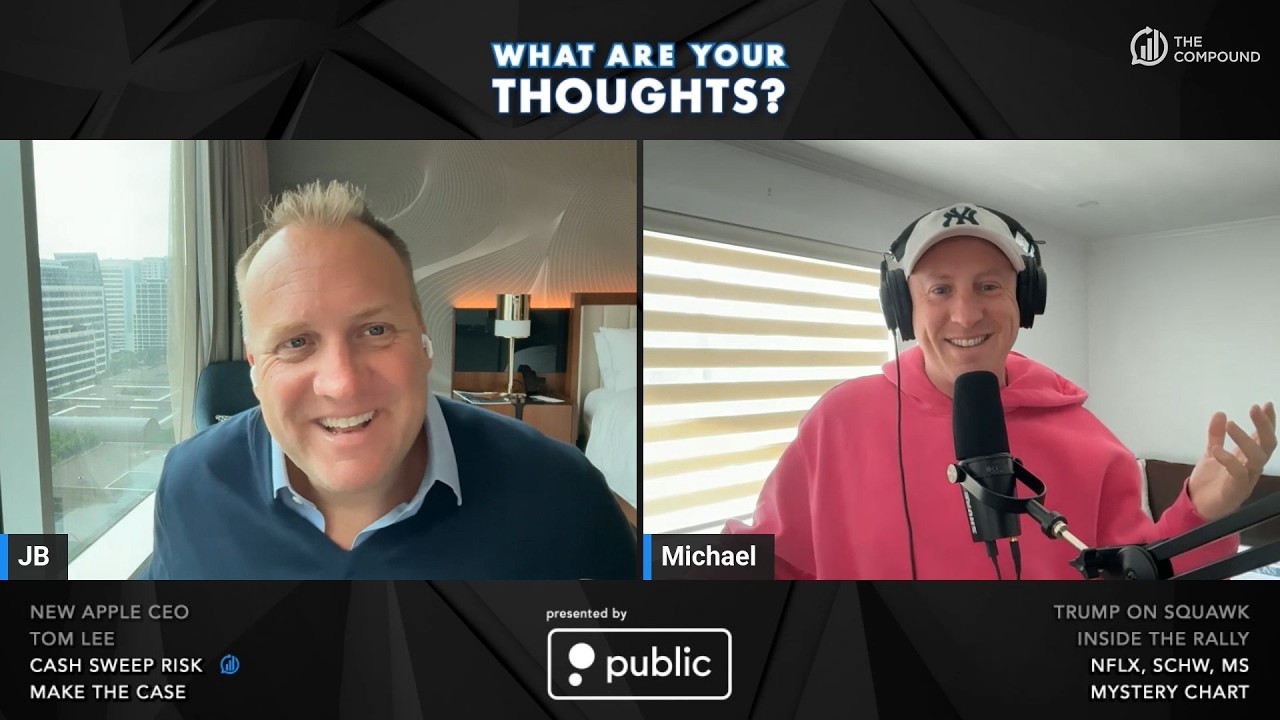
Cook Exit Triggers Hardware Pivot at Apple as Wall Street Weighs Rally
The Compound
John Ternus takes the helm at Apple following Tim Cook's 15-year tenure that added $3.6 trillion in market capitalization, as markets absorb AI disruption risks and technical momentum point to an extended bull run.
## Background
Published by The Compound on YouTube on April 21, 2026, this episode of 'What Are Your Thoughts' features hosts Downtown Josh Brown and Michael Batnick. According to the page description, the show breaks down Apple's massive leadership change, bold S&P 500 predictions, the impact of AI on financial services, and the recent surge in small-cap and micro-cap stocks.
## TL;DR
The hosts analyze Tim Cook's departure from Apple and the appointment of John Ternus, highlighting Cook's record-breaking $4 trillion market cap creation. They examine Tom Lee's bullish thesis for a two-year S&P 500 market rally alongside historic technical indicators, buyback blackout dynamics, and macro geopolitical shifts. Additionally, they dissect earnings and growth trends across major companies including Netflix, Charles Schwab, and Morgan Stanley while detailing how capital flows are rotating into small-cap and micro-cap AI supply chains.
## Atmosphere & style
The show delivers a high-energy, conversational mix of sharp financial analysis and lighthearted banter between close colleagues. Josh Brown and Michael Batnick maintain an accessible, plain-spoken dynamic—playfully calling each other out on everything from 'Carbone Maxing' to market call predictions—while sifting through complex institutional data. The narrative arc moves fluidly from high-stakes corporate leadership news to granular chart breakdowns, keeping the atmosphere lively, pragmatic, and unpretentious.
## Key takeaways
- [02:45](https://www.youtube.com/watch?v=2nY5-rKujrs&t=165s) Tim Cook stepped down as Apple CEO after an extraordinarily successful 15-year tenure that grew the company's market cap from ~$350 billion to $4 trillion.
- [08:12](https://www.youtube.com/watch?v=2nY5-rKujrs&t=492s) Apple selected 25-year company veteran John Ternus as CEO, bringing a hands-on, decisive hardware-engineering approach to the leadership role.
- [20:00](https://www.youtube.com/watch?v=2nY5-rKujrs&t=1200s) Tom Lee predicts an 18-to-24-month bull market for U.S. equities driven by multiple expansion, accelerating earnings, and geopolitical tailwinds.
- [25:28](https://www.youtube.com/watch?v=2nY5-rKujrs&t=1528s) The S&P 500's rapid surge to new highs highlights strong market sentiment dominated by FOMO rather than lingering structural fear.
- [32:09](https://www.youtube.com/watch?v=2nY5-rKujrs&t=1929s) Overreaction to potential AI disruption in cash management temporarily pressured financial stocks like Charles Schwab despite solid underlying earnings.
- [36:23](https://www.youtube.com/watch?v=2nY5-rKujrs&t=2183s) Netflix delivered strong fundamentals with $16.2 billion projected FY2026 EBIT, though competition from YouTube for user attention remains a key watchpoint.
- [41:14](https://www.youtube.com/watch?v=2nY5-rKujrs&t=2474s) Morgan Stanley's wealth management segment continues to drive outperformance, generating $118 billion in quarterly net new assets.
- [50:05](https://www.youtube.com/watch?v=2nY5-rKujrs&t=3005s) Small-cap and micro-cap stocks are showing strong technical breakouts, signaling a broader market rotation and potential AI value-chain expansion.
## Detailed walkthrough
### [00:00](https://www.youtube.com/watch?v=2nY5-rKujrs&t=0s) Carbone Maxing and Public Sponsorship
Downtown Josh Brown hosts from a rainy Dallas, Texas, where he shares that he visited the Design District the previous night—describing it as a mix of Miami and Las Vegas, complete with locations like Delilah from the Wynn Encore and Carbone. Michael Batnick ribbingly accuses Josh of "Carbone Maxing," pointing out that this is his third time eating there in three months. Josh admits he is going again on Thursday night in New York, declaring that will be the final time.
The hosts introduce the episode's sponsor, Public, contrasting it against legacy brokerages built in the late 1990s and newer platforms that feel like sports betting apps. They highlight Public's focus on AI integration, allowing users to build customized agents to monitor markets, manage cash, and execute trades via prompt instructions.
- Portfolio transfer offer: Uncapped 1% match at [public.com/WAYT](https://public.com/WAYT).
- Regulatory disclosures: Public Investing (Brokerage via Open to the Public Investing Inc, member FINRA/SIPC) and Public Advisors LLC.
---
[02:45](https://www.youtube.com/watch?v=2nY5-rKujrs&t=165s) Tim Cook's Departure and Apple's $4 Trillion Run
The primary market news is the announcement that Tim Cook is stepping down as Apple's CEO after a 15-year tenure that began when Steve Jobs passed away in 2011. They reflect on the original sentiment following Jobs' death, when many on Wall Street advised selling Apple under the premise that the company's "magic" was gone. Josh quotes trader Mark Fisher's favorite axiom, *"If it makes sense, it doesn't make money,"* noting how linear narratives are often already priced in by the market.
When Cook took the helm in 2011, Apple was valued at roughly $350 billion to $377 billion ($73 billion back when the original iPhone was first introduced in 2007). Cook expanded Apple's market capitalization 11-fold, driving it up to $4 trillion and mathematically establishing himself as the single most accomplished stock market CEO in history.
```
+-------------------------------------------------------------------+
| TIM COOK'S MARKET CAP CREATION |
| |
| • Per Minute: $478,000 |
| • Per Day: $683 Million |
| • Per Week: $4.8 Million |
| • Per Month: $20–21 Billion |
+-------------------------------------------------------------------+
```
- **Stat breakdown**: Cook generated $478,000 in market cap per minute, $683 million per day, and $20 billion to $21 billion per month continuously for 15 years.
- **Jobs Era vs. Cook Era**: The iPhone expanded Apple from $73 billion to $350 billion (a 5x gain); Cook grew the company an additional 11x off that significantly larger base.
---
[08:12](https://www.youtube.com/watch?v=2nY5-rKujrs&t=492s) The New CEO: John Ternus and Apple's Hardware Engine
Josh reads from Tim Cook's farewell letter, highlighting his daily routine of reading customer emails each morning and his glowing endorsement of successor John Ternus. Ternus, an engineer who has been at Apple for 25 years, previously served as Vice President of Hardware Engineering and had a direct hand in nearly every major hardware line across the company.
To illustrate Ternus's obsessive attention to detail, Josh shares an anecdote from a commencement speech Ternus gave: while designing the Cinema Display, Ternus insisted that internal screws—completely invisible to consumers inside the frame—must have precisely 25 grooves. When manufacturers shipped them with 35, he delayed production for months until they matched the exact specification.
- **John Ternus's Key Apple Projects**: Original iPad through every current generation, AirPods development, MacBook Pro redesigns, iMac refresh, iPhone 12 overhaul, Apple Watch hardware, and the Vision Pro.
- **Contextualizing iPad Scale**: Apple's iPad segment alone generated $28 billion in revenue over the trailing 12 months—surpassing total corporate revenues of AMD ($26 billion at the time) and matching the scale of Charles Schwab.
---
[10:20](https://www.youtube.com/watch?v=2nY5-rKujrs&t=620s) Innovation Bottlenecks, Bureaucracy, and Donald Trump's Farewell Statement
Addressing a Bloomberg report, the hosts evaluate why Apple selected Ternus over a more deliberative manager. Colleagues describe Ternus as a decisive leader who will make firm calls between Option A and Option B, directly contrasting Cook's consensus-driven approach of asking series of exploratory questions. They debate whether Apple's recent delays—such as taking two years to ship a generative AI Siri—stemmed from bureaucratic indecision or a deliberate, highly lucrative strategy to remain a "toll collector" cash cow while letting rivals burn capital on unproven tech.
```
APPLE CEO TRANSITION
Tim Cook Era John Ternus Era
-------------------- --------------------
• Consensus-driven • Decisive call-maker
• Deliberative operator • Obsessive hardware engineer
• Expanded Services/Tolls • Hands-on product guy
```
They note that Ternus internally opposed canceled moonshots like the Apple Car project before it was scrapped after billions in spend. Additionally, they discuss Donald Trump's public statement regarding Cook's departure, where Trump praised Cook's career while lightheartedly recounting how Cook used to call him directly as "Tim Apple" to address policy and tariff issues.
- **Berkshire Hathaway Parallel**: Greg Abel actively reallocated stock holdings immediately upon taking over from Warren Buffett, but Apple's transition is seen as operational continuity rather than a distressed turnaround.
- **Executive Chairman Role**: Cook transitions to Executive Chairman, where he will focus on macro-government relations with China and the US administration.
---
[15:10](https://www.youtube.com/watch?v=2nY5-rKujrs&t=910s) US-Iran Tensions, Oil Prices, and Trump on Squawk Box
Switching to macro economy and geopolitical dynamics, Michael and Josh discuss Donald Trump's appearance on CNBC's *Squawk Box*. Despite active military conflicts in the Middle East and friction around the Strait of Hormuz, crude oil remained surprisingly steady around $87 to $90 a barrel—prompting Trump to remark that he was shocked oil wasn't trading at $200.
Trump also recounted telling business leaders (including Jamie Dimon) that market pullbacks from the Dow 50,000 level were a necessary tradeoff to prevent Iran from securing nuclear capabilities. Josh highlights Trump's framing of market benchmarks, pointing out that Trump explicitly views the health of the Dow Jones Industrial Average as a personal performance metric. The segment concludes with a brief mention of Kevin Warsh testifying before Congress for his Federal Reserve Chair confirmation and questions raised regarding the Defense Department's stance on Anthropic's Claude AI model.
- **Oil Market Benchmark**: Crude oil stayed flat at $87/barrel despite blockade fears; stock futures ticked up during the interview at 8:30 AM.
- **Market Key Figures**: Dow 50,000 referenced as a major psychological benchmark for the administration.
<FollowUp label="Want to dive into the next section of the transcript covering the market rally and AI disruption?" query="Please provide the walkthrough for part 2 of the transcript."/>
[20:00](https://www.youtube.com/watch?v=2nY5-rKujrs&t=1200s) Anthropic, SK Telecom, and Tom Lee's Bold S&P 500 Call
The conversation begins with a discussion surrounding Anthropic and its tense relationship with the White House and the U.S. military. A quote from the administration notes that Anthropic executives recently visited the White House for productive talks and that things are "shaping up." Josh Brown and Michael Batnick note that Anthropic's team originally contained many left-leaning individuals who were resistant to military demands, which initially sparked friction. However, with Anthropic's technology being so powerful and essential, a compromise is being forged. Because Anthropic is private, SK Telecom (ticker: SKM) serves as a public proxy for its momentum, and its stock continues to move higher as political concerns recede.
The hosts transition to a widely circulated clip from Fundstrat's Tom Lee. Lee argues that U.S. equities are uniquely positioned because domestic companies lead the world across technology, healthcare, and fintech. While some analysts argued U.S. price-to-earnings (P/E) multiples should derate, Lee contends that geopolitical conflict proves U.S. valuations should actually expand. Furthermore, with earnings accelerating and international investors seeking S&P 500 growth, Lee predicts the market is setting up for an 18-to-24-month bull run that could be among the best in history—potentially driven by lower interest rates under a new Federal Reserve chair and falling oil prices.
Josh and Michael unpack the psychological impact of valuations and price action. They reflect on how investors hesitated when Meta traded at 16 times forward earnings, only to chase the stock higher once the price moved up. Batnick points out that price action dictates the narrative: if a mega-cap's multiple expands, people rationalize it as paying for the world's best companies. Prompted by Lee's thesis, Batnick floats the idea of the S&P 500 reaching 10,000 within 18 to 24 months, noting that a 30% rally over two years is well within the realm of recent historical performance.
- **Anthropic Proxy:** SK Telecom (SKM) continues to rally as federal tension eases.
- **Tom Lee Thesis:** Anticipates simultaneous earnings growth and multiple expansion over an 18–24 month timeframe.
- **S&P 10,000 Target:** Batnick notes moving from ~7,000 to 10,000 requires roughly a 30% gain, which the market has accomplished repeatedly in recent cycles.
[25:28](https://www.youtube.com/watch?v=2nY5-rKujrs&t=1528s) Market Behavior, VIX Dynamics, and Buyback Blackouts
Examining historical precedent, the discussion turns to research from Warren Pies regarding 10-day, 10% market rallies. Historically, one year after such a sharp move, the S&P 500 was higher 19 to 20% on average, ending positive in 16 of 21 historical instances (with the few negative occurrences occurring around the early-2000s dot-com crash). The current market behavior is unusual: typically, markets "take the stairs up and the elevator down," but in this cycle, the market took the stairs down without a panic or a single 2% down day, and then took the elevator right back up to all-time highs.
A chart produced by Matt shows that 12% rallies occurring over 13 days have happened 38 times in history, usually during severe bear markets where the average drawdown was 26%. In contrast, the maximum drawdown during this current dip was only around 9%. The only comparable instance of a sharp rally occurring so close to record highs was at the top in 2000. Josh points out that the chemical balance of the market is heavily dominated by FOMO (fear of missing out) rather than structural fear. Because every equity sale over recent years ended up looking foolish, buyers aggressively buy every dip out of fear of being left behind in cash.
This rally is even more remarkable because it occurred during a corporate buyback blackout period. Data from Goldman Sachs via *The Daily Chartbook* indicates that roughly 98% of corporations were in an execution blackout in mid-April. Additionally, retail flows tend to be seasonally weak in the first half of April due to tax liabilities. Despite two major liquidity buyers (corporations and retail) being sidelined, the market printed one of its strongest technical surges in history.
- **Warren Pies Data:** 1-year forward S&P 500 returns after a 10-day/10% rally average +19% to +20%, positive 16 out of 21 times.
- **Drawdown Comparison:** 12% rallies in 13 days typically occur after a 26% drawdown; this cycle experienced a peak-to-trough decline of just 9%.
- **Goldman Sachs Estimates:** 98% of corporate S&P 500 buyers were in a buyback blackout during the spring rally.
[28:42](https://www.youtube.com/watch?v=2nY5-rKujrs&t=1722s) Seasonal Patterns, Tax Day Trends, and the Nasdaq Streak
The hosts analyze historical calendar seasonality, specifically looking at performance leading into Tax Day on April 15th. Over the last 35 years, data shows that March is consistently an uncomfortable month for stocks, and April 15th stands out as the single worst day of the year for median daily S&P 500 returns. Investors routinely draw down cash from brokerage accounts to pay tax obligations, creating a tangible liquidity drag that recurs every spring regardless of whether institutional investors "know it's coming."
Moving to the tech sector, the Nasdaq 100 (NDX) logged a rare 13-day winning streak. Historically, an 11+ day winning streak on the Nasdaq has occurred roughly a dozen times, and in every single instance, the index was higher one year later.
- **April 15th Seasonality:** Ranked as the worst single day of the year for median S&P 500 daily returns over the past 35 years.
- **Nasdaq 100 Streak:** 13 consecutive positive days; 100% win rate for positive returns 12 months later following streaks of 11+ days.
[32:09](https://www.youtube.com/watch?v=2nY5-rKujrs&t=1929s) AI Disruption Scares in Financial Services: Schwab & JPMorgan
A major topic of discussion is the market's overreaction to AI threats in financial services, specifically concerning Charles Schwab. Barron's reported that following Schwab's earnings call—where CEO Rick Wurster discussed AI efficiency—the stock fell nearly 8%. The decline was triggered by news that JPMorgan Chase was developing an AI-driven cash management tool, raising concerns that AI could disrupt Schwab's sweep cash yields.
Batnick strongly dismisses the narrative that investors dumped Schwab purely out of fear of JPMorgan's AI cash tool. He highlights the timeline: JPMorgan reported earnings on Monday, April 13th, after which Schwab stock actually rallied for three consecutive days. Schwab only broke down after releasing its own Q1 earnings report. While Schwab generated $3.1 billion in net interest revenue out of $6.5 billion in total Q1 revenue—making sweep cash yield critical—the AI cash management product from JPMorgan does not even exist yet.
Jamie Dimon fueled the disruption narrative on JPMorgan's earnings call by quoting Jeff Bezos ("your margin is my opportunity") and expressing optimism about AI cash management tools. However, Josh and Michael label the market panic as "nonsense," arguing that retail and wealth management clients are not going to instantly shift their asset custodians en masse over minor sweep yield AI optimization.
- **Schwab Financials:** $3.1 billion in Q1 net interest revenue out of $6.5 billion total net revenue (~50%).
- **Market Reaction:** Schwab fell ~8% despite solid earnings, alongside pullbacks in Raymond James and LPL Financial, driven by JPMorgan AI headlines.
[36:23](https://www.youtube.com/watch?v=2nY5-rKujrs&t=2183s) Netflix Earnings, YouTube Competition, and Disney Valuations
Netflix delivered what the hosts consider a strong Q1 earnings report, showing 14% year-over-year revenue growth and an ad-supported platform reaching a $3 billion annual run rate (up from zero). Despite this, the stock dropped 9% post-earnings with no immediate bounce, falling back from $106–$107 into the $90s. Josh notes that despite holding long-term shares, the short-term price action looks weak due to persistent follow-through selling.
The real threat spooking Netflix investors is not legacy streaming competitors like Disney+ or Hulu, but rather YouTube. Citing chart analysis from Alex Morris, the hosts emphasize that YouTube's share of overall TV streaming time is rising while Netflix's has edged lower. While Paramount and Warner Bros. Discovery represent "frenemies" that license content, YouTube is competing directly for ambient user attention and has the deep pockets of Alphabet behind it. Additionally, Reed Hastings stepping down from the board and Netflix's previous interest in acquiring Warner assets created temporary strategic uncertainty.
Despite the pullback, the underlying financial scale of Netflix remains massive. Alex Morris points out that Netflix's projected FY2026 EBIT of $16.2 billion will exceed the total adjusted operating income of Walt Disney's entire business combined—including theme parks, linear TV, theatrical releases, and streaming. This fundamental cash generation justifies Netflix's nearly half-trillion-dollar market valuation, leading Michael to place buy limit orders during the sell-off.
- **Netflix Q1 Results:** 14% revenue growth; ad-tier run rate scaled to $3 billion.
- **FY2026 Forecast:** Projected EBIT of $16.2 billion exceeds the total operating income of all Walt Disney divisions combined.
- **Stock Movements:** Dropped 9% post-earnings, moving from the $106–$107 range down into the $90s.
[40:00](https://www.youtube.com/watch?v=2nY5-rKujrs&t=2400s) Netflix Guidance and Analyst Reaction
Michael Batnick updates his stance on Netflix, noting he owns shares under $100 and in the low $90s, where he lowered his average cost. While acknowledging the stock is currently "broken," he considers it a long-term investment but remains open to changing his mind. Crucially, despite the recent 10% pull-back, no Wall Street analysts actually downgraded the stock.
The hosts review selected Wall Street analyst notes, emphasizing that management did not use macroeconomic uncertainties as an excuse to sandbag ad or subscription guidance:
* **Mark Mahaney (Evercore ISI):** Titled his note *"Lights, Camera, Quality Compounder"*, maintaining his weight rating and core thesis on the global video streaming leader.
* **William Blair:** Noted that the market's main disappointment was simply the absence of a full guidance raise (*"lack of a full raise was the problem"*).
* **Wedbush:** Acknowledged a softer Q2 guidance outlook but kept full-year guidance intact, relying on a strong second half.
* **KeyBank (Justin Patterson):** Raised the price target from $108 to $115 right before the earnings release.
* **Piper Sandler:** Upgraded its price target from $103 to $115 after earnings, maintaining an Overweight rating.
Michael highlights that the pullback has set up lower expectations for the back half of the year, making future surprises easier. They also highlight international and live events momentum—such as the World Baseball Classic driving Netflix's single largest day of sign-ups in Japan, alongside expanding partnerships with the NFL.
[41:14](https://www.youtube.com/watch?v=2nY5-rKujrs&t=2474s) Morgan Stanley’s Wealth Management Dominance
The discussion pivots to Morgan Stanley, which Josh and Michael describe as a "monster winner." Looking at a one-year chart comparing Morgan Stanley to the Financial Select Sector SPDR Fund (XLF), Morgan Stanley is up roughly 80% compared to XLF's 14%.
```
1-Year Relative Performance (Approximate)
Morgan Stanley (MS): [========================] +80%
Sector ETF (XLF): [====] +14%
```
Although some market commentators raise concerns about advisor exposure to private markets, Morgan Stanley reported that alternative investments represent only 5% of total Assets Under Management (AUM), with private credit accounting for just 1%. Josh emphasizes that in the ultra-high-net-worth space, advisors spend significant energy placing clients into private equity and credit because clients actively demand it.
* Total Net New Assets for the quarter reached **$118 billion**, with **$54 billion** sitting in fee-based accounts.
* Wealth Management accounts for roughly **45%** of total firm revenue.
* The host credits former CEO James Gorman and current CEO Ted Pick with executing the "greatest wealth management funnel ever built."
* Integrations of acquisitions like E*TRADE and Morgan Stanley at Work seamlessly funnel self-directed and equity plan clients directly into full-service wealth channels.
* Josh notes that Morgan Stanley capitalized on its Great Financial Crisis-era joint venture with Citigroup to buy out Smith Barney in tranches, recognizing early that wealth management is the steadiest business on Wall Street.
[46:24](https://www.youtube.com/watch?v=2nY5-rKujrs&t=2784s) Charles Schwab’s Record Quarter and Pricing Dynamics
The hosts examine Charles Schwab's latest quarterly numbers, calling it the best quarter in the company's history despite market cynicism around its cash sweep and interest rate sensitivity.
* **Total Client Assets:** Surged 19% year-over-year to **$11.77 trillion**.
* **Core Net New Assets:** **$140 billion** brought in during Q1.
* **New Accounts:** Added **1.3 million** new brokerage accounts in the quarter alone.
* **Margin Loans:** Totaled **$126 billion** (up 13%), with **$21 billion** driven by long/short strategies implemented by Registered Investment Advisor (RIA) clients.
Josh explains that Schwab is capturing market share in margin lending to RIAs as competitors like Fidelity throttle back. The hosts contrast Schwab's low revenue per dollar of client assets with Morgan Stanley's high-margin model: Schwab operates as a low-cost, high-volume provider, trading at roughly 15 times forward earnings with a ~5.4% annualized growth rate. They compare Schwab's messaging to Netflix's argument that it offers maximum value per hour watched—a message that satisfies consumers but leaves Wall Street wanting higher prices and fees. Lastly, they dismiss Schwab's rollout of crypto trading as late and largely uninspiring to retail investors.
[50:05](https://www.youtube.com/watch?v=2nY5-rKujrs&t=3005s) Reassessing Risk and the Case for Small Caps
Michael offers a macro lesson on investor psychology: every sell-off and subsequent recovery provides an opportunity for investors to evaluate their actual risk tolerance rather than their theoretical one. He advises keeping speculative trading separate from core wealth.
Transitioning to market structure, Michael builds a technical and fundamental bull case for small-cap stocks using the Russell 2000 index:
* **Multi-Year Base:** The Russell 2000 spent years in a bear market after peaking in the winter of 2021 before breaking out of its long consolidation base.
* **Sector Breakdown:** Industrials represent the largest allocation, followed by Healthcare and Financials, creating a diversified profile despite high proportions of unprofitable companies.
* **Relative Strength:** Ratio charts of the Russell 2000 versus the S&P 500 show a classic downtrend breakout.
Michael highlights the ratio of the Invesco S&P SmallCap Information Technology ETF (PSCT) against the Tech Select Sector SPDR Fund (XLK), pointing out a sharp bottom and ongoing rally. He frames this as the "handoff" phase of the AI theme: capital expenditure flows out from big hyperscalers into small- and mid-sized corporate customers who spend on AI compute, software models, and productivity tools to boost profitability. Furthermore, small caps stand to benefit disproportionately from eventual Federal Reserve rate cuts due to higher debt sensitivity.
[54:07](https://www.youtube.com/watch?v=2nY5-rKujrs&t=3247s) The Micro-Cap Speculative Rally
The conversation turns to the speculative surge in micro-cap equities. Over a trailing one-year period, the Russell Microcap Index dramatically outperformed large caps:
Looking under the hood of the top 10 holdings in the iShares Micro-Cap ETF (IWC), Michael and Josh highlight names like Applied Digital, Praxis, Energy Fuels, Cipher Mining, Hoojin, Centrus Energy, TeraWulf, Vistance, Cellcuity, and Tudor Perini Corp. They laughingly point out that several top holdings are crypto miners and nuclear/energy plays, promising to bring micro-cap expert Ian Cassel back onto the show to detail the mechanics of this rally.
[56:23](https://www.youtube.com/watch?v=2nY5-rKujrs&t=3383s) Mystery Chart: Caterpillar’s Parabolic Run
Josh introduces the segment's "Mystery Chart," challenging Michael to guess a breakout Dow Jones Industrial Average component without revealing the sector.
```
Caterpillar Inc. (CAT) Technical Setup:
- 50-Day Moving Average: Held cleanly during recent pullback
- 200-Day Moving Average: Maintained significant distance; zero trend breaches
- Multi-Year Trajectory: ~4x gain over recent years
```
After Michael jokingly guesses Goldman Sachs, Josh reveals the chart as **Caterpillar Inc. (CAT)**:
* The stock has quadrupled over the last couple of years and has remained on their internal "best stocks in the market" monitor since July without breaking its 200-day moving average.
* CAT brushed off geopolitical headlines (such as tensions around the Strait of Hormuz) and quickly reclaimed its 50-day moving average after brief consolidation.
* While acknowledging that buying a stock after a parabolic run on a monthly chart without a tight stop-loss is risky ("you're a maniac"), they highlight CAT's structural strength as an industrial titan.
[59:00](https://www.youtube.com/watch?v=2nY5-rKujrs&t=3540s) Outro and Upcoming Show Lineup
The hosts wrap up the episode by thanking live viewers and channel subscribers ("pounders"). They preview upcoming content across The Compound network:
* **Animal Spirits:** New episode featuring Michael Batnick and Ben Carlson.
* **Ask The Compound:** Live Q&A hosted by Duncan Hill and Ben Carlson.
* **The Compound & Friends:** End-of-week flagship show featuring two special guests.
## Notable quotes
> [02:45](https://www.youtube.com/watch?v=2nY5-rKujrs&t=165s) If it makes sense, it doesn't make money — Mark Fisher
> [32:09](https://www.youtube.com/watch?v=2nY5-rKujrs&t=1929s) your margin is my opportunity — Jeff Bezos
> [40:00](https://www.youtube.com/watch?v=2nY5-rKujrs&t=2400s) Lights, Camera, Quality Compounder — Mark Mahaney
> [40:00](https://www.youtube.com/watch?v=2nY5-rKujrs&t=2400s) lack of a full raise was the problem
> [56:23](https://www.youtube.com/watch?v=2nY5-rKujrs&t=3383s) you're a maniac
## Mentioned
Downtown Josh Brown, Michael Batnick, The Compound, Public, Public Investing, Open to the Public Investing Inc, FINRA, SIPC, Public Advisors LLC, Apple, Tim Cook, Steve Jobs, Mark Fisher, John Ternus, Cinema Display, iPad, AirPods, MacBook Pro, iMac, iPhone 12, Apple Watch, Vision Pro, AMD, Charles Schwab, Donald Trump, Greg Abel, Warren Buffett, Berkshire Hathaway, Jamie Dimon, Kevin Warsh, Federal Reserve, Defense Department, Anthropic, Claude AI, SK Telecom, Fundstrat, Tom Lee, S&P 500, Meta, Warren Pies, Goldman Sachs, The Daily Chartbook, Nasdaq 100, Barron's, JPMorgan Chase, Raymond James, LPL Financial, Rick Wurster, Netflix, Disney+, Hulu, YouTube, Alex Morris, Paramount, Warner Bros. Discovery, Alphabet, Reed Hastings, Walt Disney, Evercore ISI, Mark Mahaney, William Blair, Wedbush, KeyBank, Justin Patterson, Piper Sandler, NFL, Morgan Stanley, Financial Select Sector SPDR Fund, James Gorman, Ted Pick, E*TRADE, Citigroup, Smith Barney, Fidelity, Russell 2000, Invesco S&P SmallCap Information Technology ETF, Tech Select Sector SPDR Fund, NVIDIA, Russell Microcap Index, iShares Micro-Cap ETF, Applied Digital, Praxis, Energy Fuels, Cipher Mining, Hoojin, Centrus Energy, TeraWulf, Vistance, Cellcuity, Tudor Perini Corp, Ian Cassel, Caterpillar Inc., Ben Carlson, Duncan Hill
Downtown Josh Brown and Michael Batnick highlight an unusually strong equity market propelled by structural FOMO, resilient corporate earnings, and multiple expansion, even as investors navigate major leadership handoffs at Apple and competitive shifts across media and financials.
Apple's Historic Transition to John Ternus (2:45)
Tim Cook is stepping down as Apple CEO after a 15-year tenure that increased the company's valuation from roughly $350 billion to $4 trillion. Under Cook, Apple generated approximately $478,000 in market capitalization per minute and $20 billion to $21 billion per month, growing 11-fold off the base established during the Steve Jobs era. Cook transitions to Executive Chairman, where he will oversee government relations with Washington and China.
Hardware engineering veteran John Ternus, who has spent 25 years at the company, succeeds Cook. Colleagues characterize Ternus as a decisive, hands-on product leader who oversaw core devices from the original iPad to the Vision Pro. His appointment signals operational continuity rather than a distressed corporate restructuring, contrasting Cook's consensus-driven approach while likely addressing recent development bottlenecks.
Technical Indicators and Tom Lee's Bull Thesis (20:00)
The hosts examine an unusual technical setup where the market swiftly rebounded to record territory following a shallow 9% peak-to-trough pullback. Historical data from Warren Pies reveals that after a 10-day, 10% surge, the S&P 500 averages a forward 1-year return of 19% to 20%, finishing higher in 16 of 21 instances. Furthermore, this rally materialized despite headwinds: Goldman Sachs data showed 98% of corporations were in buyback blackout windows, and pre-April 15 retail liquidity was weighed down by tax obligations.
Fundstrat's Tom Lee forecasts an 18-to-24-month bull market characterized by simultaneous earnings acceleration and multiple expansion, driven by lower interest rates and easing energy costs. Batnick notes that reaching an S&P 500 target of 10,000 requires roughly a 30% rally, well within historical precedent. This optimism is reinforced by the Nasdaq 100's 13-day winning streak, an occurrence that has historically led to positive 12-month returns 100% of the time.
Diverging Fortunes in Wealth Management and Financials (32:09)
Morgan Stanley and Charles Schwab showcase the power and vulnerabilities of wealth management models. Morgan Stanley has gained roughly 80% over the past year, compared to 14% for the Financial Select Sector SPDR Fund (XLF), driven by its integrated funnel across E*TRADE and Morgan Stanley at Work. Wealth management now accounts for 45% of firm revenue, drawing $118 billion in quarterly net new assets while maintaining minimal alternative investment risk.
Conversely, Charles Schwab fell nearly 8% following earnings, driven by market anxiety over JPMorgan Chase developing an AI cash management tool to compete for sweep deposit yields. The hosts label this sell-off an overreaction, noting JPMorgan's tool does not yet exist. Fundamentally, Schwab delivered record results, with total client assets rising 19% year-over-year to $11.77 trillion and core net new assets reaching $140 billion.
Netflix Valuation Realities Against YouTube's Rise (36:23)
Despite reporting 14% year-over-year revenue growth and scaling its ad-supported tier to a $3 billion run rate, Netflix shares dropped 9% post-earnings into the $90 range. The hosts identify YouTube—rather than traditional streaming services—as Netflix's primary long-term threat for user screen time, backed by Alphabet's infrastructure.
Nevertheless, Wall Street analysts refrained from downgrading Netflix, with firms like Piper Sandler and KeyBank raising price targets to $115. Analysis from Alex Morris projects Netflix's FY2026 EBIT to reach $16.2 billion, an amount expected to surpass the combined adjusted operating income of Walt Disney's entire operations, illustrating the underlying earnings engine behind its nearly $500 billion valuation.
Broadening Market Breadth and Micro-Cap Speculation (50:05)
The bull thesis is increasingly supported by broader market participation beyond mega-cap tech. The Russell 2000 has broken out of a multi-year consolidation base, while small-cap tech ETFs (PSCT) show relative strength against large-cap tech (XLK). Michael Batnick interprets this as a 'handoff' where hyperscaler capital expenditures filter into mid- and small-sized enterprises investing in AI software and productivity tools.
Speculative risk appetite is notably visible in micro caps, where the iShares Micro-Cap ETF (IWC) gained 75% over the trailing year versus 36% for the S&P 500, propelled by crypto miners and nuclear energy plays. Industrial bellwether Caterpillar further reflects structural momentum, quadrupling over recent years while consistently maintaining its 50-day and 200-day moving averages.
While technical indicators, broadening market participation, and institutional earnings support a furious continuation of the rally, the hosts caution that extended valuations and rapid sentiment shifts require investors to distinguish theoretical risk tolerance from actual execution.
[2:45] Mark Fisher: If it makes sense, it doesn't make money
[32:09] Jeff Bezos: your margin is my opportunity
[40:00] Mark Mahaney: Lights, Camera, Quality Compounder
[40:00] lack of a full raise was the problem
[56:23] you're a maniac
Original transcript
[0:00] Ladies and gentlemen, welcome to What Are Your Thoughts? One of the longest running shows on the Compound channel. My name is Downtown Josh Brown. I am your host. I am here from rainy Dallas, Texas today. Michael, when's the last time you've been to Dallas? Two years ago. It's pretty windy. It's not windy today, but it's great. I like it because I have to be indoors all day. We went to this thing called the Design District last night. It's like a little bit Miami, a little bit Vegas, but in downtown Dallas. How is it? I mean, we went to Carbone. It was great. They have Delilah, which I think is from the Wynn Encore. They have one of those here. I feel like you're eating too much Carbone. I'm Carbone Maxing. Is this three times in three months You want to know that I going to Carbone on Thursday night in New York Shut up I swear to God Is this a joke Are they paying you No that it though After that After this that it All right. That's good. Guys, we have an action-packed show for you today. I want to mention our sponsor, which is Public. It feels like there are two types of investing platforms right now. You've got the legacy brokerages that look like they were designed in 1997. And then you've got the new wave, the ones that looked at investing and thought, you know what? This needs sports betting. Neither seems like a great place to build your wealth. So that's where Public comes in. It's the modern investing platform for those who take it seriously. Stocks, options, bonds, crypto, they have it all. That's right, Josh. And the energy they're not spending on building a casino, it's going right into AI. Public is the only platform where you can create agents that can monitor the market, manage your cash, and execute your trades. Just enter a prompt, approve the workflow, and put your agent to work. So go to public.com slash W-A-Y-T and earn an uncapped 1% match when you transfer your portfolio. That's public.com slash W-A-Y-T. Paid for by Public Investing. Brokerage Services by Open to the Public. Brokerage Services Open to the Public Investing Inc Gosh dang it Brokerage services by open to the public Investing Inc Member FINRA and SIPC Advisory services by public advisors, LLC. SEC registered advisor. Complete disclosure is available at public.com slash disclosures. Josh, the cat got my tongue. It really did. It really did. It happens. You've been potting your head off, so it's understandable. Tim Cook stepped down. And wrote a really beautiful, tremendous, beautiful letter. And it was kind of – I think it was kind of surprising. People weren't – this was not – I don't know. Do you think this was in the air? Not my air. Right. So he took over when Steve Jobs passed in 2011. So it's a solid 15 years. And maybe that's the timing or maybe it's more – he recognizes what Apple needs right now. is somebody more decisive. Not that he can't make decisions, but he's not really known for being a hard-charging kind of visionary. He's been an incredible, some would say, one of the best CEOs of all time And certainly outperformed expectations The market would say that Throw up this chart John So this is a chart of the market cap that Tim Cook added since becoming CEO And when Steve actually chart off for a sec When Steve Jobs died, there was a massive amount – he was a visionary. Apple was Steve Jobs and Steve Jobs was Apple. It was not a foregone conclusion that Tim Cook would take them to the next level, which they did. They went to the next level. So they added $478,000 in market cap per minute since Tim Cook became CEO. Come on. I have to fact check this because it sounds fake. $683 million a day and $4.8 million a week and $20 billion per month. $21 billion a month for 15 freaking years. That is unbelievable. So statistically, he is the most accomplished stock market CEO of all time. And there's not even a close number two. I remember somebody saying in 2011 when jobs passed and Cook took over, sell Apple because the magic man is gone. Yeah, that was a wild story.
[5:00] That would have made sense, but you know one of my favorite sayings on Wall Street, if it makes sense, it doesn't make money. Do you know who taught me that? No, I like that. That's Mark Fisher. I think he invented it actually, and he's come out of these trading guy primarily. He says, if it makes sense, it doesn't make money. And it's almost like a Yogi Berra-ism or maybe it's a little bit Munger-esque, but there's so much wisdom in that. But if something like – if I can tell you a linear story, A plus B plus C equals D, it's in the prices. How could it not be? I generally agree, but – and also that is the top of the midwit mean bell curve. Yeah, fine. Works. Sometimes. Do you know, Michael, that – what do you think the market cap of Apple was when Tim Cook took over? When Tim – oh, that's your question. Let's go with 190 billion. 350 billion. It was 377 a share. So, I mean, a million split cents. Now it 4 trillion So he 11X the market cap of this company That remarkable When the iPhone was introduced the market cap that 2007 Apple's market cap was $73 billion. So in other words, the iPhone took Apple from $73 billion to $350 billion, which is a 5X. Cook did an 11X. Cook grew the company more than the Jobs iPhone era. And off a much, much bigger base, obviously. Off a much bigger base. Yeah, look, it's an incredible run. I wanted to pull out a couple of things he said in the letter. He said, for the last 15 years, I've started just about every morning the same way. I open my email and I read notes I received the day before from Apple's users all over the world. You share little pieces of your lives with me and tell me things you want me to know about how Apple has touched you, about the moment your mom was saved by her Apple Watch, about the perfect selfie you captured, blah, blah, blah. It's a really nice letter. And then here's what he said about the new guy, John Ternus, who we'll talk about in a second. Quote a brilliant engineer and thinker who has spent the past 25 years building the Apple products our users love so much obsessed with every detail focused on every possible way we can make something better bolder more beautiful and more meaningful He's the perfect person for the job. Ternus gave a commencement ceremony speech at an engineering college. He's an engineer, maybe at UPenn where he came from. And he told this story about they were building the cinema display product and he wanted the screws to have 25 grooves. Nobody would see the screws. They're literally inside of the display. He wanted them to have 25 and the manufacturer was shipping them with 35 grooves. And he like stuck on that for months until final. And like his comment was, is that crazy? Yeah, it's crazy. But so what? it's also the right thing to do. Like this is how we designed it. This is how it has to be. So it's, it's, it's, uh, not a huge departure from cook in terms of cooks, more of an operations guy, but also very much focused on details. And I think that like part of the hallmark of Apple is not just creativity but like everything perfect or they want they want they want to get to the place where everything perfect We have a picture of him He 50 years old He's John Tarnas with Tim Cook. Yeah, he's in all their videos whenever they do the product launch. He's always – here are some of the things that he worked on. iPad, every single iPad model starting from the original through every generation. AirPods, he oversaw the development. He was the VP of hardware engineering, one of the most successful tech products of all time. The MacBook Pro, he's the guy that did like the WWDC presentation for each new MacBook Pro. The iMac refresh, the iPhone 12, he basically owned it. And that was a huge leap forward for the iPhone in general. The Apple Watch, he led the hardware development when they were launching that. And the Vision Pro, your favorite Apple gadget. So that one didn't work out so well. Dude, the iPad. So we had this chart. We did this five months ago showing the Apple revenue in context. The iPad.
[10:00] did 28 billion dollars in revenue in the previous 12 months and at the time it looks different today but at the time amd to 26 billion dollars in revenue maybe a better comparison because this is probably similar right now schwab so the ipad which no one talks about ever ipad which nobody discusses the freaking ipad did as much or more revenue than charles schwab in the last 12 months It's insane. So this big Bloomberg piece about what the company wants out of their new CEO or what the shareholders want, what he's really in the seat for. And maybe this is what prompted Tim Cook to say, you know what? It's 15 years. It's a great run. I'll step back, be executive chairman. I'll focus on like relations with Trump and with China and the big picture stuff. but we need a product guy back in the seat. This is Bloomberg. Apple is also betting that Ternus has a more decisive leadership style, something closer to Steve Jobs. Long-term colleagues describe Ternus as someone willing to make clear calls in contrast to Cook more deliberative consensus approach Quote Ternus will make decisions If you go to Tim with A or B he won pick He ask a series of questions instead Ternus on the other hand will choose It could be right or wrong, but at least it's a decision. I don't know. How much of the perceived mediocrity in Apple's recent track record of innovation do you think people would ascribe to indecisiveness like like it's two years to ship a gentix siri and they still haven't um like how how much of that do you think is just like too much committee too much bureaucracy not enough decision making i don't know if it's not the opposite where kim cook is saying no no no that's not our lane our lane is super lucrative and we're not doing it and i would say so far they've been rewarded for staying in their lane. There's an alternate universe where Apple is spending all this money. They have nothing to show for it. And investors are like, what are they doing? You've got this cash cow. Just don't fuck – like don't interrupt the Apple card. Nothing is broken. Let everybody else waste their money and we'll just be the tall operator. Yeah so they done that and they probably milked it to the greatest degree possible via services they did try to launch a new category with Division Pro It went splat Now they have a glasses project, which has been pushed back and pushed back. They burned billions of dollars investigating whether or not they should build a car. People forget about that, but it's a real thing that happened. And according to the article, Ternus was against these things internally. I don't think he wanted to do the car, but you fall in line when you're not the CEO. Do you think that – let's say – I don't think there's going to be a massive sea change in the next 30 days, but let's play out the next year or two. Do you think they're going to make a pivot and do something that Cook wouldn't have done if he were in the – it needs to look fundamentally different or is this more the status quo CEO? You know, I always think that the – it's a great question. I always think that the, quote, handpicked successor who's coming into the seat internally is there for continuity and then a little bit more of their personality will gradually shine through. But like that doesn really seem to be what happens And we not going to do Berkshire today But Greg Abel is whacking out positions He like in the seat and actively making changes almost immediately Buffett officially was out on December 31st, and there's already big changes in the stock holdings. So that's something that we can see externally. So who knows what's going on internally? In this case, this is not like a turnaround situation. This is not like the stock is in a 30% drawdown and has underperformed for five years and everyone is sick of it and they need a drastic change. It's like the opposite. Tim Cook is going out basically at the high. And so I don't know. Why all of a sudden would there be some sharp course correction? It makes no sense. Nobody wants it. I don't think so. So I don't think there will be. Last thing on this, Donald Trump wrote a beautiful pay-on to the outgoing Tim Cook. I'll quote from it. I have always – I'm not going to do his voice. I have always been a fan of Tim Cook and likewise Steve Jobs. But if Steve was not taken from the planet Earth so young and ran the company instead of Tim, the company would have done well but nowhere near as well as it has on the planet Earth.
[15:00] Tim, let me pause there. What do you think? How can anyone know? I don't know if that's true because Jobs was a home run hitter, which means a lot of striking out along the way. Listen, it's hard to see a universe in which it did better than it did. Right. What would even define nine trillion? What else did he say? It's pretty funny. Most people would have paid millions of dollars to a consultant who I probably would have not have known but who would say that he knew me well. The fees would be paid but the job would not have gotten done. When I got the call, I said, wow, it's Tim Apple calling. How big is that? He's talking about the first time Tim ever called him. Parentheses, Cook, by the way. Parentheses, Cook. Yeah. I was very impressed with myself to have the head of Apple calling to kiss my ass. Anyway, he explained this problem. It was a tough one. I felt he was right and got it taken care of quickly and effectively. That was the beginning of a long and very nice friendship. During my five years as president Tim would call me but never too much and I would help where I could I mean it cool Have the president on your way out as CEO I mean it goes on and on and on Tim Cook had an amazing career, all caps amazing, almost incomparable. Whatever else he chooses to work on, continue to do great work. Quite simply, Tim Cook is an incredible guy. Huh. That's cool. Yeah? Yeah. All right. Nothing to add? It's nice. Would you like me to say that? Would you like somebody to say that about you when you step down? That I had an incomparable career? Yeah. Incomparable? Yeah. All right. Trump was on Squawk this morning. You watched it? Mm-mm. Okay. He said – this was the quote that everybody took. The U.S. is going to end up with a great deal with Iran to end the war. so future shot up when he started talking that was like at 830 oil was flat at 87 one of his quotes was I can't believe oil is at 90 and not 200 that's what Trump said and I said yeah you and everyone else no like no one would have believed that we would be fighting a war in Iran and the Strait of Hormuz would be closed or blockaded or double blockaded and we would have oil under a barrel So even the president himself, then he describes a conversation he had with some business leaders and I think he mentioned Jamie specifically. Oh, yeah. Yeah. He said, he said, can you imagine there we were Dow 50,000? And I said to these guys, I said, I'm sorry. I have to do some things. I have to go down to a little place called Iran and it's going to be tough, but I have to do it. I can't let them get a nuclear weapon. And believe me, if you think the stock market coming down because of this is bad, it would be much worse if Iran blew up the Middle East. So I don't know if that conversation actually happened or whatever, but it's kind of funny. and like funny, strange. But then he said, when I get to 50, then they started asking him about Kevin Marsh, who's testifying in front of Congress today to get confirmed as the next Federal Reserve chair. And he was talking about when I get back to 50 not when the Dow gets back to 50 when I get back to 50 which is kind of an affirmation of all the time that we spent saying like he really views the Dow Jones By the way, credit to me because I'm a Dow Jones guy too. He really views the Dow Jones as an avatar for him personally. Like he's like completely intertwined with where the Dow is trading. It's not quite the same as approval waves. Imagine if he was like my transports, my beautiful Dow transports. He's an industrious guy. Makes sense. It could happen. He was on Twitter talking up Palantir. So I mean it could – he might have a view on the transports. Oh, the last thing with Trump, they were asking about Anthropic. Like there are stories where officially the Defense Department is saying like Anthropic is an enemy of the state or whatever. But a lot of people in a lot of important positions are still using it and using Claude. And it's like a very important tool. And obviously all the stuff with mythos and how powerful it is. So they were asking, I think Becky Quick was asking Trump, like, are you guys in,
[20:00] Anthropik going to be cool. And it kind of sounded like he's getting over it. He said, quote, they came to the White House a few days ago and we had some very good talks with them. And I think they're shaping up. So he basically with the deal with Anthropik and we don't have a public stock price for this. So we don't really know how much Anthropik investors are worried about it. I would imagine they're a little bit worried about it. but he thinks there are a lot of leftist people there who are anti-military and wouldn't bend the knee when the military made demands, and they were kind of like, no, we don't do that, and I think that sent him into a rage, but it sounds like they're figuring it out. SK Telecom is the public proxy. It's SKM, and it's still going higher. Yeah, I think that's like a concern that's coming off the table. Anthropic is too important and too powerful and can actually yank its use away from people that are sitting in these seats because there just a level of technological power there that we need So that was good news Did you see the Tom Lee clip I think this was yesterday the middle of the afternoon Tom is saying what? Are we playing this? Yeah, let's do it. Whether it's in tech, healthcare, or financial services, or fintech, that's really U.S. companies. And I think there was an argument the U.S. PE should derate, but the war has exposed that the U.S. multiples should be going up. Really? So that could be accounting? We could get both earnings and multiple expansion this year? Yes. I think once we're through, you know, this is still going to be a very tricky year because we have a new Fed chair coming in the market. It's going to test that Fed chair. But once we get through that subsequent turbulence, we are probably entering, you know, an 18 to 24-month period. That might be one of the best we've ever seen in our life. He's saying, hear me out. What if this market rallies furiously? and he's basically saying, Mike, not only have multiples contracted, they actually should be expanding. Retail investors have not come all the way back into the market yet, and international investors still want the growth that they can only really get in the S 500 Therefore Earnings are accelerating Earnings are accelerating Multiples at the same time should be expanding I think he means if Warsh is more of a lower the rates Fed chair and or oil prices come down why would multiples expand We are going to look back maybe in six months, maybe right now, at the time that the tech premium disappeared and said, I can't believe we didn't pull the trigger there. You think so? Well, I mean… Yeah, I do. Some people did. I do. I mean some people pulled the trigger, but yeah, a lot of people were just like… I don't know. The MAG7, like it's so big. These companies are so notable and everybody is so familiar with them that the price action is really the thing that changes people's minds about them more than the fundamentals. Yes, because when we were saying a couple of weeks ago, Meta is trading at 16 times forward earnings. And guess what If that multiple stayed if over the next few years the giants have a market multiple the narrative will be well yeah I mean at trillion for NVIDIA why would it have a premium Like How big do you think it could be relative to the stock market Or if the multiple on Meta shoots higher because it gets re higher and same with NVIDIA the narrative will be obviously these are the best companies in the world at the forefront of an evolution Why wouldn't they trade at a market premium? So we just follow the price. We just do. Right. Everybody does. Of course. What is the price doing? That will shape how I color my views because I can't help it. What did you think about that last statement? We could be looking at – what did he say? The best period over the next 18 to 24 months, one of the best periods in history? Yeah, I could see S&P 10,000. Holy shit. Why not? We're at seven. S&P 10,000 within 18 to 24 months? Yeah. Oh my god. People are going to be losing their minds. I mean I don't think that's like – I'm not saying that's going to happen, but it's 30 percent higher. We can't rally 30 percent in two years? Are you kidding me? We've been doing that. We've been doing that. So that's – it's consistent. It's just – I don't think it's on a lot of people's radars that that would even be possible. I don't think so. All right. Let's talk about what's happened inside of the stock market rally.
[25:00] So Warren Pius has a chart. Warren did some great stuff here. He says one year out from a 10% 10-day rally, the S&P 500 was higher by 20%, 19% on average. And in 16 of the 21 cases, the S&P rose by 10%. The market was negative in only three cases. And this was all in the early 2000s by the dot-com bubble. And a lot of the – I don't have the dates, but I'm just guessing that – chart off, please. A lot of those 10% 10-day rallies came around the Russian currency crisis, LTCM, so like 1998 levels and maybe a little bit later. But I thought this was really interesting. So there's a lot of talk about what was really unusual about this market is that normally the market takes the stairs up and the elevator down. This time it was the opposite. it. The market really did take the stairs down. And it was just like, why won't the market freak out already? You normally, when you start to roll over, you have a whoosh. There was no whoosh. There was no 2% down day, not even. So the market took the stairs lower and it took the elevator back higher And it did so from not deeply discounted levels And most of the time when you have the type of rally that we seen recently you in a bear market So look at this chart that Matt made What we're looking at here is the light blue line of the S&P 500 drawdowns, okay? Yeah. The orange line is the average of the red dots. And the red dots are all of the times where you see a 12% rally in 13 days, which is what we just happened. It's happened 38 times. and notably you see it at in in bear market so the average drawdown when this type of rally happens is 26 percent here we're at all time what were we down max nine and unfortunately the only other time when this happened that just says what it is was was the top in 2000 yeah there's just so much more FOMO than there is fear in this market like the the chemical balance between those two things, there is just so much more fear of, oh my God, it's going to take off without me again. I just think that no matter how high the VIX goes on any given day, and no matter how scary the geopolitical headlines get people are just so much more worried about oh my God if this thing runs to 7 and I in cash like that really what that really the feeling that taken over And with good reason every single sale looks dumb for years and years and years and years. Every single sale looks stupid. And people just, they, they cannot tolerate the possibility of that happening. So they come in quicker and quicker and quicker and i don't know what what changes that i don't know what changes that uh paradigm that we're in but who could deny that that is the predominant mentality in the market these days that is what breaks that at least temporarily would be a failed uh new high yes and that would happen because you are entering a weakening economic period weaker profits weaker margins That's not happening. So you have this perfect storm of people that were underinvested, too bearish, all-time highs in the earnings, and then the prices followed. Making this rally more remarkable is that we're in a buyback blackout, Josh. So this is from Goldman Sachs via the Daily Chartbook. We currently estimate 98% of corporates are in a blackout as of now. April tends to be a light month on our desk given the blackout. So they doing this without the help of corporate buybacks And furthermore we know that retail buying tends to be slow in the first half of April before inflicting higher because of taxes Now, there was some funky stuff with taxes being a little bit lighter this season, refunds being a little bit higher. But nevertheless, this part of the year is not super supportive of retail investors or corporations buying a lot of stock. And yet we still had one of the strongest rallies that we've seen. Do you remember – do you remember we did this on the show? I don't know how long ago it was, but I was talking about tax season having like a real impact, like the run-up into April 15th having a real impact on investors and flows. It's a fact. No, it's a fact. But a lot of people or somebody said, yeah, but everyone knows that. It's every year. And I'm like, yeah, I know, but still. So you're right in that comment is right. You would think that if everybody knows that the market should adjust, but and yet. It doesn't. Over the last 35 years. Every March sucks. Every March in the stock market sucks, dude. Over the last 35 years, April 15th has been, try it on please.
[30:00] has been the worst day of the year. So the median daily return for the S&P, look at April 15th. Next chart. Two charts forward, please. Look at this chart. April 15th is the worst day. Perfect. And I think that over the last few years, I think about March as being an annoying month where annoying shit happens. and granted this year there was a obviously a war which you know is not what you have every year but like people do actively pull money out of their brokerage accounts in the run-up to tax day and i understand that everyone knows it and i understand that it's every year but it still has a visible and visceral impact that can be both seen and felt it's just it's just one of those things that, yeah, we all get it and still there's a evident change in behavior when the calendar shifts from February to March. I don't have the data, but I have the life experience and you can take my word for it. Let's keep going. What this next one Retail flows We could skip it Okay You want to do the NDX streak It longer than 11 days I think it went 13 or 14 It was 13 So we have how many times? It looks like a dozen times or so of the NASDAQ going up 11 consecutive days, and it's higher one year later every single time. So not a sample of 100, but it is what it is. I want to talk about something weird that happened. I want to talk about something weird that happened last week where JP Morgan was talking about it's like AI cash management product or something that seemed like so banal on the surface but had a real impact. This is from Barron's. On Charles Schwab's Thursday earnings call, CEO Rick Worcester, friend of the show, not to brag, talked at length about how artificial intelligence can improve efficiency and boost growth. Investors however were more focused on AI potential to disrupt Schwab reliance on low sweep cash for a significant chunk of its revenue And I know we going to look at Schwab earnings later so let not step on that The stock fell almost 8 on Thursday And Barron says investors weighed Schwab's strong first quarter earnings report against news that JPMorgan Chase was developing an AI cash management tool, which raised the specter of new competitive pressures on clients' cash holdings. Other wealth management stocks also tumbled. Raymond James, LPL, both fell a lot. You know why this is nonsense? Sorry. All right. So that's what I wanted to get to. Do you believe that investors sold shares of Schwab because they think AI cash management is going to hurt their profit margins? I do not. Now, here's why I don't think that. So I listened to the JP Morgan call, and they mentioned the AI cash thing. Yeah. and i asked i asked the quarter like ai thing i said what is what does this stand for and it was their cash ai product the reason why i don't think this impacted schwab is because jp morgan reported on monday april 13th schwab stock ripped on monday and it ripped on tuesday and it ripped on wednesday okay and then schwab reported earnings and the stock got hammered Now I like many other people were left wondering why did the stock fall 8 to whatever it did Because it was not a bad quarter and they were asked about it on the call. And is that part of the reason why the stock is down? I'm sure it is because Schwab is a bank and half or more of their revenue is from net interest income. The difference of what they pay you versus what they keep. So yeah, it matters. I just don't think there's – $3.1 billion in the Q1 report was net interest revenue, and that's about half of the total revenue of $6.5 billion. So half of Schwab's revenue is coming directly from cash sweep. Is it possible the market had a delayed reaction to the news I suppose? But it was three days later that Schwab was ripping. The analyst at Piper Sandler agrees with you doesn't think JPMorgan's AI cash tool will have an impact on sweep cash in the short term. But then here, speaking on JPMorgan's Tuesday earnings call, Diamond was optimistic about this disruptive potential for his…
[35:00] Bank's forthcoming AI cash tool. This is Diamond. He says, quote, Jeff Bezos always says your margin is my opportunity. And I kind of agree with that. We're trying to look at the blah, blah, blah, blah. All right. So the thing doesn't exist. So it's a moot point until it actually comes out. Correct. That's the important thing. But the stock market doesn't work that way. True. The stock market sees a new potential threat and adjusts immediately. True. And it wasn't just Schwab. Again, LPL fell. Raymond James fell. I don't know if people are afraid JPMorgan will have this thing where utilizing AI, it for some reason is able to siphon client assets from these places by telling people you're not getting enough interest on your cash balance. Is that the way people think it will work? No chance. So the idea is that interest is going to be low for JPMorgan. game, people are going to go move their accounts. Give me a break. Give me a break. And maybe JP Morgan is going to do this for some of their select clientele. Yeah, they'll roll it out to everybody. It's just nonsense. I don't buy it. All right. You're up. All right So let do some earning stuff So Netflix reported another what I thought was a very good quarter We said Biggest quarter ever I said last week that I think Netflix is going to an all-time high and wouldn't it be funny if the stock got killed? And yes, ha-ha, LOL, it did get killed. So the stock fell 9% after earnings and it has had no bounce. And I got to be honest. So I bought Netflix not as a trade. The stock is acting really shitty. It fell 9% after earnings, no bounce, followed through selling the next day, followed through selling today. The market does not like what's happening. I think it's a combination of a lot of things. Just the competition is super intense, and YouTube is obviously the big one. But let's throw up the chart. So record revenue. You saw a couple of years of stagnant revenue and massive acceleration. Alex Morris has – so here we go. This is McCall. Q1 revenue grew 14%. We continue to project 2026 revenue of whatever it was. So guidance didn't change. Their ad revenue platform is at a $3 billion run rate up from basically zero. Not bad. Alex Morris but here a chart Fill this up Share of your streaming TV So Netflix is going down just on the TV the share and YouTube is going up And this is it This is the big thing. This is the fight. It's YouTube versus Netflix. There's no more streaming wars with like Disney and Hulu and all that other shit. Like those – the growth rates hit most of – now Paramount, Warner Brothers will be formidable. as they get all those things packed into the same app. And you have much more aggressive people running things like HBO. But they're frenemies. Like they do business together. Of course. It's an ecosystem. But like that could be a bigger competitive threat. But I agree with that chart. Like right now, those are the two lines to watch. It's YouTube versus Netflix. And YouTube is not obviously – uh, forget about the sheer size of it and the financial wherewithal they have to compete. Like none of the other streamers can, um, they're getting into a lot of lanes that Netflix is in and then vice versa. So I think Netflix, Netflix investors are spooked. Reed Hastings left the board similar to Steve jobs but they are saying Hey wait a minute You guys tried to buy Warner That was weird We didn like it Yeah you got the big billion cash infusion which is cool But like what going on Like how concerned are you? And the market is just not buying what they're selling right now. But I do want to point this out. This is interesting. Alex said to frame just how far Netflix has come over the past 10 to 15 years, because there was a time 10 years ago where Netflix was spending, I remember the number, like $7 billion in content. And they were hemorrhaging money. And it was just like, how are investors buying this stock? It makes no sense. Well, they won. That $16.2 billion of fiscal year 26 EBIT exceeds the total adjusted operating income of all of Walt Disney. Streaming, theatrical, linear, theme parks, experiences, Netflix is earning more money than Disney. Yes. and that's why it's a half trillion dollar market cap. But they didn't look, the street did not like the street. People did not like the guidance because the guidance was weak and the stock had run up from 70 back to like 106, 107. So now it's back in the 90s. I'm actually, I'm actually, I had buy limit orders.
[40:00] I was in at 94 and at 92. I think I got hit on the 94 one. So I own it under 100, and in the low 90s, I'll lower my average cost. I haven't decided what I'm going to do with the position. It's not a big one for me. Neither have I. The stock is broken right now, but I am, I think, investing in this one, but we'll see. I could change my mind. I think the last thing I want to say on this, nobody downgraded it. So analysts were bullish to neutral, but nobody cut it, which I thought was interesting. Here's a couple of selected quotes from some of the big analysts covering it. Mark Mahaney titled his note, Lights, Camera, Quality Compounder. Maintained his waiting. No change to the long thesis. Quote, a high-quality asset and global leader in video streaming. He highlighted the fact that management is not using macro trends to sandbag on ads or subscriptions. So they're at least maintaining guidance. They're just not raising it. William Blair outperform talked about the lack of a full raise was the problem Yeah no shit Wedbush acknowledged Q2 guidance was softer but maintained full guidance suggests strong second half always about the second half Last one. No, but you know what? I love the guidance because now the expectations have come way down. Nobody's expecting a big second back half. The World Baseball Classic was their biggest single day of sign-ups for Japan. Like they're doing more stuff in live sports. They're going to do more with the NFL. They're going to be earning a lot more money in the next three years than they are this year. Two price target raises after the quarter. So you don't normally see a stock fall 10% and two analysts actually raise their targets, but that's what happened. Justin Patterson at KeyBank went from 115 – went to 115 from 108. Oh, he did that right before the earnings report. Oops. Piper Sandler raised their target. They went from 103 to 115 after and maintained their overweight, but I don't have those comments. All right, let's do Morgan Stanley. Let's do Morgan. So Morgan Stanley we've mentioned a million times over the last couple of years as being the monster winner, and I never bought the stock. I feel like an idiot. This is the last year of Morgan versus the XLF. Holy shit. Up 80 versus 14 This is weird They running away with the ball so and it not all wealth but it is where the majority is of their winmanship is coming from The net new assets of $118 billion in the quarter, $54 billion of that is fee-based. They were asked about private credit, of course. They said that ALT are only 5% of the AUM. Private credit is just 1%. So, credit to them. Look at this chart. Talk to a Morgan Stanley advisor. Well, it's average. I know, I know, I know. They are stuffing as much of these things into their clients' accounts as they can. I'm guessing – I promise you. Yeah, I know. Well, these are the numbers. I promise you. In the ultra-high net worth segment, the entire day is spent on private credit and private equity, the entire day. I talked to senior advisors there. The clients want it. They want to sell it. It's a match made in heaven. And these are people who don't need access to their capital tomorrow. I agree with you. I'm not saying that it's not happening. But dude, it is 5% of their AUM. That's a fact. They're not lying. OK. Look at the dark blue line. Look at that growth. The red line or the orange line is showing a wealth management percentage of the total revenue It is about 45 They jamming They kicking ass This is the greatest chart off This is the greatest wealth management funnel ever built on God green earth Effectively, what James Gorman began and now Ted Pick is continuing is just this thing where they acquire businesses like E-Trade and like the collection of things that's become Morgan Stanley at work, which is like how you understand your stock options. You log in. You can see what you're vested, et cetera, et cetera. Like they've bought a lot of businesses like that and they always find a way to funnel the clients who are using those services toward their financial advisors, toward their wealth channel. They're the best in the world at it and they've done it to the largest extent. They've far outpaced anybody. I don't even know who you would say is their rival in that, maybe Wells Fargo. But nobody is better at this than Morgan Stanley is my point. And I think they said the wealth channel that Morgan Stanley took in $20 billion in assets in the quarter. Did you read that? Did I share that?
[45:00] with you? I don't know where I got, what's that? 118. Oh, what was the 20 billion though? It was, I don't know. It was 54. So to your point, $118 billion of total assets, 54 of it fee-based. So the other 50 some or whatever it is, or 60, I guess, is company stock, for example, that will ultimately find its way into a fee-based account. Yeah, no. Listen, they realized when they bought the rest of Smith Barney that they had a joint venture coming out of the great financial crisis because Citi needed to offload assets. So they offloaded Smith Barney, which was their wealth business, into a joint venture with Morgan Stanley. Morgan Stanley had the opportunity in tranches to buy more of it, then more of it, then they just swallowed the whole thing. because Morgan Stanley understood 15 years ago, 18 years ago now, that wealth is literally the steadiest, best business on Wall Street. They were early to see the potential and they are the best executors there. And as a result they are literally making it rain and they take all these other activities investment banking trading servicing hedge funds Like Whatever they do they find a way to funnel people into the wealth channel It's very impressive. I'm not surprised that stock has worked. Schwab total client assets increased 19% year-over-year to $11.77 trillion. Not bad. $140 billion in the first quarter core net new assets. 1.3 million new brokerage accounts. I mean, just unbelievable. This stood out to me. Margin loan balances increased 13%, including $21 billion. So 21 of the 126 of marginal balances were related to longshore strategies implemented by our REA clients like us. Yep. Well, this is an area now where Schwab is going to advance because Fidelity is sort of paused. They've pulled the throttle back And into that void You're going to see Goldman You're going to see Schwab You're going to see all of these other brokerage custodians Want to facilitate this business It's highly lucrative There's a lot of trading activity And there's a ton of client interest There a ton of RIA interest The margin loan balance is overall Being at billion up 13 versus year 25 On 12 trillion That sounds like nothing A billion. Isn't that – No. But isn't that – No. Oh, on the base of a trillion. Isn't that somewhat market-related anyway? Like margin balances grow in line with the growth of the nominal value of the stock market? Yes, yes, yes. It seems obvious to me. So there was a chart in their report showing the amount of revenue per dollar of client assets. And they're like a fraction of Morgan Stanley to which I thought, yeah, this is why Schwab stock is doing what it's doing. And Morgan Stanley stock is doing what it's doing. And it sort of reminded me of it was analogous to in Netflix's report. They spoke about the price increase and no turn there, not surprisingly. and they were bragging that per minute of watch time, they are by far the best value. And investors are like, yeah, we don't like that. Like you're good. It's not great. You're actually sort of like, you don't want to be the lowest cost provider, the best value. So they have to say that politically. So they have to say yes we raised prices but consumers are watching so much Netflix that the increase works out to pennies per hour of TV watched which is true And that's their justification for why they should be raising prices. It's very clever, but you're right. That's landing on two different audiences. Correct. It lands very well on the consumer audience. The street is like, raise prices again then. Right. This was the best quarter in Schwab's history. Do you know that? They're doing great. I feel like every quarter is another record. 1.3 million new brokerage accounts for the quarter. So where do they keep finding millions of people to open their first brokerage account? That's impressive. For your guidance, they raised it. They raised it. Not good enough. Launching crypto. Does anyone give a shit anymore? I don't even hear teenage boys talking about crypto anymore. Is that going to be a big business at Schwab or is it just like, yeah, we have to have this because everyone else does? I think they got around to it. But like, yay. Now what? Just providing more value to their customers for those that want it. Yeah, lots of value. All right.
[50:00] 15 times forward earnings. Yeah, it's a below market multiple. It's probably as it should be. It's a great company. You think it should be? Yeah, great company. Growing 5%. What did they say they were growing? I don't want to misquote them. Whatever. It's a great company. I think people just don't like how they – I think there's overhang with the cash management business. I think there's just – people don't love that that's such a big part of how they make money. Okay. That's why it's 15 times. An annualized growth rate of 5.4%. What should I trade? It's a bank. It's a great company. Right. Right. Okay. All right. I'm going to make the case. Two things. First, before I make the case for small caps, every time we get a sell-off and a subsequent recovery, it's a great opportunity for you to reassess what type of investor you are, what type of trader you are, what type of market participant you are. You like everybody. Yeah. And it's okay to be doing something different in your taxable brokerage fund money like I do with Netflix and Sound the Bottom of Blackstone, whatever. I had some winners in here but that okay But like with your real money make sure that if you did something stupid or something that you regret or that looks dumb in hindsight don put yourself in that position You only know your risk tolerance after the fact, unfortunately, right? Like everybody has a line and sometimes you don't know if you're too close to it until you get a bear market or a sell-off. But good opportunity to remind yourself what risk looks like. I didn't mean to ring a bell on that comment, but it was very apropos. Okay. So I want to make the case for small cap stocks. first I'm bringing you a weekly chart I don't love the look of the chart but a weekly chart of the Russell 1000 2000 excuse me and this was in a bear market for a couple of years we don't really spend a lot of time talking about it look at this move but it peaked in the winter of 21 and it didn't take out new highs until recently so the bigger the base look at the daily move I mean, this looks super duper healthy. Look at these gaps. And within the Russell 2000 specifically, I think it's important to know what you own. There are a lot of industrials. That's the biggest piece of the pie. There's a lot of healthcare. There a lot of financials This is actually a pretty diversified index Now I know a lot of people dunk on the Russell 2 because a lot of it is unprofitable So fair enough. I just wanted to show you the composition of it. But if you zoom out – oh, actually. So let's look at the relative performance. Next chart, please. This is the Russell 2000 versus the S&P 500. And, dude, this looks clean. You would want to be long this. It actually looks like it's snapping a downtrend. Like it really does. And if you look at other areas, I'm not saying that the Russell 2000 is an end of beyond. In fact, I'm probably saying it's not. I want to share one other chart for you. Look at the S&P. This is the Invesco S&P Small Cap Tech Fund versus the XLK. Look at this bottom, dude. This is ripping. You know what this is to me? This is the handoff from the AI hyperscaler CapEx theme to the beneficiary theme. The stocks in the Russell 2000 or the S small cap 600 or however you want to slice and dice it these are the companies that are the customers for all this AI shit And they spending all the money on all this compute and the tokens and the services and AI software models And you know what else? They should be the buy here because they should be benefiting from all the money that they're now diverting toward AI in their tech budgets. and i think we all know this but sometimes it gets lost when we're talking about stocks and the prices and the moves naturally we're talking about it in the context of what's happening today yes of course always okay what but we also know that the market is forward looking and i think part of the reason why the handoff has happened is because the market is looking forward to eventual rate cuts and the small names are way more exposed way more punished about higher rates than the large names. And I think that's a large part of the story of why they're working. And we'll start to read those stories next year. Well, if you like small caps, how about micro caps? Dude, they're on fire. Are they up 80% or something? So I shared this with you guys. From the – I couldn't believe this. So the Russell micro cap index, I think this index, do you think the Russell –
[55:00] It wasn't great in terms of profitability. Wait till you see the micro. But micros over last year, and I understand we're coming off the bottom, but nevertheless, I'm measuring one year. Over the last year, the S&P is up 36%. The micro is up 75. 75 versus 36. Just for fun. I took a look at the top 10 market cap weights in the IWC. This is the iShares Microcap ETF. Tell me if you've ever heard of any of these. Applied Digital, Praxis, Energy Fuels, Cypher Mining, Hojin. Yeah, it sounds bad. Centris Energy, Terrawolf. Terrawolf. Vistance. Cellcuity. That's actually a value stock. Tudor Perini Corp. No, never heard of it. All right. Three of those are fucking crypto miners. Okay. so i don't maybe maybe micro cap um who's our friend the micro cap guy our friend ian ian castle ian castle we gonna i know we gonna have him back on at some point and maybe he could tell us about this furious micro cap rally which i would hope he uh benefiting from it pretty Yeah they going They going They going So I love to check back in with him at some point this year All right. I have a mystery chart, then we'll get out of here. Put me up. All right. Dow component. I should know this. I can't. Like, I can't. I don't want to tell you the sector, because in the Dow, there's like two for every sector. It's like Noah's Ark. Yeah. And I'm just going to be handing it to you. Okay. Oh, man. I gave you the price. Oh, is this Goldman? No, no, no. Goldman is not an $800 stock. Oh, come on, you dumb bald idiot. Man, I should know this. I just don't. What is it? It's one of the biggest names in the Dow. What is it? Reveal. Caterpillar. It's a great looking chart. Wow. Look at this. Look at this chart. Holy shit, is this a beautiful, right? Yes, yep, that's false. Sean and I wrote this up last week as an impending breakout that obviously happened. Impending. It's up 4X in the last couple of years. Gone. It been on the best stocks in the markets list since last July Has never fallen off even during the recent unpleasantness around like straight of Hormuz shit. The stock never even got close to its 200-day. So it's been on the list the entire time. And Sean and I have referenced it. But we write these like spotlight columns on individual companies every Thursday. Just never got around to it. We wrote up Deere instead. Deer was up like 13%. This thing was up 80%. Never got enough to watch buying it? No, writing about it for the column, I'm saying. Gotcha, gotcha, gotcha. Because we're like spotlighting companies. So it was like deer or Caterpillar. Screw it. Let's write up deer. So both are on the list. Deer has been on and off the list. Caterpillar is just absolutely perfect. I have a couple of more Caterpillar charts. Let me just put them up and then we'll get out of here. This is the technical. Look at that 50-day. It tussled with the 50-day for like 10 days, and the buyers just took control immediately. Look at the distance from the 200. It never scared you at any point since it got on the list in July. That's like the dream. That's the dream. It a dream uptrend and it continuing today But you know what This was a stock last year It These are always easier in hindsight because there plenty of periods Of course. Next chart. You know what I mean? One more? Yeah. I don't even know. What am I showing you here? Oh, this is like back to 2017. It's a five-year. This is monthly. This is monthly. Monthly. Just a rocket. All right. Is that all I have? That's it? That's right. This is price chart, very long term, parabolic. Can't really buy it here without a stop. No. If you buy it here without a safety net, you're not actually an investor. You're a maniac. But worth pointing out nonetheless. All right, guys, that's it from us. Thank you so much for joining us. We appreciate you. For those of you who came to the live premiere on YouTube tonight, you guys are the very best. We appreciate all our pounders. Make sure you tune in tomorrow on the edition of Animal Spirits of Michael and Ben. We'll do a new Ask the Compound where Duncan and Ben take your questions live. And then at the end of the week, we'll have an all new edition of the Compound and Friends and two very special guests coming on together. It's going to be an absolute frat.
[60:00] I can't wait for you to listen. Thank you guys so much for joining us. We love you. We'll see you soon.