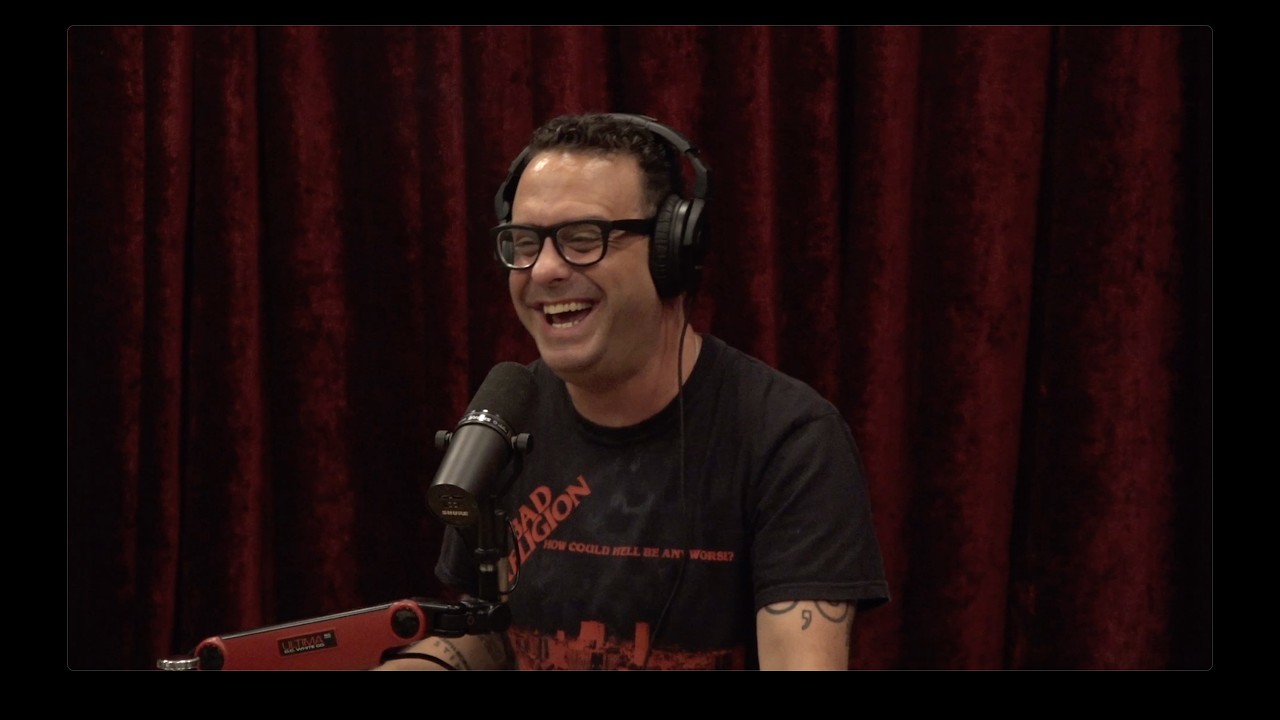
Rogan Rejects Corporate Media Model for Independent Comedy Venues
PowerfulJRE
Direct audience access through podcasting and self-owned venues has permanently severed comedians' dependence on legacy media gatekeepers and corporate PR.
## Background
This video was published on YouTube by the PowerfulJRE channel on August 12, 2026. According to the page description, it features comedian, actor, musician, restaurateur, and host of the "Vile and Horrendous" podcast Joe DeRosa discussing his comedy special, "I Never Promised You a Rose Garden."
## TL;DR
Joe Rogan and Joe DeRosa engage in a wide-ranging conversation covering everything from morning coffee rituals and culinary experiences in Austin to classic Hollywood cinema, television, and sci-fi influences like Neuromancer and The Terminator. Rogan shares personal stories about his martial arts career and physical training, while DeRosa reflects on financial freedom, comedy team dynamics, and the challenges faced by independent artists. The discussion also touches on the founding and history of the Comedy Mothership, the realities of modern corporate greed, healthcare frustrations, and the freedom found in avoiding traditional Hollywood gatekeepers through live stand-up and independent digital platforms.
## Atmosphere & style
The episode has an easygoing, analytical, and warmly camaraderie-filled atmosphere typical of veteran comedians shooting the breeze. The dynamic moves naturally from casual banter about daily routines and food to deep, passionate dives into cinematic history, physical conditioning, and the mechanics of stand-up comedy. Readers and listeners will sense a shared respect between two longtime peers who appreciate total artistic independence, grounded perspectives on life, and the unfiltered freedom of green-room humor.
## Key takeaways
- [00:00](https://www.youtube.com/watch?v=pCH-R3L6QTc&t=0s) Joe Rogan and Joe DeRosa examine home coffee brewing techniques, comparing AeroPress and French press setups with traditional batch drip brewing and temperature-controlled kettles.
- [15:00](https://www.youtube.com/watch?v=pCH-R3L6QTc&t=900s) Rogan and DeRosa explore financial freedom, defining true independence as buying groceries or dining out without worrying about account balances or menu prices.
- [20:00](https://www.youtube.com/watch?v=pCH-R3L6QTc&t=1200s) The hosts discuss how growing up with excessive wealth and lack of adversity often leads to aimlessness, highlighting down-to-earth Hollywood figures who avoided that trap.
- [50:45](https://www.youtube.com/watch?v=pCH-R3L6QTc&t=3045s) Rogan shares his early Taekwondo career, explain why he retired from full-contact fighting due to brain damage concerns, and details how he transitioned into stand-up comedy.
- [01:10:20](https://www.youtube.com/watch?v=pCH-R3L6QTc&t=4220s) Rogan advocates for submaximal strength training principles inspired by Pavel Tsatsouline, emphasizing consistency and CNS recovery over pushing to absolute muscle failure.
- [01:25:00](https://www.youtube.com/watch?v=pCH-R3L6QTc&t=5100s) The discussion covers Bob Fosse's massive influence on dance and popular culture, alongside stories of extreme alcohol tolerances among touring comedians like Shane Gillis.
- [01:40:30](https://www.youtube.com/watch?v=pCH-R3L6QTc&t=6030s) Austin has transformed into a major comedy hub driven by venues like Comedy Mothership, Adam Eget's talent development, and the meritocratic environment of Kill Tony.
- [01:48:00](https://www.youtube.com/watch?v=pCH-R3L6QTc&t=6480s) Rogan explains the structural and ethical design of Comedy Mothership, operating it to break even so comedians can retain the vast majority of ticket revenue.
- [02:05:00](https://www.youtube.com/watch?v=pCH-R3L6QTc&t=7500s) The hosts analyze public frustration with corporate healthcare, pointing to profit-driven claim denials and rising economic strain on working artists and Gen Z.
- [02:18:18](https://www.youtube.com/watch?v=pCH-R3L6QTc&t=8298s) Rogan and DeRosa critique corporate greed, overregulation, and private equity buyouts that harm small businesses, local housing, and product quality.
- [02:40:00](https://www.youtube.com/watch?v=pCH-R3L6QTc&t=9600s) The conversation contrasts the gatekeeping and PR-driven campaigns of traditional Hollywood with the direct-to-audience autonomy of independent stand-up comedy and podcasting.
## Detailed walkthrough
### [00:00](https://www.youtube.com/watch?v=pCH-R3L6QTc&t=0s) The Quest for the Perfect Cup of Coffee
Joe Rogan details his long journey to find the optimal daily coffee setup. After experimenting with an individual tea-dipper style press and espresso machines with too many complex plastic parts that break within a year, he eventually landed on the AeroPress. He explains that he grinds his beans for exactly 13 seconds, pours them into a glass tube with a metal mesh filter, and presses a single strong cup of coffee. His primary motivation for avoiding traditional coffee makers is minimizing his exposure to hot plastic, which is omnipresent in most standard machines.
Joe DeRosa shares that while he appreciates the simplicity of single-serve setups, he misses the sheer volume of a traditional Mr. Coffee pot. DeRosa prefers waking up to a full pot already brewing so he can drink two hot cups in the morning and refrigerate two cold cups for an afternoon pick-me-up. Rogan teases DeRosa for complaining about the "hard work" of making coffee, pointing out that historical humans had to scrape and tan buffalo hides with stone knives just to survive the winter. Rogan suggests an all-steel French press as the ultimate solution, as it retains the natural bean oils lost in paper filters, uses no plastic, and can make a large batch all at once.
- Simply Good Coffee is highlighted as an example of a brand making an all-steel drip coffee machine to avoid heating plastic.
- Rogan notes that real "coffee dorks" know paper filters strip away essential oils and subtle flavors from the coffee bean.
[05:00](https://www.youtube.com/watch?v=pCH-R3L6QTc&t=300s) Mornings, Electric Kettles, and Foamed Eggs
The conversation shifts to the breakdown of food freshness. DeRosa recalls learning while obtaining his food handler's license for his old sandwich shop that vegetables immediately begin breaking down as soon as they are chopped—a principle Rogan notes likely applies to grinding coffee beans right before brewing. When DeRosa protests that boiling water on the stove for a French press adds an annoying extra step to his anxious morning routine, Rogan points out the existence of electric temp-controlled kettles. These allow users to press a button, heat water to an exact temperature (such as 200°F), and receive an automated beep when ready without touching the stove.
The talk turns to coffee preferences, with both Rogan and DeRosa declaring their loyalty to drinking coffee strictly black. They joke about Tony Hinchcliffe's overly elaborate coffee taste, with Rogan mocking Tony's need for a "pineapple and an umbrella" in his cup. DeRosa mentions seeing a video by celebrity chef Alton Brown, where Brown used the steam wand of an espresso machine to froth and instantly cook eggs with milk or hot steam. Although DeRosa was intrigued to try cooking eggs that way, Rogan is utterly unimpressed, arguing that standard sunny-side-up or fried eggs are far superior to "foamy eggs."
> "Tony needs a fucking umbrella in his coffee... He holds it with one pinky out when he drinks his coffee. I go, I drink it black. He goes, 'Ah, you fucking hate condiments.'" — Joe Rogan
[10:00](https://www.youtube.com/watch?v=pCH-R3L6QTc&t=600s) Dining Out in Austin's Culinary Scene
The discussion moves to high-end dining, starting with steak tartare served with toast points, which leads directly into a review of the thriving Austin restaurant landscape. Rogan and DeRosa agree that Austin has transformed into a major destination for world-class dining, particularly for high-end steakhouses. Rogan names **Jeffrey's** as his absolute favorite steakhouse in town—noting it was once rated the second-best steakhouse in the entire country—though he frequently dines at **J. Carver's** and **Eddie V's Prime Seafood**. He praises Gary the bartender at Eddie V's for making exceptional martinis.
DeRosa shares his love for **Red Ash**, noting he actually prefers its live-fire steaks slightly over J. Carver's due to the prep and the ability to order high-end Italian dishes alongside a steak. They also praise **The Kimberly**, another spot run by the same restaurant group. DeRosa notes that when he moved to Austin, comedian Tommy Pope bookmarked ten essential spots on his Google Maps. They contrast today's instant internet access and curated recommendation lists with the pre-internet era, where finding a great spot relied purely on word-of-mouth or trusting a local food lover.
- **Jeffrey's**: Praised by Rogan as pure perfection and the best overall steakhouse in Austin.
- **J. Carver's**: Features wood-fired cooking using Argentine-style live-fire grills.
- **Eddie V's**: Highlighted for its bar atmosphere, shrimp cocktails, and martinis served by Gary the bartender.
- **Red Ash**: Highly favored by DeRosa for combining top-tier steaks with authentic Italian cuisine.
[15:00](https://www.youtube.com/watch?v=pCH-R3L6QTc&t=900s) Financial Freedom, Gratitude, and the Value of Struggle
DeRosa reminisces about living in New Rochelle, New York, where he frequented a legendary local Italian restaurant (recalling the film *Frankie and Johnny*). He recalls how getting his first television development deal allowed him to eat steak and lobster every single night—to the point where his manager thought he had developed a severe gambling problem due to his sudden burn rate. Both Rogan and DeRosa reflect on the profound shift in quality of life when a person transitions from poverty to financial stability. Citing comedian Bryan Callen, Rogan emphasizes that the true benchmark of financial freedom is being able to sit down at any restaurant, order whatever you want, and never look at the right side of the menu or worry about the bill.
DeRosa shares that his most profound daily exercise in gratitude happens at the grocery store check-out counter. Pulling whatever items he wants off the shelves without needing to calculate whether his card will clear remains a deeply moving reminder of how far he has come. The two conclude by debating whether early-life financial struggle is necessary to build drive, character, and ambition. While DeRosa agrees that overcoming poverty builds an irreplaceable inner resilience, he questions whether a post-scarcity society—where basic food and shelter are guaranteed—would ultimately be better, though Rogan points out that historical attempts at such systems invariably involved heavy government control and severe restrictions on individual freedom.
[20:00](https://www.youtube.com/watch?v=pCH-R3L6QTc&t=1200s) Generational Wealth, Discomfort, and Nepo Babies
Reflecting on social class, Joe DeRosa notes a sharp contrast between people who grew up with money and those who did not. He ponders whether the struggle and desperation of growing up without means are required to build genuine discipline, or if American society simply forces a survivalist, greedy mindset onto people who felt uncared for. Joe Rogan points out that financial struggle shouldn't be confused with socialism; rather, the current economic reality makes it drastically harder for a single income to support a family compared to the 1950s. He brings up the classic sitcom *All in the Family*, laughing at the premise that Archie Bunker was framed as a struggling, working-class cab driver—yet lived in a clean, two-story house that would be worth well over $10 million in today's real estate market.
While DeRosa believes experiencing poverty makes a person appreciate success, Rogan questions if proactive parenting can instill drive in wealthy children. However, Rogan observes that the majority of trust-fund kids he has met are deeply aimless, sad, insecure, and act strangely because everything was handed to them. DeRosa agrees that parental guidance is key, citing his friend Eden Brolin—daughter of actor Josh Brolin—as an example of someone who resisted the "nepo baby" stereotype. He recalls hanging out with her in Los Angeles when she secretly let slip that her dad was playing Thanos in the Marvel Cinematic Universe, yet she continued working regular jobs, including hosting at The Stand comedy club in New York and playing in a band, completely free of Hollywood arrogance.
- DeRosa's podcast *Vile and Horrendous* and his special *I Never Promised You a Rose Garden* frame his perspective on life and comedy.
- Josh Brolin is praised by both as an incredibly grounded, present, and normal guy despite his massive fame.
---
[25:00](https://www.youtube.com/watch?v=pCH-R3L6QTc&t=1500s) Cool Hollywood Figures, Meeting Woody Harrelson, and *Autofocus*
The conversation shifts to breaking the stereotype that all actors are aloof, entitled, or living in an insular progressive bubble. Rogan and DeRosa swap stories about down-to-earth Hollywood stars. Rogan praises Billy Bob Thornton—who once gifted him a cool short-sleeve shirt right off his back—alongside Matthew McConaughey, Matt Damon, Ben Affleck, and Woody Harrelson. DeRosa recounts a memorable night hanging out with Harrelson after an episode of *Kill Tony* at The Comedy Store. At the end of a long night of drinking, Harrelson casually brought up DeRosa's comedy special by name—*I Never Promised You a Rose Garden*—recalling a quick plug Tony Hinchcliffe had made five hours earlier.
Rogan shares a bizarrely meta encounter with Matt Damon in Italy. While eating at a restaurant with his family directly across from a photo of Damon on the wall, Rogan pointed at the picture, only for the actual Matt Damon to walk into the establishment seconds later and sit right underneath it. The surreal moment transitions into a discussion of the 2002 biographical film *Auto Focus*, starring Greg Kinnear as *Hogan's Heroes* star Bob Crane. They discuss Crane's descent into sex addiction alongside his associate John Henry Carpenter (who many believe eventually murdered Crane). Rogan recalls how Crane would time his sexual conquests on the road by placing himself in bars under television sets airing syndicated *Hogan's Heroes* reruns, waiting for women to recognize him.
> "I mean, we were in Mitzi... We were all kind of just getting into that swaying around, you know... And he goes, 'I never promised you a rose garden.' And I was like, yeah, that's the name... This fucking guy remembered the name of my special from a plug five hours ago." — Joe DeRosa on Woody Harrelson
---
[30:00](https://www.youtube.com/watch?v=pCH-R3L6QTc&t=1800s) The Absurdity of *Hogan's Heroes* and *The Honeymooners*
Rogan and DeRosa marvel at how drastically societal sensitivities and television formats have evolved since the 1960s. They laugh at the bizarre premise of *Hogan's Heroes* (1965–1971), a sitcom set inside a Nazi prisoner-of-war camp featuring lovable, bumbling Nazi guards like Colonel Klink and Sergeant Schultz. Rogan points out the absurdity that over 6 seasons and 168 episodes, virtually no one was tortured or killed on screen—contrasting it with Quentin Tarantino successfully pulling off comedy with the Ku Klux Klan in *Django Unchained*.
They trace the early origins of American television sitcoms back to *The Honeymooners*, starring Jackie Gleason. DeRosa, an avid fan who owns both DVD box sets, notes that the iconic standalone sitcom actually only ran for a single 39-episode season from 1955 to 1956—known as the "Classic 39"—before Gleason walked away at the peak of its popularity. Producer/director Jamie Vernon chimes in, reading that Gleason famously walked away from millions because he felt the high quality of the writing couldn't be sustained without cheapening the show.
- *Hogan's Heroes* ran for 6 seasons and 168 episodes; the regular cast survived the series without graphic wartime casualties.
- Jackie Gleason was an accomplished pool player in real life, seamlessly showing off genuine skills as Minnesota Fats in the 1962 film *The Hustler*.
- In 1956, CBS offered Gleason a three-year deal worth the modern equivalent of $132 million (roughly $839,000 per episode), which he walked away from.
---
[35:00](https://www.youtube.com/watch?v=pCH-R3L6QTc&t=2100s) TV Residuals, Acting on *NewsRadio*, and Great Cinema
The discussion turns to classic television economics and modern residual paychecks. DeRosa notes how unevenly early cast members were paid, pointing out that Art Carney made $3,500 a week while Audrey Meadows made only $2,000. Rogan reflects on his own experience receiving residual checks from his days starring as Joe Garrelli on *NewsRadio*. While many people assume sitcom reruns yield life-changing wealth, Rogan explains that huge windfall payouts are reserved for show creators like Jerry Seinfeld, whereas standard acting residuals are merely nice passive bonuses.
DeRosa urges Rogan to get back into acting, praising his natural comedic timing and work on *NewsRadio*. He argues that multi-camera sitcom acting is exceptionally difficult because landing scripted gags in front of a live audience requires precise execution. Rogan playfully pushes back, insisting that sitcom acting is "easy as fuck" compared to doing stand-up comedy at Comedy Mothership or green-room banter. He explains that working alongside brilliant actors like Dave Foley, Maura Tierney, Vicki Lewis, Andy Dick, and Khandi Alexander made the job effortless, though he acknowledges true dramatic acting—like Val Kilmer in *Tombstone* or Daniel Day-Lewis—is a completely different craft. They close out the section praising director Robert Eggers and actress Anya Taylor-Joy for their work on *The Witch*, *The Lighthouse*, and *Nosferatu*.
[40:00](https://www.youtube.com/watch?v=pCH-R3L6QTc&t=2400s) Robert Eggers, *The Northman*, and Nicole Kidman's Aesthetic
Joe DeRosa brings up a trailer for an upcoming Robert Eggers film, sparking a lively debate over the director's body of work. While DeRosa jestingly questions whether Eggers' signature stylistic choices—like black-and-white footage and twitching characters—are starting to feel repetitive, Joe Rogan defends the filmmaker passionately. Rogan insists that Eggers is an absolute master who delivers "A-plus every movie," pointing to *The Witch* and *The Northman* as prime examples. DeRosa admits he did not love *The Northman*, explaining that he expected more massive battle sequences and found himself distracted by Nicole Kidman's appearance, which he felt looked noticeably modernized with facial fillers in a historical setting set around 10:00 AD.
Rogan lightheartedly berates DeRosa for his critique, calling him out and pulling up photos of Kidman from the film to prove his point. Inspecting the images with Jamie, Rogan argues that Kidman looks entirely natural and stunning for the period piece, accusing DeRosa of being a "hater." DeRosa concedes that while Kidman is a great actress, subtle modern cosmetic work breaks the immersion of historical epics. The conversation shifts to Eggers' status among elite filmmakers, with Rogan placing him right next to Quentin Tarantino as one of his favorite directors of all time. Rogan notes that while legends like Martin Scorsese have produced a massive catalog with a few unavoidable duds, Tarantino stands out as the ultimate peak of cinema for maintaining a virtually flawless filmography.
- Rogan praises Quentin Tarantino as "the undeniable peak Of the mountain" who avoided releasing lemons throughout his career.
- DeRosa and Rogan highlight Anya Taylor-Joy's performance and presence in Eggers' films.
- Rogan expresses continuous amazement that Eggers manages to secure wide theatrical releases for such auteur, niche period films.
[43:45](https://www.youtube.com/watch?v=pCH-R3L6QTc&t=2625s) *Neuromancer*, Cyberpunk Origins, and *The Matrix* Sequels
The discussion transitions to sci-fi literature and upcoming adaptations, specifically Apple TV's series adaptation of William Gibson's seminal 1984 novel *Neuromancer*. DeRosa notes that sci-fi enthusiasts are thrilled about the project, as Gibson's work was long considered nearly impossible to adapt faithfully to the screen. Rogan and DeRosa examine how *Neuromancer* laid the foundational vocabulary for modern cyberpunk, coining terms like "cyberspace" and defining it as a consensual hallucination experienced daily by billions of users.
This leads Rogan to reflect on how *Neuromancer* heavily influenced *The Matrix*. Rogan points out that the concept of "jacking in" through the back of the head and the virtual reality landscape itself originated in Gibson's book. He observes a broader trend where filmmakers hit a colossal, culture-shifting home run with an initial masterpiece—like the Wachowskis did with *The Matrix*—but struggle to match that peak in subsequent projects. They touch upon how every sequel to *The Matrix* failed to capture the magic of the original, and briefly mention a infamous copyright lawsuit filed by an author claiming *The Matrix* and *The Terminator* were stolen from her 1980s manuscript *The Third Eye*, a claim both dismiss as bizarre.
- William Gibson's 1984 novel *Neuromancer* introduced foundational cyberpunk concepts and coined the term "cyberspace."
- Rogan argues that *V for Vendetta* was one of the few post-*Matrix* projects from the Wachowskis that held up well.
- DeRosa highlights *Lucky* on Apple TV as another short-series recommendation during the conversation.
[47:20](https://www.youtube.com/watch?v=pCH-R3L6QTc&t=2840s) Sci-Fi Tropes, AI, and Harlan Ellison's *Terminator* Lawsuit
Rogan and DeRosa explore how central themes in science fiction—such as artificial intelligence taking over and humanoid robots blending into human society—often develop through parallel thinking rather than direct plagiarism. Rogan references Ridley Scott's 1979 classic *Alien*, where the crew is unaware that their companion Ash is an android until he is violently dismantled. They contrast general sci-fi mythology, like werewolf lore, with specific plotlines that cross into legal disputes.
This brings up legendary author Harlan Ellison's famous copyright lawsuit against James Cameron over *The Terminator*. Ellison claimed that the central premise of *The Terminator*—a futuristic combatant sent back in time to carry out a targeted hit—was directly lifted from his *Outer Limits* teleplays, specifically "Soldier" and "Demon with the Glass Hand." The suit eventually ended in an out-of-court settlement with Ellison receiving financial compensation and screen credit. Rogan shares his favorite anecdote about Ellison's fiery temperament: when a college professor told Ellison he had no literary talent, Ellison punched him in the throat and was promptly expelled. This leads both hosts to reflect on how many young minds have had their potential derailed by bitter, discouraging teachers.
- Harlan Ellison sued James Cameron, arguing *The Terminator* borrowed core setups from his *Outer Limits* episodes "Soldier" and "Demon with the Glass Hand."
- The legal dispute between Ellison and the studio ended in an out-of-court settlement with monetary compensation and added acknowledgment credits.
- Rogan notes that concept overlap regarding rogue AI appears across iconic franchises, including *Battlestar Galactica* and *Alien*.
[50:45](https://www.youtube.com/watch?v=pCH-R3L6QTc&t=3045s) Joe Rogan's Taekwondo Career, Olympic Trials, and Brain Damage
DeRosa asks Rogan about his youth and what drove him to abandon traditional academics in favor of martial arts and eventually stand-up comedy. Rogan recalls attending UMass Boston's continuing education program primarily so he wouldn't feel like a loser, though his true focus was full-time training, competing, and teaching martial arts at Boston University. Rogan was a dominant force in full-contact Taekwondo, winning four state championships and competing at the 1988 U.S. Olympic Trials and Nationals in Miami, where he advanced to the third round before being defeated.
Despite his athletic success, Rogan decided to step away from competitive fighting due to two stark realities: the complete lack of financial stability in martial arts prior to the rise of the UFC, and his acute awareness of brain damage. Rogan vividly describes lying in bed after intense kickboxing sparring matches with his head throbbing and ringing, realizing he was taking severe physical punishment for no monetary reward. Watching older training partners at the gym suffer visible cognitive decline, slurred speech, and compromised motor skills served as a grim warning sign. Recognizing that martial arts can become an unhealthy obsession, Rogan chose to walk away before enduring permanent neurological damage.
- Rogan was a four-time state Taekwondo champion and competed at the 1988 U.S. Olympic Trials in Miami.
- Severe post-sparring symptoms—including head throbbing and persistent ringing—convinced Rogan to quit full-contact kickboxing to protect his brain health.
- Rogan observed older gym veterans undergo personality changes and physical degradation due to repeated concussions and head trauma.
[54:00](https://www.youtube.com/watch?v=pCH-R3L6QTc&t=3240s) Fast-Tracking into Stand-Up, Sitcoms, and Voluntary Adversity
After walking away from competitive fighting, Rogan was persuaded by his friends to try stand-up comedy. His transition into the entertainment industry moved remarkably fast: five years into doing stand-up, he booked MTV's *Half-Hour Comedy Hour*, which led to a development deal with Disney. Rogan auditioned for only two sitcoms in his entire career—*Hardball* (alongside Jim Breuer) and *NewsRadio*—and booked both roles despite never taking formal acting lessons. Because acting was never his ultimate passion or dream, Rogan felt zero audition anxiety, viewing sitcom acting as absurdly easy compared to the intense pressure of stand-up comedy and full-contact kickboxing.
DeRosa and Rogan discuss the psychological necessity of seeking out self-imposed physical challenges. Rogan explains that engaging in "voluntary adversity" keeps him mentally balanced and sane. By routinely forcing himself through extreme physical discomfort—such as cold plunges or high-altitude hypoxia workouts in a specialized chamber set to 15,000 feet, combined with Airdyne bike sprints and kettlebell exercises—the everyday stresses and minor difficulties of life seem trivial by comparison.
- Rogan booked his first two television auditions—*Hardball* and *NewsRadio*—without formal acting training.
- Disney signed Rogan to a development deal in the 1990s during the golden era of network sitcoms like *Seinfeld* and *Roseanne*.
- Rogan utilizes an altitude-simulation chamber set to 15,000 feet above sea level for intense interval training involving Airdyne sprints and kettlebell work.
[01:00:00](https://www.youtube.com/watch?v=pCH-R3L6QTc&t=3600s) Mindset, Mental Health, and Handling Internet Hate
Joe Rogan finishes describing his intense sprint workout before shifting to the mental necessity of physical labor. He emphasizes that maintaining a rigorous exercise routine keeps him sane, preventing anxiety, irritability, and discomfort. For Rogan, staying active leads to feeling happy, light, and friendly. Joe DeRosa notes that Rogan maintains a surprisingly happy-go-lucky attitude at the comedy club, rarely showing up in a bad mood.
Rogan attributes his mindset to perspective and self-awareness, pointing out that living a comfortable life in America leaves little ground for real complaint compared to people suffering in active war zones like Gaza or Ukraine. That gratitude keeps him grounded and immune to internet backlash. He explains that online outrage and negative takes are commodified for attention, so engaging with it is pointless. He polices himself internally and feels no need for external validation, choosing instead to focus on doing his best work. DeRosa marvels at Rogan’s thick skin, joking that Rogan could host a YouTube MasterClass on letting criticism roll off his back.
- Rogan's workout protocol includes high-intensity intervals structured in 50-second, 40-second, and 30-second sprints using a sled and an Airdyne bike.
- Rogan stresses perspective, noting that being a successful person in America makes being angry ungrateful compared to those hiding in bunkers in Ukraine or enduring conflict in Gaza.
[01:03:45](https://www.youtube.com/watch?v=pCH-R3L6QTc&t=3825s) Finding the Right Personal Trainer
Rogan urges DeRosa to hire a personal trainer to help manage his mental state and ease into physical fitness. DeRosa admits to feeling easily overwhelmed by workout routines, but reveals that Chuck—the father of rapper That Mexican OT—recently offered to come directly to his apartment and coach him. Rogan enthusiastically encourages DeRosa to take Chuck up on the offer.
Rogan warns against "meathead" trainers who push beginners to total exhaustion on day one. He compares an untrained body to a stock car: you cannot drive a stock Toyota Prius sideways around a racetrack without first building up its suspension and tires. A good trainer will start slow using simple bodyweight exercises, mobility drills, and joint lubrication, building intensity only as the body adapts over time.
- Chuck, That Mexican OT's father, volunteered to train DeRosa at his apartment with a low-stress, slow-build approach.
- Rogan advises beginners to start with simple, non-taxing movements like 10 push-ups or bodyweight squats to 90 degrees, gradually scaling up reps over weeks.
- A 20- to 25-pound weighted vest worn during neighborhood walks is highlighted as a low-impact, highly effective entry point for cardiovascular fitness.
[01:05:40](https://www.youtube.com/watch?v=pCH-R3L6QTc&t=3940s) Jelly Roll’s Transformation and Maintaining Momentum
To illustrate the effectiveness of a slow, steady approach, Rogan cites musician Jelly Roll's massive weight loss journey. When Rogan first met him, Jelly Roll weighed around 500 pounds and struggled to walk up the stairs to a comedy club. After years of gradual work, he lost nearly 300 pounds. Rogan recalls running alongside Jelly Roll on a treadmill before a podcast, noting how he could jog at a good pace while carrying on a full conversation, followed by a session in the hot sauna.
At a Matthew McConaughey charity benefit, Rogan, Tony Hinchcliffe, and their partners watched Jelly Roll perform. Afterwards, Jelly Roll casually hopped clean over a stage railing like a cat—a moment that floored Rogan given where the singer started. DeRosa shares his own struggle with maintaining routine, explaining that after making steady three-day-a-week progress, touring in August derailed his momentum. Rogan explains that momentum makes discipline effortless and recommends writing workouts on a whiteboard or phone to maintain a structured visual checklist.
> "He grabs the railing and hops over it and lands on the other side. I go, 'Dude, do you know what you just did? You used to be 500 pounds and now you just jumped over that railing like a cat.'"
[01:10:20](https://www.youtube.com/watch?v=pCH-R3L6QTc&t=4220s) Strength as a Skill: Lessons from Pavel Tsatsouline
The conversation turns to strength training philosophy, referencing Pavel Tsatsouline, the Russian trainer who popularized kettlebells in the United States. Rogan quotes Tsatsouline’s core philosophy that "strength is a skill." Rather than pushing every set to complete muscular failure—which degrades form and taxes the central nervous system—Tsatsouline advocates staying fresh to master the movement pattern.
If a person can perform 10 clean-and-press reps to failure, Tsatsouline recommends performing only 5 crisp reps, resting fully for up to five minutes, and then repeating another set of 5. DeRosa admits he used to think long rest intervals were counterproductive, but Rogan explains that ample rest keeps form precise while still forcing muscular adaptation.
Rogan contrasts strength skill-building with high-intensity conditioning, framing physical work through the lens of daily functional movement. To drive the point home, he compares Tsatsouline's methods to daily manual labor:
- Farmers gain immense physical strength without ever training to failure; they move hay bales and drive fence posts throughout the day with natural rest periods, never collapsing in exhaustion.
- Performing 100 push-ups spread throughout an entire day—from 9:00 AM to 3:00 PM—is just as effective for building baseline strength as forcing them all into one grueling set.
Here is a detailed, faithful walkthrough of Part 5 of the transcript:
[01:15:00](https://www.youtube.com/watch?v=pCH-R3L6QTc&t=4500s) Kettlebell Training Principles and the Air Force One Decoy Ruse
Joe Rogan continues discussing strength-building strategies, reiterating Pavel Tsatsouline’s grease-the-groove principle: rather than pushing a set of ten repetitions all the way to failure, doing a submaximal set of five reps, resting, and doing another five minimizes the likelihood of injury. Rogan notes he almost never gets injured training with kettlebells using this method. DeRosa is inspired to resume kettlebell training and jokingly suggests getting the father of the rapper That Mexican OT to train him, praising his jacked physique, slow and deliberate progression method, and friendly personality. They joke about avoiding annoying personal trainers who constantly demand Instagram promotional shoutouts or pitch energy drinks.
Rogan then shifts topics to a news story he read based on a *New York Times* report regarding a plot by Iran targeting Donald Trump. According to the report, authorities feared Air Force One might be targeted while taking off from Turkey after a NATO summit in Britain. Consequently, Trump was secretly smuggled out in a cargo or catering truck to a military jet, leaving members of the press and select White House staff on the original Air Force One (the older model) to act as unwitting decoys without their knowledge. Rogan and DeRosa react with dark humor, imagining Trump offering the reporters shrimp cocktails and sandwiches on Air Force One while completely omitting the fact that they were serving as human shields, drawing a comparison to the scene in *Goodfellas* where Robert De Niro’s character tries to lure Karen Hill into a secluded shop.
* Pavel Tsatsouline’s principle: Halving rep counts (e.g., 5 reps instead of 10 to failure) reduces injury risk while maintaining total volume.
* The decoy incident: Press corps members flew out of Turkey on Air Force One without knowing Trump had been secretly transported via a catering container to a separate military jet.
---
[01:20:00](https://www.youtube.com/watch?v=pCH-R3L6QTc&t=4800s) Michael Jackson’s Empire, Financial Plots, and Bob Fosse's Influence
DeRosa shares insights from recently watching the new Michael Jackson biographical film covering the artist's life up to the release of *Bad*. He reveals lesser-known facts surrounding Jackson's death, such as how officials pronounced him dead at Neverland Ranch but intentionally misled the press into believing he died at a hospital to prevent fan hysterical swarms from blocking the ambulance. The conversation shifts to Jackson’s vast music publishing catalog, which included rights to The Beatles, Bob Dylan, and even Eminem—whom Jackson bought out after Eminem mocked him in a music video. DeRosa explains the conspiracy behind Jackson's final album: Sony forced him to take out a $200 million loan using a portion of his music catalog as collateral. Many close to Jackson believed Sony intentionally withheld marketing and promotion for the album so Jackson would default on the loan and forfeit the rights shortly before his death.
Regarding Jackson's personal physical traits and ultimate death from Propofol, Rogan notes that Jackson was likely consuming multiple drugs to combat severe insomnia. They discuss statement allegations from Jackson's personal physician that Michael had been chemically castrated as a young boy to preserve his high vocal range. Rogan points out that Jackson's physique was entirely devoid of testosterone and noticeably frail compared to his muscular, thick-built brothers like Jermaine Jackson, despite being an elite, highly athletic dancer.
* Jackson’s music catalog holdings: Included Beatles, Bob Dylan, and Eminem.
* Sony Loan details: $200 million loan collateralized against his publishing rights; allies claimed the lack of album promotion was a scheme to seize his catalog.
* Conrad Murray (Jackson's doctor): Served two years in prison following Jackson's death.
---
[01:25:00](https://www.youtube.com/watch?v=pCH-R3L6QTc&t=5100s) Bob Fosse, Extreme Tolerances, and Shane Gillis Stories
Rogan and DeRosa explore the origins of Michael Jackson’s signature dance style, pointing out that much of his choreography—including the moonwalk, toe points, kicks, and fedora outfit—was directly adapted from Bob Fosse’s performance in the 1974 film *The Little Prince*. They marvel at Fosse's ability to maintain high-energy Broadway choreography despite a grueling daily routine consisting of chain-smoking, heavy drinking, speed, cocaine, and prescription pills.
This leads to a discussion on people with freakish physical tolerances, bringing up comedian Shane Gillis. Rogan shares his favorite story about Gillis going to a doctor after getting sick from eating chicken fingers. When the doctor asked how many alcoholic beverages he consumed weekly, Gillis finally decided to be honest and confessed to drinking 80 drinks a week. The doctor laughed in disbelief before realizing Gillis was serious, pointing out that his illness was caused by alcohol consumption rather than food poisoning. Rogan also recounts being at Dave Chappelle's summer camp event in Ohio, where Gillis begged him to drink more, casually mentioning he had already finished 17 Bud Lights.
* *The Little Prince* (1974): The Bob Fosse film where Michael Jackson sourced his trademark dance moves, including the toe-kick and fedora look.
* Shane Gillis doctor story: Gillis admitted to drinking 80 drinks a week when questioned about a supposed case of food poisoning from chicken fingers.
---
[01:30:00](https://www.youtube.com/watch?v=pCH-R3L6QTc&t=5400s) Hangout Dynamics with Shane Gillis and Joey Diaz
DeRosa and Rogan share affection for Shane Gillis’s playful behavior when drunk, with DeRosa describing a recent trip to the beach where a drunk Gillis continuously pestered and tickled him while watching a movie with Matt McCusker and Tommy Pope. Rogan highlights the electric dynamic of having Gillis and Joey Diaz in the same room. Diaz, who is in the process of acquiring a place in Austin to live there two weeks out of every month, recently surprised the audience at Rogan's comedy club, Comedy Mothership, by jumping on stage during Rogan & Friends.
Rogan laughs over Joey Diaz’s legendary mispronunciations, recalling how Diaz referred to the January 6th Capitol riot as "the resurrection" (confusing it with insurrection) and routinely called UFC fighter Khabib Nurmagomedov "Kalabib." DeRosa praises Diaz’s warm-hearted nature and recounts visiting him in New Jersey, where Diaz is treated like royalty in local restaurants. They conclude by noting how vital the communal aspect of comedy is: unlike solo sports, stand-up comedians rely heavily on green-room banter, taglines, and feedback from peers to sharpen their material.
* Joey Diaz relocation: Moving to Austin part-time to spend two weeks a month performing and hanging out at the Comedy Mothership.
* Diaz misnomers: Referred to January 6th as "the resurrection" and Khabib Nurmagomedov as "Kalabib."
[01:35:00](https://www.youtube.com/watch?v=pCH-R3L6QTc&t=5700s) Team Dynamics in Stand-Up and the Rise of the Comedy Store
Joe Rogan and Joe DeRosa reflect on the unique dynamic of stand-up comedy, comparing a lineup to a sports team. On paper, stand-up is an individual pursuit, but in a venue with the right atmosphere, comics operate like a unit. You are watching your buddy go up before you and another friend follow you; your goal is to play your best game to keep the momentum going without ruining the room for the next person. Rogan highlights how this collective energy elevated everyone's work at The Comedy Store during its "glory days" from 2014 to 2019. Being surrounded by tightly honed acts pushed every comic's personal "high-water mark."
They detail how comedy hubs like New York, Los Angeles, and now Austin are essential for sharp development. While comedians hit the road on weekends, the mid-week sets at the Store—specifically Tuesday and Wednesday nights—were legendary. Lineups turned into a absolute "murderer's row" of talent featuring Anthony Jeselnik, Joey Diaz, Greg Fitzsimmons, and Dom Irrera, with surprise drop-ins from Bill Burr or Chris Rock.
- DeRosa notes that online commenters frequently assume he relocated to Austin specifically for *Kill Tony*, but he clarifies he was already living in Austin before becoming a regular fixture on the show as his friendship with Tony Hinchcliffe deepened.
- Aside from loving Austin from his prior time living there in 2000, DeRosa moved to take on a fresh challenge outside of New York and LA, drawn to the city's rapidly expanding comedy scene.
- Both agree that Austin has become the premier destination for young, hungry comics because the cost of living remains low enough for up-and-coming talent to survive while chasing their dream.
---
[01:37:30](https://www.youtube.com/watch?v=pCH-R3L6QTc&t=5850s) Austin's Development System and the *Kill Tony* Phenomenon
DeRosa explains that younger comics in Austin keep him on his toes. Even if he is the only established act on a lineup with television credits, the four unknown comics ahead of him are "swinging for the fences" with their absolute best A-material to prove themselves, forcing veteran acts to bring their highest energy every night. Rogan credits the structured talent pipeline built at Comedy Mothership, spearheaded by talent coordinator Adam Eget, who actively watches open mic nights, provides feedback, and helps develop raw talent from open mics to showcase spots.
The conversation turns to the sheer density of venues along 6th Street and surrounding areas, making Austin a walkable ecosystem for comedy. Beyond Comedy Mothership, comics can walk between Sunset Strip, The Creek and the Cave, Vulcan Gas Company, and Black Rabbit, or take a short walk to Roscoe's or Cap City Comedy Club. Central to this boom is *Kill Tony*, which Rogan and DeRosa praise as a pure meritocracy. With a strict one-minute format, there is zero time for virtue signaling or "claptor"—the audience and panel demand actual jokes.
> "There's no room for virtue signaling, no room for fucking claptor, shut the fuck up. Just where's the jokes? Come with the jokes."
- *Kill Tony* acts as a raw meritocracy where background, appearance, and status do not matter; it features extremely diverse lineups, giving opportunities to everyone from trans and disabled performers to literally homeless comics who went on to launch full careers.
- DeRosa describes joining Hinchcliffe for *Kill Tony* at Madison Square Garden alongside Jimmy Carr and Dave Attell, marveling at how far the show has come.
- When DeRosa first performed on *Kill Tony* years ago in the Belly Room at The Comedy Store, there were roughly 10 people in the crowd, mostly other comics.
- Years later, attending a *Kill Tony* taping at Vulcan Gas Company during South by Southwest, DeRosa was stunned to see a packed, two-level "Thunderdome" atmosphere that had sold out in one minute.
- Rogan reveals that the insane demand for *Kill Tony* tickets repeatedly crashed their ticketing platform, forcing them to overhaul the digital infrastructure multiple times.
---
[01:43:00](https://www.youtube.com/watch?v=pCH-R3L6QTc&t=6180s) How Ron White Inspired the Creation of Comedy Mothership
DeRosa compares discovering the wild Austin scene at Vulcan to the iconic scene in *Casino* where Joe Pesci's character visits Las Vegas and realizes what DeNiro's character has built. Rogan explains how the pandemic and the success of early local shows forced them to realize Austin needed a dedicated home for stand-up. After months of no comedy, Rogan and Hinchcliffe performed at the Houston Improv in July 2020. However, fear over asymptomatic transmission and potential false positives on PCR tests led Rogan to pause touring briefly to protect high-risk podcast guests.
By November 2020, Rogan moved to Texas and began doing outdoor shows at Stubb's with Dave Chappelle, which required rigorous COVID testing and strict protocols. Around that same time, Vulcan Gas Company began putting on shows without tests. Comedian Ron White—who had originally moved to Austin in 2018 and urged Rogan to relocate—went up at Vulcan after eight months off stage and laid down a blistering 15-minute set that brought down the house.
Offstage, a fired-up Ron White grabbed Rogan by the shoulders and insisted, "Whatever the fuck we have to do, we're going to keep doing this. You got to open up that club." That exact moment convinced Rogan to hunt for real estate and build Comedy Mothership.
- Real estate prices spiked dramatically in Austin during the pandemic, with property values rising nearly 100% in certain areas as people moved from California.
- DeRosa shares his current struggle trying to sell his Austin condo to buy a house with a yard, noting that the market is over-saturated with condos.
- Rogan jokes that DeRosa should keep the condo as a low-key location to bring home "sketchy gals" so they don't find out where his real house is.
---
[01:48:00](https://www.youtube.com/watch?v=pCH-R3L6QTc&t=6480s) The Century-Old History of the Building and Designing the Mothership
DeRosa reflects on the full-circle nature of performing at Comedy Mothership. When he lived in Austin back in 2000, the building housed the original Alamo Drafthouse—the first theater in the country to serve food and alcohol during movies, which had served as his ultimate symbol for why he loved the city. Rogan reveals the building turns 100 years old in 2027 (built in 1927) and plans to host a massive birthday celebration for the structure.
Before becoming the Alamo Drafthouse, the building had a rich, eccentric history as a punk rock venue, a rock club, a pool hall, and a nudie movie theater. Legendary acts performed on that very stage, including Black Flag, the Red Hot Chili Peppers (in 1986), the Butthole Surfers, Willie Nelson, and Stevie Ray Vaughan. The green room at Comedy Mothership is decorated with authentic vintage concert flyers from artists who played the venue over the decades.
> "Holy shit, Ace, what the fuck you been doing out here?"
- When Rogan's team took over the venue, it was raw and laid out like a steep movie theater; they had to raise the floor to make it flat near the stage while preserving two upper balconies (the Green Balcony and the VIP Balcony), which hold around 40 guests.
- The main room (Fat Man) seats 250 people, modeled in part after venue layouts like Comedy Works in Denver.
- Louis C.K. provided critical design advice during construction, persuading Rogan to lower the ceiling in both the main room and the smaller room (Little Boy) and shrink the stage in Little Boy to create an intimate comedy room.
- Brian Simpson suggested adding warning lights in the green rooms so comics know when someone is being given "the light" on stage in either room.
- Tony Hinchcliffe and Brian Simpson contributed ideas for room timers and stage monitors in the green room.
[01:55:00](https://www.youtube.com/watch?v=pCH-R3L6QTc&t=6900s) Building Comedy Mothership: A Club Designed for Comics
Joe Rogan and Joe DeRosa reflect on the creation and growth of Comedy Mothership, Rogan's comedy club in Austin, Texas. Looking back at early photos of the space before its transformation, Rogan notes that it was originally set up well for two performance rooms. DeRosa recalls visiting the site during construction around South by Southwest (SXSW) alongside Adam Ray and the club's architect/designer, Eric. Seeing the unfinished rooms like the "Little Boy" room and hearing the initial plans made him hope he would one day perform on those stages.
Discussing the centerpiece of the entrance, Rogan clears up a common misconception about the massive UFO fixture hanging near the front. Rather than just being decorative, the UFO is actually a projector that displays upcoming acts onto the wall, and it houses a required fire extinguisher right at its center. Having been open for three years, Rogan describes running the club as the most enjoyable project he has ever undertaken.
Rogan emphasizes that the club was built with a clear financial philosophy: it was designed to break even rather than maximize profits. Because audience members buy tickets specifically to see the comedians, Rogan believes comics deserve the vast majority of ticket revenue while the venue sustains itself on liquor sales and a modest 20% share of tickets. DeRosa notes that Rogan’s position allowed him to bypass typical agent friction and setup pitfalls that standard club owners face, particularly when dealing with chaotic road comics.
- **Operating Philosophy:** Prioritize artist pay and creative environment over profit extraction.
- **Key Features:** Dual performance rooms ("Mitzi's" and "Little Boy"), UFO entrance projector/fire extinguisher hybrid.
- **Venue Timeline:** Three years of continuous operation at the time of recording.
---
[02:00:00](https://www.youtube.com/watch?v=pCH-R3L6QTc&t=7200s) Passion Projects, Movie Stars, and *American Psycho*
The discussion pivots to artistic independence and funding personal vision. DeRosa questions why ultra-wealthy movie stars rarely use $10 million of their own money to fund artistic passion projects with friends, contrasting this with rock stars who routinely start indie record labels to support artists they love. Rogan agrees, noting that if an artist has significant resources, creating a top-tier creative environment for peers is simply the right thing to do.
As an example of uncompromised storytelling, DeRosa highlights Bret Easton Ellis's novel *American Psycho*. He argues that no movie adaptation has fully captured the book's extreme violence and psychological depth because major studios refuse to touch the material without watering it down. While praising Christian Bale's iconic performance in the 2000 film adaptation, DeRosa notes key differences, including a deleted scene where a character crawls into a club air vent and vanishes—a moment from the book that leaves readers questioning Patrick Bateman's sanity and reality.
```
┌──────────────────────────────┐
│ AMERICAN PSYCHO MEDIA │
└──────────────┬───────────────┘
│
┌───────────────────────────┴───────────────────────────┐
▼ ▼
┌───────────────────────────┐ ┌───────────────────────────┐
│ 1991 Novel (Ellis) │ │ 2000 Film (Harron) │
├───────────────────────────┤ ├───────────────────────────┤
│ • Explicit, brutal gore │ │ • Black comedy focus │
│ • Ambiguous reality │ │ • Streamlined narrative │
│ • Heavy internal monologue│ │ • Christian Bale starring │
└───────────────────────────┘ └───────────────────────────┘
```
DeRosa also references *The Shards*, Bret Easton Ellis's recent novel adaptation on FX co-created with Ryan Murphy. Set in the early 1980s, the period piece follows a fictionalized teenage Ellis dealing with a serial killer and a Manson-like cult in Los Angeles, which DeRosa praises for capturing the authentic tone of the original writing.
- **Book vs. Movie:** The *American Psycho* book contains far darker, more graphic scenes than the film's satirical approach.
- **Iconic Scene:** The business card scene remains a masterclass in depicting corporate vanity, where Bateman experiences physical distress over a competitor's card design.
- **New Adaptation:** Mentions of potential upcoming readaptations, including rumors linking actor Adam Driver to the role.
---
[02:05:00](https://www.youtube.com/watch?v=pCH-R3L6QTc&t=7500s) Healthcare Corporations and the Luigi Mangione Debate
Rogan brings up a podcast he has been listening to about Luigi Mangione, the suspect charged in the high-profile targeted shooting of UnitedHealthcare CEO Brian Thompson. Rogan notes how law enforcement initially investigated whether the shooter was a disgruntled former employee, given how common workplace grievances are in corporate attacks.
DeRosa asks Rogan about public sentiment surrounding the case. He points out the paradox where online supporters initially hailed Mangione as a "crusader" against corrupt healthcare practices, only for his legal team to pursue an insanity defense. DeRosa questions whether pleading insanity undermines the political message, while Rogan contends that using every legal avenue to avoid imprisonment is simply pragmatic strategy—and that committing a targeted street assassination inherently points to severe mental instability.
> "If you get health insurance and their whole business model is to deny as many claims as possible, even if they know that your claims are justified, because they want to make money... that drives everyone nuts, and rightly so." — **Joe Rogan**
| Topic | Analysis / Point Made |
|:--- |:--- |
| **Systemic Frustration** | Health insurance operates on a model of claim denial to maximize shareholder profits, driving public anger. |
| **Corporate Incentives** | Quarterly growth mandates incentivize sociopathic behavior where ruthlessness is financially rewarded. |
| **Public Reaction** | Sympathy for the act stems from widespread stories of denied life-saving surgeries and bankrupted families. |
| **Plea Strategy** | Pleading insanity is a standard legal maneuver, though it creates tension with those viewing the act as political martyrdom. |
The conversation expands into a critique of modern corporate capitalism, specifically within the healthcare sector. Rogan explains how the fiduciary duty to shareholders incentivizes insurance companies to act sociopathically—denying legitimate medical claims to boost profit margins. DeRosa adds that for working artists without consistent SAG-AFTRA union coverage, paying out-of-pocket for private health insurance feels like a protection racket where benefits are routinely withheld when actual injuries or illnesses occur.
<FollowUp label="Want to explore the next section of this transcript?" query="Proceed with part 8 of the Joe Rogan Experience #2538 transcript."/>
[02:15:00](https://www.youtube.com/watch?v=pCH-R3L6QTc&t=8100s) Protection Plans, Gen Z Hopelessness, and Corporate Greed
Joe DeRosa opens the discussion by venting about retail protection plans, specifically pointing out how store policies often feel like a scam where warranties are rendered useless the moment a device breaks. Rogan jokes that he probably threw his computer across the room in a fit of rage while trying to boil water in the morning. DeRosa connects this frustration to a broader societal sense of hopelessness among younger generations. He recounts a conversation with his mother about news reports showing youths looting high-end stores like Neiman Marcus; while clarifying that he does not condone theft, he explains to her that Gen Z has effectively been told they will never own land or homes. He mentions a bit in his stand-up set where he simply asks where the Gen Z audience members are, tells them "you'll never own land," and gets a massive laugh because of how true and bleak it is.
The conversation pivots to how private equity firms are worsening the housing crisis by buying up residential homes to rent them out, alongside acquiring parking lots so people can no longer park anywhere for free or cheap. Rogan and DeRosa agree that society has transitioned into a "rent-to-live" culture driven by corporations trying to squeeze every cent out of the public. DeRosa emphasizes that publicly traded companies are legally bound to maximize profits for shareholders, which ruins products and experiences. He points to Kathleen Kennedy’s comments on the *Star Wars* sequel trilogy, where shareholder pressure forced the studio to rush out films before they were properly developed, comparing it to what would happen if a studio tried to rush James Cameron on an *Avatar* movie.
- Private equity firms are buying up single-family homes to convert them into permanent rentals and acquiring parking lots to eliminate free parking.
- DeRosa's stand-up line targeting Gen Z highlights the widespread economic anxiety around homeownership.
- Rushed production deadlines driven by shareholder demands severely compromised the quality of the latest *Star Wars* trilogy.
[02:18:18](https://www.youtube.com/watch?v=pCH-R3L6QTc&t=8298s) Ethically Running a Business vs. Corporate Extraction
DeRosa commends Rogan for how he runs his comedy club, the Comedy Mothership. He notes that despite Rogan's financial success, he intentionally set up a business model aimed at breaking even and making sure staff and performers are paid well, rather than extracting maximum profit. Rogan acknowledges that while he is in an unusual position, any successful entrepreneur can choose to run a business ethically. He notes that a toxic corporate environment where executives work extreme hours, miss their kids' childhoods, and spike their cortisol just to buy a $15 million house in the Hamptons or a new Ferrari is ultimately a form of dying slowly.
The two discuss "shrinkflation" and corporate cost-cutting, referencing a viral video of a man weighing two-pound bags of powdered sugar at a grocery store only to find they actually weighed between 1.2 and 1.3 pounds. Rogan argues that corporations constantly cheat customers and cut back on quality because CEOs face immense pressure from boards of directors to deliver quarterly growth. If a CEO simply maintains the same high profit margin month-over-month without increase, they are viewed as a failure and voted out by the board.
> "You don't want to go to a place where you're making maximum profits and everybody is in hell."
[02:22:20](https://www.youtube.com/watch?v=pCH-R3L6QTc&t=8540s) Food Quality, Buyouts, and the Struggle of Small Businesses
The conversation shifts to food corruption, specifically how products marketed as healthy are often diluted. Rogan mentions the ongoing avocado oil scandal, where brands claim to sell pure avocado or coconut oil but secretly cut it with cheap seed oils like safflower or rapeseed oil. They also banter about the classic potato chip packaging trick, where bags are filled mostly with air under the guise of "protecting the chips." Rogan recommends "Vandy Chips," a brand of potato chips cooked strictly in beef tallow and salt, noting how rich and satisfying real ingredients are compared to mass-produced snacks.
However, Rogan and DeRosa lament that whenever a small company creates a high-quality food product with clean ingredients, a massive conglomerate like Pepsi or Kellogg's buys them out and alters the recipe to lower costs. DeRosa brings up Rao's pasta sauce, which was acquired by a larger conglomerate (Campbell Soup Company), questioning whether the quality has held up. Rogan recalls how actor Steve Schirripa (*The Sopranos*) previously launched an incredible line of high-end jarred pasta sauce, but ultimately closed the business because managing the supply chain and maintaining quality was too overwhelming.
- Many commercially sold avocado oils are secretly adulterated with cheap seed oils, safflower oil, or rapeseed oil.
- Vandy Chips are highlighted as a high-quality alternative cooked in beef tallow and salt.
- Steve Schirripa ran a top-shelf pasta sauce company but stepped away due to the immense difficulty of scaling high-quality production.
[02:25:00](https://www.youtube.com/watch?v=pCH-R3L6QTc&t=8700s) The Traps of Late-Stage Capitalism and Overregulation
DeRosa reflects on his own experience owning a sandwich shop in New York City, explaining that he eventually stepped away because raising prices just to keep up with the city's ruthless economy drained the fun out of the venture. He notes that when small business owners are offered $50 million by major corporations, it is hard to blame them for taking the payout, especially given how hard small businesses were hit during the COVID-19 pandemic. Rogan points out that Los Angeles lost roughly 70% of its restaurants during lockdowns, which devastated mom-and-pop operations and allowed meat monopolies to artificially inflate prices under the guise of supply shortages.
Closing the segment, DeRosa and Rogan debate the pros and cons of capitalism. While both agree that capitalism is superior to alternative economic systems, its core flaw lies in unchecked human greed. DeRosa asks whether it is possible to maintain a free market with smart regulations that prevent corporate exploitation without stifling business. Rogan argues that excessive regulation—such as in California—creates an bloated government ecosystem that operates like a self-serving slush fund. He asserts that despite government expansion in California, pressing public issues like homelessness, dirty streets, and underfunded schools never actually improve.
- Los Angeles reportedly lost up to 70% of its restaurant industry during the pandemic, clearing the field for corporate monopolies.
- DeRosa stepped away from his New York sandwich shop after constantly having to raise prices just to stay afloat.
- Rogan argues that California's heavy regulatory environment creates bloated government bureaucracies that fail to solve core issues like homelessness and public infrastructure.
[02:30:00](https://www.youtube.com/watch?v=pCH-R3L6QTc&t=9000s) Political Corruption and *Charlie Wilson's War*
Joe DeRosa shares insights from his time working for the Texas Senate during the 76th legislative session in 2000. He notes how shockingly low a senator's official base salary is compared to what they actually make annually through donations and side deals. This structure creates an incentive where politicians care primarily about keeping their seats rather than serving their constituents, forcing them to compromise their beliefs and become adept bullshit artists. Joe Rogan points out that this environment keeps competent, highly successful people from ever seeking office, as navigating the web of decades-long financial corruption is a miserable endeavor.
DeRosa brings up the movie *Charlie Wilson's War* (directed by Mike Nichols, starring Tom Hanks and Philip Seymour Hoffman) to illustrate how political intervention often backfires. In the film, Congressman Charlie Wilson secures funding to help Afghan fighters shoot down Russian helicopters, believing he is saving them from genocide. However, once the Soviets are repelled, the U.S. government abruptly cuts all funding, refusing to help rebuild the country's infrastructure. The film ends with Philip Seymour Hoffman’s character warning that "the loonies are in the hen house"—a reference to the rise of Osama bin Laden and the Taliban in the resulting power vacuum.
* **Texas Senate Experience:** DeRosa worked in the media department during the 76th Texas legislative session in 2000.
* **Movie Reference:** DeRosa praises Philip Seymour Hoffman's performance in *Charlie Wilson's War* as his favorite performance by the late actor.
* **Geopolitical Consequence:** The discussion touches on how U.S. proxy wars, regime changes, and abandonment of foreign allies directly contributed to bin Laden turning against the United States.
[02:35:00](https://www.youtube.com/watch?v=pCH-R3L6QTc&t=9300s) The Hollywood Machine vs. Live Stand-Up
Rogan and DeRosa question whether a genuinely good person can hold high political office without being corrupted, comparing the political apparatus to Hollywood. DeRosa notes that almost every massive movie star must compromise their morality to play in a dirty system, which is why authentic actors like Woody Harrelson avoid living in Los Angeles. Rogan adds that Hollywood demands strict ideological compliance—citing how dissenting opinions on experimental vaccines got performers ostracized—whereas comedy and music allow artists to connect directly with an audience without approval from gatekeepers.
DeRosa discusses the documentary *Frank*, which explores the life and career of Sylvester Stallone’s brother, Frank Stallone. Despite Frank's immense talent as a singer and actor, his career was often reduced to a punchline because success in Hollywood requires a dedicated team executing PR campaigns rather than pure talent. DeRosa points out how the Oscars construct artificial "comeback" narratives—such as Brendan Fraser winning for *The Whale* and Ke Huy Quan winning for *Everything Everywhere All at Once*—that are actually powered by multi-million-dollar "For Your Consideration" PR campaigns rather than organic, underdog triumphs.
* **Hollywood Control:** Success in film requires total ideological alignment, talent agents, and PR strategy, unlike stand-up where open mics give everyone a baseline opportunity.
* **Documentary Mention:** *Frank*, a documentary detailing the career and talents of Frank Stallone alongside the mechanics of Hollywood stardom.
* **Award Campaigns:** DeRosa criticizes the promotional machine behind major film awards like the Emmys and Oscars, noting that nominations are bought and engineered through billboards and trade campaigns.
[02:40:00](https://www.youtube.com/watch?v=pCH-R3L6QTc&t=9600s) Independent Lanes and Closing Remarks
Recalling a conversation with Tony Hinchcliffe at an afterparty following a show at Madison Square Garden (MSG), DeRosa recalls celebrating their independence from mainstream gatekeepers. Even if legacy media and streaming services brought back peak "woke" or politically correct culture and banned them, independent comedians would remain successful because they built direct, authentic lanes via podcasting and YouTube. Rogan agrees, noting that podcasting represents a much larger and more genuine market than traditional media, jokingly stating that Hollywood would destroy YouTube with a missile if given the chance.
Wrap-up plug details for Joe DeRosa's projects:
* **Comedy Special:** *I Never Promised You a Rose Garden*, filmed in Phoenixville, Pennsylvania. Originally released on YouTube before being acquired by Netflix.
* **Podcast:** *Vile and Horrendous*, hosted on the YMH (Your Mom's House) Network.
* **YouTube Channel:** `@joederosacomedy`
## Notable quotes
> [05:00](https://www.youtube.com/watch?v=pCH-R3L6QTc&t=300s) Tony needs a fucking umbrella in his coffee... He holds it with one pinky out when he drinks his coffee. I go, I drink it black. He goes, 'Ah, you fucking hate condiments.' — Joe Rogan
> [15:00](https://www.youtube.com/watch?v=pCH-R3L6QTc&t=900s) being able to order whatever you want at a restaurant without looking at the prices on the right side of the menu. — Bryan Callen
> [25:00](https://www.youtube.com/watch?v=pCH-R3L6QTc&t=1500s) I mean, we were in Mitzi... We were all kind of just getting into that swaying around, you know... And he goes, 'I never promised you a rose garden.' And I was like, yeah, that's the name... This fucking guy remembered the name of my special from a plug five hours ago. — Joe DeRosa
> [01:05:40](https://www.youtube.com/watch?v=pCH-R3L6QTc&t=3940s) He grabs the railing and hops over it and lands on the other side. I go, 'Dude, do you know what you just did? You used to be 500 pounds and now you just jumped over that railing like a cat.' — Joe Rogan
> [01:41:40](https://www.youtube.com/watch?v=pCH-R3L6QTc&t=6100s) There's no room for virtue signaling, no room for fucking claptor, shut the fuck up. Just where's the jokes? Come with the jokes. — Joe Rogan
> [01:48:00](https://www.youtube.com/watch?v=pCH-R3L6QTc&t=6480s) Holy shit, Ace, what the fuck you been doing out here? — Joe Rogan
> [02:05:00](https://www.youtube.com/watch?v=pCH-R3L6QTc&t=7500s) If you get health insurance and their whole business model is to deny as many claims as possible, even if they know that your claims are justified, because they want to make money... that drives everyone nuts, and rightly so. — Joe Rogan
> [02:18:18](https://www.youtube.com/watch?v=pCH-R3L6QTc&t=8298s) You don't want to go to a place where you're making maximum profits and everybody is in hell. — Joe Rogan
## Mentioned
AG1, AeroPress, Alamo Drafthouse, Alien, All in the Family, Alton Brown, American Psycho, Andy Dick, Anthony Jeselnik, Anya Taylor-Joy, Apple TV, Art Carney, Audrey Meadows, Auto Focus, Avatar, Battlestar Galactica, Ben Affleck, Bill Burr, Billy Bob Thornton, Black Flag, Black Rabbit, Black Rifle Coffee, Bob Crane, Bob Fosse, Brendan Fraser, Bret Easton Ellis, Brian Simpson, Brian Thompson, Bryan Callen, Butthole Surfers, Campbell Soup Company, Cap City Comedy Club, Charlie Wilson, Chris Rock, Christian Bale, Comedy Mothership, Daniel Day-Lewis, Dave Attell, Dave Chappelle, Dave Foley, Django Unchained, Dom Irrera, Donald Trump, Eddie V's Prime Seafood, Eden Brolin, Emmys, Everything Everywhere All at Once, FX, Frank, Frank Stallone, Frankie and Johnny, Goodfellas, Greg Fitzsimmons, Greg Kinnear, Half-Hour Comedy Hour, Hardball, Harlan Ellison, Hogan's Heroes, Houston Improv, I Never Promised You a Rose Garden, J. Carver's, Jackie Gleason, James Cameron, Jeffrey's, Jelly Roll, Jerry Seinfeld, Jim Breuer, Jimmy Carr, Joe DeRosa, Joe Pesci, Joe Rogan, Joey Diaz, John Henry Carpenter, Josh Brolin, Kathleen Kennedy, Ke Huy Quan, Khabib Nurmagomedov, Kill Tony, Louis C.K., Luigi Mangione, Madison Square Garden, Martin Scorsese, Matt Damon, Matt McCusker, Matthew McConaughey, Maura Tierney, Michael Jackson, Mike Nichols, Netflix, Neuromancer, NewsRadio, Nicole Kidman, Nosferatu, Oscars, Osama bin Laden, Outer Limits, Pavel Tsatsouline, Perplexity, Philip Seymour Hoffman, Quentin Tarantino, Rao's, Red Ash, Red Hot Chili Peppers, Robert De Niro, Robert Eggers, Ron White, Roscoe's, Ryan Murphy, SAG-AFTRA, Shane Gillis, Simply Good Coffee, Star Wars, Steve Schirripa, Stevie Ray Vaughan, Stubb's, Sunset Strip, Sylvester Stallone, Texas Senate, That Mexican OT, The Comedy Store, The Creek and the Cave, The Honeymooners, The Hustler, The Kimberly, The Lighthouse, The Little Prince, The Matrix, The Northman, The Shards, The Stand, The Terminator, The Third Eye, The Whale, The Witch, Tom Hanks, Tommy Pope, Tony Hinchcliffe, UnitedHealthcare, V for Vendetta, Val Kilmer, Vandy Chips, Vicki Lewis, Vile and Horrendous, Vulcan Gas Company, Willie Nelson, William Gibson, Woody Harrelson, YMH Network, YouTube
Joe Rogan and Joe DeRosa examine how direct-to-consumer platforms and independent venues allow artists to bypass corporate gatekeepers, contrasting this autonomy with systemic corporate extraction across modern capitalism. They argue that unchecked quarterly growth mandates, institutional corruption, and vanishing economic mobility have fostered widespread public disillusionment.
Artistic Independence and the Austin Comedy Scene (95:00)
Rogan and DeRosa argue that stand-up comedy functions as an unyielding meritocracy compared to Hollywood, which they contend demands ideological compliance and relies heavily on manufactured PR campaigns. DeRosa points to shows like Kill Tony and venues like Rogan's Comedy Mothership as ecosystems where performance quality overrides pedigree or identity, supported by structured talent pipelines and high venue density in Austin. By relying on podcast networks and YouTube rather than legacy distributors, independent comedians maintain financial viability and creative autonomy outside traditional gatekeepers.
Rogan details his operational philosophy for Comedy Mothership, which aims to break even on operations—profiting primarily from 20% of ticket sales and beverage revenue—while funneling the largest possible pay share back to working comics. Both contrast this model with mainstream studio executives and corporate comedy clubs that prioritize extraction and shareholder profit over the health of the art form.
Corporate Greed, Shrinkflation, and Healthcare Frustrations (125:00)
Analyzing public sympathy surrounding the targeted shooting of UnitedHealthcare CEO Brian Thompson by suspect Luigi Mangione, Rogan points out that systemic public fury stems from an insurance model structured around denying legitimate medical claims to boost shareholder value. They argue that publicly traded companies are trapped by board mandates for constant quarterly profit increases, which naturally incentivizes sociopathic corporate behavior at consumer expense.
This corporate extraction extends across the wider economy, from private equity firms purchasing single-family homes and parking lots—driving a "rent-to-live" culture for younger generations—to "shrinkflation" and product adulteration, such as cutting pure avocado oil with cheaper seed oils. While affirming that capitalism remains preferable to alternative systems, both observe that unchecked greed and corrupting state overregulation frequently devastate small mom-and-pop businesses while clearing the field for entrenched monopolies.
Voluntary Adversity and Sustainable Physical Training (54:00)
Rogan explains that subjecting oneself to "voluntary adversity" provides psychological grounding against daily anxiety, irritability, and online outrage. Describing his own high-intensity protocols—including interval sprints in a hypoxia chamber set to 15,000 feet—Rogan emphasizes that modern domestic comfort makes severe physical exertion essential for mental equilibrium. This focus on physical sustainability is rooted in his past: despite winning four state Taekwondo championships and reaching the 1988 U.S. Olympic Trials, Rogan abandoned full-contact kickboxing after suffering severe post-sparring headaches and noticing cognitive decline among older gym peers.
To develop durable strength without neurological or joint trauma, Rogan endorses Russian trainer Pavel Tsatsouline’s principle that "strength is a skill." Rather than pushing muscles to total failure, Tsatsouline and Rogan advise performing crisp, submaximal sets with long rests—such as doing five reps when ten are possible—or spreading bodyweight exercises throughout the day to build baseline strength without overtaxing the central nervous system.
Class Divides, Early Struggle, and Institutional Decay (20:00)
DeRosa and Rogan reflect on how early financial hardship instills enduring gratitude and resilience, noting that true financial freedom is experienced simply by ordering freely off restaurant menus or buying groceries without calculating account balances. Rogan contrasts self-made performers with trust-fund inheritors who frequently appear aimless and insecure, while noting the economic reality that allowed a 1950s working-class single earner, such as Archie Bunker in All in the Family, to own a home has vanished for modern generations.
They identify similar misaligned incentives within political governance. Recalling his work in the Texas Senate media department in 2000, DeRosa observes that low baseline legislative salaries incentivize politicians to prioritize donor relationships and outside financial deals to stay in office. Referencing the film Charlie Wilson's War, they note how both political and corporate bureaucracies consistently abandon long-term community welfare once immediate strategic or financial interests are resolved.
While Rogan and DeRosa celebrate individual physical discipline and decentralized platforms as viable paths to personal and creative autonomy, they leave unresolved how broader society can curb corporate monopolization and housing precarity without creating counterproductive regulatory burdens.
精炼阅读摘要
Joe Rogan与喜剧演员Joe DeRosa在此期节目中探讨了艺术创作的自主权、阶层流动与身体韧性,批评了以逐利和公关为导向的传统企业与好莱坞体制,并主张通过“自愿面对逆境”、精简生活与依托去中心化媒介来建立真正的个人自由与心理平衡。
财富基准与逆境塑造的心理韧性 (15:00)
对谈首先剖析了摆脱贫困后的心理转折。Rogan援引喜剧演员Bryan Callen的观点指出,财务自由的真实基准是进餐厅点餐时无需看菜单右侧的价格;DeRosa则分享道,自己日常中最深刻的感恩时刻发生在超市结账处,能够无需担忧银行卡余额而随意采购日常用品,标志着生活质的跃迁。然而,两位对谈者探讨了早期经济困境是否为培养自律与野心的必要条件。DeRosa认为贫困造就了难以替代的内在韧性,但也质疑这是否迫使个体形成不安全感与生存焦虑;Rogan则观察到,现代单职工家庭在经济压力下难以复制20世纪50年代的生活模式(如情景喜剧《All in the Family》中蓝领主角拥有的独栋房产在当下市值已超千万美元)。对于富裕家庭的下一代,Rogan指出多数“信托基金后代”因缺乏挑战而深陷迷茫与脆弱,但DeRosa以演员Josh Brolin之女Eden Brolin为例反驳指出,若父母引导得当,即使在好莱坞名门背景下,年轻一代仍可在俱乐部担任接待、参与乐队演出并保持独立务实的品格。
“自愿受苦”与力量训练的技能化法则 (54:00)
Rogan回顾了早年全接触跆拳道的竞技生涯,他曾获四届州冠军并参与1988年美国奥运选拔赛,但因目睹老队员出现认知减退、口齿不清等神经损伤征兆,加之赛后剧烈头痛及当时格斗界缺乏经济回报,最终果断退出以保护脑部健康。转入演艺领域后,Rogan仍坚持将高强度的“自愿面对逆境”作为心理锚点——包括冷水浸泡、在模拟15,000英尺海拔的低氧舱中进行Airdyne单车冲刺及壶铃训练,借由身体极度不适来弱化现实生活中的焦虑与负面舆论。
在训练方法论上,两人推崇Pavel Tsatsouline的“力量即技能”(Strength is a skill)哲学。该理论主张避免将组次推至肌肉完全力竭,而是采用次极量训练(例如仅完成力竭负荷的一半),并通过长达数分钟的充分休息保持神经系统兴奋和动作标准化。Rogan以农场重体力劳动者为例指出,日间多次分散完成负重并不导致力竭,却能建立扎实的机能储备;这与音乐人Jelly Roll从500磅渐进式减重近300磅、恢复卓越敏捷性的历程相契合。他们建议初学者切忌盲目追求力竭,应从自重训练、关节润滑和负重背心散步着手,逐步建立持续性。
季度利润枷锁与晚期资本主义的困局 (125:00)
节目尖锐批评了现代企业制度对社会的负面外溢效应。在探讨UnitedHealthcare首席执行官Brian Thompson遭枪击身亡一案时,Rogan指出,医疗保险机构将“尽可能拒赔以最大化股东利润”作为核心商业模式,即便面对合理索赔也进行推诿,必然引发公众对于系统性冷酷的极端愤怒。DeRosa进一步指出,上市公司受制于董事会对季度增长的绝对要求,导致产品偷工减料(缩水式通胀)与文化产品粗制滥造。此外,私募股权基金大举收购独栋住宅和收费停车场,将年轻一代推入“租金维生”(rent-to-live)的无产状态,剥夺了Gen Z拥有土地和不动产的希望。
在食品与小微企业生态中,这种逐利同样普遍存在。Rogan提及商业鳄梨油常被掺入廉价红花籽油或菜籽油的行业丑闻,并指出优质独立品牌一旦成熟便难逃被大型财团(如百事或金宝汤)收购后篡改配方、缩减成本的命运。DeRosa分享了自己关闭纽约三明治店的亲身经历,坦言小商家为追赶通胀不断提价剥离了经营乐趣;加之疫情期间洛杉矶等地约70%的餐馆倒闭,政策冲击与垄断扩张共同挤压了实体经济。Rogan强调,加州等地区虽然监管机构庞大、资金充沛,却未能解决游民、道路和公立教育等核心公共问题,反令官僚系统沦为低效的资金黑洞。
喜剧俱乐部生态与独立创作者的突围 (115:00)
与企业剥削逻辑形成对照的是Rogan在奥斯汀创办Comedy Mothership俱乐部的实践。该场地原为1927年建成的历史建筑,曾作为老牌Alamo Drafthouse及摇滚乐巡演据点。Rogan遵循“盈亏平衡即可”的非剥削运营原则,将绝大部分门票与酒水收益回馈给演职人员,并采纳Louis C.K.的专业建议压低天花板和舞台尺度,构建利于现场笑点共鸣的紧凑空间。对谈者指出,奥斯汀已接替传统据点成为单口喜剧的新核心,第六街密集且步行的场馆网络与《Kill Tony》等纯实力导向的现场形式,为无名演员打破特权门槛提供了竞技场。
DeRosa与Rogan将这一独立喜剧生态与好莱坞体制进行了对比。他们认为,好莱坞影视工业充斥着虚假的公关造神(如奥斯卡奖由数百万美元的“供您参考”公关战役包装出的复出叙事)以及对意识形态的高度依从,而单口喜剧和播客则建立在不受中间人干预的直接评价之上。DeRosa回顾与Tony Hinchcliffe在麦迪逊广场花园演出后的对谈,坚信以YouTube与播客为核心的去中心化传播网络已具有足够纵深,使创作者彻底摆脱主流媒体审查与看门人阶层的掣肘。
对谈展现了两位从业者对当前企业垄断、审查机制及阶级焦躁的审视,其核心立场在于倡导个人在身体和财务层面上建立自主权。然而,对谈留下的现实疑问在于:Rogan以雄厚资本建立的“不以盈利为导向”的乌托邦式俱乐部生态,对于普通小微经营者而言是否具备可复制性;在缺乏制度性改革的前提下,仅依靠个体“自愿受苦”与独立自媒体突围,能否真正抗衡晚期资本主义带来的阶层固化。
Detailed notes — zh
## Background
本期节目由频道 PowerfulJRE 于 2026 年 8 月 24 日在 YouTube 平台发布。节目嘉宾为单口喜剧演员、演员、音乐人兼餐厅主理人乔·德罗萨(Joe DeRosa),视频简介介绍了他的播客《Vile and Horrendous》以及其在 YouTube 热播的最新喜剧专场《I Never Promised You a Rose Garden》。
## TL;DR
乔·罗根与老友乔·德罗萨从日常冲煮咖啡的器具演变与无塑料理念切入,畅谈奥斯汀餐饮文化与各自告别贫困后的心态转变。两人深入剖析了喜剧表演的本质、奥斯汀如何成为全美喜剧新圣地,以及《Kill Tony》和罗根创办的“喜剧母舰”(Comedy Mothership)背后的唯才主义与运营逻辑。此外,他们还就医疗保险制度的虚伪、企业无限逐利欺诈消费者的乱象展开尖锐批判,并探讨了好莱坞意识形态控制与独立播客对传统娱乐工业的降维打击。
## Atmosphere & style
整场对谈充满老友重聚特有的松弛感与辛辣互损,既有德罗萨神经质般的晨起焦虑与罗根咆哮式嘲讽碰撞出的密集笑料,也有深入探讨生活哲学与阶层跨越时的温情与通透。从对资本掠夺与官僚体系的愤慨抨击,到对单口喜剧舞台纯粹热爱的真情流露,谈话节奏张弛有度、真实赤裸,让人仿佛置身于深夜后台休息室中倾听两位资深喜剧人的彻夜长谈。
## Bulletin
- [00:00](https://www.youtube.com/watch?v=pCH-R3L6QTc&t=0s) 乔·罗根与乔·德罗萨讨论了现代生活方式与健康哲学,罗根推崇全金属无塑料器具与“主动经受逆境”的体能训练法,认为这比任何外部认可更能稳定心智。
- [01:35:00](https://www.youtube.com/watch?v=pCH-R3L6QTc&t=5700s) 德罗萨与罗根剖析了奥斯汀正取代洛杉矶成为全美喜剧新圣地的生态,指出低生活成本与《Kill Tony》及“喜剧母舰”(Comedy Mothership)让年轻演员能依靠纯粹的唯才论立足。
- [02:10:00](https://www.youtube.com/watch?v=pCH-R3L6QTc&t=7800s) 针对联合健康保险高管枪击案与社会底层焦虑,两人批判上市商业医保与企业追求无限利润的掠夺模式,指出制度性拒赔和私募股权推高生活成本剥夺了整代年轻人的希望。
- [02:35:00](https://www.youtube.com/watch?v=pCH-R3L6QTc&t=9300s) 两人复盘好莱坞严苛的意识形态审查与虚伪的公关造奖机制,强调独立播客和 YouTube 构筑的新赛道已对传统主流娱乐业形成降维打击。
## Key takeaways
- [00:00](https://www.youtube.com/watch?v=pCH-R3L6QTc&t=0s) 日常冲煮咖啡应尽量摒弃高温塑料管道与胶囊机,采用全金属法压壶或爱乐压能有效规避塑化剂并保留天然油脂风味。
- [15:00](https://www.youtube.com/watch?v=pCH-R3L6QTc&t=900s) 摆脱赤贫的最大质变不在于购置豪宅名车,而在于走进餐厅点餐或在超市结账时不必为账单感到恐慌与焦虑。
- [37:15](https://www.youtube.com/watch?v=pCH-R3L6QTc&t=2235s) 好莱坞多镜头情景喜剧的黄金时代造就了极高的商业回报,但相比单口喜剧的现场互动,其表演门槛对喜剧演员而言更偏向即兴式扮演。
- [45:00](https://www.youtube.com/watch?v=pCH-R3L6QTc&t=2700s) 科幻影视历史上充斥着潜意识灵感借鉴与平行构思,威廉·吉布森的《神经漫游者》与哈兰·埃里森的剧作为《黑客帝国》与《终结者》提供了世界观源头。
- [51:44](https://www.youtube.com/watch?v=pCH-R3L6QTc&t=3104s) 罗根早期果断退出职业格斗转行脱口秀,主因是头部遭受重击后的脑鸣警讯,以及对脑损伤不可逆退化的清醒认识。
- [57:30](https://www.youtube.com/watch?v=pCH-R3L6QTc&t=3450s) 通过“主动经受逆境”(如低氧冲刺、冷水浸泡)可以重塑心理韧性,让日常中的非议与舆论攻击显得微不足道。
- [01:10:00](https://www.youtube.com/watch?v=pCH-R3L6QTc&t=4200s) 根据察苏林“力量是一种技能”的哲学,力量训练应拆分容量并避免力竭,如同农夫持续全天劳作般保持动作不变形与零损伤。
- [01:20:00](https://www.youtube.com/watch?v=pCH-R3L6QTc&t=4800s) 迈克尔·杰克逊庞大的音乐版权帝国及抵押贷款困局,揭示了唱片工业资本为掠夺核心资产不择手段的残酷逻辑。
- [01:33:04](https://www.youtube.com/watch?v=pCH-R3L6QTc&t=5584s) 单口喜剧具备高度个人化的打磨属性,但其顶峰水平依赖后台休息室里同侪之间的相互碰撞、刺激与竞技推动。
- [01:40:00](https://www.youtube.com/watch?v=pCH-R3L6QTc&t=6000s) 现场秀《Kill Tony》打造了不问出身、只看能否逗笑全场的“唯才论”舞台,成为打破行业陈规的现象级IP。
- [01:56:45](https://www.youtube.com/watch?v=pCH-R3L6QTc&t=7005s) “喜剧母舰”俱乐部的运营核心在于反传统的反哺机制:放弃暴利冲动,将绝大多数门票收益让渡给登台演员以筑牢艺术根基。
- [02:10:00](https://www.youtube.com/watch?v=pCH-R3L6QTc&t=7800s) 商业医疗保险在上市公司季度利润指标驱动下,将拒赔合法理赔转化为利润来源,这种系统性压榨激化了极端社会矛盾。
- [02:20:00](https://www.youtube.com/watch?v=pCH-R3L6QTc&t=8400s) 资本市场对无限利润增长的追逐引发“隐蔽缩水”与原料造假,独立优质品牌做大后往往难逃被跨国巨头收购并降级的命运。
- [02:35:00](https://www.youtube.com/watch?v=pCH-R3L6QTc&t=9300s) 好莱坞主流造星体系高度依赖数百万美元的公关包装与意识形态顺从,而由播客和 YouTube 开辟的无审查赛道正彻底瓦解传统影视巨头的垄断地位。
## Detailed walkthrough
### [00:00](https://www.youtube.com/watch?v=pCH-R3L6QTc&t=0s) 告别塑料:从意式咖啡机到 AeroPress 与法压壶
乔·罗根(Joe Rogan)与乔·德罗萨(Joe DeRosa)围绕冲煮咖啡的演变历程展开了讨论。罗根透露自己尝试过市面上五花八门的咖啡器具,最初试过一种类似浸泡滤茶器的小型便携压滤装置,把咖啡粉装在微型滤压腔里,倒上开水浸泡按压,但口感平平。随后他换成了爱乐压(AeroPress),并成为其日常主力工具。罗根向德罗萨解释,爱乐压的结构非常纯粹:将磨好的咖啡粉倒入玻璃管中,底部配有金属滤网(不锈钢或铝制),注入热水后利用活塞向下压滤,几秒钟就能萃取出一杯风味纯净的单人份咖啡。
罗根之所以钟情于此类工具,核心动力在于彻底从日常生活中剔除塑料。他指出,市面上绝大多数滴滤机和胶囊机内部充斥着塑料管道与水箱,让滚烫的沸水直接接触塑料部件对健康极为不利。德罗萨也深有同感,并提到了成年后花重金购买昂贵意式浓缩咖啡机的惨痛教训:那种自带研磨功能的意式机往往用上一整年就状况百出,一旦抛锚,售后维修点往往在车程90分钟以外的北方小镇,让人只想骂娘并弃之不用;后来他转用 Nespresso 胶囊机图个省事。罗根顺势推荐了一家名为 Simply Good Coffee 的全金属滴滤机品牌,强调极简、全金属、零塑料才是好咖啡机的标准。
- 爱乐压(AeroPress)核心优势:结构极其简单、无活动易损件、金属滤网替代塑料滤网、单杯萃取风味纯净。
- 复杂意式咖啡机的痛点:结构娇贵极易损坏,维修门槛高(通常需驱车一个半小时送修)。
- 罗根的选具铁律:坚决排斥高温接触塑料(hot plastic),尽量实现生活全无塑化。
### [02:18](https://www.youtube.com/watch?v=pCH-R3L6QTc&t=138s) “水牛先生”与咖啡产量:大容量滴滤 vs. 极简冲煮的交锋
德罗萨坦言自己最怀念的其实是美式滴滤壶(如经典品牌 Mr. Coffee)带来的“大容量感”。他的理想清晨状态极其依赖定时功能:前一晚设定好时间,清晨醒来咖啡已自动煮好一大壶;他习惯早上趁热痛饮两杯,剩下的两杯倒进冰箱冷藏,等下午困乏昏沉时直接拿出来当冰咖啡。得知爱乐压一次只能萃取一杯后,德罗萨抱怨每次喝都要重新做一遍太繁琐。
罗根随即毫不留情地开启了疯狂嘲弄模式,痛斥德罗萨是“不事生产的懒汉”:“你连正经工作都没有,你靠嘴皮子胡说八道就能赚钱,居然还好意思嫌做咖啡麻烦?!”罗根生动地描绘了远古先民的生存图景:为了在严冬活命,祖先必须拿着石刀亲手剥下一整头野牛的皮,用力拉扯延展,甚至用动物脑髓涂抹揉制皮革以防硬化。罗根讽刺道,如果当年有人给穴居人送去一台能自动剥皮的“水牛先生”(Mr. Buffalo),先民也会乐得坐在帐篷里大呼过瘾,最后蜕变成大腹便便的懒汉。玩笑过后,罗根指出全金属法压壶(French Press)完全能满足德罗萨的容量需求,而且因为保留了咖啡豆天然油脂,不仅没有滤纸剥夺风味的问题,味道更是远超滴滤机。
```mermaid
flowchart TD
accTitle: 咖啡冲煮理念对比
accDescr: 对比德罗萨的大容量自动化冲煮理念与罗根的全金属极简油脂保留理念
subgraph DeRosa["德罗萨的诉求:大容量与自动化"]
A["设定定时滴滤壶 (Mr. Coffee)"] --> B["早晨畅饮2杯热咖啡"]
B --> C["冷藏2杯留作午后提神"]
C --> D["痛点: 无法忍受单杯重复操作"]
end
subgraph Rogan["罗根的方案:全金属法压壶"]
E["现磨咖啡粉注入壶底"] --> F["注入200°F恒温热水"]
F --> G["静置浸润1分钟后压下活塞"]
G --> H["保留丰富豆油与纯粹风味且容量充足"]
end
```
### [04:58](https://www.youtube.com/watch?v=pCH-R3L6QTc&t=298s) 食材氧化规律与极简咖啡流程
谈到现磨咖啡的重要性,德罗萨回忆起自己此前参股三明治店时的经历。当时为了考取食品安全操作员执照(Food Handler's License),他学到了一个以往完全违背直觉的常识:新鲜食材(尤其是蔬菜类)从被切开的第一秒起,就会迅速接触空气发生氧化分解。他过去喜欢为了图省事进行大批量备餐(Meal Prep),提前切好西红柿、黄瓜和胡萝卜放进冰箱,以便每天快速拌沙拉,后来才发现食材在切片瞬间营养与风味便开始退化。
德罗萨据此推测,烘焙咖啡豆研磨成粉后显然也遵循完全相同的氧化原理。罗根对此表示赞同,并详述了自己雷打不动的做咖啡极简步骤:他使用一台单键电动磨豆机,每次按下按钮在心里默数精准的13秒,这恰好是萃取一杯浓烈咖啡所需的粉量;如果是使用法压壶,只需把粉末倒进壶底,注入热水静置短短一分钟,缓缓按下金属压杆,便能在没有任何塑料参与、没有任何复杂机械故障隐患的前提下,萃取出风味绝佳的高品质咖啡。
- 食材接触空气后快速氧化的原理同样适用于现磨咖啡豆,提前磨粉会导致芳香物质与风味迅速衰减。
- 罗根的研磨参数:磨豆机单键启动,心算默数13秒,产出冲煮一杯浓郁咖啡的专属克重。
- 金属法压壶精髓:全无机械损耗件,即使磨豆机坏了换一台即可,结构简单到几乎不可能出故障。
### [07:05](https://www.youtube.com/watch?v=pCH-R3L6QTc&t=425s) 清晨的生存焦虑与智能温控电水壶
当德罗萨听到法压壶仍需“烧开水”时,再次表现出抗拒,追问是否得自己在炉子上开火烧水。罗根被德罗萨的极端被动逗乐,近乎咆哮地调侃对方连拧一下炉灶开关都觉得承受不起。德罗萨无奈坦白,这真不是单纯的懒惰,而是源于严重的晨起焦虑:“我每天早晨一睁眼,脑子里就被全人类的终极绝望与恐惧占满了(dread of humanity)。”对他而言,咖啡是击碎清晨恐惧、重启大脑的唯一解药,制作过程多拖延一秒,他就得多陷在醒来的惊恐发作中煎熬一秒。
为了解决德罗萨的焦虑,罗根向他力荐智能控温电热水壶。罗根使用的是一款带有法压壶专属预设档位的不锈钢电水壶,只需按下200华氏度(约93.3摄氏度)并启动,水温达到设定值便会发出蜂鸣提示。这类现代电热水壶不仅温控精准,还支持定时启动和针对茶饮、热可可等多种饮品的温度预设。听到不需要在炉边守着开水,德罗萨当场被完全说服,决定立刻下单购置一台带定时加热功能的全金属电水壶。
- 德罗萨晨起心理状态:“脑中充斥对人类的恐惧与绝望”,急需即时摄入咖啡因化解清晨惊恐。
- 智能不锈钢电水壶优势:完全规避明火,预设200°F最佳冲煮温度,水开蜂鸣提醒,支持多模式定时预热。
### [08:35](https://www.youtube.com/watch?v=pCH-R3L6QTc&t=515s) 纯黑咖啡、托尼的调侃与奥尔顿·布朗的打蛋奇招
两人在咖啡口味上达成了绝对的一致:终身坚持纯黑咖啡,拒绝一切糖和奶精。罗根提到自己家里那台昂贵的多功能咖啡机虽然自带打奶泡蒸汽棒,但他一辈子都没动过用它来蒸牛奶的念头。德罗萨顺势打趣好友托尼·辛奇克利夫(Tony Hinchcliffe)喝咖啡的做作习惯,调侃托尼喝咖啡非要插上一把鸡尾酒小遮阳伞、配上一片凤梨和一块小饼干,翘着小指头啜饮,还经常反过来嘲笑德罗萨喝黑咖啡是“对调味品怀恨在心”。
谈及蒸汽棒,德罗萨分享了一个让他唯一一次想重新买蒸汽机的契机:美国著名美食科普主持人奥尔顿·布朗(Alton Brown)曾在一段烹饪视频中,脑洞大开地利用意式咖啡机的蒸汽奶泡棒直接高温冲打生鸡蛋,瞬间打发并蒸熟出极其蓬松绵密的蛋料理。德罗萨对此叹为观止,甚至想单为了复刻这道“蒸汽打蛋”而买一台机器。罗根立刻敏锐地指出了其中的荒诞双标:德罗萨为了冲一杯清晨咖啡连烧水都嫌麻烦,却愿意为了折腾一份起泡鸡蛋大费周章地动用专业蒸汽棒,足见其清奇的行事逻辑。
- 饮咖哲学:罗根与德罗萨均坚定推崇黑咖啡(Black Coffee),认为添加过多奶糖会掩盖高品质咖啡豆本身的真实风味。
- 托尼·辛奇克利夫的梗:因喜好花哨甜味咖啡配点心,被二人调侃为“喝咖啡得翘兰花指插遮阳伞”。
- 奥尔顿·布朗的烹饪妙招:跨界使用意式咖啡机蒸汽棒(steam wand)制作高空气含量的蓬松炒蛋/蒸蛋。
### [10:00](https://www.youtube.com/watch?v=pCH-R3L6QTc&t=600s) 蒸汽泡沫煎蛋与奥斯汀顶级牛排之争
录制现场正在观看一段烹饪视频:厨师仅用两个鸡蛋和少许奶酪打散,然后利用机器喷出的高温蒸汽泡沫把蛋液直接烫熟。乔·德罗萨(Joe DeRosa)对这种新潮吃法有些困惑,乔·罗根(Joe Rogan)则忍不住大声吐槽:“你直接打几个蛋煎一下不行吗?有毛病吧!直接煎个太阳蛋不香吗?”德罗萨调侃说,你能想象用吐司去蘸这种泡沫蛋吗?罗根回应自己平时几乎不吃吐司,但偶尔吃鞑靼牛肉(Steak Tartare)时,配上烤得焦脆的小吐司角(Toast points)简直绝配,尤其是奥斯汀当地名店 J. Carver's 的出品。
话题随即自然转入两人对奥斯汀餐饮水平的赞叹。罗根指出奥斯汀的高端餐厅多得惊人,虽然他在城里几乎吃遍了每家店的牛排,但他认为 Jeffrey's 绝对是当之无愧的巅峰:“他们家简直就是完美无瑕,甚至被评为全美排名第二的牛排馆。”德罗萨至今还没去过 Jeffrey's,但他非常推崇 J. Carver's。罗根分析道,J. Carver's 使用阿根廷式木炭烤架(Argentine grill),全明火果木炙烤赋予了牛排极棒的风味;但 Jeffrey's 无论在哪个维度上都仿佛达到了另一个境界。
与 J. Carver's 同一老板旗下的意大利餐厅 Red Ash 同样让德罗萨赞不绝口。德罗萨直言,虽然两者系出同源,但他甚至觉得 Red Ash 的牛排比 J. Carver's 还要好上一筹,更不用说吃牛排的同时还能点上一整桌地道惊艳的意式佳肴;他们旗下的另一家餐厅 The Kimberly 水准也极高。罗根则分享了自己的另一大心头好——去 Eddie V's 坐在吧台,找调酒师加里(Gary)点一杯无可挑剔的经典马天尼,配上一份鲜甜的大虾鸡尾酒(Shrimp cocktail)再切一份牛排,体验惬意至极。
- **Jeffrey's**:罗根心目中全城最佳牛排馆,曾被评选为全美第二名。
- **J. Carver's**:以阿根廷明火木炭烤架闻名,肉香浓郁,其鞑靼牛肉与烤吐司角深得罗根喜爱。
- **Red Ash**:与 J. Carver's 系同一餐饮团队打造,将顶级牛排与意式料理完美结合,德罗萨本人的最爱之一。
- **Eddie V's**:罗根钟爱的海鲜牛排吧台,必点调酒师加里特调的马天尼与大虾鸡尾酒。
---
### [13:00](https://www.youtube.com/watch?v=pCH-R3L6QTc&t=780s) 探店方式的变迁与东海岸的小馆情怀
德罗萨提到自己刚搬回奥斯汀时,习惯了纽约那种随处能撞进好馆子的生活节奏,一时有点摸不着门道,因为奥斯汀更多是一个“目的地型城市”(Destination city),好店都藏在特定的街区。当时喜剧演员好友汤米·波普(Tommy Pope)直接拿过德罗萨的手机,在 Google 地图上一口气收藏了十个宝藏地点,并精准标注了“去这家点这个、去那家点那个”,这才让他彻底打开了奥斯汀的美食大门。
两人不禁感慨互联网彻底改变了找餐厅的方式。在网络普及前,打听去处只能靠口耳相传,而如今无论巡演到哪座城市,敲敲键盘就能查到“本地最好的意式三明治”。虽然网络搜索常会踩雷——搜出来的往往是被资本买通公关排名的网红店或是游客陷阱——但只要懂得辨别,网络依然是利器。德罗萨幽默地总结找美食的终极秘诀:“这就跟当年看西斯克尔和埃伯特(Siskel & Ebert)的影评一样,想找好吃的,你必须在当地找一个热爱美食的胖子,那个胖子绝对知道所有最绝的馆子。”
德罗萨还怀念起无法在东海岸之外复制的纯正意式小馆。他回忆起当年住在纽约州新罗谢尔(New Rochelle)时常去的一家名为 Frankie & Johnny's 的意大利餐馆,那里的味道让他至今魂牵梦绕。罗根补充道,阿尔·帕西诺(Al Pacino)当年主演的同名爱情电影《现代爱情故事》(*Frankie and Johnny*)似乎就是以此类餐馆为背景。
---
### [15:00](https://www.youtube.com/watch?v=pCH-R3L6QTc&t=900s) 告别贫困:“把这条破船直接开向暗礁”
谈到美味佳肴,德罗萨爆料了自己刚进入演艺圈时的荒唐往事。当他拿到人生中第一笔电视节目开发合约金(Development deal)后,他的经纪人甚至怀疑他是不是染上了严重的赌瘾,特意严肃地盘问他:“你的钱到底都去哪儿了?你怎么花钱花得这么凶?你是不是在外面聚赌?”德罗萨当时坦荡地回击道:“没有!我只是每天晚上都在顿顿吃牛排和龙虾!老子穷了一辈子,现在终于能像国王一样吃大餐了。在钱花光之前,老子根本不管它能撑多久,我就是要开着这艘破船直接撞上暗礁(riding this bitch right into the rocks)!”
罗根与德罗萨深有共鸣。在漫长、充满不确定性的喜剧演员生涯中,熬到拥有财务稳定感的那一刻是最美妙的。德罗萨表示,对自己而言,人生最大的转折点不是买什么豪宅名车,而是终于可以走进任意一家餐厅,心安理得地对自己说:“我想吃什么就能点什么了。”
罗根回忆起老友布莱恩·卡伦(Bryan Callen)曾经对他说过的一番话:一个人在解决了养家糊口、房贷等最基本的生活生存需求之后,人生真正的质变,就是走进餐厅翻开菜单时,完全不需要看价格栏,想点什么就点什么,结账时根本不用为账单发愁。罗根感慨,相比于住大房子、开好车或买梦想中的鞋子,这种不再为基本账单焦虑的轻松感,才是横跨在穷困与富足之间“最巨大的鸿沟”。跨过这一步后,人生就只剩下“自己愿意付出多大努力去争取多大的成功”,而再也不必为了能否填饱肚子而惶惶不可终日。
---
### [17:28](https://www.youtube.com/watch?v=pCH-R3L6QTc&t=1048s) 超市收银台前的感恩与苦难的价值哲学
德罗萨分享了自己日常中最有深意的感恩修行(Practicing gratitude):每次在超市推着购物车结账时,他都会停下来提醒自己:“你刚才在货架上看到想吃的就随手拿进了购物车,你完全没有算计兜里的钱够不够付账。你走到收银台,刷卡买单,该多少钱就付多少钱。”他强调,世界上有千千万万的人至今无法做到这一点,这种平凡的富足值得每天铭记。
随后,罗根抛出了一个深刻的社会学与哲学问题:
> “年轻时经历过一无所有的贫困,从而激发出强烈的赚钱欲望、野心与斗志,这种挣扎究竟有没有价值?还是说,如果社会能发展到免除所有人的温饱与住房之忧,让大家从生存本能中解脱出来,全心投入自己真正热爱的事业,世界会不会变得更好?”
德罗萨沉思后回答,从贫困的挣扎中熬出来,对任何人的灵魂和人格塑造来说绝不是坏事,它赋予人坚韧的风骨。但对于后一种“人人无生存之忧的理想社会”,德罗萨持怀疑态度,因为人类历史上还从未真正实现过这种乌托邦。那些号称保障一切的形式(如极端社会主义体制),在现实中无一例外伴随着残酷的极权压迫、政府权力的无限膨胀,以及对公民个人自由与行动权利的严苛剥夺。
### [20:00](https://www.youtube.com/watch?v=pCH-R3L6QTc&t=1200s) 贫富成长环境与社会经济现实的变迁
Joe Rogan 和 Joe DeRosa 深入探讨了含着金汤匙出生与在匮乏环境中成长对个人心智的巨大影响。DeRosa 坦言,在他交往的朋友中,从小家里有钱与没钱的人之间存在极为明显的性格差异。Rogan 则抛出了一个深层疑问:究竟是必须经历匮乏和挣扎才能培养出成功所需的自律与坚韧,还是因为当今病态的社会体系把走投无路的绝望感强加给普通人,从而扭曲了人们的动机?这种环境迫使人们因为缺乏安全感而变得自私、心胸狭隘、充满攻击性。两人一致认为,追求卓越并不必然依赖残酷的环境,但现实的经济压力确实让一切变得更艰难。DeRosa 提到,如果一个普通的服务员能靠工资过上体面生活、买得起房,那将是件好事;Rogan 则直言这并非激进的社会主义诉求,而是当今社会收入与购买力脱节的严酷现实——在 1950 年代,一个普通人仅凭一份工资就能轻松养活全家。
DeRosa 借用经典情景喜剧《一家子》(*All in the Family*)幽默地印证了这种差距:剧中男主角 Archie Bunker 是一名靠开出租车维生的工薪阶层,剧情设定他们家境拮据,然而观众如今再看他们住的那栋干干净净、上下两层的独立住宅,放在当今市场上恐怕要值 1030 万美元,生活水准高得不可思议。Rogan 指出,亲身经历过“一无所有”并一步步靠打拼获得一切的人,往往懂得珍惜;相比之下,那些从小含着信托基金出生、衣食无忧却缺乏奋斗目标的富二代,大多陷入无目的的迷茫、极度不安全感和抑郁之中。DeRosa 补充道,家教是其中的关键变量,如果父母能够及早告诫子女“天下没有免费的午餐,想要任何东西都必须自己去拼”,富家子弟同样可以成为脚踏实地的实干家。
### [23:45](https://www.youtube.com/watch?v=pCH-R3L6QTc&t=1425s) 好莱坞星二代与那些接地气的演艺明星
谈及好莱坞近年来热议的“星二代”(Nepo babies)话题,DeRosa 分享了他多年前与 Josh Brolin 的女儿 Eden Brolin 的交往经历。DeRosa 回忆,有一次在洛杉矶家中,Eden 悄悄告诉他“我爸爸要在漫威电影里演灭霸(Thanos)了,但我不能告诉任何人”。尽管父亲名声显赫且父女关系极佳,Eden 却从未凭借家庭背景坐享其成;DeRosa 初识她时,她还在纽约著名喜剧俱乐部 The Stand 当迎宾领班(hostess)。她不仅靠自己的努力组乐队做音乐、参与演出,性格更是极其踏实谦逊,毫无大牌星二代的傲慢作风。Rogan 赞赏 Josh Brolin 本人也是个极其聪明、正常且真实(present)的人,毫无架子。
两人随后打破了大众对好莱坞演员的刻板印象。虽然许多演员生活在脱离现实的极左进步主义泡沫中,但圈内依然有大量真正低调、酷劲十足的人:
- **Billy Bob Thornton**:极其随和幽默,Rogan 随口夸赞他的衬衫好看,他就主动给 Rogan 送了一件同款。
- **Matthew McConaughey**:性格沉稳大气,为人极为友善。
- **Woody Harrelson**:完全没有明星包袱。DeRosa 讲到他第一次在播客 *Kill Tony* 后台与 Woody 喝酒的经历,当天大家喝得微醺摇晃,临别时 Woody 竟然一字不差地报出了 DeRosa 专场演出的名字《我从未许诺你一座玫瑰园》(*I Never Promised You a Rose Garden*)。在吵杂的聚会中,仅凭数小时前的一句顺口提及便能用心记住同行作品的名字,让 DeRosa 感慨不已。
- **Matt Damon 与 Ben Affleck**:无论在荧幕前后都非常随和。Rogan 分享了一段奇妙的经历:多年前他在意大利一家餐厅与家人用餐,目光扫到墙上挂着一张 Matt Damon 的照片;几分钟后,Matt Damon 本人竟然走入餐厅并恰好坐在了自己照片的正下方。两人此前在 UFC 赛事中相识,这次在异国他乡的偶遇更显得如戏剧般魔幻。
### [27:10](https://www.youtube.com/watch?v=pCH-R3L6QTc&t=1630s) 黑色幽默的尺度演进与《霍根英雄》的神奇设定
餐厅里坐在自己照片下方的桥段,让 Rogan 和 DeRosa 联想到了讲述经典情景喜剧《霍根英雄》(*Hogan's Heroes*)主演 Bob Crane 生平的传记电影《自动聚焦》(*Auto Focus*)。在片中,Bob Crane 在巡演途中为了搭讪女郎,会故意摸清当地电视台重播《霍根英雄》的时刻表,让酒保把电视切到对应频道并坐在荧幕下方,等女人惊呼“天哪,那不是你吗”时故作尴尬地回答“真难为情”。两人还顺带讨论了 Bob Crane 扑朔迷离的遇害案,一致倾向于认为就是其身边的那名狐朋狗友所为。
这一话题引出了对当代文化敏感度与昔日影视尺度差异的感慨。《霍根英雄》是一部开创性的二战情景喜剧,其核心背景竟是关押盟军战俘的纳粹集中营(POW camp):
```mermaid
flowchart TD
accTitle: 《霍根英雄》喜剧荒诞架构
accDescr: 展示以二战纳粹集中营为背景的经典情景喜剧中荒诞而超脱现实的设定
subgraph Setting["残酷的历史现实背景"]
Camp["纳粹战俘集中营"]
end
subgraph ShowTrope["喜剧化的荒诞处理"]
Nazis["纳粹军官塑造为笨拙滑稽的形象"]
POW["战俘反客为主,暗中操控全局"]
end
subgraph Result["不可思议的播出结果"]
Record["共播出 6 季 / 168 集"]
ZeroDeath["全剧全程无一人死亡或遭受酷刑"]
end
Camp --> Nazis
Camp --> POW
Nazis --> Record
POW --> ZeroDeath
```
- 该剧将残暴的纳粹刻画为笨拙滑稽、甚至有些讨喜的受气包伙伴,盟军战俘则在暗中戏弄看守、从容开展地下行动。
- 在整整 6 季、168 集的漫长播出周期中,剧中居然“没有杀死过任何人”,也完全没有任何受酷刑的残酷描写,这在真实历史背景下堪称天方夜谭。
- Rogan 和 DeRosa 惊叹于如今与当年的社会风向反差:在二战结束仅二十年左右的时代,好莱坞竟能以纳粹集中营为核心题材拍出轻松合家欢的长寿情景喜剧,在今日的文化审查与舆论敏感度下,这样的创意提案几乎不可能获得立项通过。
### [30:00](https://www.youtube.com/watch?v=pCH-R3L6QTc&t=1800s) 《霍根英雄》的荒诞喜剧逻辑与《被解救的姜戈》中的 3K 党名场面
制作人杰米(Jamie)在查阅资料后确认,在以二战德军战俘营为背景的经典情景喜剧《霍根英雄》(Hogan's Heroes)中,屏幕上几乎没有任何角色真正死亡。这部剧纯粹是一部闹剧式喜剧,主角霍根上校、德军营长克林克上校(Colonel Klink)、以及那个整天喊着“我什么都没看见!”的糊涂看守施尔茨(Schultz),都在整部剧里相安无事。剧中唯一提及的虚构阵亡角色是沃尔夫冈·霍斯特特少校(Major Wolfgang Hohstetter),据称死于盟军的空袭。乔·罗根(Joe Rogan)调侃道,剧里的战俘们整天在背地里密谋各种诡计整蛊看守,而守卫却只顾着推脱责任喊“我什么都没看到”。
罗根指出,把战俘营拍成这种滑稽剧,其荒诞程度就像拍一部关于 3K 党(Ku Klux Klan)的喜剧片——剧里的 3K 党成员和善搞笑,黑人们在旁边大跳霹雳舞,双方其乐融融。罗根提到,影视作品中唯一能把 3K 党拍出这种滑稽效果的,只有昆汀·塔伦蒂诺(Quentin Tarantino)在《被解救的姜戈》(Django Unchained)里的经典桥段:乔纳·希尔(Jonah Hill)客串了一名骑马突袭的 3K 党成员,整群袭击者因为妻子临时用麻袋缝制的头套看不清路而停在半路激烈争吵。乔·德罗萨(Joe DeRosa)也对这个场景印象深刻,直言昆汀能在如此敏感沉重的主题下把台词写得令人捧腹,手法令人叫绝。
### [32:15](https://www.youtube.com/watch?v=pCH-R3L6QTc&t=1935s) 杰基·格利森与《蜜月期》:巅峰期激流勇退的传奇
两人回顾了早期电视工业的演变。《霍根英雄》于 1965 至 1971 年播出,而彼时电视情景喜剧作为一种新兴艺术形式才刚刚诞生十多二十年。德罗萨提到了 1950 年代初由杰基·格利森(Jackie Gleason)主演的传奇喜剧《蜜月期》(The Honeymooners)。令人吃惊的是,这部名垂电视史的经典情景喜剧作为独立剧集实际上只播出了一个赛季(1955 至 1956 年),共 39 集,后世将其统称为“经典的 39 集”(The Classic 39)。当时该剧取得了空前成功,电视台极力恳求格利森继续拍下去,但他却坚决表示“我们已经拍完了,没有更多想说的了”,随即果断停播,这种在巅峰期主动放手的魄力,唯有后来的杰里·宋飞(Jerry Seinfeld)或瑞奇·热维斯(Ricky Gervais)可与之相提并论。
杰米查阅的历史资料显示,《蜜月期》停播除了因为格利森认为素材的卓越品质无法在半小时快节奏的格式下长期维持(他表示“我对这部剧感情太深,绝不能让它变得廉价庸俗”)外,还涉及高昂的合同与制作成本。CBS 曾向格利森提供了一份相当于如今 1.32 亿美元的三天价合同,折合单集酬劳约 83.9 万美元,但制作费用需由他自己的公司承担。除了在电视界称霸,格利森还是一位货真价实的台球顶尖高手。罗根盛赞他在 1962 年的经典电影《江湖浪子》(The Hustler)中饰演的“明尼苏达胖子”(Minnesota Fats),指出他是极少数亲自上阵且运杆姿势宛如职业选手的演员,在 14.1 连续台球(straight pool)中甚至能单杆打出 75 到 100 颗球的一杆清台水准。
- 《蜜月期》在 1955-1956 年间仅播出了 1 季共 39 集,格利森因担心过度消耗剧集品质而选择在巅峰期叫停。
- 1956 年格利森的合同剩余金额达 700 万美元,CBS 当时拟定的新合同放到今天相当于单集近百万美元的天价。
- 当年演职人员片酬差距极大:男二号阿特·卡尼(Art Carney)每周片酬为 3,500 美元(约合现今 4.2 万美元),而饰演格利森剧中妻子的奥黛丽·梅多斯(Audrey Meadows)每周仅有 2,000 美元。
### [35:30](https://www.youtube.com/watch?v=pCH-R3L6QTc&t=2130s) 重播分红机制与《新闻广播台》的演艺经历
谈到演职人员的待遇差异,德罗萨感叹当年好莱坞男女演员同工不同酬的严重程度,而罗根与杰米解释这是因为该剧完全由“杰基·格利森制作公司”独立操盘。由此,两人聊到了好莱坞演员工会(SAG)与编剧工会通过罢工争取来的重播版税(residuals)机制。在早期的电视广播体系中,普通配角演员几乎拿不到重播分红,只有在工会改革后,版权重售的分红制度才逐步规范化。
罗根以自己当年主演 NBC 经典多镜头情景喜剧《新闻广播台》(NewsRadio)的亲身经历辟谣:外界常常误以为只要一部剧不断重播,演员就能靠重播分红一辈子躺平吃喝不愁,但现实中那种财富级别只属于像杰里·宋飞这样拥有剧集版权的核心主创。对于普通主演和配角来说,重播分红确实是一笔不错的外快,但绝对不足以让人直接退休。不过罗根也肯定了这一机制的合理性,电视台将作品不断转售并从中牟利,重新向付出了劳动成果的演员支付报酬是天经地义的。
### [37:15](https://www.youtube.com/watch?v=pCH-R3L6QTc&t=2235s) 情景喜剧表演的难易之争与罗伯特·艾格斯的电影世界
德罗萨极其严肃地力劝罗根重返演艺界,认为罗根在《新闻广播台》中的表现极为惊艳。德罗萨指出,多镜头情景喜剧虽然在“工时与收入比”上算得上娱乐业最轻松的差事,但在表演层面上却是最难的门类之一,因为演员必须在现场观众面前精准抛出笑点、掌控节奏,同时还要把荒诞的情境演得极具说服力。德罗萨坦言自己熬过疫情封控期的支柱之一,就是把《新闻广播台》从头到尾重温了一遍,盛赞罗根是个极具天赋的演员。
罗根对此却不以为然,二人开启了脱口秀演员之间特有的互损模式:
> **德罗萨**:“你必须继续演戏,兄弟,你在那部剧里演得太神了。”
> **罗根**:“你觉得很难的事,跟我眼里很难的事完全是两码事。拍情景喜剧简直简单得要命,跟烧开水一样容易。”
> **德罗萨**:“得了吧,你这副‘这算什么难事’的调调,就跟你在 Comedy Mothership 演员休息室里一模一样!”
> **罗根**:“那是实话!如果你本身就是个习惯面对现场观众讲脱口秀的单口喜剧演员,演情景喜剧真的太容易了,尤其身边还有戴夫·弗利(Dave Foley)、毛拉·蒂尔尼(Maura Tierney)、维姬·刘易斯(Vicki Lewis)、安迪·迪克(Andy Dick)和坎迪·亚历山大(Khandi Alexander)这样顶尖的演员带着你演。”
罗根坦言自己从未尝试过丹尼尔·戴-刘易斯(Daniel Day-Lewis)或瓦尔·基尔默(Val Kilmer,在《墓碑镇》中)那种级别的严肃表演,演情景喜剧纯粹是“装模作样”,自己并无太大兴趣在现实中重操旧业。话题随后转向电影艺术,罗根提到近期由大眼睛女演员安雅·泰勒-乔伊(Anya Taylor-Joy,曾主演《后翼弃兵》与《女巫》)主演的新作品,并对导演罗伯特·艾格斯(Robert Eggers)推崇备至。罗根赞叹艾格斯的执导功力,《灯塔》(The Lighthouse)与《女巫》(The Witch)水准极高,而艾格斯执导的《诺斯费拉图》(Nosferatu)更是被罗根盛赞为“有史以来最出色的吸血鬼电影”。
### [40:00](https://www.youtube.com/watch?v=pCH-R3L6QTc&t=2400s) 罗伯特·艾格斯的导演功力与《北欧人》中的整容争议
乔·罗根(Joe Rogan)与乔·德罗萨(Joe DeRosa)围绕导演罗伯特·艾格斯(Robert Eggers)即将上映的新片展开了激烈又充满笑料的争论。德罗萨提到自己看了艾格斯新片的预告片,虽然很喜欢艾格斯,但忍不住吐槽这是导演第四次在预告片里放黑白画面、一群人在抽搐抽搐的镜头,让他怀疑艾格斯是否还能拍出新意。罗根对此极为不屑,当场回怼道:“那他妈是因为他正在变成狼人!你到底有什么毛病,德罗萨?”在罗根看来,艾格斯的水平毫无瑕疵,每一部都是无可争议的 A+ 神作,包括《女巫》(The Witch)和《北欧人》(The Northman),“不存在艾格斯会拍烂片的平行宇宙”。
当德罗萨坦白自己并不喜欢《北欧人》时,罗根直接开玩笑叫他“滚出这间屋子、赶紧回家去”,并威胁说只要他一走就立刻在播客上给他最新的喜剧专场做反向宣传。德罗萨解释称自己觉得《北欧人》缺少了宏大的战争场面,但更让他出戏的致命原因是妮可·基德曼(Nicole Kidman)的面部状态。德罗萨直言,看到一个公元 1650 年(或维京时代)的古装角色顶着一张做过全面医美微整(filler/拉皮)的现代脸,极度破坏沉浸感。罗根则坚决护短,调侃德罗萨就是个纯粹的“黑粉”(hater),并让制作人杰米(Jamie)调出电影剧照。罗根坚称在剧照里看不到任何医美痕迹,只看到一张完美的漂亮脸蛋,而德罗萨则坚持指出照片中确实存在玻尿酸填充过度的塑胶感。
- **导演段位讨论**:罗根认为昆汀·塔伦蒂诺(Quentin Tarantino)是影史独一档的无可争议之巅(峰顶之外其他人只能争第二),因为昆汀除了《金刚不坏》(Death Proof,德罗萨提到托尼·辛奇克里夫却很爱这部)几乎没有拍过哑弹;而像马丁·斯科塞斯(Martin Scorsese)虽然佳作无数,但因产量极高也难免有几部平庸的“柠檬”(lemons)。艾格斯在罗根心目中也是仅次于昆汀的当代顶级导演。
- **院线发行奇迹**:德罗萨惊叹艾格斯那些风格极度小众晦涩的艺术电影居然能拿到全美大银幕院线公映(wide release),罗根指出原因很简单——他的片子虽然艺术化但极度卖座且口碑极硬。
---
### [45:00](https://www.youtube.com/watch?v=pCH-R3L6QTc&t=2700s) 《神经漫游者》、《黑客帝国》的灵感溯源与抄袭争议
话题随后转向即将改编为 Apple TV 剧集的科幻圣经《神经漫游者》(Neuromancer)。德罗萨提到很多科幻迷对此无比激动,因为威廉·吉布森(William Gibson)在 1984 年出版的这本小说长期以来被公认为“不可能被影视化”的复杂巨作。两人讨论了该作品深远的影响力——从“网络空间”(Cyberspace)到“脑后插管”(jacking in)接入虚拟数据空间,乃至“矩阵”(The Matrix)这个词汇本身,全都源于威廉·吉布森的前瞻构想。罗根由此感叹沃卓斯基姐妹(The Wachowskis)在横空出世拍出《黑客帝国》(The Matrix)这部分水岭式的文化现象后,后续作品(除《V字仇杀队》外)水准大跌且续集部部糟糕,令人怀疑她们是不是把吉布森书中最惊艳的设定全薅走拍了第一部,随后便江郎才尽。
德罗萨随后谈到《黑客帝国》当年的侵权诉讼:曾有一名女性声称《黑客帝国》剽窃了她在 1980 年代写的手稿《第三只眼》(The Third Eye),但罗根指出该女性是个彻头彻尾的疯子,因为她同时还声称詹姆斯·卡梅隆(James Cameron)的《终结者》(The Terminator)也是抄她的。罗根解释了为何这根本说不通——早在《终结者》上映时,科幻传奇作家哈兰·埃里森(Harlan Ellison)就曾起诉卡梅隆,指控《终结者》中机器人穿越时空的设定抄袭了他在 1960 年代为电视剧《阴阳魔界 / 外星界限》(The Outer Limits)撰写的经典剧集《玻璃手恶魔》(Demon with the Glass Hand),最终卡梅隆方面不得不达成庭外和解并赔付了款项。
```mermaid
flowchart TD
accTitle: 经典科幻作品与概念演化脉络
accDescr: 展示从早期文学与影视剧概念到终结者与黑客帝国的灵感承袭与诉讼关系
subgraph Literature["经典灵感源泉"]
WG["威廉·吉布森 1984《神经漫游者》\n提出 Cyberspace / The Matrix / 脑后插管"]
HE["哈兰·埃里森 1960s《外星界限》\n剧集《玻璃手恶魔》:未来穿越剧本"]
end
subgraph FilmClassics["好莱坞经典电影"]
MTRX["沃卓斯基《黑客帝国》 1999\n大量借鉴赛博空间与插管设定"]
TRM["卡梅隆《终结者》 1984\n机器人时空穿越杀戮"]
ALN["雷德利·斯科特《异形》 1979\n伪装成人类的生化仿生人(Ash)"]
end
WG -->|"核心视觉与世界观启发"| MTRX
HE -->|"引发版权诉讼并获得赔款"| TRM
ALN -.->|"潜意识科幻母题共享"| TRM
```
- **科幻母题的潜意识投射**:罗根认为卡梅隆并非蓄意抄袭,科幻界充斥着“平行构思”(parallel thinking)。例如机器人伪装成人类并叛变的概念在 1979 年的《异形》(Alien,伊安·霍姆饰演的生化人 Ash 被打爆头露出机械零件)以及《太空堡垒卡拉狄加》(Battlestar Galactica)中早已有之。许多创作者往往是将童年看过的经典片段吸收进潜意识,误以为是自己的原创灵感。
- **哈兰·埃里森的地位**:德罗萨感叹哈兰·埃里森是每一个核心硬核科幻迷心中的至高神,力荐罗根去深入了解这位怪才作家的生平与作品。
### [50:00](https://www.youtube.com/watch?v=pCH-R3L6QTc&t=3000s) 哈兰·埃里森与《终结者》的诉讼,以及“暴打教授”的硬核往事
谈话延续了关于科幻作家哈兰·埃里森(Harlan Ellison)与电影《终结者》(The Terminator)版权纠纷的探讨。法庭最终达成的是和解协议而非判决,乔·罗根(Joe Rogan)调侃制片方当时显然是“掏钱让他闭嘴”。事实核查显示,涉及的作品是埃里森为经典科幻剧《阴阳魔界》(The Outer Limits)撰写的《士兵》(Soldier)与《带玻璃手的人》(Demon with the Glass Hand)。故事核心均涉及来自未来战争的士兵穿越回现代,其中包含一名被派来执行刺杀任务的未来战士。埃里森本人曾表示,他的核心诉求主要针对《士兵》而非《带玻璃手的人》。乔·德罗萨(Joe DeRosa)与罗根讨论起灵感借鉴与设定的边界:就像狼人电影一样,所有狼人电影的情节都是“一个人被狼人咬了”,如果按这个标准,难道其他人就不能拍狼人题材、全算抄袭《狼人》(The Wolf Man)吗?德罗萨指出狼人属于公有神话传说,与原创剧本性质不同。
谈及埃里森极其火爆的脾气,德罗萨分享了他最喜欢的一则轶事:埃里森大学时,文学课教授当面挖苦他“毫无天赋”,结果埃里森当场一拳打在教授喉咙上,随即被学校开除。罗根听后直呼埃里森是个“彻头彻尾的疯子”,两人随即感叹现实中有太多恶劣的老师用“你没有才华”这种评语轻易毁掉了年轻人的未来。
### [51:44](https://www.youtube.com/watch?v=pCH-R3L6QTc&t=3104s) 告别格斗与脑损伤隐忧:罗根转行脱口秀的真相
德罗萨将话题引向罗根的过往,询问他是在几岁决定放弃学业转行做脱口秀的。罗根坦言自己上学时几乎没念书,去马萨诸塞大学波士顿分校(UMass Boston)读成人继续教育课程,纯粹是为了“不想看起来像个无所事事的废物”,连 SAT 考试都没参加。在大学混了三年期间,他的全部精力都在打拳上,同时还在波士顿大学任教。当时他在外人面前甚至羞于启齿,因为告诉别人“我是个跆拳道选手”听起来很像底层失败者。德罗萨惊讶地得知,罗根曾是四届州级跆拳道冠军,在全美各地打过比赛。
当被问及为何急流勇退转向喜剧时,罗根表示核心原因有二:
1. **毫无经济前景**:1988 年他在迈阿密参加奥运选拔赛,赢了州赛并在全国选拔赛打到第三轮后落败。当时完全没有 UFC 这样的平台,格斗选手普遍挣扎在贫困线,他意识到这项运动无法维持生计。
2. **严重的脑损伤征兆**:在进行高强度的自由搏击(踢拳)实战对战(sparring)后,罗根晚上躺在床上时常感到大脑嗡嗡作响、剧烈搏动。他亲眼目睹拳馆里的一些老选手随着时间推移反应迟钝、动作受损、性格发生改变。他清醒地意识到脑损伤的真实与残酷,而身边多数人为了维持“硬汉”形象选择自欺欺人。为了不沦为拳馆里那些被打坏大脑的人,在朋友的极力劝说下,他决定尝试站上脱口秀舞台。
```mermaid
flowchart TD
accTitle: 乔·罗根早期职业转向路径
accDescr: 展示乔·罗根从跆拳道竞技选手转向脱口秀与影视表演的决策与发展历程
subgraph 格斗时期 ["格斗竞技与危机意识"]
A["四届州跆拳道冠军 / 冲击1988奥运选拔"] --> B["实战头部遭受撞击,出现持续脑鸣与钝痛"]
B --> C["目睹拳馆队友因脑损伤退化,且当时缺乏商业平台(无UFC)"]
end
subgraph 职业切换 ["转向喜剧与演艺突破"]
C --> D["听从朋友建议转向脱口秀表演"]
D --> E["5年内登上 MTV'Half-Hour Comedy Hour'"]
E --> F["试镜获得情景喜剧'Hardball'角色"]
F --> G["空降大热剧集'NewsRadio',签下迪斯尼开发协议"]
end
```
- 罗根曾是四届马萨诸塞州跆拳道冠军,曾征战 1988 年奥运会全国预选赛。
- 促使罗根离开搏击擂台的关键在于踢拳实战后的脑鸣症状,以及对职业拳手脑部创伤退化的亲眼目睹。
- 在朋友的劝说下,罗根迈出了进军单口喜剧的第一步。
### [55:40](https://www.youtube.com/watch?v=pCH-R3L6QTc&t=3340s) 惊人的试镜全中纪录:好莱坞情景喜剧黄金时代
罗根涉足单口喜剧后的上升速度快得惊人。入行仅五年,他就登上了 MTV 的《Half-Hour Comedy Hour》。随后他前往加州试镜,与吉姆·布鲁尔(Jim Breuer)共同主演了棒球情景喜剧《Hardball》。虽然该剧播了六集便遭砍,但他紧接着就拿下了经典情景喜剧《NewsRadio》。罗根感慨这是“史上最走运的连胜纪录”——他人生中仅参加过这两部电视剧的试镜,结果全部命中。
当时正值 20 世纪 90 年代情景喜剧的黄金时期,在《罗姗娜》(Roseanne)和《宋飞正传》(Seinfeld)等大热剧集的带动下,各大电视网挥舞着支票争夺有潜力的个性喜剧人。迪士尼与罗根签下了开发协议,甚至出资安排他去上演员培训班。罗根回忆道,自己试镜时之所以丝毫不紧张,是因为成为影视演员根本不是他的梦想,“我完全没有‘这能改变我一生’的想法,心里只想着‘我在这里干嘛?’”他戏称在情景喜剧里扮演角色简直易如反掌,根本不需要马龙·白兰度式的演技,只是在假装办公室里发生的事而已。在拍摄《NewsRadio》期间,他白天依然跑去 Jet Center 练柔术和踢拳实战,“演戏比起实战打拳和讲脱口秀实在太轻松了”。
- 罗根在单口喜剧生涯第五年迎来事业转折,首次试镜即拿下《Hardball》。
- 罗根在影视界保持着“两次试镜、两次拿下主演”的罕见纪录(《Hardball》与《NewsRadio》)。
- 迪士尼在签约后专门出资送罗根去上表演课。
### [57:30](https://www.youtube.com/watch?v=pCH-R3L6QTc&t=3450s) 创伤后遗症与“自找苦吃”的抗压哲学
德罗萨问罗根,当初察觉到脑鸣和头部钝痛后,是否留下了不可逆的长期影响。罗根解释称,自己收手足够及时,思维能力和记忆力并未受到实质损害,但他确信年轻时的击打留下了一定程度的脑部损伤。这种经历塑造了他如今的性格底色——冲动、热爱危险事物、对极具挑战性的高难度项目上瘾。他从 15 岁到 21 岁期间头部遭遇过无数次重击,这种创伤体验反而让他迷恋征服挑战的快感。
德罗萨认为罗根有一种“主动拥抱苦难”的特质。罗根对此表示认同,直言“主动经受逆境”(voluntary adversity)是他保持心智正常的秘诀。当一个人自愿在日常中反复做那些极其艰难的事情时,生活中的其余烦恼就会显得微不足道。罗根举例谈到自己刚刚完成的高强度低氧间歇训练:他在演播室里配备了一个能模拟海拔 15000 英尺(约 4572 米)含氧量的减压低氧舱,训练时他在舱内的 Airdyne 风阻动感单车上全力冲刺,下车后紧接着进行高强度的壶铃高翻推举(cleans and presses)或壶铃摆臂(swings)。正是在这种极端自我挑战的对比下,面对生活中的困难他才能从容应对,觉得“比起冷水浸泡(cold plunge)和缺氧冲刺,眼前的破事根本不算什么”。
### [01:00:00](https://www.youtube.com/watch?v=pCH-R3L6QTc&t=3600s) 坚持高强度训练与保持积极心态:生活视角与对网络争议的释然
Joe Rogan 详细描述了自己高强度的体能训练细节:从器材上下来后接着推拉负重雪橇(sled),或者面对阻力倒退拉雪橇,以 50 秒、40 秒和 30 秒的冲刺间歇进行高强度拉练。他表示经历过这些极限挑战后,生活中的其余困难都显得微不足道。Joe DeRosa 对此由衷赞叹,坦言自己极度敬佩这种自律。Rogan 解释称,做一些艰难的事情是他维持心智健全(keep sane)的必需品。他直言,如果自己不定期进行剧烈运动,焦虑感就会直线上升,整个人会感到焦躁、不自在且易怒;而一旦完成了应做的严苛训练,他就会感到无比轻松、愉悦、友好,觉得整个生活都变得顺畅轻快。
DeRosa 谈到自己在喜剧俱乐部频繁接触 Rogan 时的真实感受,称 Rogan 身上有一种非常显著的乐天特质(happy-go-lucky),总是精神饱满、待人和善,几乎从不见他带着沮丧抱怨的消极情绪进门。Rogan 指出这实际上是一种主动的人生选择——除非一个人正打算借助某种愤怒情绪去攻克某项艰巨的攻坚任务,否则在日常生活中沉溺于负面情绪毫无意义。Rogan 直白地反思道:“你又没身处加沙地带,你也没有躲在乌克兰的地堡里,你在美国过着富裕优渥的生活,你怎么敢整天愤愤不平?”正是基于这种对自身幸运的清醒认知,网络上铺天盖地的攻击和流言蜚语丝毫无法影响他,他只会任由那些人去宣泄。
DeRosa 调侃称,就像以前名人在 MasterClass 上开班授课一样(比如 Steve Martin 教喜剧创作、David Mamet 教写作),Rogan 完全可以去开一门“如何对外界非议一笑置之”的大师课,因为 Rogan 面对网络恶意剪辑和抹黑时那种泰然处之的态度实在令人惊叹。Rogan 回应称,在如今依靠语不惊人死不休的“即时热评”(hot takes)博取眼球的注意力经济时代,负面观点作为吸引关注度的商品往往更有市场价值;与此同时,也确实有人对他持不同意见,不喜欢他说的话或他邀请的嘉宾。对此他根本无意逐一回应或放在心上。他强调自己有着极为严苛的自我审视,如果自己真的搞砸了某件事,他对自己愤怒的程度远超任何外界的指责;正因如此,他不需要任何外界的认可(external validation),唯一的专注点就是竭尽所能做到最好。
- 训练模式:雪橇正推与倒拉,配合 50 秒、40 秒、30 秒的高强度冲刺组。
- 情绪管理认知:以身处优渥生活为坐标系,拒绝无病呻吟的消极内耗。
- 网络舆论机制:负面攻击在当前的注意力经济中被商品化,过度关注只会徒增消耗。
---
### [01:03:45](https://www.youtube.com/watch?v=pCH-R3L6QTc&t=3825s) 找寻情绪的物理发泄口:雇佣私人教练与循序渐进的运动方案
面对 Rogan 的心态分享,DeRosa 苦笑着承认自己很容易被生活中的鸡毛蒜皮搞得心烦意乱。Rogan 随即一针见血地指出,DeRosa 当前最迫切需要的是一个能平息大脑杂念的身体发泄口(physical outlet),并再次郑重建议他去雇一位私人教练。Rogan 强调,普通人单凭个人意志往往很难坚持,而每周有固定三天的教练指导能够建立起稳定的外部约束。更重要的是,一名优秀的教练懂得循序渐进,最初几堂课绝不会让人精疲力竭,而是让人在离开时感到精力充沛、关节舒展,随后再一步步平稳提升训练强度,绝不会让人练完后腰酸背痛瘫在沙发上无法动弹。
DeRosa 随之透露,在上次他们讨论过这个话题后,说唱歌手 That Mexican OT 的父亲 Chuck 曾主动向他提议一同训练。Chuck 不仅身材强健、经验丰富,而且非常体贴地提出可以直接去 DeRosa 的公寓带着他练,并向他保证绝不会从一开始就安排压倒性的负荷。这让容易感到压力过载的 DeRosa 终于放下戒备,下定决心开启训练。Rogan 极力鼓励他接受 Chuck 的帮助,同时警告不要寻找那些只知道盲目蛮干的“肌肉脑”(meathead)教练。Rogan 用赛车打了个生动的比方:你绝不能开着一辆底盘松垮、毫无抓地力的普锐斯(Prius)直接上赛道玩漂移,毫无运动基础的身体必须先从自重动作和关节活动度开始慢慢打磨底盘。
```mermaid
flowchart TD
accTitle: 初学者健身进阶路线图
accDescr: 展示从零基础活动度训练到自重进阶再到大强度运动的渐进式路径
subgraph Phase1 ["第一阶段:底盘重塑与关节润滑"]
A["评估基础状态与活动度"] --> B["关节润滑与自重基础动作"]
B --> C["完成运动后精力充沛(非耗尽瘫痪)"]
end
subgraph Phase2 ["第二阶段:建立微习惯与负重"]
C --> D["自重深蹲(90度)与俯卧撑渐进"]
D --> E["负重行走(穿戴 20-25 磅加重背心)"]
end
subgraph Phase3 ["第三阶段:高负荷冲刺与长期动力"]
E --> F["具备承受高强度推进的体能"]
F --> G["借助习惯惯性(Momentum)持续自律"]
end
```
---
### [01:06:12](https://www.youtube.com/watch?v=pCH-R3L6QTc&t=3972s) Jelly Roll的蜕变案例与循序渐进的力量:自重训练与负重行走
为了论证渐进式训练的惊人效果,Rogan 举了乡村流行歌手 Jelly Roll 的震撼例子。当初 Rogan 刚认识 Jelly Roll 时,对方体重接近 500 磅,甚至连喜剧俱乐部的楼梯都几乎爬不上去;而经过数年持之以恒的科学减重与训练,Jelly Roll 减掉了近 300 磅的体重。如今在录制播客前,Jelly Roll 可以在健身房的跑步机上以不错的配速一口气跑完 6 英里,期间还能气定神闲地与人一边慢跑一边畅聊,随后再一同蒸桑拿。
Rogan 还分享了一件发生在 Matthew McConaughey 每年举办的慈善晚会后台的趣事。当时 Rogan、Tony Hinchcliffe 以及他们的伴侣在角落里观看 Jelly Roll 的演出。演出结束后,Jelly Roll 走向退场坡道,双手抓住栏杆顺势一跃,像猫一样轻巧地翻过护栏落到另一侧。Rogan 当场惊呼:“老兄,你知道你刚才做了什么吗?你以前可是有 500 磅啊!现在你竟然能像猫一样跳过栏杆!”这种惊人的身体掌控力让 Jelly Roll 本人也感到无比兴奋与自豪。
Rogan 指出,这种蜕变的核心绝不是在短时间内摧毁身体,而是以温和的方式慢慢引入运动,并在其上稳步累加:
- **俯卧撑递增**:从第一天的每天 10 个起步,隔天尝试 12 个,一周后达到 15 个,数周甚至一两个月后便能连做 20 个,每个人都可以按照自己的节奏来。
- **自重深蹲**:动作极其简便,从一次 10 个开始,蹲到 90 度即可起身,只需让血液流动起来。
- **负重行走**:穿上一件 20 到 25 磅的加重背心绕着街区散步,这种低门槛、低伤害的训练能够迅速提升活力和血液循环,为日后的进阶打下扎实基石。
---
### [01:08:50](https://www.youtube.com/watch?v=pCH-R3L6QTc&t=4130s) 动量胜于单纯的自律:利用白板与打卡清单锁定训练进度
DeRosa 坦承,自己此前曾保持过每周训练三天的良好节奏,体态与精神状态都越来越好;但随着 8 月巡演季的到来,频繁的飞行日程打乱了日常节奏,自己便因偷懒而渐渐荒废了训练。不过,正是得益于 Rogan 强调的缓慢积累模式,当他准备重新拾起运动时,他发现自己能够直接在暂停的地方接续进度,而无需狼狈地回到最原始的零起点。
Rogan 总结道,维持健身习惯的核心在于“动量”(momentum),动量让自律变得轻而易举。很多人看似拥有极强的自律,但本质上是因为他们迈出了第一步并借由惯性持续前行。此外,消除意志阻力的关键在于“写下来”:如果仅凭大脑即兴构思当天的锻炼内容,往往容易妥协放弃。Rogan 在自己的健身房里放置了一块白板,把训练项目清晰列出,完成后直接打勾;DeRosa 也赞同这种方式,表示自己在手机里存有一份训练清单,每个项目机械化完成 20 次即可,通过清晰的打卡机制彻底免除犹豫和内耗。
### [01:10:00](https://www.youtube.com/watch?v=pCH-R3L6QTc&t=4200s) 力量训练的本质:帕维尔·察苏林与“力竭”误区
Joe DeRosa 谈到自己尝试使用各种健身软件时感到十分困惑。现在的健身 App 像极了约会软件,成百上千款都在吹嘘“三天改变你的人生”,但实际上充满各种让人摸不着头脑的问题。Joe Rogan 认同这一观点,并指出比起软件,一个优秀的真人教练要重要得多——教练能即时纠正动作姿态,提醒你不要伤到腰、不要让某个部位承受过多压力或失去平衡,确保动作绝对标准。
随后 Rogan 提到了将壶铃运动在美国推广开来的俄裔力量训练大师帕维尔·察苏林(Pavel Tsatsouline)。察苏林曾提出过一个让 Rogan 铭记至今的理念:“力量是一种技能(Strength is a skill)”。既然是技能,训练时就不该练到精疲力竭,而是要避免力竭训练:
- **避免力竭与拆分容量**:假设一个人能用 50 磅的壶铃做 10 次高翻挺举(clean and press),第 10 次时整个人几乎被“烤焦”脱力,那么正确的做法不是硬撑到 10 次,而是只做 5 次;随后充分休息 5 分钟,等体力完全恢复后再做 5 次。
- **保护身体与保持动作规范**:这样既完成了相同的总训练容量,又不会过度摧残肌肉组织或过度消耗神经系统。在身体不疲劳的状态下,动作不会变形走样、不会走捷径或歪斜发力,从而极大降低受伤概率。
- **休息时间的认知转变**:DeRosa 提到自己之前做俯卧撑(包括张开手指的俯卧撑和向后夹臂的俯卧撑)时,总觉得组间休息太久不好,不敢多歇。Rogan 纠正道,只要时间充裕,完全可以歇上 5 分钟,只要累计的总训练量足够迫使身体产生适应性即可。耐力训练才需要力竭,而单纯增长力量则截然不同。
---
### [01:13:30](https://www.youtube.com/watch?v=pCH-R3L6QTc&t=4410s) 农夫的力量哲学:分散训练与找个好教练
DeRosa 询问,如果把“每天 100 个俯卧撑”的目标分散在全天完成,效果是否一样。Rogan 斩截断铁地回答“100% 一样”。他打了一个生动的比方:农夫干农活从来不是“练到力竭”。
```mermaid
flowchart TD
accTitle: 农夫力量增长机制对比传统力竭训练
accDescr: 对比全天分散的非力竭劳作与传统练到虚脱的健身房力竭训练模式
subgraph FarmerStyle["农夫式力量积累(注重总容量与持续性)"]
F1["搬起一捆干草垛,扔上草堆"] --> F2["推独轮车、用锤子砸木桩"]
F2 --> F3["全天分散持续劳作,动作不变形"]
F3 --> F4["从不练到倒地濒死,但全身力量极其强悍"]
end
subgraph GymFailure["传统力竭训练误区"]
G1["单组硬顶到手臂发抖、动作变形"] --> G2["神经系统与肌肉组织极度透支"]
G2 --> G3["极易因姿态失衡导致运动损伤"]
end
```
农夫搬起一捆干草扔上草堆,再去拿下一捆,接着推独轮车、砸木桩,这些重活贯穿全天,但他们极少会累到仰面朝天躺在地上觉得自己要突发心脏病,也不会因为手臂剧烈发抖而把草垛砸在脚上。但即便如此,农夫们依然强壮得惊人,原因就在于庞大的“工作总量(Volume)”。
- **伤病预防**:Rogan 强调,察苏林的原则极大减少了受伤风险。只要采用这种不力竭、拆分组数的方式练壶铃,他自己几乎从未在训练中受过伤。
- **重返训练与教练推荐**:受到鼓舞的 DeRosa 燃起了重新开始健身的热情。Rogan 建议他找说唱歌手 That Mexican OT 的父亲来带他,因为那位老哥一身腱子肉,懂得循序渐进,而且性格风趣好相处——找教练最怕遇到那种烦人、总想着让你发 Instagram 帮他推销功能饮料的网红教练。
---
### [01:16:30](https://www.youtube.com/watch?v=pCH-R3L6QTc&t=4590s) 诱饵与替身:特朗普险遭暗杀与被蒙在鼓里的随行记者
DeRosa 话题一转,聊起了当天读到的一则令人毛骨悚然的新闻。此前传出伊朗有刺杀特朗普的阴谋,媒体(包括《纽约时报》等)爆料了上个月北约峰会后的一次极为惊险的秘密撤离行动:
- **瞒天过海的逃脱行动**:在北约峰会结束后,原本外界以为特朗普登上了较老型号的“空军一号”,但实际上他被藏进了一个机场配餐用的集装箱货柜中,通过货运卡车偷偷运离,送上了一架军用喷气式飞机秘密飞出该国。
- **不知情的记者肉盾**:与此同时,白宫特工处安排随行记者团和部分白宫工作人员登上了那架老旧的空军一号,从土耳其飞往英国的一个空军基地。官方完全没有告知媒体记者特朗普根本不在机上,记者们在不知不觉中充当了转移攻击目标的“活诱饵(Decoys)”。
- **残酷的现实与黑色幽默**:制作人 Jamie 和 Rogan 感叹,如果把记者也撤下来,敌人就会察觉“我们已经识破了阴谋”,所以必须演得一切如常。Rogan 调侃特朗普当时的心理活动大概是:“大伙儿快上飞机吧,这是空军一号,上面有给你们准备的美味三明治和冷虾拼盘,好好享受!”
- **经典电影映射与震惊**:DeRosa 将这一幕比作经典黑帮电影《好家伙》(Goodfellas)里吉米哄骗凯伦走入幽暗小巷去挑衣服的桥段,表面客气,实则暗藏杀机。大家不禁感慨,普通人与总统的生命优先级在这一刻展现得淋漓尽致,机上的记者毫不知情地面对着可能被击落变成“微观质子”的巨大风险,要是记者们事后得知真相,绝对会被吓得魂飞魄散、愤怒不已。
### [01:20:00](https://www.youtube.com/watch?v=pCH-R3L6QTc&t=4800s) 迈克尔·杰克逊传记片、天价音乐版权与离奇离世阴谋
乔·德罗萨(Joe DeRosa)提到自己刚看了迈克尔·杰克逊(Michael Jackson)的新传记片《迈克尔》(Michael)。这部电影目前只聚焦于他早期的生活,一直讲到专辑《Bad》的时期,并未涉及后来那些饱受争议与疯狂的负面事件(有传闻称续集可能会深入探讨)。看完电影后引发了德罗萨的怀旧情结,他开始大量阅读杰克逊的生平资料,并分享了一件令人震惊的传闻:杰克逊去世时,实际上是在梦幻庄园(Neverland Ranch)被宣告死亡的,但团队当时对媒体撒了谎,声称他是在医院被宣告死亡。这是因为现场人员清楚,一旦公布他在庄园去世的消息,蜂拥而至的媒体和狂热粉丝会把整座庄园堵得水泄不通,遗体根本不可能运得出来;为了防止有人在转运途中拦截甚至疯狂到“拿园艺剪去剪他一根手指做纪念”,官方不得不释放假消息作为掩护,暗中将遗体运离。
德罗萨随后谈到杰克逊生前庞大的音乐版权帝国及其离世背后的资本阴谋。杰克逊当年不仅买下了披头士乐队(The Beatles)的全部版权,还在说唱歌手阿姆(Eminem)于 MV 中恶搞嘲讽自己后,反手直接买下了阿姆的全部音乐版权。乔·罗根(Joe Rogan)大赞这是“史上最霸气的反击”(The most pimp move ever),简直就像黑帮大佬一样直接把对手的资产全部据为己有。此外,杰克逊还拥有鲍勃·迪伦(Bob Dylan)等巨星的部分版权。然而,索尼音乐一直极度渴望收回这批庞大的版权库。在筹备最后一张专辑时,资金紧张的杰克逊不得不以手中的部分版权作为抵押,向唱片公司贷款了两亿美元。
杰克逊在去世前曾公开控诉索尼故意不为他的新专辑做宣发推广,导致专辑销量惨淡;杰克逊身边的亲信也认为这是唱片公司精心设下的圈套,目的就是让他无力偿还那两亿美元的贷款,从而名正言顺地没收这批价值连城的版权库。不久之后,杰克逊便离奇暴毙。罗根感叹这就是唱片工业残酷的底层逻辑:“你买下了别人的心血,他们就会把你往死里整,这就是你涉足这个行当的残酷现实。这就是一场战争,他们把你视作敌人,于是将你彻底摧毁。”
- 杰克逊当年收购联合音乐版权库(包含披头士、阿姆、鲍勃·迪伦等人的核心作品)。
- 阿姆在单曲 MV 中讽刺模仿杰克逊,杰克逊随即通过资本运作直接买断其音乐版权。
- 杰克逊为制作最后专辑抵押版权并借贷两亿美元,随后陷入唱片公司宣发冷冻与资金断裂的死局。
---
### [01:23:45](https://www.youtube.com/watch?v=pCH-R3L6QTc&t=5025s) 康拉德·默里的指控、化学阉割疑云与杰克逊的异常体格
话题转向杰克逊当年的私人医生康拉德·默里(Conrad Murray)。默里因过失杀人罪服刑两年后便获释出狱,外界不少声音认为他只是整个庞大资本阴谋中的替罪羊。然而罗根分析指出,虽然默里违规用药罪责难逃,但这并不意味着医生是故意谋杀。杰克逊当时长期承受严重的精神压力和顽固性失眠,已经彻底失去了正常入睡的能力,他每天都疯狂哀求医生给自己注射强效静脉麻醉药异丙酚(Propofol)。罗根直言,一个心理正常的人绝不可能靠手术麻醉药来睡觉,这说明杰克逊当时的精神状态已极度崩溃,身体里很可能还混合滥用了大量其他药物。
德罗萨和罗根进一步讨论了默里医生后来披露的一则惊人内幕:默里声称杰克逊在年幼时期曾被其父亲进行过“化学阉割”,以此来阻止声带发育、强行保持他高亢清脆的童声嗓音。罗根表示这种说法完全符合逻辑,只要观察杰克逊成年后的体格就能看出端倪。杰克逊的骨骼和肌肉线条呈现出一种几乎完全缺乏睾酮(Testosterone)的状态,显得极度纤细单薄;反观杰克逊家族的其他兄弟(例如杰梅因·杰克逊),全都是身材粗壮、骨架宽大、男性雄风十足的壮汉。杰克逊长期从事高强度的舞蹈训练,本应拥有极具爆发力和弹性的健硕身躯,但其肌肉形态却完全不同于常人,这种异常的生理特征与化学阉割的后果高度吻合。
- 私人医生康拉德·默里给杰克逊注射过量异丙酚致其死亡,服刑两年后出狱。
- 默里爆料杰克逊童年时期曾被注射激素进行化学阉割,以延缓青春期变声。
- 杰克逊体态常年异常消瘦单薄,与血统相同的亲兄弟之间存在显著的雄性特征差异。
---
### [01:25:00](https://www.youtube.com/watch?v=pCH-R3L6QTc&t=5100s) 鲍勃·福斯《小王子》的舞蹈源头与极端的药物耐受
两人探讨了杰克逊不可思议的舞蹈天赋,德罗萨提到杰克逊几乎所有的招牌舞蹈动作其实都有迹可循,源自传奇编舞大师鲍勃·福斯(Bob Fosse)。在 1974 年的电影《小王子》(The Little Prince)中,鲍勃·福斯饰演一条毒蛇,并在一片沙漠中与小男孩展开舞蹈对手戏。杰克逊后来风靡全球的招牌动作——包括标志性的侧身踢腿、脚尖点地立起、手扶黑色软呢帽(Fedora)的造型,乃至“月球漫步”(Moonwalk)的滑步动作——几乎百分之百是从福斯在这部电影中的身段和编排中复刻照搬过来的。
```mermaid
flowchart LR
accTitle: Bob Fosse to Michael Jackson Dance Influence
accDescr: 展现鲍勃·福斯1974年电影《小王子》中的舞蹈元素如何直接启发并构成了迈克尔·杰克逊的标志性个人风格。
subgraph FosseOrigin ["鲍勃·福斯 (1974《小王子》)"]
A["沙漠蛇形独舞"]
B["滑步与脚尖点地踢腿"]
C["黑西装配黑色软呢帽"]
end
subgraph JacksonStyle ["迈克尔·杰克逊招牌风格"]
D["月球漫步 (Moonwalk)"]
E["标志性踢腿、垫脚伫立"]
F["标志性舞台服装造型"]
end
A --> D
B --> E
C --> F
```
随后他们感叹鲍勃·福斯惊人的身体机能与耐受力。在山姆·洛克威尔(Sam Rockwell)主演的高分迷你剧《佛西与沃登》(Fosse/Verdon)中,真实再现了这位百老汇大师荒诞而极端的生活方式。福斯每天早上一睁眼就开始疯狂嗑安非他命等兴奋剂药丸,紧接着是吸食可卡因、整日狂饮烈酒,同时烟不离手、一根接一根地抽烟。然而,在身体承受着如此大剂量毒物和酒精侵蚀的同时,他竟然还能每天不知疲倦地站在排练厅里连续几个小时为百老汇演员进行高强度的编舞与动作指导,身体灵敏度丝毫未受影响,直至最终猝死。罗根总结道:“只要你找到了自己真正深爱的事业,你就会拥有不可思议的能量去追逐它”,但两人也不得不承认,有些人天生就拥有违背常理的生理耐受机制。
- 杰克逊的月球漫步、脚尖立地及软呢帽穿搭风格,直接继承自鲍勃·福斯 1974 年参演的电影《小王子》。
- 迷你剧《佛西与沃登》展现了福斯将酒精、尼古丁、可卡因与大量处方药作为“燃料”维持超负荷工作的病态狂热。
---
### [01:27:14](https://www.youtube.com/watch?v=pCH-R3L6QTc&t=5234s) 谢恩·吉利斯(Shane Gillis)的惊人酒量与爆笑醉酒轶事
由对酒精药物的极端耐受性,罗根自然而然联想到了他们的共同好友——单口喜剧演员谢恩·吉利斯(Shane Gillis)。吉利斯对啤酒的惊人代谢能力让周围的所有人都感到匪夷所思。在录制播客节目《保卫公园》(Protect Our Parks)时,吉利斯常常一口气灌下 16 听百威淡啤(Bud Light),桌上空易拉罐堆得像小山一样,但他说话既不结巴也不大舌头,神智毫无乱象,顶多戴上一副墨镜便继续妙语连珠。德罗萨打趣道:“换作普通人,灌下这么多啤酒按理说早就当场暴毙了。”
德罗萨随即分享了关于吉利斯的一段极其爆笑的真实看病经历。有一次吉利斯吃完炸鸡柳后感到胃部极度不适,怀疑自己是食物中毒,便去诊所看医生。医生在做常规背景问诊时例行公事地询问:“你平均一周喝多少杯酒?”吉利斯心里琢磨着“这次我就对医生说句实话吧”,于是老老实实回答:“80 杯。”医生听完直接笑出了声,摆摆手说:“别开玩笑了,兄弟,认真点。”吉利斯面无表情地看着医生再次确认:“真的是 80 杯。”医生顿时收起笑容,严肃地对他说:“伙计,这绝不是什么炸鸡柳的问题,你一周喝了 80 杯酒啊!”结果吉利斯回家吐了一场,第二天睡醒便生龙活虎,坚决认定错不在酒:“我就知道是炸鸡柳的问题!”
德罗萨还补充了另一件在戴夫·查普尔(Dave Chappelle)俄亥俄州农场夏季露营演出时的趣事。德罗萨当时正准备登台表演,吉利斯跑过来拼命劝他喝酒:“来嘛兄弟,再喝一杯!”德罗萨连忙摆手拒绝:“哥们,我已经喝了两杯了,我马上就要上台了,必须保持清醒,我不想喝得醉醺醺的。”吉利斯问他:“这是你今晚的第几杯?”德罗萨回答:“第三杯。”吉利斯听后眼睛一瞪大喊:“我都已经喝了 17 听百威了!赶紧把那该死的一杯给我喝了!”罗根大笑表示,吉利斯是一个绝顶可爱的“快乐醉汉”(Happy drunk),他永远不想自己一个人孤独地呆在宿醉的幻境里,而是必须拉着身边的朋友一起踏入他的“醉酒乐园”。
- 吉利斯录制播客常态化饮用 16 罐百威淡啤,依然吐字清晰、思路敏捷。
- 吉利斯因胃痛就医坦白自己每周饮酒高达 80 杯,医生当场否决了食物中毒的假设。
- 在查普尔的农场后台,吉利斯喝完 17 罐啤酒后强力劝说喝到第三杯的德罗萨继续陪饮。
### [01:30:00](https://www.youtube.com/watch?v=pCH-R3L6QTc&t=5400s) 醉酒的谢恩·吉利斯与乔伊·迪亚兹的“复活事件”
乔·罗根与乔·德罗萨(Joe DeRosa)聊起了谢恩·吉利斯(Shane Gillis)。德罗萨感叹,谢恩平时说话听起来似乎跟你认识的某个普通哥们很像,但他骨子里完全是另一种罕见的怪才:他极度聪明,肚子里装着巨量的历史知识,对历史痴迷到了极点。罗根补充道,谢恩还是个极其好玩的“酒鬼”。德罗萨随即分享了一段海滩度假的趣事:当时谢恩在海滩上疯玩了一整天,德罗萨则提早收工,回屋跟马特·麦卡斯克(Matt McCusker)和汤米(Tommy)一起窝着看电影。结果谢恩喝得满脑子都是白爪气泡酒(White Claw),醉醺醺地从海滩冲进来。德罗萨正躺在双人小沙发上,谢恩就不断凑上来咯吱他,嘴里不停念叨着:“来啊,哥们(Come on, dog),来啊哥们!”那种纯粹的派对灵魂让人忍俊不禁。罗根直言,要是把谢恩和乔伊·迪亚兹(Joey Diaz)关在同一个房间里,两个气场巨大的活宝聚在一起,场面简直堪称核爆。
提到乔伊·迪亚兹,罗根透露他现在几乎长住奥斯汀,甚至打算在月底前在这里租个房子,保证每个月至少有两周待在奥斯汀。德罗萨回忆起上次乔伊来奥斯汀时,自己在喜剧母舰俱乐部(Comedy Mothership)主持每月的“乔与好友”专场,刚演完开场的两名脱口秀演员,乔伊就在后台问:“乔,我能上你的专场演一段吗?”德罗萨毫不犹豫地答应了。当乔伊登台的瞬间,全场观众爆发出雷鸣般的欢呼与掌声,整个氛围瞬间被点燃。
罗根接着分享了乔伊关于疫情期间生活习惯转变的一段爆笑对话。当时两人聊到减肥、运动和健康作息,罗根问乔伊:“你是在哪一天突然大彻大悟决定改变的?”乔伊一本正经地回答:“乔,你知道是哪一天吗?就是那个该死的‘复活’日(day of the fucking resurrection)!”罗根满脸疑惑地追问:“你说的是1月6日的‘国会山骚乱’(insurrection)吧?”乔伊毫不在乎地摆手回怼:“管他妈叫什么,反正老子不在乎!”罗根大笑着说,乔伊总是把别人的名字念错,比如以前老把 UFC 轻量级冠军哈比卜·努尔马戈梅多夫(Khabib Nurmagomedov)叫成“那个叫卡拉比卜的家伙(Kalabib)”,而这种令人啼笑皆非的口误恰恰是他浑然天成的魅力之一。
---
### [01:33:04](https://www.youtube.com/watch?v=pCH-R3L6QTc&t=5584s) 喜剧不是真空:绿幕休息室里的团队运动
德罗萨提到,乔伊在泽西的住处离他父母家很近,每次回泽西探望父母,他都想开车溜出来找乔伊玩一晚,因为那能让人从家庭琐事中彻底喘口气。乔伊是个极度宽厚、心肠柔软的人。罗根回忆,乔伊刚搬回新泽西时,大家一度担心他再也不会回西海岸或来奥斯汀了。罗根曾陪他去新泽西的一家餐厅吃饭,乔伊在那里简直就是“新泽西之王”——走到哪儿都有人高喊他的名字,餐厅经理和侍者一窝蜂冲上来热心招待,大喊“乔伊来了!”但他最终还是选择常来奥斯汀,因为新泽西虽然舒适,却没有足够的喜剧氛围和足够多的同行。
两人深入剖析了单口喜剧的创作本质:喜剧绝不可能在真空中独自完成。虽然演员可以单打独斗,但若想达到顶级水准,身边必须时刻有其他优秀的喜剧演员。那种在绿幕休息室(green room)里互相打磨段子、互相提醒点子的氛围是无可替代的。德罗萨透露,汉斯·金(Hans Kim)就曾在后台听完他的段子后,随口抛出过两句绝妙的追加笑料(tags);德罗萨自己有时甚至比托尼·辛奇克利夫(Tony Hinchcliffe)更记得托尼本人的段子,有次托尼把某个老梗忘得一干二净,德罗萨在后台复述出来并催他“赶紧现在上台演”,托尼照做之后直接炸场。
德罗萨将单口喜剧比作高尔夫:
- **个体层面**:它极度个人化,演员永远是在跟自己的心理状态和标准死磕;
- **集体层面**:它又是一项讲究默契与配合的团队运动。你的哥们在你前面上场,另一个哥们紧随其后。前面的演员演得越好,你就越被逼着拿出最巅峰的竞技状态去接住场子,同时你绝不能搞砸演出,以免破坏后面演员的节奏。这种“团队在绿幕休息室里互为依托”的共生关系构成了喜剧圈最核心的驱动力。
---
### [01:35:00](https://www.youtube.com/watch?v=pCH-R3L6QTc&t=5700s) 喜剧工坊黄金年代与奥斯汀成为新圣地
罗根深有感触地回顾了洛杉矶喜剧工坊(The Comedy Store)在2014至2019年间的“黄金年代”。当时主舞台的能量场高得惊人,安东尼·杰塞尔尼克(Anthony Jeselnik)、乔伊·迪亚兹、格雷格·菲茨西蒙斯(Greg Fitzsimmons)、多姆·埃雷拉(Dom Irrera)等一众狠人排成令人胆寒的“杀手阵列(Murderer's Row)”;周末大家各自巡演,但周二和周三的平日场却无比疯狂,比尔·伯尔(Bill Burr)或克里斯·洛克(Chris Rock)随时可能空降试段子。身处在那些节奏紧凑、水平极高的同行中间,演员个人的天花板和水准线会被环境自然而然地大幅拉高。纽约和洛杉矶曾是这样的枢纽,而如今奥斯汀正在接过这根接力棒。
德罗萨特别澄清了外界关于他搬家动机的误解。网络上常有人揣测他是为了蹭《杀死托尼》(Kill Tony)的热度才搬来,但事实是他早就认识托尼,只是定居后受托尼邀请才逐渐深度参与节目录制。德罗萨选择奥斯汀的真正原因在于:
1. 他曾在这里生活过,深爱这座城市,一旦这里具备了成熟的喜剧工作环境,重返此地顺理成章;
2. 相比纽约和洛杉矶早已高不可攀、让人窒息的生活成本,奥斯汀是目前全美唯一能让年轻喜剧演员过上体面人的生活、同时全职追逐梦想的沃土。
正是这批年轻后辈在倒逼德罗萨等资深喜剧人时刻保持警惕。在同一张演出单上,即便你是唯一上过电视的名角,前面四个名不见经传的新人也会抱着“必须证明自己”的心态全力挥棒(swinging for the fences),拿出最强的A级笑料拼命炸场。看到年轻人的这股饥饿感和冲劲,前辈也必须拿出真本事,丝毫不敢懈怠。
奥斯汀的喜剧生态不仅依靠氛围,更拥有成熟的造血机制:
- **母舰俱乐部的培养体系**:每周设立两天开放麦,星探兼人才协调员亚当·埃格特(Adam Eget)会逐一观察每位新人的表现,提供专业反馈,并根据成长进度为他们安排正式专场(showcase)的演出机会;
- **极高密度的场馆集群**:演员走出俱乐部,同一条街或步行范围内便分布着日落大道(Sunset Strip)、小溪与洞穴(The Creek and the Cave)、火神汽油公司(Vulcan Gas Company)、黑兔俱乐部(Black Rabbit)等场馆,稍远一点还有东奥斯汀的 Roscoe's 以及城市另一端的顶峰城(Cap City);
- **《杀死托尼》的残酷熔炉**:这个火爆全网的节目机制极为严苛,每位登台者只有短短一分钟,没有任何空间留给空洞的道德绑架(virtue signaling)或是讨好观众的“假高潮鼓掌(claptrap)”,必须用纯粹硬核的幽默一击必杀。
### [01:40:00](https://www.youtube.com/watch?v=pCH-R3L6QTc&t=6000s) 《Kill Tony》的现场奇迹与纯粹的唯才论
乔·罗根与乔·德罗萨热烈探讨了播客现场秀《Kill Tony》独特的文化魔力。在这里,没有人把自己太当回事,所有人都互相开涮打趣,核心只有一个——到底好不好笑,什么能让全场捧腹大笑。舞台上充斥着形形色色、风格迥异的各路怪咖,虽然绝大多数人毫无胜算,却总能沙里淘金淘出真正的宝藏。罗根指出,《Kill Tony》构建起了一个纯粹靠实力说话的“唯才论”(meritocracy)体系:无论演员长相如何、出身背景怎样,哪怕是货真价实露宿车里的流浪汉,只要在台上能把观众逗笑,就能当场斩获职业生涯的跳板。罗根嘲讽道,有些不明就里的人甚至攻击托尼·欣奇克利夫(Tony Hinchcliffe)是极端分子,但事实上,《Kill Tony》拥有业内最多元化的阵容,变性人、残障人士以及底层边缘群体都在这里得到了最公平的舞台。
谈到节目的爆炸性成长,德罗萨感叹其不可思议。《Kill Tony》前不久刚以雷霆之势连续两晚售罄麦迪逊广场花园(Madison Square Garden, MSG),罗根也登台参演,并与吉米·卡尔(Jimmy Carr)、戴夫·阿特尔(Dave Attell)一同担任评审嘉宾。德罗萨回忆起自己第一次给托尼助阵时,演出还在洛杉矶 The Comedy Store 楼上狭小的 Belly Room,台下坐着的大多是其他脱口秀演员,观众加起来也就区区十来个人。几年后,德罗萨因西南偏南音乐节(SXSW)来到奥斯汀,托尼约他周一去客串。当时“喜剧母舰”(Comedy Mothership)尚未建立,演出设在 Vulcan Gas Company。德罗萨一推开门彻底被震住了:现场两层楼挤得水泄不通,人潮汹涌,气场狂暴得犹如《疯狂的麦克斯》里的末日角斗场(Thunderdome)。
德罗萨走进后台绿室时满脸震惊地问托尼:“这到底是怎么回事?每周都这样吗?”托尼回答每场门票一分钟内瞬间被抢光,大量观众专门坐飞机赶来。罗根补充说,由于抢票人数与有限席位之间的悬殊过于夸张,票务系统曾多次被挤到彻底瘫痪,迫使他们重构升级了数次订票系统。德罗萨打了一个极度贴切的比方,将那场面比作电影《赌城风云》(Casino)中乔·佩西(Joe Pesci)初到拉斯维加斯的一幕——当佩西看着罗伯特·德尼罗身旁美艳的夏隆·史东(Sharon Stone)时,目瞪口呆地感叹:“天呐,老兄,你在这儿背着我都干了些什么?!”当德罗萨看到那山呼海啸般的狂热观众时,心中对托尼升起的正是这种惊叹。
```mermaid
flowchart TD
accTitle: Comedy Mothership Genesis Flowchart
accDescr: 展示乔·罗根从疫情休演到创立喜剧母舰脱口秀俱乐部的关键演变脉络
subgraph Phase1["疫情初期的困局"]
A["休演数月后参演<br/>休斯敦 Improv 专场"] --> B["担忧无症状感染嘉宾<br/>决定全面停演观望"]
end
subgraph Phase2["转战奥斯汀与契机"]
B --> C["迁居得州奥斯汀<br/>Stubb's 举办严格检测露天秀"]
C --> D["Vulcan 俱乐部恢复常规演出<br/>罗恩·怀特登台炸场15分钟"]
end
subgraph Phase3["创立俱乐部与选址"]
D --> E["怀特后台抓双肩敦促:<br/>'我们必须把俱乐部开起来!'"]
E --> F["经历地产暴涨周期波折<br/>买下百年老建筑原 Alamo 影院"]
F --> G["创立 Comedy Mothership<br/>构筑全新喜剧生态核心"]
end
```
---
### [01:43:00](https://www.youtube.com/watch?v=pCH-R3L6QTc&t=6180s) 疫情阴影、露天演出与罗恩·怀特的当头棒喝
Vulcan 的火爆不仅让喜剧界看到了奥斯汀的潜力,更直接促成了罗根创办自己的脱口秀俱乐部。回顾疫情初期的波折,罗根提到当时全美喜剧演出全面停摆。2020年7月,罗根曾与托尼在休斯敦的 Improv 办过一个周末的复出演出。虽然演得极其痛快,但当时社会弥漫着对病毒的高度恐慌,罗根很快陷入深深的焦虑——他生怕自己感染后将病毒传染给前来录制播客的年长嘉宾,尤其是那些上了年纪的科学家学者。“万一我把病毒传染给她、甚至害死了她该怎么办?”罗根回忆道,彼时主流舆论坚信无症状传播无处不在,而后期数据表明 PCR 检测存在极高的假阳性率。罗根觉得仅仅为了满足自己的“戏瘾”而冒这种风险极不负责,于是索性全面叫停演出,决定安稳度过风波。
2020年11月左右,罗根正式搬到得克萨斯州。起初,他和戴夫·查普尔(Dave Chappelle)在奥斯汀著名的户外场地 Stubb's 举办演出。虽然现场氛围很好,但防疫门槛极高,所有人都得排长队做核酸检测,一旦有人查出阳性便被立刻清退。然而不久之后,Vulcan 俱乐部打破常规,摒弃了繁琐的检测限制,直接回归原本的现场状态。正是在那里,罗根遭遇了一个彻底改变奥斯汀喜剧格局的关键时刻:传奇单口喜剧演员罗恩·怀特(Ron White)在长达八个月未曾登台后,走上了 Vulcan 的舞台。
怀特一登台,全场观众瞬间陷入疯狂,全体起立尖叫。在这久违的激情面前,怀特以无懈可击的表现彻底点燃了全场,狂轰滥炸了整整15分钟。下台走到侧幕时,浑身汗水与激情的怀特一把死死抓住罗根的肩膀,情绪激动地对罗根怒吼:“无论付出什么代价,我们都必须把这事干下去!你必须把那个俱乐部开起来!”罗根看着眼前燃烧着斗志的怀特,当场下定决心:“好,那我们就开一家俱乐部。”正是怀特那番震撼人心的当头棒喝,让罗根彻底敲定了这一宏伟计划,并立即着手物色地产。
- 罗根移居奥斯汀的重要原因之一是罗恩·怀特早在2018年就定居于此,怀特频繁向罗根盛赞奥斯汀生活轻松随意、无需四处戴口罩。
- 罗根当时设想的最坏打算是:即使全美再也办不了单口喜剧,至少还能在奥斯汀跟怀特一起过自在日子。
---
### [01:46:40](https://www.youtube.com/watch?v=pCH-R3L6QTc&t=6400s) 奥斯汀的房地产狂热与两人的买房趣谈
下定决心拿地后,罗根很快遭遇了现实的阻碍。随着大量加州居民在疫情初期蜂拥涌入得克萨斯州,奥斯汀的房地产市场陷入了极度的非理性繁荣。卖家漫天要价,很多地段的房产开价直接翻倍上涨了 100%,不少破旧房源甚至妄图向罗根索要天价,被罗根直斥“纯属异想天开,想趁机敲我一笔”。
德罗萨对此深有体会,因为他眼下正深陷奥斯汀房产周期的泥潭。德罗萨早前在奥斯汀市区购置了一套高级公寓(Condo),现在正打算脱手卖掉换一处带独立院落的独栋住宅(House)。但由于眼下市场大幅转向,奥斯汀待售的公寓严重供过于求,他极度担心自己买下独栋后,这套公寓砸在手里根本卖不出去。
罗根见状开启了损友调侃模式,给德罗萨出谋划策:“你完全可以把那套公寓留着当‘安全屋’啊!专门用来带那些不靠谱的轻浮女人(sketchy women)回去。”罗根打趣说,德罗萨总爱跟一些来路不明、说不定随时会入室洗劫他的危险辣妹约会;如果把人带回幽静高档的独栋住宅,一旦住址泄露将后患无穷。倒不如把她们带到空荡荡的公寓里,甚至故意留下一张充气床垫和几条旧内裤,让对方无从下手。德罗萨大笑着承认这确实有道理,自己过去确实曾把某些可疑对象带回公寓,事后懊悔不已,深感泄露私宅住址后患无穷。
---
### [01:48:15](https://www.youtube.com/watch?v=pCH-R3L6QTc&t=6495s) 命运的闭环:从初代 Alamo Drafthouse 到喜剧母舰
欢笑之余,德罗萨感慨自己的人生在奥斯汀完成了一个极其奇妙的命运闭环。早在2000年德罗萨生活在奥斯汀时,“喜剧母舰”如今所在的建筑正是名噪全美的初代 Alamo Drafthouse 电影院旧址。在那个年代,Alamo Drafthouse 是全美唯一一家允许观众在观影途中点餐、畅饮精酿啤酒与威士忌的影院,其排映的邪典小众电影与独特的观影文化深深征服了德罗萨。在德罗萨心目中,这家剧院不仅是他频繁光顾的圣地,更是他爱上奥斯汀这座城市的文化象征。
时隔二十多年重返奥斯汀,当年承载着他青春回忆的旧影院,如今摇身一变成了罗根创立的“喜剧母舰”,并成为了全美喜剧运动的新心脏。德罗萨直言,这栋建筑如今再度化作他在此扎根并登台表演的精神图腾,这种横跨二十载的时空呼应让他深感不可思议。
罗根听罢透露,这座饱经风霜的历史建筑明年即将迎来建成 100 周年的世纪诞辰。罗根表示必须为这栋大楼隆重举办一场百岁生日狂欢。他深情地谈到,在斥巨资大修、掀开屋顶改造之前,当整座建筑还处于空旷破败的裸房状态时,你踏进其中就能清晰感受到百年岁月沉淀下来的厚重底蕴与奇妙气场。
### [01:50:00](https://www.youtube.com/watch?v=pCH-R3L6QTc&t=6600s) 建筑的传奇前身与改装初期的挑战
乔·罗根(Joe Rogan)与乔·德罗萨(Joe DeRosa)深入探讨了罗根在奥斯汀创办的喜剧俱乐部“喜剧母舰”(Comedy Mothership)所在场馆的悠久历史。罗根回忆起他们最初接手这栋建于 1927 年的老建筑时的情景:墙壁深处仿佛浸透了浓厚的情感与记忆。在成为著名的阿拉莫影城(Alamo Drafthouse Ritz)之前,这里曾是奥斯汀传奇的现场音乐圣地,历经数次身份转变。它曾是一家朋克摇滚俱乐部,黑旗乐队(Black Flag)、死屁股冲浪手(Butthole Surfers)等先锋乐队都曾在此登台;红辣椒乐队(Red Hot Chili Peppers)在 1986 年演出时,安东尼·基蒂斯(Anthony Kiedis)甚至套着经典的长袜造型在台上狂欢。此外,吉他传奇史蒂维·雷·沃恩(Stevie Ray Vaughan)和乡村巨星威利·尼尔森(Willie Nelson)也曾站在这个舞台上。
俱乐部后台休息室(Green Room)的墙面上贴满了当年各种地下演出的复古海报,德罗萨原本以为这只是精巧的复古装潢,罗根则澄清这些全部是曾经在这座舞台上演出过的真实现场海报。这栋建筑的历史层层堆叠,早期还曾做过台球厅、老式脱衣舞小电影院,并在疫情前作为影院倒闭关门。罗根在空置约一年后前去考察,最初甚至觉得工程量太过庞大而望而却步。两人看着屏幕上 1974 年(Fat Man 时期)的老照片,惊叹于场地当年的狭长比例与变迁。
- 建筑早期演变:1927 年建成,历经脱衣舞影院、台球馆、摇滚与朋克圣地,后成为 Alamo Drafthouse 影院,最终在疫情前倒闭。
- 休息室的海报墙完整保留了场地历史,包括 Red Hot Chili Peppers、Black Flag、Willie Nelson 和 Butthole Surfers 等名家的历史演出传单。
---
### [01:52:43](https://www.youtube.com/watch?v=pCH-R3L6QTc&t=6763s) 剧场空间重塑与喜剧同行的建言
接手这一空间后,改造成顶尖喜剧现场面临严苛的建筑物理挑战。大剧场最初是典型的倾斜式影院地面,舞台极高,观众席坡度非常陡峭。为了创造最适合单口喜剧的亲密感与能量聚拢效果,施工团队抬高了前排地面,将舞台中心前方整平,仅在后方保留平缓微斜,最终大厅可容纳 250 人(罗根提到丹佛的 Comedy Works 拥有他心目中最佳的观众席排布设计)。他们保留了上方的两处包厢——分别设立为绿色包厢和 VIP 包厢,总共能稳定容纳约 40 位前来捧场的朋友与嘉宾,成为俱乐部极具氛围的标志性空间。
```mermaid
flowchart TD
accTitle: 喜剧母舰剧场空间改造流程
accDescr: 展示剧场从原电影院结构向顶级喜剧俱乐部的核心改造环节与同行建议
subgraph Ground["地面与视野改造"]
A["原电影院高坡度地面"] --> B["前区平整抬高 + 后区微倾斜"]
C["保留双层包厢 (容纳40人VIP/嘉宾)"]
end
subgraph Louie["路易·C·K (Louis C.K.) 的核心建议"]
D["主剧场压低天花板"]
E["'小男孩'副厅压低天花板"]
F["缩小'小男孩'舞台尺寸"]
end
subgraph GreenRoom["同行细节优化"]
G["布莱恩·辛普森: 提示灯与监视器"]
H["托尼·欣奇克利夫: 倒计时计时器"]
end
Ground --> I["最终高聚合感喜剧空间"]
Louie --> I
GreenRoom --> I
```
在空间设计的决策过程中,罗根积极听取了顶尖脱口秀同行的意见。喜剧大师路易·C·K(Louis C.K.)给出了极为关键的技术指导:他坚持要求罗根尽可能压低天花板,以增强笑声与声场的凝聚力;经精细计算,他们在不遮挡包厢视线的前提下精准降低了主剧场天花板,并在小副厅“小男孩”(Little Boy)中同样压低了天花板并缩小了舞台面积。罗根赞叹路易的判断“精准无比”。此外,布莱恩·辛普森(Brian Simpson)建议在演员休息室安装显示大厅与副厅舞台亮灯状态的指示系统以及监视器,托尼·欣奇克利夫(Tony Hinchcliffe)则贡献了计时器方案,让整座俱乐部的每一处细节都凝结了真正懂喜剧的人的智慧。
---
### [01:55:00](https://www.youtube.com/watch?v=pCH-R3L6QTc&t=6900s) 标志性 UFO 投影与施工期的回忆
俱乐部正门入口处的标志性设计是一具巨大的悬空 UFO 装置。罗根揭秘,这个 UFO 本质上是一台隐蔽的高清投影仪,不仅投射着即将登台的演员名单和演出海报,其核心部位还巧妙地融合了消防法规所必须安装的灭火装置。德罗萨哑然失笑,坦言自己走过那架飞碟上千次,居然从没意识到那是台投影设备,罗根笑称他们只是想把它做得很酷。
德罗萨随后回忆起在西南偏南(SXSW)艺术节期间录制《Kill Tony》的往事,当时他和亚当·雷(Adam Ray)担任现场嘉宾,次日项目负责人埃里克(Eric)带他们走进尚在施工中的俱乐部参观。德罗萨当时在尘土飞扬的“小男孩”剧场听着各项宏大改造规划,被问及“你未来会来这里演出吗”时,他由衷回答:“我他妈的太想了!”如今看到俱乐部营业三年且运转得极为顺利,罗根由衷感叹这是他这辈子参与过最有趣、最快乐的事业。
---
### [01:56:45](https://www.youtube.com/watch?v=pCH-R3L6QTc&t=7005s) 运营哲学:以脱口秀演员为本的经营逻辑
谈到俱乐部的成功,德罗萨感慨极少有人能像罗根一样,完全摆脱传统商业俱乐部的沉重枷锁,打造出一个真正属于脱口秀演员的理想国度。罗根坦言,成功的秘诀在于从创立的第一天起,他就“不是为了赚钱”而做这门生意:
> “一开始我的目标仅仅是收支平衡。最根本的理念是:每个人都必须拿到他们应得的报酬,尤其是演员——因为观众买票是来看脱口秀演员的,大家不是为了坐在空荡荡的房间里买酒喝,所以演员理应拿走绝大部分收益。”
德罗萨回忆起自己常年在各地巡演的见闻,传统俱乐部老板的日子往往苦不堪言,不仅要面对路途巡演中各种失控的疯子演员——例如临上场前玩失踪、四处找可卡因、嗑药误机的边缘人物;还要在地方市场上与各路经纪公司周旋,陷在诸如“附近有连锁 Improv 俱乐部就不能抢人”的行业潜规则拉扯中。罗根则凭借自身的号召力与反常规的薪酬机制打破了这一切瓶颈。罗根直言,只要给演员足够丰厚的报酬,大家自然会争相前来:
- **反传统分成逻辑**:将绝大多数门票收益让渡给登台演员,俱乐部仅靠两成门票分成与酒水收入维持运营。
- **降维化解行业摩擦**:用透明且优厚的待遇直接吸引全国顶级演员,彻底规避传统巡回演出的恶性博弈。
- **打造纯粹艺术环境**:不以榨取高额利润为目的,优先构建演员舒心、观众过瘾的顶级喜剧现场生态。
### [02:00:00](https://www.youtube.com/watch?v=pCH-R3L6QTc&t=7200s) 拥有财富就该支持艺术:从喜剧俱乐部到电影投资
两人继续探讨如何利用自身资源回馈行业。Joe Rogan 打造 Comedy Mothership 喜剧俱乐部时,他的初衷非常纯粹:既然自己拥有充足的资源和资金,就理应承担起责任,建立一个最利于喜剧人创作、充满包容与鼓舞的顶级俱乐部,根本不需要把盈利放在第一位。Joe DeRosa 对此深感共鸣,并指出好莱坞许多身家数亿的巨星往往缺乏这种担当。他十分不解,为什么那些坐拥几亿美元的电影明星,不能自掏 1000 万美元,找上一帮志同道合的好友,去拍一部自己一直想做、却被制片厂嫌弃无法立项的纯粹艺术电影。即使不指望大赚,保本也完全做得到。
在音乐圈,摇滚巨星经常自立独立厂牌,签下自己喜欢的乐队并资助各种热情项目,但电影界的大牌明星却极少这么做。DeRosa 举例提到布莱特·伊斯顿·埃利斯(Bret Easton Ellis)的名作《美国精神病人》(*American Psycho*)。多年来好莱坞主流制片厂不敢制作完全忠实于原著的电影,完全是因为小说过于黑暗和血腥。如果真有一个身价数亿美元的影星跳出来说“我要按照原著本来的面貌原汁原味地拍出来”,观众绝对买账。
- Joe Rogan 认为手握财富时就应该“做正确的事”,为喜剧人创造最优秀的创作环境,而不是计较赚多少钱。
- 摇滚乐手常常成立厂牌扶持新人和做非商业项目,但影视界明星很少掏个人积蓄去拍摄非商业性质的艺术电影。
---
### [02:02:18](https://www.youtube.com/watch?v=pCH-R3L6QTc&t=7338s) 《美国精神病人》原著的黑暗与新版改编
谈到克里斯蒂安·贝尔(Christian Bale)主演的《美国精神病人》电影版,Joe DeRosa 认为尽管贝尔的演绎非常精彩,但整部电影与原著相去甚远。原著小说的残酷与黑暗令人发指,DeRosa 戏称自己读小说时甚至怀疑作者埃利斯是不是真的亲手杀过人,因为书中的犯罪细节逼真得可怕——例如主角去现场处理尸体,结果撞见房产中介,对方因为急于把公寓卖掉早就私下把尸体清理干净了,两人心照不宣地对视一眼,主角默默离开。DeRosa 随后笑着澄清这只是开玩笑,自己当然不认为埃利斯真杀过人。
DeRosa 还指出蓝光花絮里删减的一场关键戏:主角的朋友在夜店开场时爬进通风管道后彻底人间蒸发。这一段在小说中至关重要,它让读者彻底怀疑眼前所描述的一切是不是全都是主角精神错乱产生的幻觉。随后两人聊起好莱坞正在筹备的新版《美国精神病人》,据传亚当·德赖弗(Adam Driver)可能参与其中,DeRosa 认为德赖弗的眼神里确实有一种天然的神经质与阴郁气质。此外,埃利斯的最新半自传悬疑小说《碎片》(*The Shards*)正由瑞恩·墨菲(Ryan Murphy)操刀改编成剧集,背景设定在 1983 或 1984 年,融合了连环杀手、邪教曼森家族的阴影以及青少年的自我觉醒,还原度极高。
- 《美国精神病人》原著充斥着极端黑暗与心理幻觉,电影版为了过审与商业考量删除了大量核心诡异情节(如通风口失踪桥段)。
- 埃利斯的小说改编史中,《诱惑法则》(*The Rules of Attraction*)被作者本人认为最接近小说神韵,而《零下的激情》(*Less than Zero*)电影虽然不错但偏离了原著。
- 瑞恩·墨菲参与开发的年代剧《碎片》(*The Shards*)在时代细节(如复古法拉利)和小说氛围的还原上表现亮眼。
---
### [02:05:00](https://www.youtube.com/watch?v=pCH-R3L6QTc&t=7500s) 心理视角的影视局限与名场面名片对决
Rogan 提出疑问:像《美国精神病人》这样极度依赖第一人称心理活动的作品,电影到底要怎么拍才能表现出精髓?即便贝尔在电影中全程采用了旁白,银幕上也很难完全还原文字带来的窒息感。当读者在纸面上阅读一个反社会杀手无声的内心独白时,脑海中构筑的阴冷视角远比听着演员在画外配音更加惊悚。
不过两人一致赞赏了电影中最经典的那场“名片对决”戏。几位投行精英在会议桌前互相攀比名片设计,从骨白色纸质到精致排版,克里斯蒂安·贝尔饰演的帕特里克·贝特曼(Patrick Bateman)眼看别人的名片比自己的更高级,紧张到冷汗直冒、嗓音发哑,强作镇定地挤出一句“真不错”。这种将虚荣、脆弱自尊以及嫉妒到想要杀人的荒诞心理展现得淋漓尽致,堪称全片演技的巅峰。
---
### [02:06:55](https://www.youtube.com/watch?v=pCH-R3L6QTc&t=7615s) 卢吉案与“精神错乱抗辩”的道德争议
对话随后转向了当时的轰动热点——联合健康保险公司(UnitedHealthcare)高管在纽约街头遭枪杀的案件。Joe Rogan 提到自己正在收听一部关于枪手卢吉(Luigi Mangione)的播客,警方在调查初期最先排查的就是公司内部员工或近期被解雇的人员,因为高管遭到处决式刺杀往往源于职场恩怨。
在插播了一小段关于上厕所和自己煮咖啡繁琐琐事的闲聊插曲后,话题回到了卢吉身上:
```mermaid
flowchart TD
accTitle: 卢吉案公众舆论与法律策略冲突
accDescr: 展示公众对枪手卢吉作为反抗英雄的推崇与他采取精神错乱辩护策略之间的认知分歧
A["刺杀联合健康保险高管"] --> B["公众舆论发酵"]
B --> C["网络狂欢:视其为反抗医疗暴政的民间义警"]
A --> D["司法程序启动"]
D --> E["辩护律师提出精神错乱抗辩(Insanity Plea)"]
C -.->|"逻辑冲突"| E
E --> F["DeRosa质疑:若是伸张正义的十字军,为何临阵装疯?"]
E --> G["Rogan反驳:这是法律最佳策略;且坚信能随意私刑杀人者本就心智失常"]
```
网络上曾一度涌现出大量支持卢吉的声音,许多人将其奉为反抗医疗保险体系暴政、伸张正义的“民间英雄”。然而 DeRosa 对此嗤之以鼻,尤其是当得知卢吉在法庭上准备采用“精神错乱抗辩”(Insanity Plea)时,他讽刺道:如果真把自己当成打破体制的孤胆正义十字军,事到临头却靠装疯逃避极刑,未免过于讽刺和虚伪。Rogan 则从现实角度反驳:
- **诉讼策略角度**:面对死刑或终身监禁,利用司法系统一切可用漏洞走精神错乱抗辩是律师团队最理智、最聪明的打法。
- **心理状态本质**:Rogan 强调,如果一个人仅仅因为某人是医疗集团高管,就自命为法官并在大街上开枪将其射杀,无论其动机包裹着多么崇高的社会正义借口,这种极端行为本身就说明枪手的心智很可能早就不正常了。
### [02:10:00](https://www.youtube.com/watch?v=pCH-R3L6QTc&t=7800s) 医疗保险的虚伪契约与路易吉案背后的公众怒火
Joe Rogan 和 Joe DeRosa 深入探讨了围绕路易吉·曼吉奥内(Luigi Mangione,枪杀联合健康保险 CEO 的嫌疑人)引发的社会狂欢与道德争议。Rogan 敏锐地指出,许多年轻人以及社会大众之所以认同甚至庆祝这一极端行为,根源在于整个系统早已被彻底操控,普通人深感无力却无处申冤。医疗保险公司的商业模式本质上就是“想方设法尽可能多地拒赔”——哪怕你的理赔诉求完全合法合理。这类机构打着“保障公众健康、为你提供安全网”的幌子,实则从事着纯粹追逐暴利的生意。对他们来说,每多盘剥或拒赔 10% 到 20% 的投保人,就意味着直接提升 20% 的净利润。
DeRosa 表示完全认同这种针对医疗高管的愤怒。他设想了一种极具摧毁性的场景:如果你的妻子重病或遭遇意外,明明有手术或治疗方案能救命,保险公司却冷酷拒赔,最终导致你倾家荡产、妻子含恨离世,换作任何人都会萌生杀心。投保人按月缴纳保费不是为了白送钱,更不是为了“给联合健康保险(UnitedHealthcare)的高管买游艇”,而是一份严肃的契约。Rogan 强调,尽管他绝不支持任何人在街头开枪杀人、违法者必须坐牢,但他完全理解这种极端愤怒从何而来。现代上市公司受制于股东利益,必须每个季度实现利润增长,这种机制本身就在奖励反社会的冷血行径——最冷酷无情、能在不彻底砸碎公司声誉前提下榨干大众最后一分钱的人,反而成了最成功的商业精英。
```mermaid
flowchart TD
accTitle: 医疗保险公司的商业模式与投保人困境
accDescr: 流程图展示了商业医保在股东利益驱动下如何走向过度拒赔并最终导致公众极端反弹。
subgraph Corporate["上市医保公司的驱动逻辑"]
A["季度财报与股东压力"] --> B["追求利润最大化"]
B --> C["系统性拒赔正当理赔"]
end
subgraph Public["投保大众的生存死局"]
D["按月支付高昂保费"] --> E{"遭遇重大疾病或伤残"}
E -->|遭遇拒赔| F["家庭破产 / 延误治疗死亡"]
C -.->|落实拒赔策略| E
F --> G["极端绝望与对体制的愤怒"]
end
G -.-> H["社会极端暴力事件与群体共鸣"]
```
- **缺乏道德资本主义的替代品**:在当今医疗市场中,普通人根本没有道德选项;市面上不存在“少赚点钱、把所有人照顾好”的良心保险公司,消费者只能在“一群不顾大众死活的疯子巨头”之间被动挑选。
- **好莱坞从业者的医保困局**:DeRosa 透露,每当某一年他没有接到电视剧编剧的工作,或者演艺工时不足以激活演员工会(SAG)的医保资格时,他就必须面临极为现实的抉择——是否每个月自掏腰包支付极其昂贵的个人医保,而即便买了也可能在骨折或重病时被拒赔。
- **比百思买延保更糟的服务**:两人讽刺道,医疗保险如今甚至不如百思买(Best Buy)的电视两年延保计划。买电子产品坏了有时还能以旧换新,但医保公司却只会在你生命垂危时找尽借口推卸责任。
---
### [02:15:00](https://www.youtube.com/watch?v=pCH-R3L6QTc&t=8100s) 租金奴隶一代、股东利益毒瘤与 Rogan 的俱乐部模式
DeRosa 分享了个人生活中的荒谬观察:每次他去退换损坏的电子产品,店员总会狡黠地辩称“屏幕碎了不在保修范围内,大概是你自己砸坏的”。这种制度性的无赖推诿蔓延至整个社会。谈及此前年轻人成群结队抢劫内曼·马库斯(Neiman Marcus)等奢侈品百货的混乱现象,DeRosa 回忆自己对母亲说:“这些孩子被剥夺了希望,这个时代已经正式宣告整整一代人永远买不起土地和房子。”他在脱口秀舞台上只要问一句“Z世代在哪里?你们永远买不起地!”,台下就会因引发残酷共鸣而爆发出苦涩的笑声。
随着私募股权巨头(如黑石等机构)疯狂收购独栋住宅和城市停车场,普通人被困在了一个“租借生存”(rent-to-live)的牢笼中,甚至连廉价停车都成了奢望。Rogan 与 DeRosa 深刻指出,企业一旦通过 IPO 上市,董事会和股东追求短视暴利的本能便会毁掉一切——正如卢卡斯影业总裁凯瑟琳·肯尼迪(Kathleen Kennedy)曾公开承认,《星球大战》后传三部曲口碑崩塌的主因是股东强令赶工圈钱;若换作执拗打磨《阿凡达》的詹姆斯·卡梅隆(James Cameron),这种违背艺术规律的资本催促绝对无法得逞。
DeRosa 借此由衷称赞了 Rogan 创办喜剧俱乐部“喜剧巴比伦”(Comedy Mothership)的纯粹初衷。Rogan 作为功成名就的顶流,完全没有将俱乐部当作榨取暴利的机器,而是旨在打造一个让员工、服务生和演员都能获得高额报酬并实现收支平衡的健康生态。Rogan 回应道,任何已经在经济上取得成功的人都可以做出这种选择;与其追求极限利润让所有人在高压地狱中患上心脏病、仅换来一栋汉普顿斯的豪宅,倒不如创造一个让所有参与者都发自内心快乐、彼此善待的真实环境。
### [02:20:00](https://www.youtube.com/watch?v=pCH-R3L6QTc&t=8400s) 追逐金钱的永动机与企业欺诈:从糖袋缺斤少两到薯片充气
乔·罗根(Joe Rogan)与乔·德罗萨(Joe DeRosa)探讨了资本永无止境逐利的病态环境。很多人拥有俯瞰海湾的 1500 万美元豪宅、开着最新的法拉利,看似赢下了整个人生,然而精神上却痛苦不堪。罗根指出,尽管他自身处于不同寻常的财富处境,但他认为任何经营良好的企业都应该问自己一句:“到底赚多少才算够?”(What is enough?)。与其为了季度财报不停压榨消费者,不如把收益用来改善所有人的处境。然而,现代企业体制却迫使 CEO 们必须无休止地增长:如果在董事会上汇报“这个月利润和上个月完全持平”,投资人就会觉得“这个 CEO 太烂了,必须把他投票罢免”。
在这种必须“榨干每一分利润”(squeeze the most)的商业模式下,企业纷纷采取恶劣手段损害消费者利益。罗根举了一个关于糖粉的例子:有人拿着超市里标称 2 磅(two-pound bags)的糖粉去称重,发现实际只有 1.2 磅、1.27 磅或 1.3 磅,这根本不可能是机器误差,而是明目张胆的蓄意欺诈。更普遍的做法则是隐蔽缩水(Shrinkflation)和原料造假:
- **牛油果油造假丑闻**:市面上大量打着“健康牛油果油”标签的食品,实际上掺杂了廉价的种子油(seed oils)、红花籽油(safflower oil)或菜籽油(rapeseed oil),以次充好欺骗大众。
- **薯片“卖空气”套路**:两人在节目录制前还在前台吐槽,买一包薯片打开只有半包、全是空气,厂家给出的借口永远是“充气是为了在运输中保护薯片不被压碎”,这种敷衍的说辞令人愤怒。
```mermaid
flowchart TD
accTitle: 现代企业逐利驱动的质量降级循环
accDescr: 展示了资本市场对无止境增长的预期如何倒逼企业偷工减料并最终走向被巨头吞并的闭环。
subgraph CapitalPressure ["资本市场增长压力"]
A["资本市场考核季度财报<br/>(停滞即被罢免)"]
B["管理层追求无限利润最大化"]
A --> B
end
subgraph ProfitSqueeze ["压缩成本与欺诈手段"]
C["分量缩水与包装虚高<br/>(如半袋空气的薯片、缺重糖粉)"]
D["替换低劣廉价原料<br/>(种子油替代牛油果油)"]
B --> C
B --> D
end
subgraph AcquisitionCycle ["独立品牌的宿命"]
E["独立小品牌坚持高品质原料<br/>(如牛脂炸薯片、高端意面酱)"]
F["面临高昂供应链与管理成本"]
G["被大型集团(百事/家乐氏)高价收购"]
H["大集团接手后篡改配方降低成本"]
E --> F
F --> G
G --> H
end
```
---
### [02:22:42](https://www.youtube.com/watch?v=pCH-R3L6QTc&t=8562s) 牛脂薯片、被吞并的优质小品牌与史蒂夫·斯基里帕的意面酱
罗根向德罗萨强烈安利了一款用牛脂(beef tallow)炸制的天然薯片品牌 Vandy Chips。这款薯片只含有土豆、牛脂和盐,没有任何工业加工油。正因为是纯正的天然高脂食物,人吃上一小把就会获得强烈的饱腹感与满足感,根本不会像吃工业薯片那样停不下来。然而,两人感叹,如今想要买到这种真正健康、优质的食品,几乎只能在网上订购,实体超市里少之又少。
即使某些小品牌做出极高品质的健康产品并打响名堂,最终也逃不过被巨头吞并的命运。例如百事(Pepsi)或家乐氏(Kellogg's)会以天价买下它们,随后立即修改配方、换上廉价替代原料,让原本纯粹的产品泯然众人。德罗萨提到了 Rao's 意面酱被巨头收购的事例。罗根顺势谈起了两人共同的好友——《黑道家族》(The Sopranos)主演史蒂夫·斯基里帕(Steve Schirripa)。早在史蒂夫成名演员之前,他在拉斯维加斯里维埃拉赌场酒店(Riviera)担任脱口秀演出统筹(booker),罗根与德罗萨当年都曾在他手下演出。史蒂夫曾推出过一款极其地道、全部采用顶尖天然食材手工调制的意面酱,味道惊艳无比,但由于供应链、品质维持与跟上市场需求的压力实在太大,他最终只能无奈关闭这项业务。
---
### [02:25:00](https://www.youtube.com/watch?v=pCH-R3L6QTc&t=8700s) 独立小店的消亡:纽约餐饮的现实与资本主义的“挤压”冲动
德罗萨谈到了自己退出纽约三明治店合伙经营的痛苦决定。他在纽约做了四五年的餐饮,发现这座城市的运营成本苛刻到令人窒息。为了勉强实现收支平衡,他们不得不频繁上调菜单价格,这绝非出于贪婪,而是不涨价就根本无法抵消疯狂飞涨的房租和供应链成本。德罗萨直言,他开店的初衷是为了“好玩”(just be fun),但当生意沦为一场天天与财务压力赛跑的折磨时,乐趣荡然无存。因此,很多独立品牌面对大集团开出的数千万美元收购支票时,选择卖身拿钱走人是完全符合人性的现实选择。
这种夫妻老婆店(mom-and-pop shops)的生存空间正在迅速收窄,而疫情的封控更是带来了毁灭性打击:
- 罗根提到,疫情期间洛杉矶失去了近 70% 的独立餐厅;
- 肉类产业的寡头垄断乘机哄抬物价,打着“供应链短缺、库存不足”的旗号大幅涨价,哪怕后期成本下降,高昂的价格也从未回落。
两人一致认为,真正的商业理想状态是摆脱了对金钱的饥渴(world of need)之后,纯粹为了热爱和乐趣去做一件高品质的事情。然而现实中,大部分人深陷在“再多赚一点”的数字竞赛里,必须用更大的房子、更好的豪车来证明自己的忙碌是值得的。资本主义虽然远胜于其他所有已知制度,但其最致命的缺陷就在于贪婪的人性。
---
### [02:28:00](https://www.youtube.com/watch?v=pCH-R3L6QTc&t=8880s) 监管的两难与加州政府的“自肥黑洞”
德罗萨提问:自由市场与资本主义是否存在某种理想的监管方式,既能保留市场活力,又能杜绝恶性压榨,还是说人类必须全盘承受这种“利弊共存”的代价?
罗根回应称,合理的监管绝对是必需的,但一旦监管过度,就会彻底扼杀企业活力。加利福尼亚州就是过度监管导致体制溃败的极端典型:
- **逆势膨胀的官僚机构**:疫情期间,加州人口大量外流,税基减少,但州政府不仅没有缩减开支,反而在规模上直接翻倍,变成了自产自销的庞然大物。
- **政府成为“造岗机器”与资金黑洞**:加州通过不断设立新官僚机构、推行各类名目繁多的政府项目来凭空创造就业岗位,将纳税人的钱大肆抽走,沦为利益集团的秘密“小金库”(slush fund)。
- **失控的社会问题与恶性循环**:这套依托庞大官僚机制运转的经济链条由掌权者牢牢把持,他们绝不愿意放权。其结果是钱源源不断地砸进去,而洛杉矶等地的无家可归危机从未好转、街道污秽不堪、公立学校依然资金短缺,唯独官僚体制还在继续无限膨胀。
### [02:30:00](https://www.youtube.com/watch?v=pCH-R3L6QTc&t=9000s) 政治权力的虚伪与《查理·威尔逊的战争》
Joe DeRosa 谈起自己 2000 年在得克萨斯州参议院担任媒体部记者的经历,当时正值第 76 届立法会议。他发现参议员的法定薪资低得惊人,然而通过竞选捐款和各种灰色渠道,他们实际每年进账极多。这解释了为何政客们一坐上位置就死活不肯退位,这根本就是一趟利润丰厚的“顺风车”。而一旦进入这种体制,掌权者真正的目标不再是为民办事,而是如何保住这份工作;为了迎合选民,他们妥协底线、学会做一个满嘴谎言的伪君子,竖起手指测风向,哪边有利益就讲哪套疯言疯语。Joe Rogan 指出,真正有能力的成功人士根本不愿趟这趟浑水,因为体制内盘根错节的利益输送和腐败网络已经纠缠了几十年,进去就得被迫参与分赃与利益交换。
```mermaid
flowchart TD
accTitle: 政治与好莱坞体制运作逻辑
accDescr: 展示政治博弈与好莱坞造星体系中因利益妥协和资本包装而形成的闭环流程。
subgraph 政治利益怪圈
A["参议员微薄法定薪资"] --> B["依赖捐款与利益输送获取暴利"]
B --> C["目标转为保住席位而非解决问题"]
C --> D["测风向、逢迎选民、出卖原则"]
end
subgraph 好莱坞造星体系
E["演员天赋与才华"] --> F["政治思想全盘顺从"]
F --> G["数百万美元公关公关预算(For Your Consideration)"]
G --> H["包装为草根逆袭神话(奥斯卡/艾美奖)"]
end
```
两人随后聊到了迈克·尼科尔斯执导,汤姆·汉克斯与菲利普·塞默·霍夫曼主演的电影《查理·威尔逊的战争》(Charlie Wilson's War)。Joe DeRosa 盛赞这是霍夫曼演技最炸裂的一部作品。影片讲述了冷战时期美国资助阿富汗圣战者击落苏联直升机的往事。起初政客以为自己在伸张正义,但在阿富汗人打跑苏联军队后,美国高层立刻切断重建资金;影片结尾霍夫曼警告汉克斯“疯子们已经进了鸡窝”(暗指本·拉登等势力借机崛起)。这精准讽刺了帝国地缘政治与代理人战争的荒谬:美国为了颠覆政权搞出的行动,最终演变成无法控制的巨大灾难,而身处旋涡中的个别良善之人,注定会被体制的恶意彻底吞噬。
---
### [02:35:00](https://www.youtube.com/watch?v=pCH-R3L6QTc&t=9300s) 好莱坞的政治审查与伪善的公关造神
Joe DeRosa 提出疑问:在这样一个污浊的体系里,一个好人是否还有可能保持纯洁?他将政坛比作好莱坞——演员几乎不可能在保持道德和本真的同时成为超级巨星,除非像伍迪·哈里森(Woody Harrelson)那样,绝不长住洛杉矶,只在拍戏时露面然后迅速抽身。Joe Rogan 随即点出好莱坞的规则更为残酷:从业者必须在意识形态上百分之百顺从,一旦对某种怪异的实验性疫苗稍有质疑,就会立即被踢出圈子,因为制片方掌控着演员的生杀大权。与此相比,单口喜剧和独立音乐则纯粹得多,演员凭真本事在开放麦拼杀,只要观众买票就能生存。
谈到好莱坞残酷的权力运作,两人聊到了西尔维斯特·史泰龙的弟弟弗兰克·史泰龙(Frank Stallone)的纪录片《Frank》。弗兰克才华横溢、能唱能演,却因缺乏背后强大的利益推手,一辈子被当成“史泰龙的弟弟”这种谐星包袱看待(类似查理·墨菲之于埃迪·墨菲)。Joe DeRosa 揭露了影视奖项的虚伪:在洛杉矶满街都是斥巨资投放的“供您参考”(For Your Consideration)公关广告牌。他特别提到布兰登·费舍凭借《鲸》拿下奥斯卡最佳男主角、关继威凭借《瞬息全宇宙》获奖的那一年,媒体疯狂煽情宣传所谓的“老兵回归”、“底层逆袭”,但实际上这背后全是由数百万人脉与公关资金精心策划的操作,绝非靠开出租车突然被星探发掘的童话。
- 弗兰克·史泰龙纪录片揭露:仅有才华不足以成名,好莱坞明星背后必须有系统性的专业公关团队进行战略性铺路与资源砸钱。
- 奖项包装内幕:所谓“好莱坞回归奇迹”并非草根奇迹,而是动辄耗费数百万美元游说、买广告牌造势的商业公关战。
---
### [02:40:00](https://www.youtube.com/watch?v=pCH-R3L6QTc&t=9600s) 独立播客对传统主流娱乐的降维打击与节目收尾
Joe DeRosa 提到他在麦迪逊广场花园演出后的派对上与托尼·欣奇克利夫(Tony Hinchcliffe)的交谈。几杯酒下肚后两人感慨万千:“当年主流大门把我们拒之门外,现在我们自己做到了。”DeRosa 强调,就算好莱坞那套政治正确与“觉醒文化”(woke/PC culture)卷土重来、流媒体再次封杀他们,也无伤大雅,因为单口喜剧和播客开拓出了一条全新的赛道。Joe Rogan 赞同并直言这条由 YouTube 和播客构筑的跑道“比传统主流要大得多”,因为它是未经审查、真实且接地气的,好莱坞如果能有一枚导弹炸掉 YouTube,他们绝对会毫不犹豫地按下去。
在节目的最后几分钟,Joe Rogan 催促 DeRosa 宣传自己的最新作品:
- 个人单口喜剧专场:《I Never Promised You a Rose Garden》,在宾夕法尼亚州菲尼克斯维尔(Phoenixville)录制,原本发布在 YouTube 上,现已被 Netflix 收购上线(两处均可收看)。
- 个人播客节目:《Vile and Horrendous》,属于 YMH(Your Mom's House)旗下网络,并在 YouTube 频道 `@JoeDeRosaComedy` 同步播出。
两位老友互致爱意与感谢,温馨告别观众,全集节目正式圆满收官。
## Notable quotes
> [02:18](https://www.youtube.com/watch?v=pCH-R3L6QTc&t=138s) 你连正经工作都没有,你靠嘴皮子胡说八道就能赚钱,居然还好意思嫌做咖啡麻烦?! — 乔·罗根
> [07:05](https://www.youtube.com/watch?v=pCH-R3L6QTc&t=425s) 我每天早晨一睁眼,脑子里就被全人类的终极绝望与恐惧占满了。 — 乔·德罗萨
> [15:00](https://www.youtube.com/watch?v=pCH-R3L6QTc&t=900s) 没有!我只是每天晚上都在顿顿吃牛排和龙虾!老子穷了一辈子,现在终于能像国王一样吃大餐了。在钱花光之前,老子根本不管它能撑多久,我就是要开着这艘破船直接撞上暗礁! — 乔·德罗萨
> [17:28](https://www.youtube.com/watch?v=pCH-R3L6QTc&t=1048s) 年轻时经历过一无所有的贫困,从而激发出强烈的赚钱欲望、野心与斗志,这种挣扎究竟有没有价值?还是说,如果社会能发展到免除所有人的温饱与住房之忧,让大家从生存本能中解脱出来,全心投入自己真正热爱的事业,世界会不会变得更好? — 乔·罗根
> [32:15](https://www.youtube.com/watch?v=pCH-R3L6QTc&t=1935s) 我对这部剧感情太深,绝不能让它变得廉价庸俗。 — 杰基·格利森
> [37:15](https://www.youtube.com/watch?v=pCH-R3L6QTc&t=2235s) 拍情景喜剧简直简单得要命,跟烧开水一样容易。 — 乔·罗根
> [01:10:00](https://www.youtube.com/watch?v=pCH-R3L6QTc&t=4200s) 力量是一种技能(Strength is a skill)。 — 帕维尔·察苏林
> [01:27:14](https://www.youtube.com/watch?v=pCH-R3L6QTc&t=5234s) 我都已经喝了 17 听百威了!赶紧把那该死的一杯给我喝了! — 谢恩·吉利斯
> [01:30:00](https://www.youtube.com/watch?v=pCH-R3L6QTc&t=5400s) 乔,你知道是哪一天吗?就是那个该死的‘复活’日! — 乔伊·迪亚兹
> [01:43:00](https://www.youtube.com/watch?v=pCH-R3L6QTc&t=6180s) 无论付出什么代价,我们都必须把这事干下去!你必须把那个俱乐部开起来! — 罗恩·怀特
> [01:56:45](https://www.youtube.com/watch?v=pCH-R3L6QTc&t=7005s) 一开始我的目标仅仅是收支平衡。最根本的理念是:每个人都必须拿到他们应得的报酬,尤其是演员——因为观众买票是来看脱口秀演员的,大家不是为了坐在空荡荡的房间里买酒喝,所以演员理应拿走绝大部分收益。 — 乔·罗根
> [02:20:00](https://www.youtube.com/watch?v=pCH-R3L6QTc&t=8400s) 到底赚多少才算够? — 乔·罗根
## Mentioned
AeroPress, Simply Good Coffee, Mr. Coffee, Tony Hinchcliffe, Alton Brown, Jeffrey's, J. Carver's, Red Ash, The Kimberly, Eddie V's, Tommy Pope, Bryan Callen, Eden Brolin, Josh Brolin, Billy Bob Thornton, Matthew McConaughey, Woody Harrelson, Matt Damon, Ben Affleck, Hogan's Heroes, Bob Crane, Quentin Tarantino, Jackie Gleason, The Honeymooners, NewsRadio, Robert Eggers, The Northman, William Gibson, Neuromancer, The Matrix, Harlan Ellison, The Terminator, Jelly Roll, Pavel Tsatsouline, Michael Jackson, Conrad Murray, Bob Fosse, Shane Gillis, Joey Diaz, Comedy Mothership, Kill Tony, Ron White, Alamo Drafthouse, Louis C.K., Bret Easton Ellis, American Psycho, Luigi Mangione, UnitedHealthcare, Vandy Chips, Steve Schirripa, Charlie Wilson's War, Frank Stallone, I Never Promised You a Rose Garden, Vile and Horrendous
## Video description
Joe DeRosa is a comedian, actor, musician, restaurateur, and host of the "Vile and Horrendous" podcast. His latest special, "I Never Promised You a Rose Garden," is now streaming on YouTube.
https://www.youtube.com/@joederosacomedy
https://www.joederosa.com
Perplexity: Download the app or ask Perplexity anything at https://pplx.ai/rogan.
Get a free welcome kit with your first subscription of AG1 at https://drinkag1.com/joerogan
Great Coffee, Great Mission – Black Rifle Coffee is America’s Coffee. Visit blackriflecoffee.com/joerogan today to get 30% off your next order.
[Source](https://www.youtube.com/watch?v=pCH-R3L6QTc)
[5:00] Joe Rogan: Tony needs a fucking umbrella in his coffee... He holds it with one pinky out when he drinks his coffee. I go, I drink it black. He goes, 'Ah, you fucking hate condiments.'
[15:00] Bryan Callen: being able to order whatever you want at a restaurant without looking at the prices on the right side of the menu.
[25:00] Joe DeRosa: I mean, we were in Mitzi... We were all kind of just getting into that swaying around, you know... And he goes, 'I never promised you a rose garden.' And I was like, yeah, that's the name... This fucking guy remembered the name of my special from a plug five hours ago.
[65:40] Joe Rogan: He grabs the railing and hops over it and lands on the other side. I go, 'Dude, do you know what you just did? You used to be 500 pounds and now you just jumped over that railing like a cat.'
[101:40] Joe Rogan: There's no room for virtue signaling, no room for fucking claptor, shut the fuck up. Just where's the jokes? Come with the jokes.
[108:00] Joe Rogan: Holy shit, Ace, what the fuck you been doing out here?
[125:00] Joe Rogan: If you get health insurance and their whole business model is to deny as many claims as possible, even if they know that your claims are justified, because they want to make money... that drives everyone nuts, and rightly so.
[138:18] Joe Rogan: You don't want to go to a place where you're making maximum profits and everybody is in hell.
Original transcript
[0:00] I went through a whole, like a series of different coffee machines that I tried out. I tried out one of them that was like this little thing that's like a tea dipper almost, like for an individual cup of coffee. You put the grounds in this little thing. It's a little tiny press. Okay. And you boil the water, put it in the coffee cup, and then you sit in there like it's tea, and then you press it. Okay. And it makes like a French press. Eh. Yeah. Eh. Yeah. So then I went to an AeroPress. I like that one a lot. What's an AeroPress? I use that every day. So with an AeroPress, I boil the water, grind the beans, and then I pour it into this glass tube. And the glass tube has a filter at the bottom of it, like a mesh, like a steel or an aluminum, some kind of metal mesh. And then that's what it looks like. And so you press down and it makes a cup of coffee real quick And it one cup And so that what I like Because I was making coffee like I was doing French press for a while I had a coffee machine, but the issue is that you're not supposed to really be drinking out of hot plastic. All that shit's plastic. There's plastic. The water goes into plastic. There's plastic here and plastic there. I'm trying to eliminate as much plastic in my life as I possibly can. I'll tell you, too. I, a couple times in my adult life, splurged on some fucking... One of them Italian espresso machines? Yeah, yeah. Is that one of those? It grinds the beans every time you're going to win. Those fucking things go sideways on you in a year, and then you're like, I got to get it fixed. And they're like, yeah, there's a shop. It's 90 minutes north of you. You drive the machine up there. You're just like, fuck this shit, man. So I went back. I have an espresso, and you put the fucking pot in and whatever. There's a company that makes one, I should shout them out, that makes one that's all steel. I think it's called Simply Good Coffee. I follow them on Instagram. I haven't used their machine, but that's all steel. It's an all steel coffee machine, which is what you want. But I got it down to the AeroPress The AeroPress to me very simple The minimal amount of parts It just a tube The grinds The coffee tastes pure. It's simple. I make one cup of coffee a day. Here is what I miss. Because I will drink a lot of coffee if I'm able to. Here's what I miss about a traditional Mr. Coffee pot of coffee. Okay. You set it. It starts doing it in the morning. You wake up. It's already going. You know? Right. I get two cups hot in the morning. I put it in the fridge. And then in the afternoon, when I start feeling sluggish, I got two cold cups. And it's just a nice... So you just want volume. I love volume. Then make a French press. It'll taste better. This right here? But then you got to make it every time. What do you do? You got to do one cup every time. You don't have a job. You lazy motherfucker. You don't even have a job. you literally talk shit for a living and you're like oh making coffee so hard someone had a skin of fucking buffalo just to stay warm in the winter yeah just to stay alive they had to shred the skin off of it with a stone knife and they had to pull it and stretch it and tan it and put animal brains on it to make sure that it softened up and salted down And guess what If you would have said to that guy hey we got this thing called Mr Buffalo It'll just do it real fast. He would have been like, okay, this sucks. Mr. Buffalo. He would be fucking sitting in his teepee going, bro, Mr. Buffalo's the shit. He'd get fat and lazy. Yeah. So true. But yeah, I like to make more than one cup at once. So that thing, that airbrush. Dude, French press is so easy. You talk about making it hard. This right here, this is an all-metal French press. No plastic parts at all. It's the fucking easiest thing in the world, dude. So this can make a full pot, though. Yeah. Oh, okay. Well, then that's... Yeah, look at this. And this is not expensive. It's just a steel French press. This is the best tasting coffee you're ever going to get because it's got all the oils from the beans, man. You get like the real coffee dorks, you know, there's something happens in the filter. So in the filter, yes, you remove the grinds, yes, but also you remove some of the flavor. Yes. Just a touch. Yeah, it's funny, man. When I, back when I was, when I was still involved with the sandwich shop, one of the
[5:00] Things I learned that I never knew, because you had to take a test to get a food handler's license and all this shit, was I didn't know that food started breaking down the moment you cut it. I didn't know that. Because I was getting into, at the time, meal prep and shit. Like, if I cut up, if I chop the tomatoes now, if I chop the carrots now, the cucumbers now, it'll be way easier to just throw a salad together every day. It'll make me eat the good thing, because it'll be fast. And then I learned, no, as soon as you cut something, it starts to break down. Is this just vegetables? I think it's mainly vegetables. I don't think raw meat is fine or whatever, but vegetables. That makes sense because the inside is exposed to the air. But it's got to be the same principle with coffee beans, I would think, right? Like once they're brown. That's a good question. Yeah, I think people like to grind them right before they – I always grind them right before I make the coffee, which is easy. I have a grinder. It's a one-step, one button. I press it. It takes 13 seconds. I count it. It goes 13 seconds is the exact amount of beans that I want for one strong I like a strong cup of coffee one strong cup of coffee with that AeroPress thing But it the same thing with a French press You take it You just get a determined amount and you can dial the not the knob on the grinder It so easy Grinders are so simple So listen All you do is you take that ground coffee after it comes into the little cup you pour it into the bottom of the fucking French press And then you pour the hot water in done. Yeah, that's it And then you wait one minute and then you push this fucking plunger down and you drink the best coffee in the world And it doesn't have any plastic and it doesn't have any bullshit and there's no moving parts. Yes There's nothing. It's just that thing. And if the grinder breaks, you get another fucking grinder. Okay? And grinders don't break. I've never had a grinder break. But you've got to boil the water first, correct? Oh, my God. Are you okay? Are you going to be okay? You've got to turn the knob on the stove. Are you going to be okay? What the fuck is wrong with this guy? I hit a button on the boiler. He's so ridiculous. He's like, whoa, I can't be the water. I've got to boil it. Dude, I get out of bed. Get an automatic kettle. You get a kettle. I have one that has a setting that says French press on it. It's a steel kettle. And it works all electronically, so it's a regulated temperature, and it beeps when it's done. I press 200 degrees, and then I press start, and it goes... And when that happens I pour the water onto the beans Well now we talking Now we talking An electric kettle I thinking I got to put a fucking pot on the stove That's even easier, you fucking lazy bitch. It takes too long. Dude, I get out of it. You're such a lazy bitch. It's not laziness. You're so lazy. I swear it's not laziness. I wake up with the dread of humanity in my fucking brain. I'm just like, I need a cup of coffee immediately to just start the day and just clear the head. And the longer that takes, the longer I got to sit in that wake-up anxiety. I understand. So, but now we're talking. You know what I'm going to get? I'm going to get a boiling pot that you can set a timer on. Yeah, they're easy. They're electronic kettles. They sell them online. And they have, like, settings for tea, settings for this, settings for hot cocoa. You know, it's like five or six different settings or something like that, depending on the model. All right. They're fucking so easy, dude. You sold me. Yeah. And it's the best coffee. It tastes good. And I don't have to think. I had a whole, one of these really nice machines, and it can make an espresso. It can make a coffee. It can make a latte. It's got a little fucking foam thing that I've never used once. Never. Never even thought about using it. Never even thought about steaming milk in my fucking house Never But I always was thinking I just it all plastic Every time I filled up the water thing I like this is all plastic Everything plastic Do you know what I saw though that made me want to get the thing again with the cream steamer Because I don put cream in so I don have any use for it Black coffee, right? Black coffee, always. Fucking man. Always, yeah, yeah. Me too. Yeah, Tony shits on it. Of course he does. Tony needs a fucking umbrella in his coffee. He's got a... He needs an umbrella to pineapple. A cookie with it, yeah. He holds it with one pinky out when he drinks his coffee. I go, I drink it black. He goes, ah, you fucking hate condiments. I was like, what are you talking about? I like the taste of coffee. Yeah. I genuinely like black coffee. You know what I saw, though, that made me want to get the foam steamer was not for foam. You know Alton Brown? Yeah. I love Alton Brown. He did a thing, he did a video where he made this thing with eggs And he used the foam steamer to like foam the eggs up And I was like, this looks, I want to get it just for that Just to do the thing with the eggs Interesting But then you gotta So you're lazy when it comes to making coffee But you go way out of the way for some foamy eggs I'll cook You'll use a steamer I like to cook
[10:00] I'll cook. There it is right here. Oh, wow. Look at that. Wow. Wow. He said this is like apparently incredible. It's like two eggs, a little cheese. Interesting. Interesting. And so you whisk it up like that and then you add the foam and the foam cooks it? Is that how he's cooking it with the foam? It cooks the eggs with the foam. Oh. So what is in the foamer? Is it just hot water? Yeah. That's it? Yeah. Okay. So this hot water from the steam is cooking his eggs. Look at the egg cooking. Look at that. Pretty fucking dope. Look at that. He's eating. Or you just eat eggs. What the fuck's wrong with you? Just crack some fucking eggs. Fry some eggs. What's the problem? You don't think that looks good? It doesn't look as good as sunny-side-up eggs. Foamy eggs? I was like, fuck those foamy eggs. I want a real egg. Could you imagine dunking toast in those foamy eggs? Come on. No, because I don't even eat toast. Come on. Toast once in a while. Occasionally. Yeah. You know what I get it? With steak tartare. I like those little toast points Oh yeah You ever get some steak tartare with the toast points at Jay Carver You ever go to Jay Carver Oh yeah of course Yeah yeah What your favorite spot in Austin to get a meal Like is it It impossible to say There so many good spots There so many good spots Austin is crazy with the amount of great restaurants like really high end restaurants I eaten steak at every fucking restaurant in town And I gotta think the best one is Jeffrey Jeffries is I still haven't gone I gotta go It's perfection It's perfect They're all great Like I've never had a bad steak at Jay Carver's I've never had a bad steak at ADV's They're all great But there's something about whatever Jeffries is doing I think they got rated Like the number two steakhouse in the country Something crazy like that I gotta go to Jeffries I've been dragging my ass I love Jay Carver Jay Carver's amazing You know Amazing Their steak is different Jeffrey's steak, you know, like, Jay Carver's steak is, he's using one of those Argentine grills, so it's all live fire over wood, delicious flavor. Yeah, yeah. But man, there's like another level, like, whatever Jeffrey's doing, like, fuck. I go I love Gary the bartender at Eddie V and he makes killer martinis I love to go in and get a martini It a great bar Shrimp cocktail Beautiful bar And some steak But I love I got to tell you it the same owners as Jay Carver I actually think I like the steak at Red Ash a little bit better than Jay Carver. How? There's just something different about it. I don't know what the difference in the prep is, but just the steak. And then also having the option of all the Italian foods that you can get with the steak. Yeah, Red Ash is phenomenal. They have another place called the Kimberly. That place is phenomenal, too. Kimberly's very good. There's too many good restaurants. You have an abundance of choices here. It took a minute because when I first moved back, because I was here in 2000 for a year. When I first moved back, I was in New York for so long, I forgot. Austin is more of a destination city. You have to kind of find the places. and Tommy Pope was like, dude, give me your phone and he went into my Google Maps and he bookmarked 10 spots and was like get this here, get this there, get this here and every spot I was like, okay now we're rocking and rolling, it was great imagine back in the day before the internet you couldn just Google what the best best steakhouse in Austin You couldn I mean that kind of an amazing thing now right to be told about a restaurant right You know yeah, yeah, what's what's tough? I do that in cities When I'm on the road, I'll look up. What's the best Italian sandwich in the city? Sometimes it's right Sometimes it's like you know rest most popular touristy place exactly sometimes it's just a place that paid for for publicity, so they're getting on these lists. And it's not accurate. But when you find it, it's great. The internet is a great tool to help find these places. Like you said, it used to just be word of mouth. You used to say, what's good? And now you're depending on some guy's opinion, which is not always the best. Yeah, but there's some certain places. It's like people are your own little Siskel and Ebert for movies, but for restaurants. You've got to find a fat guy who loves food. That guy's going to tell you where the best spots are. Oh, yeah. Yeah. Yeah. Yeah. You know who knows everything. There's like East Coast places, though, that you're just never going to get anywhere else other than the East Coast. There's certain like kind of small Italian restaurants in particular. There's this place I used to go to when I lived in New Rochelle, Frank and John's. I think it was Frankie and Johnny's.
[15:00] I think that's what it's called. In New Rochelle, this Italian place, it was so fucking insane. It was so insane. It was so good. They made a movie about that. Really? There was a movie called Frankie and Johnny with Al Pacino, and I think it's about that restaurant. I think he works at that restaurant. Really? Yeah, I think so. Yeah, it's got to be. There's a lot of restaurants. Right? I mean, I'm 90% sure it was in New Rochelle, because that's where I lived. I lived in New Rochelle. If it wasn't in New Rochelle, it was in the surrounding areas, like maybe Mount Vernon or something like that. But, oh, my God, dude, it was so good. When I got my first development deal, my manager thought that I had a gambling problem. But it was really just because I was eating steak and lobster every night. Where's all your money going? He's like, what are you doing? You're spending so much money. Do you have a gambling problem? And I was like, no, I'm eating steak and lobster every night. I've been poor my whole life. I'm fucking eating like a king. Until this shit runs out, I don't even know if it's going to last. But I'm riding this bitch right into the rocks. My favorite thing about when I finally got to a point of some financial stability with this crazy career that you go through for a long time without knowing what next But my favorite thing was when I could go I can eat whatever I want now Like that was a huge moment to me That's one of the biggest moments. Brian Callen said that to me once. He goes, other than obviously taking care of your family and mortgage and all that stuff, after like life necessity, the big change, the big change is being able to go to a restaurant and order whatever you want and not think about it. not worry about the bill yeah and if you can do that like you have real freedom like that's like the the big the first big leap and then everything after that is like these little things it's great oh look i live in a nice apartment oh look i have a nice car oh look i got the shoes that i wanted oh look that's all fine yeah it's nice but the the weight that's lifted off of you when you don't have to worry about your bills that's number one yeah that's the big one yeah that's the giant leap That's between the two buildings. Like, I don't know if this is going to work out to we bump. Yeah. Okay. I'm going to be okay. Yeah. Now it's just about how hard do I work and what kind of success do I have? But I can feed myself now with no fears. Dude I actually might said this to you the last time I was here I don remember but it the the the the most profound moment for me in practicing gratitude for my life I swear to God, it's the supermarket. When I check out at the supermarket, I try to remind myself, you just pulled whatever you wanted off the shelf to fill your cart, and you didn't have to worry about, can I pay for this or not? You're checking out, and you're paying for your groceries, and it costs what it costs. I was like, there are people that don't have this, man. Remember this. A ton of people. Here's the question, though. Do you think that there's value in not having that when you're young and then developing that sort of drive and ambition and desire to earn money and get something because you know what it's like to be poor? Yes. Or do you think the world would be a far better place if instead of people having to concentrate on necessities like food and shelter, society reaches a point where that is a given and no one ever has to worry about food and shelter. And now it's all about what do you want to pursue and how much energy you put into it? Or do you think that you have to have that struggle I think look I don think that that struggle and the transition out of that struggle is ever bad for anybody I think it builds your spirit and it builds who you are That said, the other version of it, I don't know because it's just not a thing that we have here. It's not a thing that people have ever experienced here. And I don't even know if they really experience it anywhere else. I mean I think there's like forms of socialism but they all involve oppression. They all involve government overreach. They all – any real socialist system always involves like serious restrictions on what you can and can't do. Thank you.
[20:00] I will tell you this, and this might be a byproduct of the culture we live in because we don't have it. But I will say there is a noticeable difference to me between people I am friendly with that grew up with money and people that I know that grew up that didn't have it. Right. But is that because of our society? That's my question. This is the question that I have. Like, is it necessary that that has to be your struggle in order to develop the kind of discipline that you need to be successful in life? Or is it just our society is fucked up and that desperation that we're putting into people? you're just making the motivation different. Like you're enforcing the idea of greed because people become selfish because no one was looking out for them and they have a chip on their shoulder, all that shit But you don necessarily have to have that to have interest in pursuing something to the best of your abilities Yeah it a tough thing to define It really is I think there bonuses to both But I also think too, in the social society thing, hey, isn't it great if you can go, hey man, I'm a waiter, and I'm able to live a normal life and buy a house and be normal, you know, whatever. Yeah, but that's not socialist. That's just – we're fucked in terms of like the amount people earn versus what you can buy versus like the 1950s. The 1950s, you know, the way a person can make a living and feed an entire family off of one paycheck, it was way easier. Yeah. It was a lot easier. Yeah. Well, it always makes me laugh because one of my favorite TV shows of all time is All in the Family, right? And the whole thing with All in the Family was supposed to be that they were kind of struggling. Like Archie was a cab driver and they didn't have a lot of money or whatever. You look at that fucking house they lived in. You're like, that house would be $10.3 million now. They're living pretty fucking good. It's a nice house. Right. It's all clean and nice inside. It's got two floors. Yeah And the guy a cab driver Yeah Yeah So it a tough thing But as far as the society we live in personally I think it better to have known what nothing is and then go to appreciating what you do have I don't know because I've never grown up any other way. But I wonder if you have a con if you have conscientious parents and you're a young kid and You know your dad just sits you down and tells you hey buddy You can be whatever you want, but you're gonna have to fucking put in the work like this There's only one way out of this thing and nobody nobody rides for free And if you do ride for free you're gonna be depressed Yeah, somebody gives you everything that you have those are the people that are the most aimless the rich kids Yeah that I've met that have no They've had money their entire life. Their parents just give them a trust fund so they don't have to work and they're worth a ton of money. They're all sad. They're all sad. They're all super insecure. They all act real weird. I know one or two people that had trust funds grew up like that but still worked their asses off. That's great. Because, again, you're saying it's what the parents are saying. I think a big part of that is what the parents are telling you. There all this talk now of Nepo babies and all that stuff I was good friends years ago with Eden Brolin She Josh Brolin daughter And she was very close with her dad I remember I remember she was in my house one day in LA. And she's like, I'm not supposed to tell anybody my dad's going to be Thanos in the Marvel movies. And I was like, that's fucking crazy, right? So like, but she dude, she worked for every fucking thing she i became friends with her because she was a hostess at the stand in new york like she always had regular jobs she plays in a band now she does some acting but she is not in a situation where her dad put her wherever and i think it's because they're very close but i think it was because she was just raised in a way where he's like you're gonna earn your shit and you know and and you're gonna do your thing and and she's an amazing person. Like, there was none of that, none of that, my dad's famous and I'm comfortable arrogance. But he's a cool guy. He's a very normal guy. I never met him. He's a very nice guy. Very, very smart and very normal. Like, you can hang out with him, talk him, jokes around. He's like, he's very present. And there's a lot of people like that that you think of, you know, you think of actors as all being these fucking aloof weirdos who live in this bizarre, liberal...
[25:00] like progressive leftist bubble and a lot of them are there's there's a giant number that are but man there's a ton of like really solid cool people that are actors like billy bob thornton yeah cool as fuck he seems awesome so cool he got actually got me the short shirt shout out that's awesome i said nice shirt man so he hooked it up i'd love to meet him he's great there's a lot of those guys that are really great woody harrelson's fucking great i was just gonna say mcconaughey's great I became friendly with Woody and his wife through Tony. He's so nice. He's the fucking bad. They're both amazing. Yeah. They're like, he's, he's so, so normal. Cool, man. Yeah. Like so, so cool and present as zero ego. He's just always chill and hanging out. Always like super friendly and nice to everybody. Woody's so nice. He, he, he said a thing to me with the first time I ever hung out with him. He came to kill Tony and and and we were drinking after the show we had a great time and At the end of the night he just goes And Tony had plugged my special at the beginning of the show or whatever and at the end of the night And I mean we had a few we were in Mitzi We were all kind of just getting into that swaying around you know And I was like it was great to meet you man And he goes, yeah, man, it was fun tonight. And he goes, I'm going to watch your special. And I go, thanks, man. And he goes, I never promised you a rose garden. And I was like, yeah, that's the name. And he's like, I'm going to watch. I'm like, this fucking guy remembered the name of my special from a plug five hours ago. And I was like, that's fucking awesome, man. That's very cool. What a fucking. This is a good dude. Yeah. What an awesome dude. Yeah, they exist, Matt. You know, there's a lot of them out there. You'd be shocked. Matt Damon and Ben Affleck, very cool guys. Like talk to them on and off air. I've talked to Matt before. I actually randomly ran into Matt Damon a few years back in Italy at a restaurant where he was seated under a picture of him. So I had already met him before at the UFC. And then we were in Italy. I was with my family, and he was with his family. And he sat down. We were already sitting down. And we were right across. I go oh look at that picture of Matt Damon And then literally Matt Damon walks in and sits right under the picture of Matt Damon I go hey Matt And he like hey what are you doing here Gave me a big hug. And I was like, but this is so meta. Did you ever see... So strange to like look at a photo of a guy on the wall and go, oh, I know him. That's Matt Damon. And then he comes in and sits right there, right after you say it. That's so funny. What are the odds? That's so funny. What are the odds? Did you ever see Autofocus, the Bob Crane movie? Yes, what great can you crazy movie. I love that movie. That movie's crazy. Do you think the guy killed him his buddy? Yes Yeah, I do it seems like it I do I think so but that's When they show how he would get laid on the road crazy He would wait for the reruns of Hogan's heroes to be on TV and then sit in front of the television He knew when they were on And there's that scene there's that scene where he tells the bartender goes could you put on channel 22? Whatever she puts it on and he's sitting under it and then the hot chick comes up. She goes oh my god Is that you and he goes oh how embarrassing? Back then you got to think Hogan's Heroes first of all How much has society changed and how much more sensitive have people gotten? When you think that Hogan Heroes was a show about a Nazi Concentration camp and it was a comedy Yeah yeah yeah It was a comedy Yeah It was a comedy about prisoners of war that were captured by the Nazis Yeah, yeah. And they had, like, lovable Nazis. Lovable Nazis that were, like, bumbling buddies. Nobody died. The show was on for, like, five years. Nobody died. Nope. How many seasons did Hogan's Heroes go? 168 episodes, six seasons. God damn. 168 episodes, six seasons, and no one died. They didn't kill anybody? No. How many people died on Hogan's Heroes? Run that through our AI sponsor, Perplexity. Yeah. How many people died during World War II in a Nazi prison? Not a one. Not a one. Nobody got tortured. In six years and 148 episodes. Yeah. Yeah, it's so insane. Do you think they get into a little bit of this in the movie, but they play it down. But do you think there was a lot of pushback? Do you think there was like that? They were like, what are you fucking crazy? We can't make this show. This is nuts. Or was it just there in the movie? Was there pushback? I don't remember. There's a little bit where he's like, it's kind of crazy.
[30:00] Almost nobody dies on screen or as a plot event in Hogan's Heroes. It was a broad comedy and the regular heroes, Hogan, Klink, Heroes, Klink, Colonel Klink, Schultz, the fucking Nazi guard. He's a hero. And the prisoners survived the series. The notable fictional death of Major Wolfgang Hohstetter, who was reportedly killed during an Allied bombing raid and the commandant dies at dawn. The title is misleading. Colonel Klink is not killed. So the practical answer is one named reoccurring character with occasional unnamed wartime casualties implied rather than shown. Yeah. Nobody died, obviously. That's. Klink was like, remember, I see nothing. He saw nothing. He was always like, I got to get out of here. I see nothing. Like they're all plotting fucking devious things to try to get back at the guards. And he was like, I see nothing. It's like having a show where the Klan connects people. And then the Klan is kind of funny. And the black guys are breakdancing. The Klan's having a good time with them. The closest I've ever seen to it is Tarantino in Django when he makes the Klan scene funny. When they all kind of dumb Do you remember that scene I don remember that scene unfortunately There a scene with the Klan and I think Jonah Hill has a cameo in it and they all kind of dumb Do you remember that scene God I don remember that scene unfortunately There a scene with the Klan and I think Jonah Hill has a cameo in it and they all kind of dumb and it like funny dialogue with the Klan You're like, I don't know how he just pulled this off, but he did. It's a scene with the bag, so they're trying to talk about the, like, my wife made mine. Yeah. Oh, yeah. Okay. Yeah, yeah. Well, my point was that if you go back to that year, Like what year was Hogan Siros? Was it the 70s? 65 to 71. 65 to 71. Okay. Being on television was a very new thing. Oh, yeah. Very new thing. A sitcom star was a very new thing. It was only at the most, what, two decades old? How old is the Honeymooners? What year was that? Honeymooners are the early 50s, I believe, right? I think. And it was a spinoff of the Gleason Variety Hour, whatever the fuck that was called. It was a sketch they did. 55? Yeah, it's only on TV for a year. What? Yeah. What year did it start? It says it originally aired from 55 to 56. Wow. That's the thing. The Honeymooners there only one season So I have both Honeymooners box sets because I love the show 39 episodes 39 episodes in one season That a lot The main box set is called the Classic 39 because that all the episodes that weren sketches on the show or anything like that He did 39 episodes and he was like, we did it. It's done. It's like nobody does that now. Right. You know, Seinfeld did it and Ricky Gervais does it. He does three seasons and he goes, that's it. they did 39 and it was a massive success and they were like you have to do more of these and he's like nope we did it we're good we have nothing left to say really yeah and then they did reunion shows and shit but like that was it that's wild that's wild he went on to do all kinds of other though he went oh yeah he was in uh the hustler in 62 he played a minnesota serious role minnesota fats yeah yeah you know he was he was like the only guy that's ever been in a movie about a pool player that was a real pool player. Like, he could fucking play. Like, you watch him play in the movie, you're like, oh, okay. That's a real pool player. Like, the way he strokes the ball, he strokes the ball like a pro. He could run, I think he ran like 75 balls in straight pool. It might be 100. But like 100 balls is like the number If you could run 100 balls in straight pool people are like that guy legit He can run 100 balls Yeah You know and he could do that Gleason was an incredible. What's that, Jamie? It's kind of interesting about the show. The sketches were over 35 minutes or more, and the writers felt restricted by the half-hour format. So that partially had something. Also, he had a contract issue, too. So they felt restricted because they didn't have enough. They had to want more time to. They said it was too slapsticky and fast-paced, according to TV Guide. Huh. Look at this. He had $7 million left on his contract in 1956, which is crazy money. The excellence of the material could not be maintained. I had too much fondness for the show to cheapen it. Wow. I mean, that is baller shit back then. Like, that is not something people were doing back then. Or he just got lazy. because he had so much money. Yeah, he had it. CBS was going to give him a three-year contract for what would have been $132 million today. He was going to get close to like a million dollars an episode. Wow. Jesus Christ. A million an episode back then? It was close to that. No, no, no, no, no. Like what today's money was. Oh, what today is. Sorry, I forget where it was on here. But even that's like kind of unheard of when Seinfeld, when it was announced they were...
[35:00] I'm going to get a million an episode. I remember that was like groundbreaking. It was like, this has never been done before, whatever. This guy was offered the equivalent of that back in 56 and said, nah, I'm good. Well, he probably already had so much money and he was drunk all the time. Yeah. That guy drank all the time. Yeah. He was so fun. Did you ever watch his final interview? Yes. Yes. Yeah. He's in the tracksuit just chain smoking. Oh, yeah. He didn't give a fuck. Yeah. Tracksuit, chain smoking. Wow, he's making $839,000 now, the equivalent. But he had to pay for production costs, it says. Oh, that's different. Yeah. Oh, okay. Art Carney received $3,500 a week, which is $42,000 a week now. Audrey Meadows, $2,000 a week. Wow, women got fucked over back then. No, but Jackie Galison Enterprises was running the show, so I mean. Yeah, he fucked her over is what I'm saying. She got Art Cardi got fucking almost twice as much as her god damn She was his wife Yeah I got residuals what yeah reportedly only only cast members receive residuals when the Broadcast oh because they had to change that shit later yeah they you know that where those strikes and the writers Union and the Sag all that stuff really plays a part because you get I Got residuals for news radio and they're not what you think they are like people think it's it's it's gonna like change your life You never have to work again. That's only for the people like Jerry Seinfeld that own the show Yeah, the regular people that get residuals. It's nice. It's a good thing But it makes sense They're showing the fucking show Over and over and over again It's still your work It does make sense You're reselling it So it's not the original deal that you had To put it on NBC Now it's like a thing Where you're going to sell it again And so all the actors get paid again It makes sense Dude, I've told you this before I'm going to tell you again So it's documented And I know you're not that interested but you need to fucking keep acting, dude. You're fucking great on that show. That is not easy. In my opinion, multicam sitcom, despite it being the easiest job in show business as far as payment time versus reward, it is the hardest type of acting because it is an acting where you have to land jokes and gags and you have to make it convincing That is very very very hard to do You are so fucking good on that show And I watch news radio all the time still. I told you last time I was here, it was one of the things that got me through COVID, was doing news radio front to back. You need to keep acting, brother. That's very nice of you. Thank you very much. But I think your idea of what's very hard to do and my idea of what's very hard to do are two totally different things. because acting on a sitcom is easy as fuck. Okay. It's so... It's so boiling water. You know what? You know what? This is Joe DeRosa in the green room with the mothership. You know what? How many times do you have to say that at the fucking night? I go to that green room. You're all fucking... I'll go after you, dude. You walk funny. You look diseased. It's just not stuff. It's fucking easy. If you're a comic, it's easy. If you're used to doing stand-up in front of a live audience, that's a lot harder. And then the acting, they give you, especially if you're working with great people. I was doing scenes with Dave Foley and Maura Tierney and all those They were amazing The cast was incredible Kathy excuse me Vicki Lewis Andy Dick Candy Alexander but I will see the route they were incredible I will say this to you though the fact that what you just said it's easy is why I think you should be doing it I think you are a natural fucking actor and I think you're you I just pretend dude it doesn't listen it's not dang I've never done Daniel Day-Lewis acting that's like the real acting val kilmer acting right in in tombstone that's real acting i think you could i don't want to do it well that's not interesting if i had another life if i had another life i love movies i fucking love you know it's a great show what's that great show it's called lucky and it's on apple it's a but what is that lady's name with the big eyes first episode she's really beautiful but very unusual looking what is her name again anna taylor joy is that her name So she was in the Queen's Gambit she fucking yeah killed it in the Queen's Gambit on ya on ya on ya From the witch right she's she in that too. She's I think that was her first movie was the witch I didn't watch the witch no one in my family will watch it with me. I want to watch it. I try I'm a right giant Robert Eggers fan. I think he fucking murdered Nosferatu I think it was the best vampire movie by far of all time. Nosferatu was dope the lighthouse was dope and
[40:00] You've seen the werewolf the werewolf trailer that's coming out okay Don't you okay me son of a bitch. I have I have don't you Son of a bitch. Here's what I will say. What the fuck are you gonna say? I love Robert Eggers. I'm not knocking it, but It's the fourth movie he's released We're in the trailer. I see black-and-white footage and a lot of people twitching I'm like, that's what you need. That's what I'm looking for I'm like alright. I just come on. I don't know if it's gonna be different This looks phenomenal. Yeah, it's phenomenal. Of course he's twitching. He's turning into a werewolf. What the fuck is wrong with you, DeRosa? There's no world where it'll be a bad movie. No world. It doesn't exist. That guy knocks it out of the park, A-plus every movie. The Witch. The Northman? Have you seen that? I did. Fuck. You didn't love that? I didn't love it. Get out of this room. I didn't. No. Go home. You stop. Go home. I'll tell everybody about your special after you leave. You son of a bitch. How could you not like the Northmen? I wanted more battles. I wanted more like... It was perfection. An A+. You know what took me out of the Northmen? He might be my favorite director of all time. You know what took me out of the Northmen? What? You being a pussy No Take it easy Fucking No I tell you what took me out of it Nicole Kidman having full plastic surgery in 1650 or whatever It was taking me out of it. It was fucking me up. Let me see what she looks like back then. Anya Taylor-Joy's in this movie too. Is she? She's in the Northman? Of course she is. She rules. She rules. But I think Eggers does great work. Or Eggers, excuse me, does great work. Oh, dude, he's the best. I think he's my favorite director of all time next to Tarantino. Tarantino's always going to be number one. But this guy's Because I feel like there's like levels To movies and I think Tarantino He's the undeniable peak Of the mountain and then everything else Is pretty dope Scorsese's got some murder He's got some killers But a bunch of those guys have a few lemons You know what I mean? You're gonna have some lemons I mean Scorsese's output is incredibly high And it's like of course You're gonna have a few duds Well this is one of the reasons why Tarantino's the goat It's because he figured out how to have no lemons Other than Death Proof Which Tony loves We argue about it all the time So I don't see plastic surgery in Nicole Kidman They showed her for a second I don't think she's in the trailer a lot Let me see Nicole Kidman That was a long movie That was a long time ago this movie right What year was this It probably pre I think I think so I think it's like 2017 or 18. Does it say, Jamie? I'm amazed with Robert Eggers that he gets wide release, theatrical releases, with the types of movies he does. I think it's because they sell. They fucking sell, dude. I mean, they're so good. They're so good. People love them and they go to see them. I mean, it's really that simple. It's wild. What year was it, Jimmy? Four years ago. Oh, really? That was only four years ago? Oh, shit. It was post-pandemic. Oh, crazy. I thought it was great. See if you can find a photo of Nicole Kidman from that. And I'm obviously not saying the movie's bad because Nicole Kidman had plastic surgery, but it does take me out of it when I see somebody doing a period piece. See, that doesn't look like plastic surgery to me. She looks totally normal. Maybe it's just because I remember. Maybe you just want her to have plastic surgery because you're a hater. I'm not shitting on Nicole Kidman, by the way. She's going to be a little bit of a hater. She looks perfect. She's got a, yeah. What are you saying? A little work. She looks perfect. A little work. A little work. I don't see work, dude. I see a beautiful face. You son of a bitch. What the fuck is wrong with you Don you go So down there when she with Anya Taylor right right there That her right there so that That looks a little fillery Unfortunately that look I think has gone away though I think ladies are realizing that nobody likes it No the filler face Did you see the trailer for this thing the neuromancer? No What's the nerds are super pumped? This is like the story where like oh, I've heard the matrix came out of this so I it's going to be a TV show actually it's not even a movie wait how do you mean the Matrix came out who wrote the book jacking in and stuff like that yes who wrote that book off the top of my head from 1984 William Gibson yeah this is supposed to be a movie that people were concerned was like impossible or a book rather that people were concerned was impossible to translate into a film correctly Okay. I don't know why because I haven't read the book, but I read that argument like there's no way you're ever going to really nail this. He's just jacked in, and now he's like in some new space, which I don't – again, I haven't read it either. I don't – it's no spoiler alert or anything. I don't know much about it, but people are very pumped that they attempted this, and it looks cool. But wait a second. So did the Matrix just take all of its ideas from this? No. Here, I'll find out what – I mean when I said that. Okay.
[45:00] Lucky. Watch the show Lucky. It's on Apple TV. It only has seven episodes and it's only going to be one season, I think. I just started watching The Shards, which I'm feeling. The term cyberspace came out of that book and then like, there you go, a consensual hallucination experience daily by billions of authorized authors. The Matrix actually itself, I think, came out of there. Oh, well, that's coming. Right. That's coming. He was ahead of his time. He figured it out. So now this is a weird thing. OK. And this is the thing you notice with with these directors that break through and do an amazing first movie. And then it's kind of followed by a lot of ho-hum stuff. You mean the Matrix? Yeah. Well, the Wachowskis, the Matrix was this cultural phenomenon. It changed everything and blah, blah, blah, blah. Their movies after that, except for maybe V for Vendetta, none of them really ever lived up to that. So now we're seeing this, and I'm like, well, did they just get all the great ideas for The Matrix from this other thing, and then they made a great movie, and then that's why they were never able to kind of hit that again? Every Matrix sequel is terrible They literally jacking in the same exact way through the back of the head yeah it the same thing and they saying the term the matrix came out of the that crazy i thought they made that up you know they got sued too because some lady wrote um i think it was a graphic novel it might have been a short story or graphic novel i forget what it was but she wrote a story and brought it to them apparently well she also said she wrote the terminator for both So is she just a kook? That's a kook. She had a manuscript titled The Third Eye from 1980s. And she, yeah, I saw this story. I remember when. Yeah. Let me tell you why she's a kook. Do you know the story? Well, because he mentioned the Terminator. Harlan Ellison wrote an episode of The Outer Limits. It was called Demon with the Glass Hand. Harlan Ellison sued James Cameron when the Terminator came out. And he goes, that's my fucking story. I did it on the Outer Limits in the 60s, and Harlan Ellison got paid. And they were like, yeah, it's actually kind of the same thing. So this lady did not write The Terminator in the 80s. Well, it could be multiple influences. It could be. Multiple inspirations right It could be The worst one is and I a fan of the guy We not accusing anyone of plagiarizing but we saying if someone was going to plagiarize why wouldn't they plagiarize from multiple sources? You can't just say, just because he stole a giant chunk of it from that one episode of a show, that doesn't mean that he didn't steal a bunch of other stuff. And I'm not saying anybody stole anything. I don't think James Cameron stole a goddamn thing. I don't think he saw anything. I think he saw it. He might not have even seen it. There's a lot of parallel thinking when it comes to this concept of AI and robots being like people. It's in Battlestar Galactica. Sure. I mean, it's like there's a lot of that where people become robots. It's in the original Alien movie, 1979, remember? Right. There's a fucking artificial intelligence that is their guy that they don't know is a robot until it has – I think they beat it to death. How did they find out that it's a robot? It's – I think they kill it. They knock its head off until they find out it's a robot. Blanking on the – it's – oh, God. The guy's a great actor. He's one of my favorites, and I'm blanking on his name. This is 79 that they did that, right? So that the Terminator These concepts have been around for a long time The concepts of artificial intelligence taking over I think it was more the plot line of this robot comes back Oh, in time? It was something like that, yeah. Oh. And I don't think James Cameron stole it, because there's no other evidence of him ever swiping something. But I do think, like, we all do this thing where we see something, we don't remember, it goes into the subconscious, and maybe you go, I got a great idea, and you're not realizing, oh, actually, that's a thing I saw when I was 10. He's pretty intensely creative, like an original. I don't imagine that he would do that. I would. I would hope not. I don't think so. But Harlan Ellison did win the case. Interesting. I wonder how much he got. Pay! How much did Harlan Ellison get for that lawsuit? Did they disclose it? Or did they pay him just to shut the fuck up? Well, Ellison is, I mean, he is, everybody that loves sci-fi, he's their favorite sci-fi guy. Really? That's a bold statement. He's the guy. Ellison is the guy. You should read up on Harlan Ellison. You would love. I probably should. There's not enough time to consume all the things. Yeah. There's so many things to consume. Dispute ended out of quarantine.
[50:00] Court settlement. There you go. Rather than a court ruling. So they just paid him to shut the fuck up. So they probably gave him a fact check. Yeah, there it is. Soldier and Demon with the Glass Hand. Involved combatants from a future war arriving in the present, including a relentless futuristic soldier sent to kill. Ellison argued that the Terminator borrowed this core setup. commentators often mentioned his outer limits episode demon with the glass hand but ellison himself reportedly uh said his principal claim concerned soldier not that episode so it seemed like it wasn't maybe there was more than one thing hmm either way um you could you know it's like every werewolf movie is a guy gets bit by a werewolf sure you know what i mean like you could say no one can make a werewolf movie anymore because of the wolfman because you're all stealing from the wolfman well i think the difference is that's werewolf mythology right overall that's true versus you know what i mean that's true yeah of course yeah i mean that's yeah but bad example the uh it not an original story but you would love harlan ellison because he was just i sure my favorite story of his is he talked about when he was in college and he goes my literary professor said I had no talent so I got expelled because I punched him in the throat He's a maniac. Maniac. God, how many bad teachers have ruined a kid's future by telling them they have no talent? Yeah, right? How many? It's nuts. So many. There's so many stories like that. So many stories of some shitty teacher. It's nuts. Did you have when you were getting into well, well How old were you when you said i'm going to go do comedy? I'm, not going to do any of the shit that I studied in school. I'm gonna actually I barely studied in school I only went to school because I didn't want to be a loser literally I went to UMass Boston Like the continuing education program. So I didn't have to take my SATs I only went for three years. I was wasting my time and the whole time I was doing it I was fighting and that was my primary concern. That was what I was thinking about and I was teaching at boston university. Oh, you mean like, like MMA fighting? Okay. Okay. Kickboxing and Taekwondo. Okay. Um, and, uh, that was my concern. I really was the, the, the, but you tell people, you know, Oh, what do you do? Oh, I'm a Taekwondo fighter. Fucking loser You fucking loser I totally I would not tell people what I did I going to school I going to UMass Boston That was literally that what I was doing Oh my god, that's so fucking funny, dude. I was a four-time state Taekwondo champion. Fought all over the country. I didn't know that. Yeah. I knew you had fighting in your background. I didn't know you were champ and stuff. Yeah, I was really good when I was young at Taekwondo. I was really good. What made you switch gears from that to go into comedy? Well, first of all, there's no future in it. There was no future. I tried out for the Olympics in 88 I made it to the nationals. I won the States and I went made the nationals I made to the third fight in the nationals and I lost that was in Miami in 88 and then I realized like I wasn't as enthusiastic about it anymore Yeah, you got extra cigarettes. Thank you. Yes. Look at that here. Yeah For everybody. Yeah, yes, um and then And I was also getting brain damage, and I was very aware of that. I would lie in bed at night after sparring, and my head would be ringing, just throbbing, just boom, boom, boom, boom. Jesus Christ. And I was like, I'm doing this for free. There's no money in this. I'm not making any money. Holy shit Yeah I was sparring a lot especially kickboxing sparring I was getting hit a lot It was a lot of like kickboxing wars and it was just not worth it It was just not and I was realizing like I got to get out before I become that guy at the gym Because there were some guys that I had met and then I'd watch them deteriorate a little During the time that I knew them and I was training with them. I watched their personalities change. I watched them get like slower Like I could see their movement was compromised because they got brain damage. They've been knocked out a few times and I was realizing like oh This is a real problem And no one seems to be thinking about it everyone's like pretending it doesn't exist because they just want to be a tough guy and they just want to fight and win and It becomes the thing you do and the thing you do is that the only thing you know and if that thing is bowling Then you bowl every night, you know if that thing is golf and you golf every day that thing is fighting you're fighting all the time Yeah, and it was by the time I was and I was also realizing there's no future in this I'm not gonna ever have any money. I'm always gonna be poor I'm always gonna be like wondering where my next paycheck coming from this is there's no money in this and there was no UFC back then and I got talked into doing stand-up by my friends That's literally how it started this episode is brought to you by
[55:00] Black Rifle Coffee, the only coffee we drink here at the JRE Studios. America's 250th birthday celebration may be over for some brands, but not for Black Rifle Coffee. They've celebrated America since their founding in 2014 and continue supporting the communities that make America strong. Last year, they eliminated $34 million in veterans medical debt. That's real relief to families who serve our nation. And this year, they're doing it again, aiming to eliminate even more. Beyond financial support, Black Rifle lives its mission. Every month, they send their employees to support initiatives by the boot campaign, Folds of Honor, and others giving back to veterans, first responders, and their families. Every bag, box, or can directly supports that mission. You can grab killer roasts like Just Black, that's my favorite, Spirit of 76, or the extra caffeinated Waken the Neighbors at Walmart, your local Black Rifle coffee shop, or if you're in Texas at HEB. Veteran founded American roasted black rifle coffee is America's coffee. And that was it I mean you moved fairly fast right through stand-up. Well, um, see I did Half-hour comedy hour MTV half-hour comedy hour. I was like Five years in five years in stand and Then I got on the television show hardball the show i did with jim brewer yeah did that flew out here or flew out to california rather and that got canceled after six episodes and then i got news radio right away so i only auditioned for two shows ever wow hardball and news radio and i got both of them it was the luckiest streak of all time. No acting class. I took a couple of acting classes that I had to take when Disney gave me the money, the first development deal. They said, do you know how to act? I'm like, I don't know. Why are you guys giving me money? It made no sense. They just wanted to put me on a sitcom. And this was in the 90s when sitcoms were like Roseanne and Seinfeld. It was a goldmine. If you could find a personality that you thought was someone who would click on a sitcom that people would want to watch every Tuesday night or whatever it was. they were willing to pay you a lot of money. And then all of a sudden, I was out in LA, but it was never a desire of mine. So because it wasn't a desire of mine, I didn't get nervous. Like I didn't get nervous during auditions. It was not a thing where I'm like, this could change my life, this could be it. It was like what am I doing here What is this What am I doing here it you good at it That what you were fucking doing there man It not it not hard dude It again it not real acting It not you know Marlon Brando It's, it's just, you're just pretending that this thing is happening in the, the newsroom. It's not hard. It's fucking, it's fucking easy. I mean, in the meantime, I'm doing jujitsu. I was still sparring back then. And so I'd go to the jet center and kickbox and spar. And so I'd go to work. I'm like, this is so easy. This is so easy compared to stand-up and kickboxing and everything else. When you said you were noticing damage happening because of your head throbbing and ringing, did you notice any other effects or did you cut it off before any effects could actually, you know, like actual things that were affecting you? No, I didn't notice anything like I was compromised or I couldn't think well or I was forgetting things. It wasn't like that. I think I cut it off before I got that bad. But I definitely got some brain damage, 100%. And I think it plays a part of my impulsiveness in my – I like scary things. I like things that make me nervous I like things that are really hard to do And I think it might be part of that Right That I got rattled a bunch of times in my formative years Yeah Because from 15 to 21, who knows how many times I got hit in the head. Yeah. It was a lot. We're very different in that way. You're a guy that I think very much likes conquering the challenge, you know? Well, it keeps me sane. That's what keeps me sane. I think you make the voluntary things that you engage in that are way more difficult than the rest of your life. It makes the rest of your life easier because these hard things that you do voluntarily, voluntary adversity, you force yourself to do hard things all the time. So then when other things that are seemingly hard come up, you're like, ah, this ain't shit compared to a cold plunge. This ain't shit. I just did a workout, a hypoxia workout. And so I have a box in my studio that goes to – it takes all the air out. So it puts you at the equivalent of 15,000 feet above sea level. And you do this interval training. So you do sprints on the Airdyne machine. You get off of that and you do these kettlebell cleans and presses or swings.
[60:00] You get off of that and then you do the sled and you push the sled or you do backwards on the sled and it's got varying resistance and you do them in these 50 second, 40 second and then 30 second sprints. So like everything else is easy. God damn dude. I'm just, I can't. I admire it. I admire the shit out of it. Well, it's just, for me, I think everybody should do something hard. It keeps me sane. For me, I need it. I don't know, you know, I'm not other people. I don't pretend to know how they feel. But I know how I feel. If I don't exercise regularly, I have more anxiety. I don't feel comfortable. I don't feel good. I'm more irritable. I don't like it. I don't like that feeling. When I am, like, when I work out really hard and I do the things that I'm supposed to do, I feel great. I feel friendly. I feel happy. I feel light. I feel like life is easy. yeah it's it's a thing i'm not i'm not blowing smoke it's a thing i've noticed about you you're you're a very i would even say happy-go-lucky kind of guy like you're you're very friendly you always in a very good mood i very rarely seen you and i see you frequently now at the club very rarely seen you come in where you like eh fuck Like I don think ever to be honest with you And it's, I guess, everything you're saying. That's a choice. It's a choice to feel like that. That don't do you any good. Unless you're trying to do something with that, fuck this. Unless you've got some shit you have to get done that's hard and you want to have this attitude where you're going to attack it, like, fuck this. Like, regular life? Like, why, why, why, why upset? Why? Why? You're not in Gaza. Right. What are you doing? You're not, you're not in Ukraine hiding in a fucking bunker. Like, what are you talking about? Yeah. What are you bitching about? Yeah. You're living an easy life in America and you're rich. Right. Like, how dare I be upset? Sure. How dare I? Sure. Imagine. Sure. With the fortune, the luck that I've had in this life, me being pissed off at things. That's why it doesn't bother me when people talk shit about me either. So I'm like, okay. Talk that shit. Have fun. You could teach. Remember when YouTube was doing those master classes where a guy would sit down and Steve Martin would be like, I'm going to teach you how to write comedy or whatever. And David Mamet did one on writing or whatever. You could do a master class on YouTube in how to let the shit roll off your back because I am astounded at how much it does not bother you when people are releasing clips and talking this and it all bullshit whatever, and you're just like, yeah, whatever, man. Have fun. Knock yourself out. It doesn't – you can't stop people from having an opinion. There's always going to be people that have an opinion. And then in this market of hot takes, there's always going to be people and their opinion is negative opinions are more valuable in terms of the commodity of attention. Attacking someone, calling someone out, it's more valuable in this commodity. And then there's people that have legitimate differing opinions of me and they don't like this and they don't like that. They don't like I said this or they don't like this person that I had on. What am I supposed to do? Address all of it? Even think about it I police myself as much as I can Believe me if I fuck something up I mad at me more than anybody mad at me Right So that way I get it out on my own I don need a lot of external validation I don need any I not interested in that I interested in doing the best I can I hope people like it And that it I went The little shit gets me man I know it does I get like You need an outlet Joe DeRosa You need a physical outlet to calm your mind Yes. That's what you need. You need to get a trainer. Just hire a trainer. We talked about this. We have been talking about it. Get a trainer. Yeah. Because you're not going to do it on your own. Get someone who you show up three times a week and they put you through the paces and a smart trainer will do it nice and slow. So the first few workouts, it won't even be that hard. You leave there. You'll feel like energized. You won't feel exhausted. You'll feel like, oh, all right. I did a little something. Feel good. And then he's like, okay, this is a process. We're going to keep ramping this up slowly but surely. But you're never going to be like, oh, my God, I can't fucking move. I went to my fucking trainer. He's killing me. My back is killing. I can't get off the couch. No, no, no, no, no, no. A good trainer is going to look at you, ask you what have you been doing? When was the last time you worked out? How often do you do? Okay, let's start here. And they'll start you off with some simple body weight stuff. They'll put you through some different mobility exercises, different stuff to just get the joints lubed up, get everything moving, and then build your body up nice and slow, nice and slow. Yeah, my boy Chuck, you know Chuck, Mexican OT's dad, Chuck.
[65:00] Chuck, right when you and I talked about, when you were like, you should get a trainer, Chuck said to me, unprompted, he goes, Joe, let me train with you. Dude, take him up on it. Yeah, and he goes, I'll come to your apartment. Let's just go. I'll come to your apartment. Dude, that guy's jacked. Yeah. Take him up on it. He knows what he's doing. And he said everything you just said. He goes, we're going to go slow. It's not going to be this overwhelming thing. Because I get overwhelmed easily, obviously. And I was like, Chuck, it's going to be too much. I'm gonna start and he goes we're not gonna do that. We're gonna take it really slow Let me just come to your place whatever and so I think I'm gonna start doing it with them because I just need to If you go to the wrong trainer There's some trainers out there that are meatheads or they don't really know what they're doing and they'll beat you down And they're like we're gonna fucking push it today like no You can't push it when someone doesn't work out when someone doesn't work out you go nice and slow nice and easy And then you slowly build up to the point where you could push it right you don't take a fucking Prius and you drive it around the racetrack sideways, right? It's not designed for that though That suspension is gonna fall off the wheels are gonna there no traction you got no tires right You gonna have to build up everything yeah and then once it gets built up then you can push it So once you get into look at jelly roll jelly roll lost literally almost 300 pounds Which is crazy. Mm-hmm now? He's running on the treadmill. He did six miles when we came in to do a podcast We're all working out together, right? And he's fucking running on the treadmill while we're talking we're talking He said look he can breathe he can talk he's running a good clip got in the sauna with me do the whole thing When I first met him he's 500 pounds. Oh, yeah could barely make it up to the stairs to the comedy club He couldn't couldn't walk up the stairs now He's fit now. He's healthy. He runs all the time. Yeah, so it's just a process of building to get to that place like he did that show McConaughey has this benefit every year and we went to the benefit and He performed at the benefit and he's on stage and we were backstage watching it And so we're like in the me and Tony and his girl my wife were in the corner watching this Jelly gets off stage and there's a railing like a ramp to get off He grabs the railing and hops over it and lands on the other side. I go dude. Do you know what you just did? I go you used to be 500 pounds Yeah and now you just jumped over that railing like a cat That why it was amazing that why he was so happy he like this crazy i like it crazy look what you done that why and that's what you have to do you have to and it took him years and that's how you have to do it it has to be slowly but sure but along the way you'll feel better every step of the way it's not about it's not about breaking your body down it's about slowly introducing movement and some physical exercise and then building upon that 10 push-ups in a day then the next day you try 12 and then a week later you're doing 15 and then two weeks after that maybe you can do 20 in a row or three weeks a month two months whatever it is you everybody's got their own timing body weight squats very simple start with 10 no big deal get to 90 degrees pack up just just enough just to get the blood moving walking is fucking great you know what's really great walking with a weighted vest not that hard to do put a 20 pound vest on 25 pound vest on walk around the block yeah it's fucking great for you yeah there's a lot of different things that you could do that don't crush you and then you're just going to feel a little better you'll have a little bit of more you know vitality more blood flow and then you build upon that that the key i was building slow I was doing three days a week and it was getting better and better and better and then and end of the summer hit august hit i started going on the road again and all of a sudden it starts to taper off because you're like now i gotta fly on this day when i'm usually doing my thing and never and i got lazy and i gotta get back into it i gotta get back into it but the good thing is this with what you're saying with the slow build. When I start again, I'm able to start where I stopped. I'm able to start there again. You know what I mean? Right. Rather than where you began. Exactly. That's great. Yeah. That's listen, man. It's all about momentum. Discipline is very important, but really momentum makes discipline a lot easier. You know, it's like you say, oh, you've got really good discipline. Like sort of, I got, I get started. Once you get started, it's more about momentum than it is about discipline. Right. And then it's also about writing things down. If you just write it down, you have to do it. Right. You write it down and make a check. That way, instead of keeping this thing in my head, oh, I'm just going to figure out my own workout, I'll do this, I'll do that. No, I have a whiteboard. I write down on the whiteboard, this is what we're doing, and then you just do it. Yeah. I had a list in my phone. These are your exercise, 20 reps of each of these. Perfect. Perfect. Perfect.
[70:00] Kept adding exercises to it. I don't know a good app, but I'm sure there's some out there that are a really good workout app that will vary your workout every day based upon your level, based upon how much experience you have. The apps get confusing. I tried a couple of them. There's got to be a good one out there. I just don't know what they are. It's a lot of questions that I'm like, I don't fucking know, man. Well, that's because they're trying to make it good. They're trying to make an app that gives you what you need. But, yeah, exercise apps, again, there's good ones, I'm sure, but exercise apps kind of became like dating apps where there's a million that are all saying, we're going to change your life in three days, and you're like, no, you're not. I think most important is a real good trainer is more important because he can correct your form in real time, tell you why, don't do it like that, you're going to hurt your back, don't do it like this, you're putting too much pressure on this and that, and you're not balanced, whatever it is. He can get you to do it correctly, which is more important than anything. Yeah. Especially once you start actually lifting weights. Pavel Tatsulin, he's the guy who really brought kettlebells to popularity in America. It's a Russian cat. And a great system of training But one of the things that he said that really stuck with me he said strength is a skill And you should think of strength as a skill So like when you're working on your skills, like kettlebell cleans and presses, you shouldn't be exhausted. You should do, he does, instead of doing it to failure, you know, like a lot of people like to work to fail. Like imagine you can clean and press 50 pounds 10 times until you're like really exhausted. And on the 10th time, you're like kind of cooked. don't do 10 you do five right just do five and then wait a long time wait like five minutes rest up completely and then do another five do it that way that's interesting because that way you're always fresh and you're you're working on skill you're still getting the same amount of repetitions but you're not torturing your tissue you're not taxing your system you're learning and you're not taking any shortcuts you're not moving weird you know you know like leading into something in a weird way you're going to hurt yourself because you're all out of line you're doing everything with correct form because you're not exhausted. Yeah. But you're still getting the same amount of work in. The rest time is interesting because I always thought, well, like, I was doing two different types of push-ups. I was doing the fucking 45 finger spread down hold up whatever And I could get through 20 of those Initially I couldn And then when I was able to get through 20 I was like holy shit and then I was doing a different push with the arms back like this and those when I got to that I hit 10 and I be like fuck and then I sit for a minute and then I a minute would go about it like you got to do the other 10 because if you know if you wait too long I always thought waiting too long was a bad thing but you're saying no actually rest five minutes. Take a breath. Yeah, there's nothing wrong with it. As long as you have the time to do the same amount of reps, you just want to get enough work in so that your body forces adaptation. It doesn't have to be all to failure. Now, again, it depends on what we're trying to do, right? If you're trying to build up muscular endurance, then yeah, you go to failure. It depends on what you're trying to do. If you're just trying to get stronger, that's a different thing. And then, you know, obviously I do different kinds of workouts, like the workout I did today. It's all exhaustion stuff. It's all sprinting. It's not like the kettlebell stuff. This is all high altitude and it's all like maximum intensity on the airdyne bike, maximum intensity on the sled, maximum intensity on the kettlebell cleans. You beating yourself up because you only doing it for 50 seconds or 60 seconds 40 seconds and then 30 seconds So it like I do a bunch of different kinds of exercises but when I do like strength stuff I don ever do it to failure Can you do is there a thing like some people go the 100 push-ups a day, whatever, that's their thing. I always wondered, well, is it the same if you do 100 push-ups just throughout the day? 100%. 100%. Doesn't matter if You start at nine and finish at three. Farmers don't lift hay to failure, right? They pick up a bale of hay. They chuck it under the pile. They go back to get another one. They pick up a bale of hay. They chuck it on the pile. They go back to get another one. They push a wheelbarrow. They fucking hammer a post down. They do a bunch of different things. They do it all throughout the day. But they're never doing anything where they're just, very rarely at least, where they're lying flat on their back, breathing. They think they're going to have a fucking heart attack. They never have that. They never get to the point where they're dropping the bale of hay because their arms are shaking and they're like, one more rep. But yet they get ridiculously fucking strong. Why? Because of all the work. It doesn't have to be work to failure. In our mind, we think, oh, you have to go to failure in order to get stronger. Again, we're talking about very specific things, getting stronger, using kettlebells especially.
[75:00] You dumbbells and other things as well. If you're now, if you're doing something else, like if you're trying to get maximum amount of bench press, if you're trying to like win a competition or maximum amount of chin-ups you can do, then it's a different thing. We're talking about a different thing. But if you're just talking about overall building strength for your body, the most important thing is volume, I think. Okay. And it's if you can, like I said, I think this principle that Pavel Tatsulian has is a really good one that instead of doing 10, if you do 10 to failure, do five, wait a while, do five again. And I think it lessens the opportunity to get injured. You're much less likely to get injured doing it that way. I'm very rarely injured from working out very rare from just kettlebell stuff, like very rarely. Right. All right. All right. You're inspiring me to hop back in and start doing it again. I've really. You just got to get somebody to help you. You know, get Mexican OT's dad. Yeah. Get him to help you. Yeah. He knows what he's doing. Yeah. Yeah. No, that dude's fucking jacked. Yeah, that's the perfect guy. And what he said is the right Like he knows what he doing That why he the guy to get you to do it nice and slow and just build you up And also he fun It cool to hang out with yeah that you like that too You don't want to be an annoying trainer. It's always asking you to post about him on Instagram You know what I mean? Yeah, do you post I got an energy drink. I'm trying to promote. Yeah. Yeah. Yeah. Yeah. You get those DMS Yeah Yeah All right. I'm back. There you go. You're back. I'm back in baby bro I read the craziest thing today and I need to find out if it's true I sent you the thing that were Nick Fuentes was talking about Jamie so apparently there was this plot where Iran was trying to kill Trump remember when he was supposed to get in the Air Force One that Cotter gave him and then instead he flew in the old Air Force One okay well they're saying that he actually didn't even go in the old Air Force One that they snuck him out on a truck. Okay. Like some fucking cargo truck. Okay. And then put him in another kind of plane and flew him out of there. And then they put the press in Air Force One because they were apparently worried they were going to target Air Force One as well So imagine Trump put the press on Air Force One and they were thinking about possibly targeting them Holy shit He hid in an airport catering container and was taken to a military jet for a secret flight out of the country after the NATO summit last month. And this is being reported by the New York Times. The thing is, though, I think they put the press on Air Force One. So if they flew him out, it was because they were worried they were going to try to take down Air Force One. And they take the press. If they take the press off, then they know that we know. You're right, Jamie. We're not playing games. Everything's normal. Exactly. And if the press dies, so sad. But you just get more press. God, that's fucking wild. If that's true, that is so wild that he didn't even tell them, hey guys, we're not really going to get on this plane. No one's getting on this plane. You guys get out of here. Go take American Airlines home. No. He's like, hop on. It's safe. It's Air Force One. Guys, my gift to you, take Air Force One. Enjoy it. There's food. There's sandwiches on there. Enjoy yourself. Is that absolutely what happened? It says, reporters on the older plane were not told that Mr. Trump had not flown with them from Turkey to an airbase in Britain making them unwitting participants in the ruse and leaving them along with some white house staff members to serve as unknowing decoys holy shit after they arrived in britain he was secretly moved back to the older version of air force one bro jesus christ those press people were signing up for something they didn't know they didn't know what they were signing up for and they didn't tell them at all that when you want to know like who's more important you or the president, that's when you find out. They just throw you on Air Force One. Shrimp cocktail. It's like boom! All of a sudden you turn into fucking protons. It's like fucking Goodfellas when he's telling Karen to go, go down and get the dresses. There's dresses. No, I'm okay. Karen? Why? Holy shit. That is fucking wild. Isn't that crazy? That is fucking wild. That's crazy. Yeah. Are they, is there, has there been backlash? Are they, are they, Jamie, are they saying anything? Who? Who's saying anything? The press. I would imagine they're a little perturbed. That would perturb me. Jesus Christ. That's so crazy. Holy shit.
[80:00] If it blew up, it's like, I should have been there, I wanted to be there with them when they died. They're heroes. He would probably talk shit about them. Oh my god, that is fucking nuts. Maybe they had written nicer things about me, I would have told them. Oh my god. I just watched Michael, the Michael Jackson movie. How was it? Look, it's the first part of his life, up till bad. They don't get into any of the crazy shit. They're saying they're making a sequel that they might get into some of the crazy shit. But it was fun. I'm a big Michael Jackson fan. It was fun to watch. But I started reading up on Michael Jackson afterwards because I was like, it just was very nostalgic to watch. Do you know this? When he died, he was pronounced dead at Neverland Ranch. And they lied to the press and said that he was at a hospital already and pronounced dead because they had to get the body out of Neverland Ranch. Wow. And they knew if they pronounced him dead at Neverland Ranch, they wouldn't be able to get the fucking body out of the goddamn house. Why? Because they said the press would leak it and the clamoring of fans and whatever else would literally have blocked them from getting the fuck Oh my God From transporting the body So they had to lie and say he dead already but he at this hospital and it was a decoy because that how fucking famous he was they were like we can drive his dead body from this location to another or we're never going to get it there steal the body i want to get a finger yeah something let me get a finger yeah we would have garden clippers something try to steal and here's another crazy thing because i know you've talked about the Michael Jackson, like the conspiracies around his death on the show before. There's another crazy thing I didn't know. He owned, you know, he had that vast music catalog that he bought. Right. Of music publishing. Right. He owned the Beatles. Beatles. Eminem. He bought Eminem. He bought Eminem? Eminem made fun of him in a video and he bought Eminem's fucking catalog. So fuck you. Oh, I heard about that. The most pimp move ever. I'm going to buy all your fucking music. That's so gangster. Yeah. Yeah, right? So he owns his catalog, right? I think he might have owned Dylan. It was crazy. The rights to the music that he owned was nuts, right? He's with Sony. Sony wants the publishing back on all these artists and he owns it And when he did his last album he had to take out a loan against the record company of 200 million dollars to do the album because he didn have a lot of money left and they said you got to put up collateral and he goes all right i'm gonna i'll put up a portion of the catalog as collateral and then he before he died he goes they're not promoting my album and because they're not promoting my album, it's not selling. And then everybody close to him said it was a ruse. They didn't promote the album on purpose so that he would lose the fucking catalog because he wouldn't be able to pay the loan back. And then right after that, he died. Really fucked up. That's the business he was in. Yeah. You buy people shit, they fuck you over. That's how it works. Yeah, yeah. Come on, man. Well, it's dark, though. You're playing war. You're playing war. If they blow up Air Force One, you've got to go, hey, maybe we shouldn't have fucking killed the leader during Ramadan. This is how it works. This is the game we're in. This is the business we chose. Listen, he's in the business of fucking over his enemies. They decided he was their enemy. They fucked him over. The doctor that administered the drug that killed him is out of jail already Two years And they like no this guy was just a fall guy well you know the thing about the doctor is he was asking the doctor to do that the doctor shouldn't have done that it's not like the doctor killed him on purpose like he wanted to get anesthetized i think he was so crazy that he couldn't sleep and he was so out of his fucking mind and he was probably on a bunch of stuff he probably wasn't just on propofol if you're willing take propofol to go to sleep, what else are you taking? Right. You're taking some other things. Yeah. Right. The doctor, the one thing that he said that I found very fascinating was that he said that Michael had been chemically castrated when he was young to maintain his voice. I've heard that. Yeah. And it makes sense. It completely makes sense. If you look at his body, it makes sense. His body looks like it's devoid of testosterone. Yes. It has no testosterone. He's very thin. If you look at his brothers, they're all thick. They're all like big dudes. Yeah Jermaine. They're all like men. They look like men like thick men Yeah, he looks thin and he looks very different than them. That's not normal. Yeah, that's not normal That isn't that's not even normal if you don't work out and he was a dancer So he was incredibly athletic, right? So in all the working out that he did he should have been supple I mean he was obviously
[85:00] He could move so good. I mean, his movement was incredible. Did you ever see that Bob Fosse movie that apparently he got all those moves from? The one, well, okay, so the miniseries that Sam Rockwell was in or all that jazz? There was a movie, no, before that, a long earlier, and it's Bob Fosse doing all the dance moves that Michael Jackson did. I know what movie you're talking about. It's him and like a little kid. Yes, yes, yes. He's in the desert and doing, yes. Yeah. Yeah. I mean, it's literally all of Michael Jackson's signature dance moves come from this one movie. Watch this. Watch how he moves. Yep. So there's this. He's doing this, but then he also moonwalks. Like, look at this. Like all this, this is Michael Jackson. Wow. I mean, 100%. Yo, wow. Look at this. The kick and the point with the toes and putting it down. The movement. Yeah. Yeah. I mean, it's literally every movie does. Look at that. That point with the kick and the toes. Even the outfit It a 1974 movie The Little Prince Yeah Little Prince rather Even the outfit with the fedora Bro I mean literally he mirrored his movements It is incredible that Bob Fosse had the stamina and ability to keep dancing like that for his entire life until he dropped dead. Because if you watch the Sam Rockwell miniseries, Fosse and Verden, which is an amazing miniseries, that guy bro he was i mean it was intake that's all it was he'd wake up he's popping fucking pills speed boom boom boom coke booze cigarettes all day long chain smoking chain smoking drunk through the whole fucking day popping pills doing coke and the fact that he could still stand and not just stand, choreograph Broadway shows for hours and be that agile and whatever, that's insane to me. It's because he loved it. It's insane. That's the thing. Find the thing you love. Find that thing and you will have the energy to pursue it. It's really it. But aren you a little amazed that his intake of substance would not hinder it at any time It kind of crazy You know But I mean we seen that before you know yeah yeah there yeah yeah i i hear you there there people that have um unreal tolerances like shane with with booze it's unreal yeah when you see him pound 16 bud lights and not a slur not a stammer it's nothing doesn't miss a beat puts the sunglasses on it starts getting crazy like we We do protect our parks, and he'll have a stack of empties at the end. And you're like, that is insane. You should be dead. You should literally be dead. My favorite Shane story ever, ever. I don't mean to tell his story, but this is my favorite Shane story ever. And the other day I go, dude, you have to do that on tires. It's so funny. He said he ate chicken fingers, and he felt sick. And he goes to the doctor because he's like, I think I have food poisoning or something. like something's wrong right so he goes he goes the doctor goes uh you know he's asking all the questions how much do you do this whatever and he goes how many drinks do you have in a week and shane said he took a beat and he like i gonna be honest for once and he goes 80 he so crazy oh that so crazy He said the doctor starts laughing He goes, no, come on, man, seriously. And he goes, 80. And the doctor goes, it's not the chicken fingers, man. You drink 80 drinks a week, right? And I go, what happened? He goes, I went home. I threw up. I was fine the next day. It was the chicken fingers. Dude, we were at Chappelle's summer camp thing, the ranch thing, and we're hanging out, and I'm about to go on. Shane goes, come on, man, have a drink, have a drink. I go, dude, I already had two, man. Like, I got to go on, dude. I got to be careful. Like, he goes, have another drink, dude. You'll be fine. I go, Shane, I don't want to be tipsy. He goes, what number drink is that for you? I go, three. He goes, I've had 17 Bud Lights. Have another fucking drink. He doesn't want to be alone in drunk land. He wants you to be there with him in happy drunk land. He's a happy drunk, though. The best. I love him. He's so fun. He's such a fun dude. He's such a unique person. He's very different than anybody I've ever met. He's like, you would think by...
[90:00] But, you know, you hear him talk, you think like he's similar to someone you know, but he's not. No. Different dude. Fucking smart as shit, too. Knows a fuckload about history. Loves history. Loves it, man. Loves history. And, yeah, he's a very unique specimen. He's, and as you said, a very fun drunk. I was just down at the beach with him. And he was on the beach all day, and I was at the house. I called it early, and I was just kind of chilling out inside with McCusker. and Tommy watching a movie. We were just chilling. And Shane came back from the beach, and he was all fucking tuned up from White Claws or whatever he was drinking. And I was laying on this love seat in the room watching the movie, and he just kept coming up to me, and he kept tickling me. He's going, come on, dog. Come on, dog. Come on, dog. And I'm like, you're awesome. You're fun. He's so fun, man. Yeah, he's life of the party. Him and Joey Diaz in a room together with everybody else is like, oh my god, you got two enormous personalities, life's at the party in the room together. Diaz kills me. He's the best, man. He's out here all the time now. I know Yeah I mean he getting a place here at the end of the month and he going to do a So he gonna do like two weeks a month He gonna be here That awesome Oh it fucking incredible It incredible He's the best man. He's the fucking best. It's it's so fun having an around him. I was doing the last time he was here I was doing my monthly my and friend show at the mothership and and he was the first two the first comic was on or whatever and he goes he's like joe could i go up on your show and i go of course and he went up and it was just seeing the pop from the audience and just i was like man this is fucking great dude it's fucking fun having him around we're very lucky yeah we're very lucky we got an amazing group of people around us all the time it's a lot of fun and he said the funniest fucking thing we were talking about like diet and exercise and lifestyle I'll change, you know, and COVID, I was doing too much of this or that. And I go, when was your big change, man? He goes, Joe, you know what fucking day it was? It was the day of the fucking resurrection. And we go, what? And he goes, fucking January 6th, the fucking resurrection. And we go do you mean the insurrection He goes whatever the fuck it was called I don give a fuck He used to call Khabib Nurmagomedov Kalabib. The fucking Kalabib guy. You know, it's part of his charm, fucking up people's names. Oh my god, he's so funny. The best dude, man. He lives right near where my parents live in Jersey. and I was like, oh, dude, man, when I go see my folks, I'm going to get in the car and drive up and hang out with you for a night because it will be such a great break from just being with my mom and dad. And he's the best, man. He's just got a truly big-hearted dude, man. I was really worried once he moved to New Jersey we'd never get him out here because I went with him. We went out to eat in New Jersey, and he's the king of New Jersey. I'm like, fuck. Everywhere we go, Joey! People cheer, yell on his name. Went to the restaurant. Everybody knows them is like immediately. Everybody's like Running over to take care of us. Joey's here. Joey's here. I don't like oh, he's the king of New Jersey He's never gonna leave. He's never gonna leave. He loves it here But there wasn enough comedy there for him Yeah what it wasn of comics And one things that I always say is that we don exist in a vacuum We always exist with each other Comics in particular you you can really Do comedy by yourself you can but you can't do it to your best You need other people doing it around you you need to see it You need to be around it the hang to the talking about bits in the green room is so huge Mm-hmm like a son has given me two killer taglines after like seeing seeing a bit and saying what about this like? Oh my god, that's perfect Yeah, like those things like we're always like tuning each other shit up or reminding each other of a bit I remember like I remember Tony's bits better than Tony does sometimes right like I had to tell him how a bit goes He's like oh my god. I forgot that I might do go do that go do that right now now. He went up and did it right then and murdered. That's great. You forgot. You forgot the bit. Yeah. It's a very individualized sport in the sense of golf, where you're always playing against yourself, but it's a very communal sport in the sense that you're not playing necessarily in a literal sense with the team, like a sketch group would, but you're playing with the team. You know what I mean? Yeah. The team is in the green.
[95:00] room the team you're playing with the team in the sense that your buddy is on before you your buddy is on after you you're all doing sets together and and the game is i gotta play my best game because i've got to follow the guy that just had a good game and i need the guy after me to have a good game so i can't fuck up his game yes and it's it's a very interesting dynamic of team versus individual play there's also just the atmosphere elevates you and i noticed that for sure about the comedy store in the glory days and the glory days like 2014 to 2019 when we left there was so much activity there there was so many guys that were going up there's so much good comedy that you would just get elevated just being around it like it raised your own personal bar like what your high watermark was and it just you know you're around like guys are really tight acts and And it just really helps. It helps everybody. It's just so important to be around other great comics. And that's why these hubs, like New York is so great for that, LA, and now Austin. It like these hubs are so important because you really we go on the road on the weekends right That was the thing about the store But on Tuesday and Wednesday were some of the best nights Because on Tuesday and Wednesday it would be Jessel Neck Diaz fucking Greg Fitzsimmons Dom Irera over and over Murderer's Row. Burr would pop in. And maybe Chris Rock was in town. It was like, God damn, these nights were insane. They were so good. I'll tell you the reason I moved to Austin and the thing that continues to be the greatest challenge for me here in a good way, in a constructive way. Because people say all the time to me online and shit, they'll be like, oh, you moved to Austin for Kill Tony. I'm like, I didn't fucking move to Austin. I knew Tony and I were friends and I had done the show. I didn't become kind of a part of that show until after I lived here because Tony started to put me on and we started to have fun. And then it grew from there. You and I were were buddies, but like we're much tighter as pals now than we were. Well, we're around all the time. Exactly. Yeah. So I moved here primarily for Well number one I love Austin and I always and I used to live here and I always wanted to go back and once you could do comedy here it was like a reason to go back right And you could work The other reason was, I was, I was like, I did New York, I did LA, I won a new challenge, and there's a new scene now, and all that stuff. But the thing that puts me on my toes the most, and still does, is this is the best place for young comics to be able to pursue comedy because they can actually live here. They can afford it. New York has become unaffordable. L.A. has become unaffordable. A young comic can come here, can live like a human being, and pursue their dream. And those are the guys that keep me on my toes. Because you're like, dude, it doesn't matter if I'm the only guy on this lineup that has done TV or whatever. You got five people going up that are fucking swinging for the fences. Because when you're young, you really are like, I got to fucking prove myself. So you're following, even if it's four unknown people, they're doing their A shit. They are trying to kill as hard as humanly possible. And you like all right I guess I gotta fucking bring it You know what I mean It that and it also their enthusiasm for it You know and and the thing about Austin is we have a real system at the club that Actually develops talent. Yes, like we have two nights of open mic nights and we have a real talent coordinator Adam really watches everyone. Yeah, he watches the open mic nights. He gives people advice. He gets them spots He helps them he gets them on showcase nights He puts them on he gives them sets gives them feedback and then they get to work all around town There's five other fucking clubs on the same street man. It's crazy, dude. You can walk from your place to sunset to the creek to Vulcan black rabbit to Vulcan and then if you don't mind walk in 20 minutes you can be at Roscoe's East Austin let it's fucking nuts man. It's crazy And then there's also Cap City, which is on the other side of town, which is fucking awesome. Yeah. It's amazing here. Yeah. And, you know, there's so many young people that have moved here now. And then the Kill Tony thing. The Kill Tony thing is so huge because it's, first of all, you have one minute. You have no room for virtue signaling, no room for fucking claptor, shut the fuck up.
[100:00] Just where's the jokes come come with the jokes and then no one takes in anybody. No one's taking themselves seriously Everybody's getting cracked on everyone's cracking on everybody. It's very fun. Yeah, it's a fun environment and it's just emphasizing Funny what is funny what makes people laugh? Yeah, and there's a bunch of different styles that do it. You know, there's a bunch of Different weirdos that go up every week and most of them have no chance but there's some gems and that's the thing about having like a true meritocracy where all that matters is if you're funny it's it doesn't matter what you look like it doesn't matter what your background is there's i mean kill tony is like one of the most diverse lineups you're ever going to see for all the people that think that tony's a nazi it's kind of hilarious because trans people disabled people you know uh people from all walks of life homeless literal homeless people have gone on stage, started a career because of Kill Tony. They're literally homeless while they're doing it, sleeping in a car, and the next thing you know, they have a career. Yeah, yeah. It's a truly amazing thing. We just did he just did MSG and I was there and did the show and then paddled with Jimmy Carr and Attell Do you know know crazy It is that kill Tony sells out Madison Square Garden two nights in a row crazy when I first did it with him We did it in the fucking the belly room Yeah at the store and the only people in the audience were like comics. There was nobody in the audience There's like ten other people maybe dude. I remember Excuse me. I Was down here to do so it was when I still lived in New York. I was down here to do South by Southwest and Tony hit me up and he goes, buddy, are you in town Monday? I go, yeah. He goes, come do kill Tony, right? I go, okay. I hadn't seen him in years, you know? And the last I saw him, I did it in the belly room. Maybe the main room. Whatever, but it was at the comedy store. Dude, I walked into the fucking Vulcan because it was before Mothership opened. I walked into the Vulcan. It was like fucking Thunderdome, dude. It was two levels. People, like, you could feel the excitement. Dude, I walked in the green room. Tony goes, there he is. I go what the fuck is going on dude What is going on I go is it like this every week he goes it sells out in one minute i was like what i go did these people fly in he like yeah i was like dude it broken our ticket our ticket service multiple times where it's just the the the overwhelming demand the people that are trying to get tickets versus the tickets that are available is so crazy it crashes the system That's nuts. We had to revamp the system multiple times just to deal with the Kill Tony sales. That's fucking nuts. It's nuts. Well, it's just because it's so good. It's that simple. And if you've gone, you want to go again. It's so fun. That moment, it was like, remember in Casino when Pesci goes out to Vegas for the first time? And De Niro goes, and this is whatever Sharon Stone's character's name is. and then Pesci looks at Sharon Stone and he goes, holy shit Ace, what the fuck you been doing out here? It was that. It was like I saw that crowd. That crowd was Sharon Stone and Tony was De Niro and I go what the fuck you been doing out here? Well the Vulcan really opened up our eyes to the fact that we needed a club and what happened was no one had done any stand-up at all for months and then Tony and I did the Houston Improv which was great It was a lot of fun We did a weekend It was in the middle of the kovat It was in July and everyone was scared and I Did it and it was a lot of fun. I hadn't done stand-up in months It was so much fun But then I started thinking what if I get kovat and then give it to one of my fucking guests and kill him It was back when people were really worried. Yeah, yeah Sure, I was like, oh, no, cuz I have like these people that come in some of them are older you know and I had this lady on who was a scientist and she was older and I was like what if I gave her COVID and killed her yeah because that was back in the day that was also but people were really convinced that you could be asymptomatic and still spread it which turned out really what was going on was there was a lot of false positives for the PCR test 80 plus percent false positives right and so I said let me just take time off I don't want to do that I don't I this just feels totally responsible just because I would want to get my comedy fix let me just ride this out and then we wound up moving to Texas and by the time we moved to Texas it was around November and Dave and I were doing these outdoor shows remember that stubs right yeah we were doing shows at stubs which was a lot of fun but everybody had to be tested people had to wait in line
[105:00] I mean, you know, it was like it was a big deal and a few people tested positive. We had to kick them out, right? Then The Vulcan just started doing shows fuck your tests. Let's just go back to where it was and this is in November and Ron White Went up and he hadn't gone up in like eight months He hadn't done any stand-up in eight months and he went on stage and the audience went fucking berserk They went berserk like people were standing up. Yeah, and he He murdered. I mean, Ron White just laid it down for 15 minutes. I'm sure. And then he grabs me by the shoulders off the side. He goes, whatever the fuck we have to do, we're going to keep doing this. He goes, you got to open up that club. And I was like, all right. Okay, we're going to open up a club. Amazing. And that was when I decided, Mike, that's it. We're going to open up a club. And then I immediately started looking at real estate and immediately tried to find a place. Wow. I didn't know that. I didn't know that that's how the whole. That was it. Ron White grabbing me. Because Ron White is why I moved here in the first place. So I knew Ron moved here in 2018, and me and Ron were talking on the phone. He was like, I fucking love it here. And he was telling me how great Austin was, and everything else was locked down. I was like look if I move to Austin if no one doing stand again ever at least I can hang out with Ron Like at least it be a comic that I can hang out with and live in a place where it like more relaxed and it easier to get around Sure. You don't have to wear a mask everywhere. It was like, at least it was more chill here. Yeah. Even if we never do stand-up again. And so him doing that and just grabbing me and saying, we're gonna, we gotta fucking do this. Whatever the fuck we have to do. That's what he said. He was just on fire coming off stage Just on fire and just grabbed my shoulders And I was like okay We're doing it That's fucking great We were talking about it We should open up a club And I looked at a bunch of different places But they kind of sucked And they were trying to fuck me They were asking way too much money for these places During the beginning stages of the pandemic When everyone was moving here from California Everyone got crazy with real estate They got really nutty It was batshit They got really delusional The prices went up like 100% in a lot of places. Yeah, I'm going through it now because I bought a condo here, and I'm trying to sell the condo and buy a house. And it's very tricky now because the market has shifted so much and values. There's way too many condos for sale. Way too many. Way too many. I worried that I going to end up buying this house and not be able to get rid of this goddamn condo You going to have to keep the condo I don have any need for it I like I don know what I would do with it you know But I also don want to live in this condo anymore Because originally That's where you take sketchy women. Women that you think might rob you? Because I know you date a lot of sketchy gals. Take them to the condo. Have a house where it's like calm and peaceful. A little bit off the track. Get a little yard. Get some peace and quiet. I take her to her condo. She goes, why is there only an air mattress in here? How come you only have four pairs of underwear? It's not a bad point you make. I've had a few people in my condo where I'm like, I don't know if this was a mistake. Give this address away. Once you've got people showing up at your house, they're like, oh, no. Oh, wait. You were just – you were talking about starting the club. Oh, oh. What's so weird is it's an odd kind of full circle moment, but when I lived here in 2000, your club was the original Alamo. Yeah. And the Alamo Drafthouse at that time was the only movie theater ever in the country that served food and alcohol during a movie And I remember that being a place that I went to frequently because I thought it was so amazing that you could get food during a movie. And the kinds of movies they played I loved. And then on top of it, I always saw that as the reason that I loved Austin. It was just sort of a symbol of why I loved Austin, the concept of it all. And it's so weird now that I've moved back after all these years that that's where the mothership is. And now that's my symbol for living in Austin and being a part of this club and that club begetting all these other places that we get to perform in this scene and all that stuff. It's a very weird, like, kind of full circle thing. I didn't realize until right now as we were talking about it. We need to have a birthday party for the building. The building turns 100 next year. Oh, yeah. Yeah, we have to have a birthday party for the building. Yeah, yeah. You absolutely should. Yeah. Yeah. We should do something. A lot of history in that building. A lot of cool shit. You could feel it. I felt it when you never got to be here when it was bare bones, but when it was bare bones, when it was just the movie theater, before we did all the renovations and raised the
[110:00] ...ceiling, or lowered the ceiling and raised the floor and changed it and made the tunnel and all the structure that we put in place. When we first got in there, like, you could feel it. You could feel it, like, baked into the walls. I mean, Stevie Ray Vaughan performed there. What was it before the Alamo? It was a bunch of different things. So at one point in time, it was like a punk rock club. Wow. So, like, Black Flag performed there. Like, who's this? Chili Peppers in 86. Chili Peppers in 86. So that's why all of those Punk flyers are in the green room The green room is all Flyers from people that performed At the club Their shows I didn't know that I thought it was just a cool decor thing It's that too He's got the sock over his cock Rob Butthole Right on our stage All those things on the wall All those different people Wow. Willie Nelson, all those different people performed there. That was their flyer for the show that they did when they were at the club. There's so many bands on that wall where I'm like, I love that band. I love that band. Butthole Surfers. Yeah it tons So it was a punk rock band It was a punk rock club It was a rock and roll club It was a pool hall for a while It was a nudie movie theater Yeah. Amazing. Yeah. And then obviously it became the Alamo. And then the Alamo went under, I think before the pandemic, it went under. And then it was available, you know, like a year later. And I looked at it and I was like, it's like too much work. And then that was from what year? 74. 74. Wow. So that's Fat Man. Yep. That's what it used to look like. Fuck, man. I mean, it looks different, obviously, but it doesn't look that different. It looks a lot more narrow. Yeah. What I don't understand, like, what happened? I wonder if it was two rooms back then. I don't know. It looks different. It looks very different in terms of the – like that looks more like it. Right. Not the same one. Oh, different one. Yeah. The middle one looks like it. Oh, yeah. But the middle one looks more like it. Go back to that again. Yeah, that looks more like the dimensions. Fuck man We fit 250 people in the big room But I think we could fit a lot more if we have seating like the comedy works in Denver which I think is the best seat That's what it looked like when we first got there We first got there it looked like that and we walked in and we're like, holy shit The stage is really high obviously because it was like movie theater sure and the seating was at an angle a very sharp angle like a movie theater. And so we had to raise the floor up so it was flat in the center and there's just a slight raise in the back. And then we kept those two balconies. Go back up to that picture right there. Those two balconies that we have, obviously, we have the green balcony and then the VIP balcony, which is such a dope thing to have. Yeah. Because it's always friends that come by that want to come by and see the show. And you always have 40 seats. You could always get 40 people up there. So there's always those balconies fit 40 people. Yeah. Holy shit. That's crazy. We always can stuff plenty of people back back up in there. That's fucking wow. I had no idea the building was as old as you just said it was. Yeah. I had no idea all that other shit was 1927. Is this still the main room or is this little boy It Kansas City Okay Sorry Similarly looking But you know we tried to figure out how to do it Do we do it just like initially we thought well maybe we should do it just like this Like have seating, like movie theater seating. And then we're like, no, we should probably like raise the floor up and make it flat in the front. It would make more sense, you know. And then we had to figure out like what to do with the stage. And then Louie gave me some really good advice. We were going to keep the ceiling the way it was. And Louie was like, can you lower it? And I was like, I think we can lower it and still get some view out of the balcony. So we had to figure out how to lower the ceiling just enough. And it made a difference. And then he said, lower the ceiling in the little boy, too. And we did that. And then we also made the stage smaller in the little boy. This is all Louie's advice. And he was dead on. I was like, tell me what you think. I listened to everybody. Everybody had got a say in what to do, what to have. Like Brian Simpson, it was his idea to have the lights in the green room, the light that shows you someone's got the light in the big room, someone's got the light in the little room. And then I think it was Tony's idea to put the timers, one or the other. Maybe it was Tony for the lights, Brian for the timer, I forget. But everybody had a little piece of the – I think it was Brian's idea to have monitors.
[115:00] It's like everybody got a say in how it's done. That's what it looked like when you when we first walked in now What does it look like now? I never go in through the front I know go to go to what it looks like now It looks you find an image of the mothership similar and it's been redone obviously It looks similar enough that you can see oh, yeah, yeah, yeah, I mean it's essentially it was set up perfectly for two rooms There's no pictures of the the UFO That's kind of crazy, so we have a big UFO as you walk in yeah, yeah, there it is That's the UFO and it is a projector so the UFO is a projector and up on the screen It projects all the people that are coming soon That's just been amazing. We've been open for three years now and It's been the most fun thing that I've ever been a part of it's hilarious dude i've walked under that projector a thousand times and i never realized or the ufo i mean and i never realized it was projecting shit yeah it's a projector that's so funny you know we just wanted to wanted to make it cool well and it's also i think it's a fire extinguisher i think the center of it is a fire i think we had to have one so we put it in the center of the UFO That same time I was talking about during South by Southwest and when I did Kill Tony it was me and Adam Ray We're on panel. And the next day, Eric invited us over to see the club. It wasn't done yet. But he walked us in. I remember him walking me through Little Boy and being like, we're going to do this, we're going to do this, we're going to do this. And I remember he goes, you're going to play here? And I go, I fucking hope so. I hope so. But yeah, it was wild seeing it in the construction phase and whatever, and then seeing the final product and remembering like, oh, I remember he told me they were going to change that. It's been really fun. Yeah. Yeah. I mean, I think few people are in a position to have created a club that can operate the way a club ideally should operate. And you're one of those people and you made it work, which is… Well, you have to do it not to make money. You have to. Like my goal in the beginning was just break even. That was the goal. Like let's just break even. So the idea is everybody gets paid what they supposed to get paid particularly the comics That what everybody here to see They not there to buy drinks in an empty room They there to see the comics so the comics should get the most money Yeah that you know what I used to always think when I go to other clubs I'd be like this is crazy like yeah, but I would always tell comedians be nice to club owners because you don't want to be one Like you don't you don't want to be right the guy that has to run these fucking Yeah places and deal with these maniacs come in and especially some of the nuttier ones on the road You know, can you imagine if you had to run the funny bone in Columbus, Ohio? Fucking animals that show up and miss their flights They're fucking they do ecstasy the night before they can't read Yeah, yeah, it's 830 the headliners not there yet. What does he's trying to score coke? Yeah, it's it's I I I always I always said that, too. I would never want to be in a position where I have to deal with comics from that side of it. Especially comics coming up. There's, like, most established comedians, once you've been doing it a long time, you have a career, you're reliable. You know? You know what I'm saying? Yeah. Like if you book you know fill in the blank Yeah You know whoever it is It like national headliner They going to show up Yeah You know Well also too like the profile and correct me if I wrong but the profile that you were able to bring to the club probably helped you circumvent some of the horse shit that club owners in Idaho have to deal with with agents and all that shit where it like hey man sorry there's an improv there so we can't take our guy out of the improv or what and now you're there's a whole other battle now that you have to do well there's that if you pay people more they'll go to your place yeah that's one thing i found out yeah and it pisses off the other clubs but look that's not my fault like i this is i am a comedian i i made a living doing this for a long time and i know the value of the comedian i know the value of the comic the comic I'm actually getting most of the money. I don't deserve most of the money. We can make money. We're going to make money on 20% of the ticket sales and the liquor and all that jazz. We'll make plenty of money. Let's not be greedy. Let's just make an awesome environment. And that's what we wanted to do. So the goal was never to make money. So most people, when they start a business, their goal is to try to make money. And this was a conscious decision to just
[120:00] not lose money. Just make it cool. It's again, you were in a very advantageous position to make it the right way. It was also like I kind of had to do it that way because I had the resources and it's like, look, you're supposed to do the right thing. This is the thing you should do. What would you like someone that has your kind of money to do? I would like someone to make an awesome club for comics. Like you're a comic, you know how important it is. Make the fucking the best creative environment, welcoming everybody, pump everybody up. Yeah. That's what you should do. Dude, it's funny because I always say, and you did this as a comic, right? I always say with a movie star, right? Somebody who's got, you know, real movie star, bank. I'm just like, man, why the fuck don't more of these guys that have endless cash start creating film situations that they want to be a part of? I don mean like we going to do the next blockbuster thing or we got a franchise or whatever It like why don you take 10 million bucks and make the fucking art fucking movie with all of your friends that you always wanted to make because who cares you will break even you will break even at the at the very least i never ever ever understood why more people in that position don't do it i don't get it because rock stars do it all the time rock stars start a little label and they start putting on other bands that they love and they do passion projects to because they want to work with their friends i've never maybe not never but it's very rare that you ever see a movie star do that and i'm like why not do it for for years american psycho was the big one the bready sinelis novel why haven't they made a accurate adaptation well the studios don't want to touch it because it's too violent. It's like somebody with $500 million who's a movie star fucking go, I'm going to do it and I'm going to do it the way it's supposed to be done. And it's going to work because that's what people want to see. And fuck it, man. Like I just, I don't get it. Do you think that the Christian Bale version was not accurate? I like the Christian Bale version a lot but it is not the book The book is fucking dark it brutal yeah there shit in that book oh yeah i was reading that book and i was like bready stadellis has murdered somebody there are details in here where i was like i don't understand how you would know this like there's one of the darkest scenes in that book is when um he goes to get rid of the body and the real estate guy sees him in the room because they're selling the apartment. And so he realizes the real estate guy's already gotten rid of the body. Yeah. And they look at each other and he just leaves. Yeah. And you're like, oh, God. Yeah. And there was, by the way, I was just joking about Brady Sanales. I don't think he's murdered somebody. I feel like we have to say that. It's very important to clarify. Yeah, yeah. I was just joking. Just humor. But the thing the book did, and they cut a major scene out of the movie. it's the one extra scene on the Blu-ray and I don't understand why they deleted it but there's a scene in the movie where his friend says, they're at the club at the beginning and his friend goes I'm out of here and the guy climbs up like these rafters or whatever and crawls into like a fan vent in the club and you never see him ever again and that the part in the book that makes you go is this all in this fucking guy head what he just described happening is nuts and this guy is now gone and nobody knows where he is and i'm like is it that's such a key scene and they cut it out of the movie and so whatever they're remaking it now again oh they are yeah who's gonna be uh american psycho i i think maybe adam driver is connected to it i think maybe he'd be good at that um he's got a lot of psycho behind his eyes but the shards is the new brett is an alice adaptation on on fox what is it it's his last novel and it's a it's uh it's a it's a fictional autobiography where he the main character is him as a teenager and there's a serial killer loose and all these murderers are happening they're targeting teenagers these brutal fucking murders and there's a cult happening that's reminiscent of the manson cult and then he's also coming of age and realizing he's gay and like as he's trying to deal with the fact that this murder thing is happening and he thinks he knows who it is and it's a wild story but they're and he's he co-creating
[125:00] It would Ryan Murphy the TV show the adaptation is really fucking good so far really so it's a period piece Yeah, it takes place like 83 or 84 you know I could tell the Ferrari. Yeah old Ferrari Wow But it's one of the adaptations where I was like I feel like they're really capturing a lot of what's actually in the book Because less than zero was a cool movie, but it's not the book rules of attractions a great movie and he said that was the closest thing that anybody had gotten to. The books are... One of his books. American Psycho would be very hard to capture the darkness of it because you're also capturing this guy's internal dialogue, which is some of it. Yeah. It's dark. So what would you do? Would you have a guy narrate the internal dialogue? You're missing something. Well, they did that with Bale. He narrates the entire thing. I know, but you're missing something there. It's very funny. How do you mean? because i i think instead of hearing it when you're reading the internal dialogue you you understand that there's no you don't hear the voices right you know i mean like this guy's got some fucking creepy shit going on in his head i mean yeah he a fucking sociopath yeah psychopathic murderer yeah it like you get into his head in this way that i don think you ever do in a movie like you're in his head when you're reading it because you're imagining it all happening in his head you're imagining how he's viewing like the real estate scene like he's locking eyes this real estate guy there's this a creepiness to it that's like he plays the best scene acting wise in my opinion in in that movie is when when they're comparing uh the business cards and they're like they're like one-upping each other look at mine man it's bone white and whatever and christian bale starts sweating and he gets like hoarse and he's like it's fair it's nice it's nice because it's this fucking pissing contest where it's the best business card and he's so upset that he doesn't have the best business card yeah that he wants to kill that Yeah, yeah, yeah, yeah, exactly. Exactly. I'm listening to this podcast about Luigi, the guy who murdered the healthcare executive. It's a very, very interesting podcast. You know, it details how they caught him, the whole deal. But one of the things they brought up is one of the first things they thought of after that guy got assassinated was probably somebody he worked with Really Yeah They had to find out whether or not someone had some sort of a grudge someone got recently fired Because when people get murdered like that, you oftentimes think it could be a co-worker. I have a former co-worker. I have a question for you about Luigi. I'm glad you brought it up. I'm so sorry. I have to pee really bad. Why don't you go pee really bad? I'm going to pee really fast. I'll be fine. Question about Luigi. My fucking manager does it. Everybody does it. It's really fucking annoying. Sorry, Joe. Is it more annoying than boiling your own coffee? No, nothing's more annoying than that. Turning on the stove, filling the pot. When does it end? When does it end? What were we talking about? Luigi. Luigi. Yeah. This is what I wanted to ask you. Jamie has a theory. Well, I'm not. Well, there were all the people, you know, that Luigi sparked that whole debate about justified violence or whatever, which I thought was bullshit. But everybody that was raw rawing Luigi going he a hero And how many people is this health care guy killed and all that bullshit I wonder now what everybody saying about the fact that Luigi is doing the insanity plea And it's like, well, he didn't really stick to his fucking... I mean, if that was his thing, he was going to be the big crusader for him to now go. Yeah, but he's just playing the legal system. I mean, that's the smart move. Play the insanity. Well, it's the smart move if you're not... It also might be accurate. But also, is it the smart move if you're trying to... I know it's a smart move. I'm saying if you're going to go out there and go, I did this because it was justice and whatever, and then go, oh, wait, actually, I was a little crazy. But here's the point. If you did shoot a man who had nothing to do with you because you thought it was justice because he was a health care executive, I don't know how he picked that guy. I don't know the details of what that guy has done. Was he particularly bad, the guy he killed? I think he was a CEO. No. It was definitely targeted that this man is responsible for decisions made that kill people. Was he the CEO, Jamie, of UnitedHealthcare? Is that what he was? Yes. So if you think that you should go murder somebody like that, you're probably mentally ill. Sure. If you think that that kind of violence is justified, the problem is,
[130:00] The problem that a lot of young people are having right now, and a lot of people that agree with what Luigi did and they celebrated it, is because everyone knows that the system is rigged and no one is doing anything to change it. And this is what drives people fucking crazy. If you get health insurance and their whole business model is to deny as many claims as possible, even if they know that your claims are justified, because they want to make money. So they're really in the making money business, and they're pretending they're in the we're going to take care of you and give you insurance business. Yes. So they're not really in that business. Yes. They're in the business of making the most amount of money. If they can fuck 10% of the people over or 20% of the people over, that's 20% more money. Yes. And that's how they look at it, and that drives everyone nuts and rightly so. Absolutely. And if they don't fucking correct that, people don't have a whole lot of options. I agree. As to how to lash out and how to get back. And especially if like, let's say it's your wife. Let say your wife gets injured or gets a disease or something and they can treat her and they deny the claim Or maybe she needs a surgery some crazy surgery And they deny the claim and it bankrupts you and she dies You want to murder somebody and it makes sense because you paying for this fucking insurance all this time Thinking that you're insured if something goes wrong. It's the whole reason why you give them money You don't give them money for freebies. It's not it's not for no reason. It's not because you like them You want UnitedHealthcare to have a yacht. Yeah, no you give them the money because it's supposed to be an agreement I agree with that completely. I have no beef with the concept behind his motivations for hatred of a health care CEO. I have no problem with that. My question is, does it take away from the people that were rah-rah-ing him for him to now go, oh, that's just crazy, sorry. No, I don't think it does. Do you know what I mean? I don't think it does. No. He's trying to not go to jail. And a lot of those people think he shouldn't go to jail. I think you should go to jail. I don't think you should be able to be walking up to people on the fucking street and murdering them. But I can understand where your anger comes from. I get it. I really do. And there's a thing about capitalism, right? There a thing about corporations in particular that you beholden to your shareholders You have to make more money every quarter That alone that motivation alone it motivates sociopathic behavior The people that are going to be the most successful are the ones who are going to be the most ruthless, and they're going to squeeze the most money possible without crushing the company's reputation. And that's their goal. And in the healthcare market, the problem is like, what are your options? There's no one amazing option where they always take care of everybody and they're real. It's ethical capitalism. They're just trying to look. We make plenty of money giving people real insurance and really taking care of them and really paying for it. And so let's make less money, but let's make everybody healthier. Nobody does that. No, no. So your options, if you have to get insurance, are very limited. You're just giving money to psychos. So which psycho gets my money? Which psycho that doesn't give a fuck about me or my family or anybody I love if they get hurt or sick every year every year that I don't do a Writing gig on a TV show Which is not every year. I don't do it frequently. I do it sometimes But every year I don do a writing gig on a TV show or I don act enough to clear SAG insurance I have to make a decision Is this worth a month for fucking health insurance Is it I don know I don know that it is Especially now with... Just imagine how angry you would be if you paid all that money, and then you broke your ankle or something like that, and they denied you. Yeah. You're like, what? Yeah. And this is why people cheer about this Luigi guy. There are a ton of stories of people who had treatable illnesses and they were denied coverage. They had surgeries that could have been done to save them. They were denied coverage. There's a ton of stories like that. It's a dirty fucking game. It's a dirty fucking game. And it's not the game they're pretending it is. They're pretending the game is we're going to help take care of you. You're going to have a safety net. So you pay a little bit of money and hopefully nothing happens. You never need us. And that's our gamble. Our gamble is if you do need us you're gonna get more value out of it than you put into it Yeah, and they don't want that health insurance has become like the the protection plan at Best Buy When you buy a TV you want the two-year protection plan in case anything? No, I don't fucking know cuz no I'm some places have a good protection plan though. They just give you a new TV Health care is not even that
[135:00] It's not even that. It's worse. It's worse than Best Buy. I don't know why they made me laugh. You just went, well, some places have a good protection plan. They do. Some places, you just bring them the computer, they give you a brand new one. This thing sucks. It broke. Yeah. They go, okay, hold on. File out this form. We'll go get you another one. Every time I've tried to utilize it, I bring it in. They go, oh, well, actually. Oh, really? Yeah, this doesn't. Yeah, the screen's cracked. That's not really part of it. Well, you probably broke it. fuck probably did something stupid they make it do it's probably your fault they make it i probably threw it across the room in a fit of rage because i had to boil water in the morning uh but you know it's it's um it's it's it's a dire you know when when when the neemus mark when the neeman marcus gang thing was happening where these kids were running into neem marcus and stealing shit which again i don't think is is an okay thing to do but you know like my mom i remember was being I'm like, can you believe these kids are, I go, mom, they just told an entire generation of kids they'll never own land. Right. They're fucking hopeless. Yeah. They're hopeless. Like, what do you, what, where does your head even go? Where did you I have a in my act I have a line it not even a joke I just go where are the Gen Z And they clap and I go you never own land And it gets a huge laugh because it so true Isn't that crazy? And it's like, it's fucked up. And then they hear that private equity companies are buying up houses so they could lease them out. And so they'll own all the houses. Like, fucking what? And the parking lots. Yeah. They're buying up all the fucking parking lots. You can't park anywhere for free or for cheap. You know, it's fucking crazy, man. We are living in a rent-to-live culture anymore. Well, it's just about – it's, again, what we were talking about, about maximizing the amount of money you could squeeze out of people. And that's their business. And it doesn't have to be like that. But it does have to be like that if you're public. It's almost like we're better off with a bunch of private corporations. And if you're private, you can do whatever you want. Like there's private – like, look, you could decide. I'm going to give X amount of my profits to this. I'm going to give Y to that. I'm going to do whatever I want because it's my money. But as soon as you have shareholders, as soon as you take that IPO money, ooh, baby, that's a big windfall, though. You got all this money all this stock all this capital has been invested in your business Your business is going to grow and the business does grow So do your fucking problems Yes They ruined shareholders have ruined and I not saying shareholders inherently are evil but the board of directors and shareholders and all that shit they have ruined everything They've ruined everything. It's like, everybody goes, why did the last three Star Wars movies suck? Kathleen Kennedy came out and said, we were met with demands by the shareholders to rush the fucking sequels out, and we couldn't make the movies we wanted to make. So that's that's how I imagine if they did that to Jim Cameron You can't do that I can rush that guy Imagine you rushed avatar Fuck you Fuck you that movie takes that forever to make that's why it's awesome. There's there's certain things that you can't do just for money and Healthcare should be one of them. It should be one of them. Well, you know what and I don't say this to ball wash you in any way, but you just said it 10 minutes ago about the club. And for all the criticisms that people can level at you, whatever the fuck they want to say, whatever, it's like, hey, man, here's a guy I know that has a lot of money that started something that helps other people in the industry he works in and said I not worried about making money I worried about breaking even and I want the people that I working at my club to benefit You actually did it. You actually did the thing that we're complaining that other people don't do. You actually did the thing where you said, I am not going to try to turn massive profits off of this club. What I'm going to try to do is create an environment where people can make what they deserve to make. That's fucking pretty awesome and pretty crazy. Well, the thing is anybody can do that that's successful already. Yeah. You could all choose to run a business that way, and a lot of people do. I'm not unique in that way. There's a lot of really ethical, moral, happy people. Sure. And you make a happier environment, too. That's the other thing. The environment, the club is very happy. Everybody gets paid really well. Everybody's making money. The waitresses, waiters are all making money. Everybody's happy. Yeah. That's beautiful. You go to a place where people are happy to be there. That's what you want. You don't want to go to a place where you're making maximum profits and everybody is in hell. And that's a lot of people that work in corporations, right? You're working way more hours than you should. You never see your kids. You're constantly fucking stressed out. Your cortisol is through the roof. You're about to have a fucking heart attack. But you bought a house in the Hamptons. Yeah. Look at that. I got a fucking...
[140:00] 15 million dollar house overlooking the bay. How about that? You fucking win. I got the new Ferrari. You want to see it? Yeah. And meanwhile, you're dying, right? But that's the environment of just chasing money. I think you can make plenty of money. I mean, obviously, I'm in an unusual situation. But I think most business owners that do well, once you're doing well, what is enough? Just make it better for everybody. What's enough? What's enough money? What's enough, you know, if you're running a corporation, is it really good to cut back on the ingredients and fuck people over? I was seeing this thing about powdered sugar. Some guy went to a grocery store and he took all these bags of two pound bags of powdered sugar and he weighed them. They're like 1.3 pounds, 1.2 pounds, 1.27. They're just fucking you. You're telling me that's not on purpose? Your machines are so off that it doesn't know what two pounds are. But this is this mentality of just squeeze the most. Squeeze the most. I don't think you have to do that. I think if your business is successful it should be you good You good Keep Yeah keep it Don try to just keep making the most money possible every quarter And that what they do in corporations because they have to If you don't, you're a bad CEO. You'll get kicked out. Yeah. Like, hey, good news, guys. We made the same amount of money this month as we did last month. Like what? This guy sucks. Yeah. This guy fucking sucks. Where's my return? Yeah. You know, we're going to vote him out. Yeah. And then you get a board meeting together and people complain. Yeah. You have to do that. That's their job. Yeah. Ideally, what should happen is you say, hey, guys, we made more money this month than we did last month. But the reason we made more money is because we made a better product that brought in even more customers and it was beneficial to everybody. Right. And it's not that. Not we squeezed the same amount of customers out of more money. Yeah. Yeah. It's the fucking potato chip thing. Well, it's the other thing. You know this avocado oil scandal that's going on right now? So all these people that are buying things made with avocado oil, they think, oh, this is going to be super healthy. Turns out a lot of these corporations are fucking you over and they using seed oils and fucking safflower oil and rapeseed oil all these different oils and they pretending that it coconut or it avocado oil I watched a thing about food where they talked about by the way, what I meant by the potato chip thing was, we were just talking about this in the lobby before we started recording, when you buy a bag of potato chips now and it's half full and it's all air, and of course the excuse is, well, no, that's so it protects your chips. Get the fuck out of here Fuck off, protect my chips Don't crush the chips, you fucking idiot Yeah, maybe pack the chips And ship them properly No, no, we can't do that Have you ever had those Vandy chips? No, what's Vandy chips? Oh, they're chips made with beef tallow Okay They're just cooked in beef tallow It's just beef tallow and salt and potato chips They're the best potato chips you've ever eaten in your fucking life Where do you get them? You can buy them online, I buy them online Yeah, a lot of these are so legit dude if I want potato chips. Oh, they're so good and you don't overeat them It's crazy like when it's real food you eat enough. Yeah, you know, especially they're like soaked in beef tallow They so rich and fat Yeah it actually probably good for you Yeah Yeah that that the thing Most of these quality food products that we want to buy and enjoy now you have to buy them online You can get them in fucking stores You can get them in some stores but the problem is they get bought out So say a company comes along and you making something that has really healthy ingredients and people really get into it and then Pepsi buys you Exactly. Some fucking Kellogg's buys you, and they turn it into something that's just close enough. They change the ingredients, make it cheaper. Did that happen with, is it Rao's, R-A-O's, pasta sauce, Rao's? Rao's, yeah. Rao's got bought by, I think, whoever makes ragu or whatever, Nabisco or some shit. Rao's made a great sauce. Is it still legit, or do they fuck with the ingredients now? I never thought there was any jarred sauce That was awesome Did you ever have Steve Sharippa's When he had his? No You know Steve Sharippa from The Sopranos? Do you know Steve? I worked for him when he was the booker At the Riviera in Vegas I remember that Before he got on The Sopranos Before he ever did any acting I was friends with him a long fucking time ago He's the best I love that guy He is the best So he had an amazing sauce It was, I forget the name of it, but it was all organized.
[145:00] And it was, you know, like really super top shelf ingredients. It was fucking delicious. Okay. Such a good sauce, but it was too much of a pain in the ass for him to keep the business rolling. And he got rid of it. I'm like, God damn, dude, that's, that sucks. So I think he had a problem keeping up with demand too, because it was like, he came on the podcast and talked about it. And then he eventually just bailed on the business. Look, man, it's one of the reasons I left my sandwich shop was because I felt like operating in New York was too hard of a thing. And we had to keep the four years, five years, whatever that I did it, we had to keep kind of upping prices and whatever. And it was not out of greed. It was out of there is no way that we stand a chance to turn a profit unless you keep up with what the demand and the economy of New York City is. And I just got to a point where I was like, you know, man, it's just not what I thought it could be. You wanted to be fun. You want to just be fun. Yeah. And that was it. And it was I wish them well, but they're still going. But it was just for me. I was like I just can like this isn you know so that what happens is with a lot of these companies that get bought up it this Steve Sharippa thing where it like hey man I love to keep doing this at the quality I doing it and at the, you know, the tick at which we're moving at or whatever. And then somebody comes along like Pepsi and goes, we'll buy you out for 50 million. And you probably go, you know what, my ship just came in. Take the fucking, I don't know. Right. You know, I can't, you know. So I don't blame people for selling to a big corporation. It's kind of the position you're left in. You know, this mom and pop thing is going away, you know. Or COVID put a big dent in that. Destroyed it. Huge dent in it. Destroyed it. Destroyed it in terms of like small restaurants. I know so many of them that went under in L.A. I think at one point in time, L.A. lost 70% of its restaurants. it's that it's the the meat monopoly thing is is brutal you know what like what happened with prices of meats and because they saw like oh actually we can say that there's a demand and and low uh low product availability and all this and just charge everybody this much but there also is a demand and there also is low product i mean there also the the reality of the marketplace Yeah well what I think it is is there the reality of the problem and some people are affected by that very genuinely But then there's a lot of people that go, this is a chance for us to capitalize and squeeze. Squeeze. And that sucks. That sucks. Yeah, that's the thing. And once you escape the world of need and you're in a world of decisions based on what you enjoy doing, then you could choose to do a business where you do it however you want to do it and don't worry about it. Right. Because you're not doing it for money. You're doing it because it's a cool thing. Right. And ideally, that's what we would all like to do. Yeah. Ideally. It's not – obviously, it's difficult to achieve. But if you can get there, that's the way to do it. It's just that everybody has this thing about chasing the fucking whatever number it is, whether it's number in your bank account or the address that you're living in or the car that you're driving. Everyone's always chasing the new thing. There's a new thing to justify why you're pumping all of your energy into a business. You know? Yeah. It's the unfortunate other side of capitalism. capitalism can be good but capitalism is fucking great it way better than everything else that I agree with but we just talking about this Yeah it got flaws And the flaws are human nature That the flaws Is there a way do you think is there a way to have the free market with capitalism but actually have some sort of regulation So these problems that we talking about can occur Or is it just you have to take the good with the bad And that all there is I mean, there should definitely be regulations, without a doubt. But I think too much regulations, then you stifle business. And that's what California has. It's overregulated because the government is just too huge of a business there. I think at one point in time, California, during the pandemic, they lost a bunch of people. Like a bunch of people moved out, but they doubled the size of government. They just keep adding more government. That's where they create jobs. They create jobs through government. and just keep adding programs, adding government, and then you just keep siphoning off tax money, and then it's a slush fund. And there's a whole economy based on it, and those people are the people that are in charge of running the city, and they don't want to let it go, because that's how everybody's getting paid. And nothing's getting done, and the fucking homeless crisis never gets any better, and the streets never get clean, the schools never get fucking funded correctly, but yet they keep growing.
[150:00] fucking business the business of being a fucking person in government yeah it's i i one of the things i learned when i worked for the because when i lived here in 2000 i worked for the senate uh during the legislative session it was the 76th legislative session i think i was a media reporter for the for the senate media department but one of the things i learned was how low a senator's salary is versus what they actually make in a year because of donations and whatever the fuck else. And I was like, of course, these people don't want to ever step down from the seat. This is the fucking this is a this is a fucking joy ride right now. Yeah. And once you're in that position, now you got a problem because now it's like, well, who's actually in there to do something versus who's in there to keep the job? And if you want to keep the job, keep the constituents happy. Well, how do you do that? Well, then you start compromising things and cater. And you learn how to be a good bullshit artist. Oh, yeah. You learn how to say the things they want you to say. That's why people support ridiculous positions, because they fucking lick their finger and find out which way the wind's blowing. And that's the way my constituents want. So that how I feel Yep You know I think God non Like whatever They just start talking Yeah They start saying things They like why are you saying this This makes no sense They're saying it because they think it's going to help them and get them to win. It's kooky stuff, man. Yeah, man. And nobody wants the job. That's the other thing. No really successful person who would really be good at it wants the job. It's too much work. It's a hassle. You're also dealing with insane corruption. Once you get in there, try untangling all the fucking webs that have been spun for decades, where they've been moving money to this and moving money to that. And you've got to pay a little of this and you've got to pay a little of that. Yeah. Did you ever see Charlie Wilson's War, Tom Hanks movie? No. It's great. You'd love it. Mike Nichols directed it. Tom Hanks and Philip Seymour Hoffman. It's my favorite Philip Seymour Hoffman performance ever. It's a fucking awesome movie. but it's about how when we were sending arms and funding the Afghanis when Russia was attacking Afghanistan and he's in there to do a good thing he's like these people are getting fucking taken over the Russians are coming in blah blah blah blah and he does all this good thing he gets all this funding to them he helps them the Afghanis start shooting the Russian copters out of the fucking air and all this shit and he like this is great and then all of a sudden the powers that be are like we cutting the funding and he like what are you talking about we just help these people liberate themselves we we can't cut the funding now we have to rebuild and they're like yeah we're not rebuilding that's we're not spending any more money in this and the end of the movie is philip suhoff and telling tom hanks that he doesn't say the name, but he says, the fucking loonies are in the hen house. He's talking about Bin Laden. It's now taking over Afghanistan, and this is going to go real fucking sideways on us. And it's just such a great encapsulation of, that's how it works. That's how it works. You do a good thing, and then all of a sudden it creates an even bigger fucking problem than they ever anticipated because of funding. Also, why were they doing it in the first place? Why the fuck are they funding the mujahideen and that's how bin laden turned against us right that's what it was all about he realized how dirty our fucking politics are and what we're doing we're doing regime change in other countries and proxy wars and all the insane shit that we've been involved with forever it fucked up the way it portrayed the way it portrayed in the movie is the russians are attacking these people It gonna be this genocide It blah blah blah blah That how it framed in the movie in real life You know, I know there's always multiple sides both sides I mean, there's probably a lot to that too But it's it's just one of those things where I brought it up because you said who would whoever want this job? And I watched that movie and thought that I was like who would want the fucking job of this guy right that he thinks he's doing the right thing and then it just blows up in their faces you just hope that good people come along and want the job that's what you hope but for the most part they're swimming in a sea of psychos right yeah well the question is is that is is if a good person does come along can they stay can they stay pure or is the system just built in a way where it's like now there's no way to do this you know it's i was acquitted to the hollywood thing it's like it's like in my opinion There's no way to become or it's a very hard thing to become a massive movie star and maintain your Morality and your ethics and whatever you're you're playing in a system that is so fucking foul and so dirty and whatever That's why we're like it's so rare to meet a Woody Harrelson or something like that Who's a genuine person and nine out of ten of those guys they don't fucking live there? They're out they go
[155:00] somewhere else and they dip in they do it they get the fuck out again um so i always wonder like is there we always say like if only a decent man would come along and and lead us or or or or take this seat in this office where is it possible to even remain pure at that point i don't know or is it just hey this is how it works this is all there is to it and you either play this game or you will be phased out and that's it you know well the hollywood game is interesting because you have to have the same political opinions of them. Yeah. If you don't, any variation whatsoever, if you're like, hey, maybe we shouldn't take this weird experimental vaccine, you're cast out of the kingdom. Like you have to be full compliance, full compliance to whatever ideology that they have because they're completely in control. They get to choose whether or not you work. The beautiful thing about comedy and music is another version of that, but less than so I think, is that you just make what you make and if people like it, they come see you. Real simple, real simple. You get a chance, everybody gets a chance. Everybody gets a chance to open mic nights Everybody gets a chance if someone says hey Joe you really funny you wanna open for me on the road Also oh my God I on the road Everybody gets a chance if someone says hey Joe you really funny we you want to open for me on the road also oh my god I on the road yeah everybody gets a chance yeah and the thing about the movie business is it not that way like you could be a really talented actor and you never get cast in something you know maybe they don't align with the way you think maybe you didn't kiss their ass enough when you went in for the audition maybe you don't have a good agent whatever it is right you might not ever work yeah there's There's a great – what is it called? It's the documentary – I think it's just called Frank. It's the documentary about Frank Stallone, Sylvester Stallone's brother. Oh. And Frank Stallone is an immensely talented guy. And he sort of got reduced to – he does stuff. He works. And he seems like a happy guy. But there was a big part of Frank Stallone where he kind of got reduced to the punchline of like – Sly's brother. Yeah, exactly. Well, you know, that was Charlie Murphy. I always used to say that about Eddie. They talk in the documentary about Frank Stallone. They go, everybody's like, how did this guy not become bigger? He's so fucking talented. He was a musician. He's a great actor. He's this, he's that. And they say in the middle of it, they go, dude, it doesn't just happen. You have to have a team of people operating around you that make it fucking happen It not just dumb luck It not just oh he good if you don have the people strategically let put it that buying you through the system right it doesn't fucking happen it just doesn't happen it's like look at when people get nominated that the process of getting nominated for an emmy it's like you you get the consideration vote and then I would see it when I was living in LA and then people would do these PR campaigns just based on the consideration oh yeah those billboards for your consideration yeah you'd see them everywhere then you get nominated and then that's a whole other thing that's why I thought it was such bullshit and I'm a big fan I'm not knocking the guy but like when the whole thing happened the year that Brendan Fraser won for the whale was the same year the kid that played short round won for everything, everywhere, all at once. Do you remember that year at the Oscars? And they both, it was like, it's the year of the comebacks at the Oscars. And they're up there going, I thought I was done. And here I am. It's like, you fucking had a campaign. This costs millions of dollars to get you here This is not some underdog story This is this was this was orchestrated that how it works it crazy it crazy nobody oh yeah i was driving a cab then all of a sudden i got nominated i won that's not how it fucking works that's bad shit yeah well it's a bad shit business it's it's it's it's the worst and best business of all time it's the best that we it gets us to get to do what we want to do. But it doesn't. Stand-up is better now. Yes. It's like stand-up and podcasts is such an easier pathway than that. That was the old pathway. You had to be a part of that. I was talking to Tony about it after MSG. We were at the after party. And Tony, I love, this is one of the things I love about him. You have a few drinks and it's a real love fest. He's like, buddy, we're doing it, man. We're doing it. They told us no and we're fucking doing it. And I go, Tony, here's what's wild. I go, the mainstream of entertainment could become the, for lack of a better term, wokest whatever. That whole thing could come back of PC culture and whatever. And they could tell any one of us or all of us, you guys are out. There's no way you're going to get anything on streamers or anything anymore.
[160:00] And we'd all still be fine because we all said we found another lane. So fuck it. It doesn't matter. It's a bigger lane, too. Way bigger. It's way bigger. Way bigger. Yeah, because it's authentic. Yeah. It's real and it's not curated. Yeah. It's real. It's simple. People. That's what people want. If Hollywood could send a missile to destroy YouTube, they would. Meanwhile, it's come up with some of the fucking greatest talents. Like that guy who made Obsession came straight out of YouTube. Yeah. Dude, I got to wrap this up. Oh, okay. Your special. Speaking of which, yeah. Joe Rosa, I Never Promised You a Rose Garden, available right now on Netflix. On Netflix. Where'd you film it? We shot this in Phoenixville, Pennsylvania. It was on my YouTube. Netflix scooped it up. It's still on my YouTube, but please go watch it on Netflix. And I hope you all enjoy it. And then my podcast, Violin Horrendous, is now out. YMH Network. Nice. And at Joe DeRosa Comedy on YouTube is where you can find it. So please listen, and I hope you watch the special and enjoy it. Thank you for having me. My pleasure, brother. I love you. Love you, brother. All right. Bye, everybody. you