Brazilian Soy Giant Expands in Bolivia as Forest Loss Shifts
Bloomberg Originals
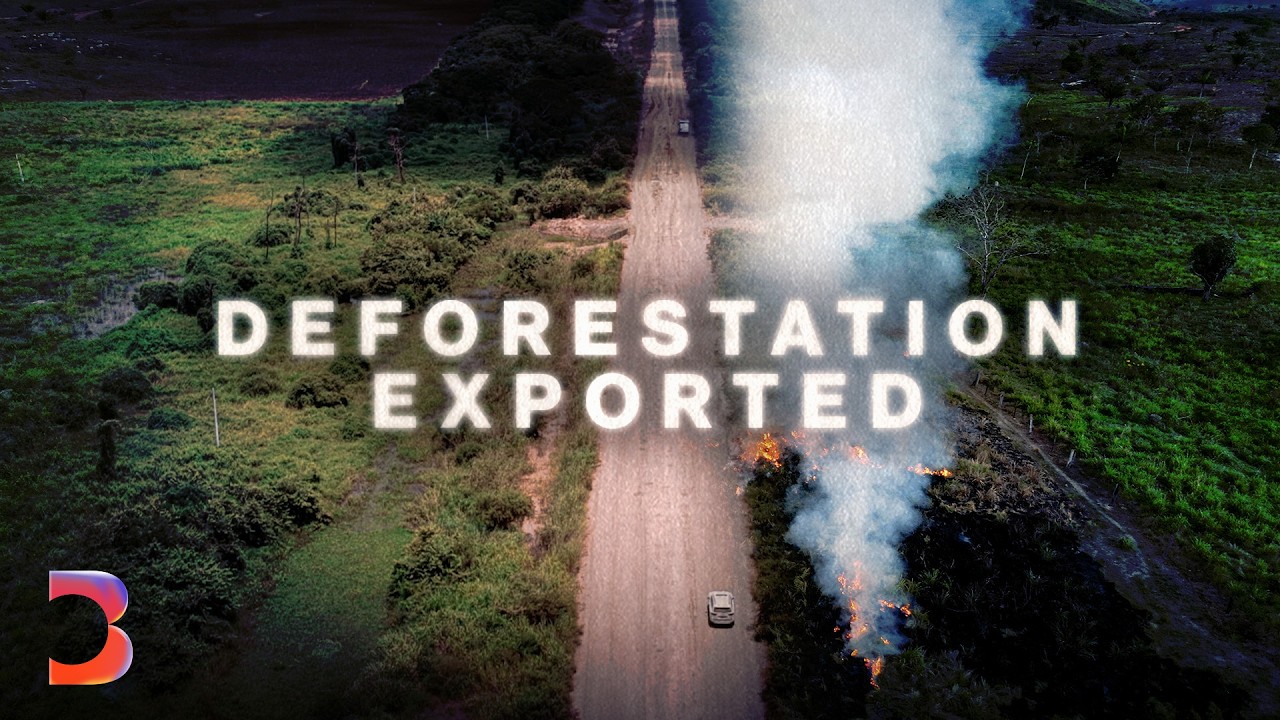
Brazil's strict environmental enforcement is pushing illegal deforestation across the border into Bolivia, where Brazilian agribusinesses exploit legal loopholes and political backing to clear the Amazon.
AI-assisted summary of The Deal That May Reshape the Amazon’s Future — original source. Check the original for full context.
Source published:
Detailed notes
## Background Published on YouTube by Bloomberg Originals on August 12, 2026, this video investigates how Brazil's crackdown on Amazon deforestation has shifted environmental pressures into neighboring Bolivia. The page description highlights a closed-door deal reshaping the rainforest's future as deforestation declines sharply in Brazil while escalating rapidly across the Bolivian border.
## TL;DR While Brazil reduced tropical forest loss by 41% in 2025 through strict law enforcement, industrial agribusiness has shifted operations across the border into San Ignacio de Velasco, Bolivia. Led by major soy tycoons like Eraí Maggi Scheffer and backed by new infrastructure plans under Bolivian President Rodrigo Paz, vast tracts of pristine forest like the 30,000-hectare INPA estate face clear-cutting. Legal loopholes, regulatory capture, and low fines for unauthorized clearing facilitate this rapid land conversion despite intense resistance from indigenous Chiquitano communities and public protests in La Paz. Global Forest Watch data confirms an inverse trend: as Brazilian forest loss slows, Amazonian deforestation in Bolivia continues to climb toward a critical tipping point.
## Atmosphere & style The report carries a serious, investigative, and urgent tone, combining boots-on-the-ground journalism in remote frontier towns with high-level corporate and political scrutiny. The narrative style builds tension through clandestine discoveries—such as confidential ministerial meetings and corporate land deals—contrasting quiet indigenous traditional practices with the sweeping, mechanical scale of industrial monomorphic soy fields. Visually and emotionally, it feels like an eye-opening cross-border exposure of economic spillover, capturing the stark divide between protected canopy and mass environmental transformation.
## Key takeaways - [00:15](https://www.youtube.com/watch?v=cHH-DkhTJW4&t=15s) Brazil has reduced tropical rainforest loss by 41% through strict enforcement, but agricultural demand is shifting deforestation across the border into Bolivia. - [01:43](https://www.youtube.com/watch?v=cHH-DkhTJW4&t=103s) San Ignacio de Velasco has become Bolivia's primary hotspot for forest loss, driven by an influx of Brazilian soy producers and cattle ranchers. - [04:30](https://www.youtube.com/watch?v=cHH-DkhTJW4&t=270s) The election of Bolivian President Rodrigo Paz ended nearly two decades of leftist rule, shifting national policy toward aggressive agricultural expansion. - [06:34](https://www.youtube.com/watch?v=cHH-DkhTJW4&t=394s) Soybeans are Bolivia's leading agricultural export, with 75% of the harvest processed and exported for livestock feed. - [06:34](https://www.youtube.com/watch?v=cHH-DkhTJW4&t=394s) A confidential meeting between Brazilian agribusiness leaders, Brazil's Agriculture Minister, and Bolivian ministers focused on cross-border infrastructure and agricultural expansion. - [14:14](https://www.youtube.com/watch?v=cHH-DkhTJW4&t=854s) Brazilian soy giant Eraí Maggi Scheffer met with President Paz and plans major investments in Bolivia, supported by a proposed cross-border highway. - [14:14](https://www.youtube.com/watch?v=cHH-DkhTJW4&t=854s) Historical data shows over 90% of Amazonian deforestation occurs adjacent to highway routes, making new road proposals a major environmental threat. - [15:57](https://www.youtube.com/watch?v=cHH-DkhTJW4&t=957s) Maggi's enterprise, Bom Futuro, put down a financial deposit to acquire the 30,000-hectare INPA forest property, equivalent to five times the size of Manhattan. - [21:15](https://www.youtube.com/watch?v=cHH-DkhTJW4&t=1275s) The indigenous Chiquitano Cabildo raised concerns over escalating land disputes and territorial loss resulting from industrial farm expansion. - [28:19](https://www.youtube.com/watch?v=cHH-DkhTJW4&t=1699s) Foreign investors circumvent Bolivia's constitutional 5,000-hectare land ownership limit and border restrictions by registering properties through corporate entities. - [28:19](https://www.youtube.com/watch?v=cHH-DkhTJW4&t=1699s) Statutory fines for illegal land clearing top out around $1 million, offering little deterrence against post-clearing property values exceeding $20 million. - [28:19](https://www.youtube.com/watch?v=cHH-DkhTJW4&t=1699s) Key environmental policy oversight in Bolivia was assigned to Former soy industry executives, including Minister of Development Planning Fernando Romero Pinto. - [39:14](https://www.youtube.com/watch?v=cHH-DkhTJW4&t=2354s) At the São Paulo Business Forum, Eraí Maggi publicly confirmed land acquisitions in Bolivia to replicate the Mato Grosso intensive agricultural model. - [39:14](https://www.youtube.com/watch?v=cHH-DkhTJW4&t=2354s) Mass public protests in La Paz forced the Bolivian government to repeal land consolidation legislation, though deforestation rates in Bolivia continue to rise.
## Detailed walkthrough ### [00:15](https://www.youtube.com/watch?v=cHH-DkhTJW4&t=15s) Global Climate Crisis and Brazil's Agribusiness Contradiction
The report opens against the backdrop of rising global emissions, persistent warming, and mounting public demands for climate action. For the first time in history, UN climate talks were hosted within the Amazon rainforest in Brazil, bringing the biome and its inhabitants to the center of global attention. Yet, the summit also put a spotlight on the host nation's central paradox: over the past four decades, Brazil has transformed itself into "the supermarket of the world," building one of the most powerful agricultural economies on Earth driven by soybean, beef, and corn production—all of which historically relied on clearing vast swaths of land.
At the same time, Brazil has been celebrated as an environmental conservation success story. Tropical rainforest loss in Brazil dropped significantly, decreasing by 41% in 2025 alone due to rigorous law enforcement and strict monitoring. However, global demand for agricultural commodities has not vanished, nor have the financial motivations of the producers who profit from them. As environmental enforcement tightens inside Brazil, agribusiness producers appear to be shifting their operations across the border, raising the question of whether deforestation was truly curtailed or merely displaced.
- Global tropical rainforest loss dropped by a third overall, with Brazil's forest loss falling 41% in 2025. - Demonstrators and indigenous groups blocked entrances to the UN Climate Conference in Brazil to protest ongoing environmental destruction.
[01:43](https://www.youtube.com/watch?v=cHH-DkhTJW4&t=103s) Arrival in Santa Cruz and the Leakage of Deforestation to Bolivia
Journalist Fabiano Maisonnave arrives in Santa Cruz de la Sierra, the economic powerhouse of Bolivia and the central hub of its accelerating deforestation. Having spent his career reporting on the Amazon, Maisonnave sets out to answer a fundamental question: when one nation cracks down on deforestation, where does that economic and environmental pressure go? Brazil actively champions "land sparing"—a strategy focused on maximizing agricultural yields on existing farmland so that remaining forests can be left untouched.
However, traveling toward the Bolivian border reveals a starkly different reality. Brazil’s agricultural boundary is spilling directly into San Ignacio de Velasco, Bolivia’s fastest-growing hotspot for forest loss. Critics argue that land sparing has failed to stop overall deforestation, serving instead to push the destruction into neighboring countries with weaker regulatory oversight. Because the Amazon regulates global climate patterns, any systemic shift in forest loss threatens ecological collapse across the entire biome.
- San Ignacio de Velasco has emerged as Bolivia's primary hotspot for forest loss. - The Amazon contains roughly 16,000 identified tree species, with many others remaining unstudied and unclassified by science.
[04:30](https://www.youtube.com/watch?v=cHH-DkhTJW4&t=270s) Political Shifts and the Rush to San Ignacio de Velasco
San Ignacio de Velasco is the ancestral territory of the indigenous Chiquitano people. The region is undergoing a rapid transition from traditional subsistence farming to industrial-scale agribusiness, endangering local ecosystems and cultural heritage. The push for agricultural expansion has gained political momentum following Bolivia's presidential election, where centrist Rodrigo Paz won the runoff, bringing an end to nearly two decades of leftist rule with promises to significantly expand national agricultural output.
San Ignacio de Velasco currently concentrates the highest volume of deforestation in Bolivia, driven largely by an influx of Brazilian ranchers and soy growers. Data regarding foreign land acquisition in Bolivia remains highly sensitive and guarded because the Bolivian Constitution strictly restricts foreign land ownership. Consequently, Brazilian agribusiness groups operate discreetly and are notoriously hesitant to speak with journalists.
- Rodrigo Paz's election ended nearly 20 years of leftist government in Bolivia, shifting national policy toward aggressive agricultural expansion. - The Bolivian Constitution places strict legal limits on foreign ownership of national territory.
[06:34](https://www.youtube.com/watch?v=cHH-DkhTJW4&t=394s) On the Road to San Ignacio and the Secret Ministerial Meeting
Driving through the countryside toward San Ignacio de Velasco, the surrounding landscape is dominated by vast soy plantations. Soybeans represent Bolivia’s top agricultural export and the primary driver of clear-cutting in the region, with three-quarters of the harvest exported for livestock feed. Although geographically situated within the Amazon basin, the natural vegetation has been almost completely eradicated, replaced by mechanized monomorphic fields.
During the journey, the reporting team uncovers details about a confidential, closed-door meeting held on a private estate in San Ignacio. The gathering brought together Brazilian soy producers, Brazil's Minister of Agriculture, and two Bolivian cabinet ministers. Contacts confirm that discussions focused on border infrastructure and expanding Brazilian agribusiness operations into Bolivian territory—agreements that could dramatically accelerate forest clearance across the region.
- Soybeans are Bolivia's leading agricultural export, with 75% of production processed into animal feed. - The confidential meeting in San Ignacio involved Brazil's Minister of Agriculture, two Bolivian ministers, and prominent Brazilian agribusiness executives.
[08:41](https://www.youtube.com/watch?v=cHH-DkhTJW4&t=521s) Exploring Local Realities in San Ignacio de Velasco
Upon entering San Ignacio de Velasco, the cultural and economic presence of Brazil is immediately evident throughout the town, from Brazilian commercial storefronts to national flags. To understand the landscape before the arrival of large-scale agribusiness, the news team visits a local family that has practiced traditional, sustainable farming for generations.
The contrast highlights the ecological value of untouched rainforest. The loss of forest in the Amazon involves not just the removal of trees, but the destruction of complex, undocumented ecosystems and biodiversity. Every hectare cleared eliminates plant and animal species before scientists have had the opportunity to study or record them.
- San Ignacio de Velasco exhibits deep economic ties to Brazil through widespread commerce and cross-border migration. - Traditional agroforestry practices in the region stand in direct contrast to the ecological clearing driven by industrial soy farming.
[14:14](https://www.youtube.com/watch?v=cHH-DkhTJW4&t=854s) Uncovering the "King of Soybean" and the Proposed Highway
Through a contact at Rancho Dorado—the Brazilian-owned estate where the confidential ministerial meeting took place—the investigative team learns that Eraí Maggi Scheffer attended the sessions. Known globally as the "King of Soybean," Maggi is one of the world's largest soy producers. Following a two-hour private meeting with Bolivia's President Rodrigo Paz, Maggi declared that Bolivia was entering a "new era" and expressed intention to make substantial capital investments in the region.
To facilitate these investments, Brazilian producers are lobbying heavily for the construction of a new international highway directly connecting Brazil and Bolivia through the forest. In the Amazon, historical data shows that over 90% of all deforestation occurs within a narrow corridor along highway infrastructure. While the proposed road promises enhanced trade logistics for soy exporters, environmental analysts view it as a primary driver for rapid deforestation.
- Eraí Maggi Scheffer, head of the agribusiness conglomerate Bom Futuro, met privately with Bolivian President Rodrigo Paz for two hours. - Over 90% of Amazonian deforestation historically occurs adjacent to highway routes.
[15:57](https://www.youtube.com/watch?v=cHH-DkhTJW4&t=957s) Inside Rancho Dorado and the Mechanics of Agribusiness Expansion
A visit to Rancho Dorado illustrates the scale at which Brazilian agribusiness operates inside Bolivia. The property functions as an industrial community, housing 210 permanent employees and operating a private school for 60 children on site. The estate mirrors the massive agricultural operations developed in Mato Grosso, Brazil, where the Maggi family accumulated immense wealth while overseeing some of the highest deforestation rates in the Brazilian Amazon.
Investigative reports reveal that Maggi’s agribusiness empire, Bom Futuro, put down a financial deposit to acquire a pristine, 30,000-hectare forested property known as the INPA estate. When questioned about the transaction, a corporate spokesperson initially denied Maggi’s involvement in Bolivia, before later conceding that "a partner of Bom Futuro might have bought something in Bolivia" before abruptly ending communication.
- Rancho Dorado employs 210 residents on-site and maintains an internal school with 60 enrolled students. - Bom Futuro allegedly placed a deposit on a pristine 30,000-hectare forested plot in the Chiquitania region.
[21:15](https://www.youtube.com/watch?v=cHH-DkhTJW4&t=1275s) Indigenous Perspectives with the Chiquitano Cabildo
In San Ignacio, the reporting team meets with the Cabildo, the traditional indigenous governing council of the Chiquitano people. Antonio, the Cacique General (General Chief) of the Chiquitanos, shares his perspective on how industrial agribusiness is altering their ancestral territory and cultural traditions.
Antonio expresses mixed feelings about the rapid changes. While acknowledging that big commercial farms provide needed employment opportunities for local indigenous laborers, he voices deep concern over systemic land grabbing and territorial loss. Industrial farms are encroaching on traditional boundaries, leading to escalating land conflicts between agribusiness entities and native Chiquitano communities.
- The Cabildo serves as the historic governing body representing the Chiquitano indigenous population. - Cacique General Antonio reported increasing land disputes resulting from commercial farm expansion into traditional territories.
[24:44](https://www.youtube.com/watch?v=cHH-DkhTJW4&t=1484s) Aerial Overlook: The Border Divide and the 30,000-Hectare Target
An aerial survey over San Ignacio de Velasco—a municipality roughly the size of Denmark—reveals the extent of land transformation. Areas that were dense, continuous rainforest twenty years ago are now cleared fields. Flying directly along the international border illustrates the contrast in land management: on the Brazilian side, the forest has been entirely cleared for cattle pasture; on the Bolivian side, the lush canopy of the Noel Kempff Mercado National Park remains intact.
The flight also passes over the 30,000-hectare INPA estate, a forested tract currently owned by a Dutch-Bolivian timber enterprise that practices managed logging. Equal in size to five Manhattans, this property represents the last remaining contiguous block of native forest in the local area. It is this exact tract that Eraí Maggi seeks to acquire and convert into intensive soybean production.
- San Ignacio de Velasco covers a geographic area roughly equivalent in size to Denmark. - The 30,000-hectare INPA property represents a forest block equivalent to five times the size of Manhattan. - Noel Kempff Mercado National Park remains the largest preserved protected area in the immediate border region.
[28:19](https://www.youtube.com/watch?v=cHH-DkhTJW4&t=1699s) La Paz Investigation: Legal Loopholes and Regulatory Capture
In La Paz, Bolivia’s political capital, Fabiano meets with investigative journalist Stasiek Czaplicki, who first broke the story regarding Maggi’s attempt to acquire the INPA estate. Czaplicki details how structural legal loopholes enable foreign investors to bypass statutory land limits. Although the Bolivian Constitution restricts individual land ownership to 5,000 hectares and prohibits direct foreign land acquisition along borders, investors routinely circumvent these rules by registering properties under corporate entities.
Furthermore, statutory penalties for illegal deforestation fail to act as a deterrent. Fines for unauthorized clearing on a 30,000-hectare parcel top out at approximately $1 million, whereas the cleared land itself is valued at over $20 million on the commercial market—rendering administrative penalties a minor operational cost. Regulatory capture further accelerates this trend: Bolivia's Minister of Development Planning, Fernando Romero Pinto (who took over environmental policy after President Paz dissolved the Ministry of Environment), spent 25 years as a prominent soy industry executive, while the former Minister of Environment previously led the soy producers' association, ANAPO.
- Fines for illegal deforestation are capped around $1 million, compared to a post-clearing property valuation exceeding $20 million. - The Bolivian Constitution limits individual landholdings to 5,000 hectares, a restriction routinely bypassed via corporate structures. - Fernando Romero Pinto, a veteran soy industry leader of 25 years, was appointed Minister of Development Planning overseeing environmental policy.
[33:52](https://www.youtube.com/watch?v=cHH-DkhTJW4&t=2032s) The São Paulo Business Forum and Exporting Deforestation
At the Brazil-Bolivia Business Forum in São Paulo, government officials and corporate executives gather to formalize cross-border economic initiatives. Despite public statements framing the partnership around "land sparing" and sustainable yield intensification, the concrete commitments made at the forum center on major infrastructure expansion.
Brazilian officials formally backed bi-national infrastructure commitments, including new highway corridors and a major river bridge physically connecting Brazilian production zones to Bolivian land. Critics point out that infrastructure expansion in tropical forests consistently follows a set pattern: road construction is invariably followed by widespread clear-cutting, effectively exporting Brazil's historic model of agricultural expansion into the Bolivian Amazon.
- The São Paulo forum confirmed formal Brazilian state backing for cross-border highways and a new international river bridge. - Public rhetoric centered on land sparing, while policy commitments focused on physical infrastructure into forested zones.
[39:14](https://www.youtube.com/watch?v=cHH-DkhTJW4&t=2354s) Facing the Maggi Empire and the Aftermath in Bolivia
While Eraí Maggi declined on-camera interviews with Bloomberg, his brother Fernando spoke with reporters, and Eraí publicly addressed attendees at the São Paulo forum. For the first time, Maggi publicly acknowledged acquiring land in Bolivia, stating his intent to replicate the Mato Grosso development model to maximize agricultural output and generate economic growth.
Following the investigation, the Bolivian government confirmed the planned infrastructure projects. President Paz subsequently enacted legislation designed to consolidate small agricultural parcels into medium-sized holdings. The law sparked intense resistance from indigenous groups and peasant organizations, who argued it facilitated private land seizures. Widespread street protests featuring tear gas and firecrackers in La Paz ultimately forced the administration to repeal the law. Nonetheless, recent data from Global Forest Watch confirms that as forest loss slows in Brazil, deforestation in Bolivia continues to climb, bringing the Amazon closer to a critical ecological tipping point predicted for the 2030s.
- Eraí Maggi publicly confirmed his acquisition of Bolivian land at the São Paulo Business Forum. - Mass public protests in La Paz forced President Rodrigo Paz to repeal legislation that enabled the consolidation and conversion of small landholdings. - Global Forest Watch data confirms an inverse trend: declining Amazonian deforestation in Brazil alongside rising forest loss in Bolivia.
## Notable quotes > [00:15](https://www.youtube.com/watch?v=cHH-DkhTJW4&t=15s) the supermarket of the world
> [15:57](https://www.youtube.com/watch?v=cHH-DkhTJW4&t=957s) a partner of Bom Futuro might have bought something in Bolivia — Bom Futuro spokesperson
> [14:14](https://www.youtube.com/watch?v=cHH-DkhTJW4&t=854s) new era — Eraí Maggi Scheffer
## Mentioned Bloomberg Originals, Bloomberg Investigates, Fabiano Maisonnave, San Ignacio de Velasco, Rodrigo Paz, Chiquitano, Eraí Maggi Scheffer, King of Soybean, Rancho Dorado, Bom Futuro, INPA estate, Cabildo, Antonio, Noel Kempff Mercado National Park, La Paz, Stasiek Czaplicki, Fernando Romero Pinto, ANAPO, São Paulo Business Forum, Fernando Maggi, Global Forest Watch
[Source](https://www.youtube.com/watch?v=cHH-DkhTJW4)