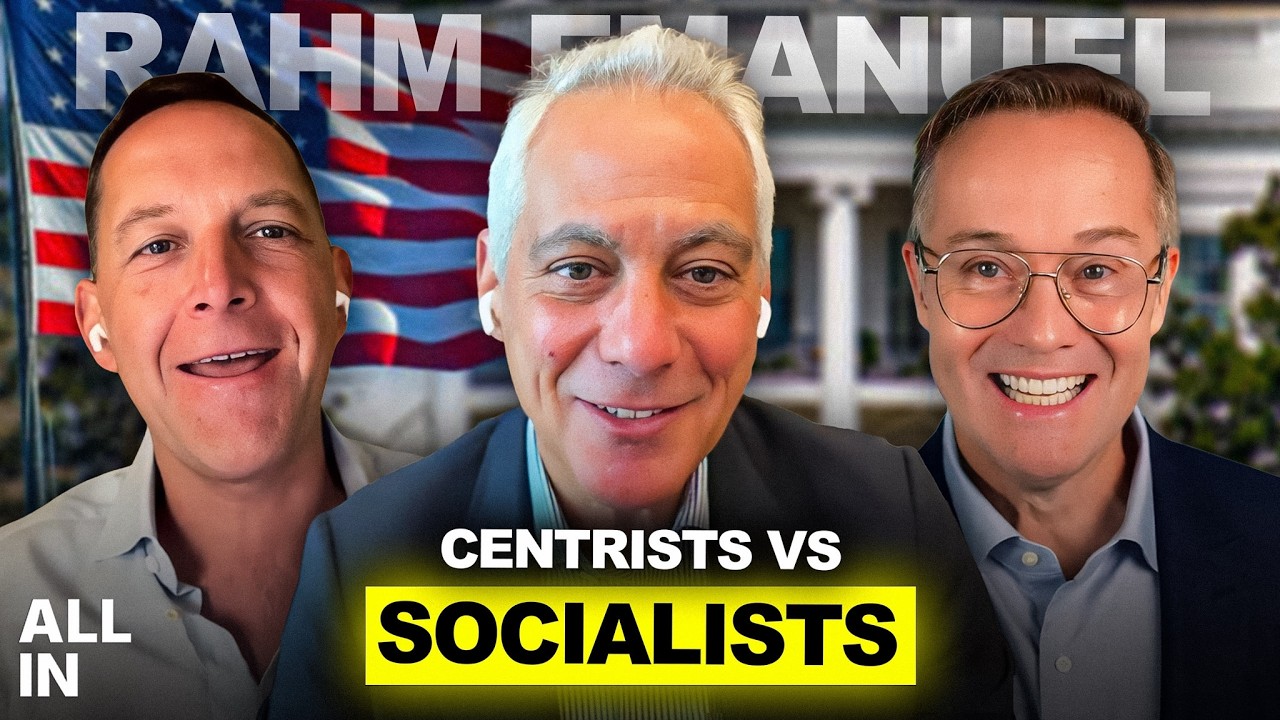
Emanuel Rejects Progressive Wing, Demands U.S. Build Allied Economic Bloc
All-In Podcast
Former Obama chief of staff Rahm Emanuel argues the U.S. must isolate China through an allied economic bloc while rejecting far-left intraparty primary challenges to protect American competitiveness.
## Background
The All-In Podcast published this interview on YouTube on August 13, 2026. The episode features hosts Jason Calacanis and David Friedberg interviewing Rahm Emanuel on a wide range of geopolitical and domestic policy topics, including China, the DSA, Donald Trump, European economic decay, immigration reform, and the U.S. national debt.
## TL;DR
Former White House Chief of Staff and Ambassador Rahm Emanuel delivers a sweeping defense of pragmatic governance while outlining strategic solutions for American geopolitical and domestic challenges. He advocates for building international economic blocs to counter Chinese industrial dominance, reforming immigration through the bipartisan Dignity Act, and restructuring the U.S. education system to focus on early childhood reading and trade skills. Emanuel also vigorously defends mainstream Democratic politics while sharply rejecting the ideological purism of the Democratic Socialists of America.
## Atmosphere & style
The discussion is fast-paced, highly intellectual, and combative yet respectful, characterized by spirited policy debates between market-oriented hosts and an experienced political operative. Emanuel brings a sharp, pragmatic, and direct tone, using colorful phrasing and candid political instincts to challenge the hosts' premises on European decay and government spending. The dynamic feels like an unfiltered, high-level political strategy session where complex global and fiscal issues are scrutinized through real-world governance experience.
## Key takeaways
- [00:00](https://www.youtube.com/watch?v=_TcEfYlW4PA&t=0s) You cannot implement progressive policies if the public lacks faith in the basic operational capacity and competence of government.
- [05:00](https://www.youtube.com/watch?v=_TcEfYlW4PA&t=300s) The contemporary geopolitical landscape is destabilized by the internal issues of superpowers: China exports its economic problems through industrial dumping, while the U.S. exports its domestic polarization.
- [10:00](https://www.youtube.com/watch?v=_TcEfYlW4PA&t=600s) To counter China's state-subsidized dominance in critical industries, the United States must build a unified economic coalition with key allies and double down on research bodies like the NIH, DARPA, and the NSF.
- [15:00](https://www.youtube.com/watch?v=_TcEfYlW4PA&t=900s) Iran's four-decade investment in its regional proxy network is unraveling as groups like Hamas and Hezbollah face major setbacks and regional state actors reassert control.
- [20:00](https://www.youtube.com/watch?v=_TcEfYlW4PA&t=1200s) U.S. policy regarding Taiwan maintains deliberate strategic ambiguity on political status, but holds an absolute, unambiguous commitment against any unilateral attempt to alter the status quo through kinetic force.
- [25:00](https://www.youtube.com/watch?v=_TcEfYlW4PA&t=1500s) Japan represents the single most crucial structural anchor of the U.S. Indo-Pacific strategy, hosting the largest overseas American military presence and integrating deeply through bilateral investment.
- [30:00](https://www.youtube.com/watch?v=_TcEfYlW4PA&t=1800s) Western Europe's economic stagnation and political friction stem from structural policy failures—such as regulatory overreach from Brussels and energy mismanagement—rather than purely partisan ideology.
- [35:00](https://www.youtube.com/watch?v=_TcEfYlW4PA&t=2100s) Donald Trump's diplomatic strategy prioritizes validation from authoritarian leaders while alienating democratic allies, undercutting long-term strategic coalition-building against global competitors.
- [40:00](https://www.youtube.com/watch?v=_TcEfYlW4PA&t=2400s) Resolving the U.S. immigration impasse requires balancing enforcement with practical reform through bipartisan legislative compromises like the Dignity Act.
- [45:00](https://www.youtube.com/watch?v=_TcEfYlW4PA&t=2700s) Federal subsidies in higher education, housing, and healthcare have historically driven significant price inflation, pointing to the need for structural market reform and regulatory streamlining.
- [50:00](https://www.youtube.com/watch?v=_TcEfYlW4PA&t=3000s) Addressing urban housing shortages requires cities to benchmark and strip away restrictive local zoning, permitting, and building codes against high-growth markets.
- [55:00](https://www.youtube.com/watch?v=_TcEfYlW4PA&t=3300s) K-12 educational systems must integrate post-secondary planning and high school dual-enrollment programs to directly align student outcomes with workforce needs.
- [01:00:00](https://www.youtube.com/watch?v=_TcEfYlW4PA&t=3600s) Addressing higher education costs requires structural fixes—such as 3-year bachelor's degrees, foreign student subsidies, and administrative cost controls—rather than unlimited federal loans.
- [01:03:00](https://www.youtube.com/watch?v=_TcEfYlW4PA&t=3780s) America's labor and economic gaps are rooted in foundational K-12 failures, particularly low elementary reading proficiency, rather than higher education access alone.
- [01:06:00](https://www.youtube.com/watch?v=_TcEfYlW4PA&t=3960s) Reversing long-term fiscal deficits requires boosting economic growth through energy grid modernization, tax code reform favoring active wealth creation, and direct R&D funding via levies on sectors like online gambling.
- [01:09:00](https://www.youtube.com/watch?v=_TcEfYlW4PA&t=4140s) Long-term U.S. debt accumulation stems from post-9/11 policies that funded multiple foreign conflicts while simultaneously enacting major tax cuts.
- [01:09:24](https://www.youtube.com/watch?v=_TcEfYlW4PA&t=4164s) The Democratic Socialists of America (DSA) operate as a distinct political movement whose focus on primarying moderate Democrats weakens the party's ability to win swing districts and maintain legislative majorities.
## Detailed walkthrough
### [00:00](https://www.youtube.com/watch?v=_TcEfYlW4PA&t=0s) Lessons in Governance from Clinton and Obama
Host Jason Calacanis opens the interview by introducing Rahm Emanuel—former Senior Advisor to Bill Clinton, Chief of Staff to Barack Obama, Mayor of Chicago, and U.S. Ambassador to Japan—framing his background as a prelude to a potential 2028 presidential perspective. Emanuel appreciates the introduction starting with his work in the Clinton administration, noting that most intros skip straight to his congressional career. Reflecting on Clinton and Obama, Emanuel points out that while both possessed distinct skill sets, both held a progressive, affirmative view of government. He emphasizes a core principle of his political philosophy: "you can't have progressive policies if people think that the government can't run an organized one-car parade."
Emanuel breaks down the leadership styles of the two presidents. Bill Clinton excelled at playing "three-D chess" across policy, politics, and the press, redefining the presidency for the 21st century by effectively communicating policy changes without making them feel threatening to the public. In contrast, Obama assumed office during pivotal crises—the tail end of the Iraq War and the Great Recession. Emanuel defends both administrations against left-wing critics, arguing that Clinton delivered historic economic growth and job creation while shrinking income disparity, while Obama saved the country from entering a full-blown depression, transitioned the economy from losing 800,000 jobs per month to generating 200,000, and repositioned America globally.
- Bill Clinton signed welfare reform, which marked a major shift toward a net-positive public perception of government capability.
- Under Clinton, post-Reagan economic growth and job creation reached historic highs while income disparity shrank.
- Obama inherited an economy losing 800,000 jobs a month during the Great Recession and reversed it to consistent growth of 200,000 jobs a month.
---
[00:05](https://www.youtube.com/watch?v=_TcEfYlW4PA&t=5s) Global Disruption and the Geopolitical Toolbox
David Sacks asks whether the Obama administration's emphasis on exporting American democracy and culture inadvertently sparked global culture wars. Emanuel rejects this premise, offering a broader framework for global power dynamics. He argues that the world is currently being held hostage by the domestic dysfunctions of its two superpowers: China exports its economic dysfunction—dumping subsidized goods and crushing foreign manufacturing bases—while the United States under Donald Trump exports its domestic political and cultural polarization onto the global stage.
Emanuel outlines the four primary tools in any country's national security toolbox: military power, political persuasion, economic statecraft, and cultural attraction. He asserts that American culture and institutions remain major assets, but warns that current political strategies are damaging the American brand and undermining its geopolitical leverage. Rather than relying on unilateral tariffs, Emanuel advocates for constructing an integrated economic bloc with global allies to counter China's aggressive trade practices and isolate its influence.
- China's overcapacity and industrial dumping have led to more World Trade Organization (WTO) cases against it than any other nation.
- Chinese domestic car manufacturers are exporting heavily despite seeing their profits fall by 20%.
- Modern warfare has shifted rapidly, highlighted by how non-naval entities like Iran and Ukraine control critical strategic waterways near their fronts using drone technology.
---
[00:10](https://www.youtube.com/watch?v=_TcEfYlW4PA&t=10s) Countering China's Economic and Technological Strategy
David Friedberg raises concerns regarding China's rapid industrial and technological dominance, citing its massive energy output—approaching 8 terawatts compared to America's ~1 terawatt—and its expanding reach into AI, life sciences, and knowledge services. Emanuel explains that China's long-term strategy relies on creating global dependency on Chinese markets while keeping itself independent of others. He highlights the COVID-19 pandemic as a prime example: while Operation Warp Speed yielded vaccines with over 90% efficacy within 14 months, China's domestic vaccines took longer and yielded lower efficacy, prompting Chinese leadership to quietly seek Western mRNA shots.
To counter China's strategy of aggressive state investment in sectors like the life sciences, Emanuel sharply criticizes proposed budget cuts to domestic research bodies like the National Institutes of Health (NIH). He argues that institutions like the NIH, DARPA, the National Science Foundation, national labs, and research universities represent America's core strength. He urges the U.S. to build an economic bloc combining Australia, Japan, South Korea, Taiwan, the European Union, and Latin American allies to collectively outpace China while reforming internal defense procurement to spur innovation.
- China's energy production capacity is heading toward 8 terawatts of electricity, whereas the U.S. hovers around 1 terawatt with targets for 2 terawatts by 2040.
- China possesses roughly 20 times the manufacturing square footage of the United States.
- Operation Warp Speed produced U.S. vaccines with 90%+ efficacy in 12–14 months, whereas China's Sinovac/Sinopharm took 18–19 months and yielded ~60% efficacy.
- A newly approved pancreatic cancer drug funded by the NIH is currently showing promise in treating three or four additional cancer types.
---
[00:15](https://www.youtube.com/watch?v=_TcEfYlW4PA&t=15s) Shifting Dynamics and Alignments in the Middle East
The discussion turns to the Middle East, where Emanuel outlines three major structural trends transforming the region. First, traditional alignments are shifting: while nations like the UAE, Bahrain, and Kuwait remain firmly partnered with the U.S., others like Saudi Arabia, Egypt, Turkey, Qatar, and Pakistan are hedging their bets to avoid total reliance on American leadership. To anchor these nations to the West, Emanuel advocates for advancing projects like the India-Middle East-Europe Economic Corridor (IMEC).
Second, Emanuel points to the collapse of Iran's long-term proxy strategy. For four decades, Iran invested tens of billions of dollars into a network of regional proxies—referred to by Israel as the "octopus." Emanuel observes that this strategy is unraveling: Hamas has been severely degraded, Hezbollah is cornered, its influence in Damascus is slipping, and the Iraqi government is actively reining in Iranian-backed militias. He notes a historical realignment where regional governments, including Lebanon, are cooperating directly or indirectly to marginalize these non-state proxy groups.
- Iran spent an estimated 40+ years and over $40 billion developing its regional proxy network.
- Key Middle Eastern allies and regional powers are evaluating new economic frameworks, including the proposed 23-state framework and the India-Middle East-Europe Economic Corridor.
[020:00] Geopolitics in the Middle East and China's Escalating Aggression
Rahm Emanuel opens by detailing a massive strategic shift in the Middle East, noting that the U.S. President is negotiating a security agreement with Israel, building on previous peace and security frameworks with Jordan, Egypt, and Syria. This moves the three primary Arab military forces from the 1967 Six-Day War into a baseline resolution with Israel. A central opportunity within this emerging dynamic is bypassing the vulnerable Strait of Hormuz by routing energy pipelines from Masara through Syria to sea ports. Major Gulf players would then be integrated into a larger regional economic bloc, alongside key technical sectors like semiconductor manufacturing.
The conversation pivots to Taiwan and the Indo-Pacific. Emanuel addresses the policy of "strategic ambiguity," clarifying a critical nuance: while the political status of Taiwan and the "One China" baseline are intentionally kept ambiguous, the U.S. commitment against changing the status quo through kinetic force is completely unambiguous. He forcefully critiques the current White House for becoming a "one-ball juggler" fixated on Middle Eastern conflict. By drawing U.S. attention and military resources into the Strait of Hormuz, the administration has created a vacuum that China is actively exploiting. Rather than waiting for a projected 2027 or 2029 invasion horizon, China is executing aggressive pressure tactics right now.
```
Indo-Pacific Flashpoints & Chinese Pressure Operations
├── Philippines: Escalating South China Sea standoffs at Scarborough Shoal
├── Japan: Military probing near the Senkaku Islands & economic coercion
├── Australia: Live submarine missile firings in surrounding waters
└── Regional Allies: Intimidation aimed at South Korea, India, Vietnam, & Singapore
```
Emanuel stresses that the immediate crisis point is the South China Sea, where China is ignoring the 2016 Hague international court ruling and building artificial islands near Scarborough Shoal to claim the area as its private backwater. Because the Philippines is a treaty ally—unlike Taiwan—failing to stand up for Manila severely degrades American deterrence across the entire region.
- China is sending a direct message to Pacific allies (Japan, South Korea, India, Australia, New Zealand, Singapore, Philippines, Vietnam) that the U.S. is no longer a reliable military protector.
- The U.S. needs to double down on troop presence, naval assets, and military resources in the Philippines to back President Ferdinand Marcos Jr. as he takes major political risks against Beijing.
---
[025:00] Taiwan Deterrence and the Central Importance of Japan
Analyzing potential Chinese actions against Taiwan, Emanuel outlines three distinct military and strategic vectors Beijing could employ. The first is an economic quarantine designed to suffocate the island without triggering a formal war. The second is a full-scale kinetic invasion aimed at securing control within 96 hours to prevent Western mobilization. The third is an incremental strategy: seizing small, lightly defended offshore islands (such as Kinmen and Matsu) to test Western resolve and force a dilemma over whether to start a major war over minor territory. To maintain real deterrence, the U.S. must ensure Taiwan can hold out for "96 days" rather than 96 hours, while maintaining the naval and air capability out of Okinawa and the Philippines to break any quarantine effort.
Turning to U.S. alliances, Emanuel highlights Japan as the single most critical structural element ("the long pole in the tent") of American Indo-Pacific strategy. Japan hosts America's largest overseas military footprint in a single country, centered in Okinawa, and anchors the forward-deployed carrier strike group in Yokosuka.
```
The Architecture of U.S.-Japan Strategic Alignment
├── Military Footprint: Largest single-country U.S. presence (Okinawa, forward aircraft carrier)
├── Economic Integration: Japan is the #1 direct foreign investor in the U.S. (and vice versa)
├── Diplomatic Alliances: Core anchor of the Quad and Trilateral frameworks
└── Regional Security: Japanese leadership explicitly tying Taiwan security to its own
```
Emanuel notes the massive significance of the Japanese Prime Minister breaking a 30-year diplomatic taboo by publicly declaring that a Chinese move against Taiwan constitutes a direct threat to Japan's national security. This public stance triggered intense economic, political, and military retaliation from Beijing, including joint Russian-Chinese naval and air exercises near the Senkaku Islands. While acknowledging the U.S. intervention to backstop the yen, Emanuel insists the administration must dramatically step up joint military exercises and active presence to counter Chinese intimidation.
- Japan and the U.S. have been each other's top direct foreign investors for five consecutive years.
- America's core Indo-Pacific diplomatic frameworks—the Quad (US, Japan, India, Australia) and the trilateral alliances with South Korea and the Philippines—all rely on Japan as the primary constant.
- The administration's intervention in the yen currency markets was motivated partly by self-interest to prevent sell-offs in U.S. Treasuries caused by national debt pressures.
---
[030:00] The European Decay Debate: Policy Failures vs. Party Ideology
The dialogue turns to Western Europe, with David Sacks and David Friedberg raising the argument that the continent is suffering from "irreversible decay" driven by open-border immigration, energy mismanagement, and economic stagnation, which has fueled the rise of populist right parties like Alternative for Germany (AfD). Emanuel strongly rejects the premise that these policy missteps are strictly "leftist," engaging in a spirited back-and-forth over the political origins of Europe's current troubles. He points directly to former German Chancellor Angela Merkel—a leader of the conservative Christian Democratic Union (CDU)—as the person who made the decision to admit over one million Syrian refugees and who shut down Germany's nuclear power plant fleet following the Fukushima disaster, leaving the country dependent on Russian gas.
```
Origins of Germany's Strategic Vulnerabilities
├── Immigration Crisis: 2015 decision to admit 1M Syrian refugees made by Angela Merkel (CDU - Center-Right)
├── Energy Dependency: Post-Fukushima nuclear phase-out initiated under CDU leadership
└── Economic Stagnation: Bureaucracy in Brussels stifling innovation and industrial capacity
```
Emanuel acknowledges that 63% of Americans live paycheck to paycheck and that stagnating middle-class incomes mixed with border disorder drive political radicalization globally. People naturally react against visible social disorder, whether on the streets of European capitals or inside American cities. However, he places heavy blame on European Union regulatory overreach out of Brussels, which has suffocated technological innovation, entrepreneurship, and industrial competitiveness.
- German intelligence has placed the AfD under formal surveillance due to constitutional concerns.
- Mario Draghi's report on EU competitiveness offers a viable blueprint for rebuilding European industrial and technological strength.
- Germany is currently losing an estimated 5,000 to 10,000 manufacturing jobs per month under intense Chinese economic and industrial competition.
---
[035:00] Trump's Foreign Policy Style and American Immigration Strategy
Emanuel sharply attacks Donald Trump's diplomatic strategy, arguing that the former president consistently "punches down and kisses up." He asserts that Trump harbors an unhealthy fixation on being viewed as an equal by authoritarian strongmen like Vladimir Putin and Xi Jinping—who, in Emanuel's view, secretly consider him a "joke"—while publicly bullying democratically elected leaders of middle-power allies like Friedrich Merz in Germany, Giorgia Meloni in Italy, Luiz Inácio Lula da Silva in Brazil, or Mark Carney in Canada. By sending political figures to meet with opposition parties like the AfD right before elections, the U.S. actively exacerbates social and political friction inside allied nations rather than coordinating a unified front against Chinese trade practices.
The panel transitions to domestic immigration policy. Jason Calacanis points out the destructive policy shift where high-skilled immigrants and foreign graduates are pushed out, undermining Silicon Valley's ability to build generational tech companies. Calacanis references a past appearance where Trump promised to "put a green card on every diploma" awarded to foreign students, a promise his platform later walked back in favor of aggressive enforcement actions that have sparked public pushback.
Emanuel describes himself as "the last optimist" who believes a comprehensive legislative compromise on immigration is still possible. He outlines his foundational framework for resolving the immigration stalemate, stating that any functional strategy must reconcile two core American truths simultaneously: the country must exist both as a "nation of laws and a nation of immigrants."
- Public opinion rejects extremes on both sides: voters detest border chaos and urban lawlessness, but they are equally horrified by harsh enforcement tactics like pulling established workers out of agricultural fields.
- The U.S. is missing a historic opportunity to ally with European nations struggling under Chinese manufacturing subsidies and market saturation.
- Trump's personal insecurities drive his foreign policy actions, leading to impulsive decision-making rather than a coherent long-term grand strategy.
[040:00] Rethinking Immigration: The Dignity Act, Border Enforcement, and Learning from Abroad
Rahm Emanuel addresses the contentious issue of immigration by advocating for a balanced, law-enforcement-driven approach that blends strict border security with pragmatic reform. Drawing on his experience as a senior advisor in the Clinton administration, he recalls designing major border operations including **Operation Gatekeeper** in San Diego and **Operation Safeguard** in Nogales and El Paso. He emphasizes that a nation must respect both the rule of law and its identity as a home for immigrants. Rather than resorting to empty political rhetoric, Emanuel highlights his endorsement of the bipartisan **Dignity Act**, a bill sponsored by 23 Republicans and 23 Democrats in the House of Representatives. While acknowledging it isn't the exact legislation he would draft at his own keyboard, he argues it represents a true compromise that delivers necessary border security while creating functional pathways for legal immigration.
Turning to global talent retention, Emanuel criticizes current U.S. policy for driving away foreign-born professionals. He points out that many of the leaders driving China's life sciences sector were educated and trained in top American universities before U.S. policies effectively forced them out—a practice he bluntly calls foolish. When asked whether the U.S. should adopt a point-based immigration system like Japan's, Emanuel cautions against direct comparisons to Japan due to its island geography and homogeneous population of 125 million with only about 3 million immigrants. Instead, he suggests looking to the **Canadian model** and the **Danish model** as better benchmarks for best practices.
Emanuel also proposes an innovative strategy linking foreign student tuition to domestic college affordability. By allowing American colleges and universities to enroll up to 20% foreign students—who pay "full boat" tuition—institutions can generate the revenue needed to subsidize tuition costs for domestic families. Under this framework, American students could complete a streamlined three-year bachelor's degree instead of a traditional four-year program, saving families a full year of higher education expenses while retaining top global talent to build technology and business ventures in the U.S.
- Emanuel designed key 1990s border initiatives: **Operation Gatekeeper** (San Diego, CA) and **Operation Safeguard** (Nogales, AZ and El Paso, TX).
- The bipartisan **Dignity Act** is supported by 23 House Republicans and 23 House Democrats.
- Japan maintains a highly homogeneous population with roughly 3 million foreign residents out of 125 million people.
- Proposes capping foreign university enrollment at 20% (paying full tuition) to subsidize domestic education costs and fund three-year bachelor's degrees.
---
[045:00] Political Realities, Healthcare Debates, and Dissecting Government Spending
Emanuel sharply criticizes the political messaging of his own party during the 2020 Democratic primary debates, specifically targeting the moment candidates raised their hands in support of offering free government-provided healthcare to undocumented immigrants. He calls the stance foolish, emphasizing that American families struggling under high healthcare costs felt alienated by a message that prioritized free coverage for people who entered the country illegally.
The conversation shifts to economic philosophy as David Friedberg frames a challenge regarding the role of federal spending in driving inflation. Friedberg points out that over the past 30 years, while average general inflation hovered around 2.5%, key sectors heavily subsidized or regulated by the federal government saw disproportionate price hikes: housing rose over 5% annually, higher education over 6%, and healthcare roughly 5.5%. Friedberg argues that heavy government involvement, loans, and subsidies distort market forces, asking why the government shouldn't step back and let free markets drive deflationary efficiencies as seen in tech, energy, and consumer goods. Emanuel immediately pushes back, citing foundational public investments like the **GI Bill**, which fueled the post-WWII boom in homeownership and higher education, as well as federal agricultural and energy tax policies.
> "You have American families suffocating under healthcare costs... And you talking about free healthcare to having crossed the border illegally—at every level that was foolish by the party."
- Average U.S. general inflation over the last 30 years was ~2.5%, compared to sector-specific annual increases in housing (5%+), higher education (6%+), and healthcare (5.5%).
- Federal subsidies in housing and education reach billions annually, while healthcare subsidies exceed $1 trillion to $2 trillion.
- Emanuel cites the **GI Bill** as a historically successful government initiative that created widespread middle-class homeownership and educational access.
---
[050:00] Overcoming Local Bureaucracy and Transforming K-12 Education
Addressing the housing crisis, Emanuel points out that high costs are largely driven by local zoning, building, and permitting restrictions rather than federal programs. Recalling his tenure as Mayor of Chicago, he argues that cities must benchmark their regulatory frameworks against high-growth markets like Dallas, Houston, and Phoenix, stripping away any rule that cannot be justified. He highlights first-time homeownership as the critical market segment left unaddressed since the 2008 financial crash, calling for targeted public-private partnerships to jumpstart starter home construction.
Emanuel then lays out his record and vision for public education, pointing to his eight years transforming Chicago Public Schools (CPS). Under his administration, CPS raised its high school graduation rate from 56% to 83%, significantly boosted reading and math scores, and was recognized by researcher Sean Reardon at Stanford University as the fastest-improving urban school district in the country among the top 100. He highlights key strategies, including universal early childhood education (full-day pre-K and kindergarten), continuous teacher retraining, and rigorous accountability for parents, teachers, and administrators alike.
Looking to high school reform, Emanuel outlines a model where high school and post-secondary education overlap. In Chicago, CPS became the first school district in the nation to make post-secondary planning a mandatory requirement for graduation: no student receives a high school diploma without an official acceptance letter from a four-year university, a community college, a trade/vocational school, or a branch of the U.S. Armed Forces.
> "If I was mayor of Chicago, I would say, 'Okay, I'm going to put all our zoning laws, all our building laws, and all our permanent planning laws, and I'm going to measure them up against Dallas, Houston, and Phoenix. You tell me what we have and why they don't have it... And if you can't justify it, get it the hell out of here.'"
- Chicago Public Schools increased graduation rates from 56% to 83% during Emanuel's tenure as mayor.
- Stanford University research (led by Dr. Sean Reardon) ranked CPS as the top-performing urban district among the 100 largest U.S. districts in academic growth.
- 100% post-secondary plan mandate: CPS students must show an acceptance letter to a 4-year college, community college, vocational trade program, or military branch to graduate.
- 50% of Chicago high school students earned dual high school and community college credits prior to graduation.
---
[055:00] Higher Education Reform and Controlling University Administrative Costs
Expanding on his vision for higher education, Emanuel presents a five-part structural overhaul designed to lower costs for families without expanding administrative bloat:
1. **Maximize High School Dual Enrollment:** Integrate community college coursework directly into high school curricula, enabling students to graduate with up to 20 college credits.
2. **Shift to 3-Year Bachelor's Degrees:** Allow students with advance high school credits to complete a 3-year BA program (modeled after Oxford and Cambridge), saving families a full year of tuition.
3. **Foreign Student Subsidies:** Permit universities to enroll up to 20% international students paying full tuition to subsidize domestic seats.
4. **Targeted Free Tuition:** Make public college tuition completely free for families earning under $200,000 annually.
5. **Inflation Cap for Higher Earners:** Cap annual tuition increases at or below the rate of inflation for families earning above $200,000.
David Friedberg pushes back, highlighting that administrative staff at American universities has expanded exponentially over the last 30 years—growing from roughly 10 administrators per 100 students to over 60. Friedberg argues that unrestricted federal student loans act as "fuel for the fire," inflating tuition prices because universities face no financial penalties or access limits for overcharging. A spirited debate ensues over whether policy should prioritize reforming federal loan programs or fixing K-12 educational standards and foundational skills like reading and math proficiency.
- Over 80% of modern U.S. jobs require at least two years of post-secondary education or technical training.
- Proposal to eliminate tuition for families earning under $200,000 and cap tuition growth at inflation for families earning above $200,000.
- University administrative staffing expanded from approximately 10 to 60 staff members per 100 students over the past three decades.
<FollowUp label="Want me to walk through the next part of this transcript?" query="Yes, please provide a detailed walkthrough of part 4 of the transcript."/>
[01:00:00](https://www.youtube.com/watch?v=_TcEfYlW4PA&t=3600s) Overhauling American Education and Fixing the Economic Skills Gap
Rahm Emanuel forcefully reframes the crisis in American education, rejecting the idea that rising higher education costs are the sole root problem. In his view, the real failure occurs far earlier: "Kids drop out of college in third grade, David. That's when they start dropping out." When 50% of American children are not reading at grade level, Emanuel argues, the nation cannot expect to effectively compete against a country like China, which is three times its size. While David Friedberg emphasizes the escalating administrative bloat and massive tuition price tags—reaching $30,000 to $80,000 per year—that make higher education inaccessible, Emanuel insists that abandoning half the student population in elementary school is the far greater tragedy. Reflecting on his time as Mayor of Chicago, Emanuel notes how he transformed a school system that former Education Secretary William Bennett once called the "single worst in America" into what Stanford researcher Sean Reardon designated as the single best among the top 100 urban districts.
Emanuel outlines a three-part structural overhaul for American high schools to bridge the gap between education and the modern economy:
1. **Free Community College:** Provide free tuition for students who maintain a B average.
2. **Early College Credits:** Set a target where 100% of students graduate high school with college credits already earned.
3. **Mandatory Post-Secondary Plan:** Ensure no student receives a high school diploma without a defined next step—whether college, community college, military enlistment, or technical certification.
This reform isn't just about sending every kid to a four-year university. Emanuel highlights severe national labor shortages in critical trade sectors, pointing out that the U.S. is currently short 500,000 to 600,000 electricians needed for data center expansion, 150,000 workers for broadband infrastructure, and lacking the pipefitters and plumbers required to build military submarines. The education system must be restructured to align with real economic needs, whether producing physical therapists, physicians, or skilled tradespeople.
- 50% of American children currently do not read at grade level.
- U.S. trades are facing critical shortages: 500,000–600,000 electricians (data centers) and 150,000 broadband workers.
- Annual college costs now range from $30,000 to $80,000 due to administrative inflation.
---
[01:03:00](https://www.youtube.com/watch?v=_TcEfYlW4PA&t=3780s) Fiscal Reality, Tax Reform, and National Economic Priorities
Shifting to the nation's broader balance sheet, Friedberg brings up the federal government's alarming fiscal trajectory: a $7 trillion annual budget against $5 trillion in revenue, generating a $2 trillion annual deficit, alongside a $40 trillion national debt burden. With interest rates around 5%, interest payments alone could swallow $2 trillion a year. Responding to Friedberg's mention of proposals like DOGE (Department of Government Efficiency) under Donald Trump, Emanuel dismisses those promises as "snake oil," asserting that neither government corruption nor income redistribution solves economic growth. Instead, true economic vitality and freedom depend on the rule of law and targeted structural growth.
Emanuel presents a concrete five-point plan to grow the economy and raise middle-class incomes so Americans stop living paycheck to paycheck:
1. **Comprehensive K-14 Education Reform:** Implement lifetime learning and technical training from pre-K to BA degrees.
2. **Immigration Overhaul:** Pass the Dignity Act to modernize legal immigration and secure labor needs.
3. **Energy Grid Modernization:** Scale energy production nationwide following the Texas model.
4. **Research Funding Levy:** Impose a 10% levy on all predictive markets and online sports gambling, directing proceeds directly to the NIH, National Science Foundation, and DARPA to double federal R&D investments.
5. **Tax Code Overhaul:** Redesign the tax code to penalize pure wealth preservation and instead reward active wealth creation.
Emanuel heavily criticizes current spending priorities, arguing that the government must make tough choices. He condemns spending $38 billion on new detention centers, proposing instead to take $8 billion of that sum to modernize the nation's 1,200 community colleges, which form the economic backbone of towns like La Crosse, Wisconsin, and Spartanburg, South Carolina. Similarly, he argues against giving $50,000 signing bonuses to ICE agents—famously calling out "some masked man running around the streets of Minneapolis"—and suggests using those funds for signing bonuses for young carpenters and electricians.
- **Federal Deficit:** $2 trillion annual deficit ($7 trillion spend vs. $5 trillion revenue).
- **National Debt:** Reaching $40 trillion, creating $2 trillion in annual interest payments at a 5% rate.
- **5-Point Growth Plan:** K-BA education, Dignity Act, Texas-style energy modernization, 10% sports betting/prediction market tax for NIH/NSF/DARPA, and tax reform favoring wealth creation.
- **Resource Reallocation:** Reallocate $8 billion from detention center construction toward modernizing 1,200 community colleges.
---
[01:06:00](https://www.youtube.com/watch?v=_TcEfYlW4PA&t=3960s) Tackling the Debt Crisis, Generational Wealth, and the Minimum Wage
Addressing how to build political consensus in Congress, Emanuel recalls his famous adage: "Never allow a good crisis to go to waste." He traces the current fiscal mess back to the late 1990s, noting that the budget surplus left by Bill Clinton created political "sloppiness." The U.S. subsequently attempted to finance two major foreign wars (Iraq and Afghanistan) while simultaneously enacting two massive tax cuts—a combination never before attempted in American history. This shift converted a surplus (which Federal Reserve Chairman Alan Greenspan once warned might eliminate 10-year Treasury notes) into an accumulated deficit exceeding $38 trillion.
Emanuel warns that with AI looming, the nation cannot tolerate further wealth concentration at the top. True fiscal solvency requires addressing revenues, not just cutting expenditures. He pulls no punches on the tax code's structural bias toward inherited wealth, citing a *Wall Street Journal* report about wealth retreats organized to teach heirs how to manage their windfalls: "You have got to be kidding me." He argues that mechanisms like the step-up in basis allow the ultra-wealthy to pass down massive fortunes tax-free while working Americans struggle with monthly bills.
Turning to labor and wages, Jason Friedberg and Emanuel discuss the federal minimum wage. Emanuel notes that while traditional capitalist doctrine argued the free market would naturally adjust wages, empirical evidence from cities, New Zealand, and Nordic countries proves that raising minimum wages to $12–$20 an hour does not drive unemployment or force premature automation. Having passed minimum wage increases under both Bill Clinton and Speaker Nancy Pelosi—and as Mayor of Chicago—Emanuel advocates indexing the federal minimum wage to inflation. He proposes pairing a higher minimum wage with a robust Earned Income Tax Credit (EITC), combining the EITC, child tax credits, and family deductions into a single, seamless "single family credit" to ensure that work always pays.
- **Historical Debt Origins:** Transitioned from Clinton-era surpluses to $38+ trillion in accumulated debt due to funding two wars alongside two tax cuts.
- **Inheritance Bias:** Criticizes tax loopholes like step-up in basis that preserve intergenerational wealth over active economic productivity.
- **Minimum Wage & EITC Integration:** Recommends raising and indexing the federal minimum wage (stuck at $7.25 since 2009) and consolidating family tax breaks into a unified credit.
---
[01:09:24](https://www.youtube.com/watch?v=_TcEfYlW4PA&t=4164s) "You're Not Democrats": Confronting the DSA and Final Thoughts
The discussion reaches a sharp political climax when the conversation turns to the Democratic Socialists of America (DSA) convention held in Chicago. Emanuel delivers a blunt message to the far-left faction of the party: "You're not Democrats. You're a separate party. I'll see you in November." He expresses zero interest in far-left primary challenges designed to turn a blue district "midnight blue," pointing out that primarying moderate Democrats does nothing to raise the national minimum wage, expand universal pre-K, or extend healthcare coverage to 10 million uninsured children.
Emanuel distinguishes his career of practical electoral victories—replacing George H.W. Bush with Bill Clinton, competing against John McCain with Barack Obama, and flipping 31 red seats to blue to make Nancy Pelosi Speaker—from the strategy of the DSA and Justice Democrats. Citing a political column by Tom Edsall, Emanuel calls out far-left activists who openly admit they are not focused on beating Republicans:
> "Well, now I appreciate the honesty. I am. I think Donald Trump is an existential crisis. You think Barack Obama, Nancy Pelosi, or Hakeem Jeffries are an existential crisis. I don't. And we have a fundamental strategic difference. We have a fundamental policy difference. And we have a fundamental political difference. Go to your own party. Stay there. I'll see you in November."
The hosts close out the episode praising Emanuel's candid insights, with Jason calling it an "epic discussion" and expressing enthusiasm for bringing him back on future episodes alongside Chamath Palihapitiya and David Sacks.
- **Primary Strategy Criticism:** Rejects flipping blue districts to "midnight blue," emphasizing that national legislative progress requires winning competitive swing districts held by Republicans.
- **Electoral Record:** Emanuel's strategy flipped 31 Republican-held seats in 2006 to secure the House majority for Democrats.
- **Ideological Separation:** Declares that the DSA's policy goals and electoral strategies make them an entirely distinct party from mainstream Democrats.
<ElicitationsGroup message="Where would you like to go next?">
<Elicitation label="Summarize Rahm Emanuel's 5-point economic growth plan" query="Summarize Rahm Emanuel's 5-point economic growth plan from the podcast."/>
<Elicitation label="Detail Emanuel's critique of the DSA vs. traditional Democrats" query="What were Rahm Emanuel's specific arguments regarding the DSA versus mainstream Democrats?"/>
</ElicitationsGroup>
## Notable quotes
> [00:00](https://www.youtube.com/watch?v=_TcEfYlW4PA&t=0s) you can't have progressive policies if people think that the government can't run an organized one-car parade. — Rahm Emanuel
> [05:00](https://www.youtube.com/watch?v=_TcEfYlW4PA&t=300s) The world is currently being held hostage by the domestic dysfunctions of its two superpowers: China exports its economic dysfunction... while the United States under Donald Trump exports its domestic political and cultural polarization onto the global stage. — Rahm Emanuel
> [35:00](https://www.youtube.com/watch?v=_TcEfYlW4PA&t=2100s) punches down and kisses up. — Rahm Emanuel
> [35:00](https://www.youtube.com/watch?v=_TcEfYlW4PA&t=2100s) nation of laws and a nation of immigrants. — Rahm Emanuel
> [45:00](https://www.youtube.com/watch?v=_TcEfYlW4PA&t=2700s) You have American families suffocating under healthcare costs... And you talking about free healthcare to having crossed the border illegally—at every level that was foolish by the party. — Rahm Emanuel
> [50:00](https://www.youtube.com/watch?v=_TcEfYlW4PA&t=3000s) If I was mayor of Chicago, I would say, 'Okay, I'm going to put all our zoning laws, all our building laws, and all our permanent planning laws, and I'm going to measure them up against Dallas, Houston, and Phoenix. You tell me what we have and why they don't have it... And if you can't justify it, get it the hell out of here.' — Rahm Emanuel
> [01:00:00](https://www.youtube.com/watch?v=_TcEfYlW4PA&t=3600s) Kids drop out of college in third grade, David. That's when they start dropping out. — Rahm Emanuel
> [01:06:00](https://www.youtube.com/watch?v=_TcEfYlW4PA&t=3960s) Never allow a good crisis to go to waste. — Rahm Emanuel
> [01:06:00](https://www.youtube.com/watch?v=_TcEfYlW4PA&t=3960s) You have got to be kidding me. — Rahm Emanuel
> [01:09:24](https://www.youtube.com/watch?v=_TcEfYlW4PA&t=4164s) You're not Democrats. You're a separate party. I'll see you in November. — Rahm Emanuel
> [01:09:24](https://www.youtube.com/watch?v=_TcEfYlW4PA&t=4164s) Well, now I appreciate the honesty. I am. I think Donald Trump is an existential crisis. You think Barack Obama, Nancy Pelosi, or Hakeem Jeffries are an existential crisis. I don't. And we have a fundamental strategic difference. We have a fundamental policy difference. And we have a fundamental political difference. Go to your own party. Stay there. I'll see you in November. — Rahm Emanuel
## Mentioned
Rahm Emanuel, Jason Calacanis, David Sacks, David Friedberg, Chamath Palihapitiya, Bill Clinton, Barack Obama, Donald Trump, Angela Merkel, Mario Draghi, Friedrich Merz, Giorgia Meloni, Luiz Inácio Lula da Silva, Mark Carney, Ferdinand Marcos Jr., Vladimir Putin, Xi Jinping, Sean Reardon, William Bennett, Alan Greenspan, Nancy Pelosi, Hakeem Jeffries, Tom Edsall, George H.W. Bush, John McCain, All-In Podcast, Democratic Socialists of America (DSA), Justice Democrats, Alternative for Germany (AfD), Christian Democratic Union (CDU), World Trade Organization (WTO), National Institutes of Health (NIH), DARPA, National Science Foundation, U.S. Armed Forces, Immigration and Customs Enforcement (ICE), Department of Government Efficiency (DOGE), Stanford University, Oxford University, Cambridge University, Chicago Public Schools (CPS), Sinovac, Sinopharm, Operation Warp Speed, Operation Gatekeeper, Operation Safeguard, Dignity Act, GI Bill, Earned Income Tax Credit (EITC), India-Middle East-Europe Economic Corridor (IMEC), The Quad, Hague International Court, Hamas, Hezbollah, United States, China, Taiwan, Japan, Okinawa, Yokosuka, Senkaku Islands, Philippines, Scarborough Shoal, South China Sea, Strait of Hormuz, Kinmen, Matsu, Australia, South Korea, New Zealand, Singapore, India, Vietnam, Germany, Italy, Brazil, Canada, Saudi Arabia, Egypt, Turkey, Qatar, Pakistan, UAE, Bahrain, Kuwait, Lebanon, Syria, Iraq, Iran, Israel, Chicago, San Diego, Nogales, El Paso, Dallas, Houston, Phoenix, Minneapolis, La Crosse, Wisconsin, Spartanburg, South Carolina
Rahm Emanuel argues that American global leadership requires competent, disciplined governance at home paired with robust multilateral alliances abroad to counter Chinese industrial and military expansion. He contends that both political parties have faltered by prioritizing domestic polarization and ideological purity over institutional competence, fiscal solvency, and competitive economic strategy.
Indo-Pacific Deterrence and Rebalancing Global Alliances
Emanuel asserts that international stability is held hostage by superpower domestic dysfunction: China exports economic overcapacity and manufacturing dumping, while the U.S. exports political polarization. In the Indo-Pacific, he criticizes the current administration for operating as a "one-ball juggler" fixated on Middle Eastern conflicts while China exploits the resulting vacuum. He warns that American deterrence is eroding at key flashpoints like the Philippines' Scarborough Shoal, where Beijing flouts international law. To deter Chinese aggression against Taiwan, Emanuel argues that the U.S. must prepare Taiwan to hold out for 96 days rather than 96 hours.
Emanuel highlights Japan as the indispensable anchor of American Indo-Pacific strategy, noting it hosts America's largest overseas military presence and serves as its primary bilateral investment partner. He sharply attacks Donald Trump's diplomatic record of "punching down and kissing up," contending that Trump alienates middle-power democratic allies while seeking approval from authoritarian leaders who privately dismiss him.
European Stagnation and State Industrial Strategy
Rejecting claims that Western Europe's decline is strictly the result of leftist governance, Emanuel traces key vulnerabilities to conservative former German Chancellor Angela Merkel. He points to Merkel's 2015 decision to admit over one million Syrian refugees and her post-Fukushima shutdown of Germany's nuclear fleet, which created acute dependence on Russian gas. Compounded by regulatory overreach from Brussels and intense competition from China—costing Germany an estimated 5,000 to 10,000 manufacturing jobs per month—European industrial capacity has stagnated.
To counter China's state-backed industrial footprint—highlighted by its trajectory toward 8 terawatts of energy capacity versus the U.S. baseline of roughly 1 terawatt—Emanuel insists that the federal government must protect domestic R&D. He condemns proposed budget cuts to the NIH, DARPA, and the National Science Foundation, proposing instead to fund federal research through a 10% levy on sports betting and prediction markets.
Reconciling Border Enforcement with Human Capital
Emanuel argues that functional immigration policy must balance the rule of law with America's immigrant heritage. Recalling his work designing 1990s border operations, he endorses the bipartisan Dignity Act, sponsored by 23 House Republicans and 23 House Democrats, as a pragmatic compromise between border security and legal pathways. Conversely, he criticizes Democrats' 2020 primary rhetoric supporting free healthcare for undocumented immigrants, arguing it alienated domestic workers struggling with healthcare costs.
To strengthen technological competitiveness, Emanuel warns against driving foreign-trained talent into the arms of rivals like China. He proposes capping international university enrollment at 20% paying full tuition to subsidize domestic students and finance accelerated three-year bachelor's degrees. Under his plan, public college tuition would be free for families earning under $200,000, while tuition increases for higher earners would be capped at the rate of inflation to curtail administrative bloat.
Foundational Education, Skilled Trades, and Fiscal Solvency (60:00)
Emanuel insists that America's human capital crisis begins in early childhood, pointing out that 50% of U.S. students do not read at grade level. Citing his tenure as Mayor of Chicago—where Chicago Public Schools raised high school graduation rates from 56% to 83%—he advocates for universal pre-K, dual high school and college credit enrollment, and mandatory post-secondary plans. He stresses that workforce policy must prioritize critical trade deficits, including shortages of 500,000 to 600,000 electricians and 150,000 broadband workers.
Addressing the $40 trillion national debt and $2 trillion annual deficit, Emanuel dismisses government efficiency gimmicks as "snake oil." He traces fiscal insolvency to the post-9/11 policy of funding two foreign wars while simultaneously cutting taxes. To generate revenue and support working families, he advocates overhauling the tax code to discourage dynastic wealth preservation, indexing the federal minimum wage to inflation, and consolidating family tax benefits into a unified credit.
Electoral Pragmatism versus Ideological Purity (69:24)
Emanuel draws a firm line between governing Democrats and far-left organizations like the Democratic Socialists of America (DSA) and Justice Democrats. He argues that primary challenges against moderate Democrats in safe seats weaken the broader coalition without advancing critical national goals like universal pre-K, higher wages, or expanded healthcare access.
Contrasting his strategy of flipping 31 Republican-held seats in 2006 to reclaim the House majority with the DSA's efforts to turn blue districts "midnight blue," Emanuel argues that lasting legislative progress requires winning competitive swing districts. He characterizes the far left's focus on attacking mainstream party leaders as an entirely separate political project, advising them to operate as a third party rather than destabilizing Democratic majorities.
Emanuel's framework assumes that disciplined executive management and centrist policy compromises remain viable paths to national renewal. However, with deep polarization shaping both domestic politics and international alliances, whether this model can secure legislative buy-in against populism on both the right and left remains an unresolved question.
## Background
该视频由知名科技与时政播客《All-In Podcast》于 2026 年 8 月 13 日在 YouTube 平台发布。节目邀请到曾任克林顿高级顾问、奥巴马白宫办公厅主任及前驻日大使的拉姆·伊曼纽尔(Rahm Emanuel),围绕特朗普外交政策、中美博弈、欧洲衰退、移民体制改革、国家债务与教育困局,以及美国民主社会主义者(DSA)与民主党建制派的分歧展开深入剖析。
## TL;DR
伊曼纽尔在对谈中深度拆解了克林顿与奥巴马时期的政治手腕与执政遗产,直斥中美两国正在向全球转嫁各自国内的治理失能,并提出应依托盟友体系“孤立孤立者”、强化印太硬实力的制华策略。针对欧洲的衰退与停滞,他驳斥了将危机全盘归咎于左翼路线的说辞,强调建制中右翼决策同样难辞其咎,并批评特朗普“欺软怕硬”破坏了同盟纽带。在内政维度,他倡导通过两党妥协的《尊严法案》兼顾边境执法与人才吸纳,结合在芝加哥主政时的实践力推从 K-12 识字率到三年制大学的教育重构,同时严词痛批党内激进派 DSA 沉溺于同室操戈、背离了真正的治理与执政目标。
## Atmosphere & style
整场对谈火花四溅、节奏极快,充满华盛顿老派政治操盘手独有的机敏、辛辣与霸气。伊曼纽尔面对主持群关于自由市场、高教贷款及欧洲政策责任的尖锐发难毫无惧色,多次拍案反击、直呼其逻辑荒谬,将政坛内幕掌故与极具侵略性的辩论技巧融合得淋漓尽致。现场在严肃的宏观地缘推演、冷峻的数据剖析与充满火药味的唇枪舌剑间频繁切换,听众能清晰感受到深具务实执政经验的温和派建制精英在面对两极撕裂现实时的强烈紧迫感与斗志。
## Bulletin
- [05:00](https://www.youtube.com/watch?v=_TcEfYlW4PA&t=300s) 前驻日大使拉姆·伊曼纽尔提出中美均在向外输出“国内机能失调”:中国正在向全球倾销过剩产能,而特朗普则在对外输出政治动荡并孤立中等盟友。
- [20:00](https://www.youtube.com/watch?v=_TcEfYlW4PA&t=1200s) 针对台海安全,伊曼纽尔强调美国的“战略模糊”仅限于政治声明,而在军事防卫和阻止武力单方面改变现状上底线绝对清晰。
- [42:47](https://www.youtube.com/watch?v=_TcEfYlW4PA&t=2567s) 伊曼纽尔主张将美国大学国际生上限提升至20%,利用全额自费学费补贴本土学生推行3年制本科,直接为美国家庭省去一年高昂学费。
- [01:03:15](https://www.youtube.com/watch?v=_TcEfYlW4PA&t=3795s) 在全美识字率低迷的背景下,伊曼纽尔建议将社区大学与实际产业缺口紧密绑定,并倡导对博彩与预测市场征收10%专项税用于科研机构经费翻倍。
## Key takeaways
- [00:00](https://www.youtube.com/watch?v=_TcEfYlW4PA&t=0s) 克林顿与奥巴马时期的执政核心是建立公众对政府效能的信任,将政策、政治与媒体传播融为一体才能推动重大国家变革。
- [05:00](https://www.youtube.com/watch?v=_TcEfYlW4PA&t=300s) 中美两国正在将各自国内的治理危机转嫁全球:中国对外输出过剩制造业产能,美国则在对外输出政治文化撕裂。
- [11:15](https://www.youtube.com/watch?v=_TcEfYlW4PA&t=675s) 面对中国在能源装机与智能制造上的规模碾压,美国必须依托生命科学、科研实验室以及多边盟友经济集团实现制衡。
- [14:40](https://www.youtube.com/watch?v=_TcEfYlW4PA&t=880s) 美国应践行“孤立孤立者”战略,联合印太、美洲与欧洲盟友,同时破除国防传统军工巨头的垄断并释放初创科技活力。
- [16:30](https://www.youtube.com/watch?v=_TcEfYlW4PA&t=990s) 中东正在发生有利于美以的版图重组,伊朗斥资400亿美元打造的代理人网络正遭遇重创并走向崩盘。
- [20:00](https://www.youtube.com/watch?v=_TcEfYlW4PA&t=1200s) 对台政策中政治表态维持模糊,但动用军事力量改变现状的红线绝对清晰;美军威慑必须粉碎对手96小时闪击战速胜的幻想。
- [26:50](https://www.youtube.com/watch?v=_TcEfYlW4PA&t=1610s) 日本是印太安全架构不可替代的中枢,美方应进一步加大在菲律宾与前沿岛屿的兵力部署以稳固盟友信任。
- [32:30](https://www.youtube.com/watch?v=_TcEfYlW4PA&t=1950s) 欧洲当前的衰退与难民危机并非源于极左意识形态,而是建制中右翼(如默克尔)当年的政策决断所铸成的大错。
- [40:00](https://www.youtube.com/watch?v=_TcEfYlW4PA&t=2400s) 理性移民方案必须兼顾“法治国家”与“移民国家”双重原则,支持推进两党妥协的《尊严法案》以吸纳顶尖全球人才。
- [42:47](https://www.youtube.com/watch?v=_TcEfYlW4PA&t=2567s) 提倡高校扩招20%自费留学生并交叉补贴本土学生,通过压缩学制为3年切实降低家庭高等教育负债。
- [46:55](https://www.youtube.com/watch?v=_TcEfYlW4PA&t=2815s) 自由市场无法完全自发解决社会基建,正如二战《退伍军人权利法案》与农业法案证明了适度政府战略干预的必要性。
- [50:00](https://www.youtube.com/watch?v=_TcEfYlW4PA&t=3000s) 大城市住房危机源于地方繁冗的分区审批与建造成本,需对标低门槛增长型城市大幅废除不合理的规章制度。
- [01:00:00](https://www.youtube.com/watch?v=_TcEfYlW4PA&t=3600s) 教育体系最致命的危机在于全美有50%的孩子未达小学阅读标准,不能只关注大学学费而忽视底层基础识字危机。
- [01:03:15](https://www.youtube.com/watch?v=_TcEfYlW4PA&t=3795s) 建议向体育博彩和预测市场征收10%特别税,使NIH、NSF和DARPA的研发预算翻倍以驱动前沿技术创新。
- [01:09:24](https://www.youtube.com/watch?v=_TcEfYlW4PA&t=4164s) 坚决反对美国民主社会主义者(DSA)搞党内内耗,正统民主党应通过赢得红区席位来推动切实惠及普通家庭的立法。
## Detailed walkthrough
### [00:00](https://www.youtube.com/watch?v=_TcEfYlW4PA&t=0s) 欢迎 Rahm Emanuel:克林顿与奥巴马时期的政治手腕与遗产
主持人 Jason Calacanis 和 David Friedberg 热烈欢迎前驻日大使、前芝加哥市长、奥巴马时期的白宫办公厅主任以及比尔·克林顿的高级顾问拉姆·伊曼纽尔(Rahm Emanuel)来到节目。Jason 幽默地提及伊曼纽尔长达四十年的从政履历,指出克林顿是上一位实现“零联邦赤字”的总统,并打趣道尽管伊曼纽尔尚未正式宣布参选 2028 年美国总统,但他无疑是勾勒“后特朗普时代”国家方向的重要声音。伊曼纽尔调侃 Jason 的开场白冗长得就像在宣读讣告,"我一直在等拉比站起来致词呢",并赞赏 Jason 难得从他作为克林顿高级顾问的起点谈起,而非常规的国会生涯。
在谈到克林顿与奥巴马两位温和派总统时,伊曼纽尔指出了他们共同的核心执政前提:如果公众认为政府连“一辆车的游行都组织不好”(can't run an organized one car parade),就根本不可能推行任何进步主义政策。公众必须对政府抱有肯定态度。他指出,美国上一次出现对政府的净正面评价正是在克林顿时期,其关键转折点不仅仅是平衡预算,更在于克林顿签署了福利改革法案。
```mermaid
flowchart TD
accTitle: Emanuel's Presidential Synthesis Model
accDescr: Diagram illustrating Rahm Emanuel's concept of integrating policy, politics, and communication.
subgraph ExecutiveStrategy["总统治理三维战略"]
POL["公共政策 (Policy)"]
VOT["政治博弈 (Politics)"]
COM["公共传播 (Communications)"]
end
ExecutiveStrategy --> Action["推动重大国家转型并取得民众信任"]
```
伊曼纽尔高度评价克林顿如“下三维象棋”般的执政天才,他将政策(Policy)、政治(Politics)与媒体传播(Press/Communications)融为一体,重新定义了 21 世纪的总统权力,极其善于通过沟通引领公众走向变革而不引起恐慌。而奥巴马则接手了一个截然不同的历史转折点:深陷伊拉克战争末期与大萧条以来最严重的金融崩溃(大衰退)。面对党内左翼对两位总统“过于温和”的批评,伊曼纽尔尖锐地反击道:"你们最不喜欢的到底是和平还是繁荣?"(Is it the peace or the prosperity you don't like most?)。
- 克林顿在里根时代之后创造了最强劲的经济增长和就业爆发,同时缩小了收入差距,使美国成为无与伦比的单一超级大国(Unipower)。
- 奥巴马力挽狂澜,将美国从每月损失 80 万个就业岗位的深渊中拉出,扭转为每月净增 20 万个岗位,并逐步结束了两场旷日持久的海外战争,将美国重新定位为世界上的向善力量。
---
### [05:00](https://www.youtube.com/watch?v=_TcEfYlW4PA&t=300s) 超级大国的失能输出:特朗普与习近平的颠覆峰会
针对“奥巴马时代对外输出民主是否催生了如今的文化撕裂”这一提问,伊曼纽尔给出了截然不同的宏观视角。他透露自己正在《华尔街日报》撰写一篇专栏,将特朗普与习近平未来的可能接触定性为一场“颠覆之峰会”(Summit of Disruption)。他提出核心论点:当今中美两个超级大国正在将各自国内的机能失调强行转嫁给全世界,将全球当作本国治理危机的倾销地。
中国最大的出口不是汽车或电子产品,而是其“国内经济机能失调”。中国拒绝正视破裂的房地产泡沫和消费疲软,将严重失衡的产能疯狂倾销至全球,摧毁各国的制造业基础(例如智利的钢厂、印尼的成衣厂、巴西的四座熔炉),导致全球针对中国的世贸组织(WTO)诉讼比其他任何国家都要多。中国汽车工业出口量激增的同时,行业利润却暴跌了 20%。与此同时,美国则在对外出口“国内的政治与文化机能失调”:特朗普在德国大选前 9 天会见极右翼另类选择党(AfD),在巴西干预政治,在英国煽动种族矛盾。伊曼纽尔直言特朗普的行事风格是“对下拳打脚踢,对普京和习近平谄媚巴结”(punch down and kiss up to Putin and Xi)。面对中国,伊曼纽尔主张放弃单纯的关税战,转而联合盟友组建多边经济集团。
- 智利钢铁厂、印尼成衣厂和巴西冶炼厂均因中国产能过剩的外溢冲击而面临生存危机。
- 中国在 WTO 面临的贸易争端案件数量高居榜首,甚至超过其他国家的诉讼总和。
- 中国车企呈现“量增利跌”的反常畸形现象:出口激增但全行业利润下降达 20%。
---
### [07:45](https://www.youtube.com/watch?v=_TcEfYlW4PA&t=465s) 国家安全的四维工具箱与现代战争的教训
反驳了将全球问题归咎于“美国文化战外溢到非洲做跨性别戏剧”的狭隘视角,伊曼纽尔系统地阐述了美国国家安全工具箱中的四大核心工具:
1. **军事力量(Military Power)**:维护国家安全的最直接威慑。
2. **政治说服力(Political Persuasion)**:促成全球关键和解的独家外交杠杆(如唯有美国有能力撮合俄乌谈判,或推动中东“23 国方案”,中俄欧均无此威望)。
3. **经济治国方略(Economic Statecraft)**:依托国内庞大市场、领先科技、顶尖高校和国家实验室构成的综合硬实力。
4. **文化吸引力(Cultural Attraction)**:包括好莱坞及整体美国品牌形象在内的广泛软实力,而伊曼纽尔认为这一品牌近年来已遭特朗普严重侵蚀。
在军事领域,伊曼纽尔坦言两党均犯下了战略滞后的严重错误。反恐战争长达二十年的消耗战让美国军界过于沉溺于过时范式,忽略了现代战场形态与前沿技术的剧烈转变。这种滞后在无人机与非对称作战中暴露无遗:伊曼纽尔特别举例强调,乌克兰与伊朗在事实上几乎没有现代远洋海军舰队的情况下,却能够利用无人机、无人艇等新兴技术,有效封锁并控制了各自前沿的关键水域。
### [10:00](https://www.youtube.com/watch?v=_TcEfYlW4PA&t=600s) 美国的国家品牌资产与媒体的“甩锅”思维
拉姆·伊曼纽尔(Rahm Emanuel)直言不讳地批评媒体总有一种“遇事到底该怪谁”的偏执病态心理。他回顾道,在奥巴马执政时期,美国向全球展示并输出自身文化魅力是一项巨大的政治资产,因为美国在全球范围内的受欢迎度,能够直接转化为可运用的地缘政治筹码。而相比之下,“在特朗普统治下,美国的国家品牌彻底跌入了下水道(in the toilet)”,这种声誉受损在事实上沉重打击了美国的政治影响力、经济操盘能力以及军事威慑力。拉姆强调,不能本末倒置地认为“美国是在对外输出文化时出了岔子才导致如今的困境”,这不是问题的源头。
此时大卫·弗里德伯格(David Friedberg)试图打断并就中国议题提问:“我可以就中国问题问一件事吗?”拉姆立刻展现出招牌式的华盛顿政治家机智与幽默,调侃道:“这是你们的播客,你想问什么就问什么,至于我回不回答就是另一回事了。”弗里德伯格笑着回应自己只是来服务杰森(Jason Calacanis)的,拉姆则顺水推舟地打趣:“你干得挺好,宝贝,继续说(You're doing fine, sweetie. Keep going.)。”
---
### [11:15](https://www.youtube.com/watch?v=_TcEfYlW4PA&t=675s) 弗里德伯格的担忧:中国在能源、制造与人工智能时代的全面碾压
弗里德伯格将话题引向了令人深思的宏观经济与科技竞争。他指出,历史上的中国一直以制造业基础和巨大的能源产能著称——中国正在向 8 太瓦(Terawatts)的发电装机容量迈进,而美国目前一直在 1 太瓦上下徘徊,甚至到 2040 年能否达到 2 太瓦都是个未知数。凭借充沛的电力,中国拥有足以为海量电气化与工业设施供能的底气;其制造业建筑面积更是美国的 20 倍,且高度自动化。
```mermaid
flowchart TD
accTitle: 弗里德伯格提出的中美竞争重心转移
accDescr: 展示中美在过去以制造和知识分工的格局如何演变到如今AI时代中国全面压制美国传统优势领域的演变路径。
subgraph Past["过去30年分工格局"]
A1["中国:制造外包与实体生产<br/>(分子/材料/低端制造)"]
A2["美国:知识、服务与IP<br/>(软件/高科技/金融)"]
end
subgraph Present["当前现实与技术冲击"]
B1["中国能源优势<br/>(奔向 8 太瓦 vs 美国停滞在 1 太瓦)"]
B2["中国智能制造<br/>(自动化+20倍制造体量)"]
B3["开源AI的平民化与商品化<br/>(抹平知识/软件与算法壁垒)"]
end
subgraph Threat["美国的战略困局"]
C1["物质制造领域完全受制于人"]
C2["传统支柱(知识/IP/服务)被全面蚕食"]
end
Past --> Present
Present --> Threat
```
弗里德伯格强调,如果说过去美国放弃了制造实体“分子、药物和原材料”的能力,换取了向全球贸易型经济转型,专注于知识、服务和知识产权(IP)这根过去 30 年美国经济的核心支柱;那么如今在人工智能(AI)和开源 AI 席卷一切的浪潮下,中国不仅在物理制造上保持碾压态势,更在迅速消解美国在知识、服务和软件 IP 上的竞争壁垒。弗里德伯格深刻担忧美国社会依然沉溺在对过去 30 年的留恋中,而面对未来 20 年在 AI 使得一切美国传统核心支柱商品化(Commoditization)的残酷前景,美国究竟有没有行之有效的应对底牌。
---
### [12:35](https://www.youtube.com/watch?v=_TcEfYlW4PA&t=755s) 戳破“双赢”幻象:中国的非对称依赖与新冠疫苗背后的生命科学战
针对弗里德伯格的提问,拉姆首先要求退后一步审视大格局。他指出,从中国最高领导人上台起,美国就天真地买账了所谓的“双赢(win-win)”说辞,但事实从未有过双赢。拉姆犀利地揭示了中国经济战略的底层逻辑:“中国希望所有人都依赖中国,而他们自己独立于所有人(China wants everybody dependent on China and them independent of you)。”中国笃信其超大规模市场会让任何外部力量都投鼠忌器,继而借此经济杠杆操控、侵蚀别国的主权;与此同时,中国在战略物资上推行双轨与多源备份,比如为了摆脱对美国大豆的依赖,迅速拉拢巴西和阿根廷大豆替代,以最小的外部制约博取最大的战略回旋余地。
拉姆以新冠疫情为例,阐述了美国原本握有胜算却惨遭浪费的教训。在疫情暴发初期,美国依托“极速行动(Operation Warp Speed)”在短短 12 至 14 个月内研制出有效率超过 90% 的 mRNA 疫苗;相比之下,中国花费了 18 至 19 个月,其疫苗有效率仅徘徊在 60% 左右。拉姆指出,当时大量中国高层精英私下里悄悄接种辉瑞(Pfizer)和莫德纳(Moderna)疫苗,第三世界国家对中国疫苗缺乏兴趣。这原本是美国在政治、经济和文化上赢得“全球南方(Global South)”认同的历史性契机,却被美国自身政治极化白白浪费。更关键的是,中国领导层敏锐意识到了生物制药的软肋,立刻下达决心绝不再犯同样错误,随即在生命科学领域砸下天量资金;短短五年内,中国不仅紧跟美国步伐,甚至在除了一两个欧洲特例之外的生命科学主战场上,已经与美国并驾齐驱(pari passu)。
---
### [14:40](https://www.youtube.com/watch?v=_TcEfYlW4PA&t=880s) 孤立“孤立者”:组建盟友经济集团与打破军工巨头垄断
拉姆话锋一转,严厉批评了特朗普政府内部的政策倒退。他抨击特朗普在任内每一个预算案中都企图削减美国国立卫生研究院(NIH)40% 的经费,即便国会共和党人阻拦,最终也削减了 15%。拉姆痛心疾首地指出,当前市场上一种极具突破性的胰腺癌药物正是在 NIH 的资金支持下研发出来的,如今更展现出治疗其他三四种癌症的前景。“你不可能通过砍掉 NIH 的经费来维持美国的领导地位!”在拉姆眼中,NIH、美国国家科学基金会(NSF)、DARPA 以及国家实验室和研究型大学网络,才是美国的皇冠明珠,而现行体制却如同在搞“单方面自废武功”。
```mermaid
flowchart LR
accTitle: 拉姆·伊曼纽尔的“孤立孤立者”战略架构
accDescr: 展示美国如何联合印太、美洲与欧洲盟友形成主导性经济联盟,并在内部打破军工利益集团垄断以孤立中俄伊朝四国。
subgraph Allies["主导性经济集团 (Economic Bloc)"]
direction TB
M1["核心伙伴: 澳大利亚、日本、韩国、台湾"]
M2["传统与区域力量: 欧盟、拉美伙伴 (如巴西)"]
M3["内部研发与资本引擎: 风险投资、初创科技、DARPA"]
end
subgraph Reform["打破体制内耗"]
R1["破除防务巨头垄断<br/>(洛马 / 雷神 / 通用动力)"]
R2["阻止商界过度外包绑架国家安全"]
end
subgraph Adversaries["孤立阵营 (The Isolated)"]
direction TB
T1["中国"]
T2["俄罗斯"]
T3["伊朗"]
T4["朝鲜"]
end
Allies --> Reform
Reform -->|"集结产业与科研体量<br/>孤立孤立者 (Isolate the Isolator)"| Adversaries
```
谈及未来的制胜之道,拉姆给出了两条核心策略:
- **拒绝非此即彼的极端思维,制造业与软件并重**:美国不能以为手握软件和科技优势就可以抛弃制造,过去商业圆桌会(Business Roundtable)和商会(Chamber of Commerce)将国家安全商业化,任由产业链与供应链逐一转移海外,加剧了美国的脆弱性。
- **孤立“孤立者”(Isolate the isolator)**:美国绝不能单打独斗,必须将澳大利亚、日本、韩国、中国台湾、欧盟以及拉美盟友聚集在一起。拉姆特意警告美国政客不要轻易向巴西这样的大经济体宣战。美国应当在这一庞大经济集团中扮演核心主导角色,用该联盟的规模与韧性孤立中国、俄罗斯、伊朗和朝鲜。
- **释放科技创业生态,遏制传统军工垄断**:在国防工业上,美国虽然起步滞后,但绝不能低估其底层韧性。只要给美国体制五年时间,凭借初创科技公司、风险资本生态、DARPA 的前沿攻关与全美强大的调度能力就能重振雄风——但前提是五角大楼不能允许洛克希德·马丁(Lockheed Martin)、雷神(Raytheon)和通用动力(General Dynamics)等传统军工巨头联手扼杀外部创新。
---
### [16:30](https://www.youtube.com/watch?v=_TcEfYlW4PA&t=990s) 中东地缘新格局:对冲战略与伊朗“章鱼”代理人体系的崩塌
大卫·萨克斯(David Sacks)随后介入提问:在中东的这套方程式里,海湾国家究竟处于什么位置,它们是否属于拉姆所构想的联盟集团?拉姆给出了肯定的回答,并建议大家不要只盯着霍尔木兹海峡的零星战术新闻,而要从中东当前演变的三至四个深层宏观趋势来看待大局:
第一大趋势是中东盟友的“双轨对冲”。阿联酋、巴林和科威特总体仍坚定地站在美国一边。然而,沙特阿拉伯、埃及、约旦,以及巴基斯坦、土耳其和卡塔尔等国,在见证了美国在伊拉克和伊朗政策上的领导力缺位后,开始进行地缘对冲——它们依赖美国的保护,却又不愿将安全完全押注在美方身上,以防陷入脆弱处境。这也正是拜登政府推动“印度-中东-欧洲经济走廊(IMEC)”的战略初衷所在,旨在通过重大基础设施与经贸绑定,将这些关键国家在经济与政治利益上紧密拉回美国一侧。
第二大趋势是伊朗过去 40 年投资超过 400 亿美元打造的“章鱼代理人网络”遭遇毁灭性打击。正如以色列情报机构将伊朗的外部网络称为“章鱼触手”一样,拉姆梳理了该体系的全面衰颓:
- **哈马斯(Hamas)**:其军事组织已遭遇重创,走向实质性的溃败;
- **真主党(Hezbollah)**:在各方围剿之下陷入绝境,黎巴嫩政府甚至开始与以色列开展某种配合,合力削弱真主党在境内的据点;
- **叙利亚与伊拉克**:大马士革的阿萨德政权在焦头烂额中失去了协助伊朗的能力,而在伊拉克,现任政府在清剿伊朗支持的什叶派民兵组织方面也取得了可观的进展。
拉姆总结认为,伊朗苦心经营数十年的代理人网络已今非昔比,中东正在经历一场有利于美国领导力以及以色列自身安全的地缘版图重组。
### [20:00](https://www.youtube.com/watch?v=_TcEfYlW4PA&t=1200s) 中东地缘新格局与台海“战略模糊”的底线
拉姆·伊曼纽尔(Rahm Emanuel)在剖析中东局势时指出,当前美国总统正与以色列商讨关键的安全协议。一旦落实,意味着继约旦、埃及之后,叙利亚也将加入某种安全框架——这相当于第三次中东战争(六日战争)中的三大直接交战国全部接受了“以色列作为既成事实”的现实,这是地缘战略层面的巨变。同时,叙利亚还将作为管道出海口,将能源从马斯拉(Masara)直接输送至其港口,彻底绕开霍尔木兹海峡。再加上半导体供应链与海湾主要经济体的深度整合,该区域有望形成一个全新的经济安全集团。
随后,主持人杰森·卡拉卡尼斯(Jason Calacanis)将话题引向台海:特朗普政府内部及军方此前频频警告,中国大陆可能在2027年或2029年对台采取军事行动并控制半导体晶圆厂;而伊曼纽尔历任多届政府,历来奉行“战略模糊”(Strategic Ambiguity)与“一个中国”政策,未来白宫究竟该如何应对?
对此,伊曼纽尔纠正了外界的普遍误读。他斩钉截铁地强调,美国的“模糊”仅停留在政治声明层面,而在核心红线上没有任何含糊空间:
> “我们在政治上保持模糊,但涉及动用军事力量(kinetic force)单方面改变现状时,我们绝不模糊。”
根据《与台湾关系法》,任何通过非和平方式决定台湾前途的举动,都是对西太平洋和平与安全的严重威胁。
```mermaid
flowchart TD
accTitle: 美中台海政策的双重架构
accDescr: 展示美国对台政策在政治表态与军事红线上的区分
subgraph Policy["美国对台政策双重维度"]
A["政治层面"] --> B["战略模糊<br/>一个中国政策"]
C["军事安全层面"] --> D["绝对清晰<br/>禁止武力改变现状"]
end
D --> E["《与台湾关系法》安全承诺"]
D --> F["威慑反制行动准备"]
```
---
### [22:15](https://www.youtube.com/watch?v=_TcEfYlW4PA&t=1335s) 白宫的精力分散与印太盟友的“信任危机”
伊曼纽尔直言,当前全球地缘的最大连锁反应,在于中东冲突拖住了华盛顿。当美国深陷霍尔木兹海峡和伊朗冲突的泥潭、大量战略资源被绑定时,白宫陷入了“单球杂耍者”(a one ball juggler)的窘境——一旦发生战火,整个政府机器就被完全吸空,彻底丧失了对印太核心区域的战略专注。
而中国大陆正精准利用这一窗口期,全方位测试并敲打美国的印太盟友体系。伊曼纽尔列举了近期密集出现的一系列危险信号:
- **菲律宾方向**:中国在南海的交锋与对抗烈度急剧上升;
- **日本方向**:围绕钓鱼岛(日方称尖阁诸岛)的挑衅越发激进,经济与外交施压步步紧逼;
- **南太平洋**:中国潜艇甚至在澳大利亚周边海域发射实弹导弹;
- **对东盟施压**:对越南等国持续施加海上压力。
伊曼纽尔警告,中国正在向韩国、日本、印度、澳大利亚、新西兰、新加坡、菲律宾乃至越南等所有印太伙伴释放明确信号:“看,你们的保护伞已经指望不上了。”
尤其在南海,菲律宾作为主权国家和美国的条约盟国,手握2016年南海仲裁案的胜诉裁决,而马科斯总统正在前线承担巨大政治与安全风险。如果美国连在黄岩岛(Scarborough Shoal)都无法展示强硬姿态、不敢为其背书,那么在讨论保卫台湾之前,“整盘棋局就已经输了”。伊曼纽尔主张,美国在菲律宾已有驻军与资产部署,但必须立即将兵力和资源翻倍,给盟友注入绝对信心。
---
### [25:00](https://www.youtube.com/watch?v=_TcEfYlW4PA&t=1500s) 台海冲突的三种预案与“96天 vs 96小时”
面对杰森关于“台海若遭封锁美军是否应撤离人员设备”的追问,伊曼纽尔系统拆解了北京在台海可能采取的三套战略推演,并指出每一套方案在中国历史上都曾对不同邻国演练过,美国必须具备同时应对三者的反制能力:
1. **全面经济隔离与窒息(Quarantine)**:通过海空全方位封锁,切断岛内能源、原材料与贸易通道,以非全面战争的形式活活掐死台湾经济;
2. **闪击全面进攻(Invasion)**:力求在96小时内迅速解决战斗、造成既成事实,坚决避免陷入俄乌战争般的持久消耗战;
3. **“蚕食切片”夺岛(Incremental Strategy)**:首先夺取紧挨大陆沿海的离岛(金门、马祖、乌坵等外岛,“上面只有一块石头、一只蝴蝶、一棵树和一个渔民”),然后直视全世界反问:“难道你们要为这几座荒岛挑起第三次世界大战吗?”
```mermaid
flowchart LR
accTitle: 台海冲突推演与应对策略
accDescr: 展示三种对台战术设想及美军对应的威慑反制逻辑
subgraph Scenarios["三类行动模式"]
S1["经济封锁隔离<br/>窒息岛内生命线"]
S2["96小时闪电战<br/>速决控制全岛"]
S3["蚕食近岸离岛<br/>迫使国际社会退缩"]
end
subgraph Responses["美盟应对举措"]
R1["驻菲与冲绳美军海空破锁"]
R2["强化反击韧性延至96天+"]
R3["明确离岛防卫与投射底线"]
end
S1 --> R1
S2 --> R2
S3 --> R3
```
伊曼纽尔强调,美国当前最危险的问题在于“威慑能力(deterrence)被严重削弱”。为了粉碎“96小时速胜论”,美军必须展示出充足的战备与后勤深度,向对手证明这必将演变成一场至少持续“96天”以上、代价极其惨重的泥潭;针对封锁策略,美军必须依托冲绳群岛基地群和菲律宾北部的海空力量,证明美方具备物理打破封锁的能力。
---
### [26:50](https://www.youtube.com/watch?v=_TcEfYlW4PA&t=1610s) 驻日大使视角:日本是印太政策的“擎天之柱”
作为前美国驻日大使,伊曼纽尔重申,日本是美国印太整体构想中不可替代的“顶梁柱”(long pole)。无论是由美、日、印、澳组成的四方安全对话(Quad),还是美日韩戴维营三边机制、美日菲三边防御联盟,日本都是唯一的连贯中枢:
- **军事存在**:冲绳拥有美国在全球单一国家中规模最大的军事部署,横须贺更是美军全球唯一永久前沿部署核动力航母战斗群的基地;
- **经贸与投资**:连续五年,日本是美国第一大外来直接投资国(FDI),美国同样连续五年是日本第一大外来投资国;
- **文化软实力**:棒球等流行文化构成了牢不可破的跨太平洋情感联结。
伊曼纽尔透露,美日此前经过30年的外交努力,日本首相才终于公开表态“台湾有事即日本安保危机”。这一历史性表态引发中方强烈反弹,导致日本眼下正面临极为严峻的经济恐吓、外交围堵以及中俄轰炸机与舰艇绕钓鱼岛巡航的军事威慑。伊曼纽尔表示,白宫近期协助日本干预汇市、支撑日元汇率虽然值得赞赏,但背后的算盘很大程度上源自美国国债承受的承压与自我利益;在硬核军事存在上,美军在反制中俄联合施压方面做得远远不够。
---
### [28:49](https://www.youtube.com/watch?v=_TcEfYlW4PA&t=1729s) 欧洲的衰退与德国选择党(AfD)的争锋
对话随后转向欧洲大陆。大卫·萨克斯(David Sacks)提出,当前有一种强烈观点认为欧洲正陷入“不可逆转的衰退”,并就伊曼纽尔此前将德国选择党(AfD)定性为“新纳粹政党”提出交锋。萨克斯认为,AfD的崛起并非单纯的极右翼复辟,其本质是对欧洲长期开放边境政策引发社会矛盾的反弹——不受限制的移民涌入被指大量消耗了社会资源,并严重稀释了本土文化。
伊曼纽尔随即打断并辩护称,将AfD列入监控名单并非其个人杜撰,而是“德国联邦宪法保卫局(BfV)白纸黑字将其列为极右翼监控对象”。
萨克斯随即尖锐反唇相讥:
> “美国情报机构当年还把唐纳德·特朗普列为监视对象呢,所以这套说辞解释空间太大了。”
萨克斯进一步澄清,自己无意为AfD洗白,但核心在于必须正视欧洲内部社会危机的真实起因,这场辩论也由此推开了关于欧洲治理溃败与移民危机的深层交锋。
### [30:00](https://www.youtube.com/watch?v=_TcEfYlW4PA&t=1800s) 欧洲的衰落与停滞:移民与经济困局并非孤立议题
对谈转向欧洲面临的文化与经济反弹。主持人指出欧洲正经历类似美国的剧烈阵痛,询问拉姆·伊曼纽尔(Rahm Emanuel)如何看待欧洲的现状、移民在其中扮演的角色以及未来走向。伊曼纽尔直言,移民确实在其中起到了推波助澜的作用,但它与经济停滞是交织在一起的,无法割裂来看。他以美国本土的现状做对比:目前约有 63% 的美国人过着“按月领薪、勉强度日”(living paycheck to paycheck)的生活,这种收入停滞与财富高度集中的现象,不仅扭曲了政治体系,也从根本上重塑了文化与政治格局。因此,移民问题绝不是单独盛在盘子里的“清汤”,而是与经济增长停滞、GDP 乏力搅拌在同一个大锅里的“浓汤”。
谈及欧洲自身的发展前景,伊曼纽尔提到了前欧洲央行行长兼意大利总理马里奥·德拉吉(Mario Draghi)近期为欧盟撰写的全面改革报告。他强调,一个技术先进、经济强劲的欧洲完全符合美国的战略利益;如果西方要组建一个坚固的同盟阵营,美国需要的是“能并肩作战的实干伙伴”,而不是拖后腿的“依附者”(hangers-on)。欧洲的繁荣与安全直接关联到美国的国家安全与经济利益,但欧洲在过去很多年里,实际上是在“参与对自身的窒息”。当主持人追问这是否意味着欧洲正在“走向自杀”时,伊曼纽尔委婉但尖锐地确认:欧洲确实做出了一系列违背其自身公民根本利益的政策决定。
- **薪资停滞与社会压力**:美国目前近三分之二(约 63%)的民众缺乏财务缓冲,只能靠下一张薪水支票生活,经济脆弱感直接放大了对移民涌入的敌意。
- **德拉吉报告的核心主张**:欧洲必须通过科技投资与产业松绑提升自身竞争力,否则将在全球技术竞争与跨大西洋安全合作中沦为边缘角色。
### [32:30](https://www.youtube.com/watch?v=_TcEfYlW4PA&t=1950s) 激烈交锋:欧洲困局源自“左派路线”还是“保守派决断”?
对谈随即爆发了全场最激烈的正面交锋。大卫·萨克斯(David Sacks)等人提出,欧洲走向自毁的核心政策显然带有极强的“左派意识形态色彩”——比如德国废除核电导致完全受制于俄罗斯天然气能源,以及在提供高福利的同时大开国门,接纳无法创造生产力却大量消耗社会福利的移民,从而促成了德国选择党(AfD)等极右翼政党的崛起。
```mermaid
flowchart TD
accTitle: 欧洲争议政策与责任归属交锋
accDescr: 讨论欧洲政策是源自左派意识形态还是保守派政治决定的逻辑图
subgraph HostArg ["主持方的归因"]
H1["废除核电导致能源依赖"]
H2["敞开边境与过载福利"]
H3["文化稀释与社会治安恶化"]
H1 & H2 & H3 --> L["定性为左派政策失误"]
end
subgraph RahmArg ["伊曼纽尔的有力反驳"]
M1["安格拉·默克尔 (CDU/保守党领袖)"]
M2["2015 叙利亚难民危机: '我们能做到'"]
M3["福岛核事故后下令关闭全部核反应堆"]
M1 --> M2 & M3
M2 & M3 --> C["历史事实证明源自建制中右翼决策"]
end
```
伊曼纽尔毫不留情地打断并驳斥了这一论断,直呼萨克斯的说法在历史事实上错得离谱:“安格拉·默克尔(Angela Merkel)的党派归属对你来说难道是个谜吗?”他尖锐地指出,默克尔出身于德国基督教民主联盟(CDU),是已故保守派巨头赫尔穆特·科尔(Helmut Kohl)的政治传人:
1. **百万难民危机**:2015年面对上百万涌入的叙利亚难民,正是身为中右翼保守党党首的默克尔向公众宣布“我们能搞定”(Wir schaffen das)并大开国门;
2. **能源政策自断经脉**:在日本福岛核事故发生后,正是默克尔亲自拍板彻底关闭德国核反应堆,令德国对俄罗斯廉价天然气产生深度依赖,而美国政府当时曾反复警告这一决定的巨大地缘风险。
面对主持方辩称“这些政策放在纸面上看就是典型的左派产物”,伊曼纽尔毫不客气地讥讽道:“别向我推销这种胡扯的话术(This is crap you're selling)。”他强调,历史不容篡改,导致今天欧洲被动挨打的糟糕决策,并非出自所谓的极左派,而是建制派中右翼领导人亲手铸成的大错。
### [35:10](https://www.youtube.com/watch?v=_TcEfYlW4PA&t=2110s) 欧洲对秩序的渴望与特朗普“欺软怕硬”的外交荒诞
伊曼纽尔平息情绪后承认,默克尔当年的难民政策确实缺乏深思熟虑。他指出,人类社会的底层心理是“憎恶秩序崩塌(people don't like disorder)”——民众既无法容忍美墨边境的失控,也无法容忍明尼阿波利斯街头的骚乱;欧洲选民对斯德哥尔摩和柏林街头混乱的反弹,本质上是对秩序荡然无存的自卫反应。与此同时,布鲁塞尔庞大的官僚规制体系严重窒息了欧洲的创新精神、企业家活力与市场竞争力。
更令人担忧的是美国当前的外交应对方式。伊曼纽尔直指特朗普政府非但没有帮助盟友走出困境,反而在加剧欧洲的裂痕。德国制造业目前每月因中国产品的巨大竞争压力流失数以千计的就业岗位,这本应是美德携手联合反制中国产能过剩的历史机遇,但美国高层却在别国大选前夕接见极右翼的德国选择党(AfD),在英国处理国内种族冲突时煽风点火,甚至在意大利总理焦尔吉娅·梅洛尼(Giorgia Meloni)艰难平衡国内政局时施加政治攻击。
谈及特朗普背后的政治算计与战略构想,伊曼纽尔发出了辛辣的讽刺:
> “这位总统向来是‘欺软怕硬’(punches down and kisses up)。他对普京和习近平有一种病态的执念,渴望被他们视作平起平坐的对手,但中俄领袖实际上只把他当成笑柄。他们深知美国在国力上超越中俄,但绝不认为特朗普个人配做他们的对手。于是特朗普转过头去,对着巴西的卢拉、德国的默茨、意大利的梅洛尼、加拿大的卡尼或墨西哥的辛鲍姆大打出手。他以为敲打中等强国就能向世界证明自己有多强大。他骨子里只是个恶霸(bully),但如今谁也不吃这一套了,大家都在看着这个没穿衣服的皇帝。这里根本不存在任何战略,全都是他内心的极度不安全感,他在完全凭直觉瞎胡闹。”
- **德国产业失血**:由于中国制造业与供应链的强势挤压,德国关键工业领域每月都在持续流失数以万计的优质制造岗位。
- **孤立中等盟友**:从欧洲的梅洛尼、默茨到拉美的卢拉与辛鲍姆,美国的单边打压正在严重破坏跨大西洋与泛美同盟的凝聚力。
### [38:20](https://www.youtube.com/watch?v=_TcEfYlW4PA&t=2300s) 寻找移民政策的黄金平衡点:法治国家与移民国家的统一
话题顺理成章切回美国本土的移民危机。主持人弗里德伯格(David Friedberg)指出,美国的移民政策长期在“极冷与极热”的极端之间摇摆:公众既无法忍受开放边境带来的治安失控,同样也反感移民及海关执法局(ICE)破门搜捕草莓采摘工人的极端粗暴行径。更具讽刺意味的是,特朗普曾在这档播客中亲口许诺“给每一位留美毕业生的文凭上订一张绿卡”,但其团队随后迅速违背了承诺,并试图驱逐全球顶尖科技人才。硅谷赖以建立伟大公司的基石,绝大多数正是来自移民或第一代移民后代。
面对这进退维谷的困境,伊曼纽尔给出了他的解决思路。他自嘲称,自己大概是“华盛顿极少数仍对通过两党立法达成移民法案抱有乐观期待的人”。他强调,任何理性的全面移民改革方案,都必须同时立足于两条坚不可摧的底层原则:
1. **美国是一个法治国家**:任何入境与居留都必须有法可依,国家必须掌控边界与秩序,杜绝毫无底线的违法偷渡;
2. **美国是一个移民国家**:包容全球最聪明、最具创业精神与拼搏精神的头脑,始终是美国经济与科技领先于世界的源动力。两手都要硬,绝不能顾此失彼。
### [40:00](https://www.youtube.com/watch?v=_TcEfYlW4PA&t=2400s) 两党共识的《尊严法案》与合法移民体制的重塑
拉姆·伊曼纽尔(Rahm Emanuel)直言不讳地指出,任何健全的移民政策都必须兼顾合法与非法移民的双重现实:没有人会容忍违法越境者不劳而获。他自豪地回顾了自己在克林顿总统任内的铁腕政绩——当年正是他主持设计了圣迭戈的“守门人行动”(Operation Gatekeeper)、诺加利斯的“保卫行动”(Operation Safeguard)以及埃尔帕索的边境执法行动,并强力推行工作场所的身份审核。伊曼纽尔认为,如今两党议员陷入了无休止的政治修辞内耗,唯独众议院中由 23 位共和党人和 23 位民主党人共同发起并背书的《尊严法案》(Dignity Act)找到了务实平衡。尽管法案条款可能随着共和党重夺众议院多数席位而略显保守,但它真正践行了法治国家与移民国家的双重原则。
伊曼纽尔批评唐纳德·特朗普(Donald Trump)只会在电视节目上空谈口号,却从未真正兑现过针对“梦想生”(Dreamers)或“每张名校文凭附赠绿卡”的承诺。他再次以中国为例,痛批美国当前的移民体系荒谬绝伦:中国生命科学领域的领军人才,绝大多数都是在美国大学受训、在顶尖实验室积累经验的高端科研精英,美国却像傻子一样把他们硬生生驱逐出境。通过两党妥协的《尊严法案》,不仅能在边境构筑铜墙铁壁,更能留住全球最顶尖的科技人才,从而彻底平息美国内部关于移民问题的政治“内战”。
- **边境执法经验**:伊曼纽尔在克林顿时期亲自操刀了 San Diego 的 Operation Gatekeeper 与 Nogales 的 Operation Safeguard,历来主张边境严防与职场强力核查。
- **《尊严法案》(Dignity Act)**:由 23 名共和党与 23 名民主党众议员联名支持,兼顾边境安全与吸引高端合法移民的妥协方案。
- **人才流失教训**:美国培养了推动中国生命科学产业崛起的顶尖专家,却因繁琐严苛的移民限制将他们拒之门外。
---
### [42:47](https://www.youtube.com/watch?v=_TcEfYlW4PA&t=2567s) 借鉴加拿大与丹麦:留学生全价学费补贴本国教育
当杰森(Jason Calacanis)询问美国是否应效仿日本等高门槛国家推行基于语言能力和严格同化的积分制移民时,伊曼纽尔指出,日本作为单一民族岛国,总人口中仅有 300 万移民,其模式并不完全适用于美国。相反,加拿大和丹麦的积分筛选机制更具借鉴意义。受困于美国移民体系的混乱失灵,加拿大目前正是通过高效的积分机制,成功截流了原本流向美国的大批全球顶尖学子与技术人才。
结合高等教育负担过重的问题,伊曼纽尔提出了一个极具商业色彩的教育与移民结合方案:允许全美大学将国际学生的招收上限统一提升至 20%,无论本科还是研究生均可自主调配。由于国际学生看重美国名校的金字招牌,愿意支付全额高额学费(Full boat),这笔充裕的资金可以直接用于补贴本土学生,使美国学生能以 3 年学制完成原本 4 年的本科学位,直接为美国家庭省下一整年的学费开支。与此同时,这些国际人才毕业后更有意愿留在美国创业就业,继续反哺科技与创新经济。
```mermaid
flowchart TD
accTitle: 国际学生学费补贴美国本土教育流转模型
accDescr: 展示引入全额自费国际生以降低本土学生高等教育成本并促进留才的循环逻辑
subgraph INFLOW["国际人才与资金引入"]
A["开放全美大学招收上限<br/>(最高允许 20% 国际生)"] --> B["国际学生全额自费<br/>(支付高溢价学费)"]
end
subgraph SUBSIDY["本土教育降本方案"]
B --> C["全额学费专项资金补贴池"]
C --> D["推动本土学生 3 年制本科<br/>(省去美国家庭 1 年高额学费)"]
end
subgraph RETENTION["经济与科技反哺"]
B --> E["毕业留美工作与技术创业"]
D --> E
E --> F["拉动全美科技创新与国家竞争力"]
end
```
随后,伊曼纽尔将矛头直指民主党在边境管理上的失误与极左意识形态倾向。他极为愤怒地抨击了民主党在 2020 年大选初选辩论中的表现:当时多位候选人竟然集体举手赞成为了非法越境者提供免费医疗保险。他痛心疾首地表示,无数合法纳税的美国工薪家庭还在高昂的医疗账单下艰难度日、苦苦挣扎,政客却在电视上许诺给违法入境者免费医疗,这在价值观层面完全是颠倒黑白、愚蠢透顶的行为。
- **国际对比**:日本 98% 的人口属于同一种族,其保守排外的同化经验不适用于美国;加拿大和丹麦的弹性积分制度更契合美国需求。
- **20% 国际生配额方案**:利用外国学生支付的全价学费,资助美国本土学生推行“3 年制学士”机制,切实减轻本土中产家庭负债。
- **严厉批评 2020 民主党辩论**:严厉谴责民主党候选人支持向非法移民提供全额医保的激进承诺,认为此举严重背离了普通工薪阶层的核心利益。
---
### [46:55](https://www.youtube.com/watch?v=_TcEfYlW4PA&t=2815s) 激辩“市场还是政府”:从二战老兵法案到农业补贴
现场气氛在戴维·弗莱德伯格(David Friedberg)接掌话筒后迅速升温。在主持人关于“大卫太敏感”的相互打趣和政党标签的调侃过后,弗莱德伯格抛出了一个极为尖锐的经典自由市场论点:过去 30 年间,美国整体年均通胀率约为 2.5%,但在联邦政府巨额补贴和大力干预的住房(年均涨超 5%)、教育(年均涨超 6%)以及医疗(年均涨超 5.5%)三大领域,价格不仅没有因为“全民普及”的政治承诺而降低,反而在数万亿美元补贴的刺激下飞速飙升。相反,在政府鲜少干涉的技术、能源和普通消费领域,市场机制带来了显著的通缩与效率提升。弗莱德伯格直接质疑:“政府的职责究竟是包办一切,还是干脆‘滚出市场’(Get the F out of the way)让机制自行运转?”
伊曼纽尔当场驳斥了这一论断的片面性。他立刻列举出美国历史上最具影响力的政府法案之一——二战后的《退伍军人权利法案》(GI Bill)。正是通过政府的大力注资和扶持,美国才迎来了二战老兵购房潮的大爆发与高等教育的普及,奠定了现代美国中产阶级繁荣的基石;难道当年应当任由所谓“完全自由的市场”去放任退伍老兵流离失所吗?紧接着,伊曼纽尔又反击了弗莱德伯格关于“食品领域没有政府干预因而价格低廉”的假设,毫不客气地质问对方是否完全无视了美国通过历届《农业法案》(Farm Bill)注入的数百亿美元联邦农业巨额补贴。
| 对比维度 | 戴维·弗莱德伯格(自由市场派观点) | 拉姆·伊曼纽尔(务实政府干预派观点) |
|:--- |:--- |:--- |
| **核心主张** | 政府补贴扭曲供需,引发住房、医疗与教育恶性通胀 | 关键社会基础设施与弱势群体必须依赖国家战略政策扶持 |
| **通胀反差例证** | 过去 30 年通胀 2.5%,但住房(5%)、医疗(5.5%)、教育(6%)严重超标 | 私营市场无法自发解决二战老兵安置、全民技能提升等历史级转折 |
| **历史反驳案例** | 科技、能源、消费服务等缺乏管制的领域展现了健康通缩 | 《退伍军人权利法案》(GI Bill)创造了美国房产繁荣与中产阶级黄金期 |
| **食品价格真相** | 声称食品产业低价是无干预市场竞争的成果 | 指出食品平价完全仰赖联邦《农业法案》(Farm Bill)的长期高额财政补贴 |
### [50:00](https://www.youtube.com/watch?v=_TcEfYlW4PA&t=3000s) 政府与市场的边界:住房危机与地方监管死结
谈及政府干预,拉姆·伊曼纽尔(Rahm Emanuel)与主持人们展开了激烈交锋。伊曼纽尔反驳了“政府未深度介入农业和能源”的说法,指出政府向大型农业企业(Big Agra)倾斜巨额补贴,在能源行业也提供了长期的钻探税收抵扣(tax write-off)。在他看来,争论焦点不应是政府是否参与,而在于公私部门之间的平衡机制——尤其当权力和财富高度集中时,正如泰迪·罗斯福(Teddy Roosevelt)当年重新定义政府职能一样,政府必须出面保护那些面对权力集中最脆弱的群体。
转到住房问题时,伊曼纽尔直言不讳地承认政府确实搞砸了,但症结不在联邦层面,而在地方治理。以旧金山和纽约为例,当地经济极其强劲,但严苛的分区法规(zoning)、建筑限制和繁冗的审批流程(permitting)人为推高了建造成本。伊曼纽尔表示,如果自己今天依然是芝加哥市长,他会采取极其强硬的对标策略:“我会把芝加哥所有的分区法、建筑规范和许可规划拿出来,直接跟达拉斯、休斯敦和菲尼克斯逐条对比。告诉我,为什么我们有这些规定而他们没有?如果你解释不出来,就他妈彻底废除它(get it the hell out of here)。”
此外,伊曼纽尔指出全美住房危机最核心的痛点是首次购房群体(first-time home ownership)。自2008年次贷危机爆发以来,市场新建住宅逐渐极端化,要么集中在高端豪宅,要么集中在低端保障房,中间层级的刚需供应停滞了将近二十年。他强调,仅靠私营部门根本无法自行解决这一系统性断层,必须由政府精准施策,通过激励机制引导私营资本填补供应空白。
- **住房监管对比机制**:将芝加哥等大城市的规章制度直接与达拉斯、休斯敦、菲尼克斯等低成本低门槛增长型城市进行逐项压力测试,无法自证合理性的规章一律废除。
- **首次购房断层**:2008年金融海啸后近二十年间,建筑市场两极分化,首次购房者的新建房源供给彻底受阻,亟需公私协同政策打破僵局。
---
### [52:35](https://www.youtube.com/watch?v=_TcEfYlW4PA&t=3155s) 芝加哥公立学校改革实践:从学前教育到底层问责
话题转向基础教育,伊曼纽尔充满自豪地回顾了自己担任芝加哥市长八年间整顿崩溃教育系统的历程。他提到斯坦福大学研究员肖恩·里尔登(Sean Reardon)的研究报告,该研究将芝加哥公立教育系统评为全美前100大城市学区中改善最显著的标杆。在其任内,芝加哥公立高中的毕业率从56%飙升至83%,小学各年级的阅读和数学成绩比同类学区提前了六个月。他直言这种进步绝非侥幸,自己正准备在9月底前往路易斯安那州,就像之前考察密西西比州一样,因为路易斯安那州是全美唯一阅读和数学成绩恢复到疫情前水平的州。
在学前教育与小学改革层面,伊曼纽尔提出了四项关键支柱:首先是推行全日制幼儿园(kindergarten)与全日制学前班(pre-K),他坚信早期儿童启蒙是拉开差距的关键;其次是建立覆盖教师、家长、校长与学校的“全员问责制”(universal accountability),杜绝单方面推诿;第三是彻底重启教师培训体系,扭转现阶段师训走过场、单次应付的疲软现状,从大学源头重塑持续性专业支持;最后则是调配整合州与城市教育资源,向南区和西区等贫困生比例高的薄弱学校倾斜,因为优质名校(如 Northside 和 Payton)的学生资源与贫困社区存在根本性鸿沟。
伊曼纽尔特别强调,基础教育改革是一场长达二十年的长跑,根本没有两年内见效的灵丹妙药:“没有人愿意面对这个现实:你必须日复一日坚持不懈,这是密西西比和路易斯安那给我们的教训。”
```mermaid
flowchart TD
accTitle: 芝加哥K-12教育改革四项支柱
accDescr: 描述拉姆·伊曼纽尔在芝加哥推行的全日制学前教育、全员问责、师训重塑和资源倾斜四大举措。
subgraph Early["早期教育介入"]
A["普及全日制Pre-K与幼儿园"]
end
subgraph Accountability["全方位制度保障"]
B["全员问责体系<br/>(教师/校长/家长/学校)"]
C["长效教师培训机制<br/>(大学源头对接/日常技能支撑)"]
end
subgraph Equity["资源精准分配"]
D["向薄弱社区倾斜资源<br/>(对冲贫困鸿沟,坚持20年长跑)"]
end
Early --> Accountability
Accountability --> Equity
```
---
### [55:00](https://www.youtube.com/watch?v=_TcEfYlW4PA&t=3300s) 高中与高教体系重构:学分前置、强制毕业规划与大学成本革命
谈及高中与高等教育的贯通,伊曼纽尔抛出了一套颠覆传统的重构方案。他指出全美80%的就业岗位需要至少两年的高中后教育,但美国自泰迪·罗斯福时代以来就几乎没有升级过高中学制。在芝加哥,他推动了“高中毕业即带大学学分”计划,通过与全市1200个社区大学网点合作实行双学分(dual credit)与双轨录取(dual enrollment),成功让50%的毕业生离校时拥有大学学分,他的终极目标是将其提升至100%。不仅如此,芝加哥成为全美首个设立强制性毕业门槛的学区:学生必须出具四年制大学、社区大学、军队服役或职业技术学校的录取证明才能领取高中毕业证书,以此确保每一个孩子毕业时对前途一清二楚,最终该政策达成了98%的合规率。
针对高等教育的高昂成本与财政浪费,伊曼纽尔提出了极具冲击力的施政清单:
1. **盘活ICE资金**:削减联邦移民与海关执法局(ICE)在拘留中心上浪费的数十亿美元,转而用于升级全国社区大学校园、更新课程并紧密对接地方产业需求。
2. **扩大全额自费留学生配额**:允许大学招收最多20%的外国留学生支付全额学费,以此交叉补贴本国教育,打破高校财务紧缩死结。
3. **推行三年制本科学位**:借鉴英国牛津与剑桥大学模式,允许在高中阶段修满20个大学学分的学生攻读三年制学士学位(3-year BA),直接为普通家庭省下整整一年的学费开支。
4. **阶梯式学费豁免与通胀封顶**:家庭年收入低于20万美元的学生享受公立大学免学费;家庭年收入高于20万美元的学生,年学费涨幅严格限制在通货膨胀率以内。高中平均成绩达标(B average)者,社区大学直接全免费。
---
### [58:00](https://www.youtube.com/watch?v=_TcEfYlW4PA&t=3480s) 唇枪舌剑:高等教育债务黑洞 vs K-12底层识字危机
大卫·萨克斯(David Sacks)随即切入战局,言辞犀利地打断了伊曼纽尔关于扩大补贴的设想。萨克斯指出,向社区大学和联邦助学贷款体系投入更多资金只会火上浇油:过去30年里,高校行政管理人员(administrative staff)的占比从10%暴增至60%,正是因为联邦学生贷款系统没有任何开支上限、不考察学费是否过高、也不挂钩教学质量,几乎是无门槛地在为高校管理膨胀和学费暴涨“提供助燃燃料”。
面对萨克斯对“行政臃肿与学生贷款机制”的质问,伊曼纽尔毫不退让,立刻展开了激烈的防守反击:“等一下,大卫!你提问的方式暴露出你的优先事项到底在哪里。你的优先级是‘我想聊学生贷款项目、高等教育’,可我关心的还有学前到十二年级(P-12)。如果不解决前面的问题,你怎么走入高等教育?”伊曼纽尔情绪激动地敲打桌面,指出全美有50%的孩子甚至无法达到所在年级的阅读标准,全美无数普通父母坐在餐桌前焦虑的是孩子的识字和基础学业,而播客主持人们却只盯着高教债务不放。
萨克斯打断澄清:“我谈论的是成本!高等教育的成本,仅此而已。”伊曼纽尔回击称自己刚刚拿出的方案正是解决高校成本危机的最佳解法:允许高校招募最多20%全款自费的国际留学生,正是为了避免高校自断财路;砍掉10%由联邦合规引发的繁文缛节并允许学校全额截留这部分资金,加上三年制本科分流,都是实打实直接砍掉家庭和高校开销的重磅举措,根本不需要去走放任学生贷款推高通胀的旧路。现场火药味浓厚,双方在基础教育识字危机与高等教育财政治理的优先次序上针锋相对。
### [01:00:00](https://www.youtube.com/watch?v=_TcEfYlW4PA&t=3600s) 基础教育的真正症结与技能脱节的危机
拉姆·伊曼纽尔(Rahm Emanuel)与戴维·弗里德伯格(David Friedberg)就高等教育成本与教育体制改革展开激烈交锋。伊曼纽尔直言,大学学费问题虽然醒目,但真正的危机在于孩子们早在小学三年级就掉队了——当全美有 50% 的孩子无法达到相应年级的阅读水平时,高昂的大学成本甚至还算不上最首要的危机。“我们打算靠 50% 连书都读不懂的孩子去和一个规模是我们三倍的国家(中国)竞争吗?抱歉,这样绝对赢不了。”尽管弗里德伯格打断并指出大学行政支出严重通胀、动辄每年 3 万至 8 万美元的高昂学费正剥夺受教育机会,但伊曼纽尔坚持认为,放弃了半数孩子的底层教育才是致命伤。
伊曼纽尔回顾了自己担任芝加哥市长时的教育政绩:他曾立志成为一名幼儿教育工作者,接手芝加哥公立学校系统时,该系统曾被前教育部长威廉·贝内特(William Bennett)评价为“全美最差”,但经他大刀阔斧改革后,斯坦福大学学者肖恩·里尔登(Sean Reardon)评价其为全美前 100 大学区中表现最佳的系统。伊曼纽尔提出,基础教育改革必须与现实经济需求挂钩,并由三大支柱构成闭环:GPA 达到 B 平均分即可免费读社区大学;高中毕业时全员或至少 50% 必须修得大学学分;严禁给没有明确下一步规划(大学、社区大学、参军或职业资格认证学校)的学生颁发毕业证书。他尖锐地指出,美国光是数据中心就短缺 50 万至 60 万名电工,宽带建设缺口 15 万人,潜艇建造更是因缺乏管道工与水暖工而受阻。教育体系必须走出盲目追求大学学位的单一误区,精准对接国家亟需的技术工种。
```mermaid
flowchart TD
accTitle: 贯通式教育与职业衔接模型
accDescr: 展示从K-12基础标准到职业与高等教育的三大支柱闭环流向
subgraph K12 ["基础与高中教育阶段"]
A["严格小学阅读与考核标准"] --> B["高中阶段全面改革"]
end
subgraph Pillars ["三大核心支柱"]
B --> C["学业达B均分:免费入读社区大学"]
B --> D["硬性目标:毕业前修满大学学分"]
B --> E["无清晰出路不发文凭"]
end
subgraph Output ["对接实际产业缺口"]
C & D & E --> F["电工 / 管道工(基建与国防)"]
C & D & E --> G["四级大学 / 医师 / 理疗师"]
C & D & E --> H["军队服役 / 职业认证"]
end
```
### [01:03:15](https://www.youtube.com/watch?v=_TcEfYlW4PA&t=3795s) 财政危机与推动经济增长的五大支柱
弗里德伯格从宏观财政数据切入,指出联邦政府当前年支出高达 7 万亿美元,而财政收入仅 5 万亿美元,每年面临 2 万亿美元赤字;在 40 万亿美元的国债体量下,哪怕按 30 年期 5% 利率计算,每年的利息支出就高达 2 万亿美元。他认为如果不从根本上砍掉推高成本的无效支出,政府的财政模型将彻底崩溃。伊曼纽尔对此明确表示,解决财政赤字既不能靠财富再分配,也不能靠欺诈性的削减承诺,因为腐败和再分配根本带不来增长。
为实现真正的经济增长并让民众摆脱“月光”状态,伊曼纽尔提出了五项核心行动方案:
- **从学前班到大学的贯通教育培训(Pre-K to BA)**:彻底改革教育与技能培训体系。
- **通过《尊严法案》(Dignity Act)**:全面推行理性、合法的移民改革。
- **能源系统现代化**:以德克萨斯州为标杆,推进全美电网与能源系统升级。
- **征收博彩与预测市场特别税**:对预测市场与线上体育博彩征收 10% 的税收,资金定向注入美国国家卫生研究院(NIH)、国家科学基金会(NSF)和美国国防高级研究计划局(DARPA),使科研经费翻倍。
- **重构税法以奖励财富创造而非财富保全**:废除奖励资本世袭的税收漏洞,坚决抑制暴涨的联邦开支。
伊曼纽尔强调财政调整必须做出艰难抉择。例如,联邦政府不应花费 380 亿美元建造无人问津的移民拘留中心,而应拿出其中的 80 亿美元彻底翻新全美 1,200 所社区大学,夯实威斯康星州拉克罗斯(La Crosse)或南卡罗来纳州斯帕坦堡(Spartanburg)等地的经济支柱。他辛辣地讽刺道:“与其给 ICE(移民与海关执法局)特工发 5 万美元奖金让他们戴着面具在明尼阿波利斯街头抓人,我宁可把这笔钱作为签字奖金发给愿意成为木匠和电工的人。”
### [01:05:00](https://www.youtube.com/watch?v=_TcEfYlW4PA&t=3900s) 危机驱动政治突破、税制畸形与最低工资争议
面对弗里德伯格关于“国会议员为迎合选民不断增加开支,如何破局”的质问,伊曼纽尔搬出了自己的名言:“绝不要浪费一场严重的危机(Never allow a good crisis to go to waste)”。他直言,正是克林顿执政末期的财政盈余诱发了后续政府的懈怠与鲁莽。当年格林斯潘甚至曾担忧盈余过大会使 10 年期美债消失,但小布什政府却史无前例地在打伊拉克和阿富汗两场战争的同时两度大规模减税,最终将盈余挥霍成了近 40 万亿美元的巨额债务。他认为如今债务危机与 AI 冲击交织,正在逼迫体制直面现实,而单靠削减开支绝不可能平衡预算,必须同步调整收入端。
伊曼纽尔怒斥现行税法保护“财富守成”而非“财富创造”,直斥其荒唐至极。《华尔街日报》报道甚至出现了教富家子弟如何打理巨额遗产的夏令营,而现行的“税基跨代抬升”(step-up basis)政策更是合法助长了代际避税,让劳动阶层承受极不公平的税负。
在谈及联邦最低工资标准时,伊曼纽尔表示自己的观念随实践发生了转变。过去许多资本家认为自由市场能解决一切,但美国部分城市、新西兰及北欧国家的经验证明,将时薪提升至 12 到 20 美元并没有引发企业倒闭、失业或迫使雇主提前采用自动化。
- **提升最低工资**:支持将现行停滞于 7.25 美元(在佩洛西初任议长时确立)的联邦最低工资法定上调,并建立逐年动态调薪机制。
- **绑定低收入家庭福利**:必须将调薪与极其丰厚的劳动所得税抵免(EITC)深度绑定,让工作真正获得回报。
- **整合家庭税收减免**:伊曼纽尔建议将 EITC 与儿童税收抵免(Child Tax Credit)合二为一,设立统筹的“唯一个人/家庭综合抵免”。
### [01:09:24](https://www.youtube.com/watch?v=_TcEfYlW4PA&t=4164s) 炮轰美国民主社会主义者(DSA):并非民主党人
在节目收尾阶段,话题转向了上周末在芝加哥举行的美国民主社会主义者(DSA)大会。伊曼纽尔火力全开,毫不客气地将其与正统民主党划清界限:“你们不是民主党人,你们是一个独立的党派,我们 11 月选票上见!”伊曼纽尔斥责 DSA 沉迷于党内内耗、在原本就稳固的深蓝选区狙击建制派民主党同僚,这种把“深蓝选区变成午夜蓝(midnight blue)”的做派对于推进实际政策毫无益处。
他动情地回顾了自己的政治生涯:辅佐克林顿击败老布什、协助奥巴马战胜麦凯恩、在国会中期选举中带领民主党翻盘 31 个红区席位推举佩洛西成为众议院议长——这些努力让 1,000 万失学和贫穷儿童获得了医疗保障、提高了最低工资、设立了全民学前教育。伊曼纽尔引用专栏作家汤姆·埃兹尔(Tom Edsall)文章中激进派(Justice Democrats/DSA)的公开发言,痛斥这群人根本无意战胜共和党,反而视奥巴马、佩洛西和哈基姆·杰弗里斯(Hakeem Jeffries)为生存威胁。伊曼纽尔总结道:“我认为唐纳德·特朗普是美国的生存危机。我们在战略、政策和政治上存在根本性的分歧。回到你们自己的党派去吧,我们 11 月见。”
节目在热烈气氛中结束,主持人杰森·卡拉卡尼斯(Jason Calacanis)对伊曼纽尔高密度的输出表达了感谢与赞叹,相约未来邀请查马斯(Chamath Palihapitiya)和大卫·萨克斯(David Sacks)一同再次对谈,为观众提供第一手的高质量事实输入与观点碰撞。
## Notable quotes
> [00:00](https://www.youtube.com/watch?v=_TcEfYlW4PA&t=0s) 你们最不喜欢的到底是和平还是繁荣? — 拉姆·伊曼纽尔
> [12:35](https://www.youtube.com/watch?v=_TcEfYlW4PA&t=755s) 中国希望所有人都依赖中国,而他们自己独立于所有人(China wants everybody dependent on China and them independent of you)。 — 拉姆·伊曼纽尔
> [14:40](https://www.youtube.com/watch?v=_TcEfYlW4PA&t=880s) 你不可能通过砍掉 NIH 的经费来维持美国的领导地位! — 拉姆·伊曼纽尔
> [20:00](https://www.youtube.com/watch?v=_TcEfYlW4PA&t=1200s) 我们在政治上保持模糊,但涉及动用军事力量(kinetic force)单方面改变现状时,我们绝不模糊。 — 拉姆·伊曼纽尔
> [28:49](https://www.youtube.com/watch?v=_TcEfYlW4PA&t=1729s) 美国情报机构当年还把唐纳德·特朗普列为监视对象呢,所以这套说辞解释空间太大了。 — 大卫·萨克斯
> [32:30](https://www.youtube.com/watch?v=_TcEfYlW4PA&t=1950s) 别向我推销这种胡扯的话术(This is crap you're selling)。 — 拉姆·伊曼纽尔
> [35:10](https://www.youtube.com/watch?v=_TcEfYlW4PA&t=2110s) 这位总统向来是‘欺软怕硬’(punches down and kisses up)。他对普京和习近平有一种病态的执念,渴望被他们视作平起平坐的对手,但中俄领袖实际上只把他当成笑柄。 — 拉姆·伊曼纽尔
> [46:55](https://www.youtube.com/watch?v=_TcEfYlW4PA&t=2815s) 政府的职责究竟是包办一切,还是干脆‘滚出市场’(Get the F out of the way)让机制自行运转? — 戴维·弗莱德伯格
> [01:00:00](https://www.youtube.com/watch?v=_TcEfYlW4PA&t=3600s) 我们打算靠 50% 连书都读不懂的孩子去和一个规模是我们三倍的国家(中国)竞争吗?抱歉,这样绝对赢不了。 — 拉姆·伊曼纽尔
> [01:03:15](https://www.youtube.com/watch?v=_TcEfYlW4PA&t=3795s) 与其给 ICE(移民与海关执法局)特工发 5 万美元奖金让他们戴着面具在明尼阿波利斯街头抓人,我宁可把这笔钱作为签字奖金发给愿意成为木匠和电工的人。 — 拉姆·伊曼纽尔
> [01:05:00](https://www.youtube.com/watch?v=_TcEfYlW4PA&t=3900s) 绝不要浪费一场严重的危机(Never allow a good crisis to go to waste)。 — 拉姆·伊曼纽尔
> [01:09:24](https://www.youtube.com/watch?v=_TcEfYlW4PA&t=4164s) 你们不是民主党人,你们是一个独立的党派,我们 11 月选票上见! — 拉姆·伊曼纽尔
## Mentioned
拉姆·伊曼纽尔 (Rahm Emanuel), 杰森·卡拉卡尼斯 (Jason Calacanis), 戴维·弗莱德伯格 (David Friedberg), 大卫·萨克斯 (David Sacks), 查马斯·帕里哈皮蒂亚 (Chamath Palihapitiya), 比尔·克林顿 (Bill Clinton), 巴拉克·奥巴马 (Barack Obama), 唐纳德·特朗普 (Donald Trump), 习近平 (Xi Jinping), 弗拉基米尔·普京 (Vladimir Putin), 安格拉·默克尔 (Angela Merkel), 焦尔吉娅·梅洛尼 (Giorgia Meloni), 南希·佩洛西 (Nancy Pelosi), 哈基姆·杰弗里斯 (Hakeem Jeffries), 马里奥·德拉吉 (Mario Draghi), 洛克希德·马丁 (Lockheed Martin), 雷神 (Raytheon), 通用动力 (General Dynamics), 辉瑞 (Pfizer), 莫德纳 (Moderna), 美国国家卫生研究院 (NIH), 美国国家科学基金会 (NSF), 美国国防高级研究计划局 (DARPA), 美国移民与海关执法局 (ICE), 德国选择党 (AfD), 美国民主社会主义者 (DSA), 世贸组织 (WTO), 《与台湾关系法》 (Taiwan Relations Act), 《尊严法案》 (Dignity Act), 《退伍军人权利法案》 (GI Bill), 《农业法案》 (Farm Bill), 极速行动 (Operation Warp Speed), 印度-中东-欧洲经济走廊 (IMEC)
## Video description
(0:00) Jason and Friedberg welcome Rahm Emanuel
(1:16) Lessons from working with Clinton and Obama
(7:45) China: How to approach conflict, new economic bloc, isolation, and Taiwan
(28:49) Europe: Reasons for the decay of the West
(38:37) Immigration: US solutions, who to emulate, subsidizing college for Americans
(46:55) National debt, government interference in markets, fixing education
(1:09:24) DSA vs Democrats
Follow Rahm:
https://x.com/RahmEmanuel
Follow the besties:
https://x.com/chamath
https://x.com/Jason
https://x.com/DavidSacks
https://x.com/friedberg
Follow on X:
https://x.com/theallinpod
Follow on Instagram:
https://www.instagram.com/theallinpod
Follow on TikTok:
https://www.tiktok.com/@allin
Follow on LinkedIn:
https://www.linkedin.com/company/allinpod
Intro Music Credit:
https://rb.gy/tppkzl
https://x.com/yung_spielburg
Intro Video Credit:
https://x.com/TheZachEffect
#allin #tech #news
[Source](https://www.youtube.com/watch?v=_TcEfYlW4PA)
Source quotes
[0:00] 拉姆·伊曼纽尔: 你们最不喜欢的到底是和平还是繁荣?
[12:35] 拉姆·伊曼纽尔: 中国希望所有人都依赖中国,而他们自己独立于所有人(China wants everybody dependent on China and them independent of you)。
[14:40] 拉姆·伊曼纽尔: 你不可能通过砍掉 NIH 的经费来维持美国的领导地位!
[20:00] 拉姆·伊曼纽尔: 我们在政治上保持模糊,但涉及动用军事力量(kinetic force)单方面改变现状时,我们绝不模糊。
[28:49] 大卫·萨克斯: 美国情报机构当年还把唐纳德·特朗普列为监视对象呢,所以这套说辞解释空间太大了。
[32:30] 拉姆·伊曼纽尔: 别向我推销这种胡扯的话术(This is crap you're selling)。
[35:10] 拉姆·伊曼纽尔: 这位总统向来是‘欺软怕硬’(punches down and kisses up)。他对普京和习近平有一种病态的执念,渴望被他们视作平起平坐的对手,但中俄领袖实际上只把他当成笑柄。
[46:55] 戴维·弗莱德伯格: 政府的职责究竟是包办一切,还是干脆‘滚出市场’(Get the F out of the way)让机制自行运转?
[60:00] 拉姆·伊曼纽尔: 我们打算靠 50% 连书都读不懂的孩子去和一个规模是我们三倍的国家(中国)竞争吗?抱歉,这样绝对赢不了。
[63:15] 拉姆·伊曼纽尔: 与其给 ICE(移民与海关执法局)特工发 5 万美元奖金让他们戴着面具在明尼阿波利斯街头抓人,我宁可把这笔钱作为签字奖金发给愿意成为木匠和电工的人。
[65:00] 拉姆·伊曼纽尔: 绝不要浪费一场严重的危机(Never allow a good crisis to go to waste)。
[69:24] 拉姆·伊曼纽尔: 你们不是民主党人,你们是一个独立的党派,我们 11 月选票上见!
Source quotes
[0:00] Rahm Emanuel: you can't have progressive policies if people think that the government can't run an organized one-car parade.
[5:00] Rahm Emanuel: The world is currently being held hostage by the domestic dysfunctions of its two superpowers: China exports its economic dysfunction... while the United States under Donald Trump exports its domestic political and cultural polarization onto the global stage.
[35:00] Rahm Emanuel: punches down and kisses up.
[35:00] Rahm Emanuel: nation of laws and a nation of immigrants.
[45:00] Rahm Emanuel: You have American families suffocating under healthcare costs... And you talking about free healthcare to having crossed the border illegally—at every level that was foolish by the party.
[50:00] Rahm Emanuel: If I was mayor of Chicago, I would say, 'Okay, I'm going to put all our zoning laws, all our building laws, and all our permanent planning laws, and I'm going to measure them up against Dallas, Houston, and Phoenix. You tell me what we have and why they don't have it... And if you can't justify it, get it the hell out of here.'
[60:00] Rahm Emanuel: Kids drop out of college in third grade, David. That's when they start dropping out.
[66:00] Rahm Emanuel: Never allow a good crisis to go to waste.
[66:00] Rahm Emanuel: You have got to be kidding me.
[69:24] Rahm Emanuel: You're not Democrats. You're a separate party. I'll see you in November.
[69:24] Rahm Emanuel: Well, now I appreciate the honesty. I am. I think Donald Trump is an existential crisis. You think Barack Obama, Nancy Pelosi, or Hakeem Jeffries are an existential crisis. I don't. And we have a fundamental strategic difference. We have a fundamental policy difference. And we have a fundamental political difference. Go to your own party. Stay there. I'll see you in November.
Original transcript
[0:00] All right, everybody, we are super pleased to have Rahm Emanuel join us for the all-in interview today. He was the senior advisor of Bill Clinton, last president, presided over zero national debt. And he was Obama's chief of staff, mayor of Chi-town, ambassador to my favorite country to visit Japan under President Biden. He hasn't made an official announcement about his presidential run in 2028, nor do I think he's going to make an announcement here. but I'm talking a lot about where the country needs to go in a post-Trump world. Specifically, in 2028, Freberg and I are going to ask Rom about the most important topics facing America today. The economy, inflation, employment, surging national debt, never-ending wars, the rise of socialism and sadly anti-Semitism, immigration, skilled and legal, and how his positions have evolved over four decades of service to America. Welcome to the all in interview, Rahm Emanuel. Welcome, Rahm. I'm here. Yeah. Okay. There you go. I didn't know that was the cue. I was like waiting for that. It felt like an obituary. I was waiting for the rabbi to get up. That introduction is the only one that ever starts with Clinton usually they start my career in congress and so I give you a lot of kudos for remembering that I started as senior advisor to president Clinton so well let's start with that what did you learn under Clinton and Obama and And these two, what I would say, are the last two sane presidents we seem to have had who were moderates, in my mind. I'm a moderate, slightly left-leaning. But these seem to have been two great presidential runs that you were involved in. What did you learn from each of those individuals? They have different skill sets. So let's also, but they had an outlook of the world. They had an outlook of the United States in the world. They had an outlook of kind of a progressive, affirmative view of government. I think they most importantly, which I kind of remind everybody, you can't have progressive policies if people think that the government can't run an organized one car parade. Not possible. They have to have an affirmative view. And the last time you've had a net positive was under Bill Clinton. And it actually wasn for the balanced budget obviously help but actually it shifts when he signs welfare reform And you can go back and look at the data But to their skill set Bill Clinton was a unique person who in my view was able to integrate in three chess both policy politics and press And understood the presidency in a way that Teddy Roosevelt had redefined it. He was redefining it for the 21st century. And he really meant what he said being a bridge there. And nobody was better, not just at giving a speech, but taking a policy, being able to communicate, to carry people from where they were to change and may not make change threatening and then achieve the objectives you wanted. That said, President Obama, in my own view, coming at the end, or not the end, but the Iraq War, et cetera, understood that this was a different president. Both the end of the Iraq War, or towards the end, and the financial meltdown, that we were at a pivotal moment and a transitional moment for America. And I do think, look, every president gets judged. What the world you inherited What the world you inherited What is the world you leave behind And sometimes the harshest critics of both Obama and Clinton come from the left not the right And I said is it the peace or the prosperity you don like most? Because I'll address it. Was it the fact that post Reagan, Clinton's economy grew the most, jobs grew the most, and income disparity shrugged the most. And people were calling it the unipower that no country, both economically, politically, military, had the power, the United States had. Now we can get back to what happened there. And then I think in the same way, the left criticizes Obama for being kind of tepid. And he hires a country that's near a depression, known as the Great Recession, but it was actually getting close to a depression, saves it from that, transitions from losing 800,000 jobs to creating 200,000 jobs, and gets America out of two wars, continues, obviously, the war on terror, but repositions America in the world to be a force for good. And I learned how you... It's not like a to-do kit. There's no to-do kit in the drawer of the Resolute Desk, but the merging of policy, politics, and...
[5:00] I want to say public relations, but communications. Did Obama export American democracy as a point of primary policy? And did that lead to this world that we find ourselves in today where there's this pullback because a lot of what gets exported ends up being kind of one side of the political spectrum, not the other. And now we're kind of seeing this. What did we do? I made this point a long time ago. I said it recently at an Aspen security conference. So I'm now writing my next op-ed on this journal as a prelude of a curtain raiser to the summit by Xi and Trump. I'm labeling it the summit of disruption. Xi's largest export is not autos to electronics. It's the domestic economic dysfunction of China. They're crushing everybody in those countries, manufacturing base, industrial base across the world. They have more cases, WTO cases than any other country, and all of them combined are against China. Chile's steel plant, Indonesia's garment plant, Brazil's four furnaces. We are exporting our domestic political and cultural dysfunction That is the two superpowers are holding the world hostage one through economic dysfunction and domestic. I mean, Xi refuses to deal with, obviously, the real estate bubble popping, a consumer that's flat on their back, and an industrial base that makes no rational sense. And so they're, I mean, literally, as an example, their auto industry is now exporting more cars and their profits are down 20%. Right. We, I mean, through Trump, you can look at what he's doing in Brazil, nine days before the German election, meeting with the neo-Nazi party, the AFD. There was race tensions in Great Britain. We want to exacerbate them. We are literally exporting both political and cultural dysfunction at our home onto the world. Now, I happen to think this president stylistically David Sherman, Ph.D.: likes to punch down and kiss up to Putin and Xi, but that's a stylistic point. But that's what the two superpowers, they don't seem to have managed their internal, and now they're exporting it on the rest of the world as a dumping ground for their domestic problems I happen to think coming back from Japan et cetera that rather than have tariffs we should have an economic block so all of us together can withstand China to actually organize not only that economic block but then kind of other medium in the marketplace That's how we win friends and influence enemies. Yeah, is that a different view than the Obama era notion that we should be exporting American culture, American democracy, I think was the framing. And that then opened the floodgates to exporting our culture wars. And then our culture wars became this kind of battleground where there's like transgender theater in Africa. and all of this stuff. No, I don't think that's what opened the door. Look, David, I think the United States of America, like every country, has four tools in their national security toolbox. One is military power. Second is political persuasion. Third is economic statecraft. And fourth is cultural attraction. And you saying that I mean I think America culture writ large not just Hollywood The American brand is a cultural attraction or was I actually think this president has hurt the American brand Our economic statecraft, our market, our technology, our universities and research national labs, that is a piece of our economic statecraft, is a piece of our national security. And our ability, you know, There's a great story the other day by David Graham, but only the United States can get Russia and Ukraine around the table. There is no other world like power. Our political persuasion to do that is an asset in our national security toolbox. If you wanted to do the reason I laid out in my speech in the Middle East in Israel, the 23-state solution, China, Russia, or Europe cannot do that. Only we can do that. Now, we have a massive political, a military power. Each, I happen to think it's not prepared for the future. That's on both parties. I was also present at them. I think we got so enamored with the war on terror, we lost sight of the transformation that was happening on the battlefield and the technologies. You can see that in the drone area as an example. Neither Iran or Ukraine have a navy, and they both control waterways near their fronts.
[10:00] everything you need to know that you're not fighting two wars, you're fighting two different types of wars. And we got to get ready for that. So to me, this also is a slight sickness of all you guys in media, which is where do we point the blame? I don't think Obama representing our cultural attractions around the globe. I do think America being popular around the globe is a political asset that then you use. Now that America's brand under Trump is in the toilet, that actually hurts America and its political power, its economic statecraft, and its military capabilities. Simple. So I don't kind of say, I don't think that we were exporting those cultural things and therefore that's where this problem came. That's not how I see the point of origin or what has happened here. Fair enough. Can I just ask one thing on China? So China's been historically- It's your podcast. You can ask whatever you want. It's whether I answer it. Well, I'm just here for Jason and his pleasure. You're doing fine, sweetie. Keep going. That's true for both of us. Okay, well, thanks. Jason's going to have me back. Okay so as I look at China historically it been about this manufacturing base this energy production capacity right I often reference they on their way to eight terawatts of electricity production We kind of sitting around one hovering around one finding it very hard to get to two by 2040. So China's got this massive amount of energy that they can use to power electrified things. They've got 20 times the manufacturing square footage of the US and much of it is automated. But now with AI and open sourcing AI, not only is China kind of dampening the capacity to compete in manufacturing, making molecules, making pharmaceuticals, making materials, now we're seeing them effectively eliminate the capacity to compete in knowledge, services, and IP. And this has really been the heart of the US economy, at least for the last 30 years, probably going back even further. But as we shifted to a more kind of global trade-oriented economy and we allowed manufacturing to move to China and elsewhere, we focused on this kind of knowledge and services base. Do you think that we have a response against China today with how we're positioned economically and what's going on with AI? And this is the thing I worry a lot about in this China conflict is we all still looking at the last 30 years as opposed to thinking about what the next 20 years look like in a world of kind of AI commoditization of all the things that American economy has been powered by One So let step back The way I see it is we got she comes to power And we buy into this win win. Stuff that he's selling. And it was never a win win. China wants everybody dependent on China and them independent of you. That is their theory of the case. Our markets are going to be so big and important, you can't do anything about it. You're going to be dependent, your economy, on our markets. We're going to leverage that and then destroy, manipulate, and control your sovereignty. And we'll be independent of you. We don't need your market. And we'll have multiple. If you give us barley, we're going to have five other people give up. Look at the soybeans case, the United States. We'll cut off your soybeans. We've got Brazil and Argentina soybeans. So they have duplicity in the system. So they have maximum latitude with minimum for us or anybody else. Second I take a lesson out of COVID And I think this is illustrative of their plan and how we have to get smart We have to learn from our mistakes You can't ignore them. You should look. And I'm going to get back to your software piece. But in COVID, Gene notices an operation of warp speed that within 12 months, 14, whatever, the United States develops a vaccine that has a 90 plus percent efficacy. China takes 18, 19 months And their efficacy is in the 60% And we know for a fact That a lot of Chinese leaders Were not taking the Chinese vaccine But they ended up taking, quietly, Pfizer Moderna, etc And they couldn't export this vaccine Nobody in the third world won't That's a huge opportunity for America We squander it On the political side, the economic side, the cultural side winning quote unquote the global sum. Second, Xi makes a decision that will never happen again, massively invests in the life sciences. And within five years, China is not just nipping at our heels, the peripersuit with the United States in life sciences, a place that the United States outside of a one or two examples
[15:00] Europe dominated. Now, again, I'm going to take a shot at Trump. Every budget, he's proposed a 40% cut in NIH. Every budget. And the Republicans face off and allow 15%. You're not going to cut NIH in your way to American leadership. There's a pancreatic drug on the market. It came from NIH funding. And it's actually now looking like it will actually address three or four other cancers. The NIH, the National Science Foundation, the DARPA, and America's National Labs and our national universities are our crown jewel. And what are we doing? We have an administration declaring war and actually involved in unilateral disarmament. Now, software and manufacturing, we are dominant in software and in those tech spaces. We shouldn't think it's either software or manufacturing. It's both. We allowed one to atrophy. Everybody, we allowed a commercialization of our national security. The Business Roundtable, the Chamber of Commerce, way over influenced our national security vis-a-vis China when we saw industry by industry supply chain by supply chain move offshore and America the economy kept getting vulnerable And that on everybody Everybody And the other piece of it is so what we need to do what's the next 20 years? One, aggregate Australia, Japan, South Korea, Taiwan, EU, friends in Latin America and get more friends. Don't declare war on Brazil. It's a big economy in the region. Make it an economic block. Because standing together makes China isolated. Isolate the isolator. Then use that time of a block, not our unilateral actions, but in an economic block where we're the dominant player, to organize our research and our capacity to then build up. Now, example, using the defense industry. United States, again, flat-footed, but don't underestimate the United States. new technology, entrepreneurs, venture capital, the DARPA research arm, and the United States ability to deploy You give us five years and our capacity of that incredible system will produce as long as we don let Lockheed Raytheon General Dynamics to kill it and the Pentagon to nurture it But we have to use the time of an economic block to stand up what we have allowed to atrophy, and then to organize that block to confront China, and then China, and North Korea, and Iran, and Russia, we isolate them. And right now, I got to be honest, the president is isolated in America and America's vulnerability. So that's how I look at the next 20. Yeah. And where do the Middle East nations fit into that equation? Are they part of the bloc? Sure. David, I would say this. There's three trends going on in the Middle East. Step back from the news of the Strait of Hormuz. There's three or four trends that we then aggregate. And one of the reasons I laid out what I laid out in Israel is a way that would isolate Iran. It would be a good day for Israel's security, a good day for America's leadership, and a good day for American allies in the Middle East. The UAE, Bahrain, Kuwait are staying with kind of the United States. Saudi Arabia Egypt and Jordan in that first list Saudi Arabia Egypt Pakistan Turkey and Qatar look like they hedging They know they're relying on America, but they're not going to be so dependent that they're vulnerable because of the lack of the leadership in two wars, Iran and Iraq. That's one trend. And one of the reasons I mentioned the speech, the India, Middle East, Europe economic corridor, it keeps everybody coming closer to the United States economically and also politically on the 23 states. Second, Iran invested 40 years and 40 billion plus in the what Israel described as the octopus, the proxies. Hamas is degraded to defeat. I thought it was a very good article in the foreign affairs on this point. Hezbollah is cornered. Damascus and Syria has been lost. And the Iraqi president seems to be making pretty good headway, not all the way there, on dealing with the militia. That strategy of the proxies is so different. And an example that you have the Lebanese government working with Israel on cornering Hezbollah and degrading it. Syria, a non-assisting.
[20:00] President is now talking to Israel about a security agreement. That would mean Jordan peace, Egypt peace, Syria security agreement. The three forces on the Six-Day War all came to some resolution with Israel as a fact. Massively different, strategically different. And Syria will be the outlaw of a pipeline from Masara to their port for energy around the Strait of Hormuz. These are big opportunities. So when I say and then you obviously know about semiconductor chips, other pieces of the economic piece. But yes, major players in the Gulf would be part of that economic block. Let's, before we leave China, talk a little bit about Taiwan. Obviously, Trump administration's been talking about, hey, in 2027 or 2029, China plans on invading Taiwan, seizing the fabs, etc. You worked under multiple administrations where strategic ambiguity was the process. One China plus. Yeah, and hey, we support Taiwan and China and just keep it super ambiguous. The next president's probably going to have to deal with this. Actually, let me say this. We keep the politics ambiguous but as it relates to using kinetic force to change the status quo we not ambiguous Yeah unpack it Well there two different parts to the Taiwan China policy That's a political statement. And then nobody changes the status quo through the use of force. Those are two things. Yeah. Just to prove that somebody knows something about the Taiwan Act as well as policy. Yeah. Is your thinking Taiwan will at some point block and do a blockade? And how would the next president or how should the next president deal with that circumstance? Should we be airlifting, you know, all the equipment and people out of Taiwan or should we be engaging in a blockade? This is, I think, the escalation that maybe isn't getting enough attention. And then we'll go back to the Iran. Right. Well, Jason, let me start here, which is the consequence of the Iran war. China's watching the United States bog down in the Strait of Hormuz, resources allocated. Their confrontation with Philippines has picked up dramatically. Their economic military and political isolation in Japan much more aggressive They doing things around the Senkaku Islands that are much more aggressive They fired a live missile from a submarine in and around Australia And all our allies in the region those are just some of them I could go on to Vietnam what they done and other things in the Philippines being the most dramatic in the South China Sea all they now, China, is sending a message to all our allies, Korea, Japan, India, Australia, New Zealand, Singapore, Philippines, and Vietnam even. Look, you're a protector? No more. And the damage by this administration moving, not only resources there, attention, political. The one thing I know you guys didn't ask, but it's not that you didn't ask, but when there's a war, the White House becomes a one ball juggler. This White House is consumed with what's going on, and they have lost focus on the Indo-Pacific. And it's quite evident. China has picked up their aggression. Our long pole in the Indo-Pacific is Japan. They are under economic pressure, political pressure, military. Yes we have just come to the benefit of the yen but we haven done anything in and around the Senkaku Islands We haven done anything as it relates to the economic coercion China involved in Or the political battery. So if China moves in, what do we do? So hold on. So you say 2027. I'm like, I'm looking at today and saying you don't get to wait. It's happening now. And second is I happen to think the South China Sea. Everybody talks about the Taiwan and I'll get to that. I think when you look at the Philippines, Vietnam, Malaysia, and you look at China's behavior and the islands they're creating again out of the Shoal, out of Scarborough Shoal, etc., they aren't waiting to try to say that the South China Sea, in which they lost the court case in 2016, is their backwater. And Philippines is not Taiwan. It's a country. It's a treaty ally. And it won a 2016 case. And if we don't stand up there, before you get to Taiwan, you should be the chicks up. So it sounds like you think we should be projecting some force there or putting some troops there, some ships there with our allies. And we have to rebuild those bridges that we burned. We already have troops there and we already have resources. We need to double them up and give Philippines the confidence, especially given that President Marcos is taking massive risks. Second.
[25:00] In Taiwan, there are three strategies. One idea is a quarantine. Two is invasion. And three, off of the mainland China's coast are three islands associated with Taiwan. They got a rock, a butterfly, and a tree, and a fisherman. That's it. Now, there's three strategies. One is the economic quarantine that just suffocates Taiwan. One is an invasion that tries to end this in 96 hours. And the other one is they take over those three islands and look at the world and say, you're going to start a war over this. And they do their incremental strategy. And if you look at China and their history, they have done all three of those historically with different countries. We have to be prepared for all three. One, they want a 96-hour, not a Ukraine example. We have to say, no, it's going to be 96 days and have the resources, the capacity to say this isn't going to be one and done quick. Two as it relates to the quarantine we have to be able to show both through our resources which is why the Philippines and the Okinawa Islands a quarantine can work Both air naval otherwise you can pull it off And then third is the little islands off of China how we have to project where before etc Because remember, there's a security piece and there's a deterrence piece and our deterrence piece is very weakened right now. I want to get your opinion also on Japan remilitarizing since you spent some time there and their role in this because that seems to be an ally that's critically important as well as South Korea. So let's go to Iran right after we sort of sum up what's happening with those two allies in your estimation and how we should be courting them. Obviously, we just backstopped the yen and we have a pretty solid relationship with Japan. Look, Japan is the long pole of America's Indo-Pacific policy. You look at the quad, India, Australia, Japan, the United States. You look at the trilateral, the two of them that I worked on, between Korea, Japan, and the United States, United States, Japan, and the Philippines. The one constant is Japan with the United States. Our Okinawa, our largest military footprint in the world in a single country is in Japan. Europe the biggest by continent but it the only place in the world there an aircraft carrier permanently based So militarily there last five years in a row number one direct foreign investor in the United States Japan Last five years in a row, number one direct foreign investor in Japan, the United States. So from economic term, you know, I could soft power or what's called a cultural attraction. You can look at what Japan's done on baseball in the United States between the two countries sharing a cultural attraction. So I'll just go through it. And Japan now, because the prime minister had the audacity to say publicly, which we have tried for 30 years to get a Japanese prime minister to say publicly, that a move on Taiwan would be a national security threat. She says it. China goes crazy because she said it publicly, which she never wanted it announced. for domestic reasons. They're now under economic coercion, political coercion, and military intimidation. You have to get there to be, and it's not just, and I'm happy the administration has decided to support the Yen intervention. I think there's a lot of self-interest as it relates to our treasuries and our dollars and the pressure on our treasuries right now because of the amount of debt we have. But we have to do more from a military training from when Russia and China are doing exercises around the Senkaku Islands that we just not present for Can we go over to Europe for a minute before we talk about This is your show. Do whatever you want. Domestic issues. I do want to talk about domestic issues, particularly the economy and government spending interaction with the economy. But before we do, there's an argument that Europe is in this kind of state of irreversible decay. And many have indicated points that I think are counter to your kind of characterization of the AFD party in Germany being a neo-Nazi party, that that party is really a response to an open border policy in Europe, an open immigration policy that many would say has really drained resources, has diluted culture. David, let me say one thing. Yeah, please. The German intelligence agency has the AFD under watch. forget whether I characterize it as a neo-nazi and you don't want to buy it well the US intelligence also had Donald Trump under watch right so I mean a lot of ways we could paint that yeah a lot of ways I'm not trying to be supportive of the party I'm trying to indicate that there's a reaction to something going on in Europe there's no doubt about
[30:00] both on the cultural side and economic side, there's a reaction in Europe like there is here in the United States. And so what's your view on where Europe is, how immigration played a role, and where things are going in Europe? Look, I think immigration played a role in the same way that I think economic stagnation played a role. And I think that, and this is also somewhat as we transition closer to home before We keep pushing Iran off and we'll do that. But look, you look at what has happened to incomes here in this country. We have a greater share now of Americans living paycheck to paycheck. Almost two-thirds. I think it's 63% of Americans. Yeah, and so that has changed our politics, and it's changed our cultural landscape. So do I think immigration plays a role? 100% it does play a role. I also think stagnating incomes when there's greater concentration, not just of wealth, but greater concentration where the political system is skewed towards that wealth, all of that gets mixed into the stew There isn a separate soup dish for immigration separate from the dish on incomes economic growth GDP etc I mean Europe here my thing I think the former Italian Prime Minister Draghi wrote a good plan for the EU. It is in our interest for a strong, robust European-based economies to be technologically and otherwise contributors to the Western system. If I'm right about a block, you don't want hangarons. You want people that are actually rolling. And so I happen to believe Europe is important for America's security, important for our economic prosperity, most importantly. and we want them to be competitive. I do think they have participated in their own kind of suffocation. Just on this point, Ron, because this idea that Europe is committing suicide has kind of taken form in the political narrative that's being spun. Do you disagree with that? I think Europe has made policy decisions that are not in the best interest of the citizens of Europe. Okay so you said that I said something to you Yeah yeah yeah Other people say suicide No no no I get it There no difference The short answer is yes you agree So let me ask, the policies are arguably leftist policies. They're policies that come from the left. The energy policy that gutted Germany's nuclear power production and made them dependent on Russian energy energy with an insane set of policy decisions. The idea that you will provide public services and public welfare programs while opening the borders to increase the population for nonproductive people to come in and then drain those resources. And then, you know, there's all the cultural dilution stuff, which I think, but the idea that AFD and other parties in Europe are arising out of, you know, like, here's, but you're saying open borders, Freyberg, are a leftist policy for the last 40 years. That's been a Republican policy to let as many people into the country as possible to achieve labor. Wait a second. Yeah. Is the party affiliation of Angela Merkel a mystery to you, David? Right. No, wait a second. You made this broad brush attack about the left. Angela Merkel came out of the Christian Democrat the conservatives Two It was her decision to cut that Wait a second You making a point that is I apologize This will be the last time I on your show Historically wrong. That's fair enough. Okay. You're welcome to tell me I'm wrong. Well, good. Without your seatbelt. I'm enjoying this right now. It's like Thursday. She's from the CDU. And when the Syrian one million people that come out of Syria, she says we can handle this. That's from the Christian Democratic Union, the conservative element, Kohl's party. Number two, after the nuclear facility in Japan has its meltdown, she shuts down the nuclear facilities and makes Germany much more dependent on Russian energy. And we were the ones that warned against it. So don't tell me this is from the left. You're wrong. There was a lot of anti-nuclear rhetoric coming for a long time. Just to be clear. But who's the chancellor that said shut it down? Yeah, that was... No, who? Merkel, Merkel, yes. What party is she from? The Christian Democrat Union. What part of the political landscape, left or center? Or right? Well, nowadays I would say far right, but...
[35:00] This is crap you're selling. You would probably want to characterize it. But I think the argument. Your basic argument. Let me say, now that I've decided to score my Emanuel points on you, let me back up. And immigration, I think. Yeah, she did. She opened the borders when it should have been a more thoughtful process. Look, the one thing we know, I'm going to speak at home about immigration. Look, people don't like disorder. They don't like it on the border, and they don't like it on the streets of Minneapolis. and Europe responded to the disorder, whether that's in Stockholm, whether that's in Berlin. That it seemed way out of, that Europe is a very welcoming continent, but it looked totally out of control, as you saw just this weekend, vis-a-vis Morocco. Okay, so that's not a surprise, but to say that this is leftist is just not accurate. Brussels on the economic front, while they were trying to regulate, suffocated innovation, entrepreneurship, and competitiveness. And they're trying to correct that now. Where I find fault with us, and us being through the Trump administration is we are exacerbating their tensions when they trying to deal with it Germany today is losing I read a story and I got to remember the number right I think it 5 to 10 manufacturing jobs a month to Chinese pressure That should be an opportunity for us to come in and say, let's work together and confront China, not independently, but together. We're not doing that. Our vice president nine days before election is meeting with the AFD. When there's race problems in Great Britain, we're exacerbating them. When Maloney is dealing with some stuff domestically, we attack her. What's the political calculus there, Rom? Why does Trump do that? Look, I think this is… What's the strategy in his part if there is any? Jason, I have said this before and I'm going to repeat. This president punches down and kisses up. He has this fixation about Putin and Xi admiring him as an equal, and they think he's a joke. They think he is not their equal. America is their superior, but he is not their equal. He then takes a Lula in Brazil, a Mertz or a Maloney or a Carney or a Scheinbaum, and he punches Dom because he thinks if you a middle power I going to show how big and bad I am He is nothing but a bully and nobody buying it anymore Everybody is looking at the emperor wearing no clothes Which I guess would be a great point for us to wrap up. There's no strategy to this. This is all his insecurities. He's just winging it. Okay. So let's do Iran and then go to the United States. I know. I was kind of feeling good beating up David there for a second. Well, no. This is why we're here. I will tell you, if you showed me Angela Merkel's decisions on a blank sheet of paper, I would say that's a leftist program. No, but here's what I would say. And I would say across Europe, there has been almost this, I don't know how to describe, and what I'm trying to understand is also the psychology versus the foreign influence on these suicidal policy decisions that seem to be wrapped up in what are prescribed leftist notions that end up becoming policy actions at scale and maybe specifically you're talking about immigration so let's just go right at economic decisions energy decisions immigration decisions so let's talk about defense decisions okay rom let just tackle one thing at a time immigration is a critically important one i think we gone from too hot too cold Americans didn like an open border as you pointed out chaos They also hate the chaos just according to surveys, that ice dragging people out of their homes and taking people who are picking strawberries and just basically beating the shit out of Americans. And in some cases, these I guess we've had four deaths, and they'll be adjudicated over time. But I want to know what your solution is to immigration. We have President Trump on this podcast, he promised we put a green card on every diploma of every immigrant coming here. And then they reneged on that. And they've been trying to essentially kick out some of these best and brightest we brought here, which has a negative impact on our ability to build great companies in Silicon Valley, etc. Almost all the great entrepreneurs we have are either immigrants or sons of immigrants, like my friend David Freiburg here. So tell us, what is Rahm Emanuel's plan for immigration post this hot and cold that we've had? Is there like a Goldilocks zone? Yeah, well, I actually bizarrely, I'm like the last optimist that you could actually get a deal legislatively. I start with two principles. We're a nation of laws and a nation of immigrants.
[40:00] Now, what we do on legal and illegal has to be true to both. Nobody likes people breaking the laws and giving a pass. And I'm included. You're looking at the guy for President Clinton that designed Operation Gatekeeper in San Diego, Operation Safeguard in Nogales, Arizona, did this stuff in El Paso. My view. And then also the resources at the workplace. Tough borders, tough enforcement. it. There's a thing called the Dignity Act has 23 Republicans, 23 Democrats in the House. It's true to being a nation of laws and a nation of immigrants. Is it the bill that Jason would write? No. Is it a bill that Rahm Emanuel would write? No. But does it achieve the goal? Yeah. So everybody else is hiding using rhetoric. I endorsed it. Now, if you were doing politics and thinking of running a parade, you would stay away from this and use just pablum. But to me, we got to get this problem behind us so we have a future in front of us. You got 23 Republicans that signed on to certain things around legal and certain things around illegal. Does it tilt from the first time when the Democrats are in the majority a little more to the Republican side Yeah they now the majority Now could you tilt it back to the original Yeah and you need leadership out of the White House not just coming on this show of President Trump speaking pablum and never really following through Like he did on Dreamers, like he did on Green Card on Every Diploma. Legal immigration, getting the best and the brightest, going back to our China example, all these people that are leading China's life sciences came out of the United States trained. worked in our life sciences. We kicked them out like fools. Okay. So to me, pass the Dignity Act. Don't mess with it. And again, I want to be clear. It is not the bill I would write if I was sitting down at my keyboard. Does it accomplish the goal I set out? Is it a true compromise? Yes. Do we finally do what we have to do at the border? Correct. Does it finally do what we have to do to attract the best and the brightest? Yes. And that to me would stop the Civil War. What about a space system? It seems like all the great high functioning immigration countries in the world have a point based system and even Japan I just learned on my last trip a couple weeks ago they going to require you have to speak the language fluently to get those jobs And there so many people who want to go to their great nation They kept it pretty tight and they force people to assimilate So what your views on assimilation, speaking the language and point-based systems? Any lessons there from Japan? I think the best lesson for the United States, if I could, But there's lessons. Now, remember, because you're touching something that's also both legal, etc., but it's also historic and cultural. I don't think Japan is a perfect analogy, given it's an island. I think if you're looking for something analogous, the two countries I would say that we have a lot to learn on to emulate as well as is both Canada that has somewhat of a point system, their variation, their signature on it, a Canadian signature, and Denmark. And so if you asking me and look Japan has 98 homogeneous society only like 3 million immigrants and they think they have an immigration problem You look at the United States on a kind of just a quantitative level it like totally different So I look at the Canadian system how Canada because of our system or our dysfunction, is now attracting what used to be the talent that would come to America, the ability to study in America. I actually think the Canadian model, the Danish model, closer to where we get best practices and lessons learned. The Dignity Act does some of that. Now, I'll give you an example. This is not about immigration, but it's something I spoke about when it came to affordability for higher education. I would let universities, colleges across the United States go up, set a goal. You can go up to 20% foreign students. Today, some of them are sick, some are more. I don't care how you divide it between your grad and undergrad. That's up to you, yours. But those students pay full play, they pay full price. It would subsidize our ability to get American students get a three-year BA rather than a four-year, saving mom and dad a year's worth of tuition because the foreign students pay full boat and they want the American brand.
[45:00] So, and given that they came here to study, they would more likely want to stay and then start building this country economically, as you said, from the technology and other type of companies across the United States. A lot of immigrants and children of immigrants came because of the university system. And that is a political power and persuasion and capacity the United States has underinvested in. So I kind of look, and the short answer is Canada and Denmark are the better examples. The Dignity Act, I don't want to sit here and go through the bill with you and rip it apart. But A, that does it. B, I want to be very clear. If you control the border, you send a signal that people who break the law don't get rewarded. And I'm so angry at my party, not only losing control of the border, but in the 2020 debate, raising your hand and saying I'm going to give health care to people that cross illegally. Forget the immigration policy the value system You have American families suffocating under healthcare costs Not everybody universally covered but we significantly well on our way there And you talking about free healthcare to having crossed the border illegally at every level that was foolish by the party Freyberg, you're up. Jason, I'd like you to start referring to him as David, okay? A little more comedy. We have two Davids on the program. We got a sax in Freyberg. That's your problem. I just think Freyberg is so insensitive to him. And we've clearly proved that David has a lot of sensitivity on this show. I am very sensitive. I always tell people I'm probably the last person to ever get offended by anything. But Jason always offends me off the bat. So, Rob, I will start by just a framing. And it's a contention I'd like you to disagree with. I disagree. Yeah, federal debate club. So no matter what I say, you are to disagree. Okay? Let's establish a fact Angela Merkel came out of the CDU. I would establish a fact that I consider Angela Merkel a leftist. But we'll leave that. Well, I mean, it does speak to what defines each of these parties. I mean you were part of a party that the Democrats you know in I think the peak moderate era that wanted to balance the budget that wanted the border to be controlled and that wanted to have you know globalism you know and now that seems to be half trump's i mean it's hard to define these parties anymore especially with so that's why i think actually categories like saying these are leftist policies that is actually all bro all wasted and broken but go ahead david yeah no because i mean even in the trump administration we're taking equity stakes in companies which is yeah not a typical free free market conservative view but let me just frame this up so i would argue that over the last 30 years where the government spends more to try and make things more accessible to american citizens the cost of those things goes up in a disproportionate way the average rate of inflation in the last 30 years been two and a half percent but housing's gone up by at least five percent a a year on average compounding, education over 6%, healthcare 5.5%. And all three of these categories are categories where the federal government has launched programs to either subsidize or make available these categories of services to people through promises. You're going to all have a home, you all going to have education you going to all have healthcare And the more that the government provides billion a year in housing support billion a year in education over a trillion dollars two trillion dollars almost in healthcare the more things get more expensive And so is it really the role of the government to provide these services or get the F out of the way and let the market work? Because in all the places where the government hasn't launched services, hasn't provided support, hasn't provided loans like technology, energy, food, consumer services, we've seen a net decrease in total cost. And so deflation actually works when you let markets work. But when the government comes in and tries to rally up markets to provide more to more people, things simply get more expensive. Okay. Tell me why I'm wrong. You're wrong. First of all, the GI Bill was a government initiative. massive increase in housing and home ownership in America. Would you have recommended after World War II, for those who served overseas, no GI Bill because the market will take care of your housing needs? It also had an education component. Number two, when you said food costs went down and the government wasn't involved, what do you consider the agricultural bill that subsidized
[50:00] growing of food in the United States to Big Agra. Well, I know that bill very well, but we can debate that bill if you'd like. No, no. Two, you say we're not involved in energy. Well, we have a tax write-off for drilling. We're involved in energy. That's just not true. You could make that case about everything, Ram. You could say we touch everything, but our total dollar spend is what I'm talking about. That's why your analogies are wrong and be that right. Now, I happen to think that the United States government and there's a balance between both the private sector and the public sector. And this balance is trying to when the forces and concentration of both power and wealth get too much. I'm just having opened up the Teddy Roosevelt library, etc. That was a redefinition of what the government does to come to the aid of those who are most vulnerable, not just vulnerable, but vulnerable to the concentration of power. Now to housing there is where the government has messed up and this is not on the national level but on the local level it has made it both when you get things like in San Francisco like in New York you have a concentration of an economy that doing well but restrictive laws as it relates to zoning building permitting that drive up costs Not the only reason, but a significantly contributing factor. Now, I'm not mayor today. But if I was mayor of Chicago, I would say, okay, I'm going to put all our zoning laws, all our building laws, and all our permanent planning laws, and I'm going to measure them up against Dallas, Houston, and Phoenix. You tell me what we have and why they don't have it and why we have it and they don't have it. And if you can't justify it, get it the hell out of here. I would also do things because I think the biggest problem we have in housing is first-time home ownership. And that is a post-financial 2008 meltdown. For whatever reason, the market has gone on the high end and the low end, and the first-time home ownership is where we are stuck in a sense of new construction. And I actually do think that a place where both the public and private sector together needs to address a problem that has been now around for almost 20 years and the private sector on their own haven fixed And so I don agree with your analogies. And I do believe now there's places where the government gets in its own way and there's places in which it should be targeted to incentivize the private sector to address those problems. Now, that's where I would go and address it. Do education wrong. Yeah, go ahead. I was turning my attention there. Now look, I spent eight years and every day, every hour working, fixing an education system that was broken. When I was done, Stanford called it the single best, Sean Ritter in there at Stanford, the single best education system of the top 100. By example, we drove our graduation rates from 56% to 83%. We drove our reading and math scores at every one of the elementary levels. I'm doing this by memory so I could be slightly wrong. It's in the report, but we were six months ahead of our peers. and trust me that is not easy to achieve Now I going to go to Louisiana at the end of September because it the only state who reading and math scores have gone up to pre level to find out what they doing Like I went to Mississippi. On the higher ed, on the elementary level, one is we created full-day kindergarten, full-day pre-K. I'm a very big believer in early childhood. In the elementary years, three things. universal accountability, not just teachers, parents, principals, and the schools. Two, reboot our teacher education and training. So it's constant, not just one and done. And the teacher training today is really flat. Give the teachers the support so they know what to do on the subjects they're supposed to do. Constantly train them and reboot the entire teacher training programs starting in our colleges. Three is breed the resources together so states and cities can meld it because what happens on the south side or west side of Chicago or what happens in our suburbs or what happens in some of our best schools like Northside and Payton just isn't the same students and poor students need more resources.
[55:00] but accountability through the system. Now, fourth, nobody wants to talk about it. Guess what? You got to be at this every day. This is a 20-year project, not a two-year project. That's what Mississippi and Louisiana showed us. High school, fundamental reform. Elementary, we stay with the fundamentals. High school, we drove 50% of our kids, which was our goal. We're graduating with college credit on high school day. I'd set a goal if I decided to do this. 100% of our kids will graduate high school with college credit through dual credit and dual enrollment with our local community colleges, of which are 1,200. Second, we're the only school district in America to set this up and make it a national requirement. Nobody graduates and gets a high school diploma without showing a letter of acceptance from a college, a community college, a branch of the armed forces, or vocational school. Every child, not just Jason, David, and Rams, has a plan. They know where they're walking to when they're walking on graduation day. Universal post high school education, and now we hired a huge amount of college careers in the city of Chicago but we accomplished 98 compliance with it Third take billion you wasting on detention centers at the ICE and modernize our community college systems, both the campuses, the curriculum, and the relevancy it has to the industries in and around. Finally, fifth, higher education. 20% foreign students you're allowed up to. Two, identify 10% of the stuff that you do pay for in complying with the federal government. You keep 100% of those dollars. Three, if a child graduates with 20 college credits from high school, that child is open to a three-year BA, not a four-year, saving mom and dad the equivalent of a full year of tuition. Oxford and Cambridge do three-year BAs. Second, if your income is below 200,000, you're going to go to college for free. Fourth, or third, finally in that area, if your income is above 200,000, each year doesn go above inflation That what I would do on education Get kids minimum four years ideally three in universal pre Return to the fundamentals Stay at it Bring accountability and standards back into the school system. Revamp our high school years into college career, not just diploma driven with two to three examples. The best one I also did. First and only school district. first city to do it. You got to be average in high school. We made community college free. The goal here is to take the high school years when you lose students and the community colleges and meld them so kids are graduating high school with college credit, prepared for the next step in their life. 80% of all the jobs require some education minimum of two years post high school. And we've done nothing to revamp our high school years since Teddy Roosevelt. So that's kind of top to bottom. And no child, no student of any income or background is left out of that. You want to go to college and then be an engineer? Great. You want to be a nurse? You want to be a carpenter? As you pour more of these dollars into the community colleges, into the federal student loan program the administrative staff continues to bloat We seen administrative staff grow from 10 to 60 in the last 30 years as they had no limits on spending because the federal student loan program doesn provide a criteria that says if your tuition costs too much, if your school isn't that good, etc., etc., we restrict your access to this loan program. The loan program is so unrestricted that it provides a fuel for the fire. For costs, that is. For costs. Right. Okay. I just sat there and told you, Okay, great. Now let me ask you, you haven't addressed the fact that 50% of our kids can't read at grade level. You want to talk to me about it? Oh, no, no, wait a second. Wait a second, David. The way you asked that question told me where your priorities are. Your priorities, okay, I want to talk about student loan program. Higher education. I'm not talking about P312. How do you get to higher education? Well, I get you're not talking about it, but there's a lot of parents sitting around the kitchen table talking about it. I'm talking about costs and higher education. That's it. That's all I'm talking about. I just gave you a plan. Ask anybody that gets on your show. I just gave you a plan on how to control costs. None of it dealt with the student loan program. It dealt with the fact that we cut our nose off to spite our face by not letting foreign students come in and pay full price, which are squeezing our colleges. You get up to 20%. You decide how you want to do it. You can identify 10%
[60:00] the savings that you comply with federal government, you keep 100% of the cost, but here's what you're gonna do different. And to get that, wait a second. I get to, this is the answer part to the question part. Okay, you wanna get to college? Revamp what goes on in not only the elementary years, but the high school years. You know when kids drop out of college, David? Third grade. That's when they start dropping out. And when you have 50% of your kids not reading at grade level, college cost is not your problem. We're going to compete against China with 50% of our kids not reading. I'm sorry. That's not how you beat a country that's three times your size. Yes, we need to fix that issue. But just taking a zoom out, and so my concern arises from— Kids drop out of college in third grade, David. Yeah, I'm not talking about dropping out of college. I'm talking about how much we spend on administrative bullshit in colleges and how much we've allowed it to inflate. And that ultimately leads to a cost and an accessibility problem to higher education, because if it gets to be 30, 40, 60, $80,000 a year for a kid to go to school. Two things. You are talking about costs. That is a problem. To me the problem is that we given up on 50 of our kids Fair enough Okay number two It a fair statement Hold on Okay What you identified is a problem I'm identifying the problem. Number two, in my view, I have spent more time on the subject of education than I wanted to be an early childhood educator when I went to college. And I took a system that William Bennett called the single worst in America to where Sean Reardon and Stanford called it the single best of the top 100. And it took everything of my soul to get it there. We need to take the high school years, let alone the standards and accountability in the elementary years, and revamp them as in the three things I talked about that fit together. Be average, community college is free. 50%, which I would set as a goal is 100, have to graduate with college credit under the belt. And third, nobody gets a diploma that doesn't tell us what they're doing next. College, community college, branch of the Armed Forces Certification School. I'm not just about college. You're 500,000 to 600,000 electricians short just for data centers. Broadband, 150,000. You can build submarines because we don have pipe fitters and plumbers Okay So you want to be a pipe fitter Great You want to be a physician Great You want to be a physical therapist Great Have an education system that actually reflects the economy and skills that we need. Yeah, that's a good point. And my concern, Rom, comes from the fiscal... Can we end it there? Since you said it was a good point, but I get to go on. You make a lot of great points and you make some that I disagree with, but that's what we're all about. And as I zoom out, I mean, I look at our $7 trillion a year spend in the federal government, $5 trillion a year in revenue. We're $2 trillion short. We've got $40 trillion in debt, 30 years at 5%. That's $2 trillion a year in interest expense. We have to figure out a way to reconcile the fiscal condition of the federal government to have a future for our kids. And so for me, everything comes down to this cost model. And I'm like, where are we spending money that we're inflating costs? And it doesn't make sense to do it. So I have a slate. And by the way, Rom, this was something that Trump promised he would do with Doge and other cuts. It was all snake oil salesmen. Look, I don't accept redistribution and I don't accept the corruption. You can have capitalism or economic freedom with corruption as a grounding principle It against the rule of law which is key to capitalism and economic freedom And redistribution doesn solve anything as it relates to growth I believe in five things that are essential to grow the economy and grow incomes. And so people are no longer living paycheck to paycheck. One, everything we just talked about on education and training from pre-K to BA. Two, the Dignity Act, as I said, as it relates to immigration. Three, modernize our energy system vis-a-vis Texas is the best example in the United States. And I said that. Four, 10% levy on all predictive markets and online sport gaming, and it has to go to the NIH, National Science Foundation, and DARPA. Double our dollars into research. Fifth, a tax code that does not reward wealth preservation, but wealth creation. This tax code is an abomination as it relates to economic freedom. Control the overall spending for the next five years so it can't grow and start making some tough choices within the system. I told you, you don't support it. I would not spend $38 billion on detentions.
[65:00] centers nobody wants. I would take eight of it as a starting point and modernize the 1,200 community colleges throughout the country that are the economic backbone of La Crosse, Wisconsin, Spartanburg, South Carolina. Go down the list. I've seen it firsthand because we did it in our community colleges. The World Bank called it the best college career program in America. That to me is what we should be doing. And we're going to make some tough choices. I don't believe in sending ICE agents out with $50,000 bonuses. When I'd rather give a bonus to signing up to be a carpenter electrician. That's more important to America's future than some masked man running around the streets of Minneapolis. What's the politics of this? How do you get Congress to come along? Because for years, we've heard a lot of points from both parties about we are going to rationalize spending, we are going to do the right thing, we are going to get ourselves out of the deficit, we are going to make things economically viable for the United States, for people are going to advance, everyone's got great ideas. But when push comes to shove, representatives of their district or of their state end up saying, I'm going to give more to my people in order to get reelected and the budget goes up and up and up. David, here's the thing, which is unfortunate about American politics. As a person that coined the term never allow a good crisis to go to waste It the opportunity to do big thing Look I believe the surplus created sloppiness that Bill Clinton left We try to fight two wars with two tax cuts, really stupid, never been done in American history. And that's the beginning of a wild, we went from a surplus that Alan Greenspan described would be a danger to America because of the 10-year treasury note to running $38 trillion of deficit from a surplus to that because it was reckless. We fought Iraq and Afghanistan with two tax cuts. Never tried in American history and it proved to be stupid. Now, that crisis has come and due and it's going to force some really tough things on the system. We cannot have, while also AI is hovering, a further concentration of wealth to a very few. Can't happen because you can't get to the fiscal sensibility you want just talking about cutting. Not just because of politics, because it's not right and it won't work. So we're going to have to actually deal with the revenue side as well as the spending side I gave you a cap but we have a tax code that everybody on this show me included are rewarded for preserving wealth passing it on There was a story the other day in the Wall Street Journal six weeks ago Retreats are being organized to help kids figure out how to handle their inheritance. You have got to be kidding me. And we have a tax code that favors that. You are an idiot if you You don't take advantage of actually preserving your wealth and passing it on for one generation to another. And you all know this. We all know it. The step up basis is a way to avoid all taxes when everybody else is working for a living and can't make monthly pay bills. So it's going to hit everybody. And you're going to make some changes. One thing I was, as most capitalists, not concerned with was minimum wage because I just thought, well, the free market will work that out. And then after watching it raise in cities in the United States and what's going on in New Zealand and the Nordic countries, all of the studies now show when you go to $12 to $20 an hour, there's no difference, doesn't cause any economic hardship for those companies, and it doesn't cause unemployment or automation. So what your take on the federal minimum wage being raised Three things I worked with Bill Clinton when we raised it When Nancy Pelosi and I helped make her speaker that was the last time I was raised It was seven and a quarter When I was mayor I raised it I a big believer not only in raising the minimum wage I would raise it and have it go up each year as we did in Chicago, coupled with a very generous earned income tax credit. That's what makes work pay. So a minimum wage with a very robust earned income tax credit, of which I would, if I was waving a magic wand, I would take the earned income tax credit, the per child tax deduction, and do a single family credit. So it's all at one thing. I think we should talk about DSA before we wrap. Last weekend in Chicago, the DSA held their convention. You're not Democrats. You're a separate party. I'll see you in November. You're literally beating Democrats. Forget about it. Not interested in it. I spent my whole life Bill Clinton replacing George Bush, Barack Obama competing against John McCain, flipping 31 districts from red congressmen to blue congressmen so Nancy Pelosi would be the speaker. I am not into turning a blue district midnight blue. It doesn't do anything for a minimum wage.
[70:00] It doesn't do anything for universal pre-K. It doesn't do anything to give 10 million children who didn't have health care, health care. So I'm not impressed. You are a separate party. You're the Democratic Socialist of America. I'll see you in November on the ballot. You had a party convention. You are not a Democrat. And there was a person the other day in Tom Edsel's party, in Tom Edsel's column, who, a Justice Democrat, part of the DSA network, who said they're not interested in beating Republicans. Well, now I appreciate the honesty. I am. I think Donald Trump is an existential crisis. You think Barack Obama, Nancy Pelosi, or Hakeem Jeffries are an existential crisis. I don't. And we have a fundamental strategic difference. We have a fundamental policy difference. And we have a fundamental political difference. go to your own party. Stay there. I'll see you in November. There you have it, folks. Over an hour with Rahm Emanuel. We will have you back in the coming months and years. I think David will. This has been amazing. And we got to get you on with Chamath and Zach's next. Thank you so much, Rahm. Thanks, guys. I'm going all in. All right, besties. I think that was another epic discussion. People love the interviews. I could hear him talk for hours. Absolutely. We crushed your questions in a minute. We are giving people ground truth data to underwrite your own opinion. What'd you guys say? That was fun. I was great. I'm going all in.