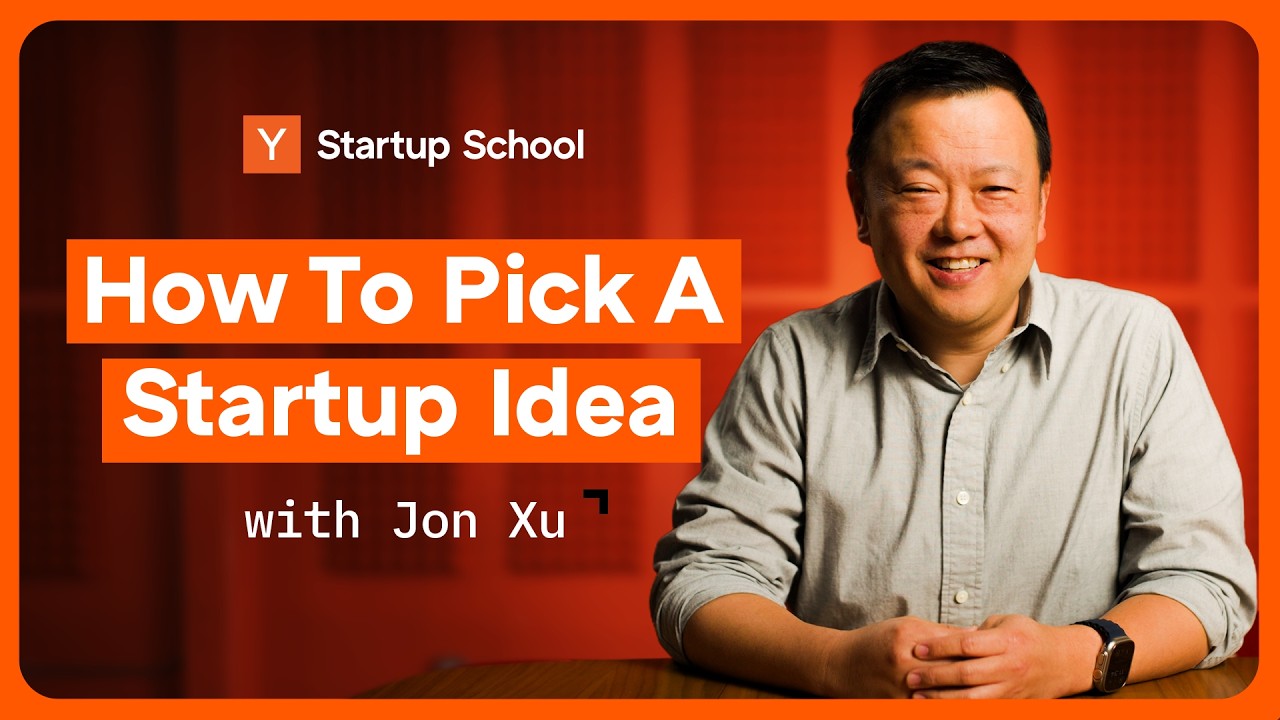
YC Partner Jon Xu Urges Founders to Pick One Startup Idea and Burn the Boats
Y Combinator
Deep commitment to a single initial concept accelerates customer discovery and exposes the stronger underlying business opportunities hidden beneath surface-level problems.
AI-assisted summary of Pick One Idea and Go Deep — original source. Check the original for full context.
Source published:
Detailed notes
## Background This video was published on YouTube by Y Combinator on June 17, 2026. In this episode of Startup School, YC General Partner Jon Xu explains why early-stage founders should avoid getting paralyzed looking for the perfect startup idea, advising them instead to pick one concept, commit fully, and go deep with real customers.
## TL;DR Jon Xu addresses the common 'idea fog' that paralyzes founders trying to pick the best startup concept. He argues that trying multiple ideas at once yields low-quality feedback, whereas picking one and 'burning the other boats' allows founders to gain true domain authority and discover deeper underlying problems. To succeed, founders must understand customer operations deeply enough to run their businesses, build at the edge of current AI capabilities, verticalize to own full outcomes, and aim for highly ambitious goals. Ultimately, moving fast in a single direction produces actionable information, while indecision remains a startup's worst failure mode.
## Atmosphere & style The presentation is direct, highly pragmatic, and authoritative, delivering clear strategic guidance with a grounded Y Combinator perspective. Xu uses vivid analogies—like 'wearing a new skin' or walking fast through an 'idea fog'—to make abstract founder dilemmas feel actionable and concrete. The overall mood is motivating yet uncompromising, pushing founders to abandon cautious overthinking in favor of relentless execution and deep customer focus.
## Key takeaways - [00:00](https://www.youtube.com/watch?v=R56RJFZBasQ&t=0s) Founders often fall into the 'perfect idea trap' or weaponize founder-market fit against themselves, delaying progress instead of making contact with reality and talking to customers. - [01:22](https://www.youtube.com/watch?v=R56RJFZBasQ&t=82s) Domain expertise can be built rapidly simply by following curiosity, going deep, and constantly seeking customer feedback. - [02:42](https://www.youtube.com/watch?v=R56RJFZBasQ&t=162s) Working on multiple ideas simultaneously yields noisy, low-quality data; founders must commit to 'in-depth first' and 'burn the other boats.' - [03:21](https://www.youtube.com/watch?v=R56RJFZBasQ&t=201s) Going deep requires completely stepping into a new skin, updating company branding, email domains, and internal narrative to build genuine domain authority. - [04:51](https://www.youtube.com/watch?v=R56RJFZBasQ&t=291s) A key test for customer understanding is whether a founder is knowledgeable enough about daily operational crises to run the customer's business or teach a college course on it. - [06:21](https://www.youtube.com/watch?v=R56RJFZBasQ&t=381s) Product development and customer dialogue must run in a tight, iterative execution loop rather than holding off on code until hundreds of interviews are completed. - [06:18](https://www.youtube.com/watch?v=R56RJFZBasQ&t=378s) In the modern AI landscape, startups should build at the absolute edge of model capabilities so that product value scales alongside frontier model improvements. - [07:15](https://www.youtube.com/watch?v=R56RJFZBasQ&t=435s) Because AI is driving software production costs to zero, defensible value now lies in verticalizing to sell complete outcomes, owning licenses, regulatory status, and customer trust. - [08:37](https://www.youtube.com/watch?v=R56RJFZBasQ&t=517s) Founders should aim for the most ambitious version of their idea, as targeting massive economic sectors costs similar energy while attracting better talent and building stronger moats. - [09:33](https://www.youtube.com/watch?v=R56RJFZBasQ&t=573s) Going deep is the best mechanism to uncover structural realities, allowing founders to pivot from surface-level ideas to the far superior idea hidden underneath. - [10:27](https://www.youtube.com/watch?v=R56RJFZBasQ&t=627s) The primary failure mode in early-stage startups is indecision; picking one direction and walking fast produces maximum actionable information.
## Detailed walkthrough ### [00:00](https://www.youtube.com/watch?v=R56RJFZBasQ&t=0s) Intro & The "Perfect Idea" Trap
Y Combinator General Partner Jon Xu works with many startup founders who are stuck in "idea fog"—paralyzed by having multiple startup concepts and struggling to choose between them. Founders often hold off on fully committing because they are waiting to find the single "best" idea first. However, making meaningful startup progress is nearly impossible without single-minded commitment. Overthinking in the early days usually takes two common forms: searching for the perfect idea in the abstract, and questioning whether one has the ideal background to build it.
Trying to evaluate an idea purely in theory fails because real insight only comes from making contact with reality and getting feedback from actual customers. Similarly, founders—especially second-time founders—often "weaponize" founder-market fit against themselves, assuming they need a decade of domain expertise before launching. While technical fit matters for specialized tools, founders can develop extraordinary domain knowledge in a short period simply by following their curiosity, going deep, and talking to customers.
- **Example — Boom Supersonic:** CEO Blake Scholl spent his early career in ad tech at Amazon and Groupon before setting out to commercialize supersonic passenger flight. Though many thought he was crazy, Boom became a billion-dollar company.
> "You can only figure out what you should be working on by making contact with reality and getting feedback from customers."
---
[02:42](https://www.youtube.com/watch?v=R56RJFZBasQ&t=162s) Why Working on Multiple Ideas Fails & How to Go Deep
Dividing focus across multiple ideas to see which one works generates noisy, low-quality data. Without going deep, founders miss genuine signal, leading them to abandon great concepts prematurely or double down on flawed ones. The solution is "in-depth first": pick one attractive option, commit completely, and "burn the other boats" by explicitly foreclosing all other paths.
Going deep means stepping into a whole new skin—becoming an almost unrecognizable version of yourself by changing company names, email addresses, landing pages, and the internal narrative of why the startup exists. Founders must operate with single-minded focus to build real domain authority.
- **Example — GovDash:** A startup helping companies win government contracts pivoted at least five times before hitting on its winning concept. With each pivot, they updated their company name, email domain, and mission statement—to the point where Xu temporarily lost track of how to contact them. By immersing themselves in government procurement, their fifth pivot took off, leading to explosive demand and a Series B raise.
> "Going deep... should feel like wearing a new skin. You should become an almost unrecognizable version of yourself."
---
[04:51](https://www.youtube.com/watch?v=R56RJFZBasQ&t=291s) Could You Run Your Customer's Business?
To evaluate depth of commitment, Xu uses a practical litmus test: *Could you actually run your customer's business tomorrow?* If building voice AI agents for cleaning services, talking to 20 business owners is not enough. You must understand their daily operational crises, whether missed calls are a top-five issue, how much revenue vanishes when a call drops, and what they would pay to fix it. Alternatively, ask if you could teach a college class on the exact problem or if you are among the most knowledgeable people on the topic worldwide.
Achieving this depth requires constant customer dialogue and sometimes doing the job manually. However, founders should not wait to write code until they have interviewed hundreds of people. Product development and customer feedback must run concurrently in a tight, iterative feedback loop: customer understanding leads to product delivery, which yields deeper customer insights and a better product.
- **Key Question:** Are you knowledgeable enough about your customer's daily operational pain points to teach a class on the subject? - **Execution Loop:** Deep Customer Understanding $\rightarrow$ Product Delivery $\rightarrow$ Deeper Insight $\rightarrow$ Refined Product Delivery.
---
[06:18](https://www.youtube.com/watch?v=R56RJFZBasQ&t=378s) Validating Ideas: Building at the Edge of AI & Verticalizing
When validating whether an idea is worth pursuing, founders should look beyond basic customer pull for specific qualitative indicators that are crucial in the modern AI landscape. First, build at the absolute edge of model capabilities—where a product barely functions on today's frontier models but will naturally scale as underlying AI improves. If a technical bottleneck impedes progress, solving that bottleneck might become the core business (echoing Paul Graham’s famous mantra to "live in the future and build what's missing").
Second, the idea should verticalize by selling complete outcomes (e.g., providing actual insurance policies or medical care) rather than basic software. Because AI is driving the marginal cost of software production toward zero, raw code is no longer the value capture point. Value now lies in owning regulatory approvals, licenses, customer trust, and full-stack outcome delivery.
- **Example — Corgi Insurance (YC S24):** Rather than remaining a tech-enabled broker or managing general agent (MGA), Corgi set out to own the entire commercial insurance stack from underwriting to customer service. They even acquired an insurance carrier during their YC batch. This full-stack approach allows Corgi to underwrite any insurance line with a fraction of traditional headcount, offering better pricing, faster turnarounds, and full ownership of unit economics.
> "In the AI era, the cost of producing software is going to zero... The things that actually become valuable aren't just software for X. They're customer trust, licenses, regulatory permission, and outcome ownership."
---
[08:37](https://www.youtube.com/watch?v=R56RJFZBasQ&t=517s) Aim at the Most Ambitious Version & Unlocking the Idea Underneath
Pursuing a modest startup idea costs roughly the same amount of time, energy, and stress as pursuing a wildly ambitious one. Therefore, founders should target the version that rewrites an entire economic sector if it succeeds. Ambitious goals attract top talent, defend against incumbents, and build enduring moats—whether that means navigating heavily regulated sectors (legal, healthcare, finance), taking on $10B SaaS incumbents, or building hardtech like space assembly robotics.
Even if the initial idea fails, going deep puts founders in a superior position. It yields concrete customer data, clear signal on whether a problem is truly "hair-on-fire," and real conviction for a pivot. Most importantly, initial ideas usually address surface-level symptoms; digging deep exposes the underlying structural problems where true startup opportunities lie.
- **Key Insight:** Going deep is rarely just about validating the original idea—it is the fastest mechanism to discover the far better idea hidden beneath it. - **AI Ecosystem Opportunity:** Operating at the edge of AI capabilities inevitably exposes missing infrastructure, operational bottlenecks, and developer tools that need to be built.
---
[10:27](https://www.youtube.com/watch?v=R56RJFZBasQ&t=627s) Walk Fast in One Direction
In the early "idea fog," where visibility is limited to ten feet, the natural instinct is to take cautious steps in every direction. However, sampling options without committing generates almost zero actionable information. The winning playbook is picking one direction and walking fast. Moving briskly produces maximal information per unit of time and brings founders to valuable destinations they could not have anticipated from the start.
- **The Primary Failure Mode:** The worst outcome in a startup is not being wrong; it is failing to make a decision—spinning wheels, dabbling across ideas, and never going deep enough anywhere to learn anything. - **Core Directive:** Stop searching for the perfect idea. Pick one, burn the other boats, and go deep.
## Notable quotes > [00:00](https://www.youtube.com/watch?v=R56RJFZBasQ&t=0s) You can only figure out what you should be working on by making contact with reality and getting feedback from customers. — Jon Xu
> [02:42](https://www.youtube.com/watch?v=R56RJFZBasQ&t=162s) Going deep... should feel like wearing a new skin. You should become an almost unrecognizable version of yourself. — Jon Xu
> [04:51](https://www.youtube.com/watch?v=R56RJFZBasQ&t=291s) Could you actually run your customer's business tomorrow? — Jon Xu
> [06:18](https://www.youtube.com/watch?v=R56RJFZBasQ&t=378s) In the AI era, the cost of producing software is going to zero... The things that actually become valuable aren't just software for X. They're customer trust, licenses, regulatory permission, and outcome ownership. — Jon Xu
## Mentioned Y Combinator, Jon Xu, Boom Supersonic, Blake Scholl, Amazon, Groupon, GovDash, Corgi Insurance, Paul Graham
[Source](https://www.youtube.com/watch?v=R56RJFZBasQ)