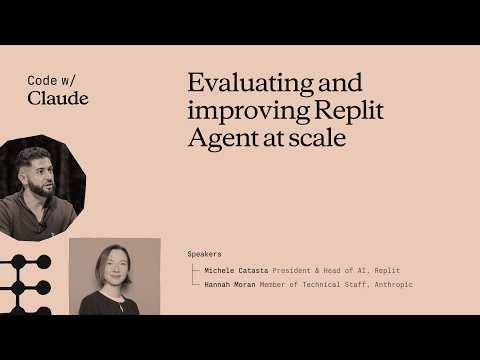
Replit Battles Agent Failure Patterns With New ByBench Platform
Claude
Traditional software evaluations fail for natural-language vibe coding because AI models struggle to build features on top of unverified, agent-generated code foundations.
## Background
Published on YouTube by the Claude channel on May 08, 2026, this video features Michele Catasta, President & Head of AI at Replit, and Hannah Moran from Anthropic. The page description outlines how the presentation covers closing the gap in AI product evaluations using ViBench and an offline/online evaluation loop behind Replit Agent to turn weeks of engineering into compounding overnight gains.
## TL;DR
The video discusses the unique challenges of evaluating 'vibe-coding' agents, where users generate full applications from natural language without writing tests or codebases. To address this, Replit introduces ByBench, an open-source, end-to-end evaluation suite that simulates real user interactions through an automated, browser-based evaluator agent. Additionally, the presentation details Replit's 'Telescope' loop, which automatically clusters production failure traces, generates fixes via coding agents, and passes them through a rigorous testing pipeline. Ultimately, the speakers emphasize that despite heavy automation, human taste and product philosophy remain critical to navigating conflicting A/B metrics and building tools for non-technical users.
## Atmosphere & style
The session feels highly professional, technical, and forward-looking, blending the excitement of cutting-edge AI development with the practical realities of shipping software daily. Michele Catasta presents with an analytical yet enthusiastic energy, injecting casual humor when describing technical phenomena like 'slop on slop' scenarios. The dynamic shifts into a collaborative, reflective dialogue during the Q&A with Hannah Moran, moving from dense engineering workflows to thoughtful reflections on developer philosophy and the evolution of user experience.
## Key takeaways
- [00:21](https://www.youtube.com/watch?v=snroDwX1-JU&t=21s) The rise of "vibe coding"—where users create applications entirely from natural language without providing frameworks, tests, or implementation details—requires a fundamental shift away from traditional software developer evaluation methods.
- [00:21](https://www.youtube.com/watch?v=snroDwX1-JU&t=21s) To keep pace with rapidly evolving models, constant prompt updates, and daily agent releases, companies must transition from static, human-graded evaluations to continuous, automated feedback loops.
- [03:39](https://www.youtube.com/watch?v=snroDwX1-JU&t=219s) Replit's evaluation architecture relies on two distinct pillars: offline benchmarks that act as pre-release gatekeepers to catch regressions, and online evaluations that run A/B tests and cluster production traces.
- [03:39](https://www.youtube.com/watch?v=snroDwX1-JU&t=219s) Traditional benchmarks like SWE-bench or HumanEval are inadequate for vibe coding because they require applying patches to existing repositories with pre-written tests, whereas vibe-coding users typically start from an empty codebase.
- [05:55](https://www.youtube.com/watch?v=snroDwX1-JU&t=355s) Replit launched ByBench, an open-source, end-to-end benchmark for vibe coding that evaluates an application's functional correctness directly from a Product Requirements Document (PRD) using real-world usage traces.
- [08:55](https://www.youtube.com/watch?v=snroDwX1-JU&t=535s) To scale grading without expensive human evaluation, ByBench utilizes an automated evaluator agent that interacts with the generated web application through a browser using natural language testing instructions.
- [08:55](https://www.youtube.com/watch?v=snroDwX1-JU&t=535s) Initial ByBench data reveals a near 2x performance gap in functional application generation between frontier closed-source models and open-weights models.
- [08:55](https://www.youtube.com/watch?v=snroDwX1-JU&t=535s) Models suffer a significant performance penalty when forced to build on top of unverified, agent-generated codebases (the "slop on slop" scenario), highlighting the necessity of intermediate testing steps.
- [11:50](https://www.youtube.com/watch?v=snroDwX1-JU&t=710s) Agent developers should invest in A/B testing infrastructure early because offline benchmarks only capture part of the real-world operational truth.
- [11:50](https://www.youtube.com/watch?v=snroDwX1-JU&t=710s) Replit monitors unique online metrics to gauge agent health, including tracking user sentiment directly from incoming prompts to detect frustration and measuring app publication rates as a positive success signal.
- [11:50](https://www.youtube.com/watch?v=snroDwX1-JU&t=710s) A/B test results for agents are rarely clear-cut, often presenting conflicting data regarding run duration, cost, and user sentiment that require human product philosophy to interpret and resolve.
- [11:50](https://www.youtube.com/watch?v=snroDwX1-JU&t=710s) Replit utilizes semantic trace clustering via LLMs rather than rigid regex log parsing to classify millions of daily production failures, retraining these cluster configurations every night to track fixes.
- [16:29](https://www.youtube.com/watch?v=snroDwX1-JU&t=989s) Replit's internal "Telescope" system automates the engineering cycle by identifying failure clusters, generating PR patches via a coding agent, and evaluating changes against a benchmark litmus test.
- [18:20](https://www.youtube.com/watch?v=snroDwX1-JU&t=1100s) A production race condition where the agent aggressively tried to debug an environment that wasn't fully spun up was invisible to standard logs but easily identified through Telescope's semantic trace clustering.
- [19:37](https://www.youtube.com/watch?v=snroDwX1-JU&t=1177s) Human "taste" and strategic prioritization remain essential to guide automated coding agents, formulate hypotheses about failures, and define the core optimization goals of the product.
- [21:47](https://www.youtube.com/watch?v=snroDwX1-JU&t=1307s) Public, open-source evaluations like Vibez benefit the entire AI community, and long-context frontier models make it highly practical to feed full agent traces into these systems for sophisticated feedback.
- [25:12](https://www.youtube.com/watch?v=snroDwX1-JU&t=1512s) Because highly technical teams are building vibe-coding tools for non-technical knowledge workers, engineering taste must be intentionally calibrated to make design choices opposite to personal developer preferences.
Mikael Carbin, President and Head of AI at Replit, introduces the core challenge of evaluating and improving the Replit Agent at scale on a daily basis. Replit operates as a "vibe-coding" platform for knowledge workers, a space they have been actively developing for nearly two years. Unlike traditional software development tools, vibe coding represents an extreme paradigm: users start with nothing more than a natural language specification of what they want. They do not specify frameworks, write tests, or provide implementation details; they simply expect a fully working application to emerge from a single prompt. Because of this, traditional evaluation methods designed for software developers must fundamentally change.
Tracking daily agent improvements is incredibly difficult because the underlying models are in constant flux, with the pace of evolution accelerating. To keep up, Replit must constantly modify system prompts, user prompts, and tool definitions while shipping multiple releases of the Replit Agent to millions of users every single day. Carbin argues that the industry must move away from "old-school" evaluations—which typically run statically, produce a single human-graded score, and treat the agent as a black box—and transition toward a continuous evaluation setting. Because Replit's production environment generates millions of execution traces daily, there is an immense amount of "hot fat" (valuable signal) to be extracted directly from real-world usage.
- **Vibe Coding Definition:** Going from a natural language prompt to a working application with zero user-provided implementation constraints or tests.
- **The Shifting Ground:** Constant model updates, prompt adjustments, and tool definition changes require a continuous, automated evaluation loop rather than static benchmarks.
- **Continuous Evaluation Goals:** Optimize for what users actually care about, immediately highlight what is breaking, and inform the engineering team on what to ship next.
---
[03:39](https://www.youtube.com/watch?v=snroDwX1-JU&t=219s) The Two Pillars of Replit's Evaluation System
To achieve constant improvement, Replit has built a system resting on two distinct pillars. The first pillar consists of standard offline benchmarks, which act as a gatekeeper or "boolean flag" before any new agent version is shipped. If a major regression is detected on these offline benchmarks, the release is immediately halted; if the results are neutral or positive, the release proceeds. The second, more intriguing pillar is online evaluation. Once a version is shipped, Replit runs extensive A/B tests and clusters production traces to gain rapid, actionable insights. This creates a tight feedback loop: engineers reflect on the results of both pillars, modify the code, run the evaluations, and "rinse and repeat" daily.
Carbin explains why famous benchmarks like SWE-bench or HumanEval are insufficient for vibe coding. While these benchmarks have played a key role in climbing model leaderboards, they rely on a specific protocol: applying a generated code patch to an existing repository and running pre-written tests. In vibe coding, users do not write tests and often start from a completely empty codebase. There is no existing repository to patch; everything is built from the ground up. Therefore, evaluations must measure functional correctness—whether the application actually does what the user asked—rather than just checking if a code patch compiles or passes a unit test.
- **Offline Pillar:** Acts as a pre-release gatekeeper to catch major regressions.
- **Online Pillar:** Analyzes production traces and runs A/B tests post-release to force rapid reaction times.
- **The Functional Correctness Gap:** Traditional benchmarks fail because they require pre-existing test suites and codebases, whereas vibe coding starts from a completely green field.
---
[05:55](https://www.youtube.com/watch?v=snroDwX1-JU&t=355s) Introducing ByBench: An End-to-End Vibe-Coding Benchmark
To bridge this gap, Carbin announces the launch of **ByBench**, a new public, open-source benchmark for end-to-end vibe coding that Replit has spent several months developing. The input for ByBench is simply a Product Requirements Document (PRD)—essentially a long, plain-English prompt describing an application. Rather than using synthetic data, Replit curated 20 real-world traces from actual Replit usage, completely free of implementation constraints. The benchmark harness builds the application from an empty repository to a functional state. Crucially, instead of relying on slow, expensive human evaluation to grade the output, Replit built automated, AI-driven evaluators, allowing the benchmark to run every single time a new pull request is merged.
The evaluation protocol supports multiple implementation strategies. The most basic is a "single shot zero to one" build from a PRD. More advanced setups include:
* **ByBench Ref (Reference):** Starting from a working reference implementation and building a new feature on top of it.
* **ByBench Vibe:** Starting from an agent-generated MVP and building a feature on top of it. Carbin jokingly refers to this in "AI lingo" as "slop on slop"—building unverified agent code on top of more unverified agent code to see if it holds up.
* **Agent 4 Parallel Scenario:** Taking a PRD, performing task decomposition, running agents in parallel, and merging the patches. This is highly challenging for standard coding agents.
* **Buggy App Extension:** Starting from a buggy application, attempting to build a feature, and measuring how much the agent struggles to make it work.
---
[08:55](https://www.youtube.com/watch?v=snroDwX1-JU&t=535s) How the Automated Evaluator Works and Key Results
The core complexity of ByBench lies in the grading. Because Replit users can choose any programming language or framework, the evaluator must be completely agnostic to the underlying implementation. To solve this, Replit built an evaluator agent that reads the generated codebase, opens a browser, points it to the running application, and executes a natural language testing plan step-by-step (e.g., "open the admin dashboard, log in with a certain account, and click on this toggle"). If any step fails, the evaluator collects the failure data and generates a functional correctness score. This greenfield evaluation surface represents a major shift from the fixed, predictable environments of SWE-bench.
Carbin shares some of the most notable initial results from ByBench, which is open-sourced at `bybench.ai` and will be presented at an upcoming conference on AI and agentic systems. First, there is a massive "almost 2x gap" in performance between frontier closed-source models and open-weights models. Carbin hopes the community will embrace the benchmark to drive progress across both categories. Second, most models perform significantly worse when extending their own code (the "slop on slop" scenario). This highlights the critical need for an intermediate testing step when building features, otherwise applications are built on "shaking foundations" and eventually fail.
- **Agnostic Browser-Based Testing:** The evaluator agent physically interacts with the web app in a browser using natural language instructions.
- **Frontier vs. Open Weights:** A near 2x performance gap exists, showing that open-weights models still struggle heavily with end-to-end application generation.
- **The "Slop on Slop" Penalty:** Models struggle significantly more when forced to build on top of unverified, agent-generated code bases.
---
[11:50](https://www.youtube.com/watch?v=snroDwX1-JU&t=710s) Harnessing Millions of Production Traces via Online Evals
While ByBench provides a robust offline evaluation suite, Replit relies heavily on its online pillar because of the sheer volume of signal it provides. While ByBench currently evaluates around 20 applications (and welcomes community contributions to expand this), Replit's production environment collects millions of unscripted user sessions daily. To make sense of this data, Replit runs continuous A/B tests. Carbin strongly advises all agent builders to invest in A/B testing infrastructure as early as possible to keep their development honest, noting that offline benchmarks only tell part of the story.
Replit tracks a wide variety of online metrics, such as identifying if an agent run is spinning in an infinite loop ("normal span ongoing") or tracking user sentiment. Sentiment analysis is performed directly on incoming user prompts to detect if a user is becoming frustrated. Additionally, a highly positive signal unique to Replit is whether a user chooses to publish their application to the public or share it with colleagues.
However, interpreting A/B tests is rarely straightforward. Carbin displays a sample dashboard showing conflicting metrics: one candidate agent run was 7% longer but 8% cheaper, accompanied by minor fluctuations in user sentiment. "This is the harsh truth about running an A/B test," Carbin notes; they rarely provide a crystal-clear signal, meaning human taste and product philosophy still play a vital role in deciding what to ship. To generate better candidates, Replit clusters millions of daily traces. They embed failure summaries, group them by type, and pass them to an LLM to classify the issues semantically rather than relying on rigid regex log parsing. Because Replit ships multiple times a day, these cluster configurations are retrained every single night to track whether specific failure modes disappear after a fix is deployed.
[16:29](https://www.youtube.com/watch?v=snroDwX1-JU&t=989s) The Telescope Loop: Automated Code Generation and Evaluation
Michele introduces "Telescope," an internal technology built at Replit that automates the process of discovering, patching, and evaluating agent issues. The system operates in a continuous loop. First, Telescope discovers problems using semantic trace clustering. Once a cluster of failures is identified, a coding agent automatically generates code changes and cuts a pull request (PR) using information gathered from traces, logs, and dashboards.
To ensure these automated changes do not introduce regressions, they are put through a series of evaluations. The first test is "PyBench," which acts as a litmus test; if the benchmark score drops by 10 points, the change is immediately rejected as a breaking change. If a change is controversial or has complex trade-offs, the team runs an AB test with real users to observe the effects. If the change is a "clear sure shot," it is shipped directly to production. Michele notes that this workflow mirrors the daily life of an AI engineer, but with "90% of it... now aided by an agent in the loop" to save engineers from sweating over every single step.
- **Telescope Loop Steps**: Discover problems (trace clustering) $\rightarrow$ Create code changes (automated PRs via coding agent) $\rightarrow$ Evaluate changes (PyBench litmus test) $\rightarrow$ Run AB tests (for controversial changes) or ship directly (for sure shots) $\rightarrow$ Iterate if necessary.
- **PyBench Threshold**: A drop of 10 points or more classifies a PR as a bad, breaking change.
[18:20](https://www.youtube.com/watch?v=snroDwX1-JU&t=1100s) Production Example: The Eager Agent and the Setup Race Condition
Michele shares a concrete production anecdote to illustrate Telescope's power. When a user submits a prompt, the Replit Agent immediately spins up an execution environment, which takes several seconds due to its underlying complexity. During a degradation in the long tail, the setup time took longer than expected, meaning the agent was ready to execute before the environment was fully prepared. Because modern agents are "really eager to fix problems," the Replit Agent went on a tangent and tried to debug and fix the environment on the spot.
Because agents are non-deterministic, every single debugging session looked slightly different in the logs, making the issue nearly invisible to traditional log analysis. However, by clustering the traces through a semantic layer, Telescope easily identified this recurring pattern. The team quickly created a patch and fixed the issue without needing an AB test, as it was a clear regression.
[19:37](https://www.youtube.com/watch?v=snroDwX1-JU&t=1177s) The Role of Human Taste and Product Philosophy
Despite his enthusiasm for automation, Michele emphasizes that human intellect and "taste" remain critical. When Telescope identifies failure clusters, the human team must formulate hypotheses about what is going wrong. Because production environments yield an overwhelming number of candidate issues, humans must prioritize where to allocate resources. Instead of letting the agent write PRs completely unsupervised, the engineers feed their own understanding and guidance into the agent.
Ultimately, choosing which PRs to pursue and analyzing AB tests shapes the "hill that we try to optimize." For instance, if the goal is to make the product more affordable, the team will focus on fixing anomalous spend clusters. These decisions define the core product philosophy. Michele concludes his presentation by urging the audience not to view evaluation as a mere "boolean flag" or a final check before shipping, but as "an engine that allows you to ship a better agent every single day."
- **Human Roles in the Loop**: Formulating hypotheses, prioritizing clusters, guiding the coding agent with human understanding, and making the final decision to launch an AB-tested change.
[21:47](https://www.youtube.com/watch?v=snroDwX1-JU&t=1307s) Q&A: Open-Sourcing Vibez and Lessons from Building Telescope
Hannah from the Applied AI team at Anthropic joins Michele on stage. She notes that Replit has used their evaluation tool, "Vibez," to give feedback to Anthropic on research models, and asks why Michele chose to open-source it rather than keeping it as a proprietary advantage. Michele explains his research background, stating, "I don't believe in competing on evaluations." He believes that public evals help the entire community build better models, agents, and products, and notes that he finally decided to build Vibez because inviting others to do so wasn't enough.
Hannah then asks for advice for audience members looking to build a system like Telescope. Michele points out that frontier models with long contexts and advanced reasoning capabilities (such as Claude 3.5 Sonnet/Opus) make it highly practical to inject an entire agent trace to get sophisticated feedback. He advises builders to collect as much signal as possible, combining agent traces with user feedback forms and platform instrumentation like DataDog.
- **Telescope Data Sources**: Agent traces, user feedback forms, and platform metrics (DataDog).
- **Community Call**: Michele invites the community to collaborate on Vibez rather than building isolated, private evaluations.
[25:12](https://www.youtube.com/watch?v=snroDwX1-JU&t=1512s) Developing "Taste" for Non-Technical Users
Hannah asks Michele to elaborate on how his team develops and refines their "taste" as AI engineers. Michele laughs, recalling that a year and a half ago, agents were so weak that "it was more like a survival game just to make sure it was barely functional," leaving little room for taste. Now that models are incredibly powerful, builders face a wide variety of choices where taste becomes essential.
Developing this taste requires staying deeply in tune with the actual user base. Michele points out a unique challenge at Replit: while everyone on the Replit team is highly technical, they are building a product for "knowledge workers who have never written a single line of code." Therefore, their engineering taste must be calibrated for non-technical users, which often means making the exact opposite design choices of what they would prefer for themselves. Hannah closes the session by thanking Michele and inviting the audience to find him and Peter (one of the authors of Vibez) to ask further questions.
## Notable quotes
> [00:21](https://www.youtube.com/watch?v=snroDwX1-JU&t=21s) Unlike traditional software development tools, vibe coding represents an extreme paradigm: users start with nothing more than a natural language specification of what they want. — Mikael Carbin
> [00:21](https://www.youtube.com/watch?v=snroDwX1-JU&t=21s) Because Replit's production environment generates millions of execution traces daily, there is an immense amount of "hot fat" (valuable signal) to be extracted directly from real-world usage. — Mikael Carbin
> [03:39](https://www.youtube.com/watch?v=snroDwX1-JU&t=219s) In vibe coding, users do not write tests and often start from a completely empty codebase. There is no existing repository to patch; everything is built from the ground up. — Mikael Carbin
> [05:55](https://www.youtube.com/watch?v=snroDwX1-JU&t=355s) slop on slop — Mikael Carbin
> [08:55](https://www.youtube.com/watch?v=snroDwX1-JU&t=535s) This greenfield evaluation surface represents a major shift from the fixed, predictable environments of SWE-bench. — Mikael Carbin
> [08:55](https://www.youtube.com/watch?v=snroDwX1-JU&t=535s) most models perform significantly worse when extending their own code — Mikael Carbin
> [11:50](https://www.youtube.com/watch?v=snroDwX1-JU&t=710s) This is the harsh truth about running an A/B test — Mikael Carbin
> [16:29](https://www.youtube.com/watch?v=snroDwX1-JU&t=989s) 90% of it... now aided by an agent in the loop — Michele Catasta
> [18:20](https://www.youtube.com/watch?v=snroDwX1-JU&t=1100s) really eager to fix problems — Michele Catasta
> [19:37](https://www.youtube.com/watch?v=snroDwX1-JU&t=1177s) an engine that allows you to ship a better agent every single day. — Michele Catasta
> [21:47](https://www.youtube.com/watch?v=snroDwX1-JU&t=1307s) I don't believe in competing on evaluations. — Michele Catasta
> [25:12](https://www.youtube.com/watch?v=snroDwX1-JU&t=1512s) it was more like a survival game just to make sure it was barely functional — Michele Catasta
> [25:12](https://www.youtube.com/watch?v=snroDwX1-JU&t=1512s) knowledge workers who have never written a single line of code. — Michele Catasta
## Mentioned
Replit, Replit Agent, ViBench, Claude, Michele Catasta, Mikael Carbin, Hannah Moran, Anthropic, SWE-bench, HumanEval, ByBench, bybench.ai, ByBench Ref, ByBench Vibe, Agent 4 Parallel Scenario, Telescope, PyBench, DataDog, Claude 3.5 Sonnet, Claude 3.5 Opus, Vibez, Peter
Mikael Carbin, President and Head of AI at Replit, argues that evaluating and improving software agents at scale requires moving beyond static code-patch benchmarks toward continuous, production-integrated evaluation loops measuring end-to-end functional correctness.
Limits of Traditional Developer Benchmarks (0:21)
Traditional evaluation suites like SWE-bench and HumanEval rely on applying generated code patches to existing repositories with established unit test suites. Carbin asserts this paradigm is poorly suited for 'vibe coding,' where users provide only high-level natural language prompts and expect a functional application without specifying frameworks, architecture, or test suites. Because users start from greenfield, empty repositories, passing a unit test or compiling a patch is insufficient to determine whether an application actually works.
Furthermore, because underlying foundation models, system prompts, and tool interfaces change constantly, static evaluations scored by humans cannot keep up with platforms shipping multiple daily agent updates to millions of users. Effective agent evaluation must instead track real-world functional correctness—verifying whether an application fulfills the user's intent—while leveraging continuous execution data from production environments.
Agnostic Functional Testing via ByBench (5:55)
To address the absence of relevant greenfield benchmarks, Replit introduced ByBench, an open-source evaluation suite built around 20 real-world user traces initiated from Product Requirements Documents (PRDs). Rather than relying on synthetic codebases or slow human reviews, ByBench evaluates generated applications using an automated evaluator agent. This agent inspects the running web application in a browser and executes natural language testing workflows step by step, remaining completely agnostic to the programming language or framework chosen by the model.
Early benchmark findings revealed an approximate 2x performance gap between frontier closed-source models and open-weights alternatives. Additionally, ByBench exposed a steep performance drop across models when tasked with extending their own generated codebases—a scenario Carbin termed 'slop on slop.' Without intermediate testing phases, agents struggle to build on top of unverified code, compounding architectural flaws.
Semantic Trace Clustering and Telescope (16:29)
While ByBench provides offline gating, Replit captures primary engineering signals by analyzing millions of unscripted daily user traces. Because non-deterministic agent outputs generate distinct logs for identical underlying bugs, conventional regex parsing proves ineffective. Replit instead embeds failure summaries and clusters them semantically with language models—retraining cluster definitions nightly—to catch recurring failure modes, such as agents prematurely trying to fix execution environments before system setup finishes.
This operational pipeline feeds into 'Telescope,' an internal system where coding agents automatically generate pull requests to fix identified failure clusters using trace and log data. Proposed fixes undergo automated litmus evaluations, where a score drop of 10 points or more triggers immediate rejection. Non-regressive or controversial changes are routed into live A/B tests to measure real-world user impact before deployment.
Calibrating Human Taste for Non-Technical Users (19:37)
Although Replit automates roughly 90% of its issue discovery and patching workflow with agents in the loop, Carbin emphasizes that human judgment remains crucial for prioritizing failure clusters and resolving conflicting telemetry. In production A/B testing, dashboards frequently show trade-offs rather than obvious wins—such as an agent candidate being 7% slower but 8% cheaper alongside minor sentiment shifts—requiring human product philosophy to dictate which trade-offs to accept.
Engineers must also calibrate their judgment to match their user base. While Replit's engineers are deeply technical, their platform is primarily used by non-technical knowledge workers who have never coded. As a result, product intuition and design decisions must frequently counter an engineer's personal preferences to serve users who prioritize working software over conventional engineering norms.
Carbin concludes that evaluation must function as an active development engine rather than a static pre-deployment check, though maintaining this pipeline requires navigating ambiguous production trade-offs and bridging the substantial capability divide between proprietary frontier models and open-weights alternatives.
[0:21] Mikael Carbin: Unlike traditional software development tools, vibe coding represents an extreme paradigm: users start with nothing more than a natural language specification of what they want.
[0:21] Mikael Carbin: Because Replit's production environment generates millions of execution traces daily, there is an immense amount of "hot fat" (valuable signal) to be extracted directly from real-world usage.
[3:39] Mikael Carbin: In vibe coding, users do not write tests and often start from a completely empty codebase. There is no existing repository to patch; everything is built from the ground up.
[5:55] Mikael Carbin: slop on slop
[8:55] Mikael Carbin: This greenfield evaluation surface represents a major shift from the fixed, predictable environments of SWE-bench.
[8:55] Mikael Carbin: most models perform significantly worse when extending their own code
[11:50] Mikael Carbin: This is the harsh truth about running an A/B test
[16:29] Michele Catasta: 90% of it... now aided by an agent in the loop
[18:20] Michele Catasta: really eager to fix problems
[19:37] Michele Catasta: an engine that allows you to ship a better agent every single day.
[21:47] Michele Catasta: I don't believe in competing on evaluations.
[25:12] Michele Catasta: it was more like a survival game just to make sure it was barely functional
[25:12] Michele Catasta: knowledge workers who have never written a single line of code.
Original transcript
[0:21] All right. Hi everyone. I'm Mikael Cata
[0:24] president and head of AI at Replit. And
[0:27] today I'm going to be talking about our
[0:29] both evaluating and improving on a daily
[0:31] basis Replit agent at scale.
[0:34] And as you know, Replit is a back-coding
[0:36] platform for knowledge workers. We're
[0:38] one of the top players in the space and
[0:40] we've been literally battling with this
[0:42] problem for the last you know almost 2
[0:44] years.
[0:45] The key difference between I would say
[0:47] back-coding has a very broad definition.
[0:50] It ranges all the way from being used by
[0:52] software developers. But in our specific
[0:55] case is even more of an extreme
[0:56] definition where you start from just a
[0:59] natural language specification of what
[1:01] the user wants and literally nothing
[1:03] else. So the user expects to go from a
[1:06] prompt to a working application, but
[1:08] they don't tell us what kind of
[1:10] framework they want to use. They don't
[1:12] write tests. They just expect things to
[1:15] work after you know our the agent run.
[1:18] So it means that a lot of the
[1:20] evaluations and a lot of the ways in
[1:22] which we've been building agents in the
[1:24] past especially for software developers
[1:26] has to fundamentally change.
[1:29] Now,
[1:30] how do we track internally the fact that
[1:33] the agent gets better on a daily basis
[1:34] and is actually aligned with all with
[1:36] what our users want?
[1:38] This is especially challenging because
[1:40] if you think about it, models are
[1:42] changing almost constantly and if
[1:44] anything the pace of evolution is even
[1:46] faster than it was a year ago. So we are
[1:48] always sit on shifting grounds. Models
[1:51] change fast. We have to change our
[1:54] prompts, system prompts, user prompts
[1:56] very often, you know, to comply to the
[1:58] new features that we're building in
[1:59] product. Of course, the tools
[2:01] definitions are changing as well. We're
[2:03] adding more of them, we're simplifying,
[2:05] and we're shipping constantly. Every
[2:08] single day we have multiple releases of
[2:10] wrap agent, which we put in front of,
[2:11] you know, millions of users.
[2:15] So, my argument today for this talk will
[2:17] be that we have to fundamentally rethink
[2:19] how we do evaluations.
[2:21] On the left side, you can see how evals
[2:25] look like for basically, you know, since
[2:26] since we've been working on AI. Um they
[2:30] you run your evaluation, you they
[2:33] produce a single score, and that score
[2:35] is produced by a human. And what the
[2:37] human decides based on the score is, my
[2:39] agent harnesses better than it was
[2:40] before or it regress, or my model is
[2:43] better than before, or we should be
[2:44] doing, you know, more post training.
[2:46] That's how how we've been doing this,
[2:47] you know, for a for a long time.
[2:49] I argue that we should move more and
[2:51] more towards a continuous setting of
[2:53] evaluations, where especially when you
[2:56] actually have something runs in
[2:57] production, and in our case it generates
[2:59] millions of traces every day, there is a
[3:01] lot of hot fat to be extracted from the
[3:03] traces themselves.
[3:05] So, what we do is we have a combination
[3:07] of fine evals, so very similar to sweet
[3:10] bench and other benchmarks that are very
[3:11] famous in the space, as well as online
[3:14] evaluations based on the on the system
[3:16] usage.
[3:17] What do we want our evals to capture?
[3:19] Fundamentally, first of all, they need
[3:21] to optimize what our users care about,
[3:24] you know, rather than just telling us if
[3:26] the agent is editing code correctly.
[3:29] They should also highlight immediately
[3:30] what is breaking, and they should inform
[3:33] us where what we should be shipping next
[3:36] in terms of improvement for our agent.
[3:39] What goes into this
[3:41] box, this black box? So, we're building
[3:43] a new system that allows us to do these
[3:45] constant improvements.
[3:47] The system looks in the following way.
[3:49] We have two pillars. On one end, we have
[3:53] the standard old-school benchmarks. They
[3:55] are usually employed before shipping a
[3:59] new version of the agent. Think of them
[4:00] sort of as a boolean flag. It's a
[4:02] gatekeeper before deciding if you should
[4:04] be launching a new version or not. So,
[4:06] if there is a major regression on an
[4:08] offline benchmark, of course you stop
[4:10] your release. If you see no changes or
[4:13] positive changes, you know that you can
[4:14] go on.
[4:15] But the part that is more intriguing and
[4:17] is what is helping us to make constant
[4:19] progress is the fact that we do a lot of
[4:22] baby testing and we also cluster all the
[4:25] traces that we obtain in production and
[4:27] we try to gain insights from them. So,
[4:29] in this case,
[4:31] the online pillar actually works after
[4:33] you ship a version of the agent and it
[4:35] forces you to react as fast as possible.
[4:39] And the loop here is, once I have these
[4:41] two pillars in place, you reflect on the
[4:43] results that both of them are giving
[4:44] you, you likely change the code once
[4:46] again, run your eval, rinse and repeat.
[4:49] And this is the cycle that we go we are
[4:51] going through every single day at
[4:52] Replit.
[4:55] I mentioned before SweetBench and I want
[4:58] to give you a quick understanding why
[5:00] we work on something, you know, more
[5:02] powerful than SweetBench or at least
[5:04] like more tailored towards our use case.
[5:07] Um something as SweetBench, HumanEval,
[5:09] they played a key role in our space, you
[5:12] know, to allow us to air climb them and
[5:14] make models more powerful. But
[5:16] eventually, they all follow the same
[5:17] protocol.
[5:18] Uh you make sure that the code that is
[5:20] generated complies with the user prompt,
[5:22] then you apply the patch on your
[5:24] repository, you run the test. If the
[5:26] tests are passing, you know, you you
[5:28] have a higher score on the benchmark.
[5:30] This does not reflect what happens in by
[5:32] coding. As I was mentioning before,
[5:34] users are not writing the tests. They
[5:36] often start from a completely empty code
[5:38] base. So, there is not a scenario where
[5:39] you can just apply patches. You're
[5:41] building things from the ground up.
[5:43] So, what we need to capture in instead
[5:46] is does the app do what the user asked?
[5:48] So, there is a functional correctness
[5:51] gap between what SweetBench provides and
[5:53] what we were working on.
[5:55] And today on stage, I'm launching
[5:59] ByBench. It's a new public benchmark for
[6:02] back-coding end-to-end that we worked on
[6:05] at Raptic for several months. I'm going
[6:07] to give you all the details after the
[6:08] URL and so forth, but let's start from
[6:10] the setup of the benchmark. The input is
[6:14] just a PRD. It's literally like a long
[6:16] prompt that describes how to build an
[6:18] application.
[6:19] Rather than crafting them from synthetic
[6:22] data, we pick 20 real-world traces from,
[6:26] you know, usage of Raptic, just plain
[6:28] English specifications
[6:30] without any implementation constraints.
[6:32] Then, we have an harness that builds the
[6:35] application end-to-end. So, it goes from
[6:38] an empty repo into something functional.
[6:40] And then, the key insight is rather than
[6:43] stopping the benchmark here and then
[6:45] having humans evaluating the output of
[6:47] those PRDs, we built automated
[6:49] evaluators. This is what allows you to
[6:52] go from a benchmark that you run maybe
[6:54] on a weekly basis into something that
[6:56] you can run every single time you
[6:57] literally have a new PR merge in your
[6:59] repository. So, of course, as you can
[7:01] imagine, we have AI running all the
[7:03] evaluations on our behalf.
[7:06] The
[7:07] the setup is the following. There is one
[7:10] core, and the protocol is you have an
[7:13] you have a input, you have an
[7:15] implementation strategy, and then you
[7:17] have a set of our core, sorry, our wired
[7:19] evaluations that you run on your app.
[7:21] And we came up, you know, with five
[7:23] different pairings, but in reality,
[7:26] there are a lot more pairings that you
[7:27] could come up with yourself. The most
[7:29] basic pairing is the input is the PRD,
[7:32] and we build the application single shot
[7:35] zero to one.
[7:36] Then, maybe in order, you know, to go
[7:39] from uh less complicated to more
[7:41] advanced, we have something called by
[7:43] bond ref or like the reference
[7:44] implementation where we start from
[7:46] something is already working and we
[7:48] build a feature on top of that.
[7:50] Let's make it more advanced. We have by
[7:52] bond vibe where we start from an agent
[7:55] on MVP and then we build a new feature
[7:57] on top of that. Maybe this is something
[8:00] that in the X lingo you would call slop
[8:02] on slop. So if we have something that's
[8:04] been built by the agent not verified and
[8:06] then you had more agent code written on
[8:08] top of that and then you run the
[8:10] evaluations to see if it's working or
[8:11] not. You can keep making this
[8:14] arbitrarily more complex. Uh for example
[8:16] on in agent four that we launched a
[8:18] couple of months ago, we completely hide
[8:20] the complexity of doing task
[8:22] decomposition and running agents in
[8:24] parallel and then merging all the
[8:26] patches together. So
[8:28] we can also take as an input the PRD, we
[8:30] do the task decomposition, we run all of
[8:33] that in parallel and then we run the
[8:34] valves after that. As you can imagine
[8:36] the parallel plus merge scenario is far
[8:39] more uh you know, challenging for a
[8:41] standard coding agent.
[8:43] I give you here some more ideas we
[8:44] describing in the paper, you know, but
[8:46] you can even start from a buggy
[8:47] application, build a feature on top of
[8:49] that and see how much your agent
[8:50] struggles, you know, to actually make it
[8:52] make it work correctly.
[8:55] So the the key question or the
[8:57] complexity here is how do you actually
[8:59] do the grading? And that's what I told
[9:01] you before, you know, was where we spent
[9:02] most of our effort. It turns out that
[9:05] when we're working on our previous
[9:06] version of the agent, we put quite a lot
[9:08] of effort in building an automated, you
[9:10] know, app testing feature which
[9:12] literally doesn't know anything about
[9:14] the app per se. Cuz if you think about
[9:16] it, when it comes to web coding, you we
[9:19] don't give any level of
[9:21] uh you know, guardrails to our users.
[9:23] They can decide the language they want
[9:25] to use. We can decide a different
[9:26] framework. So the evaluator has to be
[9:29] totally agnostic on how the
[9:30] implementation looks like.
[9:32] And what our evaluator
[9:34] evaluator agent does is it reads the
[9:36] code base, it then opens a browser and
[9:39] points it to the application that our
[9:41] agent has built and then step-by-step
[9:44] goes through our testing plan. And even
[9:46] the testing plan is expressed in natural
[9:48] language and the actions are like open
[9:51] the admin dashboard and log in with a
[9:52] certain account and click on this
[9:54] toggle. And if any of those steps fails,
[9:57] then you know, we collect all of them
[9:58] together and we generate a score. So, we
[10:01] go through all these test plan and then
[10:03] we decide ultimately if the score is
[10:05] good or not. So, this is the key
[10:08] complexity. When it comes to SweetBench,
[10:11] we always had a fixed surface. We know
[10:13] the repositories, we know the task
[10:14] hardness, we know exactly how to make
[10:16] this work. In ByBench, the surface is
[10:18] completely green field and that's why it
[10:21] took us several months of work to get
[10:23] there.
[10:24] Now, as I mentioned, we're announcing it
[10:27] today. Here's the QR code. You can find
[10:30] the entire benchmark available open
[10:31] source on bybench.ai.
[10:34] I'll let you to dig into the paper. You
[10:36] know, we
[10:37] it's going to be presented a couple of
[10:38] weeks from today at the conference on AI
[10:40] and energetic systems.
[10:42] Peter, the you know, lead of the project
[10:44] and first author of the paper is sitting
[10:46] here. So, after my talk, please come and
[10:48] have a chat with him if you want more
[10:49] details.
[10:50] I'm just going to give us sneak peek of,
[10:52] you know, the most notable results
[10:53] there.
[10:54] First of all, we are noticing almost a
[10:57] 2x gap between the frontier models and
[10:59] the open weights models.
[11:01] And
[11:02] the reason why I want you to pay
[11:03] attention there is how I think it
[11:05] because we know that
[11:07] every single model player as every
[11:09] single model builder is hit climbing
[11:11] specific benchmarks. That's why we
[11:13] release this open source. I want the
[11:15] entire community to embrace it across
[11:17] open weights and closed weights and make
[11:19] sure that you know, we make progress
[11:21] overall on by coding as well.
[11:23] The other one, possibly not very
[11:25] surprising is most models do a worse job
[11:28] when extending their own code. So, the
[11:30] slop on slop or by bomb vibe scenario
[11:33] that I was describing to you before is
[11:35] by far the most challenging. And that's
[11:37] the reason why I always advocate to have
[11:39] a testing step in between every time you
[11:41] create a new feature, otherwise you keep
[11:43] building on shaking foundations and
[11:45] eventually your vibe coding application
[11:47] is going to fail.
[11:50] I'm going to give you back the QR code
[11:51] later on. But, you know, let let's move
[11:53] to the to the next step.
[11:55] We talk about offline eval. I talked to
[11:58] you about vibe bench, but as you recall
[12:00] there were like two main pillars that we
[12:01] care about. And the reason why we also
[12:04] care about the online one is because
[12:07] there is a great difference in terms of
[12:09] volume of signal that we can collect.
[12:12] So, on the offline or right now we're
[12:14] working roughly 20 applications. The
[12:16] reason, by the way, why we made it open
[12:18] is because we are more than welcoming
[12:21] contributions from the community. So,
[12:23] more applications, harder prompts, we
[12:25] can keep making this benchmark arbitrary
[12:28] harder so that we make our traffic's
[12:30] life harder to actually come with over
[12:31] time.
[12:32] But,
[12:33] when it comes to Rabbit Engine instead,
[12:35] you know, we're we're collecting
[12:37] millions of sessions every day and
[12:38] they're very valuable because they
[12:40] capture what our users actually do on
[12:42] the platform. And they're completely
[12:44] unscripted, the agent is always running.
[12:46] So, how do we distill useful information
[12:49] out of them?
[12:50] Well, it turns out that we run a lot of
[12:54] AB tests. It's basically our way to keep
[12:56] ourselves honest because vibe bench only
[12:58] tells us part of the story.
[13:01] And I invite every agent builder out
[13:03] there to start to invest on their AB
[13:04] testing infrastructure as soon as
[13:06] possible. It's the best way in which you
[13:08] can make steady progress.
[13:10] Now, we ask a wide variety of questions
[13:13] for ourselves. So, we we built a lot of
[13:15] different instrumentation and metric in
[13:17] our agent so that for instance, we can
[13:19] find out is there a normal span ongoing
[13:22] or is the agent running for longer than
[13:23] expected? Or we constantly keep track of
[13:27] the user sentiment. It's it's a very
[13:29] easy thing of to collect because every
[13:30] time you receive a prompt, you can do
[13:32] sentiment analysis on it and then
[13:34] receive the user is getting frustrated
[13:36] or not. And last but not least, this is
[13:39] very idiosyncratic to Rapid. Our users
[13:41] can also publish their application on
[13:43] our product. So, it's a very strong
[13:46] positive signal if they decide that
[13:47] whatever they built is worth to share
[13:50] with their colleagues or to put it in
[13:51] public in front of everyone. So, all
[13:53] these signals clustered together gives
[13:56] us something like this. If you have ever
[13:58] done an AB test in your life, I'm sure
[14:00] this looks familiar.
[14:02] And
[14:03] it might look familiar especially
[14:04] because not everything is either green
[14:07] or red. This is the, you know, hard
[14:09] harsh truth about running an AB test.
[14:12] They never give you a crystal clear
[14:14] signal of what you should be doing. So,
[14:16] in this case for example, uh the average
[14:19] run duration of our agent, you know,
[14:20] went up by 7% but conversely is 8%
[14:24] cheaper and we saw the fluctuation in
[14:26] terms of positive and negative
[14:28] sentiment.
[14:29] What shall we do in this case? This is
[14:31] where human taste and product philosophy
[14:34] still plays a key role. You will never
[14:37] get or very rarely do we get like a
[14:39] crystal clear configuration of the
[14:41] results of your AB test.
[14:43] And
[14:45] to make our life a bit easier on how to
[14:47] generate these AB test candidates, what
[14:49] we do is we cluster all the traces that
[14:52] we receive every single day and night as
[14:54] you can imagine and we try to identify
[14:57] first of all, which cluster are
[15:00] capturing normal nominal behavior of the
[15:03] agent. And as you can imagine, there are
[15:04] plenty of them because the vast majority
[15:06] of times the application is actually
[15:08] successful but of course there is a long
[15:10] tail of problem that it happens to
[15:12] surface.
[15:13] In case we find a problematic cluster,
[15:15] then what do we do? We embed all the
[15:17] failure summaries.
[15:19] We
[15:21] we cluster them by type so that we find
[15:23] out the different failures that are
[15:24] happening at a certain point in time.
[15:26] Then we pass them through an LLM to
[15:28] classify exactly what is going on. And
[15:31] the fact that we do this
[15:33] not based on regex on logs or like very
[15:35] deterministic techniques is what
[15:37] actually makes a difference because you
[15:39] will be able to cluster things that are
[15:41] semantically close to each other even
[15:43] though the agent doesn't give you always
[15:45] the same type of output.
[15:47] And you know, once once we find these
[15:50] uh cluster configurations, we are forced
[15:52] to retrain them every single night
[15:54] because we are running several versions
[15:56] of the engine in parallel. We ship many
[15:58] versions every single day, so we can't
[16:00] live with a fixed cluster configuration.
[16:05] And aside, you know, from also helping
[16:07] us to identify the failure modes,
[16:09] another interesting feature is the fact
[16:11] that once we retrain those clusters, we
[16:14] can go back and see if after we believe
[16:17] we fixed a problem, a certain cluster is
[16:19] actually disappeared. So, say you have a
[16:21] certain tool failure that is happening
[16:23] only a limited amount of time. So, not
[16:26] something that will show up in your
[16:27] DataDog dashboard, for example, not a
[16:29] failure that happens 50% of the times,
[16:32] but maybe it was happening 1% of the
[16:34] times in certain specific conditions.
[16:37] And from here, you will start to
[16:38] realize, okay, I shipped my new PR and
[16:41] that cluster is disappeared. So, you
[16:43] start to have some evidence that you
[16:44] mitigated the problem.
[16:48] The
[16:50] The technology that we built internally
[16:53] was called Telescope and it's a fairly
[16:56] simple loop, I hope, after I explain
[16:57] everything. Uh first of all, we start by
[17:00] discovering the problems. And this is
[17:02] based on the trace clustering that I was
[17:05] talking about before.
[17:06] Then, based on that, we create code
[17:09] changes. So, it's completely automated.
[17:11] We basically cut PRs with a coding agent
[17:14] based on the information we got from the
[17:16] trace, based on information we collected
[17:18] from the logs, from all the different
[17:19] different dashboards that we had.
[17:21] Then we evaluate if the change we
[17:24] generated, first of all, is is is a
[17:26] breaking change. So, we rerun by bench.
[17:29] By bench is kind of like a litmus test.
[17:31] If the score drops by 10 points, we
[17:33] decide that the change is bad.
[17:35] If it's a controversial change that we
[17:38] believe could affect also negatively our
[17:40] agent, we run an AB test. So, we put it
[17:43] in front of the users and we try to find
[17:44] out what are the trade-offs. If it's a
[17:47] clear sure shot, then we just ship it in
[17:49] production.
[17:51] And
[17:52] few times when we believe that the
[17:54] hypothesis was correct and maybe the PR
[17:57] was not perfect, we keep iterating on
[17:59] the problem. Maybe maybe we run another
[18:01] AB test until we are in a good
[18:03] configuration and then we actually ship
[18:05] it.
[18:06] If you think about it, this is very
[18:07] similar to the work you do as an AI
[18:09] engineer all the time, but 90% of it is
[18:12] now aided by an agent in the loop, you
[18:15] know, rather than you having to sweat
[18:16] about every single step of the process.
[18:20] Let me give you all an example of, you
[18:21] know, what we actually experienced, you
[18:23] know, once in production.
[18:25] Um
[18:26] Rabbit Agent immediately starts an
[18:28] execution environment the first time you
[18:30] submit a prompt. And of course, to set
[18:32] up everything, especially with the level
[18:34] of complexity we built, requires, you
[18:35] know, quite a few seconds.
[18:37] We had a degradation in the long tail
[18:39] where our, you know, setup time was
[18:41] longer than expected and our agent was
[18:44] ready to roll before the environment was
[18:47] fully set up.
[18:48] As you know, agents have become really
[18:49] eager to fix problems. So, Rabbit Agent
[18:52] went on a tangent and started to try to
[18:54] fix the environment, you know, on the
[18:56] spot. Um
[18:57] it turns out that by the nature of
[18:59] agents not being deterministic, every
[19:02] single debugging session looked a bit
[19:04] different. So, if it tried to find out
[19:06] this long tail problem just by grabbing
[19:08] the logs, it would have almost not
[19:10] appeared.
[19:11] But the moment we cluster all the
[19:13] traces, you know, with basically with we
[19:15] we through the semantic layer, then we
[19:17] started to figure out that this problem
[19:19] was happening quite often, and we
[19:21] immediately able to create a patch and
[19:24] fix the issue. In this case, we didn't
[19:26] have to run an AB test because it was a
[19:28] pure regression case. But in case it was
[19:31] a problem that required testing, of
[19:32] course, we would have put an additional
[19:34] step in between.
[19:37] And even though I'm a big fan of
[19:40] trying to optimize as much as possible
[19:42] the life of an AI engineer with agents,
[19:45] I do think that there is a lot of
[19:48] intellectual work to be done by humans
[19:50] still in the kind of loop that I
[19:51] presented to you.
[19:53] For example, whenever we find one of
[19:55] these clusters that I was talking about
[19:57] before, as a team, we always focus on
[20:00] formulating an hypothesis on what could
[20:02] be possibly go wrong there. Cuz the
[20:04] truth is when running in production,
[20:06] you're going to get a really a large
[20:08] amount of candidates of what you could
[20:10] be fixing. So, you need to prioritize
[20:12] where you put effort, where you put
[20:13] resources. So, if the hypothesis is
[20:16] intriguing enough, then we move forward,
[20:18] and we don't just let the agent write a
[20:21] PR without any kind of supervision. We
[20:23] actually try to feed some of our
[20:24] understanding of what is wrong. So, we
[20:26] give it more guidance.
[20:28] And ultimately, if you think about it,
[20:31] every single time we decide of working
[20:34] on a PR and doing an AB test, we're sort
[20:36] of like shaping the hill that we try to
[20:38] optimize. Cuz if we only care about,
[20:40] say, making the product more affordable,
[20:43] we're going to go and try to fix all the
[20:45] anomalous spend problems, and then we're
[20:46] going to do our best to optimize that as
[20:49] much as possible. So,
[20:51] all these choices really determine the
[20:53] product philosophy of what you want to
[20:55] put in front of our users. And then,
[20:57] last but not least, as I was showing you
[20:59] before on the AB test dashboard, if
[21:02] there is not a clear result, ultimately,
[21:05] if you decide to launch or not, is still
[21:07] a choice that a human does. Often times,
[21:10] that's that's on me in the rabbit. And
[21:12] again, that determines really what's
[21:14] going to be the ultimate product
[21:15] experience.
[21:18] So, my In closing, what I want you to
[21:20] have as a takeaway today is don't think
[21:22] of evaluation just as this last check
[21:25] before shipping. It shouldn't be just a
[21:27] boolean flag, but rather think of this
[21:29] as an engine that allows you to ship a
[21:31] better agent every single day.
[21:34] Thanks, everyone. And
[21:36] I'm going to invite Hannah on stage so
[21:37] we can have a chat about how we've been
[21:38] working together in the last few months
[21:40] to go. Thank you.
[21:42] >> [applause]
[21:47] >> Awesome. So, my name is Hannah. I'm part
[21:48] of the Applied AI team at Anthropic, and
[21:51] I work with Michele
[21:52] on the Replit agent and on everything
[21:54] that they build with Claude. So, I want
[21:56] to ask you a few questions about what
[21:58] you built here. My first question is
[22:00] Vibez is something that we've seen a
[22:02] couple times. You've used it with us to
[22:04] give us feedback on research models that
[22:06] we're testing. But, what was was your
[22:08] vision from the beginning to make
[22:10] something that you were going to open
[22:11] source and make available to the
[22:13] community? I think a lot of people may
[22:15] be trying to build evals like this for
[22:16] themselves where they see holes in the
[22:18] public benchmarks, but I think this is
[22:20] kind of a unique approach, and I'm just
[22:22] wondering if you could talk about that a
[22:23] little bit.
[22:24] Yeah, I've been asked this often, why
[22:26] don't you keep this as a private appeal
[22:28] of your company? Fundamentally, I
[22:30] believe that
[22:31] we should try to give back as much as
[22:33] possible to the community. And we all
[22:35] have to benefit from creating public
[22:37] evals. It helps you to make better
[22:39] models. It helps us to make a better
[22:40] agent. It helps everyone to create
[22:42] better products. And I I don't believe
[22:45] in competing on evaluations. I come from
[22:47] a research background where everything
[22:49] should be open.
[22:50] So, we'll we'll keep doing this for as
[22:52] long as we can in Replit. And And again,
[22:54] I I really invite people to collaborate
[22:57] on Vibez. I I tried to instill this idea
[22:59] in the community several times when I
[23:01] was giving talks in the past and at a
[23:03] certain point I realized we have to
[23:04] build it ourselves rather than just
[23:06] trying to invite others to do it. Mhm.
[23:08] Well, I'm really excited to see what
[23:10] people do with that. Um
[23:12] I also want to ask you about the second
[23:13] pillar, telescope. This is um you know,
[23:17] a pretty sophisticated system that
[23:19] you've built. It sounds incredibly
[23:20] useful. It sounds like something you've
[23:22] tuned quite a lot over time.
[23:24] For people in the room who might be
[23:26] trying to build something similar like
[23:28] this, what lessons did you learn along
[23:31] the way? What kind of tips could you
[23:32] give them about how they can build
[23:34] something useful like this?
[23:38] So, first of all, if you try to do this
[23:40] even, I don't know, 6 months ago and you
[23:42] got discouraged because you didn't get
[23:44] like a return on your investment, uh
[23:46] definitely try it try it again. The same
[23:50] inflection point that you experienced
[23:51] with coding agents back say in November
[23:53] with Opus 4.5 and and similar frontier
[23:56] technology, uh it also reflects to what
[23:59] I just talked about now. So, the the
[24:01] fact that long context and models that
[24:04] are really capable of reasoning on a lot
[24:06] of content means that you can
[24:08] practically inject an entire trace of
[24:10] your agent into Opus and get fairly
[24:13] sophisticated feedback about it. Um so,
[24:17] you at the same time you should really
[24:19] be investing in collecting all the
[24:21] signal that you can from your agent and
[24:23] as well as you know, the environment
[24:25] where you're executing it. So, I know
[24:26] that I I had to run fast during the
[24:28] talk, you know, but I couldn't go in
[24:30] depth on all the different signals that
[24:31] we bring into telescope. It is not
[24:33] purely
[24:35] what's coming from the trace, it's also
[24:37] the feedback that we collect in product.
[24:39] Like we have a feedback form, so every
[24:40] time the agent doesn't behave correctly
[24:43] and the user complains, we have the user
[24:45] point of view, we have the trace of the
[24:47] agent, we have everything we instrument
[24:49] in the platform in DataDog.
[24:52] Unsurprisingly, all of that together,
[24:54] put, you know, in context, helps even
[24:56] more to pinpoint where where the issues.
[24:58] Yeah, I think that idea of building the
[25:00] clusters, like you were saying that a
[25:02] single trace, it's very hard to debug
[25:04] what might be going wrong there, but
[25:05] when you are able to group them all
[25:07] together and get these other signals in,
[25:09] really reveals a lot more information
[25:11] and something actionable. Makes a ton of
[25:12] sense. Yeah, it does and I think it also
[25:15] makes the life of an agent builder less
[25:17] overwhelming because it really is when
[25:19] you start to get a lot of usage, the
[25:22] amount of feedback you receive is
[25:23] actually overwhelming. And it's a good
[25:26] It's a good signal. It means that people
[25:27] care about what you're doing, but at the
[25:29] same time it's hard to prioritize what's
[25:31] actually important versus what doesn't
[25:33] move the needle.
[25:34] What I showed today is also a way for us
[25:36] to try to understand, okay, this cluster
[25:39] keeps showing on a daily basis and it's
[25:41] fairly large and it has a lot of volume,
[25:43] so we should actually fix that first of
[25:45] all and then there is the long tail of
[25:46] problems to fix will always be there
[25:48] with agents given the fact that they're
[25:49] non-deterministic. Yeah, that really
[25:52] makes me think about the third thing I
[25:53] wanted to ask you, which is what you
[25:54] said about taste.
[25:56] Uh, I think this is really interesting
[25:57] point um that the taste of the AI
[26:00] engineer is very important and could you
[26:02] talk about how your team develops that
[26:05] taste? Have you always had this taste or
[26:08] have you improved your taste over time?
[26:10] Like what's the process of building that
[26:12] and developing that for people who might
[26:13] be trying to build their own taste?
[26:16] I think we all brewed it over time
[26:18] because you know, when we launched
[26:20] these, you know, was more than a year
[26:21] and a half ago, agents were way less
[26:24] powerful than they are today.
[26:25] Uh, maybe not much taste to be applied.
[26:27] It was more like a survival game just to
[26:29] make sure it was barely functional. And
[26:32] now that they're becoming so powerful
[26:34] and you have such a wide variety of
[26:36] choices you can make, um then you you
[26:38] start to develop a taste that should
[26:40] really be in tune with your actual user
[26:42] base. Like if if you're building an
[26:44] agent for software developers, maybe 80%
[26:48] of the choices that we make every day in
[26:49] the team will be almost the polar
[26:51] opposite of what we do.
[26:53] And you always want to keep in mind that
[26:56] it's being used by personal likeness
[26:57] different from you. Especially in our
[26:59] case, like everyone at Rabbit is very
[27:00] technical and we are giving the product
[27:02] to knowledge workers who have never
[27:04] written a single line of code.
[27:06] So, it's a it's a very good trade-off to
[27:08] to learn.
[27:09] Awesome. Thank you for sharing that.
[27:11] I'm sure people are going to have lots
[27:12] of questions for you and for Peter, who
[27:14] is one of the authors of Vibrent. So,
[27:16] everyone please come find them and thank
[27:17] you so much for coming for
[27:19] >> Thank you.
[27:20] Have a good one.