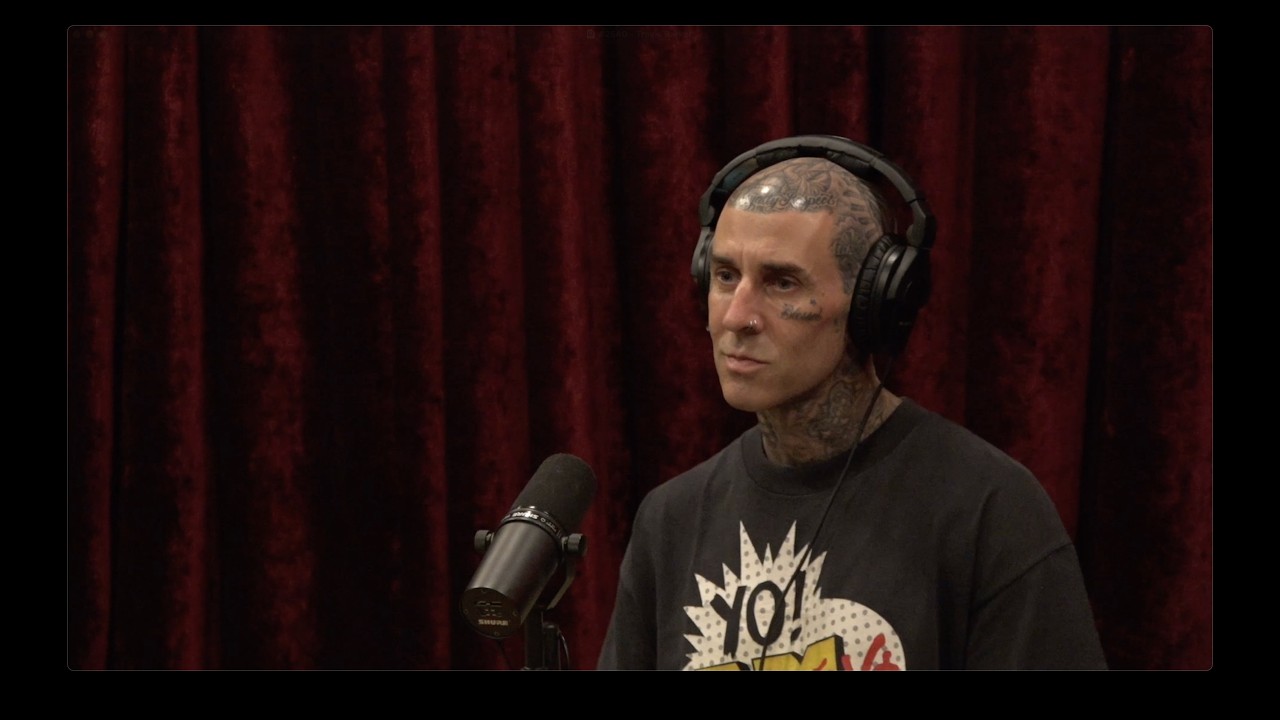
The Blink-182 drummer transformed from an unmedicated survivor relying on 21-day ship journeys to flying again after overcoming intense trauma and physical recovery.
## Background
Published by PowerfulJRE on YouTube on August 14, 2026, this episode features host Joe Rogan interviewing Travis Barker, the renowned drummer for Blink-182, producer, and entrepreneur. According to the page description, the episode highlights Barker's work and life ahead of his documentary, "Travis Barker: Louder Than Fear," streaming on Hulu and Hulu on Disney+.
## TL;DR
Travis Barker opens up about overcoming his 20-year fear of flying following his horrific 2008 plane crash, his extensive burn recovery, and his journey toward holistic health and veganism. He and Joe Rogan dive into physical conditioning, drumming mechanics, combat sports, UFC fight breakdowns, and vintage car collections. Barker also discusses his marriage to Kourtney Kardashian, navigating internet criticism, and how staying obsessed with his craft saved his life.
## Atmosphere & style
The conversation is grounded, intimate, and deeply reflective, striking an easy balance between raw vulnerability and enthusiastic camaraderie. Rogan acts as an empathetic sounding board while Barker speaks with quiet humility and understated strength about intense personal trauma, physical pain, and artistic discipline. The mood transitions effortlessly from solemn stories of tragedy and recovery into energetic, lighthearted banter about fighting, cars, and punk rock philosophy.
## Key takeaways
- [01:06](https://www.youtube.com/watch?v=9iENvZ2siTo&t=66s) Travis Barker released his documentary 'Travis Barker: Louder Than Fear' on Hulu, chronicling his life, music career, and journey overcoming trauma.
- [02:46](https://www.youtube.com/watch?v=9iENvZ2siTo&t=166s) Barker spent nearly two decades avoiding airplanes following his fatal 2008 crash, relying instead on long bus trips and transatlantic voyages on ocean liners.
- [05:00](https://www.youtube.com/watch?v=9iENvZ2siTo&t=300s) Overcoming severe trauma and survivor's guilt, Barker eventually conquered his fear of flying with support from his wife, Kourtney Kardashian.
- [21:18](https://www.youtube.com/watch?v=9iENvZ2siTo&t=1278s) During his crash recovery, Barker underwent 30 surgeries, suffered severe burns over 70% of his body, and required up to 7,000 calories a day to heal.
- [26:25](https://www.youtube.com/watch?v=9iENvZ2siTo&t=1585s) Despite facing severe ulnar nerve damage and threats of amputation, Barker used intense drum practice and physical discipline to regain his ability to play.
- [46:05](https://www.youtube.com/watch?v=9iENvZ2siTo&t=2765s) Barker trains extensively in fast-twitch conditioning, martial arts, and battle ropes to build the extreme stamina required for high-tempo concert performances.
- [02:01:01](https://www.youtube.com/watch?v=9iENvZ2siTo&t=7261s) Following his plane crash, Barker committed to a strict whole-food vegan diet and relies on natural supplements to support high energy levels and health.
- [01:49:04](https://www.youtube.com/watch?v=9iENvZ2siTo&t=6544s) Barker lives with Factor V Leiden and a permanent IVC filter implanted after his crash, managing his blood clotting risks through targeted precautions.
- [02:16:10](https://www.youtube.com/watch?v=9iENvZ2siTo&t=8170s) Barker dismisses criticism over his marriage to Kourtney Kardashian, stating that choosing his own path regardless of public opinion is the true essence of punk rock.
- [02:18:02](https://www.youtube.com/watch?v=9iENvZ2siTo&t=8282s) Joe Rogan and Travis Barker discuss channeling negative energy from online haters into productivity, physical conditioning, and artistic creative work.
## Detailed walkthrough
### [00:01](https://www.youtube.com/watch?v=9iENvZ2siTo&t=1s) Fatherhood and Personal Connections
Joe Rogan welcomes Travis Barker to the show, noting Barker’s son and the obvious bond between them. Barker shares that after spending five days together on a trip to Utah, his son developed separation anxiety—a feeling Barker mutually experiences. Both hosts reflect on how profound the bond with one's children is, expressing disbelief at parents who choose not to spend dedicated time with their kids.
[01:06](https://www.youtube.com/watch?v=9iENvZ2siTo&t=66s) The Documentary and Confronting Trauma
Barker discusses the release of his documentary, *Travis Barker: Louder Than Fear*, which premiered on Hulu. He explains that initial work on a documentary began shortly after his book release around 2017. However, the film lacked a natural resolution at the time; while he had survived the 2008 plane crash and maintained sobriety, he was still deeply paralyzed by the trauma and unable to fly. Directors originally asked him to fake walking toward a plane for a ending shot, but Barker refused, stating he could not even pretend to approach an aircraft.
- Barker notes that his fear dictated his entire travel routine for years, forcing him to rely on long bus rides and ocean liners to travel for tours.
- His refusal to fly affected his children, who grew up associating airplanes strictly with death and metal containers where life is lost.
- Eventually, Barker realized he had to break the pattern of fear, both for himself and to show his children that trauma could be overcome.
[02:46](https://www.youtube.com/watch?v=9iENvZ2siTo&t=166s) The Reality of Alternative Travel: Buses and Ships
Barker describes the immense logisitcal effort required to tour without flying. A bus trip from the West Coast to New York took six to seven days if he stopped at hotels and provided activities for his kids. To reach Europe, he took transatlantic voyages aboard the *Queen Mary 2*, which added another 10 days at sea from New York.
```
+------------------------+-------------------+--------------------+
| Route | Barker's Travel | Standard Flight |
+------------------------+-------------------+--------------------+
| LA to New York (Bus) | 6 - 7 days | ~5 - 6 hours |
| NY to UK (QM2 Ship) | 10 days | ~7 - 8 hours |
| Total Transatlantic | ~3 weeks | ~10 - 15 hours |
+------------------------+-------------------+--------------------+
```
- While his bandmates reached England in a matter of hours, Barker's journey took nearly three weeks.
- The ocean voyages were far from peaceful: Barker experienced wild Atlantic weather with 30-foot waves and 170 mph winds, making him question if being on a ship was any safer than an airplane.
- He notes that the *Queen Mary 2* carried thousands of passengers—many of whom were elderly—requiring an onboard morgue, security, and a jail. On almost every crossing, someone on board passed away.
[05:00](https://www.youtube.com/watch?v=9iENvZ2siTo&t=300s) Overcoming the 20-Year Fear of Flying
Barker reflects on the 20 years he spent refusing to fly, realizing how much time was dominated by that psychological barrier. He made a pact with his wife, Kourtney Kardashian, that if she ever wanted to go on a trip requiring a flight, she should book it, notify him the night before, and they would go. His first flight back went smoothly, providing the positive counter-experience needed to break the cycle of fear.
- Barker recounts processing survivor's guilt, particularly regarding his late assistant's son (his godson) and the families of those lost in the crash, ultimately realizing they would want him to live fully.
- He emphasizes his drive to prove doubters wrong; after doctors told him he might never run or play drums again, he systematically checked off every recovery goal.
- He shares a recent experience connecting with a survivor named Reva, who survived a plane crash with 50% body burns and lost her mother, inviting her to his documentary premiere to share their unique mutual understanding.
- Barker remembers an encounter shortly after his accident where Captain Chesley "Sully" Sullenberger walked up and shook his hand silently at a restaurant.
[13:32](https://www.youtube.com/watch?v=9iENvZ2siTo&t=812s) Rough Seas, KRS-One, and Ocean Crossings
Rogan and Barker look at footage of extreme ocean waves, discussing how terrifying high seas can be. Barker shares memories of practicing drums four hours a day and running laps around the deck of the *Queen Mary 2* to stay conditioned for tour.
- Barker crossed the Atlantic by ship seven times in total.
- He notes that legendary rapper KRS-One was also a passenger on two of those crossings, preferring ships simply because he disliked flying.
- KRS-One told Barker about using cargo ships to travel to places not served by passenger liners.
- Barker considered taking a month-long cargo ship journey to reach Australia before ultimately ruling it out.
- The section concludes with Rogan and Barker marvelling at ancient Polynesian navigators who crossed oceans in canoes with no modern technology or guarantees of land.
<FollowUp label="Want to explore Travis Barker's physical recovery and drumming career post-accident?" query="Tell me more about Travis Barker's physical recovery process and how he managed to return to playing drums after his 2008 crash."/>
[17:05](https://www.youtube.com/watch?v=9iENvZ2siTo&t=1025s) Survival Instincts, Early Navigation, and Extreme Fasting
Joe Rogan and Travis Barker begin by marvelling at the raw human ingenuity required by ancient ancestors who set sail across open oceans without weather apps or modern navigation. They ponder the sheer desperation and bravery it took to pile into small boats with family, paddling into absolute unknowns while hoping to find food and land, only to face the daunting realization of having to survive or make the return journey. This ability to endure under extreme conditions leads Travis to mention a friend—a raw, plant-based chef who took a vow of silence 30 years ago—who fasts on just water and juice for 160 days a year (nearly six months) to cleanse his body, drastic weight loss and recovery cycle included.
Joe expresses deep skepticism over whether fasting on fruit and vegetable juice for six months is healthy, noting how difficult it is to fast for even a single day before surgery. Joe explains that fasting is far easier on a ketogenic diet because the body seamlessly transitions into burning fat, lowering appetite intensity. He adds that while 3-to-5-day fasts are scientifically backed to promote autophagy—helping the body clear out damaged cells and starve glucose-dependent cancer cells—a prolonged carb-heavy juice fast causes harsh insulin crashes.
* Travis notes that his silent chef friend goes from getting extremely thin during his 160-day fast straight back to his normal weight every year.
* Joe highlights that fasting and ketogenic diets are frequently recommended by doctors for patients fighting cancer to starve tumor cells of glucose.
[21:18](https://www.youtube.com/watch?v=9iENvZ2siTo&t=1278s) Plant-Based Nutrition, Medical Miscommunications, and Horrific Recovery
Travis breaks down his daily nutrition as a vegan, clarifying that he gets high levels of protein from natural whole foods like lentils and beans rather than processed mock meats, leading to stellar blood work. However, the discussion shifts to his horrific 2008 plane crash recovery. In the hospital, "super old-school" doctors didn't realize he refrained from eating meat and grew frustrated when he wasn't eating enough. The miscommunication led to doctors feeding him through a tube down his throat. To bypass this, a sympathetic nurse made him homemade bags of beef jerky so he could hit his mandatory protein targets, supplemented by 3,000-calorie "Peanut Butter Blast" smoothies.
Having undergone 30 surgeries in six months, Travis had to consume a staggering 6,000 to 7,000 calories per day just to fuel his body’s healing process. Joe emphasizes how punishing being put under anesthesia 30 times in half a year is on the human body. Travis admits he was so out of it that he didn't fully realize the extent of the trauma until near the end of his hospital stay.
> "I had a 6 to 7,000 calorie diet I needed to hit every day in order to heal because I had just had 30 surgeries in 6 months."
* Travis's best friend and fellow crash survivor, Adam "DJ AM" Goldstein, suffered burns on about 6% of his body and recovered in a hyperbaric chamber within a week and a half.
* Because 70% of Travis's body was burned, he was trapped in the hospital for months and couldn't handle small hyperbaric tubes, as the enclosed space triggered intense claustrophobia and flashbacks to the plane's interior.
* Before the crash, Travis had been sober for 15 years following past drug addiction; waking up from repeated surgeries while heavily medicated caused severe, manic reactions where he woke up "screaming, swinging on doctors" until he was weaned off the drugs entirely.
* He credits his lead physician, Dr. Grossman of the Grossman Burn Center, for guiding him through the grueling process, referring to the entire trauma as his ultimate "trial by fire" rehab.
[26:25](https://www.youtube.com/watch?v=9iENvZ2siTo&t=1585s) Overcoming Amputation Threats and Returning to the Drums
Doctors initially feared Travis would never play drums again due to severe nerve damage—including destroyed ulnar nerves in both hands—and came close to amputating his foot because they lacked enough unburned skin to perform grafts. Once he stabilized past critical condition, overcoming those neurological and physical hurdles became his prime focus. Today, Travis is able to use two-person hyperbaric chambers in Los Angeles, which avoid the suffocating claustrophobia of single-person tubes and the painful multi-minute depressurization process.
Turning to his documentary, *Travis Barker: Louder Than Fear*, Travis admits that reliving the trauma during interviews feels like being "gutted with a knife." Having lost his mother at age 13, he notes he has always been deeply emotionally sensitive to grief and loss.
* The documentary original cut was finished in 2017, but Travis refused to release it because the ending was bleak and unresolved, featuring him terrified to even look at an airplane.
* By 2024–2025, his life transformed: he conquered his fear of flying, got married, had more children, and rebuilt his relationship with his father from a troubled past into a best-friend bond.
* Travis grew up without luxury or running hot water, grinding 2 to 5 hours a day on drums and joining every marching band, orchestra, and jazz ensemble available to build a career from scratch.
[30:57](https://www.youtube.com/watch?v=9iENvZ2siTo&t=1857s) Obsession as a Formula for Success
Joe and Travis discuss the core themes of the documentary: resilience, triumph over trauma, and the irreplaceable value of relentless obsession. Joe points out that modern society pushes a "TikTok mindset" looking for quick fixes and shortcuts, whereas true mastery only comes from falling in love with the grind. Travis recalls how throwing himself entirely into drumming saved him twice—first when his mother died as a teenager, and again when he arrived home covered in scabs after the plane crash and immediately went outside to play.
Travis shares that achieving mastery in a skill—whether music, jiu-jitsu, or sports—gives young people an unshakeable inner confidence to navigate life and stand up to bullies. They reflect on how being relentlessly driven can feel isolating because the broader public rarely operates with that level of discipline.
* Travis cites the book *Relentless* by Tim Grover as his personal "Bible," explaining Grover's classification of top achievers as "cleaners"—people who win a major achievement like a Grammy and immediately ask "What's next?" rather than stopping to celebrate.
* Grover personally introduced Travis's documentary at its Los Angeles premiere.
[34:30](https://www.youtube.com/watch?v=9iENvZ2siTo&t=2070s) Obsession, Discipline, and Life Lessons After the Crash
Joe Rogan and Travis Barker discuss the rare mindset that drives high achievers, noting how average people often make obsessed individuals feel like something is wrong with them. Travis mentions reading a book that made him realize he isn't alone in his intensity, embracing that he is part of a community of passionate "psychopaths" who love making music and can happily spend 25 hours in the studio without burning out. He emphasizes that he is never content with where he is and always seeks room to grow, unlike people who settle for peak levels early on. Joe quotes Henry David Thoreau—"Most men live lives of quiet desperation"—and notes that outliers are necessary, expressing sympathy for those who lack the inspiration or discipline to ignite their creative fire.
The conversation turns to mortality and purpose, especially in light of Travis's near-fatal 2008 plane crash. Travis shares advice from Harry Shannon, a key figure in his sobriety journey, who asked him: "If you died right now, would you be the man you'd want people to remember you by?" Joe offers his own philosophies for living fully:
> "Live your life as if there's a documentary crew following you around... Become the person you pretend to be when you're trying to get laid... or who you're pretending to be on the internet or social media."
They reflect on how sharing raw, passionate stories—like Travis's new Hulu documentary *Travis Barker: Louder Than Fear*—can inspire young people to change their lives, comparing the impact to discovering David Goggins for the first time.
[39:29](https://www.youtube.com/watch?v=9iENvZ2siTo&t=2369s) Running in Austin and the Energy of the City
Travis takes a drink of water and talks about running around Lady Bird Lake (which he initially calls Lake Austin) earlier that morning. After getting a cortado at a local espresso spot, he went for a run wearing long cutoff Suicidal Tendencies sweatshorts, high socks, and no shirt. He jokes that he looked "so Inland Empire"—referencing his hometown region in California—and figured locals would immediately know he was an outsider, though Joe assures him he blends right in with Austin's active culture.
Joe highlights how Austin became a hub for health, fitness, and martial arts, particularly during the pandemic when top figures like Gordon Ryan and John Danaher relocated to the city. This move triggered an influx of elite jiu-jitsu practitioners, MMA fighters, and functional fitness enthusiasts seeking a fresh start and a high-energy environment.
- **Travis's Morning Routine:** Grabbed a cortado/espresso, ran along Lady Bird Lake in Suicidal Tendencies sweatshorts.
- **Inland Empire Reference:** Travis jokes about his Southern California roots and workout aesthetic.
- **Austin Fitness Boom:** Key movers like Gordon Ryan ("greatest jiu-jitsu athlete of all time") and John Danaher ("greatest coach of all time") catalyzed Austin's transformation into a martial arts powerhouse during COVID-19.
[42:44](https://www.youtube.com/watch?v=9iENvZ2siTo&t=2564s) The Austin Comedy Boom and Surrounding Yourself with the Best
Joe explains how the comedy scene in Austin exploded under similar circumstances. With Los Angeles locked down, comedians who were addicted to performing were left without an outlet. Ron White, Joe Rogan, and Tony Hinchcliffe relocated to Texas and "lit the fire," drawing dozens of top-tier comedians. Joe opened his club (Comedy Mothership), which spurred the opening of five other comedy clubs on the same street. He notes that the city is bursting with creative momentum, pointing to local successes like Kam Patterson landing *Saturday Night Live*, Shane Gillis becoming one of the biggest comics in the world, and *Kill Tony* becoming the top live comedy show globally.
Travis shares that he recently saw Ron White and Shane Gillis perform at the *Netflix Is A Joke* festival at the Hollywood Bowl. He praises Shane's effortless comedic style, while Joe notes how great Shane is to be around. They agree on the crucial importance of surrounding yourself with like-minded, driven individuals—referencing the idea that "you are the average of the five people you spend the most time with."
[46:05](https://www.youtube.com/watch?v=9iENvZ2siTo&t=2765s) Jiu-Jitsu with Jean Jacques Machado and Training for Drumming
Travis reveals that after Joe moved his podcast studio out of their old neighborhood on Califa Street in Los Angeles, Travis moved his studio into the same area. While running around the neighborhood, Travis ran into legendary Brazilian Jiu-Jitsu master Jean Jacques Machado at a Blue Bottle Coffee shop, right after seeing him on Joe's podcast. Machado invited him to train, and the next day Travis stumbled upon Machado's dojo during a run and walked right in to join a class.
While Travis loved Machado's positive energy, he explains that heavy running and traditional weightlifting caused leg tweaks and left him feeling slow and tight behind the drum kit. He realized that heavy bodybuilding workouts are not functional for his drumming style, where speed, explosive energy, and fluid endurance are critical.
> "I got behind a kit and I remember I hadn't really tested it out and it was the worst feeling in the world. I was so tight. I was so slow. I didn't look like this, but I felt like this... My only goal is to be able to think something and do it."
To keep his body primed for Blink-182's fast-paced shows, Travis tailored his routine toward fast-twitch conditioning:
* **Explosive Cardio:** Sprints, jump rope, and heavy-bag boxing rounds.
* **Tempo Training:** Working out to the exact tempo and duration of full songs, matching the speed and stamina required for his drumming performances.
* **Functional Strength:** High-rep, high-speed exercises followed by explosive finishers (such as 10 rounds on the bag) rather than heavy weightlifting.
[49:51](https://www.youtube.com/watch?v=9iENvZ2siTo&t=2991s) Physical Conditioning for Drumming vs. Combat Sports
Joe Rogan and Travis Barker dissect the intense physical demands of playing drums at an elite level, comparing it to "sprinting with your arms" or throwing continuous volume punches. Joe notes that drummers share a distinct physical build—typically lean, wiry, and equipped with extraordinary arm endurance. Travis agrees, sharing that his conditioning routine includes hitting the speed bag at his studio gym to hone his rhythm, as well as pushing through grueling 30 to 40-minute battle rope sessions without stopping. He notes that conventional bodybuilding or heavy muscle-building exercises simply do not translate to drumming performance and can actively get in the way of agility.
Joe suggests that drummers ought to be built like welterweight boxers—lean, fast, and endurance-focused. A knowledgeable trainer can help build structural strength to prevent injuries in martial arts like Brazilian Jiu-Jitsu without adding burdensome mass. Joe adds that many high-level BJJ competitors are surprisingly slender because technique, leverage, and body control matter far more than raw muscle in weight-class sports.
- **Drumming movement profile:** Described as "long-term fast running with your arms" requiring precise tempo and continuous muscular output.
- **Battle ropes routine:** Travis maintains continuous battle rope training for 30 to 40 minutes to replicate stage stamina.
- **Optimal drum and grappling physique:** Comparable to a welterweight boxer—wiry, lean, and endurance-driven rather than bulky.
[51:53](https://www.youtube.com/watch?v=9iENvZ2siTo&t=3113s) Hand Protection, Sponsor Break, and the Dangers of Uncontrolled Rolling
Protecting the hands is a primary concern for Travis when training martial arts, as broken fingers or compromised grips directly threaten his career behind the drum kit. Joe emphasizes that the key to safe training is carefully picking partners and avoiding "spastics" or anyone who lacks controlled energy. Rolling with experienced black belts offers a safe environment where both participants understand control and pacing, drastically minimizing injury risk. Conversely, Joe warns that injuries almost always happen when rolling with "some young blue belt who's on steroids, just jacked out of his mind" and recklessly trying to score a chokehold.
Travis recounts a terrifying experience while on tour, where he stopped by a UFC gym for light sparring before a show. Despite agreeing to light kickboxing and boxing drills, his sparring partner suddenly threw a full-force spinning backfist. Travis was stunned, thinking, "I have a show in 45 minutes, man. Like chill." He notes that his son was watching and the situation was nearly disastrous, highlighting how quickly uncontrolled intensity can lead to concussions or severe injury right before a major performance.
- **Partner selection rule:** Rolling with black belts keeps movement smooth and controlled, whereas erratic lower belts present high injury risks.
- **Pre-show sparring incident:** A sparring partner threw an unexpected spinning backfist at Travis just 45 minutes before a live concert performance.
- **BetterHelp Sponsorship:** The podcast episode features a brief promotional segment for BetterHelp mental health therapy services.
[54:05](https://www.youtube.com/watch?v=9iENvZ2siTo&t=3245s) Ego, Humility, and the Art of Jean Jacques Machado
Both Joe and Travis agree that martial arts training is unmatched for burning off aggression, calming the mind, and humbling the ego. Travis believes everyone should train combat sports at least once in their life because it instills deep humility and would dramatically reduce the number of hotheads in everyday society. Joe describes Jiu-Jitsu practitioners as "some of the most laid-back and chill people that can kill you that you'll ever meet," noting that the sport's humbling nature forces practitioners to abandon brute force in favor of technical fluidity.
Joe contrasts his early training days—when he was overly aggressive and tried to force techniques through pure exertion—with the effortless mastery of legend Jean Jacques Machado. When rolling, Jean Jacques never explodes or loses balance, maintaining complete control while playfully chatting with his partner ("Joe Rogan, look out for your arm"). Travis compares rolling to a high-intensity game of chess, recalling intense two-hour workouts where he weighs 150 pounds against a 200-pound opponent, leaving him completely engaged and drenched in sweat.
The physical experience of grappling also gives fans a realistic perspective on high-level fights, stripping away common male delusions about fighting ability. Travis shares a humbling moment with former UFC champion Dominick Cruz, who challenged Travis to "try to sleep me." Cruz's lightning speed and footwork made him impossible to hit. Cruz then pinned Travis on the canvas, demonstrating the suffocating exhaustion of being held down against the cage to teach him never to casually judge fighters for inaction when trapped.
- **Ego reduction:** Martial arts serves as a mental reset that removes aggression and keeps practitioners grounded and relaxed.
- **Jean Jacques Machado's style:** Characterized by zero wasted motion, perfect balance, and fluid execution paired with effortless conversation during rolls.
- **Dominick Cruz sparring session:** Cruz demonstrated his elusive movement and suffocating top control, leaving Travis exhausted and completely respectful of professional combat limits.
- **Delusion vs. reality:** Training eliminates the common male fantasy of being able to easily win real-world fights against trained martial artists like "Suga" Sean O'Malley.
[57:06](https://www.youtube.com/watch?v=9iENvZ2siTo&t=3426s) Dominick Cruz and the Evolution of Elusive Footwork
Joe highlights Dominick Cruz as a revolutionary figure who developed an entirely unique footwork system during his reign as UFC bantamweight champion. Uniquely crafted because Cruz lacked raw power or physical size, his style relied on unpredictable lateral steps, angles, and sudden shifts ("step here, step there, pop, step here, kick, step here, elbow") that left opponents completely mesmerized and unable to locate him. Opponents could not prepare for Cruz because no sparring partner could emulate his unusual movement patterns.
Cruz's technical innovation fundamentally reshaped the bantamweight division, forcing future contenders to adapt or be humiliated. Joe notes that subsequent elite fighters—such as TJ Dillashaw and Cory Sandhagen—built upon Cruz's blueprint by implementing continuous stance switching and angular footwork. TJ Dillashaw's crowning performance against Renan Barão stands out as one of the greatest title-winning displays in MMA history; Barão was considered an undefeated top pound-for-pound fighter, yet Dillashaw entered the Octagon completely relaxed, cutting angles, switching stances, and effortlessly dismantling the champion.
- **Dominick Cruz's style:** An elusive, custom-built movement system designed to overcome size and power deficits through rhythm and angle changes.
- **Impact on the bantamweight division:** Inspired a new generation of dynamic, stance-switching fighters including TJ Dillashaw and Cory Sandhagen.
- **Dillashaw vs. Barão:** TJ Dillashaw put on a masterclass performance to defeat long-time, undefeated champion Renan Barão, fighting with complete composure and fluid angle entries.
[01:01:24](https://www.youtube.com/watch?v=9iENvZ2siTo&t=3684s) Injuries, Fighter Mentality, and Dustin Poirier
The discussion shifts to the brutal physical toll that professional fighting inflicts on the human body over time. Joe calls TJ Dillashaw's career trajectory a tragedy due to severe, recurring shoulder injuries—specifically complete supraspinatus tears in both arms that frequently resulted in dislocations. Dillashaw went so far as to warn the referee in the green room before his title fight against Aljamain Sterling that his shoulder would likely pop out mid-fight, but pleaded to let him keep competing. Joe stresses that the human body is simply not built to sustain decades of grappling, strikes, and joint manipulations without eventual breakdown.
Despite severe body damage, elite fighters possess an irrational self-belief that makes retirement nearly impossible. That same unyielding drive ("I'll show you") that made them champions prevents them from stepping away, even when faced with multiple surgeries. Travis brings up Dustin Poirier, praising his incredible battles against Islam Makhachev and Benoît Saint Denis, noting that Poirier still looks like an elite, highly competitive beast on the canvas. Joe agrees that Poirier remains at the highest level physically, though he points out that Poirier's primary long-term concern stems from accumulated brain trauma and head injuries rather than joint issues.
- **TJ Dillashaw's shoulder trauma:** Suffered complete supraspinatus tears in both shoulders, requiring eventual joint replacements and causing dislocation during his fight against Aljamain Sterling.
- **The Champion's Mindset:** Elite athletes rely on a defiant "I'll show you" attitude to reach the top, making it exceptionally difficult to accept when their physical window has passed.
- **Dustin Poirier's elite standing:** Continues to deliver top-tier performances against elite opponents like Islam Makhachev and Benoît Saint Denis, with career longevity impacted primarily by head trauma rather than joint degradation.
Here is a detailed, faithful walkthrough of this section of the episode.
---
[01:04:51](https://www.youtube.com/watch?v=9iENvZ2siTo&t=3891s) CTE, the Price Fighters Pay, and Retiring on Top
Joe Rogan and Travis Barker discuss the immense long-term toll that combat sports take on athletes, noting how lingering damage and Chronic Traumatic Encephalopathy (CTE) can drastically affect a fighter's life outside the cage. Rogan points out that fighters often suffer severe cognitive and physical decline in their 50s and 60s, citing legendary boxers like Tommy Hearns who pay a heavy price long after their careers end. Barker notes that he is endlessly grateful his drums "don't hit me back." Rogan observes that while musicians can play for decades, a fighter’s peak window is painfully narrow; even when a fighter like Dustin Poirier still looks and sounds great, the younger generation eventually catches up due to accumulated wear and tear.
The conversation turns to the emotional difficulty of stepping away when a fighter's entire identity and thrill are tied to the highest highs of competition. Rogan contrasts Conor McGregor—who possesses roughly half a billion dollars yet continuously seeks to reclaim lost glory—with Khabib Nurmagomedov, who walked away at the absolute pinnacle of the sport. Rogan calls Khabib's decision "Mount Everest discipline," revealing that Khabib continues to train compulsively and claims he is actually better now than when he retired, frequently mauling active top-10 UFC contenders in training rounds.
- **Conor McGregor:** Estimated to be worth around half a billion dollars, yet driven by a deep need to recapture peak glory.
- **Khabib Nurmagomedov:** Retired undefeated on top, now coaches young fighters who are inspired to please one of the most disciplined competitors in history.
---
[01:09:55](https://www.youtube.com/watch?v=9iENvZ2siTo&t=4195s) Analyzing Islam Makhachev vs. Ian Machado Garry
Rogan transitions to discussing an upcoming fight card featuring Islam Makhachev—with Khabib in his corner—facing off against Ian Machado Garry. Rogan praises Garry as a fast, tall, long striker who carries an almost delusional self-belief that victory is his ultimate destiny. Meanwhile, Makhachev’s striking has elevated to an elite level, highlighted by his head-kick knockout of Alexander Volkanovski and his dominant submission over Charles Oliveira.
Rogan emphasizes that Makhachev enters fights with unmatched confidence because he knows no human being can physically train harder than he does. He describes the training environment in Dagestan as a room full of religious, disciplined "savages" who do not drink, party, or lose focus, praying five times daily while training relentlessly.
- **Islam Makhachev:** Known for dominant grappling, elite striking, and a brutal victory over Charles Oliveira; trained in Dagestan under extreme discipline.
- **Ian Machado Garry:** Height and reach advantages, quick movement, and supreme confidence in his personal destiny.
---
[01:13:26](https://www.youtube.com/watch?v=9iENvZ2siTo&t=4406s) Fight Preparations: Family Balance vs. The Spartan Mindset
Barker mentions an interview where Ian Garry discussed the importance of overall life balance, keeping his family and personal life harmonious during fight camps rather than isolating himself. Rogan responds that while that approach works if a home life is peaceful, chaos or relationship drama can completely ruin a fighter's mindset. He references the movie *The Smashing Machine* about Mark Kerr, noting how pre-fight arguments with partners can destroy an athlete's focus. Rogan shares an anecdote about a fighter whose former girlfriend was a "complete narcissist" who purposely started explosive arguments and vanished from hotel rooms the night before world title fights because she resented his focus being off her.
Barker relates this intensity to his own ritual before Blink-182 shows. He explains that he cannot be too comfortable or relaxed before performing; he avoids massages or lounging in hotel rooms, preferring to be uncomfortable by jump-roping, running, practicing new techniques, or watching fight videos right up until showtime.
> "Stay ready so you don't have to get ready."
- **Paddy Pimblett:** Mentioned by Barker and Rogan for his drastic physical transformations between fights; despite gaining noticeable weight and getting a "moon face" out of camp, his underlying cardiovascular endurance and work ethic remain elite.
- **Paddy vs. King Green (Bobby Green):** Rogan and Barker briefly praise Pimblett's submission win over King Green (referred to as "Beni"/King Green) as one of the most stunning live fight moments they have witnessed.
Here is a detailed walkthrough of this portion of the conversation:
### [01:19:42](https://www.youtube.com/watch?v=9iENvZ2siTo&t=4782s) UFC Underdogs, Heart, and the Small Octagon
Joe Rogan and Travis Barker kick off this segment dissecting recent UFC highlights and praising the pure grit of fighters like Justin Gaethje and Paddy Pimblett. Rogan reflects on Gaethje's recent shock victory over Ilia Topuria—a fight where Gaethje went in as a huge 6-to-1 underdog on some sportsbooks. Rogan calls those odds disrespectful, but both men marvel at the fairytale storyline of Gaethje winning the world title on the White House lawn. Rogan notes how trash-talk can backfire: by threatening to humiliate Gaethje on the microphone post-fight, Topuria inadvertently gave Gaethje the extra psychological fuel he needed to push through.
The conversation shifts to the physical realities of the cage itself, specifically the UFC APEX in Las Vegas. Rogan asks Perplexity AI to confirm the exact dimensions: the APEX Octagon provides **30% less floor space** than the standard arena cage (25 feet across versus 30 feet). Barker, who attended the APEX event where Francis Ngannou knocked out Stipe Miocic for the heavyweight title, recalls the eerie intensity of being in a tiny room of only 50 to 100 people where you could "hear a needle drop." Rogan explains that while a smaller cage forces action, it robs agile fighters of the canvas they need to create angles, counter-strike, and escape, citing Sean O'Malley's knockout of Aljamain Sterling as an example of a sequence that required space to execute.
* Justin Gaethje entered his championship bout as high as a 6-to-1 underdog before pulling off the victory.
* The UFC APEX Octagon is 25 feet in diameter (approx. 510 sq ft), compared to the standard 30-foot arena Octagon (approx. 743 sq ft)—a 30% reduction in total area.
* Barker brought his wife to the APEX for her first live fight experience during the Ngannou vs. Miocic heavyweight rematch.
### [01:24:00](https://www.youtube.com/watch?v=9iENvZ2siTo&t=5040s) Bantamweight Drama and Merab's Insane X-Ray
The talk pivots to Sean O'Malley's highlight-reel walk-off knockout at the White House event. Barker mentions texting back and forth with O'Malley prior to the fight, where O'Malley explicitly stated his intention to score a definitive stoppage. Rogan breaks down the bantamweight title picture: with Petr Yan and Merab Dvalishvili set for a high-stakes rematch, O'Malley—who holds a previous victory over Yan—is positioning himself for the next title shot.
This leads Rogan to bring up Merab Dvalishvili's legendary endurance and his shockingly mangled nose. Rogan describes an MRI/X-ray scan of Dvalishvili's face, showing a nasal bone broken so severely it curves hard toward his right eye and partially obstructs his vision. Barker laughs that the horrifying skull scan looks like the iconic dark fantasy artwork of **Pusshead**, the artist famous for designing album art and merch for Metallica, The Misfits, Zorlac Skateboards, and *Thrasher Magazine*. Rogan marvels that Dvalishvili refuses to get the nose surgically fixed because doing so would require a full year off from fighting and sparring. Since he cannot breathe through his nose at all, Dvalishvili accomplishes his world-class, non-stop cardio pace entirely through mouth-breathing.
> "Tell me that doesn't look like... Pusshead's the illest artist ever. He did like Misfits, Metallica stuff... Tell me that doesn't look like Merab's face."
### [01:28:40](https://www.youtube.com/watch?v=9iENvZ2siTo&t=5320s) Upcoming Fight Cards and the LA Vibe
Barker and Rogan browse through upcoming fight schedules, touching on rumors of the Yan vs. Dvalishvili rematch heading to Abu Dhabi in October, alongside an upcoming Los Angeles card featuring Alexandre Pantoja vs. Joshua Van, Brian Ortega vs. Diego Lopes (or Mauricio Ruffy/Arman Tsarukyan match-ups discussed in rumors), Marlon "Chito" Vera vs. Charles Jourdain, and wrestler Gable Steveson.
Barker expresses his excitement for fight nights in Los Angeles, noting that because the UFC doesn't visit LA often, the crowd energy is always electric. Rogan asks Barker how he feels about living in Los Angeles six years after the pandemic, given how many people have left. Barker explains his strategy for enjoying LA: living a deliberate, contained routine that avoids the city's worst congestion.
* **Barker's Perfect Day:** Running 3 miles from his home to his private car garage, picking up one of his vintage automobiles, driving to his recording studio, working, and driving home—all without passing Downtown Los Angeles.
* Barker avoids the chaos of West Hollywood and central LA, preferring to stay insulated in his local rhythm of family, studio, and training.
### [01:31:50](https://www.youtube.com/watch?v=9iENvZ2siTo&t=5510s) Life in SoCal, Nashville Thoughts, and Coachella's Origins
Rogan asks Barker if he ever thinks about leaving California to live a quiet life in the country. Barker admits that while touring through Tennessee during a massive storm, he and his family stayed in Franklin, Tennessee, and immediately started house-hunting. However, he confesses they do that in almost every beautiful city they visit. Ultimately, Barker loves Southern California because moving between different environments—like spending weekends in Santa Barbara or Montecito, taking trips to the Coachella Valley desert, and staying in Calabasas during the workweek—keeps life fresh.
Barker then shares a personal story about how he ended up in the music industry's inner circle. When he left home around age 16 or 17, his father gave him a strict ultimatum: join the military, start paying rent, or move out. Barker chose to leave. He worked as a garbage man in Laguna Beach before moving to Riverside to live with his friend **Paul Tollett** (referred to colloquially as Bill Fold), founder of the promotional company *Goldenvoice* / *98 Posse*. Tollett promoted everything from raves to hardcore punk shows and was obsessed with live music. Barker watched firsthand as his roommate built **Coachella** from scratch in a desert town that is completely dead and routinely hits $115^\circ\text{F}$ during the rest of the year.
* When forced to leave home at 16 or 17, Travis worked as a trash collector in Laguna Beach.
* Barker lived with Goldenvoice co-founder Paul Tollett in Riverside while Tollett was conceptualizing and building the Coachella Valley Music and Arts Festival.
* Barker remains based in LA because of spontaneous studio collaborations—artists like The Game will routinely walk into his neighborhood studio unannounced to record drum tracks.
Here is a detailed and faithful walkthrough of Part 7 of the transcript:
[01:34:52](https://www.youtube.com/watch?v=9iENvZ2siTo&t=5692s) Palm Springs, Extreme Desert Heat, and Custom Restomod Trucks
Joe Rogan and Travis Barker begin by discussing the intense climate and local economy of the Coachella Valley and Palm Springs. Barker notes how during off-peak seasons when temperatures hit 115°F to 120°F, local businesses struggle because nobody wants to step outside, often leaving shops open only during brief evening hours. He emphasizes that the annual Coachella Valley Music and Arts Festival essentially saves the local economy due to the sheer volume of visitors influxing into town. Rogan adds that driving out to the desert requires functional air conditioning and warns against driving classic cars into that heat.
The conversation naturally shifts to custom trucks capable of handling the desert trek. Barker shares that he drives a Velocity-restored Chevy K5 Blazer out to his house in La Quinta, prompting Rogan to recall that comedian Mark Normand (misheard or referenced alongside "Cura") also owns one. Barker praises Velocity for building reliable, well-proportioned restomods that avoid being overbuilt or driving poorly. Reveal-wise, Barker candidly admits to being severely colorblind—to the point where he routinely has to ask his two-and-a-half-year-old son to identify the color of objects.
The duo compares their favorite vintage and custom builds, admiring the timeless, iconic design of vintage Chevrolet trucks and open-top Blazers:
* **Travis Barker's Velocity K5 Blazer:** Built to look almost bone-stock while featuring modern reliability.
* **Barker's 1972 OG Orange K5 Blazer:** Features a plaid interior and original engine; kept strictly in Palm Springs for local drives.
* **Rogan's 1972 Icon Ford Bronco:** Crafted by Jonathan Ward, whom Barker credits as the pioneer who set off the high-end restomod trend.
* **Barker's Custom Multi-Shop K5:** Built across various LA shops including Delmo’s; visually striking and lifted, though Barker notes its extreme lift made handling and cornering rough compared to a Velocity build.
---
[01:38:40](https://www.youtube.com/watch?v=9iENvZ2siTo&t=5920s) Vintage Car Collections and Modern Performance Trucks
Barker reflects on his deep-rooted passion for vintage automobiles, explaining that while modern cars are cool, old-school mechanical vehicles spark a unique connection through their raw feel and smell. He reveals that his car collection currently stands at around 12 vehicles, heavily favored toward classic Chevys and Cadillacs. Among his collection are a 1959 Chevrolet Impala, a 1962 Impala Wagon, a 1963 Impala Convertible, a 1960 Cadillac, a 1953 model, and a Buick GNX. Rogan marvels at the massive proportions of the 1960 Cadillac, comparing the experience of driving one to piloting the *Queen Mary*.
Moving to modern daily drivers that retain an aggressive, mechanical spirit, Barker details his daily driver: a custom Fox Factory Chevrolet Silverado. Built as Chevy’s answer to high-performance off-road trucks like the Ford F-150 Raptor and Ram 1500 TRX, Barker customized his version by swapping the standard orange accents for a full matte-black finish.
* **Fox Factory Silverado Specs:** Features 600 to 700 horsepower, full carbon-fiber fenders, supercharged engine, and heavy-duty Fox shocks/Baja suspension.
* **Purchase Process:** Due to California's strict emissions regulations on supercharged aftermarket modifications, Barker had to purchase and ship the truck through Las Vegas.
* **Off-Road Testing:** Barker recounts taking the truck out to the desert with the manufacturer to whip it around the terrain, with the company offering to let him jump their test trucks so he wouldn't damage his own.
* **Rogan's Setup:** Rogan mentions his own Hennessey-upgraded Ford Raptor R, expressing mutual admiration for 1,000-horsepower hyper-trucks capable of launching over desert dunes.
---
[01:42:34](https://www.youtube.com/watch?v=9iENvZ2siTo&t=6154s) COTA Studio Concept and Non-Surgical Joint Treatments
Rogan reveals plans for an upcoming podcast studio concept built directly at the Circuit of the Americas (COTA) racetrack in Austin, Texas. The setup will allow Rogan and his guests to run hot laps around the track before pulling straight into the studio for a podcast session while primed on adrenaline. Barker loves the concept, observing that guests often get nervous or worked up before appearing on massive platforms, whereas driving laps will leave them energized and ready.
Barker notes that Rogan’s show was one of the earliest podcasts he ever appeared on, alongside Rich Roll’s show. This prompts Rogan to ask about Rich Roll's current well-being following recent health concerns. Barker clarifies that Roll recently underwent back surgery but is back to looking "shredded" and healthy, adding that Roll reached out to praise Barker's Hulu documentary, *Travis Barker: Louder Than Fear*.
> "I broke my back in four places in my accident... and I never got any surgeries. My doctor said, 'You healed perfect... doing surgery, I can't guarantee you'd be in a better place than you are now.'"
This leads into a deeper discussion on spinal injuries and alternatives to invasive back surgery:
* **Rogan's Warning on Surgery:** Rogan emphasizes that while surgery helps some, many individuals suffer cascading issues, nerve damage, limb atrophy, or end up needing repeated operations.
* **Barker's Plane Crash Recovery:** Barker recalls breaking his back in four places during his 2008 plane crash. Because he was laid out in a burn center for six months, his spine healed naturally without surgical intervention.
* **Regenicin Therapy at Lifespan Medicine:** Rogan shares his experience treating severe cervical disc bulges—which were causing nerve pain in his elbow and numbness in his fingers—at Lifespan Medicine in Santa Monica with Dr. Moshe Lewis. The clinic processed his blood using a specialized centrifuge technique to create **Regenicin**, an intensely potent anti-inflammatory injected directly into the discs. Within two weeks, Rogan's numbness vanished, and a follow-up MRI showed the disc had completely retracted.
* **Advanced Regenerative Clinics:** Rogan highlights **Ways2Well** in Austin (run by his friend Brigham), which provides state-of-the-art stem cell therapies, hyperbaric chambers, red light therapy, and comprehensive recovery facilities for UFC fighters like Jon Jones and Aljamain Sterling. He also recommends the **Cellular Performance Institute (CPI)** in Tijuana, Mexico, which partners with the UFC to provide advanced stem cell therapies not yet fully accessible in the U.S.
<FollowUp label="Want to explore Part 8 of the transcript walkthrough?" query="Please provide the walkthrough for Part 8 of the Travis Barker Joe Rogan transcript."/>
[01:49:04](https://www.youtube.com/watch?v=9iENvZ2siTo&t=6544s) Managing Factor V Leiden and a Permanent IVC Filter
Travis Barker shares details about a rare genetic blood clotting condition he lives with called Factor V Leiden. He explains that he carries the full gene variant, which makes his blood clot very easily and prevents him from doing simple medical procedures like getting an IV after intense workouts. Reflecting on his near-fatal 2008 plane crash, Travis reveals that doctors discovered massive blood clots and had to insert a permanent Inferior Vena Cava (IVC) filter between his back and stomach to prevent fatal clots from traveling to his heart, lungs, or brain.
Joe is stunned to learn that the plastic device cannot be removed or replaced. Because the filter was implanted in 2008, it has reached the typical 20-year lifespan threshold where older devices run the risk of breaking down inside the body. However, because it has cemented to the wall of his vein, removing it would pose a greater threat to his life than keeping it in. Barker maintains a positive mental attitude (PMA) about the condition, taking blood thinners only when flying or spending long stretches on a tour bus, as being on continuous medication presents a severe bleeding risk if he suffers a cut or impact.
- **Factor V Leiden:** Genetic mutation causing hypercoagulability; Travis has the full gene variant while his daughter, Alabama, inherited half.
- **IVC Filter:** Plastic mesh device permanently implanted between the abdomen and spine in 2008 to catch lower-body deep vein thrombosis (DVT).
- **IV Risks & Complications:** An inexperienced nurse trying to locate a vein once poked Travis repeatedly, causing 30 localized blood clots in a single arm.
- **Physical Activity:** Barker continues light sparring and drumming with his doctor's approval, managing risks by avoiding blood thinners during physical activity.
[01:53:51](https://www.youtube.com/watch?v=9iENvZ2siTo&t=6831s) Natural Remedies, Nitric Oxide, and Overcoming Pharmaceutical Reliance
The conversation shifts to natural ways to manage circulation and health without relying on pharmaceutical interventions. Travis shares that he drinks a daily shot of beet juice—a habit recommended to him by endurance athlete Rich Roll—about an hour before taking the stage for a Blink-182 show. Joe reads about the clinical benefits of beetroot juice, highlighting how natural dietary nitrates convert to nitric oxide in the body, widening blood vessels and reducing systolic blood pressure.
Joe criticizes society's heavy reliance on petroleum-based pharmaceutical products, pointing out how people are conditioned to dismiss herbal remedies despite their proven physiological benefits. Travis notes that he avoids all over-the-counter painkillers, including Advil and Tylenol. Joe underscores the dangers of acetaminophen toxicity, citing data showing that Tylenol overdoses cause roughly 500 deaths and severe acute liver failures annually in the United States.
- **Beetroot Juice:** Acts as a vasodilator; consuming roughly 250 mL daily relaxes blood vessels, improves blood flow, and lowers blood pressure naturally.
- **Ginseng:** Barker's second go-to natural supplement for sustained energy.
- **Acetaminophen Toxicity:** Results in approximately 458 to 500 deaths per year in the U.S. due to acute liver failure from high doses.
[01:57:04](https://www.youtube.com/watch?v=9iENvZ2siTo&t=7024s) Training with Cameron Hanes and the Hidden Danger of NSAIDs
Travis talks about his close friendship with ultra-marathon runner and hunter Cameron Hanes. Despite coming from vastly different lifestyles—Travis being a vegan musician and Cam being a bowhunter—the two bonded over intense workout sessions and running together in Los Angeles. Travis shares an anecdote about inviting Cam to a high-intensity tempo training session combining heavy resistance weights with explosive sprints, which left even the seasoned endurance athlete exhausted. Their friendship began when Travis randomly showed up to a 5K hosted by comedians Tom Segura and Bert Kreischer and pushed himself to keep pace with Cam.
```
"I don't care what president you vote for, I don't care if you're gay, straight... I just judge people if they're a good person. And that's how we all should be."
— Travis Barker
```
Joe recounts a critical lesson about non-steroidal anti-inflammatory drugs (NSAIDs) involving Cam Hanes. Cam was taking 800 milligrams of ibuprofen daily to push through chronic body pain while running massive distances. Joe forwarded research from Dr. Rhonda Patrick detailing how chronic heavy ibuprofen use destroys the gut microbiome and compromises the intestinal lining. When Cam stopped taking the ibuprofen, his chronic systemic pain vanished; the medication itself was causing gut inflammation that created a body-wide inflammatory feedback loop.
- **Tempo Training:** Travis integrates resistance weight exercises directly paired with immediate sprinting intervals.
- **Tom & Bert's 5K:** The event where Travis met Cameron Hanes after being invited by his friend Toby.
- **NSAID Side Effects:** High-dose ibuprofen suppresses normal gut lining maintenance, triggering systemic inflammation throughout the body.
- **Contrast Therapy:** Travis relies heavily on alternating between hot saunas and ice-cold plunges to rehabilitate injuries naturally.
[02:01:32](https://www.youtube.com/watch?v=9iENvZ2siTo&t=7292s) Travis's Journey to Veganism and the Ethics of Food
Joe asks Travis about his motivation for maintaining a vegan diet, wondering if it stems entirely from animal rights. Travis clarifies that his relationship with meat began naturally as a child when he would secretly pocket meats like ham during dinner to avoid eating them, preferring mac and cheese or spinach. His strict father enforced a rule that no one could leave the dinner table until their plate was clean out of respect for his mother's cooking, leaving Travis's mother to discover pocketed ham when doing laundry. As he grew older and realized where meats came from, the taste and texture turned him off entirely.
Travis reveals he was a vegetarian from childhood up until his 2008 plane crash, after which he made the full transition to a strict vegan lifestyle. Raised on Mexican food and bean-and-cheese burritos in his youth, he occasionally consumed dairy prior to the accident but never liked eggs. Joe contrasts commercial factory farming with keeping backyard chickens, noting that his own 19 pet chickens lay unfertilized, cruelty-free eggs that offer a natural, karmically clean food source.
[02:04:01](https://www.youtube.com/watch?v=9iENvZ2siTo&t=7441s) Living a Plant-Based Life, Protein Myths, and Respecting Personal Diets
Travis Barker shares how his shift to a strict vegan lifestyle originated from a place of bodily necessity and personal experiment. After surviving a devastating plane crash and lying in a hospital for six months eating beef jerky, Travis decided he was done with animal products entirely: "Peace. I'm going to be vegan. Watch this." He completely cut out meat, dairy, eggs, and even honey to see how his body would feel, and the results speak for themselves—he feels the best he ever has, with zero lack of energy.
Joe Rogan and Travis discuss how dialing in a plant-based diet takes work to ensure proper nutrition, particularly complete amino acid profiles. Travis relies on hemp proteins and amino acid supplements created by Gary Brecka ("perfect aminos"), taking five in the morning and five at night. Joe emphasizes that everyone’s biology is different, praising Travis for maintaining a open, non-judgmental household where everyone eats what suits them best.
* Travis mentions a plant-based protein recommended by his daughter that mimics egg whites for making high-protein omelets.
* Joe notes that while going vegan can be mismanaged by eating low-quality processed foods like "vegan pizza," a well-structured plant-based diet can easily fulfill all protein requirements.
> "I just feel fucking good. Like I have tons of energy... I feel like I operate... I just feel the best I've ever felt." — Travis Barker
---
[02:06:45](https://www.youtube.com/watch?v=9iENvZ2siTo&t=7605s) Los Angeles Vegan Dining: Crossroads Kitchen and Follow Your Heart
The conversation shifts to plant-based culinary spots in Los Angeles, specifically Travis's famed restaurant, Crossroads Kitchen. Joe brings up how UFC CEO Dana White—a notorious critic of vegan food—was blown away after eating there, calling the food "fucking incredible." Travis credits chef Tal Ronen for creating a menu where the plant-based element is an afterthought because the food simply tastes so good on its own merit.
```
┌─────────────────────────────────────────────────────────┐
│ L.A. PLANT-BASED INSTITUTIONS │
├────────────────────────────┬────────────────────────────┤
│ Crossroads Kitchen │ Follow Your Heart │
├────────────────────────────┼────────────────────────────┤
│ • High-end Mediterranean │ • Classic Canoga Park spot │
│ • Chef Tal Ronen │ • Cafe inside market │
│ • Praised by Dana White │ • Famous for Nut Burgers │
└────────────────────────────┴────────────────────────────┘
```
Joe recalls his favorite old-school spot in the San Fernando Valley, Follow Your Heart in Canoga Park, which Travis confirms he still visits frequently. They reminisce about the restaurant's market setup, natural supplements, and legendary "Nut Burger" that Joe used to crave back when he lived in LA.
* **Crossroads Kitchen:** Located on Melrose Avenue in Los Angeles, co-founded by Travis Barker and Chef Tal Ronen.
* **Follow Your Heart:** Longstanding vegetarian market and cafe in the San Fernando Valley, famed for its comfort food and original condiments.
> "The food, it's an afterthought that you ate something that was vegan. It's not even on the menu that it's plant-based." — Travis Barker
---
[02:07:54](https://www.youtube.com/watch?v=9iENvZ2siTo&t=7674s) Carnivore Diets, Hunting, and Cam Hanes in Calabasas
Joe contrasts Travis's veganism with his own meat-heavy, wild-game diet, explaining that prime ribeyes and hunted game make him feel physically optimal. While Joe despises animal cruelty and factory farming, he views hunting as an honest, natural connection to the food chain where he personally takes responsibility for every step—from the hunt in the woods to the butcher shop.
<Image alt="A family of deer in a suburban or natural clearing" caption="Local wildlife sighting" src="[https://images.unsplash.com/photo-1548550023-2bdb3c5beed7?crop=entropy&cs=srgb&fm=jpg&ixid=M3w3NjI1MTE8MHwxfHNlYXJjaHw0fHxkZWVyJTIwd2lsZGxpZmUlM0V8ZW58MHx8fHwxNzcxMDgxNTU1fDA&ixlib=rb-4.0.3&q=85](https://images.unsplash.com/photo-1548550023-2bdb3c5beed7?crop=entropy&cs=srgb&fm=jpg&ixid=M3w3NjI1MTE8MHwxfHNlYXJjaHw0fHxkZWVyJTIwd2lsZGxpZmUlM0V8ZW58MHx8fHwxNzcxMDgxNTU1fDA&ixlib=rb-4.0.3&q=85)"/>
The mention of hunting prompts Travis to share a funny story about bowhunter Cameron Hanes visiting his neighborhood in Calabasas. As Travis was admiring a family of local suburban deer, he noticed Cam eyeing them like a predator sizing up dinner.
```
Suburban Deer Sighting in Calabasas:
┌────────────────────────────────────────────────────────┐
│ Travis Barker: "Oh, look at the cool family of deer." │
│ Cameron Hanes: "Oh, fuck. That's like food." │
└────────────────────────────────────────────────────────┘
```
* Joe stresses that being involved in hunting creates complete awareness of where food comes from, unlike buying packaged meat in a grocery store.
* Travis laughs about Cam Hanes's instinctual reaction to seeing deer in a residential neighborhood.
---
[02:09:10](https://www.youtube.com/watch?v=9iENvZ2siTo&t=7750s) The Problem with Toxic Outrage and Social Media Aggression
Joe and Travis reflect on how people handle differing viewpoints, criticizing the growing tendency for people to use political, religious, or dietary beliefs as a weaponized excuse to be cruel to others. Joe observes that hostile internet behavior usually stems from internal unhappiness, lack of personal fulfillment, or being mediocre in one's own pursuits.
They agree that real maturity involves having friends across all spectra—whether they are Christian, Muslim, atheist, gay, conservative, or progressive—without requiring everyone to think or act the same way.
* Travis notes that writing negative comments online takes deliberate effort and reflects deep personal weakness: "You actually took the time to think about writing something bad, then wrote it, then pressed send—you're fucked up."
* Joe highlights how social media algorithms amplify outrage by giving people a "little asshole farm" of supporters who cheer on toxic behavior under the guise of having "no chill."
* They both admire those who take an objective, charitable approach to disagreement, as it inspires civil conversation rather than endless polarization.
> "If you're initiating an argument because someone disagrees with you... first of all, you're a shitty communicator. And two, you're probably a shitty person... You've decided [that] is more important than being civil and kind and courteous." — Joe Rogan
---
[02:14:38](https://www.youtube.com/watch?v=9iENvZ2siTo&t=8078s) Celebrity Comments, Mental Discipline, and David Goggins
Discussing how to handle online hatred, Travis brings up ultra-marathoner David Goggins, who famously uses his haters' negative energy as fuel for his brutal workouts. Joe chuckles, noting that Goggins is wonderfully "insane," but agrees that converting negativity into personal fuel is the best possible outcome.
```
┌────────────────────────────────────────────────────────┐
│ HANDLING ONLINE NEGATIVITY │
├──────────────────────────┬─────────────────────────────┤
│ David Goggins Method │ The Travis Barker Approach │
├──────────────────────────┼─────────────────────────────┤
│ • Listens to hate fuel │ • Maintains self-control │
│ • Converts it to endurance│ • Refuses to stoop lower │
│ • Pushes physical limits │ • Ignores social drama │
└──────────────────────────┴─────────────────────────────┘
```
The two talk about how embarrassing it is when famous public figures lose their composure and fight with random internet trolls in comment sections. Travis admits that while he occasionally reads something infuriating, his self-discipline stops him from responding or stooping to their level.
* Joe points out that celebrities arguing with random people on social media ruins their fans' perception of them.
* Travis notes that public figures need self-control to avoid falling into the trap of public internet sl Sometimes, people just need their phone taken away.
---
[02:16:10](https://www.youtube.com/watch?v=9iENvZ2siTo&t=8170s) Marriage to Kourtney Kardashian and the True Meaning of Punk Rock
Addressing the specific criticism he receives online, Travis brings up people throwing passive-aggressive jabs about his high-profile marriage to Kourtney Kardashian, claiming he's "a Kardashian now." Travis dismisses the noise, arguing that marrying whoever he wants regardless of external public expectations is the ultimate embodiment of punk rock.
<Image alt="Punk rock aesthetic with musical instruments" caption="Living authentically beyond labels" src="[https://images.unsplash.com/photo-1511671782779-c97d3d27a1d4?crop=entropy&cs=srgb&fm=jpg&ixid=M3w3NjI1MTE8MHwxfHNlYXJjaHwxfHxwdW5rJTIwcm9jayUyMG11c2ljfGVufDB8fHx8MTc3MTA4MTU1NQ&ixlib=rb-4.0.3&q=85](https://images.unsplash.com/photo-1511671782779-c97d3d27a1d4?crop=entropy&cs=srgb&fm=jpg&ixid=M3w3NjI1MTE8MHwxfHNlYXJjaHwxfHxwdW5rJTIwcm9jayUyMG11c2ljfGVufDB8fHx8MTc3MTA4MTU1NQ&ixlib=rb-4.0.3&q=85)"/>
Travis reiterates that marrying Kourtney didn't change who he is as a person. He points out that he still dresses the same way he has since he was 16 years old—wearing Dickies pants and Vans shoes, covered in the same tattoos that once prevented him from holding a standard job. For Travis, true punk rock isn't just a style of music; it's living authentically, staying true to yourself, and not giving a damn about what anyone else thinks as long as you aren't hurting anyone.
* **Dickies & Vans:** Travis’s signature everyday attire that he’s worn continuously since his teenage years in Southern California.
* Joe agrees that it’s refreshing to see two people from entirely different worlds come together out of genuine love, and that only internet "haters" try to twist it into something negative.
> "Motherfucker, that's the most punk thing I could do is marry a Kardashian and just say, 'Fuck you.' You know what I mean?... Punk rock is not about music either. It's about you don't care what anyone thinks... You are who you are and you're not hurting anybody." — Travis Barker
[02:18:02](https://www.youtube.com/watch?v=9iENvZ2siTo&t=8282s) Navigating Haters and the Katt Williams Perspective
Travis Barker and Joe Rogan dive into the inevitability of dealing with criticism once a person achieves high levels of success. Travis recalls a conversation with Lil Wayne, who told him point-blank that you haven't truly made it until you have haters. Joe immediately brings up comedian Katt Williams’ iconic stand-up bit on the subject. They pull up the video clip where Katt hilariously breaks down why complaining about haters is foolish. In the clip, Katt preaches that people need to embrace haters as a metric of progress: if you have 20 haters, you need to work on getting 40, and if women have 14 haters, they need to figure out how to get to 16 before the summer hits. Katt jokes that haters are just doing their assigned job, even offering himself up as a target for anyone without someone to hate on by bragging about his "luxurious" hair.
Joe and Travis laugh over the truth in Katt's comedy, agreeing that criticism comes with the territory of public life. Joe emphasizes that while hate is unavoidable, celebrities have an obligation to manage those waters without diving into the mud to "swing in their own shit and waddle around with them like pigs." They discuss how social media has given the public unprecedented direct access to famous people. Many celebrities get trapped in cycles of severe anxiety, reading negative comments while isolated in massive mansions instead of enjoying their lives. Travis notes that even if online attacks are completely false or toxic, one can channel that negative energy productively into lifting weights, boxing, or playing the drums. Joe adds that if he had a Twitter account as a 15-year-old kid, he absolutely would have used it to talk trash to celebrities.
- **Lil Wayne's Wisdom:** Reminded Travis that getting haters is the ultimate sign of professional success.
- **Katt Williams Routine:** Highlights the absurdity of complaining about haters, arguing that having more haters directly correlates with higher achievement.
- **Social Media Pitfalls:** Celebrities often wallow in anxiety by reading toxic comment sections despite having incredible wealth and success.
- **Constructive Outlets:** Rechanneling online hate into physical training or creative passions like drumming.
---
[02:22:03](https://www.youtube.com/watch?v=9iENvZ2siTo&t=8523s) Skateboarding, Punk Rock, and Culture-Setting
The conversation transitions into how subcultures treat success and gatekeeping, starting with punk rock and skateboarding. Travis reflects on how both communities have historically been intensely protective and sensitive about their identity. In punk rock, bands are often accused of "selling out" the moment they get radio play, start earning money, or pay their rent. Similarly, skateboarding culture has always held strict, unwritten rules about who can genuinely claim the title of a skater. Despite this gatekeeping, Travis points out that skateboarding has quietly dictated global pop culture and fashion for decades. Modern rappers and youth cultures largely adopt style aesthetics directly pioneered by skaters.
Joe asks how skateboarders managed to cultivate such an influential sense of style and taste. Travis explains that early skate videos served as secret cultural masterclasses. Beyond showing tricks, these videos exposed kids to the absolute best music across every genre—from Operation Ivy to The Pharcyde—creating a generation of skaters with eclectic, top-tier taste. Travis highlights how Lil Wayne picking up skateboarding mid-career shifted hip-hop style, and how artists like Playboi Carti and Ken Carson draw heavily on punk rock and skate aesthetics. While some purists complain about hip-hop artists appropriating these looks, Travis hates gatekeeping and loves seeing new generations adopt the style, even if they don't fully realize its roots.
- **Skate Video Influence:** Acted as curated music and fashion guides, exposing kids to diverse genres from punk rock to underground hip-hop.
- **Hip-Hop & Skate Crossover:** Lil Wayne, Playboi Carti, and Ken Carson brought skate and punk rock aesthetics into mainstream rap culture.
- **Physical Demands of Skating:** Recognized as a brutal sport requiring extreme toughness due to constant physical impacts, broken bones, and concussions.
- **Outcast Community:** Skateboarding and punk rock historically provided a refuge for teenagers who felt alienated by mainstream sports and culture.
---
[02:27:18](https://www.youtube.com/watch?v=9iENvZ2siTo&t=8838s) "Travis Barker: Louder Than Fear" Documentary Trailer and Wrap-Up
As the podcast nears its conclusion, Joe asks Travis where people can watch his new documentary. Travis confirms that *Travis Barker: Louder Than Fear* is streaming on Hulu. They roll the trailer for the film, which features dramatic archival footage, audio clips, and personal accounts tracing Travis's life, career, and recovery. The trailer opens with emergency radio chatter from his horrific 2008 plane crash, juxtaposed against his early life, his mother's final words telling him to "just play drums," and his father recalling Travis refusing to have a "Plan B" outside of playing in a punk rock band.
The trailer captures key milestones: Travis being asked by Mark Hoppus and Tom DeLonge to join Blink-182 with only an hour's notice before a show, the band's meteoric rise, and the overwhelming lifestyle that led to Travis needing a security guard just to monitor his breathing while he slept due to heavy pill use. It then covers the plane crash that left 65% of his body burned and required 27 surgeries, the tragic deaths of his close friends in the crash, and the subsequent death of DJ AM (Adam Goldstein). The documentary highlights Travis's emotional transformation, his commitment to being the best father possible, and how his appreciation for life is expressed through every drum hit. Joe expresses high praise for the project, remarking, "Wow, that looks awesome," before thanking Travis and wrapping up the show.
- **Documentary Title:** *Travis Barker: Louder Than Fear* ( premiering on Hulu / Hulu on Disney+).
- **2008 Plane Crash:** Left 65% of Travis's body burned, required 27 surgeries, and claimed the lives of close friends including his security guard Che Still and assistant Chris Baker.
- **Blink-182 Origin Story:** Travis learned the band's setlist in under an hour when their original drummer left mid-tour.
- **Personal Legacy:** Focuses on Travis rebuilding his life, overcoming trauma, and deepening his connection to his family and music.
## Notable quotes
> [21:18](https://www.youtube.com/watch?v=9iENvZ2siTo&t=1278s) I had a 6 to 7,000 calorie diet I needed to hit every day in order to heal because I had just had 30 surgeries in 6 months. — Travis Barker
> [34:30](https://www.youtube.com/watch?v=9iENvZ2siTo&t=2070s) Live your life as if there's a documentary crew following you around... Become the person you pretend to be when you're trying to get laid... or who you're pretending to be on the internet or social media. — Joe Rogan
> [46:05](https://www.youtube.com/watch?v=9iENvZ2siTo&t=2765s) I got behind a kit and I remember I hadn't really tested it out and it was the worst feeling in the world. I was so tight. I was so slow. I didn't look like this, but I felt like this... My only goal is to be able to think something and do it. — Travis Barker
> [01:24:00](https://www.youtube.com/watch?v=9iENvZ2siTo&t=5040s) Stay ready so you don't have to get ready. — Travis Barker
> [01:24:00](https://www.youtube.com/watch?v=9iENvZ2siTo&t=5040s) Tell me that doesn't look like... Pusshead's the illest artist ever. He did like Misfits, Metallica stuff... Tell me that doesn't look like Merab's face. — Joe Rogan
> [01:42:34](https://www.youtube.com/watch?v=9iENvZ2siTo&t=6154s) I broke my back in four places in my accident... and I never got any surgeries. My doctor said, 'You healed perfect... doing surgery, I can't guarantee you'd be in a better place than you are now.' — Travis Barker
> [01:57:02](https://www.youtube.com/watch?v=9iENvZ2siTo&t=7022s) I don't care what president you vote for, I don't care if you're gay, straight... I just judge people if they're a good person. And that's how we all should be. — Travis Barker
> [02:04:01](https://www.youtube.com/watch?v=9iENvZ2siTo&t=7441s) I just feel fucking good. Like I have tons of energy... I feel like I operate... I just feel the best I've ever felt. — Travis Barker
> [02:06:45](https://www.youtube.com/watch?v=9iENvZ2siTo&t=7605s) The food, it's an afterthought that you ate something that was vegan. It's not even on the menu that it's plant-based. — Travis Barker
> [02:09:10](https://www.youtube.com/watch?v=9iENvZ2siTo&t=7750s) If you're initiating an argument because someone disagrees with you... first of all, you're a shitty communicator. And two, you're probably a shitty person... You've decided [that] is more important than being civil and kind and courteous. — Joe Rogan
> [02:16:10](https://www.youtube.com/watch?v=9iENvZ2siTo&t=8170s) Motherfucker, that's the most punk thing I could do is marry a Kardashian and just say, 'Fuck you.' You know what I mean?... Punk rock is not about music either. It's about you don't care what anyone thinks... You are who you are and you're not hurting anybody. — Travis Barker
## Mentioned
98 Posse, Alabama Barker, Alexander Volkanovski, Alexandre Pantoja, Aljamain Sterling, Arman Tsarukyan, Benoît Saint Denis, Bert Kreischer, Blink-182, Bobby Green, Brian Ortega, Cameron Hanes, Cellular Performance Institute (CPI), Charles Jourdain, Charles Oliveira, Che Still, Chesley Sullenberger, Chris Baker, Circuit of the Americas (COTA), Comedy Mothership, Conor McGregor, Cory Sandhagen, DJ AM (Adam Goldstein), Dana White, David Goggins, Delmo's, Dickies, Diego Lopes, Disney+, Dominick Cruz, Dr. Grossman, Dr. Moshe Lewis, Dr. Rhonda Patrick, Dustin Poirier, Follow Your Heart, Ford F-150 Raptor, Fox Factory Chevrolet Silverado, Francis Ngannou, Gable Steveson, Gary Brecka, Goldenvoice, Gordon Ryan, Grossman Burn Center, Harry Shannon, Hennessey, Henry David Thoreau, Hulu, ICON, Ian Machado Garry, Ilia Topuria, Islam Makhachev, Jean Jacques Machado, Joe Rogan, John Danaher, Jon Jones, Jonathan Ward, Joshua Van, Justin Gaethje, Kam Patterson, Katt Williams, Ken Carson, Khabib Nurmagomedov, Kill Tony, King Green, Kourtney Kardashian, KRS-One, Lifespan Medicine, Lil Wayne, Mark Hoppus, Mark Kerr, Mark Normand, Marlon "Chito" Vera, Mauricio Ruffy, Merab Dvalishvili, Metallica, Operation Ivy, Paddy Pimblett, Paul Tollett, Petr Yan, Playboi Carti, Pusshead, Queen Mary 2, Ram 1500 TRX, Renan Barão, Reva, Rich Roll, Ron White, Sean O'Malley, Shane Gillis, Stipe Miocic, Suicidal Tendencies, Tal Ronen, The Misfits, The Pharcyde, The Smashing Machine, Thrasher Magazine, TJ Dillashaw, Tim Grover, Tom DeLonge, Tom Segura, Tommy Hearns, Tony Hinchcliffe, Travis Barker, Travis Barker: Louder Than Fear, Twitter, UFC APEX, Vans, Velocity Restomod, Ways2Well, Zorlac Skateboards
Musician Travis Barker details his long-term recovery from severe physical and psychological trauma following his 2008 plane crash, attributing his career longevity to tailored athletic conditioning, disciplined natural health regimens, and an unyielding commitment to personal authenticity.
Surviving Catastrophic Trauma and Flight Phobia (1:06)
Barker recounts surviving a near-fatal 2008 crash that left him with burns across roughly 65% of his body, destroyed ulnar nerves, and required 30 surgeries in six months alongside a mandatory 6,000-to-7,000 daily calorie intake to fuel tissue healing. Beyond the physical damage, Barker developed an intense phobia of aviation that dictated his schedule for years. To tour internationally, he relied on seven-day cross-country bus drives and 10-day transatlantic voyages aboard the Queen Mary 2, enduring severe ocean weather and logistically complex schedules rather than stepping onto an airplane.
Barker explains that he ultimately chose to break this cycle to avoid passing inherited trauma to his children and to reclaim his life. Making a pact with his wife, Kourtney Kardashian, to book flights on short notice, he successfully resumed flying. This resolution provided the missing narrative conclusion for his Hulu documentary, Travis Barker: Louder Than Fear, which he had previously shelved in 2017 because he refused to release an unresolved story that ended with him paralyzed by fear.
Functional Conditioning and Combat Sports Training (46:05)
Barker and host Joe Rogan compare elite punk drumming to long-distance arm sprinting and sustained volume striking in combat sports, noting that drummers require lean, wiry builds over heavy muscular bulk. After discovering that conventional bodybuilding exercises caused leg tweaks, restricted movement, and made him feel dangerously sluggish behind the drum kit, Barker reorganized his training around fast-twitch stamina. His conditioning includes jump rope, boxing speed-bag work, 30- to 40-minute uninterrupted battle rope workouts, and tempo sprints structured to match the exact duration of Blink-182 songs.
While Barker enjoys martial arts training and practiced Brazilian Jiu-Jitsu with master Jean Jacques Machado, he emphasizes the critical need to protect his hands and avoid injury. Both Barker and Rogan caution against sparring with erratic, over-aggressive lower belts, noting an incident where an uncontrolled partner threw a full-power spinning backfist shortly before a concert. They emphasize that controlled technical grappling with experienced practitioners instills humility and mental discipline while protecting an athlete's physical livelihood.
Managing Genetic Health Risks and Natural Recovery (109:04)
Barker discusses managing Factor V Leiden, a genetic blood mutation that creates hypercoagulability. Following the 2008 crash, medical staff inserted a permanent Inferior Vena Cava (IVC) filter into his vein to stop massive clots from reaching his vital organs; because the device has cemented into vein tissue, surgical removal poses a greater risk than leaving it in place. Barker takes blood thinners only when traveling and relies on strict daily hydration and physical discipline to stay healthy.
To promote circulation and stamina without heavy pharmaceutical dependence, Barker drinks beetroot juice before concerts, citing its proven role in elevating nitric oxide levels to lower blood pressure and open blood vessels. Rogan and Barker criticize widespread reliance on over-the-counter medications like acetaminophen and NSAIDs, noting how chronic ibuprofen usage damaged endurance runner Cameron Hanes's gut lining and amplified systemic inflammation. After spending months consuming hospital-mandated meat during his burn recovery, Barker transitioned to a strict whole-food vegan diet supplemented by plant proteins and amino acids, while maintaining an open household where family members choose their own diets.
Subcultural Gatekeeping, Authenticity, and Online Noise (136:10)
Reflecting on his marriage and public image, Barker dismisses accusations from critics claiming he has altered his lifestyle, stating that living unapologetically according to his own choices represents the purest definition of punk rock. He still dresses in the Dickies and Vans he wore at age 16 and ignores traditional gatekeeping rules. Barker highlights how subcultures like punk and skateboarding historically established global aesthetic and music trends, observing that early skate videos served as eclectic music education for generations of youth and directly influenced modern hip-hop fashion.
Regarding public criticism and online negativity, Barker and Rogan agree that hostile digital comments stem from unhappiness and personal underachievement. Drawing on Tim Grover's concept of relentless high achievers and David Goggins's habit of transforming negative criticism into physical fuel, Barker avoids online disputes, arguing that engaging with internet trolls compromises a public figure's dignity and distracts from creative work.
Barker's journey demonstrates how severe physical trauma and debilitating phobias can be overcome through deliberate conditioning and mental reframing. While he remains bound to permanent medical realities like his IVC filter, Barker credits obsessive discipline, functional training, and personal authenticity with sustaining his career and creative output.
[21:18] Travis Barker: I had a 6 to 7,000 calorie diet I needed to hit every day in order to heal because I had just had 30 surgeries in 6 months.
[34:30] Joe Rogan: Live your life as if there's a documentary crew following you around... Become the person you pretend to be when you're trying to get laid... or who you're pretending to be on the internet or social media.
[46:05] Travis Barker: I got behind a kit and I remember I hadn't really tested it out and it was the worst feeling in the world. I was so tight. I was so slow. I didn't look like this, but I felt like this... My only goal is to be able to think something and do it.
[84:00] Travis Barker: Stay ready so you don't have to get ready.
[84:00] Joe Rogan: Tell me that doesn't look like... Pusshead's the illest artist ever. He did like Misfits, Metallica stuff... Tell me that doesn't look like Merab's face.
[102:34] Travis Barker: I broke my back in four places in my accident... and I never got any surgeries. My doctor said, 'You healed perfect... doing surgery, I can't guarantee you'd be in a better place than you are now.'
[117:02] Travis Barker: I don't care what president you vote for, I don't care if you're gay, straight... I just judge people if they're a good person. And that's how we all should be.
[124:01] Travis Barker: I just feel fucking good. Like I have tons of energy... I feel like I operate... I just feel the best I've ever felt.
[126:45] Travis Barker: The food, it's an afterthought that you ate something that was vegan. It's not even on the menu that it's plant-based.
[129:10] Joe Rogan: If you're initiating an argument because someone disagrees with you... first of all, you're a shitty communicator. And two, you're probably a shitty person... You've decided [that] is more important than being civil and kind and courteous.
[136:10] Travis Barker: Motherfucker, that's the most punk thing I could do is marry a Kardashian and just say, 'Fuck you.' You know what I mean?... Punk rock is not about music either. It's about you don't care what anyone thinks... You are who you are and you're not hurting anybody.
Original transcript
[0:01] Joe Rogan podcast. Check it out.
[0:03] >> The Joe Rogan Experience.
[0:06] >> TRAIN BY DAY. JOE ROGAN PODCAST BY
[0:08] NIGHT. All day.
[0:12] >> We're up. What's Oh, good to see you,
[0:14] brother. What's cracking?
[0:15] >> To be seen, man. Stoked to be here.
[0:17] >> I'm stoked to have you, man. What a
[0:19] [ __ ] cute kid you have, dude.
[0:20] >> Thank you. Thank you. He's the best,
[0:22] man. So blessed.
[0:23] >> He loves you. Were you trying to put him
[0:25] down? He's like, "No." I think it's cuz
[0:27] I just spent we just went to uh Utah and
[0:30] I had three or five days with him just
[0:33] like a lot of time with him and he has
[0:35] separation anxiety from me as I do with
[0:38] him. I'm like it's the best man.
[0:40] >> And people that don't have kids it's
[0:42] like you don't understand the level of
[0:44] love that you have for them. It's it's
[0:47] really crazy.
[0:47] >> Or people who have kids and don't hang
[0:50] out with their kids like that. I just I
[0:52] don't get it.
[0:52] >> I don't get it either.
[0:53] >> I'll spend every second I can with my
[0:55] kids.
[0:56] >> Yeah. That's weird. It's weird that
[0:57] people maybe something that happened to
[0:59] them when they were young or something.
[1:00] I don't know. But
[1:01] >> yeah.
[1:03] >> So, what's cracking? What's What's the
[1:04] latest?
[1:06] >> Uh, I mean, my doc came out today.
[1:08] >> Today?
[1:09] >> So, yeah. Yep. Long time coming.
[1:13] >> What was that experience like?
[1:17] Well, the beginning of it was was
[1:21] shortly after my book came out. So, I
[1:24] kind of understood why people wanted a
[1:26] dock from me at that point. And um I was
[1:31] I was honored and I was flattered and I
[1:33] was, you know, going down the journey of
[1:35] of filming this dock, but it it didn't
[1:38] really have an ending. Um,
[1:41] I guess the light at the end of the
[1:43] tunnel during that time around 2017 was
[1:46] that I was sober and I survived a plane
[1:48] crash, but really I was struggling with
[1:52] ever flying again. Uh, struggling with
[1:56] survivors guilt, struggling with a lot
[1:58] of stuff. Uh, and at the time the
[2:01] directors had mentioned to me like, can
[2:02] you just look at a plane or act like
[2:04] you're going to go fly in a plane or
[2:06] walk towards a plane? I was like, "Fuck
[2:09] no. I would never I can't even consider
[2:11] it. I can't even do it for you for for
[2:14] like fantasy purposes for the end of
[2:17] this dock, you know." Um,
[2:20] and I think that set in after a while
[2:23] where I had to acknowledge and and and
[2:28] just understand I was I was afraid to
[2:31] ever fly again. And and this thing had
[2:33] huge power over me to the point where
[2:36] it, you know, it dictated how I got on
[2:38] tour, how many days I'd travel on bus to
[2:41] New York, how many days I'd be on the
[2:42] Queen Mary 2 going to England.
[2:46] >> How long would that take?
[2:47] >> Oh, dude. So long.
[2:48] >> The England one's crazy.
[2:50] >> Comfortably on the bus from here to New
[2:52] York, probably six or seven days if you
[2:54] want to stop at hotels and at, you know,
[2:57] I toured with my kids, you know, their
[2:59] whole life. So stopping and doing some
[3:02] cool stuff for them. Six, seven days and
[3:04] then a 10day boat ride from from New
[3:09] York to the Hamptons.
[3:10] >> [ __ ]
[3:11] >> It's crazy. Yeah. So yeah, my band would
[3:15] leave, they'd be in England in 10 hours,
[3:17] whatever. It would take me three weeks.
[3:20] Sucked. And then sometimes I'd be on the
[3:22] Queen Mary, too, and we'd have wild
[3:24] weather, 30 foot waves, 170 mile per
[3:28] hour winds. And I was like, is this any
[3:30] better than being on a plane? But
[3:33] >> do you The ocean freaks me out.
[3:36] >> Yeah, big in particular, they freaked me
[3:38] out.
[3:39] >> Yeah, we got into a couple storms
[3:41] >> on one of the transatlantic crossings
[3:43] that Yeah, believe me, like something
[3:46] was festering inside where I I had this
[3:49] urge to to to
[3:52] try to figure out what had this power
[3:54] over me, which was flying. And um yeah.
[3:58] That's totally understandable.
[3:59] >> Yeah, I think about it every day after a
[4:02] certain point. And then plus my kids,
[4:04] you know, they grew up not flying. They
[4:06] they grew up associating a plane uh to a
[4:10] a metal container where people die, I
[4:12] think, you know, unfortunately because
[4:14] that's what happened, you know, to my
[4:17] two best friends and the two pilots who
[4:20] were on my plane. Uh so yeah, it was it
[4:23] was it was hard. And then I knew the day
[4:26] I did it, I could show them that they
[4:28] could also do it and it would probably
[4:30] break the the trauma and the spell that
[4:33] my my accident caused however many years
[4:35] ago. And yeah, I think after my accident
[4:40] and that whole process, I just
[4:42] everything people said I couldn't do
[4:43] after that, I would just check them off
[4:44] one by one. Oh, you're not going to run
[4:46] again. Oh, you're not going to play the
[4:47] drums again. Oh, you're not you're not
[4:49] going to do this again. And uh and the
[4:51] one that I gave myself, the the
[4:53] restriction I gave myself is I'd never
[4:54] fly again, you know. And I I broke it
[4:58] and I fly again. And
[5:00] >> how many years did it take you before
[5:01] you got on a plane again?
[5:02] >> 20.
[5:03] >> And I even think back to that. I'm like
[5:05] 20 years. I lost 20 years with this
[5:08] thing having power over me. But it just
[5:10] it was like a monster. It kept getting
[5:12] bigger and bigger. And I was like, I got
[5:14] to
[5:14] >> Well, you got to look at it like in
[5:16] terms of the odds. You survived a plane
[5:19] crash, which is the odds of that are
[5:21] astronomical. The odds of you getting in
[5:23] another plane crash,
[5:25] >> are super low.
[5:26] >> Yeah.
[5:26] >> I know nobody thinks about it like that
[5:28] because it's the opposite because you've
[5:30] actually experienced it. So, you know
[5:32] what it is. Like, oh my god, this is a
[5:33] real possibility.
[5:35] >> Yeah, I can see that now cuz my my son
[5:38] who's 22, he doesn't love to fly. And I
[5:41] always say like we just were in Utah and
[5:43] I took a flight, you know, uh he ended
[5:45] up driving and I was like, "Son, that's
[5:49] way more dangerous. Like, fly with me.
[5:51] I'm never going to put you on a plane
[5:53] that I think is unsafe. I'm so adamant
[5:56] about making sure the pilot's great, the
[5:58] the plane's had maintenance, whatever
[6:00] else."
[6:01] >> How do you check all that stuff?
[6:02] >> Well, just if we're flying private,
[6:04] you're you're able to like, you know,
[6:06] really make sure it's a great plane. Uh
[6:08] sometimes even we'll fly on like
[6:10] someone's plane that we know. So that
[6:13] makes me feel better. But yeah, he just
[6:15] he just drove 16 hours round trip. I was
[6:18] like, "Son, that's way more dangerous."
[6:21] It is.
[6:22] >> But yeah, that's what I tell myself. And
[6:23] I just got to have faith. And um
[6:27] >> yeah.
[6:28] >> What was the first plane trip like after
[6:31] 20 years?
[6:34] It was nothing like I'd imagined it. Uh
[6:40] I
[6:41] I made a deal with my wife and I just
[6:43] said, "Hey, if there's ever somewhere we
[6:45] can't go," cuz she was a champ, man. She
[6:47] was she was on tour buses with me. She
[6:49] was on whatever just, you know, going
[6:51] kind of close by for trips that we'd go
[6:53] on. And I said, "If there's ever a trip
[6:54] that you want us to go on that I need to
[6:57] fly, just don't tell me and uh tell me
[7:00] the night before and let's leave in the
[7:01] morning and I'm going to do it." So
[7:03] that's what it was. And the flight was
[7:06] awesome. Had contained none of the awful
[7:10] nightmares that I had fabricated in my
[7:12] head that it would be like uh over the
[7:15] years. And yeah, I think I just needed a
[7:18] positive experience to cancel out the
[7:21] the last bad one that I had.
[7:23] >> Yeah.
[7:24] >> You know, um yeah, that helped a lot.
[7:28] And I think I think also coming to terms
[7:30] with
[7:31] being so close to my godson who was my
[7:34] assistant's son who passed away in my
[7:36] plane crash and uh and his mom and
[7:39] Chay's mom and just knowing
[7:42] uh that that there was no there was no
[7:46] hard feelings and and the survivor's
[7:48] guilt I was feeling was was my own. and
[7:53] to just think about them and if the
[7:55] roles were reversed, would would they
[7:58] want me to really just sit around and
[8:00] not flying again or have this thing have
[8:02] power over me? Um or if I was in their
[8:05] shoes, would I want that for them? Like,
[8:07] of course not.
[8:09] >> Yeah, it's a it's an experience that so
[8:11] few people ever have. I I mean, I can't
[8:14] imagine what it's like, especially
[8:16] losing your friends and just the the
[8:19] trauma of the actual impact, the whole
[8:21] thing just stuck in your head.
[8:24] >> It's Yeah. I mean, to this day, I always
[8:27] like my wife's a great flyer. My band,
[8:30] they're all good flying, you know? I
[8:32] think they can My wife can probably
[8:33] envision a trip, plan a trip, envision
[8:35] how rad it's going to be, how cool it's
[8:37] going to be doing rock climbing or
[8:39] whatever we're going to do. All I can
[8:41] think about until I get there is like,
[8:42] am I going to make it? Is is this gonna,
[8:47] you know, I did this once and I almost
[8:49] died. So, you know, I I had to just stop
[8:51] that pattern of thinking to the best of
[8:54] my ability. It still happens a little
[8:55] bit, but I still can't I have trouble
[8:58] booking planes. I have trouble booking
[9:00] flights
[9:02] um without thinking of those things, you
[9:05] know.
[9:05] >> Yeah, I can only imagine. Well, it's
[9:07] awesome that you got through it and got
[9:09] over it and did it publicly so that
[9:11] other people can get inspiration from
[9:14] that.
[9:15] >> Yeah.
[9:15] >> And just realize like, hey, may you
[9:17] know, maybe for them it was a car
[9:18] accident or a bus accident, whatever it
[9:20] is, like you can keep moving.
[9:23] >> Yeah, for sure. And I uh at the time,
[9:26] you know, am AM survived with me and
[9:29] then he lived for another year, then
[9:31] passed away of a drug overdose. But
[9:34] during that time where after I'd gotten
[9:36] out of the burn center and did most of
[9:39] my recovery, it was hard to find anyone
[9:42] who had been in a plane crash that was
[9:45] severely burnt like you know and lost
[9:47] people. There was a lot of there was a
[9:49] lot of groups and a lot of people that
[9:51] uh like support systems for people who
[9:53] had were grieving and lost someone in a
[9:55] plane crash you know. Yeah. So, I was
[9:57] kind of uh just lonely trying to
[10:00] navigate figure it out. Just recently,
[10:03] just like a few days ago before my doc
[10:06] came out, I someone kept tagging me and
[10:08] I saw it. It's this this young lady
[10:10] named Reva. She had a similar experience
[10:12] where she was in a plane crash. 50% of
[10:15] her body was burnt and she lost her mom
[10:17] in the plane crash. I was like, this is
[10:20] really similar to me and I've never met
[10:22] anyone that had even remotely kind of
[10:24] the same experience. And so I flew her
[10:26] out and she was at my premiere and it
[10:27] was just it was just cool. And I said,
[10:29] "Uh, you know, it's it's just as cool
[10:31] for me to meet you as for you to meet
[10:33] me. Like this is I I don't I don't see
[10:35] anyone or meet anyone like you, you
[10:37] know."
[10:37] >> Yeah.
[10:38] >> So yeah, it's it's cool.
[10:40] >> That's a very cool human experience.
[10:42] Yeah. You know, just share it with
[10:43] somebody and
[10:45] >> realize like you both been through
[10:47] something pretty horrible, but you came
[10:49] out on the other side and
[10:51] >> find comfort in each other. I think the
[10:53] closest thing that I came to that was
[10:55] right after my accident and I was out to
[10:57] dinner. The guy who flew the the plane
[10:59] and landed in the river.
[11:01] >> Remember that Sully?
[11:02] >> Yeah. He came up and shook my hand at
[11:03] dinner. Didn't say a word to me, but I
[11:05] was like,
[11:05] >> "Oh, wow.
[11:06] >> Oh, that's awesome." You know,
[11:08] >> that's that story is [ __ ] crazy,
[11:10] >> dude. Crazy.
[11:11] >> Birds.
[11:12] >> Yeah,
[11:13] >> birds took the plane down.
[11:15] >> Yeah.
[11:15] >> You would think they would have figured
[11:17] that out by now.
[11:18] >> Yeah. The smallest error, you know.
[11:21] It's insane.
[11:23] >> Yeah. Um, flying's weird, but I prefer
[11:28] it over the boat.
[11:29] >> Mhm.
[11:30] >> The boat thing in the boat. [ __ ] you.
[11:32] >> Queen Mary 2 is a wild. There's a morg
[11:34] on there, too.
[11:36] >> Yeah. Mo most people that are on there
[11:37] are 80 years old and they're doing their
[11:39] one transatlantic crossing
[11:40] >> and so some of them die.
[11:42] >> A lot of them. There there's a lot of I
[11:45] think every transatlantic crossing cuz
[11:47] I'm on there with my crew and my my
[11:49] assistant, my tour manager, it's like,
[11:51] "Yep, someone passed, you know."
[11:54] >> Wow.
[11:55] >> A morg on the boat.
[11:56] >> A morg on the boat. It's a must. There's
[11:58] a morg.
[11:59] >> A jail.
[12:00] >> A jail.
[12:01] >> Yeah, there's a jail.
[12:02] >> How many people are on the Queen Mary,
[12:03] too?
[12:04] >> Thousands.
[12:05] >> Whoa.
[12:05] >> Yeah. I mean, if someone pops off on the
[12:07] boat, they got to, you know, there's
[12:08] there's police. It's legit. It's legit.
[12:11] Um
[12:12] >> Wow. Wow. And the whole experience they
[12:14] they almost celebrate when you crossing
[12:16] the Titanic
[12:19] where the Titanic sits. They're they're
[12:21] like playing the movie on the ship.
[12:23] They're announcing it. I was like this
[12:26] is this is just different. Yeah.
[12:29] >> [ __ ] that.
[12:30] >> Yeah.
[12:30] >> Oh my god.
[12:32] >> But it it was honestly I would I would
[12:34] practice all day. I would practice all
[12:37] day. I would run miles across the ship
[12:40] just on the outside of the ship. There's
[12:42] a lot of cool
[12:44] cool uh times on the boat as well.
[12:47] >> Well, I'm sure.
[12:48] >> You know, you usually fly to tour, you
[12:50] land. That's what I do now. And it's
[12:52] like go where I would just train every
[12:55] day, play drums four hours a day, run
[12:58] two hours a day. By the time I got
[13:00] ready, you know, to where I was going,
[13:01] I'm like, I'm so ready for tour. It's
[13:04] like whatever whatever life throws at
[13:06] me, I'm good. It's just crazy that even
[13:08] the Queen Mary 2 getting across in 10
[13:10] days. That's got to be like way fa
[13:12] faster than the old boats used to do it,
[13:14] right?
[13:15] >> I don't know, dude. You're going so
[13:17] slow. Doesn't even look like you're
[13:18] moving. Sometimes you're like, are you
[13:20] serious? You don't see [ __ ] for 10 days.
[13:24] >> Just water.
[13:26] >> Once in a while, you'll start seeing
[13:27] birds when you know you're getting close
[13:29] to land, but other than that, nothing.
[13:32] >> How many times have you done that trip?
[13:33] >> Seven. Yeah.
[13:37] >> Yeah.
[13:39] >> Yeah. I think I'd rather fly for sure. I
[13:41] It's just the idea of something going
[13:44] wrong in the middle of the ocean.
[13:45] >> Yeah. I I started to think about it.
[13:47] You're [ __ ]
[13:48] >> Yeah. You're [ __ ]
[13:49] >> There's no place to land a helicopter on
[13:51] there.
[13:51] >> How could someone even get to you? It's
[13:53] the middle of the It's thousands of
[13:54] miles out to sea.
[13:55] >> Yeah. Both suck to me, right? Falling
[13:58] out of the sky on a plane, crashing into
[14:00] the ocean sucks. Also, being sinking in
[14:04] a huge ship with thousands of people
[14:05] fending for their lives sucks.
[14:07] >> I've just watched too many boat videos
[14:09] of like them navigating insane waves
[14:12] that look like like a building coming at
[14:14] them.
[14:15] >> Dude, I was in it. I Yeah, we were in
[14:17] it. it cra I think I think we had we
[14:20] lost a couple windows in the ship and
[14:23] and you're basically confined to your
[14:25] room but huge where you just see the
[14:27] boat go up and then it go crashing down
[14:30] and you're you know you're four or five
[14:32] days into the trip so you still got
[14:34] you're in the middle of your crossing.
[14:36] >> What does that feel like? You're
[14:38] >> on a giant boat with thousands of
[14:40] people.
[14:41] >> Sucks. The internet goes out usually on
[14:43] the boat and you're just watching
[14:46] something in your room. Just waiting for
[14:48] everything to get more calm.
[14:50] >> How big were these waves?
[14:52] >> I think we were in 35t waves.
[14:56] >> Yeah,
[14:57] >> like this.
[14:57] >> Yes, exact. It looks exactly like that.
[15:00] >> Yeah, this freaks me out, man.
[15:02] >> Yeah,
[15:03] >> it's like some when they This is not
[15:05] that bad.
[15:06] >> Well, look how much the boat's moving,
[15:07] though. This is the hurricane force
[15:09] winds, it says.
[15:10] Yeah, that's like choppy weather.
[15:13] I mean, there's positives, too. We saw
[15:15] the Northern Lights from our cruise one
[15:17] time, and it was like I've never seen it
[15:19] anywhere else, but it was beautiful.
[15:21] >> Was cool.
[15:22] >> Yeah, I want to make a trip to somewhere
[15:25] like Norway or wherever you could see
[15:26] it.
[15:27] >> Yeah, this is
[15:29] >> Yeah, I almost did that one time. I
[15:31] almost went on a not a passenger ship,
[15:34] but a a cargo ship because I was trying
[15:37] to find ways to get to Australia.
[15:43] you were going to go to Australia.
[15:44] >> You know who told me about it? You know
[15:45] who else doesn't fly and was on the
[15:48] Queen Mary twice with me was KRS1.
[15:50] >> Really?
[15:51] >> Yep. He we he was like um I'm right
[15:54] there with you, Travis. And I was like,
[15:55] did something, you know, happen to you
[15:57] where why you're you're just confined to
[16:00] being on ships? He's like, no, I just
[16:02] don't like flying. So, him and his
[16:04] family actually, he had told me about
[16:05] the cargo ship uh for some of the other
[16:08] places that didn't have actual cruises.
[16:11] >> How long is a boat ride to Australia,
[16:13] >> dude? Month. I think it's a month.
[16:16] I mean, I never went. I never went. The
[16:19] plane flight is hard enough. 20
[16:21] something hours or whatever it is, you
[16:22] know.
[16:23] >> Yeah. [ __ ] that.
[16:25] >> [ __ ] a month. Mm-m.
[16:27] >> It just makes you really think about the
[16:29] insane adventure spirit of the people
[16:32] that just took off on canoes and made it
[16:36] across the ocean.
[16:38] >> Yeah. Or those wild ass people that do
[16:39] it by themselves just here to Hawaii.
[16:42] >> Yeah. There's a lot of those people.
[16:43] Yeah. Yeah. I know a dude that just did
[16:45] that. But that's I mean the the people
[16:49] back when there was no internet, back
[16:50] when there was no newspapers or no
[16:52] nothing, like the the Polynesian people
[16:55] that just got on boats and made it to
[16:57] Hawaii.
[16:58] >> Insane. Yeah.
[17:01] >> Like did you have what what was plan B?
[17:05] Yeah.
[17:05] >> What what's you know what do you do if
[17:07] you're out where are you getting water?
[17:09] How do you how are you staying alive?
[17:10] >> Yeah. I think plan B is making plan A
[17:12] work. That's the plan B. There is no
[17:15] plan. But how bad does life suck
[17:18] >> that you're willing to get in a boat and
[17:20] just hope there's some food?
[17:22] >> Yeah.
[17:22] >> When you land.
[17:24] >> And they didn't have big boats either.
[17:26] >> Yeah.
[17:27] >> So, what what the [ __ ] were the waves
[17:28] like for them? Also, no no weather app
[17:31] on the iPhone.
[17:32] >> Yeah. Like
[17:33] >> you have no idea what's coming. True.
[17:35] >> Zero idea what's waiting for you.
[17:38] >> And you know, you're with your family
[17:40] and you're paddling out there.
[17:42] >> Yeah. It's the un the unknown. Absolute
[17:45] unknown.
[17:46] >> And then how do you get back? Or do you
[17:48] or do you just say, "Well, this is where
[17:49] we are." I mean, it must have taken
[17:50] months and months and months to get out
[17:52] there. How do they stay alive? Like
[17:55] human ingenuity, like people's ability
[17:57] to thrive and survive is pretty insane
[18:01] when pushed to the limits.
[18:03] >> Yeah. Like people uh I have a friend who
[18:06] who fasts half of the year. He's just
[18:09] drinking juice and water
[18:10] >> for 6 months. 160 days a year. He does
[18:14] it every year.
[18:15] >> How?
[18:17] >> He's he's chefo. He's he's a chef. Uh
[18:21] he's actually a a chef that took a vow
[18:23] of silence 30 years ago.
[18:26] >> Uh a plant-based raw chef and for half
[18:30] of the year he doesn't eat. He just
[18:33] fasts. And it's more for like health
[18:35] reasons like cleansing and and to
[18:38] prevent disease, whatever else. Um, but
[18:42] he gets really thin and then just goes
[18:44] back to his normal weight the second
[18:46] half of the year.
[18:48] >> I don't know if that's good.
[18:49] >> I don't know either, but uh he does it
[18:52] he does it every year.
[18:53] >> He might not even he might it might not
[18:56] even be good or so. He just does these
[18:58] things half of the year fasting.
[19:01] >> I don't think it's good. This episode is
[19:03] brought to you by Visible. Why does it
[19:05] feel like summer ends as soon as it
[19:07] begins? One day the sun is finally
[19:10] shining bright and the next thing you
[19:12] know there's football on the TV again.
[19:15] It's time to soak up the last days of
[19:17] summer. And that means staying connected
[19:19] to what you love. Visible wireless can
[19:22] help you do just that. With Visible, you
[19:24] get unlimited 5G data and unlimited
[19:27] hotspot powered by Verizon for just $25
[19:30] a month. Visible is more than just a
[19:32] wireless plan. It's unlimited wireless
[19:35] designed to keep you connected. And
[19:37] there's no contract to tie you down.
[19:40] Switch today at visible.com. Plans start
[19:43] at $25 a month or get the premium
[19:47] Visible Plus Pro plan and save $10 on
[19:50] your first month when you use the promo
[19:53] code Rogan. Terms apply. See visible.com
[19:56] for plan features and network management
[19:58] details. But I can't imagine that just
[20:01] eating nothing but juice for 6 months is
[20:04] good for you. Yeah, I have a hard enough
[20:06] time fasting a day before surgery or
[20:09] something, you know.
[20:10] >> Well, it's all dependent upon whether or
[20:12] not your body is eating a lot of
[20:13] carbohydrates or not.
[20:14] >> Yeah.
[20:15] >> If you're on a ketogenic diet, it's a
[20:17] lot easier. Your body just immediately
[20:18] goes to burning fat and your your
[20:21] appetite is not as strong. It's not as
[20:23] as insane a pull, the gravity of it. But
[20:26] I I can't even imagine why you would do
[20:28] that. Fast for six months. Like I think
[20:32] there's a lot of data that shows that
[20:34] fasting for 3 days and 5 days and things
[20:36] along those lines is good. Causes
[20:38] autophagy, makes your body clean out bad
[20:41] cells. It's very good for people that
[20:43] are recovering from cancer or going
[20:46] through cancer. It's one of the first
[20:48] things a lot of doctors tell you, get on
[20:49] a ketogenic diet and fast because cancer
[20:53] cells want glucose. That's what they
[20:56] want to survive and you starve them. M
[20:59] >> and when your body's like on a carbo,
[21:02] you're still on a plant-based diet,
[21:03] >> so your body's eating mostly
[21:05] carbohydrates all the time. So it get
[21:07] you have to kind of refuel all the time.
[21:09] It gets used to it. So when someone like
[21:11] you takes a day off of food, it's like
[21:14] the pull of the carbohydrates, like the
[21:16] insulin dump. It's a lot.
[21:18] >> Yeah. I mean, I eat so much protein
[21:20] though. I get so much protein from
[21:22] lentils. Like an insane amount of
[21:23] protein from lentils,
[21:25] >> beans, all the natural stuff. Not like
[21:28] mock meats.
[21:29] >> Mhm.
[21:29] >> So like all all my blood work that I do,
[21:32] my protein is
[21:35] topnotch.
[21:36] >> Well, that's awesome.
[21:36] >> Yeah. I figured it out, though, too.
[21:39] Like there's a lot of I mean there's a
[21:41] lot of junk food meat eaters, a lot of
[21:42] junk food vegans. Uh it's about dialing
[21:46] your [ __ ] in, you know what I mean? And
[21:48] figuring it out.
[21:49] >> But even you when you were recovering
[21:50] from your burns, you started eating
[21:52] meat. Well, because I had doctors that
[21:54] were super old school in the in the in
[21:58] the hospital with me.
[21:59] >> Mhm.
[21:59] >> That figured out I wasn't eating because
[22:03] they were trying to feed me a bunch of
[22:05] meat and they stuck a hose down my
[22:06] throat and that just sucked. So,
[22:10] >> they stuck a hose down your throat
[22:12] >> to like feed you like that because I was
[22:13] like secretly just eating kind of like
[22:15] what I wanted but not eating a bunch of
[22:18] the meat because I told them, "Hey, I
[22:19] don't I don't really eat meat." Um, so
[22:22] there was like a miscommunication where
[22:25] they just put a a hose down my throat
[22:27] and were were feeding me like that. And
[22:29] then during that time, my my uh one of
[22:31] my nurses was super cool and he started
[22:33] making me bags of beef jerky. So I would
[22:36] eat beef jerky in the hospital to get
[22:39] whatever protein that they wanted me to
[22:41] have and then down a peanut butter blast
[22:45] smoothie from what is that? Is it Robux
[22:48] or something like that? like one of
[22:50] those and it's 3,000 calories. So, I was
[22:53] I was averaging I I basically had a I
[22:55] had a 6 to 7,000 calorie diet I needed
[22:58] to hit every day.
[23:00] >> Wow.
[23:00] >> Uh in order to heal cuz I I had just had
[23:03] 30 surgeries in 6 months.
[23:06] So, it was just just trying to to get
[23:10] enough
[23:10] >> just just 30 times being anesthetized
[23:13] for six months is [ __ ] hard on your
[23:15] body. Yeah, it was
[23:18] I was so out of it I didn't really know
[23:21] until towards the end, you know, but
[23:26] but yeah.
[23:28] >> Jeez, man. Did you ever try using a
[23:31] hyperbaric chamber? I couldn't do it
[23:33] after, you know, my my my uh my best
[23:36] friend that was in the the accident with
[23:38] me am he was he was I think 6% of his
[23:42] body was burnt
[23:45] and he went in the hyperbaric and I
[23:49] think he had a a small graft on the back
[23:50] of his head. He was out of the hospital
[23:52] in a week and a half. Uh, but I had 70%
[23:56] of my body burnt. So, there was no way I
[23:59] was getting out of the hospital no
[24:01] matter how much I did it or didn't do
[24:03] it. I tried doing it. And I was just in
[24:05] such a awful place after my my accident
[24:10] where I was I had so much trauma uh with
[24:13] like losing my my best friends and I was
[24:16] I was definitely uh my reaction was much
[24:19] different than than uh Adams. Uh and I
[24:23] couldn't I couldn't go on the small
[24:25] tube. There's there was no way. I think
[24:28] at the time it reminded me too much of
[24:30] the inside of the plane.
[24:32] >> Really? Yeah,
[24:34] I just felt really claustrophobic and
[24:36] and I was also having a hell of a time.
[24:38] Uh am was sober sober for 15 years when
[24:42] it happened. I was I was a drug addict,
[24:45] you know, before my plane crash. And you
[24:49] take a a person who's self-medicating,
[24:51] put them through 30 surgeries, give them
[24:53] a bunch of pain meds, and they're not
[24:54] working.
[24:55] >> That was me. So, I was waking up
[24:58] >> every surgery, screaming, swinging on
[25:01] doctors. Oh jeez.
[25:02] >> Complete madman, you know. Um
[25:05] until until they weaned me off. And by
[25:08] the by the time I got out of there, I
[25:10] was
[25:12] I never wanted to put anything in my
[25:14] body again. And uh had a great
[25:17] relationship with all my doctors and Dr.
[25:19] Grossman who owns the burn center, the
[25:21] Gman Burn Center. It was uh Yeah, it was
[25:25] full circle.
[25:27] >> But that's a crazy trial by fire to get
[25:30] off drugs. Yeah, that was my that was my
[25:33] that was my rehab.
[25:34] >> Wow.
[25:35] >> Mhm.
[25:36] >> [ __ ] dude.
[25:38] That has to be I mean, you're confined
[25:40] to a bed, you're stuck, they're giving
[25:42] you pain medications, you're going
[25:44] through 30 surgeries, you have 70% of
[25:46] your body burnt, your friends just died,
[25:49] and you're in this hospital by yourself.
[25:52] >> Huge wakeup call.
[25:53] >> What a [ __ ] what a wild ride your
[25:57] mind must have been going through.
[25:59] Yeah, it's uh
[26:02] you know I was coming home from a show.
[26:04] I was coming home from a gig and Yeah.
[26:07] Who who would think you get in get in a
[26:11] plane coming home from a show and
[26:14] you're going to end up in a burn center
[26:16] for 6 months, you know, four people are
[26:19] gone and 70% of your body's burnt. Takes
[26:23] a minute to process. You know
[26:25] >> why did they think you were never going
[26:26] to be able to play the drums again?
[26:29] Well, there was a point where they were
[26:31] going to amputate my foot because they
[26:32] didn't think they could they could uh
[26:36] they they had enough skin left to to
[26:39] heal my foot or save it. And then
[26:43] because of the amount of
[26:46] burns I had over my body,
[26:48] they weren't they weren't positive I was
[26:51] even going to make it. So it was like
[26:54] once they knew I was out of critical
[26:56] condition and I was going to make it,
[26:57] they were, you know, all my nerves were
[27:00] messed up in my hands. Like my owner
[27:01] nerve was shot in both hands. My hands
[27:04] were numb. There was a lot of It's just
[27:07] the unknown, you know.
[27:10] >> I can only imagine. I think it sucks
[27:14] that you couldn't use the hyperaric
[27:15] because it definitely accelerates
[27:16] healing.
[27:17] >> Yeah. Even now, I I go in I go in
[27:20] sometimes now there's a hyperbaric uh in
[27:22] Los Angeles that seats two people and
[27:25] that's perfect for me. It's just like
[27:27] >> I could stay in there for two hours and
[27:30] I'm fine, you know?
[27:31] >> It's just a confined space thing for
[27:32] you.
[27:33] >> Yeah. I just don't love being in
[27:34] confined spaces.
[27:35] >> Yeah. I don't love it either, but I do
[27:37] it. But it's I've never been through
[27:39] what you
[27:39] >> know what the mind [ __ ] is is the the
[27:41] time it takes to depressurize it. So
[27:44] even if you're like, "Okay, I'm done."
[27:46] They're like seven minutes, eight
[27:47] minutes, whatever, while we depressurize
[27:49] it. I think that's that's why I just
[27:51] feel better in the two-seater.
[27:53] >> Yeah, that makes sense.
[27:54] >> Yeah.
[27:55] >> [ __ ] dude. What now? When you're doing
[27:58] this documentary, are you does it relive
[28:01] all this stuff for you?
[28:02] >> Every time.
[28:05] Yeah. I was so excited to come on on
[28:06] this with you cuz I'm like, I'm going to
[28:08] talk fights with Joe. I'm going to talk
[28:10] whatever, cars, what um we could do. But
[28:14] some of some of them have been uh I mean
[28:16] they've all been great but
[28:19] I mean to tell the truth I think since I
[28:22] I'm not sure why but maybe since I was a
[28:25] kid, you know, I lost my mom at a young
[28:26] age, like 13. Like I could a stranger
[28:29] could come up to me outside this place
[28:31] and be like, "Dude, I just lost my dad."
[28:32] And I'd probably start balling because
[28:34] it's sensitive to me. It like triggers
[28:36] something to me. Um, so yeah, it's like
[28:40] talking about certain parts of the doc
[28:42] is like gutting me with a knife, you
[28:45] know. Um,
[28:46] >> were you conflicted as to whether or not
[28:47] you wanted to go through with this and
[28:49] relive all that stuff?
[28:51] >> Um, I I think I was already far past it.
[28:54] It was it was it was to the point where
[28:55] my dock was done in 2017, but I'm like,
[28:59] there's no ending. The ending sucks. I
[29:01] won't look at a plane. I won't do
[29:03] anything. And then
[29:05] fast forward, you know, that was their
[29:08] dream ending. Just stare at a [ __ ]
[29:10] plane for me, right? And I'm like, nah.
[29:12] You know, um, so, and then fast forward
[29:15] to now, 2024 or whatever it was when I
[29:17] flew or 2025, it was like, yo, I fly. I
[29:21] fly again. My kids fly. Uh, I'm married.
[29:25] Um, there like so many things have
[29:27] changed. And that kind of triggered me
[29:29] to finish it because there was a a huge
[29:32] light at the end of the tunnel now,
[29:33] right? It was like,
[29:35] >> yeah, I had this thing that had power
[29:36] over me for 20 years, but I fly again.
[29:38] And uh
[29:39] >> and and I I think the other parts of the
[29:41] doc like
[29:43] >> uh an amazing like rough relationship
[29:46] with my dad when when I was younger
[29:47] turned into something like beautiful
[29:49] where he's like my best friend. Um
[29:52] >> Oh, that's awesome.
[29:52] >> I wasn't I wasn't born with a silver
[29:54] spoon in my mouth. I grew up, you know,
[29:57] not we didn't even have like running hot
[29:59] water in my house. Uh, so it wasn't like
[30:02] my dad was in the music industry and my
[30:04] mom was an agent. It was like, no, I I
[30:08] [ __ ] didn't know how I was going to
[30:10] get out of where I I grew up and I just
[30:12] played every day and I was relentless
[30:14] and I joined every band and I played
[30:17] with everyone and I practiced two to
[30:19] five hours a day, you know. So just even
[30:22] giving some kid hope knowing that he can
[30:24] do the same thing was was like a a big
[30:28] part of my documentary that I felt like
[30:30] could help a lot of people
[30:31] >> for sure. And then just to see me
[30:33] getting knocked down and um and just
[30:36] have to fight, you know, over and over
[30:38] again when [ __ ] up things happen to me
[30:42] and
[30:43] just watching me
[30:47] have these things just make me stronger
[30:49] and stronger and unbreakable. I think
[30:52] that's the resilience. I think that that
[30:54] that is something for for people to see.
[30:57] >> Yeah. Yeah. There's two great messages
[30:59] in there. The big one is that you can
[31:01] overcome. That no matter how [ __ ] up
[31:04] things are, if you keep going and if you
[31:07] keep you stay positive, you do the right
[31:09] thing, you trust the process, at the end
[31:10] of it, you'll come out better.
[31:12] >> Yeah.
[31:12] >> And then your the formula for success is
[31:15] the same formula. Almost everyone has
[31:18] that is really awesome at something.
[31:20] become obsessed, become driven, and just
[31:23] throw everything you have in that thing,
[31:25] and you come out better, and you
[31:28] eventually get to where you want to be
[31:29] or get to where you are.
[31:31] >> It's it's it's an undeniable formula.
[31:34] And kids need to hear that, especially
[31:36] kids in this world where everybody
[31:38] thinks everything comes quick and
[31:40] everybody wants a you know, it's a tick-
[31:41] tock mindset and everybody wants a pill
[31:43] to lose weight and everybody wants it's
[31:45] all the process is the most important
[31:48] thing. and just get become becoming
[31:50] obsessed and in love with the process.
[31:53] >> Yeah. And and so many people I don't
[31:55] know they there's not a lot of balance,
[31:58] right? Like I've I've found more balance
[32:00] now, but it's like no, you've got to be
[32:02] [ __ ] obsessed and you got to be
[32:04] relentless and you got to while all your
[32:06] homies are out doing whatever, you
[32:08] should be practicing. You know what I
[32:10] mean? You got to be disciplined. Like
[32:11] I'm so you know my parents were uh
[32:14] >> they were they were really strict with
[32:16] me like yo if you want to go
[32:17] skateboarding you want to go ride BMX
[32:19] bikes go whatever [ __ ] off with your
[32:20] friends you got to go play drums for 3
[32:22] hours.
[32:23] >> Wow.
[32:23] >> So thankful they did that. Can you
[32:25] imagine if they didn't you know cuz the
[32:27] one thing also in my dock is like every
[32:30] time like my mom dies what do I do? I I
[32:32] just throw myself into music and
[32:34] drumming. Like obsessed with drumming,
[32:37] you know. Join marching band, orchestra,
[32:39] jazz band, you know, like just
[32:43] literally eat, sleep, and breathe it.
[32:44] Same thing after my accident. What did I
[32:46] do day I got home? I'm outside with
[32:49] scabs all over my body and I'm playing
[32:51] the [ __ ] drums cuz it's like what I
[32:53] know. And also, I think for kids even
[32:56] that don't have to hopefully endure
[32:58] anything I encountered, it's like it
[33:01] gives you confidence when you're good at
[33:02] something. It's like when I don't know,
[33:06] anything. I think when kids bully you,
[33:07] when whatever else, if you're good at
[33:09] something, you're like, "Fuck you."
[33:11] Like, I know I'm really good at
[33:13] football. I'm really good at jiu-jitsu.
[33:15] I'm really good at guitar. I feel like
[33:17] it just gives you confidence
[33:18] >> 100%.
[33:19] >> And uh helps you just kind of navigate
[33:22] through life better. Yeah,
[33:23] >> you know,
[33:24] >> it's a vehicle for developing you as a
[33:26] human being in whatever it is, whether
[33:28] it's art, whether it's music, whether
[33:30] it's literature, whatever you're doing,
[33:33] writing, whatever you're doing,
[33:34] whatever, carpentry, whatever it is,
[33:36] >> just become obsessed with a thing, get
[33:38] better at it, and you realize that,
[33:40] okay, I there's a process. I can get
[33:43] better at things. I'm valuable. I I'm I
[33:46] can do something.
[33:47] >> Yeah.
[33:47] >> I'm not just a lazy sack of [ __ ]
[33:50] >> The problem is the masses aren't like
[33:51] that, right? So, like sometimes you feel
[33:53] lonely being like that, but uh
[33:57] >> yeah, I feel like Have you ever read
[33:58] Relentless by Tim Grover?
[34:00] >> No.
[34:01] >> [ __ ] It's my Bible. But, uh I just had
[34:04] my premiere in LA and he introduced my
[34:06] doc.
[34:07] >> What is it?
[34:08] >> It's it's it's a book and he basically
[34:10] talks about being a cooler um closer or
[34:13] cleaner, you know? And like cleaners are
[34:16] are like people like you and I that are
[34:19] obsessed with [ __ ] And you know, if we
[34:22] won a Grammy today, we're not going to
[34:24] like party for the next week. We're
[34:25] like, "What's next?" You know, what's
[34:27] next? We're not uh we're on vacation and
[34:30] we're practicing and we're not feeling
[34:31] bad about it. We're It's just it's it's
[34:35] a mindset that not a lot of people have.
[34:38] And they almost make you feel like
[34:40] you're doing something wrong because
[34:41] you're so obsessed with something.
[34:43] >> Yeah.
[34:43] >> Um
[34:44] >> Well, people will make you feel like
[34:45] there's something wrong with you.
[34:46] >> Oh, yeah. like and I've and it took me a
[34:50] while honestly after I read his book.
[34:51] I'm like, "Oh, I'm not alone. There's a
[34:53] bunch of [ __ ] psychopaths like me
[34:55] that just I love the [ __ ] drums. I
[34:58] love to make music. I could stay in the
[34:59] studio for 25 hours, you know? Um, and
[35:04] and I don't feel burnt out and it makes
[35:06] me feel alive and it's therapeutic and I
[35:10] always I'm never content with where I'm
[35:12] at. I always know I have room to grow. I
[35:14] know there's things I can get better at.
[35:16] Um, yeah, there's and then there's like,
[35:19] you know, there's people that are very
[35:23] content just being like, I'm not going
[35:24] to get any better. I'm just I'm cool
[35:26] with where I'm at. I know this is kind
[35:27] of peak level for me. I can never think
[35:30] like that.
[35:31] >> Yeah. I mean, I guess that's just how it
[35:35] has to be in order for there to be
[35:37] outliers. There there's always going to
[35:39] be people that just whatever for
[35:41] whatever reason never follow through,
[35:44] never do what they really want to do.
[35:47] You know what is that uh thorough
[35:49] comment, the thorough quote? Most men
[35:52] live lives of quiet desperation.
[35:55] >> There's a lot of that. There's a lot of
[35:57] people that wish they wish they had the
[36:00] energy or the inspiration or the
[36:02] discipline or whatever it is to do the
[36:04] thing that they want to do to get up and
[36:07] just to to do something that really
[36:10] brings them joy, really brings them
[36:12] excitement, really makes them feel
[36:14] fulfilled, really like ignites that
[36:17] creative fire inside of them that where
[36:20] you do something and it's done, you're
[36:21] like, "Fuck yeah."
[36:23] >> There's a lot of people that never
[36:24] experienced [ __ ] yeah.
[36:26] Yeah,
[36:27] >> it's a rough life.
[36:28] >> I feel like that's the journey. Find
[36:29] that, you know, like or like that quote,
[36:31] uh, find something you love and figure
[36:33] out a way to get paid for it. Like
[36:35] that's the
[36:37] >> that's great. But I think yeah, things
[36:38] like that have just especially after my
[36:41] accident. I'm like, yo, life is short.
[36:43] I'm
[36:45] >> there's
[36:45] >> And it can go at any time.
[36:46] >> Oh, it can go anytime. I've I've I've
[36:49] learned I've been smacked in the face
[36:50] over and over again, you know? Um,
[36:53] >> yeah. and just always feeling like I
[36:55] remember uh there's this guy named Harry
[36:57] Shannon that was like very instrumental
[37:00] in helping me get sober or me trying to
[37:02] get sober before my accident when I got
[37:04] sober and he's like you know I have to
[37:06] ask men like if you died right now would
[37:08] you be the man you'd want people to
[37:10] remember you by and I'm like
[37:13] I need to get to that place you know
[37:15] that that's just where I want to sit
[37:17] that's where I want to live you know
[37:19] >> well I always tell tell people live your
[37:21] life as if there's a documentary crew
[37:23] roof following you around
[37:25] and you're doing something awesome.
[37:27] >> Like if you wanted to be inspired by
[37:29] somebody and watch a documentary on
[37:31] somebody doing some just someone who's
[37:33] like, "Wow, that [ __ ] dude's getting
[37:35] after it."
[37:36] >> Be that person in real life.
[37:38] >> The other thing I always tell people,
[37:40] >> become the person you pretend to be when
[37:41] you're trying to get laid.
[37:43] >> It's so funny.
[37:45] >> Or who you're pretending to be on the
[37:46] internet or social media.
[37:47] >> Yeah. Just actually become that person.
[37:49] It's so much easier than pretending cuz
[37:52] there's obviously someone that's like
[37:54] that. That's why we understand the
[37:55] archetype. That's why we understand like
[37:57] this very exceptional person. So, become
[38:00] that person.
[38:01] >> Yeah.
[38:02] >> You could do it. Anybody could do it. We
[38:03] all change and grow. And that's what's I
[38:05] think really important about people like
[38:07] you telling your story is that there's a
[38:10] lot of young people out there that don't
[38:11] have anybody like you in their life and
[38:13] they can see it and relate to you and
[38:15] and it gives them fuel. It can your
[38:19] story and just you talking about things
[38:21] passionately can change a young person's
[38:24] life. There's a young girl or a young
[38:26] guy out there that can hear you and that
[38:29] just your story makes them take a step,
[38:32] makes them go in the right direction,
[38:34] makes them make a move. Just something.
[38:36] We all need something from other people.
[38:38] We feed off of other people's energy.
[38:40] >> Yeah. I I feel that like it's like when
[38:43] people see David Gogggins for the first
[38:44] time and you're like, "Oh, I'm going to
[38:46] get after it. I'm going to get out. You
[38:47] know what I mean? Like that's important.
[38:49] Um yeah. And I didn't know I said, you
[38:52] know, I've watched my doc like 15 20
[38:54] times now and I just I even watched it
[38:56] the other day at the premiere and I'm
[38:57] like holding back tears and I'm like,
[39:00] [ __ ] it's so heavy, you know? Um
[39:04] but just the reaction from everyone is
[39:06] like,
[39:08] yo, that changed my life. Like I can't
[39:11] look at life the same. And I'm like, if
[39:13] anything, that's
[39:14] >> I love that. you know,
[39:16] >> we all need that.
[39:16] >> I'd hate to put out. Also, it's not like
[39:18] I made my own documentary. Um, but I was
[39:22] honored and flattered someone wanted to
[39:23] do this documentary with me, but like
[39:25] hate to put out something that doesn't
[39:27] help people, right?
[39:28] >> You know,
[39:29] >> right?
[39:29] >> Is this water right here?
[39:30] >> Yeah.
[39:31] >> Yeah. There's a glass right in front of
[39:32] you. Is there a go?
[39:33] >> I ran What is it called? Lake Austin.
[39:36] >> Uh-huh. Ladybird.
[39:37] >> I ran it today. Yeah.
[39:38] >> It's dope. It's so nice.
[39:40] >> Isn't it beautiful?
[39:40] >> So beautiful.
[39:41] >> This is such a great place. If I lived
[39:43] here, I would be out there every day and
[39:45] tons of people running.
[39:46] >> I know.
[39:47] >> So cool.
[39:48] >> There's a lot of healthy people in this
[39:49] town.
[39:49] >> And I I didn't My goal was to just wake
[39:52] up and walk. I went to like this good
[39:54] espresso spot that has like cortados.
[39:56] Had a coffee and then uh I have like
[39:59] long shorts on, like sweat shorts, cut
[40:01] off sweats, suicidal tendency sweats,
[40:04] and high socks and just regular shoes.
[40:06] And where I come from, where I grew up
[40:08] is called the Inland Empire. like and
[40:10] I'm like, "Oh my god, I look so Inland
[40:12] Empire right now. No shirt, long ass
[40:14] sweat, suicidal tendencies." People are
[40:16] like, "He's not from here." You know,
[40:18] but I'm like, "Hey, I'm here with you
[40:19] guys."
[40:20] >> Yeah. But you blend right in. Everybody
[40:21] blends in here. This is a very blended
[40:23] town.
[40:24] >> I love I love Austin.
[40:25] >> It's great. It's cool.
[40:26] >> Yeah. But that lake is uh a really fun
[40:29] spot and again very inspirational, too,
[40:31] because there's a lot of people getting
[40:33] after it.
[40:33] >> Yeah.
[40:33] >> A lot of people look good. They look
[40:35] healthy.
[40:36] >> Yeah. It was like uh I don't know.
[40:38] Honestly, I was surprised
[40:40] >> really
[40:40] >> from the moment I I touched down
[40:42] yesterday just walking like my wife and
[40:45] Rocky, we just went walking and there
[40:46] was everyone was running even yesterday
[40:48] and then today
[40:50] >> it was like similar to when that feeling
[40:53] where you in LA where you have like
[40:55] those boot camps or whatever,
[40:57] >> but there's no organized boot camp.
[40:59] There's just people out out there
[41:00] getting after it.
[41:01] >> Yeah,
[41:01] >> it was it I I love I love being around
[41:03] that.
[41:04] >> Well, this is a very fit town. I mean,
[41:06] it's become the jiu-jitsu hub of the
[41:08] country.
[41:08] >> Really?
[41:09] >> Yeah. It's kind of crazy. And it all
[41:11] happened during the pandemic. You know,
[41:13] there's a lot of things that changed
[41:14] about this place because people got sick
[41:16] of whatever the restrictions were for
[41:18] where they lived, whether it was New
[41:19] York or LA, and they came here and a lot
[41:22] Well, it started out with Gordon Ryan.
[41:24] Gordon Ryan and John Donner who are the
[41:26] like Gordon's the greatest jiu-jitsu
[41:28] athlete of all time and he moved here
[41:29] and John Donaher is the greatest coach
[41:31] of all time and he moved here and they
[41:33] set up shop and then all the guys they
[41:35] train with came here and then a ton of
[41:38] other people just moved here and started
[41:39] up schools too. So there's a ton of
[41:42] jiu-jitsu going on here, a ton of MMA
[41:44] going on here. There's gyms everywhere.
[41:46] all these functional fitness gyms. It's
[41:48] like is like a feeling here of there's
[41:51] an energy of people that want to do
[41:53] something that really want they want to
[41:55] be active. They want to be excited about
[41:57] something. They want to make something
[41:59] happen. And I think a lot of that was
[42:01] accentuated by the fact that this town
[42:04] became like a a symbol of change for
[42:08] them. Like wherever the [ __ ] I used to
[42:10] live before, now I'm going to move to
[42:11] this new thing and I'm going to really
[42:13] take advantage of the fact that this is
[42:15] different. that this place is different.
[42:17] This is my new place. This is my new
[42:19] feeling of my life. It's a new
[42:21] environment. And then all these other
[42:23] people that moved here have this similar
[42:25] desire to like excel and
[42:28] >> and make their life more exciting and
[42:30] just it's an awesome place.
[42:32] >> Yeah, I feel that. I think you usually
[42:34] see it in New York or LA, but you see it
[42:37] here. It's like everyone's in shape or
[42:40] it's like feels like it's ahead,
[42:42] >> you know?
[42:43] >> Um
[42:44] >> there's energy here.
[42:45] >> Yeah. And there's energy here because of
[42:46] the people that moved here. You know,
[42:48] when we opened up the comedy club, I
[42:50] mean, we we all came here because there
[42:53] was nowhere we could perform in LA. LA
[42:55] was locked down for comedy. And just
[42:57] like you playing the drums and doing
[42:59] music, comedians are addicted. They're
[43:01] addicted to performing. They're addicted
[43:03] to writing. They're addicted to like,
[43:05] and a lot of these guys were young
[43:07] people where their career just was shut
[43:10] off. and you know, they're in their 20s
[43:12] and they're they're pursuing their dream
[43:13] and they're barely getting by. They're
[43:15] making no [ __ ] money, but they're in
[43:17] Hollywood. They're at the comedy store
[43:19] and and all a sudden the comedy store is
[43:20] closed for a year and a half. It was
[43:23] [ __ ] nuts. And so when we came out
[43:25] here, you know, it started off it was
[43:27] Ron White and then me and Tony
[43:29] Hinchcliffe and then it was like we lit
[43:32] the fire and come on. And then next
[43:35] thing you know it there's like 20
[43:37] worldclass comedians moved to Austin
[43:40] >> and we set up the club and then now
[43:42] there's five clubs on my street on the
[43:45] street where my club is. There's five
[43:46] other clubs there. It's crazy. There's
[43:49] so many comics here and it's just
[43:51] exploding with creativity and enthusiasm
[43:54] and momentum. There's like so much
[43:56] momentum. Cam Patterson who came out of
[43:58] here just got SNL. You know, Shane
[44:00] Gillis obviously just became like the
[44:02] biggest comic in the world and it's all
[44:04] Kill Tony's the biggest live comedy show
[44:06] in the world. That's out of my club.
[44:07] It's all like
[44:08] >> Oh, that's out of your club.
[44:09] >> Yeah. Every Monday it's out of my club.
[44:11] >> I get all the clippings from it all the
[44:13] time and I'm like he's so funny. Also,
[44:16] Ron I saw I saw Ron White and Shane
[44:18] Gillis
[44:19] >> uh at the Netflix sucks.
[44:21] >> Oh, right.
[44:22] >> At the Hollywood Bowl.
[44:23] >> Yeah.
[44:23] >> So good.
[44:24] >> Yeah. I worked with Ron last night and
[44:27] >> he's great. He's the best.
[44:28] >> Yeah. Shane Gillis is my favorite,
[44:30] obviously. He's so He's so funny.
[44:32] >> He's the best.
[44:33] >> He doesn't even have to say anything.
[44:34] Just his face.
[44:35] >> Well, he's just a great guy. Like, you
[44:37] just love you when you're around him,
[44:39] you're having fun. Like, he's just a big
[44:41] He's a big smile.
[44:42] >> Yeah.
[44:43] >> You know,
[44:44] >> I could imagine.
[44:45] >> Yeah.
[44:45] >> They were like, "Hey, do you want to go
[44:46] meet him before the thing?" I'm like,
[44:47] "No, no, no. Okay."
[44:49] >> Like, I just want to I just want to
[44:51] watch the show. Like, yeah.
[44:53] >> I'm sure he'd love to meet you.
[44:54] >> Yeah. It's just uh having a place where
[44:58] a bunch of like-minded people are trying
[45:00] to do the same thing is so important.
[45:02] And if you don't have that in your life,
[45:03] that's what I was talking about like
[45:04] your story and your documentary and just
[45:06] hearing you talk about stuff is so
[45:08] important for people cuz we all need
[45:11] other people that are doing a similar
[45:13] thing or at least doing a thing that we
[45:16] wish we were doing that gives us and it
[45:18] might not be for them. It might not be
[45:20] playing the drums. It might be painting.
[45:21] It might be something else. But it's
[45:23] like, "Oh, that guy has that feeling
[45:25] about drums the way I have this feeling
[45:28] about playing guitar or I have this
[45:30] feeling about drawing pictures."
[45:31] Whatever the [ __ ] it is. It's like, you
[45:34] need to know that this feeling that you
[45:36] have inside of you wanting to do
[45:37] something special is not unique. There's
[45:39] other people that have it. You just have
[45:41] to find them. You have to find those
[45:43] people. And if they're not around you,
[45:45] at least now we have this amazing
[45:47] ability to connect with these people
[45:48] through the internet.
[45:50] >> It's It's incredible.
[45:51] >> Yeah. It's like they say like you are
[45:53] who you you're the the closest five
[45:55] people that are around you. Yep.
[45:57] >> It's like the same thing.
[45:58] >> Completely true. Completely true.
[46:00] >> Yeah. I feel that too. And they don't
[46:01] have to be doing exactly what you're
[46:03] doing. Uh
[46:05] >> yeah. I'm like in our old neighborhood
[46:07] where Cuz were you on Khalifa?
[46:10] >> Yes.
[46:10] >> Okay. So I'm on Khalifa. You know, I
[46:12] moved my studio. You literally left
[46:14] >> like COVID hit. You left
[46:16] >> and I moved in over there, right?
[46:18] >> Yeah. I know. I heard. So, um I wonder
[46:21] how close we were too. I think
[46:22] >> well I think we were real close. I think
[46:24] we were right down the street from each
[46:25] other.
[46:25] >> So, uh even just being in that
[46:28] neighborhood like I I run a lot in
[46:29] there, right? And one day I was running.
[46:31] It was so it was so weird. I think I saw
[46:33] your pod and Jean Jacques was on it,
[46:36] right?
[46:36] >> John Machado.
[46:37] >> John Machado. And um and then the maybe
[46:41] 2 days later I'm at uh I'm I'm at Blue
[46:45] Bottle grabbing a coffee and him and all
[46:47] his boys from his his gym up. They're
[46:49] like, "Hey, come train. Come train." And
[46:51] I'm like, "Okay." And then the next day
[46:53] I'm running and I don't even know where
[46:55] his spot is and I'm running and then
[46:57] there's his his dojo like you know his
[46:59] gym
[47:00] >> and uh and I just walked in and started
[47:02] training. But being around him and like
[47:04] his story like being around people who
[47:07] have inspiring stories and are
[47:08] motivating and and are are productive
[47:11] and are hungry and you know it's the
[47:16] biggest the biggest difference in the
[47:17] world.
[47:18] >> John Jock is an awesome soul. He's an
[47:20] awesome guy.
[47:21] >> What a great guy.
[47:22] >> Yeah. I started training with him in
[47:23] 1998.
[47:25] >> Yeah.
[47:26] >> Wow.
[47:26] >> Yeah. I was training
[47:29] a lot and then uh was also running a
[47:32] bunch and I tweaked my my leg.
[47:36] >> Uh and I kind of learned I think like me
[47:38] running all the time uh it wasn't the
[47:41] best for jiu-jitsu.
[47:43] >> No,
[47:44] >> you need some strength training for
[47:45] jiu-jitsu.
[47:46] >> So now now it's a good balance. But um
[47:49] >> what do you do for strength training?
[47:51] >> It's tricky. I I used to just work out.
[47:54] If I if I was here, I'd find someone I'd
[47:56] work out with them or have have friends
[47:59] I'd work out with or trainers back home.
[48:01] But a lot of people see me and they're
[48:02] like, "Bro, let's get let's get you
[48:04] jacked." Well, that that's not that's
[48:07] not functional for me. Not functional.
[48:09] >> I need to be [ __ ] fast.
[48:11] >> Yes.
[48:11] >> And I need to be um fluent and
[48:15] >> Yeah. So, a lot of people I I figured
[48:17] out after years and years and years of
[48:19] of working out with different people,
[48:21] what's best for me is is fast twitch and
[48:26] lots of reps, uh, lots of sprints, quick
[48:30] explosive energy. I love boxing, love
[48:33] jump roping. Um, and then a few days is
[48:37] more like slow strength training,
[48:39] >> but only followed by like I have to
[48:42] finish with something fast, whether it's
[48:44] >> 10 rounds on the bag or whatever else or
[48:47] I literally
[48:48] >> I remember there was a tour and I was
[48:50] working out with someone and um we
[48:52] hadn't yet figured it out. We work out
[48:54] still together and we do we do something
[48:56] called tempo training. So whatever music
[48:58] is on, you're doing it to the tempo.
[49:00] You're doing it for the length of the
[49:01] song. So, it's much longer than you
[49:04] would normally do something and it's
[49:06] much quicker than you normally do
[49:07] something, but that's how I play the
[49:09] drums. And that's going to that's going
[49:12] to um help me once I go back to what I
[49:14] do and it's functional for what I do.
[49:16] >> I like that.
[49:16] >> But when I wasn't doing that and I was
[49:19] just throwing around heavy weights and I
[49:20] was putting on muscle,
[49:22] >> I was I got behind a kit and I remember
[49:24] I hadn't really tested it out and it was
[49:27] the worst feeling in the world. I was so
[49:29] tight. I was so slow. I didn't look like
[49:32] this, but I felt like this. You know, it
[49:33] was terrible. I was like, "Oh my gosh,
[49:35] this isn't me. I need to be, you know,
[49:38] like, and my goal, my only goal is to be
[49:41] able to think something and do it,
[49:43] execute,
[49:45] uh, stamina wise, endurance wise, and
[49:48] skill-wise. So, I'm always practicing,
[49:51] and my stamina is always on point." So,
[49:54] >> Well, drumming is like sprinting with
[49:56] your arms.
[49:58] >> Yeah. I mean, you're just like long-term
[50:00] fast running with your arms.
[50:02] >> Yeah. It's like volume punches.
[50:04] >> Like all drummers have a similar build.
[50:07] >> They're all like wiry and strong and
[50:09] have like crazy endurance with their
[50:11] arms. Like what you could do with your
[50:13] arms is probably bananas. I bet you
[50:15] could hit a [ __ ] speed bag all day
[50:16] long.
[50:17] >> I could do battle ropes. I love speed
[50:19] bags. I I have one at the at the gym at
[50:22] my studio.
[50:23] >> That [ __ ] And it's all it's all
[50:26] tempo. You have to find the rhythm. If
[50:28] the rhythm's not right, you can't keep
[50:29] the bag going, you know.
[50:31] >> Um, battle ropes, you know, for 30, 40
[50:34] minutes.
[50:35] >> Okay.
[50:36] >> Without stopping.
[50:37] >> That's insane.
[50:38] >> Yeah. Just like perfect thing for
[50:40] drumming. I would imagine it's such a
[50:42] similar motion.
[50:43] >> Yeah.
[50:44] >> You know,
[50:44] >> but it's so different than like the
[50:46] average person that wants to work out.
[50:48] Like I don't get to do that, you know?
[50:49] Even though it's cool or you look cool
[50:52] or you put on certain amount of muscle,
[50:53] whatever, I it's just I can't do it.
[50:55] Well, it could get in your way for sure.
[50:57] I mean, I think a a drummer wants to be
[50:59] built like a welterweight boxer,
[51:01] >> you know? You want to be like lean and
[51:03] wiry and just have crazy endurance.
[51:06] >> And if you just get an intelligent
[51:08] trainer, they they understand what
[51:10] you're trying to achieve. They could
[51:13] achieve both goals. Like you can
[51:15] strengthen things so that you don't get
[51:17] injured in jiu-jitsu if you want to do
[51:19] jiu-jitsu, but not overwhelm you with
[51:22] mass.
[51:23] >> Yeah.
[51:23] >> You know?
[51:24] >> Yeah. figured out like there's Yeah,
[51:26] there's definitely certain exercises I
[51:28] could do once I start training jiu-jitsu
[51:29] again to make sure my legs are cool.
[51:32] >> Well, a lot of like really elite
[51:33] jiu-jitsu guys are not bulky at all.
[51:35] There's a lot of like really thin guys
[51:37] that are like very very high level,
[51:39] especially because there's weight
[51:40] classes and you know what's really
[51:42] important is technique.
[51:43] >> You know what's tricky is the hands,
[51:45] too. Like not not crushing my hand and
[51:48] making sure I'm always like gripping
[51:50] properly and not leaving my fingers out
[51:52] or
[51:53] >> Oh, yeah. This episode is sponsored by
[51:55] BetterHelp. You've probably heard about
[51:58] BetterHelp before, but maybe you haven't
[52:00] heard from those who have actually used
[52:03] BetterHelp. That feedback can tell you
[52:05] everything you need to know. Go to
[52:07] betterhelp.com/res
[52:10] and check out the feedback from hundreds
[52:12] of people saying how much they love this
[52:15] service. It's easy to see why. To get
[52:17] started, all you have to do is answer a
[52:19] few questions. You'll get matched up
[52:21] with a therapist based on your needs.
[52:23] And if it's not the right fit, you can
[52:26] switch therapists at any time. See the
[52:28] reviews, see what stands out, and see if
[52:31] BetterHelp is right for you. Visit
[52:33] betterhelp.com/j.
[52:36] That's betterhp.com/jre.
[52:41] If you break a finger, that's [ __ ]
[52:43] >> Yeah. No, he's he's always so good about
[52:45] that. It's like,
[52:46] >> well, you just have if you're rolling
[52:47] and stuff, you just have to make sure
[52:48] you're not rolling with anybody that's
[52:50] [ __ ] Anybody that's just like that
[52:53] doesn't have controlled energy, you
[52:54] know? That's the great thing about
[52:56] rolling with black belts. Like, if I'm
[52:59] rolling with a black belt, it's very
[53:01] controlled. Like, we both know what
[53:03] we're doing. So, everyone's like moving
[53:05] in a very controlled pace. You very
[53:07] rarely get injured.
[53:08] >> When you get injured is when you're
[53:10] rolling with like some young blue belt
[53:13] who's on steroids. just [ __ ] jacked
[53:15] out of his mind.
[53:16] >> He's trying to choke you out and he's
[53:17] just amped.
[53:18] >> Yeah, I want to choke out choke out to
[53:21] >> dude. I've been at I I was at a UFC gym.
[53:24] Uh I forget where I was. I was somewhere
[53:26] on tour and he's like, "Okay, let's spar
[53:29] a little bit. We're supposed to be doing
[53:30] light sparring, whatever, just
[53:31] kickboxing, boxing." And he does a
[53:34] spinning back fist. And I'm like, "Oh my
[53:37] gosh." Like I have a show in 45 minutes,
[53:40] man. Like chill. you know, um
[53:43] >> you can't be getting concussed 45
[53:46] minutes before. But I do love it. It's
[53:48] very hard to control, too.
[53:49] >> Yeah.
[53:49] >> Once you start that rotation and that
[53:52] spin and that arm going around,
[53:53] >> I was I was almost dunzo.
[53:55] >> Yeah.
[53:56] >> My son was there. He's like, "Oh,
[53:58] >> I was like, yeah, it probably wasn't
[53:59] that wasn't good." But yeah, but
[54:01] training is Yeah, it's it's so awesome.
[54:04] Um
[54:05] >> it's great for getting rid of
[54:06] aggression, too. Like just cleans your
[54:08] mind up. It makes you relaxed.
[54:10] >> For sure. And it humbles you, I think.
[54:12] >> Oh, yeah. I
[54:13] >> feel like everyone should train or at
[54:15] least do it at some point in their life
[54:16] because it humbles you. And
[54:18] >> yeah, I feel like there'll be a lot less
[54:21] like hottheads or testosterone out
[54:23] there. You know what I mean?
[54:24] >> 100%. Jiu-jitsu people are some of the
[54:26] most laid-back and chill people that can
[54:28] kill you that you'll ever meet.
[54:30] >> Yeah, totally.
[54:32] >> Most of them are like very easygoing,
[54:34] really kind, and very relaxed. And I
[54:38] feel like it's something you can do even
[54:40] as you age.
[54:41] >> Oh, 100%. Yeah. As long as you're
[54:43] training with good, smart people. Yeah.
[54:45] >> You know, that's the thing. You got to
[54:46] pick your training partners wisely
[54:48] because that's what gets you injured is
[54:50] spastics. People that freak out. And you
[54:52] know, I used to be a [ __ ] I get it.
[54:54] You know, when I was young, when I was
[54:55] first starting out, I was very
[54:56] aggressive and
[54:58] >> trying to just just force everything. He
[55:01] do everything fat. And then but then one
[55:03] day you'll train with someone like John
[55:05] Jacques and John Jacques just he never
[55:07] explodes. He ne he's never out of
[55:10] balance. He's never out of position.
[55:12] Everything's just smooth and effortless.
[55:14] And he's talking to you like while he's
[55:16] rolling. Joe Hogan, look out for your
[55:18] arm. Joe Hogan. He's like he's he's
[55:21] having fun.
[55:22] >> Good.
[55:22] >> Yeah. And it's that's it's an art. It
[55:24] really is. Especially when it's done
[55:27] well like the way Jean Jacqu can do it.
[55:29] It's like it is an art. It's beautiful
[55:31] to watch. You watch someone with a
[55:32] beautiful guard pass and then nail a
[55:34] triangle and it's like, "Oh my god, it's
[55:36] beautiful."
[55:37] >> Yeah. And I think I had done it in the
[55:39] past and it was it was it was a lot of
[55:42] fun and it was almost like chess up
[55:43] here,
[55:44] >> but I didn't feel
[55:47] like it was a much of a workout. Whereas
[55:50] with him, it's like 2 hours. He's making
[55:55] it like a show. There's no there's no
[55:58] stopping for long periods of time and
[56:00] we're just dripping sweat
[56:02] >> and I weigh a buck 50 and he's whatever
[56:05] 200, you know, and he's just Yeah, it
[56:08] it's it is a workout and it's just
[56:09] challenging and
[56:11] >> you're engaged the whole time and feel
[56:13] it just feels good.
[56:14] >> And you when then if you watch fights,
[56:17] you really appreciate what's going on
[56:18] cuz you've tried to do that and you know
[56:20] like cuz a lot of people get very
[56:22] delusional when they watch fights like
[56:25] get in there, I'll [ __ ] I'd [ __ ]
[56:27] these guys up. Like, you have this Most
[56:29] men have a very delusional understanding
[56:32] of or belief in their ability to fight.
[56:35] >> So, doing it gives you like, oh, this is
[56:38] [ __ ] really hard. And then you watch
[56:40] people at an elite level, you know, you
[56:42] watch Chugashan Ali or someone like that
[56:44] and you're like, oh [ __ ] that's hard to
[56:46] do what he just did. That's crazy. Yeah.
[56:49] It like gives you a real true
[56:50] appreciation of the amount of effort and
[56:53] the amount of just discipline and
[56:55] intensity that this guy's put in over
[56:57] years and years and years to achieve
[56:59] this level where you're watching
[57:00] something spectacular in front of 15,000
[57:04] people and millions of people on
[57:05] television.
[57:06] >> Dude, I couldn't imagine. Yeah. I was
[57:08] with Dom one time and uh me and Dom
[57:10] Cruz, he was just like, "Try to sleep
[57:12] me." And I'm like, "Okay." And you know
[57:14] how fast he is and how like I swing and
[57:17] he's over here. you know, it was like,
[57:19] oh, it was so humiliating. But, um, and
[57:21] then he just was just grappling me and
[57:25] not letting me move. And he's like, he's
[57:27] like, don't ever don't ever when you're
[57:29] in a fight be like, do something, do
[57:31] something. This is what it feels like.
[57:32] You know, he was just keeping me there.
[57:34] And I'm like,
[57:35] >> oh, I have much more respect for just
[57:40] >> Yeah. When someone's even just holding
[57:42] someone against the fence, that that
[57:43] feels awful, you know, and it drains
[57:46] you. It drained me. Yeah. And then to
[57:48] start a fresh round where I'm trying to
[57:50] sleep him was it was it was imposs it
[57:52] was impossible to begin with, but it was
[57:54] even more impossible. You know,
[57:55] >> his footwork is ridiculous.
[57:57] >> It's ridiculous. And he really invented
[57:59] a lot of his footwork. Like his footwork
[58:01] is very Dominic Cruz when he was the
[58:04] champion when he was a bantamweight
[58:05] champion had some of the most elusive
[58:08] footwork that anybody had ever seen
[58:10] before. It was so unique and so
[58:12] different and you couldn't get anybody
[58:14] to emulate it in training cuz Dom's
[58:17] system he he pretty much developed on
[58:19] his own. And there's a lot of videos of
[58:21] him training it. A lot of videos of him
[58:22] moving. And it's so unusual that you see
[58:26] guys in front of him and they're just
[58:28] mesmerized because it's step here, step
[58:31] there, pop, step here, kick, step here,
[58:34] elbow, and you're like, "Fuck, where is
[58:36] he?"
[58:37] >> Yeah. you know, and that was such a
[58:39] smart because he's such an intelligent
[58:41] guy, which is why he's such a great like
[58:43] MMA analyst.
[58:44] >> Yeah, he's so good.
[58:45] >> So smart. And he just really figured out
[58:49] like, okay, I don't have the most power.
[58:51] I'm not the strongest guy. I'm not the
[58:53] biggest guy. What What can I have? What
[58:56] can I develop that gives me an advantage
[58:58] over everybody? Well, I can be like the
[58:59] most elusive, the most slick moving guy
[59:02] that's ever existed. And I feel like a
[59:05] lot of people in his division adopted it
[59:07] from him.
[59:07] >> Oh, for sure. Figured it out, you know.
[59:09] >> Well, they had to adapt.
[59:10] >> Yeah.
[59:11] >> You know, when that guy's, you know,
[59:13] dominating people and you you can't do
[59:15] anything about I mean, he humiliated a
[59:17] lot of people. He was in front of them
[59:19] and they they they developed this style
[59:21] that was fine if someone's standing
[59:23] right in front of you and engaging with
[59:25] you like some right in front of you and
[59:26] there to be hit and taking a shot and
[59:28] then giving one back. Donald was doing
[59:30] none of that. He was like, "Whoop! Here
[59:31] I'm over here. Boop." He was like, you
[59:33] know, very much like uh Lomachenko did
[59:36] in boxing, just doing weird [ __ ] that
[59:38] people hadn't seen before
[59:40] >> and really kind of again developed it on
[59:42] his own. If you look at like his the
[59:44] camp that he came out of in San Diego,
[59:46] there wasn't other guys doing it like
[59:47] that. It was really just him.
[59:50] >> Yeah.
[59:51] >> Very, very unique guy. But I love that
[59:55] there's styles that sort of rise that
[59:58] that that exist that someone just sort
[60:01] of creates. They just realize like what
[60:03] what do I have physically as a you know
[60:06] as my tools and how can I implement
[60:09] these tools in a way that's different
[60:11] than anything that these guys have seen
[60:12] before.
[60:13] >> Yeah. Cuz there was nothing like him.
[60:15] >> No,
[60:15] >> there was nothing. But then you see guys
[60:17] that came up after him, guys like TJ
[60:19] Dillashaw who was also awesome with
[60:21] footwork. And you know, a lot of his
[60:24] footwork guarantee was inspired by
[60:27] watching Dominic and a lot of these
[60:29] other guys that are these Cory Sanhagen
[60:31] guys that are constantly switching
[60:32] stances.
[60:33] >> Same thing.
[60:33] >> They all this this the style developed
[60:36] out of that because before Dominic Cruz,
[60:37] there really was no one who had footwork
[60:39] like that. Not even close. Mm-m.
[60:42] >> And so when you see TJ, you know, like
[60:44] who in in my opinion was one of the
[60:46] greatest bantamweights of all time, like
[60:48] when he beat Hennon Barau, like one of
[60:50] which was Hen Bar at the time was
[60:53] thought to be, if not the best
[60:55] pound-for-pound fighter in the world, at
[60:57] least number two behind Jose Aldo, and
[60:59] he was undefeated. And TJ just styled on
[61:03] him. I mean, it was and he went out
[61:05] there like he was sparring. It wasn't
[61:07] even like he was fighting for the world
[61:08] title. He went out there like super
[61:10] loose and focused and relaxed and just
[61:12] switching stances and cutting angles and
[61:14] hitting him with shots and move to the
[61:15] left and hitting him with a head kick to
[61:17] the right like [ __ ]
[61:18] >> Yeah, he put on a show. That fight was
[61:20] crazy.
[61:20] >> One of the greatest title winning
[61:21] performances in the history of the sport
[61:23] for sure.
[61:24] >> I wish I wish he he didn't, you know,
[61:26] struggle with so many injuries. Yeah.
[61:28] >> And everything cuz he was
[61:30] >> It's a tragedy. It
[61:31] >> was phenomenal.
[61:32] >> It is a tragedy. I mean, he has
[61:34] significant shoulder injuries like uh to
[61:36] the point where I think he's going to
[61:37] have to get artificial shoulders.
[61:39] >> Damn.
[61:40] >> Cuz he had um no super spanatus on both
[61:43] arms. It was just completely ripped off
[61:45] and he would just like strengthen all
[61:47] the other muscles and just deal with it
[61:49] and then it would just pop out. You
[61:51] know, when he fought Aljmaine Sterling,
[61:52] he told the referee in the green room,
[61:55] he said, "My shoulder's going to pop
[61:56] out, but it's okay. I'll put it back.
[61:59] Let me keep fighting."
[62:00] >> Imagine that. You're going to fight
[62:02] Alamine Sterling for the world title,
[62:05] who's a beast and one of the best
[62:06] grapplers ever.
[62:08] >> And you're thinking, uh, I I have to
[62:11] deal with the fact that my shoulder is
[62:12] going to definitely get dislocated in
[62:14] this fight cuz it just doesn't stay.
[62:16] >> Yeah.
[62:17] >> It's just this loose [ __ ] thing that
[62:18] just pops out all the time and he's
[62:20] trying to fight
[62:22] >> and just just all will and
[62:25] >> discipline and intensity.
[62:26] >> Wait, that was Dom's shoulder too,
[62:27] right? Towards the end.
[62:28] >> Dom had a bunch.
[62:29] >> I mean, he had the ACL's. Yeah, he had
[62:31] ACL's. He had The shoulder was the last
[62:33] one. That was the the last draw. His
[62:36] last shoulder surgery. Yeah. I mean,
[62:39] look, it's the human body is not
[62:41] designed to be punched and kicked and to
[62:43] be grappled and strangled and twisted
[62:46] and arm barred. It's like at a certain
[62:48] point in time, it just gives out.
[62:50] >> Yeah.
[62:50] >> That's just how it is.
[62:52] >> Yep. And it sucks because, you know,
[62:54] some of these guys have so much more to
[62:55] give in their mind and their body just
[62:58] fails them after a certain point in
[63:00] time. And you see that with some of
[63:01] these older guys, it's like they've just
[63:04] had a bunch of knee surgeries and maybe
[63:05] a back surgery and a this and that and
[63:07] then they're a shadow of themselves
[63:10] inside the octagon.
[63:11] >> Yeah. Sometimes it's sad to watch, you
[63:13] know, but I I also understand
[63:16] the feeling of that's all you know and
[63:18] you just want to keep fighting. Well,
[63:20] it's also they have this insane belief
[63:22] in themselves and they always think that
[63:24] >> it's what got them there also. You know,
[63:26] >> that's how they became a champion in the
[63:28] first place. Like people telling you,
[63:29] you never play the drums. You're never
[63:31] going to run. You're never going to
[63:32] >> and you're like, I'll show you. And
[63:34] that's how they all are. They're all
[63:35] like, I'll show and like it's over. You
[63:37] got to hang it up. It's over. Your time
[63:39] is gone. Like, no, no, no. I got one
[63:41] more in me. Yeah.
[63:42] >> I got I got three or four more fights in
[63:44] me. I'm going to fight until I'm 41 or
[63:46] whatever it is.
[63:47] >> That would be so hard. I think of Dustin
[63:49] and I think of like even his fight
[63:52] against Islam
[63:53] >> and his fight against uh what's the
[63:56] French fighter?
[63:57] >> Ben Was under.
[63:58] >> Yeah.
[63:59] >> Yeah.
[64:00] >> Dog, I I couldn't tell myself I need to
[64:02] hang up the gloves if I fought like that
[64:05] in those fights.
[64:06] >> He's a [ __ ] beast, you know? He's a
[64:08] beast.
[64:09] >> Like Dustin to me isn't
[64:12] >> he doesn't look like he's at the end of
[64:13] his career. He's still very competitive.
[64:16] And that was I think that was the best
[64:18] fight against Islam any anyone's fought.
[64:20] You know,
[64:21] >> it was a very good fight. He's elite. I
[64:23] mean, Dustin's an elite fighter.
[64:25] >> So, I could see being Dustin and
[64:26] struggling with like, ah, this is
[64:29] >> hard for me to stop fighting cuz you're
[64:31] that [ __ ] good, you know?
[64:32] >> Well, with Dustin, the the physical
[64:34] issues aren't even really like joints
[64:36] and neck, and it's his head. Mhm.
[64:39] >> He's had too many brain injuries and
[64:41] that's he's got some sort of a
[64:43] separation between the two halves of his
[64:46] brain. There's like some issue with the
[64:48] the center of his brain. I don't know.
[64:50] >> I didn't even know about that.
[64:51] >> Yeah, he's talked about it pretty
[64:53] openly. But I mean, you know, he had
[64:55] that that incident where he got drunk
[64:57] and
[64:59] got crazy that but that's a lot of that
[65:02] is CTE, I guarantee. And you know, he's
[65:05] he's doing a lot of things to try to
[65:06] mitigate that. and he's seeking help and
[65:09] really there there are some ways that
[65:11] you can recover at least in some way and
[65:15] and improve on what you're doing. But I
[65:18] think for him it's best to not be
[65:20] fighting anymore. You know, it's just at
[65:21] a certain point in time
[65:23] >> you're only going to accumulate more
[65:24] damage and then whatever you're dealing
[65:27] with now is just going to get worse and
[65:29] then maybe you can't recover from it.
[65:31] >> True.
[65:32] >> And you know, he's got a family and he's
[65:33] in this situation where it's like I want
[65:35] to be there for my family. I don't want
[65:37] to be this guy that's like completely
[65:39] compromised when I'm 50, 60 years old
[65:41] where I can't walk anymore and someone's
[65:43] got to take me around or hold my hand.
[65:45] >> Yeah.
[65:45] >> Cuz there are guys like that, you know,
[65:47] especially like older boxers. You run
[65:49] into some old boxers and it's like it's
[65:52] really sad, man.
[65:53] >> Yeah.
[65:54] >> You know, you see guys like Tommy Hearns
[65:56] talking like not much older than me and
[65:59] you see him talking and moving around,
[66:01] you're like, "Fuck." Like he paid a
[66:03] price.
[66:04] >> Yeah. These guys pay a price. It's a
[66:07] rough way to make a living.
[66:09] >> Yeah, the fight game is crazy.
[66:12] >> Craziest.
[66:13] >> I'm happy my drums don't hit me back
[66:15] straight up. You know, I'm like,
[66:18] >> yeah, it's also you can do what you do
[66:21] for a long time. I mean, you can play
[66:24] drums for a long time. when you're
[66:26] fighting, your peak is such a small
[66:29] window of life and it's just you there's
[66:32] so much that you have to pour into it
[66:35] and then eventually you have to realize
[66:37] that that window's closed and you have
[66:39] to move on. Even though you're still
[66:41] young and you still have all this life
[66:42] and look at a guy like Dustin, he looks
[66:44] [ __ ] great, you know? He looks great.
[66:46] He sounds great. When you're talking to
[66:48] him, he seems like he's all there.
[66:49] Physically, he looks like he's never
[66:51] been better. But
[66:52] >> the windows closed, you know? There's
[66:55] >> there's these young guys coming up and
[66:57] they don't have the injuries that you
[66:59] have. They don't have the problems that
[67:00] you have. They don't have the wear and
[67:02] tear and and they're going to get to you
[67:05] before you get to them. And maybe they
[67:07] wouldn't have gotten to you five years
[67:09] ago or six years ago, but they can now.
[67:12] And it's just not there anymore. And
[67:14] it's hard for guys to accept because
[67:16] their entire identity is based on this
[67:18] one thing that's very fleeting. So
[67:21] that's that would be the most difficult
[67:23] thing in the world, you know.
[67:24] >> Yeah. But the glory that they experience
[67:28] is above and beyond anything we're ever
[67:30] going to know.
[67:30] >> I heard someone talking about it um and
[67:33] they they were saying imagine being a
[67:34] cage fighter and it's all you've
[67:37] prepared for for the last 20 years to be
[67:39] locked in a cage in your underwear to
[67:41] scrap with someone and have the most
[67:44] grueling fight camps and then you're
[67:46] just we're just going to take you out of
[67:48] it and you can't do that anymore.
[67:49] >> Yeah. It's like that's all you've known,
[67:53] you know? It's it's a
[67:55] >> they experienced a different life
[67:58] >> than than us, you know?
[67:59] >> Their highs are way higher.
[68:01] >> Yeah. And
[68:02] >> highest of highs, lowest of lows.
[68:04] >> The rest of the life is kind of gray and
[68:06] dull in comparison to the bright lights.
[68:09] I mean, it's like Connor keeps trying to
[68:11] come back. It's like all these guys,
[68:12] it's like that thing. Like Connor is
[68:14] worth like a half a billion dollars.
[68:15] Like he doesn't have to do anything
[68:16] anymore if he doesn't want to.
[68:17] >> Yeah. But he still has this thing inside
[68:20] of him where he wants to reclaim that
[68:22] lost glory.
[68:24] >> Whatever the discipline that Khabib had
[68:26] where he could just he completely walked
[68:28] out on top, right? On top that that's
[68:31] beautiful. And and if everyone could
[68:34] have the
[68:36] the discipline to do it like that that
[68:39] you know.
[68:39] >> Yeah. But that that guy's got
[68:41] >> that's rare.
[68:41] >> That guy's got Mount Everest discipline.
[68:43] It's like a different kind of
[68:44] discipline. And he
[68:46] >> that's why he's one of the the greatest.
[68:48] >> Yeah. One of the greatest of all time.
[68:49] And that's why you know what's
[68:50] interesting is he's stayed training.
[68:53] He's been training ever since he
[68:54] retired. And he says he's much better
[68:57] now than when he retired.
[69:00] >> Wow. Could you imagine?
[69:01] >> Isn't it crazy? He says he watches his
[69:04] old fights and he sees mistakes that he
[69:06] made and how he would do it differently
[69:07] now.
[69:09] >> Wow.
[69:09] >> And how he does things differently in
[69:10] training now. And I know guys who train
[69:12] with him and they say he's [ __ ] malls
[69:14] people. He's mauling these like, you
[69:16] know, top 10 UFC contenders and he gets
[69:20] in with them. They they they can't hold
[69:22] on to him. He's [ __ ] he's an animal.
[69:24] >> I believe it.
[69:25] >> And he's not even thinking about not
[69:28] even thinking about fighting again.
[69:30] >> But he's an awesome coach now, too. And
[69:32] having a guy like that in your corner.
[69:34] Imagine the inspiration that a young
[69:36] fighter gets having Khabib Nurmagamed
[69:39] coach them. like you're you're being
[69:41] coached by one of the most ruthless,
[69:43] disciplined guy that's ever competed in
[69:46] the sport. Retired, undefeated, one of
[69:48] the rare ones. And he's your coach. And
[69:50] you want to make him happy. You want to
[69:52] make him proud.
[69:53] >> Yeah. Having his guidance here.
[69:54] >> Yeah.
[69:55] >> Well, he's going to be in Islam's corner
[69:57] this weekend. I'm leaving tomorrow.
[69:59] >> Dude, I can't wait.
[70:00] >> It's going to be sick.
[70:01] >> Can't wait.
[70:02] >> That's a good fight. Very, very
[70:03] interesting fight cuz Ian Machado Gary
[70:06] is a very difficult guy to get a hold
[70:08] of. Very tall and long. Yeah.
[70:10] >> Fast as [ __ ]
[70:11] >> Good striker.
[70:12] >> Very smart. Knows how to win. Knows how
[70:14] to adapt and change.
[70:16] >> Islam striking is fierce, too, though.
[70:19] >> Oh, yeah. Yeah. It's a lot better than
[70:22] it used to be. And uh at like
[70:25] >> the same level as all the other guys in
[70:27] the sport, which is really crazy because
[70:29] his grappling is above and beyond. So,
[70:31] it's like you're dealing with a guy who
[70:33] there's no picnic on the feet. He'll
[70:34] [ __ ] you up on the feet. I mean, he
[70:37] knocked out Vulcanowski with a headkick.
[70:39] He's elite on the feet.
[70:41] >> And then when it comes to the ground,
[70:42] there's no one like him. There's no one
[70:44] like him in the division, any division.
[70:46] He's He is a crusher.
[70:49] >> He just crushes people.
[70:51] >> Yeah, he's nasty.
[70:52] >> I mean, you think about how good Charles
[70:53] Olivivera is. One of the greatest
[70:55] submission artists of all time. Islam
[70:57] got him down to the ground and just
[70:59] smooshed him. Just crushed him quickly.
[71:02] Just made him tap quick. I thought that
[71:04] fight was going to be more competitive.
[71:06] >> Everybody did.
[71:06] >> Yeah.
[71:07] >> Yeah. But that's how good Islam is,
[71:10] >> you know. And he's also a guy that like
[71:12] you cannot train harder than him. It's
[71:15] not humanly possible.
[71:17] >> So he goes into every event knowing it
[71:20] is impossible for someone to train
[71:21] harder than him. It's impossible for
[71:23] someone to have tougher people in camp
[71:25] than he has. I mean the those guys out
[71:28] of Dagistan are on a completely
[71:30] different level. I mean there there is a
[71:33] entire room filled with absolute savages
[71:37] and they're just getting after it every
[71:39] day full discipline. No one drinks, no
[71:42] one parties, no one does everything.
[71:43] They pray five times a day. They're
[71:45] super religious and they're just driven.
[71:49] >> Yeah.
[71:49] >> And you know he he comes into that fight
[71:52] with that kind of confidence because of
[71:54] that.
[71:56] >> It's going to be a fun weekend.
[71:57] >> Yeah. That main event is very tricky
[72:00] because Ian can move, man. He's a really
[72:03] slick guy, really tall, and he's also
[72:06] very fast and long. So, he's going to
[72:08] have a significant height and reach
[72:10] advantage. He's going to be moving all
[72:13] over the place, landing, and if Islam is
[72:16] not careful in how he engages, he could
[72:19] get caught. And you can only get caught
[72:21] by a guy like a couple of times, if at
[72:24] all, you know, before you're in trouble.
[72:27] So, it should be very interesting. Those
[72:30] are the kind of fights I love that are a
[72:31] puzzle.
[72:32] >> Yeah. It's like Styles make fights with
[72:33] that one. That's like a great example
[72:35] like
[72:36] >> Yes. And it's also Ian has this insane
[72:39] confidence. He has this insane belief
[72:41] that he's special that you know this is
[72:43] his destiny and that you know I mean
[72:46] he's it looks like that at every
[72:48] weigh-in. It looks like that at every
[72:49] staredown. It looks like that at every
[72:51] press conference like this is his
[72:53] destiny. He really believes that which
[72:55] is another huge thing that a fighter has
[72:57] to have like almost a delusional belief
[73:00] in themselves.
[73:01] >> Yeah. I saw an interview where he was he
[73:03] actually said um
[73:07] he believes in the balance uh with his
[73:10] family with with every part of his life
[73:12] where most fighters will only focus on
[73:16] fighting during the 8 to 10 weeks
[73:19] they're fighting or they're training.
[73:21] And he's like, "No, I actually need
[73:23] everything to be in order to make this
[73:24] one thing go great."
[73:26] >> So, I believe in more balance than
[73:28] imbalance.
[73:30] >> I think it interesting
[73:31] >> depends entirely on the person and also
[73:33] depends entirely on
[73:36] >> what does your family look like?
[73:38] >> You know, what is the relationship with
[73:40] your wife and your children like? Is it
[73:41] harmonious? And is it do do you get love
[73:44] from it and strength and inspiration or
[73:46] is there chaos? Is there like arguing
[73:49] all the time and bickering and pettiness
[73:51] and [ __ ] and
[73:52] >> like the uh Mark Carr fight the the
[73:54] movie
[73:55] >> Mark Smashing Machine?
[73:56] >> Oh my god. When she's fighting when
[73:58] she's squabbbing with him right before
[74:00] he goes out to [ __ ] fight. I was like
[74:02] I was like I could feel for him.
[74:04] >> Oh dude, I've seen that before. I've
[74:06] seen that with multiple fighters.
[74:08] multiple I know one guy who during the
[74:11] night before the fight his girlfriend at
[74:13] the time would always start fights with
[74:15] him like huge fights like because she
[74:18] didn't like that this one thing fighting
[74:20] was more important to him than her. She
[74:23] wanted to be the entire focus of his
[74:25] attention and where there was this thing
[74:27] that was taking away she was a complete
[74:29] narcissist. This thing that was taking
[74:31] away from his attention to her she would
[74:33] sabotage it. So she would start fights.
[74:35] She would storm out of the hotel room,
[74:37] slam the door, and just be gone, shut
[74:39] her phone off. And here he is freaking
[74:42] out. He's got to fight for the world
[74:45] title in, you know, whatever 20 hours
[74:47] >> and he's he's dealing with this
[74:49] nonsense.
[74:50] >> It's the worst.
[74:52] >> I can't I can't imagine.
[74:53] >> Well, I think that's why some guys,
[74:55] they'd rather take that isolated
[74:58] approach. They just they would rather
[75:00] just do the Spartan thing and just be
[75:03] alone in camp and sleep on a cot and
[75:06] wake up in the morning and run and just
[75:08] live this like very hard six to 8 week
[75:11] life.
[75:12] >> I feel that part like I can't even even
[75:14] leading up to shows I can't be too
[75:15] comfortable
[75:16] >> really.
[75:17] >> Oh no. Like I can't get a massage before
[75:19] I go play or be chilling in my hotel
[75:21] room. I need to be uncomfortable.
[75:23] >> Really?
[75:24] >> Yeah.
[75:24] >> Why is that?
[75:27] I don't know. It's just that's all I've
[75:30] known too, you know? It's like that.
[75:34] I don't know. I came up like lugging my
[75:36] own gear around, setting up my drums,
[75:38] and then waiting for the show to start.
[75:39] And I don't I can't just watch a movie
[75:42] before I play or wake up from a nap.
[75:44] It's just it's just not in me. I'm up
[75:46] jump roping. I'm up like watching
[75:48] fights. I'm up going for a run,
[75:50] practicing, learning something new.
[75:52] That's the best headsp space for me to
[75:53] be in. Well, I would imagine with the
[75:56] difference between drumming and I think
[75:58] any other kind of musical instrument is
[75:59] that it's so physical. It's so physical
[76:02] that it's like a workout. Like you you
[76:05] have to be in shape to drum. You have to
[76:07] >> Yeah. I can't feel sluggish. Like I
[76:10] don't know. I'm
[76:11] >> I'm a [ __ ] weirdo though. I'm like
[76:12] worried about like what I eat. Like do I
[76:15] have enough energy? Have I You know what
[76:17] I mean?
[76:18] >> Yeah. And just jump roping right before
[76:21] I play.
[76:22] >> Dialing it in, right? and knowing what
[76:24] you need because of the experiences that
[76:26] you've had. You've had so many
[76:28] experiences, so many performances that
[76:29] you can just dial it in. I think that in
[76:32] that way it's very similar to fighting
[76:33] is that every fighter has to have their
[76:35] own approach and Ian's approach is to
[76:37] have his family with him all the time
[76:39] and Islam Gachev's approach is very
[76:42] different. It's like Spartan all those
[76:44] guys together. You eat and train with
[76:46] the guys just separate yourself from
[76:49] everything.
[76:50] >> Yeah, it's super personal. Yeah, it's
[76:52] got to be personal because everybody's
[76:54] got a different
[76:55] >> Everyone has a different personality,
[76:57] different mindset, different different
[76:59] triggers, different things that [ __ ]
[77:01] with them, different things that calm
[77:02] them down,
[77:03] >> you know?
[77:04] >> Yeah. Also, I have all these weird
[77:06] whatever where I'm jump roping, running,
[77:09] practicing for hours before I go on
[77:10] stage. And then there's the times where
[77:13] everything I get thrown a curveball and
[77:16] I get to the venue 5 minutes before and
[77:19] I can go up and do it like like no
[77:22] problem because I think I've done all
[77:24] this other preparation,
[77:25] >> right?
[77:25] >> It's like I also know it works without
[77:27] it.
[77:28] >> Yeah. Right. You're always ready.
[77:31] >> Stay ready so you're always ready.
[77:32] >> Yes. I live by that. Yeah.
[77:34] >> Stay ready so you don't have to get
[77:35] ready.
[77:36] >> Yeah.
[77:36] >> That's that's the
[77:38] >> that's the goal.
[77:39] >> Yeah. Well, fighters have that, too.
[77:41] Because the fighters that get like
[77:42] really out of shape in between fights,
[77:44] they're the ones that really struggle
[77:46] >> because
[77:47] >> like Patty
[77:48] >> where you see him blow up like a week
[77:49] later. It's like it's the same person.
[77:51] >> Patty, it's a little deceptive.
[77:53] >> Really,
[77:54] >> Patty gets fat, but he doesn't get out
[77:56] of shape. M
[77:57] >> Patty's got incredible endurance and an
[78:00] insane work ethic, but he also really
[78:03] loves to live and live life, you know?
[78:07] So, have a few beers, eat some pizza,
[78:09] get fat, but
[78:11] >> he's still could go to the gym and
[78:13] probably outwork everybody.
[78:15] >> Like, it's there's no way you're in the
[78:18] kind of shape that that guy's in if
[78:20] you're not training all the time. So,
[78:22] even when he gets fat, it's just eating.
[78:25] He's just eating piles of food. I'm sure
[78:27] if you if I'm sure when you see him with
[78:29] his big moon face if he got to the gym
[78:31] and worked out, you'd be like, "Fuck."
[78:33] >> Still a beast.
[78:34] >> Yeah. It's not like he's going to be
[78:35] exhausted lying on his back after one
[78:37] round in the bag. No. Like
[78:40] >> he's It's only fat.
[78:43] >> Yeah. you know, and then he's got the
[78:44] and then there's also this part of the
[78:47] discipline of the weight cut is like
[78:49] this locking in and focusing where
[78:52] you're measuring all your food and like
[78:54] there's there's a certain like shift in
[78:56] the mindset that takes place when he
[78:58] goes from being fat to ripped. And he
[79:01] goes from being fat to ripped.
[79:04] >> I mean, he does it better than anybody
[79:06] cuz everyone looks at him like, "Oh,
[79:07] that guy's never going to make weight."
[79:08] And then he shows up at the weigh-ins
[79:10] shredded, chiseled.
[79:12] >> I don't think I see anyone with as big
[79:15] of a transformation.
[79:16] >> No,
[79:17] >> no. His is beyond. And people love him
[79:19] for it, too. That's also part of the
[79:21] craziness of it. They celebrate it cuz
[79:23] it's so silly.
[79:25] >> Yeah. He's so likable.
[79:26] >> Yeah.
[79:27] >> He's he's Yeah, he's great.
[79:29] >> So [ __ ] skillful, too. What he did to
[79:30] Beni was nuts.
[79:32] >> That Gi fight was like
[79:34] >> Oh, yeah. That was one of the best
[79:37] fights I've seen in person. It was an
[79:40] like what the [ __ ] just happened, you
[79:42] know?
[79:42] >> Well, you see what Gachi just did to
[79:43] Ilia Deoria and now you realize how
[79:46] [ __ ] tough Patty is.
[79:47] >> Yeah, Patty's tough. He's He's silly and
[79:51] he's playful and he's a lot of fun and
[79:53] everybody loves him and he's all likable
[79:54] and he's dancing around, but when it
[79:57] gets down to it, that [ __ ] is
[79:59] tough as nails.
[80:00] >> Yeah. Scary how how quick that was.
[80:02] >> Yeah. And Gage is just [ __ ] Thank God
[80:06] for him. He's so I I was so I was so
[80:10] happy.
[80:11] >> Me too. It was incredible. And seeing
[80:13] him do that in the White House
[80:15] >> on the lawn of the White House and win
[80:17] the world title when everybody thought
[80:18] he I mean he was like a six to1 underdog
[80:21] >> on some sports books which is nuts. I
[80:23] thought that was very disrespectful.
[80:25] >> I love to was crazy. Yeah. Yeah.
[80:27] >> And when he was like, I couldn't
[80:29] >> I couldn't let him [ __ ] win just
[80:31] based on what I how bad he was going to
[80:33] disrespect me after he beat me.
[80:36] >> The [ __ ] he was going to say on the mic
[80:38] or whatever, I was like, "No, it wasn't
[80:40] going to happen." I I love that. I love
[80:42] that.
[80:43] >> Sometimes you [ __ ] with a guy's head so
[80:45] much that you give him fuel to recover
[80:48] and survive when he might not be able to
[80:50] ordinarily.
[80:51] >> But the thing about Gachi is the he has
[80:54] zero quit in him. You can't get him to
[80:56] quit. He's never going to quit. It's
[80:58] like you could break his body down like
[81:00] Max Holloway did and knock him
[81:01] unconscious
[81:02] >> and there's nothing you can do about
[81:03] that. You get knocked unconscious,
[81:05] you're knocked unconscious. It's you.
[81:07] It's just physical.
[81:08] >> Yeah. I've never seen I've never seen
[81:10] Gage like like that, you know, in the
[81:11] Max fight. That was
[81:12] >> No.
[81:13] >> And I love Max. And I just Yeah, that
[81:15] was like shocking.
[81:17] >> Yeah, it was pretty crazy. It was pretty
[81:19] crazy. It was that was uh and then to
[81:22] have him go from that to become the
[81:24] world champion just a year and a half,
[81:26] two years later, whatever it was, was
[81:28] amazing.
[81:28] >> Sick story.
[81:29] >> Yeah, it's a great sport, man. I mean,
[81:32] there's nothing like it in terms of like
[81:34] the true intensity and the emotions and
[81:36] the excitement. There's nothing like it.
[81:39] I think the last time I saw you was at a
[81:42] UFC at the Apex. I think that's the last
[81:44] time we ran into each other
[81:46] >> and Gwa and um Stipe fought. Was that
[81:48] what it was?
[81:49] >> Mhm.
[81:50] >> Wow. Wasn't that crazy?
[81:52] >> Oh, being in that small venue when that
[81:55] happened was like
[81:56] >> small venue, no audience.
[81:59] >> There was probably like maybe 50 people
[82:02] in the whole room, maybe a hundred in
[82:04] the whole room.
[82:05] >> You could hear a needle drop too when it
[82:06] happened. I think that's the first fight
[82:08] I took my wife to and she was like,
[82:09] "What?" Like,
[82:11] >> yeah. Oh,
[82:13] >> that was a devastating fight, too. And
[82:14] there was also you have a heavyweight
[82:16] fight in the small octagon. So the Apex
[82:19] for people that don't know has an
[82:21] octagon that I think is 30 or 40%
[82:25] smaller.
[82:26] >> Damn. Is it that much smaller?
[82:27] >> Yeah. How much smaller is Let's put that
[82:30] into perplexity. Ask it. How much
[82:32] smaller is the UFC apex octagon versus
[82:35] the regular octagon that they use in
[82:38] arenas?
[82:39] >> And you're trapped in there with
[82:40] Francis.
[82:41] >> Exactly. Exactly. And also Francis
[82:43] looking for revenge.
[82:45] >> Yeah,
[82:45] >> because this is Stipe beat Francis in
[82:47] his first loss.
[82:49] >> Okay.
[82:51] >> 30% 30% less space. That's a lot, man.
[82:54] 30% is crazy. So, you can see the images
[82:57] there.
[82:58] >> The when you see the Apex next to the
[83:00] the big one, the pay-per-view one, like
[83:02] that is a a lot of space
[83:05] >> and you're just stuffed in there with a
[83:07] guy who is one of the absolute scariest
[83:10] [ __ ] guys that's ever lived.
[83:12] and you can't move, you know, there's
[83:14] not a lot of movement. A lot of people
[83:15] like that because it's kind of,
[83:18] >> you know, it forces action, but I think
[83:21] the space provides more of a canvas, you
[83:25] know, no pun intended, for them to paint
[83:27] their masterpiece. You got to be able to
[83:30] have angles to get out. And if you're
[83:32] just constrained by an object, which is
[83:35] a fence, when maybe if that object
[83:38] wasn't there, you could move to the
[83:39] side, move in and counter, you know,
[83:42] like think like when Sugaran Ali knocked
[83:44] out Al Jamine Sterling and Al Jamine is
[83:46] pressing forward. Now, if the cage was
[83:49] closer, he wouldn't have been able to
[83:51] move back as far. It like it it cuts off
[83:54] a lot of the possibilities. Cuts off a
[83:57] lot of things.
[83:58] >> That was another shocker, right?
[84:00] >> Oh, it was amazing.
[84:01] Yeah,
[84:02] >> when Shawn did that at the White House
[84:03] and saluted when he knocked out that guy
[84:05] and then
[84:06] >> and the walkoff
[84:07] >> walk off and then
[84:08] >> hard. So hard.
[84:10] >> And he said he envisioned it, which is
[84:12] even cooler.
[84:13] >> Like he saw it in his mind.
[84:15] >> Mhm.
[84:16] >> That's what he was going to do.
[84:18] >> Yeah, that was great. He had actually we
[84:20] were texting back and forth. He's like,
[84:21] "I need to knock him out." And I was
[84:23] like, when it happened, I was like, "Oh,
[84:24] that's
[84:25] >> that's just like right off into the
[84:26] sunset, you know?" Well, in his
[84:28] position, he really needed something spe
[84:31] special because Morab versus Pure Yan
[84:34] wasn't formal wasn't form formally
[84:38] announced yet and it was thought like
[84:40] maybe if Shawn had a spectacular event,
[84:42] he could get the next shot at the title
[84:44] because he has a victory over Peota.
[84:46] That didn't come to be. Uh, so now
[84:48] Podder Yan and Morab are having a
[84:51] rematch and after that rematch, if I had
[84:54] to guess, it's most likely gonna be
[84:56] Shawn fighting for the title again.
[84:58] >> Depend.
[84:59] >> And he has that win over Peter. So
[85:01] that's exciting, right?
[85:02] >> But he doesn't have a win over Morab. So
[85:04] if Morab wins the title again, he's
[85:06] going to be like, "Fuck."
[85:07] >> Yeah. It's like you said, style styles
[85:09] make fights. That's it.
[85:10] >> Yeah. [ __ ]
[85:11] >> I mean, it doesn't mean that he can't
[85:12] beat Morab. I mean, I think Sean could
[85:14] beat anybody, but it's just he's got to
[85:16] figure out whatever it is that he needs
[85:19] to figure out to solve that puzzle that
[85:22] is that little Georgian Tasmanian devil
[85:25] that never gets tired.
[85:27] >> Yeah. Just he's like the Energizer
[85:29] Rabbit. Like just keeps going.
[85:31] >> Dude, have you ever seen what Morab's
[85:33] face looks like when they did like an
[85:35] X-ray of his face? An MRI with his
[85:37] broken nose?
[85:38] >> No.
[85:39] >> It might be the most insane broken nose
[85:41] I've ever seen in my life. Did I say
[85:42] he's not going to get it fixed?
[85:43] >> He's not going to get it fixed cuz then
[85:45] he'll have to take a year off of
[85:46] fighting. Not only a year off of
[85:48] fighting. I don't think he can even spar
[85:50] for a long time. So he can't. That's
[85:52] what his nose looks like.
[85:54] >> Whoa. Yo, it looks like Do you know who
[85:56] Puss head is?
[85:57] >> No.
[85:58] >> Okay. Puss Head's the illst artist ever.
[86:00] He did like Misfits. He did like
[86:02] Metallica stuff. He did these skulls.
[86:05] Tell me that doesn't look like that
[86:07] looks like Morav's face. The top right
[86:09] right there. So he's the illst. He did
[86:12] like Zorlac skateboarding. Did a bunch
[86:14] of Thrasher stuff.
[86:15] >> Yeah,
[86:17] >> Dude.
[86:17] >> Exactly.
[86:19] >> We got Yeah, Morav's got to do uh a
[86:22] skull t-shirt or some kind of merch with
[86:23] that,
[86:24] >> dude. Look at He totally should. That
[86:26] should be his like logo. Look at that
[86:28] nose, man. Look at the break of the
[86:30] bone. How hard it's turned towards his
[86:32] right eye. I mean, it's really insane. I
[86:35] mean, he must not have any ability to
[86:38] get oxygen out of that nose. Yeah,
[86:40] >> his cardio must be all mouth breathing,
[86:43] which is even more insane when you think
[86:45] about how much endurance that guy has.
[86:47] >> Yeah,
[86:48] >> look at his nose. I mean, it's crazy.
[86:50] The twist in that thing is [ __ ]
[86:52] insane.
[86:54] >> I mean, it's like it covers part of his
[86:56] vision.
[86:58] >> Yeah.
[86:59] >> I feel like he's What? He's been out
[87:01] what, six, seven months now?
[87:03] >> It's been a while.
[87:04] >> Yeah.
[87:04] >> Um,
[87:05] >> it's been a while since he fought again.
[87:06] I mean, but it was because he lost the
[87:08] title to Podor and now they're going to
[87:10] have a rematch and so
[87:11] >> and what he had defended the belt three
[87:13] times in that year, right?
[87:14] >> Mhm.
[87:15] >> I think it was three times. Yeah. Well,
[87:16] it was definitely a strength of schedule
[87:18] was was tough cuz uh you know, you're
[87:21] going through these camps, you have
[87:22] these brutal weight cuts. It's like your
[87:24] body gets worn out and uh but then
[87:27] there's also Pure Jan who had fought
[87:29] Morau before and lost to him
[87:31] >> and realized what was necessary to beat
[87:34] the guy and fought a perfect fight.
[87:37] >> Yeah, that performance was amazing.
[87:39] >> Jan is a [ __ ] assassin, too, man.
[87:41] He's a scary guy. He's a ruthless, mean,
[87:44] technical, vicious guy. And now he
[87:47] already knows that he can beat Morab.
[87:49] So, it's going to be interesting to see
[87:50] like who makes the adjustments in the
[87:52] rematch. When is is that happening? Is
[87:55] that scheduled? The Morab fight. I think
[87:58] it is. I don't know when it is, but uh
[88:01] I'm 90% sure that they've scheduled that
[88:04] fight.
[88:06] That might be Salt Lake City.
[88:09] Is that the Salt Lake City fight?
[88:12] I don't know. But it's exciting.
[88:14] >> Yeah.
[88:15] >> Yeah. It's a it's a great time for the
[88:17] sport. I mean, the sport is uh it's on
[88:19] fire right now.
[88:19] >> Technically says TBD.
[88:21] >> TBD, but it is announced.
[88:23] >> No, I mean no Salt Lake City has a TBD
[88:26] for that.
[88:27] >> Oh, but does if you look up Morab versus
[88:30] Perion 2, does it say where it's
[88:32] happening?
[88:33] >> Usually it says his next fight on the
[88:35] thing I'm looking at. It doesn't have
[88:36] anything popping up.
[88:38] >> I'm pretty sure they've announced that
[88:39] that's happening.
[88:40] >> LA card. It looks
[88:42] >> crazy. You going?
[88:43] >> Yeah, I think so.
[88:44] >> That should be fun.
[88:45] >> Yeah. Do are you how far are you touring
[88:49] right now at all? Like what's going on?
[88:51] >> No, I'm I'm just in the studio this
[88:53] year.
[88:53] >> Okay. Just finished uh writing and
[88:55] producing a few albums
[88:57] >> and then was finishing this dock.
[89:00] >> So, what is the LA card right now? It's
[89:02] Pantosia versus Joshua Van.
[89:04] >> I'm seeing a post that says it's
[89:06] reported to happen in Abu Dhabi in
[89:08] October.
[89:08] >> Oh, the rematch with Pyan and Morab.
[89:11] Yep.
[89:12] >> Okay,
[89:12] >> that sounds that makes sense. That'd be
[89:15] a good one for Abu Dhabi. Yeah. Yeah.
[89:17] The LA card's going to be sick. So, it's
[89:20] uh
[89:21] >> Arman Sarukian versus uh Mauricio Hufi.
[89:26] That's going to be insane.
[89:27] >> Vicado versus uh Ortega.
[89:30] >> That's this weekend, J.
[89:31] >> Oh, sorry. Which one did you want?
[89:33] >> Um the LA card.
[89:34] >> Oh, my bad.
[89:35] >> No worries.
[89:40] >> Uh
[89:42] that's it. Yeah. So, the rematch between
[89:45] Joshua Van and
[89:46] >> Dude, I can't wait to see what happens
[89:47] in that.
[89:48] >> Yeah, man. That Pantosia arm break was
[89:51] such a bummer.
[89:51] >> Yeah.
[89:52] >> To have him fall back like that. Yeah.
[89:54] Moano versus Brian Ortega. Yeah, it
[89:58] should be fun. Gable Stevenson again.
[90:01] >> Cheeto.
[90:02] >> Yeah.
[90:03] Against Charles Jordane. Yeah. Should be
[90:05] fun.
[90:07] LA crowds are always fun, too, because
[90:08] UFC doesn't get to LA very often. It's
[90:11] always pretty hyped up. Yeah, I'm
[90:13] excited when it comes to LA.
[90:15] >> I love Vegas, but something about LA,
[90:18] you know.
[90:18] >> You still like living there?
[90:19] >> Los Angeles.
[90:20] >> Yeah.
[90:20] >> Yeah. I love it. I mean,
[90:22] >> do you feel any difference over the last
[90:25] five years, six years since the
[90:26] pandemic?
[90:28] >> Yeah. I mean, for me, my goal is to not
[90:31] drive past Dodto. That's that's the
[90:34] goal. That's like my living is is wake
[90:37] up with, you know, with my wife and my
[90:39] kids, go to the studio, come back. Well,
[90:42] I actually I just bought a um
[90:45] a garage where I keep all my cars. So,
[90:48] some days I'll I'll leave my house, it's
[90:50] a it's a three mile run. I'll run
[90:54] >> to my garage, pick up one of my old
[90:56] school cars, drive to the studio, then
[90:58] drive back home. That's the perfect day.
[91:00] >> Oh, that's nice.
[91:01] >> I don't drive past Dodto.
[91:03] >> That's nice.
[91:04] >> Yeah.
[91:04] >> Yeah. If you could do that and avoid the
[91:06] the real chaos that's the the center of
[91:09] the hive of LA. Yeah, once in a while
[91:13] I'll I'll get out if it's like, you
[91:16] know, someone's a show or something
[91:18] that, you know, me and the wife want to
[91:20] do or me and the kids, but other than
[91:22] that, studio home. Studio home train.
[91:26] >> Smart.
[91:26] >> Yeah.
[91:27] >> Yeah. That's definitely a better life.
[91:29] >> Yeah.
[91:30] >> I have friends that live in the heart of
[91:31] it, like in West Hollywood. I'm like,
[91:33] "What is it like?" They're like, "It's
[91:34] not the same."
[91:36] >> Yeah.
[91:36] >> It's not the same. It's just
[91:38] >> Yeah. I couldn't do it. The days I'm in
[91:40] the city, I have a bunch of stuff I'll
[91:42] hit, you know, like I'll go to
[91:43] Crossroads, I'll go do whatever, but
[91:45] it's rare.
[91:48] >> Yeah, I can only imagine.
[91:49] >> Yeah.
[91:50] >> Did you ever think about getting out?
[91:53] >> I don't know if I could do it yet. I
[91:55] think like for what I do, you know,
[91:58] besides like playing in Blink or
[92:01] touring, when I'm home,
[92:04] I'll get a call and they'll say, "Hey,
[92:05] can we come by the studio? I want to
[92:07] make this with you. I want you to play
[92:08] drums on this." Uh, I'll see game
[92:11] walking in my neighborhood, Trav, I need
[92:13] you on this record, blah, blah, blah. I
[92:14] just, there's so much that happens right
[92:16] there for me. Um,
[92:19] I think there'll come a time where I
[92:21] don't need to be there, but right now I
[92:23] feel like
[92:25] >> I'm in demand and I'm playing on a bunch
[92:26] of stuff and I'm recording a bunch of
[92:28] stuff,
[92:28] >> so it makes sense for me.
[92:30] >> Do you ever have some thought about like
[92:33] living in the country and retiring
[92:35] somewhere or just like laying back?
[92:37] Yeah, we we were on tour and there was a
[92:41] huge storm in Nashville area. So, we
[92:45] were in Franklin for a few days,
[92:47] Franklin, Tennessee. And we immediately
[92:50] started looking at houses. We're like,
[92:51] that's the we got to go here. But we we
[92:53] kind of do that everywhere we go.
[92:56] You know, we, you know, you travel, you
[92:58] go on vacation, you're like, we want to
[92:59] live here. We want to get a spot here.
[93:01] But
[93:02] >> I do I do love Southern California. Uh,
[93:05] we have a spot up north like in Santa
[93:06] Barbara. I love I love Santa Barbara as
[93:08] well. Um, I love the desert.
[93:11] >> Santa Barbara's awesome.
[93:12] >> I feel like moving around in Southern
[93:14] California keeps things fresh. Like
[93:16] going to the desert for a week or a few
[93:18] days, going to Santa Barbara
[93:20] >> and then during the week staying in
[93:22] Calabasas or like Los Angeles and, you
[93:24] know, working out of there.
[93:26] >> The Monaceto area is insane.
[93:28] >> Yeah, Monaceto is amazing.
[93:29] >> Gorgeous. And I also feel like the
[93:31] desert like Coachella out there is uh
[93:34] you feel like you're in a different
[93:35] world. You feel much further away from
[93:37] LA and all the chaos than than you are.
[93:40] >> Yeah,
[93:40] >> it's cool.
[93:41] >> Yeah, no doubt. I mean, how many people
[93:43] have gone out to the desert just to try
[93:44] to find themselves?
[93:46] >> Yeah, true.
[93:47] >> It's It's a very unique environment out
[93:50] there.
[93:50] >> Yeah.
[93:51] >> Kind of weird that they decided to put
[93:52] music festivals out there.
[93:54] >> I know. It's wild. You know, one of my
[93:56] best friends I when I when I left home
[93:59] at uh at around like 16, 17, my dad had
[94:03] given me a couple options to uh he said,
[94:05] "Join the military like me, start paying
[94:08] rent or take off." So, I took off,
[94:10] right? Uh was a trash man in Lagouna
[94:13] Beach for a while. Then I moved to
[94:15] Riverside and I lived with my friend
[94:16] Bill Fold. He had this this promoting
[94:19] company called 98 Posi and he would do
[94:20] everything from raves to punk rock
[94:22] shows, hardcore shows, anything. and he
[94:25] ended up starting Coachella and he's
[94:28] just been
[94:29] >> he was obsessed like what we talked
[94:31] about earlier he was one of those people
[94:32] that were obsessed and uh and I watched
[94:34] him build this amazing festival and yeah
[94:38] he's just it's pretty pretty awesome but
[94:41] the city of Coachella
[94:43] is it's crickets the all the rest of the
[94:46] year there's nothing it gets so hot it's
[94:49] 115 most businesses close down halfway
[94:52] you know through the day they're open
[94:54] for the
[94:54] And then when Coachella happens, it the
[94:57] city thrives and it's just, you know,
[95:00] chaos.
[95:02] >> Are they happy with that? That seems
[95:04] like there's probably a lot of
[95:05] conflicted people.
[95:06] >> I I don't know. I don't own a business
[95:09] out there, but I bet for everyone that's
[95:12] struggling when it's 115, 120 and no
[95:15] one's coming out of the house,
[95:16] >> right?
[95:17] >> I feel like they're almost like
[95:20] Coachella saves them. Like the festival
[95:22] saves everybody. Oh, definitely just the
[95:24] volume of people in the town.
[95:26] >> The volume of people that comes through
[95:27] I think saves all the businesses because
[95:29] >> sure if you have a business
[95:30] >> when we're out there and it's not like
[95:32] the season or whatever they call it and
[95:33] it's considered too hot. Most businesses
[95:35] are open from 9 to 100 p.m.
[95:38] >> That drive out to the desert though is
[95:40] like like
[95:41] better make sure your air conditioning
[95:42] works.
[95:43] >> Yeah.
[95:43] >> And no old school cars. Don't be taking
[95:46] none of your old school cars on that
[95:48] trip. Well, the only the only thing I've
[95:50] driven from LA to
[95:53] Lintita out there is uh Have you ever
[95:57] heard of a Velocity?
[95:59] >> Yeah.
[95:59] >> Um I got a K5 from them. Oh, nice.
[96:02] >> You could drive that out there. But
[96:04] >> Cura has one of those.
[96:05] >> Yeah, they're sick.
[96:06] >> Yeah, he got one of their their Blazers.
[96:08] >> They make such a great uh K5.
[96:10] >> Mhm. Yeah, he loves his.
[96:12] >> Yeah, they they do.
[96:13] >> I think I've seen his brown.
[96:14] >> It's all black. Oh, it's brown. I'm
[96:16] color blind. Are you really?
[96:18] >> I'm [ __ ] severely color blind. I have
[96:20] to ask my 2 and a halfyear-old son what
[96:22] color things are sometimes. That's how
[96:24] bad it is. Like I'll be like, "What what
[96:26] color is your favorite?" And then he'll
[96:27] tell me what colors they are.
[96:29] >> Tom's. Does that that look black to you?
[96:32] >> Kind of. Yeah, that really looks black
[96:35] to me.
[96:35] >> Yeah. Well, that's pretty dark.
[96:37] >> That's in the shadows. That's like back
[96:39] >> I have a all black one.
[96:40] >> What a sick looking truck. So, a lot of
[96:43] people build these K5s and they do resto
[96:45] mods, but they
[96:47] >> they're either overbuilt and they don't
[96:50] drive great or it's like a it it's it's
[96:54] over it's either overbuilt or it it
[96:57] doesn't run great or they do too much.
[96:59] Like this isn't overdone. It's they make
[97:01] the perfect rest of
[97:03] >> It's reliable.
[97:04] >> Yeah, it's reliable.
[97:05] >> Yeah.
[97:05] >> Oh, yeah. There's mine.
[97:06] >> Oh, nice. Oh, you got it. Very old
[97:09] school looking. I love it.
[97:10] >> Yeah. I wanted it to look almost like
[97:12] bone stock.
[97:13] >> It does. I have a couple K5s, but this
[97:15] is the Velocity one. I have a I have a
[97:17] OG orange one with plaid interior that's
[97:20] uh 72 that still has the the old school
[97:23] engine in it and everything.
[97:24] >> Oh, really?
[97:25] >> Mhm. And it just stays in Palm Springs
[97:27] and that's where we drive that one.
[97:29] >> Does it have the old school brakes, too?
[97:31] >> No.
[97:31] >> Yeah. [ __ ] that.
[97:32] >> That's it right there. But see how it
[97:34] look it looks like it shouldn't leave
[97:36] Palm Springs. It's You know, my wife
[97:38] drives it a Oh, that's cool. Yeah, K
[97:41] Vibives are dope. I have a 72 Bronco
[97:43] from Icon.
[97:44] >> Sick. Icon was great.
[97:46] >> Yeah,
[97:46] >> they made a Blazer.
[97:48] >> Yeah, they did.
[97:48] >> I almost bought it. It was so good. And
[97:50] he's so cool, isn't John?
[97:52] >> Yeah.
[97:52] >> Yeah. I feel like he he kind of set it
[97:54] all off.
[97:55] >> Jonathan Ward. Yeah.
[97:56] >> Oh, that's the one. Okay. So, I built I
[97:58] built that with uh Delmo and a couple
[98:01] people around LA. I just took it from
[98:02] shop to shop. This was my version of a
[98:05] Velocity,
[98:06] >> but that thing's sick. It didn't drive
[98:08] as good as a velocity restoration.
[98:09] >> Well, it's also you're so lifted.
[98:12] >> Yeah.
[98:12] >> Like the handling on the thing must be
[98:14] rough. Like going around corners and
[98:16] [ __ ]
[98:17] >> It was really cool. I was really proud
[98:18] of it.
[98:19] >> It's beautiful.
[98:20] >> Thank you.
[98:20] >> That's very cool looking. There's
[98:22] something about that iconic dis design.
[98:25] There's something about the way those
[98:26] things look. Like look at that. God,
[98:28] that looks awesome.
[98:29] >> I just remember as a kid seeing topless
[98:31] Chevy trucks. Like I was like, what?
[98:33] This is It doesn't get any better than
[98:35] this.
[98:37] Yeah, it is a there's a weird thing
[98:40] about old school cars. They just they
[98:42] spark something in you.
[98:43] >> Yeah,
[98:44] >> they're they're more excit like I like
[98:45] new cars. I love new cars. They're cool,
[98:48] >> but they don't have the same feeling.
[98:49] There's something about those old
[98:51] schools that's just like
[98:52] >> it's mechanical like you're connected to
[98:55] it, you know?
[98:56] >> Yeah. I mean, I'm a sucker for old
[98:58] Chevys and Cadillacs and I have a bunch.
[99:01] That's like
[99:02] >> How many cars do you have now? I think I
[99:05] have 12.
[99:07] I have a lot of old school Impalas. I
[99:09] love old school Impalas.
[99:10] >> Like 65s.
[99:11] >> I have a a 59.
[99:13] >> Oh, whoa. Impala.
[99:14] >> Real old school.
[99:15] >> Yeah. I have a 62 wagon Impala. 63 uh
[99:20] convertible Impala
[99:23] 60 Cadillac
[99:25] uh GNX.
[99:26] >> Bro, 60 Cadillacs are wild looking.
[99:29] >> It's so
[99:30] >> Do you have a picture of that thing?
[99:32] >> I think it might. It might be on the
[99:33] interweb somewhere.
[99:35] >> 1960 Cadillacs were crazy.
[99:38] >> Oh, that's my old That's my old 1960
[99:40] Caddy. I used to have that one.
[99:41] >> Wow. Look at that thing. That is wild.
[99:44] Good luck parking that.
[99:46] >> Yeah. Nothing feels like that when you
[99:47] drive those cars.
[99:48] >> Oh, I'd imagine. It's a boat. That feels
[99:51] like you're in the middle of the Queen
[99:52] Mary.
[99:52] >> Yeah.
[99:55] Look how
[99:55] >> that was my 53.
[99:56] >> That's yours at the far right. These are
[99:58] all my my my cars in my collection from
[100:01] at some point in my life. Yeah.
[100:03] >> So, you're an old soul, dude.
[100:05] >> I am.
[100:06] >> There must be. There's something about
[100:07] you that connects with these things.
[100:10] >> Yeah. Old cars move. I don't know. I
[100:14] like the smell of them. I like
[100:16] everything.
[100:18] >> They're just hard to maintain. You got
[100:19] to have a really good mana mechanic.
[100:21] >> It's hard. Do you know what kind of
[100:22] feels old school that I got recently
[100:23] that um but that's new is the Chevy Fox
[100:27] truck.
[100:28] >> What is that?
[100:28] >> That thing's a [ __ ] beast. Uh see if
[100:31] you could pull it up. It's the Fox the
[100:34] Fox Chevy Silverado.
[100:36] >> Is this a new car that's come out
[100:37] recently?
[100:38] >> It's Chevy's answer to the the Raptor or
[100:41] the the TRX? That's mine right there.
[100:45] >> So it's usually they usually have orange
[100:47] accents, but I did all mine matte black.
[100:50] Um,
[100:51] >> so it's just I think it has 6 or 700
[100:55] horsepower. It has like Baja suspension.
[100:58] You could drive it anywhere.
[100:59] >> Oh, so it's just like a Raptor.
[101:00] >> Yeah.
[101:01] >> Why do I not know about this? That's
[101:03] crazy.
[101:04] >> The Fox Factory Silverado.
[101:06] >> That's my That's my daily Fox Shocks.
[101:09] That's what it is. So Fox Shocks did a
[101:11] collaboration with them.
[101:12] >> Yeah. The Guts. Like you could literally
[101:14] jump this truck wherever the [ __ ] you
[101:16] want, you know?
[101:17] >> So that's your daily driver.
[101:18] >> Yeah.
[101:18] >> Yeah. I have a Raptor.
[101:21] >> I love the Raptors, too.
[101:22] >> I have a a Hennessy Raptor R.
[101:24] >> Oh, those are hard.
[101:25] >> Yeah, that's fun.
[101:27] That's a beautiful truck.
[101:29] >> Yeah, thank you.
[101:30] >> There's There's something about those
[101:32] kind of trucks, too. That's exciting.
[101:35] 1000 horsepower trucks are ridiculous.
[101:37] It's like, how do they Look at that
[101:38] thing flying through the air.
[101:41] >> That's so crazy.
[101:43] >> Do you ever take it on the dunes?
[101:44] >> I haven't. Yeah. when they when I bought
[101:46] it, they came out to uh they came out to
[101:48] the desert and brought a couple and we
[101:50] just whipped them around the desert and
[101:52] we're supposed to plan a day where we go
[101:53] out and jump and do everything and
[101:55] they're like, "We'll even let you use
[101:56] one of your our trucks so we don't [ __ ]
[101:58] up yours." So, I was like,
[101:59] >> "Oh, that's nice.
[102:00] >> Appreciate that."
[102:01] >> Yeah, cuz it is all carbon fiber uh
[102:04] fenders. It's pretty cool.
[102:06] >> Yeah. So, they stretched it out and
[102:07] widened the wheelbase and everything.
[102:09] Yeah. And you can't even buy them in the
[102:11] states. Like you have to uh I mean in
[102:13] California you have to I had to ship it
[102:15] from Vegas because of all of the the
[102:20] extras cuz it's supercharged.
[102:22] >> So California won't let you buy it.
[102:25] >> I had to go through this process of
[102:27] pretending I bought it somewhere else.
[102:29] >> That sounds so sad.
[102:30] >> But
[102:31] >> what a goofy [ __ ] state.
[102:32] >> But I'm Yeah. Super happy with it.
[102:34] >> We are uh doing another studio. We're
[102:37] going to do a studio at the Circuit of
[102:39] the Americas Racetrack.
[102:41] >> M.
[102:42] >> And so
[102:43] >> like this.
[102:44] >> Uh-huh.
[102:44] >> Cool.
[102:45] >> Yeah. Exactly. At that place. That
[102:47] racetrack.
[102:48] >> Sick.
[102:48] >> So, which is in Austin. And so, what
[102:50] we're going to do is have it set up
[102:52] where you're going to be able to go
[102:53] around the track. We'll we'll, you know,
[102:55] do some laps and then pull in and then
[102:57] have a podcast.
[102:58] >> Cool. I love that. which would be great
[103:00] because you'll I feel like for your mind
[103:03] your mind will be so jazzed up after you
[103:05] do a bunch of laps on a racetrack that
[103:07] you'll you'll come in you'll be like ah
[103:09] >> oh ready to go for sure
[103:10] >> it'll be really fun
[103:11] >> cuz I bet some people r themselves up
[103:14] like to come up in here and get really
[103:15] nervous or like I don't know.
[103:17] >> Yeah, some people do.
[103:18] >> It's crazy.
[103:19] >> Well, you've done it a bunch. You you
[103:21] and I have talked and hung out before so
[103:22] it's like it's easy but for some people
[103:24] it's like doing anything that's got a
[103:27] lot of views gets them weirded out. It's
[103:29] hard. Yeah. Yeah. I think you were
[103:32] honestly one of like the first podcast I
[103:33] did besides like Rich Roll um back in
[103:36] the day. But
[103:38] >> how's Rich doing?
[103:39] >> He's great.
[103:39] >> Is he okay? He was he had some health
[103:41] issues, right?
[103:42] >> I think I think he just had like a back
[103:45] surgery or something.
[103:46] >> Yeah.
[103:47] >> But uh he's all Man, he's so cool. Uh he
[103:49] reached out I mean he just reached out a
[103:51] couple days ago saying I I love your doc
[103:53] and I'd really love to talk to you
[103:54] again. So I'll definitely visit him. Um,
[103:57] but when I was when I started my running
[103:59] journey, he had reached out and was
[104:00] like, "Anything you need?"
[104:02] >> Oh, that's cool.
[104:02] >> Yeah, he was he's so cool.
[104:05] >> Yeah. Very, very nice guy. But yeah, I'd
[104:07] read something about him having back
[104:09] problems and I always get sad when I
[104:11] hear about people that have back
[104:12] problems and I hear they had surgery
[104:13] >> week ago.
[104:14] >> Oh, he looks [ __ ] great.
[104:15] >> Looks like he's healthy.
[104:18] >> [ __ ] shredded.
[104:20] >> I feel like if you're running all the
[104:21] time or training all the time, you're
[104:22] bound to have some type of injury, too.
[104:25] The back thing scares me though when
[104:27] people get surgery because there's a lot
[104:28] of options other than surgery that are
[104:30] probably going to be better for most
[104:32] people.
[104:33] >> Yeah.
[104:33] >> Depending upon the situation, of course.
[104:35] >> I broke my back in four places in my
[104:38] accident.
[104:39] >> Oh Jesus.
[104:39] >> And I didn't know about it cuz I was
[104:41] laid out in a burn center for 6 months
[104:43] and I never got any surgeries. Like my
[104:47] doctor exactly said what you just said.
[104:49] He's like, "You healed perfect. Like
[104:51] it's me doing surgery. I can't guarantee
[104:53] you'd be in a better place than you are
[104:55] now.
[104:56] >> Yeah.
[104:56] >> So,
[104:57] >> I have friends that have had back
[104:59] surgery and they have gotten better
[105:01] because of the back surgery, but I also
[105:03] have a lot of friends that got back
[105:05] surgery and they never were the same
[105:07] again and they had to get another back
[105:08] surgery and then another one and they
[105:10] have nerve damage and their arms go numb
[105:12] and then they have atrophy in their
[105:13] limbs and
[105:16] >> surgery is sketch. Well, it can be, but
[105:18] there's other ways around it when it
[105:20] comes to like disc issues. And this is
[105:22] one of the things that I try to
[105:23] highlight to people. There's PRP.
[105:26] There's there's a place in uh LA and
[105:29] Santa Monica called uh Life Cycle. Is
[105:33] that it?
[105:34] They But they do something called
[105:36] Regenicine. And Reenine is a type of
[105:40] I've gone to them a bunch of times. How
[105:41] can I not remember the name of it? Isn't
[105:44] it life cycle life cycle Santa Monica?
[105:47] >> What's that? Lifespan. Lifespan. Sorry.
[105:50] Lifespan Santa Monica. Lifespan
[105:52] medicine. Phenomenal place. Uh shout out
[105:54] to Mosha, my friend there. Um but they
[105:58] uh do PRP, but it's a different kind of
[106:00] P. It's called Regenicine. And what they
[106:02] do is they take your blood. Uh they pull
[106:05] it out of your body, they spin it in a
[106:07] centrifuge and do some sort of process
[106:09] to it. And then they reinject it into
[106:11] you the next day into the discs. And
[106:13] it's an insanely potent
[106:15] anti-inflammatory agent. And it was the
[106:18] first thing that I did that ever fixed
[106:20] my bulging discs where I had bulging
[106:22] discs in my neck to the point where um I
[106:25] was getting numbness in my fingers.
[106:27] >> Yeah. All from jiu-jitsu.
[106:28] >> Damn.
[106:29] >> And uh it was really getting me to the
[106:31] point where I was like, I don't think I
[106:32] could train anymore. Like every time I
[106:34] train, I'm in agony. Like I it keeps
[106:36] getting worse. And I would go into a
[106:37] chiropractor and he he was full of [ __ ]
[106:40] and they they weren't helping me at all.
[106:42] And then uh this Regenicanine thing and
[106:44] like within a week I started feeling
[106:46] better. Two weeks later, no more
[106:47] numbness, no more tingling in my
[106:49] fingers. And then within a couple of
[106:51] months after that, I was fully healed. I
[106:53] got another MRI. My disc had completely
[106:56] gone back in place.
[106:57] >> Wow. That's gamechanging.
[106:58] >> Yeah. because it was pulling it was
[107:00] pushing out and pressing against the
[107:02] nerve and it was causing pain like nerve
[107:04] pain in my elbow and in my it was the er
[107:07] nerve same nerve that you were talking
[107:08] about the
[107:09] >> scary right when you start getting like
[107:11] tingly feelings in your fingers you
[107:13] can't feel them.
[107:13] >> Yeah. It was also one of these things
[107:16] where I was like okay I think I might be
[107:18] done with jiu-jitsu like this is a real
[107:20] problem but I got back into it because
[107:22] of this. So, Regenicine fixed that. And
[107:25] then I've also had stem cells now. Like
[107:27] stem cells can especially if you go to a
[107:31] place that really is on top of
[107:32] everything and that they're using
[107:34] state-of-the-art stem cell technology
[107:37] like uh there's a lot of places you have
[107:38] to go out of the country like CPI down
[107:40] in Mexico.
[107:41] >> That's what I was going to ask you. Is
[107:42] there places in the states now?
[107:44] >> Ways to Well, Ways to Well, right here
[107:46] in Austin is the best place I've ever
[107:47] been to. Um, I haven't been to the
[107:49] places overseas, but I've had phenomenal
[107:51] results with ways to Well, and I brought
[107:53] a bunch of people in that have had phen
[107:55] like we just brought Jon Jones in
[107:56] recently. He he's got hip problems. His
[107:58] hip feels much better, he said. Uh, we
[108:01] brought a bunch of MMA fighters in.
[108:02] Alamine Sterling, who was just here a
[108:04] couple days ago, he was there at Wasted
[108:05] Well on Monday. And so, Waste Well, as
[108:09] like my friend Bighgam who runs it, is
[108:11] it's literally like state-of-the-art.
[108:14] whatever the [ __ ] science is at the
[108:16] moment, he's on top of it. And they've
[108:18] got hyperbaric chambers, they've got red
[108:20] light therapy, they've got every um
[108:23] every single method of treating injuries
[108:26] and recovery. They they're always on top
[108:28] of everything. They have a full gym down
[108:30] there. It's really sick. It's an awesome
[108:32] place. But for you, uh being, you know,
[108:35] either when you're out here, if you ever
[108:37] want to get treated, if there's
[108:38] something wrong, if you have an injury,
[108:39] you could definitely go to here to Waste
[108:41] Well. You could also go to Tijana. like
[108:43] Tijana where uh the CPI is that's the
[108:46] place that has the they have a
[108:48] partnership with the UFC the cellular
[108:50] performance institute in Tijana amazing
[108:53] place
[108:53] >> I know the guys who run it and that's
[108:56] another very similar state-of-the-art
[108:59] place but they aren't restricted with
[109:02] the uh type of there's different
[109:04] restrictions in America in terms of what
[109:07] you can and can't do down there it's the
[109:09] wild west you can kind of do anything
[109:11] and so I know a lot of people that have
[109:12] had pretty phenomenal results going
[109:14] there.
[109:15] >> Yeah. I'm wondering. I have this uh I
[109:17] have this gene uh factor 5
[109:20] >> where I I clot really easy.
[109:22] >> So, I wonder if I could do it.
[109:25] >> Let's find out what why would uh that
[109:28] >> like for example, I can't do IVs.
[109:31] >> Really?
[109:32] >> How come?
[109:34] >> Cuz I have really thick blood. I have a
[109:37] blood disorder.
[109:38] >> Wow.
[109:39] >> Really easy.
[109:40] >> And that's a genetic variant.
[109:42] >> Yeah. Well, I didn't I didn't really
[109:43] know about it when uh when my accident
[109:45] happened. Uh I had a bunch of clots and
[109:49] just so they put a filter that lives in
[109:51] my body forever. It's like a a permanent
[109:53] filter that kind of like funnels the
[109:55] blood so it doesn't get stuck.
[109:57] >> Where's the filter?
[109:58] >> Uh it's like between my back and my
[110:00] stomach.
[110:01] >> Wow.
[110:02] >> Yeah. To to stop anything coming up like
[110:04] big clots from my leg.
[110:06] >> Holy [ __ ]
[110:06] >> From my heart or my head. So um
[110:08] >> a filter.
[110:09] >> Mhm.
[110:10] >> What's it made out of?
[110:12] It's plastic unfortunately because I've
[110:16] read a bunch about them. I went on this
[110:18] whole journey because when I found out
[110:20] about it and they said we had to put
[110:21] this in you or you you could have died
[110:23] because you had huge clots. Uh but you
[110:27] can't remove it and they have a life
[110:31] expectancy of about 20 years and then
[110:33] sometimes the filter breaks inside of
[110:35] you or
[110:36] >> oh
[110:37] >> could cause whatever. But, uh, yeah,
[110:40] just have PMA, positive mental attitude.
[110:42] It's not going to happen. Um,
[110:43] >> how long ago did you get it put in?
[110:45] >> Uh, it was like my accident. Uh,
[110:48] whatever year that was, 2008.
[110:50] >> So, it was almost 20 years ago. So, you
[110:52] might have to get it taken out and get a
[110:53] new
[110:53] >> You can't take it out.
[110:56] >> It's cemented to the wall.
[110:58] >> Yeah. So, like you can't you can't do
[111:01] anything with it. Now, now about 10
[111:03] years later, they started making ones
[111:05] that are removable.
[111:06] >> Is that it?
[111:07] >> Yeah. Mine's not removable. IVC filter.
[111:09] Yeah, that's exactly it.
[111:10] >> They can't take it out and put a new one
[111:12] in that's removable.
[111:14] >> You sure?
[111:15] >> Positive.
[111:16] >> That seems crazy.
[111:17] >> They say the the surgery to take it out
[111:19] would be more life-threatening than than
[111:21] leaving it in.
[111:23] >> Wow.
[111:24] >> Yeah.
[111:26] >> And so what happens if this thing breaks
[111:29] and fails?
[111:31] >> So, ironically, it could do the same
[111:33] thing a clock would do. It would go up
[111:36] to your heart or your head, kill you.
[111:39] >> Oh, [ __ ] man.
[111:42] >> That's it. Huh? IVC filter device to
[111:45] stop blood clots and prevent them from
[111:47] traveling to the heart and lungs. Wow.
[111:49] Do you have to take any kind of
[111:50] medication for this?
[111:53] >> Just blood thinner when I when I fly
[111:56] just because I know I clot. Or if I'm if
[111:58] I'm on a tour bus for long long periods
[112:00] of time, I got to take a blood thinner.
[112:03] But then I don't take them every day
[112:04] because it's also a risk to be on blood
[112:06] thinners and if you get in a car
[112:08] accident or whatever
[112:09] >> any kind of cut.
[112:10] >> Yeah. Right.
[112:11] >> But I honestly I forget about it. I
[112:13] forget it's even in there. Just But
[112:15] yeah, just like But you know how some
[112:17] people will go on they'll do a marathon
[112:19] and then they'll get an an IV. I can't
[112:21] do that. Or
[112:22] >> Wow.
[112:23] >> I just have to really be cautious about
[112:25] getting poked.
[112:27] Um, yeah. I had I had a I had a an
[112:30] incident that happened years ago where
[112:32] someone was just trying to find my vein
[112:33] and she had poked me tons of times, this
[112:36] nurse, and I had 30 clots just in one of
[112:39] my arms.
[112:40] >> Holy [ __ ] dude.
[112:41] >> So, yeah. I've also learned the the
[112:46] lesson of not being really cautious in
[112:48] what happens, you know?
[112:50] >> Yeah.
[112:51] >> So,
[112:52] >> I can't believe you still spar when you
[112:54] have that. That seems nuts because like
[112:58] you get leg kicked and develop a clot in
[113:00] your legs.
[113:01] >> Yeah, I could. My uh my doctor's pretty
[113:05] cool and he doesn't
[113:07] overworry about too much or anything. He
[113:10] said I'd rather you not have a a blood
[113:12] thinner in your system if you're playing
[113:14] drums and you cut yourself open
[113:16] >> or if you're boxing or light sparring.
[113:18] >> Um
[113:20] >> so yeah, I mean, knock on wood.
[113:22] >> So it's called Factor Five. factor five.
[113:25] Yeah.
[113:26] >> And it's just a rare genetic condition.
[113:28] >> Yeah.
[113:29] >> Wow.
[113:30] >> Well, I think a lot of people have it. I
[113:31] think there's I don't I don't know how
[113:33] rare it is, but um yeah, the people do
[113:36] you can have half a gene or a full gene
[113:38] and I have the full one. So, I'm really
[113:40] prone to clotting where my kids like my
[113:43] one daughter Alabama, she has half of
[113:45] it. So, it's not as concerning, but she
[113:47] has to be cautious.
[113:49] >> Huh.
[113:51] Whoa.
[113:51] >> Yeah. And is there anything you can do
[113:53] with supplements or anything like that
[113:55] that aids that?
[113:58] >> Uh,
[114:00] like a natural blood thinner is beet
[114:02] beet juice or like beet shots. So I I
[114:04] pretty much have one every day.
[114:07] Uh, baby aspirin.
[114:08] >> Beet juice is supposed to aid also in
[114:11] like oxygen utilization, right?
[114:13] >> Yeah. I mean, it it was
[114:14] >> I think Rich Roll was actually the guy
[114:16] who told me about that.
[114:17] >> It was the pre-workout before
[114:18] pre-workouts.
[114:19] >> Really?
[114:20] >> Yeah. Yeah. People would just slam beet
[114:23] juice or or a shot of beet juice. I do
[114:25] it every show.
[114:27] >> Beet juice.
[114:28] >> Mhm. Beet beet juice like an hour before
[114:30] you go on stage. Drinking about one cup,
[114:34] 250 milliliters of beetroot juice daily
[114:37] can help lower systolic blood pressure,
[114:40] the top number by a few points. The
[114:42] natural dietary nitrates in beets
[114:44] convert into nitric oxide in your body
[114:47] which relaxes and widens your blood
[114:49] vessels to improve blood flow. Oh, so
[114:52] it's like nature's Viagra.
[114:55] >> Yeah, it is basically. Yeah.
[114:58] >> That and gensing are my go-to. Jensing.
[115:00] >> I love gensing.
[115:01] >> Oh, gensing is awesome for energy,
[115:02] right?
[115:03] >> So good. Yeah.
[115:04] >> It's kind of amazing how many different
[115:05] natural remedies there are that really
[115:08] work. And we were all sort of
[115:10] brainwashed when we were younger to
[115:13] think that the only thing that's good
[115:14] for you are drugs from a pharmaceutical
[115:17] company that if you have anything wrong
[115:19] with you, the medicine is all medicine
[115:22] that's petroleumbased pharmaceutical
[115:25] drug medicine and that's what's good for
[115:27] you. All that other
[115:28] >> herbal stuff is all for retards. It's
[115:31] all for nonsense and hippies and people
[115:33] that don't read books.
[115:35] >> Well, cuz they brainwash us, right?
[115:37] Yeah. I don't take any medicine. I don't
[115:40] take Advil, Tylenol. Good for you.
[115:42] Anything.
[115:43] >> That stuff, the the thing about Tylenol
[115:45] or Advil, I should say, for people that
[115:48] take non-steroidal anti-inflammatories
[115:50] like ibuprofen, that stuff is terrible
[115:53] for your gut.
[115:54] >> Isn't Tylenol super bad for you now?
[115:56] They came out with
[115:57] >> Tylenol. Um well there was a really sad
[115:59] story that I read uh during the pandemic
[116:01] of this lady who had COVID and she was
[116:03] in so much pain that she kept pounding
[116:06] Tylenol and she died from liver toxicity
[116:10] because Tylenol which has acetammenophen
[116:13] in it kills people every year. Like how
[116:16] many people we I know we've looked this
[116:17] up before but I don't remember the
[116:19] number but it's not a small number of
[116:21] people die from acetaminophen poisoning
[116:24] from things like Tylenol every year.
[116:26] It's quite a few. Damn.
[116:28] >> Yeah. It's like you would think, "Oh,
[116:30] Tylenol is not going to kill you. It's
[116:32] just like a pill." And it won't if you
[116:33] just take one or if you take two or
[116:35] whatever you're supposed to take. But if
[116:36] you take a lot, you're [ __ ] 500
[116:38] deaths per year. Largely through
[116:41] overdose related acute liver failure.
[116:44] Some estimates put it at roughly what
[116:46] does that mean? 458. About 500
[116:48] reasonably shorthand. Yeah.
[116:50] Acetaminophen is [ __ ] poisoning. it
[116:52] can get you, you know, if you take a lot
[116:56] of it. And yeah, the is I don't think
[116:58] that's the same with ibuprofen. I don't
[117:00] think there's a lot of ibuprofen deaths,
[117:02] but I do know that my friend Cam Haynes
[117:04] who runs
[117:06] >> I I love Cam.
[117:07] >> He's Have you ever met him?
[117:08] >> Yeah. Yeah, we run together.
[117:09] >> Oh, really? No [ __ ]
[117:10] >> He actually did one of my uh You know
[117:12] how I was saying I'm like really into
[117:14] tempo training where like you'll tempo
[117:16] train, you'll do like a vigorous like
[117:18] >> resistance weights and then you'll
[117:19] sprint. you know, he came and did one
[117:21] with me and he was like, "Fuck Trav." He
[117:24] was like, "That was that was a lot, you
[117:26] know." Um, and we went on uh we we we
[117:30] run anytime he's in LA. I love Cam.
[117:32] Like, people get so pissed that we're
[117:34] friends, you know, because they're like,
[117:36] "How do you like someone that hunts?"
[117:38] I'm like, "Cuz that's my guy. I love
[117:40] him. I don't care if he hunts. I don't
[117:41] care
[117:42] >> who he votes for. I don't care what he
[117:44] eats. Like, that's my dog."
[117:46] >> You guys together?
[117:48] He gave me a bow. It was so cool. We
[117:51] shot it at my studio. Um, it was so He's
[117:54] so cool. And I think likewise probably a
[117:56] bunch of people are like, "Why are you
[117:58] homies with a vegan Cam?" Whatever.
[118:00] Whatever Whatever people think, you
[118:02] know, like we uh I I love Cam.
[118:05] >> I think there's way more accepting
[118:08] people on the other side than the vegan
[118:09] side. The vegan side is very hardcore.
[118:12] those people get very adamant about like
[118:15] not being around other people that don't
[118:17] share their values or
[118:19] >> I don't care what anyone does, you know.
[118:21] I I love everyone the same. I don't care
[118:23] what president you vote for. I don't
[118:24] care if you're gay, straight. I don't I
[118:26] don't care about anything, you know. I
[118:28] just judge people if they're a good
[118:29] person, you know. I agree.
[118:31] >> Um
[118:31] >> and that's how we all should be.
[118:33] >> But yeah, I met I met Cam. I I showed up
[118:35] to uh I actually showed up to Tom and um
[118:38] Bert's like 5K. It was the first time I
[118:41] ever ran and um I just showed up. My my
[118:45] homie Toby invited me and I said, "Fuck,
[118:47] I I'll go run a 5K, whatever. I've never
[118:48] ran a 5K. I always run by myself just
[118:51] cuz I like running." And I show up there
[118:53] and uh right when I get to the starting
[118:55] line, Cam greets me and I don't know who
[118:57] he is. He's like, "What are you going to
[118:59] pace today? What's your number?" And I'm
[119:01] like, "Fuck if I know." And he's like,
[119:03] "Uh, what about you?" And he gave me
[119:05] some number and he's like, "What are you
[119:06] going to do?" I said, "I'm going to try
[119:08] to keep up." And I just ran my ass off.
[119:10] Like I I just like tried to keep up with
[119:12] Cam. And then uh and then we just stayed
[119:15] friends after that, you know. Oh, that's
[119:17] awesome. And I I did pretty pretty good
[119:19] in that 5K. I actually um did way better
[119:22] than I thought I would have, you know.
[119:24] >> That's awesome. That's awesome.
[119:26] >> And then we became friends. And
[119:27] >> he's one of my best friends. I love him
[119:29] to death.
[119:30] >> Such a good guy.
[119:31] >> What I was getting at was that he um was
[119:33] taking ibuprofen. He was taking 800
[119:35] milligrams a day. And uh I didn't know
[119:38] he was taking that much. And I was
[119:40] talking to him on the phone once and he
[119:41] was telling me, "Yeah, I take 800
[119:42] milligrams a day." I was like, "Whoa,
[119:44] wait a minute. How much?" I go, "You do
[119:47] that every day?" And I go, "Why?" He
[119:48] goes, "I'm in pain. I'm in pain all the
[119:50] time and I want to keep running." And so
[119:52] then I sent him some information that
[119:54] Ronda Patrick, Dr. Ronda Patrick put out
[119:57] about the problem with ibuprofen, the
[120:00] problem with taking large doses of it on
[120:02] a regular basis and what's what it does
[120:04] to your gut biome. So he stopped taking
[120:07] it. He said, "Well, [ __ ] I don't want
[120:08] to ruin my body. Let me just stop taking
[120:10] it." The pain that he was experiencing
[120:14] went away after he stopped taking 800
[120:17] milligrams of ibuprofen a day. And he
[120:19] realized that the pain that he was
[120:21] experienced was accentuated by the fact
[120:23] that he was causing inflammation in his
[120:25] body by taking anti-inflammatories that
[120:28] were destroying his gut biome.
[120:30] >> So he's taking because his gut was
[120:32] messed up.
[120:32] >> Exactly. Exactly. So, he's taking all
[120:34] this 800 milligrams of ibuprofen every
[120:36] day. It's torching his gut biome that's
[120:39] causing this cascade of inflammatory
[120:41] responses in his body and he's in pain
[120:44] all the time. He gets off of the
[120:45] ibuprofen, the pain goes away.
[120:48] >> Damn. Isn't
[120:49] >> that wild?
[120:50] >> Yeah.
[120:50] >> But you get brainwashed into thinking, I
[120:52] need all these things. Meanwhile,
[120:54] turmeric and curcumin and there's a
[120:56] bunch of different anti-inflammatories
[120:58] that don't cause any sort of gut
[121:00] disturbance and they're much better for
[121:02] you and healthy
[121:04] >> and you can, you know, get them from
[121:06] food.
[121:06] >> Yeah. All the natural stuff. And then I
[121:08] feel like contrast therapy is so
[121:10] helpful, too, you know. Yep.
[121:11] >> Like doing sauna cold plunge. Sauna cold
[121:13] plunge. Oh, yeah.
[121:14] >> Anytime I'm injured, that's that's what
[121:16] I go to, you know?
[121:18] >> I hit up Cam actually one time and I was
[121:19] like, Cam, I'm uh
[121:21] >> I just did a half marathon. I'm about to
[121:23] do another one. what do you suggest?
[121:24] He's like, Trav, get yourself an elk. I
[121:28] was like I was like, can't remember who
[121:31] you're talking to, you know?
[121:32] >> So, for you, is the vegan thing just all
[121:34] animals? It's an animal love thing.
[121:37] >> Uh, no. I wasn't even it is it is that
[121:41] like I I am kind of under the the the
[121:45] thought process of if I love one, if I
[121:47] have a dog and I love a dog, I love I
[121:49] kind of love all animals, right? Like I
[121:51] I love all animals the same. I'm not
[121:53] like I'm going to eat that one. I'm
[121:54] going to shoot that one. But I love my
[121:56] dog.
[121:57] >> It's a little contradicting to me, you
[121:59] know, but uh but I I didn't even know
[122:02] any of these things at a young age. I
[122:04] remember
[122:06] food would be put in front of me and
[122:08] there would be ham, whatever, and I
[122:10] would just naturally put the hand in my
[122:11] ham in my pocket and eat like the mac
[122:14] and cheese or whatever else, the
[122:15] spinach. And cuz my dad had this rule.
[122:18] He's like, "You eat everything or you
[122:19] don't get up from the [ __ ] table."
[122:20] Straight up. I don't care if you're
[122:22] there for three hours. That That's what
[122:23] it was because your mom spent time
[122:25] making the food. You got to eat the food
[122:26] or you don't leave the table. So, I'd
[122:28] pocket it and then my mom my mom would
[122:31] find it when she'd go wash clothes. So,
[122:33] it started like that and then next was,
[122:37] "Oh, ham is actually this. Hot dog is
[122:39] actually this. Hamburger is this." And
[122:41] I'm like, "Whoa, I just thought
[122:43] hamburger was a hamburger. I didn't
[122:45] really cow meat."
[122:46] >> Yeah. Yeah.
[122:47] >> So, I just naturally didn't like I was
[122:49] already like not liking the taste or the
[122:51] texture, right? So, I was like, "Okay,
[122:53] whatever." And so, vegetarian from the
[122:55] time I was a kid all the way up until my
[122:58] accident and then after my accident,
[123:00] vegan.
[123:02] >> So, it wasn't really about animals. It
[123:04] was just at that time it was like I just
[123:07] I wasn't drawn to eat that stuff. That's
[123:09] not that's not what I was into. I loved
[123:12] I loved bean and cheese burritos. I grew
[123:13] up on bean and cheese burritos from
[123:15] Vegas. a good bean and cheese.
[123:16] >> Yeah. From where I grew up, you know. Um
[123:18] I love Mexican burrito with hot sauce.
[123:20] >> Yeah. You can't beat it. So that's kind
[123:22] of like what I was raised on.
[123:23] >> There's cheese in bean and cheese
[123:24] burritos.
[123:25] >> Yeah. So I wasn't vegan until 20 years
[123:27] ago, you know. So I would have dairy.
[123:29] >> But do you ever eat eggs?
[123:31] >> Never.
[123:32] >> No. You know, if you have your own
[123:33] chickens, it's a pretty karmree food.
[123:37] >> It's like I have chickens. I have 19
[123:39] chickens and they're pets. So they
[123:41] wander around the yard, have a good time
[123:43] like, "Hey ladies." Like there's they
[123:45] have no cruelty. No one's doing anything
[123:48] bad to them. They go in their nest boxes
[123:50] and they lay eggs and then you just
[123:52] gather the eggs. The eggs will never be
[123:54] a chicken cuz they're not fertilized.
[123:56] It's just food.
[123:57] >> Yeah.
[123:58] >> It's just free food. I mean it's not
[123:59] free. You pay for chicken food and you
[124:01] take care of them and all that stuff.
[124:03] But I mean in terms of like it's
[124:05] karmafree. There's no one's getting
[124:07] hurt. Like literally no one is getting
[124:09] hurt. The chickens will lay an egg
[124:11] almost every day.
[124:12] >> Yeah. Yeah. And so we have like baskets
[124:13] of eggs in my house. We always have
[124:15] eggs.
[124:15] >> I think for whatever for whatever reason
[124:18] now it's like anything. And there wait
[124:20] and there's this amazing it's actually I
[124:23] think they they market it as a protein a
[124:26] vegan protein but you make egg whites
[124:28] out of it and it's phenomenal. And it
[124:31] has the same amount of protein as egg
[124:34] whites do.
[124:34] >> Does it have the same amino acid
[124:36] profile?
[124:36] >> I think so. May maybe if it see if it
[124:38] comes up.
[124:39] >> What is it called? Um,
[124:42] I have it in my phone somewhere, but I
[124:44] don't have my phone.
[124:45] >> Jimmy probably find it. Yeah. So, it's
[124:46] like
[124:47] >> it's like and it's not just egg or or
[124:49] one of the basic ones. It's one that I
[124:51] my daughter had sent me and it's
[124:54] bananas. You make uh you make omelets
[124:56] out of it and it's just incredible and
[124:58] you get tons of protein. But I think
[125:01] after I after I ate beef jerky in a
[125:03] hospital for 6 months, I was like,
[125:05] "Peace." I was like, "I'm going to be
[125:06] vegan. I'm going to be vegan. Watch
[125:08] this." Um, and then I stopped like I
[125:11] stopped kind of having anything that
[125:12] came from animals period just to see
[125:14] what it would be like.
[125:16] >> Like I don't have honey. Uh,
[125:19] >> eggs. Yeah. No honey.
[125:21] >> Um, and I just feel [ __ ] good. Like I
[125:24] have tons of energy.
[125:26] >> I can I have no lack of energy. I, you
[125:30] know, um, I feel great. I feel like I I
[125:34] operate like I I don't know. just feel
[125:36] the best I I've ever felt like how I am
[125:38] right now, you know?
[125:39] >> Well, I mean, I think everyone's
[125:40] different. Yeah. And that's one of the
[125:42] cool things about having a bunch of
[125:43] different diets out there. There's a
[125:44] bunch of different options for people to
[125:46] try and find what whatever works for
[125:48] you.
[125:48] >> Yeah. Even within my family, like my one
[125:50] daughter is vegetarian. My son eats
[125:52] meat. My wife eats meat. Uh my youngest
[125:56] son has meat sometimes. It's like
[125:59] whatever whatever everyone decides is
[126:00] what I'm cool with, you know? That's
[126:01] awesome. And that's just what works for
[126:03] me.
[126:03] >> That's a great attitude. But I think you
[126:05] also have it dialed in, like you have
[126:07] whatever diet you're on dialed in where
[126:09] you know you're getting the right amount
[126:10] of protein. And there's a there's quite
[126:12] a few different plant sources of protein
[126:14] that have um a complete amino acid
[126:17] profile.
[126:18] >> Yeah. I know hemp is those perfect
[126:20] aminos that uh Gary makes
[126:23] >> those are a gamecher.
[126:25] >> You take five in the morning, five at
[126:26] night, game changer.
[126:28] >> Yeah. No, that stuff.
[126:29] >> But it was it was uh I I won't say it's
[126:32] like not hard to dial it in. It it is
[126:34] difficult to dial in. It is you you got
[126:36] to navigate just like anything else.
[126:38] Right.
[126:39] >> Right. There's too many people that they
[126:41] go vegan but then they just eat like
[126:42] vegan pizza and they don't you know.
[126:44] >> Yeah.
[126:45] >> Crossroads your restaurant I still have
[126:47] never been but everybody that I know
[126:48] that went says it's [ __ ] phenomenal.
[126:50] Like even Dana who does not like Dana
[126:52] White who does not like vegan food.
[126:54] >> He's like dude it's [ __ ] incredible.
[126:56] He goes it's incredible.
[126:57] >> Yeah. I think I think when uh you
[127:00] probably don't know what to expect,
[127:01] right, when you go to a plant-based
[127:02] restaurant, but but Tall Ronin, the chef
[127:05] on at from Crossroads is just he's
[127:07] incredible. And and the the food, it's
[127:10] an afterthought that you ate something
[127:12] that was vegan. It's not even on the
[127:13] menu that it's plant-based.
[127:15] >> That's awesome. There's a place in the
[127:17] valley that I used to go to all the
[127:18] time. God, I can't remember the name of
[127:19] it now escaping me.
[127:21] >> Was it Follow Your Heart?
[127:22] >> Yes.
[127:23] >> I go every day.
[127:24] >> Yes.
[127:25] >> So good.
[127:26] >> That place is great. And that's another
[127:27] completely plant-based restaurant. We
[127:29] used to go there all the time.
[127:30] >> Yeah, it's
[127:31] >> I lived in LA.
[127:32] >> Yeah, Fault Your Heart was pretty close.
[127:34] >> Yeah, they have a they have a a little
[127:36] cafe where you can eat in a grocery
[127:38] store, supplements and stuff. It's cool.
[127:40] >> Yeah, it's great. Their nut burger
[127:43] >> very good. It's like really I would
[127:45] crave it.
[127:46] >> Yeah, that's cool. Like I I love I love
[127:49] just everyone being open-minded and you
[127:52] know what I mean?
[127:52] >> Oh, yeah. I'll try anything.
[127:54] >> Yeah. Um, for me personally, what I've
[127:57] tried is I eat more meat than anything.
[127:59] I eat meat mostly meat, mostly wild
[128:02] game, but I eat a lot of ribe eyes and
[128:04] steak, and that just makes me feel the
[128:06] best.
[128:06] >> You know, I don't love animal cruelty. I
[128:09] don't like it. I don't think it's good
[128:11] in any way, shape, or form. But I also
[128:13] realize that animals eat animals. Life
[128:15] eats life.
[128:16] >> Yeah. Yeah, this is just and the thing
[128:19] about hunting is it I'm in complete
[128:23] contact with where my food's coming
[128:25] from. I know the source of it. I'm there
[128:27] when the animal dies. I I'm there. I do
[128:30] it. I'm I participate in the whole
[128:33] thing. I carry it out of the woods, you
[128:35] know, I cut it up, bring it to a butcher
[128:38] shop and have it, you know, packaged
[128:40] into stakes.
[128:41] >> I'm thinking of Cam right now because
[128:42] when he was in my neighborhood, you
[128:44] know, we have deer and calabasis. He was
[128:46] eyeballing him, Joe. He was eyeballing
[128:48] him. I'm like, don't even [ __ ] think
[128:50] about it.
[128:52] >> Of course he was.
[128:53] >> Yeah. He was like, "Oh, look at that.
[128:54] Look at that." I'm looking at him like,
[128:57] "Oh, look at the cool family of deer."
[128:58] He's like, "Oh, [ __ ] That's like food."
[129:00] You know,
[129:01] >> it's food.
[129:02] >> It's so funny.
[129:03] >> Well, especially him, you know,
[129:04] >> but yeah, I I I totally, like I said, I
[129:07] get it. You know,
[129:08] >> it's cool that you're so open-minded
[129:10] about that that you do and you're not
[129:12] judgmental. It's I think that's a great
[129:15] attitude to have that more people should
[129:16] adopt with everything with political
[129:18] ideologies, religion, whatever it is.
[129:21] >> Just don't [ __ ] with me. I won't [ __ ]
[129:23] with you. I'd like to hear your opinions
[129:25] on things because I I'd like to know
[129:26] where people where where they form their
[129:29] thoughts from. What's your perspective?
[129:31] >> Yeah. Yeah. Yeah. I hate when uh anyone
[129:34] from in either side of things are so
[129:37] aggressive that we're at like
[129:39] >> you just bum everybody out, you know?
[129:41] >> They And I also think that a lot of
[129:43] times it's not coming from a healthy
[129:45] place to begin with. I think a lot of
[129:47] people find a thing that they can use as
[129:50] an excuse to be an [ __ ] And uh
[129:53] whether that thing is their political
[129:55] beliefs or their religion or whatever
[129:58] their social ideology, whatever it is,
[130:01] they find a thing that they can call you
[130:04] out because you [ __ ] you. You're the
[130:05] [ __ ] reason man. [ __ ] you, man. And
[130:08] it's just what's really going on is
[130:10] they're just looking for a reason to be
[130:13] an [ __ ] and they're not a balanced
[130:16] person or a happy healthy person. It's
[130:18] one thing if someone is confronting you
[130:21] personally and yelling at you and you're
[130:24] yelling back at them and you're in an
[130:26] argument, but if you're starting that,
[130:28] initiating that because someone doesn't
[130:30] dis does someone disagrees with you or
[130:32] doesn't see things the way they're
[130:34] doing, first of all, you're a shitty
[130:35] communicator. And two, you're probably a
[130:37] shitty person because that's why you're
[130:39] behaving the way you're behaving. And
[130:40] you're using this point, whatever it is,
[130:43] whether it's being a vegan or being a
[130:45] Republican or being a Democrat or being
[130:47] an is a Muslim or being a a Christian or
[130:50] whatever the [ __ ] it is that you've
[130:51] decided is more important than being
[130:54] civil and kind and courteous. You're
[130:57] what you really are is just a shitty
[130:58] version of a person. Whether you realize
[131:00] it or not, you probably don't probably
[131:02] don't even probably think you're
[131:03] justified and that's why you're doing
[131:04] it. And you probably think I'm doing the
[131:06] right thing and everyone's like, "I love
[131:07] it that you have no chill. He's got no
[131:10] chill." Like, no. No. He's a [ __ ]
[131:12] >> This guy's a [ __ ] and he's a miserable
[131:14] insufferable person to be around.
[131:16] Regardless of what his belief system is
[131:17] versus the other person's belief system.
[131:19] And if he had a perspective that was, I
[131:23] don't know why you think the way you
[131:24] think, but I think differently. Let's
[131:26] have a conversation. You might find
[131:28] common ground. And you might be able to
[131:31] realize like, oh, you can have friends
[131:33] that don't think the way you think. I
[131:35] have friends that are Muslims. I have
[131:36] friends that are atheists. I have I have
[131:38] all I have gay friends. I have a ton of
[131:41] friends that are completely different
[131:42] than me. And that's fine. There's
[131:44] nothing wrong with that. I love them.
[131:46] It's great. You're You don't Everyone
[131:48] doesn't have to be you. Everyone doesn't
[131:50] have to be the same as you. Nor do they
[131:51] have to agree with you.
[131:53] >> Yeah. But there's too many people that
[131:55] what they're looking for is some reason
[131:57] why they're right and some reason to be
[131:59] an [ __ ] to other people that don't
[132:02] think the same way they think and they
[132:04] think that they're justified by it. And
[132:05] I think there it's a real problem. It's
[132:07] also a real problem with social media
[132:09] because those people their voices get
[132:10] amplified and people pile in. Yeah, you
[132:13] go boy or you go girl. And I feel like
[132:16] anyone who can like look at I mean
[132:18] social media is it's corny to begin
[132:20] with, right? But you're going to go on
[132:21] Instagram and then you're going to say
[132:23] something extreme or [ __ ] up to
[132:25] someone. It's like, dude, you're so
[132:28] >> you're so lame like that you actually
[132:30] took the the time to think about writing
[132:32] something bad then wrote it then press
[132:35] send like
[132:36] >> you're [ __ ] up. You know what I mean?
[132:38] Like straight up like anyone that's
[132:39] going to say or spew negativity I'm like
[132:41] >> yep.
[132:42] >> Yeah. I just place for it. Yeah.
[132:44] >> It's just weakness. And I guarantee you,
[132:46] you're not doing the maximum amount you
[132:49] should be doing with your life, with
[132:51] whatever you're pursuing. You're you're
[132:52] you're not
[132:53] >> they're lacking some
[132:54] >> optimized for sure%.
[132:57] >> That's why they they choose the time to
[132:59] just lash out at people or
[133:01] mischaracterize people or have the least
[133:04] charitable take on people.
[133:06] >> It's usually they're lacking. They're
[133:08] usually at least somewhat mediocre.
[133:10] There's always usually some flaw in the
[133:12] their game and what they're doing and
[133:14] then lashing out at other people, which
[133:17] is fine, but it's also like other people
[133:19] can learn from that too. Like, god, that
[133:20] guy seems like a [ __ ] And then don't be
[133:22] a [ __ ] you know, realize that and go,
[133:24] "Oh, okay.
[133:25] >> Yeah, I kind of see that myself
[133:27] sometimes. Maybe I should
[133:29] >> a little selfcorrection as well."
[133:30] >> Yeah. You're like, "I don't ever want to
[133:32] be like that." That's great.
[133:34] >> Exactly. or or the opposite when
[133:36] someone's like has like a really
[133:39] objective charitable take on someone
[133:42] like hey man maybe he thinks this way
[133:44] and you know maybe the right way to
[133:46] approach it is to approach someone
[133:48] civily and we can find common ground
[133:51] like some you read someone saying
[133:52] something like that and you go oh I want
[133:54] to be more like that guy like that guy
[133:56] like I like the way that guy thinks like
[133:58] that that's inspiring to me like that to
[134:00] me like that's probably a cool person to
[134:02] have a conversation with they're not
[134:03] going to They're not going to use it as
[134:05] an excuse to be aggressive, an excuse to
[134:07] be shitty and insulting and mean cuz
[134:10] you're not changing anybody's opinion
[134:12] when you do that. You're just not,
[134:13] >> you know, and will you get the peanut
[134:15] gallery to pile in? Great. So, you've
[134:18] got team [ __ ] You've got a little [ __ ]
[134:21] farm behind you and you're all attacking
[134:23] all these other people and you think
[134:25] somehow or another you're justified
[134:26] because there's some other flawed people
[134:28] that agree with you that you're allowed
[134:30] to be shitty to people because they
[134:32] don't think the way you think or because
[134:33] they only eat plants or because they
[134:36] worship this god or like come on.
[134:38] >> Yeah. I
[134:39] >> feel like David Gogggins has it figured
[134:41] out how he like how he just listens to
[134:43] all his haters or whatever and he like
[134:45] runs or exercises. Like that's the
[134:47] that's the [ __ ] Like use it as a tool,
[134:50] you know?
[134:50] >> Yeah. I think you're better off not even
[134:51] listen to the haters. He's insane. Every
[134:53] time I talk to him, I'm like, "You're so
[134:54] insane."
[134:56] >> Yeah. I mean, like I said, Yeah. Anyone
[134:59] that's going to say anything is so so
[135:01] lame right off the jump, you know?
[135:02] >> Yeah. But there's a lot of lame people
[135:04] in this world, unfortunately, because
[135:06] there's a lot of people that don't have
[135:07] a, you know, it's hard to be a person.
[135:09] >> It's complicated. People don't have a
[135:11] guide book on how to be a person and be
[135:14] happy.
[135:15] >> And I think you have to like I'm
[135:17] disciplined. Like sometimes I'll read
[135:18] something and I'll be like, you
[135:20] [ __ ] Like, but I'm like, oh no,
[135:22] I can't do I can't do what they do,
[135:24] right? Like I can't I can't I can't
[135:26] stoop to that.
[135:27] >> Well, especially you're Travis Barker.
[135:29] Like you're a famous guy. Like if you do
[135:32] what they do, it's a different thing.
[135:33] Like if you go back at them, it's that
[135:35] is one of the lamest things. When you
[135:38] see celebrities going at like fans in
[135:41] the comments like what are you take your
[135:45] phone away? Take his phone away. Like
[135:47] who who's letting
[135:48] >> We don't want to see you do that. The
[135:49] people who love your music or whatever.
[135:52] >> No, no, no, no, no.
[135:56] How many people have like ruined other
[135:58] people's opinions of them because of
[135:59] doing something like that or going on
[136:01] some lame [ __ ] rant against someone
[136:04] because of the way they voted or the way
[136:06] they view this or the way they you know
[136:08] whatever it is.
[136:10] >> Luckily like the hate the hate like I
[136:12] get the weird I I get the weirdest hate.
[136:15] It's not even really hate, but it's just
[136:16] something like they know they're like
[136:18] throwing darts from across the room at
[136:20] me as like, "Oh, bro, he's like a
[136:22] Kardashian now, or he married a
[136:25] Kardashian." I'm like, "Motherfucker,
[136:27] that's the most punk thing I could do is
[136:29] marry a Kardashian and just say, "Fuck
[136:30] you." You know what I mean? It's about
[136:32] like the like that even shows you I
[136:34] clearly don't give a [ __ ] You know what
[136:37] I mean? Like, and and my my wife isn't
[136:39] like uh
[136:41] >> uh I can't label her like that. She's my
[136:42] wife. She's my my my soulmate, right? I
[136:45] love her to death. But to think like,
[136:47] >> have you seen me change? Like, have you
[136:50] seen Have you seen me like dress dog? I
[136:53] I dress so different obviously than my
[136:55] wife or her family. Like, I'm continued
[136:58] to be my own person. I've looked the
[137:00] same. I've wore the same Dickies pants,
[137:02] the same band shoes, had the same
[137:05] tattoos that stopped me from getting a
[137:06] real job since I was 16 years old. [ __ ]
[137:09] you. You know what I mean? Straight up
[137:11] [ __ ] you. And uh and that's why I mean
[137:14] punk rock is not about music either.
[137:16] It's about like
[137:17] >> you don't you don't care what anyone
[137:18] thinks, right? As long as
[137:20] >> you're going through this world. You're
[137:21] doing Yeah. You are who you are and
[137:22] you're not hurting anybody. That that's
[137:24] punk rock.
[137:25] >> I think a lot of people thought it was
[137:27] cool that you guys got together. Like
[137:28] look at this. Two people from totally
[137:30] different worlds that love each other.
[137:32] That's cool.
[137:32] >> Oh, it's the be it's the best. It's just
[137:35] only a hater would would think that
[137:36] other way though, right? you know. Um,
[137:39] >> but if you started getting all your
[137:40] tattoos off and you started wearing
[137:42] designer clothes.
[137:44] >> Yeah. I started dressing like a lame and
[137:45] I start Yeah, of course. Like, dude,
[137:47] come for me, you know?
[137:49] >> Please, please. Uh, but yeah, that's
[137:52] like that's one that's always like funny
[137:53] to me. I'm like,
[137:54] >> well, there's the problem with like, you
[137:56] know, whenever there's anything that's
[137:58] happening publicly, you're living your
[137:59] life publicly, there's always going to
[138:01] be hate.
[138:02] >> Oh, yeah. And Wayne said it, Lil Wayne
[138:04] said it a long time ago. I remember he
[138:06] told me, he's like, "Dog, you
[138:08] You You haven't made it until you have
[138:10] haters. You know you're successful the
[138:13] minute [ __ ] start hating on
[138:15] you.
[138:15] >> You ever seen Cat Williams bit on
[138:16] haters?
[138:18] >> Oh, pull that up.
[138:19] >> Oh, I bet. I bet it's great.
[138:22] >> He's got a fantastic bit on haters about
[138:25] people complaining about haters.
[138:30] It's the same kind of thing. Have you
[138:32] found it anywhere?
[138:34] >> It's not labeled that way. is you can't
[138:37] say Cat Williams on haters.
[138:38] >> No, I did. But what come Oh, I guess it
[138:40] does say haters. Hold on.
[138:42] >> Yeah, he's got a whole I think the bits
[138:44] taters. Okay, give me some volume.
[138:47] >> Hey, you got to get your [ __ ]
[138:48] hustle. Understand [ __ ] is going to
[138:49] hate you regardless. Get that out of
[138:52] your head. That fantasy world where
[138:53] [ __ ] ain't hating on you. You got to
[138:55] be grateful. You need haters. What the
[138:57] [ __ ] is you complaining about? What the
[138:59] [ __ ] do you think a hater's job is to
[139:01] [ __ ] hate? So let them [ __ ]
[139:03] do their goddamn job. What the [ __ ] is
[139:06] you complaining about? Ladies, if you
[139:08] got 14 women hating on you, you need to
[139:10] figure out how the [ __ ] to get to 16
[139:12] before the summer get hit.
[139:14] What the [ __ ] is you mad about?
[139:18] >> Amen.
[139:19] >> If you got 20 haters, you need 40 of
[139:21] them [ __ ] What is you
[139:22] complaining about? If there's any haters
[139:24] in here right now that don't have nobody
[139:25] to hate on, feel free to hate on me. Sit
[139:28] back there and say, "My hair ain't
[139:29] luxurious when you know it is, [ __ ]
[139:35] That's so good. So true. So true.
[139:38] >> It comes with the territory. This is the
[139:40] job we chose. This is the life we chose.
[139:43] You're going to get haters.
[139:44] >> Totally.
[139:45] >> But it's your,
[139:47] you know, it's your obligation to manage
[139:50] the waters. And you you don't have to
[139:52] dive in and [ __ ]
[139:54] >> never
[139:55] >> swing in their own [ __ ] and waddle
[139:57] around with them like pigs.
[139:59] >> Totally.
[139:59] >> It's not necessary,
[140:01] >> you know,
[140:02] >> but it's a
[140:03] Never would I,
[140:05] >> you know?
[140:05] >> No.
[140:06] >> A lot of people do unfortunately. I just
[140:08] But it's also this is a new thing like
[140:11] this new thing where people have direct
[140:13] access to everybody like that online if
[140:16] you know people choose to be on social
[140:18] media like you have direct access to all
[140:20] kinds of people and they're going to
[140:21] read your comments and people know that.
[140:23] Yeah. Yeah,
[140:23] >> if you're a person who reads comments
[140:24] and so they go and attack you and it's a
[140:27] weird world that a lot of famous people
[140:29] don't know how to navigate and a lot of
[140:31] people they get like severe anxiety
[140:33] because they do read that [ __ ]
[140:34] >> and then they'll like hold up their home
[140:36] by themselves staring at their phone.
[140:38] You're in a [ __ ] giant mansion living
[140:40] like a baller. You got a Ferrari.
[140:42] Meanwhile, you're in hell.
[140:43] >> Like I said, yeah. If you're not hurting
[140:45] anybody and it's like, you know what I
[140:46] mean?
[140:47] >> Like life's good.
[140:49] >> Yeah.
[140:50] >> Yeah. Yeah. And also you'll feel better
[140:52] if you're not doing that.
[140:53] >> Totally. Or they say like if you do read
[140:56] it and you find any truth in it, like
[140:58] it's your chance to fix it, right? It's
[141:00] your chance to whatever or or use it as
[141:02] like motivation, you know,
[141:04] >> like God does.
[141:05] >> Yeah. Even if the [ __ ] they're they're
[141:07] spewing is so false and fairy tale, it's
[141:10] like still, you know what I mean?
[141:12] >> Mhm.
[141:12] >> Go
[141:14] lift or go box or go play drums or go do
[141:17] whatever you do, you know?
[141:18] >> Yeah. Use it as energy. That always
[141:20] feels good cuz yeah, none of it none of
[141:22] it really like sits with you, you know?
[141:24] >> Well, it's not supposed to.
[141:25] >> Well, and I understand haters, too. I
[141:27] mean, I've always said this that if I
[141:29] was a 15-year-old kid and somebody gave
[141:30] me a Twitter account and I could get a
[141:32] hold of someone like me and talk [ __ ] to
[141:34] them, I 100% would.
[141:36] >> Oh, yeah.
[141:36] >> [ __ ] yeah.
[141:37] >> As a kid, like I I don't even know what
[141:39] it would be like because we didn't have
[141:40] it. But I also know like from where uh
[141:44] you know punk rock was has always been
[141:46] very
[141:48] finicky, very very sensitive, right? You
[141:51] know, if a band gets popular, everyone's
[141:53] like, I [ __ ] hate them. They're on
[141:54] the radio. [ __ ] that band.
[141:56] >> They have fans now. They can act, they
[141:58] can eat, they can [ __ ] you know what
[141:59] I mean? Pay rent. [ __ ] them. You know,
[142:01] it's like that, you know. Skateboarding,
[142:03] which I like
[142:04] >> changed my my life and raised me.
[142:07] skateboarding is also they're very
[142:08] strict you know about about who can call
[142:12] themselves a skater or you know there's
[142:15] just all the all these things there's
[142:17] like when when all these things should
[142:19] just be celebrated like skateboarding is
[142:21] [ __ ] cool. It's like some of the
[142:24] coolest people in the world, you know,
[142:26] skateboard and and skateboarding's
[142:28] taught most of the world like how to
[142:30] dress properly. And serious, like I mean
[142:34] a lot of rappers basically nowadays just
[142:36] dress like skateboarders. Skateboarders
[142:38] like set it off like they had the best
[142:40] taste from the jump, you know?
[142:42] >> How do you think that happened? How did
[142:44] skateboarders develop such a great sense
[142:46] of style in your opinion?
[142:49] >> I don't I don't know. just it's just one
[142:51] of those things like even from back in
[142:53] the day
[142:54] >> why that particular activity would have
[142:56] like a whole like style associated with
[142:59] it.
[142:59] >> I mean I grew up with like huge pants
[143:01] and like t-shirts and and just Vans, you
[143:05] know, skateboarding and beanies, you
[143:08] know, that's that I don't know. But
[143:10] everything from the time skate videos
[143:13] were released, they were secretly, maybe
[143:15] they didn't know about it, but they were
[143:16] teaching everyone what the coolest music
[143:18] was. And at the time, music was so
[143:20] categorized, like you're either a punk
[143:23] rocker, you like country, you like rap,
[143:25] you like that. Skate videos were
[143:27] everything. The illst best music of
[143:30] every genre. So you, a bunch of skate
[143:33] kids were growing up listening to
[143:35] Operation Ivy and loving the Far Side,
[143:39] you know? So it was like happily
[143:41] confused. They just knew the best of
[143:43] every world.
[143:45] It was different, you know. It's just
[143:47] interesting that a style of clothing is
[143:50] associated with a physical activity.
[143:52] >> Well, then you had Lil Wayne who learned
[143:54] how to skateboard halfway through his
[143:56] career and I feel like everyone around
[144:00] him looked to him for also style and
[144:03] started dressing like him.
[144:04] >> Oh, wow.
[144:05] >> You know,
[144:06] >> wow.
[144:06] >> So, and some people don't even know. I
[144:09] feel like punk rock and skateboarding. I
[144:11] mean, Playboy Cardi wears punk rock
[144:13] clothes. his his whole aesthetic is punk
[144:16] rock, you know. Um where did he get it
[144:19] from? Got it from punk rock, you know,
[144:21] like it was born there. And uh
[144:25] I hate Gatekeepers, right? I I love what
[144:28] he's done with it. And I love that all
[144:30] these new groups of kids that love Cardi
[144:33] and love Kim Carson are they're dressing
[144:35] like punkers. They might not even know
[144:37] it. They just think they're dressing
[144:38] like, you know, their favorite rapper,
[144:40] but it stems and it's rooted from punk
[144:42] rock and skateboarding.
[144:43] Wow.
[144:44] >> Yeah.
[144:45] >> I can't think of another activity that
[144:47] has a style associated with it like
[144:49] that.
[144:50] >> Yeah, there really isn't. Like BMX
[144:52] people,
[144:53] >> you know, riders. Yeah. They were
[144:55] wearing pads and stuff. I mean, BMX was
[144:57] really cool. I love BMX, but
[144:59] >> Yeah. And there's not like style that's
[145:01] associated with
[145:02] >> Yeah. And skateboarding and punk rock
[145:04] were like this, you know?
[145:05] >> Right. Well, it's rebellion, right? It's
[145:07] being an outcast. that's doing something
[145:09] that's either frowned upon or only other
[145:12] people that are like you understand it.
[145:14] >> But it could have been right like
[145:15] skateboarding could have been
[145:17] >> well couldn't have I can't even say this
[145:19] like but like it's a skateboard. It
[145:22] could have been athletic. It could have
[145:23] been sporty. It was from the get-go it
[145:26] was raw and it was gritty and it was
[145:29] it's also
[145:30] >> one of the hardest things as far as like
[145:33] the amount of falls and injuries you
[145:34] take. You got to be a tough [ __ ]
[145:36] to skateboard.
[145:37] >> Yeah. with a lot of concussions.
[145:39] >> Yeah.
[145:40] >> A lot of guys when they're doing tricks
[145:41] fall on their [ __ ] head.
[145:43] >> The board hitting your shins over and
[145:45] over again, breaking arms, breaking
[145:47] legs. It's
[145:47] >> Yeah.
[145:48] >> It's a gnarly sport.
[145:50] >> Especially if you're doing it in these
[145:51] urban environments where people are
[145:53] trying to go down railings and
[145:55] >> Yeah. street skating. It's like it's
[145:57] just
[145:57] >> whatever you find while you're
[145:59] skateboarding down the street, you know?
[146:01] >> Pretty cool.
[146:02] >> It is interesting that it has a style of
[146:04] clothing and dress associated with it.
[146:08] Yeah.
[146:10] >> Yeah.
[146:11] >> And it's that it kind of mirrors like
[146:13] punk rock aesthetics.
[146:16] >> Yeah. And both the genres are are very
[146:19] protective, you know.
[146:20] >> Yeah. Weird.
[146:22] >> It's cool.
[146:22] >> It is cool.
[146:23] >> But maybe it should be protected. Maybe
[146:26] that's why it's still so cool, you know?
[146:29] >> Well, for them, for the people that are
[146:31] protecting it, like in it's it means
[146:33] something to them. It's probably their
[146:35] haven from the standard society, the
[146:38] pressures of fitting in and conforming
[146:41] that they don't want. And so like this
[146:43] thing is like a church to them. It's
[146:45] like sacri it's like religious.
[146:47] >> I mean when I was 13 I felt like an
[146:49] outcast and it was skaters against jocks
[146:53] where I grew up. It was like jocks and
[146:54] you played football
[146:56] >> or you were uh a skateboarder which
[146:59] basically you listen to punk rock music,
[147:01] you listen to faction, you listen to
[147:03] DRRi, you listen to whatever and we
[147:05] looked really different. So we were we
[147:07] were outcasts, you know.
[147:09] >> Yeah.
[147:11] All right.
[147:12] >> Yeah.
[147:13] >> Should we wrap this up?
[147:14] >> Yeah, it was amazing,
[147:15] >> brother. Always good to see you, man.
[147:16] Always good to see you. Um this
[147:18] documentary, when can people watch it?
[147:20] >> It's out on Hulu right now.
[147:25] right here. And we're looking at the
[147:27] >> since the crash. And when I think about
[147:30] it, I have the worst flashbacks.
[147:32] >> I've got two on the ground with birds
[147:34] over here.
[147:38] >> Get a me.
[147:45] >> The last thing my mom said to me was,
[147:48] "Just play drums." The drums are
[147:50] literally the heartbeat of the musical
[147:53] body. A lot of people came just to watch
[147:55] him.
[147:55] >> He just had this, "Oh, you're going to
[147:57] get picked up by a band and you will be
[147:59] a star attraction."
[148:01] >> I told him, "You better get yourself a
[148:02] job, boy." And he said, "No, Dad.
[148:04] >> I'm going to go play in a punk rock band
[148:06] and I won't have a plan B." It's rod.
[148:11] >> Mark and Tom come up to me and he said,
[148:13] "Our drummer just left. Would you
[148:15] consider playing?" The show starts in an
[148:17] hour.
[148:21] It felt effortless.
[148:22] >> Things were just exploding. That was
[148:24] quite a wild ride.
[148:26] >> I was touring with Blink non-stop.
[148:28] >> I was taking so many pills that I had a
[148:30] security guard whose only job was to
[148:32] watch me sleep and make sure I was
[148:33] breathing.
[148:35] >> It was all a blur.
[148:38] And then came the crash.
[148:43] Just fire and chaos everywhere.
[148:46] 65% of my body was burnt. 27 surgeries.
[148:51] >> Falling from the sky like Icorus
[148:53] probably does some to your head.
[148:56] >> I walk in the room and I don't cry ever,
[148:59] but we cried, bro. Chay and Chris were
[149:02] like brothers to me. And then AM passing
[149:04] away a year later.
[149:09] Why am I here and everyone else isn't? I
[149:11] had to ask myself who I was going to be
[149:14] after this accident.
[149:17] I could never truly understand what he
[149:20] went through.
[149:22] >> I had this burning desire to become the
[149:25] greatest person and father I could be.
[149:29] >> He changed the whole family and I feel
[149:30] like brought us closer together.
[149:33] >> We loved him trying to cook for us,
[149:36] going on bike rides.
[149:38] >> Knowing how close I got to not being
[149:40] here, my appreciation for life is
[149:41] something I can't even explain.
[149:45] Every hit is him communicating his story
[149:48] to the world.
[149:51] >> And dude, he has got a crazy story.
[149:59] >> Wow, that looks awesome. Thank you.
[150:02] [ __ ] Thanks, brother. Thank you. Thank
[150:05] you. Thank you. Bye, everybody.