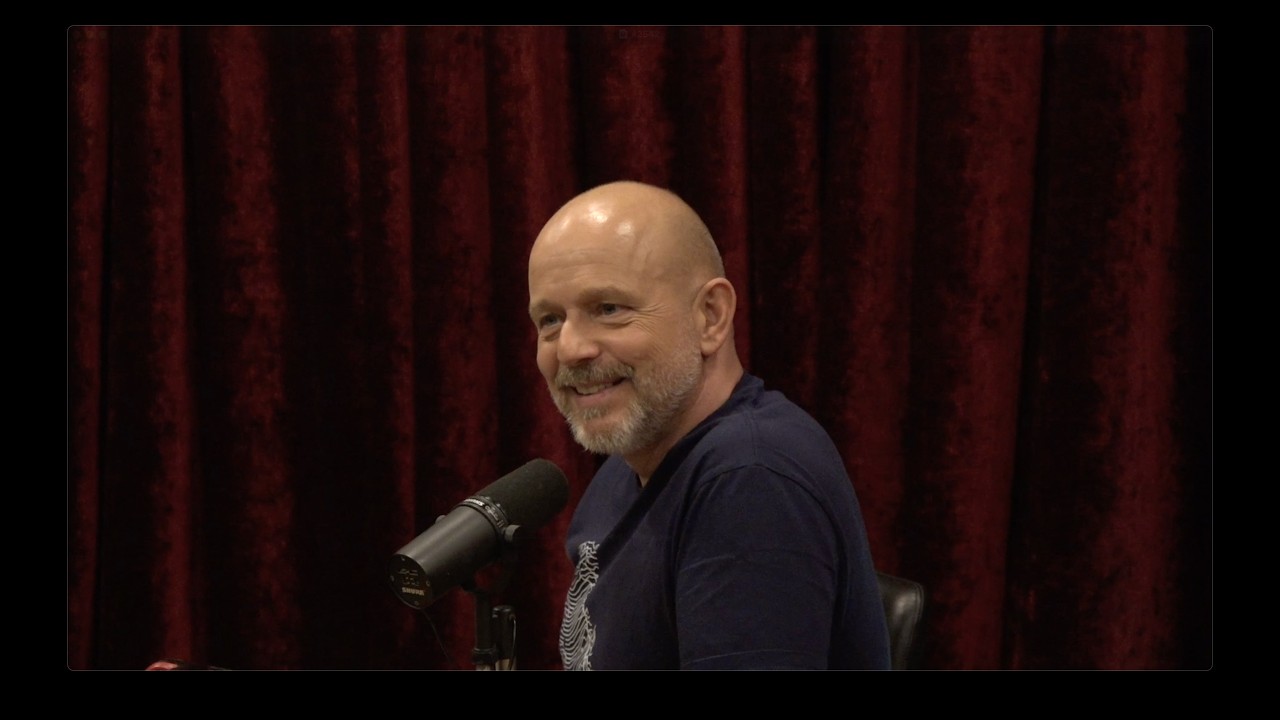
Hilton Outlines Plan to Overhaul California Governance in Rogan Appearance
PowerfulJRE
Gubernatorial candidate Steve Hilton argues single-party Democratic control has driven California into economic decline and child trafficking, promising to dismantle state environmental regulations and defund high-speed rail if elected.
## Background
This episode of the Joe Rogan Experience was published by PowerfulJRE on YouTube on August 19, 2026. The video features an interview with Steve Hilton, a businessman, political commentator, author, and Republican candidate for governor of California.
## TL;DR
Steve Hilton and Joe Rogan discuss the political and socioeconomic issues facing California, criticizing state leadership on topics such as the state's business climate, homelessness programs, border policy, and energy regulations. Hilton outlines his gubernatorial platform, including political reform and budget cuts, while Rogan touches on health policy, comedy, and media coverage regarding COVID-19 origins. The conversation concludes with Rogan offering his endorsement of Hilton's campaign.
## Atmosphere & style
The discussion maintains a relaxed, conversational, and direct tone typical of the podcast, with both participants sharing a skeptical view of government bureaucracy and progressive policies. The dynamic is collegiate and inquisitive, shifting smoothly between serious policy critiques and lighter banter about comedy and personal stories. Throughout the episode, there is a shared sentiment of frustration with California state politics paired with optimistic discussions on potential reform.
## Key takeaways
- [48:36](https://www.youtube.com/watch?v=BYVQfLi6wMA&t=2916s) California faces severe economic and political challenges, ranking lowest in business climate among US states while struggling with high unemployment, poverty, and political entrenchment.
- [01:12:33](https://www.youtube.com/watch?v=BYVQfLi6wMA&t=4353s) Steve Hilton criticizes single-party control in California, comparing Sacramento's supermajority and special-interest capture to Viktor Orbán's long-standing rule in Hungary.
- [01:16:36](https://www.youtube.com/watch?v=BYVQfLi6wMA&t=4596s) California's 'Housing First' mandates and $24 billion homelessness budget are criticized for high unit costs, lack of required accountability, and vetoed state audits.
- [01:21:30](https://www.youtube.com/watch?v=BYVQfLi6wMA&t=4890s) Involuntary mental health commitment and the limits of harm reduction programs spark debate over urban degradation, open-air drug markets, and public health policies.
- [01:29:43](https://www.youtube.com/watch?v=BYVQfLi6wMA&t=5383s) Dario Amodei's essay 'Machines of Loving Grace' highlights potential dystopian future outcomes of AI replacing human economic utility and managing societal behavior.
- [01:41:21](https://www.youtube.com/watch?v=BYVQfLi6wMA&t=6081s) Joe Rogan and Steve Hilton argue that modern political correctness and ideological conformity have stifled traditional comedy movies and freedom of expression.
- [01:47:45](https://www.youtube.com/watch?v=BYVQfLi6wMA&t=6465s) Joe Rogan details the design philosophy and support structure behind his Austin club, the Comedy Mothership, emphasizing community support and mental healthcare for staff.
- [02:02:35](https://www.youtube.com/watch?v=BYVQfLi6wMA&t=7355s) Investigative coverage of Anthony Fauci highlights controversial gain-of-function research funding, pandemic lockdown protocols, and severe pushback against early dissenters.
- [02:15:23](https://www.youtube.com/watch?v=BYVQfLi6wMA&t=8123s) The Department of Health and Human Services (HHS) faced significant criticism over handling unaccompanied minor border crossers and failing to prevent exploitation.
- [02:25:20](https://www.youtube.com/watch?v=BYVQfLi6wMA&t=8720s) Debates around voter ID laws, border policy, and census representation highlight deep partisan divisions between progressives and conservative reformers.
- [02:32:40](https://www.youtube.com/watch?v=BYVQfLi6wMA&t=9160s) California's strict energy regulations, fuel mandates, and reliance on crude oil imports contribute to significantly elevated electricity and gas prices across the state.
- [02:41:44](https://www.youtube.com/watch?v=BYVQfLi6wMA&t=9704s) New replacement tire regulations approved by the California Energy Commission impose rolling resistance limits that could ban up to 70% of current tire models.
- [02:53:18](https://www.youtube.com/watch?v=BYVQfLi6wMA&t=10398s) Steve Hilton's 'Operation Zero Waste' platform targets state overspending, aiming to defund high-speed rail and reform government programs to restore accountability.
## Detailed walkthrough
Here is a detailed, faithful walkthrough of the transcript section.
---
[00:01](https://www.youtube.com/watch?v=BYVQfLi6wMA&t=1s) Reconnecting in the Studio & Reminiscing About Their Hawaii Meeting
Joe Rogan and Steve Hilton catch up at the start of the episode, noting their long-standing friendship that spans over a decade. Steve recalls arriving in the United States from England in 2012, approximately 14 years prior. The two reminisce about their initial meeting on a beach in Hawaii, where their young children—Joe’s two daughters and Steve’s two sons—began playing together in the sand. Steve warmly describes his distinct memory of watching Joe walk down the beach shortly after arriving from the UK, calling it an unforgettable "cultural moment" and admitting he had never met anyone quite like Joe before, nor had he even heard of him at the time.
Joe and Steve also reflect on Steve's first appearance on the podcast back in July 2014 (Episode 509). Steve explains that at the time, he was living a low-key, normal life teaching at Stanford after a career in British politics and business. He admits he had no idea what a podcast actually was when he walked into Joe's old Los Angeles studio, expecting something brief like a standard 10-to-15-minute radio or TV interview. As the conversation passed the 15-minute mark, Steve recalls sitting there wondering when the next guest was coming on, only to realize the chat would run for hours. Steve contrasts that era—when "nobody was listening" and creators could speak freely without worrying about social media fallout—with the massive, 2,000-episode milestone the podcast has reached since.
- **First Meeting:** Hawaii beach in 2012; Steve had just moved to the US from England.
- **First Podcast Appearance:** Episode 509 on July 3, 2014.
- **Steve's Background at the Time:** Former UK political staffer and businessman, then teaching at Stanford.
---
[04:26](https://www.youtube.com/watch?v=BYVQfLi6wMA&t=266s) Social Media Toxicity, Bots, and Public Comments
The conversation shifts to handling public scrutiny and online comments. Joe attributes his personal peace of mind to completely ignoring public feedback and never paying attention to what people say about him. He warns that online spaces like X (formerly Twitter) are filled with bad-faith actors and extreme takes, likening the platform to a restaurant where "20% of their food would literally kill you." Steve shares that as his public profile grew—from Stanford instructor to Fox News host and now a candidate for Governor of California—he frequently encounters bizarre abuse on his posts, ranging from xenophobic "go back to England" comments to insults about his baldness. Steve jokes about how tempting it is to respond to trolls with a simple "good point."
Joe emphasizes that much of the vitriol comes from angry individuals with too much spare time, but an even larger portion originates from automated bot networks. He points out that during Elon Musk's acquisition of Twitter, official filings claimed fake accounts were under 5%, whereas cybersecurity expert Dan Woods (a former FBI digital intelligence specialist) conducted a 2022 forensic analysis suggesting up to 80% of activity might originate from bots. Joe details the mechanics of physical "bot farms" filmed by whistleblowers, where rows of Android phones are wired to central keyboards to amplify identical messaging simultaneously. Joe notes that in addition to automated AI bots, various state actors and paid influencers are heavily funded to spread coordinated narratives on social media.
- **Dan Woods Estimate:** Cybersecurity expert and former FBI contractor who estimated Twitter bot activity could be as high as 80% in 2022.
- **Official Twitter Claim:** Twitter claimed bot accounts were under 5% during the acquisition process.
- **Bot Farm Operations:** Facilities using racks of connected Android smartphones to mass-tweet identical phrases.
---
[11:07](https://www.youtube.com/watch?v=BYVQfLi6wMA&t=667s) Phone Habits, Distractions, and Gore on Social Media
Steve describes his relationship with social media, stating he avoids most platforms but spends about 30 minutes a day checking X primarily as a real-time news source. Joe brings up Steve's famous history of avoiding personal devices, recalling how Steve used to be virtually impossible to contact because he didn't carry a smartphone or regularly check emails on the go. Joe fondly remembers an incident in San Diego where Steve disappeared without a phone, driving his wife furious because she couldn't reach him.
The two discuss how addictive and distracting smartphones are. While Steve notes that most people on planes spend their time mindlessly scrolling Instagram, Joe reveals his own algorithmic rabbit hole on the app. Joe admits to a dark running joke with his comedian friend Tom Segura, where they send each other disturbing viral videos first thing in the morning to freak each other out. Joe describes scrolling past gruesome footage on Instagram—including a graphic video of a botched ATM robbery where a thief was dragged under a car—and notes how poorly platforms filter graphic violence compared to text-based commentary.
- **Steve's Tech Discipline:** Historically refused to carry a smartphone or check email on the go to stay present.
- **Tom Segura Prank:** Joe and comedian Tom Segura share a morning tradition of texting each other horrific or bizarre internet videos.
---
[14:42](https://www.youtube.com/watch?v=BYVQfLi6wMA&t=882s) TikTok's Algorithmic Hook and China's Curated Platform
Joe and Steve discuss the rise of TikTok, tracing its origins back to ByteDance and its early days as a music and lip-syncing app focused on dancing videos. Steve recalls reading about its early explosive growth years ago and initially doubting it would take off, only to watch it become a global dominant force. Joe notes how aggressively TikTok hooks users: unlike Instagram, which requires manual scrolling and browsing effort, TikTok immediately plays content the moment the app opens, easily trapping users in an hour-long loop of wasted time.
The conversation turns to the stark contrast between the Western version of TikTok and the version operated inside China (Douyin). Joe and Steve highlight how the Chinese government curates its domestic algorithm toward educational and high-achievement content—such as science experiments, martial arts, classical music performance, and athletic feats—while restricting screen time for kids. They contrast this intentional, skill-building feed with the addictive, brain-draining algorithm served to international audiences.
- **TikTok Origins:** Evolved from early ByteDance musical/lip-syncing and dance apps.
- **Western vs. Chinese Versions:** The Chinese domestic platform emphasizes educational, athletic, and musical achievements, whereas the Western feed prioritizes viral distraction.
---
<ElicitationsGroup message="Where would you like to go next with this transcript?">
<Elicitation label="Proceed to Part 2 of the transcript" query="Please provide the walkthrough for Part 2 of the Joe Rogan Experience #2542 with Steve Hilton transcript."/>
<Elicitation label="Summarize Steve Hilton's platform and background" query="Based on the context provided, what is Steve Hilton's background and what is he running for?"/>
</ElicitationsGroup>
[16:19](https://www.youtube.com/watch?v=BYVQfLi6wMA&t=979s) Media Regulation, Screen Time, and the Meta Lawsuit
The discussion opens with a look at how digital platforms are regulated, specifically highlighting China's strict controls over the Chinese version of TikTok (Douyin). In China, the app effectively "bricks" or locks out younger users after 10:00 p.m. until morning, prompting them to go to sleep and maintain a healthy routine. While acknowledging that state-mandated restrictions clash with Western ideals of freedom, Rogan notes that it prevents a culture from being entirely captured by digital distraction. Hilton recalls growing up in England as the child of Hungarian parents and visiting Communist Hungary, where television broadcasts were turned off entirely on Mondays to force people to socialize, play sports, and engage in real-life activities.
This leads into a major current event: a massive lawsuit against Meta involving state attorneys general seeking unprecedented financial penalties. Reports cite potential exposure between $200 billion and up to $1.4 trillion over claims that Meta deliberately designed algorithms to addict children to social media. Beyond financial damages, the lawsuit aims to enforce court-ordered product changes, including strict age/parental verification, disabling infinite scroll and autoplay, removing "dopamine-manipulating" recommendation algorithms, hiding like counts, and banning disappearing content like Instagram Stories.
```
META LAWSUIT PROPOSED CHANGES
┌───────────────────────────┐
│ • Parental Verification │
│ • End Infinite Scroll │
│ • Remove Like Counts │
│ • Stop Disappearing Story │
│ • Ban Autoplay │
└───────────────────────────┘
```
Both Rogan and Hilton express deep skepticism over government-mandated product redesigns. Rogan points out that features like disappearing stories have positive uses—citing his friend, bow hunter Adam Greentree, who uses Instagram Stories to document solitary 28-day hunting trips deep in the Colorado Rockies. They argue that when government bureaucrats step in to micromanage technology features, the end result inevitably ruins the user experience without solving the underlying issue.
- **China's TikTok Policy:** The Chinese government enforces a curfew on its domestic version of TikTok, locking younger users out after 10:00 p.m.
- **Hungarian Monday TV Shutdown:** Under Communist rule, Hungary shut down all television broadcasting on Mondays to encourage civic and physical activity.
- **Meta Litigation Financials:** Four states lead a lawsuit claiming Meta addicted minors, with potential damages cited between $200 billion and $1.4 trillion.
- **Adam Greentree Example:** Rogan highlights bow hunter Adam Greentree's Instagram Stories documenting 28-day solo wilderness hunts in Colorado as a legitimate, engaging use of short-form media.
---
[22:41](https://www.youtube.com/watch?v=BYVQfLi6wMA&t=1361s) The Attention Economy, Algorithm-Free Alternatives, and Video Games
Shifted away from lawsuits, the conversation centers on the core problem: modern digital platforms profit off human attention by intentionally feeding users outrage and conflict. Hilton mentions the news of a potential MySpace relaunch that promises to be completely algorithm-free. Instead of forcing engagement through anger-inducing content recommendations, an algorithm-free feed allows users to see strictly what they choose to follow. Rogan admits that even adults struggle with screen addiction, remarking on how easily attention gets sucked into useless digital noise.
Hilton shares his experiences traveling across California and speaking to thousands of voters at town halls and roundtables. While voters initially raise standard political topics like gas prices and tax rates, their emotional intensity spikes when discussing screens, social media, video games, and artificial intelligence. Parents feel completely overwhelmed by kids using AI to write homework or falling into addictive loops. Rogan points out that video games are far more addictive than social media, yet they escape political scrutiny because they do not directly shape public political opinions in the way social media algorithms do.
> "The commodity is your attention."
- **MySpace Relaunch:** An effort to reintroduce MySpace as an algorithm-free platform where content is purely user-selected rather than driven by engagement algorithms.
- **Voter Concerns:** Steve Hilton notes that screen time, social media addiction, and AI in education generate more raw emotional anger from parents at town halls than traditional topics like gas prices.
- **Video Game Addiction:** Rogan emphasizes that video games are arguably more addictive than social media, but face less government interference because they do not overtly influence political ideologies.
---
[25:00](https://www.youtube.com/watch?v=BYVQfLi6wMA&t=1500s) Political Radicalization, Social Safety Nets, and Universal Basic Income
Rogan argues that social media algorithms play a central role in radicalizing young people toward extreme political ideologies, such as democratic socialism or Marxism. Many young people advocating for these systems online fail to understand historical precedent—specifically that surrendering all economic control to the state inherently grants total authority to the entity holding the guns. While capitalism can be brutal and requires guardrails, state-run monopolies historically produce disastrous real-world results. Hilton recalls visiting state-run grocery stores near his grandmother's home in Communist Hungary, describing the bleak reality and lack of basic goods.
The conversation turns to social safety nets and Universal Basic Income (UBI). Both agree that a compassionate society needs safety nets for people facing unexpected tragedy, such as a widowed mother losing her family's primary income. However, poorly structured safety nets risk disincentivizing work and ambition. Hilton contrasts modern left-wing UBI proposals with the original conservative concept championed by economists Milton Friedman and Charles Murray. The conservative vision aimed to replace the entire welfare state—eliminating all administrative agencies, Medicaid, and bureaucracy—and replacing it with a direct, streamlined cash grant.
```
MODERN WELFARE vs. FRIEDMAN UBI
┌─────────────────────────────────┐ ┌─────────────────────────────────┐
│ Modern Welfare State │ │ Friedman / Murray UBI │
├─────────────────────────────────┤ ├─────────────────────────────────┤
│ • Complex Bureaucracy │ │ • Direct Cash Distribution │
│ • Means-Tested Programs │ │ • Total Elimination of Agencies │
│ • Administrative Overhead │ │ • Reduced Government Control │
│ • Traps & Disincentives │ │ • Maximum Individual Choice │
└─────────────────────────────────┘ └─────────────────────────────────┘
```
- **Historical Perspective:** Hilton shares personal memories of state-run grocery stores in Communist Hungary, using them as an example of central planning failure.
- **Milton Friedman & Charles Murray:** Conservative thinkers who originally proposed a simplified negative income tax/UBI explicitly to abolish the massive government welfare bureaucracy.
---
[28:05](https://www.youtube.com/watch?v=BYVQfLi6wMA&t=1685s) California's Cost of Living, Minimum Wage, and Wage Regulations
Addressing the realities of working families, Hilton discusses ideas from his 2015 book, *More Human: Designing a World Where People Come First*. He highlights the fundamental flaw in current economic conditions: millions of hard-working people holding down full-time jobs (or even two jobs) still cannot afford basic living expenses. To address this, Hilton initially proposed a "business-friendly living wage" and a policy exempting state income tax on earnings under $100,000. However, during his campaign in California, voters informed him that $100,000 is no longer a high income due to hyper-inflated housing and living costs—leading him to bump his tax-free proposal to $150,000.
```
CALIFORNIA WORKING-CLASS TAX PROPOSAL
┌────────────────────────────────────┐
│ Original Proposal: $100,000 limit │
│ Adjusted Proposal: $150,000 limit │
│ Goal: 0% State Income Tax below │
│ the baseline living cost │
└────────────────────────────────────┘
```
They debate the impact of California’s recent wage hikes, including the $20-an-hour minimum wage for fast-food workers. Rogan and Hilton observe that forcing drastic wage increases on small businesses and franchises backfires by cutting entry-level jobs and accelerating automation, such as self-service kiosks. Rogan asserts that minimum-wage fast-food jobs were historically intended as entry-level positions for teenagers learning work ethic, basic skills, and tax deductions—not career jobs meant to support an entire household.
> "When I was a kid, if you made a hundred thousand bucks, you were killing it."
- **Book Reference:** Steve Hilton authored *More Human: Designing a World Where People Come First* (2015), advocating for human-scale systems over massive bureaucracies.
- **California Low-Income Threshold:** In several high-cost California counties, the official state classification for "low income" starts at or near $100,000 per year.
- **Hilton's Tax Policy:** Proposes zero state income tax on incomes up to $150,000 in California to relieve pressure on the middle and working classes.
- **Fast Food Wage Mandate:** California's $20/hour fast-food minimum wage law led directly to workforce reductions and faster adoption of automated ordering tech.
[31:51](https://www.youtube.com/watch?v=BYVQfLi6wMA&t=1911s) The "Doom Loop" of Bloated Government and Hidden Taxes
Joe Rogan and Steve Hilton begin by lamenting the harsh reality of living on minimum wage, agreeing that paying someone $15 an hour for a 40-hour workweek is "brutal" and barely enough to survive on. Hilton argues that the core issue—especially in California—is the staggering size of government bureaucracy. Hidden taxes are layered into every aspect of life, from gas taxes to stealth housing fees, driving up the overall cost of living without delivering tangible benefits. Hilton describes a government "doom loop" where ruling Democrats recognize that citizens are struggling, yet respond by raising taxes to fund more welfare programs and redistribution. This response only makes living and running a business more expensive, rather than addressing the root cause by cutting costs and reducing the state's take.
Rogan characterizes this tax-and-spend cycle as a massive "slush fund." He points out the absurdity that as California’s population shrank and people moved away, the size of the state government actually doubled. He questions the official narrative on job creation, suggesting that many of these positions are simply expanded government roles or taxpayer-funded handouts to non-profits and NGOs.
- **Hidden Tax Burdens**: Stealth fees, gas taxes, and administrative mandates continuously drive up the baseline cost of living.
- **The Redistributive "Doom Loop"**: Government responds to high living costs by increasing taxes for welfare programs, which further increases expenses.
- **Government Growth vs. Population**: California's state government doubled in size while its actual population shrank.
---
[33:52](https://www.youtube.com/watch?v=BYVQfLi6wMA&t=2032s) Non-Profit Corruption and the Homelessness Industrial Complex
Rogan shares an example from an Instagram creator who broke down a proposed $5 billion renovation for a convention center, pointing out that the money could instead be used to give a staggering payout to every person living on Skid Row. He argues that those operating within the system have no real incentive to solve issues like homelessness. Hilton and Rogan highlight the outrageous salaries drawn by executives of homeless non-profits, citing a case where a female executive pulled in a $1.6 million salary, and another non-profit head making $2.6 million annually.
Hilton notes that in the private sector, a CEO who loses vast sums of money while continuously failing to accomplish their core mission would be fired. In California's non-profit ecosystem, however, the homelessness crisis only gets worse while executive pay skyrockets. Rather than fixing fraud and waste, politicians push for a "billionaire wealth tax" to extract more money from high earners, despite the fact that the top 1% already pays roughly half of all income tax in the state. Rogan warns that aggressive tax hikes are driving away the very tax base supporting the state.
> "There was just one last week... this woman runs a homeless non-profit, $1.6 million salary... Homeless non-profit. Non-profit. She's killing it."
- **Convention Center Cost**: A proposed $5 billion convention center renovation highlighted as an example of misallocated public funds.
- **Inflated Executive Pay**: Non-profit executives managing homelessness initiatives drawing salaries between $1.6 million and $2.6 million per year.
- **Tax Base Vulnerability**: California's top 1% of earners pay approximately half of the state's total income tax.
---
[36:00](https://www.youtube.com/watch?v=BYVQfLi6wMA&t=2160s) One-Party Rule, Mail-In Ballots, and the Prop 64 Money Trail
Rogan proposes a radical accountability measure for local officials: tying a mayor's salary directly to the city's economic health and GDP. He notes that when Los Angeles lost 70% of its restaurants during COVID-19 lockdowns, then-Mayor Eric Garcetti should have lost 70% of his paycheck. Hilton attributes the lack of accountability to 16 years of uninterrupted one-party rule, leaving politicians convinced they will remain in power forever. They briefly discuss controversial local election outcomes, noting odd surges in mail-in ballot totals that flipped tax hikes and local races.
Hilton details how voter-approved initiatives are exploited through administrative "scams." He points to Proposition 64, which legalized recreational cannabis under the promise that tax revenues would fund substance abuse prevention. Instead, Hilton tracked $350 million of cannabis tax money flowing into a single health non-profit, which then distributed grants of $750,000 to $1 million to roughly 500 sub-organizations. These groups used the funds for partisan activities like voter registration and ballot harvesting. Furthermore, Hilton notes that California's state budget surged from $170 billion to over $350 billion in just ten years, even as public services declined and the prison population was slashed while its budget doubled.
> "This year the budget is just over $350 billion, the total budget. 10 years ago it was $170 billion, and everything's worse."
- **Garcetti Lockdowns**: Los Angeles lost approximately 70% of its restaurants during COVID-19 lockdowns without any pay cuts for leadership.
- **Proposition 64 Tax Diversion**: $350 million intended for substance abuse prevention was funneled to 500+ non-profits engaging in voter registration and ballot harvesting.
- **State Budget Explosion**: California’s state budget doubled from $170 billion to over $350 billion over a ten-year span.
- **Prison Budget Disconnect**: The state prison population was cut nearly in half, yet the corrections budget doubled.
---
[39:21](https://www.youtube.com/watch?v=BYVQfLi6wMA&t=2361s) Fire Relief Scandals and Hilton’s Gubernatorial Campaign
Rogan brings up the handling of Los Angeles fire relief funds, calling the diversion of charitable aid into political non-profits "disgusting." Media personality Spencer Pratt publicly mapped out how aid money was split across roughly 200 non-profits while families who lost their homes received nothing. Hilton asserts that while the legal and political system is heavily stacked, his gubernatorial campaign against Democrat candidate Javier Becerra—who served as Joe Biden’s Health Secretary—is proving that voters are fed up.
Despite running a "scrappy startup" campaign against the establishment machine and public sector unions, Hilton notes that the polling gap is narrowing rapidly. Initial polls showed him down 61% to 36%, but recent surveys have closed the gap to under 10 points. Hilton believes a silent majority of Californians wants to dismantle the current political regime rather than abandon the state.
- **Fire Aid Misdirection**: Aid money raised for disaster victims was distributed to 200 non-profits instead of directly helping homeowners who lost everything.
- **Gubernatorial Matchup**: Steve Hilton is running for California Governor against former Biden Health Secretary Javier Becerra.
- **Polling Turnaround**: Hilton closed an initial 25-point deficit (61%–36%) down to less than 10 points.
---
[41:42](https://www.youtube.com/watch?v=BYVQfLi6wMA&t=2502s) The Los Angeles Voter Bubble and Over-Medication
Rogan examines California's political map, pointing out that while many rural and suburban counties turned red between 2020 and 2024, massive urban strongholds like Los Angeles County—which represents 23% of the statewide vote—dictate the state's direction. Rogan uses the Perplexity search app live on air to look up the number of adults in LA County taking SSRI antidepressants. The search estimates between 500,000 and 950,000 adults in LA County take SSRIs, though Rogan speculates the true number of heavily medicated residents is far higher.
Rogan argues that widespread over-medication creates a "zombie catatonic state" that leaves residents passive and susceptible to political echo chambers. He stresses that the chemical imbalance theory of depression has been scientifically disproven, emphasizing that lifestyle factors—sedentary habits, poor diet, isolation, and lack of exercise—are the true drivers of mental health struggles.
> "They're in this zombie catatonic state from anti-depressants and anti-psychotics... and they're cloudy. They don't see things, and they're surrounded by this echo chamber of people that only agree with them."
- **Electoral Weight of LA**: Los Angeles County accounts for roughly 23% of the total vote in California state elections.
- **SSRI Usage Statistics**: Estimates indicate between 500,000 and nearly 1 million adults in LA County are prescribed SSRIs.
- **Rejection of Chemical Imbalance Theory**: Rogan highlights that depression is largely driven by physical, environmental, and lifestyle factors rather than a simple chemical flaw.
---
[45:01](https://www.youtube.com/watch?v=BYVQfLi6wMA&t=2701s) UK Healthcare Lessons and Big Pharma as a "Cartel"
Reflecting on his time as a senior advisor to the Prime Minister in 10 Downing Street, Steve Hilton recalls trying to shift the UK's National Health Service (NHS) toward preventive health promotion. Because the NHS is entirely taxpayer-funded, healthcare spending directly competes with all other public services, creating a clear financial reason to keep citizens healthy. However, after months of consulting top medical experts, Hilton realized the ultimate solutions were basic: diet, physical exercise, proper hydration, and sleep.
The conversation turns to a tragic news story regarding a mother suffering from severe postpartum depression who killed her children after being prescribed a heavy regimen of psychiatric drugs. Rogan and Hilton react with horror at the long list of side effects associated with modern antidepressants, including black-box warnings for suicidal ideation. Rogan labels the American pharmaceutical industry a government-sanctioned, publicly traded "cartel" that uses its immense profits to buy off politicians and pass favorable regulations.
- **10 Downing Street Insights**: Hilton notes that preventive health (exercise, nutrition, sleep) is the only realistic way to reduce government healthcare spending.
- **Side-Effect Paradox**: Antidepressant medications frequently carry black-box warnings for increased suicidal ideation and anxiety.
- **Pharmaceutical Influence**: Rogan describes Big Pharma as a legal cartel using corporate profits to capture regulatory agencies and lawmakers.
[[48:36](https://www.youtube.com/watch?v=BYVQfLi6wMA&t=2916s)(https://www.youtube.com/watch?v=BYVQfLi6wMA&t=2916)] Special Interests, California Politics, and Kamala Harris's "Too Big to Rig"
Joe Rogan and Steve Hilton dissect the deep-seated bribery and special-interest machine operating inside Sacramento politics. Rogan points out how lobbyists routinely write legislation that politicians sign without reading, leading to absurd real-world consequences that leave normal citizens bewildered. Moving to the 2026 California gubernatorial race, Hilton discusses his opponent, Xavier Becerra. When a news interviewer confronted Becerra with California's bleak realities—including holding the nation's highest unemployment and poverty rates—Becerra brushed off criticism by claiming things could not be that bad because tourists are still visiting Disneyland and the beaches.
The discussion pivots to Kamala Harris, who was recently spotted reusing Donald Trump's well-known "too big to rig" campaign slogan as if it were her own original idea. Rogan and Hilton chuckle at the irony of Harris claiming elections are being rigged by opponents, noting the hypocritical nature of political discourse surrounding election integrity. Hilton observes that candidate selection is ruthlessly enforced by political establishments, where anyone straying from the party narrative faces smear campaigns or dug-up personal scandals.
- California holds the nation's highest unemployment rate among all 50 states alongside record-high poverty and cost-of-living spikes.
- Kamala Harris publicly adopted the phrase "too big to rig" during a speaking appearance, claiming voters needed to overcome obstacles set up by political rivals.
- Hilton points out the paradox of political smears, noting lightheartedly that the establishment hasn't targeted him yet only because they underestimate his chances.
[[53:40](https://www.youtube.com/watch?v=BYVQfLi6wMA&t=3220s)(https://www.youtube.com/watch?v=BYVQfLi6wMA&t=3220)] Corrupt Endorsements: CalChamber and Police Unions
Hilton details the systemic corruption he personally encountered while seeking endorsements as a gubernatorial candidate. According to the Chief Executive Magazine annual survey of business conditions, California has ranked 50th out of 50 states for business climate for roughly 12 to 13 consecutive years. Despite Hilton listing his occupation on the ballot as "small business owner" after spending most of his 36-year career running businesses, the California Chamber of Commerce (CalChamber) chose to endorse Xavier Becerra—a candidate openly promising no policy changes. Hilton explains that groups like CalChamber endorse based on proximity to power rather than aligned principles.
A similar pattern emerged during endorsement interviews with law enforcement associations. Despite Hilton campaigning heavily on a traditional law-and-order platform—promising to reverse police defunding and address rising crime—the police union endorsed Becerra instead. The union candidly admitted their endorsement came down to a single issue: Becerra promised to pass a specific bill increasing their public pensions.
- Chief Executive Magazine has ranked California 50th out of 50 states for business climate for over a decade.
- Hilton chose "small business owner" for his three-word ballot designation after tracking his career back to graduating from Oxford in 1990.
- Public pension obligations consume massive portions of state budgets; in public education, approximately one-fifth of school funding goes toward teacher pensions before reaching classrooms.
[[58:43](https://www.youtube.com/watch?v=BYVQfLi6wMA&t=3523s)(https://www.youtube.com/watch?v=BYVQfLi6wMA&t=3523)] Missing Audit Money and the Decline of Downtown LA
Rogan and Hilton criticize the massive misallocation of public funds in California, highlighting the state's failure to address chronic homelessness despite spending billions. Rogan points out that over $24 billion intended to combat homelessness has vanished without clear accounting, noting that Governor Gavin Newsom vetoed state audits of the spending twice. A similar situation unfolded in Los Angeles, where Mayor Karen Bass blocked an audit requested by a federal judge following a lawsuit by downtown business owners. Rogan argues that redirecting those lost billions toward police funding, better training, and community safety would yield immediate improvements on the streets.
The conversation turns to the severe degradation of downtown Los Angeles, particularly around Skid Row. Rogan describes downtown LA as sketchy and unsafe, recalling a personal story where taking his children to get donuts in downtown turned into a stressful exercise in dodging erratic individuals on the sidewalk. Hilton describes staying near City Hall on a Saturday night and encountering streets smelling of waste and filled with wandering, zombie-like individuals. They express frustration that the second-largest city in the wealthiest nation tolerates complete lawlessness in its urban core, crippling local real estate and driving out standard commerce.
- Governor Gavin Newsom twice vetoed legislation mandating an audit of California's $24 billion homelessness budget.
- A federal lawsuit in Los Angeles revealed an estimated $2 billion spent locally on homelessness without proper auditing, which Mayor Karen Bass opposed.
- The LAPD projects that by the time Los Angeles hosts the 2028 Summer Olympics, the police force could be operating at half of its required staffing levels.
- Skid Row spans approximately 50 blocks in downtown Los Angeles, acting as a dead zone for commercial real estate and long-term business leases.
- Rogan recalls seeing Skid Row's sprawling encampments as far back as 2004 while filming *Fear Factor* in abandoned downtown buildings.
<FollowUp label="Want to continue with part 5 of the transcript?" query="Write a detailed walkthrough of part 5 of the transcript for Joe Rogan Experience #2542 with Steve Hilton."/>
[01:04:33](https://www.youtube.com/watch?v=BYVQfLi6wMA&t=3873s) The Squalor of Skid Row and Harm Reduction Controversies
Joe Rogan and Steve Hilton discuss the horrifying deterioration of Los Angeles's Skid Row, reflecting on documentaries detailing how the area turned into a squalid epicenter of misery. Rogan notes how historical practices effectively contained vagrants and vulnerable populations by dumping them downtown to clean up wealthy areas like Beverly Hills. Now, however, the problem has spilled past those borders into the wider state. Hilton points out that government programs operating under the banner of "harm reduction" actively distribute drugs and drug paraphernalia, handing out opioids as fentanyl substitutes and providing free crack pipes.
<Image alt="Skid Row neighborhood in downtown Los Angeles showing tents and encampments on public sidewalks" caption="Sidewalk tents and encampments on Skid Row" src="image_agent_tag_1"/>
---
Hilton recounts trying to film inside harm reduction facilities, noting that journalist Christopher Rufo from the Manhattan Institute successfully gained access to expose how government-funded organizations operate. Both express shock at the return of medieval diseases eradicated a century ago, driven by extreme unsanitary conditions.
- **Christopher Rufo's Exposé**: Journalist Christopher Rufo of the Manhattan Institute gained access to document government-funded programs providing crack pipes and drug supplies.
- **Historic Containment Strategy**: Early city policies cleared areas like Beverly Hills by rounding up homeless individuals and dropping them off downtown.
- **Harm Reduction Model**: Government programs distribute opioids as lower-risk alternatives to fentanyl alongside drug paraphernalia like crack pipes.
---
[01:06:33](https://www.youtube.com/watch?v=BYVQfLi6wMA&t=3993s) Crime, Masked Home Invasions, and Policy Ideology
Hiltons observes that degradation and squalor are visible across the state, accompanied by a sharp surge in home invasions and breaking-and-entering crimes. A alarming trend in these violent home invasions is that criminals almost universally wear masks. To combat this, Hilton's campaign has worked on legislative proposals to add strict sentencing enhancements specifically for perpetrators who conceal their identities while committing crimes.
Rogan argues that releasing violent, repeat offenders back onto the streets seems like a deliberate strategy to destroy a city, executed under the guise of progressive reform and buzzwords surrounding systemic racism. However, Hilton highlights a rare bright spot: newly elected Los Angeles District Attorney Nathan Hochman. Hochman represents a pragmatic shift away from progressive ideology, though he still faces a hostile broader political system captured by rigid party dogma.
- **Masked Home Invasions**: Criminals routinely wear masks during home invasions; new proposed policy seeks mandatory sentencing enhancements for covering one's face during a crime.
- **Nathan Hochman's Election**: Newly elected LA District Attorney Nathan Hochman is highlighted as a positive step toward practical, non-ideological prosecution.
---
[01:08:45](https://www.youtube.com/watch?v=BYVQfLi6wMA&t=4125s) Party Loyalty, Ideological Rigidity, and the Independent Trap
Hilton details how political enforcement in Sacramento forces strict adherence to the party line. He shares an example of a Democratic state legislator who broke rank on a bill pushed by government labor unions; in retaliation, the union funded the campaign of a Republican opponent solely to punish the lawmaker and keep others in line. Rogan laments America's rigid two-party system, noting that mainstream voters are trapped between extremes—forced to choose between "the dumbest MAGA people" or hyper-progressive activists in cities like Portland.
When Rogan asks why Hilton doesn't run as an independent—citing figures like Michael Shellenberger or Robert F. Kennedy Jr. who struggled against the two-party apparatus—Hilton explains his realistic path forward. While running as a Republican, he considers himself independent-minded and views his outsider status as an advantage.
- **Union Retaliation**: A Democratic legislator who voted against a major government union saw that union fund a Republican challenger to enforce party discipline.
- **Independent Candidates**: Reference to Michael Shellenberger's two independent runs for California governor and RFK Jr.'s independent presidential bid.
- **Traditional Liberal Values**: Rogan defines classic 1990s "Bill Clinton liberalism" as supporting gay rights, civil rights, women's rights, and a basic safety net, contrasting it with modern ideological stances.
---
[01:12:33](https://www.youtube.com/watch?v=BYVQfLi6wMA&t=4353s) One-Party Rule and Special-Interest Capture in Sacramento
The conversation shifts to how one-party dominance leads directly to institutional decay. Hilton points out that Democrats have held a two-thirds supermajority in both houses of the California Legislature for over a decade, along with every statewide office, major city administration, and 61 Democratic appointees on the State Supreme Court. Hilton argues this creates an arrogant mindset where politicians feel untouchable, leading to widespread special-interest capture by big unions and corporate developers.
Hilton draws a direct parallel to Hungary under Viktor Orbán, noting that his own family lives there and experienced how 16 years of unchecked single-party control led to pervasive corruption. Both agree that giving absolute power to either party—Republican or Democrat—inevitably breeds the exact same outcome without proper oversight and opposition.
- **Supermajority Status**: Democrats have held a two-thirds supermajority in the California Legislature for over 10 years, controlling all 61 appointments on the California Supreme Court and all statewide executive positions for 16 years.
- **Hungarian Parallel**: Hilton draws comparisons between California's 16-year single-party run and Viktor Orbán's 16-year rule in Hungary, citing similar patterns of corruption.
- **Reform Allies**: Republican Assembly Leader James Gallagher, Carl DeMaio, and David Tangipa are mentioned as key allies fighting against Sacramento's interest-group capture.
---
[01:16:36](https://www.youtube.com/watch?v=BYVQfLi6wMA&t=4596s) The "Homeless Industrial Complex" and Housing First Mandates
Rogan and Hilton criticize the state's handling of $24 billion in missing homelessness funds. Hilton details how the state auditor—at the request of lawmakers—published a report showing the money was unaccounted for, yet Governor Gavin Newsom vetoed efforts to investigate where the funds actually went.
Hilton breaks down the two pillars of what he calls the "Homeless Industrial Complex": non-profits and crony housing developers. Under California's official "Housing First" mandate, it is legally forbidden for state funds to go to any organization that requires personal accountability from recipients, such as mandatory addiction treatment, mental health recovery, or job training. Meanwhile, massive sums are funneled to a select group of developers building "permanent supportive housing" units at exorbitant prices.
- **$24 Billion Missing**: A state audit revealed $24 billion spent on homelessness was unaccounted for, with no measurable tracking of outcomes as homelessness increased.
- **Housing First Policy**: State regulations mandate that state funds cannot be given to programs requiring addiction recovery, treatment, or job training as a prerequisite for assistance.
- **Crony Developers**: A small group of select housing developers receive the bulk of state funding to construct high-cost "permanent supportive housing" units.
---
<ElicitationsGroup message="Explore related topics from this podcast clip:">
{/* Reason: Offers structured follow-up paths directly expanding on Hilton's campaign platforms and California governance issues. */}
<Elicitation label="Analyze California's Housing First policy vs. treatment-first models" query="Compare California's Housing First homelessness policy with treatment-first models used in other states or countries."/>
<Elicitation label="Break down Nathan Hochman's record as LA District Attorney" query="What are Nathan Hochman's main policy changes and record as Los Angeles District Attorney since taking office?"/>
</ElicitationsGroup>
[01:18:50](https://www.youtube.com/watch?v=BYVQfLi6wMA&t=4730s) The $900,000 Homeless Unit: Housing Costs and the IMD Rule
Steve Hilton exposes the staggering price tag behind California's permanent supportive housing initiatives, where building a single unit for a unhoused person can cost anywhere from $600,000 up to $900,000 or $1 million in Los Angeles and the Bay Area. Citing a friend who builds apartments in Northern California, Hilton notes that without the layers of government bureaucracy, taxpayer-funded union requirements, specific material mandates, and environmental regulations, the actual construction cost would be closer to $250,000 "per door"—a fourth of current expenditure. Beyond the inflated costs, Hilton points out that these projects fail to solve the underlying problem: housing an active fentanyl addict without mandatory treatment simply results in them returning to the streets to deal and buy drugs.
Joe Rogan and Steve Hilton connect this crisis to the legacy of the Reagan administration, which closed the doors of state-run mental institutions without establishing functional alternatives for public health and safety. Hilton highlights how a prevailing anti-institutional ideology was later codified into federal healthcare policy via Medicaid's IMD (Institutions for Mental Diseases) rule. Under this regulation, federal Medicaid reimbursement is strictly denied to any mental health treatment facility with more than 16 beds. Because providers cannot receive federal funding for larger facilities, there is zero financial incentive to build scalable, modern mental health institutions, leaving society with fragmented, small-scale care that fails to address the scope of the problem.
- Permanent supportive housing units in LA and the Bay Area cost between $600,000 and $1,000,000 to construct per unit.
- Basic construction costs without government mandates are estimated at around $250,000 per door.
- The Medicaid IMD (Institutions for Mental Diseases) rule caps federally reimbursed mental health facilities at a maximum of 16 beds, disincentivizing large-scale psychiatric care facilities.
[01:21:30](https://www.youtube.com/watch?v=BYVQfLi6wMA&t=4890s) Forced Involuntary Commitment and the Canadian Mental Health Act Incident
The conversation shifts to the dangers of state overreach and the potential abuse of the psychiatric system. Rogan recounts a viral video involving Canadian police officers and a doctor pulling over a man in his vehicle to involuntarily commit him under the Mental Health Act. Despite the man remaining entirely calm, coherent, and articulate—asking why he was being certified without an official psychiatric evaluation and offering to voluntarily make an appointment—the authorities insisted on taking him directly to a hospital for testing and psychiatric evaluation in a controlled environment.
Rogan and Hilton dissect the chilling nature of the interaction. While initial reports claimed the man was a "conservative influencer" and some speculated online that he might have posted manic videos or acted strangely off-camera, Rogan points out that the immediate interaction showed no evidence of him being a danger to himself or others. They discuss how socialized medicine combined with authoritarian government measures can be weaponized against dissenters or "rabble-rousers." Rogan also notes the surreal follow-up footage from inside the facility, where the man was forced to tape up his windows because his room lacked drapes, highlighting a dark trend toward medicalized inhumanity.
- The viral incident involved the CAR87 program in Vancouver, a joint operation between Vancouver Coastal Health and the Vancouver Police Department.
- A resident psychiatrist (Dr. Emery) certified the individual under the Mental Health Act based on prior reports from a doctor (Dr. Taylor) and family conversations, rather than a formal in-person examination at the scene.
- Rogan voices concern over the ease with which individuals can be institutionalized without due process, warning against the creeping authoritarianism in government-run medical systems.
[01:29:43](https://www.youtube.com/watch?v=BYVQfLi6wMA&t=5383s) AI Dystopianism, Dario Amodei, and the "Machines of Loving Grace" Essay
Hilton shifts the discussion on medicalization and technological overreach to the ongoing debate surrounding artificial intelligence regulations. He highlights recent public exchanges involving Dario Amodei, the CEO and co-founder of Anthropic. While tech leaders are accused of hyping up AI doom scenarios to push for government regulations that protect big tech incumbents from competition, Amodei responded on X (formerly Twitter) by pointing to his 14,000-word essay, *Machines of Loving Grace*, to prove he holds an optimistic vision for the future.
However, Hilton describes Amodei's "positive" vision as deeply dystopian and unsettling. In the essay, Amodei envisions a future where human beings can no longer make useful contributions to the economy and people have little to do besides play video games. To address the resulting loss of purpose and depression, Amodei suggests that humanity already understands how to medicate people with pharmaceuticals like Ritalin and that AI could make mental health treatments even better. Rogan and Hilton express horror at the notion that leading AI founders view a future of mass sedating and numbing unemployed humans as a utopian outcome.
- Dario Amodei is the CEO and founder of Anthropic, one of the leading AI companies alongside OpenAI.
- Amodei's 14,000-word essay, titled *Machines of Loving Grace*, argues that AI can drastically improve human lives, but notes that pharmaceutical interventions (referencing Ritalin) can help manage human psychological needs when economic utility vanishes.
- Rogan mentions reports of lead AI developers experiencing existential crises and leaving top tech companies to retreat from society, write poetry, or prepare for impending civilizational shifts.
- The hosts recall a public moment where investor Peter Thiel paused extensively when asked if the human race should survive, underlining the strange philosophy held by key figures shaping the AI industry.
[01:33:53](https://www.youtube.com/watch?v=BYVQfLi6wMA&t=5633s) Mental Health Interventions, SSRIs, and Natural Alternatives
Joe Rogan and Steve Hilton begin by clarifying a discussion regarding AI-driven neuroscience and future mental health interventions. They address how AI could potentially engineer more effective or potent treatments than existing drugs like Ritalin or SSRIs. Joe emphasizes that he is not entirely anti-SSRI, sharing a personal story about a close friend who was severely depressed and suicidal; getting him to a psychiatrist and onto SSRIs saved his life, allowing him to eventually adjust his life and safely wean off them. However, Joe contrasts this success story with the severe danger of overprescribing psychiatric drugs, criticizing the state of healthcare and pointing out extreme cases like Canada's assisted dying programs (MAID).
The conversation pivots to the over-reliance on chemical solutions when natural alternatives exist. Joe argues that fundamental lifestyle habits—such as proper nutrition, exercise, and strong community support—are completely free and highly effective. He highlights how simple bodyweight exercises like push-ups and squats cost nothing, yet society favors addictive pharmaceutical solutions that disrupt human physiology. Joe notes that many people who stay on these medications for decades suffer drastic changes to their personality, erratic behavior, and debilitating physical side effects, including sexual dysfunction and genital numbness.
- Joe shares that a good friend who had been off medications for years was forced back on them because two decades of continuous use permanently altered his nervous system.
- Exercise, nutrition, and community bonding are promoted as non-addictive, zero-cost first-line defenses against mental health struggles.
---
[01:36:01](https://www.youtube.com/watch?v=BYVQfLi6wMA&t=5761s) Foreign Corruption Allegations and Political Scandals
The hosts examine a news report from Snopes detailing an incident in Vancouver where a political commentator with over 67,000 Instagram followers was arrested after posting a document on Google Docs. The document alleged that the Canadian government and local authorities were selling out Vancouver to China, enabling illegal Chinese police stations and turning the area into a police state. Joe and Steve discuss how easy it is for corrupt entities to label whistleblowers or critics as "insane" or "crazy" in order to discredit legitimate exposure of high-level foreign influence and corruption.
This leads to a discussion on confirmed real-world political espionage scandals in the United States. Joe mentions the Mayor of Arcadia, California, who was exposed as an operative for the Chinese government, as well as the ongoing political fallout surrounding California Congressman Eric Swalwell and his relationship with suspected Chinese spy Christine Fang (Fang Fang). Steve shares a lighthearted anecdote about preparing for a gubernatorial debate where he desperately wanted to make a joke about the "Fang Fang" situation, but hesitated over accuracy concerns before Swalwell Ultimately skipped the debate due to a legislative vote.
- The document posted in Vancouver cited national security risks recognized by alliances such as NATO, NORAD, the Five Eyes, and the Canadian Centre for Cyber Security.
- Joe references the 1997 Mel Gibson and Julia Roberts film *Conspiracy Theory*, noting how obsessive or seemingly "crazy" individuals are sometimes the only ones who uncover actual truths.
---
[01:41:05](https://www.youtube.com/watch?v=BYVQfLi6wMA&t=6065s) The Decline of Comedy Movies and Ideological Capture
The discussion shifts to classic American comedy films and how societal culture surrounding humor has changed. Steve recounts driving across California for his campaign and catching up on iconic movies he had missed, including the 2007 comedy *Superbad*. He reflects on trying to show it to his young children years ago before realizing how inappropriate it was for that age, but praises its brilliant writing, hilarious premises, and clever execution. Both Joe and Steve agree that iconic comedies like *Superbad*, *The Hangover*, or *Ace Ventura: Pet Detective* could never be produced in today's Hollywood environment.
Joe explains that creative teams on the political left succumbed to an ideological dogma that effectively destroyed mainstream narrative comedy. When an ideology dictates strict boundaries on what can be mocked, it acts like a religious censorship against "blasphemy." However, Joe points out that stand-up comedy managed to survive and flourish because independent distribution and the internet freed comedians from Hollywood gatekeepers. He rejects the label of "anti-woke," stating that real comedy is inherently anti-establishment and exists purely to find what is funny, regardless of who holds power.
- Steve highlights the classroom dick-drawing scene in *Superbad* as a peak moment of clever writing.
- Popular media personalities like former MTV VJ Kennedy (now a Fox commentator) are highlighted for holding sharp, independent libertarian viewpoints outside the traditional party apparatus.
---
[01:45:21](https://www.youtube.com/watch?v=BYVQfLi6wMA&t=6321s) Stand-Up Comedy, Louis C.K., and Comedy Mothership
Steve shares that his staff member Eric introduced him to the stand-up specials of Louis C.K., whom both hosts praise as one of the greatest comedic minds of all time. They address the controversies surrounding Louis C.K.'s past behavior, distinguishing his bizarre personal misconduct from preying on people or systematic crimes like those committed by Bill Cosby. Joe highlights Louis C.K.'s raw, brilliant return special where he directly addressed his actions on stage with honesty and humor, acknowledging that while people have every right to refrain from watching, his artistic mastery of stand-up remains undeniable.
Joe reveals that Louis C.K. personally visited his comedy club, Comedy Mothership in Austin, Texas, when the building was still a bare-bones shell. Louis toured the layout and provided key structural and aesthetic recommendations that Joe fully implemented. Joe concludes this section by explaining the naming convention of the rooms at Comedy Mothership, which are named "Fat Man" and "Little Boy" after the two atomic bombs dropped during World War II.
- Louis C.K. provided crucial layout and acoustics advice during the early construction phase of Joe Rogan's Austin comedy venue.
- The two performance rooms inside Comedy Mothership are named "Fat Man" and "Little Boy."
Here is a detailed, faithful walkthrough of the provided transcript section:
[01:47:45](https://www.youtube.com/watch?v=BYVQfLi6wMA&t=6465s) Designing Comedy Mothership and Supporting the Staff
Joe Rogan explains the lore behind naming the Comedy Mothership rooms. Since UFO sightings in America exploded after the advent of the nuclear bomb in the 1940s and events like the 1947 Roswell crash, the rooms were themed around nuclear history as a nod to UFO folklore rather than making light of tragedy. Rogan recounts how Louis C.K. offered crucial layout advice: make the stage smaller in the little room, lower the ceiling right to the top of the doorframe, and apply precise sound deadening to ensure crystal-clear acoustics. Rather than imposing his own vision top-down, Rogan ran design choices through a collective vote with comedian friends like Brian Simpson, Ron White, and Tony Hinchcliffe. Every practical feature requested was implemented, including monitors in the green room to watch the stage.
The ethos extended far beyond architecture to employee care and operational strategy. Rogan prioritized staff health and fair compensation over maximizing revenue, aiming only to avoid losing money.
- **Employee Benefits:** Free mental health services, counseling, and psychological/psychiatric care for all staff, alongside standard healthcare coverage.
- **Comedian Compensation:** Paying performers significantly higher rates than traditional comedy clubs.
- **Collaborative Feedback:** Incorporating input from visiting comics like Louis C.K. to refine the venue.
---
[01:50:09](https://www.youtube.com/watch?v=BYVQfLi6wMA&t=6609s) The Art, Craft, and Eccentricity of Stand-Up Comedy
Rogan notes that while Louis C.K. is remarkably brilliant, he is also "fucking weird"—a trait shared by virtually all top-tier comedians, including Dave Chappelle, Chris Rock, Tony Hinchcliffe, and Shane Gillis. Steve Hilton draws a parallel to his own political rallies, where he must keep hundreds of people entertained without being boring, though he acknowledges stand-up is vastly harder because it relies entirely on relentless humor rather than political topics or occasional self-deprecating jokes. Rogan quotes Joey Diaz's famous summary of the craft: "It's the fucking hardest, easiest thing you'll ever do." Flowing on stage and killing is effortless, but constructing the material requires immense solitude, grinding at a notebook or computer, and testing ideas that only have a 50/50 chance of working.
The writing process is further nurtured by spontaneous camaraderie in green rooms. Rogan describes how a casual observation can be identified by fellow comics who yell, "Write that down!" and force each other to turn it into a bit.
- **Writing Ratios:** Rogan jokes that finding a joke that survives the stage is like the Canadian healthcare system's MAID program—"one out of 20."
- **Word Order & Pacing:** Hilton and Rogan reflect on how subtle tweaks in word choice or phrasing completely transform a joke's success.
- **Louis C.K.'s Technique:** Opening a set with his absolute best joke to force subsequent material to rise to an even higher standard.
---
[01:52:15](https://www.youtube.com/watch?v=BYVQfLi6wMA&t=6735s) Stage Presence, Audience Connection, and Venue Setup
Discussing the mental state required on stage, Rogan emphasizes that a comedian must be 100% present in the specific thought or premise they are delivering, rather than mechanics or what comes next. While maintaining a structured setlist, comedians must remain flexible enough to detour when an audience interaction or sudden inspiration strikes, then seamlessly weave back into their routine. Hilton notes similarities in political speeches where he balances long and short versions of topics like high-speed rail, joking that Donald Trump essentially performs stand-up "bits" on stage, such as his impression of Joe Biden getting lost.
The physical format of a venue drastically alters the performer's connection with the crowd. Rogan expresses a strong preference for performing "in the round" in 16,000-seat arenas over traditional flat-stage arena setups.
- **In the Round Dynamics:** A central circular stage allows the crowd to see each other having fun, creating an intimate hive where the comedian looks into the eyes of over 6,000 nearby audience members.
- **Flat Arena Disconnect:** Standing on a high, distant stage facing a flat arena feels detached, making it feel like "delivering something rather than connecting."
- **Theaters:** Performing in 3,000-seat theaters maintains a strong sense of intimacy compared to vast stadiums.
---
[01:58:50](https://www.youtube.com/watch?v=BYVQfLi6wMA&t=7130s) Crowd Sizes and Donald Trump's Stand-Up Style
Hilton shares his experience transitioning from smaller audiences to speaking in front of hundreds of cheering people at political events, mentioning a speech at a Megyn Kelly event in a Bakersfield arena as one of his larger turnouts. Rogan recalls his own largest crowd: hosting the UFC weigh-ins at the Ellipse near the White House in front of 80,000 people. While reading names and weights is easy work, the raw physical energy of 80,000 screaming fans is overwhelming.
Rogan praises Shane Gillis, who recently set a world record by selling out a 76,000-seat football stadium in Philadelphia. Expressing admiration for Gillis's contagious personality and dedication to stand-up, Rogan highlights one of his all-time favorite bits by Gillis regarding George Washington's wooden and lead dentures at his historic estate museum.
- **Largest Attendance:** Rogan MCed UFC weigh-ins for 80,000 people at the Ellipse in Washington, D.C.
- **Shane Gillis Record:** Sold out a 76,000-capacity football stadium in Philadelphia.
- **Austin Comedy Scene:** Hilton credits Rogan with building the thriving Austin comedy ecosystem, though Rogan insists it was a collective effort of all the comedians who relocated together.
<FollowUp label="Want to continue with part 9 of the transcript?" query="Write a detailed, faithful walkthrough of part 9 of the transcript in the same style."/>
[02:01:32](https://www.youtube.com/watch?v=BYVQfLi6wMA&t=7292s) Leaving Lockdown States for Texas
Joe Rogan and Steve Hilton reflect on why so many comedians and individuals relocated to Texas during the COVID-19 pandemic. Rogan points out that the migration wasn't driven by his comedy club (Comedy Mothership) because comedians like Tom Segura and Ron White had already moved to Austin before the club even existed. Stand-up comedians are inherently "addicted" to performing, and Texas offered the rare freedom where people could perform, go out to restaurants, and keep businesses open while states like California remained under strict lockdown policies.
- Comedians relocated to Austin primarily because fellow comics were already there and businesses remained operational.
- Texas implemented only a brief, initial lockdown before encouraging people to return to work, contrasting sharply with prolonged restrictions in California.
[02:02:35](https://www.youtube.com/watch?v=BYVQfLi6wMA&t=7355s) Media Coverage and Anthony Fauci’s Gain-of-Function Research
Steve Hilton recounts his time hosting a show on Fox News where he conducted investigative reporting into Anthony Fauci and the origin of COVID-19. Drawing on contacts at Stanford University, Hilton laid out evidence regarding gain-of-function research. They discuss how Fauci allegedly promoted the narrative that the virus originated naturally, framing lab leak discussions as racist, while simultaneously championing dangerous virus engineering.
- Hilton cites a December 2011 article co-authored by Anthony Fauci and Francis Collins (then head of the NIH) asserting that engineering potentially dangerous viruses in a laboratory was a risk worth taking.
- A 2014 moratorium on gain-of-function research instituted under the Obama administration applied to ongoing projects, yet funding for bat coronavirus research continued.
- Under the Trump administration, new protocols required independent review for renewed projects involving potential pandemic pathogens, which Hilton asserts Fauci bypassed.
- Concerns are raised regarding a preemptive 10-year presidential pardon granted to Fauci for unconvicted actions, alongside his use of the Fifth Amendment during congressional inquiries.
[02:07:38](https://www.youtube.com/watch?v=BYVQfLi6wMA&t=7658s) Early Lockdown Data and Academic Persecution
The conversation turns to the early days of the 2020 lockdowns, specifically the "15 Days to Slow the Spread" initiative. Hilton points out that early seroprevalence studies in Santa Clara County, California—conducted by Stanford researchers Jay Bhattacharya and John Ioannidis—showed the case fatality rate of COVID-19 was far lower than initial projections. Rather than adjusting policies, public health officials ignored the data.
- Santa Clara County was the first jurisdiction in the nation to enact a stay-at-home order, driven by public health officer Dr. Sara Cody.
- Dr. Jay Bhattacharya faced professional retaliation and suspension from Stanford Medicine, led by administrators connected to local public health decision-makers, for publishing data critical of lockdown efficacy.
- Bhattacharya was subsequently censored and shadowbanned on major social media platforms like Twitter.
[02:10:55](https://www.youtube.com/watch?v=BYVQfLi6wMA&t=7855s) Historical Parallels: The AIDS Epidemic, AZT, and Testing Methods
Rogan draws parallels between the response to COVID-19 and Anthony Fauci’s leadership during the HIV/AIDS epidemic in the 1980s. He highlights how AZT (Azidothymidine)—a failed cancer chemotherapy drug known for severe toxicity—was heavily promoted as the primary treatment for AIDS patients, including those who were asymptomatic.
- Rogan notes that Kary Mullis, the inventor of the Polymerase Chain Reaction (PCR) technique, publicly criticized Fauci for misapplying PCR tests to diagnose active viral illness by running high cycle thresholds.
- Excessive cycle counts led to high rates of false positives during both the AIDS epidemic and the COVID-19 pandemic.
- The depiction of people seeking alternative treatments for HIV and being denied access was central to the movie *Dallas Buyers Club*, as well as investigative works like those by Robert F. Kennedy Jr.
[02:13:13](https://www.youtube.com/watch?v=BYVQfLi6wMA&t=7993s) Pharmaceutical Advertising and Media Influence
Rogan and Hilton discuss why major news networks rarely investigate pharmaceutical companies or public health officials. Rogan argues that pharmaceutical advertising revenue serves primarily to secure media compliance rather than directly drive consumer purchasing.
- The United States and New Zealand are the only two countries in the world that allow direct-to-consumer advertising for prescription pharmaceutical drugs on television.
- Rogan asserts that commercial buys on networks like CNN protect drug companies from investigative reporting on vaccine injuries, drug recalls, and severe adverse side effects.
- Hilton mentions a political satire video created by Nicole Shanahan (during her vice-presidential campaign alongside RFK Jr.) parodying pharmaceutical commercials to satirize "Trump Derangement Syndrome" (TDS).
[02:15:23](https://www.youtube.com/watch?v=BYVQfLi6wMA&t=8123s) Unaccompanied Migrant Children at the Border
Hilton highlights the human cost of federal border policies under former Health and Human Services (HHS) Secretary Xavier Becerra. He explains that HHS is legally responsible for the care and processing of all unaccompanied minors who cross the U.S. border.
- Official records indicate that 479,000 unaccompanied children crossed the border during the four years of the Biden administration.
- The influx overwhelmed federal resources, leading HHS to set up emergency processing facilities and camps across Florida, Texas, and California.
[02:16:42](https://www.youtube.com/watch?v=BYVQfLi6wMA&t=8202s) The HHS Unaccompanied Children Crisis and Xavier Becerra
Steve Hilton lays out a damning timeline regarding Xavier Becerra’s tenure as Secretary of Health and Human Services (HHS). Hilton explains that during a surge of migrant children at the border, emergency holding facilities—such as the one at the Pomona exhibition halls holding around 1,500 children—were overwhelmed. Reports emerged of widespread physical and sexual abuse inside the camps, perpetrated by older teenagers and gang members. Eager to avoid negative media coverage and politically motivated comparisons to "kids in cages," Becerra allegedly ordered staff to prioritize "speed over safety" to clear the facilities rapidly.
Hilton details how whistleblowers came forward after Becerra’s team dismantled essential background checks, identity verification, and home visits intended to ensure sponsors were safe. Case workers who raised red flags were reportedly fired or silenced. In some instances, hundreds of children were discharged to fraudulent front addresses like container lots, or handed over to individuals wanted by Interpol. Hilton notes that a New York Times investigation in 2023 exposed how children ended up trapped in forced labor—including a 13-year-old child whose arm was torn off in a meatpacking plant accident—and severe sex trafficking rings. RFK Jr. ("Bobby") summarized the failure by calling Becerra's HHS "the largest child trafficking operation in history."
- **Scope of Missing Children:** HHS reports indicated that approximately 330,000 migrant children remained untracked or missing, with at least 40 documented deaths.
- **Ignored Calls for Help:** A dedicated safety hotline printed on sponsor paperwork received 65,000 unanswered calls from children in dangerous situations.
- **Shift in Demographics:** A whistleblower caseworker in Pomona noted that local sex trafficking victims went from being predominantly African American girls to almost entirely Latina girls following the camp's rapid discharges.
- **Political Backlash:** Hilton emphasizes the hypocrisy of Becerra running for Governor of California while managing to evade mainstream accountability for these systemic failures.
---
[02:25:20](https://www.youtube.com/watch?v=BYVQfLi6wMA&t=8720s) Border Ideology, Demographics, and the Voter ID Battle
Joe Rogan and Steve Hilton debate the true motivations behind open-border policies and California's voting regulations. Hilton argues that much of the border mismanagement stems from an ideological belief among progressives that any border restriction is inherently racist. Rogan counters with a more cynical perspective, pointing to statements from Democratic leaders like Nancy Pelosi and Chuck Schumer regarding citizenship pathways. Rogan argues that shifting populations into key states inflates census numbers—which dictate congressional seats—and creates a dependent voter base for Democrats.
The conversation turns to California's strict prohibition on requiring identification at polling places. Hilton calls the law absurd and notes that a voter ID initiative was placed on the November ballot. However, he accuses California Attorney General Rob Bonta of using "political hackery" to manipulate the ballot summary. Bonta allegedly changed the neutral wording right before printing to frame the measure as restrictive and negative, explicitly stating it would "prohibit voting" rather than setting standard identity verification.
- **Voter ID Disparities:** Rogan points out that photo ID is universally required for daily life—from purchasing alcohol to checking into a hotel or driving a car.
- **Gas Price Inequities:** California consistently maintains the highest gas prices in the nation, outstripping even isolated island states like Hawaii.
- **Energy Supply Paradox:** Despite vast local reserves, California imports over 80% of its oil from distant regions like Iraq and the Amazon rainforest due to strict state-level environmental mandates.
---
[02:32:40](https://www.youtube.com/watch?v=BYVQfLi6wMA&t=9160s) Regulatory Bottlenecks and the California Air Resources Board
Hilton explains why California's energy and fuel costs remain isolated from the rest of the country. A major factor is the California Air Resources Board (CARB), which mandates a unique, highly regulated "boutique blend" of clean-burning fuel intended to reduce smog. Because no interstate pipelines connect California to broader national fuel networks, the state operates as an "energy island" dependent entirely on local refineries running under strict regulatory burdens.
When global events or federal policies cause baseline fuel price spikes, California working-class residents bear a disproportionate burden compared to the rest of the nation. Hilton notes that politicians routinely blame external factors—such as foreign wars or federal actions—to dodge accountability for local taxation and CARB regulations that artificially drive up daily living costs.
<ElicitationsGroup message="Explore related topics from this conversation:">
<Elicitation label="Examine California's ballot initiative process and legal challenges" query="How does California's ballot initiative process work, and how are ballot titles and summaries legally challenged?"/>
<Elicitation label="Analyze the structure and authority of CARB" query="What are the specific regulatory powers and history of the California Air Resources Board (CARB)?"/>
</ElicitationsGroup>
[02:33:30](https://www.youtube.com/watch?v=BYVQfLi6wMA&t=9210s) Gas Taxes, Oil Shipping, and Climate "Ideology"
Steve Hilton lays out his frustration with California's state legislature, noting that while Democratic politicians run around preaching about solving the "affordability crisis," they just increased the state gas tax. While a governor cannot single-handedly override the legislature on every law, Hilton points out that gas costs are heavily inflated by stringent refinery regulations and hidden taxes. He highlights policies like the Low Carbon Fuel Standard and the "Cap-and-Invest" program—which funds the state's controversial High-Speed Rail—as stealth taxes passed onto energy companies and consumers.
Adding to the absurdity, Hilton argues that California refuses to produce its own oil under its world-leading environmental standards—such as extracting in Kern County near Bakersfield and piping it a short distance to refineries in Long Beach and Torrance. Instead, the state imports huge amounts of crude via ocean tankers, primarily from Middle Eastern countries like Iraq. Joe Rogan points out that these massive tankers burn dirty bunker fuel the entire journey, which Hilton highlights as a deep hypocrisy: California increases global carbon emissions under the guise of being "climate warriors."
Rogan and Hilton characterize this approach not as actual environmental stewardship, but as "climate posturing" and ideological doctrine. They describe the political dynamic as a pseudo-religion or cult, where agreeing to slogans like "climate change is real" or "science is science" acts as mandatory virtue signaling, and questioning the orthodoxy leads to social excommunication.
- **Refinery & Pipeline Disconnect:** Local oil from Kern County could be piped directly to Long Beach/Torrance refineries under strictly regulated California standards, but is bypassed for imported oil.
- **Top Foreign Oil Supplier:** Iraq is listed as the primary Middle Eastern source of imported crude arriving on tankers burning heavy bunker fuel.
- **Hidden Gas Taxes:** Programs like the Low Carbon Fuel Standard and Cap-and-Invest directly fund projects like the California High-Speed Rail while raising fuel prices at the pump.
---
[02:35:58](https://www.youtube.com/watch?v=BYVQfLi6wMA&t=9358s) Offshore Windmills vs. Existing Natural Gas Infrastructure
Hilton recounts speaking at a conference in Sacramento where he confronted climate advocates about what he views as irrational green energy mandates. While he supports innovation and clean energy in general, both he and Rogan strongly condemn large-scale wind turbines as inefficient money pits. Rogan points out that turbine blades cannot be recycled, ending up buried in landfills where they never degrade, while also catching fire and killing millions of birds.
<Image alt="Decommissioned wind turbine blades stacked in a landfill" caption="Decommissioned wind turbine blades in landfills" src="image_agent_tag_6606904041993912941"/>
---
Hilton details California's ambitious proposal to construct massive offshore floating wind farms off Morro Bay and Humboldt County. Because the ocean floor drops off sharply, the state plans to build floating turbines roughly 1,000 feet tall—nearly the height of the Eiffel Tower—with proposals calling for up to 10,000 of these floating giants in deep waters. Hilton notes that Donald Trump previously halted similar projects and lawsuits are underway to resume them.
What makes this push infuriating to Hilton is that California already possesses enough natural gas-fired power plants to supply all of its electricity needs—capable of generating around 300 gigawatt-hours per year when the state only consumes roughly 270. Instead of utilizing this existing infrastructure, the state throttles these plants to run at 10% to 20% capacity just to serve as backup when the sun isn't shining or the wind isn't blowing. As a result, California residents pay double the national average for electricity, second only to Hawaii.
- **Proposed Floating Wind Farms:** Target locations include Morro Bay (Central Coast) and Humboldt (North Coast).
- **Turbine Scale:** Planned floating turbines stand around 1,000 feet tall (comparable to the Eiffel Tower), with long-term proposals mentioning up to 10,000 units.
- **Natural Gas Capacity:** California's existing gas power plants can produce ~300 GWh annually against a state demand of ~270 GWh, but are throttled down to 10–20% capacity to support intermittent renewables.
- **Electric Bills:** California electricity rates are the second highest in the United States, behind Hawaii.
---
[02:38:56](https://www.youtube.com/watch?v=BYVQfLi6wMA&t=9536s) The Human Cost of Climate Leadership and Economic Disconnect
When confronting attendees at the Sacramento conference, Hilton asked them a direct question: "What is the impact of any of this on climate change... What is the impact on global temperatures?" The room fell silent because the actual impact on global temperatures is essentially zero. When attendees countered that California must play a "leadership role," Hilton shot back, "Who's following? No one, because it's crazy."
Rogan and Hilton contrast California's approach with China, where the government and private sector operate pragmatically without sacrificing wealth for moral posturing. While California drives up energy costs for working-class families, China continues to rapidly construct coal-fired power plants—ironically using that dirty energy to manufacture the solar panels shipped back to California to make local elites feel good. Rogan notes that free markets force solutions to be profitable and sensible, whereas government mandates ignore market realities.
When traveling across the state for hundreds of campaign events, Hilton notes that working-class voters aren't casually wishing him good luck; they are intensely pleading with him to win because they feel crushed by soaring utility bills and rising living costs, unable to afford to stay but unwilling to be forced out of their homes.
- **Conference Interaction:** Hilton challenged climate organizers on whether California's mandates measurably reduce global temperatures, pointing out that no other regions are following California's economic self-sabotage.
- **China's Energy Strategy:** China continues building coal plants to power factories that produce imported solar panels, highlighting the irony of global supply chains.
- **Voter Urgency:** Working-class Californians express desperate, intense pleas for economic relief, as utility costs and inflation have drastically worsened over the past decade.
---
[02:41:44](https://www.youtube.com/watch?v=BYVQfLi6wMA&t=9704s) Regulatory Overreach: The Replacement Tire Mandate
Hilton and Rogan turn their attention to a prime example of California bureaucracy: a unanimous vote by the California Energy Commission approving new regulations restricting which replacement tires consumers can buy. Brought to light by Sacramento investigative reporter Ashley Zavala, the rule enforces strict energy-efficiency standards on rolling resistance. Commission members claimed the rule would "shelter the public from higher costs in the long run," even while acknowledging it could ban up to 70% of replacement tires currently sold in the state.
Pulling up state documentation on screen via Jamie, Rogan and Hilton dissect what "rolling resistance" actually means for drivers. Lowering rolling resistance requires tires with lower friction, which inherently reduces traction. Rogan points out the obvious safety and performance trade-offs: performance cars, trucks, and off-road vehicles rely on softer rubber compounds and deep treads for grip, meaning high-traction tires and popular off-road tires like those on Chevy trucks will fail these efficiency metrics and be outlawed.
Hilton highlights how this decision was driven by former Berkeley state senator Nancy Skinner unearthing a 20-year-old obscure regulatory statute. Without any direct input or vote from the public, an unelected commission passed a sweeping regulation that threatens the automotive market, all while the state struggles with top-nation rankings in homelessness, unemployment, poverty, taxes, and business flight.
- **Agency & Vote:** The California Energy Commission passed the new replacement tire regulations in a unanimous vote.
- **Market Impact:** According to reporting by KCRA's Ashley Zavala, up to 70% of replacement tire models currently sold in California will fail to meet the new standards and be banned.
- **Rolling Resistance Standard:** The rule drops the maximum allowable rolling resistance from 9.1 newtons per kiloton down to 7.2 N/kN starting in 2033.
- **State Rankings:** Hilton points out California simultaneously holds the nation's highest unemployment rate, highest poverty rate, highest taxes, and highest cost of living.
[02:48:25](https://www.youtube.com/watch?v=BYVQfLi6wMA&t=10105s) Regulatory Mandates and California’s New Tire Standards
The conversation reviews the projected metrics of a proposed California regulation targeting vehicle tires. The state claims the mandate would save nearly $1 billion annually in combined gasoline and electricity costs while reducing greenhouse gases by 2.00 million metric tons of CO2 per year—an environmental impact equivalent to removing 400,000 gas-powered vehicles from the road. The rule promises reductions in criteria air pollutants such as nitric oxide and particulate matter, cutting gasoline demand by 141 million gallons and electricity usage by 0.9 terawatt-hours annually.
However, the regulatory framework includes an extensive list of exclusions. Performance and specialty tires—including competition motorsports tires, winter snow tires, all-season winter performance tires, used or retreaded options, deep-tread designs, off-road and ATV tires, high-load index tires, and space-saver spare tires—are all exempt. Joe Rogan notes that with so many caveats, it seems less like a pragmatic cost-saving measure and more like an ideological climate calculation. Steve Hilton emphasizes that public reaction is overwhelmingly negative, reflecting fatigue over relentless state micromanagement.
- Proposed CO2 reduction: 2.00 million metric tons per year (equivalent to 400,000 gas cars).
- Gasoline demand reduction: 141 million gallons per year.
- Electricity demand reduction: 0.9 terawatt-hours per year.
- Excluded categories: Competition/motorsport, winter snow, all-season winter performance, used/retreaded, deep tread, ATV/off-road, motorcycle, temporary spare, small rim (13-inch), emergency vehicle, high load index, under 50 mph, and space saver tires.
- Media reports indicate the California tire rule could phase out up to 70% of current market inventory under a law originally passed in 2003 that sat dormant in Sacramento for 23 years.
[02:51:10](https://www.youtube.com/watch?v=BYVQfLi6wMA&t=10270s) Legislative Overreach and Executive Reform Mechanisms
Hilton highlights the structural lack of checks and balances within California's single-party state government. During a single legislative session the previous year, lawmakers passed 1,118 bills in a matter of months. To illustrate the absurdity, Hilton recalls printing out all the bills, which stacked up to double his height. He stresses that neither the public nor the legislators themselves are reading these massive documents, allowing special interest groups to quietly slip obscure provisions into law that resurface decades later to disrupt daily life.
To counter this bureaucratic overreach, Hilton outlines two main administrative levers available to the governor. First, the governor oversees the executive branch and has the authority to fire, replace, merge, or eliminate executive board members and agency officials who push through non-elected regulations. Second, the governor holds veto power over legislation. While a two-thirds supermajority in the legislature can override a veto, Hilton notes that California lawmakers have not overridden a gubernatorial veto since 1979 because doing so forces them to publicly justify controversial bills under intense media scrutiny.
- Bills passed in recent session: 1,118 bills within a few months.
- Last legislative veto override in California: 1979.
- Gubernatorial authority: Executive branch appointments, board mergers, agency cutbacks, legislative vetoes, and budget proposals.
[02:53:18](https://www.youtube.com/watch?v=BYVQfLi6wMA&t=10398s) California’s High-Speed Rail Project and "Operation Zero Waste"
Hilton breaks down his campaign initiative, "Operation Zero Waste," which aims to reallocate funds by canceling costly programs like free healthcare for illegal immigrants and the state's notorious high-speed rail project. When Rogan asks how much has been spent on high-speed rail so far, Hilton confirms the total stands at $15 billion—despite zero tracks actually being laid.
The project's history reveals staggering schedule slips and budget overruns. Approved by voters in 2008 with a $30 billion budget and a projected 2020 completion date, it promised a 2.5-hour train ride between San Francisco and Los Angeles. Today, official estimates place the total cost at $230 billion, with potential completion pushed into the late 2030s. The current plan relies on standard commuter trains from San Francisco to Merced, high-speed rail from Merced to Bakersfield, and a connecting bus route to carry passengers from Bakersfield to Los Angeles over the congested mountain passes.
- Initial 2008 proposition: $30 billion budget, 2020 target opening, 2.5-hour travel time from SF to LA.
- Current project status: $15 billion spent, $230 billion projected total cost, completion pushed to late 2030s.
- Proposed interim route: Standard train (SF to Merced), high-speed rail (Merced to Bakersfield), bus connection (Bakersfield to LA).
- Mountain passage challenges: Requires four separate tunnels totaling 28 miles of tunneling and crosses the San Andreas Fault.
- Funding source: Funded heavily via California's "Cap-and-Invest" program, financed through state gas taxes.
[02:58:04](https://www.youtube.com/watch?v=BYVQfLi6wMA&t=10684s) Concluding Banter, Political Authenticity, and Endorsement
Rogan and Hilton mock the political theater surrounding the rail project, referencing past clips of state leaders acknowledging the project's flaws while continuing to take tax dollars to keep it alive. As the conversation wraps up, Rogan expresses support for Hilton’s gubernatorial campaign, remarking that it would be "hilarious" and refreshing if he won.
Rogan jokes about not wanting any state government job himself, affirming that he has no plans to move back from Texas to California. However, he praises Hilton as a genuine, down-to-earth person rather than a fake "lizard person in a skin suit," noting that Hilton has maintained the exact same personality from before he entered politics. Hilton playfully invites Rogan to attend his inauguration in Sacramento, and Rogan agrees to attend if Hilton secures the victory.
- "It would be hilarious if you win." — Joe Rogan on Steve Hilton's candidacy for California Governor.
- "You're not like some weird lizard person... There's a lot of these people that are just skin suits." — Joe Rogan on political authenticity in Sacramento.
- "If you win, I'll come." — Joe Rogan committing to attend Hilton's gubernatorial inauguration.
> [02:38:56](https://www.youtube.com/watch?v=BYVQfLi6wMA&t=9536s) What is the impact of any of this on climate change... What is the impact on global temperatures? — Steve Hilton
> [02:38:56](https://www.youtube.com/watch?v=BYVQfLi6wMA&t=9536s) Who's following? No one, because it's crazy. — Steve Hilton
> [02:41:44](https://www.youtube.com/watch?v=BYVQfLi6wMA&t=9704s) shelter the public from higher costs in the long run — California Energy Commission
> [02:53:18](https://www.youtube.com/watch?v=BYVQfLi6wMA&t=10398s) Operation Zero Waste — Steve Hilton
> [02:58:04](https://www.youtube.com/watch?v=BYVQfLi6wMA&t=10684s) It would be hilarious if you win. — Joe Rogan
> [02:58:04](https://www.youtube.com/watch?v=BYVQfLi6wMA&t=10684s) You're not like some weird lizard person... There's a lot of these people that are just skin suits. — Joe Rogan
> [02:58:04](https://www.youtube.com/watch?v=BYVQfLi6wMA&t=10684s) If you win, I'll come. — Joe Rogan
## Mentioned
Joe Rogan, Steve Hilton, Sacramento, California, Xavier Becerra, Disneyland, Kamala Harris, Donald Trump, Chief Executive Magazine, California Chamber of Commerce, CalChamber, Gavin Newsom, Karen Bass, LAPD, Christopher Rufo, Manhattan Institute, Nathan Hochman, Michael Shellenberger, Robert F. Kennedy Jr., Bill Clinton, Viktor Orbán, James Gallagher, Carl DeMaio, David Tangipa, Ronald Reagan, CAR87, Vancouver Coastal Health, Vancouver Police Department, Dario Amodei, Anthropic, OpenAI, Peter Thiel, Eric Swalwell, Christine Fang, Kennedy, Louis C.K., Bill Cosby, Comedy Mothership, Brian Simpson, Ron White, Tony Hinchcliffe, Dave Chappelle, Chris Rock, Shane Gillis, Joey Diaz, Joe Biden, Megyn Kelly, Tom Segura, Anthony Fauci, Francis Collins, NIH, Fox News, Stanford University, Jay Bhattacharya, John Ioannidis, Dr. Sara Cody, Stanford Medicine, Twitter, Kary Mullis, CNN, Nicole Shanahan, HHS (Department of Health and Human Services), New York Times, Nancy Pelosi, Chuck Schumer, Rob Bonta, California Air Resources Board (CARB), Low Carbon Fuel Standard, High-Speed Rail, China, California Energy Commission, Ashley Zavala, KCRA, Nancy Skinner, Young Jamie
希尔顿做客罗根节目 阐述加州治理改革计划
州长候选人 Steve Hilton 认为民主党一党控制已导致加利福尼亚州陷入经济衰退和儿童贩运,并承诺若当选将废除该州环境法规并停止向高铁拨款。
Steve Hilton 与 Joe Rogan 探讨了加利福尼亚州面临的政治及社会经济问题,就营商环境、无家可归者安置项目、边境政策和能源法规等议题对州领导层提出批评。Hilton 概述了他的州长竞选纲领,包括政治改革和削减预算;Rogan 则谈及了卫生政策、喜剧以及有关 COVID-19 起源的媒体报道。对话最后,Rogan 表示支持 Hilton 参选。
加利福尼亚州面临严峻的经济和政治挑战,其营商环境在全美各州中排名垫底,同时还在高失业率、贫困和政治固化问题中苦苦挣扎。 (48:36)
Steve Hilton 批评加州的一党控制,将萨克拉门托的超级多数地位及特殊利益渗透比作 Viktor Orbán 在匈牙利的长期执政。 (72:33)
加州的“住房优先”指令和 240 亿美元的无家可归者预算因单套成本高昂、缺乏必要问责以及州审计被否决而遭到批评。 (76:36)
非自愿精神健康收治与减害计划的局限性,引发了关于城市衰败、露天毒品交易市场及公共卫生政策的争论。 (81:30)
Dario Amodei 的文章《仁慈的机器》(Machines of Loving Grace)强调了人工智能取代人类经济效用并管理社会行为可能带来的潜在反乌托邦未来。 (89:43)
Reading summary
In a wide-ranging discussion, host Joe Rogan and California gubernatorial candidate Steve Hilton argue that entrenched political capture, bloated bureaucracy, and aggressive regulation are eroding quality of life across California. They contend that unchecked governance in areas ranging from homelessness and green mandates to digital media and public health primarily serves institutional and financial special interests at the expense of working-class citizens.
The Attention Economy and Algorithmic Manipulation (16:19)
Rogan and Hilton examine the societal toll of smartphone and screen addiction, drawing a sharp contrast between Western social media platforms and China's domestic version of TikTok (Douyin). They note that while China curates educational, athletic, and musical content and enforces overnight app lockouts for younger users, Western platforms employ infinite scroll and autoplay to maximize engagement through viral outrage and graphic distraction.
This algorithmic design is the focus of a major lawsuit by state attorneys general against Meta, seeking between $200 billion and $1.4 trillion in penalties for deliberately addicting children. Hilton notes that across California town halls, voter frustration spikes most acutely when discussing screen time and artificial intelligence, reinforcing Rogan's assertion that platforms treat human attention as an exploitable commodity.
California's Fiscal Pressures and Living Costs (28:05)
Discussing California's economic climate, Hilton outlines what he characterizes as a government "doom loop": politicians respond to high living costs by raising taxes to finance redistributive welfare programs, which further inflates baseline expenses for small businesses and working families. Drawing from his campaign platform, Hilton proposes eliminating state income tax on individual earnings below $150,000, arguing that severe local inflation has made even a six-figure income insufficient to cover basic expenses.
Rogan and Hilton criticize government wage regulations, including the state's $20-per-hour fast-food minimum wage, asserting that sudden hikes strain franchise owners, accelerate automated kiosk adoption, and eliminate entry-level jobs. Rogan highlights the irony that California's government bureaucracy and spending expanded significantly even as the state experienced an exodus of residents and businesses.
The Homelessness Complex and Accountability Failures (76:36)
The hosts focus heavily on California's homelessness crisis, pointing out that $24 billion in state spending remains unaccounted for after legislative audits were vetoed. Hilton describes a self-serving "homeless industrial complex" comprising subsidized developers and non-profit organizations where executive salaries can reach between $1.6 million and $2.6 million annually despite visible deterioration in areas like downtown Los Angeles and Skid Row.
Hilton criticizes California's "Housing First" mandate, which legally prohibits state funds from requiring personal accountability, addiction treatment, or job training as prerequisites for aid. Furthermore, constructing "permanent supportive housing" frequently costs between $600,000 and $1 million per unit due to administrative mandates and union requirements—roughly four times the private construction cost cited by developers—without addressing underlying mental health or substance abuse crises.
Energy Regulations, Mandates, and Infrastructure Delays (152:40)
Turning to state regulatory authorities, Hilton explains how the California Air Resources Board (CARB) isolates the state into an "energy island" through proprietary, boutique fuel blends that artificially inflate gas prices. He and Rogan also criticize proposed regulations by the California Energy Commission that enforce rolling-resistance standards on replacement tires, noting that such mandates could outlaw up to 70% of current replacement tires and compromise vehicle traction and safety.
State infrastructure projects face similar scrutiny. Hilton notes that California's high-speed rail initiative has already spent $15 billion without laying operational tracks. Originally approved by voters in 2008 as a $30 billion project slated for completion by 2020, its projected cost has climbed to $230 billion with operations delayed into the late 2030s, prompting Hilton to advocate for its cancellation under his "Operation Zero Waste" platform.
Institutional Capture in Politics and Healthcare (72:33)
Hilton attributes California's administrative stagnation to prolonged single-party rule, noting that Democrats have held legislative supermajorities for over a decade and controlled statewide offices for 16 years. Drawing parallels to Viktor Orbán's 16-year rule in Hungary, Hilton argues that unchecked power in any political party breeds arrogance and capture by special interests, such as public sector unions.
The hosts extend their critique of institutional capture to federal public health and media. Rogan describes the pharmaceutical industry as an influential cartel, arguing that massive advertising buys shield drug companies from mainstream media scrutiny. Hilton also criticizes his gubernatorial opponent, former Health and Human Services Secretary Xavier Becerra, citing whistleblower reports of rushed safety procedures and bypassed sponsor background checks during the processing of unaccompanied migrant children.
While Hilton positions his campaign as a necessary disruption to California's political establishment and fiscal waste, both speakers acknowledge that reversing institutional inertia, entrenched non-profit networks, and pervasive ideological conformity remains an uphill battle.
[110:09] Joey Diaz: It's the fucking hardest, easiest thing you'll ever do.
[127:38] 15 Days to Slow the Spread
[133:13] Trump Derangement Syndrome
[135:23] Xavier Becerra: speed over safety
[135:23] kids in cages
[135:23] Robert F. Kennedy Jr.: the largest child trafficking operation in history
[145:20] Rob Bonta: prohibit voting
[152:40] Cap-and-Invest
[158:56] Steve Hilton: What is the impact of any of this on climate change... What is the impact on global temperatures?
[158:56] Steve Hilton: Who's following? No one, because it's crazy.
[161:44] California Energy Commission: shelter the public from higher costs in the long run
[173:18] Steve Hilton: Operation Zero Waste
[178:04] Joe Rogan: It would be hilarious if you win.
[178:04] Joe Rogan: You're not like some weird lizard person... There's a lot of these people that are just skin suits.
[178:04] Joe Rogan: If you win, I'll come.
Original transcript
[0:01] Joe Rogan podcast. Check it out.
[0:03] >> The Joe Rogan Experience.
[0:06] >> TRAIN BY DAY. JOE ROGAN PODCAST BY
[0:08] NIGHT. All day.
[0:13] >> Come on. What's going on?
[0:16] >> For people who don't know, you and I
[0:18] have been friends for god more than 10
[0:21] years.
[0:22] >> How many years has been?
[0:23] >> I think it's I think it's the year we
[0:25] got here,
[0:26] >> which is 14 2012 when we moved from
[0:28] England. We met in Hawaii on the beach
[0:30] with our kids.
[0:31] >> Okay. So, what's your memory? I was just
[0:32] thinking about that cuz I have a very
[0:34] particular memory of that.
[0:35] >> Um, my memory was uh that my children
[0:39] and your children were playing on the
[0:41] beach.
[0:41] >> Exactly.
[0:42] >> That's how we met.
[0:43] >> Mhm.
[0:43] >> It was just they were like digging in
[0:45] sand. They were real little. They were
[0:46] the same age.
[0:48] >> And uh then we just said hi.
[0:51] >> Yeah. But I remember Okay. I have a
[0:53] slightly different memory. Okay. What's
[0:54] your
[0:54] >> which is like that's exactly right about
[0:56] the kids.
[0:57] >> Yeah. Two girls for you, two boys for
[0:59] me. And your wife was there first before
[1:03] >> Yes. I think I was in the gym and then I
[1:05] >> And I just remember
[1:08] just like remember I've just moved from
[1:10] England and it's a whole different world
[1:13] and a different culture and I just
[1:16] remember you walking down the beach and
[1:17] I remember I I've never seen anyone like
[1:19] this before. Just like the it was just
[1:22] an amazing cultural moment. And then
[1:26] >> you'd never seen anyone.
[1:27] >> Well, just like the way, no, just the
[1:28] way you were, you know, you, you know,
[1:30] just the way I remember thinking, who's
[1:32] this guy? I remember I'd never heard of
[1:35] you. And then I was explaining
[1:38] um to people I'd Oh, Joe, Joe Rogan. You
[1:41] met Joe Rogan? It was just an amazing
[1:43] thing.
[1:45] And then the other thing that makes me
[1:48] laugh doing this is that
[1:51] >> we then did the the podcast.
[1:53] >> Yes. at some point around then.
[1:54] >> This is before you had any aspirations
[1:56] of running for governor or anything like
[1:58] that. That was a long time ago.
[1:59] >> I just moved I was teaching at Stanford
[2:02] just very normal kind of
[2:04] >> lowkey life and I really remember doing
[2:08] the podcast not knowing what a podcast
[2:10] was. I literally didn't know. So we came
[2:12] in and I again I my experience was I'd
[2:15] been in England um you know I'd worked
[2:18] in business run a restaurant or two that
[2:20] kind of thing but most recently I'd been
[2:22] in politics and government and so I'd in
[2:24] the media I was aware of all of that and
[2:28] so you know it wasn't like I was
[2:29] completely naive but I didn't know what
[2:31] a podcast was and I literally thought it
[2:33] was like a radio show or something. I
[2:36] remember coming in, this is back in LA,
[2:38] and we sat down and we were chatting for
[2:42] a few minutes and I literally was
[2:44] thinking, when's the next guest coming?
[2:47] Like, this seems to be going on a really
[2:50] long time. And it's like 10 minutes and
[2:53] then 15. Wow, this is a long time.
[2:55] Normally, you get like 10 15 minutes
[2:57] maximum, right?
[2:58] >> Half an hour. What? An hour? 3 hours.
[3:03] >> I couldn't believe it. Well, back then
[3:06] >> I really didn't know.
[3:08] >> No one knew what a podcast was, right?
[3:09] >> So, what year was it that Steve was on?
[3:12] >> On episode 509 20 was June July 3rd of
[3:16] 2014 somewhere.
[3:17] >> 2014.
[3:18] >> Yeah.
[3:18] >> Whoa.
[3:19] >> Okay.
[3:20] >> 2014. Episode what?
[3:22] >> 509. So, we're already
[3:24] >> 509.
[3:24] >> Yeah.
[3:25] >> 509. So, we've had 2,000 podcasts since
[3:29] then.
[3:29] >> Incredible.
[3:30] >> And
[3:32] wow. The other 12 years that's 12 years
[3:35] ago. That's crazy.
[3:36] >> It's crazy. The other thing just
[3:38] remembering, you know, I'd never really
[3:40] done anything public.
[3:41] >> I was like a behind thescenes guy,
[3:43] >> right,
[3:44] >> in politics and government and I just
[3:47] come out of that and I was very kind of
[3:49] cautious about everything and and and
[3:50] you were just talking like you do which
[3:53] again I didn't really know. Um, and you
[3:56] were it was I remember thinking, "God,
[3:58] this is like we talk about sex and you
[4:01] were cursed and like, wow, what is
[4:04] this?" Like, this is so different to
[4:07] anything I've ever encountered before.
[4:10] But there we are. Yeah. Nobody was
[4:12] listening back then. It was nice.
[4:16] You could get away with so much more.
[4:18] You could just talk and not worry about
[4:21] it. And also social media is not a
[4:23] thing. I don't think you worry about it
[4:25] when you're talking.
[4:26] >> Well, I don't pay attention. That's the
[4:28] key. That's the key to my success,
[4:29] right? This is like don't listen to
[4:31] anybody what anybody has to say about
[4:33] you.
[4:33] >> Just keep moving.
[4:34] >> Keep moving and don't pay attention.
[4:37] >> I think that's obviously works
[4:39] >> well. I think there's a lot of people
[4:41] out there that are crippled by other
[4:43] people's opinions. I think there's a
[4:45] genuine benefit to having a bunch of
[4:48] other people's opinions of you and you
[4:50] get to see feedback, but there's just
[4:53] way too many bad faith actors on the
[4:56] internet. There's way too many people
[4:57] that have the least charitable takes on
[4:59] everybody. the worst the worst like
[5:03] public narration like public narratives
[5:07] that they they want to promote about
[5:10] anyone or anything about any subject.
[5:14] There's far too many people like that
[5:16] and it's a poison well.
[5:18] >> Yeah.
[5:18] >> It's like if you went to a restaurant
[5:20] and you knew that 20% of their food
[5:23] would literally [ __ ] kill you, would
[5:25] you ever eat there? No. Well, that's
[5:27] like Twitter.
[5:29] >> Yeah. to 20% of the people there are
[5:32] [ __ ] poisonous. They're they're like
[5:35] a coral.
[5:35] >> I know. But it's so funny because like
[5:37] now I've just you know been so when we
[5:39] met I was just you know like kind of a a
[5:42] regular citizen teaching at Stanford or
[5:43] whatever. Then I started a business then
[5:45] I got more public. I went to Fox hosted
[5:47] a show there. Now I'm a candidate. And
[5:49] as that's happened you get more
[5:51] prominent. And so you look at these
[5:53] comments and I never know whether to
[5:56] look. But the the thing that I really
[5:58] just makes me laugh now. It's like I'm
[6:02] always tempted to do it and I never do
[6:03] it. Like the really idiotic just pure
[6:07] abuse like go I don't know like I do I
[6:11] put something out there and now there's
[6:12] a lot more of this and my account is
[6:14] like go back to England you [ __ ] [ __ ]
[6:18] or you bald whatever. And like I always
[6:22] I always want to write good point
[6:26] because it's just so tempting and I
[6:28] never have. Maybe I should.
[6:29] >> Well, there's a lot of it just makes me
[6:31] laugh.
[6:32] >> There's a lot of sad angry people out
[6:34] there that are just lashing out and
[6:36] unfortunately those are overly
[6:37] represented online because those are the
[6:39] type of people that have the time to
[6:41] make comments. But then you also have to
[6:43] take into consideration whenever you're
[6:45] involved in anything political, as you
[6:46] obviously are because you're running for
[6:48] governor of California, there's a lot of
[6:50] the people that are engaging with your
[6:52] content that are not real people. They
[6:54] are
[6:55] >> You mean actual bots? 100%. Okay. That
[6:57] part I never have in my mind. That's
[6:59] >> You don't?
[7:00] >> No, I should. I But I I It's a good
[7:02] point. Keep going.
[7:03] >> Oh, it's a tremendous amount. It's not a
[7:06] small amount.
[7:07] >> It's a huge amount. Does Elon
[7:10] >> there's nothing you can do about it. It
[7:11] was point of contention when he was
[7:13] buying Twitter. So when he was buying
[7:15] Twitter, Twitter was alleging that there
[7:17] was only 5% 5% of Twitter was bots.
[7:20] >> But see if you can find that article
[7:22] again. There's a a former FBI um God he
[7:26] wor did something with digital
[7:28] intelligence and he did a forensic
[7:31] analysis of Twitter and he said it's
[7:33] probably 80%.
[7:34] >> 80 80
[7:35] >> jeez
[7:36] >> 80. So it's a bunch of bots yelling at
[7:39] you and by bots. Okay, some of them I
[7:43] think now and this is at the time. So
[7:45] this is 2022.
[7:47] What when did he buy Twitter? 2023 2024.
[7:50] 2024
[7:52] >> I think older than was it
[7:53] >> was it 24?
[7:54] >> I can't remember.
[7:54] >> I think it was like
[7:56] >> somewhere in 23 24. Yeah.
[7:58] >> Yeah. Okay. So back then AI was not as
[8:01] much of an issue,
[8:03] >> right?
[8:03] >> Like AI is you could automate anything
[8:06] now.
[8:07] So the claim that 80% of Twitter is
[8:09] originates from a 2022 assessment by
[8:11] cyber security expert Dan Woods. While
[8:14] official company filings have historic,
[8:16] >> excuse me, historically claim fake
[8:18] accounts represent under 5% independent
[8:20] estimates and security specialists
[8:21] suggest real figures are higher. Those
[8:24] an exact 80% total remains heavily
[8:27] debated. It's very debated, but um if
[8:29] you read the article,
[8:31] >> he goes over it's uh it's very
[8:34] meticulous like the way he's describing
[8:36] what it's not like he's pulling it out
[8:38] of his ass. He's he did it. So what they
[8:41] did what Twitter did to come up with 5%
[8:43] was they just grabbed a random 100
[8:46] tweets, but also they're trying to sell
[8:48] it for [ __ ] billions of dollars.
[8:52] Think it's
[8:52] >> what was it like 40 billion?
[8:54] >> Yeah,
[8:54] >> something crazy, wasn't it? I don't
[8:56] remember the number.
[8:57] >> Wasn't it $40 billion?
[8:59] [ __ ] insane amount of money for this
[9:02] what is now just chaos, you know? It's
[9:04] funny.
[9:05] >> So, there's that. And so, this guy's
[9:08] saying 80%. So, again, this is a few
[9:11] years ago, so you're dealing with actual
[9:12] humans who are doing it. So, you have
[9:15] these uh state sponsored groups um that
[9:18] are there's these bot farms. And what
[9:21] these bot farms are, you I don't know if
[9:22] you've ever seen them.
[9:24] >> Um, but pe people have like gone inside
[9:27] and filmed them like whistleblowers. And
[9:30] what they literally have is like rows
[9:32] and rows of Android phones that are all
[9:35] connected to like keyboards. Yes.
[9:39] >> And
[9:40] >> they'll type one thing and that one
[9:43] thing gets tweeted by hundreds and
[9:46] hundreds of phones. And there's many of
[9:48] these places. And this was back before
[9:51] you could get AI to automate things for
[9:53] you.
[9:53] >> Now that you could do a thing where you
[9:56] can essentially start a campaign online,
[10:01] like say Steve Hilton's a [ __ ] Pass it
[10:03] on. And literally they will you could
[10:08] hire a company and this company has bots
[10:12] that will go out there and promote that
[10:14] Steve Hilton is a [ __ ] and they will put
[10:16] it everywhere. They'll they'll hire
[10:18] people. They'll pay. This is another
[10:20] thing. There's a bunch of like really
[10:22] bad actors, really bad faith actors on
[10:24] Twitter that are paid to post things.
[10:27] And these people have been called out
[10:28] many times by other people that are
[10:30] independent journalists that say, "Isn't
[10:32] it crazy that all these people use the
[10:34] same verbage?" Exactly. They're getting
[10:36] paid. They're getting paid quite a bit
[10:38] of money. Israel pays people. They've
[10:40] been pretty pretty open about it, you
[10:41] know, and they were saying that we have
[10:43] to win the digital war against what they
[10:45] what they they call it the woke Reich,
[10:47] which is hilarious. Um,
[10:49] >> so there's that. So, so you you have to
[10:53] like when you're engaging like I know
[10:55] real people on Twitter. I know real
[10:57] people that I I I read their posts and I
[11:00] know there's real independent
[11:01] journalists, but there's a tremendous
[11:03] amount of just utter horseshit.
[11:05] >> Yeah.
[11:05] >> I don't have time. I have no time for.
[11:07] >> No, I I mean I look at it um so because
[11:10] you know like you're running around,
[11:12] you're doing all these things for the
[11:12] campaign, whatever. So I don't have too
[11:15] much time. It's the one I look at, but
[11:16] there's all the other, you know, there's
[11:18] Instagram and all the rest and I don't
[11:19] even look at those.
[11:20] >> But one X, you know, for a few hours,
[11:23] you know, if you add it up probably half
[11:26] an hour in the morning, maybe half an
[11:28] hour in the middle of the day, half an
[11:29] hour at the end of the day, and you look
[11:30] at it then and you just find out what's
[11:32] going. I think it's pretty good for
[11:33] news, like things that are happening.
[11:35] >> It's the best thing in the world for
[11:37] news.
[11:37] >> So, I that's why I check in with it. You
[11:39] kind of see what's happening.
[11:40] >> I do that. I go to the front page like
[11:42] what's going on? What are what are the
[11:44] what are the news stories? But as soon
[11:45] as it gets to people's opinions on
[11:47] something like blah blah blah, not
[11:48] listening.
[11:50] >> I just think it's fun. Honestly, the
[11:51] abuse stuff, it just makes me laugh. I
[11:53] think it's so kind of
[11:54] >> That's good. Well, you've always been
[11:56] really good digitally. Like for people
[11:59] that don't know, like I said, Steve and
[12:01] I have known each other for a long time.
[12:03] Uh I mean we're we're good friends. Like
[12:05] we've taken our families to Disneyland.
[12:07] Yeah. Like we've slept over each other's
[12:10] homes. This is again way before you were
[12:12] running for governor. We I know you and
[12:14] you know me and you know my family. We
[12:15] know each other. And you've always had
[12:18] no phone. You were always impossible to
[12:20] reach. I used to have to get a hold of
[12:21] your wife to get a hold of you. Exactly.
[12:23] It was hilarious for a while. I don't
[12:24] even know if you've had a [ __ ] email
[12:26] for a while.
[12:26] >> I have email. I always had email.
[12:28] >> Yeah, you but you never had anything on
[12:31] you to check that email. So like I
[12:34] remember that one time in San Diego. I
[12:37] always said it's fine. Nothing ever goes
[12:39] wrong. ARE YOU GOING TO
[12:40] >> WHAT WENT WRONG? YOUR WIFE WAS SO MAD at
[12:42] you cuz she couldn't get a hold of you.
[12:43] You [ __ ] vanished.
[12:45] >> But this was the thing is like you were
[12:48] well aware that it is a toxic element in
[12:51] your life and it's distracting. It keeps
[12:53] you from being present. It keeps you
[12:55] from being in the moment. And it's very
[12:57] hard to have discipline and just put it
[12:59] down. And I'm really good at it, but
[13:01] then I'm not. Then some some days I'm
[13:03] not. I just find myself on the toilet
[13:05] for 20 minutes watching murder videos
[13:09] >> cuz my Instagram it's actually really
[13:12] good right now. Um,
[13:13] >> well actual what you mean like true
[13:15] crime stuff?
[13:16] >> Oh, horrible things. So, one of my best
[13:20] friends, Tom Seagura, he and I have had
[13:24] this tradition over the last few years
[13:26] of sending each other the worst [ __ ]
[13:28] [ __ ] that we find online to each other
[13:31] just to freak each other out first thing
[13:32] in the morning. Like, first thing in the
[13:33] morning, I wake up and Tom sent me like
[13:36] the other day I sent him these two guys
[13:37] were trying to rob an ATM machine and uh
[13:41] the guy's pulling on it and they wrapped
[13:43] a chain around it and they had a car. It
[13:45] sounds like a movie particular scene in
[13:48] >> movie. Yeah. So the the the car was
[13:50] pulling the the ATM machine out and the
[13:52] guy got trapped under it and dragged
[13:56] >> with sparks and blood. I mean it's
[13:59] [ __ ] horrific.
[14:01] >> And I mean I've seen so many people get
[14:03] executed. Uh hundreds. Instagram is
[14:06] terrible at removing that stuff. I don't
[14:08] know if I spend far less time on X
[14:12] because X is so much opinions.
[14:14] So much of it is just text. Instagram
[14:17] for me, it's a lot of it is very
[14:19] interesting. Like I find interesting
[14:20] historical facts, interesting scientific
[14:23] discoveries, cool stuff. There's a lot
[14:25] of
[14:25] >> it seems to be just generally when I'm
[14:26] around, you know, I'm on planes a lot
[14:29] and like all the time and you see people
[14:32] so just ane just watching people
[14:34] Instagram seems to be the thing, you
[14:36] know, I'm not watching what they're
[14:37] looking at. You can see the logo and you
[14:38] can see that seems to be what people are
[14:40] most consuming. Yes. On the go.
[14:42] Instagram. I think it's probably the
[14:43] biggest one. Maybe Tik Tok's probably
[14:45] the biggest.
[14:46] >> Yeah. And Tik Tok.
[14:47] >> I don't know what's the biggest, but
[14:48] they're all they're both pretty big. And
[14:50] it's it's just my
[14:52] >> Tik Tok's probably younger.
[14:54] >> Yeah, I think. But there's a lot of
[14:55] older people on Tik Tok, too, now. It's
[14:58] just very addictive. Tik Tok when you
[15:01] open it up, it immediately starts
[15:02] playing you something. Yeah.
[15:04] >> That's different. You know, like
[15:06] Instagram, it opens the page and you go,
[15:08] "So, what's going on?" And you you have
[15:10] to like put in a little effort. Tik
[15:12] Tok's like, "Gotcha." Like immediately
[15:14] as soon as you open up the app, it's
[15:15] like, "Gotcha. Here's another one.
[15:17] Here's another one. Here's another one."
[15:18] Next thing you know, an hour's gone by
[15:19] and you've wasted it.
[15:20] >> I remember when I first read about it
[15:22] like years ago. Tik Tok. I think maybe
[15:25] even wasn't called Tik Tok. It was bite
[15:27] dance were doing it and it was music
[15:29] video. It was something to do and that's
[15:31] how it started.
[15:32] >> It started with
[15:33] >> you could make your own video to music
[15:35] or something to do with music was the
[15:37] focus.
[15:37] >> Well, the original Tik Tok was a bunch
[15:39] of people dancing.
[15:40] >> Yeah. That's right. It was exactly
[15:42] >> Yeah. They were dancing and lip-syncing
[15:44] >> and I remember reading and and they were
[15:46] talking about how viral it's gotten and
[15:47] this thing is going to take over. So I
[15:49] was like, "Oh yeah, that can't be that's
[15:51] not going to happen." And then now look
[15:52] where we are. Amazing.
[15:54] >> Well, what's really interesting is China
[15:57] where Tik Tok originated, they have a
[16:00] completely different Tik Tok. Exactly.
[16:02] >> Their Tik Tok is curated to um
[16:06] >> like martial arts demonstrations,
[16:08] scientific discoveries. It's all
[16:10] athletic achievements doing music,
[16:12] violin, all that stuff.
[16:13] >> Exactly. It's all like enriching.
[16:15] >> It shows you can do that.
[16:17] >> Yeah. And kids aren't even allowed on it
[16:19] after 10 p.m. So like you have to put in
[16:22] your age when you do it at 10 p.m. it
[16:23] bricks you
[16:24] >> go to work, [ __ ] Go to sleep, get up
[16:26] in the morning, and now
[16:28] >> Tik Tok does that or the I can't
[16:30] remember. I've read that
[16:31] >> the Chinese version of Tik Tok. So the
[16:33] Chinese version
[16:33] >> the government makes them do that or
[16:35] they
[16:35] >> Yeah, they're smart. Like it's not good
[16:37] to censor people, but if you want to
[16:39] have a society that's not captured by
[16:41] horseshit, yes, that's the way to do it.
[16:43] >> So I remember back, so I'm Hungarian. My
[16:45] parents are Hungarian. When I was a kid,
[16:47] we'd I was born in England, but we'd go
[16:49] back to Hungary. And this thing I always
[16:51] remember
[16:52] being really pissed off about when I was
[16:54] a kid. Um, not that the TV, this is
[16:57] before anything, it was just TV. So all
[16:59] you had was television. But on Mondays
[17:02] in Hungary, there was no television
[17:04] because they wanted people to do other
[17:06] stuff
[17:07] >> just on Monday.
[17:08] >> Yeah. It was something maybe I'm getting
[17:09] this wrong. It was and it was like go
[17:12] out, talk to each other, do stuff,
[17:14] sports, whatever.
[17:16] >> It was just and it was communist regime
[17:18] so they can do whatever they want,
[17:19] >> right?
[17:20] >> But you think, you know, they were
[17:22] thinking
[17:23] >> I prefer freedom. But
[17:25] >> well, that's what I think all about all
[17:27] of this is so hard. Like even when you
[17:29] look at like just today there's the um
[17:32] this massive trial this Meta trial going
[17:35] on. What's going on? Meta there. It's a
[17:37] lawsuit. Today's the first day of the
[17:38] trial.
[17:39] >> What is the trial about?
[17:40] >> They're suing Meta for $1.4 trillion
[17:42] dollars.
[17:43] >> Trillion.
[17:43] >> Trillion. Trillion with a T.
[17:45] >> Whoa.
[17:45] >> I mean, they're not going to get that,
[17:46] but that's the claim. It was just today.
[17:50] >> Claims it addicted children to social
[17:52] media.
[17:53] >> And they're doing this through lawsuits.
[17:56] and the and I'm just so torn over this
[17:58] because I've got a very strong point of
[18:00] view about all of this and kids.
[18:02] >> Yes.
[18:02] >> But there's something about this doesn't
[18:04] feel right in terms of just going after
[18:09] these big platforms because in the end I
[18:11] think it's the phones. It's the
[18:13] >> that'll be something else if it's not
[18:15] meta. It'll be another thing.
[18:16] >> Yes.
[18:16] >> I mean I wrote about this year like
[18:18] 2015.
[18:20] So soon after we did that show, I was
[18:22] probably working on at the time I had a
[18:23] book called I published a book called
[18:25] more human designing a world where
[18:27] people come first and the kind of main
[18:30] thing in the book was everything's too
[18:32] big and bureaucratic and centralized and
[18:34] we got to get back to the human scale.
[18:36] So it's mainly about other kinds of
[18:38] policy areas. But I did write about this
[18:40] thing of kids and tech and I said at the
[18:42] time we you know kids under 16 I I said
[18:45] then shouldn't have smartphones. You can
[18:47] give them other phones to stay in touch,
[18:49] but smartphones, bad idea, is the
[18:51] screens. And so I see all this going on
[18:54] and I think, yeah, have a go at Meta or
[18:56] whatever WhatsApp or YouTube. I think
[18:59] they're coming for as well.
[19:00] >> They're coming for YouTube. That's
[19:02] interesting.
[19:02] >> Definitely. Yeah, they are. There's
[19:03] already been a couple. And
[19:05] >> this episode is brought to you by Blue
[19:07] Chew, man. Let's talk about Blue Chew.
[19:10] They're already the number one brand for
[19:12] better sex, but what they're doing with
[19:14] Blue Chew Gold is completely next level.
[19:16] Gold is a 4in-one formula designed to
[19:20] make your bedroom noisy again.
[19:23] Obviously, it gets you hard like you're
[19:25] back in your 20s, and everything is
[19:27] handled 100% online, but Gold boosts
[19:30] your arousal, getting you ready for sex
[19:33] physically and mentally. Plus, it
[19:36] dissolves under your tongue for faster
[19:38] absorption, so you get that spontaneous
[19:40] energy back. Look at the stats. Gold is
[19:44] three times stronger, five times faster,
[19:46] and eight times longerlasting than old
[19:49] school methods. Blue Chew Gold is the
[19:52] real deal. Right now, buy two months of
[19:55] BlueChew Gold and get the third free
[19:57] with my code Rogan. You will also
[20:00] receive free overnight shipping. Head
[20:02] over to bluechw.com for details and
[20:04] important safety information. Check it
[20:07] out. This ad and the products being
[20:10] advertised are intended for a United
[20:12] States audience.
[20:13] >> Well, that's like coming for television
[20:15] though.
[20:16] >> I know. It's
[20:17] >> user created television.
[20:19] >> I think it's the screens though,
[20:21] >> right? But the screen's the problem,
[20:22] right? It's not the content creators.
[20:24] >> That's what I'm That's what I'm
[20:25] >> And then if they are coming after
[20:26] YouTube, then they're going to come
[20:27] after me, right? Because like I'm making
[20:29] people addicted to listening to people
[20:31] talk.
[20:31] >> Exactly.
[20:32] >> Well, how you going to say that that's
[20:33] bad? Uh the four states seek substantial
[20:36] financial penalties. Reports differ on
[20:39] the precise figure with recent
[20:41] reportings describing the state's
[20:43] position as roughly 200 billion. While
[20:45] Meta has cited a possible exposure as
[20:48] high as 1.4 trillion, the ultimate
[20:50] penalty if Meta loses would be
[20:52] determined by the court. They also want
[20:55] court-ordered changes to Facebook and
[20:56] Instagram, potentially including
[20:58] parental verification for teen accounts,
[21:01] changes to recommendation algorithms
[21:03] characterized as dopamine manipulating,
[21:06] removing or limiting like counts,
[21:08] infinite scroll, autoplay, appearance
[21:11] altering filters, multiple accounts, and
[21:14] disappearing content such as stories.
[21:17] What people love that
[21:18] >> I know. So, they're trying to really
[21:20] micromanage. Yeah, but disappearing
[21:22] content such as stories is kind of
[21:24] interesting sometimes. Like my friend
[21:26] Adam Greenree.
[21:27] >> Yeah.
[21:28] >> He's a bow hunter and he goes uh hunting
[21:31] and he's his Instagram stories like
[21:34] depict each day of these hunts and it's
[21:37] really fascinating because he takes
[21:39] these crazy adventures where he goes
[21:41] deep into the Colorado Rockies by
[21:42] himself for like 28 days and he's like
[21:45] camping out in the snow and it's it's
[21:47] cool. It's cool to watch. So it's not
[21:49] all negative.
[21:51] So, our AI sponsor, Perplexity, who is
[21:54] uh we've pulled this information from,
[21:56] is saying that a loss could mean not
[21:59] only a very large financial judgment,
[22:01] but also mandated product redesigns
[22:04] affecting how miners and potentially all
[22:06] users experience Instagram and Facebook.
[22:09] The See, the problem is, as soon as the
[22:11] government gets involved in mandating
[22:14] product redesigns, we're [ __ ] because
[22:16] they're not going to make it good for
[22:18] us.
[22:19] >> I totally agree. There's not a chance in
[22:20] hell.
[22:21] >> Yeah.
[22:22] >> It's just
[22:23] >> manipulating. It's it's they get
[22:25] involved and they'll probably get them
[22:27] to give them some money
[22:28] >> and then and then when you start getting
[22:30] and you could just imagine these
[22:31] bureaucrats sitting around microman I
[22:34] mean they've got too much of that
[22:35] already.
[22:35] >> 100%. Yeah. One of the things that we
[22:38] >> So I get it's a problem but this isn't
[22:39] the way to go about it.
[22:41] >> No. No. You know there's a relaunch of
[22:44] MySpace that is Yes. And so MySpace is
[22:48] apparently attempting to relaunch and be
[22:51] algorithm free. And this is their idea.
[22:53] They're they're thinking the algorithms
[22:55] are designed to keep you engaged and get
[22:58] you dependent and get you hooked. And
[23:00] they're doing it by making you outraged
[23:02] for the most part, right? And what they
[23:04] want to say is, look, why don't you just
[23:06] find what you want to find and we'll
[23:07] have it on here.
[23:08] >> Okay? which is probably a lot better
[23:11] because you know my feed would be all
[23:13] things only that I'm interested in, not
[23:15] things that piss me off.
[23:16] >> Well, that was the big change they made
[23:18] to the the the news feed versus what you
[23:20] were doing
[23:21] >> and incredibly conf um incredibly like
[23:25] >> potent in its impact on children in
[23:27] particular and me. I'm a child. I'm a
[23:30] little kid. I [ __ ] I get get hooked.
[23:32] We all get hooked. You get hooked on
[23:34] nonsense and just paying attention to
[23:36] stupid things and it just eats time and
[23:39] that's what is that's the commodity. The
[23:42] commodity is your attention.
[23:43] >> Yeah. Exactly. But you've got with with
[23:45] I hear actually all the time it's not
[23:47] discussed like a political issue like we
[23:50] talk about gas prices whatever. But then
[23:52] I I've done a lot of events the last
[23:55] whatever year and a half like really a
[23:57] lot thousands and thousands of people
[23:59] sometimes big events small round tables
[24:01] you hear a lot of people and they
[24:04] the first set of things they talk to you
[24:06] about are what you might because they
[24:07] think you're a candidate this is
[24:09] politics let's talk about taxes and gas
[24:11] prices and the kinds of things that you
[24:14] think they you know are sort of assumed
[24:16] to be part of the political conversation
[24:18] but then when you raise something like
[24:20] that like the kids and the screens that
[24:23] totally changes the conversation and
[24:26] suddenly they're like intense and kind
[24:30] of really kind of angry in a totally
[24:33] different way.
[24:33] >> In what way?
[24:34] >> It's like what are we supposed to do?
[24:37] It's it's like for parents it's like
[24:39] we've it's the screens and the social
[24:42] media and then the video games and now
[24:44] it's AI and they're talking to AI and
[24:46] then the AI is doing the homework. Like
[24:48] what are we supposed to do? Well, I'm
[24:49] glad you brought up video games because
[24:51] video games are far more addictive than
[24:55] social media.
[24:55] >> Yes,
[24:56] >> video games are insanely addictive and
[24:58] no one's trying to get rid of them.
[25:00] Exactly. It's because these things can
[25:01] change the way people think. They can
[25:03] change public opinion and they can move
[25:06] people in in certain directions. I
[25:08] attribute it to the rise of, you know,
[25:10] the democratic socialists. I attribute
[25:13] it to the rise. I mean, it's a lot of
[25:15] this manipulation, these ideas like
[25:17] people are really getting, oh, maybe
[25:19] being socialist is cool. Like, this is
[25:21] all coming out of social media 100%.
[25:23] It's not natural that people are sitting
[25:26] around, you know, reading marks and
[25:29] going, "What a great idea." Like, let's
[25:30] implement this. They're not doing that.
[25:33] Very few of these quote unquote Marxists
[25:36] that you find on social media are even
[25:38] aware of the consequences, the
[25:40] historical consequences of these these
[25:43] strategies and what it ultimately leads
[25:45] to, which is like checkers. It's like
[25:47] real simple. Like you're going to have a
[25:49] military that controls everything you
[25:51] do. As soon as you give up everything to
[25:53] the state, well, the state has the guns
[25:55] and you have nothing and and then they
[25:57] tell you what to do. It sucks. It
[25:59] doesn't mean that that's the way to do
[26:01] it because capitalism is brutal. Yeah,
[26:04] capitalism needs some [ __ ] guard
[26:05] rails. That's
[26:06] >> for sure. Everything needs to be but
[26:08] you've got like No, I totally agree.
[26:10] Like I always joke about it, but it's
[26:12] kind of true is like Mani with the
[26:14] state-run grocery stores. Like we had
[26:16] that when I was a kid. I literally went
[26:18] to them in Hungary. It was a communist
[26:20] state. There was only state-run grocery
[26:22] stores. I saw them. There's one like at
[26:24] the end of the block where my grandma
[26:26] lived and I would go there in the
[26:28] morning to get the whatever it was and
[26:30] it's just terrible, you know, like it's
[26:32] really I'm very torn on social safety
[26:35] nets. Um I think we should have them
[26:38] because I think a person who's down on
[26:40] their luck where things go wrong like a
[26:42] a woman who has children and her husband
[26:44] dies and she doesn't have an income and
[26:46] now oh my god I have to feed these
[26:48] children.
[26:49] >> Yeah, we should have social safety nets.
[26:51] I also think social safety debts
[26:53] encourage people to rely on them and
[26:55] have zero ambition. I think both those
[26:57] things are true.
[26:58] >> Well, that's why I'm so um I've always
[27:01] been against I can see the argument for
[27:03] but I've always been against this
[27:05] universal basic income type thing. Um
[27:08] there's an argument for it where it's
[27:10] like quite a low level and there that's
[27:12] some the original guy I think that used
[27:14] to argue for that was on the right
[27:15] Milton Friedman. Yes. And Charles
[27:17] Murray, I think, also argued for it,
[27:19] coming from the right, but their version
[27:21] of it was to replace everything else.
[27:24] >> So you wouldn't have any other benefits.
[27:26] You wouldn't have any other government
[27:28] services,
[27:28] >> right?
[27:28] >> No Medicaid, no nothing, just an amount
[27:31] of money.
[27:31] >> Uhhuh.
[27:32] >> Based from it's very simple, less
[27:34] bureaucratic and that's it. But this is
[27:36] not what's being argued.
[27:37] >> No, I think that would actually probably
[27:39] be like financially more efficient
[27:41] because you would radically reduce the
[27:43] amount of government.
[27:44] >> Exactly. In the bureaucracy.
[27:45] >> Yes. radically reduce the amount of
[27:47] people that have control over other
[27:48] people and you would say, "Listen, we're
[27:50] going to cut out the middleman and just
[27:52] give the money to people."
[27:54] >> That's not a bad idea.
[27:56] >> So, I had a I got and it was very funny
[27:57] in that like you say these things before
[27:59] you ever imagine being a candidate and
[28:02] they come back and and it gets sort of
[28:04] twisted.
[28:05] >> Part of the problem with welfare is and
[28:07] this is going to sound completely like
[28:09] I'm contradicting myself, but it's not
[28:11] enough money. You barely live. Well,
[28:13] this is what I was exactly what I was
[28:15] saying. So, I was it in that book? I
[28:18] think in that book, the 2015 book, More
[28:20] Human, I had this idea based on what
[28:23] you're talking about, which is actually
[28:24] for a lot of people, things like like
[28:27] the minimum wage, for example, is just
[28:29] you can't live on it, especially like in
[28:31] California now, right?
[28:32] >> But in a lot of places, it's so low you
[28:34] the costs are so high can't live on it.
[28:36] And there's a lot of people working
[28:38] really hard, like not lazy on the couch
[28:41] playing video, seriously hardworking
[28:43] people, often two jobs, who can't live
[28:45] on what they make. It's like really
[28:47] wrong. I think if you work so hard, you
[28:49] should be able to live on it.
[28:50] >> So I had this idea which was the
[28:52] businessfriendly living wage. And the
[28:55] idea was you
[28:58] increase the minimum wage to a living
[29:01] wage, which is calculated.
[29:02] >> What do you think that would be? Well,
[29:04] in in in Cal it's by area it's different
[29:06] everywhere. You know, in in California
[29:09] and a lot of places it would be
[29:10] incredibly high. You know, 304, you
[29:13] know, a lot of really high level
[29:14] >> $30 or $40 an hour.
[29:15] >> Well, because you've got now in certain
[29:17] counties in California more than I think
[29:19] it goes up the whole time. The official
[29:21] government level for low income is
[29:23] $100,000 a year. Low income.
[29:26] >> Isn't that crazy?
[29:26] >> It's crazy cuz cost is
[29:28] >> when I was a kid, if you made a
[29:29] hundred,000 bucks, you were killing it.
[29:31] >> I know. My dad makes 100 grand. Like,
[29:33] whoa.
[29:34] >> Okay. So, when I in my in my campaign, I
[29:36] had this like one of my first things was
[29:38] no state income tax under 100 grand. I
[29:41] called it the workingclass tax. A lot of
[29:43] people nationally said, "That's so high.
[29:47] Why are you rewarding rich people?"
[29:50] Actually, the feedback we got in the
[29:52] primary was that's too low. And there's
[29:54] a ton of people in California making, I
[29:55] don't know, 120, that sort of thing, who
[29:57] can barely live because everything's so
[29:59] expensive if you're in LA or somewhere
[30:00] expensive. So we've raised it to 150
[30:03] taxfree. But going back to the living
[30:05] wage thing,
[30:06] >> that's obviously really tough for a
[30:08] business to pay that kind of level.
[30:11] >> I used to run I ran a restaurant. You
[30:13] know, you'd be killed by that kind of
[30:14] high thing. But at the same time as
[30:18] >> you've got businesses paying people for
[30:20] full-time work that they can't live on,
[30:22] the businesses are also paying taxes,
[30:25] >> payroll tax, all this stuff. they're
[30:27] paying to the government and then the
[30:28] government is taking it and handing it
[30:31] back to the workers in benefits and
[30:35] welfare. So my thing was why don't you
[30:37] just cut out the middleman and and have
[30:39] the businesses pay the workers not the
[30:42] government and then the net effect for
[30:44] business is about the same. Well that
[30:46] would be the goal. So they're paying
[30:48] their workers more tax the same amount
[30:51] like are they liter that doesn't make
[30:53] any sense cuz like what is minimum wage
[30:54] in California right now? Well, it's just
[30:56] it's just gone up. It depends what where
[30:58] you're looking. So So
[31:00] >> $15.
[31:01] >> No, 16 and a bit. And then for fast
[31:03] food, it's 20 and they wanted it for
[31:06] >> that was a recent work. Right. And a lot
[31:08] of people pushed back against that and
[31:09] it wound up they wound up cutting a lot
[31:11] of jobs.
[31:12] >> Yeah. That went through. So it's $20 for
[31:13] fast food workers
[31:14] >> and then it immediately cut a bunch of
[31:16] jobs.
[31:16] >> Exactly. And put in automation. And
[31:19] >> I feel like there's got to be some jobs
[31:21] that are entry level jobs for kids.
[31:23] >> Yes. And that's the problem is you're
[31:26] not supposed to make a living off of
[31:28] that. You're supposed to be a kid that's
[31:30] learning how to work. You show up on
[31:32] time, you know, you get your paycheck,
[31:34] you realize the taxes get cut out of it.
[31:36] You're like, "What?"
[31:37] >> Exactly.
[31:37] >> All that stuff. Like, it's good for kids
[31:40] to have, but once you get past
[31:42] entrylevel jobs, then okay, like if
[31:45] someone's a landscaper, if someone's
[31:46] like doing this is a job, you work 40
[31:49] hours a week.
[31:51] Paying someone $15 an hour to work 40
[31:53] hours a week is kind of brutal.
[31:55] >> Yeah, that's what I'm saying.
[31:56] >> It's horrible.
[31:57] >> Exactly.
[31:57] >> You barely can get by.
[31:59] >> But the but because we've built all of
[32:02] this bureaucracy,
[32:04] >> certainly in all I really know is
[32:05] California and just the level of the
[32:08] government in all its forms is so big.
[32:11] You're paying all these taxes and the
[32:13] taxes are coming out in all these hidden
[32:15] ways. gas taxes, housing taxes that they
[32:19] don't call a housing tax, but it's the
[32:21] everywhere you look, they've got these
[32:23] things that they're charging you,
[32:25] >> right?
[32:26] >> But which makes everything more
[32:27] expensive and what what do you get for
[32:30] it? This bloated bureaucratic government
[32:32] that's not actually helping any actually
[32:34] making it harder to run a business,
[32:35] harder to build anything.
[32:37] >> And so I think that's
[32:40] and this is the I used to call it this
[32:41] doom loop that the Democrats who are in
[32:44] charge even they they get it right. They
[32:45] get that people are really struggling.
[32:48] People can't afford stuff. So what's
[32:50] their response? Oh, we got to, you know,
[32:53] make give them more welfare benefit. We
[32:55] got to take put taxes up in order to get
[32:58] more money to redistribute. But that
[33:00] just makes everything more expensive.
[33:02] They never think about, well, why don't
[33:03] we just cut the costs? Why don't we just
[33:06] reduce the amount that we're taking so
[33:08] that people can have more?
[33:10] >> Yeah. But then they would have to cut
[33:11] out their slush fund because that's
[33:13] really what it is. It's a big ass big
[33:15] ass slush fund. One of the things that
[33:17] we pointed out was that the number of
[33:19] people that uh moving to California and
[33:22] then even living in California, it
[33:25] shrank, but government doubled.
[33:27] >> Yes. It's there's so many insane facts
[33:31] like that,
[33:32] >> right? When they say, "Oh, we've created
[33:33] so many jobs." Like,
[33:35] >> really? Have you
[33:37] >> have you really created created an
[33:39] actual job or have you figured out
[33:42] another way to increase the government
[33:44] and make more taxes work for whatever
[33:47] the [ __ ] NGO you have or nonprofit you
[33:50] have or like
[33:52] >> someone pointed out that there's this
[33:54] guy this guy these really funny reels on
[33:57] Instagram and how much things cost
[34:00] versus like what you could get for and
[34:03] you know he was talking about like some
[34:05] new uh thing they're doing for the
[34:07] convention center. It's like a $5
[34:09] billion renovation. And he was like
[34:11] listing all the different things and one
[34:13] of them that you could give like every
[34:15] single person on on Skid Row some
[34:17] [ __ ] preposterous amount of money.
[34:19] >> And it's you just realize like, oh, they
[34:22] don't want to fix any of this. Like the
[34:25] people that are working for the
[34:26] homeless, he was talking about the
[34:27] average salary was like $800,000.
[34:30] >> There was just one last week. Uh this
[34:32] woman runs a homeless nonprofit, 1.6 $.6
[34:35] million salary. Homeless nonprofit.
[34:38] >> Nonprofit.
[34:39] >> Exactly. That's
[34:40] >> She's killing it.
[34:41] >> Exactly. There's another one.
[34:42] >> She's a millionaire.
[34:43] >> There's another one. Yesterday he's like
[34:45] I don't know some business like it's
[34:46] again it's a nonprofit. 2.6 million a
[34:49] year. You know, it's just
[34:50] >> And here's the most important thing. The
[34:51] homelessness only got worse. Like if in
[34:53] the private sector, imagine if you were
[34:56] a CEO of a company that was just losing
[34:58] insane amounts of money and never
[35:00] completing its tasks, never doing the
[35:03] thing that it set out to do.
[35:04] >> This is the main thing I think is like
[35:06] the more I look at it, the more insane
[35:09] it is. And everyone just looks at it and
[35:12] I don't No one's ever pointed this stuff
[35:13] out like they all just the government
[35:16] just makes everything so expensive in
[35:19] California. Everyone says, "Oh, it's so
[35:21] expensive. What are we going to do? We'd
[35:23] better give them more welfare benefits
[35:25] because we better have a billionaire
[35:27] wealth tax.
[35:28] >> Billionaire wealth tax.
[35:29] >> Steal money from the most the richest
[35:31] people without addressing fraud and
[35:34] waste at all.
[35:35] >> But by the way, the richest people
[35:36] already pay about half the income tax,
[35:39] the top 1%.
[35:40] >> Yes.
[35:41] >> So,
[35:41] >> there's a small number of people in
[35:43] California alone that are responsible
[35:46] for an extraordinary amount of the tax
[35:48] base.
[35:48] >> Yeah.
[35:49] >> Just a very small number of people. and
[35:51] you're scaring them away and
[35:53] >> but they just they they don't have that
[35:55] mentality of cutting costs like every
[35:58] normal business
[36:00] >> get paid no matter what. This is what I
[36:02] said during co I said I think the mayor
[36:06] should get paid dependent upon the GDP
[36:09] of the city.
[36:09] >> Yeah.
[36:10] >> So like if the city like if you lose 70%
[36:13] of the restaurants which like Los
[36:15] Angeles did during Yes. Garcetti should
[36:18] have lost 70% of his paycheck. You
[36:21] should if you lose like 70% of
[36:23] businesses, you should lose 70% of your
[36:26] income. And I guarantee you they would
[36:28] be more friendly to business if that
[36:29] happened. But this but Exactly. And they
[36:32] don't care. And this is what happens, I
[36:34] think, when you've got this one party
[36:37] rule thing that's been going on for 16
[36:39] years now. They've run everything. They
[36:41] don't care because they think they'll be
[36:44] in power forever and it just doesn't
[36:46] matter.
[36:46] >> And it seems like they will. Look, look
[36:48] what they did to Spencer Pratt. I know
[36:50] it's crazy.
[36:50] >> What they did to Spencer Pratt was so
[36:52] transparent that even Democrats admit
[36:56] there's something weird about the fact
[36:57] that Nithia Ramen all of a sudden got
[37:00] way more votes than Karen Bass. Way in
[37:02] the in the mailins and people voted for
[37:06] an increase in taxes.
[37:08] >> I know it's just
[37:10] >> that doesn't make any sense. Nobody
[37:12] votes for an increase in tax.
[37:13] >> And actually in in recent years in
[37:15] California, anything like that has been
[37:17] voted down,
[37:18] >> right? And just gen in the last
[37:20] >> it was only the mail-in ballots that
[37:22] turned it.
[37:23] >> Well, look, they this is the I always
[37:26] say
[37:26] >> [ __ ] dirty
[37:27] >> people. Well, people bring it up the
[37:29] whole time and I say, "Yeah, whatever.
[37:32] This is the it's they've made it legal,
[37:34] right? This is not illegal." And and the
[37:37] scam is so bad. We've looked into a few
[37:40] of these. Uh
[37:43] we would just, you know, through the
[37:44] year we've been looking following some
[37:45] of this money. Um, it's just everywhere
[37:49] you look. So, cannabis, right? They
[37:50] legalize cannabis, Prop 64 in
[37:53] California, and there's a tax and the
[37:57] tax is part of the selling it to the
[37:59] public was we're going to have the tax
[38:00] and it's going to pay for substance
[38:02] substance abuse prevention. Isn't that
[38:04] nice?
[38:05] >> Yeah.
[38:05] >> So, then they So, we looked into it.
[38:07] $350 million of that goes to this
[38:10] nonprofit with some nice sounding name
[38:13] about health. And then you actually
[38:15] track the money. They give out these
[38:17] little grants, million each, million
[38:18] here, 750,000 there to 500 or so other
[38:22] nonprofits. And then you look at what
[38:24] they do. Voter registration, ballot
[38:27] harvesting, all of this [ __ ] I mean,
[38:29] this is what they do.
[38:30] >> Stealing money.
[38:31] >> And it's and we're paying for it. And
[38:34] there's so many example. We've just
[38:35] found a few of them. I mean, remember,
[38:38] they've doubled the budget of
[38:39] California, more than d in the last 10
[38:41] years. These are the numbers. This year
[38:43] the budget is just over 350 billion the
[38:46] total budget. 10 years ago it was 170
[38:50] and everything's worse.
[38:52] >> Crazy.
[38:53] >> It's so bad there. My other favorite
[38:55] example is that and there's so many. I
[38:57] just every day you learn about these
[38:58] crazy things. Prisons, right? They've
[39:00] been shutting the prisons which I
[39:02] totally disagree with because whatever
[39:05] that's a different story. But in the
[39:07] time they they basically cut the prison
[39:10] population. It's not quite half, but
[39:12] nearly. The budget has doubled.
[39:16] I mean, it's just
[39:20] >> Well, I mean,
[39:21] >> what is that?
[39:21] >> It's so transparent. Like, look what
[39:23] they did in Los Angeles with the fire
[39:25] relief money.
[39:26] >> Yes. Yeah. Fire aid. That was
[39:28] disgusting. So disgusting. You had
[39:30] people, good-hearted people wanting to
[39:33] help their own money that's supposed to
[39:35] be charity. Yes.
[39:36] >> And it's going into this political
[39:38] party.
[39:38] >> It went all of it into nonprofits. Yeah.
[39:41] >> And not just one nonprofit, like 200
[39:43] different nonprofits. Spencer Pratt laid
[39:45] it all out like how they do it and what
[39:47] they do. And no money went to anybody
[39:49] who lost their home.
[39:51] >> None. And and
[39:52] >> which is should be illegal.
[39:54] >> That's not legalized all of this. That's
[39:57] the point. And so I always say, yeah,
[39:59] we've got this system, but there's only
[40:02] one answer in advance of being able to
[40:04] get in power and do something about it
[40:05] is we just got to get every vote. We've
[40:08] got to get every vote. And I know I
[40:10] people look at this race and say, "Well,
[40:11] you're never going to win. It's
[40:12] hopeless." I don't think that's true. I
[40:14] think that actually people are really
[40:16] pissed off if you give them a sense that
[40:18] we can really this is not a hopeless
[40:21] cause. And I think we're showing that
[40:22] we've just got a I mean, he's I've got
[40:24] this guy running against me who's just a
[40:26] complete joke. I mean, he's
[40:28] >> Who is it?
[40:29] >> He's called Javier Bera. He was Biden's
[40:32] health secretary.
[40:34] He was I mean I I want to say one thing
[40:37] before I say the most important thing
[40:39] about him but since we've been just been
[40:42] having a go at him telling the truth
[40:44] about what he did as Biden's health
[40:46] secretary his score has been coming down
[40:48] with not that much effort from us and we
[40:51] don't have money. We're a scrappy
[40:52] startup right they've got this big
[40:54] machine the government unions they just
[40:57] you know roll on. He's he's like the
[41:00] first poll that came out in the in the
[41:02] race was just after the primary. It
[41:05] looks it's over. What's the point? You
[41:07] know, 6136. He had 61. I had 36. The
[41:11] next one is like 55. This is just the
[41:14] other week. 55. I think I had 37.
[41:17] There's one we just heard about where
[41:18] the gap's under 10%. So, no one wants
[41:22] this to go on in California. There's a
[41:24] majority who want to get rid of this,
[41:27] but it's just been this sense that it's
[41:30] impossible and we just have to put up
[41:32] with it or leave. And I think we got to
[41:34] if we change that attitude, I think
[41:38] people are going to vote these this this
[41:40] regime out. It's so bad. Anyway, the
[41:42] thing
[41:42] >> well, we've seen the the map, the
[41:45] electoral map that they put out from
[41:47] 2020 versus 2024, and the difference
[41:51] being you look at all the counties that
[41:53] went red.
[41:54] >> Yeah.
[41:54] >> That used to be blue, where people are
[41:56] freaked out. The problem is these high
[41:59] population urban areas where people live
[42:02] in these liberal bubbles,
[42:04] >> which is Los Angeles, is the craziest
[42:06] version of that. And Los Angeles County
[42:09] is 23% of the vote in all of California.
[42:11] >> Let's put this into Perplexity. Ask
[42:14] perplexity. How many people in Los
[42:16] Angeles are on SSRIs?
[42:21] >> Okay.
[42:22] >> I didn't think that's where you were
[42:23] going.
[42:24] >> I would like to know.
[42:25] >> Okay. I well I think there's a lot of
[42:26] people that are they're medicated and
[42:29] it's it's part of what helps them agree
[42:32] to this nonsense is that they're in this
[42:34] zombie catatonic state from
[42:36] anti-depressants and anti-csychotics and
[42:39] anti- this and anti- that and anxiety
[42:42] medication and they're [ __ ] cloudy.
[42:45] >> They don't see things and they're
[42:47] surrounded by this echo chamber of
[42:49] people that only agree with them. No
[42:51] reliable public count of current SSRI
[42:54] users specifically in Los Angeles, but a
[42:56] reasonable rough estimate for Los
[42:58] Angeles County is on the order of
[43:00] 500,000 to 700,000 adults. Not a precise
[43:03] head precise headcount. Now, how many
[43:05] people are in Los Angeles?
[43:07] >> There's 10 million in the county.
[43:09] >> Okay. I think that's way low. I think
[43:12] that's way low. I bet it's 10 times
[43:15] that.
[43:17] I bet it's everyone. I think No. No. All
[43:20] [ __ ] aside, I I bet there's a few
[43:22] million. Los Angeles County has roughly
[43:24] 7.8 to 8 million adults. If about 11 to
[43:28] 17% take anti-depressants, roughly 60 to
[43:30] 70% of anti-depressant users t take an
[43:32] SSRI. The implied range is 530 to 950.
[43:38] So maybe a million. I think it's
[43:40] probably a few million. I know a lot of
[43:42] people that are on them, man. A lot. I
[43:44] think it's like more represented in Los
[43:46] Angeles. There's also this idea that you
[43:48] need a medication because you have an
[43:50] imbalance. You need medication.
[43:52] >> This over medic, it's really bad.
[43:55] >> Well, also the imbalance thing has been
[43:57] disproven. It's not real. That's not
[43:59] what it is. And then there's also
[44:01] there's a reality of your physical
[44:03] being. Okay? If you live a sedentary
[44:05] lifestyle, you eat terrible food, your
[44:08] physical body is going to feel like [ __ ]
[44:11] and you're not going to be happy. That's
[44:13] just how it works as a human being.
[44:14] >> Totally right.
[44:15] >> That's it. It's like if you're feeling
[44:17] down or pissed off, let literally go do
[44:19] some exercise.
[44:20] >> My friend Asan Amad who's uh you'll see
[44:22] him tonight at the Mothership. Hilarious
[44:23] comedian. He has a great bit about like
[44:26] the people that are in these commercials
[44:28] that are playing basketball. They take
[44:29] the medication now they're playing
[44:31] basketball and drinking water and having
[44:32] fun. He goes, "Yeah, that's the actual
[44:34] solution to depression." Yes.
[44:36] >> It's not take the anti-depression. It's
[44:38] [ __ ] do something athletic,
[44:41] get active, drink water, have a
[44:44] community that you enjoy hanging out
[44:45] with. Like, that's what keeps people
[44:47] from being depressed. And they've been
[44:49] sold this bill of goods that you have a
[44:51] chemical imbalance in your brain. Well,
[44:53] that that narrative
[44:55] >> was never supported by science and has
[44:56] now been completely dismissed.
[44:58] >> That's not true.
[44:59] >> But we're just doing it still. I mean,
[45:01] funnily enough, that was what I I I I
[45:03] one of the chapters in that book 2015
[45:05] book more human was about health and it
[45:08] was all that that's what I wrote about
[45:10] which is this is crazy. We've got and in
[45:12] fact when I was in 10 Downing Street you
[45:15] you know you I was that senior adviser
[45:17] of the prime minister and you're getting
[45:19] and mainly I focused on domestic policy
[45:21] that's what I focused on and you're
[45:23] there you're at you know in 10 Downing
[45:24] Street you get meeting you can have
[45:26] meetings with kind of everyone will come
[45:29] in and have a meeting and I was really
[45:31] focused you got the national health
[45:33] service which is what the left want here
[45:34] the Medicare the singlepayer healthcare
[45:37] whatever that's what there is in the UK
[45:40] and it's funded by the government, by
[45:42] taxpayers 100%. And so it's part of the
[45:46] budget, which is one of the problems.
[45:47] It's always competing for money against
[45:50] everything else. And so there's a real
[45:53] reason to try and get the cost down
[45:56] because you're funding it out of the
[45:58] budget for everything else. And so
[46:00] health promotion is or should be a
[46:02] really big part of it. And I wanted to
[46:05] really do much more on that that you
[46:06] should actually use the National Health
[46:09] Service to try and make people healthy.
[46:10] instead of all the sickness stuff. So I
[46:12] had all these meetings um trying to
[46:14] understand you know the royal college of
[46:16] this the royal college of that all the
[46:18] cancer people all they all came in it
[46:21] was so hilarious after kind of months of
[46:24] these meetings of like what do we need
[46:26] to do to make people healthy it's the
[46:28] simple basic things in the end
[46:30] >> what you just said it's like diet
[46:32] nutrition exactly eat healthy
[46:34] >> take exercise
[46:36] enough
[46:38] >> um moderate water exactly all of those
[46:41] things like all these geniuses of
[46:43] science and whatever and I said honestly
[46:46] it's so basic. Um but then I I was just
[46:50] seeing today there's this awful story
[46:52] about the mother who killed the children
[46:55] >> awful story the mother and and she had
[46:58] really bad depression after postpartum
[47:01] depression and was asking for help and
[47:04] all this and they just kept giving her
[47:06] this medication and she was saying I
[47:09] think there are texts to her mother
[47:11] saying this new medication they've got
[47:12] me on is really making me feel even more
[47:16] anxiety and I don't know what's going
[47:17] on. Help, help, help. And they and they
[47:19] they showed all the medication she was
[47:22] on in the run-up to this. It's shocking.
[47:25] Like so shocking just the amount of
[47:29] stuff they're loading her up with that
[47:31] must have
[47:33] >> sent her over the edge. I mean when you
[47:35] look at the commercials for these things
[47:38] and then you see the possible side
[47:40] effects
[47:41] >> like who
[47:42] >> in their right mind would take something
[47:45] for depression which has side effects
[47:49] which causes suicidal ideation.
[47:52] >> What I thought you were curing
[47:54] depression
[47:55] >> your side effect is I might want to kill
[47:57] myself. Like it's like this is a cure
[47:59] for depression too. Blow your brains
[48:01] out. No more depression. Yeah,
[48:04] >> like
[48:05] it's uh it's a cartel. It's a cartel in
[48:08] the United States. I mean, it is a a
[48:10] sanctioned
[48:12] >> tax. It's a it's publicly traded. It's a
[48:15] [ __ ] cartel.
[48:16] >> And they buy off politicians and they
[48:19] pass through regulations.
[48:20] >> The thing I see,
[48:21] >> not just on this, but on on everything,
[48:25] again, it's just an eye openener. I kind
[48:27] of suspected it, but when you see just
[48:30] how cynical it is, this kind of corrupt,
[48:36] I don't know what you want to call, you
[48:37] know, m machine politics, this, I don't
[48:40] know, in Sacramento where they literally
[48:43] buy what they want. They buy the
[48:45] legislators that pass the bills that
[48:48] help their interest, whatever it is.
[48:50] >> And that's why
[48:53] nothing really changes and no one knows
[48:55] what's going on. No one follows it.
[48:57] There's all these laws they pass that
[49:00] end up with things happening in the real
[49:02] world that a normal person would say,
[49:03] "How how the [ __ ] did that happen?"
[49:05] >> Exactly.
[49:06] >> Well, that's, you know, three years ago,
[49:08] someone put in a bill that was probably
[49:11] written by the lobbyist for whoever it
[49:13] was that even the legislator who put
[49:16] their name on it probably never read it.
[49:18] And then suddenly it's the law and all
[49:20] these bad things happen. And that's
[49:22] what's going on. Now, what could you do
[49:24] differently if you get in office? Like,
[49:26] how much of this
[49:28] >> crazy entangled machine can you unwind?
[49:33] >> Not, let's imagine. Yeah. Yeah. Not
[49:36] people wake up, they go, "Steve Hilton's
[49:38] making a lot of sense. Let's vote him
[49:39] in." And then even the liberals like
[49:41] secretly run out and vote you in. It's
[49:43] got to be too big to rig. Because that's
[49:44] the thing because the the mail-in
[49:47] ballots,
[49:47] >> by the way, can you did can you believe
[49:49] and I will get into it, but did you see
[49:51] Kla Harris the other day?
[49:53] >> No,
[49:54] >> she was at some conference or whatever
[49:56] doing her sort of maybe I'll run for
[49:58] president again.
[49:59] >> Yeah, good luck.
[50:00] >> She's I know
[50:01] >> the last one was pretty successful for
[50:03] only spending $1.4 billion.
[50:05] >> She's very um
[50:06] >> she lost every single swing state.
[50:09] She's my It's very funny there. I sort
[50:12] of talk about a lot because um my guy
[50:14] Basera, he was asked the same question
[50:18] that she was asked. Do you remember when
[50:20] she went on the view?
[50:21] >> Right. Right.
[50:21] >> And it was like
[50:22] >> what would you do?
[50:23] >> What would you do different? She said,
[50:24] "Oh, nothing comes to mind. Just really,
[50:29] you haven't thought." So he was asked,
[50:31] "But Sarah, my opponent, and the guy, it
[50:34] was on CNN. The guy says, "Look, it's
[50:37] obvious things aren't going well." To be
[50:38] fair, the se and the interview said,
[50:41] "Look, we got the highest I can't." He
[50:42] listed a few of the things. Highest
[50:44] unemployment rate in America, which by
[50:45] the way, no one can believe, but we have
[50:47] the highest unemployment rate of all 50
[50:49] states. Highest poverty rate, cost of
[50:51] living is a nightmare. You know, what
[50:53] would you have done differently?
[50:56] Um, he says, well,
[50:59] it can't be that bad cuz people are
[51:02] still coming to Disneyland and the
[51:03] beaches. That's what he said. And then
[51:07] says, "Well, so no policy changes." No.
[51:10] >> Anyway, Carla
[51:12] was at this thing the other day and she
[51:15] starts talking about the election and
[51:17] how and I don't know if she wasn't aware
[51:20] that Trump and MAGA had this slogan that
[51:24] was a massive part of their thing, too
[51:26] big to drink. So she starts saying it as
[51:28] if it was a completely new thing. She
[51:30] said it the other day. You know, the
[51:32] thing that we have to do is make sure we
[51:34] get a really, you know, we got to get
[51:35] every vote. You know, to coin a phrase,
[51:38] we have to make it too big to rig. Like,
[51:40] she said it.
[51:41] >> No way.
[51:41] >> She said it.
[51:42] >> No way.
[51:43] >> Yeah.
[51:43] >> So, she's alleging that it was rigged
[51:45] the last time.
[51:45] >> I have no idea what she's talking about.
[51:48] >> Like, I don't know what amount of
[51:51] election fraud there is, but it's not
[51:53] zero.
[51:53] >> It's not zero.
[51:54] >> It's never been zero. And the real weird
[51:57] one for me was how many more votes Biden
[52:00] got in 2020 than any other president
[52:04] ever. We have a lot of work to do
[52:07] because you know these folks are
[52:08] cheating. They're trying to rig the
[52:10] system. They're trying to draw maps. All
[52:12] of it. What you mean stuff that the
[52:15] Democrats have already done?
[52:16] >> It's so hilarious. This is crazy. We
[52:19] have to make it too big to rig. We have
[52:21] to turn out in big numbers, jump all
[52:23] over these obstacles they're trying to
[52:24] throw our way. We have to make it too
[52:26] big to rig. What are you saying? Like,
[52:29] how are they cheating? Like, how how is
[52:31] she alleging they're cheating?
[52:35] >> The idea that that's the best they can
[52:37] do is so insane. It's so wild.
[52:42] >> It's so wild. And it's because if you
[52:44] want to run for politician, they will if
[52:47] you don't follow their narrative and
[52:51] their their plan to a [ __ ] tea,
[52:54] they're going to come for you and
[52:56] they're going to destroy you. And it's
[52:57] usually some creepy sexual thing or you
[53:00] they're going to find someone who says
[53:01] that you did something to them in
[53:03] college or high school or whatever it
[53:04] is. They and they'll come up with as
[53:07] many things and throw them your ways as
[53:08] many things as they can find and they
[53:10] get rid of you and they get rid of all
[53:12] of them.
[53:12] >> Well, we'll see. I mean, lucky they
[53:14] don't think I've got any chance of
[53:15] winning. I think that's why they haven't
[53:17] done that. But just that just on that
[53:19] though, it's it's interesting. It makes
[53:21] me think this this whole system, this
[53:23] corrupt thing that that I've encountered
[53:26] and I don't want to lose your question
[53:28] about um what I would do because I've
[53:29] thought about that a lot. But
[53:31] >> it just it's a it's sort of amazing but
[53:35] not amaz I knew it was like this but to
[53:38] see it is something else.
[53:40] >> The scale of it.
[53:41] >> Yes. So even things you might not
[53:43] imagine like um okay a couple of so
[53:46] there's the chamber of commerce right
[53:48] it's called Cal Chamber in California
[53:51] and it's all the big businesses and look
[53:54] it's a running a business in California
[53:57] is an absolute nightmare that's why
[53:59] they're all leaving that's why Elon left
[54:01] that's why so many companies leave
[54:03] >> lost in and out
[54:04] >> and every day there's a new one that's
[54:07] announced and then every day I meet
[54:10] business owners ers big, small, medium,
[54:13] all say who say we're just hanging on to
[54:16] see if you can make it and if you don't
[54:19] we're out right every day. Chief
[54:22] Executive Magazine has an annual survey
[54:25] of business conditions but like yet I
[54:27] think it was out in April California
[54:29] 50th out of 50 states. Okay. And I think
[54:32] it's been like that for 12 13 years. So
[54:34] it's like a disaster that what's going
[54:36] on. The Bera who's running against
[54:38] >> 50th out of 50 states for business
[54:40] climate.
[54:41] >> So
[54:42] >> Alaska is better.
[54:43] >> Every state in America is better.
[54:45] >> North Dakota, South Dakota, Florida,
[54:47] Tennessee.
[54:48] >> All right. So So you would think
[54:51] >> you would think that when you've got a
[54:53] choice between two people, right? One of
[54:56] whom explicitly says I'm not going to
[54:58] change anything. That's Bera. and me
[55:02] who's someone with business most of my
[55:04] career has been in business when you do
[55:06] the ballot you you're allowed three
[55:07] words to describe yourself and I
[55:10] actually wanted to do it fairly because
[55:11] I've done a bunch of different things
[55:13] and so I went through every year since I
[55:15] left Oxford 1990s 36 years and the
[55:18] majority of my career has been in
[55:21] business and most of those years running
[55:23] my own businesses so I I put small
[55:26] business owner that's the three words
[55:28] small business owner and
[55:31] Like in a choice between that, you would
[55:33] think the California Chamber of
[55:34] Commerce, which represents business,
[55:38] would obviously want the guy who's pro
[55:41] business instead of the guy who's going
[55:43] to keep up this.
[55:45] Anyway, we have
[55:47] >> there's the money is still there for now
[55:49] and they're getting that money.
[55:51] >> Well, there is this kind of it's all of
[55:54] that crowd, right? And we have these
[55:57] endorsement meetings and then they pick
[55:59] him. They they endorse the other guy and
[56:02] then they say, "We think their statement
[56:05] was so full of [ __ ] It was like, oh, we
[56:09] it's time for unifying blah blah." Some
[56:12] completely [ __ ] political thing. No,
[56:14] of course, because I went in there and I
[56:16] said, "We got to change direction. These
[56:18] policies are hurting business,
[56:20] whatever." I just said what I think and
[56:22] they went for him because they all they
[56:24] actually care about is the power and
[56:26] they think he's going to win and so they
[56:28] want to be in with him.
[56:29] >> Yeah.
[56:30] >> And then the other one that was like
[56:31] that that was in a way even more
[56:32] shocking was the police. So the police
[56:36] whatever it's called police poor act the
[56:38] police officers association something
[56:40] their union
[56:42] same kind of thing they you you go to
[56:45] them and you you know try and get their
[56:47] endorsement. I by the way I said at the
[56:49] beginning of this whole process it's a
[56:51] waste of time because they they they
[56:54] will only care about their thing that
[56:57] they want to get more money for whatever
[56:59] it is and so I don't want to give them
[57:02] that cuz that's wrong and so they won't
[57:04] endorse me. I'm just telling you. Sure
[57:06] enough we have this meeting and I'm
[57:10] completely on the side of the law and
[57:13] order thing. It's gone crazy. the defund
[57:15] the police, um the insanity of how they
[57:19] deal with crime. We got to reverse all
[57:20] that, prison closures, all these things.
[57:22] Um and he's not said anything about
[57:25] that. He just more of the same insanity.
[57:28] They endorse him. And then they told us
[57:31] why because he promised to deliver on
[57:36] the one thing they really cared about,
[57:38] which is some bill that would increase
[57:40] their pensions.
[57:42] >> Why don't you agree to that bill?
[57:43] because we the the the pension one of
[57:47] the reasons that the taxes are so high
[57:50] and the and and the everything is like
[57:53] for example you look at schools um
[57:57] everywhere I go parents are saying
[58:00] what's going on we pay the highest taxes
[58:02] anywhere like state income tax property
[58:05] tax all these taxes and then we we have
[58:08] to pay the schools are asking us to pay
[58:11] for like basic supplies
[58:13] like paper, books, like cleaning
[58:16] materials and and the lottery money is
[58:19] supposed to go to schools as well and
[58:20] they're saying what is going on? Parents
[58:22] are really furious about it. One of the
[58:24] reasons is because of the way they've
[58:25] done the pensions for the teachers. You
[58:28] know, you want people to have good
[58:29] retirement. That's true. But like a
[58:31] fifth, I think it's about a fifth of the
[58:32] money before it's even spent in the
[58:34] schools goes to the pensions. It's a
[58:36] really really bad situation.
[58:38] >> I'm torn because I think they deserve
[58:40] pensions, particularly the police.
[58:43] Um, and I think I'd like to know what
[58:46] percentage of the budget I mean, think
[58:48] about listen, let's let's talk about
[58:50] money that's gone to places where it
[58:52] vanished,
[58:53] >> like the homeless.
[58:55] >> $24 billion.
[58:56] >> Yeah. At least
[58:57] >> at least. And uh even though they've
[59:00] tried to get an audit of it, Newsome
[59:02] vetoed that, stopped them from vetoed
[59:05] it. Exactly. Twice. Right.
[59:06] >> And and and in LA, there was a parallel
[59:10] in LA. There was a lawsuit that ended up
[59:12] with the judge demanding a similar audit
[59:15] and the estimate was just for LA. It was
[59:18] 2 billion and Karen Bass vetoed the
[59:21] audit in LA.
[59:22] >> Let's imagine that 2 billion instead
[59:24] went to fund the police. Yes.
[59:26] >> Better training, you know, better
[59:29] conditions, better morale, better
[59:31] pensions, higher quality of people that
[59:34] you're hiring.
[59:35] >> Totally agree with that. We need to
[59:37] massively increase the numbers of police
[59:39] >> right now. Imagine what an impact that
[59:41] would have on the encampments on
[59:43] enforcing these laws. Like you already
[59:45] have laws. They're just not enforcing
[59:47] 100%.
[59:47] >> You're not supposed to.
[59:48] >> The homeless encampments are illegal.
[59:50] >> They're illegal.
[59:51] >> That's always saying my first point on
[59:53] my plan is enforce the law. They're
[59:55] illegal.
[59:55] >> Well, imagine what it's done to real
[59:58] estate in downtown. You know,
[60:00] >> it was the downtown real estate group,
[60:02] business group that filed that lawsuit
[60:04] that I was talking about for LA.
[60:05] Exactly.
[60:06] Los Angeles is the only place in the
[60:08] country that has a useless downtown.
[60:10] It's one of the biggest cities in the
[60:12] And
[60:13] >> I forgive I mean, forgive me if you have
[60:15] a great business in downtown and you
[60:17] love the funky aspect of being
[60:20] >> there's wonderful restaurants in
[60:21] downtown. I've traveled to them, but
[60:23] it's [ __ ] sketchy. It's sketch. I
[60:25] took my kids once to get donuts in
[60:27] downtown and we were walking on the
[60:29] street and like every step of the way
[60:31] you're like, "Uh, is this guy going to
[60:33] attack us? Is that guy crazy?
[60:35] >> I literally had it the other night. We
[60:36] got in from somewhere
[60:39] down. We're staying downtown right by
[60:41] city hall. Um, and got in quite late. I
[60:45] wanted something to eat. The hotel
[60:46] didn't have anything whatever. And so I
[60:48] just walk around trying to find it's
[60:50] it's a Saturday night about it's not
[60:52] super late. It's like 8 9:00 p.m.
[60:53] >> It's just unbelievable. Zombies.
[60:56] >> Like zombies. The stink of like
[61:01] >> [ __ ] and piss. I mean, it's disgusting.
[61:03] [ __ ] and piss everywhere and it's a
[61:05] public health problem.
[61:06] >> And you walk around and you think
[61:08] possible. It's the second city of
[61:10] America. We're the richest country in
[61:11] the world. This is and we're the richest
[61:13] state. I mean, you're being ripped off
[61:15] like that. And and this is what we end
[61:17] up with.
[61:18] >> Let's talk about just
[61:19] >> But I agree with you on the on the
[61:20] police the I mean LAPD is saying that by
[61:24] the time the Olympics is two years away,
[61:26] they will have half the number of
[61:28] officers that they should have. Half.
[61:32] And yet our taxes are the highest in the
[61:34] country. That's correct.
[61:35] >> They've just they've just increased the
[61:37] taxes in LA. Local sale sales tax gone
[61:39] up.
[61:40] >> What I was getting to was imagine Skid
[61:42] Row. So Skid Row is roughly 50 something
[61:44] blocks, right? So 50 blocks where no one
[61:47] wants to buy a building. 50 bucks where
[61:49] no one wants to put up a business. No
[61:51] one wants to lease a building for 10
[61:53] years if if it's you've got encampments
[61:56] right in front of it. Like what? You
[61:57] can't even clean them up. You can't tell
[61:58] them to move. You can't ask them to not
[62:00] [ __ ] on your porch. It's
[62:02] >> just unbelievable.
[62:03] >> There's nothing you could do. So, just
[62:04] think about all the tax revenue that's
[62:06] being lost, all the business being lost,
[62:08] and all of those areas in downtown that
[62:10] are just completely unsafe and
[62:12] contaminated.
[62:13] >> It's it's it's just unbelievable. The
[62:14] last time I went, I've been a few times,
[62:16] we went with this
[62:18] >> I don't I they they've sort of destroyed
[62:20] the word nonprofit now. I don't even
[62:21] want to say that. Like an actual
[62:22] charity, like a really nice
[62:24] >> a real one.
[62:25] >> A real one who' done beautiful work. It
[62:28] started off they were trying to save the
[62:29] dogs and what they're doing with the
[62:31] dogs is just unbelievable. Using the
[62:33] dogs to test their drugs.
[62:35] >> They use the dogs to make sure the drugs
[62:36] don't offend.
[62:37] >> It's disgusting. Anyway, so they started
[62:38] off with that. It was just a a woman
[62:40] who's driving by and saw a dog in
[62:42] distress. This is a few years ago and
[62:44] around that has built this beautiful
[62:46] charity is going there. We were there on
[62:48] a Sunday. They're giving out clothes and
[62:50] stuff trying to help people and she
[62:51] knows all the people. But this time, for
[62:53] some reason, I was even more infuriated
[62:55] than before because it's like, if you're
[62:58] the mayor of LA or the governor of
[63:00] California and this is going on, what
[63:03] are you doing? How can you do anything
[63:05] else
[63:06] >> before cleaning this up? It's so
[63:08] >> Well, it was there when they got there
[63:10] and it's sort of accepted that Skid Row
[63:13] in particular is always going to be
[63:14] there.
[63:14] >> So bad.
[63:15] >> It's been bad for a long time. You know,
[63:17] I did Fear Factor in downtown LA. We we
[63:20] filmed a lot of our episodes in downtown
[63:22] LA because there was a lot of abandoned
[63:24] buildings because of Skid Row. That's a
[63:27] big part of it. But also, Los Angeles
[63:29] lost a lot of its manufacturing. It just
[63:31] kind of like evaporated for whatever
[63:33] reasons.
[63:34] >> So, uh, one time I was driving home and
[63:36] I took the wrong turn and I was like,
[63:38] "What the [ __ ] is this?" And it was just
[63:40] an entire street filled with people in
[63:43] cardboard boxes and tents and garbage
[63:46] everywhere. Just piles everywhere. And I
[63:48] was like, "This is crazy." And this was
[63:51] like 2004.
[63:53] >> Yeah.
[63:53] >> 2005, maybe. Yeah.
[63:55] >> It was bad back then. It's just tucked
[63:58] away into this old place. And we looked
[64:00] at it. Um there was a documentary about
[64:02] the Cecil Hotel because there was a
[64:04] woman who drowned in one of the tanks.
[64:06] And apparently they thought that she was
[64:08] murdered, but then when they got the
[64:10] surveillance footage, it it seems like
[64:12] she had a schizophrenic episode and she
[64:14] stopped taking her medication and she
[64:15] jumped into the tank and and drowned in
[64:17] there. So, it was this whole thing of
[64:20] what the Cecil Hotel used to be like and
[64:23] that these people that come from other
[64:24] countries, they go, "Oh, we're going to
[64:26] rent this hotel in downtown LA. Must be
[64:30] nice. It's a historic hotel. It's been
[64:33] around since 1835 or whatever the [ __ ]
[64:35] it is." Like, "Oh, this should be
[64:37] great." And then you get there, you're
[64:38] like, "Holy [ __ ] you're in the middle
[64:41] of Skid Row." And it was part of the
[64:43] documentary was explaining how bad this
[64:46] area got. It's so bad. And and it's the
[64:49] also there's something about the the
[64:51] just the squalor, the filth, the the
[64:54] just just the total disrespect.
[64:56] >> They have medieval diseases that are
[64:58] emerging that we haven't seen in like a
[65:01] hundred years.
[65:02] >> It's unbelievable. And I just think that
[65:06] it's it's amazing to me. It's truly
[65:08] amazing that that this just rolls on and
[65:12] like nothing happens,
[65:13] >> right? It's not a state and national
[65:15] emergency.
[65:16] >> A scandal of the highest proport, you
[65:18] know,
[65:19] >> but no one goes there. That's the thing.
[65:21] As long as it stays contained, this is
[65:24] this was what this documentary was
[65:25] alleging is that the practice of moving
[65:28] people to Skid Row started a long time
[65:31] ago. And what what it was is to clean up
[65:33] Los Angeles and Beverly Hills. They'd
[65:35] find vagrants, they grab them, bring
[65:37] them to downtown, drop them off there.
[65:39] >> No, that's how it got started.
[65:40] >> And then they kept them there. They
[65:42] literally contained them there.
[65:43] >> Yeah, but not anymore. I mean,
[65:45] everywhere.
[65:46] >> Well, they don't have to because now
[65:47] they know this is the place where you
[65:48] can go and you can get drugs and you can
[65:50] get food
[65:50] >> and you get drugs from the government. I
[65:52] mean, that's the point. You
[65:54] >> The government gives them drugs.
[65:55] >> Yes, they do. From this what's called,
[65:56] you know, this harm reduction they call
[65:58] it.
[65:58] >> What do they give them? What drugs?
[66:00] >> They give um the opioids. They give them
[66:02] opioids as a substitute for fentinyl.
[66:04] Less less dangerous. or what kind of
[66:06] opioids are giving them like methadone
[66:09] or which is not really technically an
[66:12] opiate?
[66:12] >> I can't remember. We went there. Um they
[66:14] wouldn't let us in. Actually, we tried
[66:15] to film inside. There's a guy just uh
[66:17] did get inside. Christopher Rufer from
[66:19] Manhattan Institute and and he got in.
[66:21] He made a film about the crack pipes
[66:23] they're giving out or whatever.
[66:24] >> They give out crack pipes.
[66:25] >> Yeah, he did a little I mean I don't
[66:26] know if that was a
[66:28] >> he made a I don't know myself
[66:30] >> caring for those people.
[66:32] >> But it's just ridiculous. You've got but
[66:34] it's everywhere. It's not just Skid.
[66:36] That's the thing that's so like this. I
[66:40] mean, I'm on the road the whole time. I
[66:42] see the whole state like probably not
[66:43] many people do. And just there's
[66:46] something about the degradation, the
[66:48] squalor in so many. Not everywhere, of
[66:51] course. It's beautiful. I love
[66:52] California.
[66:53] >> Beverly Hills is gorgeous still. There's
[66:54] still a lot of Yeah. But a whole lot
[66:57] more breaking and entering.
[66:59] >> Exactly.
[66:59] >> A whole lot more home invasions. The
[67:01] home invasion is a huge thing. I mean,
[67:03] that's why we one of the things again,
[67:05] we're just trying to make a difference
[67:06] here. You know, you've got um one
[67:09] particular thing with these home
[67:11] invasions, they're all wearing masks
[67:13] now. It's like a really big part, which
[67:15] that didn't used to be the case. And so,
[67:18] we've been working on a plan that if you
[67:19] you get in enhancements for your
[67:22] sentencing just for covering yourself up
[67:24] because we've got to try and there's
[67:27] just there no there's no interest in
[67:29] trying to
[67:30] >> Not only that, There seems to be an
[67:32] interest in letting people out of jail
[67:33] who've committed violent crimes, which I
[67:36] would only do if I wanted to destroy a
[67:37] city.
[67:39] >> It's crazy.
[67:40] >> If you wanted to destroy a city, you
[67:41] would do it exactly the way they're
[67:43] doing it.
[67:44] >> You would hire the most progressive DAs
[67:46] who are willing to let people out no
[67:47] matter what. And then you use a bunch of
[67:50] words like racism, systemic racism,
[67:53] whatever, discrimination.
[67:57] This is the reason why Mike has robbed
[67:58] 99 people over the last 12 years.
[68:01] >> And and well, the one thing that's good
[68:03] news though is the new DA is pretty
[68:05] good. Nathan, he's good. He's good. I
[68:07] supported him. He's I saw him the other
[68:08] night. So, he's really doing a good job.
[68:10] Shows that you can make a change
[68:13] actually, right?
[68:14] >> Um I mean, look, he's up against a whole
[68:16] system and the political system which is
[68:19] still captured by that kind of insane
[68:23] ideology. And so much of what you see
[68:26] going wrong in California is exactly
[68:27] that is ideology over anything that's
[68:30] practical.
[68:31] >> Yes.
[68:31] >> Yeah. And it's also you have to adhere
[68:35] to the narrative.
[68:36] >> Yes.
[68:37] >> Or you will be punished and so
[68:39] everyone's scared so they say a bunch of
[68:40] things that they, you know,
[68:42] >> Yeah.
[68:42] >> they they think make sense.
[68:45] >> There was a really like unbelievable
[68:47] example of it. There was a a Democrat
[68:50] state legislator,
[68:52] I think somewhere like Santa Cruz,
[68:54] somewhere like that, is it a couple of
[68:56] years ago, who voted the wrong way on a
[68:59] bill that one of the government unions
[69:02] was pushing. I can't remember the
[69:03] details, but it was that it like
[69:06] offended the maybe it was the university
[69:07] teachers, something like that. um a
[69:11] Democrat and then they then
[69:15] funded the campaign of the Republican
[69:19] >> just to teach them not to step out of
[69:21] line. They
[69:23] >> It's amazing just the
[69:24] >> Well, there's a bunch of Republicans
[69:25] that, you know, they like to call
[69:26] rhinos. You know that, you know,
[69:28] Republican and name only. There's a lot
[69:30] of those folks that it's they're
[69:32] basically Trojan horses,
[69:33] >> you know. I I think we have a real
[69:36] problem in this country where there's
[69:37] only two parties, you know. I I just I
[69:41] think it's crazy. There's so many
[69:42] people, like me, for instance, that
[69:44] agree with a lot of the things that the
[69:46] left pushes and agree with many of the
[69:49] things that the right pushes, but things
[69:50] that some of the things the right pushes
[69:52] are [ __ ] ridiculous and some of the
[69:53] things that the left pushes are [ __ ]
[69:55] ridiculous. But you have two choices.
[69:57] >> Yeah.
[69:57] >> And you're defined by the worst members
[69:59] of each party.
[70:01] >> You're defined by the dumbest MAGA
[70:03] people versus the [ __ ] you know, the
[70:06] Portland people. It's like these are
[70:07] these are your options. You have to
[70:09] completely ridiculous people who believe
[70:11] in non-binary folk and then you've
[70:14] people that are, you know, think this is
[70:16] a Christian nation and we should kick
[70:18] out all the Muslims like
[70:19] >> Yeah. So we it's it's interesting
[70:20] because I I thought about this when
[70:23] not not that I didn't think about it
[70:26] that much, but there are a few people
[70:27] cuz I think for what I'm about to say it
[70:29] doesn't work, but a few people say, "Oh,
[70:30] you should run as an independent.
[70:32] >> You shouldn't run as a Republican."
[70:34] Yeah. And and you know, I am
[70:35] independent-minded and I' I've never run
[70:37] for office. I'm not part of this
[70:39] machine. I don't I'll just say what I
[70:40] think. Especially because no one thinks
[70:42] I'm going to win. I might as well just
[70:43] go for it and say what I think. But um I
[70:46] Exactly right. You won't win.
[70:48] >> Yeah.
[70:49] >> You won't win. There's just no way.
[70:50] >> Like when Bobby Kennedy was telling me
[70:52] that he was going to run as an
[70:53] independent, I was like,
[70:54] >> "Yeah, like Michael Shelonburg."
[70:56] >> Like you [ __ ] can't win.
[70:57] >> Do you know Michael Shelonburg? He's
[70:59] fantastic.
[70:59] >> He's great. And he ran for governor
[71:01] twice as an independent.
[71:02] >> Yeah. And I remember, you know, I tried
[71:04] to help. I put him on my show.
[71:05] >> I think he knew he wasn't going to win.
[71:07] >> Do you think that was the
[71:09] >> Yeah. I mean, he's, you know, it's good
[71:10] for his career. Okay.
[71:12] >> He and it gives him an opportunity to
[71:14] speak his mind. He says a lot of very
[71:16] very interesting and intelligent things.
[71:18] >> Yes. He's great.
[71:19] >> Yeah. I mean, he's he's great at
[71:21] exposing a a lot of horseshit.
[71:23] >> Yeah.
[71:24] >> You know, he's really good at that and
[71:25] he's very meticulous. He's a good
[71:26] journalist.
[71:27] >> No, I'm really doing it because I I
[71:29] don't don't laugh. I I really believe
[71:32] that I can win for real.
[71:34] >> Well, you might be able to because
[71:35] California is that [ __ ] California is
[71:37] that [ __ ] that I think there's a lot
[71:39] of Look,
[71:41] >> we lived in a very liberal area when I
[71:43] lived in California. Everyone was very
[71:45] liberal and it was normal. It was like
[71:47] it was normal liberal like what what it
[71:49] used to mean like you believed in gay
[71:50] rights, you believed in women's rights,
[71:52] you believed in civil rights, normal
[71:54] stuff. You believed in a social safety
[71:56] net. Normal stuff like that was what it
[71:58] used to mean to be a liberal. Bill
[71:59] Clinton liberal. That's right.
[72:00] >> From like the '9s.
[72:01] >> If you listen to Bill Clinton talk
[72:03] today, he sounds like he's running for a
[72:05] Republican.
[72:05] >> Nobody. And And on immigration, have you
[72:07] seen these clips that people
[72:09] >> he's more maga?
[72:11] >> All right. She literally there's one the
[72:13] other day where she was that I I hadn't
[72:15] seen before which was so it's like we
[72:18] like we can't have all these illegal
[72:21] immigrants and and we have to and it was
[72:24] about the healthcare. We can't be giving
[72:26] free health care to illegal immigrants
[72:28] because we cannot have incentives for
[72:30] more illegal immigrants to come.
[72:32] >> Republican talking point.
[72:33] >> Amazing.
[72:34] >> Crazy. But it just shows you it's all
[72:36] [ __ ] It's not real. Like this idea
[72:38] that if you're on the left, you're
[72:40] supporting science. You're supporting
[72:42] civil rights. You're supporting They're
[72:44] telling you that to get your vote so
[72:47] they can steal money. That's all it is.
[72:50] That's as soon as you accept that, you
[72:52] realize like, oh, both parties are
[72:54] completely full of [ __ ] They just [ __ ]
[72:56] you in different ways.
[72:57] >> There's definitely a one thing I've
[72:59] noticed there's um in Yeah, in the the
[73:03] the most of in Sacramento and than the
[73:06] legislature, they've I think they're
[73:07] just I don't know either they don't
[73:09] believe it or they've just been beaten
[73:11] down and so you've had this they just
[73:14] gone along with it. But actually now
[73:16] you've got a few Republicans
[73:18] in California and they're friends of
[73:21] mine and we're working together. You
[73:22] wouldn't have heard of any of you know
[73:23] people like Carl Deayo, David
[73:24] Tangaparta, Ali Medo, the new leader in
[73:26] in the assembly really actually have got
[73:30] this you know we we're real kind of
[73:33] friends and allies in fighting back
[73:36] against the corruption. That's the big
[73:38] thing I think that you learn when you is
[73:40] that the the the interest groups, the
[73:43] big business, the big unions, they've
[73:46] just completely captured the government
[73:49] and and I think it's fair to say the
[73:51] Republicans have been part of that. But
[73:53] there's a group of us now who really
[73:56] don't buy it and we're fighting back. I
[73:58] think we can make a big difference if we
[74:00] get, you know, if we can. They've got a
[74:02] twothirds majority in the legislature.
[74:04] They call it a super majority. It's been
[74:06] like that for more than 10 years. So
[74:08] they can do whatever they want. The
[74:09] Democrats and the Republicans have been
[74:11] kind of irrelevant. If we can just,
[74:14] you know, win a few more seats so they
[74:16] don't have a super majority and if I can
[74:19] get elected and then we can start to
[74:21] chip away at it. For sure.
[74:23] >> I think it's important to not let either
[74:26] party have complete and total control.
[74:28] >> That's exactly right.
[74:29] >> And I don't think I don't think this
[74:32] this is just the Democrats. I think if
[74:34] the Republicans are in their same
[74:36] position, we'd have a unique another
[74:37] unique set of corruption and problems
[74:39] that would be similar and they'd be
[74:41] finding other ways to steal money.
[74:42] >> I mean, this is the fun 100% agree. I
[74:45] mean, that's what I say to
[74:48] >> Democrats and we, you know, we we we can
[74:49] see it in some of the numbers. I'm doing
[74:51] well with independents. We're getting
[74:52] Democrats come to my events and one of
[74:54] the things I say is like it's just not
[74:55] healthy to have one party running
[74:58] everything. And for the last 16 years
[75:01] they in in California they've had all
[75:03] the statewide elected positions governor
[75:05] and the other ones attorney general
[75:07] whatever twothirds majority in both
[75:10] legislative chambers every big city
[75:13] every big county the state supreme court
[75:16] 61 Democrat appointees they just rubber
[75:19] stamp what whatever they want and it's
[75:23] just not healthy and it gets into this
[75:26] mentality of arrogance where they just
[75:29] feel they can do whatever they want and
[75:32] no one's ever going to, you know, stop
[75:34] them.
[75:35] >> Yeah,
[75:36] >> that's where we're at.
[75:37] >> And again, if the Republicans were in
[75:38] the same position of power, you'd have
[75:41] another different set of problems. That
[75:43] was probably very similar because it's
[75:45] just how people operate when there's
[75:47] when they have control, when they have
[75:48] completely it's just like if you have an
[75:50] authoritarian government. Yes. It's
[75:52] similarly similar kind of a situation.
[75:54] and you have no no one's challenging
[75:56] your position of power and you get to do
[75:58] whatever you want to do and then you
[75:59] have a bunch of people that funded your
[76:00] campaign and giving you a bunch of money
[76:02] and then they're helping you out with
[76:03] this and business deals to your uncle
[76:05] and this and that
[76:08] just now in Hungary with Victor Orban.
[76:11] So I I know Hungary well because it's my
[76:13] family still live there
[76:15] >> and funny enough it was 16 years he was
[76:17] in power same amount of time as the
[76:19] Democrats in California and by the end
[76:22] it was all exactly what you're talking
[76:23] about like just unbelievable levels of
[76:26] corruption.
[76:27] >> Yeah. And it's always if if they have
[76:30] total control they're going to be
[76:31] corrupt especially if they don't have
[76:33] any oversight. if they can just get away
[76:34] with it. Like this homeless thing where
[76:36] they've lost the $24 billion and the
[76:38] governor can say, "Nope, don't look into
[76:39] that stamp.
[76:41] >> You could veto that? How are you How is
[76:43] that legal? How is it legal that you
[76:46] could veto something that
[76:47] >> you know?" And actually the amazing
[76:48] thing about that is that it was even the
[76:51] the Democrat supermajority
[76:54] that part that did that, right? So the
[76:56] process was the state auditor, it was a
[76:58] Republican legislature that asked the
[77:00] state auditor to look at it. So it's
[77:02] initiated by a Republican state auditor
[77:05] publishes the report 24 billion missing.
[77:07] The legislature as a whole which is 2/3
[77:10] Democrat run said we need a proper
[77:12] audit. It was these guys. It was the
[77:14] Democrats.
[77:14] >> Yes. It was everyone.
[77:15] >> It's crazy.
[77:16] >> Yeah. Because those Democrats weren't
[77:18] completely corrupt.
[77:19] >> It's amazing. You know they like
[77:21] >> you'd have to be completely corrupt to
[77:23] not look into that.
[77:24] >> I know. It's amazing. And and then then
[77:26] the [ __ ] excuse that they come out.
[77:29] Oh, it's not necessary because of like,
[77:31] oh,
[77:31] >> oh, it's not necessary to look at where
[77:33] 24 billion dollars went and not just
[77:37] didn't work, but homelessness increased
[77:39] by a substantial margin.
[77:40] >> Well, because the money, well, the
[77:42] answer to the question is very obvious.
[77:43] I mean, when we say you that term
[77:46] homeless industrial complex, what is it?
[77:48] You look at it, it's basically got two
[77:50] parts to it. You got the nonprofits like
[77:53] we talked about that just keep getting
[77:54] the money for, you know, they've
[77:56] actually made it illegal to solve the
[77:58] problem. So they've No, no, I'm not
[78:01] joking. They've it's illegal to for
[78:05] state money to go to any of these
[78:07] organizations that require any kind of
[78:10] response from the homeless person. So
[78:12] you can't require uh addiction
[78:15] treatment, recovery, anything like that,
[78:17] job training, nothing. It's illegal.
[78:20] It's called housing first.
[78:22] So like obviously when you've got 80%
[78:25] and the fentinel is a really big part of
[78:27] >> the idea that it's a housing issue is so
[78:29] preposterous too.
[78:30] >> So you got the nonprofits but then the
[78:32] other part of it which is where actually
[78:33] the bulk of the money's going these
[78:35] crony developers that there's a very
[78:38] small group of developers house builders
[78:42] that build these apartment units. They
[78:44] called it permanent supportive housing
[78:46] the other the you know shelter and
[78:50] they're they're charging up to I mean a
[78:53] low ball estimate is about 600,000 there
[78:56] are some in LA in the Bay Area that are
[78:58] 900,000 a million dollars per unit to
[79:01] build right I've got a friend that
[79:03] builds apartments in the Bay Area p you
[79:07] know he said without all the government
[79:08] [ __ ] that goes around it the layers
[79:11] of nonsense that they put in if it's
[79:13] taxpayers money, the union contracts
[79:16] that you got to use this kind of
[79:17] material, the environmental, all this
[79:19] stuff. You could build it for a quarter,
[79:21] like 250,000 per door, they call it,
[79:24] four times as much. That's where the
[79:26] money's going. And then you get the
[79:29] unit, whatever, they put the homeless
[79:31] person in there who's still addicted to
[79:33] fentinel.
[79:34] And as I I went again with a real
[79:36] charity in Venice. We went round a guy
[79:39] who's a recovered addict, recovering
[79:41] addict and 23 years clean and he's
[79:44] actually trying to help people. He
[79:46] actually hire, you know, he rents
[79:47] Airbnbs and he does group recovery and
[79:50] they have a, you know, recovery program
[79:51] they do together. He says like these
[79:54] guys that are getting the permanent
[79:56] supportive housing, it's like a second
[79:58] home because they're going back to the
[80:00] street to buy drugs, deal drugs, cuz
[80:04] they're addicts.
[80:05] >> Yeah.
[80:05] >> And you're not changing the behavior.
[80:07] >> They're addicts and they're mentally
[80:09] ill. And so there's a a massive influx
[80:12] of homeless people during the Reagan
[80:14] administration where they kind of like
[80:16] open the doors of the mental
[80:17] institutions say, "Well, we're not going
[80:18] to fund this anymore." which is for for
[80:21] public health and safety. That is a
[80:23] [ __ ] terrible idea.
[80:24] >> Yeah. And they but then the other thing
[80:26] about that I completely agree is that
[80:28] they then that's been incorporated that
[80:30] idea that you can't have um mental
[80:34] institutions, insane asylums. There's
[80:36] this sort of general sense that that's
[80:39] barbaric and you don't want people in
[80:40] these institutions and it's better to
[80:43] have them cared in the community. So
[80:45] that's incorporated into into Medicaid.
[80:48] And so often with government, you got to
[80:49] look at the money flows. And one of the
[80:51] things that's still there is this rule
[80:54] called IMD, institutions of mental
[80:57] disease. And the IMD rule is that
[81:00] there's no reimbursement from federal
[81:03] Medicaid to any treatment that happens
[81:06] in a facility with more than 16 beds.
[81:08] It's very specific limit 16 beds because
[81:11] they don't it's all based on this
[81:13] philosophy of we don't want big mental
[81:16] institutions.
[81:17] >> Okay. So that means that there's no
[81:21] incentive to have modern largecale
[81:24] mental health care because there's all
[81:26] these small things because you don't get
[81:29] any money back if
[81:30] >> I think people are also rightly
[81:31] suspicious of the potential for a
[81:35] medical health industrial complex.
[81:38] >> Definitely. And then think of how many
[81:40] people imagine if they could just like
[81:42] have you ever seen that video of there's
[81:43] a guy who gets pulled over and the cops
[81:47] on the spot tell him that he's been
[81:49] evaluated as being mentally unwell and
[81:52] he needs to come in and the guy is
[81:55] >> completely calm and rational when he's
[81:57] talking to him and he's like well make
[81:59] an appointment and I'll I'll go and get
[82:01] evaluated. And he's like no we're going
[82:02] to bring you in. He's like what what are
[82:04] you what are you what are you saying?
[82:05] Well, you've been deemed unwell. He's
[82:06] like by who? I don't have there's no
[82:08] ruling against me. It's really
[82:10] interesting. So, apparently there's more
[82:13] to it. Um, and this video went viral.
[82:15] Apparently, there have been some videos
[82:17] of this guy where he posted online where
[82:19] he's acting kind of loony.
[82:21] >> Uh, I saw a couple of them. I was like,
[82:23] it's a little problem. A little
[82:24] problematic, but could also be he's
[82:27] acting out on camera. I don't know if
[82:28] he's doing this in real life, like just
[82:30] because someone's doing it in videos.
[82:32] So, like a lot of people act out in
[82:34] video just for attention or maybe that's
[82:36] how he blows off steam, says wild [ __ ]
[82:39] like, you know, we need to eat the earth
[82:40] or I don't know what the [ __ ] he's
[82:42] saying. So, there's but the video is
[82:44] very disturbing because
[82:46] >> in that moment if the these police
[82:49] officers in Canada are supposed to be
[82:52] evaluating someone who doesn't have an
[82:55] official psych evaluation where he's
[82:57] been brought in and they said, you know,
[82:59] you have to be institutionalized. So,
[83:00] that hasn't happened. Mhm.
[83:02] >> And so they're pulling this guy over and
[83:04] based on his interaction with them. He
[83:07] is completely calm and rational. In
[83:10] fact, like charitably so because they're
[83:12] saying something [ __ ] totally
[83:14] preposterous and he's not yelling. He
[83:15] doesn't raise his voice. He's coherent.
[83:18] He's articulate. I want you to watch it
[83:19] cuz it's kind of crazy. Jamie, I'm sure
[83:21] you could find it.
[83:22] >> Yeah, I was trying to find the update
[83:23] though.
[83:23] >> That's really terrifying. Um, but let's
[83:25] just look at the actual video itself
[83:27] because the video itself is bizarre
[83:29] because without any context and again I
[83:32] think there is some context. There have
[83:34] been some videos where he act nutty and
[83:35] this guy might just be manic depressive
[83:37] where he's capable of keeping it
[83:39] together like to pretend he's normal
[83:41] when the cops are there but then as soon
[83:43] as he's on his own as no one's watching
[83:44] him he goes insane. That is possible.
[83:46] >> But what were they b did they have any
[83:48] prior knowledge of him?
[83:49] >> What was that based on? They would
[83:52] someone had told them that he's off the
[83:54] rails, so they went in to go get him.
[83:56] But the thing is,
[83:58] >> shouldn't there be like some sort of an
[84:00] official psychiatric evaluation?
[84:03] Conservative influencer. Ah, he's a
[84:05] conservative influence being held
[84:07] captive in Canadian. I don't know if
[84:09] that's real or not. I just was trying to
[84:10] wait until I could get to the video
[84:12] here.
[84:12] >> Okay. Well, let's let's watch the video.
[84:14] Put your headphones on because the video
[84:16] is kind of kooky.
[84:18] >> And this is Dr. Emory. He's a resident
[84:20] psychiatrist, senior resident. He's on a
[84:22] rotation with the CAR87. We're part of a
[84:25] a program that includes Vancouver
[84:27] Coastal Health and um
[84:30] >> uh the Vancouver Police. Okay. And uh
[84:33] what we do is we go to people uh when um
[84:37] there's different reasons that come up.
[84:39] Every case is a little different and we
[84:41] go to people to see them where they are.
[84:43] Um especially if there's been issues
[84:45] with trying to find them and talk to
[84:47] them. So, in in your case, um I think
[84:51] you were certified under the Mental
[84:53] Health Act just I don't know how long
[84:55] ago, but like maybe three weeks ago or
[84:57] four weeks ago. Were you aware of that?
[84:59] Dr. Taylor saw you in a cafe. She didn't
[85:01] certify you. I think you filmed part of
[85:04] >> Okay.
[85:04] >> And this is Dr. Emory. He's a uh and
[85:07] then she um uh spoke with your family.
[85:10] Um got some more information and um you
[85:14] know, you're going to have to turn that
[85:15] off.
[85:15] >> So, just one one sec. Um,
[85:16] >> what the officer just told me is that
[85:18] um, you know, you and I can set up a
[85:19] meeting and we can chat then, so why
[85:21] don't we do that? Okay.
[85:22] >> Yeah,
[85:23] >> I'm not turning the camera off. I I have
[85:24] a legal right to keep the camera on. If
[85:26] you don't want to make the appointment
[85:27] now, we can do it at another time. But,
[85:29] um, I, you know, that's what the officer
[85:31] just asked that we do. So, why don't we
[85:32] do that?
[85:33] >> So, I'm going to certify you under the
[85:34] Mental Health Act. We're going to bring
[85:36] you to hospital, do testing on you, and,
[85:39] um, you're going to talk to a
[85:41] psychiatrist in a controlled environment
[85:42] because we don't believe that you're
[85:44] going to attend an appointment. You've
[85:46] been
[85:46] >> I won't attend I've never been given a
[85:48] chance to attend an appointment.
[85:49] >> So he's certified certified.
[85:50] >> I've never
[85:51] >> uh and then certified.
[85:52] >> Yeah. I've never been given a chance to
[85:54] attend an appointment.
[85:56] >> What What is going on? I haven't I was
[85:57] never given a psyche val or nothing. He
[85:59] just looked at me and said, "You're
[86:00] certified."
[86:00] >> Yeah. Okay. So, I don't know why, but
[86:03] it's up to the doctor. So, if you
[86:04] >> But no, he didn't even give me a He
[86:06] didn't even give me an He just looked at
[86:08] me and said, "I'm certified now. Please
[86:10] consider what you're doing, and please
[86:11] think about the fact that I'm more than
[86:13] happy to come in for an appointment. I'm
[86:15] happy to go through and do everything
[86:16] properly. Okay. I just I've been
[86:18] completely compliant with everything.
[86:20] >> Yes, you've been really good with me,
[86:21] Nicholas. But listen, that's his call.
[86:23] And unfortunately, we can't go to get
[86:25] checked out by you're you're interacting
[86:27] with me at a very reg.
[86:30] >> So, I had some eggs and stuff for
[86:32] breakfast this morning.
[86:34] Yeah. I didn't put drapes, so I had to
[86:37] tape this up because my window didn't
[86:39] have drapes. And so all night there's
[86:42] just light beaming into my room. So I
[86:45] couldn't sleep last night. So I demanded
[86:47] that they give me tape and stuff to put
[86:50] on my windows so that I could sleep
[86:52] tonight. I'm like one of the only rooms
[86:55] that has no drapes.
[87:00] >> Oh my god.
[87:02] >> Shangerlaw baby. So I had
[87:05] >> How [ __ ] strange.
[87:07] >> This is crazy.
[87:08] >> Strange. So here's the thing. like this
[87:12] doctor ran into him somewhere. Yeah.
[87:14] >> And said, "I'm certifying you." Based on
[87:16] what,
[87:17] >> right? And is he really a conservative
[87:19] influencer or is that a narrative? Like,
[87:21] I don't understand what that means. Like
[87:23] if you are quote unquote conservative
[87:25] and you have a thousand people on your
[87:27] Instagram and you rant and rave, you
[87:29] know, in a manic depressive manner, is
[87:32] that are you a conservative influencer
[87:34] now or is that like rage bait to get
[87:36] them to say like But here's the thing,
[87:38] like Canada has socialized medicine and
[87:41] they also have insane government
[87:43] overreach.
[87:43] >> Exactly.
[87:44] >> And if there was someone who was a
[87:46] rabble rouser online and that person
[87:48] happened to be acting a little kooky,
[87:50] wouldn't that be a great time? But
[87:52] meanwhile, how many [ __ ] liberal,
[87:55] this is Vancouver, which is like
[87:57] Portland on steroids, like how many
[88:00] kooky [ __ ] people on the left are
[88:03] being pulled into mentalos hospitals and
[88:05] making these similar videos. [ __ ]
[88:07] zero, which is a little odd, but it
[88:09] doesn't mean that this guy's not a
[88:11] little off the rails because the videos
[88:12] that I saw, see if you can find some
[88:14] videos of him off, they might have been
[88:16] pulled from the internet, but a bunch of
[88:17] people were saying, "Hold on, uh,
[88:19] there's more to this." and they were
[88:21] showing some of the Here's the other
[88:22] problem. I don't know if those videos
[88:23] are real. Those videos could be AI. You
[88:26] know, in this day and age, it's almost
[88:28] impossible to tell.
[88:29] >> You could say, you have video of this
[88:31] guy. You say have this guy screaming
[88:33] stuff about needing of a vagina in the
[88:35] middle of his back. You could have
[88:37] anything. You could say anything.
[88:39] >> But this is why you got to be so careful
[88:41] about um authoritarianism creeping into
[88:45] government. Yes, it really is.
[88:47] >> That right there. First of all, I don't
[88:49] like his back seat. All that [ __ ] boxes
[88:51] and stuff. That looks a little kooky.
[88:54] Like that fits that he might be losing
[88:56] his marbles if he's got, you know,
[88:58] stacks of stuff. Unless he's like
[88:59] leaving an office and moving stuff and
[89:02] putting in his back seat temporarily.
[89:04] It's a weird sign when the entire back
[89:06] seat is filled with boxes and trash. You
[89:08] might be losing your marbles. Um, but he
[89:10] did sound like there's no,
[89:14] in my eyes, listening to him talk,
[89:16] there's no indication that this guy's a
[89:18] threat to himself and he must be
[89:20] institutionalized.
[89:22] >> That guy's more than capable of speaking
[89:24] in a very rational manner. So even if
[89:26] he's nuts, he's not that nuts. There's a
[89:29] lot of nutty people
[89:30] >> who much more dangerous. There's to me
[89:33] this is very like we're talking earlier
[89:34] about the medicalization and everything
[89:37] and there's a t trend here of this
[89:41] inhumity
[89:43] that is really really dark. I mean, did
[89:47] you see the um I don't know if you
[89:49] follow the back and forth on, you know,
[89:51] with the AI guys
[89:54] on um
[89:57] regulating AI and whether AI is positive
[90:00] or negative, that whole debate
[90:03] >> which uh which
[90:04] >> did you see Amade the anthropic guy
[90:08] >> what did
[90:08] >> just in the last few days there was this
[90:10] he he
[90:12] was I think it was on on one of the
[90:13] other on allin that's right when someone
[90:15] was talking about him
[90:19] wanting to have government like hyping
[90:21] up the doom scenario from from from AI
[90:24] >> these guys that are hyping up the doom
[90:26] of AI are the actual people that were
[90:28] working on it Amade who's the CEO of an
[90:32] and the founder of anthropic and he
[90:35] replied
[90:36] and so the argument was he's hyping it
[90:38] up because he wants regulation
[90:40] government regulation that will protect
[90:44] the kind of big incumbents against you
[90:46] know competition. That was the argument
[90:48] and then he replied to the argument by
[90:51] saying he's had some stuff about
[90:52] regulation then he did long posts on X
[90:55] and the first one was about the
[90:56] regulation but the second one was about
[90:58] actually I'm not that I'm not Mr. doom.
[91:01] When it comes to AI, I've always said it
[91:03] can be really positive. And one of the
[91:05] things he pointed to was this essay that
[91:08] he wrote called Machines of Loving
[91:09] Grace, 14,000 words. And that was his
[91:14] response to like being characterized as
[91:16] Mr. Negative. When you look at this
[91:18] thing, it's so dark. like he's going on
[91:21] about well there'll be no um we can
[91:25] foresee a time when human beings can't
[91:28] make useful contributions to the economy
[91:31] um and that people won't have much to do
[91:34] and then they can play video games and
[91:36] then at one point this what the thing
[91:38] that made me think of it um when he was
[91:41] raising well what are kids going to do
[91:43] and there's an he starts going about we
[91:45] have things like rolin and we know how
[91:47] to medicate pe people when They're
[91:50] depressed, so it's fine if they don't
[91:52] have a sense of
[91:54] >> rtoin. Are you have a sense of worth
[91:56] will numb them?
[91:57] >> Literally, that's what he wrote. And and
[92:00] that's what he pointed to as him being
[92:03] Mr. Positive.
[92:04] >> It's just terrifying.
[92:06] >> So, this is recently.
[92:07] >> This is last within the last week.
[92:09] >> Okay. And what is his position in the
[92:10] company?
[92:10] >> CEO of is the founder of Anthropic. Like
[92:13] the main the big two.
[92:15] >> The programmers though are the ones that
[92:17] are leaving and writing poetry. They're
[92:20] giving up on society and they're they're
[92:22] hiding and waiting.
[92:24] >> You know, you hear about there's one
[92:25] lead programmer that read he he wrote
[92:28] some
[92:29] >> like uh basically a statement as he was
[92:32] leaving explaining the impending doom
[92:35] that is coming to civilization and how
[92:37] he's checking out and he's going to ride
[92:39] it out and see what happens. But he left
[92:41] the United States. I think he went to
[92:43] Ireland or somewhere like that. Okay.
[92:44] >> And he said he's going to write poetry.
[92:46] >> Okay.
[92:47] >> Like Okay. Like I mean this is an
[92:48] existential crisis this guy's happen
[92:50] having having while he's working while
[92:52] he's working on it
[92:53] >> working on this thing and realizing this
[92:55] thing is conscious
[92:56] >> and that's one of the things that I feel
[92:58] is so odd about the the two that have
[93:01] been most negative are um Amade Daario
[93:04] Amade he's anthropic and Sam Olman open
[93:07] AI
[93:08] >> they're the most negative or have been
[93:11] um and if you believe half the things
[93:13] they're saying they're like well why are
[93:16] you doing it And if you think this is
[93:18] the end of the human whatever I know
[93:20] they have dialed it back a bit but why
[93:23] would you keep building something?
[93:24] >> Did you see when Peter
[93:26] >> so bad
[93:27] >> when Peter Thiel got asked whether or
[93:28] not the human race should survive.
[93:30] >> What did he say? He paused for like
[93:32] [ __ ] 15 seconds like um um
[93:36] >> I didn't read this but he says that the
[93:39] the mention of rolin is like a good
[93:41] thing like we figured out how to uh
[93:43] improve ourselves with things like rolin
[93:45] and using AI could potentially make it
[93:48] even better.
[93:49] >> I mean come on
[93:50] >> that AI will make rolin even better just
[93:52] be on awesome drugs.
[93:53] >> No. Yeah. That we'll find better
[93:55] versions of drugs that are better than
[93:56] rolin. And so instead of people finding
[93:58] meaning and purpose in life, just
[94:00] >> that's not how it's being talked about.
[94:01] >> Well, what is he saying
[94:04] is not in the nothing to do and work and
[94:05] meaning discussion. It appears the
[94:06] speculation is just about the future of
[94:08] neuroscience.
[94:08] >> Oh, I see what you're saying. So what
[94:10] they're saying they're they're talking
[94:11] about increasing the potency or making
[94:15] these things more effective for mental
[94:17] health interventions using AI.
[94:21] >> Okay. So he argues that AIdriven biology
[94:23] could enable much greater cognitive and
[94:25] mental health interventions than those
[94:27] available today. That's really wonderful
[94:31] if true, right? Like I I personally know
[94:33] people that have been saved by SSRIs.
[94:35] Like I'm not I'm not a blanket SSRI are
[94:37] bad. I I have a friend that was severely
[94:39] depressed and suicidal and I got him a
[94:41] psychiatrist and he got him and he
[94:43] eventually got his life back in gear,
[94:45] weaned himself off him. Now he's great.
[94:47] So like, who knows? That guy could have
[94:49] made a hasty decision and taken his own
[94:51] life and if he was in Canada, they might
[94:52] have probably [ __ ] encouraged it,
[94:54] right? So, he's fine now.
[94:56] >> It's just the problem is they're
[94:58] ridiculously overprescribed. And there's
[95:00] another solution.
[95:02] >> The other solution is a natural human
[95:03] solution. It doesn't involve medication.
[95:06] Involves exercise and nutrition and
[95:08] community. And we can all encourage that
[95:10] for free. You know, you can [ __ ] do
[95:12] push-ups and body weightight squats.
[95:14] Doesn't cost you a nickel. You don't
[95:16] have to go to a pharmacy. Like all these
[95:18] things, all these things are already
[95:20] here. Like why are we developing
[95:22] addictive chemical solutions? Yes.
[95:25] Because they're all addictive. Every one
[95:26] of them. They're I have a good buddy
[95:28] right now who got off of them. He's
[95:29] doing great and now he's back on them
[95:31] again.
[95:31] >> Cuz he it just his he's [ __ ] His
[95:34] system's [ __ ] because he's been on
[95:36] them for 20 years. And it's it's scary
[95:39] because I know people that have been on
[95:41] them that have done rash things and
[95:43] they've they just they don't feel like
[95:46] they are themselves anymore. And then
[95:47] there's also the weird sexual side
[95:49] effects, the numbing numbness of the
[95:51] genitals, inability to have orgasms.
[95:53] There's a lot of [ __ ] weird [ __ ]
[95:54] attached to it when there's another
[95:56] solution.
[95:57] >> That's what's so
[95:59] >> uh here's some interesting context.
[96:01] According to Snopes, that guy was
[96:02] arrested after he posted this
[96:04] >> Oh, the Vancouver thing.
[96:05] >> After he posted what? this document.
[96:07] >> This is not solicitation. If you find
[96:09] this document unattended, do not remove
[96:11] it from the property where it was placed
[96:12] unless you're the owner of said
[96:13] property. Removing this document may be
[96:15] you criminally liable for indictable
[96:17] offense carrying a penalty of up to 10
[96:19] years in prison. So, what is this
[96:20] document?
[96:21] >> It's on Google Docs. It's uh just the
[96:23] the brief like explanation. It's talking
[96:25] about how China and uh Canada are
[96:28] corrupt and making a a dictatorship.
[96:30] China and the corrupt Canadian
[96:32] government are trying to turn Vancouver
[96:34] into a dictatorship police state.
[96:36] China's been classified as high-risisk
[96:37] adversary by all long-term democratic
[96:40] security alliances, NATO, NORAD, the
[96:43] Five Eyes Alliance, the Canadian Center
[96:45] for Cyber Security, even Carney himself
[96:47] during elections. Carne has committed
[96:49] treason via secret Chinese policing and
[96:52] law enforcement,
[96:54] illegal Chinese police stations in
[96:56] Vancouver, selling Vancouver to China
[96:58] via the Aboriginal people's unrip. Well,
[97:01] is he right?
[97:01] >> So that's right. I have no idea if he's
[97:03] right or not, but that's it was saying
[97:04] he was not maybe an influencer but a
[97:06] commentator. He had like 67,000
[97:08] followers on Instagram.
[97:10] >> Oh, and this could be why they're saying
[97:13] he's nuts,
[97:13] >> right? I guess that's
[97:14] >> because he's he's uncovering some [ __ ]
[97:16] that's probably going on.
[97:18] This is not exactly
[97:20] >> out of the mainstream to be
[97:22] >> listen the [ __ ] mayor of Arcadia in
[97:25] California they just found out was a
[97:27] Chinese spy.
[97:28] >> The mayor of a city in California
[97:31] >> just today there was more about um
[97:33] Swallwell and Fangf Fang the Chinese
[97:36] spy.
[97:38] >> The guy wanted to be governor. He's like
[97:39] shacked up with
[97:40] >> I wanted to make the joke. I was like,
[97:42] so the very first debate, the very first
[97:44] TV debate, um, you know, you're kind of
[97:48] getting ready and think and I really
[97:49] wanted to make a sort of fang fang bang
[97:52] bang joke. Bang. No, fang fang gang. I,
[97:55] you know, it's an obvious joke, right?
[97:57] >> Um,
[97:58] >> so he admitted to physical relations,
[98:00] >> but he denied it for all the time, but
[98:02] denied it.
[98:03] >> So just today he admitted it.
[98:04] >> I think it's just in the news today. I
[98:06] don't know what happened.
[98:06] >> Well, was he trying to make a comeback?
[98:08] >> No. I'm banging the spy. Whoopsies.
[98:11] >> But I was Anyway, I was really wanted to
[98:14] make this joke um about, you know, the
[98:18] fang fang. It's just so you can't resist
[98:20] it, right?
[98:20] >> It's a funny name.
[98:21] >> Exactly. Fang, fang, bang, whatever.
[98:23] Anyway, so and and then he didn't show
[98:25] up and then and I think, well, he denied
[98:27] that it's Can I really say that? You
[98:29] know,
[98:30] >> you got to be f you got to try and be
[98:32] accurate.
[98:32] >> Good for you. So Ed, but then he didn't
[98:34] show up to the debate cuz he claimed
[98:36] that there was, I don't know, he had
[98:37] some vote or whatever. So I never got to
[98:39] debate him.
[98:40] >> The idea that this kid in in Canada is
[98:44] being brought into uh for mental health
[98:47] evaluation and in prison because he's
[98:49] uncovering that. That's not
[98:50] unprecedented.
[98:52] That's that that's believable. I don't
[98:54] know if it's true. He might also have
[98:57] been a little kooky.
[98:58] >> Mhm. This is again, I don't know if the
[99:01] videos that I saw are real, but the
[99:04] videos that I again, especially
[99:06] considering what we're talking about
[99:07] now, if you were trying to make someone
[99:09] look insane that was uncovering some
[99:11] real serious corruption with a foreign
[99:14] government,
[99:14] >> right?
[99:15] >> Which is possible.
[99:16] >> Of course, it's possible. And also, it's
[99:17] America, right? We're in a huge country.
[99:19] It's like beautifully crazy in many
[99:22] ways. people think what then and they
[99:24] got the internet and you get people will
[99:27] you know honestly all the time people
[99:29] are giving me they shove things in my
[99:32] hand or an envelope whatever and I open
[99:35] it up every single time because half the
[99:37] time it's something that's you know
[99:40] something conspiratorial that isn't
[99:43] right or doesn't seem right and other
[99:45] times it's like really good ideas but
[99:46] the point is that that actually are
[99:48] useful or that make me think about
[99:50] something in a different way but the
[99:51] point is that Yes, there's lots of
[99:53] people out there with, you know,
[99:55] somewhat crazy ideas. You can't lock
[99:57] them all up.
[99:57] >> Well, it's not just that. There's lots
[99:59] of real corruption.
[100:01] >> And if this guy posts this
[100:03] >> and has there been an investigation, do
[100:05] we know whether or not this is an act?
[100:06] Has it been completely debunked? Because
[100:08] if it has, oh well, then maybe you're
[100:11] right. Maybe he's crazy. Or if it turns
[100:13] out that everything he's saying is true,
[100:15] maybe he's a slightly crazy person who's
[100:18] also uncovering the truth, which is like
[100:20] Exactly. Sometimes it takes obsessive
[100:22] people.
[100:22] >> That was the premise of that Mel Gibson
[100:23] movie. Remember?
[100:24] >> Yeah.
[100:25] >> He was crazy, but he was actually right.
[100:26] >> No. Which one?
[100:27] >> I think it was called Conspiracy Theory.
[100:29] >> Yep. Yep.
[100:30] >> Yeah. Was that with uh
[100:31] >> Julia Roberts?
[100:32] >> Julia Roberts. Yeah.
[100:33] >> It was fun.
[100:34] >> That sounds great. Yeah.
[100:35] >> I haven't seen it.
[100:35] >> He was like a nutty dude who was on to
[100:37] things. He's basically like Alex Jones.
[100:40] >> That sounds really interesting.
[100:41] >> It was a good movie.
[100:42] >> I love that.
[100:42] >> You know, for the time a little dated.
[100:44] you go watch it today, you be like,
[100:45] >> well, we do I we one of the things we're
[100:47] on the road the whole time, like long
[100:49] drives. It's California and um so I find
[100:53] some of these, you know, every now and
[100:54] again you just want something, you know.
[100:56] So the I you want there's a lot of
[100:58] movies, it turns out that are big parts
[101:00] of American culture that I'm I haven't
[101:02] seen. Um we watched what was it the
[101:05] other night? Super bad. I'd never seen
[101:07] it. I'd never seen it.
[101:09] >> It's so good.
[101:10] >> It's one of the best comedies of all
[101:11] time.
[101:12] >> It's so good and I've never seen it. I
[101:14] unfortunately tried watching with my
[101:16] kids when they were 10 and 12. I'm like,
[101:17] "Here, sit down and watch this." And we
[101:19] shut it off after three minutes. Like,
[101:20] this is Sorry,
[101:22] >> I forgot.
[101:22] >> So good.
[101:23] >> Yeah, I forgot.
[101:24] >> Brilliant writing. I mean, it's not just
[101:25] like
[101:26] >> funny and a kind of slapstick with a bit
[101:28] of that. But it was just really clever.
[101:30] >> The scene where the kids just sitting in
[101:31] class drawing dicks.
[101:33] >> It's
[101:36] so funny. By the way, could not make
[101:38] that movie today. And the people who
[101:40] made that movie would not make that
[101:42] movie today. We were literally talking
[101:43] about so my friend Eric who you just
[101:45] he's he's on my team. We become good
[101:46] friends. He's um
[101:48] >> you met him earlier.
[101:49] >> Like that's exactly what we were saying
[101:51] like captured. Well, they got captured
[101:53] the that's the problem with being on the
[101:55] team of the left. They got captured by
[101:59] an ideology that destroyed comedy in in
[102:01] their world, right? They cannot do that
[102:04] kind of comedy anymore.
[102:05] >> That kind of Nobody believes that you
[102:08] support all the things these people are
[102:10] saying. is you're just showing a
[102:12] ridiculous human being who's saying some
[102:14] crazy [ __ ] and it makes you laugh. It's
[102:16] not changing the [ __ ] world. It's not
[102:18] altering anybody's opinions and it's not
[102:20] going to force people to do anything
[102:21] that they wouldn't have ordinarily done.
[102:23] No good person is going to watch that
[102:25] movie and want to go out and do bad
[102:26] things. That's not how it works. It's
[102:28] just a piece of art.
[102:29] >> It's just like, you know, Bob Marley
[102:31] didn't really shoot the sheriff, okay?
[102:33] It's a [ __ ] piece of art. It's a
[102:35] piece of art. And it's a piece of art
[102:36] that we have [ __ ] up. is particularly
[102:39] movies because movies are attached to
[102:41] Hollywood and then standup comedy
[102:44] fortunately has an out and because of
[102:46] the internet we don't need Hollywood
[102:48] anymore so but because of that we now
[102:52] get labeled rightwing
[102:54] >> especially standup comedy that's like
[102:56] not adherent and I don't want to call it
[102:59] anti-woke because that's silly because
[103:01] it's not anti-woke it's just comedy yeah
[103:03] >> it's just like woke doesn't allow
[103:06] certain subjects
[103:07] >> it's just it be anti-establishment and
[103:10] the when the establishment is taken over
[103:12] by an ideology, it happens to be that.
[103:13] But you go the other way,
[103:15] >> when it's the people in power, it's
[103:17] supposed to be against the people in
[103:18] power,
[103:18] >> it's supposed to be what is funny.
[103:21] >> What is funny? Fair enough.
[103:22] >> What is funny? Yeah.
[103:23] >> Across the board. And as soon as you
[103:25] say, "No, you can't make fun of this
[103:27] anymore." Like, why?
[103:29] >> Yeah.
[103:29] >> Why? It's a religion. It's basically
[103:32] like it's blasphemy to make fun of
[103:34] whatever you whatever you decide.
[103:35] >> Goodness. It's we Yeah. And that killed
[103:38] that kind of movie.
[103:40] >> Yeah. Yeah.
[103:41] >> Those [ __ ] movies were everywhere.
[103:43] >> Yeah.
[103:43] >> The Hangover. There was always a movie
[103:45] like that. [ __ ] There's so many of
[103:47] them.
[103:48] >> And a lot of them I haven't seen. We
[103:49] were just talking about it the other
[103:50] night. Um Yeah. The the the
[103:53] >> pet detective. The whole premise was
[103:55] about a transgender woman and you find
[103:58] out she was transgender and everybody
[103:59] throws up.
[104:00] >> Do you remember?
[104:01] >> No. I haven't seen I honestly haven't.
[104:03] >> You never saw a Ventura pet detective?
[104:05] >> No.
[104:06] I know we got to do list for the
[104:08] >> too busy watching Monty Hall over there.
[104:11] >> [ __ ] Benny Hill reruns.
[104:14] >> Benny Hill. My favorite Benny Hill
[104:15] thing. Benny Hill was like,
[104:16] >> so I'm not saying this, but I couldn't
[104:18] like the first there's someone there's a
[104:20] friend of mine at Fox called she's
[104:22] called Kennedy. She's very funny and she
[104:24] um used to always do you remember Janet
[104:26] Yellen?
[104:27] >> Yes.
[104:27] >> She was the she always called her Benny
[104:29] Hill.
[104:30] >> And then the minute I saw that that I
[104:33] saw a picture of her next time, I just
[104:34] couldn't get
[104:36] Kennedy was an MTV VJ.
[104:39] >> She's great.
[104:40] >> And then she became a Republican talking
[104:42] head on Fox. I was like, that's nuts.
[104:44] >> She's a real libertarian, though.
[104:46] >> But isn't it interesting? Like someone's
[104:48] like on MTV with like a a girl with
[104:51] glasses on. You're like, "Oh,
[104:52] progressive for sure."
[104:54] >> And then winds up on.
[104:56] >> But she's cool. She's libertarian. She's
[104:58] very smart.
[104:59] >> She She's great and very funny. She does
[105:01] um Freedom Fest. She's like That's a
[105:03] She's a big part of that. The the
[105:05] libertarian thing.
[105:06] >> Okay.
[105:06] >> She's great. How'd she go from being a
[105:08] VJ like
[105:09] >> I don't know.
[105:10] >> Here's the next [ __ ]
[105:12] >> you know,
[105:12] >> she's from LA.
[105:14] >> She's great.
[105:16] >> She used to Betty Hill.
[105:19] >> That's funny.
[105:19] >> But I love know the comedy thing like
[105:21] that's another joy actually. Um, so I
[105:24] used to really So Eric's really into
[105:26] Louis CK. So I've I'd seen a bit of him
[105:29] obviously, but I've watched a lot now.
[105:32] He's so great. I mean, we really enjoyed
[105:34] that.
[105:34] >> Brilliant comedian.
[105:35] >> Brilliant. Brilliant. And
[105:36] >> and yeah, it did some [ __ ] ridiculous
[105:40] weird [ __ ] but
[105:42] >> but the way they described it was so
[105:44] different than the actual acts
[105:45] themselves.
[105:46] >> Also, his response to it was brilliant.
[105:47] That show where he addressed it.
[105:49] >> Uhhuh.
[105:49] >> Was so good.
[105:50] >> He had a weird kink where he wanted
[105:52] people to watch him jerk off and he
[105:54] would ask them and if they said yes, he
[105:56] would do it. Look, I don't think you
[105:59] should do that. I think it seems crazy
[106:01] to be standing in front of a couple of
[106:02] girls and jerking off in front of them,
[106:04] but I'm not him. Okay. And I also didn't
[106:07] say if I said no, open the door, let me
[106:09] out, and then you wouldn't let me out,
[106:11] that's a different story, but that's not
[106:12] what anybody was alleging. It's just
[106:14] kind of gross and weird. And I think he
[106:17] would probably admit to that. But, you
[106:20] know, he did and he he had a very funny
[106:22] I thought was brilliant. I can't
[106:23] remember exactly but the first big show
[106:25] he did after that
[106:27] >> when he sort of returned from like being
[106:30] >> his art though is like what you got to
[106:32] judge like what is he
[106:35] >> as long as he's not did what like Bill
[106:37] Cosby did like that that's a completely
[106:38] different thing.
[106:39] >> Yeah it didn't seem
[106:41] >> that it was a kind of systematic like
[106:45] really machine like predatory thing that
[106:49] was just a ongoing thing.
[106:51] >> It was a weird kink.
[106:52] >> Yeah. He had a weird kink. He wanted to
[106:53] jerk off in front of people like, "Okay,
[106:56] it's it it's
[106:59] so look, I get that people would be
[107:01] upset and if you don't want to watch
[107:02] this comedy anymore, I get that, too.
[107:04] That's fine. Everybody has That's your
[107:06] prerogative. But like the comedy itself
[107:08] is some of the best comedy that's ever
[107:10] been written.
[107:11] >> It's it's exactly
[107:12] >> ever been done. He's one of the best to
[107:13] ever do it. I mean, if you have a top
[107:16] whatever group of comedians,
[107:18] >> is he in your kind of gang here? How do
[107:20] you like
[107:21] >> Well, he's in New York. Um, uh, but he
[107:23] actually helped me design the club.
[107:25] >> Okay, cool.
[107:26] >> He came when it was bare bones. Um, and
[107:28] we went over the club and he gave me a
[107:30] bunch of great suggestions and I
[107:32] implemented all of them.
[107:34] >> The uh smaller our our rooms are named
[107:37] after the nuclear bombs that were
[107:38] dropped on Hiroshima and Nagasaki. So,
[107:40] it's uh Fat Man and Little Boy are our
[107:43] rooms. There's a reason for that. The
[107:45] the reason is actually that the because
[107:47] it's the comedy mothership. It's a UFO
[107:49] based comedy club.
[107:50] >> The UFOs really started showing up in
[107:53] America after the nuclear bomb.
[107:55] >> So once the nuclear weapons program was
[107:57] implemented in the 1940, the amount of
[108:00] UFO sightings went through the roof and
[108:02] the real big ones were like Roswell, New
[108:04] Mexico, which is 47. So right after the
[108:06] war,
[108:07] >> they start so this is like part of UFO
[108:10] folklore. So that's why we did it. Um
[108:12] that's why we named them after the
[108:13] nuclear and not making light of people
[108:14] dying in horrific nuclear bombs. Um, so
[108:17] he uh told me to make the stage smaller
[108:20] in the little room. It was a great idea.
[108:21] I was like, "Right, why is the stage so
[108:22] big? Small room." And then he also said,
[108:24] "Can you," it was already a low ceiling.
[108:26] He's like, "Can you lower it more?" I'm
[108:28] like, "We could lower it like right to
[108:29] the top of that door." It's like, "You
[108:30] should do that." And he gave me some
[108:32] advice on sound deadening in the room
[108:35] and what to do and make it, you know,
[108:37] how to make the sound crystal clear and
[108:39] just gave awesome advice. And I, the
[108:42] beautiful thing about that club is I
[108:43] took advice from every comedian that was
[108:45] in town. I I'd bring them there. I'd go,
[108:47] "Tell me what you think. What would you
[108:49] want?" Like, if you wanted to design a
[108:51] comedy club, I'll literally let you like
[108:53] just tell me what you think. And we ran
[108:55] it through a vote. So, there's a whole
[108:57] group of us and it was like me and Brian
[108:59] Simpson and Ron White and Tony
[109:00] Hinchcliffe and and all these guys that
[109:03] were good friends of mine that we
[109:04] performed with all the time. I we all
[109:07] just sat around. None of the ideas were
[109:09] like, I think we should do this. I
[109:11] didn't do that with any of them. I said,
[109:12] tell me what you guys want to do. Like
[109:14] and they were like, "You should have
[109:15] this." Like, "Okay, we'll do that.
[109:17] >> We should have monitors in the green
[109:18] room. We should see the guy on stage.
[109:20] Okay, let's do that. What else?" And
[109:21] everything anybody said, we did. We
[109:24] should have uh um free uh mental health
[109:28] services for all the employees. So, we
[109:31] did that. So, free availability for
[109:33] counseling, psychiatry, we have that. Or
[109:35] psychologists, they can they can all go
[109:37] to counselors. So, it's that's free.
[109:39] Healthcare, take care of everything.
[109:41] Give the comedians way more money than
[109:42] any other club does. We did that. We
[109:44] just like, what do we what do we need?
[109:46] What does everybody want? What does
[109:48] everybody want? Let's do it and let's do
[109:50] it in a way where we're just trying to
[109:51] make the best thing possible. We're not
[109:53] doing it like let's make the most money.
[109:55] >> We're just trying to not lose money. So,
[109:57] let's just do it that way. And it
[109:58] worked. And it worked because of people
[110:01] like Louis CK, all these people that
[110:04] came by and gave us advice and told us,
[110:06] you know, what they think.
[110:08] >> Fantastic.
[110:09] >> So, yeah. So, Louis great. I love him.
[110:11] He's [ __ ] really smart guy. But like
[110:13] a lot of smart guys, he's [ __ ] weird.
[110:15] You know, a lot of people,
[110:16] >> I think that about these AI.
[110:18] >> You want to be a great comedian, you
[110:19] have to be a [ __ ] weirdo. You know,
[110:21] they're all just weird in different
[110:22] ways. Chappelle's weird in his way. You
[110:25] know, Chris Rock's weird in his way.
[110:27] Hinchcliff's weird in his way. They're
[110:28] all weird. Shane's weird. Everyone's an
[110:30] incredible thing to do, honestly. Just
[110:34] it like really in a tiny way. I'm not
[110:38] even comparing it, but I'm comparing
[110:40] this in terms of what I'm doing, which
[110:41] is you got to go there and you've got I
[110:44] don't know, I just did a few the other
[110:46] just in the last few days, you got
[110:47] hundreds of people and you got to
[110:50] entertain them. Now, I'm mainly talking
[110:53] about politics, which is much easier
[110:55] because you've got,
[110:57] >> you know, material that's just obvious
[111:00] and out there and it's polit but it's
[111:02] >> you got to you got to keep them
[111:03] entertained. You can't be boring. You
[111:05] can't like and it's you know you got to
[111:07] give a good show.
[111:08] >> Yes.
[111:08] >> And so the thought of doing that and
[111:12] being funny for all all of it instead of
[111:16] what I do which is throw in the odd
[111:18] joke, you know, political joke or
[111:21] something or self-deprecating joke, you
[111:22] know?
[111:23] >> Right. But that's nothing but you're not
[111:25] focusing on that. If you focus on that,
[111:28] you could do it.
[111:28] >> No, but I'm just saying it. I now really
[111:31] appreciate how hard it is. just just the
[111:34] >> it is and it isn't. Joey Diaz has the
[111:36] greatest saying. He goes, "It's the
[111:38] [ __ ] hardest, easiest thing you'll
[111:39] ever do."
[111:40] >> Okay.
[111:40] >> Because when you're flowing, it's easy.
[111:43] >> You know, when you're up there and
[111:45] you're killing, it's so easy. It's hard
[111:48] constructing the material.
[111:49] >> I was going to say a lot of preparation.
[111:51] Yeah, there's a lot of preparation and
[111:52] there's a lot of time you have to spend
[111:54] alone thinking
[111:56] >> and then you have to spend a lot of time
[111:57] bullshitting with your friends because
[111:59] sometimes like the green room
[112:00] conversations
[112:01] >> some of us like Brian Simpson said
[112:03] something the other day and we're like
[112:04] write that down write that down we force
[112:06] each other like write dude that's a bit
[112:08] that's 100% a bit and he started doing
[112:10] it on stage and it's killing like that
[112:12] happens too and it's like the
[112:14] camaraderie and the fun of like being
[112:17] together like it brews comedy
[112:19] >> but you also need time in front of the
[112:20] [ __ ] computer or the notebook. You
[112:21] need you need to be sitting there going
[112:23] over your stuff.
[112:24] >> If you don't do that, you're not going
[112:25] to come up with new material. And then
[112:27] you have to try it out and you have to
[112:29] be willing to like trot it out there.
[112:31] You have this idea that's only existed
[112:33] in your head and you're kind of
[112:35] >> convinced that there's something there,
[112:37] but you're not totally sure. You're
[112:38] like, "What do you think about this?"
[112:40] And you just throw it out there. And
[112:42] sometimes it's great. And it's like
[112:44] 50/50. Sometimes it's dog [ __ ] And by
[112:47] it's 50/50 to what I bring to the stage
[112:50] whether it's even got life.
[112:52] >> But writing it down it's like not even
[112:54] it's like
[112:55] >> you know it's like the Canadian
[112:57] healthcare system for maid. It's like
[112:59] one one out of 20 one out of 20. Is that
[113:02] any good?
[113:03] >> I think it's I mean it's just really No,
[113:05] I think it's Well, I I I totally
[113:07] appreciate
[113:08] >> uh what you're saying, but it's very I
[113:10] mean to me it seems the ultimate um
[113:14] you're just putting yourself out there.
[113:15] You're definitely putting yourself out
[113:16] there, but you're also doing it this
[113:18] way, too. Like, when you're having
[113:20] conversations, maybe you're putting
[113:21] yourself out there even more
[113:23] >> because you're actually putting out your
[113:26] opinions and some of them you had no
[113:28] idea you were going to discuss,
[113:29] >> right?
[113:30] >> So, you're just trotting it out there,
[113:31] thinking out loud in front of millions
[113:34] of people like we're doing right now.
[113:36] when you're doing standup like I know
[113:39] these by the time anyone sees me perform
[113:42] at a club where they're paying money
[113:44] >> most of those bits I've been doing. So
[113:47] I've been like I'm just trying to add to
[113:50] them and hone them and say them the
[113:52] right way and and move the order around.
[113:54] That's why also I love about it because
[113:56] that's what I really do love it and
[113:57] that's why I've really enjoyed like I
[114:00] said Eric really into it and um just
[114:02] he's shown me a lot of comedians I
[114:03] didn't know about and it's I just I love
[114:07] words and language anyway you know I've
[114:08] written but in completely different I've
[114:10] written books and whatever TV scripts
[114:12] when I did my show that kind of thing so
[114:14] I really appreciate language and and I
[114:17] love the just how changing the order of
[114:20] a word or whatever can just make
[114:22] something work or not Oh yeah, it's
[114:24] brilliant. Changing the order of a word,
[114:27] changing the way you do. Sometimes you
[114:28] do a joke like Louis used to do that
[114:30] where he would like reverse a joke like
[114:33] turn it around and then maybe he would
[114:35] like take it and do his best joke and
[114:37] open with it so that his jokes
[114:39] afterwards had to get better to follow
[114:41] his best joke.
[114:43] >> Yeah. It's a constant little [ __ ]
[114:45] laboratory up there and you need the
[114:48] audience in order to find the life in
[114:50] whatever the hell you're doing. see
[114:52] their faces like can you see or the
[114:54] lights too much in your fa can you see
[114:56] >> you can see most of the first few rows
[114:59] >> right cuz that's important must be for
[115:01] >> it helps it definitely helps the um
[115:03] >> it's not just listening to the volume of
[115:06] laughs is it like what is it
[115:09] >> there's both things but obviously
[115:10] they're they're there to have a good
[115:12] time you've but my job is easier because
[115:15] I'm going on after the they're already
[115:17] laughing right so there's been a few
[115:19] people on before me everybody's having a
[115:20] good time and then you're you're
[115:23] basically just connecting with them, you
[115:25] know, you find them, what's up, how are
[115:27] you, you you like let them get
[115:30] comfortable, you connect with them,
[115:32] >> and then you're just doing the material.
[115:33] You're just finding the reality. You you
[115:36] have to be like whatever you're saying,
[115:38] you have to be 100% thinking about that
[115:40] thing only.
[115:41] >> You can't be thinking and then I'm going
[115:43] to say it like that. No, you have to be
[115:44] thinking about the thing.
[115:46] >> Yeah.
[115:46] >> And that's it. That's the primary
[115:48] thought. You know the pacing of it. you
[115:50] know what's coming next, but you don't
[115:51] think about what's coming next. You
[115:52] think about the thing and that's where
[115:54] preparation's important. You have to
[115:56] make sure that you like have a set list,
[115:57] an order, but you also have to be
[115:59] flexible because there's going to be
[116:00] moments where you want to like dive out
[116:02] of that set order and something might
[116:04] happen in the audience or something
[116:05] might come up and you have another
[116:07] thing, another take and you're like,
[116:08] "This would go better right here so I'll
[116:10] shove this in here." And then you have
[116:11] to remember your order and go, "I didn't
[116:13] do this. I'll put that later."
[116:14] >> It's so funny. It's it's it's not the
[116:17] but there's a similarity because you
[116:20] know I do all these things and you and
[116:21] you've got bits really which is my thing
[116:24] on highspeed rail and you know I and
[116:26] sometimes and there's a long version of
[116:28] it and a short version of it and and
[116:31] like and then s suddenly you'll find
[116:33] yourself doing it even though I hadn't
[116:35] intended to
[116:37] >> and then oh oh [ __ ] that's like really
[116:38] long and I've got to finish like what am
[116:40] I going to cut? So you it's very sort of
[116:44] >> I mean it's not the same but it's
[116:45] similar.
[116:45] >> It's similar.
[116:46] >> And I definitely find
[116:48] >> Trump does bits.
[116:49] >> Oh yeah. And he I mean it goes on for so
[116:51] I mean never done anything that long but
[116:52] um
[116:53] >> remember when he just did this impromptu
[116:55] bit about Biden losing himself on stage
[116:57] just wandering around not knowing where
[116:59] he was.
[116:59] >> It's like he's doing standup like
[117:01] everyone's laughing.
[117:01] >> Exactly. Exactly. But I find it much
[117:05] better. I much prefer it when you can
[117:07] you're closer to the people like
[117:09] physically when you can
[117:11] >> you're not on some stage miles away, you
[117:13] know, that kind of thing.
[117:14] >> Yeah, comedy club is the way to do it.
[117:15] That's the real way. However, there's
[117:18] something very intimate about doing um
[117:21] an arena in the round.
[117:24] >> Okay.
[117:24] >> So, I've done a bunch of those where
[117:26] you're standing on a circular stage
[117:29] >> in the center of the people. And what's
[117:30] intimate about that is all the people
[117:32] over here are looking at all the people
[117:34] over here. Everybody sees everybody.
[117:36] Yeah. Interesting.
[117:36] >> You see each other. It's the right way
[117:38] to do it because that way everybody's
[117:40] seeing everybody else having fun and
[117:42] they're a lot closer than you think they
[117:44] are. They're all right there. There's a
[117:46] lot of them,
[117:47] >> but it all the comedy like sprays out to
[117:50] the outer edges, but the center hive all
[117:53] around the stage, which is thousands of
[117:55] people in a 16,000 seat arena, you're
[117:58] looking in the eyes of 6,000 people
[118:01] >> plus. Yeah.
[118:01] >> And they're and it's like they're all
[118:03] seeing each other. It's very intimate,
[118:05] oddly
[118:06] >> great.
[118:07] >> Like it it's fun as opposed to like uh a
[118:10] a big arena when you're standing on a
[118:13] very high stage and the people are all
[118:15] out there. That feels crazy. That feels
[118:17] very detached. That's that's a different
[118:20] That's not my favorite. That's my least
[118:21] favorite is an arena where it's just a
[118:23] flat stage and you're not like
[118:26] surrounded by them.
[118:27] >> Yeah, I I I agree.
[118:30] It feels like you're just delivering
[118:32] something rather than connecting.
[118:34] >> Exactly. But a theater can be pretty
[118:36] intimate, too. Like especially when
[118:38] you're used to doing arenas of if I do
[118:40] like a 30,000 seat theater, it's it's
[118:42] kind of intimate.
[118:44] >> It's like it's all what you're
[118:45] comfortable with, too. That's a part of
[118:46] it, too. It's like are you comfortable
[118:48] with all these people staring at you?
[118:50] >> Well, I never You see, that's the weird
[118:51] thing. I would never have suddenly I'm
[118:54] doing I've never done it before,
[118:56] >> right? And suddenly you have all these,
[118:58] you know, and it's amaz I mean I love
[119:00] the response but it's it is weird
[119:02] because I've gone from nothing to
[119:04] >> this and you go in a room there's like
[119:06] hundreds of people like cheering.
[119:07] >> What's the biggest crowd you've had to
[119:08] speak in front of?
[119:10] >> Probably well probably when I did Megan
[119:12] Kelly's show when Megan Kelly was here.
[119:15] Um not here in California and um I did
[119:19] >> I did a spot there.
[119:21] >> I did the announce
[119:22] >> Bakersfield. It was in um an arena in
[119:24] Bakersfield. the announcement for uh the
[119:27] UFC weigh-ins. So the I I MCed the
[119:30] weigh-ins uh at the Ellipse on the White
[119:33] House.
[119:34] >> Oh.
[119:34] >> So it was 80,000 people.
[119:36] >> That was [ __ ] nuts. That was the most
[119:38] people I've ever
[119:40] >> talked to,
[119:41] >> right?
[119:41] >> And that was a very different way of
[119:43] talking cuz all I'm doing is reading
[119:45] people's names and their official
[119:47] weight. It's very easy.
[119:48] >> Yeah.
[119:48] >> You know, it's just hyping it up,
[119:50] getting everybody pumped up. Yeah. You
[119:51] know, you know, like ladies and gently
[119:54] to it comes out and everybody goes
[119:56] crazy. It's easy, but it's the vibe, the
[119:59] feeling of 80,000 people is [ __ ]
[120:01] nuts. It's a weird feeling.
[120:03] >> You know, Shane Gillis, my buddy, just
[120:05] did Standup. He sold 76,000
[120:08] >> Philadelphia, right?
[120:09] >> Phil a [ __ ] football stadium.
[120:13] >> That had to be insanity.
[120:15] >> You could do that easy if you wanted to.
[120:17] >> It's It's
[120:17] >> You'd get the people.
[120:18] >> It's a crazy thing to do. I don't know
[120:20] if I could do that easy. It's not easy.
[120:22] He broke the world record like and Shane
[120:24] is huge and he's really funny. He's like
[120:26] one of the funniest guys.
[120:27] >> Yeah, that's a good example. I'd never
[120:28] seen him before.
[120:29] >> Maybe I get him to come down tonight. I
[120:30] don't know if he's there. I mean, if
[120:32] he's in town,
[120:34] that was the first so many good bits.
[120:36] Have you seen his bit about George
[120:37] Washington's museum?
[120:38] >> I don't think so.
[120:39] >> Oh my god. It's one of my I would
[120:41] request it from him all the time. I'm
[120:43] like, please do that bit. It's so funny
[120:45] about George Washington's false teeth
[120:47] being made out of lead. It's It's such
[120:49] cuz they were It's such a crazy bit.
[120:52] It's so good. He's He's a great
[120:54] comedian. Yeah.
[120:55] >> And that's all he cares about. That's
[120:57] what he loves. And he's like all in. And
[121:00] just an awesome guy, too. When you're
[121:02] around him, he's just so fun and like
[121:05] everyone always smiles. You're around
[121:06] him. He's have he's he's like he's
[121:08] contagious, you know? He's a contagious
[121:10] party.
[121:11] >> Great.
[121:11] >> Fun guy. But like we're really lucky
[121:14] that there's a lot of those guys here
[121:15] now. You know, this is like this is a a
[121:17] giant hive of them now.
[121:19] >> Well, you've built that.
[121:20] >> Well, we all did. Yeah. You know, we all
[121:22] came here.
[121:22] >> No, I hear what you're saying. They
[121:24] contributed, but
[121:25] >> Well, we all they had to be here for me
[121:26] to be able to do it. This is not a thing
[121:29] that I could have ever done and said,
[121:30] "Hey, everybody move here now."
[121:32] >> It's not It would have never worked.
[121:34] They had to already be here. Everybody
[121:35] moved here before I even had a club. A
[121:37] lot of them did.
[121:38] >> Okay.
[121:39] >> Yeah. Like Sigura moved here before I
[121:41] had a club.
[121:41] >> Dun pandemic thing.
[121:43] >> Yes. like getting out of places with
[121:45] ridiculous.
[121:46] >> Yeah. Getting out of places and going to
[121:48] a place where you can actually perform.
[121:50] >> We're all addicts. You know, standup
[121:52] comedy is a very very addictive thing.
[121:54] And if there's a place where you can go
[121:56] where you can do it and your friends
[121:58] already live there and for me it was Ron
[121:59] White.
[122:00] >> Mhm.
[122:00] >> And it was also there's a thing about
[122:03] the freess of this city like the freess
[122:07] of Texas, the freedom that you had here
[122:09] to to be able to go to a restaurant.
[122:11] Your businesses could stay open. They
[122:13] didn't put the same kind of
[122:14] restrictions. They had a small lockdown
[122:16] for a short amount of time and they
[122:18] went, "Okay, let's get back to work."
[122:20] And they did. AND CALIFORNIA'S LIKE,
[122:22] "WE'RE GOING TO DIE." AND THEY [ __ ]
[122:24] >> So I still driving around their cars
[122:27] with I know. It's so crazy. I remember
[122:31] it's so funny thinking about cuz all
[122:32] this I was reminded of all this because
[122:34] of the Fouchy stuff the other day.
[122:35] >> Yeah, the Fouchy stuff. That's wild
[122:38] >> because I was really honestly I mean I'm
[122:40] you know I did the show on Fox News. I'm
[122:42] would never say I'm a journalist, right?
[122:44] Ever. Um, it was an opinion show. I just
[122:46] said what I thought. But I did do some I
[122:50] like one piece of journalism like actual
[122:52] journalism which is the Fouchy stuff.
[122:55] It's infuri you know the origin of the
[122:57] virus. I really did you know lay that
[122:59] all out in a way that no one else did
[123:01] cuz I had these people I knew at
[123:02] Stanford. I taught at Stanford. So, a
[123:05] lot of that information about Fouchy and
[123:07] the origin and the all of that I had for
[123:10] and and people helped me piece it
[123:12] together. And it's just infuriating that
[123:15] he's still
[123:16] >> infuriating skating.
[123:17] >> Well, the most infuriating to me thing
[123:20] was that he knew about the miscarriages
[123:22] during the first trimester. He knew
[123:24] about that and uh he was still promoting
[123:26] it for pregnant women. Like, how many
[123:28] women listened to him and got vaccinated
[123:30] and then had a miscarriage? I mean, we
[123:33] don't even know what the numbers are,
[123:34] right? Because those are never reported
[123:35] as vaccine injuries.
[123:37] >> We have no idea.
[123:38] >> Just in I mean, but I was listening to
[123:40] who did you have on the other week? Um,
[123:41] that lady who wrote the book, you got
[123:43] into it with her. She had a book you're
[123:46] talking about. I can't remember. She's
[123:47] like an investigative
[123:49] >> Annie Jacobson.
[123:50] >> Yeah. Yeah. Yeah.
[123:51] >> She about the uh germ warfare about
[123:54] biological warfare. So I was just
[123:55] listening to that and then I did like
[123:57] you're talking about
[123:58] >> we didn't really get into it like we
[123:59] didn't argue
[123:59] >> a little bit on the on just on the
[124:00] origins and the and the gain of function
[124:02] and all of that.
[124:03] >> Oh well she just probably was trying to
[124:05] be politically correct and probably not
[124:08] >> well anyway
[124:08] >> still trying to sell books or something.
[124:10] >> I don't know. All I remember thinking is
[124:12] I wanted to is that it's still not I
[124:15] don't think understood how directly
[124:18] Fouchy was implicated. Like it's still
[124:22] you hear this language of oh he you know
[124:25] he funded
[124:26] >> the gain of he no he in he pushed it
[124:30] this was his thing.
[124:31] >> Yeah
[124:32] >> he really really was the main global
[124:35] champion of gain of function.
[124:37] >> Not only that he enforced the narrative
[124:40] that this was not a lab leak and that a
[124:43] lab talking about it as a lab leak was
[124:45] racist. Yes, he the thing that every I
[124:47] remember when I first laid that out and
[124:50] it was you know it's still on the w on
[124:53] my Wikipedia I pushed the conspiracy
[124:55] theory that you know Fouchy did the
[124:58] virus but he did the the I always try
[125:00] and show people like when they say well
[125:03] why would he do something like that he
[125:04] was really the main advocate there's a
[125:07] piece he wrote I always start with this
[125:10] which is I think it's December 2011
[125:14] Because gain of function had been around
[125:16] a few years. They started with the
[125:18] ferrets or whatever and they had this
[125:19] new technique Ralph Barrick
[125:22] >> and all of that.
[125:23] >> Yeah.
[125:23] >> And then it became very controversial in
[125:26] the scientific community. You had a
[125:27] whole bunch of scientists saying this is
[125:30] crazy. This is going to lead to a
[125:32] pandemic. You have people saying that.
[125:34] >> Yeah. and Fouchy argued back and he
[125:36] wrote this piece at the end of 2011 with
[125:39] the other guy Francis Collins who ran
[125:41] the NIH saying that engineering I think
[125:45] it's almost an exact engineering a
[125:47] potentially dangerous virus in the
[125:49] laboratory is a risk worth taking. He
[125:53] wrote that like he's was pushing this
[125:55] stuff and like the thing that everyone
[125:59] you it's it was his initiative. It
[126:01] wasn't he like passively funded this
[126:05] thing that some other minions were
[126:07] doing. This was his big thing.
[126:09] >> Yeah.
[126:09] >> It's just outrageous that it hasn't
[126:11] been. And he broke the rules. That's the
[126:13] other part that that people forget that
[126:16] Obama in 2014 put a moratorum on it.
[126:20] >> Yes.
[126:20] >> Which included stuff that was already in
[126:22] train which included the project that
[126:24] led to co and then again
[126:28] people often say well Trump lifted the
[126:29] mortorium. He did, but he put back a new
[126:31] thing which was it was called the
[126:34] potential pandemic pathogens thing
[126:37] protocol which said that when you renew
[126:39] a project it should go to independent
[126:41] review. He broke that as well. So he
[126:44] broke the rules to push this and he's
[126:46] like still not really had to pay any
[126:49] price for it unless you say his
[126:50] reputation
[126:51] >> the well the reputation but he's also so
[126:53] old that he's not working anymore
[126:54] anyway. But the thing about it was that
[126:57] pardon that gave him a pardon for crimes
[126:59] that he had not been convicted for,
[127:01] which had never happened before. A
[127:03] preemptive pardon for and also for 10
[127:05] whole years for everything he did. He
[127:07] could have been eating babies for 10
[127:09] years and like no pardon.
[127:11] >> Fine.
[127:12] >> And then when you have a pardon, you're
[127:14] not supposed to be able to plead the
[127:16] fifth. And yet he pleads the fifth with
[127:18] everything, including the color of his
[127:20] [ __ ] tie.
[127:20] >> It's just disgusting.
[127:22] >> He's a strange guy. And the fact that he
[127:24] was a hero really shows how sick people
[127:27] were in 2020 looking for some sort of a
[127:30] solution. They didn't know his history.
[127:33] They didn't know what he did during the
[127:34] AIDS crisis.
[127:35] >> He's a scary person. He scares me.
[127:38] >> The arrogance of it. And the thing that
[127:39] I'm also really get really pissed off
[127:43] about still is when you hear the
[127:45] conversation around this on the going
[127:47] back now to the lockdowns and all of
[127:49] that and the school closures that were
[127:51] such a disaster businesses, churches and
[127:53] people say well we didn't really know
[127:55] and it was early and we were just being
[127:58] we did know. It's not true. I did a
[128:01] piece March 2020 like right it was in
[128:04] the before the end of 15 days to slow
[128:07] the spread right at the beginning
[128:09] because I got to know through Stanford
[128:11] Jay Bataria John Yianides all these guys
[128:14] that were speaking out they did a blood
[128:16] whatever call it Sarah prevalence thing
[128:18] in Santa Clara County where this whole
[128:20] thing started proving everything that we
[128:23] now knew and including what Fouchy now
[128:26] we know from the whatever the his diary
[128:29] knew as Oh,
[128:30] >> those Santa Clara County is this the two
[128:33] doctors that they they went public with
[128:36] this and then they lost their license
[128:37] and they were
[128:38] >> this is different. This is uh Jay and
[128:41] John. They were the So Ian
[128:44] >> I know about Jay and then and the the
[128:47] crazy thing about him was that he was
[128:49] one of the people that was kicked off of
[128:50] Twitter. Correct.
[128:51] >> Yes.
[128:52] >> Yeah. Which is
[128:53] >> what and worse than that kicked up
[128:56] really persecuted by Stanford. They need
[128:58] to be held accountable. That was a crazy
[129:00] thing. So the first lockdown in the
[129:03] country was Santa Clara County in one of
[129:06] the Bay Area counties. Then the next day
[129:08] the other Bay Area counties did it. And
[129:10] then after that Gavin did statewide.
[129:12] That's where it all started. And the
[129:14] woman who pushed it was the public
[129:16] health go I haven't talked about this
[129:18] for ages. The public health director or
[129:20] whatever of Santa Clara County Sarah
[129:22] Cody and she was married to the head of
[129:26] Stamford Medicine. and Jay spoke out
[129:29] against what was going on with actual
[129:32] data. They did a study of what was
[129:34] happening in the community that proved
[129:37] that the case fatality rate was far
[129:41] lower than what they're saying.
[129:42] >> Well, it was also in the leaked emails.
[129:44] All of this
[129:45] >> he was aware that it was far lower and
[129:47] he was still promoting it.
[129:48] >> Exactly. But the point is that this it's
[129:51] again corruption because he was speaking
[129:53] out against the lockdowns that were
[129:56] pushed by this woman Sarah Cody. Her
[129:59] husband who was head of Stanford
[130:00] medicine persecuted Jay. He was treated
[130:03] so badly they suspended him. They
[130:06] accused him of they had some [ __ ]
[130:07] investigation into him. Outrageous that
[130:11] that no one's ever done anything about
[130:13] that as far as I can tell with Stanford.
[130:15] No, it's uh it's creepy to watch that
[130:18] top down power in action when you know
[130:21] that they're lying and when you're
[130:23] seeing these text messages and emails.
[130:25] Yeah, the Fouchy thing is very creepy
[130:27] when it just shows you why he was
[130:29] pushing for that pardon.
[130:31] >> But then there's the question of whether
[130:32] or not that pardon's even legitimate
[130:33] because it's all autopen stuff. Yeah.
[130:36] >> And Biden was out of his [ __ ] mind.
[130:37] Like it
[130:38] >> I know. But the thing I always think is
[130:40] also this um
[130:42] the state level. It's a federal pardon,
[130:45] >> right?
[130:45] >> So, states are going to But then there's
[130:47] this immunity if you're doing stuff in
[130:50] your public role.
[130:51] >> You can't be sued for that or something.
[130:53] I don't know.
[130:55] >> Well, I mean, he lives in hell. I mean,
[130:57] he knows, but I I think he's a bit of a
[130:59] sociopath. I think there's something
[131:01] about him. Like, when he was prescribing
[131:03] people act for AIDS, he's a doctor. He's
[131:07] well aware that ACT was pulled as a
[131:09] cancer medication because it was killing
[131:10] people quicker than cancer. They were
[131:12] using it as chemotherapy and people were
[131:14] dying faster and so they already had
[131:16] this FDA approved drug
[131:18] >> and so this new gay cancer they
[131:20] literally were calling it the gay cancer
[131:22] at first
[131:23] >> they just started giving it to them like
[131:25] well we have a medication for it and
[131:26] Fouch's on record saying the reason why
[131:28] we prescribe ACT is because it's the
[131:31] only medicine that's both safe and
[131:33] effective effective or what effective
[131:36] killing asymptomatic people they were
[131:38] also using the same playbook that they
[131:40] used during COVID by using like the
[131:43] these testing methods that had an
[131:45] enormous amount of false positives. Like
[131:47] Carrie Mullis himself was there's a
[131:50] video of him. He's the guy who invented
[131:51] PCR testing. He's talking about Fouchi.
[131:53] Fouchi doesn't know what the [ __ ] he's
[131:55] talking about. He's like he's a
[131:56] bureaucrat. The guy's full of [ __ ] He
[131:58] doesn't know that you should never use a
[132:00] PCR to determine whether or not someone
[132:02] is ill.
[132:03] >> He's like it's not how it works. Cuz if
[132:04] you ramp up the cycles enough, you could
[132:06] find anything. And that's what they did
[132:07] during CO. They felt like it's 80s
[132:10] something percent false positives.
[132:11] Fortunately, a lot of those people
[132:13] weren't forced to take ACT, but there's
[132:15] a lot of people that turned positive for
[132:17] HIV that probably didn't have it at all.
[132:19] They gave them ACT and they were [ __ ]
[132:21] dead.
[132:22] >> And this is the he's the villain in the
[132:25] Dallas Buyers Club, that movie with
[132:26] Matthew McConnA that's all about people
[132:29] who have AIDS seeking alternative
[132:31] treatments and being denied them because
[132:34] he was trying to find a vaccine for it.
[132:36] Even back then, they were testing the
[132:38] vaccine for it on [ __ ] foster kids
[132:40] and killing them in New York. It's all
[132:42] in RFK Junior's book.
[132:46] >> And again, if his books lies, how come
[132:49] he hasn't been sued?
[132:51] >> It's really amazing
[132:54] how
[132:56] it's they're able to get away with stuff
[132:58] that's truly evil.
[133:00] >> Truly evil. Yeah. I mean,
[133:02] >> testing the AIDS vaccine on on foster
[133:07] kids is crazy. And them dying,
[133:09] >> it's crazy.
[133:10] >> But this
[133:12] thing is crazy.
[133:13] >> I don't know what how you know what
[133:16] determines,
[133:18] you know, when the sort of the media
[133:23] mindset towards something or whatever.
[133:25] That means that this story gets
[133:28] attention and and massive. Oh, it's
[133:31] really simple. It's really simple.
[133:34] >> Pharmaceutical drug commercials. All
[133:36] that would change if they're not allowed
[133:38] to advertise. We're one of two countries
[133:40] in the [ __ ] world that allow
[133:41] pharmaceutical drugs to advertise on
[133:43] television. One of them is New Zealand,
[133:45] and they're far more restrictive than
[133:47] us. And because of that, you look, you
[133:49] have ads that you see that are playing
[133:51] on CNN that are not even for a drug
[133:54] that's commonly used for some weird
[133:56] condition that people have.
[133:58] >> And, you know, persuade you, you've got
[133:59] the condition. That's so what they're
[134:02] really doing is not selling drugs. What
[134:04] they're really doing is making sure that
[134:05] CNN does never talk [ __ ] about the
[134:07] pharmaceutical drug companies and
[134:08] doesn't do any stories on the adverse
[134:11] side effects and doesn't do any stories
[134:12] about how many of them get pulled by the
[134:15] FDA that initially get approved and they
[134:17] find such horrific side effects they
[134:19] have to pull them because it's a large
[134:20] percentage.
[134:21] >> It's [ __ ] nuts, man. And it's who was
[134:24] it that brought it up that was
[134:25] explaining how,
[134:28] you know, he had figured out a long time
[134:30] ago that the the reason why they spend
[134:32] so much money on advertising is not
[134:34] because they're trying to sell drugs.
[134:35] They're trying to buy these networks.
[134:38] >> Interesting.
[134:38] >> Well, it makes sense. It's an enormous
[134:40] part of their ad budget, right? And they
[134:42] spend so much money on television. And
[134:44] who the [ __ ] is watching CNN at this
[134:46] stage of the game? You know, what are
[134:48] their numbers? Their numbers are pretty
[134:50] piss poor for the amount of money that
[134:51] these drug companies are spending. And
[134:54] then you see so many ads.
[134:56] >> So many for this. And everyone's always
[134:59] at a barbecue. They're always
[135:02] >> I know.
[135:02] >> They're always having fun.
[135:03] >> They're having fun. And like it's it's
[135:06] there was a brilliant parody that um
[135:09] Nicole Shanahan did when she was with
[135:11] Bobby running uh she did a brilliant one
[135:14] for TDS. Do you suffer from TDS? Trump
[135:16] derangement syndrome. She did it like a
[135:18] farmer ad.
[135:19] >> Oh, that's
[135:19] >> brilliant. It was really, really great.
[135:21] >> That's so crazy. But the thing I was
[135:23] thinking of when you like the,
[135:25] >> you know, when you got really dark human
[135:27] consequences. So, like, you know,
[135:29] obviously I'm focused on it because he's
[135:31] my opponent, but this the story of Bera
[135:34] and the kids, the migrant kids. It's a
[135:37] story. I bring it up to people and a lot
[135:39] of people have never heard about it.
[135:40] Like literally no idea. story when he he
[135:44] was Bob he had job Bobby's job and um
[135:47] Bobby Kennedy's job HHS secretary and
[135:50] you had it was during the four years you
[135:53] had the open board and the way it works
[135:54] is that had millions of people come
[135:56] across the open border we don't know
[135:58] exactly how many but the k unaccompanied
[136:01] kids are the responsibility of HHS
[136:05] that's how the system works so he was
[136:07] responsible for them and the total
[136:09] number we know because it's recorded 400
[136:12] 79,000
[136:14] kids
[136:14] >> unaccompanied
[136:15] >> unaccomp kids kids without parents. It's
[136:17] an amazing number in the four years of
[136:19] the Biden administration. All of those
[136:22] kids were like Javier Bera's
[136:26] responsibility. So they had they were
[136:27] overwhelmed. They set up these camps. Do
[136:30] you not know any of this? Have you
[136:31] heard?
[136:31] >> Yeah. Just keep it's okay. I know.
[136:32] >> They have they have these camps they set
[136:35] up to process the kids. In Florida,
[136:38] Texas, there are three in California.
[136:40] And the point was to try and get the
[136:42] kids to a safe sponsor, relative,
[136:46] someone who'd look after them. And they
[136:48] had so many they were overwhelmed. And
[136:51] there's really bad stuff going on in the
[136:52] camps. There were reports of sexual
[136:55] abuse. The older kids, you know, some of
[136:57] the older kids were like, you know,
[136:59] 17year-old rough, you know, some were
[137:02] gang members, whatever. So, there was
[137:03] all this [ __ ] going on in the camps,
[137:06] sexual abuse, physical abuse. It was
[137:08] bad. And it was like pictures of you
[137:11] know like we went to one then Pomona one
[137:13] of the exhibition halls like 150 kids on
[137:16] CS was bad and so Bera
[137:20] wants these kids out because it looks
[137:22] bad and they'd gone on and on about kids
[137:24] in cages with Trump and so he basically
[137:28] and we've now got these whistleblows
[137:30] coming forward and the New York Times
[137:31] reported it. The New York Times broke
[137:33] this story but it's just basically not
[137:36] gone anywhere. They did it in 2023
[137:39] that he dismantled the vetting that was
[137:42] supposed to put the kids with a safe
[137:44] place. And so they lost track of
[137:48] thousands of kids and many went to child
[137:52] sex traffickers, slave labor, child
[137:55] labor traffickers. Just horrific stories
[137:58] you had.
[138:00] >> And what was the rationale for? because
[138:02] they were too they weren't moving them
[138:05] out of the camps quickly enough. So, we
[138:07] had a whistleblower
[138:09] come to us cuz these people said, "How
[138:11] can he be governor?" Um, who said
[138:15] we were supposed to connect the kids
[138:17] with the responsible adult, check their
[138:19] identity, ID checks, home visits, all
[138:23] this. But the the instruction was it's
[138:26] going too slowly. We got to get the kids
[138:28] out. She said, "Speed over safety." And
[138:31] so when they raised flags about it, like
[138:35] 200 kids sent to an address that turned
[138:38] out to be a container lot, like not a
[138:41] real address, it was just a front for
[138:43] traffickers. Um, a a kid sent to a woman
[138:48] who was an wanted by Interpol, like a
[138:51] gang member. Like just crazy. When they
[138:54] raised those stories, they were fired.
[138:56] Like it's really terrible what happened.
[138:59] And still there, I mean HHS just
[139:02] published some cuz they're still
[139:04] responsible
[139:05] numbers from I think it was 2 weeks ago
[139:08] that there's 330,000 that they're still
[139:10] missing. They don't know where they are.
[139:12] 40 kids died. Like it's really bad. And
[139:16] yet it's like Fouch is like he's the
[139:19] candidate for governor. No one's really
[139:23] calling him out on it. It's amazing to
[139:25] me.
[139:28] Oh,
[139:28] >> it's really bad, Joe. Honestly, you've
[139:30] got
[139:30] >> that is crazy. You could be responsible
[139:33] for that many kids and say speed over
[139:36] safety.
[139:36] >> So, there there's a story again, the
[139:38] whistleblower. We've put about the
[139:39] videos. I mean, some people, you know,
[139:41] this woman said she was a case worker at
[139:44] Pomona and Bera actually visited that
[139:47] camp, visited, did a photo op, whatever,
[139:50] and he's going on about how we're
[139:53] doing a good job of finding safe places,
[139:56] whatever. Um, and then the interviewer I
[139:59] was at the taping. It was she didn't
[140:01] she's in a job where she doesn't want
[140:03] retaliation. So I was there for the two
[140:05] hours we taped the conversation and the
[140:07] interviewer asks her did anything change
[140:11] after Basera's visit. She said, "Yeah,
[140:16] everything was had to speed up." And
[140:18] they had strike teams that were set up
[140:21] to tell us, "Don't check the," you know,
[140:23] when she would say, "This ID is
[140:25] obviously a fake ID for this person."
[140:27] Like the photo is like a selfie. It's
[140:29] obviously fake. Don't worry, just send
[140:31] them quick. Get them out. Like really
[140:33] bad,
[140:34] >> surprised.
[140:34] >> And and this even the the New York Times
[140:37] story had a boy who she had a few
[140:41] examples cuz she tracked them down. Do
[140:42] you want to pull it surprise for it? Um,
[140:45] a kid who ended up in a I don't know
[140:47] meat packing plant, 13, 14 year old had
[140:50] his arm ripped off in an accident.
[140:52] >> Our our girl, one of those she came
[140:55] forward as a whistleblower. She a
[140:57] victim. She was on camera. She said, you
[141:01] know, she's telling the story. She was
[141:02] like put on a plane and they said, you
[141:06] know what happens? They didn't let her
[141:08] take her stuff. She was met at the other
[141:12] end. She said there's a there's three
[141:14] guys. They pick she has no idea who
[141:16] these people are. She's from I think
[141:18] Guatemala. It was El Salvador. Um gets
[141:21] in a car with three guys. No idea. Taken
[141:24] to a house. She has to work 20 hours a
[141:26] day, sleep on the floor with four guys
[141:28] in a room. Just a girl from,
[141:32] you know, it's just and there's so many
[141:34] of these stories. Um,
[141:38] Bobby, the way Bobby puts it is that
[141:40] Basera turned HHS into the largest child
[141:44] trafficking operation in history.
[141:47] >> Holy [ __ ]
[141:48] >> Yeah, exactly.
[141:51] >> And this guy is running for
[141:54] California. I remember honestly Joe like
[141:56] when we did these debates you know you
[142:00] we did a lot and not just debates but
[142:02] forums and you meet and I thought he's a
[142:04] nice you know I'd see him we chat
[142:07] backstage or whatever and I thought
[142:10] you know he's kind of nothing he's a
[142:13] bureaucrat type person nice guy
[142:15] perfectly nice smiley he's a nice
[142:18] amiable guy and I just thought he's like
[142:20] an amiable non- entity but the more you
[142:23] learn about this. It's like really bad.
[142:26] Um because it's a classic thing with
[142:29] these career politicians. Obviously, all
[142:31] that mattered was I don't want to look
[142:35] bad. I don't We've got all these kids.
[142:38] They're in these camps. The media has
[142:40] access to them. It's really look making
[142:42] me look bad. Get these kids out. It's
[142:45] just shocking.
[142:47] >> Oh my god.
[142:47] >> It's shocking.
[142:49] >> That's so evil.
[142:51] >> Yeah, it is. It's so and it's also
[142:54] really racist.
[142:55] >> All of them were Latino kids.
[142:56] >> Yeah, exactly.
[142:57] >> Cuz you think about it, if that was all
[142:58] kids from Norway, little young boys and
[143:01] girls from Norway. Do you think they
[143:03] would treat him the same way?
[143:04] >> So Pomona, where this camp was, there
[143:06] were three in in California, Long Beach,
[143:08] San Diego, and Pomona. So, the case
[143:11] worker who who did the whistle, she was
[143:14] she said,
[143:16] um, there's a notorious child sex
[143:20] trafficking
[143:21] street area near there.
[143:25] She said before this, most of the girls
[143:29] were African-American, black girls.
[143:32] After the camp,
[143:35] suddenly it was all Latina girls.
[143:38] Like it was just so obvious that that
[143:41] was what was happening.
[143:43] >> God,
[143:44] >> child sex trafficking.
[143:45] >> Well, if if there's child sex
[143:47] traffickers and there's such an obvious
[143:50] vulnerability like hundreds of thousands
[143:53] of unaccompanied kids making across the
[143:55] border, of course
[143:56] >> they're going to sneak in.
[143:58] >> Exactly.
[143:59] >> The whole thing was insane.
[144:00] >> Can I just add one other thing? boy
[144:04] the I mean
[144:07] they took away their some they had these
[144:09] papers that they would send them off
[144:11] with and it had a line had information
[144:15] on it which included a hotline that they
[144:17] set up
[144:18] if the kids felt they were in danger to
[144:21] kind of trafficking hotline. There were
[144:24] 65,000 unanswered calls to the hotline.
[144:28] just a [ __ ] like thing that didn't
[144:31] work.
[144:32] And again, the the people who pointed
[144:34] that out were fired.
[144:35] >> Oh my god.
[144:36] >> It's really bad. It's like to me,
[144:37] >> the people that pointed it out were
[144:39] fired.
[144:40] >> It's just this is to me
[144:44] I've, you know, I've been in and around
[144:46] politics, media, government, one way or
[144:48] another. For a long time, I've never
[144:49] seen anything like this. And and he's
[144:51] like,
[144:52] >> it doesn't even seem like it could be
[144:54] real.
[144:54] >> That's what I thought.
[144:55] >> The numbers are so crazy. It seems like
[144:57] some sort of a conspiracy theory that's
[144:59] easily disproven.
[145:00] >> Exactly. Well, in the first reporting of
[145:03] it was the New York Times
[145:05] >> 2023.
[145:08] >> Holy [ __ ]
[145:09] >> And and and it but everything that's
[145:11] coming out is it's worse even than that.
[145:14] What do you think was going on with the
[145:17] whole open border?
[145:20] I think that they
[145:22] it's I I think they believed
[145:26] that any kind of restriction on
[145:29] immigration was racist and therefore
[145:33] it was part of the ideology around that
[145:37] that we can't put people are coming and
[145:41] they're fleeing bad conditions and you
[145:44] can't stop them because it's racist to
[145:46] put restrictions on immigration. I think
[145:48] that's what it was mainly.
[145:49] >> Okay. So, that is a great way to justify
[145:54] flying people into swing states and then
[145:58] trying to turn them into citizens, which
[146:00] is what they were actively talking about
[146:01] doing. Pelosi talked about that. Schumer
[146:04] talked about that. They talk about
[146:05] getting these people citizenship, which
[146:07] means those people can vote. There's
[146:09] also moving them into these swing
[146:11] states. And if you move them into the
[146:12] swing states, the census doesn't count
[146:14] whether or not you're a citizen. the
[146:16] census counts whether or not you're a
[146:18] human being. And so it changes the
[146:20] number of congressional seats that are
[146:21] available. So there's that and then
[146:23] there's also putting these people on
[146:26] free healthcare and giving them money
[146:28] and setting them up. And then if you can
[146:31] get those people to vote eventually,
[146:33] you've got a built-in voter and you
[146:35] could change like
[146:36] >> so I never I don't know about that.
[146:38] >> Whatever million people got in over the
[146:40] last four years, they're not going to
[146:42] vote for Trump.
[146:44] How many if you can make those people
[146:46] vote, if you can let those people vote,
[146:48] how many of those people are going to
[146:49] vote for the Republicans that wanted to
[146:51] get rid of them with ICE? And how many
[146:52] of them are going to vote for the
[146:54] Democrats that wanted to fund them and
[146:55] help them get across the border? It's
[146:57] pretty simple. Even if you don't get all
[146:59] of them, you're going to get most of
[147:00] them.
[147:01] >> Do you think that I mean I I hear that
[147:02] often.
[147:03] >> This is what Elon thinks.
[147:04] >> It seems to me that's so dark and
[147:06] cynical. Well, if they wanted to do to
[147:09] the whole country what they've done to
[147:10] California and have complete and total
[147:13] control with one party, well, they've
[147:15] already done it in a state. Why not just
[147:17] implement it through the entire country?
[147:19] >> In California, you can't show ID.
[147:22] >> I know it's illegal. I know that crazy.
[147:24] >> Why would you do that? Why would you do
[147:26] that? There's only one reason.
[147:28] >> You want to cheat.
[147:30] >> And we've got voter ID on the ballot in
[147:32] November in California,
[147:34] >> which is crazy that you have to ask for
[147:36] that. Exactly. And the attorney general
[147:39] of this guy Bontter, I don't know if
[147:40] you've been following, he's doing the
[147:41] Paramount lawsuit. He's like a total
[147:44] political hack. All he ever does, like
[147:46] we got out of control crime and all this
[147:49] [ __ ] All he does, and the same with, by
[147:52] the way, Basera, my I keep coming, he's
[147:54] my opponent. He was attorney general of
[147:56] California, um, appointed. He didn't get
[147:59] elected. All he talks about in terms of
[148:03] his record and he was attorney during
[148:06] the time when crime exploded is how many
[148:09] times he sued Trump. But this guy
[148:11] Bontter now there was this ballot initi
[148:15] there is a ballot initiative on November
[148:17] for voter ID. He just changed the
[148:21] description. Did you see this?
[148:22] >> No.
[148:23] >> So it had a kind of accurate description
[148:26] of what it was. you know, this measure,
[148:29] you know, on the ballot and the voter
[148:31] information, this measure will require
[148:33] people to show I blah blah blah.
[148:36] Um, and that was approved by the whole
[148:39] system
[148:42] and just in time before they start
[148:44] printing them, he because it's the
[148:46] attorney general who decides changed it
[148:49] to say like the most negative possible
[148:52] thing. this I mean I haven't got the
[148:54] exact words you can find it but it was
[148:55] like this measure prohibits voting
[148:59] unless you have and it goes on to make
[149:01] it sound really it's like it's so
[149:04] cynical this is just what they do.
[149:07] >> Yeah. Well, they were trying to get
[149:08] people to look at it in terms of look at
[149:10] it through their ideological lens rather
[149:13] than through a practical lens. But but
[149:15] it's also like it's so crazy that you
[149:17] have to have ID for almost everything
[149:19] else. It's crazy. And they say, "Oh,
[149:21] it's so discriminatory." Like, what are
[149:22] you talking? That's racist.
[149:24] >> Yeah. What about driving a car? You have
[149:26] to have a license to drive a car. What
[149:28] about, you know,
[149:28] >> check into a hotel? I mean, every night
[149:30] I'm at a different Hampton Inn. That's
[149:33] where we stay. ID.
[149:36] >> Yeah. You have to show ID to buy booze.
[149:38] It's like ID's everywhere. It's normal.
[149:42] It's like we need to know that you're
[149:44] real. It's a very when you watch them
[149:48] defend their opposition to it, you it
[149:51] really I mean I'm generally not
[149:54] at all, you know, I I I really do try
[149:57] and see the best, you know, that's just
[149:59] their ideology or whatever, then it's
[150:00] not really cynical, but when you see the
[150:03] way they wrigle and squirm over voter
[150:05] ID, it's like, what other explanation is
[150:07] there?
[150:08] >> Exactly.
[150:08] >> It really It's such a ridiculous thing
[150:11] to be opposed to.
[150:12] >> It's pretty clear. It's pretty clear
[150:14] that there's an advantage and the
[150:16] advantage is definitely on the side of
[150:18] the Democrats, the voter ID advantage.
[150:21] It's uh it's just it's just crazy. It's
[150:24] just it's just we have lost our [ __ ]
[150:26] collective minds. Uh and you know, it it
[150:31] doesn't help when you know this
[150:32] administration is in this war with Iran
[150:34] that makes no [ __ ] sense whatsoever
[150:36] and everybody's like, "Oh." So you look
[150:38] at that like it just builds up the other
[150:41] side's argument. Well, that's what they
[150:43] say. So, you have to vote them out no
[150:44] matter what.
[150:44] >> Perfect example.
[150:46] >> Um, massive thing in California for
[150:49] everyone is just is gas prices.
[150:52] >> Highest in the country by far. Um,
[150:57] higher than Hawaii in the middle of the
[150:59] Pacific Ocean, even though we have
[151:01] abundant oil reserves in California.
[151:03] It's like so insane. They're literally
[151:05] shipping in they're shutting down
[151:06] California oil production. Shipping it
[151:09] in from halfway around the world. like
[151:11] 80% now ship from Iraq and the Amazon
[151:14] rainforest.
[151:16] Like Gavin goes to the Amazon rainforest
[151:19] to the climate conference to lecture
[151:21] everyone about climate because of his
[151:23] climate policies in oil drilling in the
[151:27] Amazon is now being increased to provide
[151:29] California's oil. Anyway, so it's so
[151:31] crazy. So they've do all these things
[151:34] like right now
[151:36] and you know and it's all as a direct
[151:39] result of of what they've done right in
[151:41] that the gas prices are so high and it's
[151:43] regular working people who are screwed
[151:45] like people to drive their cars and
[151:47] trucks every day for it's not the
[151:49] climate warriors you know on their
[151:50] laptops in Marin County. Do you know
[151:53] what I mean?
[151:54] >> Anyway, the war
[151:57] is now their go-to response. So, you
[152:01] make a point about gas prices. Oh, it's
[152:03] Trump's war. And of course, it's true
[152:06] that the war has um increased gas prices
[152:09] everywhere, but it's still $2 higher in
[152:11] California than anywhere else.
[152:13] >> Yeah.
[152:13] >> But it lets them off the hook.
[152:16] >> Well, it's just indicative of the same
[152:19] problem that you're going to have
[152:20] whenever a single party is running a
[152:23] state for that long unchecked. Just like
[152:25] you were talking about Hungary or it's
[152:28] just like it could be anywhere. You can
[152:29] fill in the blank anywhere in the world
[152:31] where you get
[152:32] >> you get power and you get complete
[152:34] control and then you can just tax the
[152:35] [ __ ] out of people and then you keep
[152:36] increasing government which they keep
[152:38] doing.
[152:39] >> It's pretty wild.
[152:40] >> Would changing this law make it cheaper
[152:42] or that be even harder to do?
[152:44] >> California gas because it use unique
[152:46] strictly regulated clean burning
[152:48] boutique blend mandated by the
[152:50] California Air Resources Board to reduce
[152:52] smog and greenhouse gas emissions.
[152:54] specialized fuel must be refined locally
[152:57] on an energy island because no pipelines
[153:00] connect the state to outside fuel
[153:01] networks. It's just more of the same.
[153:03] >> Trust that. So that this is important.
[153:05] So see that California Air Resources
[153:08] Board, Cobb, that's the main agency that
[153:11] that's driving the cost of everything
[153:13] high when it comes to energy, gas and
[153:15] electric. And and actually now your
[153:17] earlier question, what can you do?
[153:19] There's there's basically four reasons
[153:22] the gas prices are high the highest in
[153:24] the country. One is the gas tax which is
[153:28] the highest in the country that I can't
[153:30] do anything about as governor. That's
[153:32] the legislature. They just increased it.
[153:35] So you got all these Democrats running
[153:36] around say affordability. We have to do
[153:38] something about the affordability
[153:40] crisis. They just increased the gas tax
[153:43] in California. So just it's so
[153:45] ridiculous. But that's that's the first
[153:47] thing I can't do anything about
[153:48] directly. All the other things you can
[153:50] it's partly that is the regulations on
[153:52] the refinery. But it's also these hidden
[153:54] taxes like you've got um the lowcarbon
[153:58] fuels they all sound good. The lowcarbon
[154:00] fuel standard cap and invest they call
[154:02] it the cap and invest program that's
[154:04] funding highspeed rail. Um these are
[154:07] basically taxes on gas that the the
[154:10] energy industry is paying. Then you've
[154:11] got the fact that we're importing oil
[154:13] this oil rather than producing it. So
[154:16] instead of producing it in California in
[154:19] an in the cleanest regulated standards
[154:21] anywhere in the world, right, which is
[154:23] what we have because we've got all these
[154:25] regulations and and sending it in a nice
[154:28] pipeline justund or so miles from near
[154:32] Bakersfield, Kern County to the
[154:34] refineries in Long Beach and Torrance.
[154:36] We are what I said earlier shipping in.
[154:39] There's like that said, there's no
[154:40] pipeline from outside California
[154:42] bringing on tankers from number one in
[154:45] the Middle East is Iraq
[154:47] >> burning immense amounts of fuel all
[154:49] along the way
[154:50] >> because they run on bunker fuel which is
[154:53] the most dirty form of oil. So they are
[154:56] I'm not this is an accurate statement.
[154:59] They are increasing carbon emissions in
[155:02] the name of climate to make it look as
[155:04] if they're climate warriors fighting
[155:07] fossil fuels.
[155:09] It's just [ __ ] crazy.
[155:12] >> Yeah, but it's the ideology. It's not
[155:14] even It's so funny. I used to sort of
[155:16] talk about their climate policy. It's
[155:18] not even the climate policies. It's
[155:20] climate posturing. It's like they want
[155:22] to look as if they're
[155:23] >> Yes.
[155:24] >> doing.
[155:24] >> Well, it's it's a part of the ideology
[155:26] like you said. It's it's a part of the
[155:28] doctrine, the religious doctrine that is
[155:29] the left.
[155:30] >> You have to say that climate change is
[155:32] real.
[155:33] >> Science is science. You have to say a
[155:35] bunch of things. Love is love. You have
[155:36] to say a bunch of things
[155:37] >> in this house. It's the thing I always
[155:39] say that's literally virtue signaling.
[155:41] It's
[155:41] >> not just virtue signaling. It's kind of
[155:44] religious doctrine. It's a reliology
[155:46] signaling. That's the accurate. It's not
[155:48] such a catchy phrase, but that's what it
[155:50] is.
[155:50] >> And it's it's kind of religious. And
[155:52] like Mark Andre's talked about this.
[155:54] It's kind of like a cult. Like the you
[155:56] if you don't follow it, you are
[155:57] excommunicated.
[155:58] >> Yeah.
[155:59] >> And I did a conference the other day in
[156:01] Sacramento where I went up and there's
[156:03] something about it. It was the smuggness
[156:06] was so I normally try and be reasonable
[156:09] and just you know make my arguments and
[156:13] sort of there was something about this.
[156:15] It was a kind of climate thing and
[156:17] things I agree with. It was green
[156:19] energy. I'm all for that. Whatever.
[156:22] Great. Let's have innovation. I'm not
[156:24] against any of that. I am against the
[156:26] windmills. The insane
[156:28] >> Oh, they're insane
[156:28] >> windmills. like
[156:29] >> totally inefficient. Yeah. And then they
[156:31] have to go into landfills and they only
[156:33] last a certain amount of years. Then you
[156:35] have to take them down and then bury
[156:36] them in the earth where they never
[156:37] degrade
[156:38] >> and they catch fire and it's a life.
[156:40] >> They kill birds.
[156:41] >> Wait, but have you heard the latest
[156:44] though? This is the it's actually one of
[156:47] my bits um to go back to the thing
[156:50] because it's so crazy is the is the new
[156:53] plan
[156:55] for windmills is offshore windmills in
[156:58] California in two parts. Mororrow Bay
[157:01] off the central coast Humbult up in the
[157:02] north including having them far out
[157:06] because the wind is more but except also
[157:09] the ocean is deep there. So they're
[157:11] going to have floating windmills. Have
[157:14] you heard this one? No,
[157:15] >> floating. And these windmills are
[157:18] they're like big. They're like a
[157:20] thousand feet. That's the height of the
[157:21] Eiffel Tower pretty much. Floating. And
[157:25] the one of the proposals like 10,000. So
[157:28] 10,000 Eiffel Towers floating off the
[157:32] It's insane.
[157:34] Trump's just stopped it and now they're
[157:37] suing to reopen it. Oh,
[157:41] >> by the way,
[157:42] >> clean energy.
[157:43] >> But when we have in California today
[157:46] existing
[157:48] natural gas fired power stations which
[157:51] could provide all our more than all our
[157:54] electricity needs today, more than all.
[157:57] It's like something like 300 g a year.
[157:59] We only use about 270 something like
[158:01] that. But they're only they're running
[158:03] these natural gas power stations at like
[158:06] 10 like 20% of their capacity to use as
[158:10] backup for the windmills and for the
[158:12] solar farms. If you ran them at full
[158:14] capacity, what we've already got, you
[158:16] don't have to build anything. You could
[158:18] more than meet all our needs. But no,
[158:20] that's too sensible. So we have the
[158:21] floating windmills and and of course we
[158:24] have the highest electric bills in the
[158:26] country apart from Hawaii, double the
[158:28] national average. and who and the reason
[158:30] I got cross at this this conference was
[158:33] that they were going you you want to
[158:36] reduce the renewable goals or something.
[158:38] No, I just want common sense. I'm all
[158:40] for it. If it makes sense, if you can
[158:42] make it pay, great. But the people who
[158:44] you're hurting with all of this is
[158:47] regular working people, not kind of
[158:48] elite people at a conference in
[158:50] Sacramento, just workingclass people who
[158:53] are just being crushed. And I see it
[158:56] every day. and the struggle, you know,
[158:58] literally they they the number one thing
[159:00] people say to me, it's really striking
[159:03] when in all these, you know, I've I've
[159:05] really met a lot of people, as I said,
[159:07] hundreds of events, thousands and
[159:09] thousands of people. They say it's not
[159:12] like, oh, good luck. Hope you It's like
[159:14] you have to win. There's like this
[159:16] intensity. It's really interesting.
[159:18] >> Well, because they know it's slipping
[159:19] away. They don't want to move
[159:20] >> and they're so it's it's gotten
[159:23] significantly worse over the last 10
[159:25] years and they don't want to move. Yeah.
[159:27] And it's so difficult and the [ __ ]
[159:30] sorry, but people just oh
[159:33] and it's not even it's so casual and
[159:36] cruel the way it's like yeah for our
[159:38] ideology we'll jack up your electric
[159:40] bills and your gas prices and you just
[159:43] have to suck it up because we want to
[159:45] make ourselves feel like we're leading
[159:47] on climate. That's the other thing I was
[159:49] I was having. They were yelling at me
[159:50] from this conference
[159:53] and I said,
[159:55] "You tell me what is the impact of any
[159:59] of this on climate change?" I said,
[160:01] "I'll give you everything you're saying
[160:02] about climate change." Okay, let's I
[160:04] agree climate change. We got to fight
[160:07] climate change. What is this doing to
[160:10] fight climate change? What is the impact
[160:12] on global temperatures of any of this?
[160:16] and like nothing because the answer is
[160:19] zero. It has zero impact on global
[160:22] temperatures which is the only thing
[160:23] that matters. And then someone shouts
[160:25] out, this is where they always go, oh,
[160:27] we're leading. We have to have a
[160:29] leadership role. We're leading. I said,
[160:33] who's following? No one. Cuz it's crazy.
[160:37] It's hurting people. All these countries
[160:39] are backing off it.
[160:40] >> That's the one thing that China has an
[160:42] advantage in is that their government
[160:44] and their business work like that. Yeah.
[160:46] >> And the business works for the
[160:48] government and the government controls
[160:49] the businesses. It's not a good thing.
[160:52] But the one advantage that they have in
[160:53] there, they don't do anything stupid
[160:55] that's just going to lose money for
[160:56] virtue signaling.
[160:57] >> Exactly.
[160:58] >> They open coal coal fire plants like
[161:00] crazy.
[161:01] >> Exactly. Which are, you know, part of
[161:03] the energy that's going into making the
[161:05] solar panels that are shipped across the
[161:07] ocean to make these people feel good.
[161:11] >> It's true.
[161:12] >> It is true. It's wild. I mean, it's just
[161:15] wow. I can't believe
[161:16] >> it's wild. But I mean, this is the
[161:17] problem with a government handling
[161:19] something versus the private sector. If
[161:21] the private sector handled it, it would
[161:22] have to be profitable. It would have to
[161:24] make sense.
[161:24] >> And they keep saying solar is really
[161:26] cheap, you know. I said, great. So why
[161:28] do we have the highest electric bills in
[161:30] the country apart from Hawaii
[161:31] >> if it's also great? I'm not again I'm
[161:33] not against it. If you want to have a
[161:35] solar panel, a battery, that's great.
[161:36] You know, I'm not against any of this.
[161:38] But don't force it in a way that just
[161:42] raises the cost for regular working
[161:44] people.
[161:44] >> Well, California just loves to regulate.
[161:46] They love it. It's part of the big
[161:48] government.
[161:50] >> Have you seen to just
[161:51] >> the tires?
[161:52] >> The tires. Oh, you've seen it.
[161:53] >> Yeah, I saw it. I was going to bring
[161:54] that up. Yeah.
[161:58] >> So, what is the
[162:00] >> the tires?
[162:01] >> Let's pull it up, Jamie. The new
[162:02] California regulations on tires
[162:04] restricting the kind of tires you can
[162:06] buy.
[162:07] Um it's just they keep coming.
[162:09] >> They can't help themselves. They need to
[162:12] justify all these jobs. There's so much
[162:14] government.
[162:15] >> But I just want to give you this is a
[162:16] good example which is all of these
[162:18] things.
[162:18] >> California regulators approved new rules
[162:20] limiting what replacement tires you can
[162:22] buy for your car. So what is the
[162:24] rationale behind this? Approved uh new
[162:27] rules that will restrict which tires you
[162:29] can buy when it's time to replace them.
[162:30] Unanimous vote. Cal California Energy
[162:33] Commission voted to adopt new rules that
[162:35] will phase out the sale of replacement
[162:37] tires that don't meet certain energy
[162:39] efficiency standards ultimately about
[162:42] protecting consumers. I see this as uh a
[162:45] sheltering the public from higher costs
[162:47] in the long term long run, excuse me.
[162:49] Tire manufacturers and the commission
[162:51] staff are at odds over whether this will
[162:52] add to the cost of living in the state.
[162:54] It will. Both sides acknowledge this
[162:56] will no longer allow the sale of
[162:58] significant portion of the tires
[163:00] currently sold in California. [ __ ]
[163:03] >> that's 70%. The report.
[163:05] >> So, uh, the center of this is a tires
[163:08] rolling resistance or how much energy a
[163:10] tire uses as it rolls down the road.
[163:12] Lower resistance means a vehicle uses
[163:14] less gas or electricity. New cars come
[163:17] with energy efficient tires, but
[163:18] consumers typically replace those with
[163:20] higher rolling resistance tires. I
[163:22] wonder if that has anything to do with
[163:24] performance cars.
[163:27] So,
[163:28] you know, I would imagine rolling
[163:31] resistance.
[163:33] So, rolling resistance, what would that
[163:34] mean? Does that mean friction?
[163:37] >> Yes, basically friction.
[163:38] >> Okay. So, friction is traction. So, you
[163:39] want more traction. So, you're basically
[163:42] making people buy performance tires.
[163:43] >> No, the other way around. You Yeah, the
[163:45] other way around.
[163:46] >> So, traction is less resistance. It's
[163:49] more resistance. Maximum resistance is
[163:51] traction.
[163:52] >> So if if they want they will allow the
[163:54] sale of tires with a maximum rolling
[163:57] resistance of 9.1 newtons per kiloton.
[164:00] Uh it lowers it to 7.2
[164:04] starting in 2033. So yeah, it's making
[164:07] it less traction.
[164:10] That's what it's saying, right? Rolling
[164:12] resistance. I'm not sure what it says.
[164:14] What it's what they want is these
[164:16] >> energy efficient ensure replacement of
[164:18] tires sold in California are at least as
[164:21] energy efficient on average as the tires
[164:23] that come with the truck. So my
[164:25] perception is that a tire with more
[164:28] traction would be more more efficient.
[164:31] >> No for driving. Yeah. But not for
[164:33] climate.
[164:34] >> Yeah. But when you go into the store to
[164:35] buy them, you just most people are going
[164:37] to buy the cheapest thing available.
[164:38] They're not going to
[164:39] >> Right. And the cheap the cheapest thing
[164:40] available would have less traction.
[164:42] Correct. can't just be the cheapest
[164:43] thing available,
[164:43] >> right? The thing about the the cars like
[164:47] performance tires, they don't last as
[164:49] long because there's a softer rubber and
[164:51] the softer rubber grips better. And so
[164:53] like if you buy like
[164:54] >> that's what they want to get rid of.
[164:56] >> That's what they want to get rid of.
[164:57] >> Yeah. But that the
[164:58] >> but those are the ones that have more
[164:59] traction. That's what I'm confused
[165:01] about. That would seem to be more energy
[165:03] efficient in terms of the use of the
[165:05] car.
[165:06] >> Well, that that's what they're arguing
[165:08] it's for. But they are you're going to
[165:11] end up with these these little tires
[165:12] that don't I mean all the people that
[165:13] want to go off-road or whatever that's
[165:15] what you can't
[165:16] >> you can't buy off-road tires.
[165:18] >> 70% of the of the tires are going to be
[165:21] banned that are currently sold. That's
[165:23] 70%. That was one of the reporters at um
[165:26] KC Ashley Zavala very she's really on
[165:30] all these stories very aggressive. She's
[165:32] really exposing a lot of this nonsense
[165:34] and that was that I think her number
[165:35] 70%.
[165:36] >> Wouldn't they just make new off-road
[165:37] tires then?
[165:38] >> Yeah. Yeah, but it wouldn't be as good
[165:40] >> if
[165:41] >> How often are you driving off road in,
[165:43] you know, LA?
[165:43] >> Well, I'm not, but some people are.
[165:46] There's a bunch of people love driving
[165:47] off road and they love having this off
[165:50] road by talking.
[165:51] >> Hold on. Why he's talking is over you.
[165:53] You You've got homeless everywhere, the
[165:56] highest taxes in the country. Businesses
[165:58] are leaving every single day. It's a
[166:00] real economic emergency. We have the
[166:03] highest unemployment rate in the
[166:04] country. We have the highest poverty
[166:05] rate in the country, the highest cost of
[166:08] living, and this is what the
[166:09] government's focused on. I mean, people,
[166:11] we got to wake up, right? This is insane
[166:13] that they're focused on this. They're
[166:15] churning out absolute nonsense. The
[166:19] regulations, the the bureaucracy that's
[166:22] this is totally unaccountable. This is
[166:24] some bureaucrat that's discovered a
[166:26] rule. Nancy Skinner who from Berke used
[166:28] to represent Berkeley um found this
[166:32] thing in some obscure you know place
[166:35] that no one had noticed for 20 years
[166:37] suddenly this bureaucratic agency
[166:39] decides to bring in this rule not no
[166:42] input from the voters but here's my
[166:45] question what is this impact going to
[166:47] have on like the car market like if you
[166:53] sell a car that has a particular type of
[166:55] performance tire that no longer fits.
[166:57] >> I don't know. I don't know.
[166:59] >> Could Could we ask perplexity? Is this
[167:02] referring to tires with more traction or
[167:04] less traction?
[167:05] >> Energy.cal.gov
[167:07] second sentence says, "Unfortunately,
[167:08] replacement tires are often often less
[167:11] efficient. That's why your mileage drops
[167:13] the first time you replace your tires.
[167:15] an efficiency gap between new tire new
[167:17] car tires and replacement tires means
[167:19] California drivers are paying nearly a
[167:21] billion dollars in additional fuel costs
[167:23] which is
[167:24] >> so are these inefficient tires less
[167:26] expensive is that what it is
[167:28] >> yeah I
[167:29] >> makes sense right so the more expensive
[167:31] tires are more efficient which means
[167:32] they would have better traction is that
[167:34] what it is
[167:36] >> uh
[167:37] >> that makes sense right because if it's
[167:39] if if the tire has less traction that
[167:41] means it slips more if it slips more
[167:43] it's not as efficient and you wouldn't
[167:45] get as good a gas mileage.
[167:47] >> But they're they're not they're doing
[167:48] this for climate. That's what they
[167:50] they're saying we need to lower
[167:52] emissions. That's what it's all about
[167:54] because of the use of the gas.
[167:55] >> The 70% thing is crazy because if you
[167:58] have an like it's let's say if you buy
[168:00] like a Chevy truck that's an off-road
[168:03] truck, right? That those are not
[168:05] efficient tires. So what are you going
[168:06] to be able to get for them now?
[168:08] >> I don't know. No, I mean if it's it's
[168:09] it's it's just come out. So, everyone's
[168:11] looking into this and and you just think
[168:13] >> and there's no recourse.
[168:14] >> No, they've just Well, there will be
[168:16] when I'm there because I'm going to get
[168:17] rid of these people because this is
[168:19] going back to the question earlier.
[168:21] >> Oh, okay. Benefits of the proposed
[168:23] regulation. Consumer savings proposed
[168:25] regulation would save nearly 1 billion
[168:27] per year in gasoline and electricity
[168:29] costs. Right. Uh air quality by reducing
[168:32] fuel consumed. The proposed regulation
[168:34] would reduce CO2 emissions by 2.0 0
[168:37] million metric tons per year, which the
[168:40] equivalent of taking 400,000 gasoline
[168:42] cars off California roads. Would also
[168:44] reduce other criteria air pollutants
[168:46] such as nitric oxide uh and particulate
[168:50] matter. Reduced energy demand. The
[168:53] proposed regulation would reduce
[168:54] California demand for gasoline by 141
[168:57] million gallons. Also reduce demand for
[168:59] electricity by 0.9 terowatts per hour
[169:03] each uh oh, excuse me, each year.
[169:07] Okay. The following tires are excluded
[169:10] from the proposed regulation minimum
[169:11] performance standards. Competition tires
[169:14] used for motorsports. Winter type snow
[169:16] tires. Allseason winter performance
[169:19] tires. Used and retreaded tires. Deep
[169:21] tread tires. Uh tires designed for ATVs
[169:24] or other off-road vehicles. Large
[169:27] off-road tires uh for use up to 99 mph.
[169:31] motorcycle tires, temporary spare tires,
[169:34] uh small tires with 13-inch nominal rim
[169:37] diameter, proposed uh limited production
[169:40] tires, tires sold for use on an
[169:42] emergency vehicle, high load index
[169:44] tires, tires not capable of sustaining
[169:47] speeds over 50 mph, and space saver
[169:50] tires. So, it seems like there's a lot
[169:52] of caveats.
[169:53] >> No, this is
[169:56] >> but because but look at that like that
[169:57] list again. Nobody believes that this is
[170:00] about saving money.
[170:01] >> No, it seems like they're just
[170:03] >> this is entirely their ideology for
[170:05] climate. This is some [ __ ]
[170:08] calculation.
[170:08] >> Is there a world where that makes sense
[170:10] though? Where they're right and it will
[170:12] reduce all that gasoline and it actually
[170:14] will be better for everybody and you'll
[170:16] force people to make better tires. And
[170:20] you know, they just they're they're
[170:21] churning out like lowquality tires and
[170:24] this this could be mitigated a long time
[170:27] ago.
[170:28] >> Well, I don't know. I think that the
[170:30] reaction to it is exactly the opposite,
[170:32] which is here they come again.
[170:33] >> Here they come again is real. Yeah.
[170:35] >> Yet another thing, as I said, it's just
[170:37] been announced, so we we got to dig into
[170:39] it. But I mean, it's just to me such a
[170:42] kind of crazy example of them endlessly
[170:44] micromanaging every everything.
[170:48] got these big big problems.
[170:50] >> California's new tire rule could wipe
[170:52] out 70% of what's on the shelf and
[170:54] Sacramento sat on the law for 23 years.
[171:03] >> So Sacramento didn't invent a new law on
[171:05] Monday. It finally read one it wrote in
[171:07] 2003.
[171:09] Okay.
[171:10] >> I mean, it's just infuriating to
[171:12] >> They love to tell you what to do. That's
[171:14] part of what California is. They did um
[171:16] so we did a thing last year
[171:21] they in the legis remember this is the
[171:23] point about there's no checks no one's
[171:24] stopping anything
[171:25] >> right
[171:26] >> in the last legislative session last
[171:29] year not even the whole year just a few
[171:30] months they passed 1,118
[171:34] bills count counted them we printed them
[171:37] out it was double my height obviously no
[171:41] one's re you know no one can read them
[171:43] some signs most of them like the vast
[171:45] majority ority. He hasn't read them. It
[171:47] has stuff like this in it. And no one's
[171:51] paying attention. And the and the and
[171:54] the corrupt system, the interest groups
[171:57] that want what they want from the
[171:59] system, they get these bills written and
[172:02] then they get passed and then here you
[172:03] are 23 years later, something that's in
[172:06] some obscure law. That's how it all
[172:08] works. And the answer to the question
[172:12] like what could you do about it is
[172:14] basically captured in these two things
[172:16] like number one all these agencies that
[172:18] are pushing out these rules. It's the
[172:21] executive branch. So as the governor you
[172:23] let you control the executive branch.
[172:25] You can fire the people on these boards
[172:27] and you can replace them with people
[172:29] with some common sense and you can
[172:31] actually merge them. You can reorganize
[172:33] them. You could cut them back. There's a
[172:35] whole bunch of things you could do on
[172:36] the bureaucracy because so much of this
[172:39] is coming out of the bureaucracy.
[172:40] Secondly, you you can veto the
[172:43] legislation and the point is always made
[172:45] if they have a two-thirds majority, they
[172:47] can overturn a veto. That's correct. But
[172:50] the last time they overturned a veto
[172:52] from the governor was 1979.
[172:55] So they don't like doing it because
[172:57] suddenly they have to justify all this
[172:59] [ __ ] that they that goes through without
[173:01] any scrutiny. If you veto it, they have
[173:04] they can if they want to overturn it,
[173:06] suddenly they have to make the argument.
[173:08] And so much of what you get in
[173:10] California just goes through without
[173:11] anyone noticing. That's the real
[173:14] corruption in the system.
[173:18] And so the other thing I'd say is that
[173:20] that you also write the budget. The
[173:23] governor writes the budget and send it
[173:25] to the legislature and then you have to
[173:27] negotiate. But again, you know, if you
[173:30] take out all this waste and you know, we
[173:33] just announced last week Operation Zero
[173:35] Waste, cancel funding for highspeed
[173:37] rail, um, cancel free healthcare for
[173:40] illegal immigrants, all these things
[173:42] that we've said we do.
[173:42] >> How much has been spent on that
[173:43] highspeed rail
[173:45] >> so far? Total 15 billion.
[173:47] >> Oh, that's a bargain.
[173:48] >> So, the total
[173:49] >> They've gotten a lot done though, right?
[173:50] >> Okay. So, that was
[173:53] So, it was
[173:56] in 2008. It was supposed to be 30
[173:58] billion the total budget and it was
[174:00] supposed to be open in 2020 and it was
[174:02] two and a half hours from San Francisco
[174:05] to LA. So the latest is it's going to be
[174:08] open maybe if you're lucky by the end of
[174:11] 2030s. It's going to be the new budget
[174:14] from 30 billion is now 230 billion.
[174:18] Right. The plan, as they laughably call
[174:22] it, is the first bit is San Francisco to
[174:26] Mercer at the top of the Central Valley
[174:28] on the regular train line that's already
[174:30] there and then Merced to Bakersfield is
[174:33] the highspeed rail and then Bakersfield
[174:36] to LA, a bus,
[174:40] have you heard that?
[174:42] >> That's real.
[174:42] >> It's real.
[174:44] that drive from Bakersfield to LA which
[174:47] I've done a lot. It's through the great
[174:48] >> it's already congested as [ __ ]
[174:50] >> right? You can take that can take two
[174:52] and a half hours if you're unlucky. So
[174:54] this is what it's and it's so
[174:58] >> 230 billion for that billion. And then
[175:01] Basera, my opponent, he went to Fresno
[175:04] the other week. He announced that he
[175:05] would that he would finish it on time
[175:08] and on budget.
[175:11] on on time was six years ago
[175:15] >> on budget. They've spent
[175:16] >> 120 million bucks. Okay. The total the
[175:19] budget was 30. They've spent 15 and
[175:21] they've not laid any tracks at all.
[175:24] Gavin, it's classic Gavin. It's almost
[175:26] my favorite. He he did an event because
[175:29] obviously he's running for president. He
[175:30] doesn't This is embarrassing. He wants
[175:31] to sort of shape the narrative. So he
[175:34] did this press conference somewhere
[175:35] there with trains in the background to
[175:38] make it look like this is a real thing
[175:41] and they haven't laid any track and
[175:43] there's no plans to laid any track but
[175:45] he was standing by tracks to sort of I
[175:47] think make people think there's tracks
[175:49] and he but even he the the phrase that
[175:52] he used was
[175:54] >> to announce that we are now entering the
[175:57] track laying phase phase that could be
[176:00] another 10 years it's so ridic
[176:03] Ridiculous.
[176:04] >> And then you're going to have to get a
[176:05] bus.
[176:05] >> And the bus, it's real. That is the
[176:07] plan. And then
[176:08] >> So why is that? Because the just
[176:10] logistics, they can't get train through
[176:13] the mountains.
[176:14] >> That's it.
[176:15] >> So you have to have a bus.
[176:16] >> Yeah. I mean, or they they I don't
[176:18] actually know what the long-term plan. I
[176:20] can't believe that's the whole idea. I
[176:24] think that's just what's going to be
[176:25] available.
[176:25] >> It says it's just like the most
[176:27] tunneling has to happen on that part. So
[176:28] maybe they're just waiting.
[176:29] >> I think it's a long It's not the
[176:31] eventual thing. So they'll dig some more
[176:32] tunnels.
[176:33] >> It says it would require the most
[176:34] tunneling of the mountain crossings with
[176:37] four separate tunnels totaling 28 mi in
[176:39] length.
[176:40] >> How much of the nature
[176:41] >> go across the San Andreas fault, which
[176:43] is the biggest problem.
[176:43] >> Oh, even better. They're going to cause
[176:45] an earthquake. How much of nature is
[176:47] going to get destroyed in the production
[176:48] of that?
[176:49] >> But who even wants this? I mean
[176:50] >> tunneling through mountains.
[176:51] >> The the other thing is so I some I spoke
[176:54] to someone who's works with Elon. Well,
[176:56] you couldn't check with Elon. So he said
[176:58] that you could do the the you know the
[176:59] boring couple could do a tunnel the
[177:01] whole thing for five billion. Now I
[177:03] don't know if that's true but um it's
[177:06] this is such a you know it's such a
[177:09] monument to the whole thing right?
[177:12] >> Yeah.
[177:12] >> Take the money waste it spend it on
[177:15] nothing
[177:17] endlessly delay.
[177:18] >> How come Gavin's not running again?
[177:21] >> He can't.
[177:22] >> He can't. Oh he did.
[177:23] >> Yeah. Yeah. Two terms.
[177:24] >> Two terms. Yeah. Yeah. Wow.
[177:26] >> It's so crazy. And you've got this
[177:29] pretend. This is what's really There was
[177:31] just a video that someone found of him
[177:33] talking in 2015 when he was lieutenant
[177:35] governor about what a joke the whole
[177:36] thing was.
[177:37] >> Yeah.
[177:37] >> On speaking very honestly about it.
[177:39] >> Yeah.
[177:40] >> And and it's kind of funny and
[177:42] ridiculous. Oh, look at that. He says
[177:44] that then, now he says. But it's
[177:46] actually infuriating because they're
[177:48] still taking the money to pay for it.
[177:50] They're still pretending and they're
[177:53] taking money out of people. The funding,
[177:55] like I said, comes from this thing
[177:57] called cap and invest, which is the gas
[178:00] tax.
[178:02] It's just insane.
[178:04] >> Steve, I hope you win. We got to wrap
[178:06] this up and bring it home, but I hope
[178:07] you win. It'll be funny. It would be
[178:10] hilarious if you win.
[178:11] >> Great. What job do you want, Ch? Let's
[178:12] >> I don't want a job.
[178:13] >> We'll have you do I don't even like
[178:15] going back to California.
[178:16] >> Well, okay. The only reason I'm doing it
[178:18] is that you moved back.
[178:21] I'm never going to move back.
[178:22] >> I know. It's too good here. I know.
[178:24] >> I love it here. I love it here.
[178:25] >> I can see that.
[178:26] >> I really hope you win.
[178:27] >> Thank you, man.
[178:28] >> Yeah, I think you have a chance. I
[178:30] really do. I mean, you make you make a
[178:33] lot of sense. And that's a lot in this
[178:35] in this day and age. It's a lot. You're
[178:37] also actually a good guy. Like, I know
[178:39] you. You're an actual good guy. You're
[178:41] not like some weird lizard person. You
[178:44] You know what I mean? Like, there's some
[178:45] fake
[178:46] >> Yes, I do. I've met a lot in Sacramento.
[178:48] You are who you are. You you you are
[178:50] really you. I could attest to that. I
[178:52] know you. Like I've known you before you
[178:53] had any political aspirations. You're
[178:54] the exact same person.
[178:56] >> There's a lot of these people that are
[178:57] just skin suits.
[178:58] >> There's skin suits over lizards. There's
[179:00] lizards in there.
[179:03] >> Whether metaphorically or physically,
[179:04] they're [ __ ] lizard people. And
[179:06] that's that's a real thing.
[179:09] >> So I hope you win.
[179:10] >> You can come to my inauguration.
[179:11] >> I will.
[179:12] >> Just that. Commit to that.
[179:14] >> Yeah, I'll come. If you win, I'll come.
[179:15] All right. Good.
[179:16] >> All right. All right. Thank you. Bye
[179:18] everybody.