Myanmar Junta and Armed Factions Profit From $10 Billion Illicit Trade
Bloomberg Originals
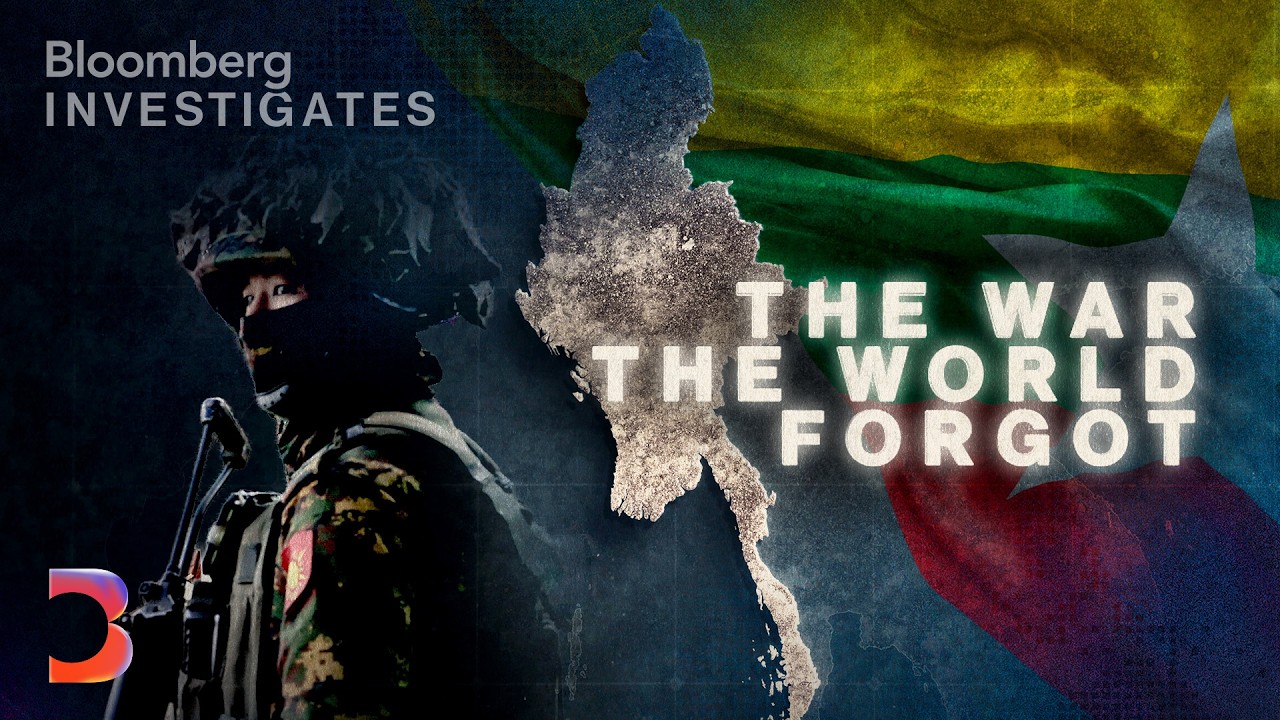
The civil war persists because dark money from cyber scams, rubies, and resource smuggling generates billions in profits for both military elites and rebel factions.
AI-assisted summary of The Dark Money Behind Myanmar’s Civil War | Bloomberg Investigates — original source. Check the original for full context.
Source published:
Detailed notes
## Background Published by Bloomberg Originals on YouTube on August 20, 2026, this report covers Myanmar's multifaceted civil war following the 2021 military coup. According to the page description, Bloomberg Investigates obtained rare access inside the nation to trace the dark money fueling the conflict and examine its human cost.
## TL;DR The investigation exposes how Myanmar's ongoing civil war is sustained by illicit financial networks, natural resource extraction, and massive cyber scam compounds despite the regime holding control over only 40% to 45% of the country. Horrific human costs—including roughly 100,000 deaths, widespread civilian displacement, and natural disasters like a 7.7 magnitude earthquake—are contrasted against the high profits extracted by military elites and armed groups. Factions such as the TNLA tax ruby mining in Mogok, while border compounds like Shwe Kokko generate tens of billions annually through cryptocurrency fraud. Because these illegal revenue streams render conflict far more lucrative than peace, the war persists without financial incentive for resolution.
## Atmosphere & style The report carries a grim, investigative tone that contrasts staged displays of military power against the tragic reality of displaced civilians in temporary shelters. It combines sober geopolitical analysis with harrowing human accounts, creating an atmosphere of deep volatility and injustice. Watching the report feels eye-opening and somber as it juxtaposes isolated, fortified elite enclaves with the chaotic, militarized borderlands.
## Key takeaways - [00:01](https://www.youtube.com/watch?v=0EZ6f3M64rI&t=1s) The military junta's staged demonstrations of control contrast sharply with reality, as they maintain power over at most 40% to 45% of Myanmar's territory. - [00:01](https://www.youtube.com/watch?v=0EZ6f3M64rI&t=1s) Myanmar's ongoing civil war has led to over 30,000 arrests and the displacement of millions of citizens. - [01:10](https://www.youtube.com/watch?v=0EZ6f3M64rI&t=70s) Beneath the territorial and political conflict lies a lucrative dark money engine fueled by illicit trade networks and hidden natural resources that make war more profitable than peace. - [01:10](https://www.youtube.com/watch?v=0EZ6f3M64rI&t=70s) The savage conflict has caused roughly 100,000 deaths and widespread civilian suffering across the country. - [02:20](https://www.youtube.com/watch?v=0EZ6f3M64rI&t=140s) Internally displaced persons face compounding disasters, including a devastating 7.7 magnitude earthquake in the Sagaing Region that killed approximately 1,700 people. - [04:44](https://www.youtube.com/watch?v=0EZ6f3M64rI&t=284s) The 2021 military coup halted a decade of political opening and economic growth, forcing youth and professionals to take up arms alongside long-standing ethnic armed organizations. - [06:58](https://www.youtube.com/watch?v=0EZ6f3M64rI&t=418s) Fragmented borderlands controlled by competing rebel factions, militias, and military forces have driven hundreds of thousands to cross into Thailand illegally. - [09:31](https://www.youtube.com/watch?v=0EZ6f3M64rI&t=571s) A stark economic divide exists between the heavily fortified capital enclave of Naypyidaw and the rest of the country, which suffers under severe economic collapse and fuel shortages. - [12:01](https://www.youtube.com/watch?v=0EZ6f3M64rI&t=721s) Ethnic armed groups like the Ta'ang National Liberation Army fund their military efforts by capturing natural resource hubs such as Mogok's ruby mines and taxing local miners. - [13:39](https://www.youtube.com/watch?v=0EZ6f3M64rI&t=819s) Militarized cyber scam compounds like Shwe Kokko along the Thai border generate tens of billions in illicit revenue using human trafficking victims to execute multi-tiered cryptocurrency fraud. - [15:50](https://www.youtube.com/watch?v=0EZ6f3M64rI&t=950s) High revenue from illicit industries provides key actors with strong financial incentives to perpetuate the war, leaving little reason to pursue peace.
## Detailed walkthrough ### [00:01](https://www.youtube.com/watch?v=0EZ6f3M64rI&t=1s) Accessing Myanmar and the Illusion of Control
Getting reporting access inside Myanmar as a journalist has become exceptionally challenging, with rare exceptions usually granted only around major, highly staged national events. In March and April, Bloomberg was granted rare access to cover Armed Forces Day. On display was a meticulously choreographed demonstration of military firepower, national unity, and heavy symbolism designed to signal to the world that the Burmese military remains firmly in command. However, the reality on the ground tells a vastly different story: the military junta and its aligned forces hold control over at most 40% to 45% of the country.
Opposing the regime are young rebels who are willing to fight, kill, and die for democracy in an intense battle against the military junta. Since the coup, over 30,000 people have been arrested, and millions remain displaced across the country as the conflict drags on.
- The military junta controls only **40% to 45%** of Myanmar's territory. - More than **30,000 people** have been arrested by the regime. - Millions of citizens remain internally displaced.
---
[01:10](https://www.youtube.com/watch?v=0EZ6f3M64rI&t=70s) The Human Cost and the Dark Money Engine
While millions of ordinary citizens endure extreme suffering, displacement, and death, those wielding power and weapons are turning a massive profit. Beyond the territorial disputes and political struggles, the civil war is driven by dark money, illicit trade networks, hidden natural resources, and underground economic deals that render war far more lucrative than peace. Covering geopolitics, crime, and corruption for more than 15 years, the reporter notes that Myanmar’s civil war stands as one of Asia's largest yet most overlooked crises.
The conflict is marked by well-documented direct attacks by the junta on civilian populations. Human casualties have reached horrific levels, with approximately 100,000 people killed, hundreds of thousands injured, and millions forced from their homes.
- Roughly **100,000 deaths** have occurred as a direct result of the savage conflict. - Millions of civilians are displaced across various regions.
---
[02:20](https://www.youtube.com/watch?v=0EZ6f3M64rI&t=140s) Refuge in Sagaing and Compounding Disasters
In the Sagaing Region, reporter teams visited temporary shelters where internally displaced people (IDPs) seek safety on the grounds of local Buddhist monasteries. Among them is Zin Mar Wai, who fled her home with her two young daughters, traveling on foot for months before reaching safety at a monastery. However, disaster struck again when a devastating 7.7 magnitude earthquake hit the region—the strongest in a century—killing approximately 1,700 people and further destroying fragile temporary shelters.
Zin Mar Wai holds out hope that her village can eventually be rebuilt so her surviving four-year-old daughter can attend school. Yet, like millions of others caught in the crossfire, her fate remains largely out of her hands as military operations continue unabated.
- Earthquake magnitude: **7.7**, marking the largest seismic event in Myanmar in over a century. - Casualties from the quake: Approximately **1,700 people** killed. - Target age group impacted: Young children like Zin Mar Wai’s surviving **4-year-old daughter** lack access to basic education.
---
[04:44](https://www.youtube.com/watch?v=0EZ6f3M64rI&t=284s) Historical Context: From Independence to the 2021 Coup
The conflict’s sheer complexity is a primary reason it receives limited global news coverage. Myanmar—formerly known as Burma—gained independence from British rule in 1948. By the 1960s, the nation fell under oppressive military rule, leaving it isolated, heavily sanctioned, and economically impoverished for decades. A major turning point occurred in 2011 with political reforms and the release of opposition leader Aung San Suu Kyi from house arrest, leading to a landslide victory for her party, the National League for Democracy (NLD), in the 2015 elections.
This political opening triggered a major economic boom throughout the 2010s. However, the momentum was abruptly halted in February 2021 when the military staged a coup d'état and re-arrested Aung San Suu Kyi. Initial peaceful street protests involving hundreds of thousands of citizens were met with brutal crackdowns and live ammunition. Consequently, students, young professionals, and educated urban youth fled to the border regions and forests, taking up arms alongside long-standing ethnic armed organizations (EAOs) to fight the junta.
- **1948**: Year Myanmar gained independence. - **1960s**: Beginning of strict military rule and international isolation. - **2011–2015**: Political opening, release of Aung San Suu Kyi, and the NLD's landslide election win in 2015. - **February 2021**: Military coup triggering nationwide resistance and civil war. - Over **two dozen distinct rebel groups** currently fight the junta, though they occasionally turn on one another.
---
[06:58](https://www.youtube.com/watch?v=0EZ6f3M64rI&t=418s) Fractured Borderlands and the Refugee Crisis in Thailand
Along the mountainous border between Shan State and western Thailand, the territorial landscape is severely fragmented. Specific hilltops are held by competing factions: one height is controlled by a pro-junta military militia, an adjacent peak by the Wa National Army (WNA), and another by the Shan State Army-South (SSA-S), all while the Royal Thai Army monitors the border to prevent incursions.
This instability has forced hundreds of thousands of Burmese citizens to cross into Thailand illegally. Refugees like Michelle fled after her husband’s involvement in the anti-coup movement made her a target for military arrest. With legitimate transit routes blocked, a thriving market for human smugglers has emerged to move refugees across the border.
- Neighboring territory: Shan State bordering western Thailand. - Main factions in the border area: **Wa National Army (WNA)**, **Shan State Army-South (SSA-S)**, and **pro-junta militias**. - Cross-border flow: Hundreds of thousands of illegal border crossings fueling organized human trafficking networks.
---
[09:31](https://www.youtube.com/watch?v=0EZ6f3M64rI&t=571s) Capital Enclaves and Economic Disparities in Naypyidaw and Mandalay
In Myanmar's planned capital, Naypyidaw, senior military generals, government ministers, and high-ranking officials live in heavily fortified compounds secured by high concrete walls and razor wire. This isolated enclave stands in stark contrast to the rest of the nation, which is undergoing severe economic collapse. While ordinary citizens suffer from strict fuel rationing—resulting in massive vehicle queues in cities like Naypyidaw and Mandalay—vast sums of money generated by the war flow directly into the pockets of the regime's elite.
Despite the broader economic downturn, commercial hubs like Mandalay maintain a superficial appearance of everyday life. Mandalay serves as the nation's primary transit node for rich natural resource flows, including high-value timber, copper, and precious gemstones.
- Enclave security: Naypyidaw's elite residential quarters are protected behind razor-wire perimeter walls. - Resource trade: Mandalay acts as the commercial funnel for timber, copper, and gemstones.
---
[12:01](https://www.youtube.com/watch?v=0EZ6f3M64rI&t=721s) Natural Resources and Ethnic Armed Groups: The Mogok Rubies
Natural resources represent a primary revenue stream funding the warring factions. In 2024, the Ta'ang National Liberation Army (TNLA)—an ethnic armed group—captured the town of Mogok, famous for producing some of the world's most valuable rubies. Upon taking control, the TNLA imposed strict tax schemes on local gem miners, forcing diggers to pay fees for permission to work their plots or find informal workarounds to survive under the new administration.
- Target area: Mogok, renowned globally for ruby extraction. - Controlling force: **Ta'ang National Liberation Army (TNLA)**. - Economic model: Direct taxation of local miners and control of precious gemstone extraction.
---
[13:39](https://www.youtube.com/watch?v=0EZ6f3M64rI&t=819s) The Cyber Scam Industry: Shwe Kokko and Crypto Schemes
While timber and gemstones yield significant capital, the largest source of illicit revenue in Myanmar comes from vast, militarized cyber scam compounds. Patrolling along the Thai-Myanmar border river reveals compounds like **Shwe Kokko**, recognized as one of Southeast Asia's largest fraud hubs. These compounds rely on a mix of human trafficking victims and economic volunteers drawn in by false promises of high-paying customer service jobs.
A former scam operator described the inner workings of these facilities. Lured by an offer of free room and board alongside a monthly salary of 30,000 Thai baht (approximately $900), he worked inside compound buildings while artillery shells exploded in the surrounding area. His daily operations involved executing cryptocurrency exchange scams:
1. Target investors are instructed to download a fake foreign currency exchange app. 2. The user converts fiat currency into crypto tokens. 3. The tokens are transferred into fraudulent applications controlled directly by the scammers. 4. Victims are systematically scammed at least three times, with initial losses starting at $100, rising to $1,000, and finally reaching $10,000 or more.
- Location: **Shwe Kokko**, situated along the Thai-Myanmar border. - Base salary offer: **30,000 Thai baht** per month (roughly **$900 USD**). - Fraud progression: Multi-tiered crypto scams taking **$100**, then **$1,000**, and finally **$10,000+** per target.
---
[15:50](https://www.youtube.com/watch?v=0EZ6f3M64rI&t=950s) The War Economy and Perpetual Conflict
The political economy of cyber scam compounds generates tens of billions of dollars annually, channeling massive capital directly to military elites and armed factions. International sanctions and financial isolation have driven the junta to rely heavily on scam center revenues to fund arms purchases and sustain war operations against its own population.
With military chief Min Aung Hlaing attempting to legitimize his rule through controlled political maneuvers and staged elections, critics point out that as long as the war persists, those in power continue to profit. Because neither side can secure a decisive victory on the battlefield and the conflict remains highly profitable for combatants, there is little financial incentive to pursue peace. Virtually none of the wealth generated from these natural resources and scam enterprises reaches the suffering citizens of Myanmar.
- Revenue generated: Tens of billions of dollars annually from cyber scam compounds. - Key figure: Military chief **Min Aung Hlaing**. - Economic reality: Profits from illicit industries enrich armed factions and military elites while ordinary citizens face displacement, poverty, and airstrikes.
## Mentioned Aung San Suu Kyi, Bloomberg, Bloomberg Investigates, Bloomberg News, Bloomberg Originals, Michelle, Min Aung Hlaing, National League for Democracy, NLD, Royal Thai Army, Shan State Army-South, SSA-S, Ta'ang National Liberation Army, TNLA, Wa National Army, WNA, Zin Mar Wai
[Source](https://www.youtube.com/watch?v=0EZ6f3M64rI)