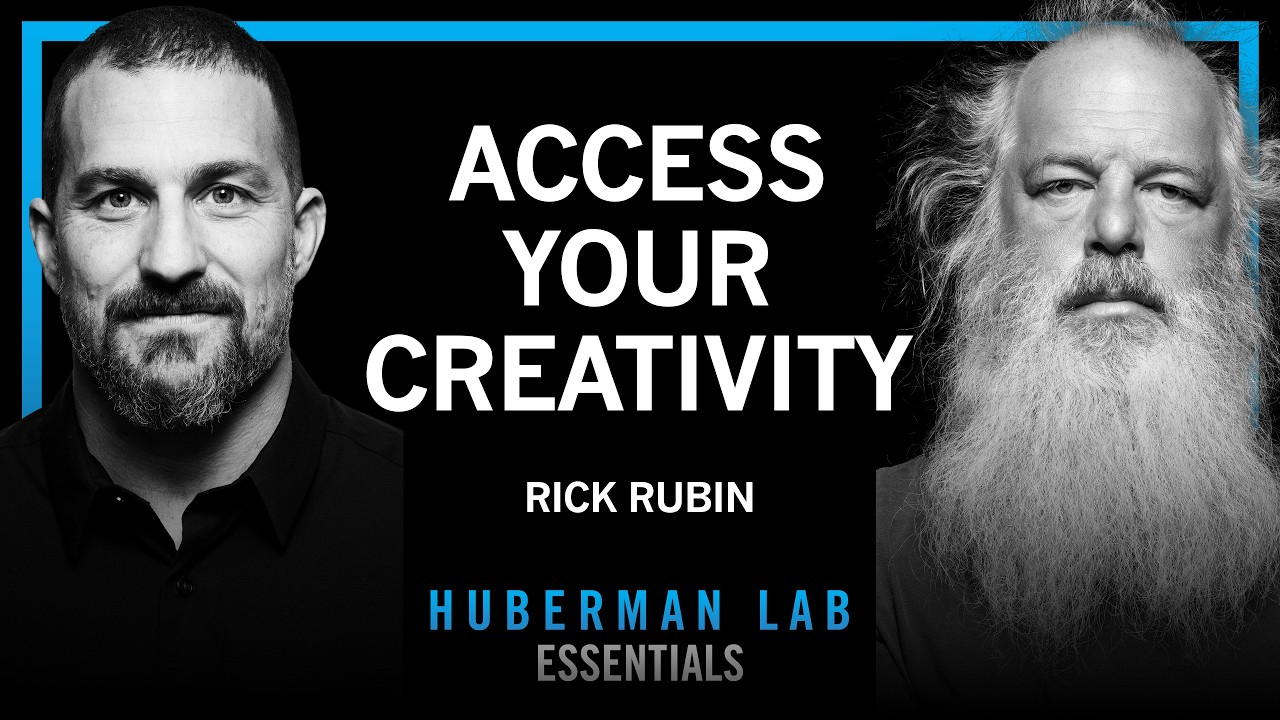
Rick Rubin Rejects Strict Rules to Unlock Original Art
Andrew Huberman
Authentic creativity relies on trusting unconditioned emotional cues and abandoning rigid intellectual structures during the initial phases of production.
## Background
This episode was published by Andrew Huberman on YouTube on August 20, 2026. According to the page description, music producer and author Rick Rubin joins Huberman to discuss how to access creativity, trust your taste, navigate the four phases of the creative process, and remain present and open to uncertainty.
## TL;DR
Rick Rubin and Andrew Huberman explore the elusive, cloud-like nature of creativity and how artists can nurture original ideas. They discuss how unconditioned childlike openness, fierce trust in one's personal taste, and total mental detachment outside the studio foster creative breakthroughs. Rubin details the four distinct phases of creative work—seed collecting, experimentation, crafting, and completion—and explains how to harness self-doubt and maintain presence without letting intellectual rules dictate the process.
## Atmosphere & style
The conversation carries a calm, reflective, and deeply contemplative tone, blending Huberman's grounded neurobiological curiosity with Rubin's serene, philosophical wisdom. The dynamic feels like an intimate, unhurried dialogue between close friends exploring the mysteries of art and consciousness. Listening evokes a sense of tranquil focus and quiet inspiration, inviting the audience to slow down and observe their own creative mind.
## Key takeaways
- [00:00](https://www.youtube.com/watch?v=QP8Kpf1UQwM&t=0s) Ideas and creative sparks act like clouds or dreams: shifting rapidly, hard to hold onto, and driven by feeling rather than strict intellect or logic.
- [01:53](https://www.youtube.com/watch?v=QP8Kpf1UQwM&t=113s) Young children are inherently original because they operate without fixed belief systems or survival filters, creating purely out of unconditioned "not knowing".
- [03:29](https://www.youtube.com/watch?v=QP8Kpf1UQwM&t=209s) The single most important skill for an artist is trusting their personal taste without second-guessing themselves, using rules only as temporary scaffolding.
- [05:27](https://www.youtube.com/watch?v=QP8Kpf1UQwM&t=327s) Creative breakthroughs occur when artists shift their visual and cognitive aperture away from the standard baseline of practical survival focus.
- [07:05](https://www.youtube.com/watch?v=QP8Kpf1UQwM&t=425s) External audience feedback is neutral data that should not distract an artist from maintaining a clear, personal connection to the work.
- [08:31](https://www.youtube.com/watch?v=QP8Kpf1UQwM&t=511s) Declaring a project finished requires commitment; using excitement for the next upcoming project serves as motivation to complete the current one.
- [09:52](https://www.youtube.com/watch?v=QP8Kpf1UQwM&t=592s) Combining total immersion during studio sessions with complete mental detachment outside of work gives the subconscious mind room to solve creative problems.
- [12:32](https://www.youtube.com/watch?v=QP8Kpf1UQwM&t=752s) Recognizing that humans habitually invent internal narratives to explain unfamiliar observations helps unlock creative freedom and embrace uncertainty.
- [15:22](https://www.youtube.com/watch?v=QP8Kpf1UQwM&t=922s) Pro wrestling is uniquely honest media because it openly embraces its constructed narrative nature while operating like a non-competitive athletic ballet.
- [18:05](https://www.youtube.com/watch?v=QP8Kpf1UQwM&t=1085s) Creative work naturally unfolds across four distinct phases: seed collecting, experimentation, crafting, and completion.
- [18:05](https://www.youtube.com/watch?v=QP8Kpf1UQwM&t=1085s) Self-imposed private deadlines are beneficial only during the final completion phase, as early deadlines restrict experimentation.
- [22:31](https://www.youtube.com/watch?v=QP8Kpf1UQwM&t=1351s) Self-doubt serves as a critical check to balance standard and quality, helping creators refine their ideas toward a masterpiece rather than paralyzing them.
- [23:36](https://www.youtube.com/watch?v=QP8Kpf1UQwM&t=1416s) Capturing real, unpredictable moments and organic discovery produces far more compelling art than striving for artificial perfection.
- [24:41](https://www.youtube.com/watch?v=QP8Kpf1UQwM&t=1481s) Creators should avoid assuming a familiar routine or mentor's advice is the only correct way, remaining open to evolving their process.
- [26:16](https://www.youtube.com/watch?v=QP8Kpf1UQwM&t=1576s) Remaining fully present and paying attention allows creators to notice clues and manifest original ideas delivered by the universe.
- [29:15](https://www.youtube.com/watch?v=QP8Kpf1UQwM&t=1755s) Meditation practices like mantra, breath focus, and awareness allow creators to quiet the analytical mind and disengage from active thinking.
## Detailed walkthrough
### [00:00](https://www.youtube.com/watch?v=QP8Kpf1UQwM&t=0s) Creativity as a Dream or Cloud
Andrew Huberman introduces this "Essentials" episode of the podcast, welcoming world-renowned music producer and author Rick Rubin to discuss the nature of creativity. Huberman confesses that, out of all topics in neuroscience, creativity remains the most elusive and difficult to capture scientifically. He notes how Rubin's book compares creative ideas to a cloud—something that looks like one thing at a given moment, changes entirely a bit later, and may vanish completely an hour after that.
Rubin builds on this metaphor by comparing creativity to a dream. When you wake up, you might only remember fragments of a dream that make no logical sense. If you write them down, more details re-emerge, though their meaning may only become clear years later—or never at all. Rubin explains that art-making relies on following internal emotional cues—such as a spark of curiosity, interest, or excitement—rather than following an intellectual process. Language fails to fully capture creativity because it functions far closer to magic than to science.
- Ideas and creative sparks act like clouds or dreams: shifting rapidly, hard to hold onto, and often non-linear.
- Art-making is driven by feeling (excitement, curiosity) rather than strict intellect or logic.
Huberman asks whether children are inherently more creative than adults by design. Rubin enthusiastically agrees, explaining that young children are completely open and carry zero emotional or intellectual baggage. They operate without fixed belief systems or preconceived notions of how the world "should" work; they simply observe reality directly. In contrast, adults continuously filter through endless data points—a biological adaptation driven primarily by survival, finding food, and procreation. Over time, adults adopt societal rules about right and wrong or try to imitate creators they admire, which inherently dilutes the purity of the creative act.
While imitating an admired artist can be a useful scaffolding tool to build technical skill—like a young vocalist mimicking a favorite singer before finding their own style—a three- or five-year-old sings completely free of imitation. Kids create purely out of "not knowing". Rubin reflects on his own early music career, sharing that entering the studio without formal experience was a massive advantage because he simply didn't know which traditional rules he was breaking.
- Survival functions (staying alive, feeding, procreating) condition adults to filter reality through strict categories and rules.
- Imitation helps build foundational technical skills, but raw originality stems from unconditioned "not knowing".
---
[03:29](https://www.youtube.com/watch?v=QP8Kpf1UQwM&t=209s) Trust Your Taste; Experiment, Don't Over-Explain
When asked how he guides artists to keep moving in a fruitful direction—especially when the artist themselves might not recognize a moment of brilliance—Rubin emphasizes actionable experimentation over verbal explanation. If he were producing a record and had feedback on a track, simply telling the artist what to do in conversation is far less effective than sitting down in an environment where they can physically test out different ideas in real-time. Trying an idea directly provides immediate data without getting bogged down in language.
Rubin points out that traditional schooling trains people to follow rules, whereas art uses rules merely as temporary scaffolding to be chipped away. The single most critical skill for any artist to cultivate is recognizing how they feel and fiercely owning their personal taste without second-guessing themselves in the face of external opinions. Compromising taste for commercial appeal or external validation completely undermines the entire point of the creative process, which is fundamentally about expressing one's authentic vision regardless of whether others like it.
- "Understanding how you feel in the face of other voices without second-guessing yourself is probably the single most important skill set to develop as an artist".
- Rules in art serve only as temporary scaffolding to be removed as needed.
---
[05:27](https://www.youtube.com/watch?v=QP8Kpf1UQwM&t=327s) Creative Aperture & New Perspectives
Huberman connects Rubin's descriptions back to neurobiology, explaining how animals seeking essential resources like food or mates adopt a narrow visual and cognitive focus, which naturally narrows their available "playbook" of actions. Unlocking a novel creative idea requires altering this visual and mental aperture—either widening or narrowing it relative to the standard mode of operating—to reveal something fresh that was previously hidden in plain sight. Rubin compares this shift to comedy: a great comedian makes people laugh by voicing an outrageous truth that feels glaringly obvious once stated, yet no one else had thought or dared to articulate it that way before.
- Creative breakthroughs come from shifting one's perceptual aperture away from the standard baseline.
- Comedy relies on revealing obvious truths that everyone implicitly recognizes but no one has explicitly articulated.
---
[07:05](https://www.youtube.com/watch?v=QP8Kpf1UQwM&t=425s) External Feedback & Staying True to the Work
Huberman asks whether modern digital platforms—where creators can publish work instantly on Twitter or Instagram and receive immediate public feedback—harm long-term creative depth. Rubin takes a neutral stance, viewing instant feedback merely as extra data that a creator can choose to use or ignore. Audiences often engage with or dislike a work for reasons completely different from the artist's original intent. Because external reactions are inherently uncontrollable, the artist's sole responsibility is maintaining a clear, direct connection to their own relationship with the work. Rubin shares that his entire career has been guided simply by making things he personally likes or creating things he felt were missing as a fan.
- Instant social media feedback is just neutral data; it should not distort the core artist-to-art connection.
- Rubin's guiding creative principle: make what you personally enjoy or what you wish existed as a fan.
Addressing the transition from open-ended creative exploration to execution and completion, Rubin notes that declaring a project finished is a profound act of commitment. Up until that final sign-off, an artist can endlessly tweak and experiment under the belief that tomorrow's version might be better. Left unchecked, this mindset causes creators to get stuck in infinite loops and never release anything to the world. To counter this paralysis, Rubin suggests using the excitement of whatever project comes next as active motivation to finally finish the current one.
- Projects remain perpetually unfinished if creators succumb to the belief that tomorrow's iteration can always be slightly better.
- Use the pull of your next upcoming project as the primary catalyst to wrap up and sign off on your current work.
---
[09:52](https://www.youtube.com/watch?v=QP8Kpf1UQwM&t=592s) Focus, Disengagement & the Subconscious
When Huberman asks about his practical workflow for clearing mental static between different projects, Rubin outlines a strict boundary between intense focus and total disengagement. When engaged in a session—whether for 20 minutes or 5 hours—he gives 100% of his focus with zero outside distractions. Crucially, once he steps away from the studio, he completely detaches from the material. He avoids taking works-in-progress home, listening to rough mixes during the day, or obsessively searching for fixes while off the clock. In an ideal workflow, he completely immerses himself in a completely different project in between sessions.
Rubin believes this complete disengagement allows the subconscious mind to work through creative problems in the background. Actively stewing over a problem is rarely how it gets solved; instead, creative challenges should be held lightly. Rubin confesses that he feels genuine anxiety at the start of every single new project because the outcome is entirely out of his control. Despite decades of success, he knows he cannot forcefully dictate when an interesting idea will surface—he can only be present and ready when it arrives.
- Total immersion during work sessions paired with total mental detachment outside the studio gives the subconscious room to process.
- Rubin admits to feeling anxiety at the start of every project due to the inherent uncertainty of creative emergence.
Expanding on how humans interpret reality, Rubin explains that whenever we encounter something unfamiliar, our minds automatically invent a hypothetical story to make sense of it. For instance, if you see a stranger sprinting down a street, your brain immediately manufactures a quick narrative—such as "he must be chasing his runaway dog"—and accepts that self-generated story as objective truth, allowing you to relax and keep walking. Humans spend their entire lives reacting to events, making up explanations without realizing it, and living as if those invented narratives are absolute facts.
Recognizing that our perceptual resolution is naturally low and that almost everything we "know" is a constructed narrative provides immense creative power. When you realize that certainty is often an illusion, you remain open to deeper possibilities rather than being deceived by superficial assumptions.
- Humans habitually invent internal narratives to explain unfamiliar observations and treat those inventions as objective facts.
- Embracing low perceptual resolution and high uncertainty prevents rigid dogma and unlocks creative freedom.
---
[15:22](https://www.youtube.com/watch?v=QP8Kpf1UQwM&t=922s) Pro Wrestling, Playfulness & Reality
Rubin provocatively asserts that professional wrestling is actually closer to reality than almost any other form of media or content. Because pro wrestling openly acknowledges that it is a scripted performance and narrative art, it is fundamentally honest about what it is, whereas much of the "real world" pretends to be objective truth while operating on hidden fabrications.
For Rubin, wrestling maintains a vital spirit of playfulness where anything feels possible and the unexpected is embraced. It delivers all the raw physical energy of a sport without the toxic division of real competition, operating much more like a collaborative ballet where everyone works together to craft an engaging show. The lingering ambiguity—such as never knowing if an injured wrestler actually broke their back or is just taking a vacation—adds a layer of comforting mystery.
- Pro wrestling is uniquely "honest" because it openly acknowledges its constructed, narrative nature.
- Wrestling functions like a non-competitive athletic ballet, fostering playfulness and a sense of open possibility.
Huberman asks whether Rubin's morning thoughts are immediately structured or if he prefers a slower transition upon waking. Rubin shares that waking up is intentionally a slow, gentle process for him, avoiding engaging with heavy inputs or structured demands too quickly.
As the day progresses, he handles necessary logistical tasks in preparation for his work environment. Once he arrives at the studio, he shifts into an open, unstructured state of readiness—welcoming good ideas, paying close attention, and remaining present so he can catch a spark if it arrives, while fully accepting that he cannot force creativity through sheer willpower. Rubin notes that while he used to push late into the night over the course of his career, his approach to grinding through deadlines has evolved significantly over time.
- Rubin prefers a slow, unhurried morning routine to maintain mental openness before entering the studio.
- Creative work requires being fully present and receptive rather than attempting to force ideas into existence.
Here is the detailed walkthrough of the transcript:
[18:05](https://www.youtube.com/watch?v=QP8Kpf1UQwM&t=1085s) The Four Phases of Creative Work and the Role of Deadlines
Rick Rubin reflects on a major insight he gained while writing his book *The Creative Act*: creator-artists are not required to treat every phase of creative work in the exact same manner. Previously, Rubin viewed all creative output through an open-ended "state of play" with no set timetable—whether something took two years or three years was irrelevant because the only goal was for the piece to be great. However, he came to realize that the creative journey naturally divides into distinct phases.
The first stage is the **seed collecting phase**, an ongoing lifestyle habit of gathering ideas, reading about intriguing topics, or wondering if a film or project exists for a concept he wants to see in the world. Next is the **experimentation phase**, akin to planting a seed, watering it, placing it in the sun, and waiting to see what happens without dictating the outcome. The third stage is the **crafting phase**, where the initial growth becomes usable material to be trimmed, combined, or sculpted. Finally, the **completion (or finishing) phase** involves the final edits to prepare the work for the world. Rubin emphasizes that while deadlines are counterproductive during early experimentation, setting a deadline deep into the completion phase can actually help finish the project—though he strongly advises keeping deadlines private so you retain the flexibility to adjust if a brilliant new discovery requires more time.
- **Phase 1: Seed Collecting** – Gathering raw ideas, topics, and inspirations continuously without deadlines.
- **Phase 2: Experimentation** – Setting the stage for ideas to grow without forcing or dictating the outcome.
- **Phase 3: Crafting** – Actively working with established material, shaping, trimming, and combining elements.
- **Phase 4: Completion** – The final editing process where self-imposed, private deadlines can help bring the project to fruition.
[22:31](https://www.youtube.com/watch?v=QP8Kpf1UQwM&t=1351s) Harnessing Self-Doubt as a Creative Balance
Andrew Huberman references a passage from Rubin's book stating, "Self-doubt lives in all of us, and while we may wish it was gone, it is there to serve us." Huberman notes that while common perception assumes self-confidence rises and self-doubt decreases as skill improves, many successful people actually face intense pressure to repeat past successes. Rubin explains that self-doubt acts as a critical check on oneself. If allowed to dominate, self-doubt paralyzes creators and prevents anything from being made; however, when used as a balancing tool, it keeps standards high. As Rubin highlights from his book, "you can doubt your way to a great work... to a masterpiece."
[23:36](https://www.youtube.com/watch?v=QP8Kpf1UQwM&t=1416s) Capturing Real Moments and the Unpredictability of Live Music
When asked if he has encountered music that excels live but fails to translate to studio recordings, Rubin highlights The Grateful Dead as a prime example of a band whose studio albums are not their strongest point. Instead, their live performances showcase their true brilliance through unpredictability and constant exploration. Rubin explains that when an audience catches a band in that moment of discovery, "it feels exciting. It's not just following a script. It's like something is really happening. It's a real moment."
This philosophy directly informs Rubin's approach in the recording studio. Rather than striving for artificial perfection, his goal is to capture real, organic moments that sound authentic—much like the underlying spirit of jazz music.
[24:41](https://www.youtube.com/watch?v=QP8Kpf1UQwM&t=1481s) Questioning Routines and Remaining Open to Advice
Huberman reads another passage from the book cautioning creators against assuming their habitual way of working is superior simply because it worked before. Rubin elaborates that when a particular process succeeds, it is easy to mistakenly believe it is the *only* right way, rather than just *a* way that happened to work that one time.
This warning extends to receiving advice from experienced mentors. Rubin points out that outside advice is always rooted in the advisor's own life experiences and data points, which may not apply to someone else's unique path. Creators should appreciate finding what works for them while remaining curious about whether even better methods exist.
[26:16](https://www.youtube.com/watch?v=QP8Kpf1UQwM&t=1576s) Noticing Clues, Belief, and the Power of Presence
Rubin asserts that the universe actively supports creativity and constantly leaves clues for those paying attention. Whether hearing an unexpected phrase or having three different people independently recommend the same concept, paying attention allows ideas to manifest through you. Belief plays an essential role in this dynamic: believing in your ability to make something great significantly raises the chances of doing so. Rubin pictures the world as a moving conveyor belt delivering unexpected gifts; step one is simply noticing the belt exists, and step two is feeling empowered enough to open the gifts.
Huberman observes that creative output seems less dependent on whether an artist is happy or unhappy, and far more dependent on their ability to remain undistracted. Rubin agrees, stating that staying fully present with the work is the single most vital factor, provided one's emotions do not interfere with feeling how the work itself feels.
[29:15](https://www.youtube.com/watch?v=QP8Kpf1UQwM&t=1755s) Understanding Meditation and Mindful States
In response to Huberman's question about how he defines meditation, Rubin breaks down several distinct practices:
- **Mantra Meditation**: Creating a rhythmic sound, word, or phrase to override the talking conscious mind, similar to entering a peaceful trance state.
- **Breath Focus**: Using a single-pointed focus on the breath to quiet internal monologue and self-talk.
- **Awareness Meditation**: Sitting with eyes closed and observing sense perceptions or whatever arises in the moment without building stories or explanations around them.
Rubin notes that in all these practices, the goal is to step away from active thinking and analytical concentration.
To illustrate the power of deep mental control, Rubin shares a personal story about using the **Monroe Institute Surgical Support Series** audio program during a surgery. By listening to the tapes prior to being wheeled in, he achieved such a deep state of calm that his physiological vitals mimicked heavy sedation. When hospital staff commented that he must have already been given a sedative based on his numbers, his wife clarified that he had received no medication at all—his state was achieved purely through focused audio practice.
The conversation concludes with Huberman expressing deep gratitude for Rubin's willingness to share his creative process and calling him an incredible portal and friend, to which Rubin responds with mutual warmth and affection.
## Notable quotes
> [03:29](https://www.youtube.com/watch?v=QP8Kpf1UQwM&t=209s) Understanding how you feel in the face of other voices without second-guessing yourself is probably the single most important skill set to develop as an artist — Rick Rubin
> [22:31](https://www.youtube.com/watch?v=QP8Kpf1UQwM&t=1351s) Self-doubt lives in all of us, and while we may wish it was gone, it is there to serve us. — Andrew Huberman
> [22:31](https://www.youtube.com/watch?v=QP8Kpf1UQwM&t=1351s) you can doubt your way to a great work... to a masterpiece. — Rick Rubin
> [23:36](https://www.youtube.com/watch?v=QP8Kpf1UQwM&t=1416s) it feels exciting. It's not just following a script. It's like something is really happening. It's a real moment. — Rick Rubin
## Mentioned
Rick Rubin, Andrew Huberman, The Creative Act: A Way of Being, The Grateful Dead, Monroe Institute Surgical Support Series, Huberman Lab, Huberman Lab Essentials, Tetragrammaton, Twitter, Instagram
Rick Rubin打破严苛规则以释放原创艺术力
真正的创造力依赖于对无预设情绪信号的信任,并在创作初期抛开刻板的理性结构。
Rick Rubin与Andrew Huberman深入探讨了创造力如云雾般捉摸不定的本质,以及艺术家应如何培育原创构想。他们讨论了孩童般纯粹开放的心态、对个人品味的坚定信任,以及在工作室之外彻底抽离思绪如何促成创作突破。Rubin详细拆解了创作过程的四个不同阶段——收集种子、实验探索、精雕细琢和最终完成,并阐述了如何善用自我怀疑并保持专注当下,而不让理性规则主导创作过程。
灵感与创意火花宛如云朵或梦境:瞬息万变、难以捕捉,且更多是由感受而非严格的理智或逻辑所驱动。 (0:00)
幼儿天生具备原创力,因为他们不受固定信念体系或生存过滤机制的束缚,纯粹基于无预设的“无知”状态进行创作。 (1:53)
对艺术家而言,最重要的单一技能是毫不犹豫地信任自己的个人品味,仅将规则作为暂时的辅助框架。 (3:29)
当艺术家将视觉与认知关注点从专注于实际生存的常规基线移开时,便会产生创造性突破。 (5:27)
外部受众的反馈属于中性数据,不应干扰艺术家与作品之间保持清晰的个人连接。 (7:05)
Reading summary
In a conversation with neuroscientist Andrew Huberman, music producer and author Rick Rubin argues that creativity functions closer to magic than science, relying on emotional cues rather than strict intellect. Accessing it requires shedding adult conditioning, fiercely protecting personal taste, and balancing open-ended exploration with structured phases of completion.
Unconditioned Openness and Shifting Perceptual Aperture (1:53)
Huberman notes that creativity remains neuroscience's most elusive topic, while Rubin compares creative sparks to clouds or dreams—non-linear fragments driven by curiosity or excitement rather than logic. According to Rubin, young children are naturally original because they observe reality without fixed beliefs, creating purely out of "not knowing." Entering the studio early in his career without formal training gave Rubin a similar advantage because he did not know which rules he was breaking. By contrast, biological imperatives like survival, finding food, and procreation condition adults to filter reality through rigid categories. Huberman explains that resource-seeking narrows visual and cognitive focus; unlocking novel ideas requires shifting this mental aperture to reveal truths hidden in plain sight, much like a comedian voicing an obvious but unstated reality.
To maintain openness, Rubin notes that humans constantly invent stories to explain unfamiliar sights—such as assuming a sprinting stranger is chasing a dog—and mistake those fabrications for fact. Accepting that human perception is low-resolution frees creators from dogma. Consequently, Rubin views professional wrestling as uniquely honest: by openly acknowledging its scripted nature, it operates as a playful, collaborative ballet where anything feels possible.
Trusting Personal Taste Over External Validation (3:29)
While imitating admired artists or learning rules provides temporary scaffolding to build technical skill, Rubin insists that art requires chipping those rules away. He identifies an artist's single most important skill as recognizing how they feel and owning their personal taste without second-guessing themselves among outside voices. Instant feedback on platforms like Twitter or Instagram is merely neutral data, as audiences often react for reasons unrelated to the artist's intent. Rubin's career has been guided simply by making what he likes or wishes existed as a fan.
In the studio, Rubin favors real-time experimentation over verbal explanation, aiming to capture authentic, unpredictable moments of discovery rather than artificial perfection—a live energy he associates with jazz and The Grateful Dead. While he feels anxiety before every project because creative emergence cannot be forced, he views self-doubt as a vital check. When it does not cause paralysis, self-doubt keeps standards high enough to help creators "doubt [their] way" to a masterpiece.
The Four Phases of Creative Execution (18:05)
While writing *The Creative Act*, Rubin realized that creative work divides into four distinct phases rather than a single state of play: seed collecting (gathering raw ideas without timetables), experimentation (letting ideas grow without forcing outcomes), crafting (actively trimming and sculpting material), and completion (final edits for release).
Finishing a project requires commitment, as creators easily get trapped in infinite loops believing tomorrow's version might be better. While deadlines harm early experimentation, Rubin notes that private, self-imposed deadlines during late completion help wrap up work while preserving flexibility for new discoveries. He also suggests using the excitement of the next project to motivate finishing the current one, while cautioning creators not to assume a previously successful routine or a mentor's advice is the only valid path.
Undistracted Presence, Detachment, and Mindful States (9:52)
For Rubin, creative output depends less on whether an artist is happy or unhappy and more on remaining undistracted and receptive to clues around them. After a slow morning routine, he commits 100% of his focus during studio sessions—whether for 20 minutes or 5 hours. Outside the studio, he completely detaches, avoiding rough mixes at home or obsessing over fixes so his subconscious can process problems in the background, ideally by switching to a different project between sessions.
To quiet analytical thought and self-talk, Rubin practices mantra, breath-focus, and awareness meditation. Demonstrating the physiological power of mental focus, Rubin recounts using the Monroe Institute Surgical Support Series audio program before a surgery; the practice induced such deep calm that hospital staff assumed his vital signs reflected heavy sedation, though he had received no medication.
Ultimately, Rubin emphasizes that even decades of success do not grant control over when a compelling idea will surface. Because creative emergence cannot be forced through willpower, an artist's only reliable strategy is to quiet the analytical mind, question rigid assumptions, and remain fully present when a spark arrives.
[3:29] Rick Rubin: Understanding how you feel in the face of other voices without second-guessing yourself is probably the single most important skill set to develop as an artist
[22:31] Andrew Huberman: Self-doubt lives in all of us, and while we may wish it was gone, it is there to serve us.
[22:31] Rick Rubin: you can doubt your way to a great work... to a masterpiece.
[23:36] Rick Rubin: it feels exciting. It's not just following a script. It's like something is really happening. It's a real moment.
Original transcript
[0:00] Welcome to Huberman Lab Essentials,
[0:02] where we revisit past episodes for the
[0:04] most potent and actionable science-based
[0:06] tools for mental health, physical
[0:08] health, and performance.
[0:11] I'm Andrew Huberman, and I'm a professor
[0:13] of neurobiology and opthalmology at
[0:15] Stamford School of Medicine. And now for
[0:17] my discussion with Rick Rubin. Great to
[0:20] have you here today, Rick.
[0:21] >> Thank you for having me. It's a
[0:22] pleasure. Of all the topics in science
[0:25] and in particular in neuroscience, I
[0:27] confess that creativity is the most
[0:30] difficult one to capture. As I went into
[0:33] your book, the example that you give,
[0:35] this idea that ideas and creativity are
[0:38] a little bit like a cloud. If you look
[0:40] at it at one moment, you might think
[0:42] that it looks like one thing, but then
[0:45] you look at it a moment later, it could
[0:46] be quite a bit different. And if you
[0:47] look at an hour later, it very well
[0:49] could be gone. How did that come to you?
[0:51] And how does it serve you in trying to I
[0:55] don't want to say extract but trying to
[0:56] access creativity.
[0:57] >> I think the best way to think about it
[0:59] is like a dream. It's like if you think
[1:01] about your dreams they don't necessarily
[1:04] make sense.
[1:06] When you wake up you'll you might
[1:07] remember part but not the whole thing.
[1:09] Then if you start writing them down
[1:11] they'll come back and they may not make
[1:14] sense to you. You know maybe someday in
[1:16] the future you'll be able to look back
[1:18] and understand what they mean and maybe
[1:20] not. And that's sort of how this the art
[1:24] making uh process works is like we're
[1:27] making things and we're looking for a
[1:29] feeling in ourselves. It could be a
[1:32] feeling of excitement or enthusiasm, a
[1:34] feeling of interest, a feeling of
[1:36] curiosity. I want to know more. It's not
[1:38] an intellectual process. It's a
[1:40] different thing. I think language is
[1:42] insufficient to
[1:45] to drill down on creativity. It's more
[1:48] um it's closer to magic than it is uh
[1:52] science.
[1:53] >> Do you think kids are more are just by
[1:55] definition and by design more creative
[1:56] than adults?
[1:58] >> Yes. Kids are they're open and they have
[2:01] no baggage. They don't have any belief
[2:04] system. They don't know how things are
[2:05] supposed to work. They just see what is.
[2:08] Most of us select from
[2:12] an endless number of data points
[2:14] available to us to well as a as a
[2:18] species to make sure that we don't die
[2:21] and to procreate and to feed ourselves
[2:24] are probably the primary functions
[2:26] first. And then we learn things about
[2:29] what's right and what's wrong. and we
[2:30] learn things about uh how to do certain
[2:33] things or we're inspired by someone who
[2:37] makes something we love and we want to
[2:40] do it the way they do it. And all of
[2:42] those things undermine the purity of the
[2:45] creative process. They can be um tools
[2:49] to
[2:51] build your skill set to be able to do it
[2:53] yourself. Like if you're a a singer, you
[2:56] might imitate a singer you really like
[2:58] for a while to get good at it and then
[3:01] eventually come to find your own voice.
[3:03] But if you're 3 years old or 5 year
[3:06] years old and you try singing, you're
[3:08] not singing like anyone else. You're
[3:09] you're singing with your own your own
[3:11] voice. And when you make something,
[3:13] you're making it based on not knowing.
[3:16] And I I think I had the advantage early
[3:18] in my career of starting making music
[3:21] without any experience, which was
[3:23] helpful because I didn't know what rules
[3:25] I was breaking. I was doing things that
[3:28] other people wouldn't do. When something
[3:31] feels creatively right, let's say in the
[3:34] studio or maybe even you're listening to
[3:36] something that somebody sent you, and
[3:37] again, this could be about writing or
[3:39] comedy or, you know, science or
[3:40] podcasting for that matter. How do you
[3:43] say keep going that way when they might
[3:46] not even recognize that they did it? And
[3:48] I'm guessing a lot of times they don't.
[3:50] >> I I'll try to be in a in a setting where
[3:54] as we're talking about it, we can engage
[3:57] with it in that moment. Let's say I was
[3:59] producing your new record and you played
[4:01] me something and I had some thoughts
[4:02] about it. It wouldn't be so helpful for
[4:05] me to tell you what those were. it'd be
[4:07] better for us to wait till we're in a
[4:08] place where we could try things and see
[4:11] where it goes. I wouldn't rely on
[4:14] language to do it. It would be more of a
[4:17] making a suggestion is something that's
[4:18] actionable. We try it and then we have
[4:21] more data. It's that simple. So much of,
[4:24] you know, when we go to school, it's to
[4:26] get us to
[4:28] follow the rules. And in art, it's
[4:31] different because the the rules are
[4:33] there as a scaffolding to be um chipped
[4:38] away as need be. Sometimes they're
[4:40] helpful, sometimes they're not.
[4:42] Understanding how you feel in the face
[4:46] of other voices without second-guessing
[4:49] yourself is probably the single most
[4:52] important
[4:54] um thing to practice as an artist or
[4:58] skill set to develop as an artist is to
[5:02] know how you feel and own your feelings.
[5:05] If I'm undermining my taste for some
[5:09] commercial idea or uh it it defeats the
[5:13] whole purpose of doing this. This is not
[5:15] that's not what this process is about.
[5:17] This process is
[5:20] I'm doing me and I'm showing you who I
[5:23] am and you can like it or not. But
[5:25] either way, this is still how I see it.
[5:27] >> In your book, you describe again when
[5:29] you're thinking about the creative
[5:31] process as a cloud. For me again, it
[5:34] serves as such a powerful anchor. And
[5:36] then I think about the the biology, the
[5:38] neurobiology of like strategy formation
[5:42] or strategy implementation. And then
[5:46] almost by sheer luck or miraculously, I
[5:50] turn a few pages later into the book and
[5:53] there's a description of how animals
[5:55] that are trying to accomplish something.
[5:58] eat, mate, find water, the requirements
[6:02] of living. It requires a narrow visual
[6:04] focus. This is something my lab is kind
[6:06] of obsessed with and I've been obsessed
[6:07] with. And in that more narrow visual
[6:09] focus, we know that the the playbook
[6:13] becomes more narrow. Now, at some point,
[6:16] in order to come up with a new creative
[6:19] idea, that means broadening vision is
[6:21] essential in some way or broadening
[6:23] thinking. Well, it could either be a
[6:25] broadening or a narrowing, but it's
[6:27] changing the aperture from the standard
[6:31] to present something new that maybe you
[6:36] already knew but didn't know you knew
[6:38] it. It's not unlike what a comedian
[6:40] does. You know, comedian makes you
[6:41] laugh. Usually what they're saying, it's
[6:43] outrageous, but you know that it's
[6:46] right. You know, just no one says it
[6:48] that way or no one has said it that way
[6:49] before. But it's always the truth in it
[6:52] that makes it funny. Recognizing
[6:55] something that seems really obvious once
[6:59] you see it, but seems like nobody else
[7:03] sees it or no one else points it out.
[7:05] >> So do you think nowadays the fact that
[7:07] one can create something and quote
[7:09] unquote release it quickly? I can put
[7:11] something out onto Twitter or Instagram
[7:14] now and I will get immediate feedback
[7:16] which is external feedback of course but
[7:18] then I can iterate on the basis of that
[7:20] feedback. Do you think that's
[7:22] problematic for the larger opportunity
[7:25] for creativity?
[7:25] >> I don't think it's wrong or right. It's
[7:27] just it's more information that you can
[7:29] use or not use and use it in a useful
[7:32] way and you know you can make something
[7:34] and put it out and people can not like
[7:36] it and you're like they still don't get
[7:38] it here. I'm going to I got to go
[7:39] harder. There could be different stories
[7:41] that happen at the same time where
[7:42] you're making something and you have an
[7:45] idea of what it is and then other people
[7:49] engage with it and they have a different
[7:51] idea of what it is and they like it for
[7:53] a different reason than you did or
[7:54] dislike it for a reason different than
[7:56] the reason you like it. We can't control
[7:59] any of those things. The only part of it
[8:02] that we can control is how we relate to
[8:05] the thing that we make. And any external
[8:10] information that undermines the clarity
[8:13] of that connection
[8:16] is probably bad for the art is my is my
[8:19] guess. All I've ever tried to make was
[8:21] something I like or something that I
[8:23] felt like was missing as a fan that I
[8:26] wanted and I nobody was making it. So I
[8:30] I'll make it. When I listen to an album
[8:32] or a song, I mean, I have to assume that
[8:35] there at some point it becomes
[8:39] not strategy development or creativity,
[8:42] but strategy implementation. Like songs
[8:44] are going to come in this order. And
[8:45] like at what point does one decide,
[8:49] okay, like now's the time to get into
[8:51] that more narrow focus of of effort.
[8:55] Like we've got it, let's run with this.
[8:57] because there is a component of the
[8:59] creative process that involves packaging
[9:00] and finishing and is that part less
[9:02] satisfying to you or is it just all part
[9:04] of the same larger arc?
[9:06] >> It's all part of the same It's It's
[9:07] nice. There's a good feeling. There's
[9:09] usually a good feeling when something is
[9:11] done. It's a commitment because up until
[9:14] the time that you say it's done, you can
[9:15] keep experimenting and changing it. You
[9:17] know, if you if you think, well, maybe
[9:19] tomorrow I can make it better, then it's
[9:21] not finished. and you keep thinking that
[9:23] for a long time, you can do that forever
[9:25] and never never put out anything.
[9:27] Getting to the point where you're ready
[9:29] to sign off is a good feeling. One of
[9:32] the things I talk about in the book is
[9:33] um because it is a difficult thing to do
[9:36] because it's fun to play and it's fun to
[9:38] maybe it's not the best it could be yet,
[9:40] you know, um
[9:43] to use whatever the next project is
[9:46] going to be as motivation to finish the
[9:51] one you're working on. Now,
[9:52] >> I'm very interested in, you know, your
[9:55] process when it comes to going from
[9:57] project to project and and you know,
[9:58] you're going to be doing work with
[9:59] somebody. Do you have a process for
[10:02] removing the functions of the day and
[10:05] the what you were doing last week and
[10:07] what's going on and how do you clear the
[10:09] static? What are some of the operational
[10:12] steps that you think might be more um
[10:15] generalizable to regardless of where
[10:18] some somebody in you know um Africa is
[10:21] listening to this?
[10:22] >> I would say when I'm when I engage in a
[10:24] particular project whatever it is I I
[10:27] dedicate
[10:30] all of myself for that period of time,
[10:32] whatever it is, whether it be 20 minutes
[10:35] or whether it be 5 hours, whatever it
[10:37] is, total focus and no outside
[10:41] distraction whatsoever.
[10:44] And when I leave that process, I do my
[10:47] best not to think about it when I'm away
[10:49] from it. I don't bring any materials
[10:51] with me. I don't leave the studio with
[10:54] works in progress and spend time
[10:56] listening to them during the day or
[10:58] looking for ideas. I I stay as far away
[11:01] from it when I'm not directly engaging
[11:04] in it as possible. And in the best of
[11:08] situations, I have something else to
[11:10] totally engage myself in in between. So
[11:13] instead of working on project A for 5
[11:17] hours and then leaving and doing
[11:18] nothing, I'm hoping to engage in a
[11:22] project B or B, C, and D with all of
[11:25] myself before going back to project A
[11:27] again.
[11:28] >> Even though you're disengaged,
[11:30] do you believe that your subconscious is
[11:32] working it through?
[11:33] >> I believe so. I believe so. And I think
[11:36] in general to stew over a problem is not
[11:40] the way to solve a problem.
[11:42] think to hold
[11:44] the problems lightly. And when I say a
[11:47] problem, you know, when we're when we're
[11:49] starting a project, there's a question
[11:51] mark at the beginning of every project.
[11:52] I I I'm always anxious when I start a
[11:54] new project because I have no idea
[11:57] what's going to happen. I never know.
[11:59] There's always a sense of anxiety
[12:00] because I know whatever's going to
[12:03] happen is completely out of my control.
[12:05] Something either interesting or not will
[12:07] appear and then we're going to follow
[12:09] that wherever it goes. And until
[12:13] something appears for us to follow,
[12:16] I have a lot of anxiety. Even though I
[12:19] know, even though it has never not come,
[12:21] you know, it has come every time, but
[12:22] there's something about it cuz I also
[12:24] feel like there might be expectation on
[12:26] me that I'm going to make it happen. And
[12:29] I know that's not happening. That's not
[12:31] how it works.
[12:32] >> So what I keep coming back to is that
[12:33] I'm imagining in my mind have two ends
[12:36] of the continuum. one that is about
[12:37] fairly narrow focus training training
[12:40] strategy implementation cultivating
[12:42] craft building craft and then the other
[12:43] side is this the cloud and so we're
[12:46] taking this cloud and we're we're
[12:47] deciding what things are
[12:49] >> yes we go through our lives
[12:52] doing this all day with everything we
[12:56] see if it's something we don't know and
[12:58] something we're not familiar with first
[13:01] thing is is
[13:02] this doesn't make sense then what we do
[13:05] is without thinking, we create a story
[13:09] that explains what just happened
[13:12] a hypothetical. Oh, maybe he's running
[13:15] cuz his dog ran away and he's chasing
[13:17] his dog. Maybe that's why he's running.
[13:19] And as soon as we have that thought of
[13:22] what it might be, we relax because now
[13:25] it's not just a guy running, and this is
[13:27] weird, but it's a guy running. Oh, he's
[13:29] probably running after his dog. And now
[13:33] we register that story that we just made
[13:37] up without even knowing we were making
[13:40] it up as what happened. And then later
[13:42] in the day if someone says, "Yeah, do
[13:44] you see that guy running out of box?"
[13:45] Like, "Yeah, he was chasing his dog. I
[13:47] saw that." And you you won't even
[13:49] realize that it was the maybe
[13:51] hypothetical story that was the first
[13:54] possible explanation that allowed you to
[13:57] continue walking. Our whole lives are
[14:00] reacting to things, making up a story of
[14:03] what we think may have happened without
[14:05] realizing that's what we're doing, and
[14:07] then living the rest of our lives as if
[14:10] that thing that we made up really
[14:11] happened. And we never know. That leads
[14:15] us to we can't know much. Do you know
[14:18] what I'm saying? Our resolution is so
[14:20] low on everything. We're grasping at
[14:24] straws. We have no idea. We have no
[14:27] idea. And there's great power in knowing
[14:29] that because if you think you know
[14:31] what's going on,
[14:34] chances are you're being deceived.
[14:38] Not because somebody's deceiving you,
[14:40] but because they're telling you what
[14:41] they see and they don't know.
[14:43] >> It's all Do you know what I'm saying?
[14:45] It's all made up. Everything that we
[14:47] everything we know is made up. Maybe
[14:50] maybe it's true. It's This brings us to
[14:52] pro wrestling. It's it's it's the reason
[14:55] that pro wrestling is closer to reality
[14:58] than anything else we can watch or any
[15:01] other content. It's we know it's made
[15:04] up.
[15:06] We know that it's a performance.
[15:09] It's storytelling.
[15:12] And
[15:14] that's how everything is. Except we
[15:16] think wrestling's fake and the world is
[15:18] real. Wrestling's real and the world's
[15:21] fake. I do want to ask you about
[15:23] wrestling. So, I have questions
[15:25] specifically about wrestling, but it's
[15:26] really about process.
[15:27] >> Yeah.
[15:28] >> What is the deal with your relationship
[15:31] to wrestling?
[15:32] >> Uh, I think it it maintains that kind of
[15:34] playfulness. Anything is possible. We
[15:38] expect the unexpected all the time in
[15:40] wrestling. And it's a way to have a kind
[15:43] of a feeling of
[15:46] the energy of a sport
[15:49] with with no competition. It's everyone
[15:52] is working together to put on the best
[15:54] show they can. So, it's more like a
[15:56] ballet than it is like a sporting event.
[15:59] >> I actually think uh the way you describe
[16:01] um wrestling as you know it's the energy
[16:04] of the sport. It's not the whether or
[16:07] not it's this move or that move or who
[16:09] wins or who loses. It's the energy and
[16:12] I'm guessing it's the energy that it
[16:14] creates in you
[16:15] >> as an observer. Yes. It's the energy it
[16:18] creates in me and the reality that it's
[16:22] honest in what it is in a world where
[16:27] seemingly nothing is honest at what it
[16:29] is. In some ways, it's comforting and
[16:32] there's still this mystery of like, wow,
[16:33] I wonder if that's true or not because
[16:35] we never really know. Someone gets hurt.
[16:37] Did they really break their back or are
[16:39] they just going on vacation? We don't
[16:41] know. We'll never know. It's
[16:43] fascinating. When you wake up in the
[16:45] morning, um, are your thoughts
[16:48] immediately structured or do you enjoy
[16:49] the kind of clearing of the clouds?
[16:51] >> It's a it's a slow process for me to
[16:53] wake up and I like that. I like
[16:57] not engaging too much too soon.
[17:00] >> Does it become more structured as the
[17:01] day goes on? Does your thinking become
[17:03] um more structured around projects and
[17:05] plans? I try to um deal with things that
[17:08] need dealing with after that and in
[17:12] preparation for going to work and then
[17:14] when I go to work it's more like this
[17:16] free thing where I'm again hoping
[17:19] something good comes uh welcoming
[17:21] something good paying attention and
[17:25] maybe trying to will it to happen but
[17:27] knowing I don't have the ability to make
[17:29] it happen I can just be present for it
[17:32] and be ready if it does arrive.
[17:34] Obviously deadlines are relevant time of
[17:37] day, right? There's only so many hours
[17:39] in the day where one can stay in the
[17:41] groove or this like readiness to
[17:43] receive. Have you ever found yourself in
[17:46] that mode where you're kind of grinding
[17:48] like ah like here we are like okay I'm
[17:50] not coming home for dinner tonight. It's
[17:51] the next we're going to push. We're like
[17:54] put on the coffee pot kind of thing.
[17:56] >> A lot a lot in the over the course of my
[17:59] life a lot not as much now. And one of
[18:02] the things that I discovered through
[18:05] working on the book was we're not
[18:07] required to treat the different phases
[18:09] of work in the same way. Whereas before
[18:12] I did before everything was in this
[18:15] state of play. Everything had an a wide
[18:20] openen time schedule. It happens when it
[18:23] happens. If it takes 2 years or 3 years,
[18:25] it doesn't matter. It's not about that.
[18:27] It's only about this thing has to be
[18:29] great. And what I came to realize in
[18:31] working on the book is that there there
[18:33] are different phases. And the first
[18:35] phase is this seed collecting phase
[18:37] which is kind of an ongoing part of life
[18:40] in general. I do that always whether I'm
[18:43] whether I'm working on something or not.
[18:44] I'm always in the seed collecting phase
[18:46] and there's no deadline or uh anything
[18:49] that interests me that I think I want to
[18:51] learn more about or has potential to be
[18:53] something anything I hear something
[18:56] think hm I'd like to read more about
[18:58] that or I wonder if I wonder if there's
[19:00] a movie about that is there a movie
[19:01] about that if not maybe there's a movie
[19:04] to be made you know like again I want
[19:06] this is something I want in my life
[19:08] let's see if it exists if it doesn't
[19:10] exist then maybe that's something
[19:11] interesting to pursue um but I know that
[19:14] the desire is there because I have it.
[19:16] So in the seed phase, there's no
[19:18] deadlines. It's just a wide open part.
[19:21] And then the next phase is called the
[19:23] experimentation phase where you where
[19:25] you start experimenting to see what the
[19:28] seeds want to do. You're involved, but
[19:31] you're not really dictating the action.
[19:34] You're you're setting the stage for
[19:36] something to happen, but it's not about
[19:39] you yet. It'd be like the equivalent of
[19:41] you'd plant the seed, you would water
[19:43] it, you'd make sure it was in the sun,
[19:46] and you'd wait. Um, so you're involved,
[19:50] but you can't make it grow, you know,
[19:53] and then when it sprouts and it grows
[19:55] and or if it turns into a plant, then
[19:58] you can look at the plants like, okay,
[20:00] how does this plant,
[20:02] what's the potential of this plant? And
[20:04] then you and then that the third phase
[20:06] is the crafting phase where it's like
[20:08] okay I have this plant maybe I'm going
[20:10] to trim it or maybe I'm gonna uh combine
[20:14] it with these other plants to make some
[20:16] something else with it. Now it's like
[20:18] material that you have and then finally
[20:20] is the the completion or or finishing
[20:23] phase which is the final edit getting to
[20:28] the version of it the version of it
[20:30] that's the one that you can share with
[20:31] the world if if that's something you're
[20:32] going to do. And I've come to realize
[20:35] that by the time you're going into the
[20:38] completion phase, you can have a
[20:40] deadline and it won't hurt the project.
[20:44] In fact, it might help the project. And
[20:46] I didn't know that before. So, I've
[20:48] worked on projects that have gone longer
[20:49] than they necessarily needed to and
[20:52] maybe not in the best interest of the
[20:54] project because I didn't know that. I
[20:56] didn't understand that that the timing
[20:58] of that because I because I am so aware
[21:02] of the necessity in the experimental
[21:07] phase to not have a deadline
[21:10] that I assumed that that held through
[21:13] the whole project. It's not a clear
[21:16] phase one finishes and then you start
[21:18] phase two, phase two finishes and then
[21:19] you start phase three. You move back and
[21:22] forth between them. I'm collecting seeds
[21:23] all the time. I'm always in phase one.
[21:26] And then probably to some degree there's
[21:28] always some version of experimentation
[21:30] going on. Maybe not now, but if
[21:32] something's on a list of things I want
[21:34] to look at, hopefully I'll get get to
[21:36] the list and give them some
[21:38] experimentation and see what they can
[21:40] turn into. And then if they do turn into
[21:43] something, then they get to the crafting
[21:45] phase where it's more, okay, now I have
[21:47] this thing. What do what do I know about
[21:50] this kind of thing? What can I match
[21:52] this with? What can I use this for? How
[21:54] can I be involved as a craftsman? By the
[21:58] end of the crafting phase or deep into
[22:00] the crafting phase,
[22:03] you can start seeing the end. You know,
[22:05] you can start seeing an end. And then
[22:07] you can even dictate an end. But I
[22:09] recommend if you do, just dictate it for
[22:11] you, not for anyone else. Because if
[22:13] something comes up where you learn if if
[22:16] you uh set a deadline, a public
[22:20] deadline, and then a new discovery
[22:23] happens along the way and you realize,
[22:25] oh, this could actually be much better
[22:26] than I thought, but I need more time.
[22:29] It's harder to do that if you set the
[22:30] deadline.
[22:31] >> The chapter on self-doubt was really
[22:33] interesting to me. I'll read the first
[22:35] sentence of it um which is that
[22:37] self-doubt lives in all of us
[22:39] >> and while we may wish it was gone, it is
[22:41] there to serve us. Uh and it goes on to
[22:44] describe how to um dance with
[22:46] self-doubt. As one gets better at their
[22:48] craft, you can imagine self-doubt goes
[22:50] down. I think that's the perception of a
[22:52] lot of people, right? You get better
[22:54] what you're doing. Self-confidence goes
[22:55] up, self-doubt goes down. But I think
[22:58] you and I both know a number of people
[22:59] who are successful enough to know that
[23:01] often times there's a mirror image to
[23:03] that where people feel pressure because
[23:05] they did it once, now they got to do it
[23:07] again.
[23:07] >> Self-doubt is a it's like a um
[23:12] it's a check on yourself. It can either
[23:14] be really helpful or it can undermine
[23:17] you. So, it's something we all have and
[23:20] if we let it undermine us, then we don't
[23:22] make anything and that's not good. But
[23:24] when used as a a balancing tool in our
[23:28] lives, it serves a great function. I
[23:31] think the the phrases in the book, you
[23:33] can doubt your way to a great work, you
[23:34] know, to a masterpiece.
[23:36] >> Have you ever encountered music that
[23:38] really works well live but just does not
[23:40] work in a recording? You don't have to
[23:42] name names.
[23:43] >> Yeah, I don't think so. I feel like
[23:44] maybe there are some artists who are
[23:47] great live who've never captured it well
[23:49] on record. The Grateful Dead's a good
[23:51] example of a band where I feel like
[23:53] their albums are not their strong point,
[23:56] but they're, if you hear live
[23:57] recordings, they're really interesting
[23:59] and really different from each other.
[24:01] And that's kind of part of what makes
[24:02] the Grateful Dead interesting is their
[24:05] unpredictability. They're looking for
[24:07] something
[24:08] >> and sometimes they find it
[24:10] >> and if you're there when they find it,
[24:12] it feels exciting. It's not just
[24:14] following a script. It's like something
[24:16] is really happening. It's a it's a real
[24:18] moment. Something that I aim for in the
[24:21] studio
[24:23] is to create real moments that when you
[24:26] hear them, they don't necessarily sound
[24:29] perfect. They sound like something that
[24:32] really happened and in that moment
[24:34] something happened and it's a special
[24:36] moment. It's it's really what it's how
[24:39] jazz works as well. The way you describe
[24:43] um experiences going by in time and or
[24:46] or things emerging in time and the
[24:48] creative process being a way of
[24:50] capturing those moments was beautifully
[24:52] captured in the in the analogy you gave
[24:54] about a kind of a con a conveyor belt
[24:57] going by. I'll just read it to be beware
[24:59] of the assumption that the way you work
[25:01] is the best way simply because it's the
[25:03] way you've done it before. Maybe you
[25:05] could elaborate on this a little bit. I
[25:07] mean, we want to have, you know,
[25:09] mechanisms and routines we can trust.
[25:12] >> Yeah.
[25:12] >> But this is a, I think, an important
[25:15] warning.
[25:16] >> Yeah. When something works,
[25:19] it's easy to be fooled into believing
[25:24] that's the way to do it or that's the
[25:27] right way. It's just a way and it's just
[25:30] a way that happened to work that time.
[25:32] This plays into when you get advice from
[25:36] people who have more experience than
[25:38] you. The advice that they're giving you
[25:41] is not based on your life or your
[25:44] experience. It's based on their life and
[25:45] their experience that have very
[25:47] different data points than yours.
[25:50] So
[25:52] maybe they're giving you good advice,
[25:54] but maybe they're giving you good advice
[25:55] for them and not giving you good advice
[25:58] for you. I think it's hard enough to
[26:00] even figure out what's right for
[26:01] ourselves and if we do somehow crack the
[26:05] code of what's right for us,
[26:08] be happy we have it and then still know
[26:11] I wonder if that's the only way. Maybe
[26:13] there's an even better way that we're
[26:15] not considering.
[26:16] >> I forget the exact title of the chapter,
[26:18] but um there's a chapter about being on
[26:21] the lookout for clues.
[26:23] >> Yeah.
[26:24] >> Do you think there are clues in in every
[26:26] everywhere? Yes, I think there are clues
[26:28] everywhere for if we pay attention,
[26:31] we'll hear a phrase, it'll trigger a a
[26:34] thought, we'll see something unexpected.
[26:38] Um, in the if someone recommends
[26:42] something to you, maybe it's a
[26:44] coincidence. If three people recommend
[26:47] the same thing to you, maybe it's not. I
[26:49] do believe the universe is on the side
[26:53] of creativity
[26:55] and the universe is supporting
[26:59] things to happen and they can happen
[27:01] through you or they could happen through
[27:03] someone else. So if you're paying
[27:07] attention maybe it'll happen through
[27:08] you. The belief part of it is a huge
[27:11] part of the conversation
[27:13] about everything. You know what we
[27:15] believe has power. If we believe we can
[27:18] make something great, the chances of us
[27:20] making something great are better than
[27:23] if we don't believe we can. So, uh I I
[27:27] would say any ability to harness your
[27:30] belief on your behalf is a really
[27:33] healthy thing to do. One thing that you
[27:36] make very clear is that while our own
[27:39] abilities may come into question from
[27:41] time to time,
[27:43] you absolutely believe that the elements
[27:47] from which to create are out there.
[27:49] >> Absolutely. All all the elements are all
[27:52] are are here. Everything is here. We get
[27:55] to pick and choose. We get to the
[27:57] conveyor belts going by with little
[27:59] gifts. First, we have to notice there's
[28:01] a conveyor belt. Then we notice the
[28:04] gifts and then that's the starting
[28:06] point. And then we may even feel uh
[28:11] uh empowered enough to grab one of the
[28:13] gifts and open it up and see what's
[28:14] inside. And then maybe that's the start
[28:17] of something really beautiful.
[28:18] Everything that I make or have made has
[28:22] always been based on something that I
[28:25] see or hear that
[28:29] allows me to see something that I didn't
[28:31] see before. So, I was going to ask you
[28:33] whether or not it's important to be
[28:35] happy in order to create, but certainly
[28:38] a lot of people that were unhappy were
[28:39] still able to create. But the more I
[28:42] listen to you, it seems that it's really
[28:45] about an ability to pay attention.
[28:47] >> Yes.
[28:48] >> So, if I'm unhappy or if I'm happy may
[28:51] not be as relevant as whether or not I'm
[28:54] able to stay undistracted.
[28:56] >> Yes. I would say being able to stay
[28:59] present in the work is probably the most
[29:03] most important part of it and how you
[29:06] feel
[29:08] is less of an issue unless how you feel
[29:11] gets in the way of you feeling how the
[29:14] work makes you feel.
[29:15] >> I do want to ask you about one other
[29:16] aspect of process which is meditation.
[29:20] How would you define meditation? Well,
[29:22] there's different there are different
[29:24] types of meditation. Usually, we either
[29:28] are
[29:29] engaging in a mantra which would be a
[29:32] version of a almost like a creating a
[29:36] trance for ourselves.
[29:38] Not unlike listening to something when
[29:40] we go to sleep that would distract our
[29:43] conscious mind from
[29:46] participating. we would be overriding
[29:50] our uh the the talking mind with just a
[29:54] sound that we're generating or a word or
[29:57] a phrase series of phrases or it could
[29:59] be focused on the breath. But the
[30:01] purpose of being focused on the breath
[30:04] is to not
[30:07] hear the self-t talk that we normally
[30:10] have. It's a singlepointed
[30:13] focus exercise in those that I
[30:15] described. The other version is an
[30:17] awareness meditation where you're
[30:20] closing your eyes and you're being with
[30:23] whatever is. There's no story. There's
[30:26] no this means this. None of those
[30:29] things. Just like an inventory almost of
[30:32] everything that comes up when it comes
[30:34] up. And you do that for a period of
[30:36] time. But in in all of those cases in in
[30:39] the example of doing the awareness
[30:41] meditation or doing a mantra meditation
[30:44] or focusing on the breath in none of
[30:46] them am I thinking and none of them am I
[30:50] concentrating on
[30:53] I I'm I'm being aware of the of sense
[30:57] perceptions
[30:59] in the awareness one
[31:02] or in the other meditations I'm doing a
[31:05] practice this so that I'm not aware of
[31:08] thinking about anything else. And
[31:10] there's also something called the um the
[31:14] surgical series from the Monroe
[31:15] Institute which
[31:19] I used when I had a surgery. You listen
[31:22] to this recording and
[31:25] it both allows your body to heal much
[31:27] faster and removes some of the trauma
[31:31] that goes on when you know getting cut
[31:33] open. It's traumatic. But just through
[31:35] listening to certain things, you can um
[31:38] can have a really powerful effect, heal
[31:40] much faster. I remember I was about to
[31:42] be put under for a surgery and my eyes
[31:47] were closed and I wasn't communicating
[31:49] with anyone there because I was going
[31:50] inside and um and my wife was with me
[31:55] and they came in and they said, "Oh, um
[31:57] so they already gave Rick Rick the
[31:59] sedative because he's ready to wheel
[32:01] in." She's like, "I didn't give him
[32:02] anything." He's like, "But look at his
[32:03] numbers." just like, "Yeah,
[32:06] >> I love it. I love that you're so willing
[32:08] to share what you do and your process."
[32:11] And I just want to thank you for being
[32:13] such an incredible portal and also for
[32:15] being an amazing friend.
[32:17] >> Thank you. I love you. I'm so happy to
[32:19] be here with you. And anytime I get to
[32:20] see you, it's a good day.
[32:22] >> Likewise.