German Industry Sinks Below 2003 Peak as Energy and China Shocks Mount
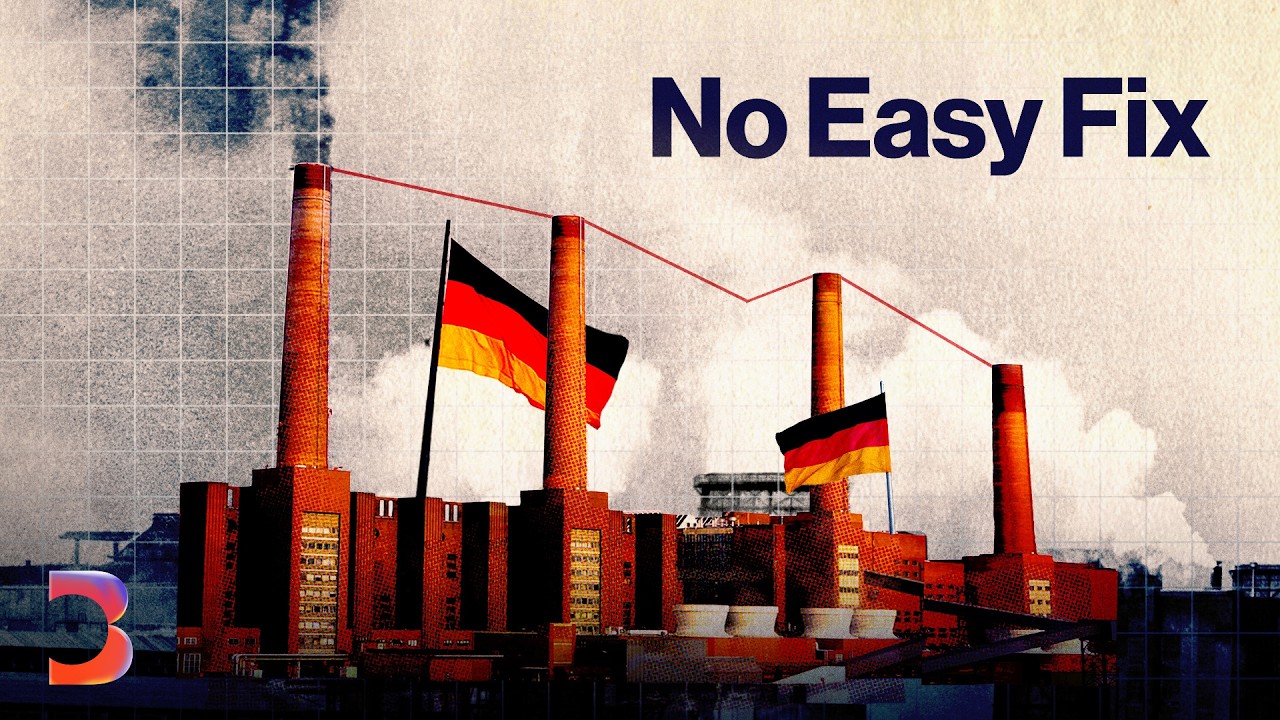
Bloomberg Originals
The collapse of cheap Russian gas and fierce electric-vehicle competition from China threaten to reduce Europe's industrial engine to an open-air museum without rapid adoption of industrial AI.
AI-assisted summary of What's Wrong With Germany? — original source. Check the original for full context.
Source published:
Detailed notes
## Background Published by Bloomberg Originals on YouTube on August 21, 2026, this video examines the severe crisis facing Germany's famous industrial engine. The coverage explores how intense competition from China and soaring energy costs have crippled the country's manufacturing sector, questioning how this downturn occurred and whether Germany can adapt.
## TL;DR Germany's long-successful economic model is faltering due to the collapse of cheap Russian natural gas, global trade fragmentation, and intense export competition from China in key automotive and machinery markets. Industrial output has declined significantly since peaking in 2018, causing heavy job cuts at major corporations like BASF and creating a multi-point growth gap relative to global peers. Facing fiscal constraints and an aging workforce, Germany is attempting to reform its constitutional debt brake while looking toward Industrial AI to secure a economic recovery.
## Atmosphere & style The documentary carries a serious, analytical, and sober tone characteristic of high-end financial journalism. It conveys a brooding sense of economic anxiety and urgency, contrasting historical industrial pride with stark modern realities of factory closures and geopolitical shifts. Combining data-driven evidence with critical expert insights, the piece creates a cerebral yet alarming narrative about the high stakes facing Europe's economic core.
## Key takeaways - [00:00](https://www.youtube.com/watch?v=IlbPO9Vmuuo&t=0s) Germany's once-celebrated post-pandemic economic recovery quickly curdled into contraction and prolonged stagnation, threatening to turn the country into a "huge open-air museum." - [00:57](https://www.youtube.com/watch?v=IlbPO9Vmuuo&t=57s) German industry still accounts for approximately 20% of total national value added, which is significantly higher than European peers like France, Italy, or Spain. - [02:01](https://www.youtube.com/watch?v=IlbPO9Vmuuo&t=121s) German GDP growth has trailed a weighted peer group of advanced economies by 6% to 7% over the last two decades, representing a permanent loss of economic potential. - [03:11](https://www.youtube.com/watch?v=IlbPO9Vmuuo&t=191s) The country's economic model relied on three core pillars—cheap Russian gas, open global trade, and uncontested industrial leadership—all of which suffered simultaneous shocks. - [03:35](https://www.youtube.com/watch?v=IlbPO9Vmuuo&t=215s) High energy costs forced massive capacity cutbacks in heavy industry, causing BASF's flagship Ludwigshafen headcount to fall below 30,000 for the first time since the 1950s. - [04:52](https://www.youtube.com/watch?v=IlbPO9Vmuuo&t=292s) "China Shock 2.0" sees Chinese competitors moving up the value chain to directly challenge German firms in core sectors like machinery, electrical engineering, and automotive. - [05:15](https://www.youtube.com/watch?v=IlbPO9Vmuuo&t=315s) German vehicle exports to China dropped by over 30% in a single year as Chinese EV makers rapidly gained market share and flipped trade balances. - [07:36](https://www.youtube.com/watch?v=IlbPO9Vmuuo&t=456s) Rising global protectionism and EU state-aid restrictions limit Germany's ability to offer long-term industrial subsidies compared to state-subsidized foreign rivals. - [08:11](https://www.youtube.com/watch?v=IlbPO9Vmuuo&t=491s) Chancellor Friedrich Merz reformed the constitutional debt brake to unlock investment funds for defense and infrastructure. - [09:38](https://www.youtube.com/watch?v=IlbPO9Vmuuo&t=578s) Stagnation is placing strain on Germany's social welfare state, forcing adjustments to healthcare and pensions while driving political fragmentation. - [10:45](https://www.youtube.com/watch?v=IlbPO9Vmuuo&t=645s) As the primary supply-chain anchor for Europe, Germany's industrial decline poses broad risks to overall EU economic stability. - [11:22](https://www.youtube.com/watch?v=IlbPO9Vmuuo&t=682s) German industrialists are pivoting toward "Industrial AI" to pair traditional engineering excellence with advanced machine intelligence as a path forward.
## Detailed walkthrough Here is a walkthrough of the Bloomberg Originals documentary on Germany's industrial crisis:
### [00:00](https://www.youtube.com/watch?v=IlbPO9Vmuuo&t=0s) Introduction & The Crisis of the Industrial Model Europe's largest economy is facing a critical crossroads as its long-celebrated economic model falters. Once acclaimed as the largest exporting nation on earth, Germany is now seeing that reality slip away as major industrial players announce aggressive restructuring programs, close factories, and lay off workers. Historically defined by almost uninterrupted economic growth, Germany's post-pandemic recovery quickly curdled into contraction and prolonged stagnation. The energy-intensive industrial sector in particular has been mired in crisis for years, spilling over into job losses, economic anxiety, and intense political pressure. Experts warn that if immediate structural action is not taken, Germany risks turning into little more than a "huge open-air museum."
* **Key Economic Shift:** The post-pandemic rebound reversed into structural contraction, leaving industrial heartlands under severe strain. * **Industry Scale:** German industry still accounts for roughly 20% of total national value added—significantly higher than other European peers like France, Italy, or Spain.
---
### [01:07](https://www.youtube.com/watch?v=IlbPO9Vmuuo&t=67s) Germany's Industrial Weight & Historical Performance Germany’s industrial footprint is deeply embedded in both the domestic and global economy. Beyond direct manufacturing, German industry is intricately tied to vital non-industrial sectors like business services. The nation specializes in making "the things inside the things that make the other things"—a kind of specialized industrial backbone spanning automotive coatings, road markings, wall paint, and microchips.
Looking at historical output metrics since 1991 reveals a stark trajectory. After lagging behind European averages in the early 2000s, sweeping labor market reforms in 2003 revived competitiveness up until the global financial crisis. Output then climbed for a decade, peaking in 2018, before COVID-19 initiated a steep, ongoing downhill trend. When comparing Germany’s GDP over the last two decades against a weighted peer group of similar advanced economies (South Korea, Japan, Finland, Canada, and Sweden), a 6% to 7% growth gap has opened up—representing a permanent loss of economic potential rather than a temporary cyclical downturn.
* **Peer Underperformance:** Germany trails its former peer group benchmark by 6% to 7% in GDP growth over a 20-year span. * **Historical Peak:** Industrial output peaked in 2018 and has struggled to recover since the pandemic shock.
---
### [03:11](https://www.youtube.com/watch?v=IlbPO9Vmuuo&t=191s) The Collapse of the Energy Pillar Germany’s economic engine historically relied on three core pillars: cheap Russian natural gas, open global rules-based trade, and uncontested industrial leadership in machinery, automotive, and engineering. All three pillars faced severe, simultaneous structural shocks. The sudden cutoff of Russian natural gas following the invasion of Ukraine exposed Berlin's long-standing energy gamble; Russia had previously supplied approximately half of all German natural gas imports.
Because European heavy industry relies heavily on imported fossil fuels for both heat and essential chemical feedstocks, energy costs surged well above those in the United States and China. Energy-intensive sectors like chemical manufacturing cannot simply transition away from oil and gas because carbon molecules are fundamental building blocks of their products. Between 2022 and 2025, nearly 10% of total European chemical capacity was earmarked for shutdown. At BASF’s flagship site in Ludwigshafen—the birthplace of the German chemical industry—headcount dropped below 30,000 for the first time since the 1950s, even as the company invested billions of euros into constructing new production facilities in China.
* **Energy Dependence:** Russia supplied around 50% of Germany's pre-war natural gas requirements. * **Capacity Shutdowns:** Nearly 10% of European chemical capacity was designated for closure between 2022 and 2025. * **Ludwigshafen Benchmark:** BASF site employment fell below 30,000 workers for the first time since the 1950s.
---
### [04:52](https://www.youtube.com/watch?v=IlbPO9Vmuuo&t=292s) "China Shock 2.0" & The EV Shift While the first "China Shock" in the early 2000s primarily impacted low-tech, labor-intensive industries, Germany actually thrived by supplying high-end capital goods, nuclear reactors, bullet trains, and premium cars to a booming Chinese market. "Made in Germany" served as the premier standard of industrial quality. However, "China Shock 2.0"—a new wave of fierce export competition accelerating since 2020—has seen Chinese manufacturers move up the value chain to directly challenge German firms in high-value core markets such as machinery, electrical engineering, and energy infrastructure.
The shift is most pronounced in the automotive sector. Once complacent regarding China's electric vehicle (EV) ambitions, German automakers saw Chinese rivals leapfrog them in just five years. German vehicle exports to China dropped by over 30% in a single year, while Chinese EV imports into Germany surged, flipping a long-held trade surplus into a widening trade deficit. Furthermore, China maintains tight control over critical mineral and rare earth supply chains. Rather than cutting off access entirely, administrative delays in raw material shipments create acute planning uncertainty for German manufacturers.
* **Export Decline:** German car exports to China fell over 30% in 2025. * **Industrial Goods Deficit:** Machinery and engineering exports to China fell roughly 10% in 2025 as imports of Chinese components rose. * **Supply Chain Vulnerability:** Strategic leverage through export delays of critical minerals and rare earth elements.
---
### [07:36](https://www.youtube.com/watch?v=IlbPO9Vmuuo&t=456s) Rising Protectionism & Fiscal Realities Global trade fragmentation and growing international protectionism have placed further strain on Germany’s export-led growth strategy. Proposals for reciprocal tariffs from the U.S. highlight growing global trade friction, with foreign leaders pointing out imbalances in automotive trade. Meanwhile, state-subsidized industrial models in authoritarian nations outpace European market frameworks. As an EU member state, Germany cannot unilaterally issue state subsidies without navigating strict European state-aid rules.
While short-term emergency relief packages buffered manufacturers during the peak of the 2022–2023 energy crisis, permanent long-term subsidies remain fiscally and politically unviable. In response, Chancellor Friedrich Merz reformed the nation's strict "debt brake" rules, unlocking substantial investment funds dedicated to defense and infrastructure. However, systemic hurdles remain: energy costs stay elevated, domestic demand remains soft, and an aging workforce threatens long-term capacity, leading to depressed real wage growth across traditional industrial sectors.
* **Fiscal Action:** Relaxation of the constitutional debt brake under Chancellor Friedrich Merz to fund targeted infrastructure and defense spending. * **Subsidies Limits:** High cost and EU regulation prevent permanent state funding of industrial energy costs.
---
### [09:38](https://www.youtube.com/watch?v=IlbPO9Vmuuo&t=578s) Social Strain, Political Consequences & The European Stakes The absence of sustained economic growth directly threatens Germany's expansive social welfare state, prompting government adjustments to healthcare, pensions, and social benefits. This growing sense of economic stagnation and decline is triggering political fragmentation, driving voters toward political extremes and making structural reforms even harder to pass through legislature.
Because German manufacturing is the supply-chain anchor for the entire European continent, a decline in German industrial competitiveness threatens economic stability across the European Union. However, modest signs of stabilization have emerged: Germany recorded faint positive GDP growth in 2025, accompanied by record highs in stock market indexes. To secure a long-term turnaround, German industrialists are increasingly looking toward "Industrial AI"—combining traditional engineering excellence with advanced machine intelligence to compete against technological giants in the U.S. and China.
* **Welfare Realignments:** Fiscal pressures are forcing cuts across national healthcare, pension allocations, and social benefits. * **Electoral Impact:** Economic angst is increasing political fragmentation, creating policy bottlenecks. * **Future Strategy:** Development of specialized "Industrial AI" capabilities to retain an engineering advantage globally.
## Notable quotes > [00:00](https://www.youtube.com/watch?v=IlbPO9Vmuuo&t=0s) huge open-air museum
> [01:07](https://www.youtube.com/watch?v=IlbPO9Vmuuo&t=67s) the things inside the things that make the other things
> [04:52](https://www.youtube.com/watch?v=IlbPO9Vmuuo&t=292s) Made in Germany
> [04:52](https://www.youtube.com/watch?v=IlbPO9Vmuuo&t=292s) China Shock 2.0
> [11:22](https://www.youtube.com/watch?v=IlbPO9Vmuuo&t=682s) Industrial AI
## Mentioned Germany, China, United States, Russia, Ukraine, European Union, BASF, BMW, Volkswagen, Friedrich Merz, Bloomberg, Bloomberg Originals, Ludwigshafen, France, Italy, Spain, South Korea, Japan, Finland, Canada, Sweden
[Source](https://www.youtube.com/watch?v=IlbPO9Vmuuo)