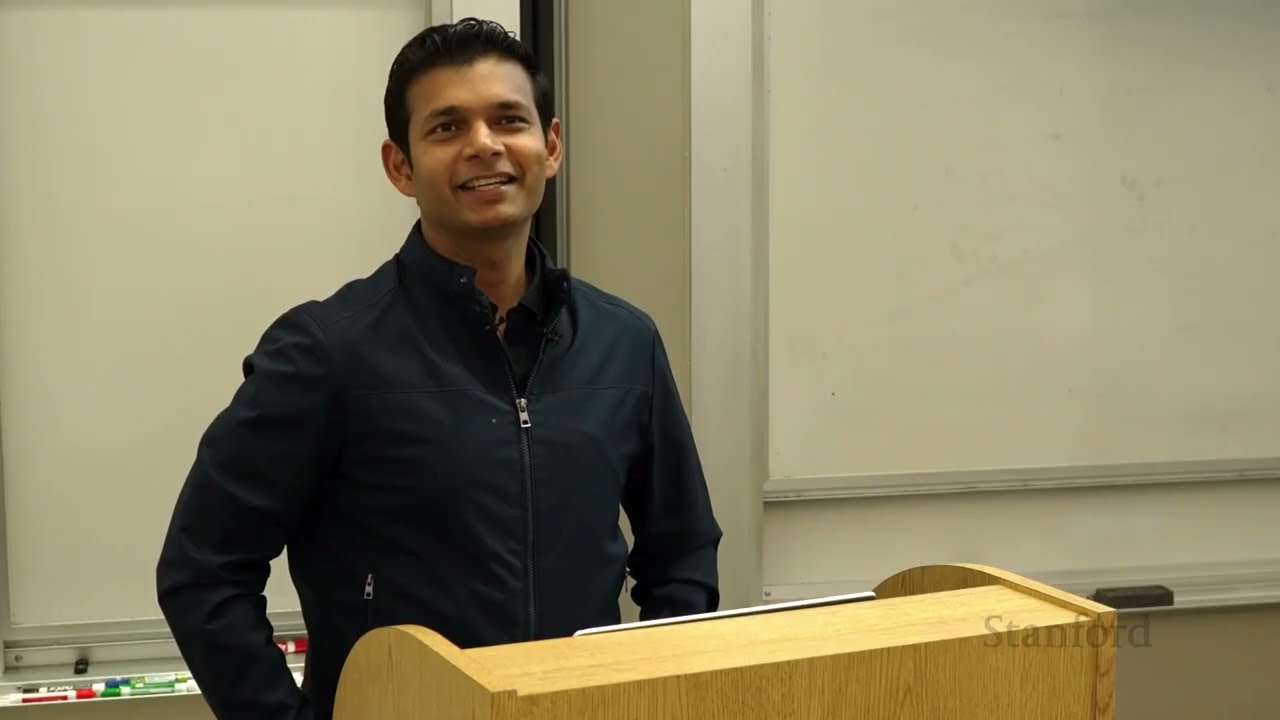
Altimeter's Agrawal Says Chip Dominance Squeezes AI App Margins
Stanford Online
The AI ecosystem will remain a heavily bottom-weighted pyramid until high inference costs drop and platforms adopt advertising models to monetize free users.
## Background
This lecture from the course 'MS&E435 Economics of the AI Supercycle' was published by Stanford Online on YouTube on July 17, 2026. Taught by Apoorv Agrawal, a Stanford Adjunct Lecturer and partner at Altimeter Capital, the video covers the inaugural session of a nine-week graduate course hosted by Stanford's Department of Management Science and Engineering. The course explores the underlying business logic, economic structures, and investment dynamics driving the generative AI industry.
## TL;DR
Instructor Apoorv Agrawal contrasts the economics of current AI technology with prior tech cycles, highlighting how value remains heavily concentrated at the bottom infrastructure and semiconductor layer rather than flowing to applications. He analyzes NVIDIA's strong gross margins alongside the variable running costs and thin margins of AI applications, contrasting these dynamics with traditional software. The lecture examines customer concentration in custom silicon, historical patterns of vertical integration, and the scale limitations of consumer AI platforms like ChatGPT. Ultimately, Agrawal argues that consumer AI applications must eventually adopt high-intent conversational advertising models to achieve long-term profitability.
## Atmosphere & style
The lecture is engaging, pragmatic, and grounded in real-world venture capital and engineering experience. Agrawal blends academic rigor with industry candor, establishing a conversational and interactive rapport with students through class polls, lighthearted personal jokes, and a fast-paced trivia game. The narrative feels like an insider's briefing on Silicon Valley's shifting economic landscape—thought-provoking, analytical, and tailored to future founders and investors navigating a major technological shift.
## Key takeaways
- [00:09](https://www.youtube.com/watch?v=LNSvp-9b-J0&t=9s) Course Overview and Logistics: MS&E435 explores the economic structure of the AI supercycle with guest lectures under Chatham House Rules, light weekly workload (~3 hours), and grading split between attendance (50%) and a final assignment (50%).
- [04:00](https://www.youtube.com/watch?v=LNSvp-9b-J0&t=240s) Framing the AI Supercycle: AI represents an unprecedented economic transition where students will likely go on to either found or fund the next wave of AI companies, requiring clean mental models to evaluate opportunities.
- [05:37](https://www.youtube.com/watch?v=LNSvp-9b-J0&t=337s) Upright Triangle vs. Inverted Pyramid: Unlike prior tech waves (Cloud, Mobile, Web) where value concentrated at the application layer, the AI ecosystem currently forms an upright triangle with value heavily concentrated at the bottom in silicon and infrastructure.
- [07:15](https://www.youtube.com/watch?v=LNSvp-9b-J0&t=435s) AI Application Economics: Traditional software yielded 80-90% gross margins due to near-zero marginal distribution costs, whereas continuous GPU usage during AI inference creates high variable running costs that compress application margins to 0-30%.
- [09:20](https://www.youtube.com/watch?v=LNSvp-9b-J0&t=560s) Infrastructure Timeline: Physical infrastructure buildout cycles require substantial time before top-layer application revenue catches up, as illustrated by AWS's eight-year gestation period from launch to full internal migration.
- [11:14](https://www.youtube.com/watch?v=LNSvp-9b-J0&t=674s) 4-Layer Strategic Stack: The course analyzes strategic questions across four primary layers: Semiconductors & Silicon, Frontier Models, Inference & Middleware, and Applications.
- [14:53](https://www.youtube.com/watch?v=LNSvp-9b-J0&t=893s) Hyperscaler Custom Silicon: Custom ASIC programs like Google TPU, Meta MTIA, and proprietary chips from Amazon and Microsoft threaten incumbent silicon pricing power and could trigger ecosystem repricing.
- [14:53](https://www.youtube.com/watch?v=LNSvp-9b-J0&t=893s) Nvidia GPU Allocation: Approximately 40% of deployed Nvidia GPUs are dedicated to inference workloads, with 60% assigned to model training.
- [19:13](https://www.youtube.com/watch?v=LNSvp-9b-J0&t=1153s) Predictable vs. Bursty Workloads: Model training workloads require predictable continuous compute utilization, whereas inference workloads fluctuate with human waking hours and seasonal dips.
- [19:13](https://www.youtube.com/watch?v=LNSvp-9b-J0&t=1153s) Profitability Discrepancy: Nvidia maintains data center gross margins around 75%, while the application layer operates on paper-thin margins between 0% and 30%.
- [21:07](https://www.youtube.com/watch?v=LNSvp-9b-J0&t=1267s) Targeting Custom Silicon Customers: With major hyperscalers building in-house chips and accounting for half of GPU market revenue, new chip startups must strategically target which specific hyperscalers to sell to first.
- [21:07](https://www.youtube.com/watch?v=LNSvp-9b-J0&t=1267s) Vertical Integration Trend: Historical tech supercycles show market leaders (e.g., Google in Web, Apple in Mobile) are vertically integrated; Nvidia is following suit by pushing up the stack via DGX Cloud and software.
- [25:51](https://www.youtube.com/watch?v=LNSvp-9b-J0&t=1551s) Persistent Value Accrual in Silicon: Over a two-year period where total AI ecosystem revenue grew by ~$350 billion, roughly 75% of that new revenue went directly to the Semiconductor layer.
- [25:51](https://www.youtube.com/watch?v=LNSvp-9b-J0&t=1551s) Market Concentration Across Layers: Nvidia dominates semiconductors (~$300B revenue), two players capture over 90% of application revenue, and the infrastructure layer exhibits the highest competitive volatility.
- [28:37](https://www.youtube.com/watch?v=LNSvp-9b-J0&t=1717s) Consumer AI Adoption Ceiling: ChatGPT is transitioning out of the 'niche app' tier toward social-level scale, but faces an engagement wall because using conversational AI requires active intellectual labor rather than passive consumption.
- [33:02](https://www.youtube.com/watch?v=LNSvp-9b-J0&t=1982s) Monetization Gap and Ad Unlock: Subscription models alone yield low per-user revenue (~$10/year for ChatGPT vs. ~$100/year for Google); consumer AI platforms will inevitably need to unlock high-CPM conversational advertising.
## Detailed walkthrough
Here is the detailed walkthrough of the first part of the lecture.
[00:09](https://www.youtube.com/watch?v=LNSvp-9b-J0&t=9s) Course Introduction and Classroom Logistics
Instructor Apoorv Agrawal introduces *MS&E435: Economics of the AI Supercycle*, outlining his background and setting expectations for the nine-week course. His career path spans leading engineering teams at Palantir over a decade ago—notably writing a lot of Apache Spark code in government buildings—to attending Stanford for graduate school, and ultimately leading Altimeter Capital. Altimeter operates as an investment firm managing both public and private portfolios through concentrated thesis-driven investing. Agrawal lightheartedly references his biggest life milestone six months prior: becoming a new father, which he jokes is either an investment with a guaranteed negative IRR or the ultimate positive return. He introduces the Teaching Assistant, Chloe Feng, and underscores that the course workload is intentionally kept light at around three hours per week, including one hour of class time and one to two hours of assigned readings or time spent interacting with models like ChatGPT and Claude.
The format centers around weekly guest lectures operating under Chatham House Rules to allow industry leaders to speak candidly about their businesses. These sessions are supplemented by optional post-class dinners coordinated by the TA. The grading structure is evenly split: 50% for attendance and participation, and 50% for a final assignment released at the end of the course.
- **Course Format:** Weekly guest speakers covering semiconductors, infrastructure, energy, frontier models (e.g., OpenAI, Anthropic), and agent applications.
- **Grading:** 50% class attendance and participation; 50% final assignment.
- **Time Commitment:** Max 3 hours per week (1 hour lecture + 1–2 hours reading/assignments).
[04:00](https://www.youtube.com/watch?v=LNSvp-9b-J0&t=240s) Framing the AI Supercycle
Agrawal outlines his motivation for creating the course: establishing clean mental models to evaluate opportunities and understand the fundamental "laws of physics" governing businesses during this technological transition. Having returned to campus annually to engage with students, he notes that AI represents an unprecedented economic supercycle. He observes that in five years, students present today will be asked if they recognized the magnitude of the transition while "the tectonic plates were forming and clay was forming." He anticipates that half the class will go on to found AI companies while the other half will fund them, making it essential to evaluate how Series A capital should be allocated and what pitfalls to avoid.
[05:37](https://www.youtube.com/watch?v=LNSvp-9b-J0&t=337s) The Economic Structure of AI vs. Prior Tech Cycles
Agrawal presents the core economic theme of the course, contrasting the shape of the AI ecosystem with historical technology waves like the Internet (25 years ago), Mobile (20 years ago), and Cloud computing (10 years ago). Hyperscalers and semiconductor providers like Nvidia are deploying massive capital expenditures into data centers—what Jensen Huang calls a "5-layer cake" comprising energy, chips, power, interconnects, and memory—to rent out compute by the hour or token.
In previous technology waves, the ecosystem evolved into an inverted pyramid where the application layer generated far more aggregate economic value than the underlying hardware and infrastructure layer. By contrast, the AI ecosystem currently resembles an upright triangle, where value and revenue are heavily concentrated at the bottom in silicon and infrastructure, while the application layer remains comparatively small.
During a class discussion on why this discrepancy exists, students highlight that AI is still in its early deployment phase, Nvidia holds a near-monopolistic position allowing high pricing power, and AI application physics differ fundamentally from traditional software. Traditional software "ate the world" because its marginal cost of distribution was near zero, yielding 80% to 90% gross margins. In AI, incremental users consume continuous GPU cycles during inference, creating high variable running costs that prevent large-scale AI applications from achieving profitability even at massive revenue scale.
Agrawal references historical timelines such as Amazon Web Services (AWS), which broke ground in 2004, secured its first major customer (Netflix) in 2010, and fully migrated Amazon in 2012. This eight-year gestation period demonstrates that physical infrastructure cycles require considerable time before top-layer application revenue catches up.
- **The 5-Layer Infrastructure Stack:** Energy, chips, power, interconnects, and memory.
- **Traditional Software Margins:** Typically 80%–90% gross margins due to zero marginal distribution cost.
- **AWS Timeline Comparison:** Launched in 2004; Netflix onboarded in 2010; Amazon full migration in 2012 (an 8-year buildout cycle).
[11:14](https://www.youtube.com/watch?v=LNSvp-9b-J0&t=674s) Industry Layers and Key Strategic Questions
Agrawal details the questions the course will explore across the four primary layers of the AI ecosystem:
- **Semiconductors & Silicon:** Key questions center on how long incumbents like Nvidia can maintain dominance, what threats emerge from custom ASICs developed by hyperscalers, and what forces could drive price compression.
- **Frontier Models:** Conversations with leaders from OpenAI and Anthropic will focus on unit economics, paths to profitability for consumer applications, and whether advertising or subscription revenues will ultimately dominate.
- **Inference & Middleware:** As the most competitive layer in the ecosystem, startups face intense pressure from hyperscalers. The core strategic question is whether specialized inference services exist as standalone platform businesses or merely as standard features of cloud providers like AWS.
- **Applications:** Traditional incumbent enterprise platforms—such as Salesforce with Einstein and Palantir with AIP—are retrofitting their offerings with AI suites. Their underlying infrastructure spend is absorbed into model usage and inference layers, making standalone application revenue distinct yet intertwined with platform distribution.
[14:53](https://www.youtube.com/watch?v=LNSvp-9b-J0&t=893s) Market Dynamics, Hyperscaler CapEx, and Inference Shifts
Addressing student inquiries regarding market shifts, Agrawal examines Google's position across the stack, noting that its business spans TPU hardware (semiconductors), Google Cloud Platform (infrastructure), and Gemini (models/applications). He highlights that Gemini ranks as the second most used consumer AI application, though the extent to which this is driven by meritocratic product quality versus Google's innate distribution advantage remains an open debate.
On whether the ecosystem's upright triangle will invert over time, Agrawal suggests the current structure could persist longer than the decade-long cycle seen in cloud computing due to the sheer complexity of getting the underlying hardware substrate right. He outlines two potential catalysts that could trigger a structural repricing:
1. Breakout success from internal hyperscaler ASIC programs (such as Google TPU, Meta MTIA, or proprietary chips from Amazon, Microsoft, and OpenAI).
2. A slowdown in public hyperscaler CapEx guidance during quarterly earnings calls, which would signal that current infrastructure returns are unsustainable.
Finally, discussing the operational balance between training and inference, Agrawal notes that Nvidia's earnings disclosures indicate roughly 40% of their deployed GPUs are utilized for inference, with the remaining 60% dedicated to model training. He anticipates this ratio will gradually shift in favor of inference as deployment expands.
- **Nvidia Workload Allocation:** Approximately 40% of deployed GPUs are used for inference versus 60% for training.
- **Consumer App Rankings:** Gemini is currently the second most used consumer AI application.
- **Hyperscaler Custom Silicon:** Projects include Google TPU, Meta MTIA, and internal programs at Amazon and Microsoft.
***
<ElicitationsGroup message="What would you like to do next?">
<Elicitation label="Explore the structural differences between software and AI unit economics" query="Explore the structural differences between software and AI unit economics" query_intent="CLICKABLE_SUGGESTION" />
<Elicitation label="Analyze Nvidia's GPU fleet allocation between training and inference" query="Analyze Nvidia's GPU fleet allocation between training and inference" query_intent="CLICKABLE_SUGGESTION" />
<Elicitation label="Investigate hyperscaler custom ASIC programs like Google TPU and Meta MTIA" query="Investigate hyperscaler custom ASIC programs like Google TPU and Meta MTIA" query_intent="CLICKABLE_SUGGESTION" />
</ElicitationsGroup>
Here is a detailed, faithful walkthrough of the provided transcript segment:
[19:13](https://www.youtube.com/watch?v=LNSvp-9b-J0&t=1153s) The Dynamics of AI Workloads and Stack Profitability
Apoorv Agrawal continues analyzing the economic structure of the generative AI ecosystem, starting with the stark operational differences between training and inference workloads. Training workloads are highly predictable, requiring maximum compute utilization over short, continuous bursts. In contrast, inference workloads are far more erratic and "bursty." Currently, inference traffic tracks human waking hours—mysteriously dipping during major holidays like Christmas and Thanksgiving—though Agrawal notes this dynamic may flatten into a 24/7 continuous baseline once autonomous AI agents take over.
Turning to the question of value capture across the tech stack, Agrawal asserts that the **Semiconductor (Semis) layer** is by a long shot the most profitable segment. NVIDIA, for instance, maintains data center gross margins near 75% (plus or minus a few percentage points). Conversely, the Application layer struggles with paper-thin margins ranging between 0% and 30%. This severe profit concentration stems from a single dominant player running the tables on hardware. When viewed purely through a profitability lens, the market triangle becomes even more lopsided toward the bottom chip tier.
- **Training Workload Profile:** Predictable, continuous high utilization over fixed periods.
- **Inference Workload Profile:** Highly variable, daytime-driven burst usage with notable seasonal dips.
- **NVIDIA Gross Margins:** ~75% in their data center business.
- **Application Layer Margins:** Ranging between 0% and 30%.
---
[21:07](https://www.youtube.com/watch?v=LNSvp-9b-J0&t=1267s) The Custom Silicon Battleground and Vertical Integration
An audience member asks where new ASIC and inference startups expect to sell their chips given that hyperscalers (AWS, Google, Microsoft) are developing in-house silicon like TPUs, NVIDIA is pushing into cloud inference, and labs like OpenAI are seeking custom ASICs. Agrawal points out that there is roughly $300 billion in market revenue to compete for. However, as NVIDIA CEO Jensen Huang routinely discloses on earnings calls, about half of that revenue comes directly from the major hyperscalers.
For any startup building a chip company today, the customer base has a very specific "shape": a tiny hand-counted group of buyers placing massive orders, rather than a broad enterprise or consumer sales funnel. Agrawal advises that the single most critical strategic question for any new chip founder must be: *"Which of the five hyperscalers are you going to sell to first?"*
The discussion then turns to vertical integration across historic tech supercycles. Addressing whether vertical integration shifts the balance of power, Agrawal surveys past tech waves to show that dominant winners are almost always vertically integrated:
* **The Web Supercycle:** Google (~$3 trillion market cap, ~99% search market share) controls the stack end-to-end, from custom file servers to search indexing, ad auction systems, and the front-end user experience.
* **The Mobile Supercycle:** Apple (~$2.5 trillion market cap) controls custom silicon, hardware design, operating system, and the App Store.
* **The Social Supercycle:** Meta (~$2 trillion market cap) dominates social media, though slightly less vertically integrated at the server level (costing them potential market cap).
* **The Cloud Era:** A more heterogeneous oligopoly shared among AWS, GCP, and Azure without a single vertically integrated runaway winner.
* **The AI Era:** NVIDIA is actively attempting vertical expansion up the stack through initiatives like **DGX Cloud** and proprietary vertical software applications.
---
[24:07](https://www.youtube.com/watch?v=LNSvp-9b-J0&t=1447s) Classroom Quiz Interlude: Fast Inference and Analog Rules
Recognizing it is 5:00 PM on a Thursday evening, Agrawal decides to energize the classroom with an interactive quiz game. To keep the students engaged, he offers a physical prize for the winner, explaining that points will be awarded based on both accuracy and speed.
Acknowledging the technical savvy in the room, Agrawal jokes that "the fastest way to be fast is to do fast inference and drop that thing into Claude." He grants permission for students to leverage AI models like Claude, but jokingly asks them to hold off for five seconds: *"Just give the human players five seconds, let them go at it and let them win the analog way."*
---
[25:51](https://www.youtube.com/watch?v=LNSvp-9b-J0&t=1551s) Ecosystem Value Accrual: The Persistent Semiconductor Siphon
Resuming the lecture, Agrawal presents a updated version of an ecosystem value-accrual chart he originally published two years prior. Comparing the market landscape from two years ago to the present reveals a striking pattern: despite the total AI ecosystem expanding by roughly 5x, the structural shape of where value accrues has barely budged.
Over the last two years, the AI ecosystem added approximately **$350 billion in total revenue**. However, roughly **75% of that entire newly generated revenue went straight to the Semiconductor layer** (predominantly NVIDIA). Even though the Application layer expanded more than 10x in absolute revenue during that same window, it still failed to make a meaningful dent in the overall percentage distribution.
Breaking down the internal market concentration within each layer of the stack:
* **Semiconductors (~$300B revenue):** Almost entirely dominated by a single player, NVIDIA.
* **Applications:** Over 90% of total application revenue is captured by just two major companies.
* **Infrastructure Layer:** Features the highest competitive intensity and market instability. It acts as a multi-directional battleground where hyper-funded players compete horizontally against peers and vertically up and down the stack. It exhibits the highest "metabolic rate"—marked by rapid startup formation and frequent buyouts.
For venture investors and founders, the core strategic question is determining how many years it will take for this revenue pyramid to rebalance into the healthy shape of the traditional cloud software ecosystem (whether that takes 5, 10, 15 years, or never).
---
[28:37](https://www.youtube.com/watch?v=LNSvp-9b-J0&t=1717s) The Scale Ceiling of AI Applications and Consumer Economics
Agrawal transitions to consumer AI platforms—currently the largest market segment outside of coding tools—pointing out an underlying economic vulnerability: usage is massive, but monetization is surprisingly weak. On ChatGPT, roughly 95% of users remain on the free tier. Meanwhile, Google DeepMind CEO Demis Hassabis publicly stated that Google Gemini does not intend to rely on subscription revenue alone, raising questions about what the long-term monetization engine for consumer AI will look like.
To contextualize the true scale of ChatGPT and Gemini, Agrawal categorizes legacy non-AI consumer internet platforms into three distinct tiers based on active user volume:
1. **Mandatory Life Utilities (3 Billion+ Users):** Ubiquitous services that users virtually cannot live without in modern society (e.g., WhatsApp, Google Chrome, YouTube).
2. **Social Network Effect Apps (1.5B – 2B Users):** Platforms driven by strong social ties where adoption is tied to peer presence (e.g., Instagram, TikTok, Facebook).
3. **Niche & Task-Specific Apps (Sub-1.5B Users):** Mainstream destinations built for specific utility or intent rather than constant daily engagement (e.g., Amazon for shopping, Spotify for music, X/Twitter for public debate).
When Agrawal polls the class on where leading AI models sit, students debate whether AI will become a daily mandatory utility or peak at Facebook-level social scale. Agrawal reveals the data: **ChatGPT has only recently crossed out of the "niche app" category**, while Gemini has yet to breach it. While ChatGPT is trending upward toward social-level scale, it has not yet reached mandatory utility status.
Agrawal attributes this adoption wall to the nature of user engagement. ChatGPT is not a passive feed for dopamine hits, nor is it a communication tool for messaging friends; it requires active intellectual labor. *"It's a place where you go and you have to do active work... And the number of people in the world who are asking active questions of technology is not the entirety of the population that's online."*
Comparing the unit economics of global tech giants reveals the monetization gap facing AI startups:
* **Alphabet (Google):** ~4 billion users, monetized at ~$100 per user/year.
* **Meta:** ~3.5 billion users, monetized at ~$70 per user/year.
* **ChatGPT (OpenAI):** ~1 billion users, monetized at only ~$10 per user/year.
---
[33:02](https://www.youtube.com/watch?v=LNSvp-9b-J0&t=1982s) The Unlocking of the AI Ad Model
To bridge the gap from $10 to $100 per user annually, Agrawal argues that subscription models alone will prove insufficient; consumer AI platforms will inevitably have to pivot to advertising. He predicts that advertisements served inside conversational interfaces like ChatGPT or Claude will command far higher pricing (CPMs) than traditional search or display ads. Conversational platforms possess deep user intent, verified log-in states, direct attribution, and high user trust.
Agrawal draws a direct historical parallel to Facebook's 2012 IPO: back then, Wall Street heavily shorted Facebook under the belief that advertisements worked on desktop monitors but could never work on small smartphone screens due to lack of visual real estate. *"Shocker, we found the space on a phone."*
Similarly, critics today argue that users will reject ads inside intimate, personalized AI conversations. While acknowledging that inserting ads into private AI chats presents design and trust challenges, Agrawal remains confident that the industry will crack the format, creating a massive financial unlock for the generative AI economic model. Closing the lecture as time expires, he hints that future course sessions will dive deeper into advertising mechanics and monetization strategy.
> [21:07](https://www.youtube.com/watch?v=LNSvp-9b-J0&t=1267s) Which of the five hyperscalers are you going to sell to first? — Apoorv Agrawal
> [24:07](https://www.youtube.com/watch?v=LNSvp-9b-J0&t=1447s) the fastest way to be fast is to do fast inference and drop that thing into Claude. — Apoorv Agrawal
> [24:07](https://www.youtube.com/watch?v=LNSvp-9b-J0&t=1447s) Just give the human players five seconds, let them go at it and let them win the analog way. — Apoorv Agrawal
> [28:37](https://www.youtube.com/watch?v=LNSvp-9b-J0&t=1717s) It's a place where you go and you have to do active work... And the number of people in the world who are asking active questions of technology is not the entirety of the population that's online. — Apoorv Agrawal
> [33:02](https://www.youtube.com/watch?v=LNSvp-9b-J0&t=1982s) Shocker, we found the space on a phone. — Apoorv Agrawal
## Mentioned
Apoorv Agrawal, Chloe Feng, Jensen Huang, Demis Hassabis, Stanford, MS&E435: Economics of the AI Supercycle, Altimeter Capital, Palantir, Apache Spark, ChatGPT, Claude, OpenAI, Anthropic, Nvidia, Amazon, AWS, Netflix, Salesforce, Einstein, AIP, Google, Alphabet, TPU, Google Cloud Platform (GCP), Gemini, Meta, MTIA, Microsoft, Apple, DGX Cloud, Azure, WhatsApp, Google Chrome, YouTube, Instagram, TikTok, Facebook, Spotify, X/Twitter, Chatham House
Instructor Apoorv Agrawal argues that the generative AI ecosystem forms an upright economic pyramid dominated by semiconductor profits, contrasting with prior tech waves where value accumulated in high-margin applications. Because inference imposes continuous compute costs while consumer monetization remains low, sustained market rebalancing will require hyperscaler silicon competition and conversational advertising models.
The Upright Value Triangle and Margin Compression (5:37)
In historical internet, mobile, and cloud supercycles, the computing stack resembled an inverted pyramid where the application layer captured the vast majority of total economic value. Traditional software businesses enjoyed zero marginal distribution costs, generating 80% to 90% gross margins. By contrast, Agrawal describes the generative AI landscape as an upright triangle where capital and profits are heavily concentrated at the base in semiconductors and physical infrastructure, while application software generates comparatively small returns.
This inversion stems from the unit economics of inference. Every incremental AI query requires continuous GPU cycles, saddling application developers with high variable operating costs and compressing gross margins to between 0% and 30%. Over the last two years, although the AI ecosystem added approximately $350 billion in total revenue and application revenue grew more than tenfold, roughly 75% of that new revenue flowed directly to the semiconductor layer—dominated almost entirely by Nvidia, which maintains data center gross margins near 75%.
Workload Physics and Hyperscaler Silicon Concentration (21:07)
Operational workloads in generative AI are split between model training and inference. Nvidia disclosures indicate that roughly 60% of deployed GPUs are utilized for training, which requires predictable and continuous high utilization, while 40% run inference workloads that fluctuate according to daytime user activity. Agrawal expects inference to expand as autonomous AI agents take over and establish continuous 24/7 baselines.
Hardware revenue remains narrow and concentrated. As Nvidia discloses, approximately half of its market revenue originates directly from major hyperscalers like AWS, Google, and Microsoft. For emerging ASIC startups, the customer base is limited to a small group of massive buyers rather than an enterprise funnel. Agrawal highlights two potential catalysts that could disrupt this concentration: breakout success from internal hyperscaler silicon programs (including Google TPU, Meta MTIA, and internal chips from Amazon and Microsoft) or a public scale-back in hyperscaler infrastructure CapEx guidance.
Consumer Adoption Limits and Monetization Disparities (28:37)
Consumer AI applications face both an engagement ceiling and a severe monetization gap. Agrawal categorizes legacy consumer platforms into three scale tiers: mandatory utilities with over 3 billion users (WhatsApp, Chrome), social network applications with 1.5 to 2 billion users (Instagram, TikTok), and niche or task-specific destinations below 1.5 billion users (Amazon, Spotify). ChatGPT has only recently moved beyond the niche tier toward social scale, while Google Gemini remains below it.
Agrawal attributes this adoption constraint to the friction of interaction: unlike passive social media feeds, conversational AI demands active intellectual labor from users. Consequently, monetization remains weak, with roughly 95% of ChatGPT users on the free tier. OpenAI currently generates approximately $10 per user annually across roughly 1 billion users, compared to roughly $70 per user for Meta across 3.5 billion users, and roughly $100 per user for Alphabet across 4 billion users.
The Strategic Shift Toward Conversational Advertising (33:02)
To close the average revenue per user gap between AI services and established consumer giants, Agrawal contends that subscription revenue alone will prove insufficient. Drawing a parallel to Wall Street's skepticism during Facebook's 2012 transition to mobile interfaces, he projects that generative AI platforms will inevitably turn to advertising to monetize their broad, unpaid user bases.
Agrawal predicts that conversational advertising formats will command higher pricing (CPMs) than legacy search or display ads. Conversational environments benefit from high user trust, authenticated log-in states, direct attribution, and deep visibility into user intent. Despite current design challenges and consumer hesitation surrounding ad placements within intimate chat interfaces, Agrawal maintains that developing a native conversational ad format represents the critical financial unlock for consumer AI sustainability.
Whether the generative AI economic pyramid will eventually invert into a software-centric model—and whether that shift will take five, fifteen years, or never materialize—remains unresolved. Agrawal emphasizes that the long-term equilibrium of the supercycle hinges on whether hyperscalers can lower compute costs via custom silicon while application providers crack conversational ad monetization.
[4:00] Apoorv Agrawal: laws of physics
[4:00] Apoorv Agrawal: the tectonic plates were forming and clay was forming
[5:37] Jensen Huang: 5-layer cake
[5:37] Apoorv Agrawal: ate the world
[19:13] Apoorv Agrawal: bursty
[21:07] Apoorv Agrawal: Which of the five hyperscalers are you going to sell to first?
[24:07] Apoorv Agrawal: the fastest way to be fast is to do fast inference and drop that thing into Claude.
[24:07] Apoorv Agrawal: Just give the human players five seconds, let them go at it and let them win the analog way.
[25:51] Apoorv Agrawal: metabolic rate
[28:37] Apoorv Agrawal: It's a place where you go and you have to do active work... And the number of people in the world who are asking active questions of technology is not the entirety of the population that's online.
[33:02] Apoorv Agrawal: Shocker, we found the space on a phone.
Original transcript
[0:09] All right, folks, we're going to
have some fun in this session.
[0:15] My name is Apoorva.
[0:16] I'm going to be your instructor
for the next nine weeks or so.
[0:21] Here's what we're going
to go through today.
[0:23] I'm going to talk a
little bit about myself.
[0:25] Why do I do this.
[0:27] Some logistics on
what to expect.
[0:31] Quiz.
[0:32] Yep, I'm that guy.
[0:33] We're going to have
quiz on day one.
[0:36] And the biggest question that
we've all been wrestling with,
[0:40] where's the money?
[0:41] Where's the money in AI?
[0:42] Some of you know me, but my
journey started in India.
[0:47] I moved to Singapore.
[0:48] I met a couple of Singaporean
folks here earlier.
[0:50] I started my career
at Palantir with Sunil
[0:54] and a couple of other
folks about 13 years ago,
[0:56] 14 years ago.
[0:57] Led a variety of
engineering teams.
[1:00] All that to say, we
wrote a lot of spark
[1:02] in government buildings.
[1:03] And I came back to
Stanford for grad school,
[1:06] which is when I got
tired of writing
[1:08] Spark in government buildings.
[1:10] And now, I lead Altimeter.
[1:12] I don't know how many of
you have heard of Altimeter,
[1:14] but Altimeter is
an investment firm.
[1:15] We focus on fairly
concentrated form of investing.
[1:19] We've got two businesses.
[1:20] We've got a public business
and a private business.
[1:22] And then I got the biggest
promotion of my life
[1:25] six months ago.
[1:26] I'm now the proud dad.
[1:31] This is, as people have told
me, the biggest investment
[1:35] I will make.
[1:36] Some have called it the one
with the most guaranteed
[1:39] negative IRR.
[1:41] I think it's the most guaranteed
positive IRR, not financial,
[1:46] but that's me.
[1:46] I live across the street.
[1:49] Reach out with questions.
[1:50] I want to be here as a
resource to you guys.
[1:53] I'm joined by an incredible
TA in Chloe Feng.
[1:57] Reach out to her if you
have harder questions--
[1:59] [APPLAUSE]
[2:03] - And make the most of it.
[2:06] We've got a great session
lined up for you guys.
[2:08] The course is designed to be no
more than three hours a week,
[2:12] and that includes class
readings all the time
[2:15] you spend arguing with ChatGPT,
with Claude about whether it
[2:19] can do your assignment for you.
[2:21] So it's about an hour of class.
[2:24] It's about an hour
or two of readings.
[2:26] And basically, the
format is we're
[2:29] going to do guest speakers
every single class, next class
[2:32] onwards.
[2:34] Chatham House Rules a
lot of guest speakers
[2:36] will share, maybe overshare.
[2:39] So please don't record
what they're saying.
[2:44] We'll have an optional dinner
with some of them right
[2:46] afterwards.
[2:47] You guys are welcome to join.
[2:49] Chloe will arrange
the logistics.
[2:53] Grading is easy.
[2:54] 50/50, show up to class.
[2:56] If Ali Ghodsi can show up to
class, you can show up to class.
[2:59] And the other half
is an assignment
[3:01] that we will release at
the end of the course.
[3:06] Yeah, it's conversational.
[3:07] Ask questions, be involved.
[3:08] The more you're involved, the
you're going to get out of it.
[3:11] And honestly,
what's in it for me
[3:13] is I'm going to learn
the most from you guys.
[3:15] This is the course schedule
over the next nine weeks.
[3:18] Lots of great speakers, one
more impressive than the other.
[3:21] As for me, honestly, putting
this calendar together
[3:23] has been my job for the last
couple of weeks and months.
[3:28] Chloe knows all about it.
[3:29] But be present.
[3:30] These are all incredible leaders
running incredible businesses
[3:33] across the stack
from Semis to Infra
[3:37] to energy on the
infrastructure side to models.
[3:40] You're going to have folks
from OpenAI and Anthropic
[3:43] and a bunch of
applications and agents.
[3:46] So ask all your
hardest questions.
[3:48] Save them for the speakers.
[3:50] They're going to love it.
[3:52] And we're going to
assign some readings.
[3:55] So why should you
take this course?
[4:00] What should you
achieve in this course?
[4:02] What is a good thing
to get out of this?
[4:05] You know, honestly,
I thought about this,
[4:08] and I was just telling
one of the students
[4:09] here of how it all began.
[4:11] I come back to
campus once a year
[4:14] and I talk about all
that's happening.
[4:17] And typically, it's in the
context of finding great people.
[4:21] I realized that this is
such a big supercycle.
[4:25] We know it.
[4:26] We believe it.
[4:27] At Altimeter, we have positioned
our entire focus around it.
[4:30] And I did not find a course
that goes deep in a way
[4:34] that I would have liked to be
when I was an undergrad here
[4:37] or a grad student here.
[4:39] And I thought about
in five years,
[4:42] everybody was going to ask you,
hey, did you see it coming?
[4:45] You were at the start of it.
[4:46] You were around when
ChatGPT was launched.
[4:48] You were around when the
tectonic plates were forming
[4:52] and clay was forming.
[4:53] And I think you want
to be able to say yes.
[4:55] So half of you are going
to start an AI company
[4:57] and the other half
are going to fund it.
[4:59] [CHUCKLING]
[5:00] So at least you
should know where
[5:02] to spend the Series A money
that you're going to raise.
[5:04] And at the very
minimum, you'll have
[5:07] a sense of what not to
go, or at least have
[5:10] mental models for, hey,
this business that I'm
[5:12] looking at or considering
starting or considering funding
[5:15] or considering joining,
what are the right questions
[5:17] to be asking?
[5:18] What are the laws of physics
that govern this business
[5:22] at this part of the cycle?
[5:25] I think it's going to
be the biggest one yet.
[5:27] And I'm excited that you guys
are here to study alongside us.
[5:37] I'm going to spend
some time on this slide
[5:39] because this is the punchline.
[5:43] How many of you have seen
a version of this before?
[5:47] Well, those of you who did
the readings, thank you.
[5:49] I appreciate it.
[5:51] We did include a
notebook LM for those who
[5:52] were more auditory inclined.
[5:55] But let's talk about
this for a second.
[5:59] What is going on here is
actually probably the biggest
[6:04] question in generative
AI right now, which is,
[6:09] if you listen to any
of the earnings calls
[6:12] from the hyperscalers or
even NVIDIA and others,
[6:17] is we are investing so
much into the CapEx.
[6:23] We're investing so much into
building these data centers.
[6:26] It's a 5-layer cake,
as Jensen calls it.
[6:29] Energy, chips, power,
interconnects, memory,
[6:34] all that to give
you a data center
[6:36] that you can either rent by
the hour or by the token,
[6:39] that you can go train models
on and serve those models.
[6:43] And then the question is, hey,
these models that you built,
[6:46] are they creating
economic value?
[6:49] That is basically the
right-hand side of this chart.
[6:53] And to make an analog of
the biggest technology
[6:57] revolutions that I have
seen, internet 25 years ago,
[7:02] mobile 20 years ago, cloud,
probably the most recent one,
[7:05] 10 years ago.
[7:06] I put up one of those charts
on cloud, but on the readings,
[7:10] you'll see the same for
internet and mobile and cloud.
[7:14] And that's the shape
of the cloud ecosystem.
[7:18] The cloud ecosystem
looks dramatically
[7:20] different than the AI ecosystem.
[7:23] Anybody have guesses
as to why that's
[7:25] the case or your theory
on why it's so different,
[7:28] or reasons why this
might look like--
[7:31] we're not going to
call it a pyramid,
[7:32] we're going to call it a
triangle, inverted triangle.
[7:38] Go ahead.
[7:39] Is it because it's still
early in the upside for AI?
[7:42] Yeah, definitely.
[7:43] [INAUDIBLE]
[7:45] Definitely early.
[7:46] That's a good guess, yeah.
[7:48] Any others?
[7:48] Any other thoughts?
[7:51] Or maybe because
NVIDIA has a monopoly,
[7:53] so they can charge whatever.
[7:56] Can you ask that
question again next week
[7:58] when we have the
folks from NVIDIA?
[8:01] But no, good, it's
a great point.
[8:03] They do have a
stranglehold, right?
[8:05] One of the charts we
had in the readings
[8:07] was the market share
that NVIDIA has
[8:08] on all of the compute right
now, and it's up there.
[8:16] Any other thoughts or hypotheses
on why this is so different?
[8:22] Yeah, I don't know, is
it the cloud sectors seem
[8:26] to be able to leverage the
hardware to generate [INAUDIBLE]
[8:29] and AI haven't
really got there yet.
[8:30] We know how software
ate the world.
[8:33] As Marc Andreessen said,
software ate the world
[8:35] because I could build software,
you could build software,
[8:39] and I could distribute
it to millions of people.
[8:41] And the marginal cost of running
that software was close to 0.
[8:45] These software
businesses ran at 80%
[8:47] some even at 90% gross margins.
[8:50] That is not the case with
this new economic model of AI,
[8:54] because if we have a set of
users using Cursor or using--
[9:01] you hear all these stories about
large bit scale businesses that
[9:04] are still not profitable at
billions of dollars of revenue
[9:08] scale, is because of that, is
because the incremental user
[9:12] of an AI application
is not free.
[9:15] It's not marginally free.
[9:16] It's actually quite a bit more
expensive to have AI users,
[9:20] because it turns out you've
got to burn those GPUs.
[9:23] And I would say
everything you guys
[9:26] said from it being early
to NVIDIA being dominant,
[9:31] we'll call it, to the physics
of the problem are very
[9:36] different of how
inference is run
[9:38] is certainly where
we are right now.
[9:39] So I think that's
the case right now.
[9:41] I might add another
dimension to it,
[9:43] which I spoke about
in the readings was,
[9:45] we analyzed what
happened in internet.
[9:49] We analyzed what happened
in mobile and cloud,
[9:51] and how many years did it take
for these triangles to flip?
[9:57] And one of the examples
we take is AWS.
[10:03] AWS started in the year 2004.
[10:06] AWS has its first customer
in Netflix in 2010,
[10:11] and ultimately Amazon
shifted fully to AWS in 2012.
[10:15] Eight years from
breaking ground,
[10:17] eight years from first
CapEx investment cycle.
[10:20] I don't know if any of you were
around reading earnings reports
[10:24] 20 years ago, but the
big debate was, hey,
[10:27] is Amazon going to go bankrupt?
[10:29] And that was the biggest
question everybody
[10:33] had about the build out of AWS.
[10:36] And thankfully,
nobody, at least yet,
[10:39] is on the verge of bankruptcy.
[10:40] But these are large numbers.
[10:44] So we'll come back
to this slide.
[10:46] But I would say this is the
central theme of the course
[10:49] that we're going to explore.
[10:50] We're going to have speakers
from some of the companies that
[10:53] are listed here to others.
[10:54] And the central theme that
we're going to pick around
[10:56] is like, hey, in your field,
with the NVIDIA speakers,
[11:00] are you a dominant force?
[11:03] How long are you going to
stay to be the dominant force?
[11:05] What are the forces that
you're most worried about?
[11:07] Who are the ASICs that
you're most worried about?
[11:09] What are the pricing compression
vectors for your business?
[11:14] To the folks at
Anthropic and OpenAI,
[11:17] who we're going to talk a
lot about profitability,
[11:20] is you're serving a billion-user
franchise at OpenAI.
[11:26] With the Anthropic folks,
honestly, 100% of this class
[11:28] is on Claude.
[11:29] So we'll ask them about, is
this group of users profitable?
[11:32] How do you think
about profitability?
[11:34] Is ads going to
be a bigger source
[11:36] of revenue than subscriptions?
[11:37] And then for the folks
in the middle, which
[11:39] is the inference layer, this
is the most competitive part
[11:42] of the whole ecosystem.
[11:44] There's a lot of startups
that are doing really well.
[11:49] They're winning so far.
[11:51] But you've also got
the hyperscalers
[11:53] who want to have a
dominant say in that layer.
[12:00] So honestly, the
jury's still out.
[12:02] And the biggest question
there is, are you
[12:05] a feature or a platform?
[12:07] A lot of new businesses that we
are seeing on the infrastructure
[12:12] side that they feel
very good ideas.
[12:15] But if you ask
yourself the question,
[12:17] hey, why is this
not a part of AWS?
[12:19] You are thinking about maybe
it should be a part of AWS.
[12:23] So for the speakers, we're
going to talk a lot about that.
[12:26] Any questions before
we jump into the quiz?
[12:30] Go ahead.
[12:30] I'm curious how you
think about-- so
[12:32] on the right-hand side,
like the triangle being--
[12:34] like the Application
Layer being small,
[12:36] how do you think about including
incumbent platforms into that?
[12:39] Maybe like Salesforce.
[12:40] Maybe [INAUDIBLE] revenue.
[12:42] Like, would you--
do you include them
[12:44] as part of that-- in
line with that pyramid
[12:46] and how it shifts over time?
[12:47] It's a great question and I
might add, Salesforce, Palantir,
[12:53] there's a series of-- let's call
them "old economy businesses"
[12:56] that are reinventing themselves
to have skews of products that
[13:01] are, in the case of
Salesforce, Einstein,
[13:05] in the case of Palantir, AIP.
[13:06] In the case of-- there's
a series of these.
[13:09] And the answer is
yes, there should be.
[13:11] The answer is yes,
that they should be.
[13:12] The way I solve for
that in this calculation
[13:15] is I get the model revenue.
[13:17] And so if you were
running Salesforce,
[13:18] you're probably running
either one of the big models
[13:22] or running inference.
[13:23] So their spend is
captured in the app layer
[13:26] by way of the substrate.
[13:28] It's very hard to extract that
out from public disclosures.
[13:31] But yeah, we should.
[13:33] Yeah.
[13:38] Is a large part of the bottom
part of the right-hand side
[13:41] pyramid, basically,
buying capacity
[13:43] for future revenue, which are
the group at the top, which
[13:46] is what we're not seeing
in the [INAUDIBLE].
[13:49] It's a great question.
[13:51] And maybe just to rephrase the
question, the question is, hey,
[13:54] is there a timing mismatch
in the build out of the Semis
[13:57] layer?
[13:57] Because typically, you build
Semis for a five-year period
[14:01] or a six-year period.
[14:03] But the application
revenue is for right now.
[14:08] It's a great question.
[14:09] And that's what makes
the lower half of this,
[14:13] call it triangle,
somewhat cyclical.
[14:16] And you go through
phases of CapEx cycles.
[14:20] Think of it as like
laying down the railroads.
[14:23] That is very much the case.
[14:24] And so there's a chart in the
readings for what happened
[14:28] in the mobile super cycle.
[14:30] Something very similar happened.
[14:31] The first inning had
inflated market caps
[14:34] for a lot of the CapEx
heavy businesses.
[14:38] And so if you think about
a basket of CapEx names
[14:43] to call it steady state
names, you should expect that.
[14:47] And so I suspect we're so early
that that's happening as well.
[14:53] I'm curious to see how you
think about Google, because I
[14:55] see that you labeled
Google as Google Cloud
[14:57] there on the [INAUDIBLE].
[14:58] But Google also have their own
Gemini models [INAUDIBLE] TPUs,
[15:02] and they're perfectly
[INAUDIBLE].
[15:04] How many of you are kind of
positioned in this triangle?
[15:07] Any large conglomerate like
Google deserves to be--
[15:12] we have to call business units.
[15:14] So I would put the TPU
business unit in Semis.
[15:17] We include that here as
we counted the revenue.
[15:21] Their GCP unit is in the
Infrastructure Layer.
[15:24] And then the Gemini unit
is at the Apps Layer.
[15:30] We have a chart later that
we'll talk a little bit about.
[15:33] Gemini is actually one of the
most used consumer applications.
[15:37] It's the second most used
consumer application right now.
[15:40] And the biggest question
there is, how much of that
[15:43] is coming from the
distribution advantage
[15:45] that Google has
to it meritocratic
[15:48] being such a good application?
[15:50] The jury's still out,
but we'll get into it.
[15:54] Yeah.
[15:57] Well, let's-- go ahead.
[15:59] I just have a question
about prediction.
[16:01] Right now, it looks like
this triangle shape,
[16:03] if it were to be
successful, perhaps it
[16:06] should become inverted.
[16:08] But what does an unsuccessful
new technology look like?
[16:12] Does it stay a triangle?
[16:13] How would you be able to predict
whether this would be good
[16:16] or not?
[16:16] Yeah, I'm not sure the--
[16:21] maybe rephrasing your question,
I might say it out like,
[16:24] what is the stable
equilibrium of this industry?
[16:29] I think it is pretty clear that
AI is unlikely to be a fad.
[16:33] Is unlikely to be an
unsuccessful endeavor.
[16:37] And I think about the stable
equilibrium of this chart
[16:40] quite a bit.
[16:40] In fact, I got into a little
bit of a debate on Twitter
[16:43] with somebody quite
smart and who's
[16:45] thought a lot about this
exact question of what
[16:48] is the stable equilibrium.
[16:50] And my guess is that it might
stay this way for longer
[16:54] than I anticipated.
[16:56] In the cloud, I think that
range is about a decade.
[17:01] I have a feeling this
might stay longer--
[17:04] this way longer, because
of just how hard it
[17:07] is to get the substrate right.
[17:11] But there will be
one or two unlocks.
[17:13] I couldn't tell
you what they are,
[17:15] but for example, if one of
the ASIC programs at one
[17:18] of the hyperscalers, be
it Google's TPU or Meta's
[17:22] MTIA or the folks
at Amazon and OpenAI
[17:26] and Microsoft and all the labs
that we don't even know about
[17:29] exist breakout
success, I suspect
[17:34] that'll be the biggest
repricing of that layer.
[17:39] The other catalyst
could be I think
[17:43] about the hyperscaler CapEx
guidance in earnings calls,
[17:46] which, by the way, I recommend
everybody here to listen to.
[17:47] Four times a year, you'll have
public company CEOs tell you
[17:50] their biggest questions, their
biggest things that they're
[17:53] thinking about, and I
recommend listening to those.
[17:57] If they just stopped
guiding to big numbers
[17:59] on CapEx, because
that would imply
[18:02] that the current
equilibrium does not work.
[18:05] So that's why the second
thing that could happen.
[18:07] And so you see, there's a lot
of news about the guidance
[18:10] that all the hyperscalers
give about their CapEx
[18:12] for that reason.
[18:16] Go ahead.
[18:16] [INAUDIBLE] of training
versus inference.
[18:20] Because my sense is if--
[18:22] the only way this flips is if
inference is meaningfully larger
[18:25] than training.
[18:27] And I'm curious to
hear your thoughts
[18:29] on when you think
that will happen,
[18:31] because then you're
seeing that [INAUDIBLE]
[18:35] or you feel like they
will stop spending
[18:37] on training because they're
not seeing [INAUDIBLE]?
[18:39] [INAUDIBLE]
[18:42] It's a great question,
and it is probably
[18:45] one of the nuggets
of information
[18:47] that NVIDIA's earnings
calls, have the most sought
[18:50] after nugget of what is
NVIDIA's share of inference
[18:53] in their fleet.
[18:55] Last I checked,
it was about 40%,
[18:56] or they quoted to be about 40%.
[18:58] Meaning that if they were
selling a million GPUs, assuming
[19:02] full utilization,
about 40% of them
[19:04] were used for inference and
the other 60% for training.
[19:07] I suspect that number
will increase over
[19:09] time in favor of inference,
but I couldn't tell you
[19:13] when and how it'll
happen, because there's
[19:15] a lot of training still
going on in the world.
[19:17] And the shape of the training
workload, as you know,
[19:19] looks very different from the
shape of the inference workload.
[19:22] A training workload is very
predictable, high utilization
[19:26] for a short period of time.
[19:28] The inference workload
is very burst usage.
[19:32] Typically when humans are awake
until the agents take over,
[19:36] maybe then it'll be 24/7,
and harder to predict.
[19:41] It goes down around
Christmas for some reason.
[19:43] It goes down around
Thanksgiving for some reason.
[19:45] But I think that might
be the case, though we,
[19:47] at least in this calculation,
we try to capture it
[19:50] because it's a mix and--
[19:53] but it's a good hypothesis.
[19:57] [INAUDIBLE] where
would probability be?
[20:01] It's on slide 16.
[20:02] We'll come to it.
[20:03] We'll come to it.
[20:04] I'll give you the answer.
[20:05] The most profitable
part of the stack
[20:07] is the Semis layer
by a long shot.
[20:10] NVIDIA's data center revenues
or on a gross margin of--
[20:13] About 75%.
[20:14] Don't quote me on it.
[20:15] It's like plus or minus a couple
percentage points from there.
[20:19] Whereas, I estimate some of
the Application Layer revenues
[20:23] to be somewhere between--
depending on who you ask,
[20:25] between 0% and 30%.
[20:27] And so the gap is quite wide.
[20:31] And I think the reason to that--
[20:33] I mean it's a theory that
a gentleman here had is,
[20:37] there's one player who runs
the tables on the Semis here.
[20:42] And so it's very much the case.
[20:44] And in fact, if
you looked at this
[20:45] from a profitability
perspective,
[20:47] it's even more concentrated.
[20:49] The triangle is even
more concentrated.
[20:53] I'll flash that in a
second when we get to it
[20:56] but it's a great question.
[20:57] Go ahead.
[20:59] Do you think [INAUDIBLE]?
[21:07] Yeah, that is definitely
a big part of it,
[21:09] is that we've gone through
the investment cycle in cloud.
[21:13] It's definitely
an element to it.
[21:16] Go ahead.
[21:17] If all these Infra companies
like Google, AWS [INAUDIBLE]
[21:23] all their own TPUs, and media
is also doing inference,
[21:27] OpenAI is also searching
for some ASICs,
[21:30] where does all these
ASICs inference
[21:33] startups want to sell to if
they are using their own chip?
[21:39] There's $300 billion of
revenue to fight about.
[21:45] But to answer your
question, about half
[21:46] of that, as Jensen discloses
on the earnings calls,
[21:49] is from the big hyperscalers.
[21:52] So those are probably going
to be your primary customers.
[21:55] So if you were starting
a chip company today,
[21:58] you would have a very-- the
shape of your customer base
[22:00] is a very small number
of very large orders.
[22:06] It's a very different
shape from building
[22:07] a consumer business or an
enterprise software business.
[22:10] And then you might have a long
tail of other enterprises,
[22:13] though I wouldn't bank on
it because I think they just
[22:15] go to the cloud providers.
[22:19] If you were thinking
about starting
[22:20] a chip company, it should be
your number one consideration,
[22:23] is like, which of the five are
you going to sell to first?
[22:30] Last question.
[22:31] [INAUDIBLE] do you get a
small handful of winners
[22:34] in each of these layers?
[22:35] It takes multiple years
for that to play out.
[22:39] Maybe I'm wrong, but I
feel like in the past
[22:41] there hasn't been a fully
vertically integrated layer
[22:44] [INAUDIBLE].
[22:46] I get that Google is fully
vertically integrated
[22:48] on the right-hand
side, but wondering
[22:49] how that shift the balance
of power this side.
[22:51] What a great question.
[22:53] The biggest winner on
the internet super cycle
[22:55] is probably Google.
[22:57] It's about $3 trillion in
market cap, has near 99% market
[23:00] share in search.
[23:02] I would say that that's a pretty
vertically integrated player,
[23:05] right?
[23:05] They run their own file
server to search to ads on top
[23:09] to the user experience.
[23:11] Let's see, the
next one is Mobile.
[23:13] The winner of that
Super cycle is Apple.
[23:14] What?
[23:15] With $2.5 trillion
or so in market cap.
[23:18] You called it already.
[23:19] The next one is,
let's say social.
[23:22] Meta is probably the
big winner in social.
[23:26] They're not as fully integrated.
[23:28] And what is their market
cap like? $2 trillion
[23:31] or something right now?
[23:32] Pretty dominant, but
maybe they lost a trillion
[23:34] because they didn't fully
go down to the servers.
[23:36] And then the cloud is
fairly heterogeneous.
[23:39] We don't have a single
player that won the cloud.
[23:41] You've got the three
big oligopolies
[23:43] in AWS, GCP and Azure, but
they're not fully integrated.
[23:46] And NVIDIA has
been trying a lot.
[23:49] NVIDIA has been trying--
[23:50] I don't know if you've
heard of DGX Cloud, which
[23:52] is their cloud effort to
build the cloud ecosystem.
[23:55] Obviously, they've got a
series of vertical apps
[24:00] that they're trying.
[24:00] So yeah, you might
be on to something.
[24:07] Folks, I know it's a Thursday
evening at 5 o'clock,
[24:09] probably the last thing
standing between the weekend
[24:12] and your weekend.
[24:13] So I don't want
to be that person.
[24:15] So I'm going to jump into
the part that wakes you up.
[24:17] I do actually have--
this is a quiz
[24:19] that we're going to go through.
[24:20] I'm going to give you a
hint about the companies
[24:24] that we're going to go through.
[24:25] I do have a prize
for the winner.
[24:28] This is the prize
so you're motivated.
[24:31] And you win points
on two grounds.
[24:35] One is by being right, and
the other is by being fast.
[24:40] The fastest way to be fast
is to do fast inference
[24:44] and drop that thing into Claude.
[24:46] Please, you're
welcome to do that.
[24:48] Just give the human players
five seconds, let them go at it
[24:53] and let them win the analog way.
[24:55] And if you really
want to use Claude,
[24:57] you're welcome to do it,
just give them five seconds.
[25:00] All right, so this is
question number one.
[25:09] [CHATTER]
[25:25] Ready for the next?
[25:32] The software
engineers in the room
[25:34] might have an unfair advantage.
[25:51] So I wanted to spend the
next maybe 10 minutes
[25:55] or so going into some
of the hypotheses
[26:04] that I have about
what's going on
[26:06] and why the value is accruing
in the manner that it is.
[26:09] I think there was a question,
a very good question,
[26:11] about profitability and
how it gets magnified.
[26:14] So we'll jump through that.
[26:16] But again, feel free to stop
me if you have any questions.
[26:19] I have a feeling we're going
to have very little time left,
[26:21] and I do want to end on time.
[26:24] You guys remember this?
[26:27] And I painted it
slightly differently
[26:29] on the next chart, which is,
I did the same exercise that I
[26:32] did that I posted
about two years ago.
[26:37] And what it looked
like two years ago
[26:39] was this thing on the left,
where the ecosystem was
[26:44] obviously a lot smaller.
[26:45] It was about five times smaller.
[26:47] Shockingly, the shape of
it hasn't changed much.
[26:52] This is despite heroic growth.
[26:55] And if you look at the
revenue that was added,
[26:58] about $350 billion
or so of revenue
[27:01] added, a good, like, 75% of
it just went straight to Semis
[27:07] in the last two years.
[27:08] Despite apps having
grown more than 10x,
[27:16] it still hasn't made
that big of a dent.
[27:18] And so I was like, OK, well,
let's dig deeper into this.
[27:21] If you started to open
up each of these cells
[27:23] and you're like, hey,
what companies make up
[27:25] each of those parts?
[27:28] Most of that 300 is in
NVIDIA, as you guys know.
[27:32] the Apps is actually, two
companies make up about 90%
[27:36] of it.
[27:36] Anybody want to guess
which those two are?
[27:39] The Infra segment is the one
that has the most competitive
[27:43] intensity, as we discussed.
[27:44] It is probably the
place where there's
[27:46] the biggest battle brewing
both sideways, but also
[27:49] across the stack.
[27:51] It's also the place that has the
highest metabolic rate in that
[27:54] there's a lot of
companies being formed,
[27:56] there's a lot of companies
that are getting bought out.
[27:58] And I would say it's
the most competitive,
[28:02] but also the most unstable
of the equilibriums
[28:04] that we have right now.
[28:06] And the question
that we think about
[28:08] as we think about investing,
as you guys will think
[28:10] about investing your time,
is how much time will this
[28:13] chart that has moved such little
in the last two years, what
[28:18] is the amount of time it will
take to get to cloud software
[28:21] like shape?
[28:24] Is it five years?
[28:25] Is it 10 years?
[28:25] Is it 15 years?
[28:27] Is it never?
[28:28] Maybe it just stays that way.
[28:30] We do think it will happen.
[28:31] We think it will
happen at some point,
[28:32] but it's not happening
nearly fast enough.
[28:37] The second thing that we've
been thinking a lot about
[28:39] as we think about
the future of AI is--
[28:44] I don't know if you guys saw
this chart in the readings,
[28:46] but consumer AI, which
is the biggest, call
[28:49] it market for AI right
now outside of coding,
[28:53] has incredibly high usage on--
[28:57] ChatGPT, most of it is free.
[28:58] About 95% of the users are free.
[29:02] And Gemini, whose-- I don't
know if you guys saw, but Demis,
[29:05] who leads DeepMind,
announced that they were not
[29:08] planning to do ads as a
subscription-- as a revenue
[29:11] model.
[29:12] We've been thinking
a lot about hey, how
[29:14] big do these businesses get?
[29:16] What is the monetization
engine of these businesses?
[29:18] Do you think a subscription
business will be larger
[29:21] or ads business will be larger?
[29:23] And so what I did was I
looked at the largest consumer
[29:28] franchises outside of AI.
[29:32] And so you will see that--
[29:33] I mean, you all
know these products.
[29:36] There's a class of
products that have gotten
[29:38] to three billion users scale.
[29:40] These are almost near mandatory
products to live your lives.
[29:44] This is WhatsApp
and Chrome, which
[29:46] you could not live without.
[29:48] Then there's a class of products
that the 1,5 billion to 2
[29:51] billion users scale,
which are social,
[29:52] these are social products like
Instagram, TikTok, and Facebook,
[29:56] they're not mandatory, but
they're exhibit very good
[29:59] network effects.
[30:00] If my friend Chloe
is on one of these,
[30:02] I'm more likely to be there.
[30:04] And then you've got the third
category of mainstream consumer
[30:08] products that are neither
mandatory, that are neither
[30:12] extremely social, but I
would call niche products.
[30:15] If you're shopping,
you're going to Amazon.
[30:17] If you're looking for music,
you're going to Spotify.
[30:19] If you're looking
for a good debate,
[30:20] you're going on
Twitter or cat videos.
[30:23] Any guesses on where closer
to which of these will
[30:26] ChatGPT and Gemini
are right now?
[30:29] And the answer is on the next
slide, so we'll get it quickly.
[30:33] Would you guess that ChatGPT
or the leading AI application's
[30:36] terminal scale will be closer
to a mandatory app like YouTube
[30:41] or WhatsApp, a social app
like Instagram or TikTok,
[30:46] or a niche app like
Spotify or Twitter?
[30:52] Any guesses.
[30:52] If not, I'll reveal
the question.
[30:54] Go ahead.
[30:55] I would say on the
YouTube, WhatsApp scale
[30:57] because it would
be a daily utility.
[30:59] Yeah.
[31:00] People would just
be using it daily
[31:01] as part of their normal life.
[31:02] Yeah.
[31:04] You are-- well, let
me show you the answer
[31:08] and we'll come back
to your biases.
[31:10] Any other guesses?
[31:10] Any different guesses?
[31:11] Go ahead.
[31:12] I think it's closer
to Facebook time.
[31:15] [INAUDIBLE]
[31:19] Yeah.
[31:20] Yeah, that's right.
[31:21] You're certainly
right right now.
[31:24] OK, I'll show you
guys the answer.
[31:28] This is how they fare if
you plot them all together.
[31:31] ChatGPT has just overtaken
the niche app category.
[31:35] Gemini still has not.
[31:36] You were right that it's
heading towards social.
[31:39] Personally, I would have loved,
as an investor at OpenAI,
[31:42] I would have loved for
it to start heading
[31:44] towards the core utility.
[31:45] But one of the biggest
questions that we
[31:47] ask ourselves is, is knowledge
work work that everybody does?
[31:52] Is the work of--
[31:54] ChatGPT is not a place where
you're messaging other folks,
[31:57] yet it's not a place where
you're getting your email inbox
[32:00] or your dopamine fix.
[32:03] It's a place where you go and
you have to do active work.
[32:05] You have to go ask a question.
[32:08] And the number of
people in the world who
[32:09] are asking active
questions of technology
[32:12] is not the entirety of the
population that's online.
[32:16] There's about 8 billion
people on the planet.
[32:18] 4 billion of them are online.
[32:20] The rough economics of
consumer applications, Alphabet
[32:25] has about 4 billion users.
[32:27] They monetize them at
about $100 a user a year.
[32:30] Meta's got about
3.5 billion users
[32:33] that monetize at about
$70 a user a year.
[32:36] The leading AI
provider ChatGPT, has
[32:41] got about a billion
users that are monetized
[32:43] at about $10 a user a year.
[32:45] And so the question is, how
do we get the billion up to 4
[32:49] billion?
[32:50] I'm not sure knowledge
work is the answer.
[32:52] I think we'd have to go
beyond knowledge work.
[32:55] And then the second
question is, how do we
[32:56] get the $10 a user per
year up from 10 to 100?
[33:02] And I'm not sure
subscription is the answer.
[33:04] I suspect we'll
have to go into ads.
[33:06] And I suspect the ads that
ChatGPT will be able to serve
[33:09] or Claude will be able to serve
will have a lot better pricing
[33:11] because they will
understand your intent,
[33:14] that you will be logged in, very
good attribution, a lot more
[33:16] trust.
[33:18] And I think that will be the
other big headline this year.
[33:21] And you heard it here first.
[33:23] It'll be a big deal.
[33:24] There's a lot of alpha
in understanding the ad
[33:28] model really well.
[33:29] Once again, 10 years ago,
the Facebook IPO, there
[33:32] was a lot of short
reports on Facebook
[33:33] because people said, hey, well,
these ads worked on a computer,
[33:37] they're not going
to work on a phone.
[33:39] Why?
[33:39] Because there's no
space on a phone.
[33:42] Shocker, we found
the space on a phone.
[33:46] The same thing's
going on right now,
[33:47] which is, while I'm
having this conversation,
[33:50] it is a very personal
conversation,
[33:52] I don't want to be
interrupted by advertisements.
[33:54] That's the bigger debate.
[33:57] I couldn't tell you what
it's going to be like,
[34:00] but I am optimistic
that we will find it.
[34:03] And I think that's going to
be a big unlock, a big unlock
[34:06] for this economic model.
[34:08] And so we'll dig into that in
one of the speaker sessions
[34:11] later this year.
[34:14] I've got a bunch more slides.
[34:16] We are at time.
[34:17] Thank you.