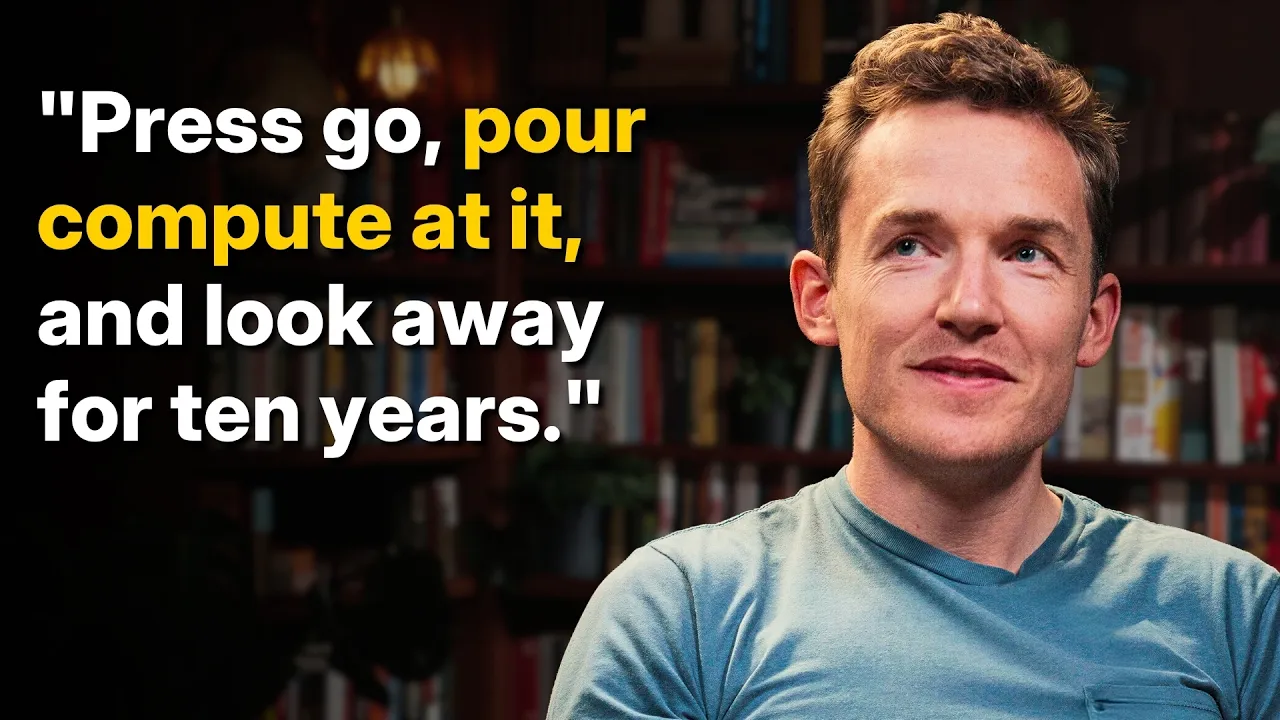
Grant Sanderson Says Math AI Models Will Pivot Humans to Curators
Dwarkesh Patel
Rapid artificial intelligence progress in mathematics forces a shift from raw theorem-proving to defining novel concepts, creating readable explanations, and curating cross-disciplinary connections.
## Background
This video was published on YouTube by Dwarkesh Patel on June 30, 2026, featuring a conversation with Grant Sanderson (creator of 3Blue1Brown). According to the episode description, the discussion explores how AI's rapid progress in mathematics serves as a leading indicator for other fields, examining conceptual breakthroughs, AI proof verification, and career advice for aspiring mathematicians.
## TL;DR
Dwarkesh Patel and Grant Sanderson examine how AI is reshaping mathematics, from cold-solving competition problems to finding surprising cross-disciplinary connections. They discuss whether AI can build entirely new conceptual frameworks or generate elegant human-understandable explanations rather than uninterpretable brute-force proofs. The conversation also explores the limitations of autoregressive models, the importance of 'grindable' environments, and how the role of human mathematicians will evolve toward curation and teaching as AI continues to advance.
## Atmosphere & style
The interview features a cerebral, deeply inquisitive, and collaborative atmosphere between two thoughtful intellectuals. Sanderson's grounded, pedagogical perspective balances Patel's sharp, big-picture inquiries about AGI and economic transformation. The tone is intellectually adventurous yet pragmatic, marked by moments of dry humor, historical storytelling, and candid reflections on the future of human understanding.
## Key takeaways
- [00:00](https://www.youtube.com/watch?v=TfyPshgMbug&t=0s) Math progress serves as a leading indicator for AI capabilities across other domains due to its rapidly advancing benchmark scores.
- [00:00](https://www.youtube.com/watch?v=TfyPshgMbug&t=0s) AI solved IMO geometry rapidly via brute-force computational methods, but struggled with combinatorics which requires creative, puzzle-like thinking.
- [03:17](https://www.youtube.com/watch?v=TfyPshgMbug&t=197s) AI could accelerate math by identifying cross-field connections ("lightning bolts") between disparate domains that human specialists miss.
- [05:40](https://www.youtube.com/watch?v=TfyPshgMbug&t=340s) Building new conceptual theoretical frameworks ("mountains") represents a far higher hurdle for AI than solving pre-stated conjectures or finding counterexamples.
- [09:15](https://www.youtube.com/watch?v=TfyPshgMbug&t=555s) Evaluating definitions and conjectures relies on qualitative community acceptance, making them resistant to standard Reinforcement Learning with Verifiable Rewards (RLVR) benchmarks.
- [11:32](https://www.youtube.com/watch?v=TfyPshgMbug&t=692s) Unlike short-feedback domains, the verification loop to recognize the utility of revolutionary mathematical concepts like group theory can take over a century.
- [23:07](https://www.youtube.com/watch?v=TfyPshgMbug&t=1387s) Incorporating Kolmogorov complexity and concept compression into reward functions could incentivize AI models to produce succinct, human-understandable proofs over brute-force solutions.
- [29:55](https://www.youtube.com/watch?v=TfyPshgMbug&t=1795s) A formal proof differs fundamentally from a true explanation, giving rise to "unsolved expository problems" where a proven statement still lacks human conceptual clarity.
- [34:14](https://www.youtube.com/watch?v=TfyPshgMbug&t=2054s) As AI automates formal theorem proving, human mathematicians may shift into roles similar to art museum curators, selecting which ideas and explanations are worth pursuing.
- [38:08](https://www.youtube.com/watch?v=TfyPshgMbug&t=2288s) Autoregressive models struggle with low-probability creative leaps required to bridge fields because next-token prediction relies heavily on immediate context.
- [52:19](https://www.youtube.com/watch?v=TfyPshgMbug&t=3139s) High "grindability"—the ability to run thousands of fast, isolated parallel rollouts in containerized environments—drives AI progress in math and code far more than in real-world web tasks.
- [01:02:39](https://www.youtube.com/watch?v=TfyPshgMbug&t=3759s) Formal proof systems like Lean offer absolute automated verification ("green checkmarks"), which prevents human mathematicians from having to manually audit subtle errors in high-volume AI research.
- [01:07:07](https://www.youtube.com/watch?v=TfyPshgMbug&t=4027s) AI struggles with high-level prose because writing lacks modularity and requires continuous theory-of-mind anticipation of a reader's mental state.
- [01:15:59](https://www.youtube.com/watch?v=TfyPshgMbug&t=4559s) For effective learning, choosing high-quality human educators and curated sources yields better intuition than relying purely on LLMs or crowdsourced platforms like Wikipedia.
- [01:22:31](https://www.youtube.com/watch?v=TfyPshgMbug&t=4951s) Teaching remains one of the most stable post-AGI careers because of its inherently social, relational, and human coaching nature.
- [01:29:07](https://www.youtube.com/watch?v=TfyPshgMbug&t=5347s) Applied math areas like partial differential equations directly drive economic value by enabling complex physical simulations and reducing costly real-world testing.
## Detailed walkthrough
### [00:00](https://www.youtube.com/watch?v=TfyPshgMbug&t=0s) AI Progress in Math and the Spectrum of Intelligence
The discussion opens with Dwarkesh Patel introducing Grant Sanderson, creator of 3Blue1Brown, who is working on a project documenting AI's progress in mathematics. Dwarkesh notes that math is currently the fastest-advancing field for AI, serving as a live indicator of how AI capabilities will unfold across the rest of the world. Revisiting a question from three years prior—whether an AI winning a gold medal at the International Mathematical Olympiad (IMO) would constitute AGI—Dwarkesh recalls Grant’s accurate prediction: it would simply become another passed benchmark rather than a single "aha" moment of general intelligence.
Grant explains that answering whether narrow AI capability can coexist with humans handling economic tasks depends on what solutions to hard problems look like. Math progress possesses a "spiky frontier" with a fractal structure—zooming into math reveals further uneven pockets of difficulty. For instance, AI essentially "cold-solved" IMO geometry by 2024 using fast brute-force methods, but it historically struggled with combinatorics, which requires more playful, puzzle-like thinking. Had the 2024 IMO test contained more geometry problems, AI would have comfortably secured a gold medal that year.
- Math acts as a leading indicator for AI capabilities due to its rapidly advancing benchmark scores.
- IMO test categories: Geometry, Number Theory, Algebra, and Combinatorics.
- AI handles IMO geometry within 19 seconds via structural brute-force methods.
---
[03:17](https://www.youtube.com/watch?v=TfyPshgMbug&t=197s) White-Collar Work vs. Finding Unifying Mathematical Bridges
Grant explores two distinct possibilities for how an AI might solve a landmark problem like the Riemann hypothesis, contrasting these mechanisms with the nature of general white-collar work. The first mechanism involves connecting disparate domains of knowledge that the AI understands deeply. An AI possessing vast, superhuman breadth across subfields might spot "lightning bolts" connecting ideas that human specialists miss simply because they never sit down to discuss them.
To illustrate this, Grant shares the story of number theorist Hugh Montgomery and physicist Freeman Dyson at the Institute for Advanced Study (IAS). While investigating the statistical correlation between pairs of zeros of the Riemann zeta function, Montgomery wrote down an expression (resembling $1/\sin^2$). Dyson immediately recognized it as the exact formula used to describe the eigenvalues of random Hermitian matrices in nuclear energy levels. This serendipitous conversation launched an entirely new cross-disciplinary investigation into random matrix theory within analytic number theory.
- The Riemann hypothesis centers on whether all non-trivial zeros of the Riemann zeta function sit on a specific straight critical line.
- Montgomery and Dyson’s famous interaction connected quantum physics (eigenvalues of random matrices) with number theory (zeta function zeros).
- AI could theoretically replicate this cross-pollination at scale without relying on chance encounters between human experts.
---
[05:40](https://www.youtube.com/watch?v=TfyPshgMbug&t=340s) Mountain-Building in Mathematics and Goalpost Shifts
Grant presents a second, far more demanding path to solving grand math challenges: building entirely new theoretical "mountains." For example, Fermat's Last Theorem ($x^n + y^n = z^n$ for $n > 2$) is easy to state, but its proof required centuries of development building complex machinery around elliptic curves and modular forms. If solving a problem requires creating brand-new conceptual frameworks, that capacity would signal a level of intelligence that would inevitably disrupt the broader economy.
Dwarkesh admits to moving the goalpost, pointing out that years ago he asked Anthropic's Dario Amodei why models couldn't synthesize their vast knowledge to form novel connections—such as mapping a drug's side effect to a cure for a different disease. Now that AIs are disproving real conjectures (such as finding counterexamples in geometry), the benchmark shifts again. The next frontier involves whether AI can generate truly interesting problems, define fundamental objects, or unify subfields rather than just solving pre-stated challenges.
- **Fermat's Last Theorem:** States that no three positive integers $a, b,$ and $c$ satisfy $a^n + b^n = c^n$ for integer values of $n > 2$.
- **Unit Distance Problem:** AI disproved a famous conjecture within this subfield by finding a valid counterexample.
- Grant references a video by the math channel *Polylog* regarding the unit distance conjecture.
---
[09:15](https://www.youtube.com/watch?v=TfyPshgMbug&t=555s) Conjectures, Definitions, and the Tone Shift Among Mathematicians
Reflecting on a quote highlighted in the *Polylog* video—*"Good mathematicians prove theorems, great mathematicians come up with conjectures, and the greatest mathematicians come up with definitions"*—Grant and Dwarkesh examine why definition-building cannot easily function as a standard benchmark. Traditional benchmarks require unambiguous pass/fail criteria suitable for Reinforcement Learning with Verifiable Rewards (RLVR). Announcing that a model created a "great conjecture" carries no objective weight unless the mathematical community accepts it over time.
Instead of a sudden benchmark breakthrough, Grant predicts the shift will manifest as a change in how mathematicians talk about their tools. In his upcoming interview series tracking mathematicians' workflows, Grant noticed a clear tone shift between mid-2025 and 2026. Mathematicians are beginning to report that conversational interactions with models genuinely aid them in stepping back to decide what research questions are worth pursuing in the first place.
- Traditional benchmarks rely on hard, verifiable goalposts (RLVR), whereas evaluation of definitions and conjectures is inherently qualitative.
- Grant observed a distinct shift in how research mathematicians view AI between mid-2025 and 2026.
---
[11:32](https://www.youtube.com/watch?v=TfyPshgMbug&t=692s) Long Verification Loops: Einstein, Galois, and Group Theory
Dwarkesh points out that the fundamental engine of scientific progress is developing new conceptual lenses that unify fields. Unlike short-feedback environments, the verification loop for whether a new mathematical concept is useful can span a century. Albert Einstein was not trying to explain black holes or light bending when developing General Relativity; rather, the theory produced those predictions. Similarly, Évariste Galois invented group theory to prove that quintic equations (degree five polynomials) have no general algebraic formula, creating a framework whose full impact on physics and cryptography took over a hundred years to unfold.
Grant recounts the historical progression of solving polynomial equations to highlight this delayed evaluation. While the quadratic formula was known in antiquity and formalized by medieval Arab scholars, 16th-century Italian mathematicians engaged in mathematical duels discovered formulas for the cubic (degree 3) and quartic (degree 4) equations. The quartic formula was extraordinarily complex, leaving the quintic equation as a legendary open problem for centuries.
- **Quadratic, Cubic, Quartic:** Solvable by explicit radical formulas; degree-4 formulas are notoriously long procedural monsters.
- **Niels Henrik Abel:** Proved in the 1820s that a general radical formula for the quintic ($n=5$) is mathematically impossible.
- **Évariste Galois:** Created group theory, laying down a foundational framework whose utility took decades to fully appreciate.
---
[15:59](https://www.youtube.com/watch?v=TfyPshgMbug&t=959s) Lagrange's Symmetries and Permutations of Variables
Grant traces the roots of Galois's breakthrough back to Joseph-Louis Lagrange. Lagrange investigated why previous formulas worked by examining how algebraic expressions behave under variable permutations. For instance, in an expression like $a + b + c + d$, swapping any variables leaves the total value unchanged. However, in an expression like $a + b \cdot c + d$, only specific swaps preserve the value while others alter it.
Lagrange discovered a vital connection: if you can construct an expression with four free variables where all possible permutations collapse into only three distinct values, you can reduce a degree-four polynomial problem down to a degree-three problem. Attempting to apply this logic to a quintic polynomial required examining expressions with five free variables to see how their symmetric permutations behave, laying the direct groundwork for symmetry groups.
- **Lagrange's Insight:** Solving higher-degree polynomials relies on the symmetry properties and permutations of their roots.
- Permuting variables in symmetric expressions allows complex equations of degree $n$ to be reduced to lower degrees under specific conditions.
[17:00](https://www.youtube.com/watch?v=TfyPshgMbug&t=1020s) Lagrange, Galois, and the Century-Long Verification Loop
Addressing how long it takes to recognize truly revolutionary math, Grant Sanderson unpacks the history of polynomial roots and group theory. Joseph-Louis Lagrange first planted the seed that analyzing root permutations was the key to solving quintic equations, but he could not solve the problem or establish a tight mathematical connection. Decades later, Niels Henrik Abel and Évariste Galois drew direct inspiration from Lagrange. Galois formulated a nascent, ill-defined version of group theory while imprisoned as a teenager. The academic establishment repeatedly rejected his messy, incomplete manuscripts, showing that the "verifier reward" mechanism of the era failed to recognize his genius.
Galois tragically died at age 26 in a duel—a romanticized fate that, alongside Abel dying of tuberculosis at 26, leads Sanderson to joke that working on the quintic is "very bad for your health." It took another 20 years for Joseph Liouville to pull Galois's scattered notes from obscurity, and another two decades after that for Camille Jordan to publish a modern treatment of group theory. The full conceptual arc took over a century to yield physics applications, such as Murray Gell-Mann using group theory to predict the existence of quarks in the 1960s. This long lag raises a fundamental question for AI training: how do you design a reward function for raw mathematical instinct and elegant framing rather than just problem-solving?
- Lagrange introduced the idea of studying quintic polynomials via root permutations, noting that a function of 5 variables permuted over 5! ($120$) arrangements taking on 4 or fewer values seems impossible.
- Galois wrote a famous philosophical critique of mathematics while in prison, arguing math undergoes periodic paradigm shifts, moving from arithmetic to symbolic algebra, and finally to abstract underlying symmetries.
- Galois theory provided a framework to determine if a specific polynomial (like $x^5 - 1$ or $x^5 - 2$) can be solved using radicals, though Galois himself never wrote down a complete explicit proof for a specific counterexample.
- Gell-Mann's particle physics breakthroughs in predicting quarks relied on group theory roughly 150 years after Lagrange's initial insights.
[23:07](https://www.youtube.com/watch?v=TfyPshgMbug&t=1387s) Kolmogorov Complexity, Compression, and "Elegance" as an AI Reward Function
To capture the "Galois instinct" in machine learning, Sanderson proposes incorporating concept size and compression into the reward landscape. If intelligence is fundamentally about compression, an AI shouldn't just be evaluated on whether it solves a conjecture, but on how succinct and unified its representation is. For instance, an AI might solve the Riemann hypothesis or Fermat's Last Theorem via a thousand-page, unreadable brute-force proof. However, human understanding demands compressed, elegant representations—like modular forms and elliptic curves—that offer genuine insight.
Dwarkesh Patel notes that human understanding, rather than pure predictive utility, remains the ultimate goal of science. While uninterpretable AI models might build functional starships, humans will always seek the distilled "concision function" equivalent to Newton's universal law of gravitation. Quantifying mathematical elegance using Kolmogorov complexity could provide a objective metric to train models to favor digestible human-centric abstractions over sprawling chains of raw computation.
[26:12](https://www.youtube.com/watch?v=TfyPshgMbug&t=1572s) How AI Makes Math Progress: Lightning Bolts vs. Mountain Building
Dwarkesh and Grant debate whether humans should fear AI producing completely uninterpretable mathematical proofs. Dwarkesh highlights that when AI recently produced a counterexample to the unit distance conjecture or solved Erdős Problem 1196 regarding primitive sets, the AI's chain of thought remained fully readable to mathematicians. It created "lightning bolts"—succinct conceptual bridges between disparate, established fields (like using a probabilistic Markov chain process with the von Mangoldt function).
Grant categorizes AI mathematical breakthroughs into three potential archetypes, noting that human comprehensibility depends entirely on which path the AI takes:
- **Lightning Bolts:** Small, brilliant cross-disciplinary connections between known concepts that are instantly parsable by human experts.
- **Mountain Building:** Constructing entirely new frameworks or deep theories from scratch. This mirrors Shinichi Mochizuki's controversial attempted proof of the $abc$ conjecture using "inter-universal Teichmüller theory," which took mathematicians years to parse and remains largely unaccepted.
- **Raw Hustle:** Massive, brute-force reasoning chains spanning thousands of pages without new unifying theories, leaving humans with a massive, tedious "digestion process."
[29:55](https://www.youtube.com/watch?v=TfyPshgMbug&t=1795s) Unsolved Expository Problems and the Distinction Between Proof and Explanation
Referencing David Bessis’s blog post "The Fall of the Theorem Economy," the hosts discuss how modern mathematics over-credits theorem-proving while treating the creation of deep definitions as a secondary parasite. If AI automates the mechanical execution of proofs, human mathematicians will pivot toward consolidating these results into intuitive abstractions. Grant notes that knowing a solution exists makes digesting a messy proof much easier, eliminating the "random drunken walk" of dead ends typical of research.
Grant shares one of his favorite paper openings by mathematician Timothy Chow regarding Paul Cohen’s method of "forcing" used in the continuum hypothesis (which asks if an infinity exists between the natural numbers and real numbers). Chow introduced the concept of an **"unsolved expository problem"**—a phenomenon where a mathematical statement has been rigorously proven, yet the community still lacks a clear explanation for *why* it is true. Grant emphasizes that his entire career with 3Blue1Brown centers on solving expository problems, reinforcing that a formal proof is fundamentally different from a true explanation.
- The continuum hypothesis is undecidable within standard ZFC set theory; its truth value depends entirely on the chosen axioms.
- Pedagogy and design are deeply intertwined with core discoveries; frameworks like Minkowski spacetime diagrams do not merely illustrate special relativity (length contraction and time dilation)—they constitute the underlying physical reality and conceptual insight itself.
[34:14](https://www.youtube.com/watch?v=TfyPshgMbug&t=2054s) Great Researchers as Great Expositors and the Changing Role of Mathematicians
The discussion opens with the observation that while many top experts struggle to explain their fields, the truly ground-breaking thinkers—like Albert Einstein, Claude Shannon, and Richard Feynman—were famously lucid writers and expositors. Grant Sanderson notes that the same mental machinery required to generate a novel conceptual frame at the research level often endows a thinker with a knack for clear explanation. This shift in perspective altered Grant's view on the future of AI in mathematics. He previously assumed AI would handle automated theorem proving while humans shifted into the role of digest and explanation; now, he suspects AI will excel at distillation and explanation as well, surpassing most humans.
When asked what he and the broader mathematical community will be doing in an AI-dominated future, Grant jokes about working until he dies, referencing a dark twist on an old adage: *"Set a man on fire, and he's warm for the rest of his life."* Beyond adding intellectual clarity, teaching serves a relational, motivational, and social purpose. Grant highlights a perspective where human mathematicians evolve into something akin to **art museum curators**. Even when an AI produces and explains a proof, humans will still seek trusted human guides to navigate an infinite landscape of ideas, as human interest remains inherently social.
- **Analogy:** Mathematicians as art curators selecting which ideas are worth engaging with out of a vast space of generated proofs.
- **Music Comparison:** Human musicians retain value due to narrative and social connection, even if an AI-generated MP3 file is technically flawless.
- **Video Production Reality:** A massive portion of Grant's workload for *3Blue1Brown* goes not into rendering visuals, but into deciding what is actually worth saying in the first place.
---
[38:08](https://www.youtube.com/watch?v=TfyPshgMbug&t=2288s) The Langlands Program, Cross-Field Connections, and Autoregressive Limits
Dwarkesh and Grant explore how major scientific breakthroughs often emerge from bridging disparate fields—such as General Relativity connecting Riemannian geometry with Special Relativity. Grant points out that the vast majority of mathematicians do not spend their days knocking down list-item contest problems (like Erdős problems); instead, much of high-level mathematics operates under the spirit of the **Langlands program**, a vast web of conjectures linking number theory and harmonic analysis. AI could serve as a supercharged engine for identifying these cross-disciplinary threads, though evaluating these conceptual bridges will require a heavy human-in-the-loop component.
Grant expresses curiosity about the technical mechanisms required for AI to draw these unexpected connections. He illustrates the inherent limitation of standard autoregressive generation with a thought experiment:
> "Imagine I've locked you in a box, and the only way you have of interacting with the world is that you receive a slip of paper, and someone says, 'Can you predict what will come next?' You predict what will come next, and then your memory's wiped. You get another slip of paper."
Because autoregressive models predict the most likely next token, they are slaves to their immediate context. Deeply creative cross-field insights are, by definition, low-probability leaps. Upweighting these unlikely connections requires novel prompting strategies, reinforcement learning environments, or targeted sampling. Dwarkesh argues that progress will come from designing synthetic problem environments—such as removing key assumptions to force cross-field leaps—rather than tweaking loss functions.
- **Langlands Program:** A grand unified theory of math where progress comes from discovering structural bridges rather than solving single isolated problems.
- **Dyson-Montgomery Revelation:** The famous conversation at the Institute for Advanced Study (IAS) linking the zero spacings of the Riemann zeta-function to random matrix theory (GUE pair correlation).
- **Parallelization Advantage:** Digital minds can scale cross-domain knowledge search simultaneously across thousands of instances, unlike a single human genius.
---
[47:37](https://www.youtube.com/watch?v=TfyPshgMbug&t=2857s) Context Resetting, Escaping Biases, and Systematizing Entropy
Grant notes that when an AI or human mathematician gets stuck, it is often due to getting trapped in a bad chain of thought. A key advantage for digital minds lies in their ability to deliberately manipulate, branch, or reset their context. Grant previews an upcoming video on an International Mathematical Olympiad (IMO) problem that stumped top students and Terry Tao—a "troll problem" where a beautifully complex, enticing path leads nowhere, while a trivial, almost "brain-dead" solution turns out to be correct. Solving it required escaping the context of standard contest-math heuristics.
Dwarkesh and Grant discuss how AI systems could bypass human psychological traps like confirmation bias. In the history of the unit distance graph conjecture, progress was delayed for decades because mathematicians assumed the conjecture was true and only attempted proofs, rather than searching for counterexamples. AI workflows can systematically branch into opposing pipelines—spawning one agent to prove a statement and another to disprove it—or test different scientific heuristics simultaneously.
- **IMO "Troll" Problem:** A contest problem where standard competition techniques trap solvers, whereas a naive approach yields the answer instantly.
- **Systematic Entropy:** Using prompt engineering and multi-agent systems to force diverse perspectives, overcoming the entropy collapse (homogenization) native to autoregressive LLMs.
- **Einstein’s Heuristic Trade-off:** Einstein's bias that physics laws must be invariant across reference frames led to Relativity, but his bias that *"God does not play dice"* hindered his acceptance of quantum mechanics—showing why a balance of independent, biased agents is necessary.
[52:19](https://www.youtube.com/watch?v=TfyPshgMbug&t=3139s) Prompting Ontologies and the Mechanics of "Grindability"
Dwarkesh Patel opens with a thought on structuring AI prompts, emphasizing that if you can define a clear ontology of distinct thinking styles, you can prompt the model to systematically explore each path. While assigning binary roles (like trying to prove versus disprove a mathematical claim) is straightforward, outlining all potential tactics to ensure broad exploration is significantly harder.
The conversation then shifts to why AI makes rapid strides in mathematics and coding compared to other domains like general computer use. While verifiability is often cited as the main driver, Dwarkesh argues that "grindability"—the capacity to execute thousands of parallel rollouts rapidly—is the true gating factor. Web-based computer tasks are constrained by bot detectors, anti-scraping measures, and rate limits, making real-world web environments nearly impossible to parallelize without getting blocked by platforms (or as Dwarkesh jokes, having Amazon CEO Andy Jassy personally press a "red X on Dwarkesh button").
* **The Credit Assignment Advantage:** Containerized software environments allow models to isolate variables across parallel runs, cleanly solving the credit assignment problem by linking precise code diffs directly to success or failure.
* **Lack of Sample Efficiency:** Current deep learning requires massive trial-and-error due to poor sample efficiency—what Andrej Karpathy famously described as "sucking supervision through a straw."
* **Simulators vs. Reality:** Business strategy, trading, and real-world interactions cannot be cleanly containerized or replayed, preventing models from farming synthetic experience in the same way they do with code or formal logic.
---
[56:23](https://www.youtube.com/watch?v=TfyPshgMbug&t=3383s) Process-Based Supervision vs. Verifiable Outcomes
Grant Sanderson questions the common belief that formal verification languages like Lean are driving current AI progress in mathematics. He points out that when AI disproved the unit distance conjecture, the published chain of thought was written entirely in natural language without any Lean integration. Outcome-based verification—having a verifiable, grindable result—appears to matter far more than the step-by-step process supervision that formal proof assistants provide.
Dwarkesh corroborates this by pointing to AI performance at the International Mathematical Olympiad (IMO). DeepMind initially relied heavily on Lean-based formalizations, but by the following year, their systems achieved top results operating primarily in natural language. Grant notes that while Lean might be overrated for immediate capabilities, formalization opens up unprecedented long-term possibilities: human-free, infinitely running mathematical exploration.
> "What stands to be interesting... is that with Lean, you could imagine having a basically endlessly running program that's constantly trying to extend Mathlib... It doesn't need anybody to check in on it. It could just keep going."
* **The IMO Benchmark Shift:** AI models transitioned rapidly from formal Lean-based reasoning back to natural language without sacrificing mathematical problem-solving performance.
* **Mathlib Expansion:** Mathlib serves as a massive open-source GitHub repository attempting to digitize all of mathematics into formal code.
* **Unsupervised Exploration:** Unlike natural language proofs that require human verification, a formal system like Lean allows an AI to grow an infinite tree of valid mathematical theorems without human oversight.
---
[59:44](https://www.youtube.com/watch?v=TfyPshgMbug&t=3584s) Automated Research, Axiom Space Exploration, and Mathlib
The discussion turns to what happens when AI systems are left to explore mathematical structures indefinitely. Dwarkesh references Andrej Karpathy's "auto research" experiment—where an LLM agent iteratively modified a Python training script, keeping changes only if they improved speedrun benchmarks—as well as Eric Jang's work on AlphaGo. These systems excel at pursuing a linear hypothesis but struggle to recognize dead ends or conduct structured, high-level parallel searches.
Grant highlights a project mentioned by Fields Medalist Terence Tao that uses automated provers to exhaustively search possible algebraic systems. Much like group theory emerged from specific rules governing symmetry, AI provers can test millions of arbitrary axiom sets. While the vast majority result in trivial or uninteresting mathematics, automated searches can uncover hidden "islands" of rich algebraic structures that humans can later interpret and contextualize.
* **Karpathy's Auto Research:** An automated setup where an agent makes code modifications to a core ML script, using execution speed as an objective verification signal.
* **Terence Tao's Axiom Exploration:** Exhaustively mapping alternative algebraic systems to find non-trivial mathematical structures that yield dense, interconnected theorems.
* **Supervisor Models:** To prevent AI from engaging in a useless random walk through logic space, higher-level supervisor models are necessary to evaluate whether a developing mathematical branch possesses true aesthetic or practical value.
---
[01:02:39](https://www.youtube.com/watch?v=TfyPshgMbug&t=3759s) The Value of "Green Checkmark" Verification
Addressing natural language verification, Grant points to DeepSeek's DeepSeekMath work, which trained a verifier alongside a meta-verifier to validate step-by-step mathematical reasoning. While natural language verification works remarkably well in practice, it suffers from a trust ceiling when scaled to massive outputs.
Mathematician Alex Kontorovich's critique illustrates the primary bottleneck: if an AI generates ten natural language papers a day with even a 1% error rate, human mathematicians will find it insufferable to check them. Finding subtle logical flaws in a lengthy paper is exhausting work. This is where formal tools like Lean provide an irreplaceable asset that no other field possesses: an absolute, automated "green checkmark" guaranteeing absolute correctness before a human ever spends time reading it.
* **DeepSeekMath Protocol:** Utilized a verifier and meta-verifier loop trained on Art of Problem Solving datasets to judge natural language step-by-step proofs.
* **The Mathematician's Dilemma:** Without automated formal verification, high-volume AI research floods the literature with hard-to-detect errors, turning peer review into a tedious chore.
* **The Ultimate Goal:** Combining natural language reasoning for intuitive leaps with automatic Lean formalization to deliver indisputable proof guarantees.
---
[01:07:07](https://www.youtube.com/watch?v=TfyPshgMbug&t=4027s) Why AI Struggles with Great Writing (And Excels at Explanations)
Dwarkesh presents a contrast: why is AI writing progress lagging behind code and math? He proposes two main theories:
1. **Reward Hacking:** Evaluator models can distinguish an "A" essay from a "B" essay, but they get confused by "B*" essays—pieces that mimic superficial markers of quality (structure, vocabulary, formatting) without offering genuine insight.
2. **Lack of Modularity:** Code and mathematical lemmas are modular; as long as the underlying function or proof works, the implementation details can vary. In writing, however, the text *is* the final product. Every word and sentence carries immediate weight, meaning "slop" cannot be disguised behind working functionality.
Despite these limitations, both speakers admit that LLMs have revolutionized distillation and learning. Dwarkesh notes that his "revealed preference" when encountering a dense concept is to have an LLM explain it rather than relying on human-written texts, even admitting he would often prefer to pause live conversations with experts to get a private, judgment-free explanation from an AI first.
> "When you're writing, you sort of know that in order for it to be good, you have to have an element of the unpredictable... It's knowing exactly the correct point when you want to make an unpredictable move, and that that's going to be what's more insightful."
* **The "B*" Essay Problem:** Discriminator models are easily fooled by essays that look polished on the surface but lack original thought.
* **Non-Modular Nature of Prose:** Unlike code, where inefficient syntax can still execute a program perfectly, writing has no layer of abstraction separating the source from the end product.
* **Autoregressive Limitations:** Great writing relies on strategic unpredictability and deep theory of mind—knowing precisely when to subvert a reader's expectations to deliver genuine insight, a trait that purely probabilistic autoregressive generation struggles to replicate.
[01:10:23](https://www.youtube.com/watch?v=TfyPshgMbug&t=4223s) Theory of Mind and the Limits of LLM Writing
The discussion opens with Grant Sanderson reflecting on what makes great writing compelling. An LLM might distill existing work well, but it did not create the original book through real-world exploration or deliberately choose novel, unpredictable narrative turns. Dwarkesh Patel agrees and emphasizes that current models struggle deeply with theory of mind—the capacity to build a mental model of the reader's state of mind. He points to research by Andy Matuschak and a collaborator attempting to get LLMs to write effective spaced-repetition prompts (flashcards). Despite applying advanced techniques like reinforcement learning on open-source models and chain-of-thought prompting on top closed-source models, the LLMs struggled because crafting a flashcard requires projecting how a human mind will process and associate information months down the road. Writing is similarly enervating because every phrasing choice requires anticipating the exact sequence of images and thoughts that form in the reader's head sentence by sentence.
Dwarkesh presents a psychological experiment to illustrate why language models might inherently lack this capacity. In tests measuring emotional intelligence (matching facial expressions to exact emotional states), people who had recently received facial Botox performed noticeably worse post-treatment. The underlying theory is that human empathy relies on subtle, subconscious physical micro-mimicry—using hardware (facial muscles) to simulate another person's state. Because LLMs lack physical hardware and emotional embodiment, their ability to "put themselves in someone else's shoes" is fundamentally alien and purely text-derived.
- Andy Matuschak and his co-author struggled to train models to generate good flashcards despite using RL and sophisticated prompting.
- Good writing requires continuously anticipating a reader's mental state and image formation as they consume each sentence.
- Autoregressive models process text token-by-token, whereas effective mentalizing might require a more holistic, diffusion-like approach.
- The Botox study suggests humans rely on facial muscle mimicry to read emotions, highlighting the hardware gap between human empathy and AI output.
[01:15:00](https://www.youtube.com/watch?v=TfyPshgMbug&t=4500s) Jane Street Culture and Organizational Dynamics
The conversation transitions into a brief discussion about Jane Street, a company both hosts partner with. Grant highlights his sit-down interview with Jane Street team members, noting how rare outward-facing content is for the firm. He reflects on their remarkably high employee retention rate, attributing it to their intentionally fuzzy role boundaries. Even though employees hold specific titles like trader, researcher, or software engineer, colleagues often cannot tell each other's official titles because traders write code, researchers trade, and everyone collaborates across disciplines. This environment allows employees continuous personal growth without needing to switch companies. Dwarkesh invites viewers to watch the full interview at `3b1b.co/janestreet`.
- Jane Street is notable in the finance and tech industries for its exceptionally high employee retention.
- Employees cross role boundaries fluidly (traders research, researchers code), fostering constant learning.
- Grant's interview with Jane Street staff can be accessed at `3b1b.co/janestreet`.
[01:15:59](https://www.youtube.com/watch?v=TfyPshgMbug&t=4559s) Effective Learning Strategies and Curation with LLMs
Turning back to AI and mathematics, Dwarkesh asks Grant for advice on using LLMs productively for learning. Grant admits that while LLMs excel at explaining well-known baseline concepts, they quickly get confused deeper into a topic and can end up confusing the learner. He emphasizes that even prior to AI, the most crucial principle in learning was prioritizing *who* you learn from over *what* you learn. He advises students to select college courses based on the quality of the educator rather than temporary subject interests, and to follow specific authors across topics.
Grant contrasts Wikipedia with curated works like the *Princeton Companion to Mathematics* or the *Stanford Encyclopedia of Philosophy*. Wikipedia functions as a crowdsourced local minimum where every sentence must be factually correct, often stripping out helpful, slightly imprecise analogies that build intuitive understanding. LLMs currently feel like an interactive Wikipedia—excellent for broad overviews, but best used as a search tool to find human-crafted references. Grant shares a funny experience where he asked Claude for a visual video on semiconductors, and the model hallucinated and cited a non-existent 3Blue1Brown video with complete confidence.
Dwarkesh shares his optimal learning setup when studying Steven Strogatz's textbook *Nonlinear Dynamics and Chaos*: splitting his screen three ways with Strogatz's university video lecture on one side, the textbook chapter in the middle, and an LLM on the side purely to prune minor questions without breaking the main narrative arc.
- Selecting courses and books based on the author/instructor's quality yields better long-term learning than chasing specific subjects.
- Great exposition often uses intentionally simplified or slightly inaccurate models initially to build intuition, which crowdsourced sites like Wikipedia edit out.
- LLMs often act as sycophants; unlike a top-tier human teacher, an LLM rarely tells a user that their starting question is fundamentally wrong or reframes their mental model.
- An "A+ explainer" can perform conversational "jujitsu"—taking a student's unconventional or wrong approach and guiding it toward the correct insight.
[01:22:31](https://www.youtube.com/watch?v=TfyPshgMbug&t=4951s) Career Advice for Aspiring Mathematicians and Coders in the AI Era
Addressing a question frequently sent by students—whether it still makes sense to pursue a career in mathematics or coding given AI's rapid advancements—Grant advises students to carefully analyze where funding originates and what value they actually provide. Students often pursue math simply because they were good at it in school and enjoyed passing structured tests, without considering why a university or grant body pays a salary. Funding flows from distinct sources: brand value from prestigious faculty, institutional NSF grants for basic science, or direct tuition paid for high-quality instruction.
Grant notes that even in a world with automated theorem provers and AI explainers, the social dynamics of mathematics will remain largely intact. Society values basic research, and the internal mathematical community will continue to award prestige based on valuable contributions—perhaps shifting focus from proving theorems to writing good mathematical definitions or acting as conceptual curators. Furthermore, Grant views teaching as one of the most stable post-AGI careers over the next 50 years because of its deeply relational, coaching, and social nature. He encourages passionate students to take the career path of a math educator seriously, emphasizing that guiding the next generation holds immense human value regardless of AI progress.
- Students should explicitly understand the connection between the value they generate and the salary they receive rather than just following academic hoops.
- Grant notes his own career as a math communicator monetizing exploration as entertainment was a lucky accident, but could have been planned more deliberately.
- Mathematical prestige is internally generated by peer recognition rather than grant writers understanding deep fields like algebraic number theory.
- Teaching is positioned as one of the most resilient post-AGI careers because parents prioritize human mentorship and relational coaching for their children.
[01:27:46](https://www.youtube.com/watch?v=TfyPshgMbug&t=5266s) The Human Role in an AI-Dominated Mathematical Future
Grant Sanderson and Dwarkesh Patel discuss what happens to human mathematicians if AI models progress to the point where they not only solve Millennium Prize problems, but invent entirely new mathematical fields, objects, and concepts. Grant emphasizes that in a world where AI math leaps far beyond human horizons, human understanding becomes more critical, not less. There will be massive demand for human "curators" and explainers who can peer into what the AIs have discovered, translate those insights, and steer this immense mathematical power toward productive ends.
- **The Explainer Market**: If AI outpaces human cognition in math, the job of distilling and explaining AI-generated breakthroughs to humans will become one of the most vital roles available.
- **Human Curation as Leverage**: Rather than math becoming useless, humans will gain immense leverage by acting as direction-setters, deciding which AI-generated mathematical avenues are worth pursuing for practical utility.
[01:29:07](https://www.youtube.com/watch?v=TfyPshgMbug&t=5347s) Practical Applications vs. Pure Math: PDEs, Simulation, and Physical Leakage
Dwarkesh asks whether a 10x or 100x acceleration in pure human/AI mathematics will yield direct real-world economic value, or if progress will be bottlenecked by physical constraints in other fields. Grant notes that math progress is "super spiky." While theoretical leaps in areas like algebraic number theory rarely have immediate physical applications, fields like partial differential equations (PDEs) and dynamical systems tie directly into real-world engineering.
Grant shares an anecdote about a mathematics research group whose theoretical work on PDEs allowed Boeing to perform advanced aircraft testing entirely in computer simulations. Previously, Boeing had to repeatedly assemble, test, physically disassemble, and rebuild aircraft components—a process that cost billions. The team's mathematical insights eliminated the physical teardown loop, leading Boeing to directly fund the math group.
- **Computational Fluid Dynamics (CFD)**: Breakthroughs in pure math can dramatically optimize CFD simulations, speeding up the design of fluid mechanics and airplane wings without needing massive real-world testing.
- **The "Navier-Stokes" Frontier**: Grant remains cautious about whether solving grand challenges like the Navier-Stokes existence and smoothness problem will instantly transform economics, but expects significant practical "leakage" into materials science, AI engineering, and physical design over a five-year horizon.
- **The Erdős Disappointment**: Grant remarks that it would be disappointing and surprising if AI math progress only consisted of "taking down a bunch of Erdős problems" without touching physical reality.
[01:32:25](https://www.youtube.com/watch?v=TfyPshgMbug&t=5545s) The Awkward Reckoning: Is Pure Math Becoming Disconnected from Reality?
As society enters what Dwarkesh calls the "industrial part of the singularity," the massive pile of accumulated mathematical concepts should ideally serve as a reservoir for broader societal progress. However, Grant and Dwarkesh reflect on a potentially uncomfortable alternative: a 10x explosion in AI-driven math might expose the fact that modern pure mathematics has become utterly divorced from physical reality.
Grant jokes about the awkward realization mathematicians might face when grant proposals—which historically justified pure research by promising eventual real-world offshoots like cryptography from elliptic curves—are put to the ultimate test. If math speeds up tenfold and produces no tangible economic breakthroughs, the public may finally realize those claims were overblown, leaving mathematicians saying, "Ugh."
- "If there's 10X progress there, why aren't we seeing it over here?"
- "Every time we wrote those grant proposals and said, 'Trust us, the elliptic curve progress is going to help with cryptography,' it shines a light on the fact that maybe it doesn't."
## Notable quotes
> [09:15](https://www.youtube.com/watch?v=TfyPshgMbug&t=555s) Good mathematicians prove theorems, great mathematicians come up with conjectures, and the greatest mathematicians come up with definitions
> [34:14](https://www.youtube.com/watch?v=TfyPshgMbug&t=2054s) Set a man on fire, and he's warm for the rest of his life. — Grant Sanderson
> [38:08](https://www.youtube.com/watch?v=TfyPshgMbug&t=2288s) Imagine I've locked you in a box, and the only way you have of interacting with the world is that you receive a slip of paper, and someone says, 'Can you predict what will come next?' You predict what will come next, and then your memory's wiped. You get another slip of paper. — Grant Sanderson
> [47:47](https://www.youtube.com/watch?v=TfyPshgMbug&t=2867s) God does not play dice — Albert Einstein
> [52:23](https://www.youtube.com/watch?v=TfyPshgMbug&t=3143s) sucking supervision through a straw — Andrej Karpathy
> [56:48](https://www.youtube.com/watch?v=TfyPshgMbug&t=3408s) What stands to be interesting... is that with Lean, you could imagine having a basically endlessly running program that's constantly trying to extend Mathlib... It doesn't need anybody to check in on it. It could just keep going. — Grant Sanderson
> [01:07:07](https://www.youtube.com/watch?v=TfyPshgMbug&t=4027s) When you're writing, you sort of know that in order for it to be good, you have to have an element of the unpredictable... It's knowing exactly the correct point when you want to make an unpredictable move, and that that's going to be what's more insightful. — Dwarkesh Patel
> [01:32:25](https://www.youtube.com/watch?v=TfyPshgMbug&t=5545s) Ugh. — Grant Sanderson
## Mentioned
3Blue1Brown, Albert Einstein, Alex Kontorovich, AlphaGo, Andrej Karpathy, Andy Matuschak, Anthropic, Bilibili, Boeing, Camille Jordan, Claude, Claude Shannon, Cursor, Dario Amodei, David Bessis, DeepMind, DeepSeek, DeepSeekMath, Dwarkesh Patel, Évariste Galois, Eric Jang, Erdős Problem 1196, Fermat's Last Theorem, Freeman Dyson, Gemini 3.5 Live Translate, Grant Sanderson, Hugh Montgomery, Institute for Advanced Study (IAS), International Mathematical Olympiad (IMO), Jane Street, Joseph Liouville, Joseph-Louis Lagrange, Langlands program, Lean, Mathlib, Millennium Prize problems, Murray Gell-Mann, Niels Henrik Abel, NSF, Paul Cohen, Polylog, Princeton Companion to Mathematics, Richard Feynman, Riemann hypothesis, Shinichi Mochizuki, Stanford Encyclopedia of Philosophy, Steven Strogatz, Terence Tao, Timothy Chow, Unit Distance Problem, Wikipedia
Grant Sanderson:数学AI模型将促使人类转向策展人角色
人工智能在数学领域的飞速进展,正迫使研究重心从单纯的定理证明转向定义新概念、撰写通俗易懂的解释以及梳理跨学科联系。
Dwarkesh Patel 与 Grant Sanderson 探讨了人工智能如何重塑数学领域,涵盖从直接求解竞赛题到发现令人惊喜的跨学科关联。他们讨论了AI是否能构建全新的概念理论框架,或是生成人类易于理解的优美解释,而非不可解释的暴力证明。对话还探讨了自回归模型的局限性、“可反复试错磨练”(grindable)环境的重要性,以及随着AI的持续进步,人类数学家的角色将如何逐步转向策展与教学。
由于基准测试成绩突飞猛进,数学领域的进展已成为评估AI在其他领域能力的先行指标。 (0:00)
AI通过暴力计算方法迅速解决了IMO几何题,但在需要创造性与谜题式思维的组合数学上却进展艰难。 (0:00)
AI能够通过发现人类专家所遗漏的不同领域间的跨学科关联(“闪电”),从而加速数学发展。 (3:17)
与解决既定猜想或寻找反例相比,构建全新的概念性理论框架(“高山”)对AI而言是高得多的障碍。 (5:40)
对定义和猜想的评估依赖于学术共同体的定性认可,这使其难以直接适用标准的可验证奖励强化学习(RLVR)基准。 (9:15)
Reading summary
Grant Sanderson and Dwarkesh Patel explore how artificial intelligence's rapid strides in mathematics serve as a leading indicator for general intelligence, arguing that true capability will be measured by whether models can create unifying conceptual frameworks rather than simply brute-forcing solutions to pre-stated problems.
Lightning Bolts, Mountain Building, and Spiky Frontiers (26:12)
Sanderson describes progress in AI mathematics as having a 'spiky frontier' with an uneven, fractal distribution of difficulty. By 2024, AI systems could resolve International Mathematical Olympiad (IMO) geometry problems in under 19 seconds using structural brute force, yet they continued to struggle with the playful heuristics required for combinatorics. Looking toward grand challenges like the Riemann hypothesis, Sanderson categorizes potential AI breakthroughs into three archetypes: 'lightning bolts,' where an AI connects disparate existing fields that specialists rarely cross-reference; 'mountain building,' which requires creating entirely new theoretical machinery over decades or centuries, as seen in the proof of Fermat's Last Theorem using elliptic curves; and 'raw hustle,' which relies on sprawling, brute-force reasoning chains that leave humans with a tedious verification burden.
The capacity to produce cross-disciplinary lightning bolts has historical precedent in human serendipity, such as when Hugh Montgomery and Freeman Dyson discovered that the zeros of the Riemann zeta function match the eigenvalues of random Hermitian matrices in nuclear physics. AI systems have already demonstrated this capacity in a narrow sense, such as discovering a counterexample to the unit distance graph conjecture and solving Erdős Problem 1196 by constructing conceptual bridges between previously separate areas.
Century-Long Verification Loops and Mathematical Elegance (11:32)
A fundamental difficulty in evaluating AI's capacity to formulate great definitions or conjectures is that scientific breakthroughs resist standard Reinforcement Learning with Verifiable Rewards (RLVR). Traditional benchmarks require immediate, verifiable signals, whereas the validation of a foundational concept can take generations. For example, Évariste Galois developed group theory in the 1830s to demonstrate why quintic polynomial equations cannot be solved using radicals. His papers were repeatedly rejected by contemporaries, and the broader utility of his framework took over a century to fully manifest in modern physics, such as Murray Gell-Mann's use of group theory to predict quarks in the 1960s.
To bridge this evaluation gap, Sanderson proposes using compression metrics like Kolmogorov complexity to reward AI models for conceptual elegance. Patel notes that science prioritizes distilled, human-understandable abstractions—analogous to Newton's laws—over sprawling, uninterpretable computation. Rewarding models for succinctness could encourage them to generate unifying frameworks rather than thousand-page brute-force proofs.
Grindability and the Formal Verification Bottleneck (52:19)
Patel attributes the rapid pace of AI progress in code and mathematics relative to general web tasks to 'grindability'—the ability to containerize environments and run millions of deterministic rollouts in parallel without hitting rate limits or bot blockers. Containerization also neatly solves the credit assignment problem by linking precise code edits to measurable outcomes. While natural language reasoning currently powers major breakthroughs—DeepMind transitioned toward natural language at the IMO, and AI disproved the unit distance conjecture without formal proofs—relying exclusively on natural language creates a trust ceiling. As mathematician Alex Kontorovich noted, even a 1% error rate in AI-generated papers would overwhelm human peer review.
Formal verification systems like Lean provide an automated 'green checkmark' of absolute correctness. Sanderson observes that this opens up unsupervised mathematical exploration, allowing automated systems to continuously expand libraries like Mathlib or search millions of arbitrary axiom systems, as explored by Terence Tao, without requiring human oversight to validate basic correctness.
Human Curation, Exposition, and the Economic Test (34:14)
As AI models automate theorem-proving, Sanderson anticipates that human mathematicians will shift toward becoming conceptual 'curators' and expositors who select which problems are worth pursuing. Referring to Timothy Chow's concept of 'unsolved expository problems,' Sanderson distinguishes a formal, step-by-step proof from a genuine explanation of why a statement is true. While LLMs excel at distilling known concepts, their lack of physical embodiment and theory of mind makes generating unpredictably insightful prose difficult. Sanderson views teaching as a resilient human role in an automated future due to the inherently social and relational nature of mentorship.
Economically, the impact of accelerated mathematics depends on practical spillovers. Theoretical advances in partial differential equations already yield massive industrial savings—such as allowing Boeing to replace expensive physical aircraft teardowns with computational fluid dynamics simulations. However, Sanderson and Patel caution that if a tenfold acceleration in AI math fails to produce tangible real-world applications beyond solving abstract contest problems, it may uncomfortably expose modern pure mathematics as increasingly decoupled from physical reality.
The conversation shifts the benchmark for AI progress from mechanical problem-solving to the harder task of conceptual curation: formulating fruitful definitions and deciding what questions matter. Whether advanced AI will autonomously generate elegant, practically relevant theories, or remain an engine of brute-force deduction requiring human interpretation, remains an open question.
精炼阅读摘要
3Blue1Brown 创作者 Grant Sanderson 与 Dwarkesh Patel 指出,数学作为人工智能能力演进的风向标,其突破正由解答既定难题转向提出底层定义与跨学科框架。随着模型在定理证明与反例构造上展现惊人进展,人类数学家的核心角色将从单纯的解题者过渡为把握研究方向、评估概念美学与提炼直觉的“策展人”。
数学能力的尖刺边界与基准漂移 (0:00)
Sanderson 将当前人工智能在数学领域的进展特征描述为具有分形结构的“尖刺前沿”(spiky frontier)。到 2024 年,AI 系统已能够通过高速的结构化暴力搜索方法,在 19 秒内基本“彻底解决”国际数学奥林匹克(IMO)的几何题,但在更具跳跃性与游戏感的组合数学上仍然表现挣扎。这种极端的不平衡性证明,通过特定竞赛基准并不等同于实现通用人工智能(AGI)。
随着 AI 开始在单位距离问题等领域通过构造反例推翻著名猜想,评估指标的目标线随之迁移。传统基于可验证奖励的强化学习(RLVR)高度依赖确定的对错判定,但这无法评估“提出伟大猜想”或“创造全新定义”的能力。Sanderson 观察到,在 2025 年中至 2026 年间,数学研究者的态度发生了显著转变,他们开始在日常对话中利用 AI 帮助判断哪些初始问题真正值得被深入探索。
闪电跨界与漫长验证周期的理论构建 (3:17)
Sanderson 将数学突破的路径划分为两类:一类是横跨不同领域的“闪电”联结,例如当年物理学家 Dyson 在普林斯顿高等研究院听到数论学者 Montgomery 描述黎曼猜想零点分布公式时,迅速辨认出其与量子物理中随机矩阵特征值的数学同构,而具备海量知识广度的人工智能有望系统化地复现这种跨学科洞见;另一类则是费马大定理式的“建山”过程,需要历经数个世纪打造如椭圆曲线与模形式等庞大理论框架。
科学中最深远的突破往往伴随着跨越数十乃至上百年的超长验证周期。从拉格朗日研究根的置换性质,到伽罗瓦在狱中萌发群论雏形以证明五次方程没有通用的根式解,再到盖尔曼在 20 世纪 60 年代运用群论预测夸克,其理论力量耗时一个多世纪才彻底释放。这种漫长的回馈周期使得单纯依赖即时验证奖励来训练 AI 的“数学直觉”面临巨大的方法论挑战。
可打磨性差距与形式化验证的意义 (52:19)
讨论分析了为何 AI 在数学与代码上的进步速度远超一般性现实环境任务。Dwarkesh 认为,真正的瓶颈在于系统的“可打磨性”(grindability)与归因清晰度。代码和形式化逻辑可以在容器中以极高速度进行数万次并行的确定性推演,能够直接将结果与精确修改绑定;而网页操作与商业环境受到限流、防抓取和不可控变异的阻碍,无法高效生成合成经验。
尽管 AI 在解决 Erdős 1196 题或破解单位距离猜想时主要采用自然语言思维链而非 Lean 等形式化语言,但形式化工具对于长期探索不可或缺。随着 AI 论文吞吐量激增,只要存在 1% 的潜在逻辑漏洞,人类就难以承受审阅负担。Lean 等证明助手提供的“绝对绿色对勾”构成了独一无二的自动验证底线,同时也使不受人类干预、自主扩充数学库(Mathlib)的无限探索成为可能。
证明自动化下的策展人与阐释者角色 (29:55)
当证明的机械生成被大规模自动化,数学界将直面 Timothy Chow 所称的“未解决阐释问题”——即命题已被严格证明,但学界仍未理解其背后为何成立的根本机理。Sanderson 强调,严格的形式证明与深刻的概念解释截然不同,真正的理论先驱往往也是极具洞察力的解释者,就像闵可夫斯基时空图不仅用于展示相对论效应,它本身就构成了对物理实在的核心洞见。
未来人类数学家与教育者的职能将向“艺术馆策展人”演变。由于纯文本自回归模型缺乏身体微模拟等具身硬件和对读者心智状态(Theory of Mind)的精准预判,AI 在撰写需要打破预测惯性的卓越文章上依然受限。在 AI 探索生成的无垠数学理论中,人类将负责鉴别哪些概念方向具有审美和实用价值,并承担起具有深层社会连接属性的教学与导师职责。
纯数学加速与工程现实的潜在脱节 (89:07)
若人工智能推动纯数学研究取得十倍或百倍的加速,这种智力产出能否直接转化为经济动能仍存疑问。Sanderson 指出,偏微分方程(PDE)和动力系统等细分领域的理论推进可以直接大幅优化计算流体力学(CFD)模拟,例如帮助波音公司完全通过计算机模拟替代成本高昂的实体飞机拆装测试;但代数数论等高度抽象领域在短期内极难与物理现实产生直接互动。
讨论最后指出,如果 AI 驱动的数学大爆发最终仅限于攻克一系列孤立的 Erdős 竞赛型难题,却未能在物理设计、材料科学或更广泛的工程系统中引发外溢,可能会让纯数学界长期以来以“未来衍生应用”为由争取研究经费的传统论调面临严峻审视与尴尬反思。
该讨论的核心未解问题在于:当人工智能在解决预设数学难题上超越人类后,缺乏即时验证反馈的定性判断——例如挑选何种公理体系更具美感、何种定义更具长远价值——能否被形式化或被算法内化。如果纯数学的爆发式增长无法向物理现实和现实工程有效外溢,数学研究与人类社会经济需求之间的脱节或将被进一步放大。
Source quotes
[9:15] Good mathematicians prove theorems, great mathematicians come up with conjectures, and the greatest mathematicians come up with definitions
[34:14] Grant Sanderson: Set a man on fire, and he's warm for the rest of his life.
[38:08] Grant Sanderson: Imagine I've locked you in a box, and the only way you have of interacting with the world is that you receive a slip of paper, and someone says, 'Can you predict what will come next?' You predict what will come next, and then your memory's wiped. You get another slip of paper.
[47:47] Albert Einstein: God does not play dice
[52:23] Andrej Karpathy: sucking supervision through a straw
[56:48] Grant Sanderson: What stands to be interesting... is that with Lean, you could imagine having a basically endlessly running program that's constantly trying to extend Mathlib... It doesn't need anybody to check in on it. It could just keep going.
[67:07] Dwarkesh Patel: When you're writing, you sort of know that in order for it to be good, you have to have an element of the unpredictable... It's knowing exactly the correct point when you want to make an unpredictable move, and that that's going to be what's more insightful.
[92:25] Grant Sanderson: Ugh.
Original transcript
[0:00] Today, I'm chatting with Grant Sanderson, who runs
3Blue1Brown and is now working on a new project
[0:04] documenting the progress AI is making in math.
I wanted to talk to you about this because AI
[0:09] has been making the fastest progress
in mathematics out of any other field.
[0:13] Whatever is happening here, and whatever way
we're seeing AI progress happen or not happen,
[0:17] will tell us about what will happen to the
rest of the world as AI gets better and better.
[0:21] I wanted to start with this question I asked you
when I first interviewed you three years ago.
[0:26] I asked you, once we have AIs that can get
gold in the International Math Olympiad,
[0:30] wouldn't that just be AGI?
Wouldn't this just be able
[0:33] to do anything any human can do,
given how hard these problems are?
[0:35] You had an answer, which in retrospect
turned out to be very wise and correct.
[0:40] You said it'll be another benchmark, like all
these other benchmarks that AI are passing.
[0:43] Obviously, AI has gotten better in
a general way since then, but there
[0:47] won't be some "aha" moment when this happens.
First, I'd be curious to get your heuristics
[0:54] on why that turned out to be true.
Second, I'm curious how long you
[0:58] think this narrowness can continue to be true.
By the point that AI has solved a Millennium
[1:03] Prize problem, do you think it's still possible
that there are lots of tasks humans are doing
[1:09] that AI still can’t automate in the economy?
It's an interesting question because it's hard
[1:13] to answer without knowing what the
solution looks like ahead of time.
[1:16] If we take the IMO, the spirit of
your question three years ago was in
[1:22] looking at how some of the solutions to these
problems really seem to require creativity.
[1:26] The designers of these problems try to come up
with things that you can't train for as easily.
[1:32] The dirty secret with the IMO is that
you really can train for a lot of them.
[1:38] With the whole AI and math project underway, as
you point out, one of the reasons it's interesting
[1:43] at all is that there's a spiky frontier to AI,
and math is just right there in one of the spikes.
[1:48] But there's a fractal nature to that
spikiness, because when you zoom into
[1:51] the specific progress within math, you have
some things that are a lot easier than others.
[1:56] If we just think about IMO,
which is old news at this point.
[1:58] It's been two years since
they're really doing quite well.
[2:01] They would have gotten a gold in
2024 if not for the following reason.
[2:05] They're very good. They just
cold-solved geometry basically.
[2:10] The IMO has these four
categories of problems: geometry,
[2:13] number theory, algebra, and combinatorics.
Geometry, it just solves it in nineteen seconds
[2:19] since 2024 because it's a brute force solver.
The dirty secret is that for students, there's
[2:24] also a brute force way you can go at it.
Combinatorics is the wild card:
[2:29] much more playful, puzzly-seeming problems.
There were two combinatorics problems on
[2:35] that year's test, and there's not always.
There are four categories and six different
[2:39] problems, so it's a toss-up which
one is going to have two questions.
[2:43] Had it been more geometry questions,
they would have gotten a gold that year.
[2:47] But it struggles on those combinatorics ones.
Someone who's trying to keep that torch of
[2:52] the last holdout of math for humanity might say
those are the ones that require more creativity.
[2:59] Even then, the spirit of your question—if they're
solving a Millennium Prize problem, does that also
[3:06] service a lot of white-collar work?—suggests that
whatever the rate limiter is between where we are
[3:12] now and that is the same as the rate limiter
for making things better at white-collar work.
[3:17] We could paint a couple of different ways.
If we focus on the Riemann hypothesis,
[3:21] what would it look like to solve that?
These things are extremely good at a specific
[3:30] domain of knowledge, knowing it very deeply,
and then knowing another domain, and another.
[3:35] You've pointed this out. It's bizarre to
have something with this superhuman breadth
[3:39] that knows all the fields so well, and yet isn't
finding those lightning bolts that connect them.
[3:44] I think we're starting to see sparks of
it actually finding connections between
[3:48] the things it's an expert at.
I'm sure we'll talk about it.
[3:51] If the nature of the solution to the
Riemann hypothesis was something like that,
[3:55] that feels pretty distinct to me from what's
necessary to get good at white-collar work.
[4:00] And there's a reason to believe that
might be the nature of the solution.
[4:04] I don't know if you know the story of Hugh
Montgomery and Freeman Dyson at the IAS.
[4:11] This is a side tangent, but it's a fun story.
I don't know if it was over lunch or something
[4:16] like that, but you have this number
theorist who is just trying to understand
[4:21] the statistical correlation between pairs
of zeros of the Riemann zeta function.
[4:25] The Riemann hypothesis is all about whether
all these zeros sit on a straight line.
[4:29] He finds this quantitative question you
could ask, and he writes down a formula.
[4:32] It looks like one over sine
squared or something like that.
[4:35] Freeman Dyson, a physicist, is
like, "I know that expression.
[4:38] That expression comes up in studying
the eigenvalues for random Hermitian
[4:42] matrices," which was something that comes up
in studying the energy levels of a nucleus.
[4:48] The idea that the statistics of those two
seemingly different things were the same
[4:52] prompted an exploration of whether there
are aspects of random matrix theory that
[4:58] might be relevant to the Riemann zeta function.
I think it's a little bit of an open question
[5:02] whether there is fruit to be had there.
But that bridging together of two different
[5:06] fields—if it turned out that the solution to
the Riemann hypothesis was exploring an idea
[5:12] like that even further—has the character
of how you expect LLMs to be good at math.
[5:17] They're experts at quantum physics.
They're experts at analytic number theory.
[5:20] They should be able to see that similarity in
a way that doesn't require Montgomery and Dyson
[5:25] to be having lunch and happen to talk about it.
That's totally different from white-collar work.
[5:30] To the extent that you have a hard
time using an AI as an editor,
[5:36] it's not because they know everything and you just
need them to find that lightning bolt in between.
[5:40] A different possibility would
be… What's the right analogy?
[5:46] Maybe if we think of Fermat's Last Theorem,
between the moment of Fermat phrasing the
[5:49] question and what the solution itself looks
like, where the solution ultimately involves
[5:54] such heavy machinery in math.
The beauty of that problem is
[5:58] you can phrase it so simply.
You ask about xⁿ + yⁿ = zⁿ.
[6:03] Do you have integer solutions for
this when n is bigger than three?
[6:09] It's something you might expect there to
be an elementary number theory approach to,
[6:12] but as far as we can tell, there's just not.
Whereas the actual solution, maybe there is
[6:17] something simpler, but this
might be what it has to be.
[6:22] There’s such a complicated set of
ideas that build on centuries of work
[6:27] centered around elliptic curves.
Then there's this other mountain of ideas
[6:30] centered around these things called modular forms.
Both of those mountains have to be built before
[6:35] you can ask the right question that connects them.
If the solution to the Riemann hypothesis involved
[6:39] building a new mountain, that's a kind of
skill—the ability to come up with the right new
[6:44] ideas—that feels sufficiently different from the
character of how they're intelligent right now.
[6:51] It's not like that's what you need
from your hired video editor per se.
[6:54] But if it's capable of building mountains that
are the correct new theory crystallizing how we
[7:01] should be thinking about a subject, that's
just such a level of intelligence that it
[7:07] would be surprising if it didn't permeate
into other aspects of the economy besides
[7:11] just the mountain-building for math itself.
Or at the very least, even if it couldn't
[7:15] literally do every single thing white-collar
humans can do, it would just have transformative
[7:20] effects in the way that getting gold in the IMO
did not have transformative effects on the world.
[7:24] First of all, I do want to point out that
I'm totally moving the goalpost here.
[7:29] When I interviewed Dario two or three
years ago, I asked this question about
[7:31] why they haven't been able to use their
vast knowledge to connect ideas together
[7:35] and come up with a new discovery that way.
That seems like the kind of thing where even
[7:38] a moderately intelligent person,
if they knew this much information,
[7:40] would be able to come up with a medical diagnosis
from the fact that this drug causes migraines,
[7:45] and this other thing does this, and maybe
it's the same drug that can cure both things.
[7:52] From an outsider's perspective, mathematics
seems clearly like a field where finding the
[7:56] counterexample to the unit distance problem
conjecture was an example of this kind of thing.
[8:01] So it’s total goalpost moving.
But then we can ask, what is the next benchmark?
[8:05] Now that AIs can do this thing we should
have thought they'd be able to do, what is
[8:10] the next thing that would be quite impressive?
There are a couple of candidate ideas here.
[8:15] One could be coming up with interesting
problems in the first place, and the
[8:18] other is coming up with new kinds of objects or
conceptualizations that create or unify fields.
[8:25] On the first one, right now we have
these Millennium Prize problems
[8:31] because mathematicians have noted them.
Riemann came up with this idea of the
[8:36] Riemann zeta function because he thought
the zeros of this function would have
[8:42] some connection to the density of prime numbers.
Figuring out why we think this is an interesting
[8:47] thing to study in the first place, why
we are building this object and trying
[8:51] to answer questions about it—and answer this
particular question about it—seems like the
[8:55] kind of thing that would be the next benchmark.
You highlight two pretty good examples there.
[9:03] For anyone curious about the unit
distance conjecture, there's this
[9:06] really nice video by a math channel
called Polylog where they talk about it.
[9:11] All of these discussions cause people
to reflect on the process of doing math.
[9:15] They're like, "Oh, this thing
can do this impressive stuff.
[9:17] What does that mean for us?"
One of the people in that video highlights this
[9:20] quote: "good mathematicians prove theorems, great
mathematicians come up with conjectures, and the
[9:26] greatest mathematicians come up with definitions."
That's more or less exactly your framing here.
[9:31] We need the conjecture generator
and then the definition generator.
[9:35] That's the premium-tier
mathematician. I don't understand
[9:39] how exactly you'd make that a benchmark.
Usually, when I think of the word benchmark,
[9:44] I'm thinking of something that is a goalpost.
The ball is through the goal or it's not.
[9:48] You can clearly say, "Yes, this is done."
Partly that's to be able to do things like RLVR,
[9:53] but also partly just to know that you
haven't moved the goalpost in answering.
[9:58] OpenAI can have their headline
on disproving the unit distance
[10:01] conjecture because it's a clear, distinct thing.
It did it. Whereas imagine trying to have a
[10:06] headline on GPT-5.4 coming up with a
really good conjecture. "We promise,
[10:11] everyone thinks it's a good conjecture."
It just doesn't land the same way.
[10:16] But maybe that doesn't negate the fact that
it's the right thing to be thinking about.
[10:21] I would be surprised if it ever took
the form of looking like a benchmark,
[10:24] where we have a score saying it's passed because
we can quantify how good a conjecture is.
[10:30] The nature of what it would take is
probably that you'd feel a tone shift
[10:34] in conversations with mathematicians
about the way it's useful to work with.
[10:40] This series you referenced, which is not
at all produced yet and probably won't be
[10:43] for a couple of months, takes the form of
us interviewing a lot of mathematicians.
[10:48] What's interesting is that we started doing this
over a year ago, and it's fun to see a little bit
[10:52] of a tone shift in the way they talk about AI
between mid-2025 and where we are now in 2026.
[10:59] In the real world, that's a
very short amount of time.
[11:01] In the AI world, that's eons.
We're able to see this tone shift over those eons.
[11:06] I think the way you'd measure
conjecture-generating ability is going
[11:10] to be more subjective, based on that tone shift.
It will be mathematicians saying they're not just
[11:15] using it to solve their problems, but that as they
step back and decide what their research field
[11:19] should even be, a conversation with such-and-such
model was genuinely helpful for that.
[11:24] I don't think it's likely you'd see
it in the form of a headline saying
[11:29] this was yet another benchmark knocked down.
It's very interesting. The kinds of things
[11:34] you can't make benchmarks for are also the
kinds of things, at least in the current
[11:38] paradigm, you can't easily train for.
There's really no fundamental difference
[11:42] between a benchmark and a training environment.
It's very easy to come up with some dichotomy of,
[11:50] "here's a deep reason why AI can't do
a certain thing", and then it turns out
[11:53] you're just thinking about it the wrong way, and
actually it can do it pretty soon thereafter.
[11:57] But I'm going to come up with—
You're going to come up with a couple anyway.
[12:04] It'll probably turn out that there are
ways we can train AIs to do these kinds
[12:07] of things in the relatively near term.
But it seems like it would have to be
[12:10] different from current RLVR training.
The thing I'm curious about—and the
[12:13] thing that seems to me to drive a lot of the
big progress in mathematics and in science
[12:18] generally—is coming up with a new way to think
about a problem or a new way to understand the
[12:25] world that unifies different fields, spawns
entire new fields, and solves problems we
[12:31] weren't even trying to solve in the first place.
The reason Einstein was thinking about GR is
[12:38] not because he wanted to explain why
light bends or why black holes exist.
[12:41] These are phenomena he didn't even
need explained in the first place.
[12:45] In mathematics, as a total outsider who
doesn’t even know what he’s talking about here,
[12:51] it seems like there are often ways to prove
a specific problem that can motivate a new
[12:56] conceptualization—one which results in a whole
new field, a whole new way of thinking, which is
[13:02] immensely productive—and ways which don't.
I'd be curious to hear you talk about
[13:08] Galois coming up with group theory, distinguishing
his solution to the quintic having no formula
[13:13] for the roots, and Abel coming up with a
different proof a few years earlier that
[13:17] didn't come up with group theory.
If you wanted to do a verification
[13:19] loop on whether group theory is an interesting
concept—was something useful done here, or why
[13:24] is this proof better?—potentially that
verification loop is a hundred years long.
[13:28] It involves cryptography coming
around and physics making progress,
[13:32] and the ideas in group theory being relevant
to understanding symmetries in physics.
[13:37] There's a hundred-year verification loop on why
this is a productive concept in the first place.
[13:44] You struck a nerve, because I had this project
about Galois I was going to do in 2022 that I
[13:49] put on the shelf, but I spent a year of
my life thinking a lot about what he did.
[13:53] There's a risk of me accidentally talking too long
on the specifics, which you can hold me back on.
[13:59] It's a perfect example for your case, because
describing why it was a valuable insight
[14:07] does not come from immediate utility.
Certainly, if you're thinking about
[14:11] RLVR environments, this is
going to be really hard to do.
[14:15] But it's interesting to note that even with human
verifiers at the time, it took a really long time
[14:20] to recognize it as being useful.
With Einstein and GR, people could
[14:25] feel this was a good theory right away.
What makes Galois theory such an interesting
[14:29] example is that you literally have this
hundred-year segment of an idea that flows through
[14:35] many different people's heads before it settles
into something the math community agrees is good.
[14:41] To back up a little bit… Do you want
the background on the problem at all?
[14:48] We all learn about the
quadratic formula in school.
[14:51] I thought you were going to say we all learn about
group theory in school, but I missed that class.
[14:54] We all learn about group theory…
No, the quadratic formula.
[14:58] This was known. In some sense,
the Greeks could solve quadratics,
[15:01] but they didn't really write things in algebra.
It's really the Arabs who wrote down that formula.
[15:07] There's this delightful story about dueling
Italian mathematicians—not real duels, just
[15:14] intellectual challenges—who secretly
found a formula for the cubic,
[15:20] and then very shortly thereafter found
a formula for degree-four polynomials.
[15:24] So a natural open question for mathematicians is,
[15:27] can you find a formula that
solves degree-five equations?
[15:30] The degree-four formula is a monster.
It would be wild to write it down.
[15:35] You usually don't write it down in full.
You break it up as a procedural thing.
[15:39] You might believe these things have this
exponentially increasing complexity.
[15:42] So for many hundreds of years, nobody
was really answering that question.
[15:45] Usually, we say Abel was the first to prove it.
He was this young,
[15:50] precocious Norwegian mathematician.
He showed it's simply impossible.
[15:54] It’s not that you can find a quintic formula.
He thought he found one initially, but
[15:56] he showed it's impossible.
I think the real credit though,
[15:59] you have to back up a bit and talk about Lagrange.
He found the right kind of
[16:05] question to ask about this.
I'll give it at a very high level.
[16:13] He was studying the question and recognized
that being able to solve these polynomials
[16:18] is very related to understanding the way
certain algebraic expressions are symmetric.
[16:24] If I write down a + b + c + d, just adding
four variables, and I permute those,
[16:29] it doesn't change the value of the expression.
Whereas if I write a + b * c + d, some of the
[16:35] permutations don't change it, but some of them do.
He had this really nice insight about how if you
[16:40] can find expressions that have four free
variables, but all the permutations take
[16:44] on three distinct values, that has this
unexpected relationship with being able to
[16:47] reduce degree four into degree three.
He started approaching the question
[16:51] of whether we can find a quintic polynomial
by wondering if he could extend that method.
[16:56] To extend that method, you would have
to have an expression that has five free
[17:00] variables such that as you permute them
over all the five factorial permutations,
[17:04] it takes on only four values or fewer.
You could put that in a puzzle book.
[17:08] You could put that in a brain teaser
that a twelve-year-old could engage with.
[17:13] It's not too hard to find yourself
feeling like that's an impossible task.
[17:17] Lagrange is sitting there saying,
"Here is a strategy to solve this
[17:21] problem of finding a quintic polynomial.
It seems like it might be impossible,
[17:26] at least from this strategy."
But that was the first time in
[17:29] history that people had the instinct that some
kind of question about symmetry was the right
[17:34] way to study these polynomials.
In his mind, it was just a way.
[17:37] It had yet to be discovered that there
was actually a tighter connection.
[17:40] Also maybe rather than searching for the formula,
we should be asking the opposite question:
[17:44] can you prove that it's impossible?
He sort of planted that seed.
[17:48] Around fifty years later, Abel definitely
read Lagrange and was influenced by it.
[17:53] We know that Galois loved Lagrange
when he was falling in love with math.
[17:56] It's very hard to imagine that these two young
geniuses coming up with pretty similar insights
[18:02] around that problem wasn't born from Lagrange.
But to your question on whether you are able
[18:07] to verify that this was a good idea, there
wasn't any result that Lagrange came to.
[18:13] He didn't solve the problem, so it
wasn't a case of knowing it was the
[18:16] right question to ask based on a solution.
He just asked it. There's some intrinsically
[18:19] interesting thing about it.
It also wasn't very
[18:21] important for math at the time.
Most people were more interested in
[18:24] the applications to physics.
This was almost a side,
[18:28] recreational, hobbyist-type thing.
Abel started working on quintic stuff,
[18:32] but then he was advised to spend more of his
efforts studying elliptic functions, so more of
[18:38] his work was on that before he died young.
He died at twenty-six from tuberculosis.
[18:42] And then Galois pushed both of those ideas in
the right direction, where he really understood
[18:51] the nature of abstraction.
He had this really nice piece
[18:54] that he wrote while he was in prison.
We could talk all about his life story.
[18:58] It's pretty wild. But he's this teenager,
he's in prison, and he had tried to submit
[19:02] his math papers and they had been rejected.
So again, thinking about verifiable reward,
[19:06] the verifier function that is the academy
at that time is rejecting what he wrote.
[19:11] Frankly, it was not very coherent.
It wasn't a complete proof.
[19:13] He wasn't giving a clear thought
of what the theory actually was.
[19:16] He was just a young fledgling
mathematician getting his bearings.
[19:20] The verified reward there is, "No good."
But he has some instinct that there's
[19:24] something there.
So he's writing this
[19:26] diatribe on the nature of math being something
that undergoes these shifts over time.
[19:33] He talks about the advent of algebra itself
and going from just thinking in terms of
[19:39] numbers to having a certain fluency with pure
algebraic expressions, where you're not tied
[19:43] to interpreting those expressions.
He has this instinct that there
[19:47] seems to be another layer of abstraction that
we should be doing, where rather than thinking
[19:51] about the formulas themselves, we're thinking
about what symmetries underlie those formulas.
[19:56] But it was still a pretty ill-defined theory.
If you're trying to say the verified
[20:00] reward is that he solved a problem that other
people haven't, well, Abel already proved that
[20:04] quintics are unsolvable.
So what was Galois doing?
[20:08] In principle, Galois theory lets you
take a specific polynomial, and it
[20:12] gives you the rules to say whether that specific
polynomial has roots that you could write down.
[20:16] For example, with x⁵ - 1, you
know that a solution is 1.
[20:20] Or x⁵ - 2, you can write
down the fifth root of two.
[20:23] So it's not that you can't write down the
solution for every quintic polynomial, but
[20:26] could you find a specific one where you prove
you can't write the solution using radicals?
[20:30] He also didn't even solve that exactly.
He didn't show for a specific example
[20:36] that he couldn't.
Even describing
[20:37] what problem he solved is very tricky.
He then dies. It's this very romantic
[20:42] story of him having this duel.
There's a lot of myth around how
[20:47] he supposedly writes up all his ideas the
night before the duel, but really, he tried
[20:50] to get them published five times before.
Working on the quintic doesn't seem to
[20:51] be good for your health.
It's very bad. If you're
[20:54] a young genius, don't work on the quintic.
He asks his brother and his close friend to get
[20:59] his notes to Gauss, to get these notes to
the important mathematicians of the day,
[21:03] because he thinks there's something there.
Even then, it didn't really take.
[21:07] His brother and his friend tried to get them
out, but it was another twenty years until
[21:11] Liouville sees these notes, sees that maybe
there's something in them, and tries to clean
[21:15] them up and understand what Galois was getting at.
Even then, it was another twenty years or so until
[21:21] Jordan actually puts together something
like a modern treatment of group
[21:27] theory that they attributed to Galois.
You could easily imagine history turning
[21:32] differently, where these ideas were
coming about from other points in math,
[21:35] and Galois could have been forgotten in
history if he was a less florid character.
[21:39] But between the time of Lagrange having this
inkling that maybe symmetries of roots is
[21:45] the right way to go, to where it all looks like
modern group theory, you've got this long span.
[21:50] A lot of the time, it's not even passing
the verified reward of human reviewers.
[21:54] It gets on someone's desk and they say, "I
don't really know if there's anything here."
[21:58] You have to have this one person recognize it.
Even then, it's not really solving practical
[22:04] problems at that point.
You pointed out cryptography
[22:06] and physics and things like that.
You have to get into the twentieth century
[22:09] before you have Gell-Mann thinking that
maybe understanding the nature of how certain
[22:16] groups break down has a relationship
with what particles are made out of.
[22:21] He anticipates quarks based on a
purely group-theoretic question.
[22:25] That's one of the more interesting applications
of group theory: to even predict the existence
[22:30] of quarks is a group-theoretic question.
That's so long after Lagrange before you
[22:35] have anything like that.
So you have to ask,
[22:39] what is the way of measuring progress that's not
based on solving a problem, but that is somehow
[22:46] capturing the instinct inside Galois's mind
when he says, "I think there's something here"?
[22:50] What's the instinct inside
Lagrange's mind when he says,
[22:53] "I think this is the right way to think about it"?
What's the instinct inside Liouville's mind
[22:56] when he says, "These scattered notes from this
long-dead youngster might have something to them"?
[23:01] It's so hard to put a finger on that.
A different series of videos I'm
[23:07] making right now is about the whole
"compression is intelligence" idea.
[23:12] Even though this isn't really the angle
I'm taking, there is something to the
[23:15] idea that the smaller expression that's
more predictive feels more intelligent.
[23:22] So I wonder the extent to which you can give some
kind of verifiable reward around not just whether
[23:27] you solved it or what it is solving, but around
the smallness of the concepts required to do it.
[23:34] Going back to Riemann hypothesis solutions,
what would that look like if an AI solves it?
[23:37] I think a third way it could happen
is it just straight-up works harder.
[23:41] In the same way, you could maybe have an
elementary proof of Fermat's Last Theorem
[23:44] that's just spelled out over thousands
of pages that would be incoherent.
[23:48] But the cleaner way to view it is
with elliptic curves and all that.
[23:51] Maybe there's some thousand-page proof of
the Riemann hypothesis that no one's really
[23:56] getting anything out of, and what
you actually want are the succinct,
[23:59] compressed versions of those ideas that would
then lend themselves to human understanding.
[24:07] Maybe you throw Kolmogorov complexity into your
attempt to quantify what you mean by elegance.
[24:14] I don't think it's easy, but I do think it's
something you would have to do in order to
[24:18] reward the Galois-like instinct, rather than
just rewarding whether you solved a problem.
[24:23] It's very hard to come up with
the heuristic for science.
[24:27] But it's clear humans have been
doing this somehow, and obviously,
[24:31] AIs will do it at some point.
It's relevant also not just in
[24:34] terms of verified reward, but presumably, the
end goal is understanding, human understanding.
[24:40] Even if you do have some thousand-page
proof of some math thing or some grand
[24:44] new physical theory, the goal is understanding.
Maybe if the goal is predictiveness, you can
[24:49] just have automated engineers go off and build
rocket ships where we have no idea how they work,
[24:54] but we can get between stars.
But there are going to be a
[24:57] lot of people who want to understand.
You're still going to want whatever the
[25:01] concision function is that distills down this
complicated way of thinking into the right one,
[25:06] like the equivalent of the universal
law of gravitation for Newton.
[25:10] You would still want to train AIs to be able to
do that and find the compressed representation.
[25:16] I grew up in India until I was eight, so in
addition to English, I also speak Gujarati.
[25:21] And since Google just released Gemini 3.5
Live Translate, I thought it'd be fun to
[25:25] put it to the test in this mid-roll.
(Gujarati) Gemini 3.5 Live Translate
[25:31] automatically detects more than 70 different
languages and translates in almost real-time
[25:36] into the target language.
Live translate your original
[25:40] speed and format while speaking.
Just like it’s doing right now.
[25:45] I visited China back in 2024, and I remember
thinking at the time that the trip would've
[25:49] been so much more productive if I'd been able to
live-translate the conversations I was having with
[25:54] researchers and random people I met on the street.
Now we have that technology.
[25:57] So if you're building an app that needs
live translation, you should 100% check
[26:01] out Gemini 3.5 Live Translate.
It's available now via the
[26:04] Gemini Live API and in AI Studio.
Go to ai.studio/live to get started.
[26:12] People have this worry about mathematics
in particular that AIs will prove the
[26:16] Riemann hypothesis, and our understanding of
mathematics won't be any the better for it.
[26:21] I have a couple of questions about this.
The first one is whether this is
[26:24] something you should expect.
Isn't the reason humans come up
[26:29] with general, natural objects and subgoals
when we're working on a big problem that
[26:36] this is just useful when you're trying to
work on a complicated, important problem?
[26:42] Theoretically, would this even be a simpler way to
solve the Riemann hypothesis, as opposed to just
[26:46] coming up with the natural abstractions that
are relevant to thinking about the problem?
[26:50] And then two, empirically, is this what we
observe when AIs make progress on problems today?
[26:54] When the AI came up with that counterexample
to the unit distance conjecture,
[27:00] you can just read its chain of thought.
It's not understandable to me, because I don't
[27:04] know anything about mathematics, but it seems that
to other mathematicians it was understandable.
[27:09] It made use of known concepts of mathematics
and proved relationships between them,
[27:12] all in natural language.
As a result, it accelerated
[27:15] our understanding of the connection
between this object and this conjecture.
[27:22] Empirically, is this a thing
we should be worried about?
[27:24] I think it depends on the nature… If we break
down the three possible ways of solving the
[27:30] Riemann hypothesis… The other big one from this
year was a certain Erdős problem numbered 1196,
[27:38] about these things called primitive sets.
It had that character of bringing an
[27:43] idea from a seemingly different field.
As soon as you present the basic idea to a
[27:47] mathematician… You say, "What if we try the Markov
chain process where we show that this thing is one
[27:54] from the bottom up probabilistically rather than
the top down, and use the von Mangoldt function?"
[27:59] If you say that to someone in the
know, they’d know how to run with it.
[28:02] You have this very small idea that has the form of
expertise in one field and expertise in another,
[28:08] drawing a little lightning bolt between them.
Those are going to be very human-parsable,
[28:13] because all you have to do is show the start
and end point of what those connections are.
[28:17] If the character of it is mountain building, you
have to put in a lot more time to understand that
[28:22] new mountain that was built, because it's a new
thread, not just a lightning bolt between them.
[28:26] And if the nature of the progress was just
raw hustle—a super long chain of reasoning
[28:35] with no new theories—then you would have
that worry of this whole digestion process.
[28:38] So I don't think there's one clear answer.
It depends on what the solution would look like.
[28:44] On the mountain building side, that would
actually be really interesting to see.
[28:48] Is it by default very human-understandable, the
way we see new theories from great mathematicians?
[28:54] Or is it an alien, different kind of mountain
being built where we have to reprocess the
[29:00] kinds of abstractions we engage with?
The closest example here would be the
[29:05] attempted solution of the abc conjecture.
We maybe shouldn't get into that one,
[29:10] but it probably is not a correct solution.
Basically it's this whole new way of
[29:18] thinking that this otherwise reputable
mathematician in Japan had come up with.
[29:23] It took mathematicians a long time to even
parse what he was saying, but it had the feeling
[29:27] of an alien bit of mathematics that's theory
building, not just a long chain of reasoning.
[29:34] He called it inter-universal geometry.
The biggest fear would be that an AI does
[29:41] that, and then much like the abc conjecture,
people work for years to go up the mountain,
[29:44] and they're like, "Dang it.
This just isn't right." If it turns
[29:48] out to be wrong, but it really looked right.
Even if it was right, there's just a lot of
[29:52] effort to hike up a new mountain.
If we end up in that situation,
[29:55] David Bessis had a really great blog post
called "The Fall of the Theorem Economy".
[30:01] He's talking about how historically, as
you were saying, mathematics is coming up
[30:08] with these definitions and problems, and
it's about proving theorems about them.
[30:13] The theorem-proving stuff is what gets all
the credit, but it's really a parasite on
[30:17] the coming-up-with-the-definition stuff.
Historically, this has not been a problem
[30:20] in terms of credit apportionment, because if you
come up with a definition, you're probably going
[30:25] to be the guy who comes up with a theorem.
But now we're in a situation where
[30:30] if the valuable work is coming up with the
insight and AI automates the latter part…
[30:38] Imagine a scenario where an AI comes up with
Abel-like direct arguments about a bunch of
[30:43] important conjectures in the world,
and then we just have these proofs.
[30:47] Now it's up to humans or
future AIs to consolidate.
[30:55] Again, having no object-level understanding of
this argument whatsoever, I'm sure that if you
[30:58] had access to it, it would make it easier
for you to think about what's going on.
[31:03] Is there some deeper way in which we
can understand why this proof works
[31:07] that would make it easier to come up
with the ideas behind group theory?
[31:11] I think it would be hugely helpful.
So much of trying to discover new
[31:16] math is mostly being wrong.
You're trying to solve a
[31:20] problem, and it doesn't feel like constantly
taking the correct step up the mountain.
[31:25] Mostly it feels like a random drunken
walk, where you're doing a thing and then
[31:28] you're wrong and constantly discovering that.
If at the very least you know that trying to
[31:32] digest what you have is ultimately leading to
a correct solution, that feels like progress,
[31:37] simply because of the sense of
knowing it leads to a solution.
[31:43] There are plenty of instances in the recent
history of math where it feels like the reach
[31:47] has exceeded the grasp, where things are
proven long before they're understood.
[31:53] One of my favorite openings to a
paper—it's not even a research paper,
[31:58] it's more like an expository one—is from a
mathematician named Timothy Chow, who was
[32:03] trying to understand a concept called forcing.
There's this problem called the continuum
[32:08] hypothesis that more or less asks: you have
a size of infinity for the natural numbers,
[32:13] and a size of infinity for the real numbers.
Is there something in between?
[32:16] The answer is both yes and no.
It depends on your axioms.
[32:19] It's outside the scope of our usual axiom
systems, which is an interesting answer.
[32:23] But the method to describe it
is really hard to understand.
[32:27] It's this thing called forcing.
In the beginning of this paper,
[32:30] he writes, everyone knows the idea
of an unsolved research problem.
[32:34] I want to propose the idea of
an unsolved expository problem.
[32:38] Sure, we've proven it, but we
don't really know why it's true.
[32:41] Then he proposes a partial solution
to that expository problem.
[32:45] You can imagine why I loved that
framing, because this is my whole life.
[32:49] I don't do research math.
It's wholly about what's the most clear
[32:53] way to understand this, even if it's proven.
There is a difference between proof and
[32:57] explanation, and I think you're getting
at the importance of that distinction.
[33:04] Yeah. That will be the main incentive.
Or the incentive would have to change, not just
[33:09] in mathematics but in other areas of science, from
proving things about the world to consolidating
[33:16] proofs into problems or higher-level insights.
We were having a discussion earlier at lunch about
[33:24] a recent talk you were giving on design and
how it helps us understand things.
[33:31] In the limit, is there really a difference
between the conceptualization of an
[33:36] idea and the idea itself?
If you think about special
[33:39] relativity and spacetime diagrams, and Minkowski
spacetime, this is a way in which we illustrate
[33:47] why there's length contraction and time dilation.
But that is the reality… So, the exposition does
[33:56] seem to be the explanation in some sense here.
There's a couple of interesting things there.
[34:00] One is that there seems to be a really strong
correlation between the people who come up with
[34:05] genuinely novel insights and the people who are
actually quite clear in their communication of it.
[34:10] You might imagine the opposite, given that
the experience of a university student is
[34:14] often that the expert teaching them is not
necessarily the best explainer of that topic,
[34:19] because they're so spoiled by their expertise.
But what seems, at least in some cases,
[34:23] to be the case is that the people who are really
coming up with something quite novel—you've got
[34:28] Einstein or Claude Shannon or someone—you
read their papers, and they're really lucid.
[34:33] It doesn't feel like this is just for the experts
and you have to chop through it with a machete.
[34:38] They're very good expositors. Feynman has this
characteristic too, he’s a very good expositor.
[34:43] Maybe the same part of the brain that
comes up with the correct new way
[34:48] of thinking about it at a research level
also has this knack for good explanation.
[34:52] I think this is pertinent to AI.
I used to think that AIs would
[34:58] become these automated theorem provers, but
the role of mathematicians was going to shift
[35:02] towards my job, explaining these things.
Now I suspect that actually they'll also be
[35:08] quite good at doing that, probably better than
most humans are at explaining and distilling.
[35:13] So digesting and explaining what was
going on is probably actually not
[35:15] what's left for mathematicians, by the
nature of how these things are going.
[35:24] We can talk about ways this might not be it,
but probably the same thing that comes up with
[35:28] the really good new idea that solves some new
problem is also just good at explaining it.
[35:35] That's a way my beliefs have changed.
What's the last thing you think you'll be doing?
[35:40] Both you and also what the human
mathematical community will be doing.
[35:45] I will probably be doing something
like what I am until I die.
[35:53] If the doomers are right, maybe
it'll be for the same reason.
[35:58] Yeah. You build a man a fire,
and he's warm for one night.
[36:02] But set a man on fire, and he's
warm for the rest of his life.
[36:05] So that's where I am with AI.
Some of the function of an
[36:11] explainer or a teacher is to add clarity
to a thing that someone's curious about.
[36:16] That's one thing. But some
of it is more relational,
[36:21] providing motivation and a sense of curation.
One interesting take that I've heard about
[36:27] what mathematicians will end up being
is that it's actually more analogous
[36:30] to art museum curators than anything else.
The AI solved the thing, so the art exists.
[36:36] They even know how to explain it really well.
But you still want someone to help you navigate
[36:42] this nearly infinite space of what
ideas are worth engaging with.
[36:47] Even if AIs were in some sense better at
that, I think we would always still prefer
[36:52] a human that we had a relationship with,
because the way we get motivated to be
[36:56] interested in things is a social phenomenon.
If you have some specific technology you're
[37:01] trying to build, that might be different.
But the people listening to this podcast
[37:07] trust your curation on what's an
interesting topic in the first place.
[37:11] It's not that they're landing here because
whatever your next topic is, that's what
[37:14] they wanted to understand in a prior sense.
They're trusting you as a curator.
[37:19] So my role, and arguably that of other
mathematicians, might actually just shift
[37:24] subtly into that curation direction
of what ideas are worth pursuing.
[37:28] That's a lot of my job right now.
I think people assume a lot of
[37:32] the time for a video goes into the visuals.
Sure, it does. It’s not immediate. But actually
[37:38] a lot of it is just deciding what's worth saying
in the first place, what's worth putting there.
[37:46] I want to engage with that, and I think
I have a trust with certain people,
[37:49] and they're curious what I would choose to put
forward even if the AIs are better than that.
[37:53] It's the same reason human musicians
are always going to have a role:
[37:57] that social function of the story behind them,
even if the objective quality of the MP3 file
[38:02] coming out of some model is better.
That's what I see happening to my job.
[38:08] I want to go back to a question from earlier.
Just as AI has crossed this threshold,
[38:15] this important benchmark of being able to
connect existing ideas to come up with a
[38:19] new discovery or prove or disprove something,
we're like, "Okay, but what's the next thing?"
[38:27] There's a lot more to do on that one, by the way.
Just because a couple lightning bolts have been
[38:31] thrown… I think there's this flourishing future
over the next couple years of really connecting.
[38:35] Right. So in the limit, you could even
say—I don't know if this is accurate,
[38:40] but potentially—a lot of the biggest
breakthroughs look like this at some level.
[38:46] With general relativity,
you're just connecting together
[38:52] Riemannian geometry and special relativity.
So as AIs keep getting better and better at this
[38:56] connection thing, maybe a lot of big breakthroughs
are not really of a different qualitative nature.
[39:02] I don't know if you have a take on that.
A lot of the conversation has focused on
[39:07] problem-solving and that nature of math,
ticking off Erdős problems or something.
[39:11] But I'd say it's not even a majority of
mathematicians who would characterize their work
[39:15] as really targeting the next problem to tick down.
Are you familiar with the Langlands program?
[39:21] No.
It's not even a
[39:23] field of math so much as it is a research ethos.
Fermat's Last Theorem is one inkling of this.
[39:30] You had these two seemingly disparate things,
and a connection between them led to a solution.
[39:37] Langlands was a mathematician. He has
this famous letter essentially spelling
[39:41] out how it seems likely that there's
a lot more connections like that.
[39:46] He even got a little bit more specific
about the nature of the connections,
[39:49] such that you might imagine this
large map, and you've got this
[39:52] valley over here and this mountain over
here and this set of plains over there.
[39:57] There's a lot of mathematicians who would
characterize their work as being part of
[40:00] trying to understand the threads on this map.
The progress there, it's not even "Here's this
[40:05] one specific problem that we know
will be solved by that connection."
[40:08] It's more that time and time again, there have
been cases where big problems were knocked
[40:13] down by finding connections, such that it's
almost preemptively finding the connections.
[40:19] It's actually very interesting.
Anytime you run into a mathematician,
[40:25] ask them whether the character of their
work is more akin to the Langlands program
[40:30] or to targeting one particular problem.
You get a certain bifurcated split there.
[40:36] The possibility of AIs being supercharged
connectors feels like it might be an
[40:43] amplifying tool in that pursuit.
It's hard to measure, though.
[40:49] This cuts to what we were saying earlier: How do
you assign a score to say, "Yes, you've done it"?
[40:55] If it's knocking down a problem, you have a
clear way of saying, "Yes, you've done it."
[40:59] You can write the headline.
You can have your PR move as
[41:01] the AI company to say, "We did it."
Whereas if it feels like that was the
[41:05] right connection to draw, you
can write theorems around it.
[41:08] That's the nature of what the
papers in that field look like.
[41:10] But I think it will require a lot more
"human in the loop" to say, "What was the
[41:16] kind of connection that we were going for?"
That's my guess on what most of the useful
[41:22] progress from these models will
look like in the next five years.
[41:26] It's just really filling in that
landscape of connections that you
[41:29] can draw if you're an expert in multiple fields.
As you've pointed out, it's kind of surprising
[41:33] we haven't already had this.
I would be curious to know at
[41:38] a technical level what causes the unlock there.
On the one hand, you can paint an explanation in
[41:46] your head for why you could be an expert in all of
these things and not be drawing those connections.
[41:51] When the method of reasoning is this
autoregressive chain-of-thought phenomenon…
[41:58] Autoregression is actually a really weird
way to produce stuff, if you think about it.
[42:06] You're an intelligent person. Imagine I've
locked you in a box, and the only way you
[42:11] have of interacting with the world is that
you receive a slip of paper, and someone says,
[42:15] "Can you predict what will come next?"
You predict what will come next,
[42:18] and then your memory's wiped.
You get another slip of paper.
[42:23] Imagine that was done a whole bunch of times,
and then what comes out on the other end.
[42:26] They say, "Look at this essay that you wrote."
You might look at that and say, "This is awful.
[42:30] That's not the essay that I would've written."
The process of repeatedly predicting something
[42:34] is just pretty different from how you would think
as a writer to compose it and think it through.
[42:40] In particular, what would probably happen
is that you're a slave to your context.
[42:45] You might be answering some question
about a particular field, so you draw
[42:49] on all the context around that.
But the connection where all the
[42:54] substance is going to come from is,
by its nature, a very unlikely one.
[42:59] You can do all the RL that you want to try to
get better in some way, but what's the thing
[43:03] that's specifically upweighting and incentivizing
making these unlikely connections when the vast
[43:07] majority of them aren't the predictable
next token that would come in there?
[43:12] So it might be the case that you just have
this intelligence locked inside that box,
[43:17] but it's a weird way of interacting with it.
The thing I'm curious about is:
[43:21] do you ever get any fruit by questioning
the premise of how tokens are generated?
[43:30] I don't think it would be as simple
as manipulating the temperature,
[43:34] but are there any things that you can do that take
the existing level of intelligence but find the
[43:40] right ways of sparking those connections that
unlock these sorts of things that we've seen?
[43:46] Or do you just need a little bit more
intelligence, such that at the level of
[43:50] prediction, it's predicting that it should be
making that lightning bolt to another field?
[43:55] I think it's more productive to reason, instead
of architecture or even loss function, about data.
[44:06] We have diffusion models that do text,
and the kinds of things they produce
[44:11] are not of a wholly different character.
They've just not been explored as much.
[44:14] I think the more relevant thing is: what is
the data on which whatever architecture or loss
[44:20] function you have is incentivizing you to produce?
It does seem like they're getting better.
[44:27] Forget about math. We did have a couple of
examples of this kind of thing, but if you
[44:32] just look at why they're getting better at being
autonomous agents… They're in an environment where
[44:39] they’re autoregressively producing the step that
says "Let's step back and do a search over the
[44:44] whole codebase," and then "Let's step back and
assess my mistake," is the thing that works.
[44:50] I assume what happened in the case
of progress in science or maybe in
[44:55] math is you have frontier math-like problems.
Mathematicians have specifically designed them
[45:02] because they require connecting
together two different fields.
[45:07] I'm guessing there's all kinds of clever,
partially synthetic ways to make harder and
[45:10] harder problems like that that require
these kinds of connections—for example,
[45:14] by eliminating assumptions and still requiring the
AI to get to the answer—and then it doesn't really
[45:21] end up mattering what the loss function is.
It's really about, can you come up with an
[45:26] environment that incentivizes this ability?
It feels like you should be able to.
[45:32] I certainly can't speak to the correct
ways of doing that to unlock all this,
[45:36] but it would just be pretty surprising.
Don't you think it would be surprising if,
[45:40] over the next three years, there weren't
a lot more of those lightning bolts?
[45:43] I think this is an important thing to think about.
We often think about how smart a single system is.
[45:48] And we don't think about AIs having
advantages that are more the result
[45:54] of other facts about them.
So in this context,
[45:59] the key fact about them is that we can just
parallelize and arbitrarily scale them.
[46:04] Whatever level of capability they have,
it's not just one idiosyncratic genius
[46:09] in the history of mathematics who makes a
few connections and then dies in a duel.
[46:13] It's universally applying that waterline
across all problems that are accessible
[46:18] at that level of capability.
This is among the many advantages
[46:22] that digital minds inherently have
that we don't think enough about.
[46:26] The other ones being that they can merge all
their knowledge together—or at least that
[46:32] there will be techniques that allow this to
happen—and that you can spawn off copies with
[46:36] identical levels of knowledge.
This parallelization is
[46:40] quite an important property.
I'd be curious about your predictions.
[46:43] Even if they're not as smart as human
mathematicians, the fact that for PR reasons
[46:49] the AI companies are just throwing billions
and billions of dollars at this means that
[46:55] quantity has a quality all of its own.
That seems in the right direction.
[47:00] If we take that conversation between Montgomery
and Dyson at the IAS that suggests some connection
[47:07] between the Riemann hypothesis—or the Riemann
zeta-function zeros—and random matrices,
[47:12] that feels like the kind of thing
that you could try to automate.
[47:16] You have agents representing
expertise in all these fields.
[47:21] We all know that an institute
is smarter than an individual.
[47:24] The reason for having people all in the same
geographic location is that you want those
[47:30] serendipitous conversations to happen.
What does it look like to engineer
[47:34] those between agents?
It's interesting, because you
[47:37] point out that you can pool all your knowledge,
but I really wonder if one of the advantages is
[47:41] that you can do the opposite of that.
Sometimes when an AI is failing,
[47:47] it's because it gets into a bad chain of
thought and it's really hard to get it out.
[47:51] So you say, "I'll just start again."
Same deal with humans. Sometimes you
[47:54] start thinking about it in a certain way,
and what's required is to just back up.
[48:02] There are stories about people trying
to prove something for a long time, and
[48:04] then at some point they say, "Hang on a second.
What if I tried to prove that it's impossible,
[48:08] or prove the opposite?"
Unwinding your own context and
[48:12] going at it with a fresh mind… You could imagine
systematizing that, or having multiple different
[48:16] agents deliberately given different pieces of
context and trying to compare and contrast there.
[48:21] We don't have the same level of
manipulation on our own context.
[48:26] In this AI and math series, the first episode
we'll do will be about when they solved the IMO.
[48:32] I want to focus on one specific IMO problem
that they failed on, which is one that a lot
[48:36] of very smart students failed on.
Terry Tao also failed on it.
[48:43] People were very mad at the problem
because they called it a troll problem.
[48:47] I almost don't want to spoil it, because I
want to construct the episode around leading
[48:51] someone in without their knowing that
it turns out to have a simple solution.
[48:56] You can really empathize with what
it's like to be a student solving this.
[49:01] Basically, there's a really elegant way of
going down what you really feel like is going
[49:05] to be the solution based on the context of it
being an International Math Olympiad problem.
[49:11] The character of the solution is really enticing,
but it's hard to prove that it's the best.
[49:15] The reason is that it's not.
There's this almost brain-dead
[49:17] solution that is the best.
The relevance of that to the whole
[49:21] AI story is that for a human, what's required to
answer that question is to escape your context.
[49:27] Escape the context of being in the IMO.
Escape the context of the way you've been
[49:30] trained to solve these contest math problems.
If you just approached it like a brain
[49:36] teaser that I throw at someone off the
street, they'd probably answer it well.
[49:40] You want the same sometimes for human research in
other contexts, just being able to refresh your
[49:50] thinking and come at it completely differently.
Of all the advantages that digital minds have,
[49:55] that might actually be one of them: a more
systematic approach to refreshing your thinking.
[50:02] Spin off two agents, one who's trying to prove it
and one who's trying to disprove it, one who tries
[50:05] it this way and one who tries it another.
They deliberately have different contexts.
[50:10] I would be curious to see, if we're having
this conversation three years from now,
[50:13] how many of the significant results that make
headlines have that character of basically
[50:19] erasing the context previously, trying a bunch
of different things as opposed to merging
[50:23] the results of a bunch of different agents.
It is incredibly interesting, because a common
[50:27] concern people have about AIs is this entropy
collapse where they all think the same way,
[50:32] because they're trained in similar ways.
This is why they're bad at writing.
[50:35] They go down the same path and have
similar patterns of speaking and so forth.
[50:40] But maybe the key advantage AIs have is that you
can systematically… It sounded like one of the
[50:48] reasons the unit distance problem conjecture took
so long to be disproven was that people assumed
[50:53] the conjecture was actually true, so they were
mostly trying to figure out ways to prove it.
[50:58] Maybe one of the key advantages the AIs will
have is to increase the entropy by systematically
[51:06] trying out both the negation and trying to
prove the positive of any given statement,
[51:11] or being able to systematically give
different agents different biases.
[51:17] It seems like an important thing in the history
of human science is that Einstein was really
[51:20] motivated by this bias that things should
look the same in different reference frames.
[51:26] He had multiple other biases like these, but
that one was very formative in his thinking.
[51:30] You can systematically survey a
bunch of heuristics and see which
[51:34] ones are being productive on a given problem.
[51:36] So you would suggest systematically
increasing entropy at the prompt level
[51:43] even though you have this inevitable
collapse at the autoregression level?
[51:49] Einstein would be an interesting example, because
he's got this bias toward things being relative.
[51:53] He also has a bias toward
"God should not play dice."
[51:57] You want to make sure you don't accidentally
have all your LLMs be Einstein, because you
[52:01] might halt progress on quantum mechanics.
Which goes to show you that there's not
[52:05] a correct heuristic for science.
You just need multiple independent
[52:08] research programs with their own heuristics.
That feels like old-school software.
[52:13] As long as you're able to
describe that in some way.
[52:15] You have old-school software
that amplifies that entropy.
[52:19] If you're able to put a clear ontology to the
distinct ways of thinking that you want to prompt,
[52:26] you explore that full ontology, and then each
individual one runs off doing what it is.
[52:33] There's a certain design question there about how
exactly you describe the different approaches.
[52:38] The easy one is: are you trying
to prove it or disprove it?
[52:40] The harder one would be to say, what are
all the tactics you could take to prove
[52:44] this, and make sure you're applying
sufficient breadth to exploring them.
[52:50] I don't think people appreciate the
kinds of things these models can
[52:53] just go handle for you when you equip
them with a good harness like Cursor.
[52:57] For example, I started publishing my episodes
on Bilibili for a hopefully burgeoning Chinese
[53:02] audience — but everything I upload there
needs the sponsored segments cut out.
[53:06] Normally that would have meant asking my
editors to go back through all the old
[53:10] episodes, cut the ads, and re-export everything.
But in about as much time as it would've taken
[53:15] me to send them that Slack message, I can just
tell Cursor to do it instead and spare them.And
[53:19] for podcast research, I have a whole repo where
I've put every single book and paper that's been
[53:25] relevant to prepping any of the recent episodes.
I've been able to just throw everything in there,
[53:29] because the Cursor harness is extremely good
at helping the model figure out exactly what to
[53:34] pull — whether from my repo or from the web — to
answer the questions I have while I'm researching.
[53:40] So whatever you happen to be working on
right now, just try pointing Cursor at it.
[53:44] Go to cursor.com/dwarkesh to get started.
Obviously, AI in math is making much faster
[53:50] progress than everything else, and
people point to the verifiability of
[53:53] the domain as the key reason this is happening.
I think that's one of the two important reasons,
[53:59] but people really neglect the other one.
I'm outside the labs, so I don't
[54:05] know what's actually going on.
This is a totally naive theory.
[54:12] A tangential question to why AI is
making so much progress in math:
[54:16] why has it been so slow at computer use?
A computer is very verifiable.
[54:21] Is my Etsy package coming?
Is my event booked? These
[54:25] are extremely verifiable things to survey.
What computer use lacks is grindability.
[54:32] Because websites have bot detectors—and it takes
a tremendous amount of compute to run parallel
[54:37] rollouts—it's very hard to run a thousand parallel
rollouts of the same checkout flow on Amazon.
[54:44] You'll get shut down by Andy Jassy.
Him personally. He presses the red
[54:50] X on Dwarkesh button.
Exactly. You could try
[54:54] to build clones of every single website, but
that's very labor-intensive and slows you down.
[54:59] The reason you currently need to do so many
parallel rollouts to learn a skill with
[55:04] deep learning is that we haven't
solved sample efficiency.
[55:08] Sucking supervision through
a straw, as Karpathy says?
[55:10] Exactly. Of course people are working on many
different techniques, but fundamentally there's
[55:13] this big constraint in the way we train AIs.
With code, you can containerize a given
[55:21] level of progress in a repository and then spin
out hundreds of parallel containers and say,
[55:28] "Try to implement this feature,"
and it's totally deterministic.
[55:31] Because it's deterministic, you can solve the
credit assignment problem because you know that
[55:35] whatever caused this rollout to succeed and this
one to fail, the diff is the thing that worked.
[55:41] If you have situations that are starting off at
different starting points, this credit assignment
[55:46] problem becomes much harder to solve.
Most things in the real world are
[55:50] very hard to containerize in the same way.
Coding and math are exceptions to this rule.
[55:55] But if you're trying to figure out how to
build a new business that succeeds, or how
[55:58] to go trade in the markets for a day and make
money, the fact that you have to interact with
[56:03] the real world and things change day after
day means that you can't keep replaying and
[56:08] grinding and farming the simulator.
Math, of course, is the exception,
[56:12] and I feel like this is an important driver
of progress in this domain and also in coding.
[56:20] It's not just verifiability;
it has to be grindable.
[56:23] The third reason people point out that AI is
making fast progress is they focus a lot on
[56:29] Lean and formalization.
Again, I have literally
[56:31] no idea what's going on in the labs.
I feel like Lean just doesn't matter that
[56:35] much for the current level of progress in AI.
Why is AI able to disprove the conjecture
[56:42] about the unit distance problem?
They released the chain of thought, or at least
[56:46] a rewrite of the chain of thought.
It didn't have any Lean in it.
[56:50] I think the process-based supervision that Lean
provides, where you know each step is correct,
[56:55] seems less relevant than just having this
grindable outcome that is verifiable.
[56:59] It's an interesting point about
grindability mattering more.
[57:06] Naively you might think Lean
provides something unique for math
[57:09] because you're able to see if it can prove it.
You have old-school software that can tell you
[57:14] yes or no, and you use that as your VR.
What would corroborate your
[57:19] point is the initial attempts.
Again, I'll circle back to the IMO.
[57:22] Initially, DeepMind basically does that.
Everything is in Lean, and then the next
[57:26] year it's all in natural language.
So to your point, it's not needed.
[57:29] I do think there's a yet-to-be-explored
benefit of that formalization domain,
[57:36] which is that at the moment you still need a human
reviewing that counterexample to the unit distance
[57:43] conjecture to say, "Looks good."
That provides a certain bound
[57:48] on how endlessly explorable things are.
If you consider AlphaGo or AlphaZero-style
[57:53] systems, they're off in their own universe
playing a bunch of Go and exploring themselves,
[58:00] potentially going off the rails of what
any human needs to look at, but they still
[58:03] have this automated verifiable reward.
It's not just that you can do RL on that.
[58:09] It's also that you basically never
have to check in, and you can just pour
[58:13] compute at them exploring the universe of Go.
What stands to be interesting—maybe this won't
[58:18] pan out, but the jury should still be out on
whether it'll yield anything—is that with Lean,
[58:25] you could imagine having a basically
endlessly running program that's
[58:31] constantly trying to extend Mathlib.
Mathlib is this GitHub repository that's
[58:35] basically all of math written in code.
It's very far from all of math, but they
[58:39] want it to be all of math.
It’s written in code where
[58:41] you can ask, "Is this proof correct?"
It's very labor-intensive to write these proofs.
[58:45] There's a whole subcommunity around it.
But you could imagine having an AI where
[58:51] you say, "Simply try to extend Mathlib."
Maybe it's a fork of it so that it doesn't have
[58:56] trash in it, because people have a certain
taste for what they want to be in there.
[59:01] So you have your fork of the pure AI Mathlib,
and it just goes and it doesn't stop.
[59:05] It doesn't need anybody to check in on it.
It could just keep going.
[59:09] It might come up with its own conjectures.
It might come up with its own
[59:12] theories and different definitions.
Maybe many of them are useless, but it
[59:15] just has this infinite tree that it can grow out.
That's a very unique thing that math has that
[59:20] nothing else has, where you could press go and
just pour compute at it, look away for ten years,
[59:26] and then come back and say, "What do you have?"
There's going to be something.
[59:30] Then there's a question: is it useful or not?
How do you suss that out?
[59:33] That's just an interesting thing to be able to do.
It would be very surprising if that didn't
[59:37] yield some sort of interesting
mathematical insight from it.
[59:44] There are two different ways that
Lean is important in this story.
[59:48] The first one is how you could let go, not
even check in, and progress will be made.
[59:54] You can do that with Go.
I don't think you can do
[59:56] that with natural language math.
That's very interesting. Did you
[60:00] see Karpathy's auto research idea?
He wrote this one Python file that
[60:07] does basic LLM training, and then had a
repo where LLM agents would try to make
[60:13] modifications to the file, and if it sped
up the speed run, the modification stays.
[60:18] Eric Jang, who came on to explain how
AlphaGo works, did a similar thing when
[60:22] he was trying to build a very strong Go bot.
He had interesting observations. It's really
[60:29] good at running an experiment and going
down that path, but it's bad at stopping
[60:34] at dead ends and doing extremely parallel things.
Anyway, this will probably change in the future.
[60:41] It's very interesting to think about
what it looks like in the limit.
[60:44] This is fundamentally what the human
institution of mathematical research is.
[60:50] It's a library extended in
interesting and useful ways.
[60:54] This way you don't have any
outcome-based supervision.
[60:57] There's no outcome that you're trying
to incentivize, but you have a process.
[61:00] You know the steps are correct, you just don't
know if it's going in an interesting direction.
[61:04] If you were doing that, you don't want
to completely go off the rails and do
[61:07] a random walk through the space of logic.
You'd probably want some supervisor model
[61:11] that's trying to provide heuristics
on whether it's useful or not.
[61:17] You know people are working on it.
That's one of those "five years from
[61:21] now" things where I'd be curious to get
the future version of us talking about it.
[61:26] Maybe that goes nowhere, but Terry Tao
was talking about one research project
[61:32] that tries to exhaustively search
the space of possible algebras.
[61:36] You could imagine different axioms
that you apply to algebraic systems.
[61:40] When we come up with group theory, there's a
certain axiom system that looks like arbitrary
[61:45] rules unless you know the motivation.
What if you tried all of them?
[61:49] Do any of them yield useful things?
The vast majority of them
[61:52] are just trash in some way.
It all collapses to no interesting results.
[61:55] But every now and then, there would be this little
island of a completely different type of axiom
[62:00] system that at the very least seems rich in terms
of the number of theorems that can come out of it.
[62:05] That's bread and butter for what you would
imagine automated provers being good for,
[62:09] exploring that space and seeing which
one of them turns out to be something.
[62:13] Maybe one of those islands actually turns
out to be something you can retroactively
[62:16] put motivation on, to say this is the
kind of structure it's trying to get at.
[62:19] In the same way that you could imagine looking
at the axioms for a group, not knowing that it's
[62:23] about symmetry, but you retroactively realize
this is very relevant to studying symmetry.
[62:29] You could imagine results of that flavor,
but instead of just exploring possible
[62:33] algebra systems, it's exploring all possible
logical consequences of any kind of axiom.
[62:39] On the point about whether you can provide
process-based supervision without Lean,
[62:44] DeepSeek had their DeepSeek Math model.
They released a paper on how they trained it,
[62:51] and it was quite interesting.
The problem with natural language
[62:54] proofs is you don't know if it's correct or not.
They have a verifier, and the verifier is trained
[62:59] by a meta-verifier that makes sure that for
all the problems they're training this model
[63:04] to solve in the art of problem-solving,
the verifier is giving good feedback.
[63:09] It works. It's interesting that natural language
verification with some sort of meta-verification
[63:15] seems to work so far in the published literature.
It also seems to work in the published
[63:19] products that we're using.
If you look at coding agents,
[63:23] they're getting better and better at
writing clean code and refactoring code.
[63:28] I'm sure there are process-based "LLM-as-a-judge"
systems providing taste and saying, "Is this a
[63:35] clean way to write this function?
Are there duplicates of
[63:39] the same kind of modular forms?"
That should also work for mathematics, right?
[63:46] It seems more plausible for math than anything
else, even if you're only working in natural
[63:52] language, that you could trust a verifier.
You and I were talking earlier about
[63:55] why they're bad at writing.
They seem to be good judges.
[64:00] If I give them two essays that
students wrote, they'd be able to
[64:03] say which one is more accurate and insightful.
So why can't you just have a verifier saying,
[64:08] "Is this a good piece of writing or not?"
Maybe the ultimate failure there is that
[64:12] even if they're good at discriminating between a
B essay and an A essay, they're not actually good
[64:17] at discriminating between an A essay and a thing
you actually want to read, something that would be
[64:22] followable on Substack and insightful.
They actually end up preferring
[64:28] uninsightful pieces of writing.
On the math front, the step to simply
[64:35] know if a proof is correct or not lends itself to
an automated verifier, even in natural language.
[64:42] You could probably still make a ton of progress.
I still like the tree of logic out of Lean,
[64:48] just in that you can really go off the rails.
There's no constraint on the previous
[64:52] way things had been phrased before.
Everyone talks about move 37 in AlphaGo.
[65:00] What is the thing that lends itself
to going outside the prior heuristics?
[65:05] It seems productive to have a disconnection
from the rest of the world in that exploration,
[65:12] as a complementary research pursuit
to the natural language math front.
[65:17] The other relevance of Lean
would be, let's say you have your
[65:21] pure natural language RL environments and
a pure natural language set of proofs.
[65:28] People say, "Proceed, AI mathematicians,"
and they generate ten papers a day.
[65:38] If there's any error rate to that at all…
Alex Kontorovich has talked about this.
[65:43] It becomes insufferable as a mathematician.
Every single time you see one of these,
[65:49] you don't know if it's worth your time.
Even if 99 out of 100 are right, I don’t
[65:54] know if it’s worth my time because it's really
labor-intensive to find what that error would be.
[65:59] It's really frustrating to spend all
your time on a paper that was trash.
[66:04] Having something that's able to give
you that green checkmark that says,
[66:07] "Even if this is going to be complicated to
understand, even if it’s going to be a pain,
[66:11] you at the very least know it is correct,"
every other field would kill for that.
[66:16] Math has that. If the models are also able to take
their natural language proofs and formalize them,
[66:22] that seems huge.
Every field would
[66:26] love to have something like that.
So I think you're right that Lean is
[66:32] maybe overrated regarding its importance as a
VR environment for progress in math generally.
[66:40] But I definitely wouldn't
write it out of the story.
[66:44] I also love this extension of Mathlib
as a metaphor for what's going to
[66:50] happen to our civilization pretty soon.
For millennia, humanity has built this corpus
[66:57] of knowledge and understanding, and everything
that we have is now distilled into these models.
[67:02] At some point, the models will
just extend that arbitrarily.
[67:07] By the way, on the writing front, I have
a theory of why writing is making worse
[67:13] progress than these other domains.
One reason is what you said, that
[67:16] they're bad at judging not only A versus
B, but they get totally derailed by B*,
[67:23] which is this shitty essay that hits all the
bells and whistles that A is supposed to hit.
[67:29] The reward hacking thing just goes off the rails.
But the other important thing is that writing
[67:34] is not modular in the same
way that code and math are.
[67:40] You can write a function many different
ways, and they do the same thing.
[67:43] Of course you want it to be clean, but at
the end of the day, if it works, it works.
[67:46] Same with lemmas in mathematics.
[67:49] You can have some end product that's
different from the way it's produced.
[67:54] Code is the thing that produces some end
product, and you want a functional end product.
[68:00] Whereas in writing, the end product is
directly the thing the AI is producing.
[68:05] Each paragraph, sentence, and word
matters because that is the substance.
[68:13] It's not some separate thing
produced out of the writing.
[68:18] It can't be slop in the way that code can be
slop and still produce the outcome you want.
[68:25] But you were just pointing out how we've
actually gotten much better at agents
[68:29] writing not just functional code, but clean code.
Why is it not the case that the same progress
[68:34] that lets you go from merely functional to a clean
and mergeable PR also results in clearer writing?
[68:42] That's a good point. Also, has it
not? I agree there are many ways
[68:46] in which they're terrible writers.
But for a lot of writing I consume,
[68:50] I find it's better to just copy-paste it
into an LLM and say, "Explain this to me."
[68:56] The explanation will be better than
the thing produced by the human.
[69:00] It's funny that we say these are such
terrible writers, and yet my revealed
[69:04] preference is to have an LLM explain it.
Even when I'm talking to a human expert live
[69:09] on a call, if it's a piece of knowledge that only
they have that's not encoded in the distribution,
[69:15] I want them to explain it to me.
But if in order to understand that,
[69:18] I need to understand a more basic concept, I
would prefer if it were socially acceptable
[69:22] for me to just say, "Let's pause here.
I'm just going to ask an LLM how that works,
[69:26] and then we can come back to
your special piece of knowledge."
[69:32] That's distillation, an explanation.
If I'm thinking of your quality as an
[69:39] essay writer—if I give you a book to read
and I want a book report—I might believe
[69:44] that the LLM gives me a better book report.
But what people are really getting at when they
[69:51] say it’s bad is, what is writing?
It's not just the distillation
[69:54] of preexisting ideas.
It's not just how you explain clearly,
[69:57] because they are good explainers.
It's about what the insight is.
[70:01] This is where autoregression is a
very weird way to generate things.
[70:06] When you're writing, you sort of know that in
order for it to be good, you have to have an
[70:11] element of the unpredictable.
It's not just
[70:14] increasing the temperature in your mind.
It's knowing exactly the correct point
[70:18] when you want to make an unpredictable move, and
that that's going to be what's more insightful.
[70:23] Even if it's better at explaining a preexisting
thing, what generated that book that you wanted
[70:27] distilled in the first place?
It wasn't an LLM that generated
[70:31] it and you just needed it.
It was some author who,
[70:34] through a lot of exploration of ideas in the
world, decided what aspects were interesting
[70:38] and what ways of presenting it formed
a coherent, well-motivated narrative.
[70:45] They put that all together in some way.
If they're a good author, you would
[70:50] probably err on the side of reading
their book instead of the distillation.
[70:53] Still, what makes it worthwhile to explore at all
in the first place and want to upload it at all?
[70:59] It's that side of it that people cite
when they say LLMs are bad at writing.
[71:04] It's that element of unpredictability,
of deliberately choosing something novel
[71:08] that is very directly contradictory to
the way things are typically produced.
[71:13] That's a good point. I think they're
also really bad at building really
[71:16] good mental models of people, which
is a very important skill in writing.
[71:21] Andy Matuschak and another collaborator,
whose name I'm forgetting right now, did
[71:24] an interesting report where they tried to teach
LLMs to write good spaced-repetition prompts.
[71:29] I really like this because even though
it seems like a totally random skill…
[71:34] It's just like, people are talking about recursive
self-improvement in a year, and we can't get
[71:38] these things to write good flashcards.
What's going on there? They tried many
[71:45] different kinds of techniques,
and they're sophisticated people.
[71:48] They tried to RL open source models.
They tried all kinds of things, including
[71:52] chain of thought and a big prompt they
sent to the best closed source model.
[71:56] The key constraint, it seemed to me, was
that writing a good card is about projecting
[72:03] somebody's mind in three months.
What is the way in which they'll
[72:08] associate the question?
What kind of answer will
[72:10] they be thinking at that moment?
Is the elicitation that inspires
[72:15] the detail you actually want to take away from
the passage you're trying to make cards about?
[72:21] I think writing is similar to this.
If you're writing something,
[72:25] the reason it's such an enervating process
that takes so long is that with each word or
[72:31] each sentence, you have to be thinking: what
is happening in my reader's mind right now?
[72:35] Even if I flip the phrasing around so
the end phrase goes to the beginning
[72:38] and this is the first image that comes to
your mind before you read the rest of the
[72:41] sentence… Maybe autoregression is bad at that.
This is maybe a more diffusion-like property
[72:48] of considering the whole rather
than going sentence by sentence.
[72:51] But also I think that
requires a lot of mentalizing,
[72:53] which these models weirdly struggle at.
It's an interesting question. Is it
[72:57] weird that they struggle at that?
I might butcher this. You know how
[73:02] you cite studies that you once read
and maybe the study wasn't real?
[73:06] There's one very memorable one.
Let's say you want to quiz people's EQ.
[73:14] You show a flashcard of someone's
facial expression and someone
[73:18] is trying to describe that emotion.
There are really good tests online that have
[73:23] a face and then four possible emotions.
It's surprisingly hard to describe exactly
[73:29] the correct emotion, but you also get the
sense there really is a correct answer.
[73:32] If you try this with people in your life, you'll
notice that the ones who are pretty plugged in
[73:36] socially do really well on it, and the ones
who are a little bit more left-brain don't.
[73:42] That is a kind of test you can do.
I vaguely remember an experiment to this effect
[73:46] where they took people who had freshly gotten
Botox, and they did a pretest and a post-test.
[73:53] Post-test, they were just much worse
at reading people's expressions.
[73:56] That feels weird.
Wait, they got Botox?
[73:59] The person taking the test.
You do the test, and then you go and get Botox
[74:03] and your face is all frozen, and now you're worse
at understanding the emotions of what you see.
[74:08] The thought is that part of understanding the
emotion you're looking at is doing it yourself.
[74:15] At a facial level, you're
moving your face muscles.
[74:19] You see that, you mimic that, and you're
like, "Oh yeah, that's anxiety," at some
[74:24] very subconscious level.
So in that sense, if it is
[74:27] the case that models have bad theory
of mind, sure, they know everything
[74:31] because they've read what everyone wrote.
But at the level of actually being able to
[74:36] put themselves in your shoes in the same way
that my face muscles are mimicking your face
[74:39] muscles—that's what helps me understand
how you feel—it's not surprising at all.
[74:43] They don't have face muscles.
Their brain works completely differently.
[74:45] It's like an alien trying to empathize.
How could it have theory of mind?
[74:50] It would be this very emergent thing to have.
Whereas we can just plug it into our own minds.
[74:55] We've got the ready-made
hardware to just place it in.
[75:00] From that lens, it's not that surprising.
Okay, Grant, we're both partners with Jane Street.
[75:06] I'm sure over the years you've interacted with
a lot of Jane Streeters — what have you found
[75:09] that's unique about them, or their culture?
I did this interview with them this year,
[75:13] that was partially interesting because they
don't usually have anything outward-facing.
[75:17] I mean in the industry they're known for having
a pretty wild retention rate — people just stay
[75:21] there — getting an inside view of that.
I remember in one of their comments someone
[75:25] saying: even though the people have
role titles — researcher, or trader,
[75:29] or engineer — they often don't know what
their colleagues' actual role is, because
[75:33] everyone's doing a little bit of everything else.
Like even if you're officially a trader, you're
[75:36] doing a lot of research; even if you're officially
a researcher, you're doing a lot of coding.
[75:40] And I suspect that's part of why they
have the insane retention they do.
[75:44] Because anyone who wants to grow just has the
chance to do a lot of different kinds of things.
[75:49] All right, Grant, I'll do
the plug for you this time.
[75:51] If you want to watch the full sit-down interview
Grant did with some of the folks there,
[75:54] go to 3b1b.co/janestreet.
All right,
[75:59] Grant — let's talk more about AI and math.
What advice do you have about using LLMs to learn?
[76:08] As I was describing, for a lot of well-known
concepts, I find them very helpful.
[76:13] But often, just a couple of messages further down,
I'm trying to understand something, and they're so
[76:21] confused themselves that they're confusing me.
They don't explain it the right way.
[76:26] I know that talking to the right human could
clear up my confusion in three minutes.
[76:32] More and more, we're going to
want to use these things to learn.
[76:39] People talk a lot about education
and representation stuff.
[76:42] Have you noticed ways to use them more
productively to understand concepts?
[76:45] I'm curious to hear your take on this.
I'll give mine. Even pre-LLM,
[76:50] I feel like a relevant insight in learning
was recognizing who matters more than what.
[76:56] My advice to any college student when they're
choosing what courses to take: care a little
[77:01] bit less about your preexisting interests,
because they're kind of arbitrary right now,
[77:05] and care a little bit more about whether
the person teaching it is a good educator
[77:08] and someone you resonate with.
In choosing what books to read,
[77:13] who the author is maybe matters more
than whether it's a prior interest.
[77:16] If there's a book you've liked before, read what
else that author has written rather than reading
[77:19] another thing on that subject.
I'm getting to LLMs on this.
[77:26] There's a difference in feel for trying to
learn something from a Wikipedia page versus,
[77:30] if it's a philosophy topic, going to
the Stanford Encyclopedia of Philosophy.
[77:35] Or if it's a math topic, you go to the
Princeton Companion to Mathematics.
[77:40] The difference there is the articles are
deliberately written by one individual who
[77:46] tries to actually craft a motivation around it.
Whereas on Wikipedia, it's this
[77:51] local minimum that's reached where
every sentence has to be correct.
[77:56] In a good exposition, you care a little
bit less about correctness on the way.
[78:01] You can deliberately craft things that are a
little bit wrong that you correct along the way,
[78:05] which gets edited out in a
crowdsourced environment.
[78:09] LLM explanations feel to me at the moment a
lot like Wikipedia, which is to say, amazing.
[78:15] Imagine a world before Wikipedia, how long
it would take to find and suss everything.
[78:20] But nevertheless, what's the most
useful part of a Wikipedia page?
[78:24] It's often just the references at the bottom.
You look at the key references,
[78:27] and you go to them, and you read them.
Sometimes that gives a much better overview.
[78:32] So often I like to just ask
an LLM, "Who should I read?"
[78:38] Maybe I can even give some
specifics on ways I want to learn.
[78:41] I actually got gaslit by this once when I was
trying to learn about semiconductors or something.
[78:46] I felt it was a very visual topic,
but all the resources were text.
[78:48] I asked, "Is there a well-visualized video
explaining the concepts you're getting at?"
[78:57] And Claude said, "Yeah, here's a couple," and the
top one was like, "Here’s one from 3Blue1Brown".
[79:02] I’m like, "I can guarantee that there’s not."
It was an actual video, an actual link,
[79:08] but it had just misattributed someone else's.
It was good. I had a much better experience
[79:14] clicking over and watching it to learn rather than
trying to proceed forward with questions there.
[79:20] In that sense, I'm basically using it
like a very souped-up version of Google
[79:23] to zero in on the right human-written resource.
What about you? You engage with these a lot.
[79:29] What's the best way to use them?
I think you put your finger on it.
[79:31] The most productive learning sessions
I've had are when there's some artifact
[79:36] that a human has produced—whether it's an
article, a book, or a video—that organizes
[79:41] the relevant concepts in the correct way.
It builds up the motivation for why the next
[79:46] idea would be relevant to solving
the next problem you'd encounter,
[79:49] and the next idea, and the next idea.
Then you use the LLMs to just do a
[79:55] little bit of pruning around this
branch that the book has identified.
[80:02] I was actually going through—I think you might
have recommended it—Steven Strogatz's textbook on…
[80:08] The chaos one? Nonlinear Dynamics
and Chaos? I love that book.
[80:11] Yeah, I was going through it, and it was bliss.
It was like your videos in book form.
[80:19] It was super fun. The way I was learning it,
I'd have his university lecture on one-third
[80:23] of the screen, that part of the textbook on
another third, and an LLM on the last third.
[80:30] I was actually thinking, if I were back
in college and watching this lecture live,
[80:34] it would totally go over my head.
These kids must be really smart,
[80:38] because I'm pausing, reading the textbook,
talking to LLMs, and then restarting again.
[80:43] But with him curating the right order
to understand concepts and the right
[80:48] problems to motivate understanding them…
Another thing LLMs are really bad at.
[80:55] Something a really good human can do,
when you ask a question, a human can say,
[80:58] "Actually, you're not really thinking
about this topic the correct way.
[81:02] The question you want to be asking, the
correct way to organize these concepts, is X."
[81:06] An LLM just can't really do that.
It's a little too placating.
[81:11] This is ultimately that sycophantic behavior where
it's very, "Oh, what an insightful question."
[81:16] You want to strip that down.
That's a good point, and I think
[81:22] it cuts to theory of mind a little bit,
recognizing that asking a certain kind
[81:27] of question reveals that the student's mental
structures are not the same as the explainer's.
[81:34] Sometimes people do this to a fault.
With a really good teacher, let's say
[81:38] you have a middle school math classroom.
If a student asks a question that suggests
[81:43] they're thinking about it in a different way,
it's actually really hard to take that seriously
[81:48] in the moment and ask, "Hang on, could you get
to a right answer with that?" before you say,
[81:52] "Instead of that, let's do this."
The really good teachers are able
[81:56] to jujitsu the creative way the student
was thinking about it and bring it in.
[82:05] LLMs aren't doing that. They
aren't reframing your question.
[82:09] Instead, they kind of run off.
At the very least, it feels
[82:13] like there are three levels here.
An LLM is at one, a good explainer
[82:16] is at another, but the A+ explainer
is the one who can jujitsu your way of
[82:21] thinking and say, "That's where that's useful."
Maybe there is a cycle all the way around where,
[82:27] five years from now, the LLMs will
be doing that, but in a better way.
[82:31] What is your recommendation to students who
I'm sure email you this question all the time:
[82:39] "I was curious about doing mathematics.
I'm really passionate about the subject,
[82:43] but seeing all the progress AIs are
making, I don't know if it makes
[82:45] sense for me to pursue this as a career."
This is relevant not only to people in
[82:50] mathematics, but to anyone noticing that their
field is getting productivity gains from AI.
[82:59] Coding is very adjacent to this.
What advice do you have for people?
[83:06] I wouldn't trust any advice that I give.
That's how I'd couch it.
[83:11] But even pre-AI, it feels very important for
any job you're going to go into to really
[83:17] understand… If we're talking about a job—not being
a gentleman-scientist engaging with the math world
[83:23] or something—you should understand where the money
is coming from, what value you're actually adding,
[83:28] and the connection between those two.
A surprisingly small amount of thought
[83:33] is put towards that, especially by students.
They're in this environment where they probably
[83:37] want to go into math because
they've always been good at it.
[83:40] They've been rewarded in life for
proceeding through the next hoop correctly.
[83:44] When they think they want to be a
mathematician, it's because they think it's
[83:46] a way to continue engaging with that.
They think, "Where do people get to
[83:51] do this?" rather than thinking, "What value am I
adding to other people, and to what extent is that
[83:56] the reason a salary is flowing in my direction?"
It's actually quite different in different cases.
[84:02] In some cases, it's a very prestigious
mathematician, and their presence at a
[84:06] university lends a certain brand value,
which is why the university wants them.
[84:10] In some cases, an NSF grant is
given because of the public good
[84:13] belief we have around basic science.
You've got an institution around that,
[84:19] and a whole bureaucracy acting as a proxy
for what we think that public good is,
[84:25] with a whole song and dance around how to
make them correctly predict that your progress
[84:31] will be in the spirit of that funding.
Sometimes it's just straight-up teaching.
[84:36] People like to send their kids to an
institute that has experts teaching them.
[84:40] You provide brand value by being an expert,
and direct value by being a teacher.
[84:47] Regardless of whether AIs are proving theorems or
not, or whether we're talking about 2016 or 2026,
[84:52] that is something not enough students thinking
"I want to be a mathematician" consider.
[84:56] I think it's worth thinking about.
For me, I wasn't necessarily thinking about it,
[85:02] and I stumbled into a career path where math
exploration can be monetized as entertainment.
[85:08] I stumbled into that and I'm very
grateful I did, but it was an accident.
[85:12] It wasn't deliberate. I could have avoided relying
on serendipity and done it a little bit more by
[85:19] design had I been thinking critically about it.
To your question—if we have almost-automated
[85:27] theorem proving, and let's say they're
also really good explainers so you even
[85:32] get the human understanding—I think a lot
of the social role that mathematicians
[85:37] serve actually doesn't change that much.
As a public, we still feel there's value
[85:45] to basic science, and we trust
the judgment of mathematicians
[85:48] to determine where their time is best spent.
The prestige comes from within that community.
[85:53] It's other members saying that a result
is really good, more than the grant
[85:57] writer really understanding algebraic number
theory to understand it was a good result.
[86:02] There's going to be an inner culture of
what constitutes valuable contributions.
[86:06] Maybe it shifts away from theorem proving
and towards good definition writing.
[86:10] Maybe it's that museum curator idea.
But you're going to have that same
[86:14] community as long as society as a whole is
still valuing the premise of basic science.
[86:19] And if we're in the abundance world
that AI brings, there's probably more
[86:24] funding in that direction in some sense.
On the side of prestige to institutions
[86:29] for who their lecturers are, I actually think
teaching is one of the most stable post-AGI
[86:35] jobs that there is, because it's so relational.
This is where parents want to spend their money
[86:40] if they have an abundance of wealth:
on good teaching and good educating.
[86:46] It goes so far beyond explanations.
Even if LLMs are good explainers,
[86:49] the thing that a teacher is doing is such
a social, coaching, mentor-type thing that
[86:55] that's probably one of the most stable careers
that's going to exist over the next fifty years.
[87:01] Insofar as a lot of mathematicians' roles
overlap with that, as the prospective student
[87:07] going into it, you could lean into that.
I actually think a lot more students should
[87:11] think about and give credence to the idea of
being just a math educator and the value that
[87:16] can serve towards the next generation.
I'll couch again that I don't think I'm
[87:22] the one to say, "Here, prospective young
mathematician, here's how you should think
[87:27] about the future," because I'm a YouTuber.
I'm not in the institution that they're
[87:33] thinking of going into, so I'm
speaking as an outsider looking in.
[87:36] But it feels like generally good, universal
advice: know where the money is coming from,
[87:41] know where you plug into that.
And if you're just asking those questions,
[87:46] you're actually already steps ahead of all the
other fledgling prospective mathematicians.
[87:51] In fact, think about the crazy world
where, within five or ten years,
[87:56] the AIs are coming up with not only solutions
to the Millennium Prize problems, but totally
[88:04] novel problems to be solving in the first place,
novel mathematical fields and objects and stuff.
[88:09] It is in that world where, first
of all, there's a ton of abundance.
[88:12] Two, the thing AI minds will have gone furthest
in, where they will have seen furthest beyond
[88:20] our horizons, will be mathematics.
There will be so much demand for,
[88:26] "What have the AIs seen?
Can you explain it to us?"
[88:31] In that world, if there are any jobs
whatsoever, surely distilling what the
[88:34] AIs have learned will be one of them.
Also, it's funny because all of
[88:39] this presumes that it's useless.
We're not talking about the actual
[88:42] practical applications of what math is being done.
Insofar as there's any economic utility to it,
[88:48] you would imagine that the people who
understand it and are able to make the
[88:52] decision of where it should point actually have
a lot more economic value by being able to make
[88:57] that judgment as a curator and point this
behemoth of new math in a useful direction.
[89:03] Suddenly, that's a much more levered
move to make than it had been previously.
[89:07] Can I ask you about that?
Obviously, one question for AI for math
[89:13] is not only can it do it, but is it any good?
Or is it good for anything?
[89:20] You were describing all the ways
in which, with group theory,
[89:24] we're trying to figure out random facts about
the roots of different kinds of functions,
[89:28] and now there are all these different applications
that are practical across many different fields.
[89:33] Do you have some sense of whether, if we
just totally get to a place where the field
[89:38] of human mathematics is accelerated 10X or
100X and some crazy shit happens, or are
[89:45] we just going to be bottlenecked by other fields?
I think there are some fields that probably will.
[89:55] It's super spiky. With progress in
algebraic number theory, it feels
[90:00] unlikely that that then unlocks something.
But I remember talking to this mathematician
[90:06] who does more dynamics and PDE-solving type stuff.
He was referencing that his group had some ideas.
[90:16] Let me see if I summarize this right.
It’s like the way Boeing would make
[90:19] planes is that they'd make it, do a bunch
of tests, and they had to disassemble it
[90:24] and reassemble it based on those tests.
His group essentially had some insights on
[90:27] how to do more in simulation such that you
don't have to deconstruct and rebuild it.
[90:32] It saved Boeing billions of dollars or something,
and then they just started funding that group.
[90:37] That's much more obviously application-adjacent,
because PDEs just are that.
[90:45] Progress in that domain, you would
imagine actually does unlock some things.
[90:50] I don't know if it's these step changes,
but maybe it's more on the side of
[90:55] engine design becoming a little bit more fluid,
or coming up with the right wing shape instead of
[91:00] running a whole bunch of complicated CFD.
Maybe you're able to speed up your CFD
[91:04] simulations because certain pure math
insights make those more efficient.
[91:09] I bet you'd just see a lot of great
incremental improvement there.
[91:14] It seems less likely that the massive
breakthroughs in math immediately turn
[91:20] into this massive economic breakthrough, like you
solve the Navier-Stokes problems, and then that
[91:26] unlocks an ability to simulate more things.
But you probably will see, at those fringes,
[91:32] some meaningful leakage out of the
pure math insights into other things.
[91:39] There's a ton of people working
on things like AI engineering,
[91:43] physical engineering, and material science.
You have to imagine they'd be in a good position
[91:50] to look at the AI math insights and decide
whether they're relevant in some way or not.
[91:57] It's another one of these things where I'm
not going to sit here and put a flag in
[92:00] the sand predicting that there will be.
But it'd be a little bit disappointing
[92:03] and a little bit surprising if there
weren't, over the next five years,
[92:07] economically valuable improvements made that were
directly referable to the AI progress in math.
[92:15] It would just be disappointing if it was just
taking down a bunch of Erdős problems and
[92:18] none of them were doing any of the math that
actually directly touches the physical world.
[92:25] To your point about how a lot of the
history of mathematics was about building
[92:28] up these piles of concepts and connections.
Sometimes the piles connect with each other,
[92:34] or you discover an application somewhere else.
At the very least,
[92:38] you just build up this huge pile.
Then as broader progress in society
[92:43] happens during the singularity, when we get
to the industrial part of the singularity,
[92:47] you just have all these different ideas that
hopefully are useful in other parts of the world.
[92:53] As I said, one of the interesting things
about what's happening is it causes
[92:57] people to step back and ask, "What is math?"
Maybe one of the awkward conclusions will be
[93:02] revealing that it's just become wholly useless.
The kind of questions being asked have become so
[93:09] divorced from things that are physically
applicable that that's one of the things
[93:12] mathematicians have to come to terms with.
Everyone will look and say, "Hang on a second,
[93:17] weren't you guys supposed to…
If there's 10X progress there,
[93:20] why aren't we seeing it over here?"
And then mathematicians are like, "Ugh."
[93:23] Every time we wrote those grant proposals and
said, "Trust us, the elliptic curve progress is
[93:28] going to help with cryptography," it shines
a light on the fact that maybe it doesn't.
[93:32] So that's one possibility.
Grant, this was super fun.
[93:36] Thanks so much for doing it.
Absolutely. My pleasure.