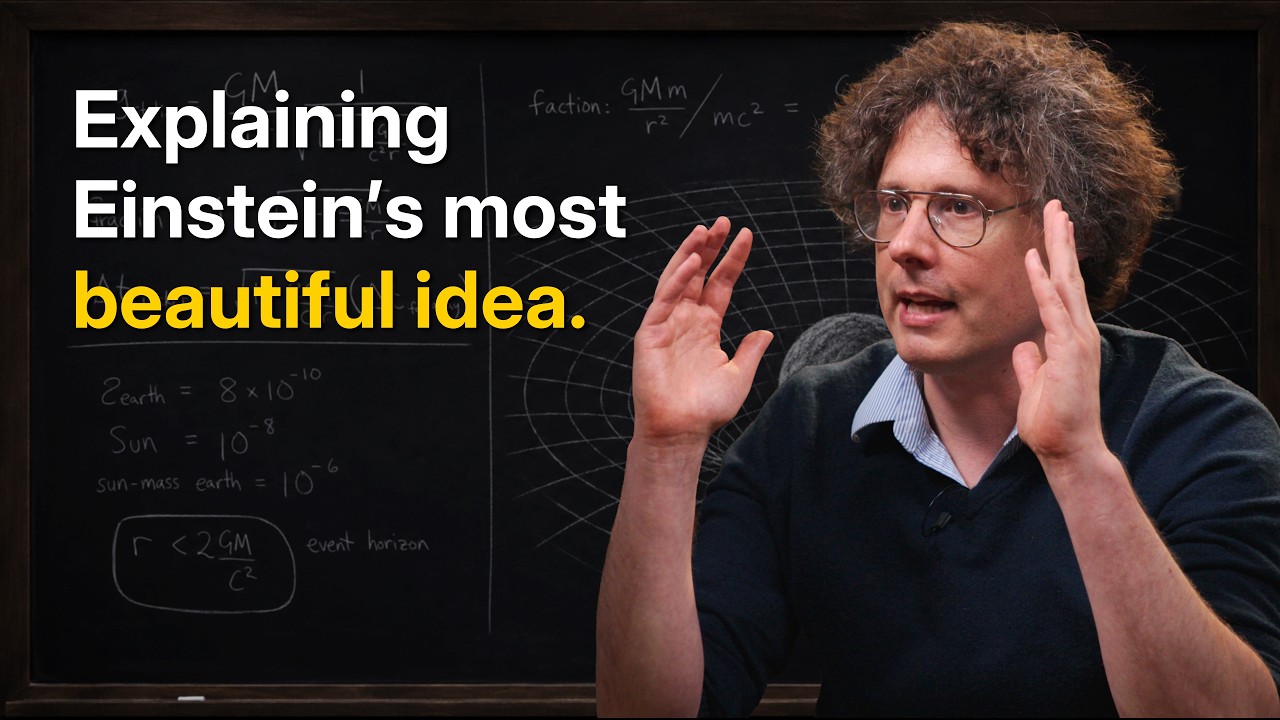
DeepMind's Adam Brown Traces General Relativity to Gravity Equivalence
Dwarkesh Patel
Albert Einstein derived general relativity by recognizing that gravitational mass and inertial mass are identical, proving gravity is a manifestation of curved spacetime rather than a force.
## Background
Published on YouTube by Dwarkesh Patel on July 10, 2026, this episode features Adam Brown—leader of the BlueShift team at Google DeepMind and former Stanford physics professor—explaining general relativity. According to the page description, Adam distills the core ideas behind Einstein's "happiest thought," lectures on black holes and theoretical energy extraction, and closes with a discussion on whether AI can rediscover fundamental physics.
## TL;DR
In this episode, Adam Brown breaks down the foundational principles of general relativity, starting with the equivalence of inertial and gravitational mass that led Einstein to treat gravity as an inertial force in curved spacetime. He explains the mechanics of the Schwarzschild metric, detailing gravitational time dilation, redshift, and how black holes act as theoretical 100% efficient power plants. Finally, Brown and host Dwarkesh Patel explore observational proofs like Sagittarius A* and gravitational waves, concluding with a discussion on string theory, quantum gravity, and how AI might parallelize scientific discovery.
## Atmosphere & style
The conversation carries an enthusiastic, intellectually exhilarating mood, balancing rigorous physics lecture with casual, high-spirited banter. Adam Brown brings clear pedagogical flair—complete with a live studio demonstration swinging a bucket of water—while Dwarkesh Patel acts as an engaged interlocutor pushing for physical intuition and philosophical implications. The dynamic feels like a high-level private tutorial, making deeply complex concepts about black holes and spacetime curvature feel accessible, awe-inspiring, and grounded.
## Key takeaways
- [00:00](https://www.youtube.com/watch?v=QbdbAhaJoCQ&t=0s) The fundamental flaw of Newtonian gravity is its assumption of instantaneous action at a distance, which violates special relativity's principle that nothing can travel faster than light.
- [16:42](https://www.youtube.com/watch?v=QbdbAhaJoCQ&t=1002s) Einstein realized that the mystery of why gravitational mass equals inertial mass could be resolved if gravity is actually an inertial force rather than a fundamental force.
- [21:26](https://www.youtube.com/watch?v=QbdbAhaJoCQ&t=1286s) In general relativity, objects in free fall trace out true straight paths (geodesics) through curved spacetime, while stationary observers on Earth are actively accelerated upward by the ground.
- [28:22](https://www.youtube.com/watch?v=QbdbAhaJoCQ&t=1702s) Einstein's Field Equations mathematically formulate how energy and mass curve spacetime, replacing action-at-a-distance force with local geometric curvature.
- [32:08](https://www.youtube.com/watch?v=QbdbAhaJoCQ&t=1928s) Schwarzschild derived the exact metric describing spacetime around a static mass, defining the event horizon radius where escape velocity equals the speed of light.
- [42:23](https://www.youtube.com/watch?v=QbdbAhaJoCQ&t=2543s) Under classical mechanics, lowering an object below a critical density threshold creates a perpetual motion energy paradox, which general relativity resolves by making gravity infinitely strong at the event horizon.
- [55:27](https://www.youtube.com/watch?v=QbdbAhaJoCQ&t=3327s) Gravity near a black hole induces extreme gravitational time dilation and redshift, causing time to run progressively slower deeper within a gravitational potential well.
- [01:02:33](https://www.youtube.com/watch?v=QbdbAhaJoCQ&t=3753s) Lowering matter to a black hole's event horizon allows up to 100% efficiency in rest mass energy extraction, making gravity far more efficient than chemical or nuclear reactions.
- [01:09:06](https://www.youtube.com/watch?v=QbdbAhaJoCQ&t=4146s) Quantum gravity indicates that black hole evaporation destroys global symmetries, violating principles like nucleon number conservation.
- [01:13:50](https://www.youtube.com/watch?v=QbdbAhaJoCQ&t=4430s) The event horizon produces a dramatic perspective split: a distant bystander sees an infalling astronaut freeze and fade forever, while the astronaut smoothly crosses the horizon without local disruption.
- [01:20:40](https://www.youtube.com/watch?v=QbdbAhaJoCQ&t=4840s) Observational evidence for black holes includes the tracked orbits of stars around Sagittarius A*, gravitational wave detections from binary mergers by LIGO, and direct radio imaging by the Event Horizon Telescope.
- [01:24:21](https://www.youtube.com/watch?v=QbdbAhaJoCQ&t=5061s) Arthur Eddington's 1919 eclipse expedition validated general relativity by confirming that the Sun's gravity bends starlight by twice the amount predicted by Newtonian gravity.
- [01:29:33](https://www.youtube.com/watch?v=QbdbAhaJoCQ&t=5373s) Future AI systems could parallelize theoretical research to explore logical physics frameworks, but pure deduction requires experimental feedback to identify physical reality.
- [01:35:04](https://www.youtube.com/watch?v=QbdbAhaJoCQ&t=5704s) Rather than producing inscrutable formal code, AI models can serve as superhuman explainers that distill complex proofs into human-understandable physical concepts.
## Detailed walkthrough
### [00:00](https://www.youtube.com/watch?v=QbdbAhaJoCQ&t=0s) The Coincidence That Led Einstein to General Relativity
Adam Brown—leader of the BlueShift team at Google DeepMind and a former Stanford physics professor—joins Dwarkesh Patel to break down general relativity. Dwarkesh sets the stage: general relativity is widely celebrated as the single most beautiful idea ever conceived by the human mind, yet most people will never take the 20-lecture graduate course Adam used to teach on the subject. Adam embraces the challenge, explaining that while it took Einstein ten years of dogged pursuit (from 1905 to 1915) to formulate his general theory, modern students can actually grasp its core principles much faster. We stand on the shoulders of giants who distilled these seemingly incomprehensible ideas, clearing away the historical missteps and blind alleys that slowed Einstein down.
```
THE CORE PARADOX OF NEWTONIAN GRAVITY
Newtonian Model: Special Relativity:
F = G * (m1 * m2) / r² Nothing travels faster
than the speed of light
│ │
└───────────────┬───────────────────────┘
▼
CONFLICT: Instantaneous Gravity!
(Jiggling the Sun would move Earth immediately,
violating the universal speed limit of light.)
```
To understand general relativity, one must start with its predecessor, special relativity, published in 1905 during Einstein’s *annus mirabilis*. Special relativity promotes the observation that nothing can travel faster than the speed of light into a fundamental principle of spacetime. While special relativity effortlessly accommodates electromagnetism—as well as the strong and weak nuclear forces, though Einstein was unaware of them at the time—it fails when applied to gravity. Under Isaac Newton's 1687 *Principia* force law ($F = G m_1 m_2 / r^2$), if you jiggled the Sun, the gravitational pull on Earth would change *instantaneously* rather than taking eight minutes to propagate. That immediate action at a distance implies a faster-than-light signal, directly contradicting special relativity. Thus, Newtonian gravity had to give way to a new framework where "not even gravity" can exceed light speed.
Adam explains how physics had previously resolved a similar puzzle in electrostatics, where Charles-Augustin de Coulomb's inverse-square law ($F = k q_1 q_2 / r^2$) also appeared to conflict with relativity. That tension was resolved when James Clerk Maxwell unified electricity and magnetism into electromagnetism, revealing that Coulomb's law was merely a static limit of a broader set of field equations possessing Lorentz symmetry. However, a physicist cannot simply apply the exact same mathematical trick to gravity. In electrostatics, like charges repel (hence a positive sign), whereas in gravity, like masses attract (a negative sign). This structural sign difference arises because electromagnetism is mediated by a spin-1 particle (the photon), while gravity is mediated by a spin-2 particle (the graviton).
Instead, Einstein zeroed in on a deeper mystery—a bizarre "coincidence" embedded inside Newton's second law ($F = m_{inertial} a$). In electromagnetism, an object's charge ($q$) is completely independent of its mass ($m$); a heavy neutron carries zero charge, whereas a lightweight electron carries a substantial charge. In Newtonian gravity, however, the "gravitational mass" pulling an object is identically equal to the "inertial mass" resisting acceleration ($m_{gravitational} = m_{inertial}$). Newton verified this equivalence to one part in 1,000 using pendulums; by Einstein's day, it was confirmed to one part in a billion, and modern tests confirm it to one part in $10^{15}$ ($1 \text{ in } 1,000,000,000,000,000$). This equality—known as the Equivalence Principle—is why a feather and a brick dropped in a vacuum chamber fall at the exact same rate. The heavier brick feels a much stronger gravitational force, but its greater inertial mass offers proportional resistance, causing the two effects to cancel out perfectly.
- **Fundamental Forces & Particles:** Electromagnetism (mediated by spin-1 photons) vs. Gravity (mediated by spin-2 gravitons).
- **Precision of Equivalence Principle:** Tested to $10^{-3}$ in Newton's era, $10^{-9}$ in Einstein's era, and $10^{-15}$ today.
- **Light Travel Time:** Sunlight (and gravitational influences) takes roughly 8 minutes to reach Earth from the Sun.
[16:42](https://www.youtube.com/watch?v=QbdbAhaJoCQ&t=1002s) Gravity Is an Inertial Force
To demonstrate the physical reality of fictitious or inertial forces, Adam produces a live demonstration in the studio: a simple bucket filled with water. Dwarkesh jokes, "You better know your physics, Adam. Otherwise you'll destroy the studio," prompting Adam to have Dwarkesh dip a finger into the bucket to verify it contains real water. Adam then swings the bucket overhead in a full loop-the-loop vertical circle. Despite the bucket being completely upside down at the top of its arc, not a single drop of water spills onto the floor.
```
INERTIAL VS. GRAVITATIONAL FORCES
Centrifugal Force (Fictitious): Einstein's Insight:
┌───────────────────────────────┐ ┌───────────────────────────────┐
│ Force = m_inertial * (v² / r) │ │ Could Gravity itself be an │
│ │ │ Inertial/Fictitious Force? │
│ Charge under the force IS │ ──────► │ │
│ identically inertial mass! │ │ Explains m_grav = m_inert │
└───────────────────────────────┘ │ as a fundamental necessity! │
└───────────────────────────────┘
```
Adam contrasts two equivalent frames of reference to explain why the water stays put:
1. **Inertial / Non-rotating Frame:** The water is continuously accelerating. At the top of the arc, before the water has time to fall downward under Earth's gravity, the bucket has already moved along its circular path to catch it.
2. **Rotating Frame (Riding inside the bucket):** An observer experiences a outward centrifugal force ($F = m_{inertial} v^2 / r$) pinning the water against the bottom of the bucket.
Crucially, in any centrifugal or fictitious force, the "charge" determining how strongly an object feels the force is its inertial mass ($m_{inertial}$). This is no mystery: fictitious forces arise precisely because an object's inertia naturally drives it to move along a straight line; when a reference frame forces it into a curve, that resistant tendency is felt as a force.
In 1907, Einstein experienced what he later called his "happiest thought" (*glücklichste Gedanke*): since gravity is the *only* fundamental force whose charge is identically equal to inertial mass, **could gravity itself be an inertial force?** Electromagnetism could never be an inertial force because its charge varies independently of mass. But if gravity were an emergent, fictitious force resulting from moving through a curved coordinate system, the equality $m_{gravitational} = m_{inertial}$ would cease to be an accidental Newtonian coincidence—it would become an inevitable necessity of nature. Yet, as Adam acknowledges to close the thought, this proposition sounded completely crazy at the time because it required rewriting our fundamental understanding of what a "straight line" actually is.
- **Demonstration:** Swung a bucket of water overhead in a full vertical circle without spilling a drop.
- **Centrifugal Force Formula:** $F = m \cdot \frac{v^2}{r}$, where $m$ is explicitly the inertial mass.
- **Einstein's Breakthrough Year:** 1907 (conceiving the Equivalence Principle and gravity as an inertial force).
<ElicitationsGroup message="Where would you like to go next in this walkthrough?">
<Elicitation label="Explore Part 2: Spacetime Curvature and Geodesics" query="Provide a detailed walkthrough of Part 2 of the Adam Brown relativity transcript, focusing on curved spacetime, non-Euclidean geometry, and geodesics."/>
<Elicitation label="Analyze Black Holes and Energy Extraction" query="Summarize the transcript's discussion on black holes, perpetual motion machines, and energy extraction under special relativity."/>
<Elicitation label="Examine AI Rediscovering General Relativity" query="Detail the conversation between Adam Brown and Dwarkesh Patel regarding DeepMind, AI reasoning, and whether models can rediscover physics from scratch."/>
</ElicitationsGroup>
[21:26](https://www.youtube.com/watch?v=QbdbAhaJoCQ&t=1286s) The Geodesic Paradigm: Why Gravity Is Curved Spacetime, Not a Force
In everyday classical mechanics, inertial forces—such as centrifugal force or the Coriolis effect—are understood as non-real "fictitious" forces that arise purely because an observer is sitting in an accelerating or rotating reference frame rather than traveling along a straight line. When moving strictly along an unaccelerated straight line, no inertial forces are felt. Adam Brown points out the radical consequence of treating gravity *itself* as an inertial force: it completely upends our intuitive understanding of who is moving in a straight line and who is accelerating. If gravity is an inertial force, then astronauts in orbit—who feel completely weightless while in free-fall—are the ones truly moving along a straight path. Conversely, a person sitting quietly in a chair feeling the floor push up against them is being continuously accelerated away from a straight line.
```
TIME-SPACE DIAGRAM OF FREE FALL VS. STANDING STILL
Time (t) ^
| / |
| / (Parabola) | (Vertical Line)
| / Free-falling | Person sitting
| / chalk arc | still in chair
| / (True Geodesic) | (Accelerating path)
| / |
+----------------------------------------> Height (r)
```
To demonstrate this on a chalkboard, Adam plots height above the center of the Earth against time. A person sitting still on a chair traces out a horizontal straight trajectory on the graph. However, because they experience the downward push of gravity, treating gravity as an inertial force implies that their path is *not* a true straight line in spacetime. On the other hand, when Adam tosses a piece of chalk into the air and catches it, its trajectory traces out a parabolic arc on the board. While the chalk is airborne, it is in pure free fall—experiencing zero net internal forces—meaning its curved parabolic path on the board is actually the true "straight line" (geodesic) in spacetime.
This counterintuitive paradox is directly analogous to reading a 2D flight map on an airplane screen during a flight from San Francisco to London. On a flat Mercator projection map, a path following a fixed compass heading (a rhumb line) appears as a straight line, while the actual flight path curves heavily north, clipping Greenland before coming back down to London. In reality, the path curving over Greenland is a great circle—the shortest and straightest possible path across the surface of a globe. The Mercator map looks distorted because it attempts to flatten a curved sphere onto a flat 2D plane. Whenever a curved manifold is forced into a flat grid, straight paths look curved, and curved paths look straight. General relativity asserts that human intuition suffers from the exact same distortion: we incorrectly assume spacetime is flat, mistaking curved free-fall arcs for parabolas and accelerating stationary paths for straight lines.
- **Free-falling astronauts**: Experience no forces and trace out true straight paths (geodesics) through curved spacetime.
- **Stationary observers**: Are physically accelerated upward by the ground, continuously pushed away from a natural geodesic.
- **Great circle analogy**: A flight from San Francisco to London arches over Greenland because it follows a straight geodesic across the curved surface of the Earth.
- **The Core Slogan of GR**: Matter tells spacetime how to curve, and curved spacetime tells matter how to move.
---
[28:22](https://www.youtube.com/watch?v=QbdbAhaJoCQ&t=1702s) Einstein's Field Equations: Translating Geometry into Gravity
Einstein spent eight arduous years—from his initial realization of the equivalence principle in 1907 until 1915—struggling with the formal mathematics required to capture spacetime curvature. The ultimate fruit of those eight years was Einstein's Field Equations, which mathematically encode the fundamental relationship between geometry and mass-energy distribution:
$$G_{\mu\nu} = \frac{8\pi G}{c^4} T_{\mu\nu}$$
Adam explains the components of this equation in accessible terms:
* **Left-Hand Side ($G_{\mu\nu}$)**: A geometric tensor—developed by 19th-century Eastern European mathematicians—that explicitly measures how much spacetime is curved at a given point. If spacetime is perfectly flat, this tensor equals zero.
* **Constants**: Incorporates Newton's gravitational constant ($G$), $\pi$, and the speed of light ($c$).
* **Right-Hand Side ($T_{\mu\nu}$)**: The stress-energy tensor, which serves as the relativistic generalization of mass. It encompasses all forms of mass, momentum, pressure, and energy density.
```
EINSTEIN'S FIELD EQUATION
G_μν = ( 8 π G / c⁴) × T_μν
[Spacetime] [Coupling Const] [Mass-Energy]
Curvature Distribution
```
This equation encapsulates the dual nature of relativistic gravity. Where Newtonian physics postulated an invisible force acting instantaneously at a distance between distant masses, general relativity replaces force with local geometry. The presence of matter and energy curves the spacetime manifold around it; subsequently, objects moving through that curved manifold simply follow its natural geodesics.
This geometric framework drastically expands the predictive reach of physics compared to Newtonian mechanics. Newton's law famously unified terrestrial phenomena (like an apple falling from a tree) with celestial mechanics (the motion of the moon and planets). General relativity encompasses all of Newton's successes, but its predictive power stretches across vast orders of magnitude—explaining microscopic relativistic corrections, the precision orbit of Mercury, bending starlight, black holes, and the accelerating expansion of the entire universe.
- **Development Timeline**: Einstein worked on the geometric framework of general relativity for eight years between 1907 and 1915.
- **The Stress-Energy Tensor ($T_{\mu\nu}$)**: Encodes mass, energy, pressure, and momentum, serving as the source term for spacetime curvature.
- **Cross-Domain Predictive Reach**: General relativity accurately operates across vastly different scales, from everyday planetary orbits to cosmology-wide cosmic expansion.
---
[32:08](https://www.youtube.com/watch?v=QbdbAhaJoCQ&t=1928s) The Discovery of the Schwarzschild Solution and Black Hole Prehistory
Black holes represent the quintessential prediction of general relativity that has no direct equivalent in classical physics. When Einstein published his field equations in 1915, he believed they were far too complex to ever yield an exact mathematical solution, assuming physicists would always have to rely on approximate numerical methods. He was proven wrong almost immediately. Karl Schwarzschild, a Prussian artillery officer serving on the Russian front during World War I, managed to calculate an exact point-mass solution to Einstein's equations in 1916 while simultaneously calculating shell trajectories between artillery bombardments.
```
SCHWARZSCHILD RADIUS FORMULA
2 G M
r_s = -----
c²
r_s = Schwarzschild radius (Event Horizon)
G = Gravitational constant
M = Mass of the central object
c = Speed of light
```
Schwarzschild’s solution described the geometry of empty spacetime surrounding a spherical, non-rotating mass concentrated at a central point. However, for nearly half a century, the physics community—including Einstein himself—remained thoroughly confused about what the mathematics actually implied. Einstein mistakenly believed that physical objects falling toward the Schwarzschild radius (the event horizon) would somehow bounce off or be prevented from crossing by pressure forces.
In truth, basic concepts behind dark, light-trapping bodies were pondered long before general relativity. In the late 18th century, thinkers John Michell (1783) and Pierre-Simon Laplace (1796) posed a simple question using Newtonian gravity: how heavy or compact must an object be for its escape velocity to equal the speed of light?
Using classical kinetic and potential energy balance:
$$\frac{1}{2} m v_{\text{escape}}^2 = \frac{G M m}{r}$$
Setting $v_{\text{escape}} = c$ yields the critical radius formula:
$$r_{\text{critical}} = \frac{2GM}{c^2}$$
Astonishingly, this purely classical Newtonian calculation yields the *exact* same mathematical value for the event horizon radius ($r_s = \frac{2GM}{c^2}$) as Schwarzschild's full general relativistic derivation. Though the Newtonian derivation relied on incorrect assumptions about light particles slowing down due to gravity, the exact numerical agreement remains a remarkable historical coincidence.
- **Karl Schwarzschild**: Solved Einstein's field equations exactly in 1916 while serving on the front lines of WWI.
- **Earth's Escape Velocity**: Approximately $11\text{ km/s}$.
- **Jupiter's Escape Velocity**: Hundreds of kilometers per second due to its greater mass.
- **Historical Precursors**: John Michell and Pierre-Simon Laplace independently derived the formula $r = \frac{2GM}{c^2}$ in the late 18th century.
---
[36:17](https://www.youtube.com/watch?v=QbdbAhaJoCQ&t=2177s) Energy Extraction, Rocket Efficiency, and the Limits of Mass Conversion
To build a deeper intuitive understanding of why the radius $r_s = \frac{2GM}{c^2}$ represents a hard physical threshold, Adam introduces a thought experiment involving lowering a mass toward a heavy body to lower its potential energy and harvest useful work.
Suppose you take a brick of mass $m$ far out in space, attach it to a rope connected to a pulley system, and slowly lower it down to the surface of a mass $M$ with radius $r$. As the brick descends under gravity, the tension in the rope turns a generator, extracting work. The classical potential energy extracted is given by:
$$E_{\text{extracted}} = \frac{G M m}{r}$$
Dividing this by the rest-mass energy of the brick ($E_{\text{rest}} = m c^2$), the fractional energy efficiency of mass conversion is:
This tiny number explains why relativistic effects are undetectable in daily life on Earth; general relativity can be viewed as a Taylor expansion in this dimensionless parameter, where Newtonian gravity forms the first term and relativistic corrections are suppressed by $7 \times 10^{-10}$.
As an intriguing tangent, Adam notes that this gravitational efficiency factor for Earth ($7 \times 10^{-10}$) happens to be remarkably close to the chemical binding energy efficiency of liquid hydrogen-oxygen rocket fuel:
Chemical reactions yield a tiny fraction of rest-mass energy because chemical bonds only involve weak outer-electron rearrangements. The vast majority of mass energy remains locked up in the rest mass of protons and neutrons, or in nuclear binding energy governed by the strong and weak forces. Because Earth's gravitational binding fraction ($7 \times 10^{-10}$) is slightly larger than chemical fuel efficiency ($1.5 \times 10^{-10}$), chemical rockets can reach orbit, but only with tiny payload fractions because most launch mass must consist of propellant burnt just to lift other propellant. If Earth were significantly more massive or compact, chemical spaceflight would be physically impossible.
By comparison, lowering objects toward denser cosmic bodies extracts vastly higher percentages of mass energy:
* **The Sun**: Yields an efficiency fraction of roughly $2 \times 10^{-6}$ (roughly a million-fold increase over Earth, offset by the Sun's larger physical radius).
- **Earth Energy Fraction**: Lowering a weight to Earth's surface yields only $7 \times 10^{-10}$ of its rest mass energy.
- **Rocket Fuel Efficiency**: Hydrolox chemical fuel releases only $1.5 \times 10^{-10}$ of its total rest mass energy ($mc^2$) upon combustion.
- **Solar Energy Fraction**: Lowering a mass to the surface of the Sun yields an energy extraction efficiency of $2 \times 10^{-6}$.
[42:23](https://www.youtube.com/watch?v=QbdbAhaJoCQ&t=2543s) Escalating Mass and the Perpetual Energy Paradox
Continuing the thought experiment of lowering a mass on a rope toward a gravitational source, Adam Brown demonstrates how the extracted energy scales as the object becomes denser. If you lower a mass down to the surface of the Sun, you extract a tiny fraction of its rest mass energy ($mc^2$). However, if you cram that same solar mass into an Earth-sized radius—which is precisely what occurs in a white dwarf star like Sirius B—the surface gravity becomes immensely stronger, allowing you to extract a much larger fraction of its rest mass energy.
This line of reasoning leads directly to a profound paradox in classical physics. If you analyze the Newtonian energy extraction formula for an object so dense that its radius $r$ becomes less than or equal to $\frac{GM}{c^2}$, the fraction of mass extracted exceeds 100%. In other words, you could lower a brick down to the surface, extract more energy than the brick's total rest mass energy ($mc^2$), and have enough leftover energy at a distance to construct a brand-new brick out of thin air while keeping the extra power. This points toward an obvious physical absurdity—a perpetual motion machine driven purely by gravity.
```
Newtonian threshold: r <= GM / c² --> Extracted energy > mc² (Paradox!)
```
While this Newtonian calculation is merely suggestive, it indicates that classical physics breaks down as an object approaches this density limit. In full general relativity, the paradox is resolved not by softening the force at short distances (as happens in electromagnetism due to quantum fuzziness), but by making gravity *stronger* than Newton predicted. As an object collapses within this critical radius, it forms a black hole. The gravitational force becomes infinite at a finite radius rather than at $r = 0$, making it physically impossible to hold the rope or lower the brick any further without it being ripped away.
- **White Dwarf Example:** Sirius B packs roughly the mass of the Sun into an Earth-sized radius, vastly increasing the surface redshift and gravitational force compared to the Sun.
- **Electromagnetism vs. Gravity:** Electromagnetism avoids infinite energy extraction at short distances through quantum mechanics, which "fuzzes out" charge and softens the $\frac{1}{r}$ energy potential. General relativity takes the opposite route by sharpening the gravitational force until an event horizon forms.
---
[47:12](https://www.youtube.com/watch?v=QbdbAhaJoCQ&t=2832s) The Schwarzschild Metric and Gravity Near a Black Hole
To accurately describe the physics around a dense mass, one must transition from Newtonian mechanics to general relativity—the theory that unifies gravity with special relativity. Karl Schwarzschild accomplished this by deriving the Schwarzschild metric, which provides the exact geometric description of spacetime surrounding a static central mass. From this metric, three fundamental formulas emerge that govern the behavior of matter, time, and light outside and inside a black hole.
The first formula quantifies the local gravitational force—or "proper acceleration"—felt by a static observer who is hovering at a fixed radius $r$ away from a mass $M$ (whether supported by a rope, a pulley system, or by firing rocket thrusters):
```
Newtonian gravity
Local Acceleration = -----------------
/ 2GM \
| 1 - ----- |
V c² r
```
For large distances ($r \gg \frac{2GM}{c^2}$), the square root term approaches 1, smoothly recovering Newton’s classical inverse-square law. On Earth, the general relativistic correction term is negligible (on the order of $10^{-10}$). However, as an observer approaches the **Schwarzschild radius** ($r_s = \frac{2GM}{c^2}$), the square root term in the denominator approaches zero, driving the required acceleration to infinity. This surface defines the **event horizon**.
```
|.
|.
Local |. <-- GR Correction (Approaches Infinity at r = 2GM/c²)
Force | /
(a) | /
|.......... /..... Newtonian Prediction (GM/r²)
|/___________/________
r = 2GM/c² r (Distance)
```
"At the event horizon, you are not yet dead. You are, however, doomed if you cross the event horizon. You will never be able to escape, not if you convert yourself to light and try to shoot yourself out, not if you fire your rocket infinitely hard."
- **The Myth of "Sucking Everything In":** Black holes do not simply pull in everything in their vicinity. At large distances, orbiting a black hole is identical to orbiting any ordinary star or planet of equal mass.
- **The Limits of Orbital Centrifugal Force:** While orbiting a planet like Earth produces a centrifugal force that counteracts gravity, orbiting ceases to help you escape once you get within $r = \frac{3GM}{c^2}$. In general relativity, kinetic energy itself gravitates. Close to a black hole, the gravitational attraction caused by the orbital energy outweighs the outwards centrifugal force, meaning orbital angular momentum actually drags you down faster.
- **Singularity vs. Horizon:** Classical Newtonian force becomes infinite only at the point mass center ($r = 0$). In general relativity, resisting gravity requires infinite acceleration at the event horizon ($r = \frac{2GM}{c^2}$), while physical destruction occurs at the central singularity ($r = 0$).
---
[55:27](https://www.youtube.com/watch?v=QbdbAhaJoCQ&t=3327s) Gravitational Time Dilation and Redshift
The second fundamental consequence of the Schwarzschild metric is **gravitational time dilation**. Imagine a thought experiment where an observer (Dwarkesh) is suspended on a pulley system at a fixed distance $r$ near a black hole, while a second observer (Adam) sits far away at spatial infinity, watching him. Both observers remain static relative to one another with zero relative velocity.
The relationship between the time interval measured by the clock near the mass ($\Delta \tau$) and the clock far away ($\Delta t$) is defined by the square root factor:
$$\Delta \tau = \Delta t \sqrt{1 - \frac{2GM}{c^2 r}}$$
Because this factor is strictly less than 1, time runs slower deeper within a gravitational potential well. If the hovering observer spends what feels like a single year near the black hole before being pulled back up, they will discover that the outside world has aged far more than a year. Unlike special relativity—where time dilation is symmetric and both observers see the other's clock ticking slower due to relative motion—gravitational time dilation is asymmetric. Both observers agree that the black hole breaks the symmetry: the lower clock runs objectively slower, while the lower observer sees the distant universe living in fast-forward.
```
Distant Observer (Infinity): Observes clock near mass running SLOW
Hovering Observer (Near Mass): Observes distant clock running FAST
```
This phenomenon directly dictates the third effect: **gravitational redshift and blueshift**. If the lower observer shines a pulse of light of a known frequency (such as an atomic sodium transition) outward to the distant observer, the light must climb out of the gravitational well. Because the distant observer perceives all processes near the mass as slowed down, they observe the light wave oscillating at a lower frequency upon arrival. A lower frequency corresponds to longer wavelengths and lower photon energy—shifting the light toward the red end of the spectrum (gravitational redshift). Conversely, light fired from a distant location down into the potential well is compressed to higher frequencies and gains energy, becoming blueshifted.
- **Experimental Verification:** In the 1950s, researchers in the Harvard physics department (the Pound-Rebka experiment) placed atomic clocks at different heights in a tower and confirmed that the higher clock ran faster than the lower clock.
- **Real-World Impact on GPS:** Satellite clocks operating in Earth's orbit experience weaker gravity than clocks on the ground. GPS systems must explicitly adjust for this gravitational time dilation difference to prevent position tracking errors from accumulating rapidly.
- **Combined Relativistic Effects:** If an object is actively orbiting a black hole rather than remaining static, its clock will experience two compounding effects that slow its time relative to a distant observer: general relativistic gravitational time dilation and special relativistic kinetic time dilation.
<FollowUp label="Want me to walk through the remaining formulas of the Schwarzschild metric from Part 4?" query="Walk through part 4 of the transcript focusing on the remaining formulas of the Schwarzschild metric and black hole physics."/>
[01:02:33](https://www.youtube.com/watch?v=QbdbAhaJoCQ&t=3753s) Gravitational Redshift and the Exact Energy Extraction Formula
Adam Brown explains that the gravitational time dilation factor doubles as the "exchange rate" for energy at different altitudes relative to a black hole. If someone situated deep inside a gravitational potential well sends energy to an observer far away at infinity, the energy is worth less to the distant observer by a precise factor determined by general relativity. Specifically, if Dwarkesh sits at a radius $r$ with an object of mass $m$ (corresponding to rest energy $mc^2$), the energy that reaches an observer far away is reduced by gravitational redshift:
$$\text{Energy at infinity} = mc^2 \sqrt{1 - \frac{2GM}{c^2 r}}$$
Brown provides two ways to conceptualize this energy drop. First, if Dwarkesh annihilates the mass (for example, by colliding half an Avogadro's number of carbon atoms with half an Avogadro's number of anti-carbon atoms) and beams the resulting light up out of the gravity well, the light undergoes gravitational redshift, losing energy as it climbs. Second, if the distant observer instead attaches the mass to a cable and mechanically pulls it out of the potential well, they end up with $mc^2$ at infinity, but they had to expend work pulling it against gravity. The net energy gained is identical in both scenarios.
$$\text{Fraction of Energy Extracted} = \frac{mc^2 - mc^2 \sqrt{1 - \frac{2GM}{c^2 r}}}{mc^2} = 1 - \sqrt{1 - \frac{2GM}{c^2 r}}$$
By Taylor-expanding this exact relativistic formula at large distances ($r \gg \frac{2GM}{c^2}$), the leading term reproduces the familiar Newtonian gravitational potential energy formula, $\frac{GM}{r}$. However, closer to the black hole, general relativity takes over. As $r$ approaches the event horizon ($r \to \frac{2GM}{c^2}$), the square root term goes to zero, meaning $100\%$ of the rest energy $mc^2$ can be extracted by lowering the mass slowly on a rope to the horizon before releasing it.
- Chemical power plants extract only a tiny fraction of rest mass ($\sim 10^{-10}$) because electromagnetic bonds are extremely weak.
- Nuclear fission extracts $\sim 10^{-3}$ and nuclear fusion extracts $\sim 10^{-2}$ of rest mass energy.
- Even in nuclear reactions, $99\%$ of the energy remains locked in the rest mass of protons and neutrons because total nucleon count is conserved.
- Black hole energy extraction via gravity can theoretically reach $100\%$ efficiency.
---
[01:09:06](https://www.youtube.com/watch?v=QbdbAhaJoCQ&t=4146s) Black Holes as the Ultimate Power Plant and Quantum Gravity Insights
Continuing the discussion on efficiency, Brown emphasizes that gravity is the only force capable of converting $100\%$ of an object's rest mass into usable work. Dwarkesh asks a fundamental question: if an object composed of protons and neutrons is lowered right to the event horizon and yields all its rest energy, does that mean the protons and neutrons cease to exist at that point?
Brown clarifies that classically, the protons and neutrons simply fall into the black hole and reside inside it, while the nucleon number is assigned to the black hole itself. However, when quantum mechanics is introduced—via Hawking radiation and Bekenstein-Hawking entropy—the picture changes dramatically. A black hole eventually evaporates completely, radiating its energy away as photons, gravitons, and neutrinos, with virtually no protons or neutrons emitted.
> "It is a very interesting fact, once you turn on quantum gravity, that black holes eat nucleon number. This thing that seems like it's conserved... ends up being eaten by gravity."
- Classical general relativity conserves global quantum numbers by storing them inside the black hole.
- Quantum gravity destroys global symmetries (such as nucleon number conservation) through black hole evaporation.
- Physicists promote this phenomenon to a general principle in string theory and quantum gravity: global symmetries cannot exist in a consistent theory of quantum gravity.
---
[01:13:50](https://www.youtube.com/watch?v=QbdbAhaJoCQ&t=4430s) The Infalling Observer vs. The Distant Bystander
Dwarkesh asks what actually happens to an astronaut who suffers the unfortunate fate of falling into a black hole. Brown explains that general relativity gives two distinct, radically different, yet entirely consistent perspectives depending on the frame of reference:
1. **The External Observer (Bystander):** As the observer far away watches the infalling astronaut, the astronaut accelerates toward the black hole initially. However, as they near the event horizon, gravitational time dilation dominates. The astronaut's wristwatch appears to tick slower and slower. The light emitted by the astronaut becomes extremely redshifted, stretching to longer wavelengths until the observer receives a final photon. To the external observer, the astronaut never crosses the event horizon; they simply freeze and fade to black.
2. **The Infalling Observer:** From the astronaut's own perspective, nothing strange happens at the horizon. Their watch ticks normally at one second per second. They smoothly cross the event horizon without feeling any local disruption, assuming the black hole is sufficiently large.
Brown explains that the event horizon is not a locally physical barrier or a brick wall, but a "teleological feature"—a boundary of no return. Once crossed, all future light cones point inward toward the central singularity.
- For small, solar-mass black holes, tidal forces at the event horizon are extreme and would "spaghettify" an astronaut by pulling harder on their feet than on their head.
- For supermassive black holes (e.g., galactic scale), tidal forces at the horizon are negligible. An astronaut could cross the event horizon without feeling any discomfort.
- Inside a massive enough black hole, an astronaut could live out their entire life, raise children, and build generations before eventually reaching the central singularity.
---
[01:18:51](https://www.youtube.com/watch?v=QbdbAhaJoCQ&t=4731s) Observational Evidence for Black Holes
Dwarkesh asks why physicists are so confident that black holes are real physical objects rather than mathematical quirks like wormholes. Brown recounts that when Karl Schwarzschild first derived his exact solution in 1915, Einstein and others dismissed it as an unphysical singularity that would never form in nature.
This view shifted due to major theoretical and observational breakthroughs over the past century:
1. **Theoretical Genericity (Penrose-Hawking Singularity Theorems):** Roger Penrose (later winning the Nobel Prize in Physics) proved that black hole formation is not an artifact of perfect spherical symmetry, but a generic prediction of general relativity whenever matter collapses past a critical density.
2. **Galactic Center Stellar Orbits (Sagittarius A*):** Astronomers tracked the motion of stars near the center of the Milky Way over several decades. The stars orbit an unseen, extremely dense mass of millions of solar masses within a tiny volume, leaving a black hole as the only viable explanation.
3. **Gravitational Waves (LIGO/Virgo):** The direct detection of gravitational wave ripples from merging binary black hole systems confirmed their dynamical behavior and horizon properties.
4. **Event Horizon Telescope (EHT):** Direct radio imaging captured the shadow of supermassive black holes in M87* and Sagittarius A*.
- Schwarzschild derived his solution almost immediately after Einstein published his field equations in 1915.
- Penrose's singularity theorems proved black holes are generic outcomes of gravitational collapse under standard energy conditions.
- Sagittarius A* contains roughly 4 million solar masses concentrated in the center of the Milky Way.
[01:20:40](https://www.youtube.com/watch?v=QbdbAhaJoCQ&t=4840s) Observational Evidence for Black Holes: Sagittarius A*, LIGO, and EHT
Adam Brown outlines the three primary lines of observational evidence that have convinced physicists that black holes are real physical objects rather than mere mathematical artifacts. The first line of evidence comes from observing the orbits of stars at the center of the Milky Way galaxy. Astronomers tracked these stars over decades and observed them moving along precise, precessing ellipses. These stars are clearly orbiting an unseen object that is incredibly massive yet extremely compact, as the orbiting stars pass very close to it without colliding. This supermassive, dark object is Sagittarius A*, the supermassive black hole at the center of our galaxy.
The second line of evidence was delivered roughly a decade ago when humanity transitioned from just seeing black holes to actually "feeling" them. In late 2015, immediately after being turned on, the Laser Interferometer Gravitational-Wave Observatory (LIGO) detected gravitational waves—literal ripples shaking the fabric of spacetime. Scientists knew it was spacetime shaking rather than localized terrestrial noise because multiple laser interferometers across the globe detected the exact same vibration signal simultaneously. By analyzing the wave patterns, scientists back-calculated that the signal originated 1.6 billion light-years away from the collision and merger of two giant black holes, each weighing roughly 30 times the mass of the Sun. Since that first historical detection, LIGO has recorded thousands of black hole mergers.
The third line of evidence comes from the Event Horizon Telescope (EHT), a globally distributed array of radio telescopes operating as an Earth-sized virtual telescope. EHT captured radio emissions from superheated matter glowing intensely as it plunges into Sagittarius A* and the even larger black hole at the center of the neighboring Messier 87 (M87) galaxy. Reflecting on the grand sweep of general relativity, Adam and Dwarkesh marvel at how a theory born from simple thought experiments about elevators reaches across orders of magnitude to describe planetary orbits, light bending, galactic rotation, and the fate of the entire universe. As Adam quips, "our universe should be honored to be described by such a beautiful theory."
- **Sagittarius A*:** Detected via precision tracking of surrounding star orbits, confirming a massive, dark, compact object at the Milky Way's core.
- **LIGO Event (September 2015):** Detected gravitational waves from two black holes (~30 solar masses each) merging 1.6 billion light-years away, which occurred 1.6 billion years ago.
- **Event Horizon Telescope (EHT):** Imaged radio emissions from infalling matter around Sagittarius A* and M87*.
---
[01:24:21](https://www.youtube.com/watch?v=QbdbAhaJoCQ&t=5061s) The Bending of Light and the 1919 Eclipse Expeditions
Dwarkesh asks Adam to tell the history of how general relativity transitioned from Einstein's personal theoretical creation into an accepted scientific truth. Adam explains that while general relativity successfully resolved known anomalies like the anomalous precession of Mercury's orbit, predicting a known number is historically less persuasive than predicting a brand-new, unmeasured phenomenon. The ultimate empirical test came down to the gravitational deflection of light. Under general relativity, all energy gravitates and is influenced by gravity; therefore, light passing close to a massive body like the Sun must bend.
Newtonian physics also predicts light bending if one plugs the speed of light into the trajectory calculations, but general relativity predicts exactly double the Newtonian deflection amount. Einstein initially attempted to test this by asking observatory astronomers to look at stars right next to the Sun, but he was told that pointing a telescope near the Sun would blind the observer or be completely washed out by solar glare. The only way to observe stars near the solar limb was during a total solar eclipse.
The quest to test this prediction faced dramatic historical hurdles. In 1911, an expedition to Argentina was ruined by heavy cloud cover. A 1914 German expedition sponsored by Krupp traveled to Crimea, but World War I broke out right before the eclipse; the German astronomers were arrested as enemy aliens and their equipment was confiscated. Paradoxically, these failures saved Einstein's reputation: his early 1911 calculation—based solely on the equivalence principle prior to completing full general relativity—had incorrectly predicted the single Newtonian value. During the war, Einstein discovered his mathematical error and corrected the prediction to double the Newtonian value. Finally, in 1919, Sir Arthur Eddington led a famous British expedition to observe the eclipse from the island of Príncipe and Sobral, Brazil. Eddington's successful measurement confirmed Einstein's double deflection prediction, launching Einstein to global fame and establishing general relativity as scientific consensus.
- **Precession of Mercury:** Early success for GR, but less persuasive because the anomaly was already known before the theory was formulated.
- **Newtonian vs. GR Light Bending:** GR predicts twice the deflection angle calculated via Newtonian physics.
- **1911 Argentina Expedition:** Failed due to cloudy skies.
- **1914 Crimea Expedition:** German team arrested at the onset of World War I.
- **1919 Eddington Expedition:** Confirmed Einstein's full prediction (double Newtonian deflection) during a total solar eclipse, fostering post-war scientific reconciliation between Britain and Germany.
---
[01:29:33](https://www.youtube.com/watch?v=QbdbAhaJoCQ&t=5373s) The Empirical Basis of General Relativity and Parallelizing Discovery with AI
Dwarkesh raises a philosophical question about modern big-budget science, noting that society spends tens of billions on massive experiments, whereas general relativity was conceived by "a guy who's just thinking in a cave" with minimal initial empirical data. Adam notes that theoretical physicists are remarkably cheap compared to giant particle colliders, though Dwarkesh jokes that AI companies hiring physicists are rapidly raising their price tag. Adam cautions that general relativity represents an extreme outlier in physics history—resembling an "Ayn Rand hero just sitting alone"—and physics has been "chasing that high ever since." Usually, theoretical progress requires constant feedback from experimental data.
Adam breaks down the sparse empirical inputs needed to derive general relativity: the finite speed of light (and its underlying Lorentz symmetry from special relativity) plus the equivalence principle (the observational equivalence of gravitational mass and inertial mass). Dwarkesh suggests that if the search space of theories branching from these basic inputs is finite, future AI systems could run millions of autonomous instances ("lots and lots of Einsteins") in parallel to systematically explore every logical path.
Addressing modern frontiers, Adam contrasts string theory with condensed matter physics. String theory has adopted the Einsteinian paradigm of relying on mathematical consistency and reductions to known limits as its primary guiding light, largely because directly testing quantum gravity requires "galactic-sized particle colliders." However, Adam warns that this approach only works if there is a unique or tiny number of mathematically consistent theories; if the space of consistent theories is infinite, pure thought cannot identify the correct universe. Conversely, fields like condensed matter physics cannot rely on pure deduction and strictly require physical experiments to determine reality.
- **Minimal Conceptual Inputs for GR:** Finite speed of light (Lorentz symmetry) + Equivalence principle (inertial mass equals gravitational mass).
- **String Theory Approach:** Pursues mathematical consistency with minimal experimental input due to the extreme energy scales required (Planck scale).
- **Condensed Matter Contrast:** High branching fraction where pure theory fails without direct experimental elimination of possibilities.
---
[01:35:04](https://www.youtube.com/watch?v=QbdbAhaJoCQ&t=5704s) AI as Superhuman Explainers: The Future of Human Understanding in Science
Looking to the future of AI-driven scientific discovery, Dwarkesh asks whether human minds will be left behind, unable to understand the unified theories and mathematical proofs generated by advanced AI civilizations. He highlights mathematician Terence Tao's concern regarding "indigestion"—a scenario where AI produces billion-line, inscrutable Lean formal proofs that certify a theorem's truth without conveying any humanly digestible insight or intuition.
Adam presents an optimistic counter-perspective: large language models will not only be superhuman provers, but also superhuman explainers. Rather than generating opaque code, AI models can actively untangle obscure proofs, refine complex ideas, and translate them into conceptual frameworks that humans can understand. Adam cites recent real-world evidence to support this positive view: an AI recently proved a long-standing Erdős conjecture informally rather than in Lean code. Human mathematicians subsequently read the paper, digested the AI's novel human-interpretable ideas, and successfully deployed those concepts to prove additional original theorems.
Adam points to another example—the disproof of the unit distance conjecture—illustrating an additional key strength of LLMs: their willingness to question human dogmas and exhaustively explore low-probability paths. Humans had avoided trying to disprove the conjecture because they assumed it was true; the AI possessed the patience to push through that psychological barrier and attempt the disproof. Adam concludes that AI's infinite patience and capacity to translate complex math into clear explanations will allow human understanding to keep pace far better than pessimistic forecasts predict.
- **Terence Tao's "Indigestion" Concern:** Fear that AI will yield massive, unreadable formal certificates (e.g., Lean code) lacking conceptual insight.
- **Erdős Conjecture Counter-Example:** AI produced an informal, human-interpretable proof that human mathematicians used to prove further theorems.
- **Unit Distance Conjecture:** AI succeeded by stubbornly testing hypotheses that human researchers had dismissed due to cognitive bias.
## Notable quotes
> [00:00](https://www.youtube.com/watch?v=QbdbAhaJoCQ&t=0s) At the core of general relativity, Einstein is trying to figure out the principle behind a particular coincidence: that the mass that resists acceleration and the mass that gravity pulls on just happen to be exactly the same. — Adam Brown
> [47:12](https://www.youtube.com/watch?v=QbdbAhaJoCQ&t=2832s) At the event horizon, you are not yet dead. You are, however, doomed if you cross the event horizon. You will never be able to escape, not if you convert yourself to light and try to shoot yourself out, not if you fire your rocket infinitely hard. — Adam Brown
> [01:09:06](https://www.youtube.com/watch?v=QbdbAhaJoCQ&t=4146s) It is a very interesting fact, once you turn on quantum gravity, that black holes eat nucleon number. This thing that seems like it's conserved... ends up being eaten by gravity. — Adam Brown
> [01:23:40](https://www.youtube.com/watch?v=QbdbAhaJoCQ&t=5020s) our universe should be honored to be described by such a beautiful theory. — Adam Brown
## Mentioned
Adam Brown, Dwarkesh Patel, Albert Einstein, Isaac Newton, James Clerk Maxwell, Charles-Augustin de Coulomb, Karl Schwarzschild, John Michell, Pierre-Simon Laplace, Arthur Eddington, Roger Penrose, Stephen Hawking, Terence Tao, Jed Thompson, Google DeepMind, BlueShift, Stanford University, Jane Street, Crusoe, Cursor, LIGO, Virgo, Event Horizon Telescope (EHT), Harvard University, Pound-Rebka experiment, Sagittarius A*, M87*, Sirius B, Lean
DeepMind 研究员 Adam Brown 阐释广义相对论与引力等效原理
阿尔伯特·爱因斯坦通过认识到引力质量与惯性质量完全相同推导出广义相对论,证明了引力是弯曲时空的一种表现而非一种力。
在本期节目中,Adam Brown 解析了广义相对论的基本原理,从惯性质量与引力质量的等效性切入,正是这一等效性促使爱因斯坦将引力视为弯曲时空中的惯性力。他解释了史瓦西度规的机制,详细阐述了引力时间膨胀、红移,以及黑洞在理论上如何作为效率达 100% 的发电厂。最后,Brown 与主持人 Dwarkesh Patel 探讨了人马座 A*(Sagittarius A*)和引力波等观测证据,并以对弦理论、量子引力以及人工智能如何并行加速科学发现的讨论作结。
牛顿引力的根本缺陷在于假设了瞬时超距作用,这违反了狭义相对论中没有任何物体传播速度能超越光速的原理。 (0:00)
爱因斯坦意识到,如果引力实际上是一种惯性力而非基本相互作用力,那么引力质量为何等于惯性质量的谜题便能迎刃而解。 (16:42)
在广义相对论中,自由落体的物体在弯曲时空中沿着真正的直线路径(测地线)运动,而地球上的静止观察者实际上正受到地面的主动向上加速。 (21:26)
爱因斯坦场方程以数学方式表述了能量和质量如何弯曲时空,从而用局部几何曲率取代了超距作用力。 (28:22)
史瓦西推导出了描述静态质量周围时空的精确度规,定义了逃逸速度等于光速的事件视界半径。 (32:08)
Reading summary
Physicist Adam Brown argues that general relativity fundamentally reconceptualizes gravity not as an invisible force, but as the natural curvature of spacetime emerging from minimal physical principles. By replacing Newtonian mechanics with geometric geodesics, the theory resolves long-standing classical paradoxes and provides an experimentally validated blueprint governing planetary orbits, black hole mechanics, and cosmic expansion.
Reinterpreting Gravity as Curved Spacetime Geometry (0:00)
Isaac Newton's inverse-square law assumed instantaneous gravitational attraction, directly conflicting with special relativity's postulate that no signal can travel faster than the speed of light. Furthermore, Newtonian mechanics treated the identical equivalence between gravitational mass and inertial mass as an unexplained coincidence, verified from one part in 1,000 in Newton's era to one part in 10¹⁵ today. In 1907, Einstein recognized that because gravity accelerates all masses identically, it behaves like an inertial or fictitious force—such as centrifugal force—where an object's resistance to acceleration serves as the effective force charge.
This principle inverts everyday intuitions about acceleration: an observer sitting motionless in a chair is actively accelerated upward by the ground, whereas an airborne object or a free-falling astronaut follows an unaccelerated straight path, or geodesic, through curved spacetime. Formulated in 1915, Einstein's field equations formalize this dynamic, establishing that mass, momentum, and pressure curve the local spacetime manifold, while curved geometry dictates the trajectories of matter.
The Schwarzschild Metric and Black Hole Limits (47:12)
In 1916, Karl Schwarzschild calculated the exact geometry of empty spacetime surrounding a static point mass, identifying the event horizon radius at rs = 2GM/c². In classical Newtonian gravity, lowering an object of mass m to a radius below GM/c² yields an impossible physical paradox: extracting gravitational potential energy exceeds 100% of the object's rest-mass energy (mc²), which would permit a perpetual motion machine. General relativity resolves this absurdity by showing that proper acceleration diverges to infinity at the Schwarzschild radius, preventing any static tether from holding an object at the horizon.
Near this boundary, gravitational time dilation scales according to the square root of 1 - 2GM/(c²r), causing clocks deep within the potential well to run substantially slower relative to distant observers. This shift dictates gravitational redshift and enables theoretical energy extraction approaching 100% of rest mass at the horizon, vastly exceeding the efficiency of chemical reactions (roughly 1.5 × 10⁻¹⁰) or nuclear fusion (around 10⁻²). Brown notes that while a distant bystander observes an infalling astronaut freeze and redshift into invisibility at the horizon, the astronaut crosses this teleological boundary smoothly without local disruption.
Empirical Verification Across a Century (84:21)
General relativity transitioned from abstract theoretical reasoning to empirical consensus through novel, verifiable predictions. While Newtonian mechanics can be adapted to calculate light deflection, general relativity predicts precisely double the Newtonian angle when light passes near a massive body. Sir Arthur Eddington's 1919 eclipse expedition to Príncipe and Sobral confirmed this double deflection, securing global scientific acceptance after earlier observational attempts in 1911 and 1914 were ruined by poor weather and the outbreak of World War I.
Over the past century, observational astronomy has confirmed general relativity's most extreme predictions. Decades of monitoring stellar orbits around Sagittarius A* proved that four million solar masses are packed into a compact dark volume at the galactic center. In September 2015, the Laser Interferometer Gravitational-Wave Observatory (LIGO) recorded gravitational waves emitted 1.6 billion light-years away from two merging 30-solar-mass black holes, while the Event Horizon Telescope subsequently mapped direct radio emissions surrounding black hole event horizons.
Minimal Theoretical Deduction and Scientific AI (89:33)
Brown emphasizes that general relativity stands as a historical anomaly in physics: a comprehensive physical theory derived almost entirely from pure deduction based on two sparse inputs—the finite speed of light under Lorentz symmetry and the equivalence principle. While fields like condensed matter physics rely heavily on experimental data to discard dead-end hypotheses, modern string theory follows Einstein's deductive model by seeking mathematical consistency, largely because directly probing Planck-scale quantum gravity requires unobtainable collider energies.
Addressing concerns raised by mathematicians like Terence Tao that autonomous AI systems might cause scientific "indigestion" by outputting inscrutable, million-line formal proofs, Brown presents an optimistic forecast. He argues that large language models will act as superhuman explainers that translate opaque mathematical proofs into intuitive human conceptual frameworks. Citing recent instances where AI proved an Erdős conjecture informally and disproved the unit distance conjecture by challenging human assumptions, Brown expects AI to clarify and accelerate theoretical physics rather than alienate human comprehension.
Although general relativity accurately describes the macro-universe across immense scales, reconciling it with quantum mechanics remains an open challenge. As Brown highlights, quantum black hole evaporation forces the destruction of global symmetries like nucleon conservation, signaling that unifying gravity with quantum field theory will test whether deductive mathematical consistency alone can continue to guide fundamental physics without direct experimental probes.
[0:00] Adam Brown: At the core of general relativity, Einstein is trying to figure out the principle behind a particular coincidence: that the mass that resists acceleration and the mass that gravity pulls on just happen to be exactly the same.
[47:12] Adam Brown: At the event horizon, you are not yet dead. You are, however, doomed if you cross the event horizon. You will never be able to escape, not if you convert yourself to light and try to shoot yourself out, not if you fire your rocket infinitely hard.
[69:06] Adam Brown: It is a very interesting fact, once you turn on quantum gravity, that black holes eat nucleon number. This thing that seems like it's conserved... ends up being eaten by gravity.
[83:40] Adam Brown: our universe should be honored to be described by such a beautiful theory.
Original transcript
[0:00] I'm back with Adam Brown.
You currently lead BlueShift at Google
[0:02] DeepMind, which is cracking science and reasoning.
In a previous life, Adam was a prolific physicist,
[0:07] taught at Stanford, and did research
on everything from cosmology to
[0:11] string theory to general relativity.
It's said that general relativity is
[0:14] the most beautiful thing the human
mind has ever conceived or seen.
[0:17] I was curious if there's a way that ordinary
people like me could understand what is happening,
[0:22] or have some vantage on why it's beautiful,
without taking your 20-lecture graduate course.
[0:28] That was the prompt for this lecture.
I appreciate you being willing to do it.
[0:31] Super exciting to be here.
Yes, I think the answer is yes, we can.
[0:36] General relativity, Einstein's theory of
gravity, is, as you say, the most beautiful
[0:41] product of a single mind that we've ever created.
It's one of the two great theories of 20th century
[0:45] physics, along with quantum mechanics.
Unlike quantum mechanics,
[0:49] it was basically Einstein.
He had a little help,
[0:52] but basically it was one person doggedly pursuing
this idea for 10 years and then he wrote down
[0:58] this theory that ends up describing the
motion of planets in the solar system
[1:03] and also the origin and fate of the universe.
It's pretty extraordinary. It took Einstein,
[1:09] one of the most famous minds in history,
about a decade to figure it out.
[1:14] But when I teach it I'll do a 10-week
course, and in 10 weeks people will
[1:20] get a better idea of general relativity
than Einstein really had in 10 years.
[1:26] That's because we have an advantage
that Einstein didn't have.
[1:30] We have Einstein, and many others like him going
before us, who've been able to take these super
[1:35] complicated ideas—understood at the time as
being totally incomprehensible by anybody with
[1:39] a sub-Einstein level of intelligence—and boil them
down to their essentials, and not make many of the
[1:46] same mistakes that were made by our forebears.
In 10 or 20 minutes, I can't give you a better
[1:54] idea of general relativity than Einstein had,
but we can get to the core insight—what Einstein
[2:00] said was his most beautiful idea—and
push through it to try and understand
[2:07] what the central idea of this theory is.
Ok, let's go. Before general relativity,
[2:14] there was special relativity.
Special, meaning it doesn't apply everywhere.
[2:21] That was also invented by Einstein, 10 years
earlier, in 1905, during his annus mirabilis.
[2:32] If you want to sloganize special relativity,
you would start with the observation, or the
[2:38] hypothesis, that nothing can go faster than light.
Special relativity takes that observation,
[2:45] promotes it to a principle, takes that
principle extremely seriously as the
[2:50] central observation of our understanding of
spacetime, and you arrive at special relativity.
[2:56] Special relativity applies to electromagnetism.
It applies—though Einstein didn't even know
[3:03] about these at the time—straightforwardly to the
strong and weak nuclear forces, two of the other
[3:09] fundamental forces that we know about.
It does not obviously apply to gravity.
[3:14] That was corrected 10 years later by
Einstein in his general theory of relativity,
[3:24] a theory more general because it includes gravity.
It completes the set of fundamental forces.
[3:30] Again, it was invented by Einstein after
10 years of dogged pursuit, in 1915.
[3:36] If you wanted to sloganize general
relativity, you might say, "Not even gravity."
[3:43] Nothing can go faster than
light, not even gravity.
[3:46] There's much more to it than that, but it's going
to complete this arc of the centrality of nothing
[3:53] being able to go faster than the speed of light.
To see some background here, we're going to have
[4:03] to rewind all the way back to the theory
of gravity that existed before Einstein.
[4:08] The reigning theory of gravity at the
time of Einstein stretches all the way
[4:13] back to Newton in the late 17th century,
Newton's laws, in his Principia in 1687.
[4:26] Well, he had a few.
Maybe the one we
[4:30] could most talk about today is two of them.
His famous second law says the acceleration,
[4:41] a, caused by a force is given by the formula ma=F.
If you have a force F, it'll cause an acceleration
[4:50] on an object given by a, where the mass tells
you how much an object resists being accelerated.
[4:59] The bigger the mass, the bigger the force
you need to cause a given acceleration.
[5:06] This law, his second law, will turn out to be
still true once we come to general relativity.
[5:13] We'll have to have a more sophisticated
understanding of what we mean by force
[5:17] and acceleration, but this will be
preserved by general relativity.
[5:20] A special case of the second
law is Newton's first law.
[5:23] Newton's first law says that if the force
is zero, then the acceleration is zero.
[5:29] If the force is zero, then objects continue
to move on a straight line at all times.
[5:37] That will also continue to be
true in general relativity.
[5:40] That if not subject to an external
force, objects move along straight lines.
[5:45] However, we'll have to upgrade our
understanding of what we mean by force
[5:49] and what we mean indeed by straight line.
That's going to keep being true.
[5:56] The one that's not going to keep
being true is Newton's law of gravity.
[6:00] Newtonian gravity tells you what the
acceleration is in response to a force,
[6:05] but you need to know what the force is
to be able to do anything with that.
[6:08] Newton's law of gravity says that the force caused
by the gravitational interaction of two bodies is
[6:19] what's called Newton's constant—just some
constant of nature—times the mass of one
[6:24] body times the mass of the other body—the mass
of the sun times the mass of the Earth—divided
[6:29] by the distance between them squared.
It's the famous inverse-square law.
[6:36] It's a vector that points in the
direction of separation, and it's
[6:40] attractive, so there's a minus sign there.
This will not be true in general relativity.
[6:48] In fact, you immediately see that there's
a tension between this gravitational force
[6:53] law and the claim that nothing can
go faster than the speed of light.
[6:56] If this were literally true, then by
jiggling the sun, a straightforward
[7:03] interpretation of this law would just say that
the force at the Earth varies immediately.
[7:08] I've changed the distance of the Earth and the
sun, and so I can immediately detect it at the
[7:13] Earth, not eight minutes later but immediately.
That would imply that you could send an influence
[7:20] faster than the speed of light.
Newton's force
[7:23] law is inconsistent with this principle.
One option, of course, could be that this is true
[7:32] for non-gravitational forces, but not true once
you have gravity, and that indeed, using gravity,
[7:37] you could perhaps build a faster-than-light
telephone using gravitational effects.
[7:42] That's a possibility, but not a possibility
that Einstein really wanted to embrace.
[7:47] He'd spent many years chasing
out any possibility of going
[7:53] faster than light or any superluminal influences.
So Einstein, and in fact many people at the time,
[8:00] thought that this is the one that has to give.
Indeed, that is what's going to
[8:03] turn out to be true.
Okay, so where are we?
[8:09] There's actually a precedent here for
an inverse-square law getting modified
[8:17] in such a way that it ends up being consistent
with special relativity, and that precedent is
[8:24] the other force of nature, the electric force.
There's also the electrostatic force law—not
[8:29] written down by Newton, but written down a century
or so later—which says that the force caused,
[8:38] not by the gravitational interaction of
two objects, but by the electrostatic
[8:41] interaction of two charged objects, has a
very similar form to the gravitational force.
[8:47] It tells you that the force is equal to some
constant times the charge of one object times
[8:53] the charge of the other object, pointing also
in the direction of separation between the two
[8:59] objects, divided by the distance squared.
It’s another inverse-square law. Again,
[9:07] for exactly the same reason, electrostatics
looks to be inconsistent with special relativity.
[9:15] But ultimately it's not. Or
ultimately, this is not the full story.
[9:20] Electrostatics is just one limit of
the true theory of electromagnetism,
[9:25] which is Maxwell's laws, which has not just
electric forces, but it also has magnetic forces.
[9:32] The electric forces only look exactly
like this when nothing is moving.
[9:35] When things do start to move, there are
additional corrections to this, all of
[9:40] which conspire to make the electrostatic force
law fully consistent with special relativity.
[9:47] In fact, the historical direction of
understanding ran the opposite way.
[9:51] First of all, you have Maxwell
in the middle of the nineteenth
[9:54] century writing down Maxwell's equations.
Only later do people notice, "Hey, Maxwell's
[10:01] equations actually are fully consistent with
nothing going faster than the speed of light."
[10:07] That consistency is reflected in a symmetry
called the Lorentz symmetry of the Maxwell
[10:12] field equations, only noticed later after they
were written down, that eventually led Einstein
[10:16] to formulate his special theory of relativity.
So we have a precedent for starting with an
[10:22] inverse-square law and then dressing it up
in a full relativistically invariant theory.
[10:29] So you might say, well, let's just take
gravity and do exactly the same thing to
[10:33] gravity that we did to electrostatics, in order
to make some gravito-magnetic theory that makes
[10:43] Newton's second law an approximation that's
ultimately consistent with special relativity.
[10:50] In some grand sense, that is
what we're going to end up doing.
[10:53] That is what Einstein's going to end up doing.
But it's going to be a much more radical departure
[10:58] than the Maxwell generalization of electrostatics.
There's really two hints, both of which are
[11:05] visible in this formula, that we're going
to have to do something slightly different
[11:08] than we did for electrostatics.
The first difference between the
[11:15] electrostatic force law and Newton's
law of gravity is this sign difference.
[11:22] There is a big difference, which is that here
it is a minus sign, and here it is a plus sign.
[11:27] That is reflected in the fact that if you
have two positive masses—the Earth and the
[11:33] Sun—they gravitationally attract each other.
Conversely, if you have two like charges,
[11:42] they electrostatically repel each other, which is
why that's a minus sign and that's a plus sign.
[11:51] That means that you cannot do literally
the same thing for gravity that you did
[11:57] for electromagnetism, because otherwise,
if you did mathematically the same trick,
[12:02] you'd end up with mathematically the same result,
which is that you would find that like masses
[12:06] would repel rather than attract.
Not to get ahead of ourselves,
[12:11] but ultimately that's because electrostatics
is mediated by a spin-1 particle, the photon,
[12:18] and gravity is going to be mediated by a
spin-2 particle, and that's responsible
[12:23] for the change in that sign there.
That's why you can't do exactly
[12:26] the same thing as electrostatics.
So Einstein had to look for something else.
[12:31] He had to look for some other way to try and
lift this to a relativistically invariant theory.
[12:38] In doing that, he had one clue.
There's lots of stuff going on.
[12:43] It's part of Einstein's central
genius to focus on this as a highly
[12:48] significant clue of where he should look.
It's sometimes described as his most beautiful
[12:52] thought, that's how he would describe it.
The clue is this. There is another
[12:58] difference between the gravitational
force law and the electrostatics,
[13:04] and that is the object that plays the analog
of the charge in electrostatics, for gravity.
[13:14] It's the fact that it's the mass sitting here.
That's a strange coincidence from
[13:24] Newtonian physics.
Mass, in electrostatic
[13:29] forces and accelerations, plays exactly one role.
It's sitting here. It's the inertia of the object,
[13:36] and it's what is resisting being accelerated.
This is sometimes called the inertial mass.
[13:44] And then the charge is completely
different and unrelated to the mass.
[13:46] You can have heavy objects that
have no charge, like the neutron.
[13:52] You can have light objects, like
the electron, that have high charge.
[13:55] There is no necessary relation between
the charge of a particle and its mass.
[14:01] They're just two entirely separate things.
Not true in gravity. In gravity, this mass
[14:07] that's sitting here in Newton's second
law—the inertial mass that's resisting the
[14:12] force—is exactly equal to the mass that's
sitting here in Newton's gravitational law,
[14:20] that's telling you how much you're pulled along.
It's the same mass. So this is sometimes called
[14:25] the gravitational mass, and this is
sometimes called the inertial mass.
[14:30] Unlike in electrostatics, the gravitational
mass that appears in this formula is equal to
[14:42] what's sometimes called the inertial
mass that sits in this formula.
[14:50] This equation is already
true in Newtonian physics.
[14:53] Newton noticed it, in fact, and did a
number of experiments to confirm that
[14:57] this was true to one part in 1,000 or so.
By the time of Einstein, we knew it was
[15:01] true to one part in a billion, and now
we know it's true to one part in 10¹⁵.
[15:08] It's striking that these two—which in Newtonian
physics is just a complete coincidence,
[15:13] essentially, that they're
the same thing—nevertheless
[15:16] were observed to be exactly the same thing.
Einstein honed in on this fact, and it was his
[15:23] central clue for what to do next.
This is sometimes called the
[15:27] equivalence principle.
It's responsible for the
[15:30] fact that if you take a feather and a brick in
a vacuum chamber and drop them both, they will
[15:37] both fall and hit the ground at the same time.
They'll fall and hit the ground at the same
[15:42] time because even though the force on the
brick is much stronger than the force on the
[15:48] feather because it's heavier, that exactly
cancels out the fact that the resistance to
[15:53] acceleration of the brick is larger than the
resistance to acceleration of the feather,
[16:00] and they fall exactly at the same rate.
The equality of those two is responsible
[16:04] for that exact equality.
Einstein's genius was to
[16:08] hone in on this as a central clue for how he
is going to end up replacing Newton's law.
[16:17] A reason it's a central clue is because there
is, in fact, another class of forces—not
[16:24] fundamental forces like electromagnetism or
gravity, but a set of emergent forces—that
[16:29] exactly have this property baked into
them, that's guaranteed in those theories.
[16:36] To explain that, we're now going to move over
to the experimental section of this discussion.
[16:42] So here's a bucket. Here's
some water filling the bucket.
[16:52] You better know your physics, Adam.
Otherwise you'll destroy the studio.
[16:56] No tricks. Will you put your finger
in that and confirm that it's wet?
[17:03] Here is the bucket. At the
bottom, there's no mystery
[17:06] why the water is not falling out of the bucket.
It's not falling out because the force of gravity,
[17:12] as we'd understand it, is pointing
down to the bottom of the bucket.
[17:15] But now what we're going to do is go
a little bit faster and loop the loop.
[17:22] Now there is what you might
find superficially surprising,
[17:28] which is that the water doesn't fall out of
the bucket even when the bucket is upside down.
[17:34] There are two ways to understand that.
One way is just the straightforward way.
[17:39] You would say the water wants to fall out of
the bucket when it's at the top of its arc,
[17:47] but by the time it's got itself together to
accelerate enough to fall out of the bucket,
[17:51] the bucket's moved on and is now below, and it
just didn't have time to fall out of the bucket.
[17:59] Or you might say the same reason that
astronauts don't end up falling to Earth.
[18:04] The second perspective, which is an equally
valid perspective, is imagining that you're
[18:08] riding along with the water in the bucket.
And from that point of view, there's another
[18:13] explanation for why the water doesn't fall out
of the bucket, and that is the centrifugal force.
[18:17] From the perspective of somebody moving along
with the bucket, there is a force pushing them
[18:22] towards the bottom of the bucket, and that
force is known as the centrifugal force.
[18:34] It's what's known as a
fictitious or inertial force.
[18:38] The centrifugal force just says that there
is a force caused by being in a rotating
[18:46] reference frame, given by your speed divided
by the radius of the circle you're going
[18:53] round in, pointing positively outwards.
So this is the centrifugal force that pins
[19:00] you to the bottom of the bucket, or pins you to
the outside of the car as you go around a bend.
[19:08] What do we notice? What we notice is that
your charge under the centrifugal force,
[19:13] if you will—how intensely you feel a centrifugal
force—is once again, just like with gravity but
[19:19] unlike with electrostatics, given by your mass.
The mass that tells you how much centrifugal
[19:28] force you get is given by your inertial mass.
But of course, here it's absolutely no mystery
[19:32] whatsoever why the mass that's sitting here on the
right-hand side is given by your inertial mass.
[19:40] It is given by your inertial mass precisely
because the reason you're experiencing this
[19:45] force is precisely the tendency of masses
to wish to move along straight lines.
[19:49] The fact that you're not moving along a
straight line, you're moving in a circle,
[19:53] it is precisely that inertial tendency
that causes the mass to begin with.
[19:57] Another way to say it: any time you
have one of these inertial forces,
[20:03] caused just by your inertia, it is guaranteed
to be the case that the charge under that force
[20:09] is given by the inertial mass.
So inertial forces always have
[20:17] a charge given by the inertial mass.
Gravity has a charge, and the charge
[20:26] of gravity is given by the inertial mass.
So Einstein leapt: could it be the case,
[20:31] and this was his central idea, that
gravity itself is an inertial force?
[20:38] That's permitted because the gravitational
mass is equal to the inertial mass.
[20:42] It would be totally impossible for
something like electromagnetism,
[20:46] because it would require that the electromagnetic
charge was equal to the inertial mass,
[20:51] which is simply false for electromagnetism.
Could it be the case, Einstein asked,
[20:55] that it's true for gravity?
It's permitted by this fact.
[20:58] It would also explain this fact as now not
an accidental truth like in Newton's laws,
[21:02] but a necessary fact about the world.
So this was Einstein's central idea in 1907,
[21:09] his most beautiful thought.
But it sounds totally crazy.
[21:14] It sounds totally crazy because it requires
us to be wrong about what straight lines are.
[21:21] It is an extremely radical proposition for
the reason that I will describe right now.
[21:26] Inertial forces—like the centrifugal force or the
Coriolis force or any of these other ones that
[21:35] we're familiar with—are forces you experience
when you are not moving on a straight line.
[21:42] When you are moving on a straight line,
you don't experience any inertial forces.
[21:49] So in order for this to be true, we'd have to
say that astronauts who are free-floating and
[21:56] free-falling are moving along a straight line.
We'd have to say that you, who are just sitting
[22:03] there, seemingly not moving, are experiencing
the force of gravity pushing you into your chair.
[22:08] We'd have to say that you're not
moving along a straight line.
[22:11] So we'd have to be pretty wrong about who's
moving along a straight line and who's not.
[22:17] As I’ve gotten to know the folks at Jane
Street, I’ve noticed that a lot of them
[22:20] have physics backgrounds. I recently
got a chance to talk to Jed Thompson,
[22:23] who was a particle physicist before he was
a trader, about how his physics training
[22:28] helps him with his work at Jane Street.
I think very few Jane Street traders or
[22:32] researchers come in with any finance
background or any trading background.
[22:36] When I used to be in physics, something that I
would say is, I almost never do a calculation
[22:41] without already having a pretty good guess at
the answer. In trading, I think the same is true.
[22:45] These things are fundamentally models for how the
world is behaving. You can build good intuition
[22:51] by seeing patterns over and over again, and
come to a point where you’re mostly asking
[22:56] the right question from the beginning,
which short-circuits a lot of the work.
[23:01] So even if you don’t have a finance background,
or for that matter a physics background,
[23:04] you should still consider applying.
Go to janestreet.com/Dwarkesh to learn more.
[23:10] So this is a radical idea because it requires
us to be wrong about what a straight line is.
[23:15] In particular, you sitting here, just sitting in
your chair… Here is your height above the center
[23:23] of the Earth as a function of time.
Here is Dwarkesh just
[23:34] sitting here at constant height.
Because you are experiencing the force of
[23:38] gravity, if gravity is an inertial force—because
you're experiencing a force down—that means that
[23:44] you have to be moving along a not straight line.
So that's you. By contrast, this piece of chalk,
[23:57] as it goes up and down, executes something
that's well approximated by a parabola.
[24:07] The chalk is in free fall until I catch
it, which means that if gravity is an
[24:14] inertial force, this has to be straight.
Now, certainly the way I've plotted it,
[24:20] this looks straight and that one does not.
So if gravity is to be an inertial force,
[24:25] we have to be wrong about what is a straight
line and what is not a straight line.
[24:33] However, this is actually a situation
with which you should be familiar
[24:36] if you've sat in an airplane seat and
looked at the screen in front of you.
[24:41] Imagine the map that you see on
an airplane, and imagine you are
[24:47] flying from San Francisco to London.
Now, I'm not good at drawing the Earth,
[24:56] but here is my version of it.
Here we are in San Francisco.
[25:01] Here is Greenland, coming in from the North Pole.
And here is England. Here's London.
[25:13] I can tell you're a physicist because of
the very idealized forms of the continents.
[25:22] Sometimes it can be quite frustrating sitting
there in the backseat of the airplane,
[25:27] because obviously the plane should
be flying like this, moving along the
[25:33] shortest distance from one place to another.
But instead they take this massive detour
[25:38] that clips Greenland and heads on down.
You know that in fact that's not what's going on.
[25:46] You know that in fact, despite what it looks
like on the graph, this is not a straight line.
[25:52] This rhumb line, it's sometimes called, is
not straight, and would certainly not be the
[25:57] shortest path from San Francisco to London.
And this is in fact, to a good approximation,
[26:04] a straight line.
So in fact, the straight
[26:10] line from San Francisco to London does indeed
go over Greenland, as I will now demonstrate.
[26:22] Here is San Francisco, here is London.
You can see that the straight line that
[26:28] goes straight from one to the other would go in
this direction over Greenland and hit London.
[26:39] That's obvious on this map, because this
map reflects the curvature of the Earth.
[26:45] This map is getting confused, and
it's getting confused because it's
[26:50] trying to pretend that the Earth is flat.
It is trying to ignore the curvature of the Earth,
[26:57] and because it's trying to map a round Earth
onto a flat panel, there have to be distortions.
[27:05] Whenever you try and take something that
is curved and pretend it's not curved,
[27:09] you will inevitably end up being wrong
about what is and is not a straight line.
[27:15] You see this on the Earth, where
this line that goes up and then
[27:22] comes down is in fact the straight line.
You see it also in spacetime with general
[27:29] relativity, where this parabolic arc of the
chalk as it's thrown up, it is in free fall,
[27:36] it is the straight line in general relativity.
And just like in general relativity,
[27:41] the reason you are confused about what's
straight and what's not straight is that
[27:45] you are trying to pretend with this
graph that you are in a flat spacetime.
[27:52] In fact, you are in a curved spacetime.
So in Einstein's theory, the effect of
[27:58] matter is going to be to curve spacetime.
Through curving spacetime, it's going to
[28:05] change what's a straight line
and what's not a straight line.
[28:10] People who are going along what they incorrectly
think of as straight lines are going to experience
[28:17] the gravitational force, whereas astronauts are
going to not experience the gravitational force.
[28:22] The only missing piece here is to mathematically
characterize the way in which spacetime is curved.
[28:33] In Newtonian physics, the Newtonian
force is caused by the presence of mass.
[28:37] In Einstein's general theory of
relativity, it will be the curvature
[28:41] of spacetime that is caused by the mass.
He struggled for eight years between 1907,
[28:49] when he had this picture approximately mapped
out, and 1915, when he wrote down in its
[28:56] finished form his general theory of relativity.
The final output of those eight years was his
[29:02] famous formula, that I will not explain but will
write down, that exactly captures his intuition.
[29:23] I will walk you through this formula.
This is just a beautiful formula.
[29:29] The left-hand side is some mathematics
invented by some Eastern Europeans that
[29:35] characterizes the curvature of spacetime.
This says how much spacetime is curved.
[29:42] This is some tensor, and the tensor will be
zero if spacetime were flat, and non-zero
[29:47] when spacetime is curved in a particular way.
On the right-hand side is not spacetime anymore.
[29:54] On the right-hand side is matter.
There are some constants: our old
[29:59] friend Newton's constant, π an even
older friend, and the speed of light.
[30:05] And then this quantity T_(μν).
T_(μν) is like a relativistic
[30:10] generalization of the mass that sits on the
right-hand side of Newton's force equation.
[30:18] So it is saying that the presence of mass—and
in fact not just mass, but all forms of mass
[30:24] and energy—on the right-hand side causes the
curvature of spacetime on the left-hand side.
[30:31] Or in a slogan: matter tells
spacetime how to curve.
[30:37] Once matter's told spacetime how to curve,
the curvature of spacetime tells matter
[30:42] how to move, in the second half of the slogan.
The curvature of spacetime tells matter to move
[30:47] along straight lines of the curved space,
and so experience fictitious forces if you
[30:51] try and pretend that spacetime is flat.
That is Einstein's general theory of
[30:56] relativity in a nutshell.
Backing up: an amazing
[30:59] thing about Newtonian gravity is that he
invented it, allegedly due to some thought
[31:06] experiment to do with an apple falling off a tree.
It describes not only an apple falling off a tree,
[31:11] but the motion of the objects in the heavens.
It’s a massive cross hit that it describes
[31:17] planetary motion and also
an apple falling off a tree.
[31:21] This was this amazing thing that Newton
unified the heavens and the Earth and had
[31:26] one formula that applied to both.
General relativity does all of
[31:29] that and goes one step further.
It describes the motion of apples falling
[31:32] off trees, it describes the motion of Mercury and
the planets in the solar system, and it describes
[31:37] the expansion of the entire universe.
That's a crazy, huge number of
[31:42] orders of magnitude that it hits.
You were saying a moment ago that one
[31:47] of the beautiful things about this theory is
that it has reach in all these interesting ways
[31:52] that were not originally anticipated, to solve
this original observation that Einstein had.
[31:57] One of them, obviously, is the black hole.
I would love to get more insight than the high
[32:03] school version—that light falls into it and can't
get out—of why black holes work the way they do.
[32:08] Black holes are fascinating objects in general
relativity, really the quintessential object in
[32:15] general relativity that doesn't exist
in the same way in Newtonian physics.
[32:20] The story is kind of wild.
Einstein wrote down his field equations,
[32:25] the field equations we wrote on the board,
describing the relationship between curvature
[32:29] and the amount of energy in the system.
He thought that those equations are so
[32:35] complicated, no one would ever come up with
exact solutions to them, that we'd just
[32:40] always be having to do approximations.
That turned out not to be correct.
[32:44] Schwarzschild was a Prussian artillery
officer in the First World War.
[32:50] In between calculating the trajectories of
artillery they were lobbing in the direction
[32:59] of their enemy, he figured out that Einstein's
equations—pretty much immediately after Einstein
[33:04] had written them down, within a matter of
months—in fact have an exact solution, a
[33:11] solution now known as the Schwarzschild equation,
and that we now understand describes a black hole.
[33:18] It is a solution in which there
is no matter, except possibly at
[33:22] the very center in a way we'll not describe.
It's a central point-like amount of matter.
[33:28] It describes what the spacetime
around that looks like.
[33:31] It's called the Schwarzschild solution,
and it describes a black hole.
[33:34] They were not called black holes at the time.
In fact, people were extremely confused about
[33:39] what this solution even meant.
People wrote down wrong things for
[33:43] about half a century about what this meant.
Perhaps the worst offender was Einstein,
[33:48] who got extremely confused about it.
He got particularly confused about what I
[33:51] will describe as the event horizon, and wrote
all sorts of wrong things about how objects
[33:54] would maybe bounce off the event horizon.
He was just totally confused, but from
[33:58] a modern perspective it's extremely
simple to understand what's going on.
[34:01] So let me tell you what a black hole is.
General relativity, as we set it up,
[34:06] is about a collision between gravity
and the finite speed of light.
[34:10] The simplest collision you could do was actually
noticed by people even in the 18th century, before
[34:14] we had special relativity or anything like that.
They just asked a very simple question.
[34:20] If you want to shoot something off the
Earth, you know you need to shoot it with
[34:25] a certain velocity, the escape velocity.
You need to shoot it fast enough if you
[34:30] want to escape far away from the Earth, so
that the kinetic energy of the object you're
[34:35] shooting is equal to the gravitational
binding energy of the Earth's surface.
[34:40] M is the mass of the Earth and
r is the surface of the Earth.
[34:43] For Earth, the escape velocity turns out
to be about 11 kilometers per second.
[34:48] But for objects that are heavier or more
compact, the escape velocity is larger.
[34:54] For example, for Jupiter it would
be hundreds of kilometers a second.
[34:58] You can imagine objects that are so heavy
or so compact that in fact the escape
[35:06] velocity becomes equal to the speed of light.
So people idly wondered what would happen then.
[35:12] They didn't have the tools to address it, but in
the 18th century they wondered what would happen.
[35:16] You can calculate what the
critical value of the velocity is.
[35:21] Just putting the velocity equal to the speed of
light, this gives a critical radius of 2GM—the
[35:29] mass of the object cancels—divided by c².
So that's somewhat suggestive. If you had
[35:37] an object that was this compact and had this
mass, the escape velocity would be given by c,
[35:43] the speed of light.
The connection
[35:44] you're pointing out is a Newtonian one.
Did anyone make this connection before GR?
[35:48] Absolutely. People in the late 18th
century wrote this formula down.
[35:52] I think both Michell and Laplace had this.
And they said that if you had an object
[35:59] that was that massive and compact,
light would not be able to escape.
[36:04] That reason is not particularly compelling
by modern standards but it turns out to be
[36:08] particularly correct, including crazily
this factor of 2, which is correct
[36:12] for completely coincidental reasons.
But let me give you a more compelling
[36:17] argument that something funny is
going to happen around this radius.
[36:22] And to do that, let's think about trying
to extract energy from objects by lowering
[36:27] the objects down towards a central mass.
Let's start off perhaps with the Earth.
[36:32] Here it is. We're going to start off a long way
away from the Earth, with a brick of mass m.
[36:39] I'm going to take this brick,
attach it to a pulley system,
[36:43] and then slowly lower the brick down towards the
surface of the Earth and deposit it with zero
[36:49] velocity on the surface of the Earth down there.
In doing so, I can extract energy from the brick.
[36:57] I've extracted energy from the brick because
there's a force pulling the brick down.
[37:02] That force I'm doing through a certain
distance, and that gives you an energy.
[37:05] We know, at least in Newtonian physics, what
the formula for the amount of energy you can
[37:09] extract from the brick is: G times the mass
of the Earth times the mass of the brick,
[37:18] divided by r, the radius away.
It's an energy, not force, so it's an inverse
[37:23] distance law, not an inverse square distance law.
That's the energy you can extract from the
[37:27] brick by lowering it down to a
distance r away from the Earth.
[37:30] Of course, if you try to lower it beyond the
surface of the Earth, this formula changes.
[37:34] But let's just put it on the surface of the Earth.
So this is the amount of energy I have extracted
[37:38] from the brick, out here a long way away.
You can ask, what fraction of the rest
[37:44] mass energy of the brick have I extracted?
This is a question that you would only naturally
[37:48] ask once you've invented special relativity and
know that the rest mass energy is given by mc².
[37:55] We can straightforwardly calculate, at least
in this approximation, that the fraction of the
[38:00] energy that you've extracted is that divided
by the rest mass energy you started with.
[38:08] The mass of the brick, of course, is going
to cancel, but not the mass of the Earth.
[38:12] This is going to be given by G times
the mass of the Earth, divided by c²
[38:19] times the radius away from the Earth at
which you stop, the radius of the Earth.
[38:25] So what fraction have I got out of it?
If you lower down to the Earth's surface,
[38:34] the answer is you haven't really
extracted that much from the brick.
[38:38] You've extracted a fraction 7x10⁻¹⁰ of the
original rest mass energy of the brick,
[38:46] doing useful work a long way away.
First observation: this is small.
[38:54] In other words, the gravitational binding
energy of something on the Earth's surface
[38:57] is quite small in natural units.
That's why we didn't really notice
[39:03] general relativity on the Earth's surface until
we did very sensitive experiments, because general
[39:09] relativity is in some sense a Taylor expansion
in this number, where the relativistic effects,
[39:13] where the first order term is just Newtonian,
and then the next order terms will give you
[39:17] the GR corrections to the Newtonian answer.
Observation number two, and this is something
[39:22] of a digression, is that by essentially sheer
coincidence, this number here is very close to
[39:31] the chemical binding energy of rocket fuel.
So if you take a rocket fuel
[39:36] like an oxygen-hydrogen mix, the chemical energy
binding the rocket together, which is the energy
[39:43] that you're going to extract when you burn it to
make your rocket go, divided by the mc² of the
[39:52] oxygen and hydrogen you're going to
mix together, is given by 1.5x10⁻¹⁰.
[40:01] First observation: these two are close
to each other, even though they came
[40:04] from completely different calculations.
This was a gravitational calculation that
[40:08] was something to do with the Earth.
This is a chemical property
[40:13] of hydrogen and oxygen.
This is also very small.
[40:19] The reason it's very small is that almost
all of the energy in hydrogen and oxygen
[40:23] is not stored in the chemical binding
energy of these things going together.
[40:28] The vast majority of it is stored in just the
rest mass energy of the protons and the neutrons,
[40:34] which chemical burning doesn't affect at all.
The second largest amount is stored in the
[40:40] nuclear binding energy of the protons
and the neutrons to each other, given
[40:43] by the strong force and the weak force, which
again chemical reactions don't touch at all.
[40:47] This is a small number because chemical
bonds are very weak compared to the
[40:52] rest mass of the things we're considering.
These two small numbers are almost exactly
[40:57] equal to each other, which is why we can use
chemical rockets to get to space, but it's hard.
[41:03] In particular, this number is a few times bigger
than this number, which means that your payload
[41:12] fraction is quite small when trying to
use chemical rockets to get to space,
[41:17] because most of your fuel cannot get to orbit.
You have to pay a rocket factor that's going to
[41:25] tell you that most of what's sitting there on
the launch pad is going to have to be burnt up
[41:29] before you get to space, in order to get a
small fraction of the rocket up to space.
[41:37] In other words, we can use chemical
rockets to get to space in a way that
[41:41] would be totally impossible if we tried to do
it from the surface of the sun, but it's hard.
[41:46] Okay, that's the fraction on the Earth.
But this formula tells you that if you
[41:50] have an object that's heavier or more
compact, the fraction of energy that
[41:56] you extract by lowering the object down
to the surface is going to be larger.
[41:59] For example, if you lower it not down to the
Earth's surface but down to the sun's surface,
[42:05] this would be larger.
It’d be a million times larger,
[42:10] because the sun is a few million times the
mass of the Earth, but then it's also bigger,
[42:15] so that takes it away a little bit.
You end up with 2x10⁻⁶, the famous
[42:23] redshift from the sun's surface.
You can escalate from there.
[42:28] You can imagine cramming a
sun-like mass into an Earth-like
[42:33] radius to make this formula even bigger.
Sun mass, Earth radius. That's pretty much exactly
[42:37] what happens in a white dwarf like Sirius B.
And this would get even bigger again.
[42:55] A larger fraction of the mass of the object you'd
be extracting by lowering it down to the surface.
[43:00] But it really feels like something
has to give before we make an
[43:04] object that is too massive and too compact.
In particular, if you look at this formula, what
[43:13] happens for r less than or equal to GM over c²?
If this object were so compact and so heavy that
[43:27] it had a radius less than the mass of the
object divided by c², it sure looks like you
[43:34] could get more than a hundred percent.
The fraction would be bigger than one.
[43:37] You could get more than a hundred percent
of the mass of your brick back by lowering
[43:41] it down to the surface of this object.
And that feels wrong. That feels, in fact,
[43:46] more wrong than what's going on here, because
now you've got all this energy a long way away.
[43:52] You could perhaps use it
to make a whole new brick.
[43:55] You've got all this more than mc² out there.
Lower that one down, and it feels like we've
[44:00] figured out a way to make a huge amount of
energy where there was no energy before.
[44:08] This argument is pretty suggestive
that something has to go wrong by
[44:12] the time you get down to that radius.
Indeed, when you do the calculation—this
[44:16] is a Newtonian calculation, so it's only
suggestive —in full general relativity,
[44:20] indeed something does go wrong.
The thing that goes wrong is that
[44:23] you form a black hole.
You can imagine two
[44:28] ways that you could avoid this conclusion.
One would be somehow that gravity becomes very
[44:34] weak when you get close to a massive object,
weaker than the Newtonian law would predict.
[44:41] That's sort of what saves you if you try and
repeat this same trick in electromagnetism,
[44:48] lowering a charge down towards another
charge and trying to extract the
[44:50] electrostatic energy between them.
What happens is, essentially due to
[44:56] quantum effects, when one gets too close
to the other, they start to fuzz out.
[45:04] The energy going like inverse r gets softened,
and you can't extract more energy because they
[45:10] stop attracting each other so hard.
So that's one possibility,
[45:15] the force gets weaker than Newtonian law would
predict as you approach the other object.
[45:22] That's actually the opposite of how
general relativity resolves this.
[45:25] General relativity resolves this
paradox by the force getting
[45:31] stronger than Newtonian law would predict.
In particular, the force gets so strong when
[45:38] you try to get within this radius, that in fact
you cannot slowly lower the brick down towards
[45:43] the surface because you've formed a black hole.
The gravitational force becomes infinite at a
[45:48] finite distance away—not at r=0, but at some
finite value of r—and the brick simply gets
[45:54] ripped out of your hand and you're unable
to extract any more energy out of it.
[45:58] That's the resolution that general
relativity provides to this paradox.
[46:01] In particular, you will find
that you've formed a black hole.
[46:05] Crusoe gave us early access to their
serverless fine-tuning product,
[46:08] which lets you fine-tune open models without
having to deal with infra or provisioning.
[46:12] I thought it’d be cool to try fine-tuning
a question generator using the transcripts
[46:16] of my old interviews. Have the models gotten so
good that if they had all my research and prep,
[46:20] and they could look at a conversation so far, they
could ask a next question better than I would?
[46:25] Crusoe made the implementation super
straightforward. I just uploaded the data,
[46:29] picked an open model, and started the run. I
didn’t have to touch any of the hyperparameters.
[46:33] Crusoe’s applied AI team maintains optimal recipes
for each model, so I just set everything on auto.
[46:38] When the run finished, I deployed it as a
self-serve endpoint and built an eval for my
[46:42] team. I had them choose the best next question out
of three anonymized choices: one that was produced
[46:47] by the base model, one that was produced by the
fine-tuned model, and one that I actually asked.
[46:52] Fortunately, my team preferred my actual
questions about two-thirds of the time.
[46:56] Hopefully this benchmark doesn’t saturate. And in
the remaining cases, they almost always preferred
[47:01] the fine-tuned model over the base model.
Serverless inference is live now,
[47:04] and serverless fine-tuning goes live next
week. Learn more at crusoe.ai/Dwarkesh.
[47:12] So far, everything we've written
down on the board is Newtonian.
[47:14] It's just Newtonian, and you start plugging in the
speed of light, and you start getting confused.
[47:18] To actually answer some of these questions
that we're asking, you need to go to general
[47:22] relativity, the theory that correctly
unifies the speed of light with gravity.
[47:29] This was first done in the context of black
holes by Schwarzschild, who wrote down the
[47:32] Schwarzschild metric that describes the
gravitational field around a central mass,
[47:36] including potentially around a black hole.
Let me write down some of the
[47:41] formulas that emerge.
In fact, I think I'm going
[47:44] to write down three formulas, three direct
consequences of the Schwarzschild metric.
[47:48] They're going to give us intuition for what it's
like outside and indeed inside a black hole.
[47:52] The first formula I'm going to write down is
the formula for the gravitational field that
[47:58] you would experience if you were trying
to remain static outside a central mass.
[48:08] So let's just talk about static observers.
I can discuss how these will get upgraded
[48:12] for observers who are moving around.
But for now, I'm just going to imagine
[48:16] that you're trying to sit here at some
fixed radius r away from the black hole.
[48:26] The reason you don't fall in, maybe
I'm lowering you down on a pulley.
[48:32] You're just sitting here holding the pulley.
[48:34] The question is, how strong a force
do you need to stop you falling down?
[48:38] You're abseiling down very slowly.
You're static. What is the local
[48:41] force of gravity that you experience?
Or you can imagine that you're sitting
[48:46] here, and the reason you're static is
that you're firing a rocket very hard.
[48:50] The question is, how much
acceleration do you locally feel?
[48:54] So by whatever mechanism, you're remaining static.
What is the local force of gravity that you feel?
[49:04] In Newtonian physics, you know what
the answer to that question would be.
[49:08] The force of gravity is GM/r², which
is Newton's famous inverse-square law.
[49:18] But this gets a correction
from general relativity.
[49:21] The correction is 1/√(1-2GM/(c²r)), this
same 2GM/c² that we find all over the place.
[49:38] What this tells you: first of all, if you're
a very long way away from the black hole,
[49:44] this here is essentially one. r is very big,
and you get Newton's force law back again.
[49:54] For the Earth, this is very small.
As we discussed, it's down by a factor of 10⁻¹⁰,
[50:04] and then you take the square root.
So you don't really notice it,
[50:08] but you can Taylor-expand this at large
r, and you find that you get corrections.
[50:13] You get an inverse-square law plus an
inverse-cube law correction plus an
[50:17] inverse-fourth law correction.
You find that gravity at short
[50:22] distances is stronger than it would
have been in Newtonian physics.
[50:26] This is the general relativity correction and
it's making the gravitational field stronger.
[50:33] You have to accelerate harder
to not fall into the black hole.
[50:37] In particular, once r is equal to 2GM/c²,
what's called the Schwarzschild radius,
[50:44] you have to accelerate infinitely.
The proper acceleration required to
[50:50] not move in r goes to infinity.
In fact, if we now convert this
[50:58] Earth to a black hole, this is a very
significant radius over here, 2GM/c².
[51:07] It's called the event horizon.
It's called the event horizon because
[51:16] if you want to remain static outside the event
horizon, further away from the event horizon,
[51:21] you just need to accelerate with some
finite velocity in order to remain static.
[51:28] You need to have a finite gravitational field.
But the gravitational field, as you approach
[51:31] the event horizon, becomes infinite.
So once you're at or beyond the event
[51:35] horizon, it is impossible to remain static.
You will inevitably get sucked into the black
[51:39] hole no matter how hard you fire your rocket.
Now, this is just a static formula.
[51:44] You might imagine, "Okay, it's impossible
to remain static closer than that,
[51:49] but maybe I could avoid falling into the
black hole by orbiting really, really fast.
[51:54] If I orbit really fast, I have a huge centrifugal
force that pushes me away from the black hole,
[51:59] and I can stay out of the black hole that way."
That actually doesn't work. The reason it
[52:03] doesn't work is somewhat instructive
for the way gravitational attraction
[52:08] happens in general relativity.
Of course, if you think about
[52:11] the International Space Station, why
doesn't it fall towards the Earth?
[52:14] It is precisely the fact that it's orbiting.
The fact that it's orbiting gives it a
[52:19] centrifugal force that shoots the astronauts
away from the Earth and precisely balances
[52:23] the gravitational field on the astronauts,
which is why they feel weightless there.
[52:29] So orbital angular momentum, if you're a long
way away from the black hole, helps you stay away
[52:36] from the black hole, stops you falling in.
There is this kind of sci-fi notion that
[52:41] black holes just suck in everything around them.
Not true. You are perfectly able to orbit around
[52:46] a black hole if you're a long way away from it,
just like you would orbit around any central mass.
[52:51] You are not inevitably
falling into the black hole.
[52:54] You can orbit just fine.
But orbiting stops helping
[52:58] when you get too close to the black hole.
We said that the event horizon is 2GM/c².
[53:03] In fact, once you're already within
3GM/c², orbiting is counterproductive
[53:09] if you're trying to stay away from the black hole.
That's because there are two effects of orbiting.
[53:15] One effect helps you stay
away from the black hole.
[53:17] That's the centrifugal effect. Orbital
angular momentum pushes you away from
[53:21] the black hole due to the centrifugal effect.
It's not too hard to write down the version of
[53:28] this formula that applies when you have
angular momentum, and you would see that
[53:31] pushing you away from the black hole.
But there's another effect which drags
[53:34] you towards the black hole, and that
is the fact that in general relativity,
[53:39] all energy gravitates, not just rest mass energy.
Kinetic energy also gravitates. So the effect of
[53:47] orbiting is that you have an additional pull down
towards the black hole from the coupling between
[53:58] the gravitational attraction between the mass of
the black hole and your orbital angular energy.
[54:04] When you're far away from the black hole, the
centrifugal force is the more important term.
[54:09] When you're close to the black hole,
that coupling is the more important term.
[54:14] In fact, once you get within 3GM, orbital angular
momentum stops helping and starts hurting.
[54:21] There are no ballistic orbits that go
within 3GM and manage to escape again.
[54:26] So that's formula number one.
It tells you what the gravitational field is
[54:31] a distance r away from a black hole.
In particular, it shows you that once
[54:37] you get to this critical radius, the
gravitational field becomes infinite.
[54:42] If you cross that, you must proceed
to the center of the black hole,
[54:45] no matter how hard you fire a rocket.
That's called the event horizon.
[54:49] At the event horizon, you are not yet dead.
You are, however, doomed if you
[54:53] cross the event horizon.
You will never be able to escape,
[54:55] not if you convert yourself to light
and try to shoot yourself out, not if
[54:58] you fire your rocket infinitely hard.
The other place, of course, is r=0,
[55:04] which is where you actually die.
That's at the singularity, and we'll
[55:08] describe that a little bit in a moment.
In Newtonian physics, the gravitational
[55:12] force only becomes infinite there.
In general relativity, it becomes
[55:16] infinite already at the event horizon if
you try to resist the force of gravity.
[55:21] That's formula number one. Now
let's do formula number two.
[55:27] All three formulas I'm going to write
down are heavily related to each other.
[55:32] They're really going to be
reformulations of each other.
[55:34] Formula number two asks about
gravitational time dilation.
[55:39] Let's again imagine that you're sitting
here, Dwarkesh sitting here some radius
[55:45] r away from the black hole.
I'm sitting out here,
[55:52] way off at infinity, just watching you.
We're static relative to each other.
[55:56] There's no relative motion. You're just
suspended here by your pulley system.
[56:01] The question is, how fast does
your watch go relative to mine?
[56:05] Of course, as far as you're concerned, your
watch is ticking at one second per second.
[56:10] As far as I'm concerned, my watch
is ticking at one second per second.
[56:12] But if I look at you, I see
your watch as running slow.
[56:18] If you look at me, you see
my watch as running fast.
[56:22] The second formula makes that quantitative.
How much slower does your wristwatch—which
[56:29] is closer to the black hole—run than mine?
It says that the time interval, as measured by
[56:35] your wristwatch, is given by the time interval
as measured by my wristwatch a long way away,
[56:47] times this exact same square root factor
that's showing up all over the place:
[56:51] the square root of 1-2GM/(rc²).
This factor here is less than one.
[57:02] So if I think one second has passed, you
think less than one second has passed.
[57:07] In other words, if I slowly lower you down towards
the black hole—you hang out some finite distance
[57:13] away from the black hole for what feels to you
like a year, and then I raise you back up a long
[57:20] way away from the black hole—you will return to
a world that has aged a lot more than you have.
[57:27] This formula makes that precise.
I observe your wristwatch to be running slow.
[57:34] You observe my wristwatch to be running fast.
Time passes slower down here than it does up here.
[57:42] This is a fact that has by now been
extremely well observed experimentally.
[57:46] In the 1950s, in the Harvard physics
department, they put two atomic clocks
[57:50] at two different heights in the building,
and noticed the one that was higher was
[57:57] running faster than the one that was lower.
This is an effect that is now considerably
[58:03] within the precision of, for example, GPS.
It just has to subtract that effect, otherwise
[58:08] everything would drift all over the place.
GPS clocks that are sitting on the Earth's
[58:13] surface are running slow compared to the atomic
clocks that are in orbit sending out the signal.
[58:22] You have to account for that difference and
subtract it off in order to get an accurate read.
[58:29] This is known as gravitational time dilation.
Notice it's quite different from the relativistic
[58:34] time dilation you see in special
relativity, which is caused by two
[58:37] objects being in motion relative to each other.
Here, we're not in motion relative to each other.
[58:41] We're both static. We're fixed. This is
caused by us being at a different place
[58:45] in the gravitational potential, you deeper
in the gravitational potential than me.
[58:49] So those are two different sources
of time dilation, and they stack.
[58:54] Let's say instead of being
static here, you're in orbit.
[58:58] You're far enough away that
you can orbit the black hole.
[59:02] How slow do I see you as moving?
There are now two contributions,
[59:06] both of which make you look slow relative to me.
One contribution is the gravitational time
[59:11] dilation given by this formula.
A second contribution is the good
[59:17] old special relativity correction where
moving observers look like they're going
[59:22] slow, and we'll have both of those effects.
So you'll look like you're going even slower
[59:27] than you would have done otherwise
as you go around the black hole.
[59:34] One thing that seems different between this and
special relativity is that there's no symmetry.
[59:38] In special relativity, both observers will feel
that the other one is aging slower than they are,
[59:43] because they're both moving relative
to each other at the same rate,
[59:47] and there's no true inertial path.
But here, it actually does seem like
[59:53] there's a global sense in which one is a more
relevant inertial frame than the other one.
[60:03] You're exactly right. In special relativity,
if you and I are moving relative to each other,
[60:06] I think your watch is moving slow,
you think my watch is moving slow.
[60:10] Neither of us is more correct than the other.
The principle of relativity tells you that
[60:13] both of our perspectives are equally valid.
Here, both of our perspectives are not equally
[60:18] valid, because there is not the symmetry
that there was in special relativity.
[60:22] In particular, the symmetry
is broken by the black hole.
[60:25] We both agree that you are deeper
in the gravitational well than I am,
[60:30] and your clock runs slower than mine does.
You do not see my clock reciprocally running slow.
[60:38] You, in fact, see me sped up.
If you were observing me, you see
[60:42] me living my life in fast-forward.
So this is the second formula.
[60:47] It says how fast our wristwatches
move relative to each other.
[60:51] Now let's imagine that you're here
with your slow-moving wristwatch,
[60:55] and you shine a light towards me.
Let's say the light has a particular frequency.
[61:02] You made it with a sodium transition, for example.
As that light travels upwards, by the time
[61:11] it reaches me, I'm going to think that
it is lower frequency than you thought
[61:16] it was when you sent it.
Why? Because frequency is
[61:19] about how rapidly it oscillates.
I just think that everything you
[61:26] do is moving slow relative to me.
You think it's oscillating slower.
[61:30] It has lower frequency, which means it gets
shifted towards the red part of the spectrum.
[61:35] The word that we use is
redshift, gravitational redshift.
[61:39] It's redshifted: lower frequency,
and therefore less energy.
[61:43] If you send one photon up, the energy
of the photon is given by the frequency.
[61:48] It'll arrive at me more redshifted and with
lower energy than it had when it left you.
[61:56] Conversely, if I am up here, and I send you
a photon generated by the sodium transition,
[62:04] as observed by you, by the time the
light reaches you—you see me moving
[62:09] in fast-forward—you think that it has a higher
frequency than I thought it had when it left me.
[62:16] It's moved towards the blue part of the spectrum.
We say that it is blueshifted.
[62:23] So this thought experiment tells you that knowing
the exchange rate for how time passes at different
[62:33] altitudes directly gives you the exchange rate for
how much energy is worth at different altitudes.
[62:41] If you try to send me some energy, by the time
it reaches me, it's worth less to me than you
[62:46] perceived it as being worth to you.
The amount it's less by is going to
[62:51] be precisely given by the same square root
formula that's controlling everything else.
[62:57] So that gives us our third equation.
The third formula says: suppose that you,
[63:03] Dwarkesh, have an object of mass, mc², sitting
with you at this fixed radius down there.
[63:10] How much energy, as measured by me a long way
away from the black hole, is that worth to me?
[63:18] Of course, if I had it with me, it
would be worth mc² worth of energy.
[63:22] But I don't have it with me.
It's unfortunately sitting with
[63:25] you deep in a gravitational potential.
So it's worth less than mc² to me.
[63:30] In fact, it's just the exact same formula.
The amount of energy that it's worth to me,
[63:34] by the time it reaches me, is GM/(rc²).
There are a couple of ways to see that.
[63:41] One is the way that we just said.
Suppose you take your object of mass m.
[63:47] It's just half an Avogadro's
number of carbon atoms and half
[63:53] an Avogadro's number of anti-carbon atoms.
One way you could send me the energy is by
[64:02] smashing them together, a violent explosion.
You convert all of that energy to light and
[64:06] you try to beam that light energy up to me.
But what you find, precisely because of this
[64:12] gravitational time dilation, is by the time
it reaches me, I'm not getting mc² worth out.
[64:17] I'm getting, by the argument we
just gave, less than mc² worth out.
[64:20] I'm getting 1-GM/(rc²) out. Mass down
here suffers this redshifting as it
[64:28] goes up and has less energy by the time it
reaches infinity than it did to begin with.
[64:33] There is another way that you could have got
the energy to me, not by beaming it up as light,
[64:37] but by just taking your mass object, attaching it
to the pulley, and having me pull the object out.
[64:46] By the time I've pulled it out,
I've now got mc² sitting out here,
[64:50] a long way away from the black hole.
So I do have the full mc² worth of energy.
[64:55] But to get it, I needed to pay.
What I needed to pay was precisely
[65:00] pulling it out of the gravitational potential.
So from that way of thinking about it,
[65:05] that's why I have less than mc² worth of energy
left, because I had to pay to pull it out of
[65:11] the potential in order to accrue that mass.
So this formula tells you: if I have a brick
[65:16] of mass, mc², sitting at some radius r away from
the black hole, how much energy can I extract from
[65:24] that brick if I'm a long way from the black hole?
If we know that formula, then we can in fact
[65:32] calculate exactly this formula: how
much energy have I extracted from the
[65:38] brick by lowering it down to a radius r?
Well, we know the answer to that question.
[65:43] The energy it started with is mc².
The energy it now has is this.
[65:50] So the energy I've extracted from the brick
while slowly lowering it down using my pulley
[65:55] system must be the energy I started
with, mc², minus the energy it now has.
[66:01] In other words, the fraction of the
energy that I've extracted by lowering
[66:07] it down to a radius r is mc² minus this,
all divided by mc²: 1 - √(1 - 2GM/(c²r)).
[66:27] This is the exactly correct answer for
the fraction of the energy extracted.
[66:31] It doesn't look exactly like this, because
this is only correct in the Newtonian limit.
[66:35] We derived this using Newtonian physics.
This is exactly correct, not just in the
[66:39] Newtonian limit, but all the way to where the
effects of general relativity are important.
[66:46] Now, if you're a very, very long way
away from the black hole—r is much,
[66:49] much bigger than 2GM/c²—then you
can Taylor-expand this formula.
[66:55] The first order term is just
the old Newtonian formula.
[66:58] It better be. It better be that the long-distance
limit of general relativity recovers the Newtonian
[67:03] physics that we originally discovered.
But as you get closer and closer to the black
[67:07] hole, this starts to deviate from the Newtonian
answer, in a way that exactly is going to end up
[67:13] resolving our original thought experiment to do
with lowering a brick down towards a black hole.
[67:17] So how much, then, looking at this
formula, have I extracted from the
[67:24] brick as I lower it down towards the black hole?
If r equals infinity—if the brick's still a long
[67:32] way from the black hole—then I've extracted 1-1=0.
I haven't extracted any energy.
[67:39] As I lower it closer and closer to the black
hole, initially I just get the Newtonian formula.
[67:46] So in fact, these are pretty close to
correct in general relativity as well,
[67:51] because the corrections are only going to start
getting large when this term becomes order one,
[67:56] and it's still very small here.
So these are all essentially correct.
[68:00] But once I get closer and closer to the
black hole, they stop being correct.
[68:04] What I see is that as r approaches
the black hole event horizon,
[68:10] as this formula goes to zero, I have extracted
exactly all of the energy from the brick.
[68:18] So I start off with a brick a very, very long way
from the black hole, attach it to a rope, slowly
[68:25] lower the brick down towards the event horizon.
Of course, I can't lower it past the event
[68:30] horizon, otherwise I'll lose control of the brick.
But I lower it right above the event horizon—the
[68:35] last possible place I can lower it to—and
then just let go of it with zero velocity.
[68:39] The brick falls into the black hole and I
have extracted the entire mc² that used to
[68:45] be in the brick in my pulley system out there.
So it exactly resolves this question we had.
[68:52] Is it possible to extract
more than mc² from the brick?
[68:55] No. Is it possible to extract the full
mc² from the brick using a black hole?
[69:01] Yes, it is. That's actually pretty
neat, and why people talk about
[69:06] using black holes as power plants.
Most power plants today operate
[69:12] by burning chemical energy.
That is not very efficient.
[69:16] You have to pay a factor of 10⁻¹⁰,
because chemical bonds are super
[69:20] weak compared to the rest masses of objects.
You're really only extracting a tiny fraction of
[69:25] the rest mass of the fuel that you're considering.
You can level up from there by going to nuclear
[69:31] energy, which instead of dealing with the feeble
electromagnetic bonds between atoms, starts to
[69:39] concern itself with the nuclear forces between
the protons and the neutrons within the nucleus.
[69:45] So you can go up from about 10⁻¹⁰ to about
10⁻³ for fission, or 10⁻² for fusion.
[69:51] But that's about as good as you can
go, even with fission and fusion.
[69:55] Because even though you can extract
energy from the strong nuclear force,
[70:00] neither fission nor fusion changes the total
number of protons plus neutrons in your process.
[70:05] The bulk of the energy—99% of the energy—is
stored not in the electromagnetic interaction,
[70:10] not in the strong interaction, but in
the rest mass energy of the protons and
[70:15] neutrons, something that neither chemical
reactions nor nuclear reactions can touch.
[70:20] But gravity can touch them.
If I start off with a mass object of m,
[70:26] I can extract, up to quantum
corrections, essentially 100%
[70:31] of the rest mass energy that I've gone in with.
It is the most efficient possible power plant,
[70:35] because by building an apparatus like
this, in principle, I could extract 100%
[70:40] of the energy of whatever I started with.
I intuitively get how energy equals mass.
[70:46] There's these chemical bonds. Those
get dissolved, they release energy.
[70:50] The thing weighs less if those bonds are released.
I even get that if the bonds between the protons
[70:55] and the neutrons are broken, that releases
energy and makes the thing have less mass.
[71:00] But if something with protons and neutrons
is just slightly above the event horizon,
[71:07] is the interpretation that those protons and
neutrons stop existing right at that point?
[71:12] What does it even mean for them to have
1% or 2% or 5% of their original mass?
[71:19] That's a great question. It really becomes
relevant once you turn on quantum mechanics,
[71:24] which is beyond the scope of today's discussion.
Classically, the black hole
[71:28] just sits there forever.
So you can just say, "Well,
[71:30] what happened to the protons and neutrons?"
You say, "Well, they now live
[71:32] inside the black hole."
The number of protons plus neutrons
[71:37] is still conserved out there in the universe.
It's just you need to assign what's called a
[71:40] nucleon number to the black hole itself.
That's fine as far as it goes classically.
[71:47] Quantum mechanically—way beyond the scope
of today's lecture—Hawking and Bekenstein
[71:51] discovered that black holes radiate away energy,
and eventually the black hole will be gone.
[71:56] All of the energy, if you calculate it, ends up in
gravitons and photons and perhaps some neutrinos.
[72:02] None of it, or almost none of it,
ends up in protons and neutrons.
[72:05] So it is a very interesting fact,
once you turn on quantum gravity,
[72:09] that black holes eat nucleon number.
This thing that seems like it's conserved,
[72:14] at least perturbatively, both by
electromagnetism and by the nuclear forces,
[72:19] ends up being eaten by gravity.
People like to promote this—we're
[72:24] talking about quantum gravity now—to a
general principle that quantum gravity
[72:29] doesn't respect any global symmetries.
It doesn't respect nucleon number symmetry.
[72:34] It doesn't respect any of these symmetries.
That's a whole other can of worms
[72:38] that we can open some other day.
I recently wrote this blog post where I
[72:41] speculated that sample efficiency during training
actually hasn’t improved that much over the last
[72:46] few years, and rather, we’ve just dramatically
improved and widened the data distribution.
[72:51] I was having dinner with friends recently, and
then I had this idea of how you could get some
[72:55] empirical information on this question. There’s
this nanoGPT speedrun where people compete to
[72:59] train Karpathy’s GPT-2 baseline to a fixed loss
with less and less compute. The training data has
[73:05] frozen, so I wondered if the loss curves
over time of each record could tell you
[73:09] roughly how fast sample efficiency is improving.
So I pulled out my phone, dumped this idea into
[73:14] a voice note in the Cursor app, and went back to
dinner. Then I got a notification about 15 minutes
[73:18] later: the Cursor agent had cloned the modded
nanoGPT repo, analyzed all the loss curves for all
[73:23] the records, and estimated that sample efficiency
had been improving about 2–5x every single year.
[73:29] Of course, this is very naive and circumstantial
evidence, but it inspired me to start writing a
[73:33] full post with a friend where we investigate
this question using many different methods.
[73:38] The friction really mattered here. The
idea would have just floated away if I
[73:41] wasn’t able to kick off the investigation
right then and there with the Cursor app.
[73:44] If you want to try Cursor’s iOS
app, go to cursor.com/Dwarkesh.
[73:50] Okay, Adam. I like to think on
this podcast we impart not only
[73:52] theoretical but practical knowledge as well.
So suppose one learns all these equations,
[73:58] but then finds themself in the unfortunate
position of falling into a black hole.
[74:02] What would they see?
Great question. There are actually
[74:07] two different perspectives you could take.
One is the perspective of me watching you
[74:11] falling into the black hole.
The other is the perspective
[74:15] of you falling into the black hole.
Those two perspectives are consistent with
[74:19] each other but interestingly different,
so maybe I should describe them both.
[74:22] First, let's ask the question: what do
I see as you fall into the black hole?
[74:28] This is how hard you need to fire
your rocket to not fall into the black
[74:32] hole but you’re not going to do this.
You're just going to sit here a long,
[74:35] long way away from the black hole, turn
off your rocket, and accept what comes.
[74:40] What comes is you'll slowly accelerate towards the
black hole, at a rate first given by the Newtonian
[74:45] formula and then, when you get close to the
black hole, start picking up general relativity
[74:52] corrections to the Newtonian inverse-square law.
What I will see as I watch you fall towards the
[74:57] black hole is that first you'll go faster
and faster and faster as you fall down the
[75:02] gravitational potential of the black hole.
But then something strange will happen.
[75:09] You'll stop going faster, and
you'll start going slower.
[75:12] The reason you're going slower is that, as
I watch you, you start to get gravitational
[75:18] time dilation as you fall down, and I
start to see your clock running slow.
[75:24] The static formula doesn't apply exactly
since you're moving, but the formula has
[75:31] the same effect, which is that as you get closer
and closer to the black hole, your wristwatch
[75:36] starts running slower and slower and slower.
In fact, if you do the appropriate integral,
[75:40] I never see you cross the event horizon.
I just see you getting closer and closer
[75:43] to the event horizon, but slowing
and slowing as you approach it.
[75:50] As I watch you—I'm presumably using light to watch
you—that light gets more and more redshifted.
[75:55] The wavelength gets longer and longer,
and the longer the wavelength of light,
[75:59] the harder it is to even really see you.
You start getting delocalized by the
[76:03] wavelength of the light, and eventually
I just stop seeing you entirely.
[76:07] There's a final photon that you emit, and then
you just fade to black, fade through red to black.
[76:13] I never see you cross the event horizon.
This was noticed by people in the early days
[76:20] of general relativity and greatly confused them.
They started to think that you would experience
[76:26] something funny yourself as you
fell across the event horizon.
[76:29] That is not true. If I instead adopt
your perspective, from your point of
[76:35] view, your clock isn't running slow.
It's running at one second per second.
[76:38] If you look back at me, there's some funny stuff
going on to do with me running fast perhaps.
[76:42] But as far as you're concerned,
everything's totally normal.
[76:46] You accelerate towards the black hole,
getting faster and faster as you approach it.
[76:51] You just sail across the event
horizon totally as normal.
[76:55] The event horizon is not a
particularly violent place for you.
[76:58] You can calculate the tidal forces as you
approach and then cross the event horizon.
[77:06] They're not particularly big, or rather, for
large black holes, they're not particularly big.
[77:09] For a solar mass black hole, they would
be pretty big and would be pretty painful.
[77:14] You'd find that your feet are being
attracted to the black hole much more
[77:18] vigorously than your head is, because they're
closer, and you end up getting stretched.
[77:22] But if I take a big enough black
hole, you wouldn't notice anything
[77:25] funny happening whatsoever.
The bigger the black hole,
[77:31] the smaller the tidal effects.
If I took a black hole the mass
[77:36] of the galaxy, you'd be basically
fine as you cross the event horizon.
[77:39] If I took an even bigger black hole than
that, you could live out your entire life
[77:43] having crossed the event horizon, before
you hit the singularity, which is fatal.
[77:51] When you cross the event horizon, you are doomed.
You are doomed because once you cross the event
[77:58] horizon, you must proceed to the singularity.
There's no way you can fire a rocket to stop
[78:02] yourself hitting the singularity.
You are doomed, but you are not dead.
[78:07] You are only for sure dead once you hit
the singularity and get spaghettified,
[78:12] mangled by the tidal forces.
But for a large enough black hole,
[78:15] you can be doomed and not even know it.
The event horizon is really a not
[78:21] locally measurable quantity.
It is a teleological fact.
[78:24] It says that once you have crossed the event
horizon, you must proceed to the singularity.
[78:29] But it can take a long time to get
there for a large enough black hole.
[78:33] In principle, for a black hole that
was many light centuries across,
[78:41] you could live out your entire life.
You could have descendants,
[78:43] all of whom live inside the black hole.
Only once you really approach the singularity
[78:48] do the tidal forces get strong and kill you.
As you were saying, GR explains
[78:54] or predicts a lot of phenomena.
Some we think are correct,
[78:57] some we don't know are correct.
Why do we think black holes
[79:00] are correct but not wormholes?
That's a great question. People
[79:03] did not believe it to begin with.
Schwarzschild wrote down his
[79:05] solution almost immediately after
Einstein wrote his field equations.
[79:08] People thought that that equation was
sick in some way, that it was a measure
[79:11] zero thing that would never happen.
It was some mathematical monstrosity,
[79:15] but it was impossible to make black
holes naturally in the real universe.
[79:20] They were wrong, because black holes do exist.
We're extremely confident now. There were
[79:25] theoretical developments, and there was
experimental evidence that black holes exist.
[79:29] The biggest theoretical development was Penrose,
and then later Hawking and Penrose—for which he
[79:34] won the Nobel Prize—who showed theoretically
that the formation of black holes is a generic
[79:40] feature of general relativity.
It's not just some sick thing that
[79:44] happens if you fine-tune the initial conditions.
If you start off with generic initial conditions,
[79:49] the development of black
holes is a generic feature.
[79:52] That was a huge development.
Then there was the experimental side.
[79:55] The pieces of experimental evidence
we have for black holes are now huge.
[80:00] They did not exist in Einstein's
day, and for 50 years after Einstein,
[80:03] people were extremely confused about
black holes and thought they didn't exist.
[80:06] But there are numerous pieces of evidence.
I think the most visually appealing piece of
[80:10] evidence is just observing
the center of our galaxy.
[80:16] If you look at the center of the galaxy—spoiler
alert—there is a black hole there.
[80:21] We call it Sagittarius A*.
It’s a huge black hole, weighing
[80:24] many millions of times the mass of the sun.
You can't see the black hole directly,
[80:31] because it's black.
What you can see is the stars around it.
[80:35] If you watch these stars over the course of
decades—and we now have a number of decades of
[80:40] observations of them—you will see the stars not
moving along what we would call straight lines,
[80:46] but instead moving in nice little
ellipses, or precessing ellipses.
[80:52] Those ellipses look like
they are orbiting something.
[80:56] You cannot see the something, but you
can see the stars that are orbiting it.
[81:01] You can calculate how big
it is, how massive it is.
[81:05] What you find is that it's very massive
indeed, and it's also very small indeed.
[81:09] You know it's small because the stars get super
close to it but don't seem to collide with it.
[81:14] So by tracing these orbits, you can tell
that there is something super heavy,
[81:19] super dark, and super compact
at the center of the galaxy.
[81:22] That is Sagittarius A*, the black
hole at the center of our galaxy.
[81:26] That's one compelling piece of evidence.
Another piece of compelling evidence:
[81:30] about a decade ago, we not only
saw black holes, we felt them.
[81:34] LIGO is this huge laser interferometer that we
built at a number of different sites, that is
[81:42] super attuned to vibrations in spacetime itself.
There's a famous event pretty much immediately
[81:48] after we turned it on in late 2015,
where we felt spacetime shaking.
[81:54] You knew it was spacetime shaking, not
just the Earth shaking, because we had
[81:58] a bunch of these detectors—then two, now
four—at different points on the Earth,
[82:05] and they all shook in exactly the same way.
So it couldn't just be explained by a truck
[82:09] passing one and not the other, or a
seismic event on one and not the other.
[82:12] They all shook in exactly the same way,
and we were able to back-calculate that
[82:17] the thing causing them to shake was the
collision of two ginormous black holes.
[82:21] Two black holes, both of which weighed about 30
times as much as the sun, on the other side of
[82:25] the universe, about 1.6 billion light-years away.
That collision happened about 1.6 billion years
[82:32] ago, and just happened to reach the Earth within
weeks of us turning on the LIGO detectors.
[82:37] We've now felt thousands of such shakings
corresponding to thousands of black hole mergers.
[82:44] And then there's more evidence.
Later, we had what's called the Event Horizon
[82:51] Telescope, which is a ginormous conglomeration
of radio telescopes all over the Earth,
[82:55] that were able to look very closely at the black
hole at the center of our galaxy, Sagittarius A*,
[83:00] and the even bigger black hole at the center of
our neighboring galaxy, and see, very faintly, the
[83:08] radio emissions of matter falling into these black
holes, which shines super brightly as it does so.
[83:16] So we felt them, we've seen them, and we've seen
their gravitational effects on orbiting stars.
[83:22] We're extremely confident at this
stage that black holes exist.
[83:26] It's so beautiful that not only can a single mind
come up with this theory, but the theory has so
[83:29] much reach, and that we can come up with the
machinery to evaluate and perturb and understand
[83:36] its implications in so many different wild ways.
It's crazy the number of degrees of freedom,
[83:43] the number of orders of magnitude that it covers.
You first start thinking about it by doing thought
[83:49] experiments to do with jumping up and down in
elevators, and then it reaches out to describe
[83:55] the orbit of Mercury and detectable perturbations
of orbital dynamics within the Solar System,
[84:00] and then the bending of light, and then it
describes the rotation of the entire galaxy,
[84:06] and then it describes the expansion and
potential fate of the entire universe.
[84:10] That's many orders of magnitude indeed,
and it's pretty impressive that it
[84:14] was the work of almost a single mind.
Frankly, our universe should be honored
[84:19] to be described by such a beautiful theory.
Can you tell the story of how GR went from
[84:23] a theory that Einstein had to something
that the world came to believe is true?
[84:28] That would be the bending of light.
There were known anomalies with Newton's
[84:32] physics beforehand, like we couldn't
get the orbit of Mercury exactly right.
[84:38] One of the very nice early tests of
general relativity is that it did
[84:42] get the orbit of Mercury exactly right.
So that was a pretty good confirmation.
[84:46] But at the same time, that's not quite so
satisfying because it was a number that's
[84:49] already known, as opposed to one where you
invent a theory and then it correctly predicts.
[84:53] It's considered more impressive if you
get the right answer without knowing
[84:58] what the right answer is in advance.
So that would be the bending of light.
[85:01] Certainly, historically, that
was the most influential.
[85:05] According to general relativity, all energy
gravitates and all energy is affected by gravity.
[85:12] So light, as it's passing a massive object
like the Sun, will get bent in the direction
[85:17] of the Sun.
Actually,
[85:18] the same will happen in Newtonian physics.
Suppose you have a particle going along.
[85:27] You know how much it gets bent as
it passes the Sun, depending on
[85:30] its impact parameter, but also its velocity.
The faster it's going, the less it gets bent.
[85:34] So you just take that Newtonian formula,
plug in velocity equal to speed of light,
[85:39] and see what answer you get.
You can get a certain amount
[85:41] of bending through Newtonian physics.
In general relativity, you can do the
[85:46] same calculation, and you actually
get double the Newtonian answer.
[85:51] The slightly strange history of it.
Before he had finished writing down
[85:56] general relativity, Einstein had a prediction
based on his understanding of the equivalence
[86:05] principle for what this answer should be.
He wrote down the answer, and then in
[86:09] response to him and a number of other people
being interested in this, people were sending
[86:13] out expeditions to go and try and measure it.
I think the very first thing that he did was he
[86:17] phoned up the observatory and said, "Can you look
at distant stars behind the Sun and measure how
[86:26] light bends as it passes the Sun?"
This was the true theorist move,
[86:30] because I think the director of the Mount
Wilson Observatory said, "Absolutely not.
[86:35] We cannot do that. If you point a
telescope at the Sun, you'll go blind.
[86:37] If you point it just next to the Sun,
you'll just get washed out by the corona
[86:40] of the Sun and you won't see anything."
Except there's one time when you won't get
[86:44] washed out by the Sun, and that's during a total
solar eclipse, when the Moon blocks the Sun and
[86:50] you're able to see stars very close to the Sun
and measure the bending of the light behind them.
[86:55] So during the 1910s, there were
a whole bunch of expeditions
[86:59] sent to measure the deflection of light.
They'd park out in the path of totality and look
[87:08] through telescopes at the stars right next
to the Sun and see if they moved in the sky,
[87:13] and if they moved, how much they moved.
I think the first one was in 1911.
[87:18] They went to Argentina for an
eclipse, and everything's set up.
[87:23] This is the problem with this thing.
You get there, all the way to Argentina,
[87:27] a very long way in those days, and then
it's just washed out by the clouds.
[87:31] You don't see anything, and it's very frustrating.
The next one was a German expedition sponsored by
[87:41] the arms manufacturer Krupp, who went to
the Crimea and tried to measure it there.
[87:47] Just before the solar eclipse happens, World War I
breaks out, and now Germany and Russia are at war.
[87:54] They're all arrested and turned for the
rest of the war, and so that also fails.
[88:00] It actually turns out to be a good
thing for Einstein that they all failed.
[88:03] It turned out that Einstein's original equivalence
principle argument—before he had full general
[88:07] relativity—was wrong and led him to predict that
the bending of light in general relativity would
[88:17] be the same as it was in Newtonian physics.
During the war, while everything is shut
[88:21] down and no one is thinking about eclipse
expeditions, he corrects this mistake and
[88:26] comes up with a new prediction that actually
it'll be double the Newtonian prediction.
[88:30] And then in 1919, Sir Arthur Eddington
launches a British expedition to go and
[88:35] observe the eclipses all over the world and
successfully comes back and declares that
[88:41] indeed it was the Einstein prediction.
It was double the Newtonian prediction.
[88:47] That's really what launches
Einstein as a global celebrity.
[88:50] This British experiment confirming a German-origin
theory was part of the post-war reconciliation,
[88:58] and Einstein had figured out everything.
That is, I'd say, the point at which general
[89:04] relativity became the consensus view, and people
were super convinced by this very impressive test.
[89:10] Nowadays, we've done hugely more tests
than that, very precise orbital dynamics.
[89:16] You can see it in the orbit of Mercury
and indeed even in the other planets.
[89:20] You can just measure the redshifting
of light as it goes, the gravitational
[89:25] effect on the propagation of light or
the energy of light, all over the place.
[89:28] But historically, that was the most
impressive confirmation of general relativity.
[89:33] One question you could ask is, we
are maybe spending, as a society,
[89:37] billions, maybe tens of billions of dollars
on building these huge physics experiments.
[89:42] If you look at maybe the most beautiful, the
most important theory of physics ever conjured,
[89:49] it seems like a guy who's just thinking in a cave.
It seems like the empirical basis for that theory
[89:53] is maybe knowing that light has a speed, and
maybe you need to measure G experimentally.
[89:57] Not really. G is a free
parameter in general relativity.
[90:01] It's not required. You're right,
the empirical basis is pretty thin.
[90:07] You don't need much, and theoretical
physicists are pretty cheap.
[90:12] There's a great temptation. Why don't we just
spend it all on theoretical physicists and
[90:16] not build these vastly expensive experiments?
Well, these AI companies are really increasing
[90:22] the demand curve for theoretical physicists.
That's right, not so cheap anymore.
[90:28] But how far can that get you?
I would say that general relativity
[90:31] is perhaps one extreme of that.
That is not how it usually
[90:37] works in the history of physics.
This really is closer to some Ayn Rand hero
[90:45] just sitting alone, the product of a single mind.
He got a lot of help in various ways,
[90:50] but it really was a singular
vision that he pursued for years.
[90:57] He wrote it down, and a lot of people
were very impressed almost immediately.
[91:01] It did require launching a somewhat
expensive eclipse expedition to go
[91:06] confirm it before he really achieved global
celebrity and most people were sold on it.
[91:11] But it's perhaps one of the most extreme examples
of this, where somebody just sits down and thinks
[91:18] very hard and writes down a true theory.
In some sense, physics has been
[91:23] chasing that high ever since.
People love that romantic vision
[91:27] of themselves just sitting down with very
few empirical insights and thinking very,
[91:32] very hard and doing thought experiments.
It's typically not worked out quite as well
[91:37] for everybody else as it worked out for Einstein.
In fact, it didn't even work out that well for
[91:41] Einstein in the later part of his career.
How far could you get just by thinking?
[91:48] What do you need to do general relativity?
You need the finiteness of the speed of light.
[91:52] You need to convince yourself not just
that the speed of light is finite,
[91:55] but that there's the symmetry that protects that,
which Einstein came up with in special relativity.
[92:01] Then you probably want the equivalence
principle: it's an empirical fact that
[92:06] the inertial mass and the gravitational
mass are the same for everything.
[92:09] But that's pretty sparse.
From just those two things…
[92:13] There's still a few options.
But if you have lots and lots
[92:16] of large language models and there's only a
limited number of options, you can just explore
[92:21] the entire tree and say, "Okay, focus on this.
The equivalence principle is something that's
[92:26] super significant, and this other thing.
Now abandon simultaneity and see how
[92:31] far that takes you."
There's only a finite
[92:33] number of things to explore there.
I think they got very, very lucky
[92:39] with general relativity, that it's quite
so powerful under those circumstances.
[92:43] But if you just had lots and lots of Einsteins
and you gave each of them various options,
[92:50] you could presumably see them in parallel.
At the frontiers of physics today,
[92:54] in your experience, does it feel like if you
just have millions of them running autonomously
[92:58] you could have enormous discoveries, or
are we in a different era now, and really
[93:06] there's limited usefulness of that parallelism?
I think there is usefulness.
[93:09] I do think that different parts of science
have different branching fractions, and how
[93:14] much experiment you need to cut off that branch.
I talked about chasing the high of Einstein.
[93:22] Arguably, string theory has
really been going all in on that.
[93:26] Einstein's theory is just general relativity.
There's also quantum mechanics. Trying to marry
[93:30] those two in a consistent way—which
general relativity doesn't do at all,
[93:34] there's no quantum mechanics in general
relativity—has motivated a lot of people.
[93:39] The problem is that in order to see that in
experiments, if you just do the dimensional
[93:45] analysis, you need ginormous particle colliders,
absolutely galactic-sized particle colliders.
[93:48] It's just very hard to see any of that stuff.
But that doesn't stop people.
[93:54] I mean, it stopped many people, but many
people didn't stop and keep trying to do it.
[93:58] So there you just have to hope that it works
out sort of like it did with general relativity,
[94:05] where just by thinking very, very hard
with minimal input from experiment,
[94:10] you can feel your way to the right answer.
For that to be true, the tool you have at
[94:20] your disposal is mathematical consistency and
whether it reduces correctly in the known limits.
[94:24] So you better hope that there's only one or
a very small number of possible consistent
[94:30] theories if you were going to do that.
If it turns out that there's an unlimited
[94:35] number of consistent theories, you're never
going to feel your way to the correct answer,
[94:39] because they're all consistent, and
the only tool you have is consistency,
[94:42] and perhaps some notion of aesthetics.
But if there's only a few, then maybe
[94:47] you could do it all the way.
So string theory has kind
[94:49] of gone all in on that, I would say.
Trying, with minimal experimental input,
[94:54] believing that there's only one consistent theory
of gravity and that just by doing sufficient
[94:57] consistency checks you can find it.
For other examples it's much harder.
[95:04] In condensed matter physics, often
you simply need to go and do an
[95:08] experiment to find out which one is correct.
Whenever our future AI civilization does come
[95:13] up with more and more unified theories of physics,
or deeper theories that make better predictions,
[95:18] do you think that humans will be able to keep up?
Once this step is taken, will we actually be
[95:27] in a position to understand what
our AI civilization understands?
[95:31] I don't know that we're going to be able to keep
up entirely, but I think we'll keep up much better
[95:36] than pessimistic forecasts would suggest.
Let's take mathematics as a
[95:41] simpler example than physics.
Many mathematicians are worried that these
[95:47] LLMs are just going to turn into proof machines.
Terry Tao has this phrase, "indigestion", he uses,
[95:53] in which these LLMs will produce billion-line
inscrutable Lean code that will serve as a
[96:01] certificate that a particular theorem is
true without providing any insight as to
[96:05] why that might be true.
Wouldn't that be a
[96:09] depressing world, say the mathematicians.
I think that is a possible future, but I actually
[96:13] don't find that to be a very likely future.
Because as well as being superhuman provers,
[96:20] we also expect these large language
models to be superhuman explainers.
[96:24] Maybe they'll do the exact opposite of that.
Maybe they'll take proofs that are very hard
[96:29] to understand, and by doggedly trying and
trying and trying, they will be able to come
[96:34] up with ways that are human comprehensible.
They will take proofs that are difficult to
[96:41] understand and make them easy to understand.
I think the empirical evidence, it's early days,
[96:46] but it's pretty supportive
of that more positive vision.
[96:52] There was an Erdős problem that was
proved a few months ago now, and it
[96:57] wasn't just an incomprehensible set of Lean.
In fact, it wasn't even proved in Lean at all.
[97:00] It was proved informally. There was a follow-up
paper by some human mathematicians that took these
[97:05] new, human interpretable ideas that the machine
had come up with to prove this Erdős conjecture,
[97:10] and used them to prove new theorems.
So that was the exact opposite of that case.
[97:16] It came up with a very human interpretable idea,
and then humans were able to fully comprehend it,
[97:22] comprehend it so well they were
able to deploy it in a new scenario.
[97:26] We've seen that throughout. The unit distance
conjecture, I think, is a good example here for
[97:30] a number of the themes you've been discussing.
One is that it's totally comprehensible,
[97:35] the disproof of the unit distance
conjecture that it came up with.
[97:41] To you, perhaps.
To some mathematicians. I'm not a mathematician.
[97:44] Perhaps the reason that humans haven't disproved
the unit distance conjecture is because they
[97:50] erroneously believe the conjecture to be true.
The good thing about large language models is
[97:54] that they're willing to push through that
barrier and just waste their time, as a
[97:58] human would understand it, trying to disprove a
presumed true conjecture and reach the other end.
[98:04] So that's another aspect of large language
models that makes me pretty optimistic.
[98:08] They just have extreme patience,
even for doing things that perhaps
[98:11] look like a low probability of success.
Adam, thanks so much for coming back on
[98:15] and doing this while you could
be building superintelligence.
[98:19] You're explaining 100-year-old
physics, but it was very interesting.
[98:22] It's a super fun subject.
I'm super happy to share it.