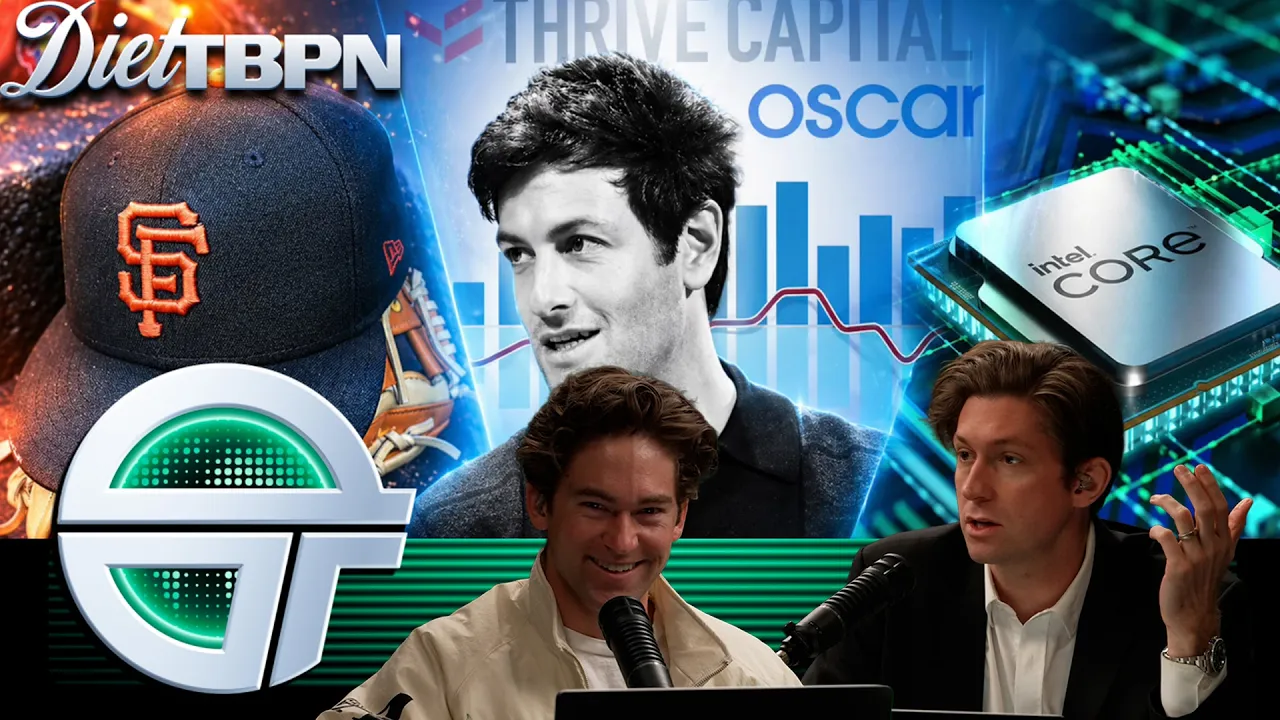
Intel Surges as AI Agent Workflows Drive Unexpected CPU Demand
TBPN
Intel's Q1 revenue beat and Q2 guidance signal a fundamental shift in AI data center architecture, where agentic orchestration demands significantly higher CPU-to-GPU ratios.
## Background
Diet TBPN published this episode on YouTube on April 25, 2026. According to the page description, Diet TBPN offers a 30-minute condensed version of the daily TBPN live tech talk show hosted by John Coogan and Jordi Hays, which covers major news across tech, Silicon Valley, and AI.
## TL;DR
The episode analyzes Intel's Q1 earnings rally and its strategic turnaround driven by the rising CPU demand from AI agent workflows and domestic US fab backing. It explores AI infrastructure economics, including compute bottlenecks between OpenAI and Anthropic, Cursor's inference margins, and Elon Musk's ambitious 'Terafab' plans. Additionally, the hosts touch on quick hits like Josh Kushner's launch of Thrive Eternal, early observations on OpenAI's GPT-5.5 release, and recent tech M&A developments.
## Atmosphere & style
The show carries a fast-paced, irreverent, and witty banter style typical of modern tech podcasts. Coogan and Hays blend serious financial and technical analysis with deadpan humor, teasing industry news and viral memes with relaxed insider confidence. The vibe feels like listening in on a sharp, candid conversation between Silicon Valley insiders who take the industry's rapid developments seriously without taking themselves too seriously.
## Key takeaways
- [00:02](https://www.youtube.com/watch?v=YZ-3WTxZXL8&t=2s) Intel's Q1 revenue reached $13.6 billion with an adjusted net income of $1.5 billion, beating analyst estimates and driving a 20% stock surge.
- [00:02](https://www.youtube.com/watch?v=YZ-3WTxZXL8&t=2s) The rapid adoption of agentic AI workflows is triggering a 'CPU crunch,' driving up demand for CPUs alongside traditional GPUs.
- [02:08](https://www.youtube.com/watch?v=YZ-3WTxZXL8&t=128s) The traditional CPU-to-GPU deployment ratio in data centers is shifting from 1:8 toward 1:4, with forecasts suggesting it could eventually reach 8:1 for lightweight agentic workloads.
- [02:08](https://www.youtube.com/watch?v=YZ-3WTxZXL8&t=128s) The U.S. government's 10% equity stake in Intel and federal semiconductor mandates are increasingly viewed as strategic necessities for national security and supply chain resilience.
- [08:03](https://www.youtube.com/watch?v=YZ-3WTxZXL8&t=483s) Elon Musk’s ambitious 'Terafab' project targets an ultimate capacity of 1 million wafers per month, representing roughly 70% of TSMC's global monthly output.
- [12:45](https://www.youtube.com/watch?v=YZ-3WTxZXL8&t=765s) Cursor reported a -23% gross margin earlier in the year due to high API inference costs, though falling costs and fine-tuned models are expected to normalize margins.
- [14:42](https://www.youtube.com/watch?v=YZ-3WTxZXL8&t=882s) Annual economic spend on AI inference is projected to grow from ~$40 billion to $100 billion, with compute infrastructure serving as the main bottleneck for major model labs.
- [15:57](https://www.youtube.com/watch?v=YZ-3WTxZXL8&t=957s) Tier-one AI labs maintain ~50% gross margins due to overwhelming token demand outpacing the physical hardware supply chain.
- [19:50](https://www.youtube.com/watch?v=YZ-3WTxZXL8&t=1190s) Investor Elad Gil advised AI startups to consider acquisition exits over the next 12 to 18 months due to long-term durability risks against major labs.
- [21:08](https://www.youtube.com/watch?v=YZ-3WTxZXL8&t=1268s) Jane Street generated $40 billion in revenue with only 3,500 employees last year, outperforming major Wall Street institutions.
- [21:08](https://www.youtube.com/watch?v=YZ-3WTxZXL8&t=1268s) Thrive Capital announced 'Thrive Eternal,' a permanent capital holding company aiming to back long-term assets and cultural institutions like the San Francisco Giants.
- [23:07](https://www.youtube.com/watch?v=YZ-3WTxZXL8&t=1387s) Cohere is reportedly merging with German AI lab Aleph Alpha.
- [24:51](https://www.youtube.com/watch?v=YZ-3WTxZXL8&t=1491s) GPT-5.5 demonstrates refined reasoning and conversational common sense, direct API availability, and aligns closely with long-term AI capability projections.
## Detailed walkthrough
### [00:02](https://www.youtube.com/watch?v=YZ-3WTxZXL8&t=2s) Intel's Stock Rallies on Q1 Earnings and the Agentic AI Surge
Intel's stock surged by 20% in after-hours trading following its Q1 earnings release, reaching near all-time highs. The company reported $13.6 billion in revenue—beating analyst estimates by 11%—and guided Q2 revenue above $14 billion. Although Intel posted a headline loss of $3.7 billion for the quarter, this figure was largely driven by one-off charges tied to Mobileye and derivative payments linked to the U.S. government's 10% equity stake. Stripping out these one-off items reveals an underlying profit of $1.5 billion, significantly outperforming market expectations of a break-even quarter.
This financial turnaround coincides with a broader narrative shift around the role of CPUs in AI infrastructure. While the first wave of the AI trade benefited GPU makers like Nvidia, memory suppliers, TSMC, and power providers, Intel was previously viewed as an embarrassing laggard that missed mobile, fell behind in foundry capabilities, and failed to capture data center GPU market share. However, the rapid adoption of AI agents is creating a massive "CPU crunch." Orchestrating agentic workflows, managing memory, routing jobs, and handling inference workloads require substantial central processing power alongside GPUs.
- **Q1 Revenue:** $13.6 billion (11% above estimates; up 7% year-over-year).
- **Q2 Revenue Guidance:** Projected at >$14 billion.
- **Adjusted Net Income:** $1.5 billion (compared to headline loss of $3.7 billion due to Mobileye and U.S. government stake charges).
- **Data Center Revenue:** $5.1 billion for the quarter, beating the $4.5 billion consensus estimate.
[02:08](https://www.youtube.com/watch?v=YZ-3WTxZXL8&t=128s) The Strategic Shift: U.S. Backing, Fabs, and Changing CPU-to-GPU Ratios
The hosts reflect on how public perception of the U.S. government taking a 10% stake in Intel has evolved. Initially viewed by critics as a state bailout or an uncomfortable departure from free-market capitalism, it is increasingly seen through the lens of national security, supply chain resilience, and Taiwan risk. Analysts like Ben Thompson had previously highlighted the strategic necessity of establishing domestic leading-edge fab capacity backed by demand guarantees from federal initiatives and hyperscalers.
A major driver of Intel's re-evaluation is the changing physical ratio of CPUs to GPUs in AI data centers. Intel CEO Lip-Bu Tan noted on the earnings call that the AI paradigm is shifting from training foundational models to running inference and deploying autonomous agents. This transition is driving up CPU demand significantly. Wall Street analysts, including Mark Lapidus of Evercore ISI (who upgraded Intel from Neutral to Outperform), suggest the traditional CPU-to-GPU deployment ratio—historically around 1 CPU for every 8 GPUs—has already tightened to 1:4 and could eventually invert to 8 CPUs for every 1 GPU as lightweight or open-source agent workflows proliferate.
- **CPU-to-GPU Ratio Shift:** Historically 1:8; currently moving toward 1:4; forecasted by some analysts to reach 8:1 in high-agentic environments.
- **Key Industry Commentary:** Jim Cramer remarked that in 13 months, Lip-Bu Tan transitioned Intel from an "unthinkable bailout candidate to one of the wealthiest companies in the chip industry."
- **Five Core Demand Drivers for Intel:**
1. Escalating CPU requirements for AI agents.
2. Increased need for advanced packaging and higher CPU-to-GPU system integration.
3. U.S. national security mandate for domestic leading-edge foundry capacity.
4. Mass-scale demand from ambitious projects like Elon Musk’s "Terafab."
5. Broader hyperscaler appetite for diversified chip supply.
[08:03](https://www.youtube.com/watch?v=YZ-3WTxZXL8&t=483s) Elon Musk’s "Terafab" Ambitions and Global Foundry Bottlenecks
Elon Musk’s ambitious "Terafab" initiative represents a potential wild card for Intel's long-term manufacturing trajectory. Musk aims to build a vertically integrated semiconductor manufacturing operation to supply chips for Tesla, SpaceX, xAI, humanoid robots, and orbital AI data centers, with Intel slated to assist in chip design, fabrication, and packaging. The project targets an initial production capacity of 100,000 wafers per month, with a long-term goal of reaching 1 million wafers per month.
To put these figures in perspective, 1 million wafers per month represents roughly 70% of TSMC's total global monthly output across all its facilities. Reaching such scale would require the equivalent of ten leading-edge TSMC mega-fabs dedicated solely to the Terafab project. As TSMC CEO C.C. Wei has noted, semiconductor fabs typically require two to three years to construct and an additional one to two years to fully ramp up production, as seen with the delays surrounding TSMC's Arizona facilities.
- **Terafab Target Scale:** Initial target of 100,000 wafers/month; ultimate goal of 1,000,000 wafers/month.
- **Contextual Scale:** 1 million wafers/month equals ~70% of TSMC's entire global capacity.
- **Fab Lead Times:** 2–3 years for physical build-out, plus 1–2 years for yield ramp-up.
[12:45](https://www.youtube.com/watch?v=YZ-3WTxZXL8&t=765s) Cursor's Financial Leak and the AI Inference Margin Puzzle
The focus shifts to software with reports from *The Information* regarding the financials of Cursor (Anysphere), the popular AI-assisted coding environment. Amid rumors of a potential acquisition or massive funding deal valued at up to $60 billion, leaked financials revealed that Cursor operated at a negative 23% gross margin earlier in the year.
The negative gross margin highlights the high underlying cost of API inference calls required to run advanced coding models like Claude or GPT-4. However, the hosts note that user retention remains strong, particularly through features like "Composer." Customers routinely exhaust their plan limits and adapt their workflows to stay within budget. As inference costs decrease and companies begin running their own fine-tuned or hosted models (such as xAI or Colossus 2 infrastructure), Cursor's gross margins are expected to normalize upward.
- **Cursor Gross Margin:** Reported at -23% earlier in the year due to heavy LLM inference costs.
- **Valuation Context:** Rumored $60 billion buyout/valuation discussions reported in tech media.
[14:42](https://www.youtube.com/watch?v=YZ-3WTxZXL8&t=882s) Compute Bottlenecks: OpenAI, Anthropic, and the Race for Infrastructure
The show highlights an excerpt from Dylan Patel's appearance on Patrick O'Shaughnessy's podcast discussing the dynamic between OpenAI and Anthropic. While Anthropic's models (such as the Claude series) have gained significant market share among developers and power users, the company faces severe compute constraints. Anthropic co-founder Dario Amodei and former OpenAI chief scientist Andrej Karpathy had previously advocated for a more measured approach to compute scaling, but Anthropic now finds itself constrained by limited infrastructure capacity.
Conversely, OpenAI aggressively secured compute capacity through massive agreements with Microsoft, Oracle, CoreWeave, SoftBank, and AWS (utilizing Trainium chips). Dylan Patel estimates that if a top-tier model family (such as a hypothetical Opus 4.6 tier) generates $100 billion in annual economic spending on inference by year-end (up from ~$40 billion currently), compute capacity will be the primary bottleneck dictating which AI lab captures that revenue.
- **Current AI Inference Spend:** Estimated at ~$40 billion annually, with projections reaching $100 billion as model adoption diffuses across enterprise workflows.
- **Infrastructure Providers:** Oracle, CoreWeave, SoftBank, Microsoft, and Amazon (Trainium).
[15:57](https://www.youtube.com/watch?v=YZ-3WTxZXL8&t=957s) Compute Constraints, Margin Expansion, and Bill Gurley's Critique
The hosts debate the economics of AI infrastructure, noting that tier-one labs maintain 50% gross margins while still being overwhelmed by token demand. Compute constraints and skyrocketing H100 prices mean even tier-two and tier-three labs will sell out of capacity. Economic value generated by top models is outpacing the hardware supply chain's ability to serve tokens, allowing model labs to expand margins until hardware suppliers start raising prices in response.
The discussion pivots to a post by VC Bill Gurley, who argued that claims of data center and energy constraints are "foreign," noting that in normal markets, price acts as a leveler—if there is a constraint, labs should price higher rather than claim surplus demand. The hosts counter that revenue at major labs is not heavily VC-subsidized in a traditional sense, as demand is driven by high-margin Fortune 500 enterprises, hedge funds, and banks.
- Anthropic raised ~$4B from Google, reflecting corporate strategic investment rather than purely VC funding.
- Enterprise customers and everyday subscribers derive immediate value from $20/month tiers and custom software, rendering the "VC subsidy" argument incomplete.
- Address Martin Shkreli's debunking of the "circular economy" narrative, asserting that AI revenue spans across 25 different sectors, creating a self-perpetuating market loop.
[19:50](https://www.youtube.com/watch?v=YZ-3WTxZXL8&t=1190s) Elad Gil's Bullish Outlook and Tactical Portfolio Advice
Investor Elad Gil shared a post reaffirming his view that the AI boom is a "once-in-a-lifetime transformation." However, he advised that many AI startups should consider exiting over the next 12 to 18 months due to a lack of long-term durability against primary labs, new market entrants, or sudden sector shifts.
Gil included a tongue-in-cheek post about his "new life plan"—moving to Brooklyn, getting a neck tattoo, riding a bike, and learning to cold brew coffee. The hosts joke that this bizarre post is a coded message to portfolio founders urging them to lock in acquisition exits while valuations remain high.
[21:08](https://www.youtube.com/watch?v=YZ-3WTxZXL8&t=1268s) Quick Hits: Jane Street's Scale and Thrive Eternal Launch
The hosts briefly highlight Jane Street's staggering metrics, noting they generated $40 billion in revenue last year with only 3,500 employees—more than major Wall Street banks—prompting the joke that they may have "achieved AGI internally."
Josh Kushner announced **Thrive Eternal**, a permanent capital holding company under Thrive Capital designed to hold high-conviction assets over decades. Alongside backing tech and infrastructure, Kushner highlighted a new category of investments: irreplaceable cultural institutions. Thrive Eternal's first expected partnership is with the San Francisco Giants baseball franchise. The host deadpans a primary-school definition of baseball, prompting the co-host to joke that someone should make a "TBPN-style show" with live coverage for sports.
[23:07](https://www.youtube.com/watch?v=YZ-3WTxZXL8&t=1387s) Special Ops Betting Scandal, Generative AI Minecraft, and Cohere Merger
A U.S. special forces soldier involved in the operation targeting Venezuelan President Nicolás Maduro was arrested for allegedly betting on the mission's outcome, earning $400,000 in profit. The hosts mock the situation as "the 'betting on yourself' meme gone wrong."
- **Interactive Generative AI:** A user demonstrated playing a text-and-image "Minecraft" inside ChatGPT by prompting the model to generate a scene, then issuing commands like "walk closer" to render the next frame.
- **M&A News:** Cohere is reportedly merging with German AI lab Aleph Alpha. The hosts praise Cohere CEO Aidan Gomez, referencing his co-authorship of the original Transformer paper and his taste in music (Death Grips).
[24:51](https://www.youtube.com/watch?v=YZ-3WTxZXL8&t=1491s) GPT-5.5 Capabilities, Historical Predictions, and X Chat
The conversation turns to early observations around OpenAI's GPT-5.5 release. Tech commentator Kits noted its refined reasoning abilities, highlighting a prompt where a user asks in casual slang whether to walk or drive to a car wash 5 minutes away; the model directly responds, "Car, bro, it's a car wash." The hosts celebrate this step forward, noting that LLMs traditionally struggle to reject nonsensical options while mirroring user tone.
The hosts bring up a 5.5-year-old post from Elon Musk praising the rate of progress from GPT to GPT-3, where Musk predicted GPT-5 or GPT-6 could be indistinguishable from the smartest humans. Greg Brockman acknowledged the post, highlighting how accurate the projection turned out to be.
- **X Chat Launch:** X launched a standalone messaging app called "X Chat" featuring encrypted DMs.
- While critics poked fun at the "everything app" splitting into separate applications, the hosts defend having dedicated tools for high-volume messaging.
- **API Availability:** Greg Brockman confirmed that GPT-5.5 is live in the OpenAI API.
## Notable quotes
> [02:08](https://www.youtube.com/watch?v=YZ-3WTxZXL8&t=128s) unthinkable bailout candidate to one of the wealthiest companies in the chip industry — Jim Cramer
Intel's financial rebound and the compute demands of autonomous AI agents have triggered a strategic re-evaluation of central processors and domestic chip manufacturing. Concurrently, frontier labs and software developers face severe compute bottlenecks and inference costs that are reshaping venture strategies and capital models.
Intel's Turnaround and the Agentic CPU Crunch (0:02)
Intel reported Q1 revenue of $13.6 billion—surpassing analyst estimates by 11%—and guided Q2 revenue above $14 billion. Although one-off charges tied to Mobileye and derivative payments on the U.S. government's 10% equity stake produced a headline net loss of $3.7 billion, Intel achieved an underlying profit of $1.5 billion, with data center revenue reaching $5.1 billion. The stock rallied 20% in after-hours trading, reflecting renewed confidence in domestic fabrication and shifting compute requirements.
Intel CEO Lip-Bu Tan and industry analysts note that the industry's pivot from training foundation models to running inference and deploying autonomous agents requires significant CPU power alongside GPUs. Evercore ISI analyst Mark Lapidus highlighted that the traditional data center ratio of one CPU for every eight GPUs has tightened to 1:4 and could eventually invert to 8:1 in agent-heavy environments to manage complex orchestration, job routing, and memory handling.
Compute Scarcity and the Economics of Inference (14:42)
The commercial scaling of AI is colliding with infrastructure bottlenecks. Dylan Patel noted that while Anthropic's Claude series has captured substantial developer share, OpenAI aggressively secured hardware capacity across Microsoft, Oracle, CoreWeave, SoftBank, and AWS. With annual economic spending on AI inference projected to expand from $40 billion to $100 billion, available compute capacity will largely determine which foundation labs capture that revenue. Although investor Bill Gurley argued that hardware constraints should naturally clear via higher market pricing rather than persistent shortages, observers pointed to sustained enterprise demand across 25 industry sectors that allows tier-one labs to maintain 50% gross margins.
Application-layer businesses face sharper short-term margin pressures. Leaked financials reported by The Information showed that coding assistant Cursor operated at a negative 23% gross margin earlier in the year due to the high cost of underlying model API calls, even as it pursued funding and buyout discussions valuing the firm at up to $60 billion. Cursor's margins are anticipated to normalize as baseline inference costs decline and developers adopt fine-tuned or hosted infrastructure.
Silicon Realities Behind Musk's Terafab Ambitions (8:03)
Elon Musk's proposed "Terafab" project represents a high-profile initiative to secure a vertically integrated chip supply for Tesla, SpaceX, xAI, robotics, and orbital data centers, with Intel slated to assist in design, fabrication, and packaging. The project outlines an initial manufacturing target of 100,000 wafers per month and an ultimate goal of 1 million wafers per month.
Achieving the long-term target would equal roughly 70% of TSMC's total global capacity, requiring the equivalent of ten dedicated leading-edge mega-fabs. Fulfilling such targets faces significant lead-time constraints; as TSMC CEO C.C. Wei has observed, building and ramping leading-edge semiconductor fabs typically requires two to three years of physical construction followed by one to two years to stabilize production yields.
Capital Realignment and Advancing Frontier Models (19:50)
Changing market conditions are driving structural shifts across tech investing. Investor Elad Gil advised early-stage AI startups to consider acquisition exits over the next 12 to 18 months rather than attempting to outlast heavily capitalized frontier labs. In parallel, Thrive Capital unveiled Thrive Eternal, a permanent capital vehicle designed for multi-decade holdings across technology infrastructure and cultural institutions, highlighted by a prospective partnership with the San Francisco Giants.
Frontier capabilities and ecosystem consolidation continue to progress. Cohere is reportedly pursuing a merger with Germany's Aleph Alpha. Meanwhile, OpenAI launched GPT-5.5 into its API, demonstrating improved reasoning and conversational tone adaptation, and X rolled out X Chat, a standalone application dedicated to encrypted messaging.
While surging agentic inference workloads have revitalized demand for legacy processor architectures and domestic foundries, the broader AI ecosystem remains bound by lengthy physical fab construction timelines and steep model serving costs, leaving open the question of how quickly application-layer software margins will stabilize.
## Background
该内容由科技对谈播客节目 TBPN 于 2026 年 4 月 25 日发布在 YouTube 平台上,本期属于精简版栏目《Diet TBPN》。节目由 John Coogan 和 Jordi Hays 主持,聚焦硅谷每日最新技术风向与商业动态,本期简介重点涵盖了英特尔业绩反弹、Thrive 推出 Eternal 基金以及 GPT-5.5 的发布等热门话题。
## TL;DR
本期节目首先深度复盘了英特尔在 AI Agent 浪潮推动下的强劲财报与股价暴涨,探讨了数据中心 CPU 配比反弹、国家安全背书及马斯克 Terafab 构想带来的多重催化。随后,主持人们分析了 Cursor 传闻中的 600 亿美元收购与负毛利率争议,并结合顶尖实验室算力短缺与比尔·格利的市场调节论,剖析了当下 AI 推理经济的真实供需。最后,节目还速览了 Jane Street 惊人的创收效率、Thrive Eternal 入股棒球队的文化投资逻辑,以及 GPT-5.5 展现的常识推理与冷幽默能力。
## Atmosphere & style
整期节目洋溢着典型的硅谷科技播客风格,快节奏、高信息密度且充斥着极客式的幽默与讽刺。两位主持人配合默契、互相抛梗,既能用硬核视角严谨拆解晶圆产能与模型经济学,又会在科普棒球规则或吐槽“把赌注押在自己身上”的反面教材时放声大笑。听感上既像是在收听一份前沿行业内参,又像置身于两位熟悉硅谷内幕的极客好友之间轻松畅快的周末茶话会。
## Bulletin
- [00:02](https://www.youtube.com/watch?v=YZ-3WTxZXL8&t=2s) 英特尔第一季度营收 136 亿美元超预期,盘后暴涨 20%;剔除 Mobileye 减值等非经常性支出后核心利润达 15 亿美元,标志着市场对其重估叙事的开启。
- [04:14](https://www.youtube.com/watch?v=YZ-3WTxZXL8&t=254s) AI Agent(智能体)的复杂编排与推理调度引爆 CPU 算力挤兑,数据中心 CPU 对 GPU 配置比从 1:8 大幅跃升至 1:4,极端场景甚至可能逆转至 8:1。
- [14:41](https://www.youtube.com/watch?v=YZ-3WTxZXL8&t=881s) 全球宏观经济体推理支出预计将在 2026 年底暴增至 1000 亿美元,模型价值增速大幅碾压物理算力交付速度,Anthropic 等头部实验室深陷供给瓶颈。
- [21:06](https://www.youtube.com/watch?v=YZ-3WTxZXL8&t=1266s) Thrive Capital 推出永久资本平台 Thrive Eternal,拓展投资逻辑至无法被 AI 替代的百年文化与体育资产,首笔标的瞄准旧金山巨人队。
- [26:33](https://www.youtube.com/watch?v=YZ-3WTxZXL8&t=1593s) OpenAI 宣布 GPT-5.5 正式接入 API,该模型在常识意图识别、冷幽默应对以及拒绝荒谬前提的能力上取得显著飞跃。
## Key takeaways
- [00:02](https://www.youtube.com/watch?v=YZ-3WTxZXL8&t=2s) 英特尔 Q1 营收 136 亿美元且下一季度指引向好,虽然账面受非经常性项目拖累亏损 37 亿美元,但实际核心运营利润达 15 亿美元,逆转了此前落后于 AI 浪潮的叙事。
- [02:08](https://www.youtube.com/watch?v=YZ-3WTxZXL8&t=128s) 美国政府 10% 股权入股赋予英特尔本土晶圆制造的国家安全战略背书,促成白宫协调超大规模云巨头向其先进制程产能提供刚性采购承诺。
- [04:14](https://www.youtube.com/watch?v=YZ-3WTxZXL8&t=254s) Agentic AI 时代的到来使系统重度依赖 CPU 进行任务调度、内存管理与高并发推理路由,推动英特尔数据中心营收显著超预期。
- [08:03](https://www.youtube.com/watch?v=YZ-3WTxZXL8&t=483s) 马斯克为垂直整合而构想的“Terafab”初期目标月产 10 万片、终极目标 100 万片晶圆(相当于台积电全球月产能的 70%),但受到半导体漫长工程建设周期的现实制约。
- [09:39](https://www.youtube.com/watch?v=YZ-3WTxZXL8&t=579s) 英特尔暴涨的核心支撑在于五大共振叙事:智能体 CPU 需求激增、先进封装架构配比提升、美国国家安全指令、马斯克天量芯片诉求以及超大规模云厂商的多元产能渴求。
- [12:44](https://www.youtube.com/watch?v=YZ-3WTxZXL8&t=764s) 传闻估值达 600 亿美元的 AI 编程工具 Cursor 虽曾录得 -23% 的负毛利,但凭借 Composer 等杀手级功能铸就了深厚的用户粘性,后续有望通过自有推理模型改善单位经济效益。
- [14:41](https://www.youtube.com/watch?v=YZ-3WTxZXL8&t=881s) AI 顶尖模型所创造的商业价值增速已彻底压倒物理基础设施(芯片与电力)的交付速度,导致第一梯队及后续承接溢出需求的模型实验室产能全面售罄。
- [16:50](https://www.youtube.com/watch?v=YZ-3WTxZXL8&t=1010s) 当前 AI 算力支出主要由科技巨头现金流再投资、华尔街投行与财富 500 强企业的明确 ROI 驱动,并非由传统风险投资补贴催生的虚假繁荣。
- [18:52](https://www.youtube.com/watch?v=YZ-3WTxZXL8&t=1132s) 虽然实体经济正在形成可持续的真实 AI 消费闭环,但由于前沿大模型与新入局者的激烈竞争,初创公司仍被建议在未来 12 到 18 个月内积极寻求并购套现。
- [21:06](https://www.youtube.com/watch?v=YZ-3WTxZXL8&t=1266s) 量化交易巨头 Jane Street 仅凭约 3,500 名员工便创造 400 亿美元年营收,人均效能大幅领先传统华尔街投行。
- [21:06](https://www.youtube.com/watch?v=YZ-3WTxZXL8&t=1266s) Thrive Eternal 开启永久持有模式,重点布局历经时间检验、无法被技术复制的标志性资产,并将职业体育球队(旧金山巨人队)纳入版图。
- [24:24](https://www.youtube.com/watch?v=YZ-3WTxZXL8&t=1464s) Cohere 传出与德国 Aleph Alpha 探讨合并;新一代 GPT-5.5 在面对“五分钟去洗车店是走路还是开车”等问题时展现出极佳的常识与反问能力。
- [26:33](https://www.youtube.com/watch?v=YZ-3WTxZXL8&t=1593s) X 平台推出独立即时通讯应用“X Chat”以改善长期以来的卡顿与刷新 Bug,同时 OpenAI 确认 GPT-5.5 已经向开发者全面上线 API 服务。
## Detailed walkthrough
### [00:02](https://www.youtube.com/watch?v=YZ-3WTxZXL8&t=2s) 英特尔财报暴涨:被遗忘的芯片巨头逆势翻盘
英特尔(Intel)迎来了绝对爆发的一天。在公布第一季度实现 136 亿美元营收后,其股价在盘后交易中直接暴涨 20%。尽管这一数字仅比分析师预期高出 11%,但五大关键因素的交汇正在彻底重构围绕英特尔的叙事,推动股价逼近历史高位。X 平台上的观察者们甚至惊呼这几乎是一场“久违的重估”。虽然单季营收同比仅增长 7%,但公司对下一季度的指引相当乐观,预计营收将突破 140 亿美元。
在亮丽的营收表面下,英特尔账面上仍存在巨额亏损:本季度亏损达 37 亿美元。然而,细看报表便会发现,这笔巨额赤字主要归因于与 Mobileye 相关的单次减值准备,以及与美国政府持有其 10% 股权绑定的衍生品支出。如果将这些非经常性费用剥离,英特尔的实际核心利润为 15 亿美元,远胜市场普遍预期的微幅盈亏平衡。英特尔这艘动作迟缓的“巨型邮轮”终于开始掉头,市场叙事也完全逆转为“英特尔重新奏效了”。
此前整场人工智能牛市的焦点几乎全被英伟达(Nvidia)、高带宽内存供应商、台积电、电力基础设施、云厂商资本开支以及极少数具备真实落地能力的软件厂商所垄断。市场公认的铁律是:只有加速营收增长的公司才是 AI 赢家。作为发明现代 CPU 时代的鼻祖,英特尔却成了算力狂潮中最尴尬的缺席者——它不仅错失了移动互联网,在先进制程上被台积电超越,甚至从未造出过一款能在数据中心或 AI 训练集群中站稳脚跟的杀手级 GPU。过去几年,英特尔一直在苦苦向全世界证明自己依然不可或缺,而如今,AI Agent(智能体)的爆发竟戏剧性地给了英特尔重回舞台中央的第二次机会。
- **Q1 核心营收**:136 亿美元(超市场预期 11%,同比增长 7%)。
- **Q2 展望指引**:预计将突破 140 亿美元。
- **账面亏损与调整后利润**:账面亏损 37 亿美元(受 Mobileye 减值及美国政府 10% 股权衍生品支出拖累);扣除非经常性项目后实际盈利 15 亿美元。
---
### [02:08](https://www.youtube.com/watch?v=YZ-3WTxZXL8&t=128s) 国家安全底色与政府入股:从“救助”到晶圆厂保障
回顾半年前美国政府正式入股英特尔并持有其 10% 股份的时刻,整场交易在当时给外界的感觉更像是一场无奈的“官方纾困”。彼时市场几乎无人敢预言英特尔能如此迅速地在短短六个月内翻盘。科技分析师本·汤普森(Ben Thompson)当时曾撰写过一份极具说服力的看多论调,但投资者在当时不得不直面一个令人不安的问题:这究竟还算不算是纯粹的自由市场资本主义?
在政府入股交易发生时,公众视野中尚未出现如今由 CPU 引领的算力需求逻辑。当时最响亮的做多逻辑完全建立在两点之上:一是全行业对先进制程晶圆制造的饥渴,二是国家安全战略考量。作为美国本土拥有先进制程潜力的独苗,英特尔拥有了政府背书作为后盾。在白宫召集各大前沿 AI 实验室与超大规模云厂商(Hyperscalers)CEO 的私密闭门宴会上,政府完全有底气要求这些巨头承诺采购英特尔未来晶圆厂的产能。有了坚实的保底需求,英特尔才能承担起烧钱数百亿美元建设先进制程晶圆厂的豪赌。
面对台海地缘政治的潜在风险,英特尔早已成为许多宏观地缘战略家眼中必须持有的核心资产。如果海外半导体供应链遭遇黑天鹅冲击,美国别无选择,本土晶圆制造产能将直接等同于国家安全命脉。
```mermaid
flowchart TD
accTitle: Government Backing and Strategic Shift
accDescr: Flowchart illustrating how government backing and geopolitical risks drive commitments to Intel's leading-edge fabs.
subgraph Defense ["国家安全与地缘战略"]
GEO["台海供应链潜在断链风险"]
SEC["美国本土芯片制造刚性诉求"]
end
subgraph GovSupport ["美国政府入股与背书"]
STAKE["美国政府持有 10% 股权"]
WHITEHOUSE["白宫穿梭协调超大规模云巨头"]
end
subgraph IntelFabs ["英特尔制造与先进制程"]
COMMIT["超大规模客户长期采购保底"]
FABBUILD["百亿美元级先进制程晶圆厂落地"]
end
GEO --> SEC
SEC --> STAKE
STAKE --> WHITEHOUSE
WHITEHOUSE --> COMMIT
COMMIT --> FABBUILD
```
---
### [04:14](https://www.youtube.com/watch?v=YZ-3WTxZXL8&t=254s) AI Agent 掀起 CPU 荒:架构比率的剧烈反转
尽管 AI 预测机构此前成功预言了智能体会在当下全面落地,但极少有人料到智能体会引发一场针对 CPU 的严重算力挤兑。前沿大模型的预训练依然是 GPU 的天下,然而当智能体工作流在跨数据中心中大规模运行时,任务编排、流程路由、内存与状态管理、高并发推理调度以及成千上万台服务器的统筹,全都需要严重依赖原本被视为“枯燥乏味”的传统中央处理器(CPU)。
英特尔的数据中心部门交出了 51 亿美元的单季营收成绩单,大幅超出华尔街预期的 45 亿美元。英特尔首席执行官陈立武(Lip-Bu Tan)在财报电话会议中明确指出,AI 的下一波浪潮正在从基座大模型向推理演进,并最终进入 Agentic AI(智能体人工智能)时代。这一深刻变革直接引爆了对英特尔 CPU、优质晶圆及先进封装技术的渴求。陈立武披露,当前数据中心中的 CPU 与 GPU 配置比例已从过去的 1:8 大幅跃升至接近 1:4;更有宏观研究团队和华尔街机构大胆预测,随着推理与智能体占比持续加重,该比率甚至可能逆转为惊人的 8:1。
```mermaid
flowchart LR
accTitle: CPU to GPU Ratio Shift
accDescr: Diagrams the evolution of CPU to GPU deployment ratios in data center infrastructure.
subgraph Past ["历史基准架构"]
P1["1 颗 CPU"] --- P2["8 颗 GPU<br/>(专注模型训练)"]
end
subgraph Present ["当前智能体演进"]
C1["1 颗 CPU"] --- C2["4 颗 GPU<br/>(推理与混合负载)"]
end
subgraph Projection ["极端多智能体设想"]
F1["8 颗 CPU<br/>(调度/记忆/路由)"] --- F2["1 颗 GPU<br/>(纯生成推理)"]
end
Past --> Present
Present -.-> Projection
```
Evercore ISI 分析师马克·拉皮德斯(Mark Lapidus)直接将英特尔股票评级由“中性”上调至“跑赢大盘”。在节目现场,主持人们就这一“疯狂比率”展开了热烈争辩:
- 一种观点对此持审慎怀疑,认为根据 Dylan Patel 近期在播客中的判断,前沿大模型只会越来越庞大昂贵,Token 的定价居高不下,重度算力依然会被 GPU 牢牢锁死;
- 另一种观点则反驳称,只要你信奉开源生态或多智能体协同,哪怕是一个用 GPU 花费上千小时“凭感觉敲代码”(Vibe-coded)生成的轻量级系统,最终部署上线服务千万用户时,日常运转依然是在无数 CPU 上不间断消耗算力。
- 无论比例最终是冲上 8:1 还是稳定在 1:4,相比过去 1:8 的冰冷低谷,英特尔的 CPU 市场需求已经整整翻倍。
---
### [08:03](https://www.youtube.com/watch?v=YZ-3WTxZXL8&t=483s) 埃隆·马斯克的“Terafab”狂想与晶圆制造的物理重力
在这场英特尔复兴叙事中,最引人瞩目但也最具不确定性的变量,当属埃隆·马斯克(Elon Musk)构想中的“Terafab”(兆级晶圆厂)计划。马斯克意图为其商业帝国打造极度垂直整合的自主芯片制造能力:特斯拉的自动驾驶车辆、Optimus 人形机器人、SpaceX 乃至未来部署在太空的 AI 轨道数据中心,都对芯片有着近乎天文数字的需求。在该计划中,英特尔将扮演协助芯片设计、代工制造以及高级封装的关键角色。
然而,《华尔街日报》等专业财经媒体对这一宏伟蓝图给出了更为务实的审视。马斯克为 Terafab 设定的目标是初期月产 10 万片晶圆,最终迈向月产 100 万片晶圆的恐怖体量。将这一数据放入全球半导体格局中审视,其夸张程度令人咋舌:
- 100 万片晶圆的月产能相当于台积电全球所有晶圆厂总月产量的近 70%。
- 台积电旗下规模最大的一线超大晶圆厂(GigaFab),单厂月产能在 10 万片左右。
- 达成 Terafab 的最终目标,意味着英特尔需要为马斯克凭空打造出相当于 10 座台积电顶级旗舰晶圆厂的产能规模。
半导体产业终究要受制于物理与工程周期的客观规律。正如台积电董事长兼首席执行官魏哲家所言,顶级晶圆厂绝不可能一夜之间凭空拔地而起。一座晶圆厂从破土动工到结构封顶通常需要两到三年,随后还需要一至两年时间进行设备进场、工艺调试与良率爬坡。台积电在美国亚利桑那州工厂经历的漫长拉锯便是明证。先进制程晶圆厂极高的资本支出门槛与建设周期,注定 Terafab 将是一场横跨数年的漫长硬仗,英特尔是否真能借此蜕变,依然有待时间与资本开支执行力的检验。
### [09:39](https://www.youtube.com/watch?v=YZ-3WTxZXL8&t=579s) 英特尔股价暴涨背后的五大需求叙事
尽管实际的芯片需求尚未出现垂直拉升,英特尔(Intel)的股价却走出了一根令人惊叹的“上帝蜡烛”(god candle)。节目指出,推动这轮暴涨的核心是五条指向同一方向且高度可信的需求叙事:第一,AI Agent 需要消耗更多的 CPU;第二,先进封装与 AI 系统要求更高的 CPU 对 GPU 配比,而英特尔在封装领域具备深厚实力;第三,美国政府将扶持本土先进制程晶圆代工视为必须完成的国家战略指令;第四,埃隆·马斯克对算力芯片有着“天文数字般不可思议的需求”;第五,各大超大规模云服务商(Hyperscalers)极度渴望获得额外的产能供应。随着 ARM 等芯片设计公司相继入局并短期内依赖台积电,市场逐渐意识到长期内代工产能的稀缺性,华尔街也前所未有地乐于为昂贵且复杂的半导体战略买单。
```mermaid
flowchart TD
accTitle: 英特尔核心需求驱动体系
accDescr: 展示推动英特尔代工与芯片业务复苏的五大关键叙事因素
subgraph Hardware["硬件与架构需求"]
A["AI Agent 算力架构<br/>(CPU 需求激增)"]
B["先进封装与系统整合<br/>(提高 CPU:GPU 配比)"]
end
subgraph Customers["下游客户需求"]
C["马斯克与 xAI 的<br/>海量芯片诉求"]
D["超大规模云厂商<br/>(多元供应链渴望)"]
end
subgraph Policy["国家战略支持"]
E["美国政府扶持本土先进制程<br/>(国家安全硬性指令)"]
end
Hardware --> F["英特尔代工与业务反弹<br/>(股价垂直拉升)"]
Customers --> F
Policy --> F
```
回顾历史,英特尔当年错失移动端芯片市场,导致台积电凭借庞大的移动设备出货量获得了无可匹敌的规模优势,正如半导体行业常言的“产量即宿命(Volume was destiny)”。没有客户规模,就无法支撑数十亿美元建设下一代先进制程晶圆厂(Fab);而建不出先进工厂,又会进一步丢失客户。如今在政府补助、人工智能爆发与这五大支柱的共同支撑下,英特尔终于迎来了弥补代工鸿沟的历史性机遇。主持人们调侃道,这不仅是英特尔股东的胜利,甚至连持有美国国债的全球投资者都应该开香槟,同时借此打趣特朗普对政府救助的热衷——既然连精神航空(Spirit Airlines)都愿意拯救,特朗普看到英特尔的暴涨恐怕会萌生“直接入股超大规模云厂商让其市值翻三倍”的自信。
- 知名财经名嘴吉姆·克莱默(Jim Cramer)评价道,陈立武(Lip-Bu Tan)在短短 13 个月内,就把英特尔从一个“令人难以想象的政府潜在纾困对象”,转变成了芯片行业资金最雄厚的企业之一。
- CPU 领域目前已形成 AMD、英特尔与 ARM 的三足鼎立格局,而当下 AI Agent 的部署规模使得三家巨头的产能之和依然供不应求,进一步推高了产品定价与利润预期。
---
### [12:44](https://www.youtube.com/watch?v=YZ-3WTxZXL8&t=764s) Cursor 的 600 亿美元收购传闻与负毛利困局
在预告了贾斯汀·比伯重返 Coachella 音乐节以及晚些时候将探讨的后期风险投资重新加速的话题后,节目将焦点转向了 AI 编程神器 Cursor 的重磅财务传闻。科技媒体 *The Information* 披露了这家引领“Vibe Coding”风潮的初创公司的财务内幕。主持人一度口误将其即将达成的交易说成了“600 亿美元救助计划”,随即迅速更正为“600 亿美元天价收购(Buyout)”,并自嘲道刚才聊了太多英特尔救助,以至于脑子里全是 bailout。
引发广泛讨论的焦点在于 Cursor 此前高达 -23% 的毛利率。对于一家年化收入爆发式增长的公司而言,这种负毛利率在硅谷极为罕见。问题的关键在于 Cursor 作为 AI 推理入口的护城河与用户粘性究竟有多大:随着 Composer 等杀手级功能的普及,用户展现出了极高的忠诚度,即便在订阅配额内根据平台规则切换底层推理模型,也不会轻易离开该产品。
- 考虑到 SpaceX、xAI 的深度绑定以及超级算力集群 Colossus 2 的庞大算力储备,一旦 Cursor 将底层推理逐步迁移至自身微调模型或 xAI 的专有模型,其毛利率预计将迅速实现由负转正并大幅爬坡。
- Cursor 用户的行为模式证明了前端入口的价值:大部分开发者只关心特定套餐限额内任务能否高效完成,底层的具体模型调用已被抽象为平台调度。
---
### [14:41](https://www.youtube.com/watch?v=YZ-3WTxZXL8&t=881s) 算力饥荒:Anthropic、OpenAI 与分层大模型实验室的供给瓶颈
节目随后深入引用了投资人帕特里克·奥肖内西(Patrick O'Shaughnessy)关于顶尖 AI 实验室算力供给与模型经济学的深度推演。表面上看 Anthropic 在模型能力上处于领跑位置,甚至有人戏称 OpenAI 已经“落入下风”,但现实中 Anthropic 正面临极其严重的算力瓶颈。此前安德烈·卡帕斯(Andrej Karpathy)曾公开赞扬 Anthropic 在算力扩张上克制而理性,并批评 OpenAI 盲目激进;然而如今 Anthropic 却深陷“算力严重不足”的懊恼中,反观 OpenAI 则依靠疯狂融资,源源不断地从甲骨文(Oracle)、CoreWeave、软银(SoftBank)、微软(Microsoft)乃至亚马逊的 Trainium 芯片获取巨额增量算力。
```mermaid
flowchart LR
accTitle: AI 模型分层供给与吞吐瓶颈
accDescr: 描述顶尖模型由于基础设施短缺带来的溢价与次级实验室承接溢出需求的流动路径
subgraph Tier1["第一梯队实验室 (如 Anthropic / OpenAI)"]
T1M["顶级模型 (如 Opus 4.6 级别)"]
T1Margin["超高毛利 (70%+) 但算力极度短缺"]
end
subgraph Market["企业端激增需求"]
Dem["2026 年底预计 1000 亿美元<br/>推理 Token 支出需求"]
end
subgraph Tier23["第二 / 第三梯队实验室"]
T2M["次级模型提供商"]
T2Sold["承接溢出算力需求<br/>产能同样全部售罄"]
end
Dem --> T1M
T1M --> T1Margin
T1Margin -. 算力不足以完全承载.-> T2M
T2M --> T2Sold
```
技术扩散与企业采纳存在客观的时间滞后性。即使不考虑模型底层能力的持续迭代,仅就当前 Opus 4.6 级别的顶尖模型而言,整个宏观经济体到年底在推理上的支出预计将从目前的 400 亿美元暴增至 1000 亿美元。没有任何一家单一实验室拥有足够的物理算力来单独满足这一庞大市场。这意味着:
- 如果 Anthropic 率先推出下一代模型,他们可以维持 70% 以上的高毛利;
- 随后跟进的 OpenAI 即使毛利率降至 50%,依然能吃下所有的溢出需求,且其产能同样会被瞬间打满;
- 哪怕是第二甚至第三梯队的模型实验室,其推理 Token 也会被抢购一空。
最根本的矛盾在于:顶级 AI 模型所能创造的经济价值,其增长速度已经彻底碾压了人类物理基础设施部署芯片与电力的交付速度。这种供需剪刀差将持续推高老旧 GPU(如 H100)的二手价格并延长其生命周期,使大模型实验室在相当长一段时间内坐拥极高的定价权,直到硬件与能源供应链全面提高自身售价来分摊暴利。
---
### [16:50](https://www.youtube.com/watch?v=YZ-3WTxZXL8&t=1010s) 比尔·格利的价格调节论与“谁在补贴 AI 需求”的论战
针对上述关于算力瓶颈将持续推高溢价的论断,著名风险投资家比尔·格利(Bill Gurley)提出了尖锐的异议。格利公开表示,他对这种动辄宣称“数据中心受限、电力受限”的论调感到十分陌生;在自由市场经济的历史规律中,“价格永远是平衡供需天平的杠杆”,如果供给端存在不可逾越的瓶颈,企业理应通过大幅提价来出清市场,而不应该表现为持续的“过剩需求”。
主持人们对此展开了细致的辨析。格利所质疑的实质是当前 AI 需求是否属于“风险投资过度补贴下的虚假繁荣”。但现实情况截然不同:OpenAI 和 Anthropic 的核心付费客户根本不是朝不保夕的创业公司,而是通过半导体与科技股狂潮赚得盆满钵满的对冲基金、华尔街顶级投行以及名列财富 500 强的传统巨头。此外,当前注入大模型生态的真正巨额资金并非来自传统 VC,而是来自美股“七巨头”(Magnificent 7)的现金流再投资、发债以及企业重组资金——例如谷歌单日对 Anthropic 注入数十亿美元,这在本质上是科技巨头的资产负债表扩张,而非传统意义上的风险投资补贴。
在真实世界的使用场景中,需求拥有极其坚实的投资回报率(ROI)支撑。无论是个人专业用户每月支付 20 美元使用推理“思考模型”(thinking model),还是企业依靠内部开发者搭建原本因软件工程成本过高而根本不可能存在的定制化“Vibe Coded”业务系统,终端用户所获得的生产力提升与商业价值,已经远远超出了每月几十美元的 API 或订阅成本。
### [18:52](https://www.youtube.com/watch?v=YZ-3WTxZXL8&t=1132s) AI 经济并非空转闭环,与 Elad Gil 的“及时套现”警告
主持人围绕 AI 经济的本质展开了深入探讨。外界长期以来一直存在一种质疑,认为当前的 AI 繁荣只是一场“循环交易”(circular deals)——各大巨头互投互买、资金在几个大厂和独角兽之间空转。但正如 Martin Shkreli 等人此前所驳斥的那样,真实的 AI 经济体量要宽广得多:虽然确实存在 Google 入股 Anthropic、微软重注 OpenAI 这类战略投资,但底层已经涌现出无数来自实体产业的主流客户(Main Street customers)以及数以亿计付费、看广告的普通消费者。整个生态横跨了二十多个不同行业,推理服务商和广告平台均已实现真实盈利,它是一个真正自我循环、自我维持的“生命闭环”。
与此同时,著名投资人 Elad Gil 发表了最新研判,他认为 AI 繁荣只会加速,这是一场“一生仅见一次的技术巨变”。但与此同时,这也与“大量 AI 公司应该在未来 12 到 18 个月内寻求被收购退出”的现实并不矛盾。因为在面对前沿基础大模型实验室的直接碾压、后发新进入者的内卷,以及诡异的市场转向时,很多初创企业根本不具备长期生存的壁垒。针对自己的投资组合,Elad Gil 的言下之意显而易见:无论你的产品眼下增长得多么狂暴(ripping),面对巨大的不确定性,尽早落袋为安才是明智之举。
更有趣的是 Elad Gil 随后发布的搞笑“人生新规划”。他调侃自己打算搬去布鲁克林、纹个颈部纹身、出门全靠骑自行车、自己做冷萃咖啡,顺便“人生第一次开始喝咖啡”。主持人们打趣这简直像是一套神秘的代码或密语,背后藏着的潜台词或许正是给创始人们的严正劝告:“赶紧卖掉公司,享受生活去吧”。
### [21:06](https://www.youtube.com/watch?v=YZ-3WTxZXL8&t=1266s) Jane Street 的 AGI 传说与 Thrive Eternal 入股旧金山巨人队
节目中插播了一条惊人的金融数据:量化巨头 Jane Street 去年营收高达 400 亿美元,超越了华尔街所有的顶级大型投资银行,而他们总共竟然只有大约 3,500 名员工。主持人们惊呼:“Jane Street 是不是已经在内部率先造出 AGI 了?”
随后话题转向 Thrive Capital 创始人 Josh Kushner 宣布设立的全新永久资本控股平台——Thrive Eternal。该基金旨在长期持有并经营极少数核心资产数十年。Josh Kushner 梳理了其投资逻辑的演进:从支持新兴技术、投资支撑技术的基础设施,到扶持被技术改造的业务,如今他看到了第四类独特的资产形态——那些“无法被技术复制、植根于深厚历史传统的标志性文化品牌与机构”。
```mermaid
flowchart TD
accTitle: Thrive Capital 投资布局演化架构
accDescr: 展示 Thrive 从早期技术投资到 Thrive Eternal 永久资本持有不可替代资产的四个层级
subgraph TechGrowth["技术与产业投资 (Thrive Capital)"]
A["新兴颠覆性技术"] --> B["底层基础设施"]
B --> C["被 AI 重塑的实体企业"]
end
subgraph EternalHoldings["永久资本控股 (Thrive Eternal)"]
C -.-> D["无法被科技复制的文化资产"]
D --> E["百年体育巨头:旧金山巨人队"]
end
```
Thrive Eternal 的首个战略投资标的预计为旧金山巨人队(San Francisco Giants)。主持人在节目中故意摆出一副极度严肃、煞有介事的“科技极客向火星人科普”姿态,死板地解释道:“我开播前特地查了一下,旧金山巨人队是一支美国职业棒球队。所谓棒球,就是两队各出九人,轮流拿着棍子打球,防守方的投球手把球扔向进攻方的击球手,击球手试图用棍子打中它……他们通过卖门票挣钱,而 Josh Kushner 打算长期投资这门生意。” 另一位主持人随即心领神会地捧哏:“我觉得应该有人给这种活动专门搞个带实时图表、两名解说员同台直播的节目,那绝对会火。”
- Jane Street 业绩指标:以仅约 3,500 名员工的精简团队,创造了 400 亿美元年营收,人均创收能力秒杀传统华尔街大行。
- Thrive Eternal 理念:专注具备跨越数十年周期能力、具备极高护城河且无法被 AI 或技术淘汰的文化及体育资产。
### [23:05](https://www.youtube.com/watch?v=YZ-3WTxZXL8&t=1385s) 特种兵押注马杜罗行动被捕,与在 ChatGPT 里玩《我的世界》
节目分享了一则近期引爆社交网络的离奇荒唐案件。一名曾参与委内瑞拉总统尼古拉斯·马杜罗(Nicolás Maduro)抓捕行动的美国特种部队士兵,因涉嫌针对该项秘密军事行动的结果参与博彩下注而被逮捕,此举为他带来了 40 万美元的非法收益。主持人调侃称,硅谷天天喊“把赌注押在自己身上”(betting on yourself),这可以说是该模因被曲解得最彻底的反面教材:“你可以相信自己,但绝不能违法;尤其是作为执行政府任务的人员,绝不能把公职行动当成私人赌局。”
与此同时,社区对新一代 AI 图像生成模型的整活玩法层出不穷。有用户在 ChatGPT 里硬生生“手搓”出了《我的世界》(Minecraft):玩家通过提示词让模型生成第一视角画面,接着输入“向前走几步”,大模型随即渲染出前进后的全新场景。虽然每走一步都要重新生成一张图,但这套简陋却可行的交互让主持人们感叹,全世界的小孩和极客正在用最不可思议的方式挖掘 AI 的潜力。
### [24:24](https://www.youtube.com/watch?v=YZ-3WTxZXL8&t=1464s) Cohere 传闻合并 Aleph Alpha,GPT-5.5 展现常识与冷幽默
AI 领域传出重磅整合传闻:加拿大独角兽企业 Cohere 正在考虑与德国知名 AI 实验室 Aleph Alpha 合并。主持人对 Cohere 联合创始人 Aidan Gomez 不吝赞美之词,直呼其为传奇人物——不仅是里程碑级论文《Attention Is All You Need》的共同作者,私底下还是先锋实验说唱乐团 Death Grips 的死忠粉,期待能尽快邀请他登上播客。
关于刚刚亮相的 GPT-5.5,科技界对其是否已经触及 AGI 门槛议论纷纷。有用户向它提出了经典的脑筋急转弯:“兄弟,洗车店离我只有 5 分钟路程,我是该走着去还是开车去?” 以往的大模型往往会一本正经地对比步行与驾车的时间消耗,但 GPT-5.5 却秒回:“开车去啊兄弟,那可是洗车店(Car, bro, it's a car wash)。”
大模型甚至学会了用街头俚语来回怼荒谬问题。测试显示:
- 询问它“strawberry 里有几个字母 r?”它不仅准确回答有 3 个;
- 当被刁难“字母 R 里面有几颗草莓?”时,它幽默回应:“零颗,字母 R 一向不以储藏浆果著称。”
这种在保持乐于助人的同时、能够准确识破并拒绝荒谬前提的能力,一直是大语言模型的软肋,而 GPT-5.5 在这方面取得了惊人飞跃。
播客还翻出了马斯克在 5 年半前发过的一条神预言推文。马斯克当时指出,从最初的 GPT 演进到 GPT-3 的速度令人惊叹,如果这种速度持续下去,GPT-5 或 GPT-6 将与最聪明的人类难以区分(他当时特意撇清自己已离开 OpenAI,仅作为中立观察者)。OpenAI 联合创始人 Greg Brockman 对此回应致谢,承认世事变迁,但事实证明马斯克的预言惊人准确。
### [26:33](https://www.youtube.com/watch?v=YZ-3WTxZXL8&t=1593s) 独立应用 X Chat 亮相与 GPT-5.5 API 突发上线
节目最后聊到了马斯克旗下 X 平台的最新动作——正式推出独立聊天应用“X Chat”。主持人坦言目前的网页版私信体验糟糕透顶,经常遇到点击聊天按钮后界面卡顿、内容反复重新排序刷新的恶性 Bug;虽然此前完成了端到端加密迁移,但体验依旧笨重。打造一个功能纯粹的专属即时通讯应用非常及时,尽管也有人嘲讽马斯克宣称的“万能应用(Everything App)”如今居然演变成了需要下三款不同 App 的全家桶,但主持人们表示“应用越多越好,能用就行”。
在节目的尾声,主持人通报了突发消息:Greg Brockman 宣布 GPT-5.5 已经正式接入 API。两位主持人在周末前向听众致意,呼吁大家去各大平台打出五星好评并订阅 Newsletter 通讯,随后在标志性的搞怪尖叫与“Flashbang out”欢呼声中结束了本期播客。
## Notable quotes
> [00:02](https://www.youtube.com/watch?v=YZ-3WTxZXL8&t=2s) 久违的重估
> [00:02](https://www.youtube.com/watch?v=YZ-3WTxZXL8&t=2s) 英特尔重新奏效了
> [02:08](https://www.youtube.com/watch?v=YZ-3WTxZXL8&t=128s) 这究竟还算不算是纯粹的自由市场资本主义?
> [09:39](https://www.youtube.com/watch?v=YZ-3WTxZXL8&t=579s) 产量即宿命(Volume was destiny)
> [16:50](https://www.youtube.com/watch?v=YZ-3WTxZXL8&t=1010s) 价格永远是平衡供需天平的杠杆 — Bill Gurley
> [18:52](https://www.youtube.com/watch?v=YZ-3WTxZXL8&t=1132s) 一生仅见一次的技术巨变 — Elad Gil
> [21:06](https://www.youtube.com/watch?v=YZ-3WTxZXL8&t=1266s) 无法被技术复制、植根于深厚历史传统的标志性文化品牌与机构 — Josh Kushner
> [21:06](https://www.youtube.com/watch?v=YZ-3WTxZXL8&t=1266s) Jane Street 是不是已经在内部率先造出 AGI 了?
> [23:05](https://www.youtube.com/watch?v=YZ-3WTxZXL8&t=1385s) 把赌注押在自己身上
> [24:24](https://www.youtube.com/watch?v=YZ-3WTxZXL8&t=1464s) 开车去啊兄弟,那可是洗车店(Car, bro, it's a car wash) — GPT-5.5
> [24:24](https://www.youtube.com/watch?v=YZ-3WTxZXL8&t=1464s) 零颗,字母 R 一向不以储藏浆果著称。 — GPT-5.5
> [26:33](https://www.youtube.com/watch?v=YZ-3WTxZXL8&t=1593s) Flashbang out
## Mentioned
Intel, Nvidia, TSMC, Mobileye, Ben Thompson, Lip-Bu Tan, Mark Lapidus, Evercore ISI, Dylan Patel, Elon Musk, Tesla, Optimus, SpaceX, C.C. Wei (魏哲家), Jim Cramer, Donald Trump, Spirit Airlines, AMD, ARM, Justin Bieber, Cursor, The Information, xAI, Patrick O'Shaughnessy, Anthropic, OpenAI, Andrej Karpathy, Oracle, CoreWeave, SoftBank, Microsoft, Bill Gurley, Google, Elad Gil, Martin Shkreli, Jane Street, Thrive Capital, Josh Kushner, Thrive Eternal, San Francisco Giants, Nicolás Maduro, Minecraft, Cohere, Aleph Alpha, Aidan Gomez, Death Grips, GPT-5.5, Greg Brockman, X Chat, TBPN, John Coogan, Jordi Hays
## Video description
Diet TBPN delivers the best of today’s TBPN episode in 30 minutes. TBPN is a live tech talk show hosted by John Coogan and Jordi Hays, streaming weekdays 11–2 PT on X and YouTube, with each episode posted to podcast platforms right after.
Described by The New York Times as “Silicon Valley’s newest obsession,” the show has recently featured Mark Zuckerberg, Sam Altman, Mark Cuban, and Satya Nadella.
Follow TBPN:
https://TBPN.com
https://x.com/tbpn
https://open.spotify.com/show/2L6WMqY3GUPCGBD0dX6p00?si=674252d53acf4231
https://podcasts.apple.com/us/podcast/technology-brothers/id1772360235
https://www.youtube.com/@TBPNLive
[Source](https://www.youtube.com/watch?v=YZ-3WTxZXL8)
Source quotes
[0:02] 久违的重估
[0:02] 英特尔重新奏效了
[2:08] 这究竟还算不算是纯粹的自由市场资本主义?
[9:39] 产量即宿命(Volume was destiny)
[16:50] Bill Gurley: 价格永远是平衡供需天平的杠杆
[18:52] Elad Gil: 一生仅见一次的技术巨变
[21:06] Josh Kushner: 无法被技术复制、植根于深厚历史传统的标志性文化品牌与机构
[21:06] Jane Street 是不是已经在内部率先造出 AGI 了?
[23:05] 把赌注押在自己身上
[24:24] GPT-5.5: 开车去啊兄弟,那可是洗车店(Car, bro, it's a car wash)
[24:24] GPT-5.5: 零颗,字母 R 一向不以储藏浆果著称。
[26:33] Flashbang out
Source quotes
[2:08] Jim Cramer: unthinkable bailout candidate to one of the wealthiest companies in the chip industry
[8:03] Elon Musk: Terafab
[19:50] Elad Gil: once-in-a-lifetime transformation
[21:08] Josh Kushner: Thrive Eternal
[21:08] Josh Kushner: irreplaceable cultural institutions
[23:07] John Coogan or Jordi Hays: betting on yourself
[23:07] walk closer
[24:51] GPT-5.5: Car, bro, it's a car wash
[24:51] X Chat
Original transcript
[0:02] The big news of course is Intel. Intel
[0:04] is absolutely ripping. Intel jumped to
[0:06] 20% after hours on the back of $13.6
[0:10] billion in Q1 revenue. Only 11% above
[0:13] analyst estimates, but there's five key
[0:16] factors that are coming together to
[0:19] create a new narrative around Intel that
[0:21] are driving the stock much higher and it
[0:23] is
[0:25] almost at all time highs
[0:26] >> is bubble boy on X. A lot of people have
[0:28] called this and it is long overdue. The
[0:31] revenue is only up 7% year over year,
[0:33] but next quarter is already guiding to
[0:34] be better, somewhere north of 14 billion
[0:37] probably.
[0:39] But there's still big losses under the
[0:40] hood. This quarter they lost $3.7
[0:44] billion, not good.
[0:46] But that was mostly driven by one-off
[0:49] charges related to Mobileye and
[0:50] derivative payments tied to the US
[0:52] government's 10% stake. So if you strip
[0:54] those out, Intel actually earned $1.5
[0:57] billion,
[0:59] which is much better than what people
[1:00] were expecting, which was basically
[1:01] break even. So the cruise ship of Intel
[1:04] is starting to turn somewhat. But the
[1:07] narrative has already completely
[1:09] shifted. So Intel is working again is
[1:11] the idea. The AI trade has mostly been
[1:14] Nvidia, Nvidia's memory suppliers, TSMC,
[1:17] power equipment, cloud capex and a few
[1:19] software names that can prove real
[1:20] adoption. If you're accelerating your
[1:21] top line, you are an AI winner. That's
[1:24] sort of the rule of thumb. Of course,
[1:26] things might play out differently, but
[1:28] that's what's been happening in the
[1:29] market. Intel was the most embarrassing
[1:31] missing piece. Why isn't Intel booming
[1:35] when we're in a computing boom? It made
[1:36] no sense. But there were good reasons
[1:38] and we'll go through them.
[1:40] The company that invented the modern CPU
[1:42] era, they missed mobile, they fell
[1:43] behind TSMC, they failed to produce a
[1:46] competitive AI GPU. They did fab a GPU
[1:50] at one point. They tried to get into
[1:51] gaming at one point, but they never
[1:53] really found traction, especially in the
[1:54] data center and the servers for AI
[1:56] training and so they have fallen behind.
[1:58] And then they spent the last few years
[2:00] trying to convince the world that Intel
[2:01] could still matter.
[2:03] But now, oddly enough, the rise of AI
[2:05] agents is giving Intel a second shot. Do
[2:08] you have thoughts on Intel yet? Want me
[2:10] to keep going? It's funny because at the
[2:13] moment that the US took
[2:16] position in Intel
[2:17] >> Yeah.
[2:18] it it was like it felt like a bit it was
[2:20] a bailout, right?
[2:21] >> It felt like that, yeah. And it felt
[2:23] like you would expect, okay, over time
[2:25] this is very is this going to be very
[2:26] very good for Intel to have that vote of
[2:28] confidence, but I don't think anyone was
[2:31] really predicting that it would go up
[2:33] quite this much in this span of just
[2:36] half a year. I think Ben Thompson wrote
[2:38] a pretty strong bull case for the for
[2:41] the Intel US deal. Basically like you
[2:44] had to you had to grapple with this idea
[2:46] of like this doesn't feel like free
[2:48] market capitalism. Yeah, I guess I guess
[2:50] the only thing is like there wasn't
[2:51] there wasn't this narrative around CPUs
[2:54] at the time that the deal was happening
[2:55] or at least it wasn't a very public
[2:57] narrative. Yes, yes. The bull case at
[2:59] that time that I heard most loudly was
[3:02] not the CPU boom, it was
[3:04] >> just overall chip demand.
[3:05] >> the 14 like the the the the the leading
[3:08] edge fab that basically by having the US
[3:10] government
[3:12] as a shareholder, you see those dinners
[3:14] with all the AI lab leads and all the
[3:15] hyperscaler CEOs and there's a world
[3:18] where there's another one of those
[3:20] meetings and the government
[3:22] administration says, hey, we are backing
[3:24] Intel. I need all of you to commit to
[3:27] buy
[3:29] you know, a ton of of of supply if Intel
[3:32] actually goes and builds the leading
[3:34] edge fab, which is going to cost them
[3:35] billions of dollars. But if they have
[3:37] the demand gain guarantees, then they
[3:39] will actually be able to go do it.
[3:41] Taylor, what was your take?
[3:42] >> Yeah, I I I think Leopold or sorry,
[3:43] Intel has long been kind of the Leopold
[3:45] take, which which is that like you know,
[3:47] this is the clear like this is the
[3:49] company you want to own in in the kind
[3:50] of nationalization world of like, okay,
[3:53] Taiwan risk. But
[3:54] what are we going to do if if we can't
[3:56] make chips, you know, in Taiwan? Intel's
[3:58] like the very clear strategy. Yeah,
[4:00] maybe it's like not working right now,
[4:01] but like at some point this is not just
[4:03] like economics. This is like, okay, this
[4:05] is, you know,
[4:06] national security. Like it's extremely
[4:07] important that we have this capacity in
[4:09] the US and and Intel's kind of the only
[4:11] one that's even like remotely in in the
[4:13] conversation. Yeah, yeah. No, that makes
[4:14] sense. There were some predictions from
[4:17] AI 2027 and other folks in the AI
[4:20] forecasting world around the rise of
[4:22] agents that agents would arrive at this
[4:24] time. I didn't see too many folks who
[4:27] were predicting strong, valuable
[4:29] effective AI agents really predicting
[4:31] the CPU crunch, but that's exactly
[4:34] what's happened. So AI agents need CPUs
[4:36] to do things. Training frontier models,
[4:39] that's still a GPU story, but running
[4:42] agentic workflows across data centers,
[4:44] orchestrating tasks, routing jobs,
[4:46] managing memory, handling inference
[4:49] workloads, coordinating servers
[4:50] increases demand for the boring old
[4:52] central processor. Intel's data center
[4:55] segment produced $5.1 billion in
[4:57] quarterly revenue, beating the $4.5
[5:00] billion analysts expected and Intel CEO
[5:02] Lip Bu Tan said the next wave of AI is
[5:05] moving from foundational models to
[5:07] inference to agentic AI and that shift
[5:10] increases the need for Intel CPUs,
[5:12] wafers and advanced packaging. On the
[5:14] earnings call he said that the CPU to
[5:16] GPU ratio is closer to one CPU for every
[5:21] four GPUs versus one for every eight in
[5:24] prior years and there is an interesting
[5:26] forecast from
[5:28] Lip Bu Tan as well, that BK Macro says
[5:31] CPU to GPU ratio flipping from one to
[5:33] eight to eight to one is absolutely
[5:35] wild. That's just a completely new world
[5:38] to what we've had so far. This is from
[5:40] Evercore
[5:42] ISI's Mark Lapidus has upgraded Intel
[5:45] directly from neutral to outperform and
[5:48] mentions
[5:50] that as AI workloads shift further
[5:52] toward inference and agents, the weight
[5:54] of CPU demand will rise sharply and the
[5:57] CPU to GPU ratio could flip from 1. one
[6:00] to eight to eight to one, which is a
[6:01] massive massive switch. Yeah, I mean I I
[6:04] don't know like that's kind of a crazy
[6:06] ratio. It is. Um cuz like the lesson
[6:08] from the world from tier models is that
[6:09] like the models are going to keep
[6:10] getting bigger.
[6:11] Um you're going to need way more like
[6:13] chips to to them.
[6:14] Like Dylan Patel was on Patrick
[6:15] O'Shaughnessy. I think it came out
[6:17] yesterday or the day before and he's
[6:18] just saying like
[6:20] uh you know, the models are going to get
[6:21] really expensive. Tokens are going to
[6:22] get super super expensive. People are
[6:23] going to price that
[6:25] So so I I I I I don't know if I fully
[6:27] believe the narrative that like you need
[6:28] all the CPUs. Yeah, you're going to need
[6:30] way more CPUs than I mean the
[6:36] They really lined lines up perfectly.
[6:38] His camera is the main one that's it
[6:40] fits it fits [laughter] perfectly. The
[6:41] glasses land I love the Friday show.
[6:43] Yes, that's a good point, but there is
[6:46] this I I I think at least in the midterm
[6:47] like the Yeah, there's like Kim Billy's
[6:50] overhang And and just like one really
[6:52] smart AI system that's being in front of
[6:55] a GPU can spin off a ton of CPU
[6:58] workloads and do a lot of things that
[7:00] were that require CPUs.
[7:02] Even in the even in the like the the SAS
[7:04] apocalypse like you vibe coded slack or
[7:06] whatever, it's like, well that vibe
[7:08] coded system is running on a CPU and if
[7:10] it took you, you know, like I don't
[7:12] know, a thousand GPU hours, but then
[7:14] that system runs on CPUs that are
[7:17] running constantly for every user, you
[7:19] still wind up with
[7:21] what creating more CPU demand out of the
[7:24] GPU. I think this take makes a lot of
[7:25] sense if you if you are like kind of,
[7:27] you know, long open source where you're
[7:28] going to have a lot of these open source
[7:30] models that they're quite small, you can
[7:31] run them on like small amount of chips,
[7:33] but you just have a lot of them. You
[7:34] have a bunch of agents doing a bunch of
[7:35] stuff at the same time rather than the
[7:37] single model
[7:39] you know, inference on a massive amount
[7:40] of chips. Why is the horse here?
[7:43] Anyway, whether it's going
[7:46] to eight CPUs for one GPU or staying at
[7:50] one CPU to four GPUs, it's still twice
[7:53] as good as it used to be cuz it used to
[7:54] be one to eight and so that is bullish
[7:56] for Intel and Lip Bu Tan is
[7:59] making that clear to the market and to
[8:01] the investors on his earnings call. Then
[8:03] there's the wild card, the Terafab, Elon
[8:05] Musk project. It's very exciting, but
[8:07] it's clearly further off. Elon Musk
[8:09] wants to build a massively vertical
[8:11] integrated chip manufacturing operation
[8:14] with Tesla, SpaceX and possibly other
[8:16] Musk companies needing huge volumes of
[8:19] chips for self-driving cars, humanoid
[8:20] robots and even space-based AI data
[8:22] centers. Intel is supposed to help
[8:24] design, manufacture and package chips
[8:26] for the project. Now, the Wall Street
[8:27] Journal has a more cautious view today.
[8:30] Elon is aiming for Terafab to reach
[8:32] 100,000 wafers a month and then
[8:34] eventually 1 million wafers a month,
[8:36] which is just insane scale. So let's put
[8:39] in context. 1 million wafers a month is
[8:41] about 70% of TSMC's total monthly output
[8:45] across all fabs. TSMC's largest fabs put
[8:48] out roughly 100,000 wafers a month into
[8:51] production. So you're talking about 10,
[8:54] you know, leading class TSMC fabs at
[8:57] Intel just on the Terafab project plus
[9:00] whatever else Intel is doing. So a
[9:02] pretty massive scale up. And and TSMC's
[9:05] CEO CC Wei has said that it's just not
[9:10] that easy to build a fab overnight and
[9:12] get it up to up and running. So fabs
[9:13] take two to three years to build and
[9:15] then another one to two years to
[9:17] actually ramp and we've seen this with
[9:19] TSMC Arizona, which we've been very
[9:20] excited about, but it just takes time
[9:23] and there is a bottleneck and the and
[9:26] the bottleneck has been discussed at
[9:27] length. Ben Thompson wrote about TSMC
[9:29] risk in Sercetary arguing that
[9:32] TSMC needs to spend more on capex. And I
[9:34] think that should be clearer now. We'll
[9:35] see what happens at the next TSMC
[9:37] earnings call because maybe they will be
[9:39] waking up. But overall, the Intel Intel
[9:42] now has a collection of plausible demand
[9:45] stories, even though the demand itself
[9:47] is not going vertical, the stock is
[9:50] going vertical on the back of these five
[9:52] key demand stories that are are pointing
[9:55] in the same direction, directly up. One,
[9:57] AI agents need more CPUs. Two, AI
[10:00] systems need more advanced packaging, a
[10:02] higher ratio of C- CPUs to GPUs. Intel
[10:05] can help with that. Three, the US
[10:06] government wants to aid domestic leading
[10:09] edge foundry. This is just a national
[10:11] mandate. Four, Musk wants an impossible
[10:14] amount of silicon. And five, also the
[10:16] hyperscalers want more supply. And so,
[10:18] all of that is
[10:20] is good news for Intel. There are more
[10:23] companies that are getting into the uh
[10:25] CPU design space. We talked about ARM
[10:27] recently. And ARM, of course, it feels
[10:30] like they will be going with TSMC in the
[10:31] short term, but who knows what happens
[10:33] in the long term. So, as CPUs continue
[10:35] to be important in the AI story, uh all
[10:38] good news for Intel. So, suddenly
[10:41] investors are more willing to uh
[10:42] entertain
[10:43] a messy, expensive, strategic chip story
[10:47] than they were 5 years ago. Intel
[10:49] famously missed mobile, which meant TSMC
[10:51] ran away with enormous manufacturing
[10:52] volume and left Intel with a demand
[10:54] problem. Volume was destiny, as they
[10:57] say. You can't grow if you can't build
[10:59] the fab that's on the leading edge, and
[11:02] you can't build the fab unless you
[11:03] actually have the customers. And so, if
[11:04] you missed mobile, you just have this
[11:06] gap, and you have to jump over it with
[11:08] the help of the government, a bunch of
[11:10] other people, and the AI narrative, and
[11:11] all these different five key pieces. So,
[11:14] the pieces of the puzzle are coming
[11:15] together now, and that's good for Intel.
[11:16] It's also good for America's chip
[11:18] manufacturing prospects. So, good news
[11:21] overall, and congrats to all the Intel
[11:23] shareholders that were believers early
[11:25] on and rode the wave.
[11:26] >> Everyone, every US citizen.
[11:28] >> Every US citizen.
[11:29] >> Congrats to all Americans.
[11:30] >> Every US citizen. And every every US
[11:33] debt holder. So, even the international
[11:35] folks that own treasuries are in a
[11:37] better position today.
[11:39] >> You got to think about what this does to
[11:41] Trump's confidence level. You know, he's
[11:44] like
[11:45] I I [laughter] like I enjoy a bailout.
[11:47] He's like, I'll indulge Spirit Airlines.
[11:50] American spirit. Yep. I think he's
[11:52] excited about the potential there.
[11:54] >> Sure. But why why stop at just bailouts,
[11:58] right? Why not Why not start taking a
[12:00] position in hyperscalers? He's like,
[12:02] look, like I think I can move your
[12:04] market cap by 3x.
[12:05] >> Yeah. I've done it before.
[12:06] >> Yeah. And Intel was Intel was falling
[12:08] apart. Yeah. Imagine if I Imagine if he
[12:11] applied all all his wisdom to a company
[12:14] already winning.
[12:15] >> Certainly possible. Jim Cramer's excited
[12:16] about it. He said, "In 13 months, Lip-Bu
[12:18] Tan took Intel from a possible and
[12:21] unthinkable bailout candidate to one of
[12:24] the wealthiest companies in the chip
[12:25] industry. There is a big three of CPU,
[12:27] AMD, Intel, and ARM. The And the agents
[12:30] need far more CPUs than these three can
[12:32] produce. So, that means prices are going
[12:35] up, and they got the god candle." Yeah,
[12:38] look at this candle from
[12:40] >> Faithful.
[12:40] >> We love a a green candle. Should be
[12:43] white suits today. Well, before we move
[12:45] on, there's some news. Justin Bieber
[12:48] brought Bieberchella back from the dead.
[12:51] Later in the show, we'll tell you what
[12:53] this says about late-stage venture re-
[12:56] re-acceleration. We're going to tie
[12:57] those two together. I love that news. Uh
[13:00] for more than a year, Silicon Valley has
[13:01] buzzed about Cursor's growth and
[13:04] whispered about its margins. Now, on the
[13:06] cusp of a $60 billion bailout, Laura
[13:10] over at I mean The Information where we
[13:13] got
[13:13] >> a $60 billion bailout?
[13:15] >> Buyout. Buyout.
[13:16] >> Okay.
[13:16] >> [laughter]
[13:16] >> I'm sorry. It's a buyout. We
[13:18] revealed the hot vibe Cody financials.
[13:21] $60 billion acquisition calling it a
[13:23] bailout.
[13:24] >> It's It's not a bailout. Their margins
[13:25] were rough. I We were just talking about
[13:27] a bailout. It got wormed into my head.
[13:28] Cursor had negative 23% gross margins
[13:31] earlier this year. Amir says that is low
[13:34] for a company generating as much revenue
[13:36] as it is. This is the question of how
[13:38] how sticky will Cursor be as a entry
[13:42] point to AI, as an entry point to
[13:44] inference demand? Can they reroute? It
[13:47] feels like with Composer,
[13:49] uh they have been able to retain a lot
[13:51] of customers. The company is still
[13:53] growing, and we know Cursor users who
[13:56] have stayed with the pro- with the
[13:58] product while changing inference based
[14:02] on what their plan gives them. So,
[14:03] they're subscriber, and they will use
[14:06] whatever the plan Whatever gets the job
[14:08] done for them within the budget of the
[14:10] plan. And so, uh obviously
[14:14] like you see negative 23 gross mar- 23%
[14:16] gross margins, and you're like, "Whoa."
[14:18] And then you look at the SpaceX deal and
[14:20] the XAI deal and all the compute that's
[14:22] sitting at Colossus 2, and you think,
[14:24] "Oh, well, like what will the gross
[14:25] margins be
[14:27] once the once the inference is happening
[14:30] on a Cursor-trained model or XAI-trained
[14:32] model? Are there going to be higher
[14:33] gross margins?" It's pretty easy to
[14:35] imagine that the gross margins would
[14:37] increase. Did you want to play this
[14:40] this piece from
[14:41] Patrick O'Shaughnessy?
[14:42] >> Let's do it. So, clearly Anthropic is in
[14:44] the lead, right? And OpenAI is cooked.
[14:47] What's interesting is because Anthropic
[14:49] has such bounds on compute, and they can
[14:52] only grow at so fast and sort of to the
[14:54] point of Karpathy used to gloat about
[14:55] how OpenAI was being too aggressive on
[14:58] compute, and Anthropic was more sensible
[15:00] in their scaling. And now Anthropic is
[15:02] like, "Fuck, we should have I wish we
[15:03] had a lot more compute." OpenAI is able
[15:06] to pay the bills perfectly fine. In
[15:07] fact, they've raised a ton of money to
[15:09] get incremental computer
[15:10] in addition to the irresponsible levels
[15:13] of compute that they're buying from
[15:14] Oracle and CoreWeave and SoftBank and
[15:16] all these people and Microsoft. Uh you
[15:18] know, such as Trainium. Now, they're
[15:19] getting Trainium as well from Anthr-
[15:21] Amazon. But what's interesting is if you
[15:23] were to say Opus 46,
[15:25] you know, let's ignore models getting
[15:26] better over time. Let's just take
[15:28] diffusion of this technology. You and I
[15:30] may get jump on the model immediately
[15:32] day one, but other businesses take time,
[15:35] and then it takes time for people to
[15:36] learn. And so, by the end of the year,
[15:38] let's say a 46 Opus tier model, the
[15:40] economy would spend $100 billion on. I
[15:42] don't think that's unreasonable. It's
[15:43] spending 40 billion right now. Anthropic
[15:45] won't have enough compute to do that.
[15:47] And so, and and presumably OpenAI and
[15:49] Google will hit that tier soon enough.
[15:52] Whoever hits that tier next, sure,
[15:54] Anthropic may get to charge 70-plus
[15:55] percent gross margins. But if OpenAI
[15:57] hits it next, they charge 50% gross
[16:00] margins, they still get all of this
[16:01] incremental demand, and probably they
[16:03] also won't have enough compute to serve
[16:04] all the users. Sure, maybe Mythos is a
[16:07] model where if the world had enough
[16:09] compute, it'd be $500 of revenue or
[16:11] something crazy. There is such demand
[16:13] for these tokens and such limitations on
[16:15] compute. You know, and we see this with
[16:17] H100 prices skyrocketing, and the useful
[16:20] life of these GPUs continue to extend.
[16:22] It's pretty clear even the tier two lab
[16:23] is going to be sold out of tokens. Let
[16:25] alone the tier one lab. The tier one lab
[16:26] will have better margins,
[16:28] but the tier two lab will be sold out,
[16:30] and probably the tier three lab will
[16:31] also be close to sold out. Economic
[16:33] value that the best model can deliver is
[16:34] growing faster than our ability to
[16:37] actually serve those tokens to people
[16:38] via the infrastructure. And so, this gap
[16:40] will continue to grow, and the model
[16:41] labs will continue to have expanding
[16:42] margins
[16:43] until people in the hardware supply
[16:45] chain infrastructure supply chain are
[16:46] like, "Wait, no, why don't I just start
[16:47] jack up my margins?" Oh, yeah. The jam
[16:49] is such a good song.
[16:50] >> Bill Gurley, let's see what Bill Gurley.
[16:52] Let's check in with BG. He says, "I find
[16:54] this conversation foreign along with the
[16:56] argument that we are data center
[16:57] constrained or energy constrained.
[16:59] Historically, in markets, price is a
[17:01] leveler of supply and demand. If you
[17:03] have a constraint, you price higher. You
[17:05] don't have surplus demand."
[17:06] >> Yeah, it's a good point that they are
[17:08] the big labs are losing money, but it
[17:10] doesn't feel like
[17:11] that the revenue of OpenAI and Anthropic
[17:14] are VC-subsidized heavily. They're not
[17:16] VC-
[17:16] >> Yeah, that's what I'm saying. And their
[17:17] customers are not
[17:18] startups necessarily. It's like hedge
[17:20] funds and banks and stuff. So, uh Hedge
[17:23] funds and banks that are printing money
[17:25] by betting on semis right now.
[17:26] >> [laughter]
[17:27] >> Yeah, which is a different which like
[17:29] like I I I'm totally I'm totally on
[17:31] board with like, well,
[17:33] you know, that the the Mag 7 are drawing
[17:36] down on cash flow and issuing debt and
[17:38] doing layoffs, and they're funding the
[17:41] like like sub- they're subsidizing
[17:43] demand, right?
[17:45] And but but the idea that VC dollars are
[17:48] the biggest
[17:50] drop in the bucket of subsidized demand
[17:53] feels like I don't know. It It just
[17:55] doesn't quite math out to me. The actual
[17:58] revenues and demand from
[18:01] Fortune 500 companies is so high, and
[18:03] the and the and the really big dollars
[18:05] in all of these rounds I mean, Anthropic
[18:07] just raised something like 40 from
[18:08] Google today, and that's not a VC
[18:11] subsidy. I mean, it is a subsidy,
[18:12] >> surprised I'm I'm surprised he's not
[18:14] talking about like big tech subsidies.
[18:16] Yeah. Yeah, but maybe he is using the
[18:18] term VC dollars like broadly, which is
[18:20] like fair. So, if he's using the term VC
[18:23] subsidies if he's VC dollars broadly, I
[18:26] I I I think that does sort of sort it is
[18:28] a reasonable point, but at the end of
[18:31] the day, you talk to most companies and
[18:34] most, you know, paid chat subscribers,
[18:37] and they're just like, "I like the
[18:39] thinking model, so I pay $20 a month. I
[18:42] I like the pro model, and I use it for
[18:44] to create value. I'm getting that much
[18:46] value in like software for my business
[18:48] that probably doesn't even exist." Like
[18:51] all the vibe coded software that we use
[18:52] here, like it's just not available off
[18:54] the shelf. We're building like
[18:55] completely net new products, and I think
[18:57] that that's like generally what's
[18:59] happening in in the in the in the AI
[19:02] economy. There's been this like
[19:04] discussion for a long time. Martin
[19:05] Shkreli was sort of deb- debunking it
[19:06] around like, "Oh, is this like Are these
[19:08] all like circular deals?" And he was
[19:09] like, "No, like the economy is so broad
[19:12] that you have, you know, come Yes, there
[19:14] are Yes, like Google might take a
[19:16] position in Anthropic. Microsoft might
[19:18] have a position in OpenAI. But you also
[19:20] have completely main street customers
[19:22] and just average Joes who are paying,
[19:25] seeing ads, buying things. There's
[19:27] companies that are profiting off of
[19:28] running ads and and other inference
[19:30] provi- like there's like everyone is
[19:32] >> It's one big circle.
[19:33] >> It's Yes, it's one giant circle of life
[19:36] that is,
[19:37] uh you know, actually self-perpetuating
[19:39] because it is a true economy that that
[19:42] hits, you know, 25 different categories.
[19:49] Well, Sorry. might
[19:50] >> it's over, but Elad Gil does
[19:52] He says, "My view is the AI boom will
[19:55] only accelerate and is a
[19:57] once-in-a-lifetime trans-
[19:59] transformation. This is orthogonal to
[20:01] whether many AI companies should exit in
[20:03] the next 12 to 18 months as some may
[20:06] lack durability versus labs, new
[20:08] entrants, or weird market shifts, but
[20:10] he's extremely bullish."
[20:12] He also posted a funny thing about his
[20:14] new life plan. He said, "His new life
[20:16] plan is to move to Brooklyn, get a neck
[20:18] tat, ride a bike everywhere, cold brew
[20:22] his own coffee, also start drinking
[20:25] coffee."
[20:26] That's an odd thing to jump straight to
[20:28] the Was this was was was he like trying
[20:30] to is this like a cipher or something
[20:32] sort? Like is there is there a secret is
[20:35] there a secret message embedded in this
[20:36] post?
[20:38] Maybe. It sounds like he's advising his
[20:40] portfolio companies. Yes.
[20:42] I don't care how hard you're ripping. A
[20:45] lot of you should probably Yeah. exit.
[20:48] Yeah. Just given given how how much
[20:51] uncertainty there is. Well, later in the
[20:52] show, we have a fun story. A bear
[20:54] wandered into a backyard and took a dip
[20:57] in the family pool. We'll take you
[20:59] through it coming up after later in the
[21:01] show.
[21:02] What this tells us about edge computing.
[21:05] Get ready for it.
[21:06] >> Has Jane Street achieved AGI internally?
[21:09] >> so. They definitely have
[21:11] >> $40 billion in revenue last year, more
[21:13] than all the big Wall Street banks and
[21:15] with only 3,500 employees.
[21:17] >> Yes, let's give it up for Jane Street.
[21:19] Fantastic.
[21:21] We have some [clears throat] exciting
[21:22] news out of Thrive Capital. Josh Kushner
[21:25] announced a new fund, Thrive Eternal,
[21:28] a permanent capital holding company that
[21:31] will be concentrated in a small number
[21:32] of assets that we can own and steward
[21:34] over many decades across Thrive Capital
[21:36] and Thrive Holdings. We are building and
[21:38] investing through a moment of
[21:39] exponential change backing emerging
[21:41] technologies, the infrastructure that
[21:42] powers them, and the businesses they can
[21:44] transform. Increasingly, he sees a
[21:46] fourth category. These are assets with
[21:49] qualities that cannot be replicated by
[21:51] technology, iconic franchises and
[21:53] cultural institutions rooted in
[21:54] tradition. And he says, "His first
[21:56] partnership is expected to be with the
[21:58] San Francisco Giants, an institution
[22:01] built on more than a century of shared
[22:03] identity and community, and among the
[22:06] most iconic sports franchises in in in
[22:08] America." I looked it up before the show
[22:10] started. The San Francisco Giants, if
[22:12] you're not familiar, it's an American
[22:14] professional baseball team
[22:17] based in San Francisco. Baseball is a
[22:19] bat and ball sport played between two
[22:22] teams of nine players, each taking turns
[22:25] batting and fielding. The game occurs
[22:27] over the course of several plays
[22:29] with each play beginning when a player
[22:32] on the fielding team, called the
[22:33] pitcher, throws a ball at a player on
[22:36] the batting team, called the batter, and
[22:38] then the batter tries to hit it with a
[22:40] bat. And so, they play this game, they
[22:42] sell tickets to the game, and that's how
[22:45] the the San Francisco Giants make money,
[22:47] and Josh Kushner with Thrive Eternal
[22:49] >> Someone should make a TVPN-style
[22:51] show
[22:52] >> Yes.
[22:53] for whatever you just described. I feel
[22:55] like it would be very cool
[22:56] >> That would be cool.
[22:57] >> if you had maybe a couple hosts, you
[23:00] know, on-screen graphics, and they could
[23:01] provide kind of live coverage maybe
[23:04] while that was happening.
[23:05] >> Extremely educational. This is a crazy
[23:07] story. Brandon Gorrell on our team was
[23:09] obsessed with it. A US special forces
[23:11] soldier involved in the capture of
[23:13] Venezuelan President Nicolás Maduro was
[23:15] arrested for allegedly betting on that
[23:17] operation netting him $400,000 in
[23:20] profits. This is when the betting on
[23:23] yourself meme goes wrong, right? You you
[23:26] should always be betting on yourself,
[23:27] but not literally if it's against the
[23:29] law. If you are involved in a government
[23:32] capacity, you should probably not be
[23:34] gambling on the outcome of your of your
[23:36] government work. Shame on you, but still
[23:40] an interesting story.
[23:41] >> he was betting on himself, and then he
[23:43] he he like referenced some baseball
[23:44] player that isn't in the Hall of Fame
[23:46] because he was betting on himself, but
[23:49] Trump was seemingly implying that that
[23:51] wasn't so bad.
[23:53] >> People are really really having fun with
[23:54] the the new image gen model. I don't
[23:56] even know if we should post this up
[23:57] because it's so
[23:59] rude, but
[24:00] this guy's effectively playing Minecraft
[24:02] through ChatGPT because he has to
[24:03] generate him an image, and then he says,
[24:05] "Okay, And then he says, "Okay, walk
[24:06] closer." And then just generates a new
[24:08] scene. I'm going to pull it up, but I'm
[24:10] sure I'm sure there's some kids out
[24:12] there that are that have figured out how
[24:14] to how to play Minecraft in in ChatGPT,
[24:16] but this is very funny. I found this
[24:18] post when it had 40 likes Ooh,
[24:21] sniped. Sniped. Invested early.
[24:24] Uh Cohere is merging with
[24:28] a German AI lab called Aleph Alpha.
[24:33] >> biggest fan of Cohere. I love Aidan
[24:35] Gomez. Transformer paper alum,
[24:38] Death Grips enjoyer, what's not to like
[24:41] about the legend, Aidan Gomez. We got to
[24:43] get him on the show.
[24:44] But this is a congratulations moment for
[24:46] Cohere and Aleph Alpha. 5.5
[24:51] Yes. Uh Kits is saying it might be AGI
[24:54] because if you ask it, "Bro, the car
[24:57] wash is 5 minutes away, should I walk to
[24:58] it or go by car?" It says, "Car, bro,
[25:01] it's a car wash." Like the plot like the
[25:02] plot makes sense.
[25:04] Wait, what?
[25:05] >> [gasps]
[25:06] >> Oh, that's great. It just immediately
[25:08] clocks it.
[25:08] >> Oh, I like that it's
[25:10] I've seen this exact test done in normal
[25:12] language, like with a proper prompt, not
[25:14] the casual bro slang.
[25:17] And [laughter]
[25:18] and it's it's it it actually is more it
[25:20] feels more like AGI if it is able to
[25:23] pick up on the lingo and mirror that
[25:25] back. "Car, bro, it's a car wash."
[25:27] That's very funny. That feels very
[25:29] remarkable. It also got the the Rs in
[25:31] strawberry correct, right?
[25:33] And how many strawberries are in the
[25:35] letter R? Zero. The letter R is not
[25:37] known for its berry storage. These are
[25:40] good answers. The the the the being a
[25:43] helpful assistant but simultaneously
[25:45] rejecting nonsense has particularly been
[25:47] difficult for LLMs, so good progress
[25:50] here. We'll figure out more about what
[25:52] went into this and what the next the
[25:54] next generation of AI impacts are from
[25:57] this. Khaish says is
[26:00] found a post 5 and 1/2 years ago. Elon
[26:04] says the rate of improvement from the
[26:05] original GPT to GPT-3 is impressive. If
[26:07] this rate of improvement continues,
[26:09] GPT-5 or 6 could be indistinguishable
[26:12] from the smartest humans. Just my
[26:13] opinion, not an endorsement. I left
[26:15] OpenAI 2 to 3 years ago. I'm a neutral
[26:17] neutral outsider at this point. Greg
[26:19] says, Thank you. A lot a lot has
[26:22] changed, but he was accurate in his
[26:25] prediction. Funniest outcome is the most
[26:28] likely.
[26:29] >> And then the last the last thing I
[26:30] wanted best bros and do a buddy cop film
[26:32] together.
[26:33] The last thing,
[26:35] uh there is a new app from X. It's
[26:38] called X chat. X chat. And I'm excited
[26:41] to try this out because the current
[26:43] Yeah, the the DMs on X have been pretty
[26:46] brutal. Yeah. Right? Uh
[26:49] I don't know. I have that much of a
[26:50] problem. I do have this weird this weird
[26:52] bug where when I click the chat button
[26:55] on desktop, it sort of loads and then it
[26:58] reshorts after it loads.
[27:01] Um and and sometimes if I haven't been
[27:03] in it in a long time, it needs to
[27:04] reshuffle several several times, and so
[27:06] that can be a little jarring.
[27:08] But overall, it seems like they made the
[27:09] migration to encryption. Uh
[27:12] I haven't I don't know. I seem to get
[27:14] messages. It seems to work fine. It's
[27:16] cool that there's a new
[27:17] a new app. I probably need to be better
[27:19] about answering DMs. I have a lot of
[27:21] them that are unread,
[27:23] having a dedicated app for that. That
[27:24] sounds cool. People were taking shots
[27:26] because the everything app is supposed
[27:27] to be everything in one place instead of
[27:28] three apps to get everything in the
[27:30] everything app. It's sort of silly. Who
[27:32] cares?
[27:33] More apps the better. I like apps. So,
[27:36] go download it, go check it out, and go
[27:39] go like Nikita's post because he's been
[27:41] on a generational run. Also, GPT-5.5 is
[27:44] available in the API now. That's
[27:45] breaking news, I guess, from Greg. So,
[27:47] anyway, uh we will see you on Monday.
[27:50] Have a great weekend. Enjoy the weekend.
[27:52] Leave us five stars on Apple Podcasts
[27:53] and Spotify. Sign up for our newsletter
[27:56] at tbpm.com, and we'll see you tomorrow.
[27:58] Flashbang out. Have an incredible
[28:00] weekend.
[28:02] >> [screaming]