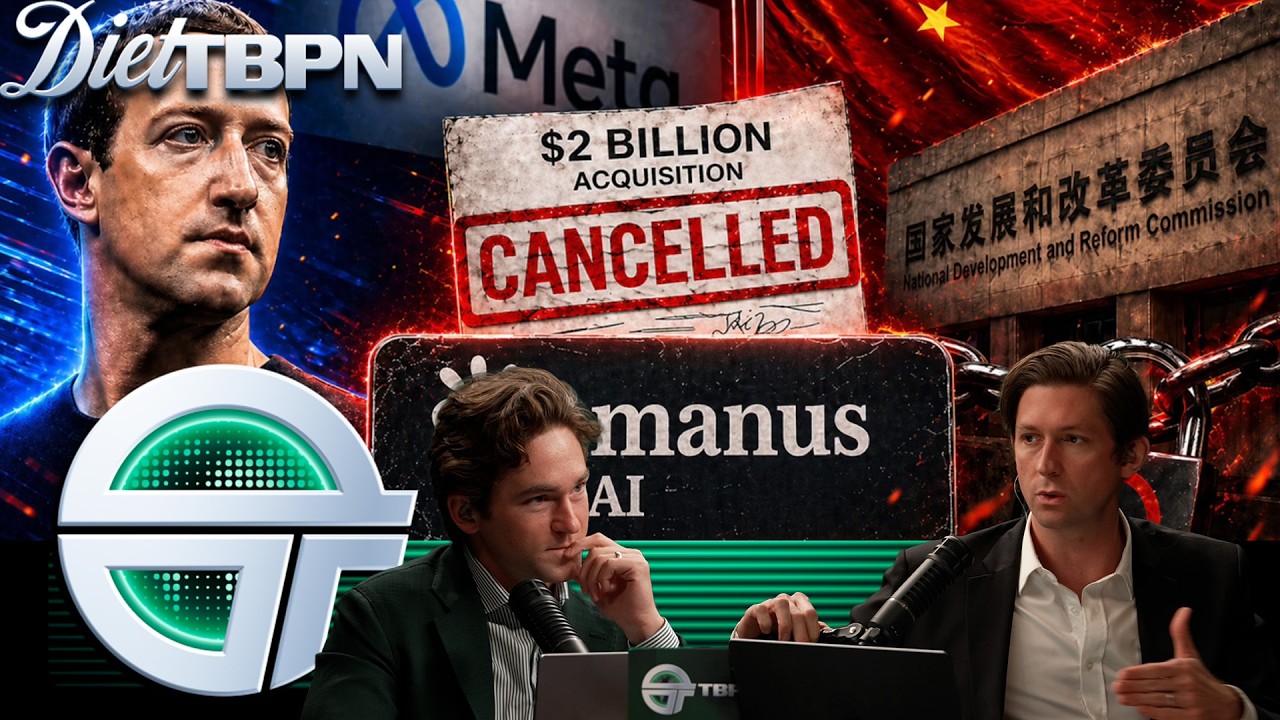
China Orders Meta to Unwind $2B Manus Deal as US Tech Retaliation Escalates
TBPN
Beijing's unprecedented blocking of Meta's Singapore-based acquisition serves as a warning to Chinese startups attempting offshore escapes while risking Meta's massive cross-border ad revenue.
## Background
Published on YouTube by TBPN on April 27, 2026, this video offers a 30-minute daily recap of the channel's live tech talk show hosted by John Coogan and Jordi Hays. The show covers major daily headlines across Silicon Valley, technology, and AI innovation.
## TL;DR
The episode breaks down significant tech news, including Elon Musk's lawsuit against OpenAI, OpenAI's cloud expansion, and China's intervention blocking Meta's $2 billion acquisition of AI platform Manus. The hosts analyze the shifting importance of inference compute over raw model weights, Meta's ambitious plans to harness space-based solar energy, and global employment trends in call centers. They also explore emerging tech subcultures, from extreme personal AI automation ("token maxers") to real-time generative user interfaces.
## Atmosphere & style
The hosts maintain an energetic, banter-filled, and casual tone that balances deep industry insight with lighthearted comedy. Transitioning seamlessly from serious analysis of geopolitics and AI infrastructure to playful studio jokes and internet memes, the episode feels like an insider conversation among plugged-in tech observers. The narrative flows with quick, conversational momentum, keeping the atmosphere relaxed yet informative throughout.
## Key takeaways
- [00:00](https://www.youtube.com/watch?v=mIHfFohdms0&t=0s) Elon Musk has initiated a $134 billion lawsuit against Sam Altman and OpenAI in Oakland court, alleging a breach of OpenAI's founding non-profit mission to benefit Microsoft.
- [00:00](https://www.youtube.com/watch?v=mIHfFohdms0&t=0s) Microsoft and OpenAI restructured their partnership to allow OpenAI models to be served through alternative cloud providers including AWS and Google TPUs.
- [00:00](https://www.youtube.com/watch?v=mIHfFohdms0&t=0s) Chinese regulators blocked Meta's $2B acquisition of AI platform Manus over investment compliance and regulatory concerns.
- [00:00](https://www.youtube.com/watch?v=mIHfFohdms0&t=0s) Meta announced a clean energy initiative with Overview Energy to beam up to 1 gigawatt of continuous space-based solar power paired with 100-hour battery storage from Noon Energy.
- [02:53](https://www.youtube.com/watch?v=mIHfFohdms0&t=173s) Automated, agentic video editing in consumer tools like CapCut represents a major unfulfilled market opportunity in AI software.
- [05:29](https://www.youtube.com/watch?v=mIHfFohdms0&t=329s) Semiconductors derive their name and function from their ability to switch electrical conductivity on and off to process binary logic.
- [07:48](https://www.youtube.com/watch?v=mIHfFohdms0&t=468s) A study on perceived sleep quality revealed that false positive feedback about REM sleep measurably improves cognitive test performance regardless of actual sleep duration.
- [10:41](https://www.youtube.com/watch?v=mIHfFohdms0&t=641s) Continuous, uninterrupted power supply is essential for AI data centers to prevent severe hardware depreciation and financial losses on GPUs.
- [13:10](https://www.youtube.com/watch?v=mIHfFohdms0&t=790s) Contrary to widespread automation fears, call center employment in the Philippines grew by 4% in 2025 due to technological friction and onboarding complexity.
- [16:00](https://www.youtube.com/watch?v=mIHfFohdms0&t=960s) Poland is undergoing a significant economic boom, putting it on track to surpass the United Kingdom in per capita income.
- [16:00](https://www.youtube.com/watch?v=mIHfFohdms0&t=960s) As AI model inference becomes exponentially more valuable than raw model weights, securing raw compute capacity becomes the primary strategic advantage.
- [19:10](https://www.youtube.com/watch?v=mIHfFohdms0&t=1150s) A subculture of 'token maxers' is spending heavily to build continuous, highly automated AI agent workflows around existing models rather than waiting for next-gen models.
- [22:08](https://www.youtube.com/watch?v=mIHfFohdms0&t=1328s) Beijing's order forcing Meta to unwind its $2B Manus deal signals an unprecedented regulatory intervention in cross-border tech acquisitions and raises geopolitical risks for Chinese AI founders.
- [28:44](https://www.youtube.com/watch?v=mIHfFohdms0&t=1724s) Generative UI enables dynamic, real-time interface rendering tailored on the fly to specific user requests, reducing the need for static software navigation.
## Detailed walkthrough
Here is a detailed, faithful walkthrough of the provided transcript segment:
### [00:00](https://www.youtube.com/watch?v=mIHfFohdms0&t=0s) Daily News Roundup: Tech Lawsuits, Cloud Deals, and Meta's Moves
The hosts open the show by introducing a set of major tech headlines and showing off a production upgrade in their studio—a new background screen with significantly better brightness and contrast that has the production team "stoked." Moving into the news, they detail the launch of Elon Musk's $134 billion lawsuit against Sam Altman and OpenAI, which begins jury selection today in Oakland. Musk alleges that OpenAI betrayed its original non-profit mission to become a for-profit entity aimed at maximizing profits for Microsoft. While Sam Altman and Greg Brockman were spotted at the courthouse, Musk has not yet been seen, though reporters are covering the scene closely.
Meanwhile, Microsoft and OpenAI have restructured their partnership, allowing OpenAI to serve its products through any cloud provider. Amazon CEO Andy Jassy publicly noted the interesting shift, as AWS can now vend OpenAI technology alongside potential integrations with Google TPUs and Amazon Trainium chips. Over in Meta's domain, Chinese regulators have blocked Meta's $2 billion acquisition of AI platform Manus over investment compliance rules. The deal faced scrutiny over whether enough of Manus's operations were moved to Singapore to clear regulatory hurdles, leading to tension when some team members were briefly detained in China.
In a final major news item, Meta announced plans to source space-based solar energy beamed down to Earth at night to power its data centers, partnering with stealth startup Overview Energy.
- **Elon Musk vs. OpenAI Lawsuit:** $134B damages sought in Oakland court over alleged pivot from non-profit to Microsoft profit vehicle.
- **OpenAI Cloud Expansion:** OpenAI can now deploy models via AWS, Google TPUs, and Amazon Trainium chips rather than relying exclusively on Microsoft Azure.
- **Manus Deal Blocked:** China blocked Meta's $2B acquisition of Manus; team members were briefly detained on business in China amid regulatory reviews.
- **Space Solar & Battery Project:** Meta plans to beam up to 1 gigawatt of continuous solar power from space via Overview Energy, backed by 1 gigawatt of ultra-long-duration battery storage from Noon Energy.
### [02:53](https://www.youtube.com/watch?v=mIHfFohdms0&t=173s) Diet Coke Rabbit Holes, Viral Reels, and Video AI
The hosts take a lighthearted turn to discuss falling down an Instagram Reels rabbit hole centered on Diet Coke. One host notes drinking three Diet Cokes a day and reviews a viral comedic "study" comparing Diet Coke and Coke Zero drinkers. They react to a dramatic restock reel where a creator claims to store $4,000 worth of Diet Coke across a massive house, though the hosts tally up the visible stock and estimate it is actually under $100.
They critique the organizational flaws in the video, poking fun at the creator "rotting in the front" instead of properly rotating or stacking the cans deeper. Analyzing a heavily edited meme video set to music, the hosts reflect on the effort required to manually stitch together text and video clips in CapCut. They observe that while users should theoretically be able to puppeteer these edits using AI agents, reliable video-editing agents represent the "next chip to fall" and a massive remaining market opportunity.
- **Diet Coke Consumption:** One host reveals a daily habit of 3 Diet Cokes.
- **Container Tastes:** Discussion of online purists claiming 16 oz aluminum cans taste better than standard 12 oz cans.
- **AI Tooling Gap:** Current AI tools still lack automated, agentic video-editing capabilities inside software like CapCut.
### [05:29](https://www.youtube.com/watch?v=mIHfFohdms0&t=329s) Jester Maxing, Semiconductor Definitions, and Studio Gongs
Reading a comment from viewer Bryce—*"A Chad might mog, but when the jester performs, even the king sits to listen"*—the hosts agree, noting how "jesters" in the tech industry can get tech "kings" to take their calls even when just "your maxing". They recount a deleted post from "Based 16Z" asking why chips are called semiconductors, prompting a clear breakdown of the physics: unlike full conductors like copper that constantly let electricity flow, semiconductors like germanium or silicon allow electrical current to be switched on and off, creating the binary ones and zeros necessary for modern computing.
The conversation turns to an obscure request from Phil, who is searching the Bay Area for a massive gong over 30 inches. The hosts inspect their own studio gong, confirming it spans roughly 42 inches and was purchased from the website `gongs-unlimited.com`. They joke about the non-linear relationship between instrument size and cost, noting there is "an exponential relationship between gong size and price".
- **Semiconductor Definition:** Materials like silicon or germanium that can toggle electrical conductivity to process binary logic.
- **SemiAnalysis Joke:** The hosts poke fun at SemiAnalysis founder Dylan Patel, joking he picked the name because he only wanted to do "semi-analysis".
- **Studio Hardware:** The show's internal studio gong measures 42 inches and was sourced from `gongs-unlimited.com`.
### [07:48](https://www.youtube.com/watch?v=mIHfFohdms0&t=468s) The "Golden Retriever Mindset" and Placebo Sleep Effects
The hosts dive into a viral research study on perceived sleep quality and cognitive performance. The study reveals that having a "delusional golden retriever mindset"—convincing oneself that bad sleep was actually restful or that failure is merely useful data—measurably alters cognitive function and physiology.
In the cited experiment involving 164 participants, individuals were assigned fake feedback about their REM sleep cycles regardless of actual performance. Those told they spent an above-average 28% of their sleep in REM scored significantly higher on cognitive tests, such as the Paced Auditory Serial Addition Test and Controlled Oral Word Association Task, than those told they only received 16.2% REM sleep. The assigned belief about sleep quality predicted cognitive output, whereas the subjects' actual self-reported sleep quality had no predictive power.
The hosts compare this phenomenon to the movie *Yes Man* starring Jim Carrey, Zooey Deschanel, and Bradley Cooper. In the film, a withdrawn bank loan officer turns his life around after making a covenant with an inspirational guru to say "yes" to every opportunity, demonstrating the power of a positive, silver-lining outlook.
- **Study Sample Size:** 164 participants tested across manipulated sleep conditions.
- **REM Manipulations:** High-performance group informed they had 28% REM sleep; low-performance group informed they had 16.2% REM.
- **Impacted Tests:** Cognitive improvements were measured on the Paced Auditory Serial Addition Test and Controlled Oral Word Association Task.
### [10:41](https://www.youtube.com/watch?v=mIHfFohdms0&t=641s) Meta's Space Solar Strategy and Grid Demands
Returning to Meta's clean energy ambitions, the hosts examine the mechanics behind space-based solar power and long-duration storage. Meta is partnering with Overview Energy to beam up to 1 gigawatt of continuous solar power from orbit down to Earth, alongside Reflex Orbital and other ventures in the space solar sector. They note venture capital involvement, such as Shawn Maguire and Robinhood co-founder Baiju Bhatt, exploring space compute and energy harvesting.
The hosts contrast two technical approaches to space solar: gathering power on solar panels in space to beam down via laser versus using orbital mirrors to reflect light. They praise orbital mirrors as a surprisingly simple mechanism for generating round-the-clock power. To support energy reliability, Meta is pairing this setup with Noon Energy's battery system, which boasts 100 hours of storage capacity to keep data centers running smoothly even during multi-day weather disruptions. Continuous power is vital because modern AI data centers lose millions in chip depreciation and risk physical hardware damage if electricity flickers.
- **Overview Energy Partnership:** Targets delivering up to 1 GW of space-based solar power.
- **Noon Energy Batteries:** Deploys 100-hour ultra-long-duration storage to mitigate intermittent outages.
- **Data Center Economics:** AI infrastructure requires uninterrupted 24/7 power to avoid severe depreciation costs on high-end GPUs.
### [13:10](https://www.youtube.com/watch?v=mIHfFohdms0&t=790s) AI Labor Exposure and Global Call Center Trends
The hosts examine a viral post by Benjamin Todd regarding AI's real-world impact on offshore jobs and employment statistics. While conventional wisdom predicted that lower-skilled white-collar outsourcing—such as call centers and Business Process Outsourcing (BPO) facilities in India and the Philippines—would be the first to suffer mass AI automation, actual data presents a surprise.
Despite hyperbolic claims that call centers make up 90% of the Philippines' economy (the real figure is closer to 5% or 6%), Filipino call center employment actually grew by 4% in 2025. The hosts point out that call center automation is an ongoing, multi-decade process rather than a sudden ChatGPT shock. In the United States, call center employment peaked in 2016 at roughly 900,000 workers before declining to 650,000 over a decade, primarily driven by international outsourcing rather than direct software displacement. Technology diffusion takes time due to onboarding costs, organizational friction, and operational complexity.
- **Philippines Economy:** Call centers account for ~5% to 6% of national GDP, not 90%.
- **Filipino BPO Growth:** BPO employment in the Philippines rose 4% in 2025 despite AI advancements.
- **US Call Center Numbers:** US call center worker headcount dropped from 900,000 at its 2016 peak down to 650,000.
Here is a detailed walkthrough covering the provided transcript section:
### [16:00](https://www.youtube.com/watch?v=mIHfFohdms0&t=960s) Poland’s Economic Boom and Advanced Model Constraints
The discussion opens with a look at Poland's remarkable economic trajectory. Long viewed as a former communist third-world country, Poland is now undergoing a "fast takeoff" and is on track to overtake the United Kingdom in per capita income, according to forecasts for advanced economies. The hosts highlight a story from *The Telegraph* detailing how Britain's slowing growth combined with Poland's restored economy and "robust patriotism" is attracting a record number of UK immigrants.
To illustrate this shift, the hosts recount an anecdote about British businessman Johnny Mercer, founder of the construction firm Polystrad in Poland. When Mercer recently advertised a marketing role at a trendy French bistro, he was inundated with applications—including 35 British candidates eager to relocate permanently to Poland. Ultimately, a candidate without prior British ties was hired.
The conversation then transitions to AI progress, focusing on insights shared by Noam Brown regarding system constraints and safety. Brown's presentation slide suggests that as inference becomes exponentially more important, raw model weights become relatively less critical. This shifts the strategic advantage from merely securing model weights to securing inference capacity. The hosts debate the implications:
* **The "Suitcase Bomb" Fallacy:** The traditional AI safety trope of smuggling model weights out on a hard drive (akin to a suitcase bomb or refined uranium) no longer holds as much weight if the recipient lacks the compute to serve the model.
* **Distillation vs. Serving:** Panic over model distillation may be overstated; even if rival nations like China distill top tier models, they cannot utilize them at scale without sufficient inference capacity.
* **Agent Defense Dynamics:** In a battle of AI agents (e.g., securing a bank account), having 10 times the inference capacity allows one side to deploy 10 agents against a single attacker agent, winning through sheer computational dominance.
* **Geopolitical Stakes:** The shift toward inference complicates data center export bans and raises questions about foreign inference clusters coming online. This ties back to the "Doorash probability density curve," which posits that if AGI arrives quickly, America wins due to current compute leads; if it takes longer, China wins as it ramps up long-term manufacturing capacity.
---
### [19:10](https://www.youtube.com/watch?v=mIHfFohdms0&t=1150s) The Rise of "Token Maxers" and AI Intermediation
The hosts discuss a *Semafor* profile detailing a Silicon Valley founder who made a small fortune selling multiple companies to Apple before launching a voice recognition startup called Olive. This founder has almost completely outsourced his personal and professional life to a hyper-personalized AI assistant. Rather than seeking a tool for simple assistance, he explicitly instructed the system: *"I didn't ask it to help me, I asked it to be me."*
Every morning, he wakes up and follows a daily agenda crafted entirely by his AI. The system has permission to draft emails on his behalf, set up in-person meetings with individuals he has never met, and even monitor live conversations with his three children to offer real-time parenting advice (which he claims has noticeably improved his family relationship).
This behavior represents a growing subculture of power users dubbed **"token maxers"**:
* **Strategy:** Spending tens of thousands of dollars to build "MacGyver-level" AI workflows rather than waiting for next-generation frontier models.
* **Execution:** Running existing models in continuous loops with massive computing power, multiple passes, automated error-checking, and high risk tolerance.
* **Core Philosophy:** Granting AI systems unlimited token budgets and complete access to personal data feeds.
Reflecting on this trend, the hosts question how much of daily life is already algorithmically mediated—ranging from phone alarm clocks and adaptive Eight Sleep mattresses optimizing wake times, to GPS navigation directing every turn. While acknowledging that such extreme automation feels bizarre to most, they speculate on a "barbell" future where hyper-tech adoption coexists with high-value real-world physical experiences ("touching grass"). They point to major investors taking simultaneous bets on both extremes:
* **Larry Ellison:** Going super long on Oracle AGI data centers while simultaneously acquiring legacy media IP like CBS, *Foghorn Leghorn*, *Bugs Bunny*, *Superman*, and *Batman*.
* **Josh Kushner:** Backing OpenAI and leading AI firms on one end, while investing in physical sports franchises like the San Francisco Giants on the other.
---
### [22:08](https://www.youtube.com/watch?v=mIHfFohdms0&t=1328s) China Blocks Meta’s $2 Billion Manus Deal
Host John Coogan steps off set briefly, leaving Jordi Hays to review a breaking *Financial Times* report alongside producer Tyler. The story details an unprecedented regulatory action: Beijing has ordered Meta to unwind its $2 billion acquisition of Manus, an AI application company originally founded in China that relocated to Singapore the previous year to comply with US outbound investment rules.
This marks an extraordinary late-stage intervention by Chinese authorities involving two entities now operating outside China. Meta had already begun deeply integrating Manus into its Facebook Ads Manager and scaling its engineering footprint under Meta branding. Industry insiders note that because the deal had closed and cap tables were likely paid out, fully reversing the transaction is virtually impossible. A source briefed on the matter stated that Beijing's harsh gesture was meant as a explicit warning to block similar follow-on deals.
The hosts discuss the legal, financial, and geopolitical fallout:
* **Tit-for-Tat Geopolitics:** The move appears to be direct retaliation for the forced US divestment of TikTok, signaling a broader escalation in the US-China tech war.
* **Unwinding Realities:** Unwinding a venture acquisition is nearly unheard of. Unlike traditional cash-flow acquisitions, Manus was bought for its product talent and user traction rather than standalone earnings.
* **Alternative Deal Structures:** The hosts speculate why Meta did not pursue a licensing or "zombie" acqui-hire structure—similar to Grok/Nvidia or Google/Windsurf—where key personnel are hired over via contracts while the original corporate shell remains isolated.
* **Analysis by "Dellions":** The venture community expressed shock over China's jurisdiction. Commentators argue that while Meta will survive without Manus, the ruling is a massive self-inflicted blow to the Chinese AI startup ecosystem. Founders from China will realize that regardless of legal relocations, their businesses remain subject to regulatory fiat, exit bans, and profit seizures.
* **Beijing's Ultimatums:** According to reporting cited by Bill Bishop, Beijing demanded a total unwind: returning all funds, re-registering ownership, and halting Meta's use of the Manus algorithm. Failure to comply could lead to Chinese penalties on Meta, restrictions on Meta’s ad business, and criminal charges for involved executives.
* **Meta's Exposure:** Meta faces significant financial leverage from Beijing, as tens of billions of dollars in Meta ad revenue originate from Chinese businesses (such as e-commerce giants cross-border advertising).
---
### [28:44](https://www.youtube.com/watch?v=mIHfFohdms0&t=1724s) Generative UI and On-the-Fly Interfaces
To close out the segment, the hosts examine a post by Michael Chang showcasing the emerging future of **generative user interfaces (Generative UI)**. In response to a prompt like *"Hey ChatGPT, what's the weather like today?"*, a custom model (utilizing new image generation frameworks like Images 2.0) renders a real-time, dynamic, video-game-style fantasy map—resembling something from *Lord of the Rings* or *Game of Thrones*.
Rather than displaying a static chart, the generated map accurately overlays localized weather data across individual neighborhoods. While the temperature variations in the example were subtle (ranging from 55°F to 57°F), the demonstration illustrates a paradigm shift away from hardcoded software designs toward temporary, context-aware interface generation.
This aligns with a bull thesis published by Ben Thompson regarding Meta’s augmented reality roadmap (including both project Orion and Meta Ray-Ban smart glasses):
* **Chrome Minimization:** As underlying AI models improve, native user interfaces will require less "chrome" (permanent top/bottom navigation bars) and fewer static menus.
* **Magical Real-Time UI:** The ideal interface is generated on the fly to perfectly present exactly what the user needs at that precise millisecond, eliminating the need for manual 3D modeling in Blender or custom API frontend integration.
* **Current Limitations:** The hosts humorously note that generated visuals still have flaws—pointing out a viewer comment noting that rendering the Golden Gate Bridge with only one tower is "a crime"—proving there is still refinement needed before full adoption.
## Notable quotes
> [05:29](https://www.youtube.com/watch?v=mIHfFohdms0&t=329s) A Chad might mog, but when the jester performs, even the king sits to listen — Bryce (Viewer)
> [05:29](https://www.youtube.com/watch?v=mIHfFohdms0&t=329s) an exponential relationship between gong size and price
> [07:48](https://www.youtube.com/watch?v=mIHfFohdms0&t=468s) delusional golden retriever mindset
> [07:48](https://www.youtube.com/watch?v=mIHfFohdms0&t=468s) The hosts compare this phenomenon to the movie Yes Man starring Jim Carrey, Zooey Deschanel, and Bradley Cooper.
> [19:10](https://www.youtube.com/watch?v=mIHfFohdms0&t=1150s) I didn't ask it to help me, I asked it to be me. — Voice recognition startup founder
美科技反制升级,中国要求Meta撤回20亿美元收购Manus交易
北京史无前例地叫停Meta对这家新加坡公司的收购,在令Meta庞大跨境广告收入面临风险的同时,也对企图出海规避监管的中国初创公司敲响了警钟。
本期节目梳理了多项重大科技动态,包括埃隆·马斯克对OpenAI发起的诉讼、OpenAI的云业务扩张,以及中国监管机构叫停Meta以20亿美元收购AI平台Manus的交易。主持人分析了推理算力相比原始模型权重日益凸显的重要性、Meta利用太空太阳能的宏大计划,以及全球呼叫中心的就业趋势。此外,他们还探讨了新兴的科技亚文化,涵盖从极度依赖个人AI自动化的“代币最大化者”(token maxers)到实时生成式用户界面的各种探索。
埃隆·马斯克在奥克兰法院向萨姆·奥特曼和 OpenAI 发起高达 1340 亿美元的诉讼,指控 OpenAI 违背最初的非营利使命,沦为微软的营利工具。 (0:00)
微软与 OpenAI 重构了合作协议,允许 OpenAI 通过 AWS、谷歌 TPU 及亚马逊 Trainium 芯片等多家云服务提供商部署和分发模型。 (0:25)
中国监管机构叫停了 Meta 对 AI 平台 Manus 价值 20 亿美元的收购案,要求全面撤销交易,此举引发了对跨境监管管辖权以及中国初创生态影响的广泛讨论。 (22:08)
Meta 宣布与初创公司 Overview Energy 合作,计划从太空向地面传输高达 1 吉瓦的连续太阳能电力,并搭配 Noon Energy 的 100 小时长效电池储能系统支持数据中心运转。 (10:41)
一项针对 164 人的感知睡眠质量研究显示,向受试者提供虚假的 REM 睡眠正向反馈能显著提升其认知测试表现,证明心态预期对实际能力发挥具有显著影响。 (7:48)
Reading summary
TBPN reports on escalating geopolitical and infrastructural friction in artificial intelligence, highlighted by Chinese regulators ordering Meta to unwind its $2 billion acquisition of Manus and tech firms seeking radical energy solutions like space-based solar to satisfy continuous compute demands. Concurrently, discussions around inference constraints, offshore labor stability, and generative interfaces illustrate how deployment bottlenecks are reshaping technology strategy.
Regulatory Retaliation and Meta's Blocked Manus Deal (22:08)
Chinese regulators intervened to block Meta’s $2 billion acquisition of Manus, an AI application company founded in China that had relocated its corporate domicile to Singapore to comply with US outbound investment rules. Despite the transaction already closing and Meta integrating Manus into Facebook Ads Manager, Beijing issued an extraordinary order demanding a total unwind: returning all capital, re-registering original ownership, and halting Meta's use of the Manus algorithm. Commentators cite the intervention as likely retaliation for the forced US divestment of TikTok, noting that non-compliance leaves Meta vulnerable to sanctions on its multi-billion-dollar Chinese cross-border ad revenue and puts company personnel at risk following brief executive detentions in China.
Industry observers note that unwinding a completed venture deal is virtually unprecedented because Manus was acquired primarily for its product talent and user traction rather than standalone cash flows. While commentators agree Meta can absorb the programmatic loss, they argue Beijing's ruling inflicts lasting damage on the domestic Chinese startup ecosystem by signaling to founders that foreign reincorporation offers no legal shield against regulatory fiat and exit bans.
Inference Capacity and Space-Based Energy Demands (10:41)
To counter the risk of GPU hardware damage and millions in depreciation losses caused by electrical grid flickers, Meta announced plans to source continuous clean energy via Overview Energy, targeting up to 1 gigawatt of space-based solar power beamed from orbit alongside 100 hours of long-duration battery storage from Noon Energy. This push toward dedicated infrastructure aligns with observations from AI researcher Noam Brown, who argues that strategic leverage in artificial intelligence is pivoting away from raw model weights and toward inference capacity.
Brown's analysis suggests that traditional national security fears over stolen model weights—the "suitcase bomb" scenario—are overstated if an adversary lacks the inference clusters required to serve models at scale. Furthermore, in autonomous agent conflicts, an operator with tenfold the inference capacity can deploy overwhelming defensive agents against an attacker. Consequently, long-term geopolitical supremacy may hinge less on algorithmic secrecy and more on energy and hardware deployment, where rapid timelines favor current US compute leads while longer timelines favor foreign manufacturing scale.
Empirical Labor Diffusion and Token-Maxing Workflows (13:10)
Addressing widespread expectations that generative AI would swiftly displace lower-tier offshore white-collar workers, analysis from Benjamin Todd indicates that Philippine call center and business process outsourcing (BPO) headcount actually grew by 4% in 2025. Accounting for 5% to 6% of Philippine GDP, the sector has proven resilient because enterprise technology diffusion is constrained by organizational friction, onboarding costs, and operational complexity; by comparison, US call center headcount declined gradually from 900,000 in 2016 to 650,000 over a decade largely due to offshore contracting rather than immediate software replacement.
At the technological frontier, however, a subculture of power users dubbed "token maxers" is testing extreme automation. Profiles such as the founder of voice startup Olive demonstrate power users allocating large token budgets to continuous AI loops—granting models total authority to manage calendars, execute external communications without review, and parse live domestic conversations for real-time coaching. The hosts note this reflects a bifurcated landscape where hyper-automated workflows contrast sharply with standard enterprise adoption speeds.
Generative UI and the Transition Away from Static Menus (28:44)
Recent demonstrations by Michael Chang illustrate an emerging shift toward Generative User Interfaces (Generative UI), where underlying image models render dynamic, interactive software environments on the fly rather than relying on hardcoded graphical frontends. In one demonstrated concept, a weather query yields a real-time, fantasy-themed interactive map illustrating neighborhood microclimates, bypassing static navigation charts and bespoke API integrations entirely.
This paradigm reflects an augmented reality thesis highlighted by analyst Ben Thompson regarding Meta’s Orion and Ray-Ban smart glasses hardware. As foundational multimodal models advance, software is expected to strip away permanent interface "chrome"—such as fixed menus and status bars—in favor of ephemeral interfaces constructed only for the precise millisecond they are required, despite present-day rendering quirks in generated visuals.
Across regulatory standoffs, extreme energy logistics, and labor market realignments, the source emphasizes that the near-term trajectory of AI is governed by physical constraints—including grid reliability, sovereign cross-border authority, and institutional adoption friction—rather than algorithmic breakthroughs alone.
## Background
本期视频由科技对谈节目 TBPN 于 2026 年 4 月 27 日发布在 YouTube 平台。页面简介显示,Diet TBPN 是该节目的 30 分钟精华浓缩版,由 John Coogan 与 Jordi Hays 共同主持,精选当天科技圈的核心大事件与前沿动态进行解读与探讨。
## TL;DR
节目首先聚焦中国监管机构叫停 Meta 对 AI 平台 Manus 价值 20 亿美元收购案的重大地缘风波,并剖析了 Meta 押注轨道太空太阳能与长时储能的能源基建战略。随后,主播们探讨了马斯克诉 OpenAI 案开庭、微软云协议松绑、推理算力如何重构安全护城河以及菲律宾客服外包在 AI 浪潮下的反常增长。此外,节目还穿插分析了把生活全盘外包给模型的“Token Maxers”现象、“安慰剂睡眠”实验对认知的重塑,以及生成式 UI 对未来智能眼镜交互范式的深远影响。
## Atmosphere & style
整期节目节奏紧凑且充满科技极客色彩,两位主播以轻松默契的双人对谈形式在严肃地缘商业深度分析与荒诞互联网亚文化之间自如切换。从严肃拆解百亿美元级反垄断与跨境并购博弈,到调侃健怡可乐短视频烂梗、湾区买铜锣与电影《好好先生》,现场交谈充满机智的插科打诨与敏锐洞察。听感上既有置身硅谷硬核创业圈第一线的思维碰撞,又带着一种兼具黑色幽默与乐观主义的惬意日常聊天氛围。
## Bulletin
- [00:00](https://www.youtube.com/watch?v=mIHfFohdms0&t=0s) 马斯克对萨姆·奥尔特曼及 OpenAI 的 1340 亿美元巨额诉讼正式在加州奥克兰开庭,指控其彻底背弃非营利初衷沦为微软的营利工具。
- [00:00](https://www.youtube.com/watch?v=mIHfFohdms0&t=0s) 微软与 OpenAI 调整排他合作协议,允许 OpenAI 面向 AWS 等多云平台客户分发全线产品,并有望接入 Trainium 与 TPU 等异构算力芯片。
- [22:23](https://www.youtube.com/watch?v=mIHfFohdms0&t=1343s) 中国监管部门叫停并勒令 Meta 完全撤回对 AI Agent 平台 Manus 价值 20 亿美元的收购案,要求退还资金、恢复股权并停用核心算法,引发对出海合规路径的震荡反思。
- [10:41](https://www.youtube.com/watch?v=mIHfFohdms0&t=641s) Meta 押注天基新能源,联手 Overview Energy 规划从低轨向地面定向传输 1 GW 太空太阳能,并配套 100 小时超长时储能电池以保障数据中心 24/7 满负荷运转。
- [17:08](https://www.youtube.com/watch?v=mIHfFohdms0&t=1028s) Noam Brown 指出模型权重战略地位正相对下降,大规模推理算力正成为决定性护城河,攻防与地缘博弈焦点正转向能源与推理集群基础设施。
## Key takeaways
- [00:00](https://www.youtube.com/watch?v=mIHfFohdms0&t=0s) 马斯克诉 OpenAI 案开庭索赔 1340 亿美元,控诉其违背非营利使命,陪审团遴选阶段即显现出公众对该官司的强烈极化情绪。
- [00:00](https://www.youtube.com/watch?v=mIHfFohdms0&t=0s) OpenAI 摆脱单一微软 Azure 捆绑,获准全面向其他云厂商分发技术,加速其向多云生态及多样化 AI 芯片架构渗透。
- [10:41](https://www.youtube.com/watch?v=mIHfFohdms0&t=641s) Meta 与 Overview Energy 探索利用轨道卫星向地面传输 1 GW 太空太阳能,结合长时储能电池解决现代数据中心难以承受断电的能源瓶颈。
- [10:41](https://www.youtube.com/watch?v=mIHfFohdms0&t=641s) 相较于技术难度极高的激光下传路线,在太空部署反光镜将阳光折射至地面光伏板的设计为全天候清洁能源提供了更简便可行的工程路径。
- [13:10](https://www.youtube.com/watch?v=mIHfFohdms0&t=790s) AI 冲击外包就业的假设遭遇反常现实:2025 年菲律宾呼叫中心就业逆势上涨 4%,技术在复杂业务体系中落地存在巨大的实施摩擦与磨合阻力。
- [16:06](https://www.youtube.com/watch?v=mIHfFohdms0&t=966s) 欧洲经济版图经历剧烈重塑,波兰人均收入步入反超英国的轨道,强劲实体经济逆向吸引创纪录数量的英国本土专业人才。
- [17:08](https://www.youtube.com/watch?v=mIHfFohdms0&t=1028s) 诺姆·布朗提出模型权重的重要性正让位于推理算力,空有模型参数而无充足算力集群无法构成实质战略威胁,防御方可通过 10 倍并发 Agent 实现压倒性防御。
- [17:08](https://www.youtube.com/watch?v=mIHfFohdms0&t=1028s) 中美 AGI 竞争形态取决于突破周期:若短期突破则算法领先的美国胜出,若转入漫长消耗战,则中国强大的工业制造与能源基建动员能力将显现优势。
- [19:10](https://www.youtube.com/watch?v=mIHfFohdms0&t=1150s) 硅谷涌现“Token Maxers”群体,不再苦等下一代基座模型,而是通过无限 Token 预算、模型多轮循环与高风险授权,将个人生活与决策全盘外包给 AI。
- [21:24](https://www.youtube.com/watch?v=mIHfFohdms0&t=1284s) 科技投资正形成“杠铃式世界”结构:一端极度追求硬核前沿的 AGI 与超大规模算力,另一端则重金扎根于不可替代的实体体育与经典怀旧文化 IP。
- [22:23](https://www.youtube.com/watch?v=mIHfFohdms0&t=1343s) 中国监管机构在交易后期强力叫停 Meta 收购 Manus,即便主体已迁往新加坡仍受追溯管辖,给依赖“新加坡跳板”合规出海的中国创业生态带来沉重打击。
- [28:07](https://www.youtube.com/watch?v=mIHfFohdms0&t=1687s) 北京在 Meta 并购案中拥有强大反制杠杆,中国跨境出海企业每年向 Meta 贡献数百亿美元广告收入,成为潜在施压渠道。
- [28:44](https://www.youtube.com/watch?v=mIHfFohdms0&t=1724s) 人机交互正迈向生成式 UI(Generative UI)时代,AI 可根据意图即时绘制无静态控件的动态视图,彻底颠覆传统前端与 3D 渲染管线开发模式。
- [07:49](https://www.youtube.com/watch?v=mIHfFohdms0&t=469s) “安慰剂睡眠”实验表明信念可硬件级反噬大脑算力:被植入优质睡眠虚假暗示的个体,其复杂认知测试表现显著优于被暗示低睡眠质量的个体。
## Detailed walkthrough
### [00:00](https://www.youtube.com/watch?v=mIHfFohdms0&t=0s) 今日四大科技头条:马斯克起诉 OpenAI、微软云松绑、Meta 收购 Manus 遭阻与太空光伏
节目开场,主持人首先展示了演播室制作团队带来的新升级:背景换上了一块对比度更高、更明亮的新屏幕,团队对此充满期待。随后,节目迅速切入当天科技圈最受关注的四大核心要闻。第一条重磅新闻是埃隆·马斯克对萨姆·奥尔特曼提起的 1340 亿美元巨额诉讼案,今天正式在加州奥克兰开庭。马斯克指控 OpenAI 彻底背弃了最初设立的非营利初衷,转变为一家旨在为微软实现利润最大化的营利性企业。庭审现场目前正在进行陪审团遴选,现场记者云集。奥尔特曼和格雷格·布罗克曼已经现身法庭,而马斯克尚未露面。甚至有候选陪审员直接在遴选时坦言:“由于我对眼前发生的一切基本上都极度反感,我很难保持客观公正。”
紧接着是关于微软与 OpenAI 合作框架的重大调整。双方修订了合作协议,OpenAI 现已被允许面向所有云服务商的客户分发其全线产品。亚马逊 CEO 安迪·贾西在社交平台上特意发文称这是一个极其耐人寻味的变化,AWS 显然十分渴望通过自身渠道分销 OpenAI 的前沿技术。这意味着未来的合作不仅限于微软 Azure,OpenAI 将获得巨大的灵活性,甚至有望在训练与推理中采用谷歌的 TPU 以及亚马逊自研的 Trainium 芯片。
```mermaid
flowchart TD
accTitle: OpenAI云基础设施与合作变化
accDescr: 展现OpenAI摆脱单一Azure依赖并向多云及多样化芯片生态开放的转变
subgraph 合作解绑
MS["微软与 OpenAI 调整排他合作"] --> MultiCloud["全渠道多云服务开放"]
end
subgraph 多云与硬件生态
MultiCloud --> AWS["AWS 体系 / 亚马逊合作"]
MultiCloud --> OtherCloud["其他主流云平台"]
AWS --> Chips["自研芯片 Trainium / 谷歌 TPU 等"]
end
```
转到 Meta 方面,中国监管部门叫停了 Meta 对人工智能 Agent 平台 Manus 高达 20 亿美元的收购案,原因是评估该交易是否触犯了相关对外投资与技术出境规定。这笔交易此前几经周折,各方一直在博弈 Manus 是否已将足够多的业务和架构迁移至新加坡以规避审查;甚至在交易推进过程中,Manus 团队部分成员还在中国出差期间遭到短暂拘留。主持人指出,Manus 团队本身极度渴望促成该交易,进入 Meta 无疑是巨大的团队胜利,但团队核心成员大多在中国土生土长、亲属仍在国内,这无疑成了监管层牢牢掌握的制衡筹码。最后一条新闻同样来自 Meta:公司计划利用在轨卫星在夜间向地球定向发射微波/激光束以获取太空太阳能,合作方为已在隐形模式下潜伏了四年的 Overview Energy,目标是实现 1 吉瓦轨道太空太阳能向地面的全天候不间断输电;此外,Meta 还联合 Noon Energy 部署了 1 吉瓦的超长时储能电池。
- **马斯克诉 OpenAI 索赔案**:索赔金额高达 1340 亿美元,指控其彻底背叛非营利使命沦为微软的提款机。
- **Manus 收购受阻**:Meta 拟出资 20 亿美元收购这家高热度 AI Agent 团队,但因技术与人员涉及跨境合规被中方监管叫停。
- **新能源基建布局**:Meta 联手 Overview Energy 探索从太空向地面光束传输高达 1 吉瓦的太阳能,并配套 Noon Energy 的 1 吉瓦超长时储能方案。
---
### [02:51](https://www.youtube.com/watch?v=mIHfFohdms0&t=171s) 沉迷 Diet Coke 短视频:从“西格玛真男人”研究到四千美元囤货骗局
聊完严肃的行业头条后,主持人约翰坦白自己整个周末都彻底沦陷在 Instagram 的健怡可口可乐(Diet Coke)短视频算法黑洞里。虽然算法花了很长时间才发现他每天必喝三罐 Diet Coke,但一旦精准推送,就给他带来了无尽的快乐。两人饶有兴致地在演播室当场播放并解构了这些网络热梗。首先是一则煞有介事的“科研对比视频”,该视频一本正经地宣称最新研究表明:“喝零度可口可乐(Coke Zero)的人全是傻子,而喝健怡可口可乐(Diet Coke)的人则是超越众人的西格玛真男人(Sigma Chads)。”对此主持人幽默地表示:“感谢这个结论,我们正需要这种精神肯定。”
紧接着,两人又连线观看了另一个号称在豪宅里囤积了“价值 4000 美元健怡可乐”的补货展示视频。主持人一边看一边拿着计算器现场戳穿博主的夸大其词:看着储藏室里稀稀拉拉摆放的饮料,数来数去算上零散的包装,折合实际金额不过一百多美元,撑死也就二百块,根本与 4000 美元相去甚远。
这番盘点随即引发了两人关于可乐包装学与收纳强迫症的热烈探讨。有人执拗地在网上发帖宣称 16 盎司铝罐装的口感绝对优于 12 盎司传统易拉罐,展现了资深爱好者的极端挑剔。而在审视视频中的冰箱摆放时,主持人更是无法忍受博主混乱的收纳逻辑——饮料没有按生产日期推陈出新,甚至出现“最前面的快放烂了、后面的空间却没码满”的低效堆叠,直呼博主为了拍视频完全半途而废。随后他们又播放了一条配着高燃说唱音乐、剪辑极其密集的 Diet Coke 风格化短片。主持人感叹这种短视频需要耗费大量时间在 CapCut 里对齐字幕、特效与卡点,按理说完全应该由 AI Agent 一键自动化生成,但目前市面上尚未出现能真正胜任复杂创意视频剪辑的成熟 Agent,这无疑将是 AI 落地领域的下一片蓝海。
---
### [05:29](https://www.youtube.com/watch?v=mIHfFohdms0&t=329s) 硅谷杂谈:小丑统治宫廷、什么是半导体、以及四十英寸的大铜锣
话题从网络短视频发散到了硅谷的社交生态与黑色幽默。他们引用了推特用户 Bryce 的一条高赞格言:“肌肉硬汉(Chad)或许能在外表上压制全场,但唯有宫廷小丑登台时,连国王都不得不洗耳恭听。”主持人对此深表赞同,透露他们圈子里就有一位百分之百扮演“小丑”角色的朋友,而硅谷乃至科技行业里那些宛如“现代国王”的巨头大佬们,无论何时只要接到他的电话都会欣然接听,哪怕他只是在肆无忌惮地插科打诨和胡扯搞怪。
随后,他们聊到了风险投资机构恶搞账号“Based16z”一条随后被秒删的推文,博主发帖坦言:“兄弟我跟你说句实话,我其实根本不知道半导体到底是个啥,你们有人知道为什么它叫‘半’导体吗?”面对这个把他们逗得哈哈大笑的段子,主持人现场开启了基础物理科普:
- 像铜这样的**全导体(Conductor)**,电流永远能够畅通无阻地穿行;
- 而像锗、硅这样的**半导体(Semiconductor)**,在特定条件下可以通过施加电压控制电流的通断,从而实现对“0”和“1”二进制信号的存储与逻辑运算,这正是引发整个人类计算机革命的底层基石。
- 主持人还顺带调侃了知名半导体分析机构 SemiAnalysis 的创始人 Dylan Patel,笑称他起这个名字并不是因为半导体,而是因为他“不想做全套分析(Full-on Analysis),只想做半截分析(Semi-analysis)”,尽管他的文章实际上比谁都深入细致。
在聊到社交平台生态时,他们感慨推特上有种极其诡异的奇观:有一批人发自内心地坚信人类文明会在未来一年内彻底灭亡,然而他们整天干的事情却是在推特评论区漫无目的地跟陌生人反复对骂撕咬。随后,节目播报了一条湾区本地寻物启事:好友 Phil 正在湾区求购一面直径大于 30 英寸的大铜锣(Gong)。作为演播室铜锣爱好者的两位主播当场拆台,表示演播室里那面从专门网站 gongs-unlimited.com 邮购的锣足足有 42 英寸,30 英寸根本算不上真正的大锣;同时他们也告诫 Phil,铜锣尺寸与售价之间存在极其惊人的指数级关系,想要极致的震撼就必须准备承受指数级暴涨的价格。
---
### [07:49](https://www.youtube.com/watch?v=mIHfFohdms0&t=469s) “安慰剂睡眠”病毒式研究:金毛犬心态如何实质改变大脑认知
节目的最后一个板块聚焦于周末在社交网络上引发病毒式传播的一项认知心理学新实验——“安慰剂睡眠对认知功能的影响”(Placebo Sleep Effects Cognitive Functioning)。该研究的核心启示被总结为一种“极具欺骗性的金毛犬心态(Delusional Golden Retriever Mindset)”:哪怕现实再糟糕,只要你盲目乐观地坚信一切都好,你的生理机能和实际产出就会发生真实的、可被度量的改变。
- **睡得很差?** 心理上坚信自己睡得极度充沛;
- **压力巨大?** 坚信这种高压完全是促使自己飞升的燃料;
- **项目失败?** 坚信这只是为后续成功收集到了不可多得的宝贵数据。
这项实验证明,安慰剂效应绝不仅限于吃下无有效成分的药片,它能跨界延伸到日常认知生活的方方面面。研究共招募了 164 名参与者,首先让他们如实汇报前一晚的自评睡眠质量,随后参与者被随机分配到两个实验组与两个对照组中进行欺骗性干预:
- **“高睡眠质量组”** 被实验人员告知,仪器监测显示他们昨晚睡眠中 REM(快速眼动睡眠)占比高达 28%,远超常人平均水平;
- **“低睡眠质量组”** 则被严肃告知,他们的 REM 深度睡眠占比仅有可怜的 16.2%,处于极低水平。
最终的认知测试结果极具颠覆性:决定实验对象认知测试表现好坏的,完全不是他们前一晚真实的生理睡眠,也不是他们最初填报的自评睡眠,而是**实验人员灌输给他们的“虚假睡眠质量标签”**。被告知睡得很好的人,在步调听觉连续加法测验(PASAT)和受控口语联想测验(COWAT)中的表现显著优于被告知睡得很差的人;不过这一心理暗示在数字广度记忆任务(Digit Span Task)和符号数字测验中并未产生统计学差异,与研究初期的预期完全吻合。思维模式对大脑算力的硬件级反噬,在此得到了切实的科学验证。
### [09:16](https://www.youtube.com/watch?v=mIHfFohdms0&t=556s) 金毛寻回犬心态与电影《好好先生》
在谈论一项关于心态如何能够双向影响认知状态与身体健康的研究后,主持人将这种积极心理戏称为“金毛寻回犬模式”(Golden retriever mode)。另一位主持人随即调侃道,好莱坞早在多年前就围绕这种“金毛寻回犬心态”拍过一部经典电影,并追问搭档是否看过由金·凯瑞(Jim Carrey)主演的《好好先生》(Yes Man)。面对对方脱口而出“我还以为是《神犬也疯狂》(Air Bud)”的无厘头回答,主持人笑着吐槽《神犬也疯狂》讲的是一只货真价实的金毛寻回犬,而《好好先生》探讨的则是人生的积极契约。
《好好先生》讲述了一名原本生活封闭、经历离婚且态度日渐消极的银行贷款专员,在参加了一场励志大师的研讨会后,被迫与宇宙立下誓约——对所有人提出的任何要求都必须回答“行”(Yes)。这一设定引发了一连串滑稽搞怪的闹剧,却也意外帮主角迎来了转机,展开了一段治愈的人生旅程。主持大力推荐了这部由布莱德利·库珀(Bradley Cooper)和佐伊·丹斯珍(Zooey Deschanel)共同参演的喜剧,认为它是当周调节心情的绝佳暖心之作。
### [10:41](https://www.youtube.com/watch?v=mIHfFohdms0&t=641s) Meta 押注太空太阳能与数据中心全天候供电
话题随后转向 Meta 宣布的重大能源战略布局。Meta 当天上午公开了两项旨在为旗下数据中心引入前沿能源生产与储能方案的全新合作伙伴关系。其中最引人瞩目的是其与 Overview Energy 携手推进的“太空太阳能”(Space Solar)项目,计划从近地轨道向地球定向传输高达 1 吉瓦(GW)的电能,以实现 7×24 小时不间断的电力生产。此外,节目还提及了由肖恩·马奎尔(Shawn Maguire)投资的 Reflex Orbital,以及 Robinhood 联合创始人拜朱·巴特(Baiju Bhatt)创立的相关太空算力与能源企业。
```mermaid
flowchart TD
accTitle: 太空太阳能与地面数据中心供电链路
accDescr: 展示从太空收集太阳能并传输至地面数据中心的两种技术路径对比
subgraph Space["轨道空间"]
Mirror["方案 A: 太空反射镜 (Reflex Orbital)<br/>直接反射阳光至地面"]
SolarLaser["方案 B: 轨道光伏阵列 + 激光束<br/>收集光能并转换激光下传"]
end
subgraph Ground["地面接收与调度"]
GroundPV["地面光伏电站<br/>(实现 24/7 全天候采光)"]
Battery["100小时长时储能电池系统<br/>平滑多日阴雨波动"]
end
subgraph Load["算力基础设施"]
DC["Meta 超级数据中心<br/>必须24小时不间断满负荷运行"]
end
Mirror --> GroundPV
SolarLaser --> GroundPV
GroundPV --> Battery
Battery --> DC
```
以往行业普遍讨论的太空光伏路径是在轨采集太阳能后通过激光束将能量打回地面,技术与数学测算难度极高;相比之下,在太空部署反光镜将阳光持续折射至地面光伏板的设计显得极其精妙而简洁。主持人指出,当前数据中心建设过度依赖天然气轮机,核能迟迟未能大规模到位。如果这种太空方案配合具备长达 100 小时储能能力的超长寿命电池,即使遭遇数日连续阴雨也能稳定供电,将彻底改写光伏的经济账。毕竟现代数据中心如果遭遇意外断电,不仅会导致昂贵的计算芯片按折旧模型遭受巨额经济损失,甚至可能对硬件本身造成物理损毁,因此必须保持 24 小时满载稳定运转。
- **核心合作目标**:Meta 与 Overview Energy 合作,规划从轨道向地球传输最高达 1 GW 的太空太阳能。
- **关联创业项目**:包括 Reflex Orbital 以及 Robinhood 联合创始人 Baiju Bhatt 发起的天基能源公司。
- **储能兜底方案**:配套使用具备 100 小时容量的长时储能电池,化解间歇性发电风险。
### [13:10](https://www.youtube.com/watch?v=mIHfFohdms0&t=790s) AI 对就业的冲击反常:菲律宾客服与全球外包格局
科技界此前普遍认为,呼叫中心、BPO(业务流程外包)等从事低技能白领工作、任务颗粒度细小的高度原子化外包岗位将最先受到 AI 的毁灭性打击。然而,本杰明·托德(Benjamin Todd)近期发表的一篇深度观察却揭示了一个出人意料的统计现实:尽管海外曾流传“菲律宾经济 90% 依赖呼叫中心”的夸张传言(实际占比约在 5% 至 6% 左右),且菲律宾呼叫中心被公认为暴露在 AI 风险下的最前沿,但在 2025 年,菲律宾该行业的整体就业人数反而逆势上涨了 4%。
与此形成鲜明对比的是,美国本土的客服外包支持岗位确实一直在萎缩,从过去十年最高峰的约 90 万人降至目前的 65 万人左右。但这股下滑趋势早在 ChatGPT 诞生前数年(约在 2016 年见顶,并在疫情期间加速下滑)就已经确立,其核心驱动力是全球化背景下的海外离岸外包,而非原生 AI 替代。主持人结合自身经历指出,企业早在多年前就通过复杂的自动语音电话树(phone tree)尽量减少人工坐席,但技术从诞生到在复杂业务架构中完全扩散存在着巨大的实施与磨合摩擦,AI 取代海外人工外包绝非一朝一夕就能达成。
### [16:06](https://www.youtube.com/watch?v=mIHfFohdms0&t=966s) 波兰经济弯道超车与英国人才逆向移民
除了 AI 与能源议题,欧洲经济格局正悄然发生历史性剧变。根据最新针对发达经济体的增长预测,波兰的人均收入水平正稳步迈入反超英国的轨道。英国《每日电讯报》(The Telegraph)撰文感叹,昔日冷战时期的第三世界国家如今正在蜕变为欧洲超级大国,凭借蓬勃复苏的实体经济和强烈的国家凝聚力,吸引了创纪录数量的英国人逆向移民。
报道引用了一个戏剧性的真实案例:英国商人 Johnny Mercer 为其设在波兰的建筑公司 Polystrad 招聘一名市场营销人员。在不久前,根本没有英国本土人才愿意去波兰工作;而这一次,他收到了多达 35 份来自英国本土且渴望永久定居波兰的求职申请,最终录用了一位与波兰毫无家族渊源的纯正英国本土求职者。这反映出英国本土经济疲软与波兰经济高速起飞之间日益扩大的鲜明温差。
### [17:08](https://www.youtube.com/watch?v=mIHfFohdms0&t=1028s) Noam Brown 的推理算力论:模型权重贬值与地缘算力博弈
OpenAI 顶级研究员诺姆·布朗(Noam Brown)在一场行业演讲的 PPT 中抛出了一个极具颠覆性的论点:随着推理(Inference)在模型演进中的比重急剧攀升,AI 模型的权重(Weights)相对重要性正在下降。保护模型权重依然必要,但确保大规模的“推理算力”(Inference Capacity)正在成为更决定性的战略护城河。以往安全界常把窃取模型权重比喻为“把装有原子弹密码或浓缩铀的硬盘塞进行李箱偷走”;但新的现实是,如果缺乏庞大的芯片集群和能源基础来运行推理,空有模型权重就如同缺少浓缩铀的空壳。
```mermaid
flowchart LR
accTitle: 推理能力与安全对抗攻防模型
accDescr: 展示推理算力池对模型权重的防御压制逻辑
subgraph Offense["攻击方算力受限"]
A1["单个攻击 Agent"]
Distill["蒸馏获得的基础权重"]
Distill --> A1
end
subgraph Defense["防御方算力充沛"]
D10["10个防御 Agent 协同并发"]
Scale["大规模推理集群支持"]
Scale --> D10
end
A1 -.->|"单次渗透尝试"| Target[("银行核心资产 / 目标系统")]
D10 ==>|"生成 10 倍解空间快速拦截"| Target
```
这一逻辑直接改变了行业对“模型蒸馏”(Distillation)的焦虑。即便竞争对手能够蒸馏出参数相同的模型,若没有足够的算力资源将其全天候部署上线,其战略威胁也会大打折扣。正如主持人所举的攻防博弈生动比喻:如果防御方能调动 10 个自主 Agent 保护银行账户,而攻击方受限于算力只能部署 1 个 Agent 发起渗透,防御方凭借 10 倍的推理解题速度和方案库,在绝大多数对抗中都能形成压倒性胜势。
这种向推理算力优先的战略漂移,也加剧了关于限制数据中心建设政策的地缘政治焦虑。讨论最终引用了知名播客主德瓦尔凯什·帕特尔(Dwarkesh Patel)的经典概率密度假说:如果通用人工智能(AGI)在短期内迅速突破,凭借当前在顶尖模型算法上的绝对领先,美国将赢得竞争;但如果 AGI 是一场需要十数年拉锯的漫长消耗战,随着工业级能源基础设施与大规模推理集群制造能力的全力开动,具备庞大产能与基建动员能力的中国将在长周期较量中占据显著优势。
### [19:10](https://www.youtube.com/watch?v=mIHfFohdms0&t=1150s) “Token Maxers”与将生活全盘外包给 AI 的极端实验
Semafor 最近刊发了一篇引人瞩目的报道,聚焦一位将自己生活几乎所有环节都外包给 AI 助手的科技创业者。这位主人公曾通过向苹果公司多次出售创业项目积累了一笔不菲财富,近期又推出了名为 Olive 的语音识别初创公司。他的个人 AI 系统如今几乎完全接管了他的日常生活:每天早晨醒来,他只需查阅 AI 助手为他量身定制的日程安排,随后整天严格按照指令行事。更激进的是,该系统拥有全权代表他发送电子邮件的权限,甚至会替他主动约见从未谋面的陌生人;它还会实时旁听他与三个孩子之间的日常对话,并针对性地给出育儿与沟通建议,而当事人声称这显著改善了他与子女的关系。这种生存状态最核心的信条正如他本人所言:“我并不是让它来帮我,我是让它成为我。”
这种现象折射出硅谷正在崛起的一个被称为“Token Maxers”(Token 极致主义者)的新群体。与那些苦苦等待下一代基础大模型发布的普通用户不同,这群超级硬核玩家愿意自掏数万美元巨资,将当下的模型通过各种编排环路、强化算力、多轮处理与自动化校验,拼装出堪比“百战天龙马盖先”级别的复杂 AI 工作流。他们拥有极高的风险承受能力,其核心逻辑在于赋予系统无限量的 Token 预算,并开放一切能够获取的个人相关数据权限。
- **核心信条**:“我没有要求它来协助我,我要求的是它成为我自身。”("I didn't ask it to help me, I asked it to be me.")
- **运作机制**:不坐等新一代基座大模型,而是通过堆叠高算力、模型多轮循环(loops)、自动化交叉检验,并接入无限量 Token 与全量私人数据。
- **接管范围**:全天候日程裁决、自主代发邮件、主动邀约线下会议、全天旁听亲子互动并实时生成育儿反馈。
---
### [21:24](https://www.youtube.com/watch?v=mIHfFohdms0&t=1284s) 现实与虚拟的“杠铃世界”:重注 AGI 还是拥有棒球与经典 IP?
针对这种高度技术介导的生活方式,节目主播展开了关于现代人日常科技依存度的反思。其实许多人在不经意间已经被技术“中介”了:早晨唤醒身体的不再是自然生物钟,而是手机以及 Eight Sleep 智能床垫根据自适应算法推算出的最佳睡眠唤醒窗口;钻进车里,车载地图指示着每一条行车路线,人类在某种意义上只是充当了 AI 导航在物理现实世界中的“具身载体”(embodiment);再配合精确到分钟的日程表,人的行为轨迹早已被算法深度编排。但即便如此,走到户外去“接触真实草地”(touching grass)的物理世界价值依然无可替代。
由此,主播提出了一个宏大的商业“杠铃式世界”(barbell world)结构。在世界的一端,是极度硬核、追逐通用人工智能(AGI)的数字洪流;在另一端,则是极度传统、充满实体感与怀旧情绪的文化资产与体育 IP。例如甲骨文(Oracle)的 Larry Ellison 一边豪掷千金扫货数据中心、全面重注 AGI,另一边却牢牢掌控着 CBS 以及兔八哥(Bugs Bunny)、来亨鸡(Foghorn Leghorn)、超人与蝙蝠侠等老牌文娱版权;同样地,知名投资人 Josh Kushner 既是 OpenAI 等尖端 AI 企业的核心投资者,同时又重金投资入局了旧金山巨人棒球队(SF Giants)。这两端看似水火不容,实则共同勾勒出了科技精英眼中未来世界的双重底色。
```mermaid
flowchart TD
accTitle: 杠铃式世界架构图
accDescr: 展示未来投资在超现实数字科技与强实体 IP 之间两极分布的杠铃结构。
subgraph AGI ["极度硬核:数字化与算力未来"]
A1["甲骨文数据中心 / AGI 军备竞赛"]
A2["OpenAI 与核心 AI 技术栈投资"]
end
subgraph Physical ["实体扎根:真实资产与怀旧文化"]
B1["经典 IP(超人、蝙蝠侠、兔八哥)与 CBS"]
B2["实体体育(旧金山巨人队 SF Giants)与接触自然"]
end
AGI <-->|"杠铃两端并存平衡"| Physical
```
---
### [22:23](https://www.youtube.com/watch?v=mIHfFohdms0&t=1343s) 中国勒令 Meta 撤回 20 亿美元收购 Manus 案:晚期监管风暴与出海困局
话题随后切回科技界近期最具震荡性的并购风波——中国监管机构叫停了 Meta 对 AI 应用 Manus 价值 20 亿美元的收购交易。《金融时报》(Financial Times)披露,北京方面在评估该交易是否违反对外投资规定后,勒令 Meta 完全撤回(unwind)这笔收购。这一事件极不寻常之处在于,这是一次针对两家非中国实体的超晚期监管干预:虽然 Manus 最初创立于中国,但去年早已将整个业务体系迁往新加坡,而此时 Meta 不仅早已开始将其软件算法集成至 Facebook Ads Manager 等核心业务,品牌上也早已冠以 Meta 旗下产品进行推广,且外界普遍推测其股权变现(cap table)大多已打款交割。知情人士透露,北京此举带有极强的警告意味,旨在强力遏阻未来类似的套现脱壳交易;但面对一笔实质上已交割的交易,如何真正从操作层面撤回,目前充满未知。
主播们深入探讨了该交易的架构硬伤与地缘反弹。有人提出,面对中美 AI 脱钩与监管深水区,Meta 为何没有采取此前类似微盟(Windsurf)与 Google、或 Grok 与英伟达之间那种“非常规人才收购/僵尸收购”模式——即不直接收购公司实体,而是通过大额技术授权费结合团队入职的方式规避法律实体审查。随后,风险投资人 Delian Asparouhov 等业界人士的尖锐评论被逐一剖析。他的核心观点认为,这一裁决对中国本土的 AI 创业生态带来了沉重打击:在算力紧缺、资本受限、薪酬相对较低的背景下,如果一家中国背景的团队即便把总部迁至新加坡以合规出海,最终依然难逃原籍国的追溯管辖与监管重击,甚至面临算法被迫下架、返还 20 亿美元资金、乃至研究人员可能面临出境限制的风险,那么未来优秀的华人 AI 创业者唯一的选择,就是彻底放弃在本土起步,直接完全在海外创立公司。
- **监管核心要求**:完全倒退交易流程,包括退还 20 亿美元资金、重新恢复原公司股权登记结构,并勒令 Meta 立即停止使用 Manus 的核心算法。
- **收购整合现状**:Manus 之前已被深度整合进 Facebook Ads 广告管理后台,并作为 Meta Platforms 的核心工具向客户推广。
- **行业连锁反应**:此举被科技界视作对美国强制出售 TikTok 等地缘行动的对抗回应,同时也给所有试图通过“新加坡设立中转实体”以规避地缘监管的中国出海 AI 公司敲响了严厉的警钟。
### [28:07](https://www.youtube.com/watch?v=mIHfFohdms0&t=1687s) 中国对 Meta 的制裁风险与广告营收杠杆
围绕 Meta 拟收购 Manus 所引发的风波,主持人深入探讨了来自监管层面的潜在反制措施。外界传出北京方面可能会对 Meta 施加处罚、限制其在中国相关的业务往来,甚至可能对涉案相关人员提起刑事指控。针对这一震撼弹,主持人惊叹这绝对是一个极其疯狂且棘手的局面("That is a wild one")。
然而,这场博弈的关键在于北京实际上握有相当大的经济杠杆。当前有数百亿美元的 Meta 广告投放支出直接源自中国出海企业(例如跨境电商平台等)。如果相关部门向这些中国本土企业施压,要求其削减或撤回在 Meta 平台上的广告预算,将对 Meta 的整体营收造成沉重打击。眼下局势究竟会如何收场依然扑朔迷离,但主持人一致认为,当前的僵局对卷入其中的每一方而言都非常不幸。
- 潜在反制措施包括行政处罚、限制在华关联业务,以及对相关责任人追究刑事责任的可能性。
- Meta 每年有高达数百亿美元的广告收入直接来自中国企业出海投放,这构成了潜在的巨大反制筹码。
### [28:44](https://www.youtube.com/watch?v=mIHfFohdms0&t=1724s) 生成式 UI 的未来雏形:从奇幻天气地图到 Meta AR 愿景
随后,话题转向了人机交互界面的前沿革新。主持人分享了 Michael Chang 最近发布的一则推文,展示了生成式用户界面(Generative UI)的惊艳雏形。用户可能只是输入了一句类似于“嘿 ChatGPT,今天天气怎么样?”的提示词,借助最新的图像生成系统,AI 便即时渲染出一幅极具电子游戏质感的奇幻地图。这幅地图宛如《指环王》或《权力的游戏》卷首附带的中土世界手绘插画,但上面却精准标注了旧金山湾区各个具体社区的实时天气状况。幽默的是,这种精细度在湾区显得有点“大材小用”,因为图上几乎每个城镇的气温都在 55°F、56°F 到 57°F 之间徘徊,温差微乎其微。
```mermaid
flowchart TD
accTitle: 生成式 UI 与传统界面开发对比
accDescr: 展示从传统耗时开发到 AI 动态实时生成的交互范式转变
subgraph Traditional["传统 UI 开发范式"]
T1["3D 建模软件 (Blender)"]
T2["渲染地图资产"]
T3["前端页面开发与 API 数据接入"]
T1 --> T2 --> T3
end
subgraph Generative["生成式 UI 范式"]
G1["用户自然语言提问"]
G2["AI 模型实时意图理解"]
G3["即时动态生成无 Chrome 定制界面"]
G1 --> G2 --> G3
end
```
这种根据用户意图“即时动态生成 UI”(on-the-fly UI generation)的能力,揭示了下一代操作系统的演进方向。知名科技分析师本·汤普森(Ben Thompson)近期发表了一篇极力看好 Meta 增强现实眼镜的前瞻文章,不仅看好 Orion AR 原型机,也十分看好配备显示功能的 Meta Ray-Ban 智能眼镜。核心逻辑在于:随着 AI 底层模型能力的跃升,未来的交互将大幅剥离传统的“Chrome”(即繁琐的顶栏、底栏和固定按钮等常驻控件)。真正具有魔力的人机交互,是在用户看向某物并产生疑问的瞬间,AI 能够无缝动态生成恰好满足需求的信息界面。在过去,要实现一张带有微气候数据的 3D 地图,开发者必须在 Blender 中苦苦建模、渲染切片,再搭建网页拉取 API 气象数据;而现在,AI 一步即可即时合成。
节目的最后还出现了一段有趣的调侃:有观众在聊天区指出,生成的地图里金门大桥居然只有一个桥塔,主持人打趣称“单塔金门大桥简直是一种犯罪”,看来模型在细节还原上“革命尚未成功(Jobs not finished)”,随后在一片轻松欢快的“Cheers”声中结束了本期播客。
- **动态生成界面(Generative UI)**:摒弃传统静态网页控件,根据用户实时提问与情境动态生成专属视觉交互模块。
- **去除固定 Chrome**:弱化常驻导航条与繁琐菜单,让界面在需要时浮现、不需要时隐形。
- **开发门槛颠覆**:以往需要 3D 建模管线、渲染流程与前端 API 绑定的复杂视图,AI 现已能在秒级内端到端直接绘制交付。
## Notable quotes
> [00:00](https://www.youtube.com/watch?v=mIHfFohdms0&t=0s) 由于我对眼前发生的一切基本上都极度反感,我很难保持客观公正。 — 候选陪审员
> [02:51](https://www.youtube.com/watch?v=mIHfFohdms0&t=171s) 喝零度可口可乐(Coke Zero)的人全是傻子,而喝健怡可口可乐(Diet Coke)的人则是超越众人的西格玛真男人(Sigma Chads)。 — 视频博主
> [05:29](https://www.youtube.com/watch?v=mIHfFohdms0&t=329s) 肌肉硬汉(Chad)或许能在外表上压制全场,但唯有宫廷小丑登台时,连国王都不得不洗耳恭听。 — Bryce
> [05:29](https://www.youtube.com/watch?v=mIHfFohdms0&t=329s) 兄弟我跟你说句实话,我其实根本不知道半导体到底是个啥,你们有人知道为什么它叫‘半’导体吗? — Based16z
> [19:10](https://www.youtube.com/watch?v=mIHfFohdms0&t=1150s) 我并不是让它来帮我,我是让它成为我。 — Olive 创始人
> [19:10](https://www.youtube.com/watch?v=mIHfFohdms0&t=1150s) I didn't ask it to help me, I asked it to be me. — Olive 创始人
> [28:07](https://www.youtube.com/watch?v=mIHfFohdms0&t=1687s) That is a wild one — 主持人
> [28:44](https://www.youtube.com/watch?v=mIHfFohdms0&t=1724s) 嘿 ChatGPT,今天天气怎么样? — 用户
> [28:44](https://www.youtube.com/watch?v=mIHfFohdms0&t=1724s) 单塔金门大桥简直是一种犯罪 — 主持人
> [28:44](https://www.youtube.com/watch?v=mIHfFohdms0&t=1724s) Jobs not finished — 主持人
## Mentioned
TBPN, John Coogan, Jordi Hays, Meta, OpenAI, Elon Musk, Sam Altman, Greg Brockman, Microsoft, Microsoft Azure, Amazon, AWS, Andy Jassy, Google, TPU, Trainium, Manus, Overview Energy, Noon Energy, Diet Coke, Coke Zero, CapCut, Bryce, Based16z, SemiAnalysis, Dylan Patel, Phil, gongs-unlimited.com, Jim Carrey, 《好好先生》(Yes Man), 《神犬也疯狂》(Air Bud), Bradley Cooper, Zooey Deschanel, Shawn Maguire, Reflex Orbital, Baiju Bhatt, Robinhood, Benjamin Todd, Johnny Mercer, Polystrad, 《每日电讯报》(The Telegraph), Noam Brown, Dwarkesh Patel, Semafor, Olive, Apple, Eight Sleep, Larry Ellison, Oracle, CBS, Josh Kushner, SF Giants, 《金融时报》(Financial Times), Facebook Ads Manager, Windsurf, Grok, Nvidia, Delian Asparouhov, TikTok, Michael Chang, Ben Thompson, Orion AR, Meta Ray-Ban, Blender
## Video description
Diet TBPN delivers the best of today’s TBPN episode in 30 minutes. TBPN is a live tech talk show hosted by John Coogan and Jordi Hays, streaming weekdays 11–2 PT on X and YouTube, with each episode posted to podcast platforms right after.
Described by The New York Times as “Silicon Valley’s newest obsession,” the show has recently featured Mark Zuckerberg, Sam Altman, Mark Cuban, and Satya Nadella.
Follow TBPN:
https://TBPN.com
https://x.com/tbpn
https://open.spotify.com/show/2L6WMqY3GUPCGBD0dX6p00?si=674252d53acf4231
https://podcasts.apple.com/us/podcast/technology-brothers/id1772360235
https://www.youtube.com/@TBPNLive
[Source](https://www.youtube.com/watch?v=mIHfFohdms0)
Source quotes
[0:00] 候选陪审员: 由于我对眼前发生的一切基本上都极度反感,我很难保持客观公正。
[2:51] 视频博主: 喝零度可口可乐(Coke Zero)的人全是傻子,而喝健怡可口可乐(Diet Coke)的人则是超越众人的西格玛真男人(Sigma Chads)。
[5:29] Bryce: 肌肉硬汉(Chad)或许能在外表上压制全场,但唯有宫廷小丑登台时,连国王都不得不洗耳恭听。
[5:29] Based16z: 兄弟我跟你说句实话,我其实根本不知道半导体到底是个啥,你们有人知道为什么它叫‘半’导体吗?
[19:10] Olive 创始人: 我并不是让它来帮我,我是让它成为我。
[19:10] Olive 创始人: I didn't ask it to help me, I asked it to be me.
[28:07] 主持人: That is a wild one
[28:44] 用户: 嘿 ChatGPT,今天天气怎么样?
[28:44] 主持人: 单塔金门大桥简直是一种犯罪
[28:44] 主持人: Jobs not finished
Source quotes
[5:29] Bryce (Viewer): A Chad might mog, but when the jester performs, even the king sits to listen
[5:29] an exponential relationship between gong size and price
[7:48] delusional golden retriever mindset
[7:48] The hosts compare this phenomenon to the movie Yes Man starring Jim Carrey, Zooey Deschanel, and Bradley Cooper.
[19:10] Voice recognition startup founder: I didn't ask it to help me, I asked it to be me.
[19:10] token maxers
[19:10] MacGyver-level
[16:00] Doorash probability density curve
[16:00] Suitcase Bomb
Original transcript
[0:00] We'll take you through some quick
[0:01] headlines of what's going on in the news
[0:02] today. Of course, the Elon Musk Open AI
[0:05] >> the production team.
[0:06] >> Yes, we have a new background update. We
[0:09] have a new screen in the background,
[0:10] much better contrast, much brighter.
[0:13] We're excited to explore this.
[0:14] Production team is stoked. There's four
[0:16] key stories going on in the news today.
[0:17] The first is Elon Musk's $134 billion
[0:20] lawsuit against Sam Altman goes to court
[0:22] today in Oakland. Musk is alleging that
[0:25] Open AI abandoned its original nonprofit
[0:27] mission and became a for-profit entity
[0:29] focused on maximizing profit for
[0:31] Microsoft. Jury selection is going on
[0:34] today. There are a number of reporters
[0:35] on the ground and we'll be checking in
[0:37] on the progress there.
[0:39] >> Yeah, already there was some reporting
[0:41] that said certain people were saying it
[0:43] would be difficult for me to be
[0:45] unbiased here because of my general
[0:47] dislike for basically everything going
[0:50] on.
[0:51] >> Yeah.
[0:52] Sam and Greg were
[0:54] spotted on scene. Elon has not been
[0:56] spotted yet.
[0:58] There's also other Microsoft Open AI
[1:00] news. They changed their partnership.
[1:02] Open AI can now serve all of its
[1:04] products to customers across any cloud
[1:06] provider. Andy Jassy had some
[1:09] had a post about it saying it was a very
[1:10] interesting update. Obviously, he's
[1:12] excited to vend Open AI technology
[1:15] through AWS, which they are also have a
[1:18] partnership. And so in other words, Open
[1:19] AI can potentially use Google TPUs,
[1:21] Amazon Tranium, other chips are on the
[1:23] table now. There's a lot more
[1:24] flexibility that comes from that. Over
[1:26] in Meta world, China has blocked Meta's
[1:28] $2 billion acquisition of artificial
[1:31] intelligence platform Manas after
[1:33] regulators reviewed whether the deal
[1:34] violated Beijing's investment rules.
[1:36] This was something that went back and
[1:38] forth. Did they get enough of the
[1:39] company to Singapore in order to clear
[1:42] the hurdles that require the acquisition
[1:44] to go through? Then some members of the
[1:46] Manas team were detained briefly in
[1:48] China on business. There were some
[1:51] >> Yeah, and the
[1:52] And and one of the challenges going to
[1:54] be Uh, the Manas team wanted to do this
[1:57] deal. They wouldn't have signed up for
[1:58] it. It was a great outcome for the team.
[2:00] They were excited to build with Meta.
[2:02] Uh, but one of the challenges is you
[2:04] have all these different team members,
[2:06] many of which, you know, were born and
[2:08] raised in China. And they still have
[2:10] family members and people back in China
[2:12] that they care a lot about. So, that's
[2:14] going to be I would assume that's going
[2:15] to be a leverage point
[2:17] >> Yeah.
[2:17] >> um, from the CCP.
[2:18] >> And the last story, also from Meta, is
[2:21] that they are uh, planning to use solar
[2:23] power from space at night beamed from
[2:26] space. Uh, they're partnering with
[2:27] Overview Energy, a different company
[2:30] than the other solar space
[2:32] >> The other
[2:32] >> talked about.
[2:33] >> space.
[2:33] >> they've been in stealth for about 4
[2:35] years.
[2:35] >> Uh, they're planning to beam up to 1
[2:37] gigawatt of space solar power from orbit
[2:39] to Earth for around-the-clock power
[2:41] production. Uh, they're also deploying 1
[2:43] gigawatt of ultra-long duration storage
[2:46] uh, batteries uh, with Noon Energy. So,
[2:48] some exciting deals coming out of
[2:51] >> Menlo Park. We got to start with these
[2:53] Diet Coke videos.
[2:54] >> Cuz I fell down a rabbit hole of Diet
[2:57] Coke Instagram reels.
[2:58] >> I'm surprised you weren't in this.
[3:00] >> Absolutely. Yeah, it took them a long
[3:02] time to figure out that I drink three
[3:03] Diet Cokes a day and I love Diet Coke,
[3:06] but these uh, these videos have uh,
[3:09] brought me a lot of joy. So, we can play
[3:12] one. There's been a new study about Diet
[3:15] Coke versus Coke Zero. And we can pull
[3:18] it up in just a minute.
[3:19] >> They just came out with this new study
[3:20] that compared people that drink Diet
[3:21] Coke versus people that drink Coke Zero.
[3:23] And what it actually found was that
[3:25] people that drink Coke Zero are idiots.
[3:26] And then people that drink Diet Coke are
[3:29] actually sigma chads that are way better
[3:32] than everyone else.
[3:33] >> Thank you. Thank you. We needed that.
[3:37] >> Wait, play the restock video. There's a
[3:38] restock video that is uh, it claims to
[3:41] be $4,000 of Diet Coke stored all over
[3:45] this person's massive house.
[3:46] >> I think it's about 200.
[3:48] >> Let's count it up. Let's count it up.
[3:49] Let's pull up the restock video. And you
[3:51] tell me, is this $4,000 of Diet Coke?
[3:54] Okay, that's maybe
[3:55] $20 of Diet Coke.
[3:57] This is maybe $10 of Diet Coke. This is
[4:00] another 10. We're we're we're we're
[4:02] what? Under $100 still of Diet Coke, I
[4:05] would imagine.
[4:05] >> so curious, when when do they opt for
[4:07] the plastic bottle versus the can?
[4:09] >> It is odd. Some people have preferences.
[4:11] I saw again on Instagram in my Diet Coke
[4:15] deep dive, someone who insists that the
[4:17] 16 oz aluminum can of Diet Coke tastes
[4:21] better than the 12 oz aluminum can.
[4:24] That's the level of Diet Diet Coke
[4:26] officialness.
[4:27] >> out the organizational inefficiency
[4:29] here.
[4:29] >> going on here?
[4:30] What's going on here? She's not
[4:32] >> out rotting in the front. Yeah, rotting.
[4:34] >> Rotting.
[4:35] Yeah, because you could stack the Diet
[4:37] Coke much deeper, but once you're that
[4:39] far in the reel, you you call it quits.
[4:41] >> Instagram is just the Diet Coke app for
[4:43] you now.
[4:43] >> Yes, well, I'm getting I'm so deep that
[4:46] I'm getting Diet Coke vibe reels. Let's
[4:49] pull this one up because this one is
[4:50] electric. This is like peak content.
[4:53] There we go. This one.
[4:55] >> Had an accident cuz this must be heaven.
[5:00] I got to testify. Come up in the spot
[5:03] looking
[5:03] >> This is like
[5:04] >> John just watching this.
[5:05] >> took so long to edit this together is
[5:09] uh
[5:10] >> That looks like something you could one
[5:11] shot.
[5:11] >> I mean, it's like in CapCut and you'd
[5:13] need to like choose the words and place
[5:15] them and add the features. Like, you
[5:17] should be able to puppetier that with an
[5:18] agent, but I don't know of any
[5:20] uh agents that are really there on the
[5:23] video editing front. Certainly, like the
[5:25] next uh
[5:26] the next chip to fall, the next
[5:27] opportunity. Uh anyway,
[5:29] >> Bryce says, "A Chad might mog, but when
[5:32] the jester performs, even the king sits
[5:36] to listen."
[5:37] >> True.
[5:37] >> And this is incredibly true. We have a
[5:40] friend of the show that is 100% a
[5:43] jester, and the closest thing we have to
[5:47] kings in this industry will pick up his
[5:50] call and listen to whatever he has to
[5:52] say, even if he's just your maxing.
[5:53] >> It's true.
[5:54] >> Based 16Z, got to be honest, bro.
[5:57] Uh oh.
[5:57] >> I think you got deleted.
[6:00] But, said got to be honest, bro, I have
[6:02] no idea what a semiconductor is. Do you
[6:05] know why they call them semiconductors?
[6:06] >> That made me laugh so hard.
[6:08] >> It's deleted. Uh do you do you know why
[6:10] they call them semiconductors?
[6:11] >> Semi, I do not.
[6:12] >> So, full-on conductors like copper,
[6:14] electricity flows through it constantly.
[6:17] A semiconductor is like germanium or
[6:19] silicon, the current is can be turned on
[6:21] and off, so it's semiconductive. And
[6:24] that started the computing boom because
[6:26] you can effectively store ones and zeros
[6:28] in it. A little more complicated than
[6:29] that, but that's like the very
[6:31] high-level version for why they are
[6:32] semiconductors. That's not why they call
[6:34] it semi-analysis. It's because Dylan
[6:36] just says he doesn't want to do full-on
[6:38] analysis. He only wants to do
[6:39] semi-analysis. I think his analysis is
[6:42] totally full-on analysis, but he decided
[6:45] to go with semi-analysis. Anyway,
[6:47] imagine genuinely believing that the
[6:48] entire human race was going to be wiped
[6:50] out in the next year, and then you just
[6:51] kind of aimlessly argue about it on
[6:53] Twitter. That is a weird weird
[6:55] phenomenon that's going on. Oh, uh Phil
[6:57] is looking for a large gong in the Bay
[7:01] Area. If you are in possession of a gong
[7:03] that is over 30 in, give him a call.
[7:05] He's in the market. He's looking for a
[7:07] >> 30-in gong a large gong, though?
[7:09] >> How big is our gong?
[7:11] >> I think it's 42.
[7:12] >> 42?
[7:13] >> 42.
[7:13] >> We're around there. We're around there.
[7:15] Anyway, do you know where we got this
[7:16] gong?
[7:17] >> gongs-unlimited.com
[7:19] >> gongs-unlimited.com,
[7:20] Phil, you have your answer.
[7:22] >> Okay, but here's here's
[7:23] >> reply to this on X, but I chose to save
[7:26] it to Monday
[7:27] >> Okay, here's the thing.
[7:28] >> to you in person. Yeah.
[7:29] >> Why did we get the biggest gong?
[7:31] >> Why did we
[7:32] >> Like, why is there a limit on gong size
[7:35] at
[7:35] >> I have We we we've seen bigger gongs
[7:37] online. They do exist, but they get very
[7:40] expensive. Uh sort of a uh sort of an
[7:43] exponential relationship between gong
[7:46] size and price, unfortunately.
[7:48] >> Okay, we have to talk about the study
[7:51] that went viral over the weekend.
[7:53] >> Yeah.
[7:54] >> It is uh placebo sleep effects cognitive
[7:57] functioning. And the takeaway is that
[8:00] literally just having a delusional
[8:01] golden retriever mindset measurably
[8:03] changes outcomes and physiology. Sleep
[8:06] badly, convince yourself you're
[8:08] well-rested. Stressful day, convince
[8:09] yourself it's fuel. Failed, convince
[8:12] yourself it's useful data. So, in the
[8:14] study, it says the placebo effect is any
[8:17] outcome that is not attributed to a
[8:18] specific treatment, but rather to an
[8:20] individual's mindset. This phenomenon
[8:21] can extend beyond its typical use in
[8:23] pharmaceutical drugs to involve aspects
[8:25] of everyday life, such as the effect of
[8:27] sleep on cognitive functioning. In two
[8:29] studies examining whether perceived
[8:31] sleep quality affects cognitive
[8:32] functioning, 164 participants reported
[8:35] their previous night's sleep quality.
[8:37] They were then randomly assigned one of
[8:38] two sleep quality conditions or two
[8:40] control conditions. Those in the
[8:42] above-average sleep quality condition
[8:44] were informed that they had spent 28% of
[8:46] their total sleep time in REM, whereas
[8:48] those in the below-average sleep quality
[8:50] condition were informed that they had
[8:52] only spent 16.2% of their time in REM
[8:55] sleep. Assigned sleep quality, but not
[8:57] self-reported sleep quality,
[8:59] significantly predicted participants'
[9:01] scores on the paced auditory serial
[9:04] addition test and controlled oral word
[9:06] association task. Assigned sleep quality
[9:09] did not predict predict participants'
[9:11] scores on
[9:13] the digit span task as expected, nor did
[9:15] it predict scores on the symbol digit
[9:16] modalities test when it was unexpected.
[9:19] The control conditions showed that the
[9:20] findings were not due to demand
[9:21] characteristics from the experimental
[9:23] protocol.
[9:25] Those findings supported the hypothesis
[9:27] that mindset can influence cognitive
[9:29] states in both positive and negative
[9:31] directions, suggesting a means of
[9:34] controlling one's health and cognition.
[9:36] Takeaway, golden retriever mode. Golden
[9:38] retriever mindset.
[9:39] >> They made a movie about the golden
[9:41] retriever mindset years ago. I know you
[9:43] haven't seen it. Have you seen it? It's
[9:44] called Yes Man.
[9:46] >> I was thinking Air Bud.
[9:53] >> Air Bud is a great answer to that. No,
[9:55] uh
[9:56] that's about a literal golden retriever.
[9:58] Uh Yes Man with Jim Carrey is a
[10:00] effectively about the golden retriever
[10:03] mindset. Basically, uh he uh he's a bank
[10:06] loan officer. He's become withdrawn.
[10:08] He's going through a divorce. He's
[10:09] having an increasingly negative look
[10:12] outlook on life. Uh he then goes to this
[10:15] seminar with an inspirational guru who
[10:18] has him enter a covenant with the
[10:20] universe and say yes to everything asked
[10:22] of him. And so he just has to say yes to
[10:24] everything and high jinks ensue, but he
[10:27] has a fantastic time and it's it's a
[10:29] it's a very like interesting like silver
[10:31] linings story. Bradley Cooper's in it.
[10:33] So is Zooey Deschanel and Jim Carrey.
[10:35] Star. Uh highly recommend it if you're
[10:36] looking for a good uh a good uplifting
[10:39] movie this week.
[10:41] >> Should we talk more about Meta's uh
[10:43] space solar project?
[10:44] >> Absolutely. What's going on there?
[10:45] >> Uh so they announced this morning uh two
[10:48] new partnerships to bring innovative
[10:49] energy generation and storage to our
[10:51] data centers. We mentioned this earlier.
[10:53] Space Solar partnering with Overview
[10:55] Energy to beam up to 1 GW of space solar
[10:58] power from orbit to Earth for
[11:00] around-the-clock power
[11:02] production. What is the company? I think
[11:04] they're else you got there?
[11:05] >> Reflex Reflex Orbital. Orbital. We
[11:07] talked about that.
[11:08] >> Yeah. Uh I think Shawn Maguire did the
[11:09] deal.
[11:09] >> And then they're also doing
[11:12] >> And also um
[11:14] who is it? Uh co-founder of Robinhood,
[11:17] Baiju. Is that his name?
[11:19] >> Yeah, but I thought that was more of a
[11:21] huge play.
[11:21] >> has done more compute, but uh at least
[11:24] at at one point a piece of the business
[11:26] was collect energy on solar panels in
[11:30] space and beam it down via laser. And so
[11:33] that was all of these projects are you
[11:36] know, incredibly difficult to to math
[11:38] out and require a lot of different
[11:39] things to go well. They're very
[11:41] exciting, but this company clearly been
[11:44] working for a long time, but if it's
[11:46] working for
[11:48] them and it winds up working for meta,
[11:50] you can imagine that there are going to
[11:51] be lots and lots of buyers because
[11:53] energy of course is in is in short
[11:55] supply. The mirror in space is such an
[11:58] interesting solution to what I'd heard
[12:00] before, which was collected on a solar
[12:01] panel and then beam it down on a laser.
[12:04] A mirror is
[12:05] such a simple solution to that. So
[12:08] we'll have to see. It feels like the
[12:10] step one is just getting more solar
[12:12] panels down on the ground. You know, you
[12:14] see these data center projects and a lot
[12:16] of natural gas turbines, not a lot of
[12:19] nuclear.
[12:19] >> Well, the the the question is like if
[12:21] you have this cape this this ability to
[12:23] bring basically 24/7 sun, can you bring
[12:27] a lot more solar projects online because
[12:29] the economics just make more sense
[12:31] because you can power things like data
[12:33] centers, especially if you have
[12:34] batteries. The batteries that they they
[12:37] are doing in tandem with this apparently
[12:39] have 100 hours of capacity. So
[12:41] presumably even if you had you know, a
[12:44] few days of of cloudy weather, you could
[12:46] still keep energy coming through the
[12:49] system.
[12:49] >> Yeah, yeah, it feels tough because data
[12:51] center wants to run 24/7, needs to run
[12:54] 24/7. The math on depreciation and the
[12:57] cost of the chips completely changes if
[12:59] you have intermittent electricity. And
[13:01] in some cases, if you lose power, you
[13:03] can actually damage the data center.
[13:06] And so there's a whole bunch of other
[13:08] things that you need to to work through.
[13:10] Did you see this post from Benjamin
[13:12] Todd? This was a very interesting post.
[13:14] We were we we found this a little bit I
[13:17] think I
[13:17] I found this first. I found this first.
[13:19] So I I I had looked at so so so the
[13:20] question is you know, AI's impact on on
[13:20] on jobs on jobs and and and employment
[13:21] broadly. I I I'd looked
[13:29] at overall employment in India, overall
[13:32] employment in the Philippines, and how
[13:34] it was tracking this year because of
[13:36] course
[13:37] there's a lot of outsourcing, there's a
[13:39] lot of you know, lower-skilled
[13:41] white-collar style work, call centers,
[13:44] BPOs, outsourced processing centers,
[13:47] like small,
[13:48] you know, atomic tasks that get done
[13:51] abroad.
[13:52] And so I expected that if there was
[13:54] going to be an uptick in unemployment,
[13:57] it would show up in potentially India
[13:59] and the Philippines first. Of course, we
[14:01] heard that somewhat hilarious quote that
[14:04] that 90% of the Philippines
[14:08] economy is call centers. Of course, it's
[14:10] not, it's closer to 5% or something.
[14:12] Maybe 6%, but everyone sort of agrees at
[14:15] least on the on the surface level that
[14:17] that it's as Benjamin Todd put it, it's
[14:19] hard to think of a more AI-exposed job
[14:22] than Filipino call centers. But oddly in
[14:25] 2025, employment was up 4%. And so of
[14:29] course people will say well maybe it's
[14:31] earlier, the technology is getting
[14:32] better, you know, you know, all all
[14:34] these different things, but there has
[14:35] been a process of of automation around
[14:38] call centers. I mean, I was trying to
[14:40] get on the phone with the company just
[14:42] earlier. Had to go through a whole phone
[14:43] tree. It was even hard to find the phone
[14:44] number. There's a whole bunch of steps
[14:46] that companies take to try and reduce
[14:49] the amount of call center operators that
[14:51] are in the in the flow. And so this was
[14:54] not necessarily a new trend. US call
[14:56] center worker employment is in decline,
[14:59] but that started before ChatGPT and is
[15:02] probably main mainly about outsourcing.
[15:04] So the outsourcing boom, you would think
[15:07] it would have started with like the dawn
[15:08] of the internet. I would have expected
[15:10] the trend to start in 2005, you know,
[15:14] like internationalization, globalization
[15:16] was well underway. In fact, US call
[15:19] center uh support services all employees
[15:22] for the United States. The peak happened
[15:24] in 2016 and then declined sort of during
[15:27] COVID and then has been declining ever
[15:29] since, probably as things move offshore.
[15:32] So, there So, there is a world where,
[15:34] you know, these technologies, they take
[15:36] time to diffuse and so AI might play the
[15:40] similar role in the sense that like
[15:42] there is some sort of onboarding cost to
[15:45] moving from a US-based to a Filipino
[15:48] call center. That's taken a decade
[15:51] to to actually decline by, you know, not
[15:54] even half. It went from 900,000 people
[15:57] to 650,000 people over the past decade.
[16:00] Certainly not good if you're in that If
[16:01] you're in that industry in America. But,
[16:04] interesting interesting nonetheless.
[16:06] Also, Poland is having a breakout year.
[16:10] Income in Poland is on track to overtake
[16:13] income in the United Kingdom.
[16:15] This is based on a forecast for
[16:17] advanced economies. UK is growing now
[16:20] slower than Poland. So, everyone who's a
[16:23] fan of Poland will be excited to hear
[16:25] the news that Poland really is going
[16:28] through a fast takeoff over there in
[16:30] Poland. They are doing some great stuff.
[16:31] Poland was once a communist third world
[16:33] country. Now, it's overtaking Britain.
[16:35] This is in the Telegraph. European
[16:37] superpower is luring a record number of
[16:39] UK immigrants with its restored economy
[16:41] and robust patriotism. Interesting.
[16:43] Three months ago, the British
[16:44] businessman Johnny Mercer advertised a
[16:47] marketing role in his construction firm
[16:48] Polystrad, based in Poland. Not long
[16:51] ago, people weren't interested in moving
[16:53] here, as he sits down with at a trendy
[16:55] French bistro. This time, however,
[16:57] Mercer was inundated with Britons eager
[16:59] to work in Poland. 35 applicants for the
[17:02] job were British and happy to relocate
[17:04] permanently, including one without any
[17:06] British links who got the job. People
[17:08] are excited. Noam Brown um
[17:10] shared some interesting details about
[17:13] the different constraints on AI
[17:15] progress. He says Noam Noam brown
[17:17] suggesting that model weights become
[17:19] relatively less important as inference
[17:21] becomes more important, which means
[17:23] securing weight still matters, but
[17:25] securing inference capacity becomes a
[17:27] strategic advantage. This is from a
[17:28] slide for a talk he gave, which is very
[17:31] very interesting just from a an AI
[17:34] safety um
[17:36] perspective. The idea of
[17:38] of sneaking the weights out on a hard
[17:42] drive that you've smuggled in your you
[17:45] know, suitcase and that being equivalent
[17:47] to you know, a suitcase bomb is or or a
[17:50] or a refined uranium. Yeah, yeah, it's
[17:52] not quite the same. May- maybe the the
[17:54] the chips or the or or the
[17:56] refined uranium more than the actual
[17:59] weights and the weights are are are
[18:01] merely one piece of the puzzle. Do you
[18:03] have any
[18:03] >> Yeah, it's interesting cuz I I think
[18:04] like recently the past few months we've
[18:05] seen this big fuss over like
[18:07] distillation. But like, you know, maybe
[18:09] there's an angle where like distillation
[18:10] is actually gets less important because,
[18:12] you know, even if you know, the Chinese
[18:14] can can distill our models, they have to
[18:16] can't serve them. So it's like, you
[18:17] know, is that even important?
[18:19] >> and even if the models are exactly the
[18:20] same, if I'm able to put 10 agents
[18:23] securing my bank account against your
[18:25] one agent trying to break into it, I
[18:27] will have 10 times the amount of
[18:29] solutions and so I should win that
[18:31] battle almost all the time and you you
[18:35] it does it does seem like we're shifting
[18:36] towards this the incredible value of
[18:38] inference and capacity, which of course
[18:41] makes the whole data center slow down
[18:43] ban so much more complicated because uh
[18:46] you once you get into like the
[18:47] geopolitical considerations and what
[18:50] what happens when large inference
[18:51] clusters start coming online elsewhere.
[18:54] And you go back to the Door Cash
[18:55] the Door the Door Cash
[18:58] what was it? Probability density curve
[19:00] where he he says like if AGI comes soon,
[19:03] America wins. If it comes over long
[19:04] term, China wins because he's worried
[19:06] about China ramping up their capacity
[19:08] over time, but they're behind currently.
[19:10] >> Semaphore posted an article that meet
[19:13] the man who's outsourcing almost
[19:14] everything in his life to his AI
[19:16] assistant. It listens to every
[19:17] conversation, reads every message,
[19:19] emails, and schedules meeting for for
[19:20] him all while pretending to be him. I
[19:22] didn't ask it to help me, I asked it to
[19:24] be me.
[19:25] >> Mhm.
[19:26] >> And uh Taylor says, "I think this will
[19:28] be normal in 5 years." She has an
[19:29] excerpt here.
[19:30] Uh so he's made a small fortune selling
[19:32] multiple companies to Apple. Multiple
[19:34] companies to Apple, that's always that's
[19:36] how I
[19:37] I love I love stories like that where
[19:39] And recently launched their voice
[19:40] recognition startup called Olive, said
[19:42] his personal AI has all but taken over
[19:44] his life. Now when he wakes up most
[19:46] mornings, he consults the agenda his AI
[19:48] assistant has crafted for him and then
[19:50] spends his days following its
[19:51] directions. The AI has permission to
[19:53] email people on his behalf and sometimes
[19:55] sets up in-person meetings with people
[19:57] he has never met. It listens to
[19:58] conversations he has with his three kids
[20:01] and then suggests parenting advice which
[20:02] he says has improved his relationship
[20:04] with them. Uh it's a portrait of an
[20:07] emerging class of token maxers, power
[20:10] users who are plunging tens of thousands
[20:11] of dollars to MacGyver-level AI
[20:13] assistants not by waiting for the next
[20:15] big model release but by orchestrating
[20:17] today's models in loops with more
[20:19] computing power, more passes, and more
[20:20] automated checking, and a massive dose
[20:23] of risk tolerance. The idea is to give
[20:24] the system an unlimited amount of tokens
[20:26] and access to every conceivable piece of
[20:28] relevant data. I didn't ask it to help
[20:30] me, I asked it to be me.
[20:32] >> So some of this is extremely weird. Some
[20:33] of this is maybe very normal. I'm trying
[20:37] to think of like how many of my
[20:38] interactions in my daily life are like
[20:39] mediated by tech by technology already.
[20:42] Like my alarm clock comes from my phone.
[20:45] It It decides when I wake up more than
[20:48] anything else. In fact, I have the the
[20:50] Eight Sleep will decide like the optimal
[20:52] time that I wake up within a few
[20:54] minutes, right? Because it's like an
[20:56] adaptive alarm. And then I get in the
[20:58] car, I select maps, it sort of tells me
[21:01] what streets to go on. I'm I'm merely
[21:03] like the embodiment of the AI to get
[21:06] where I need to go. and then I have a
[21:07] calendar that that that tells me what
[21:10] I'm doing when. There there there there
[21:12] are there are some there's some level of
[21:14] like intermediation,
[21:17] uh but uh I don't know. There's there's
[21:20] still incredible value in touching
[21:22] grass, and I think that we will be
[21:24] >> We could see a bull market.
[21:24] >> I just I just think we're going to be in
[21:26] this in this barbell
[21:28] uh world for so for potentially forever,
[21:31] where you have Larry Ellison is is, you
[21:34] know, buying Oracle data centers and
[21:37] going super long on AGI, and also CBS
[21:41] and Foghorn Leghorn, and you got to own
[21:43] Bugs Bunny, and you got to own Superman
[21:45] and Batman, right? And then on the flip
[21:48] side, you have Josh Kushner, investor in
[21:51] OpenAI, a ton of different artificial
[21:53] intelligence companies, and then on the
[21:54] other side, SF Giants.
[21:56] And it's like
[21:58] are these diametrically opposed, or are
[22:00] they actually
[22:02] uh are they actually both true visions
[22:05] of the future of the world? Uh it seems
[22:07] like something that is going to
[22:08] continue. We should go back to Manas. Do
[22:10] you want to uh read through the
[22:12] Financial Times with Tyler, and I'm
[22:14] going to take a quick break. You you can
[22:16] do it. Can we do it two up with Tyler in
[22:18] place of me, and uh you can read through
[22:21] the Financial Times and sort of some of
[22:22] the reactions, because
[22:23] >> Yeah, so regulators had reviewed the
[22:26] deal, uh reviewed whether deal violated
[22:28] Beijing's investment rules. China has
[22:30] ordered Meta to unwind its $2 billion
[22:32] acquisition of I AI app Manas, as
[22:35] Washington and Beijing uh vie for
[22:37] dominance over the emerging technology.
[22:38] The decision marks an extraordinary
[22:40] late-stage intervention by Beijing
[22:42] involving two non-Chinese companies.
[22:45] Meta had already begun to integrate
[22:46] software from Manas, which was founded
[22:48] in China but relocated to Singapore last
[22:51] year. It was unclear how the acquisition
[22:53] could be unwound at such a late stage. A
[22:55] person briefed on Beijing's decision
[22:57] said the announcement could be intended
[22:59] primarily as a warning for similar deals
[23:02] in the future. The person said the
[23:03] gesture was pretty harsh and it carries
[23:06] a strong intention to stop follow-on
[23:08] deals like Manas. In reality, it's hard
[23:10] to unwind a done deal. Uh Manas has been
[23:15] uh live, I believe, in the Facebook Ads
[23:18] Manager. Uh it is, you know, obviously
[23:21] been heavily branded as a Meta Platforms
[23:25] company for some time now. The Meta team
[23:28] has been uh investing in in scaling it.
[23:32] Um and so, yeah, very much feels like a
[23:35] done uh it had been a done deal. I don't
[23:37] I don't I don't think there's been any
[23:39] reporting on it, but I'm I would assume
[23:41] that full cap table had been uh paid out
[23:44] in large part already. So, it's very
[23:47] unclear how you undo uh something like
[23:50] this. I'm not It's not super surprising
[23:53] given that uh we obviously forced the
[23:55] sale of TikTok and this feels like
[23:58] somewhat of a response.
[23:59] >> Yeah, it is it is interesting to Is this
[24:01] a moment when like China wakes up,
[24:03] right? People they're super like AGI
[24:04] pill. They're like, "Okay, at some point
[24:05] China's going to like wake up." This
[24:07] seems like directionally towards that.
[24:08] But but it is interesting because like
[24:10] you you have this and then you have uh
[24:11] you know, China approving the sale of of
[24:13] Nvidia chips there. So, it's like,
[24:15] "Okay, how much do they really want to
[24:16] disentangle from the US regarding AI?"
[24:18] >> It's interesting.
[24:19] >> Yeah, AI 2027 had uh China wakes up in
[24:22] mid-2026.
[24:24] >> Yeah, it feels like I don't know. Manas
[24:27] is
[24:29] I mean, it's a it's not like a cash flow
[24:31] acquisition. Like, it's not a highly
[24:33] profitable that thing that you're
[24:35] trading on earnings. It's team.
[24:37] >> uh it's a wrapper.
[24:38] >> And it's a technology, but the
[24:39] technology is somewhat commoditized.
[24:41] There There's been code leaks from Cloud
[24:44] >> It's a It's a super talented product
[24:46] team with a demonstrated track record of
[24:48] like getting real paying users. And so,
[24:51] the question was always, you know, how
[24:53] much does Zuck care about keeping this
[24:55] as a standalone product
[24:57] >> Yeah,
[24:58] >> an AI assistant for business that that
[25:00] can
[25:00] >> even buy the whole company then? Why not
[25:02] do one of those zombie acquisitions
[25:04] where you get the talent and then you
[25:05] get a license and then there's a ghost
[25:07] ship and you leave the ship alone.
[25:09] >> because that's got to be harder to
[25:10] approve.
[25:11] >> I'm assuming that that's kind of what
[25:13] happens. I I don't know. I I mean
[25:15] >> It seems like it's too late. They
[25:16] already bought the company, right? Like
[25:18] they already did like the proper
[25:19] acquisition like you know, as you said
[25:21] like paid out the cap table. I I don't
[25:23] know. I I I don't know the exact exact
[25:25] terms of the deal, but it would have
[25:26] been it probably would have been easier
[25:28] to do something like what Grok and
[25:30] Nvidia did or like the Wind Surf Google
[25:32] thing where like you're bringing people
[25:34] over with this contract and then like
[25:37] yes, China blocks it, but it's like what
[25:40] are what are they even blocking? It's
[25:41] just people getting a new job and a
[25:45] licensing deal that the money flows
[25:47] through and then maybe they try and claw
[25:48] that back. I don't know. It is it is a
[25:50] tricky tricky situation.
[25:52] >> Yeah, I'm not familiar with an
[25:53] acquisition that actually closed in
[25:56] venture that was then later fully
[25:59] unwound.
[26:00] >> I don't know. I don't know. Dellions
[26:02] taking a victory lap. He says, "Wow, so
[26:04] weird that they can do this since it's
[26:05] not a Chinese court company." According
[26:07] to Gurley, there's always been back and
[26:09] forth about whether or not
[26:11] China would have any power over the
[26:13] Manas team. It seems like they have some
[26:16] some some sort of power. He says, "After
[26:17] China's cancellation of Meta's purchase
[26:19] of Manas, why would any founder start an
[26:22] AI company in China if they had a
[26:23] choice?" Uh I mean well, you can make
[26:27] money cash flow in China. Like
[26:30] you don't need you don't necessarily
[26:31] need to sell to an American hyper scalar
[26:33] to have a wonderful life as a founder of
[26:35] an AI company in China. But he makes the
[26:37] argument,
[26:39] "In China, you have access to less
[26:41] compute, less capital, and salaries are
[26:42] lower than in the West. And if you are
[26:44] so successful that a non-Chinese firm
[26:46] tries to acquire you for billions of
[26:47] dollars, the Chinese government will
[26:49] lure you back to Beijing, ban you from
[26:51] leaving the country, and take your
[26:52] profits by canceling the acquisition.
[26:54] Manas did everything right. They even
[26:55] moved their entire business to Singapore
[26:57] to comply with US outbound investment
[27:00] restrictions. Their only mistake was
[27:01] that they originally founded the company
[27:02] in China. It's not even clear what this
[27:05] means for China to force Meta to unwind
[27:07] the transaction. Is it going to force
[27:08] Manas researchers to return to China and
[27:10] place exit bans on them, too? Is it
[27:12] going to force Manas' founders and
[27:13] shareholders to pay back $2 billion to
[27:15] Meta? This is what happens when you
[27:17] regulate by fiat rather than by rule of
[27:20] law. Ultimately, this is a much larger
[27:21] defeat for the Chinese AI ecosystem than
[27:23] for the United States. Interesting. Meta
[27:25] will be fine without Manas, but Chinese
[27:27] nationals looking to AI to found AI
[27:30] companies will increasingly start them
[27:31] overseas. Hmm.
[27:33] It's interesting. The message from the
[27:34] Chinese government here is that every AI
[27:36] company founded in China will forever
[27:37] remain subject to the Chinese government
[27:39] regulatory pressure and manipulation
[27:41] regardless of its legal status. So, he
[27:43] goes on, but you can read that there.
[27:45] What's What's Bill Bishop up to these
[27:47] days? He says
[27:48] he's quoting from the Financial Times.
[27:51] Did we already read this? A person
[27:52] familiar with the matter said Beijing
[27:53] had told the two companies that the deal
[27:55] must be unwound completely, including
[27:57] returning funds, re-registering the
[27:59] company's ownership, and halting Meta's
[28:01] use of the Meta of the Manas algorithm.
[28:04] The person said that if the parties
[28:06] failed to fully undo the acquisition,
[28:07] Beijing could impose penalties on Meta,
[28:09] limit limit its China-related business,
[28:12] and possibly pursue criminal charges for
[28:14] individuals involved. That is a wild
[28:17] one.
[28:17] >> does have a good amount of leverage
[28:21] given that like tens of billions of of
[28:25] Meta ad spend is originates from Chinese
[28:28] companies. And so, they could put
[28:30] pressure on Chinese companies to pull
[28:32] back spend, which would would hurt Meta
[28:35] Meta. So, yeah, very very unclear how
[28:39] this will all sort itself out, but um
[28:42] yeah, unfortunate unfortunate for
[28:44] everyone involved.
[28:44] >> All this post from Michael Chang is
[28:47] showing sort of a glimpse of like the
[28:48] future of generative UI. So, the prompt
[28:51] here, "Hey ChatGPT, what's the weather
[28:53] like today?" Might have been a little
[28:54] bit more complicated than that, but
[28:57] using the new images 2.0, it is
[28:59] rendering sort of a video game style
[29:02] map. I don't even know. This feels like
[29:03] the type of map that you'd see at the
[29:04] front of like the Lord of the Rings book
[29:06] or like a Game of Thrones book, but it's
[29:07] giving you the actual information, like
[29:10] accurately telling you
[29:12] for each neighborhood what the weather
[29:14] is like. Of course, you didn't need that
[29:15] much information because every single
[29:18] town is 56°. Maybe 57, maybe 55. There's
[29:22] very slight
[29:24] There's very, very slight differences.
[29:26] It is an interesting world where you're
[29:28] getting closer and closer to this
[29:30] generative on-the-fly UI. Ben Thompson
[29:32] wrote a big bull case for the the Meta
[29:36] augmented reality headsets, not just the
[29:38] Ryan, but also the Meta Ray-Ban displays
[29:40] today, talking about as as AI models get
[29:45] better, on-the-fly UI generation with
[29:48] less Chrome, which is like the top bar
[29:50] and the bottom bar, and less less
[29:52] permanent UI functionality is what
[29:55] actually feels magical. Like, when you
[29:57] go to, you know, look at something and
[30:00] you get something that that perfectly
[30:02] sums up exactly what you're looking for
[30:04] on the fly. And previously, was it
[30:07] possible to build something like this?
[30:08] Absolutely. You But you would have to
[30:10] hang out in Blender and create the 3D
[30:12] map and render it and then and then
[30:15] build some webpage that would go and
[30:16] pull in the the data from APIs and place
[30:19] it on the
[30:20] >> Ryan says one tower Golden Gate is a
[30:23] crime.
[30:25] >> So, more work to be done. Jobs not
[30:27] finished. Goodbye.
[30:28] >> Cheers.