Opening private credit funds to retail investors creates systemic liquidity mismatches that threaten to shift non-bank distress back to traditional banks and central bank backstops.
## Background
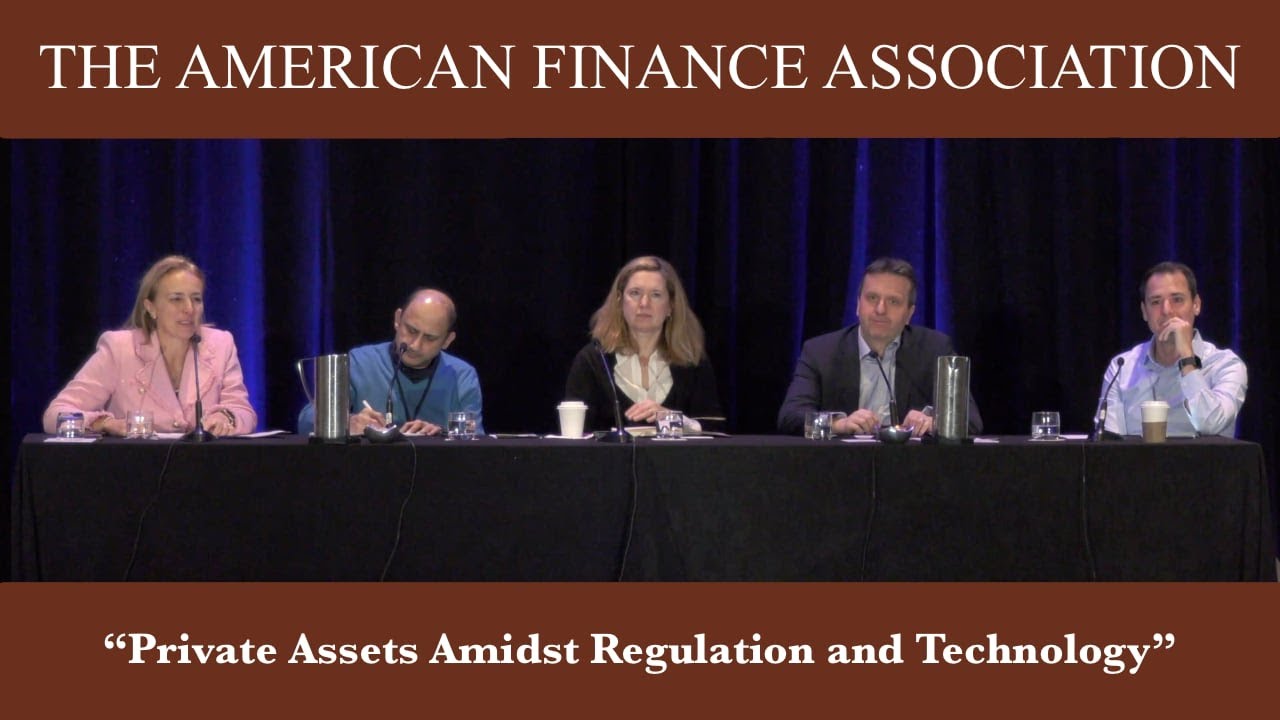
Published on YouTube by The American Finance Association on January 17, 2026, this video captures a panel session from the 2026 AFA Meetings chaired by Professor Isil Erel from The Ohio State University. According to the page description, the discussion explores 'Private Assets Amidst Regulation and Technology,' featuring insights from academic experts Viral Acharya, Victoria Ivashina, Tomasz Piskorski, and Alberto Rossi. The panelists address key developments including non-bank growth, private debt risks, bank linkages, fintech innovations, and the democratized access of private markets to retail investors.
## TL;DR
The panel analyzes the rapid expansion of private debt and non-bank financial intermediation, emphasizing how regulatory shifts post-2008 drove risky credit creation out of traditional banks while maintaining underlying liquidity dependencies on the banking system. Scholars examine how private credit funds utilize high equity buffers and flexible restructuring mechanisms to mitigate default rates, even as net risk-adjusted returns to investors hover around zero after accounting for equity-like risks and management fees. The conversation highlights emerging systemic risks driven by the 'democratization' of private assets, where opening illiquid vehicles to retail investors creates structural liquidity mismatches and potential run dynamics. Additionally, the speakers detail how technology and fintech interfaces re-shape consumer investing behavior, while cautioning against regulatory gaps, opaque valuations, and circular financial exposures across non-banks and traditional lenders.
## Atmosphere & style
The session carries an intellectual, rigorous, and analytical tone characteristic of an elite academic symposium, balancing empirical economic insights with candid policy warnings. The dynamics among the chair and panelists are collaborative yet deeply probing, marked by measured discourse that systematically dissects complex financial engineering and regulatory loopholes. Rather than sensationalizing market vulnerabilities, the speakers deliver grounded, evidence-based critiques—creating an atmosphere that feels like a high-level strategic briefing on subtle systemic risks hiding beneath financial innovation.
## Key takeaways
- [00:08](https://www.youtube.com/watch?v=Dste_AuBCJk&t=8s) Following post-2008 bank regulations, roughly one-third of middle-market firms shifted to non-bank borrowing, driving the global private credit market above $2.0 trillion.
- [07:36](https://www.youtube.com/watch?v=Dste_AuBCJk&t=456s) After adjusting for dual bond-and-equity risk factors and fund management fees, LP net alpha in private debt funds drops to zero.
- [16:04](https://www.youtube.com/watch?v=Dste_AuBCJk&t=964s) NBFIs rely fundamentally on commercial bank liquidity and credit lines, meaning systemic liquidity risk remains anchored in the regulated banking system during market stress.
- [22:51](https://www.youtube.com/watch?v=Dste_AuBCJk&t=1371s) Private credit funds use flexible debt-to-equity conversions to resolve borrower distress without formal bankruptcy, contributing to a 15-year decline in corporate bankruptcies but risking 'zombie' firm preservation.
- [36:14](https://www.youtube.com/watch?v=Dste_AuBCJk&t=2174s) With institutional pension allocations to alternative assets plateauing at ~15%, asset managers are lowering minimum investment sizes to $10,000 and tapping retail 401(k) accounts.
- [40:15](https://www.youtube.com/watch?v=Dste_AuBCJk&t=2415s) Immediate retail capital inflows force fast deployment, driving rapid growth in GP-led secondary markets and continuation vehicles to extend hold periods beyond traditional 5-year horizons.
- [43:59](https://www.youtube.com/watch?v=Dste_AuBCJk&t=2639s) Traditional banking faces a secular decline, with bank credit falling from ~60% of household and firm credit in the 1970s to ~33% in the mid-2020s, while non-banks command 60% to 70% of residential mortgage originations.
- [54:57](https://www.youtube.com/watch?v=Dste_AuBCJk&t=3297s) Frontend visual design and UI choices on financial platforms exert a stronger influence on retail investor behavior than text disclosures, creating potential risks around illiquid private assets.
- [01:07:33](https://www.youtube.com/watch?v=Dste_AuBCJk&t=4053s) Lowering investment thresholds to $10,000 forces sponsors to offer redemption rights, transforming private credit into a runnable, bank-like structure with liquidity mismatches.
- [01:13:35](https://www.youtube.com/watch?v=Dste_AuBCJk&t=4415s) Private credit market scale is estimated at $2 trillion to $3 trillion, surpassing high-yield bonds, but non-banks should operate without central bank bailouts to avoid undermining private market principles.
- [01:20:26](https://www.youtube.com/watch?v=Dste_AuBCJk&t=4826s) Private debt resides in two distinct buckets: roughly 40% sits in retail-facing BDCs with SEC disclosures, while 60% remains in obscure institutional funds.
- [01:23:47](https://www.youtube.com/watch?v=Dste_AuBCJk&t=5027s) Private credit funds maintain ~50% equity buffers compared to ~10% for commercial banks, though bank solvency remains vulnerable to modest asset value drops or rate spikes.
- [01:30:01](https://www.youtube.com/watch?v=Dste_AuBCJk&t=5401s) Private credit managers utilize 'extend and pretend' rollover vehicles to delay default recognition on troubled assets.
- [01:38:46](https://www.youtube.com/watch?v=Dste_AuBCJk&t=5926s) Circular cash flows between banks financing private debt funds via subscription lines and backing fund investors create interconnected risks missed by Federal Reserve stress tests.
- [01:42:46](https://www.youtube.com/watch?v=Dste_AuBCJk&t=6166s) Payment-in-Kind (PIK) toggle utilization serves as the primary leading indicator of distress and hidden restructuring in unrated private debt.
- [01:48:27](https://www.youtube.com/watch?v=Dste_AuBCJk&t=6507s) Private credit funds blend debt and equity claims in single companies—a practice legally prohibited for regulated commercial banks.
Isil Erel opens the panel at 8:00 a.m. at the 2026 American Finance Association Meetings in Philadelphia, thanking attendees for showing up bright and early on the first day of the conference. After introducing herself as the David A. Ronsky Chair in Finance at The Ohio State University's Fisher College of Business, she outlines the session's overarching focus: private assets amidst regulation and technology. The discussion promises to span private equity, private debt, real estate finance, and robo-advisors. She previews the agenda—8 to 10 minutes of initial remarks per panelist, followed by chair-led questions and a 45-to-50-minute audience Q&A—encouraging active participation from the crowd.
Erel anchors her opening remarks on the dramatic post-financial crisis growth of private debt, particularly loans to small and medium-sized enterprises (SMEs). Historically, commercial banks dominated SME lending, but non-bank financial intermediaries first expanded their footprint in the syndicated leverage loan market before evolving into direct lenders that originate, hold, and negotiate loans on their own balance sheets without securitizing them. Citing her joint research with Robert Prilmeier and Sergey Chernenko, Erel highlights that roughly one-third of middle-market firms transitioned to non-bank borrowing following post-crisis bank regulations. These non-bank borrowers tend to carry significantly higher leverage and risk profiles, often exhibiting negative EBITDA or weak profitability.
```
+-------------------------------------------------------------------------------+
| PRIVATE DEBT GROWTH METRICS |
+-------------------------------------------------------------------------------+
| Global Market Size | > $2.0 Trillion (dominated by the US) |
| Direct Lending Share | ~60% of total private credit |
| LBO Loan Allocation | ~60% of direct lending volume |
| Mega-Deal Threshold | $1.0B to $5.0B direct private loans |
+-------------------------------------------------------------------------------+
```
Erel emphasizes that private credit has grown into an asset class exceeding $2.0 trillion globally, outstripping both the broadly syndicated loan (BSL) and high-yield bond markets. Major global asset managers like Apollo, Ares, Blue Owl, and BlackRock now manage multiple private debt funds and Business Development Companies (BDCs). While direct lending represents roughly 60% of this space—with a heavy emphasis on leveraged buyout (LBO) financing—the market is increasingly encroaching on institutional public debt territory via $1 billion to $5 billion mega-deals. Unlike pre-2008 Collateralized Loan Obligations (CLOs), these loans are held directly on balance sheets, functioning much like traditional bank relationships with tailored financial covenants and renegotiation capacity.
- **Non-Bank Middle-Market Shift:** Post-crisis bank regulation was the primary driver shifting one-third of middle-market borrowers toward non-bank direct lenders.
- **Risk Profile:** Non-bank borrowers present higher leverage and weaker cash flows (frequently negative EBITDA) relative to standard commercial bank clients.
- **Asset-Based Lending Expansion:** Private credit is rapidly expanding beyond cash-flow loans into asset-backed finance (e.g., equipment finance), with recent corporate default cases like Tricolor and First Brands exemplifying this exposure.
[07:36](https://www.youtube.com/watch?v=Dste_AuBCJk&t=456s) Risk-Adjusted Investor Returns in Private Credit Funds
Turning to performance, Erel challenges the common industry narrative that private credit provides high yield with virtually no risk or loss exposure. In joint research with Thomas Flanagan and Michael Schwert, Erel examines net-of-fee cash flow data from Burgiss to assess whether private debt funds generate genuine alpha for limited partners (LPs).
```
+-------------------------------------------------------------------------------+
| PRIVATE DEBT RETURN ANALYSIS |
+-------------------------------------------------------------------------------+
| Equity-Like Holdings | ~20% of fund portfolios (warrants, common stock) |
| Bond-Only Benchmarks | Shows positive Net NPV / Alpha |
| Combined Benchmarks | Net Alpha drops to ZERO once equity factors are |
| | properly risk-adjusted |
+-------------------------------------------------------------------------------+
```
When comparing fund cash flows purely against public bond market benchmarks, private debt appears to deliver positive net NPV. However, because private debt funds hold nearly 20% of their portfolios in equity-like instruments (including common equity and warrants) and lend to inherently riskier borrowers, a dual bond-and-equity factor adjustment reveals that the average net alpha for limited partners is actually **zero**. The return simply compensates the investor for the underlying risk and fees incurred.
- **Fee & Risk Realities:** LPs in private credit funds receive returns that strictly cover taking on credit risk and paying fund management fees, rather than uncompensated excess alpha.
- **Hybrid Deal Structures:** Private credit funds increasingly utilize hybrid instruments, often holding both equity and debt positions within the exact same portfolio firm.
[12:00](https://www.youtube.com/watch?v=Dste_AuBCJk&t=720s) Introduction of Panelists
Erel transitions to introducing the four guest panelists in alphabetical order by surname:
- **Viral Acharya** (C.V. Starr Professor of Economics at NYU Stern): Former Deputy Governor of the Reserve Bank of India (2017–2019) overseeing monetary policy and financial stability. His research focuses on systemic risk, non-bank financial institutions (NBFIs), and sovereign-bank interconnectivity.
- **Victoria Ivashina** (Lovett-Learned Professor of Finance and Head of the Finance Unit at Harvard Business School): Co-head of HBS’s Private Capital Initiative, former visiting scholar at the Federal Reserve Bank of Boston, and former member of the Federal Reserve Board's Model Validation Council. Her focus centers on corporate credit, private equity, and venture capital.
- **Tomasz Piskorski** (Edward S. Gordon Professor of Real Estate at Columbia Business School): Research Associate at the NBER and Academic Advisory Council member at the Urban Institute's Housing Finance Policy Center. His work centers on real estate finance, mortgage markets, fintech lending, and banking regulation.
- **Alberto Rossi** (Howard Family Professor of Finance at Georgetown University): Director of the AI, Analytics, and Future of Work Initiative at Georgetown, Visiting Fellow at Brookings, and FINRA Economic Advisory Committee member. His research evaluates robo-advising, machine learning, big data, and consumer savings behavior.
[16:04](https://www.youtube.com/watch?v=Dste_AuBCJk&t=964s) Viral Acharya on Bank-NBFI Linkages & Systemic Risk
Viral Acharya assumes the floor to deliver a macroprudential perspective on private credit and non-bank financial intermediaries (NBFIs). Citing joint work with Nicola Cetorelli (Federal Reserve Bank of New York) and Bruce Tuckman (NYU Stern)—including their Riksbank keynote paper *"Where Do Banks End and NBFIs Begin?"* and Journal of Finance research—Acharya dispels the belief that NBFIs operate independently of regulated commercial banks.
> "Every time you observe some non-banks growing, they are on the back of the banking system... banks remain the repositories of a large pool of deposits—a large pool of real savings in the economy."
Acharya explains the mechanics of regulatory arbitrage: prudential regulation imposes capital and liquidity constraints on commercial banks to curb excess risk-taking. This friction creates a wedge, naturally pushing riskier credit creation out of the heavily regulated banking system and into NBFIs. While a naive view suggests this de-risks the financial system by moving non-deposit-taking entities away from government bailouts, the reality is that non-banks rely fundamentally on commercial bank liquidity and credit lines to sustain their balance sheets.
```
+-------------------------------------------------------------------------------+
| TRANSFORMED INTERMEDIATION DYNAMICS |
+-------------------------------------------------------------------------------+
| Non-Bank / NBFI Side | Holds Solvency / Credit Risk (illiquid loans) |
| Commercial Bank Side | Retains Liquidity Risk & Deposit Backstop |
| Crisis Behavior | Market stress triggers "Dash for Cash" -> NBFIs |
| | draw down bank credit lines & deposits flight to |
| | quality |
+-------------------------------------------------------------------------------+
```
Because NBFIs cannot attract real economy savings at the same scale as insured banks, they depend on bank credit facilities. In times of severe market turbulence (e.g., elevated VIX levels or the March 2020 COVID-19 shock), private markets reprice rapidly, forcing NBFIs into a "dash for cash." Ultimately, the liquidity risk flows right back into the banking network through credit line drawdowns, backed by the ultimate sovereign lender-of-last-resort: the Federal Reserve.
- **Liquidity Imbalance:** Solvency and credit risks are shifted to NBFIs, but systemic liquidity risk remains anchored inside the regulated banking system.
- **Central Bank Put:** Commercial banks' core advantage stems from government-backed deposit insurance and central bank liquidity windows, which indirectly subsidize NBFI expansion.
<ElicitationsGroup message="Explore related panel discussions or deep dives:">
<Elicitation label="Analyze Victoria Ivashina's perspective on private equity and credit" query="Provide a detailed walkthrough of Victoria Ivashina's segment on private equity and credit markets from the transcript."/>
<Elicitation label="Examine Tomasz Piskorski's insights on fintech and mortgages" query="Provide a detailed walkthrough of Tomasz Piskorski's segment on fintech, real estate, and mortgage loans from the transcript."/>
<Elicitation label="Review Alberto Rossi's analysis of AI and robo-advisors" query="Provide a detailed walkthrough of Alberto Rossi's segment on robo-advising, AI, and retail investing from the transcript."/>
</ElicitationsGroup>
[21:00](https://www.youtube.com/watch?v=Dste_AuBCJk&t=1260s) Symbiosis and Liquidity Risks Between Banks and Non-Banks
The relationship between the regulated banking system and the shadow banking sector functions as a closely tied, state-contingent network. While non-banks and banks appear to operate independently during favorable economic conditions, non-banks remain fundamentally reliant on traditional banks for liquidity support. In good times, non-banks grow rapidly by taking advantage of regulatory arbitrage around the banking system; however, they deliberately maintain credit channels back to banks. When non-bank financing dries up or faces a sharp rise in capital costs, these underlying linkages allow risk to flow right back into the banking system, shifting liquidity risk onto banks and, ultimately, government backstops.
Viewed through a structural lens, non-banks essentially behave like special purpose vehicles (SPVs) for the banking sector. They warehouse solvency and market risks during stable periods until liquidity crises materialize. While a traditional view holds that government regulations drive the growth of non-banks, an alternative perspective suggests that behind every non-bank, there is a traditional bank expanding its indirect footprint.
- Non-banks absorb solvency risks in benign times but transfer liquidity demands back to banks when market stress occurs.
- Research focuses on mapping these structural linkages and tracking how risk flows back to regulated institutions during financial distress.
[22:51](https://www.youtube.com/watch?v=Dste_AuBCJk&t=1371s) Private Credit's Unique Structure and Structural Advantages
Private credit presents distinct analytical challenges because it has expanded primarily over the last five years and was not yet large during the peak of the COVID-19 shock. Because it operates out of public view, administrative data (such as Federal Reserve reporting) is required to inspect its credit lines and drawdown patterns. This lack of public transparency has fueled competing hypotheses regarding whether private credit carries systemic liquidity risks or offers a safer, non-runnable model of credit intermediation.
Proponents argue that private credit may be a superior form of intermediation compared to banks with runnable liabilities. Initially born out of regulatory limits like leverage lending guidelines, private credit providers developed specialized technology and cash-flow-based lending models. A key feature of private credit funds is their substantial equity buffer—the "solvency piece" supplied by the fund's sponsors—alongside debt raised via BBB-rated bonds from insurance companies and senior credit lines from banks. Furthermore, private credit operates as a broader portfolio of services: during periods of borrower distress, sponsors can execute debt-to-equity conversions, effectively transitioning middle-market borrowers from debt to private equity ownership without undergoing costly, public bankruptcy or fire-sale liquidations.
- **Capital Structure Composition:** Private credit relies on a combination of sponsor equity, BBB-rated bonds issued to insurance companies, and senior subscription loans provided by banks.
- **Bankruptcy Avoidance:** By utilizing built-in debt-to-equity conversions, private credit funds avoid formal bankruptcy proceedings, contributing to a broader 15-year decline in corporate bankruptcies.
[27:12](https://www.youtube.com/watch?v=Dste_AuBCJk&t=1632s) Expanding Government Backstops, Moral Hazard, and Capital Misallocation
The systemic expansion of central bank liquidity facilities raises concerns about market discipline across the broader financial system. The Federal Reserve's balance sheet, standing near $3.4 trillion on an ongoing structural basis rather than operating as a temporary crisis measure, has altered risk perception. Market participants and hedge fund managers increasingly act as though liquidity risk is no longer priced into assets, assuming central bank liquidity or expanding credit lines will perpetually serve as a backstop.
This implicit safety net creates vulnerabilities for private credit. Bank lines of credit, such as subscription loans, are often assumed to be purely administrative. However, history demonstrates—such as the large private equity buyouts in the summer of 2007, like the Alliance Boots transaction in London—that institutions relying heavily on bank lines can become trapped when market refinancing freezes. Additionally, private credit funds issuing BBB-rated debt face significant liquidity risks if downgraded to junk status. Even if solvent, a downgrade spikes their cost of capital, forcing them to turn back to the banking system. Moreover, avoiding formal bankruptcies through sponsor takeovers risks creating "zombie" firms—unprofitable enterprises with poor credit profiles that remain on private equity balance sheets simply because long-term capital is locked in, leading to general equilibrium capital misallocation.
- **Fed Balance Sheet Scale:** Structural central bank balance sheets near $3.4 trillion suppress the market pricing of liquidity risk.
- **Downgrade Vulnerabilities:** A downgrade of private credit debt from BBB to speculative grade triggers immediate liquidity demands and banking sector reliance.
- **Resource Misallocation:** Avoiding formal liquidations risks preserving unproductive "zombie" firms with weak cash flows, distorting capital allocation across the economy.
[32:31](https://www.youtube.com/watch?v=Dste_AuBCJk&t=1951s) Demand-Driven Growth and the Architecture of Private Credit
While conventional wisdom attributes the boom in private credit primarily to post-2008 bank deregulation and heightened supervisory scrutiny, the primary driver stems from the demand side. Following the 2008 financial crisis, low interest rates drove a surge of institutional capital into private equity. Because the private equity model relies on leverage, PE sponsors expanding into middle-market deals generated an enormous demand for high-yield debt.
Private credit transformed from a niche industry closely affiliated with private equity managers prior to 2008 into an arm's-length market catering directly to middle-market firms. Rather than merely replacing traditional bank lending, private credit functions as a distinct lending technology alongside corporate bond markets and syndicated leveraged loan markets, catering specifically to smaller deals unsuited for broad syndication.
- **Market Technologies:** Private credit operates as a distinct lending technology alongside the public bond market and the bank-originated, non-bank funded leveraged loan market.
- **Middle-Market Expansion:** Abundant institutional capital forced private equity to seek buyouts in the middle market, driving parallel demand for specialized debt.
[36:14](https://www.youtube.com/watch?v=Dste_AuBCJk&t=2174s) Capital Sourcing Shifts and the Pressure of "Democratization"
A structural shift is underway in how private equity and private debt funds raise capital, moving from institutional investors to retail and affluent individual investors—a trend often termed "democratization." Historically, institutional investors, led by pension funds, provided the vast majority of capital. However, pension funds have largely reached their target allocations for alternative assets, sitting around 15%. Because institutional allocations have plateaued, asset managers—many of which are publicly traded companies facing constant pressure to show growth—must seek capital elsewhere.
To maintain growth, fund managers are turning to individual investors, lowering minimum investment thresholds from $50,000 down to $10,000, with further expansion targeting 401(k) retirement accounts. This shift changes capital management dynamics. Unlike pension commitments, where funds are drawn down only when specific investments arise, retail capital is drawn immediately upon commitment. This creates immediate pressure on fund managers to deploy capital quickly, fundamentally altering liquidity management and valuation practices compared to traditional institutional models.
- **Institutional Allocation Ceiling:** Pension fund allocations to alternatives have plateaued at approximately 15%, shifting industry growth strategies toward individual retail investors.
- **Investment Minimums:** Minimum check sizes for retail-oriented private asset vehicles have dropped from $50,000 to $10,000.
- **Immediate Capital Deployment:** Sourcing capital directly from individuals eliminates the traditional call-down model, forcing immediate deployment of drawn funds.
[40:15](https://www.youtube.com/watch?v=Dste_AuBCJk&t=2415s) Capital Deployment Pressures and Continuation Vehicles
Victoria Ivashina addresses the practical friction that arises when retail money flows into alternative asset classes. When an alternative fund receives immediate cash inflows, sitting on that cash creates a significant drag on overall returns. Fund managers are bound by promises to deliver high expected returns, which forces them to deploy capital immediately into alternative investments.
This structural pressure to deploy funds quickly has fueled one of the most notable developments in alternative assets: the rapid growth of the secondary market, particularly GP-led secondaries known as **continuation vehicles**.
```
[Traditional Model]
Private Equity Fund ──(5-Year Pressure)──> Forced Asset Exit / Sale
[Continuation Vehicle Model]
Private Equity Fund ──(Select Assets)──> Special Purpose Vehicle ──> Extended Asset Life
```
Instead of facing forced exits at the end of a traditional fund's lifespan, private equity managers can take high-conviction assets and transfer them into a new special purpose vehicle, effectively extending the holding period.
- **Democratization Pressure:** The rapid rise of secondaries and continuation vehicles directly stems from the democratization of private markets and the imperative to deploy fresh capital instantly.
- **Cross-Asset Expansion:** Secondaries are expanding beyond traditional private equity into private debt markets.
- **Conflicts of Interest:** Continuation vehicles involve complex structural dynamics that present potential conflicts of interest, prompting regulatory scrutiny and action from the SEC.
- **Academic Research:** Ivashina notes ongoing academic research—including her own work with Simon Meyer and Luda Philippo—analyzing structural concerns and potential friction points within secondary transactions.
---
[42:35](https://www.youtube.com/watch?v=Dste_AuBCJk&t=2555s) The Operational Silver Lining of Continuation Vehicles
Ivashina highlights a potential structural benefit of continuation vehicles despite their regulatory and operational complexities. In traditional multi-trillion-dollar private equity funds with ten-year lifespans, individual assets are typically held for only five years. Because the final year is usually consumed by the exit process, operational improvements must produce measurable results within just two to three years.
```
Traditional 5-Year Hold Horizon:
[ Year 1 - 2: Implement Changes ] ➔ [ Year 3 - 4: Track Results ] ➔ [ Year 5: Sell Company ]
```
This compressed timeline historically restricted private equity managers to a narrow subset of target companies capable of short-term turnarounds. Continuation vehicles provide a mechanism to stretch investment and operational horizons beyond arbitrary fund deadlines, allowing managers to pursue longer-term value creation.
---
[43:59](https://www.youtube.com/watch?v=Dste_AuBCJk&t=2639s) The Secular Decline of Traditional Banking
Tomasz Piskorski shifts the discussion to a macro perspective, examining the growth of private credit within the broader historical trajectory of credit markets. He frames the rise of private credit as part of a multi-decade decline in traditional bank-intermediated finance across the United States.
```
Traditional Banking Model:
Savers ──(Deposits)──> Bank Balance Sheet ──(Loans)──> Households & Firms
```
In the traditional intermediation model, banks collect deposits to finance real-economy loans held directly on their balance sheets while providing liquidity and payment services. Piskorski—referencing his research with Greg Buchak, Gregor Matvos, and Amit Seru—demonstrates that this traditional framework has been in continuous decline for over fifty years.
- **Loan Market Share Shift:** In the 1970s, nearly **60%** of all credit to households and firms was held on bank balance sheets. By the mid-2020s, that figure dropped to approximately **one-third**, with the majority of credit now financed by non-bank financial intermediaries.
- **Decline in Wealth Held as Deposits:** Bank deposits accounted for over **20%** of total financial wealth in the 1970s, but dropped to roughly **10%** by the mid-2020s.
- **Shift in Bank Assets:** Loans to households and firms made up **70%** of total bank assets in the 1970s, compared to **55%** today, as banks increasingly shifted toward holding debt securities.
- **Interconnected Credit Support:** Bank balance sheets remain linked to non-banks; Piskorski estimates that for every **$1** of non-bank credit extended, approximately **$0.08** is supported by direct bank credit to non-bank financial intermediaries.
Piskorski emphasizes that the migration of credit away from traditional banks is not primarily a post-2008 Great Recession phenomenon—the bulk of the secular decline occurred prior to the early 2000s. The long-term shift was driven by innovations in both modern debt securities markets and saver behavior.
Saver Side:
• Alternative Savings Vehicles (Money Market Funds, ETFs, Modern Pensions)
```
Post-crisis bank regulations and unconventional monetary policies further accelerated this shift, prompting banks to move balance sheets away from direct loans toward debt securities. Consequently, banks lost market share not only in holding loans, but also in originating them.
- **Mortgage Origination Transformation:** Prior to the Great Recession, traditional banks originated roughly **70%** of residential mortgages. Today, non-bank lenders command **60% to 70%** of the origination market.
- **Fintech Scale & Convenience:** Non-bank originators like Rocket Mortgage expanded market share not by offering lower interest rates, but by delivering speed, digital simplicity, and transactional convenience.
- **Higher Capitalization:** Citing joint research with Erica Jiang, Gregor Matvos, and Amit Seru, Piskorski notes that non-bank lenders and private credit funds operate with significantly higher equity capital buffers than traditional regulated banks.
Looking ahead, Piskorski points out that emerging financial innovations—such as private credit replacing information-sensitive bank loans, and stablecoins or alternative payment networks competing for deposits—will continue to erode traditional bank dominance.
Piskorski advocates for a updated theoretical framework termed **distributed financial intermediation**, which reflects a financial system where intermediation functions are dispersed across specialized entities.
- **Functional Regulation:** Regulators should shift from entity-based rules (regulating an institution simply because it is a "bank") to activity-based rules (regulating risk characteristics of loan origination regardless of who performs it).
- **Differential Policy Pass-Through:** In a distributed system, raising bank capital requirements yields a much smaller reduction in overall credit supply than traditional models predict. Capital constraints primarily trigger a reallocation of credit toward non-bank entities and debt security markets.
- **Regulatory Perimeter:** Policy makers face unresolved questions regarding how far safety nets and emergency liquidity guarantees should extend to non-bank intermediaries during crises.
---
[54:57](https://www.youtube.com/watch?v=Dste_AuBCJk&t=3297s) Individual Investors, Household Finance, and Technological Interfaces
Alberto Rossi shifts the panel's focus to household finance, analyzing how individual investors interact with private assets through financial technology. While prior discussion centered on institutional structures and non-bank regulation, Rossi stresses that technology platforms, robo-advisors, and disintermediated advice are reshaping how retail investors save and allocate capital.
Because individual investors are attention-constrained, their engagement with financial markets is highly episodic and sensitive to market volatility. As a result, the design of fintech user interfaces plays a central role in shaping retail investor behavior.
- **Design vs. Disclosure:** Traditional financial regulation relies heavily on legal disclosure documents. In a fintech-driven environment, front-end visual presentation and interface design exert a far stronger influence on investor choices than text disclosures.
- **Display Distortions:** On common platforms like Yahoo Finance, private credit ETFs often display only price changes, obscuring total return profiles driven by regular income distributions.
- **Perception of Safety:** The lack of real-time market pricing in illiquid private assets can lead unsophisticated retail investors to mistake infrequent valuation updates for low risk or true price stability.
- **Platform Nudges:** Gamification techniques, mobile notifications, and targeted reminders can induce overtrading in public markets or draw retail capital into complex private structures whose cash flow mechanics investors may not fully grasp.
[58:47](https://www.youtube.com/watch?v=Dste_AuBCJk&t=3527s) Advisor Models and the Dynamics of Democratization
Alberto Rossi opens by underscoring that encouraging individuals to maintain recurring savings plans—a principle proven both by 401(k) literature and fintech research—is far more vital to retirement security than chasing an extra 1% or 2% in annual returns through portfolio optimization. Private assets offer an intriguing long-horizon commitment mechanism for retail investors, though emergency savings must remain accessible to absorb negative shocks. Turning to financial advice, Rossi challenges the binary distinction between human advisors and robo-advisors (such as Wealthfront or Betterment), noting that asset managers are rapidly adopting a "hybrid structure." Automating routine tasks enables advisors to serve more clients at lower cost, transforming the advisor's core role into that of a behavioral coach or "psychologist" who explains algorithm-generated outcomes. While public equity portfolios are heavily automated, emerging research by Petra Vokata (Ohio State) and co-authors suggests individual advisors still play a significant role in guiding retail clients through private equity selection.
Isil Erel shifts the discussion directly to the democratization of private asset investing, highlighting that private equity firms are actively acquiring financial advisory practices. Rossi observes a fundamental philosophical rift among advisory firms: some cater directly to investor preferences and biases, while others refuse to offer crypto or private equity to non-affluent clients. However, refusing these products creates competitive risks, as clients—and talented advisors seeking to build larger books of business—may migrate to platforms that permit private asset access. Furthermore, private equity's aggressive roll-up of wealth management firms stems from historical fee structures; by introducing technology, PE sponsors aim to increase advisor capacity, squeeze traditional 1% AUM fees downward, and make the advice market far more competitive.
- **Key Research Reference**: Petra Vokata (Ohio State University) and co-authors on the influence of individual advisors on private equity performance for retail investors.
- **Traditional Advice Fees vs. Robo-Advisors**: Traditional wealth advisors historically charged around 1.0%–1.1% of AUM, compared to 20–25 basis points for robo-advisors like Wealthfront and Betterment.
[01:07:33](https://www.youtube.com/watch?v=Dste_AuBCJk&t=4053s) Liquidity Mismatches, Fragility, and Systemic Run Risk
Viral Acharya expresses severe skepticism regarding democratization from a financial stability perspective, calling it the trend he worries about most. The central value proposition of private equity has historically been its locked-in, 10-year institutional capital commitment. Lowering investment thresholds down to $10,000 forces sponsors to offer redemption rights, transforming the private equity/credit model into a "runnable model" that resembles bank deposits. Acharya argues that private credit sponsors are ultimately attempting to capture mainstream consumer savings; if retail investors face losses, political pressure will inevitably force policymakers to extend government backstops. Victoria Ivashina clarifies that while democratized vehicles offer more liquidity than traditional zero-liquidity funds, that liquidity remains strictly capped through quarterly redemption windows, aggregate net asset value (NAV) caps, and early-withdrawal penalties. She highlights that private debt has been migrating away from public equity structures toward these slow, limited-liquidity vehicles, which prevents instant panic selling but requires careful monitoring.
Tomasz Piskorski warns of severe governance and adverse selection risks when opening private credit and real estate crowdfunding to retail investors who lack the monitoring capability of institutional LPs. Citing experiences with real estate crowdfunding platforms, Piskorski notes that while reputable sponsors protect their brand, other platforms exhibit serious governance failures "if not an outright fraud" due to the absence of SEC-style disclosure frameworks. Isil Erel adds that retail investors frequently suffer from a flawed perception of risk, treating private debt as a high-return, low-risk alternative to crypto without appreciating its underlying complexities.
> "The whole selling point of PE had been that, oh, we have long-term investors, we have subscriptions which are locked in for 10 years... I don't see how going down to levels of 10k for funding will be disassociated with not selling some redemption rights. And then the private credit model looks more like a runnable model." — **Viral Acharya**
[01:13:35](https://www.youtube.com/watch?v=Dste_AuBCJk&t=4415s) Regulatory Oversight, Opacity, and Non-Bank Backstops
Addressing regulatory strategy, Isil Erel questions how the market will react if regulators impose strict stress testing on private assets. Viral Acharya responds that regulators must first develop a comprehensive understanding of the asset class. While private credit has grown rapidly, it remains smaller than the broader debt landscape—roughly $2 trillion to $3 trillion compared to the $10 trillion corporate bond market, though Erel and Acharya note private credit has already surpassed the high-yield bond market in scale. Acharya advocates for greater public transparency regarding bank-to-nonbank linkages rather than keeping granular stress-test data sequestered within the Federal Reserve.
The panel explores the true opacity of private credit assets versus reported equity buffers. While small businesses carry high operational and personal owner risk, private credit funds routinely report 50% equity buffers without full disclosure of asset illiquidity. Closing this section, Acharya delivers a sharp critique of central bank policy, arguing that monetary authorities have been far "too agreeable to opening up the liquidity taps for non-banks." He contends that the sole justification for non-bank financial intermediation is that tax-payers do not have to bail them out; continually extending liquidity facilities during brief periods of market volatility undermines the core thesis of private markets.
- **Market Scale Comparison**: Private credit market estimated at $2–$3 trillion, having surpassed the traditional high-yield bond market, compared to the ~$10 trillion overall corporate bond market.
- **Systemic Risk Mechanisms**: Exposure to interval funds with NAV redemption caps, non-bank leverage linkages to traditional commercial banks, and implicit central bank backstops during liquidity crunches.
<FollowUp label="Want to continue with part 5 of the transcript walkthrough?" query="Please write a detailed walkthrough for part 5 of the transcript following the same guidelines."/>
[01:16:39](https://www.youtube.com/watch?v=Dste_AuBCJk&t=4599s) Regulating Systemic Risk and Control Rights
Viral Acharya addresses the broader implications of backstopping non-bank financial markets during periods of stress. He argues that whenever the Federal Reserve steps in to stabilize markets—such as intervening in government bond markets because hedge funds pose a destabilization risk—it is essentially re-engineering the "government put" by guaranteeing migrated risks. Acharya advocates for a forward-looking regulatory principle: if an entity becomes large enough to pose systemic risk and requires liquidity taps from the Fed, the central bank must have supervisory control rights and access to enhanced disclosures.
Moving to the topic of Business Development Companies (BDCs), Victoria Ivashina points out that many vehicles driving democratization are registered investment companies (RICs) or BDCs. These entities already operate under significant governance and regulatory requirements, such as quarterly portfolio reporting and holding three independent directors on their boards. She suggests that instead of adding new regulatory layers, regulators like the Fed simply need to better understand and stress-test the contractual credit provisions and covenant structures connecting banks to BDCs.
- **Key Regulatory Proposal:** Any entity deemed systemically important that gains access to Fed liquidity should be subject to direct Fed oversight and supervision.
- **BDC Structure:** BDCs function as specialized registered investment companies (RICs) subject to SEC filings and board governance rules.
- **Bank-BDC Linkages:** Unresolved questions remain around whether bank credit lines to BDCs automatically shut down during underperformance or permit full drawdowns that put banks on the hook.
---
[01:20:26](https://www.youtube.com/watch?v=Dste_AuBCJk&t=4826s) Obscurity vs. Disclosures in Private Markets
The panel debates the extent of transparency in private debt and private equity markets. While BDCs account for roughly 40% of the private debt market and disclose their portfolio holdings quarterly via SEC filings, the remaining 60% sits inside private credit funds that cater almost exclusively to institutional investors and remain largely obscure.
Alberto Rossi highlights the challenge of regulatory uncertainty, pointing to recent SEC rulemakings that were subsequently struck down or withdrawn—such as the Private Fund Advisers rule (which required quarterly disclosures on fund fees and performance) and proposed predictive analytics rules targeting conflicts of interest in automated financial advice. He emphasizes that disclosure should not be equated with comprehension, warning that as private assets increasingly enter 401(k) plans, retail investors may view them as implicitly endorsed, raising consumer protection concerns.
- **Market Breakdown:** Approximately 40% of private debt sits in retail-facing BDCs, while the majority remains in less transparent institutional credit funds.
- **Regulatory Volatility:** Recent SEC efforts around private fund disclosures and predictive AI/analytics rules faced legal setbacks and withdrawals, creating a shifting regulatory baseline.
- **Retail Inclusion:** The inclusion of private assets in 401(k) retirement plans risks giving retail investors a false sense of safety regarding asset suitability.
---
[01:23:47](https://www.youtube.com/watch?v=Dste_AuBCJk&t=5027s) Banking Vulnerabilities vs. Non-Bank Liquidity Buffers
Tomasz Piskorski evaluates how private assets handle macroeconomic downturns, noting that non-bank financial intermediaries can act as a stabilizing counterweight during recessions when traditional banks face capital shocks. He highlights that private credit funds operate with substantial equity cushions—often around 50%—and mortgage lenders maintain 20–25% buffers. Piskorski expresses far greater concern over traditional banks operating on thin 10% equity cushions and heavy debt reliance (split between insured and uninsured deposits).
Citing recent research on banking stress tests published in the *Journal of Political Economy Macro*, Piskorski warns that banking sector vulnerabilities remain unaddressed following the 2023 regional banking crisis. A modest 10% drop in bank asset values or a 10-year Treasury yield reaching $4.5\%$ or higher places numerous banks at risk of solvency-driven runs by uninsured depositors. Rather than diluting bank recapitalization efforts, he argues regulators should significantly raise bank capital requirements first.
- **Private Credit Capital Buffers:** Private credit funds typically maintain ~50% capital cushions; non-bank mortgage lenders keep 20–25%.
- **Traditional Bank Leverage:** Commercial banks operate with roughly 10% equity and 90% debt/deposit funding, making a 10% asset value drop a threat to solvency.
- **Interest Rate Sensitivity:** Models show that 10-year Treasury yields at $4.5\%$ or higher trigger solvency risks across a wide segment of the U.S. banking system.
---
[01:26:36](https://www.youtube.com/watch?v=Dste_AuBCJk&t=5196s) Dry Powder Dynamics and Unsynced Fundraising Cycles
Addressing questions about rising "dry powder" in private debt (which historically reached ~40% and sits near 30%), Victoria Ivashina clarifies that accumulating dry powder is a natural, cyclical feature of private markets. Dry powder peaks right before economic shocks because fundraising booms during market tops. Rather than forcing managers into reckless lending, dry powder frequently acts as a vital liquidity backstop during downturns.
However, Ivashina highlights an emerging structural mismatch: the private debt fundraising machine remains active while private equity fundraising has stalled. Because private debt relies on deal flow from private equity, credit managers are forced to branch out into new, non-traditional strategy spaces—such as asset-based lending, litigation finance, and royalty stream acquisitions. She urges observers to monitor this experimentation closely as lenders search for alternative places to deploy capital.
- **Dry Powder Levels:** Private debt dry powder has fluctuated between 30% and 40% of total assets under management.
- **Market Divergence:** Private debt fundraising continues to move forward, whereas private equity fundraising has slowed down considerably.
- **Strategy Expansion:** Debt funds are actively entering adjacent markets like litigation financing, asset-based lending, and royalties to deploy excess capital.
---
[01:30:06](https://www.youtube.com/watch?v=Dste_AuBCJk&t=5406s) Audience Q&A: Regulatory Arbitrage, Procyclicality, and Suitability Risks
An audience member poses three key questions to the panel: whether low bank capital risk weights on loans to private debt funds represent regulatory arbitrage; whether tying private debt and equity to banks creates credit crunches through asset-side procyclicality; and whether expanding private market access to retail investors creates massive litigation risks from potential misselling due to information asymmetry.
Viral Acharya addresses the regulatory question by explaining how central bank stress tests can address spillovers without direct regulatory oversight of non-banks. By using granular Y-14 stress-test data, regulators can evaluate correlated drawdowns on credit lines during economic slowdowns—a time when all non-AI sectors may experience contractions simultaneously—and impose appropriate prudential capital surcharges on lending banks.
- **Regulatory Arbitrage:** Questions arise on whether banks use credit lines to non-banks to bypass higher on-balance-sheet capital requirements.
- **Correlated Drawdown Stress:** Stress testing focused on synchronized credit-line drawdowns during broader recessions helps quantify bank liquidity and capital exposure.
- **Retail Misselling Concerns:** High information asymmetry between fund sponsors and small-scale retail investors ($10k–$50k investments) creates long-term legal and suitabilty risks.
[01:34:01](https://www.youtube.com/watch?v=Dste_AuBCJk&t=5641s) Stress Testing and the Hidden Zombification of Credit
The discussion kicks off with an examination of how stress testing handles off-balance-sheet credit lines extended by banks to private credit funds. When a fund draws down on a credit line during a stress test scenario, the off-balance-sheet commitment transforms into an on-balance-sheet term loan with a multi-quarter repayment horizon. This trigger incurs higher capital requirements for the bank, effectively pricing in the drawn exposure. While charging banks more capital for these facilities provides a regulatory buffer—forcing them to pass on higher charges to private debt vehicles—the broader issue lies in whether stress tests adequately capture the reality of corporate health.
A profound puzzle in the current macro landscape is the remarkable lack of corporate bankruptcies despite elevated interest rates and calls for Federal Reserve rate cuts. This absence of distress suggests two possibilities: credit has been engineered in a way that avoids formal bankruptcy, or hidden "skeletons" are being masked off the balance sheet. In private credit, the practice of "amend and extend" during periods of high interest rates has morphed into "extend and pretend." Troubled firms are housed inside rollover vehicles, and managers may seek to "democratize" these assets to retail channels simply to pass underperforming investments ("lemons") down someone else's throat. Meanwhile, high-yield junk bonds—historically the first asset class to signal economic distress—show no signs of failure, raising the fundamental question of where credit risk has actually migrated.
- Off-balance-sheet credit lines turn into on-balance-sheet term loans during stress test drawdowns, incurring enhanced capital requirements.
- The shift from "amend and extend" to "extend and pretend" allows private credit managers to delay default recognition by warehousing distressed firms in rollover vehicles.
- Junk bond defaults have traditionally telegraphed economic downturns, but high-yield markets remain calm as private credit absorbs senior secured debt.
[01:37:23](https://www.youtube.com/watch?v=Dste_AuBCJk&t=5843s) Retail Democratization, Legal Exposure, and Asset-Based Lending
Shifting to retail participation in private markets, the panel highlights the legal and regulatory risks associated with expanding access to everyday investors. Firms introducing private asset products to retail investors typically do so through broker-dealer relationships rather than fiduciary accounts to manage liability. However, significant credit losses will inevitably spark widespread investor lawsuits. Much like recent litigation over brokerage cash sweep accounts, disclosures in prospectuses will not protect fund managers from legal fallout when retail investors suffer unexpected losses.
At the same time, private credit is moving increasingly into asset-based lending (ABL) and hybrid equity structures, where underlying collateral quality becomes critical. Higher corporate leverage leaves companies more vulnerable to macro shocks, making collateral evaluation essential.
- Retail private market products are initially distributed through broker-dealers rather than fiduciary accounts to mitigate legal responsibility.
- Impending retail losses are expected to trigger mass litigation comparable to cash sweep account lawsuits.
- Asset-based lending requires rigorous collateral scrutiny as elevated corporate leverage increases exposure to economic shocks.
[01:38:46](https://www.youtube.com/watch?v=Dste_AuBCJk&t=5926s) Private Equity Subordination and Bank Interconnection Risks
The structural math of private equity and private debt reveals significant systemic interconnections. Assuming a typical $2$ trillion private debt market backing private equity transactions at a $50:50$ debt-to-equity ratio, there is roughly $2$ trillion of equity subordinated to that debt. If private credit suffers, the $2$ trillion of private equity—held largely by pension funds and institutional investors—must be absorbed first.
An audience member highlights that commercial banks operate on both sides of this equation: they lend directly to private debt funds via subscription lines and facilities, while also providing leverage to institutional investors buying into private funds. Because banks cannot afford to take losses on both fronts, they actively facilitate zombification by extending liquidity. Standard Federal Reserve Y-14 stress test models fail to capture these circular cash flows due to data opacity across private debt vehicles and institutional investors.
- Private equity acts as a $2$ trillion first-loss equity buffer subordinated to $2$ trillion in private debt.
- Banks face dual exposure by financing both private credit vehicles and the institutional investors funding them.
- Federal Reserve Y-14 stress test models lack the granular cash-flow data needed to evaluate interconnected bank-nonbank risks.
- Regulatory oversight is fractured: the SEC oversees private funds, while the Federal Reserve supervises prudential banking risks, allowing interconnected exposures to fall through the cracks.
[01:42:56](https://www.youtube.com/watch?v=Dste_AuBCJk&t=6176s) Systemic Risk Indicators: Commercial Real Estate and Payment-in-Kind (PIK)
Addressing systemic risk monitoring, the panel evaluates visible stress signals across both banking and nonbank financial intermediaries (NBFIs). While regulators often design bank stress test scenarios around low interest rates, the true threat to the financial system is sustained high interest rates. In commercial real estate (CRE), the combination of high interest rates and hybrid work arrangements has left approximately $14\%$ of all commercial real estate loans and $44\%$ of office loans underwater. Banks and private lenders are relying on extend-and-pretend strategies in hopes that long-term yields drop before maturities arrive, but 10-year Treasury yields hovering at or above $4.5\%$ threaten to trigger widespread defaults and demand taxpayer-backed support.
```
Commercial Real Estate (CRE) Distress Levels:
[████████░░░░░░░░░░░░] 14% Total CRE Loans Underwater
[████████████████████] 44% Office Loans Underwater
```
For unrated private credit borrowers, traditional credit rating downgrades are unavailable. Instead, market participants track the utilization of Payment-in-Kind (PIK) toggles—specifically companies that renegotiate existing debt contracts to shift from cash interest to PIK interest—as a primary indicator of hidden restructuring and distress.
- $14\%$ of total commercial real estate loans and $44\%$ of office loans are currently underwater due to work-from-home trends and rate pressures.
- Systemic distress is projected to re-emerge if 10-year Treasury yields remain at or above $4.5\%$.
- Shift toward Payment-in-Kind (PIK) toggling serves as the primary leading indicator of behind-the-scenes restructuring in unrated private debt.
- Net alpha for private debt funds remains close to zero across direct lending and distressed strategies once high management fees and risk factors are accounted for.
[01:48:27](https://www.youtube.com/watch?v=Dste_AuBCJk&t=6507s) Hybrid Structures, Debt-Equity Blends, and Resource Allocation
The session concludes with an analysis of hybrid financing structures, such as convertibles, warrants, and funds taking simultaneous debt and equity positions in the same firm. Unlike regulated commercial banks, which are legally barred from holding corporate equity, private credit funds can blend creditor and shareholder rights.
While proponents view this flexible capital stack as a seamless solution to debt-overhang and holdout problems, converting defaulted debt into equity without market price discovery raises productivity concerns. If underperforming companies are perpetually sustained through internal debt-to-equity conversions rather than liquidated or sold at arms length, the economy risks long-term capital misallocation and reduced productivity.
- Private credit funds uniquely combine equity and debt claims in single target companies, a structure prohibited for traditional banks.
- Internal debt-to-equity conversions without open-market asset sales risk entrenching zombie firms and harming long-term economic productivity.
- Market efficiency requires arms-length equity transfers rather than insider restructuring to ensure optimal capital re-allocation.
[01:51:43](https://www.youtube.com/watch?v=Dste_AuBCJk&t=6703s) The Mechanics of Debt in Cash-Flow-Negative Companies and Equity Incentives
Victoria Ivashina clarifies a common misconception regarding private debt lending to companies that appear to have negative cash flow. Pushing back on the idea that these deals are inherently "horrible," she explains that in industries like software-as-a-service (SaaS) or oil and gas, loans are made on a recurring revenue basis. In these businesses, a core group of already-acquired clients is highly profitable. The overall cash flow is pulled into negative territory simply by the heavy sales and marketing spend required to acquire new customers. Lenders perform deep due diligence to ensure those existing clients will not easily switch software providers. If trouble arises, private debt lenders hold the recourse power to force the company to halt new customer acquisition, immediately turning the business cash-flow positive so it can repay its debt.
Addressing a point raised by Viral Acharya regarding why private debt funds do not simply take equity stakes or transition into private equity, Ivashina notes that private credit firms currently lack the in-house capacity and operational expertise that equity investors maintain. Being an equity holder requires staying actively invested and running the company long-term—something private debt funds are neither structured nor incentivized to do. Forcing debt funds to manage equity positions could lead to performance losses because they are simply not the right entities for the job.
* In recurring-revenue deals, debt is underwritten directly against the stability of an established, profitable client base.
* Halting customer acquisition immediately restores positive cash flow to service debt during distressed scenarios.
* Private credit funds lack the internal operational machinery and long-term incentives to manage equity positions effectively.
[01:53:33](https://www.youtube.com/watch?v=Dste_AuBCJk&t=6813s) Audience Q&A: Underwriting Standards, SEC Rules, and Retail Disclosures
An audience member poses two specific questions to the panel regarding the rapid expansion of private credit. First, given the massive capital inflows into private credit alongside a relative scarcity of private equity deals, what metrics could track a potential "slippage of underwriting standards," and could regulators compel funds to disclose them? Second, regarding the democratization of private assets for retail investors, the audience member asks if minimum viable standards exist for liquidity, valuation, or risk disclosures to protect retail participants as this transition takes place.
Isil Erel turns the floor to Victoria Ivashina, who addresses both points. On the slippage of standards, Ivashina notes that it mirroring the dynamics seen in the leveraged loan market, where the erosion of standards occurs through weaker underlying contracts and looser covenant structures. She expresses skepticism that regulators will solve this, observing that agencies like KBRA, Fitch, S&P, and Moody's usually step in to track contract terms as market demand requires. Regarding valuations, she points out that SEC guidance already governs primary valuations and how more frequent marks are derived from them. While institutional investors have long been comfortable with these valuation practices, Ivashina emphasizes the need to re-examine whether primary valuations are truly being reported properly before rushing headlong into retail democratization.
* Slippage in underwriting standards typically manifests as weakening covenant structures within debt contracts rather than straightforward shifts in financial ratios.
* Rating agencies step in to track credit quality and contract terms when investor demand shifts, rather than regulators taking the lead.
* The SEC provides explicit framework guidance linking interim valuation marks directly to primary asset valuations.
[01:56:41](https://www.youtube.com/watch?v=Dste_AuBCJk&t=7001s) Regulatory Vacuity, AI Disruption, and the Human Element in Investing
Alberto Rossi addresses the second question regarding disclosures for retail investors by pointing out that the regulatory landscape is currently in flux. The SEC’s Private Fund Adviser Rules—which would have mandated detailed quarterly reporting on fees, performance, and expenses—were struck down by the courts, leaving a significant regulatory void. Compounding this challenge, the rapid integration of artificial intelligence is creating a moving target for the SEC. New tech firms are implementing asset-management strategies while carefully avoiding the legal definition of "financial advice," forcing regulators to play catch-up as the boundary of what constitutes investment advisory services continues to shift.
Isil Erel uses this transition to ask a fundamental question about the future of wealth management: given the rise of AI and the growing complexity of private asset strategies, will human financial advisors be replaced entirely by automated "robots," or is human involvement still necessary? Rossi responds that while portfolio construction for public equities can be fully automated, human advisors fulfill an irreplaceable function: behavioral coaching. Citing emerging research, Rossi highlights that the "human touch" keeps individual investors disciplined during market turbulence. Without a human presence to reassure them, retail investors often panic, sell out, and miss out on the long-term equity risk premium and critical retirement appreciation.
* The striking down of the SEC’s Private Fund Adviser Rules left private markets without uniform quarterly disclosure requirements for fees and performance.
* Tech platforms leverage AI to deliver automated investment strategies without triggering traditional SEC definitions of registered financial advice.
* Behavioral coaching provided by human advisors prevents retail investors from panic-selling during downturns and forfeiting long-term market gains.
* Panel Chair Isil Erel officially adjourns the 2026 American Finance Association panel on private assets, regulation, and technology.
## Notable quotes
> [16:04](https://www.youtube.com/watch?v=Dste_AuBCJk&t=964s) Every time you observe some non-banks growing, they are on the back of the banking system... banks remain the repositories of a large pool of deposits—a large pool of real savings in the economy. — Viral Acharya
> [01:07:33](https://www.youtube.com/watch?v=Dste_AuBCJk&t=4053s) The whole selling point of PE had been that, oh, we have long-term investors, we have subscriptions which are locked in for 10 years... I don't see how going down to levels of 10k for funding will be disassociated with not selling some redemption rights. And then the private credit model looks more like a runnable model. — Viral Acharya
## Mentioned
Isil Erel, Viral Acharya, Victoria Ivashina, Tomasz Piskorski, Alberto Rossi, Robert Prilmeier, Sergey Chernenko, Thomas Flanagan, Michael Schwert, Nicola Cetorelli, Bruce Tuckman, Greg Buchak, Gregor Matvos, Amit Seru, Erica Jiang, Simon Meyer, Luda Philippo, Petra Vokata, The Ohio State University, NYU Stern, Harvard Business School, Columbia Business School, Columbia University, Georgetown University, American Finance Association, Federal Reserve Bank of New York, Federal Reserve Bank of Boston, Federal Reserve, FINRA, SEC, Urban Institute, Apollo, Ares, Blue Owl, BlackRock, Tricolor, First Brands, Alliance Boots, Rocket Mortgage, Wealthfront, Betterment, Yahoo Finance, Burgiss, Journal of Political Economy Macro, KBRA, Fitch, S&P, Moody's
At the 2026 American Finance Association meeting, a panel chaired by Isil Erel examined how the rapid expansion of private credit and private equity is reshaping systemic risk, credit allocation, and investor protection. The panelists argued that while private markets absorb non-bank credit demand, they remain deeply intertwined with regulated banks and government liquidity backstops while facing mounting frictions from retail democratization.
Market Growth, Negative Cash Flows, and Zero Alpha (7:36)
Private credit has expanded into an asset class exceeding $2.0 trillion to $3.0 trillion globally, surpassing both the broadly syndicated loan and high-yield bond markets. Isil Erel noted that post-crisis banking regulations shifted roughly one-third of middle-market borrowers toward non-bank direct lenders, with borrowers often exhibiting higher leverage and negative EBITDA. Victoria Ivashina clarified that in recurring-revenue sectors such as software-as-a-service, borrowers appear cash-flow negative due to heavy customer acquisition spending, but lenders retain covenants to halt acquisition spending and restore cash flow if distress arises.
Despite industry claims of superior risk-adjusted performance, research by Erel, Thomas Flanagan, and Michael Schwert reveals that private debt funds generate a net alpha of zero for limited partners once equity-like instruments (which comprise nearly 20% of fund portfolios) and management fees are properly risk-adjusted. Returns strictly compensate investors for taking on illiquid credit risk rather than delivering uncompensated excess returns.
Bank-NBFI Interdependence and Systemic Liquidity Risk (16:04)
Viral Acharya dispelled the assumption that non-bank financial intermediaries (NBFIs) operate insulated from the regulated banking system. While prudential rules push credit risk and illiquid loans into non-banks, NBFIs remain structurally dependent on commercial banks for senior subscription lines, liquidity facilities, and warehouse credit. Tomasz Piskorski noted that while direct bank lending to households and firms fell from 60% of all credit in the 1970s to one-third today, banks still provide approximately $0.08 of direct credit to non-banks for every $1 of non-bank credit extended.
During market shocks, NBFIs execute a "dash for cash" by drawing down bank credit lines, funneling systemic liquidity risk back into insured commercial banks and the Federal Reserve's emergency backstops. Acharya warned that structural central bank balance sheets near $3.4 trillion suppress the pricing of liquidity risk, creating moral hazard by indirectly subsidizing non-bank expansion without imposing commensurate prudential oversight.
Distress Masking, PIK Toggles, and Capital Misallocation (94:01)
The panel evaluated the apparent anomaly of subdued corporate default rates during elevated interest rates. Panelists suggested that private credit managers increasingly replace formal bankruptcies with internal debt-to-equity conversions, rollover vehicles, and "extend and pretend" renegotiations. Because unrated private borrowers lack public credit ratings, analysts must monitor shifts to Payment-in-Kind (PIK) interest toggles as the primary signal of borrower distress.
While sponsors frame debt-to-equity restructuring as an efficient resolution mechanism, Acharya and audience participants cautioned that preserving unproductive enterprises without arms-length market price discovery risks creating "zombie" firms that misallocate economic capital. In parallel, Piskorski highlighted real estate vulnerabilities, noting that 14% of all commercial real estate loans and 44% of office loans are underwater, warning that sustained 10-year Treasury yields at or above 4.5% could trigger widespread insolvencies across thin bank equity cushions.
Retail Democratization and Investor Protection Vulnerabilities (36:14)
With institutional pension allocations plateauing at approximately 15%, alternative asset managers are lowering investment thresholds from $50,000 to $10,000 and targeting 401(k) accounts. Unlike institutional commitments drawn down gradually over investment cycles, retail inflows are collected immediately, creating pressure to deploy cash rapidly into secondary continuation vehicles and novel collateral strategies like asset-based or litigation finance.
Acharya warned that granting retail investors quarterly redemption options converts locked-in private capital into a runnable structure that will inevitably provoke political pressure for public bailouts during downturns. Alberto Rossi pointed out that the judicial invalidation of the SEC's Private Fund Adviser Rules leaves a regulatory void in mandatory fee and performance reporting. Furthermore, while automated interfaces and AI platforms expand access, unsophisticated retail investors frequently mistake infrequent valuation marks for genuine price stability, making human behavioral coaching essential to prevent panic-selling.
The panel concluded that as private assets supplant traditional banking functions, regulatory policy must shift from legal entity oversight to activity-based supervision. Unresolved challenges remain concerning how prudential regulators should map circular bank-NBFI exposures, evaluate weakening debt covenants, and manage the systemic and legal liabilities of channeling retail savings into opaque, illiquid credit.
精炼阅读摘要
在2026年美国金融学会(AFA)专题讨论中,Isil Erel、Viral Acharya、Victoria Ivashina、Tomasz Piskorski与Alberto Rossi指出,私有资产在后危机监管套利与中端市场杠杆收购需求的共同推动下已扩张至超2万亿美元规模,但其分散风险的表象掩盖了对受监管商业银行流动性的深度依赖;随着资金端向散户投资者下沉以及违约处置隐性化,金融体系正面临资产可挤兑化、资本配置僵尸化与央行兜底范围被迫扩大的深层挑战。
信贷中介重构与需求侧繁荣机制 (32:31)
Tomasz Piskorski指出,私有信贷与非银金融机构的崛起并非仅由2008年次贷危机后的金融监管驱动,而是全美长达五十年的“去银行化”世俗演进的延续。在1970年代,全美家庭与企业信贷中近60%由商业银行资产负债表直接持有,至2020年代中期已降至约三分之一,银行存款占家庭金融财富的比例也由超20%骤降至约10%。伴随债务证券化技术、信用评分模型以及货币市场基金等替代储蓄渠道的普及,传统银行的中介地位持续被侵蚀;在住宅抵押贷款发起市场,非银机构的份额已从危机前的约30%飙升至60%至70%。
Victoria Ivashina与Isil Erel补充强调,近十年私有信贷的爆发式增长核心来自资金需求端。危机后的长期低利率环境推动海量机构资本流入私募股权(PE),PE向中端市场的下沉催生了庞大的杠杆收购(LBO)债务融资缺口。目前全球私有信贷规模已突破2万亿美元并超越高收益债券市场,其中直接借贷占比约60%。Erel的研究表明,约三分之一的中端市场借款人在危机后转向非银直接放贷机构,这些借款人通常具备更高杠杆率与更微弱的盈利能力(甚至伴随负EBITDA),促使私有信贷发展为一种独立于传统银团和公募债券市场的差异化借贷技术。
银行与非银机构的流动性共生 (16:04)
Viral Acharya提出,认为非银金融机构独立于传统银行体系运行是一种“脱钩错觉”。审慎监管对商业银行实施的资本与流动性硬约束形成了套利楔子,促使高风险信贷创造向无直接存款保险的非银部门迁移;然而,非银机构因缺乏稳定的公众储蓄沉淀,其底层扩张深度依附于商业银行的流动性脐带。非银机构实质上扮演着商业银行的特设载体(SPV),负责仓储偿付与信用风险,而银行系统则继续承担流动性风险并坐享政府存款保险与贴现窗口兜底。
Piskorski测算显示,非银机构每发放1美元信贷,约有0.08美元直接来自传统银行的信贷额度支持。在面临市场剧烈波动或波动率飙升时,私有资产估值面临重估压力,非银机构被迫展开“奔向现金”(dash for cash)行动,流动性需求将通过集中提款信贷额度直接倒灌回受监管银行。Acharya指出,目前美联储资产负债表规模常态化维持在约3.4万亿美元的高位,这种机制实质上向非银金融提供了间接的“央行看跌期权”,扭曲了市场对于底层流动性风险的定价意愿。
超额收益缺失与展期僵尸化隐患 (7:36)
针对私有信贷“高收益且低风险”的市场宣传,Erel引用其与Flanagan、Schwert的研究指出,私有信贷基金平均将近20%的资产配置于权证和普通股等类股权结构;如果单纯对比公募债券基准,基金虽展现正净现值,但一旦引入股票与债券双因子进行全面的风险调整并扣除管理费,有限合伙人(LP)获得的净超额收益(Alpha)实际上降至零。投资者所获得的收益仅仅是对其承担更高信用违约风险及支付高昂管理费的正常对价,并未产生无偿的超额回报。
更为严峻的隐患在于信贷风险的隐性化与资本错配。与受法律限制不得持有企业股权的商业银行不同,私有信贷基金可以灵活组合债权与股权权利。当借款人陷入财务困境时,基金普遍采用实物支付(PIK)切换、“展期与假装”(extend and pretend)或内部债转股来阻断法定破产程序。尽管Ivashina指出软件等经常性收入行业在危机时可通过削减获客支出恢复现金流以还本付息,但学者们普遍警告,在10年期美债收益率居于4.5%以上、商业地产大量贷款处于水下的高息环境下,人为回避公开市场清算和违约出清,极易在资产池内部滋生大批缺乏生产力的“僵尸企业”,进而损害宏观经济的长远资源配置效率。
散户民主化冲击与监管治理真空 (36:14)
由于养老基金等机构投资者的另类资产配置比例普遍触及约15%的既定上限,面临增长压力的基金管理公司正加速推进私有资产“民主化”,将投资门槛从5万美元下放至1万美元,并全力渗透401(k)养老金计划。Ivashina分析,散户资本的即时实缴特征打破了传统机构资金按需出资(capital call)的节奏,迫使基金管理人面临巨大的即刻资金配置压力,这直接刺激了普通合伙人(GP)主导的延续载体(continuation vehicle)交易激增,引发了复杂的利益冲突与监管问责隐忧。
Acharya与Piskorski对散户化趋势表达了高度担忧。Acharya强调,私有资产过去的核心防线在于机构资本长达十年的封闭锁定期;一旦向散户开放季度赎回权利,私有信贷将蜕变为类似银行存款的“可挤兑结构”,未来一旦发生大额损失,政治压力将不可避免地迫使纳税人提供救助。Alberto Rossi进一步提示,普通投资者受认知精力限制,极易将资产缺乏实时报价误解为真实净值稳定;加之法院此前撤销了SEC的《私有基金顾问规则》,同时金融科技平台利用AI规避传统投资建议的法定定义,当前向散户敞开私有资产的大潮正处于严重的制度性监管真空之中。
研讨会最终表明,现行以法律主体(实体牌照)为核心的监管范式已难以应对分布式金融中介的现实,未能穿透监测非银机构与商业银行之间的交叉敞口,亦缺乏应对非流动性资产散户化的投资者适当性与披露标准。在央行流动性安全网被动扩大、企业去破产化引发资本配置僵尸化风险的背景下,如何在保障金融稳定的同时界定最后贷款人边界并重塑功能性监管,仍是亟待破局的根本矛盾。
Source quotes
[16:04] Viral Acharya: Every time you observe some non-banks growing, they are on the back of the banking system... banks remain the repositories of a large pool of deposits—a large pool of real savings in the economy.
[67:33] Viral Acharya: The whole selling point of PE had been that, oh, we have long-term investors, we have subscriptions which are locked in for 10 years... I don't see how going down to levels of 10k for funding will be disassociated with not selling some redemption rights. And then the private credit model looks more like a runnable model.
Original transcript
[0:08] Okay, it's 8:00 a.m. and we should
[0:10] start. Hello everyone. I really
[0:12] appreciate you being here. I know it's
[0:14] 8:00 a.m. on the first day of the
[0:16] conference. Uh so we really appreciate
[0:19] you taking time and showing up. My name
[0:22] is Schiller. I am a professor of finance
[0:25] David Aris Miller chair in finance uh at
[0:28] the Fischer College of Business of the
[0:31] Ohio State University and it's my great
[0:34] honor uh to chair this panel of
[0:37] excellent researchers. Um today we are
[0:40] talking about private assets uh with a
[0:42] focus on regulation and I think more on
[0:47] uh fintech. Uh so we will be covering uh
[0:51] a variety of areas within this topic uh
[0:54] from private equity and private debt uh
[0:57] to real estate finance uh advising
[1:01] especially robo advising. Um this is a
[1:04] very big and timely topic uh and um
[1:09] today uh they are recording our lecture
[1:12] um and we will be looking forward to
[1:14] your engagement as well. Um so the plan
[1:17] is as follows. Uh we will all take uh
[1:20] about 8 to 10 minutes uh to talk about
[1:23] our respective um you know research uh
[1:26] within this topic. Um and then uh I will
[1:30] ask some questions to the panel uh and
[1:33] start some discussion. Um and then um we
[1:36] will spend the last um you know 45 50
[1:40] minutes of this panel answering your
[1:43] questions. Um so uh please mommy you
[1:46] know talk about our respective research
[1:49] uh please think about questions and I
[1:51] would really love it if you get engaged
[1:54] with us uh later during the discussion.
[1:57] Um so with that um uh I will start uh
[2:02] talking about my research a little bit
[2:04] uh before I introduce uh uh our
[2:07] panelists and my focus here will be on
[2:10] private debt. Um I will be talking about
[2:13] private uh debt uh to small and
[2:17] medium-siz enterprisesmemes.
[2:20] Uh when we think about private debt uh
[2:22] we used to think about banks because
[2:24] banks were the typical lenders to these
[2:27] small and medium-siz uh enterprises. Um
[2:30] but over times things started changing.
[2:32] Uh we started seeing more of non-bank
[2:36] involvement. First h in the syndicated
[2:39] loan market um especially in the
[2:41] leverage loans we started seeing
[2:43] non-banks non-commercial banks
[2:45] dominating this market uh especially
[2:48] again in uh term loans um highly
[2:51] leveraged term loans and after the
[2:53] financial crisis things started changing
[2:57] a lot more we started seeing these
[3:00] non-banks directly lending to these
[3:03] firms finding uh uh borrowers and
[3:06] directly lending to these firms and
[3:08] keeping these loans on their balance
[3:10] sheets rather than secretizing them. So
[3:12] they started acting like a bank. Um and
[3:16] um um I have a paper with um Robert Prin
[3:19] Meer and Sergey Chernenko uh where we
[3:22] look at this growth in non-bank lending.
[3:25] Um and we show that after the financial
[3:27] crisis about onethird of middleiz firms
[3:31] started borrowing um from these
[3:34] non-banks rather than the banks and
[3:37] these were um mostly cash flow-based
[3:40] loans and I will come back to this point
[3:41] later um to mostly riskier uh borrowers
[3:46] than a typical bank borrower. uh they
[3:49] often had for example negative IBITA uh
[3:53] negative profitability
[3:55] um and uh uh most importantly in the
[3:58] paper we link this growth to the bank
[4:01] regulation uh that's one of the topics
[4:03] of focus today um uh we find that
[4:06] increased bank regulation was the main
[4:09] reason for this uh shift um towards
[4:12] non-bank lending for these types of
[4:14] borrowers but then going forward in The
[4:18] past 5 10 years when we talk about
[4:20] non-bank lending now we are talking
[4:23] about um private debt funds um these are
[4:27] funds um um that focus on private credit
[4:30] in terms of u their portfolio of
[4:33] investments and they are typically
[4:35] sponsored by private equity firms or
[4:38] business development companies. These
[4:40] credit funds raise money from their
[4:42] investors, the LPs um or investors and
[4:46] uh provide again mostly direct loans to
[4:49] small and midsize um firms and they keep
[4:53] these loans on their on their balance
[4:55] sheets. Um now I'm talking about an
[4:59] asset class with the largest growth in
[5:01] the last 5 10 years. Um you can imagine
[5:05] how many calls I get about this. You
[5:07] know I think every week I get a call
[5:08] about this from um you know researchers,
[5:12] regulators, practitioners
[5:14] um largest money managers like Apollo,
[5:17] Aries you know uh blue all black rockck
[5:20] all own private debt funds or BDC's now
[5:23] and multiple of them uh private debt as
[5:26] an asset class um even surpassed like$2
[5:29] trillion dollars around the world and US
[5:32] dominates this market. uh of course it
[5:34] is getting very popular in Europe and UK
[5:37] as well. Um and when we talk about
[5:40] private debt uh there are variety of
[5:43] structures within private debt. Um um
[5:46] but mostly the focus in the later um
[5:49] time period has been on uh direct
[5:52] lending and which is about um 60% of
[5:55] this uh total amount. Um unlike
[5:58] commercial banks uh these ones lend to
[6:01] as I said riskier riskier firms with
[6:04] higher leverage um um and uh their focus
[6:08] has shifted lately for example lately
[6:10] 60% of their lending is to leverage uh
[6:13] buyout firms um but they also lend to
[6:16] smaller firms
[6:18] um it's important to um note that these
[6:21] loans are not again securized and kept
[6:24] on the balance sheets uh of these
[6:26] institutions. Um, and that's important
[6:29] to emphasize because the structure is
[6:31] very different from the CLLOs's of the
[6:34] of the financial crisis. Um, again,
[6:37] these these are loans that are initiated
[6:39] and negotiated by these lenders. So,
[6:41] they are acting more like a uh bank
[6:45] other rather than an arms lang uh
[6:48] lender. Um so given the types and
[6:51] riskiness of of their investments, it
[6:54] makes sense to compare this market to
[6:56] the leverage loans market, broadly
[6:59] syndicated leverage loans market or um
[7:02] um or the junk high yield uh bond
[7:05] market. Um so I I I should emphasize
[7:08] that in terms of size, private debt
[7:11] surpassed uh both these markets of high
[7:14] broadly syndicated loans and high yield
[7:17] bonds. Um in fact one fun fact is that
[7:21] uh they even started uh engaging in mega
[7:24] deals of 1 billion to five billion uh
[7:28] taking over deals uh that would have
[7:30] previously gone to the high yield bond
[7:32] uh or syndicated loan markets. Um okay
[7:36] in the last few minutes of my time I
[7:39] would like to uh talk about returns to
[7:42] the investors uh of these funds. Uh
[7:45] given this growth given that this is the
[7:47] asset class with the largest growth uh
[7:49] in the past decade I think it's
[7:51] important to understand whether they
[7:54] generate any alpha for their investors.
[7:57] Um so what about the returns uh to the
[8:00] investors to a typical investor into a
[8:03] private fund? um practitioners tout uh
[8:07] the high returns. They always say uh
[8:10] high returns with almost no risk um or
[8:13] prospect uh of loss. Um they compare
[8:16] them very often with uh senior bank
[8:18] loans. Uh but um in our recent work with
[8:22] um uh in my recent work with Thomas
[8:25] Fernigan and Mike um we find that an
[8:28] average investor in these funds um
[8:32] [clears throat] earn only a rate of
[8:34] return um that covers the risk she takes
[8:37] and the fees uh that she pays. Um let me
[8:41] elaborate more on this because it will
[8:42] be very important when we discuss you
[8:45] know other aspects of this market later
[8:47] on especially think about democratizing
[8:50] investment uh for a retail investor. Um
[8:54] so I will share um two important
[8:57] findings uh from this research. First of
[9:00] all these funds are called um private
[9:02] debt funds uh but about 20% of their
[9:05] investment is in equity like
[9:08] instruments. And this is not only
[9:10] warrants or preferred equity. They often
[9:12] invest in common equity as well. Um and
[9:15] actually these hybrid structures are
[9:17] getting very popular. I have some other
[9:19] work where we show that even the same
[9:21] fund um invest in the equity and the
[9:23] debt of the same firm. Um and and it's
[9:27] very interesting to think think about
[9:29] that as well. Plus I as I explained
[9:32] earlier a typically investment on the
[9:35] loan side is riskier um in these funds.
[9:38] Uh then properly adjusting for risk
[9:40] would be would be rather important. We
[9:43] have a very nice unique data set from
[9:45] Burgess um uh covering net offbe cash
[9:48] flows to the investors of these funds
[9:51] and uh considering the timing of the
[9:54] cash flows and the horizons of the
[9:56] investments. What we do is that we
[9:58] reflect these net of fee cash flows on
[10:01] uh public benchmarks um and uh for which
[10:04] we know the the prices and in this way
[10:07] we can calculate the NPV of a $1 of
[10:10] investment in this type of fund. And
[10:12] what we find is that when we only
[10:15] consider the bond factors, we find
[10:17] positive NPV. But when we incorporate uh
[10:20] both bonds and equity factors, um
[10:23] average net alpha for this investor, for
[10:26] this type of investor is is zero. Um
[10:30] again, you know, there are there's a
[10:32] variety of funds. Some funds produce uh
[10:34] more alpha than others. And there might
[10:36] be other reasons for investors to
[10:38] consider this type of investment. But
[10:40] it's very important to understand that
[10:43] average net alpha is zero. Um so I would
[10:48] like to end here um before I introduce
[10:50] my uh speakers with uh two important uh
[10:54] notes. Um first uh as I also touched on
[10:58] um before these funds um now act more
[11:02] like a bank negotiating with the
[11:04] borrower including financial covenants
[11:08] renegotiating uh on the deals um and
[11:11] also including hybrid structures um uh
[11:15] in the in their deals. And perhaps most
[11:18] importantly, uh while the focus had been
[11:22] on cash flow loans, lately we started
[11:24] seeing asset backbased loans as well. Um
[11:28] um so private credit is moving beyond
[11:30] corporate loans to uh cash flow based
[11:33] loans into these asset based finance um
[11:37] including equipment finance and others.
[11:40] And some of the latest defaults that we
[11:42] saw like triccular or first brands um uh
[11:46] they were these types of um um uh you
[11:50] know investors or um um you know cases
[11:53] that that we have seen.
[11:56] Okay. Um so I won't be continuing like
[12:00] you know talking all the time. Um I'm
[12:02] here with an excellent panel. Now it's
[12:04] my honor it's my pleasure to introduce
[12:07] our speakers. um they are seated here
[12:10] like using their last names um um in
[12:12] order. Uh so I will start with Viral. Um
[12:16] Viral is the CV uh start professor of
[12:19] economics in the department of finance
[12:21] um at NYU's turn. He's also affiliated
[12:24] with NBR, CR and ECGI. Biral was the
[12:28] deputy governor at the Reserve Bank of
[12:31] India during 2017
[12:34] 2019 time period. um in charge of
[12:38] monetary policy, financial markets,
[12:41] financial stability and research.
[12:43] Whereas primary research interest uh is
[12:46] in the theoretical and empirical
[12:48] analysis of systemic risk of financial
[12:50] sector, its regulation, its genesis in
[12:53] government and policy induced
[12:55] distortions. So today Ral will be uh
[12:59] talking um among others about linkages
[13:02] between non-banks and banks and I'm sure
[13:06] he will uh touch on the systemic risk u
[13:09] uh concerns. Um Victoria is next to
[13:13] Viral and Victoria is the Lit Lauren
[13:16] professor of finance and head of the
[13:18] finance unit at HBS. She's also
[13:21] affiliated with the NBR and CR has been
[13:24] visiting scholar at the Federal Reserve
[13:26] Bank of Boston, a member of the model
[13:29] validation council at the board of
[13:31] governance of the Federal Reserve
[13:33] system. Um, Victoria co-heads um HBS's
[13:38] private capital initiative and private
[13:41] equity and venture capital executive
[13:43] education program. Her research spans
[13:46] multiple areas of financial
[13:47] intermediation including corporate um uh
[13:51] credit markets and value creation by
[13:54] private equity and uh today Victoria
[13:57] will be focusing on private equity among
[14:00] other topics.
[14:02] Okay. Tom to Tom Tom Piscski uh is the
[14:05] Edward S. Gordon Professor of Real
[14:08] Estate in the finance division of
[14:10] Colombia Business School. He's also the
[14:11] research associate at DNBR and serves on
[14:15] the academic research council of the
[14:17] housing finance policy center at the
[14:19] urban institute. TMX research uh
[14:22] explores issues in real estate finance,
[14:25] securities and mortgage markets,
[14:27] financial intermediation and banking,
[14:30] market structure and regulation and
[14:32] housing uh policy. Today he will be
[14:36] focusing on fintech and real estate and
[14:38] consumer loans. Last but not least, we
[14:41] have Alberto Rossi. Um, he's the Hchigan
[14:45] uh family professor of finance at
[14:47] Georgetown. He's also the director of
[14:49] the AI analytics and future of work
[14:52] initiative at Georgetown, a visiting
[14:54] fellow at Brookings, and a member of the
[14:57] economic advisory committee at FINRA.
[15:00] His research interests include household
[15:02] finance, fintech and machine learning
[15:05] extensively analyzing big data including
[15:08] how robot advising can help individuals
[15:11] make better financial decisions and
[15:14] today's focus will be fintech AI um and
[15:17] advising especially robo advising and
[15:20] savings. So I asked the panel uh to
[15:24] create prepare um again about 10 minutes
[15:27] each um of introductions
[15:30] uh with three four main points uh from
[15:33] their research and as you see we will uh
[15:35] cover a variety of uh research topics
[15:38] but we will combine our points on uh
[15:41] private assets and and technology. Um
[15:44] I'm sure they will bring up at least one
[15:47] major issue in private assets that uh
[15:49] puzzles them and I will come back and
[15:52] discuss that during during the Q&A of
[15:54] course. Um uh uh we will do that with
[15:57] your questions as well. Um um and uh now
[16:02] um it's over to you Viral to start.
[16:05] >> Uh thank you Ishil. Uh good morning
[16:08] everyone and thank you for being here.
[16:10] So, uh, I'll just wear my financial
[16:13] stability hat, uh, as I tend to do, uh,
[16:17] and focus on perhaps what might be some
[16:21] considerations worth thinking about, uh,
[16:24] with this new kid on the block, uh,
[16:26] which is, uh, private credit. Uh, so
[16:31] just two words on some research I have
[16:33] done. Uh, it's mainly to give some
[16:35] attribution to my co-authors as well. Uh
[16:38] it's joint work with Nicolola Chaturelli
[16:41] of New York Fed and Bruce Tuckman who's
[16:43] my colleague at NYU Stern in the finance
[16:46] department. Uh we've done uh two or
[16:48] three pieces now. Uh Ishel has been kind
[16:52] enough to publish one uh which was a
[16:55] keynote of sorts at the macro potential
[16:58] risk conference of the Ricks Bank called
[17:01] where do banks end and NBFIs begin. uh
[17:05] and another one which is going to be
[17:07] presented at the panel tomorrow uh of
[17:09] journal of finance insights and
[17:11] perspectives which is uh it all looks
[17:14] like transformed intermediation with
[17:17] solveny risk to NBFIs and liquidity risk
[17:21] staying at banks. Uh so let me segue
[17:24] from that into my first point which is
[17:27] that uh it's not it's not that non-banks
[17:32] are growing without the support of
[17:33] banks. Okay. So that's the first point I
[17:36] want to make. Uh every time you observe
[17:40] some non-banks growing uh they are on
[17:43] the back of the banking system. Uh and
[17:45] the reason is simple which is uh banks
[17:49] remain the repositories of large pool of
[17:52] deposits a large pool of real savings in
[17:54] the economy.
[17:56] uh the only intermediaries which seem to
[17:59] compete with them in uh in attracting
[18:02] such large pool of savings are insurance
[18:05] companies, pension funds and to an
[18:07] extent money market funds. But all these
[18:10] credit intermediaries which are
[18:11] springing up on the side, they don't
[18:14] seem to raise a lot of real savings of
[18:17] the economy on their own. Not not in the
[18:19] large magnitudes that we see them. uh
[18:22] and we think uh the reason for banks
[18:26] remaining at the back of the nonbfi
[18:29] growth or non-bank growth is simple uh I
[18:32] think asshel mentioned uh every time you
[18:35] have a bank regulation put in place you
[18:37] are trying to create some wedge between
[18:40] the private force and the social
[18:43] requirement which is private forces are
[18:45] trying to create some extra risk some
[18:48] lending down the quality curve some
[18:51] undertaking of credit [snorts] or
[18:53] liquidity risk or both uh and credential
[18:57] regulation is trying to create a veg uh
[19:00] in in uh in that growth like throw some
[19:02] sand in the wheels. So naturally there
[19:04] is some force to move stuff out of the
[19:07] banking system wherever this force bites
[19:10] the most. uh and of course that is a
[19:15] very simplistic view of non-bank growth
[19:18] which is that if you put restrictions on
[19:21] banks non-banks grow okay but then we
[19:24] have nothing to worry about if we think
[19:26] that non-banks don't have access to the
[19:29] government puts then this is a better
[19:31] way probably of organizing the system
[19:35] banks are the ones subject to runs
[19:38] non-banks won't be subject to runs and
[19:40] you solve the problem by regulating the
[19:42] system better. But what you see when you
[19:45] observe things closely is that the
[19:48] reason why banks remain connected to the
[19:50] funding of the non-banks is because
[19:53] banks still have an inherent liquidity
[19:56] advantage because of this access to
[19:58] deposits. And it's not just access to
[20:00] deposits. When you think about the
[20:02] access to deposits at one level, it's
[20:04] their stability. But the ultimate source
[20:07] of stability of deposits is actually the
[20:09] government put the Federal Reserve back
[20:12] stop or central bank put that stands
[20:13] behind them. So in times of adversity uh
[20:17] in times of high VIX uh in which case
[20:20] non-bank finance seems to experience a
[20:24] repricing of a very high magnitude uh of
[20:28] of of sorts that requires them to dash
[20:31] for cash as we saw at COVID 19 outbreak.
[20:35] Invariably the intermediation shifts
[20:37] towards banks in one way or the other
[20:40] because banks experience a flight to
[20:42] quality of deposits
[20:45] uh unless they are blowing up themselves
[20:47] as in the 0708 crisis
[20:50] uh or the Federal Reserve unleashes a
[20:53] pool of liquidity sprinklers uh onto
[20:56] them. uh and therefore the
[20:58] reorganization of risks that happens at
[21:00] that point is that the entire shadow
[21:03] banking system becomes dependent on the
[21:05] banking system for liquidity. So it's
[21:08] almost like as though you have to think
[21:09] about these balance sheets together even
[21:12] though in good times they could be
[21:13] thought of like in isolation of each
[21:15] other. Uh [snorts]
[21:17] so my sense is that uh this point is
[21:20] pretty important. uh the fact that
[21:24] in good times uh non-banks are growing
[21:27] because they are arbitrageing some
[21:29] regulations around the banking system.
[21:32] They they retain pipes to the banking
[21:34] system so that risks can seamlessly flow
[21:38] back to the banking system in a state
[21:40] contingent manner and in a manner when
[21:43] the non-bank finance will dry up or
[21:45] experience uh big costs of revision uh
[21:48] in their cost of capital.
[21:51] um and that ultimately the liquidity
[21:53] risk is going to be put on the banking
[21:56] system and perhaps onto the government
[22:00] back stops. So viewed this way uh to
[22:04] carry catcher like every non-bank looks
[22:08] like a special purpose vehicle of the
[22:10] banking system which warehouses the
[22:13] solvency risks until the liquidity risks
[22:15] materialize which could be because of
[22:17] solveny risk it could be because of
[22:19] market uh risks of other types. Uh it
[22:24] used to be that the thinking was that
[22:26] behind every non-bank there is a
[22:29] government uh induced distortion in the
[22:31] form of bank regulation but our
[22:34] contention is that behind every bank
[22:36] behind every non-bank there is actually
[22:38] a bank uh or there's the banking system
[22:40] that's growing in uh in contrast. So in
[22:43] our paper we try to show what these
[22:46] linkages are and how they play out in
[22:49] times of crisis.
[22:51] Now the second point is private credit
[22:55] could be different. Why? Because we
[22:58] don't yet have enough data on their
[23:00] liquidity risks. Uh as Ishil mentioned
[23:04] uh they've grown mostly in the last 5
[23:06] years. They weren't big at the time of
[23:09] COVID. They were kind of large but not
[23:11] too large. [snorts]
[23:14] Uh and because they are private, we
[23:17] don't observe too much on their credit
[23:19] lines and their draw downs from banks uh
[23:22] on an ongoing basis uh in in
[23:25] administrative uh data uh or at least
[23:28] not uh in ad not in public data in
[23:32] administrator administrative data you
[23:34] observe it if you are at the Fed or
[23:36] something like that. [snorts]
[23:38] So that leads to because we are in a
[23:41] vacuum of uh uncertainty about this
[23:44] asset class. It leads to a lot of
[23:47] different hypothesis. Uh one uh that
[23:50] liquidity risk hasn't played out and
[23:53] liquidity risk won't play out. Okay. Uh
[23:56] so let me go through this in three
[23:58] steps. So one contention is that private
[24:01] equity and private credit uh private
[24:04] credit in particular might be a better
[24:06] way of intermediation
[24:08] uh than doing things on banking system
[24:11] with runnable liabilities.
[24:13] >> [snorts]
[24:13] >> Uh so it could be that original
[24:17] originally these things grew out of
[24:19] regard around some leverage lending
[24:22] guidelines but maybe they acquired some
[24:24] technology and expertise and built some
[24:27] models to do cash flow-based lending uh
[24:30] as was pointing out and that they are
[24:33] really managing things better
[24:36] uh and to the to their credit private
[24:39] credit uh does have a huge equity
[24:41] buffer. uh it has what is called as a
[24:44] solvency piece uh which is uh which is
[24:47] just in the form of uh equity of its own
[24:51] uh equity of the private credit sponsor
[24:53] fund uh or the the parent uh as they are
[24:58] called they do have some debt and I'll
[25:00] come back to that later which is they do
[25:02] raise funds from insurance companies in
[25:04] the form of tripleB rated bonds uh etc
[25:09] but and then there is some piece which
[25:11] is held by banks. The bank piece tends
[25:14] to be the senior loans or their
[25:16] subscription loans uh or or subscription
[25:19] finance loans as they are called. Uh and
[25:23] I think to me the the biggest uh point
[25:27] of support for private credit uh as as
[25:31] is made seems to be that it's a
[25:34] portfolio of services. Uh that that the
[25:39] private private credit sponsor will do
[25:41] credit in normal times for these uh
[25:45] middle market borrowers. And then when
[25:48] it comes to them having a hard time,
[25:52] they will switch over to private equity.
[25:55] Okay, which is that there is a debt to
[25:58] equity conversion of sorts that will
[26:00] take place when when needed and we don't
[26:04] have to go through a complex bankruptcy
[26:07] process. We don't need to sell and
[26:10] liquidate assets in a fire sale market.
[26:13] there is a there is a captive equity
[26:15] acquirer of this private equity
[26:17] borrower. [snorts] Uh when you think
[26:20] about it, that looks very attractive
[26:22] because banks cannot do this. Uh banks
[26:24] cannot own equity of the firms they lend
[26:27] to. Uh and it could be that bankruptcy
[26:30] is costly. Uh and you avoid some costs
[26:35] uh in doing this.
[26:37] So uh let me then so these are just some
[26:40] research questions. Uh we need to know
[26:42] more about these practices. Uh it is
[26:46] clearly the case that bankruptcies have
[26:48] come down in the uh economy uh over the
[26:52] last 15 years. Uh maybe we've not had
[26:55] significant recessions but that could be
[26:58] one reason why we've not had significant
[27:00] recessions because there have not been
[27:01] bankruptcies.
[27:03] >> [snorts]
[27:03] >> uh and maybe this is a better way of
[27:05] organizing the world uh than than than
[27:09] putting it all into the banking system.
[27:12] Uh what gives me a pause I I'm not
[27:15] necessarily saying this is right or
[27:17] wrong. Uh is the fact that uh this
[27:22] government backs stop that I was talking
[27:24] about the central bank liquidity back
[27:26] stop now seems to have expanded beyond
[27:28] the banking system. uh we seem to be
[27:31] running very large balance sheets uh
[27:34] almost on a structural basis not just as
[27:36] a uh backs stop for a financial crisis
[27:40] or a COVID style shock. We we seem to be
[27:43] at 34 trillion dollar of Fed balance
[27:47] sheet pretty much uh on an ongoing
[27:49] basis.
[27:51] Uh and this has led some market
[27:54] participants including my former
[27:56] students who are now hedge fund managers
[27:59] etc. saying there is no pricing of
[28:01] liquidity risk anywhere in the financial
[28:03] system that there is no one who's
[28:05] worried about liquidity risk at all. Uh
[28:08] they just think there is abundant
[28:10] liquidity and it will come to their
[28:12] rescue either from this 34 trillion that
[28:15] are out there somewhere or Fed will open
[28:18] uh new lines of credit uh so to speak.
[28:22] Um so uh there are ways in which this
[28:26] could play out uh on private credit uh
[28:30] which is of the style of COVID which is
[28:34] there is some
[28:36] view that all these lines of credit from
[28:39] banks to private credit are for balance
[28:41] sheet purposes only. uh there's some
[28:44] institutional restrictions that lead
[28:46] them to not issue finance outright but
[28:50] issue subscription loans. uh but I think
[28:54] that's uh every time I've seen a
[28:56] financial crisis someone or the other
[28:58] who's relying on lines of credit a lot
[29:01] from banks and who and who has just
[29:04] drawn down these lines of credit uh then
[29:06] gets stuck uh and they can't raise
[29:09] market finance for it. So in ' 07 summer
[29:12] this was the large private equity deals
[29:14] that were taking place. I was in London
[29:16] so I was there was alliance boots deal
[29:18] and then banks were on the hook for that
[29:20] securitization uh for which they had
[29:22] given credit. [snorts]
[29:25] Uh so that's one way this could go out
[29:27] that what looks like uh a financing
[29:30] against your subscriptions of investors
[29:34] uh ends up being actually a bank risk uh
[29:37] because you can't roll over the
[29:38] subscriptions when they are required or
[29:40] or you don't have incentives to roll
[29:42] them over because their costs of capital
[29:44] have gone up. Uh the other way this
[29:48] could blow out is that uh there could be
[29:51] this these things are typically rated at
[29:53] tripleB's and so even though you have a
[29:55] huge equity buffer to generate the
[29:59] tripleB credit rating on these private
[30:01] credit funds it could be that uh just
[30:05] their downgrade to junk is a source of
[30:07] liquidity risk problem for them. So
[30:10] solveny may be a bit later but what uh
[30:14] what will what will hit them first and
[30:16] foremost is a liquidity risk because
[30:18] they will not want to issue speculative
[30:20] grade bonds that throws their cost of
[30:22] capital out of whack and now they'll
[30:24] become dependent on the banking system
[30:26] at that point.
[30:28] So uh I think my sense is we need to do
[30:31] a lot more in terms of stress tests as
[30:34] to what are the key breaking points for
[30:37] this model. Uh maybe we are convinced
[30:40] that there are no breaking points. Uh in
[30:43] which case well and good uh but from a
[30:46] credential standpoint it would be better
[30:48] to have done that rather than uh just
[30:50] believe that this model is the right way
[30:52] of intermediation. So uh one question
[30:56] that we ought to ask is why now? Uh and
[30:59] we think it requires connecting the dots
[31:02] more than what is being done. uh I think
[31:04] it must ultimately connect to how we are
[31:07] supporting the financial system in terms
[31:09] of government back stops. It must
[31:11] connect to what the capital structure of
[31:13] these entities is. What is their
[31:15] reliance on the banking system? When
[31:18] will that become a point of concern? Uh
[31:22] and one last point is that uh as they as
[31:25] they work out these deals uh by making
[31:29] them not go bankrupt and taking over
[31:31] their private equity uh what is a source
[31:34] of concern is that they do something
[31:37] that looks like equivalent of zombifying
[31:39] these firms. These firms have very low
[31:43] credit profiles, uh, almost no
[31:46] profitability, no cash flows to talk of,
[31:48] and yet they remain on private equity
[31:50] balance sheets for the longest time
[31:51] because they have long-term capital
[31:53] locked in. So, it could be that this
[31:57] lack of bankruptcies is actually a
[31:59] source of credit misallocation in the
[32:01] economy. you need a you need a financier
[32:05] that that is a creditor uh in order to
[32:07] force this bankruptcy that will lead to
[32:09] more efficient allocation of capital. So
[32:12] what looks like efficient from private
[32:15] credit or private sponsor in priv in
[32:17] partial equilibrium might be inefficient
[32:20] from a general equilibrium capital
[32:21] allocation standpoint. So more research
[32:24] is needed but that's it for now.
[32:26] >> Thank you Val. We will certainly come
[32:27] back and talk about these systemic risk
[32:29] concerns later. Uh, Victoria, over to
[32:32] you now.
[32:33] >> All right. Well, first of all, thank you
[32:35] for organizing this fantastic panel on a
[32:37] very uh important topic. Uh, so I want
[32:41] to cover a couple of things, but uh and
[32:44] uh I will speak more directly to private
[32:47] equity, but of course private debt and
[32:49] private equity are interlin. And given
[32:52] uh the ideas that already were
[32:54] highlighted, I wanted to add something
[32:56] else and uh to be a little bit more uh
[32:59] provocative here. Uh so the traditional
[33:02] view is that private debt well timeline
[33:06] aligns that it kind of shoots after the
[33:09] financial crisis and what else happened
[33:11] after financial crisis? Well, it's of
[33:12] course the fact that banks became uh
[33:15] more regulated and came under uh higher
[33:18] supervisory scrutiny and so it is
[33:21] definitely the case that this allowed
[33:24] for was one of the factors that helped
[33:27] uh create the momentum for private debt.
[33:29] But actually something I've written
[33:31] about recently I think that the first
[33:33] order uh uh cause for development of
[33:36] private debt market it's actually on the
[33:39] demand side and there is a fact that
[33:43] there was an a rise for the demand uh
[33:47] for high yield debt financing in the
[33:50] middle market. Why? Because the private
[33:53] equity went that way. Private equity in
[33:55] an environment of low interest rates has
[33:58] received tremendous amount of capital
[34:00] after the financial crisis. That money
[34:03] has to be levered because that's the
[34:04] model. We can talk about it more. But uh
[34:07] and that kind of as private equity
[34:10] pushed into the middle market. You it
[34:13] wasn't a financially constrained
[34:14] industry. So it had to push into new
[34:16] territory that kind of layered with a
[34:18] huge demand for high yield debt in that
[34:21] market. Private debt existed before 2008
[34:24] but it was kind of a small uh mainly uh
[34:28] affiliated with private equity fund
[34:30] industry and that but that was kind of
[34:32] the scale of the demand allowed for
[34:35] emergence of armlength private debt
[34:38] providers and in general I think that
[34:40] for following the private debt
[34:42] development to date after the fin I mean
[34:45] even before the financial crisis it's
[34:47] important first and foremost to follow
[34:49] what is private equity doing because
[34:52] much of what that industry is catering
[34:54] it is private equity and uh touching on
[34:58] regulations since this isn't the title
[35:00] of the panel one important regulatory
[35:02] development to think about is uh the
[35:05] deregulation of banks the dialing up of
[35:07] the supervisory scrutiny potentially the
[35:10] dialing up of some uh capital
[35:12] requirements dialing down I'm sorry uh
[35:15] and uh what in the view of the world
[35:18] where private debt is just kind of
[35:20] filling the gap apps that are freed by
[35:22] the banks. Well, that kind of
[35:23] development will squeeze the private
[35:25] debt. uh I think in the world view of
[35:27] the world where private debt is doing
[35:29] catering to high yield debt which banks
[35:32] never did on their balance sheet
[35:34] leverage loan market is of course is
[35:36] bank originated but not bank primarily
[35:39] non-bank funded market right so in that
[35:42] view of the world that market is here to
[35:44] stay and I think the right way to think
[35:45] about this is uh there is a high yield
[35:48] debt market that's one technology so the
[35:51] bond market then there is a leverage
[35:53] loan market which is another technology
[35:55] and now we have private debt which is
[35:56] yet third technology to cater to the
[35:59] middle market for much smaller deal
[36:01] which are not suitable for syndication
[36:03] but of course I mean all the concerns
[36:05] that were raised are absolutely standing
[36:07] I just kind of wanted to broaden it how
[36:09] to think about it and how it interacts
[36:11] with uh regulation now let me move to
[36:14] another topic which is uh I think the
[36:17] she already raised this uh I think one
[36:20] of the core developments in private
[36:23] assets more broadly is the so-called
[36:25] democratization.
[36:27] A terrible term that will phase out in
[36:30] the near future, but the idea is
[36:33] basically for the history of the private
[36:35] equity and much shorter history of
[36:37] private debt. Uh the capital for was
[36:41] primarily raised from institutional
[36:44] investors. Number one group being
[36:45] pension funds and democratization is
[36:49] about the idea well will raise money
[36:52] from affluent people. uh in checks that
[36:56] up until recently were in a size of 50k
[36:59] and uh uh recent uh most recently this
[37:02] is one of the regulatory development
[37:04] went down so it could be as small as 10k
[37:07] of course it's a multiples of 10ks but
[37:09] it could be as small than 10 10k so this
[37:12] is idea which is completely different
[37:14] from raising in one shot millions of
[37:16] dollars from uh one uh institutional
[37:19] investor
[37:21] now the catalyst for that is the fact
[37:24] that relates to the fact that private
[37:27] equity received a lot of money from
[37:29] institutional investors from after 2008.
[37:33] So on the background there was this
[37:35] dialing up of allocation to alternatives
[37:38] on private equity in particular uh by uh
[37:41] institutional investors. Well, by now
[37:43] they kind of sitting in 15ish% in their
[37:48] of uh of their asset allocation to
[37:50] alternatives and it's not at all obvious
[37:52] that this should go any higher. And so
[37:56] that kind of shifts the dynamic the
[37:58] growth dynamic for the industry because
[38:00] at that point they should be growing at
[38:02] the same rate that the assets of pension
[38:04] funds are growing. Nobody is dialing
[38:07] high higher than the allocation that
[38:09] they're sitting on. And so that created
[38:11] a lot of pressure from the industry
[38:13] which is under a lot of pressure to show
[38:16] growth because most many of the largest
[38:18] asset managers are actually publicly
[38:20] traded and there are a few other reasons
[38:22] for that. So there was this created a
[38:24] lot of pressure figuring out how to
[38:26] raise money in 10ks or 50k or whatever
[38:29] it is. So this democratization
[38:31] phenomenon now is advancing quite a bit.
[38:34] there are a lot of of uh uh fonts
[38:39] vehicles that are being continuously
[38:41] registered if you go and look at the SIC
[38:44] filings uh by many many different
[38:46] managers and and of course there is also
[38:49] another development that is very
[38:51] important and that is broader 41k
[38:54] engagement with alternatives where you
[38:57] would be able to invest through your 51k
[38:59] we're not there yet but that one that's
[39:02] dialup that will also amplify but even
[39:04] In absence of that the phenomenon of
[39:06] raising money from in uh from
[39:08] individuals is already going advancing
[39:11] quite a bit. Now what to think about as
[39:15] we uh look at this uh first of all I
[39:19] mean valuations are different. You have
[39:21] to think about how valuations work.
[39:23] Liquidity management when you're
[39:25] interfacing with people versus pension
[39:27] funds is completely different. And I'm
[39:29] sure there will be interesting I think I
[39:32] imagine as this phenomena kind of
[39:34] develops and stabilizes we will be
[39:36] thinking about this issues. Now the one
[39:38] point that I want to raise today however
[39:41] the following when you raise money from
[39:44] people you do not take on counterparty
[39:47] risk. So if you raise money from a
[39:49] pension fund you as a private equity
[39:51] firm you actually don't touch that
[39:53] money. That money sits with a pension
[39:55] fund. you only call it when you have an
[39:57] investment which is how the private
[39:59] equity works. Now if I raise my money
[40:02] from individuals other fund well I'm
[40:04] drawing that money today that's how the
[40:07] entire democratization works and so that
[40:11] creates a tremendous pressure of
[40:13] deploying the capital because you
[40:15] instantly take that money well yes you
[40:17] can sit it in cash but that will drag
[40:20] your returns down and so you want you
[40:22] promise this return expected return for
[40:26] alternatives and you want to put to work
[40:28] to alternatives. So that is one thing
[40:30] that is kind of interesting and there is
[40:32] no no way to uh to to kind of figure out
[40:38] figure out what else to do it. You have
[40:40] to take you the the dynamic is such that
[40:43] you take the money up front. How do we
[40:46] see it manifested today? Well, the other
[40:48] important development in alternative
[40:51] space is uh the secondary market and
[40:55] most specifically continuation vehicles
[40:57] which is also known as GPLE secondary.
[41:01] What this is is that previously private
[41:04] equity would have an investment in a
[41:06] fund and it would be under pressure to
[41:09] exit it. This was a model the
[41:10] government's mo model of private equity.
[41:13] Now they can take a subset of assets or
[41:18] one asset and they can put move it into
[41:21] a special purpose vehicle uh into a new
[41:24] font and that font will be extended in
[41:28] its life from the original font. So
[41:30] there is this continuation vehicles and
[41:33] so the phenomenon that we see of big
[41:36] growth of the secondaries and
[41:38] continuations in particularly is
[41:40] directly tied to the fact that the
[41:42] democratization is advancing and there
[41:44] is a big pressure to deploy the capital
[41:46] instantly. So prediction secondaries and
[41:50] you can now can see them in private debt
[41:52] in private equity. So secondaries and
[41:54] continuation vehicles will be uh
[41:56] advancing. They are very complex
[41:59] transactions. Uh there are a few
[42:01] lawsuits already. I think that the
[42:03] market has a huge incentive for figuring
[42:06] out how to iron out those conflicts of
[42:08] interest. But nevertheless, there are
[42:10] some conflicts of interest to think
[42:12] through. Uh I mean the SACE has already
[42:16] made some steps that will come into the
[42:18] effect shortly about how to think about
[42:21] the secondary transactions. uh I uh have
[42:24] written uh Simon Meyer and Luda Philippo
[42:27] and a few others have written about this
[42:29] thinking about uh issues and potential
[42:32] issues in the structures of the
[42:34] secondary. I'm going to finish on the
[42:35] silver lining. I'm actually also partly
[42:38] excited about continuation recals
[42:40] because private equity so it's
[42:43] multi-trillion dollar industry. Okay.
[42:45] Well, 10-year font translates on the
[42:48] ground that any individual investment is
[42:50] held for five years. the last year of
[42:53] the five is spent selling the company.
[42:55] So four effectively. Now if you're doing
[42:58] operational improvement, it better be
[43:00] something that kind of you have a couple
[43:02] of years of track record that what you
[43:05] change is actually to is there to stay,
[43:09] right? So effectively private equities
[43:12] fish historically has been running after
[43:16] companies where and after operational
[43:18] changes that show result in a span of
[43:22] two years because then they have a track
[43:24] record of this is holding and that is a
[43:27] very small universe. So to the degree
[43:29] that secondary becomes larger and it
[43:32] becomes something that is part of
[43:34] affects how the primary deals are done
[43:38] it is effectively mechanism for
[43:40] stretching the horizon the hold horizon
[43:43] and the investment horizon and the
[43:45] operational improvement horizon that
[43:47] kind of goes beyond some arbitrary
[43:49] number that that the industry has
[43:51] conversed on. So I think that that's
[43:53] like that's potentially positive
[43:54] development this change in the
[43:56] investable pool.
[43:59] >> Thank you Victoria. I'll come back and
[44:01] uh ask you more about democratization
[44:03] and also about dry powder and and uh um
[44:08] and retail investors. So tak
[44:13] thank you for uh setting up this panel.
[44:15] It's great to be here and thanks to all
[44:17] of you in the audience for attending. uh
[44:20] I want to start by uh putting this
[44:22] developments around growth of private
[44:24] credit into the broader perspective of
[44:27] the entire credit market including uh
[44:30] other uh uh market segments. Uh the
[44:34] first observation I have is that uh the
[44:37] growth of private credit I view it as a
[44:39] part of a broader trend of the decline
[44:42] of traditional banking model of
[44:44] intermediation that has been going on
[44:46] over several decades at least in the US.
[44:51] Just to remind ourselves what a
[44:52] traditional banking model of
[44:54] intermediation is. In this model uh
[44:57] deposits are an important uh saving
[45:00] vehicle. So the savers give banks
[45:04] deposits. What the banks do with
[45:05] deposits? They make loans to households
[45:08] and firms. Effectively they finance real
[45:11] economy. They keep these loans on
[45:13] balance sheet. And at the same time they
[45:15] also provide liquidity services to
[45:17] depositors and payment services.
[45:21] As I argue with my co-authors Greg Bak,
[45:24] Gregor Matos and Amiteru, this model of
[45:27] financial intermediation by banks has
[45:29] been in secular decline over the last 50
[45:32] years. And we also study implications of
[45:35] that decline for regulatory and monetary
[45:37] policy pass through. There are three
[45:40] kind of main trends that underscore this
[45:43] decline. First if you look in the 1970s
[45:47] and the percentage of loans in economy
[45:50] in the entire credit market including
[45:52] loans to firms to households
[45:55] about close to 60% of lending was
[45:58] finance on bank balance sheet. So in
[46:01] 1970s we're very much in the bank
[46:03] centric world of financial
[46:05] intermediation and it's important to
[46:07] keep in mind that this bank centric view
[46:11] underscores underlines the current
[46:14] regulatory framework. However by mid
[46:17] 2020 only about a third of a credit to
[46:20] the real economy sits on a bank balance
[46:23] sheet. Majority is finance outside of
[46:26] the bank balance sheet. a broadly
[46:28] defined non-bank financial
[46:30] intermediation sector. The second fact
[46:33] is relative declines in importance of
[46:36] deposits. In 1970s, deposits accounted
[46:39] for about 20%
[46:41] uh for more than 20% of financial
[46:43] wealth. Now they only account for about
[46:46] uh uh 10%.
[46:50] And the third uh uh force is the
[46:52] transformation of the bank business
[46:54] model itself. In 1970s
[46:58] a majority of bank assets were loans
[47:00] make made to households and firms about
[47:02] 70%.
[47:04] Now it's about 55%. And part of the
[47:07] transformation is a relative decline in
[47:10] bank uh holdings of loans they make and
[47:13] substitution of them by securities in
[47:15] particular debt securities. You could
[47:18] argue that because the banks are buying
[47:20] that securities and also they provide
[47:23] credit to non-bank financial
[47:24] intermediaries. Our calculation suggests
[47:26] for about $1 of non-bank credit. This $1
[47:31] is supported by about eight cents of
[47:34] bank credit to non-bank financial
[47:35] intermediaries. Even if you include all
[47:37] of these things, the traditional bank
[47:40] balance sheet model of financial
[47:41] intermediation is still in a very
[47:43] significant decline and accounts for
[47:45] minority of funding in the economy. So
[47:49] the natural question to ask is why it
[47:51] has occurred. So with our co offers
[47:53] using sort of aggregate trends
[47:55] microlevel data various empirical
[47:57] strategies and a structural model of
[48:00] financial intermediation try to shed
[48:01] light on what was driving this decline
[48:04] of traditional banking because it is
[48:06] also potentially informative what can be
[48:08] coming next. So kind of in a broad
[48:11] scheme of things, the sort of several
[48:14] major developments on a borrower lending
[48:16] side, this is mainly developments of the
[48:20] modern debt securities market. Think
[48:22] about in particular securization,
[48:25] um development of residential mortgage
[48:27] back security market, CNBS, CLS, asset
[48:31] back securities also further
[48:32] developments of corporate uh bond
[48:35] market. These developments were further
[48:38] facilitated by information technology,
[48:40] ability to process data, credit scoring
[48:43] like development of FICO credit score
[48:45] but also supported by regulation like
[48:48] creation of government sponsored
[48:49] enterprises that created a liquid market
[48:52] for mortgage debt securities with some
[48:55] uh government and uh back stop. On the
[49:00] saver side, there was also developments
[49:02] of saving technologies, things like
[49:04] money market funds, debt funds, ETFs and
[49:07] importantly modern pension funds. So
[49:11] like in the past, you know, instead of,
[49:12] you know, depositing money in the bank
[49:14] and bank making loans, you can give
[49:16] money to money market fund or pension
[49:18] fund and that these entities can invest
[49:21] in debt securities with some of these
[49:24] debt securities being originated or
[49:26] issued by non-bank intermediaries.
[49:29] Now if you think about bank regulation
[49:31] and unconventional monetary policies
[49:33] that came after global financial crisis
[49:36] what's interesting bulk of the secular
[49:38] decline of traditional banking happened
[49:41] by early 2000. So that's not really a
[49:44] great recession story. What happened
[49:46] afterwards the bank regulation and
[49:49] conventional and conventional monetary
[49:50] policy tend to help shift the bank
[49:53] balance sheet away from loans towards
[49:55] securities. And importantly, we also see
[49:59] another trend. Um, in addition to banks
[50:02] losing their market share in funding
[50:04] loans, they also now lose market share
[50:06] in originating loans. And this first
[50:10] happened in the mortgage market and now
[50:11] we see this in private credit. In
[50:14] mortgage market by just at the beginning
[50:16] of uh you know by just before great
[50:19] recession majority of loans about 70%
[50:23] were made by banks. Nowadays, non-bank
[50:25] intermediaries,
[50:27] non-bank lenders account for about 60 to
[50:30] 70% of lending in this market. Why is it
[50:33] the case? Part of that is regulatory
[50:36] burden imposed on banks following great
[50:38] recession. But another is a technology
[50:40] again adoption of fintech technology by
[50:43] non-bank lenders like rocket mortgage
[50:45] that become the largest loan originator
[50:48] in mortgage market in US. And what this
[50:50] fintech technology does this quick
[50:53] online origination platforms doesn't
[50:55] really provide so much uh you know
[50:58] cheaper cost of credit. In fact the
[51:00] major expansion of non-bank lending in
[51:03] mortgage market happens when this
[51:06] intermediates were charging somewhat
[51:07] higher interest rates they provide
[51:09] customers convenience and speed of a
[51:12] quick origination.
[51:14] An interesting other point that this is
[51:16] based on my work with Erica Jank and
[51:18] Matos and Seru the non-bank lenders
[51:21] operate with way much higher
[51:23] capitalization levels than traditional
[51:25] banks and the same by the way applies
[51:26] also to private credit these private
[51:29] credit instruments that were mentioned
[51:30] before also operate with very
[51:32] significant equity buffers. So in
[51:35] nutshell where we are right now so uh
[51:37] banks account for min fund minority of
[51:41] lending in the economy deposits become
[51:43] relatively less important saving vehicle
[51:46] and banks are also losing grant not only
[51:48] in funding loans but also in originating
[51:51] loans where I think it's likely to go
[51:53] forward you know the private credit is
[51:55] the new innovation that can push further
[51:58] traditional bank lending down because
[52:02] this is an alternative to more
[52:04] informationational sensitive uh balance
[52:07] sheet based credit but also developments
[52:10] on the funding side. Think about
[52:11] alternatives to money like stable coins,
[52:14] alternative to bank payment systems can
[52:16] ferote advantages on the deposit funding
[52:19] side of banks which are quite important
[52:22] for the functioning. So to kind of sum
[52:24] up where does it leave us going forward?
[52:27] So we've with my co offers we've argued
[52:29] that we need first a new model of
[52:31] financial intermediation to capture the
[52:34] reality but we're in a very different
[52:36] model right now with my coers were in a
[52:38] series of papers we're working towards
[52:41] developing such model and the model
[52:42] really accounts for importance of debt
[52:44] securities market in financing lending
[52:47] the competition of banks and non-banks
[52:49] in lending and the fact that there are
[52:52] important uh interlinkages between these
[52:55] two sectors first banks buy debt
[52:57] securities including debt securities
[53:00] originated by the non-bank sector and
[53:02] also banks provide uh lending and credit
[53:06] support to non-bank intermediaries and
[53:08] our analysis shows that the modern
[53:11] financial intermediation framework
[53:13] responds very differently to regulatory
[53:16] and economic shocks compared to
[53:18] traditional framework. Just to give you
[53:20] a very simple example, imagine you would
[53:22] raise capital requirements on banks. In
[53:24] a traditional model, given that banks
[53:27] may face some external financing
[53:28] constraints, such increasing bank
[53:30] capital requirements could substantially
[53:33] reduce credit to households and firms.
[53:36] In other words, the banks would make
[53:37] make would make less loans. By the
[53:39] modern financial intermediation
[53:41] framework, this decline will be much
[53:43] more modest and instead you would see
[53:45] more of a reallocation of credit away
[53:47] from bank balance sheets towards that
[53:49] securities market and non-bank
[53:51] intermediaries. And just to finish with
[53:53] some thoughts uh for for the panel and
[53:57] for you too a lot of our regulation are
[54:00] based on the legal entity. So we
[54:03] regulate banks because you are
[54:05] registered as banks. Micros we kind of
[54:08] leaving we we call the current framework
[54:10] a distributed financial intermediation
[54:13] when many similar functions are
[54:15] distributed across various
[54:16] intermediaries. So one sort of idea is
[54:19] to think more about how to regulate
[54:24] specific functions the intermediaries
[54:26] are doing as opposed to based on the
[54:28] legal entity. So for example when you
[54:30] make a risky loans whether you're a bank
[54:32] and non-bank maybe you should have a
[54:34] somewhat similar regulatory view on this
[54:38] activity and then obviously this was
[54:39] mentioned before a big issue is what is
[54:42] the regulatory parimeter of
[54:43] interventions for example when we have a
[54:46] crisis should we extend this guarantees
[54:48] to non-banks at what cost and and how to
[54:51] sort of reorganize all of this
[54:54] >> thank you Tom so much so now moving on
[54:57] to individuals and their savings and
[54:59] investments and advisory firms. Um,
[55:02] Alberto,
[55:03] >> thank you so much, Isa. Uh, first of
[55:05] all, it's a great pleasure to be here
[55:06] and um, yeah, I really want to to flip
[55:09] um the the lens here. So, a lot of the
[55:12] comments so far have been on PE
[55:14] structures, non-bank regulation. Um, but
[55:17] uh, I I work on household finance. I
[55:19] really want to take the lens of how
[55:23] individuals and households are changing
[55:25] the way they save and they invest. And
[55:28] over the last uh decade we've seen uh
[55:30] major changes u in particular with the
[55:33] introduction of technology. So
[55:34] households uh are now interacting and
[55:37] saving and investing through fintech
[55:40] platforms through uh technological
[55:42] platforms and uh through
[55:43] disintermediated
[55:45] uh advisory services and at the same
[55:47] time we also have seen a big growth in
[55:50] uh private assets. And so what I think
[55:52] is very important is to try to
[55:54] understand what is going to be or how
[55:56] important is going to be the way
[55:58] individuals access these new private
[56:01] assets through the lens of technology.
[56:03] And so I want to highlight a couple of
[56:05] points uh related to uh my re research
[56:08] related to individual investors. So one
[56:10] of the thing that um comes out very very
[56:13] strikingly is that we know that
[56:15] individual attend individual investors
[56:18] uh as opposed to institutional investors
[56:19] are very attention constrained. Right?
[56:21] So you have that um attention to their
[56:25] portfolios or to financial markets is
[56:27] very heterogeneous. it will change over
[56:29] time and it will really uh be uh
[56:32] dependent on the market volatility. So
[56:34] you really have that you have the
[56:36] individuals are very different. So they
[56:38] will pay attention to their portfolio to
[56:41] the stock market or to private assets at
[56:44] very uh distinct intervals of time and
[56:47] so this means that the way information
[56:50] is displayed to individual investors is
[56:52] going to make a very very big
[56:53] difference. Right? just at a very uh
[56:56] simple terms. I think that one uh way uh
[57:01] the the regulatory setup uh is today is
[57:04] that um disclosure is the the most
[57:08] important uh way through which we
[57:10] communicate to the um individual
[57:12] investors. But in a world of fintech
[57:15] platforms, what becomes fundamentally
[57:17] important is the design. Now the way
[57:19] information is displayed is very is
[57:22] crucial. Just at a as a very simple uh
[57:25] in terms think about how uh private
[57:28] credit ETFs are currently the
[57:30] performance is displayed. If you go on
[57:32] Yahoo Finance a lot of them um will be
[57:35] you will see is the price changes but
[57:37] these uh these instruments have a lot of
[57:40] income distribution. So you will not
[57:41] even be able to understand what exactly
[57:43] have been the performance or the total
[57:44] return of these assets. And this becomes
[57:46] important because individuals will not
[57:48] have the time and the ability to
[57:50] understand the intricacy of um the
[57:53] infrequent pricing of the complex cash
[57:55] flows that underly some of these
[57:57] instruments. So all this to say is that
[58:00] I think it's important to think about
[58:02] fintech not as neutral plumbing. The way
[58:05] information is displayed, the way the
[58:07] same way it's easy to um stimulate
[58:11] attention and potentially overtrading in
[58:13] public market by using reminders and
[58:15] notifications and so on and so forth.
[58:17] It's also relatively uh possible or easy
[58:21] to have that ill liquidity in some of
[58:23] these private credit or private assets
[58:26] instrument uh will be perceived by
[58:28] individual investors as safety. Um now
[58:30] the the second point that I want to make
[58:32] is that when I think about individual
[58:35] investors you you think about two
[58:37] issues. One is the saving aspect and one
[58:40] is the investment aspect. So uh in terms
[58:43] of saving I think that the the saving
[58:45] part is actually the the crucial part or
[58:47] you have that I think having individuals
[58:49] committing to saving is the most
[58:52] important thing for them to secure a
[58:55] safe retirement and we know that the
[58:58] best way to do it is through using
[59:00] recurring saving plans. We know this
[59:02] from the 401k literature. We also know
[59:04] it from the fintech literature'ses
[59:06] having uh goal settings and having
[59:08] recurring saving plans are the the most
[59:10] important things. I I don't feel that
[59:13] the optimization of the portfolio is
[59:15] necessarily crucial in terms of having
[59:18] the extra one or 2% in the annual
[59:20] returns. But one aspect that may be
[59:22] potentially interesting on the private
[59:25] asset side is the fact that there is
[59:27] this embedded idea of having this longer
[59:31] horizon plan. So this could be a
[59:33] potentially an interesting aspect about
[59:36] the private assets for individual
[59:38] investors. At the same time, individuals
[59:40] we know uh would need to build up
[59:43] emergency savings plans or emergency
[59:46] savings uh accounts so that they can
[59:48] with uh withstand potentially negative
[59:50] shocks that they may be uh be [snorts]
[59:52] affected by. Um the the the third point
[59:56] uh I want to to raise is related a
[59:59] little bit on the role of uh human
[60:02] advisers and robo advisers. Now uh in
[60:05] many cases uh people think about the
[60:07] dichotomy of having uh individuals
[60:10] access financial markets either using a
[60:13] human advisor or having a robo advisor.
[60:17] So think about uh fintech platforms like
[60:20] wealth from betterment and so on and so
[60:22] forth. uh but the the truth is that we
[60:25] are landing on a most of the asset
[60:27] managers now have a hybrid structure.
[60:30] You have that uh you have a human in the
[60:34] loop and you have that um the a lot of
[60:37] the tasks of the human are now delegated
[60:40] to automation or to algorithms. So that
[60:43] what is happening is that humans can now
[60:45] serve more individuals at lower cost and
[60:48] so we can actually have democratization
[60:51] of financial advice. So I'm saying this
[60:53] because in a world of public equities um
[60:57] most of the portfolio allocation was
[60:59] delegated to the algorithms. It was very
[61:01] difficult or it is very difficult for
[61:03] humans to outperform standard model
[61:06] portfolios. And so the the way the
[61:09] industry is evolving is to having um
[61:12] individual advisers that are becoming
[61:14] more and more um psychologists that are
[61:17] more and more there to explain what the
[61:20] algorithm do and that's the way they
[61:22] operate and interact with the client.
[61:24] Now in a world of private equity we
[61:27] don't have a huge um kind of evidence
[61:30] showing the [snorts] performance of
[61:32] individual investors in a private equity
[61:34] but we have a paper by Petra Vocat Ohio
[61:37] State and and the co-authors and what
[61:39] they do show is that it seems to be that
[61:41] the individual advisers actually plays a
[61:44] big role in explaining the performance
[61:46] of individual investors in private
[61:49] equity. So as this to say that in a
[61:51] world where private assets enter the
[61:53] space and individuals can uh start
[61:56] thinking about investing there, you have
[61:58] that uh potentially some of the the role
[62:00] of the advisers may change and uh may
[62:03] also become uh part of um um being a
[62:07] portfolio where they help individuals um
[62:11] um choose their private equity options.
[62:14] Now the the last point and this is
[62:16] something that I'm not uh super familiar
[62:18] with but I think is fundamentally
[62:19] important is trying to and I think um
[62:22] Verald was mentioning this is trying to
[62:25] understand uh the liquidity risks that
[62:28] we know that uh liquidity risk tend to
[62:31] be ignored or uh um misunderstood in
[62:34] good times and they tend to bite in hard
[62:38] times and potentially even socialize
[62:40] through exposed regulation. We know that
[62:43] individuals have access to um nowadays
[62:45] to interval funds uh without fully
[62:48] understanding I think what are the uh
[62:50] redemption windows what is the capping
[62:52] of um the the redemptions as a
[62:55] percentage of NAB we know that if you
[62:58] look at some of this uh corporate bond
[63:01] ETFs senior loan ETFs they we've not
[63:03] seen a lot of disruption so we've not
[63:05] seen the price daily prices deviating
[63:08] too much from uh net asset values but
[63:10] this we also have not seen big uh
[63:14] crisis. So this is something that we
[63:16] need to monitor going forward and uh
[63:18] partially I'm I'm worried about this
[63:20] because um eli liquidity may amplify a
[63:24] lot of the behavioral biases that
[63:26] individuals may have and so we may have
[63:28] them exit the market right at the worst
[63:31] possible time um and uh lose a lot of
[63:34] their nest egg for retirement. But thank
[63:37] you so much. I'm looking forward to a
[63:38] conversation.
[63:38] >> Thank you. Thank you Alberto. Well um uh
[63:41] we will come back to the um liquidity
[63:44] risk but I would like to start um our
[63:46] discussion focusing on the
[63:49] democratization of um um of investment
[63:53] in these private assets um and um you
[63:56] know uh any question that I pose feel
[63:58] free to skip or answer and soon we will
[64:01] open for questions from the audience as
[64:03] well. So um we all mentioned uh that
[64:07] some uh in some way um it's a big topic
[64:10] now um uh like this opening up
[64:13] investment uh in private assets uh to
[64:16] individual investors and Alberto you
[64:19] talked about the role of advisory firms
[64:21] and I also want to emphasize that some
[64:23] of these advisors are being acquired by
[64:25] private equity firms now as well. So
[64:28] given all this how do you think about um
[64:31] you know this democratization? Yeah. So
[64:34] I I think this is okay. This is a very
[64:36] important question for a number of
[64:38] reasons. So number one um I I think that
[64:42] many advisory firms u what really I
[64:46] there is a philosophical stand that many
[64:48] advisory firms and asset managers need
[64:50] to make. In some cases you have that
[64:52] they will choose to cater to investor
[64:55] preferences and and in some cases they
[64:57] will or biases and in some cases they
[64:59] will try to correct them. And um you
[65:02] have that u some financial advisory
[65:05] firms will not have their investors
[65:08] being invested in the cryptocurrencies
[65:10] for example or in private equity. And
[65:13] the idea is that they do not think that
[65:15] uh these instruments are a the right fit
[65:19] for their investors base maybe because
[65:21] they are not affluent enough and so on
[65:23] and so forth. I think that there is a a
[65:25] number of issues with these decisions of
[65:29] course and I think it's twofold. First
[65:31] of all, you have that if individual
[65:33] investors have a desire to purchase some
[65:36] of these assets they will do it on one
[65:39] platform or the other. So you have this
[65:41] fundamental dicho complicated aspect
[65:44] that even if you do not offer these
[65:47] products some of the others um uh firms
[65:50] may be u allowing some of these
[65:52] investments and so you may lose clients
[65:53] on that side. But one less uh uh
[65:57] understood issue is that you also have
[66:00] that
[66:02] in many cases advisors also think about
[66:06] their own careers. So they will choose
[66:07] to work for firms that will allow them
[66:10] to have uh more clients and have
[66:14] accumulate more assets and so you have
[66:16] that uh you may also lose a lot of the
[66:19] advisers and the talented advisers for
[66:22] companies that will allow this um uh
[66:25] this type of investments. Now on the on
[66:27] the second point you touched upon which
[66:29] I think is very interesting is yes we've
[66:31] seen that a lot of the asset growth in
[66:34] uh advisors in the financial advisory
[66:37] space has been into firms that have been
[66:40] um acquired by private equity firms. So
[66:42] you have that the biggest growth is in
[66:44] there and I think that one reason why
[66:46] this has happened is that financial
[66:48] advice has been one of the spaces where
[66:50] the fees have been relatively large. So
[66:52] you have that historically um a
[66:55] financial advisor would have charged
[66:57] maybe one or 1.1%
[67:00] a year of assets unmentors. You have the
[67:03] robo advisor instead on the 20 basis
[67:06] point uh 25 basis points but now you
[67:09] have that a lot of private equity firms
[67:11] are coming in they're doing exactly what
[67:13] I was saying before they are trying to
[67:15] introduce technology to increase the um
[67:19] profitability of each advisor and
[67:21] they're they're going to squeeze down
[67:23] and they're going to reduce the fees
[67:24] that and then they're going to make this
[67:26] market more and more competitive.
[67:28] >> Thank you. Any other comments on
[67:32] democratization?
[67:33] >> Yeah. Uh so uh of all the trends uh at
[67:37] least from a financial stability
[67:39] standpoint, I worry about
[67:40] democratization the most. Uh I think the
[67:44] whole selling point of PE had been that
[67:47] oh we have we have long-term investors,
[67:50] we have the subscriptions which are
[67:52] logged in for 10 years etc. I don't see
[67:55] how going down to levels of 10k etc for
[67:59] funding will be disassociated with uh
[68:03] not selling some redemption rights. Uh
[68:06] uh and then P P or private credit model
[68:10] looks more like a like a runnable model
[68:13] you know like demands for redemptions
[68:15] will will come in at some point. They
[68:18] could they could become easily more
[68:21] systemically important or at least
[68:22] politically systemically more important
[68:25] because uh it's it's mom and pop uh
[68:29] savers. Okay, 10 10k fine it's maybe
[68:32] high net worth but uh you'll still get
[68:35] calls to senators from uh uh every other
[68:39] other person in the street. Uh so I I
[68:44] think what PE is trying to do uh what
[68:46] private credit and equity sponsors are
[68:49] trying to do is to get at the real
[68:51] savings. They want the savings that are
[68:54] going to banks. They they're just
[68:56] calling it uh
[68:59] kind of like a 10k subscription. It is a
[69:02] deposit and ultimately we'll have to
[69:04] treat it like a deposit which is to
[69:05] extend the government puts to it.
[69:08] >> Yes.
[69:09] I I cannot um just to be clear that um
[69:15] even though they there as you said um
[69:20] the there's a lot of experimentation
[69:22] with different vehicles through which
[69:23] democratization
[69:25] access to private equity uh or private
[69:28] debt is available to individuals.
[69:32] But um a consistent kind of element is
[69:36] yes they have more liquidity than
[69:39] traditional private equity model where
[69:41] there is zero liquidity uh but it is
[69:44] very very limited right so there are
[69:48] it's it's the usual kind of uh structure
[69:52] that you would expect first I mean there
[69:54] is penalties if you withdraw within the
[69:57] first x years or months second there is
[70:01] a cap on how much redemption on
[70:04] aggregate there could happen. Uh there
[70:06] are windows for redemptions that are not
[70:09] it's redemption is not not instant if
[70:12] you there it's not there is no easy way
[70:15] for you to react to market which is one
[70:18] of the elements that typically feeds
[70:20] into fragility because something happens
[70:22] in the market you immediately want to do
[70:24] that. Well the majority of the vehicles
[70:26] the bulk of the vehicles that are
[70:28] created are not synchronized in any way.
[70:31] One interesting thing to watch it also
[70:33] is what you can see in the on the
[70:36] private debt side which was ahead of
[70:38] private equity on democratization is
[70:41] that it's migrating from public kind of
[70:45] lack of being some of them this vehicles
[70:47] were raising p uh public equity
[70:51] migrating into the structures that are
[70:54] offer offer uh very limited liquidity
[70:58] and very slow liquidity. So that's
[71:01] something to consider as you think about
[71:02] fragility of the structures.
[71:04] >> Sure.
[71:05] >> Just just to add, I'm also worried a bit
[71:08] about governance and monitoring
[71:10] mechanism. You know the if you have a
[71:12] private credit and the providers of
[71:14] equity are, you know, limited partners
[71:17] with just institutions, wealthy
[71:20] individuals have more experience in
[71:22] financial markets. I worry that, you
[71:24] know, if we go to the retail site,
[71:26] you're going to have adverse selection.
[71:28] you're gonna have lack of governance and
[71:30] monitoring unless we put that regulatory
[71:32] framework in place. I'm actually
[71:34] familiar with quite a few crowdfunding
[71:36] platform in the real estate space and
[71:39] there's some good ones that have uh good
[71:41] sponsors, reputable sponsors that care
[71:43] about reputation, but there are some
[71:45] instances and sign of a very serious
[71:48] governance issues if not an outright
[71:51] fraud in these instruments. You know if
[71:52] you raise money promising investments in
[71:55] assets but there's really no monitoring
[71:56] governance mechanism. That's why you
[71:58] have security exchange commission liquid
[72:00] capital markets. There's a cost
[72:02] regulatory cost to pay to be there but
[72:04] there's some mechanism to safeguard the
[72:08] little person investment rights. So
[72:09] that's that's what I I'm worried a
[72:11] little bit of moving there without
[72:14] having a proper regulatory
[72:15] infrastructure to support sort of
[72:18] monitoring of this investments and
[72:20] reporting on the quality and so on.
[72:22] >> Yes. Yeah. I'm personally very worried
[72:24] about the perception of risk. So when
[72:26] people ask about um you know
[72:28] democratization and uh private debt uh
[72:31] uh to me um they always uh also give the
[72:35] example of cryptos right like you know
[72:37] they say oh we let individuals invest in
[72:40] uh crypto why not private debt which is
[72:43] much less risky but the I think the
[72:46] problem is the perception of risk as I
[72:48] said you know because uh very often the
[72:51] it's pictured as uh very high return
[72:54] with very low risk as I just said uh at
[72:58] the in my opening remarks you know
[73:00] that's not necessarily true and you know
[73:02] all these large institutional investors
[73:04] spend all this money and effort and
[73:06] doing research to understand these risks
[73:09] and you know and uh pick these
[73:11] investments for various reasons but how
[73:13] we educate you know individuals will
[73:16] will be the key and the role of the
[73:18] adviserss I think will be extremely
[73:20] important uh um um you know uh And I I
[73:26] think it will be very hard to educate
[73:27] them right you know of uh on the risks
[73:31] you know fully. Okay. Also talking with
[73:35] the practitioners uh I think they have
[73:37] mixed views about this as well. So they
[73:39] some of them are very eager to get into
[73:41] this uh democratization world but some
[73:43] of them are very cautious and that
[73:45] speaks to the regulation I think you
[73:47] know we also talked about this right. Uh
[73:49] so how do you think about regulating man
[73:52] of um this market? Um so do you think
[73:55] they will stay if we end up kind of
[73:57] putting more regulation? You talked
[73:59] about regulation uh where stress tests
[74:01] for example.
[74:03] >> Yeah. Means uh I'm of the view that to
[74:07] start with we should just understand the
[74:10] asset class a little bit more. Uh I
[74:13] think private credit is still small
[74:15] right now even though it's been fastest
[74:18] growing like it's not as large as the
[74:19] bond market or something like that. um
[74:22] >> it surpassed a high yield bond market.
[74:24] >> Yeah. No, no, no, no. [laughter] In in
[74:27] grand scheme of things, we are talking
[74:28] about 10 trillion versus two or three
[74:30] trillion, you know. So, uh means I'm I'm
[74:33] happy with some experimentation
[74:35] happening along the way. uh one I would
[74:38] like to see more uh data in the public
[74:42] space beyond just administrative data
[74:44] with the Fed because you know if if if
[74:47] the data are with the Fed then there's a
[74:50] limited amount of stressed as disclosure
[74:52] that they will provide etc. So why not
[74:56] make uh more clear what the bank
[74:58] linkages are if ultimately we think bank
[75:01] and the deposit runs are the big source
[75:04] of systemic risk.
[75:05] >> Openness is the main issue right?
[75:07] >> Yeah.
[75:08] >> Yeah. Opacity could be another big issue
[75:10] like one question I have is okay
[75:12] everyone says they have big equity
[75:14] buffers but is it big relative to the
[75:18] opacity or the illquidity of the assets
[75:20] that they have? Like we know we know
[75:24] small businesses are not very levered uh
[75:27] uh in the sense that they have a lot of
[75:30] uh internal uh equity risk of their own
[75:33] and uh they are really putting up a lot
[75:36] of their personal assets uh at risk. uh
[75:41] but you know uh we don't ask that
[75:43] question of private credit fund like we
[75:45] just say okay we observe 50% assets uh
[75:48] are inequity and we we think that's good
[75:50] enough uh so I don't know what's the
[75:53] right question we would like to I would
[75:54] like to know what the what the true
[75:56] underlying opacity and illquidity of the
[75:59] assets is uh but one thing I want to
[76:02] stress on regulation is uh I'm of the
[76:05] view that I think the Fed has been and
[76:08] the central banks in general general
[76:09] have been too uh agreeable to opening up
[76:13] the liquidity tabs for non-banks. I
[76:15] think any any case for non-banks that I
[76:18] have seen must reside on the fact that
[76:21] this is a better form of intermediation
[76:24] because ultimately we don't have to bail
[76:26] them out and give them the large
[76:28] government guarantees etc. But if we are
[76:31] just going to bail them out at the time
[76:32] of uh quick uh round of quick bout of
[76:36] volatility every single time, if that
[76:39] compromises the balance sheet uh size of
[76:42] the Fed every now and then, then I think
[76:45] it's uh we are just re-engineering the
[76:48] government puts by allowing the risks to
[76:50] migrate and then guaranteeing those
[76:52] risks. So uh a limited form of
[76:56] regulation that I would like to see I
[76:58] don't think it's going to fly as of now
[77:01] is that any entity that is deemed as
[77:04] systemically important and because of
[77:06] which liquidity taps are opened up by
[77:08] the Fed ultimately Fed should have the
[77:11] control rights to supervise them. you
[77:13] know, we we routinely say we should
[77:15] intervene in government bond markets
[77:17] because hedge funds are going to
[77:18] destabilize them, but then get a handle
[77:21] on hedge funds, you know, like why why
[77:23] do you want them to destabilize the bond
[77:25] markets? So, I'm saying one futuristic
[77:28] principle that would work well in case
[77:31] private credit becomes too large, it
[77:33] becomes uh too much of a source of
[77:35] systemic risk is that if it if at all it
[77:38] is found to be a problem, we'll open the
[77:40] tabs. But then we have to get more
[77:42] disclosures out of them or get even
[77:45] supervisory and regulatory powers over
[77:47] there.
[77:47] >> Victoria, what do you think?
[77:49] >> All right. So, um
[77:51] most of the structures uh that are used
[77:56] for democratization are registered to
[77:58] investment companies risks. Uh BDC is a
[78:03] form of rig. There is slightly different
[78:05] regulation but it's basically spin on a
[78:07] rig. So one way to say uh what is it? So
[78:12] whatever we see for BDC's and we see a
[78:14] lot right we see quarterly allocation by
[78:16] BDC's we uh they required to have three
[78:19] independent directors by so between the
[78:23] governance structure and the closure
[78:25] there is already a lot happening let's
[78:27] acknowledge that so we have to be clear
[78:30] about what is it that we I think that
[78:32] one way you can phrase this question and
[78:34] we just kind of let's focus on BDC's
[78:37] because we already done a lot of
[78:38] research on BDCS and so it's more
[78:40] relatable to many people here what is it
[78:42] that we would like to know about BDC's
[78:45] what else would we like or in which way
[78:47] would we would like to regulate BDC's
[78:49] right and yes there are some maybe some
[78:53] questions for example like uh what uh
[78:58] what is the contingent connection to the
[79:01] banks like if like for example we don't
[79:04] know the covenant structure on the bank
[79:07] credit provisions to the BDC's
[79:10] And uh it could be that actually that
[79:13] senior secured position and undrawn
[79:15] revolving line well it actually shuts
[79:17] down pretty quickly if they there is
[79:19] under performance in assets. So no big
[79:21] deal actually bank is not on a hook for
[79:23] any liquidity or it could be that there
[79:24] is no stop and the second BDC will run
[79:27] into problem. They'll just draw the
[79:29] entire thing on the rolling line. Well
[79:30] that would be nice to know and actually
[79:32] that's not a stress testing. They see
[79:34] the line but they don't actually know
[79:36] where it stops. So that kind of would be
[79:38] useful to know. But does it mean this
[79:40] requires more regulation? No, it sounds
[79:42] like the Fed needs to understand a
[79:44] little bit more better the contract that
[79:46] they're looking at and stress testing.
[79:48] >> I think when we talk about opakeness, we
[79:50] talk about the opakeness of their
[79:51] portfolio of investments and they always
[79:54] claim that they have a lot of data. Um
[79:56] but I think sharing this data perhaps
[79:59] with academics would be the
[80:00] >> BC. So, so what? So, we already have
[80:03] information on BC. Everything that is a
[80:05] register, everything that is a Rick has
[80:08] quarterly disclosures. You're interested
[80:09] in private equity vehicles will go to
[80:11] SEC website and download them. So, so
[80:14] what is it that we would like to know
[80:16] would higher frequency? Well, it doesn't
[80:18] exist at higher frequency. It's a
[80:19] quarter frequency. But BDC is only 40%
[80:22] of this private debt market for example
[80:24] like you know there is more like you
[80:26] know
[80:26] >> so if we going to talk about private
[80:28] debts and that's an important point
[80:30] because they're uh I mean this is a
[80:32] shifting target of how much of it is BDC
[80:35] because BDC caters to retail to an
[80:38] institutional uh to to individual
[80:40] investors whereas credit phones cater to
[80:42] institutional investors as
[80:44] democratization advances this kind of
[80:46] will continue shifting but the bulk is
[80:48] still sitting on the credit phone and
[80:50] good points totally obscure universe but
[80:54] if you're going to talk about private
[80:55] equity democratization
[80:57] well that's an equivalent to BDC that is
[81:00] sitting on SIC filings mostly
[81:03] >> great any more comments
[81:06] >> I I just have a slightly different com I
[81:09] think one complication that is emerging
[81:11] is a little bit of this regulatory
[81:13] uncertainty so what we've seen is uh for
[81:16] example at some point we had the private
[81:18] fund advisor a rule from the SEC that
[81:21] then was struck down. there was a a you
[81:24] know was requiring advisers to
[81:26] distribute quarterly information
[81:29] regarding the fees the performance of
[81:30] the funds and so on and so forth and and
[81:32] I think that what has happened also in
[81:34] in the last couple of years we had even
[81:37] in the context of technology at some
[81:38] point there was a predictive analytics
[81:40] rules that was supposed to uh control
[81:43] the conflict of interest uh related to
[81:45] the deployment of technology in the
[81:48] context of financial advisory or
[81:50] automated advisory uh services and uh
[81:54] that was also something that uh a lot of
[81:57] firms were gearing up to and preparing
[81:59] for and then it was once again
[82:02] withdrawn. So I think that there has
[82:03] been a little bit of regulatory
[82:05] uncertainty in terms of how to operate
[82:07] and what is the the the the field in
[82:10] which the the these asset managers have
[82:14] to operate when they cater to retail
[82:16] investors. So, but in terms of the the
[82:18] the main issues that I see is that I
[82:22] think that once again I think equating
[82:25] disclosure with comprehension is a big
[82:28] uh complicating factors. I think that
[82:31] once again it's going to be very
[82:32] important to trying to figure out what
[82:35] is the design of the platforms and the
[82:39] information displaying. Um and um and I
[82:42] think as once again one complicating
[82:44] factor is as soon as this some of these
[82:47] private asset enter into 401k plans then
[82:51] it's going to become much more it
[82:54] probably going to skyrocket also on on
[82:56] the retail side because implicitly they
[82:59] will be certified as assets that are
[83:02] suitable for individual investors.
[83:05] So TAC perhaps I will I should ask you
[83:08] my next question and then I will open it
[83:10] up for uh questions from the audience. I
[83:12] think this is just related to what we
[83:14] have been discussing about risks and
[83:16] regulation. So in case of a likely
[83:19] recession um how do you envision private
[83:22] assets or debt uh to help or hurt um in
[83:26] this situation? You know you mentioned
[83:28] equity buffers. Uh I am personally less
[83:32] concerned about you know linkages to the
[83:34] banks but more concerned about linkages
[83:37] to other institutions. Uh you mentioned
[83:40] um you know pension funds or insurance
[83:42] companies where linked to them or any
[83:45] other concerns or benefits you have in
[83:47] mind.
[83:47] >> So so um the private credit and more
[83:51] broadly non-bank financial
[83:52] intermediation sector can actually be
[83:54] stabilizing in recessions too. In fact,
[83:56] in our counterfactuals, in our new
[83:59] model, modern model of financial
[84:01] intermediation, you can show that when
[84:03] banks face for example capital shocks
[84:06] during recession, the non-bank sector
[84:09] can to some extent replace them. You
[84:10] know, the max instead of originating
[84:12] loans, they can sell them.
[84:14] >> I'm less concerned about solvency part
[84:17] of the private equity funds and private
[84:21] credit in general because they have
[84:23] they're pretty well capitalized. The
[84:25] mortgage lenders have at least 20 25%
[84:28] capital buffers. Private credit funds
[84:30] 50%. Um there is an issue of LPS
[84:33] capital. Yes.
[84:34] >> And that's where the losses could be.
[84:36] You know, they might not be systemic in
[84:38] the sense of creating a big financial
[84:40] stability risk, but it could result in
[84:42] losses to pensioners and other folks.
[84:46] In in fact, you know, we talk a lot
[84:48] about the non-bank sector, but I'm
[84:49] actually still worrying quite a lot
[84:51] about traditional banking. I think we
[84:53] have not resolved the issues therein.
[84:55] We're worried about the risks to banks
[84:57] but there are the banks that operate
[84:59] with 10% equity cautions and 90% debt
[85:02] funding of which about half is insured
[85:05] and half is uninsured deposits which
[85:07] means that even a modest 10% decline in
[85:10] asset values of the banks can
[85:11] potentially put them into insolveny. We
[85:14] saw it during the original banking
[85:16] crisis in 2023. Banks take credit risk
[85:19] but they also take a lot of duration
[85:22] interest rate risk and as rates rose you
[85:24] know we saw a significant number of
[85:27] banks being subject to runs of course
[85:29] the regulators intervene at a
[85:30] significant cost and shortcircuit the
[85:32] run but these problems have not been
[85:34] addressed at all you know if anything
[85:37] you know our work suggests that we could
[85:38] substantially raise bank capital
[85:40] requirements without not as much
[85:44] aggregate cost to the overall credit
[85:47] instead you you know this this uh this
[85:49] idea of recapitalizing the banking
[85:51] sector has been diluted. The banks
[85:53] continue operate with very high leverage
[85:56] and they're very sensitive to interest
[85:58] rates. You know we just in a we just
[86:00] have a paper that came in a journal of
[86:02] political economy macro last month when
[86:05] we did the stress test of the banking
[86:07] sector for higher interest rates and you
[86:09] know once a 10 year reaches 4.5 level or
[86:12] higher a significant number of banks are
[86:15] at risk of uh potential runs by insured
[86:17] depositors and this is a solveny not a
[86:19] liquidity problem and we still
[86:22] implicitly provide safety nets to the
[86:25] system. So for me the one step would be
[86:27] to recapitalize the banking sector and
[86:29] make it more stable and then we can
[86:30] think about you know the non-bank sector
[86:33] the linkages and so on. Yeah, thank you.
[86:36] I will ask Val about um his views, but
[86:39] first um I would like to touch on the
[86:41] demand side and borrowers. Victoria, you
[86:44] mentioned the demand side uh for this
[86:46] growth. So um one thing that we have
[86:49] been observing is the increase in the
[86:51] dry powder you know um um it reached to
[86:54] in private debt that I know like about
[86:56] 40% now I think it's around 30%. And um
[87:01] should we be concerned about lacks uh
[87:03] lending standards um especially going
[87:06] into a recession and when uh something
[87:09] happens to these lenders what will
[87:12] happen to the borrowers is uh what I'm
[87:14] I'm a little bit more more concerned
[87:16] about you know I would like to get your
[87:18] thoughts about this as well. Um so I so
[87:23] the point of the so the dry powder so
[87:27] first I mean dry powder for for it's a
[87:31] very normal phenomenon uh in in private
[87:35] we can follow dry powder accumulation
[87:37] and this accumulation um uh in private
[87:40] equities through many many decades. If
[87:43] anything, it relates to points that
[87:45] Viral uh was raising earlier touching on
[87:49] earlier about the financial stability
[87:51] and liquidity need actually that dry
[87:54] powder which kind of often often you
[87:57] have immense amounts of dry powder right
[87:59] before some financial shocks because dry
[88:02] powder is a function of fundraising and
[88:03] fundraising is typically booming right
[88:05] before we run ourself into a wall. And
[88:08] so that that often times as often acts
[88:11] as uh as a liquidity line because you
[88:15] have access to capital from
[88:16] institutions. Uh now on the demand side
[88:22] the other point that I won't raise so
[88:24] dry accumulation of dry powder per se
[88:26] doesn't concern me. If anything it's a
[88:28] good thing. It doesn't I think that
[88:31] there is not uh necessary it's a
[88:34] function more of fundraising and than a
[88:38] function of of oh my god what do I do
[88:41] with this money I don't have anything to
[88:42] do let me just start low lowering uh
[88:45] lending standards I don't think that it
[88:47] not necessarily translates into pressure
[88:49] to deploy the pressure to deploy that I
[88:51] was raising is a very different point
[88:54] now I think that uh it's not so much
[88:56] related to dry powder But uh the
[89:01] the the I I earlier said that the to
[89:06] understand private de that you need to
[89:08] kind of follow private equity until now.
[89:11] But the private debt fundraising machine
[89:13] and the private equity fundraising
[89:15] machine are not perfectly in think right
[89:17] and in fact the private debt is still
[89:19] going and private equity is kind of
[89:21] sitting there still they were not
[89:23] exactly fun I mean they've been
[89:25] struggling to fund raise and so that
[89:28] concerns me and a lot of like this
[89:30] running around and doing mega deals here
[89:32] and there and trying to figure out do we
[89:35] do assetbased lending do we do
[89:36] litigation finance do we do the
[89:38] royalties which one is next that is a
[89:41] little bit all over the place as that
[89:43] one I would be watching very carefully.
[89:46] It kind of if anything this point about
[89:49] it's not so much out of the dry powder
[89:51] but it is an element of like private
[89:53] debt is still fundraising a lot and
[89:55] private equity is not that means that
[89:57] they have to go somewhere else.
[89:59] >> Yes.
[89:59] >> And somewhere else running
[90:01] experimentation is something that we
[90:04] have to watch closely.
[90:05] >> Thank you.
[90:06] >> So at this point I would like to open up
[90:08] for questions. Um um there's a
[90:11] microphone there if you don't mind
[90:14] walking towards that.
[90:16] >> I will do that.
[90:17] >> Thanks a lot for a very interesting uh
[90:20] discussion. I have sort of three quick
[90:23] questions. Uh the first one uh Julia is
[90:28] a little bit about is there something
[90:31] wrong with bank regulation in terms of
[90:34] the lending to private debt funds in the
[90:37] sense that you can circumvent rather
[90:39] than take it on the balance sheet. It
[90:41] seems to be cheaper to go direct uh to
[90:43] go via the p the the uh private debt
[90:46] funds. uh are we putting too low capital
[90:50] risk weights on lending to these funds?
[90:53] Is that the arbitrage? The second
[90:56] question is a little bit about normally
[90:59] when we think about financial stability
[91:00] we think a lot about the liability side
[91:03] the losses on liability but the big
[91:06] issue is also the procicality in in the
[91:10] asset side in the lending and and if we
[91:12] are tying uh the uh private equity and
[91:16] private uh uh debt funds to banks are we
[91:21] then creating
[91:24] uh procality also in capital markets so
[91:27] that we will have what you would call a
[91:30] credit crunches implicit in the way when
[91:33] things go up and down and the last
[91:35] question is in relation to the
[91:37] democratization
[91:39] I I can't help think that the there's
[91:43] enormous asymmetry in terms of
[91:45] information between those trying to push
[91:48] the financial products and and those uh
[91:52] investing 10k or 50k or or whatever
[91:54] there is and whether we won't down the
[91:57] road have an enormous risk of tons of
[92:00] lawsuits in terms of misselling. So, so
[92:03] those were three questions coming
[92:05] across. Thank you.
[92:06] >> Thank you so much. I knew this question
[92:08] was going to come that's why I did call.
[92:11] >> Uh yeah. Yeah. So, uh I I think the
[92:14] question of whether one can use bank
[92:17] regulation to contain the spillover is
[92:21] is is I think a very good one. uh it's
[92:24] been my view that like having worked a
[92:27] little bit with Nicolola Chaturelli uh
[92:29] on the Y14 stress test data that
[92:32] actually uh we can get at non-bank
[92:36] regulation uh even though Fed doesn't
[92:40] have the regulatory powers over them at
[92:42] least in the limited sense that we can
[92:44] contain the spillovers to the banks just
[92:48] by thinking about stress testing the
[92:51] draw downs. Uh so let's say there's a
[92:53] macro that's let's there's a macro
[92:56] slowdown let's say a recession which
[92:59] right now would mean pretty much all
[93:02] sectors would go down because all
[93:04] sectors are down other than AI in my
[93:07] view in the economy uh and so there
[93:11] would be a correlated draw down on these
[93:13] credit lines uh that's a time when banks
[93:16] will be making other provisions for
[93:18] losses because the because the sectors
[93:20] are down on their own loans on own loans
[93:23] as well. Uh and you know you could
[93:27] charge uh you could decide what's a
[93:30] credential capital requirement uh to do
[93:32] this. Uh I don't know to what extent the
[93:36] Fed is doing it because we don't know
[93:38] the stress test toolkit. Uh last year I
[93:41] think the 24 onwards they did a stress
[93:45] test as a part of the solveny stress
[93:47] test the draw downs. So I I think let me
[93:52] just cl clarify here what I mean by the
[93:54] stress test on the thing. So the
[93:56] liquidity risk is not being analyzed in
[93:59] the stress test at all. But one thing
[94:01] that happens when you do a draw down as
[94:04] part of the stress test is that what was
[94:06] an offbalance sheet credit line becomes
[94:09] an onbalance sheet kind of loan. You can
[94:12] call it a term loan because the
[94:14] repayment horizon will be several
[94:16] quarters at least in a stress test and
[94:20] so that has an enhanced capital
[94:22] requirement once it becomes an onbalance
[94:24] sheet exposure. So it's like a drone
[94:26] it's like a drawn amount rather than an
[94:28] undrawn amount. So at least that we can
[94:31] capitalize and uh and that would give us
[94:34] some comfort that uh banks if they are
[94:37] being charged more then they would pass
[94:39] on a higher credit line for a higher
[94:43] credit charge for this facility to the
[94:46] private debt vehicles.
[94:48] uh but I think uh the way I would like
[94:51] the stress test to be useful
[94:55] uh is also like to not just think about
[94:59] banks like I'm I'm really worried about
[95:02] like I'm I'm stunned we have not seen
[95:04] more bankruptcies.
[95:07] So here we are calling for more Fed cuts
[95:10] because of unemployment etc. Uh and and
[95:14] look at the corporate scene. It's it's
[95:17] remarkable what what's the the stability
[95:20] in the corporate seat. So either we have
[95:22] manufactured credit in a way that
[95:24] doesn't require people to go bankrupt or
[95:27] these skeletons are in someone's chest.
[95:31] Uh my sense is that I think I'm quite
[95:34] worried about what was in period of high
[95:38] interest rates what was amend and extend
[95:40] for private credit has now become extend
[95:43] and pretend. they are they are housing a
[95:45] lot of firms which I think could be uh
[95:49] could be in could be in this rollover
[95:51] vehicles uh they might be democratizing
[95:55] precisely because they think they can
[95:57] pass the lemons down someone's throat uh
[96:00] etc. So I think we need to get a better
[96:03] handle on this problem. Uh because I
[96:06] because I'm quite stunned that here we
[96:08] are saying economy deserves lower rate
[96:11] cuts and I I see no no corporate credit
[96:14] slowdown uh no corporate repricing of
[96:17] anything even in the high yield space
[96:19] and and I agree the high yield space has
[96:21] been taken over in part by the private
[96:23] credit. But that then is a matter of
[96:25] concern to me because junk bonds were
[96:28] used to be seen as collapsing every time
[96:31] the economy was teethering or thought to
[96:33] be teethering and now we don't see junk
[96:36] bond uh junk companies in any problem at
[96:40] all like where where is the credit risk?
[96:42] Uh
[96:46] >> any other comments?
[96:48] junk bonds unsecured debt and private
[96:50] debt is senior secured [laughter]
[96:54] but no you good point just I don't think
[96:56] that that analogy might might directly
[97:00] might lead us to
[97:01] >> no that's what I said but but I would
[97:03] like to understand if we have just
[97:04] manufactured credit in a better way I
[97:07] think you're saying we have
[97:10] >> it's it's not apples to apples
[97:11] >> yeah but but but what what is the
[97:14] collateral I thought cash flow was the
[97:16] collateral for these loans
[97:17] So what is the security?
[97:23] >> Yeah, I mean I just on the last point on
[97:26] the democratization and the the
[97:27] potential lawsuits I think absolutely
[97:30] and I think that's why a lot of the
[97:31] companies and asset managers are become
[97:34] are very cautious about it. you'll see
[97:36] first this uh this type of products
[97:40] being in broker brokerage account or
[97:43] broker dealer type of relationship and
[97:46] not so much in fiduciary uh type of
[97:48] relationship but I I agree in what will
[97:50] probably happen if if you have
[97:53] some uh significant losses then you're
[97:56] going to have lawsuits and then there's
[97:58] going to be and in the same way we had a
[98:00] resell lawsuits now starting with sweep
[98:03] account lawsuits you're going to
[98:05] that what even though you you're going
[98:08] to have any sort of disclosure terms you
[98:11] may want in prospectices
[98:14] you're going to have that this industry
[98:15] is going to is going to have some some
[98:18] lawsuits
[98:22] >> I I would like to make one point about
[98:24] the collateral right like now now that
[98:26] we are getting into the asset based
[98:29] lending I think that will be even more
[98:31] important and these are random examples
[98:33] but some of the recent bankruptcies
[98:36] speak to that as well. And with
[98:38] increased corporate leverage now, uh are
[98:41] these firms more vulnerable to
[98:43] >> to shocks is another problem. You want
[98:46] to add
[98:46] >> I I I want to give uh one example. So
[98:51] private debt, let's assume that it's
[98:53] basically to date is backing up private
[98:56] equity and the leverage in private
[98:58] equity transaction is 50 to 5050. So if
[99:02] you believe that let's put the private
[99:05] debt market or priv private credit
[99:07] market at uh two trillion. So there is
[99:10] two trillion in private debt two
[99:12] trillion private equity which is
[99:13] subordinated to it. And so if if we are
[99:16] concerned about private debt and look I
[99:19] mean there might be reason why we are
[99:21] concerned but if we are concerned on the
[99:23] scale I think we should spend a lot of
[99:25] time talking about those burn to
[99:27] trillion of private equity that is
[99:28] sitting throughout pension funds etc.
[99:31] Yes. Sure.
[99:32] >> Yes, please.
[99:33] >> So, one of the challenges that the banks
[99:35] play both sides. So, they're lending to
[99:37] the private debt facilities and they're
[99:39] lending to the institutional investors
[99:41] to invest in the private investment. So,
[99:44] banks don't want to take losses on both
[99:46] sides. So, they'll continue to
[99:48] zamification in in your words. And it's
[99:52] really hard to do a stress test because
[99:53] in the Y-14 you don't get the
[99:55] granularity of where's the investor and
[99:58] where is the the the private debt. So
[100:01] you can't do a typical stress test. The
[100:04] models don't really capture it. There's
[100:05] no losses as you you know pointed out
[100:08] because as the private debt need money
[100:10] the banks are funding it because they
[100:12] don't want to have the investor lose
[100:14] money. So in the end the banks are going
[100:16] to hold all the cards. But you won't
[100:19] know that until the house falls down.
[100:21] And I know the Fed has been trying to
[100:22] get to this because at least at my
[100:24] institution, they've been asking a lot
[100:26] of questions, but there's really no way
[100:28] of modeling it without having a
[100:30] theoretical cash flow model on both
[100:32] sides. And you don't have the opacity of
[100:33] the the private debt market to really
[100:36] understand what their cash flows are.
[100:38] So,
[100:39] in the end, I don't know what we're
[100:41] supposed to be doing until it all falls
[100:43] apart. And I think that's what happened
[100:44] with Silicon Valley.
[100:46] I don't know if you guys have anything
[100:48] to say on that.
[100:51] Yeah, I I think I agree. So, there was a
[100:54] nice article in financial times which
[100:56] which had this schematics of what you're
[101:00] talking about like you know at what
[101:01] layers banks are providing uh liquidity
[101:06] or term loans or credit lines. Uh I I
[101:10] think it would require a because uh what
[101:14] you're talking about the cash flow model
[101:16] of private equity means understanding
[101:18] that business. It means understanding
[101:21] what is the source of stability that
[101:24] private equity is relying on to support
[101:27] its private credit funds like the
[101:29] sponsor of the private equity etc.
[101:32] uh and I think we need a cash flow model
[101:33] of that type but that means we need a
[101:37] better disclosure at the level of
[101:39] private equity itself the private equity
[101:41] sponsor itself who are issuing these
[101:43] private credit funds that would be a way
[101:46] to go but that is very hard because that
[101:49] requires uh regulatory powers over the
[101:53] funds uh and when we talk about the
[101:56] funds we only talk about SEC whereas the
[101:59] credential regulator is basically the
[102:01] Fed. Uh so I don't know. I think it's
[102:05] once again it's going to fall through
[102:06] the cracks. That's my prior. But I'm
[102:08] hoping that something else breaks down
[102:12] uh before we have a crisis of private
[102:14] credit.
[102:18] >> Any other comments?
[102:20] >> So I mean this is a great question. I
[102:23] totally agree that we we keep talking
[102:24] about linkages to the banks as lenders.
[102:27] Um uh but um I keep raising this point
[102:31] that we should think about uh linkages
[102:33] to other institutions as investors in
[102:36] these funds um pension funds and
[102:39] insurance companies and their liquidity
[102:40] constraints especially uh that could be
[102:43] binding in likely [clears throat] losses
[102:45] or in recessions but I didn't think
[102:47] about uh that language uh linking back
[102:50] to the banks as well. That's a very good
[102:53] point. Thank you. Yes.
[102:56] >> Thank you. It's a great uh topic. I have
[102:59] two questions. Uh one has to do with
[103:01] something you guys discussed which is uh
[103:05] monitoring of those systemic risk and
[103:08] one way uh we've been doing in the
[103:10] private sector is look at the corporate
[103:12] bonds for those insurance companies
[103:15] those pension funds that have to go into
[103:17] the market. I'm really curious something
[103:19] you mentioned which is look at those
[103:22] companies that are at the triple B
[103:24] rating with the risk of uh going down.
[103:28] So we look at things like default
[103:29] probabilities to see the health of those
[103:32] companies that might be in the verge of
[103:36] something going wrong. I guess my
[103:38] question is then what else can we see
[103:41] right now in terms of monitoring the
[103:43] risk in any of these players right now
[103:46] in the market to to know that something
[103:49] might be coming. That's question one. Uh
[103:51] question two has to do with another
[103:55] aspect which is the return uh and I
[103:59] think uh uh the um how players can
[104:04] participate in these private credit
[104:06] credit markets. So the returns I'm
[104:08] looking uh you mentioned about the alpha
[104:10] being zero. I'm curious of uh if you
[104:13] break down by either a retail investor
[104:16] or the ones that participate directly
[104:18] into the fund, what kind of returns are
[104:20] we looking for? It's like high yield
[104:22] returns type of or something different.
[104:25] And then secondly, uh I know a lot of of
[104:28] the money central banks uh especially in
[104:31] New York, they participate as uh issuing
[104:34] other loans to non NBFIs.
[104:38] Uh so I'm looking at if you see any
[104:40] possibility for regional banks
[104:43] participating on that space particularly
[104:46] because of lending and other type of
[104:49] loans are drying out like you mentioned
[104:51] what other options those banks have to
[104:54] participate in this uh obviously
[104:56] increasing market. Thank you.
[104:58] >> Thank you. I I can make a quick uh
[105:01] comment about the returns. uh
[105:03] unfortunately we don't know the
[105:05] investors uh so I cannot really
[105:07] differentiate uh among investors but um
[105:10] we do differentiate among different
[105:12] types of uh funds and the results are
[105:15] not different uh for distress versus
[105:18] direct versus others um and this is zero
[105:22] net alpha after adjusting for high fees
[105:25] and um and various risk factors so about
[105:28] the other question yes
[105:29] >> maybe I just kind of a follow-up comment
[105:32] on the risk risk right now in the system
[105:34] like um I think there's a lot of
[105:36] concealing the actual vulnerability like
[105:39] we already talk about the duration risk
[105:42] I think both uh uh some private debt
[105:44] funds that have loans that are about to
[105:46] mature and in particular the traditional
[105:49] banking sector has a lot of interest
[105:50] rate exposure the regulators explicitly
[105:53] have not address it I know they're aware
[105:55] of that like look on a stress test of
[105:58] the major banks in US the best scenario
[106:01] is zero interest rate or very low
[106:03] interest rate. The real risk is high
[106:05] interest rates. We know that Fed that's
[106:08] why there's this tremendous portion
[106:09] lowering rates because it would help the
[106:11] banking sector. It would also help some
[106:14] private lenders that have a portfolio of
[106:16] loans that are maturing. One area is
[106:18] commercial real estate with it analysis
[106:20] of combination of interest rate exposure
[106:23] and commercial real estate exposure.
[106:25] because of higher rates, work from home
[106:27] patterns, hybrid working patterns. About
[106:30] 14% of commercial loans right now are
[106:33] underwater. About 44% of office loans
[106:36] per our loan level analysis. The banks
[106:39] and some private equity funds kind of uh
[106:41] on the debt side. They pretend and
[106:43] extend in the sense that well in a year
[106:45] and two when these loans are maturing,
[106:47] hopefully the rates will be lower. But
[106:49] the 10-year yield has not substantially
[106:51] declined. Quite the opposite. So I was
[106:53] just looking this morning it went up
[106:54] again and our analysis suggests that at
[106:57] the level of 4.5% or higher the system
[107:00] must start start breaking again and then
[107:04] again will bring a need of government
[107:06] support to the traditional banking
[107:08] sector and potentially some private
[107:09] intermediaries. So I think this is an
[107:12] important uh source of risk. The natural
[107:14] way to do would be to recapitalize the
[107:16] banking sector. That will also help
[107:18] address all these issues of linkages and
[107:20] exposure of bank to non-banks because if
[107:23] they had more capital then we as a sort
[107:25] of taxpayers will less worried about
[107:27] supporting them on the deposit side
[107:29] because for a moment we practically
[107:31] extend deposit guarantees to all kind of
[107:33] deposits without really forcing the
[107:36] banks to seriously address the inherent
[107:38] risk in the system.
[107:42] And one other go ahead please. I have
[107:45] >> a very small point uh uh zooming on the
[107:49] private credit and because specifically
[107:51] you rais this point about for rated
[107:53] companies monitoring down rates while
[107:56] private debt is companies are not rated
[107:59] but uh an indicator that seem to have
[108:01] emerged and there are many sources that
[108:03] are looking at it uh is use of paying
[108:06] kind right so companies that and
[108:08] especially those companies that didn't
[108:09] originally have an paying kind but then
[108:12] renegotiated in the paying kind which
[108:14] speaks to the point of uh behind the
[108:16] scene restructurings that kind of being
[108:19] a potential indicator of restructuring.
[108:21] So uh a couple of sources been tracking
[108:23] that and so this seem to be an indicator
[108:25] in the private credit market.
[108:27] Um, one comment you made was about uh
[108:30] hybrid structures, bir like you know or
[108:33] convertibles uh and I would like to come
[108:36] back to that um uh because I I have a
[108:38] paper with Tatiana the video Tatiana
[108:42] Maruka and Vjang where we look at um
[108:45] funds investing in equity and debt of
[108:48] the same firm. Um and this can be in the
[108:51] same firm or it could be as I said like
[108:53] you know equity investment in the fund.
[108:56] um and it could be warrants,
[108:57] convertibles or even um common equity.
[109:00] This is very interesting because banks
[109:02] cannot do this right like they cannot
[109:04] invest in the equity of the firms but uh
[109:06] these structures can. So how do you
[109:08] think about you know these funds being
[109:11] equity holders and shareholders uh
[109:13] shareholders and creditors uh in the
[109:16] same firms?
[109:17] >> Yeah. No, I think it's a very
[109:18] interesting observation and uh uh I
[109:23] think the jury is still out. Uh
[109:26] traditionally we we think like uh what
[109:29] Grossman and Hart would say is that you
[109:31] know to solve the holdup problem we need
[109:34] to have some states in which you are
[109:36] liquidating the guy uh you know you're
[109:38] liquidating the entrepreneur uh or
[109:41] liquidating the promoters or owners of
[109:43] the company. So
[109:46] uh I think
[109:49] uh I think on the face of it it looks
[109:52] kind of attractive
[109:53] >> that that there is this seamless
[109:56] conversion or trans or transfer of debt
[109:59] claim into like an equity claim but I
[110:02] don't know if that would be efficient
[110:04] from an allocation of credit standpoint.
[110:07] Uh so I I think it goes a little bit
[110:11] back always it's also to this payment in
[110:13] kind thing which is which is like kind
[110:15] of creating like an equity claim out of
[110:17] a debt claim. Uh so I'm I'm scarred by
[110:21] uh zombification of the economies. I
[110:24] think there is something worse than
[110:25] financial fragility which is that you
[110:28] don't recognize the problems uh and that
[110:31] leads to a huge misallocation and lack
[110:33] of productivity in the economy. I don't
[110:36] think we are there yet but I don't know
[110:38] what's the scale of this problem. So uh
[110:41] I think what I would like to be the
[110:44] outcome is that the debt claim gets
[110:47] converted into equity but then it's sold
[110:50] in the market and then at least if if
[110:54] that acquisition is happening from the
[110:56] private equity sponsor at arms length
[111:00] rather than as like a internal deal from
[111:03] debt to equity.
[111:05] uh I think there would be some uh
[111:08] efficiency of allocation in that market
[111:11] but I don't know if I should necessarily
[111:14] feel good that firms that are not having
[111:17] any cash flows when economy is down uh
[111:22] that we we we can make them not go
[111:24] bankrupt because private equity firm has
[111:26] long-term liabilities.
[111:27] >> What do you think Victoria?
[111:30] >> Um a lot of things. Uh so let me that's
[111:34] perhaps on the companies that don't cash
[111:37] flows. Let's just uh be clear what this
[111:40] is and I think by now I'm an official
[111:43] cheerleader on this panel but uh but
[111:47] companies that don't have cash flows
[111:50] typically are companies to which uh
[111:53] lending is done on recurrent uh
[111:56] recurrent revenue basis. So what happens
[111:59] is that some service technology
[112:01] companies or same is true about oil and
[112:04] gas and some some industries other
[112:06] industries is uh they there are a set of
[112:10] clients that are already acquired which
[112:12] are profitable and the money is lost on
[112:16] what drags you into negative cash flow
[112:18] territories through acquisition of new
[112:20] clients. So just to be clear, you're
[112:22] lending against an acquired client base
[112:24] and you do a lot of due diligence to
[112:26] make sure that those client ba clients
[112:29] might not switch your software too
[112:31] quickly.
[112:32] >> So private debt does have a recourse of
[112:35] they can shut down the acquisition of
[112:37] new clients and that company going to be
[112:39] cash flow positive for purposes of
[112:41] repayment of debt in no time. So that's
[112:43] to clarify the cash flow negative and
[112:45] how horrible that is. Um
[112:50] One thing about private debt is that
[112:53] they currently don't have in-house
[112:56] capacity for doing what equity does and
[112:59] I think that going to Val's point I
[113:02] there are more layers to it that I don't
[113:04] think they exactly incentivize
[113:06] might not be incentivized to necessarily
[113:09] jumping to private equity but one of the
[113:12] reason is that like having equity
[113:14] requires you being invested in a company
[113:17] and that's what not what this companies
[113:19] do it might to the degree that they do
[113:22] that there is also loss some some losses
[113:24] that coming from the fact that this are
[113:26] not might not be the best entity for
[113:28] running for running equity
[113:31] >> there is one question yes
[113:33] >> so I have two questions taking on themes
[113:36] from the discussion to something a
[113:38] little bit more specific um so I think
[113:42] there is a lot of money flowing into
[113:44] private credit at the moment and we've
[113:46] the panel has spoken about the
[113:48] opportunity is not being as abundant
[113:50] particularly on the private equity um
[113:53] fundraising side creating sponsored deal
[113:55] for private credit. Um
[113:58] is there a particular metric or a
[114:01] particular set of metrics you would look
[114:03] at to uh get a measure of slippage of
[114:08] standards
[114:09] underwriting standards and could the
[114:12] regulator
[114:14] you know motivate the private credit
[114:17] funds to disclose it? So that is my
[114:21] first question. My second question goes
[114:23] back to the democratization point. Um
[114:27] and on that is there any disclosure or
[114:31] minimum viable standards on liquidity or
[114:35] valuation disclosures
[114:38] um or risk disclosures that could help
[114:42] that transition as it happens.
[114:47] >> So we have five more minutes. Um
[114:50] Victoria first very quickly I thought
[114:52] this question was to you um and then I
[114:54] have a question to Alberto.
[114:55] >> There were two questions. So which one
[114:57] of was you think it was to me?
[115:00] >> Go ahead.
[115:01] >> All right. Well uh on the on the
[115:04] slippage of standards uh I think the uh
[115:08] I have written a lot about slippage of
[115:10] standards in leverage loan market. I
[115:12] think it's the same thing here. Uh it's
[115:14] about uh contracts underlying contracts
[115:16] and the covenant structure. uh I don't
[115:19] think that regulators doing anything
[115:22] about following that contracts in a good
[115:25] way in other markets. I would be
[115:27] surprised that they figure out how to do
[115:29] it in a private debt market. Generally,
[115:31] it's private markets that figure out and
[115:33] there is agencies like V and Moody's etc
[115:36] that kind of tries track start tracking
[115:38] these things as demand appears on the
[115:42] valuation. I mean this is a pro point
[115:44] that look I
[115:47] there are SEC
[115:49] uh guidance about how the valuation
[115:53] works and how it ties to the primary
[115:56] valuation because valuation of more
[116:00] frequent valuation is still tied to the
[116:02] primary valuation. uh so it's if
[116:05] anything we need to go back and think
[116:07] about well it's primary valuation and
[116:09] the way it's reported is this proper or
[116:12] not beyond like before we go into
[116:14] democratization but given that there is
[116:16] an industry that operated for a long
[116:18] time and institutional investors that we
[116:20] believe are sophisticated are
[116:21] comfortable with this this is used by CC
[116:23] as a reference point and beyond that
[116:26] there's quite a bit of disclosure again
[116:27] about how this marks uh are used uh for
[116:31] purposes of reflecting it in the cart
[116:34] reports of uh for Rick structures at
[116:36] least. I just on the second point on the
[116:41] disclosure as I mentioned before there
[116:43] was this private fund advisor rules that
[116:45] that was struck down that was supposed
[116:46] to uh have um well have um the the
[116:52] advisers
[116:54] having a kind of reporting quarterly the
[116:56] statement the fees the performance but
[116:58] that has been uh vacated so you don't
[117:01] you don't have that now but I think that
[117:04] this space is changing so quickly I mean
[117:06] together with the AI space coming into
[117:09] play that the the really the SEC is
[117:11] playing catching up on all these that
[117:14] the complications are also raised by the
[117:17] fact that now even what is advice is
[117:20] changing now you have that with uh AI
[117:23] coming into play a lot of new companies
[117:26] are trying to uh implement uh some of
[117:30] the strategies that the investor may
[117:31] have and not call it advice and so this
[117:35] is a very rapidly evolving uh space that
[117:38] doesn't but I think yeah we we
[117:40] definitely need a lot of work in terms
[117:42] of disclosure and as I mentioned before
[117:45] the design of the information display to
[117:48] the investors
[117:50] >> can I follow up on that you know so this
[117:52] huge change perhaps is due to um fintech
[117:57] and the changes in AI
[117:59] >> um um and u how do we think about humans
[118:02] versus robots you know so in our savings
[118:05] and investments
[118:07] especially with with uh investment
[118:09] choices getting more complex now you
[118:12] know with kind of private assets getting
[118:14] involved and etc. Um do we still need
[118:18] the human involvement or will the robots
[118:21] do it? I think that uh it's funny
[118:23] because this is uh it's be changing more
[118:26] than ever right so you have that I think
[118:28] that one of the aspects that people
[118:30] underestimate in this space is the
[118:33] importance of behavioral coaching and uh
[118:36] making or having people stay the course.
[118:38] So you have that of course in the
[118:40] context of in particular public equities
[118:42] the con portfolio construction is not
[118:44] necessarily um that is not privy to the
[118:47] advisor something can that that is
[118:50] something that can be fully automated
[118:51] but there is more and more research now
[118:53] showing that the role of the human touch
[118:56] makes a huge difference in terms of
[118:58] retaining investors onto the platforms
[119:02] staying them invested maintaining their
[119:04] investments because one of the the hard
[119:06] the heartbreaking aspects of individual
[119:08] investors that once they lose faith they
[119:11] just drop out and then they lose on the
[119:13] the equity premium and so they lose on a
[119:15] ton of potential appreciation for
[119:17] retirement. So I think that's the margin
[119:19] we should really think about going
[119:20] forward.
[119:21] >> Thank you. Uh with that our time is up.
[119:24] I learned a lot today. Hopefully it was
[119:26] interesting for you as well. I'm very
[119:28] thankful for your time and for all you
[119:32] shared with us. Thank you. Thank you.
[119:33] >> Thank you.
[119:35] [applause]