Acharya Warns Non-Bank Credit Risks Spill Back to Banking System
The American Finance Association
Financial risks migrated from traditional banks to non-bank intermediaries, but systemic shocks force massive drawdowns on bank credit lines that leave traditional lenders holding the ultimate liquidity exposure.
## Background
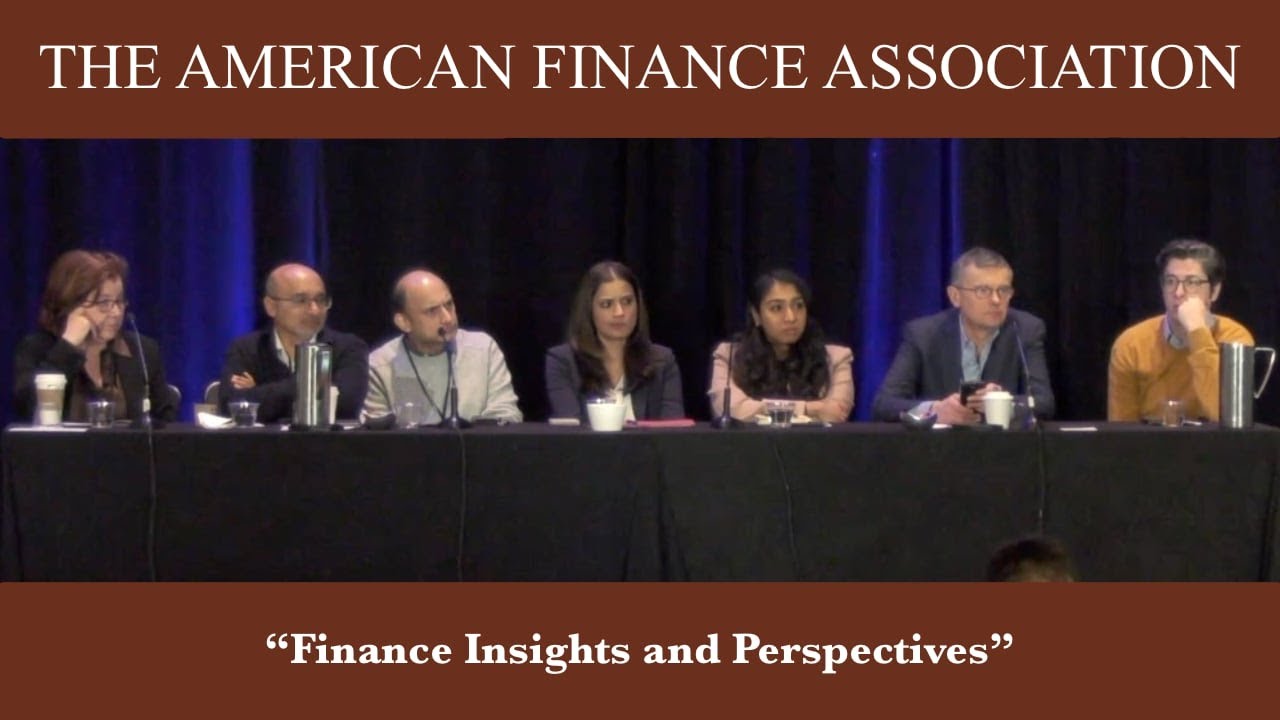
Published on YouTube by The American Finance Association on January 22, 2026, this session highlights three forthcoming Perspectives papers from the new AFA Journal of Finance: Insights and Perspectives. The session features panel presentations and discussions on household finance, the impacts of climate change on property insurance markets, and the evolving structural interconnections between traditional banks and non-bank financial institutions.
## TL;DR
The panel explores structural shifts across household finance, insurance, and banking intermediation. Pari Sastry and Ishita Sen analyze how climate change drives property insurance frictions, cross-subsidization, and regional fallout across housing and mortgage markets, noting that market breakdowns stem from macro-finance frictions rather than traditional adverse selection. Viral Acharya examines how credit risk has systematically migrated to non-bank financial institutions while liquidity risk remains anchored to traditional banks through credit lines, creating hidden systemic vulnerabilities during market shocks. Additionally, the speakers examine how fintech innovations and stablecoins unbundle traditional deposit contracts, raising concerns about potential money-market-style runs and regulatory lags.
## Atmosphere & style
The session has the measured, highly intellectual tone of an elite academic panel, characterized by dense, data-driven presentations and rigorous analytical critique. The dynamics reflect deep peer expertise as panelists systematically break down complex financial architecture, regulatory loopholes, and macro-finance frictions with academic poise. While the discourse remains collegial and professional throughout, an underlying sense of urgency emerges around unmonitored systemic risks, climate exposures, and potential liquidity runs within the evolving shadow banking landscape.
## Key takeaways
- [59:31](https://www.youtube.com/watch?v=vDtnt3h__Pw&t=3571s) The property insurance market breakdown is primarily driven by macro-finance frictions, including model uncertainty, spatial risk correlation, and capital constraints, rather than classical adverse selection or moral hazard.
- [59:31](https://www.youtube.com/watch?v=vDtnt3h__Pw&t=3571s) Property insurance features an informational inversion where insurers possess superior climate modeling compared to individual homeowners.
- [59:31](https://www.youtube.com/watch?v=vDtnt3h__Pw&t=3571s) Under-capitalized or low-quality insurers trigger mortgage defaults post-disasters due to delayed payouts, while rising premiums directly increase housing costs and shift prepayment or abandonment patterns.
- [59:31](https://www.youtube.com/watch?v=vDtnt3h__Pw&t=3571s) Insurers engage in cross-subsidization by raising premiums in lower-regulation markets to offset losses in price-controlled states, though this strategy fails in heavily regulated states like California, forcing regulatory overhauls.
- [59:31](https://www.youtube.com/watch?v=vDtnt3h__Pw&t=3571s) Existing stress tests by the NAIC and central banks evaluate bank and insurer solvency in isolation, failing to model how insurance market failures transmit directly to banking balance sheets.
- [59:31](https://www.youtube.com/watch?v=vDtnt3h__Pw&t=3571s) Regulatory capital frameworks fail to capture liability-side risk exposure under changing climate conditions, allowing insurers to meet official capital thresholds right before becoming insolvent.
- [01:10:32](https://www.youtube.com/watch?v=vDtnt3h__Pw&t=4232s) Consumer inattention is prevalent in property insurance, with an estimated 92% of policyholders rolling over their home insurance coverage annually without shopping for lower rates.
- [01:15:00](https://www.youtube.com/watch?v=vDtnt3h__Pw&t=4500s) Over the past two decades, credit risk systematically migrated from traditional banks to non-bank financial institutions (NBFIs), while liquidity risk remains anchored to banks through credit lines.
- [01:15:00](https://www.youtube.com/watch?v=vDtnt3h__Pw&t=4500s) During systemic market shocks, NBFIs draw heavily on bank credit lines to satisfy immediate cash calls, converting isolated non-bank risks back into consolidated banking liquidity demand.
- [01:22:00](https://www.youtube.com/watch?v=vDtnt3h__Pw&t=4920s) Commercial banks retain a structural liquidity advantage over NBFIs due to direct central bank reserve access and a sticky retail deposit base supported by LCR mandates.
- [01:28:19](https://www.youtube.com/watch?v=vDtnt3h__Pw&t=5299s) NBFIs rely extensively on bank credit facilities to bridge short-term financing across operations, including warehouse lines for originators and subscription finance for private equity funds.
- [01:34:40](https://www.youtube.com/watch?v=vDtnt3h__Pw&t=5680s) Federal Reserve stress test data reveals that term loans to NBFIs reached $300 billion by 2023, and NBFIs accounted for over one-third of total bank credit line drawdowns during the Q1 2020 market disruption.
- [01:38:03](https://www.youtube.com/watch?v=vDtnt3h__Pw&t=5883s) Extending central bank emergency backstops directly to NBFIs during crises would erode the distinct liquidity advantages of banks and eliminate market discipline against non-bank failures.
- [01:46:48](https://www.youtube.com/watch?v=vDtnt3h__Pw&t=6408s) Fintechs and NBFIs are unbundling traditional bank deposit contracts by separating payment services from checking accounts, exposing unbacked non-bank payment platforms to money-market-style runs.
- [01:49:14](https://www.youtube.com/watch?v=vDtnt3h__Pw&t=6554s) Major regulatory overhauls for stablecoins and non-bank payment systems are anticipated to occur primarily as a reaction to a major run event.
## Detailed walkthrough
### [00:08](https://www.youtube.com/watch?v=vDtnt3h__Pw&t=8s) Launching the Journal of Finance Insights and Perspectives
Janice Eberly, executive editor of the *Journal of Finance Insights and Perspectives* (JFIP), introduces the new publication launched by the American Finance Association (AFA) as a sister journal to the *Journal of Finance*. Designed to publish two distinct formats, the journal accepts "Insights" papers—short, concise pieces under 7,000 words (roughly 18–20 double-spaced pages, scaled down for figures/exhibits, modeled after *AER Insights*) with an expedited one-round editorial process targeting a quick conditional acceptance or rejection—and "Perspectives" papers. Perspectives papers are commissioned pieces meant to synthesize active literatures while actively setting future research agendas.
The journal officially launched on December 18, receiving three submissions on its very first day—including two sent in even before the Wiley submission portal had officially activated its AFA button because eager authors were already testing the system. Eberly highlights that this opening session showcases three forthcoming Perspectives papers, kicking off with a solo-presented synthesis co-authored by John Campbell. The paper aligns with the 20th anniversary of Campbell's seminal AFA presidential address, which formally defined and launched the field of household finance. Eberly also acknowledges her co-editors present in the room—Arvind Krishnamurthy and Valentin Haddad—as well as David Thesmar, who curated one of the session's symposia.
- **Journal Launch Date:** December 18
- **Insights Format:** Maximum 7,000 words (~18–20 double-spaced pages); single-round review process
- **Perspectives Format:** Commissioned syntheses emphasizing future research agendas
- **Editorial Board Present:** Janice Eberly (Executive Editor), Arvind Krishnamurthy, Valentin Haddad (David Thesmar absent)
---
[04:31](https://www.youtube.com/watch?v=vDtnt3h__Pw&t=271s) Household Finance: Retrospect and Prospect
John Campbell takes the floor to present "Household Finance in Retrospect and Prospect," a joint work with Tarun Ramadorai (with whom he is also collaborating on a trade book for a general audience). Addressing what constitutes a JFIP Perspectives paper, Campbell describes their approach as a "literature review with attitude"—a selective, opinionated survey that takes firm stands on past progress and future directions rather than attempting to be an encyclopedic summary.
Campbell structures the presentation around a historical look back, cross-country comparative balance sheet data, and seven open research questions designed to guide the next generation of household finance scholars. He humorously notes that while a survey paper relies heavily on a thorough bibliography, his slide deck is intentionally stripped of citations, which are all left for the printed paper.
> "We interpreted the commission to do a literature review with attitude, if you like, and to try to take stands on what we've learned and where we should go next."
---
[06:27](https://www.youtube.com/watch?v=vDtnt3h__Pw&t=387s) Seven Big Questions for Future Research
To ensure the core message is delivered even if time runs short, Campbell outlines seven major open questions in household finance that demand the profession's attention:
1. **Approaching Big Data:** Determining what makes administrative microdata "usefully big" rather than merely "supersized."
2. **Beliefs vs. Preferences:** Disentangling whether choices stem from beliefs or preferences, and evaluating when it is even meaningful to assume households hold structured beliefs rather than taking heuristic actions.
3. **Household Inaction:** Modeling the pervasive stickiness and inertia in household decision-making (referencing Tarun Ramadorai's joint AEA/AFA luncheon address titled "Household Finance in Action," which featured a deliberate pun on *inaction*).
4. **Search Costs and Inequality:** Understanding how search frictions influence product choices, pricing, and the distribution of financial outcomes.
5. **Wealth Inequality and Return Heterogeneity:** Re-examining return differentials across wealth levels. Campbell notes Thomas Piketty's *Capital in the Twenty-First Century* (Chapter 12), which argues that the wealthy earn higher returns via access to private equity, whereas household finance offers a broader perspective involving borrowing costs, fees, and portfolio composition.
6. **International Best Practices:** Leveraging international comparative systems to evaluate whether effective financial products or contractual structures can be successfully ported across borders.
7. **Technology and AI:** Assessing how Fintech and artificial intelligence are transforming financial access and consumer choices.
---
[08:42](https://www.youtube.com/watch?v=vDtnt3h__Pw&t=522s) The Evolution and Interconnections of Household Finance
Reflecting on why household finance emerged so late relative to other subfields—only formalizing in the 2000s despite ordinary people interacting with financial markets every day—Campbell points to three necessary prerequisites that took decades to develop: normative models complex enough to handle labor income, tax structures, and borrowing constraints; administrative "big data"; and behavioral finance theories capable of parsimoniously capturing common financial mistakes.
Now fully established, household finance sits at a unique intersection with neighboring fields:
- **Industrial Organization (IO):** Crucial because household decision-making cannot be studied in isolation from the supply-side responses of financial institutions and product design.
- **Asset Pricing:** Differing fundamentally in weighting methodology; asset pricing weights individuals by wealth and risk tolerance (since wealthy, aggressive investors move prices), whereas household finance treats every individual household equally.
- **Corporate Finance:** Sharing foundational themes around financial frictions, liquidity constraints, and cash flow timing, despite the obvious differences between households and corporations.
- **Macroeconomics:** Directly feeding into Heterogeneous Agent New Keynesian (HANK) models and informing the micro-foundations of monetary and fiscal policy transmission.
Presenting survey data comparing median household assets and liabilities across five diverse nations—the United States, the United Kingdom, Germany, China, and India—Campbell highlights several striking stylized facts regarding household balance sheets:
- **Income vs. Net Worth Scaling:** While wealthier countries generally exhibit larger balance sheets, net worth does not scale proportionally with income per capita. For instance, the median UK household holds significantly higher wealth than median households in both the US and Germany, despite the US and Germany having higher per capita income.
- **Debt Participation:** Liabilities scale much more aggressively with income than assets do. At the median, households in Germany, China, and India report zero debt.
- **Asset Composition:** Real estate (housing) overwhelmingly dominates household assets across all countries, especially in emerging markets, reinforcing why mortgage markets and housing dynamics remain central to household finance research.
- **Liability Composition:** Secured mortgage debt dominates in the UK, Germany, and China. In contrast, unsecured debt represents a larger fraction of liabilities in the US and India, though for vastly different reasons: student loans and credit cards in the US versus high-interest borrowing from informal moneylenders in India.
---
[15:09](https://www.youtube.com/watch?v=vDtnt3h__Pw&t=909s) Big Data, Preferences, Beliefs, and Human Inconsistency
Turning back to his seven core questions, Campbell dives deep into the methodological limits of big data and survey-based belief measurements. Large sample sizes alone are insufficient; true value in administrative data requires observing cross-margin spillovers (e.g., whether boosting 401(k) auto-enrollment savings causes households to accumulate high-interest credit card debt) and long time horizons (to capture gradual behavioral adjustments over years rather than immediate sign-up effects). He emphasizes the need for comprehensive population-level data to avoid selection biases inherent in single-brokerage datasets (like Robinhood or Vanguard clients) and calls attention to US initiatives like Opportunity Insights linking Census and credit bureau records.
Addressing preferences versus beliefs, Campbell notes that canonical frameworks—such as the Merton portfolio choice formula ($\alpha = \frac{\mu - r}{\gamma \sigma^2}$)—struggle when applied to survey data. When surveyed, households' portfolio adjustments react far more weakly to their stated return expectations than standard economic models predict. Explanations for this disconnect include cognitive uncertainty (where households shrink stated beliefs toward a prior when making actual financial choices) or pure inertia. Ending on a lighthearted personal note, Campbell shares a family memory illustrating human communication and conviction:
> "In my family, we used to make fun of my father, who was a very traditional academic. He used to say, 'I think that I think that such-and-after...' and I always made fun of him for that, but actually he [was onto something]."
[19:32](https://www.youtube.com/watch?v=vDtnt3h__Pw&t=1172s) Cognitive Uncertainty, Narratives, and Inaction in Household Decisions
John Campbell continues his presentation on household finance by questioning whether traditional economic assumptions about beliefs accurately reflect how individuals make choices. Economists often assume households hold well-defined beliefs, but empirical evidence suggests otherwise. In survey data, people's reported beliefs frequently differ from the expectations they act upon, or their choices exhibit severe inertia over time. Furthermore, households sometimes make dominated choices—such as assigning a probability of zero to a possible outcome—which can only be rationalized by extreme beliefs. In many real-world settings, individuals may not maintain explicit probability distributions at all; instead, they engage in "model-free learning" by repeating past behaviors that yielded good outcomes, or they follow simple heuristics and narratives like "hold on for dear life" (HODL) to guide their financial actions.
When evaluating how narratives drive decisions, Campbell highlights that Large Language Models (LLMs) provide a powerful new tool for empirical research. Researchers can now systematically examine whether popular narratives share the same factor structure found in asset returns or portfolio holdings.
Turning to household action—or the lack thereof—Campbell highlights how financial conditions evolve continuously while household actions remain surprisingly infrequent. Mortgage refinancing serves as the canonical example. standard economic frameworks view refinancing as a complex real options problem involving fixed transaction costs and uncertain benefits—a problem so mathematically difficult that it was excluded from Dixit and Pindyck's classic textbook *Investment under Uncertainty*. To explain observed levels of household inertia within a real options framework, implied fixed costs must be large on average, higher for lower-income and less-educated households, time-varying, and cross-sectionally correlated to account for refinancing waves.
- **Calvo-Style Models:** Household finance often uses reduced-form Calvo-style "wake-up" shocks to model attention, but a deeper understanding of underlying psychological mechanisms is still needed.
- **Dominated Choices:** Some household choices can only be rationalized by extreme beliefs, such as assigning a exact 0% probability to plausible events.
- **Narrative Factor Structure:** LLMs allow researchers to quantify whether narrative trends match empirical factor structures in asset pricing.
---
[22:27](https://www.youtube.com/watch?v=vDtnt3h__Pw&t=1347s) Industrial Organization, Cross-Subsidies, and Search Costs
The interaction between household inertia and market pricing brings industrial organization (IO) into household finance. When consumers fail to act or make financial mistakes, inactive customers end up cross-subsidizing active ones. If every consumer pays the same upfront price, financial institutions profit from inactive customers who incur penalties or forego savings, using those gains to subsidize competitive rates for active consumers.
Campbell details how this cross-subsidization spans multiple consumer financial product markets:
- **Mortgages:** Inactive borrowers fail to refinance when interest rates drop, paying above-market interest rates.
- **Insurance Policies:** Policyholders allow coverage to lapse or automatically renew at uncompetitive rates.
- **Banking Accounts:** Consumers regularly pay avoidable overdraft fees on checking accounts.
- **Credit Cards:** Borrowers incur late payment fees and high revolving interest charges.
A central puzzle for researchers is why financial firms do not aggressively compete for inactive customers by utilizing demographic data to offer lower upfront prices. Campbell notes that high search costs may explain this market structure. Households are extraordinarily reluctant to shop around; for instance, mortgage applicants routinely accept the very first loan offered to them, missing out on hundreds of dollars in annual savings that could be secured with just one or two additional quotes. High search costs make inactive customers difficult for aggressive competitors to reach, sustaining these cross-subsidies and creating a strong case for targeted consumer financial regulation.
---
[25:10](https://www.youtube.com/watch?v=vDtnt3h__Pw&t=1510s) Return Differences, Wealth Inequality, and Policy Debate
Moving to wealth inequality, Campbell emphasizes that cross-sectional differences in investment returns are large enough to serve as a primary driver of long-run wealth disparities. He highlights empirical findings from Sweden by Bach, Calvet, and Sodini:
| Investor Group | Net Return on Wealth Strategy | Return Behavior |
|:--- |:--- |:--- |
| **Poorest Decile** | Riskless Interest Rate ($r_f$) | Hold cash/liquid assets; zero excess return. |
| **Richest Decile** | Riskless Rate $+ \; 8\%$ | Substantial exposure to risky, high-yield assets. |
Several structural factors cause poorer households to earn lower net returns:
1. **Liquidity Needs:** Unstable labor income forces poorer households to prioritize liquid, low-yielding cash buffers.
2. **High Borrowing Rates:** A lack of collateral forces lower-income households to borrow at high interest rates.
3. **Financial Literacy & Underdiversification:** Lower financial literacy leads to costly investment mistakes and uncompensated risk.
Campbell explains a subtle mathematical point often overlooked outside of finance: underdiversification increases portfolio variance without increasing expected simple returns. Because the long-run compound growth of wealth is determined by **log returns** rather than simple returns—where $\text{Log Return} \approx \text{Simple Return} - \frac{1}{2} \text{Variance}$—uncompensated portfolio variance directly depresses average wealth accumulation over time.
Campbell addresses the policy debate over allowing retail 401(k) plans to invest in private equity. Proponents argue retail investors should hold the broad market wealth portfolio, including private assets. Opponents point to three major drawbacks: high fee structures, potential adverse selection in retail-targeted private funds, and valuation smoothing that conceals true volatility. Valuation smoothing frequently fools sophisticated university endowment managers, making it even more hazardous for everyday 401(k) participants.
When asset prices rise relative to cash flows (such as house prices rising relative to rents), net wealth gains are asymmetric: home sellers benefit, while prospective home buyers suffer. Similarly, when real interest rates drop, measured wealth inequality increases because wealthy households hold long-duration financial assets like stocks and long-term bonds. However, low discount rates also increase the unmeasured market value of human capital and Social Security claims, which represent a larger share of wealth for poorer households. Determining the exact magnitude of this offsetting human capital effect remains a key open research question.
---
[28:44](https://www.youtube.com/watch?v=vDtnt3h__Pw&t=1724s) International Lessons, Fintech, and Session Q&A
Comparing international mortgage systems reveals structural friction in the United States market. During recent rate spikes, U.S. homeowners experienced severe "mortgage lock-in" effects because standard fixed-rate mortgages are neither portable to new properties nor assumable by home buyers. Studying international market designs—such as countries with portable mortgages or structural reforms implemented in Israel and India—offers practical pathways to improve U.S. mortgage contract structures.
Turning to financial technology, advanced computing allows researchers and robo-advisors to solve complex life-cycle optimization problems. A critical research question is determining when households will fully delegate their financial planning to automated algorithms. A single decision to delegate could resolve household financial errors at scale; conversely, fintech apps can also amplify behavioral biases if designed to target vulnerable consumers with high-cost products.
During the Q&A session, Professor Lin Peng from Baruch College (CUNY) asks about the impact of social media networks and influencers on household financial choices. Campbell agrees that social networks heavily drive expectations—citing research showing how households form real estate expectations from the experiences of their Facebook friends. He notes that individuals tend to rely on personal anecdotes from friends or TikTok influencers rather than sound statistical data, highlighting an urgent need for empirical data on evolving social platforms.
Session Chair Janice Eberly asks Campbell which behavioral concepts are mature enough to be standard components in macroeconomic life-cycle models. Campbell highlights the continuous-time present-bias model developed by Peter Maxted. Unlike the traditional Kaplan-Violante hand-to-mouth framework—which assumes consumers sit at an artificial budget constraint kink without borrowing or lending—the present-bias model accounts for the empirical reality that many liquidity-constrained households actively revolve credit card debt. He also recommends incorporating loss aversion around home purchase prices into baseline real estate models due to its first-order impact on housing transaction volumes.
Following Campbell's Q&A, session panelist Valentin Haddad introduces the next presentation, noting it is part of a climate finance symposium edited by David Thesmar. He introduces co-authors Ishita Sen and Pari Sastry to present their research on property insurance markets.
- **Uncovered Research Areas:** Campbell notes his survey omitted topics like gender dynamics in intra-household decisions, labor market interactions (education and job search), structural consumer default modeling, and demographics.
- **Presenter Corrections:** The transcript's "enky graver" is a mishearing of cognitive uncertainty research, and panel speaker names are corrected to Ishita Sen and Pari Sastry.
<ElicitationsGroup message="Explore related financial economic research topics:">
<Elicitation label="Examine the impact of climate risk on property insurance" query="Explain how climate risk and severe weather events are impacting property insurance markets, state regulations, and insurer solvency based on recent financial literature."/>
<Elicitation label="Analyze hyperbolic discounting and present bias models" query="Break down the mathematics and economic implications of continuous-time present bias models (such as Peter Maxted's work) compared to standard quasi-hyperbolic discounting."/>
<Elicitation label="Compare international fixed-rate mortgage structures" query="Compare the design of US fixed-rate mortgages with international mortgage markets (such as portable or assumable mortgages in Europe and Asia) and their impact on mobility."/>
</ElicitationsGroup>
[38:01](https://www.youtube.com/watch?v=vDtnt3h__Pw&t=2281s) Climate Risk, Property Insurance, and the Academic Literature
Valentin Haddad framing the symposium’s scope notes that climate risk—specifically property risk—is an area where the real-world consequences of climate change are already being felt acutely. This sector presents a rich subject for financial economics because insurance directly affects households while maintaining deep, structural links with mortgage and capital markets.
Haddad briefly introduces four complementary Perspectives papers forming the symposium on climate finance:
* **Property Insurance Markets:** A paper co-authored by Ishita Sen and Pari Sastry examining how property insurance market disruptions interact with climate change and ripple through mortgage markets.
* **Firm-Climate Interactions:** Work by Stefano Giglio, Theresa Kuchler, Johannes Stroebel, and Olivia Wang proposing a unified conceptual framework to better measure and understand interactions between nature, climate, and non-financial firms.
* **Asset Pricing Limitations:** A paper by Lasse Heje Pedersen asking whether finance can save us from climate change—concluding that current asset pricing effects from sustainable investing are far too small relative to the impact of a formal carbon tax, while pointing toward under-explored pathways for impact.
* **Impact Investing and Engagement:** Research by Zacharias Sautner reviewing investor engagement and active impact strategies beyond traditional "brown asset" divestment and exclusion lists.
---
* "Can finance save us from climate change?... His conclusion is so far mostly no."
* Existing sustainable investing price effects remain significantly lower than the necessary economic magnitude of a carbon tax.
[40:25](https://www.youtube.com/watch?v=vDtnt3h__Pw&t=2425s) The Central Role of Property Insurance and Market Microstructure
Ishita Sen opens the presentation of her joint work with Pari Sastry by outlining why property insurance markets serve as the critical "first line of defense" against climate-driven natural disasters. Over the last decade, property damage from extreme weather has surged, and scientific projections indicate these events will only increase in frequency and severity. Insurance protects the single largest balance-sheet asset for most American households—their home—while preserving collateral value for mortgage lenders and protecting the broader financial system from systemic default spillovers.
In a frictionless textbook model, rising climate risk would simply lead to higher actuarial premiums, while households would remain fully insured. However, real-world data demonstrates severe market breakdown: widespread insurer exits, mispriced premiums, growing insolvency among undercapitalized firms, and widespread underinsurance. Sen explains that understanding how climate risk impacts the macroeconomy requires first mapping the structural frictions present on both the supply side (insurers) and demand side (households and mortgage lenders).
* Homeowners insurance policies in the U.S. typically cover perils like wildfires and hurricanes, but explicitly exclude unhedged catastrophic hazards unless mandated or supplemented.
* Disruptions in insurance coverage strip collateral protection from mortgages, directly increasing lender loss-given-default (LGD).
[45:36](https://www.youtube.com/watch?v=vDtnt3h__Pw&t=2736s) Regulatory Distortions, Cross-Subsidization, and Market Exits
Insurance pricing in the U.S. is heavily regulated at the state level rather than at the federal level. Regulators in many states prohibit insurers from utilizing forward-looking climate models or adjusting rates based on specific geographic risk vectors, past claims, or reinsurance costs. In states with tight rate caps (such as California), premiums remain artificially depressed relative to actual underlying risk, preventing dynamic price discovery.
Crucially, because national insurance carriers operate across state lines under strict capital constraints, rate caps in highly regulated states trigger regional spillovers. Insurers cross-subsidize their losses in strictly regulated jurisdictions by hiking premiums in less regulated states. For instance, losses in California lead to rate increases in South Carolina (a less regulated state), while rates in North Carolina (highly regulated) remain constrained.
In response to unpriceable risks and regulatory friction, private insurers are pulling back sharply across both price and non-price margins:
* **Premium Hikes & Cancellations:** Rates have surged drastically since 2020. In high-risk Florida counties, policy cancellation rates have exceeded 15%.
* **Insurers of Last Resort:** Displaced homeowners are pushed into state-backed Residual Market Plans (FAIR plans). In high-risk California counties, state-backed insurance accounts for over a third of the entire market.
* **Reinsurance Costs & Uncertainty:** Beyond regulatory caps, exit decisions are driven by rising spatial correlation of losses, actuary uncertainty regarding loss distributions, and high markups in private reinsurance markets.
---
* Evidence from Australia demonstrates that when the government provided reinsurance closer to actuarially fair rates, private primary insurers re-entered the market and retail premiums decreased.
* A major open academic question is disentangling how much market collapse stems from fundamental climate economics versus distortionary regulatory policy.
[50:56](https://www.youtube.com/watch?v=vDtnt3h__Pw&t=3056s) The Rise of "Demotech-Rated" Insurers and GSE Moral Hazard
As well-capitalized national carriers like State Farm and Allstate retreat from high-risk regions, small, undercapitalized, and geographically concentrated insurance companies have rapidly taken over. In Florida, these small entities represent over 70% of the market share. These underdiversified insurers face extreme distress risk, registering an insolvency rate near 20% during major catastrophe years.
This surge of fragile insurers is driven by a critical friction originating on the demand side of the mortgage market:
* **Rating Agency Loophole:** Almost all of these small insurers are rated by a specialized rating agency called Demotech, which routinely awards them "A" ratings.
* **GSE Eligibility Criteria:** Fannie Mae and Freddie Mac (the Government-Sponsored Enterprises or GSEs) accept Demotech "A" ratings as sufficient proof of insurance coverage for mortgages eligible for secondary market securitization.
* **Lender Arbitrage:** Mortgage lenders screen out bad or undercapitalized insurers for loans they intend to retain on their own balance sheets (portfolio loans). However, for loans intended for sale and securitization through Fannie Mae and Freddie Mac, lenders accept Demotech-backed policies without additional screening, offloading the underlying default and insolvency risk onto the GSEs and federal taxpayers.
---
* "Demotech-rated insurance companies, even though they have an extremely high insolvency rate... end up being allowed because the GSEs' rating thresholds are very lax."
* Small, undercapitalized insurers operating in states like Florida exhibit an insolvency rate close to 20%, compared to near-zero failure rates for major national carriers.
* Interactions between GSE securitization guidelines and rating agency thresholds directly distort the industrial organization (IO) and overall capital stability of the property insurance market.
[54:46](https://www.youtube.com/watch?v=vDtnt3h__Pw&t=3286s) Cascading Effects of Insurance Disruptions on Mortgages and Housing Markets
When homeowner insurance markets face stress or collapse, the fallout extends far beyond individual claims to destabilize mortgage and real estate markets. When property insurance is backed by low-quality or under-capitalized insurers, natural disasters trigger a wave of mortgage defaults because these carriers are either slow to pay out or completely default on claims. Beyond post-disaster payout delays, rapidly rising insurance premiums drastically increase the ongoing cost of housing, reducing households' ability to service their mortgages. Moreover, insurance friction alters prepayment patterns: some families use insurance payouts after a disaster to prepay their mortgages rather than rebuild, while others elect to walk away from their homes and close out mortgages when premiums spike to unsustainable levels.
Credit supply itself contracts in response to insurance market instability. Lenders begin rationing credit in high-risk zones by demanding higher down payments, raising interest rates, or denying mortgage applications altogether. On the physical recovery front, underinsured households struggle to rebuild; low-income families and residents of high-risk climate zones consistently carry insufficient coverage in their contracts. Because insurance premiums represent a primary component of the ongoing user cost of housing, premium surges—such as those following the removal of federal flood insurance subsidies or increases in reinsurance costs—are rapidly capitalized into declining home values. Furthermore, rising premiums serve as a market signal, altering households' beliefs about regional climate risks, shifting where people choose to live or build, and dictating how much they invest in hazard mitigation.
- **Mortgage Default Drivers:** Post-disaster delays/defaults by low-quality insurers and unaffordable premium spikes.
- **Prepayment & Credit Supply Dynamics:** Usage of claim payouts to prepay loans, mortgage abandonment due to premium hikes, higher down payments, rate hikes, and credit denial in distressed insurance markets.
- **Post-Disaster Recovery Disparity:** Low-income households and those in high-risk areas carry disproportionately lower coverage, slowing physical rebuilding.
- **Housing Value Impact:** Federal flood subsidy removals and reinsurance price hikes are directly capitalized into lower property values.
- **Data Evolution (Last 5 Years):** Progression from state-level data (5 years ago) to ZIP/county level (2 years ago), to loan-level linking of mortgage and insurance contracts (past year).
---
[59:31](https://www.youtube.com/watch?v=vDtnt3h__Pw&t=3571s) Q&A: Cross-Subsidization, Rate Regulation, and Regulatory Inertia
An audience member opens the floor by questioning the stability of interstate cross-subsidization, asking why low-regulation states would tolerate subsidizing high-regulation, high-risk states like California without experiencing a complete industry collapse. In response, the speakers explain that carrier exit is a long-drawn, medium-to-long-term strategic process rather than an overnight collapse. Insurers manage to stay in tight markets by shifting costs onto low-friction, less-regulated states. However, if every state were to impose heavy rate regulations, market unraveling would accelerate significantly.
The political reality further complicates the issue. State insurance commissioners in low-regulation states are extremely hesitant to admit to voters that their residents are cross-subsidizing other regions, preventing proactive regulatory crackdowns in those jurisdictions. Conversely, in heavily regulated states like California, cross-subsidization has proven insufficient to stop insurer exits. As carriers flee, state regulators are being forced to rethink and overhaul rate-setting rules to keep insurers from abandoning the market entirely.
> "I don't want to subsidize California if I don't have to because I'm paying for them and I don't want to live there. So what does this do for the insurance industry?"
- **Interstate Risk Transfer:** Insurers offset regulatory losses in price-controlled states by elevating premiums in lower-regulation, low-friction markets.
- **Political Hesitancy:** Regulators in low-friction states avoid publicly acknowledging cross-subsidies to avoid political backlash.
- **Regulatory Revamps:** High-regulation states facing insurer exits (e.g., California) are re-evaluating price caps to restore market supply.
---
[01:01:42](https://www.youtube.com/watch?v=vDtnt3h__Pw&t=3702s) Q&A: Asymmetric Information vs. Macro-Finance Frictions
Addressing classical insurance theory, an audience member notes that traditional models rely heavily on adverse selection and moral hazard—mechanisms largely absent from the presented property insurance research. The panelists clarify that property insurance deviates from the classical model. Unlike health or auto insurance, where individuals hold private information about their personal health or driving habits, property insurance operates under an informational inversion: insurance companies possess far superior climate modeling, data, and risk assessments compared to individual homeowners.
Because classical private-information unraveling is not the primary driver, property insurance markets break down due to structural financial frictions. These include model uncertainty, ambiguity around climate risk projections, correlated disaster risks, and capital constraints facing carriers. Drawing parallels to models of "inverse unraveling" (such as research by Markus Brunnermeier), the speakers emphasize that property insurance requires a distinct macro-finance framework rather than standard healthcare or life insurance paradigms.
- **Informational Inversion:** Insurers hold a distinct information advantage over households due to multi-million-dollar climate risk modeling.
- **Primary Market Frictions:** Model uncertainty, ambiguity, spatial risk correlation, and financing constraints drive market failures rather than classical adverse selection.
---
[01:04:00](https://www.youtube.com/watch?v=vDtnt3h__Pw&t=3840s) Q&A: Bank Systemic Exposure and Macroprudential Policy Gaps
When asked about systemic risks on bank balance sheets, the panel reveals a stark divide in how banks handle insurance counterparty risk. For loans retained on their own balance sheets, commercial banks act prudently: they strictly enforce property insurance purchase mandates, specify minimum coverage thresholds, and screen insurance carriers for solvency risk. However, this discipline breaks down for loans originated and sold to Government-Sponsored Enterprises (GSEs) like Fannie Mae and Freddie Mac, creating a significant macroprudential blind spot.
While European and US regulators have initiated climate stress tests—and the National Association of Insurance Commissioners (NAIC) stress-tests insurers—there is a distinct lack of cross-market stress testing. Current frameworks evaluate bank solvency and insurer solvency in isolation without modeling how insurance market collapses directly impact bank balance sheets.
- **Private Retention vs. GSE Offloading:** Banks rigorously enforce insurance standards on balance-sheet loans but relax monitoring on loans sold to Fannie Mae and Freddie Mac.
- **Regulatory Gap:** Lack of integrated stress testing evaluating the systemic transmission of insurance failures onto banking balance sheets.
---
[01:06:07](https://www.youtube.com/watch?v=vDtnt3h__Pw&t=3967s) Q&A: Capital Requirements, Data Constraints, and Competitive Barriers
Discussing future directions for regulation, the panel highlights the failure of current regulatory capital requirements. In Florida, multiple regional insurers (often referred to as "Demotech-rated" carriers) met or exceeded state capital thresholds right up until they suddenly went bankrupt following climate events. Existing regulatory frameworks adequately measure asset-side balance sheet risks but fail completely on liability-side risk exposure under changing climate conditions.
A central hurdle for researchers and policymakers is data availability and market opacity. Insurance market data remains fragmented across individual states, with critical information stopping unpredictably (for instance, Florida's consistent data reporting ended around 2018). Most detailed individual-level data actually comes from commercial mortgage servicers (such as McDash) tracking insurance requirements rather than from state insurance regulators. Furthermore, reinsurance markets remain a complete "black box." Responding to a question on why market competition does not eliminate cross-subsidies, the panel notes that diversification benefits and state-level regulatory barriers limit seamless market entry by new unexposed competitors.
- **Regulatory Failure:** Insurers regularly go insolvent despite maintaining capital ratios well above official regulatory thresholds.
- **Data Opacity:** Asset-side holdings are transparent down to the CUSIP level, but liability exposures and reinsurance structures lack public transparency.
- **Data Sourcing:** Researchers rely on private mortgage-servicing data (McDash) due to uncoordinated and fragmented state regulatory disclosures.
[01:10:32](https://www.youtube.com/watch?v=vDtnt3h__Pw&t=4232s) Market Frictions and the Regulatory Paradox
The discussion around climate risk and home insurance reveals a puzzling industrial organization dynamic. Most property insurers maintain heavy exposure to high-risk states like California, yet two distinct market forces interact to distort pricing. On the household side, consumer inattention is rampant: rather than shopping around as premiums climb year after year, an estimated 92% of policyholders simply roll over their existing coverage annually.
On the supply side, limits to competition exist alongside stringent rate regulation. This produces a contradictory market landscape where insurers command high markups on paper, yet rate caps simultaneously force policy prices below expected losses.
- An estimated **92% of households** roll over their home insurance policies every year without shopping for lower rates.
- State-level rate regulations keep insurance premiums below expected loss calculations, resulting in a market that is both anti-competitive and money-losing.
---
[01:11:39](https://www.youtube.com/watch?v=vDtnt3h__Pw&t=4299s) Symposium Overview: Banks, Non-Banks, and Intermediation
Introducing the *Journal of Finance: Insights and Perspectives* symposium on banking and non-bank financial institutions (NBFIs), the conversation shifts to the structural realignment of financial intermediation over the past 15 years. Trillions of dollars in credit, payment processing, and liquidity management have migrated out of traditional banks and into non-banks. Researchers are investigating whether NBFIs function as pure market substitutes or as complementary entities that rely directly on banks for funding.
The symposium highlights three core papers that track these trends over different time horizons:
* **Transformed Intermediation** (Viral Acharya, Nicola Cetorelli, and Bruce Tuckman): Examines how credit risk migrates to non-banks while liquidity risk remains anchored to banks.
* **Distributed Financial Intermediation** (Greg Buchak, Gregor Matvos, Tomasz Piskorski, and Amit Seru): Offers a 30-year macro view on how post-crisis regulatory changes and technological advances have reshaped credit delivery.
* **Private Credit** (Sergey Chernenko and David Scharfstein): Analyzes capital structure, risk-taking, and shadow banking dynamics within the rapidly expanding private credit sector.
---
[01:15:00](https://www.youtube.com/watch?v=vDtnt3h__Pw&t=4500s) Transformed Intermediation: Migrating Risk and Liquidity Backstops
Viral Acharya introduces his joint paper with Nicola Cetorelli and Bruce Tuckman, opening with an anecdote from 25 years ago when Nobel laureate Robert Merton advised him on the challenges of studying financial institutions: because the industry's landscape shifts constantly, research must focus on fundamental *functions* to avoid becoming obsolete.
Acharya outlines the paper's core hypothesis: over the last two decades, credit risk has systematically migrated away from commercial bank balance sheets onto non-bank intermediaries. However, non-banks remain tethered to the banking system for liquidity insurance. When shocks occur, liquidity demand flows directly back to banks, proving that banks are not disappearing but evolving their role within the ecosystem.
- **Parallel View (Paul Volcker & Carter Glass):** Tracing back to the Glass-Steagall Act, this view holds that deposit-taking and credit provision belong strictly in regulated commercial banks, while risk management and trading belong in non-banks. Charles Mitchell (former CEO of National City Bank) famously resisted this separation, arguing that banks operate as financial supermarkets requiring fluid cash management across divisions.
- **Substitution / Regulatory Arbitrage View (Daniel Tarullo & Metrick):** Argues that stringent post-crisis capital requirements force lending out of banks and into unregulated non-banks, creating hidden systemic vulnerabilities across the market.
- **The Consolidated Reality:** Non-banks operate much like corporate borrowers—they rely on bank liquidity facilities for day-to-day operations, M&A bridge loans, and intraday prime brokerage services. During systemic crises like March 2020 (COVID-19), non-banks draw heavily on bank credit lines, converting isolated non-bank risks back into consolidated banking liquidity demand.
---
[01:25:00](https://www.youtube.com/watch?v=vDtnt3h__Pw&t=5100s) Central Bank Backstops and the UK LDI Margin Call
Banks retain a distinct structural advantage over non-banks due to their access to official central bank backstops. Central banks can rapidly expand balance sheets using fiat currency, providing emergency liquidity reserves directly to commercial banks via settlement accounts. Furthermore, sticky retail deposits—reinforced by depositor inertia and post-GFC liquidity coverage mandates—supply commercial banks with a durable funding base that non-banks cannot replicate.
```
+-----------------------------+
| Central Bank Backstop |
| (Emergency Reserves / Fiat) |
+--------------+--------------+
|
v
+-----------------------------+
| Commercial Banks |
| (Sticky Deposit Base & LCR)|
+--------------+--------------+
|
| Liquidity Credit Lines
v
+-----------------------------+
| Non-Bank Intermediaries |
| (Pension Funds, Hedge Funds)|
+-----------------------------+
```
Even fully equity-capitalized NBFIs remain vulnerable to sudden liquidity shocks. Acharya points to the 2022 UK Liability-Driven Investment (LDI) crisis, where heavily equity-funded pension funds faced immediate cash margin calls on derivative positions as Gilt yields spiked. Because asset sales take weeks to execute, pension funds had to rely on bank credit lines to satisfy short-term cash demands—illustrating why liquidity risk ultimately lands on bank balance sheets regardless of an NBFI's equity cushion.
<ElicitationsGroup message="Explore the symposium papers or liquidity risk concepts further:">
<Elicitation label="Analyze private credit capital structures" query="Break down the Chernenko and Scharfstein paper on private credit capital structures and risk management from the AFA panel."/>
<Elicitation label="Examine the 2022 UK LDI crisis" query="Explain the mechanics of the 2022 UK LDI pension crisis, margin calls, and how bank liquidity backstops intervened."/>
<Elicitation label="Compare bank vs non-bank regulation" query="Compare the regulatory framework of commercial banks under Basel III versus non-bank financial institutions (NBFIs)."/>
</ElicitationsGroup>
[01:28:19](https://www.youtube.com/watch?v=vDtnt3h__Pw&t=5299s) Bank Liquidity Backstops and the Dynamics of Non-Bank Reliance
Viral Acharya explains that even the most heavily equity-financed Non-Bank Financial Institution (NBFI) relies fundamentally on banks to manage liquidity risk. NBFIs require a bank to assess counterparty risk and extend revolving credit facilities or lines of credit to pose margin. In this sense, NBFIs operate much like small businesses regarding their reliance on banks: they maintain revolvers, draw them down frequently, and usually repay them, though drawdowns also occur during periods of elevated credit risk.
Looking at both the asset and liability sides—including off-balance-sheet commitments—reveals that the long-term history of banking and non-banking centers on credit risk migrating to non-banks. Banks face capital requirements on credit risk and seek to economize on capital because deposit funding provides a cheap capital source. Equity capital is not necessarily expensive in an absolute sense, but it is costly relative to deposits and Fed liquidity backstops. Consequently, loans and mortgages historically originated by banks have shifted to NBFIs, but banks retain connections by making senior loans to private credit firms, holding senior tranches of CLOs and MBS, or buying back securitized mortgages.
NBFIs require short-term funding for daily operations and cannot continuously turn to stable capital providers. Instead, they draw on bank credit lines to bridge transactions before rebalancing their capital structures. Banks provide warehouse financing lines for non-bank mortgage and CLO originators, extend short-term subscription finance loans to private equity funds against LP capital commitments, and supply backstop credit lines for commercial paper issued by money market funds. In derivatives markets post-GFC, central counterparties convert credit risk into margin and liquidity risk, which market participants meet using bank lines of credit—as demonstrated by solvent UK pension funds needing immediate bank liquidity during market stress.
- Regulatory arbitrage drives capital migration, but bank-NBFI interconnections remain to harness deposit franchises and central bank safety nets.
[01:34:40](https://www.youtube.com/watch?v=vDtnt3h__Pw&t=5680s) Empirical Evidence on Bank Term Loans and Credit Lines to NBFIs
Acharya presents Federal Reserve stress test administrative data from 2013 onward to demonstrate the scale of bank exposures to NBFIs. Term loans extended by the ~30 largest banks to non-banks reached $300 billion, accounting for roughly 25% of their total $1.2 trillion in outstanding term loans by 2023. As non-banks warehouse a greater share of originated assets, bank lending to non-banks expands proportionally to meet funding needs.
Credit line data further illustrates bank liquidity provision. As of Q1 2023, out of $6 trillion in total outstanding credit lines in the banking system, $1.5 trillion was extended specifically to NBFIs. During the Q1 2020 COVID-19 "dash for cash," total credit line drawdowns reached $320 billion. Non-banks accounted for approximately one-third of these drawdowns, demonstrating that liquidity demands came not only from BBB-rated corporate borrowers but also from NBFIs facing frozen market financing.
- Total outstanding credit lines to NBFIs reached $1.5 trillion out of $6 trillion total by Q1 2023.
- NBFIs represented roughly one-third of the $320 billion total bank credit line drawdowns during Q1 2020.
[01:38:03](https://www.youtube.com/watch?v=vDtnt3h__Pw&t=5883s) Integrated Balance Sheets and Systemic Policy Implications
Acharya argues against analyzing bank and non-bank balance sheets in isolation. In credit-rationing states of the world where non-banks face stress, they depend on the banking system for liquidity. If banks fail alongside non-banks—similar to 2007–2008—the shock to the real economy is severe because non-banks cannot replicate the liquidity advantages of banks. Conversely, if non-banks experience stress while banks remain sound (as in 2020), central banks can supply liquidity to banks to stabilize the system.
If central bank backstops are extended directly to NBFIs during crises, the distinct liquidity advantages of banks disappear, making credit lines easier to obtain through non-banks. However, backstopping the entire system eliminates the discipline of allowing non-banks to fail, undermining the structural benefits of separating banking from non-bank finance.
- Treating banks and NBFIs as a common credit provider is critical during systemic credit-rationing events.
- Extending central bank backstops directly to non-banks risks eroding the distinction between banks and non-banks.
[01:40:28](https://www.youtube.com/watch?v=vDtnt3h__Pw&t=6028s) Q&A: Money Creation, Heterogeneity Across NBFIs, and Crisis Policy
An audience member asks whether bank money creation remains a central factor in their liquidity advantage or if that view is outdated. Acharya clarifies that money creation is linked to central bank reserve accounts, as every loan settlement requires offsetting reserve transactions at the central bank. Another audience member asks where to draw distinctions within the NBFI sector, highlighting private credit's growth driven by institutional demand for higher returns than public markets offer. Acharya acknowledges significant heterogeneity: commercial mortgage REITs rely heavily on bank credit lines due to SEC cash restrictions, whereas Business Development Companies (BDCs) and private credit firms manage liquidity through private equity sponsors or parent credit lines.
A third question addresses whether real investment suffers if NBFIs hold credit risk while banks hold liquidity risk, asking how the Fed can stimulate credit if it operates primarily through banks. Acharya explains that off-balance-sheet bank credit lines carry low capital charges, but once drawn, they create on-balance-sheet exposures requiring substantially higher capital. During crises, as capital flows into safe bank deposits, banks must remain well-capitalized to handle non-bank drawdowns. In 2020, the Fed supported non-bank credit flows directly; without those interventions, banks would have had to absorb and originate credit on their own balance sheets.
A final question asks how technological developments—such as tokenization, credit screening algorithms, and securitization—fit into the ongoing transformation of non-bank financial institutions. Acharya begins to address the question, noting that he has conducted preliminary research on the topic that is not yet published in a paper.
[01:46:48](https://www.youtube.com/watch?v=vDtnt3h__Pw&t=6408s) Unbundling the Deposit Contract and Tokenization
With an initial caveat that the observation might be imperfect, the discussion focuses on how entities outside traditional banking are "chipping away at the deposit contract by trying to separate out its various services." Payment banks and non-bank entities are offering dedicated, superior payment services. Historically, payments were tethered almost exclusively to checking accounts and traditional deposits, but fintech innovations are unbundling these features. This raises a fundamental structural question: can these non-banks credibly offer payment services without being a "financial supermarket" or having direct access to a central bank backstop? Without access to central bank liquidity or the underlying stability of core deposits, non-bank payment providers face severe structural vulnerabilities.
The speaker predicts that this arrangement will eventually play out "like money market runs at one point or the other." To avoid systemic instability, the traditional banking system must recognize that fintech competitors are innovating precisely because banks have failed to do so. The optimal path forward is to bring payment-oriented savings back onto the traditional bank deposit ledger through tokenization. For instance, if consumer savings flow into stablecoins for payment efficiency, banks should instantly credit those holdings by tokenizing them and recognizing them as deposits within the regulated banking system. This integration gives regulators a clear view of where economic savings actually reside and ensures that if a run occurs on a non-bank, the central bank can "quickly reliquidate the banking system."
- Non-bank fintechs are unbundling core deposit features, particularly isolated payment services.
- Unbacked non-bank payment platforms lack central bank backstops, leaving them vulnerable to money market-style runs.
- Tokenizing stablecoins onto bank deposit ledgers allows banks to absorb digital savings into the safety net of the regulated system.
[01:49:14](https://www.youtube.com/watch?v=vDtnt3h__Pw&t=6554s) Bank Reactions, Regulatory Timing, and Session Conclusion
When questioned on whether this tokenization approach is a normative recommendation for regulators or a empirical forecast of bank reactions, the speaker clarifies that traditional banks are already deeply concerned about the growth of stablecoins, particularly given growing "political support for them." While banks are proactive in searching for solutions, regulatory intervention remains a timing wildcard. The speaker observes that regulatory changes could happen preemptively or reactively, though "for sure it will happen after there's a significant run."
The session chair then concludes the panel by thanking the attendees and the authors for participating in the panel. The chair highlights that the panelists' remarks represent "only a small sample from the papers that they've written," and announces that these full, peer-reviewed Perspectives papers will be available in the inaugural issue of the new online-only *AFA Journal of Finance: Insights and Perspectives*. Expressing appreciation to John Campbell, Tarun Ramadorai, Ishita Sen, Pari Sastry, Viral Acharya, and their co-authors for helping officially launch the journal, the chair brings the panel to a close.
- Traditional banks are actively monitoring stablecoin growth as political support for private digital assets increases.
- Regulatory frameworks for stablecoins and non-bank payment systems are heavily expected to materialize following a major systemic run event.
- The panel marks the official launch of the online-only *AFA Journal of Finance: Insights and Perspectives*, featuring full versions of the discussed research papers.
## Notable quotes
> [59:31](https://www.youtube.com/watch?v=vDtnt3h__Pw&t=3571s) I don't want to subsidize California if I don't have to because I'm paying for them and I don't want to live there. So what does this do for the insurance industry?
> [01:46:48](https://www.youtube.com/watch?v=vDtnt3h__Pw&t=6408s) chipping away at the deposit contract by trying to separate out its various services — Viral Acharya
> [01:46:48](https://www.youtube.com/watch?v=vDtnt3h__Pw&t=6408s) like money market runs at one point or the other — Viral Acharya
> [01:46:48](https://www.youtube.com/watch?v=vDtnt3h__Pw&t=6408s) quickly reliquidate the banking system — Viral Acharya
> [01:49:14](https://www.youtube.com/watch?v=vDtnt3h__Pw&t=6554s) for sure it will happen after there's a significant run — Viral Acharya
## Mentioned
AFA Journal of Finance: Insights and Perspectives, American Finance Association, Janice Eberly, Viral Acharya, John Campbell, Tarun Ramadorai, Valentin Haddad, Arvind Krishnamurthy, Pari Sastry, Ishita Sen, Nicola Cetorelli, Bruce Tuckman, Greg Buchak, Gregor Matvos, Tomasz Piskorski, Amit Seru, Sergey Chernenko, David Scharfstein, Robert Merton, Paul Volcker, Carter Glass, Charles Mitchell, National City Bank, Daniel Tarullo, Metrick, Markus Brunnermeier, Fannie Mae, Freddie Mac, National Association of Insurance Commissioners (NAIC), Demotech, McDash, Federal Reserve, Securities and Exchange Commission (SEC)
Acharya警告非银信贷风险回溢至银行系统
金融风险虽已从传统银行转移至非银行中介机构,但系统性冲击会迫使各方大规模提取银行信贷额度,导致传统贷款机构最终承担了流动性敞口。
本期研讨探讨了家庭金融、保险以及银行中介领域的结构性转变。Pari Sastry与Ishita Sen分析了气候变化如何引发财产保险摩擦、交叉补贴以及房地产和抵押贷款市场的区域性波及效应,并指出市场失灵主要源于宏观金融摩擦而非传统的逆向选择。Viral Acharya探讨了信贷风险如何系统性地迁移至非银行金融机构,而流动性风险则通过信贷额度依然滞留在传统银行,进而在市场遭受冲击时形成隐性的系统性脆弱性。此外,发言者还探讨了金融科技创新与稳定币如何拆解传统存款契约,引发了对潜在货币市场式挤兑和监管滞后的担忧。
AFA推出新姊妹刊《Journal of Finance Insights and Perspectives》(JFIP),专设Insights短文与约稿Perspectives,首期前瞻聚焦家庭金融、气候保险及银行与非银机构风险演变。 (0:08)
John Campbell在家庭金融展望中指出,家庭在房贷再融资等决策上存在严重惯性与高搜索成本,导致不活跃客户补贴活跃客户,并通过未分散风险拉低对数收益率,加剧长期财富不平等。 (22:27)
气候变化加剧财产险市场失衡,严格的价格规制迫使保险公司跨州交叉补贴或直接撤出高风险地区,推高加州和佛州等地的退保率及对州兜底方案(FAIR计划)的依赖。 (45:36)
全国性大型保险公司撤出后,资本不足且高度集中的小型保险机构填补了佛州超70%的市场,房利美与房地美接受Demotech“A”评级造成道德风险,贷款机构将违约及破产隐患转移给政府资助企业与纳税人。 (50:56)
Reading summary
Presenting the inaugural Perspectives papers for the American Finance Association's Journal of Finance Insights and Perspectives, researchers demonstrated how structural market frictions, regulatory distortions, and unpriced risks misallocate capital across household balance sheets, climate-exposed property insurance, and non-bank lending.
Household Inaction, Cross-Subsidies, and Wealth Divergence (6:27)
John Campbell and Tarun Ramadorai argue that household financial decision-making deviates fundamentally from textbook optimization due to pervasive inertia, cognitive uncertainty, and narrative heuristics. Instead of maintaining coherent probability distributions, households frequently rely on model-free learning or delay decisions, as seen in the sluggish refinancing of fixed-rate mortgages. This widespread inaction alters market industrial organization: inactive consumers who incur overdraft fees, pay late charges, and fail to renegotiate rates cross-subsidize sophisticated, active consumers receiving competitive pricing. High search costs sustain these imbalances because consumers rarely shop across competing lenders.
Campbell emphasizes that persistent return differentials represent a major structural driver of long-run wealth inequality. Because compound growth is governed by log returns—where log returns approximately equal simple returns minus half the portfolio variance—underdiversification directly suppresses household wealth accumulation over time without generating compensating returns. Furthermore, while the wealthiest deciles capture risk premiums through leveraged risky assets, lower-income households face severe borrowing costs and liquidity constraints that restrict them to cash-like assets earning the riskless rate.
Property Insurance Breakdown and Interstate Regulatory Spillovers (45:36)
Examining climate finance, Ishita Sen and Pari Sastry show that property insurance—the primary collateral backstop protecting household wealth and mortgage lenders—faces severe operational breakdown. Unlike life or auto insurance markets driven by consumer private information, property insurance exhibits an informational inversion: insurers maintain sophisticated catastrophe models, while households remain relatively uninformed. Market failures stem instead from correlated disaster risk, capital constraints, and restrictive state-level rate regulations.
In states with strict price controls such as California, statutory rate caps keep premiums below expected losses, triggering widespread carrier withdrawals, cancellation spikes exceeding 15% in vulnerable counties, and migration into state-backed residual FAIR plans. Because national insurers operate under multi-state capital allocations, these restrictions generate cross-state spillovers: insurers offset unpriceable risks in heavily regulated states by elevating premiums in less-regulated markets like South Carolina. Meanwhile, household inattention compounds these supply frictions, with an estimated 92% of policyholders automatically rolling over home insurance policies annually without comparing alternative quotes.
GSE Moral Hazard and Mortgage Contagion (50:56)
As well-capitalized national carriers abandon disaster-prone regions, small, geographically concentrated regional insurers have expanded, commanding over 70% of Florida's market. Rated by Demotech rather than traditional rating agencies, these undercapitalized firms registered insolvency rates approaching 20% during major catastrophe seasons, even while maintaining regulatory capital ratios that met state thresholds prior to liquidation.
Sen and Sastry identify a regulatory loophole driving this market vulnerability: Government-Sponsored Enterprises (Fannie Mae and Freddie Mac) accept Demotech "A" ratings for secondary market securitization. Consequently, commercial lenders strictly screen insurance counterparties on portfolio loans retained on their own balance sheets, but offload undercapitalized insurer risk onto the GSEs and federal taxpayers for securitized mortgages. When fragile carriers delay or default on disaster claims, mortgage delinquencies rise, lenders ration credit by tightening down payment requirements, and surging insurance expenses are capitalized directly into falling real estate valuations.
Migrating Credit Risk and Anchored Bank Liquidity (75:00)
Viral Acharya, Nicola Cetorelli, and Bruce Tuckman analyze the restructuring of financial intermediation, rejecting the view that non-bank financial institutions (NBFIs) act as fully detached substitutes for traditional banking. While regulatory capital charges have driven direct credit risk onto non-bank balance sheets, such as private credit funds and warehouse mortgage originators, liquidity risk remains deeply tethered to commercial banks. Commercial banks retain unique competitive advantages through sticky retail deposit franchises and exclusive access to central bank settlement accounts and fiat emergency reserves.
Empirical stress-test data demonstrates this interdependence: out of $6 trillion in total commercial bank credit lines by early 2023, $1.5 trillion was extended directly to NBFIs, who drew roughly one-third of the $320 billion drawn during the March 2020 liquidity shock. When liquidity crunches arise—such as derivative margin calls during the 2022 UK pension crisis—even heavily equity-capitalized non-banks rely on bank revolving credit facilities. Looking at emerging financial technology, Acharya warns that unbundling payment services through unregulated stablecoins risks runs analogous to historical money market collapses, proposing that commercial banks tokenize deposits to absorb digital payment activity within regulated safety nets.
The sessions emphasize that micro-level financial decisions cannot be analyzed apart from institutional design, with key unresolved questions centering on unmodeled human capital offsets to wealth inequality, the absence of joint stress tests bridging insurer insolvency to bank credit risk, and the regulatory timing required to forestall run vulnerabilities in unbacked digital payment platforms.
[59:31] I don't want to subsidize California if I don't have to because I'm paying for them and I don't want to live there. So what does this do for the insurance industry?
[106:48] Viral Acharya: chipping away at the deposit contract by trying to separate out its various services
[106:48] Viral Acharya: like money market runs at one point or the other
[106:48] Viral Acharya: quickly reliquidate the banking system
[109:14] Viral Acharya: for sure it will happen after there's a significant run
Original transcript
[0:08] Good morning and thank you for coming to
[0:11] the session. I'm Jan Everly, the
[0:13] executive editor of the Journal of
[0:15] Finance Insights and Perspectives. Um
[0:18] the session today is organized around
[0:22] some of the the first papers that will
[0:25] appear in the journal. Let me start by
[0:27] telling you a little bit about uh the
[0:30] new journal which is the uh which has
[0:33] been introduced by the AFA to be a a
[0:37] sister journal maybe now a little sister
[0:39] journal to the journal of finance. Um
[0:43] the concept of the uh JF insights and
[0:48] perspectives is to publish two types of
[0:51] papers that are distinct from what's
[0:54] published in the journal of finance. Uh
[0:57] the two types are first insights papers
[1:00] which are shorter papers roughly well
[1:04] 7,000 words at most and then that's
[1:06] reduced for figures and and exhibits
[1:10] that are included. So think uh 18 to 20
[1:13] pages double spaced um and similar to
[1:17] the AER insights format. And for an
[1:22] author the editorial process typically
[1:26] will run one round. So the first
[1:28] response is either um hopefully a
[1:31] conditional accept uh and if not then a
[1:34] rejection. So the the hope is to have
[1:38] the process work quickly and we can
[1:42] publish papers that are concise and and
[1:45] focused and of uh journal of finance
[1:49] quality. The second type of paper is
[1:51] what will be represented in the session
[1:53] here which are perspectives papers.
[1:56] Those papers are commissioned and so we
[1:59] got to work early with the journal to uh
[2:02] commission one volume of perspectives
[2:06] papers and those papers are intended to
[2:10] not just be review papers but to provide
[2:14] some insight on the literature but
[2:15] especially to focus on future research
[2:19] agendas, areas of promising research.
[2:23] and you'll you'll hear from some of the
[2:26] authors today on the topics that they've
[2:29] identified and and how they think about
[2:31] the growth and future of the literature
[2:36] uh in their area. So the journal
[2:38] launched uh December 18th. We received
[2:42] three uh submissions the first day. um
[2:45] two actually I think before the portal
[2:48] was officially open um because people
[2:51] were testing the the wy portal um even
[2:55] before the AFA button was active um so
[2:58] it it's great to have that interest so
[3:02] far um and we look forward to
[3:05] introducing the journal to you uh today
[3:08] with these three um papers the first is
[3:13] a solo paper which is authored by John
[3:17] Campbell. This is uh very fortuitous at
[3:22] the time that we were launching the
[3:23] journal. The
[3:26] um with it was also the 20th anniversary
[3:30] of John's presidential address uh which
[3:33] launched the field of household finance
[3:36] and and coined the term uh of household
[3:39] finance. And so it's really a pleasure
[3:41] to have his work appear in the first
[3:44] perspectives
[3:46] uh volume of the journal of finance
[3:49] insights and perspectives. So each of
[3:52] the editors will introduce a symposium
[3:55] or a paper that they edited and um let
[3:59] me introduce the the editors who are
[4:01] here. Arvin Krishna Murthy, Valentine
[4:04] Hadad and David Thesmar is unable to be
[4:08] here but um he curated one of the
[4:12] symposia uh as well. So thanks for
[4:15] coming. We have a logo we must be
[4:17] official now. And uh welcome John
[4:21] Campbell to talk about his paper on
[4:24] household finance.
[4:31] To be clear, this paper is written uh
[4:34] with um Tun Ramadarai. The two of us
[4:37] have collaborated on it. Uh we are also
[4:41] uh current collaborators on a a book for
[4:44] a general audience uh in a somewhat
[4:46] similar space. But this is um a review
[4:50] of academic literature. We call it
[4:52] household finance in retrospect and
[4:55] prospect.
[4:57] So, you know, we had to confront the
[4:59] question of what is a JFIP perspectives
[5:02] paper and uh you know, that's for Jan to
[5:05] decide. She's the editor. Uh but we
[5:08] interpreted the commission uh to do a
[5:10] literature review with with attitude if
[5:13] you like and to try to take stands on
[5:16] what we've learned and where we should
[5:18] go next. not really to be encyclopedic
[5:22] and cover every possible topic but to
[5:24] point out some promising directions and
[5:26] open questions. So what we do in the in
[5:29] the paper is we we start by looking back
[5:32] and we try to situate the field of
[5:35] household finance both in time and in
[5:38] the the space of fields. How does
[5:40] household finance relate to all the
[5:43] neighboring fields with which it
[5:44] interacts? Um along the way we present
[5:47] some salient facts about international
[5:50] comparative household finance. Uh
[5:52] because we think one of the
[5:53] characteristics of the field is that it
[5:56] looks across the world at personal
[5:58] finance systems that can be very
[6:00] different and there are lessons to be
[6:02] learned from that. Then the bulk of the
[6:04] paper we call household finance in
[6:07] prospect looking forward where we
[6:09] discuss seven big questions that we
[6:11] think are important today. Now, of
[6:14] course, as a survey paper, it is
[6:16] important to have a really good
[6:18] bibliography and and we think we do. Uh,
[6:20] but you'll see there are hardly any
[6:21] references in this slide deck. They're
[6:24] all in they're all in the paper.
[6:27] So, in case I run out of time, you know,
[6:30] what are the sort of seven questions
[6:32] that we talk about towards the end of
[6:34] the paper um that we want to direct the
[6:38] attention of the profession to? One is
[6:41] how should we approach big data? We all
[6:43] know we're in the big data era, but what
[6:45] makes big data usefully big as opposed
[6:47] to just superersized.
[6:50] Second research area, how should we
[6:52] think about the role of beliefs versus
[6:55] preferences in household finance? And
[6:58] when is it even useful to think that
[7:00] people have beliefs as opposed to just
[7:02] taking actions?
[7:04] Third question, um the whole topic of
[7:07] household inaction. uh Tun yesterday
[7:09] gave the AEA AFA joint lunch. His title
[7:13] was household finance in action and
[7:16] there was a pun in there because in
[7:18] action is uh one of the salient features
[7:21] of household behavior. So how should we
[7:23] model that? Fourth question, what about
[7:26] search costs and how how should we think
[7:28] about those? How do they affect the
[7:30] products that people buy and the prices
[7:31] they pay and in particular the
[7:34] inequality in those products and prices?
[7:37] Uh fifth question uh what's the
[7:39] relationship between household finance
[7:41] and wealth inequality.
[7:43] So you know Thomas Piketty in his famous
[7:46] book capital in the 21st century has a
[7:48] chapter 12 where he says hey the rich
[7:51] get high returns. Now thinks that's
[7:54] because the rich can buy private equity.
[7:57] uh we have a somewhat different
[7:58] perspective on that but clearly the the
[8:00] differences in returns and borrowing
[8:02] costs um and fees and so forth that
[8:05] different people pay can be important um
[8:08] when we think about wealth inequality.
[8:10] Uh sixth question, what can we learn
[8:12] from these international comparisons? Is
[8:14] there a sense in which we can carry best
[8:17] practices, best products, best types of
[8:20] contracts from one country to another?
[8:22] and can can the finance profession
[8:24] actually contribute to the well-being of
[8:26] the of the world uh by doing this? And
[8:30] then finally, uh something that's on
[8:32] everyone's minds, what about technology,
[8:34] fintech, um AI, of course, um how are
[8:38] things changing and how will things
[8:40] change?
[8:42] Okay, so that's a preview of of what
[8:45] comes at the end of the paper. But uh
[8:47] going back now to to retrospect,
[8:50] household finance is
[8:53] unusual field because it emerged so
[8:55] late, right? There was there was work of
[8:57] course in the 20th century, but it
[8:59] wasn't brought together in a coherent
[9:02] way. There wasn't such a thing really as
[9:04] a field of household finance until the
[9:06] 2000s. And why is that? What took so
[9:09] long? It seems pretty obvious that
[9:10] ordinary people are using financial
[9:12] markets all the time. Why haven't we
[9:15] been studying that since the 1950s?
[9:18] Well, I think we needed rich enough
[9:20] normative models with the corresponding
[9:22] solution techniques because ordinary
[9:25] people have labor income, they pay
[9:27] taxes, they have borrowing constraints,
[9:29] there they you know there are many
[9:31] complexities that are not in the simple
[9:34] uh textbook models. So we had to get far
[9:37] enough along the road of of model
[9:39] solving uh to to to be able to confront
[9:42] these problems. We also needed
[9:44] administrative data, so-called big data.
[9:48] We needed modern microeconometrics.
[9:51] And finally, we needed behavioral
[9:52] finance theory to parimoniously
[9:55] summarize the the what I'll call
[9:56] mistakes, the deviations from normative
[9:59] models that are so pervasive in in
[10:01] household behavior. So I think that's
[10:04] why it's only the last 20 years that
[10:06] this field has really uh come of age but
[10:09] it is of age now. It's it's uh well
[10:11] established and it has an interesting
[10:13] relation to other fields of finance and
[10:16] economics.
[10:17] It obviously draws a lot on behavioral
[10:19] finance but it's not just about
[10:22] individual decision-making. The response
[10:24] of the financial system is key. And so
[10:27] the relationship between household
[10:29] finance and IO is really I think very
[10:31] very important.
[10:33] uh relative to asset pricing, you know,
[10:35] people count equally in household
[10:36] finance. We don't weight them by their
[10:38] wealth and risk tolerance. Whereas in
[10:40] asset pricing, if you're moving asset
[10:43] prices, that's because you have a lot of
[10:44] money and you're willing to invest
[10:46] aggressively.
[10:48] Um you might think household finance is
[10:50] utterly different from corporate finance
[10:52] because people and corporations are so
[10:54] different. But actually there are many
[10:56] common themes. One of which is the
[10:58] importance of financial frictions and
[11:01] the cash flows that you have available
[11:03] at any point in time. Household finance
[11:06] is influencing other fields of economics
[11:08] outside finance. Um there's an obvious
[11:12] connection with modern micro to macro
[11:15] heterogeneous agent macro the
[11:17] heterogeneous agent new Keynesian model
[11:20] the so-called Hank model. there are
[11:22] implications for the transmission of
[11:24] monetary policy uh and fiscal policy
[11:27] themes again in Tun's lunch talk
[11:29] yesterday. Um
[11:32] so that's uh that's where we are now. Um
[11:38] the one thing we do in the paper,
[11:39] there's very little data in the paper,
[11:41] but we do present some uh
[11:43] internationally comparable survey data
[11:46] which reveal some interesting uh
[11:48] patterns across countries in household
[11:50] balance sheets. So I'm just going to
[11:52] show you uh a table and a couple of
[11:54] figures very quickly. Um
[11:58] this is a table comparing household
[12:00] surveys in five countries, the US, the
[12:02] UK, Germany, China, and India. So we're
[12:05] going from some of the wealthiest
[12:08] developed countries to relatively poor
[12:11] emerging countries. And what's shown
[12:14] here are the assets and liabilities of
[12:16] the median household. We also have a
[12:18] table of means.
[12:21] Um naturally it's the case that richer
[12:23] countries like the US households have
[12:26] more assets, more liabilities, higher
[12:28] net worth. But you know income is not
[12:31] the only influence on the size of
[12:32] household balance sheets. And one very
[12:34] striking fact here is how much wealth
[12:37] the median household in the UK holds uh
[12:40] relative to both US and German
[12:43] households even though income per capita
[12:45] is higher in both the US and Germany. So
[12:49] balance sheet size and income they don't
[12:51] scale totally proportionately.
[12:54] Second point is that if you you can see
[12:56] this very dramatically because we're
[12:58] looking at medians. um liabilities scale
[13:01] with uh with income far more strongly
[13:04] than assets do. So the median households
[13:07] in these German, Chinese and Indian
[13:09] surveys actually have no debt at all
[13:12] that they report. Um and
[13:16] um in in general uh uh liabilities are
[13:19] scaling up faster than than assets. Then
[13:23] we when we look at the composition of
[13:24] the assets and the liabilities, here's
[13:26] the composition of assets. The dark blue
[13:29] is real estate and you can see how
[13:32] important real estate assets are in
[13:34] household balance sheets. This helps to
[13:36] motivate um a theme of our survey which
[13:39] is that uh both both mortgages and
[13:42] housing markets are just super important
[13:45] in household finance. That's
[13:47] overwhelmingly true of course in
[13:48] emerging countries but even in uh
[13:51] developed countries it's uh it's quite
[13:53] important. Then when we look at uh uh
[13:57] the composition of liabilities, we again
[13:59] see that uh the dark blue is mortgages.
[14:01] You can see how important they are. The
[14:04] the the gray is other secured debt and
[14:07] the green here is unsecured debt.
[14:10] There's sort of an interesting
[14:11] humpshaped pattern here. Um you have
[14:14] tremendous dominance of secured debt in
[14:16] the UK, Germany, and China. Whereas in
[14:19] both the US and India, unsecured debt is
[14:22] a little bit more important. But of
[14:24] course it's very different debt, right?
[14:26] So in the US it's educational loans and
[14:28] credit cards and in India that's
[14:31] primarily borrowing from money lenders.
[14:33] So it's very high interest informal uh
[14:37] uh informal debt.
[14:40] So um
[14:44] the um
[14:47] you know this is um just the scratching
[14:51] the surface of the differences across
[14:53] countries in these uh in these personal
[14:56] finance systems. And uh as in the later
[14:59] part of the paper we we talk about how
[15:01] to study the the differences in
[15:03] contractual form uh in greater detail.
[15:09] Okay, so turning now to the the seven
[15:11] questions that I mentioned. I may not
[15:13] get through all of these. Jan will cut
[15:15] me off at a certain point, but let's see
[15:17] how far we get. So, what about big data?
[15:20] Um, what makes a big data set useful?
[15:23] Uh, we emphasize that it's not enough
[15:26] just to have a very large number of
[15:28] observations. You have to be able to
[15:29] observe spillovers. So, for example, if
[15:32] you're studying retirement saving, maybe
[15:35] you can get people to have more in their
[15:36] 401k,
[15:38] but you'd like to know if that means
[15:39] they go more into debt and they have
[15:42] more credit card debt, for example. So,
[15:44] spillovers across different margins of
[15:46] adjustment are important. The time
[15:49] dimension is also important because
[15:50] people adjust gradually.
[15:53] So in retirement saving, we're now
[15:55] studying the effect of defaults, 401k,
[15:58] auto enrollment on the accumulation of
[16:01] retirement wealth over many years.
[16:03] That's a different question from
[16:04] studying whether you can get people to
[16:06] sign up when they take a new job. It's
[16:10] important either to have comprehensive
[16:12] data on the entire population or if you
[16:14] have different private sector data sets
[16:17] with different selection criteria. You
[16:20] can't just study Robin Hood clients or
[16:22] Vanguard clients. They may be very
[16:24] different. You need to look at the the
[16:26] universe of people. And of course, one
[16:29] of the great challenges of the
[16:31] administrative data era is replication
[16:33] because it's so difficult for others to
[16:35] get access to the data. And this helps
[16:38] to explain why publication is so long
[16:40] drawn out, so painstaking and so
[16:42] difficult. Uh in this context, there are
[16:46] some very exciting new frontiers. uh you
[16:49] know linking data sets uh some
[16:50] governments do this particularly in
[16:52] Scandinavia
[16:54] um opportunity insights has made a lot
[16:56] of progress in the US working with the
[16:58] census beginning to connect census data
[17:00] to credit bureau data uh I think that's
[17:03] very promising and then we have
[17:05] largecale field experiments
[17:09] so second question what about
[17:10] preferences and beliefs u and we add in
[17:13] narratives you know much of household
[17:15] finance tries to attribute the decisions
[17:17] that you see to either beliefs or
[17:20] preferences. Canonical example would be
[17:22] the Mertton portfolio choice formula.
[17:25] The risky share is the risk premium
[17:27] divided by risk aversion times risk.
[17:30] All right. So if you observe alpha, is
[17:32] it driven by people's beliefs about mu
[17:35] or is it their risk aversion gamma? Um
[17:39] we tend to think of preferences as
[17:41] stable and beliefs as evolving through
[17:43] time. So
[17:45] uh if for example you um observe a
[17:50] desire people's that people want to sell
[17:52] their house for at least the original
[17:53] purchase price something Tun was talking
[17:56] about yesterday at lunch. Uh that's
[17:59] probably more naturally explained by
[18:00] preferences rather than a belief that
[18:03] the house is literally worth the same
[18:05] that you paid for it. On the other hand,
[18:07] beliefs are a more natural explanation
[18:09] of shifting portfolio weights, decisions
[18:12] to buy or sell since we think of
[18:14] preferences as relatively stable. So
[18:17] then the question is how are we going to
[18:19] measure those changing beliefs? Um
[18:22] for a long time we we we liked full
[18:25] information, rational expectations.
[18:27] We've I think hit the limits of that. Um
[18:31] we may model the way in which beliefs
[18:33] are driven, for example, by personally
[18:35] experienced history. the Malmenier Nagel
[18:38] agenda
[18:39] or a currently popular approach of
[18:41] course is to measure beliefs directly
[18:43] from surveys and there's a lot of
[18:44] interesting work on that.
[18:47] Now we highlight some challenges to this
[18:49] agenda of going out and using surveys to
[18:52] measure beliefs. One of which is that
[18:54] actions seem to respond very weakly to
[18:57] beliefs.
[18:58] So um if we survey Vanguard clients for
[19:02] example, they can tell us what they
[19:03] think the equity premium is, but they
[19:05] don't seem to adjust their portfolios
[19:07] nearly as much as the merant rule would
[19:09] would imply. Now why is that? Well,
[19:12] there are models of cognitive
[19:14] uncertainty in which you you report a
[19:16] belief but then you shrink it towards
[19:18] some prior because you're uncertain.
[19:21] Um in my family we used to make fun of
[19:23] my father who was a very traditional
[19:25] academic and he used to say I think I
[19:27] think that such and such and I always
[19:30] made fun of him for that but actually he
[19:32] was an enky graver cognitive uncertainty
[19:34] guy he thought he thought something um
[19:37] but then you have to ask in the survey
[19:40] what what what's the true belief is it
[19:42] the thing that people report or is it
[19:43] the thing that people then shrink to
[19:45] that they act upon or is it simply that
[19:48] there's a lot of inertia so we need we
[19:50] don't observe people over a long enough
[19:52] period of time to see them responding to
[19:55] the beliefs. There are cases where
[19:57] people make dominated choices and in
[20:00] that case that can only be rationalized
[20:02] by beliefs that are very extreme like
[20:04] assigning probability zero to a possible
[20:07] event.
[20:09] It's entirely possible that in many
[20:12] contexts people don't actually have
[20:14] beliefs. They're just repeating actions
[20:16] that have delivered good results.
[20:18] uh so-called model free learning or they
[20:21] may use narratives to guide their
[20:23] decisions like you know hold on for dear
[20:26] life um but they may not actually have a
[20:29] explicit belief that justifies that they
[20:31] just that's the story they use to
[20:33] describe what they're doing so I think
[20:36] we need to broaden out a little bit and
[20:38] not always take as granted that there is
[20:40] such a thing as a belief that a person a
[20:43] person has um to the extent that
[20:46] narratives are the focus of course the
[20:48] Large language models are a great tool
[20:50] to analyze narratives and there's
[20:52] interesting research on questions like
[20:55] do narratives have the same factor
[20:57] structure that we see in holdings or
[20:59] that we see in asset returns.
[21:03] Now the third third question then is in
[21:05] action. Um you know financial conditions
[21:09] evolve continuously but actions are
[21:11] infrequent. Canonical example would be
[21:13] mortgage refinancing.
[21:15] Now, it's natural for us to reach to our
[21:19] standard toolbox and say, well, there's
[21:21] fixed costs of taking action.
[21:24] The benefits of taking an action are
[21:25] random. There's a fixed cost. Well, that
[21:28] means the household decision is a
[21:30] problem is a real options problem. And
[21:33] even mortgage refinancing is a really
[21:36] difficult real options problem. Too
[21:38] difficult to appear in the famous Dixit
[21:40] Pind book. Um, it's really hard.
[21:44] But to rationalize the level of inaction
[21:46] that we see, fixed costs must be large
[21:48] on average. Higher for poorer and less
[21:51] educated people, time varying
[21:55] because people sometimes refinance when
[21:57] they have a lower incentive to do so
[21:59] than they previously had. And have
[22:02] cross-sectionally correlated
[22:03] fluctuations because we get refinancing
[22:05] waves.
[22:07] So in household finance, we often use a
[22:09] sort of Calvo type model where there's a
[22:11] calvo shock that that wakes you up. But
[22:14] that's only a reduced form. And I think
[22:16] a really interesting question for
[22:17] research is what is really going on? Um
[22:20] how should we understand uh attention?
[22:24] And then this is where IO comes in
[22:27] because a key question is how financial
[22:29] products are priced when some consumers
[22:31] are inactive.
[22:33] If everybody pays the same upfront price
[22:36] u but some people subsequently make
[22:38] mistakes, the inactive customers
[22:40] cross-subsidize the active ones.
[22:43] And this occurs in many many contexts.
[22:45] Uh insurance, uh you know, people who
[22:48] let their policies lapse, uh mortgages,
[22:51] uh checking accounts, people who pay
[22:53] overdraft fees, uh credit card borrowers
[22:56] who pay late fees, on and on and on. But
[22:59] then, you know, why don't financial
[23:00] firms compete for the inactive
[23:02] customers, but why don't they locate who
[23:05] they are? You can demographics predicts
[23:07] this and offer them a lower upfront
[23:10] price. And to the extent that that
[23:12] doesn't happen, what are the
[23:14] opportunities for consumer financial
[23:16] regulation to come in and try to control
[23:18] these cross subsidies?
[23:23] Now, another type of fixed cost is a
[23:25] search cost. And we know that households
[23:28] are very reluctant to search for
[23:29] financial products. Um, people often
[23:33] take the first mortgage they're offered
[23:35] when they could save themselves very
[23:37] significant amounts of money, hundreds
[23:38] of dollars a year by just getting
[23:40] another quote or two. Well, it's natural
[23:43] again for us to explain this using fixed
[23:45] search costs. But to rationalize what we
[23:48] see, the search costs must be large and
[23:50] again higher for poorer and less
[23:52] educated people. There are some markets
[23:55] where geography helps to determine
[23:57] search costs. For example, if you're
[23:59] looking for an auto loan, um it might
[24:01] matter how many uh uh car dealers or
[24:05] credit unions or banks exist in your
[24:07] area. So that provides an interesting uh
[24:10] identification strategy.
[24:12] In many household finance markets,
[24:14] prices are actually negotiated. So it's
[24:17] not just search, it's also negotiation.
[24:19] And you have to interpret search broadly
[24:21] to include that.
[24:24] Search costs may in fact explain the
[24:26] puzzle I brought up on the previous
[24:28] slide that financial firms don't compete
[24:30] for act inactive customers. Those
[24:32] inactive customers may be the ones with
[24:35] high search costs who um can be charged
[24:38] high prices and who are hard to reach uh
[24:41] by a uh aggressive uh competitor. So
[24:44] that may help to explain the persistence
[24:46] of cross subsidies. But I think this is
[24:48] a very important research area. And then
[24:52] finally, we highlight the fact that in
[24:53] the housing market, it's an example of a
[24:56] peer-to-peer market where you've got
[24:58] households with all their behavioral
[24:59] biases on both sides of the market, not
[25:02] just uh one. And um that that's that's
[25:05] another uh interesting area.
[25:10] Now, what about wealth inequality? Um
[25:14] there's many drivers of wealth
[25:15] inequality, but we emphasize that return
[25:18] differences are large enough to matter.
[25:21] We cite for example research by Bach
[25:24] Calve and Sudini using Swedish data
[25:26] where they find an 8 percentage point
[25:28] difference in net returns on wealth um
[25:32] between the poorest people in Sweden and
[25:34] the richest people in Sweden. Basically
[25:36] they find in their data that the poorest
[25:39] people are earning the the riskless
[25:41] interest rate and nothing more and the
[25:43] richest people are earning 8% more than
[25:45] that. Why are there these extreme
[25:48] differences? Well, some of it is fixed
[25:50] costs of providing financial services on
[25:53] a small scale, but it's also true that
[25:55] poorer people have unstable income, so
[25:57] they have to prioritize liquidity. They
[26:00] may lack collateral, so they borrow at a
[26:02] high rate. And um finan they have lower
[26:06] financial literacy, so they're going to
[26:07] make mistakes or they're going to be
[26:09] unaware of certain investment
[26:10] opportunities.
[26:12] A subtle effect um that is easy for non-
[26:15] finance people to miss is that actually
[26:18] if you're underdiversified either within
[26:20] an asset class or across asset classes
[26:24] even if it doesn't lower your simple
[26:26] return it's going to increase your
[26:28] variance and therefore lower your log
[26:29] return and it's log returns that
[26:31] determine the average growth rate of
[26:33] wealth. So that means that that
[26:36] underdiversification of poorer people
[26:38] can contribute to the evolution of uh
[26:41] wealth inequality.
[26:44] There's a some important policy issues
[26:46] in this space. Um the current one is
[26:49] whether private assets should be made
[26:51] more readily available to smaller
[26:53] investors for example by including
[26:55] private equity in 401k plans. The
[26:58] argument for that is that private assets
[27:00] are an important component of wealth and
[27:02] we think you should hold the wealth
[27:03] portfolio if you can. The arguments
[27:06] against are the high fees, the
[27:08] possibility
[27:10] I would say of adverse selection for
[27:12] retail private funds and the fact that
[27:14] valuation smoothing leads to
[27:16] understatement of risk which seems to
[27:19] fool even university endowment managers
[27:21] and so is quite likely to fool 401k
[27:24] retail investors.
[27:26] Then there's a fascinating set of issues
[27:28] surrounding um what happens when prices
[27:31] increase relative to cash flows. So what
[27:33] happens if the valuation of risky assets
[27:36] goes up?
[27:37] Well, suppose house prices go up
[27:40] relative to rents. Does that make
[27:42] homeowners better off? So uh what
[27:45] research is identifying is that the
[27:48] people who gain are the home sellers and
[27:50] the people who lose are the home buyers.
[27:52] So there are intergenerational
[27:54] interesting intergenerational effects.
[27:57] Now when interest rates are very low,
[27:59] real interest rates are very low as they
[28:01] were until quite recently that will in
[28:04] tend to increase measured wealth
[28:05] inequality because richer people tend to
[28:07] hold financial assets with higher
[28:09] duration, stocks, long-term bonds, and
[28:11] so forth.
[28:13] But there's an offsetting effect that's
[28:15] often not measured correctly, which is
[28:17] that the market value of human capital
[28:20] and claims to social security of course
[28:22] increases when real interest rates are
[28:24] low, discount rates are low. So this
[28:26] these unmeasured assets are more
[28:28] valuable. And I think an interesting
[28:32] research question is the extent to which
[28:35] the offset um how important is the
[28:38] offset relative to the stuff that we
[28:40] conventionally measure.
[28:44] Okay. Um I am I'm almost done. I've got
[28:46] two minutes. Um we talk about
[28:49] international comparisons. Um you know
[28:51] why are systems different? Is it
[28:53] fundamentals? Is it historical accident?
[28:56] Can household finance promote the
[28:58] adoption of better contracts?
[29:00] For example, in the US, we know we have
[29:03] had a problem with mortgage lockin
[29:05] recently because our mortgages are not
[29:06] assumable and they're not portable. Many
[29:09] other countries have assumable and
[29:11] portable fixed rate mortgages. Maybe we
[29:13] could do that too. Um
[29:17] maybe there are ways we can learn from
[29:19] studying reforms in other countries. we
[29:21] talk about uh uh reforms in both Israel
[29:24] and India that seem to have improved the
[29:26] functioning of the mortgage markets.
[29:29] And then finally, fintech. Um
[29:32] you know, the the we're now able to
[29:35] solve much more complex life cycle
[29:37] optimization problems than before. That
[29:39] I think is very helpful for us as
[29:41] academic researchers, but also for robo
[29:44] advising. We can take robo advising to
[29:46] the next level.
[29:48] A really important question is when will
[29:50] households delegate their financial
[29:52] arrangements to algorithms.
[29:54] So that single decision may end up being
[29:56] more important than all the decisions we
[29:58] traditionally study because if we if
[30:00] people will give up a decision making to
[30:04] a good algorithm
[30:05] uh that would be a oneshot uh solution
[30:08] to many of the problems of household
[30:09] finance. On the other hand, we know that
[30:12] fintech can also be used to amplify
[30:14] behavioral biases and it may worsen
[30:16] inequality if poorer people are more
[30:19] effectively targeted by that.
[30:22] So many many open and interesting
[30:24] questions there.
[30:26] So you know this survey is certainly
[30:28] incomplete. It's not encyclopedic.
[30:31] There's some important topics we haven't
[30:32] covered. Just to give some examples of
[30:34] things we haven't talked about. We
[30:37] didn't get into gender and
[30:39] intrahousehold decision-making. We
[30:40] didn't talk about demographic
[30:42] implications of of household finance.
[30:46] Um, we didn't talk about the use of
[30:49] finance tools when studying the labor
[30:51] market, decisions to get an education,
[30:53] search for a job, etc. And we didn't
[30:56] talk about the structural modeling of
[30:58] consumer default.
[31:00] But we covered a lot and it just this
[31:02] all just shows how active the field is.
[31:04] Uh I think it's come a long way in the
[31:06] last 20 years, but there's a lot more to
[31:08] do and we're very excited about
[31:10] recruiting other researchers,
[31:12] particularly younger researchers, uh to
[31:15] contribute to the effort. Thank you very
[31:17] much.
[31:24] This is on. Um, so we have a a few
[31:29] minutes between papers so that you can
[31:31] ask questions that are directed to the
[31:34] individual authors. So, um, are there
[31:37] questions for John? I'm catching you
[31:40] cold. I have one if you need a minute to
[31:43] think.
[31:45] >> Yes.
[31:47] >> Could you go to the microphone, please?
[31:52] Hello. Hi. Uh my name is Lin Pang. I'm a
[31:54] professor at Baroo College, City
[31:55] University of New York. John,
[31:57] fascinating talk. Uh so there are so
[31:59] many interesting exciting questions you
[32:01] mentioned. Uh one one thing I have in
[32:03] mind because I do research on social
[32:06] network, social media, right? Given that
[32:07] nowadays a lot of individuals,
[32:10] households you know finan like you know
[32:12] social media is one of the you know key
[32:15] sources you know if not the primary
[32:17] source for many but it's a very
[32:18] important information source for of
[32:20] them. So would you think it would be
[32:22] interesting to look at the effect of
[32:24] these online social media on household
[32:26] decision- making? What's your thoughts
[32:28] on that?
[32:29] >> Oh yes absolutely. I mean um well one uh
[32:34] theme in the literature that I didn't
[32:35] highlight perhaps enough in the talk is
[32:37] the way people do rely on social
[32:40] networks and learn from others. So
[32:44] the well-known research for example on
[32:47] uh uh fa fa you know the Facebook uh
[32:51] social network and the way in which
[32:53] people form expectations about uh
[32:55] housing markets from the housing
[32:57] experiences of their Facebook friends.
[32:59] That's an example. Um but I think there
[33:02] are many other ways in which people
[33:03] learn from their friend networks. Um it
[33:07] is of course
[33:09] uh an example of the general proposition
[33:11] that people seem to be learning from
[33:14] personal their own personal experience
[33:16] and the experience of people they know
[33:18] personally rather than relying on the
[33:21] great bulk of historical and statistical
[33:24] evidence that's out there. So um how can
[33:28] we my my focus would be how can we stop
[33:30] people doing this?
[33:31] >> Yeah.
[33:32] >> Um
[33:33] but certainly we need to research it
[33:35] more and um there's a crying need for
[33:40] for good data on different social media
[33:43] networks that people are relying on and
[33:45] it's a very shifting landscape. Um
[33:48] but uh you know another important topic
[33:51] is uh influencers and you know what
[33:53] they're doing on Tik Tok and you know
[33:56] the the the influence they have which is
[33:59] sometimes positive and sometimes not I
[34:01] would say.
[34:02] >> Yeah absolutely and and one thing I
[34:04] would like to add is like um so and you
[34:06] also mentioned this alternative data uh
[34:09] you know using LM right to help us to
[34:11] kind of understand their decision-
[34:13] making. So um social media actually also
[34:15] provides a lot of data right by
[34:16] analyzing their posts you can kind of
[34:18] analyze their strategies their
[34:20] preferences and how that kind of evolves
[34:22] over time. So yeah so definitely looking
[34:25] forward to looking into more of this.
[34:26] Thank you.
[34:28] >> Thank you. Any other questions?
[34:33] >> It's your chance. Um so John if I'm not
[34:37] missing it any um I wanted to ask you
[34:40] emphasize the importance in the
[34:42] development of the field of uh
[34:45] behavioral models and the interaction
[34:47] with household finance. Are are there
[34:51] aspects of the behavioral models that
[34:54] you think should be built into our
[34:56] standard model? So people usually start
[34:58] with an optimizing model and then if
[35:02] they're trying to build a macro model,
[35:04] they build that into it. Or if they're
[35:05] building an empirical model, you know,
[35:08] are are there aspects that you think are
[35:10] sufficiently robust and general that
[35:13] they should just be part of the standard
[35:16] approach?
[35:19] >> That's that's a great question. I think
[35:22] um I think we we have one good candidate
[35:25] at this point. I I I think the the jury
[35:28] is still out on whether it will prevail,
[35:31] but the um the continuous time version
[35:34] of the present bias model that people
[35:36] like Peter Maxstead have been promoting
[35:38] is tractable enough to build into life
[35:43] cycle models of portfolio choice, wealth
[35:45] accumulation and I think to
[35:50] to enrich the uh the sort of
[35:53] hand-to-mouth um you know Kaplan and
[35:55] Vant framework,
[35:58] >> which
[36:00] you know the Kaplan Vlante model is a
[36:02] good first cut, but it implies that a
[36:05] lot of people out there are at a kink in
[36:08] their budget constraint where they're
[36:10] literally they're not borrowing and
[36:11] they're not lending. They they're too
[36:13] impatient to lend and they're they face
[36:15] too high an interest rate to borrow and
[36:18] you know macroeconomists rely on that to
[36:21] to match the cross-sectional
[36:22] distribution of marginal propensities to
[36:24] consume. That's all fine except that
[36:26] when we look, we see that most of those
[36:28] people are actually revolving credit
[36:30] card debt. So, you know, it cannot
[36:33] literally be true that they're at a kink
[36:35] in the budget constraint if they're uh
[36:38] revolving some debt and are not at their
[36:40] credit card limit. So, I think the
[36:43] present bias model um is is tractable
[36:45] enough that it may be worth building in
[36:47] as sort of this the next iteration of
[36:50] that standard uh life cycle model. Now
[36:54] you know then for some decisions like uh
[36:57] like housing market decisions I think it
[36:59] is also worth building in you know the
[37:02] preference for selling at the price you
[37:04] paid
[37:05] >> uh because that's that has a first order
[37:07] effect on uh you know volume in the
[37:10] housing market.
[37:12] >> Um so those sorts of behavioral things I
[37:16] think should should indeed be be be part
[37:19] of the uh the base model.
[37:22] >> Terrific. Thank you. Questions? Okay,
[37:26] let's move on to the next paper which
[37:29] Val will introduce.
[37:37] >> Thank you, Jen. Um, so so the the second
[37:41] paper we'll see is part of a symposium
[37:44] uh that we had on climate finance. The
[37:46] symposium was edited by by David Tesman
[37:48] and as part of this symposium we have
[37:50] four different papers. So the first
[37:51] paper is the one we'll see uh to
[37:54] together that Ishita will present with
[37:56] with Paris Ishasen will present with
[37:58] Paris 3 that's that's on uh insurance
[38:01] and climate risk and more specifically
[38:03] property risk and and that that's a
[38:04] sector where where we've already started
[38:07] to experience quite strongly the
[38:08] consequences of climate change and
[38:10] that's also a sector that's extremely
[38:11] interesting for finance because uh
[38:14] insurance affects people directly. It
[38:17] also interacts with the financial market
[38:18] and specifically mortgage markets and
[38:21] Ishita will tell us more about this. Uh
[38:24] we have a second paper uh that you can
[38:27] see on the screen. Uh but but that's
[38:30] that's by um
[38:34] Stefano,
[38:36] Teresa Kushler, Uranus Trouble and
[38:39] Olivia Wong on the interaction between
[38:42] nature
[38:43] firms and climate and trying to what
[38:47] they do in that paper is propose a
[38:48] framework to understand this interaction
[38:51] and and I think that's very promising
[38:52] because of course that's the heart of
[38:54] the economics of what's going on but
[38:55] also they in the paper they discuss a
[38:57] lot of directions towards better
[38:58] measurement of those interactions and
[39:00] try to point out what we already know
[39:02] and what we have to learn to better
[39:04] understand those interaction. The third
[39:06] paper is by Lassie Peterson and asks um
[39:11] can finance save us from climate change
[39:13] or approximately this in the title and
[39:15] and this conclusion is so far mostly no
[39:18] and and what he does is he reviews a lot
[39:21] of the asset pricing evidence that we've
[39:22] seen on the impact of of sustainable
[39:26] finance on prices and finds that it's
[39:28] much lower than what you would need as a
[39:30] carbon tax. Again, this is a perspective
[39:33] paper. So, he spends a lot of time
[39:34] telling us, well, what are we not quite
[39:36] measuring yet and also what are other
[39:39] pathways for impact and and I think it
[39:41] will be really interesting to see that
[39:42] and that lines up with our last paper by
[39:44] by Zach Serner Zner that that reviews uh
[39:49] different types of impact in investing
[39:51] and and impact through engagement of
[39:53] investors. The literature so far has
[39:55] focused a lot on you know uh excluding
[39:59] brown brand assets and so on. there's a
[40:01] lot of space for active investment by
[40:03] investors and and so far I think
[40:05] unlikely we don't know too much about
[40:07] it. So Zach reviews what we've started
[40:09] to know and what are the important
[40:11] directions that that we should learn
[40:12] more as finance academic. So on this I
[40:16] I'll let the stage to Ishan which will
[40:18] tell us about insurance.
[40:29] >> Great. Well, thank you so much. Well, uh
[40:31] we're very excited to be um part of this
[40:33] issue. Um and so this is this is going
[40:36] to be joint work uh with Pari uh u who's
[40:39] right here and we'll we'll be doing
[40:40] questions at the uh end together. Um so
[40:44] because this is a new topic, let me
[40:46] spend some time actually motivating uh
[40:48] why it's important to study insurance
[40:49] markets.
[40:52] Um so there's been an unprecedented
[40:54] increase in um property damage due to
[40:58] natural disasters particularly in the
[41:00] last decade. Um and that is that is
[41:03] posing increasingly more and more
[41:04] challenges for households for firms and
[41:07] for the broader economy. Um and and the
[41:10] unfortunate news is that most scientific
[41:12] projections show that these disasters
[41:14] are only going to become more frequent
[41:15] and more severe moving forward. Of
[41:19] course, insurance markets exist for that
[41:21] very reason. Insurance the insurance
[41:23] sector provides the first line of
[41:24] defense against these losses both to
[41:26] households as well as to uh more broadly
[41:29] to the mortgage market and and u the
[41:31] real estate market. So from the
[41:33] perspective of households, insurance
[41:35] helps uh households rebuild their homes
[41:38] uh in the aftermath of disasters. And so
[41:40] insurance helps protect the value of the
[41:43] home which is typically for the average
[41:45] person in the US the the biggest asset
[41:47] on their balance sheet. And at this
[41:50] point in time in the US most households
[41:53] uh actually have an insurance contract
[41:54] what are called homeowners insurance
[41:56] contracts. So these are contracts which
[41:58] provide protection against things like
[42:00] wildfires and and hurricanes. Um but not
[42:03] just households. Uh insurance is also
[42:05] helpful uh for the financial well-being
[42:08] of mortgage lenders and and and other
[42:10] players in the mortgage market. Um so
[42:13] most people we know buy their homes
[42:16] using a mortgage and that means that the
[42:19] mortgage lenders are exposed to losses
[42:21] in case a disaster ends up precipitating
[42:24] a default on the mortgage at the same
[42:26] time when the house itself is damaged.
[42:29] So that means that the lenders are going
[42:30] to have uh much smaller recoveries um in
[42:33] in um in um for for those loans. And so
[42:36] what does insurance do? Well, insurance
[42:38] helps restore the value of the
[42:39] collateral as well as prevents uh
[42:42] incentives that a household uh may have
[42:44] to default on their mortgage. Okay? And
[42:46] I'm going to I'm going to show you some
[42:48] evidence on that later on today. And so
[42:51] if there are going to be disruptions in
[42:53] insurance markets, then that means that
[42:55] losses which would otherwise be absorbed
[42:57] by the insurance sector are now spilling
[42:59] over to the balance sheets of households
[43:01] um as well as lenders and through the
[43:03] chain in in in in the mortgage market
[43:05] and housing market to the rest of the
[43:07] economy.
[43:09] So um the the key thing that I wanted to
[43:11] sort of emphasize here is that if we
[43:13] want to understand how climate risk is
[43:15] going to affect the broader economy,
[43:16] understanding how insurance markets are
[43:18] responding um is a first order question.
[43:21] And so how are insurance markets
[43:23] responding? Um there's now growing
[43:26] evidence that I'm going to and I'm going
[43:27] to talk about some of these in a little
[43:29] bit more detail today. Um that rising
[43:32] losses are sort of fueling a crisis of
[43:34] sorts in insurance markets. There's
[43:36] there's evidence of widespread exits.
[43:38] There's mispricing. There's growth of
[43:40] under capitalized insurance companies.
[43:42] Insurance are in companies are
[43:44] increasingly becoming insolvent. Prices
[43:46] are rising. Um and even though people
[43:49] have um insurance contract, many of them
[43:51] do not have enough coverage in these
[43:52] contracts. Now, a lot of these facts are
[43:55] actually um difficult to reconcile in a
[43:57] model in a frictionless model of
[43:59] insurance markets. in in under under in
[44:01] a frictionless model as risks rise with
[44:03] idiosyncratic risks we we should see
[44:05] that insurance premiums would increase
[44:07] but households households would remain
[44:09] fully insured. Now that's clearly not
[44:11] what we see and so what what we do in
[44:14] our in in our review is um is we
[44:17] organize ourselves in two parts. So
[44:20] first we talk about the frictions on the
[44:22] supply side and the frictions on the
[44:24] demand side. So thinking about the
[44:25] problem of the insurer as well as
[44:28] thinking about the problem of the
[44:29] household um as well as mortgage lenders
[44:32] because a lot of the demand for
[44:33] insurance actually comes from the
[44:35] mortgage sector. Um and then we're going
[44:37] to think about the what are these
[44:39] frictions and um that are causing
[44:41] insurance markets to function in ways
[44:42] that are that that lead to deviations
[44:44] from this frictionless benchmark. Okay.
[44:47] And then we talk then we think about the
[44:49] consequences of frictions in insurance
[44:51] markets and what do they mean for the
[44:53] broader economy for households uh for
[44:55] mortgages um and and for real estate
[44:58] markets.
[44:59] Now much of the work that has been
[45:01] happening in this area are are very very
[45:03] recent. Um and so I'm going to spend
[45:05] some time sort of telling you where we
[45:07] stand because this is uh this is a new
[45:10] topic. Um we also have we also um um
[45:14] spend a lot of time thinking about the
[45:16] opportunities and priorities for future
[45:17] work that we think are going to be
[45:19] important in this area and I'm going to
[45:21] highlight some of them uh today. So in
[45:23] the rest of the talk what I'm going to
[45:25] do is I'm going to um focus on few of
[45:27] these papers um just to demonstrate sort
[45:30] of the broader flavor of what is in in
[45:32] in our review. Okay.
[45:35] Okay.
[45:36] So um
[45:39] I'm going to first um tell you about
[45:42] some of the recent disruptions we are
[45:44] seeing in this market and what are some
[45:46] of the frictions that potentially
[45:47] explain these these disruptions.
[45:50] Um the first thing I want to tell you
[45:52] about is mispricing and and and only
[45:54] because I want to make the policy
[45:56] environment a little clearer. So there's
[45:58] widespread evidence of insurance
[46:00] mispricing. Insurance premiums are
[46:02] actually increasingly becoming disjoint
[46:03] from underlying risks. Um and uh the key
[46:07] reason for that is um that um there is
[46:11] state-by-state regulation of insurance
[46:13] prices. So in the in the US insure um
[46:16] insurance companies are actually not
[46:17] free to adjust prices. Um they face
[46:21] significant amounts of restrictions from
[46:23] regulators who in many cases restrict
[46:25] insurance companies to use certain types
[46:27] of pricing variables, things like
[46:29] location, reinsurance, uh past claims,
[46:32] as well as restrict insurers from um
[46:35] using forward-looking models to price
[46:37] their risks. In some states where these
[46:40] regulations are really binding, what we
[46:42] see, and that's the picture on the left,
[46:43] is that insurance prices do not reflect
[46:46] risks um in the same way as they do in
[46:48] the less regulated states, which is on
[46:50] the the picture on the right. But what's
[46:52] interesting is that not only are prices
[46:54] distorted in these states where
[46:57] regulation is binding, prices are also
[46:59] distorted in the states where regulation
[47:01] is not binding. And that is because
[47:03] insurers end up cross-subsidizing
[47:06] um their businesses in these highly
[47:08] regulated states uh by raising prices in
[47:11] states that are less regulated. And so
[47:12] we we see that when there is a loss in
[47:15] California which is one of the most
[47:16] highly regulated states in the US,
[47:18] prices end up increasing in places like
[47:20] South Carolina uh which is less
[47:22] regulated but not in North Carolina
[47:25] which is highly regulated uh and not in
[47:27] California of course. Okay. And so these
[47:29] spillovers arise because insurers
[47:31] typically operate in multiple states.
[47:33] They face costly financial constraints
[47:36] and that starts to interact with uh
[47:39] frictions on on the regulatory side and
[47:41] has led to a pricing regime where
[47:44] households in less regulated states are
[47:46] ending up cross-subsidizing households
[47:47] in in highly regulated states.
[47:51] Okay. The second trend I want to talk
[47:52] about is is this big trend that is
[47:55] motivating a lot of work in this uh in
[47:57] this area which is that private
[47:58] insurance companies are pulling back
[47:59] from the market both uh along price as
[48:03] well as non-pric margin. So the first
[48:04] picture shows you how much premiums have
[48:06] have risen and premiums have risen a lot
[48:08] since 2020 uh in in the US. But not only
[48:11] are premiums rising, insurers are also
[48:14] actively cancelling policies um and
[48:16] they're cancelling policies in the
[48:18] riskiest parts of of the country. And so
[48:20] this is a this is a picture from Florida
[48:22] where some of the most riskiest counties
[48:25] have seen cancellations to the tune of
[48:28] north of 15%.
[48:30] And what's that doing is that a lot of
[48:33] these households are getting pushed into
[48:34] what are called insurer of last resort
[48:37] markets that are provided by the by the
[48:39] states themselves. Um, and this is a
[48:42] picture uh showing you um evidence from
[48:45] California where in some of the most
[48:48] risky counties about the state-run
[48:51] insurance companies are now about a
[48:53] third of the market account for a third
[48:54] of the market share. Um um um and and
[48:57] and and this is sort of um been and this
[49:01] is probably much higher now uh if if if
[49:03] you looked at data in 2024 and 25.
[49:07] Um so what is driving insurance
[49:10] companies to exit? So in the 90s we had
[49:12] this literature um um classic literature
[49:16] uh by Ken Fruit and and who've argued
[49:19] that financial constraints are of course
[49:20] a big part of the reason but more
[49:22] recently there's also evidence showing
[49:24] that increasing spatial correlations as
[49:27] well as frictions in the reinsurance
[49:29] markets um are are are also a big part
[49:32] of part of the explanation. So there is
[49:35] evidence from Australia um where so
[49:38] there are lots of markups in in
[49:40] reinsurance contracts and so there's
[49:41] evidence showing that when the
[49:43] government itself started providing
[49:45] reinsurance uh at prices that were much
[49:48] closer to be act to to actial fair rates
[49:51] um insurance companies started then then
[49:53] selling then part participating in the
[49:55] market a lot more and premiums went went
[49:57] down. There are also other economic
[50:00] factors like the uncertainty about the
[50:02] loss distribution but a myriad of policy
[50:04] factors as well. Rate regulation is one
[50:06] thing that I already highlighted and
[50:08] there are other institutional
[50:09] arrangements in this in this market that
[50:11] are also causing insurance companies to
[50:13] exit the market.
[50:15] So um while we've identified a number of
[50:18] different factors, it's unclear which
[50:20] one of these frictions are actually the
[50:22] most important ones. Um how much of the
[50:24] current market dynamics do we think can
[50:26] be explained by some of the economic
[50:28] frictions and how much can be actually
[50:30] is is a is is a result of really bad
[50:32] policy. Um and um another important
[50:36] question is a lot of these frictions
[50:38] actually interact with each other and
[50:40] amplify the individual effects. Um and
[50:42] so sort of understanding how uh all of
[50:45] these different frictions are coming
[50:47] together and systematically
[50:48] understanding how climate risk is
[50:50] affecting the supply of insurance is an
[50:51] important important question um on the
[50:54] supply side.
[50:56] Okay. Um I want to next talk about a
[50:58] friction not on the supply side but one
[51:01] that is coming from the demand side of
[51:03] the market.
[51:05] So one key trend in in in in the US is
[51:08] that as these insurers some of the big
[51:10] insurers are exiting the market. Uh at
[51:13] the same time there's been this massive
[51:15] increase in an entry by really small
[51:19] underdiversified and under capitalized
[51:21] insurance companies. So that's the line
[51:23] on in in red in that graph who
[51:26] collectively account for more than 70%
[51:28] of the market share. This is evidence
[51:30] from Florida again. Um so 70% of the
[51:32] market share are these small under
[51:34] capitalized underdiversified insurance
[51:35] companies. Now these companies are
[51:37] extremely risky. They have an insolveny
[51:40] rate close to about 20% as opposed to a
[51:43] really tiny number for some of the
[51:46] bigger uh insurance companies like State
[51:48] Farm and all states of the world.
[51:50] What's also striking uh and and the
[51:53] reason they we call them demotech in
[51:54] this this slide is that they're all
[51:56] rated by this rating agency called
[51:58] Demotech that rates them all and this
[52:00] basically gives them all an A rating.
[52:02] And why that's important is that it
[52:04] makes these mortgages backed by these
[52:06] insurance companies eligible to be
[52:08] securitized um uh to the GS. So the the
[52:12] key demand side friction here is is
[52:14] basically this this point that a lot of
[52:16] the demand for insurance is originating
[52:19] in mortgage markets. Uh and that's
[52:21] because lenders are exposed as I said
[52:23] before to uh disasters when um insurance
[52:27] company when when when households start
[52:29] defaulting after big disasters. And so
[52:31] they invariably require you to have
[52:33] insurance but they're also exposed to
[52:35] the risk that the insurer itself might
[52:36] fail.
[52:38] And so what Fanny May and Freddy Mack,
[52:40] the GSC's, they what they do is they
[52:42] rely on third-party ratings to screen
[52:45] bad insurers out. Um but they get that
[52:48] get that rating threshold that they
[52:51] apply, they get that rating threshold
[52:53] wrong in in many cases. And so um many
[52:56] of these demote techch rated insurance
[52:58] companies even though they have an
[53:00] extremely high insolveny rate they end
[53:02] up being allowed uh uh because the GSC's
[53:05] are not sort of their rating thresholds
[53:07] are very lax for for for demotech
[53:11] but this friction now starts to interact
[53:13] with incentives uh that lenders have. So
[53:15] lenders screen out these bad insurance
[53:18] comp companies loans backed by these bad
[53:20] insurance companies and loans that they
[53:21] end up retaining on their balance sheet.
[53:23] but they do not screen out loans that uh
[53:26] are backed by demotech for loans that
[53:28] they can offload with the GSC's. And so
[53:30] what that has done is that has led to
[53:32] this massive increase in um uh the
[53:35] growth of demotech rated um insurers and
[53:38] most of that is concentrated in the GSSE
[53:40] segment of the market.
[53:45] So the key point that um uh I want to
[53:48] emphasize here is that there are
[53:49] frictions on the demand side that is
[53:51] directly affecting the types of insurers
[53:54] that are operating in the market. the
[53:56] quality of insurance provision uh that
[53:57] we have in places like Florida and many
[53:59] high other high-risisk states in the US
[54:01] as well as the IO of the insurance
[54:03] market and one key question is that
[54:05] given that you have a demand side where
[54:07] there are two these two different agents
[54:08] a household and lenders how are they
[54:10] together coming how are they coming
[54:12] together and jointly determining uh
[54:14] households insurance choices and and
[54:17] insurance market outcomes
[54:20] okay um uh I want to end with sort of
[54:23] talking about some of the key
[54:24] implications ions for of frictions in
[54:26] insurance markets uh and what do they
[54:28] mean for households for mortgages and
[54:30] housing markets. Um so um let me start
[54:33] with mortgages first. So I want to talk
[54:35] about a couple of different things. So
[54:36] there are many different ways actually
[54:37] insurance markets are influencing
[54:39] outcomes in in mortgages. One thing that
[54:42] uh people have found is that disruptions
[54:44] in insurance markets are leading to
[54:46] higher mortgage defaults. So when you
[54:48] have these mortgages backed by really
[54:50] lowquality insurance companies, you end
[54:52] up having a situation where many of
[54:54] these mortgages default after a disaster
[54:57] because these insurance companies are
[54:58] going to be either slow to play pay
[55:00] claims or will not pay at all. There are
[55:03] other channels as well that people have
[55:05] shown uh that is leading uh to higher
[55:08] default incentives. Rising premiums is
[55:10] is one of them because it's making it
[55:11] extremely costly for households to
[55:13] service their mortgages. There's also an
[55:16] increase in prepayment risk. Uh there
[55:18] are studies showing that households
[55:19] actually use their insurance proceeds to
[55:21] prepay their mortgages. Um as well as
[55:23] some households when premiums rise a lot
[55:25] they would rather close out their
[55:27] mortgage than keep paying these high
[55:29] insurance premiums. Um there are also
[55:31] effects on credit supply itself. uh
[55:34] lenders they are rationing starting to
[55:36] ration credit uh by requiring households
[55:39] to pay higher down payments or by
[55:41] increasing rates uh or by denying loans
[55:43] altogether when there are disruptions in
[55:45] insurance markets.
[55:49] Um it's it's I I also want to sort of
[55:53] touch upon um uh the fact that actually
[55:56] insurance is really important for the
[55:58] post- disaster recovery process of
[56:00] households. Uh there are studies showing
[56:02] that people that have low insurance
[56:04] coverage, these households are far if
[56:07] conditional on them wanting to rebuild
[56:08] their properties, they're far less
[56:10] likely to build quickly after disasters.
[56:12] And this is a point that is related to
[56:14] the point about default that I was
[56:16] mentioning earlier. And now this trend
[56:17] is particularly concerning because even
[56:19] though people have insurance, they do
[56:21] not have enough coverage in their
[56:22] contracts. And who are the ones that are
[56:25] really um having less coverage in their
[56:28] uh insurance contracts? people that are
[56:30] low income and those that actually live
[56:31] in high climate risky areas. And so this
[56:34] is going to be uh something that is
[56:35] going to be increasingly important to
[56:37] monitor going forward.
[56:39] Okay. Um finally I want to talk about
[56:41] what are the implications for housing
[56:43] markets. Um now now there are a number
[56:46] of different studies actually showing
[56:47] that rising premiums are getting
[56:49] increasingly capitalized into home
[56:51] values. um when the government uh when
[56:54] the US government removed flood
[56:56] insurance subsidies and premiums went up
[56:58] that led to a significant decline in
[57:01] home values. There's also evidence that
[57:03] reinsurance uh premiums also are being
[57:06] capitalized into home values. Now all of
[57:08] this makes sense. Premiums are a
[57:10] significant component of the user cost
[57:12] of housing. But there are many other
[57:13] channels through which insurance markets
[57:15] could also affect outcomes in housing.
[57:18] For instance, as premiums increase, we
[57:20] might learn about how risky it is to
[57:23] live in a certain part of the country
[57:25] and that helps shape households beliefs.
[57:27] It could affect things like whe where we
[57:30] want to live, where we want to build, to
[57:32] what extent we want to invest in
[57:34] mitigation activities. And then there is
[57:36] the whole sort of effect of insurance on
[57:39] mortgage markets and how that affects
[57:42] housing markets itself. So there are all
[57:44] of these different channels that that
[57:45] are going to be important to sort of
[57:46] think about more carefully and
[57:48] understand um uh which one of these are
[57:51] most most important um for outcomes in
[57:54] the housing market.
[57:56] Okay. Okay. Um so I'm going to I'm going
[57:57] to quickly conclude. Um so the key point
[58:00] we wanted to make is that um if you want
[58:03] to understand how climate risk is going
[58:05] to affect the broader economy,
[58:07] understanding how insurance markets are
[58:09] going to respond uh as climate risks
[58:12] increase is is a is absolutely a first
[58:14] of question. We highlight some of the
[58:16] key disruptions that are taking place in
[58:18] the market and how they're affecting the
[58:19] broader economy. And that suggests to us
[58:21] that there is a greater need to now
[58:24] start thinking about integrating the
[58:25] insurance sector into the broader
[58:27] literature of macro finance as well as
[58:29] household finance. Um and and and and
[58:32] last I wanted to highlight how exciting
[58:35] it is to work in this area particularly
[58:37] because most of the papers that I talked
[58:39] about today are all written in the last
[58:41] five years. um and enabled in a big the
[58:45] re big reason for it is that a lot of
[58:47] the innovations in data has actually
[58:49] taken place in in the last 5 years. So
[58:51] we went from a situation where we used
[58:53] to have data at the state level. So this
[58:55] was five years ago uh to a situation
[58:58] where the data became available at the
[58:59] zip county level that was two years ago
[59:02] and just as of last year we have data
[59:04] now at the individual level. So linking
[59:06] at the loan level the housing the
[59:08] mortgage contract with the insurance
[59:10] contract and all of that uh in an
[59:12] environment where policy makers are
[59:14] actively have been are actively thinking
[59:16] about sort of how to design policy in in
[59:18] in the space both in the US as well as
[59:20] globally. Thank you so much
[59:30] to take questions.
[59:31] >> Happy to take any questions. Yes.
[59:43] So the idea of a low regulated state
[59:47] subsidizing the high regulated states
[59:48] really interesting and I would think
[59:50] then that those lowregulated states
[59:52] would become high regulated states and
[59:54] the entire industry would collapse.
[59:57] Is that what we're thinking? because I
[59:59] don't want to subsidize California if I
[60:01] don't have to because I'm paying for
[60:03] them and I don't want to live there. So
[60:06] like what does this do for the insurance
[60:07] industry?
[60:08] >> Yes, I mean you're absolutely right. I
[60:10] mean part of exits insurance companies
[60:14] started ex so the whole dynamic with
[60:16] exits is that it's sort of a little bit
[60:18] more um long drawn. It's much more of a
[60:21] medium-term longterm response. I think
[60:24] it in part that is because insurers are
[60:26] able to pass on some of the costs to
[60:27] these low fiction low less regulated
[60:29] places. If they were all highly
[60:31] regulated, that would really accelerate
[60:34] um um and and maybe insurance markets
[60:37] start to unravel much more quickly.
[60:39] >> It's it's almost a a perverse incentive
[60:41] to do the research because now you're
[60:43] telling everybody, you know, if you're
[60:45] in a low regulated state, you're paying
[60:47] too much potentially. I I mean I'll just
[60:50] add we've seen a lot of the insurance
[60:52] commissioners in the low regulated
[60:54] states are hesitant to admit that this
[60:57] cross subsidy is happening obviously
[60:59] because of the political implications of
[61:00] what you're talking about. So it's not
[61:02] the case that we've seen some big
[61:04] endogenous response coming from the low
[61:07] friction states where they're saying now
[61:08] we're going to regulate pricing more
[61:10] heavily. Uh maybe that'll change. Um but
[61:14] >> and yeah just to add it's the other way
[61:16] around. many of the highly regulated
[61:17] states they are although they are being
[61:20] cross-subsidized but you also have
[61:22] insurers exit from the market so in the
[61:24] long run they are not going to be
[61:25] fairing very well and so places like
[61:27] California are actively thinking about
[61:29] revamping some of the regulations uh in
[61:31] order to address insurers exiting the
[61:33] market
[61:33] >> yeah this is this is really cool I never
[61:35] thought about this thank you
[61:42] >> I like the classical unraveling story
[61:44] for insurance always been like address
[61:46] selection more hazard but kind of
[61:49] interestingly that has been a lot absent
[61:51] from what you have. So do you feel we're
[61:52] a little bit too long on that classical
[61:54] view on insurance and we just kind of
[61:56] need to change our software a little bit
[61:57] or there more points of contact or be
[62:00] interesting.
[62:02] >> Yeah, great. Um so absolutely right the
[62:04] kind of classical story of insurance
[62:06] market unraveling stems from private
[62:08] information and in particular where sort
[62:10] of individuals or households have
[62:11] information about their own risks that
[62:13] the insurance company doesn't have.
[62:15] What's interesting about this setting is
[62:17] there's less evidence of that in the
[62:18] property insurance context. And in fact,
[62:20] what's more likely is that we're in a
[62:22] case that's kind of in um in the
[62:25] opposite direction where the insurance
[62:26] company has more information than the
[62:28] household. So Marcus Bruner Meyer has a
[62:30] paper of a sort of inverse unraveling
[62:32] that can happen in this kind of a
[62:33] situation. So we talk a little bit about
[62:35] that and that that sort of classical
[62:38] story we don't think is a first order
[62:41] driver although we highlight that you
[62:43] know more more research can be done to
[62:45] really eliminate that. Um what we think
[62:47] and what we talk about in the review is
[62:48] that there are sort of more financey
[62:51] explanations of what's going on. Things
[62:53] like ambiguity about or model
[62:55] uncertainty or correlated risks
[62:57] interacting with financing frictions um
[63:00] that we think maybe are a better
[63:02] depiction of what's happening in the
[63:04] property insurance market. Um simply
[63:06] because insurance companies invest um
[63:10] millions of dollars in modeling risks,
[63:12] understanding risks. Um and it's just
[63:15] not clear to us that households have
[63:16] anformational advantage. Um whereas they
[63:20] may have anformational advantage in
[63:21] their own health or how well they drive
[63:24] or you know um the other types of
[63:26] insurance markets. And we think that
[63:28] that difference makes it we kind of talk
[63:31] about in the review how much can we
[63:32] learn from the literature on health
[63:34] insurance and how much is sort of unique
[63:36] to the property insurance setting. And
[63:38] we think that in fact so much um there
[63:41] are parallels and we we highlight them
[63:43] but we think that this is a really
[63:45] unique market with unique frictions and
[63:47] unique challenges that make it a great
[63:49] opportunity for research. Um yeah
[64:00] thanks SA and um quick question about
[64:03] the macrocredential implications of
[64:05] this. So if there's so many risks in the
[64:07] insurance sector directly and indirectly
[64:09] they're ending up on bank balance sheets
[64:11] in some way or the other. So do we see
[64:13] evidence already of how banks either
[64:16] individually or at a systemwide level
[64:19] are responding to this in regulatory
[64:21] terms and where do you see the gaps uh
[64:23] in the literature on that front?
[64:25] >> Great. So we have some work on this. Um
[64:28] banks seem to be quite prudent um in
[64:31] thinking about insurance related
[64:33] counterparty risk and um other insurance
[64:36] related risks in the loans that they
[64:37] retain on their balance sheet. So
[64:38] they're very diligent about forcing you
[64:40] to buy insurance. They have requirements
[64:42] on how much insurance coverage
[64:44] households get. Um and they also screen
[64:46] insurers for in terms of the
[64:48] counterparty risk associated with that.
[64:50] Um but they're not very prudent about it
[64:52] in the loans that they sell to Fanny and
[64:54] Freddy. and we highlight this really big
[64:56] gap where we don't think that the GSC's
[64:58] are sort of effectively monitoring in
[64:59] the way that they could. So that is one
[65:02] very concerning macrocredential risk um
[65:05] in terms of thinking about the channels
[65:06] for climate. The regulators in in the US
[65:09] and Europe have also asked banks to
[65:11] conduct um stress tests on their own
[65:13] portfolios and they're also doing
[65:15] insurance market stress tests like there
[65:16] was an insurance market stress test in
[65:18] England where they're trying to kind of
[65:20] think about you know the risks in in
[65:22] these markets. Um those are and the NIC
[65:24] also stress tests insurers in the US. Um
[65:27] and we think personally that there could
[65:30] be more to try to understand the
[65:31] linkages between these markets. They're
[65:33] sort of bank stress tests and insurer
[65:35] stress tests but not sort of stress
[65:37] testing the bank balance sheets for
[65:39] disruptions in insurance markets. And so
[65:42] you know there's some there's some
[65:44] policy gaps that we think um you know
[65:47] could could be better. Um but at least
[65:50] we're starting to see sort of more more
[65:52] attention um in the regulatory space.
[65:55] Yeah. Mhm.
[65:56] >> Thank you
[66:04] >> questions.
[66:07] >> Um a little bit rebounding on this
[66:09] question. I'm curious what you think are
[66:11] the most important direction for
[66:13] researcher in terms of thinking about
[66:16] potential regul recommendation for
[66:17] regulation for market design. It sounds
[66:19] like there's like a so many questions
[66:21] and what would you tell people to get
[66:24] started?
[66:26] >> Right. Um yeah,
[66:27] >> maybe I can come up with one and then
[66:28] Par you can add. So one of the things
[66:31] that we uh observed uh in the in the
[66:34] Florida demotech context was that a lot
[66:37] of these insurance companies were
[66:38] actually meeting their capital
[66:39] requirements
[66:41] um far above the requirements uh that
[66:44] the regulator imposes and yet they would
[66:46] become insolvent. uh many and there many
[66:49] cases like that. And so that clearly
[66:51] suggests to us that the regulatory
[66:53] capital requirements that you have are
[66:55] great when it comes to sort of measuring
[66:56] the risks on the asset side of the
[66:58] balance sheet, but they're not doing a
[66:59] good job of measuring the uh liability
[67:02] side risks. And in particular, as
[67:04] climate risk has changed, they've for
[67:06] years never revised those requirements.
[67:09] And so that is definitely one area uh
[67:11] where you could rather than depending on
[67:14] the mortgage market to monitor insurance
[67:16] companies, you could uh think insurance
[67:19] regulators would themselves uh do that
[67:22] and and so revising some of these
[67:23] capital requirements and stress testing
[67:25] insurance companies balance sheet to to
[67:27] understand how exposed they are to
[67:29] climate risk is is is definitely one of
[67:31] them.
[67:32] >> Yeah. And I think in general um I'm
[67:35] going to just do the standard academic
[67:38] point which is if we're we sort of feel
[67:41] like if we really want to make policy
[67:43] recommendations we need more data and
[67:46] the data that we get is not coming from
[67:48] insurance regulators. It's coming from
[67:49] mortgage servicesers who collect
[67:52] information about insurance in the
[67:53] course of servicing the mortgage. And so
[67:56] we are lucky that that information has
[67:58] been compiled and you know a commercial
[68:00] data provider mcdash has compiled this
[68:02] information but you know regulators have
[68:06] not insurance market regulators have not
[68:08] been very forthcoming with providing
[68:10] more granular data and and so and in
[68:12] particular for example reinsurance
[68:14] markets are like a total blackbox and so
[68:17] you know the if there was a first order
[68:19] policy recommendation I would make it
[68:21] would be about transparency. Yeah.
[68:25] Let me just ask for a clarification on
[68:28] that. Um, so the data that you get from
[68:30] insurance regulators, is it state byst
[68:33] state? Yeah.
[68:34] >> Because there there is no
[68:37] >> we know there's no national uh regulator
[68:40] >> as is evident in your results. Um, but
[68:44] there's not even a national data
[68:46] repository.
[68:48] >> So it it's state byst state um on a
[68:50] consistent basis. Some particular states
[68:53] report county level or zip code level
[68:55] information. Um but like for example in
[68:57] Florida the data that we use that data
[68:59] stopped being consistently reported in
[69:01] 2018.
[69:03] So it's sort of you know there starts
[69:05] and stops. Um and whereas California is
[69:08] very concerned about its insurance
[69:09] market. So they're doing much more and
[69:11] kind of making data available. So it's
[69:13] really um uncoordinated
[69:16] um and and and that's where we think
[69:18] there's some real challenges and how
[69:20] much we can say about policy. Yeah.
[69:22] >> Yeah. And just just just to clarify one
[69:24] one small thing. It when the data gaps
[69:27] are on the liability side of the balance
[69:28] sheet that's what we don't know. We know
[69:30] very very well what insurers hold on the
[69:32] assets side of the balance sheet down to
[69:33] the QIP level including derivatives and
[69:36] like how they hedge and so on. uh but
[69:38] they have been very reluctant to
[69:39] actually do the same amount of uh
[69:43] disclosure on the on the liability side.
[69:46] >> So I'm I'm a little confused about the
[69:48] cross subsidy point and why it isn't
[69:50] constrained by competition in the
[69:52] insurance industry. I mean isn't there
[69:54] an incentive for a company that hasn't
[69:56] lost a lot of money in California to
[69:59] come in and take over the South Carolina
[70:01] market? I mean, if insurance is being
[70:03] overpriced
[70:04] in South Carolina to cover losses in
[70:07] California, that's a competitive
[70:09] opportunity for a company that didn't
[70:11] make those losses in California. So,
[70:13] there must be some failure of
[70:14] competition in the insurance industry if
[70:16] this is going on.
[70:18] >> Yeah.
[70:18] >> And I guess I don't understand what that
[70:20] failure is or why that's happened.
[70:22] >> So, um there are returns from
[70:24] diversification. So, most insurers are
[70:26] operating unlike some of the Florida
[70:28] example, most insurers are operating in
[70:29] many places. California is a huge state.
[70:32] Most insurers are exposed to California.
[70:34] Um so there is that there there's also
[70:37] consumer in attention. People do not pay
[70:40] attention to how much their insurance
[70:41] premiums are going up year. Um there we
[70:45] don't we don't have data to but there
[70:48] was there's this report which said 92%
[70:50] of the people are rolling over their
[70:51] contracts every year. And so it's
[70:54] probably a combination of frictions on
[70:56] on both the household side as well as uh
[70:58] limits to competition.
[71:02] >> There's it's sort of a weird situation
[71:03] where markups are really high, but
[71:06] there's also rate regulation that makes
[71:07] prices below expected loss.
[71:09] >> And so it's um it's yeah um it's an
[71:13] interesting uh interesting IO
[71:15] environment where both can persist at
[71:17] the same time. They're both
[71:18] anti-competitive but money losing, you
[71:20] know.
[71:24] Okay.
[71:39] Okay. Um let me introduce another set of
[71:42] papers u coming out in our journal um
[71:46] which is around banks and non-banks. Um
[71:49] the landscape of financial
[71:51] intermediation has changed dramatically
[71:54] over the last 15 years. Um you know many
[71:56] of the functions we traditionally
[71:58] associate with banks think in particular
[72:00] credit for example you know the orders
[72:02] of trillions of dollars have shifted
[72:04] from banks onto non-banks. It's not just
[72:07] credit you payment services
[72:10] um holding of liquidity has also
[72:13] shifted. So the papers in the symposium
[72:16] are uh taking stock of a bunch of these
[72:19] changes and also shedding some light on
[72:22] you know what's happening. Should we
[72:23] think about what's happening in
[72:25] non-banks as of a substitute product for
[72:28] what's happening in banks? Are they just
[72:30] competing offering the same product or
[72:33] should we think of what's happening in
[72:34] the world as non-banks are providing a
[72:37] product that's complimentary to banks?
[72:39] Say for example because non-banks rely
[72:41] on banks for a source of credit in order
[72:44] to pass on that credit to uh to the rest
[72:46] of the world. Um and then what to what
[72:49] extent is are the changes that are
[72:51] happening due to regulation? Is
[72:52] regulation
[72:54] uh a significant factor in driving the
[72:57] growth of non-banks? So um and that also
[72:59] leads to a third question which which is
[73:01] very important which is how has this
[73:03] shift affected uh systemic risk uh the
[73:06] risk across the entire financial sector.
[73:09] So the papers in the symposium are uh
[73:13] doing a couple different things. They're
[73:15] uh telling giving us data on how the
[73:18] world has changed uh offering some
[73:21] structure and some hypotheses as to uh
[73:24] why these changes have taken place and
[73:27] then uh taking a stand on some of the
[73:31] systemic risk considerations here. And
[73:33] then last and uh kind of an important
[73:36] part of uh what we're trying to do with
[73:38] the perspectives is also to offer um
[73:41] some guidance on what researchers should
[73:43] do uh going forward uh in this space. So
[73:47] let me just talk uh very quickly about
[73:49] three papers. Veryl will uh present the
[73:51] first paper uh that's up here. So I'll
[73:53] let him uh uh describe that paper.
[73:56] There's another paper distributed
[73:57] financial intermediation by Greg Buchek,
[74:00] Gregor Matos, Tomcursorski and Amit Seru
[74:03] which takes a longer run on perspective
[74:05] um going back for 30 years giving you
[74:07] really a bird's eye view on the changes
[74:09] that are happening transducation as well
[74:10] as building on their other work some of
[74:12] the factors in particular regulation and
[74:15] technology that have played a role in
[74:16] this. And then uh the third paper on
[74:19] private credit by uh uh Sergey Ternenko
[74:23] and David Shariffstein really drilling
[74:25] down into some of the stuff that's been
[74:27] happening in the private credit market
[74:28] which has you know been all over the
[74:30] news for the last uh few years um what's
[74:34] happening there how should we think
[74:35] about the capital structures there how
[74:37] should we think about the risks that
[74:38] they're writing so um you know
[74:41] interesting set of issues really
[74:42] important set of issues um and I I
[74:46] expect and I hope that we'll all find
[74:47] this very illuminating as well as um u
[74:50] encouragement to do further research on
[74:52] this. So with that, let me turn it over
[74:54] to uh Verl. Um the floor is yours.
[75:00] Thank you and Jan for the opportunity to
[75:03] contribute to this inaugural issue. Um
[75:07] so uh 25 years back when I was on the
[75:10] job market, Bob Mertton sort of
[75:12] explained to me the difficulty of doing
[75:14] research in financial intermediation and
[75:17] he said every time you look at it, it
[75:19] looks different. Uh and he said he said
[75:22] the the challenge is to see what has
[75:25] what is some what are some common
[75:27] threads uh that you can lean on uh so
[75:30] that your research doesn't become
[75:32] outdated uh every few years. Um so uh
[75:39] uh the the moral of the story is that uh
[75:42] you have to look at something that's
[75:45] functional uh that you have to you to
[75:48] try and understand what are the
[75:49] functions that financial intermediaries
[75:51] are performing
[75:53] uh and then try to make sense of why
[75:56] they are being parsed out the way they
[75:58] are. Uh or at least that's going to be
[76:00] our approach. Uh so this piece that
[76:03] we've written it was actually inspired
[76:05] by an earlier piece that Irvin had
[76:07] commissioned for a macro credential risk
[76:10] conference of the uh Swedish central
[76:12] bank. Uh it's going to be called
[76:14] transformed intermediation.
[76:16] Uh and a simple way of understanding at
[76:19] the cost of exaggerating the separation
[76:22] is that the way to understand the last
[76:25] maybe at least 20 years but maybe even
[76:27] longer is that credit risk
[76:30] uh in one form or the other is migrating
[76:33] out of bank balance sheets to non-bank
[76:35] intermediaries
[76:37] but they remain connected to the banking
[76:40] system for provision of liquidity
[76:44] insurance. So the liquidity risk stays
[76:47] at the end of the day with uh with
[76:50] banks. Uh and and I'll try and make this
[76:54] crystal clear as to why why the
[76:57] separation may not be 100% but why this
[77:00] is still a useful way of thinking about
[77:02] the world. Uh this is joint work with
[77:04] Nicola Chaturelli uh who's in the
[77:06] audience. He's at the Federal Reserve
[77:08] Bank of New York. uh and uh my uh my
[77:12] colleague Bruce Tuckman. Uh the fun fact
[77:15] is Nicola and I play tennis together and
[77:18] Bruce and I play board games together.
[77:21] So this is this has been a fun uh paper
[77:24] to work on. Uh the standard disclaimer
[77:27] applies that these are not the views of
[77:29] the Federal Reserve system. Okay. So the
[77:32] interest in this topic uh is uh is is
[77:36] kind of there because in the last 20
[77:39] years there has been a dramatic shift uh
[77:42] in the way assets are warehoused which
[77:45] is where they are showing up on the
[77:47] balance sheets. Uh and you can see in
[77:49] the red line that the non-bank sector is
[77:53] outpacing globally in the warehousing of
[77:56] assets uh relative to the banking
[77:59] system. And some think this is this is
[78:02] the end uh of the banking system or this
[78:05] is an era in which banks are going to
[78:08] become unimportant etc.
[78:11] Uh so the question this is the central
[78:14] question that we are trying to offer a
[78:16] conceptual framework for uh which is are
[78:19] NBFIs displacing banks and becoming
[78:21] truly dominant in financial
[78:23] intermediation.
[78:25] We think our framework offers somewhat
[78:27] of a benchmark for what a new NBFI that
[78:31] claims to do that claims to be
[78:34] fundamentally different from the banking
[78:36] system and improving on intermediation
[78:39] rather than just doing regulatory
[78:41] arbitrage has to try and demonstrate
[78:43] that we are doing something more than
[78:44] this benchmark. I think that's another
[78:47] way of looking at it. So when I think of
[78:49] private credit on which the jury is
[78:51] still out as to what it's trying to do
[78:53] and whether it's regard or whether it's
[78:55] fundamentally a new form of
[78:57] intermediation I try and think about
[79:01] credit risk being with NBFIs and
[79:03] liquidity risk nevertheless staying with
[79:05] banks as a framework through which I try
[79:08] and assess private credit. Uh so maybe
[79:10] the framework is uh useful also for an
[79:13] assessment. uh so let me explain two
[79:17] benchmark views which are there uh
[79:19] there's a parallel view to uh banking
[79:22] and non-banking intermediaries
[79:25] uh this is uh notably uh due to Paul
[79:29] Walker u uh but also it was there in the
[79:33] glass teal act if you read the documents
[79:35] of uh the preceding the great depression
[79:38] when uh when Carter Glass uh sort of
[79:42] made a case for separating ing banking
[79:44] and non-banking. He said banks do
[79:46] intermediation that should be about
[79:49] deposit taking and credit extension and
[79:51] non-banks do the other financial
[79:54] services. They provide investment
[79:56] vehicles. They manage risks. They do
[79:58] trading and market making etc. Let them
[80:02] be, keep them separate. It's only the
[80:04] banks that we care about from a
[80:06] financial stability standpoint. That's
[80:08] where the payment and settlements
[80:09] mechanism reside. And so this way of
[80:13] separating and the financial
[80:15] intermediaries ends up being a better
[80:17] way to organize the intermediaries.
[80:20] Uh
[80:22] uh if you if you read the resistance to
[80:24] the glass deal act in statements of
[80:27] Charles Mitchell notably who was the CEO
[80:30] of city bank at that point of time uh
[80:33] what you see banks saying is that you
[80:35] know you can't really separate these
[80:36] functions that we perform. We are really
[80:39] a financial supermarket. we we really
[80:42] need to move around cash and liquidity
[80:45] uh seamlessly from our one function to
[80:47] the other that if you if you separate
[80:49] this out there'll be some inefficiencies
[80:51] of some type.
[80:54] So uh the so so that's sort of the
[80:56] parallel view and the resistance to
[80:58] that. Then there's a substitution view
[81:00] which is that uh non-banks
[81:03] get into the crevices that are left open
[81:06] by banks because they are regulated and
[81:09] they find some costs of capital too high
[81:12] and that uh this and that this is just
[81:15] regulatory arbitrage and so we should
[81:17] have a congruence principle. It should
[81:19] not be the case that if banks perform a
[81:22] a particular function versus non-banks
[81:24] we treat them differently etc. And this
[81:27] is sort of like the metric and turulo
[81:29] view that uh that functions just flow
[81:32] out of the banking system and then it's
[81:35] just with NBFIS but then they raise the
[81:37] question that NBFIs might also be
[81:39] systemically important. So our view is
[81:42] that both of these uh frameworks offer a
[81:45] somewhat limited way to understand
[81:47] what's really happening. Okay.
[81:50] Uh banks are not dying according to us.
[81:53] they haven't died uh since since the
[81:57] 13th century or whenever the first bank
[81:59] was formed. Uh that they continuously
[82:03] evolve as per this Bob Mertton idea that
[82:06] you have to evolve your business model
[82:07] organically to whatever is the
[82:09] environment, whatever is the regulatory
[82:11] climate, what what are the pros and cons
[82:14] of doing things on your balance sheet
[82:16] versus doing versus letting things move
[82:19] outside.
[82:21] uh and our fundamental premise is going
[82:23] to be this observation that it's banks
[82:26] where liquidity flows in and out at
[82:30] least at the fastest at the highest
[82:32] frequency.
[82:34] uh so much of NBFI activities I think of
[82:37] a non-bank institution uh to give
[82:40] another analogy they are like a small
[82:42] business they go to the bank every now
[82:45] and then for liquidity
[82:48] you need to do an M&A transaction you
[82:51] don't go to capital markets to finance
[82:52] that you just draw down a bank bank
[82:55] credit line or get a letter of credit
[82:57] from a bank if you're a hedge fund you
[82:59] need some other liquidity to do the
[83:01] trade you don't go to your principal le
[83:03] investors to say oh I have a trade can
[83:06] you give me some more capital you don't
[83:08] do that on an intraday basis you just
[83:10] have a prime broker prime broker at
[83:12] service and that's going to be a bank
[83:14] that's provides you the liquidity so we
[83:16] think that this is the way so this
[83:18] observation carried out to the macro
[83:21] picture of how the financial sector gets
[83:23] organized is that even when the
[83:26] functional activity and the warehousing
[83:27] of risks moves out from banks to the
[83:30] non-banking system whatever requires as
[83:33] fastmoving liquidity that that provision
[83:36] continues to happen from the bank
[83:38] balance sheet out there.
[83:40] So we so the the the point is that you
[83:43] we cannot we it it's a mistake I think
[83:47] to understand the try and understand
[83:49] non-banking finance growth in isolation
[83:51] from how they are connected to the
[83:53] banking system and we think that there
[83:56] will be significant errors of omission
[83:58] when it comes to uh understanding how
[84:01] risks get aggregated in certain states
[84:03] of the world. So, so think about a view
[84:06] of the world in which uh there's normal
[84:08] time banking liquidity provision, normal
[84:10] time repayments and then the warehousing
[84:13] of risks can be thought to be separate
[84:15] uh between the banks and the non-banks.
[84:18] But there will be states of the world in
[84:19] which non-banks get shut out from their
[84:22] market finance. So you know COVID was
[84:24] one such shock when all hell break uh
[84:27] broke for loose uh in the capital
[84:30] markets and entire stock of non-banking
[84:34] financial institutions that were out
[84:35] there seem to be needing the banking
[84:38] system as a source of liquidity. So this
[84:41] is a state in which it's it's it's more
[84:43] useful to think about banks and NBFIs on
[84:45] a consolidated basis as being a single
[84:48] liquidity provider to the economy than
[84:51] thinking about banks and non-banks being
[84:53] uh being distinct.
[84:56] So the basic elements of the view so let
[84:58] me just explain. So we are like the
[85:01] substitution view in the sense that
[85:02] there is some migration that happens
[85:04] from banks to non-banks. uh maybe this
[85:07] is at the at the edge of whatever the
[85:10] regulations where the regulations bind.
[85:13] So clearly there has been a tightening
[85:15] of GFC postGFC bank regulations. If you
[85:19] think about 30 years back there was also
[85:21] the onset of the Basel capital rules for
[85:24] the first time. Uh and so that this
[85:26] framework can help understand uh that
[85:29] longer time series as well. uh but the
[85:33] important uh nuance that we are adding
[85:36] to this is that banks have natural
[85:38] liquidity advantages as intermediaries.
[85:41] Okay. And it's it's important to think a
[85:44] little bit more about where do these
[85:46] advantages come to the banks from uh at
[85:50] least it's our view as authors that in
[85:52] the modern financial system the
[85:54] exclusive advantage that banks have is
[85:56] that these are that they have official
[85:59] back stops. Okay. There is there are
[86:01] central banks uh able to expand the
[86:05] scope of their balance sheets with fiat
[86:07] money uh expansion that's very quick. Uh
[86:10] banks are the commercial banks have
[86:12] checking accounts at these central banks
[86:14] and so they can be credited very quickly
[86:16] with with with uh with an injection of
[86:19] reserves into the system.
[86:22] uh but uh going back uh in the era when
[86:25] deposit insurance was not common uh
[86:28] banks do have stable deposit funding.
[86:30] Uh, of course deposit funding is also
[86:32] the source of risks but deposits
[86:35] depositors are no are is one primary uh
[86:38] uh episode we have where they they are
[86:41] subject to inaction you know they don't
[86:43] act for a while and that was prevalent
[86:46] even in the era pre-eposit insurance I
[86:48] think maybe it got deeply entrenched
[86:51] post deposit insurance uh but that
[86:54] inaction was a source of stable uh
[86:56] deposits for the banking system
[86:59] uh and post GFC we we we've even
[87:02] required banks to have large liquidity
[87:05] buffers as a part of the credential
[87:07] requirements.
[87:10] So uh to just spell out a little bit
[87:12] more why do NBFIs require banks uh they
[87:16] they do liquidity and maturity
[87:17] transformation management of liquidity
[87:20] risk is an essential component of
[87:21] business activity and there is this view
[87:24] that if you have more equity in your
[87:26] capital structure you don't need a bank.
[87:29] Uh so you know this is the standard
[87:31] argument we hear of about why private
[87:33] credit might not be subject to this
[87:36] framework. But uh the what gives me a
[87:40] pause is this example of a pension fund
[87:42] in the UK guild crisis being heavily
[87:45] reliant on the banking system for
[87:47] posting of derivatives margins. Okay. So
[87:49] pension fund is an excellent example
[87:52] because it's all equity. the derivatives
[87:54] margins were the only leverage that they
[87:56] have which created an uh a source of
[87:59] liquidity risk to them.
[88:02] At the point the derivative margin is
[88:04] due, you cannot go and raise your equity
[88:06] finance at that point of time. You know,
[88:08] it going to take a while to for you to
[88:10] do that. You need another source of
[88:12] liquidity to give you liquidity against
[88:14] the fact that you're going to raise some
[88:16] equity in the market in two weeks time.
[88:19] you need a bank to assess your
[88:20] counterparty risk and be willing to
[88:23] extend a line of credit or an unsecured
[88:25] credit card of sorts revolving facility
[88:29] uh to be able to pose this margin. And
[88:31] so even even the most uh equity financed
[88:35] uh NBFI needs to have uh bank reliance
[88:39] for its liquidity risk management.
[88:43] Uh so that's why uh I think NBFI should
[88:47] be thought of as more like small uh
[88:49] businesses when it comes to reliance on
[88:51] banks. They have revolvers with banks.
[88:54] They they draw them down very often.
[88:56] Most of the times they repay them but
[88:58] then come that come the states when uh
[89:01] you might need to draw them down even
[89:03] for credit risk purposes.
[89:07] Uh so uh let me uh let me give you a
[89:11] flavor of uh uh a long stretch of
[89:16] history that fits into this framework.
[89:19] uh and the key is to both look at asset
[89:22] side of NBFIs as well as their liability
[89:25] side not just on balance sheet but also
[89:28] offbalance sheet and then what you see
[89:31] is that the history of uh banking uh and
[89:36] non-banking
[89:37] uh for a long stretch of time can really
[89:40] be interpreted through this credit risk
[89:43] migration to non-bank finance because
[89:46] banks are required to post capital uh
[89:50] against it. So banks want to economize
[89:54] on capital because they have a cheap
[89:56] source of capital otherwise which is
[89:58] deposits.
[89:59] And so uh so banks as we know they don't
[90:03] want to hold even
[90:06] a even a small amount of capital in
[90:08] their balance sheets. And the reason is
[90:10] not because capital is expensive in an
[90:12] absolute sense. It's because cap because
[90:15] equity capital is expensive relative to
[90:17] the cost of deposits. Okay. So when you
[90:19] think about where where the leverage of
[90:22] a banking system is privately desired to
[90:25] be, you have to ask about the relative
[90:27] advantages of deposit financing of the
[90:29] of the liquidity back stops from the Fed
[90:32] uh and and then ask the question what is
[90:34] the opportunity cost of equity capital
[90:36] to issue further. Okay. So on the loans
[90:40] and mortgages side uh historically loans
[90:43] were made corporate loans mortgage loans
[90:45] were made by banks now the loans are
[90:48] shifting out they are being made by
[90:50] NBFIs.
[90:53] uh but what you see is that uh so if you
[90:56] look at the CLOS's if you look at uh
[90:59] portfolios of mortgage risk that banks
[91:01] are holding uh banks make senior loans
[91:04] to private credit companies banks make
[91:07] banks hold the senior branches of of uh
[91:10] mortgage back security vehicles and
[91:12] CLOS's uh and of course banks hold uh a
[91:15] lot of these MBS's so even when
[91:17] mortgages are uh securitized they it's
[91:21] they go and buy back these mortgages. So
[91:23] that's that's the regulatory arbitrage
[91:26] on the capital side. But what you see is
[91:28] that they are financing these asset back
[91:30] service vehicles uh in the first place.
[91:34] Uh
[91:36] the next two examples are perhaps maybe
[91:38] more relevant uh uh is that is this
[91:42] observation that non-banks require
[91:44] short-term funding. you know, so every
[91:46] time a transaction takes place, you
[91:48] don't you can't go to your capital
[91:50] providers in a stable capital structure
[91:52] sense and tell them, listen, I'm in need
[91:54] of some money. Can you give me? So, what
[91:57] what you do is you draw down on a bank
[91:59] line of credit uh and then you refinance
[92:02] that and rebalance it on the right hand
[92:04] side with your capital structure
[92:06] rebalancing over time. So, banks banks
[92:09] offer warehouse financing for non-bank
[92:11] mortgage, CLLO and other originators. So
[92:14] these are called warehouse financing
[92:15] lines. Uh banks make short-term loans to
[92:18] private equity companies including
[92:20] subscription finance loans. So they know
[92:22] that you have a limited partner a
[92:25] pension fund that's going to give give
[92:27] equity injection over 10 years but you
[92:29] can give them uh im immediate credit of
[92:32] sorts against that subscription
[92:34] financing.
[92:36] Uh and in the most uh classical example,
[92:39] we know that uh a lot of firms both
[92:42] financial and higher rated
[92:44] non-financial, they relied on commercial
[92:46] paper, short-term uh credit held by
[92:49] money market funds. But you could not
[92:51] get this credit if you didn't have a
[92:53] backup line of credit from the banking
[92:55] system to ensure your liquidity risk. So
[92:58] a a rating agency would not give you a
[93:01] high rating if you didn't have a backup
[93:03] line of credit from a bank uh on your
[93:06] commercial paper.
[93:08] Uh and the final one which is which is
[93:10] which uh which I think is a is a is a
[93:13] very interesting one which is we think
[93:15] that post GFC what we have done is we
[93:18] have taken derivatives we have taken
[93:20] banks out of the derivatives markets
[93:23] uh in yes in one sense because we have
[93:26] pulled the derivatives risks into this
[93:28] clearing houses and uh counterparties
[93:31] central counterparties but what they do
[93:33] is they try to manage this counterparty
[93:35] risk uh in a dynamic manner uh
[93:39] whereabouts they have converted credit
[93:41] risk into forms of margin or liquidity
[93:44] risk. So this liquidity risk needs to be
[93:48] met. Uh and invariably the both the
[93:50] initial margins and the variation
[93:52] margins are actually met are provided
[93:54] through bank lines of credit. And I
[93:57] think the UK pension fund example that I
[94:00] gave uh is an example that uh where you
[94:03] could have a very solvent institution uh
[94:06] that is in need of immediate liquidity
[94:07] risk and they end up be being dependent
[94:10] on the banking system at that point.
[94:13] So what I want to do so to to uh to
[94:16] summarize this view uh so it it is about
[94:19] regulatory arbitrage some arbitrage of
[94:22] capital requirements across the parts of
[94:24] the banking system but the connections
[94:26] that remain between the banks and the
[94:28] non-banks are always designed to harness
[94:31] the funding and the liquidity advantages
[94:34] of the fact that banks have deposit
[94:36] franchises and access to the safety
[94:38] nets.
[94:40] >> Uh how much time do I have? five
[94:42] minutes. Yeah. So, what I want to do in
[94:44] the next five minutes is show you some
[94:46] quick data to show that uh this matters.
[94:49] So, this is administrative data from
[94:52] Federal Reserve uh stress test reports.
[94:54] Uh and what you see here is that bank
[94:57] loans so as the NBFIs have grown over
[94:59] the last 10 years though this data
[95:01] exists only from 2013
[95:05] is that the bank term loans to the NBFI
[95:07] segment have also increased uh quite a
[95:10] bit. Uh so if you see the absolute
[95:12] numbers this is $300 billion of term
[95:16] loans by the by the 30 odd largest banks
[95:18] to the non-banks in the system. Uh and
[95:21] uh in 2023 this was about 25%
[95:26] of their total term loans outstanding.
[95:28] So $1.2 trillion out there.
[95:32] uh and this uh fraction. So we we find
[95:36] that whenever the non-bank system seems
[95:38] to be warehousing a greater proportion
[95:41] of the assets that are being originated,
[95:43] there's also a conccommatant increase in
[95:46] the proportion of bank lending to
[95:48] non-banks because because the financing
[95:50] has to come in part from the banking
[95:52] system. Uh I'll skip the next part uh
[95:57] and then go straight to uh the credit
[96:01] lines. Uh so what you see is that uh in
[96:05] credit lines uh this is where perhaps
[96:09] the bank's value is the most uh
[96:11] relevant.
[96:13] uh is that there is one the as of 2023
[96:17] Q1 there was about $1.5 trillion of
[96:20] credit lines outstanding just to
[96:22] non-bank finance institutions. Okay. So
[96:25] out out of about $6 trillion of uh total
[96:30] outstanding credit lines uh $1.5
[96:33] trillion is to non-bank institutions.
[96:35] Again in a time when the non-bank
[96:38] warehousing of assets grows uh you need
[96:41] more liquidity risk management to be
[96:43] done by the banking system out there as
[96:45] well. Does this matter? Uh so we looked
[96:49] at draw down uh of the NBFIs on these
[96:52] bank credit lines. uh and you can see
[96:55] that uh this is uh kind of uh draw down
[97:00] share of NBFIS on the right hand side uh
[97:03] that fluctuates over time but it has
[97:06] been steadily increasing in a way
[97:08] because the proportion of bank
[97:10] origination of credit to non-banks is
[97:13] going up. So you would expect that the
[97:15] non-bank draw down of this share is uh
[97:18] of the overall credit line draw downs is
[97:20] also going up. uh and if you can see in
[97:23] billion dollar amounts uh so in the
[97:25] COVID period uh the Q1 of 20 there was
[97:29] about $320 billion of draw downs of
[97:31] credit lines this was the dash for cash
[97:34] as a result of which we ended up
[97:36] supporting the banking system and the
[97:38] non-banking system uh but what you can
[97:40] see here is that about onethird of that
[97:42] dash for cash was entirely from the
[97:45] non-bank parts of the financial system
[97:48] it wasn't just the tripleB rated firms
[97:50] that were drawing down their credit
[97:52] lines from banks. Uh it was also the
[97:55] non-bank system because the non-bank
[97:57] system relies on market finance and that
[98:00] uh froze at the time of covid.
[98:03] So uh so the key takeaway is that uh the
[98:08] uh that we cannot look at the balance
[98:12] sheet of banks and non-banks separately.
[98:15] uh and uh if I could uh jump to some
[98:17] research questions uh the conventional
[98:21] view
[98:23] sort of treats the banks and the
[98:25] non-banks separately. uh they they try
[98:27] to analyze the bank balance sheet they
[98:29] try to analyze the non-bank balance
[98:31] sheet and of course there are some
[98:33] implications for transmission of
[98:34] monetary policy and all that but I think
[98:37] that in the most important states of the
[98:40] world where we care about provision of
[98:42] credit to the economy from collapsing
[98:44] the credit rationing states of the world
[98:47] actually non-banks might be at stress
[98:50] and they will be reliant on the banking
[98:52] system at that point of time so there it
[98:55] becomes particularly important to think
[98:57] about banks and non-banks holistically
[98:59] to think of them as a common provider of
[99:01] credit. If banks are failing at the time
[99:04] the non-banks require credit this is
[99:07] like the 0708 crisis then the onslaught
[99:10] on the real economy will be particularly
[99:12] bad because non-banks cannot substitute
[99:15] for the liquidity advantages that the
[99:17] banks have. uh if if if it's just the
[99:21] non-banks that are failing and banks are
[99:24] fine, maybe this was a time of the
[99:26] COVID, we think there might be a better
[99:29] situation uh at hold because you can at
[99:32] least provide liquidity to the banking
[99:34] system and then they pick up the pieces.
[99:37] uh but the growing trend is that if we
[99:40] warehouse more risks in the non-banking
[99:42] system maybe the central bank back stops
[99:45] get extended even to the non-banks and
[99:48] then the liquidity advantages of banks
[99:50] will disappear probably credit lines
[99:53] will be easier to provide even through
[99:56] the non-banking parts of the system uh
[99:58] but then we have just backstopped the
[100:00] entire system and then the primary
[100:03] advantage that Paul Walker appealed to
[100:05] of having banks and non-banks let them
[100:07] be, let them fail is all but lost. So
[100:10] why why then have non-banks being
[100:12] separate from the banks in the first
[100:14] place? So I'll stop there and I'll take
[100:16] a few more questions.
[100:28] >> Great. Um curious about one thing, the
[100:31] liquidated advantage of banks. So I
[100:33] fully agree uh deposit insurance and
[100:35] backs stop but one thing you haven't
[100:37] mentioned is just money creation uh is
[100:39] is that an outdated view or just you
[100:41] know they they they don't have to come
[100:42] up with actual fund to to allow a draw
[100:44] down. Is that is that still important or
[100:48] >> um
[100:50] uh I would say a part of that is linked
[100:52] to them having the reserves because you
[100:55] know you still have to do a reserves
[100:57] transaction every time you make a loan
[101:00] there is some settlement of the reserve
[101:02] accounts at the central bank for for
[101:04] doing this. So when a non-bank creates
[101:06] credit of course there is a bank account
[101:08] at the central bank that is of making
[101:10] the offsetting transactions. So I I I
[101:13] think I would tend to agree with that.
[101:21] >> Go first. Um so very interesting talk.
[101:23] Um I was thinking at what point is
[101:26] important to start making
[101:28] differentiation within the non the the
[101:30] NBFI sector. So where do we draw the
[101:33] line? Of course there is an advantage in
[101:35] having one view that reconcile them. Uh
[101:38] private credit tends to be very
[101:39] different. And when I think of private
[101:41] credit, I talk to people in the
[101:42] industry, they also think that the
[101:45] growth is also very much linked to the
[101:47] fact that the public markets are not
[101:49] delivering the returns they wanted and
[101:52] that's poor the growth of credit. So
[101:54] that's a view that is more related to
[101:55] the institutional side. So that's your
[101:58] comment there.
[101:58] >> Yeah, I think it's a it's a it's a very
[102:01] good question. uh I think it probably
[102:03] also has something for research uh in
[102:06] future uh which is what is the
[102:08] hetrogenity
[102:10] uh within the non-bank financial
[102:12] institutions to manage their own
[102:13] liquidity risk uh and there you do see
[102:16] some hetrogenity so uh non-banks like
[102:19] commercial uh mortgage rates uh are they
[102:24] by fiat SEC doesn't allow them to hold a
[102:27] lot of cash because they've been allowed
[102:29] to have retail investors so they they
[102:31] draw down the most on their bank lines
[102:33] of credit. Uh if you look at business
[102:36] development companies or uh one one part
[102:39] of private credit, they seem to be doing
[102:41] less. Uh so maybe one advantage that
[102:45] private credit has is that there is a
[102:47] private equity sponsor that is standing
[102:49] behind them and and now they start
[102:52] looking like a financial supermarket of
[102:55] sorts. So they can manage their own
[102:57] liquidity risk better. Maybe they have a
[102:58] parent credit line uh from a a set of
[103:02] banks that gives them a better pooling
[103:04] of liquidity risks uh than individual uh
[103:09] uh entities do. um uh but you know that
[103:14] so you can actually go down and document
[103:17] what is this what is the draw down risk
[103:20] of bank credit lines sept for separate
[103:22] NBFIs and that would be a window on how
[103:25] well they can manage their own liquidity
[103:27] risk in a way yeah
[103:30] >> hi Verl great talk um you mentioned in
[103:33] the talk a lot about how we should worry
[103:35] about the bank's exposures to NBFISA but
[103:38] if we care about the macro variable able
[103:40] of real investment and real investment
[103:42] has credit risk in it and we separate
[103:45] the balance sheets of the NBFIs where
[103:47] the NBFIs take the credit risk the banks
[103:49] with their connection to the Fed take
[103:51] the liquidity risk in response to a real
[103:53] shock do we worry about credit provision
[103:56] and the Fed's ability to stimulate
[103:58] credit provision if they're only dealing
[104:00] through the banks and not with MBFIS
[104:04] >> yeah uh so uh I think it gets a bit
[104:08] complicated so let me just walk you
[104:10] through the uh at least some of the
[104:13] factors that might be relevant. Uh so
[104:17] when a bank credit line is off balance
[104:20] sheet so it's not been drawn uh it it
[104:24] has a very low capital charge
[104:27] and it's not the liquidity risk part of
[104:29] it the draw down that is the most
[104:32] relevant for further credit extension.
[104:35] uh the bank will now when it's drawn
[104:38] down uh the credit line will create an
[104:40] onbalance sheet exposure for the bank to
[104:42] this NBFI the bank will have to hold a
[104:45] lot of capital a lot more capital than
[104:48] it did when it was off balance sheet
[104:49] against uh that exposure. So given that
[104:54] uh deposits uh and a lot of money is
[104:56] likely flying out of safety uh and
[105:00] quality to banks at that point of time
[105:02] and you want banks to be the originators
[105:05] of credit. Therefore uh the the balance
[105:08] sheet condition of the bank becomes very
[105:10] relevant. So banks better be well
[105:12] capitalized for non for non-bank
[105:15] drawdowns in the systematic states of
[105:18] the world. uh and my sense is one view
[105:22] of uh the Fed put on all markets at the
[105:27] time of COVID is that they allowed
[105:31] credit to flow even from the non-banking
[105:33] side. Whereas if they hadn't done that
[105:36] and if they had just injected credit and
[105:38] liquidity into the banking system, it
[105:41] would have been left to banks to remain
[105:43] the originators of credit at that point.
[105:56] Um
[105:58] Carl, I wonder if you if you have any
[105:59] thoughts or if you could say something
[106:00] about, you know, one one ingredient that
[106:04] feels like it pops up every now and then
[106:06] uh is technology. So you know recently
[106:10] technologies around tokenization
[106:12] payments
[106:13] um you know a few years ago it was about
[106:15] technology around looking at lots of
[106:18] data and figuring out how to screen
[106:19] credit. Of course previous to 2008 it
[106:22] was technologies around financial
[106:24] securization. To what extent are is that
[106:26] an important factor in driving some of
[106:29] these changes happening in the world and
[106:31] particularly how does it fit into your
[106:33] transformation view of uh non-banks?
[106:37] >> Uh
[106:39] yeah so I think the first one I've I've
[106:42] done some thinking but it's not yet in a
[106:45] in a paper so I let me say it's with
[106:48] that caveat uh that might be an
[106:50] imperfect uh observation. So uh my view
[106:54] is that uh what is happening out there
[106:57] uh in the world is that people are
[106:59] chipping away at the deposit contract
[107:04] uh by trying to separate out its various
[107:07] the various uh services that it
[107:09] provides. So the payment systems that
[107:12] are uh the the payment banks or like
[107:15] payment non-banks are trying to offer a
[107:18] better payment service. uh historically
[107:20] we thought payments could be made only
[107:22] with deposits or or or bank checking
[107:24] accounts out there. Uh so
[107:30] the question then is can someone uh
[107:33] separate out various functions that a
[107:35] deposit provides but not have either the
[107:39] financial supermarket that I was talking
[107:41] about or not have the central bank back
[107:44] stop. Can they be credible providers of
[107:46] payment services without being without
[107:50] having access to the central bank backs
[107:52] stop or without having this uh uh sort
[107:56] of
[107:58] stability of deposits out there. Uh my
[108:01] sense is uh it's all going to be it's
[108:03] going to play out like money market runs
[108:05] uh at one point or the other. uh and
[108:08] that a better way for the banking system
[108:10] is to recognize that people are
[108:12] innovating around you because you
[108:14] haven't been innovative. So try and
[108:17] bring the payment system savings back
[108:21] into the into the deposit ledger by
[108:24] tokenizing them. So, so what I'm saying
[108:27] is if if part of my savings are are
[108:29] going into a stable coin, so let's say
[108:31] in future stable coin starts providing a
[108:34] good payment service
[108:36] uh and then I keep my savings there. A
[108:38] bank should immediately credit me for my
[108:41] stable coin deposits
[108:43] by tokenizing them. They can do that and
[108:46] now they will recognize that as a
[108:48] deposit into the banking system. So that
[108:51] way I think a regulator would also have
[108:53] a better handle on where the savings of
[108:56] the economy are. Uh and if there is a
[108:59] run that will quickly if there's a run
[109:01] on a non-bank it'll become a quickly a
[109:04] non uh the the deposits of the banking
[109:07] system will come down as well and then
[109:09] you'll be able to quickly re reiquidate
[109:11] the banking system at that point of
[109:13] time.
[109:14] So is that a statement about how
[109:17] regulation should think about the
[109:19] changes in the world or is this a
[109:20] forecast on h what will happen uh
[109:22] >> how banks will react to the stuff that's
[109:24] happening in the world?
[109:25] >> Yeah. So I think my sense is banks are
[109:27] already worried about the potential
[109:29] growth of stable coins once this
[109:32] political support for them has been
[109:34] announced.
[109:36] uh I think whether the regulation moves
[109:38] before or after we have a significant
[109:41] run uh that remains a question uh uh I
[109:47] think for sure it will happen after
[109:49] there's a significant run
[110:01] >> okay so let me wrap it up by um thanking
[110:04] everybody for coming uh thanking the
[110:07] authors. I mean their remarks today
[110:09] represent only a small sample from the
[110:12] the papers that they've uh written. So
[110:15] we hope those will be available in the
[110:19] first perspectives issue and and that'll
[110:22] be available online. It's an online only
[110:24] journal. Um so you can read all the
[110:27] research uh and and thought and work
[110:30] that are reflected in their remarks
[110:32] today. Um, so thanks to John and Tun and
[110:35] Ashida and Perry and uh Veral and and
[110:39] his co-authors uh who are here for for
[110:42] coming and and helping to launch the
[110:44] journal. We we hope to see you uh on the
[110:46] site. Thanks very much.