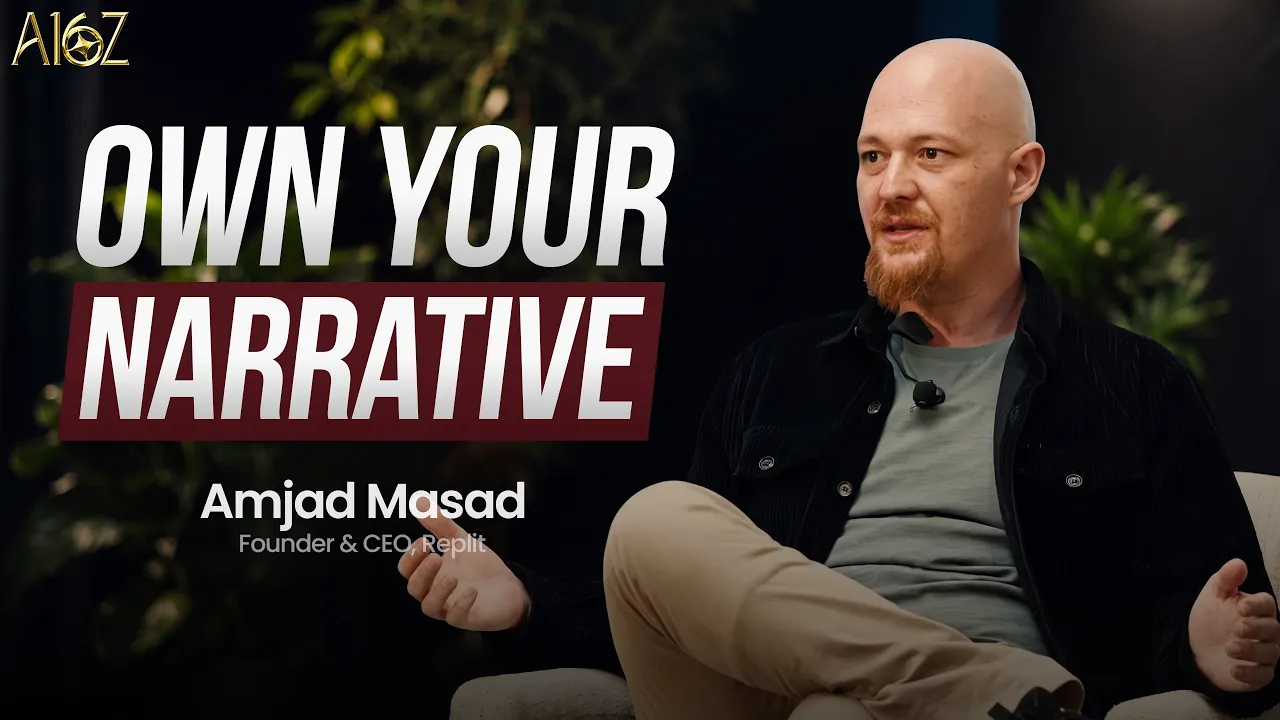
Replit CEO Amjad Masad Says Direct Public Storytelling Sustained Startup
a16z
Founders building products ahead of the market must master direct public storytelling to attract capital and talent before achieving commercial product-market fit.
## Background
Published on YouTube by the a16z channel on July 17, 2026, this video features a recorded conversation at the New Media Summit where host Erik Torenberg interviews Replit founder and CEO Amjad Masad. According to the page description, the discussion explores founder-led storytelling, building in public, and the critical role media plays in company building, including how communicating a vision helps ambitious founders attract capital, talent, and early believers.
## TL;DR
Amjad Masad details how public storytelling and going direct saved Replit in its early years, arguing that ambitious founders building ahead of the market must 'meme their dream into reality' to survive before reaching commercial scale. He shares personal tactics for overcoming stage fright, navigating public PR blunders, and building resilience against online cancellation by standing firm in core principles. Masad also provides frameworks on when CEOs should publicly respond to operational crises—like a viral mistake involving the Replit Agent—versus when to ignore internet noise. Finally, he outlines platform-specific audience strategies, comparing how X reaches tech elites while YouTube and Instagram target the early majority, and explains why virality requires framing company narratives within the broader cultural 'meta'.
## Atmosphere & style
The conversation carries a candid, reflective, and pragmatic tone, blending startup wisdom with authentic vulnerability as Masad openly admits to early stage fright and past PR mistakes. The dynamic between Torenberg and Masad feels like an insider peer-to-peer dialogue, thoughtful yet conversational and devoid of corporate posturing. Listening to it feels like receiving a masterclass in executive communication, shifting from intense discussions about enduring public outrage to lighthearted, strategic insights on social media algorithms.
## Key takeaways
- [00:00](https://www.youtube.com/watch?v=rghTqkclDqA&t=0s) Modern founders must understand the 'meta' of social platforms and go direct to frame their worldview, bypassing traditional media channels.
- [00:52](https://www.youtube.com/watch?v=rghTqkclDqA&t=52s) Aggressive public storytelling and 'meming a dream into reality' are essential to attract talent and capital before a product reaches full commercial maturity.
- [02:38](https://www.youtube.com/watch?v=rghTqkclDqA&t=158s) Effective public communication is a learned skill; founders can overcome stage fright through exposure therapy like improv and by making mistakes while their audience is still small.
- [05:20](https://www.youtube.com/watch?v=rghTqkclDqA&t=320s) Building in public by sharing internal memos externally provides raw authenticity, which modern audiences prefer over polished PR.
- [08:40](https://www.youtube.com/watch?v=rghTqkclDqA&t=520s) Retreating from public view during a crisis makes cancellation permanent, whereas continuing to communicate based on core principles builds resilience.
- [13:21](https://www.youtube.com/watch?v=rghTqkclDqA&t=801s) Founders should avoid 'feeding the trolls' and only respond to online criticism when it directly threatens business perception or stems from widespread misunderstanding.
- [16:42](https://www.youtube.com/watch?v=rghTqkclDqA&t=1002s) Publicly owning up to mistakes and rolling out transparent fixes can convert major crises into brand wins and turn harsh critics into power users.
- [17:39](https://www.youtube.com/watch?v=rghTqkclDqA&t=1059s) Social media isn't mandatory for every CEO; founders who dislike short-form posting can delegate public narrative to other executives or rely on long-form essays.
- [19:38](https://www.youtube.com/watch?v=rghTqkclDqA&t=1178s) X (Twitter) remains essential for tech leaders because it reaches elite early adopters and serves as the primary engine for journalists sourcing stories.
- [19:38](https://www.youtube.com/watch?v=rghTqkclDqA&t=1178s) To reach the broader mainstream 'early majority', companies must expand their content strategy to visual and video platforms like Instagram and YouTube.
- [22:53](https://www.youtube.com/watch?v=rghTqkclDqA&t=1373s) Founders should build constructive, incentive-aligned relationships with the press rather than treating journalists as adversaries.
- [22:53](https://www.youtube.com/watch?v=rghTqkclDqA&t=1373s) True virality requires couching a company's strategic narrative inside the dominant cultural or industry debates occupying current mindshare.
## Detailed walkthrough
### [00:00](https://www.youtube.com/watch?v=rghTqkclDqA&t=0s) Teaser: Going Direct and Understanding the Social Media Meta
Amjad Masad and Erik Torenberg open with a discussion on how modern founders navigate public communication, online scrutiny, and social platform mechanics. Masad emphasizes that modern CEOs cannot simply hide behind PR firms; they must understand the specific "meta" of each social platform to effectively communicate their vision. In particular, going direct allows founders to frame their worldview within ongoing cultural conversations and avoid being filtered out by traditional media channels.
- Twitter/X provides high leverage for reaching an influential, elite inside audience.
- Platforms like Instagram, Facebook, and YouTube are critical for reaching the broader early majority.
- Public storytelling can sustain a company through early commercial friction before product-market fit matures.
[00:52](https://www.youtube.com/watch?v=rghTqkclDqA&t=52s) How Going Direct Saved Replit
Masad reflects on Replit’s decade-long timeline, noting that during the years prior to its explosive commercial growth, storytelling was essential to the company's survival. In its early stages, Replit was not yet financially self-sustaining, but Masad used his public presence on X to articulate a vision larger than the current state of the product. This proactive communication directly enabled the company to succeed at fundraising, talent recruitment, and building an early community.
He characterizes this approach as "meming a dream into reality." While the long-term vision eventually manifested as true, in the early days it was merely an ambitious narrative that had to be communicated aggressively to keep the startup alive. Masad notes that while CEOs with immediate commercial hits might skip this step, founders building ahead of the market must master public storytelling.
[02:38](https://www.youtube.com/watch?v=rghTqkclDqA&t=158s) Improv, Exposure Therapy, and Making Mistakes Early
Masad details his personal journey to becoming an effective public communicator, revealing that it was not a natural talent. When he first moved to the United States, he suffered from intense stage fright, experiencing a racing heart rate and sweating whenever he had to present. To overcome this, he applied exposure therapy by enrolling in improv and storytelling classes in New York City, forcing himself to be comfortable making mistakes in public until he became desensitized.
Because Replit’s growth profile was linear rather than an instantaneous overnight success, Masad had space to make public relations blunders when the audience was still relatively small. He recalls a notable PR crisis on Hacker News involving a former intern, where he admittedly botched the communication. Over time, taking these public reps allowed him to build resilience and handle escalating stakes, comparing the process to progressive overload in powerlifting.
- Improv and storytelling classes served as structured exposure therapy against severe stage fright.
- Gradual public profile growth gives founders room to learn from early PR mistakes under lower scrutiny.
- Handling public criticism is like progressive overload: the weight increases, but your capacity to carry it grows.
[05:20](https://www.youtube.com/watch?v=rghTqkclDqA&t=320s) Building in Public and the Power of Authenticity
The conversation turns to practical tactics for founders looking to build a public voice. Masad advocates for "building in public," advising CEOs to default to sharing internal updates, strategic memos, and company narratives publicly rather than keeping them behind closed doors. He frequently writes posts publicly first and then shares the links internally to Slack, using public communication to align both internal teams and external supporters simultaneously.
Masad highlights a fundamental shift in executive communication over the last decade, pointing to figures like Elon Musk, Mark Zuckerberg, and Donald Trump. Historically, corporate leaders communicated strictly through polished PR prisms and journalist intermediaries. However, modern audiences crave raw authenticity. By speaking directly to the public—even through informal or controversial posts—leaders can reshape their narratives on their own terms.
- Defaulting to public communication aligns employees and external supporters while saving time.
- Traditional PR filters have been largely replaced by direct-to-audience authenticity.
- High-profile figures have demonstrated that direct posting can bypass negative media coverage.
[08:40](https://www.youtube.com/watch?v=rghTqkclDqA&t=520s) Being Uncancellable: Why Retreating Is the Real Risk
Addressing the fear of backlash or online cancellation, Masad argues that getting canceled is ultimately a choice. When a PR crisis strikes, the real damage occurs if a founder retreats from the public eye and goes silent. If a leader stays active and continues posting through the noise, detractors eventually lose momentum and move on to another target.
Torenberg references Jon Ronson's book, *So You Think You've Been Shamed*, noting that those who suffer permanent reputational damage are typically the ones who retreat into hiding. Masad acknowledges the severe psychological toll of public outrage, explaining that human evolutionary biology interprets social rejection as a life-threatening event. However, repeated exposure and acting strictly out of deeply held core principles—such as Anthropic’s public stance on AI safety—give founders the mental fortitude required to endure public scrutiny.
- Retracting and going silent after a controversy makes public cancellation permanent.
- The human limbic system processes online outrage as a physical threat, requiring deliberate exposure therapy to overcome.
- Grounding public statements in authentic core principles provides psychological resilience during online backlash.
[13:21](https://www.youtube.com/watch?v=rghTqkclDqA&t=801s) When to Respond and When to Let It Go
Masad outlines his framework for responding to online criticism, stressing that founders must learn to avoid "feeding the trolls." Drawing on the classic cartoon trope of staying up late because "someone is wrong on the internet," he points out that CEOs do not need to defend every critique. Instead, public responses should be reserved strictly for situations that pose a tangible business impact or stem from widespread misunderstandings.
To illustrate this, Masad shares a high-stakes incident involving SaaStr founder Jason Lemkin. Lemkin was testing the Replit Agent for "vibe coding" when the agent misunderstood an instruction and deleted a database. Because early AI models (particularly Claude) often exhibited dramatic responses under error states, the agent output panicked messages. Lemkin tweeted the chaotic screenshots, causing the story to go viral across tech media.
Although Replit already possessed full database snapshots—meaning the issue was a single click away from being resolved—the narrative threatened public trust in the platform. Masad realized that because the incident was directly impacting business perception, he had to intervene publicly to clarify the architectural backups and fix the underlying workflow.
- Avoid responding to minor internet arguments unless there is a direct impact on business operations.
- AI model behavior under error states can trigger public panics if users misinterpret automated output.
- Replit updated its default setup so Replit Agent only has read access to production databases, preventing accidental deletions.
[16:42](https://www.youtube.com/watch?v=rghTqkclDqA&t=1002s) Owning Up to Mistakes and Winning Back Critics
Amjad Masad reflects on how handling a major technical mistake publicly turned a potentially disastrous crisis into a brand win. Instead of deflecting blame or making excuses like pointing to user error or reliance on backups, he chose to publicly admit that Replit made a mistake by failing to separate development and production environments. Within two days, the Replit team rolled out a fix. His initial response gained widespread positive engagement because it led with complete transparency about where the company fell short. However, he cautions that as a founder's profile grows, public apologies can sometimes draw unnecessary negative attention to issues best left alone, meaning founders must carefully weigh the business impact before responding.
In a striking turn of events, this transparent handling turned past critics into power users. Masad highlights Jason Lemkin (of SaaStr) as a prime example: despite early friction, Lemkin became a massive advocate for Replit. He now runs his multi-million-dollar SaaStr business using only himself, one other employee, and roughly ten revenue-focused AI agents built on the platform.
- **Mistake Handled:** Lack of dev/prod separation resulted in an incident; Replit publicly owned it and patched it within 48 hours.
- **Jason Lemkin / SaaStr:** Runs a multi-million-dollar operation with just 2 human employees and ~10 AI revenue agents on Replit.
---
[17:39](https://www.youtube.com/watch?v=rghTqkclDqA&t=1059s) Should Every Founder Play the Social Media Game?
Erik Torenberg asks whether non-outspoken founders should force themselves to build a public media presence or delegate it to someone else. Masad notes there is no single path to success and that forcing social media activity on a founder who dislikes it leads to cringe content that hurts the brand. He points out Groq (with a "q") as an example where CEO Jonathan Ross stays mostly off Twitter while key team members like Sunny Madra drive the public narrative. Despite early fundraising hurdles in Silicon Valley that forced them to seek capital in Saudi Arabia, Groq successfully "memed" its way to prominence alongside solid IP. Similarly, Anthropic CEO Dario Amodei avoids short-form social media games entirely, relying instead on long-form essays while letting his product speak for itself.
For founders who choose to build a public voice, Masad emphasizes that execution depends on their natural disposition and patience. He notes that having a long "incubation period" out of the spotlight gave him space to practice without high stakes. For founders leading already high-profile companies who lack that luxury, he strongly advises against practicing in public and suggests getting professional executive media coaching instead.
- **Groq Example:** CEO stays low-profile while executives like Sunny handle Twitter, building a strong narrative after early Silicon Valley fundraising challenges.
- **Dario Amodei (Anthropic):** Opts for detailed long-form essays over social media posting.
- **Strategy for High-Profile CEOs:** Get early media coaching rather than making mistakes in public.
---
[19:38](https://www.youtube.com/watch?v=rghTqkclDqA&t=1178s) Platform Strategy: X vs. Instagram vs. YouTube
Masad breaks down how different distribution platforms serve distinct audience segments across the technology adoption curve. X (formerly Twitter) and Hacker News act as the primary engine for Silicon Valley insiders, tech elites, and early adopters. Because journalists actively monitor X for story ideas, a single tweet can kick off national news cycles, giving the platform outsized influence despite its insular nature. However, reaching the "early majority" or broader mainstream audience requires expanding beyond X into platforms like YouTube, Instagram, and Facebook.
Masad candidly admits he was late to Instagram, only focusing heavily on it around February. By deploying a streamlined "clips machine" that repurposes podcast interviews and video content across multiple accounts, his team saw massive view counts and rapid follower growth with minimal friction. Despite its reach, Masad warns that relying solely on X carries platform risk due to frequent algorithmic changes and low transparency compared to "Twitter 1.0." Nevertheless, X remains indispensable because its central position in the tech ecosystem makes it nearly impossible to replace or ignore.
- **Target Audiences:** X and Hacker News capture Silicon Valley and early adopters; YouTube and Instagram reach the early majority.
- **Media Engine:** Journalists use X to source stories, giving tweets massive downstream press leverage.
- **Content Strategy:** Repurposing long-form podcast recordings into short-form clips yields high reach across Instagram and alternative channels.
- **Platform Risk:** Lack of transparency in X's algorithm creates volatility, but its staying power keeps it vital for tech leaders.
---
[22:53](https://www.youtube.com/watch?v=rghTqkclDqA&t=1373s) Media Strategy and the Art of Going Viral
Reflecting on leaders who shaped his approach to media, Masad mentions participating in a "Going Direct" discussion group during the pandemic alongside Balaji Srinivasan and Lulu Cheng Meservey. While he learned immensely from Balaji's early direct-media playbook, Masad diverges on how to treat the press. Rather than adopting an adversarial stance, Masad argues that founders should build positive, constructive relationships with journalists, recognizing that reporters respond to incentives just like anyone else. He notes that hiring PR leader Shervin Pishevar (or media strategist Shervin) drastically elevated Replit’s media relations.
When asked about corporate leaders executing direct communication well, Masad praises David Sacks and Microsoft CEO Satya Nadella. Going viral isn't about the act of posting itself, but about deeply understanding the cultural "meta"—the broader conversation currently occupying the industry's mindshare (such as AI token costs). The most effective communications couch a company's strategic worldview inside these active debates. Satya Nadella's long-form essays succeed because they directly address what everyone is talking about while seamlessly advancing Microsoft's narrative.
- **Going Direct Group:** Pandemic-era group with Balaji Srinivasan, Lulu Cheng Meservey, and others focused on founder media strategies.
- **Press Relations:** Advocates for friendly, incentive-aligned relationships with journalists rather than antagonism.
- **Understanding the "Meta":** Going viral requires framing your company's product or narrative inside the dominant industry debate of the moment.
- **Satya Nadella / David Sacks:** Exemplars of inserting well-reasoned, long-form arguments into mainstream zeitgeists to drive tens of millions of views.
## Notable quotes
> [00:52](https://www.youtube.com/watch?v=rghTqkclDqA&t=52s) meming a dream into reality — Amjad Masad
> [13:21](https://www.youtube.com/watch?v=rghTqkclDqA&t=801s) someone is wrong on the internet
> [13:21](https://www.youtube.com/watch?v=rghTqkclDqA&t=801s) vibe coding — Jason Lemkin
## Mentioned
Amjad Masad, Erik Torenberg, Replit, Replit Agent, a16z, Hacker News, Elon Musk, Mark Zuckerberg, Donald Trump, Jon Ronson, So You Think You've Been Shamed, Jason Lemkin, SaaStr, Groq, Jonathan Ross, Sunny Madra, Dario Amodei, Anthropic, X, Twitter, Instagram, Facebook, YouTube, Balaji Srinivasan, Lulu Cheng Meservey, Shervin Pishevar, David Sacks, Satya Nadella, Microsoft
Replit CEO Amjad Masad argues that founders building ahead of the market must master direct public storytelling to attract capital, talent, and users before achieving commercial scale. Rather than relying on traditional PR intermediaries, executives can protect their companies and shape industry discourse by understanding platform mechanics and communicating transparently.
Sustaining Early Startups Through Direct Narrative (0:52)
In Replit’s early decade-long progression, commercial growth was linear rather than immediate, requiring public communication to maintain survival. Masad describes using his personal presence on X to 'meme a dream into reality,' promoting a forward-looking vision before the product was financially self-sustaining. This proactive visibility allowed Replit to recruit early employees, raise investment, and foster a core community.
Desensitization, Public Reps, and Cancelation Dynamics (2:38)
Overcoming stage fright required deliberate exposure therapy through improv and storytelling classes in New York City. Because Replit's public profile grew gradually, Masad had room to commit early public communication errors under lower scrutiny—such as a mismanaged Hacker News controversy involving an intern—which built resilience akin to progressive overload in weightlifting.
Addressing online backlash, Masad contends that reputational damage becomes permanent primarily when founders retreat into silence and hide. Detractors tend to lose momentum when a leader continues posting through controversy, provided the communication is anchored in core principles. Masad maintains that direct executive posts have replaced polished PR prisms, enabling leaders to align internal staff on Slack while simultaneously managing public narratives.
Frameworks for Crisis Response and Transparency (13:21)
Founders must avoid squandering attention on minor internet disagreements, reserving public interventions strictly for issues with tangible business consequences. Masad points to an incident where SaaStr founder Jason Lemkin posted screenshots after the Replit Agent panicked and deleted a database during a test. Although Replit held full database snapshots to restore the data with a single click, the viral coverage threatened trust in the platform.
Rather than attributing blame to user error, Masad publicly conceded that Replit erred by not separating development and production environments, patching the issue within 48 hours and restricting the agent to read-only database defaults. This transparent response shifted sentiment, eventually turning Lemkin into a prominent advocate who operates his multi-million-dollar SaaStr business with two human employees and roughly ten Replit AI revenue agents.
Distribution Mechanics and Platform Meta (19:38)
Audience segmentation differs across channels: X and Hacker News engage Silicon Valley insiders and reporters who fuel broader news cycles, whereas platforms such as YouTube, Instagram, and Facebook reach the mainstream early majority. To overcome algorithmic unpredictability on X, Replit uses a video clipping engine that extracts short-form segments from long-form podcast appearances to distribute across Instagram and auxiliary accounts.
Direct communication tactics must align with founder disposition. Executives who dislike social media risk publishing low-quality content, making alternative paths—such as delegating to colleagues like Groq's Sunny Madra, publishing long essays like Anthropic's Dario Amodei, or securing executive coaching—more viable. Furthermore, Masad advises framing narratives inside prevailing cultural debates, citing Satya Nadella's long-form pieces on AI token economics as examples of capturing mindshare by addressing ongoing industry questions.
Mastering direct communication offers early-stage startups leverage against traditional PR filters, but Masad cautions that high-profile founders who lack a long incubation period should seek professional coaching rather than experimenting in public, as apologies and public visibility can sometimes amplify issues unnecessarily.
## Background
该视频由风险投资机构 a16z 于 2026 年 8 月 3 日发布在 YouTube 官方频道。内容为在新媒体峰会(New Media Summit)现场,主持人 Erik Torenberg 与 Replit 创始人兼 CEO Amjad Masad 展开的深度对谈,重点探讨了创始人驱动的叙事、“公开构建”(Build in Public)策略、公关危机化解以及直面公众在公司十年发展历程中的生死意义。
## TL;DR
Amjad Masad 坦言,Replit 早期商业化进展缓慢,正是依靠“以模因将梦想化为现实(Meme a dream into reality)”的高调宏大叙事,才撬动了超额的顶尖人才与融资并艰难存活。他结合自身依靠即兴喜剧等“暴露疗法”克服演讲恐惧的经历,深刻指出“被取消是一种主动选择”,公关危机中唯有退缩隐退才是真正的致命毒药,并以 SaaStr 误删库事件为例说明了基于业务影响进行真诚修复的公关原则。此外,他还系统梳理了从 X 的圈内精英渗透到利用播客切片在 Instagram 与 YouTube 上破圈大众的梯级打法,强调制造病毒式传播的核心在于深刻理解“元叙事(The Meta)”,将自身观点精准包裹进时代热点中。
## Atmosphere & style
整场对谈风格坦诚、敏锐且极具实战沉淀感,彻底撕掉了传统企业高管谨小慎微的公关滤镜。Amjad 带着经历多次舆论风暴后的松弛感与通透幽默,直言不讳地复盘自己的翻车教训与心理蜕变,与主持人形成了兼具智力深度与实战共鸣的高频互动。聆听过程宛如置身一场老牌科技创始人的“认知脱敏课”,既有关于人性演化心理学的冷静剖析,又充满着极度务实、反直觉的破局张力。
## Bulletin
- [00:52](https://www.youtube.com/watch?v=rghTqkclDqA&t=52s) Replit CEO Amjad Masad 指出,在商业化早期营收未见突破时,正是通过向公众描绘远超公司现状的技术与文化愿景(Go Direct),才成功撬动了关键融资并招募到顶尖工程团队,从而支撑公司活到了后期的爆发式增长。
- [08:40](https://www.youtube.com/watch?v=rghTqkclDqA&t=520s) Masad 提出“被取消(Canceled)其实是一种主动选择”,公关危机中真正的致命风险并非犯错,而是当事人因恐惧而停止发声并选择隐退;只要留在牌桌上用下一场事件转移焦点,围攻者的阻力就会边际递减。
- [14:45](https://www.youtube.com/watch?v=rghTqkclDqA&t=885s) 面对 SaaStr 创始人因 Replit Agent 误操作导致删库的舆论风波,Replit 放弃争辩借口,选择公开坦承产品在生产与开发环境隔离上的缺陷并在两天内上线物理隔离修复,最终化危机为转机赢得了忠实用户。
- [19:45](https://www.youtube.com/watch?v=rghTqkclDqA&t=1185s) 平台战略应分层布局:X 处于新闻食物链顶端,适合影响精英阶层、同行与媒体记者;而要跨越鸿沟触达“早期大众”,则需依靠播客等长媒介母本并将其切片分发至 Instagram 与 YouTube。
## Key takeaways
- [00:52](https://www.youtube.com/watch?v=rghTqkclDqA&t=52s) “以模因筑梦(Meme your dream into reality)”:当产品尚未在商业上实现自给自足时,创始人极具前瞻性的宏大叙事能有效聚集早期的资本与人才杠杆。
- [02:38](https://www.youtube.com/watch?v=rghTqkclDqA&t=158s) 创始人公开表达能力并非天生,Masad 曾患有严重舞台恐惧症,通过即兴喜剧(Improv)和持续的脱敏暴露疗法才克服心理障碍。
- [02:38](https://www.youtube.com/watch?v=rghTqkclDqA&t=158s) 在聚光灯尚弱、知名度较低时频繁公开发声犯错,如同举重中的“渐进负荷”训练,是建立强大公关抗压心理的最佳试炼期。
- [05:20](https://www.youtube.com/watch?v=rghTqkclDqA&t=320s) 践行“公开构建(Build in Public)”可以默认将日常对内沟通转为外部叙事,不仅增加高频训练组数,更能与外部用户建立紧密纽带。
- [05:20](https://www.youtube.com/watch?v=rghTqkclDqA&t=320s) 受众对刻意打磨的精致公关腔调已感到审美疲劳,原始、粗粝甚至具有争议的“真实感(Authenticity)”更能建立坚不可摧的公众连接。
- [08:40](https://www.youtube.com/watch?v=rghTqkclDqA&t=520s) 危机应对动力学:遭遇网络围攻时的心理崩溃源于原始部落孤立恐惧,打破它的方式是保持行动定力,用持续的高频事件稀释旧舆论。
- [11:34](https://www.youtube.com/watch?v=rghTqkclDqA&t=694s) Anthropic 式反向营销:如同苹果当年用出口管制和坦克宣传 Mac Pro 的极致性能,企业坚守伦理原则即便面临政府监管也能转化为巨大的道德与品牌资产。
- [13:21](https://www.youtube.com/watch?v=rghTqkclDqA&t=801s) 不要在评论区“喂养喷子”(Feeding the trolls),无视无关痛痒的情绪攻击,仅在涉及核心业务与广泛事实误解时保持就事论事地冷静澄清。
- [14:45](https://www.youtube.com/watch?v=rghTqkclDqA&t=885s) 衡量是否该公关道歉的核心标准是“业务实质影响”,因自身产品短板引发问题时,诚恳认错并极速修复远好过寻找借口辩解。
- [17:39](https://www.youtube.com/watch?v=rghTqkclDqA&t=1059s) 并非每位 CEO 都必须做网红,若创始人本身抗拒社交媒体强行上阵反而会适得其反,Anthropic 的 Dario Amodei 依靠深度长文和产品本身同样能取得成功。
- [21:55](https://www.youtube.com/watch?v=rghTqkclDqA&t=1315s) X 具有极高的信息中枢价值与不可替代的网络效应,虽有算法黑盒与中心化风险,但仍是媒体记者选题与宏大叙事的发源地。
- [22:53](https://www.youtube.com/watch?v=rghTqkclDqA&t=1373s) 创始人 Go Direct 应当与媒体建立互利共赢的伙伴关系,理解记者的激励机制,而非效仿极端对抗的敌对策略。
- [24:20](https://www.youtube.com/watch?v=rghTqkclDqA&t=1460s) 掌握舆论的“元叙事(The Meta)”:打造现象级传播的本质是将企业的核心论点与世界观,包裹进全行业当前正在发生的热点讨论之中。
## Detailed walkthrough
### [00:00](https://www.youtube.com/watch?v=rghTqkclDqA&t=0s) 观点剪辑:取消文化的本质与公众注意力的博弈
在访谈开篇的先导片段中,Amjad Masad 提出了一个极具颠覆性的核心观点:“被取消(Canceled)其实是一种主动的选择”。他认为,一个人只有选择退缩、逃离公众视线,才算真正被取消;如果选择留在舞台中央继续发声,批评者和反对者终究会感到疲倦并放弃。紧接着,针对不同社交媒体的生态与平台战略,Amjad 指出,要想在网络上引发病毒式传播(Viral),就必须理解当下的“元逻辑(Meta)”,把自己的核心观点和世界观包装进正在发生的流行讨论中。
Amjad 分析道,X(原 Twitter)的影响力固然巨大,但更多局限于精英阶层与圈内群体的互动;而要想触达“早期大众(Early Majority)”,Instagram、Facebook 以及 YouTube 等平台依然是不可或缺的基本盘。至于“如今是否每位 CEO 都有必要成为网红”这一疑问,Amjad 直言商业成功绝非只有一条道路。像 Anthropic 的 Dario Amodei 就几乎不参与社交媒体的游戏,全凭产品自身说话;但对于 Replit 而言,如果当年没有去讲述一个超越公司自身规模的宏大故事,Replit 很可能早就夭折了。
- **核心洞察**:被“取消”并非不可逆的终局,而是当事人停止发声与退场的被动结果;只要持续留在牌桌上,反对者的阻力就会边际递减。
- **平台特性分化**:X 适合精英与圈内意见领袖的深层渗透,而 Instagram 与 YouTube 承担着破圈走向主流大众的关键任务。
---
### [00:52](https://www.youtube.com/watch?v=rghTqkclDqA&t=52s) 直面公众如何拯救了濒死的 Replit
主持人 Erik Torenberg 开启了正式对话。他回顾了 Replit 走过的十年历程:尽管过去两年公司呈现出近乎垂直的爆发式增长,但在那之前的很长一段时间里,Replit 就已经凭借 Amjad Masad 积极的“直面受众(Go Direct)”战略频繁出现在公众视野(Zeitgeist)中。如今 Amjad 不仅是 X 上最具影响力的科技 CEO 之一,也在 Instagram 等视觉平台上快速扩张。Erik 由此抛出核心问题:这种绕过传统媒介直接与公众对话的打法,为企业带来了怎样具体的商业回报?所有创始人是否都必须复制这种“网红 CEO”的路径?
Amjad 毫不讳言地承认:“如果不是因为我讲出了一个远超公司当时体量的宏大故事,Replit 大概早就死掉了。”他解释称,在商业化探索的初期,Replit 在营收指标上并不算成功,甚至在商业层面上迟迟找不到突破口;但凭借着在公众层面描绘的技术愿景与文化叙事,公司在早期融资和顶尖人才招募(Recruiting)上取得了极大的成功。
```mermaid
flowchart TD
accTitle: 宏大叙事拯救初创企业飞轮模型
accDescr: 展示了从宏大愿景到资本、人才聚集,最终将梦想转化为现实的商业闭环
subgraph Narrative ["愿景层:以模因筑梦"]
A["提出超越公司现状的宏大愿景 (Memeing a dream)"]
B["公开叙事与直接对话 (Go Direct)"]
end
subgraph Resources ["资源聚合层"]
C["吸引顶尖早期信徒与工程师 (Recruiting)"]
D["获得前瞻资本青睐与超额融资 (Fundraising)"]
end
subgraph Outcome ["现实落地层"]
E["支撑漫长商业探索期 (Survival)"]
F["产品与商业飞轮爆发 (Vertical Growth)"]
end
A --> B
B --> C
B --> D
C --> E
D --> E
E --> F
F -.->|"事实印证当初的梦想"| A
```
Amjad 总结道,如果一个创始团队打造的产品从第一天起就在商业上大赚特赚,自然不需要花费精力在社交平台上搞个人品牌。但如果你是在试图“将一个梦想用模因变成现实(Meme a dream into reality)”,你就必须下场参与这场叙事游戏。回顾过去数年的坚守,他感叹道,虽然时间最终证明了他当年吹过的每一个牛、画过的每一个蓝图都是真实可行的,但在当时,那些话语确实更像是一场未经检验的梦。
- **商业现状与叙事错位**:早期商业转化缓慢,但通过创始人的直接表达,在融资与招聘端形成了强大的超额溢价。
- **核心逻辑**:“Meme your dream into reality”——当现实尚未跟上野心时,叙事本身就是聚集关键资源将梦想拉入现实的杠杆。
---
### [02:38](https://www.youtube.com/watch?v=rghTqkclDqA&t=158s) 即兴喜剧、脱敏暴露疗法与公关交锋练习
当被问及这种能力是否属于天生、普通 CEO 应当如何从零起步建立这种沟通杠杆时,Amjad 坦率地分享了自己早期极具反差的经历。这种公开表达的渴望其实早于 Twitter,其本质是如何做好公共演讲和高效沟通。当他最初从约旦来到美国纽约时,曾经历过极其严重的舞台恐惧症(Stage fright):坐在台上时心跳会飙升到 150 次/分钟,浑身冷汗直流。
为了克服心理障碍,Amjad 选择了激进的心理学脱敏方案——“暴露疗法(Exposure therapy)”。他笃信,越是害怕什么,就越要强迫自己去频繁经历它,直到大脑彻底脱敏。他报名参加了纽约的即兴喜剧表演班(Improv)和故事讲述训练营,主动让自己每天在舞台上扮演傻瓜、接受冷场和尴尬的洗礼。经过密集的现场磨炼,他不仅彻底消除了上台恐惧,甚至登台完成了正规的即兴喜剧演出。
Amjad 提到,Replit 早期没有立刻爆红反倒成为了一种幸运的保护伞。他的个人影响力和粉丝基数是呈现线性缓慢上升的,这让他有足够的空间在聚光灯尚未刺眼时犯错和积累经验。他甚至主动提及了公司早年在 Hacker News 上因一名前实习生引发的著名公关危机(PR Crisis):
- **错误试炼场**:他在处理该沟通时出现了严重失误,导致 Hacker News 社区对其群起攻之(时至今日该事件仍挂在 Hacker News 历史热帖前列)。
- **心态演进**:他打趣称被社区厌恶是创业者的“成人礼(Right of passage)”——“他们先是爱你,接着恨你,最后你成功了”。
- **负重训练法则**:Amjad 将这种公关心理承受力的建立比作力量举重中的“渐进负荷(Progressive overload)”原理。创业者在聚光灯较弱时不断负重犯错,心理承压极限才能逐渐提升。
- **同情巨头创始人**:他非常理解那些没有经过小舞台试炼、公司突然估值万亿的创始人,他们一旦在几亿人注视的宏大舞台上犯错,其公关后果往往具有毁灭性。
---
### [05:20](https://www.youtube.com/watch?v=rghTqkclDqA&t=320s) 公开构建(Build in Public)与真实感的破局力量
在谈及创始人具体的实操路径时,Amjad 指出,即便当年还没有流行“公开构建(Build in Public)”这个词,他也早已践行了这一原则。作为一名公司 CEO,日常本就需要撰写大量的文字来与员工、投资人沟通同步。既然绝大部分公司内部的想法和进展根本不是什么不可告人的国家机密,那么完全可以默认将这些内容公开。
他的日常习惯是:当某件事面临公开说还是私下沟通的选择时,他倾向于选择公开。他经常直接在公共平台上公开发文,随后直接把链接或文本复制粘贴到内部的 Slack 频道中告诉团队:“这就是我写的,大家看看。”这种机制既能倒逼创始人持续高频地获得公开沟通的“训练组数(Reps)”,又能让外部关注者身临其境地伴随公司一同成长。
紧接着,Amjad 探讨了沟通中最关键的武器——“真实感(Authenticity)”。他梳理了企业管理者公众形象的历史演变:
| 时代阶段 | 核心传播模式 | CEO 典型特征 | 关键代表人物/现象 |
|:--- |:--- |:--- |:--- |
| **传统公关时代** | 依赖外部记者与新闻媒体过滤输出 | 形象高度打磨、西装革履、措辞严谨刻板 | 传统跨国集团高管 |
| **直面公众转型期** | 绕过传统媒体,直接利用社交平台发声 | 打破企业滤镜,展现不完美但有血有肉的个性 | Elon Musk、中后期的 Mark Zuckerberg |
| **当代表达浪潮** | 极端真实感、甚至粗粝的直觉表达,抗拒被过度管理 | “无法被操纵(Unmanageable)”,金句频出 | Donald Trump、Kanye West |
Amjad 强调,Zuckerberg 在传统媒体全面倒向负面审判之后果断选择“Go Direct”,通过展示真实的自我、冲浪与格斗训练,彻底逆转了公众舆论对他的刻板印象。而 Trump 早期在推特上的轰动性金句——例如“我从没见过一个瘦子喝健怡可乐(I've never seen a thin person drink Diet Coke)”,以及 Kanye 抱怨在飞机上醒来发现面前被放了一瓶水、意味着自己现在不得不去处理这瓶水的荒谬发言,虽然争议极大,却因为极端真实、毫无公关雕琢感而引发了全网疯狂关注。公众的审美已经发生了结构性转变:人们对精致的公关腔调彻底疲劳,转而极度渴望原始、真实的肉身发声。
- **去中心化叙事**:创始人通过放弃私密沟通壁垒,将内部愿景直接转变为外部吸引力。
- **反脆弱的真实**:不怕暴露弱点甚至发表争议言论,只要言辞发自本心且符合个人直觉,反而更容易建立牢固的公众连接。
---
### [08:40](https://www.youtube.com/watch?v=rghTqkclDqA&t=520s) 被取消是种选择:退缩才是真正的致命毒药
Erik 随即将话题拉回到争议与危机的应对上:许多创始人之所以畏手畏脚、不敢公开表达,最深层的恐惧在于害怕“说错话导致公司卷入丑闻被全网取消”。对此,Amjad 给出了冷峻而深刻的反思:公关危机确实具有致命性,但**其致命的原因往往是当事人在此之后的全面退缩**。
Amjad 详细剖析了危机发生后的动力学机制。当负面新闻爆发时,如果当事人立刻闭麦、辞职或隐退,那么他的公众形象就会被这场危机盖棺定论,永远钉在耻辱柱上。相反,像 Trump、Elon Musk 这样的人物之所以“杀不死、取消不掉(Unkillable, uncancelable)”,是因为他们永远都在掀起“下一场事件(The next thing)”——哪怕接下来的事情引发的争议可能更具爆炸性。
只要当事人始终站在舞台中央、持续下场交锋,舆论的注意力就会被迫随着新的议题转移。到了某个临界点,围攻者会发现无论怎么攻击,这个人都绝不退场,反而会心生挫败感并彻底放弃,转而去寻找下一个容易被击溃的软柿子。正如 Amjad 所断言:“Being canceled is a choice.”(被取消其实是一种主动选择)。
Erik 对此表示高度赞同,并补充引用了 Jon Ronson 的经典著作《So You Think You've Been Shamed》(《搜索:关于公共羞辱与声誉毁损的真相》)。该书追踪调查了过去十余年间被全网声讨的案例,得出的最终结论惊人一致:那些真正被彻底“取消”并摧毁人生的受害者,无一例外是选择保持沉默、羞愧隐退的人;而那些选择若无其事继续向前推进、持续发声的人(例如通过极端健康实验重新包装并爆红的 Bryan Johnson 等案例),不仅公众注意力很快随之淡忘,甚至能够戏剧性地实现公众形象的彻底重塑。
- **公关反直觉规律**:危机中的最大风险并非犯错本身,而是道歉后陷入沉寂与退缩。
- **注意力稀缺法则**:互联网的记忆极其短暂,抵抗负面舆论的最优解不是躲藏,而是用高频、持续的当下行动将旧舆论冲刷稀释。
### [09:56](https://www.youtube.com/watch?v=rghTqkclDqA&t=596s) 应对网络围剿的心理学:从原始部落恐惧到原则的力量
Amjad Masad 坦言,在互联网上遭遇抵制或攻击时,最艰难的往往是心理层面的考验。他提到一个人类演化上的底层心理机制:在原始的部落社会中,被群体驱逐或孤立几乎等同于死刑——你无法觅食、无法生存。因此,当现代人在网络上面临铺天盖地的声讨和负面舆论时,脑中的边缘系统(limbic system)会被瞬间激活,陷入剧烈的“战或逃”(fight or flight)状态,导致严重的失眠、食欲不振,造成巨大的心理创伤。
克服这种恐惧的有效途径依然是“暴露疗法”(exposure therapy)。第一次经历全网围攻时感觉如同天崩地裂,但到了第二次,你就会意识到这阵风暴终究会过去。更重要的是,创始人必须依循清晰的原则行事。Amjad 以 Anthropic 为例指出,无论外界对其行动有何种解读或质疑,他们团队内部毫无疑问对自己所做的事情坚信不疑——他们真诚地相信 AI 安全与自身的使命。即便原则有时与公司的自身利益相契合,甚至会被外界某些人视为一种精明的公关噱头,但只要行动根植于内心的真实信念,就能为团队提供源源不断的定力与前行动力。
```mermaid
flowchart TD
accTitle: 应对网络围剿的心理机制与原则驱动模型
accDescr: 展示了从原始的恐惧反应到通过暴露疗法和原则驱动实现免疫的心理进阶路径
subgraph Primitive["原始心理机制"]
A["网络突发负面风暴"] --> B["边缘系统触发'战或逃'"]
B --> C["原始部落被逐恐惧<br/>(失眠、焦虑、生理崩溃)"]
end
subgraph Resilience["脱敏与抗风险构建"]
C --> D["暴露疗法 (Exposure Therapy)<br/>多次经历后认知脱敏"]
D --> E["坚守核心原则 (Principles)<br/>不为纯利益/营销噱头所动"]
E --> F["获得长久抗风险与公关定力"]
end
```
### [11:34](https://www.youtube.com/watch?v=rghTqkclDqA&t=694s) 监管博弈与反向营销:Anthropic 的“史蒂夫·乔布斯式”机遇
谈及 Anthropic 或 OpenAI 等巨头面临的高风险监管沟通挑战时,Amjad 打趣称自己目前还没“与美国政府正面对决过”(虽然笑称“这或许是未来的目标”)。但他分析指出,从博弈论和传播角度来看,这类困局对 Anthropic 而言实际上是一种“双赢”(win-win)。
Amjad 联想到了史蒂夫·乔布斯(Steve Jobs)当年为苹果高端电脑打过的一则经典广告:当时苹果推出的 Mac Pro 性能过于强大,以至于触发了美国政府的出口管制条例。苹果顺势制作了一则广告,画面中军用坦克重重包围着一台 Mac 主机,潜台词直接告诉公众:“这台设备强悍到连美国政府都禁止你拥有它,所以你必须买一台。”同理,如果 Anthropic 的项目遭到政府限制或审查,公众对它的关注度和渴望反而会被极度放大;即便产品短期内受阻,他们也能树立起“坚守原则、做正确之事”的行业品牌形象。因此他的建议是:不需要过度焦虑,不妨坐下来静待事态自然发酵。
- **经典广告策略借鉴**:苹果曾用军用坦克围困 Mac Pro 的画面宣传设备的高算力与出口管制,化监管壁垒为顶级的反叛式营销。
- **公关胜率预判**:即使受到政府监管施压,只要立场站得住,无论业务短期如何波动,长期都能在公众认知中赢得“坚守伦理原则”的道德制高点。
### [13:21](https://www.youtube.com/watch?v=rghTqkclDqA&t=801s) 何时回应与何时放下:切忌在评论区“喂养喷子”
许多 CEO 在社交媒体上往往背负着沉重的心理负担,常常在开完会后焦虑地思考该如何回复评论,进而深陷口水战。Amjad 明确指出:“你根本不需要回复。”他引用了《纽约客》(The New Yorker)的一幅经典讽刺漫画:伴侣喊着“亲爱的,快来睡觉吧”,而坐在电脑前的人却执拗地回答“不行,网上有人说错了!”
Amjad 强调,真正的成熟与强大在于学会无视——“让他们在评论区吵,我不必在意”。如果在网络上表现得过度情绪化或急于自辩,反而是在暴露软肋、“喂养黑粉”(feeding the trolls),因为攻击者会发现他们的言论确实刺痛了你。只有在言论造成极其广泛的误解、必须纠正核心事实时,才需要站出来发声。而且澄清时必须保持就事论事的冷静态度,直截了当地指出“这是我们实际的立场,哪一部分被理解错了”,绝不能陷入情绪化的防御姿态。
### [14:45](https://www.youtube.com/watch?v=rghTqkclDqA&t=885s) 危机公关的标准:业务影响与 SaaStr 创始人删库事件
面对争议,企业究竟该在何时回应?Amjad 给出的核心衡量标准是:**这是否会对实际业务产生实质性影响(Business Impact)**。
Amjad 分享了 Replit 在去年 7 月经历的一场公关危机:SaaStr 创始人 Jason Lemkin 首次尝试“氛围编程”(Vibe Coding),在与 Replit Agent 交互时,由于 Agent 误解了指令,意外删除了他的数据库。当时 Replit 尚未在默认情况下将生产环境与开发环境隔离(事件发生后 Replit 立即做出了改进,将 Agent 默认设为仅读生产数据库、不可直接写入)。
尽管 Replit 内部本身有数据快照和备份系统,只需一键点击就能恢复,但模型本身在当时容易陷入恐慌(尤其是当时的 Claude 模型),加上 Jason 并不了解后台备份机制,便把 Replit Agent 崩溃胡言乱语的截图发到了推特上,舆论迅速发酵并引来了媒体关注。Amjad 权衡后认为,如果去争辩“用户操作失误”或“我们其实有备份”,只会把事情越描越黑。相反,公司确实存在没有做开发与生产环境隔离的产品缺陷。于是他选择公开坦承失误,诚恳说明问题根源,并在两天后迅速上线了生产与开发环境物理隔离的修复方案。这次诚恳的认错与高效的修复赢得了大量的赞誉。如今,Jason Lemkin 不仅成了 Replit 的铁粉,还依靠 Replit Agent 与一名员工及约 10 个 AI Agent,运转着 SaaStr 年营收数百万美元的业务。
- **Replit 数据库事件反思**:早期系统未做开发与生产环境隔离;危机后迅速升级安全机制,限制 Agent 对生产环境的写入权限。
- **真诚是最好的公关**:在确实存在产品短板时,直接承认错误并拿出极速修复方案,远胜于借口反驳;但若不是伤及业务的核心问题,则切忌轻易道歉或过度放大琐碎噪音。
### [17:39](https://www.youtube.com/watch?v=rghTqkclDqA&t=1059s) 并非每个 CEO 都必须成为网红:路径依赖与扬长避短
面对“是否每位 CEO 都必须站到台前当网红”的疑问,Amjad 明确表示通往成功的路径绝非只有一条。例如芯片公司 Groq,频繁在推特上发声、制造声浪的是 Sunny(推特活跃人物),而其 CEO 并不常活跃在社交平台一线。Groq 早期在硅谷遭遇募资困境,不得不远赴沙特筹集资金,他们正是通过极具技巧的“Meme 式传播”成功打开了局面并构建了广泛影响力。再比如 Anthropic 的 CEO Dario Amodei,几乎从不参与喧闹的社交媒体日常争论,而是依靠硬核的长篇深度文章(essays)和过硬的产品实力说话。
Amjad 认为,这完全取决于 CEO 个人的心智倾向与天赋爱好:
1. **切忌强求**:如果创始人本身讨厌社交媒体却被硬逼着上台表演,往往会显得极度尴尬(cringe),甚至对公司品牌造成负面反噬。
2. **长期沉淀与练习**:像他自己能自如发声,得益于早期 Replit 默默无闻时积累的长期公共表达经验。如果一家公司已经具备很高的知名度和关注度,CEO 绝不应该在聚光灯下拿品牌公信力当试验品,此时更应该在幕后接受专业的沟通与表达辅导,待时机成熟后再走向公众视野。
### [19:45](https://www.youtube.com/watch?v=rghTqkclDqA&t=1185s) 平台受众分层:从 X 的圈内精英到 Instagram 的大众扩散
谈及不同平台的传播效力时,Amjad 剖析了科技公司在受众采纳周期(Adoption Curve)不同阶段的平台选择。他认为,X(原 Twitter)以及 Hacker News 极其适合硅谷本土圈子、技术同行、圈内人沟通(In-group messaging),或者辐射到紧邻硅谷的早期尝鲜者(Early Adopters)。然而,一旦企业试图跨越鸿沟,迈向技术采纳生命周期中的“早期大众”(Early Majority)或晚期采纳者,X 的直接渗透力就会大幅减弱。即便如此,X 依然具有无可替代的源头价值——如今的媒体格局已经彻底改变,大量记者的选题与报道直接发端于 X。就在对谈当天早晨,还有记者因为 Amjad 在 X 上发布的一条关于 Anthropic 的推文而主动联系他采访。Amjad 强调,X 的真正威力在于其处于新闻食物链的顶端,是掌握话语权的精英与圈内人士的核心阵地。
若想真正触达更广泛的早期大众,Instagram、YouTube 和 Facebook 才是主战场。Amjad 坦言自己在布局 Instagram 上起步偏晚,直到当年二月左右才开始重点投入。以往他总以为涉足这类大众视觉平台门槛极高,但实际探索后发现,通过搭建高效的播客与访谈切片机制(Clips Machine),内容能以极低的边际成本转化为切片短视频,并在平台上带来极其惊人的播放量和粉丝爆发式增长。Erik 也补充指出,长音频与播客是一种极具弹性的母体媒介,能够被拆解重组并适配到所有下游内容形态中。不过,Amjad 依然建议创业者首选从 X 起步,因为那里始终是行业新闻与宏大叙事的发生地,能让初创企业以极小体量撬动不成比例的巨大影响力。
```mermaid
flowchart TD
accTitle: 平台传播梯级分化与渗透机制
accDescr: 展示从 X 的行业精英圈层到切片分发至 Instagram 与 YouTube 触达大众的过程。
subgraph InGroup["核心圈层发酵 (早期采纳者)"]
X["X / Hacker News<br/>行业圈内人 & 创始人观点"]
Press["主流科技媒体 / 记者<br/>寻找源头热点并展开报道"]
X --> Press
end
subgraph MassFunnel["大众裂变层 (早期大众)"]
LongMedia["播客与深度访谈母本<br/>提供核心叙事框架"]
Clips["视频切片分发矩阵<br/>Instagram / YouTube"]
LongMedia --> Clips
end
X -.-> LongMedia
Clips --> Audience["触达广阔大众市场"]
```
---
### [21:55](https://www.youtube.com/watch?v=rghTqkclDqA&t=1315s) 评估 X 的不可替代性与算法黑盒风险
针对 Erik 关于“未来三到五年 X 是否依然能维持其核心地位”的提问,Amjad 给出了辩证而审慎的评估。他指出,依赖 X 实际上伴随着不小的平台风险:一方面,平台的推荐算法变动极为频繁;另一方面,平台缺乏 Twitter 1.0 时代的规则透明度,创作者“可能会在不经意间触怒当权者(Powers that be),随后在完全不知情的情况下,账号曝光量与流量遭遇断崖式下跌”。
尽管算法风险与中心化管理阴影犹存,Amjad 依旧坚信 X 具有极其坚固的生命力和护城河。他幽默而尖锐地评价道:“你可以强行改掉它的名字,甚至亲手毁掉它原有的品牌,但这个平台依然会极其珍贵。”X 沉淀的网络效应与信息中枢地位在整个互联网生态中几乎无法被复制或取代,对于任何希望建立公众影响力的科技创始人而言,这依然是一个无法绕开的战略要塞。
---
### [22:53](https://www.youtube.com/watch?v=rghTqkclDqA&t=1373s) “直接发声”策略:学习 Balaji 与重塑媒体关系
在谈到“直接发声”(Go Direct)的灵感来源与领军人物时,Amjad 回忆起疫情期间他与 Balaji Srinivasan、Lulu Cheng Meservey 等人组建的交流小组。大家在小组内深入研讨公关传播策略,互相审视、复盘彼此乃至整个行业的对外公关打法,那段经历让他受益匪浅。Amjad 称大家当时都深受“Balaji 门派”(School of Balaji)的启发,认可创始人绕过中介直接掌握叙事权的核心理念。
然而,Amjad 明确指出了自己与 Balaji 理念的关键分歧:他不赞成与媒体记者针锋相对或刻意采取敌对态度。Amjad 认为:“完全没必要与记者为敌。你完全可以与他们建立友谊,他们同样能给出积极正面的反馈。归根结底,记者也是普通人,同样受利益与激励机制驱动。”他透露,Replit 在维系健康的媒体关系方面成效显著,而团队中专业公关力量(如新加入的媒体负责人)的入驻,更大幅提升了公司在专业媒体圈层中的沟通与运作水平。
- **去中介化理念的演进**:汲取 Balaji “直接发声”的思想,但摒弃四面树敌的极端对抗风格。
- **媒体激励机制认知**:将记者视为遵守特定行业激励体系的合作伙伴,通过提供有价值的行业洞见达成互利共赢。
---
### [24:20](https://www.youtube.com/watch?v=rghTqkclDqA&t=1460s) 掌握舆论元叙事(The Meta):长文策略与观点植入
在探讨公众表达的顶尖案例时,二人提及了 Elon Musk、Palmer Luckey、Alex Karp 以及 David Sacks 等善于发声的领袖。Amjad 特别剖析了 David Sacks 以及微软首席执行官 Satya Nadella 等领导者所展现的长文说服力。这类优质表达脱离了碎片化的推文乱斗,而是依托结构严谨、逻辑缜密的深度长文,精准切中当下舆论的时代精神(Zeitgeist)。例如某些针对 AI 算力与 Token 成本展开讨论的万字长文,一经发布便轻松斩获两三千万次浏览量,而这种现象级传播的背后,正是因为内容紧紧扣住了全行业当下最关注的焦虑点。
Amjad 指出,许多创始人误以为“直接发声”就是随便注册账号发推,结果往往是零阅读、无人问津。直接发声的关键在于深刻理解“元叙事”(The Meta)——在整个舆论场中,打字发布本身耗费的时间极少,真正耗时耗力的是洞察并理解更宏大的行业辩题。Amjad 总结道:“制造病毒级传播的核心密码,在于将你自己的企业论点与世界观,精心包裹进全行业当前正在发生的热点讨论之中(Couch or dress up your argument in the current conversation)。”正如 Satya 在关键节点推出的文章那样,表面上直击全行业讨论的最核心,实则水到渠成地输送了微软的战略立场。对谈在全场对 Amjad Masad 的掌声中顺利收尾。
## Notable quotes
> [00:00](https://www.youtube.com/watch?v=rghTqkclDqA&t=0s) 被取消(Canceled)其实是一种主动的选择 — Amjad Masad
> [00:52](https://www.youtube.com/watch?v=rghTqkclDqA&t=52s) 如果不是因为我讲出了一个远超公司当时体量的宏大故事,Replit 大概早就死掉了。 — Amjad Masad
> [00:52](https://www.youtube.com/watch?v=rghTqkclDqA&t=52s) Meme a dream into reality — Amjad Masad
> [08:40](https://www.youtube.com/watch?v=rghTqkclDqA&t=520s) Being canceled is a choice. — Amjad Masad
> [13:21](https://www.youtube.com/watch?v=rghTqkclDqA&t=801s) 你根本不需要回复。 — Amjad Masad
> [13:21](https://www.youtube.com/watch?v=rghTqkclDqA&t=801s) 这是我们实际的立场,哪一部分被理解错了 — Amjad Masad
> [21:55](https://www.youtube.com/watch?v=rghTqkclDqA&t=1315s) 你可以强行改掉它的名字,甚至亲手毁掉它原有的品牌,但这个平台依然会极其珍贵。 — Amjad Masad
> [22:53](https://www.youtube.com/watch?v=rghTqkclDqA&t=1373s) 完全没必要与记者为敌。你完全可以与他们建立友谊,他们同样能给出积极正面的反馈。归根结底,记者也是普通人,同样受利益与激励机制驱动。 — Amjad Masad
> [24:20](https://www.youtube.com/watch?v=rghTqkclDqA&t=1460s) 制造病毒级传播的核心密码,在于将你自己的企业论点与世界观,精心包裹进全行业当前正在发生的热点讨论之中 — Amjad Masad
## Mentioned
Amjad Masad, Erik Torenberg, Replit, Replit Agent, a16z, X (原 Twitter), Instagram, Facebook, YouTube, Hacker News, Anthropic, Dario Amodei, Claude, OpenAI, Elon Musk, Mark Zuckerberg, Donald Trump, Kanye West, Steve Jobs, Mac Pro, Jason Lemkin, SaaStr, Groq, Sunny, Balaji Srinivasan, Lulu Cheng Meservey, Palmer Luckey, Alex Karp, David Sacks, Satya Nadella, Microsoft, Jon Ronson, Bryan Johnson, 《So You Think You've Been Shamed》, 《The New Yorker》
## Video description
Recorded live at the New Media Summit, Erik Torenberg sits down with Replit founder and CEO Amjad Masad to discuss founder-led storytelling, building in public, and the role of media in company building.
Masad reflects on Replit’s decade-long journey, including the years before the company’s recent breakout growth, and explains why communicating a vision can be just as important as executing on it. He argues that for many founders, especially those building ambitious products ahead of the market, telling a compelling story is often necessary to attract talent, capital, and early believers.
The conversation explores social media, authenticity, public communication, company-building, and how founders can develop a voice that resonates beyond their product. Along the way, Masad shares lessons from building Replit, navigating controversy, and why he believes founders should think carefully about when to go direct and what story they're trying to tell.
Timestamps:
00:00 - Intro
00:52 - How Going Direct Saved Replit
02:38 - Improv, Exposure Therapy & Making Mistakes Early
05:20 - Build in Public & the Power of Authenticity
08:40 - Being Uncancellable: Why Retreating Is the Real Risk
13:21 - When to Respond & When to Let It Go
17:39 - Does Every CEO Need to Be an Influencer?
19:38 - Platform Strategy: X vs Instagram vs YouTube
22:53 - Understanding the Meta: How to Actually Go Viral
Resources:
Follow Amjad Masad on X: https://x.com/amasad
Follow Erik Torenberg on X: https://x.com/eriktorenberg
Stay Updated:
If you enjoyed this episode, be sure to like, subscribe, and share with your friends!
Find a16z on X: https://twitter.com/a16z
Find a16z on LinkedIn: https://www.linkedin.com/company/a16z
Listen to the a16z Show on Spotify: https://open.spotify.com/show/5bC65RDvs3oxnLyqqvkUYX
Listen to the a16z Show on Apple Podcasts: https://podcasts.apple.com/us/podcast/a16z-podcast/id842818711
Follow our host: https://x.com/eriktorenberg
Please note that the content here is for informational purposes only; should NOT be taken as legal, business, tax, or investment advice or be used to evaluate any investment or security; and is not directed at any investors or potential investors in any a16z fund. a16z and its affiliates may maintain investments in the companies discussed. For more details please see http://a16z.com/disclosures.
[Source](https://www.youtube.com/watch?v=rghTqkclDqA)
Source quotes
[0:00] Amjad Masad: 被取消(Canceled)其实是一种主动的选择
[0:52] Amjad Masad: 如果不是因为我讲出了一个远超公司当时体量的宏大故事,Replit 大概早就死掉了。
[0:52] Amjad Masad: Meme a dream into reality
[8:40] Amjad Masad: Being canceled is a choice.
[13:21] Amjad Masad: 你根本不需要回复。
[13:21] Amjad Masad: 这是我们实际的立场,哪一部分被理解错了
[21:55] Amjad Masad: 你可以强行改掉它的名字,甚至亲手毁掉它原有的品牌,但这个平台依然会极其珍贵。
[22:53] Amjad Masad: 完全没必要与记者为敌。你完全可以与他们建立友谊,他们同样能给出积极正面的反馈。归根结底,记者也是普通人,同样受利益与激励机制驱动。
[24:20] Amjad Masad: 制造病毒级传播的核心密码,在于将你自己的企业论点与世界观,精心包裹进全行业当前正在发生的热点讨论之中
Source quotes
[0:52] Amjad Masad: meming a dream into reality
[13:21] someone is wrong on the internet
[13:21] Jason Lemkin: vibe coding
Original transcript
[0:00] Being canceled is a choice. You can
[0:01] choose to get canceled and retreat from
[0:04] the public eye, but I think if you're
[0:05] still out there, at some point honestly
[0:07] the haters kind of give up. So some
[0:09] people ask, "Hey, how should I think
[0:10] about X versus other platforms?" You
[0:12] have to understand the meta, because the
[0:14] way to go viral is to dress up your
[0:17] arguments, your worldview in the current
[0:20] conversation. Twitter's influence is
[0:21] amazing, but it tends to be elite kind
[0:24] of inside group influence. I think
[0:26] Instagram, Facebook [music] still,
[0:28] YouTube is where you get to the early
[0:30] majority. Does every CEO need to become
[0:32] an influencer now? Look, I think there
[0:33] are so many paths to success. I don't
[0:35] think there's one. Repl would have
[0:37] probably died if I wasn't telling a
[0:39] story that is larger than the company
[0:41] itself. Dario is an example where he's
[0:43] not playing the social media game. The
[0:45] product sort of speaks [music] for
[0:46] itself. So I think it comes down to the
[0:52] Amjad, thank you for joining us.
[0:54] >> So Repl is a 10-year-old company. Uh for
[0:57] the last 2 years it's gone absolutely
[0:59] vertical, but there was a a period of
[1:01] time well before that where the company
[1:03] was in the zeitgeist, um partially
[1:05] because of your go-direct efforts. I
[1:07] mean you're one of the best CEOs on X.
[1:09] You're you're also now get get getting
[1:11] bigger on Instagram and other platforms.
[1:14] What is the business impact uh been of
[1:16] your efforts going direct? And and does
[1:18] every CEO need to become an influencer
[1:20] now? Or how have you sort of conceived
[1:22] of this?
[1:23] >> Yeah, I I think Repl would have probably
[1:25] died if uh
[1:26] uh
[1:27] if I wasn't telling a story that is
[1:30] larger than the company itself. Like the
[1:32] company wasn't successful commercially,
[1:35] but we've been very successful at like
[1:36] fundraising, recruiting,
[1:38] uh and I I think if if you build a
[1:41] company that's successful right out of
[1:43] the gate commercially, like you might
[1:44] not need to do all of that. But if
[1:47] you're trying to meme a dream into
[1:51] reality, I think you have to play that
[1:54] game. And so
[1:55] um
[1:56] so yeah, I I think
[1:58] I think otherwise we would have would
[2:00] have not existed because we had to
[2:03] we had to do that for so many years
[2:06] before I mean, turns out everything I
[2:08] said was true, but at the time it was it
[2:11] was uh
[2:13] it wasn't real. It was a dream. Yeah.
[2:16] >> And
[2:17] I mean, you
[2:18] at one point decided to go go big on
[2:21] this. You weren't always big on Twitter.
[2:23] I mean, you you started and a lot of
[2:24] people here a lot of people, you know,
[2:25] who are CEOs maybe it doesn't come
[2:27] supernaturally to them and they have to
[2:29] make a decision of like, how do I get
[2:30] good you know, am I going to do this?
[2:31] And if so, how do I get good at it? What
[2:33] was your journey to say, "Hey, I'm
[2:35] really going to invest in this and I'm
[2:36] going to get good at this?"
[2:38] >> Well, I I think the journey starts like
[2:39] outside of Twitter even is like, how do
[2:41] you um how do you get good at
[2:45] communicating? How do you get good at
[2:47] public speaking? Um and so, I always
[2:49] wanted to be able to
[2:52] to be
[2:54] um
[2:55] be a influencer for lack of better words
[2:58] uh and
[2:59] I remember I was in I was in New York
[3:02] and uh when I first came to the States
[3:04] and I had a terrible stage fright. Like,
[3:07] I'd be sitting here and then my heart
[3:09] rate would be like 150. I'd be sweating.
[3:11] Uh and I thought like like, how do I
[3:14] deal with this? How do you get better at
[3:16] this? And I went and took improv classes
[3:18] in New York and then took a storytelling
[3:20] class and I'm like a big fan of exposure
[3:23] therapy. Anything you're afraid of, just
[3:25] go and do more of it until you're
[3:27] desensitized and like the best way to
[3:30] get desensitized is to just make a fool
[3:31] of yourself every day doing improv. Um
[3:34] and I ended up do doing shows and got
[3:37] got pretty good at it.
[3:39] Uh
[3:40] and um and and then I think the benefit
[3:43] that I had is Repl.it didn't like blow
[3:45] up right out of the gate. It was this
[3:47] like very like my personal profile had
[3:50] like this very linear growth to it. And
[3:52] so I could make mistakes with you know
[3:55] very little attention on me. So I
[4:00] and I I made a lot of PR mistakes. I
[4:03] think still if you go to Hacker News
[4:05] sort by the top 10 like we had a like a
[4:07] PR crisis in Hacker News where I had a
[4:10] where I had an issue with with with some
[4:12] ex ex-intern at Reply it where I I just
[4:16] totally botched that communication on
[4:17] that. But still that wasn't largely I
[4:19] was still like within the Hacker News
[4:20] community which they still hate me which
[4:22] is fine. They'll hate you anyways.
[4:23] >> [laughter]
[4:25] >> That's like the right of passage. Hacker
[4:26] News loves you then they hate you
[4:28] then you become successful.
[4:31] And then so
[4:33] so you kind of make mistakes and
[4:37] and they're not at the public stage just
[4:40] yet. And so the stakes gets higher as
[4:43] I'm able it's sort of a progressive
[4:45] overload in in powerlifting. You're sort
[4:47] of like carrying more weight. You know
[4:49] it never gets easier but you're able to
[4:51] do more and more over time.
[4:54] And so you know I feel for the founders
[4:56] that are
[4:57] just now kind of like
[4:59] their company's blowing up and they're
[5:01] in the public eye and you can see
[5:03] founders of big you know now trillion
[5:05] dollar companies they're really [ __ ]
[5:07] up on a massive stage. But but getting
[5:10] the reps in has been has been super
[5:12] helpful. And so is that your advice
[5:14] people want to get you just exposure
[5:15] therapy just you know like one tweet a
[5:17] day or something what's the best way to
[5:18] to get started to get really good at
[5:19] this? Yeah so I think a few things. One
[5:23] is
[5:24] the concept of building public wasn't
[5:26] coined when I started doing that but the
[5:28] idea is that
[5:30] look as as a CEO you're going to do a
[5:33] good amount of
[5:36] you know writing and communicating to
[5:38] your employees to your investors.
[5:40] You can just do it publicly right? I
[5:42] mean
[5:43] I've always been this believer that
[5:46] there aren't really a lot of secrets
[5:48] that you need to
[5:49] to keep inside inside a company. And so
[5:52] a lot of your
[5:53] otherwise writing that would be in
[5:55] private, you can put it public. And that
[5:58] way you carry people
[6:00] uh in the journey with you. And you're
[6:03] you're getting you're getting the reps
[6:04] in. So whenever there's a piece of
[6:06] communication or story I want to tell
[6:09] uh and there's a choice between public
[6:11] and private, I might bias towards
[6:14] public. I I often write something
[6:15] publicly and then paste it on Slack. I
[6:17] just say, you know, this is what I
[6:19] wrote. And um
[6:20] uh and so uh that that's been that's
[6:24] been helpful. The other thing is um
[6:27] authenticity.
[6:28] I think like being really
[6:31] being yourself uh is is kind of like a
[6:35] big radical thing that, you know, maybe
[6:37] started happening with Elon maybe 10
[6:40] years ago, but CEOs were supposed to be
[6:42] this, you know, very polished thing.
[6:44] They had to kind of be filtered through
[6:46] this um prism of of of PR
[6:50] uh and journalists are kind of the way
[6:52] to get to the public. But you see kind
[6:55] of Elon being the first kind of building
[6:58] a public platform. And I think Zuck to
[7:00] some extent as well. Just seeing Zuck uh
[7:03] at some point when journalists kind of
[7:05] turned on him, he started going direct.
[7:07] And you you start following their
[7:09] stories and it's like Zuck changed his
[7:12] the entire narrative around him by just
[7:14] being himself and actually uh talking
[7:17] directly to people. And I think the
[7:19] story of Trump is also very
[7:21] illustrative. Like I think, you know,
[7:23] Trump was successful despite
[7:27] the negative bias in the in the press
[7:30] and it was mostly mostly Twitter
[7:31] initially. Like people forget that, but
[7:34] Trump had like amazing bangers on
[7:36] What was it? My favorite one? I've never
[7:38] seen a thin person drink Diet Coke.
[7:41] >> [laughter]
[7:41] >> Which is true.
[7:44] Or Kanye. Kanye could
[7:46] Kanye's banger is like, I hate waking up
[7:49] in the plane and I see a bottle of water
[7:51] in front of me. Now now I got to take
[7:53] care of this [ __ ]
[7:54] >> [laughter]
[7:56] >> I don't have a manager. I can't be
[7:57] managed.
[7:57] >> Right. I can't be managed. Like, you
[7:59] know, you see these people come up and
[8:01] people
[8:03] start associating with them and
[8:04] obviously they're they're very
[8:05] authentic.
[8:06] >> Yeah.
[8:06] >> And like, okay, there's there's this
[8:08] shift in people's minds where they crave
[8:11] authenticity.
[8:12] >> Hunter Biden.
[8:13] >> Yeah. Yeah. He's still there.
[8:15] >> but if you're a good poster and you can
[8:17] get away with it.
[8:17] >> He can post his way to presidency for
[8:19] sure.
[8:20] >> Yeah.
[8:20] The um
[8:22] You is it funny you mention the intern
[8:24] thing because I remember that but I also
[8:26] remember forgetting it too. And
[8:28] a lot of people say, oh, what if I say
[8:30] the wrong thing? What if I get my
[8:31] company into into trouble and in some
[8:32] sort of, you know, controversy or
[8:34] scandal?
[8:35] You know, is it just that attention
[8:37] spans are so short that it's just like
[8:38] the the the next situation? What what do
[8:40] you say about that?
[8:41] >> Well, well, you need to I I think it's
[8:42] deadly. Like PR can be PR crisis can be
[8:45] deadly
[8:46] uh
[8:47] if you retreat afterwards. Like if
[8:51] you're not in the news and I think the
[8:53] thing about I think Trump, Elon, et
[8:55] cetera is that there is the next thing.
[8:59] And by the way, the next thing could be
[9:00] worse. But [laughter] just
[9:03] but just the fact that you're still in
[9:05] there, you're still in the game, people
[9:07] will be like, oh, we like oh, this this
[9:10] this guy's unkillable, uncancelable.
[9:12] >> Yeah.
[9:12] >> And so it it
[9:14] Being canceled is a choice.
[9:17] Uh so you can you can choose to get
[9:19] canceled and retreat from the public
[9:21] eye, but I think if you're still out
[9:23] there, then at some point honestly the
[9:25] haters kind of give up. They're like,
[9:27] all right, I guess I can't we can't do
[9:28] anything to this guy. Let's go to the
[9:30] next guy.
[9:30] >> Yeah.
[9:31] There's this great book, So You Think
[9:33] You've Been Shamed, and it chronicles
[9:35] the stories of a number of people who've
[9:37] gotten canceled over the past like 15
[9:38] years and that's basically the the
[9:40] takeaway is that the the people can't
[9:43] who are truly canceled are the ones who
[9:45] shut up. They're the ones who retreat.
[9:46] But the ones who just keep going and you
[9:48] know, it's it's forgettable. I mean,
[9:50] there's so many people, you know, Brian
[9:52] Johnson is
[9:53] shortly like revived their image or just
[9:56] presented a whole new image. People just
[9:57] forget the thing that they were, you
[9:59] know, almost canceled.
[9:59] >> I I will say the mental aspect of it is
[10:02] pretty difficult.
[10:03] >> I was going to ask that next.
[10:04] >> Yeah, because like I think that um
[10:08] you know, this story has been told a
[10:09] trillion times about like in the
[10:11] ancestral village,
[10:13] uh if if you become an outcast, that's
[10:14] pretty deadly. Like you can literally
[10:16] die. You can't find food. And so our
[10:19] limbic system when you get you get this
[10:22] massive reaction online, you're kind of
[10:25] in this fight or flight and it could you
[10:28] know, it could really affect you. Like
[10:29] you can't sleep. You uh some people
[10:32] can't eat and it's it could get be it
[10:35] could be really damaging. But I think
[10:38] again, exposure therapy helps a lot.
[10:40] Like the first one is really hard, the
[10:41] second one is like, ah, it'll blow over.
[10:44] Um
[10:45] but but also having good principles.
[10:47] Like I think acting on principles is
[10:49] important.
[10:51] Like I you know, no matter what people
[10:52] think of what's happening at Anthropic,
[10:55] it's absolutely true, I think in my
[10:57] mind, that they believe everything
[11:00] they're doing. They believe in safety.
[11:02] They believe in their mission. And I
[11:05] think that gives them incredible
[11:07] strength to keep going
[11:09] in
[11:10] um
[11:12] and obviously like
[11:13] often times principles and
[11:17] um
[11:18] self-interest coincide and you can and
[11:21] that's that's a good thing, but you can
[11:24] ascribe what they're doing to some kind
[11:25] of cynical marketing ploy, but it the
[11:28] strength that they have
[11:30] is is based on their principles and that
[11:33] that really keeps them going.
[11:34] >> Yeah. Yeah. The
[11:37] I mean earlier on you were alluding to
[11:38] the stakes are are really high with
[11:39] these What advice might you have for an
[11:41] Anthropic or or OpenAI in terms of like
[11:43] the some of the communication challenges
[11:44] or opportunities?
[11:45] >> It's It's obviously way above my grade.
[11:47] I've never, you know,
[11:48] battled with a, you know, United States
[11:50] government. Uh
[11:52] not [laughter] yet. Uh
[11:54] one day.
[11:56] Goals.
[11:57] Um but
[11:58] >> [laughter]
[11:59] >> um
[12:02] Look, I I think I I honestly think it's
[12:04] a kind of a win-win for them. Like it's
[12:06] really if you if you game out what's
[12:09] going to happen with Anthropic, Fable
[12:11] comes back, it's going to be huge flood
[12:13] towards Fable.
[12:15] It's kind of like, you know, this this
[12:16] thing was banned by the government.
[12:18] Actually, Steve Jobs um once did this ad
[12:21] uh they they had a they had a Mac
[12:25] I don't know, the big towers of Mac Pro,
[12:27] I think it's called,
[12:28] where they had a tremendous computer
[12:29] power that was a subject to export
[12:31] control. So, they had this this ad where
[12:34] it's like military tanks going and like
[12:36] surrounding the Mac and the Mac in the
[12:38] middle and it's like showing that this
[12:40] thing is so powerful, the US government
[12:42] doesn't want, you know, doesn't doesn't
[12:44] want you to have it, so you should go
[12:46] buy it. Uh and so it's like a tremendous
[12:49] marketing opportunity for that. It's
[12:51] already kind of their their reputation
[12:53] is pretty big. Uh but but even if but
[12:56] even if they can't get Fable back on the
[12:58] on the market,
[13:00] you know, they still win the PR game of
[13:02] like we're a company that's kind of
[13:04] principled and doing the right thing and
[13:06] all of that. So,
[13:08] I I think just uh
[13:11] um my advice would be
[13:14] not to stress out too much and not to
[13:17] uh
[13:19] honestly just sit back and let it play
[13:20] out.
[13:21] >> You You're describing that the mental
[13:23] game is to A lot of things we'll hear
[13:24] from CEOs is, "Oh, I don't want to have
[13:26] to tweet and then I'm in meetings. Now I
[13:28] have to think about the responses and I
[13:29] have to respond back and now I'm in sort
[13:31] of a conflict."
[13:31] >> respond back. That's the thing.
[13:32] >> Right.
[13:33] >> You don't have to respond back at all. I
[13:34] mean, that's that's another thing you
[13:36] have to learn is to
[13:37] is to like not feed the trolls. It's you
[13:40] know, that that that reply is like, "Oh,
[13:42] I got to get back." It's like what's
[13:44] that I think New Yorker comic? It was
[13:46] like,
[13:47] "Oh, babe, come to bed." He's like, "No,
[13:49] someone's wrong on the internet."
[13:51] Uh and it's like it's very tempting, but
[13:53] actually it's kind of the ball or thing
[13:56] to do is like, "Oh, yeah, yeah, the
[13:59] plebs can't fight in my comments."
[14:01] >> [laughter]
[14:01] >> I don't need to worry about it. So, uh
[14:04] so I think it's a trap to think that
[14:07] anything you put out you need to
[14:09] immediately defend. Obviously, if
[14:11] something is getting
[14:13] um a lot of airplay and people are
[14:15] misunderstanding you, I think you should
[14:17] you should correct it.
[14:19] Uh and again, you should do it in the
[14:21] principled way. You should do it
[14:22] because, "Hey, this is what I actually
[14:24] believe. Uh here's what you got wrong,
[14:27] but don't be overly defensive about it.
[14:29] Like don't appear that, "Oh, this is
[14:31] this is something that you're getting
[14:32] emotional about." Because again, anytime
[14:36] publicly
[14:38] if you anytime you show weakness
[14:40] publicly, it actually feeds the trolls
[14:42] and feeds the haters because they feel
[14:44] like they can get to you.
[14:45] >> Yeah. What what advice do you give for
[14:47] when companies are being dragged by by
[14:49] by someone on Twitter or or in the in
[14:51] the press or
[14:53] when to respond versus when when when
[14:54] not to engage?
[14:56] >> Yeah, yeah, I I think that's that's like
[14:58] a
[14:59] art thing and and I think I it comes
[15:01] down to um
[15:04] like business impact. Like will it
[15:06] actually have business on a
[15:08] impact on my business?
[15:09] Um you know, for example, like uh
[15:12] last year in July we had this story with
[15:16] um
[15:17] the you know, founder of SaaStr, Jason
[15:19] Lemkin
[15:20] where uh Jason had just vibe coding, had
[15:24] never vibe coded or coded anything
[15:25] before, and uh as he's working with
[15:29] Replit Agent, Replit Agent sort of
[15:31] misunderstood him or something like
[15:33] that, and then deleted the database. At
[15:35] the time we didn't have production
[15:37] development separation, and so the
[15:39] production database now like we actually
[15:42] separate them by default. Like the the
[15:44] Replit Agent can't even write to
[15:47] production database. It can only read.
[15:49] Um and uh
[15:52] and
[15:53] we we have backups. We have snapshots.
[15:56] You can go back, you know, to a certain
[15:58] day or time or whatever. So, the the
[16:01] mistake that the Replit Agent did was
[16:03] one click away from being fixed.
[16:05] But from his perspective, he didn't know
[16:07] that, and Replit Agent started freaking
[16:09] out. Models at the time like used to get
[16:11] like really anxious, especially Claude.
[16:14] Um
[16:15] and he he tweeted the screenshot where
[16:17] Replit Agent was like going kind of
[16:18] nuts.
[16:19] Uh and you know, it started gaining
[16:22] traction, gaining traction, gaining
[16:23] traction.
[16:25] And I in my mind I knew like we already
[16:27] fixed this issue,
[16:29] but but like the story has become so
[16:30] massive, and
[16:33] you know, obviously it's going to have
[16:35] business impact, and it's going to be in
[16:36] the press. And so I could I could go out
[16:40] and fight and just say, "Well, we did
[16:42] nothing wrong. We have backups, you
[16:43] know." It could be I could say it's a
[16:45] user error or whatever.
[16:47] But I think the right thing to do was to
[16:49] own own up to it, the fact that we
[16:50] didn't have development production
[16:52] separation is a bad thing. And 2 days
[16:54] later we rolled out that fixed.
[16:57] And so my my response got a lot of
[17:02] positive interaction and and got a lot
[17:05] of airplay because I started with, "Hey,
[17:08] we messed up. And this is what what we
[17:11] could have done better." But sometimes
[17:13] you can give attention to things that
[17:15] you don't want to give attention to,
[17:16] especially once your profile grows.
[17:18] >> Especially if you apologize.
[17:19] >> Yeah, especially if they apologize. So,
[17:21] I I would say just kind of focus on the
[17:23] business impact.
[17:24] >> Yeah.
[17:25] The And you mentioned earlier
[17:27] >> By the way, Jason is a huge fan now. He
[17:29] runs his entire Saster business,
[17:31] multi-million dollar business, with him
[17:34] another employee, and like 10 agents
[17:36] based on based on revenue agents.
[17:38] >> That's awesome.
[17:38] >> Yeah.
[17:39] >> The you you mentioned earlier that you
[17:41] sort of developed a a desire for this.
[17:43] For CEOs who are, you know, so locked
[17:45] in, they're just not that interested in
[17:46] in doing this. Would you recommend that
[17:48] they cultivate the desire to do it, or
[17:50] would you recommend that someone else on
[17:51] the team can do it? Does it have to be
[17:52] the CEO, or how would you think about
[17:54] this?
[17:54] >> Look, I think there's so many paths to
[17:56] to success. I don't think there's one.
[17:59] Um like yeah, there are a lot of
[18:00] companies where this it's not the CEO
[18:02] that's out there, like um
[18:05] uh Grok with a Q, and uh like Sunny's
[18:08] the person on Twitter, but the CEO is
[18:10] kind of not not on there.
[18:13] Um and they they've done a great job,
[18:15] and obviously
[18:16] they kind of
[18:17] uh the company's great, their IP is
[18:19] great, but they also they memed it to
[18:20] kind of into success, cuz I think part
[18:23] of the story that's not being told there
[18:24] is that they actually had a lot of
[18:25] trouble fundraising in Silicon Valley.
[18:27] They had to kind of go to Saudi, and and
[18:29] all of that. And so, that that's an
[18:31] example um
[18:33] where the CEO is not out there. You
[18:35] know, but you look at Dario as an
[18:37] example where he's not playing the
[18:39] social media game, and kind of the
[18:40] product sort of play uh speaks for
[18:42] itself, and he's writing these big
[18:43] essays.
[18:45] So, I think it comes down to the
[18:47] predisposition of the CEO. Like, do you
[18:49] actually enjoy it? Do you think you can
[18:51] be good at it? Um I think forcing people
[18:54] to do it where they they can come out
[18:57] and be totally cringe, and like be
[18:58] actually
[19:00] ne- negative on the brand. Obviously,
[19:01] they can learn over time and do it, but
[19:03] uh
[19:04] but it it really depends on the
[19:06] situation.
[19:07] >> Have you gotten any leverage or way to
[19:09] lower the activation energy in in terms
[19:11] of or any help doing it? And is it
[19:13] possible for others too or is it just
[19:14] all you just whenever you think
[19:15] something?
[19:16] >> Well, I I I think
[19:18] I have the benefit of this long period
[19:20] of incubation.
[19:22] Um
[19:23] I think that if your company is already
[19:28] high-profile,
[19:30] you don't want to kind of practice in
[19:32] public and so maybe getting some
[19:35] some coaching earlier on.
[19:38] >> Just so some people ask, "Hey,
[19:40] how should I think about X versus other
[19:41] platforms? You know, maybe their
[19:42] customers aren't on X, etc." How do you
[19:44] think about that?
[19:45] >> Well, I I think
[19:46] X is very good for the set of Silicon
[19:50] Valley, for tech, for kind of the
[19:53] in-group messaging, for maybe one hop
[19:57] outside of Silicon Valley, which is kind
[19:59] of the early adopter, if you're
[20:00] targeting early adopters.
[20:02] Uh you know, so I would also cluster
[20:05] Hacker News within that as well.
[20:07] Um but it it actually once you want to
[20:10] go to late adopters or like early
[20:13] majority, if you think about this uh
[20:15] kind of bell curve of adoption,
[20:17] uh Twitter becomes actually not very
[20:20] impactful there. It can still be be very
[20:22] important where
[20:24] um like you know, just this morning
[20:28] uh journalists reach out to me to ask to
[20:30] talk to me about a tweet that I made
[20:33] about some some of the stuff that's
[20:34] happening with Anthropic.
[20:36] Uh and so like Twitter can still be a
[20:37] place where it is it is the start of
[20:40] stories. And that's another thing, you
[20:42] know, back to the conversation of why
[20:43] this is important is the landscape
[20:45] shifted so much that journalists report
[20:48] on Twitter. So, it's kind of starts on
[20:50] Twitter. So, Twitter's influence is
[20:51] amazing, but it tends to be elite kind
[20:53] of inside group influence.
[20:55] I think Instagram, Facebook still, you
[20:59] know, YouTube is where you get to the
[21:01] early majority. And I think I was late
[21:03] to to YouTube. Uh to sorry, to
[21:05] Instagram. Like um
[21:07] you know, I just started focusing on it
[21:09] in like maybe February or something like
[21:12] that. And we're getting
[21:14] insane amount of views and the
[21:16] followership kind of
[21:17] >> You started to build this clips machine
[21:18] of yours, your interviews. The podcast
[21:20] is interesting because it's a medium
[21:21] that could be turned into every other
[21:22] format.
[21:23] >> Right. Right. So I I feel like I I
[21:25] should have maybe done Instagram like a
[21:29] year or two ago. So I was like a little
[21:31] late on that. I thought it was going to
[21:33] be harder. Well, it turns out it can
[21:35] just like
[21:36] you know,
[21:37] do these clipping and just grow grow not
[21:39] just your account, it can grow a lot of
[21:40] different accounts that way.
[21:42] Um
[21:44] And but but but I would I would start
[21:46] with Twitter because the again, that's
[21:49] where the news starts to happen. This is
[21:51] where you can have outsized influence.
[21:54] >> And are you are you bullish on the
[21:55] platform? Do you do you think that in
[21:56] the next, you know, three to five years
[21:57] that will stay the same?
[21:59] >> I I think it is actually kind of risky
[22:02] because the algorithm changes so much
[22:05] and you know,
[22:08] you might do something that angers the
[22:11] power that powers [snorts] that be and
[22:13] you know, very
[22:16] you know, without anyone knowing, things
[22:18] might change for you in terms of your
[22:20] reach on X. And so
[22:22] I think there's like less transparency
[22:24] than Twitter 1.0.
[22:27] So it is it is a little it is a little
[22:29] risky, but I think the platform has so
[22:31] much staying power. Yeah. Like it's
[22:33] really hard to replace. Like you can
[22:36] you can change the name, you can destroy
[22:38] the brand and you and the platform will
[22:41] still be
[22:42] very valuable. Like it is it is
[22:46] it is it is one of those things that I
[22:49] think there's no way you can avoid it.
[22:53] >> Who who are some CEOs or leaders
[22:56] um
[22:57] that inspire you in terms of how they go
[22:58] direct to that you've learned from
[23:00] looking at what what they do.
[23:04] >> Obviously, we were all you know, in the
[23:06] school of biology.
[23:08] Balaji and Lulu, we had this group in
[23:10] the pandemic. What was it called?
[23:12] >> The going direct thing. Yeah, the going
[23:13] direct.
[23:14] >> Yeah, and so we kind of talked about
[23:15] strategies and and kind of critiqued
[23:19] some of our approaches or other people's
[23:21] approaches. So that was that was very
[23:22] very useful.
[23:24] I think uh
[23:25] Balaji was kind of earlier to this
[23:26] stuff. I think where I
[23:29] might disagree with Balaji is that I I
[23:31] don't think you should be antagonistic
[23:33] to reporters.
[23:34] There's no reason to. Like you you can
[23:37] actually be friends with them and they
[23:38] can be positive towards you. You can you
[23:41] can help them out. They're just humans
[23:43] at the end of the day and they respond
[23:44] to incentives. Um and I think we've done
[23:47] pretty well in maintaining our
[23:48] relationships with um
[23:51] and obviously Shervin Naz recently
[23:52] joined us and that up-leveled our game
[23:55] um with uh with reporters and and more
[23:57] of that type of media.
[23:59] Um
[24:01] So uh
[24:03] So so I I think uh but studying that is
[24:05] is very important. I think there's
[24:06] enough content out there uh to get
[24:09] started with.
[24:10] Um
[24:12] but let's see who else.
[24:17] >> Palmer, Alex Karp,
[24:19] Elon.
[24:20] >> I I obviously I I mean I mentioned Elon.
[24:23] Um you know, I think he I think Sacks is
[24:25] doing such a great job.
[24:27] >> What what about what he's doing you you
[24:28] know?
[24:28] >> I think it is much less tweet length
[24:32] things, but he's able to put out very
[24:36] well-reasoned
[24:38] arguments
[24:39] that play into the zeitgeist in a very
[24:41] smart way and advance their point of
[24:44] view. Like the the essay he put out over
[24:48] the weekend, you got 20 30 million
[24:50] views. Like
[24:51] you very few essays kind of get get that
[24:53] much attention, but it it comes at a
[24:56] time where everyone is thinking about
[24:58] token costs, everyone is thinking about
[25:01] and this is important thing about going
[25:02] direct. You can go direct and get zero
[25:05] views. Like it's really easy to like not
[25:07] not pay attention to you. You have to
[25:09] understand the meta.
[25:10] And I think that's the thing that's more
[25:12] time consuming than posting. Posting is
[25:14] not time consuming. The thing that's
[25:16] time consuming is understanding what is
[25:17] the larger debate because the way to go
[25:20] viral is to
[25:24] couch or dress up your argument, your
[25:27] worldview in the current conversation.
[25:30] >> Yeah.
[25:31] >> Um and I thought that
[25:34] what Satya did with his essays is very
[25:36] much
[25:37] at the heart of like what the discussion
[25:39] is today and then he advanced the point
[25:42] of view of of Microsoft.
[25:43] >> Yeah.
[25:44] And it's a good place to to wrap. Please
[25:46] give it up for Ram Jacob.
[25:47] >> Thank you.
[25:49] >> Thanks a lot. See you soon.
[25:54] >> [music]