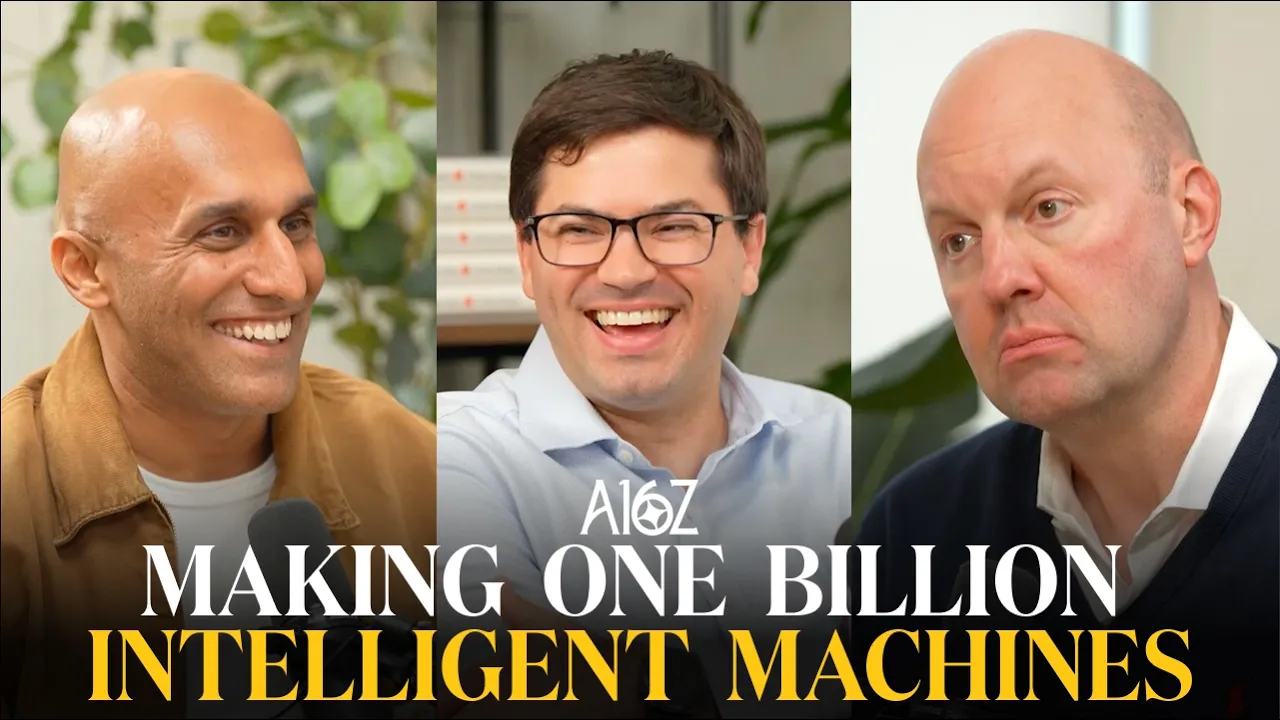
Applied Intuition Launches Dana Platform to Accelerate Physical AI
a16z
Autonomous physical intelligence will ultimately surpass digital AI in economic scale by driving GDP directly across global industrial, transport, and defense sectors.
## Background
Published by a16z on YouTube on July 21, 2026, this episode features host Erik Torenberg and Marc Andreessen sitting down with Applied Intuition co-founders Qasar Younis and Peter Ludwig. The show notes describe the discussion as an exploration of physical AI, autonomous systems across automotive and industrial sectors, and the launch of their new agentic development platform, Dana.
## TL;DR
The conversation explores how physical AI is expanding beyond self-driving consumer cars into massive industrial sectors like mining, defense, and long-haul trucking to address severe global labor shortages and safety hazards. The founders discuss the technical evolution of autonomous systems from simple imitation learning to end-to-end reinforcement learning and neural world models, while highlighting the distinct legal, hardware, and geopolitical challenges of deploying intelligence in the physical world. They present Applied Intuition's horizontal strategy and unveil Dana, an agentic platform designed to lower development barriers and unleash a long tail of autonomous robotics. Ultimately, they argue that companies powering physical intelligence will reshape global GDP, supply chains, and material abundance over the coming decades.
## Atmosphere & style
The session feels like an intellectually energetic, insider chat between seasoned Silicon Valley technologists and visionary investors who share deep personal ties to industrial manufacturing. The tone balances high-level strategic optimism with grounded, pragmatic engineering realism, peppered with witty references to video games like Factorio and sci-fi tropes. The dynamic moves smoothly from serious discussions about corporate risk, safety, and geopolitics to relaxed, humorous exchanges about pop culture, making complex technical paradigms accessible and engaging.
## Key takeaways
- [00:00](https://www.youtube.com/watch?v=56XgWH9ch0U&t=0s) Physical AI directly impacts GDP, supply chains, and safety, making companies in this space potentially larger than digital AI giants over a 25-year horizon.
- [05:33](https://www.youtube.com/watch?v=56XgWH9ch0U&t=333s) Removing human operators from machinery allows for radical hardware redesigns and system-level productivity gains across ports, mines, and farms.
- [10:00](https://www.youtube.com/watch?v=56XgWH9ch0U&t=600s) Deploying physical AI models faces severe geopolitical, local regulatory, and safety compliance constraints that differ significantly from general software.
- [13:53](https://www.youtube.com/watch?v=56XgWH9ch0U&t=833s) Building physical world models requires massive proprietary real-world data and neural simulation rather than public web-scraped data.
- [15:49](https://www.youtube.com/watch?v=56XgWH9ch0U&t=949s) Autonomous driving architectures have shifted from simple pre-2021 imitation learning to end-to-end closed-loop reinforcement learning.
- [19:03](https://www.youtube.com/watch?v=56XgWH9ch0U&t=1143s) Legacy automotive companies operate under extreme liability risks and deep corporate hierarchies, making their technology adoption dynamics vastly different from Silicon Valley startups.
- [27:18](https://www.youtube.com/watch?v=56XgWH9ch0U&t=1638s) Applied Intuition pursues a horizontal strategy by providing underlying intelligence and software platforms to legacy OEMs rather than building consumer vehicle brands.
- [33:00](https://www.youtube.com/watch?v=56XgWH9ch0U&t=1980s) The autonomous vehicle landscape is split between expensive, HD-map-dependent modular systems like Waymo and cost-effective end-to-end neural network models.
- [42:22](https://www.youtube.com/watch?v=56XgWH9ch0U&t=2542s) Commercial autonomy in long-haul trucking and mining is driven purely by clear financial ROI and critical labor shortages rather than consumer feature hype.
- [45:11](https://www.youtube.com/watch?v=56XgWH9ch0U&t=2711s) Long-haul trucking and heavy mining are physically punishing and hazardous occupations facing structural labor shortages and high turnover.
- [49:53](https://www.youtube.com/watch?v=56XgWH9ch0U&t=2993s) The launch of Dana aims to democratize physical AI development by providing agentic offboard tools for simulation, data processing, and hardware deployment.
- [53:30](https://www.youtube.com/watch?v=56XgWH9ch0U&t=3210s) Lowering software development friction will unlock a long tail of specialized, micro-use case physical robots across agriculture, home care, and industry.
- [01:01:01](https://www.youtube.com/watch?v=56XgWH9ch0U&t=3661s) Physical AI models must execute within strict millisecond compute budgets directly on vehicle edge hardware rather than relying on delayed cloud infrastructure.
- [01:05:35](https://www.youtube.com/watch?v=56XgWH9ch0U&t=3935s) Future open-world games and physical simulations will likely shift away from manual CGI rendering toward neural world models.
- [01:08:45](https://www.youtube.com/watch?v=56XgWH9ch0U&t=4125s) Housekeeping and entertainment are expected to be the primary early consumer drivers for humanoid robotics.
- [01:13:34](https://www.youtube.com/watch?v=56XgWH9ch0U&t=4414s) Autonomous transport and physical AI are essential for solving global distribution and logistics bottlenecks to drive economic abundance.
## Detailed walkthrough
### [00:00](https://www.youtube.com/watch?v=56XgWH9ch0U&t=0s) Mission and Scope of Physical AI
Applied Intuition’s mission is to put intelligence on a billion machines across all types of moving hardware—cars, trucks, tanks, drones, and heavy equipment. Co-founders Qasar Younis and Peter Ludwig frame physical AI as the core driver of the real global economy, contrasting it with digital AI focused on software, ads, and video content. While digital AI has created massive tech giants, they argue that over a 25-year horizon, the companies powering physical intelligence will ultimately be even larger because they directly impact GDP, supply chains, safety, and physical productivity.
- Applied Intuition operates with over 1,000 engineers across 18 global offices, with 83% of its workforce dedicated to engineering.
- The company has raised over $1 billion in capital to date, all of which remains in the bank.
- Non-automotive applications already represent 70% of their business, while automotive accounts for 30% (a sector that alone comprises ~3% of global GDP).
---
[00:05](https://www.youtube.com/watch?v=56XgWH9ch0U&t=5s) Hardware Redesign and System-Level Optimization
Autonomy reshapes how physical machinery is designed and operated. Because legacy equipment like Caterpillar or Komatsu haul trucks have 20–25 year capital lifecycles, Applied Intuition pursues a dual strategy: retrofitting existing fleets while simultaneously designing new forms of autonomous hardware. Removing the human operator eliminates the need for cabins or life-support environments (like air ventilation in deep underground mines), allowing machines to be made smaller, cheaper, and radically different in shape.
Beyond individual vehicle intelligence, the co-founders emphasize that the greatest productivity unlocks occur at the **system level**. In environments like ports, mines, and quarries, heterogeneous fleets of machines must communicate seamlessly. If a single component or machine fails, the system auto-adjusts rather than halting the entire operation. This automation also addresses severe structural labor shortages; for example, the average U.S. farmer is 58 years old, with under 10% under age 35, making physical AI essential for future food production, mining, and long-haul transport.
---
[00:10](https://www.youtube.com/watch?v=56XgWH9ch0U&t=10s) Bottlenecks, Geo-Sovereignty, and Data Dynamics
The physical AI landscape extends far beyond popular media tropes like robotaxis and humanoid robots into critical industrial, defense, and maritime logistics. The deployment of physical AI faces distinct challenges compared to software, particularly around safety compliance, hardware edge deployment, and geopolitical sovereignty. Unlike early internet or mobile platforms that expanded globally with minimal friction, physical AI systems encounter heightened nation-state scrutiny and local regulation regarding autonomous operations within national borders.
- Physical AI models must be deployed directly onto complex real-world hardware edge environments; Applied Intuition has already deployed its models across over 50 distinct hardware platforms.
- Sovereign AI initiatives are increasingly focused on physical intelligence due to national security, defense, and local supply chain dependencies.
- While digital AI foundation models rely primarily on scraped public internet data, physical AI requires rich private datasets, detailed simulation, and real-world edge telemetry to build effective physical world models.
[13:53](https://www.youtube.com/watch?v=56XgWH9ch0U&t=833s) Data Collection, Safety, and Global Expansion in Physical AI
Building state-of-the-art physical AI models presents unique hurdles compared to standard digital applications. Unlike general software or web AI, data for specialized domains like mining, logistics, or humanoid robotics is not readily available on the internet. Peter Ludwig explains that Applied Intuition has to physically go out and gather this domain-specific data itself. Safety is the other critical differentiator: a software app glitch causes minor inconvenience, but an autonomous multi-ton industrial machine or a home robot that could fall on a child carries severe real-world consequences. Proving out safety cases and rigorously evaluating models under strict safety standards is essential to deploying physical AI.
Qasar Younis highlights how geopolitical and regulatory environments complicate physical data collection. Countries like South Korea—given its proximity to North Korea—do not allow foreign mapping companies, let alone American AI firms, to conduct sweep mapping. Applied Intuition has spent years negotiating with governments across the Middle East, Latin America, and Asia to secure permission to collect proprietary data. Despite these physical constraints, physical AI still adheres to core AI principles like scaling laws and proprietary data moats. Because physical AI models cannot simply be downloaded onto a smartphone, distribution is naturally restricted, which works to Applied Intuition's advantage. By leveraging their proprietary dataset—which already spans hundreds of petabytes—alongside synthetic data and neural simulation tools, they build highly competitive autonomous systems.
- **Data Footprint:** Applied Intuition holds a proprietary dataset of hundreds of petabytes gathered across global territories.
- **Safety Stakes:** Physical AI evaluations must account for multi-ton heavy machinery and home robotics operating near human beings.
- **Global Data Acquisition:** Overcoming local regulations in regions like South Korea, LatAm, and the Middle East requires direct government partnerships.
---
[15:49](https://www.youtube.com/watch?v=56XgWH9ch0U&t=949s) Bootstrapping the Autonomy Flywheel and Technical Shifts
Marc Andreessen poses a core dilemma in physical AI: to build an autonomous system, you need massive amounts of real-world data, but to gather that data, you need a large fleet of physical autonomous machines already operating. Qasar Younis responds that bootstrapping this flywheel comes down to capital, resources, and engineering execution. Applied Intuition operates one of the largest data collection fleets in the world to overcome this initial barrier. However, collecting data is only part of the problem; building a model that generalizes across diverse hardware and survives real-world edge cases is where most efforts stall.
```
+-------------------------------------------------------------------------+
| THE PHYSICAL AI DATA FLYWHEEL |
| |
| +-------------------+ +-----------------------+ |
| | Data Collection | --------------> | Model Training & | |
| | Fleet Deployment | | Closed-Loop RL | |
| +-------------------+ +-----------------------+ |
| ^ | |
| | v |
| +-------------------+ +-----------------------+ |
| | Edge Case & HW | <-------------- | Synthetic Data & | |
| | Resolution | | Neural Simulation | |
| +-------------------+ +-----------------------+ |
+-------------------------------------------------------------------------+
```
The underlying technical paradigm for autonomous driving has shifted dramatically over the past few years. Pre-2021 techniques relied heavily on simple imitation learning—collecting human driving data and training models to clone those behaviors. Today, state-of-the-art systems utilize end-to-end reinforcement learning in closed-loop simulation environments. The system automatically identifies its own errors, generates synthetic data or mines real data to cover those exact failure modes, and continuously trains to resolve them. Meanwhile, physical operational bottlenecks remain a daily reality: hardware overheating, sensor miscalibration, and environmental factors like sensor fogging require rigorous engineering to ensure real-world reliability.
- **Synthetic Data Early Bet:** Applied Intuition established its dedicated synthetic data engineering team over five years ago.
- **Technological Pivot:** Self-driving architecture transitioned from basic imitation learning (pre-2021) to end-to-end closed-loop reinforcement learning.
- **Hardware Bottlenecks:** Real-world failures often stem from physical constraints like thermal limits, miscalibrated sensors, and lens fogging.
---
[19:03](https://www.youtube.com/watch?v=56XgWH9ch0U&t=1143s) Silicon Valley vs. Detroit: The Cruise Acquisition and Auto Industry Realities
Marc Andreessen brings up the cautionary tale of Cruise, the high-flying Y Combinator startup that was acquired by General Motors. After making rapid progress, Cruise hit a major crisis when one of its autonomous vehicles dragged a pedestrian 20 feet in San Francisco, leading GM leadership to freeze operations and overhaul the program. Younis—who attended the General Motors Institute and whose family, like Ludwig's, has deep ties to GM—recalls calling Ludwig right before the acquisition news broke, playfully making him guess who bought Cruise ("Nvidia? No. Apple? No. General Motors.").
"What's good for General Motors is good for America."
— Traditional automotive industry maxim
To explain why legacy automakers react so drastically to safety incidents, Younis references John DeLorean's famous insider book *On a Clear Day You Can See General Motors*. Large automotive manufacturers operate less like typical software companies and more like massive nation-states—similar to how Volkswagen, Hyundai, and Kia interact with their respective home governments. In automotive history, consumer lawsuits have been existential; three of the top five largest consumer class-action lawsuits in U.S. history stemmed from the auto industry. This hyper-litigious environment bred unique internal compliance tactics, such as replacing red/yellow/green status indicators with "magenta" or "purple" so lawyers could deny that a "red" safety warning went into production.
| Factor | Silicon Valley Startups | Legacy Automakers (e.g., GM) |
|:--- |:--- |:--- |
| **Risk Tolerance** | High iteration, move fast | Extremely low; high liability & lawsuit exposure |
| **Organizational Structure** | Flat, product-centric | Deep matrix hierarchies, union negotiations, legacy leveling |
| **Primary Focus** | Speed to market, frontier AI | Product safety, quality control, broad distribution |
Younis notes that despite Silicon Valley's perception of Detroit, engineering a modern internal combustion engine is immensely complex, and Google's internal leveling hierarchy was directly modeled after GM's corporate structure. When an autonomous vehicle accident occurs amidst ongoing union negotiations, severe media scrutiny, and political pressure, corporate boards face immense pressure to pull back.
- **Historical Context:** Alfred Sloan and Charles Kettering created the modern corporate matrix structure, VP hierarchy, and functional organization at General Motors.
- **Litigation Risk:** Automotive safety culture is dictated by severe legal liability, where internal reporting terminology is guarded to prevent court exposure.
- **Corporate Scale:** Major automakers function as national economic anchors, where local politics, union contracts, and board liabilities heavily shape tech adoption.
<ElicitationsGroup message="Explore related aspects of this discussion:">
<Elicitation label="Analyze the shift from imitation learning to end-to-end RL in autonomous vehicles" query="Explain the technical shift in autonomous driving from early imitation learning to end-to-end closed-loop reinforcement learning, including how synthetic data fits in."/>
<Elicitation label="Detail the history of GM's corporate structure and its impact on tech adoption" query="How did Alfred Sloan's organizational model at General Motors shape modern corporate hierarchies, and how does that culture affect their adoption of AI?"/>
</ElicitationsGroup>
[27:18](https://www.youtube.com/watch?v=56XgWH9ch0U&t=1638s) Deployment Timing, Horizontal Integration, and the Isuzu Partnership
The conversation opens with a discussion on Cruise's trajectory, noting that while Cruise pursued the robotaxi concept, parent company General Motors makes its core profits from personal car ownership—creating an inherent strategic tension. Recalling Marc Andreessen’s 2013 speech at Y Combinator, Qasar Younis highlights a fundamental truth of the technology business: while building complex tech is hard, the true key to success lies in market timing and deployment strategy. Launching two years early dooms a product, while launching two years late leaves it buried under competitors. Despite Cruise’s ultimate setback when GM pulled the plug, Younis argues they were making remarkably rapid progress relative to Waymo.
Instead of building vertical stacks like Tesla or Waymo, Applied Intuition pursues a horizontal strategy, serving as the underlying intelligence engine while letting incumbent manufacturers handle distribution, branding, and regulatory scaling. As a concrete example, Younis describes their autonomous self-haul commercial trucks running in Japan. The end customer sees only the trusted **Isuzu** badge—a nearly century-old pre-WWII automaker with deep government relations, dedicated test tracks, and safety expertise—while Applied Intuition supplies the software stack. Younis compares Applied Intuition to a silicon chipmaker like Nvidia: they secure key "design wins," build high-trust, long-term relationships, and embed themselves deeply into customer hardware. The broader market is now conditioned and eager to adopt real-world AI, largely thanks to consumer exposure to ChatGPT, Anthropic, Waymo, and Tesla.
- **Cruise vs. Waymo:** Cruise moved at a significantly faster pace to close the gap after starting far behind Waymo before GM pulled the plug.
- **Isuzu Commercial Operations:** Autonomous commercial trucks are actively running routes carrying commercial loads in Japan with safety drivers.
- **Horizontal Strategy:** Applied Intuition partners across multiple verticals—including mining operators, defense, and legacy OEMs—rather than competing as a consumer brand.
---
[30:18](https://www.youtube.com/watch?v=56XgWH9ch0U&t=1818s) How Legacy OEMs Approach Autonomy and the 20-Year Tech Horizon
Evaluating how legacy automakers compete against tech-native rivals, Younis compares the situation to how different national governments approach AI. Strategy varies widely even among direct peers like Honda, Nissan, and Toyota. While legacy automakers sit along a spectrum between "build" and "buy," the dominant trend is shifting heavily toward "buy" after years of costly internal efforts. Applied Intuition caters to both ends of this spectrum: offering developer software tools (such as their newly launched Dana platform) for OEMs building in-house, and selling fully integrated autonomous intelligence for those choosing to buy.
Drawing a historical parallel to the evolution of the personal computer and mobile phone markets, Younis notes that full autonomy will not happen overnight. From roughly 1985 to the mid-2000s, PC consumers obsessively scrutinized hardware spec sheets before laptops eventually standardized and specs ceased to be a primary buying decision. A similar multi-decade timeline applies to vehicles. Subsystem integration remains the defining operational layer: just as heavy equipment makers like Caterpillar integrate external engines (such as Cummins diesel engines) without losing their core value proposition, automakers will incorporate modular AI and silicon components from external suppliers.
- **OEM Capabilities:** Legacy OEMs are increasingly pivoting to buy software and AI intelligence off the shelf rather than attempting full in-house development.
- **Spec Standardization:** Much like laptop specifications became transparent background details after a 20-year cycle, vehicle software and sensor specs will eventually become default, taken-for-granted features.
---
[33:00](https://www.youtube.com/watch?v=56XgWH9ch0U&t=1980s) The State of Self-Driving Cars in 2025: End-to-End Models vs. Waymo
Marc Andreessen reflects on the nearly 20-year history of autonomous vehicles, tracing its lineage back to the 2005 DARPA Grand Challenge and Google’s early driverless car program in the late 2000s. While widespread 100% driverless ubiquity hasn't fully materialized yet, driverless tech is now a daily reality in cities like San Francisco. Marc shares a personal anecdote from Los Angeles, where rolling power grid issues and recent wildfires prompted him to use a Cybertruck as a home backup battery. He notes that recent updates to Tesla’s Full Self-Driving (FSD) software—specifically citing releases around version 12 or 14—have reached a point where drivers comfortably let the car navigate complex, stressful routes like Highway 1 through Big Sur.
Younis breaks down the core technical debate shaping self-driving technology: monolithic **end-to-end neural network models** (championed by Tesla, Chinese EV makers, and Applied Intuition) versus the modular, HD-map-dependent architecture used by Waymo. Because Waymo emerged out of an Alphabet research laboratory without tight commercial constraints, it relied on highly bespoke, expensive sensor suites and high-definition mapping, resulting in geofencing constraints and high per-vehicle costs. Conversely, end-to-end vision-based architectures prioritize extreme cost efficiency. The underlying debate is no longer about whether autonomous driving works or if a breakthrough is needed, but rather an engineering grind to lower the cost-per-mile.
- **FSD Disengagement Rates:** Mean miles per disengagement on modern L2++ systems like Tesla FSD have reached thousands of miles between interventions.
- **Cost Scaling Thresholds:** Full driver-assist packages currently cost under $1,000 in hardware/software stack costs; once costs drop to around $500, automakers will begin bundling and subsidizing them for free, mirroring navigation systems in the 2000s.
- **Deployment Timeline:** Younis predicts the Start of Production (SOP) for ubiquitous L2++ standard-fit autonomy will hit between 2028 and 2030, becoming routine across mass-market vehicles by the early 2030s.
[40:58](https://www.youtube.com/watch?v=56XgWH9ch0U&t=2458s) Timeline and Market Dynamics for Robotaxis
The discussion opens with Marc Andreessen probing when autonomous taxi services will transition from a novelty to a routine part of daily life across major American cities. Qasar Younis and Peter Ludwig estimate that while robotaxi services are already functioning and economically viable on a unit-cost basis in select markets by 2026, widespread availability will arrive around 2028–2030, with full mass-market routine usage settling in around 2032 or 2033. They highlight how consumer familiarity with autonomous platforms has surged in major hubs like Los Angeles, shifting public perception from confusion to mainstream awareness in just a few short years.
Despite the aggressive rollout schedules of leading companies like Waymo, scaling across hundreds of municipalities takes time. However, the data reveals a direct threat to legacy ride-sharing models: autonomous fleets are actively eating into market share. Replacing 100% of human-driven rides remains a long-term hurdle, largely because unit prices need to plummet further to capture full market parity.
- **2028–2030**: Projected window for broad commercial availability of robotaxis in major US cities.
- **2032–2033**: Estimated timeframe when hailing an autonomous cab becomes completely routine for the average consumer.
- **Competitive Pressure**: Autonomous ride-hailing services are already measurably eroding traditional ride-sharing (e.g., Uber) market share in active deployment zones.
[42:22](https://www.youtube.com/watch?v=56XgWH9ch0U&t=2542s) The "Calculator" Business: Long-Haul Trucking, Mining, and Labor Realities
Shifting focus from consumer passenger vehicles to commercial freight, Younis contrasts the emotional appeal of consumer cars with the purely financial logic of long-haul trucking. "You buy a car with your heartstrings. You buy a truck with a calculator," the founders note, pointing out that freight operators evaluate self-driving technology strictly on a dollars-and-cents ROI per mile. While over five companies in the US and double-digit firms in China currently operate autonomous trucks with safety drivers, adoption is gated by conservative buyers who demand air-tight financial proof before replacing human drivers.
To bypass this friction, Applied Intuition is heavily targeting markets facing severe labor shortages, such as Japan's imploding demographic landscape, as well as off-road environments like quarries and mines. In industrial domains where equipment operators move rock, stone, and dirt, site owners are desperate for automation today. Younis notes that unlike digital AI—where workers and venture associates worry about job displacement—industrial operators gladly offer to "give you everything" if a company can successfully automate their equipment.
- **Market Differences**: Long-haul trucking demands concrete, mile-by-mile cost savings rather than consumer feature hype.
- **Global Deployment**: Autonomous trucking is seeing accelerated adoption in Japan due to acute national labor shortages.
- **Industrial Demand**: Off-road environments (quarries, mines, construction sites) face immediate, unsated demand for self-driving heavy machinery.
[45:11](https://www.youtube.com/watch?v=56XgWH9ch0U&t=2711s) Preserving Human Life: Why Nobody Wants Dangerous Jobs
Addressing widespread media anxiety around autonomous trucks eliminating driver livelihoods, Younis and Andreessen debunk the narrative that these are highly coveted roles being stolen by technology. Drawing from personal context—having grown up in a town centered around a truck stop—Andreessen probes the harsh realities of the profession. Younis compares asking why people avoid trucking to a child asking why they shouldn't touch a hot stove: the job is inherently brutal on the human body.
The speakers highlight the severe physical toll of long-haul driving and heavy industry. Truck drivers face shortened life expectancies driven by poor sleep, shift work, high rates of cardiovascular disease, joint issues from constant vehicle vibration, and localized skin cancer like melanoma on their left arm from constant sun exposure. The problem intensifies in mining, which accounts for only 1% of global labor but a staggering 8% of work-related fatalities. The reality is that industrial operators struggle with massive turnover because workers naturally gravitate toward safer, localized jobs with better quality of life.
> "There's not enough truck drivers and guess what? Nobody wants to freaking be a truck driver... It's a terrible job."
- **Health Impact**: Commercial long-haul truck drivers have a life expectancy roughly 10 years lower than their peers due to poor nutrition, sleep deprivation, stress, and vibration.
- **Occupational Hazards**: Elevated rates of left-arm melanoma among long-haul drivers highlight chronic exposure risks.
- **Mining Safety**: Mining represents 1% of global labor but 8% of workplace fatalities, leading to continuous worker churn as employees seek safer employment.
- **Driverless Timelines**: Full "driver-out" operations (removing safety drivers entirely) are expected within a few years, constrained primarily by validating redundant hardware systems (steering, braking) rather than software limits.
[49:53](https://www.youtube.com/watch?v=56XgWH9ch0U&t=2993s) Introducing Dana: Democratizing Physical AI Development
Younis and Ludwig unveil Applied Intuition’s latest platform launch, **Dana**, named after the street where the company is headquartered. Dana is an agentic development platform designed to lower the barrier to building physical AI systems. Applied Intuition divides its technology into two primary buckets: *onboard AI* (the software and models running on physical machines) and *offboard AI* (the developer tools used to design, simulate, train, and test those models). Dana consolidates nearly a decade of internal tooling and agentic workflows into a single interface.
To illustrate the vision behind Dana, Younis presents the concept of a high school student creating a custom delivery robot for their campus. Previously, building an autonomous system required elite robotics expertise and complex infrastructure. With Dana, a developer can define requirements, generate simulated scenarios from satellite imagery, leverage public training data, test the vehicle in simulation, and deploy code to physical hardware in minutes rather than weeks.
```
+-------------------------------------------------------------------+
| DANA PLATFORM LOOP |
| |
| 1. Define Requirements --> (e.g., Campus delivery routes) |
| 2. Generate Scenarios --> (Synthesize world from satellite data) |
| 3. Train & Simulate --> (Run agentic model loops) |
| 4. Hardware Deployment --> (Test on physical machine) |
| 5. Feedback Refinement --> (Close the loop on edge cases) |
+-------------------------------------------------------------------+
```
- **Offboard vs. Onboard**: Onboard AI runs live on hardware; offboard AI (Dana) provides the development environment, simulation, and training pipeline.
- **Agentic Workflows**: Development processes that previously took days or weeks can be executed in minutes via Dana's agentic interface.
- **Core Value Proposition**: Dana aims to improve physical AI development across all three classic software levers: safety, convenience, and cost.
[53:30](https://www.youtube.com/watch?v=56XgWH9ch0U&t=3210s) Unlocking the Long Tail of Physical Robotics
The conversation expands into how accessible tooling like Dana will unlock a explosion of physical automation across diverse industries. Just as modern software development environments (IDEs) and AI coding assistants expanded software engineering capabilities, lowering the friction of robotics engineering allows non-specialists to build specialized autonomous systems. The founders emphasize that Dana is built to handle everything from land-based rovers to humanoid robots, aerial drones, agricultural bots, and defense equipment.
Andreessen compares this inflection point to the launch of the iPhone. In the mid-2000s, it was impossible to foresee apps like Instagram because the necessary hardware and accessible developer ecosystem did not yet exist. By turning drone and ground-robot programming from an esoteric, hobbyist endeavor into "teenager play," a massive wave of entrepreneurial creativity will bring intelligent moving machines to everyday domain challenges.
- **Broad System Support**: Supports land vehicles, humanoids, drones, agricultural bots, construction equipment, and defense systems.
- **Democratized Creation**: Shifts physical AI development from specialized research labs to broad-based engineering teams and student innovators.
- **Platform Analogy**: Compares the current physical AI inflection point to the mobile app boom following the introduction of smartphone developer platforms.
[54:44](https://www.youtube.com/watch?v=56XgWH9ch0U&t=3284s) Demystifying Autonomy: From Factorio to Household Bots
The discussion opens with a vision for democratizing autonomous technology by drastically lowering the barrier to entry for creators. Marc Andreessen shares an anecdote about his son, who has been building autonomous bots within the video game *Factorio*. Because standard toolkits are not readily available for the game, his son manually gathers data and trains AI models, deploying an entire army of autonomous bots to automate gameplay. When his mother asks why he spends so much time playing, he explains with a straight face that it is a purely educational process.
This story underscores a broader philosophical point: autonomy should not be an obscure, alchemical technology reserved for elite institutions. When a high school student or hobbyist can build a custom Roomba for their home over a single weekend using platforms like Dana, autonomy stops being scary or mysterious. Furthermore, accessible tooling unlocks creative applications that traditional engineering misses. For instance, while humanoid development often fixates on high-profile chores like folding laundry, low-barrier tools allow developers to target life-altering niche cases, such as assisting people with disabilities. Qasar Younis humorously reflects on the origins of Applied Intuition, noting that their very first logo was a monkey's head—representing the tool-using primitive—until a professional designer stepped in and told them it was stupid.
- **Factorio Bot Army:** Andreessen’s son gathers in-game data to train custom AI models that manage complex automated tasks within *Factorio*.
- **Democratization via Dana:** Lowering development barriers transforms public perception of AI from "magic" to accessible everyday utility.
- **Company Branding Aside:** Applied Intuition’s original logo featured a monkey’s head to symbolize tool use, but it was quickly abandoned after feedback from their designer.
---
[56:47](https://www.youtube.com/watch?v=56XgWH9ch0U&t=3407s) Unlocking the Next Wave: Micro-Bots, Lawn Care, and the App Store Effect
Reflecting on tech history, Erik Torenberg points out how mobile infrastructure enabled a rapid-fire wave of category-defining companies like Uber, WhatsApp, Snapchat, and Airbnb. The cofounders believe physical AI is at a similar inflection point. In the near term, tools like Dana aim to accelerate humanoid robotics by tackling the immense friction of data collection, data cleaning, model training, and edge deployment—with the ultimate benchmark being a high school student successfully creating a working humanoid.
Beyond humanoids, the most exciting future applications are non-obvious long-tail use cases. Andreessen recalls visiting a robotics startup that was meticulously training a robotic arm on the "killer app" of picking up dog poop in yards. He also mentions another maker who built a specialized lawn bot whose sole job was to roam the yard and pick up individual stray leaves that fall after raking.
> "It's like if development costs are zero, then people will do that... imagine that in '98 with Symbian... that'd be impossible."
When development costs approach zero, micro-use cases explode—much like the early iPhone App Store era, where simple apps like the virtual beer drinking or fart apps paved the way for massive ecosystems. While building a fully certified robotaxi will remain complex, lower friction will unlock thousands of targeted autonomous systems across healthcare, home care, construction, and physical trades.
- **Core Capabilities in Dana:** Simplifies imitation learning, reinforcement learning, pre-trained base models, world models, and advanced simulation.
- **Micro-Automation Examples:** Robotic arms trained on picking up dog waste and specialized yard bots deployed to pick up stray leaves.
- **App Store Parallel:** In 2007, people could only brainstorm eight obvious smartphone apps (like messaging or camera); today, every single hotel has its own app for room service menus.
---
[01:01:01](https://www.youtube.com/watch?v=56XgWH9ch0U&t=3661s) Decoding World Models and Real-Time Physical Constraints
The conversation pivots to world models and their definition within physical AI. Peter Ludwig clarifies that "world model" means a hundred different things across academia and industry—a ambiguity he joked about with his team at the CVPR (Computer Vision and Pattern Recognition) conference. In the context of Applied Intuition, a world model is a reactive, highly capable simulation environment that represents the real world, allowing autonomous agents to interact with it and receive accurate environmental feedback.
Ludwig and Younis outline the spectrum of simulation techniques:
1. **Classical Physics-Based Simulation:** Reconstructs environments using deterministic physics engine principles, modeling explicit light reflection, material properties, and sensor inputs like CGI in Hollywood.
2. **3D Gaussian Splatting:** Uses 3D Gaussian representations to maintain consistent spatial geometry, allowing precise camera movement and high-fidelity rendering while retaining structured spatial truth.
3. **Pure Neural Simulation:** Generates video feeds directly out of the neural network's layers, creating reactive environments where external agents respond dynamically to the ego-vehicle.
The key challenge with neural simulation is alignment—ensuring the world model reacts exactly as reality would without hallucinating. Furthermore, physical AI operates under strict physical edge constraints. Unlike theoretical research labs that can run trillion-parameter models on server clusters with high latency, embodied AI must execute within tight millisecond budgets on vehicle-hardware compute. This strict requirement for real-time determinism and safety on board low-power edge hardware forms Applied Intuition's core competitive moat.
- **CVPR Observations:** Highlighting the industry-wide ambiguity surrounding the technical definition of "world models."
- **Edge Compute Realities:** Cloud AI models can be slow and massive, but physical AI must process input and execute actuation within strict millisecond timing windows.
---
[01:05:35](https://www.youtube.com/watch?v=56XgWH9ch0U&t=3935s) From Flight Simulators to GTA 7: The Future of Synthetic Worlds
When asked whether we will see a perfectly simulated real-world training environment first or *Grand Theft Auto 6*, Younis jokes that as long as Rockstar Games keeps releasing trailers, he feels fully entertained for free—even getting re-introduced to Tom Petty songs along the way. However, Ludwig offers a bold prediction regarding gaming and simulation tech: *GTA 6* will likely be the last major open-world game built using traditional legacy computer graphics workflows, technical artists, and manual asset creation.
Ludwig predicts that *Grand Theft Auto 7* will be driven primarily by neural world models. Instead of manually rendering geometry and textures, future games will pair a structured spatial data store with a real-time translation layer that renders the visible environment dynamically. A similar evolution has already occurred in modern flight simulators like *Microsoft Flight Simulator*, which reconstructs the entire planet using real-world map data. While flight simulators use clever rendering tricks to handle fidelity at high altitudes, the ultimate frontier for physical AI is maintaining that exact pixel-perfect fidelity down to the street level as an agent zooms in.
- **Rockstar Games Prediction:** *GTA 6* marks the end of the manual CGI graphics era; *GTA 7* will likely be powered by neural world models.
- **Flight Simulator Precedent:** Applied Intuition originally hired heavily from the *Microsoft Flight Simulator* team due to their expertise in rendering accurate real-world planetary data.
[01:07:39](https://www.youtube.com/watch?v=56XgWH9ch0U&t=4059s) The Physics of Simulation and Rendering the World
The conversation touches on the staggering computational complexity required to simulate reality at high fidelity. Peter Ludwig explains how video games and graphical simulations manage rendering constraints by downsampling aggressively at a distance, only increasing resolution as the camera or user gets closer. The physical world, however, does not operate on level-of-detail shortcuts. Attempting to simulate the universe down to its finest physical level would require more energy than exists in the universe itself.
This computational limit leads Marc Andreessen and Qasar Younis to lighthearted philosophical banter regarding simulation theory and solipsism. Marc jokes that the immense power required to simulate reality is the ultimate argument against us living in a matrix, unless the simulator outside our universe operates on entirely different laws of physics. Qasar quips that from his vantage point, "everything happening outside this room doesn't even exist," comparing it to Buddhist philosophy where the world is rendered only when you open your eyes and stops when you close them.
[01:08:45](https://www.youtube.com/watch?v=56XgWH9ch0U&t=4125s) Housekeeping, Entertainment, and Timelines for Physical AI
Erik Torenberg pivots the conversation back to practical timelines, asking when everyday physical AI milestones—like automated laundry folding—might actually arrive. Qasar notes that laundry folding is essentially solved on a mechanical level if you remove strict time constraints; current research videos often speed up footage by 8x to make it watchable. The remaining challenge isn't hardware capability, but reaching human parity in speed and resolving hardware heat dissipation under sustained loads.
When looking at the initial consumer adoption drivers for humanoids, Qasar and Peter highlight two killer use cases: housekeeping and entertainment. While Qasar teases Peter and Marc for being "Midwest white guys" who are obsessed with robot entertainment, Marc enthusiastically agrees, stating that he fully expects people to pay to see robot trapeze acts, robot martial arts, or "Cirque du Soleil with robots." Marc jokingly demands a real-life *Westworld*, while Qasar admits to owning a tiny Chinese robotic dog that runs around his house.
- **Humanoid Killer Apps**: Housekeeping and entertainment are expected to be the primary consumer drivers for humanoid robotics.
- **Laundry Folding Progress**: Hardware speed and accuracy are no longer the primary bottleneck; the main engineering focus is optimizing real-time speed and thermal management.
[01:11:11](https://www.youtube.com/watch?v=56XgWH9ch0U&t=4271s) Cinematic Visions of the Robotic Future
The group discusses cinematic depictions of robotics to evaluate which sci-fi movies offer the most grounded portrayal of our upcoming reality. Qasar points to *I, Robot*, referencing the scene where Will Smith takes manual control of a vehicle, prompting his passenger to react in utter disbelief: *"What, are you going to drive this thing yourself?"* Qasar notes that making human driving look absurdly obsolete is the precise long-term goal of Applied Intuition. Peter suggests Robin Williams' character in *Bicentennial Man* as a realistic representation of a friendly home cleaning and babysitting robot.
Qasar offers Duncan Jones' sci-fi film *Moon* as his primary reference for how AI-driven facilities will function. Set on a remote lunar harvesting base operated by "Lunar Technologies," the facility runs fully autonomously with a single human present just to monitor edge-case error signals. He highlights that current state-of-the-art AI systems behave similarly: they can handle complex autonomous workflows indefinitely, but require occasional human grounding when they start to drift off course.
[01:13:34](https://www.youtube.com/watch?v=56XgWH9ch0U&t=4414s) Abundance, Technological Optimism, and Global Realities
Reflecting on autonomous systems like the lunar base in *Moon*, Qasar emphasizes that automated resource extraction and logistics lead to massive abundance and dramatically lower energy costs. He shares details from a recent commencement speech he gave at his alma mater (Kettering University, formerly the General Motors Institute), where he urged students not to fear technological advancement or demand that it be shut down. He quotes the Confucian proverb, "no hand can block the sun," framing technological progress as an unstoppable force. If Western societies choose to stall AI deployment, other nations—whether China or Uzbekistan—will happily adopt it to improve their citizens' lives.
Qasar argues that societal debates surrounding AI often miss the core distribution problem. While critics point out that food and resources already exist in abundance under modern capitalism, the real challenge lies in the physical logistics of getting those resources to people efficiently—a problem best solved by autonomous freight and robotics. He concludes with a defense of free-market capitalism over centralized control, noting that 70 years of historical data prove individual decision-making drives far better outcomes for society, a lesson directly applicable to the development of AI.
- **Logistics as the Bottleneck**: Automated transport (self-driving trucks, delivery robotics) directly solves distribution friction for essential resources like food and fuel.
- **Global Competition**: Stifling domestic AI development does not stop progress globally; nations that embrace the technology will reap the economic and quality-of-life benefits.
[01:18:05](https://www.youtube.com/watch?v=56XgWH9ch0U&t=4685s) International Footprint and Navigating Sovereign AI
Closing out the interview, Qasar discusses Applied Intuition's global business model and approach to international expansion. While the US remains the leader in business model innovation for physical AI, Applied Intuition operates as a deeply horizontal technology provider, maintaining offices and automotive partnerships around the world (with the exception of China). Qasar argues that Silicon Valley companies are often too myopic, focusing solely on the local Bay Area market between San Francisco and San Jose while ignoring massive international opportunities in markets like Japan, Germany, and the Middle East.
Having lived in Japan, Germany, Dubai, and Pakistan, Qasar explains how his international background shapes Applied Intuition’s strategy to work collaboratively with local governments and legacy industrial players. He draws a historical parallel to early American multinationals like Standard Oil and Aramco, noting that as sovereign AI requirements mature, tech companies must adapt to local geopolitical realities rather than pushing a one-size-fits-all Silicon Valley model.
- **Global Market Orientation**: Physical AI requires an international footprint due to the global distribution of automotive, mining, and industrial manufacturing.
- **Sovereign AI**: Tech providers must structure their international operations around local economic regulations and national sovereignty priorities.
## Notable quotes
> [19:03](https://www.youtube.com/watch?v=56XgWH9ch0U&t=1143s) What's good for General Motors is good for America.
> [42:22](https://www.youtube.com/watch?v=56XgWH9ch0U&t=2542s) You buy a car with your heartstrings. You buy a truck with a calculator — Qasar Younis
> [45:11](https://www.youtube.com/watch?v=56XgWH9ch0U&t=2711s) There's not enough truck drivers and guess what? Nobody wants to freaking be a truck driver... It's a terrible job.
> [56:47](https://www.youtube.com/watch?v=56XgWH9ch0U&t=3407s) It's like if development costs are zero, then people will do that... imagine that in '98 with Symbian... that'd be impossible.
> [01:11:11](https://www.youtube.com/watch?v=56XgWH9ch0U&t=4271s) What, are you going to drive this thing yourself?
> [01:13:34](https://www.youtube.com/watch?v=56XgWH9ch0U&t=4414s) no hand can block the sun
## Mentioned
Applied Intuition, Dana, Qasar Younis, Peter Ludwig, Marc Andreessen, Erik Torenberg, a16z, General Motors, Cruise, Waymo, Tesla, Isuzu, Caterpillar, Komatsu, Cummins, Nvidia, Honda, Nissan, Toyota, Volkswagen, Hyundai, Kia, Google, Y Combinator, Alfred Sloan, Charles Kettering, John DeLorean, Factorio, Microsoft Flight Simulator, Grand Theft Auto 6, Grand Theft Auto 7, Rockstar Games, Tom Petty, Cirque du Soleil, I, Robot, Bicentennial Man, Robin Williams, Will Smith, Moon, Duncan Jones, Lunar Technologies, Kettering University, General Motors Institute, Standard Oil, Aramco, Uber, WhatsApp, Snapchat, Airbnb, Apple, Symbian, Roomba
Applied Intuition 推出 Dana 平台以加速物理 AI 发展
自主物理智能将通过直接推动全球工业、交通和国防领域的 GDP 增长,在经济规模上最终超越数字 AI。
本次对话探讨了物理 AI 如何从消费级自动驾驶汽车拓展至采矿、国防和长途货运等庞大工业领域,以应对全球严重的劳动力短缺和安全隐患。创始人探讨了自主系统从简单的模仿学习向端到端强化学习和神经世界模型的技术演进,同时强调了在物理世界部署智能所面临的独特法律、硬件和地缘政治挑战。他们介绍了 Applied Intuition 的横向战略,并发布了旨在降低开发门槛、释放长尾自主机器人的 Agent 平台 Dana。最后,他们认为赋能物理智能的公司将在未来几十年重塑全球 GDP、供应链和物质财富。
物理 AI 直接影响 GDP、供应链和安全,这使得该领域的公司在 25 年的周期内规模可能超过数字 AI 巨头。 (0:00)
让机械设备摆脱人工操作员,可以在港口、矿山和农场实现彻底的硬件重新设计以及系统级生产力提升。 (5:33)
部署物理 AI 模型面临严峻的地缘政治、本地法规和安全合规限制,这与通用软件截然不同。 (10:00)
构建物理世界模型需要海量专有的真实世界数据和神经仿真,而非公开的网络抓取数据。 (13:53)
自动驾驶架构已从 2021 年之前的简单模仿学习转向端到端闭环强化学习。 (15:49)
Reading summary
Applied Intuition co-founders Qasar Younis and Peter Ludwig argue that physical AI will surpass digital software in economic value over the next 25 years by directly transforming industrial machinery, supply chains, and physical productivity. They position horizontal software partnerships—rather than vertically integrated consumer brands—as the primary vehicle for scaling autonomous systems across legacy industries.
Economic Drivers and System-Level Hardware Redesign (0:00)
Younis and Ludwig assert that physical AI addresses essential sectors of global GDP rather than digital ad markets, with non-automotive applications like mining, agriculture, and logistics already making up 70% of Applied Intuition's business. Removing human operators eliminates cabins and environmental life-support systems (such as underground mine ventilation), allowing industrial hardware to become smaller, cheaper, and radically redesigned. Beyond single vehicles, system-level automation allows heterogeneous fleets in ports and quarries to auto-adjust and prevent total site shutdowns when individual machines fail.
This shift is catalyzed by acute demographic shortages rather than discretionary automation. In the United States, the average farmer is 58 years old, while long-haul commercial truck drivers experience shortened life expectancies by roughly 10 years due to sleep deprivation, joint vibration, and elevated occupational cancer risks. Mining accounts for only 1% of global labor but 8% of fatal workplace accidents, prompting industrial operators to actively seek autonomous heavy machinery to maintain baseline operations.
Automaker Risk Culture and the Horizontal Strategy (27:18)
Legacy automotive manufacturers operate with structural risk aversion dictated by massive legal liability, having generated three of the top five largest consumer class-action lawsuits in U.S. history. As demonstrated when General Motors paused Cruise following a pedestrian incident, legacy OEMs are anchored by complex matrix hierarchies, union negotiations, and litigation sensitivity that hinder rapid software iteration. Younis observes that after years of expensive internal efforts, major automakers are shifting from building in-house autonomy to buying modular commercial solutions, mirroring how heavy equipment manufacturers integrate external diesel engines.
Rather than competing as a branded consumer operator like Tesla or Waymo, Applied Intuition pursues a horizontal supplier model analogous to silicon chipmakers. Partnering with established manufacturers—such as running autonomous commercial freight with Isuzu in Japan—allows software providers to leverage century-old manufacturing scale, local test facilities, and existing regulatory relationships while supplying the underlying intelligence and simulation platforms.
Closed-Loop RL, World Models, and Edge Constraints (15:49)
Autonomous vehicle architecture has transitioned away from pre-2021 imitation learning toward end-to-end reinforcement learning trained inside closed-loop simulation environments. Because physical AI cannot rely on scraped public internet data, companies must deploy real-world collection fleets and proprietary synthetic data pipelines to train physical world models. Ludwig notes that while industry definitions of world models vary across classical physics rendering, 3D Gaussian splatting, and neural video generation, the defining technical requirement is eliminating neural hallucinations during reactive, dynamic agent interactions.
Unlike digital AI models that run asynchronously across high-latency cloud server clusters, embodied AI must execute deterministic control loops within strict millisecond budgets on vehicle edge processors. The operational bottleneck in physical AI often stems from daily physical constraints rather than software architecture alone, requiring extensive engineering around hardware thermal dissipation, sensor miscalibration, and environmental lens obstruction.
Democratized Tooling and Autonomous Deployment Timelines (49:53)
Through development platforms like Dana, Applied Intuition seeks to lower the barrier to robotics creation, drawing parallels to how mobile app platforms expanded the software economy. Consolidating offboard simulation, synthetic scenarios, and agentic workflows enables non-specialist engineers and students to prototype specialized robotics, unlocking a long tail of autonomous applications ranging from campus rovers and agricultural tools to specialized yard bots and assistive healthcare hardware.
Regarding commercial deployment timelines, Younis predicts that driver-assist hardware and software package costs will fall to around $500, enabling standard-fit L2++ autonomy on mass-market production vehicles between 2028 and 2030. While autonomous ride-hailing services are already economically viable in initial urban pockets, the speakers project broad commercial availability across major American cities between 2028 and 2030, with robotaxis reaching routine mass-market consumer adoption by 2032 or 2033.
While global expansion requires navigating sovereign AI frameworks and localized mapping restrictions, the speakers conclude that autonomous transport remains the primary mechanism for overcoming physical resource distribution bottlenecks. Near-term commercial deployment depends primarily on validating fully redundant physical hardware systems, such as braking and steering, rather than waiting on further fundamental algorithmic breakthroughs.
## Background
该视频由知名风险投资机构 a16z 于 2026 年 8 月 3 日发布在 YouTube 平台。视频记录了 a16z 合伙人 Marc Andreessen 与主持人 Erik Torenberg 对 Applied Intuition 联合创始人 Qasar Younis 和 Peter Ludwig 的深度访谈。根据节目介绍,对话重点探讨了物理 AI(Physical AI)的兴起与最新发布的自主系统开发平台 Dana,并广泛涉猎了自动驾驶、重工采掘、国防装备、具身智能与现实世界模型仿真等前沿工程命题。
## TL;DR
访谈系统性地阐明了物理 AI 正在成为重塑全球实体经济的核心驱动力,其战略意义与潜在市场规模远超局限于生成式软件或内容创作的数字 AI。Applied Intuition 团队凭借在汽车制造与工程仿真领域的深厚积累,剖析了 Cruise 与传统车企碰撞的深层文化诉求、干线物流与采矿场景因严峻劳动力短缺对自动化的迫切渴求,以及硬件全冗余与毫秒级实时计算的现实瓶颈。为此,团队推出了全新平台 Dana,致力于将复杂的高保真物理仿真、模仿学习与端到端闭环训练工程全面封装,将具身智能与无人系统的开发门槛彻底平民化。最后,对话深入探讨了世界模型的仿真技术光谱、人形机器人的长尾应用潜力,以及在地缘碎片化格局下“主权 AI”向全球横向赋能的必然趋势。
## Atmosphere & style
整场对话在硬核工业工程的严谨务实与科技顶级风投的前瞻格局之间形成了绝佳平衡,节奏紧凑且充满思想锋芒。两位联合创始人操着底特律传统制造与硅谷前沿软件兼备的工程师口吻,坦率揭露真实造车诉讼、“洋红代码”合规与硬件起雾等琐碎现实,彻底祛除了自动驾驶行业浮夸的宣传泡沫。Marc Andreessen 则以极具穿透力的提问与幽默机智的接梗穿针引线,话题在科幻经典《月球》、GTA 沙盒游戏与佛学形而上学之间自如穿梭,呈现出一种既直面残酷物理约束、又对智能重塑物质世界充满笃定的理性乐观主义。
## Bulletin
- [49:53](https://www.youtube.com/watch?v=56XgWH9ch0U&t=2993s) Applied Intuition 宣布推出物理 AI 智能体开发平台 Dana,整合端到端模型、高保真仿真与世界模型,旨在将自主系统的研发门槛降低至高中生开发 App 的级别。
- [03:32](https://www.youtube.com/watch?v=56XgWH9ch0U&t=212s) Applied Intuition 披露其汽车业务占比已降至约 30%,非汽车工业(国防、采矿、农业及港口物流)贡献了 70% 的营收,且直接客户正从传统主机厂向矿山和港口终端运营方延伸。
- [03:35:32](https://www.youtube.com/watch?v=56XgWH9ch0U&t=12932s) 私家车高阶智驾普及受制于成本临界点:行业预测当传感器与芯片硬件套件综合成本降至 500 美元时,主流车企将在 2028 至 2030 年量产周期中将其转为出厂默认标配。
- [44:33](https://www.youtube.com/watch?v=56XgWH9ch0U&t=2673s) 全美长途卡车与采矿行业深陷结构性劳动力荒:长途司机因心血管疾病及黑色素瘤等职业病导致平均预期寿命短约 10 年,且全球仅占 1% 劳动力的采矿业承受了 8% 的工伤致死人数,高薪仍无法招募到足够人工。
## Key takeaways
- [00:00](https://www.youtube.com/watch?v=56XgWH9ch0U&t=0s) 物理 AI 的经济体量与市场纵深远超纯数字 AI,控制制造业、采掘、供应链与现代国防等实体经济命脉的机器智能化,是释放下一代生产力的核心底层支柱。
- [27:04](https://www.youtube.com/watch?v=56XgWH9ch0U&t=1624s) Applied Intuition 采用横向技术使能模式(类似车规级英伟达或康明斯发动机),向传统主机厂输出智能算法与全栈工具链,避开与客户直接争夺终端消费品牌。
- [13:21](https://www.youtube.com/watch?v=56XgWH9ch0U&t=801s) 数据与模型泛化存在本质鸿沟:数字 AI 可抓取公开互联网数据,而物理 AI 高度依赖矿山、港口等封闭场景的私有真实数据与自研神经仿真合成数据,容错率为零。
- [16:37](https://www.youtube.com/watch?v=56XgWH9ch0U&t=997s) 自动驾驶算法范式已从单纯模仿人类司机的行为克隆,全面转向端到端单体模型架构与闭环仿真中的强化学习自我迭代。
- [20:33](https://www.youtube.com/watch?v=56XgWH9ch0U&t=1233s) 底特律老牌车企与硅谷文化的冲突根植于法律与避险机制:汽车制造受严苛的消费者集体诉讼与召回风险制约,对安全故障采取极端的绝对防御策略。
- [40:57](https://www.youtube.com/watch?v=56XgWH9ch0U&t=2457s) Robotaxi 渗透时间表清晰化:预计在 2028 至 2030 年全美主要城市落地运营,2032 至 2033 年形成全社会习惯性普及,并对传统网约车市场形成实质性替代。
- [42:22](https://www.youtube.com/watch?v=56XgWH9ch0U&t=2542s) 工业物流商用车与乘用车的采购逻辑迥异:乘用车受资本与消费者感性预期驱动,而商用卡车与矿山则是纯粹的“算盘生意”,必须拿出每英里直接降本的硬数据。
- [49:05](https://www.youtube.com/watch?v=56XgWH9ch0U&t=2945s) 干线物流与矿山设备“拿掉驾驶员”(driver-out)的核心长周期瓶颈不在软件,而在高规格车规级全冗余线控转向与制动硬件的量产与工程验证。
- [49:53](https://www.youtube.com/watch?v=56XgWH9ch0U&t=2993s) Dana 平台将物理系统的开发与排错封装为自动化 Agent 工作流,打通设计、仿真、训练到车载边缘端部署的全链路闭环。
- [59:06](https://www.youtube.com/watch?v=56XgWH9ch0U&t=3546s) 当物理 AI 的开发成本趋近于零时,医疗护理、家庭养老及垂直特种工种将迎来类似智能手机 App Store 的“长尾创意爆发时刻”。
- [01:01:01](https://www.youtube.com/watch?v=56XgWH9ch0U&t=3661s) 仿真光谱正在从经典物理渲染引擎演进为端到端神经仿真世界模型,但神经世界模型与真实世界因果物理法则的对齐仍是核心学术与工程难关。
- [01:05:13](https://www.youtube.com/watch?v=56XgWH9ch0U&t=3913s) 物理 AI 的终极护城河在于毫秒级硬实时与车载边缘算力约束:模型必须在极小的体积与功耗下满足绝对的确定性与安全边界控制。
- [01:08:45](https://www.youtube.com/watch?v=56XgWH9ch0U&t=4125s) 人形机器人的杀手级应用将率先在家政家务与演出娱乐场景突破,机械硬件的刚性限制已基本解决,算法作业速度向人类看齐是当前核心攻坚点。
- [10:37](https://www.youtube.com/watch?v=56XgWH9ch0U&t=637s) 地缘政治日趋碎片化推动“主权 AI”成为各国刚需,涉及国防与领土道路行驶的物理自主设备必须实现本地化合规,横向中立的跨国技术供应商具备独特生存空间。
## Detailed walkthrough
### [00:00](https://www.youtube.com/watch?v=56XgWH9ch0U&t=0s) 物理世界 AI 的宏大愿景与全新平台 Dana
访谈在一组极具前瞻性的宣言中拉开帷幕。Applied Intuition 确立了自己的核心使命:将智能赋予全球十亿台机器。在团队看来,这将对人类社会产生深远的影响。如果说数字 AI(Digital AI)的核心应用集中在编写软件、优化广告投放和生成视频,那么放眼整个实体全球经济,真正的支柱其实是物理 AI(Physical AI)。正在展开的这场智能革命中,改变物理世界的公司最终创造的价值与体量,极有可能超越仅局限于数字世界的巨头。
为了打破技术壁垒,Applied Intuition 宣布推出全新设计与开发平台“Dana”。自动驾驶与机器自主控制长期以来被视为一门晦涩难懂、高不可攀的技术,但团队坚信这种现状必须改变。正如联合创始人所勾勒的愿景:"能够编写 iPhone 应用程序的高中生,也应该有能力开发自主系统。" 团队将过去近十年积累打磨的全部技术与经验都沉淀到了 Dana 平台中。席间 Marc Andreessen 还打趣地抛出一个悬念:究竟是训练自主机器的高保真现实模拟环境先问世,还是万众期待的游戏《侠盗猎车手 6》(Grand Theft Auto 6)先发布?
---
### [01:07](https://www.youtube.com/watch?v=56XgWH9ch0U&t=67s) 从工程基因到十亿台机器:Applied Intuition 的定位与规模
主持人与 Marc Andreessen 热烈欢迎 Applied Intuition 的两位联合创始人 Qasar Younis 与 Peter Ludwig 登上播客。双方彼此相识已久,a16z 更是作为早期核心投资人参与了公司的首轮融资。面对主持人的开门见山,Qasar 用最直白的一句话概括了 Applied Intuition 的业务底色:"我们是一家物理 AI 公司,我们把智能注入机器。" 无论是乘用车、卡车、坦克还是无人机,只要是在物理世界中移动的机械实体,公司都在致力于让它们具备自主思考与行动的能力。
回顾成长路径,Applied Intuition 最初从构建开发智能所需的工具软件与仿真环境起步,随后水到渠成地切入智能算法与自主系统本身。Qasar 带着工程师特有的坦率调侃道,公司在某种程度上是一家“非常无聊的 AI 公司”——没有浮夸的花哨营销,全公司 83% 的员工都是工程师,研发团队规模已突破千人。总部扎根硅谷,业务网络遍布全球 18 个办事处。驱动这一庞大团队前行的,不仅是解决车祸、采矿事故或农机伤人等残酷的安全痛点,更是为了释放巨大的物理生产力。对比互联网浪潮,早期做分析工具与广告投放的公司固然亮眼,但 25 年后真正矗立在时代巅峰的,是 Amazon 这样投送实物商品、Apple 这样打通软硬件的庞然大物;物理 AI 必将在未来 25 年复制乃至超越这一宏伟轨迹。
- **工程师占比**:全公司工程师占比高达 83%,研发人员总数超过 1,000 人。
- **全球化布局**:总部位于硅谷,并在全球设有 18 处办事机构。
- **核心历史演进**:由早期的仿真与研发工具链,全面拓展至自主控制智能核心。
---
### [03:32](https://www.youtube.com/watch?v=56XgWH9ch0U&t=212s) 超越乘用车:物理 AI 的真实市场纵深与客户生态
Marc Andreessen 触及了 Applied Intuition 早期遭遇的普遍质疑:市场一度认为自主系统只是“自动驾驶汽车”的代名词,而车企圈子极小——Tesla 和 Waymo 坚持全栈自研,剩下有分量的传统汽车主机厂不过区区六到八家,软件供应商的潜在天花板看似非常逼仄。对此,Qasar 给出了颠覆直觉的最新业务全景:如今汽车业务仅占 Applied Intuition 总体业务的 30% 左右,高达 70% 的营收均来自非汽车领域;随着未来十到二十年的推进,乘用车制造厂商在客户池中的比重还会进一步缩减。
```mermaid
flowchart TD
accTitle: Applied Intuition 业务与客户生态分布
accDescr: 展示 Applied Intuition 从早期汽车业务扩展到多元化重工业与国防领域的客户架构
subgraph IndustryScope["物理 AI 落地领域"]
Auto["乘用车与商用卡车<br/>(占比约 30%)"]
NonAuto["非汽车工业领域<br/>(占比约 70%)"]
Defense["国防与军工 (陆战平台 / 无人机)"]
Mining["采矿设备与港口物流"]
Agri["农业机械与重型工程"]
end
subgraph ClientLayers["客户形态裂变"]
OEM["传统设备制造商 (OEMs)"]
Operator["终端运营方 (矿山业主 / 物流港口)"]
Gov["国家机构 (国防部等采购方)"]
end
NonAuto --> Defense
NonAuto --> Mining
NonAuto --> Agri
IndustryScope --> OEM
NonAuto --> Operator
Defense --> Gov
```
即便占比在结构上下降,汽车领域本身依然体量惊人(占全球 GDP 的约 3%)。更为关键的变化发生在客户形态的裂变:早期团队将汽车制造商视作把智能技术触达消费者的分发渠道;但在国防、工程建设、采矿和现代农业场景中,软件的真正买家往往不再仅仅是设备制造商,矿山运营商、大型港口集团乃至国防部等最终使用方,都纷纷直接成为 Applied Intuition 的长期客户。正如 Peter 所补充的,数字 AI 聚焦于软件、广告与音视频创作,而掌控全球经济命脉的制造业、物流、采掘与供应链网络,唯有依赖物理 AI 才能完成数字化与自主化的底层改造。
---
### [05:33](https://www.youtube.com/watch?v=56XgWH9ch0U&t=333s) 摆脱驾驶室束缚:机器形态的重塑与系统级智能协同
Marc 顺势提出一个颠覆性的机械设计问题:历史上所有的移动载具——飞机座舱、轮船驾驶台、汽车方向盘——其几何形态都是围绕“容纳人类驾驶员”来设计的;当机器彻底获得自主性后,移动工具的形态会发生怎样的剧变?Qasar 剖析了现实商业与前沿设计的双轨路径。一方面,像港口转运系统、Caterpillar(卡特彼勒)或 Komatsu(小松)的重型露天矿车,单台资产的设计寿命长达 20 至 25 年,企业在未榨干投资回报率(ROI)前绝不可能轻易报废,因此“智能化存量改造(Retrofit)”是必须扎实落地的现实需求。
另一方面,彻底摆脱人类操作室的新形态机器正在带来前所未有的工程突破。以危险重重的地下矿采为例,传统机械与巷道最大的设计制约在于“人类需要呼吸与生存空间”,一旦把人从危险的井下驾驶室抽离,机器的尺寸可以大幅缩减,构型也可以根据采掘力学彻底重塑。比单机重塑更具革命性的是“系统级智能协同”:在复杂的露天矿坑、采石场或枢纽港口,由不同厂商生产的异构设备集群能够互联互通。单台机器出现故障不再导致全矿停摆,系统传感器能在刹车系统发生物理磨损前提前预判并调度备件。这种系统维度的生产力释放,精准迎击了人口老龄化带来的残酷现实:
- **农夫老龄化危机**:美国农场主的平均年龄已高达 58 岁,35 岁以下的年轻农业人口占比不足 10%。
- **全球劳动力短缺**:全球对粮食增产与稀土关键矿物的需求呈爆炸式增长,但长途卡车司机与矿工作业者却急剧萎缩,能够填补这一鸿沟的唯有物理 AI。
### [08:13](https://www.youtube.com/watch?v=56XgWH9ch0U&t=493s) 物理效率的飞跃与 Applied Intuition 的规模底牌
自动化的普及将带来巨大的宏观经济效益,其核心在于解锁更深层次的生产力效率。想象一下,如果农业生产变得极度高效,导致粮食成本断崖式下跌,整个下游产业将迎来怎样颠覆性的连锁反应;再比如货物运输,如果干线物流的运输成本从目前的每英里数美元大幅压缩至每英里 20 美分,整个社会的运转逻辑都将被重塑。而且,实现这一切甚至并不需要将现有的所有机械从零开始彻底重新设计。
谈及 Applied Intuition 如今的技术实力与公司体量,联合创始人给出了具体维度的透视:
- **工程师团队规模**:公司拥有超过 1,000 名工程师。与纯粹的互联网公司不同,团队不仅涵盖经典的软件和 AI 算法研发人员,还深度吸纳了精通安全系统(Safety Systems)以及硬件架构的复合型专家。
- **跨平台工程落地**:纯数字领域的模型部署通常非常标准化,无论是通过浏览器还是智能手机,底层都有 iOS、Android、Windows 或 Linux 将软硬件层牢牢抽象化并妥善处理。但在物理世界中,没有任何现成的标准系统替你抹平软硬件差异。目前,Applied Intuition 的技术与模型已成功部署到 50 多个完全不同的硬件平台上。
- **充足的资本储备**:公司历史上累计融资约 10 亿美元,且这笔巨资目前全额稳妥地存放在银行账目上。创始人打趣称这必须加个星号说明——“好消息是钱都在,坏消息是下个月可能就会大手笔花出去”,但这赋予了公司在面对广袤蓝海市场时展开积极攻势的战略底气。
- **核心使命**:经过十多年将技术真正送进工厂与量产环节(Production)的打磨,公司始终锚定一个清晰愿景——“为十亿台机器注入智能(bringing intelligence to a billion machines)”,并优先攻克那些对社会影响力最大的机械类别。
---
### [10:37](https://www.youtube.com/watch?v=56XgWH9ch0U&t=637s) 走出科幻滤镜:主权 AI 与地缘碎片化下的物理 AI
大众对物理 AI(Physical AI)进展的认知往往局限在两个最具视觉冲击力、充满科幻感的热门场景:Robotaxi(无人驾驶出租车)与人形机器人(Humanoids)。这两个方向虽然令人兴奋且至关重要,但物理 AI 的广阔天地远不止于此,那些隐藏在工业角落的场景——例如港口自动化作业——所蕴含的经济潜力同样极其惊人。
从历史演进的角度来看,物理 AI 的扩散路径正在复刻当年思科(Cisco)与网络基础设施的崛起:最初只是单台机器与单个企业互联,随后演进为整座国家级网络的构建。如今,“主权 AI(Sovereign AI)”正在成为全球核心议题,而主权 AI 本质上正是物理 AI。因为只有在物理世界中,AI 才会直接涉足国防安全以及在领土道路上自由穿梭移动的机械实体。
```mermaid
flowchart TD
accTitle: 互联网、数字服务与物理AI的主权敏感度演变
accDescr: 展示从早期无国界互联网到物理AI时代各国家对主权和本地化严厉监管的演进路径。
subgraph Phase1["数字与网络早期"]
A["早期互联网与浏览器<br/>(无国界自由流动)"] --> B["社交媒体时代<br/>(审查与封锁初现)"]
end
subgraph Phase2["线上线下融合 (O2O)"]
B --> C["出行与外卖本地化<br/>(倾向保护本土平台)"]
end
subgraph Phase3["物理 AI 与主权时代"]
C --> D["物理 AI (自动驾驶/国防/重型机械)<br/>(极高安全敏感度与主权壁垒)"]
D --> E["本土化与跨国技术供应商机遇<br/>(Applied Intuition 全球使能)"]
end
```
这种主权安全防线在不同技术周期中层层递进:
1. **早期互联网**:浏览器与网络协议通行无阻,没有任何国家在初期过多考虑数字主权。
2. **社交网络崛起**:各国开始警觉,出现封禁外来平台与内容管制的现象。
3. **线上线下(O2O)服务**:像打车(Uber)、外卖(DoorDash)这类连接物理世界的业务开始遭遇强烈阻力,各国政府明显大力扶持本土企业。
4. **物理 AI 阶段**:面对美国的 Waymo 或中国的 Pony.ai(小马智行)试图拓展至欧美与中国以外的第三国市场时,当地政府绝不会轻易点头允许外国自动驾驶车队在自家道路上无节制地运行。在当前地缘政治日趋碎片化、脱离传统全球化的背景下,每个国家都极度渴望本国的 AI 能够实现完全自主与本地化。这种战略现实恰恰凸显了 Applied Intuition 作为中立技术使能者(Technology Provider)的价值,能够跨越地缘限制向全球输出底层能力。
---
### [13:21](https://www.youtube.com/watch?v=56XgWH9ch0U&t=801s) 数据壁垒与飞轮启动:数字模型与物理实体的本质鸿沟
数字 AI 与物理 AI 在训练范式与工程要求上存在着根本性的分野:
- **数据来源的公开性与私有性**:
- 数字 AI(如各类基础大语言模型)可以直接利用抓取自全网的海量公开数据进行训练,再由专业人员标注补充即可快速迭代。
- 物理 AI 固然可以从互联网数据中受益,但想要构建真正的物理基础模型,必须依赖深入矿山、港口、物流园区等封闭作业场景采集的第一手私有数据(Private Data)。这类高价值数据在公网中根本不存在,必须亲身入局挖掘。
- **安全容错率的致命差异**:
- 手机 App 崩溃一次无伤大雅,无需面临生死考验。
- 物理 AI 驱动的是重达数十吨的重型工程机械,哪怕是家用人形机器人,一旦倾倒砸在儿童身上也是不可承受之重。模型在极端边缘工况下的安全性与严密验证评测,构成了物理 AI 的技术天花板。
针对“先有鸡还是先有蛋”的冷启动困境——究竟是必须先有海量自动驾驶机械上路才能收集数据,还是先有数据才能训练出合格的自动驾驶机械?Applied Intuition 依靠雄厚的资金与工程积淀,自建了全球规模最为庞大的专用数据采集车队之一,直接攻克了这一飞轮的启动门槛。
此外,跨国物理数据采集更是一场繁琐复杂的法规攻坚战。以韩国为例,因其与朝鲜的特殊地缘对峙,法律明令禁止外国测绘公司随意进行地图测量,更遑论直接让外国公司开展数据采集。从拉丁美洲到中东,Applied Intuition 历经多年摸索出与当地政府深度协作并取得采集许可的合规路径。目前,公司已积累了数百 PB(Petabytes)的高价值专有真实数据,结合自研的神经仿真(Neural Sim)与合成数据(Synthetic Data)生成工具,筑起了一条难以被纯软件公司逾越的护城河。在这个赛道中,虽然底层缩放定律(Scaling Laws)并未改变,但真正的难度在于:模型究竟该如何安全适配千差万别的实体硬件。
### [16:37](https://www.youtube.com/watch?v=56XgWH9ch0U&t=997s) 自动驾驶的技术演进:合成数据与端到端闭环强化学习
将自动驾驶系统真正推向硬件量产并完成充分验证,其难度远超外界想象。Cruise 的遭遇就是最典型的写照:这家曾取得惊人技术突破的明星公司,仅因为一次事故便让母公司通用汽车(General Motors)陷入恐慌,随后业务骤然收缩。在工程路线上,Applied Intuition 很早就押注合成数据(Synthetic Data)将成为推动自动驾驶发展的关键引擎,并在五年多前就专门组建了合成数据研发团队。
与合成数据并行的另一大转折点,是 Transformer 架构席卷自动驾驶行业。2021 至 2022 年之前研发的所有技术虽然并非全无价值,但客观上构成了全新周期的底座;过去四五年的突破尤其迅猛,在特斯拉(Tesla)身上体现得最为透彻。在算法范式上,传统自动驾驶主要依赖“模仿学习”(Imitation Learning),即采集海量人类驾驶数据,训练模型去照猫画虎模仿人类司机的动作;而当下的行业前沿已彻底转向“工具链闭环中的端到端强化学习”(End-to-End Reinforcement Learning in a Closed Loop)。
```mermaid
flowchart TD
accTitle: 自动驾驶模型训练闭环
accDescr: 展示自动驾驶系统从发现短板到合成数据再到模型迭代的闭环流程
subgraph Evaluation ["系统评估与诊断"]
A["闭环测试工具"] --> B["自主识别失效场景与边界情况"]
end
subgraph DataGen ["数据补充与闭环"]
B --> C["检索真实长尾数据"]
B --> D["程序化合成针对性数据"]
end
subgraph Training ["策略迭代"]
C --> E["端到端强化学习训练"]
D --> E
E --> A
end
```
这种演进意味着系统在测试工具中具备了“自主学习”能力:系统自动定位自身驾驶能力的短板与薄弱环节,随后通过定向检索对应场景数据或直接利用合成技术生成针对性数据,进而闭环验证模型在相同极端工况下的表现是否持续提升。在未来几年内,整个训练与验证链路甚至有望实现完全无人干预的纯自动化闭环。
- 传统自动驾驶依赖“模仿学习”采集人类行车轨迹,无法穷尽边缘长尾场景。
- 现代前沿方案依托 Transformer 架构与“端到端强化学习”,在仿真与工具链闭环中实现自我诊断与数据反哺。
- Applied Intuition 早在 5 年多前就布局合成数据团队,将其视为攻克长尾测试的核心杠杆。
---
### [18:33](https://www.youtube.com/watch?v=56XgWH9ch0U&t=1113s) 物理世界的“棘手瓶颈”:硬件失效与传感器失真
现实物理环境的复杂性依然是自动驾驶落地的核心绊脚石。一旦涉及到物理实体系统,研发团队就必须直面一系列棘手而细碎的硬件问题:计算单元发热过载、传感器装配过程中微小的标定偏差,抑或是恶劣天气带来的干扰。例如,团队前一天就遇到过传感器表面意外起雾导致的感知异常。在真实世界中,哪怕是一个极其细微的镜头结雾或机械错位,都会彻底破坏感知链路的可靠性,而要让自动驾驶系统在全天候环境下保持高可靠性,就必须逐一解决这些硬件长尾缺陷。
---
### [19:03](https://www.youtube.com/watch?v=56XgWH9ch0U&t=1143s) 硅谷宠儿与底特律巨头:Cruise 的收购案与陨落
Marc Andreessen 抛出了一个深涉汽车产业内部逻辑的话题:Cruise 的兴衰与通用汽车的应对方式。作为一家源自 Y Combinator 的硅谷明星自动驾驶初创企业,Cruise 早期一度与特斯拉并驾齐驱,团队阵容极其亮眼,并在被通用汽车收购后成为了底特律巨头的自动驾驶核心旗舰项目,通用也因此赢得了硅谷对传统车企拥抱前沿创新的赞誉。
Qasar Younis 回忆起当年得知这一交易时的趣事。在收购消息正式公布前,他给联合创始人 Peter Ludwig 打电话报信。因为两人都出自通用汽车员工家庭(“GM family”),Qasar 让他猜买家是谁。Peter 猜是英伟达(NVIDIA),Qasar 说不是;Peter 又猜是苹果(Apple),Qasar 依然说不是,最后脱口而出:“是通用那个该死的汽车公司(General f***ing Motors)!”
然而,在 Cruise 取得诸多进展之后,旧金山发生的一起严重安全事故——一名行人被卷入车底并拖行了 20 英尺——引发了铺天盖地的负面报道。通用汽车管理层与董事会随即重手叫停了 Cruise 的自动驾驶项目,导致 Cruise 多位高管极度沮丧。Marc 发问:通用做出如此过激的切割反应,到底是否令人意外?
---
### [20:33](https://www.youtube.com/watch?v=56XgWH9ch0U&t=1233s) 巨兽的生存法则:底特律的官僚文化、诉讼风险与“洋红代码”
作为通用汽车学院(General Motors Institute)的毕业生且通用也是公司客户,Qasar 对这家老牌车企有着深厚的情感,但同时也洞悉其组织基因。他提到了汽车工业史上著名传奇人物约翰·德罗宁(John DeLorean)的名著《晴朗的一天,你能看清通用汽车》(*On a Clear Day You Can See General Motors*)。作为缔造了庞蒂亚克 GTO 并本应接任通用总裁的汽车工业奇才,德罗宁在离职后因痛恨通用的官僚窒息感写下了这本书,但随后又因心生懊悔,打了数年官司试图阻止合著者出版该书。
Qasar 指出,通用汽车代表的不是普通商业机构,而是一套如同“民族国家”(Nation State)般的超级组织架构体系。阿尔弗雷德·斯隆(Alfred Sloan)与查尔斯·凯特林(Charles Kettering)当年为通用确立的矩阵式组织、管理层级和汇报制度,奠定了整个现代大型工程企业的“底层源代码”。韩国现代、起亚或德国大众等巨头,本质上都是国家意志与工业力量的延伸。
在外界看来,车企管理层在面对自动驾驶事故时的恐慌和保守似乎显得短视甚至愚钝,但这完全是由汽车工业严酷的业务与法律现实决定的:
- **诉讼重负**:在全美历史上赔偿额最高的五大消费者集体诉讼案中,汽车制造企业独占其三。汽车属于大众消费品,每一次安全故障都可能招致毁灭性的法律灾难。
- **“洋红代码”的黑色幽默**:Qasar 回忆起自己在通用安全系统部门工作时的经历。为了在法庭传唤和审查时规避责任,项目风险标识绝不能采用常规的“红/黄/绿”,必须使用非常规编码或称之为“洋红(Magenta)”或“品红”。否则在面对诉讼时,原告律师会指控:“你们明明看到安全系统已经标为‘红色’,为什么还批准它上线量产?”而工程师只能无奈辩称:“不,那标记的是洋红。”
- **质量即底线**:这正是汽车行业根深蒂固的避险本能。正如福特当年深入人心的标语“质量是第一要务”(Quality is Job 1),车企的每一步决策都必须建立在法务与工程安全的极端绝对防御之上。
### [24:37](https://www.youtube.com/watch?v=56XgWH9ch0U&t=1477s) 硅谷创新碰撞底特律文化:Cruise 困局与车企内幕
通用汽车(General Motors)在对待自动驾驶子公司 Cruise 的策略转变,绝非单纯的算法失灵,而是硅谷与传统工业巨头文化剧烈碰撞的典型写照。由于日本汽车制造商在数十年前重新确立了全球汽车行业的“质量与安全”(Quality and Safety)基准,安全对传统车企而言是一条不可逾越的红线。当年恰逢工会谈判期,当工会看到车企宣称无法给工人们多拿出一笔预算,却在不断给一个频出事故、甚至引发公共安全危机的项目疯狂注资时,矛盾便骤然被激化。
曾在 Google 与通用汽车两家公司都任职过的 Qasar Younis 抛出一个反常识的“暴论”:Google 与 GM 本质上的相似之处远多于差异,甚至两家公司的员工职级体系(Leveling System)都如出一辙。Younis 回忆自己在 Google 内部开会时曾直言:“底特律通用汽车的一些工程师实际上比这里的工程师更优秀。”这话在 Google 内部引发强烈震动,大家看他的眼神仿佛像在看一个“在教堂里宣布上帝不存在的异端”,甚至私下嘲讽他是个“来自底特律、只会弯折铁皮的猴子”。但事实上,制造一台现代内燃机的复杂程度丝毫不逊于写代码。Cruise 最终被按下暂停键,关键在于缺乏与监管机构周旋的精妙政治手腕。当安全事故发生后,Cruise 的公关与应对方式给官僚机构递上了把柄,导致董事会像经典黑帮电影《好家伙》(Goodfellas)结尾审判那场戏一样,几位老派大佬在法庭后台商议:“Kyle(Cruise 创始人 Kyle Vogt)是个好人,但他不得不走……”,最终伴随着经典名曲《House of the Rising Sun》落幕。
- **工会谈判与公共关系**:传统主机厂面临工会和公众舆论的多维度压力,难以承受“自动驾驶项目烧钱且频发事故”的舆论指控。
- **工程师鄙视链的反思**:现代内燃机和整车工程的高度精细化,表明传统制造领域的工程难度毫不逊于硅谷的纯软件开发。
- **商业模式天然冲突**:Cruise 押注的是 Robotaxi(无人出租车)网络模式,而通用汽车的核心利润则来自于私家车销售,二者在商业基因上存在天然分歧。
---
### [27:04](https://www.youtube.com/watch?v=56XgWH9ch0U&t=1624s) 踩准市场节拍:横向赋能模式与五十铃案例
```mermaid
flowchart LR
accTitle: Vertical vs Horizontal Autonomy Business Models
accDescr: Comparison between vertically integrated players like Tesla and Waymo, and horizontal enablers like Applied Intuition partnering with OEMs.
subgraph Vertical["垂直整合模式 (Vertical)"]
V1["Tesla / Waymo"] --> V2["全栈自研 + 运营与车队掌控"]
end
subgraph Horizontal["横向赋能模式 (Horizontal)"]
H1["Applied Intuition (核心智能/软件)"] --> H2["传统 OEM 巨头 (Isuzu / 矿业 / 国防)"]
H2 --> H3["最终客户与终端产品运营"]
end
```
谈及技术的商业化节奏,Younis 提到了 Marc Andreessen 于 2013 年在 YC 演讲时分享的核心规律:在新技术领域,技术本身往往所有人都能最终攻克,最难的是**在何时、以何种方式推向市场**。领先两年往往会成为烈士,落后两年则市场已被对手瓜分殆尽,必须在最精准的窗口切入。Cruise 在研发速度上其实曾一度反超 Waymo,但由于节奏与落地方式问题提前折戟。相比之下,Applied Intuition 选择了一条截然不同的“横向赋能”路径——将品牌、生产与分销交给主机厂。
以 Applied Intuition 在日本的自动驾驶卡车落地为例,这些载有商业货物的卡车已经在公路上自主行驶,但普通公众并不会看到 Applied Intuition 的标志,而是认准有着近百年历史的知名商用车品牌五十铃(Isuzu)。这类百年老厂拥有成熟的测试场、完善的安全验证体系、深厚的政府公关网络以及对自家机械特性的极致理解。Applied Intuition 负责提供软件智能与物理集成的核心模块,两者形成了极强的组合拳。得益于 ChatGPT、Anthropic 等前沿 AI 的普及,全社会对于“真实世界 AI”的认知已被彻底打开,市场不再追问“什么是自动驾驶”。不同于走全栈纵向垄断路线的 Tesla 或 Waymo,Applied Intuition 定位为底层横向技术平台,业务形态极像英伟达等芯片设计商:凭借产品设计中标(Design Wins)切入供应链,建立极度深厚且难以替换的长期信任壁垒。
- **发货时机决定生死**:正如当年 a16z 提出的论点,过早进入会导致资源耗尽,过晚进入则红海一片。
- **横向赋能 vs 垂直闭环**:避开与主机厂抢夺终端品牌,为矿山、防务与车企等实体经济运营者提供技术底座。
- **类似芯片设计商的护城河**:一旦核心软件架构深度集成到 OEM 的产品流水线中,替换成本极高,合作生命周期长达数年乃至数十年。
---
### [30:15](https://www.youtube.com/watch?v=56XgWH9ch0U&t=1815s) 传统主机厂的应对路径与“康明斯发动机”分工逻辑
面对智能化与自动驾驶的浪潮,传统主机厂并未坐以待毙,但各自的策略跨度极大。即便是同为日本老牌巨头的本田、日产与丰田,其路径也迥然不同:有的坚持内部研发(Build),有的倾向外部采购(Buy)。然而随着时间推移与技术复杂度的攀升,“对外采购成熟技术”正愈发成为行业主流。对于坚持自研的企业,Applied Intuition 提供开发与仿真工具平台(包括最新发布的 Dana 产品);对于希望直接购买现成方案的厂商,Applied Intuition 则直接交付可在机器上运行的智能软硬件全栈组件。
在硬件和算力层面,不同车型的成本敏感度千差万别,决定了各细分市场的落地节奏不同。这类似于 1985 年到 2005 年间个人电脑(PC)的发展轨迹:从早期人人关注主频与配置规格,到如今手机与笔记本电脑的算力过剩、用户不再关注具体参数,整整经历了约二十年的技术收敛。现代复杂机械的本质是多方技术零部件的高效集成。就如同在工程挖掘机、联合收割机或重型卡车领域,各大厂商通常直接采购康明斯(Cummins)的发动机,而终端品牌仍由卡特彼勒(Caterpillar)等整合商掌控。智能组件与物理 AI 的演进也将遵循类似逻辑,Applied Intuition 正在成为物理智能时代各行各业必不可少的底层核心引擎提供商。
- **自研与采购的行业分化**:无论主机厂选择自建还是外采,Applied Intuition 均能通过工具链或成品软件栈进行无缝承接。
- **二十年的技术下沉曲线**:物理机器智能化的普及过程与 PC 发展史高度类似,最终将从对参数指标的极致追逐转变为无感的基础设施。
- **模块化集成模式**:现代制造业并非单打独斗,整车制造核心在于最终集成与品牌信任,而底层通用组件通常由高度专业化的隐形冠军(如康明斯模式)供应。
### [03:29:50](https://www.youtube.com/watch?v=56XgWH9ch0U&t=12590s) 自动驾驶二十年:从宏大承诺到现实分化
对话切入自动驾驶汽车(AV)的现实演进。Marc Andreessen 回顾指出,这一波自动驾驶浪潮始于 2005 年左右的 DARPA 大挑战赛(DARPA Grand Challenge),随后 Google 也在 2000 年代后期正式立项立案研发。在这近二十年的时间里,媒体与技术圈不断预言“真正的无人驾驶明天就会到来”。当下的现实喜忧参半:坏消息是路上绝大多数车辆依然没有实现自动驾驶;好消息是完全无人驾驶的商业化产品确实已经真实落地——例如在旧金山街头,乘坐 Waymo 出行已经成为市民习以为常的生活日常。
嘉宾们随即将其与通用人工智能(AGI)的讨论进行类比:如同 AGI 的定义靶子不断被后移,如果把当今市场上已有的系统拿回 20 年前看,其表现已经称得上是不可思议的成就。除了 Waymo 的无人化运营,福特 BlueCruise、通用 Super Cruise、宝马驾驶辅助以及沃尔沃 Pilot Assist 等主机厂系统均展现出令人瞩目的能力,但它们仍属于辅助驾驶范畴,而非终极形态的完全自动驾驶。Marc Andreessen 还分享了亲身经历与见闻:在洛杉矶大火以及加州电网不堪重负期间,特斯拉 Cybertruck 的巨大电池组不仅成了自家豪宅的关键备用电源,其 FSD(全自动驾驶)软件在近年版本升级后更是迎来了质的飞跃。有特斯拉车主曾让 Model Y 在完全开启 FSD 的状态下全程跑完加州一号公路(Highway 1)的大苏尔(Big Sur)路段——在这条以悬崖峭壁、弯道险峻而著称的高压路段上,车辆几乎实现了零接管(miles per disengagement 高达数千英里),展现出惊人的成熟度。
- 行业早期节点:始于 2005 年 DARPA 大挑战赛,Google 于 2000 年代后期(late double O's)正式入局。
- 现状反差:全无人 Waymo 车辆在特定城市日常化运营,但全球 99.999999% 的车辆依然靠人类驾驶。
- 软硬件技术指标:FSD 近期版本表现亮眼,在复杂险要的一号公路大苏尔段可实现极高的平均接管里程(数千英里无接管)。
---
### [03:35:32](https://www.youtube.com/watch?v=56XgWH9ch0U&t=12932s) 私家车普及的成本瓶颈与“功能机到智能机”的爆发曲线
针对“为何自动驾驶私家车尚未全面普及”的疑问,Qasar Younis 从主机厂商业逻辑进行了深度拆解。传统车企在部署尖端软件技术方面本就行动迟缓,且极度注重安全责任,但最根本的阻碍始终是“成本、成本、还是成本”。相比之下,中国电动汽车(EV)生态展现出截然不同的态势——在政府补贴或不惜牺牲短期利润的市场争夺战中,中国车企将包含芯片、传感器、软硬件套件在内的 L2++ 系统(即方向盘后仍需有人监控但已具备端到端全场景行驶能力的系统)成本压缩到了 1,000 美元以下。
Qasar 预测,一旦自动驾驶软硬件套件的综合成本降至 500 美元左右,全球传统主机厂就会像当年普及车载导航系统一样,直接将其作为标配“免费赠送”给消费者。汽车工业的装配线与认证(Homologation)流程具有极高的固定成本壁垒,给一小部分特定车型配备高阶系统的边际成本,远不如在全系车型标配划算。因此,私家车自动驾驶的普及节奏将遵循“漫长等待,然后瞬间爆发”的 S 曲线,其演进历程与移动电话的发展史如出一辙:
```mermaid
flowchart TD
accTitle: 自动驾驶与手机普及的演进类比
accDescr: 展示从早期的漫长等待到关键拐点后的爆发式普及
subgraph Mobile["移动通信发展历程"]
M1["90年代-00年代: 卫星电话/大哥大/摩托罗拉刀锋"]
M2["2007年: iPhone 诞生 (关键拐点)"]
M3["2011年+: Uber/Instagram/Snapchat 杀手级应用爆发"]
M1 --> M2 --> M3
end
subgraph Autonomy["私家车高阶辅助驾驶演进"]
A1["2005-2025: 漫长验证期, 多数车型未配备"]
A2["2028-2030: SOP阶段, 硬件套件成本降至500美元区间"]
A3["2030年代初: L2++系统全面标配, 买车默认自带自动驾驶"]
A1 --> A2 --> A3
end
```
- 成本临界点:套件降至 500 美元时,车企将从选配收费转为出厂免费标配(类比 2000 年代从 3500-4000 美元选装车载导航到如今全系标配)。
- 关键量产时间表:主机厂的 SOP(Start of Production,开始量产)窗口预计在 2028 至 2030 年;进入 2030 年代初期,市面主流乘用车将默认配备类特斯拉体验的 L2++ 系统。
---
### [03:38:18](https://www.youtube.com/watch?v=56XgWH9ch0U&t=13098s) 架构分歧:端到端与 Waymo 路线,以及工程打磨阶段
深入技术内核,Qasar 剖析了 Waymo 与特斯拉/中国车企/Applied Intuition 所代表路线的核心分歧。目前技术前沿正全面转向“端到端模型架构”(End-to-End Model Architecture),即依靠统一的单体大模型直接处理从感知输入到控制输出的完整链条;而 Waymo 起源于 Alphabet 的早期前沿研究机构,其技术栈由多个模块构成,并非单一的端到端大模型。这也导致 Waymo 极度依赖预先绘制的高精度地图(HD Maps)与严格的地理围栏(Geofencing)。
更关键的分歧在于硬件理念与商业约束:Waymo 在研发初期缺乏严格的商业成本限制,堆叠了大量定制且昂贵的顶级传感器和专用计算单元。工程实践表明,“将原本极其廉价的基础架构逐步升级赋能,远比试图削减一个过度设计的昂贵系统容易得多”。如今,行业讨论的核心早已不是“技术突破是否可行”的科学探索,而是进入了纯粹的工程优化阶段——即残酷地压低“每英里行驶成本”(dollar per mile efficiency)。
| 维度 | 特斯拉 / Applied Intuition / 部分中系车企 | Waymo (Alphabet) |
|:--- |:--- |:--- |
| **核心架构** | 端到端单体模型架构 (End-to-End) | 模块化非单体架构,重度依赖机器学习与专家系统结合 |
| **地图依赖** | 无图或轻图化,依靠实时物理世界感知 | 依赖高精度地图(HD Maps)与地理围栏(Geofencing) |
| **硬件成本策略** | 极致压缩传感器与算力成本,自下而上提升性能 | 定制昂贵传感器与大算力平台,自上而下艰难降成本 |
| **核心挑战** | 算法安全边界拓展与极端长尾场景(Corner Cases) | 车辆制造成本控制与跨地理区域的快速扩张速度 |
Qasar 强调,大众、斯巴鲁(Subaru)或铃木(Suzuki)等大众化车企迟迟未全面上线高阶智驾,绝非技术无能或缺乏远见,而是因为传统车企的净利润率极其微薄,且单一车型通常需要同时面向全球 100 多个国家交付;同时,铃木或斯巴鲁的典型客户与特斯拉受众的画像及品牌诉求大相径庭。只要成本压到阈值之内,全球 OEM 都会毫不犹豫地迅速采纳。
### [40:57](https://www.youtube.com/watch?v=56XgWH9ch0U&t=2457s) 自动驾驶出租车的普及时间线:从尝鲜到习以为常
对话首先探讨了无人驾驶出租车(Robotaxi)究竟何时能真正走进大众的日常生活。面对“全美前200大城市的人们何时能把‘出门随手打一辆无人车’视为理所当然”的提问,嘉宾们给出了各自的研判。彼得·路德维希(Peter Ludwig)认为,考虑到现在已经是2026年,到2030年肯定能够实现;而且核心变量在于商业闭环——Waymo 已经公开表示单座城市的财务账本完全跑得通。既然资金雄厚且落地路线极其激进,时间表甚至有望提前到2028年。卡萨尔·尤尼斯(Qasar Younis)则提出了更细致的分期:到2030年这项服务可以在各大城市“可用”,但要真正变成全社会“习以为常”的日常习惯,可能要等到2032或2033年,因为这涉及庞大的产能爬坡与车队规模化扩张。
卡萨尔以洛杉矶为例,回忆五年前去洛杉矶出差时,大家对 Applied Intuition 一无所知,甚至对无人驾驶车毫无概念;而到了近几年,所有人不仅都知道了无人车,许多人还通过各大车企了解了 Applied Intuition。未来两到四年内,这种认知将彻底普及。尽管这并不意味着届时所有人都会抛弃传统出行、百分之百只坐无人车,但无人驾驶对传统网约车市场的蚕食已是不争的事实。从当前的增长数据来看,Uber 确实有理由感到巨大的危机感。
- **渗透时间节点**:预计2028至2030年间在全美主要城市铺开服务,2032至2033年实现常态化普及。
- **网约车竞争**:Robotaxi 正在实质性侵蚀传统打车软件的市场份额,但要达成全域替代仍需极致的低成本支撑。
---
### [42:22](https://www.youtube.com/watch?v=56XgWH9ch0U&t=2542s) 截然不同的商业账本:长途卡车与露天采矿的现实需求
与面向普通消费者的乘用车相比,长途货运卡车遵循着一套截然不同的经济逻辑与商业模式。目前中美两国已有不少于五家公司在开展带有安全员的干线物流自动驾驶测试,中国测试车队的规模甚至正走向两位数。但这项技术之所以没有引起公众的广泛关注,是因为它根本不是消费级产品。在乘用车领域,投资者往往愿意为无人驾驶的宏大远景赋予高额的估值溢价;而货运物流则完全不同——正如行业俚语所说:“买轿车凭感性,买卡车靠算盘”("You buy a car with your heartstrings. You buy a truck with a calculator.")。
在卡车运输这一极致讲究投资回报率的行业中,自动驾驶技术方案商必须精确证明“每跑一英里究竟能为车队省下几分几厘”。货运企业客户通常非常务实,他们现有的司机团队尚可运转,因此在看不到确切收益前不会轻易买单。然而在某些特定市场,这一逻辑正被外部环境强力打破。例如 Applied Intuition 深度布局日本的卡车物流赛道,正是因为日本面临急剧恶化的人口老龄化与严重的劳动力短缺,各行各业对自动化有着迫切需求。类似的情况在露天采石场(quarries)、水泥与土方转运等场景表现得更为极端:这类重工矿业的运营者恨不得今天就能立刻部署无人驾驶系统,自动驾驶方案往往处于“造得不够快、供不应求”的爆单状态。
```mermaid
flowchart LR
accTitle: 乘用车与工业商用车商业逻辑对比
accDescr: 对比乘用车市场由感性与资本预期驱动,与长途卡车及矿山场景由成本精算与劳动力缺口驱动的不同逻辑。
subgraph Passenger["乘用车 / Robotaxi"]
direction TB
P1["消费级市场认知"]
P2["资本溢价驱动"]
P3["追求出行体验与便利"]
end
subgraph Commercial["工业商用车 / 卡车与矿区"]
direction TB
C1["B端精算模式:靠算盘买车"]
C2["劳动力短缺驱动:日韩及偏远地区"]
C3["超高安全要求与刚性降本需求"]
end
Passenger -.->|"商业逻辑迥异"| Commercial
```
- **卡车买家特质**:买家极其务实("calculator business"),方案商必须拿出每英里直接节省成本的绝对硬证据。
- **场景渗透**:日本干线物流因严重少子老龄化成为首选试验场;砂石采石场等高危繁重场景对无人化的需求尤为迫切。
---
### [44:33](https://www.youtube.com/watch?v=56XgWH9ch0U&t=2673s) 舆论迷思与残酷现实:为什么再高薪也招不到卡车司机与矿工?
长期以来,媒体对数字 AI 与实体 AI 的讨论存在着荒诞的错位。在数字 AI 领域,白领顾问、程序员乃至风投机构的初级分析师都在担忧自己的工作被算法取代;而在干线物流与重工业场景中,实际情况却截然相反——企业主巴不得把所有业务都交给自动化软件。媒体常常渲染“长途卡车自动化将引发史诗级失业潮”的末日景象,但在卡萨尔看来,这种观点荒谬至极:“根本没有足够的卡车司机,更残酷的现实是,根本没有多少人愿意去当卡车司机!”面对为什么年轻人不愿开卡车的追问,卡萨尔打趣道,这种对话就像小孩子非要伸手摸滚烫的炉子一样,无论问多少遍“为什么”,答案都是明摆着的:因为这份工作太苦太受罪。
卡萨尔用当下劳动力市场的结构性转变做类比:人们常抱怨快餐店招不到人,并不是人们变懒了,而是原本在麦当劳站一整天的大量劳动力选择去跑 DoorDash 和 Uber——因为送外卖不需要看老板脸色、不必长时间罚站,闲暇时还能刷手机,工作时间完全自由。同样,长途卡车要求司机连续4到8天离家在外,甚至像澳大利亚的偏远矿山或海上钻井平台那样,必须长期与世隔绝。即使开出六位数的优厚年薪,依然招不满人,因为越来越多的人更重视陪伴家人、身心健康与生活质量。
马克·安德森(Marc Andreessen)进一步列举了长途司机的致命职业损害:长途卡车司机的平均预期寿命比同龄普通人整整少十年。这源于极其恶劣的饮食习惯与紊乱的睡眠作息,直接导致肥胖、高血压与心血管疾病高发;此外,驾驶室的长期高频颠簸损害脊椎,长时间单侧车窗暴晒甚至导致司机左臂和左脸的黑色素瘤发病率畸高。在矿山采掘领域,这种职业代价更为血腥:全球采矿业工人仅占劳动力总池的1%,却承受了8%的工伤致死人数。几乎所有大型矿山每年都要发生一到数起致死惨剧,工人们在亲眼目睹同伴遇难后往往选择离开。因此,自动化技术并不是在剥夺人们珍视的饭碗,而是将人类从伤残率和致死率极高的恶劣劳作中解放出来。
- **寿命差距**:长途货运司机的平均预期寿命比同龄常人短约10年,高发的肥胖、睡眠缺失、驾驶震动与单侧紫外线暴晒(黑色素瘤)是核心杀手。
- **高危行业伤亡**:采矿业占全球劳动力规模的1%,却占据了8%的工伤死亡事故;即便开出极高薪水,严重的安全隐患也让岗位长期空缺。
- **从业者意愿**:不仅年轻人不愿入行,绝大多数卡车司机自己也极力反对子女重蹈覆辙,更希望后代从事环境安全的工作。
### [49:05](https://www.youtube.com/watch?v=56XgWH9ch0U&t=2945s) “拿掉司机”的时间表与硬件冗余的工程长跑
在谈到干线物流与重型机械的自动驾驶何时能真正实现驾驶室无人化时,团队透露,业内已有多家头部企业将“完全拿掉司机”(driver-out)设定为当前正在冲刺的明确目标。从时间线上看,实现这一突破“最多也就只需要几年时间”("a few years on the long end")。然而,行业真正的瓶颈并不仅仅在于软件算法模型本身,更在于硬件层面的严苛冗余及其漫长的验证周期。
自动驾驶卡车要安全拿掉人类司机,必须配备完全冗余的线控转向系统和制动系统。这类高规格的车规级全冗余硬件此前从未进入过大规模量产阶段。只有当冗余硬件真正实现高良率的大规模量产,硬件成本才能被彻底打下来,其可靠性才能得到汽车工业级的大规模严苛验证。这也是为什么从“技术上可行”走到“商业化规模部署”,硬件工程验证往往成了耗时最长的“长杆支柱”(long pole)。
- **全冗余硬件壁垒**:完全冗余的转向系统(steering)与制动系统(braking)从试制到车规级高产量的爬坡,是无人化落地中成本与质量验证的核心决胜点。
- **降本驱动普及**:没有大规模量产就无法拉低单车硬件物料清单(BOM)成本,也就无法支撑大规模商业车队的技术替换。
---
### [49:53](https://www.youtube.com/watch?v=56XgWH9ch0U&t=2993s) 重磅发布 Dana:将物理 AI 开发门槛降至“初中生做 iPhone App”的水平
当话题转向遍布大街小巷的小型配送机器人时,Qasar Younis 宣布了 Applied Intuition 筹备已久的新产品——**Dana**(该平台得名于 Applied Intuition 位于硅谷山景城的总部所在地 Dana Street)。Qasar 将 Applied Intuition 的业务划分为两大核心板块:一块是直接部署在移动硬件上的“机载软件 / 机载 AI”(onboard AI);另一块则是支撑设计、仿真、测试与数据驱动开发的“离线 AI 与工具链”(offboard AI)。
```mermaid
flowchart TD
accTitle: Dana Physical AI Development Loop
accDescr: The iterative loop of developing autonomous systems within the Dana platform, from environment definition to deployment.
subgraph Design["需求与环境定义"]
A["定义目标场景与运行区域"] --> B["卫星图像与数字孪生生成仿真环境"]
end
subgraph Train["数据与模型训练"]
B --> C["合成数据与公开数据接入"]
C --> D["端到端或模块化算法训练"]
end
subgraph Deploy["部署与闭环反馈"]
D --> E["算法部署至物理机器"]
E --> F{"遇到边界异常<br/>(例如撞墙)"}
F -->|数据回流与场景重建| B
end
```
Dana 的核心使命是彻底打破高阶自主系统开发的神秘感。Qasar 提出了一个发人深省的问题:今天的初中生或九年级高中生可以轻松开发一款 iPhone App,为什么他们不能在家里造一台在校园四栋教学楼之间跑腿的送餐机器人?现实是残酷的:普通开发者既没有定义场景和运行设计域(ODD)的高保真仿真环境,也缺乏训练机器人的标准化数据管道,更无法在机器人撞墙后形成闭环迭代排错。Dana 将所有这些复杂的流程封装为统一的“物理 AI 智能体平台”(agentic platform for physical AI)。正如 Claude 和新型智能体开发环境正在颠覆传统软件 IDE 与 GitLab/GitHub 一样,Dana 将 Applied Intuition 过去近十年积淀的高端仿真、测试与工程工具全面 Agent 化,原本在行业顶尖车企中需要数天甚至数周才能跑完的开发测试工作流,如今在 Dana 中几分钟即可完成。
- **三大软件法则统一**:Dana 旨在同时践行优秀软件的黄金法则——“提升安全性、增强便利性、大幅降低成本”(increase safety, convenience, or cost)。
- **全物理模态覆盖**:平台不仅服务于轮式车辆,还将无缝覆盖四足/双足人形机器人(humanoids)乃至自主无人机(drones),将原本极其晦涩、偏向极客圈的无人机控制与自主导航软件开发彻底简化为“青少年的开发乐高”。
---
### [54:01](https://www.youtube.com/watch?v=56XgWH9ch0U&t=3241s) 创意寒武纪大爆发:从 Factorio 到文明工具的跃升
降低开发门槛所引发的蝴蝶效应,将远超工程师生产力提升本身。正如 2005 年人们拿着笔记本电脑根本无法预见十年后由智能手机摄像头与移动网络催生的 Instagram 一样,当物理 AI 的开发工具大众化后,农业收割机器人、建筑巡检机、特种国防装备乃至各类家庭服务机械等领域将迎来爆炸性的创意与创业浪潮。
Marc Andreessen 现场分享了一则有趣的家庭趣事:他的儿子最近正沉迷于在沙盒工厂游戏《异星工厂》(Factorio)中自主构建机器人大军。由于现成的高级自动化工具受限,孩子竟然自己在游戏环境中收集数据、训练算法模型,拉起了一支完全由自定义智能驱动的工业机器人兵团;面对母亲“为什么整天玩游戏”的质问,孩子理直气壮地辩解称这完全是一场“纯粹的教育探索”。这个例子印证了嘉宾们的共识:自主系统不应该是一种晦涩难懂、宛如中世纪巫术的“炼金术”(alchemistic technology)。如果普通人利用周末就能在 Dana 上为自家房屋定制专属的扫地机器人(Roomba),公众对 AI 的未知恐惧就会烟消云散。
谈到工具对人类文明的深远意义时,Qasar 动情地表示,发明与使用高级工具是划分先进文明与低阶文明的核心标志。他甚至笑着自嘲道,Applied Intuition 在创业最早期设计的企业 Logo 居然是一个“猴子脑袋”(象征人类始祖学会利用工具打磨世界),直到后来一位专业设计师直言不讳地吐槽“这太蠢了”,他们才作罢换掉。
- **去神秘化与普惠**:普通人通过工具亲手创造物理自主设备,能打破大众对 AI 的“黑魔法”恐惧,更能在辅助残障人士等目前商业化长尾严重不足的特殊场景中创造巨大社会价值。
- **文明与工具的隐喻**:人类文明演进的本质就是工具复杂度的跃升,物理 AI 工具链的普及将开启普通人改造物质世界的新纪元。
---
### [56:47](https://www.youtube.com/watch?v=56XgWH9ch0U&t=3407s) 展望未来:人形机器人与家庭“千项家务”的深水区
Erik Torenberg 提问,随着移动通信基础设施成熟,催生了 Uber、WhatsApp、Snap、Airbnb 等一批现象级移动巨头;那么当物理 AI 的底层基础设施与工具链(如 Dana)就绪后,最先被彻底引爆的赛道会是什么?
Qasar 与 Peter 坚定地将目光投向了人形机器人(Humanoids)。他们认为,中期乃至短期内,Dana 最令人兴奋的目标就是让人形机器人真正照进现实。在真实的家庭生活场景中,潜藏着数以千计的日常核心任务,而不仅仅是目前科技界反复展示的“叠衣服”这一项任务。当前人形机器人创业公司面临着极度痛苦的工程泥潭:真实物理数据的采集极其艰难,复杂长尾场景下的多模态数据清洗更是难上加难。底层物理 AI 工具链的就位,正是打通从实验室 Demo 走向真实千家万户的破局关键。
### [57:37](https://www.youtube.com/watch?v=56XgWH9ch0U&t=3457s) Dana 平台与物理 AI 的平民化:连高中生都能做人形机器人
训练和部署复杂的具身模型一直极其困难,而 Applied Intuition 推出 Dana 平台的核心目标,就是彻底打破这道门槛,甚至设定了一个近乎苛刻的标准——“让一名高中生也能做出一台人形机器人”。在他们看来,人形机器人只是最显而易见的落地形态,当门槛真正降下来后,未来回头看,那些意料之外的非显性应用才会更加精彩。Dana 整合了物理 AI 的多项关键要素:让模仿学习(Imitation Learning)的大规模落地变得轻而易举,大幅简化强化学习(Reinforcement Learning)与模仿学习的协同工作,同时提供大量预训练模型作为开发基线,并深度融合世界模型与先进的仿真技术。任何物理 AI 任务本质上都是两件事——感知理解现实世界,并对其进行物理操纵,而 Dana 让任何人都能基于此自由释放创意。
面对“作为一家工具软件公司,推出 Dana 是否在亲手扶植潜在竞争对手”的疑问,Qasar Younis 给出了极其坦然的回应。他指出,Applied Intuition 既部署自己的自动驾驶卡车,也为行业内众多自动驾驶卡车公司提供核心工具套件,这种生态赋能完全没有问题。这就像当年 Google 对整个 Web 应用程序生态的推动:互联网的爆发并没有压垮 Google,反而通过搜索、YouTube 以及各类网络应用获得了巨大成功,开发者们也从开源、闭源再到风投资助的产品中全面受益。降低物理 AI 的门槛,同样会催生出规模远超想象的全新产业浪潮。
```mermaid
flowchart TD
accTitle: Dana 平台赋能物理 AI 的核心架构与流程
accDescr: 展示 Dana 平台如何将模仿学习、强化学习、预训练基座与仿真世界模型整合,驱动多样化的物理 AI 应用。
subgraph CoreEngine["Dana 核心能力底座"]
IL["模仿学习 (Imitation Learning)"]
RL["强化学习 (Reinforcement Learning)"]
PTM["预训练基模型 (Pre-trained Models)"]
WM["世界模型与高保真仿真 (World Models & Sim)"]
end
subgraph Capabilities["物理 AI 双核心机制"]
Perception["世界感知与理解 (Understanding the World)"]
Manipulation["物理实体操作与控制 (Manipulating the World)"]
end
subgraph Ecosystem["长尾应用生态爆发"]
RoboTaxi["自动驾驶乘用车 / 卡车"]
Humanoids["平民化人形机器人 (高中生项目)"]
LongTail["细分服务机器人 (医疗 / 家政 / 工地)"]
end
CoreEngine --> Capabilities
Capabilities --> Ecosystem
```
---
### [59:06](https://www.youtube.com/watch?v=56XgWH9ch0U&t=3546s) 长尾机器人应用与“App Store 时刻”:从捡狗屎到万物自主化
当开发的边际成本趋近于零时,各种不可思议的垂直场景应用便会喷涌而出。谈及具体场景,Marc Andreessen 分享了他参观一家知名机器人初创公司的经历:工程师们正在不厌其烦地用机械臂和各种不同工具进行重复训练,而他们瞄准的“杀手级应用”竟然是极其接地气的“捡狗屎”。他调侃道,为什么遛狗时不能有一台小机器人跟在屁股后面专门捡狗屎?现场随即爆发出笑声。Qasar 也补充了一个真实案例:有人专门做了一款割草坪机器人,只为了在人工耙完院子两小时后,巡视草坪并精准捡起随风落下的十几片落叶,彻底治愈强迫症。
这番讨论直接勾起了大家对早期移动互联网时代的生动对比。如果回到 1998 年,要在一台搭载爱立信 Symbian 系统的手机或黑莓设备上开发一款应用,至少需要动用 50 人的工程团队,根本不可能有人去造搞笑玩具;然而到了 iPhone 时代,开发成本断崖式下跌,早期爆火的应用甚至只是“虚拟喝啤酒”和“放屁恶搞软件”。当物理 AI 走入这个阶段,虽然打造一辆完全成熟的 RoboTaxi 依然极为硬核且耗时,但在医疗护理、家庭养老陪护、建筑工地以及各类体力劳动行业中,能够部署的专用机器人形态近乎无穷无尽。就像 2007 年人们畅想 App Store 时,拍脑袋也只能列出通讯、相机等七八个基础功能,而如今连每家酒店都有专属 App 用来扫码点餐一样,物理世界也正在迎来它的“App Store 爆发时刻”。
- **早期手机操作系统与成本门槛**:90 年代末在 Symbian 或 BlackBerry 平台开发一款简单软件需要数十人的专业技术团队;
- **长尾应用的多样性**:医疗护理(Healthcare)、养老与家庭护理(Home Care)、建筑工程(Construction)以及各类现场物理工种(Physical Trades)蕴藏着海量未被自动化的需求;
- **开发门槛决定创新密度**:当物理操作模型的开发成本被工具链压降到极低水平,曾经被视作微不足道或荒谬的场景都将具备独立的商业可行性。
---
### [01:01:01](https://www.youtube.com/watch?v=56XgWH9ch0U&t=3661s) 仿真光谱与世界模型:从物理引擎、3D 高斯到神经仿真
随着数字化大语言模型(LLM)的繁荣,“世界模型”(World Model)一词在具身智能领域大行其道,但也伴随着巨大的歧义。在 Applied Intuition 看来,世界模型的核心语境始终是“仿真”——它必须能够足够真实地表征现实世界,并且具备高度的“反应性”(Reactive),即当自主智能体在虚拟环境中做出转向、加速或机械交互等动作时,周围的世界与背景交通流能够像真实世界一样合理响应。
Peter Ludwig 梳理了当前仿真技术的光谱演进:光谱的最左端是传统的物理仿真(Physics-based Simulation),其机制类似于好莱坞早期的 CGI 特效,公司甚至雇佣技术美术师手工构建道路标牌、赋予其符合物理特性的材质反光率和材质参数,精细还原刚体运动与光线折射;光谱的中段则是基于 3D 高斯泼溅(3D Gaussian Splatting)等几何表征的仿真,它建立了连续一致的三维空间几何,虚拟相机在空间中移动时能生成高质量且视角一致的图像;而光谱的最右端则是端到端的纯神经仿真(Neural Simulation),神经网络直接通过神经元前向计算渲染输出交互式视频帧。
| 仿真技术路线 | 核心实现机制 | 典型优势 | 面临的挑战 |
|:--- |:--- |:--- |:--- |
| **经典物理仿真 (Physics-based)** | 基于确定性物理引擎与手工制作的 3D/CGI 资产,逐层计算刚体碰撞、材质反射率与光线传播 | 具备强可解释性与严密因果逻辑,支持不同抽象级别的传感器模型测试 | 构建资产工作量巨大,难以完全穷尽现实世界的极端随机边缘工况 |
| **高斯空间仿真 (Gaussian-based)** | 采用 3D 高斯等几何隐式/显式表征,锚定真实物理场景的三维几何结构 | 视角连续一致,在虚拟相机视角发生位移变换时能保持高保真渲染输出 | 主要捕捉静态与半动态环境几何,对复杂物理交互动力学的表达有限 |
| **纯神经仿真 (Neural Simulation)** | 神经网络直接将交互动作与历史帧映射为合成视频流输出 | 具备天然的交互反应性(Reactivity),可生成复杂的开放世界反应 | 无法保证因果物理的绝对准确,存在幻觉与 Sim-to-Real 鸿沟 |
---
### [01:04:08](https://www.youtube.com/watch?v=56XgWH9ch0U&t=3848s) 仿真对齐挑战与物理 AI 的毫秒级硬实时约束
纯神经仿真带来的反应性虽然惊艳——环境中的其他交通参与者能对主车(Ego)的动作做出反馈,但它并不保证这种反应完全准确,甚至可能违背基本物理常识。如何将神经世界模型与真实世界的物理规律进行精确对齐(Alignment),是当前整个领域最严峻的攻坚点;Peter 甚至直言,如果有人能做到仿真世界与现实世界的完美对齐,那几乎等同于“粗略地解出了整个宇宙的运行法则”。
更关键的差异在于工程部署的现实限制。纯数字 AI 实验室往往拥有巨大的容错空间:他们可以堆砌数万亿参数的超大规模模型,哪怕单次推理耗时几秒钟也无伤大雅;然而物理 AI 团队完全没有这种奢侈的容忍度。物理智能必须在真实的物理时钟下运行,面对的是毫秒级(Millisecond-level)的硬实时(Hard Real-time)约束——从传感器采集、感知融合、轨迹规划到车辆操纵执行,系统往往只有几十毫秒的安全决策窗口。因此,如何在保证极其严苛的低延迟性能上限的同时,引入大模型并利用逼真的世界模型完成安全训练,构成了物理 AI 研发中最深厚的工程壁垒。
### [01:05:13](https://www.youtube.com/watch?v=56XgWH9ch0U&t=3913s) 物理 AI 的车载限制与核心技术护城河
在离线或云端环境(off-world environment)中进行模拟和训练时,算力与资源几乎不受限制。然而,一旦模型必须部署到物理硬件车载端(on-board),所有的现实约束便立刻降临:工程团队必须训练体积小得多、算力受限的模型,同时严格满足严苛的安全约束(safety constraints)和确定性约束(determinism constraints)。Qasar Younis 和 Peter Ludwig 强调,这正是物理 AI(Physical AI)最艰难的部分,但恰恰也是 Applied Intuition 真正的护城河(moat)——构建能让自动化系统在极端物理约束下安全运行的工具链和核心能力,构成了极高的行业进入壁垒。
```mermaid
flowchart LR
accTitle: Physical AI Deployment Pipeline
accDescr: 物理 AI 模型从离线环境到车载端的部署与约束流程
subgraph Offboard["离线环境 (Off-Board)"]
A["大规模云端训练"] --> B["完全模拟环境"]
end
subgraph Onboard["车载边缘端 (On-Board)"]
C["小型化压缩模型"]
D["确定性与安全约束"]
E["物理系统安全执行"]
end
B --> C
C --> D
D --> E
```
### [01:05:35](https://www.youtube.com/watch?v=56XgWH9ch0U&t=3935s) 《GTA 6》对决完美仿真:从游戏引擎到世界模型的演化
针对现场抛出的趣味问题——“我们究竟会先迎来用于自动驾驶训练的完美真实世界仿真,还是先等到《侠盗猎车手 6》(Grand Theft Auto 6)?”现场引发了一阵大笑。Qasar 调侃称,只要 Rockstar 继续放出制作精良的预告片,自己一分钱没花就被深深吸引了,甚至还因为预告片重新认识了摇滚歌手汤姆·佩蒂(Tom Petty)。
随后对话转向深层的技术现实:《GTA》系列的核心突破在于沙盒式的开放世界,本质上就是对整个城市的仿真。Applied Intuition 从电子游戏行业招募了大量顶尖人才。Peter 给出技术推测:《GTA 6》很可能是最后一款依靠传统计算机图形学工具链与技术美术师(technical artists)手工雕琢的大型现实题材游戏;而未来的《GTA 7》则极有可能会全面基于“世界模型”(World Model)来驱动。未来的游戏底层将是一个表征现实世界的基础数据存储层,配合一个实时转译层,直接生成玩家可以漫步其中的高保真视界。
- **模拟飞行的先例**:类似的技术已经在微软模拟飞行(Microsoft Flight Simulator)中得到验证,该游戏通过对全地球的卫星与测绘数据进行自适应渲染,使得飞越纽约或德卢斯(Duluth)时所见的完全就是现实城市。
- **渲染保真度与下采样技巧**:为了实现全行星级别的展现,这类系统在远景时进行极高比例的下采样(down sampling),随着镜头拉近再逐步换用高保真模型;如果现实世界的每一个原子都试图以此等精度去暴力重建,将耗尽宇宙的所有能量。
- **“模拟假说”与佛学第一性原理**:对话一度幽默地延伸到形而上学探讨——如果全保真渲染整个宇宙会耗尽能量,这是否构成了“人类并非生活在仿真中”的最佳论据?Marc Andreessen 随即打趣,或许外部仿真器根本不用遵循本宇宙的物理法则,甚至“只要我不在这个房间里,门外的一切就根本不需要继续渲染”;这被大家笑称为从“第一性原理”(First Principles)推导出了佛学中“闭眼世界即逝、睁眼世界方生”的哲学命题。
### [01:08:45](https://www.youtube.com/watch?v=56XgWH9ch0U&t=4125s) 实体机器人的终极应用场景:家务琐事与拟人化娱乐
讨论回到物理 AI 与人形机器人的现实落地时间线上,焦点落在了“机器人何时能帮人类叠衣服(laundry folding)”以及其他长尾应用上。Peter Ludwig 指出,折叠衣物在算法与感知层面距离完全攻克已经“为期不远”(not terribly far off)。当前实验室展示的机械臂折叠视频之所以通常标明“8倍速播放”,纯粹是为了克服运行耗时、让视频具有可看性;真正的难点在于何时在真实作业速度上达成“与人类水平持平”(human parity of performance)。
在硬件层面,阻碍已经大幅减少。过去机械工程领域的刚性限制正在被打破,现在的机器人本体在动作速度与精确度上均已成熟,仅剩一些微小的电机过热(overheating)等工程问题在持续优化。至于人形机器人的超级杀手级应用(killer apps),Peter 和 Marc 均高度看好两大方向:
1. **家务家政(Housekeeping)**:解放人类繁琐枯燥的日常家务。
2. **娱乐与表演(Entertainment)**:Peter 坚信机器人娱乐业将具有万亿美元级潜力。Marc Andreessen 热烈赞同这一判断,笑称自己只想看到“真实版的《西部世界》(Westworld)”或是“全机器人演出的太阳马戏团(Cirque du Soleil)”——机器人完成高难度中国功夫与空中飞人杂技特技。Qasar 幽默地补刀,哪怕是底特律郊区斯特灵海茨(Sterling Heights)的普通居民,也绝对乐意掏钱观看这种充满震撼力的机器人特技演出。
### [01:11:11](https://www.youtube.com/watch?v=56XgWH9ch0U&t=4271s) 科幻电影对未来机器人愿景的投射
关于哪部科幻电影对机器人未来的描绘最为写实,几位对谈者展开了电影品味与技术预见的碰撞:
- **《机器管家》(Bicentennial Man)**:Peter 认为这部电影给出了最逼真的近未来图景。罗宾·威廉姆斯(Robin Williams)饰演的机器人不仅拥有全自动驾驶汽车相伴,而且完美扮演了友善的家政机器人角色,能照顾孩子、操持家务,其技术演变路径显得自然且不遥远。
- **《我,机器人》(I, Robot)**:Qasar 则特别提到威尔·史密斯在片中强行切换到手动驾驶、同伴惊呼“你疯了吗?你要自己开这玩意儿?”的经典镜头,直言消灭人类低效手动驾驶、让全自动接管车辆,正是 Applied Intuition 的长期使命与发展蓝图。
- **《月球》(Moon)**:现场还提到了由山姆·洛克威尔(Sam Rockwell)主演的硬科幻惊悚片《月球》,作为对未来孤立作业环境下人机协作与自动化采矿的另一重深邃写照。
### [01:12:21](https://www.youtube.com/watch?v=56XgWH9ch0U&t=4341s) 《月球》与全自动采能基地:AI 系统的现实写照
Qasar Younis 提到了科幻电影《月球》(Moon)中的经典设定:在距离地球 25 万英里的月球背面,整座氦-3 能源开采基地完全由 Lunar Industries(月球工业)运营。基地里只有一名人类驻守工人,整套系统几乎完全自律运作,人类的存在仅仅是为了在系统出现偶发错误信号时提供“现实锚定”(grounding)。Qasar 开玩笑说,Applied Intuition 可不想成为《异形》里的维兰-尤坦尼公司(Weyland-Yutani),也不想成为《银翼杀手》里的泰瑞尔公司(Tyrell Corporation),但成为像电影《月球》里那样的技术运营方却很契合。
这种科幻架构在现实中其实非常精准:现代前沿的 AI 系统或编程智能体(coding bots)本质上也是如此——平时高效自动化运转,但偶尔会“抽风”干出离谱的事情,需要人类工程师在关键节点踩一脚刹车,纠正说“不,别那么干”。电影中由凯文·史派西(Kevin Spacey)配音的 AI 机器人 GERTY 顶着一张笑脸表情符号,看似温和地安抚孤单的人类说“萨姆,你看起来很难过”,但背后真正掌控庞大能源基地运行的正是它。Qasar 强调,全自动化的超大型能源采集基地必然是人类的未来;公众往往对这种高度自动化的机器产生本能的恐惧,但现实是:它能将能源成本彻底打下来,带来前所未有的资源充裕。
```mermaid
flowchart TD
accTitle: AI自主系统与人类监管架构
accDescr: 展示以AI自主闭环运作与人类间歇性接入干预构成的系统模型
subgraph AutonomousCore ["全自动主干运行体系 (Autonomous Operation)"]
AI["AI 智能控制中枢 (如机器人 / 编码智能体)"]
Sensors["环境感知与能量采集基建"]
Execution["物理执行设备 (自动运转)"]
AI -->|控制执行| Execution
Sensors -->|数据反馈| AI
end
subgraph HumanSupervision ["人类在环监管 (Human-in-the-Loop)"]
Operator["人类监督者"]
Intervention["错误纠偏 / 现实锚定 (Grounding)"]
Operator -->|下发纠偏指令| Intervention
end
AI -.->|触发异常信号 / 偏离基准| Operator
Intervention ==>|修正参数 / 叫停异常行为| AI
```
### [01:14:03](https://www.youtube.com/watch?v=56XgWH9ch0U&t=4443s) GMI 毕业演讲:技术进步的必然性与中庸理性
Qasar 谈到自己近期在母校通用汽车学院(General Motors Institute,现为凯特林大学 Kettering University)所做的本科毕业典礼演讲。他打趣道,台下虽然没像某些科技名流演讲时那样遭遇惨烈翻车,但自己的妻子看完录像后却吐槽说:“我感觉你像是在冲我咆哮,我都看不下去了。”Qasar 没有选择回避严肃且充满争议的技术与商业话题,而是直面探讨。他认为,GMI 的毕业生与 MIT 或斯坦福的学生有所不同,他们是一群极其务实的人,不会抱有对企业或体制的肤浅偏见——无论是在公司、政府机构还是非营利组织,本质都是一群人聚在一起做项目,都会犯错误。
对于技术恐惧症,Qasar 提出了自己的务实世界观:
- 不能盲目妖魔化 AI 企业,也不能狂热地认为“技术会让一切自然变好”,每个人在技术浪潮中都有自己的责任。
- 自动驾驶卡车和乘用车所带来的巨大丰裕显而易见:人们免于车祸丧生,物流成本降低,能源变得极为低廉。如果这仍然消除不了个体的恐惧,那么个人有责任去深入理解这项技术,而不是盲目要求“关停它”。
- 他引用了中国的一句古话“手掌遮不住太阳”,并指出:技术进步就是那一轮太阳,没有任何力量能阻挡它。如果一个社会因恐惧而抗拒进步,只会被世界无情抛下;即便不是被中国超越,也会被其他渴望借此摆脱贫困的国家超越。
- 当人们争辩“社会饥饿源于资本主义分配而不是生产不足”时,Qasar 反驳道,食物充足但运送到挨饿的人手中极度困难,这恰恰需要让机器人和自动化系统更快地完成物流调度。
- 历史早已在几十年前给出答案:由个体基于自身利益做决策的市场系统,其社会整体运转效率远胜于中央指令系统。AI 同样如此,它不会让一切尽善尽美,但“净效益”(net net)绝对是巨大的正收益。
### [01:18:05](https://www.youtube.com/watch?v=56XgWH9ch0U&t=4685s) Applied Intuition 的全球视野与“主权 AI”时代
讨论最后转向了 Applied Intuition 的全球化战略与地缘布局。虽然美国在商业模式和基础技术上依然占据全球领先地位,但作为一家横向基础技术提供商(horizontal technology provider),Applied Intuition 从成立之初就极具国际视野。除中国大陆未设立分支机构外,他们与全球各地的整车厂、重工巨头及技术机构展开深入协作。
Qasar 强调,随着“主权 AI”(sovereign AI)成为各国不可逆转的趋势,科技企业必须顺应当地的地缘政治现实,与本土经济展开建设性合作。这在商业史上屡见不鲜,如昔日的标准石油(Standard Oil)以及沙特阿美(Aramco)的诞生历程。Qasar 本人生于巴基斯坦,并在日本、德国、迪拜等地工作生活过;联合创始人 Peter Ludwig 虽在密歇根长大,但也有深厚的德国渊源。Qasar 直言,过去在 Google 和 Y Combinator(YC)时,常常惊讶于硅谷公司的眼界狭隘——许多创业公司只盯着旧金山到圣何塞之间那方圆 30 英里的市场。然而“物理 AI”(Physical AI)因其与现实物理实体深度结合的天然属性,注定必须是一家放眼全球的企业,这也是 Applied Intuition 能够持续取得突破的关键所在。节目在联合创始人 Peter Ludwig 与 Qasar Younis 祝贺 Dana 平台正式发布以及主持人的道谢声中圆满结束。
## Notable quotes
> [00:00](https://www.youtube.com/watch?v=56XgWH9ch0U&t=0s) 能够编写 iPhone 应用程序的高中生,也应该有能力开发自主系统。 — Qasar Younis
> [01:07](https://www.youtube.com/watch?v=56XgWH9ch0U&t=67s) 我们是一家物理 AI 公司,我们把智能注入机器。 — Qasar Younis
> [19:03](https://www.youtube.com/watch?v=56XgWH9ch0U&t=1143s) 是通用那个该死的汽车公司(General f***ing Motors)! — Qasar Younis
> [42:22](https://www.youtube.com/watch?v=56XgWH9ch0U&t=2542s) 买轿车凭感性,买卡车靠算盘(You buy a car with your heartstrings. You buy a truck with a calculator.) — Qasar Younis
> [44:33](https://www.youtube.com/watch?v=56XgWH9ch0U&t=2673s) 根本没有足够的卡车司机,更残酷的现实是,根本没有多少人愿意去当卡车司机! — Qasar Younis
> [49:53](https://www.youtube.com/watch?v=56XgWH9ch0U&t=2993s) 提升安全性、增强便利性、大幅降低成本(increase safety, convenience, or cost) — Qasar Younis
> [01:14:03](https://www.youtube.com/watch?v=56XgWH9ch0U&t=4443s) 手掌遮不住太阳 — Qasar Younis
> [08:13](https://www.youtube.com/watch?v=56XgWH9ch0U&t=493s) 为十亿台机器注入智能(bringing intelligence to a billion machines) — Qasar Younis
## Mentioned
Applied Intuition, Dana, Marc Andreessen, Erik Torenberg, Qasar Younis, Peter Ludwig, a16z, Tesla, Waymo, Cruise, General Motors, Caterpillar, Komatsu, Isuzu, Pony.ai, Cisco, Uber, DoorDash, John DeLorean, Alfred Sloan, Charles Kettering, Kettering University, Factorio, Grand Theft Auto 6, Microsoft Flight Simulator, Westworld, Cirque du Soleil, Bicentennial Man, I, Robot, Moon, GERTY, Weyland-Yutani, Tyrell Corporation, Standard Oil, Saudi Aramco, Y Combinator, Google, Apple, NVIDIA, Cummins
## Video description
In this conversation, Marc Andreessen and Erik Torenberg sit down with Applied Intuition cofounders Qasar Younis and Peter Ludwig to discuss the emergence of physical AI and the company's latest launch, Dana, a new platform designed to accelerate the development of autonomous systems.
Applied Intuition has spent the past decade building the software that powers intelligent machines, from passenger vehicles and trucks to defense systems, mining equipment, and industrial robots.
They explore autonomous vehicles, robotics, world models, simulation, AI infrastructure, and the engineering challenges of deploying intelligence safely in the physical world. Along the way, they discuss self-driving cars, humanoid robots, global competition, and why lowering the barrier to building physical AI could unlock an entirely new generation of products and companies.
Timestamps:
00:00 - Intro
01:07 - What Applied Intuition Actually Does
03:32 - Beyond Automotive: How Big Is Physical AI?
05:33 - Why Autonomy Changes What Machines Look Like
19:20 - Selling to Legacy Automakers & the GM Culture
33:10 - The State of Self-Driving Cars in 2025
42:22 - Long-Haul Trucking, Mining & Why Nobody Wants Those Jobs
49:53 - Introducing Dana: Autonomy for High Schoolers
56:47 - What Comes Next: Humanoids, Home Bots & the Long Tail
Resources:
Follow Qasar Younis on X: https://x.com/qasar
Follow Peter Ludwig on LinkedIn: https://www.linkedin.com/in/peterwludwig/
Follow Marc Andreessen on X: https://x.com/pmarca
Stay Updated:
If you enjoyed this episode, be sure to like, subscribe, and share with your friends!
Find a16z on X:https://x.com/a16z
Find a16z on LinkedIn:
https://www.linkedin.com/company/a16z
Listen to the a16z Podcast on Spotify:
https://open.spotify.com/show/5bC65RDvs3oxnLyqqvkUYX
Listen to the a16z Podcast on Apple Podcasts: https://podcasts.apple.com/us/podcast/a16z-podcast/id842818711
Follow our host:https://x.com/eriktorenberg
Please note that the content here is for informational purposes only; should NOT be taken as legal, business, tax, or investment advice or be used to evaluate any investment or security; and is not directed at any investors or potential investors in any a16z fund. a16z and its affiliates may maintain investments in the companies discussed. For more details please see http://a16z.com/disclosure.
[Source](https://www.youtube.com/watch?v=56XgWH9ch0U)
Source quotes
[0:00] Qasar Younis: 能够编写 iPhone 应用程序的高中生,也应该有能力开发自主系统。
[1:07] Qasar Younis: 我们是一家物理 AI 公司,我们把智能注入机器。
[19:03] Qasar Younis: 是通用那个该死的汽车公司(General f***ing Motors)!
[42:22] Qasar Younis: 买轿车凭感性,买卡车靠算盘(You buy a car with your heartstrings. You buy a truck with a calculator.)
[44:33] Qasar Younis: 根本没有足够的卡车司机,更残酷的现实是,根本没有多少人愿意去当卡车司机!
[49:53] Qasar Younis: 提升安全性、增强便利性、大幅降低成本(increase safety, convenience, or cost)
[74:03] Qasar Younis: 手掌遮不住太阳
[8:13] Qasar Younis: 为十亿台机器注入智能(bringing intelligence to a billion machines)
Source quotes
[19:03] What's good for General Motors is good for America.
[42:22] Qasar Younis: You buy a car with your heartstrings. You buy a truck with a calculator
[45:11] There's not enough truck drivers and guess what? Nobody wants to freaking be a truck driver... It's a terrible job.
[56:47] It's like if development costs are zero, then people will do that... imagine that in '98 with Symbian... that'd be impossible.
[71:11] What, are you going to drive this thing yourself?
[73:34] no hand can block the sun
Original transcript
[0:00] Our mission is to put intelligence on a
[0:01] billion machines. And we think that can
[0:04] have a profound impact on society.
[0:07] Applied Intuition is a physical AI
[0:08] company. We put intelligence on
[0:10] machines. Cars, trucks, tanks, drones,
[0:13] it's a physical moving thing. We make it
[0:15] intelligent.
[0:16] >> Digital AI of course is building
[0:17] software and optimizing ads and creating
[0:19] videos. That's all interesting and good,
[0:21] but really we talk about the global
[0:23] economy, that's physical AI.
[0:25] >> In this intelligence revolution, the
[0:27] companies that impact the physical world
[0:29] might actually be bigger
[0:30] >> [music]
[0:30] >> than the companies that impact the
[0:31] digital world.
[0:32] >> How many things are there where the idea
[0:34] of physical AI, physical intelligence
[0:35] are going to matter?
[0:36] >> There's no reason autonomy should be
[0:38] this obscure, difficult technology. Our
[0:41] vision for that is a high school kid
[0:43] that can make iPhone apps should be able
[0:45] to make autonomous systems. That
[0:47] platform for designing and developing is
[0:49] what we're launching. It's called Dana.
[0:51] >> Everything that we've built and
[0:52] developed over the past nearly a decade,
[0:55] that's available in Dana.
[0:56] >> Which will we get first? A perfectly
[0:58] simulated real world environment for
[0:59] training autonomous devices or Grand
[1:01] Theft Auto 6?
[1:02] >> [laughter]
[1:07] >> Kash, Peter, welcome to the a16z
[1:09] podcast.
[1:10] >> Well, thanks for having us. Your name
[1:11] is?
[1:12] >> [laughter]
[1:13] >> Yeah, which is one of many.
[1:15] >> We've I think we've all each known each
[1:17] other for
[1:19] too long, more than I'd like to admit.
[1:21] >> [laughter]
[1:22] >> Long time. We're lucky to both be the
[1:23] first investor or among the first
[1:25] investor in the first round. Of course,
[1:26] different check sizes, but
[1:27] >> And I was an investor in you even before
[1:29] then.
[1:30] >> Exactly. Yeah. Um so, let's do that as a
[1:32] segue. We have a lot to talk about
[1:33] today. We've, you know, the the biggest
[1:34] launch in company history to talk about
[1:35] today. But first, why don't we just give
[1:37] an update or a status [clears throat]
[1:39] What does Applied Intuition do for those
[1:40] who don't
[1:40] >> Yeah, for the for the people who don't
[1:41] know, Applied Intuition is a physical AI
[1:43] company. We put intelligence on
[1:45] machines. That's the the simple way of
[1:47] describing it.
[1:49] Um and all types of machines. So, cars,
[1:51] trucks, tanks, drones, you name it. It's
[1:54] a physical moving thing. We we make it
[1:56] intelligent. And uh the history of the
[1:58] company is we originally started by
[1:59] making the tools that would make the
[2:01] intel and then we got into the actual
[2:02] intelligence itself. Um in a very like
[2:05] in some ways like a very uh boring AI
[2:07] company in sense of, you know, 83% of
[2:09] the company is engineering. We win by
[2:12] making really great products. It's not
[2:13] like a
[2:15] good sales or something like that. I
[2:17] don't think we're good enough for for uh
[2:18] for a sales enabled company, but uh
[2:20] yeah, over a thousand engineers um and
[2:23] based in Silicon Valley. Uh but we have
[2:25] offices globally, 18 offices. And uh you
[2:29] know, our mission is to to put
[2:30] intelligence on a billion machines. And
[2:33] uh we think that can have a profound
[2:35] impact on society both in the kind of
[2:38] busy things everyone talks about safety,
[2:39] you know, if you really talk to somebody
[2:41] who's been in a car accident or in a
[2:43] mining accident or, you know, uh in a
[2:45] farming accident. You Those Those are
[2:47] real
[2:48] gnarly situations. Beyond just fixing
[2:50] that, you just if you can unlock
[2:52] productivity,
[2:54] I think, you know, we've seen the unlock
[2:55] in the digital world. And everyone's
[2:58] super excited about it and you have
[2:59] trillion dollar companies emerging. I'm
[3:01] a pretty strong believer that I think
[3:03] when we look back 25 years If you look
[3:04] back at the internet now, you know,
[3:06] people actually If you look at the
[3:07] original internet companies that are
[3:08] doing, you know, serving or they're
[3:10] they're doing some analytics and those
[3:12] are interesting, but really when you
[3:13] look back 25 years from now, the big
[3:15] monolithic companies are Amazon that
[3:17] delivers you stuff, you know,
[3:19] Apple. These are the true kind of
[3:21] companies that come of age. And I think
[3:22] when we look back 25 years in this
[3:24] intelligent revolution,
[3:26] the companies that impact the physical
[3:27] world,
[3:28] you know, might actually be bigger than
[3:30] the companies that impact the digital
[3:31] world.
[3:32] >> I would love for you to talk about the
[3:33] following, which is when you first
[3:34] started the company, you know, the knock
[3:35] on the company I think was, oh, well,
[3:36] it's it's like, you know, car it's
[3:37] making making cars autonomous, right?
[3:39] Self-driving cars, but it's kind of
[3:40] like, okay, there's like whatever,
[3:42] you know, there's there's Tesla and
[3:43] Waymo building their own self-driving
[3:44] cars and then and then there's like six
[3:46] or eight other car companies that
[3:47] matter. And then the company just could
[3:48] never get that big cuz there just aren't
[3:49] that many customers.
[3:50] >> Yeah.
[3:51] >> So, what's the like how should people
[3:53] think about like
[3:55] how many things are there that are
[3:56] things that move where the idea of
[3:58] physical AI physical intelligence are
[3:59] going to matter?
[4:00] >> Yeah, I mean even today even if you do
[4:02] put that you know let's say
[4:04] view on us the automotive is like 30% of
[4:07] our business so 70% already is
[4:09] non-automotive and I think if you fast
[4:11] forward another 10 20 years
[4:13] even the manufacturers themselves as a
[4:15] customer base will be a small amount. I
[4:17] think our that mission just keep
[4:19] thinking a thought you know a billion
[4:21] machines becoming intelligent.
[4:23] And you think about all the types of
[4:24] machines that exist. Automotive is just
[4:26] an easy one. I think it sticks in
[4:27] people's heads because we all drive cars
[4:29] and it's a big market
[4:31] but I think it's it'll be a minority of
[4:33] of the business minority is a minority
[4:34] business. I think it'll be increasingly
[4:35] minority business but that doesn't
[4:37] necessarily mean it'll be small.
[4:38] Automotive is still huge just as a part
[4:41] of the globe's GDP automotive is
[4:42] something like 3%
[4:44] of all GDP.
[4:46] I think the way we always think about it
[4:48] like as you try to get to your mission
[4:50] initially the manufacturers were the
[4:52] distribution to that intelligence to
[4:54] consumers but then you start working in
[4:56] defense and you start working in
[4:58] construction and mining and agriculture
[5:00] and suddenly the manufacturers are
[5:01] important but maybe the mining operators
[5:03] actually really important or the
[5:04] Department of War is really important
[5:06] and suddenly they become customers and
[5:07] all of those are customers of ours as
[5:09] well.
[5:10] >> Yeah, I think if you split AI into
[5:12] digital AI and physical AI right digital
[5:14] AI of course is building software and
[5:16] optimizing ads and creating videos that
[5:18] sort of thing.
[5:20] That's all interesting and good but
[5:21] really when you talk about the global
[5:23] economy that's physical AI. Then we're
[5:25] talking about manufacturing and and
[5:28] mining and logistics and transportation
[5:30] all of these things that supply chains.
[5:32] >> Yeah, supply chains exactly.
[5:33] >> Let me let's build on that for a second
[5:34] which is like so things that move today
[5:36] or you know historically things that
[5:37] move are things that have human beings
[5:39] at the wheel or at the controls in some
[5:41] form right? And so and you know
[5:43] airplanes [snorts] have had to get
[5:44] designed around a human in the cockpit
[5:46] boats have had to you know, get designed
[5:47] around a human, you know, steering
[5:49] things. Um
[5:51] like in a world where in a world of
[5:52] autonomy like
[5:54] Do we already know what the things are
[5:56] that move? Or are we going to discover
[5:57] that there are a lot of new things that
[5:58] are going to get built when you don't
[6:00] need a a human in the in the driver's
[6:01] seat?
[6:02] >> I think both. Well, the the the the
[6:04] thing that you have to remember is like
[6:06] you take like a a haulage system that's
[6:08] on a in a in a port. Um
[6:11] like a caterpillar Komatsu, the dirt
[6:13] mover
[6:14] in a mine. Those are made for 20 25
[6:17] years.
[6:17] >> Mhm.
[6:18] >> So, the buyers of that of those
[6:19] products, they're they might not have
[6:21] gotten their full cycle, you know,
[6:24] ROI on them. So, they're not immediately
[6:26] going to buy something new no matter how
[6:27] much better it is. So, one part of our
[6:29] strategy is you got to make those things
[6:31] intelligent cuz they're not going
[6:32] anywhere. The second is what you're
[6:34] talking about, which is well that
[6:36] depends on a human in a cab. If you
[6:38] don't have a human in a cab, you can run
[6:40] the the machine can be smaller. It can
[6:41] be shaped in very different ways. You
[6:43] need to talk about mining underground.
[6:46] >> Right.
[6:46] >> The constraint actually is the human
[6:47] because the human needs to breathe and
[6:49] it needs to it's very dangerous. And so,
[6:50] you can build a very very different
[6:51] machine.
[6:52] We're doing both of those things. And
[6:55] and then the thing that you were not
[6:56] talking about is we're all talking about
[6:58] intelligence almost like within a
[7:00] system, but the system level
[7:02] intelligence is where the unlock is. And
[7:05] we're already doing work like that where
[7:06] you say, "Hey, let's take an entire
[7:08] port. Let's take an entire mine. Let's
[7:09] take an entire quarry."
[7:11] And this heterogeneous mix of machines
[7:14] they're all can talk to each other.
[7:16] And they can optimize and be efficient
[7:18] when one machine goes down or one
[7:20] machine has an issue. The rest of the
[7:22] mine doesn't have to stop. When it's
[7:23] human driven, we don't even know the
[7:25] machine's going to go down because
[7:26] there's no announce. The human is not
[7:28] plugged into the core
[7:29] systems of the machine.
[7:31] >> Right.
[7:31] >> So, like a simple thing like knowing
[7:34] when a brake system is going to break
[7:37] is actually huge cuz you can start
[7:39] preparing for it in advance. You're
[7:40] like, "Oh, this wear and tear is higher
[7:41] than in other mines. He was using
[7:43] example. But like the the other macro
[7:45] point is if you look at agriculture an
[7:47] example, you know, average American
[7:48] farmer is 58 years old.
[7:50] The there's that the number something
[7:52] like under 35 it's like less than 10% of
[7:55] farmers are that young. So, what's going
[7:57] to happen? The need for food growth is
[8:00] continuing to grow. The need for
[8:02] rare earth materials is coming so these
[8:04] these demands are only growing, but the
[8:07] humans who are the bottleneck are
[8:08] decreasing. Trucking is the same way.
[8:11] Um and so
[8:13] you can
[8:14] you can really just unlock a lot more
[8:16] efficiency. So, I mean one way to think
[8:18] maybe think about this is like imagine
[8:20] if the cost for food decreases because
[8:23] it's way way more efficient. What what's
[8:25] the downstream impact? Then imagine for
[8:26] goods being transported. Let's say
[8:29] you know, instead of a few dollars a
[8:30] mile it's 20 cents a mile. And suddenly
[8:33] it's it's I think that the unlock is
[8:35] very very very big. Um and that isn't
[8:37] that I think doesn't necessarily need
[8:39] for all the machines to be redesigned
[8:40] from the ground up.
[8:41] >> Right. Right. Got it. Makes sense.
[8:43] >> And then maybe just one one more
[8:43] question would be just give give a give
[8:45] us a sense of parameterize like the
[8:46] scope and scale of the company today.
[8:48] >> Yeah,
[8:49] uh north of a thousand engineers. And
[8:51] those engineers are, you know, obviously
[8:54] the classic, you know,
[8:56] software and AI engineering teams. But
[8:59] we also have engineers who really know
[9:00] safety systems. We also have engineers
[9:02] who really know hardware. Because the
[9:04] important thing that we we're kind of
[9:05] just tipping around stepping around is
[9:08] all this stuff is hard because it
[9:10] ultimately has to meet the real world.
[9:11] And the real world is has way more
[9:13] complexity and and and has a lot more
[9:15] issues. And we have engineering teams
[9:16] that can I mean we've deployed our our
[9:19] our models onto like 50 some platforms.
[9:21] Like even that sounds trivial because
[9:24] when you think about mostly when you
[9:25] think about models you think about
[9:26] deploying them through a browser or on a
[9:28] phone and everything's abstracted away
[9:30] because you have iOS and you have
[9:32] Android and you have Windows and you
[9:33] have Linux and you have all these
[9:34] systems that have already taken care. In
[9:36] the real world you don't have that.
[9:37] >> Right.
[9:37] >> And so we we have engineering teams that
[9:39] can do that as well. Our kind of a you
[9:42] know, claim to fame is we've raised over
[9:44] about a billion dollars in the company's
[9:45] history. All that is sitting in the bank
[9:47] and I think that's I always say that
[9:50] with an asterisk because it doesn't mean
[9:51] we're not going to spend it, you know,
[9:52] next next month.
[9:54] >> good news, bad
[9:55] Good news, bad news.
[9:56] >> Yeah, good news, bad news. It's but it's
[9:59] the the and I think like we're at that
[10:01] phase, you know, you talk about scale.
[10:03] We're at that phase where
[10:04] these giant markets are around us and we
[10:08] can make the decision how aggressive do
[10:10] we want to pursue those because
[10:12] decade of frankly execution and
[10:14] deployment into production. I think the
[10:16] the hallmark of our engineering team is
[10:18] is putting
[10:19] you know, products into production. That
[10:21] that that that that really is is a big I
[10:23] don't know how do you think about scale?
[10:25] >> Yeah, I think that that's roughly it. I
[10:26] mean the the the mission of bringing
[10:27] intelligence to a billion machines. That
[10:28] is how we think about it. And then
[10:30] thinking about well, what are the types
[10:31] of machines that will have the most
[10:32] impact on and focusing on those areas
[10:34] first, but we'll we'll get there.
[10:37] >> I
[10:37] let's go deeper into the differences
[10:39] between digital and physical AI and more
[10:41] so into
[10:42] where where are we today? What progress
[10:44] has has been made? What are some of the
[10:46] main major bottlenecks in in physical
[10:47] AI? When you
[10:49] unpack some of that.
[10:49] >> Yeah, I mean I think a lot of times
[10:51] people think about the progress in
[10:53] physical AI is limited to basically two
[10:55] case use cases in there just cuz they're
[10:57] obvious and interesting, which is
[10:58] robo-taxis and humanoids.
[11:00] They're very visceral. They're they're
[11:02] they excite you and they're kind of
[11:03] sci-fi.
[11:05] I think they're
[11:06] those are very interesting
[11:08] and they there is real work being done
[11:10] by us and other people in in those
[11:12] domains. I think all the other uh
[11:15] all the other domains I think are going
[11:16] to be just as important. I mean you just
[11:17] you just think about what happens on a
[11:20] port. That's
[11:22] there's a huge unlock there
[11:24] and that's I think that's the that's the
[11:25] area where where where really focused
[11:27] on. It's like all the other nooks and
[11:29] crannies.
[11:30] If you look at like we we've talked
[11:31] before about uh the rise of Cisco and
[11:34] how, you know, networking kind of went
[11:36] from, you know, first individual
[11:38] machines and companies would get network
[11:39] and then entire countries were getting
[11:40] network. There's a similar thing
[11:42] happening with AI. AI is getting to that
[11:45] level of kind of sovereign AI is now a
[11:47] discussion. Sovereign AI really is about
[11:50] physical AI. Because that's where you're
[11:53] talking about AI in defense, you're
[11:55] talking about AI in the physical
[11:56] machines that are moving around. If you
[11:58] look just at the example of of Waymo
[12:01] from America and Pony from China,
[12:03] they're trying to deploy in, let's say,
[12:05] the other country, so not America, not
[12:08] Europe, not China, every one of those uh
[12:10] spaces,
[12:12] they're way more uh
[12:14] they're way more hesitant of saying,
[12:15] "Yeah, thumbs up, your robot taxis can
[12:17] run unfettered on our in our country."
[12:20] And so, if you look back just at kind of
[12:22] this arc of the internet,
[12:24] you know, when the first internet
[12:25] companies come, nobody's really thinking
[12:27] about sovereignty at all. It's like, the
[12:29] browser goes everywhere, the internet
[12:31] goes everywhere, that's almost the power
[12:33] of it. Then when social media emerges,
[12:36] there's a bit more of, "Hey, actually
[12:38] not every social media." And then you
[12:40] have China not allowing Facebook to come
[12:42] in and then you have some Then you get
[12:44] into the next level of like the online
[12:46] offline stuff. There's more resistance
[12:48] to Ubers, to DoorDashes. Suddenly,
[12:49] there's local players who are being
[12:51] favored very aggressively.
[12:53] When we get to physical AI, I think
[12:54] there's going to be huge and also
[12:56] there's like a larger
[12:57] geo you know, geopolitical theme of of
[13:00] kind of
[13:01] more fracturing than globalization.
[13:02] You're going to have this demand for
[13:04] this AI should somehow be localized. And
[13:08] I think that has to play into our
[13:10] strategy as well. We're technology
[13:12] provider. So, we can provide that
[13:13] technology across the globe.
[13:15] And I think that's that's that's that's
[13:17] that's that's something that's
[13:18] understated in this in this
[13:20] conversation.
[13:21] >> Yeah, a few other things on on digital
[13:22] versus physical AI. So, in digital AI,
[13:25] the state of the art is you you can
[13:26] train models effectively on the entirety
[13:28] of the internet and then maybe augment
[13:30] that with additional data that's been
[13:32] collected and refined with some hired
[13:34] experts, right? This is sort of a hot
[13:36] field right now. Uh but generally you're
[13:37] talking about a foundation model that's
[13:39] built on internet data. In physical AI,
[13:42] the internet data is is useful, too.
[13:45] However, to actually build a foundation
[13:47] model in physical AI, there's also a lot
[13:49] of private data collection. You uh when
[13:52] we're talking about
[13:53] mines or or logistics or any of these
[13:55] other
[13:56] uh other fields, the the data that's
[13:58] useful for training models there is not
[14:00] necessarily available. So, we have to do
[14:02] a lot of work ourselves actually going
[14:04] going out and collecting that data. And
[14:05] then the other key factor is safety,
[14:07] right? Uh if you're talking about uh
[14:10] building a smartphone app, you don't
[14:11] necessarily care about uh
[14:13] is is a safety-critical application, but
[14:15] when you're talking about moving a a
[14:16] machine that weighs many tons uh or
[14:19] think of a humanoid which could fall
[14:20] over on your children, uh you care a lot
[14:23] about safety and and the evaluation of
[14:25] that safety and and that is really sort
[14:27] of getting to the state of the art of
[14:28] physical AI and and really proving out
[14:30] uh
[14:31] the safety case around some of these
[14:32] state-of-the-art models.
[14:33] >> Yeah, and I think like you know, you you
[14:34] talk about like humanoid data collection
[14:36] has been its own, you know, uh little uh
[14:39] area of interest. But when you talk
[14:41] about collecting data like in places
[14:43] like Korea where they have North South
[14:45] Korea where you have North Korea,
[14:46] they don't allow mapping companies, let
[14:48] alone allowing a you know, a an American
[14:51] company to come in and data collect. So,
[14:52] we've figured out over the years whether
[14:54] it's the Middle East, whether it's uh
[14:56] LatAm, how to get into these countries,
[14:59] work with the governments, and get the
[15:00] thumbs up to collect proprietary data.
[15:03] And so, in in the way that it's it is
[15:05] similar to very you know, other uh
[15:07] digital AI systems, your
[15:09] proprietary data sets, scaling laws, all
[15:11] that stuff is the same. It's just
[15:13] applied in a very very different way.
[15:15] And uh
[15:16] it's almost like the way to think about
[15:18] it is like the diffusion of these models
[15:20] is very different because you can't it's
[15:24] not everyone can just access them
[15:25] through a phone. You're you're going to
[15:27] And so so that
[15:30] ironically is actually plays in our
[15:32] favor. Because once we have a massive
[15:34] proprietary data set which we've been
[15:35] building, we already have hundreds of
[15:36] petabytes of data.
[15:38] Um and then we have our own tools which
[15:39] are like, you know, synthetic data
[15:40] tools, uh neural sim. We can use our own
[15:43] tools and our own proprietary data and
[15:44] that allows us to build some of the best
[15:46] systems in the business.
[15:48] >> Cuz is it
[15:49] There's kind of a chicken and egg thing
[15:51] which is like in order to build an
[15:52] autonomous physical thing, you need a
[15:55] lot of data.
[15:56] To gather that data, you need a lot of
[15:58] physical autonomous things running
[15:59] around collecting the data. So it's like
[16:00] once you have a giant network of
[16:02] physical things running around, you have
[16:03] the data that makes them all work. Like
[16:04] is there a Is there a flywheel aspect to
[16:06] that? And is there Is there Is there
[16:08] like what what what's the level of
[16:09] difficulty involved in kind of booting
[16:10] up that flywheel?
[16:11] >> Uh it's it's it's difficult but it's
[16:13] also not difficult. I mean, I think we
[16:15] we have one of the largest data
[16:16] collection fleets on the planet, frankly
[16:18] speaking. Um so that's how you bootstrap
[16:21] your way into it. That's just money and
[16:23] resource and and technical knowledge.
[16:24] It's but it's not like
[16:26] there's probably more than five
[16:27] companies that have that technical
[16:28] knowledge. So it's not extremely
[16:30] obscure. I think what is more difficult
[16:32] is then
[16:33] how do you actually have that model
[16:35] which is going to work on lots of
[16:37] different hardware and is, you know, is
[16:41] is tested appropriately? Because the You
[16:44] saw it, you know, in Cruise, right?
[16:45] Cruise was this company that did amazing
[16:47] self-driving work and then one accident.
[16:50] General Motors owns them super scared
[16:52] and they pull back. So it's like just
[16:53] getting these things into production is
[16:54] actually more difficult than than the
[16:56] than it seems. Um
[16:59] I think like we believed synthetic data
[17:00] was going to be important. So we started
[17:02] our synthetic data team like 5 years ago
[17:04] now plus.
[17:05] >> than that, yeah.
[17:06] >> Yeah, more than that at this point. Uh
[17:08] and like when we were a strong believer
[17:10] that synthetic data can accelerate
[17:13] autonomy development. We've just seen
[17:14] that. And then there are like lots of
[17:16] other secondary and tertiary like um
[17:18] technical innovations that have
[17:19] Obviously,
[17:20] the transformer revolution hitting
[17:22] self-driving, massive. Basically,
[17:23] everything done in self-driving pre-21,
[17:27] '22, relevant, but you're almost like
[17:30] that's kind of the starting point. But
[17:32] it's also different than today being the
[17:34] starting point. Like there the those
[17:35] four, five years are actually there has
[17:37] been a lot of work done. You can see it
[17:39] most clearly with Tesla, but there's
[17:41] other folks.
[17:42] In that process, the actual techniques
[17:45] historically and let me just simplifying
[17:46] here. Imitation learning was the way the
[17:48] way the game, which was collect a bunch
[17:50] of data and then the models would
[17:52] basically imitate what human drivers do.
[17:55] The real state of the art right now is
[17:57] end-to-end reinforcement learning in in
[18:00] a closed loop in in your tools. And so,
[18:03] it's a little simplified to say the
[18:04] system learns itself. It identifies
[18:07] where the issues in the self-driving
[18:09] system are and essentially you then find
[18:12] data like that or you synthetically
[18:13] create data like that. And then you you
[18:16] know, you close that loop and you see
[18:17] are you performing the same scenarios
[18:19] better and better.
[18:20] I think if you fast forward some years,
[18:22] that will be a completely closed loop
[18:24] like with no humans intervening. Right
[18:26] now you still have like like what's the
[18:28] the fog error that we saw uh we still
[18:30] see errors in the real world that impact
[18:32] self-driving.
[18:33] >> Oh yeah, so so it's like what what what
[18:34] what are the bottlenecks, right? And and
[18:36] the the bottlenecks
[18:37] there's plenty of them, but whenever
[18:39] you're dealing with physical systems,
[18:40] you inevitably you hit a lot of
[18:43] gnarly hardware problems and it could be
[18:45] anything from overheating to
[18:48] sensor being slightly miscalibrated or
[18:52] funny funny issues I saw yesterday was
[18:55] basically a fogging sensor like fog
[18:57] impacting a sensor. And these are the
[18:59] things that you actually have to solve
[19:00] for this stuff to work very reliably in
[19:02] the real world.
[19:03] >> Yeah. So I'm I'm going to ask you a
[19:04] three-quarter a question and you can we
[19:06] can decide whether you guys want to
[19:07] engage on it or not. It might be an
[19:08] opportunity or might hit the question
[19:09] which is
[19:10] Were surprised So Cruise was a super
[19:13] high-flying Silicon Valley autonomy
[19:14] startup that was kind of running neck
[19:16] and neck with Tesla early on and so
[19:17] forth and you know, very top-end team
[19:18] and then they famously got bought by
[19:20] General Motors and they
[19:21] >> One of my first distributions
[19:22] personally, so I had enjoyed it.
[19:23] >> we go. Y Combinator Y Combinator Y
[19:25] Combinator Y Combinator company. Um
[19:28] and um and you know, top-end team and
[19:30] they they were you know, by all accounts
[19:31] making excellent progress. They got
[19:33] bought by General General Motors. They
[19:34] became the GM autonomy program. GM got a
[19:36] lot of praise at least you know, at
[19:37] least in the in the in the in tech
[19:39] circles for being like Okay, being like
[19:40] the the legacy automaker with the
[19:42] biggest investment
[19:43] >> I I called Peter when uh before before
[19:45] it was announced on that and I said,
[19:46] "Hey, Cruise just got bought." You know,
[19:47] he's also GM family. We're both GM
[19:49] families. And uh
[19:51] Peter guessed it was said, "Nvidia?" I
[19:52] said, "No." He said, I said, "Go fish."
[19:54] He said, "Apple?" I said, "No." I said,
[19:55] "General explicit of Motors."
[19:58] >> [laughter]
[19:59] >> So, that's surprising to people who are
[20:01] from GM.
[20:02] >> That they were willing to buy the thing.
[20:03] >> Yeah, that they did it.
[20:04] >> Okay, that they did it. And then by all
[20:05] accounts they were I mean, as far as I
[20:07] as far as I ever heard like they were
[20:08] making excellent progress.
[20:09] >> Yeah.
[20:09] >> And then they had this There was a There
[20:11] was an accident. There was a Was there
[20:12] Was there a injury or fatality or
[20:14] >> Uh it wasn't a fatality, but it was a
[20:15] serious injury. Somebody was dragged
[20:17] [clears throat] for 20 ft.
[20:17] >> Yeah, serious injury, bad press and then
[20:19] and then they put a bullet the the GM
[20:22] CEO and board put a bullet in the Cruise
[20:24] project and I know the at least some of
[20:26] the senior Cruise people were extremely
[20:27] upset you know,
[20:28] >> [clears throat]
[20:29] >> by the aftermath of that. Was it
[20:30] surprising that they reacted the way
[20:32] that they did?
[20:33] >> Uh so, you know, full disclosure General
[20:35] Motors is a customer and I went to the
[20:37] General Motors Institute. So, we have a
[20:38] lot of love for the company. Uh but
[20:40] incidentally and ironically, I'm reading
[20:43] uh or coincidentally I should say, I'm
[20:44] reading this very famous book which I
[20:46] had actually never read before called On
[20:47] a Clear Day You Can See General Motors.
[20:49] >> [laughter]
[20:49] >> And DeLorean's book. Have you read it?
[20:51] >> does.
[20:52] >> Have you read that book?
[20:53] >> So, I have years ago I have. It's one of
[20:55] the great all-time book titles and we
[20:56] should just pause to say John DeLorean
[20:58] was like what he was like the super
[20:59] genius of the car industry.
[21:00] >> Yeah, he was going to be the next
[21:01] president of General Motors.
[21:02] >> of General Motors and then later on he
[21:03] started his own car company which Which
[21:05] in Back to the Future and then, that
[21:07] whole thing collapsed for a variety of
[21:09] reasons. Uh but yeah, he he was like a
[21:11] legend. He was like one of the main
[21:13] principal drivers of innovation in the
[21:14] car industry.
[21:15] >> Exactly. Lee Iacocca bought lots of
[21:17] these categories.
[21:18] >> Yeah. And you got to remember this is in
[21:19] this rate
[21:20] >> Sorry, repeat the ti- repeat the title
[21:21] of the book.
[21:21] >> On a Clear Day You Can See General
[21:23] Motors.
[21:23] >> why was that the title of the book?
[21:24] >> Because
[21:26] uh there's a lot of
[21:28] >> [laughter]
[21:29] >> It's a very large complex.
[21:31] >> Yeah, complex. Yeah, yeah.
[21:31] >> It's like a It's like a nation state.
[21:33] >> Yeah, it I mean, really. I mean, it It
[21:35] really
[21:36] I think we say that like sometimes
[21:38] almost like flippantly. But these
[21:40] companies are like extension like
[21:42] Hyundai is an extension of the state.
[21:43] Kia is an extension of the state.
[21:44] Volkswagen is literally Volkswagen board
[21:46] members are members of the government.
[21:48] So these are extensions of the state in
[21:49] in in almost every uh And there used to
[21:51] be an old saying, "What's good for
[21:52] General Motors is good for America."
[21:54] >> Right.
[21:54] >> And you cannot understate
[21:57] how important General Motors is to the
[21:59] history of the American corporation.
[22:00] Sloan's uh My Years at General Motors
[22:02] and Adventures of a White-Collar Man. If
[22:04] you run a large engineering
[22:05] organization, you should read that. That
[22:07] is the this like you this
[22:09] com- this thing that that we talk as a
[22:11] modern corporation didn't just emerge.
[22:13] Sloan and Kettering create Kettering is
[22:15] a head of engineering created this with
[22:17] this arc you know, with levels and vice
[22:19] presidents and how do you do functional
[22:21] and matrix organizations? It's There
[22:23] really is like the source code.
[22:25] Comes along John uh you know, comes on
[22:28] DeLorean and he says
[22:30] um
[22:31] he writes his he's going to be president
[22:32] and he's so fed up with the company.
[22:35] But what was controversial was GM was
[22:36] doing really well at the time. GM
[22:39] was like a When we say like GM was
[22:41] number one in the Fortune 100, it was
[22:43] like number one, two, and three. It was
[22:46] everything and it was seen as the best
[22:48] company in America. So somebody to
[22:49] openly criticize the company. And so he
[22:52] has a whole he had writes this book as
[22:53] he quits out of out of uh
[22:56] how annoyed he was at General Motors for
[22:57] being read uh led. Uh he writes this
[22:59] book and then after he like sobers up,
[23:01] he's like, "I don't want that book
[23:03] published." [laughter]
[23:04] And so he fights for a years for his
[23:05] co-author not to publish the book. The
[23:07] co-author still publishes. So it's a
[23:09] real true insight into a large
[23:11] corporation.
[23:12] Um incidentally just reading it out even
[23:14] though I've you know worked at GM 20
[23:15] some years ago and had you know know a
[23:17] lot about the company.
[23:19] And what's shocking is it's not only
[23:20] about GM, most of the major
[23:22] manufacturers actually still operate
[23:23] that way on the inside. And so
[23:26] the question isn't the the the point I
[23:28] think for everyone to take away isn't
[23:30] these people who run these companies are
[23:32] stupid. They're not stupid. They're It's
[23:34] kind of like you know when you're
[23:35] selling to the Department of War and
[23:37] people say, "Well, why are you doing
[23:38] that?" It's like, "Well, the
[23:39] distribution defines the business."
[23:41] That like so like the distribution is
[23:43] this is a consumer product. Uh
[23:46] this this stat might be out of date, but
[23:47] when I worked in safety systems 20 years
[23:49] ago I remember GM used to pound in your
[23:51] head of the top five consumer lawsuits
[23:52] in in American history, three are
[23:55] automotive. We got the majority, right?
[23:56] So it's like you have to be extremely
[23:58] careful. We had these like weird things
[23:59] like inside the company you can It
[24:01] wasn't red, yellow, green. It was like
[24:04] purple or like you'd always have those
[24:06] decoder because you know why? Because
[24:07] when they go to lawsuit they're like,
[24:09] "You let a safety system that was marked
[24:11] red go to production." I was like, "No,
[24:13] it was marked magenta."
[24:14] >> [laughter]
[24:17] >> Like so like can you imagine how
[24:19] infuriating that is? Every time you're
[24:20] like
[24:21] "What does orange mean? Does
[24:23] this mean I have to like So fast forward
[24:26] to you're meeting that system."
[24:27] >> Well, for the
[24:28] Ford slogan for a very long time was it
[24:31] was quality is job one, right?
[24:32] >> Yeah, yeah, yeah. Which figures with
[24:33] safety as well.
[24:34] >> Yeah, yeah, exactly. And and that's the
[24:36] one-two punch of automotive. It's
[24:37] quality and safety. Quality and safety.
[24:39] And quality really becomes because the
[24:40] Japanese really reset that that stage in
[24:43] in because
[24:44] the that's a whole separate automotive
[24:45] history. We could talk about automotive
[24:46] history for for an hour, but the
[24:48] punchline is you have the Silicon Valley
[24:50] company meeting this immovable object.
[24:53] There is a parallel universe that
[24:54] cruises out there right now
[24:56] even as a part of General Motors. So, I
[24:58] think you always have to take it into
[25:00] the context of where the company is,
[25:01] where union negotiations are happening
[25:03] literally that year. And if you're the
[25:05] union, you're like, you can't make a
[25:07] million dollars for us, but you're
[25:08] funding this thing
[25:10] >> Right.
[25:10] >> that's killing people and it's sloppy.
[25:12] And so, I'm not saying precisely that's
[25:13] what happened, to be very clear. But,
[25:15] that it's a multi-varied problem. My
[25:17] other hot take is, you know, I worked at
[25:19] both companies, right? Google Google and
[25:21] General Motors. Those companies are way
[25:22] more similar than they are different.
[25:24] Way way more similar than they are.
[25:26] Literally, people don't need you know
[25:27] this, the Google leveling system is the
[25:29] same as the General Motors [laughter]
[25:30] leveling system. And I used to say, I
[25:33] used to say you know, this inside of
[25:34] Google meetings. It was like, "Hey,
[25:35] actually some of the engineers I knew at
[25:37] General Motors are better than the
[25:37] engineers here." And people would look
[25:38] at me like I'm saying there's no God in
[25:41] church. It's like, they're like,
[25:43] "How dare you, you metal butt bending
[25:45] monkey from Detroit?"
[25:46] >> [laughter]
[25:47] >> I was like, "No, actually like making a
[25:49] modern combustion engine is extremely
[25:52] complex. It's not just like, you know,
[25:54] it's it's not simple stuff." And so,
[25:58] the macro point I think is
[25:59] it's a bunch of things. I think safety
[26:01] is always at the top top of their top of
[26:03] their list. I do think, you know,
[26:06] we've hired lots of Cruise people. I
[26:07] think the way they dealt with that
[26:09] specific issue with the government, you
[26:11] got to you got to dance a particular way
[26:13] when that happens. And they just didn't
[26:14] dance exactly right. And that just gives
[26:17] government bureaucrats
[26:19] more ammo to go after. And you're big
[26:21] target like General Motors, you got to
[26:23] you know,
[26:24] it it reminded you guys ever see that
[26:25] movie like
[26:26] Goodfellas? You know,
[26:29] one of the last scenes of the House of
[26:31] the Rising Sun, you know, all the old
[26:32] bosses go in the back of the courtroom
[26:34] and they're like,
[26:35] And you know, that's what happened. They
[26:36] were like,
[26:37] the board was like, "What do we do about
[26:39] Cruise?" They're like,
[26:40] "What can we do?"
[26:42] >> [laughter]
[26:42] >> It's like, "Kyle's a GOOD GUY, BUT
[26:46] >> [laughter]
[26:47] >> AND THEN IT'S LIKE, cue House of the
[26:48] Rising Sun.
[26:50] People are running through the San
[26:51] Francisco just kidding. [laughter]
[26:54] Don't don't make that an AI video.
[26:56] It's going to get a
[26:57] >> [laughter]
[26:57] >> going to get a mean text from Kyle.
[27:00] So, I think I think there is a universe
[27:01] where it would it would survive, but
[27:03] it's it's it's it's tough.
[27:04] >> So, then a lot of a lot of what Applied
[27:05] Intuition does is kind of as you said,
[27:07] like that dance. It's like how to how to
[27:08] be a great partner to these companies.
[27:09] >> Exactly.
[27:10] >> Bearing in mind their own real very real
[27:13] issues and constraints.
[27:14] >> I I I think GM was also had the topic of
[27:16] business model, right? So, you have
[27:18] Cruise was going after the robot taxi
[27:20] concept, but GM makes its profits from
[27:22] personal car ownership. And those things
[27:24] can be a bit odd. So, I think that was
[27:25] also a bit of the
[27:26] >> Oh, right.
[27:27] >> Yeah, and I think it wasn't clear. I
[27:28] mean, the by the way, you know, um
[27:31] you actually, of all people, you spoke
[27:33] at YC at 20 in 2013. I was in the
[27:35] audience. I was a partner at the time.
[27:38] And um you said something which I think
[27:39] is it's it's very like recursive here.
[27:42] We're we're feeding each other your own
[27:43] advice. It's uh the key thing in in new
[27:47] technology in the new technology
[27:49] business, actually everyone kind of
[27:50] figures out the technology. Though,
[27:51] that's still hard. It's still hard
[27:52] sometimes to build really complex
[27:54] things. It's when and how you deploy
[27:56] them into the market. The when becomes
[27:57] really important. You're 2 years early
[27:59] and you're doomed. You're 2 years late,
[28:01] there's too many competitors. You have
[28:02] to like hit it at the right spot. And I
[28:04] think it's like like I mean, a
[28:06] controversial thing to say is like I
[28:07] actually think Cruise, you know, they
[28:09] were certainly moving at a much faster
[28:11] pace than Waymo. They started way behind
[28:13] and you're talking about neck and neck
[28:14] when, you know, ultimately the the the
[28:16] plug was pulled. So, who knows what
[28:18] happens in the long term. Our hypothesis
[28:21] in that same equation is actually the
[28:24] distribution, you let the manufacturers
[28:26] do that. Like we run self-driving trucks
[28:27] right now in Japan. They carry
[28:29] commercial loads. They're they're, you
[28:31] know, they're safety drivers there, but
[28:32] they're autonomously running. And but
[28:34] you won't know that because the brand is
[28:36] Isuzu.
[28:37] That's the customer. And and why it's so
[28:39] good for us to partner with Isuzu in
[28:41] that case is
[28:42] that company's been around
[28:44] almost 100 years, right? If I find if
[28:46] I'm not mistaken, uh, pre-pre-World War
[28:48] II company, and they are, uh, you know,
[28:51] they know the government. They have test
[28:52] tracks. They know safety. They know
[28:53] their own trucks very well. So, when we
[28:56] go and provide them with the
[28:57] intelligence and the integration into
[28:59] their physical machinery, that's a
[29:00] fantastic one-two punch. I think today
[29:04] the world is ready to consume AI in the
[29:06] real world. And that's a lot because of
[29:08] ChatGPT and Anthropic and all these, you
[29:10] know, everything that's happened. So,
[29:11] people are no longer like, "What's a
[29:13] self-driving car?" And this is because
[29:14] of Waymo and Tesla.
[29:16] So, the market is ready to consume. And
[29:18] I think you just have to meet the market
[29:20] in the way that the best way possible.
[29:22] In our view, that has always been you go
[29:24] through some of the people who run the
[29:25] economy right now. Whether it's a mining
[29:27] operator, whether it's a Department of
[29:28] War, whether it's, uh, the
[29:29] manufacturers. And we work with, you
[29:31] know, within each vertical, uh, with
[29:33] with the right partner. But that's a
[29:35] fundamentally different view than a
[29:37] Tesla or a Waymo, which are going to be
[29:38] vertical.
[29:40] Where we're really playing the
[29:40] horizontal. And I think the way we can
[29:42] always think of we think about that our
[29:44] company. We're kind of like a like a
[29:45] chip maker. You know, we we we actually
[29:48] look and talk and walk a lot like a
[29:50] silicon company, except we don't
[29:51] obviously we don't make chips. But, you
[29:52] know, we're our we have design wins and
[29:55] then we have really large long-term
[29:56] relationships. And once we're in, we're
[29:58] in. It's really hard to, you know, to
[30:00] take us out. So, you need deep trust.
[30:02] Our partners have really a lot a lot of
[30:04] deep trust. And we know their markets
[30:05] really really well. I think the things
[30:07] that Jensen knows is he knows his
[30:09] customers.
[30:10] That's why Nvidia does well beyond the
[30:12] fact obviously they make a very complex
[30:14] technology.
[30:15] >> So, how are these legacy car companies
[30:18] preparing for the future? Are they
[30:21] making or more acquisitions or going to?
[30:22] Are they building and, you know,
[30:23] partnering with you? Or they how are
[30:24] they going to compete with, you know,
[30:26] tech tech native companies?
[30:27] >> It's like saying like how are
[30:28] governments dealing with AI? It's such a
[30:29] it's the such a broad topic. Um, and
[30:31] each manufacturer, like even like you
[30:33] take Honda, Nissan, Toyota, three
[30:35] Japanese manufacturers with, you know,
[30:37] long legacies. They all approach it very
[30:39] differently. They're roughly in a
[30:40] spectrum of we're going to build to
[30:42] we're going to buy Um,
[30:43] and other both extremes more than ever
[30:46] we're going to buy is the common answer
[30:48] because they've been trying.
[30:50] And we've been there the whole time.
[30:52] For the folks that are going to build we
[30:53] provide them tools
[30:55] and we talk a little bit about our our
[30:57] our new product that we're
[30:59] announcing here. And then on the ones
[31:02] that just want to buy we we sell them
[31:03] the actual intelligence that goes on the
[31:05] machines. And so we meet the customer
[31:07] wherever they're ready in their in their
[31:09] journey. The more nuanced version of
[31:12] that is you know the reality is like
[31:15] every every product is a different
[31:17] product and so the amount of silicon and
[31:20] amount of dollars you can put towards it
[31:22] towards sensors what the customer's
[31:24] willing to pay
[31:25] all that depends on what actually
[31:28] gets in in the long horizon all these
[31:30] things will be fully autonomous.
[31:32] But the intermittent steps are very much
[31:34] what we saw in the PC.
[31:37] Where you you have the slow step up to
[31:39] one day that'll be like now nobody
[31:40] really looks at laptop specs and even
[31:42] maybe frankly your phone specs. But
[31:44] that's not the case from basically 85 to
[31:47] 2002 2005 where finally people stop
[31:49] actually specking at all and and and
[31:51] then they're really moving to laptops.
[31:53] But there's a similar kind of 20 year I
[31:56] think horizon there.
[31:57] >> And Brody when you talk about machines
[31:59] and machines becoming intelligent right
[32:00] fundamentally a machine is it's a
[32:02] collection of these different components
[32:04] that are integrated right and and
[32:06] whoever does that final integration is
[32:07] often times the company that puts their
[32:09] their badge on it the brand name but
[32:11] many many companies are building
[32:13] technology that goes into that machines.
[32:14] And so we now have a bunch of technology
[32:17] components and platforms that can go
[32:19] into these machines. And but we also
[32:21] sell the core technology that can be
[32:22] used to develop them as well.
[32:24] >> And if you look by the way under the
[32:25] hood of a of a dirt mover or like
[32:28] combine or diesel truck they'll have
[32:29] Cummins engines in them. But nobody says
[32:31] well because all these guys buy Cummins
[32:33] this this means that they're you know
[32:36] whatever Caterpillar's is a good
[32:37] company. It's like no, that's just a
[32:38] component that they buy. Uh
[32:41] they they had they have a different
[32:42] role. So, if you when you look in the
[32:44] any of these verticals, there's it's
[32:46] just a complex web of folks. That's why
[32:48] I always say like the the chip kind of
[32:50] analogy actually works quite effectively
[32:52] because some none of those companies
[32:54] make chips, but they all buy chips.
[32:56] Uh and so I think that that's it's a
[32:58] good way to think about it.
[32:59] >> So,
[33:00] self-driving cars, so you know, we've
[33:01] all been talking about self-driving cars
[33:02] for like I think the whole thing started
[33:04] like around 2012 2005 or something with
[33:06] the DARPA Grand Challenge originally.
[33:07] And so and then Google engaged on the
[33:09] program shortly after that.
[33:10] >> Yeah, late double O's, yeah.
[33:11] >> Late double O's. Um uh so almost 20 you
[33:14] basically around 20 less than 20 years,
[33:15] maybe.
[33:16] Um and there've been lots of predictions
[33:17] over the last 20 years of like
[33:18] self-driving cars are imminent at any
[33:19] moment. Um so I guess the bad news is
[33:22] we're sitting here today and most cars
[33:23] are not self-driving. The good news is
[33:25] there are now self-driving cars.
[33:26] >> Yeah.
[33:27] >> And so the Waymo cars are driving all
[33:28] over, you know, in the places they're
[33:29] deployed. It's become a you know, I
[33:30] think people in San Francisco are I
[33:32] think treated now as routine that they
[33:33] get into a car.
[33:34] >> think you can call I think Tesla It's
[33:36] kind of like the AGI thing. It's like,
[33:37] you know, if we're talking 20 years ago,
[33:39] everything we're seeing right now is
[33:40] like mind-blowingly AGI. The the host
[33:43] keeps moving. The Tesla stuff's amazing.
[33:45] You can look at a bunch of
[33:46] manufacturers. Blue Cruise, Supercruise,
[33:49] BMW, Volvo's Pilot. They're all
[33:51] [clears throat] quite impressive
[33:51] systems. They're not full self-driving.
[33:53] >> Right.
[33:54] >> But yeah.
[33:54] >> Well, it's it's full self-driving X
[33:56] whatever remote
[33:57] >> [snorts]
[33:57] >> monitoring is happening. [laughter] Um
[33:59] uh the the Tesla uh we have we have a
[34:01] home in in in Los Angeles and if you
[34:02] guys may recall, there was a there was a
[34:03] large fire in Los Angeles last
[34:05] >> Yeah, yeah, yeah.
[34:05] >> And the power
[34:06] and then the California power grid was
[34:08] buckling even before that. So, it
[34:09] actually turns out among the things
[34:11] Cybertrucks are good at is they're
[34:12] they're very good batteries
[34:13] >> Yeah.
[34:14] >> uh for powering your house.
[34:15] >> Yeah.
[34:15] >> Um and so literally we have a Cybertruck
[34:17] as our backup battery for the house. And
[34:18] as of last year, whatever the FSD
[34:20] release, I forget the exact one, but
[34:21] there was one where it like at least a
[34:23] lot of people thought it like really
[34:23] turned the corner.
[34:24] >> 14, yeah.
[34:25] >> And like that thing drives people I
[34:26] talked to somebody yesterday uh talked
[34:27] to somebody yesterday who has a Model Y
[34:29] who let the let the thing let the thing
[34:30] do the full the full route all the way
[34:31] up highway one through Big Sur.
[34:32] >> Yeah, I think mean disengagement like uh
[34:34] the the
[34:35] mean time and
[34:37] like miles per disengagement are are
[34:40] really high and I think miles is like in
[34:41] the thousands. Yeah, which is like very
[34:43] impressive.
[34:44] >> Yeah, I know the Big Sur for people who
[34:45] have driven the Big Sur highway one Big
[34:46] Sur like that's a that's a that's a
[34:49] stressful drive. He said it was great
[34:51] the the whole anyway. So and I wouldn't
[34:53] have been talking to him had it not been
[34:54] >> [laughter]
[34:56] >> would have gone right off right off
[34:57] >> Cuz he unbolted the steering wheel so
[34:59] >> right off right off the
[34:59] >> cliff.
[35:01] >> So
[35:02] and then you know Tesla's rolling out
[35:04] their robo-taxi, you know, that it's
[35:05] it's starting starting to show up in in
[35:07] the wild. So so on the one hand those
[35:08] exist on the other hand, you know,
[35:09] 99.999999%
[35:12] of cars are are still not self-driving.
[35:13] And then I would say maybe just one
[35:14] other would be the self-driving trucks.
[35:16] There's been this recurring kind of
[35:17] panic in the press of like this trucks
[35:19] become self-driving and the employment,
[35:20] you know, all these truck drivers will
[35:21] be out of a job. And sitting here today,
[35:23] I don't think I don't know is there
[35:25] are there any trucks on the road that
[35:26] are self-driving that don't have at
[35:27] least a safety driver in the truck? And
[35:29] I think the answer is probably still
[35:31] >> Yeah, Silver if you So let's let's split
[35:33] let's split the there's multiple points
[35:34] that were brought up here. One is on the
[35:36] let's say personally owned vehicles and
[35:38] why are they not more ubiquitous?
[35:41] The part of that is the manufacturers
[35:43] are not good at deploying technology.
[35:45] Part of that is they're they're they
[35:47] want to be safety conscious but most of
[35:49] it is cost cost cost.
[35:51] The the what you're seeing in China,
[35:53] which is a China's kind of a different
[35:56] EV ecosystem mainly because they don't
[35:59] care about profits. When you're talking
[36:00] about business that doesn't care about
[36:01] profits, it changes the entire calculus
[36:03] of the entire industry that that doesn't
[36:05] care.
[36:06] But what you're seeing is you're seeing
[36:08] L2++ systems. So we can simplify the
[36:11] entire self-driving conversation to is
[36:12] there a driver behind the steering
[36:14] wheel? Right. So this is a driver behind
[36:15] the steering wheel still there but
[36:17] generally like Tesla drives everywhere.
[36:19] They're like sub $1,000. There's an
[36:21] aggressive That's that's chip, sensors,
[36:24] the package, the software, everything.
[36:26] We, you know, anticipate that there
[36:28] there's a very aggressive Once you get
[36:30] to like 500, the automotive OEMs will
[36:31] actually subsidize it for free. They'll
[36:33] just give it to you. This happened in
[36:34] nav systems. If you guys remember nav
[36:35] systems, it used to be a big thing where
[36:36] you'd pay four grand, 3,500, to get a
[36:39] nav system, and then suddenly it became
[36:40] free and it just became default. I think
[36:42] that'll happen. The There's a weird
[36:44] thing which is like actually getting
[36:46] into a subset of your cars costs X
[36:49] dollars, and to get into all the cars
[36:51] costs X plus just a small incremental
[36:53] amount. Because there's a fixed cost and
[36:55] the way that how many vehicles and the
[36:57] way the assembly line comes in the way
[36:59] you have homologation, all these testing
[37:01] regimes, all this stuff. So, I think
[37:02] you'll have wait, wait, wait, and then a
[37:04] lot.
[37:04] >> Yeah.
[37:05] >> Every single OEM without exception, even
[37:08] the lowest dollar OEMs are working on an
[37:10] FSD competitor. So, it'll
[37:12] come. But it's just like, you know, with
[37:16] a good analogy to think about
[37:17] self-driving in the personally owned
[37:18] ecosystem is mobile phones.
[37:21] We had We had the the satellite phones,
[37:23] then we had the Qualcomm, you know,
[37:25] brick phones, then we had the Motorola
[37:26] Razrs, and from, you know, the late '90s
[37:29] to the late to double zeros, there was
[37:31] like, "When's mobile going to come?"
[37:33] There was a huge like, and then it it
[37:35] comes and we
[37:36] by by '07 from the iPhone launch, like
[37:40] it's like four years when you get Uber,
[37:42] Instagram, WhatsApp, Snapchat. Those are
[37:44] the killer applications. So, I think
[37:46] there's a very, very similar kind of
[37:48] wait, wait, wait, and then it's just
[37:50] basically ubiquitous in every vehicle.
[37:52] If you had to ask me for what that
[37:53] number is,
[37:55] 28 SOP, 29 start of production, 29, 30,
[37:58] and then by the early '30s, then it'll
[38:00] start becoming very cheap to free.
[38:02] >> I think
[38:03] routinely by by the early '30s, you
[38:05] would just you buy a car and you just
[38:06] assume it's self-driving.
[38:06] >> Exactly. Or it has the driver in seat
[38:09] L2++ system, being very specific.
[38:11] >> Like like Cybertruck or Tesla the Tesla
[38:13] equivalent of what Tesla people have
[38:15] what Tesla owners have today.
[38:16] >> Today, exactly. Yeah, it'll be
[38:18] default. So, then the question then the
[38:20] the the you know, the the other side of
[38:23] this is why don't we have a bunch of
[38:26] Waymos everywhere.
[38:28] Specifically, Waymo has a different
[38:30] technology. Without getting into the
[38:32] nuances here, but Tesla and many of the
[38:36] Chinese and applied were very much in
[38:38] this
[38:39] end-to-end model architecture.
[38:41] This is a new way of doing self-driving.
[38:44] Waymo, for the lack of a better word, is
[38:46] not that. It's not doesn't mean they're
[38:48] not learned. It doesn't It just It's not
[38:50] one end-to-end system. It's not one
[38:51] monolithic model.
[38:53] One of the proclivities of that of their
[38:55] approach is it does depend on HD maps.
[38:57] Therefore, there is a geofencing
[38:59] concept. I think Waymo's trying hard to
[39:02] remove that bottleneck so they can
[39:03] expand geographically faster, but the
[39:05] reality of today isn't there. The other
[39:07] thing is when you have researchers,
[39:09] which they which Waymo really was coming
[39:11] out of
[39:12] an Alphabet research organization, they
[39:14] didn't put commercial constraints. So,
[39:17] the sensors are bespoke and expensive.
[39:19] The cars and the then the compute that
[39:21] are in there, they're they're just not
[39:23] economically feasible. And they've tried
[39:25] a lot to get that down, but it's kind of
[39:27] like it's a lot easier to go from
[39:29] something that's really cheap and make
[39:30] it more uh you know, more featureful
[39:33] than something that's overbuilt and then
[39:35] trying to trim and make it really really
[39:37] cheap. And that's the big debate. Who's
[39:39] going to get there first? Tesla with
[39:41] full self-driving or Waymo with cost and
[39:43] geographic ubiquity?
[39:45] Uh but you know what we're not debating
[39:47] about? Is it going to happen?
[39:48] >> Right.
[39:48] >> You know what we're not debating about?
[39:49] Like is is is uh is there a big
[39:52] technical breakthrough that needs to
[39:52] happen? None of those things. So, now
[39:54] we're clearly in the engineering side of
[39:56] self-driving, which is just this grind
[39:58] down to uh like dollar per mile
[40:01] efficiency. And the moment that it's
[40:03] cheap, guess what? All the OEMs are
[40:04] smart, they'll just they just adopt it.
[40:06] It's not that OEMs are resistant because
[40:08] they don't think consumers want it or
[40:10] they don't understand the technology,
[40:12] it's because they want a
[40:14] price envelope, which allows them to
[40:16] keep their thin razor-thin margins and
[40:19] at a scale, which is deployed across 100
[40:22] plus countries in V1. And so, if you're
[40:25] just doing a small deployment, it's very
[40:27] different. And I think And the last
[40:30] thing I would say is the buyer of a
[40:32] Subaru or a buyer of a Suzuki have very
[40:36] different brand expectations than a
[40:37] buyer of a Tesla. And so, including the
[40:40] age of the consumer and what they think
[40:43] will happen or won't happen. Um so, that
[40:46] that also reason. So, if you're Suzuki,
[40:47] you're like, "Well, my buyer is like not
[40:50] doesn't want this stuff, so I'm not
[40:51] going to jam it into the car." It's not
[40:53] because they're not like technically
[40:54] competent. This is a different area.
[40:56] >> When do you think When do you think
[40:57] it'll be routine? Let's say the the 200
[40:58] biggest American cities, like um when
[41:01] will it be routine to walk [snorts]
[41:03] outside and you just you just take it
[41:04] for granted that a robot taxi can come
[41:05] pick you up?
[41:06] >> Uh it's 26 now. Um
[41:10] I mean, certainly by 30.
[41:11] >> Sorry. Okay.
[41:12] >> Yeah, certainly by 30. And I would say
[41:14] the the big like variable there really
[41:17] is like
[41:19] cuz you What Waymo will say is that the
[41:21] dollars and cents per city already work.
[41:23] And it's like, "Well, a company that has
[41:25] basically unlimited capital, why are
[41:26] they not already in 200 cities?" But
[41:27] then you see their launch schedule's
[41:29] pretty aggressive. You're like, "That
[41:30] can that can get there." So,
[41:33] maybe it has been aggressive. I'd say
[41:34] 28.
[41:35] >> Yeah, okay.
[41:36] >> Like 2 years.
[41:36] >> I I would say I would say available in
[41:38] 30 but routine in maybe like 32 or 33.
[41:42] >> Cuz there's a scale up, there's a
[41:43] volume.
[41:44] >> And then also if if you
[41:46] you got you know, you're living in LA,
[41:47] so
[41:48] like
[41:49] 5 years ago, I'd go to LA, people would
[41:50] be like, "What's Applied Intuition? I
[41:52] don't know what self-driving cars are."
[41:54] Uh in the last couple years, now they
[41:56] all know self-driving and some of them
[41:58] even know Applied Intuition because they
[41:59] know from the other manufacturers.
[42:01] Uh I think you fast forward another 2 to
[42:03] 4 years, everybody knows it. Now, does
[42:05] that mean everyone's taking Waymos
[42:07] exclusively?
[42:08] The answer is no, actually. Now, there
[42:09] is a a
[42:10] huge If you look at the numbers, if
[42:12] you're Uber, you got to be scared. I
[42:13] mean, they're just eating into into ride
[42:15] sharing. Um
[42:18] Yeah, but to get 100% equity, I mean,
[42:20] that's that's that's another Yes, to be
[42:21] extremely cheap.
[42:22] >> And what about long-haul trucking?
[42:24] >> So long So that's So that's what we
[42:26] That's So that's the pa- passenger side.
[42:27] The long-haul trucking, completely
[42:29] different economics, completely
[42:30] different um uh business model. Um there
[42:34] are many companies right now. I would
[42:36] say probably north of five that are
[42:37] running long-haul trucks with drivers
[42:39] carrying loads between America and
[42:41] China. I think China's probably getting
[42:42] into double digits. So it's there, but
[42:45] the reason uh you don't know it and the
[42:46] reason it's not top of mind is it's not
[42:48] a consumer product. And unlike uh on the
[42:52] Waymo and Tesla side, where investors
[42:53] are willing to essentially give you uh
[42:56] you know, some um market cap uh you
[42:59] know, uh adjustment for the potential of
[43:03] the the They say the the trucking
[43:05] business is like, you know, made What's
[43:07] the word?
[43:08] >> You buy a car with your heartstrings.
[43:10] You buy a truck with a calculator.
[43:11] >> Yeah. It's a calculator [laughter]
[43:12] business. And they And so it's like pure
[43:15] dollars and cents. And so I think um
[43:19] you as the provider of self-driving
[43:21] trucks, if you're doing the whole thing,
[43:23] like some of the companies are, which
[43:24] we're not,
[43:25] you have to show every mile I'm going to
[43:27] I'm going to save you this many dollars.
[43:28] And it's like, for sure, for sure, for
[43:30] sure, cuz the buyer's unsophisticated.
[43:32] And they're just like, well, I already
[43:33] got a staff that can drive. And it's
[43:35] like, and they're like they're just not
[43:37] inclined.
[43:38] Now, where we're playing in Japan's not
[43:40] random that we're doing trucking in
[43:41] Japan. There's a massive labor shortage
[43:43] today, and there's an imploding
[43:45] demographic uh
[43:47] uh you know, a situation. And so there's
[43:50] a demand from almost every sector, and
[43:51] that's why we've we've picked that
[43:53] market to to to to really grow. But I
[43:55] think like
[43:57] you can take like even more uh obscure
[43:59] like when we'll all
[44:01] uh quarries, you know, literally like
[44:03] where you would you know, you're you're
[44:04] you're moving cement, you're moving
[44:06] you're moving dirt. Uh
[44:07] not quarries, q u e a r s q u a r r y.
[44:11] >> Yeah. Quarries. Quarries.
[44:12] >> Those are rock rock stone.
[44:13] >> Rock stone cement.
[44:15] When when are those?
[44:16] I can tell you the people who own those
[44:19] things and run those things wanted it
[44:20] today.
[44:20] >> Right.
[44:21] >> So it's literally then you don't you
[44:22] don't have a We're literally we can't
[44:24] make this stuff fast enough.
[44:25] >> Right.
[44:26] >> Um the macro point though that people
[44:28] don't talk about I think all this
[44:30] stuff's going to happen.
[44:30] >> Right.
[44:31] >> It'll happen pretty soon.
[44:33] >> It'll happen fairly soon. But the macro
[44:35] point that in in legislation and and and
[44:37] kind of in in the in the kind of
[44:40] economics the political economy of of
[44:42] this conversation is AI is really you
[44:46] see you have this big pushback in
[44:47] digital AI because we're like counselor
[44:49] like I don't know what's going to happen
[44:49] to my job and VCs I'm sure all of your
[44:52] associates are very scared.
[44:54] But like in our universe
[44:55] >> They're debating whether they need us.
[44:56] >> Yeah yeah yeah.
[44:58] In our in our universe it's the other
[44:59] way around. It's like you They're
[45:01] literally I'll I'll I'll meet these you
[45:03] know operators and they're like
[45:05] We'll give you everything. Like if you
[45:07] can do this we'll give you everything.
[45:08] So then it's just up to us to like get
[45:09] there as as you know aggressively and
[45:11] physically as possible.
[45:11] >> Well you know the the fear for a long
[45:13] time has been for
[45:14] trucking for some reason triggers the at
[45:15] least the press's imagination on like
[45:17] you know sort of apocalyptic levels of
[45:18] job loss. Like
[45:19] will there
[45:19] >> But that's it's so wrong.
[45:21] >> Go ahead.
[45:21] >> There's not There's not enough truck
[45:23] drivers and guess what? Nobody wants to
[45:25] freaking be a truck driver.
[45:26] >> Why is that? Let me explain.
[45:27] >> Because it's a terrible job. It's like
[45:30] You're like you're like you're like
[45:31] you're
[45:31] >> I I by the way I grew up my the main
[45:32] feature of the town where I grew up was
[45:33] a truck stop so I
[45:35] >> It's like
[45:36] >> But yeah yeah yeah. Why is truck Why is
[45:37] truck driving not attractive to you?
[45:38] >> asking me it's you know what this is?
[45:40] This is like you know talking to my kid
[45:42] who's like well why can't I put my hand
[45:43] on the stove? It's like
[45:46] because it's going to burn your hand.
[45:47] >> [laughter]
[45:48] >> It's like but why? It's like after the
[45:49] third why it's like Come on buddy let's
[45:51] do this.
[45:53] >> [laughter]
[45:55] >> Yeah let's [clears throat]
[45:55] >> So what So what what's hard about
[45:57] >> This is make sure everybody knows I did
[45:58] not do that with [laughter] my son.
[45:59] >> Yes yes. So what's hard Why why is being
[46:01] a truck driver a difficult job or why
[46:02] would kids not want to do it when they
[46:03] grow up?
[46:04] >> So, what the let me use a parallel
[46:06] analogy which is very clear and then you
[46:08] can
[46:08] what what you know people will say like
[46:11] nobody wants to work anymore and they
[46:12] say well, you know, McDonald's has all
[46:14] these job openings. No, no, actually
[46:16] what it is is those people that used to
[46:17] work at McDonald's now DoorDash and
[46:19] Uber.
[46:19] >> Right.
[46:20] >> Because it's better for them because
[46:21] they can open they can still start their
[46:23] hours and end their hours and they don't
[46:24] have to
[46:25] there's no boss and they don't have to
[46:26] like stand on their feet and they can
[46:28] surf their phone in between, you know,
[46:30] orders and they don't like that's the
[46:32] reason. It's not random. The market is
[46:35] efficient and so in the truck driving
[46:38] example, why does somebody not want to
[46:40] be away from their family for
[46:43] 4 to 8 days in a row doing long haul
[46:45] trucking? The more sharp example is in
[46:48] Australia, why don't people want to
[46:50] go literally by a plane to go to a mine
[46:53] and work on or you go off
[46:55] offshore oil rigs. Those jobs exist. If
[46:58] you want a job that pays six figures,
[47:00] they exist. Even with such lucrative pay
[47:03] packages, it's not enough cuz people are
[47:05] like, you know what?
[47:06] I like kind of being around my family
[47:08] and I'm willing to take an incremental
[47:10] decrease in cost and and how much money
[47:12] I make and and then also like I think
[47:15] today more than ever things like
[47:18] back pain and like being exposed to the
[47:21] sun and cancer and people that care
[47:23] about that's now a part of the
[47:24] >> This is the thing so tell me if I I have
[47:26] this right but I I believe it's because
[47:27] I think commercial long haul truck
[47:28] drivers die at life expectancy 10 years
[47:30] less than
[47:31] their peers and I think it's a
[47:33] consequence of several things. So, one
[47:35] is some combination of nutrition and
[47:37] sleep. It's you know, it's a basically,
[47:38] you know,
[47:39] >> It's yeah, it's
[47:40] >> It's very difficult It's very difficult
[47:41] to eat well and exercise and
[47:43] >> What's your sleep score if you're a long
[47:44] haul trucker? Let me guess, they don't
[47:46] eat sleep on that on that screen.
[47:47] >> Exactly and so like obesity and then
[47:48] heart disease, hypertension and so forth
[47:50] are all very high
[47:51] one and then two is I think the
[47:52] vibration is very difficult stress in
[47:54] the the and then the third is you
[47:56] mentioned cancer but I think it's the I
[47:57] think they have truck drivers have like
[47:59] a much higher rate of melanoma on their
[48:00] left arm.
[48:01] >> Exactly. Yeah, there's photos of like a
[48:02] truck driver who's been driving for 30
[48:04] years one half of their face the other
[48:05] half of their face cuz it's exposed to
[48:06] the sun.
[48:07] A more interesting even more stark stat,
[48:10] mining is 1% of the labor pool globally
[48:12] 8% of work related fatalities. Do you
[48:15] think people are rushing to work in
[48:17] mines when they hear stats like this?
[48:19] Most major mines have a fatality
[48:21] regularly which means once twice a year
[48:23] three times a year. And if you ever
[48:25] visit a mine you'll see that everything
[48:27] is based around safety because once you
[48:28] experience one of your co-workers dying
[48:31] then you're like
[48:32] what am I doing here?
[48:33] >> Yeah.
[48:33] >> Like
[48:34] there's other jobs I can take and so
[48:37] it's I I understand you're trying to
[48:39] enumerate for the audience like but
[48:41] these are not good jobs. And
[48:44] the best evidence is this this is not a
[48:45] mining podcast. This is not a podcast
[48:47] about hey long haul trucking is so
[48:49] great. It they're just not attractive
[48:51] jobs.
[48:51] >> even trucker even truckers don't want
[48:53] their kids to become truckers like it's
[48:54] it's a very for that reason they would
[48:56] you know they want their kids to be in a
[48:57] at the very least like safe safer safer
[48:59] line of work. But do the do the
[49:01] notwithstanding all that do they how
[49:03] long will there be do you think there'll
[49:04] be safety drivers in long haul trucks
[49:05] that are that are self-driving? Or or or
[49:07] let's say other even just somebody in
[49:09] the cab to deal with what happens when
[49:10] they arrive?
[49:10] >> We we know multiple companies that have
[49:12] driver out goals right now. So like
[49:14] they're they're working to get drivers
[49:16] out right now.
[49:18] You know, without going into our own
[49:19] details.
[49:20] >> [laughter]
[49:21] >> To be honest with you it's not long.
[49:22] We're talking we're talking a few years
[49:24] and
[49:25] >> I think on the long end.
[49:26] >> Yeah, on the long end. And the thing is
[49:27] it's it's there there's a software
[49:29] technology thing which is one part of
[49:31] the problem, but the other part is it's
[49:33] the redundancies that you need in
[49:34] hardware and the validation necessary
[49:36] for those redundancies. And in many
[49:38] cases that can actually be a long pull.
[49:40] It's like oh there
[49:41] productionizing a fully redundant
[49:43] steering system fully redundant braking
[49:44] system that's that's not in high that's
[49:47] not in high volume production yet and
[49:48] once you get that in high volume
[49:48] production now you get the quality up
[49:50] and then that's validated and now you
[49:51] can actually do these. Need the
[49:52] >> price down.
[49:53] >> Exactly.
[49:53] >> Do do you guys do do you like it's the
[49:55] you know these little delivery robots?
[49:56] Like is that you do you see a world
[49:58] where there's a billion of those running
[49:59] around?
[49:59] >> Yeah, I think so. I mean the uh the the
[50:01] the product that we're announcing uh I
[50:03] think it's probably come out around with
[50:05] this time is called uh Dana. So there's
[50:06] you can just simplify everything that
[50:08] Applied Intuition does into two buckets,
[50:10] which is the uh we've been talking
[50:12] mostly about the models that go on the
[50:14] machines. Then there's we say onboard
[50:17] software or onboard AI. Then there's
[50:18] offboard AI. This is the tools to design
[50:21] and develop these same systems. The the
[50:23] the models that actually go on the
[50:24] machines. Our uh you know vision for
[50:27] that is in the the delivery robot is a
[50:29] great example is like a high school kid
[50:32] or a middle schooler they can make
[50:34] iPhone apps they should be able to make
[50:36] autonomous systems. So why can't they?
[50:38] Just ask that very simple question. Why
[50:39] can't a
[50:41] ninth grader make a delivery robot in
[50:43] their in their home? Well, they don't
[50:45] have the
[50:46] the actual environment that they would
[50:48] first develop the scenarios in. They
[50:50] would define the requirements. Hey, I
[50:52] want this robot to go on my high school
[50:54] campus around these let's say four
[50:55] buildings.
[50:57] Uh then how Okay, now that you do define
[50:59] the the requirements then you have the
[51:01] scenarios get made. What are all the
[51:02] scenarios that I can that can uh that
[51:05] can be made
[51:06] by using let's say satellite image of
[51:07] the high school. Uh then now you have to
[51:10] train the robot. So you need some data.
[51:13] Where do you get that data? There's
[51:14] maybe enough publicly available data
[51:16] that can actually train a fairly uh
[51:18] rudimentary robot. You know, you got
[51:20] that data from online, maybe YouTube
[51:22] videos, couple of other places. Suddenly
[51:24] this robot's not doing Now you need to
[51:25] deploy it onto the actual machine. So
[51:27] then you deploy it onto the machine and
[51:28] then the robot runs into the wall. Okay,
[51:30] what happened there?
[51:32] The loop closes. That platform for
[51:34] designing and developing is what we're
[51:36] launching. It's called Dana,
[51:37] uh which is the street that Applied
[51:39] Intuition is
[51:40] >> [laughter]
[51:40] >> uh headquartered on. Uh and uh and
[51:44] our our our you know, this comes from
[51:46] our tooling background. And if you look
[51:48] at like how tooling has changed in the
[51:51] digital AI world, if you look at like
[51:53] what Claude did to all you you all
[51:55] remember like, you know, from Mixpanel
[51:57] to, you know, GitLab, GitHub, all these
[52:00] Now everything has moved into a very
[52:02] different almost IDE, frankly speaking.
[52:04] We think the same thing's going to
[52:05] happen in the physical world. And so,
[52:07] uh that that that's yeah, that's what
[52:08] we're that's what we're building. That's
[52:09] what we're that's what we built and
[52:10] that's what we're launching in. We
[52:11] already use it in-house to develop our
[52:13] autonomy system, which is you know, and
[52:15] we're working on the most kind of scaled
[52:18] complex systems on the planet in all
[52:20] these different verticals. So, we're
[52:21] pretty confident that it's actually
[52:22] quite useful. And we've seen massive
[52:24] productivity gains.
[52:26] Uh but also, you know, we think like
[52:28] other companies will use this to to
[52:30] build our own systems cuz it gets to
[52:32] that mission that
[52:33] a billion intelligent machines.
[52:35] >> Yeah, fundamentally our Dana is our
[52:37] agentic platform for physical AI. And
[52:39] and everything that we've built and
[52:41] developed over the past nearly a decade,
[52:43] every tool, every
[52:45] >> technique that's available in Dana. And
[52:47] it's very actually easy to use with the
[52:50] agentic interface. And so, workflows
[52:52] that used to maybe take
[52:54] days or weeks to run, you can now run
[52:56] those in in minutes in many cases. And
[52:59] this just lowers the barrier to entry to
[53:01] building these systems. And so,
[53:02] >> And we're just lowering the bar of like,
[53:04] you know, what it means to develop an
[53:06] autonomous system. Autonomy is still
[53:07] actually quite in the scope of software
[53:11] is quite exotic. It's not because of the
[53:13] things that we've talked about. And
[53:14] we've just brought that down very very
[53:16] aggressively. And it's kind of like, you
[53:19] know, the old adage of like how do you
[53:20] make a great product in software? It's
[53:23] like you either increase safety,
[53:25] convenience, or cost. And we want to try
[53:27] to do all three of those things with
[53:29] with Dana.
[53:30] And our hope is just like you said,
[53:31] like, you know,
[53:33] uh kids can develop robots for their for
[53:36] their own use. And and that extends to
[53:38] humanoids. So, we're not just talking
[53:39] about like land-based systems or or, you
[53:42] know, the ones that are so you can
[53:44] humanoids you can do drones. The fact
[53:46] that right now writing drone software
[53:49] and deploying it
[53:51] quite obscure and almost hobbyist.
[53:54] We want to just make that
[53:56] absolutely like that, you know,
[53:58] maybe not child's play but like teenager
[54:00] play.
[54:01] >> So this one still world like just fly
[54:02] like a lot more experimentation and
[54:03] entrepreneurship and like agriculture
[54:06] >> everything
[54:06] >> bots and like you basically in every
[54:08] domain construction
[54:09] >> Yeah.
[54:09] >> defense
[54:11] just all of a sudden have a much larger
[54:12] number of people who are applying
[54:13] creativity and coming up with ideas and
[54:15] making things that move.
[54:16] >> Yeah, and have you seen like with Claude
[54:18] it's like it's one thing just to make
[54:19] the
[54:20] engineer more efficient or bring more
[54:22] people into engineering but then when
[54:24] these agents really run you're getting
[54:26] into
[54:27] just like the iPhone example of you
[54:29] couldn't imagine Instagram
[54:31] before
[54:33] like
[54:33] iPhone. It's like imagine 2005 on
[54:35] laptops you're like you did
[54:37] 10 years is going to be this this app.
[54:39] And you can put photos in like well the
[54:41] phones don't have cameras like yeah, but
[54:43] it's going to be like social like what
[54:44] the hell like so like Facebook it's like
[54:46] see it's just hard to
[54:47] so we think
[54:49] by lowering that barrier you're going to
[54:50] get way way more creative autonomy
[54:53] products.
[54:55] >> Yeah. Okay, so I want to say that you
[54:56] can decide whether to include this or
[54:57] not. So my kid is building autonomous
[54:59] bots in
[55:01] Factorio.
[55:02] >> Oh, nice.
[55:03] >> That's one of his projects and so and
[55:04] then but he's he's you know, he's had a
[55:05] role in cuz the tool kit's not available
[55:07] yet. So he's actually training and he's
[55:08] actually he's actually training models.
[55:10] >> Yeah.
[55:10] >> He's gathering data in the game and
[55:12] actually he has like a whole army of
[55:14] like bots that he's developed to go.
[55:15] >> Yeah. So like
[55:17] >> And then his mother is like why are you
[55:18] playing that game so much and he
[55:19] explains of course it's a purely
[55:20] educational
[55:22] process and experience but but it's you
[55:24] know, it's the kind of thing
[55:26] >> Like there's no reason autonomy should
[55:28] be this like you know,
[55:32] obscure difficult you know, alchemistic
[55:35] you know,
[55:36] technology And
[55:39] I think not only does that have a huge
[55:42] impact on on society, it also allows
[55:45] people to understand that these systems
[55:47] are not like
[55:48] you know,
[55:50] magic. It's like if I can develop a
[55:53] a Roomba for myself in my house on a
[55:56] weekend using Dana,
[55:58] then a why then it's not suddenly so
[56:00] scary. And I think that's like that's
[56:02] that's that's important.
[56:03] >> It can it can it can support it can
[56:04] support people in all kinds of ways that
[56:05] we haven't even imagined yet cuz they
[56:06] yeah.
[56:07] >> Absolutely.
[56:08] I mean you think about like you know,
[56:10] folks with disabilities. You know, we
[56:11] always think about humanoids as like
[56:13] this
[56:14] very important task of folding laundry
[56:16] which seems to be
[56:17] >> [laughter]
[56:20] >> So we focus on you know, the important
[56:22] task but the when you allow these tools
[56:24] to exist, I mean I I you know, we
[56:26] started a tooling company. I mean I feel
[56:27] so importantly that tools are like what
[56:30] separates actually advanced
[56:31] civilizations from you know, less
[56:33] advanced civil civilizations. And our
[56:35] our first
[56:36] mark for the company was a monkey's head
[56:38] and then we got a designer who said
[56:39] we're good.
[56:41] >> [laughter]
[56:42] >> Like this is stupid.
[56:44] I was like I thought it was pretty good.
[56:47] >> So you were talking earlier about how
[56:49] when you know, um
[56:52] the technology got got so good in mobile
[56:53] that there was a wave of these
[56:55] companies, you know, Uber, WhatsApp,
[56:56] Snap, you know, Airbnb etc. that emerged
[56:59] in quick succession. And so now the
[57:02] technology is getting there for the
[57:04] infrastructure for physical AI, what are
[57:06] some use cases or companies that you can
[57:07] obviously it's hard to predict the
[57:08] future but what were you most excited
[57:10] for? Like what what could we be talking
[57:11] about the equivalent here of in quick
[57:13] succession?
[57:13] >> I mean I think
[57:14] uh
[57:15] you know, mid-term we want Dana if not
[57:18] the short-term to really
[57:20] you know, make humanoids way more real.
[57:22] Uh there's I mean how many it's like a
[57:24] thousand core tasks in a home from from
[57:27] humanoids. And these companies it's like
[57:29] such
[57:30] I mean I'm sure if talk to people who
[57:31] work in these companies, it's everything
[57:33] is difficult. Every step of the way is
[57:35] difficult. Collecting data is difficult.
[57:37] You know, cleaning that data is
[57:37] difficult. Training those models or
[57:38] deploying the model is difficult.
[57:41] And the bar being I want a high school
[57:42] kid to make a humanoid.
[57:44] So, that that's our our our path. And we
[57:46] think there there could be a lot there.
[57:47] But, that's like these the obvious
[57:49] stuff. I think the true non-obvious
[57:51] stuff is going to be we'll look back
[57:53] will be will be way way more
[57:54] interesting.
[57:55] >> And there there's there's some core
[57:56] ingredients that we're bringing together
[57:58] in data, right? We're we're making it
[57:59] way easier to to actually get imitation
[58:02] learning to work. Way easier to make
[58:03] reinforcement learning work in
[58:05] combination with that.
[58:06] Um we're we we have pre-trained models
[58:08] that can be used as a baseline for a lot
[58:10] of things. Um world models, advanced
[58:12] simulation technique, all of these
[58:14] things come together and then you're
[58:15] sort of limited by your crea-
[58:16] creativity. Like, well, what what do I
[58:18] want to do? And if you think about any
[58:20] kind of physically AI task as it's it's
[58:22] a
[58:23] you are understanding the world and
[58:25] you're manipulating something and and we
[58:27] can build that. That can be built now
[58:29] much more easily in this in this tool.
[58:30] >> And I think sometimes people ask like us
[58:32] being a tooling company and like you
[58:34] take self-driving trucks. We deploy
[58:35] self-driving trucks and many of the
[58:37] self-driving truck companies use our
[58:38] tools. I I I think sometimes people ask,
[58:41] well, look, you know,
[58:42] with Dana, are you going to like enable
[58:44] all these competitors? That's great.
[58:46] >> Right.
[58:46] >> That's absolutely completely fine. If
[58:48] you look at Google and what Google did
[58:49] to web applications, there was a massive
[58:51] internet. Google still succeeded
[58:53] through, you know, search and YouTube
[58:55] and and and other web apps. And other
[58:58] folks learned and used open source
[59:00] products and then ultimately closed
[59:01] source products and ultimately venture
[59:02] back products. So, we think we think the
[59:05] the same thing can happen here.
[59:06] >> I was at a robotic startup a while back
[59:09] that you you guys know well. And they
[59:11] had they were training, you know, they
[59:12] were doing their training process,
[59:13] training one of their arms to do the
[59:15] particularly killer app that I thought
[59:16] was very appealing, which was picking up
[59:18] dog poop.
[59:19] >> [laughter]
[59:20] >> Literally, you know, training over and
[59:21] over again with different tools for the
[59:24] And so, you know, I don't know, why Why
[59:25] right?
[59:25] >> Yeah.
[59:26] >> Why not have the little Why not have the
[59:27] little robot follow you around when you
[59:28] walk the dog?
[59:29] And you'll pick up the poop.
[59:30] >> Yeah. And I think like like you
[59:32] >> I I know somebody who built a I forget
[59:33] who it was, but somebody built a a
[59:35] little lawn robot that would go around
[59:36] and individual pick up individual
[59:38] leaves.
[59:38] >> Yeah.
[59:39] >> Cuz you got that problem, right? You you
[59:40] rake you you rake you
[59:41] you rake your yard, it's completely
[59:43] clean, and then like 2 hours later
[59:44] there's like 14 leaves, and you're like
[59:46] >> Yeah, yeah.
[59:46] >> I'm just going to send out the little
[59:47] bot to pick up the leaves.
[59:48] >> It's like if development costs are zero,
[59:50] then people will do that. I mean you
[59:52] you guys remember like the early iPhone
[59:54] apps that hit were like the beer one or
[59:56] the fart app. If you
[59:57] >> [laughter]
[59:58] >> imagine that in like yeah, if you
[59:59] imagine that in '98 with you know, with
[60:02] the Symbian mobile, you know, whatever
[60:04] it was the OS from I think it was
[60:06] Ericsson or somebody. That'd be
[60:07] impossible. You didn't need a team of
[60:08] like 50 people to develop a like the
[60:11] beer thing for the Blackberry. So I
[60:13] think there's a similar type of thing
[60:14] that's happening where you know, we
[60:16] really want to be a
[60:17] part of that and we want to enable that.
[60:18] And if it like makes making like I think
[60:22] it'd still be a while before like making
[60:23] a robo taxi is like super super easy.
[60:26] >> Yeah.
[60:26] >> But that'll happen.
[60:27] >> But there's I mean the number of bots
[60:28] that could be the number of kinds of
[60:30] bots that could be deployed in health
[60:31] care is is almost endless. Health care
[60:32] alone is is endless. Home care home
[60:34] care.
[60:35] >> Yeah.
[60:35] >> Um and then in construction, you know,
[60:38] in all the physical trades.
[60:39] >> us sitting in 2007 and saying, "Let's
[60:42] we we should have an app store. What
[60:43] type of apps?" And we would come up with
[60:45] like a list of eight.
[60:47] And then they're like, "There'll be a
[60:48] messaging one and then there'll be a
[60:50] camera one." It's like and now you look
[60:52] at the app store and it's like, you
[60:53] know, there's an app for like the hotel
[60:55] you go to and it's like, you know, to to
[60:58] order, you know, food off the menu.
[60:59] >> Right.
[61:00] >> Yeah.
[61:00] >> Yeah, makes sense.
[61:01] >> Yeah. D, we're talking, you know,
[61:02] earlier about the the differences
[61:03] between digital AI and physical AI.
[61:05] We're sort of hinting at LLMs, but world
[61:06] models are you know, in vogue right now.
[61:09] Want to talk about sort of the the state
[61:10] of them in as it relates to physical AI
[61:12] and how should we think about them?
[61:13] >> So so first off, world models means
[61:15] about a hundred different things and
[61:17] we had a a team at CVPR recently and and
[61:20] I was joking with them about just how
[61:22] many different ways you can define what
[61:23] a what a world model is. But when we're
[61:25] thinking about a world model, right,
[61:27] we're we're typically thinking about it
[61:28] in the context of of a simulation,
[61:30] right? So something that is effectively
[61:32] >> We started a sim company.
[61:33] >> Yeah. Yeah, so so something that is like
[61:34] sufficiently able to represent the real
[61:36] world and and is reactive in a sense
[61:38] where you can actually have, let's say,
[61:41] a an autonomous agent that's acting in
[61:44] this world and the world model is is
[61:46] behaving appropriately in response to
[61:47] that autonomous agent.
[61:48] >> Maybe uh Peter, I think it's worth ex-
[61:50] being super explicit here. Or we just go
[61:51] just one level lower into Uh this
[61:54] you know
[61:55] determinism in simulators, kind of the
[61:57] sim-to-real gap, physics-based, you
[61:59] know, rendering all the way to like this
[62:01] generated world.
[62:02] >> Yeah, yeah.
[62:03] >> Where do we fit on it or or where, you
[62:06] know, yeah, just describe the landscape,
[62:08] I think, maybe.
[62:09] >> Yeah, yeah, so so this is like let's say
[62:10] simulation broadly, right? There's
[62:12] there's so many different ways of doing
[62:13] simulation. And so the the more
[62:15] classical approaches of simulation
[62:17] very physics-based and and you can
[62:20] decompose physics in all different ways
[62:21] and all different levels of abstraction,
[62:23] and you can simulate with sensors or
[62:25] without sensors, and and is it is just a
[62:27] body simulation or are we actually
[62:28] simulating, for example, the light in in
[62:30] the environment or the
[62:31] >> Almost think about like the way CGI is
[62:33] done. If we literally had technical
[62:34] artists, and we have technical artists
[62:36] who would create assets which would go
[62:37] in the simulator, which would mimic real
[62:40] like road signs and have you know,
[62:42] reflectivity and material properties
[62:44] that you would see in the real world.
[62:46] But as you guys know
[62:47] Hollywood [clears throat] is going
[62:48] through its own fundamental change. And
[62:50] yet now you've generated uh the same
[62:52] thing is happening in our universe as
[62:54] well.
[62:54] >> Yeah, so so that's sort of on the that's
[62:56] at the far end of physics-based
[62:58] simulation. And and then the opposite
[63:00] end is is purely neural simulation, but
[63:03] within that spectrum, there's there's
[63:05] many different things you can do that
[63:06] are each useful in their own right. And
[63:08] so one of those things is a
[63:09] Gaussian-based simulation, right? Where
[63:11] you have
[63:12] uh a a
[63:14] effectively a representation of the real
[63:15] world that that has a a a 3D
[63:19] representation.
[63:21] And that 3D representation is
[63:22] consistent, meaning that if if you let's
[63:24] say have some reference point, let's say
[63:26] a camera, and that camera moves within
[63:28] that 3D world, because the Gaussian is
[63:31] actually representing the 3D geometry of
[63:33] that world, you'll actually get very
[63:35] high-quality output from that. There's a
[63:36] lot of value in that, and and that's
[63:38] what I'd say one type of of world model.
[63:40] But when you go further on that on that
[63:43] spectrum into the really into neural
[63:45] simulation, then you get into these
[63:47] where you're actually generating the
[63:49] video feeds. You can think of a neural
[63:50] network that's actually outputting
[63:52] a video.
[63:54] As what's actually coming out of the
[63:55] neurons of that. And and
[63:58] that can be reactive, which gives you
[64:00] some very interesting properties.
[64:01] Reactive as in the ego
[64:02] >> does something in the environment and
[64:04] the other agents respond to the ego.
[64:06] >> Exactly.
[64:08] However, you're not guaranteed in that
[64:10] reactivity that it's it's accurate,
[64:11] right? And and and now it's a question
[64:13] of well, how can I align this this
[64:16] simulation, this world model, with the
[64:18] real world and the way that the real
[64:19] world would actually react? And if you
[64:21] have perfect alignment between the real
[64:23] world and and the world model, I mean I
[64:25] think you've just sort of solved the
[64:26] universe roughly, right? It's that's an
[64:28] impossibly difficult problem.
[64:30] But but as we make progress towards
[64:32] that,
[64:33] it makes
[64:34] training physically accurate models much
[64:36] easier because you can do more of that
[64:38] in simulation. But the hardest part
[64:40] though is we're always thinking about
[64:42] performance, right? So I like to say
[64:46] that the the labs, they they have it
[64:48] easy because they can they can make
[64:50] models that are trillions of parameters,
[64:52] and those models can be super slow, and
[64:54] that's fine. But we don't have that
[64:55] luxury in physically AI, right? We deal
[64:57] We we deal in real time. Like the actual
[65:00] actual clock real time. And so we we
[65:02] have so many milliseconds before we have
[65:04] to do something. And and those
[65:06] performance constraints, they actually
[65:08] constrain the problem in a lot of ways.
[65:09] So we can have very large models, and we
[65:11] do have very large models that are used
[65:13] in the off-world environment. But when
[65:14] once you go on board, all of those
[65:16] constraints are very real. And now we
[65:18] need to train a much smaller model that
[65:19] has these safety constraints, these
[65:21] determinism constraints. And
[65:23] and that's the hard part about physical
[65:24] That's also the moat, right? It's It's
[65:26] It is what makes our tooling and and our
[65:29] our competencies valuable
[65:31] because it's just really hard to to meet
[65:33] all of these constraints in in a
[65:35] physical system.
[65:35] >> When will you Which will we get first, a
[65:37] perfect perfectly simulated real-world
[65:39] environment for training autonomy
[65:41] autonomous devices or Grand Theft Auto
[65:42] 6?
[65:43] >> [laughter]
[65:45] >> You know, I as long as they keep putting
[65:47] out great trailers, I mean, I've I was
[65:49] I feel like I'm getting entertained
[65:51] without paying a dollar. I am
[65:52] re-introduced to Tom Petty because of
[65:54] >> [laughter]
[65:57] >> Will you give us some timelines?
[65:59] >> Soon as
[65:59] >> Well, well, so so this is
[66:01] >> Let's run with that for a second.
[66:02] >> Yeah, let's go for it. Go for [laughter]
[66:02] it.
[66:03] Well, no, look, I mean, so the whole
[66:05] thing with the whole thing with Grand
[66:06] Theft Auto is the big innovation was
[66:07] open open world open world sandbox
[66:09] gaming. So it's a It's a simi- it's a
[66:10] simulated city, and at least in theory.
[66:13] >> On that spectrum, I mean, we hire so
[66:14] many people out of the video game world.
[66:15] On that spectrum, it's absolutely real
[66:17] >> Well, then tell tell us about that.
[66:18] Yeah, what's the spectrum?
[66:20] >> So I here I I This is This is
[66:21] speculation, but I think Grand Theft
[66:23] Grand Theft Auto 6 will be perhaps the
[66:25] last major real-world video game that's
[66:29] still really developed, let's say, in
[66:31] that legacy era of traditional computer
[66:34] graphics tooling.
[66:35] >> Technical artists and yeah.
[66:36] >> Like I I think that that that Grand
[66:38] Theft Auto 7 will much more likely be
[66:40] like a world model-based video game.
[66:42] >> Right.
[66:42] >> Um and where where you you can imagine
[66:45] as as AI tech evolves here, you you have
[66:47] like this this concept of this video
[66:48] game world model, and there's there's
[66:50] like some sort of baseline, let's say,
[66:51] data store that represents the real
[66:54] world in somehow, and then and then you
[66:56] have a some translation layer that's
[66:58] actually turning that data store into
[66:59] something that you can see and and run
[67:00] around in. Like it's It's possible.
[67:02] >> the game is a constant It could be the
[67:03] real world, right? As we said, you could
[67:06] you could have a complete recreation of
[67:07] the real in the game. Well, this has
[67:08] kind of happened with flight simulators,
[67:10] hasn't it? Isn't it? The most recent
[67:11] flight simulators are literally is the
[67:12] entire planet rendered accurately, is my
[67:15] understanding, at least from the air. Is
[67:16] that right?
[67:17] >> Yeah, yeah. And I mean, you really
[67:18] that's where our our bread and butter is
[67:20] when we started started the business. We
[67:22] hired so many people out of the
[67:23] Microsoft Flight Sim. I'm going to say
[67:25] I'm surprised they didn't you know
[67:27] >> But when you fly over New You know,
[67:28] whatever, New York or when you fly over
[67:29] Duluth in the flight simulator now, it
[67:31] is the real city, right?
[67:32] >> Exactly. But there there's some tricks
[67:33] that they play there. And a lot of that
[67:35] is fidelity. You know, the real world,
[67:37] the more you zoom in, it stays a certain
[67:39] level of fidelity. And and so they the
[67:42] tricks that you play there is you you
[67:44] basically are
[67:46] down sampling very very aggressively.
[67:48] And then as you get closer, you know,
[67:51] then it becomes more more high fidelity.
[67:53] Where the real world isn't like that.
[67:54] The
[67:55] if you were to try to rebuild the world
[67:57] with this level of fidelity, it would
[67:59] you know, it would take the all the
[68:00] energy of the universe, right? It's it's
[68:02] it's it's it's quite complex. And that's
[68:03] probably by the way the best argument
[68:05] against us being living in a simulation
[68:07] is among the But of course then you
[68:10] would say, well, the simulator we're in
[68:12] doesn't follow the laws of physics that
[68:14] were
[68:15] at that point
[68:19] Yeah, yeah. Yeah.
[68:20] >> [laughter]
[68:20] >> As far as I know, everything happening
[68:22] outside this room doesn't even exist.
[68:22] >> Yeah, this is I mean, you know, you
[68:24] know, like Buddhism believes this. We're
[68:26] This is a different type of podcast.
[68:27] It's like, you know, when you open your
[68:29] eyes, the world is rendered. And then
[68:30] you close your eyes, the world That's
[68:32] literally religious.
[68:34] >> [laughter]
[68:35] >> I don't see why I don't see why it's
[68:36] necessary for it to keep rendering if
[68:37] I'm not there.
[68:38] >> [laughter]
[68:39] >> Buddhism from first principles.
[68:41] >> Yeah, exactly. That's what you should
[68:42] have That'll get a lot of clicks. That's
[68:43] what you should call this.
[68:44] >> [laughter]
[68:45] >> Yeah. Well, just going to be on the
[68:47] timeline topic, you know, you gave us
[68:48] timelines on self-driving cars. What
[68:50] timelines do you want to give us, if
[68:52] any, on the sort of
[68:53] you know, other interesting things that
[68:55] were worth tracking, like perhaps when
[68:56] we'll get laundry folded or
[68:58] other you know, things that emerge
[68:59] because of humanoids or I think also
[69:01] maybe just just touching a little bit on
[69:02] world models, where we see world models
[69:04] going, cuz I think it's it's fundamental
[69:05] to all the work we do.
[69:06] >> Yeah, pretty sure.
[69:07] >> Yeah, yeah, so so so to ask the the
[69:09] first question
[69:11] so laundry folding, it's
[69:13] it's it's not terribly far from being
[69:15] solved to to be clear.
[69:17] And there is a lot of interesting
[69:18] research being
[69:19] >> And then humanity can rejoice. That's in
[69:21] Proverbs 4:16, I think. [laughter]
[69:26] >> Well, here I I I
[69:27] I do think I do think housekeeping is is
[69:30] a killer use case for physically I,
[69:31] right?
[69:32] >> Peter thinks two that he always talks
[69:33] about in the company. One is
[69:34] housekeeping and entertainment. He
[69:36] Peter's long on humanoid entertainment.
[69:38] >> What is it like?
[69:38] >> What kind of entertainment?
[69:40] >> I 100% [laughter] agree with that. I
[69:41] think entertainment is the robot as
[69:42] killer app. I don't think anybody else
[69:43] >> Yeah, these are your admissions.
[69:45] >> I mean like
[69:46] >> [laughter]
[69:46] >> So these
[69:47] Midwest white guys are really into this.
[69:50] >> I'm just saying, but I think I think
[69:51] >> I just want to know when I get
[69:52] Westworld. That's all I want.
[69:53] >> Yes.
[69:54] >> No, I actually have an entertainer. I
[69:55] have a little I have a little a tiny
[69:57] little Chinese robot dog that's like
[69:58] literally it's just like a little it's
[70:00] just a little and it just like runs
[70:01] around and it just like first base a
[70:02] little bit.
[70:03] >> you pay to see Cirque du Soleil with
[70:04] robots? Like yes.
[70:06] >> [laughter]
[70:06] >> Yes.
[70:07] >> I I want to see I want to see kung fu
[70:11] trapeze swinging.
[70:12] >> Spoken by like a compiler's guy.
[70:14] >> [laughter]
[70:17] >> I know, but but
[70:18] >> I want Westworld. I want Westworld.
[70:20] >> I mean the the turn The funny thing is I
[70:21] was I was just saying like well will
[70:23] people in like the suburbs of Detroit
[70:24] actually that pass the test? I bet you
[70:26] people in Sterling Heights would
[70:28] actually pay to see that. It's actually
[70:29] pro.
[70:30] I stand corrected. I stand
[70:32] >> [laughter]
[70:32] >> But but but back on laundry folding for
[70:33] a moment
[70:34] it's it's actually not far from being
[70:37] folded if you remove the time
[70:38] constraint. And so the the trick that's
[70:39] played in if you look at the latest
[70:41] research videos is they'll say like play
[70:43] it at 8x real time or whatever, right?
[70:45] And
[70:46] and that's for you to make it watchable.
[70:48] So so
[70:49] the question is when can you actually
[70:50] achieve human parity of performance?
[70:52] That's that's further off.
[70:54] >> When you decouple models from just the
[70:55] hardware the hardware can do it now.
[70:57] That used to be a constraint. So, the
[70:58] hardware is very fast and accurate now,
[71:00] which was actually
[71:01] >> There there's still overheating issues
[71:03] that are still being dealt with, but
[71:04] it's it's not it's not terribly far off.
[71:05] Like, these are solved.
[71:06] >> I mean, it's far off from like, you
[71:07] know, when I was a mechy, that was like
[71:09] fantasy. Like, there's like nothing can
[71:11] >> What's the movie that has the most
[71:12] realistic future vision of robots?
[71:14] >> Oh, man. Bicentennial Man.
[71:16] >> Is it Okay.
[71:16] >> Yeah, he's he's realistic.
[71:18] >> [laughter]
[71:19] >> Why that one? I actually haven't seen
[71:20] that
[71:20] >> Well, I like I like that scene. I think
[71:21] it's I, Robot when Will Smith jumps in
[71:23] the car and uh it's his his you know,
[71:25] whatever his like accomplice is in the
[71:26] car and he's like puts the car in manual
[71:28] and she's like, "What are you going to
[71:29] drive this thing yourself?" Like, out of
[71:31] like, you know, she's Yeah, she's like,
[71:33] "Yeah, are you crazy? What are you going
[71:34] to drive this thing yourself?" Like,
[71:36] that's what we're That's the flight of
[71:37] intuition's
[71:38] you know, like goal.
[71:40] >> Well, again, by the way, I I haven't
[71:41] seen this movie in a long time, probably
[71:43] since it came out. So, my recollection
[71:45] of it is probably a bit incorrect.
[71:47] >> Don't worry, the internet will correct
[71:48] you.
[71:48] >> [laughter]
[71:49] >> But, I I think I think Bicentennial Man
[71:51] has
[71:52] fully self-driving cars. Uh and it also
[71:54] has the housekeeping robot, which which
[71:57] is played by Robin Williams. And that's
[71:59] it's sort of like the the friendly guy
[72:01] that will the friendly robot that will
[72:03] clean up and also babysit your kids and
[72:05] stuff like that. And it seems like it's
[72:07] it's in the not terribly distant future.
[72:09] >> I got a different answer. You guys ever
[72:10] see that movie uh Sam Rockwell Moon?
[72:13] >> Oh, yeah.
[72:14] >> Yeah. The the setup I don't want to It's
[72:15] a great movie. Don't watch the trailer.
[72:17] Just to watch the movie.
[72:19] Uh it's the the premise is the tagline
[72:21] of the movie is 250,000 mi from home you
[72:23] find who you are. And it's one guy who
[72:25] works on an energy harvesting base run
[72:27] by Pliant Intuition run by
[72:29] Lunar Technologies.
[72:30] >> [laughter]
[72:32] >> I'm I
[72:34] I don't want to be Weyland I don't want
[72:35] to be Weyland-Yutani. I don't want to
[72:36] be, you know, that's from from the Alien
[72:38] franchises. And then Tyrell Corporation
[72:41] from Blade Runner. No, no. I want to be
[72:42] Lunar Technologies in the Moon
[72:44] franchise. Not even franchise. What
[72:47] There's one guy who works on this in the
[72:49] base basically runs by itself. And he's
[72:51] just there to kind of mind it when
[72:54] things kind of some you know error
[72:55] signal
[72:56] >> the the the reason why it's it's I think
[72:57] so accurate is because the state of the
[72:59] art for AI systems is like these systems
[73:02] they just need the occasional grounding.
[73:04] >> Exactly. They'll just go off and do
[73:05] something crazy and then you have to
[73:06] say, "No, no, stop doing that."
[73:08] >> to like that too. I mean that's that's a
[73:09] coding bot sort of like, right?
[73:10] >> And then the reason other reasons I
[73:11] think it's quite accurate that it's
[73:14] maybe uncouth now but Kevin Spacey is
[73:16] the
[73:17] the AI you know smiley face and he's
[73:20] he's just there to kind of placate the
[73:22] human to to assist but to also like he's
[73:25] like, "Oh, you're you you seem like
[73:26] you're sad Sam." And like you know like
[73:28] that's the the the the but really it's
[73:31] the one running the base.
[73:32] And
[73:34] hopefully I mean I shouldn't say we want
[73:35] to be lunar technologies because I don't
[73:36] know if they're they're quite a positive
[73:38] force in nature in that in that but I
[73:40] think massive energy farm that's
[73:43] completely autonomous
[73:44] that's going to be the future. And I and
[73:46] I think everyone like everyone reacts to
[73:48] things like that with like fear. And
[73:50] it's like guys, that's amazing. That
[73:53] means energy costs go way down. Like
[73:56] that's an incredible positive thing. I
[73:58] think I think the you know I just did
[74:00] this commencement speech at my my
[74:02] undergrad.
[74:03] >> Did you get uh destroyed?
[74:04] >> No. You know what? I I
[74:06] >> Unlike Eric Schmidt.
[74:07] >> Yeah, yeah, yeah. Yeah, yeah. I
[74:09] Listen, listen. My my
[74:11] the situation my my wife started
[74:12] watching and she said, "I feel like
[74:13] you're yelling at me. I can't watch
[74:14] [laughter] this."
[74:16] So I I I basically I mean I I don't I'm
[74:19] not like I don't I don't I'm not going
[74:20] to say which tech leaders who just
[74:21] basically avoided by like punting and
[74:23] saying I'm not going to talk about it. I
[74:25] I talk about this stuff. And partly it's
[74:27] the General Motors Institute. No one's
[74:29] like these these are I I I don't want to
[74:31] I don't I don't want to I don't want to
[74:32] throw judgement on you know the people
[74:34] we recruit out of out of MIT and
[74:36] Stanford but I'd say GMI people are a
[74:38] little different and they're like you
[74:39] know they're like pragmatic people and
[74:41] they under they you know you don't go to
[74:43] a place like GMI if you believe a
[74:46] superficial view of what corporations
[74:48] do. Corporations are just people working
[74:50] on projects together. And by the way,
[74:52] people working on projects together in
[74:53] government, people working on projects
[74:54] together in nonprofits, they all screw
[74:56] up. It's And so it's it's too simple to
[74:58] say AI corporations are are terrible.
[75:01] It's also you can't say the other side,
[75:02] which is like it'll all be great. So you
[75:04] have a role to play. That's basically
[75:06] what you know, what my what what my
[75:07] message is. And it's that's that's the
[75:10] case. I think if you feel like if if it
[75:13] if the the of the the I think the
[75:15] obvious uh you know, uh abundance that
[75:18] comes from self-driving trucks
[75:19] self-driving cars and the fact that
[75:21] people don't die, which is amazing.
[75:23] But then you also get this efficiency of
[75:25] cheaper energy etc. If all those things
[75:28] don't still satisfy your your fear, you
[75:31] you as a person, it's up to your
[75:33] responsibility until really learn about
[75:35] that technology. You you you can't just
[75:37] say, "Well, I'm afraid of it and my
[75:39] reaction is shut it down." That's not
[75:42] it's simply it's the
[75:44] uh and I don't I don't say this just to
[75:45] say that that we're competing with the
[75:46] Chinese, but there's a Confucian
[75:49] >> [laughter]
[75:49] >> the saying by my Confucius is just no
[75:51] hand can block the sun.
[75:52] >> Mhm.
[75:52] >> And [clears throat] the sun is
[75:54] technological progress. And if we as a
[75:56] society don't embrace technological
[75:58] progress, we will be left behind.
[76:00] >> Somebody else is going to do it.
[76:01] >> Somebody else is going to do it. And if
[76:02] it's not the Chinese, who knows? It's
[76:03] maybe it's the Uzbeks or the you know,
[76:05] it's another country that is is
[76:07] recognizing, "Hey, my citizens are
[76:09] suffering and I'm going to use this
[76:10] technology to remove the" It is
[76:12] honestly, it's because we're living in
[76:15] such a great society that we can have
[76:17] these like
[76:18] >> Yeah.
[76:19] >> I would say stupid conversations. Like
[76:21] there still are people who don't can't
[76:23] get food.
[76:24] >> Yep.
[76:25] >> And and and and someone will immediately
[76:27] equip if they were debating me, they
[76:28] would say, "Well, there's plenty of
[76:29] food. It's it's the capitalist system
[76:31] that doesn't" No, no, no. Let's let's be
[76:32] very specific. There's plenty of food,
[76:34] but getting that food to those people is
[76:35] difficult.
[76:36] >> Yep.
[76:36] >> So that means we should let robots get
[76:38] that food to them faster.
[76:39] >> Yep.
[76:40] >> That's just that's just how it is. So I
[76:41] think I'm I'm And I think like we we we
[76:45] as like technologists, I think sometimes
[76:47] we, you know, it's I think an
[76:48] inclination just to say, "Leave these
[76:50] people behind." I think you have to
[76:51] bring them along. You have to explain it
[76:53] to them. But, we also have to treat
[76:55] folks like adults and say,
[76:56] "If you don't get it after I explain it
[76:58] a couple times, then you just don't get
[77:00] it." So, there's like a middle ground.
[77:02] It's not everyone's an idiot and every
[77:03] or we should just be technology will
[77:05] just be perfect perfect perfect. There's
[77:07] a middle ground. Let's have that
[77:08] conversation to a point.
[77:10] >> Yeah.
[77:10] >> And then we just move forward and make
[77:11] society better. And then the results
[77:13] show it. I mean, there's people who
[77:14] still
[77:15] shockingly believe communism is the
[77:17] right answer. I mean, I just want to say
[77:19] why And I'm I'm, you know, I I am a
[77:21] capitalist. I can't Yeah, I can't I
[77:22] can't not admit that. But,
[77:25] there's 70 years of history there. Like,
[77:27] we're not That's not a debate anymore. I
[77:29] mean, that that I think it could be a
[77:30] debate if we're in if we're sitting here
[77:31] in 1965 and having a debate, you say,
[77:33] "Okay,
[77:34] maybe centrally controlled systems work
[77:36] better." There's no debate anymore,
[77:38] folks. You know, systems where
[77:39] individuals
[77:41] make decisions on their own interest
[77:43] actually work better for society. And
[77:44] so, that doesn't mean everything is
[77:46] perfect. And you can't extrapolate.
[77:48] That's same thing with, you know, AI.
[77:50] Doesn't mean everything's going to be
[77:51] perfect, but net net, it's definitely
[77:53] going to be better. And that's roughly
[77:55] what my commencement speech was without
[77:56] the booze.
[77:57] >> [laughter]
[77:58] >> They Mark and these guys were booing.
[77:59] So, they just cut it out.
[78:02] Eric was booing and throwing stuff. They
[78:04] just edited it out.
[78:05] >> You mentioned
[78:06] uh you know, the Japan market earlier.
[78:08] When you talk briefly about sort of the
[78:10] global ambitions and how these
[78:11] technologies, you know, interplay and
[78:13] and what we're doing here.
[78:13] >> So, I think uh America particularly is
[78:16] still the most advanced in terms of when
[78:19] you take account of business model. The
[78:21] second thing for a company like Applied
[78:22] Intuition, we're an extremely global
[78:24] company. We work with everybody uh uh uh
[78:26] uh
[78:27] minus we don't have an office in China,
[78:28] but really everyone else on the globe.
[78:31] Uh and
[78:32] we're a horizontal company. We're a
[78:33] technology provider. And I think we
[78:36] I think more Silicon Valley companies I
[78:38] think can employ a little bit of what we
[78:39] do which is
[78:40] work very I would say collaboratively
[78:43] with the local economies. As sovereign
[78:45] AI becomes more of a real thing
[78:47] we have to
[78:49] uh you know, build businesses that take
[78:50] that into account. By the way, we're not
[78:52] the first ones to do this. If you look
[78:53] at the history of America, you read the
[78:55] history of Standard Oil, you'll see that
[78:56] this is this is that was the history of
[78:59] companies. You'd work internationally.
[79:01] Aramco is not a random company, right?
[79:03] You you build based on the real
[79:05] geopolitical realities of the time. And
[79:07] so I think we you know, we've I think
[79:09] navigated it quite well. I've I've lived
[79:10] you know, in Japan, I lived in Germany,
[79:13] I lived in Dubai. So I also being
[79:15] Pakistani by birth, I think that's also
[79:17] influenced our company. Peter's only
[79:19] lived in Michigan and [laughter] here.
[79:21] But he is
[79:22] a German, so
[79:25] But so I think innately we're more we
[79:27] think about the globe more. I think when
[79:29] I was at both at Google and at YC, I was
[79:32] always surprised at how
[79:33] uh kind of almost myopic
[79:35] the companies are. They're always
[79:36] looking at the market that's just like
[79:38] within the 30 you know, between San Jose
[79:39] and San Francisco. I was like, actually
[79:40] the market is really big. I think
[79:42] physical AI, the nature of it being
[79:44] physical, I think we we have to be a
[79:46] very international company. And I think
[79:48] we've had a lot of success being a very
[79:49] very you know, being international.
[79:51] Yeah.
[79:52] >> Cool.
[79:53] All right, that's a good place to wrap.
[79:54] >> Okay.
[79:55] >> Peter Gasser, thanks so much for coming
[79:56] on the podcast and congrats on big lots
[79:57] of data.
[79:58] >> Yeah, thanks for having us.
[79:59] >> Awesome. Great to see you guys.
[80:00] >> Okay, great.