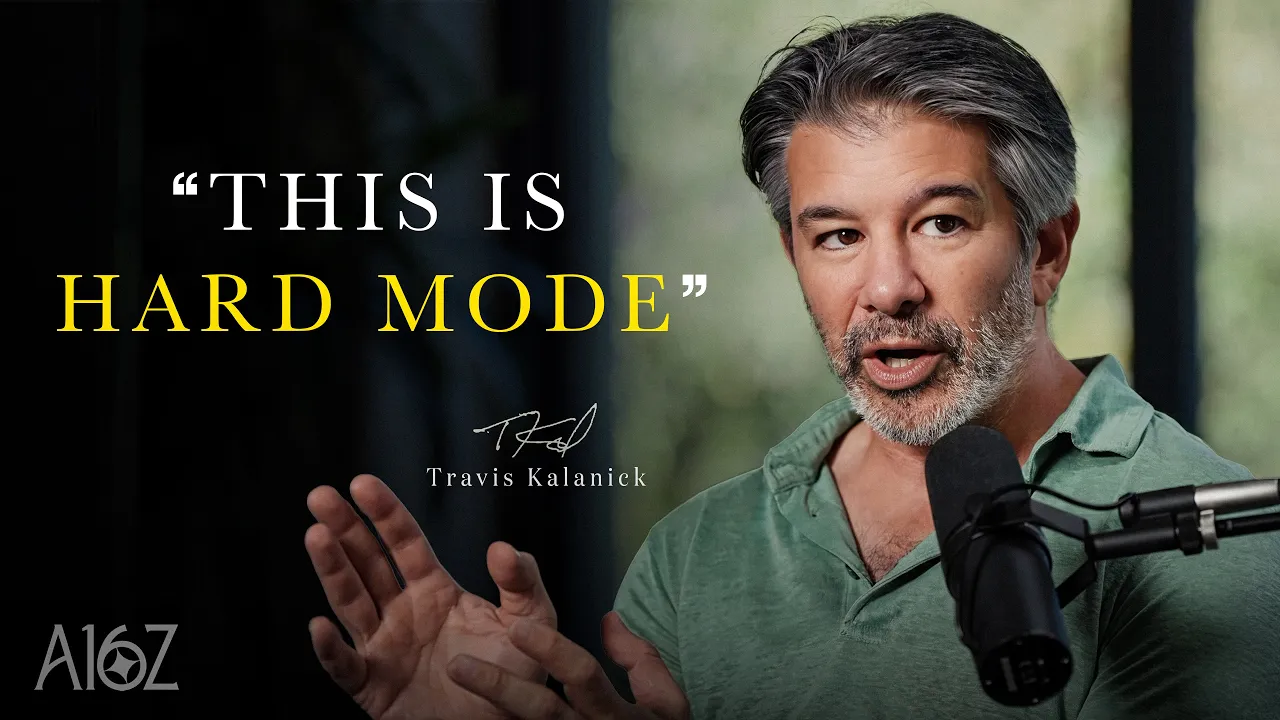
Kalanick Unveils Atoms Holding Company to Automate Physical Industries
a16z
Travis Kalanick consolidated his stealth logistics, food robotics, and autonomous mining ventures into a single holding company to drive down real-world manufacturing and delivery costs.
## Background
Published by a16z on YouTube on July 22, 2026, this episode features Travis Kalanick reuniting with Ben Horowitz and host Erik Torenberg. The discussion reflects on the early days of Uber, the 2011 Series B deal that almost happened, and why Kalanick spent nearly eight years building his new venture, Atoms, in stealth. The page description outlines their exploration of industrial AI, robotics, autonomy, mining, food production, and Kalanick's vision for digitizing the physical world.
## TL;DR
Travis Kalanick and Ben Horowitz revisit the high-stakes history of Uber's early fundraising, board dynamics, and the cultural shift from market upstart to industry leader. Kalanick reveals details about his eight-year stealth venture, CloudKitchens, and its evolution into Atoms—a top-co entity designed to digitize physical real estate, food production, and logistics into an 'atoms-based computer.' The conversation extends to automating heavy industrial sectors like mining through autonomous vehicles, the power of non-fungible founders, and the necessity of managing organizational problem creation.
## Atmosphere & style
The conversation carries a reflective, candid, and high-octane energy, blending battle-tested startup war stories with ambitious technological vision. The dynamic between Kalanick and Horowitz feels like a reunion of seasoned market veterans who share a deep mutual respect, exchanging witty banter about past near-misses and high-stakes board battles. It feels like an unfiltered, behind-the-scenes peek into the mindset of a relentless founder stepping back into the public eye after years of operational silence.
## Key takeaways
- [01:09](https://www.youtube.com/watch?v=z6gH_v0buUc&t=69s) Travis Kalanick's original Series B auction for Uber fell through with Andreessen Horowitz over valuation drops, leading to years of regret for both parties and leaving Uber vulnerable during its 2017 governance crisis.
- [17:38](https://www.youtube.com/watch?v=z6gH_v0buUc&t=1058s) A shift in status from 'pirate to navy' requires scale-stage companies to adopt different cultural, competitive, and legal rules to avoid institutional backlash.
- [21:14](https://www.youtube.com/watch?v=z6gH_v0buUc&t=1274s) CloudKitchens was built around the concept of 'dark kitchens' in a multi-tenant real estate model, dividing properties into 200-square-foot delivery-only stalls.
- [27:14](https://www.youtube.com/watch?v=z6gH_v0buUc&t=1634s) Atoms aims to build an 'internet food court' that combines logistics real estate, food production robotics, and autonomous couriers to reduce delivered meal costs to $8-$10.
- [32:00](https://www.youtube.com/watch?v=z6gH_v0buUc&t=1920s) Kalanick operated CloudKitchens in complete stealth for eight years under localized global aliases to avoid media coverage and competitor tracking while building on 'hard mode'.
- [34:47](https://www.youtube.com/watch?v=z6gH_v0buUc&t=2087s) The core thesis behind Atoms treats the physical world like computer hardware, mapping manufacturing as CPUs, real estate as storage, and logistics as network transport.
- [47:45](https://www.youtube.com/watch?v=z6gH_v0buUc&t=2865s) Atoms consolidated its food, real estate, autonomous transport (Pronto), and mining operations under a single top-level holding company (TopCo) structure.
- [49:13](https://www.youtube.com/watch?v=z6gH_v0buUc&t=2953s) Great technology companies rely on non-fungible founders who can navigate existential resistance and push past initial market constraints into adjacent industries.
- [57:40](https://www.youtube.com/watch?v=z6gH_v0buUc&t=3460s) Building in total stealth enforces a focus on 'internal correctness versus external validation', preventing teams from making decisions based on PR or status.
- [01:10:40](https://www.youtube.com/watch?v=z6gH_v0buUc&t=4240s) Kalanick manages corporate scaling using his 'Meta-Problem' framework, ensuring that the rate of problem creation never exceeds the team's capacity for problem solving.
- [01:17:24](https://www.youtube.com/watch?v=z6gH_v0buUc&t=4644s) Industrial AI and physical automation face intense political and regulatory resistance, mirroring the friction faced by industrialists during the Second Industrial Revolution.
- [01:28:07](https://www.youtube.com/watch?v=z6gH_v0buUc&t=5287s) After years in stealth, Atoms is coming public to recruit top executive talent—including a General Counsel and a Mining CEO—to scale across food, transport, and industrial sectors.
## Detailed walkthrough
### [00:00](https://www.youtube.com/watch?v=z6gH_v0buUc&t=0s) Intro & The Return of the Mack
The episode opens with highlights of Travis Kalanick reflecting on his turbulent departure as Uber's CEO in 2017, the intense boardroom battles and lawsuits, and his journey starting over in stealth. He introduces the core premise of his new venture, Atoms: driving down the cost of preparing and delivering quality meals so dramatically that it approaches the cost of buying grocery store ingredients, effectively doing to the kitchen what Uber did to the automobile.
Host Erik Torenberg frames the discussion as "the return of the king," while Kalanick prefers calling it "Return of the Mack." Torenberg reads a passage from Kalanick's launch post recalling how Andreessen Horowitz came extremely close to leading Uber’s Series B round in 2011, and how Kalanick blamed Marc Andreessen, Ben Horowitz blamed himself, and how missing out left Uber vulnerable during its critical governance crisis in 2017.
[01:09](https://www.youtube.com/watch?v=z6gH_v0buUc&t=69s) The Deal That Got Away: Uber's Series B in 2011
Kalanick recounts his high-octane fundraising strategy during Uber's Series B in 2011. Emerging from years of intense entrepreneurial struggles pre-Uber, Kalanick operated with a "not going to eat tomorrow" paranoia. He engineered a winner-take-all, uncapped anchor auction to maximize momentum. Instead of standard range negotiations, Kalanick set a low minimum valuation anchor that continuously ratcheted upward with every successive venture fund meeting—moving from 2x to 3x the Series A valuation in a matter of hours as nervous investors scrambled to stay in the running.
The competitive bidding pushed the valuation up to a $175 million investment on a $375 million pre-money valuation ($550 million post) with Andreessen Horowitz (a16z), briefly edging out Yuri Milner. However, right as Kalanick called "sold," Marc Andreessen invited him to a private sushi dinner in Silicon Valley. Expecting a formal term sheet, Kalanick was instead told that the a16z partnership balked at the price and could only offer a $210 million valuation. The sudden drop forced Kalanick to awkwardly reset the entire market auction, ultimately bringing in Shervin Pishevar and Menlo Ventures after Pishevar enthusiastically bid up the price against himself.
Horowitz shares his perspective, recalling Kalanick's solo pitch as exceptionally impressive and noting that Kalanick had clearly read his blogs. Because Horowitz was already overburdened with roughly 16 board seats and lacked a primary consumer focus, he handed the deal execution to Marc Andreessen and John O'Farrell. A disagreement over terms—such as the employee option pool—led to the deal falling apart. Horowitz admits that losing the deal initiated years of personal "torture," especially after a16z partner Scott Weiss ended up investing in rival Lyft a year later at a similar $210 million valuation, requiring Horowitz to join Lyft's board to help navigate their early operational struggles against Uber.
- Uber launched in June 2010; its Series B fundraising took place in late 2011.
- a16z initially verbally agreed to a $375 million pre-money valuation before re-offering at $210 million.
- Yuri Milner considered bidding at a $400 million pre-money valuation before stepping back.
- Shervin Pishevar of Menlo Ventures ultimately led the Series B round for Uber.
[11:24](https://www.youtube.com/watch?v=z6gH_v0buUc&t=684s) Respect, Rivals, and What Could Have Been in 2017
Despite being fierce competitors—with Kalanick aggressively pressuring Lyft and Horowitz serving on Lyft's board—the two maintained a deep mutual respect. Around 2014–2015, Kalanick and Uber CTO Emil Michael would periodically meet Horowitz and Andreessen for covert dinners at a quiet restaurant near Square’s San Francisco headquarters. Kalanick and Michael routinely walked away wishing a16z were involved, though the competitive lock with Lyft made a formal deal impossible unless Uber bought Lyft outright.
Reflecting on Uber’s infamous 2017 crisis—which ultimately led to Kalanick stepping down as CEO—both Kalanick and Horowitz agree that the outcome would have been radically different had Andreessen or Horowitz sat on Uber's board. Horowitz asserts that under a16z's guidance and Kalanick's continued leadership, Uber would be vastly larger today, dominating food delivery ahead of DoorDash (which held only 5% market share when Kalanick left) and leading the autonomous vehicle race alongside Waymo. Kalanick notes that while 2017 was painful, he views his time building Uber like a former love affair—one he looks back on with fond memories now that he has fallen in love with a new company.
- Emil Michael was Uber's Chief Business Officer (and later named CTO of the Department of War).
- DoorDash held only 5% market share in food delivery when Kalanick departed Uber in 2017.
- Uber’s autonomous vehicle effort was second only to Waymo before Kalanick's exit.
[16:36](https://www.youtube.com/watch?v=z6gH_v0buUc&t=996s) Uber's Aftermath and the Transition to "Navy"
Travis Kalanick and Ben Horowitz reflect on the chaotic conclusion of Kalanick's tenure at Uber, which Kalanick likens to a messy split from a "crazy ex". In the seven to eight months between departing Uber and founding what eventually became Atoms, Kalanick describes having to "fight for my life" against an onslaught of lawsuits, investigations, and intense media hostility. He defends every decision he made at the company, while acknowledging that he pushed right up to the line—an edge where only an "electromagnetic scanning microscope" could reveal whether there was any "chalk on the shoe". The core issue was the friction of bringing a hard-scrabble startup mentality to a massive, highly visible global entity without realizing that scale brings entirely different rules and cultural expectations.
Horowitz introduces a framework the firm uses: "the pirate becomes the navy". Tactics that are celebrated when used by an aggressive upstart battling incumbent monopolies are viewed as abusive when deployed by the market leader. Horowitz notes that early on at Andreessen Horowitz, he spoke aggressively about rival venture firms until he realized the firm's status had shifted and they needed to tone it down.
Kalanick illustrates this shift with an internal story about competing against Lyft. Uber developed an aggressive driver-recruitment initiative internally code-named "shoplifting". David Drummond, a Google executive on Uber's board, pulled Kalanick aside to tell him, "Travis, that's not a thing, dude. You got to change it". Following antitrust training—a concept Kalanick initially shrugged off as a startup founder—legal counsel advised him that internal project names must sound benign enough for a "10-year-old basketball team". Consequently, project "shoplifting" was renamed the "North American Championship Series" (NACS).
- Uber ran an aggressive driver poaching scheme against Lyft internally dubbed "shoplifting".
- The initiative was renamed the North American Championship Series (NACS) following board and legal intervention regarding proper antitrust language.
---
[21:14](https://www.youtube.com/watch?v=z6gH_v0buUc&t=1274s) The Origins and Evolution of CloudKitchens
After months of legal pressure and reflection, Kalanick re-engaged with entrepreneurship through a real estate acquaintance who had launched CloudKitchens. Around late 2015 and early 2016, following the rollout of Uber Eats, Kalanick's team had noticed the emergence of "dark kitchens" in Melbourne—commercial kitchens operating on Uber Eats without a physical storefront. Kalanick's real estate partner saw an opportunity for a multi-tenant real estate approach, leasing out ~200-square-foot delivery-only kitchen stalls across a single 30-kitchen facility. When the founder told Kalanick three months post-Uber that he was planning to build a "few more" locations, Kalanick famously replied: "You mean like a few thousand, right?".
Kalanick acquired the company shortly after its Series A, stepping in as leader to scale it dramatically. Horowitz compares Kalanick’s entry to Elon Musk’s early involvement in Tesla—transitioning from investor or acquirer to the driving force who fully owns and reshapes the vision, standing in stark contrast to a hired "professional CEO". Kalanick admits he is naturally drawn to non-sexy, highly complex challenges where he can see underlying potential that others miss. The CloudKitchens operational model requires managing real estate acquisition, complex facility construction, a strategic B2B sales motion converting brick-and-mortar restaurants into delivery-only concepts, a custom software stack, and integrated kitchen robotics.
- Dark kitchens were first spotted on Uber Eats in Melbourne around late 2015 to early 2016.
- CloudKitchens' base model divides real estate into delivery-only stalls of approximately 200 square feet each.
- Kalanick acquired the business shortly after its Series A round.
---
[27:14](https://www.youtube.com/watch?v=z6gH_v0buUc&t=1634s) Digitizing Food: The Master Plan for the "Internet Food Court"
The grand vision behind CloudKitchens—part of Atoms—is to drive down the cost of preparing and delivering high-quality meals until it approaches the cost of buying groceries. Doing so would digitize and transform home food preparation the same way Uber transformed personal car ownership. Achieving this requires unifying three distinct operational pillars into a single physical footprint:
1. **Logistics Real Estate:** Amazon-style urban micro-warehouses suited for rapid picking, sorting, and dispatch.
2. **Automated Production / Manufacturing:** According to the Bureau of Labor Statistics, restaurants are technically light manufacturers; scaling requires purpose-built food robotics within the facility.
3. **Autonomous Delivery:** Dedicated robotic couriers designed specifically for hot/cold meal transportation.
Kalanick frames this model as the "internet food court". While full robotics and autonomous street couriers ("autonomous burritos—like boxes on wheels") are guaranteed to be standard within 20 years, Kalanick’s ambition is to pull that timeline forward to five to seven years. Over eight years, the venture expanded to hundreds of facilities operating across 30 countries. By automating production and deploying robotic couriers, delivery costs drop from $12 per drop to as low as $0.50–$1.00. Coupled with $6 saved in kitchen labor and reduced occupancy overhead, the total cost of a fully prepared, delivered meal drops to $8–$10.
- A core goal is lowering delivery costs from $12 per drop down to $0.50–$1.00 per drop using autonomous ground couriers.
- Eliminating standard labor and occupancy costs yields fully delivered meal prices around $8 to $10 total.
- The business operates hundreds of real estate facilities spanning 30 countries.
- Automated food production robotics lines are targeted for production manufacturing in Q4.
---
[32:00](https://www.youtube.com/watch?v=z6gH_v0buUc&t=1920s) Eight Years in Stealth Mode on "Hard Mode"
Following the non-stop media scrutiny of 2017—when he faced roughly "150 articles a day of negativity"—Kalanick chose to build the company in complete stealth. This shielding allowed the team to focus entirely on building without reacting to headlines from *The New York Times*. Operating a global business with thousands of employees and hundreds of locations in stealth, however, required running on "hard mode". Recruiters had to target top talent on LinkedIn without naming the company, and sales teams had to onboard restaurant partners using stealth profiles.
Sustaining stealth for eight years created an unusual dynamic. Kalanick explains that after several years of silence, the media narrative lost continuity. Because reporters struggled to bridge a multi-year coverage gap, leaking became effectively inert—journalists no longer knew how to contextualize information about the venture. To further maintain operational privacy globally, the enterprise operated under entirely localized brand identities rather than a single master brand:
[34:24](https://www.youtube.com/watch?v=z6gH_v0buUc&t=2064s) The Stealth Web of Global Cloud Kitchens
The conversation opens with Travis Kalanick shedding light on the dizzying array of operating names his company used during its ultra-stealth period to obscure its growing global footprint. Across international markets, the business hid behind distinct regional entities to avoid drawing early attention from competitors and the press. Kalanick lists a string of these stealth aliases, explaining that connecting the dots across these operations was deliberately made almost impossible.
- **China:** Flash Kitchen (and three other distinct regional brands)
- **London:** Foodstars
- **Middle East:** Kitchen Park (with earlier plans to use Yala Kitchens)
[34:47](https://www.youtube.com/watch?v=z6gH_v0buUc&t=2087s) Digitizing the Physical World and the "Atoms-Based Computer"
Kalanick explains that his grander vision to "digitize the physical world" began during his final years at Uber. He recalls how Uber initially felt like pure science fiction—tapping glass to manifest a physical vehicle on a satellite map—before eventually becoming commonplace. Driven by this shift, he developed a theoretical framework mapping classic computer architecture directly onto the physical world:
> "CPU manipulates bits, storage stores bits, network moves bits from point A to point B... What manipulates atoms? That's manufacturing. What stores atoms? That's real estate. What moves atoms? Well, that's transport or logistics."
In Kalanick's view, manufacturing, real estate, and transportation serve as the three core computing resources of an "atoms-based computer," operating under the same data structures and algorithmic principles found in standard computer science curriculum.
- **Network Routing:** Systems use TCP-style "sawtooth" congestion control algorithms to dynamically throttle or route demand to kitchens based on real-time capacity and reliability.
- **Hardware Mapping:** A 10,000-square-foot facility is framed as a "30-core semiconductor" where each kitchen functions as a processor core, hallways act as the network bus, and cold storage functions as pre-computed edge caches (e.g., Akamai edge servers).
- **Packet Transfer:** Couriers delivering meals over physical roads are conceptually treated as individual TCP data packets.
While Uber successfully digitized physical transportation (a domain now nearing full software autonomy through platforms like Waymo), Kalanick argues that the physical CPU (manufacturing) and physical storage (real estate) remain massive, untapped frontiers for technological innovation.
[38:54](https://www.youtube.com/watch?v=z6gH_v0buUc&t=2334s) AI, High-Dimensional Physics, and Empirical Modeling
Ben Horowitz and Travis Kalanick dive into how this physical computing framework naturally intersects with artificial intelligence and deep learning. Horowitz notes that Kalanick anticipated the current AI movement by realizing early on that physical systems can be comprehensively modeled using computation. Kalanick points back to his late Uber tenure, during which Uber operated a world-class AI lab working on deep learning and machine learning.
Kalanick argues that applying AI to the physical world is inherently more challenging—and far more interesting—than applying it to purely digital software environments. The real world presents vastly more variables and high-dimensional stochastic distributions. Because physical systems contain too many dynamic variables to be solved by rigid, deterministic algorithms alone, they must instead be mastered empirically by observing and learning how physical environments actually behave in practice.
[39:47](https://www.youtube.com/watch?v=z6gH_v0buUc&t=2387s) Assembling the Atoms Empire and the Autonomy Imperative
Kalanick traces how the broader vision for Atoms began to take shape about a year prior, when he started exploring "autonomous burritos" to link real estate hubs, automated food production, and autonomous transport. His investigative trips to inspect autonomy companies across China and the U.S. sparked rumors throughout the tech industry that he was returning to the self-driving arena. Supply chain leaders and partners quickly expressed interest, seeking alternative autonomous heavy transport solutions to ensure business continuity.
To execute on this without diluting the core food and real estate operations, a dedicated autonomy entity was established before ultimately unifying under the parent company. Kalanick reunited with key engineering leaders from Uber's early autonomous development era:
- **Eric Meyhofer:** Former head of Uber's Advanced Technologies Group (ATG), brought in to lead the food robotics division.
- **Anthony Levandowski:** Former Uber autonomy pioneer and founder of Pronto, an off-road autonomous mining company.
Kalanick, who was already the primary investor in Pronto, acquired the company to integrate specialized off-road autonomy into the broader Atoms platform, immediately launching Atoms into the industrial mining sector.
[43:44](https://www.youtube.com/watch?v=z6gH_v0buUc&t=2624s) Transforming Industrial Mining: Productivity and Human Safety
The discussion shifts to Pronto's deployment of autonomous kits in heavy industrial mining operations. Operating under the mission statement *"more productive mines to power Earth's industries,"* the company pitches mine executives on a straightforward value proposition: a 20% annual increase in gold yield. Beyond yield improvements, Horowitz highlights that mining represents one of the most hazardous human jobs on Earth.
Kalanick describes the intense safety realities at active mine sites, calling the working conditions heart-wrenching for human laborers. Automating heavy haulage and dangerous workflows delivers both massive productivity gains and life-saving safety benefits.
- **Performance Milestone:** Pronto's autonomous technology has surpassed human operator productivity, transitioning the business from small pilot programs to aggressive, exponential global scaling.
- **Global Deployments:** Technical teams are actively manufacturing, shipping, and installing retrofitted autonomy kits on massive industrial machinery in extreme environments, including the Amazon rainforest and the border region between Saudi Arabia and Iraq.
- **Operational Shift:** Kalanick describes pushing the team to transform from a "lean startup" into a "muscular" enterprise—scaling up process and professional operations without adding corporate bloat.
Ultimately, these productivity gains allow existing mines to extract more resources while making previously unviable mineral deposits economically feasible to develop.
[47:45](https://www.youtube.com/watch?v=z6gH_v0buUc&t=2865s) The "Trench Coat" Pitch and Single TopCo Consolidation
Kalanick details how the current unified structure of Atoms came together during fundraising discussions with Ben Horowitz. He recounts pitching Horowitz in Las Vegas with an array of individual companies—mining, food, real estate, and autonomous transit—comparing himself jokingly to a street vendor flashing watches inside a trench coat:
> "I was like the guy with a trench coat that's got like 20 watches. I'm like, 'Which watch do you want? I got all kinds of watches.' And he's like, 'Dude, I just want the whole freaking trench coat... Let's be partners for all the things you do.'"
This interaction prompted Kalanick to roll all subsidiary businesses and operations into a single top-level holding company ("TopCo") with a single unified equity structure. Kalanick expresses relief at consolidating these ventures into a single cap table rather than managing a web of separate corporate entities, expressing admiration for how Elon Musk manages multiple distinct companies simultaneously.
[49:13](https://www.youtube.com/watch?v=z6gH_v0buUc&t=2953s) Founder Non-Fungibility: Why Great Companies Need Great Entrepreneurs
Ben Horowitz refutes the prevailing public narrative surrounding legendary tech companies, taking issue with how media, politicians, and the public understate the role of exceptional founders. Using Tesla as an example, Horowitz notes that prior to Tesla's rise, popular documentaries like *Who Killed the Electric Car?* argued that big oil, legacy automakers, and government forces would forever block electric vehicles.
> "And then the reality is, oh, Elon Musk, that motherfucker's hard to kill, right? Like, so he by himself kind of decarbonized the American auto industry... But why didn't all those people build another Tesla? Like, there's only one, cause there's only one non-fungible, very rare person in that equation who could do that."
Horowitz asserts that exceptional companies require non-fungible entrepreneurs who can navigate existential resistance—pointing out that Meta succeeded where Friendster failed, SpaceX succeeded where legacy aerospace failed, and Uber built lasting, massive enterprise value that sustained itself even through founder transitions.
Here is the detailed walkthrough covering this segment of the discussion:
[51:43](https://www.youtube.com/watch?v=z6gH_v0buUc&t=3103s) Management Capacity as the Only Constraint to Ambition
Ben Horowitz and Travis Kalanick explore how visionary founders push past the initial core product to expand into massive, adjacent—or completely new—markets. Horowitz notes that a16z’s core business is identifying and backing rare, extraordinary individuals. Kalanick points to Jeff Bezos as the modern benchmark for this mindset, arguing that the true ceiling of a company’s scope is not its initial idea, but its management capacity.
The group discusses Amazon’s leap from an online bookstore to AWS. While Amazon possessed deep technical knowledge about operating at unprecedented scale because they were forced to solve those problems internally, building a cloud compute business was an entirely unprecedented expansion. Kalanick draws a direct parallel to Uber, where starting with ride-hailing established the foundational network knowledge that later enabled natural expansions into Uber Eats, autonomous vehicle development, Uber Freight, and AI research.
- Bezos proved that organizational design and cultural continuity can allow a company to expand far beyond its starting product category.
- Starting categories matter because they build domain-specific knowledge (e.g., managing high-scale server infrastructure or localized logistics networks) that becomes transferable to new ventures.
- Moving into adjacent categories is easier, but jumping to entirely disconnected domains requires rare skill and execution capability.
[55:46](https://www.youtube.com/watch?v=z6gH_v0buUc&t=3346s) Starting from the Ground Floor: The Stealth Acquisition of CloudKitchens
The conversation shifts to Kalanick’s motivation for stepping back into the startup arena after leaving Uber rather than retiring to a life of leisure. Kalanick explains that he simply loves "being in the arena fighting." Horowitz emphasizes how rare it is for someone who made immense wealth to willingly restart from scratch at the absolute bottom, doing hands-on building rather than acting as a passive chairman.
Kalanick recounts the surreal moment he acquired City Storage Systems (the parent entity behind CloudKitchens) alongside his partner Diego. The entire business consisted of just six people. He describes walking into his first all-hands meeting with those six employees right after running 20,000-person all-hands meetings at Uber. Standing in front of them with performance charts, he gave the exact same high-energy pitch: "Let's fucking go, guys. Let's do this." The original employees were stunned to find that within an hour of starting their workday, the founder of Uber was now their CEO.
- Starting over at the bottom requires a deep sense of humility and a commitment to real operational building rather than jumping straight back to the executive top tier.
- Building in stealth forces a culture driven by internal fulfillment and love for the day-to-day work, rather than external press or status.
[57:40](https://www.youtube.com/watch?v=z6gH_v0buUc&t=3460s) Internal Correctness vs. External Validation
Horowitz and Kalanick discuss the major cultural advantages of building in stealth, away from public media oversight and headline scrutiny. Kalanick highlights how operating outside the view of major news outlets allowed his team to focus purely on "internal correctness versus external validation." When companies become addicted to external status, they risk losing their operational compass and making decisions based on PR rather than sound product strategy.
Horowitz brings up the current state of major AI research labs as a real-time example of this trap. He argues that many large labs run into public relations issues because their employees crave external status as high-minded researchers or world-savers. This internal dynamic leads leaders to make dramatic public declarations—such as claiming AI will take all human jobs—to satisfy their team's desire for validation, rather than focusing quietly on solving technical flaws like reward hacking.
- External validation makes company culture volatile and distracts from true operational goals.
- Building in stealth starves the human desire for outside praise, but it instills deep emotional intelligence and internal discipline across the team.
[01:00:33](https://www.youtube.com/watch?v=z6gH_v0buUc&t=3633s) Digitizing the Physical World and the "Food Computer"
When asked why he chose food as the starting point for his next chapter, Kalanick explains that he never viewed CloudKitchens purely as a food delivery play. From the moment he took over, he viewed the umbrella company—City Storage Systems—as a framework for digitized manufacturing and digitized real estate. He describes the concept as creating an "atoms-based computer" or a "food computer" anchored in real estate storage networks.
He deliberately chose the dry, unglamorous name *City Storage Systems* to maintain stealth, noting that people would assume it was related to HTML or forget the name minutes after hearing it. Kalanick notes that while the same digitized manufacturing principles apply to other physical industries like mining or heavy logistics, food offered the right spark at the right time.
- City Storage Systems was named to be intentionally boring and forgettable to keep the company under the radar.
- Great entrepreneurs view early markets not as static ideas, but as "idea mazes" where early learnings unlock exponentially larger applications.
- Kalanick compares this evolutionary trajectory to Elon Musk expanding SpaceX into Starlink, or evolving the original Tesla Roadster into the Optimus humanoid robot.
[01:05:05](https://www.youtube.com/watch?v=z6gH_v0buUc&t=3905s) Expanding into Food, Mining, and Transport
Looking ahead at the broader vision for Atoms, Kalanick jokes that he is currently "so constrained" because he is only focusing on three massive domains: food, mining, and transportation. He explains his core framework for scaling multi-pronged enterprises: a founder must secure a strong beachhead, build it until it flourishes, and establish an empowered executive team capable of handling 98% of day-to-day problems. Only then does the founder gain the operational bandwidth to launch into the next vertical.
He shares a story from his time scaling Uber rides, recalling how he would call up regional operations leads to brainstorm complex issues, only for them to tell him, "Travis, we got this. I don't know why you're calling me right now." That level of operational independence freed him up to focus on new frontiers.
Horowitz observes that Kalanick’s greatest strength at Uber was his ability to recruit and retain high-caliber leaders who easily could have been founders of their own companies. Managing a team composed entirely of entrepreneurial heavyweights becomes an "empowerment puzzle," but it remains the only way a company can scale to tackle multiple massive industries simultaneously.
- **Key Focus Areas:** Food, mining, and transportation form the initial set of physical industries targeted by Kalanick's broader vision.
- **Scaling Formula:** Build a self-sustaining core business, delegate 98% of operational problems to tier-one leaders, and reuse freed-up bandwidth to tackle the next domain.
- **Talent Density:** Building transformative, multi-industry companies requires attracting genuine entrepreneurial talent rather than standard corporate middle management.
[01:07:45](https://www.youtube.com/watch?v=z6gH_v0buUc&t=4065s) Scaled Operations: Alignment, Accountability, and Company Culture
Travis Kalanick details the operational realities of running Uber at scale across five continents simultaneously. Managing a global company requires multiplexing engineering, finance, and product teams across 24 time zones. In Kalanick's view, scaling requires a delicate balance of front-end strategic alignment and back-end accountability—a framework he summarizes as "lead builders build." Empowerment cannot exist in a vacuum; local leaders must be deeply aligned on goals, performance metrics, and behavioral standards. Without tight cultural alignment, global delegation quickly leads to operational fragmentation.
The discussion highlights why Uber aggressively chose to build its own international footprint city-by-city rather than acquiring local competitors. Ben Horowitz and Kalanick explain that buying international companies introduces alien cultures and reputations that inevitably leak back into the parent organization. Because a company's technology stack directly reflects its internal culture and decision-making processes, acquiring disparate platforms creates a messy technical mashup that can take years to fuse together. Kalanick dryly quips that this exact technical and cultural friction was the underlying reason Uber ultimately decided against purchasing Lyft.
- **Empowerment Model:** Demands front-end strategy alignment coupled with strict back-end accountability.
- **Global Complexity:** A single CEO or point of failure cannot scale across 24 time zones without cross-functional executive support (CFO, Head of Product, VP of Engineering).
- **M&A Risks:** Buying regional players imports incompatible cultures, unaligned local practices, and fractured codebases.
[01:10:40](https://www.youtube.com/watch?v=z6gH_v0buUc&t=4240s) The Meta-Problem Framework and Problem Creation
When asked how he decides to expand into new industries or regions, Kalanick introduces his core operational philosophy: when running a business starts getting easy, a founder must actively make it hard again. Viewing himself fundamentally as a "problem creator," Kalanick uses Uber's high-stakes launch in China as a classic example of intentionally introducing massive complexity. However, creating problems requires a strict mathematical boundary to avoid drowning the organization.
Kalanick breaks down his "Meta-Problem" calculus, defining it as a mathematical relationship between the rate of problem creation and the rate of problem solving over time. If problem creation outpaces the team's capacity to solve those problems, the company goes under water. When a company finds itself waist-deep or neck-deep in unresolved issues, it must shut off the problem-creation spigot until it regains operational capacity. Horowitz adds that "capacity" isn't just about company resources—it heavily depends on the CEO's personal bandwidth, as taking on a massive new challenge means pulling direct attention away from core operations.
> "I have this framework I call the meta-problem, which is the derivative of your problem creation $d/dt$ must be less than or equal to the derivative of your problem solving $d/dt$. And if it's not, you have a real problem."
- **The Meta-Problem Equation:** $\frac{d(\text{Problem Creation})}{dt} \le \frac{d(\text{Problem Solving})}{dt}$.
- **Expansion Velocity:** Requires forecasting problem-solving capacity 6 to 18 months in advance.
- **Strategic Focus:** Unresolved legacy issues severely limit a founder's ability to tackle major new initiatives like autonomous driving.
[01:13:46](https://www.youtube.com/watch?v=z6gH_v0buUc&t=4426s) The Atoms Vision: Food Computers and Real Estate Multipliers
Kalanick explains that his current work with Atoms and CloudKitchens is a direct continuation of the thesis he developed at Uber: digitizing the physical world through atom-based computation. Whether organizing ride-sharing fleets or constructing over 500 automated CloudKitchens facilities globally, the underlying architecture remains the same. When recruiting world-class talent, framing these physical assets not merely as "humble kitchen facilities," but as specialized "food computers" provides the overarching vision necessary to inspire top engineers.
Horowitz draws a fascinating parallel between digital data centers and physical real estate. In traditional computing, hardware storage degrades and becomes obsolete over time. However, in the physical world, when an intelligent "food computer" optimizes physical real estate storage, it drastically multiplies the underlying value of that location. Much like how modern AI workloads have exponentially increased the societal value and output per top-level operation of data center real estate, smart automation enhances the economic output of physical infrastructure.
- **CloudKitchens Scale:** Over 500 automated facilities built worldwide.
- **The "Food Computer" Thesis:** Combines automated production, infrastructure, and delivery logistics to transform food delivery ecosystems.
- **Real Estate Synergies:** Smart software and physical automation act as value multipliers on static real estate assets.
[01:17:24](https://www.youtube.com/watch?v=z6gH_v0buUc&t=4644s) Industrial AI and the Second Industrial Revolution
Shifting to the broader landscape of Industrial AI, Kalanick discusses his vision for physical automation across traditional industries such as transport, food production, and mining. True full-stack physical automation requires industry-specific computers combined with generalized transport networks—such as robotic wheelbases. Horowitz notes that while Silicon Valley historically shied away from physical industries due to heavy regulation, the current generation of founders is no longer intimidated by regulatory battles.
The conversation draws explicit historical parallels between today's physical AI revolution and the Second Industrial Revolution. Kalanick and Horowitz compare modern founders to iconic industrial magnates like Andrew Carnegie, Henry Frick, John D. Rockefeller, and Henry Ford, who operated in a similarly hostile political climate against intense regulatory and societal resistance. To illustrate the extreme grit required in physical operations, Kalanick recounts the famous story of Henry Clay Frick, who survived an assassination attempt by an anarchist in his office, got stitched up, and returned to work that very same afternoon.
> "When the bits start controlling atoms in the physical world, then the regulators are in the game big time... If you start studying the Second Industrial Revolution, there are so many parallels between what the Carnegies, the Rockefellers, Fricks, the Fords—what those guys had to deal with."
- **Physical AI Stack:** Merges software controls, specialized robotics, and real-world hardware to fully automate legacy physical vertical industries.
- **Regulatory Dynamics:** Transitioning from pure software ("bits") to physical infrastructure ("atoms") inherently invites heavy regulatory oversight.
- **Historical Analogy:** Compares the political pushback against modern Industrial AI pioneers to the opposition faced by 19th-century industrial builders.
<ElicitationsGroup message="Explore related topics from the discussion:">
<Elicitation label="Summarize Travis Kalanick's Meta-Problem Framework" query="Explain Travis Kalanick's Meta-Problem framework and how he applies the math of problem creation vs problem solving to business expansion."/>
<Elicitation label="Compare Uber's expansion strategy vs M&A" query="Detail Travis Kalanick's arguments against acquiring competitors like Lyft during Uber's international expansion."/>
<Elicitation label="Analyze the CloudKitchens 'Food Computer' thesis" query="How does Travis Kalanick define a 'food computer' and how does it multiply the value of physical real estate in CloudKitchens?"/>
</ElicitationsGroup>
[01:23:32](https://www.youtube.com/watch?v=z6gH_v0buUc&t=5012s) The Industrial Age and Resistance to Change
Ben Horowitz references the book *Freedom's Forge*, which details how American industrialists built the World War II war machine. He highlights Bill Knudsen, a automotive mass-production genius who pioneered manufacturing at Ford, left after an argument with Henry Ford, built Chevy at General Motors, and then went to work for the U.S. government for a dollar a year to industrialize the nation. Horowitz emphasizes the intense resistance Knudsen faced from the press and political figures like Eleanor Roosevelt—specifically over his reasonable proposal to pay auto manufacturers on a "cost-plus 7%" model to shift production from civilian cars (which employed 20% of America) to tanks. Horowitz compares that historical pushback to modern political resistance against tech infrastructure, such as the Governor of New York banning data centers.
Travis Kalanick frames this political friction as a natural human resistance to rapid change. He notes that finding "valuable unknown truths" naturally generates change, and the faster the change occurs, the stronger the pushback becomes. To overcome this, innovators must bring overwhelming progress to outpace resistance while building trust to gain advocates rather than adversaries. Horowitz quips that "everybody loves progress; it's change they can't stand." Kalanick clarifies his vision for "Industrial AI" as a practical, brass-tacks stack of software, sensors, robotics, and machinery to automate physical industries one by one—distinguishing Atoms from humanoid robotics or military applications. Horowitz adds that America has forgotten how to manufacture—with Elon Musk being the notable exception—and notes the irony of politicians who lamented the loss of manufacturing jobs now opposing data center construction, which represents the new frontier of domestic manufacturing.
- *Freedom's Forge* details Bill Knudsen’s transition from Ford to GM (Chevy), and subsequently leading U.S. wartime industrialization for $1/year.
- Automotive manufacturing employed approximately 20% of the U.S. workforce prior to WWII industrial conversion.
- The proposed "cost-plus 7%" reimbursement model for wartime factory conversion sparked fierce political pushback from figures like Eleanor Roosevelt.
- Kalanick clarifies that Atoms focuses on non-humanoid, non-military "Industrial AI" across physical industries rather than theoretical "Physical AI."
---
[01:28:07](https://www.youtube.com/watch?v=z6gH_v0buUc&t=5287s) Building the Team for the Atoms Vision
Addressing the transition from building in stealth to coming out into the public, Erik Torenberg asks Kalanick about his recruiting plans. Kalanick reveals that Atoms has tripled the number of multi-trillion-dollar industries it is going after. He jokes about the unique hiring challenges that come with past success, noting that when you make executives hundreds of millions of dollars, "it's hard to hire them again," to which Horowitz agrees that he has rarely had success hiring wealthy people. Kalanick highlights former Uber executive Emil Michael—who went on to serve as Under Secretary of Defense—as an example of the high-caliber strategic leadership he needs to recruit next for corporate and business development.
Kalanick details the specific key leadership roles Atoms is currently filling to scale its vision. The company is actively recruiting top-tier talent across executive and technical functions to build out its multi-industry footprint. Horowitz and Torenberg emphasize that incoming talent benefits from nearly two decades of Kalanick's hard-learned lessons at Uber and CloudKitchens while securing early-stage upside on high-impact global missions.
- Atoms is actively seeking a Chief Legal Officer / General Counsel who can ride shotgun and operate "a few inches off the line."
- The company needs a CEO for its new mining division, as well as executive leadership across autonomy, heavy-duty robotics, and technical roles.
- Kalanick notes that after spending eight years in stealth cold-calling prospects, stepping into the public eye allows Atoms to attract talent at scale.
- Mission objectives cited include replacing child labor in overseas mining, improving public health by replacing processed foods with fresh meals, and returning time to consumers.
## Notable quotes
> [01:09](https://www.youtube.com/watch?v=z6gH_v0buUc&t=69s) not going to eat tomorrow — Travis Kalanick
> [16:36](https://www.youtube.com/watch?v=z6gH_v0buUc&t=996s) chalk on the shoe — Travis Kalanick
> [16:36](https://www.youtube.com/watch?v=z6gH_v0buUc&t=996s) the pirate becomes the navy — Ben Horowitz
> [16:36](https://www.youtube.com/watch?v=z6gH_v0buUc&t=996s) Travis, that's not a thing, dude. You got to change it — David Drummond
> [16:36](https://www.youtube.com/watch?v=z6gH_v0buUc&t=996s) 10-year-old basketball team — Travis Kalanick
> [21:14](https://www.youtube.com/watch?v=z6gH_v0buUc&t=1274s) You mean like a few thousand, right? — Travis Kalanick
> [34:47](https://www.youtube.com/watch?v=z6gH_v0buUc&t=2087s) CPU manipulates bits, storage stores bits, network moves bits from point A to point B... What manipulates atoms? That's manufacturing. What stores atoms? That's real estate. What moves atoms? Well, that's transport or logistics. — Travis Kalanick
> [47:45](https://www.youtube.com/watch?v=z6gH_v0buUc&t=2865s) I was like the guy with a trench coat that's got like 20 watches. I'm like, 'Which watch do you want? I got all kinds of watches.' And he's like, 'Dude, I just want the whole freaking trench coat... Let's be partners for all the things you do.' — Travis Kalanick
> [49:13](https://www.youtube.com/watch?v=z6gH_v0buUc&t=2953s) And then the reality is, oh, Elon Musk, that motherfucker's hard to kill, right? Like, so he by himself kind of decarbonized the American auto industry... But why didn't all those people build another Tesla? Like, there's only one, cause there's only one non-fungible, very rare person in that equation who could do that. — Ben Horowitz
> [01:07:45](https://www.youtube.com/watch?v=z6gH_v0buUc&t=4065s) lead builders build — Travis Kalanick
> [01:10:40](https://www.youtube.com/watch?v=z6gH_v0buUc&t=4240s) I have this framework I call the meta-problem, which is the derivative of your problem creation d/dt must be less than or equal to the derivative of your problem solving d/dt. And if it's not, you have a real problem. — Travis Kalanick
> [01:17:24](https://www.youtube.com/watch?v=z6gH_v0buUc&t=4644s) When the bits start controlling atoms in the physical world, then the regulators are in the game big time... If you start studying the Second Industrial Revolution, there are so many parallels between what the Carnegies, the Rockefellers, Fricks, the Fords—what those guys had to deal with. — Travis Kalanick
> [01:23:32](https://www.youtube.com/watch?v=z6gH_v0buUc&t=5012s) everybody loves progress; it's change they can't stand. — Ben Horowitz
## Mentioned
Travis Kalanick, Ben Horowitz, Erik Torenberg, Marc Andreessen, Scott Weiss, John O'Farrell, Yuri Milner, Shervin Pishevar, Emil Michael, David Drummond, Elon Musk, Jeff Bezos, Eric Meyhofer, Anthony Levandowski, Bill Knudsen, Henry Ford, Henry Clay Frick, Andrew Carnegie, John D. Rockefeller, Eleanor Roosevelt, Uber, Atoms, Andreessen Horowitz (a16z), Lyft, Waymo, DoorDash, CloudKitchens, City Storage Systems, Cocina Secreta, Kitchen Valley, Flash Kitchen, Foodstars, Kitchen Park, Yala Kitchens, Pronto, Tesla, SpaceX, Starlink, Optimus, Amazon, AWS, General Motors, Chevy, Square, The New York Times, Freedom's Forge, Bureau of Labor Statistics
In an interview with a16z, Uber co-founder Travis Kalanick and venture capitalist Ben Horowitz detail the operational strategy behind Atoms, an industrial holding company applying computer systems architecture to physical verticals such as food preparation, logistics, and heavy industrial mining. Kalanick and Horowitz argue that transforming physical industries requires disciplined internal execution, strict mathematical boundaries on organizational complexity, and deliberate insulation from public scrutiny.
The Atoms-Based Architecture and Food Computing (34:47)
Kalanick conceptualizes physical operations through classical computer architecture: commercial real estate functions as physical data storage, automated manufacturing acts as the central processing unit, and transport networks operate as a communications bus routing physical data packets. Under this model, Atoms' commercial kitchen business—which grew to operate over 500 facilities across 30 countries under the parent entity City Storage Systems—treats localized multi-tenant facilities as multi-core processors. These locations manage dynamic food orders using TCP-style network congestion algorithms, while integrated cold storage functions as a pre-computed edge cache to optimize production.
The commercial objective of this operational structure is to lower the total cost of preparing and delivering quality meals to roughly $8 to $10, approaching the retail price of raw grocery store ingredients. Kalanick claims that pairing on-site kitchen robotics with dedicated autonomous ground couriers can reduce delivery expenses from $12 per drop down to $0.50–$1.00, alongside saving approximately $6 in labor per meal. While complete automation across urban roadways may take up to two decades to become universal, Kalanick forecasts deploying integrated autonomous production and delivery at scale within five to seven years.
Expanding Industrial AI into Autonomous Mining (39:47)
Rather than pursuing humanoid robotics or purely digital foundation models, Kalanick defines 'Industrial AI' as a pragmatic deployment of software, sensors, and retrofitted robotics designed to automate heavy, hazardous physical workflows. To execute this cross-sector thesis without fragmenting operations, Kalanick consolidated his ventures into a single top-level holding company backed by a16z. The parent organization recruited former Uber Advanced Technologies Group head Eric Meyhofer to direct food robotics and acquired Pronto, an autonomy venture founded by Anthony Levandowski focused on off-road industrial equipment.
Pronto deploys retrofitted autonomous kits onto heavy extraction machinery in harsh, remote environments, including active projects in the Amazon rainforest and along the border of Saudi Arabia and Iraq. The operational value proposition to mine operators centers on achieving an estimated 20% annual improvement in mineral yield while eliminating human exposure to hazardous extraction environments. Horowitz and Kalanick draw historical parallels between contemporary regulatory resistance to physical computing infrastructure—such as political pushback against data center construction—and the severe political friction encountered by early 20th-century industrial leaders like Andrew Carnegie, Henry Ford, and wartime production chief Bill Knudsen.
Governance Lessons and Stealth Operational Culture (16:36)
Reflecting on Kalanick's contentious 2017 departure from Uber, Kalanick and Horowitz examine the structural difficulties of navigating an aggressive high-growth startup into an institutional market incumbent. Horowitz characterizes this operational transition as the shift from 'pirate to navy,' noting that confrontational tactics celebrated in an upstart are deemed unacceptable once a company achieves market leadership. Kalanick points to Uber's driver-recruitment offensive, internally code-named 'shoplifting,' which legal counsel and board directors forced the company to re-label as the 'North American Championship Series' to comply with antitrust standards. Horowitz contends that had a16z completed its contested 2011 Series B investment and secured board governance, Uber would have maintained founder stability and captured greater market share in delivery and autonomous vehicles.
In response to intense media scrutiny following his exit, Kalanick deliberately built his subsequent venture in complete stealth for eight years. To prevent competitors and media outlets from piecing together the company's global scale, operations expanded under separate regional entities, including CloudKitchens in the United States, Cocina Secreta in Latin America, Kitchen Valley in South Korea, Foodstars in London, and Flash Kitchen in China. Kalanick and Horowitz assert that operating without public recognition forced the organization to cultivate internal operational discipline rather than chasing external public relations validation.
Management Capacity and the Meta-Problem Calculus (70:40)
To govern expansion into complex physical industries without collapsing organizational capacity, Kalanick applies a framework he terms the 'Meta-Problem.' Mathematically defined as keeping the rate of problem creation less than or equal to the rate of problem solving over time, the calculus requires leadership to halt expansion into new markets whenever unresolved operational friction begins to overwhelm staff. Kalanick argues that an organization should only push into an adjacent vertical once its core business functions autonomously, with an empowered executive layer capable of resolving 98% of day-to-day issues independently.
This operational discipline underpinned Kalanick's historical reluctance to scale through mergers and acquisitions, such as Uber's decision against acquiring Lyft. Horowitz and Kalanick maintain that purchasing competitors introduces foreign corporate cultures, inconsistent behavioral practices, and incompatible software architectures that generate long-term organizational drag. Instead, they argue that scaling organic operations city-by-city ensures architectural continuity and strict accountability, enabling a single corporate structure to deploy complex physical capital across five continents and 24 time zones.
Kalanick and Horowitz position Industrial AI as the next frontier of technological modernization, yet the strategy relies on whether a single unified holding company can successfully manage the intense regulatory scrutiny, logistical complexity, and capital demands of automating physical supply chains without triggering the governance and operational overreach that challenged Uber's rapid global expansion.
## Background
该视频由知名风投机构 a16z 于 2026 年 8 月 3 日发布在 YouTube 频道,全长约 1 小时 32 分钟。节目由 Erik Torenberg 主持,特拉维斯·卡兰尼克(Travis Kalanick)与本·霍洛维茨(Ben Horowitz)重聚对谈,回顾了 Uber 早期错失的 B 轮融资与治理动荡,并正式公开卡兰尼克在隐身状态下潜心打磨近八年的新项目 Atoms,探讨工业 AI、机器人与物理世界数字化的宏大构想。
## TL;DR
特拉维斯·卡兰尼克与本·霍洛维茨首度深度复盘了 2011 年 Uber B 轮激进竞价与寿司店降价导致 a16z 错失投资的内幕,并反思了 2017 年 Uber 董事会危机及“海盗变海军”的认知盲区。随后,卡兰尼克详述了离开 Uber 后如何从 6 人作坊起步接手 CloudKitchens,并将业务逐步升级为涵盖餐饮制造、重工采矿与自动驾驶运输的统一母架构“Atoms”。他提出将物理世界抽象为计算架构的“原子计算机”哲学,分享了工业自动化与单位经济学模型,并宣布结束八年隐身模式,在全球范围内广招顶尖人才以发起“第二次工业革命”。
## Atmosphere & style
全场对话兼具老友重聚的快意恩仇与顶级商业对决的火药味,霍洛维茨的自省幽默与卡兰尼克标志性的战斗狂人气质形成了极具张力的共鸣。对话风格硬核且不加掩饰,既有笑谈当年寿司店翻车、代号“顺手牵羊”等硅谷野史的轻松戏谑,也有直面泥潭、重回角斗场从 6 个人重新打拼的深沉与坚韧。整体氛围充满荷尔蒙与宏大野心,宛如一场老派工业巨头与现代代码信徒交织的英雄史诗,听来令人热血沸腾。
## Bulletin
- [47:45](https://www.youtube.com/watch?v=z6gH_v0buUc&t=2865s) 特拉维斯·卡兰尼克结束近八年的极度隐身状态,正式公开顶层母公司 Atoms,将 City Storage Systems(CloudKitchens 前身)、餐饮自动化机器人与刚并购的自动驾驶采矿企业 Pronto 统一整合于单一股权架构之下。
- [30:52](https://www.youtube.com/watch?v=z6gH_v0buUc&t=1852s) Atoms 提出“物理世界数字化”计算架构,将 CPU 映射为制造、存储映射为商业地产、网络映射为交通物流;通过自动化后厨与末端无人配送,目标将送餐上门的整单价格从 12 美元配送费重构压缩至 8 至 10 美元。
- [05:32](https://www.youtube.com/watch?v=z6gH_v0buUc&t=332s) 本·霍洛维茨与卡兰尼克首次深度复盘 2011 年 Uber B 轮融资破裂内幕,a16z 曾报价 3.75 亿美元却在晚餐时降至 2.1 亿美元导致交易流产,最终由门罗风投接盘并间接促使 a16z 领投竞品 Lyft。
- [01:10:42](https://www.youtube.com/watch?v=z6gH_v0buUc&t=4242s) 卡兰尼克提出“元问题(Meta Problem)”管理微积分模型:要求制造问题的变化率必须小于或等于团队解决问题的变化率,一旦失衡导致公司“溺水”,创始人必须立即关停新业务水龙头。
## Key takeaways
- [01:54](https://www.youtube.com/watch?v=z6gH_v0buUc&t=114s) 2011 年 Uber B 轮融资中,卡兰尼克采用“无上限锚定”拍卖机制将估值推至数亿美元,因 a16z 临时砍价导致合作破裂,成为卡兰尼克与霍洛维茨长达十余年的商业遗憾。
- [13:22](https://www.youtube.com/watch?v=z6gH_v0buUc&t=802s) 治理结构的缺失是 Uber 2017 年动荡的核心诱因;若当年董事会有霍洛维茨或安德森在场,DoorDash 很难逆袭拿下外卖市场,Uber 在自动驾驶领域也有望压制 Waymo。
- [17:38](https://www.youtube.com/watch?v=z6gH_v0buUc&t=1058s) 创业者从底层挑战者蜕变为行业巨头时,面临“海盗变成海军”的规则反噬,以往激进的竞争策略(如挖角 Lyft 的代号“入店行窃”)在成熟阶段会直接触碰合规与公众情绪红线。
- [21:14](https://www.youtube.com/watch?v=z6gH_v0buUc&t=1274s) 卡兰尼克在离开 Uber 三个月后控股收购 CloudKitchens,沉迷于重资产地产与实体供应链等“不性感”的复杂泥潭,坚信极高门槛与复杂性才能构筑长期不可逾越的护城河。
- [27:14](https://www.youtube.com/watch?v=z6gH_v0buUc&t=1634s) Atoms Food 的终极愿景是打造“互联网美食广场”,借助后厨自动化与无人配送车,将优质热餐现制现达的综合成本做到逼近甚至低于去超市买菜做饭。
- [30:52](https://www.youtube.com/watch?v=z6gH_v0buUc&t=1852s) 通过自研机器人制造流水线与无人配送,每餐可砍掉 6 美元人工与 10 到 11 美元骑手配送费,极大提升翻台密度并摊薄固定地产租金,让终端全包价格降至 8 至 10 美元。
- [32:00](https://www.youtube.com/watch?v=z6gH_v0buUc&t=1920s) 为抵御 2017 年后密集的媒体舆论风暴,卡兰尼克通过在多国设立独立马甲实体保持长达 8 年的完全隐身研发,以此创造“叙事断裂”并保护组织免受外部虚荣侵蚀。
- [34:47](https://www.youtube.com/watch?v=z6gH_v0buUc&t=2087s) Atoms 构建了以“原子”为核心的工业计算世界观:制造即 CPU、地产即存储、物流即网络,并将 TCP 锯齿流量控制等计算机算法直接套用于城市厨房网点的负载调度。
- [41:15](https://www.youtube.com/watch?v=z6gH_v0buUc&t=2475s) 卡兰尼克召回前 Uber ATG 核心技术团队,全资收购非铺装路面自动驾驶公司 Pronto,在亚马逊雨林与中东矿山实现让金矿年产出提升 20% 的生产力质跃拐点。
- [47:45](https://www.youtube.com/watch?v=z6gH_v0buUc&t=2865s) a16z 拒绝单独拆投采矿、物流或餐饮单一应用,要求整体押注卡兰尼克的全套物理世界改造计划,促使各业务线合并至统一的 Atoms 顶层母公司(TopCo)架构之下。
- [49:13](https://www.youtube.com/watch?v=z6gH_v0buUc&t=2953s) 霍洛维茨指出媒体常将巨头成功简单归功于点子,但类似马斯克或卡兰尼克这种极其罕见、抗击打能力超强的“非同质化创业者”,才是穿透体制阻力的唯一关键变量。
- [51:43](https://www.youtube.com/watch?v=z6gH_v0buUc&t=3103s) 企业的想象力边界受制于管理能力,跨界扩张不能脱离底层认知复利;AWS 的诞生源于亚马逊解决自身超大规模运维的需求,正如 Atoms 的物理计算逻辑源于 Uber 网络的延伸。
- [57:37](https://www.youtube.com/watch?v=z6gH_v0buUc&t=3457s) 长期隐身研发塑造了“追求内部正确、摈弃外部认可”的组织韧性,反观部分前沿 AI 实验室因沉迷外部公关声誉与道德光环,导致组织迷失真实技术指南针。
- [01:05:05](https://www.youtube.com/watch?v=z6gH_v0buUc&t=3905s) 扩张节奏遵循“先打下滩头阵地,待管理团队能自主解决 98% 问题后再开新线”的原则,且坚持自建而非并购,以防企业文化分裂和底层软件系统冲突。
- [01:13:48](https://www.youtube.com/watch?v=z6gH_v0buUc&t=4428s) 基于原子的物理计算具备独特的“地产乘数效应”:与数字芯片随代际迅速过时贬值不同,算法与自动化系统提升了物理空间的吞吐效率,会反向成倍抬升底层不动产的资产价值。
- [01:20:26](https://www.youtube.com/watch?v=z6gH_v0buUc&t=4826s) 工业 AI 面临如同第二次工业革命般的社会抵触与监管阻力,软件一旦调度物理实体就会触碰既得利益,唯有依靠压倒性的真实技术进展和极端抗压韧性才能突围。
- [01:28:07](https://www.youtube.com/watch?v=z6gH_v0buUc&t=5287s) 走出隐身模式的核心驱动力是吸纳世界级战略与技术领袖,Atoms 急需寻找如同埃米尔·迈克尔般善打大仗的商务高管、总法律顾问以及采矿业务 CEO。
## Detailed walkthrough
### [00:00](https://www.youtube.com/watch?v=z6gH_v0buUc&t=0s) 开场预告与“王者归来”
视频在一连串激烈的对话切片中拉开帷幕,勾勒出特拉维斯·卡兰尼克(Travis Kalanick)跌宕起伏的创业生涯与宏大野心。画面回顾了 2017 年卡兰尼克辞去 Uber 首席执行官职位的至暗时刻,本·霍洛维茨(Ben Horowitz)直言,如果当时董事会有他或马克·安德森(Marc Andreessen)在场,Uber 绝不会演变成后来的局面。面对诉讼缠身的泥潭,卡兰尼克却选择重新上路;霍洛维茨感叹,卡兰尼克是极少数赚了巨额财富却依然渴望继续战斗的创业者。随后预告切入卡兰尼克隐秘创业近八年的新项目 Atoms,卡兰尼克谈到其食品业务(Atoms Food)的核心愿景:如果能将优质餐食的制作与配送效率做到逼近去超市买菜做饭的成本,就会像当年 Uber 颠覆私家车一样,彻底重构整个厨房生态。
正式开场时,主持人埃里克·托伦伯格(Erik Torenberg)将本期节目戏称为“王者归来”(Return of the King)或“硬汉回归”(Return of the Mack)的重磅回归特辑。这不仅标志着卡兰尼克重返大众视野,更象征着他与 a16z 之间错失多年的盟友关系迎来修复。托伦伯格念出了卡兰尼克在 Atoms 发布推文中的一段话:“我和马克、本相识已久,2011 年我们曾在 Uber 的投资上无限接近达成合作。我责怪马克,本责怪他自己,但归根结底责任在我们所有人身上。2017 年 Uber 吞下了董事会里没有马克的苦果——懂的都懂。”
### [01:54](https://www.youtube.com/watch?v=z6gH_v0buUc&t=114s) 2011年Uber B轮融资:不设上限的竞价拍卖
卡兰尼克开始详细复盘 2011 年 Uber 进行 B 轮融资时的真实内幕。Uber 创立于 2010 年 6 月,在 2011 年早些时候刚完成 A 轮融资。由于在创立 Uber 之前经历过极其残酷的创业低谷,卡兰尼克即便在 Uber 业务飞速增长时,依然保持着极度硬核、时刻如同“明天就要揭不开锅”般的饥饿感与危机意识。在融资过程中,他将流程精确推演至极致,设计了一场“赢家通吃”(Winner-takes-all)的高压竞价拍卖,只设一个领投席位并由其定价,其他人跟投。
为了将估值推向极限,卡兰尼克采用了一种被称为“无上限锚定”(Un-capped anchor)的博弈策略。他从不与 VC 进行区间拉锯或各退一步折中,而是先抛出一个较低的保底估值(例如“至少是上一轮的 2 倍”),并强调这是当年硅谷最炙手可热的案子,让投资人情绪高涨、身体前倾。紧接着,当下一个 VC 一小时后走进办公室时,他便将底价直接抬高到上一轮的 3 倍。随后他又打电话通知上一位投资人价格已水涨船高,制造强烈的紧迫感与焦虑情绪。
```mermaid
flowchart TD
accTitle: 2011年Uber B轮拍卖机制示意图
accDescr: 展示特拉维斯·卡兰尼克在2011年通过无上限锚定逐步推高估值并最终导致估值波动的拍卖流程。
subgraph Phase1["竞价推高阶段 (Un-capped Anchor)"]
A["VC A 进场沟通<br/>锚定底价:上一轮 2x"] --> B["VC B 一小时后进场<br/>底价抬高至上一轮 3x"]
B --> C["回电通知 VC A 价格上涨<br/>制造焦虑与紧迫感"]
end
subgraph Phase2["最终决标与波动"]
C --> D["a16z 领跑竞价<br/>投前估值触及 $175M - $375M"]
D --> E["尤里·米尔纳 (DST) 拟出 $400M<br/>临阵止步放弃"]
E --> F["落槌宣告成交<br/>Going once, going twice, SOLD"]
F --> G["线下碰面<br/>马克·安德森降价至 $210M"]
end
```
在这场激进的动量博弈中,a16z 一度将投前估值推到了 3.75 亿美元的高位(卡兰尼克口中提及 1.75 亿与 3.75 亿的价格区间节点),DST Global 的尤里·米尔纳(Yuri Milner)甚至考虑过以 4 亿美元横空截胡,但最终选择放弃。卡兰尼克随即在心里落槌:“一次、两次、成交!”他坦言,这种打法在当年显得有些粗暴且不知退让,但他当时的思维模式就是不顾一切冲向达阵区,把每一分动量压榨到极限。
- 卡兰尼克直言自己在创业初期极度激进,将每一次融资当作生死战,不留任何安全缓冲。
- 他发明的“无上限锚定”策略彻底打破了传统 VC 的谈判节奏,让估值只能单向向上走。
- 尤里·米尔纳曾考虑出价 4 亿美元,但最终因价格过高而临阵退缩。
### [05:32](https://www.youtube.com/watch?v=z6gH_v0buUc&t=332s) 寿司店砍价与交易破裂
就在准备起草投资意向书(Term Sheet)的关头,变故突然发生。卡兰尼克收到了马克·安德森发来的一封邮件,邀请他第二天晚上一起吃晚餐。卡兰尼克回复称“先把 Term Sheet 发过来,然后我们再去吃”,但安德森只冷冷回了一句“先吃晚餐”。察觉到异样的卡兰尼克驱车从旧金山南下硅谷,两人在一家寿司店碰面。坐定后,安德森坦白表示:合伙人会议对 3.75 亿美元的估值并不认可,他们认为这个价格不合理,a16z 最终能给出的最高投前估值只能降到 2.1 亿美元。
这记突如其来的降价重击让卡兰尼克陷入了巨大的被动。他精心搭建的高势能拍卖机制瞬间崩塌,他不得不硬着头皮回头去找之前被淘汰的各家机构,向他们解释胜出者退出了、底价重置为 2.1 亿美元、拍卖必须重新开始。这种局面让他在投资人面前名誉扫地、极度尴尬。最终,门罗风投(Menlo Ventures)的谢尔文·皮谢瓦(Shervin Pishevar)抓住了机会强势入局。在重新竞价过程中,皮谢瓦甚至在没有竞争对手加价的情况下不断自己抬高报价,以至于卡兰尼克不得不劝他:“兄弟,你已经赢了,别再自己跟自己竞价了,赶紧成交吧。”这次惨痛的翻车经历让卡兰尼克对 3.75 亿与 2.1 亿这两个数字刻骨铭心。
### [07:40](https://www.youtube.com/watch?v=z6gH_v0buUc&t=460s) Ben Horowitz视角:遗憾、员工期权池与转向Lyft
面对卡兰尼克的回忆,本·霍洛维茨给出了 a16z 视角的还原,坦承这笔错失的交易成为了他长年挥之不去的折磨。霍洛维茨回忆,当时卡兰尼克孤身一人走进 a16z 办公室进行路演,这在当时那个规模的融资金额中极其罕见,通常创始人都必须带着核心团队一同出席。然而卡兰尼克的陈述令人极其惊艳,甚至明显研读过霍洛维茨写的博客文章,双方在理念上高度契合,霍洛维茨当场就认定“我们必须拿下这笔交易”。
然而,霍洛维茨当时已经身兼大约 16 个董事会席位,精力严重透支,且自认为不擅长消费级项目,因此他将该项目的推进交给了马克·安德森和合伙人约翰·奥法雷尔(John O'Farrell)负责。霍洛维茨并未亲自参与寿司店的谈判,但他从安德森那里听到的版本带有更多技术性分歧——双方似乎在员工期权池(Employee Option Pool)等条款的稀释问题上产生了严重的僵局和误解。霍洛维茨当时原本以为交易板上钉钉,直到得知谢尔文·皮谢瓦最终拿下投资时,感到无比懊恼与自责。为了弥补在网约车赛道的缺憾,a16z 合伙人斯科特·魏斯(Scott Weiss)随后转而领投了 Uber 的竞争对手 Lyft,但由于 Uber 凶猛的市场统治力,Lyft 的起步阶段走得极为痛苦艰难。
- 霍洛维茨当时一人承担了约 16 个董事会席位,精力过载迫使他无法亲自出任 Uber 董事,只能将项目转交他人。
- a16z 错失 Uber 后,转而由斯科特·魏斯主导投资了其竞品 Lyft,随后在网约车大战中饱受 Uber 的压制。
### [10:04](https://www.youtube.com/watch?v=z6gH_v0buUc&t=604s) 错失的投资与 Lyft 董事会上的宿敌竞争
Ben Horowitz 回忆起当年因为接手拯救危机中的投资项目,最终不得不进入 Lyft 董事会去收拾残局——按照他的过往经历,每当一家被投公司深陷泥潭时,往往就会打电话叫他去扛大旗。Travis Kalanick 听后大笑并调侃道,正巧在那大约整整一年后(几乎就是卡着日子),Lyft 的估值做到了 2.1 亿美元(210M);而且当时 Uber 正在拼尽全力、凶狠地在市场上给 Lyft 制造麻烦,让 Ben Horowitz 焦头烂额。
在接下来长达十年的竞争岁月里,虽然 Travis 和 Ben 私交不错——Ben 会邀请 Travis 到家里做客、一起吃户外烧烤,两人惺惺相惜、彼此尊重——但竞争的火药味从未消退。Travis 赢麻了,并且绝不放过任何向 Ben 炫耀战果的机会。用 Ben 的话来说,面对 Travis 的接连痛击和冷嘲热讽,自己只能被迫忍受着,心里暗骂:“真该死(God damn it)。”
```mermaid
flowchart LR
accTitle: Uber 与 Lyft 的早期竞争与私下交锋
accDescr: 展示 Ben Horowitz 与 Travis Kalanick 之间既是宿敌又有互相尊重的复杂关系
subgraph LyftSide["Lyft 阵营"]
direction TB
B["Ben Horowitz\n(进入董事会救火)"]
end
subgraph UberSide["Uber 阵营"]
direction TB
T["Travis Kalanick\n(极度激进扩张)"]
E["Emil Michael\n(首席业务官)"]
end
T -.->|"市场全方位压制\n(狠狠嘲讽/炫耀战果)"| B
B <--->|"私下聚餐、烧烤\n惺惺相惜又极度紧绷"| T
UberSide -.->|"秘密晚餐讨论合并可能\n(前提: Lyft 投降交出公司)"| LyftSide
```
- 2014 至 2015 年前后,Travis Kalanick 和 Uber 首席业务官 Emil Michael 经常与 Marc Andreessen、Ben Horowitz 在旧金山一家极为隐秘的餐厅共进晚餐(该餐厅紧挨着 Uber 当时与 Square 共同租用的一栋办公大楼)。
- Emil Michael 展现出了惊人的才华,后来曾担任五角大楼国防部(Department of War / Department of Defense)的高级顾问与关键角色。
- 每次秘密聚餐结束离开时,Travis 和 Emil 都会感慨:“真可惜,要是能把 Ben 和 Marc 这帮人拉进 Uber 成为合伙人该多好。”但因 a16z 已重注 Lyft,合作无法实现。
- 席间大家甚至半开玩笑地探讨过合并的可能,但以 Travis 当时强势好战的个性,唯一的交易条件只能是“把 Lyft 公司完全交出来,由我立刻开除里面的所有人”。
- Ben Horowitz 用 NBA 经典宿敌打比方:这就像当年的拉里·伯德(Larry Bird)与“魔术师”约翰逊(Magic Johnson),彼此碰面时针锋相对甚至痛恨对方,但心底里又渴望能在同一支球队并肩作战。
---
### [13:22](https://www.youtube.com/watch?v=z6gH_v0buUc&t=802s) 2017 年的动荡:如果董事会有 Ben 或 Marc
回顾 Uber 的命运转折点,Travis 直言不讳地指出:科技圈都知道 2017 年 Uber 遭遇了多么严重的治理动荡;但如果当年 Ben Horowitz 或 Marc Andreessen 在 Uber 董事会上,事情绝对不会演变成那个局面。对此,Ben Horowitz 也坦然承认:“这确实是我们的过错,是我们搞砸了(错失了那一轮投资)。”
在 Ben 看来,如果 Travis 当年没有被迫离开,Uber 如今将会是一家规模庞大得多、地位核心得多的巨头:
1. **外卖业务(Food Delivery):** Uber 在当时对外卖市场拥有绝对的统治力。Travis 离开时,DoorDash 的市场份额仅仅只有 5%(甚至是 0.1% 的挣扎阶段),创始人 Tony Xu 当时经历了一段异常艰难的融资挣扎期才把轮次做完。尽管两人都由衷敬佩 Tony Xu 展现出的顽强求生欲与商业成果,但不可否认当年 Uber 本可以彻底赢下整个外卖赛道。
2. **自动驾驶(Autonomous):** 当时 Uber 的自动驾驶项目规模与技术紧咬 Waymo 位列行业第二,正处于急速追赶的阶段。凭借 Uber 庞大的出行网络和 Travis 团队特有的凶悍追赶劲头,Uber 本极有希望问鼎无人驾驶领域。
谈及 2017 年那段痛苦的低谷期,Travis 坦言虽然最后阶段局势变得诡异而残酷,但他依然深爱创业的每一分钟。他打了个生动的比喻:“当你重新陷入爱河(有了新公司)之后,你就不会总惦记着前任了。你只会感慨‘那真是一段美好的时光,只不过她最后变得有点疯罢了’。”
---
### [17:38](https://www.youtube.com/watch?v=z6gH_v0buUc&t=1058s) “海盗变成海军”:规则与舆论场的质变
在离开 Uber 后的 7 到 8 个月空窗期内,Travis 经历了人生最凶险的生存之战。当时外界充斥着负面新闻头条,激进的“觉醒文化”(wokeness)席卷而来试图束缚 Uber,随之而来的是铺天盖地的诉讼与调查。Travis 强调,自己至今依然坚定地支持自己当年在 Uber 做出的每一个重大决定,但他也反思道:自己有时候确实离违规红线走得太近了。
就像篮球比赛里的踩线判罚一样——即便拿出电镜级别的放大镜头去逐帧回放、证明鞋底根本没粘上白线上的白垩粉,事实是在公众眼里你已经踩到了危险边缘。这就是从一无所有的“底层拼杀创业小子(hardscrabble startup kid)”蜕变成掌控庞大帝国的管理者时必须面对的认知盲区:当你从小做大,游戏规则彻底变了,甚至规则背后的“氛围(vibes)”也变了。
- **海盗变海军定律:** Ben Horowitz 指出,a16z 内部经常讨论“海盗终将变成海军(When the pirate becomes the navy)”的道理。当你还是个小混混(upstart)挑战巨头强权时,你可以放狠话、采取极其激进的手段,大家会视你为挑战权威的英雄;但当你自己已经变成行业巨头(big dog)时,同样的攻击性行为就会被社会完全不同地解读。
- **内部代号“Shoplifting”(入室顺手牵羊/扒窃):** Travis 透露,早期 Uber 为了扼杀 Lyft 的供给,专门组织团队去极其激进地直接招募、挖角 Lyft 平台的司机,Uber 内部甚至把这项扫荡行动命名为“Shoplifting”。
- **董事会的及时刹车:** 当时来自 Google 的 Uber 董事会成员 David Drummond 听闻这个代号后大受震惊,严肃地告诫 Travis:“Travis,你不能这么搞,伙计。这个名字绝对不能用,你必须立刻把它改掉。”这生动地体现了创始人的草莽海盗习性与成熟大公司合规标准之间的激烈冲突。
### [20:09](https://www.youtube.com/watch?v=z6gH_v0buUc&t=1209s) 从“入店行窃”到“北美冠军联赛”:Uber 的反垄断与代号风波
在 Uber 经历飞速扩张的阶段,公司不得不开始接受严格的反垄断合规培训。特拉维斯·卡兰尼克(Travis Kalanick)笑着回忆,当时自己骨子里还是个初出茅庐的创业小子,听到法务团队严肃警告反垄断风险时,第一反应甚至有些狂妄:“反垄断到底是个什么鬼?我真巴不得早点遇上这种‘大公司才配有’的烦恼。”然而法务部门非常严肃地立下了规矩,尤其是项目代号的命名方式:所有内部项目的名字,必须温和得“哪怕拿去给一支 10 岁小孩的篮球队当名字都挑不出毛病”。
于是,团队原先充斥着掠夺色彩的项目代号被迫经历了一场滑稽的大改造。比如一个原本简单粗暴叫作“入店行窃”(Shoplift)的内部竞争项目,在法务审查后,被一本正经地重命名为“北美锦标赛”(North American Championship Series,简称 NACS)。特拉维斯调侃道,公司随后展开了一项极为严肃庞大的全员攻坚战,代号正是 NACS,内部口号则是“确保我们拿下北美锦标赛冠军”。本·霍洛维茨(Ben Horowitz)和埃里克·托伦伯格(Erik Torenberg)听到这一幕忍不住大笑。埃里克随后将话题引向特拉维斯离开 Uber 后长达八个月的至暗时刻——面对漫天诉讼、身心俱疲与复盘反思,他是如何在废墟中重新萌生“再次出发、重新造物”的决心的。
---
### [21:14](https://www.youtube.com/watch?v=z6gH_v0buUc&t=1274s) 偶遇 CloudKitchens 与“灵魂伴侣”式的创业契机
离开 Uber 约三个月后的秋天,特拉维斯迎来了一个意想不到的转折点。早在 2015 年 Uber Eats 刚刚起步时,团队就在澳大利亚墨尔本捕捉到一种新奇现象:平台上出现了一些生意火爆的商户,照片显示它们只是商用厨房,根本没有对外营业的实体餐厅,这就是初代“幽灵厨房”(Dark Kitchens)的雏形。当时特拉维斯一位精通房地产的朋友敏锐地嗅到了科技与地产结合的机会,构想出一种多租户模式:在单一一处地产上分割出 30 个约 200 平方英尺的小型厨房,作为纯外卖厨房统一对外出租,并创办了 CloudKitchens。
当两人在特拉维斯离职后碰头时,朋友刚完成 A 轮融资,手头已有几个租户,试探性地表示“模式似乎跑得通,我打算再琢磨着多做几个据点”。特拉维斯听罢立刻展现了标志性的野心,反问道:“你说的几个,是指几千个吧?”特拉维斯随即决定控股收购该项目,全情投入其中。他借此深入剖析了创业者的心态:世人常将埃隆·马斯克(Elon Musk)早年投资并接管特斯拉的历程作为参照,但真正的顶级创业者绝非墨守成规的“职业 CEO”(Professional CEO)。职业经理人把公司当工作,而真正的创始人一旦看到某个理念,便会瞬间产生宿命般的认同感——“虽然最初不是我创立的,但它属于我,它就是我的化身”。特拉维斯形容,有些点子是主动构思出来的,有些点子则是找上门来的,一旦遇到注定属于你的“灵魂伴侣”,过程就如同一场义无反顾的热恋,根本不需要列什么理性权衡清单。
---
### [24:49](https://www.youtube.com/watch?v=z6gH_v0buUc&t=1489s) 迷恋复杂度:在“不性感”的重资产泥潭中寻找胜算
特拉维斯直言,自己生来就对极度复杂的系统抱有浓厚兴趣,尤其沉迷于那些表面上看起来又脏又累、“极不性感”的赛道。在他看来,最令人兴奋的创业体验莫过于:全世界都觉得这事枯燥无趣且毫无吸引力,只有你眼里闪烁着洞察的光芒,“你们看不懂我所看到的远景,但我笃信自己是对的”。CloudKitchens 的商业模型复杂程度令人望而生畏——它不仅需要真金白银收购地皮、处理极其繁琐的线下报建与施工,还需要组建庞大的地推销售团队,挨家挨户去向连锁餐饮品牌布道。
这种销售不是普通的软硬件采购,而是一场说服餐厅改变发展路径的重大战略决策:促使餐饮老板既要在地理上扩张版图,又要采用前所未有的纯外卖形态进行扩张。为了支撑这一复杂体系,特拉维斯将技术全方位编织进传统地产中:
- **全套软件栈研发**:开发不仅适用于共享厨房内部、还能反向输出给传统实体门店的餐饮运营软件系统;
- **引入后厨自动化与机器人**:针对餐饮业最致命的痛点——高昂且不稳定的劳动力成本,直接从底层研发自动化烹饪设备;
- **实体与代码融合**:让地产基建、重度运营、机器人研发与 SaaS 软件在同一个屋檐下高度协同。
```mermaid
flowchart TD
accTitle: CloudKitchens 多维业务架构体系
accDescr: 展示地产重资产运营、智能化餐饮生产与软件生态协同的三层结构
subgraph Ground["空间与资产层 (Real Estate & CapEx)"]
A["选址与自持物业收购"] --> B["合规报建与施工改造"]
B --> C["高密度多租户厨房空间\n(单据点容纳约30个200平方英尺隔间)"]
end
subgraph Operation["产业与生产层 (Manufacturing & Labor)"]
C --> D["传统餐饮品牌入驻\n(双重战略:地理扩张 + 纯外卖化)"]
D --> E["后厨机器人与自动化设备研发\n(破解餐饮业劳动力成本危机)"]
end
subgraph Tech["软件与生态层 (Software Stack)"]
E --> F["端到端外卖运营软件系统\n(全流程数字化调度)"]
F --> G["对外赋能传统实体餐厅\n(扩展为行业级通用 SaaS)"]
end
```
---
### [27:14](https://www.youtube.com/watch?v=z6gH_v0buUc&t=1634s) 终极构想:用“互联网美食广场”重塑人类厨房
特拉维斯强调,自己绝不是为了追求复杂度而折腾,所有难以逾越的壁垒背后,必须存在一道“彩虹尽头的金矿”。他对 Atoms Food(即外界熟知的 CloudKitchens)设定的终极使命是:**能否将一顿高品质餐食的制作与配送效率提升到极致,让其综合成本逼近人们亲自去超市买菜做饭的成本?** 如果这个目标达成,它对人类家庭厨房的颠覆,就如同当年 Uber 对私家车拥有效用的颠覆一样彻底。
在特拉维斯的逻辑推演中,厨房的本质并不是服务业,美国劳工统计局(Bureau of Labor Statistics)早已将餐厅归类为“制造业”。因此,实现这一宏图需要如同亚马逊打造电商物流中心一样,构建一套集“生产制造”与“即时物流”于一体的全新基础设施:
```mermaid
flowchart LR
accTitle: 颠覆厨房的三大核心支柱
accDescr: 展示实现餐食成本逼近超市采购成本所需的三大科技与基建支柱
Pillar1["1. 复合型基础设施\n(仓储物流 + 餐饮制造一体化)"] --> Core["互联网美食广场\n(Internet Food Court)"]
Pillar2["2. 烹饪自动化\n(后厨烹饪机器人规模化作业)"] --> Core
Pillar3["3. 自动化无人配送\n(控温自动驾驶无人送餐车)"] --> Core
Core --> Vision["终局愿景:高质量餐食现点现达\n成本等同甚至低于超市买菜做饭"]
```
特拉维斯提出了一个面向未来的设问:20 年后,人类还会频繁亲自下厨做饭吗?绝大多数机器人领域的专家都会给出否定答案,因为届时机器人烹饪的品质与稳定性必然全面超越绝大多数普通人;同样,20 年后街道上必然充斥着类似 Waymo 自动驾驶车技术的平价版送餐机器——特拉维斯形象地称之为“轮子上的自走卷饼机”(Autonomous Burritos),恒温装载餐食直达家门。
一旦确认 20 年后的终局是必然趋势,优秀创业者的使命就是“弯曲现实维度”(Bending Reality),把 20 年的远景强行压缩至 10 年、7 年甚至 5 年内实现,大喊一声“LFG”(放手一搏)全速推进。特拉维斯承认在 CloudKitchens 的早期布局可能略微领先于时代,但通过稳扎稳打砌好每一块砖,公司如今已在 30 个国家落地了数百处庞大设施。随着外卖市场的持续井喷,平台通过自研应用为入驻商家智能锁定了外卖订单吞吐量,商户流失率显著走低,整体地产商业模型不仅验证了强大的盈利能力,旗下的餐饮机器人系统也已全面步入实用阶段。
### [30:52](https://www.youtube.com/watch?v=z6gH_v0buUc&t=1852s) 机器人送餐的极致单位经济学:从 12 美元降至 50 美分
特拉维斯·卡兰尼克(Travis Kalanick)透露,公司自研机器人的生产线将在第四季度正式上线,整个宏大蓝图的各个拼图终于开始严丝合缝地拼接在一起。随着自动化介入,制造生产成本直接腰斩降低了 50%。而在履约配送环节,一旦引入机器人配送员,每单送餐成本将实现断崖式暴跌——直接从传统外卖每单 12 美元的人工配送费降至 50 美分到 1 美元之间。
卡兰尼克一边比划一边拆解这笔账背后的重构逻辑:在生产端砍掉 6 美元的人工成本,在配送端省下 10 到 11 美元的骑手费用;与此同时,极具吸引力的终端低价将引爆订单量,高周转率和规模效应又会分摊固定资产开支,每餐还能再节省 2 到 3 美元的场地租金占用成本。层层剥离后,一份全包、配送到家的完整餐品,终端售价最终能够压缩到惊人的 8 至 10 美元。本·霍洛维茨(Ben Horowitz)打趣地补充道,机器化配送不仅省钱,还彻底免去了招募司机的头疼问题,甚至连外卖被顺手牵羊顺走(shoplifted)的风险都没了;特拉维斯哈哈大笑并表示赞同:“机器人配送员可没法被直接偷走。”
- **生产成本减半**:第四季度启动机器人制造流水线,后厨生产端成本下降 50%,单餐节约约 6 美元人工。
- **配送端降本**:从人工派送每单约 12 美元骤降至机器人配送的 0.5 至 1 美元,节省 10 至 11 美元。
- **空间利用率提升**:低价拉动订单密度爆发,单餐分摊的场地不动产成本(Occupancy cost)节省 2 至 3 美元。
- **最终全包价格**:消费者获得一份高品质热餐并送货上门的综合到手价降至 8 至 10 美元。
---
### [32:00](https://www.youtube.com/watch?v=z6gH_v0buUc&t=1920s) 八年极端隐身模式:用“叙事断裂”抵御媒体风暴
在长达 8 年的时间跨度里,特拉维斯带领团队在全球 30 个国家铺设了 100 多座设施,员工规模达到数千人,却始终处于滴水不漏的“隐身模式”(Stealth Mode)。面对主持人的感叹,特拉维斯坦言这绝对是“地狱难度”(Super hard mode)。背后的根源要追溯到 2017 年他被迫离开 Uber 的阴霾时刻——当时媒体环境充斥着极端敌意,每天有高达 150 篇负面报道铺天盖地而来。他下定决心打造新事业时,绝不能让那种有毒的负能量侵蚀团队,他要让员工专注于创造,而不必每天胆战心惊地盯着《纽约时报》(The New York Times)明天又会写出什么抹黑头条。
在这种长达数年的隐身状态下运作,招聘和拓客都面临常人难以想象的阻力。HR 在 LinkedIn 上的职位与签名只能写着神秘的“Stealth”,销售团队也必须以此身份去签下一个个真实的餐饮客户。然而,长期的隐身意外带来了一种奇妙的“叙事断裂”(Narrative discontinuity)防御机制:当一个原本曝光度极高的人物在公众视野中突然彻底断档数年,媒体反而不知道该如何切入报道,因为长期的空白使得拼凑故事的成本极高,连偶有泄密都变得无处落脚。更绝的是,特拉维斯在不同国家采用了完全不同的品牌名称进行物理隔离,彻底斩断了外界将这些点连成线的可能。
- **隐身动因**:抵御 2017 年后媒体每天 150 篇负面报道的舆论风暴,保护团队专注构建业务核心。
- **招聘与业务硬核执行**:数千名员工与海量客户全部在“LinkedIn Stealth”的匿名状态下拓展与运营。
- **叙事断裂效应**:公众故事弧线中断数年后,媒体因缺失长周期素材而失去报道抓手,使得隐身随着时间推移反而具备自我维持的保护罩效应。
- **全球马甲实体矩阵**:
- 美国:CloudKitchens
- 拉丁美洲:Cocina Secreta(意为“魔幻厨房”)
- 韩国:Kitchen Valley
- 中国:Flash Kitchen 以及其他三个不同名称
- 英国伦敦:Foodstars
- 中东地区:Kitchen Park(曾考虑命名为 Yalla Kitchens)
---
### [34:47](https://www.youtube.com/watch?v=z6gH_v0buUc&t=2087s) 原子计算机架构:将物理世界抽象为计算模型
特拉维斯将眼前的宏图定义为“物理世界的数字化”(Digitizing the physical world),这一构想的萌芽最早始于 Uber 晚期。他回忆道,早期大家在智能手机的玻璃屏幕上轻轻一点,一辆真实的汽车就会在卫星地图上穿过街道向你驶来,在当年那完全就是不可思议的科幻魔法。在执掌 Uber 的末期,他开始搭建一个以“原子”(Atoms)为核心的计算框架:经典计算机由 CPU 处理比特(Bits)、存储器储存比特、网络在 A 点和 B 点之间传输比特;对应到物理世界,处理原子的就是“制造业”,储存原子的就是“不动产(地产)”,而在空间中移动原子的则是“运输与物流”。
```mermaid
flowchart TD
accTitle: Bits to Atoms Computing Architecture
accDescr: Mapping classical computer science components to physical world operations and real-world kitchen infrastructure.
subgraph Bits["经典比特计算模型 (Bits World)"]
CPU["CPU 处理器<br/>处理比特"]
Storage["存储硬件<br/>储存比特"]
Network["网络协议 / 传输总线<br/>传输比特"]
end
subgraph Atoms["原子计算物理映射 (Atoms World)"]
Manufacturing["自动化制造 / 厨房<br/>处理原子"]
RealEstate["商业地产 / 仓储空间<br/>储存原子"]
Logistics["自动驾驶 / 物流运输<br/>移动原子"]
end
subgraph Facility["物理设施映射 (以 10,000 平方英尺设施为例)"]
CoreChip["30 核处理器<br/>(30 间独立后厨单元)"]
BusCache["内部走廊 = 数据总线<br/>分拣中心 = L1 缓存"]
EdgeCDN["冷藏冷冻区 = 边缘 CDN<br/>(预先计算好的冰淇淋/果汁)"]
Packet["外卖骑手 / 配送机器人<br/>= 奔跑的 TCP 数据包"]
end
CPU --> Manufacturing --> CoreChip
Storage --> RealEstate --> EdgeCDN
Network --> Logistics --> Packet
Manufacturing -.-> BusCache
```
在这套世界观下,计算机科学的底层数据结构与算法可以直接套用在物理世界中。比如,他们利用网络传输控制协议中的“TCP 锯齿算法”(TCP sawtooth algorithm),根据各个厨房的实时处理能力和履约可靠性,动态调节涌入的订单流量。特拉维斯向技术人员宣讲时,甚至把一座 10,000 平方英尺的厨房中心直接描绘成一块“30 核的半导体处理器”——里面的 30 间厨房在计算原子,中央走廊是高带宽内部总线(Bus),出餐打包区如同 L1 缓存,放满预制冰淇淋与果汁的冷库相当于 Akamai 的边缘缓存节点,而穿梭送餐的配送员或机器人则是一个个在马路上飞奔的 TCP 数据包。霍洛维茨感叹这种对物理世界的计算建模非常超前,恰恰印证了如今工业 AI 的核心逻辑:物理世界因其极高的随机分布变量,无法仅靠确定性算法解决,必须依靠深度学习与经验理解去穿透重构。
- **三大计算支柱映射**:
- **算力(CPU)** $\rightarrow$ **制造业(Manufacturing)**:负责加工和操纵物理原子。
- **存储(Storage)** $\rightarrow$ **地产(Real Estate)**:负责存放与缓冲物理原子。
- **网络(Network)** $\rightarrow$ **交通物流(Logistics)**:负责在物理空间中搬运原子。
- **算法直接映射物理世界**:运用网络流控协议(如 TCP 锯齿流量控制)管理厨房订单负载,根据饱和度动态调整派单吞吐。
- **物理 AI 的本质**:相比纯数字世界,物理世界具备无数个维度的随机分布(Stochastic distribution),单纯写规则算法行不通,必须依靠深度学习在海量物理数据中寻找经验解。
---
### [39:47](https://www.youtube.com/watch?v=z6gH_v0buUc&t=2387s) Atoms 宏大愿景的整合:“自动送餐煎饼”与自动驾驶生态
将制造物流枢纽(商业地产)、自动化后厨生产(机器人)以及末端自主移动(自动驾驶)三者融为一体,便构成了“Atoms”平台的终极构想。特拉维斯戏谑地将末端自动化形容为送出“自动驾驶煎饼卷”(Autonomous burritos)。在大约一年前,他下决心重新深入研究无人驾驶全产业链,为此亲自飞赴中国考察了大量前沿自动驾驶公司,并在美国本土与顶尖团队广泛交流。
这一动作迅速在创投和科技界引发震动,“特拉维斯又杀回自动驾驶领域了”的消息不胫而走。Uber 以及跨不同行业的重量级商业伙伴纷纷主动接洽,表达深度合作意向。这种兴趣不仅局限于送餐,更迅速外溢到整个食品供应链与重型干线货运(Freight)领域。大型企业客户意识到,面对劳动力短缺与供应链波动,为了确保业务连续性(Business continuity)并获得长期确定的经营安全感,他们迫切需要在干线运输与重型物流网络中引入自动化的全新替代方案。
- **三位一体集成**:地产底座(仓储枢纽)+ 制造算力(自动化后厨)+ 末端网络(自动驾驶递送)。
- **行业震动**:特拉维斯在中美两地密集调研自动驾驶技术,“重返赛道”的消息引发行业巨头与老搭档 Uber 的高度关注。
- **横向破局重型货运**:业务视野从末端送餐自然延伸至上游食品供应链的大型货车(Heavy transport)干线物流,切中供应链对确定性与连续性的核心诉求。
### [41:15](https://www.youtube.com/watch?v=z6gH_v0buUc&t=2475s) 组建自动驾驶战队与并购 Pronto
在涉足自动驾驶领域之初,特拉维斯·卡兰尼克(Travis Kalanick)曾尝试与外部力量合作并单独设立新实体。原因在于,传统的餐饮与房地产重资产业务与需要巨额资本投入的底层核心软件开发完全是两种不同的商业画像——正如本·霍洛维茨(Ben Horowitz)打趣所言,这就像一家计算机公司试图在侧翼自己搞出一套网络系统一样违和,投资人往往需要一个纯粹的投资标的(pure play)。但卡兰尼克很快意识到,如果你打算在专用机器人(Specialized Robotics)的赛道上立足,就必须把自动驾驶技术牢牢掌握在自己手中。机器人需要在物理世界中精准移动和作业,企业绝不能只押注或依赖某一家拥有先验成功案例的外部供应商。
为了打造自研自动驾驶能力,卡兰尼克开始重新召集当年在 Uber 研发自动驾驶技术的核心班底。曾执掌 Uber 先进技术集团(ATG, Advanced Technology Group)的埃里克·梅霍弗(Eric Meyhofer)早已加盟,负责领导食品机器人部门。而 Uber 时期的另一位顶尖技术元老安东尼·莱万多夫斯基(Anthony Levandowski),则在经营一家名为 Pronto 的非铺装路面(off-road)自动驾驶采矿科技公司。采矿场景并不只是让机器移动那么简单,它涉及极为复杂特定的作业上下文与业务流。此前卡兰尼克本就是 Pronto 的最大投资人,面对技术与战略的契合,他果断出手收购了 Pronto,正式跨界挺进矿业。
```mermaid
flowchart TD
accTitle: Atoms 自动驾驶与机器人核心团队整合架构
accDescr: 展示特拉维斯·卡兰尼克如何整合 Uber ATG 核心班底成立 Atoms 旗下的自主技术架构
subgraph Atoms["Atoms 顶层架构 (TopCo)"]
direction TB
FR["食品机器人部门<br/>负责人: Eric Meyhofer (前 Uber ATG 负责人)"]
PR["非公路自动驾驶 / 采矿业务 (Pronto)<br/>负责人: Anthony Levandowski"]
RE["底层物业与真实空间运营 (CloudKitchens 等)"]
end
Tech["统一的自主空间软件与物理世界行动能力"] --> Atoms
```
- **核心骨干归队**:卡兰尼克召聚了 2016 至 2017 年在 Uber 激进开拓自动驾驶技术的老部下。
- **ATG 与 Pronto 合流**:Eric Meyhofer 主理食品机器人,Anthony Levandowski 的 Pronto 则带来打磨了七八年的自动驾驶矿山采掘方案。
---
### [43:44](https://www.youtube.com/watch?v=z6gH_v0buUc&t=2624s) 矿山自动化的生产力拐点与安全革命
Pronto 的使命愿景被确立为“以更高产的矿山赋能地球工业”(more productive mines to power Earth's industries)。卡兰尼克团队在与金矿企业的 CEO 洽谈时,提出的商业命题极其直接且无法拒绝:“你想让每年产出的黄金增加 20% 吗?”面对这样的诱惑,没有任何一个矿企管理层会说“不”,他们唯一的要求就是“拿出证据来”(Prove it)。而采矿场景之所以是自动驾驶的绝佳试验场,不仅因为它是全人类最具危险性和最恶劣的工作之一,还因为矿企普遍面临极度严峻且关乎存亡的安全隐患。矿工们每天都在冒着生命危险下井作业,那种工作环境卡兰尼克直言“令人揪心”。通过自动化改造采矿环节,不仅大幅规避了人员伤亡风险,更在生命安全与生产效率两端带来了巨额收益。
Pronto 历经七八年独立研发,如今正式迎来了超越人类生产力的关键拐点(coming past human productivity)。在企业级软件的世界中,起步阶段往往是在万人大企业里做几个小心翼翼的试点、拿下区区几个席位;但在自动驾驶的世界里,只要系统效率超过了人类操作员,整个采矿与采石场领域就会瞬间按下加速键。当前 Pronto 正处于业务超指数级增长(super exponential growth)的爆发阶段,来自全球的客户反过来催促团队加快推进。为了满足这种狂热需求,卡兰尼克必须率队在诸如亚马逊热带雨林深处、沙特与伊拉克交界处等极度偏远复杂的极限环境中,快速交付供应链、制造硬件改装套件、为巨型机械完成安装,并主导整个矿区的变革管理。
- **生产力质跃**:自动化套件能够切实为金矿等客户带来约 20% 的年化产出提升,并在效率上正式跑赢人类工人。
- **极端作业场景**:设备部署横跨全球矿区,深入亚马逊腹地或中东边境地带。
- **从精益到强健**:卡兰尼克形容团队正在告别过去长期的“精益初创公司”(lean startup)状态,转变为充满“精壮肌肉”(muscular)的成熟形态,靠标准化流程与专业化能力消化爆发式的确定性增长,甚至激活过去由于成本过高而无法开发的边际新矿。
---
### [47:45](https://www.youtube.com/watch?v=z6gH_v0buUc&t=2865s) 拉斯维加斯密谈与 Atoms 统一架构的诞生
伴随着业务的爆发,多业务线如何协同的问题摆上台面。在最初启动融资时,卡兰尼克在拉斯维加斯私下向本·霍洛维茨展示了自己的业务蓝图。卡兰尼克打趣地回忆道,自己当时就像一个拉开风衣内衬展示二三十块手表的街头小贩,问霍洛维茨:“你看中哪块表?我这里什么款式都有。”然而霍洛维茨的反应却出人意料:“老兄,我想要你的整件风衣!我不想分别去单投采矿、物流或者餐饮,我要的是你正在做的一切,我们要做你所有事业的合伙人。”
这番对话成了将分散项目合并的决定性契机,催生了“Atoms”这一统一品牌与顶层母公司(TopCo)融资架构。所有业务线被整合到同一个顶层股权结构之下,既让员工享受到跨领域的长远红利,也极大地解放了卡兰尼克本人的管理精力。卡兰尼克由衷感叹,自己完全无法想象埃隆·马斯克(Elon Musk)过去乃至现在是如何在数家独立公司之间来回周旋兼顾的,他很庆幸自己不用面对那种复杂的利益对齐头痛问题,而是通过单个实体统揽全局。
- **整件风衣隐喻**:投资方 a16z 拒绝碎片化拆投单一应用,要求整体押注卡兰尼克的全套物理世界改造计划。
- **单一股权架构**:虽然下辖复杂的子业务部门,但通过 TopCo 顶层统领,避免了多重实体间利益撕裂的管理内耗。
---
### [49:13](https://www.youtube.com/watch?v=z6gH_v0buUc&t=2953s) 伟大企业背后的“非同质化”创业者
本·霍洛维茨随后就商业史的叙事偏见提出了深刻洞见。他指出,媒体和行业在复盘 Facebook、Google 或 Tesla 的崛起时,往往习惯将其轻描淡写为“他们先产生了一个天才的想法,然后顺理成章做成了”。然而事实并非如此,“满大街的混蛋都能产生同样的想法”(A lot of [fucking people] had that idea)。以电动车为例,在特斯拉崛起之前就有一部著名的纪录片《谁杀死了电动车》(*Who Killed the Electric Car*),任何一个看过那部纪录片的创业者都会得出一个冰冷的结论:石油巨头、传统车企和庞大的政府体制绝不会容许电动车成功,他们会联手将其彻底扼杀。
但历史的唯一变量在于出现了埃隆·马斯克——霍洛维茨评价道:“那个混蛋简直太难被杀死了”(Elon Musk, that motherfucker's hard to kill)。是他单枪匹马在重重围剿中撕开裂口,推动了整个美国汽车工业的脱碳进程。可如今政客和舆论却反过头来宣称“又不是他造的特斯拉,他只是碰巧挖到了金矿,车都是工人和工程师造的”。霍洛维茨反驳道,如果真是如此,为什么那些人造不出第二个特斯拉?世界上为什么只有一个 SpaceX?为什么 Meta 能脱颖而出而 Friendster 走向衰败?原因在于核心方程中存在着一个极其稀缺、不可替代的“非同质化核心人物”(non-fungible very rare person)。伟大的公司始终由非凡的创业者铸就;正如硅谷历史上极少有人能像卡兰尼克那样从零锻造出 Uber 这样的庞然大物,甚至在创始人离开后依然能作为极其值钱的巨头屹立不倒,这本身就是对顶级创始人不可替代性的最佳明证。
### [51:43](https://www.youtube.com/watch?v=z6gH_v0buUc&t=3103s) 想象力的唯一限制是管理能力:从贝索斯与 AWS 谈起
本·霍洛维茨(Ben Horowitz)谈到,投资界真正追寻的永远是能够兑现宏大愿景的极其罕见的企业家。特拉维斯·卡兰尼克(Travis Kalanick)顺着这个话题指出,他在掌舵 Uber 时深刻领悟到一个法则:**“你的想象力所面临的唯一限制,其实是管理能力(management capacity)。”** 杰夫·贝索斯(Jeff Bezos)正是将这一理念发挥到极致的先行者。亚马逊(Amazon)在极早期就比所有人更激进地跨界铺开新业务。本·霍洛维茨对此深表赞同并打趣道,当年冒出“在线书店”或“网络零售”想法的人不计其数,但最终做成商业帝国的却只有贝索斯一人。任何与贝索斯深入交流过的人,都会瞬间意识到他是一名拥有顶级天赋、世所罕见的 CEO,而风投的本质就是押注这种万里挑一的人。
卡兰尼克感叹贝索斯在当代科技史中的奠基意义:AWS(亚马逊云科技)的诞生堪称不可思议,因为它在表面上与“卖书”风马牛不相及。外界虽然编造出不少浪漫传奇,但本质上这是平地起高楼的全新物种。卡兰尼克解释道,一旦企业确立了一个牢固的滩头堡(beachhead)并且运转良好,创始团队的想象力便能在管理纪律的约束下不断延伸——正如 Uber 从专车出行(Uber rides)顺理成章演化出外卖(Uber Eats)、自动驾驶(Uber autonomy)、货运(Uber Freight)以及 AI 实验室(Uber AI Labs)。企业从哪里起步固然至关重要,但核心立足点一旦稳固,跨界创新的边界就会被无限拓宽。
```mermaid
flowchart LR
accTitle: 核心业务立足点向多元化生态的扩展逻辑
accDescr: 展示从起步业务切入并依靠管理能力与核心认知向外围扩展的路径。
subgraph AmazonPath["亚马逊扩展路径"]
A1["线上书店与零售"] --> A2["大规模基础设施运维经验"]
A2 --> A3["云计算服务 (AWS)"]
end
subgraph UberPath["Uber 扩展路径"]
U1["专车出行 (Uber Rides)"] --> U2["物理网络与物流调度认知"]
U2 --> U3["Uber Eats / 货运 / 自驾研发"]
end
```
### [53:53](https://www.youtube.com/watch?v=z6gH_v0buUc&t=3233s) 核心认知的迁移与跨界扩张的护城河
霍洛维茨补充道,跨界并不是盲目的天马行空,底层必须拥有深厚的“知识”(knowledge)。亚马逊之所以能凭空造出 AWS,是因为他们在支撑全球零售业务的过程中,成为了全球前五家必须解决超大规模分布式系统运维难题的组织。虽然云计算是与零售完全不同的业务形态,但由于亚马逊自身就是这套系统最初的超级用户,他们拥有对“产品究竟该做成什么样”的绝对认知。同样的逻辑也适用于 Uber:卡兰尼克洞悉物理调度网络的运转机制与双边市场特性,这种底层认知只要配以团队的执行力与管理维度的扩张,就是完全可迁移的。
两人探讨了业务扩张的难度梯度:切入相邻品类(adjacent categories)往往水到渠成,而像 AWS 这种毫无血缘关系的“脱轨级”跨界则极其罕见,因为在那个年代,根本没有任何消费者或客户会主动对一家在线书店说“我想买你们的算力云”。贝索斯在组织架构设计与企业文化连续性上的掌控力堪称巅峰,这构成了亚马逊极难被复制的核心原因。随后,埃里克·托伦伯格(Erik Torenberg)将话题引向卡兰尼克本人:许多人在功成名就、赚得亿万身家后便功成身退,贝索斯近年来也在享受人生,卡兰尼克本完全可以过上优渥闲适的生活,究竟是什么驱使他选择重返泥潭、再次从零开始?
- **相邻扩张 vs. 跨界跳跃**:扩展至供应链或客群高度重叠的相邻品类阻力最小,而开辟全新商业形态不仅需要顶级认知支撑,还需要庞大的内部自研自用场景作为早期土壤。
- **认知的可迁移性**:Uber 在实时派单、车队物流与物理交付上积累的基础认知,为其后续拓展货运与厨房基础设施奠定了系统性框架。
### [55:47](https://www.youtube.com/watch?v=z6gH_v0buUc&t=3347s) 重回角斗场:从两万人的全员大会到六人小团队
卡兰尼克的回答毫无迟疑:“我就是热爱留在角斗场里全力搏杀(I love being in the arena fighting it)。”霍洛维茨直言,在全世界获得如此巨额财富的人群中,几乎找不到几个人愿意推倒重来、彻底回到最底层的泥沼里亲手搬砖。卡兰尼克不仅重新出发,还选择以“完全隐形(stealth)”的方式推进,这意味着放弃聚光灯,重返手工作坊式的创业起点。
卡兰尼克回忆起收购 CloudKitchens 时的荒诞与戏剧性:当时他和好友迭戈·伯达金(Diego Berdakin)合作买下了这家初创公司,当时整个团队一共只有 6 名员工。卡兰尼克生动地对比道:
> “你得想想,我最后一次在 Uber 开全员大会时,台下坐着两万人;而我在这家新公司主持的第一次全员大会,台下只有六个人。”
面对这仅有的六名员工,卡兰尼克毫无架子却全力以赴,他拉出业务分析图表,像在两万人面前一样意气风发地高呼:“伙计们,干他娘的!让我们大干一场(Let's fucking go guys. Let's do this)!”当时台下的六名员工面面相觑,完全被突如其来的阵仗震慑住了——他们早晨照常去一家六个人的微型作坊上班,结果短短一小时后,Uber 的传奇创始人竟然推门走进来,正式成为了他们的现任 CEO。
霍洛维茨笑着指出,科技圈里无数创始人爬到了权力的“顶层顶楼公寓(penthouse)”后便心浮气躁,总想搞新项目,却谁也不愿意再下到底层的烂泥地里从打地基开始砌砖,他们总妄想直接一步登天从高层接盘,但商业规律决定了“你绝不可能从顶层开始创业”。
### [57:37](https://www.youtube.com/watch?v=z6gH_v0buUc&t=3457s) 隐形模式下的“内部正确”对抗“外部认可”
卡兰尼克表示,从底层重新摸爬滚打不仅是一种自律,更是对谦逊精神的重塑。选择隐形模式本身就是一场“反声名(anti-fame)”的文化淬炼:当一家公司长期不公开曝光时,团队中的每一个人——包括创始人和普通员工——都无法依赖外界的赞誉来获得虚荣,他们每天工作的成就感纯粹来自于日常解决的难题,以及同甘共苦的战友本身。
霍洛维茨认为,如果一家公司能做到这一点,就获得了极其巨大的文化护城河。因为一旦企业开始为了“外部地位”和舆论虚荣去行事,整个组织就会陷入极具挥发性的危险状态:
> **特拉维斯·卡兰尼克**:“你会开始根据‘外部认可’而非‘内部正确’来做决策。”
> **本·霍洛维茨**:“没错,你会彻底丢失内心的真实指南针(true north)。”
卡兰尼克坦言,这正是他坚持隐形研发八年的核心诉求——他受够了每天盯着《纽约时报》的评价来做商业抉择,他要的是扎实的“内部正确性(internal correctness)”。两人随即以当前的主流前沿 AI 实验室作为反面教材:很多大模型实验室之所以屡屡在舆论场上搬起石头砸自己的脚,正是因为全公司上下对外部认可严重成瘾。研究员们渴望扮演拯救世界的“正义学者”,于是在缺乏严谨事实依据的情况下,便在媒体前大肆宣称 AI 将在短期内夺走人类所有工作。如果他们真的在乎技术与安全,理应潜下心来去攻克“奖励作弊(reward hacking)”等深水区工程难题,而不是为了迎合外界的道德赞誉而四处夸夸其谈。
卡兰尼克同时深刻反思了隐形模式对人性的压制:人天然希望向家人、母亲和社区证明自己的工作价值,隐形研发在一定程度上“营养不良”地压抑了这种天性。但这种压制反向倒逼出了全员极其深沉强大的心理韧性与情商,为如今 Atoms 走出隐形、直面外部世界构筑了稳固的心智根基。
### [01:00:33](https://www.youtube.com/watch?v=z6gH_v0buUc&t=3633s) 餐饮作为滩头堡:City Storage Systems 与物理世界的数字化
埃里克·托伦伯格将讨论引回战略核心:就像卖书之于亚马逊一样,餐饮与外卖正是卡兰尼克新帝国的初始切入点。究竟为什么“食物”会成为 Atoms 愿景中最具通用性与扩展价值的滩头堡?
卡兰尼克揭开了这层业务面纱背后的底层逻辑。外界所熟知的“CloudKitchens”,实际上只是面向餐饮商户与外部市场的一个前端品牌标签。从他接手的第一天起,整个母公司的注册名与宏观定位实际上叫做 **City Storage Systems(城市仓储系统,简称 CSS)**。在他眼中,这项事业从一开始就不是简单的做外卖餐饮,其内核是:
1. **数字化的精密制造(Digitized Manufacturing)**:以工业化、标准化的软硬件自动化重构食物生产流程;
2. **数字化的城市空间与地产(Digitized Real Estate)**:将物理世界的地产空间转化为如云端服务器一般可弹性调度、高密度运用的城市基础设施。
这正是 Atoms 将软件深度注入物理世界的核心起点——从最难啃、最高频、最具挑战性的城市物理空间与餐饮生产切入,奠定重构实体产业的坚实根基。
### [01:01:14](https://www.youtube.com/watch?v=z6gH_v0buUc&t=3674s) “食物计算机”与创新的思维迷宫
特拉维斯·卡兰尼克(Travis Kalanick)解释了他创办 Atoms 的前身——City Storage Systems(城市仓储系统公司)的最初逻辑。在他眼中,这项业务本质上是一个“立足于房地产之上的食物计算机(food computer)”以及一套物理网络。当他接手公司时,之所以保留这个平平无奇的名字,完全是为了在潜行模式(stealth mode)下保持低调。他打趣道,这个名字无聊到你跟别人提了 20 分钟后他们就会忘得一干二净,甚至听到缩写“CSS”时还以为是写网页样式的 HTML/CSS。然而在他脑海中,框架从第一天起就极其清晰:这是实体资产与房地产中的数字化制造,是一台基于“原子(atoms)”的计算机。
卡兰尼克直言,他之所以入局,并不是单纯觉得“从餐饮切入”有多么特别,而是他看到了原始团队或许都未曾看清的未来走向。这就像在酒吧偶然结识一位投缘的伴侣,下周一起飞去卡波圣卢卡斯(Cabo)度假,随后便“直接戴上结婚戒指全情投入”。本·霍罗威茨(Ben Horowitz)感叹这种机缘巧合(serendipity)在创业中非常真实。卡兰尼克进一步阐述,这种模式与杰夫·贝佐斯(Jeff Bezos)的哲学不谋而合:创业最重要的不是从哪里起步,而是带着极致的激情去破局、通过死磕和意志力让业务转动起来,随后你的想象力会源源不断地带你走向未知的广阔天地。
霍罗威茨指出,外部观察者往往很难理解所谓的“概念迷宫(idea maze)”。创始人在刚起步时对未来会踩到的深坑往往一无所知——卡兰尼克刚接手 CloudKitchens 时,对房地产的认知基本是“0.0”,全靠后期的极速学习与经验复利。世界上极少数顶尖企业家能够将这些核心认知呈指数级拓展,例如埃隆·马斯克(Elon Musk)带领团队从 SpaceX 延伸出星链(Starlink),甚至发展到太空数据中心;又或者让最初制造 Roadster 电动跑车的特斯拉,演进出如今的人形机器人 Optimus。
---
### [01:05:05](https://www.youtube.com/watch?v=z6gH_v0buUc&t=3905s) 滩头阵地与业务扩张:从餐饮到采矿与交通
当被问及 Atoms 接下来进军新行业的指导原则与未来蓝图时,卡兰尼克开玩笑称自己目前“极其聚焦”,因为他的业务“仅仅覆盖了餐饮、采矿和交通”三个领域,引发全场大笑。他指出,自己的扩张逻辑始终遵循严密的阶段节奏:
```mermaid
flowchart TD
accTitle: 业务扩张与管理授权递进模型
accDescr: 展示从拿下滩头阵地到释放管理带宽、再拓展至全新物理领域的演进流程
subgraph Phase1 ["第一阶段:单点破局"]
A["选定核心滩头阵地<br/>(例如:外卖厨房网络)"] --> B["意志力死磕打磨业务<br/>(验证商业模式可行性)"]
end
subgraph Phase2 ["第二阶段:建立自主管理体系"]
B --> C["建立能够自主解决 98% 问题的管理团队"]
C --> D["业务自我飞轮运转<br/>(创始人管理带宽彻底释放)"]
end
subgraph Phase3 ["第三阶段:多战线跃迁"]
D --> E["开拓全新行业板块<br/>(餐饮 / 采矿 / 自动化运输)"]
end
```
卡兰尼克再次搬出了自己常说的“马拉松比喻”:在 Uber 的出行核心业务跑通之后,各大地理分区的负责人已经能够完全独当一面。他有时打电话想跟他们碰头死磕难题,区域总监们反而会说:“Travis,我们这边一切搞定,我都不知道你为什么还要给我打电话。”只有当原有战线具备了能够自行解决 98% 突发状况的管理厚度时,创始人才有充裕的带宽去开拓下一个完全陌生的领域。
---
### [01:06:27](https://www.youtube.com/watch?v=z6gH_v0buUc&t=3987s) 赋能难题与有机扩张:为什么绝不并购外部公司(包括 Lyft)
霍罗威茨回顾了卡兰尼克在 Uber 展现出的罕见领导力:在 2000 年代至 2010 年代崛起的绝大多数巨型科技公司中,中高层充斥着职业中层管理者;然而在 Uber,卡兰尼克手下却聚集了一大批“浑身透着创始人气质的真正创业者”。想要吸引、驾驭这样一群野心勃勃的实干家,需要一套极高水平的“赋能难题(empowerment puzzle)”求解机制。
卡兰尼克拆解了 Uber 管理横跨全球 5 大洲、24 个时区的运转公式:
- **前端高度对齐(Alignment on the front end)**:在开拔前,对战略目标、核心指标乃至行为准则与企业文化达成深层共识。
- **后端彻底问责(Accountability on the back end)**:给予充分自治,内部践行“让建设者去建设(Lead builders build)”。
- **消除单点故障**:区域前线领袖必须直接横向对接首席财务官(CFO)、产品负责人、工程架构团队及其基层成员,而不能让卡兰尼克本人成为跨时区沟通的单点瓶颈(single point of failure)。
在谈到跨国扩张策略时,卡兰尼克坚决摒弃了同行热衷的海外并购路线,主张从零自建:“一座城市就是一座城市,直接开干就行,为什么要买别人?”他与霍罗威茨深入剖析了并购带来的致命硬伤:
- **文化稀释与分裂**:收购一家公司意味着引入一套全然不同的企业文化,导致组织出现双重标准(例如“凭什么韩国团队可以这么做,我们在美国却不行?”),久而久之原本的核心文化荡然无存。
- **技术与产品撕裂**:产品和技术是组织文化的直接投射。文化的对立会导致底层代码架构与产品决策逻辑发生严重冲突,事后想要强行缝合两套系统往往耗时数年且痛苦不堪。
在阐述完技术、组织与文化不可分割的紧密联系后,卡兰尼克意味深长地补充了一句收尾调侃:“这就是当年我为什么不买 Lyft 的原因——他们的文化截然不同,我根本干不来这事。”
### [01:10:42](https://www.youtube.com/watch?v=z6gH_v0buUc&t=4242s) 制造问题与元问题公式:当一切变容易时,必须重新让它变难
当被问及目前已被涉足的三大行业所束缚、究竟依据什么标准来决定何时拓展到下一个行业时,Travis Kalanick 再次引用了马拉松的隐喻:“如果事情开始变得轻松,你就必须重新让它变得艰难。”创业的核心节奏是一种微妙的感觉与直觉:他将自己定义为一个“持续制造问题的人”。例如当年提出“我们去中国做 Uber(Uber in China)”,就是一个在完全搞不懂问题本质之前主动制造出来的天大麻烦。
面对随之而来的混乱,Travis 总结出了一个被他称为“元问题(Meta Problem)”的数学微积分管理框架:
$$ \frac{d(\text{Problem Creation})}{dt} \le \frac{d(\text{Problem Solving})}{dt} $$
即**制造问题的变化率(导数)必须小于或等于解决问题的变化率(导数)**。一旦制造问题的速度超过了团队解决问题的速度,公司就会立刻“溺水(underwater)”。如果同时在多个领域激进扩张,被淹没的程度就会呈指数级恶化。
```mermaid
flowchart TD
accTitle: 元问题微积分模型
accDescr: 展示问题制造率与问题解决率之间的动态关系以及管理策略
subgraph ProblemDynamics["问题产生与解决机制"]
A["制造新问题<br/>d(Creation)/dt"] --> B{"是否满足<br/>d(Creation)/dt ≤ d(Solving)/dt?"}
B -- "是" --> C["安全运行水位<br/>(水位处于腰部以下)"]
B -- "否" --> D["严重溺水状态<br/>(水位漫过脖颈)"]
end
subgraph ManagementAction["管理调控响应"]
D --> E["关闭制造水龙头<br/>全面停止开辟新业务"]
E --> F["专注消化现有问题<br/>恢复解决能力"]
F --> C
C --> G["重新拧开制造水龙头<br/>开拓全新战略领域"]
end
```
在做出新决策时,创始人实际上是在押注未来 6 个月、12 个月乃至 18 个月后的问题解决能力。如果严重预判失误导致被水淹至脖颈,就必须立即拧紧“制造问题的水龙头”,暂停一切新麻烦的生成,全力以赴解决积压,直到水位重新回落到腰部,才能再度开启下一个周期的挑战。
- **个人精力带宽的限制**:Ben Horowitz 补充指出,这里所指的解决能力不仅仅是团队能力,更关键的是创始人的“个人带宽”。当创始人决定制造一个巨型新问题时,必须能够放手其他既有业务,如果原有业务还未稳定到不需要创始人微观管理的程度,双线作战必将导致灭顶之灾。
- **技术浪潮的永无止境**:Travis 坦言自己从未觉得网约车业务彻底“解决”过,因为当业务刚走上正轨时,自动驾驶(Autonomy)的巨浪就紧随而至,必须毫不犹豫地投身其中。
---
### [01:13:48](https://www.youtube.com/watch?v=z6gH_v0buUc&t=4428s) 物理世界的“食物计算机”与地产增值悖论
针对如果继续掌舵 Uber 是否也会延伸到采矿等实体工业的问题,Travis 明确表示,Atoms 的业务本质上是同一愿景的延续:将物理世界数字化,进行基于原子的计算(Atoms-based computation)。无论是外卖配送还是餐饮供应链,未来的核心都是自动化生产与自动化物流,这也正是 Uber Eats 的终局愿景。在这一框架下,公司作为集成 OEM 打造“食物计算机(Food Computer)”,并不意味着必须亲自生产其中的每一个物理零部件。
拥有这一套框架不仅指明了技术演进的确定方向,也是向顶尖人才传递宏大愿景的关键工具。Travis 笑着回忆,在创办 CloudKitchens 的八年间,团队在全球范围内低调建造了约 500 个共享厨房设施。对外他常常打趣自称“只是当地一个微不足道的修厨房工人,小打小闹而已”;但面对顶级人才招聘时,如果只说是建厨房就没人愿意加入,只有揭示其作为“食物计算机”的本质,真正的高手才会两眼放光。
Ben Horowitz 与 Travis 探讨了这种实体商业模式中极度反直觉的“地产乘数效应”:
| 维度 | 传统数字计算机 | 实体物理计算机(如 CloudKitchens) |
|:--- |:--- |:--- |
| **存储介质** | 硬盘 / 内存芯片(Storage) | 物理空间 / 商业地产(Real Estate) |
| **价值折旧规律** | 随着硬件代际更替迅速过时贬值 | 地产本身具备长期稀缺性与区位价值 |
| **计算赋能的结果** | 存储仅仅是消耗品容器 | 计算机算法与自动化系统大幅优化吞吐效率,**反向成倍抬升底层地产的资产价值** |
| **类比映射** | 传统 PC 或本地服务器存储 | 现代 AI 数据中心(计算需求暴涨使数据中心基础设施价值剧增) |
---
### [01:17:14](https://www.youtube.com/watch?v=z6gH_v0buUc&t=4634s) 工业 AI 的本质:打造各垂直产业的专用计算机
在谈及 Atoms 所开创的“工业 AI(Industrial AI / Physical AI)”这一全新范畴时,Travis 坦言,此前发布 Atoms 时撰写的愿景公开信偏向宏观哲学,系统描绘了物理 AI 技术栈及科技产业向物理世界渗透的蓝图,但并未深入到极其具体的细节操作(brass tacks)——即软件比特究竟如何精确控制原子的组装、位移与物理功能。
为了让外界更容易理解,Atoms 将使命提炼为简洁的口号:“以物理自动化重塑整个产业(Physical automation to transform industries)”。其核心战略是锁定那些高度依赖物理运作、且早已成熟到亟待自动化与 AI 改造的庞大工业领域,通过端到端的技术落地引发范式转移。
Ben Horowitz 评价称,Travis 职业生涯至今其实只专注于这“同一个伟大构想”——即成为物理世界的 Cisco(思科)。最初在 Uber 建立了出行运输的底层网络,随后把这一构想拓展为以机器为核心的计算系统,如今则在为整个系统补充软硬件执行部件。Travis 进一步厘清了这一商业本质:Atoms 并非做通用的物理机器人,而是“为各个产业定制专属计算机(Computers for industries)”。
- **行业计算机与通用网络的融合**:虽然面向各个具体垂直行业制造行业专用计算机,但底层架构在本质上是通用网络。
- **运输(Transport)的双重角色**:被问及为何布局运输业务时,Travis 解释,任何机器人作业都必须依托轮式底盘(wheelbase)。几乎所有物理产业的终局都包含物品的位移,要实现全栈自动化就必须掌握运输能力;因此运输既是贯穿所有垂直行业的横向底层基础设施,其自身也是一个规模极其庞大的独立行业。
### [01:20:26](https://www.youtube.com/watch?v=z6gH_v0buUc&t=4826s) 比特跨入原子世界:重现第二次工业革命的监管与冲突
当科技的发展从虚拟的“比特”(bits)延伸至现实的“原子”(atoms)时,监管阻力便成为不可回避的硬骨头。过去几十年里,纯软件领域由于没有物理实体的束缚,发展阻力小得多,也更容易规避规制;然而,自 Uber 时代成长起来的创业者们,早已对迎头撞上监管习以为常。Travis Kalanick 指出,一旦软件代码开始在物理世界中调度、控制实体,监管机构就会倾巢而出——因为人类社会的法律体系几百年甚至几千年来本质上就是为规范物理世界而设计的。
这种技术巨变与既得利益、社会体制之间的剧烈摩擦,在历史上早有先例。Travis 与 Ben Horowitz 深入探讨了当下的局势与“第二次工业革命”(Second Industrial Revolution)的惊人相似之处。无论是卡内基(Andrew Carnegie)、洛克菲勒(John D. Rockefeller)、亨利·福特(Henry Ford),还是亨利·克莱·弗里克(Henry Clay Frick),当年的实业巨头们在急速推进社会工业化转型时,同样遭遇了政界与社会的极端敌意与仇恨。
Travis 绘声绘色地讲起弗里克的传奇轶事:在 19 世纪末至 20 世纪初钢铁产业扩张的高峰期,一名无政府主义者闯入弗里克的办公室,近距离朝他的脖子开了一枪。然而,弗里克只是去缝了针,当天下午就若无其事地回到办公室继续工作。Travis 笑称,这正是当今“实体原子界创业者”(Atoms guys)该有的硬核作风——纯粹做软件的“比特人”通常缺乏这种抗击打的凶悍,但在原子世界开疆辟土(比如 Elon Musk),就必须具备这种承受超常逆境的强韧骨气。
```mermaid
flowchart TD
accTitle: 比特与原子融合带来的产业阻力循环
accDescr: 展示新技术从发现未知真理到引发物理世界阻力,再到依靠压倒性进展突破阻力的全过程
subgraph Discovery ["认知突破"]
A["探寻有价值的未知真理"] --> B["掌握他人不懂的技术与方案"]
end
subgraph PhysicalWorld ["进入物理世界"]
B --> C["比特控制原子<br/>(软件驱动物理设备)"]
C --> D["触碰传统监管与既得利益"]
end
subgraph Resistance ["变革阻力"]
D --> E["激起本能的变革抵触<br/>(政治阻力、舆论围剿)"]
E --> F["以压倒性技术进展 + 建立信任<br/>赢得盟友并突破阻力"]
end
```
### [01:23:41](https://www.youtube.com/watch?v=z6gH_v0buUc&t=5021s) 《自由的熔炉》与对变革的本能抵触:从战时生产到现代数据中心
Ben Horowitz 借用历史著作《自由的熔炉》(Freedom's Forge)补充了实体工业化常伴随的舆论反弹。二战期间,曾在福特搞定流水线量产、随后加盟通用汽车(GM)打造雪佛兰(Chevrolet)的工业奇才威廉·努森(William S. Knudsen),以象征性的 1 美元年薪受命为美国政府统筹战时军工生产。当时美国有 20% 的劳动力受雇于汽车工业,努森提议让车企停产民用车转产坦克,并给予企业“成本加成 7%”(Cost plus 7%)的合理补偿。然而,这一务实举措却引发了政客、媒体乃至第一夫人埃莉诺·罗斯福(Eleanor Roosevelt)的疯狂抨击,怒斥工业家“大发战争财”,差点置他于死地。
Ben 与 Travis 指出,这种对工业扩张与急剧变革的排斥,与当下各地抵制建设 AI 数据中心的政治气候如出一辙(例如纽约州州长对数据中心建设的限制政策)。人们表面上高呼“喜欢进步”,骨子里却“无法忍受变化”("Everybody loves progress. It's change they can't stand.")。Travis 进一步从哲学层面总结了创业者的核心困境:最顶级的“求真”是发现有价值的未知真理,这赋予你无人能及的变革能力;然而变革来得越迅猛,自然界与人类社会的“阻力”反弹就越强烈。破局的唯一方法,是用绝对压倒性的技术进展打破阻力,并全力建立信任,将对手转化为盟友。
- **工业 AI(Industrial AI)的技术边界**:Travis 澄清,他弃用了晦涩宽泛的“具身/物理 AI”(Physical AI)提法,转而采用务实落地的“工业 AI”概念。它专指由软件、传感器、机器人与重型机械组合而成的完整技术栈,目标是逐一自动化传统产业;Atoms 不研发人形机器人,也不涉及军事国防业务。
- **制造业重塑与联邦体制优势**:Ben 强调美国除了 Elon Musk 体系外,几乎已经遗忘了如何搞规模化制造;从散热、电网到现场施工,建设数据中心本身就是一个庞大的制造业课题。万幸美国的联邦竞争机制让各州有权自主抉择,不至于像欧洲那样因全面保守而丧失算力基础设施的先机。
### [01:28:07](https://www.youtube.com/watch?v=z6gH_v0buUc&t=5287s) Atoms 走出隐形模式:寻找下一位“埃米尔·迈克尔”
在隐形模式下潜心打磨近八年后,Travis 携 Atoms 重新回到公众视野。主持人 Erik Torenberg 问及他如今在组建团队上有何不同感受。Travis 坦言,当年创办 Uber 时,他只能与那些愿意选择相信他的人合作;而如今 Atoms 正在全面铺开战线,锁定的目标行业数量直接翻了三倍,且涉足的每一个垂直领域都是数万亿美元规模的庞大市场。
谈到招募顶尖核心战友的挑战时,Travis 与 Ben 幽默地探讨了“财富效应”带来的幸福烦恼。Travis 开玩笑说,当年追随他打天下的元老们如今都赚得盆满钵满,“当你让一个人赚到几亿美元后,其实很难再把他们招募回来了”;Ben 也附和道,自己极少能成功返聘已经身家过亿的富豪。曾经在 Uber 担任副总裁、作为 Travis 得力副手的埃米尔·迈克尔(Emil Michael,曾主导 Uber 全球多项重大战略交易,现已被提名为美国国防部副部长),便是当年并肩作战的典型代表。面对 Atoms 横跨多个实体万亿级市场的宏大版图,Travis 直言,他现在最迫切需要寻找的,就是能够主导史诗级战略布局与大型商业交易的“下一位埃米尔·迈克尔”。
### [01:29:19](https://www.youtube.com/watch?v=z6gH_v0buUc&t=5359s) 招揽关键领军人才:从法务总顾问到采矿业务 CEO
Travis Kalanick 直截了当地列举了公司当前亟需的顶级核心高管。首先是企业发展与业务拓展负责人(Head of Corp Dev / Biz Dev),需要能够组建并带出一支充满感染力与战斗力的团队。紧接着,他半开玩笑又极为坦率地提到,公司正在物色一位总法律顾问(General Counsel)。Travis 形象地描述,这位法务领袖必须能够“坐在副驾上随时压阵”(ride shotgun),为公司保驾护航;他自嘲自己的做事风格一向是“喜欢把车开到边界线边缘”(go to the line),因此需要一位真正顶尖的法务伙伴确保他们刚好停在“离边界线几英寸的安全位置”,既最大化商业锋芒,又守住法律阵地。
此外,由于业务正在向重工业和物理世界纵深挺进,Travis 明确表示自己急需一名掌舵采矿业务的首席执行官(CEO of mining business)。在技术层面,公司全方位渴求在自动驾驶(Autonomy)和重型工业机器人(Heavy-Duty Robotics)等硬核领域的顶尖技术领袖。Travis 感叹道,虽然平时有大量优秀的人才前来应聘,但他们真正寻找的是那些具有非凡魅力、能够激励整个团队超越极限去“创造魔法”(make magic)的史诗级领袖人物。
- **法务总顾问(General Counsel)**:扮演“副驾引航员”角色,在激进推进业务边界的同时,确保公司始终精准控制在安全合规界限之内。
- **采矿业务 CEO**:主导工业采矿领域的实际落地与重构。
- **技术与业务高管**:涵盖企业发展/商务拓展负责人,以及自动驾驶、重型工程机器人等领域的顶尖技术领袖。
### [01:30:18](https://www.youtube.com/watch?v=z6gH_v0buUc&t=5418s) 告别隐形模式:重新回到人才与时代的聚光灯下
Travis 深刻指出,无论创业者处于何种发展阶段、从事何种领域,“人才争夺战永远是最核心的战役”(the talent game is the game)。此前近八年的时间里,公司一直处于极度低调的隐形研发状态(Stealth Mode),这给招募顶尖人才带来了巨大的阻力——团队无法公开对外展示愿景与产品,不得不逐一冷启动去陌生拜访(cold calling)各类专家。
如今走出隐形模式、公开亮相 Atoms 愿景并横跨三大实体产业,让公司重新回到了行业主流舆论与人才聚集的“主汛期”(back in the flow)。Travis 兴奋地表示,走出水面最美妙的一点,就是人们终于能够真正理解他们在做什么、公司的初心何在。这样一来,他不仅可以公开、自豪地展示团队正在攻克的颠覆性成果,也能大幅降低顶级人才的吸纳门槛,迅速搭建起世界级的技术与商业战队。
### [01:30:59](https://www.youtube.com/watch?v=z6gH_v0buUc&t=5459s) 兼具二十年经验沉淀与巨大成长空间的高尚使命
对谈嘉宾总结道,现在加入团队可以说是占尽天时地利:一方面,团队拥有 Travis 过去近二十年来在 Uber 和 CloudKitchens 中历经试错、千锤百炼沉淀下来的深厚实战经验与商业验证体系;另一方面, Atoms 在物理世界重构的征程才刚刚拉开序幕,早期加入者依然能享受到巨大行业变革带来的向上机遇(upside)。
更重要的是,这项事业承载着无比崇高的现实意义。无论是通过工程机器人与重型设备自动化将矿井中的童工解救出来,远离极端恶劣且致命的工作环境;还是彻底颠覆传统食品生产与外卖生态,让普通大众不必再食用充满添加剂的垃圾食物,而是以极其实惠的价格享受到高品质的健康饮食,并把宝贵的烹饪与奔波时间归还给千家万户——这兼具了挽救生命、重塑生活方式与为大众省钱的深远价值。面对这样一份充满野心的蓝图,Travis 满怀激情地赞同道“这是一项了不起的使命”(a hell of a mission),并感慨团队正沉浸在极大的乐趣之中,在对未来的无限期许中为全场长谈画上了完美的句号。
## Notable quotes
> [00:00](https://www.youtube.com/watch?v=z6gH_v0buUc&t=0s) 我和马克、本相识已久,2011 年我们曾在 Uber 的投资上无限接近达成合作。我责怪马克,本责怪他自己,但归根结底责任在我们所有人身上。2017 年 Uber 吞下了董事会里没有马克的苦果——懂的都懂。 — 特拉维斯·卡兰尼克
> [13:22](https://www.youtube.com/watch?v=z6gH_v0buUc&t=802s) 当你重新陷入爱河之后,你就不会总惦记着前任了。你只会感慨‘那真是一段美好的时光,只不过她最后变得有点疯罢了’。 — 特拉维斯·卡兰尼克
> [17:38](https://www.youtube.com/watch?v=z6gH_v0buUc&t=1058s) 海盗终将变成海军(When the pirate becomes the navy)。 — 本·霍洛维茨
> [21:14](https://www.youtube.com/watch?v=z6gH_v0buUc&t=1274s) 虽然最初不是我创立的,但它属于我,它就是我的化身。 — 特拉维斯·卡兰尼克
> [49:13](https://www.youtube.com/watch?v=z6gH_v0buUc&t=2953s) 那个混蛋简直太难被杀死了(Elon Musk, that motherfucker's hard to kill)。 — 本·霍洛维茨
> [51:43](https://www.youtube.com/watch?v=z6gH_v0buUc&t=3103s) 你的想象力所面临的唯一限制,其实是管理能力(management capacity)。 — 特拉维斯·卡兰尼克
> [55:47](https://www.youtube.com/watch?v=z6gH_v0buUc&t=3347s) 你得想想,我最后一次在 Uber 开全员大会时,台下坐着两万人;而我在这家新公司主持的第一次全员大会,台下只有六个人。 — 特拉维斯·卡兰尼克
> [01:10:42](https://www.youtube.com/watch?v=z6gH_v0buUc&t=4242s) 如果事情开始变得轻松,你就必须重新让它变得艰难。 — 特拉维斯·卡兰尼克
> [01:17:14](https://www.youtube.com/watch?v=z6gH_v0buUc&t=4634s) 以物理自动化重塑整个产业(Physical automation to transform industries)。 — 特拉维斯·卡兰尼克
> [01:23:41](https://www.youtube.com/watch?v=z6gH_v0buUc&t=5021s) 人人都爱进步,但无法忍受变化(Everybody loves progress. It's change they can't stand.)。 — 本·霍洛维茨
> [01:28:07](https://www.youtube.com/watch?v=z6gH_v0buUc&t=5287s) 当你让一个人赚到几亿美元后,其实很难再把他们招募回来了。 — 特拉维斯·卡兰尼克
> [01:30:18](https://www.youtube.com/watch?v=z6gH_v0buUc&t=5418s) 人才争夺战永远是最核心的战役(the talent game is the game)。 — 特拉维斯·卡兰尼克
## Mentioned
特拉维斯·卡兰尼克 (Travis Kalanick), 本·霍洛维茨 (Ben Horowitz), 马克·安德森 (Marc Andreessen), 埃里克·托伦伯格 (Erik Torenberg), 埃米尔·迈克尔 (Emil Michael), 埃隆·马斯克 (Elon Musk), 杰夫·贝索斯 (Jeff Bezos), 安东尼·莱万多夫斯基 (Anthony Levandowski), 埃里克·梅霍弗 (Eric Meyhofer), 谢尔文·皮谢瓦 (Shervin Pishevar), 尤里·米尔纳 (Yuri Milner), 徐迅 (Tony Xu), 戴维·德拉蒙德 (David Drummond), 迭戈·伯达金 (Diego Berdakin), 亨利·克莱·弗里克 (Henry Clay Frick), 威廉·努森 (William S. Knudsen), Uber, Atoms, a16z (Andreessen Horowitz), CloudKitchens, Lyft, Pronto, Waymo, DoorDash, Amazon, AWS, DST Global, Menlo Ventures, City Storage Systems (CSS), 《谁杀死了电动车》 (Who Killed the Electric Car), 《自由的熔炉》 (Freedom's Forge), 纽约时报 (The New York Times)
## Video description
Travis Kalanick, Ben Horowitz, and Erik Torenberg reunite to reflect on Uber's early days, the investment that almost happened, and why Kalanick believes the next great technology opportunity lies beyond software.
They discuss the lessons of building Uber, the value of founder-led companies, and why Kalanick spent nearly eight years quietly building Atoms before stepping back into the spotlight.
The conversation explores industrial AI, robotics, autonomy, mining, food production, and Kalanick's vision for digitizing the physical world, where software, manufacturing, real estate, and transportation come together to transform entire industries.
Timestamps:
00:00 - Intro
01:09 - The Deal That Got Away: Uber's Series B in 2011
13:22 - Why Uber's 2017 Wouldn't Have Happened with Ben or Marc on the Board
17:38 - When the Pirate Becomes the Navy
21:14 - The Fall from Uber & Finding CloudKitchens
32:00 - 8 Years in Stealth: Building Without the New York Times
34:47 - Digitizing the Physical World
39:47 - Bringing It All Together: Atoms Vision
49:13 - Great Companies Are Always About a Great Entrepreneur
01:04:57 - Creating Problems vs Solving Them
01:17:24 - The Second Industrial Revolution & Resistance to Change
01:28:07 - Building the Team
Resources:
Follow Travis Kalanick on X: https://x.com/travisk
Follow Ben Horowitz on X: https://x.com/bhorowitz
Stay Updated:
If you enjoyed this episode, be sure to like, subscribe, and share with your friends!
Find a16z on X: https://twitter.com/a16z
Find a16z on LinkedIn: https://www.linkedin.com/company/a16z
Listen to the a16z Show on Spotify: https://open.spotify.com/show/5bC65RDvs3oxnLyqqvkUYX
Listen to the a16z Show on Apple Podcasts: https://podcasts.apple.com/us/podcast/a16z-podcast/id842818711
Follow our host: https://x.com/eriktorenberg
Please note that the content here is for informational purposes only; should NOT be taken as legal, business, tax, or investment advice or be used to evaluate any investment or security; and is not directed at any investors or potential investors in any a16z fund. a16z and its affiliates may maintain investments in the companies discussed. For more details please see http://a16z.com/disclosures.
[Source](https://www.youtube.com/watch?v=z6gH_v0buUc)
Source quotes
[0:00] 特拉维斯·卡兰尼克: 我和马克、本相识已久,2011 年我们曾在 Uber 的投资上无限接近达成合作。我责怪马克,本责怪他自己,但归根结底责任在我们所有人身上。2017 年 Uber 吞下了董事会里没有马克的苦果——懂的都懂。
[13:22] 特拉维斯·卡兰尼克: 当你重新陷入爱河之后,你就不会总惦记着前任了。你只会感慨‘那真是一段美好的时光,只不过她最后变得有点疯罢了’。
[17:38] 本·霍洛维茨: 海盗终将变成海军(When the pirate becomes the navy)。
[21:14] 特拉维斯·卡兰尼克: 虽然最初不是我创立的,但它属于我,它就是我的化身。
[49:13] 本·霍洛维茨: 那个混蛋简直太难被杀死了(Elon Musk, that motherfucker's hard to kill)。
[51:43] 特拉维斯·卡兰尼克: 你的想象力所面临的唯一限制,其实是管理能力(management capacity)。
[55:47] 特拉维斯·卡兰尼克: 你得想想,我最后一次在 Uber 开全员大会时,台下坐着两万人;而我在这家新公司主持的第一次全员大会,台下只有六个人。
[70:42] 特拉维斯·卡兰尼克: 如果事情开始变得轻松,你就必须重新让它变得艰难。
[77:14] 特拉维斯·卡兰尼克: 以物理自动化重塑整个产业(Physical automation to transform industries)。
[83:41] 本·霍洛维茨: 人人都爱进步,但无法忍受变化(Everybody loves progress. It's change they can't stand.)。
[88:07] 特拉维斯·卡兰尼克: 当你让一个人赚到几亿美元后,其实很难再把他们招募回来了。
[90:18] 特拉维斯·卡兰尼克: 人才争夺战永远是最核心的战役(the talent game is the game)。
Source quotes
[1:09] Travis Kalanick: not going to eat tomorrow
[16:36] Travis Kalanick: electromagnetic scanning microscope
[16:36] Travis Kalanick: chalk on the shoe
[16:36] Ben Horowitz: the pirate becomes the navy
[16:36] David Drummond: Travis, that's not a thing, dude. You got to change it
[16:36] Travis Kalanick: 10-year-old basketball team
[21:14] Travis Kalanick: You mean like a few thousand, right?
[34:47] Travis Kalanick: CPU manipulates bits, storage stores bits, network moves bits from point A to point B... What manipulates atoms? That's manufacturing. What stores atoms? That's real estate. What moves atoms? Well, that's transport or logistics.
[47:45] Travis Kalanick: I was like the guy with a trench coat that's got like 20 watches. I'm like, 'Which watch do you want? I got all kinds of watches.' And he's like, 'Dude, I just want the whole freaking trench coat... Let's be partners for all the things you do.'
[49:13] Ben Horowitz: And then the reality is, oh, Elon Musk, that motherfucker's hard to kill, right? Like, so he by himself kind of decarbonized the American auto industry... But why didn't all those people build another Tesla? Like, there's only one, cause there's only one non-fungible, very rare person in that equation who could do that.
[55:46] Travis Kalanick: Let's fucking go, guys. Let's do this.
[67:45] Travis Kalanick: lead builders build
[70:40] Travis Kalanick: I have this framework I call the meta-problem, which is the derivative of your problem creation d/dt must be less than or equal to the derivative of your problem solving d/dt. And if it's not, you have a real problem.
[77:24] Travis Kalanick: When the bits start controlling atoms in the physical world, then the regulators are in the game big time... If you start studying the Second Industrial Revolution, there are so many parallels between what the Carnegies, the Rockefellers, Fricks, the Fords—what those guys had to deal with.
[83:32] Ben Horowitz: everybody loves progress; it's change they can't stand.
Original transcript
[0:00] We know what Uber's 2017 was like.
[0:02] >> Travis Kalanick has stepped down from
[0:04] his role as chief executive.
[0:06] >> That wouldn't have gone that way if Ben
[0:10] or Mark was on the board. You're in this
[0:11] hell, you're dealing with the lawsuits.
[0:13] >> How you worry about the lawsuits?
[0:15] >> And you
[0:16] say, "Hey, let's build again." It's not
[0:18] as much about where you start, it's
[0:20] about why you start.
[0:21] >> He's one of the very rare guys who made
[0:24] as much money as he did and wanted to
[0:26] keep going.
[0:27] >> Also remember, I did it stealth.
[0:29] >> You know some of the techniques I used?
[0:31] >> Very aggressive.
[0:32] >> With that name.
[0:33] >> You can't use that name.
[0:34] >> And I remember David Drummond from
[0:36] Google was on our board. And he's like,
[0:39] "You know, Travis, that's not a thing,
[0:41] dude."
[0:42] >> You [laughter] got to change it.
[0:43] >> The meaningful thing about [music]
[0:45] Adam's food is can you make the
[0:48] preparation and delivery of a quality
[0:51] meal so efficient that it approaches the
[0:53] cost of going to the grocery store? If
[0:55] it does, you do to the kitchen what Uber
[0:58] did to the car.
[0:58] >> A lot of
[0:59] >> We said that.
[1:00] >> idea.
[1:00] >> To build a [music] company, a great
[1:02] company, it's always a great
[1:03] entrepreneur.
[1:09] >> Travis, this is the I'm back podcast.
[1:11] This is the return of the king
[1:12] >> Dude.
[1:13] >> episode.
[1:14] >> Return of the mack.
[1:15] >> [laughter]
[1:15] >> I say that I'm all about making return
[1:18] return. I don't know what the right
[1:20] thing is, but we got to come up with a
[1:21] walk-on walk-on song for sure.
[1:23] >> Return of the mack. Return of the mack.
[1:25] >> And it's not just it's not just the
[1:26] return of Travis, but it's also a return
[1:28] of this partnership or or what could
[1:30] have been uh in this relationship with
[1:31] with Travis and Ben. So, I want to read
[1:33] a quote from Travis from your launch
[1:35] post. I've known Mark and Ben for a long
[1:37] time, and we got oh so close to
[1:38] partnering up at Uber in 2011. I,
[1:41] Travis, blame Mark. Ben blames himself,
[1:44] but let's just say it was all on us
[1:46] or and it was it was on all of us. And
[1:48] in 2017, Uber suffered the consequences
[1:50] of not having Mark on the board. If you
[1:51] know, you know.
[1:53] Travis, tell the story.
[1:54] >> Okay, so um this will be interesting
[1:56] because I think Ben and I have maybe
[1:58] discussed this once or twice.
[1:59] >> Yeah, it's very painful.
[2:01] >> And and I think that there could
[2:02] >> Mostly from me.
[2:03] >> I'm not sure if there's a difference of
[2:04] opinion on what happened, but I'll tell
[2:06] you what I thought happened.
[2:07] >> Yeah.
[2:08] >> So, I'm in fundraising mode. This is our
[2:10] Series B. This is 2011. Uber started
[2:14] 2010, June 2010.
[2:17] I'm raising our Series B. Earlier that
[2:19] year I did Series A with a VC I'll main
[2:22] remain nameless.
[2:24] And
[2:26] uh
[2:27] I'm hardcore.
[2:30] Like It it's just I was such I went
[2:33] through such tough times as an
[2:34] entrepreneur pre-Uber that once I'm in
[2:36] Uber and things are working
[2:39] I'm still acting like
[2:41] I'm not going to eat tomorrow.
[2:44] So, I I would do everything
[2:47] right up to the line, like be perfect.
[2:50] And so, I have this whole fundraising
[2:51] process that I would do just to
[2:53] perfection. And that means I'd run an
[2:55] auction.
[2:57] So, met with
[3:00] A16Z guys, met with lots of folks.
[3:04] And it was a what I would call
[3:05] winner-takes-all auction, meaning
[3:07] there's one major lead.
[3:09] They're going to set the price and then
[3:11] everybody else will fall in.
[3:13] So, I'd go to the one guy, you know, I'd
[3:15] I'd tell him what the story was.
[3:17] And
[3:18] uh they're like, oh yeah, we're
[3:20] interested. He's leaning forward. And I
[3:22] would they're like, so how much you
[3:24] raising? What's the price? And I I would
[3:26] do this thing where I would say
[3:29] Um we don't know what like this is going
[3:32] to be one of the hottest deals in
[3:33] Silicon Valley this year.
[3:36] We don't know where the price is going
[3:37] to be, where it's going to go to, but
[3:39] it's at least blank. And I call this the
[3:42] un-capped anchor. Meaning I'm never in a
[3:45] place where I'm negotiating with
[3:46] somebody where I'm here and they're here
[3:48] and we meet in the middle.
[3:49] I'm always saying it's at least this and
[3:52] it can go up.
[3:54] But I start low.
[3:56] >> So it only goes up.
[3:57] >> So that everybody's pumped leaning
[4:00] forward. He's like, "Okay." You can see
[4:02] body language. You can read. It's good.
[4:05] You go to the next The next guy
[4:06] literally comes to your office an hour
[4:08] later.
[4:10] Same thing happens. He's fired up. I'm
[4:12] showing all the analytics. It's great.
[4:15] Uh okay, so we're interested what's What
[4:17] are you thinking about price? Whatever.
[4:19] I'm like,
[4:21] It's If the last one was at least 2x our
[4:24] previous round, it just became 3x. I'll
[4:27] say, "We don't know. One of the best
[4:29] deals in Silicon It's going to be one of
[4:30] the top deals in Silicon Valley this
[4:31] year, but it will be at least 3x
[4:34] our last round." And he's like,
[4:37] "Okay." You then go call the guy before
[4:39] and you're like, "Hey, just Hey, look,
[4:40] dude. It's It's went from 2x to 3x at
[4:43] you know,
[4:43] >> Yeah.
[4:43] >> We'll see where it goes. I don't know."
[4:45] They start getting nervous. Anyways, you
[4:46] get all the way to top
[4:48] and then you go going once, going twice
[4:50] and
[4:51] uh it's kind of funny in this particular
[4:53] case, Yuri was almost coming over the
[4:57] top. So we got to 375
[5:00] with a 375 175 million pre with A16Z.
[5:05] Yuri almost came in at 400, but he was
[5:07] like, "No, I can't do it."
[5:09] And so I'm like, "Okay, going once,
[5:10] going twice, sold."
[5:12] >> Yeah.
[5:12] >> And it's funny because that's a high
[5:14] momentum deal and that's how you do it.
[5:16] And at the time you almost should feel a
[5:17] little shy about doing something like
[5:19] that and it's a little bit crass, let's
[5:22] just say, but that's how I was wired
[5:24] back in the day like just go all the
[5:25] freaking way all the way like run the
[5:27] touchdown like score the touchdown even
[5:29] when you're going to you know, it's a
[5:30] little much.
[5:32] So we're starting to work. You're going
[5:33] to get a term sheet going the whole
[5:34] thing and I get an email from Mark.
[5:38] Um and it was like uh
[5:40] "Hey, let's uh Hey Travis, like let's go
[5:44] to dinner." I think it was like tomorrow
[5:45] night or something like that. Let's go
[5:46] to dinner. And I said, "Send me the term
[5:48] sheet and then yeah, we can go to
[5:50] dinner." And he responded, he said,
[5:53] "Let's go to dinner." And I'm like, "Oh,
[5:56] that didn't I didn't like that." So,
[5:58] came down south
[6:00] this neck of the woods
[6:02] >> Yeah.
[6:02] >> cuz I was in San Francisco.
[6:04] And
[6:06] uh it's a little sushi place. I don't
[6:08] remember the name of it.
[6:09] And he said, "Look, I know we talked
[6:11] about 375,
[6:14] but went to the partnership, they don't
[6:16] agree, or they just didn't think it was
[6:18] the right number. We're the best we're
[6:20] going to be able to do is 210."
[6:25] See that? So, that I'm just telling you
[6:26] how it went down for me.
[6:28] >> Yeah. Well, well
[6:29] >> And and so then I'm like
[6:31] >> definitely
[6:33] different on the other side, but
[6:34] >> So, but I want it'd be interesting to
[6:35] hear it.
[6:37] I've got I've got more than the hour we
[6:38] have scheduled here if we want if we
[6:40] want to take time. But anyways,
[6:43] I had a high momentum deal. It went all
[6:45] the way to top. I auctioned it, cleared
[6:47] the market,
[6:49] and the bottom came out from it.
[6:51] And so I had to go back to everybody
[6:53] else and say
[6:55] "210 is the new number."
[6:57] >> Yeah.
[6:57] >> And like, "Hey guys, the guy who won
[7:00] backed out. I'm now back at 210. We're
[7:02] starting the auction over." It was super
[7:04] awkward and weird because people use
[7:06] lose credibility in that moment. And I
[7:08] built it back up and uh basically it
[7:13] ended up being Menlo Park. This is how
[7:14] Shervin got involved in Uber.
[7:16] And at some point I told Shervin to stop
[7:19] negotiating against himself because
[7:22] [laughter] he just kept driving it up
[7:24] without anybody else. I'm like, "Dude,
[7:25] you won, dude. It's fine."
[7:27] I didn't want the same thing to happen
[7:29] again. You know what I'm saying?
[7:30] >> Yeah.
[7:30] >> Uh so, I'm I am very clear about the 375
[7:34] and the 210 and the experience I had,
[7:37] but there may be another side of that
[7:38] story.
[7:40] >> Yeah. Well, you you know,
[7:42] okay, let me just tell you what I
[7:43] actually remember
[7:45] um and then what I kind of remember.
[7:48] So,
[7:49] I remember
[7:51] you came in for the pitch and I think it
[7:52] was just you.
[7:54] >> Yeah, that's that's yeah.
[7:55] >> Which is uh by the way unusual. So,
[7:57] normally people uh particularly in those
[7:59] days, very rare that entrepreneur would
[8:01] come in with no team members on a deal
[8:04] that size. That was a big deal by the
[8:05] way, that wasn't That was a high price
[8:08] deal at the Now, it's like a [ __ ]
[8:09] >> 75
[8:10] >> Yeah, you'd be like, "Dude, pre-seed
[8:12] pre-seed."
[8:13] >> [laughter]
[8:14] >> Pre-pre.
[8:16] >> And
[8:16] >> Right?
[8:17] >> Yeah, the the pitch was super impressive
[8:19] and then um
[8:21] the other thing I I I recall pretty
[8:23] closely was uh
[8:25] like Travis had definitely like read
[8:27] some of my blogs. Like I felt like
[8:30] oh, we can win this. This is a
[8:33] deal. Um and we had the discussion and
[8:36] like it was clear like no, we want to do
[8:38] the deal.
[8:39] Uh
[8:40] And at the time I was like
[8:44] I should really do this one, but I
[8:45] wasn't the consumer guy and then I you
[8:48] know, I had a lot of board seats and a
[8:49] lot of
[8:49] >> it was like 16 board seats. It was
[8:51] something crazy.
[8:52] >> It was It was just So, I was like, "Ah."
[8:55] And so,
[8:57] I I gave it to Mark and Jono Ferro um to
[9:01] do.
[9:02] And then all I remember is So, I
[9:04] remember something different at this
[9:06] point, but I I got it all from them. So,
[9:08] I wasn't there.
[9:09] Uh
[9:10] There there was something about
[9:14] the employee option pool or some [ __ ]
[9:16] Like I I I couldn't But it was one of
[9:18] these things where it's like
[9:22] Okay.
[9:24] Okay, but like I just assume we were
[9:25] doing the deal and then the next thing I
[9:27] knew uh Sherwin had the deal and I was
[9:29] like, "Geez."
[9:30] And uh and I regret
[9:33] I can't tell you how long
[9:35] cuz like so, that was the beginning of
[9:37] my torture on on this thing. So I was
[9:39] like, "Fuck, I know we should do that
[9:40] deal. We lost the deal."
[9:42] And then um
[9:44] meanwhile uh
[9:46] Scott Weisenthal did a deal uh
[9:49] for the other company in the space,
[9:51] Lyft.
[9:52] Um and by the way
[9:55] that kind of got off to a very very
[9:57] difficult start, you know, largely cuz
[9:59] of Uber. Um
[10:02] so and you know, in order to Dave and
[10:04] Catch, I ended up having to go on the
[10:06] board. Like I took over that board seat
[10:08] to kind of help them through that thing.
[10:09] >> And just so you understand, my
[10:11] experience on the Lyft thing, it
[10:12] happened, I believe, a year later.
[10:14] >> Yeah.
[10:14] >> Almost to the day, something like this.
[10:17] And the deal on Lyft was 210.
[10:23] >> [snorts and laughter]
[10:24] >> Was it Was it really? I I don't know.
[10:26] >> I know, I'm just saying, this is what
[10:27] the entrepreneurs going to remember,
[10:28] dude. That's what I'm saying.
[10:29] >> Holy cow. But anyway, so you So I, you
[10:32] know, cuz if a company is in
[10:34] a lot of trouble, that that that's
[10:36] generally when I get called. Um
[10:39] you know, given given my history with
[10:40] that.
[10:41] >> Oh man, I was working so hard on that.
[10:43] >> And so
[10:44] >> [sighs]
[10:44] >> I was working hard on that trouble.
[10:46] >> Oh my god, [snorts] it was a lot of
[10:47] trouble. It was a lot [laughter] of
[10:48] trouble. But anyway, so So I'm living
[10:50] with that. And then by the way, and then
[10:52] I would see Travis
[10:54] you know, now and again. Like we had a I
[10:56] had him over to my house see a barbecue.
[10:58] Like all kinds of [ __ ] right? Like just
[11:00] cuz like I knew who he was.
[11:01] >> Yeah, we were kind of friends. We were
[11:03] >> Yeah, yeah, yeah, like and it was always
[11:05] like a lot of like there was a
[11:08] there was a respect there cuz we knew
[11:10] who each other were.
[11:11] Um but like he was winning.
[11:15] >> [laughter]
[11:16] >> And it was just like he wasn't going to
[11:17] let me [ __ ] not hear it. And it was
[11:19] just horrible. You know, I had to
[11:21] listen. I was like, "God damn it."
[11:23] >> [laughter]
[11:23] >> There's also
[11:24] >> time. Like for for a decade.
[11:25] >> There was also this other thing would
[11:26] happen. So this is like 2000 I I this
[11:30] really started 2014, 15, etc. is
[11:34] Emil and I
[11:36] would meet up with Mark and Ben at this
[11:40] super undercover restaurant.
[11:42] >> Ah, yes. Yes.
[11:43] >> Right next to our office, which was in
[11:46] the same building at the time as Twit or
[11:48] sorry, same building as Square, right?
[11:51] >> By the way, Emil also like
[11:54] a remarkably amazing [ __ ] And
[11:57] currently the uh CTO of the Department
[11:59] of War. But um
[12:01] super talented.
[12:02] >> Yeah. 100%.
[12:03] >> Yeah.
[12:03] >> The best.
[12:04] >> Yeah.
[12:04] >> We would do these
[12:06] sash we just we'd have dinner, break
[12:09] some bread, talk shop. And we're like
[12:11] >> Yeah.
[12:11] >> Emil and I would always walk out going,
[12:13] "Damn."
[12:14] It would have be it would be so great to
[12:16] have these guys involved.
[12:18] Of course it didn't because they were at
[12:19] Lyft.
[12:20] >> Yeah, yeah, yeah. You know what I
[12:21] >> And sometimes even we might even talk
[12:22] about, "Hey, is there a thing that comes
[12:25] together?" But like I was just so the
[12:27] way I was. There's no way
[12:29] >> deal with him other than if we gave him
[12:31] the company.
[12:32] >> Yeah.
[12:32] >> And he could just fire everybody
[12:33] instantly.
[12:35] >> [laughter]
[12:35] >> So it was, you know. But it was like
[12:37] that is it was it was
[12:40] there was mu- there was mutual respect
[12:44] with this
[12:46] really kind of cool tension at the same
[12:48] time.
[12:49] >> Yeah. Yeah.
[12:50] >> Uh that made it that kind of just was
[12:53] the extra texture on the Uber
[12:55] experience, at least for me.
[12:57] >> Yeah, it was kind of like uh
[13:00] It felt like uh well, you're a
[13:02] basketball guy. It felt like the old
[13:03] Larry Bird like [ __ ] Magic Johnson
[13:06] where like [laughter]
[13:07] Okay, we'll meet each other.
[13:10] We hate you, but like uh
[13:13] Wish you were on our team.
[13:15] >> [laughter]
[13:15] >> This sucks.
[13:16] >> So it's the one that got away and
[13:18] um but fast forward and now there's a
[13:21] there's a new chance at a partnership.
[13:22] >> Well, what I would say is there's one
[13:23] middle piece to this.
[13:25] >> Sure.
[13:26] >> Which is those who are obviously in the
[13:28] tech industry like we know what
[13:31] Uber's 2017 was like.
[13:35] Uh
[13:36] that wouldn't have gone that way
[13:40] if Ben or Mark was on the board.
[13:42] >> Nope.
[13:44] >> So So when Ben and I talk about this
[13:46] we're like, "It was our fault."
[13:48] >> Yeah.
[13:48] >> We We screwed it up.
[13:50] >> Yeah.
[13:51] Yeah. I mean it would have been By the
[13:53] way
[13:56] Uber would be
[14:01] I'll just say considerably larger and
[14:03] more important and more central company
[14:05] today. There's no question. I mean it
[14:07] First of all, it would have won food.
[14:09] No credit. Uber was dominating food.
[14:12] >> Yeah.
[14:13] >> Dominating food at the time. And it
[14:15] would have also been
[14:16] >> DoorDash was
[14:17] >> for sure a lead a leader in autonomous.
[14:20] >> DoorDash was 5% market share when I
[14:22] left.
[14:23] >> Yeah.
[14:25] >> And um
[14:26] >> And And by the way
[14:27] >> a tenth of a percent
[14:28] >> And And by the way yeah.
[14:30] >> we're not going home this weekend.
[14:32] >> And by the way, Tony, God bless him
[14:35] had a hell of a time
[14:37] getting his round done at the time. Like
[14:38] Like right at that period he was doing a
[14:40] round at DoorDash.
[14:42] Um
[14:43] and he had to really struggle to get it
[14:46] done. And you know, congratulations to
[14:47] him for building
[14:49] you know
[14:49] >> what he built.
[14:50] >> done it.
[14:50] >> Yeah.
[14:50] >> You got You got You know what? It's
[14:52] really easy to do the what ifs and the
[14:54] this and the that. The thing that
[14:56] matters most is tail of the tape.
[14:58] >> Yeah.
[14:59] >> And he He got some stuff done.
[15:01] >> He did. He did. He did.
[15:03] >> You know, respect.
[15:04] >> No, amazing. He survived it. Which is by
[15:06] the way, you know, in entrepreneurship
[15:08] surviving is
[15:10] a big part of it.
[15:11] >> Yeah.
[15:12] >> Yeah. Good stuff. Not that easy.
[15:14] >> Our [snorts] timing program was like
[15:15] second to Waymo but catching up at the
[15:17] time.
[15:18] >> And you had the network.
[15:19] >> We had the network, too.
[15:21] Uh and we just We We had the ferocity or
[15:23] of fierceness
[15:24] that it takes to catch up.
[15:27] >> Yeah.
[15:27] >> In a certain technology space
[15:30] uh
[15:31] while building all these other things
[15:32] that we were doing. I mean, it was a lot
[15:34] It was It was good times. It was a lot
[15:35] of fun.
[15:36] >> Yeah. Yeah. Yeah.
[15:37] >> I mean, even though 17 was
[15:40] super tough for me.
[15:42] Uh and maybe that you could say even for
[15:43] the company at large. Um
[15:46] certainly for the company at large. Uh
[15:48] you know,
[15:50] I loved every minute. And honestly, even
[15:52] when you come out of it, you're like,
[15:53] "Yeah,
[15:55] got a little weird at the end. It was
[15:56] tough." I still
[15:58] >> [snorts]
[15:59] >> I still I still It was still great.
[16:01] >> love some of that you love in
[16:02] retrospect.
[16:03] >> Yeah, no, I get you. I trust me. Trust
[16:05] me. You don't have to remind me of that.
[16:07] I'm just saying like
[16:08] >> that feeling that's so [ __ ] horrible
[16:11] at the time, you know.
[16:12] >> Yeah, it was There was a love affair
[16:13] there. And that's almost the way I would
[16:16] put it. And a lot of people talk about,
[16:18] "Well, you know, are you mad about this
[16:20] or that?
[16:21] You upset that that happened?" And I'm
[16:23] like,
[16:24] when you when you fall in love again,
[16:28] you don't think about the ex very much.
[16:32] >> Yeah.
[16:33] >> That's it. So, then you can just be
[16:34] like, "It was a good time."
[16:36] >> Yeah.
[16:36] >> She got a little crazy at the end.
[16:38] >> [laughter]
[16:38] >> That's true. That's true. Like that
[16:39] yeah, the crazy crazy ex.
[16:41] >> Yeah.
[16:43] So,
[16:44] there we go.
[16:44] >> Yeah.
[16:45] And um
[16:47] how did you fall in love again? Or or
[16:49] did it take you How did you handle this
[16:51] interim period between sort of the
[16:53] >> Well,
[16:56] yeah, I mean, we had a really
[16:57] interesting situation, I think,
[16:59] headlines
[17:02] and the neg- the negativity in the
[17:03] headlines from that period of time and
[17:05] and you could really say the extreme
[17:08] wokeness
[17:10] that was sort of
[17:12] coming in on on Uber and trying to
[17:15] constrain it, if that makes sense.
[17:16] There's this interim period, it was like
[17:18] 7-8 months between when I left and when
[17:20] I started what's now called Atoms.
[17:23] And
[17:25] I had to sort of fight for my life.
[17:28] Because there are just a number of
[17:30] lawsuits,
[17:31] a number of investigations,
[17:34] all these things where it was just like
[17:37] I I continue to stand by every decision
[17:41] I made
[17:42] at Uber.
[17:44] Um
[17:45] but you know, there are a lot of times
[17:47] where you could just make the argument I
[17:48] just got way too close to the line.
[17:51] And then, yeah, I could show that
[17:52] there's no chalk on on the shoe. I could
[17:55] show, but you would need a
[17:56] electromagnetic scanning microscope to
[17:58] see that there was no chalk on the shoe.
[18:01] You reverse angle slow-mo and it's just
[18:03] like that's
[18:05] the problem is is the edge of
[18:08] being a
[18:10] what's the word? A hard scrabble
[18:12] small startup kid
[18:15] brought to something that's working and
[18:17] going super big.
[18:19] >> Yeah.
[18:20] >> You don't realize that when you get big,
[18:22] there actually are different rules.
[18:24] >> Yeah, you
[18:25] >> And they're not just the rules. There's
[18:27] the
[18:28] there's the vibes of the rules.
[18:31] >> the pirate becomes the navy. We talked
[18:33] about this at the firm a lot. You
[18:35] when when you're the upstart and you're
[18:37] battling the man,
[18:40] you can go hard in ways that if you do
[18:43] it when you're the big the big dog
[18:45] >> okay.
[18:46] >> Yeah, it's very They you're viewed
[18:48] completely differently.
[18:49] >> Yeah, and I didn't I hadn't consumed
[18:51] that information. [laughter]
[18:53] >> It actually helped me because, you know,
[18:54] when we started the firm, we were the
[18:56] upstart. And I I talked some [ __ ]
[18:58] crazy [ __ ] about the other VCs and this
[19:01] and that and you know,
[19:03] call them [ __ ]
[19:05] But like at some point, like I could
[19:08] feel it turning and I remembered what
[19:10] happened to him and I was like
[19:13] And we we we actually had a whole thing
[19:15] like we're not the pirates anymore.
[19:16] Don't say that type of stuff like be
[19:19] be chill.
[19:20] >> We had Yeah, we had this thing where um
[19:24] we would against Lyft, we would
[19:27] uh we would
[19:28] recruit the drivers on Lyft um to bring
[19:31] them over to Uber so that uh it was hard
[19:34] for Lyft to build supply.
[19:36] Um and we would aggressively do it and
[19:38] we had a program for it internally which
[19:40] we called shoplifting.
[19:42] >> [laughter]
[19:42] >> Okay.
[19:43] At some point
[19:44] >> just that that name by the way. Like
[19:46] forget about all that
[19:48] I I know some of the techniques they
[19:49] used.
[19:50] Very aggressive. [laughter]
[19:51] Uh but that name You can't use that name
[19:54] if you're
[19:54] >> Yeah, it's just not a thing. And I
[19:55] remember
[19:56] um
[19:58] you know, David Drummond from Google was
[20:00] on our board and he's like
[20:03] you know, Travis
[20:05] that's not a thing, dude.
[20:06] >> [laughter]
[20:07] >> You got to change it. And then I had of
[20:09] course like anti-trust training which
[20:11] were like at the time again, I'm like
[20:12] this small startup kid. I'm like
[20:14] anti-trust, what the hell is that? Legal
[20:16] people telling me whatever. They're
[20:18] like, look. I'm like I can't wait to
[20:21] have that problem, you know. And uh
[20:23] they're they're like they're like, look
[20:25] here's the thing. You the way you call
[20:28] projects, it has to be appropriate for
[20:30] like a a a 10-year-old basketball team.
[20:34] So it went from shoplift
[20:37] to the national the sorry, the North
[20:39] American Championship Series. We called
[20:41] it the NACS.
[20:43] >> [laughter]
[20:45] >> And we had a whole very heavy-duty
[20:47] initiative called the NACS [laughter] to
[20:50] like make sure that the North American
[20:52] Championship Series was won by us.
[20:54] >> [laughter]
[20:55] >> That is hilarious.
[20:58] I didn't know about the North American
[21:00] Championship Series then. [laughter]
[21:02] >> Yeah. Okay, so you go through this
[21:04] 8-month period. You're in this hell.
[21:05] You're dealing with the lawsuits, you're
[21:08] sort of reflecting back, you're thinking
[21:09] about what's next, and you
[21:12] say, "Hey, let's let's build again."
[21:14] >> So, what happened was it's super
[21:15] interesting.
[21:17] Um
[21:18] So, I had a buddy who started a thing
[21:21] right near the end of my Uber tenure.
[21:26] Um and it was called Cloud Kitchens.
[21:28] And what happened was is he
[21:31] he's a real estate savant.
[21:33] >> Yeah.
[21:34] >> That's just the thing. And he was
[21:35] looking like real estate, like there's
[21:36] got to be an angle in tech and real
[21:37] estate. How do we do this?
[21:39] And he
[21:40] got a property up. Actually,
[21:43] maybe you know what, let me start even
[21:44] before this.
[21:46] We got Uber We got Uber Eats up in 2015.
[21:48] We saw the first dark kitchens
[21:50] I don't know, it was like late '15,
[21:52] early '16. We saw pictures
[21:55] of
[21:56] commercial kitchens in Melbourne
[21:59] that were not restaurants
[22:01] >> Hm.
[22:01] >> that were on Uber Eats.
[22:03] >> Oh, wow. Wow.
[22:04] >> So, the first dark kitchens were
[22:05] emerging. We're like, this is crazy.
[22:07] That's so interesting.
[22:09] And uh a buddy of mine who is this real
[22:12] estate savant sort of like caught wind
[22:14] of like what's going on, and he had this
[22:16] idea, which was, why don't we have a
[22:18] multi-tenant
[22:19] approach to this?
[22:21] So, 30 kitchens on a single property,
[22:26] and uh basically lease these kitchens,
[22:29] which are 200 square feet, as
[22:30] delivery-only locations.
[22:33] Anyways, he I didn't really I mean, I
[22:35] sort of knew what was going on, but not
[22:37] really. And then in the fall,
[22:40] like like 3 months after I had left
[22:42] Uber, we meet up,
[22:45] and he's telling me about it. He's like,
[22:46] "Yeah, you know, we got a few tenants.
[22:48] It's kind of working." He's like, "I'm
[22:49] going to do like a few more of these. I
[22:51] think I'm I think I'm going to try to
[22:52] figure out how to do a few more."
[22:54] I'm like,
[22:55] "You mean like a few thousand, right?"
[22:58] >> [laughter]
[22:59] >> And so then we partnered up.
[23:01] Um I acquired it. Uh, I think they'd
[23:04] they'd sort of they've done like their
[23:07] uh, they'd just done their series A.
[23:09] And uh, so I acquired it and then we
[23:12] just went to town.
[23:14] Right?
[23:15] And so it's really interesting because
[23:16] sometimes
[23:18] you start a thing.
[23:20] And sometimes you're involved in a thing
[23:22] and then you come in like I think this
[23:24] is an interesting story about like
[23:26] Elon was involved like obviously
[23:28] involved in Tesla from the beginning.
[23:30] Was an investor at first but then went
[23:32] all the way in. Um, and it's interesting
[23:34] how these ideas come. So I like to say
[23:36] that sometimes
[23:39] I you you have ideas. Sometimes ideas
[23:42] come to you.
[23:43] >> Yeah.
[23:44] >> But
[23:46] if it's an idea that's meant to be if
[23:49] it's your it's meant to be your
[23:50] soulmate, you know it when you see it.
[23:52] >> Right.
[23:53] >> And it's and you just and sometimes you
[23:56] just it's like a love affair, you just
[23:58] go for it. Some people have these long
[24:00] lists.
[24:02] >> because
[24:04] the there's a real difference between
[24:05] that and like what's known as the
[24:08] professional CEO, right?
[24:10] Where
[24:11] nobody would ever consider nobody smart
[24:13] other than like a few like weird
[24:15] political people would ever consider
[24:17] Elon a professional CEO.
[24:19] >> Yeah.
[24:20] >> It's like
[24:21] oh, that's an idea.
[24:23] >> [laughter]
[24:23] >> That's
[24:25] I I didn't start the company but it's
[24:27] mine. That's mine. Like it is me. And I
[24:30] know how to do it. And these guys did a
[24:33] great job in starting it but there's no
[24:34] way they can do it. And that's that's a
[24:36] different
[24:38] a very different animal.
[24:39] >> Yeah.
[24:40] >> So, you know, you fall in love with
[24:42] something and it's meant to be for you
[24:45] at that time
[24:47] and you just you just go for it.
[24:49] And for me it was like
[24:52] I man,
[24:53] um,
[24:55] complexity is interesting to me.
[24:59] Uh
[25:00] things that are naturally not
[25:04] they're not sexy on the surface is also
[25:08] weirdly interesting.
[25:10] Um
[25:12] and then how like especially if you can
[25:13] see that it's sexy but people don't
[25:15] understand yet.
[25:16] That's where the the sparkle in your eye
[25:19] it kind of go you don't see what I see
[25:22] and I'm pretty sure I'm right.
[25:24] And that's the fun part, yeah. But this
[25:26] is a a very complex thing because we're
[25:29] buying property,
[25:31] we're doing construction,
[25:34] we are
[25:36] then have a sales team that's selling to
[25:38] restaurants a delivery only location. So
[25:41] they're expanding the restaurant chain.
[25:44] This isn't like I'm just getting into a
[25:46] a vendor flow. I'm actually strict we
[25:48] are strict we're making a strategic sell
[25:51] which is you should expand.
[25:54] You should expand your business and you
[25:55] should expand it in a new way which is
[25:57] two strategic moves at the same time.
[25:59] >> Yeah.
[26:00] >> And
[26:01] uh
[26:02] >> By the way, you like complexity.
[26:04] >> Yeah, yeah.
[26:05] Yeah.
[26:05] >> Which makes it
[26:07] >> E- exactly, yeah. So then you're like
[26:09] you're also okay, so we've woven
[26:11] technology through this whole
[26:14] real estate thing.
[26:16] We have a software stack that of course
[26:18] will sell will work in
[26:21] this facility but will also sell it to
[26:23] all your brick and mortars everywhere.
[26:26] And [ __ ] let's just get some robotics
[26:28] going at the same time because [snorts]
[26:29] like labor's your biggest problem if
[26:31] you're a restaurant tour.
[26:33] If you solve that,
[26:35] it's really big. I can get into the
[26:36] strategy of why that is the whole thing
[26:39] but
[26:40] but just the brass tacks of the
[26:41] complexity of the project was
[26:45] interesting to me.
[26:47] >> So it was more kind of emergent or
[26:49] iterative than hey, I've got this master
[26:51] vision for what it's all going to turn
[26:52] into.
[26:55] >> No, I I think at that time I
[26:58] like I if it if I don't see how it it's
[27:01] big and meaningful, then the complexity
[27:04] for like complexity complexity's sake's
[27:06] not a thing. There there has to be
[27:09] you know, may- maybe some would say a
[27:10] pot of gold at the end of the rainbow.
[27:12] It has to be something meaningful. The
[27:14] the meaningful thing about
[27:17] Adam's food or what folks know as cloud
[27:20] kitchens
[27:22] is
[27:23] can you make
[27:25] the preparation and delivery of a meal,
[27:29] a quality meal, so efficient that it
[27:32] approaches the cost of going to the
[27:33] grocery store?
[27:35] If it does, you do to the kitchen what
[27:38] Uber did to the car.
[27:40] And you go, "Okay, that's kind of a big
[27:42] deal."
[27:43] But then you say, "What do you need to
[27:44] do to get there?"
[27:46] Okay, well, you need to do e-commerce
[27:48] for online food delivery.
[27:50] Which means I need warehouses.
[27:53] Like Amazon style.
[27:54] >> Yeah.
[27:55] >> Except they're not just for logistics.
[27:58] It's not just picking, packing, sorting,
[28:00] and then putting in a car. You also have
[28:02] to have manufacturing there, too.
[28:03] Manufacturing, also known as a
[28:05] restaurant. People don't think of that,
[28:07] but you go to the labor statistics
[28:08] Bureau of Labor Statistics, restaurants
[28:10] are manufacturers, okay? So, you have to
[28:12] have manufacturing and logistics
[28:14] infrastructure in the same place. That's
[28:16] real estate.
[28:18] Then you actually have to have automated
[28:20] production. That's the manufacturing, so
[28:22] robotic uh food robots, essentially.
[28:25] Food robotics.
[28:27] And then you need to have robotic
[28:28] couriers.
[28:31] And you do those three things, and then
[28:33] all of a sudden, you are getting super
[28:35] high-quality meals, everything you could
[28:37] ever imagine. We call it the internet
[28:39] food court.
[28:42] And it gets to you at the price of going
[28:44] to the grocery store.
[28:46] So, you go, "Okay, nice that's a nice
[28:49] story."
[28:50] Then you go,
[28:51] "Well,
[28:52] in 20 years,
[28:55] will robotics I start with a really easy
[28:57] question. In 20 years, will people be
[29:00] cooking food regularly?"
[29:03] And there will be a suite of robotics
[29:07] that basically will make higher quality
[29:09] meals
[29:11] uh
[29:13] like they're just they'll be doing a
[29:14] better job than any of us could do.
[29:17] And I think most people, especially
[29:18] those in the robotic space, would like,
[29:19] "Of course. It's obvious that that's
[29:21] going to happen."
[29:22] And you're like, "In 20 years, are we
[29:23] going to have
[29:25] I call them autonomous burritos, like
[29:27] boxes on wheels that hold food at
[29:29] temperature that come to your house?"
[29:31] Yes.
[29:32] Everybody will say yes, absolutely. We
[29:33] see Waymo's cruising around all the
[29:34] already. We just need a very cheap a
[29:36] much cheaper version of that. So, 20
[29:38] years is like the easy one. Then you go,
[29:40] "Well, what about
[29:42] what about 10?
[29:43] What about seven?
[29:45] What about five?"
[29:47] And so, that's when you're bending
[29:50] you're bending reality. You're you're
[29:51] bending it towards now.
[29:55] So, everybody would agree that this is
[29:57] going to happen, and now it's about when
[30:00] and who.
[30:03] And then you say LFG.
[30:05] Now, sometimes you're a little bit
[30:07] early, and I would say on the
[30:10] we were a bit early on cloud kitchens,
[30:12] but but you build those bricks. All
[30:15] those things I talked about. We have
[30:17] hundreds of facilities in 30 countries,
[30:20] many hundreds of facilities in 30
[30:22] countries.
[30:23] Restaurants
[30:25] because the online delivery market keeps
[30:27] growing, the restaurants are doing
[30:29] better and better. So, success is
[30:30] happening.
[30:31] >> Yeah.
[30:31] >> Right? Well, restaurant world has high
[30:33] churn. Your churn starts coming down
[30:36] because volume's going up.
[30:37] We have applications that guarantee
[30:39] volume into these restaurants so that we
[30:41] can have successful tenants, which means
[30:43] I'm a successful real
[30:45] real estate guy from a from a business
[30:47] model perspective.
[30:48] The robotics start to work.
[30:51] You know, you we're getting a
[30:52] manufacturing line for our robots up
[30:54] this in Q4. So, like the pieces start to
[30:58] come together. You're like
[30:59] production is now 50% cheaper.
[31:02] Once we get the couriers, the robotic
[31:04] couriers, you go from $12 a drop for
[31:07] each meal
[31:08] to 50 cents.
[31:11] a dollar
[31:12] of distribution cost per meal. And now
[31:15] you're taking Now you're taking Okay, $6
[31:19] out in labor. You're taking Let's call
[31:21] it 10 or $11 out on the courier. Um on
[31:25] the real estate because you're going to
[31:26] get higher value volume because you're
[31:28] driving the prices down. Uh you probably
[31:30] save a few bucks. Let's call it two or
[31:32] three bucks on occupancy per meal.
[31:36] And all of a sudden, you've got like a
[31:38] eight or $10 Well, meal that's delivered
[31:41] to you all in.
[31:43] >> Plus you don't have to
[31:44] recruit drivers, you know.
[31:46] And get shoplifted.
[31:48] >> [laughter]
[31:48] >> That's true.
[31:49] >> So,
[31:49] >> That's right. You can't shoplift a a
[31:52] robotic courier.
[31:54] >> Yeah. Yes.
[31:55] >> So, we should we need to stop using this
[31:57] [laughter] term. So, you're
[31:58] >> It's so wrong. Okay.
[31:59] >> 100 facilities in 30 countries,
[32:00] thousands of employees.
[32:02] You know, over 8-year period and you're
[32:04] in stealth.
[32:06] >> Yeah, dude.
[32:08] Yeah, that's just super hard mode.
[32:09] >> Yeah.
[32:10] >> And the thing is is like Look, coming
[32:12] out of 17, things were
[32:14] it was 150 articles a day of negative
[32:18] >> Yeah.
[32:18] >> negativity.
[32:20] And so, I wanted to be able to build
[32:22] without bringing that negativity into
[32:25] the system.
[32:26] And I wanted the team to be able to
[32:28] build without worrying about what the
[32:29] New York Times was writing tomorrow.
[32:31] >> Yeah.
[32:32] >> Simple as that. And it was the right
[32:33] thing to do. Now, we had to do hard mode
[32:36] is we had to recruit Cloud
[32:39] And it was always from a recruiter who
[32:42] has a stealth thing in LinkedIn and on
[32:44] their signature.
[32:45] >> Yeah.
[32:46] >> Okay?
[32:47] Um
[32:48] and you had to
[32:50] go get customers
[32:52] with like stealth in LinkedIn. Like and
[32:55] you're thousands of people big, this is
[32:58] hard mode.
[32:59] >> Yeah.
[33:00] >> And
[33:01] it was interesting. We didn't know how
[33:02] long it was going to go.
[33:03] >> And you have to trust that no one's
[33:04] going to leak. Um
[33:06] >> You know what happens is, here's the
[33:07] cool part about stealth if you go that
[33:09] long.
[33:10] And I I don't recommend this for
[33:12] anybody. Like it's not the thing
[33:13] >> special case.
[33:14] >> Yeah, you don't really I don't you know,
[33:16] but
[33:18] eventually
[33:21] there's this break in your narrative.
[33:22] Like there was this story arc and it was
[33:24] going going going and then it's
[33:26] discontinuous. It stops.
[33:28] And there's this whoops.
[33:30] Sorry about that, guys.
[33:31] There's this long period of time now
[33:33] where nothing is filling in.
[33:36] And what happens then is the media
[33:40] doesn't want to cover a story
[33:43] because they
[33:44] it's so hard to discuss a thing that has
[33:48] a gap of few years before it. So it's
[33:52] too hard to do the story
[33:54] and it's too hard to cover it. So you
[33:57] get to this place where it becomes
[33:58] self-fulfilling.
[33:59] >> Yeah.
[33:59] >> Where it's easier to be stealth over
[34:01] time because even if somebody tries to
[34:05] leak, nobody even knows what to do with
[34:07] it.
[34:07] >> Yeah.
[34:07] >> They're just like I don't even
[34:08] understand it. By the way, we did crazy
[34:10] stuff. So people know it as Cloud
[34:12] Kitchens in the US, but it's Cocina
[34:14] Secreta in Latin America.
[34:16] And we have different names. That means
[34:19] like magical kitchen essentially. Uh we
[34:21] have like Kitchen Valley in Korea.
[34:23] >> Yeah.
[34:24] >> We have Flash Kitchen and three other
[34:25] names in China. We have I mean,
[34:28] Foodstars in London. Like go it goes,
[34:32] you know.
[34:32] >> Yeah.
[34:33] >> You know, I think it's uh kitchen park
[34:35] in Middle East. We were going to go with
[34:36] Yala Kitchens. Like, you know, it's like
[34:38] a bunch of things like this. So, it was
[34:39] very hard to connect the dots.
[34:42] >> Yeah.
[34:42] >> [laughter]
[34:43] >> You're extra stealth.
[34:44] >> Yeah.
[34:45] >> Anyways.
[34:46] >> It worked.
[34:47] >> And so, at at some point an even bigger
[34:49] vision for for this company emerges to
[34:51] to digitize the physical world where you
[34:53] know, where category creating that that
[34:54] that that you're getting to category the
[34:56] term industrial AI.
[34:57] >> Yeah.
[34:57] >> Talk about when this bigger vision
[34:59] starts to culminate.
[35:00] >> So, look, the the vision for digitizing
[35:04] the physical world for me started at
[35:06] Uber.
[35:07] Okay?
[35:08] And treating atoms like bits started at
[35:10] Uber. You were
[35:12] it was sci-fi at one point, I promise.
[35:15] You would touch glass
[35:17] and a car would come to you.
[35:18] >> Yeah.
[35:18] >> [snorts]
[35:19] >> And you had satellite view. You're
[35:20] watching this car come to you. That was
[35:22] crazy.
[35:24] Now, it's just like whatever, okay? But,
[35:26] it was crazy at the time. Everybody's
[35:28] first Uber experience was a magical
[35:29] moment. So, we I you know, digitizing
[35:32] the physical world was the thing.
[35:35] And this idea of what I would call an
[35:37] atoms-based computer was something I
[35:39] sort of
[35:41] was working on in terms of her framework
[35:43] at the end of Uber, which is CPU
[35:46] manipulates bits, storage stores bits,
[35:49] network moves bits from point A to point
[35:51] B.
[35:52] Okay, well, CPU manipulates bits, what
[35:54] manipulates atoms?
[35:56] That's manufacturing.
[35:57] Storage stores bits, what stores atoms?
[35:59] That's real estate. Network moves bits
[36:01] from point A to point B, what moves
[36:03] atoms? Well, that's transport or
[36:04] logistics.
[36:06] And those now are your three core
[36:08] computing resources in an atoms-based
[36:10] computer.
[36:12] And you know what? Everything you learn
[36:13] in your computer science curriculum,
[36:15] everything you learn in engineering,
[36:17] it plays in the atoms world. Same
[36:20] frameworks.
[36:21] All the data structures,
[36:23] all the algorithms, it works exactly the
[36:25] same, and I can
[36:26] >> Routing algorithms.
[36:27] >> Oh, totally.
[36:28] Totally. In fact, we use we use TCP
[36:32] >> XPF
[36:33] >> We we use TCP sawtooth to basically
[36:37] manage how much demand to send to
[36:40] certain kitchens based on capacity and
[36:44] reliability as an example. But like we
[36:46] look at when I go and I I'm messing
[36:49] around like when I'm pitching this to a
[36:51] tech person wants to understand
[36:53] that 10,000 square foot facility I call
[36:55] a 10,000 square foot semiconductor.
[36:58] It's a 30 core processor.
[37:00] 30 kitchens. They're computing atoms,
[37:02] not bits. The corridors where the food
[37:04] moves, that's a network bus. The
[37:07] processing center is like an L1 cache or
[37:09] something similar. The
[37:11] >> You're taking this analogy very far.
[37:13] >> The cold cold storage where you have ice
[37:15] cream and juice, okay? That's
[37:17] pre-computed items that sit on the edge.
[37:19] Those are your Akamai servers.
[37:21] >> [snorts]
[37:21] >> The courier who comes and picks up the
[37:23] food and goes on the road and brings the
[37:25] the meal to you, he that's a TCP packet.
[37:28] This [ __ ] goes forever.
[37:30] >> [laughter]
[37:31] >> That's excellent.
[37:34] Okay, so the vision started at Uber.
[37:36] >> So the point is is that atoms-based
[37:38] computation is a thing.
[37:41] And honestly, it's always been a thing.
[37:43] And
[37:45] the idea that oh, okay, Uber was network
[37:48] for the physical world.
[37:50] Digitize transportation.
[37:52] And by the way, almost done. Why almost
[37:55] done? Because
[37:57] it's almost fully software.
[37:59] >> Yeah.
[37:59] >> Right? Waymos are cruising. It's almost
[38:02] fully software. But what about
[38:05] what about uh CPU for the physical world
[38:08] and storage for the physical world?
[38:09] Basically, digitize manufacturing and
[38:11] digitize real estate.
[38:14] There's just so much to do there. It's
[38:16] crazy. And so there's a huge amount of
[38:18] innovation there, not just with what
[38:20] Atoms is doing, but like there's going
[38:21] to be lots of stuff even beyond what we
[38:24] we're doing.
[38:25] It's a portfolio strategy really if
[38:28] you're investing.
[38:29] >> It's very interesting cuz you kind of
[38:30] got to the conclusion that we've now all
[38:34] learned from AI which is you can model
[38:37] just about anything with computation.
[38:38] >> Mhm.
[38:39] >> And
[38:40] you basically were ahead of that in
[38:43] modeling this physical world even
[38:45] metaphorically with computation and now
[38:47] kind of manifesting that
[38:49] >> It's
[38:50] >> you know, probably entirely with AI on
[38:52] top of your computation model.
[38:54] >> It's funny because the framework started
[38:57] near the end of my Uber time really when
[38:59] we were getting deep we were going into
[39:01] deep learning and heavy-duty ML.
[39:03] And I was you know, we would go after
[39:05] some of the best AI we had a AI lab that
[39:08] was probably one of the best in the
[39:09] world as well.
[39:10] And
[39:12] I was always pitching that the physical
[39:14] world is more interesting
[39:16] for this stuff than the digital one.
[39:19] >> Yeah.
[39:19] >> And you look, I'm selling my book. Like
[39:21] that's what we do, right? But it's you
[39:25] have a way way many more
[39:27] uh variables axes of stochastic
[39:30] distribution.
[39:32] >> Yeah.
[39:32] >> Which then means which
[39:33] >> which then means you're not going to
[39:35] solve it with an algorithm.
[39:38] You're going to solve it by empirically
[39:40] understanding how it works.
[39:43] >> Yeah.
[39:44] Right.
[39:47] So let's fast forward to how
[39:50] the the bigger vision for Adams comes
[39:52] together in terms of the
[39:53] combination of the companies.
[39:54] >> [laughter]
[39:54] >> I keep stopping you, you know.
[39:56] >> Um and then I just want to get to the
[39:58] partnership cuz it also ties together.
[40:00] >> it's all good.
[40:01] So
[40:03] Okay.
[40:05] You've got to have your manufacturing
[40:08] logistics hub.
[40:09] That's the real estate. You've got to
[40:10] have your automated production.
[40:13] And you've got to have your autonomous
[40:16] burritos.
[40:17] The minute about a year ago, I started
[40:20] looking into autonomous burritos
[40:22] >> [snorts]
[40:22] >> and I went to China and checked out all
[40:24] of the autonomy guys. I was here in the
[40:26] US talking to a lot of the autonomy
[40:27] guys. Word got out.
[40:29] They're like, "Travis is looking at
[40:31] autonomy again." People started going,
[40:34] "What's going on?"
[40:35] >> Yeah.
[40:36] Yeah.
[40:36] >> And,
[40:38] you know,
[40:39] folks like, you know, folks like Uber,
[40:42] other partners across
[40:45] different categories were like, "We're
[40:47] interested."
[40:49] Like for one reason or another because
[40:50] it's like,
[40:51] you could even be doing you could be
[40:53] like supply chain guy on food. You're
[40:56] also saying, "I need to have
[40:59] I I for business continuity and just
[41:02] like peace of mind, I need to have
[41:04] another alternative for how these
[41:07] freight
[41:09] how these trucks heavy transport are
[41:10] going to move.
[41:12] And
[41:13] I need an alternative. I I'd love to
[41:15] have a partner." As an example, this
[41:16] kind of stuff.
[41:18] And so,
[41:20] okay. So, partnered with a couple folks.
[41:24] Actually created a new company
[41:26] to do it because funding autonomy
[41:29] through a sort of core food company
[41:33] it it just wasn't going to work at
[41:35] first. And the reason why is because
[41:36] it's like these are just different
[41:38] profiles. It's a real estate company.
[41:39] This is like heavy duty software, big
[41:42] big money going after it.
[41:43] >> It's like a computer company trying to
[41:45] build a network company off of the side.
[41:48] >> [laughter]
[41:48] >> You you got to you got to buy a
[41:50] networking company.
[41:51] >> So, so we just got and these partners
[41:54] wanted a pure play. And so, we created
[41:57] that sort of near the end of last year,
[41:58] but what happened is it's like you got
[41:59] to get
[42:01] Okay, well now I need to get my team
[42:02] together. I need to get my guys from way
[42:06] back when, 2016, when we're 2017 when
[42:09] we're we're running hardcore at
[42:12] autonomy. We need to get that going
[42:13] because
[42:14] if
[42:15] you're going to be in the specialized
[42:17] robotics game, you have to have autonomy
[42:19] for yourself. You have to. Your robots
[42:23] are are moving and acting in the
[42:25] physical world and you cannot depend of
[42:27] on only one company that that has an
[42:29] existence proof now. Of course, Tesla's
[42:31] going to get there, you know, sometime
[42:33] soon or maybe some amount of time. We
[42:35] don't know exactly.
[42:37] Um
[42:39] You got to you you you can't be
[42:40] dependent in that way. And so
[42:43] Okay, get your team together.
[42:45] Eric Meyhofer who ran ATGs already
[42:48] running my food robotics division. Um
[42:50] that's Uber's advanced technology group
[42:53] is working for us.
[42:55] And then
[42:56] Anthony Levandowski who is one of my top
[42:58] leads
[43:00] on autonomy and back at Uber was running
[43:03] Pronto which was an autonomous mining
[43:06] company. Let's call it off-road
[43:07] autonomy. But in a workflow or category
[43:12] where it's like much more than just like
[43:13] this thing needs to move. It's like how
[43:15] does it move?
[43:16] What is the context for which it's
[43:19] moving? It's like a very specialized
[43:21] thing.
[43:22] I was the biggest investor in Pronto.
[43:24] I'm like, let's go.
[43:27] So acquired Pronto and now I'm in the
[43:30] mining business.
[43:31] But it's not like I didn't know about
[43:33] it. I was the biggest investor in it to
[43:35] begin with for a good reason. It's one
[43:37] of the most beautiful and interesting
[43:41] autonomy
[43:42] categories or use cases.
[43:44] And on our mining business, we you know,
[43:47] we have our mission statement is more
[43:49] productive minds to power Earth's
[43:51] industries.
[43:52] We can go to a gold a gold mine CEO
[43:55] right now and say, "Would you like to
[43:56] get 20% more gold per year?"
[43:59] We don't get no.
[44:01] Yeah, [laughter] yeah, right? Now, he
[44:03] says, "Prove it." He says, "Prove it."
[44:05] And we're like, "Let's go."
[44:06] Yeah. that's what's happened is so
[44:09] separately Pronto is working on mining
[44:12] for 8 years on their own. 7 8 years on
[44:14] their own. Go ahead.
[44:15] >> Also a great a great target for autonomy
[44:18] because, you know, maybe the worst job
[44:21] for humans there is. It's the mining
[44:23] jobs, right?
[44:24] >> And we have so our mining customers cuz
[44:26] we're operating in a bunch of mines
[44:28] around the world.
[44:30] Our mining customers have
[44:32] existential safety problems.
[44:36] Or let's call safety issues, safety
[44:39] concerns. Like where bad things can
[44:42] happen on any given day.
[44:45] And you've got real people that are
[44:48] putting their lives on the line when
[44:49] they're on when they're at these mines.
[44:51] And so when you
[44:53] automate certain parts of mining, you
[44:57] dramatically improve
[44:59] safety and you I mean in a real way.
[45:02] Uh that's like when you look at the work
[45:04] that's being done and how it's being
[45:06] done,
[45:07] it's uh a little bit heart-wrenching.
[45:10] When you are exposed to it and you see
[45:12] how mines work, it's it's not the mines'
[45:14] fault. It's just the nature of the work.
[45:17] And um
[45:19] there's a massive safety
[45:21] upside that goes along with the
[45:23] productivity upside, which is really
[45:25] special. Um
[45:26] >> Yeah.
[45:27] >> So what happened is is that Pronto just
[45:30] now is coming past human productivity.
[45:34] So it's like you do It's like any
[45:35] enterprise software company. You do some
[45:37] cool pilots with big companies. You got
[45:40] stuff and you're like, "Dude, I got like
[45:42] I've got like eight seats at this 10,000
[45:44] person company." And you're like, "Okay,
[45:46] maybe."
[45:47] And then all of a sudden it's better.
[45:49] And in the autonomy world it's about
[45:51] it's better than human productivity.
[45:55] That means your mines and the quarries
[45:57] and it's like it's like exactly.
[46:00] Yeah. Go time. That's when you hit the
[46:02] gas. So, we are going to see super
[46:04] exponential We're seeing it. We're in
[46:06] the middle of it right now. Super
[46:08] exponential growth on the mining side.
[46:10] Which is super special. These guys ran a
[46:12] very lean startup for a long time. And
[46:16] now I'm going to their customers who are
[46:17] begging us to move faster and get more
[46:19] out there. We have to manufacture kits.
[46:22] Sorry, we have to do supply chain and
[46:24] manufacture kits. We have to install
[46:26] these kits on these machines that are in
[46:28] the middle of the Amazon or on the
[46:29] border of Saudi and Iraq or like in
[46:31] these crazy wild places.
[46:34] Um and do it fast.
[46:36] And then do the change management at
[46:38] every one of these mines. So, they're
[46:40] like, "It's time to go. Let's go." and
[46:42] they're pushing us. And so our
[46:45] you know, how we talk to them is like,
[46:46] "Look,
[46:47] we were a lean startup and we're going
[46:49] to muscular."
[46:50] >> Yeah.
[46:51] >> And that's how I talk to the team, too.
[46:53] Cuz you don't want it to get fat.
[46:54] >> Yeah.
[46:55] >> It's like lean muscle, you know.
[46:57] >> Yes.
[46:57] >> Um but we need some protein shakes, you
[47:00] know, and creatine and things like that.
[47:03] And it's about process,
[47:05] professionalizing a lot of this stuff.
[47:07] But it's in some ways the growth there
[47:10] is almost deterministic.
[47:13] As long as you do the professional
[47:15] things to like get all that stuff in
[47:17] mind. But what it means is that existing
[47:19] mines are going to be producing more and
[47:22] they're going to be able to go much
[47:24] further in getting more. And new mines
[47:27] are going to emerge that couldn't that
[47:28] were not viable before.
[47:31] And what that means for AI, what that
[47:33] means for progress
[47:34] here and everywhere
[47:37] super big deal.
[47:38] >> Yeah.
[47:39] >> Yeah.
[47:41] And so
[47:42] >> to to get to continue, I'll get to the
[47:45] partnership conversation.
[47:46] >> [laughter]
[47:46] >> At what At what point does this become
[47:47] sort of a Are you thinking from the
[47:48] beginning this is a conglomerate or at
[47:50] what point does this become all wrapped
[47:52] up in the in the atoms?
[47:53] >> Well, so this I mean, the the fund raise
[47:56] was part of it. So, what happened is is
[47:57] we started the fund raise.
[47:59] And you know, Ben remembers this cuz I
[48:01] gave him a preview at first at at in
[48:04] Vegas actually.
[48:05] And I'm like uh I was like the guy with
[48:07] a trench coat that's got like 20
[48:09] watches. I'm like, "Which watch do you
[48:11] want? I got a I got all kinds of
[48:13] watches." And he's like, "Dude, I just
[48:15] want the whole freaking trench coat,
[48:17] dude. Like I you know, the the idea
[48:19] being I don't want to invest in mining
[48:22] or transport or food. I want
[48:26] the things that you're doing.
[48:28] And let's be partners for all the things
[48:30] you do.
[48:31] And so,
[48:32] that's that was the impetus for
[48:36] um bringing the companies together.
[48:39] >> The creation of Adam
[48:40] >> funding itself, yeah, the creation of
[48:42] Adam's and the funding itself
[48:45] uh being at what we would call top co
[48:47] level.
[48:48] >> Yeah.
[48:48] >> Right.
[48:49] And so, now it's just one entity.
[48:51] I mean, there's sub entities there are
[48:53] all over the place, but but it's one
[48:56] equity structure.
[48:57] Uh which is great for the employees
[49:00] and great for me
[49:03] because managing I honestly I don't know
[49:05] how Elon does it or did it {slash} does
[49:08] it. It's pretty wild. And I'm really
[49:10] glad I don't have that headache to be
[49:12] honest. Yeah.
[49:13] >> Yeah. Yeah. Yeah, it's it's very
[49:14] complex.
[49:15] >> Yeah.
[49:15] >> Complicated alignment.
[49:17] Um
[49:18] but
[49:20] you know, it
[49:21] it's a kind of an interesting part cuz
[49:23] it's very obvious to you know, when we
[49:25] talked about it here
[49:27] the way it should work. And I And I
[49:29] think the
[49:30] the narrative of how these things get
[49:32] built is um
[49:35] mis told constantly by the industry, by
[49:38] the press, which is
[49:39] you know, if you hear about
[49:42] how did Facebook come about? How did
[49:43] Google come about? How did you know,
[49:45] Tesla come Oh, they had this idea.
[49:47] And the idea was to do this.
[49:49] Um but that's not really what happened.
[49:51] A lot of [ __ ] had that idea.
[49:54] You know, there's a lot of those ideas
[49:56] out there and like if you look at Tesla,
[49:58] there was a very famous documentary
[50:00] called Who Killed the Electric Car that
[50:02] came out before Tesla.
[50:04] And if you're an entrepreneur watching
[50:05] that, what you would see is
[50:09] big oil,
[50:10] big auto, big government were never
[50:13] going to let that happen. They would
[50:14] kill you.
[50:15] Um
[50:16] but then the reality is oh, Elon Musk,
[50:19] that motherfucker's hard to kill. Right?
[50:21] Like so he
[50:23] by himself kind of decarbonized
[50:26] American auto industry, which is
[50:29] you know, really unbelievable in
[50:31] retrospect. But then it gets told,
[50:33] right? Like if you listen to the
[50:34] politicians now, they're like, oh, he
[50:35] didn't build Tesla.
[50:37] >> [snorts]
[50:37] >> He just like struck a goldmine and just
[50:39] pulling the gold out. Like all those
[50:42] people built it. But why didn't all
[50:43] those people
[50:45] build another Tesla? Like there's only
[50:47] one cuz there's only one non-fungible
[50:50] very rare person in that equation who
[50:53] could do that. And same and that's why
[50:55] there's only one SpaceX.
[50:57] Uh and that's why you know, that's why
[50:59] Meta's Meta and Friendster's Friendster
[51:02] and all that kind of thing.
[51:03] >> That's a good one. Haven't heard that
[51:04] one for a long time.
[51:06] >> Yeah.
[51:06] >> [laughter]
[51:06] >> It's good.
[51:07] >> And so to build, you know, to build a
[51:09] company
[51:12] you know, a great company,
[51:14] it's always a great entrepreneur. And so
[51:16] when we look at it, we're like
[51:18] there's a very few entrepreneurs
[51:22] you know, in the history of the valley
[51:23] that built something like Uber. Uh and
[51:27] that Uber basically it survived and is
[51:30] still a very valuable company without
[51:31] him, which almost you know, like that
[51:33] never happens without the founder, I
[51:34] mean. It it's usually turns to crap very
[51:37] fast.
[51:38] And so
[51:40] that was what we like yes, the idea is
[51:43] great, the ambition is amazing. It's
[51:45] going to be amazing for the world if he
[51:47] pulls it off, but like we want to invest
[51:49] in the guy who could pull it off. And
[51:51] and that's kind of what drove drove the
[51:53] whole thing.
[51:54] >> And there's a fun thing. I I realized
[51:56] this at Uber, too, is that
[52:00] I think I
[52:01] in in many ways maybe maybe Bezos was
[52:03] the guy to sort of really go there,
[52:05] which is
[52:07] uh
[52:08] the only constraint to your imagination
[52:10] is management capacity.
[52:13] Because like look at all the things that
[52:14] Amazon started doing. They were earlier
[52:17] than everybody else starting to do lots
[52:19] of things, right?
[52:20] >> Yeah.
[52:20] >> And so I'm like
[52:22] >> Oh, by the way, another good one. How
[52:23] many [ __ ] had the idea for an
[52:25] online bookstore, online retailer,
[52:27] online any of that? Here we go. [snorts]
[52:28] >> And how many Amazons?
[52:29] >> Yeah. Totally.
[52:31] >> You know, and and by the way, Jeff, like
[52:34] everybody who knows Jeff, everybody's
[52:35] heard him talk, you're like
[52:37] oh, he's very special. That's a special
[52:40] CEO right there.
[52:41] And and that and look, and that's our
[52:43] business is to invest in that kind of
[52:47] very, very special individual, and
[52:48] they're a super rare.
[52:51] >> And so
[52:53] I think in many ways Bezos may have been
[52:57] I I always want to say the OG on
[52:59] something, but then you find out 100
[53:00] years earlier somebody else did that,
[53:02] but of our time. Where it's like
[53:05] how did AWS happen? It literally had
[53:08] nothing to do with a bookstore, really.
[53:10] >> Nothing.
[53:11] >> I mean, there's some there's some fun
[53:13] stories they tell, but it's like this is
[53:15] just a whole new thing.
[53:16] >> Yeah, but yeah, by the way, it wasn't
[53:17] like the [ __ ] that was running Amazon.
[53:19] >> Yeah, I know, totally. Yeah, that's my
[53:21] point. Yeah, yeah. So so
[53:25] once you get the foothold, the
[53:28] beachhead, whatever, and it's working,
[53:32] you can start going you Uber rides, then
[53:34] it's Uber Eats, then it's Uber autonomy,
[53:37] then it was Uber Freight,
[53:38] then it's like Uber AI Labs. Like
[53:42] you can start letting your imagination
[53:44] with constraints start to do really
[53:47] interesting things.
[53:49] And so where you start matters.
[53:52] >> Yeah.
[53:53] You're right. It then has to be like you
[53:55] need knowledge.
[53:57] Yeah. Right. Like the the thing that
[53:59] Amazon did have on AWS is they had
[54:01] knowledge of what it meant to run these
[54:03] things at scale.
[54:04] >> Mhm.
[54:05] >> Cuz they were the first to get there or
[54:06] one of the first like five to get to
[54:09] that kind of scale. And so they had that
[54:11] knowledge.
[54:12] Totally different business, totally
[54:13] different, but they had the knowledge
[54:14] about what the product should be.
[54:15] >> Yeah.
[54:15] >> And because he's a customer these
[54:17] things, right? At Uber he
[54:19] he all of the sudden
[54:21] he knows what the network is. He knows
[54:22] how to do that. And although it's a
[54:24] totally different business
[54:26] that knowledge is transferable if you
[54:29] know if you can scale and execute and
[54:31] expand management.
[54:32] >> And sometimes you go to sometimes those
[54:36] Look, adjacent categories are way easier
[54:38] than whole new
[54:40] >> Oh, yeah.
[54:40] >> off the rails categories. Yes.
[54:42] >> And and there's also I I mean the
[54:44] amazing thing about AWS is
[54:46] it's one of the few expansions where
[54:49] like nobody would think well what I want
[54:50] to buy from Amazon is like a compute
[54:52] cloud. Like nobody was thinking that at
[54:54] the time.
[54:55] >> No.
[54:55] >> You know, like there there's always oh I
[54:57] should sell them more stuff they want to
[54:58] buy from me.
[55:00] But that's a that's a whole 'nother
[55:02] that's a whole 'nother
[55:04] thing. But you know, if you're if you
[55:06] have that level of Jeff skill
[55:09] which like in terms of
[55:11] organizational design
[55:14] cultural continuity that guy is
[55:17] >> peak Bezos
[55:18] hard to beat.
[55:19] >> Very good.
[55:20] >> Yeah.
[55:21] Where you start matters.
[55:22] >> Yeah, don't let him living his best life
[55:24] like
[55:25] >> Yeah.
[55:25] >> [laughter]
[55:26] >> He gets a lot of bad PR for that, but
[55:28] >> Well, I was wondering you Jeff, you
[55:29] could have had a version living your
[55:31] best life where you just like hey
[55:33] this is what I do, you know, Or I or was
[55:36] it like I'm going to keep doing it
[55:37] forever or was it like hey I I chased
[55:39] the promised land I got really far but I
[55:40] could have got so much further. I'm
[55:41] going to get there next. What was the
[55:43] sort of motivation to just get right
[55:44] back in the
[55:46] >> It's just I love being in the arena
[55:48] fighting it. And it's not
[55:51] >> Yeah, by the way he's one of the very
[55:52] rare
[55:53] rare guys
[55:56] who made as much money as he did
[55:58] and wanted to keep playing. I mean
[56:00] >> And start over basically. Not totally
[56:02] but almost completely, right? So
[56:06] the
[56:08] Yeah, you got to really want because
[56:09] also remember I did it stealth.
[56:12] >> Yeah.
[56:12] >> So what it means, here's the thing about
[56:14] stealth is that
[56:14] >> Stealth and starting at the bottom,
[56:16] right? Doing it by hand, right? Like not
[56:18] not
[56:19] >> Like I walked in I acquired this
[56:20] company.
[56:21] >> chairman.
[56:21] >> I I acquired I acquired Cloud Kitchens
[56:24] for a partnered with a buddy of mine
[56:26] Diego, right? And
[56:29] there were like six people in the
[56:31] company that I acquired. Okay? So it's
[56:34] so funny because you got to think the
[56:36] last all hands I did had 20,000 people.
[56:40] >> Yeah.
[56:40] >> The next all hands I did in this only
[56:42] company I was in had six.
[56:44] And I stood in front just like the same
[56:47] and I'm like let's [ __ ] go guys.
[56:49] Let's do this.
[56:50] >> [laughter]
[56:51] >> Charts, you know, like here what's
[56:52] happening where you know, let's roll.
[56:54] Let's do it and um
[56:56] these guys who like I just walked in
[56:58] they're like what the [ __ ] just
[57:01] happened? They went to work that morning
[57:04] at a six-person startup and an hour
[57:07] later
[57:08] the founder of Uber is now the CEO.
[57:10] >> [laughter]
[57:11] >> Yeah. Yeah, that is wild.
[57:13] And then by the way like we I we've seen
[57:15] it so many times where somebody gets to
[57:17] the penthouse
[57:19] and they're like oh I want to do a new
[57:20] thing. But they don't want to go all the
[57:22] way [laughter] down to the ground floor
[57:25] and start at the bottom [ __ ] putting
[57:27] the building together. Okay, now you're
[57:28] in a [ __ ] shotgun house. They want to
[57:30] jump
[57:31] >> [laughter]
[57:32] >> Yeah.
[57:32] >> all the way to the which never works.
[57:34] You can't start at the top.
[57:36] >> And yeah, what the bottom thing also is
[57:37] about there's a humility thing to it.
[57:40] >> Yeah.
[57:40] >> And there's like there's an
[57:42] an anti-fame thing to it. What I mean by
[57:45] that is imagine do you start from the
[57:47] bottom. You also do it stealth.
[57:50] It means you plus everybody in your
[57:51] company
[57:53] gets fulfillment from the work they do
[57:55] every day not because they're going to
[57:58] get famous.
[57:58] >> Yeah.
[57:59] >> But because they enjoy the people
[58:01] they're working with and what they're
[58:02] doing day in day out.
[58:03] >> By the way, if you can pull it off
[58:06] that's a very significant cultural
[58:09] advantage because
[58:12] as soon as the company feels like it's
[58:15] doing something for the outside status
[58:19] it's a dangerous
[58:20] >> Yeah.
[58:21] >> it's a volatile [ __ ] situation.
[58:23] >> You start making decisions based on
[58:25] external validation versus internal
[58:29] correctness.
[58:29] >> Yeah, you lose true north.
[58:31] >> Yeah. And that's part of the upside of
[58:33] stealth and part of what I was doing cuz
[58:35] remember I wanted to build without
[58:36] worrying about what the New York Times
[58:38] was saying.
[58:38] >> Yeah.
[58:39] >> So it starts with internal correctness
[58:41] versus external validation.
[58:44] >> Yeah.
[58:44] >> Which
[58:47] once once a company starts doing that
[58:49] it's hard to like you you you already
[58:51] see this
[58:53] with the big labs. People keep going oh
[58:55] why why do the big labs
[58:57] you know, smack themselves in the face.
[59:00] Well, it's cuz they need that external
[59:02] validation for their employees cuz their
[59:04] employees are addicted to it. I want to
[59:05] be a good guy. I want to be a good AI
[59:07] researcher. So go ahead and tell them
[59:09] that we're going to take all the jobs.
[59:10] It's like
[59:12] really?
[59:12] >> [laughter]
[59:13] >> You want to say that you don't even know
[59:14] if it's true, but you want to say that.
[59:15] Well, why are you doing that? Well, it's
[59:17] that external validation is is so
[59:19] important to them and it's so important
[59:21] not to just to the not just to the
[59:23] people running it, but to all the people
[59:24] in the company and so they almost have
[59:26] to do it.
[59:27] Um
[59:28] even though
[59:30] they if you wanted if that's what you
[59:33] think
[59:34] then work on like those problems. Work
[59:37] on like you Oh, you don't want it to
[59:39] reward hack. Well, why don't you try and
[59:41] solve that as opposed to go running your
[59:43] mouth cuz you care about the external
[59:45] validation more than the actual thing.
[59:47] And that's the
[59:48] >> Yeah, it's the issue.
[59:49] >> that it's it's very easy to slip into
[59:51] that. Like many companies slip into that
[59:53] and it's uh
[59:54] >> And and here's the same
[59:55] >> to once it gets out of the bag, it's
[59:56] very hard to reverse it.
[59:57] >> There's a human nature aspect to being
[59:59] proud of what you do,
[60:02] wanting your mom to be proud of what you
[60:03] do and your community at large.
[60:05] >> Yeah.
[60:06] >> So there is a human nature piece which I
[60:08] was
[60:10] malnourishing by being stealth. Yeah.
[60:12] But it forced a emotional intelligence
[60:17] that's very powerful now that we're
[60:19] moving out of stealth.
[60:20] >> Yeah.
[60:21] >> And it's it will be interesting to see
[60:22] how the coming years go.
[60:24] >> Yeah, I'm that that's a
[60:26] going to be a very interesting cultural
[60:28] case study. See what the company is like
[60:30] over time.
[60:31] >> Yeah.
[60:32] Yeah.
[60:32] Yeah.
[60:33] >> We've talked about you know, what books
[60:35] were to Amazon you know, food is to
[60:36] atoms in the sense of it's where you
[60:38] start where you start matters. Why was
[60:39] it important that you started at food in
[60:41] terms of
[60:42] what's generalizable what what's Yeah,
[60:44] same way.
[60:44] >> So here's the thing, right? So
[60:47] what Cloud Kitchens was
[60:50] uh was all about the way I saw it.
[60:54] And this is what I brought to the party,
[60:56] but it was like this is digitized
[60:58] manufacturing and digitized real estate.
[61:00] It was called we I called it when I came
[61:02] People know it as Cloud Kitchens cuz
[61:03] that's what we'd sell restaurant
[61:04] customers on, but it the name of the
[61:07] company was City Storage Systems. Ah,
[61:10] okay, storage for the physical world.
[61:11] This is digitized real estate.
[61:13] >> Yeah.
[61:14] >> This is a food computer with a basis in
[61:18] real estate.
[61:19] Storage.
[61:21] Okay?
[61:21] >> That means a network.
[61:23] >> Yeah. So, this was the name of the
[61:24] company from the beginning.
[61:26] >> Yeah.
[61:26] >> Or once I came in, okay?
[61:29] It was purposely boring because I was
[61:30] going stealth. You imagine selling
[61:33] something called City Storage Systems?
[61:35] Like people like, "What is that?"
[61:36] They'll forget literally 20 minutes
[61:38] after you talk to them. They're like,
[61:39] "City CSS?" They're like thinking HTML.
[61:43] They're like they're confused. They
[61:45] don't know what's going on. So,
[61:47] um
[61:48] So,
[61:49] for me, it it the framework was already
[61:52] there. I already thought about this as
[61:54] digitized manufacturing in real estate.
[61:57] About an atoms-based computer. About a
[62:00] food computer. And that's why I was
[62:02] excited.
[62:04] The idea captured me because of that.
[62:08] And so, it wasn't like, "Why'd you start
[62:09] with food?" It was like
[62:11] I saw something different than even
[62:14] maybe the the
[62:16] the original team that was working on it
[62:18] saw it.
[62:19] But, I saw where it was going.
[62:22] And in in the way that I just described.
[62:25] And that's what the romance was about.
[62:28] And yes, there are lots of digitized
[62:31] manufacturing problems out there.
[62:33] >> Yeah.
[62:34] >> Yeah. Like mining. Like a whole bunch of
[62:36] other things.
[62:38] Um but this is this captured me at the
[62:40] right time, you know? I was sitting at
[62:42] the bar and somebody came up and we had
[62:44] a great conversation, you know? Went to
[62:46] Cabo the next weekend and then just put
[62:48] a ring on it. Like let's go.
[62:50] >> that's serendipity, man.
[62:51] >> Yeah.
[62:51] >> That's a real thing.
[62:52] >> So, and that's okay because the thing is
[62:55] if you believe
[62:57] that
[62:59] you can like find something, make it
[63:02] work.
[63:04] Just grind it out. Make it work. Will it
[63:07] into working.
[63:08] Your imagination can keep going.
[63:12] So, for me it wasn't it's not as much
[63:14] about where you start. It's about making
[63:17] sure you're passionate about where you
[63:18] start. And then where you go, you have
[63:21] no idea. And this is very much I go back
[63:23] to the Bezos style, which is like your
[63:26] imagination will just keep coming up
[63:28] with new cool ideas.
[63:30] And so it's not about where you start,
[63:33] it's about why you start. And how you
[63:36] build a culture that allows you to keep
[63:38] going into new places over time and lets
[63:41] your imagination, when it's right,
[63:43] flourish.
[63:43] >> Yeah. That's why we It's It's not an
[63:45] idea, it's an idea maze. And the more
[63:48] you learn about the idea and all the
[63:50] things. And you you don't know any Like
[63:53] the thing that
[63:55] is so hard to understand coming from the
[63:57] outside, is you know so little when you
[63:59] start. Like when he's I mean, you don't
[64:01] even tell me. He started he he didn't
[64:02] know [ __ ]
[64:04] 1% of the [ __ ] problems he was going
[64:06] to run into with Cloud Kitchens.
[64:07] >> Yeah, for sure.
[64:08] >> Because you've got to really [snorts]
[64:09] get into it.
[64:10] >> guy knows anything about real estate?
[64:12] >> Yeah.
[64:13] >> 0.0.
[64:14] >> Yeah, so you you It's all the whole
[64:16] thing is a learning process. And then
[64:19] it's the best entrepreneurs can take
[64:21] those learnings and then apply multiply
[64:24] the applications.
[64:25] And that's
[64:27] you know, it's just a very, very rare
[64:29] thing.
[64:30] Uh
[64:30] Like like like the fact that Elon has
[64:32] taken
[64:34] SpaceX
[64:36] to Starlink to data centers in space,
[64:39] it's just like
[64:42] nobody
[64:43] would start there.
[64:44] >> Or think about this. Uh
[64:47] The the first Roadster
[64:49] >> Yeah.
[64:50] >> is now
[64:52] Optimus.
[64:53] >> Yeah.
[64:54] >> Okay? Talk about
[64:56] >> Yes. Yes.
[64:57] >> Letting the imagination flourish is a
[64:59] beautiful thing.
[65:00] >> Yeah, understanding what the core core
[65:01] principles are.
[65:03] >> Yeah.
[65:03] >> And applying them.
[65:05] >> So, with that said, paint us more paint
[65:08] us a picture about the future of of
[65:10] atoms or more about the or maybe you say
[65:12] some of the guiding principles that will
[65:13] dictate, you know, which industries you
[65:16] enter next or how you think about where
[65:17] you go from there.
[65:18] >> Yeah, look. Um
[65:19] I tell people I'm very focused uh right
[65:22] now because it's it's only food, mining,
[65:24] and transport.
[65:25] >> [laughter]
[65:27] >> There's so many things I haven't done
[65:28] yet. Like Like I'm so constrained right
[65:31] now. Um but it goes back to that thing I
[65:33] was saying before is you've got to find
[65:35] that beachhead,
[65:36] make it flourish,
[65:39] build management capacity to solve 98%
[65:43] of the problems that are going on,
[65:46] and then you have the room to go do a
[65:49] new thing.
[65:51] And really what it is it's
[65:52] you know, I I'm I've been accused of
[65:55] using the marathon analogy too much.
[65:58] >> Yeah.
[65:58] >> And I'm going to I'm going to I'm going
[65:59] to live up to that, which is
[66:02] you know,
[66:03] uh at some point you might be doing a
[66:05] business and it just starts working. I I
[66:06] started seeing that on rides at Uber
[66:09] where it was like
[66:13] I had my leads in different geos and I'd
[66:16] call them up cuz we would jam on hard
[66:17] ideas and crank and all this. We didn't
[66:20] have much to talk about.
[66:21] >> Yeah, cuz [ __ ] was working.
[66:22] >> It was just worked, you know? And
[66:24] they're like, "Travis, we got this. I
[66:25] don't know why you're calling me right
[66:26] now."
[66:27] >> [snorts]
[66:27] >> You know?
[66:27] >> So actually this brings up one of the
[66:29] things that he did best at Uber um
[66:31] having had to deal with these guys
[66:34] was
[66:36] like if you look at most companies most
[66:38] of the um
[66:39] really big tech companies that that
[66:42] emerged in the 2000 and 2000s and 10s
[66:46] the management team
[66:49] were kind of
[66:51] professional middle managers, etc. He
[66:54] had so many guys who you would have
[66:56] gone, "No, that's a founder."
[66:59] You know, that's a founder over there.
[67:00] That's a founder over there. That's a
[67:01] That's an actual entrepreneur.
[67:04] And it's amazing that he's not building
[67:05] his own company cuz he's like working
[67:07] for Travis.
[67:08] But that enabled them like
[67:11] to get to a multitude of ideas, you need
[67:14] like a team like that. Uh and there's
[67:17] just not that many people who can build
[67:19] that kind of It just say it's a very
[67:21] hard to attract and maintain
[67:23] that level of capability cuz those guys
[67:26] unless you're building something
[67:28] absolutely spectacular.
[67:31] The you know, they're not going to be in
[67:32] and even if you are
[67:34] you're dealing with
[67:36] you got to be able to manage that.
[67:38] >> Well, what happens is the management of
[67:40] it becomes an empowerment puzzle.
[67:44] >> Yeah.
[67:44] >> Yeah.
[67:45] >> So
[67:45] >> Yes.
[67:46] >> Okay.
[67:46] >> not unlike here by the
[67:47] >> what I was going to say. So you've got
[67:49] you've got
[67:51] I've got you know, yeah, I'm running
[67:53] Uber let's say uh
[67:55] I have
[67:57] I don't know, five continents going at
[67:59] any given time.
[68:01] You have an engineering team that's
[68:02] multiplexed across, a finance team
[68:05] that's multiplexed across.
[68:07] Uh product like
[68:09] there's a lot going on and the only way
[68:11] it works is okay, you have that
[68:13] entrepreneur there.
[68:14] But they have to
[68:17] the basically empowerment starts with
[68:19] alignment which is okay, what's the
[68:22] strategy do we aligned on it?
[68:24] >> That's the challenge, right? Empowerment
[68:26] plus alignment.
[68:27] >> So
[68:28] alignment on the front end
[68:30] accountability on the back end.
[68:32] >> Yeah.
[68:33] >> And we would call this lead builders
[68:34] built.
[68:35] >> Yeah.
[68:36] >> And so but
[68:37] >> and then there's also
[68:39] so you've got
[68:41] alignment but alignment is
[68:42] multi-dimensional cuz it's alignment on
[68:45] okay, what are the goals? What are the
[68:47] objectives? Also, what is the culture?
[68:49] Like what is behavior?
[68:51] >> Yeah.
[68:52] >> You guys are doing over there cuz that's
[68:53] going to affect us over here and us over
[68:55] there and so forth. So like we can't
[68:59] dilute the culture cuz we gave you
[69:01] autonomy. We've got to have that and
[69:02] that
[69:03] that that combination is
[69:06] it's like a very high level of
[69:08] management skill.
[69:09] >> And that leader has to be good enough to
[69:11] do it. And that leader then has to work
[69:14] with
[69:15] the CFO and the CFO's people, the
[69:17] product the head of product and the
[69:19] products guys people
[69:22] engineering and engineering's people to
[69:24] make sure that it works because if I'm a
[69:26] single point of failure
[69:28] it ain't scaling on 24 time zones.
[69:31] >> Yeah.
[69:31] >> There's no freaking way. And I think
[69:32] that's the difference between what we
[69:34] did at Uber versus we're seeing how a
[69:36] lot of other companies are expanding
[69:38] internationally they're buying things.
[69:40] Like I was like, well I buy. We could
[69:42] just freaking do this. A city's a city.
[69:44] Let's go.
[69:45] >> And then if you buy it
[69:48] guess what? You got another culture.
[69:49] >> Yeah.
[69:50] >> Okay, and now you got another
[69:51] reputation. And then that reputation's
[69:53] going to seep back. And then okay, now
[69:55] you don't have a culture.
[69:56] >> And by the way
[69:56] >> Because how how are those [ __ ]
[69:58] getting away with that in Korea when we
[70:00] can't get away with that in the US? Like
[70:02] all those things.
[70:03] >> And by the way, your product your
[70:05] technology is a reflection of your
[70:07] culture. So then what happens is you
[70:09] just have
[70:10] the culture is reflected in the
[70:12] technology and in how even that
[70:14] technology is built. The product
[70:16] decisions that are made and now you got
[70:18] to fuse these products and technologies
[70:20] together which is very hard.
[70:22] Two years later maybe.
[70:24] >> Yeah, exactly.
[70:26] >> That's why I didn't buy Lyft.
[70:28] >> [laughter]
[70:29] >> By the way
[70:30] >> That was a very
[70:31] that was a very different culture.
[70:33] >> [laughter]
[70:34] >> Yeah.
[70:34] >> I could tell.
[70:35] >> I this this this was the reason I I
[70:36] couldn't do it.
[70:37] >> Yeah.
[70:38] >> Yeah, super interesting.
[70:40] >> The
[70:41] And so
[70:42] you're constrained now by by three
[70:44] different industries. What is the
[70:46] >> Take him off script.
[70:47] >> No no. What is the criteria that's going
[70:49] to determine
[70:50] um if and when you go into another?
[70:53] >> Yeah, it's the beachhead thing and it's
[70:55] the it's the
[70:57] I'll go back to the marathon analogy is
[70:59] that if it's getting easy
[71:02] you must make it hard again.
[71:05] >> But you got to get it to easy.
[71:07] >> You got to you've got to start it's a
[71:09] and it's a vibe. It's like a it's like a
[71:11] it's like a feeling
[71:12] where
[71:14] you
[71:15] basically I'm constantly
[71:18] creating problems.
[71:20] >> Yeah.
[71:21] >> I'm a problem creator. I'm a problem
[71:23] creator might be like a like creating a
[71:25] problem might be like, "Hey, let's do
[71:26] Uber in China."
[71:28] >> [laughter]
[71:28] >> Okay, that's creating a real freaking
[71:30] problem. And by the way, you don't have
[71:31] a full understanding of that problem
[71:32] when you create it. And why is that
[71:34] hard? Because well, if you create a
[71:37] problem, you have to solve it.
[71:39] So I have this like framework I call the
[71:41] meta problem
[71:42] which is
[71:44] the derivative of your problem
[71:49] creation
[71:50] DT
[71:52] must be less than the derivative less
[71:55] than or equal to the derivative of your
[71:57] problem solving DT.
[72:00] And if it's not you have a real [ __ ]
[72:03] problem.
[72:03] >> Yeah, well then then then then you're
[72:05] underwater. Yeah, then you're
[72:06] underwater. And then you can you can
[72:08] drown. And if you have Yeah, if you have
[72:10] multiples of those, you're really
[72:11] underwater.
[72:11] >> That's right. So when you make when you
[72:13] create a problem
[72:15] you're guessing at what your capacity is
[72:17] to solve problems.
[72:19] And you're guessing 6 months, 12, 18
[72:21] months ahead
[72:22] with only a certain understanding of
[72:24] what the nature of the problem is. And
[72:25] when you get it really wrong, you're
[72:27] underwater.
[72:28] And then you must stop all problem
[72:30] creation
[72:32] so that you can get back above water.
[72:34] And then when you go from your neck and
[72:36] then you're like at your waist in terms
[72:37] of
[72:38] how underwater you are with your problem
[72:40] solving. When you're at your waist,
[72:42] you're like, "Oh, I could get I could
[72:43] get to here."
[72:44] >> Yeah.
[72:44] >> You create more problems. You let the
[72:46] problem creation spigot open.
[72:49] >> And by By way, when you talk about
[72:51] capacity,
[72:52] um
[72:53] a lot of it
[72:55] in this case is he's talking about his
[72:56] personal capacity because he's got to be
[72:58] able
[72:59] if he's creating a new large problem
[73:02] he's got to be able to not pay attention
[73:05] in nearly the level of detail to the
[73:07] other parts of his business. Those have
[73:08] to be working. Cuz if he's solving
[73:10] problems over there
[73:12] and created a big new problem
[73:14] and that one gets in trouble.
[73:16] Like then
[73:18] So it's not just like capacity of team,
[73:20] it's also personal capacity.
[73:22] And Matt
[73:23] >> It's a little bit of both. It's a little
[73:24] bit of both. And like
[73:25] >> real
[73:26] >> I never felt like
[73:28] I never felt like ride share was solved
[73:30] because what happened? Oh, it's time for
[73:32] autonomy.
[73:33] >> Yeah.
[73:34] >> Okay. All right. Let's go.
[73:36] >> way, you were right about that.
[73:38] >> Yeah.
[73:39] >> Yeah.
[73:39] >> Yeah.
[73:40] >> Just despite uh
[73:42] >> Yeah.
[73:43] >> I'm not going to even mention names.
[73:46] >> And so if you if you had still been
[73:48] running Uber, um you know, in this other
[73:51] universe
[73:52] are some of the
[73:53] vision that you have here with atoms,
[73:54] would that have been, you know
[73:56] could you have gotten to mining with
[73:57] Uber like
[73:57] >> It's a continuation of the same vision.
[74:00] Right? So the digitizing the physical
[74:01] world, the atoms-based computation that
[74:04] was already set.
[74:05] >> Yeah.
[74:06] >> And so
[74:08] if the future of food
[74:10] is about
[74:13] uh
[74:16] infrastructure
[74:18] automated production, automated
[74:20] logistics
[74:22] that's the future of Uber Eats, too.
[74:25] Now, it doesn't mean when you're an OEM
[74:27] and you make a food computer it doesn't
[74:29] mean you have to make all the parts.
[74:31] Right?
[74:32] >> Yeah.
[74:32] >> And so but but it but the future is the
[74:35] same.
[74:37] >> Yeah.
[74:37] >> And so um so that's my point is that is
[74:41] that once you have that framework, why
[74:43] is the framework important?
[74:45] It's because it tells you what the
[74:47] future's going to be. Yeah. It's correct
[74:50] and
[74:51] it also it's also compelling. Like it's
[74:54] interesting once you start seeing
[74:56] things. Like by the way,
[74:57] I built with my team
[75:00] like a 500
[75:03] cloud kitchens facilities around the
[75:05] world.
[75:07] Like you could just look at it as like
[75:09] why are you building kitchens? Which of
[75:10] course I would I sort of would go around
[75:12] all the time and tell people I'm just
[75:13] your local humble
[75:15] I'm just your local humble kitchen
[75:16] builder, you know, just sort of messing
[75:18] around. But like when you're hiring,
[75:21] it's like why does this matter?
[75:22] >> Yeah.
[75:23] >> Oh, that's right. It's a food computer.
[75:25] >> Yeah.
[75:26] >> But once so it's a mix of it's telling
[75:29] you where the future's going and it's
[75:31] pointing the way towards where the
[75:33] interesting things are
[75:35] and it's helping you describe this in a
[75:37] way to really top quality talent who now
[75:41] can see what you see
[75:43] and can get excited about it.
[75:45] >> Yeah.
[75:45] >> Yeah. And and there are there's another
[75:47] kind of interesting thing which
[75:50] uh we went through when we were
[75:51] understanding the business, which is
[75:53] unlike
[75:54] in a computer where you have storage
[75:57] and that storage kind of becomes
[76:00] obsolete over time, in the physical
[76:03] storage world in real estate, if you
[76:05] have the computer uh optimizing the
[76:08] storage, the storage becomes more
[76:10] valuable. So you build the food
[76:12] computer.
[76:13] And the storage is central to deliver
[76:15] the end service, you know, particularly
[76:17] before there's OEMs and everybody knows
[76:19] there's a food computer available.
[76:21] Uh but that food computer multiplies the
[76:23] value of the real estate. So it's it's
[76:25] weird. Imagine a computer that
[76:26] multiplied the value of its storage. Uh
[76:29] Oh, I I guess it's a little like in AI
[76:31] like if you've got data, all of a sudden
[76:33] data be is become valuable
[76:35] in a way that it
[76:37] wasn't really before.
[76:38] >> Yeah.
[76:38] >> Well, or you think of it this way. We
[76:40] could go to a data center. That's real
[76:42] estate, right?
[76:44] How much
[76:46] How many How many tops are now happening
[76:48] at a data center today versus 20 years
[76:50] ago?
[76:50] >> Yeah, exactly. Yeah.
[76:52] >> So, and how much value is coming out of
[76:54] those tops, right? So, the value of a
[76:57] data center in terms of what it provides
[76:59] society is going up over time
[77:01] dramatically.
[77:02] >> Yeah.
[77:03] >> And
[77:04] there's a lot of happy data center
[77:05] owners right now because of it.
[77:08] >> No doubt.
[77:08] >> Yeah.
[77:09] >> I know my friend Rob right.
[77:10] >> Yeah.
[77:11] >> Shout out to Rob.
[77:12] >> Yeah, we'll get him on soon. So,
[77:14] speaking of, you know, painting this
[77:16] vision to talent and just talking about
[77:18] where the future is going, talk more
[77:19] about the emerging category that Atoms
[77:22] sits within or that you're calling in
[77:24] industrial AI. Yeah. So,
[77:27] look, I I did a a vision letter when we
[77:29] launched Atoms that
[77:32] outlined sort of vision for like
[77:35] physical AI, where we sit in it,
[77:37] um and
[77:40] even went into like what a physical AI
[77:41] stack is.
[77:43] And it's really in some ways I it was
[77:46] like
[77:48] it was philosophy about where the
[77:50] technology world in the
[77:52] in in the
[77:53] the the the tech industry in the
[77:57] physical world, where it's going to go.
[78:00] But what I didn't do
[78:02] was get to the brass tax.
[78:04] And sort of when you look at, okay,
[78:07] well, there's software, there's bits
[78:10] that are affecting
[78:13] how Atoms
[78:15] what happens to Atoms, like how they're
[78:17] assembled, where they go,
[78:20] what function do they do in the physical
[78:22] world.
[78:23] Um
[78:25] we basically we started I'm all over the
[78:27] place right now. Cut. Edit.
[78:30] But, um
[78:35] we wanted to create we wanted to create
[78:38] a an easy way to understand what it
[78:40] means. And I would I said, "Okay, Atom's
[78:43] mission, physical automation to
[78:45] transform industries." You're like,
[78:46] "Okay."
[78:48] Okay, kind of gets me there.
[78:50] But what does that mean exactly? Well,
[78:52] it means we take
[78:54] entire industries
[78:56] and that are ripe for automation and AI
[79:01] and in doing so that these are physical
[79:03] industries
[79:04] and in doing so just completely
[79:06] transforms them.
[79:07] >> In a sense, you've had one idea.
[79:10] Like the Uber and Atoms. Atoms is
[79:13] evolution of Uber in a sense in that you
[79:16] kind of said, "Okay,
[79:19] we're the Cisco of the physical world."
[79:22] Um
[79:23] and then you're like,
[79:25] "Well, what about the other parts of the
[79:26] physical world?" And you built that that
[79:30] you extended that vision into the
[79:31] computer and now you're adding the
[79:33] parts.
[79:34] >> But the computer's around an industry.
[79:37] >> Yes.
[79:37] >> So we make computers for industries.
[79:40] >> Yeah.
[79:41] >> Those computers are
[79:43] >> Right, that's an that's an important
[79:45] kind of distinction. They're
[79:46] industry-specific computers, but
[79:48] generalized networks in some sense.
[79:50] >> Yes. So you go, "Okay, why are we doing
[79:53] transport?" Well, because you've got to
[79:54] have wheelbase for robots.
[79:57] >> Yeah.
[79:57] >> Okay, cool. But like actually what it
[79:59] means is every industry
[80:01] is moving things. There's some movement
[80:04] of things eventually. And you must have
[80:07] wheelbase as part of what they do if you
[80:10] want to automate
[80:12] full stack that industry
[80:14] as an example. But transport itself is
[80:16] an industry, too.
[80:17] >> Yeah.
[80:18] >> But maybe a horizontal one versus a
[80:19] vertical.
[80:20] >> Right.
[80:20] >> Yeah.
[80:22] >> Peter Thiel a decade ago, you know,
[80:24] famously you know, sort of talked about
[80:26] how we've had so much progress in bits
[80:27] but not in atoms and because regulation
[80:30] or for whatever reason it was just
[80:32] easier in bits and yeah, here we are and
[80:34] we're finally
[80:36] >> Yeah.
[80:36] >> getting to it in a real way.
[80:37] >> Well, and it's like I think the
[80:39] entrepreneurs that are coming up since
[80:40] the Uber time
[80:43] are not scared of regulation the way the
[80:46] bits
[80:47] >> Yeah, well, that was the breakthrough
[80:48] in a large sense that you made. Yeah.
[80:50] >> Yeah, and so what it means
[80:52] >> they've been trying to regulate bits
[80:53] lately.
[80:54] >> [laughter]
[80:54] >> Yeah, totally.
[80:55] >> So.
[80:55] >> But these go together because it's like
[80:57] once the bits start controlling atoms in
[81:00] the physical world,
[81:01] then the regulators are in the game big
[81:03] time.
[81:04] >> Yeah.
[81:04] >> And because that's generally how
[81:06] regulation works, it's about our
[81:07] physical world and that's how it's been
[81:09] for thousands of years really,
[81:11] certainly hundreds. And so, um
[81:15] yeah, once you
[81:17] once you get in the physical world,
[81:17] you're like, okay, regulatory's a thing
[81:19] and you you say, okay, when in the past
[81:21] have we seen something like this?
[81:23] And it's like if you start studying the
[81:25] second Industrial Revolution,
[81:28] there are so many parallels between what
[81:31] the Carnegies,
[81:33] the the Rockefellers,
[81:37] uh Fricks, like you just go through the
[81:38] list.
[81:40] >> Fords.
[81:40] >> The Fords, what those guys had to deal
[81:42] with in that massive rapid change at
[81:46] that moment.
[81:47] >> Same very similar political climate.
[81:51] >> Very similar.
[81:52] >> The the
[81:53] >> The New Dealers
[81:56] were not that different
[81:57] >> [laughter]
[81:58] >> than the the you know, the the the
[82:00] current uh
[82:02] the
[82:03] in terms of their complete hatred of the
[82:07] uh industrialists.
[82:08] >> Okay, so like there's a guy Frick
[82:11] who I think was Carnegie's partner.
[82:14] And this is about steel and how to
[82:16] process steel and and do it at scale.
[82:19] I I believe this story is accurate. Uh
[82:22] let's just say mythology possibly true,
[82:24] but I believe it's true.
[82:26] He a anarchist
[82:29] f- uh broke into his office while he was
[82:31] working. This is in like the eight like
[82:35] the early 1900s or late 1800s. An
[82:37] anarchist
[82:38] >> Yeah.
[82:38] >> broke into his office, shot him in the
[82:41] neck.
[82:42] >> Wow.
[82:42] >> He got it stitched up, went back to work
[82:45] that day.
[82:46] >> [laughter]
[82:47] >> Yeah.
[82:47] >> And like somebody's going to look it up.
[82:49] I believe it's true.
[82:50] >> Yeah.
[82:52] >> But somebody should should fact-check.
[82:55] But you get the vibe of what's going on
[82:57] and how those guys rolled and think
[83:00] about some of the entrepreneurs today
[83:01] that roll that way. Not all of them do.
[83:03] The bits guys don't necessarily roll
[83:05] this way.
[83:06] >> Elon rolls it.
[83:06] >> But the Adams guys roll this way.
[83:08] >> Definitely.
[83:09] >> Right? And so the second industrial
[83:12] revolution and you look at the
[83:14] characters and what they had to deal
[83:15] with and the adversity they had to go
[83:17] through.
[83:18] Um
[83:19] by the way, they're also none of these
[83:21] guys is Jesus. So they had their they
[83:23] had their flaws, too.
[83:25] >> Yeah, yeah.
[83:26] >> Um but there's a really
[83:28] there's a very interesting parallel to
[83:31] what's
[83:32] happening {slash} about to happen now
[83:35] with like the coming industrial age.
[83:38] For selling our own book, we would call
[83:39] it the Adams age.
[83:40] >> Yeah.
[83:41] >> Yeah.
[83:41] >> Yeah, there's a book actually that
[83:43] that's very interesting on the kind of
[83:45] building of the war machine by the
[83:46] industrialists which won us World War
[83:48] II, no question. Um and the resistance
[83:51] that they got. It's called Freedom's
[83:53] Forge.
[83:54] Um and you have there was this guy Bill
[83:56] Knudsen who
[83:58] who was like the complete badass who
[84:00] figured out like the mass production at
[84:02] Ford and then got in an argument Henry
[84:04] Ford and went to Chevy or went to GM and
[84:06] like built Chevy and like
[84:09] all that kind of thing and then
[84:10] went to work for the government for a
[84:11] dollar
[84:13] and to industrialize the nation and the
[84:16] way he got fought by the press and
[84:18] everybody like
[84:19] like on on most basic thing. Like he's
[84:21] like, well, if we tell him to shut down
[84:23] making cars
[84:25] and cars, by the way, employed 20% of
[84:28] America at the time. If we tell them to
[84:30] shut down making cars to make tanks and
[84:32] and other things, then we're going to
[84:34] have to give them some money. So, like
[84:38] can we give them
[84:39] cost plus 7%? And which
[84:44] you know, like seemed very reasonable
[84:46] like reading about it.
[84:48] >> They're going to profit on the war?
[84:50] >> Like
[84:51] every Eleanor Roosevelt, like everybody
[84:53] was just out to kill this guy and
[84:56] you know, somehow, but
[84:58] that kind of resistance is like very
[85:01] similar to what we're seeing in data
[85:02] centers today and that kind of thing
[85:03] where I think the governor of New York
[85:05] just banned data centers in this state,
[85:07] which
[85:07] >> There's a lot of parallels politically,
[85:09] which actually I would just call that
[85:11] resistance [clears throat] to change.
[85:13] >> Yeah.
[85:14] >> And nature
[85:15] >> Very fast change. Yeah.
[85:16] >> That's correct. So, I you know, I like
[85:18] you know, I sort of think of it as like
[85:20] the most important true seeking is the
[85:23] seeking of valuable unknown truths.
[85:27] But if you're good at finding valuable
[85:29] unknown truths,
[85:30] >> You're creating change.
[85:30] >> then you know things other people don't
[85:32] know, which means you can do things that
[85:35] other people can't do and the better you
[85:36] are at it, the faster the change comes.
[85:39] >> And no matter that.
[85:40] >> And the faster the change comes, the
[85:42] more nature will do what it does. It's
[85:44] called resistance to change.
[85:46] >> Yes.
[85:47] >> And so you have to figure out how to
[85:48] bring big time progress to overwhelm
[85:52] resistance to change. And you also have
[85:55] to build trust
[85:56] as best as you can so that you have more
[85:59] advocates versus adversaries.
[86:02] And this is the dynamic. And one of the
[86:04] things I want to say just on the
[86:05] industrial the industrial
[86:06] >> hard to do, by the way.
[86:07] >> Very hard.
[86:08] >> Everybody loves progress. It's change
[86:11] they can't stand.
[86:14] >> Yeah, those two happen to go together.
[86:16] >> Duh.
[86:16] >> Yeah. So, like but on the industrial AI
[86:18] thing it was like
[86:20] my whole vision note was physical AI and
[86:23] like this theoretical thing it was very
[86:25] academic and theoretical and I want to
[86:27] say I want to get something that's
[86:29] practical brass tacks.
[86:31] Industrial AI is basically this stack of
[86:34] software sensors robotics machinery
[86:37] that automates an industry and we take
[86:39] it one industry at a time and it just
[86:41] became much more real and clear about
[86:43] what it is. You go physical AI and
[86:45] you're like oh so you're doing a
[86:46] humanoid. I'm like no no we're like the
[86:47] non-humanoid guys. I don't have a
[86:49] problem with them but that's not what we
[86:50] do. You're like oh do you do like some
[86:53] military thing? You're like [snorts] no
[86:54] that's not my thing either. You know
[86:55] it's like so this felt very clean about
[86:59] what it is we're about and how we're
[87:00] going after it.
[87:01] >> By the way you know a really interesting
[87:03] point on this whole thing is one of the
[87:05] things that we completely forgot how to
[87:06] do. We were the best in the world by far
[87:08] we taught the world how to do was
[87:10] manufacture.
[87:11] And now we've basically forgotten how to
[87:14] do it as a country other than like Elon.
[87:16] Like if you need somebody who knows how
[87:18] to manufacture you literally have to get
[87:19] them from Elon.
[87:20] >> Yeah.
[87:21] >> And
[87:22] we're going to have to relearn that and
[87:24] actually the beginnings of that are are
[87:26] literally data centers. That is a
[87:28] manufacturing problem to a large extent
[87:30] you know with the cooling and the power
[87:31] and you know you've got to build your
[87:32] own power and all that kind of thing.
[87:34] And there's so much resistance to that
[87:36] from the exact people who were just
[87:39] harping and harping for years about all
[87:40] the manufacturing jobs are going away.
[87:42] >> Mhm.
[87:43] >> Well they're back.
[87:44] >> [laughter]
[87:44] >> But we don't want them and so like
[87:46] that's how that's how
[87:48] tough this this story is and this
[87:51] kind of narrative
[87:52] >> Yeah.
[87:52] >> is.
[87:53] >> Thank god there's still enough places
[87:55] that are still welcoming data centers.
[87:57] >> Yeah.
[87:58] >> That it's not like I I the federal
[88:00] system is a wonderful thing cuz it's
[88:02] like you have this competition of some
[88:04] kind.
[88:04] >> yeah.
[88:05] >> Yeah. It's really interesting how that
[88:06] works out.
[88:07] >> we'd be Europe.
[88:08] >> Yeah.
[88:09] Yeah.
[88:10] So
[88:12] we were talking offline you were saying
[88:13] when you started Uber
[88:15] you you know worked with people who
[88:17] would choose to work with you. Now
[88:19] you're in a different position. You have
[88:20] you know a bit more choice. You've been
[88:22] building in stealth. Sure. Now you're
[88:24] you this is your coming out story.
[88:26] Talk to us about you know what what kind
[88:28] of team you're you're building here. How
[88:30] how how how folks can help.
[88:31] >> Well look, we multi we just multiplied
[88:32] the number of industries we're going
[88:34] after by three.
[88:35] So [snorts] that's a kind of a thing and
[88:37] each of them is a multi-trillion dollar
[88:39] >> Yeah.
[88:40] >> opportunity.
[88:42] And you know look I had I had some
[88:45] awesome guys like you know this is kind
[88:47] of a funny thing to say but when you
[88:48] make
[88:49] somebody hundreds of millions of dollars
[88:51] it's hard to hire them again.
[88:53] So
[88:54] so
[88:54] >> I've never had great success hiring rich
[88:56] people.
[88:57] >> So there you go. So you know but but you
[89:01] know there's the crew like Emil
[89:02] Michael's now under secretary of
[89:04] defense.
[89:05] But he was my right hand on doing just
[89:09] epic deal making and strategic moves.
[89:13] I need the next Emil Michael if that
[89:17] makes sense.
[89:19] Like a head of corp dev biz dev that can
[89:21] build an inspired team an inspiring
[89:24] team. As an example.
[89:27] Um
[89:28] >> [clears throat]
[89:28] >> We're we're
[89:30] we're in the market for a general
[89:32] counsel so we're looking for somebody
[89:34] who can ride shotgun and
[89:36] and and make sure that I'm
[89:39] You know so I I like to go to the line
[89:41] we we should be like a few inches off
[89:43] the line.
[89:44] That's a good thing to do.
[89:46] Um and then of course it's just the like
[89:48] I I need a I need a CEO of my mining
[89:50] business.
[89:51] >> Yeah.
[89:52] >> Like I
[89:54] I need to be build technical leadership
[89:57] across the board from autonomy heavy
[90:00] duty robotics and it's really like we
[90:03] have lots of folks coming in like
[90:06] all the time but it's like those epic
[90:08] leaders that can inspire their team to
[90:11] just go above and beyond and do really
[90:15] like make magic.
[90:16] Um so
[90:18] we're all no matter where you are as an
[90:20] entrepreneur, the the the talent game is
[90:23] the game.
[90:25] And
[90:26] again, when you multiply the industries
[90:28] by three, you're we're back in the flow.
[90:30] And because we were stealth for so long,
[90:32] we weren't in the flow. We were cold
[90:34] calling everybody.
[90:35] And I think it's one of the beautiful
[90:37] things about us being back out there is
[90:40] okay, like we can we can now have like a
[90:44] a place for people to understand who we
[90:45] are, what we're about, and I can start
[90:48] putting
[90:50] teams together that
[90:52] can be out there in a very public way
[90:54] and and and let people know that the
[90:56] great work we're doing. So.
[90:59] >> And if you're joining now, you're you're
[91:01] joining both with the benefit of having,
[91:03] you know, uh all the lessons you've
[91:05] learned and things you've proven out
[91:06] with Cloud Kitchens and of course Uber
[91:07] for that, so almost two decades, but
[91:09] early enough such that there's the
[91:11] upside of, you know,
[91:13] >> Yeah.
[91:13] >> enormous opportunity going forward.
[91:14] >> Yeah.
[91:15] >> And and and the ability to do something
[91:17] like super meaningful. I mean
[91:19] >> Yeah.
[91:20] >> Save kids from working in the mines, uh
[91:24] you know,
[91:25] basically making it so that everybody
[91:28] can have great food like
[91:31] you know, instead of like eating
[91:33] >> super healthy food
[91:34] >> poison stuff
[91:35] >> that gives people their time back.
[91:36] >> Yeah. Yeah. Yeah.
[91:38] >> Um while also saving money. Yeah.
[91:41] >> And saving money.
[91:42] >> Yeah.
[91:42] >> Yeah, it's it's a it's a hell of a
[91:44] mission.
[91:45] >> Yeah, so we're we're having a lot of
[91:46] fun. It's good times. Yeah.
[91:49] It's a great place to wrap. All right,
[91:50] Travis, thank you.
[91:51] >> Awesome. Thanks, guys.
[91:57] >> [music]
[92:16] >> Mhm.