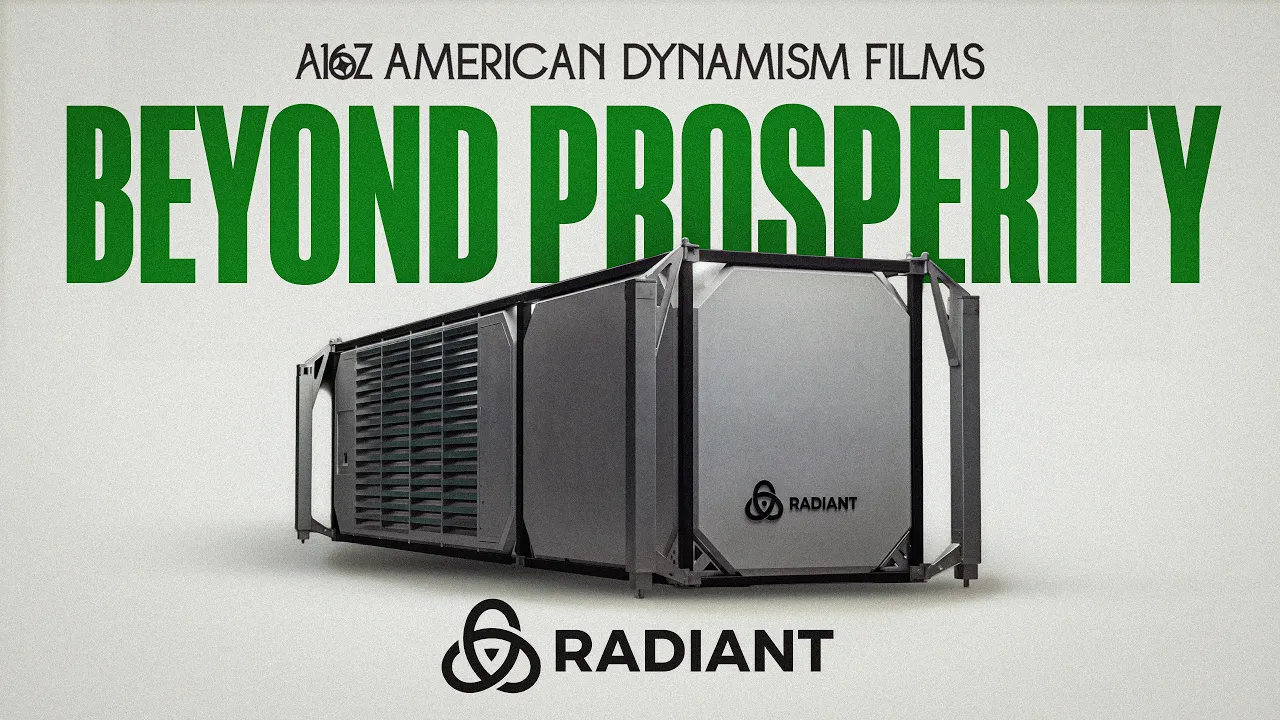
Radiant Tests Portable Microreactor to Replace Grid-Dependent Power
a16z
Mass-produced nuclear microreactors eliminate on-site construction risks to make clean energy rapidly deployable for remote infrastructure and space exploration.
## Background
Published by a16z on YouTube on August 5, 2026, this video features Radiant, a company developing portable nuclear microreactors. According to the page description, Radiant aims to deliver reliable, carbon-free power as a factory-built product to revolutionize clean energy deployment for remote communities, military operations, and AI infrastructure.
## TL;DR
Radiant is reimagining nuclear power by moving away from multi-decade civil construction projects and toward factory-built, 1-megawatt portable microreactors called Kaleidos. Founded by former SpaceX engineer Doug Bernauer, the company addresses grid vulnerabilities and national security risks by offering a clean alternative to diesel generators that can power remote locations, AI data centers, and space missions for five years continuously. Operating with an Apple-like focus on eliminating customer friction, Radiant manages all waste and refueling centrally at their facility in Oak Ridge, Tennessee. The team is currently preparing for a historic full-power test campaign at the Idaho National Laboratory, targeting a future manufacturing cadence of one reactor per week.
## Atmosphere & style
The presentation carries an ambitious, forward-looking, and technically grounded tone, driven by a vision of pioneering industrial innovation. The narrative blends the urgency of modern energy demands with the disciplined engineering mindset of SpaceX alumni, creating a sense of calculated risk-taking and momentum. Listening to the story feels like watching a historic paradigm shift unfold, bridging retro-futuristic heritage—such as testing inside a 1950s INL dome—with futuristic possibilities that extend from terrestrial grids to deep-space exploration.
## Key takeaways
- [00:03](https://www.youtube.com/watch?v=-9Vh7tsgM7Y&t=3s) Energy is the fundamental enabler of human progress, but U.S. nuclear innovation has been frozen since the late 1970s due to heavy regulation and failure to listen to market needs.
- [00:03](https://www.youtube.com/watch?v=-9Vh7tsgM7Y&t=3s) Between 1956 and 1977, Idaho National Laboratory built 52 reactors, but no advanced reactors have been constructed since that period.
- [02:05](https://www.youtube.com/watch?v=-9Vh7tsgM7Y&t=125s) Aging grid infrastructure leaves the U.S. vulnerable, with roughly 45% of Americans experiencing power outages in the past year.
- [03:49](https://www.youtube.com/watch?v=-9Vh7tsgM7Y&t=229s) Founder Doug Bernauer spent 12 years at SpaceX, where nuclear power was identified as the only viable option for producing fuel on Mars to make human life multiplanetary.
- [04:49](https://www.youtube.com/watch?v=-9Vh7tsgM7Y&t=289s) Radiant is shifting nuclear power from massive, custom on-site civil construction projects to factory-built, transportable microreactors.
- [04:49](https://www.youtube.com/watch?v=-9Vh7tsgM7Y&t=289s) Radiant's core product, Kaleidos, generates 1 megawatt of power, fits on an 18-wheeler, and provides 5 years of continuous power without refueling.
- [04:49](https://www.youtube.com/watch?v=-9Vh7tsgM7Y&t=289s) By retaining responsibility for construction, cost risks, and centralized refueling at Oak Ridge, Radiant eliminates major friction points and site contamination for customers.
- [04:49](https://www.youtube.com/watch?v=-9Vh7tsgM7Y&t=289s) Multiple Kaleidos units can be daisy-chained together to scale power output for applications like AI data centers, military operations, or small cities.
- [08:22](https://www.youtube.com/watch?v=-9Vh7tsgM7Y&t=502s) Radiant is set to test its commercial prototype at INL's historic 1950s dome at temperatures exceeding 700°C for 150 continuous hours.
- [08:22](https://www.youtube.com/watch?v=-9Vh7tsgM7Y&t=502s) Executive orders signed in May helped accelerate federal approvals, aiding Radiant's target to become the first company to turn on a brand-new commercial microreactor.
- [01:10:31](https://www.youtube.com/watch?v=-9Vh7tsgM7Y&t=4231s) Radiant aims to scale manufacturing to a cadence of producing one nuclear reactor per week.
- [01:10:31](https://www.youtube.com/watch?v=-9Vh7tsgM7Y&t=4231s) Factory-built microreactors will power remote terrestrial locations, deep sea operations, and ultimately space expansion to other stars.
## Detailed walkthrough
### [00:03](https://www.youtube.com/watch?v=-9Vh7tsgM7Y&t=3s) A Core Thesis for Nuclear Prosperity and Historical Stagnation
The foundational vision of Radiant centers on unlocking prosperity for human civilization by rendering power far more affordable and accessible. Energy is framed as the ultimate enabler of human progress and the backbone of civilization itself. However, the United States lost its capacity to iterate on nuclear power over the past several decades, primarily due to a failure to listen to customer needs and the influence of environmental advocacy groups pushing misinformation. This dynamic led to an ever-escalating ratchet of regulations that made nuclear power prohibitively expensive, effectively regulating the industry out of business.
* From 1956 to 1977, Idaho National Laboratory (INL) constructed 52 reactors over a 21-year span, but no advanced reactors have been built since.
* Nuclear technology in the U.S. remains largely frozen in the design paradigms of the 1950s and 1960s.
* Customer demand dictates mass-produced, smaller reactors to allow rapid iteration and cost control.
---
[02:05](https://www.youtube.com/watch?v=-9Vh7tsgM7Y&t=125s) Energy Grid Vulnerabilities and National Security Impasse
The current domestic energy infrastructure is severely aging, relying on a grid constructed primarily in the 1960s and 1970s that struggles to keep up with modern technological and societal demands. Operating right at the median line of necessary power limits innovation and leaves little headroom for growth, while reliance on foreign energy sources introduces major national security risks. True energy independence and security require generating clean, resilient power at scale.
* Roughly 45% of Americans experienced at least one power outage in the past year, which can be catastrophic for businesses.
* On peak days, several U.S. states drop below the minimum required power threshold to sustain innovation.
* Relying on foreign adversary nations for energy sources risks complete national shutdowns during geopolitical conflicts.
---
[03:49](https://www.youtube.com/watch?v=-9Vh7tsgM7Y&t=229s) The SpaceX Origin Story and Mars Power Mandate
Radiant founder Doug Bernauer spent roughly 12 years at SpaceX, where he focused on the challenge of making life multiplanetary by establishing a presence on Mars. Transporting Starships to Mars requires manufacturing propellant on the Martian surface, which in turn demands a massive power source. Solar power proved impractical for the task, leaving nuclear as the only viable technical solution. Bernauer felt compelled to found Radiant because SpaceX’s overarching mission could not succeed without dedicated nuclear development, and no external market solution existed.
* Doug Bernauer focuses on engineering systems and machines, paired with co-leadership (Tori Shivanandan) focused on building teams and organizational culture.
* Nuclear power is the sole enabling technology for refueling spacecraft on Mars.
---
[04:49](https://www.youtube.com/watch?v=-9Vh7tsgM7Y&t=289s) Factory-Built Reactors vs. On-Site Construction Horrors
Traditional nuclear power requires digging massive holes in the ground, exposing projects to massive cost overruns, unpredictable timelines, and permanent site contamination. Radiant shifts this paradigm by building portable reactors as factory products rather than custom civil construction projects. By taking back used units for centralized refueling in Oak Ridge, Tennessee, Radiant eliminates customer friction, on-site radioactive waste management, and site-decommissioning headaches.
* Radiant’s core product is "Kaleidos," a microreactor designed to be fully transportable by land, air, and sea.
* Customers can replace diesel generators with Kaleidos, receiving 5 years of continuous power without refueling every 8 hours.
* The system is scaled to approximately 1 megawatt, fitting within a few standard parking spaces or on the back of an 18-wheeler.
* Multiple units can be "daisy-chained" together; for example, four Kaleidos reactors can power a small city or a massive AI data center.
* Adopting an Apple-like focus on customer friction reduction ensures all construction, cost, and interconnect risks remain inside Radiant's factory.
---
[08:22](https://www.youtube.com/watch?v=-9Vh7tsgM7Y&t=502s) Testing Kaleidos at Idaho National Laboratory’s Historical Dome
Radiant is preparing to test its commercial prototype inside an iconic 80-foot diameter dome at Idaho National Laboratory—a structure built in the 1950s that originally housed the Experimental Breeder Reactor. Radiant was selected through a competitive selection process based on the maturity of its technology and planning. This full-power test campaign will mark a major historic milestone for advanced nuclear testing at INL.
* Radiant set a goal in 2020 to reach the INL test facility by 2026, scaling up from a 20-person startup to a full test partner.
* The test plan involves taking the microreactor to temperatures over 700°C ($700^\circ\text{C}$) and operating continuously for 150 hours.
* Acceleration of federal approvals was greatly aided by presidential executive orders signed in May of the previous year.
* Radiant aims to be the first company in history to turn on a brand-new commercial microreactor.
---
[01:10:31](https://www.youtube.com/watch?v=-9Vh7tsgM7Y&t=4231s) A Nuclear Renaissance and Future Beyond the Stars
Safety and financial viability are intrinsically linked for Radiant, as constructing unsafe reactors would destroy customer trust and derail the entire broader mission. The nuclear sector is entering a full-on renaissance driven by willingness to take calculated risks and demonstrate rapid deployment capability to the public. Beyond immediate terrestrial applications, factory-built reactors unlock radical possibilities across Earth, underwater, and deep space.
* Radiant envisions a future manufacturing cadence of "one nuclear reactor per week" coming off an assembly line.
* Potential extreme use cases include underwater ocean cities, remote high-altitude camps on Mount Everest, and rapidly deployed military or AI infrastructure.
* Mass-produced, ultra-reliable microreactors will ultimately allow humanity to expand beyond our solar system and travel to other stars.
## Notable quotes
> [00:03](https://www.youtube.com/watch?v=-9Vh7tsgM7Y&t=3s) The foundational vision of Radiant centers on unlocking prosperity for human civilization by rendering power far more affordable and accessible.
> [00:03](https://www.youtube.com/watch?v=-9Vh7tsgM7Y&t=3s) From 1956 to 1977, Idaho National Laboratory (INL) constructed 52 reactors over a 21-year span, but no advanced reactors have been built since.
> [00:03](https://www.youtube.com/watch?v=-9Vh7tsgM7Y&t=3s) Nuclear technology in the U.S. remains largely frozen in the design paradigms of the 1950s and 1960s.
> [02:05](https://www.youtube.com/watch?v=-9Vh7tsgM7Y&t=125s) Roughly 45% of Americans experienced at least one power outage in the past year, which can be catastrophic for businesses.
> [03:49](https://www.youtube.com/watch?v=-9Vh7tsgM7Y&t=229s) Nuclear power is the sole enabling technology for refueling spacecraft on Mars.
> [04:49](https://www.youtube.com/watch?v=-9Vh7tsgM7Y&t=289s) Radiant shifts this paradigm by building portable reactors as factory products rather than custom civil construction projects.
> [04:49](https://www.youtube.com/watch?v=-9Vh7tsgM7Y&t=289s) Customers can replace diesel generators with Kaleidos, receiving 5 years of continuous power without refueling every 8 hours.
> [08:22](https://www.youtube.com/watch?v=-9Vh7tsgM7Y&t=502s) The test plan involves taking the microreactor to temperatures over 700°C and operating continuously for 150 hours.
> [08:22](https://www.youtube.com/watch?v=-9Vh7tsgM7Y&t=502s) Radiant aims to be the first company in history to turn on a brand-new commercial microreactor.
> [01:10:31](https://www.youtube.com/watch?v=-9Vh7tsgM7Y&t=4231s) Radiant envisions a future manufacturing cadence of "one nuclear reactor per week" coming off an assembly line.
> [01:10:31](https://www.youtube.com/watch?v=-9Vh7tsgM7Y&t=4231s) Mass-produced, ultra-reliable microreactors will ultimately allow humanity to expand beyond our solar system and travel to other stars.
## Mentioned
Radiant, a16z American Dynamism, Tori Shivanandan, Doug Bernauer, Idaho National Laboratory, SpaceX, Starship, Kaleidos, Oak Ridge, Tennessee, Experimental Breeder Reactor
Radiant测试便携式微型核反应堆以替代电网依赖型电力
量产型微型核反应堆消除了现场施工风险,使清洁能源能够快速部署于偏远基础设施与太空探索。
Radiant正在重塑核能利用方式,摆脱耗时数十年之久的土木施工项目,转向工厂化制造、名为Kaleidos的1兆瓦便携式微型反应堆。该公司由前SpaceX工程师Doug Bernauer创立,旨在通过提供柴油发电机的清洁替代方案来应对电网脆弱性与国家安全风险,该方案可为偏远地区、AI数据中心和太空任务连续供电五年。Radiant像Apple一样致力于消除客户使用阻碍,在其位于田纳西州Oak Ridge的设施中集中管理所有核废料和燃料补给。该团队目前正准备在Idaho National Laboratory进行具有历史意义的全功率测试活动,未来的制造目标为每周生产一台反应堆。
能源是人类进步的根本推动力,但由于严苛监管以及未能听取市场需求,美国的核能创新自1970年代末以来一直处于停滞状态。 (0:03)
1956年至1977年间,Idaho National Laboratory共建造了52座反应堆,但自该时期以来未再建造过先进反应堆。 (0:03)
老化的电网基础设施令美国面临风险,在过去一年中约有45%的美国人经历过停电。 (2:05)
创始人Doug Bernauer曾在SpaceX工作了12年,当时核能被认定为是在火星上生产燃料以让人类成为多行星物种的唯一可行选择。 (3:49)
Radiant正在推动核能从庞大、定制化的现场土建工程项目向工厂制造、可运输的微型反应堆转变。 (4:49)
Reading summary
Radiant argues that revitalizing American nuclear power requires abandoning bespoke on-site construction in favor of factory-built microreactors. Originating from SpaceX's technical requirements for Mars exploration, the company aims to address severe domestic energy grid vulnerabilities through mass-produced, containerized power units.
Regulatory Stagnation and Modern Grid Fragility (0:03)
Radiant leadership contends that human civilization's progress depends on cheap, abundant energy, yet American nuclear innovation has remained frozen in 1950s and 1960s design concepts. Between 1956 and 1977, Idaho National Laboratory (INL) built 52 reactors, but no advanced reactors have been constructed in the decades since. The company attributes this stagnation to an escalating regulatory ratchet driven by environmental advocacy groups and an industry failure to heed customer requirements, which ultimately made traditional nuclear projects cost-prohibitive.
Simultaneously, the domestic power grid—largely built in the 1960s and 1970s—is struggling to meet modern technological requirements. According to Radiant, roughly 45% of Americans suffered at least one power outage in the past year, and several states fall below minimum power margins required to support growth on peak days. Radiant notes that operating near the margin constrains technological innovation and that relying on foreign adversaries for energy supplies creates severe national security risks.
SpaceX Origins and Factory-Built Microreactor Design (3:49)
Radiant was conceived after founder Doug Bernauer spent roughly 12 years at SpaceX evaluating power sources to produce Starship propellant on Mars. Because solar arrays proved inadequate for Martian fuel production, nuclear emerged as the sole viable solution. Finding no off-the-shelf commercial microreactors, Bernauer and co-leader Tori Shivanandan established Radiant to build portable nuclear power units.
To avoid the cost overruns, delays, and permanent site contamination common to traditional on-site civil nuclear construction, Radiant developed "Kaleidos," a factory-assembled microreactor scaled to approximately 1 megawatt. Designed to fit within a few parking spaces or on an 18-wheeler, the unit can be transported by land, air, or sea to replace diesel generators, supplying continuous power for five years. Radiant intends to retain civil construction and decommissioning risks within its own facilities by returning depleted units to a central hub in Oak Ridge, Tennessee, for refueling. Units can also be daisy-chained to power facilities such as AI data centers.
Testing the Kaleidos Prototype at INL (8:22)
Radiant is preparing to test a commercial prototype of Kaleidos inside an 80-foot-diameter dome at Idaho National Laboratory that originally housed the Experimental Breeder Reactor in the 1950s. Radiant was selected through a competitive process based on technical and planning maturity, with testing expedited by presidential executive orders signed the previous May.
Having targeted an INL test campaign since 2020, Radiant aims to become the first commercial company to activate an entirely new microreactor design. The test protocol requires taking the reactor to operating temperatures exceeding 700°C and running continuously for 150 hours to validate performance and safety systems.
Assembly-Line Production and Long-Term Applications (70:31)
Radiant positions safety as indispensable to financial survival, noting that a single catastrophic failure would destroy customer trust and derail the industry's revival. Assuming tests confirm reactor safety, the company plans to establish high-throughput manufacturing, targeting an output of one nuclear reactor per week.
Beyond domestic grid support and military installations, Radiant envisions utilizing its mass-produced microreactors for extreme environments. Proposed future use cases range from high-altitude sites and underwater ocean habitats to extraterrestrial settlements and interstellar space travel.
Radiant's commercial trajectory depends on validating its Kaleidos prototype during the planned 150-hour, 700°C test at Idaho National Laboratory. While factory assembly and centralized refueling bypass traditional civil construction bottlenecks, scaling to a weekly manufacturing cadence requires sustained regulatory momentum, flawless safety execution, and market willingness to adopt decentralized nuclear power.
[0:03] The foundational vision of Radiant centers on unlocking prosperity for human civilization by rendering power far more affordable and accessible.
[0:03] From 1956 to 1977, Idaho National Laboratory (INL) constructed 52 reactors over a 21-year span, but no advanced reactors have been built since.
[0:03] Nuclear technology in the U.S. remains largely frozen in the design paradigms of the 1950s and 1960s.
[2:05] Roughly 45% of Americans experienced at least one power outage in the past year, which can be catastrophic for businesses.
[3:49] Nuclear power is the sole enabling technology for refueling spacecraft on Mars.
[4:49] Radiant shifts this paradigm by building portable reactors as factory products rather than custom civil construction projects.
[4:49] Customers can replace diesel generators with Kaleidos, receiving 5 years of continuous power without refueling every 8 hours.
[8:22] The test plan involves taking the microreactor to temperatures over 700°C and operating continuously for 150 hours.
[8:22] Radiant aims to be the first company in history to turn on a brand-new commercial microreactor.
[70:31] Radiant envisions a future manufacturing cadence of "one nuclear reactor per week" coming off an assembly line.
[70:31] Mass-produced, ultra-reliable microreactors will ultimately allow humanity to expand beyond our solar system and travel to other stars.
Original transcript
[0:03] [music]
[0:10] We must think far beyond of what that
[0:14] nuclear power can do in terms of peace.
[0:18] Here we have a new source of energy. A
[0:21] source of energy that is absolutely
[0:22] important to the future of the world.
[0:25] That is why as far as this particular
[0:27] matter is concerned in the terms of
[0:29] nuclear power, we must not be afraid. We
[0:32] must explore it. [music]
[0:34] The core thesis of Radiant is about
[0:36] prosperity for civilization, for every
[0:39] human, which means making power more
[0:41] affordable for more people. It's really
[0:43] just about enabling humans to be even
[0:45] more human. Power is the source and it
[0:48] is civilization itself.
[1:03] The US lost its ability to iterate on
[1:06] nuclear power as a source of energy.
[1:11] That happened because we didn't listen
[1:13] to customers. And so we have to
[1:15] massproduce small reactors because
[1:17] that's what customers actually want. And
[1:20] when the US regains its ability to
[1:22] iterate on nuclear technology, the
[1:25] future of energy changes. [music]
[1:27] >> There were actually 52 nuclear reactors
[1:29] built at Ido National Laboratory in 21
[1:32] years span. The last of which [music]
[1:33] was 1977
[1:35] and none since then. There are no
[1:39] advanced reactors. Everything was done
[1:41] in the 1950s [music] and60s.
[1:43] Nuclear really got sidelined by the
[1:47] environmental advocacy groups that
[1:49] pushed misinformation on the general
[1:51] public. We just continue [music] to
[1:53] ratchet up regulations for a variety of
[1:56] reasons including some of the public
[1:58] perceptions around nuclear is my opinion
[2:01] that we regulated nuclear [music] out of
[2:03] business because we made it too
[2:04] expensive.
[2:05] >> The current state of the energy grid is
[2:08] not great and it doesn't say hey
[2:10] America's ready to build. We need energy
[2:12] for everything. And the grid we're
[2:14] building on right now is mostly created
[2:16] in the 60s and 70s.
[2:19] Technology has changed a lot. Society
[2:21] [music] has changed a lot. And it's
[2:23] starting to show that what we're
[2:25] building on is aging. About 45% of
[2:28] Americans have experienced one outage in
[2:31] the last year. For a business, that can
[2:34] be catastrophic.
[2:36] It's a really important thing for folks
[2:38] to grasp that when you [music] turn the
[2:40] lights on, it's from the 60s. We kind of
[2:44] run just at the median of the power we
[2:47] need. And on some days in many states,
[2:49] we actually dip below what we need from
[2:51] an energy [music] perspective to really
[2:53] innovate. To unlock prosperity, we have
[2:56] to get above the line of what we need.
[2:58] We have to give ourselves room to do all
[3:01] of those. And that from a national
[3:04] security perspective is what will allow
[3:06] the US to be the US we all grew up
[3:08] dreaming about. [music]
[3:11] >> Countries that rely on other nations for
[3:14] their energy have strings attached.
[3:18] When [music] there is conflict and
[3:21] energy sources are relied upon from
[3:23] other nations that have become
[3:25] adversaries, it can cause an entire
[3:27] country to shut down.
[3:30] To be able to have your own energy
[3:32] independence
[3:34] provides energy security as [music]
[3:36] well. And that is exactly what nuclear
[3:39] power can provide.
[3:49] I founded Radiant after working at
[3:51] SpaceX for about 12 years. One of the
[3:53] things I worked on was this Mars [music]
[3:55] challenge, which is to make life
[3:57] multilanetary.
[3:59] In order to really make that happen, you
[4:00] need to be able to take Starship to Mars
[4:02] and then make fuel on Mars and bring it
[4:04] back. And to do that, you need power.
[4:06] And so I looked into solar power on Mars
[4:08] and found that was really challenging.
[4:09] And then I looked into nuclear power on
[4:10] Mars and found that was the only way. I
[4:12] didn't want to found a company. I had to
[4:14] do it because I knew that the mission
[4:16] that SpaceX itself had could not be
[4:18] achieved unless we had nuclear and I
[4:20] wasn't able to work on it. So it forced
[4:22] me to found a company. Doug builds in
[4:24] machines and systems and I build in
[4:27] people and companies. The more we got
[4:30] into it, we kind of discovered together
[4:33] the impact that we could have.
[4:46] >> [music]
[4:49] >> What we want to be doing is building
[4:51] reactors, not reactor buildings.
[4:53] >> You got to dig a massive hole in the
[4:54] ground. And once you start digging a
[4:56] hole in the ground in the US, you have
[4:58] no idea how long or how expensive that
[4:59] [music] project will be. Costs are very
[5:02] hard to control. Once you make a nuclear
[5:05] reactor and a ground at a site, [music]
[5:07] that site is a radiological site for
[5:10] forever. Puspers are not super excited
[5:13] about that.
[5:17] [music]
[5:19] When Doug was designing the product, he
[5:21] said, "Well, all of these things must be
[5:22] [music] true, and therefore I have to
[5:25] make a product that is above ground,
[5:28] that is movable to where customers need
[5:30] it, and then also that they don't have
[5:32] to deal with waste on site." And so, you
[5:34] got Kidos. It's a transportable by land,
[5:37] air, and sea micro reactor. After a
[5:39] customer has used it, we take it back to
[5:41] our factory site in Oakidge, Tennessee,
[5:43] and refuel it. We handle all of the
[5:45] parts of the nuclear industry that
[5:48] customers didn't want.
[5:49] >> I always tell people when I talk about
[5:50] the kidos reactor to think of a diesel
[5:52] generator. Anywhere you'd see a diesel
[5:54] generator, you could bring in a kidos
[5:56] reactor. They're roughly the same size
[5:58] except you don't have to refill it every
[6:00] 8 hours. [music] It gives you power for
[6:02] 5 years and it provides much more power,
[6:04] many, many times more power than a
[6:06] diesel generator. And you can daisy
[6:08] chain them together. So you can bring in
[6:09] four kitus reactors and power a small
[6:12] city. [music] You could power a very
[6:14] large data center. You have all kinds of
[6:15] capabilities that come around [music]
[6:17] from something that really can be put on
[6:18] the back of an 18-wheeler. That kind of
[6:21] power generation and making it
[6:22] transportable [music] has never existed
[6:24] before. That's why I say there's
[6:25] actually use cases that we haven't
[6:27] really even imagined yet. One [music] of
[6:29] our units is 5 years of power in a box
[6:31] that just gets delivered, fits in a few
[6:33] parking spaces, and then whenever you
[6:35] want us to take it away, [music] we take
[6:36] it away, which hasn't really done
[6:39] before. It's only possible if you make a
[6:40] size about 1 megawatt, right? make a
[6:42] small [music] enough reactor, you can do
[6:43] this, transport it there and back again
[6:46] sort of trick and take the fuel back and
[6:48] so you have like no nuclear strings
[6:50] attached, you can [music] just have
[6:51] clean power. So for national security,
[6:53] we also don't know where we might need
[6:55] power sources to be set up. So if you
[6:56] need to rapidly deploy AI, you need to
[6:59] rapidly deploy drones, you need to
[7:00] rapidly put something somewhere, it
[7:03] needs to come with power. And if you're
[7:04] not on a grid, you need to bring the
[7:06] grid with you in a box. [music]
[7:08] When you're building a commercial
[7:09] product, you have to have the same
[7:12] desire [music] to lower customer
[7:14] friction as Apple did with the iPhone.
[7:16] With nuclear reactors, that might sound
[7:18] wild, but it's an absolute necessity. We
[7:21] have to control all of our costs [music]
[7:23] inside our factory, and we can't put any
[7:26] of that burden onto our customer. We
[7:28] can't put any of the burden of the
[7:30] construction on site, [music] the
[7:32] interconnect onto them. We really need
[7:34] to make it as simple as make a reactor.
[7:37] It shows up, it plugs in, you get power.
[7:40] [music and snorts]
[7:43] >> If you can change that dynamic to
[7:45] factory build, you take those
[7:47] uncertainties off the table. You might
[7:50] translate a little or some part of those
[7:52] uncertainties to building your factory
[7:53] and your entire process, [music] but
[7:55] once you've done that, you're done. If
[7:57] you're successful, then you can just
[7:58] start turning out that commodity.
[8:00] [snorts] And your customer then has a
[8:02] much much lower potentially even almost
[8:05] zero uncertainty in their cost in their
[8:08] on-site activities or just completely
[8:10] produced.
[8:13] That is a tremendous promise of
[8:15] factorybuilt nuclear.
[8:22] We're taking this unit to the dome which
[8:24] [music] is this 80 foot diameter
[8:26] structure that was built in the 50s. It
[8:28] actually had the experimental breeder
[8:29] reactor in it at Idaho National
[8:31] Laboratory. Since 2020, we've been on
[8:33] target for going there by 2026 [music]
[8:35] and then we'll go critical. The system
[8:38] is designed to go to over 700° C [music]
[8:40] and then we'll run for 150 hours
[8:42] continuously.
[8:44] >> That dome was going to be torn down and
[8:46] ultimately was repurposed for this
[8:48] purpose that now enables Radiant to be
[8:51] the first company that comes in [music]
[8:53] that was selected through a competitive
[8:55] process. Radiant was selected.
[8:58] Simplistically speaking, the maturity of
[9:00] their technology, the maturity of their
[9:02] planning, [music] the benefits of that
[9:05] test are going to be in terms of a full
[9:07] power test over a significant period of
[9:09] time, which will be our first full power
[9:11] test [music] at the laboratory in a
[9:13] very, very long time.
[9:15] When Radiant first started talking to
[9:18] ENL about testing in the dome, we were I
[9:21] think somewhere around 20 employees and
[9:24] we said four years from now, we're going
[9:26] to build a commercial prototype of our
[9:28] reactor and we're going to test [music]
[9:29] it in that facility. And they said,
[9:32] well, we're going to have to build out
[9:34] that facility, too, and you're 20
[9:36] people. And so there's a lot of faith
[9:38] and trust [music] and process that we
[9:39] put in the way as we were developing
[9:41] both the product itself as well as the
[9:44] full test campaign, the test facility.
[9:46] And really through all of that is where
[9:48] we developed [music] the partnership.
[9:50] >> The executive orders that our president
[9:52] signed May [music] of last year
[9:54] accelerated everything. And so that is a
[9:57] critical component that has helped make
[9:59] this possible. As a number of companies
[10:01] [music] race, nobody has turned on a new
[10:04] commercial micro reactor ever before.
[10:07] And Radiant's going to be the first to
[10:08] do that.
[10:13] [music]
[10:22] [music]
[10:31] We don't design, build, and execute on
[10:33] safe reactors.
[10:35] >> [music]
[10:35] >> No one's going to buy them. We are a
[10:38] company that needs to make money. We are
[10:40] in the United States. Making money is
[10:42] pretty important to sustain to build out
[10:44] the full mission. If we were a cavalier
[10:47] and how we built even the prototype, we
[10:49] put the future at risk and our customers
[10:51] at risk in a way that is almost
[10:53] completely perverse to what the
[10:54] mission's goal is. [music]
[10:58] >> What's happening in nuclear right now is
[11:00] unbelievable for somebody like me who
[11:02] has spent my entire career in nuclear. I
[11:04] believe we're in a full-on renaissance.
[11:08] >> The world is watching, but the world is
[11:10] waiting.
[11:12] And there are many companies that want
[11:14] to deploy, but they just don't want to
[11:16] be first. And Radiant is willing to be
[11:18] first [music] and has the courage to
[11:20] take those calculated risks and then
[11:22] demonstrate to the world, not only the
[11:24] public, that's an important [music]
[11:26] point, that you demonstrate to the
[11:27] public, that this can be done and it can
[11:29] be done quickly. I love the idea of one
[11:32] nuclear [music] reactor per week just
[11:33] coming off of a production line. We'll
[11:35] be able to just plug in a nuclear power
[11:36] module to any of their designs and then
[11:38] [music] proliferate our use of power in
[11:41] space.
[11:42] Maybe make a city on the bottom of the
[11:44] ocean. [music] Maybe put a reactor at
[11:46] that high up camp on Mount Everest. Just
[11:49] put [music] power in places that today
[11:50] seem totally crazy and impossible.
[11:53] >> Nothing we're trying [music] to do at
[11:55] Radiant is considered reasonable. We're
[11:57] an energy company at our core. We want
[12:00] to change society's relationship to
[12:02] energy. [music] You don't do that by
[12:05] doing a slightly different version of
[12:06] something that's always been done. You
[12:08] have to come out with a kind of
[12:09] ridiculous stance and really drive in
[12:13] that direction to accomplish it. [music]
[12:15] >> Nuclear micro reactors that are
[12:17] mass-produced, that are reliable in the
[12:19] most wild scenario enables humans to
[12:22] leave the star that we were born [music]
[12:23] at, the sun, and go to other ones.
[12:27] And it's imperative that we do it as a
[12:28] civilization.
[12:31] [music]
[12:37] [music]