Ulysses Deploys Modular Ocean Drones to Cut Subsea Defense Costs
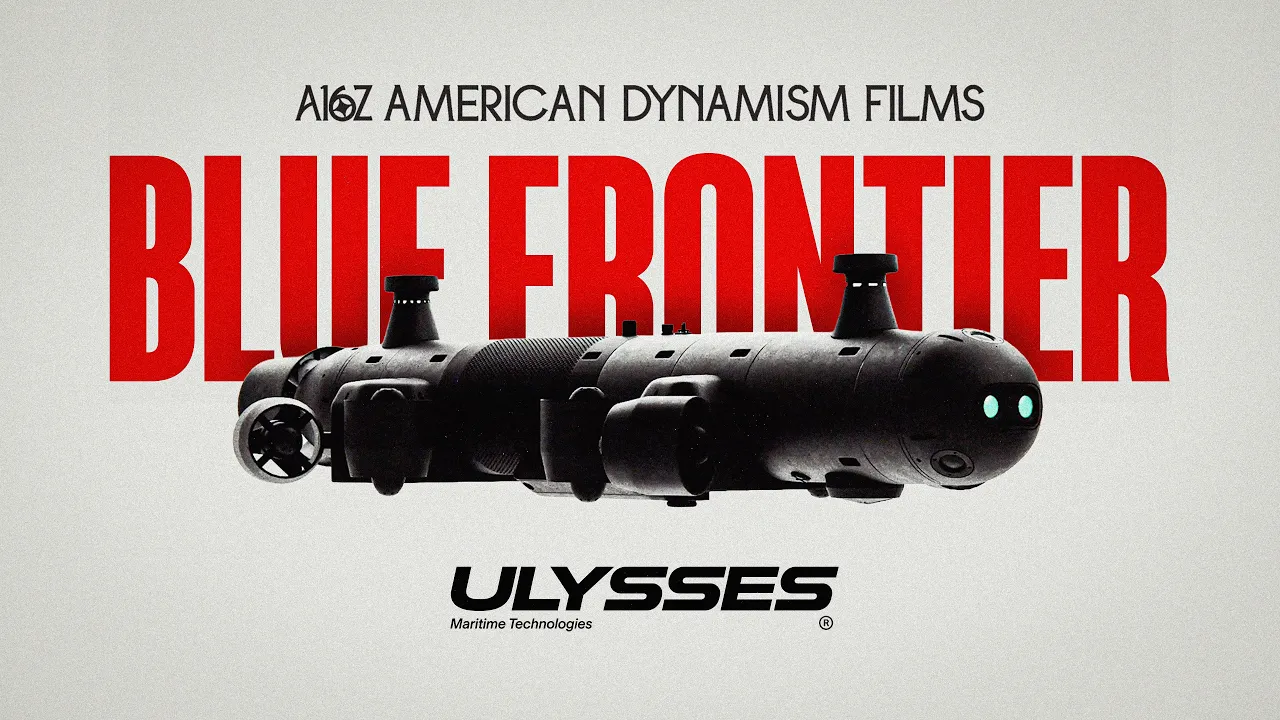
a16z
The AI-driven surge in subsea energy and communications demands low-cost, continuous underwater robotics to replace legacy defense systems and secure vulnerable maritime infrastructure.
AI-assisted summary of The Ocean Company - Ulysses | a16z American Dynamism — original source. Check the original for full context.
Source published:
Detailed notes
## Background Published on YouTube by a16z on August 5, 2026, this video showcases Ulysses, an underwater robotics company featured on the American Dynamism platform. According to the page description, the company is building autonomous subsea vehicle fleets to serve as a technology platform for ocean ecosystem restoration, critical infrastructure inspection, and maritime defense.
## TL;DR Ulysses was founded three years ago to scale marine conservation—starting with automated seagrass restoration—before expanding into subsea infrastructure and national security. To overcome the high cost and reliability issues of off-the-shelf unmanned underwater vehicles, the team developed a custom, highly modular hardware architecture built for rapid field swapping and extreme seawater durability. Driven by the AI supercycle's demand for subsea cables, energy, and minerals, as well as a military shift toward low-cost, asymmetric drone fleets, Ulysses is scaling hardware production rapidly. Their long-term vision is to become 'The Ocean Company,' deploying persistent 24/7 autonomous subsea constellations analogous to modern satellite networks.
## Atmosphere & style The video carries an ambitious, mission-driven atmosphere that blends high-stakes technological optimism with grounded engineering pragmatism. It conveys a clear sense of urgency surrounding geopolitical security and climate resilience, contrasting harsh ocean realities with innovative solutions. The narrative feels forward-looking and gritty, framing the deep sea as humanity's final frontier while evoking the bold, hardware-centric ethos of pioneering aerospace companies.
## Key takeaways - [00:06](https://www.youtube.com/watch?v=Iy1W8vOxv5o&t=6s) The ocean remains largely unexplored, yet subsea demand for cables, critical minerals, and offshore energy is rapidly expanding due to the AI supercycle. - [00:06](https://www.youtube.com/watch?v=Iy1W8vOxv5o&t=6s) Ulysses envisions an autonomous subsea transition over the next 10 to 15 years, similar to self-driving cars on land and drones in the air. - [00:06](https://www.youtube.com/watch?v=Iy1W8vOxv5o&t=6s) High demand for subsea autonomous platforms across commercial and defense sectors has made the company severely supply-limited rather than demand-limited. - [00:20](https://www.youtube.com/watch?v=Iy1W8vOxv5o&t=20s) Rising geopolitical tensions emphasize the need to protect vulnerable subsea infrastructure like shipping lanes, pipelines, and communications cables. - [00:20](https://www.youtube.com/watch?v=Iy1W8vOxv5o&t=20s) Ulysses has developed autonomous drones capable of detecting and disarming subsea explosive mines in high-risk zones. - [00:20](https://www.youtube.com/watch?v=Iy1W8vOxv5o&t=20s) Modern asymmetric warfare is shifting defense strategy from high-cost legacy systems toward scalable, low-cost autonomous drone fleets. - [00:40](https://www.youtube.com/watch?v=Iy1W8vOxv5o&t=40s) Ulysses originated from a need to mechanize seagrass restoration after existing UUV options proved astronomically expensive. - [00:40](https://www.youtube.com/watch?v=Iy1W8vOxv5o&t=40s) To survive harsh ocean conditions and iterate rapidly, Ulysses brought mechanical machining in-house and engineered a custom modular hardware architecture. - [00:40](https://www.youtube.com/watch?v=Iy1W8vOxv5o&t=40s) Vehicles feature standardized module interfaces allowing custom field reconfiguration with extra batteries, thrusters, or sonar arrays within 20 minutes. - [00:07](https://www.youtube.com/watch?v=Iy1W8vOxv5o&t=7s) The long-term vision is a permanent 24/7 autonomous subsea vehicle network operating as persistent ocean infrastructure similar to satellite constellations. - [00:07](https://www.youtube.com/watch?v=Iy1W8vOxv5o&t=7s) Operating as "The Ocean Company," Ulysses aims to replicate SpaceX's impact on spaceflight within the maritime domain.
## Detailed walkthrough ### [00:06](https://www.youtube.com/watch?v=Iy1W8vOxv5o&t=6s) The Oceans as the Next Frontier for Robotics
The ocean remains an overwhelming mystery despite humanity's technological progress. Historical commentary notes that thousands of fleets sweep across the sea in vain, and humanity still knows far less about the deep oceans from which we originated than about the skies above. Ulysses was founded three years ago with a mission to change this dynamic by leveraging advanced underwater robotics. While the company initially set out to solve a specific problem—massively scaling up underwater ecosystem restoration—the founders quickly realized that almost every aspect of human ocean activity requires scaling. High costs and technical difficulty have long been severe limiting factors across natural conservation, offshore industry, and defense.
Driven by the modern AI supercycle, subsea demand is surging across multiple sectors simultaneously. The expansion of AI requires more subsea communications cables, critical minerals, and offshore energy—resources for which the ocean is a primary provider. Ulysses envisions that within 10 to 15 years, autonomous robots will manage every operational domain, echoing the transition already seen with self-driving cars on land and delivery drones in the sky. Demand for these subsea platforms has exploded across both commercial and defense sectors, creating a market where the company is severely supply-limited rather than demand-limited. Clients are clamoring for reliable, cost-effective vehicles that can be deployed at a meaningful scale.
- The global ocean remains largely unexplored, yet demands on its resources are rapidly expanding. - Subsea cables, energy extraction, and critical mineral mining are facing unprecedented demand due to the AI supercycle. - Ulysses aims to shift the ocean domain toward autonomous operation, mirroring autonomous vehicle adoption on land and in the air.
[00:20](https://www.youtube.com/watch?v=Iy1W8vOxv5o&t=20s) Geopolitical Realities and Asymmetric Maritime Warfare
Geopolitical tensions are reshaping ocean security, bringing subsea infrastructure into the global spotlight. Media reports highlight volatile maritime hotspots like the Strait of Hormuz, where news outlets have questioned whether crucial shipping lanes can be kept clear of naval mines. In response to these vulnerabilities, Ulysses has developed autonomous drones engineered to detect and disarm subsea explosive mines. Beyond mine countermeasures, subsea cables face threats of tapping or sabotage, and offshore pipelines remain exposed to deliberate attacks. While maritime workers have long recognized these vulnerabilities, rising oil prices and supply chain disruptions are finally bringing subsea risks to mainstream public awareness.
At the same time, the fundamental nature of warfare is shifting away from traditional, centralized command structures toward distributed, autonomous systems. Over the past 50 years, the U.S. military invested heavily in exquisite, high-cost defense systems that are no longer sufficient for future conflicts. Modern warfare is increasingly asymmetric, allowing small, inexpensive unmanned systems to neutralize multi-million-dollar high-value assets—a trend vividly demonstrated in recent land and sea conflicts such as Ukraine. Achieving sea control requires low-cost, scalable underwater drones that can operate continuously in hostile environments.
- NewsNation coverage highlights Ulysses' capability to detect and disarm subsea mines in high-risk zones like the Strait of Hormuz. - Emerging maritime threats include subsea cable tapping, pipeline sabotage, and naval mine placement. - U.S. defense strategy is pivoting from high-cost, exquisite legacy systems toward scalable, low-cost autonomous drone fleets.
[00:40](https://www.youtube.com/watch?v=Iy1W8vOxv5o&t=40s) From Seagrass Restoration to Modular Hardware Engineering
Ulysses originated from a remarkably simple observation off the stormy coast of Scotland. Co-founder Jamie Wedderburn was walking with a friend involved in marine conservation who explained that seagrass restoration was still done manually—boating out in awful, rainy weather and throwing handfuls of seeds over the side of a boat. The founders realized this process could be mechanized and initially set out to build seed-planting attachments for existing underwater vehicles. However, when researching off-the-shelf unmanned underwater vehicles (UUVs), they found the commercial options astronomically expensive—costing orders of magnitude more than their custom attachments—making existing platforms totally unfeasible for widespread use.
``` +-----------------------------------------------------------------------+ | Ulysses Modular Architecture | +-----------------------------------------------------------------------+ | [ Sensor / Sonar Module ] <---> [ Core Battery ] <---> [ Thruster ] | | | | Standardized Module Connection: | | * 2 Pairs of Power Pins (Full Battery Voltage) | | * High-Speed Data Connector | | * 20-Minute Field Swap Capability | +-----------------------------------------------------------------------+ ```
To solve the cost and reliability challenge, Jamie applied his background in aerial drones to design a custom marine robotics architecture from the ground up. Operating in seawater presented extreme engineering challenges, as salt water is inherently corrosive and constantly threatens to flood internal electronics—as the team puts it, "the ocean is always trying to kill you." To rapidly iterate against these harsh conditions, Ulysses brought all mechanical machining in-house, enabling engineers to design a part one day, fabricate it the next, and test it immediately in real water. Listening to customer feedback, they prioritized extreme hardware modularity:
- Every module utilizes a standardized interface featuring two pairs of power pins delivering full battery voltage alongside a central data connector. - Vehicles can be custom-configured in the field within 20 minutes, allowing operators to add extra battery packs, additional thrusters for steerability, or multi-beam echo sounders and sonar arrays. - Rapid real-world water testing provides superior feedback compared to digital simulations, taking advantage of open ocean access to iterate faster than aerospace hardware companies.
[00:07](https://www.youtube.com/watch?v=Iy1W8vOxv5o&t=7s) Building the Infrastructure of the World's Oceans
The ultimate vision for Ulysses is to establish a permanent, interconnected network of surface and undersea autonomous vehicles operating 24/7 across the globe. Rather than deploying robots for single, temporary missions, Ulysses is building subsea robotics into persistent infrastructure—creating an underwater layer equivalent to the satellite constellations operating above Earth. By fundamentally changing how humans monitor and interact with marine ecosystems, the company aims to solve critical defense, industrial, and environmental challenges simultaneously.
Reflecting on humanity's deep biological connection to the sea—referencing the historical observation that human blood contains the exact same percentage of salt as the ocean—the team views the sea as the planet's last great frontier. Ulysses explicitly adopts the moniker "The Ocean Company," aiming to achieve for maritime space what SpaceX accomplished for spaceflight. Within 5 to 10 years, the company intends to become synonymous with ocean technology, building massive, continuous fleets that enable humanity to responsibly utilize subsea resources while actively restoring marine environments.
- The ultimate operational goal is a 24/7 autonomous network of surface and subsea vehicles acting as fixed ocean infrastructure. - Ulysses aims to become "The Ocean Company," mirroring SpaceX's role in the space industry. - Strategic focus remains on operating continuous fleets that handle ecosystem restoration, infrastructure inspection, and maritime defense simultaneously.
## Notable quotes > [00:06](https://www.youtube.com/watch?v=Iy1W8vOxv5o&t=6s) thousands of fleets sweep across the sea in vain, and humanity still knows far less about the deep oceans from which we originated than about the skies above.
> [00:40](https://www.youtube.com/watch?v=Iy1W8vOxv5o&t=40s) the ocean is always trying to kill you.
> [00:07](https://www.youtube.com/watch?v=Iy1W8vOxv5o&t=7s) human blood contains the exact same percentage of salt as the ocean
## Mentioned Ulysses, Jamie Wedderburn, Will O'Brien, Akhil Voorakkara, a16z, American Dynamism, NewsNation, SpaceX, Strait of Hormuz, Scotland, U.S. Military
[Source](https://www.youtube.com/watch?v=Iy1W8vOxv5o)