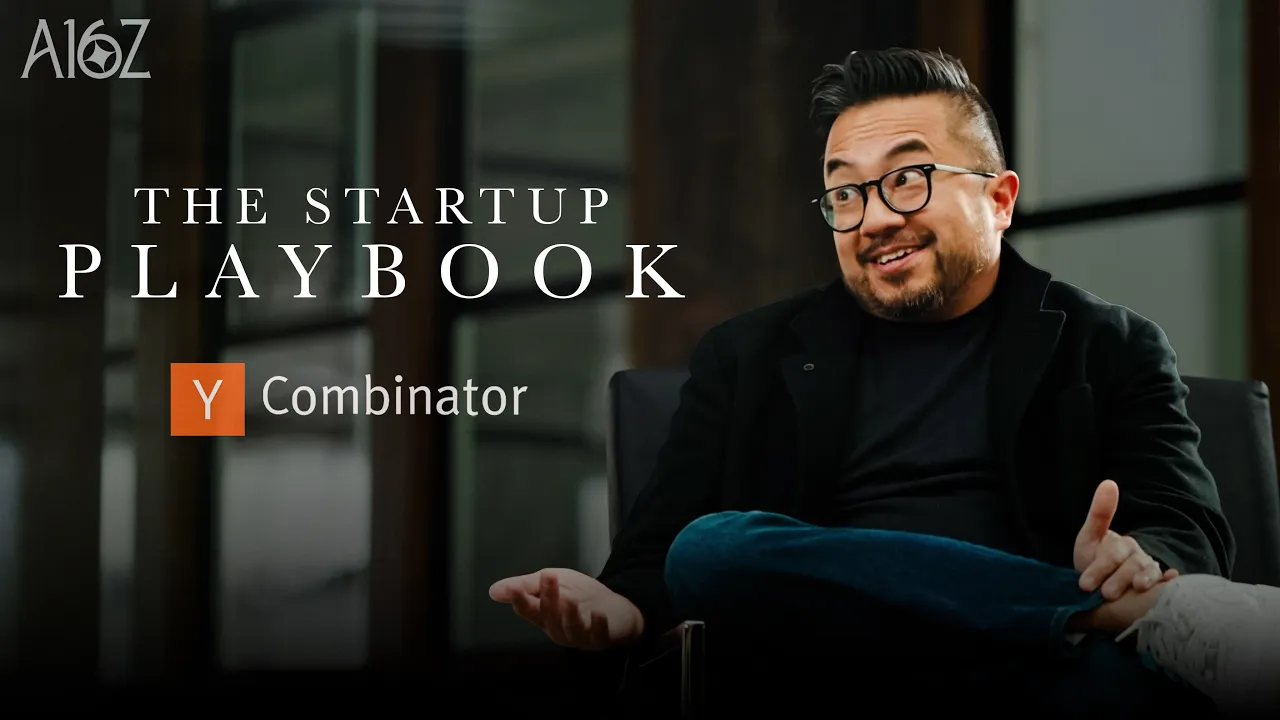
Y Combinator's Garry Tan Sees AI Agents Replacing SaaS and Middle Management
a16z
Autonomous AI agents and extreme compute consumption will render per-seat SaaS models obsolete and eliminate corporate bureaucracy by allowing solo founders to operate at the scale of 400-person organizations.
## Background
Published on YouTube by a16z on August 12, 2026, this conversation features host Anish Acharya and Y Combinator CEO Garry Tan. According to the page description, they discuss how AI is rewriting the startup playbook, why founders should be more ambitious, and lessons learned from Garry's two decades of Silicon Valley booms, busts, and missed opportunities.
## TL;DR
Garry Tan reflects on his early career mistakes—such as passing on Palantir to pursue corporate promotions—and explains how founders can avoid conventional hype by focusing on earnest obsessions. He details how AI agents, 'token maxing,' and 'vibe coding' allow solo founders or tiny teams to operate with the leverage of hundreds of employees, fundamentally altering traditional SaaS business models. The discussion also explores the future of consumer AI hardware, the slowness of societal adoption as a buffer for labor disruption, and Garry's active involvement in reforming San Francisco local politics.
## Atmosphere & style
The conversation carries an intimate, highly candid, and intellectual tone between two veteran Silicon Valley insiders reflecting on their past missteps with genuine humility. The host-guest dynamic feels conversational and energetic, blending tactical technical insight with philosophical reflections on human leverage and civic responsibility. Watching or listening feels like eavesdropping on a late-night fireside chat between seasoned founders who are deeply pragmatic about technology yet fiercely optimistic about building the future.
## Key takeaways
- [02:36](https://www.youtube.com/watch?v=fsTtKywmWlU&t=156s) Chasing industry hype or what is perceived as 'hot' can lead founders to miss major foundational shifts that align with their own earnest skills.
- [04:45](https://www.youtube.com/watch?v=fsTtKywmWlU&t=285s) Revolutionary technology and breakthrough trends consistently originate from outsider subcultures and earnest obsessions that are initially dismissed as mere toys.
- [07:04](https://www.youtube.com/watch?v=fsTtKywmWlU&t=424s) Prioritizing safe corporate status over high-upside opportunities with exceptional talent can lead to massive opportunity costs.
- [10:59](https://www.youtube.com/watch?v=fsTtKywmWlU&t=659s) Y Combinator acts as an equalizer for tech outsiders by replacing traditional gatekeeping with transparent, execution-focused selection.
- [14:50](https://www.youtube.com/watch?v=fsTtKywmWlU&t=890s) Agentic workflows and 'vibe coding' allow solo founders and tiny teams to operate with the leverage and output of hundreds of traditional employees.
- [14:50](https://www.youtube.com/watch?v=fsTtKywmWlU&t=890s) The traditional per-seat SaaS business model is losing long-term viability unless supported by deep data moats or network effects.
- [21:05](https://www.youtube.com/watch?v=fsTtKywmWlU&t=1265s) 'Token maxing'—spending heavily on continuous, max-context AI compute—allows founders to operationalize high-level cognitive leverage and live in the future today.
- [21:05](https://www.youtube.com/watch?v=fsTtKywmWlU&t=1265s) Codifying workflows into Markdown skill files creates automated 'employees' that run complex business loops reproducibly.
- [29:58](https://www.youtube.com/watch?v=fsTtKywmWlU&t=1798s) Agents unbundle constructive conflict and enable direct organization-wide visibility, overcoming traditional human memory and managerial limitations.
- [36:07](https://www.youtube.com/watch?v=fsTtKywmWlU&t=2167s) Mid-level corporate bureaucracy is being replaced by agentic system loops that resolve dependencies and manage workflows programmatically.
- [39:08](https://www.youtube.com/watch?v=fsTtKywmWlU&t=2348s) Institutional and social slowness will buffer the economic displacement of AI, giving society time to safely adopt the technology over decades.
- [41:33](https://www.youtube.com/watch?v=fsTtKywmWlU&t=2493s) Plummeting frontier compute costs will spark 'harness wars' and usher in a new era of deeply personalized consumer AI assistants.
- [44:50](https://www.youtube.com/watch?v=fsTtKywmWlU&t=2690s) Tech leaders and local communities must actively engage in civic activism and hold institutions accountable to fix local urban dysfunction.
## Detailed walkthrough
### [00:00](https://www.youtube.com/watch?v=fsTtKywmWlU&t=0s) Intro & The 2003 Tech Bust: "Chasing What Was Hot"
Opening with a reflection on the ethos of tech, Garry Tan notes that while a true utopia may never be achieved, attempting to build one is worth every effort. Reflecting on organizational speed, he recalls having to personally walk over to Microsoft's Windows team with a metaphorical "baseball bat" because they refused to reply to emails or fix critical bugs—arguing that while a massive corporation like Microsoft cannot move fast, startups can and must.
Transitioning to his early career in 2003 right after graduating from Stanford, Garry describes a deeply bleak moment in Silicon Valley. Web 1.0 had just collapsed, the Nasdaq had crashed, and the job market in the Bay Area was practically dead. burdened with student loans, Garry's only local prospect was Gap IT, leaving him with just two real job offers: Microsoft (working on Windows Mobile) and Expedia. At the time, working in tech or starting a company held zero social status. Garry considers one of his biggest regrets to be chasing what was perceived as "hot" (mobile) rather than staying true to what he already knew and loved (web engineering). Around 2003, Mark Zuckerberg was building Facemash and Facebook didn't even exist yet. By abandoning web development right when the public declared the web "dead," Garry missed the ground floor of Web 2.0 and social media—a domain where he already had a five-year head start over most people.
- **Economic Reality (2003):** Post-dot-com crash Bay Area job market was so severely depleted that working at Gap IT was one of the few local options available.
- **Job Offers:** Garry chose Microsoft's Windows Mobile team over Expedia despite a $70,000 starting salary and a deep desire to build web software.
[02:35](https://www.youtube.com/watch?v=fsTtKywmWlU&t=155s) "Don't LARP": Earnestness, Courage, and First-Principles Thinking
Garry contrasts chasing hype with his core advice for founders at Y Combinator's Startup School: "Don't LARP" (Live Action Role-Play). He explains that genuine success stems from earnestness and courage rather than following crowd consensus or headline trends. Naive founders constantly ask investors, "What's hot and what should I work on?"—which is fundamentally the wrong question. Instead, founders must look at their own direct, first-principles experience and ask, "What am I uniquely obsessed with?"
Anish Acharya notes that earnestness is often mistaken for naivety, but it is actually a mark of maturity and courage. Garry admits he is "doomed to be the first-principles storyteller" of his own past mistakes so that younger founders can avoid the same traps. When founders rely on industry blog posts, news, or VC "maps" rather than observing the actual territory in front of them, they trade unique, secret knowledge for conventional wisdom that is usually outdated or wrong.
- **The Core Anti-Pattern:** Asking "What's hot?" instead of identifying unique personal insights or strange, earnest obsessions.
- **First-Principles Concept:** Viewing the world like an experimental scientist who talks directly to primary sources to uncover hidden truths ("gnosis").
[04:45](https://www.youtube.com/watch?v=fsTtKywmWlU&t=285s) Silicon Valley Culture: The Fringe, Toys, and Finding Your Tribe
Discussing Silicon Valley's current culture, Garry acknowledges that while competition is stiffer than ever, founders often spend too much effort on distribution rather than exploring the "idea maze." Citing insights from Chris Dixon, Garry points out that the most revolutionary tech trends always start out on the weird, fringe edges—frequently dismissed as mere "toys." He points to the early personal computer movement, where the founders were not high-status insiders, but rather "fringe weirdo punks" tinkering in places like the Homebrew Computer Club.
Anish highlights how the internet native generation can now find their niche "tribe" or community almost instantly—whether on Reddit, X (formerly Twitter), or sub-communities like "Teapot"—whereas in previous decades, kids had to wait until college to find like-minded people. Garry agrees that finding a small, hyper-dedicated group of people who share a niche obsession is one of the most powerful aspects of modern internet culture.
- **Historical Pattern:** Breakthrough technology consistently originates from outsider subcultures working on things that mainstream society considers useless toys.
- **Community Acceleration:** Online platforms allow founders and builders to find specialized "tribes" instantly rather than relying on geographic or institutional proximity.
[07:04](https://www.youtube.com/watch?v=fsTtKywmWlU&t=424s) Passing on Palantir: A $2–4 Billion Mistake
Garry shares a candid story about turning down an early opportunity to join Palantir Technologies. His Stanford Phi Kappa Psi fraternity brothers, Joe Lonsdale and Stephen Cohen, were intern analysts at Peter Thiel's hedge fund. When founding Palantir, Thiel instructed them to write down a list of the smartest people they knew to recruit. Joe and Stephen flew up to Seattle to recruit Garry away from Microsoft.
During dinner, Peter Thiel offered Garry a $70,000 check on the spot to match his Microsoft salary and join as an early team member. Garry turned Thiel down, explaining that he was on track to get promoted to "Level 60" at Microsoft that year—a promotion he did get, but one he now calls a "$2 billion to $4 billion mistake." He fell into the same trap as before: optimizing for external status and safe corporate maps rather than looking at the raw talent in front of him. Joe Lonsdale, Stephen Cohen, Peter Thiel, and later Alex Karp recognized that Washington D.C. and government agencies lacked access to elite Silicon Valley computer science talent. Garry notes that this realization taught him a core lesson: "Everything that's awesome in my life is kind of a cult" that starts with an earnest truth that flies directly in the face of orthodoxy.
- **The Palantir Offer:** $70,000 cash check offered directly by Peter Thiel to leave Microsoft.
- **The Opportunity Cost:** Passed on multi-billion-dollar early equity in Palantir to secure a corporate "Level 60" promotion at Microsoft.
- **Key Insight:** Elite engineering capabilities in Palo Alto were completely unavailable to government defense and intelligence agencies at the time.
[10:59](https://www.youtube.com/watch?v=fsTtKywmWlU&t=659s) Y Combinator: A Tech "Birthright" for Outsiders
Anish and Garry explore how Silicon Valley transforms outsiders into insiders, pointing to Y Combinator as the ultimate engine for this transition. Garry credits YC co-founders Paul Graham, Jessica Livingston, Trevor Blackwell, and Robert Morris for dismantling the old "scenester" dynamic. Historically, breaking into Silicon Valley required attending elite universities, knowing the right network, and getting invited to exclusive private parties.
YC disrupted this by replacing gatekeeping with a simple website form, 12 questions, and a 1-minute video, giving builders worldwide a fair shot based strictly on execution and ideas. Garry notes that all 16 current YC group partners (including himself) are former YC alumni who built successful companies. Describing YC's annual Startup School—which recently brought 7,000 founders to San Francisco—he calls YC a "birthright for tech outsiders." Beyond funding, YC provides a safe peer network where founders can drop the performative "killing it" facade and get honest support on their hardest days.
- **Scale of Community:** 7,000 founders gathered in San Francisco for YC's Startup School, drawing comparison to the scale of a Roman Colosseum.
- **YC Partner Model:** 16 equal partners, all of whom are former YC alumni who went through the program themselves.
[13:54](https://www.youtube.com/watch?v=fsTtKywmWlU&t=834s) Rethinking Team Dynamics: From Co-Founder Cults to Solo Founders
Anish asks about historical surprises regarding founder archetypes and team setups. Garry notes that the industry is in the midst of a massive structural shift regarding how startups are built. Traditionally, YC strongly favored co-founding teams, believing that a startup functions like a nascent cult—and a single person standing alone in a field dancing is just viewed as a "crazy person" (referencing Derek Sivers' famous TED talk), whereas the second person joining turns it into a movement.
- **Team Dynamics:** While having co-founders remains net-positive for emotional resilience and execution, modern AI tooling is rapidly challenging the assumption that a solo founder cannot build a massive enterprise alone.
[14:50](https://www.youtube.com/watch?v=fsTtKywmWlU&t=890s) The Shift from Pure SaaS to 400x Super-Founders
Anish Acharya and Garry Tan discuss how the rapid emergence of "vibe coding" and agentic workflows allows a single person to leverage the output of **400 people** compared to where they were just months prior. Garry emphasizes that founders must be vastly more ambitious today because the old playbook no longer works. The traditional per-seat SaaS business model is fading fast; while useful as an initial wedge, pure SaaS won't survive long-term without an underlying data moat or network effects. Garry contrasts this with two years ago, when SaaS revenue multiples (10–20x) were considered an iron law in Silicon Valley.
Anish highlights that code is no longer precious, freeing builders from the rigid, self-important mindset previously required to ship software. Garry shares how he began "messing around" with projects like G Stack and G Brain after seeing peers like Boris Cherny code again. He recalls analyzing recordings of YC office hours to identify the rhetorical patterns YC partners use to elevate founder ambition.
- **400x Productivity Multiplier:** AI agents and vibe coding allow individual founders to do the work of entire teams.
- **SaaS Business Model Shift:** Per-seat SaaS is losing its long-term viability unless paired with deep data moats or network effects.
- **Devaluation of Code:** Generating code is no longer the bottleneck, allowing founders to build and test ideas far more fluidly.
- **YC Office Hours Prompting:** Garry created a Markdown script based on YC partner advice that boosts founder ambition, but had to "reduce the strength and intensity of this prompt by 90%" before open-sourcing it to preserve YC's core value.
- **YC Application Easter Egg:** Deep within his open-source code, Garry embedded a call to action asking top-tier Claude Code power users to apply to YC.
---
[18:43](https://www.youtube.com/watch?v=fsTtKywmWlU&t=1123s) Developing Intuition, Taste, and Agency through Hands-On Building
Anish and Garry discuss the importance of using every new model to build trivial projects simply to gain intuition for the technology. Garry explains how modern agentic workflows eliminate traditional overhead like writing PRDs or managing QA loops—letting creators run `/qa` commands or maintain 90% test coverage automatically.
The conversation turns to whether "agency" and "taste" are innate traits or skills that can be cultivated. Responding to a point previously made by Nikita Bier regarding how the same top 20% of creators still dominate despite democratized tools, Garry describes himself as a "late bloomer." He points to his own past missteps—such as turning down Palantir or briefly stepping away from web development—as evidence that agency and taste are muscle-memory skills built through trial, error, and introspection.
- **Eliminating Bureaucracy:** Modern coding agents handle QA, unit testing, and edge-case testing without needing dedicated PMs or QA engineers.
- **Cultivating Agency:** Garry argues agency is learned through practice and reflecting on mistakes rather than being purely inborn.
---
[21:05](https://www.youtube.com/watch?v=fsTtKywmWlU&t=1265s) Token Maxing, Markdown Employees, and Living in 2028
Garry breaks down how he builds "business loops" into his workflows. By running tools like OpenClaw and Hermes Agent with massive context windows (loading 800,000 to 1,000,000 tokens per request), founders can operate at a higher cognitive level. Although "token maxing" can cost $50,000 to $100,000 per year in compute fees to keep agents operating at full capacity, Garry argues it effectively allows a CEO or founder to "live in 2028 today."
In this new paradigm, **"a markdown file is an employee."** Founders can execute a complex business process once, refine the trace, and codify the instructions into a `skill.md` file backed by code and cron jobs. This turns any operational workflow—whether in engineering, sales, marketing, or support—into an infinitely repeatable, perfectly executed system.
- **Token Maxing:** Spending $50k–$100k annually on raw token usage allows founders to leverage maximum AI capability ("full 150 IQ") on every request.
- **Skillification & Markdown Files:** Successful tasks are converted into Markdown skill files and code loops, serving as permanent automated "employees."
- **Hyper-Lean Scale:** Tiny teams of two or three people utilizing hundreds of skill files are scaling from zero to **$15 million ARR in about 4 months**.
- **Advantage for Experienced Founders:** Experienced founders in their 30s and 40s (such as Peter Steinberger) possess the domain experience to know *what* to build, allowing a single veteran founder with agents to outperform entire departments at Big Tech companies.
---
[26:23](https://www.youtube.com/watch?v=fsTtKywmWlU&t=1583s) Managing Agentic Complexity and Constructive Conflict with Craptrack
As systems scale and accumulate hundreds of Markdown files, new challenges emerge around data provenance, state management, and resolving conflicting facts. Garry notes that automated cron jobs are necessary to sweep through data repositories to verify accuracy.
Anish points out that these agentic systems can unbundle constructive conflict from human emotion, allowing organizations to run parallel experiments to find the truth. Garry shares an example of how Pedro Franceschi (co-founder of Brex) manages his executive team using AI agents. To safely run OpenClaw within a heavily regulated fintech environment, Pedro built and open-sourced an monitoring layer called **Craptrack** to audit network traffic and agent actions. Pedro then feeds meeting transcripts from direct reports into an agent to identify deep organizational friction, allowing him to step into meetings two levels down with complete context from the preceding weeks.
- **Data Provenance:** Managing large sets of Markdown skills requires conflict resolution rules (e.g., favoring the most recent timestamped provenance).
- **Craptrack:** An open-source security wrapper developed at Brex to monitor and constrain agentic network traffic in regulated environments.
- **Transcript Analysis for Management:** Pedro Franceschi uses agents to analyze team meeting transcripts, automatically highlighting cross-departmental friction and unresolved operational issues.
<ElicitationsGroup message="Explore related startup and AI topics:">
<Elicitation label="Summarize the next section of the transcript" query="Please provide a detailed walkthrough of the next part of the transcript."/>
<Elicitation label="Analyze Garry Tan's strategy on Token Maxing" query="Break down Garry Tan's concept of 'Token Maxing' and how founders can apply it to company building."/>
</ElicitationsGroup>
[29:58](https://www.youtube.com/watch?v=fsTtKywmWlU&t=1798s) The Ultimate Management Challenge and Clairvoyance
A fundamental reason businesses fail is that they become too complex to fit inside a single founder's head, creating a massive management challenge. Garry Tan and Anish Acharya discuss how AI fundamentally solves this limitation through agents equipped with memory and retrieval. Instead of relying on filtered opinions from middle managers two levels down the org chart, leaders can now "zap the rocks" to extract raw intelligence and ground truth directly from the data.
Tan describes this new capability as a form of "clairvoyance." Human beings are notoriously limited, traditionally only able to keep "seven plus or minus two things in their head at any given time." In contrast, a human augmented with an AI agent can hold the equivalent of "three Harry Potter books" in their working memory. This dramatically shifts the competitive landscape, making almost any legacy business vulnerable to founders who are equipped with this level of cognitive leverage.
- The modern world and government are still built around the limitations of human working memory.
- AI presents a paradigm shift because agents can think at the "speed of light" with unlimited data ingestion.
- Tan notes this is the "worst it will ever be," borrowing a crypto-ism to emphasize how rapidly AI capabilities will improve.
[31:47](https://www.youtube.com/watch?v=fsTtKywmWlU&t=1907s) Pursuing Utopia and the Ergonomics of White-Collar Work
Looking ahead, Tan hopes AI won't just lower costs, but will make products and services a thousand times better. He shares a recent anecdote from a *Wall Street Journal* podcast where a reporter tried to trap him with a "gotcha" question, asking if Silicon Valley was trying to build a utopia. While Tan hesitated to claim they would achieve a perfect utopia, he reflected on the startups they fund and concluded that it is "worthy and worth it to attempt" to bring about a fundamentally better world.
Acharya frames this transition as an escape from the "morass" of modern white-collar jobs. He suggests that the entire managerial class of the last century might have been a "100-year distraction" from the true "founder mode" that drove the Industrial Revolution and early Silicon Valley. The future of work promises dramatic productivity improvements where employees might execute "3 days a week of really intentional work," or even just one day, leaving the rest of the week to "touch grass" without the burden of lossy corporate communication.
[34:07](https://www.youtube.com/watch?v=fsTtKywmWlU&t=2047s) Bureaucracy vs. Founder Mode at Microsoft
To illustrate the "torture" of bureaucratic management, Tan recalls his time as a 22-year-old working on Windows Mobile at Microsoft, building devices years before the iPhone existed. His team needed a crucial P3 bug fix from the Windows team, which was located just "on the other side of the highway in Redmond." After their emails were entirely ignored—not even marked as "won't fix"—Tan and his PM mentor literally walked over to the Windows building carrying a baseball bat. While it was more of a "hilarious" and "vague threat" than actual violence, the memory stuck with him as a prime example of bureaucratic hell.
This environment pitted perfectly smart, well-compensated engineers against rigid fiefdoms with "seven levels between us and that person." A blocker for a thousand users was ignored simply because of organizational friction. Acharya points out the massive waste of humanity in these structures—the "2:00 a.m. sort of anxious wake-ups" caused by managers avoiding hard conversations. Tan agrees, noting that the managers didn't necessarily want to waste anyone's time; they were simply limited human beings overwhelmed by a system that demanded more hours than existed in a day.
[36:07](https://www.youtube.com/watch?v=fsTtKywmWlU&t=2167s) AI Agents as the New Middle Management
In today's landscape, that same cross-team dependency wouldn't require a physical confrontation. Tan imagines a modern equivalent where a "markdown file and a skill" run on a cron job, instantly identifying dependencies, blocked teammates, and external bottlenecks. This creates a programmatic loop that allows products to ship in a day or two instead of six months. While massive legacy organizations like Microsoft might struggle to pivot to this model, Tan insists that a startup absolutely can—and "every startup must." Acharya adds that the mid-level bureaucracy should ideally be replaced by agents that can organize work and resolve conflicts "probabilistically programmatically," leaving the executive team to set direction and individuals to execute.
Tan references Venkatesh Rao's concept of living "above the API line," noting that AI might erase that line entirely. He highlights a YC-funded API company that built a bug report endpoint specifically designed for *agents* to use, rather than humans. When an agent submits a bug, an LLM replies in real-time, confirming the fix schedule and offering an immediate workaround.
- This real-time, agent-to-agent negotiation mirrors the efficiency of the Toyota Production System in the 1980s.
- Toyota empowered assembly line workers to change the process because they had the most context, famously leading to a "40-year generational run" of Japanese automotive dominance.
- AI agents push this bottom-up empowerment to the software layer, eliminating rigid top-down API bottlenecks.
[39:08](https://www.youtube.com/watch?v=fsTtKywmWlU&t=2348s) The Real White Pill: Society Moves Slower Than Tech
When asked if the future of AI relies strictly on smarter models or other attributes, Tan pivots to a surprising realization: humans are the ones who will slow the transition down. In contrast to the prevailing "doom and gloom" discourse predicting the immediate eradication of white-collar jobs and a permanent underclass, Tan offers a "white pill" of optimism. The sheer slowness of every institution, government, and middle manager in the world serves as a buffer. The bureaucracy that tech founders usually hate is exactly what will pace the AI revolution safely.
Tan observes that the current generation of 18 to 22-year-olds are entirely "AI native," coming of age alongside ChatGPT. Just as Tan's generation grew up native to the web and mobile—and now runs the society built on those expectations—this new generation will take time to rebuild the world with AI. It will likely take 20 years for these sweeping changes to fully materialize across governments and corporations, and Tan argues that "that's not a bad thing." Heavyweight incumbents have structural moats, and despite Silicon Valley's ambition to replace them all overnight, they simply won't disappear immediately.
[41:33](https://www.youtube.com/watch?v=fsTtKywmWlU&t=2493s) The Next Computer, Memory, and the Harness Wars
Looking toward the near future of computing hardware, Tan predicts that while the form factor will eventually shift, the immediate evolution is "pretty clearly going to be voice" combined with deep memory. He notes that while people are currently satisfied with ChatGPT or Claude, long-term expectations will demand much more context. Users will want a benevolent system—"all watched over by machines of loving grace"—that intimately understands their "hopes, fears, and desires" and relentlessly searches for ways to help them. This will require continuous ingestion, diarization, and persistent computer use.
Rather than an immediate overnight shift, Tan predicts this evolution will take time, pointing to 2027 as the likely beginning of the "harness wars." Currently, operating at this scale is simply too expensive. However, as compute costs plummet, a massive battle for a billion consumers will kick off.
- Frontier pure model compute is expected to drop to "maybe 50 or 100 bucks in like two or three years."
- This massive drop in cost will trigger a new era akin to the early "browser wars."
[43:23](https://www.youtube.com/watch?v=fsTtKywmWlU&t=2603s) The Changing Economics of Consumer AI
Acharya highlights the fascinating economic split happening in AI right now: the price per token for absolute cutting-edge frontier models is "going to infinity," while the price for a model that was considered frontier just a week ago is "collapsing to zero." He views this as a massive positive because it unlocks consumer AI software. The magic of software has always been "zero cost incremental distribution," which was previously impossible with the high compute costs of early LLMs. Now, founders can afford to offer free trials for ambitious consumer products.
Acharya laments that it is a tragedy the industry hasn't built more ambitious consumer AI yet, given that we finally have computers with "emotional texture for the first time in 40 or 50 years." He specifically points to the new ChatGPT desktop app with its voice mode and memory capabilities as the closest thing to a "true consumer assistant," noting its *Her*-ish qualities and the likely product influence of OpenAI's consumer leaders. Tan agrees enthusiastically, affirming that ChatGPT's superior memory implementation marks a massive step toward their utopian vision for personal computing.
[44:50](https://www.youtube.com/watch?v=fsTtKywmWlU&t=2690s) Local Politics & Why San Francisco Turned
Anish Acharya opens the segment by highlighting a sharp contrast: while AI problems are fundamentally *intelligence-bound*, the societal problems Garry Tan has been tackling in San Francisco local politics are *human coordination-bound*. Garry enthusiastically agrees and shares his personal "white pill"—a reason for optimism—which stems from a deep belief in the American rule of law and the fundamental earnestness of public servants. He recalls a recent stint on jury duty in San Francisco, which exposed him to an orderly, impressive judicial process presided over by a great judge. Crucially, sitting in that courtroom made him realize that the tech community isn't some isolated minority; they represent a substantial 10% to 20% of the city’s populace. Because citizens actually have a voice and a vote, Garry emphasizes that political outcomes are ultimately downstream of media, communication, and civic engagement.
Garry traces his own political awakening back to the COVID-19 pandemic, when he watched two major institutional failures unfold in San Francisco. First, the local District Attorney turned a blind eye to heinous, violent crimes committed against elderly Asian Americans. Second, the school board showed open hostility toward Asian American middle school students who simply wanted to take algebra. For Garry, this hit on a deeply personal level: growing up as a public school kid in Fremont in the East Bay, taking algebra in middle school was the critical milestone that allowed him to take calculus by senior year, study engineering at Stanford, and ultimately build his career. Realizing that the same ideological coalition—NIMBYs who refuse to build housing, disrupt education, and ignore basic laws of supply, demand, and economic incentives—was ruining the city, Garry decided he could no longer stay silent.
```
+-------------------------------------------------------------------------------+
| SAN FRANCISCO CIVIC ACTIVISM |
+------------------------------------+------------------------------------------+
| Catalyst / Triggers | • Inaction on anti-Asian hate crimes. |
| | • Eliminating middle school algebra. |
+------------------------------------+------------------------------------------+
| Community Mobilization | • Grassroots organizing by Chinese |
| | residents at farmers markets. |
| | • Calling out media silence on crime. |
+------------------------------------+------------------------------------------+
| Core Philosophy | • "Put your body upon the gears" (Savio).|
| | • Hold institutions & media accountable. |
| | • Protect housing, safety & education. |
+------------------------------------+------------------------------------------+
```
When local institutions failed, grassroots organizing took over. Garry recounts how Chinese residents on the West Side of San Francisco organized around middle school algebra and safety, literally gathering at local farmers markets to spread the word and confront the reality that "they're killing us." Channeling Mario Savio’s famous Free Speech Movement speech—that when a machine becomes so odious, "you've got to put your body upon the gears"—Garry notes that tech leaders and residents had to step up despite personal, financial, or reputational risks. He points out how mainstream local outlets like ABC News initially refused to cover the spike in anti-Asian crime, proving that citizens must hold media accountable. Today, he is immensely proud of the progress in San Francisco, pointing out that voters have successfully beaten back that destructive ideology and set the city on a much healthier path.
Anish highlights the massive shift in the city's overall vibe, pointing out that Mayor London Breed has seen a huge surge in popularity as residents feel the tangible improvements across the city. Garry stresses that San Francisco should serve as a national beacon for pushing back against ideological dysfunction in major blue cities across America. Through initiatives like Grow SF (and Garry's List), he aims to export these hard-won civic lessons to cities like Los Angeles, New York, Minneapolis, and Seattle. Anish draws a parallel between local civic activism and localized technology, sharing an observation from a recent trip to London: AI ambition doesn't need to conform to a Silicon Valley template, but can be tailored locally—like deploying AI to dramatically improve the UK's National Health Service (NHS). Garry concludes by emphasizing that fixing local issues—housing, crime, and addiction treatment—naturally repairs state and national politics over a 5 to 10-year horizon by cultivating leaders who know how to say "no" to bad ideas and "yes" to outcomes that actually help people.
- **Demographics & Representation:** Asian Americans constitute roughly 25% of the voting populace and 30% of the overall population in San Francisco, while the tech sector represents 10% to 20% of the city.
- **Educational Pipeline:** Garry credits middle school algebra in Fremont public schools as the direct catalyst that allowed him to take high school calculus and earn an engineering degree at Stanford.
- **Media & Institutional Failure:** Local mainstream media outlets, specifically ABC News in the Bay Area, initially failed to cover anti-Asian hate crimes, forcing organic grassroots mobilization at neighborhood farmers markets.
- **National Blueprint:** Through platforms like `garryslist.org`, Garry advocates taking San Francisco's civic playbook to restore functionality in other major metropolitan areas, including Los Angeles, New York, Minneapolis, and Seattle.
## Notable quotes
> [02:35](https://www.youtube.com/watch?v=fsTtKywmWlU&t=155s) Don't LARP — Garry Tan
> [02:35](https://www.youtube.com/watch?v=fsTtKywmWlU&t=155s) What am I uniquely obsessed with? — Garry Tan
> [07:04](https://www.youtube.com/watch?v=fsTtKywmWlU&t=424s) Everything that's awesome in my life is kind of a cult — Garry Tan
> [10:59](https://www.youtube.com/watch?v=fsTtKywmWlU&t=659s) birthright for tech outsiders — Garry Tan
> [21:05](https://www.youtube.com/watch?v=fsTtKywmWlU&t=1265s) a markdown file is an employee — Garry Tan
> [21:05](https://www.youtube.com/watch?v=fsTtKywmWlU&t=1265s) live in 2028 today — Garry Tan
> [29:58](https://www.youtube.com/watch?v=fsTtKywmWlU&t=1798s) zap the rocks — Garry Tan
> [29:58](https://www.youtube.com/watch?v=fsTtKywmWlU&t=1798s) seven plus or minus two things in their head at any given time — Garry Tan
> [31:47](https://www.youtube.com/watch?v=fsTtKywmWlU&t=1907s) worthy and worth it to attempt — Garry Tan
> [36:07](https://www.youtube.com/watch?v=fsTtKywmWlU&t=2167s) above the API line — Garry Tan
> [41:33](https://www.youtube.com/watch?v=fsTtKywmWlU&t=2493s) all watched over by machines of loving grace — Garry Tan
> [41:33](https://www.youtube.com/watch?v=fsTtKywmWlU&t=2493s) harness wars — Garry Tan
> [44:50](https://www.youtube.com/watch?v=fsTtKywmWlU&t=2690s) put your body upon the gears — Garry Tan
## Mentioned
Garry Tan, Anish Acharya, Y Combinator, Palantir Technologies, Microsoft, Windows Mobile, Expedia, Gap IT, Peter Thiel, Joe Lonsdale, Stephen Cohen, Alex Karp, Paul Graham, Jessica Livingston, Trevor Blackwell, Robert Morris, Chris Dixon, Nikita Bier, Boris Cherny, Pedro Franceschi, Brex, Venkatesh Rao, Mark Zuckerberg, Stanford University, Homebrew Computer Club, Craptrack, OpenClaw, Hermes Agent, G Stack, G Brain, ChatGPT, Claude Code, Toyota, London Breed, Grow SF, Garry's List, NHS
Y Combinator 的 Garry Tan 认为 AI Agent 将取代 SaaS 与中层管理
自主 AI Agent 与极致的算力消耗将让按席位收费的 SaaS 模式走向淘汰,并通过让单一创始人具备运作 400 人规模组织的能力,消除企业官僚体制。
Garry Tan 反思了自己早期的职业失误——比如为了在企业内晋升而放弃加入 Palantir——并阐释了创始人如何通过专注于自身真正热爱的事物来规避常规炒作。他详细说明了 AI Agent、“token maxing”和“vibe coding”如何让独立创始人或微型团队拥有相当于数百名员工的杠杆效应,从而从根本上重塑传统 SaaS 商业模式。讨论还涉及了消费级 AI 硬件的未来、社会接纳缓慢对就业冲击起到的缓冲作用,以及 Garry 积极参与旧金山地方政治改革的实践。
盲目追逐行业炒作或所谓的“热门”,可能导致创始人错失与自身真正专长相契合的重大底层变革。 (2:36)
革命性技术与突破性趋势往往源自局外人亚文化,以及最初被斥为纯粹玩具的真挚痴迷。 (4:45)
相较于与顶尖人才共事且具有巨大发展潜力的机遇,优先选择稳妥的企业地位可能会带来巨大的机会成本。 (7:04)
Y Combinator 通过以透明且注重执行力的选拔取代传统门槛审查,成为科技行业局外人的平权加速器。 (10:59)
Agent 驱动的工作流与“vibe coding”让单一创始人和微型团队能够拥有相当于数百名传统员工的杠杆与产出。 (14:50)
Reading summary
Y Combinator CEO Garry Tan argues that successful founders must reject external consensus in favor of earnest personal obsession, leveraging emerging AI agent workflows to replace traditional corporate hierarchies with ultra-lean, highly automated teams.
First Principles Over Status and Industry Consensus (2:35)
Reflecting on his early career, Tan warns founders against 'LARPing'—adopting conventional wisdom and chasing perceived trends rather than pursuing genuine, unique obsessions. Following the 2003 dot-com bust, Tan pursued mobile software over web engineering simply because mobile appeared hot, missing the early formation of Web 2.0 despite having years of web experience. Later, while at Microsoft, he declined an offer from Peter Thiel—backed by a $70,000 check to match his salary—to join the founding team of Palantir in order to secure a corporate 'Level 60' promotion, a decision he estimates cost him $2 billion to $4 billion in equity.
Tan emphasizes that breakthrough technologies consistently originate on the fringe as dismissed 'toys,' built by outsiders rather than corporate insiders. He views Y Combinator's low-friction application model (12 questions and a one-minute video) as a democratizing mechanism that circumvents traditional Silicon Valley gatekeeping, allowing earnest builders to rely on primary-source discovery rather than venture capital consensus.
Agentic Workflows and the Super-Founder Model (14:50)
Tan contends that traditional per-seat SaaS models are becoming obsolete without underlying data moats or network effects, eclipsed by agentic workflows and 'vibe coding' that allow individual builders to achieve the leverage of 400 people. By practicing 'token maxing'—spending $50,000 to $100,000 annually on API compute and feeding models 800,000 to 1,000,000 tokens per request—founders can operate years ahead of industry standard productivity.
Under this operating model, Tan characterizes a structured Markdown file as a digital employee: operational processes are executed once, documented as a `skill.md` file, and automated through code loops and cron jobs. This architecture has enabled teams of two or three people to scale from inception to $15 million in annual recurring revenue in approximately four months. To govern these environments, leaders such as Brex co-founder Pedro Franceschi have implemented audit layers like the open-source 'Craptrack' tool to monitor agent network traffic, alongside automated agent analysis of executive meeting transcripts to pinpoint operational friction.
Replacing Bureaucracy with Programmatic Coordination (29:58)
Tan and Anish Acharya identify traditional middle management as a historical workaround for the biological limits of human working memory, which typically handles only seven items (plus or minus two) simultaneously. By contrast, AI agents equipped with persistent memory can ingest enormous datasets—the cognitive equivalent of multiple full-length books—giving executives direct ground truth or 'clairvoyance' into operations without intermediary filtering.
Recalling his tenure at Microsoft, where obtaining a P3 bug fix from the Windows team required him to physically march across campus carrying a baseball bat, Tan contrasts legacy corporate gridlock with agent-to-agent negotiation. Software systems can now resolve dependencies programmatically without human friction, mirroring the bottom-up efficiency gains of the 1980s Toyota Production System and enabling startups to compress six-month development cycles into days.
Institutional Inertia and Local Civic Mobilization (39:08)
Addressing fears of rapid societal displacement, Tan offers a stabilizing forecast: institutional and bureaucratic inertia will pace the AI transition over roughly 20 years, providing society time to absorb technical disruption. Concurrently, collapsing token costs for frontier models will restore software's traditional near-zero marginal distribution cost, setting the stage by 2027 for competitive 'harness wars' in voice-driven, memory-intensive consumer agents.
Tan applies a similar pragmatic lens to civic life, framing urban dysfunction as a human coordination problem rather than an intelligence-bound one. Motivated by local institutional failures during the COVID-19 pandemic—specifically unaddressed violent crimes against Asian Americans and the elimination of eighth-grade algebra in public schools—Tan engaged in grassroots political organizing in San Francisco. Citing voter mobilization efforts that helped reverse these policies, Tan argues that fixing local governance in education, public safety, and housing provides a scalable civic blueprint for other major American cities.
While Tan forecasts that automated skills and deep-memory agents will drastically reduce corporate overhead, questions remain regarding how fast legacy institutions can adapt to programmatic management and whether solo-founder systems can resolve complex data provenance conflicts at scale.
精炼阅读摘要
Y Combinator 负责人 Garry Tan 与 a16z 合伙人 Anish Acharya 指出,初创企业正在从追逐风口转向基于第一性原理的探索,AI 智能体工作流正彻底重塑公司组织规模与管理架构。Tan 同时强调,技术迭代与地方公民参与必须直面组织官僚主义与制度失灵,以实际执行力推动社会变革。
第一性原理与避免角色扮演陷阱 (2:35)
Tan 反思自身早年经历时指出,创始人和工程师最常见的错误是迎合外界标准和所谓的热门趋势,而非专注自身独特的洞察。2003 年互联网泡沫破裂后,硅谷就业市场惨淡,Tan 因追求被视为风口的移动端技术而加入微软 Windows Mobile 团队,放弃了他已具先发优势的网页工程领域,从而错过了 Web 2.0 的早期浪潮。此后,他为了争取微软内部的 Level 60 职级晋升,拒绝了 Peter Thiel 开出的 7 万美元现场支票及加入 Palantir 创始团队的机会,他将这一决定视为价值数十亿美元的教训,其根源在于过分在意外界地位而非底层人才价值。
针对 YC Startup School 的创业者,Tan 提出“不要进行角色扮演”(Don't LARP)的准则。创业者不应追问风险投资机构“现在什么领域最热门”,而应回到第一性原理,寻找自己抱有独特执念的事物。Tan 观察到,颠覆性技术往往萌芽于被主流社会视作无用玩具的边缘亚文化圈子,例如早期家酿计算机俱乐部(Homebrew Computer Club)。如今互联网社区允许创业者迅速聚合起小众且高度专注的同好群体,而 YC 则通过标准化的线上申请表、12 个问题及 1 分钟视频打破了传统精英关系网的准入门槛,让创业机会向技术局外人开放。
AI智能体驱动超轻量组织崛起 (14:50)
Acharya 与 Tan 认为,随着“氛围编码”(vibe coding)与智能体工作流的发展,单个创始人现在能够撬动过去相当于数百人的生产力,传统纯 SaaS 软件按席位收费的商业模式正在失效,未来必须依赖底层数据壁垒或网络效应维系。代码生成的边际成本骤降后,系统测试、QA 质检和边缘用例分析可完全由指令交由智能体完成,减少了对专职产品经理或测试工程师的需求。Tan 主张创始人应通过构建自动化“业务闭环”提升认知层级,即使每年在原始 Token 上投入 5 万至 10 万美元的高昂算力费用,也能让团队提前体验数年后的运作效率。
在这一组织模式下,Tan 提出了“Markdown 文件即员工”的构想:将业务流程执行记录提炼后沉淀在 skill.md 文件中,并由定时任务(cron jobs)触发执行,使工程、销售与客户支持等任务高度自动化。Tan 透露已有两到三人的微型团队借助此类工作流,在约 4 个月内将年经常性收入(ARR)推高至 1500 万美元。针对数百个 Markdown 文件带来的状态管理与数据真实性冲突,Brex 联合创始人 Pedro Franceschi 等人开发了名为 Craptrack 的开源监控层以审计网络流量,并通过智能体解析直接下属的会议记录,实时捕捉跨部门摩擦,使管理层无需层层汇报即可透视一线执行实情。
重塑管理层与未来计算生态 (29:58)
Tan 指出,传统企业之所以失败,往往是因为业务复杂度超出了创始人个人的大脑认知容量,而具备记忆与检索能力的智能体正在改变这种局限。相较于人类工作记忆仅能同时处理约七项事务的生理限制,智能体支持领导者直接从海量数据中提取无损的基层真实情况。Tan 回忆在微软开发 Windows Mobile 时,为了解决一个被无视的关键 Bug,不得不与导师携带棒球棒穿过公路到 Windows 团队的大楼进行交涉。现代企业则可利用智能体实时监控任务依赖关系,甚至已有 YC 团队设计了专供 AI 智能体提交与响应 Bug 的 API 接口,实现即时协商与修复。
面对技术对就业市场的冲击,Tan 提出了较为审慎的乐观预期,认为政府、传统机构及中层管理体系的惯性运转会自然拉长技术渗透周期,社会完全重构预计需要 20 年左右,这为各方提供了适应缓冲期。硬件与交互层面,Tan 与 Acharya 预测以语音结合深度记忆为核心的交互将成为近期重点,随着顶尖算力成本在未来数年逐步下降,2027 年前后可能爆发围绕十亿级消费者的“框架之战”(harness wars),推动具备连续上下文感知与主动辅助能力的消费级 AI 系统普及。
旧金山地方治理与制度纠偏实践 (44:50)
谈及旧金山的地方政治生态,Acharya 与 Tan 区分了由技术算力限制的问题与由人类协作失灵引发的社会难题。Tan 表示其政治觉醒源于疫情期间旧金山制度体系的两次重大失灵:一是地方检察官对针对亚裔老年人的暴力犯罪执法不力;二是学区委员会取消初中代数课程,对亚裔群体的教育晋升通道构成阻碍。Tan 回顾自身经历,强调在公立学校修读初中代数是他后续进入斯坦福大学修读工程学并开启科技生涯的基础。
由于当地主流媒体最初对反亚裔暴力事件报道不足,亚裔社区居民开始在农贸市场展开基层动员。Tan 指出,旧金山亚裔选民占选民总数的 25%(占总人口的 30%),科技行业从业者占 10% 至 20%,理应在公共事务中发挥关键作用。通过参与地方陪审团履职以及支持 Grow SF 等公民组织,科技界人士正逐步推动选民否决不切实际的激进政策,Tan 计划通过 garryslist.org 等平台将住房建设、公共安全与成瘾治疗等市政治理经验向洛杉矶、纽约、明尼阿波利斯与西雅图等其他主要城市输出。
本期对话展现了从技术微观重构到宏观社会治理的连贯视角:技术端,AI 智能体正推动公司组织走向极简化,终结传统按席位付费的软件逻辑;社会端,技术人员正在打破对体制的被动接受,转向以务实指标介入城市治理。然而,智能体系统在复杂环境下的数据溯源、安全边界以及全社会接纳 AI 带来的制度阻力,仍是未来数年有待持续验证的核心命题。
Detailed notes — zh
## Background
该视频由知名风险投资机构 a16z 于 2026 年 8 月 13 日在 YouTube 平台发布。节目由 a16z 合伙人 Anish Acharya 对话 Y Combinator(YC)总裁兼 CEO Garry Tan,围绕 AI 时代初创企业游戏规则的重写、创始人的雄心与智能体经济学展开,探讨了技术变革如何彻底重塑组织形态与未来社会治理。
## TL;DR
Garry Tan 结合自己在 2003 年互联网泡沫破裂期错失 Web 2.0 与早期 Palantir 的昂贵教训,深刻剖析了创业者应如何摆脱“角色扮演”,基于一手“秘识”深耕边缘领域。对谈指出,随着 AI Agent 与“氛围编程”的爆发,传统席位制 SaaS 模式面临终结,个人生产力被放大 400 倍,“一个 Markdown 文件就是一个员工”使得极简微型团队能实现前所未有的商业闭环与极高 ARR。此外,Garry 还深入探讨了中层官僚机构被 Agent 替代的必然性、未来计算设备的语音与长效记忆形态,以及他深度介入旧金山地方政治、捍卫教育公平与公共安全的心路历程。
## Atmosphere & style
整场对话充满硅谷前沿老兵的坦诚复盘与反思,既有错失数十亿美元机遇的痛定思痛,也有亲历生产力范式跃迁时的极客兴奋感。Garry Tan 的表达真诚、犀利且极具反叛的“朋克”精神,与主持人 Anish 默契合拍,在幽默调侃大厂官僚病的同时,自始至终流淌着一种务实的建设者乐观主义。随着话题从底层代码工程一路推演至现实政治维权,对谈的情绪张力层层递进,既有智识交锋的烧脑快感,又带有一种唤醒技术人走出象牙塔、重塑社区的深沉感召力。
## Bulletin
- [13:54](https://www.youtube.com/watch?v=fsTtKywmWlU&t=834s) Y Combinator CEO Garry Tan 预言,传统按人头席位付费(per-seat)的 SaaS 模式在未来 5 到 10 年内极有可能荡然无存,软件必须演进为智能体原生闭环或拥有独特数据垄断。
- [23:40](https://www.youtube.com/watch?v=fsTtKywmWlU&t=1420s) 借助 Agentic Coding 与技能化工作流,硅谷已出现仅凭 2 至 3 人团队操控数百个智能体与 Markdown 技能文件,在 4 个月内实现 1500 万美元 ARR 的极端案例。
- [21:08](https://www.youtube.com/watch?v=fsTtKywmWlU&t=1268s) Garry Tan 倡导“Token Maxing”策略,建议创始人即使每年花费 5 万至 10 万美元推理成本,也要将 100 万 Token 上下文塞满 Agent,提前生活在 2028 年的生产力范式中。
- [41:33](https://www.youtube.com/watch?v=fsTtKywmWlU&t=2493s) 随着前沿模型推理成本迅速趋零,2026 至 2027 年将爆发围绕语音全双工与长程情境记忆的“外壳之战”(Harness Wars),重现当年浏览器大战的竞争格局。
## Key takeaways
- [02:22](https://www.youtube.com/watch?v=fsTtKywmWlU&t=142s) 真诚(Earnestness)是高度成熟与勇气的体现,追逐媒体与市场当下的热门风口往往会导致错失真正划时代的长期机遇。
- [07:02](https://www.youtube.com/watch?v=fsTtKywmWlU&t=422s) 回顾因微软 60 级晋升确定性而拒绝加入 Palantir 早期团队的惨痛教训,Garry Tan 警示创始人切勿按大企业画好的现成地图规划人生,而应依真实地形行事。
- [08:48](https://www.youtube.com/watch?v=fsTtKywmWlU&t=528s) 颠覆性创新往往诞生于被主流视为玩具的边缘怪圈(fringe),真正卓越的创业构想多带有挑战正统理念的“邪教”式狂热与朋克反叛精神。
- [10:49](https://www.youtube.com/watch?v=fsTtKywmWlU&t=649s) Y Combinator 凭借简单网页申请、直击灵魂的问题与全员创业者合伙人评审,打破旧硅谷精英社交门阀,成为全球边缘技术外行人的“科技成人礼”。
- [13:54](https://www.youtube.com/watch?v=fsTtKywmWlU&t=834s) 氛围编程(Vibe Coding)与智能体将顶级开发者的产能放大 400 倍,打破了过去必须依赖联合创始人的铁律,单人成军的独角兽已成为现实可能。
- [16:20](https://www.youtube.com/watch?v=fsTtKywmWlU&t=980s) 大模型大幅降低了编码的心理门槛,“代码不再珍贵”,创始人无需从一开始就背负宏大叙事,低门槛动手把玩原型才是建立技术直觉的唯一捷径。
- [19:45](https://www.youtube.com/watch?v=fsTtKywmWlU&t=1185s) 在技术生成门槛趋零的时代,品味(Taste)与主体性(Agency)成为最稀缺的壁垒,且二者并非完全天生,可通过高强度试错与内省决策后天习得。
- [23:40](https://www.youtube.com/watch?v=fsTtKywmWlU&t=1420s) “一个 Markdown 文件就是一个员工”:把业务操作固化为带有测试与脚本的 Markdown 规约并挂载 Cron 任务,可实现组织全流程的无差别人力替代与技能化封装。
- [26:51](https://www.youtube.com/watch?v=fsTtKywmWlU&t=1611s) 30 至 45 岁的资深工程师凭借对复杂架构与数据溯源(provenance)的直觉,在 AI Agent 杠杆赋能下,能以极简团队碾压科技巨头的整个业务部门。
- [28:09](https://www.youtube.com/watch?v=fsTtKywmWlU&t=1689s) Pedro Franceschi 借助开源合规监控层 Craptrack 与 OpenClaw 抓取团队全量会议纪要,打破米勒定律认知极限,获得直触业务事实的“千里眼”穿透式决策力。
- [36:05](https://www.youtube.com/watch?v=fsTtKywmWlU&t=2165s) 传统企业繁杂的中层官僚与协调职能理应全部被 Agent 取代,实现高管宏观战略与一线自主改善(借鉴丰田 TPS)之间的零损耗直接闭环。
- [39:08](https://www.youtube.com/watch?v=fsTtKywmWlU&t=2348s) 人类体制的官僚惰性与 20 年的代际渗透周期是避免就业市场断崖式崩溃的历史“白丸”,现实中社会的组织重构速度远比硅谷预想的更为缓慢。
- [41:33](https://www.youtube.com/watch?v=fsTtKywmWlU&t=2493s) 下一代计算设备将聚焦于全双工语音界面与终身长效记忆,推理成本的断崖式暴跌将彻底解放消费级 AI 软件的情绪共情与分发潜力。
- [46:04](https://www.youtube.com/watch?v=fsTtKywmWlU&t=2764s) 从旧金山亚裔维权与公立初中代数课保卫战出发,科技从业者必须积极履行公民契约、打破极端意识形态,以常识和建设者思维修复地方基层治理。
## Detailed walkthrough
### [00:00](https://www.youtube.com/watch?v=fsTtKywmWlU&t=0s) 序幕:初创企业的执念与巨头的官僚
对话在一组充满张力的镜头中拉开帷幕。Garry Tan 直言不讳地指出,虽然人类可能永远无法实现乌托邦,但为了这个目标去尝试是极其有价值的;在他的人生中,“所有真正酷炫的事物,骨子里都带有一点类似狂热‘邪教’(cult)的特质”。他回忆起在微软时的荒唐经历:当时为了让 Windows 系统团队修复一个 Bug,对方根本不回邮件也不理会工单,逼得他们团队不得不“拿着棒球棒冲到对方办公室”当面理论。像微软这样的庞大官僚机构做不到敏捷响应,但初创公司可以做到——不仅能做到,而且每一个初创团队都“必须”做到。
### [00:26](https://www.youtube.com/watch?v=fsTtKywmWlU&t=26s) 2003 年的至暗时刻:错判趋势与追逐风口
时间倒回 2003 年,Garry 刚从斯坦福大学毕业。那是一个科技界极其惨淡的萧条期:Web 1.0 的互联网泡沫彻底破裂,纳斯达克暴跌,整个旧金山湾区几乎找不到像样的科技工作,唯一的选择甚至只有去 Gap 服装店做 IT 支持。因为背负着沉重的学生贷款,Garry 迫切需要一份全职收入,最终摆在他面前的只有两个 Offer:微软的 Windows Mobile 团队和 Expedia。在那个 Web 2.0 爆发前夕的节点,行业情绪极度绝望,甚至弥漫着一种“科技行业是不是已经彻底完蛋了”的末日氛围。在当时,去科技界或初创公司工作根本谈不上任何社会地位或光环。
Garry 反思,自己在那个阶段犯下了一个至今仍感到遗憾的巨大错误:盲目追逐所谓的“热门风口”,反而放弃了自己真正擅长且熟知的领域。当时他已经积累了整整五年的 Web 编程经验,而那时的 Mark Zuckerberg 才刚在哈佛宿舍捣鼓 Facemash,Facebook 都还没诞生。然而,正是因为听信了外界关于“Web 已死”的唱衰论调,Garry 觉得从事网页开发已经过时,自作聪明地在最不该离开的时间节点跳出了 Web 领域,转头奔向当时被认为更具前景的移动设备。
- 毕业困境:2003 年互联网泡沫破裂后,湾区科技招聘陷入冰冻,Garry 甚至考虑过 Gap 的 IT 部门。
- 职业选择:迫于学生贷款压力,在 Expedia 与微软 Windows Mobile 之间选择了后者。
- 致命误判:抛弃了自身领先行业五年的 Web 开发底盘,在 Facebook 诞生前夜离开了 Web 领域。
### [02:22](https://www.youtube.com/watch?v=fsTtKywmWlU&t=142s) 创始人心理学:拒绝“角色扮演”与真正的真诚
谈及在初创学校(Startup School)引发广泛讨论的“不要角色扮演(Don't LARP)”梗,Garry 深入剖析了创业者的心理机制。许多人误以为“真诚(earnestness)”等同于天真甚至幼稚,但实际上,真诚是高度成熟和极具勇气的体现。当你在某个垂直领域拥有真实的一手认知时,哪怕外界有一万篇推特帖子、博客文章或行业专家跳出来反驳你,你也有底气说:“我不认同,因为我相信我直接感知到的客观现实。”
Garry 自嘲说自己显然不是时间旅行者,否则一定会穿越回去狠狠敲醒 22 岁的自己:“老老实实呆在 Web 领域!你比所有人都早起步五年,你可以轻松绕到所有人前面,做出任何划时代的社交软件!”遗憾的是,年轻时的他每天被《华尔街日报》上的行业评论牵着鼻子走。初创者和投资人最常问的经典错误问题永远是:“现在什么赛道最火?我应该做什么?”而真正关键的提问从来只有两个:“你对什么有着不可抑制的狂热兴趣?你究竟拥有什么他人不具备的独特洞见?”
```mermaid
flowchart TD
accTitle: 创始人思维决策对比
accDescr: 追逐风口的角色扮演者与基于一手认知的真诚构建者之间的路径差异
subgraph S1["角色扮演者(LARP)路径"]
A["听信外界舆论与媒体吹捧"] --> B["追问:现在什么领域最火?"]
B --> C["放弃自身积累,涌向热门风口"]
C --> D["陷入同质化内卷与周期性破灭"]
end
subgraph S2["真诚构建者(Earnest)路径"]
E["立足第一性原理与一手经验"] --> F["追问:我真正痴迷且懂什么?"]
F --> G["深耕被视为玩具的边缘领域"]
G --> H["定义未来并建立长期护城河"]
end
```
### [04:47](https://www.youtube.com/watch?v=fsTtKywmWlU&t=287s) 硅谷边缘文化:从“玩具”到时代主流,在互联网中寻找同类
聊到当下的硅谷生态,Anish 提出一个尖锐的问题:相比 20 年前,如今的创业资源和关注度空前膨胀,但为什么创业圈反而弥漫着一种“在光锥之外、沦为永久底层”的焦虑?Garry 解释道,如今整个行业在获客与分发(Distribution)上耗费了过多精力,反而忽视了创新的策源地。引用 Chris Dixon 的“理念迷宫(Idea Maze)”理论,真正酷炫、颠覆性的创新往往不在聚光灯下,而隐藏在无人问津的“怪异边缘(fringe)”。
硅谷历史上一次次验证的底层规律是:颠覆性的重大变革最初几乎都被嘲讽为“微不足道的玩具”。当年家酿计算机俱乐部(Homebrew Computer Club)里构想“让每张书桌、每个家庭都拥有一台电脑”的极客们,绝非受主流追捧的成功人士,而是一帮边缘怪胎与朋克(fringe weirdo punks)。互联网最奇妙之处在于大幅降低了“寻找同类部落(find your tribe)”的门槛——无论是 Reddit 上的冷门子版块,还是 X 平台上的小众讨论圈子,那些对非主流事物怀有极度痴迷的怪才们,在今天都可以瞬间打破物理隔阂相认聚合。
### [07:02](https://www.youtube.com/watch?v=fsTtKywmWlU&t=422s) 价值数十亿美元的教训:拒掉 Palantir 与“照着地图找路”
Anish 提到,十年前像 Palantir 这样的公司在硅谷其实处于鄙视链底端,常被轻视为政府外包或咨询服务公司,而如今它已成长为全球举足轻重的科技巨头,其 CEO Alex Karp 更是备受推崇。谈到 Palantir,Garry 分享了一段比错失 Web 2.0 更加惨痛、价值“20 亿到 40 亿美元”的自省故事。
当时,Garry 在斯坦福 Phi Psi 兄弟会的同袍好友 Joe Lonsdale 和 Stephen Cohen 正在 Peter Thiel 的对冲基金实习。Peter Thiel 启动 Palantir 时有一个习惯:在白纸上列出必须招募的最顶尖人才名单。Joe 和 Stephen 极力推荐了远在西雅图微软工作的 Garry,并把他专程接下湾区与 Thiel 共进晚餐。为了打消他的顾虑,Peter Thiel 当场直接递上一张 7 万美元的支票(这恰好等同于 Garry 当时在微软全年的薪水),极力说服他加入创始团队。然而,年轻的 Garry 却说出了一句让他日后追悔莫及的话:
> “非常感谢您,Thiel 先生,但我今年在微软很可能会晋升到 60 级(Level 60)。”
虽然那一年他确实如愿升到了 60 级,但他再次落入了同样的思维陷阱:不是低头看清真实的地形(Territory),而是照着大机构画好的既定地图(Map)按部就班地倒推人生。这一决定让他与 Palantir 的早期核心创始班底失之交臂,成为他早期职业生涯中最昂贵的教训之一。
- 关键人物:Joe Lonsdale、Stephen Cohen(Garry 的斯坦福兄弟会好友,Palantir 联合创始人)、Peter Thiel。
- 签约筹码:Peter Thiel 当场开出 7 万美元支票,全额匹配微软给出的起薪待遇。
- 致命诱惑与代价:为了微软体系内从 59 级升至 60 级(Level 60)的微小确定性,放弃了后来价值估算达 20 亿至 40 亿美元的创始权益。
- 核心教训:切勿按现成的晋升地图(Map)规划认知,必须依据脚下的真实地形(Territory)判断人和机遇的真正价值。
### [08:48](https://www.youtube.com/watch?v=fsTtKywmWlU&t=528s) 第一性原理、秘识与打破正统的“邪教”精神
加里·谭(Garry Tan)回想起当年错过加入 Palantir 的往事,心中感慨万千。乔·朗斯代尔(Joe Lonsdale)和斯蒂芬·科恩(Stephen Cohen)是他见过最聪明的计算机科学家,宇宙仿佛一直在向他大声疾呼:“这就是你应该去合伙创业的人!”然而,年轻时的加里却陷入了典型的认知陷阱:他只在乎什么项目最酷、眼下什么概念最火,以及那些顶级风险投资人会怎么看。投资人往往拿着旧地图找新大陆,但真正的创造者拥有从第一性原理洞察世界的能力。彼得·蒂尔(Peter Thiel)、乔、斯蒂芬以及后来的亚历克斯·卡普(Alex Karp)敏锐地发现:华盛顿特区和政府安全机构当时根本接触不到帕洛阿尔托(Palo Alto)顶级计算机工程师所能构建的技术与力量。
这种洞察印证了威廉·吉布森那句名言:“未来已经到来,只是分布不均。”加里指出,像科学家一样看待世界具有巨大的威力:科学家不仅看公开论文,更会深入实地做实验、接触一线当事人,从而获得未被公开的“秘识”(gnosis)。加里总结出一个深刻的生活哲学:“我人生中所有极其精彩的事情,本质上都带有一点‘邪教’(cult)色彩。”它们总是始于某种公然挑战正统观念的真实信念——这种反叛特质不仅极其朋克(Punk),甚至连传奇制作人里克·鲁宾(Rick Rubin)都会深表赞同。
- **华盛顿与硅谷的技术断层**:Palantir 敏锐抓住了联邦政府情报机构严重落后于帕洛阿尔托前沿软件工程的结构性落差。
- **秘识(Gnosis)的获取**:真正的商业壁垒不在于行业共识,而在于直接深入一线实验和对话所挖掘出的“反共识秘密”。
- **极客的朋克精神**:最伟大的颠覆往往始于一群对抗主流正统教条、近乎“邪教组织”般狂热而纯粹的信徒。
---
### [10:49](https://www.youtube.com/watch?v=fsTtKywmWlU&t=649s) YC 的平民革命:将局外人变为局内人的“科技成人礼”
阿尼什·阿查里亚(Anish Acharya)指出,硅谷最神奇的魔力在于“将局外人转化为局内人”,而 Y Combinator(YC)无疑是将这一过程精炼到极致的载体——两个可能来自异国他乡的年轻人,仅仅因为在领英(LinkedIn)上挂上了 YC 的标签,全行业就瞬间对他们肃然起敬。加里将这一成就归功于保罗·格雷厄姆(Paul Graham)、杰西卡·利文斯顿(Jessica Livingston)以及特雷弗·布莱克韦尔(Trevor Blackwell)和罗伯特·莫里斯(Robert Morris)。在 YC 出现前,硅谷是个充斥着门阀派系的名利场:你必须毕业于常春藤名校,混迹于特定的高端派对,千方百计打入封闭的社交圈层。
YC 对这种虚浮的社交圈派系有一个贬义词——“圈内达人”(Scenesters)。为了砸碎这种旧秩序,YC 掀起了一场彻底的平民化运动:摒弃繁文缛节,只留下一张简单的网页表单、12 个直击灵魂的问题,以及后来加入的 1 分钟展示视频。评审全部由亲历过创业厮杀的缔造者亲自操刀。如今,YC 拥有包括加里在内的 16 位平权合伙人,所有人都曾是 YC 走出的成功创业者。加里自豪地提到,每年吸引 7,000 名年轻人涌入旧金山的 Startup School 已经成为一场“科技界的成人礼”(Birthright for tech),现场人山人海,壮观得犹如古罗马斗兽场。
更为重要的是,YC 为创业者提供了撕下伪装的真实社区。在典型的 TechCrunch 行业酒会上,所有人都在逢场作戏,左顾右盼地吹嘘自己“势头大好,业绩爆表”(killing it)。但在 YC,创始人终于可以卸下防备,展现真实的脆弱。创业是一条极其孤独的单行道,当你失去最大的客户、CTO 突然辞职,或者合伙人彻底丧失希望而你作为领袖绝不能垮掉的那一天,你唯有在一个完全信任且真实的同侪群体中,才能找到活下去的力量。
```mermaid
flowchart TD
accTitle: YC筛选与赋能机制对比图
accDescr: 展示旧硅谷依靠派系人脉的圈子模式与YC依靠简单申请、同侪支持和开源社群的新模式对比。
subgraph OldWay["旧硅谷精英模式"]
A["名校背景 / 熟人引荐"] --> B["混迹私人派对圈层"]
B --> C["门阀风投的严苛初审"]
C --> D["封闭式名利场通行证"]
end
subgraph YCWay["YC平民主义模式"]
E["全球草根开发者"] --> F["线上网页 + 12个问题 + 1分钟视频"]
F --> G["16位全员创业背景的合伙人公正评审"]
G --> H["入选 YC / 7000人 Startup School 科技成人礼"]
H --> I["建立真实互助的生死同侪网络"]
end
```
---
### [13:54](https://www.youtube.com/watch?v=fsTtKywmWlU&t=834s) 氛围编程时代:从合伙人教条到“单人成军 400 倍”
在谈到创业团队形态的历史演变时,加里直言,世界正处于一场剧烈的范式转移之中。YC 历史上曾长期信奉“必须拥有联合创始人”的铁律。在旧秩序下,一个无法说服任何人追随的单打独斗者,往往看起来像个疯子——正如德里克·西弗斯(Derek Sivers)在那个著名的 TED 演讲中所生动展示的:在草地上疯狂独舞的第一人是疯子,但正是那个起立加入的“第二个人”,才将孤单的胡闹转变成了一场引爆全场的狂欢派对。
然而,随着“氛围编程”(Vibe Coding)与智能体编程(Agentic Coding)的爆发,这个世界的生产力法则彻底被改写了。如今,借助大模型和 Agent 矩阵,任何一个具备独立品味的普通开发者,其产能和效能都能轻松达到两年前、甚至仅仅九个月前的“400 倍自身乘数”。面对阿尼什关于“当下创始人是否比以往更加雄心勃勃”的提问,加里斩钉截铁地回答:“他们必须如此!”
加里发出严厉警告:新一代创始人千万不要再去盲目模仿老一辈的成功路径,因为“时代彻底变了”(the game done changed)。以曾经被视为印钞机的标准 SaaS 为例:在两年前,SaaS 模式还是硅谷的无上图腾,下一年预期收入的 10 到 20 倍估值倍数被奉为铁律。然而时至今日,传统的“按人头席位订阅付费”(per-seat SaaS)商业模式正面临灭顶之灾,在未来的 5 到 10 年内极有可能荡然无存。现在单纯做一个 SaaS 软件,充其量只能作为切入市场的轻量级单点切入工具(wedge);创始人若想在全新周期立足,必须依靠底层的数据垄断壁垒、网络效应或智能体原生闭环来实现飞跃。
- **德里克·西弗斯的狂欢理论**:合伙人的价值过去在于证明创始人的号召力,将一个人的疯狂偏执转化为群体的信仰。
- **400 倍个人放大器**:Agentic Coding 让顶尖个人的意图可以直接化为庞大系统的工程产出,单人独角兽不再是天方夜谭。
- **Per-seat SaaS 的终结**:席位订阅制依赖软件对白领工时的辅助,但在 AI 直接替身代劳工作的时代,传统 SaaS 估值体系已被彻底瓦解。
---
### [16:20](https://www.youtube.com/watch?v=fsTtKywmWlU&t=980s) 代码不再珍贵:从严肃宏大到随手捣鼓的 G-Stack
阿尼什深有感触地指出,整个技术世界最美妙的转变在于——“代码终于不再珍贵了”。过去,为了上线一个功能,工程师必须跋山涉水、跨越无数繁琐流程,因此人们潜意识里总觉得自己编写的东西必须带有一个大写的“重要”(Important with a capital I)。然而,这种对“宏大叙事”的盲目崇拜恰恰违背了真实的创新规律:绝大多数日后改变世界的伟大构想,在萌芽初期往往显得平平无奇、琐碎甚至微不足道;追逐那些表面上看起来“重要”的事情,往往只会让人误入歧途。
加里完全赞同这一观点,并分享了自己近期亲手打造开源项目 G-Stack 和 G-Brain 的经历。当阿尼什询问他立项时是否抱有宏大的社区贡献愿景时,加里笑着承认,自己起初完全就是为了“随手瞎折腾”(just messing around)。当时 Anthropic 的鲍里斯·切尔尼(Boris Cherny)登上了 YC 的 Lightcone 播客,紧接着加里身边的很多核心好友也纷纷重操旧业重新写代码,他立刻敏锐地意识到:“某种划时代的剧变正在发生,我也必须立刻动起手来。”
最初的实验极度随性:他只是好奇自己能不能写一个 AI 工具来模拟合伙人的办公答疑(Office Hours)。当时 YC 恰好开始把所有合伙人的指导会谈全程录音,手里积累了几个月的丰富录像与转录文本。在深度分析这些数据时,加里惊奇地发现,YC 合伙人们在与创始人交流时,其实反复在运用一套高度统一的修辞逻辑与引导框架,专门用来启发创业者思维,促使他们的抱负产生阶梯式的跃迁。
### [17:48](https://www.youtube.com/watch?v=fsTtKywmWlU&t=1068s) 降低90%强度的开源Prompt与低门槛的技术直觉
在探讨如何引导创始人放大格局时,Garry Tan 提到自己曾写过一个效果极佳的 Markdown 文件,堪称“指导创始人提高抱负心”的完美脚本。然而在开源发布之前,他不得不特意让 Claude 把这个 Prompt 的措辞强度和压迫感调低整整 90%:“把这个提示词的强度和锐气削减 90%”。之所以不能全盘公开,是因为最核心、最具压迫感的内容必须留给来到 YC(Y Combinator)的学员——就像软件行业常说的“第一口免费试尝”,最顶级的“皇冠明珠”断然不能直接免费送人。更有趣的是,一位名叫 Kevin 的同行在翻看 Garry 开源的 gstack 或 gbrain 代码仓库时,发现他在底层悄悄藏了一句彩蛋:“请申请 YC”。Garry 对此打趣道,这个邀请其实是有隐含门槛的:只有当你是 Claude Code 前 10% 的高阶用户,并且时刻保持对用户、产品体验和设计细节的深刻思考时,才算真正符合这一标准的受众。
Anish Acharya 对 Garry 这种完全公开、亲自下场动手的做法大加赞赏,认为这触及了探索新技术的本质:在这个技术急剧变化的时刻,建立直觉的唯一路径就是亲自把玩工具本身。外界往往有一种过度严肃的焦虑,觉得技术跑得太快、自己无论如何也赶不上了;但事实上最明智的做法就是“去用遍每一个前沿模型,哪怕只是为了好玩去搭一些毫无实际意义的玩具”,仅仅把它当成学习新技术的底盘和训练架。Garry 感叹,如今创业最令人兴奋的变化在于,你只要负责产生想法即可。过去,创始人有了点子后必须亲自充当产品经理写 Spec、费尽周折招募一两个工程师、还要为代码审查与 QA 测试焦头烂额;而现在,只需随手敲下一个 `/qa` 指令,AI 就能在瞬间完成测试,并直接给出覆盖率高达 90% 的单元测试套件。这就像在打理属于自己的日式枯山水庭院(Zen rock garden),过程本身极其治愈且富有趣味。虽然许多人都在空谈 Coding Agent(编程代理),却极少有人公开展示自己的工作流,恰恰是因为在低风险场景下的探索本就可以随性而行。
- Garry 在开源的提示词脚本中藏入申请 YC 的彩蛋,筛选标准是能达到 Claude Code 前 10% 水平且极具产品思维的深度开发者。
- 过去需要复杂工程流程、人力排期与多轮 QA 的繁琐研发链路,如今被简化为单条自动化指令,且能自动达到 90% 的单元测试覆盖率。
---
### [19:45](https://www.youtube.com/watch?v=fsTtKywmWlU&t=1185s) 主体性(Agency)与品味:天生注定还是后天习得?
两人的讨论随后延伸到了当前 AI 浪潮下最稀缺的两项特质:主体性(Agency)与品味(Taste)。Garry 指出,在技术门槛被大模型抹平之后,这两项指标的权重被无限放大。真正的难点在于如何让更多人明白,主体性和品味绝非完全与生俱来、从娘胎里带出来的能力,它们就像肌肉一样,完全可以通过不断实践、持续做决定的过程锻炼出来。
Anish 对此提出了挑战性的视角。他引用 Nikita(Nikita Bier)一年前的观察指出:曾经人们认为人类艺术与商业的最高形态是电影与软件工程,如今 AI 让任何普通人都能随手制作电影和编写软件,但真正能做成优质作品的,似乎依然是最初那 20% 的核心群体。这是否意味着主体性其实是一种不可逾越的先天秉赋?Garry 并不赞同这种宿命论。他以自己的亲身经历现身说法,坦承自己就是一个典型的“大器晚成者(late bloomer)”。在他的职业生涯中,曾犯过无数看似荒谬可笑的错误,例如在早期直接拒绝加入 Palantir 的橄榄枝,或是中途离开网页编程领域去重新摸索。Garry 认为,自己的人生轨迹恰恰证明了一个道理:人完全可以不断犯错,只要你拥有深度内省、从错误中抽丝剥茧进行逻辑复盘的能力,就能在下一步做出完全不同的选择,进而重塑自己的主体性。
- 面对软件与内容制作门槛全面降低后“依然只有少部分人能做成”的现状,Garry 坚信品味与主体性可以通过高强度的试错与决策反馈后天养成。
- 商业领袖的成长往往建立在自我反思之上,即便曾犯下“拒掉 Palantir”级别的战略误判,也能依靠复盘与重新调整策略迎头赶上。
---
### [21:08](https://www.youtube.com/watch?v=fsTtKywmWlU&t=1268s) 业务闭环与“Token Maxing”:提前生活在2028年
Anish 将话题引向系统循环(Loops)。比起被广泛讨论的代码编写闭环或是知识图谱循环,当下最具颠覆性的是“业务闭环(Business Loops)”——即 AI 代理执行任务后的产出,能够反向重构并优化企业自身的运转方式。Garry 随即分享了自己在 YC 内部构建的一系列实践。此前他搭建了一个名为 Garyslist.org 的项目,其本质是一个具备深度个人研究能力的“代理人新闻编辑室(agentic newsroom)”。为了支撑高水准的深度调研,他开发了一套极度强大的 Agentic RAG 系统。随后,他让自主代理 OpenClaw 分析该项目的代码库,抽离出专门用于事后知识图谱生成的核心检索逻辑,构建出名为 gbrain 的检索体系。测试显示,该体系的检索性能在业界甚至超越了诸如 Memory Palace 等主流开源 SOTA 方案。
```mermaid
flowchart LR
accTitle: Agentic Context Engineering
accDescr: Diagram illustrating how gbrain processes massive enterprise knowledge into a 1M token context window for top-tier agent reasoning.
subgraph DataEngine ["数据检索与蒸馏 (gbrain)"]
A["多源原始业务数据与档案"] --> B["事后图谱生成与 Agentic RAG"]
end
subgraph ContextEngine ["上下文工程 (soul.md)"]
B --> C["80-100万 Token 高价值记忆体"]
C --> D["加载至顶级大模型 (Hermes / OpenClaw)"]
end
subgraph Execution ["超前生产力输出"]
D --> E["150 IQ 满血推理能力"]
E --> F["对齐2028年超前业务闭环"]
end
```
这一体系的核心突破在于:它让 AI 代理在处理任何特定复杂任务时,能够精准知道该将哪 100 万个 Token 留在脑海中作为即时上下文。Garry 解释道,如今的主流前沿模型实验室(如 OpenAI 和 Anthropic)受制于高昂的基础设施成本,在网页端 ChatGPT 或 Claude 产品中给普通用户分配的算力和上下文仍受到严格限制。如果你想要追求极限的“Token Maxing(Token 榨取最大化)”,就必须转而采用类似 Hermes Agent 或 OpenClaw 这样的开源代理框架,将系统性能完全拉满——在每一次 API 调用中,直接将 80 万甚至 100 万 Token 的高密度背景知识塞进类似 `soul.md` 的灵魂上下文定义文件中。
Garry 直言,这种用法极其昂贵,如果让 AI 代理在每次请求中都维持 150 点满血智商运转,每年可能需要消耗 5 万到 10 万美元的 Token 费用;但对于一家公司的 CEO 或创始人而言,这笔开销在商业回报上绝对物超所值。通过这种毫不妥协的 Token 消耗策略,你实际上获得了“在今天提前生活在 2028 年”的特权,能够亲身感知并调度未来级别的智能。
- 利用 gbrain 结合事后图谱提取的 Agentic RAG,让代理在处理复杂业务逻辑时稳定维持 100 万 Token 级别的高价值上下文窗口。
- 创始人应当打破算力节约思维,勇于拥抱“Token Maxing”,即使每年花费 5 万至 10 万美元的推理成本,也能换来高出几个维度的生产力杠杆。
---
### [23:40](https://www.youtube.com/watch?v=fsTtKywmWlU&t=1420s) “一个Markdown文件就是一个员工”:把一切业务流程技能化
生活在“2028 年模式”下的创始人,思考工作的方式会发生根本性转变:你的目标不再是机械地把某件复杂事情办成,而是要将这项能力“技能化(Skillify)”。每当你完成了一次高难度的商业操作,下一步就是迅速将其固化为一个“Markdown 文件 + 脚本代码 + 测试用例”,随后直接将其接入系统的 Cron 自动化定时任务中。Garry 由此提出了一个极具颠覆性的论断:**“一个 Markdown 文件就是一个员工(A markdown file is an employee)”**。这个特殊的员工不仅能不知疲倦、分毫不差地按要求重复执行千百遍,而且永远不会走样。
```mermaid
flowchart TD
accTitle: Skillifying Business Processes
accDescr: Flowchart illustrating the iterative process of turning human business actions into reusable markdown skill files.
subgraph Interaction ["人机交互调优"]
A["首次执行复杂业务流程 (成本高/错误多)"] --> B["创始人快速干预调试: 指出具体偏差"]
B --> C["提取 Agent 交互轨迹与执行历史"]
end
subgraph Codification ["资产固化与技能封装"]
C --> D["生成技能文件: Markdown规约 + 自动化代码 + 测试用例"]
D --> E["挂载至定时任务 (Cron Job) 自动运行"]
end
subgraph Optimization ["持续迭代闭环"]
E -->|偶发边界异常| F["视作系统 Bug 修复并回写文件"]
F --> D
end
```
这种将一切业务流程转换为技能文件的模式,可以无差别地复制到销售拓展、市场营销以及客户支持等所有职能领域。在搭建用于工程研发的 gstack 时,Garry 亲手将产品经理的思维框架、工程总监保证单元测试及端到端测试覆盖率的规范全部写成了技能文件。最终他发现,由于全套链路都被代理接管,自己唯一剩下的工作竟然只剩下了最后的“黑盒验收”。于是他又迅速开发了浏览器交互代理,连这最后的验收瓶颈也彻底拔除。这就是今天构建 Agentic 系统的精髓:不断审视整个商业链条上的瓶颈究竟在哪里,然后用一条指令让 Agent 产出一段代码或一个 Markdown 文件,把那个阻碍彻底粉碎。
正是借助这种“技能化”闭环,硅谷的初创公司正在刷新增长的神话——如今市场上已经出现了仅凭 2 到 3 名核心成员、操控着数百个技能文件与 Agent,就能在短短 4 个月内将公司 ARR(年度经常性收入)从零直接推到 1500 万美元的极致案例。面对 Anish 关于“这种递归自我改进在何时会遭遇错误累积、异常处理瓶颈或人际关系摩擦而崩溃”的追问,Garry 指出,当 Markdown 文件和底层数据量呈现指数级暴增时,系统管理与架构控制确实会迎来全新的复杂挑战。
- **核心概念“Markdown 文件即员工”**:将人类跑通的单次商业探索转录为“Prompt 规约 + 脚本 + 测试”,即可作为无需发薪的数字员工永久全自动化运行。
- **初创企业形态裂变**:通过把各业务环节沉淀为数百个技能文件,2 至 3 人的微型团队能够在 4 个月内实现 1500 万美元 ARR 的爆发式增长。
### [26:51](https://www.youtube.com/watch?v=fsTtKywmWlU&t=1611s) 数据溯源与资深创业者的 AI 杠杆
在构建由 AI 驱动的自主系统中,数据溯源(provenance)与事实冲突管理是核心根基。当系统面对两条相互矛盾的事实信息时,必须依托清晰的溯源机制判断哪一条更新、更权威,进而决定采纳哪一个。这就需要后台运行定时任务(cron job)持续扫描与清洗数据,确保所有提取的信息均准确且来源可靠。这些系统工程的底层直觉,并非凭空产生,而是只有深度使用和构建过复杂系统的人才能领悟。这正是 30 到 45 岁资深创业者在当前时代展现出的巨大优势。
硅谷固然永远会有像帕特里克·科里森(Patrick Collison)那样年少成名的天才,但眼下一大超级趋势在于那些“身经百战”(been around the block)、打造过多家乐业公司的资深技术人。以 PSPDFKit 创始人彼得·施泰因贝格尔(Peter Steinberger)为例,这类老将对系统架构、业务全貌和工程痛点有深刻理解。如果给这样一位经验丰富的老兵配备 AI Agent,让他瞬间具备“400 个自我”的产能,其爆发力足以单挑并碾压任何一家“科技七巨头”(Magnificent 7)的整个业务部门。
- **经验溢价**:35 岁至 45 岁的创始人拥有深厚的大型系统工程与企业管理直觉,最清楚底层需要搭建哪些守护机制。
- **400 倍个人杠杆**:成熟的技术品味结合海量自主 Agent,能让极精简的小团队产出超过大厂整支团队的工作成果。
---
### [28:09](https://www.youtube.com/watch?v=fsTtKywmWlU&t=1689s) 建设性冲突与 Pedro 的会议纪要 Agent
在传统大企业文化中,冲突往往被视为需要极力回避的负面摩擦,但阿尼什·阿查里亚指出,良性的建设性冲突(constructive conflict)本质上是“对真理的求索”(the search for truth)。AI 系统最大的魅力在于能够将不同技术路径或业务方案的碰撞与人类复杂的情感彻底解耦,通过去中心化的方式让每一种构想都得到推演验证。谈及这一实践,加里·坦特别提到了金融科技独角兽 Brex 的联合创始人佩德罗·弗朗切斯基(Pedro Franceschi),称他是将这一套打法推向极致的代表。
加里·坦透露,正是佩德罗在 YC 的一次午餐交流中让他彻底迷上了智能体编排工具 OpenClaw。当时外界普遍担忧这类直接接管系统的 Agent 过于危险、可能误删整台电脑,而佩德罗为了在高度受监管的金融科技合规环境中安全使用它,专门开发了一套开源监控层 Craptrack,实时监控 OpenClaw 的所有网络流量与操作行为。在此基础上,佩德罗部署了专属 Agent 深度解析所有直属下属甚至下潜两级(two levels down)团队的全部会议记录。佩德罗借此对哪怕从未亲自出席的跨部门会议了如指掌,清晰洞察底层到底卡在何处、谁和谁在产生分歧。有时他突然空降到某合规团队的会议中,带着过去三周极为精准的上下文直接拍板:“你是对的,就按你的方案做”,随后潇洒离场。
加里·坦感叹这种能力宛如“千里眼”(clairvoyance)。创业公司和大型组织走向衰退的核心病因,往往正是管理规模超出了单个大脑的负荷极限。人类短期记忆仅能维持“7 ± 2”个信息块,但人类结合 Agent 却能轻易在脑海里同时检索相当于三本《哈利·波特》体量的数据。当领导者不仅能听取下级汇报的主观观点,还能透过 Agent 直触业务一线的数据真理(ground truth)时,整个世界的旧商业版图都将暴露在具备这种认知维度的颠覆者面前。
```mermaid
flowchart TD
accTitle: Pedro Franceschi 的会议纪要 Agent 工作流
accDescr: 展示 Pedro 如何通过 Craptrack 监控 OpenClaw,从全公司会议记录提取真理并实现穿透式决策
subgraph Monitoring["安全与抓取层"]
A["多级团队会议记录与录音<br/>(直属及下潜两级)"] --> B["OpenClaw 智能体"]
C["开源监管层 Craptrack<br/>(网络流量与行为审计)"] -.->|"合规监控与安全隔离"| B
end
subgraph Processing["洞见提取与综合"]
B --> D["深度事实抽取与冲突诊断<br/>(发现卡点与方案分歧)"]
D --> E["上下文沉淀与记忆库<br/>(精准还原数周讨论全貌)"]
end
subgraph Execution["决策穿透"]
E --> F["管理层获取'千里眼'(Clairvoyance)"]
F --> G["空降现场精准裁决:<br/>'你是对的,按你的办'"]
end
```
- **开源监管层 Craptrack**:针对高合规金融业务构建的安全围栏,负责监控 OpenClaw 的所有网络请求与执行动作。
- **穿透式管理**:通过分析团队逐字稿,管理层无需置身漫长会议,即可在几分钟内掌握几周内的全部业务死锁与争议细节。
- **超越人类认知极限**:摆脱米勒定律(Miller's Law)的 7 ± 2 认知束缚,以近乎无限的算力与上下文处理能力重新定义公司运作。
---
### [31:09](https://www.youtube.com/watch?v=fsTtKywmWlU&t=1869s) 资本主义的无形之手与“创造更好世界”
在谈到当前 AI 的局限时,加里·坦借用了加密圈的名言,认为这正是“未来最糟糕的时刻”——技术只会单调向上演进。现存的人类社会、大型企业乃至政府运作机制,全部建立在“人类大脑认知吞吐量极度受限”这一前提之上,根本没有为能够以光速思考、调动无限上下文的智能体生态做好准备。面对这种跃迁,技术的终极追求绝非仅仅是通过降本去卷价格,而是应该借助资本主义的无形之手,打造出好上 10 倍、100 倍乃至 1000 倍的革命性产品与服务体验。
加里·坦还分享了他最近做客《华尔街日报》播客时的一段趣味交锋。那位记者反复试图诱导提问、给他设套:“你们这些搞科技的,是不是妄图建造一个乌托邦(utopia)?”加里最初警惕地回避了这个词,但当他在脑海中快速复盘 YC 和硅谷正在投资与孵化的一系列颠覆性项目时,他突然改口承认:“实际上,也许真是如此?”尽管人类或许永远无法实现真正的乌托邦,但全力以赴去尝试本身就具备无与伦比的价值。他非常诚恳地强调:“我不会夸口说硅谷或科技界将达成乌托邦,但我极其认真地认为,我们正在竭尽全力带来一个更美好的世界。”
---
### [33:10](https://www.youtube.com/watch?v=fsTtKywmWlU&t=1990s) 白领工位的酷刑与微软大楼里的棒球棍
阿尼什提出,这种生产力模式转变的另一面,是当前白领工作的身心机制已沦为一种“残酷的折磨”(torture)。过去一个世纪由管理学界所构筑的庞大“管理层阶级”(managerial class),某种程度上其实是对自工业革命、亨利·福特乃至早期硅谷先驱所践行的“创始人模式”(founder mode)的长达百年的历史性偏离。在层层汇报与官僚架构中,沟通的信息耗损极其惊人。而 AI 工具链的普及有望彻底重塑职场形态:白领可能每周只需极度专注地工作一到三天,其余时间则可以“去大自然里触碰青草”(touching grass),彻底告别在冗长流程泥潭中艰难跋涉的内耗。
加里·坦对此深有共鸣,并分享了自己 22 岁在微软 Windows Mobile 团队工作时的一段荒诞往事。当时距离 iPhone 问世还有好几年,他们团队在为那些前卫的移动设备做开发,急需马路对面的 Redmond Windows 核心系统团队配合解决一个关键集成问题。然而对方既不回复邮件,也不修 Bug,甚至连打上“won't fix”(不予修复)的标记都懒得做,完全采取彻底无视的态度。
无奈之下,加里只得和他的产品经理导师亲自横穿高速公路找上门去。那位导师手里居然还提了一根棒球棍。加里笑着回忆道:“我不知道他为什么非要带根球棒,他显然不可能真去揍人,那更像是一种隐晦的无声威胁。”这段经历成了他日后反复反思官僚主义之恶的典型注脚:两个拿着丰厚年薪的聪明技术人,在庞大的大厂封建领地(fiefdom)面前无能为力;他们与核心负责人之间隔了整整七个汇报层级,而在另一端,对方的高管甚至压根不知道下层团队花费了四个小时,只为了推动修复一个直接阻塞成千上万用户的 P3 级阻碍性缺陷。多少人的才华与心血被白白虚耗在这些低效的内卷与逃避硬碰硬对话的深夜焦虑中,而这也正是技术亟待去打破的人性与组织枷锁。
### [36:05](https://www.youtube.com/watch?v=fsTtKywmWlU&t=2165s) 中层官僚被 Agent 替代:消除“API 界线”与丰田管理哲学的重现
加里·谭(Garry Tan)回忆起自己在微软早期的日子:当时他刚拿到一台初代 iPod,便开始着手做 Windows Mobile 针对 iPod 的竞品分析。而在今天的大型企业内部,这一切完全可以被简化为一个定时运行(cron job)的 Markdown 文件与配套 Skill。系统可以自动追踪:“团队里每个人的进展如何?谁被卡住了?被谁卡住了?存在哪些外部依赖项?”整个组织的协作瞬间形成了一张清晰的动态图谱与闭环,原本需要耗时六个月才能发布的产品,如今可能一两天就能上线。像微软这样体量臃肿的传统巨头或许很难全面推行这种模式,但这正是初创公司的生命线——初创企业不仅有能力做到,而且必须以这种方式组织起来。
阿尼什·阿查里亚(Anish Acharya)对此深表赞同,并指出企业的“中层官僚机构理应全部由 Agent 构成”。过去大家往往高估了“发号施令”的中层管理价值;更理想的状态是,由高管团队设定战略方向,一线个人负责具体执行,而中间层繁杂的排期、组织协同和冲突协调,则完全可以通过概率性、程序化的 Agent 来自动处理。历史上大量产品经理(PM)所承担的纯协调性职能,未来根本不应该由人类来执行。
```mermaid
flowchart TD
accTitle: Agent 驱动的扁平化组织结构
accDescr: 高管层制定战略,Agent 负责中层调度与自动化解阻,一线员工获得完全上下文执行任务。
subgraph Leadership["战略层 (人类决策)"]
direction TB
Exec["执行管理团队"]
Strategy["设定宏观业务方向与目标"]
Exec --> Strategy
end
subgraph AgentLayer["中层协调层 (Agent 闭环网络)"]
direction TB
Cron["定时任务 / Markdown 技能"]
Dependency["依赖关系分析 & 阻塞检测"]
AutoResolve["概率化冲突协调 & 实时 Workaround"]
Cron --> Dependency
Dependency --> AutoResolve
end
subgraph Execution["执行与一线层 (赋能人类员工)"]
direction TB
Worker["一线业务执行者"]
TPS["现场自主改善 (借鉴丰田 TPS)"]
Worker --> TPS
end
Strategy --> AgentLayer
AutoResolve --> Worker
TPS -.反哺流程改进.-> Cron
```
加里·谭进一步引申了思想家文卡特什·拉奥(Venkatesh Rao)关于“API 界线”(API line)的经典论断——当年 Uber 问世时,Uber 司机实际上处于 API 界线之下,只能机械地接收算法指令,因此人们必须拼命向上攀爬以进入 API 界线之上。但在加里看来,AI 正在彻底抹平这条界线。他分享了一个极为震撼的真实案例:YC 投资的一家 API 基础设施公司 Kolabtree 开发了一个专门面向 Agent(而非人类)的 Bug 报告端点。当调用其软件的 Agent 触发 Bug 并提交报告时,内置的 LLM 会进行毫秒级实时响应:“这是一个有效的 Bug,我们已经建单并将在下周修复;与此同时,请尝试采用以下临时绕行方案(workaround)。”
这种双向互动彻底打破了自上而下的被动局面。加里将其类比为 20 世纪 80 年代日本汽车工业的崛起:丰田生产方式(TPS)之所以能击败美国底特律巨头,核心管理秘诀就在于赋予产线工人拉动“安灯拉绳”(Andon cord)停线并修改流程的权力——因为每天在一线动手的人才拥有最多的现场上下文,最懂得如何改善工作流。讽刺且美妙的是,传统观念中高度注重阶级层级的日本社会,却孕育出了这种极致自下而上的赋能机制,凭流程优势(Process Power)统治了全球汽车制造业长达四十年。
- **丰田生产方式(TPS)启示**:把决策和修改流程的权力下放给具有最完整上下文的作业人员,远比自上而下的官僚管理更高效。
- **Agent 级 API 交互**:软件接口不再只是冷冰冰的错误码抛出,而是由大模型驱动的协作端点,能实时向调用方 Agent 解释原因并提供替代方案。
---
### [39:08](https://www.youtube.com/watch?v=fsTtKywmWlU&t=2348s) 变革比想象的更慢:组织惰性作为历史的“白丸”解药
当阿尼什询问迈向这一愿景的瓶颈究竟是受限于底层模型智能(Intelligence-bound),还是有赖于模型其他特性的解锁时,加里直言不讳地指出:“根本原因全在人类身上,是人类自己拖慢了这一切。”
面对当前主流舆论充斥的“AI 导致白领工作彻底消亡”、“产生永久性底层阶级”的悲观叙事(Doom and Gloom),加里给出了一个反直觉的“白丸”(White Pill,指让人乐观清醒的解药):人类社会的繁琐官僚机制、极低的运转效率、各大机构和企业内部根深蒂固的中层管理层级,以及普遍存在的“7±2”组织法则,恰恰构成了这场剧变的最大缓冲垫。现实中的变革速度绝对比硅谷极客们想象的要慢得多。
加里提到近期参与的一场聚集了 7000 人的大型活动,现场绝大多数人是 18 至 22 岁的年轻人。他们是真正意义上的“AI 原生代”,心智成熟的过程完全与 ChatGPT 的爆发同步。这就像二十年前加里和阿尼什这一代人是互联网原生代、移动互联网原生代一样;如今这代人走上了社会的管理中枢,整个世界才彻底运行在他们 18 岁时所习惯的技术底座之上。因此,AI 对整个社会的重构需要经历二十年的代际更替,而这绝非坏事——政府、法律、跨国巨头的反应周期非常漫长,微软这类巨头所拥有的结构性护城河也依然稳固。硅谷常宣称“初创公司将颠覆取代现有的一切大厂”,但现实世界远没有那么非黑即白。
- **代际渗透周期(20 年法则)**:一项颠覆性技术要真正成为社会运转的基础设施,通常需要等待在这一技术中成长的 18-22 岁年轻人接管社会领导权。
- **制度护城河的缓震作用**:大组织的沟通摩擦和体制惯性有效避免了就业市场的断崖式崩溃,为人类适应新工具创造了窗口期。
---
### [41:33](https://www.youtube.com/watch?v=fsTtKywmWlU&t=2493s) 下一代计算设备:语音界面、情境记忆与 2027 外壳大战
聊到对近未来的展望,阿尼什询问加里心目中“下一代计算机形态”究竟是什么样。加里分析认为,虽然短期内计算机的物理形态仍会维持手机和笔记本的样貌,但长久来看,核心交互范式向“纯语音(Voice)”与“深度长效情境记忆(Memory)”迁移已成定局。
现阶段大众或许还会对 ChatGPT 或 Claude Cowork/Artifacts 感到新鲜满意,但这绝不会是终极体验。加里引用了著名诗句“一切由慈悲的机器所看护(All watched over by machines of loving grace)”来描绘未来计算机的灵魂:人们真正渴求的是一个能够洞察自身希望、恐惧、深层欲望,并不知疲倦在后台主动提供协助的数字存在。要实现这一构想,核心技术链条涵盖了计算机视觉操控(Computer Use)、长程记忆、说话人分离与转录(Diarization)以及全域数据摄入(Ingestion)。加里预言,这一进程并不会一蹴而就,但随着推理成本的断崖式下跌,2026 至 2027 年行业势必会爆发争夺十亿级终端用户的“外壳之战”(Harness Wars),重现当年惨烈的浏览器大战。
| 发展维度 | 当前阶段(2024–2025) | 下一阶段(2026–2027 及以后) |
|:--- |:--- |:--- |
| **主流交互媒介** | 键盘打字、窗口对话、静态提问 | 全双工语音对话、全域上下文捕捉 |
| **记忆与理解** | 单会话上下文窗口、简易外挂检索 | 终身持续情境记忆(个人意图、长程目标) |
| **行业竞争焦点** | 基础前沿大模型参数与基准跑分测试 | Agent 控制外壳(Harness Wars)与全能助手入口 |
| **计算经济学** | 边际推理成本高昂,限制免费试用 | 昔日前沿性能边际成本趋零,零成本分发重现 |
阿尼什在经济学层面深化了这一论点:目前最顶级前沿模型的 Token 价格高昂到普通用户无法无节制使用,但仅仅一周前还算顶尖的模型,其 Token 成本正在迅速向零逼近。这种成本结构的崩塌正是消费级 AI 软件的真正曙光。互联网软件过去四十年创造奇迹的核心前提是“零边际分发成本”与“免费试用模式”(Free to Try)。如今计算机历史上首次具备了情绪质感(Emotional Texture)和共情表达能力,消费级软件理应迎来爆发。阿尼什极力推荐加里体验具有语音模式与全会话记忆的 ChatGPT 桌面端应用,直言该产品在 OpenClaw 风格全局助理体验上的探索,已经无限接近于真正的全天候数字管家。
### [44:47](https://www.youtube.com/watch?v=fsTtKywmWlU&t=2687s) 地方政治的“定心丸”:法治、陪审团与科技群体的公民参与
对谈从宏观的乌托邦技术愿景转向了现实世界中更棘手的社会治理难题。Anish 指出,技术问题往往受限于“智力”,但地方政治以及许多亲社会(pro-social)事务受限的却是复杂的“人类协调”(human coordination)。他询问 Garry Tan 在这类事务中投入巨大精力的动力究竟源自何处,面对混乱的社会治理,是否也有一颗让人重拾信心的“定心丸”(white pill)。
Garry 坦言,这颗定心丸就是相信美国依然拥有法治,并且体制内依然有认真尽责、真心想要提供帮助的人。他分享了自己最近在旧金山担任陪审员(jury duty)的经历:那是一起非常糟糕的案件,但法官极为专业优秀,遴选出的陪审团真实代表了旧金山的各阶层横截面。这一经历让他清醒地意识到,政府的初衷并非要摧毁公众,而且科技从业者直接占到了旧金山人口的 10% 到 20%,“我们本身就是这座城市的重要组成部分”。既然公众手里握有选票,就切实拥有话语权,而不能任由事情滑向不可控的深渊。
### [46:04](https://www.youtube.com/watch?v=fsTtKywmWlU&t=2764s) 触及底线的危机:旧金山亚裔维权与常识的回潮
Garry 谈到自己深度介入旧金山地方政治的转折点。亚裔占旧金山选民的 25%、总人口的约 30%,但在新冠疫情期间,整个系统彻底失调:当时的地检署对针对亚裔长者的恶性袭击犯罪视若无睹,而教育委员会(school board)甚至公然针对想要在公立初中修读代数课的亚裔孩子。这一举动深深刺痛了 Garry,因为他自己当年就是在东湾费利蒙(Fremont)读公立学校长大的亚裔孩子。他直言,如果初中不能学代数,高中毕业前就修不了微积分,进而根本不可能进斯坦福大学读工程专业,今天所拥有的一切事业都将无从谈起——“他们把这变成了私人恩怨(they made it personal)”。
深入了解后,Garry 发现推行这些荒谬政策的往往是同一批意识形态挂帅的群体:他们既反对数据事实,又属于在全加州乃至全球阻挠一切房屋建设的邻避主义者(NIMBYs),整天只顾着道德说教(virtue signaling)。作为务实的建设者(builder),Garry 强调“供求关系是存在的,市场是存在的,激励机制也是存在的”。当主流电视台(如当地 ABC News)对针对亚裔的暴力犯罪置若罔闻时,草根阶层展现出了惊人的自组织力量:西区的华人长者与家长们在农贸市场奔走相告,挨家挨户敲警钟。引用言论自由运动领袖马里奥·萨维奥(Mario Savio)的名言,Garry 强调,当机器运转变得如此令人作呕时,你必须把身体压在齿轮上阻止它。哪怕冒着个人声誉受损的风险,也必须履行公民契约,“如果我们不站出来,谁会站出来?”
```mermaid
flowchart TD
accTitle: 旧金山基层反弹与治理修复机制
accDescr: 展现从政策失灵到基层觉醒,再到推动地方政治扭转的链条
subgraph Breakdown["系统失灵"]
A["极端意识形态主导<br/>(取消初中代数 / 纵容治安恶化)"]
B["主流媒体失职<br/>(回避对反亚裔犯罪的报道)"]
end
subgraph Mobilization["公民觉醒与自组织"]
C["基层自发串联<br/>(农贸市场宣讲、家长集结)"]
D["科技群体参与<br/>(发声问责、推动召回与选举)"]
end
subgraph Turnaround["常识回归与城市复苏"]
E["击退极端派系<br/>(重塑公立教育与公共安全)"]
F["模式外溢借鉴<br/>(Garryslist.org 辐射全美主要城市)"]
end
A --> C
B --> C
C --> D
D --> E
E --> F
```
### [49:18](https://www.youtube.com/watch?v=fsTtKywmWlU&t=2958s) 从旧金山走向全美:立足本土的技术雄心与社会重构
Anish 盛赞旧金山整体氛围的显著回暖,并认为 Garry 对初创社区与本土公民社会的担当是这一转折的重要催化剂。Garry 指出,旧金山击退极端意识形态的胜利应当成为全美各“蓝州城市”的灯塔。他创立了 Garryslist.org,正是为了把旧金山在教育、治安和住房方面的抗争经验输出给洛杉矶、纽约、明尼阿波利斯以及西雅图等同样饱受治理困扰的城市。
Anish 进一步将地方治理与技术雄心联系起来:AI 技术带来的强大生产力并不一定非要套用某种宏大的“美国中心式愿景”,完全可以深植于本土诉求之中。例如在英国,创始人完全可以用这项技术重塑英国国家医疗服务体系(NHS)。Garry 对此深表赞同,呼吁人们“立足本地,关照身边的邻人(act local, take care of the people right next to you)”。他强调,与其将精力空耗在宏观的国家政治争吵上,不如先把旧金山的住房、犯罪、药物成瘾戒断等基本面治好;只要把地方层面的常识和问责机制打磨健康,五年到十年后,从这一正常运作的体系中脱颖而出的领导者自然会修复州乃至国家层面的治理,让社会重回对荒谬之举果断说“不”、对造福大众的建设大声说“好”的轨道。
- **旧金山人口结构与科技从业比例**:科技行业直接从业人员占旧金山人口的 10% 至 20%;亚裔美国人占旧金山选民的 25%,占整体人口约 30%。
- **核心维权诉求**:聚焦于公立学校代数课教育权利(Algebra in public middle school)以及遏制针对亚裔长者的暴力犯罪。
- **Garryslist.org**:旨在将旧金山的常识政治反弹经验与候选人支持模式推广至洛杉矶、纽约、明尼阿波利斯、西雅图等全美大都市。
## Notable quotes
> [00:00](https://www.youtube.com/watch?v=fsTtKywmWlU&t=0s) 所有真正酷炫的事物,骨子里都带有一点类似狂热‘邪教’(cult)的特质。 — Garry Tan
> [02:22](https://www.youtube.com/watch?v=fsTtKywmWlU&t=142s) 不要角色扮演(Don't LARP)。 — Garry Tan
> [07:02](https://www.youtube.com/watch?v=fsTtKywmWlU&t=422s) 非常感谢您,Thiel 先生,但我今年在微软很可能会晋升到 60 级(Level 60)。 — Garry Tan
> [13:54](https://www.youtube.com/watch?v=fsTtKywmWlU&t=834s) 时代彻底变了(the game done changed)。 — Garry Tan
> [16:20](https://www.youtube.com/watch?v=fsTtKywmWlU&t=980s) 代码终于不再珍贵了。 — Anish Acharya
> [17:48](https://www.youtube.com/watch?v=fsTtKywmWlU&t=1068s) 把这个提示词的强度和锐气削减 90%。 — Garry Tan
> [23:40](https://www.youtube.com/watch?v=fsTtKywmWlU&t=1420s) 一个 Markdown 文件就是一个员工(A markdown file is an employee)。 — Garry Tan
> [28:09](https://www.youtube.com/watch?v=fsTtKywmWlU&t=1689s) 你是对的,就按你的方案做。 — Pedro Franceschi
> [31:09](https://www.youtube.com/watch?v=fsTtKywmWlU&t=1869s) 我不会夸口说硅谷或科技界将达成乌托邦,但我极其认真地认为,我们正在竭尽全力带来一个更美好的世界。 — Garry Tan
> [39:08](https://www.youtube.com/watch?v=fsTtKywmWlU&t=2348s) 根本原因全在人类身上,是人类自己拖慢了这一切。 — Garry Tan
> [46:04](https://www.youtube.com/watch?v=fsTtKywmWlU&t=2764s) 他们把这变成了私人恩怨(they made it personal)。 — Garry Tan
> [49:18](https://www.youtube.com/watch?v=fsTtKywmWlU&t=2958s) 立足本地,关照身边的邻人(act local, take care of the people right next to you)。 — Garry Tan
## Mentioned
Garry Tan, Anish Acharya, Y Combinator, Microsoft, Palantir, Expedia, Mark Zuckerberg, Gap, Chris Dixon, Homebrew Computer Club, Joe Lonsdale, Stephen Cohen, Peter Thiel, Alex Karp, William Gibson, Rick Rubin, Paul Graham, Jessica Livingston, Trevor Blackwell, Robert Morris, Startup School, Derek Sivers, Boris Cherny, Anthropic, G-Stack, G-Brain, Claude, Claude Code, Nikita Bier, Garyslist.org, OpenClaw, Hermes Agent, PSPDFKit, Peter Steinberger, Pedro Franceschi, Brex, Craptrack, Venkatesh Rao, Kolabtree, ChatGPT, Mario Savio
## Video description
Anish Acharya is joined by Garry Tan, President and CEO of Y Combinator, for a conversation about how AI is rewriting the startup playbook, why founders should be more ambitious than ever, and what two decades of Silicon Valley booms, busts, and missed opportunities have taught Garry about building what's next.
Garry reflects on turning down an early opportunity to join Palantir, why chasing what's "hot" is often the wrong strategy, and why the best ideas tend to begin with people pursuing strange, earnest obsessions outside the mainstream. They also explore how AI changes the economics of company building, why traditional SaaS may be losing its advantage, and how tiny teams equipped with hundreds of agents can build businesses at a scale that once required entire organizations.
The conversation goes deeper into agentic companies, taste and agency, why "a markdown file is an employee," and how AI could remove layers of bureaucracy that have historically limited organizations. Garry and Anish also discuss the future of consumer AI, the coming "harness wars," why AI adoption may take longer than Silicon Valley expects, and what the next generation of founders can build with intelligence that was unimaginable just a few years ago.
Timestamps:
00:00 - Intro
00:26 - The 2003 Bleak Moment: Passing on Palantir & Chasing What Was Hot
04:45 - The Culture of Silicon Valley: Finding the Fringe & Your People
10:59 - What YC Gets Right: A Birthright for Tech Outsiders
13:54 - Solo Founders, Vibe Coding & Founders Being 400x Themselves
21:05 - Business Loops: Skillifying Every Task Into a Markdown File
23:03 - Token Maxing: How to Live in 2028 Today
28:09 - Constructive Conflict & Pedro's Meeting-Transcript Agent
33:10 - The Torture of the White-Collar Job & Life Above the API Line
39:08 - The Real White Pill: Everything Is Slower Than You Think
41:33 - What the Next Computer Looks Like: Voice, Memory & the Harness Wars
44:44 - Local Politics & Why San Francisco Turned
Resources:
Follow Garry Tan on X: https://x.com/garrytan
Follow Anish Acharya on X: https://x.com/illscience
Follow Y Combinator on X: https://x.com/ycombinator
Stay Updated:
If you enjoyed this episode, be sure to like, subscribe, and share with your friends!
Find a16z on X: https://twitter.com/a16z
Find a16z on LinkedIn: https://www.linkedin.com/company/a16z
Listen to the a16z Show on Spotify: https://open.spotify.com/show/5bC65RDvs3oxnLyqqvkUYX
Listen to the a16z Show on Apple Podcasts: https://podcasts.apple.com/us/podcast/a16z-podcast/id842818711
Follow our host: https://x.com/eriktorenberg
Please note that the content here is for informational purposes only; should NOT be taken as legal, business, tax, or investment advice or be used to evaluate any investment or security; and is not directed at any investors or potential investors in any a16z fund. a16z and its affiliates may maintain investments in the companies discussed. For more details please see http://a16z.com/disclosures.
[Source](https://www.youtube.com/watch?v=fsTtKywmWlU)
Source quotes
[0:00] Garry Tan: 所有真正酷炫的事物,骨子里都带有一点类似狂热‘邪教’(cult)的特质。
[2:22] Garry Tan: 不要角色扮演(Don't LARP)。
[7:02] Garry Tan: 非常感谢您,Thiel 先生,但我今年在微软很可能会晋升到 60 级(Level 60)。
[13:54] Garry Tan: 时代彻底变了(the game done changed)。
[16:20] Anish Acharya: 代码终于不再珍贵了。
[17:48] Garry Tan: 把这个提示词的强度和锐气削减 90%。
[23:40] Garry Tan: 一个 Markdown 文件就是一个员工(A markdown file is an employee)。
[28:09] Pedro Franceschi: 你是对的,就按你的方案做。
[31:09] Garry Tan: 我不会夸口说硅谷或科技界将达成乌托邦,但我极其认真地认为,我们正在竭尽全力带来一个更美好的世界。
[39:08] Garry Tan: 根本原因全在人类身上,是人类自己拖慢了这一切。
[46:04] Garry Tan: 他们把这变成了私人恩怨(they made it personal)。
[49:18] Garry Tan: 立足本地,关照身边的邻人(act local, take care of the people right next to you)。
Source quotes
[2:35] Garry Tan: Don't LARP
[2:35] Garry Tan: What am I uniquely obsessed with?
[7:04] Garry Tan: Everything that's awesome in my life is kind of a cult
[10:59] Garry Tan: birthright for tech outsiders
[21:05] Garry Tan: a markdown file is an employee
[21:05] Garry Tan: live in 2028 today
[29:58] Garry Tan: zap the rocks
[29:58] Garry Tan: seven plus or minus two things in their head at any given time
[31:47] Garry Tan: worthy and worth it to attempt
[36:07] Garry Tan: above the API line
[41:33] Garry Tan: all watched over by machines of loving grace
[41:33] Garry Tan: harness wars
[44:50] Garry Tan: put your body upon the gears
Original transcript
[0:00] We may never [music] achieve a utopia,
[0:02] but it is worthy and worth it to
[0:05] attempt. But everything that's [music]
[0:06] awesome in my life is kind of a cult. We
[0:09] had to go over to the Windows team. They
[0:12] wouldn't reply [music] to our emails.
[0:13] They wouldn't fix our bugs. And we had
[0:14] to go over there with a baseball bat. An
[0:17] org like Microsoft can't. [music] Yes,
[0:19] but a startup can. Yes, and every
[0:21] startup must.
[0:26] >> Gary,
[0:27] so good to have you, brother. Thank you
[0:28] so much for joining us today. Thanks for
[0:30] having me.
[0:31] >> Amazing, dude. Well, we're going to
[0:32] cover a bunch of the basics, then we're
[0:33] going to get into the advanced topics to
[0:35] make sure that we kind of match the
[0:37] curiosity and ambition of our audience.
[0:39] >> That sounds great.
[0:40] >> Does that work? Awesome. Well, dude,
[0:41] maybe talk to me a bit about the
[0:43] beginning of your journey 2003. You
[0:45] know, it feels like what's under
[0:47] discussed is founder psychology and then
[0:49] sort of Silicon Valley culture and how
[0:50] the two are connected. What did it feel
[0:52] like when you first got in the game back
[0:54] in 2003 coming out of Stanford?
[0:55] >> I guess I wanted to work at startups,
[0:57] but uh 2003 was funny in that like web
[1:00] 1.0 had just ended. Like the you know,
[1:03] Nasdaq had just crashed and uh actually
[1:06] there were no jobs that I could even
[1:08] find in the Bay Area other than, you
[1:10] know, working at Gap IT.
[1:13] And so the two job offers I had were uh
[1:15] Microsoft for Windows Mobile, which I
[1:17] was pretty excited about, or Expedia.
[1:19] >> Okay.
[1:19] >> Yeah, I you know, I had student loans
[1:22] and I you know, while I wanted to start
[1:24] a company, I just you know, felt like I
[1:26] needed to get a job and then actually
[1:28] there were no jobs in the Bay. So, it's
[1:29] like kind of hard to believe actually
[1:32] uh that moment was so bleak. And then
[1:34] right before web 2.0,
[1:37] >> it felt like it might have been the end
[1:38] of tech, huh?
[1:39] >> Right, a little bit. Yeah, that's what
[1:40] that was the vibe. And then you know, at
[1:41] the end of the day like
[1:43] that's the boom, that's the bust. Like
[1:45] these things sort of happen over and
[1:46] over again.
[1:47] >> So, at the time did it feel high status
[1:49] to work in tech or on startups?
[1:51] >> Not at all. I mean, you know, it sort of
[1:53] lost to the sands of time, but
[1:55] um
[1:56] I was still excited about tech though.
[1:58] Um
[1:59] you know, I had done a lot of web
[2:00] programming and then one of my regrets
[2:02] actually was um I was sort of chasing
[2:05] what was hot instead of what was clearly
[2:07] the thing I knew. Mark Zuckerberg was
[2:10] probably doing Facemash um around then
[2:13] around 2003 and then Facebook didn't
[2:16] even exist yet um
[2:18] and I was getting out of web programming
[2:20] at exactly the wrong time.
[2:22] >> Because it felt like that was the smart
[2:23] thing to do.
[2:24] >> Yeah, it was smart and you know, I mean
[2:26] this is true now. Um
[2:28] you know, in in front of all these
[2:30] people at Startup School, uh you know, I
[2:33] sort of started this don't LARP
[2:35] >> Right.
[2:36] >> um meme.
[2:37] >> I saw that.
[2:37] >> Uh but I think like that's
[2:40] that's embedded in this idea that like
[2:42] you should just be earnest
[2:43] >> Yeah.
[2:44] >> and then you shouldn't follow what the
[2:45] crowd is saying, right? Like at that
[2:47] moment people said the web was dead, but
[2:49] that was sort of the perfect time to
[2:51] work on web and social and things like
[2:54] that. Um and you know, I didn't do it. I
[2:57] I ran off and said like
[2:58] "Oh, well, the next hot thing will be
[3:01] mobile." So I wanted to work at Windows
[3:03] Mobile, which was true, but um why I
[3:06] give up like the thing that could have
[3:07] been the next thing.
[3:09] >> What I love about what you're saying
[3:10] though is often when we hear earnest, we
[3:12] think naive, but actually what it sounds
[3:14] like you're saying is there's like
[3:16] earnestness is a sort of result of
[3:18] maturity and courage.
[3:19] >> Courage is actually I think
[3:22] the right thing.
[3:23] >> Yes.
[3:24] >> Like if you know something that's sort
[3:25] of if someone just like comes and
[3:27] contradicts you or even if like
[3:30] a blog post or like someone on Twitter
[3:33] uh contradicts you,
[3:34] >> Yeah.
[3:34] >> you're like, well, I I don't I don't
[3:36] agree with that because I believe my own
[3:38] direct experience.
[3:40] >> Yes.
[3:40] >> I know that I'm not a time traveler
[3:42] because if I was a time traveler, I
[3:43] would have I would have sent a message
[3:45] back to myself and said, "Just stay on
[3:47] working on web stuff." Like you
[3:49] literally have
[3:50] um 5 years of experience on top of
[3:53] everyone else. Like you could do an end
[3:55] run around everyone. Like you could have
[3:56] built like any kind of social software.
[3:58] >> Yes.
[3:59] >> But instead I was, um, you know, I was
[4:01] 22. So I was like being whipped around
[4:04] by, uh, whatever I could read in The
[4:06] Wall Street Journal. And, you know, I
[4:09] the the classic question I'm sure you
[4:11] get that, you know, all investors get
[4:13] all the time is, "What's hot and what
[4:16] should I work on?"
[4:16] >> Right.
[4:17] >> And that's the wrong question to ask.
[4:19] Like the right question is like, "What
[4:21] are you interested in? What do you know
[4:23] uniquely?" And so I was that's like, you
[4:26] know, one of a great many mistakes I
[4:28] made in my career. I feel like I'm a
[4:30] little bit, uh, doomed to be the first
[4:32] principle storyteller of, uh, all the
[4:34] mistakes that I made
[4:36] >> Well, I think that it's it's very
[4:37] inspiring for founders to hear your own
[4:40] journey and your own mistakes. And then
[4:42] not feel so bad about the ones that
[4:44] we've all made along the way.
[4:47] >> I mean, maybe talk about the culture of
[4:48] Silicon Valley today. You know, on one
[4:51] hand maybe it was despondent 20 years
[4:53] ago. It's crazy to think that was just
[4:54] 23 years ago that you're talking about.
[4:56] Um, now you think we would all be
[4:58] incredibly elated, yet there's this
[5:00] undercurrent. Maybe it's the LARPing
[5:02] thing that you mentioned. You know, it's
[5:04] being outside of the light cone, the
[5:05] permanent underclass. Where does that
[5:07] come from? Do you think there's any
[5:08] truth in it? Talk through that.
[5:11] >> I mean, I get it. Like there's just more
[5:13] competition than ever. And then, um,
[5:18] I think maybe it's just that we're
[5:20] spending too much time in distribution.
[5:22] I think Chris Dixon talks about this all
[5:24] the time where, um,
[5:26] you know, you're in the idea maze, but
[5:28] you know, the cool parts of the idea
[5:29] maze are like the weird fringe parts,
[5:31] actually. It's always like, uh, what is
[5:33] a toy? Like and that's the pattern in
[5:35] Silicon Valley over and over again that
[5:37] bears repeating, right?
[5:38] >> Yes.
[5:38] >> Like the idea that you could have a
[5:40] computer on every desk in every home.
[5:43] >> Yeah.
[5:43] >> Uh, today is like, of course, like
[5:45] that's what's come to pass. But
[5:47] >> the people who created that thing, they
[5:49] were fringe weirdo punks, actually.
[5:52] >> Yes.
[5:53] >> Uh
[5:53] >> They were outsiders. I mean, Homebrew
[5:54] Computer Club was not where you were
[5:56] getting laid.
[5:56] >> Yeah. That's right.
[5:57] >> [laughter]
[5:58] >> You You just were like following this
[6:00] weird obsession that, you know, actually
[6:03] I want my own computer.
[6:05] >> And I think Chris has said this, too. I
[6:06] think a good measure of how interesting
[6:08] the thing is is can you find the edge?
[6:10] >> Mhm.
[6:10] >> And for the most interesting things, you
[6:12] typically can't. Even if you find the
[6:14] edge of the conversation, you can't find
[6:16] the intellectual edge. Which I think is
[6:18] a very good sign. I mean, I had this
[6:19] growing up in the '80s, maybe you had
[6:21] this, too. There was sort of one way to
[6:22] be cool in grade school, and probably in
[6:25] high school, and maybe when you got to
[6:26] college, you kind of found your people.
[6:28] And now I think one of the miracles of
[6:30] being internet native generation is that
[6:31] people find their people much sooner.
[6:34] You find your people on Reddit, you find
[6:35] your people on, you know, X or Insta or
[6:37] whatever your network is.
[6:39] >> Oh, yeah.
[6:40] I mean, that's the coolest thing today.
[6:42] Like, there's probably a subreddit,
[6:44] there's probably um
[6:45] a part of X, like, you know, some part
[6:47] of teapot that is uh you know, this part
[6:51] of Twitter that um
[6:53] is just your set of super weird, but
[6:55] like really, really into that thing.
[6:58] >> Yeah.
[6:58] >> And you can find your tribe more or less
[7:00] instantly.
[7:01] >> Yeah.
[7:02] Yeah, can you talk a bit about the
[7:03] culture of Silicon Valley? It felt like
[7:05] 10 years ago it was sort of, you know,
[7:06] it was lower status to work on something
[7:08] like Palantir, either because people
[7:10] were nervous about doing things that
[7:12] were too much in the national interest,
[7:14] or because it was was sort of dismissed
[7:15] as a services business. Now, it's
[7:18] clearly one of the most important
[7:19] companies in the world with one of the
[7:20] most compelling CEOs. You were early
[7:22] there. What did it feel like? Why did
[7:24] you do it?
[7:24] >> Yeah. I mean, uh I have a worse story
[7:26] than that. I have another mistake story.
[7:29] >> Okay.
[7:29] >> Where um
[7:31] uh Joe Lonsdale and Stephen Cohen uh
[7:34] were my fraternity brothers at Stanford,
[7:36] Phi Psi.
[7:37] >> Uh
[7:38] and then I had a job, and they were like
[7:40] interns at Peter Thiel's hedge fund.
[7:43] >> Okay.
[7:43] >> And uh Peter has this thing where you're
[7:45] supposed to like, you know, when you
[7:47] start a thing, you write down on a piece
[7:49] of paper all the smartest people
[7:52] who you need to go and hire and like get
[7:54] to join you. And so
[7:56] they said, "Oh, both of them were like,
[7:58] oh, let's go get Gary. He's up in
[8:00] Seattle." Like they flew me down to have
[8:02] dinner with him.
[8:03] >> And he said, you know, Peter said, "I'm
[8:05] so sure this is the right thing for you.
[8:07] Like here's a check for 70 grand." That
[8:09] was how much I made at Microsoft at the
[8:10] time.
[8:11] >> Yeah.
[8:11] >> And I said, "Thank you very much, Mr.
[8:13] Thiel, but I might get promoted to level
[8:15] 60 this year."
[8:15] >> Oh, no.
[8:16] >> Which I did.
[8:17] >> [laughter]
[8:18] >> But I think it's That was like a $2
[8:20] billion to $4 billion mistake at this
[8:23] point.
[8:23] >> Oh, no.
[8:25] >> And I think about it all the time. Like
[8:27] basically, I did the same thing again.
[8:30] It was like the same thing that got me
[8:31] to go work on Windows Mobile instead of
[8:34] >> Yeah.
[8:34] >> um just staying on the thing that I knew
[8:37] and loved.
[8:38] >> Yeah.
[8:38] >> Uh it happened again. I was like, well,
[8:40] I don't know, you know, I was working
[8:42] backwards from the map instead of
[8:44] looking down at the territory and saying
[8:46] like, oh, well, these are the smartest
[8:48] people I know. Like Joe and Stefan were
[8:51] among the smartest people I'd ever met.
[8:53] >> Yeah.
[8:53] >> Um and you know, if not them, like who
[8:56] was I going to, you know, be a
[8:57] co-founder with? Like it just, you know,
[9:00] the universe was saying like this is the
[9:01] thing you need to do. But all I cared
[9:04] about was what was cool, what was hot,
[9:06] what would a really good investor say?
[9:09] >> Um
[9:09] >> And the thing is like they're like going
[9:12] off of uh a map.
[9:14] >> Yeah.
[9:14] >> And like you can see, you can look down,
[9:16] you can look around, you can like have
[9:18] first principles knowledge of what's
[9:20] going on.
[9:21] >> Yeah.
[9:21] >> Um and you know, what they were doing is
[9:23] like they were going to governments and
[9:25] three-letter agencies. And it was clear
[9:28] that um the things that really good
[9:30] computer scientists in Palo Alto could
[9:33] do and create
[9:35] >> Yes.
[9:35] >> uh DC did not have access to that. And
[9:38] you know, it's funny how much that
[9:41] thing that they had identified like
[9:42] Peter and Joe and Stefan and later Alex
[9:45] Karp identified.
[9:46] >> Yeah.
[9:46] >> Um
[9:48] that like runs through almost everything
[9:50] that we do
[9:52] in Silicon Valley. It's just like uh the
[9:55] future is already here. It's not evenly
[9:58] distributed. And then that's where like
[10:00] first principles knowledge or like just
[10:03] viewing the world as a scientist is
[10:05] actually very useful.
[10:06] >> Yes.
[10:07] >> Um and what a scientist does is, you
[10:09] know, sure there's published papers, but
[10:12] you go and you examine all the truths.
[10:14] And what you find is that once you go
[10:18] down into the experiment or you go down
[10:20] and talk to the first party people who
[10:22] are experiencing a thing experiencing a
[10:24] thing.
[10:25] >> Yes.
[10:25] >> Um
[10:26] then you learn secret knowledge. Then
[10:28] you have gnosis. And so, uh you know,
[10:30] from Palantir I definitely learned that
[10:32] everything that's awesome in my life is
[10:35] kind of a cult.
[10:36] >> Yeah.
[10:36] >> That starts with some sort of truth or
[10:39] belief that flies in the face of an
[10:41] orthodoxy, which is very punk actually.
[10:44] >> Yes. Yes. Totally dude, that's very Rick
[10:46] Rubin would approve.
[10:47] >> Yeah. Yeah. Yeah. Yeah.
[10:48] >> Yeah, well, actually what I love about
[10:49] you're saying is that there's a
[10:50] beautiful truth in the fact that you've
[10:52] talked through some of these maybe
[10:54] tragic misses, but you know, the lessons
[10:56] are courage, the lessons are
[10:58] earnestness, right? The lessons are when
[11:00] your instincts are pulling you to work
[11:02] with a set of people. So so maybe talk a
[11:04] little bit about, you know, we talk a
[11:05] lot about how Silicon Valley and the
[11:07] magic is it takes outsiders and turns
[11:09] them into insiders. And I feel like YC
[11:11] is the ultimate distillation of that.
[11:13] You know, you go from being two founders
[11:15] perhaps from a foreign country to two
[11:17] people with YC on their LinkedIn and
[11:19] everybody now knows what that means.
[11:21] >> Totally.
[11:21] >> So talk about how that happens. Is it a
[11:23] process? Is it a mindset? And how has it
[11:25] changed over the years?
[11:27] >> Um I mean, I have to credit Paul Graham
[11:29] and Jessica Livingston and the original
[11:31] founders including Trevor Blackwell and
[11:34] Robert Morris. I mean,
[11:36] uh what Paul and Jessica figured out was
[11:39] that there are lots and lots of really
[11:40] smart people who do not get access um to
[11:44] Silicon Valley. I mean, I think in the
[11:47] past you had to like go to the right
[11:49] schools, you had to know the right
[11:51] people sort of and if you didn't you'd
[11:53] come to Silicon Valley and you'd try to
[11:55] get invited to the right parties. There
[11:56] was like a social network that you had
[11:58] to crack. Um and then
[12:01] uh that YC we have a pejorative for that
[12:04] whole scene which it's like we call them
[12:05] scenester's actually. Uh which is I mean
[12:08] it's sort of a nod to like what you used
[12:10] to have to do. Um and some people still
[12:12] believe that's like how you do it.
[12:15] All they did was say, you know what?
[12:17] Like here's a here's a website, here's
[12:19] 12 questions, later we added like a
[12:21] 1-minute video. And uh people on the
[12:24] other end who are builders are going to
[12:26] try to give you a fair shake. And so
[12:28] today we have uh you know, 16 equal
[12:31] partners including myself and all of us
[12:34] like went through YC and had successful
[12:36] outcomes and um
[12:39] I think there's something valuable to
[12:40] that. They just, you know, welcome to
[12:42] welcome to Silicon Valley. We just um
[12:45] celebrated uh 7,000 people coming to San
[12:48] Francisco. The majority of them the very
[12:50] first time they came it's, you know, our
[12:52] startup school every single year.
[12:54] >> So incredible.
[12:55] >> We kind of call it like uh birthright
[12:56] but for tech.
[12:57] >> It looked like the Roman Colosseum,
[12:59] dude.
[12:59] >> Yeah.
[13:00] >> It was amazing.
[13:00] >> Yeah. So I you know, I think that that's
[13:02] the coolest thing about Silicon Valley.
[13:04] Like you sort of it sort of doesn't
[13:06] matter where you're from or who you are.
[13:08] It just actually matters what your ideas
[13:10] are and can you execute. The only other
[13:12] thing that I'd say like YC people get
[13:15] that a lot of people don't get is um a
[13:17] community of people who you can be super
[13:20] real with. It's like if you go to a
[13:21] TechCrunch event, you look to the left,
[13:23] you look to the right and it's like are
[13:25] Are really going to be able to tell them
[13:26] anything real? Like you're going to hold
[13:28] your cards pretty close and uh you know,
[13:31] you're going to say how you're doing and
[13:32] they're going to say killing it and then
[13:34] they're going to ask back and like oh,
[13:36] I'm also killing it. I mean, honestly
[13:38] founders
[13:39] really need that. Like it's very
[13:41] solitary. It's um you know, on the day
[13:43] that you lose your best customer, on the
[13:45] day that your best engineer quits, like
[13:47] who you going to call? And if you have
[13:49] no one like
[13:50] >> The day your co-founder loses hope and
[13:51] you're not allowed to.
[13:52] >> Right.
[13:53] >> That's a tough day, you know?
[13:54] >> Yeah.
[13:54] >> Talk about the historical upside sort of
[13:56] surprises of like founder types,
[13:59] business types, and the downside
[14:00] surprises. What have you learned through
[14:01] YC?
[14:03] >> I mean, what's we're sort of in the
[14:04] middle of a big transformation now, I
[14:06] think.
[14:06] >> Okay.
[14:07] >> Um for the longest time we really really
[14:09] believed that you needed co-founders and
[14:12] I think that everything else being
[14:14] equal, having co-founders is net really
[14:16] really good.
[14:17] >> Totally.
[14:17] >> Um I think some of this is like the
[14:19] beginning of a cult.
[14:20] >> Yeah.
[14:20] >> Like you know, a cult where there's only
[14:23] one person and that person can't
[14:24] convince anyone else to join them is
[14:26] like you know, worse than a cult. It's
[14:29] just like a crazy person actually.
[14:30] >> Right, right, right.
[14:31] >> Um I think this is like an old Derek
[14:33] Sivers TED Talk, right? Where it's like
[14:35] uh yeah, one person dancing in a field
[14:38] is a crazy person.
[14:39] >> Yes.
[14:39] >> But um
[14:40] you know, it's really the second person
[14:42] >> [laughter]
[14:43] >> who like gets up
[14:44] >> That's right.
[14:45] >> and joins that person like then you just
[14:48] what you find is you know, suddenly 10
[14:50] people are all dancing. Then it's a
[14:52] party. Yeah, that's literally the TED
[14:53] Talk.
[14:54] >> Love it.
[14:54] >> And um
[14:56] I think there's something to that, but
[14:58] you know, I think what's happening right
[14:59] now with vibe coding and agentic coding
[15:02] >> Yeah.
[15:02] >> um literally any given person could be
[15:06] 400 of that person like from
[15:10] two years like even like nine months ago
[15:13] um you can be a multiple of yourself.
[15:17] >> It's amazing.
[15:18] >> yeah, and so
[15:19] >> think founders are more ambitious than
[15:20] they've ever been?
[15:21] >> They should be.
[15:22] >> Yes.
[15:22] >> Um if anything, like that's the number
[15:24] one thing that people should do
[15:26] is realize that like don't chase your
[15:28] success or my success. Like that was,
[15:30] you know, when we were coming up. Like
[15:32] >> right.
[15:33] >> the game done changed.
[15:35] >> [laughter]
[15:35] >> You know, like you actually you can't
[15:37] just do a SaaS thing. Like I you know, I
[15:39] was just doing an analysis on my pure
[15:41] SaaS and I was like, oh shoot, like
[15:43] you know,
[15:44] a pure like per seat SaaS thing, like
[15:47] not totally clear it will exist in
[15:49] another 5 or 10 years. Like it's
[15:51] perfectly fine as a wedge, but if you're
[15:53] doing that now in 2026, like you better
[15:56] hope that that's like a leap to some
[15:58] sort of moat around data or network
[15:59] effects or something else, right?
[16:02] Um and that's like
[16:03] you know, if you
[16:04] if we would time travel to like even 2
[16:06] years ago, it's like SaaS was God, you
[16:09] know, like the 10 20X like next 12
[16:12] months uh revenue multiple was like, you
[16:15] know, iron law.
[16:16] And like it's hard to believe it was
[16:18] like, oh yeah, no, that's not true at
[16:19] all now.
[16:20] >> Well, all this is you know, it's a
[16:21] related thing that I love is that code
[16:23] is no longer precious.
[16:24] >> Mhm.
[16:25] >> My god.
[16:25] >> That's like
[16:26] >> the things that we had to go through to
[16:27] get something shipped. And that's why
[16:29] you had to have this like sense that
[16:31] what you were making was important with
[16:32] a capital I.
[16:33] >> Oh, yeah.
[16:33] >> And that actually flies against the kind
[16:35] of beautiful truth we were just talking
[16:37] about because often earnestness isn't
[16:39] obviously important with a capital I. So
[16:41] you pursue things that seem important
[16:43] when most of the most important things
[16:45] actually start out seeming actually
[16:46] unimportant.
[16:48] >> I know you've been all over this with G
[16:50] stack and G brain and you know, when you
[16:52] started out to build those things, with
[16:53] the intention to like contribute to the
[16:55] community or just explore your
[16:56] interests?
[16:57] >> Oh, I was just messing around. Like, you
[16:59] know, uh what was it? I think Boris
[17:01] Cherny came on Light Cone podcast and I
[17:03] just felt like the urge to you know, and
[17:06] a bunch of our mutual friends, like all
[17:08] of them uh basically just started coding
[17:11] again and I was like, oh something's
[17:12] happening. I better start.
[17:15] And then initially it was just messing
[17:17] around. It's like, "Oh, I mean, what
[17:19] would it be like to do and like make an
[17:21] office hours?"
[17:23] >> Yeah.
[17:23] >> Um and then the craziest thing there was
[17:25] like we had just started um
[17:28] like recording all of our office hours,
[17:30] actually. And then I could I had like a
[17:32] few months of data, and there were like
[17:34] very clear things that um the YC
[17:37] partners used as like rhetorical devices
[17:40] or ways to like draw out like a step
[17:43] function in your ambition.
[17:46] >> Mhm.
[17:46] >> [clears throat]
[17:46] >> Um and then what's funny is I have this
[17:48] markdown file that is basically like the
[17:50] perfect script on how to advise founders
[17:54] to like increase their ambition.
[17:56] >> Yeah.
[17:56] >> And then I actually had to go into
[17:57] Claude, and I said, "Reduce this by 90%.
[18:01] Reduce the strength and intensity of
[18:03] this prompt by 90%." And then I
[18:05] open-sourced that.
[18:06] >> [laughter]
[18:07] >> Cuz some of it is like you got to come
[18:09] and you know do YC stuff.
[18:10] >> course.
[18:12] It's well we'll take your favorite five.
[18:13] >> Okay, thank you.
[18:14] >> Yeah. We can't give away the crown
[18:16] jewels like for free.
[18:18] This just a taste. The first one's free,
[18:20] you know?
[18:21] >> Well dude, Kevin caught this. I think it
[18:23] was a G stacker G brain where deep in
[18:24] the open source you'd said, "Please
[18:26] apply to YC."
[18:27] >> Yeah, yeah, yeah. But only if you're a
[18:28] top 10% user of Claude code.
[18:31] >> Incredible.
[18:32] >> Like based on whether you're um
[18:34] thinking about users, like thoughtful
[18:36] about your product and your design. Like
[18:39] it's not Not everyone gets that message,
[18:41] actually.
[18:41] >> Yes. Yes. Well dude, I love that you're
[18:43] doing it, and I love that you're doing
[18:44] it so publicly because I think this
[18:45] comes back to the earnestness point,
[18:47] which is the whole thing about building
[18:48] intuition at this moment is just using
[18:50] the technology. Oh yeah. You know, and I
[18:51] think that there's this feeling like,
[18:53] "Oh, how can I possibly catch up?" Or
[18:55] there's so much seriousness around it.
[18:56] It's like, "No. Just use every model and
[18:59] build completely trivial things for no
[19:01] other reason to have a chassis with
[19:03] which to learn the new technology.
[19:04] >> I think the most exciting thing is like
[19:06] you can just have ideas.
[19:09] And then in the past it's like, "Oh,
[19:10] well I had to be the PM. Let me write
[19:12] the spec. Like let me make sure I have,
[19:15] you know, one or two engineers. Like oh,
[19:17] how are we going to do QA? Like there's
[19:19] just all this stuff that you used to
[19:21] have to worry about. And then now it's
[19:23] like no, slash QA. Like it's done. Like,
[19:26] you know, yeah, we tested it. It's good.
[19:27] Like we have unit tests. Like 90% test
[19:29] coverage, you know?
[19:31] >> Totally. You know, it's like arranging
[19:32] your Zen rock garden. It's just fun to
[19:34] do it and the like the output doesn't
[19:36] matter that much, which is why everybody
[19:38] talks about coding agents, but very few
[19:39] people are showing their work. Oh, yeah.
[19:41] Cuz a lot of it is sort of low stakes
[19:42] work and I think that's beautiful and
[19:44] okay.
[19:44] >> Yeah.
[19:45] >> No, I mean and then I think it's crazy
[19:47] to what degree like suddenly agency and
[19:50] taste
[19:51] like off the charts important now.
[19:53] And then the hard part is like
[19:56] helping people realize like just by the
[19:58] act of doing it and exercising it, like
[20:00] that's how you get better. It's I don't
[20:02] actually think that like those things
[20:04] are in innate or inborn. Like some
[20:06] people have more of it coming out of the
[20:08] womb per se, but
[20:09] >> Sure.
[20:10] >> you know, it's you just practice. You
[20:12] know?
[20:12] >> Well, let me challenge you on this cuz
[20:13] Nikita said this a couple of maybe a
[20:15] year ago and I thought it was
[20:16] interesting, which is hey, we were told
[20:18] that the like highest form of art and
[20:20] business was, you know, film and
[20:23] software. And now anyone can make films
[20:25] and anybody can make software, yet the
[20:26] same 20% who were originally doing it
[20:28] are still the ones who are doing it.
[20:30] Is there kind of this like is agency
[20:32] something that you can, you know,
[20:34] embrace or are there just people that
[20:36] are naturally high agency and many that
[20:38] are not?
[20:39] >> Mhm. I mean, if I look at my own career,
[20:41] like I would easily say that I'm a late
[20:44] bloomer. And, you know, I had to make
[20:46] these like ridiculous mistakes, like
[20:48] saying no to Palantir or like leaving
[20:51] web programming to like learn. And so,
[20:54] I feel like my life is somewhat like a
[20:56] testament to no, no, like I can make
[20:59] mistakes and then I can introspect. I
[21:02] can reason about them and then make
[21:03] different choices.
[21:05] >> Amazing.
[21:05] >> That's the hope anyway.
[21:06] >> Yeah, that is hope.
[21:08] >> Talk a little bit about loops. I think
[21:10] they're a kind of coding loops, um,
[21:12] which are well discussed. And now the
[21:14] graphs thing, which is sort of, you
[21:15] know, both funny and and also real. But
[21:18] it feels like the most interesting loops
[21:20] are business loops.
[21:21] >> Oh, yeah.
[21:21] >> Like how can you actually have a loop
[21:22] where the output is changing the way the
[21:24] business itself operates? I know that
[21:26] Tom gave this great talk about how to
[21:28] organize your company in that way.
[21:29] >> Talk about how YC is organizing around
[21:31] loops and how you're advising your
[21:32] companies to.
[21:33] >> Yeah, absolutely. I mean, I messed
[21:36] around with Open Claw. I created G
[21:38] Brain, which is kind of like Soda
[21:39] Retrieval. Um,
[21:41] I basically distill I earlier this year
[21:43] I created Garyslist.org, which is sort
[21:45] of like actually an agentic newsroom.
[21:47] And then I had to create like really,
[21:49] really good rag around like, you know,
[21:52] uh, personal deep research just to be
[21:53] able to put together some of those
[21:55] articles.
[21:56] >> Mhm.
[21:56] >> Uh, and then all I did was like I had
[21:58] Open Claw look at that repo, extract out
[22:01] like the agentic rag part, especially
[22:03] around like, um,
[22:05] like after-the-fact uh, graph
[22:07] generation.
[22:08] >> Mhm.
[22:08] >> Um, and then it just ended up being Soda
[22:11] even against like Memory Palace and a
[22:13] bunch of other open source.
[22:14] >> Edible.
[22:15] >> Uh, and then what I realized is that
[22:17] just allows the agent to know what
[22:20] million tokens to keep in its head for
[22:22] any given task.
[22:23] >> Yes.
[22:24] >> And so, um, what's interesting is like I
[22:26] think there are a couple things at work
[22:27] right now, like, um,
[22:30] the frontier model labs that are, you
[22:32] you know, letting you use ChatGPT or
[22:34] Claw, I think that they're still pretty
[22:36] constrained on
[22:39] and pretty constrained on, um, amount of
[22:42] compute they want to give you. And so,
[22:44] if you really want to token max, you
[22:46] actually have to use something like
[22:47] Hermes Agent or Open Claw.
[22:49] >> Mhm.
[22:50] >> Um, and then you have to like tune it
[22:52] all the way up. Like you're just like,
[22:54] give me like let me load a million
[22:56] tokens or 800,000 tokens in
[22:58] >> Yeah.
[22:59] >> to any given request and like have that
[23:01] be in your like soul.md.
[23:03] >> Yeah. But when you do that, like I think
[23:04] that you basically get to live in
[23:07] 2028. Like, you know, it costs, I don't
[23:11] know, 50 or 100,000 dollars a year to
[23:14] like use the agents at full strength,
[23:16] like full 150 IQ on every request.
[23:21] But you'll feel it more or less
[23:22] immediately.
[23:23] It just costs like a crazy amount. But
[23:26] for a CEO or for a founder, it actually
[23:29] makes a lot of sense to do that and you
[23:31] have to give yourself permission to
[23:32] token max in that way.
[23:34] Um,
[23:35] but you know, and then what you get is
[23:36] like I get you get to live in 2028
[23:39] today.
[23:40] >> Amazing.
[23:40] >> Um, but I think like going back to what
[23:43] founders can do,
[23:45] um,
[23:46] if you live that way,
[23:48] not only do you want to do that task,
[23:50] you want to like skillify it. Like you
[23:52] you do some like
[23:53] feat of strength and then you turn it
[23:55] into a markdown file plus code plus
[23:58] tests that can be reused and like put
[24:00] into a cron job.
[24:02] >> Yes.
[24:02] >> And so, uh, I think we're just seeing
[24:05] like across the board, um,
[24:08] a markdown file is an employee.
[24:11] >> Yeah.
[24:11] >> And it's an employee that, uh, will do
[24:13] the job perfectly every single time and
[24:15] it will do it like as many times as you
[24:17] want.
[24:17] >> Yeah.
[24:18] >> And then, you know, at that point all
[24:20] you're doing is like take any business
[24:21] process that you need in your company
[24:24] and you just do it once perfectly. And
[24:26] the first time you try to do it, it's
[24:27] going to be bad.
[24:28] >> Expensive. Yeah, yes, many iterations.
[24:30] >> Yeah. But then at the end you can you as
[24:33] long as you can
[24:35] tell very, very quickly and in in very
[24:36] simple ways, like, "Hey agent, fix this,
[24:39] fix that. Like this was wrong."
[24:41] Um,
[24:42] you know, the actual trace and the
[24:44] actual, uh, history out of, um, that
[24:47] agent, uh, working with you,
[24:49] >> Mhm.
[24:50] >> it'll actually turn that into a skill
[24:52] file that's perfect, actually. And
[24:54] anytime it screws up in like a future
[24:56] case, it's just a bug fix, and then it's
[24:58] there forever.
[24:58] >> And this loop you would apply to sales,
[25:00] to marketing, to customer support, to
[25:02] everything.
[25:03] >> Yeah, to everything.
[25:04] >> Really interesting.
[25:04] >> I mean, G stack was basically that for
[25:06] engineering, right? It's like there's a
[25:08] QA loop. I had to build something that
[25:10] works with browsers to go and cuz that's
[25:12] what I found like early with G stack, I
[25:15] found myself um,
[25:17] you know, automating how I thought about
[25:18] PM, and then uh, you know, I had a
[25:21] engineering skill that was like an
[25:23] engine manager that made sure that there
[25:24] was a unit test and end-to-end test
[25:27] coverage.
[25:28] >> Yep.
[25:28] >> Um, but then in the end, I found myself
[25:31] like
[25:32] uh, I automated all the other things so
[25:34] much that all I was doing at the end was
[25:36] black box testing to to verify.
[25:38] And it was like, "Oh, no, no, okay, like
[25:39] even that part." Like it's interesting
[25:42] like uh, building these agentic systems
[25:44] today, I think that's all you're doing
[25:46] is you're seeing where the bottlenecks
[25:48] are, and then, you know, almost every
[25:51] single time it's like,
[25:52] "How do I just instruct the agent to
[25:54] create a piece of software or a markdown
[25:56] file that blows away that roadblock."
[26:01] And then, when you take a step back and
[26:03] you've done that for the whole task,
[26:06] it's like, I mean, we we there are
[26:08] companies now today that, you know, we
[26:10] were we were talking about earlier
[26:11] that's like literally you can go from
[26:13] zero to 15 mil ARR in about 4 months
[26:16] with like two or three people and like
[26:19] hundreds of agent like, you know, a few
[26:20] hundred skill files.
[26:22] >> It's amazing. So, there's this like
[26:23] recursive self-improvement and there's
[26:25] this hill climbing that happens.
[26:27] Like
[26:28] at what point does it start to fall
[26:30] over? Is there like do you need error
[26:32] correction? Do the errors compound? Does
[26:34] it get constrained by exception
[26:36] handling, human relationships? Cuz
[26:38] otherwise, these companies should just
[26:39] be able to grow and run forever.
[26:41] >> Yeah. I mean, I guess my experience
[26:44] once you get a lot of markdown files or
[26:47] yeah, anytime you have like some large
[26:49] amount of data, um,
[26:51] that's where like provenance matters.
[26:53] That's where um conflict management sort
[26:56] of you know when you have two facts if
[26:58] you have provenance then you're like
[27:00] well this is the more recent one like
[27:01] this is the one that wins. You need a
[27:03] cron job that's sort of sweeping through
[27:05] that and making sure that things are
[27:07] accurate and from the right places. Um
[27:10] but these are things that I think as you
[27:12] use the systems
[27:13] um
[27:15] you just know that you need to build
[27:17] these things. Like anyone who's I mean
[27:20] this is actually one of the interesting
[27:21] things I think is an advantage for
[27:23] founders in their 30s and 40s now.
[27:25] >> Yeah.
[27:26] >> Um like
[27:27] I mean I think that there going to be as
[27:30] many Patrick Collisons as ever.
[27:32] >> Yeah.
[27:32] >> Um but one mega trend that we're seeing
[27:35] is like a 35 40 45 year old founder who
[27:40] like been around the block.
[27:42] >> Yeah yeah yeah.
[27:42] >> Built a lot of companies.
[27:44] I mean I think uh yeah Peter Steinberger
[27:46] is like a perfect example of that. Where
[27:49] it's like he's been around the block
[27:50] like he knows what to build.
[27:52] >> Yes.
[27:52] >> Um and then if you take that person like
[27:55] suddenly there's 400 of those people
[27:56] like you can outperform an entire
[27:59] department of like any mag seven.
[28:01] >> I also think that if you've had some
[28:03] experience in the enterprise there are
[28:05] these dynamics that you know you can
[28:07] seek to kind of mirror and explore. So
[28:09] one of the things I'm really interested
[28:10] in is conflict. Right? Most people at an
[28:13] enterprise would say conflict is a bad
[28:15] thing but I actually think that there's
[28:16] this sort of productive constructive
[28:18] conflict that at its best is the search
[28:21] for truth.
[28:21] >> Yeah.
[28:22] >> These systems allow us to do things like
[28:24] explore conflicting approaches and
[28:26] totally unbundle it from the human
[28:28] emotion. And I think that's actually
[28:29] very important because this is why the
[28:31] sort of the decentralization in an
[28:34] organization or an economy works well
[28:36] because every idea gets tried. You know?
[28:38] >> Yeah uh do you know Pedro from Brex is
[28:41] like the most aggressive person I've met
[28:43] who does this with his exact team?
[28:45] >> No.
[28:46] >> So which is cool like he uses Like, he
[28:48] actually was one of the people who like
[28:49] really got me into OpenClaw.
[28:51] >> Okay.
[28:51] >> Um because he just came in and, you
[28:53] know, he had lunch with us at YC.
[28:56] >> Yeah.
[28:56] >> And he just walked us through um you
[28:58] know, the the vibe around OpenClaw was
[29:00] that it was too unsafe and dangerous and
[29:03] like delete your whole computer and
[29:04] stuff like that. Uh what he ended up
[29:06] doing was like building an entire
[29:08] open-source layer, which he actually has
[29:10] open-source called Craptrack.
[29:12] >> Okay.
[29:12] >> But it's like an agent that watches all
[29:14] the network traffic and all the things
[29:16] that uh OpenClaw does.
[29:18] >> Nice.
[29:18] >> And then that's how he squares the
[29:20] circle. Like, Brex is one of the most
[29:22] regulated, you know, fintech. Of course.
[29:24] Of course. Um And then the upshot of
[29:27] what he got is that um he has his agent
[29:30] look at the meeting transcripts from
[29:33] like all of his direct reports. And he
[29:35] like can see that like two levels down.
[29:38] Yeah. And then the thing that really
[29:39] jumped out at me is like he can use
[29:42] uh meetings that he's not in now to
[29:45] figure out like what's broken, what's in
[29:47] conflict, like who's who's in conflict
[29:50] with who.
[29:50] >> Yes.
[29:51] >> Uh and then sometimes he can show up at
[29:53] a meeting. He has perfect context from
[29:55] like the last 3 weeks of like that one
[29:57] compliance team.
[29:58] >> Yes.
[29:59] >> And then he can walk in and he's like,
[30:00] "Actually, you're right. We're doing it
[30:02] your way." And then he can leave.
[30:04] >> That's so badass.
[30:05] >> Yeah. And it's like, can you imagine
[30:06] like that is actually one of the
[30:08] defining reasons why um startups or
[30:12] businesses fail.
[30:13] >> Yes.
[30:13] >> It's like it's actually like a a
[30:15] management challenge. Like, the business
[30:17] becomes too big to fit in one person's
[30:20] head. And then this is like the most
[30:21] profound form of you have you have
[30:24] agents, you have memory, you have
[30:26] retrieval. Um you like zap the rocks
[30:29] more, the rocks give you like raw
[30:31] intelligence about like what's
[30:33] happening. And it can actually
[30:34] introspect not just on the opinion of
[30:36] like someone two levels down in your
[30:38] organization, but it can actually look
[30:40] at the ground truth from the data,
[30:42] right? And it's like that, you know,
[30:44] that's clairvoyance, right? Like
[30:46] >> Yes.
[30:47] >> You I mean
[30:48] if you once you have that in your brain,
[30:50] like actually every business in the
[30:52] world is available for you to take their
[30:57] business.
[30:57] >> Yes.
[30:57] >> Yes. Yes.
[30:58] >> like the world is basically built on
[31:01] things that are built around human
[31:02] beings and human beings can only keep
[31:04] seven plus or minus two things in their
[31:06] head at any given time.
[31:09] >> And you know, guess what? You plus an
[31:12] agent can keep basically three Harry
[31:14] Potter books in your head. You can like
[31:16] rifle shot
[31:17] >> come.
[31:18] >> Yeah, I mean and more to come, right?
[31:19] Like this is as this is as bad there's
[31:21] so many cryptoisms that like applied
[31:23] like 10 times more to AI which is like
[31:25] this is the worst it will ever be
[31:28] actually.
[31:28] >> Yes. Yes.
[31:29] >> Um and so the whole world, like all
[31:32] business, all things that people rely
[31:34] on, government especially, uh is
[31:36] basically still built on a world that is
[31:39] predicated by human beings, limited
[31:42] human beings that can only keep seven
[31:44] plus or minus two things in their head.
[31:46] >> Yes.
[31:47] >> And it's not ready. Like it's not ready
[31:49] for the world where agents can think at
[31:52] the speed of light. Like you have
[31:54] unlimited amounts of it, like unlimited
[31:56] amounts of data. Um and then, you know,
[31:59] my hope is that like basically products
[32:02] are going to be 10 or 100 times better.
[32:03] Like they should be a thousand times
[32:05] better.
[32:05] >> Yes.
[32:06] >> Like services should be a thousand times
[32:08] better, right? Like
[32:09] >> Yes.
[32:10] >> you know, the invisible hand of
[32:12] capitalism at that point lies properly
[32:14] done, it's not about lowering the cost
[32:17] of something. It should actually be um
[32:20] creating these like sort of magical
[32:22] things that they I was like on Wall
[32:24] Street Journal podcast recently and the
[32:26] reporter like kept trying to like gotcha
[32:30] me. He kept saying like, are you you
[32:32] know, you guys in tech, are you trying
[32:34] to make a utopia? And I was like this is
[32:36] a trap. Like I don't I I would not go so
[32:39] far to say,
[32:40] you know, but as I went through like a
[32:42] bunch of examples from like a bunch of
[32:44] the startups that you and I have like
[32:45] worked on and funded and things like
[32:47] that. I was like, actually like maybe,
[32:50] right? Like
[32:51] you know, we may never achieve a utopia,
[32:54] but it is worthy and worth it to
[32:57] attempt, right? And that, you know, I I
[33:00] would not say that Silicon Valley or
[33:01] tech will achieve a utopia. I will very
[33:05] earnestly say that we are trying to
[33:08] bring about a better world.
[33:10] >> Maybe another way to say this is just
[33:11] this is the least happy you'll ever be.
[33:13] >> Yeah.
[33:13] >> You know, because I think it like one of
[33:15] the other implications of what you're
[33:16] describing is just the ergonomics of the
[33:19] sort of white-collar job today. You
[33:21] know, you think about every You've
[33:22] worked at big companies. Like you think
[33:24] of just the kind of morass that you have
[33:26] to get through.
[33:27] >> Torture.
[33:27] >> You think of how lossy the communication
[33:29] is. Like the entire management science
[33:32] sort of managerial class. Like maybe
[33:34] that was a 100-year distraction from
[33:36] what was founder mode, you know, in the
[33:39] in the Industrial Revolution all the way
[33:41] through Henry Ford, all the way through
[33:43] some of the early Silicon Valley
[33:45] founders, and then everybody just kind
[33:46] of hit this tidal wave of management.
[33:49] >> Oh, yeah.
[33:50] >> Now we have this new model that can lead
[33:52] to dramatic productivity improvements
[33:54] like 3 days a week of really intentional
[33:57] work. Maybe 1 day.
[33:58] >> Yeah.
[33:58] >> And the other days you're touching
[33:59] grass. And I think the time that you do
[34:02] spend is just so much less burdened by
[34:04] this stuff
[34:05] >> that you always felt like you had to
[34:06] wade through.
[34:07] >> Yeah, that's right. I mean, if you look
[34:09] at the typical Mag 7 day-to-day, it's
[34:12] insane. Like I remember when I was 22
[34:14] working on Windows Mobile.
[34:16] Uh we're working on
[34:18] you know, these crazy devices that were
[34:20] like years before the iPhone. And um
[34:23] we needed integration for instance from
[34:25] the Windows team, which was like, you
[34:27] know, on the other side of the highway
[34:28] in Redmond.
[34:29] >> Right.
[34:30] >> And then I remember, you know, me and my
[34:32] sort of PM mentor,
[34:34] uh we had to go over to the to the
[34:36] Windows team and like they wouldn't
[34:38] reply to our emails. They wouldn't fix
[34:40] our bugs. They wouldn't even like mark
[34:42] it as won't fix. They just ignored us.
[34:44] And we had to go over there with a
[34:46] baseball bat. Like I don't know why he
[34:48] brought one. Like it wasn't like he was
[34:50] going to like rough anyone up. It was
[34:51] just like this vague threat or
[34:53] something.
[34:54] It was actually hilarious and I think
[34:56] about that all the time. It's like what
[34:58] kind of like bureau cratic hell is it
[35:02] where like two perfectly smart people
[35:05] who are making like good tech money,
[35:07] >> Yeah.
[35:08] >> you know, are put into a situation where
[35:11] like there's a fiefdom over here. Like
[35:13] literally there's like seven levels
[35:15] between us and that person.
[35:17] >> Yes.
[35:17] >> And this person doesn't even know that
[35:20] we spent like four hours trying to get
[35:22] like a P3 bug fix that was like a
[35:25] blocker for a thousand of our users or
[35:27] something. It's like
[35:28] >> And how much humanity is just wasted?
[35:30] >> Yeah.
[35:30] >> How many 2:00 a.m. sort of anxious
[35:32] wake-ups were there
[35:33] >> Yeah.
[35:34] >> because somebody wanted to not have a
[35:35] hard conversation. Like it's, you know,
[35:37] it's it's a really it's a waste of the
[35:39] way we should be spending our time in
[35:40] working.
[35:41] >> Yeah.
[35:41] >> And that's a profound version of like
[35:43] the seven plus or minus two. Like I
[35:44] don't think that like the, you know,
[35:47] product unit manager or whatever the
[35:48] heck their, you know, their title was.
[35:50] Like I don't think that they wanted us
[35:53] to waste our time like that.
[35:56] I think it's just that, you know, your
[35:58] day like you just don't have enough
[35:59] hours in the day and we're like
[36:01] incredibly limited human beings, but you
[36:03] know,
[36:05] I yeah, it's funny. Like I think that
[36:07] you know, I think about my time at
[36:08] Microsoft and it's like I remember
[36:10] getting an iPod and like doing
[36:13] competitive research for like Windows
[36:15] Mobile versus the iPod. I can imagine
[36:17] today at Microsoft you can imagine a
[36:20] markdown file and a skill
[36:22] >> Yeah.
[36:22] >> that is run on a cron.
[36:24] >> Yes.
[36:24] >> And it's like how are how are all the
[36:26] people working on this team? Like, are
[36:28] they blocked? Who are they blocked by?
[36:29] What are the external dependencies? Like
[36:31] suddenly there is a graph, there's a
[36:33] loop, and then suddenly like, you know,
[36:35] the products can actually just move that
[36:37] like, you could release something in a
[36:40] day or two that would have taken like 6
[36:42] months. It's incredible. And if you
[36:43] could like multiply that out across
[36:45] like, the thing is like probably an org
[36:48] like Microsoft can't.
[36:49] >> Yes.
[36:50] >> But like a startup can.
[36:51] >> Yes.
[36:52] >> And every startup must.
[36:53] >> Yes, they must be organized as well. I
[36:55] also love what you said, it's almost
[36:56] like the mid-level of bureaucracy should
[36:58] be agents. Cuz I actually think that,
[37:00] you know, being in charge is somewhat
[37:02] overstated. Like I love to actually have
[37:04] at least the mid-level organize the
[37:06] work, you know, resolve the conflicts
[37:08] that it can somewhat programmatically,
[37:11] probabilistically programmatically. Of
[37:13] course, the executive team maybe sets
[37:14] direction, the individual sort of
[37:16] decides on execution, but just the whole
[37:18] organization layer, which a lot of
[37:20] product managers historically did,
[37:22] should not be human.
[37:23] >> I mean, the great thing is um it doesn't
[37:25] have to be Do you know how uh Venkatesh
[37:27] Rao has this thing where it's like, you
[37:29] need to be above the API line? Like if
[37:31] Uber came out, like if you're an Uber
[37:33] driver, you're below the API line. Like
[37:35] you should be fighting to be above the
[37:36] API line. I actually think AI erases the
[37:39] API line. Um like one of the funniest
[37:41] things I saw recently is uh there's a
[37:44] API company um that we funded called
[37:46] Kolabtree,
[37:48] and they released a um
[37:50] a bug report endpoint that is not for
[37:53] humans to use, it's for agents who use
[37:55] their software to use. And there's an
[37:57] LLM where it's like if there's a bug in
[37:59] the software,
[38:01] um
[38:01] it like the bug report goes, but then it
[38:03] replies real time.
[38:05] >> Yeah.
[38:05] >> And it's like, actually like, that's a
[38:07] good bug, we filed it, we're going to
[38:08] fix it next week, but also like try this
[38:11] workaround.
[38:11] >> Wow.
[38:12] >> And then like, I can't get that out of
[38:14] my head because you could imagine um
[38:17] that could be how companies work, right?
[38:20] Um
[38:20] like instead of being below the API line
[38:23] and having to do what like, I don't
[38:26] know, the API tells you to do.
[38:28] >> Mhm.
[38:28] >> Like this can be a back and forth
[38:30] >> Mhm.
[38:30] >> actually. And then I always think about
[38:32] um you the reason why cars in the '80s
[38:35] got so good in Japan
[38:37] >> Mhm.
[38:37] >> was uh it was actually a management
[38:39] technique. Like they realized the Toyota
[38:41] production system
[38:42] >> That's right.
[38:43] >> meant that like if you are the person
[38:45] doing the work on the line, you should
[38:47] be allowed to change the line because
[38:49] you are the person with the most amount
[38:51] of contacts
[38:52] >> Yes.
[38:52] >> to be able to improve your own working
[38:54] situation. And that's why American cars
[38:57] really started sucking and why Japanese
[38:59] cars became absolutely incredible. It's
[39:01] like this very subtle simple way that
[39:04] actually empowers the worker. And so
[39:06] there's a sort of like mix that I think
[39:08] is interesting.
[39:08] >> interesting cuz what's traditionally
[39:09] seen as a hierarchical society came up
[39:12] with this very bottom-up way of working
[39:14] which led to like arguably a 40-year
[39:16] generational run because of process
[39:18] power.
[39:18] >> Yeah.
[39:19] Which is beautiful.
[39:21] >> How How many As you think about kind of
[39:22] our evolution towards this vision, how
[39:24] many of these problems do you think are
[39:26] intelligence-bound?
[39:28] Like we need smarter models versus there
[39:30] will be other attributes of models that
[39:32] will unlock success.
[39:34] >> I mean, honestly, it's all human
[39:36] >> Uh
[39:36] >> humans are the ones who are going to
[39:38] like slow this down.
[39:39] >> And then
[39:40] >> Um
[39:40] >> actually I'm realizing this might be a
[39:42] white pill.
[39:43] >> Okay.
[39:44] >> So if you look at like the tenor of
[39:46] what's going on just broadly in the
[39:48] discourse about AI, it's all like this
[39:51] sort of doom and gloom like all
[39:53] white-collar jobs are going to go away.
[39:55] There's going to be a permanent
[39:56] underclass.
[39:56] >> Yes.
[39:57] >> And then
[39:58] uh
[39:59] funny enough what I think is
[40:02] >> Um
[40:02] >> all of the bureaucracy and the slowness
[40:05] and the seven plus or minus two
[40:07] >> Uh
[40:08] >> of like every company, every
[40:09] institution, every organization, all the
[40:12] middle managers in the world.
[40:13] >> Yeah.
[40:14] >> That is actually the white pill.
[40:15] >> 100%.
[40:16] >> So
[40:17] you know
[40:18] these things are going to be slower than
[40:20] you think.
[40:21] >> Yes.
[40:21] >> Right? Uh I looked at you know, we had
[40:23] 7,000 people. Most of them were 18 to 22
[40:27] years old.
[40:27] >> Amazing.
[40:28] >> And I looked in their faces and like
[40:30] they're all AI native. Like they were
[40:31] born more or less like, you know, they
[40:34] became adults in the time of ChatGPT.
[40:37] >> Yes.
[40:38] >> Uh and it's going to you know, and for
[40:39] us it's like now we, you know, run
[40:42] which is nice.
[40:42] >> That's great, right?
[40:43] >> But, you know, imagine us like 20 years
[40:45] ago. Like, you know, we were the ones
[40:47] who were native to the web. We were the
[40:49] ones who were native to mobile. Um and
[40:51] then now we run so then all of
[40:53] society runs on the things that we
[40:55] expected from when we were 18 to 22. So,
[40:58] I think that, you know, the white pill
[41:00] to me is like it's going to be 20 years
[41:02] and that's not a bad thing. That's
[41:04] actually a good thing.
[41:05] >> Yes.
[41:06] >> Um like society is way slower than you
[41:08] think. Government is way slower than you
[41:10] think. Every company in the world is way
[41:12] slower than you think.
[41:13] >> Yeah.
[41:14] >> Um and there are real motes to these
[41:16] things. Like there are structural
[41:17] reasons why a Microsoft isn't going
[41:19] anywhere.
[41:20] >> Yes.
[41:20] >> Um and then I guess this is sort of a
[41:23] little antithetical to what most, you
[41:25] know, most people in Silicon Valley
[41:27] would say like, "I want to start up to
[41:29] replace all of them."
[41:30] >> Yeah.
[41:30] >> Uh and the reality is like they won't,
[41:33] you know?
[41:33] >> They won't. I love it. Okay, I have two
[41:35] more questions for you. Um you know, one
[41:37] on this kind of sort of trying to
[41:39] envision the near future, what do you
[41:41] think the next computer looks like? What
[41:44] does a new computer look like?
[41:46] >> Oh, man.
[41:47] I think in the short term it'll probably
[41:49] keep looking like the way it is, but it
[41:51] seems inconceivable that um it'll stay
[41:54] that form factor. Like it's pretty
[41:56] clearly going to be voice.
[41:57] >> Yes.
[41:58] >> I think there's a lot around memory. Um
[42:01] it's going to take a while to you know,
[42:02] to we're we're at this moment where
[42:04] everyone's sort of happy with ChatGPT or
[42:06] Claude Co-work or whatever it is.
[42:08] >> Yeah.
[42:08] >> Um
[42:10] but I don't think they will be in the
[42:11] long term. Like, um
[42:13] I think you're going to want a lot more
[42:14] context, and you're going to want like
[42:17] all watched over by machines of living
[42:19] grace. Like, you're going to want this
[42:20] thing that uh is benevolent, knows about
[42:24] like your hopes, fears, and desires, and
[42:26] then is sort of like relentlessly
[42:28] searching to help you in that way. And
[42:31] that's actually going to be really
[42:32] exciting. And you know, the path through
[42:34] that will probably be like computer use,
[42:36] memory, like uh diarization, like
[42:40] ingestion, like um
[42:42] Yeah, I mean
[42:44] I think there's going to be a lot there.
[42:46] And uh you know, the cool thing is
[42:48] it's actually going to take longer.
[42:49] Like, this isn't a Like, I don't think
[42:51] people are even talking about this now.
[42:53] My guess is like next year, 2027, will
[42:56] be like the harness wars.
[42:57] >> Yes.
[42:58] >> You know, and then uh but it's really a
[43:00] cost thing. Like, it's just too
[43:01] expensive right now,
[43:02] >> Yes.
[43:02] >> you know? Um
[43:03] but it won't be it Like, there will be a
[43:05] war for a billion consumers
[43:07] >> Yes.
[43:08] >> uh right when like the frontier pure
[43:10] model compute of today
[43:13] >> Yeah.
[43:13] >> will be like maybe 50 or 100 bucks in
[43:16] like two or three years.
[43:17] >> Yeah.
[43:18] >> And then that will be when like the most
[43:20] few the browser wars will be back on.
[43:22] >> Yes. Yes. Well, we're already seeing it
[43:24] like the price per token of frontier is
[43:26] going to infinity. Like, my thesis is
[43:28] infinity dollars a token, you can't have
[43:30] it. And the price per token of the model
[43:32] that was frontier a week ago is
[43:33] collapsing to zero. And I actually think
[43:35] to me that is a huge white pill for a
[43:37] lot of reasons. You know, one of the
[43:38] most important of which is just we need
[43:40] more consumer AI software. And in a
[43:43] world where most consumer products are
[43:44] free to try, you just can't do that when
[43:47] you have really high costs of
[43:48] incremental distribution. The magic of
[43:50] software is zero cost incremental
[43:51] distribution.
[43:53] We have these magical primitives. Like,
[43:54] we have computers that are emotive and
[43:57] have emotional texture for the first
[43:59] time in 40 or 50 years. What a tragedy
[44:01] that we haven't built more ambitious
[44:03] consumer products yet.
[44:04] >> Yeah.
[44:04] >> So, I'm really excited for this sort of
[44:06] changing economics of models to unlock
[44:08] these new categories.
[44:09] >> I mean and we're so early. Like I was
[44:10] convinced that
[44:12] like being becoming a convert to open
[44:14] claw made me very very convinced that it
[44:16] was going to happen right away and then
[44:17] at this point I'm like that's not
[44:19] correct at all. Like
[44:20] >> Yeah. Well, you should try the new chat
[44:22] GPT desktop app actually has got a voice
[44:24] mode and it's sort of it's an operator
[44:26] or a concierge that can see all your
[44:28] threads.
[44:28] >> Oh, cool.
[44:29] >> And you can access it from your phone.
[44:30] It's very open claw-ish and I'm sure
[44:33] Peter had his hands all over it. To me
[44:35] it's the closest thing we've seen yet to
[44:37] a true consumer assistant.
[44:38] >> Oh, I can see it's awesome.
[44:39] >> Yeah, yeah. Chat GPT always had like
[44:41] basically the best memory. So I got to
[44:43] try it again.
[44:44] >> They've done a great job.
[44:45] >> Yeah.
[44:45] >> Okay, last question
[44:47] you know, we talked a lot about kind of
[44:49] utopian visions for the world and
[44:50] problems that are maybe intelligence
[44:52] bound. You've also put a lot of energy
[44:54] into sort of local politics and doing
[44:56] things I think are very pro-social, but
[44:59] it seems like more of those problems are
[45:00] human coordination bound.
[45:02] >> Oh, definitely.
[45:02] >> Yeah, how do you get energy to do that
[45:04] work? You know, is there a white pill
[45:06] for that aspect of our society? Maybe
[45:07] talk a bit about that.
[45:09] >> I mean the white pill is just believing
[45:10] that America still has rule of law and
[45:14] that
[45:15] people in government are trying to help
[45:17] and like somewhat earnest. Like it's not
[45:19] perfect.
[45:21] I think that the white pill for me
[45:22] recently was even just doing jury duty
[45:25] in San Francisco and to see like this
[45:28] orderly process of really a
[45:30] cross-section of San Francisco.
[45:32] One thing I realized was like actually
[45:34] we are a big part of the city. Like
[45:37] we're
[45:38] 10 20% of the people are like directly
[45:41] working in tech.
[45:42] >> Yeah.
[45:42] >> And so um
[45:44] to see something that was
[45:46] I mean the judge was really good. I mean
[45:48] it was a horrible case, but like
[45:50] you know, government
[45:52] is not here to like ruin people. Like
[45:55] >> Yeah.
[45:55] >> And so and then at that point um we can
[45:59] vote.
[46:00] >> Yes.
[46:00] >> Like we actually have a say
[46:03] and then I think everything is
[46:04] downstream of media at that point. Like
[46:06] I think the San Francisco moment that
[46:08] got me very engaged was realizing
[46:12] you know Asian Americans are 25% of the
[46:14] voting populace about 30% of the
[46:16] population but during COVID like we had
[46:19] a district attorney who was turning a
[46:21] blind eye to some of the most heinous
[46:23] crimes against our elders
[46:26] and simultaneous to that we had a school
[46:28] board that was openly hostile against
[46:31] Asian American kids who just wanted to
[46:33] learn algebra in public middle school
[46:35] which hit me because
[46:37] I was that public school kid in Fremont
[46:39] in the East Bay. Like if I couldn't have
[46:41] taken algebra in middle school, I
[46:42] couldn't take calculus by senior year. I
[46:45] wouldn't have been able to study
[46:46] engineering at Stanford and I wouldn't
[46:48] be here doing any of the things I get to
[46:50] do today and I'm like oh okay now now
[46:52] they've made it personal and like let me
[46:54] understand and it turned out to be like
[46:57] sort of all the same people the same
[46:58] people who want to destroy all the data
[47:01] same people who
[47:03] don't want to build any housing in
[47:06] anywhere in California or the world.
[47:08] Like it's sort of Nimbys who want to
[47:10] virtue signal who
[47:13] sort of have these ideologies that like
[47:15] don't square with mine. I mean as a
[47:18] builder you like well you know words
[47:19] have meaning like supply and demand
[47:22] exists markets exist like incentives
[47:25] exist and then
[47:27] you know I think that government is what
[47:30] you know when people like us don't speak
[47:32] up
[47:33] when we don't like pay attention and
[47:35] like hold our media accountable not just
[47:37] the government
[47:39] then things get very deranged and that's
[47:42] what San Francisco was I think around
[47:44] COVID and then just by
[47:47] sheer organization like this is I think
[47:50] that like the Chinese of the West Side
[47:53] organizing around algebra and
[47:56] you know
[47:57] the deaths of our elders
[47:59] going to farmers markets and like
[48:02] literally physically like telling each
[48:04] other they're killing us and they're
[48:06] killing us right um
[48:09] ABC News
[48:10] you know literally the meat the
[48:12] mainstream media
[48:14] TV channel of San Francisco and the Bay
[48:17] Area would not cover
[48:20] anti-Chinese and anti-Asian crime.
[48:23] And
[48:24] you know
[48:25] I I it's like unconscionable right like
[48:28] our institutions failed us and the great
[48:31] thing is like
[48:32] when the system becomes so odious you've
[48:34] got to put your body on it. I think that
[48:36] was Mario Savio.
[48:38] And it's kind of I mean it's ironic
[48:40] almost to like say that but on the other
[48:41] hand like that's what I believe like
[48:44] they can't do this to us and we're going
[48:46] to stop it. And even at like personal
[48:49] peril even at
[48:51] you know reputational cost like we
[48:53] should be willing to take that cost
[48:55] because that's our covenant with our
[48:57] fellow man and our fellow citizen you
[48:59] know and if we don't do it who's going
[49:01] to do it like nobody does it and I'm
[49:04] super proud of what we're doing in San
[49:05] Francisco because we have beat back that
[49:09] ideological
[49:10] set of people who like created this mess
[49:13] and you know it's not perfect in San
[49:15] Francisco but it's getting better.
[49:18] >> It's amazing right now.
[49:19] >> I mean I think I saw that Lori might be
[49:21] the most popular mayor or politician in
[49:23] the entire country. Yeah. Things have
[49:25] gotten so much better. Everybody sees it
[49:27] feels it in the vibe. Some people say I
[49:28] wonder why but I think for those of us
[49:31] who know we see that your sort of
[49:32] stewardship not just of the industry of
[49:34] the startup community of sort of
[49:36] technology but also of the community is
[49:39] one of the big catalysts. So thank you
[49:41] for doing that work.
[49:42] >> Thank you so much. Yeah. So and I think
[49:44] San Francisco should be the beacon for
[49:47] pushing this back in every blue city in
[49:49] America as you know I that's what Gary's
[49:52] list.org is basically like how do we
[49:54] take the lessons that we learned here
[49:56] and like LA needs this, New York needs
[49:59] this, Minneapolis needs this, Seattle
[50:00] needs this.
[50:02] >> Well, and also let's find you know to
[50:03] connect the two that sort of you know
[50:05] culture society and technology like
[50:08] let's find very local ways for the
[50:10] ambition that this technology unlocks to
[50:12] show up. You know, I was in London last
[50:14] week and you were talking a little bit
[50:16] what's possible. It's like hey, you
[50:17] don't have to have an American vision
[50:19] for how AI impacts your society. If you
[50:21] want the NHS to be incredible
[50:23] then like you can do that with this
[50:25] technology. So the kind of the
[50:26] opportunity for ambition to be very
[50:28] localized in our communities. I think is
[50:30] something really interesting.
[50:31] >> Yeah, and so yeah, act local like
[50:34] take care of the people right next to
[50:35] you like you know, I I think it's funny
[50:38] uh
[50:39] so many people get very very obsessed
[50:41] with national. I mean we want to look at
[50:42] national generally right now. It's like
[50:44] you know what? Like I care about San
[50:46] Francisco, I care about housing, I care
[50:47] about crime, I care about uh you know,
[50:50] treatment and recovery
[50:51] >> Yeah.
[50:52] >> and if we do that like we can have the
[50:54] society we want to live in and then you
[50:56] know, if we fix local like state and
[50:58] national will fix itself cuz like on a
[51:00] five or 10 year basis like the people
[51:02] who win up there like [music] they they
[51:04] will come up through a system that's
[51:06] functional and about saying no to things
[51:09] that don't make sense, about saying yes
[51:11] to the things that are awesome for the
[51:13] people.
[51:14] >> I love it. All right, Gary. First of
[51:16] many. Thanks, brother. [music]
[51:17] >> Thanks, bro.
[51:18] >> This is great.
[51:18] >> Cool. Yeah.