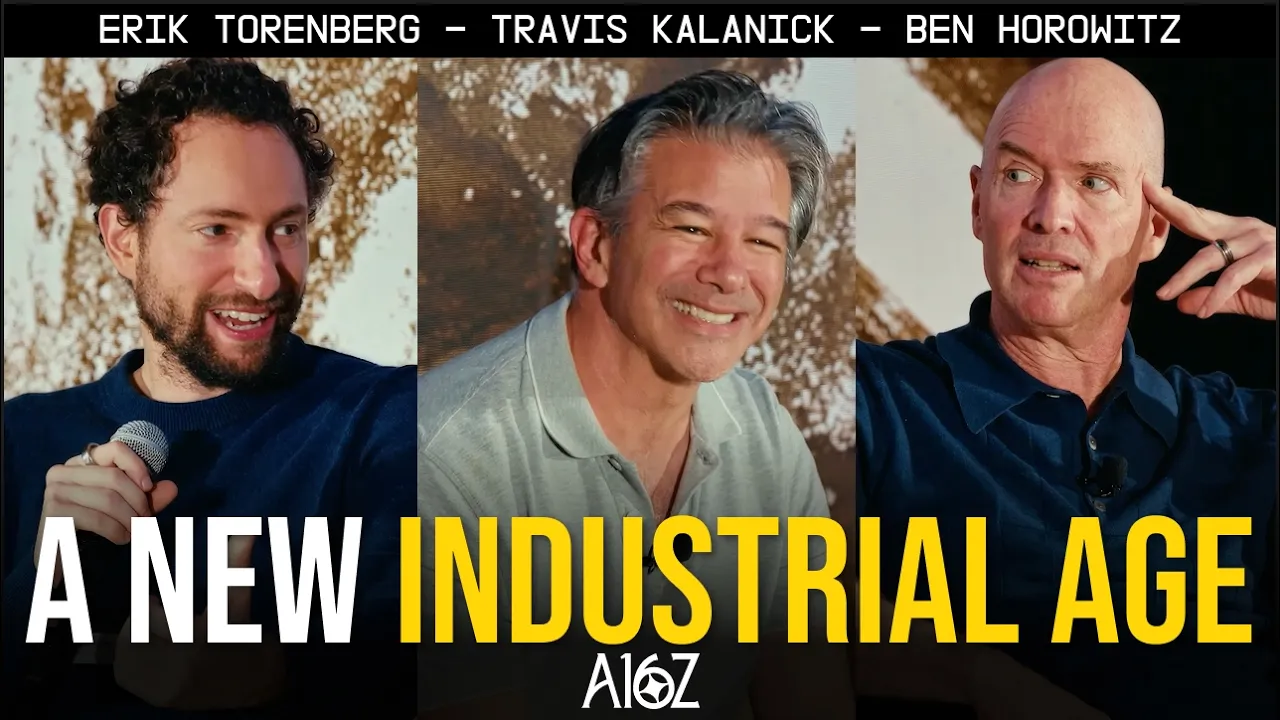
Uber Co-Founder Kalanick Launches Atoms to Automate Mining and Food Production
a16z
Artificial intelligence will drive the second industrial revolution by shifting software automation into heavy physical industries like agriculture, extraction, and logistics.
## Background
Published by a16z on YouTube on August 14, 2026, this fireside conversation features host Erik Torenberg alongside Ben Horowitz and Travis Kalanick at Atoms' launch event. According to the page description, the trio explores Kalanick's evolution as a founder, key lessons from Uber's history, and Atoms' ambitious vision to transform heavy physical industries like mining, food production, and manufacturing through Industrial AI.
## TL;DR
Travis Kalanick details his new venture, Atoms, which aims to lead the second industrial revolution by digitizing and automating multi-trillion-dollar physical industries such as mining, agriculture, and manufacturing. Reflecting on his journey, Kalanick and Ben Horowitz discuss why Uber declined to acquire Lyft, the evolution of company culture from 'toe-stepping' to 'the best idea wins,' and how Kalanick recruited his core team back after eight years in stealth. Overcoming structural friction and institutional resistance—what Kalanick calls the 'final boss'—requires absolute fortitude, operational precision, and shifting from 'dirty fuel' like revenge to pure passion for creation.
## Atmosphere & style
The energy is charged, candid, and high-octane, capturing the electric vibe of an insider Silicon Valley launch event. Kalanick is acutely self-aware, witty, and unapologetically hardcore, blending battle-tested founder grit with lighthearted humor—famously labeling himself a 'baby goat' next to Elon Musk. Hosted with sharp, conversational pacing by Torenberg and anchored by Horowitz's peer-level camaraderie, the dialogue feels like an intimate, unvarnished debrief between tech titans celebrating a return to pure building.
## Key takeaways
- [00:00](https://www.youtube.com/watch?v=r8qKNFeBPXE&t=0s) Physical industries like manufacturing, mining, and food represent multi-trillion-dollar frontiers for AI-driven automation, expanding beyond purely digital enterprise applications.
- [00:53](https://www.youtube.com/watch?v=r8qKNFeBPXE&t=53s) The core thesis behind 'bits and atoms' maps digital primitives directly to physical infrastructure: CPU represents manufacturing, storage represents real estate, and networking represents logistics.
- [09:00](https://www.youtube.com/watch?v=r8qKNFeBPXE&t=540s) Atoms applies Industrial AI through specialized sector 'computers,' such as Food Computers to automate end-to-end meal infrastructure and Mining Computers to optimize mineral extraction using computer vision and robotics.
- [14:44](https://www.youtube.com/watch?v=r8qKNFeBPXE&t=884s) Every founder transforming physical space faces resistance to change, echoing historic battles of the Second Industrial Revolution like the Homestead Strike and Thomas Edison's AC/DC smear campaigns.
- [19:09](https://www.youtube.com/watch?v=r8qKNFeBPXE&t=1149s) The 'Champion's Heart' philosophy asserts that relentless persistence after facing setbacks makes failure nearly impossible for dedicated entrepreneurs.
- [22:41](https://www.youtube.com/watch?v=r8qKNFeBPXE&t=1361s) Uber chose not to acquire Lyft due to an insurmountable cultural mismatch, with Kalanick and Horowitz emphasizing that strong cultures require 'toe-stepping' and 'constructive confrontation' rather than forced consensus.
- [28:13](https://www.youtube.com/watch?v=r8qKNFeBPXE&t=1693s) Kalanick's evolution as a founder shifted him from high-risk 'edge-walking' born of early startup survival mode to making clean, indisputable operational decisions.
- [34:12](https://www.youtube.com/watch?v=r8qKNFeBPXE&t=2052s) Experience dramatically accelerates strategic work, but founders must guard against the complacency of 'easy street' by actively pushing harder during smooth periods.
- [37:11](https://www.youtube.com/watch?v=r8qKNFeBPXE&t=2231s) Atoms was formed by consolidating distinct early-stage ventures in food, mining, and machines into a single holding company to optimize execution and capital deployment.
- [39:34](https://www.youtube.com/watch?v=r8qKNFeBPXE&t=2374s) Key former Uber leaders—including former CFO Gautam Gupta and ATG head Eric Meyhofer—reunited with Kalanick at Atoms to scale its leadership core.
- [43:40](https://www.youtube.com/watch?v=r8qKNFeBPXE&t=2620s) Atoms utilizes a hybrid management structure that pairs shared central functions (G&A, legal, core tech) with empowered, standalone vertical business units.
- [45:44](https://www.youtube.com/watch?v=r8qKNFeBPXE&t=2744s) While early ventures like RedSwoosh were fueled by spite and revenge, long-term entrepreneurial success requires 'clean fuel' driven by genuine love for building.
- [48:30](https://www.youtube.com/watch?v=r8qKNFeBPXE&t=2910s) Kalanick acknowledges Elon Musk as the benchmark ('the GOAT') in physical AI and hardware automation, asserting that any serious industrial AI effort must respect that standard.
- [50:37](https://www.youtube.com/watch?v=r8qKNFeBPXE&t=3037s) After eight years operating under a strict 'Be Uniconic' stealth playbook to avoid traditional media, Kalanick returned to the public spotlight due to the rise of direct-to-creator long-form media and podcasts.
The conversation opens with high-energy banter and a teaser of the core thesis: a massive shift toward automating multi-trillion-dollar physical industries. Reflecting on past battles and new frontiers, Travis Kalanick rejects any lingering bitterness over his exit from Uber, noting that once you fall in love with a new venture, you don't spend time dwelling on an ex. He reveals that for eight years, his new team maintained a strict "high-fidelity playbook" to stay entirely out of the media spotlight while building in stealth.
Moderator Erik Torenberg and a16z co-founder Ben Horowitz set the stage, poking fun at the invite list and setup before pivoting to Kalanick’s long-standing obsession with digitizing the physical world—bridging "bits and atoms."
- Multi-trillion-dollar physical industries are positioned as the primary frontier for automation, scaling far beyond purely digital AI enterprise applications.
- Kalanick framing startup philosophy: *"If you don't fight for the best idea, then what idea are you fighting for? You're fighting for the mediocre idea."*
---
[00:53](https://www.youtube.com/watch?v=r8qKNFeBPXE&t=53s) The Bits & Atoms Video: Uber's 10-Year-Old Blueprint
To demonstrate that physical AI isn't just a recent pivot, Kalanick plays a decade-old promotional video from his time at Uber. The video lays out the conceptual framework connecting software ("bits") to real-world infrastructure and human lives ("atoms").
The retro video contrasts the bit—invented roughly 70 years prior—with the atom, born 13.8 billion years ago and responsible for everything from "the BLT to moms everywhere to New York City." It tracks how Uber merged these two realms to create Uber Pool, UberX, and Uber Eats, framing its ultimate purpose around optimizing human connection and urban movement.
```
+-----------------------------------------------------------------------+
| THE BITS & ATOMS ANALOGY |
+-------------------+---------------------------------------------------+
| DIGITAL (Bits) | CPU (Manipulates) | Storage (Holds) | Net (Moves) |
| PHYSICAL (Atoms) | Manufacturing | Real Estate | Logistics |
+-------------------+---------------------------------------------------+
```
Reflecting on the clip, Kalanick jokes about how tired Uber employees used to get of his constant "bits and atoms" speeches. He breaks down the fundamental computing primitives as applied to physical space:
- **CPU (Computation/Manipulation):** In the physical world, this corresponds to manufacturing and automated assembly.
- **Storage:** Represented physically by real estate and physical facilities.
- **Network (Moving Data):** Represented by transportation, logistics, and physical supply chains.
Uber was designed as a physical network for mobility, but Kalanick argues that physical manufacturing and real estate still have massive room for AI-driven transformation.
Kalanick breaks down Atoms' core thesis: building specialized "industrial atoms-based computers" tailored to specific sectors. Because everything in the human environment is fundamentally "grown, mined, manufactured, or moved," Atoms defines its mission as **Industrial AI**—integrating software, sensors, robotics, and machine learning to fully operate entire heavy industries.
To ground this concept, Kalanick outlines two concrete implementations:
* **Food Computers:** Automating end-to-end food infrastructure. By pairing automated robotic preparation (targeting $6–$8 labor cost per meal) with automated transport ("autonomous burritos") and optimized industrial real estate, food preparation costs can approach raw grocery prices.
* **Mining Computers:** Modern artificial intelligence depends directly on compute chips and energy, both of which trace back to raw materials extracted from the earth. Atoms' mining division deploys computer vision, robotics, and automated flotation systems to increase mineral yields and remove humans from dangerous environments.
- **The Pitch to Mining Executives:** Kalanick asks gold mine CEOs if they want 20% more gold per year with lower operating costs; the answer is always yes, provided Atoms can prove performance.
- **Physical Scale:** Kalanick shares photos standing beside massive 2-million-pound autonomous haul trucks, jokingly describing himself standing next to a "TCP packet" for scale.
- **Transport ("Silver Medals"):** Specialized autonomous wheelbases for specific industrial use cases. While consumer robotaxis (like Waymo) represent the flagship "gold medal," multi-hundred-billion-dollar "silver medal" markets exist in freight, off-road mining, parcel delivery, and specialized logistics.
---
[14:44](https://www.youtube.com/watch?v=r8qKNFeBPXE&t=884s) The Final Boss: Resistance to Change & the Second Industrial Revolution
Every founder attempting to transform physical industries inevitably runs into what Kalanick calls the "final boss": **resistance to change**. To contextualize this struggle, he draws historical parallels to the Gilded Age and the Second Industrial Revolution, arguing that today's tech founders haven't seen anything compared to the raw conflict of 19th-century industrialization.
- **The Homestead Strike & Henry Frick:** Kalanick highlights steel magnate Henry Frick (partner to Andrew Carnegie), who survived an assassination attempt by an anarchist during the 1892 Homestead Strike. Shot twice and stabbed multiple times, Frick refused to die and continued working while doctors pulled bullets out of his neck—a dramatic historical example of extreme "founder mode."
- **Thomas Edison's FUD Campaigns:** During the "Current War," Thomas Edison weaponized fear, uncertainty, and doubt (FUD) against George Westinghouse's superior Alternating Current (AC) standard. Edison staged gruesome public electrocutions of animals using AC to sway public opinion—a tactic Kalanick likens to modern anti-tech PR campaigns.
- **Modern Protests & Rhyming History:** Kalanick connects the 2014 anti-Uber taxi blockades across European cities to modern anti-autonomous vehicle actions, showing a recent photo of rideshare drivers protesting outside Waymo offices.
History demonstrates that breakthrough progress always provokes fierce institutional and cultural pushback. For innovators, overcoming this friction requires delivering an undeniable, overwhelming leap in efficiency and safety.
[19:09](https://www.youtube.com/watch?v=r8qKNFeBPXE&t=1149s) Leading Through Resistance and the "Champion's Heart"
Travis Kalanick emphasizes that driving large-scale industrial disruption requires extreme fortitude. Looking at historical figures like Henry Ford, Andrew Carnegie, J.P. Morgan, and George Westinghouse, Kalanick points out that today's tech founders are not the first to face immense pushback; previous captains of industry dealt with even harsher conditions. Leading thousands of people toward a massive vision requires being hardcore, but it also takes genuine optimism and empathy to align talented minds toward a shared mission.
To illustrate the mindset needed to endure setbacks, Kalanick shares a clip of a woman completing a race after getting knocked down, introducing the company concept of the "Champion's Heart." The core philosophy is that if an entrepreneur puts everything on the line and relentlessly gets back up after being knocked down, it becomes nearly impossible to fail. Kalanick notes that while commentators often say "Travis is back," he has actually been working continuously in stealth for eight years rather than taking time off.
- **Historical Figures Cited:** Henry Ford, Andrew Carnegie, J.P. Morgan, George Westinghouse.
- **Key Cultural Concept:** "Champion's Heart" — the principle of relentless persistence after getting knocked down.
- **Stealth Period:** Kalanick spent eight years out of the public eye actively working before launching Atoms.
[22:41](https://www.youtube.com/watch?v=r8qKNFeBPXE&t=1361s) Why Travis Didn't Buy Lyft & the Importance of Culture
Addressing a long-standing point of discussion in Silicon Valley, host Erik Torenberg asks Kalanick why Uber chose not to acquire Lyft and whether he regrets that decision. Kalanick explains that despite spending massive amounts of money—around $1 billion a year—on a fierce competitive war, the fundamental cultural mismatch between the two companies made a deal impossible. Sitting across the table from Lyft's leadership, Kalanick realized that forcing the two distinct cultures together would fail, a stance he maintains was the correct call despite the criticism he received at the time.
Ben Horowitz agrees with the decision, noting that Uber's original culture under Kalanick was defined by a unique intensity that was diluted when the company later shifted toward a more "milktoast" posture. Horowitz highlights specific values from Uber's original culture document, particularly "meritocracy and toe-stepping"—the idea that building something great requires pushing hard and confronting uncomfortable truths rather than sparing feelings. Kalanick adds that at Atoms, this idea has evolved into "the best idea wins," warning that avoiding toe-stepping leads companies to settle for mediocre or politically expedient solutions. Horowitz compares this principle to Andy Grove's concept of "constructive confrontation" at Intel.
- **Acquisition War Cost:** Uber was spending roughly $1 billion per year fighting Lyft in the ride-sharing market.
- **Uber Cultural Values:** "Meritocracy and toe-stepping" (rebranded at Atoms as "the best idea wins").
- **Management Philosophy:** Andy Grove's "constructive confrontation" as the mechanism for organizational excellence.
[26:22](https://www.youtube.com/watch?v=r8qKNFeBPXE&t=1582s) Automation, Industrial AI, and Reimagining Core Industries
When asked what it would look like if he were still running Uber, Kalanick explains that his current work with Atoms represents a direct continuation of that long-term vision. He outlines the scope of "Industrial AI," arguing that while digital AI focuses on enterprise software, physical industries worth hundreds of billions or trillions of dollars—such as agriculture, mining, and manufacturing—are ripe for complete automation. This shift marks the beginning of a new industrial age comparable in scale to the Second Industrial Revolution.
Kalanick breaks down how entire supply chains will be restructured once physical systems become fully autonomous:
- **Food Production & Delivery:** Automating every stage from crop growth ("food computers") to preparation and delivery will make prepared meals cheaper than buying raw items at a grocery store.
- **Mining:** Automating not just material transport but the entire extraction process redefines what a mining company is, turning traditional operators into mere real estate owners.
- **Industrial Transformation:** Broad automation across heavy physical sectors creates multi-trillion-dollar market opportunities.
[28:13](https://www.youtube.com/watch?v=r8qKNFeBPXE&t=1693s) Evolution as a Founder: From Edge-Walking to Mastery
Reflecting on how he has evolved as a founder, Kalanick contrasts his current approach with his mindset during Uber's early days. His previous startup experience involved intense financial strain—working four years without a salary, living on welfare, and wearing socks that read "blood, sweat, and ramen." Transitioning from extreme scarcity into Uber's explosive hyper-growth left him operating in permanent survival mode, frequently walking right up to the line of risk where only an "electromagnetic scanning microscope" could verify if he stayed within bounds. Today, Kalanick operates several inches back from that line, making decisions that are clean and indisputable without sacrificing execution.
Kalanick also discusses how age and experience alter a founder's efficiency and drive. Tasks that used to demand hundreds of hours of intense stress—like drafting strategic vision documents—now take 45 minutes because the underlying frameworks flow naturally. However, Kalanick notes a counteracting risk: becoming too comfortable with adversity can dull a founder's aggressive edge. Horowitz adds that operating a 20,000-person company while acting like you are still in survival mode is dangerous, as employees multiple levels down may misinterpret that intensity and make reckless mistakes.
- **Early Startup Struggles:** Kalanick spent four years without a salary, survived on welfare, and wore "blood, sweat, and ramen" socks.
- **Operational Shift:** Moving from extreme "edge-walking" tactics to unambiguous, clean execution.
- **Speed of Execution:** Core strategic work like writing company vision notes dropped from hundreds of hours to ~45 minutes due to decades of experience.
[34:12](https://www.youtube.com/watch?v=r8qKNFeBPXE&t=2052s) The Danger of "Easy Street" and Venturing into Industrial AI
Horowitz and Kalanick discuss the psychological traps founders face when things appear to be going well. Kalanick warns that whenever a founder feels their business has entered "easy street," an unexpected setback is usually right around the corner. Instead of waiting for external forces to create difficulty, leaders must proactively push harder when operations feel smooth. Horowitz shares his own observations of founders claiming easy success, comparing their false sense of security to someone unaware they are bleeding out from hidden wounds.
Transitioning to the investment decision behind Atoms, Torenberg points out the scale of the funding round—moving from Uber's initial $4 million pre-money valuation round to what Horowitz confirms is one of the largest checks a16z has ever written. Horowitz explains that his conviction came from knowing Kalanick for years and understanding his capacity to tackle massive, single-minded industrial challenges.
- **Uber's First Round Valuation:** $4 million pre-money.
- **a16z Investment:** Represents one of the largest single checks ever written by Andreessen Horowitz.
[37:11](https://www.youtube.com/watch?v=r8qKNFeBPXE&t=2231s) Consolidating Companies Under One Roof
Ben Horowitz details how quickly he gained conviction to write a massive check for Travis Kalanick’s new venture, Atoms. What stood out to Ben was that Kalanick hadn't lost his original drive—he was still the same relentless entrepreneur, fired up by the prospect of tackling hard, messy problems rather than just relaxing or "living his best life." Kalanick then reveals the structural complexity behind the funding deal: he had initially spun up multiple separate entities with different investors across various domains, including food technologies and mining. When he first pitched a16z, he jokes that he felt like a guy in a trench coat offering a collection of watches—"Which watch would you like? I got food stuff, I got mining stuff."
To streamline the venture and create a unified industrial AI empire, Kalanick had to merge these separate entities into one holding company, Atoms. Merging early-stage companies with different investor caps and valuation metrics was an intense process that made them "sweat a little bit." Kalanick notes that this strategy mirrors Elon Musk's approach of bringing distinct, highly ambitious bets together, making operational execution and capital deployment significantly more efficient.
- Ben Horowitz noted Kalanick was still driven by the same intense entrepreneurial fire that made him successful at Uber.
- Kalanick had originally set up distinct, separate entities covering food technology, mining, and autonomous machines.
- Merging these disparate companies into Atoms required negotiating valuation ratios across different investor groups to bring everything under a single corporate roof.
[39:34](https://www.youtube.com/watch?v=r8qKNFeBPXE&t=2374s) Assembling the Old Guard: Bringing Back the Uber Team
Host Erik Torenberg prompts Kalanick to reflect on what it feels like to reunite with key members of his former Uber team at Atoms. Kalanick candidly explains the legal and ethical boundary lines he had to navigate right after departing Uber: because he remained on Uber's board of directors for a period, he received thousands of inbound messages from eager employees wanting to follow him, but he was legally restricted from poaching them directly.
Once clear of those constraints, Kalanick began strategically bringing aboard top-tier talent from his Uber days to power Atoms. He highlights key executives who have joined the mission, including former Uber CFO Gautam Gupta, former SVP of Engineering Ganesha Upadhyaya, and former head of Uber’s Advanced Technologies Group (ATG) Eric Meyhofer, who now leads Food Robotics. Other notable additions include Brian Atwell leading food infrastructure and engineering, Anthony Levandowski, and Jessica Morten, former head of Uber Eats Japan. Kalanick shares an anecdote about traveling to Japan early on to meet SoftBank's Masayoshi Son ("Masa"), venting lightheartedly about Masa investing in competitor firms before Kalanick met with Jess to recruit her. While Atoms now has more non-Uber executives than former Uber employees, Kalanick emphasizes that the core "heart" and shared history of the old team gives them a head start to "run it back"—and, more importantly, "run it forward" by building something completely new.
- **Gautam Gupta** (Former Uber CFO) joined Atoms as CFO.
- **Ganesha Upadhyaya** (Former VP/SVP of Engineering at Uber) joined to lead engineering initiatives.
- **Eric Meyhofer** (Former Head of Uber ATG) is heading Food Robotics at Atoms.
- **Jessica Morten** (Former Head of Uber Eats Japan) joined the leadership team after early recruiting efforts in Japan.
- **Brian Atwell** serves as an engineering lead across infrastructure and food technology.
[42:02](https://www.youtube.com/watch?v=r8qKNFeBPXE&t=2522s) Advice to Younger Selves: Embrace Being a Geek and Stop Worrying
Opening up the floor for Q&A, audience member Gary asks Kalanick what advice he would send back in a "message in a bottle" to his 18-to-22-year-old self. Kalanick admits that as a young man, he was a total geek who spent unnecessary cognitive energy pretending not to be one. His simple advice would be: "Dude, just be a geek. It's going to be fine." Dropping the act would have saved him an immense amount of mental bandwidth.
When Ben Horowitz weighs in on the same question, he emphasizes letting go of anxiety and focusing strictly on execution. Horowitz advises that founders shouldn't spend time worrying about consequences, because "consequence is going to be what the consequence is." Instead, when facing severe challenges, the only viable path is to keep hunting for a way out until you find it. While agreeing that worrying is useless, Kalanick jokes that founders shouldn't get *too* relaxed or "fat and happy"—there still needs to be an underlying sense of urgency.
> "The pretending to not be a geek when you're a geek is just a lot of cognitive load that's not necessary... Dude, just be a geek. It's going to be fine." — Travis Kalanick
[43:40](https://www.youtube.com/watch?v=r8qKNFeBPXE&t=2620s) Management Architecture and Operating Business Units
An audience member named Owen asks Kalanick about the organizational structure of Atoms—specifically whether divisions share resources or operate as independent companies with their own boards and CEOs. Kalanick expresses relief that he avoided setting up separate boards for each line of business, which would have been an administrative nightmare. Instead, Atoms uses a hybrid management architecture designed for deep vertical execution combined with central operational scale.
In this architecture, standard administrative functions (G&A, legal, finance, HR) and core technology infrastructure are shared across the whole company. Manufacturing occupies a unique middle ground: while specific divisions require specialized manufacturing (such as food equipment versus heavy machinery), overlaps between mining hardware and transport hardware allow Atoms to centralize manufacturing leadership under a single domain expert to attract top-tier global talent. Meanwhile, specific vertical domains—like mining or food automation—run as empowered business units headed by dedicated leaders who hold full operational control over their unit's success.
- **Shared Central Functions:** Finance, Legal, HR, General G&A, and core tech infrastructure.
- **Centralized Specialized Operations:** High-level manufacturing strategy and leadership are centralized to leverage economies of scale and recruit elite specialized talent.
- **Empowered Business Units:** Vertical domains (Mining, Food, Autonomous Machines) operate as standalone units with dedicated division heads possessing full execution authority.
[45:44](https://www.youtube.com/watch?v=r8qKNFeBPXE&t=2744s) Fueling the Fire: From Revenge to Falling in Love with Building
Audience member Brent asks Kalanick about his historical motivation, referencing his previous comment that being "pissed off" makes a great entrepreneur. Brent asks whether revenge is a "dirty fuel" and if Kalanick has found a cleaner source of energy over time. Kalanick candidly reflects on his past, revealing that earlier in his career—after his peer-to-peer file-sharing company (Scour) was sued for $250 billion by 33 media companies—he built his next company (RedSwoosh, a peer-to-peer CDN) as a pure "spite business" designed to turn the very media companies that sued him into paying customers.
However, Kalanick acknowledges that operating out of pure spite or fear of failure is ultimately counterproductive. Driven by fear, a founder ends up working long, inefficient nights with a strained "edge" or weird vibe that hinders long-term greatness. After departing Uber, Kalanick spent eight months re-evaluating before launching his new initiatives, where he found himself "falling in love again" with the process of pure creation. He notes that when you fall in love with a new mission, you stop obsessing over your ex. Building from a place of genuine passion produces unpolluted, beautiful work rather than toxic energy.
- **Scour Lawsuit:** Sued for $250 billion (a quarter of a trillion dollars) by 33 major media companies, fueling Kalanick's early desire for revenge.
- **RedSwoosh:** Built as a "full spite store" peer-to-peer content delivery network (CDN) to force media conglomerates to become his clients.
- **The Shift to "Clean Fuel":** Moving away from fear of failure and revenge allowed Kalanick to build Atoms out of pure passion for technological creation.
[48:30](https://www.youtube.com/watch?v=r8qKNFeBPXE&t=2910s) Facing the "Final Boss" of Industrial AI
Asked about the "final boss" or ultimate competitor facing Atoms in the industrial AI landscape, Kalanick offers a broader reflection on the intense competition surrounding the next industrial revolution. He notes that while many talented people in tech are competing in this space, one obvious figure stands as the undisputed benchmark for industrial AI and hardware automation: Elon Musk.
Acknowledging Musk's unmatched execution across hardware, robotics, and AI, Kalanick refers to Musk as "the GOAT" (Greatest of All Time) of the physical tech world, while lightheartedly calling himself a "baby goat" by comparison. Even if Atoms starts in domains that Musk isn't currently focusing on, Kalanick emphasizes that any serious company attempting to merge AI with physical machinery must respect Musk's relentless expansion and ultimate standard of excellence.
> "You always have to think when you go into a space like this, who's the best of the best at industrial AI?... Elon's the GOAT. I'm like, 'Dude, I'm a baby goat.' But mad respect, of course. He's obviously the best by a long shot." — Travis Kalanick
[50:37](https://www.youtube.com/watch?v=r8qKNFeBPXE&t=3037s) "Be Uniconic": Operating in Stealth and the New Media Landscape
To conclude the fireside chat, Torenberg highlights that Kalanick spent roughly eight years laying low out of the public eye before launching Atoms, asking what has changed about Silicon Valley and the broader culture since he last took center stage. Kalanick shares that in 2019, he gave a internal slide presentation to his leadership team titled "Be Uniconic." They created an intense, high-fidelity playbook designed to avoid all media attention—going so far as to prohibit thousands of employees from listing the company on their LinkedIn profiles. He jokes that operating as a builder under intense, hostile media scrutiny felt like being a capitalist in Russia, where the number one metric for survival was "shut the f*** up."
Kalanick explains that his decision to come back into the public eye now is driven by a fundamental transformation in the media landscape over the past decade. Ten years ago, traditional media covered tech with relentless negativity, turning business coverage into hostile political reporting akin to a "Maoist struggle session." Today, alternative media formats—ranging from podcasts like *Acquired* (David Senra) and *The Joe Rogan Experience* to decentralized platforms—allow founders to speak directly and authentically without legacy filters. He credits Elon Musk's acquisition of X (formerly Twitter) as a monumental turning point that restored open discourse, enabling builders to speak their minds freely and focus on creating the future.
- **The "Be Uniconic" Strategy (2019):** A strict internal policy designed to keep Kalanick's ventures completely invisible to the press, including prohibiting employees from listing their job titles on LinkedIn.
- **Shift in Media Dynamics:** Moving away from traditional legacy publications like *The New York Times* toward long-form, direct-to-creator platforms (podcasts, X) where complex ideas can be discussed constructively.
- **The Capitalist KPI:** Kalanick quips that the primary KPI during his stealth period was "shut the f*** up," allowing the team to build without media distraction until the landscape evolved.
<ElicitationsGroup message="To explore more from this conversation:">
<Elicitation label="Summarize Travis Kalanick's vision for AI in physical industries" query="Summarize Travis Kalanick's vision for how AI and autonomous systems will transform physical industries like food, mining, and manufacturing based on the a16z podcast."/>
<Elicitation label="Break down the key takeaways on company culture and leadership" query="What were the main leadership lessons and culture-building takeaways discussed by Ben Horowitz and Travis Kalanick in this interview?"/>
</ElicitationsGroup>
## Notable quotes
> [00:00](https://www.youtube.com/watch?v=r8qKNFeBPXE&t=0s) If you don't fight for the best idea, then what idea are you fighting for? You're fighting for the mediocre idea. — Travis Kalanick
> [42:02](https://www.youtube.com/watch?v=r8qKNFeBPXE&t=2522s) The pretending to not be a geek when you're a geek is just a lot of cognitive load that's not necessary... Dude, just be a geek. It's going to be fine. — Travis Kalanick
> [48:30](https://www.youtube.com/watch?v=r8qKNFeBPXE&t=2910s) You always have to think when you go into a space like this, who's the best of the best at industrial AI?... Elon's the GOAT. I'm like, 'Dude, I'm a baby goat.' But mad respect, of course. He's obviously the best by a long shot. — Travis Kalanick
> [28:13](https://www.youtube.com/watch?v=r8qKNFeBPXE&t=1693s) blood, sweat, and ramen — Travis Kalanick
> [22:41](https://www.youtube.com/watch?v=r8qKNFeBPXE&t=1361s) the best idea wins — Travis Kalanick
## Mentioned
Travis Kalanick, Ben Horowitz, Erik Torenberg, Atoms, Uber, Lyft, a16z, Uber Pool, UberX, Uber Eats, Waymo, Henry Frick, Andrew Carnegie, Thomas Edison, George Westinghouse, Henry Ford, J.P. Morgan, Andy Grove, Intel, Elon Musk, Gautam Gupta, Ganesha Upadhyaya, Eric Meyhofer, Brian Atwell, Anthony Levandowski, Jessica Morten, Masayoshi Son, SoftBank, Gary, Owen, Brent, Scour, RedSwoosh, David Senra, Acquired, The Joe Rogan Experience, X, The New York Times
## Background
该视频由知名风险投资机构 a16z 于 2026 年 8 月 20 日发布在 YouTube 频道上。视频记录了 Ben Horowitz、Travis Kalanick 与主持人 Erik Torenberg 在 Atoms 发布会现场进行的一场炉边对谈,页面简介表明其内容围绕连续创业、企业建设哲学,以及 Kalanick 为何坚信由 AI 驱动的下一轮工业革命将全面重塑食品制造、采矿及实体制造业等物理世界展开。
## TL;DR
在潜行闭关八年之后,Uber 联合创始人 Travis Kalanick 携新公司 Atoms 重返聚光灯下,正式揭晓其聚焦重工业与实体经济的“工业 AI”(Industrial AI)愿景。对谈中,Kalanick 回顾了从十年前 Uber“比特与原子”构想演进至食品与采矿自动化的技术脉络,直面当年未收购 Lyft 的文化原因及离开 Uber 后的心路蜕变。Ben Horowitz 亦披露了 a16z 领投史上最大单笔支票背后的逻辑,双方深入探讨了顶尖创业者如何应对变革阻力、摆脱“复仇心”等脏燃料,以及在全新舆论格局下重塑硬核实业的雄心。
## Atmosphere & style
整场对话兼具史诗级的宏大叙事与老友重聚般的松弛幽默,台下掌声与台上毫不避讳的犀利调侃交织。Travis 身上那种久经沙场却锐气未减的“斗犬”本色展露无遗,他既能以科学家的严谨将矿卡比作 TCP 数据包,又能以看透世事的豁达笑谈过往争议。Horowitz 的沉稳剖析与 Travis 的极客狂热形成了极佳的张力碰撞,令全场弥漫着一种技术理想主义与老派硬核商业意志激烈交融的震撼感。
## Bulletin
- [36:00](https://www.youtube.com/watch?v=r8qKNFeBPXE&t=2160s) 特拉维斯·卡兰尼克(Travis Kalanick)正式推出工业 AI 公司 Atoms 并披露已完成业务重组,获得 a16z 领投其史上最大单笔投资之一,旨在将 AI 与自动化引入食品生产与采矿等万亿美元级传统实体产业。
- [04:26](https://www.youtube.com/watch?v=r8qKNFeBPXE&t=266s) Atoms 将物理世界映射为经典计算的三大基元:制造业对应 CPU 操纵原子,房地产对应存储器存放原子,交通物流对应网络传输原子,以此为框架研发全自动化运营的专用工业计算机。
- [50:37](https://www.youtube.com/watch?v=r8qKNFeBPXE&t=3037s) 卡兰尼克回顾离开 Uber 后的八年隐秘创业历程,透露团队曾严格执行《Be Uniconic》反偶像化手册,甚至禁止员工在 LinkedIn 披露公司名,直至当前开放的媒体生态成熟才选择公开亮相。
- [23:00](https://www.youtube.com/watch?v=r8qKNFeBPXE&t=1380s) 在回顾当年放弃收购 Lyft 时,卡兰尼克指出核心阻碍是双方完全无法融合的文化差异,并强调团队必须贯彻“敢踩脚趾”与“最优想法获胜”的建设性对抗机制以避免平庸妥协。
## Key takeaways
- [06:44](https://www.youtube.com/watch?v=r8qKNFeBPXE&t=404s) 物理世界的变革体量远超企业数字软件,整个人类现实世界的实体运转归根结底只经历开采/种植、制造与运输三个环节,工业 AI 将掀起第二次工业革命。
- [04:26](https://www.youtube.com/watch?v=r8qKNFeBPXE&t=266s) Atoms 将数字计算机三要素映射至物理世界:CPU 对应改变原子形态的制造业,存储器对应容纳原子的地产空间,网络对应运输原子的交通物流。
- [06:44](https://www.youtube.com/watch?v=r8qKNFeBPXE&t=404s) 首个落地项目“食品计算机(Atoms Food)”旨在通过专用厨房机器人集群与自动化物流,将外卖全流程制造成本压缩至接近在超市自买生鲜的水平(单份 6-8 美元)。
- [09:00](https://www.youtube.com/watch?v=r8qKNFeBPXE&t=540s) “采矿计算机(Atoms Mining)”切入未来超级智能的最底层基元——芯片半导体与新能源金属原材料开采,通过全流程无人化作业直接提升金矿等矿企 20% 产量并降低 OPEX。
- [11:22](https://www.youtube.com/watch?v=r8qKNFeBPXE&t=682s) 重工业场景需要定制化、专用的大型轮式自主机器,而非局限于人类既有环境的人形机器人;除了网约车这一“金牌”场景,干线货运、外卖、越野自动化等“银牌”市场同样达数千亿美元。
- [15:21](https://www.youtube.com/watch?v=r8qKNFeBPXE&t=921s) 推动社会进步最大的终极阻力是“对变革的抗拒”,从 150 年前第二次工业革命中针对弗里克的刺杀与爱迪生抹黑交流电的 FUD 策略,到如今网约车司机抗议自动驾驶,历史在不断押韵。
- [23:00](https://www.youtube.com/watch?v=r8qKNFeBPXE&t=1380s) Uber 当年放弃收购 Lyft 的根本原因在于企业文化无法融合,卡兰尼克坚信在管理中必须推行“最优想法获胜(The best idea wins)”,避免因害怕冲突而滑向平庸妥协。
- [28:14](https://www.youtube.com/watch?v=r8qKNFeBPXE&t=1694s) 作为连续创业者的进化:早年在 Uber 时因极度贫困创伤而激进贴线操作(Right up against the line),如今在 Atoms 则主动后撤留足合规缓冲空间,防止大组织多层级传导失真。
- [33:48](https://www.youtube.com/watch?v=r8qKNFeBPXE&t=2028s) 顺风懈怠是滑向失败的转折点,一旦创始人感到事情开始变容易,往往是危险降临的前兆,领先者必须主动把难度拉满、迎难而上。
- [36:00](https://www.youtube.com/watch?v=r8qKNFeBPXE&t=2160s) 为获得 a16z 领投的巨额单笔投资,卡兰尼克将原本独立运转的食品、采矿与机器人等分散初创实体及不同投资者强行重组并表,统一到母公司 Atoms 治理结构下以实现协同。
- [43:40](https://www.youtube.com/watch?v=r8qKNFeBPXE&t=2620s) Atoms 组织架构采用单一集团董事会治理,中后台(G&A)与底层技术基础设施全集团拉通共享,采矿、运输、食品等垂直业务单元则设立独立负责人并赋予充分自主权。
- [45:46](https://www.youtube.com/watch?v=r8qKNFeBPXE&t=2746s) 源于复仇心或失败恐惧的“脏燃料(dirty fuel)”虽有爆发力但会导致团队内耗变形,唯有“重新坠入爱河”般的纯粹热爱才能支撑长期干净优美的创造。
- [48:30](https://www.youtube.com/watch?v=r8qKNFeBPXE&t=2910s) 卡兰尼克将埃隆·马斯克视作当今工业 AI 领域断层领先的“终极 Boss”,并对特斯拉等企业在软硬件与先进制造业上的垂直整合表示高度推崇。
- [50:37](https://www.youtube.com/watch?v=r8qKNFeBPXE&t=3037s) 长音频播客与去中心化社交平台的兴起打破了传统媒体的审判式叙事霸权,为敢于直面冲突的硬核创始人提供了更直接、宽容的公开发声空间。
## Detailed walkthrough
### [00:00](https://www.youtube.com/watch?v=r8qKNFeBPXE&t=0s) 序幕:重返竞技场与工业革命新战场
活动在一组充满张力的对话剪辑中拉开帷幕。被问及离开 Uber 后是否仍心怀愤懑时,特拉维斯·卡兰尼克(Travis Kalanick)给出了一个极为豁达的比喻:“当你重新坠入爱河,你就不会总想着前任了。”在过去长达八年的隐秘创业期内,他的团队严格执行了一套滴水不漏的“低调生存指南”(playbook),刻意避免外界的任何关注。如今重返聚光灯下,卡兰尼克指出,当年在 Uber 构想但未及完成的事业,正在今天的 Atoms 得到全面延续。在他看来,全球多个规模达数万亿美元的实体产业即将迎来自动化重塑,比起目前热度极高的企业级数字 AI,实体物理世界的变革体量要庞大得多。
现场的探讨直指创业底层哲学。当对谈者抛出尖锐问题——卡兰尼克的成功究竟是因为他的做事风格,还是“尽管他如此行事却依然成功”时,卡兰尼克斩钉截铁地捍卫了自己的战斗哲学:“如果你不去为最好的想法而战,那你究竟在为什么而战?你不过是在为平庸的想法妥协,而平庸只会让你失去卓越。”对谈甚至开起了重磅玩笑:“所以,你们到底什么时候买下 Uber?”
随后卡兰尼克正式登台,现场爆发出热烈掌声。他带着特有的幽默打破紧张氛围,调侃自己根本不知道怎么会站在这个台上,甚至打趣台下的主办方与观众:“我本来有好多更好的朋友……虽然那些好朋友今晚都没拿到邀请函。”
### [01:29](https://www.youtube.com/watch?v=r8qKNFeBPXE&t=89s) 十年前的愿景重温:比特与原子的交汇
卡兰尼克直入主题,回应外界对他涉足“物理 AI”(Physical AI)的看法。很多人以为他是看到当下 AI 风口才跟风入局,但他强调,将物理世界数字化、打通“比特与原子”(bits to atoms)是他过去十多年来贯穿始终的唯一执念。为了证明这不是事后诸葛亮,他现场播放了一支十年前 Uber 内部制作的品牌愿景短片。
短片以宏大的视角对比了信息世界与实体世界:
- **比特(Bit)**:作为数字世界的基石,诞生仅仅约 70 年,却以极其迅猛的姿态重构了人类的沟通、商业乃至生活的方方面面。对技术平台而言,比特代表着精密、复杂且前沿的计算代码,但在前端交互时却展现得毫不费力且优雅。
- **原子(Atom)**:诞生于 138 亿年前的宇宙大爆炸,构成了现实世界的一切——从街角的培根生菜番茄三明治(BLT)、天下的母亲,到繁华的纽约都市。在物理维度上,原子代表着飞速迭代的城市基础设施、运转不息的商品物流,以及科技最终所服务的真实人类。
视频指出,Uber 早期的核心突破正是打破了比特与原子的长期割裂,通过移动算法调度现实车辆,催生了 UberX、Uber Pool 等低成本出行方案,进而拓展到数分钟内送达经典餐厅美食的 Uber Eats。其终极逻辑在于以技术解决真实世界中人类的日常琐碎与情感纽带,即“永远把人的需求放在第一位,翻遍每一个比特与原子,让产业服务于人,而非让人受役于产业”。
### [04:26](https://www.youtube.com/watch?v=r8qKNFeBPXE&t=266s) 物理世界的“三大计算基元”:制造、地产与物流
视频结束后,卡兰尼克笑着回忆道,十年前他在 Uber 整天把“比特与原子”挂在嘴边,说到最后连自家员工都快抓狂了,纷纷求他:“求你别再聊比特和原子了,太疯魔了,大家根本听不懂你想表达什么。”但卡兰尼克解释,对于拥有计算机科学背景的工程师来说,数字计算的世界是由三项核心资源构成的:负责操纵比特的中央处理器(CPU)、负责存储比特的存储器(Storage),以及负责将比特从 A 点传输到 B 点的网络(Network)。
```mermaid
flowchart LR
accTitle: 计算世界与物理世界映射架构图
accDescr: 展示经典数字计算机三要素(CPU、存储、网络)如何映射到物理世界的制造、房地产与物流体系。
subgraph Digital["数字世界(Bits)"]
D_CPU["CPU 算力<br/>操纵比特"]
D_Store["存储(Storage)<br/>保存比特"]
D_Net["网络(Network)<br/>传输比特"]
end
subgraph Physical["物理世界(Atoms)"]
P_CPU["数字化制造<br/>操纵与加工原子"]
P_Store["数字化工业地产<br/>容纳与暂存原子"]
P_Net["数字化交通物流<br/>搬运与分发原子"]
end
D_CPU -->|"映射演进"| P_CPU
D_Store -->|"映射演进"| P_Store
D_Net -->|"映射演进"| P_Net
```
卡兰尼克阐述道,当人们试图“将物理世界数字化”时,实际上就是把原子当成比特来处理:
- **CPU(操作原子)**:对应的正是**制造业**(Manufacturing),即通过物理加工改变原子的形态与组合。
- **Storage(存储原子)**:对应的正是**房地产与物理空间**(Real Estate),负责容纳与存放实体物质。
- **Network(搬运原子)**:对应的正是**交通与物流**(Transportation / Logistics),负责把原子从一处运送到另一处。
他反思道,当年创办 Uber 时虽未总结得如此具象,但 Uber 的本质正是物理世界的“网络层”,即数字化的交通运输系统。然而即便是在今天,交通运输也尚未完全数字化——旧金山街头的 Waymo 自动驾驶车队固然先进,但在卡兰尼克看来,后台很可能仍依赖海外人工远程介入。更关键的是,在传统实体产业中,“数字化制造”与“数字化工业地产”依然处于极其原始的阶段,蕴藏着数倍于软件行业的创新空间。卡兰尼克回应外界传言道:“很多人以为我神隐归来(I'm back),其实老子这八年一刻都没闲着,一直在没日没夜拼命死磕,只是从不对外声张罢了。”
### [06:44](https://www.youtube.com/watch?v=r8qKNFeBPXE&t=404s) 重新定义工业 AI 与“食品计算机”
基于这套方法论,Atoms 的核心野心是成为底层设备与系统级制造商(OEM),打造基于原子的“工业计算机”(Atoms-based Industrial Computers)。卡兰尼克坦言,像 OpenAI、Anthropic 这样的公司在数字 AI 领域表现惊艳,但只要环顾四周就会发现,人类目之所及的一切实体物件,归根结底只经历四个环节:**种植或开采(Grown or Mined)、制造(Manufactured)、运输(Moved)**。
因此,Atoms 将自身业务定义为**工业 AI(Industrial AI)**,其明确定义为:**由软件、传感器、机器人与人工智能高度集成的软硬件系统,旨在实现整个传统工业垂直领域的全自动化运营**。
为了将抽象概念落地,卡兰尼克首先展示了 Atoms 的第一个落地产品形态——**食品计算机(Atoms Food)**,其使命是构建更优质食品的基础设施:
- **核心挑战**:能否实现从餐食的制作到配送全程全自动化,让一份热气腾腾的外卖餐食成本,逼近用户自己去超市买生鲜食材的成本?
- **制造层(CPU)**:研发专用自动化厨房机器人集群进行菜品加工与烹饪,将单份餐食的生产制作成本强力压缩在 6 至 8 美元区间。
- **网络层(Network)**:涵盖设施内部物料的自动搬运,以及出厂后的外卖配送机器人(卡兰尼克戏称为“自主行驶的卷饼” Autonomous Burritos)。
- **空间层(Storage)**:由专门配置的数字化工业地产构成,作为自动化生产与机器人调度的中枢物理载体。
### [09:00](https://www.youtube.com/watch?v=r8qKNFeBPXE&t=540s) 采矿计算机:支撑超级智能的物理最底层
随后,卡兰尼克展示了让他近来深度痴迷的第二项核心业务——**采矿计算机(Atoms Mining)**。这项业务的愿景是“打造更高生产力的矿山,赋能地球工业”。
卡兰尼克用清晰的底层逻辑解释了为什么顶尖技术创业者应该扎进尘土飞扬的矿山:
- 推动未来文明跃迁的超级智能(Superintelligence)依赖两项根本支柱:**芯片与能源**。
- 芯片所用的半导体材料全靠从地下开采;而能源即便来自太阳能,捕捉阳光所需的太阳能电池板、输变电与储能设备,其金属原材料同样全部来自地壳开采。
- 采矿是整个物理世界的基元(primitive)。掌控并自动化采矿流程,等于卡住了全人类物理工业与算力基建的最上游咽喉。
在商业模式与落地场景上,Atoms 团队直接与金矿企业 CEO 对话。卡兰尼克直接抛出方案:“你想不想在每年不增加额外负担的前提下,多开采出 20% 的黄金?”矿业巨头们的反应毫无例外都是“快证明给我看”。这种自动化改造不仅大幅砍低了矿山的运营支出(OPEX),更极大改善了传统矿山极其恶劣、事故频发的作业安全环境。
卡兰尼克将采矿流程拆解为计算架构:
- **存储器(Storage)**:矿山占有的土地与矿藏本身。
- **网络(Network)**:现场穿梭的矿用自卸卡车。卡兰尼克展示了一张自己站在一台满载重达 200 万磅(约 900 吨)的超级矿卡旁的合影,开玩笑称自己“正站在一个物理 TCP 数据包旁边”,并戏称“全场估计只有八个人能听懂这个网络协议梗”。
- **自动化运行**:现场播放了搭载 Atoms 自动化系统的巨型无人采矿工程机械作业的震撼航拍镜头。卡兰尼克打趣道,为了拍下这组真实震撼的操作画面,“拍摄过程中大概牺牲了三架无人机”。
- **处理器(CPU)**:矿石的处理、破碎与提炼工序,即如何通过前沿算法与传感器技术高效提取人类文明发展急需的高纯度金属与矿物。
### [11:22](https://www.youtube.com/watch?v=r8qKNFeBPXE&t=682s) 工业级自动化、轮式机器人与交通运输的“银牌”市场
在谈及工业自动化时,Travis 借由航拍中常见的浮选池(flotation)切入——很多人在乘飞机俯瞰大地时都见过这种设施,却鲜有人知道那是用来将开采原料提纯为目标金属与矿物(例如锂矿提炼厂)的关键环节。这些复杂的物理设施必须通过统一的软件系统进行编排,如同为庞大的工业计算机配备专属的操作系统。而在谈到物流与运输时,Travis 将其定义为“为机器人打造的轮式底盘”。在他看来,人形机器人目前主要适用于低规模、在人类既有环境中处理琐碎任务;但若要处理真正高吞吐、工业级的大规模任务,就必须制造专门面向物理世界运作的专用机器。
这些专用机器的核心在于“移动”,而只要移动就必须配备轮子,企业也因此必须为这些专用设备自研自主控制系统(autonomy)。Travis 直言,如果将命运寄托于市场上现存的一两家供应商,企业根本走不远。很多人把目光局限在网约车这枚被视作“金牌”的赛道上,但 Travis 形象地用奥运游泳名将菲尔普斯做比喻,强调交通运输领域其实满地都是价值千亿美元的“银牌”:外卖配送、包裹快递、个人自动驾驶、干线货运,乃至矿山等非铺装路面(off-road)的越野自动化。如果能以超越 Waymo 等行业标杆的速度推进自动驾驶软硬件落地,不仅存在颠覆现有格局的“黑马”机会,单是拿下这些细分领域的“银牌”市场,其体量就已经极其惊人。
```mermaid
flowchart TD
accTitle: 工业自动化与专用自主移动体系
accDescr: 展示从工业硬件设施到软件编排,再到专用轮式移动自主平台的层级架构
subgraph Physical["物理提炼与专用设备"]
A["工业现场与浮选提纯<br/>(如:锂矿加工)"]
B["专用高规模工业机器<br/>(非人形通用机器人)"]
end
subgraph Software["软件编排与自主核心"]
C["工业计算机操作系统<br/>(调度与流程编排)"]
D["自研专用自主控制系统<br/>(Autonomy 基础底座)"]
end
subgraph Markets["多元高价值垂直场景(银牌市场)"]
E["非铺装矿区与工程越野"]
F["干线货运与卡车物流"]
G["即时外卖与包裹快递"]
end
A --> C
B --> D
C --> D
D --> E
D --> F
D --> G
```
- **高规模 vs 低规模自动化**:人形机器人受限于物理形态,主要适用于低负载、通用人类环境;真正的重工业场景需要定制化、专用的大型轮式物理机器。
- **万亿美元的“银牌”矩阵**:除了众所周知的网约车,涵盖矿区越野、干线货运、外卖与快递配送的各类自动化场景,每一个都具备数百亿甚至数千亿美元的潜在市场空间。
---
### [13:59](https://www.youtube.com/watch?v=r8qKNFeBPXE&t=839s) 进步机器、未知真相与终极大 Boss“抗拒变革”
Travis 将 Atoms 正在打造的一切统称为“进步机器”(Progress Machines)。他将公司的底层文化归结为:持续发掘有价值的未知真相(valuable unknown truths)。这种认知理念直接决定了企业的竞争壁垒——如果你擅长发现其他人未曾察觉的本质规律,你就能掌握他人不具备的认知;拥有独门认知,就能做到他人做不到的事情;而在越短的时间内完成他人无法实现的技术突破与物理改造,就意味着将变革加速推向现实,这正是推动整个人类文明自古至今向前演进的根本动力所在。
然而,推动变革的道路绝非坦途,创业者不可避免地会遭遇横亘在前方最强大的“终极大 Boss”——对变革的抗拒(resistance to change)。人类天生抗拒变动,很大程度上是因为变革往往伴随着阵痛与利益打破。要想压倒这种顽固的社会惯性,唯一的途径就是拿出压倒性的、无可辩驳的巨大技术与生产力进步。
---
### [15:21](https://www.youtube.com/watch?v=r8qKNFeBPXE&t=921s) 第二次工业革命的历史镜像与真正的“创始人模式”
为了让台下的创业者理解技术颠覆必然伴随的剧烈反弹,Travis 调侃了当下硅谷流行的话题:“大家现在都在热炒‘创始人模式’(founder mode),但在 150 年前的第二次工业革命时期,那帮先驱才是玩真的‘创始人模式’。”他展示了一张历史插画,回顾了安德鲁·卡内基的商业合伙人、彻底改变钢铁与现代基建工业的亨利·弗里克(Henry Frick)遇刺的历史事件。当时一名无政府主义刺客冲入弗里克的办公室,近距离朝他连开两枪并数次用刀刺伤他。然而弗里克不仅奇迹般生还,甚至在医生现场从他身体里取子弹的过程中,依然坚持坐在桌前继续工作。
Travis 还列举了电气化早期的交直流之争。托马斯·爱迪生执着于直流电(DC),而乔治·威斯汀豪斯(George Westinghouse)力推交流电(AC)。历史早已证明交流电由于适宜远距离输送而胜出,但在落败之前,爱迪生绝不甘心退场,成为了商业史上制造“恐惧、不确定与怀疑”(FUD)的始祖鼻祖——爱迪生甚至在公共场合通电处死动物,以此向公众渲染交流电极其危险。随后,Travis 又展示了由卡内基和弗里克引发的霍姆斯特德大罢工(Homestead Strike)抗议冲突,说明工业史上每一次生产力升级与工会体系的碰撞都会引发剧烈动荡。
- **刺杀下的坚守**:亨利·弗里克在身中两枪、多处被刺的情况下,一面接受取弹手术一面继续办公,诠释了极限硬核的坚毅。
- **爱迪生的 FUD 策略**:技术路线落后方为了阻挠进步,曾通过公开电击处死动物来妖魔化交流电,这种以操弄舆论来阻滞新技术扩散的剧本至今仍在各个行业重演。
---
### [18:21](https://www.youtube.com/watch?v=r8qKNFeBPXE&t=1101s) 历史的韵脚:从优步燃车抗议到围剿 Waymo 办公室
“历史不会简单地重复,但往往押着相同的韵脚。”Travis 环视全场,直言眼前正在发生的一切都能在过往找到印记。2014 年,Uber 在欧洲扩张引发全欧洲各大主要城市出租车司机的激烈抗争,抗议者甚至在街头纵火焚烧车辆以阻挠变革;而如今,大屏幕上展示的现实画面正是 Uber 和 Lyft 的网约车司机联合围堵在 Waymo 自动驾驶公司的办公室门前抗议。面对这种跨越百年的轮回,Travis 强调,台下的创业者必须像卡内基、福特、J.P. 摩根和威斯汀豪斯那样拥有钢铁般的神经与无比硬核的意志。
针对外界对商业巨头的刻板批评,Travis 展现出坦率的情感:公众和媒体往往无法理解如何去凝聚并带领 20,000 名乐观、优秀的顶尖头脑共同为宏大愿景奋斗。单纯靠做一个恶毒的人绝不可能凝聚起成千上万优秀人才的心智,这其中包含着深沉的共情;但作为必须冲破阻力的领导者,你又必须极度强韧与硬核,承担外界无法想象的压力。
---
### [20:40](https://www.youtube.com/watch?v=r8qKNFeBPXE&t=1240s) 冠军之心与潜行八年后的重回舞台
在演讲接近尾声时,Travis 播放了一段著名的高校田径锦标赛逆转视频,用来诠释团队的核心文化基因——“冠军之心”(Champion's Heart)。画面中的女跑者在激烈角逐中被意外绊倒重重摔在跑道上,但她没有放弃,而是咬牙爬起、奋力追赶,最终在冲刺关头完成惊天大逆转夺得冠军。在 Travis 看来,创业与人生无非如此:“只要你在赛场上毫无保留地拼尽所有,哪怕每一次被击倒都能重新站起来,你就几乎不可能真正失败。”
面对外界关于“Travis 回归了”的种种议论,Travis 笑着回应,其实过去的八年里他一天也没有停下工作,只是选择“在山洞里”保持低调隐秘、不对外发声而已。致谢结束并迎来全场热烈掌声后,活动随即转入与 Ben Horowitz 及主持人 Erik Torenberg 的炉边对话。三人开门见山,Erik 一上来就抛出了最辛辣的话题:“Travis,当年你为什么没有买下 Lyft?你对此感到后悔吗?如果能穿越回去你会怎么选?”Travis 稍作停顿,叹了口气道出实情:“我想这个答案可能会让很多人意外——但 Lyft 当时的公司文化和我们截然不同。”
### [23:00](https://www.youtube.com/watch?v=r8qKNFeBPXE&t=1380s) 为什么没有收购 Lyft:文化冲突与“踩脚”价值观
谈到当年 Uber 为何没有收购竞争对手 Lyft,Travis Kalanick 直言不讳地提到了象征 Lyft 早期标志的“粉色胡子”(pink mustache)。在当时的激烈竞争中,两家公司每年要在补贴战上烧掉大约十亿美元,从商业逻辑上看,达成并购确实能带来巨大的利益,而且 Travis 为此承受了外界长期的非议与指责。然而,当他和对方团队真正面对面坐在一起时,他清楚地意识到两家公司的文化完全无法融合。Travis 表示,即便承受多年责备,回过头看他依然不会改变当初的决定,因为强行捏合截然不同的企业文化只会让事情变得越来越棘手。
Ben Horowitz 对此表示完全赞同,并提出了一个假设:如果 Travis 当初没有离开、一直由他掌舵 Uber 会怎样?Ben 认为,Travis 掌权下的 Uber 拥有极为鲜明而独特的战斗文化,而后来的 Uber 为了应对外界阻力所转变成的文化显得平庸乏味(milktoast)。Ben 特别赞赏当年 Uber 文化手册中的一条核心价值观——“能力本位与敢踩脚趾”(Meritocracy and Toe Stepping)。在 Ben 看来,这种文化的精髓在于“抛开玻璃心,全力以赴去拼搏创造”,即便在推进过程中踩到了同事的脚趾,大家也必须坚定向前,而这正是 Travis 离开后被稀释掉的最核心特质。
Travis 进一步解释说,在如今的新公司 Atoms 中,他们将这一理念重新表述为“最优想法获胜”(The best idea wins)。现实中绝大多数人因为害怕得罪他人、破坏关系,根本不敢为最优秀的想法去争辩战斗;如果不为最佳想法而战,团队最终落脚的就必然是平庸的想法或政治上妥协的产物。Ben Horowitz 补充道,这与当年 Intel 传奇 CEO 安迪·格鲁夫(Andy Grove)所提倡的“建设性对抗”(Constructive Confrontation)如出一辙——唯有经受严苛测试与碰撞,团队才能变得更加优秀。
```mermaid
flowchart TD
accTitle: Uber与Atoms的冲突对抗文化演进
accDescr: 展现从建设性对抗到最优想法获胜的文化机制与平庸妥协的对比
subgraph CultureComparison["两种文化导向的对抗与产出"]
direction TB
A["团队面对关键决策"] --> B{"是否愿意承受人际摩擦?"}
B -- "勇于碰撞(建设性对抗)" --> C["为最佳想法激烈争辩<br/>(Toe Stepping / Best Idea Wins)"]
C --> D["跑出极致产品与卓越方案"]
B -- "害怕得罪人(回避冲突)" --> E["寻求政治妥协与平庸方案<br/>(Politically Expedient)"]
E --> F["组织执行力与标准下滑"]
end
```
### [26:11](https://www.youtube.com/watch?v=r8qKNFeBPXE&t=1571s) 工业 AI 的万亿蓝海与第二代工业革命
现场主持人打趣道,Polymarket 上甚至有预测 Travis 何时会重返 Uber 的赌局,但真正值得关注的问题或许是“Atoms 何时会把 Uber 买下来”。Travis 笑称自己和团队目前还有很长的路要证明,但 Atoms 目前所推进的事业,很大程度上正是如果他一直留在 Uber 本该发生的演进与延续。他强调,生成式 AI 和数字 AI 目前对企业软件带来了重塑,但工业 AI(Industrial AI)将直接颠覆物理世界中多个规模达数千亿美元乃至数万亿美元的基础实体行业。
Travis 将这场变革类比为“第二次工业革命”,并以食品生产和采矿两大行业为例进行了深度拆解:
- **食品生产与配送自动化**:当食品从源头加工制造到终端配送的每一个环节都被完全自主化机器接管后,会出现一种直接配餐送达家庭的服务,其综合成本甚至远低于个人亲自去超市买菜做饭,这将彻底重构人类的饮食生态。
- **采矿工业全流程自主化**:自动化绝不仅仅是矿区无人卡车的运输,而是整个开采挖掘、分拣提取全链条的自动化。当全流程无需人力时,矿业公司的本质就变成了单纯持有不动产的实体,直接撬动数万亿美元的工业市场。
### [28:14](https://www.youtube.com/watch?v=r8qKNFeBPXE&t=1694s) 创业者进化:从“紧贴红线”到掌控节奏
当被问及在创办 Atoms 与当年掌舵 Uber 时有何不同时,Travis 坦率回顾了创办 Uber 之前那段穷困潦倒的经历。他第一家公司彻底失败,第二家公司苦苦支撑四年发不出薪水,自己当时甚至穿着印有“鲜血、汗水与泡面”(Blood, Sweat, and Ramen)字样的袜子,靠社会救济勉强度日。正因经历过极度的资源匮乏,当他创立 Uber 并遭遇“千倍级的极端产品市场契合度”(Ultra Product-Market Fit times a thousand)时,内心深处依旧深陷于“下周可能连菜都买不起”的贫困应激创伤中。
这种心态导致 Travis 在执掌 Uber 时行事极其激进,永远将操作逼到规则红线的绝对边缘("Right up against the line")。他打比方说,只有拿电磁扫描显微镜从反向视角无限放大慢动作回放,才能确认他的鞋底边缘确实没有踩线犯规。然而,当企业飞速成长为庞然大物时,以这种方式狂飙突进会引发巨大的外部反弹与阵痛,因为企业变革跑得太快,却没有同步建立起足够的社会信任。
谈及如今在 Atoms 的状态,Travis 分享了作为连续创业者的深刻变化:
- **离红线留出安全余量**:如今他会主动后撤几英寸,不再贴着边界极限操作,无需慢动作回放,所有人都能一眼看清操作的合规与干净,但对于 Uber 时期做出的每一个商业决定,他依然坚定捍卫。
- **工作效率呈指数级飞跃**:这已是他创办的第四或第五家公司,很多在十到十五年前需要耗费数天甚至数百小时、伴随巨大焦虑与压力的战略表达、长文愿景或融资方案,如今提笔一气呵成,45 分钟就能高质交付。
- **与逆境脱敏的平衡**:年轻时那种“敢惹我就击溃你”的愤怒能量(pissed off energy)在 25 岁时能成为创业猛冲的燃料;而如今经历过无数风浪后,对逆境早已习以为常,甚至过于云淡风轻,因此需要刻意提醒自己保持激昂的战斗状态。
### [32:32](https://www.youtube.com/watch?v=r8qKNFeBPXE&t=1952s) 创始人进化与大组织管理的层级风险
Ben Horowitz 从投资人与长期观察者的角度,对 Travis 的蜕变给出了精辟的总结。Ben 指出,Travis 当年在 Uber 手下管理着两万名员工,但他的思维模式却依然停留在早期绝境求生的“生存模式”(Survival Mode),而这种脱节在巨型组织中是极其危险的。
这种危险体现在两个层面:第一,创始人和企业跑得过猛,没有带着外界公众和监管一起前进并建立信任;第二,也是更关键的一点,在于组织内部的层级传导失真。当最顶层的创始人习惯贴着边界走钢丝时,往下层层传导,底层相隔七八个层级的普通员工在模仿这种激进文化时,就极易误解越界并做出极其愚蠢荒唐的举动。因此,随着企业规模扩大,领导者必须主动将安全线往回收,拉开足够的缓冲区,才能确保整个庞大体系不会失控。
### [33:48](https://www.youtube.com/watch?v=r8qKNFeBPXE&t=2028s) 当一切变容易时,正是全力猛推的时刻
Ben Horowitz 引用了音乐家 Prince 的一句歌词作为开场:“人们总说世上没有什么是太容易的,但当你真正掌握门道时,就没有什么是太难的(People say nothing comes too easy, but when you got it nothing comes too hard)”,并感叹当年 a16z 错失 Uber 的投资是件憾事。Travis Kalanick 对此深有感触,但立刻提出了一个极其关键的创业法则:一旦你感觉事情变得容易了,往往意味着真正的狂风暴雨即将临头,此时绝不能松懈,反而必须“更加拼命地推(it's time to push hard)”。他指出,创业者应该主动去制造困难、啃硬骨头,而不是坐等困难找上门来痛击自己。很多创始人常兴奋地吹嘘团队正处于顺风顺水的“轻松模式”,Travis 坦言每当听到这种话,心里就知道对方即将迎来惨痛的教训,因为他自己当年也曾切身踩过这些血淋淋的坑。
Ben 对此高度认同,并补充了自己观察到的创业者众生相:一些创始人常常陷入自欺欺人的幻想中,例如洋洋得意地吹嘘“我们完全没有竞争对手”,甚至宣称“新招的人刚拒掉了 Anthropic 开出的 50 亿美元 offer,反而愿意拿 40 万美元年薪来加入我们”。每当此时,Ben 都会忍不住想提醒对方:“兄弟,赶紧检查一下你身上的伤口吧,我敢保证你已经在流血了。”Travis 进一步区分了两种情况:一种是自己根本没赢却在假装赢了的“装久成真(fake it till you make it)”,这是在同时欺骗自己和他人;另一种是实际已经在赢,却误以为可以喘口气、开始偷懒懈怠,这种放松往往正是迅速滑向失败的转折点。
- **创业警示法则**:事情感觉轻松往往是危险来临的前兆,领先者必须主动把难度拉满,避免被动挨打。
- **自欺欺人 vs. 顺风懈怠**:未成装成是欺骗,已胜却懈怠是自毁,两者都会让创始人陷入灾难。
---
### [36:00](https://www.youtube.com/watch?v=r8qKNFeBPXE&t=2160s) 从 Uber 的 400 万美元 Pre 估值到 a16z 史上最大支票
Erik Torenberg 将话题引向投资:Uber 的第一轮机构风投估值仅为 400 万美元 Pre-money,而如今 a16z 对 Atoms 的投资不仅翻了数个数量级,更是 Ben Horowitz 乃至整个 a16z 历史上开出的最大单笔支票之一。在被问及如何迅速建立对该项目的 100% 坚定信念时,Ben 回忆道,自己在深入了解项目内容后,唯一的疑问只是它能否整合为一家单一公司。Ben 认识 Travis 多年,深知他极其务实,从不搞花架子。早在 Ben 担任 Lyft 董事期间与 Travis 沟通时,Travis 就曾毫无保留地直言中国打车软件公司对 Uber 的激进竞争手段——从黑进 App 到疯狂提供免费补贴等。当时 Travis 展现出的不是畏惧,而是被激发的斗志,甚至坚信“只要搞定了这帮凶狠的对手,世界上其他地方就完全不在话下”。在 Ben 看来,经历过巨大波折后的 Travis 依旧是那个充满饥饿感的纯粹创业者,既没有躺平去“过优渥生活”,也没有丧失锐气,因此迅速拍板投资。
Travis 随后揭秘了这笔融资背后的复杂过程:当时他的多个业务实际上是作为完全独立的公司在平行运转的。去 a16z 募资时,他自嘲就像“一个穿着风衣、怀里揣满各种名表的小贩”,打开衣襟挨个兜售:“你想要什么表?我这里有食品科技,也有好几个食品细分赛道;还有采矿项目,也非常酷,你想要哪一块?”但包括 a16z 在内的早期投资人都明确提出:只希望把所有筹码押在一个完整、统一的实体上。为了达成这笔投资,Travis 团队必须把拥有不同投资人群体、处于截然不同发展早期阶段的多家独立实体强行重组并表。这不仅带来了复杂的估值比率计算挑战,也让团队经历了一段极为艰难的博弈。不过 Travis 认为这一架构极具价值,就像 Elon Musk 在数十年后开始将旗下众多业务重新整合一样,在一家母公司屋檐下掌控全局虽然极度考验管理,却能发挥出巨大的长期协同优势。
```mermaid
flowchart TD
accTitle: Atoms 实体整合结构
accDescr: 展示 Travis Kalanick 如何将原本分散在食品、采矿与机器人等领域的独立初创实体与不同投资者,合并为由 a16z 领投单一母公司 Atoms。
subgraph IndependentEntities["重组前的分散独立实体"]
E1["食品业务板块<br/>(多条细分软硬件业务)"]
E2["工业采矿自动化<br/>(机械与自动化方案)"]
E3["机器人与智能硬件<br/>(底层研发与制造)"]
Inv["各实体原有多元投资人"]
Inv -.-> E1
Inv -.-> E2
Inv -.-> E3
end
subgraph Consolidation["业务重组与合并挑战"]
M1["统一各早期资产估值比例"]
M2["多方投资人权益协同置换"]
end
subgraph UnifiedCompany["Atoms 最终统一控股实体"]
Atoms["Atoms 统一母公司<br/>a16z 开出史上最大单笔投资领投"]
end
IndependentEntities --> Consolidation
Consolidation --> UnifiedCompany
```
---
### [39:34](https://www.youtube.com/watch?v=r8qKNFeBPXE&t=2374s) Uber 老班底归来:“重整旗鼓”与“开拓向前”
谈到重新集结旧部,Travis 分享了 Uber 早期团队核心成员重归麾下的幕后故事。在刚离开 Uber 董事会并开始筹备新项目时,他曾收到成千上万名来自 Uber 前员工的自荐信息,大家纷纷表示想再次并肩作战。但 Travis 特别提到,当时自己必须非常谨慎克制,因为身处前公司董事会不仅不能随意挖走老东家数千名员工,更必须严格遵守相关法律法规,因此只能在合规范围内精准物色关键岗位的人选。
在 Atoms 的核心团队中,汇集了众多昔日 Uber 的中流砥柱:前 Uber 首席财务官 Gautam Gupta 近期正式加盟 Atoms 出任重要职务;前工程高级副总裁 Ganesha 也加入团队;Anthony Levandowski(曾负责 Otto 自动驾驶卡车及 Uber 自动驾驶团队)与前 Uber ATG(先进技术集团)负责人 Eric Meyhofer 共同扛起机器人与食品自动化重任;Brian Atwell 负责食品与基建工程核心架构;前 Uber Eats 日本区负责人 Jessica Morton 也全职加入掌舵关键业务。Travis 特别强调,Atoms 绝不仅仅是一家“Uber 校友俱乐部”,公司目前未曾任职过 Uber 的高管人数其实已经超过了老员工。但老战友们带来的凝聚力无可替代,不仅要“重整旗鼓(Run it back)”,更要“开拓向前(Run it forward)”,摆脱过去的路径依赖,用全新的模式重新打造一家伟大的企业。
- **重聚核心高管**:
- **Gautam Gupta**:原 Uber CFO,加盟 Atoms 掌管财务战略。
- **Ganesha**:原 Uber 工程 VP / SVP,担任核心技术管理。
- **Eric Meyhofer**:原 Uber ATG 负责人,现负责 Atoms 食品机器人(Food Robotics)业务。
- **Anthony Levandowski**:自动驾驶行业先锋,参与工业自动化研发。
- **Brian Atwell**:主导食品端与技术基础设施架构设计。
- **Jessica Morton**:原 Uber Eats 日本业务负责人,担任核心高管。
- **组织文化理念**:既保留早期打硬仗的热血与心力,更强调“Run it forward”,绝不机械复制过去。
---
### [42:04](https://www.youtube.com/watch?v=r8qKNFeBPXE&t=2524s) 问答环节:给年轻自己的一封信
在观众问答环节,观众 Gary 向两位嘉宾提问:如果能给 18 到 22 岁时的自己塞进漂流瓶写一句话,会写些什么?Travis 笑着回忆说,自己在 18 岁时本质上就是一个超级极客(geek),但在那个年代的社交环境下,他却总是花大把力气假装自己不是极客。因此,他想对当年的自己说:“兄弟,坦然做个极客吧,一切都会好起来的(Dude, just be a geek. It's going to be fine)。”他感慨道,明明是个极客却还要拼命伪装,不仅耗费了大量不必要的心理与认知资源,还分散了做重要事情的专注度。
轮到 Ben Horowitz 时,他给出的忠告则是“别瞎操心(not to worry about stuff)”。Ben 指出,现实往往是既定的,该发生的事情总会发生,担忧和焦虑对解决问题没有任何帮助。面对危机时,创业者唯一能做的就是低下头想方设法寻找出路,一直找下去,直到脱困为止。Travis 和 Ben 还在台上互相打趣打趣:Travis 调侃道虽然提倡“别担忧”,但绝不能变成无所谓甚至躺平的“别担心,开心就好(Don't worry, be happy)”,必须始终保持强烈的紧迫感,绝对不能让自己陷入“养尊处优的满足与迟钝(fat and happy)”之中。
---
### [43:40](https://www.youtube.com/watch?v=r8qKNFeBPXE&t=2620s) 问答环节:Atoms 的组织管理架构与资源共享
观众 Owen 向 Travis 抛出了一个核心管理问题:面对横跨多个行业维度的复杂业务,Atoms 在组织架构上究竟如何设计?各个事业部是各自设立独立 CEO 与小型董事会,还是全公司统一调度共享资源?Travis 直截了当地回应,自己最庆幸的一点就是“坚决没有设立多个独立董事会”,避免了陷入多头治理的梦魇。对于多业务组织形态,他把这视为一场“管理架构与组织架构的硬核极客探索”。
Travis 详细梳理了 Atoms 当前在资源共享与垂直深耕之间的边界划定:传统的职能支撑体系,包括综合管理(G&A)、财务、法务与人力资源,全部采取集团共享服务模式;在技术层面上,底层的核心技术基础设施(Infrastructure)同样由集团跨业务统一支撑。而在制造业和硬件生产方面,架构则需要因地制宜:某些生产线需要深度垂直扎入特定的专业制造工艺,而通用制造能力则探索协同共享,力求在专业深度与规模效率之间取得最佳平衡。
- **单一董事会原则**:彻底摒弃多董事会分散治理结构,强化集团最高决策统一性。
- **前后台职能划分**:
- **共享中后台**:财务、法务、HR、行政等 G&A 职能与核心通用技术基础设施全集团拉通。
- **垂直专业线**:制造业与硬件装配端根据工艺专精程度决定深耕或复用,确保垂直业务的专业攻坚能力。
### [44:28](https://www.youtube.com/watch?v=r8qKNFeBPXE&t=2668s) 跨赛道赋能与业务单元的独立自治
在探讨 Atoms 庞大业务体系的协同机制时,Travis Kalanick 解析了制造能力与软件架构在不同业务线之间的复用逻辑。他指出,采矿业务与运输业务在底层制造业层面有极高的重合度,但这两者与食品自动化设备的制造却大相径庭。因此,公司需要有一位精通制造的“导师级专家”(guru of manufacturing),因为制造业是一门极其专精的学问,只有在规模化运作时,才能吸引顶尖人才并让全套供应链体系高效运转。至于软件部分,虽然部分通用架构会被沉淀锁定,但他坦言自己并没有所有现成答案。
在治理结构上,Atoms 采取了高度放权的独立事业部机制。各个业务单元(Business Unit)宛如独立运营的实体企业,例如负责矿业板块的负责人拥有极大的自主权与资源支配权,能够心无旁骛地全权推动该业务的成功;其他业务场景同样遵循这一逻辑。Travis 笑着感叹,自己必须把事情搞得稍微具有挑战性、带点痛苦才行,否则就失去了创业那种势在必行的张力与冲劲。
```mermaid
flowchart TD
accTitle: Atoms 业务架构与能力复用关系
accDescr: 展示 Atoms 平台层制造与软件赋能与三大独立业务单元之间的关系
subgraph Platform["Atoms 共享核心能力"]
M["制造专家体系 (Manufacturing Guru)"]
S["通用工业软件架构 (Software Core)"]
end
subgraph Units["独立业务单元 (Business Units)"]
Mining["采矿业务 (Mining)<br/>高重合制造能力 / 全权自主"]
Transport["运输业务 (Transport)<br/>高重合制造能力 / 全权自主"]
Food["食品自动化 (Food)<br/>专用制造能力 / 全权自主"]
end
M --> Mining
M --> Transport
M -.->|差异化适配| Food
S --> Mining
S --> Transport
S --> Food
```
---
### [45:46](https://www.youtube.com/watch?v=r8qKNFeBPXE&t=2746s) 脏燃料、复仇式创业与再次坠入爱河
现场观众 Brent 提问指出,Travis 之前曾提到“愤怒是优秀创业者的催化剂”,但也有人认为复仇心就像“脏燃料”(dirty fuel)——虽然有效,却并非持久纯净的驱动力,询问 Travis 如今是否找到了更清洁的动力源泉。Travis 回顾了自己在 Uber 之前的惨痛经历:当年他创立 P2P 文件共享系统 Scour,结果被全球 32 家顶级媒体集团起诉索赔高达 2,500 亿美元。当时他极度愤怒,怀着彻底的报复心态创立了下一家公司 Red Swoosh(结合 BitTorrent 与 Akamai 理念的 P2P 内容分发网络),其核心目的就是把当年起诉他的媒体巨头全变成自己的付费客户,堪称彻头彻尾的“恶意报复型公司”(spite store)。
Travis 承认,源于复仇心或对失败恐惧的“脏燃料”确实能带来早期动力,但往往会把创业者引入歧途。那种源于内心深处的恐惧会让人陷入长时间加班却毫无实质产出的内耗,整个人散发出一种令人生畏、极具侵略性的怪异气场(weird vibe),让人觉得“这家伙心理有问题”,最终阻碍你走到顶峰。而在离开 Uber 约八个月后,他开启了新征程并“再次坠入爱河”。他直言,许多人问他是否还对 Uber 的离职心怀怨恨,他的回答是:“当你重新坠入爱河时,你根本不会花心思去想前任。”唯有源自热爱的纯粹状态,才能让人以一种干净而优美的方式去创造。
- **早年诉讼金额**:Scour 曾遭全球 33 家大型媒体公司联合索赔 2,500 亿美元(quarter of a trillion dollars)。
- **复仇公司原型**:Red Swoosh 旨在打造早期的 P2P CDN,将起诉他的好莱坞巨头反向转化为商业客户。
- **关于放下的名言**:"When you fall in love again, you don't think about the ex very much."(当你重新坠入爱河,你不会总想着前任)。
---
### [48:30](https://www.youtube.com/watch?v=r8qKNFeBPXE&t=2910s) 工业革命的“终极Boss”与顶峰竞逐
面对现场关于 Atoms 的“终极 Boss”(Final Boss)是谁的提问,Travis 借用体育界的经典竞争展开了即兴阐述。他认为,在奔向下一场工业革命的赛道上,无论是台下在座的人还是行业外的巨头,都会毫不犹豫地想要击败并淘汰竞争对手,但这并非恶意,而是顶级竞技的本质——正如当年 NBA 赛场上拉里·伯德(Larry Bird)与“魔术师”约翰逊(Magic Johnson)、帕特里克·尤因(Patrick Ewing)之间拳拳到肉的激烈对决。
在工业 AI 领域,如果一定要找出一个最顶级的终极 Boss,Travis 毫无悬念地指向了一个名字与“-on”押韵的男人——埃隆·马斯克(Elon Musk)。Travis 直言马斯克是目前工业 AI 领域当之无愧的断层第一(the best by a long shot),即使彼此当前切入的具体行业场景有所不同,马斯克也会凭借惊人的推进力持续横扫更多领域。面对外界常说的“埃隆是历史最佳(GOAT)”,Travis 幽默地自嘲道:“如果说他是 GOAT,那我顶多算是一只小山羊幼崽(baby goat),这挺好的。”他对马斯克在制造业与工业 AI 上的突破表达了极高的敬意与推崇。
---
### [50:37](https://www.youtube.com/watch?v=r8qKNFeBPXE&t=3037s) “Be Uniconic”:隐身八年与重塑的媒体话语格局
针对主持人关于“闭关八年后重新出山”的提问,Travis 首次详细披露了过去八年 Atoms(以及前身公司)近乎偏执的潜行(Stealth)策略。他在 2019 年曾向管理层做过一场题为《保持低调反偶像化》(Be Uniconic)的演讲,公司内部制定了一套详尽周密的行动手册,专门指导团队如何避免引起任何外界注意。在相当长的一段时间里,公司旗下的数千名员工甚至被严格禁止在 LinkedIn 个人资料上填写本公司的名字。Travis 戏谑地形容,自己当时仿佛在效仿俄罗斯资本家的第一生存法则——“彻底闭上你的臭嘴”(shut the fuck up),以此隔绝外界噪音、专注于在物理世界中构建硬核业务。
谈及硅谷在过去八年间最显著的积极变化,Travis 认为正是媒体传播格局的彻底重塑。十年前,主流舆论环境充斥着政治化的审判与负面报道,媒体奉行“流血才能上头条”(if it bleeds, it leads)的流量法则,创始人一旦做出决策就如同置身于残酷的批斗大会(struggle session)。而如今,以《纽约时报》为代表的传统叙事霸权被打破,创始人不再被迫忍受主流媒体的单向扭曲,而是可以通过 Joe Rogan、David Senra(Founders Podcast)等长音频播客平台,以及马斯克收购后倡导言论自由的 X(前 Twitter)直接发声。Travis 总结道,正是这种不再将异见视为罪过的舆论松绑,让真正的实干家敢于走出隐秘状态,公开畅谈如何改造物理世界的宏大愿景。
- **管理战略**:2019 年推行《Be Uniconic》行动纲领,构建极其严密的公关隐形机制,员工一度禁止在 LinkedIn 披露雇主。
- **媒体范式转移**:从传统纸媒的垄断式负面报道,转向以独立播客(如 Joe Rogan、Founders)和开放社交网络为主的直接沟通环境。
- **时代注脚**:马斯克收购 Twitter 被视作科技界夺回公开发声权、打破单向政治正确叙事的关键里程碑。
## Notable quotes
> [00:00](https://www.youtube.com/watch?v=r8qKNFeBPXE&t=0s) When you fall in love again, you don't think about the ex very much. — Travis Kalanick
> [00:00](https://www.youtube.com/watch?v=r8qKNFeBPXE&t=0s) 如果你不去为最好的想法而战,那你究竟在为什么而战?你不过是在为平庸的想法妥协,而平庸只会让你失去卓越。 — Travis Kalanick
> [04:26](https://www.youtube.com/watch?v=r8qKNFeBPXE&t=266s) 很多人以为我神隐归来,其实老子这八年一刻都没闲着,一直在没日没夜拼命死磕,只是从不对外声张罢了。 — Travis Kalanick
> [15:21](https://www.youtube.com/watch?v=r8qKNFeBPXE&t=921s) 大家现在都在热炒‘创始人模式’,但在 150 年前的第二次工业革命时期,那帮先驱才是玩真的‘创始人模式’。 — Travis Kalanick
> [20:40](https://www.youtube.com/watch?v=r8qKNFeBPXE&t=1240s) 只要你在赛场上毫无保留地拼尽所有,哪怕每一次被击倒都能重新站起来,你就几乎不可能真正失败。 — Travis Kalanick
> [23:00](https://www.youtube.com/watch?v=r8qKNFeBPXE&t=1380s) The best idea wins. — Travis Kalanick
> [33:48](https://www.youtube.com/watch?v=r8qKNFeBPXE&t=2028s) People say nothing comes too easy, but when you got it nothing comes too hard — Ben Horowitz
> [42:04](https://www.youtube.com/watch?v=r8qKNFeBPXE&t=2524s) 兄弟,坦然做个极客吧,一切都会好起来的(Dude, just be a geek. It's going to be fine)。 — Travis Kalanick
> [48:30](https://www.youtube.com/watch?v=r8qKNFeBPXE&t=2910s) 如果说他是 GOAT,那我顶多算是一只小山羊幼崽(baby goat),这挺好的。 — Travis Kalanick
## Mentioned
Travis Kalanick, Ben Horowitz, Erik Torenberg, Atoms, Uber, Lyft, a16z, Waymo, OpenAI, Anthropic, Elon Musk, Andrew Carnegie, Henry Frick, Thomas Edison, George Westinghouse, Andy Grove, Intel, Scour, Red Swoosh, Gautam Gupta, Ganesha, Anthony Levandowski, Eric Meyhofer, Brian Atwell, Jessica Morton, Otto, Uber ATG, Uber Eats, X, Twitter, The New York Times, Joe Rogan, David Senra, Founders Podcast, Polymarket
## Video description
Ben Horowitz, Travis Kalanick, and Erik Torenberg take the stage at Atoms' launch event for a candid fireside conversation about entrepreneurship, company building, and why Kalanick believes the next industrial revolution will be powered by AI.
They revisit pivotal moments from Uber's history, including the decision not to acquire Lyft, lessons from scaling one of the world's fastest-growing companies, and how Kalanick has evolved as a founder. The conversation also explores Atoms' vision for industrial AI, why software is moving into the physical world, what it takes to build enduring company cultures, and why Kalanick believes the biggest opportunities of the next decade lie in transforming industries like food production, mining, and manufacturing.
Timestamps:
00:00 - Intro
00:53 - The Bits & Atoms Video: Uber's Vision from 10 Years Ago
09:00 - Atoms Mining, Food Computers & Autonomous Machines
14:44 - The Final Boss: Resistance to Change & the Second Industrial Revolution
22:41 - Why Travis Didn't Buy Lyft
28:13 - How Travis Has Changed as a Founder
36:00 - From $4M Pre to a16z's Biggest Check Ever
46:11 - Dirty Fuel, Revenge Businesses & Falling in Love Again
50:37 - Be Uniconic: Eight Years in Stealth & the New Media Landscape
Resources:
Follow Travis Kalanick on X: https://x.com/travisk
Follow Ben Horowitz on X: https://x.com/bhorowitz
Stay Updated:
If you enjoyed this episode, be sure to like, subscribe, and share with your friends!
Find a16z on X: https://twitter.com/a16z
Find a16z on LinkedIn: https://www.linkedin.com/company/a16z
Listen to the a16z Show on Spotify: https://open.spotify.com/show/5bC65RDvs3oxnLyqqvkUYX
Listen to the a16z Show on Apple Podcasts: https://podcasts.apple.com/us/podcast/a16z-podcast/id842818711
Follow our host: https://x.com/eriktorenberg
Please note that the content here is for informational purposes only; should NOT be taken as legal, business, tax, or investment advice or be used to evaluate any investment or security; and is not directed at any investors or potential investors in any a16z fund. a16z and its affiliates may maintain investments in the companies discussed. For more details please see http://a16z.com/disclosures.
[Source](https://www.youtube.com/watch?v=r8qKNFeBPXE)
Source quotes
[0:00] Travis Kalanick: When you fall in love again, you don't think about the ex very much.
[0:00] Travis Kalanick: 如果你不去为最好的想法而战,那你究竟在为什么而战?你不过是在为平庸的想法妥协,而平庸只会让你失去卓越。
[4:26] Travis Kalanick: 很多人以为我神隐归来,其实老子这八年一刻都没闲着,一直在没日没夜拼命死磕,只是从不对外声张罢了。
[15:21] Travis Kalanick: 大家现在都在热炒‘创始人模式’,但在 150 年前的第二次工业革命时期,那帮先驱才是玩真的‘创始人模式’。
[20:40] Travis Kalanick: 只要你在赛场上毫无保留地拼尽所有,哪怕每一次被击倒都能重新站起来,你就几乎不可能真正失败。
[23:00] Travis Kalanick: The best idea wins.
[33:48] Ben Horowitz: People say nothing comes too easy, but when you got it nothing comes too hard
[42:04] Travis Kalanick: 兄弟,坦然做个极客吧,一切都会好起来的(Dude, just be a geek. It's going to be fine)。
[48:30] Travis Kalanick: 如果说他是 GOAT,那我顶多算是一只小山羊幼崽(baby goat),这挺好的。
Source quotes
[0:00] Travis Kalanick: If you don't fight for the best idea, then what idea are you fighting for? You're fighting for the mediocre idea.
[42:02] Travis Kalanick: The pretending to not be a geek when you're a geek is just a lot of cognitive load that's not necessary... Dude, just be a geek. It's going to be fine.
[48:30] Travis Kalanick: You always have to think when you go into a space like this, who's the best of the best at industrial AI?... Elon's the GOAT. I'm like, 'Dude, I'm a baby goat.' But mad respect, of course. He's obviously the best by a long shot.
[28:13] Travis Kalanick: blood, sweat, and ramen
[22:41] Travis Kalanick: the best idea wins
[19:09] Travis Kalanick: Champion's Heart
[45:44] Travis Kalanick: spite business
[50:37] Travis Kalanick: Be Uniconic
[50:37] Travis Kalanick: shut the f*** up
[50:37] Travis Kalanick: Maoist struggle session
Original transcript
[0:00] We're competing for the next industrial
[0:02] revolution. People said, "Are you pissed
[0:04] off about Uber? Does that grind you?"
[0:07] When you fall in love again, you don't
[0:09] think about the X very much. We had a
[0:12] massive highfidelity playbook on how to
[0:15] not get attention for anything we did. A
[0:18] lot of the things that would have
[0:20] happened with Uber over time are things
[0:22] we're doing now. It's basically multiple
[0:25] trillion dollar industries that are
[0:27] going to get automated. We talk about
[0:29] digital AI and what it does to the
[0:31] enterprise, but these industries on
[0:33] their own are big.
[0:34] >> Do you think you were successful because
[0:36] of what you did versus in spite of what
[0:37] you did?
[0:38] >> If you don't fight for the best idea,
[0:39] then what idea are you fighting for?
[0:41] You're fighting for the mediocre idea.
[0:43] An idea that's going to make you less
[0:45] good than if you went for the best idea.
[0:47] >> The real question is when are you guys
[0:49] going to buy Uber?
[0:50] >> Um,
[0:53] okay. So, first of all,
[0:57] I don't even know how I ended up here.
[0:59] >> Can't do that to us.
[1:00] >> How did I end up here? How did I get
[1:02] here?
[1:04] >> Why? What? I have I have way better
[1:09] friends.
[1:14] No, you're not feeling it. Okay, you're
[1:16] not feeling it. Okay, you're not feeling
[1:17] it. I thought it was really, you know, I
[1:19] have really great friends out there that
[1:20] weren't invited this evening, but
[1:22] they're good friends. Well,
[1:26] >> that's true. Okay. So,
[1:29] uh I think a lot of folks know that sort
[1:32] of my whole thing and you hear me talk
[1:34] about all the time digitizing the
[1:35] physical world, bits to atoms, this kind
[1:38] of thing. Um
[1:40] you know, some people like, oh yeah,
[1:42] physical AI, of course he's going to say
[1:43] that. That makes sense.
[1:46] We've been doing this for a long time.
[1:48] Okay, this is a continuation of a lot of
[1:52] the awesome things we did back in the
[1:54] Uber day. So, I'm going to show you a
[1:57] video from 10 years ago.
[2:05] Consider the bit, the building block of
[2:09] the digital world.
[2:11] It was invented just 70 years ago. Yet
[2:14] in its short life, it has changed
[2:16] [music] the way we communicate, do
[2:19] business, and live almost every aspect
[2:22] of our lives.
[2:25] For Uber, the bit represents our
[2:27] technology. It's complex, precise, and
[2:30] advanced. But when it's [music]
[2:32] expressed, it is effortless, and
[2:35] refined.
[2:37] And if you think the bit is a big deal,
[2:39] consider the atom. Born 13.8 8 billion
[2:43] years ago. The atom is responsible for
[2:46] everything from the BLT [music]
[2:48] to moms everywhere to New York City. And
[2:53] for us, the atom signifies our rapidly
[2:55] improving cities, the goods we move from
[2:58] place to place, and most [music]
[3:00] importantly, the people we serve.
[3:05] Until a few short years ago, atoms and
[3:08] bits existed in [music] entirely
[3:10] different worlds. But then something
[3:12] happened at Uber. We asked, "What if we
[3:16] brought these two worlds together? What
[3:18] would that look like?"
[3:20] It looks like this.
[3:23] We are able to create safe, lowcost
[3:25] transportation options like Uber Pool
[3:28] and Uber X. We are able to create
[3:31] efficient and more reliable ways of
[3:33] getting people the things they need. We
[3:36] are able to deliver freshcooked meals
[3:38] from the most popular iconic restaurants
[3:40] within minutes and someday safe [music]
[3:44] efficient movement of people and things
[3:46] at a giant scale.
[3:49] Most of us don't think about bits or
[3:51] atoms much if ever. We think about how
[3:54] to get from here to there, the people in
[3:56] our lives, the millions [music] of tiny
[3:59] dramas that play out across the world
[4:01] each day. the human stuff. Uber
[4:04] ultimately succeeds because we think
[4:06] about the human stuff first.
[4:09] But the way we do it, that's our secret.
[4:15] We leave no bit or atom unturned to
[4:18] create [music] industries that serve
[4:20] people
[4:22] and not the other way around.
[4:26] >> So we I talk about digitizing the
[4:29] physical world all the time. I've been
[4:31] doing it for 10 freaking years. I I
[4:33] think I'm making a lot of the folks that
[4:35] are at Uber, they're like, "We're tired
[4:36] of it. Please stop talking about bits
[4:37] and atoms is crazy. I don't even
[4:39] understand what you're talking about."
[4:40] Look, we know what bits are. Bits, the
[4:44] bits world is a computer. And those of
[4:46] us who were engineers, computer science,
[4:48] etc., and some of us who weren't, we
[4:50] know what that is. The three core
[4:52] computing resources, CPU manipulates the
[4:55] bits, storage stores bits, network moves
[4:57] bits from point A to point B. But if
[5:00] you're digitizing the physical world,
[5:02] you're treating atoms like bits.
[5:04] And you're like, well, I know that CPU
[5:06] manipulates the bits. What manipulates
[5:08] atoms? That's manufacturing or digitized
[5:10] manufacturing. Storage stores bits. What
[5:13] stores atoms? That's real estate.
[5:16] Network moves bits from point A to point
[5:18] B. What moves atoms? Well, that's
[5:19] transport or logistics. So, we didn't
[5:23] exactly think of it, we were close, but
[5:25] we didn't exactly think of it this way
[5:26] at the time. But Uber was network for
[5:30] the physical world, digitized
[5:32] transportation, but it's not totally
[5:35] digitized like you see the Whimos out
[5:37] there. Okay, now we're getting we're
[5:40] getting there. Of course, I think people
[5:41] are still driving them from the
[5:43] Philippines or something like this. But
[5:46] but they're go it's going digital. But
[5:48] the thing is and and this is something
[5:49] that's interesting for entrepreneurs
[5:51] generally especially in the physical
[5:53] world digitized manufacturing and
[5:55] digitized real estate still has a long
[5:58] way to go. Huge amount of innovation uh
[6:00] left to go.
[6:02] And so we have advanced. We've been
[6:05] working really hard. A lot of folks
[6:07] think I'm back but like I'm like dude
[6:08] I've been working my ass off the whole
[6:10] time. I just haven't been talking about
[6:11] it. Um, what if what if you're making
[6:16] atomsbased computers, digitized
[6:19] manufacturing, real estate and network
[6:22] for the physical world or or sorry, CPU
[6:25] uh storage and network for the physical
[6:27] world. What if you're just the OEM that
[6:29] makes food computers, mining computers
[6:31] or take your industry and put computer
[6:33] behind it? What if you are doing sort of
[6:36] this you're making industrial atomsbased
[6:39] computers? That's kind of how we think
[6:41] about what we do.
[6:44] And you know, we look around us and
[6:46] you're like the physical world, you're
[6:48] like, you look, open AAI is doing really
[6:50] well. Anthropic was was doing pretty
[6:52] well. Um,
[6:55] but look around you. Everything we see,
[6:58] whether it's this room or any room or
[7:00] anywhere you go,
[7:03] everything you see was either grown or
[7:05] mined,
[7:07] manufactured
[7:09] and moved. Everything.
[7:13] And so we look at what we do as
[7:15] industrial AI. And I sort of have a nice
[7:18] little definition there. Systems of
[7:20] software, sensors, robotics, and AI used
[7:23] to automate operations of entire
[7:25] industrial sectors. Okay, that's what we
[7:27] do. I don't know if anybody else does
[7:29] it. I mean, there are people doing it
[7:31] that they don't they don't call it this.
[7:34] We're one of the main guys doing this.
[7:36] Okay, so we're going to go through a
[7:38] couple of our of our
[7:41] atomsbased computers. So, the first
[7:42] one's a food computer, Adam's food,
[7:46] infrastructure for better food. The real
[7:48] question is, can you make a meal that's
[7:51] prepared and delivered to you so
[7:53] efficient that it approaches the cost of
[7:55] going to the grocery store? You're like,
[7:57] okay, well, that's a pretty good
[8:00] question. If you can do it, it's
[8:01] awesome, but what would it take? Well,
[8:04] it means that your manufacturing
[8:07] has to be automated. So, we have
[8:09] robotics that basically do the
[8:11] production of food. Let's call that
[8:13] between six and eight between six and $8
[8:16] per meal. Okay. Um there's lots of cool
[8:20] things we're going to do in the future
[8:22] here. Um you also need to be able to
[8:24] move the food whether it be inside of a
[8:27] facility that where it's being made or
[8:31] actually robotic couriers, what I like
[8:33] to call autonomous burritos. You
[8:34] roboticize production. You roboticize
[8:37] the logistics and transportation of of
[8:39] of
[8:41] food,
[8:43] but you still need a space to do it.
[8:45] This goes back to that sort of
[8:46] atomsbased computer, right? You still
[8:49] need real estate, industrial real estate
[8:51] where that robotic production happens
[8:53] and where the robotic logistics occurs.
[8:55] That's our food computer.
[9:00] Adam's mining. Uh we have a really cool
[9:03] mission. Uh, I've gotten super geeked
[9:06] out on mining. I love it. Like I I'm
[9:08] loving it more every day. Um, uh, more
[9:12] productive minds to power Earth's
[9:13] industries. What makes super
[9:15] intelligence?
[9:17] Well, it's it's chips and its energy. We
[9:22] know that. Where are the chips come
[9:24] from? Chips come from the ground.
[9:27] Where's the energy come from? And a lot
[9:29] of people are like, "Oh, it comes from
[9:30] the sun." Yeah, it comes from the sun.
[9:31] But how are you capturing it from the
[9:33] sun? From stuff made from the ground,
[9:36] right? So being in the ground at this
[9:38] sort of almost like this primitive of
[9:41] physical AI is like a super interesting
[9:44] place. And when you're automating that
[9:46] thing, it's super interesting. So when
[9:48] we talk about mining, we're talking
[9:50] about, you know, we go to gold mine CEOs
[9:53] and we're like, would you like 20% more
[9:55] gold per year? We haven't heard no.
[9:59] Uh but they say prove it. And that's
[10:01] kind of the fun part. Um, but it means
[10:03] your opex is lower and it means by the
[10:05] way these mines are pretty damn unsafe.
[10:08] And so making these places way safer is
[10:11] also part of the purpose of what we're
[10:13] doing. And so you go okay well I when I
[10:16] talk about mining I like to talk about
[10:18] digitized storage.
[10:20] What is digitized storage and mining?
[10:22] It's called land right? This is storage
[10:26] for the mining computer.
[10:29] And this is network, right? Cuz you're
[10:31] moving you're moving the rocks. This is
[10:34] network. Um this is me by one of those
[10:37] vehicles. Check that out.
[10:40] Okay. I'm standing next to a TCP packet.
[10:45] There's like eight people understood
[10:46] what I just said.
[10:49] But look at that [ __ ] thing. So fully
[10:51] loaded. That's probably like 2 million
[10:52] pounds. All right.
[10:57] And uh this is an autonomous mining
[11:00] machine operating on our stuff. There
[11:02] are probably about three drones that
[11:04] were injured in this in the in the
[11:06] filming of this video.
[11:10] But CPU is really interesting in mining
[11:12] too, right? like how do you process the
[11:14] material to make it the metal and
[11:17] mineral that we need to to do all the
[11:19] things that we do to push civilization
[11:22] forward uh progress forward. There's
[11:25] lots of really cool things um to
[11:28] automate here.
[11:31] You guys ever see these things? These
[11:32] this is called flotation. You see these
[11:34] when you're flying over? Most people
[11:35] don't know what this is, but this is
[11:37] about distilling
[11:40] uh material uh down to the actual metal
[11:44] or mineral that you're trying to go for.
[11:45] This is a lithium plant, by the way.
[11:48] Uh and then of course all that stuff has
[11:50] to be orchestrated. So you need software
[11:51] almost like an operating system for that
[11:54] computer that's sort of moving things
[11:56] around and making sure it's doing
[11:57] exactly what needs to happen.
[11:59] >> And then we have transport, which I call
[12:01] wheelbase for robots. It's not exactly a
[12:03] computer. It's part of a computer. If
[12:05] you're not doing humanoids, right,
[12:07] humanoids are like low scale, do
[12:09] low-cale tasks in human environments. If
[12:13] you're doing highcale tasks,
[12:17] industrial scale tasks, you are going to
[12:19] make specialized machines that move and
[12:21] act in the physical world. The key part
[12:23] is move. If they're moving, they got to
[12:26] have wheels. if they have wheels, you
[12:29] gota you got to make the autonomy for
[12:31] those machines, those specialized
[12:33] robotics which are transforming that
[12:35] industry. Um, and if you depend on only
[12:38] one or two companies that exist, you're
[12:40] not going very far. Um, so autonomy is
[12:43] sort of like a critical part or critical
[12:46] platform you have to first make for
[12:47] yourself. Um, but there's lots of other
[12:51] industries that you can make it for,
[12:53] right? So, we know Phelps is the gold
[12:55] medals guy, but I like to say that
[12:57] transport is full of silver medals,
[13:00] right? A lot of people think about ride
[13:01] sharing as a gold medal. What about food
[13:04] delivery? What about parcel delivery?
[13:07] What about personal autonomy? What about
[13:09] trucking, freight? What about off-road
[13:11] autonomy? Like with mining? There's many
[13:15] hund multiundred billion dollar
[13:17] industries that are going to be powered
[13:19] by these specialized robotics and that
[13:22] are made for industry. These computers
[13:24] made for industry.
[13:27] And here's sort of like a breakdown of
[13:29] some really interesting just several of
[13:31] the silver medals that are out there.
[13:34] And I say, look, if you make autonomy
[13:36] and you make it really fast,
[13:38] faster than than Whimo's making it,
[13:41] let's just say,
[13:44] uh, you there's a dark horse angle. Like
[13:47] I don't know if you guys are like
[13:48] Kentucky Derby guys or not, but like
[13:51] there is a dark horse angle here, which
[13:53] is pretty interesting, but the silver
[13:55] medals alone are freaking insane.
[13:59] And so I call what we build progress
[14:02] machines.
[14:04] And what does it like? What does that
[14:06] mean? It's like well I'm like well at
[14:09] the company sort of our culture is about
[14:11] discovering valuable unknown truths
[14:15] because if you can dis if you if you are
[14:17] good at finding valuable unknown truths
[14:21] then it means you're going to know a lot
[14:23] of things other people don't know. And
[14:25] if you know a lot of things that other
[14:27] people don't know it means you can do a
[14:29] lot of things that other people can't
[14:30] do. And the better you are at those
[14:33] valuable unknown truths, the more things
[14:36] you're going to be able to do that other
[14:37] people can't do, which means you're
[14:38] bringing change faster and faster, like
[14:41] in a shorter amount of time.
[14:44] That's called progress.
[14:46] That progress is everything that's
[14:48] powered civilization for since the
[14:50] beginning, including now.
[14:54] But there's a what I call the final
[14:56] boss.
[14:58] The final boss for progress. It's like
[15:00] the the boss you got to you you have to
[15:02] go up against and every one of the
[15:04] entrepreneurs in this room knows it.
[15:06] It's called resistance to change.
[15:08] It's natural because like
[15:12] you know a lot of times change is bad.
[15:14] Um and so you have to deliver an
[15:16] overwhelming amount of progress to make
[15:18] your change happen.
[15:21] And so I like to make analogies to we're
[15:24] almost done guys. I like to make
[15:26] analogies to the second industrial
[15:28] revolution. There's like we don't fully
[15:31] I think a lot of folks here may not be
[15:33] totally schooled on what happened 100
[15:36] years ago, 150 years ago, but there's a
[15:39] lot of analogies for what happened then
[15:40] to like what's happening now. And by the
[15:42] way, we all think, "Oh, founder mode.
[15:44] Let's go. Founder mode, guys. 150 years
[15:47] ago, they did founder mode for real."
[15:52] This is a picture, an illustration. You
[15:54] don't see that guy on the top has a gun.
[15:56] He's about to shoot Henry Frick. Henry
[15:59] Frick was a partner of Carnegie. They
[16:02] revolutionized steel. Like you talk
[16:04] about everything being mined and all the
[16:07] buildings and things that we see around
[16:08] us, all the infrastructure, etc. Started
[16:10] with Carnegie and Frick. Um, an
[16:14] anarchist came into his office and shot
[16:18] him twice and stabbed him several times.
[16:21] Uh, he didn't die. While the bullets
[16:24] were getting pulled out, the dudes kept
[16:27] working.
[16:30] Founder mode.
[16:35] All right. And by the way, there's other
[16:37] interesting things that happened back
[16:38] then. Super interesting stuff. Okay. If
[16:42] those of you who know about like
[16:43] Westinghouse and Thomas Edison, Edison
[16:46] was all about direct current.
[16:48] Westinghouse was all about alternating
[16:50] current. We kind of know what won. Like,
[16:52] yes, I have a flashlight with direct
[16:53] current, but basically AC won because it
[16:56] could go long distances. Edison was on
[16:59] the wrong side of this equation big
[17:01] time, but he wasn't going down without a
[17:04] fight. So, he market he was the ultra OG
[17:07] of FUD, fear, uncertainty, and doubt. He
[17:09] was the ultra OG. You know what he did?
[17:12] He did public displays of electrocution
[17:15] of animals
[17:17] to show that AC electricity was unsafe.
[17:22] He was the OG. Now, we see this in the
[17:25] current world.
[17:30] Okay, the analogies they play. I'm just
[17:33] saying. Okay,
[17:36] that might go online.
[17:44] This was a Homestead protest. Okay.
[17:48] Homestead protest. This is a Carnegie
[17:49] Frick thing. Actually led to him getting
[17:51] shot actually. Uh and it was about uh it
[17:55] was a a strike sort of Homestead strike
[17:57] and it was a basically a unionization
[18:01] thing and they weren't willing to go
[18:02] union and there was obviously a scuffle
[18:05] of of sorts. Um, and it's I mean it's
[18:10] one of the it was the first big huge
[18:13] union situation for how we think about
[18:15] it today. Probably the archetype for it.
[18:19] And we're starting to see those things,
[18:21] right? So like of course go back to 2014
[18:25] Uber uh well there was a strike across
[18:28] all of Europe in all the major European
[18:30] cities. They lit cars on fire. They did
[18:33] crazy things to stop that kind of
[18:35] progress. This is the final boss, the
[18:37] resistance to change. And like you know
[18:41] they say history doesn't rhy, this
[18:42] doesn't repeat itself, but it rhymes.
[18:49] Okay. And not everybody can read it.
[18:51] Okay. So the Uber and Lift drivers are
[18:54] now protesting at the Whimo office.
[18:57] Okay. There's a
[19:00] What's this?
[19:02] Okay, fair enough. See, that happens.
[19:04] Okay. But
[19:07] we're ma we're bringing progress
[19:09] forward. There will be resistance. It is
[19:11] going to be a thing. And there are a ton
[19:13] of entrepreneurs, super badass
[19:15] entrepreneurs in this room. Like we have
[19:18] to be steelied. We have to be hardcore.
[19:22] Um like the guys on the invite that I
[19:24] sent, right? Uh we've got Ford, we've
[19:28] got Carnegie, we've got JP Morgan. H we
[19:31] got all the guys. Westinghouse on the
[19:33] right.
[19:34] Uh, we have to look to We always think
[19:36] that we did things first, but actually
[19:38] there were dudes that did it harder,
[19:40] better than us for sure. Always. They
[19:43] walked to school uphill in the snow both
[19:45] ways. I promise. All right.
[19:49] And they had those things, right? They
[19:52] had the stuff,
[19:54] right? And it's like what you see in the
[19:55] press about what that stuff is isn't
[19:57] always what the stuff really is. Look at
[19:59] that empathy.
[20:01] But how do you lead 20,000 people and
[20:04] get them oriented towards a beautiful
[20:06] mission? And those 20,000 people are
[20:09] great minds, optimistic, good people.
[20:12] How do you do that? You can't do that by
[20:14] being a bad person.
[20:16] But you have to be hardcore. I don't
[20:19] know if you have to be as hardcore as
[20:20] frick, but you got to you got to bring
[20:22] it. Um, and there's a lot of there's a
[20:25] lot of things we got to hold and we got
[20:27] like the entrepreneurs. We got to we got
[20:28] to do this. And by the way, the folks
[20:30] that support us or the executives that
[20:33] are making magic happen too. Like you
[20:36] got to be all these things.
[20:39] >> And so at the company we have this thing
[20:41] called the champions champions heart
[20:45] 23 points for the golden golfers in
[20:47] their championship. So they're really
[20:49] relying on getting a lot this weekend.
[20:52] So, we have this thing called champion's
[20:54] heart, which is um
[20:56] you know, in life, you get knocked down
[20:59] like what just happened to her.
[21:01] Uh but if you put everything you got on
[21:05] the field and when you get knocked down,
[21:06] you keep getting back up, it's very
[21:09] difficult to fail,
[21:12] right? Uh you turn the volume back up.
[21:15] >> May catch the leaders.
[21:16] >> Wow.
[21:16] >> Well, she's got fun.
[21:18] >> This is a gutsy effort by Danovan.
[21:20] Cancel. She's moving it through. Dadan
[21:24] coming down THIS TRUCK TO THE OUTSIDE.
[21:26] Donan coming on strong. Dan allow
[21:31] [laughter]
[21:34] >> and this is just a thing we believe at
[21:35] our company and I think it's a thing
[21:37] that most of the successful
[21:39] entrepreneurs believe in.
[21:42] Um, and so, you know, look, a lot of
[21:44] folks they say, "Hey, Travis is back."
[21:46] Or, you know, I think it might have even
[21:48] been on your invite, [laughter]
[21:51] but, uh, I've actually been working for
[21:54] eight years. I just haven't been talking
[21:55] about it.
[21:56] >> Um, and so it is good to be back in this
[22:00] way because I was kind of in a cave for
[22:02] a while. Um, and I want to thank
[22:04] everybody for being here. And, uh, I
[22:06] think, uh, Eric, Ben, and I are going to
[22:08] have a a nice conversation. And uh
[22:10] again, thank you so much. [applause]
[22:25] So, the reason why people loved our
[22:28] podcast that we did, the first one that
[22:29] we did together is because we just got
[22:31] right into it. Right into the good
[22:33] stuff. So, we're going to do that here
[22:35] and then we're going to open it up for
[22:36] >> I'm scared for Q&A.
[22:38] >> Eric's good at this and it stresses me
[22:40] out. All right. What do you got, Eric?
[22:41] >> So, Travis,
[22:43] why didn't you buy Lyft
[22:46] >> and do you regret it? What would you do
[22:49] if you can go back in time? [sighs] Um,
[22:53] I think this will surprise a lot of
[22:55] people, but Lyft's culture was very
[22:57] different than ours.
[23:00] >> Uh, maybe it started with the purple the
[23:02] pink mustache. Um, but I think it's
[23:05] interesting, right, when it comes to
[23:07] entrepreneurs that are in that moment
[23:10] where you could acquire something. By
[23:11] the way, I got a lot of [ __ ] for this
[23:12] for a long time.
[23:14] So, so yeah, the the uh
[23:19] >> the culture didn't mix.
[23:20] >> Yeah. Yeah. Yeah. The culture didn't
[23:22] mix. And um when you meet with somebody
[23:25] and you're going to acquire them and
[23:26] there's so much goodness that could come
[23:27] from it, by the way, we're in some crazy
[23:29] war probably spending a billion dollars
[23:30] a year on it or some insane amount of
[23:32] money. Um you want it to work.
[23:37] >> So, you wouldn't do anything different.
[23:39] >> I wouldn't do anything different. And
[23:40] it's easy to say now, but I got a lot of
[23:43] [ __ ] for that for a long time. But it
[23:45] was basically I would sit across the
[23:46] table from the guys and I just didn't
[23:50] it was just clear that we were very
[23:51] culturally different and you couldn't
[23:54] >> it get harder and harder to make that
[23:56] happen.
[23:56] >> So I I by the way I agree with that.
[23:59] >> Yeah.
[24:00] >> I think it I mean
[24:04] you you'd have to do the counterfactual
[24:06] if Travis was still running Uber. Uh
[24:08] because
[24:09] >> what would that look like? Travis is
[24:11] still running Uber today.
[24:12] >> Well, I think it would have been the
[24:13] original culture uh and uh the culture
[24:16] they went to which was a reaction to um
[24:21] the resistance
[24:24] just ended up being
[24:26] a much more milktoast culture than the
[24:29] the original Uber culture was a special
[24:34] um very pronounced culture. Uh my
[24:36] favorite thing in that um culture doc
[24:40] was meritocracy slashtostepping
[24:44] or toe stomping. I can't remember. I
[24:46] always thought of it as stomping but
[24:47] >> meritocracy and toe stepping.
[24:49] >> Toe stepping.
[24:50] >> Yeah.
[24:50] >> Which is kind of like [ __ ] your
[24:52] feelings, you know? Like we're we're
[24:54] going to we're here to build. We're
[24:56] going to do it. Like we're going to push
[24:58] as hard as we can. And like yeah, you
[25:00] may get your toes stepped on, but like
[25:02] you got to keep going. You got to keep
[25:03] bringing it. And that
[25:07] to me that was the part that um got
[25:10] diluted when when Travis went out and it
[25:13] was in some ways it was the core part.
[25:17] It was a very essential element to at
[25:20] least what I saw you know kind of from
[25:22] the side in it.
[25:24] >> Yeah. We've rebranded it the the current
[25:26] company at Adams. We call it the best
[25:28] idea wins. But uh you know, but the toe
[25:33] stepping is important because you've
[25:35] gotta
[25:37] there's so many people that are not
[25:38] willing to fight for the best idea
[25:39] because they're going to upset somebody
[25:41] else. And if you don't fight for the
[25:42] best idea, then what idea are you
[25:44] fighting for? You're fighting for the
[25:46] mediocre idea, the politically expedient
[25:48] idea,
[25:49] >> an idea that's going to make you less
[25:51] good than if you went for the best idea.
[25:53] >> Yeah. Yeah.
[25:54] >> And so having everybody oriented towards
[25:56] that is a cultural vibe that helps you
[26:00] win.
[26:01] >> Yeah. When Andy Grove was at Intel, he
[26:03] used to call that constructive
[26:05] confrontation.
[26:06] >> Yeah.
[26:06] >> Which is which is the only way to get
[26:09] better. You have to get tested.
[26:11] >> There's a poly market on when Travis is
[26:15] going to come back at Uber or when
[26:16] they're going to ask Travis to come back
[26:18] at Uber. But the real question is when
[26:20] are you guys going to buy Uber?
[26:22] I think we still have a lot to earn.
[26:24] It's a fun
[26:28] um
[26:31] a so much of what I'm doing and you know
[26:34] people go what would you be doing if and
[26:37] I can't say all the things that I would
[26:40] be doing at Uber I'm doing now. Uh
[26:43] there's a lot of things I'm not, but it
[26:45] is a continuation of the things
[26:48] and a lot of the things that would have
[26:51] happened with Uber over time are things
[26:53] we're doing now.
[26:55] And uh if those things play out and you
[26:57] take over like look, I outlined what
[27:00] industrial AI is and where it's going
[27:02] over time, it's basically multiple like
[27:06] hundred billion or trillion dollar
[27:08] industries that are going to get
[27:09] automated. We talk about digital AI and
[27:12] what it does to the enterprise, but
[27:15] these industries on their own are big.
[27:18] Um, and so this is a new industrial age
[27:20] that basically
[27:22] uh is sort of coming. I compare it to
[27:25] the second industrial revolution. So if
[27:27] we're correct and we execute well, then
[27:31] it's a thing because you're like, is
[27:33] food going to get automated? Is it
[27:35] production of food going to get
[27:36] automated? And is the delivery of food
[27:38] going to get automated? I think we'd all
[27:39] say yes. And if that's the case, then
[27:42] there will be a service that that
[27:45] prepares and delivers that food at
[27:47] cheaper than going to the grocery store.
[27:49] And if that happens, this occurs and
[27:51] food will be completely revolutionized.
[27:53] Will mining get automated? And if it
[27:55] does, not just the movement of the
[27:57] materials, but every part of mining.
[28:00] Then what is a mining company? It just
[28:02] owns real estate. It will be completely
[28:05] revolutionized a multi-trillion dollar
[28:07] market. And there's many of these and um
[28:10] well we got to now we got to deliver. So
[28:14] >> talk about how you're different as a
[28:16] founder building at Adams than you were
[28:18] building Uber in terms of what have you
[28:21] changed? What have you kept the same
[28:23] when you reflect back? What do you think
[28:25] you were successful because of what you
[28:27] did versus in spite of what you did?
[28:30] Uh the
[28:32] look some of how I did Uber is very
[28:35] related to what I did before Uber and
[28:39] what I did before Uber was um I failed.
[28:45] I I mean I got my my company barely got
[28:47] acquired. Like I did the four first four
[28:50] years without a salary. I had socks that
[28:52] said blood, sweat, and ramen. You know,
[28:54] it was stuff like that. And um
[28:58] when you're that when you're that on the
[29:00] line and you're on welfare and you've
[29:02] got to make ends meet and then you go
[29:04] into something like Uber, which is like
[29:07] ultra product market fit times a
[29:09] thousand,
[29:11] but you still think you're poor and you
[29:13] can't you can't go to the grocery store
[29:16] next week. You get too close to the
[29:19] line.
[29:21] Like I would go right up against the
[29:23] line. Some people might have guessed
[29:25] that, but I'd go right up against the
[29:28] line. And the only way you knew that I
[29:30] didn't get chalk on my shoe was you'd
[29:33] get an electro electromagnetic scanning
[29:35] microscope and you would zoom in,
[29:37] reverse angle, and you'd be like, "Okay,
[29:40] he's fine." But if you get big and you
[29:42] roll that way, you get to a place where
[29:45] people
[29:47] you're bringing a lot of change really
[29:48] fast and you haven't brought trust along
[29:50] for the ride.
[29:52] Um, so I would say today I'm a few
[29:55] inches off that line. You don't need to
[29:57] do the slow motion replay to know that I
[30:00] did the right thing. I'd stand by every
[30:03] decision I made at Uber,
[30:05] but you don't need to guess anymore.
[30:07] It's like super clean. You don't have to
[30:09] be that close. Um,
[30:13] the other thing that's interesting and I
[30:15] think sometimes,
[30:17] you know, the the the new the the the
[30:20] young entrepreneurs that are just coming
[30:22] up right now, they don't totally get it
[30:25] is that when you get into your third and
[30:28] fourth, I don't know, this may be even
[30:30] my fifth at this point company, you get
[30:33] freaking really good at doing stuff.
[30:36] [snorts]
[30:37] And so things that used to take me a day
[30:40] or three days, a lot of stress, anxiety,
[30:43] like I am going to do this take me like
[30:47] 45 minutes.
[30:50] And that's a beautiful thing. There are
[30:53] things you don't get like like I'm like
[30:55] so used to adversity at this point that
[30:58] it's kind of normal. So I don't get as
[31:00] pissed off. But being pissed off makes
[31:03] you good as an entrepreneur. So, like I
[31:05] got to make sure I'm still fired up.
[31:07] Like, come on.
[31:08] >> That's that pissed off energy.
[31:09] >> You [ __ ] with me. I'm going to kick
[31:10] your ass.
[31:11] >> You know that it's easier when you're
[31:13] 25, I think. I don't know. I'm just not
[31:15] It's like a dude. Whatever. It's fine.
[31:17] You be you, dude. It's good. You get too
[31:19] used to adversity and that's kind of a
[31:21] problem. But, uh, yeah. So, I'd say
[31:23] those are some of the fun changes. Yeah.
[31:26] >> What's an example of something that used
[31:28] to take a long time, but is now just so
[31:29] much easier? Like a
[31:31] >> Look, I wrote a vision note. Um, when we
[31:35] rolled out Adams, it was a few months
[31:36] ago. It was like like,
[31:40] you know, look, I'm biased obviously,
[31:41] but like it was very, I think, a very
[31:43] well-ritten vision note. Uh, 10 years
[31:47] ago, 15 years ago, that would have taken
[31:49] me,
[31:53] I don't know, hundreds of hours.
[31:55] >> Yeah.
[31:56] >> And it just flowed.
[31:58] >> Yeah. Like, okay, I can't say I wasn't
[32:01] thinking about it a lot, but when I was
[32:02] doing the writing, it actually just
[32:05] flowed and just happened. I'm like, holy
[32:06] [ __ ] it just happened. Holy cow. Like,
[32:09] the one I just did for the for for this
[32:11] funding,
[32:12] >> like, okay, I procrastinated, but you
[32:14] know, that's a thing. But like once I
[32:17] did the right, I'm like, "Oh, dude, we
[32:18] got it." It took like 45 minutes. I'm
[32:20] like, "This is amazing."
[32:21] >> And it that's related to presentation,
[32:23] communication,
[32:25] >> strategy, this kind of thing.
[32:28] uh unsure at which is pretty awesome.
[32:32] >> Ben, how have you seen Travis evolve
[32:34] since you first got to know him and
[32:36] comment more broadly? We have a lot of
[32:37] repeat entrepreneurs in the room in
[32:38] terms of when like Travis you have a
[32:41] massive success that also has some
[32:42] mistakes along the way. You know, what
[32:45] lessons do you learn from the next time
[32:46] versus, you know, what do you make sure
[32:47] to keep and continue because that's what
[32:49] that's what got you there.
[32:52] Well, I I thought that was actually a
[32:54] really good way to characterize it,
[32:57] which was, you know, he thought he was
[33:00] in survival mode when he had 20,000
[33:03] people working for him. And that that
[33:06] that idea um is dangerous. Uh when you
[33:09] have such a big organization,
[33:14] it it's dangerous on two levels. one,
[33:16] it's dangerous because you're not, as he
[33:18] said, bringing enough people along with
[33:20] you, but it's also dangerous in that
[33:22] you've got all these people working for
[33:23] you. Um, and their interpretation of
[33:27] that idea could be a lot. You know, you
[33:32] kind of have to [laughter]
[33:33] you have to stay way on this side of the
[33:35] line so the guy, you know, eight levels
[33:37] down doesn't do something stupid. And so
[33:40] that, you know, that's a big change, I
[33:43] would say. But like he was always great.
[33:46] Always. I mean that's why it was so
[33:48] tragic that we didn't invest in Uber. Um
[33:53] but yeah and and and I think look when
[33:56] you you do get I I think everything
[34:00] comes easier. It was what's the prince
[34:02] line? People say nothing comes too easy
[34:05] but when you got it nothing comes too
[34:06] hard. That's like that's where he got to
[34:10] >> the I the one thing I add to it though
[34:12] and again I feel like I don't want to
[34:16] >> prescribe to some to folks like
[34:18] everybody a lot of folks here already
[34:20] know this but it's like
[34:22] when it gets easy it's time to push
[34:25] hard.
[34:27] If I always used to say like uh if
[34:31] something if it's getting easy it's
[34:34] about to get really [ __ ] hard and you
[34:36] don't want it to be that way. You want
[34:38] to make it hard versus hard make it hard
[34:40] on you if that makes sense.
[34:43] Yeah. And I've talked to a lot of
[34:45] entrepreneurs over the years where
[34:46] they're like, "Oh man, we're just
[34:48] cranking. We're on easy street right
[34:50] now." And I'm like, "Dude, you are about
[34:52] to get your ass whooped and you don't
[34:54] even know it." Uh, now I know that too
[34:56] because of course I've experienced it
[34:58] myself. So yeah.
[34:59] >> Yeah.
[35:00] >> And that's a that that's a very good
[35:02] insight.
[35:03] >> Yeah. So it's
[35:04] >> I notice that all the time when I talk
[35:05] to entrepreneurs when they start going,
[35:06] "Oh yeah, I just Yeah, it's a it's easy.
[35:09] It's going so well. We don't have
[35:10] competition.
[35:12] You know, I just hired this guy. He had
[35:13] an offer from Anthropic for $5 billion,
[35:16] but he took my $400,000 a year job. Blah
[35:18] blah blah blah blah blah." I'm like,
[35:21] "Bro, check yourself for wounds cuz I
[35:24] assure you you're bleeding." You know,
[35:25] like [clears throat] you're in trouble.
[35:27] >> For sure. But but there's times when
[35:29] it's actually easy. That's a guy
[35:31] pretending. So I call that the fake it
[35:32] till you make it, which he's lying to
[35:34] himself plus others. But there's actual
[35:37] times when it's easy, but it's because
[35:39] you're not continuing to push. So it's
[35:42] one thing when you're just not winning,
[35:44] but you're pretending like you are. And
[35:45] there's another thing when you're
[35:46] winning but you're taking it easy and
[35:49] you're about to start losing.
[35:51] >> Yeah.
[35:53] >> Many such cases.
[35:54] >> Yeah, for sure.
[35:56] >> Last question then I'll open up to a
[35:57] couple Q&A. So Ben, uh oh Travis, when
[36:02] you your first external round at Uber,
[36:04] the venture round I believe was at 4
[36:06] million post or or something like that.
[36:08] >> It's 4 million pre. You're talking about
[36:10] at first round. Yeah.
[36:11] >> Our first round at Uber was 4 million
[36:13] pre. This one is, you know, several
[36:15] orders of magnitude uh bigger. Um
[36:18] >> Ben, I believe this is one of, if not
[36:20] our biggest check, biggest check you've
[36:22] ever written.
[36:23] >> Yeah,
[36:24] >> certainly biggest check I ever
[36:27] >> uh you know, when did you get to
[36:28] conviction that we were 100% do? Like
[36:31] what was your process like?
[36:33] >> I wasn't 100. I when I first started
[36:36] talking to him, well, as soon as I knew
[36:38] what it was, um the only question for me
[36:41] was uh
[36:43] was it going to be one thing?
[36:44] >> Yeah.
[36:45] >> Uh because look, I've known Travis for
[36:48] for many many many years and um he's
[36:52] always been the opposite of the like our
[36:55] conversations were always the real [ __ ]
[36:58] Like when we I mean I was on the board
[37:00] of Lyft uh and I was talking to him
[37:02] about Uber and he would tell me like all
[37:04] the stuff that Chinese ride sharing
[37:06] companies were doing to him, breaking
[37:08] into his apps, giving [ __ ] away for
[37:11] free, this and that and the other. And
[37:12] he was fired up about that. Like, oh, if
[37:15] I can deal with these guys, the rest of
[37:17] the world is going to be no problem. And
[37:20] there there are just not that many.
[37:23] There are very few, I'm telling you,
[37:25] I've been in this a while, very few
[37:26] entrepreneurs that come at it like that.
[37:28] So, I knew if we could put money in
[37:31] Travis and he was still, the other thing
[37:33] that I learned was he was still Travis.
[37:36] Like, he he hadn't like turned into he
[37:38] wasn't living his best life. He wasn't
[37:40] doing that. Um, so yeah, it was a very I
[37:45] was that conviction very fast. I think
[37:47] um a lot of people don't some people
[37:48] know this but not a lot is that we
[37:51] actually had separate companies going
[37:54] and so when I went to do the fund raise
[37:56] I kind of showed up at A16 kind of like
[37:59] the guy with a trench co trench coat
[38:02] with a bunch of watches saying you want
[38:04] a watch which watch would you like I got
[38:06] lots of stuff did you want some food
[38:07] stuff actually I got different parts of
[38:09] the food thing what do you like I've got
[38:11] some mining stuff that's pretty cool and
[38:13] they're like we just want the enough
[38:16] and we heard that from the first few
[38:18] people that we talked to. And so
[38:20] actually the the tricky part about this
[38:23] deal or the what added trickiness to
[38:26] this deal uh that made us sweat a little
[38:28] bit and just made it hard was like I had
[38:30] to merge separate entities with
[38:33] different investors and put it together.
[38:36] Um which was pretty interesting because
[38:38] like how do you do a ratio when certain
[38:41] things are very early? Um, but uh, but
[38:46] it's super great because it was like you
[38:49] see some of the things with Elon and
[38:51] he's starting to put the pieces back
[38:53] together he did. He's not only
[38:56] phenomenal of course on all the five or
[38:58] six or eight things and of course a A16
[39:01] is in most or all of them. Um,
[39:06] but he was managing five or six or seven
[39:09] different companies and so I was really
[39:11] trying to put it together under a single
[39:13] roof which is amazing. He's doing it
[39:16] many, you know, a couple decades later,
[39:18] but I mean it's it makes things better
[39:22] in some ways. Yeah. Before we get to
[39:25] Q&A, lastly, Travis, why don't you say a
[39:28] couple words about what it's like to
[39:30] have a lot of the Uber gang back
[39:33] together?
[39:34] >> Uh, it's where, you know, putting the
[39:36] pieces back together. You know, Anthony,
[39:37] this company you bought, there's a bunch
[39:39] of people in this room
[39:40] >> who were alongside with you for the
[39:41] first round.
[39:42] >> Look, when I first got going, look, I
[39:44] was on the board of Uber when I first
[39:46] got going. So, I got thousands of
[39:49] inbound from actual Uber employees that
[39:51] are like, "Let's go." And I had to be
[39:54] careful because
[39:56] if you're on the board of a company, you
[39:57] can't hire thousands of their people.
[40:02] >> Bad luck.
[40:03] >> Not. It's not just a bad look. It's
[40:04] actually illegal. So,
[40:06] >> there's that, too. And um and I'm very
[40:10] familiar with the law here. Okay.
[40:12] >> Um so, you pick your guys, you pick your
[40:15] spots, the whole thing. Um but, you
[40:18] know, there's a few there's a lot of
[40:21] really special people in this room. I
[40:23] mean, uh, Godam, who was the CFO over at
[40:26] Uber, has joined Adams. Uh, that's a
[40:29] recent thing. Ganesha, who was a a VP or
[40:33] SVP of engineering over at Uber, has
[40:35] just joined Adams. And there's a lot of
[40:38] young guns at Uber that joined that are
[40:40] now the big guns, right? There's a guy,
[40:42] Brian Atwell, who's one of our
[40:44] engineering leads on the food side and
[40:46] on infrastructure. Uh Anthony
[40:48] Leandowski, of course, uh Eric Myhoffer,
[40:51] who ran Uber's, uh Advanced Technology
[40:55] Group, he's running Food Robotics.
[40:58] Like the list goes on, guys. Oh, Jessica
[41:00] uh uh Jessica Morton, she was head of
[41:05] Uber Eatats uh Japan
[41:09] and I went to Japan when we first got
[41:11] going and I met with Masa because like
[41:14] maybe Masa's going to be in and like I
[41:17] could never get over him just stealing
[41:18] my stuff and then investing in like
[41:20] eight other companies that do what I do.
[41:23] And then I met with Jess because that
[41:24] was like my number one in [ __ ] like my
[41:26] number one thing to my number one number
[41:28] two thing to do there. But she's now
[41:30] doing a lot of really cool stuff. Now
[41:32] we're not just an Uber company. We have
[41:35] more executives that are not Uber than
[41:37] are. But there's a lot of heart from
[41:39] that time and people who were there
[41:43] and it's like what do they say? Run it
[41:46] back. Yeah.
[41:47] >> But there's also run it forward which is
[41:49] do it new, different. Don't be what you
[41:51] were before. Um, so anyways, we're
[41:54] having fun.
[41:56] >> Speaking of special people of this room,
[41:57] I want to open it up to uh to some Q&A.
[42:02] >> Uh, Gary
[42:04] Travis, congratulations. Uh, my favorite
[42:06] question to ask for especially a room
[42:08] like this is what if you could like send
[42:11] a message in a bottle to the 18 to
[42:12] 22-year-old version of yourself,
[42:15] what will say?
[42:20] Um,
[42:22] look, the 18-year-old version of me uh
[42:26] was a super geek
[42:28] uh pretending not to be.
[42:31] So, I would just be like, "Dude, just be
[42:33] a geek. It's going to be fine."
[42:35] You know, the pretending to not be a
[42:37] geek when you're a geek is just a lot of
[42:40] cognitive spa, you know, load that's not
[42:42] necessary.
[42:44] Um, you know, uh, I am not sure that
[42:47] things would have gone better, but
[42:49] that's certainly one of the things I
[42:51] probably would have told myself. Yeah.
[42:52] Yeah.
[42:53] >> What about you, Ben?
[42:54] >> That's I I just not to worry about uh
[43:02] not to worry about stuff, you know, like
[43:04] it is what it is. Do what you got to do.
[43:06] Um,
[43:08] you know, don't don't like consequence
[43:11] is going to be what the consequence is.
[43:13] You know, you got to find a way out
[43:15] >> and you just got to keep looking till
[43:17] you find it. And there's nothing else to
[43:20] do. So worrying doesn't help at all.
[43:23] >> No stress.
[43:24] >> Yeah.
[43:24] >> Don't worry, be happy.
[43:26] >> Yeah. Yeah. Don't worry, be Well, but
[43:27] you need
[43:29] >> urgency. Don't be too happy.
[43:30] >> Yeah. Yeah. Don't be too happy.
[43:32] >> Don't worry, be happy. Travis, don't be
[43:34] too happy. Don't be fat and happy. Yeah.
[43:37] Okay. Next question.
[43:40] >> Owen,
[43:42] >> question for Travis. How are you going
[43:43] to structure all this? Are you going to
[43:45] have like shared resources across the
[43:46] divisions? Are you going to have CEOs?
[43:48] Are you going to have many boards? Like,
[43:49] how are you thinking of all of that?
[43:50] >> Yeah, that's super great. Um, so one of
[43:52] the things I'm happy about is that I
[43:54] don't have multiple boards because
[43:55] that's a thing I was just like, "Oh my
[43:57] god, I definitely don't want that."
[44:00] Um but shared resources is just a it's
[44:02] sort of like this is the management
[44:04] architecture organizational architecture
[44:06] geek thing that we got to figure out. Um
[44:10] okay the normal GNA finance legal HR
[44:14] shared then you're like okay
[44:16] infrastructure on the technology side
[44:19] shared
[44:21] is manufacturing shared
[44:23] sometimes you want manufacturing to go
[44:25] deep okay we're just going to do this
[44:27] kind of manufacturing but it just so
[44:28] happens that a lot of the manufacturing
[44:30] that we're doing on mining is similar to
[44:33] uh the manufacturing that we're doing on
[44:35] transport but it's very different than
[44:37] the manufacturing we're doing on food.
[44:39] So, do you have a guru of manufacturing?
[44:43] You probably do because it's a thing.
[44:46] It's a specialized thing. And when you
[44:49] do it at scale, you can get way better
[44:51] talent and just all the other things
[44:53] work better. So, my guess is
[44:55] manufacturing is also one of those
[44:56] things. And then you're like, which
[44:58] parts of software
[45:00] get locked in? Mostly, but not complete.
[45:03] And and I don't have all the answers on
[45:05] that one, but like these are business
[45:07] units that run as separate businesses.
[45:09] Like the guy who runs, you know, mining
[45:13] is just like all in on that and has lots
[45:15] of control and empowerment to make
[45:17] mining successful. Um and and same for
[45:21] the other for the other situations.
[45:24] Yeah. Yeah. It's super interesting.
[45:26] Yeah. Yeah. Yeah. But I mean that's the
[45:28] thing, right? Is like I had to make it a
[45:32] bit painful.
[45:34] Otherwise, I'm just not I'm just like I
[45:36] will make it's just inevitable. I just
[45:38] do that. Yeah. Yeah. Next question.
[45:44] Brent.
[45:46] >> Hi Travis. Um one thing that you said
[45:49] earlier was uh being pissed off makes
[45:51] you a really good entrepreneur. Um, you
[45:53] know, there's it's interesting.
[45:54] Sometimes people say that if you're
[45:56] successful and you're driven by a desire
[45:58] for revenge, it's like a dirty fuel.
[46:00] Like it works, but it's not the best
[46:02] source of fuel that you can possibly
[46:03] have. I'm curious throughout your career
[46:05] and just like everything that you've
[46:06] built, have you found a cleaner source
[46:08] of fuel, or yeah, you just what, you
[46:10] know, what's your takeaway on that?
[46:11] >> Look, most people don't know this, but
[46:12] before, this is a couple companies
[46:15] before Uber, I did a uh a a peer-to-peer
[46:19] file sharing system. got sued for a
[46:21] quarter of a trillion dollars by 33 of
[46:23] the largest media companies in the world
[46:25] and I was pissed.
[46:27] I did a revenge business which was I'm
[46:29] going to do a peer-to-peer CDN like
[46:32] Okami, Bit Torrent meets Okami before
[46:33] Bittor existed. And my whole thing was
[46:36] turn those guys who sued me into
[46:38] customers. It was like a full spite
[46:40] business, like full spite store, like
[46:42] let's go. Okay. Um,
[46:48] but I think in many ways the there is a
[46:52] there is a dirty there is a dirty
[46:54] revenge or dirty it's dirty it can be
[46:57] successful but it it ends up being less
[46:59] than what it should be when it comes
[47:02] from the wrong place if that makes
[47:03] sense. Uh part of what drove me earlier
[47:06] was a little bit of like a fear of
[47:08] failure.
[47:10] a fear of failure. And that can mean
[47:14] long nights where you get little done.
[47:18] And it just means you have this edge,
[47:20] this weird vibe that people like, dude,
[47:22] something's wrong with that guy, right?
[47:24] And it's just a thing. You're just not
[47:25] going to go all the way, right? When the
[47:28] Uber thing happened and then moved on to
[47:32] new stuff, which was like eight months
[47:35] after I left Uber, I was doing the new
[47:37] thing. Uh
[47:40] yeah, I I kind of fell in love again,
[47:42] you know, and so people said, "Are you
[47:44] pissed off about Uber? Are you this
[47:46] thing like are you does that grind you
[47:48] or you know, is it on your mind?" And I
[47:51] just like when you fall in love again,
[47:53] you don't think about the ex very much.
[47:56] And if you come from that place,
[48:00] you can create in a beautiful unirty
[48:03] way. If that makes sense. Yeah. It's
[48:06] important. And it's not that doesn't you
[48:08] got to work on it to get to that place.
[48:10] Probably over time, but by the time I
[48:12] got there, I was there. Yeah.
[48:15] Maybe one last question.
[48:19] Oh, and by the way, you can't be [ __ ]
[48:21] maxing to get to that place. Okay. For
[48:24] our boy Mark, for our boy Mark. I gota
[48:27] still have a debate on that one. All
[48:29] right.
[48:30] >> Yeah. Question. You mentioned I remember
[48:33] this slide. I'll remember it forever.
[48:35] Killer boss. Um, was the killer boss for
[48:39] Adams? Especially in this
[48:41] >> What is the killer boss? What does that
[48:42] mean?
[48:42] >> Final boss. Sorry.
[48:43] >> Final boss.
[48:44] >> Yeah.
[48:44] >> Oh, final boss.
[48:46] >> Killer boss is my version. Farfight.
[48:49] Look. Um,
[48:52] there's huge opportunities here.
[48:56] It's maybe the final boss is like I
[48:58] don't know if the final boss but like
[48:59] I'll just I'll just riff a little bit on
[49:01] this concept which is there are a lot of
[49:03] people in this room and not in this room
[49:07] who will gladly vanquish me.
[49:12] And I don't mean that in a bad way but
[49:14] we're competing for the next industrial
[49:18] revolution.
[49:21] Um,
[49:23] you know, Magic John, this is old
[49:24] school. Magic Johnson, Larry Bird were
[49:26] like kind of guys, but like they'll kick
[49:28] each other's butt, right? So, uh, that's
[49:30] the wrong analogy for this crew, but but
[49:32] you get it's like Patrick Euing, like
[49:35] you know, some [ __ ] Okay. But, um,
[49:39] so I think there's there's that is
[49:42] actually pretty important. Is there like
[49:44] an ultra like you have to you always
[49:47] have to think when you go into a space
[49:48] like this you go who's the best of the
[49:50] best at industrial AI. Anybody want to
[49:52] guess? It's really obvious.
[49:57] His his name rhymes withon.
[50:00] Okay. He's the best of the best and
[50:03] he'll just keep going and keep doing
[50:05] lots more even if what you do now is not
[50:07] what he does now.
[50:09] So if you want to go final boss mode, I
[50:12] mean he I don't even know who his final
[50:14] boss is. Like people like, "Dude, Elon's
[50:16] the goat." I'm like, "Dude, I'm a baby
[50:17] goat. It's great."
[50:20] Um, you know, but that maybe he's the
[50:23] final boss, you know. Uh, but mad
[50:26] respect, of course. Uh, he's he's
[50:28] obviously the best by a long shot. Um,
[50:32] uh, and so um, anyways, yeah, I'm not
[50:34] sure exactly how to answer, but that was
[50:35] a little riff on it. Yeah, maybe we'll
[50:38] we'll end on on this question, which is
[50:41] you you've never left, but you were in a
[50:43] cave for a while. You know, you were
[50:46] >> you were focusing
[50:46] >> I had a I had a a presentation that I
[50:50] gave to my leadership team in like 2019.
[50:54] The title was be uniconic.
[50:59] Be uniconic. We did we had a [ __ ]
[51:02] massive highfidelity playbook on how to
[51:06] not get attention for anything we did.
[51:09] We had thousands of employees who were
[51:12] not allowed to put our company on
[51:14] LinkedIn.
[51:16] >> It was weird.
[51:18] >> So this is your coming out party so to
[51:20] speak. You're back in the flow. talk
[51:22] about how you've seen Silicon Valley or
[51:24] the tech industry at large change from
[51:26] when you were, you know, right in the in
[51:28] the center in it to be coming back eight
[51:30] years later. What would have what
[51:32] surprised you or what's what's most
[51:34] notable about where we are as
[51:36] >> Look, I think probably one of the
[51:37] coolest things and this is part of why
[51:39] I'm out versus not before uh is that the
[51:43] media landscape has completely changed.
[51:47] the media landscape 10 years ago,
[51:50] 90% of what was said was very negative.
[51:54] Business had become politics
[51:57] and we didn't know it. So,
[52:02] think of your favorite politician if you
[52:03] have one. I mean, many of you may not
[52:05] have one, but let's just pretend you
[52:06] did, okay?
[52:09] It's [ __ ] hilarious. Okay,
[52:12] but let's just say, okay, uh,
[52:17] take your [laughter] favorite
[52:18] politician.
[52:19] Are the Go type his name in on Google.
[52:22] What are Do you think you're going to
[52:23] find anything good? It's going to be
[52:25] just tsunami waves of negativity is what
[52:29] you're going to find. Of course, if it
[52:32] leads, if it bleeds, it leads, right?
[52:34] And that's human nature and there's
[52:35] negativity and that gets the clicks and
[52:37] the whole thing. Um, but
[52:42] we weren't used to it then and we
[52:44] thought everything that the New York
[52:45] Times said was real and we know now that
[52:47] that's not even close to true and it's
[52:49] we we now understand. And so the media
[52:52] landscape is like, yeah, you don't have
[52:54] to talk to those guys and you can go and
[52:58] talk to a David Senra. You can go and
[53:00] talk to uh Joe Rogan or name your guy
[53:04] and it's you can say what you need to
[53:07] say in a in an environment that's not
[53:10] like a struggle session in Mau China,
[53:13] right? So that's a big freaking change.
[53:18] And and I think it's a you know Elon
[53:21] buying Twitter is like the beginning of
[53:25] us being able to speak our minds and for
[53:29] disagreeing to not be illegal.
[53:32] That's a big deal. We should all thank
[53:34] Elon for that.
[53:38] And [applause] it allows so you go,
[53:40] okay, somebody like myself who basically
[53:42] was just like, okay, uh, I want to
[53:46] build. I want to,
[53:48] uh, I I want to not think about what the
[53:50] New York Times is writing when I make
[53:52] decisions about what I build. Um, I had
[53:55] to emulate what it's like being a
[53:58] capitalist in Russia, which is their
[54:01] number one KPI is called shut the [ __ ]
[54:03] up.
[54:04] And that's what I did for eight years.
[54:07] In a weird way, it was like that for
[54:10] different reasons, but it was like that.
[54:12] And so, we're now out of that mode or
[54:15] getting out of that mode and let's go.
[54:17] And I think that's the biggest change
[54:19] for all of us in the last eight years.
[54:22] And God bless and like hopefully that
[54:25] continues.
[54:27] >> I think it's a great note to to wrap on.
[54:30] Travis is back. Travis never left. Give
[54:32] it up for Travis.
[54:33] >> [applause]
[54:34] >> Thank you.