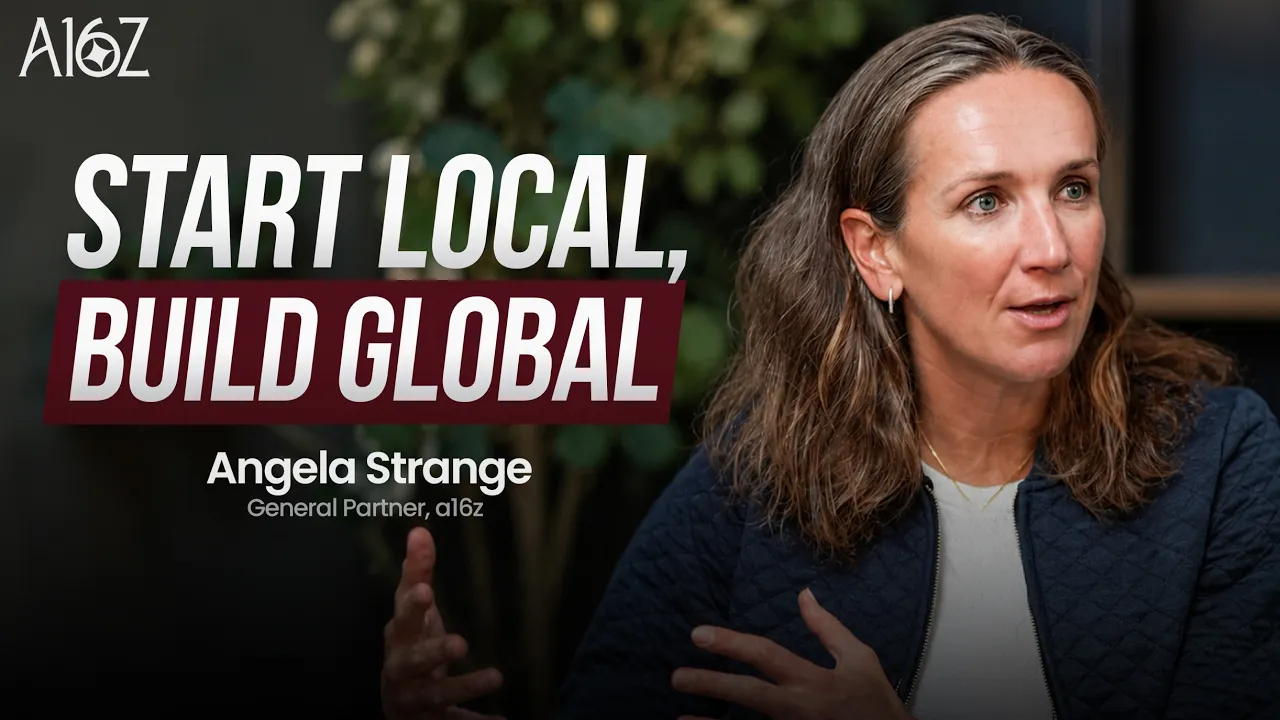
A16z Redirects Capital as Global Founders Reshape Tech Market
a16z
Cross-border startups and AI adoption will drive up to 30% of global venture capital returns within the next decade, according to Andreessen Horowitz partners.
## Background
Published on YouTube by a16z on August 20, 2026, this episode features host Elena Burger alongside Andreessen Horowitz general partner Angela Strange and partner Gabriel Vasquez. The conversation explores the rise of the "borderless founder"—entrepreneurs who leverage their regional networks, local insights, and domestic talent alongside Silicon Valley's capital and execution speed to build globally scalable technology companies.
## TL;DR
Angela Strange and Gabriel Vasquez trace how a16z's international investment strategy evolved from early fintech initiatives in Latin America into a expansive global network. The discussion details the unique advantages borderless founders bring to Silicon Valley, including untapped non-US engineering pools, instant national brand recognition, and rapid enterprise design partnerships. They also break down practical founder playbooks—such as navigating US visa friction, tapping into regional diaspora networks, and spending multi-month immersion periods in the Bay Area to recalibrate execution speed and ambition. Looking forward, they project that borderless and dual-headquartered startups will capture a significantly larger share of top-tier venture returns over the next decade.
## Atmosphere & style
The conversation carries an energetic, forward-looking, and insider-builder tone, combining analytical venture capital frameworks with personal operational anecdotes. The host and guests share an enthusiastic, collaborative chemistry that moves fluidly between high-level macroeconomic shifts and pragmatic tactical advice for global founders. Listening to the discussion feels like sitting in on a candid strategy session with seasoned Silicon Valley investors who possess a deep, genuine respect for international entrepreneurial ecosystems.
## Key takeaways
- [00:00](https://www.youtube.com/watch?v=0t3TpJXa5-A&t=0s) A borderless founder is any entrepreneur—regardless of country of origin—building a company with global scale and ambition from day one.
- [00:00](https://www.youtube.com/watch?v=0t3TpJXa5-A&t=0s) Developing and international markets force founders to build full-stack solutions due to a lack of pre-built 'as-a-service' infrastructure like fraud or KYC tools.
- [00:54](https://www.youtube.com/watch?v=0t3TpJXa5-A&t=54s) International markets offer vast underserved populations compared to saturated US consumer markets, creating massive opportunities for disruptive startups.
- [10:26](https://www.youtube.com/watch?v=0t3TpJXa5-A&t=626s) Country-specific diaspora networks in Silicon Valley function like elite university alumni networks, providing early design partners, executive talent, and mentorship.
- [18:04](https://www.youtube.com/watch?v=0t3TpJXa5-A&t=1084s) Borderless founders possess three native advantages: access to deep non-US talent pools, native brand authority that drives national pride, and direct access to early enterprise customers.
- [23:08](https://www.youtube.com/watch?v=0t3TpJXa5-A&t=1388s) Early validation and regional momentum trigger Marc Andreessen's 'preferential attachment' flywheel, making it exponentially easier for borderless startups to hire elite U.S. talent and win global clients.
- [27:08](https://www.youtube.com/watch?v=0t3TpJXa5-A&t=1628s) Mapping new startup ecosystems relies on 'local luminaries'—established community-focused founders who act as early angel investors and connect rising local stars with Silicon Valley.
- [33:15](https://www.youtube.com/watch?v=0t3TpJXa5-A&t=1995s) Second-wave repeat founders who previously built $1B–$5B regional companies are re-entering the market with ambitious global visions, often pairing with young AI talent.
- [36:50](https://www.youtube.com/watch?v=0t3TpJXa5-A&t=2210s) Physical initiatives like dedicated hacker houses (e.g., Palo House) and specialized immigration platforms help mitigate major transition hurdles for international teams in Silicon Valley.
- [40:30](https://www.youtube.com/watch?v=0t3TpJXa5-A&t=2430s) Founders are advised to spend at least 3 to 6 months in Silicon Valley to calibrate their execution speed and ambition level against global standards.
- [42:25](https://www.youtube.com/watch?v=0t3TpJXa5-A&t=2545s) The long-standing paradigm where Silicon Valley captured 90% of venture returns is shifting, with borderless and dual-headquarter companies expected to capture 20% to 30%+ of future global returns.
## Detailed walkthrough
### [00:00](https://www.youtube.com/watch?v=0t3TpJXa5-A&t=0s) Intro & The Rise of the Borderless Founder
The episode opens with clips highlighting the core thesis: anyone building with global ambitions—regardless of where they started—is a "borderless founder." These founders often carry a unique hunger and drive to prove themselves globally. Unlike in the US, where startups can plug into pre-built infrastructure for everything from fraud prevention to KYC (Know Your Customer), international markets often force founders to build every layer of the stack from scratch. While technology democratizes distribution across the world, Silicon Valley remains the concentrated epicenter where innovation moves fastest. Host Elena Burger introduces Andreessen Horowitz (a16z) general partner Angela Strange and partner Gabriel Vasquez, two key architects of the firm's global investment strategy, to unpack this shift.
- **Key concept:** Technology democratizes access globally, yet physical density in Silicon Valley accelerates speed and ambition.
- **Core distinction:** Developing markets require full-stack building due to missing "as-a-service" infrastructure.
---
[00:54](https://www.youtube.com/watch?v=0t3TpJXa5-A&t=54s) Origins of a16z's Global Strategy
Angela reflects on her early days at a16z focusing on fintech distribution challenges in the US, where breaking through consumer inertia is notoriously difficult. Around that time, her brother joined Nubank in Brazil, where founder David Vélez made a compelling point: in the US, startups fight to be the fifth financial service for a consumer, whereas international markets offer massive underserved populations trapped by a few legacy banks. This insight led to Angela writing a16z's first check in Latin America to Santiago Suarez, co-founder and CEO of Addi, which now serves a quarter of the Colombian population for payments and banking.
Shortly after, Gabriel—who had recently joined a16z in a different role—reached out directly to Angela over WhatsApp after mapping out 25 of the top founders in Latin America. At the time, Latin America had roughly 30 unicorns, but those founders weren't actively talking across borders. Gabriel and Angela brought them together into a WhatsApp group alongside a16z partners like Marc Andreessen and Alex Rampell. This community quickly transformed into an active hub for sharing operational insights and exchanging high-quality seed deal flow, since many of these unicorn founders were prolific angel investors.
> "You could compete to be the fifth financial services for every customer in the US. Or you could go to a wide open market with five fat, happy banks that only serve 20% of the population."
- **First check:** Santiago Suarez at Addi (Colombia).
- **Early network metric:** ~30 unicorns in Latin America mapped into a single cross-border founder community.
---
[06:35](https://www.youtube.com/watch?v=0t3TpJXa5-A&t=395s) What International Founders Bring to the Bay Area
International founders often follow a pattern: growing up in their home country, spending time studying or working in the US (such as Santiago Suarez attending Yale and working at US financial institutions), and returning home to build using deep local insight combined with global playbooks. However, the rise of AI dramatically shifted this dynamic. Rather than expecting investors to come to them, international founders began flocking directly to the Bay Area to get integrated into the AI ecosystem faster.
To support this surge, Gabriel and Angela launched "Borderless Dinners" in Silicon Valley. Starting with small gatherings of 20 to 30 Latin American founders, the initiative created direct connectivity between emerging entrepreneurs and established figures like Guillermo Rauch (Vercel) and Pedro Franceschi (Brex). Over time, early dinner attendees like Victor Cardenas (Slash) and Jorge "Oreo" Torres (Factory) evolved from participants into unicorn founders who now mentor the next wave.
- **Network flywheel:** Early dinner participants graduated into unicorn founders leading the community.
- **Key attendees/mentors mentioned:** Guillermo Rauch (Vercel), Pedro Franceschi (Brex), Victor Cardenas (Slash), Jorge "Oreo" Torres (Factory).
---
[10:26](https://www.youtube.com/watch?v=0t3TpJXa5-A&t=626s) Defining the Borderless Founder & Diaspora Networks
Angela defines a borderless founder in the most inclusive terms: any entrepreneur—regardless of origin—building a company aimed at global scale. Gabriel notes that many borderless founders possess a distinct "chip on their shoulder," often stemming from being raised in overlooked countries (such as Gabriel's own upbringing in El Salvador) or small, remote towns. This environment fosters a fierce determination to benchmark themselves globally and prove that greatness isn't bound by geography.
Angela compares these country-specific diasporas to elite university alumni networks, arguing that national founder networks can actually be far more powerful. Drawing from her experience co-founding the C100—a network created 15 years ago by Canadians in the Bay Area—she explains how diaspora organizations provide critical "design partners" (early customers) and executive talent pipelines that help local ecosystems scale. Similar networks are now accelerating global success stories like Shopify and OpenEvidence.
> "Regardless of where they were born, they can still achieve greatness... that's the mindset of these people that want to go and dominate globally."
- **Definition:** Any founder with global ambitions, regardless of starting country.
- **Historical parallel:** C100 (Canadian technology diaspora network in Silicon Valley).
- **Key diaspora impact:** Providing first customers/design partners and recruiting growth-stage executives.
[015:42] Ecosystem Maturity and the Talent Return Flow
While AI has enabled exponential growth across borders, local startup dynamics vary significantly by country. Some mature European ecosystems, such as the UK or Sweden, foster a strong sense of pride where founders actively want to build independent domestic tech hubs. Conversely, in earlier-stage ecosystems, founders often view moving to Silicon Valley as the necessary fast track. In these nascent markets, early-stage, AI-native founders frequently turn to an established "father figure" or lighthouse founder—someone who built a hard business early on—to illuminate how Silicon Valley operates and guide their initial connections.
```
┌──────────────────────────────────────────┐
│ Lighthouse Founder │
│ ("Father figure" in home country) │
└────────────────────┬─────────────────────┘
│
Guides & Connects
│
▼
┌──────────────────────────────────────────┐
│ AI-Native Founders │
│ (Moves to Silicon Valley) │
└────────────────────┬─────────────────────┘
│
Builds & Recruits
│
▼
┌──────────────────────────────────────────┐
│ Home Country Talent │
│ (Attracted back to solve local issues) │
└──────────────────────────────────────────┘
```
Despite the outbound migration, local ecosystems derive massive long-term benefits from their international diasporas. A striking example of this dynamic in action is the a16z portfolio company **Taco**, which handles payroll and HR workflows across Brazil with the broader mission of dismantling local bureaucracy. Founded by the former founder of **Rappi** alongside a second-time founder named Fernando, Taco successfully leverages its founders' roots to recruit top Brazilian talent back from the United States. These returning engineers and executives understand the complex local bureaucratic friction firsthand and leverage advanced AI to solve problems directly inside their home country.
- **Diaspora Return Flow:** Experienced founders use their Silicon Valley credentials and capital to lure top talent back to their home countries.
- **Taco Case Study:** Leverages returning Brazilian expatriates to tackle structural administrative friction and HR workflows in Brazil.
---
[018:04] The Three Native Advantages: Brand, Customers, and Talent
Borderless founders possess three distinct native advantages over traditional founders: deep talent networks, native brand authority, and direct access to early enterprise customer bases. Brand recognition can elevate a startup to represent national pride—a dynamic described as the "AI Olympics," where countries actively root for their own tech champions. For instance, the Polish-founded startup **ElevenLabs** (originating in the UK) became Poland's primary representative in the global AI race, prompting direct investment and strategic initiatives from the Polish government. Similar government validation and support have been seen in Sweden with startups like **Lovable** and **Agora**, granting these companies instant credibility and entry into large local enterprises.
```
┌─────────────────────────────────┐
│ Three Native Advantages │
└────────────────┬────────────────┘
│
┌─────────────────────────────┼─────────────────────────────┐
▼ ▼ ▼
┌─────────────────┐ ┌─────────────────┐ ┌─────────────────┐
│ Talent │ │ Brand │ │ Customers │
├─────────────────┤ ├─────────────────┤ ├─────────────────┤
│ Access non-US │ │ National pride │ │ Fast enterprise │
│ AI talent pools │ │ & government │ │ design partners │
│ & competitions │ │ endorsement │ │ turn to ARR │
└─────────────────┘ └─────────────────┘ └─────────────────┘
```
On the customer acquisition front, borderless founders frequently land game-changing design partnerships by leveraging alumni networks and regional ties that bypass standard corporate gatekeepers. **Factor Labs** secured its first major design partner by landing the largest enterprise conglomerate in Latin America (owned by the Slim family), which subsequently opened doors to multi-million dollar contracts. Similarly, **Supersonic**, founded by Spanish entrepreneurs, reached out to a fellow university alumnus who had risen from CRO of Salesforce to COO; that personal bridge turned Salesforce into their first design partner and eventual customer.
Furthermore, brand strength helps global startups recruit top-tier U.S. executives who might otherwise ignore an unknown company. When Colombian fintech **Addi** needed a world-class credit officer capable of managing billions in Gross Merchandise Value (GMV), they targeted talent from Capital One in Virginia. By standing out as the undeniable tech winner in Colombia rather than "one of 50 lookalike startups in the US," Addi successfully recruited top American talent. Similarly, corporate card platform **Jeeves** partnered with the Central Bank of Brazil to facilitate cross-border stablecoin transactions, earning a reputation for compliance and speed that compounded their brand prestige with both enterprises and top hires.
- **ElevenLabs:** Polish founders created an AI audio leader that became Poland's flagship representative in the global "AI Olympics," securing government backing.
- **Factor Labs:** Leveraged Latin American enterprise connections to close a design partnership with the Slim family's conglomerate.
- **Supersonic:** Used university alumni ties to reach Salesforce's COO, converting the enterprise tech giant into its flagship customer.
- **Addi:** Capitalized on its dominant brand status in Colombia to recruit elite credit executives from Capital One in Virginia.
- **Jeeves:** Collaborated with Brazil's central bank on enterprise stablecoin cross-border payments to build compliance trust.
---
[023:08] Accelerating the "Preferential Attachment" Flywheel
The firm's investment philosophy heavily incorporates Marc Andreessen’s concept of **preferential attachment**—the idea that early signals of success make it exponentially easier to attract the next incremental customer, investor, or employee. Borderless founders have unique, multi-market levers to accelerate this flywheel during intense talent wars. For example, an AI insurance startup in Brazil tapped into undiscovered talent pools by bypassing elite traditional universities and instead recruiting directly from national scholarship programs and high school robotics competitions. Bringing on ten extraordinarily gifted engineers early on makes recruiting the 11th candidate from the U.S. far easier when candidates see the peer group's caliber.
```
┌──────────────────────────────────────┐
│ Early Signal / Native Advantage │
│ (Talent, Gov Brand, Early Enterprise)│
└──────────────────┬───────────────────┘
│
▼
┌──────────────────────────────────────┐
│ Preferential Attachment │
│ Flywheel Accelerates │
└──────────────────┬───────────────────┘
│
┌──────────────────────────┴──────────────────────────┐
▼ ▼
┌──────────────────────────────────────┐ ┌──────────────────────────────────────┐
│ Next Incremental Hires │ │ Next Enterprise Customers │
│ "How did you get people this good?" │ │ "If X enterprise uses them, so can we"│
└──────────────────────────────────────┘ └──────────────────────────────────────┘
```
The bridge between Silicon Valley and international markets flows both ways. Startups like **Cognition** saw Brazil become an unexpectedly massive driver of early GTM revenue because Latin American enterprises were eager to adopt cutting-edge AI quickly and lacked local options. Additionally, cross-border value now occurs *between* different international diasporas (intra-diaspora dynamics), such as a German founder securing their first major design partner with a top Spanish corporate conglomerate through firm connections.
> "In some ways, you could argue all of a16z was founded to accelerate our founders' preferential attachment... and I would argue borderless founders have more levers at their disposal to get that going." — **Angela Strange**
- **Cognition Case Study:** Capitalized on high early demand in Brazil, making the country a primary revenue driver during their initial GTM phase.
- **Intra-Diaspora Cross-Pollination:** Connects founders from one international region (e.g., Germany) directly to decision-makers in another (e.g., Spain).
---
[027:08] Mapping New Ecosystems via "Local Luminaries"
When entering a new geographic market, a16z identifies and partners with **local luminaries**—highly respected founders who tirelessly advocate for their domestic startup ecosystem. The absolute scale or outcome of their own company matters far less than their standing as community builders and active angel investors. In Sweden, for instance, **VOI** co-founders Fredrik Hjelm and Adam Jafer emerged as key luminaries; despite building a micro-mobility e-scooter company rather than an AI firm, Hjelm angel invested across virtually every notable early-stage Swedish AI startup, acting as the connective tissue for the market.
```
┌─────────────────────────────────────────────────────────────────┐
│ Local Luminaries │
│ (Respected domestic founders & angels; e.g., VOI founders) │
└────────────────────────────────┬────────────────────────────────┘
│
Connects & Maps Rising Stars
│
▼
┌─────────────────────────────────────────────────────────────────┐
│ Silicon Valley Bridge │
│ (Valley-bound stars; e.g., Gabriel Peterson / OpenAI) │
└────────────────────────────────┬────────────────────────────────┘
│
Scales Community & Access
│
▼
┌─────────────────────────────────────────────────────────────────┐
│ Global Scout Network │
│ (Mission-driven startup execs paying it forward) │
└─────────────────────────────────────────────────────────────────┘
```
The second phase of geographic expansion involves mapping "rising stars" who bridge their home country with Silicon Valley. A prime Swedish example is **Gabriel Peterson**, a high school dropout who moved to the U.S. without formal credentials, joined Midjourney, became one of the youngest researchers at OpenAI, and ultimately launched his own company. Peterson became the key contact for any Swedish founder moving to the Bay Area. To nurture these networks long term, a16z runs a **Global Scout Program** featuring mission-driven startup executives and hosts dedicated community events, including an exclusive gathering featuring Ben Horowitz and Angela Strange.
- **Local Luminaries Concept:** Early ecosystem leaders who validate domestic talent and act as angel investor nodes.
- **Fredrik Hjelm & Adam Jafer (VOI):** Key Swedish luminaries who bridged traditional tech and the new wave of Swedish AI startups.
- **Gabriel Peterson:** Swedish native who rose through Midjourney and OpenAI, becoming a central node for Swedish founders relocating to Silicon Valley.
- **Global Scout Program:** Recruits rising startup executives, heads of sales, and founding engineers to scout local talent and pay their knowledge forward.
[031:37] Local Ecosystems, Startup Flywheels, and Paying It Forward
When venture capital firms see a high density of talent in a region—such as when a delegation of Nordic founders visits Silicon Valley—they host targeted local events to nurture those local ecosystems. Host Elena Burger notes how this strategy mirrors the growth motion of major tech companies like Stripe (referencing a recent podcast with Stripe’s Will Gaybrick). Companies and investors start early with tiny teams or individual creators, growing alongside them through every phase of their lifecycle into massive enterprise entities. This repeatable flywheel motion applies equally to international startup investments and developer payment platforms alike.
Angela Strange emphasizes that founders always remember the early champions who supported them "when it wasn't obvious." Success in international venture investing requires a genuine passion for meeting people early, paying it forward, and elevating the broader community. While some of these connections directly convert into portfolio investments, others become critical pillars of the surrounding global startup infrastructure.
- **Parallel Flywheels:** Early-stage startup ecosystems scale using the same lifecycle mechanics as developer platforms like Stripe.
- **Ecosystem Mentality:** Investing heavily in early founder relationships creates long-term goodwill, regardless of whether a check is written immediately.
[033:15] Engaging Second-Wave Repeat Founders
Many international startup hubs have experienced a "first wave" of tech entrepreneurs who scaled businesses to impressive valuations—typically in the $1 billion to $5 billion range—but didn't fully realize their ultimate vision due to early ecosystem limitations. Driven to build something even larger, these experienced repeat founders re-enter the market with deep operational knowledge and expanded networks. Gabriel Vasquez explains how Andreessen Horowitz tracks these founders closely, providing them with bridges back into Silicon Valley to reactivate their networks, connect with elite talent (like top Stanford AI engineers), and gain direct feedback from prospective enterprise customers.
To demonstrate this ideation-phase support, Gabriel highlights the firm's investment in Fredrik Hjelm's new company, Pip.com. When the team visited Silicon Valley, a16z arranged introductions with top executives at DoorDash, Lyft, and other portfolio companies to stress-test their ideas. Even though high-profile repeat founders have no shortage of venture capital interest, proving value during the early ideation phase sets a firm apart. Furthermore, Angela notes that pairing seasoned repeat founders with ambitious 18-to-20-year-old AI talent creates a powerful dynamic, offering young engineers a high-growth "CEO school" environment before they launch their own companies.
- **First-Wave Ecosystem Scale:** Previous regional exits in the $1B–$5B range created a tier of seasoned founders hungry for bigger global outcomes.
- **Case Example:** Fredrik Hjelm’s Pip.com relied on a16z’s executive network (including leaders from DoorDash and Lyft) to validate their operational thesis before raising.
- **Talent Synergy:** Repeat founders gain access to top-tier young engineering talent, while young engineers gain operational mentorship from proven leaders.
[036:50] Supporting International Founders: Visas, Hacker Houses, and Enterprise Networks
Navigating the transition from seed-stage startup to a global company involves massive logistical hurdles for non-US founders. The most acute friction point is securing the correct US visa and compiling recommendation letters. To streamline this, a16z actively helps founders navigate immigration paths and invests in specialized native visa platforms like Extraordinai. Beyond legal paperwork, temporary housing setups and hacker houses serve as critical landing pads for international teams entering Silicon Valley.
Gabriel shares an example from the Slush conference in Finland, where four students from Germany's Center for Digital Technology and Management (CDTM) pitched the concept of a dedicated Silicon Valley hub. Sponsored by a16z over a four-month period, "Palo House" in Palo Alto blew past expectations—hosting over 1,200 founders, engineers, and dinner guests and functioning effectively like a "small liberal arts college." Beyond housing, Angela points out another distinct international edge: connecting technical founders directly with forward-thinking next-generation leaders of powerful international enterprise families who want to make their legacy operations AI-native.
- **Immigration Friction:** Visas remain the single most stressful bottleneck for relocating founders; portfolio companies like Extraordinai help streamline US entry qualifications.
- **Palo House Impact:** Founded by German CDTM students and sponsored by a16z, the Palo Alto house welcomed over 1,200 ecosystem participants in four months.
- **Enterprise Customer Access:** Connecting founders with NextGen leaders of global family enterprise conglomerates directly yields early customer contracts.
[040:30] Practical Advice for Founders Moving to Silicon Valley
When international founders ask whether they should relocate completely or visit short-term, Gabriel strongly advises spending at least 3 to 6 months in Silicon Valley. A brief visit of just a couple of weeks can feel overwhelming or discouraging because deep networks take time to unlock. Immersing oneself in the Bay Area environment allows founders to calibrate their execution speed and ambition level against the highest benchmark in the world.
Angela encourages incoming entrepreneurs to aggressively lean into their existing regional diasporas upon arrival. The local expatriate and founder networks across the Bay Area run far deeper than most first-time visitors realize, providing ready-made support systems specifically primed to help international startups scale.
- **Optimal Immersion Window:** Founders are advised to spend a minimum of 3 to 6 months in Silicon Valley to properly absorb the network and calibrate operational speed.
- **Calibration Effect:** Exposure to Silicon Valley resets founder benchmarks for pace, execution, and long-term vision.
- **Diaspora Networks:** Founders should proactively tap into existing regional founder groups and diaspora channels in the Bay Area.
[042:25] The Next 10 Years: The Borderless Startup Topology
Looking ahead to the next decade, both Angela and Gabriel envision a shift in the global startup landscape. Angela notes that 40% of recent investments from their group involved international founders—split evenly between those based in Silicon Valley and those living abroad. As AI lowers barrier entries globally, a more diverse cross-section of global talent will build massive international software enterprises.
Addressing the long-standing Silicon Valley belief that "90% of venture capital returns come from Silicon Valley companies," Gabriel argues that this static metric misrepresents the modern reality. Many top-performing companies are inherently borderless, maintaining dual headquarters or housing executive leadership in the US while keeping core engineering talent in their home countries. Over the next decade, the share of venture returns driven by international and dual-country entities is poised to rise from 10% toward 20% to 30%, reflecting a truly globalized technology ecosystem.
- **Portfolio Demographics:** 40% of investments made by the team go to international founders (50% based in the US, 50% based abroad).
- **Venture Return Shift:** The historic benchmark where Silicon Valley captured 90% of VC returns is expected to shift, with borderless/international entities claiming 20% to 30%+.
- **Dual-Country Headquarters:** Future category-defining tech companies will increasingly operate with cross-border footprints from day one.
## Notable quotes
> [00:54](https://www.youtube.com/watch?v=0t3TpJXa5-A&t=54s) You could compete to be the fifth financial services for every customer in the US. Or you could go to a wide open market with five fat, happy banks that only serve 20% of the population. — Angela Strange
> [10:26](https://www.youtube.com/watch?v=0t3TpJXa5-A&t=626s) Regardless of where they were born, they can still achieve greatness... that's the mindset of these people that want to go and dominate globally. — Gabriel Vasquez
> [23:08](https://www.youtube.com/watch?v=0t3TpJXa5-A&t=1388s) In some ways, you could argue all of a16z was founded to accelerate our founders' preferential attachment... and I would argue borderless founders have more levers at their disposal to get that going. — Angela Strange
## Mentioned
a16z, Addi, Agora, Alex Rampell, Angela Strange, Brex, C100, Capital One, Center for Digital Technology and Management, Central Bank of Brazil, Cognition, David Vélez, DoorDash, Elena Burger, ElevenLabs, Extraordinai, Factor Labs, Factory, Fernando, Fredrik Hjelm, Gabriel Peterson, Gabriel Vasquez, Guillermo Rauch, Jeeves, Jorge "Oreo" Torres, Lovable, Lyft, Marc Andreessen, Midjourney, Nubank, OpenAI, OpenEvidence, Palo House, Pedro Franceschi, Pip.com, Rappi, Salesforce, Santiago Suarez, Shopify, Slash, Slim family, Stripe, Supersonic, Taco, Vercel, Victor Cardenas, VOI, Will Gaybrick
Andreessen Horowitz partners Angela Strange and Gabriel Vasquez argue that the next generation of category-defining tech companies will be built by "borderless founders" who pair home-country talent and customer advantages with Silicon Valley's operational density and ambition.
Market Dynamics and the Borderless Founder Mindset (0:54)
Developing economies often lack the "as-a-service" infrastructure common in the United States, forcing international founders to build full-stack solutions from scratch. However, these emerging markets also offer massive, underserved customer populations. Strange points out that while US fintech startups fight to become a consumer's fifth financial service, international markets often present legacy banking systems serving only 20% of the population. This dynamic led to a16z's first Latin American investment in Addi, which now provides payments and banking services to a quarter of Colombia's population.
Vasquez and Strange define borderless founders as entrepreneurs building for global scale regardless of origin. Often emerging from overlooked regions like El Salvador or small towns, these founders carry a distinct determination to benchmark themselves globally. While early waves of founders studied or worked in the US before returning home, the rise of AI has prompted international entrepreneurs to move directly to Silicon Valley to integrate into the ecosystem more rapidly.
Native Advantages: Brand, Customers, and Talent
Borderless founders possess three structural native advantages: regional brand status, early customer networks, and deep talent pools. In the global "AI Olympics," domestic backing can turn startups into symbols of national pride, as seen when Polish-founded ElevenLabs secured direct backing from the Polish government, or when Lovable and Agora gained early enterprise credibility in Sweden. This elevated home-country profile also aids international recruiting; Colombian fintech Addi leveraged its dominant domestic brand to recruit senior credit executives from Capital One in Virginia, standing out far more than a comparable US startup.
Founders also bypass traditional enterprise gatekeepers by activating diaspora and alumni ties. Factor Labs landed a major design partnership with the Slim family's conglomerate in Latin America, while Spanish founders at Supersonic leveraged university connections with Salesforce's leadership to secure their initial enterprise contract. Furthermore, this dynamic accelerates what Marc Andreessen terms the "preferential attachment" flywheel: securing elite early engineers from non-traditional pipelines—such as Brazilian national robotics competitions—makes recruiting subsequent top-tier US talent much easier.
Ecosystem Architecture: Luminaries, Diasporas, and Return Flow
When expanding into new regions, venture investors map ecosystems around "local luminaries"—established founders and active angels who validate rising talent regardless of their own company's specific sector. In Sweden, VOI co-founders Fredrik Hjelm and Adam Jafer served as primary angel nodes for emerging AI startups. These luminaries connect with "rising stars" in the US, such as Gabriel Peterson, a Swedish native who worked at Midjourney and OpenAI before launching his own venture, serving as a Silicon Valley bridge for other relocating Swedes.
Rather than causing a permanent brain drain, international migration creates a talent return flow. For instance, Brazilian HR platform Taco, co-founded by Rappi's former founder, recruits top Brazilian engineers back from the United States to tackle complex local administrative bureaucracy. Experienced second-wave founders whose first exits reached $1B to $5B are also re-entering the market with larger ambitions, using Silicon Valley networks to pressure-test ideas while mentoring younger AI engineering talent.
Bridging Valley Immersion with Cross-Border Topologies
International founders transitioning to Silicon Valley face acute logistical hurdles, especially US visa compliance and initial community integration. To mitigate these friction points, firms support native visa platforms like Extraordinai and sponsor landing hubs like the student-run "Palo House," which hosted over 1,200 founders and engineers across four months. Vasquez advises international entrepreneurs to immerse themselves in Silicon Valley for at least three to six months rather than making short visits, allowing sufficient time to absorb local networks and calibrate their operational pace.
Strange notes that 40% of her team's recent investments involve international founders, split evenly between those in the US and those abroad. Over the next decade, Vasquez projects that the share of venture returns generated by international and dual-headquarter companies will rise from the historic baseline of roughly 10% to between 20% and 30%.
## Background
该视频由知名风险投资机构 a16z 于 2026 年 8 月 21 日发布在其官方 YouTube 频道上。节目由主持人 Elena Burger 对话 a16z 合伙人 Angela Strange 与 Gabriel Vasquez,探讨“无国界创始人(Borderless Founder)”的崛起,以及他们如何将本土市场的洞察与人脉同硅谷的资本、人才与速度相结合以打造全球化企业。
## TL;DR
对谈梳理了 a16z 全球投资布局从拉美早期探索扩展至全球网络的演进历程,深度拆解了无国界创始人在人才网络、本土品牌声誉以及早期大客户验证三大维度的独特护城河。两位投资人指出,AI 浪潮兼具去中心化普及与湾区极度集聚的双重特性,正加速推动海外创业者与硅谷生态的双向流动。他们不仅分享了利用海外侨民网络、本地灯塔人物及“黑客屋”空间进行生态搭建的具体方法论,还针对签证难关、早期商业场景对接等实操痛点提供了建议。最终,嘉宾展望了未来十年的全球创业版图,预言兼具跨境基因的创业团队将彻底打破硅谷本土垄断超额回报的传统叙事。
## Atmosphere & style
整场对话节奏明快、充满干货且极具启发性,既有顶级风投自上而下的宏观战略视野,又饱含穿梭全球一线挖掘人才的生动细节。嘉宾们毫无居高临下的说教感,Gabriel 的现身说法与 Angela 的实战复盘碰撞出真诚而热烈的探讨氛围,生动展现出一种对“被低估者(underdog)”奋斗精神的惺惺相惜。聆听体验如同置身于硅谷高管与全球顶尖极客的私密闭门沙龙,在激扬的全球化雄心与务实的破局建议中,让海外创业者感受到强烈的共鸣与被赋能的振奋感。
## Bulletin
- [42:25](https://www.youtube.com/watch?v=0t3TpJXa5-A&t=2545s) a16z 早期投资项目中已有 40% 投向国际创始人,其中一半常驻旧金山湾区,另一半常驻世界其他国家与地区。
- [05:50](https://www.youtube.com/watch?v=0t3TpJXa5-A&t=350s) 生成式 AI 引发了双重悖论:开源模型与 API 虽让技术开发民主化,但最前沿突破、高端人才与认知迭代却极端向旧金山湾区集聚,促使国际创始人争相奔赴硅谷。
- [42:25](https://www.youtube.com/watch?v=0t3TpJXa5-A&t=2545s) 传统风投圈所称“90% 超额回报来自硅谷”掩盖了跨境研发的真实底色,a16z 预计未来十年海外与跨境创企在风投回报中的占比将提升至 20% 至 30%。
- [40:30](https://www.youtube.com/watch?v=0t3TpJXa5-A&t=2430s) 针对海外创业者,a16z 投资人强烈建议至少在硅谷生活 3 到 6 个月,以彻底完成对“硅谷速度”的校准并穿透本地核心人脉圈层。
## Key takeaways
- [00:00](https://www.youtube.com/watch?v=0t3TpJXa5-A&t=0s) “无国界创始人”定义为不受地域限制、志在打造全球化标杆的企业家,这类创始人往往带有证明被低估出身的强烈胜负欲(chip on their shoulder)。
- [00:00](https://www.youtube.com/watch?v=0t3TpJXa5-A&t=0s) 新兴市场因缺乏开箱即用的基础设施模块(如反欺诈与 KYC 接口),倒逼国际创始人磨炼出全栈搭建的硬核能力与极深的本土护城河。
- [04:20](https://www.youtube.com/watch?v=0t3TpJXa5-A&t=260s) 跨国创业者普遍兼具“双重视角”:既深谙硅谷已被验证的商业模式,又对母国监管机制与本土市场痛点具备深刻直觉。
- [06:58](https://www.youtube.com/watch?v=0t3TpJXa5-A&t=418s) 基于母国认同的侨民网络(Diaspora)在硅谷凝聚力极强,其赋能价值与反哺冲动已比肩乃至超越常春藤盟校校友会。
- [12:52](https://www.youtube.com/watch?v=0t3TpJXa5-A&t=772s) 类似 C100 的侨民组织主要通过两大维度助推创企跨国跃迁:为早期产品引荐硅谷设计合作伙伴,以及从成熟市场物色能操盘数亿美元营收的高级扩张人才。
- [18:04](https://www.youtube.com/watch?v=0t3TpJXa5-A&t=1084s) 无国界创始人具备三大天生壁垒:深度且具号召力的人才网络(Talent)、独特的本土品牌声誉(Brand)以及高忠诚度的早期客户群(Customers)。
- [18:49](https://www.youtube.com/watch?v=0t3TpJXa5-A&t=1129s) “AI 奥运会”效应让 ElevenLabs、Lovable 等项目获得母国政府与顶级财团的强力背书,大幅缩短了企业大单的商业化验证周期。
- [21:28](https://www.youtube.com/watch?v=0t3TpJXa5-A&t=1288s) 母国头部的明星品牌声誉能够反向形成“招聘降维打击”,吸引来自 Capital One 等美国巨头的高级风控与业务领袖加入波哥大等地团队。
- [22:36](https://www.youtube.com/watch?v=0t3TpJXa5-A&t=1356s) 无国界创始人加速了网络科学中的“优先连接”(Preferential Attachment)效应,包括挖掘非共识的海外工程师池,以及凭借海外首发订单敲开美国保守巨头的大门。
- [27:09](https://www.youtube.com/watch?v=0t3TpJXa5-A&t=1629s) a16z 进入全新区域的核心策略是识别并赋能“本土灯塔人物”(如瑞典微出行独角兽创始人),通过背书与联办活动渗透至当地最前沿的创业圈层。
- [33:15](https://www.youtube.com/watch?v=0t3TpJXa5-A&t=1995s) 区域市场的连续创业者面临 10 亿至 50 亿美元估值的初代天花板,普遍渴望通过与硅谷顶级年轻技术力量联手开启更有全球影响力的二次创业。
- [36:50](https://www.youtube.com/watch?v=0t3TpJXa5-A&t=2210s) 跨国落地最大的现实痛点是签证与物理软着陆,海外黑客屋(Hacker Houses)模式与跨境家族企业接班人网络正在成为高效的孵化与成单跳板。
- [42:25](https://www.youtube.com/watch?v=0t3TpJXa5-A&t=2545s) 未来十年全球创业范式将逐步确立“双总部”结构:创始人面向硅谷对接资本与高维生态,同时将核心研发与基础设施深耕于本土母国。
## Detailed walkthrough
### [00:00](https://www.youtube.com/watch?v=0t3TpJXa5-A&t=0s) 什么是“无国界创始人”以及 a16z 全球投资战略的萌芽
对话由“无国界创始人(Borderless Founder)”的定义切入:无论创业者身处何地,即便最初是在自己的母国起步,只要怀揣着打造世界级企业的雄心,便属于无国界创始人。这类创业者往往身上带着一股不服输的劲头("a chip on their shoulder"),极度渴望证明自己:无论出生在哪里,都能成为行业的全球标杆并成就非凡。与美国创业生态中每一层技术栈都能即买即用(Fraud as a service、KYC as a service)完全不同,在拉美等很多新兴市场,创业者必须从底层亲手搭建所有基础设施。
主持人 Elena Burger 指出,历史上风险投资高度局限在硅谷,但 a16z 正在全方位推行全球化战略。a16z 合伙人 Angela Strange 回忆起自己刚加入机构时的经历:她早期主攻金融服务与金融科技(fintech),曾撰文探讨金融分销之艰难——用户存在巨大的迁移惯性,只有在特定契机下才会更换现有服务商。与此同时,她的兄弟加入了巴西数字银行巨头 Nubank。Nubank 联合创始人兼 CEO David Vélez 当时的一席话极具启发性:在美国,你只能争当用户钱包里的“第五张信用卡”或“第五个金融 App”;但在拉美,面对五家只服务 20% 人口、坐享其成的传统垄断大银行,市场是彻底空白的。尽管牌照申请与基础设施建设极为痛苦,但背后是一片广袤的蓝海。这直接推动了 Angela 在拉美开出 a16z 的第一张支票——投资哥伦比亚金融科技公司 Addi 创始人 Santiago Suarez(如今 Addi 已覆盖哥伦比亚四分之一人口的银行与支付业务)。
随后不久,当时还在 a16z 另一团队的 Gabriel Vasquez 给 Angela 发来了一条 WhatsApp 消息。Gabriel 在拉美本地梳理调研后,发现整个拉丁美洲总共仅有 30 家独角兽企业。他主动走访了其中 25 位核心 CEO,将他们拉进了一个专属 WhatsApp 群组,并向 Angela 提议:应该在这个巨大机遇前有所作为。
```mermaid
flowchart TD
accTitle: a16z 全球投资策略萌芽路径
accDescr: 展示从拉美金融基础设施空白到成立高管社群并扩展为全球化战略的演进历程
subgraph Opportunities["机遇与痛点"]
A["美国本土内卷<br/>争夺第5家金融服务"]
B["新兴市场蓝海<br/>传统大银行仅覆盖20%人口"]
C["基础设施缺失<br/>全栈自研 KYC/反欺诈"]
end
subgraph Community["早期核心突破"]
D["投资 Addi (Santiago Suarez)<br/>服务哥伦比亚 1/4 人口"]
E["拉拢 30 家独角兽 CEO<br/>建立专属 WhatsApp 交流群"]
end
subgraph Growth["网络效应"]
F["打破地域孤岛<br/>巴西/墨西哥/哥伦比亚联动"]
G["社群内部裂变<br/>互通顶级早期 Deal Flow"]
end
Opportunities --> Community
Community --> Growth
```
- **市场对比**:成熟的美国市场高度模块化但极度内卷;拉美等新兴市场虽然缺乏现成的基础设施服务,但具有巨大的未被满足的普惠需求。
- **独角兽生态**:在早期,拉美仅有约 30 家独角兽,且彼此割裂(巴西创始人不认识墨西哥或哥伦比亚创始人)。
- **顶级背书加入**:a16z 随后将 Marc Andreessen、Alex Rampell 等核心管理合伙人引入该 WhatsApp 创始人社群,群内创始人均为活跃的天使投资人,迅速形成了高质量的项目源流转(Deal Flow)机制。
---
### [04:20](https://www.youtube.com/watch?v=0t3TpJXa5-A&t=260s) 跨界背景与“全栈”构建的本地壁垒
这些顶尖国际创始人身上具备硅谷本土创业者所没有的特殊经历。他们大多在母国成长,随后赴美求学或在大型科技及金融机构历练,最后选择回到家乡创业。例如 Addi 的 Santiago Suarez,在哥伦比亚长大后前往耶鲁大学求学,曾在美国多家大中型金融机构任职,之后回到哥伦比亚创业,并找来儿时技术过硬的挚友共同搭档。
这种背景赋予了他们“双重视角”:既深谙硅谷已被验证的成熟商业模式与前沿技术,又对本土市场的潜规则、监管文化与用户需求具有极其敏锐的本能。在拉美、东南亚等市场,缺少开箱即用的技术组件,创业者被迫发展出深厚的本地全栈构建能力。这种从泥泞中构建壁垒的能力,使本土护城河远比纯套用海外模板更加稳固。
---
### [05:50](https://www.youtube.com/watch?v=0t3TpJXa5-A&t=350s) AI 浪潮的双重悖论与向湾区集聚的引力
过去拉美创始人更希望 a16z 团队前往圣保罗、波哥大或墨西哥城实地走访;但生成式 AI 的爆发彻底颠覆了这种互动逻辑。AI 技术的普及带来了强烈的“双重悖论(Dichotomy)”:
1. **去中心化与民主化**:开源模型与云端 API 让世界任何角落的开发者都能以极低门槛调用最先进的计算能力,拓展各地市场;
2. **中心化与极端集聚**:全球最前沿的突破、顶尖技术人才和最密集的认知进化,高度集中在旧金山湾区。
这导致国际创始人的诉求发生根本转变:他们不再等待硅谷投资者到访,而是争相涌入湾区,希望深度融入硅谷的研发速度与人脉网络中。
---
### [06:58](https://www.youtube.com/watch?v=0t3TpJXa5-A&t=418s) “无国界晚宴”与跨国校友网络的成型
来到湾区后,国际创始人面临着全新的挑战:如何在陌生环境迅速找到同频力量?Gabriel 观察到,每个国家的海外群体都会本能地寻找硅谷顶尖的本国老乡——巴西人找巴西顶尖人才,欧洲人找欧洲同乡。此时,驱动合作的不再只是对母国市场的认知,而是基于共同文化与身份认同的紧密信任,以及硅谷独有的“利他回馈(Culture of Giving)”文化。在湾区,人们往往在未谋面前就愿意慷慨相助,而面对具有相似跨国奋斗经历的同胞,这种帮扶意愿更具共鸣。
为了系统化放大这种网络效应,a16z 创办了“无国界晚宴(Borderless Dinners)”。起初聚会聚焦于拉美群体,将常驻湾区且取得卓越成就的标杆人物与来访的新生代创始人聚在一起,每场规模约 20 至 30 人:
- **榜样引领**:Vercel 创始人兼 CEO Guillermo Rauch、Brex 联合创始人 Pedro Franceschi 等拉美裔行业领袖受邀深度参与,以亲身经历传授如何在硅谷立足并规模化业务。
- **代际传递与毕业反哺**:早期作为新人参与晚宴的创始人,如今已成长为新一代独角兽掌门人并作为分享嘉宾反哺社群,包括 Slash 创始人 Victor Cardenas 以及 Factored 创始人等。
这一机制形成了强大的良性循环:这种基于跨国族群认同形成的互助网络,其凝聚力与赋能价值,甚至已经比肩乃至超越了美国常春藤等顶尖名校的校友会体系。
### [09:28](https://www.youtube.com/watch?v=0t3TpJXa5-A&t=568s) 侨民网络的力量与反哺机制
国家维度的侨民(Diaspora)网络往往蕴含着惊人的能量,但过去由于缺乏体系化的组织,这种潜力一直没有被充分释放。如今,越来越多的海外创业者群体正在自发建立连接。对于那些历经千辛万苦来到美国立足的创始人而言——从摸索解决签证、寻找住所,到费尽心力融入当地圈子并拿下最初的客户——当他们取得成就后,内心往往怀揣着一种极其强烈的反哺冲动(pay it forward)。
然而,这种回馈意愿以往很难找到落地的出口。它不像功成名就的校友回母校演讲那么顺理成章。a16z 敏锐地抓住了这个痛点,构想并搭建了一个专属通道:如果将“母校”重新定义为那些来自本土、从名校毕业或毅然从高中辍学、正千方百计寻找路径去打造全球化企业的顶尖年轻人,并让跑通全流程的前辈直接对他们倾囊相授,整个房间里所碰撞出的能量与激情将是无可比拟的。
### [10:26](https://www.youtube.com/watch?v=0t3TpJXa5-A&t=626s) 重新定义“无国界创始人”
关于“无国界创始人”(Borderless Founder)、“移民创始人”(Immigrant Founder)以及纯粹赴美创业的国际人才之间的界限,Angela Strange 倾向于采取最包容的定义:任何致力于打造全球化企业的创业者,本质上都是无国界创始人。虽然理论上美国本土创业者也可以归入此类,但他们生来就坐拥本地资源网络;相比之下,那些无论起步于母国还是直接出海,只要心怀全球野心的国际创业者,才是这一群体的真正核心。
这类创始人身上往往带着一种特殊的“证明欲”或“好胜心”(chip on their shoulder)。Gabriel Vasquez 以自身经历现身说法:他出生于萨尔瓦多这个中美洲小国,刚到美国时,根本没人会说“我之前也认识一个来自萨尔瓦多的厉害家伙”,一切都必须靠自己从零建立基准与标杆。无论是来自拉美小国、德国偏远小镇,还是美国本土乡村的创业者,他们被低估的出身反而转化成了强烈的驱动力。他们渴望向世界证明,无论出生在何处,自己都能够成就非凡伟业并在全球市场占据统治地位。
```mermaid
flowchart TD
accTitle: 无国界创始人的成长演进路径
accDescr: 展示海外创业者从本土出发、赴美破局、全球规模化到反哺母国的完整生命周期闭环。
subgraph Origin["起点:本土与心理驱动"]
A["被低估的出身与环境<br/>(萨尔瓦多/欧洲小镇/拉美等)"]
B["强烈的证明欲<br/>(Chip on shoulder)"]
A --> B
end
subgraph Bridge["突破:连接硅谷生态"]
C["单打独斗建立新标杆<br/>(解决签证/融入网络/拿客户)"]
D["借助先锋侨民指引<br/>(Lighthouse Founders)"]
B --> C
B --> D
end
subgraph Scale["扩张:全球化与反哺"]
E["跨国获取高管与设计伙伴<br/>(实现从50M到500M的规模跃迁)"]
F["反哺母国与人才回流<br/>(召回海外人才/解决本土痛点)"]
C --> E
D --> E
E --> F
end
```
### [12:52](https://www.youtube.com/watch?v=0t3TpJXa5-A&t=772s) C100 经验与跨国规模化扩张难题
创始人如何找到这类组织,投资机构又如何在早期发现他们?Angela 回顾了自己 15 年前发起 C100 的经历。作为一名来自加拿大渥太华的创业者,她观察到加拿大虽然创业氛围浓厚,但极少有公司能真正做大规模。为了改变这一现状,她和湾区的其他加拿大籍领军人物联合创立了 C100,汇聚了 100 位在湾区创立大型企业或身居要职的行业领袖,打造了一个集中反哺的平台。
C100 主要从两个维度帮助加拿大初创企业跃迁:
- **对接设计伙伴(Design Partners)**:虽然敲定合同取决于产品硬实力,但海外前辈能够直接为年轻企业叩开硅谷客户的大门。
- **物色顶级高管以实现规模化**:新兴生态系统往往不缺极其聪明的人才和早期客户,但普遍缺乏能够带领公司年营收从 5,000 万美元冲刺到 5 亿美元的成熟销售领袖。在本土生态成熟之前,这类顶级扩张型人才几乎必须从更成熟的市场中引进。
如今,随着 Shopify 等巨头以及 Open Evidence(创始人亦为加拿大人)等新一代独角兽的崛起,这种侨民网络正变得越来越容易触达。除了依靠网络中最聪明的年轻创始人自发结识前辈,Gabriel 等 a16z 投资人常年奔波于全球各大城市,深入一线在人才崭露头角之前进行早期挖掘。
### [15:08](https://www.youtube.com/watch?v=0t3TpJXa5-A&t=908s) 各国生态差异、AI 提速与人才双向回流
谈及全球创业生态的成熟度分布,Gabriel 指出各国所处的阶段大不相同。英国、瑞典以及以色列等国,历史上按人均计算就具有极高的初创企业产出率,AI 的爆发更是让这些成熟市场的爆发力呈指数级增长。
但在那些尚未完全成熟的生态中,创始人面临着微妙的拉扯与张力:
- **本土自豪感 vs. 奔赴硅谷**:在瑞典或英国,创业者充满国家自豪感,渴望打造完全独立的本土生态;而在相对早期的国家,许多创始人选择直接迁往硅谷,以避开漫长而艰难的本土生态培育期。
- **“教父”型灯塔创始人(Lighthouse Founders)**:在早期生态中,往往存在一两位历经千辛万苦跑通商业闭环的“教父式”元老。新一代 AI 原生代创业者会首先聚集到他们周围,而这些灯塔人物则会指引他们认清硅谷的规则并对接人脉。
- **人才反向回流(Talent Inflow)**:除了人才出海,高水平人才逆向回流的趋势也正在显现。例如 a16z 投资的巴西企业 Taco(主打企业薪资与 HR 工作流,致力于消除巴西沉重的繁文缛节),由原 Rappi 联合创始人与连续创业者 Fernando 共同创办。他们成功从美国本土将大批在海外深造并精通 AI 的巴西顶尖人才招募回国,利用先进技术去攻克母国的系统性痛点。
### [18:04](https://www.youtube.com/watch?v=0t3TpJXa5-A&t=1084s) 无国界创始人的三大天生优势
Elena Burger 总结了无国界创始人与生俱来的三大核心壁垒:深度且具备反哺号召力的**人才网络(Talent)**、独特的本土**品牌声誉(Brand)**,以及易于切入且忠诚度极高的**早期客户群(Customers)**。借由这些独特的底色,全球创业者正在重新定义跨境扩张的全新范式。
### [18:49](https://www.youtube.com/watch?v=0t3TpJXa5-A&t=1129s) 品牌背书与“AI 奥运会”:来自本土政府与龙头企业的早期验证
国际创始人在本土建立的品牌声誉,往往会带来意想不到的商业杠杆。Gabriel 以投资组合中的语音生成独角兽 ElevenLabs 为例,这家公司虽然发源于欧洲英国,但创始人来自波兰。在波兰本土,ElevenLabs 已经成为一种国家级的象征。Gabriel 提到,有位创始人形象地将当前的全球科技竞争称为“AI 奥运会”——每个国家都渴望拥有能代表自己国家站上领奖台、赢得金牌的种子选手,而 ElevenLabs 正是波兰的夺金代表。波兰政府不仅直接对其进行了投资,还围绕其推进了一系列国家级倡议。这种现象在瑞典也同样发生过,瑞典政府对本土 AI 编程工具 Lovable 等新兴公司的支持,为初创企业提供了强有力的信任背书。一旦获得政府层面的公开背书,不仅本国的大型企业集团会迅速跟进采购,周边国家也会将其视为极具分量的质量认证,从而大大加速商业落地。
在获取早期企业客户(Design Partners)方面,海外背景同样能撬动极为关键的转折点。Gabriel 指出,许多初创公司最初仅仅依靠一个设计合作伙伴,最终却演变成了价值数百万美元的长期大单。例如被投企业 Factor Labs(或 Factored),最初便是直接切入了拉美第一大财团——卡洛斯·斯利姆(Carlos Slim)家族旗下的企业集团,并通过解决核心工作流逐步在集团内部深耕扩张。另一个生动案例是西班牙创始人创办的 Supersonic,创始人从大学校友圈中按图索骥,找到了当年校内最聪明的学长——前 Salesforce 首席营收官(CRO)、现任首席运营官(COO),顺利建立连接后,Salesforce 直接成为了他们的第一个设计合作伙伴,并最终转化成了付费大客户。这些在外界看来近乎偶然的成功,其底层逻辑全部深植于创始人的本土与校友网络之中。
- **AI 奥运会效应**:波兰政府将 ElevenLabs 视为国家科技代表并注资合作;瑞典政府对 Lovable 等新兴本土项目的支持亦产生相似辐射效应。
- **顶级财阀作为首发客户**:Factor Labs 早期直接切入拉美商业巨头卡洛斯·斯利姆家族的核心业务流。
- **校友网络直通硅谷巨头**:Supersonic 创始人通过本国大学校友关系直接联系上 Salesforce 核心高管,使 Salesforce 成为其首个设计合作伙伴并转为长期付费客户。
---
### [21:28](https://www.youtube.com/watch?v=0t3TpJXa5-A&t=1288s) 品牌飞轮的裂变:跨境高端招聘与监管信任建立
Angela 强调,强大的本土品牌声誉不仅能敲开客户的大门,还能反向帮助创业公司解决最棘手的全球高端人才招聘问题。以哥伦比亚金融科技独角兽 Addi 为例,公司在规模飞速扩张后,急需一名能够驾驭数十亿美元 GMV 的资深首席风控官(Chief Credit Officer)。放眼全球,最顶级的信贷风控人才大多聚集在弗吉尼亚州的 Capital One;如果只是一家普通的美国本土创业公司,很难在几十上百家同类竞品中脱颖而出。然而,Addi 作为“全哥伦比亚最炙手可热的明星科技公司”,拥有无可比拟的全国顶级光环。当一名在弗吉尼亚的大公司高管面对“去波哥大加入拉美第一明星团队”的号召时,这种绝对龙头带来的品牌引力远超硅谷同质化初创公司的吸引力。
类似的正向反馈也在金融合规与政府关系中显现。Angela 提到企业跨境金融平台 Jeeves,他们深入参与了巴西中央银行的创新试点,利用稳定币(Stablecoins)协助企业开展国际资金流转。由于率先在巴西央行体系内建立了高度合规、安全且高效的声誉,Jeeves 迅速成为大企业跨境结算首选的信任级伙伴。这种在监管与政府层面的信誉积累,又进一步强化了企业品牌,形成吸纳更多顶尖人才与龙头客户的复合增长闭环。
```mermaid
flowchart TD
accTitle: 跨境创业公司的品牌复合飞轮
accDescr: 展示初创企业如何利用本土标杆地位、监管背书以及顶级人才吸纳形成正向飞轮效应。
subgraph Reputation ["声誉与背书构建"]
A["成为本土市场绝对龙头 / 顶流明星"]
B["打通央行及政府监管信誉体系<br/>(如 Jeeves 巴西央行稳定币试点)"]
end
subgraph Expansion ["杠杆效应放大"]
C["降维吸引海外顶级人才<br/>(如从 Capital One 招揽高管至波哥大)"]
D["获取超级大客户信任与设计合作<br/>(企业级跨境资金流转大单)"]
end
A --> C
B --> D
C --> E["业务与规模指数级飞跃"]
D --> E
E --> A
```
---
### [22:36](https://www.youtube.com/watch?v=0t3TpJXa5-A&t=1356s) 优先连接(Preferential Attachment):无国界创始人的独特飞轮
主持人 Elena 随后引申出 a16z 联合创始人 Marc Andreessen 常提的核心概念——“优先连接”(Preferential Attachment,即一种网络科学中的赢家通吃效应:当你在早期释放出能吸引顶级人才和顶级客户的信号,飞轮一旦转动,下一个增量人才与客户的获取难度就会指数级下降)。Elena 提问:无国界创始人在这套飞轮的运转中,是否具备天然优势或差异化壁垒?
Angela 直言:“在某种程度上,可以说 a16z 的创立初衷就是为了加速被投创始人的‘优先连接’进程。”而无国界创始人手中握有的杠杆,远比纯本土团队更多:
1. **非共识的顶级人才储备池**:当前的人才争夺是投资与创业历史上最激烈的时期。以巴西一家 AI 保险科技公司为例,最优质的 AI 研发人才往往不在人尽皆知的顶级学府,而是隐藏在由全国性奖学金计划与机器人竞赛筛选出的特定大学。这家公司凭借本土洞察迅速在早期网罗了 10 位顶级工程师;当他们再去硅谷招聘第 11 位手里攥着上百个 Offer 的美国顶尖人才时,候选人与这 10 位工程师沟通后无不惊呼:“天哪,你们到底是从哪里招到这么厉害的人的?”人才飞轮就此顺滑启动。
2. **大客户采购的“第一张多米诺骨牌”**:在美国,向银行或保险公司销售企业软件极为艰难,大客户总会问:“你们还有哪家同体量、同行业的客户在用?”没有人愿意充当第一只试验的小白鼠。然而,无国界创始人可以凭借本国人脉网络,以极快速度拿下母国最大的银行或头部保险巨头作为案例,回过头再以此敲开美国巨头的大门,进程便会成倍加速。
3. **海外市场对 AI 技术的渴求窗口**:Gabriel 补充指出,像硅谷风头正劲的 AI 独角兽 Cognition(开发出 Devin 的团队),其早期主要业务收入很大一部分竟然直接来自巴西。拉美等海外大型企业对快速落地 AI 技术的渴望极度强烈,但当地能提供此类前沿方案的供应商寥寥无几。Cognition 凭借在巴西搭建的强大渠道网络,成功将海外转变成了自己早期关键的营收引擎。
---
### [26:04](https://www.youtube.com/watch?v=0t3TpJXa5-A&t=1564s) 双向桥梁与“跨侨民生态”的协同网络
Gabriel 和 Angela 总结道,连接硅谷与世界各地的桥梁是双向通行的。无国界创始人来到硅谷,带着征服全球的野心,但一个人即使在德国拥有深厚人脉,也可能对巴西或日本市场一无所知;而 a16z 的全球网络能够作为后盾,帮助他们开拓陌生的第三国市场。
更深层次的变化在于“跨侨民网络”(Intra-Diaspora)的涌现。Angela 提到,过去只是把同个国家的海外侨民互相连接起来,而现在更大的威力在于不同族群之间的跨生态碰撞——比如一家德国团队创立的初创公司,其第一家大型设计合作伙伴竟是一家西班牙最大的商业企业集团。“这种跨生态的化学反应并非显而易见,也没有其他投资机构能够从创立第一天起,就为创始人提供横跨多国生态系统的交叉赋能支持。”
---
### [27:09](https://www.youtube.com/watch?v=0t3TpJXa5-A&t=1629s) 绘制全球版图的秘密:寻找“本土灯塔人物”(Local Luminaries)
谈到 a16z 究竟如何切入一个全新的国家或地区市场时,Elena 追问具体的拓展方法论。Gabriel 透露,他们的核心策略是寻找被称为“本土灯塔人物”(Local Luminaries)的核心支点。
这些灯塔人物并不一定非要创办过百亿美元市值的巨型企业,但他们必须在本土创投生态中享有极高的声誉与威望,并且极度热心于推动当地生态的发展。Gabriel 以瑞典为例:他们结识了共享微出行独角兽 Voi 的联合创始人 Fredrik Hjelm 和 Adam Jafer。从外部观察者的角度来看,Voi 是一家类似 Lime 的共享滑板车公司,似乎与当前的生成式 AI 浪潮毫无瓜葛;然而在瑞典本土,这两人却作为活跃的天使投资人和社区核心组织者,紧密串联着瑞典整个 AI 创业浪潮的脉搏,成为了外部资本洞察并融入北欧科技生态不可或缺的超级节点。
### [28:26](https://www.youtube.com/watch?v=0t3TpJXa5-A&t=1706s) 描绘生态图谱:从本地布道者到硅谷明星
a16z 拓展新市场的第一步,是精准找出并深度联结当地的核心枢纽人物。Gabriel Vasquez 以瑞典为例指出,投资人 Fredrik 几乎参与了瑞典所有重要的初创项目。他既深受年轻一代创业者的信赖,又与资深老牌创业者保持着紧密联系,始终致力于将众人凝聚起来,为瑞典在所谓的“AI 奥运会”中争取席位。Gabriel 强调,几乎在 a16z 调研过的每一个市场中,都能找到类似的角色。a16z 的策略不是去取代他们,而是去赋能他们:作为一家顶级硅谷风投,给予这些本地布道者以专业背书与权威认可,证明其信念的正确性,进而与他们联合举办活动、协助其被投企业招聘,顺理成章地进入其核心人才网络。
紧随其后的第二步,是在硅谷中找出对应国家走出来的领军人物与新星。以来自瑞典的 Gabriel Peterson 为例,他高中辍学、在没有任何高等教育背景的情况下来到美国,先是加入 Midjourney,随后成为 OpenAI 最年轻的研究员之一,如今自己创立了公司。每当有瑞典创业者打算搬到硅谷时,Gabriel Peterson 往往是他们最渴望结识的人。通过将本地生态图谱与硅谷侨民网络无缝缝合,投资机构就能牢牢卡在跨境人才流动的最前沿。Gabriel 打趣道,常有创业者调侃“Gabe 你在瑞典、德国或巴西怎么都这么熟”,而他的秘诀就是“让每一个国家的创业者都觉得,那是我唯一专注的市场”。
- **本地布道者(Local Evangelizers)的杠杆效应**:通过提供机构背书、联合办会与招聘支持,换取进入当地最顶尖创业圈层的直接通道。
- **代表性跨境标杆(Silicon Valley Luminaries)**:如瑞典的 Gabriel Peterson(高中辍学赴美,先后任职于 Midjourney、OpenAI,现为创始人),成为后来者登陆硅谷时的精神图腾与社交支点。
### [30:46](https://www.youtube.com/watch?v=0t3TpJXa5-A&t=1846s) 全球球探、高密社群与飞轮效应
当某个区域的生态系统逐步走向成熟时,便会进入“第三阶段”。Angela Strange 指出,上一代成功企业的核心高管(如销售负责人、创始工程师)往往极具使命感,他们深知在非核心市场创业有多么艰辛,因而在取得一定流动性套现后,有着强烈的意愿去“回报生态”(pay it forward),反哺下一代创业者。a16z 顺势设立了全球球探计划(Global Scout Program),将这些处于上升期的高管吸纳为投资触角。此外,一旦某个地区在硅谷的创业者密度达到临界点,团队就会举办高规格的闭门社群活动。例如大约一年前,a16z 邀请联合创始人 Ben Horowitz 担任主讲嘉宾,将北欧最优秀的创业者集体接到硅谷集中交流了一整周。
Elena Burger 对此总结道,这种模式与近期播客中 Stripe 的 Will Gaybrick 所分享的增长飞轮高度契合——从最早期微小的团队或个人切入,陪伴并赋能他们逐步壮大成为行业巨头,贯穿其整个生命周期的每一个环节。无论是在支付平台还是在国际风险投资中,这种飞轮的底层逻辑完全相通。Angela 补充说,所有人都深深刻着“在自己微时谁曾施以援手”的记忆,风投必须抱有不求即时回报的热情去提携生态;有些人日后会成为明星被投创始人,有些人则会成为广阔生态中的重要节点,但关键在于“必须在一切尚未变得显而易见之前就早早到场”。
```mermaid
flowchart TD
accTitle: 跨境创业生态投资飞轮
accDescr: 展现 a16z 如何从本地布道者拓展到全球生态飞轮的完整生命周期机制
subgraph Phase1["阶段一:识别枢纽与背书"]
A["发掘本地布道者与关键天使"] --> B["机构背书 / 联办活动 / 赋能招聘"]
end
subgraph Phase2["阶段二:链接硅谷侨民网络"]
B --> C["锁定硅谷本土明星侨民"]
C --> D["构建跨境人才登陆对接通道"]
end
subgraph Phase3["阶段三:反哺生态与长期飞轮"]
D --> E["成熟高管与创始员工套现反哺"]
E --> F["全球球探计划 & 高密度社群活动"]
F --> A
end
```
### [33:15](https://www.youtube.com/watch?v=0t3TpJXa5-A&t=1995s) 连续创业者的“复仇之战”与重新构想
在讨论到再次创业(Repeat Founders)的群体时,Gabriel Vasquez 表示团队依然在延续深入一线私密沟通的“WhatsApp 战略”。这些在新兴或区域市场涌现出的第一代创业者,往往已经带领公司做到了 10 亿至 50 亿美元的可观估值,但由于初代市场环境极其恶劣、缺乏认知范式,他们大多未能力挽狂澜看到企业走到最终极的形态。“50 亿美元的退出结果对我来说还不够”,这种强烈的未竟之志促使他们开启二次创业,希望倾注全部经验与人脉去打造真正具有世界级影响力的公司。
在与这类连续创业者建立深度关系时,a16z 会主动帮助他们激活并拓展人脉网络。这类创业者面临的最大痛点之一,往往是缺乏与硅谷最前沿技术人才的深度连接。在当前 AI 浪潮下,他们极度渴望接触斯坦福大学最顶尖的年轻工程师;与此同时,大量 18 到 20 岁才华横溢但尚缺乏管理经验的技术奇才,也渴望进入这类老练创始人的企业中历练数年,将其视作不可多得的“极佳 CEO 学校”。
此外,在项目尚未成形的构想(Ideation)阶段,a16z 就积极介入,通过安排无偏见的高管访谈来验证需求。例如 Fredrik Hjelm 创立新公司 Pip(pip.com)期间,a16z 团队为他们引荐了 DoorDash、Lyft 及多家投资组合公司的最高层管理人员,协助其打磨战略。这种在构想阶段即提供重度赋能的差异化支持,让创始人即便面对众多知名资方的竞相追逐,依然坚定选择与 a16z 合作。
- **连续创业者的核心诉求**:突破上一代 10 亿至 50 亿美元的估值天花板,寻求具有全球天花板的巨大战果。
- **人才层面的互补协作**:资深二次创业者提供成熟的管理与商业智慧,硅谷顶级年轻技术力量(如斯坦福高校圈层)提供前沿技术驱动。
- **早期构想赋能机制**:在募资启动前对接产业下游核心决策层(如 DoorDash、Lyft 等高管),协助完成需求调研与产品定型。
### [36:50](https://www.youtube.com/watch?v=0t3TpJXa5-A&t=2210s) 跨国落地的落地实操:从签证挑战到黑客松公寓
当早期种子轮创业者决定迈向硅谷时,他们面临的最现实、最煎熬的第一道难关往往不是代码或融资,而是**签证(Visas)**。Gabriel Vasquez 直言,对于跨国创业者而言,这是搬迁至美国过程中压力最大的环节——该申请何种签证、是否符合严苛的资质要求、由谁来撰写权威推荐信,每一个细节都可能成为阻碍。为了解决这一系统性痛点,a16z 投资了一家专注于移民与签证服务的原生科技公司 Extraordinary,通过深度合作,为全球被投创始人扫清资质审核障碍,以最快速度落地美国。
除了法律与签证壁垒,物理层面的“软着陆”空间同样不可或缺。Gabriel 指出,如今涌现出了大量由海外发起的黑客之家(Hacker Houses),这些空间已逐步演变为横跨本土与美国的创新营地(Campuses)。这些黑客之家在硅谷为初来乍到的海外技术人员与创始人提供短期的免费住宿与交流阵地。a16z 也通过赞助包括 Palo House 在内的创新社区,在物理空间层面为国际创业者提供抵美后的第一站支持,助力其快速融入硅谷的高速创新语境。
### [38:17](https://www.youtube.com/watch?v=0t3TpJXa5-A&t=2297s) 帕洛阿尔托的创业黑客屋与全球家族企业的人脉网络
Gabriel Vasquez 分享了一个生动的案例:他们在芬兰赫尔辛基的知名科技盛会 Slush 上结识了四名来自德国慕尼黑数字技术与管理中心(CDTM,德国最顶尖的科技与创业人才摇篮之一)的聪明学生。这几位学生当时提出一个大胆的想法:希望在加州帕洛阿尔托(Palo Alto)租下一栋大房子,把他们认识的最聪明的伙伴都接过来同住、头脑风暴并孵化新点子。a16z 随后赞助了这栋创业者房屋(Hacker House)。
令人惊叹的是,在短短 4 个月内,这个据点爆发出惊人的活力——通过日常聚住与频繁的晚餐交流,累计接待并连接了大约 1,200 名年轻人。主持人 Elena Burger 调侃他们简直像是在湾区运营起了一所“小型文理学院(liberal arts college)”。这个项目不仅让 a16z 结识了一大批值得长期保持联系的顶尖潜力人才,这群学生如今甚至在探索如何让这种跨国创业营地长期独立运作。除此以外,a16z 还会利用自身的无界社区,为短期来访数周的海外创业者组织闭门晚宴,引荐那些有着相似出海经历的优秀创始人和一线操盘手。
Angela Strange 则补充了跨境创业生态中的另一个重要飞轮——商业场景对接。许多海外技术背景深厚的创始人虽然技术过硬,但在起步时常困惑于该切入哪块市场或落地何种具体用例。与此同时,全球许多国家(如拉美等地)的大型支柱企业往往由几大家族财团掌控,而这些家族的新生代接班人对将业务“AI 原生化(AI native)”怀有极高的热情与危机感。a16z 将这批企业家族接班人引入了无界创始人网络,促使全球各大跨国企业的运营负责人、财务负责人与技术天才直接面对面,深入探讨实际业务痛点。这种深层撮合甚至直接帮 a16z 的被投公司敲定了真实的商业大单。
```mermaid
flowchart TD
accTitle: 跨境创业生态飞轮架构
accDescr: 展现硅谷孵化、商业网络与国际技术人才之间的相互赋能循环
subgraph Talent ["国际技术人才输入 (Global Tech Talent)"]
CDTM["海外高校优秀人才\n(如德国 CDTM)"]
HH["帕洛阿尔托创业黑客屋\n(Palo Alto Hacker House)"]
Meet["高密度社区互动与晚餐会\n(4个月连接约1,200人)"]
CDTM --> HH --> Meet
end
subgraph Demand ["全球企业真实痛点 (Enterprise Demand)"]
Family["海外大型家族企业接班人\n(Next-Gen Family Enterprise)"]
Needs["迫切的传统业务 AI 原生化诉求\n(AI-Native Transformation)"]
Family --> Needs
end
subgraph Convergence ["落地闭环 (a16z Borderless Network)"]
Idea["技术与具体商业用例深度碰撞\n(Ideation & Co-design)"]
Contracts["斩获企业真实采购合同\n(Portfolio Commercial Contracts)"]
Meet --> Idea
Needs --> Idea
Idea --> Contracts
end
```
### [40:30](https://www.youtube.com/watch?v=0t3TpJXa5-A&t=2430s) 给海外创业者的建议:至少停留 3 到 6 个月,感受“硅谷速度”
面对许多正在考虑前往硅谷的国际创始人关于“该去多久、是否应该彻底搬迁”的疑问,Gabriel Vasquez 给出了非常笃定的指导意见:无论未来是否决定长期定居,都一定要亲自去硅谷生活一段时间。他坦言自己从未见过任何一个人来到硅谷后会觉得“这是在浪费时间”。
Gabriel 强调,前往硅谷最重要的收获是完成对**“执行速度(Speed)”**的校准。在这个维度上,硅谷依然远远领先于全球其他任何创业生态圈。关于逗留时间,他个人强烈建议**至少待 3 到 6 个月**。如果仅仅是走马观花地待上一两周,往往很难深入触达高价值的人脉层级,甚至可能因为前几周找不到破局切入点而感到受挫丧气;唯有浸润 3 到 6 个月,才能真正穿透本地关系网络的核心层。无论后续是带着丰硕成果回到母国,还是下定决心迁往湾区,都会收获质的飞跃。
Angela Strange 紧接着提醒海外创业者,一定要学会主动撬动自己同胞的“海外侨民网络(Diaspora)”:
- 硅谷各族裔的侨民人脉深度远远超出绝大多数初来乍到者的想象。
- 这批早已在湾区扎根的同胞社群高度乐意为新一代创业者提供背书与支持。
- 创始人亦可通过 a16z 已经搭建好的跨国生态渠道,直接对接到最匹配的资源网络。
### [42:25](https://www.youtube.com/watch?v=0t3TpJXa5-A&t=2545s) 未来十年的全球创业版图:打破垄断与双总部范式
展望未来十年的全球创业拓扑结构(global topology of startups),两位投资人均认为“无界化”浪潮才刚刚开始:
Angela Strange 指出,在 a16z 的早期投资项目中,有 **40% 的投资投向了国际创始人**——其中约一半常驻湾区,另一半则常驻世界其他国家和地区。多元文化背景的顶尖大脑交织在一起,才能诞生更具野心、体量更庞大的巨头企业。这对全球消费者与企业客户而言都是巨大的福音,尤其考虑到“我们目前对 AI 潜力的挖掘还仅仅触及了 1% 的皮毛”。
Gabriel Vasquez 进而对硅谷传统的一项经典数据提出了深度反思。过去硅谷风投圈最爱引用的一句话是:**“风险投资领域 90% 的超额回报都来自硅谷本土公司。”** Gabriel 表示自己一直对这个论调持保留态度,因为它严重割裂了真实的全貌:
- 在过往所谓的“硅谷巨头”中,许多公司实质上是由无界创始人打造的——创始人虽然常驻湾区面对资本市场,但整个核心工程研发团队往往设在他们的母国。
- 这些全球化的隐形优势过去从未被正视或完整讲述,导致许多明星企业在归属地上常常被两个国家同时视作本国骄傲(“claimed by two different countries”)。
- Gabriel 期待在未来十年里,海外或跨境创企在风投回报中的份额能够从传统的 10% 提升至 **20% 甚至 30%**。
在节目的尾声,主持人 Elena Burger 向 Angela 和 Gabriel 致谢,并预告两位嘉宾合著的深度长文《无界创始人的崛起》(The Rise of the Borderless Founder)已正式在 a16z 官网及 Substack 上线,供全球创业者深入阅读参考。
## Notable quotes
> [00:00](https://www.youtube.com/watch?v=0t3TpJXa5-A&t=0s) 在美国,你只能争当用户钱包里的“第五张信用卡”或“第五个金融 App”;但在拉美,面对五家只服务 20% 人口、坐享其成的传统垄断大银行,市场是彻底空白的。 — David Vélez (quoted by Angela Strange)
> [05:50](https://www.youtube.com/watch?v=0t3TpJXa5-A&t=350s) 去中心化与民主化:开源模型与云端 API 让世界任何角落的开发者都能以极低门槛调用最先进的计算能力,拓展各地市场;中心化与极端集聚:全球最前沿的突破、顶尖技术人才和最密集的认知进化,高度集中在旧金山湾区。 — Elena Burger / Angela Strange
> [22:36](https://www.youtube.com/watch?v=0t3TpJXa5-A&t=1356s) 在某种程度上,可以说 a16z 的创立初衷就是为了加速被投创始人的‘优先连接’进程。 — Angela Strange
> [28:26](https://www.youtube.com/watch?v=0t3TpJXa5-A&t=1706s) 让每一个国家的创业者都觉得,那是我唯一专注的市场。 — Gabriel Vasquez
> [33:15](https://www.youtube.com/watch?v=0t3TpJXa5-A&t=1995s) 50 亿美元的退出结果对我来说还不够。 — Gabriel Vasquez
> [30:46](https://www.youtube.com/watch?v=0t3TpJXa5-A&t=1846s) 所有人都深深刻着“在自己微时谁曾施以援手”的记忆,风投必须抱有不求即时回报的热情去提携生态……关键在于“必须在一切尚未变得显而易见之前就早早到场”。 — Angela Strange
> [40:30](https://www.youtube.com/watch?v=0t3TpJXa5-A&t=2430s) 我从未见过任何一个人来到硅谷后会觉得“这是在浪费时间”。 — Gabriel Vasquez
> [42:25](https://www.youtube.com/watch?v=0t3TpJXa5-A&t=2545s) 在 a16z 的早期投资项目中,有 40% 的投资投向了国际创始人——其中约一半常驻湾区,另一半则常驻世界其他国家和地区。 — Angela Strange
> [42:25](https://www.youtube.com/watch?v=0t3TpJXa5-A&t=2545s) 风险投资领域 90% 的超额回报都来自硅谷本土公司。 — Gabriel Vasquez
## Mentioned
Elena Burger, Angela Strange, Gabriel Vasquez, Marc Andreessen, Alex Rampell, Ben Horowitz, David Vélez, Santiago Suarez, Guillermo Rauch, Pedro Franceschi, Victor Cardenas, Fredrik Hjelm, Adam Jafer, Gabriel Peterson, Carlos Slim, Will Gaybrick, Fernando, a16z, Nubank, Addi, Vercel, Brex, Slash, Factored (Factor Labs), C100, Shopify, Open Evidence, Taco, Rappi, ElevenLabs, Lovable, Salesforce, Capital One, Jeeves, Cognition, Devin, Voi, Midjourney, OpenAI, Pip (pip.com), DoorDash, Lyft, Extraordinary, Palo House, CDTM (慕尼黑数字技术与管理中心), Slush, Stripe
## Video description
Elena Burger is joined by a16z’s Angela Strange and Gabriel Vasquez to discuss the rise of the "borderless founder": entrepreneurs who bring the networks and insights of their home markets together with the talent, capital, and speed of Silicon Valley to build global companies.
Angela and Gabriel trace how a16z's international investing efforts grew from early work in Latin America into a broader global network, and why AI has accelerated the flow of founders and talent between Silicon Valley and startup ecosystems around the world. They explore the advantages borderless founders can bring, from differentiated talent networks and early customers to strong local brands and communities that help open doors across markets.
They also discuss how founder diasporas can function like powerful alumni networks, why spending time in Silicon Valley can help founders recalibrate around speed and ambition, and how the next generation of global companies may increasingly be built across multiple countries from day one.
Timestamps:
00:00 - Intro
00:54 - Who Borderless Founders Are & the Origins of a16z's Global Strategy
06:35 - What International Founders Bring to the Bay Area
10:26 - Borderless vs Immigrant vs International Founder
18:04 - The Three Native Advantages: Talent, Brand & Customers
23:08 - Do Borderless Founders Have an Edge in Silicon Valley?
27:08 - How a16z Approaches a New Country or Geography
33:15 - Repeat Founders & Building Long-Term Relationships
36:50 - The Journey from Seed to Growth for International Founders
40:30 - Advice for Founders Thinking of Moving to Silicon Valley
42:25 - 10 Years From Now: The Global Topology of Startups
Resources:
Follow Angela Strange on X: https://x.com/astrange
Follow Gabriel Vasquez on X: https://x.com/GEVS94
Follow Elena Burger on X: https://x.com/VirtualElena
https://www.a16z.news/p/rise-of-the-borderless-founder
Stay Updated:
If you enjoyed this episode, be sure to like, subscribe, and share with your friends!
Find a16z on X: https://twitter.com/a16z
Find a16z on LinkedIn: https://www.linkedin.com/company/a16z
Listen to the a16z Show on Spotify: https://open.spotify.com/show/5bC65RDvs3oxnLyqqvkUYX
Listen to the a16z Show on Apple Podcasts: https://podcasts.apple.com/us/podcast/a16z-podcast/id842818711
Follow our host: https://x.com/eriktorenberg
Please note that the content here is for informational purposes only; should NOT be taken as legal, business, tax, or investment advice or be used to evaluate any investment or security; and is not directed at any investors or potential investors in any a16z fund. a16z and its affiliates may maintain investments in the companies discussed. For more details please see http://a16z.com/disclosures.
[Source](https://www.youtube.com/watch?v=0t3TpJXa5-A)
Source quotes
[0:00] David Vélez (quoted by Angela Strange): 在美国,你只能争当用户钱包里的“第五张信用卡”或“第五个金融 App”;但在拉美,面对五家只服务 20% 人口、坐享其成的传统垄断大银行,市场是彻底空白的。
[5:50] Elena Burger / Angela Strange: 去中心化与民主化:开源模型与云端 API 让世界任何角落的开发者都能以极低门槛调用最先进的计算能力,拓展各地市场;中心化与极端集聚:全球最前沿的突破、顶尖技术人才和最密集的认知进化,高度集中在旧金山湾区。
[22:36] Angela Strange: 在某种程度上,可以说 a16z 的创立初衷就是为了加速被投创始人的‘优先连接’进程。
[28:26] Gabriel Vasquez: 让每一个国家的创业者都觉得,那是我唯一专注的市场。
[33:15] Gabriel Vasquez: 50 亿美元的退出结果对我来说还不够。
[30:46] Angela Strange: 所有人都深深刻着“在自己微时谁曾施以援手”的记忆,风投必须抱有不求即时回报的热情去提携生态……关键在于“必须在一切尚未变得显而易见之前就早早到场”。
[40:30] Gabriel Vasquez: 我从未见过任何一个人来到硅谷后会觉得“这是在浪费时间”。
[42:25] Angela Strange: 在 a16z 的早期投资项目中,有 40% 的投资投向了国际创始人——其中约一半常驻湾区,另一半则常驻世界其他国家和地区。
[42:25] Gabriel Vasquez: 风险投资领域 90% 的超额回报都来自硅谷本土公司。
Source quotes
[0:54] Angela Strange: You could compete to be the fifth financial services for every customer in the US. Or you could go to a wide open market with five fat, happy banks that only serve 20% of the population.
[10:26] Gabriel Vasquez: Regardless of where they were born, they can still achieve greatness... that's the mindset of these people that want to go and dominate globally.
[23:08] Angela Strange: In some ways, you could argue all of a16z was founded to accelerate our founders' preferential attachment... and I would argue borderless founders have more levers at their disposal to get that going.
Original transcript
[0:00] anyone international whether you're
[0:02] building primarily in your home country
[0:04] to start but that you have global
[0:05] ambitions you're a borderless founder
[0:07] >> they tend to have a chip on their
[0:08] shoulder is the desire that they want to
[0:11] become the benchmark and prove something
[0:12] to the world that regardless of where
[0:14] they were born they can still achieve
[0:16] greatness
[0:16] >> unlike in the US where you can get
[0:18] everything as a service at every layer
[0:20] of the stack in many other markets you
[0:22] just can't do that there's no fraud as a
[0:24] stack KYC as a stack so you end up
[0:26] having to build everything there's this
[0:28] interesting dichotomy in this technology
[0:30] is very democratic. It distributes the
[0:33] ability to get it anywhere in the world.
[0:35] It opens up other markets, but then it
[0:37] also concentrates the kind of epicenter
[0:40] of where things are moving the fastest
[0:42] to the Bay Area. 10 years from now, what
[0:44] do you hope to see in the global
[0:47] topology of startups everywhere in the
[0:50] world? Um, I think
[0:54] Welcome back to the A16Z podcast. Today
[0:57] we're here with Angela Strange and
[0:59] Gabriel Vasquez, two of the architects
[1:02] of A16C's global investing strategy. So,
[1:06] uh, today on the day that we're
[1:08] publishing this podcast, uh, we're also
[1:11] running a piece on this idea of
[1:13] borderless founders and and who
[1:15] borderless founders are. Just to get to
[1:17] our first question, venture historically
[1:19] has been really really situated in
[1:21] Silicon Valley. So what makes Borderless
[1:25] Founders interesting and um sort of what
[1:28] is the story of international investing?
[1:31] >> Yeah, I remember when uh very early in
[1:34] my career at A16Z, I was investing
[1:37] primarily in financial services or or
[1:39] fintech and one of the first articles I
[1:42] wrote was around just how to get
[1:45] distribution in financial services. It
[1:47] can be very difficult. you need to find
[1:49] a consumer at exactly the right moment
[1:51] in time when they're ready to change
[1:53] from from their incumbent services. Like
[1:55] there's just a lot of inertia.
[1:57] >> Yeah.
[1:57] >> And at that same time, uh my brother had
[2:00] just joined New Bank down in Brazil. And
[2:02] I remember him saying that uh that Devid
[2:04] had said, "Yeah, you know, you could
[2:06] compete to be the fifth financial
[2:08] services for every customer in the US."
[2:11] Or you could go to a wide open market
[2:14] with five fat, happy banks that only
[2:18] serve 20% of the population. And yes,
[2:21] it's much more difficult to get things
[2:22] going because you've got to get
[2:24] licensed, you've got to build all the
[2:25] infrastructure, but there's just these
[2:26] wide wide open markets. And that is what
[2:30] initially got me interested in looking
[2:33] at Latin America. And the the first
[2:35] check I ever wrote at A16DZD was
[2:37] actually into Santiago Suarez, the CEO
[2:39] of AI, which now serves a quarter of the
[2:41] Colombian population for banking and
[2:44] payments. Um, and so that kickstarted
[2:46] our international strategy which
[2:48] initially focused on
[2:49] >> Latam.
[2:50] >> And not long after I remember I get a
[2:53] WhatsApp from Gabriel who had joined A6Z
[2:56] totally on a different team. and he's
[2:58] like, "Hey, you haven't met me yet, but
[3:01] I just see this huge opportunity in
[3:03] Latin America. I've gone and met 25 of
[3:05] the most important CEOs. I've like got
[3:07] them all in a WhatsApp group. Like, we
[3:09] should probably do something here."
[3:11] >> That's And at the time, Gabriel, were
[3:13] these all fintech founders or were they
[3:16] like working in every single, you know,
[3:18] industry under the sun?
[3:19] >> Every single industry, but historically
[3:21] in LATAM, you see more fintech founders
[3:24] than than you see in other regions. But
[3:26] that was the premise was, you know, at
[3:29] the time that I did the mapping, I ping
[3:31] Angela, there were only 30 unicorns in
[3:34] Latin America.
[3:35] >> No.
[3:35] >> So the thesis was like you can put them
[3:37] all in one room
[3:38] >> and get them to connect because the
[3:40] Brazilian unicorn founders weren't
[3:41] talking to the Colombian unicorn
[3:43] founders or the Mexican unicorn
[3:44] founders. So there was this opportunity
[3:46] to kind of bring them all together.
[3:48] >> And you know, we ended up doing that. We
[3:50] created a WhatsApp group with Angela,
[3:53] with Mark Andre, Alec Rmpelle and a
[3:56] bunch of other people at the firm and we
[3:58] put them all together and one of the
[4:00] interesting things is like they were
[4:01] discussing topics about the region but
[4:03] they also started exchanging deal flow.
[4:05] Yeah.
[4:06] >> In the group because they were all
[4:07] prolific angel investors. So that gave
[4:09] us a a great opportunity to not only
[4:12] >> see early deal flows early deals but
[4:15] also be able to participate in that
[4:17] community and kind of help them out. And
[4:19] what did early people in this community
[4:21] have do you think that you know a
[4:24] Silicon Valley founder wouldn't have?
[4:26] What kind of insights or what kind of
[4:28] opportunities do you think they had?
[4:30] >> I think some and this kind of relates to
[4:32] what we're doing now. Some of the best
[4:34] founders there um you know grew up in
[4:37] their home markets,
[4:38] >> spent some time in the US and then came
[4:41] back. Yeah.
[4:42] >> Like I'll use Santi from Audi for
[4:43] instance. um you know grew up in in
[4:46] Colia uh went to Yale spent some time at
[4:48] a bunch of financial services companies
[4:50] both large and small in the US and then
[4:52] came back home
[4:53] >> and so it's a combination of saw the
[4:55] models that worked in the US but then
[4:56] deeply understand their home market and
[4:58] so then he was able to start Audi he
[5:01] recruited you know one of his childhood
[5:02] best friends who was you know very very
[5:04] technical and then the other thing you
[5:06] have to know is unlike in the US where
[5:09] you can get everything as a service at
[5:11] every layer of the stack
[5:13] >> in many other markets including Latin
[5:14] America, you just can't do that. There's
[5:16] no sort of uh fraud as a stack, KYC is a
[5:19] stack. So, you end up having to build
[5:20] everything which requires a much deeper
[5:23] local market knowledge, but it's very
[5:24] helpful to be able to borrow from around
[5:26] the world.
[5:26] >> Yeah. Yeah. Um and so it sounds like,
[5:30] you know, the this finds its origins in
[5:33] a WhatsApp group and then, you know, now
[5:36] suddenly is an entire strategy that you
[5:38] two are are really leading at this firm.
[5:41] And I'm curious kind of what was the
[5:43] moment for you where you were like, "Oh,
[5:44] okay. This is this needs to sort of
[5:47] evolve past, you know, what we're doing
[5:49] right now."
[5:50] >> So, it was interesting. We had um very
[5:53] active communities across regions and
[5:55] then really what happened was AI
[5:59] >> and there's this interesting dichotomy
[6:02] in that, you know, this technology is
[6:04] very democratic. It distributes the
[6:06] ability to get it anywhere in the world.
[6:08] It opens up other markets, but then it
[6:10] also concentrates the kind of epicenter
[6:14] of where things are moving the fastest
[6:16] to the Bay Area.
[6:17] >> Yeah.
[6:17] >> And so then it changed versus Brazilian
[6:20] founders, Colombian founders wanting us
[6:21] to come down to Brazil and Colombia and
[6:23] connect.
[6:24] >> They all wanted to come to the Bay Area.
[6:26] >> Yeah.
[6:26] >> And get integrated a lot faster.
[6:28] >> Mhm. And when that happens, sort of like
[6:30] what kinds of problems were they
[6:32] negotiating or challenges or
[6:34] opportunities? Like you're an
[6:36] international founder, you come to the
[6:38] Bay Area, you know, maybe you do have
[6:41] some connections, you know some
[6:42] investors, you know some customers, you
[6:45] know some other founders, but what are
[6:47] what are the challenges and also what
[6:50] are you bringing with you from your home
[6:52] country to the Bay Area and what kind of
[6:55] learnings are are you swabbing? I think
[6:58] you know one of the things that we
[6:59] noticed about these groups is that if
[7:01] you are for example from Brazil you end
[7:04] up mapping like the top talent that is
[7:07] in Silicon Valley from Brazil.
[7:09] >> So we started seeing this trend
[7:11] happening in pretty much in every
[7:13] country you know you can extrapolate it
[7:14] to Europe or or Asia and it's pretty
[7:16] much the same which is like
[7:18] >> where are where are the smartest people
[7:20] from my country because they're going to
[7:21] understand where I come from. So the
[7:23] things that that you bring in is is less
[7:25] about the the local knowledge because
[7:27] now you're going to go play at the
[7:28] global stage, but is the connectivity
[7:31] that you can have with some somebody
[7:32] that you don't know. And the fact that
[7:35] they're in Silicon Valley, you know,
[7:36] Angela and I discussed this a lot, which
[7:37] is is is this culture of giving. You
[7:39] know, people people help you a lot even
[7:42] before they know you, but there's an a
[7:43] closer affinity if you're from that same
[7:45] country because people
[7:46] >> can see themselves through that journey.
[7:49] So that actually ended up uh leading to
[7:52] us organizing this this what started as
[7:55] a small community this borderless
[7:56] dinners and we call them the borderless
[7:59] dinners because uh at the beginning it
[8:00] was very focused we tried to focus on
[8:03] the niche so it was very focused on only
[8:05] Latin Americans at that point in time.
[8:07] So what we did is that con we mapped out
[8:09] the most successful founders from Latin
[8:11] America and every time that we had
[8:14] people coming and visit we will create a
[8:15] dinner for them and it will be like 20
[8:17] 30 people at this dinners but they will
[8:20] get to see what the journey of a of a
[8:22] person from Latin America was in Silicon
[8:24] Valley and that ended up succeeding
[8:26] right so a big part of this strategy was
[8:28] uh GMO Rou from Versell
[8:30] >> it's a it's a persona that obviously has
[8:33] succeeded and has done really well in
[8:35] Silicon Valley but he was very excited
[8:37] excited to meet people from Latin
[8:38] America and help them out in that
[8:39] journey. We had uh people from the
[8:42] founder of Brex do this as well uh Pedro
[8:44] Franchesci. We we also had you know a
[8:48] lot of other founders that came along.
[8:50] Um but the other interesting thing about
[8:52] this is that um that group also has
[8:55] mature now
[8:56] >> where people that were early attendees
[8:58] of that of that group has now graduated
[9:02] into unicorn founders and now they're
[9:04] speakers. So like we can give the
[9:05] example of Victor Cardinas from slash or
[9:08] and Oreos from factories. So he has
[9:10] created this this this amazing uh
[9:13] connectivity.
[9:14] >> Yeah.
[9:14] >> Yeah.
[9:14] >> It's interesting the very um sort of
[9:17] relatable American version of this is if
[9:19] you think of like some of the schools
[9:21] the alumni networks around the top
[9:23] schools are incredibly powerful.
[9:25] >> Yeah.
[9:25] >> I might argue that the international
[9:28] country specific diasporas are even more
[9:31] powerful. they just often lacked the
[9:35] sort of organization. Yeah. And now lots
[9:37] of these diasporas are are also
[9:39] organizing, right? Like we're not we're
[9:40] not the only people that uh that help
[9:42] here. But I think what we saw was this
[9:44] opportunity like if you came from a
[9:46] country and you landed in the US, you
[9:49] figured out how to get your visa, you
[9:50] figured out where to live, you sort of
[9:51] made yourself into the network, you got
[9:53] your customers, you have this desire to
[9:56] pay it forward. Yeah. But there's not
[9:58] really an easy way to do that in the
[10:01] same way that you can just go back and
[10:03] speak at your college.
[10:04] >> Yeah.
[10:05] >> Right.
[10:05] >> And so like we're like, "Hey, what if we
[10:08] made an easy way to go back and speak at
[10:10] your college, but your college is all of
[10:12] the smartest kids who graduated from
[10:14] college or dropped out of high school or
[10:16] sort of found their way into these
[10:18] different uh into these different
[10:19] programs who really want to build global
[10:21] companies." And so the power of that is
[10:23] really uh it's it's really it's really
[10:25] exciting when you get in the room.
[10:26] >> Yeah. Yeah. No, that that makes a a ton
[10:28] of sense. I I think for for someone
[10:31] who's like listening to this and they're
[10:34] wondering maybe what is what is the
[10:36] difference between, you know, a
[10:37] borderless founder and an immigrant
[10:39] founder or a borderless founder and
[10:42] somebody who just happens to be an
[10:44] international person who's coming and
[10:46] starting a company in the United States
[10:48] like how do you how do you help them
[10:50] understand like how we define or how we
[10:52] understand what a borderless founder is?
[10:55] I like to take the most inclusive view
[10:57] ever, which is just anybody who's trying
[10:58] to build a global company.
[11:00] >> And so, you know, like Americans
[11:01] technically could be borderless
[11:02] founders, but they tend to be connected
[11:04] here anyways. And so, um, anyone
[11:08] international, whether you're building
[11:10] primarily in your home country to start,
[11:12] but that you have global ambitions,
[11:14] you're a borderless founder.
[11:15] >> Yeah.
[11:15] >> Yeah. And I think that that there's
[11:17] something unique about these people as
[11:20] well that like they, you know, not all
[11:22] of them, but they tend to have a a chip
[11:24] on their shoulder. So like they either
[11:26] grew up in a country that was
[11:27] overlooked.
[11:28] >> So you know, my my story is like I grew
[11:31] up in El Salvador, right? So like a
[11:33] small country, nobody when you come to
[11:34] the US, nobody's like, "Hey, I met this
[11:37] other great guy that came from El
[11:38] Salvador." You're kind of like
[11:40] >> creating the the benchmark on your own.
[11:43] And I think a lot of these people either
[11:45] grew up in, you know, we we have backed
[11:46] a German founder that grew up in a
[11:48] really really small town in Germany. In
[11:49] Germany is obviously well known and
[11:51] everybody has respect for the country,
[11:53] but you know, the fact that he came from
[11:55] this small town, it's like, you know,
[11:56] I'm going to I'm going to make the most
[11:58] out of this opportunity. So like even in
[12:01] the US, you know, we have seen people
[12:03] that grew up in in yeah, like small
[12:06] rural areas and and that that's what
[12:08] drives them. And I think it's the desire
[12:10] that they want to become the benchmark
[12:12] and prove something to the world that
[12:13] regardless of where they were born, they
[12:16] they can still achieve greatness, right?
[12:18] And and I think that that's that's the
[12:20] the the mindset that these people have
[12:22] that want to go and create uh yeah
[12:25] dominate globally.
[12:27] >> Yeah. Yeah.
[12:28] when like I I like what you were saying
[12:31] earlier, Angela, about sort of how how
[12:33] it it does function almost like an
[12:35] alumni network in a college or or
[12:38] something like that. How do how do
[12:39] founders sort of find both like the A16Z
[12:44] borderless founder community, but how do
[12:47] they find other communities and kind of
[12:49] how do we find them even?
[12:52] Yeah, I think um it's interesting maybe
[12:55] a little bit um I'll answer your
[12:57] question, but um I think that there is a
[12:59] interesting history of countries doing
[13:03] this and and part of the reason I became
[13:05] so passionate about working on this with
[13:06] Gabriel is I'm from Ottawa, Canada
[13:08] originally, which is very much not far
[13:10] from Silicon Valley, but it was also a
[13:13] country where lots of companies were
[13:15] started but very few got to scale. Mhm.
[13:18] >> And so maybe 15 years ago, a group of me
[13:21] and several other Canadians in the Bay
[13:22] Area started this organization called C
[13:24] 100. And what it was was hundred
[13:28] Canadians in the Bay Area who had
[13:31] founded, you know, very large companies
[13:32] or who are in influential positions
[13:34] where they could help. And it was
[13:36] creating this forum for them to give
[13:38] back, but by that help Canadian
[13:40] companies scale. And it was really two
[13:42] things. It was one helping them find
[13:45] some design partners. And so obviously
[13:47] the startups would have to be good
[13:48] enough to to land the contract, but we
[13:50] would open the door. Um, and then two,
[13:53] helping them find executives that would
[13:55] very much help them scale because that I
[13:58] think is one of the tougher things of
[13:59] getting ecosystems going is you can have
[14:01] very very smart people. you can land
[14:03] your customers, but then when you look
[14:05] around for who's my sales leader that's
[14:07] going to take me from 50 million to 500
[14:09] million, you probably have to find them
[14:11] in another market until your market gets
[14:14] to be a little bit more mature. And I
[14:17] think with the Canadian network for say
[14:19] like now there are lots of unicorns
[14:21] around the globe started by Canadians.
[14:23] Shopify is a big one, but you know, Open
[14:25] Evidence the founder was uh founder was
[14:27] Canadian. And so these markets start to
[14:29] go and it means that those diasporas
[14:31] become easier to break into and easier
[14:33] to find.
[14:34] >> And so what that brings to kind of our
[14:36] current network, I think those are
[14:39] starting also to get easier to find.
[14:41] Like there are these lighthouse founders
[14:44] that tend to be in those networks. Yeah.
[14:46] >> And then they really want to pay it
[14:48] back. Um the smartest founders are able
[14:51] to kind of network their way into it.
[14:53] But I also think and you know this is
[14:54] very much credit to to Gabriel that
[14:56] makes multiple flights to multiple
[14:58] countries around around around the globe
[15:01] um just being on the ground to find the
[15:03] next generation of talent before it's
[15:05] obvious is is very key. I actually have
[15:07] a follow-up question there, which is
[15:08] like are are there places that that sort
[15:11] of are where Canada was 15 years ago
[15:14] now? Or has like AI and just sort of the
[15:17] the promise and the allure of Silicon
[15:20] Valley, has that just like made that
[15:22] narrative proliferate a lot faster now?
[15:25] Sort of like or are there still places
[15:27] where where they're really like
[15:30] >> Yeah, I think I think the maturity of
[15:32] markets is is very relative. Um you know
[15:35] for example the some of the markets that
[15:38] we spend the most time is like the UK,
[15:40] Sweden um you know Israel is very well
[15:42] known for this because historically on a
[15:45] per capita basis these countries have
[15:46] produced a lot
[15:47] >> so what we've seen is that AI has
[15:51] enabled that but you know to grow
[15:54] exponentially in some cases
[15:56] >> but there there are other countries that
[15:59] you know because of the dynamics in in
[16:02] that country you still don't see the the
[16:04] and flourishing. But this is where we
[16:06] see a lot of this founder actually
[16:08] moving to Silicon Valley
[16:10] >> and you know it's is is it's an
[16:12] interesting tension that you see at
[16:13] times because these local ecosystems
[16:15] that are fruitful and you know are
[16:17] creating a lot of companies people feel
[16:19] very prideful and they're like we want
[16:20] to make you in the case of Sweden we
[16:22] want to make Sweden great right we want
[16:24] to make the UK like an independent
[16:25] ecosystem versus some other ecosystems
[16:28] that might be a little bit earlier they
[16:30] feel like the best next step for them is
[16:32] you know to create an ecosystem and and
[16:34] drive all the motion is going to take a
[16:36] lot of time and there are a lot of
[16:38] founders to to be fair that want to
[16:41] dedicate their life to build that
[16:42] ecosystem in their own countries. So
[16:43] this is one of the things that Angela
[16:45] and I spent a lot of time which is like
[16:47] this you know sometimes we see this this
[16:49] kind of like this father figure in this
[16:52] earlier ecosystems that build a really
[16:54] really hard business and all these now
[16:57] AI native founders go to them first and
[16:59] they kind of like this lighthouse and
[17:01] then they kind of illuminate them about
[17:03] what Silicon Valley is and and then they
[17:05] kind of direct the path of like who
[17:06] should they connect. So it really
[17:08] depends on on how mature the the
[17:10] ecosystem is, but there there's
[17:12] definitely a lot of difference per
[17:13] country.
[17:14] >> I I think the really interesting thing
[17:16] that's happening now um so first I think
[17:19] any ecosystem benefits from their
[17:22] diaspora of building amazing companies
[17:24] anywhere in the world. Um but the
[17:26] interesting thing that's happening now
[17:27] and we see this with we're investors in
[17:29] uh a company taco which does sort of
[17:32] payroll HR workflows across Brazil but
[17:35] their their bigger mission is really
[17:37] cutting down bureaucracy in Brazil and
[17:40] one of their founders was previously the
[17:42] founder of RPI uh teamed up with another
[17:45] Fernando uh founder Fernando this is his
[17:47] second company and they've been able to
[17:49] recruit Brazilians back from the US
[17:53] >> who really like they grew up in Brazil
[17:55] They understand these bureaucratic
[17:57] problems. They think now with the right
[17:58] talent, with the right AI, with the
[18:00] right companies, they can really help
[18:01] their country. And so this talent flow
[18:03] has become really interesting.
[18:04] >> Yeah. Yeah. That's that's super cool. I
[18:07] that actually I mean that that sort of
[18:09] leads into the next question, which is I
[18:11] I want to talk about the piece you wrote
[18:13] and you talk about these three native
[18:16] advantages that borderless founders
[18:18] have. uh as you said, they they have
[18:21] talent and access to talent and these
[18:23] really deep local talent networks um and
[18:26] can even call people back from living
[18:29] internationally. They have brand and
[18:31] then they have a really strong customer
[18:33] base that they can sell into as well. Um
[18:35] I I'd love to hear you sort of talk what
[18:38] talk about maybe brand and customers
[18:41] because we've already touched on talent
[18:42] and and what you're seeing from from
[18:44] these kinds of founders there.
[18:47] Yeah, I I think in term in terms of
[18:49] brand, you know, an example that is is
[18:51] in our portfolio is 11 Labs.
[18:53] >> So, you know, this is this is a company
[18:56] that started out of Europe in in the UK,
[18:58] but it has Polish founders. And one of
[19:01] the things that has happened is that for
[19:03] Poland, 11 Labs have become such an
[19:06] important name for them to be
[19:08] representatives in, you know, there's a
[19:10] founder that that we know that calls
[19:12] this the AI Olympics. So every every
[19:15] country wants to wants to have their
[19:17] their own candidates winning medals,
[19:19] right? So like for Poland, 11 Labs has
[19:21] become that candidate, right? And and I
[19:23] think you know the Polish government
[19:24] just invested in 11 Labs and is going to
[19:26] do a bunch of initiatives with them. So
[19:28] we see this motion happen uh quite
[19:31] often. Um you know in in Sweden we have
[19:34] seen a lot of happen where the the
[19:35] Swedish government has supported a lot
[19:37] uh lovable and the Gora and when when
[19:41] this happens it gives you such a jump
[19:43] start in validation with uh all the
[19:45] large enterprise companies that are part
[19:47] of your of your country and not even
[19:49] your country even even countries that
[19:51] are ancillary to it because everybody
[19:53] sees the support of the government. and
[19:54] they're like, "Okay, wow, that's that's
[19:56] that's a that's a stamp of validation. I
[19:58] want to really work with them." Um, so
[20:00] that's on on on the branding side. Some
[20:02] of the things that are not very obvious
[20:05] when when you invest internationally. I
[20:07] think on the on the other point on on
[20:10] customers is you know we have had
[20:12] several examples of our companies at
[20:14] very early stages where there are just a
[20:17] a design partnership that eventually
[20:19] converts into a multi-million dollar
[20:21] contract but they start working with the
[20:23] largest enterprises in companies you
[20:24] know we invested in in in a company
[20:26] called factor labs they started working
[20:29] with with the largest conglomerate of
[20:32] all of all Latin America which is like
[20:34] the owned by the slim family and um you
[20:37] know that that introduction has led them
[20:39] to other type of workflows that they can
[20:41] tackle. So expand within that that that
[20:44] corporation and then we also see this
[20:47] kind of playing out to from what Angela
[20:50] was describing before. It's like, okay,
[20:51] if I'm a founder, let's say born in
[20:53] Spain, like the the case of Supersonic,
[20:56] um, who who's the smartest person that
[20:58] went to my university and what are they
[21:00] doing now? And in their case was, you
[21:03] know, who used to be the CRO of
[21:05] Salesforce, now is the COO and they
[21:07] connected with him and then Salesforce
[21:10] actually became their first design
[21:12] partner and eventually converted now
[21:13] into a customer. So this disadvantages
[21:16] is is are are not very obvious. So it
[21:19] might seem actually at times when when
[21:21] you haven't studied quite quite uh
[21:23] random but but it's it's all connected
[21:25] to to the same route. The other way that
[21:29] brand can help is eventually as I
[21:32] mentioned these um you know global
[21:34] companies need to recruit global talent
[21:37] and so I'll use ADI as an example scaled
[21:39] very quickly and then okay how do you
[21:41] find a credit officer that can do
[21:45] billions of dollars of GMV the credit
[21:47] best credit people tend to come from
[21:49] Capital 1 how do you attract somebody
[21:51] from Capital 1 in Virginia to want to
[21:53] work down in Bogota you become the
[21:55] hottest company in Colombia Mhm.
[21:57] >> So versus joining one of 50 companies
[22:00] that kind of look the same in the US,
[22:02] why don't you join the winner that by
[22:03] brand is very clear. And so I think as
[22:06] you're trying to attract international
[22:08] talent, that can be very interesting.
[22:10] The other element of brand is you can
[22:12] build a little bit to Gab's point
[22:14] relationships with the government. And
[22:16] so Jeeves has done um a lot with a
[22:19] central bank in Brazil. And so they are
[22:21] helping corporations move money
[22:22] internationally via stable coins. And so
[22:24] they're starting to get that reputation
[22:26] with enterprises as being sort of the
[22:29] most trusted compliance speedy way to do
[22:31] that. And then as a result they attract
[22:34] more talent and that starts to compound
[22:35] on top of each other.
[22:36] >> Yeah. This this compounding loop I think
[22:38] is really interesting. So something we
[22:40] talk a lot about at the firm. I think
[22:42] Mark kind of first introduced this idea
[22:45] is the idea of preferential attachment.
[22:47] So the idea that you know if you signal
[22:50] very early that you can attract the best
[22:52] talent and the best you know the best
[22:56] customers and you really get kind of
[22:58] that attention and that flywheel going
[23:01] the next incremental person the next
[23:03] incremental customer becomes that much
[23:06] easier to attract. Do you think that
[23:09] really really strong borderless founders
[23:11] or international founders um you know
[23:14] assuming assuming the company is, you
[23:17] know, strong and and sort of they're
[23:19] they're a great startup. Do you think
[23:21] that they have an easier time of this in
[23:24] some way or or just maybe a more
[23:27] differentiated time of this in some way?
[23:30] I think um you know in some ways you
[23:32] could argue all of A6Z was founded to
[23:35] accelerate our founders preferential
[23:37] attachment. Yeah.
[23:38] >> And so how do you get that flywheel
[23:39] moving as quickly as possible? And I
[23:42] would argue borderless founders have
[23:44] more levers at their disposal to get
[23:47] that going. Yeah.
[23:48] >> And so if you start with talent like
[23:49] this is the fiercest talent market I've
[23:51] seen like in my [laughter] career as as
[23:54] an investor
[23:55] >> [clears throat]
[23:55] >> um and and also as an operator. They
[23:58] have insight and access to
[24:00] differentiated pools. So we have a
[24:03] insurance uh AI insurance company in
[24:05] Brazil. And so you might think, oh the
[24:07] best talent is at the top most
[24:09] well-known universities there. Actually
[24:12] for AI talent, it's at a, you know,
[24:14] university that you haven't heard of.
[24:15] And then how do you find it? Well, you
[24:17] actually go to the scholarship programs
[24:18] that scour the country for the best
[24:21] students and get them there. And it's
[24:23] actually these robotics competitions.
[24:24] And so if you are a company that gets 10
[24:27] incredibly smart people really early,
[24:29] the 11th that you might be trying to
[24:31] recruit from the US that has a hundred
[24:33] other offers meets your team is like,
[24:34] "Holy like how do they get people
[24:36] that are that good there?" And that
[24:38] starts the talent flywheel. On the
[24:40] customer side, anytime you want to land
[24:41] a large customer, the first question
[24:43] they're going to ask is, "Who else is
[24:45] using you that's in my industry at my
[24:48] size?" Um, and there's lots of
[24:50] opportunities in the US to sell into
[24:52] banks and insurance companies. Nobody
[24:53] wants to be the first bank or the first
[24:54] insurance company, but via borderless
[24:57] founder network, you can get a large
[24:59] bank and a large insurance company in
[25:01] another country much more quickly and
[25:04] that will very much accelerate your
[25:05] thing in the US. And so I think you just
[25:07] have these levers to make things move
[25:09] faster.
[25:10] >> Yeah. And even to Tendula's point, this
[25:12] is like when you're trying to get
[25:15] started in in that specific country. But
[25:17] we also seen the cases of really hot
[25:19] companies in Silicon Valley like
[25:21] Cognition where their early go to market
[25:24] was actually Brazil and it represent
[25:26] their really high share of their revenue
[25:28] early on because this this these
[25:30] companies or these enterprises really
[25:32] desire to adopt AI as quickly as
[25:35] possible and and they don't they don't
[25:37] get as as many providers to do that and
[25:40] and in the case of of Cognition they
[25:42] they they they build a really strong
[25:43] network in in Brazil to do that.
[25:46] >> Interesting. Interesting. So by by that
[25:49] sort of point, does that mean that you
[25:51] know you can also pursue a borderless
[25:54] founder or borderless strategy just by
[25:57] like selling into markets that that
[25:59] might not necessarily see kind of
[26:03] >> Yeah. Like I think that the best way to
[26:05] think about it is is like you know
[26:06] there's the bridge to Silicon Valley and
[26:08] then there's that same bridge can be
[26:10] used on the opposite direction as well.
[26:11] >> Yeah. Yeah. And and that's the way that
[26:13] we try to position which is this this
[26:16] the this borderless founders come to
[26:17] Silicon Valley but they obviously have
[26:19] global ambitions. They might have a
[26:21] strong network if they're from Germany
[26:22] and Germany but they probably have no
[26:24] knowledge about Brazil or Japan and
[26:26] those are things that we can be very
[26:28] very helpful to be like help them uh
[26:30] dominate.
[26:31] >> Yeah.
[26:32] >> Yeah. You know it's interestingly we
[26:33] started this by you know connecting
[26:36] diasporas amongst themselves and now
[26:39] almost the bigger power is the the intra
[26:42] diaspora
[26:43] >> right like the German company first
[26:45] design partner in the largest Spanish
[26:47] conglomerate like that's amazing but
[26:49] like something that is not super
[26:51] intuitive that would have happened.
[26:52] Yeah,
[26:52] >> I think that something is very unique
[26:54] about us and you know feel pretty
[26:56] confident of what we built here is that
[26:59] there's probably no other investor that
[27:00] can that can do that for you to to
[27:03] cross-pollinate across different
[27:04] ecosystems and different countries and
[27:06] different geographies basically from the
[27:08] get- go.
[27:09] >> Yeah. Yeah. Uh, at the at the beginning
[27:12] of the conversation, Gabriel, you
[27:14] mentioned that, you know, your first
[27:15] market map of of Latin American unicorns
[27:18] was was 20 companies or something 30 30
[27:22] companies. Now, when you go about sort
[27:25] of approaching a new geography or or a
[27:28] new country like like how do you how do
[27:31] you even start doing that? Like what is
[27:33] what is that process like now?
[27:34] >> Yeah. So, we have this term that we use
[27:37] uh called local luminires. So it goes
[27:40] back to what we alluded before, but it's
[27:42] like people that are highly respected in
[27:44] the local ecosystem that have built
[27:47] companies. The scale of the company and
[27:49] the success of the company doesn't
[27:50] really matter, but it's people that try
[27:52] really really hard to make their
[27:54] ecosystem
[27:55] uh you know valid, right? So like they
[27:58] you know in the in the case of Sweden we
[28:00] we have a founder that we met the
[28:02] founders of boy which is Frederick Yel
[28:04] and and Adam Jaffer and you know from
[28:07] from looking from the outside you
[28:10] wouldn't think that you know because
[28:11] what they built was like a a like a
[28:14] company very similar to Lime which is
[28:16] like a scooter company you wouldn't have
[28:17] thought that they will be in the middle
[28:21] of of the AI boom in Sweden right but
[28:24] but if you look at at all the angel
[28:26] investments that that Frederick did.
[28:28] He's pretty much in all the relevant
[28:30] companies. Yeah.
[28:31] >> That came out of Sweden. And the reason
[28:32] why is because
[28:34] >> he's very well connected with the
[28:36] younger groups of founders, but also
[28:38] with with the experienced ones. And he
[28:40] tries to bring them all together and
[28:42] kind of make a case for Sweden on why
[28:44] Sweden should be part of this going back
[28:46] to the analogy of the AI Olympics.
[28:49] >> And you know, you you kind of see this
[28:51] persona across
[28:54] every different market that that we
[28:56] mapped out. So our first job is how do
[28:58] we understand who these people are? How
[29:00] do we help these people? Right? Because
[29:02] they they they clearly there are
[29:04] multiple ways that we can help them and
[29:05] one of them is just validating their
[29:07] message.
[29:08] >> Right? When you have been um you know an
[29:10] evangelizer and then you get some sort
[29:12] of validation from you know a firm like
[29:15] us that that helps them a lot to to kind
[29:19] of prove their point. So they get closer
[29:21] to us. we start working with them, doing
[29:23] events, helping their companies recruit
[29:25] and that gives us access to the best
[29:28] people that that are within their
[29:30] network. And I think the the second step
[29:32] is okay. So once you have map out these
[29:36] people, you kind of map out the
[29:37] equivalent
[29:39] of the rising stars or who are this this
[29:43] uh luminires in Silicon Valley from that
[29:45] country, right? So you know, one of
[29:47] these rising stars was u in Sweden is is
[29:49] Gabriel Peterson, right? So this was a
[29:51] high school dropout from Sweden, came to
[29:54] the US with no education, got a job at
[29:56] Mid Journey, then became one of the
[29:57] youngest researchers at OpenAI and now
[29:59] he started a company. But every time
[30:02] that um there's a Swedish founder that
[30:04] wants to move to Silicon Valley, they
[30:06] want to get in touch with him.
[30:07] >> Mhm.
[30:07] >> Right. So like if you if you build this
[30:09] this network where you mapped out when
[30:11] they are in Sweden and then when they
[30:13] move to Sweden, you kind of help them
[30:15] connect with successful people from
[30:17] their country, you're pretty much in the
[30:19] flow. Yeah. Yeah.
[30:21] >> And um you know that that's how we we
[30:24] build each ecosystem. You know the the
[30:26] joke a lot of people usually tell us
[30:28] that like hey Gabe you're so well known
[30:30] in Sweden or in Germany or in Brazil.
[30:33] And I and I tell the joke that I tell
[30:35] them is like in every country I make
[30:36] them feel like it's the only country
[30:38] that I look at right because uh you know
[30:40] we we try to derive a very very local
[30:43] level where this luminaries and this
[30:45] ecosystem. M
[30:46] >> I think the other thing sort of phase
[30:49] three as ecosystems get a little bit
[30:50] more mature the executives at the sort
[30:53] of rising next set um one of the things
[30:57] that makes it so powerful is that it's
[30:59] really missiondriven so they saw how
[31:01] hard it was and so they then see sort of
[31:03] heads of sales like founding engineers
[31:06] that have a little bit of liquidity that
[31:07] now very much want to pay it forward to
[31:10] that next generation of founders. And so
[31:12] we have uh we've got a global you know
[31:14] scout program that we you know recruit
[31:16] kind of the best of the you know rising
[31:19] stars at the companies to be part of too
[31:21] and that helps create the ecosystem.
[31:23] >> Yeah.
[31:24] >> And the last part that I'll to point is
[31:27] that when we find enough density we
[31:29] actually even do events just for that
[31:31] community. So about a year ago, we did
[31:33] one with Angela and Ben Horowitz where
[31:35] he was a speaker and we brought the best
[31:37] Nordic founders all to Silicon Valley
[31:40] for a week and then we host them at our
[31:42] event. So when we see that density, we
[31:44] try to do very local uh events to kind
[31:48] of help out that those ecosystem.
[31:50] >> Yeah. Yeah. It's funny. We we just
[31:52] actually released a podcast with uh Will
[31:55] Gabri from Stripe. And it's it's funny
[31:58] the parallels between how Stripe works
[32:00] and and what you're describing where
[32:02] it's like you start really early with
[32:04] like you know individuals or teams like
[32:07] very small companies and then you kind
[32:09] of grow with them and you begin to offer
[32:12] more and you like grow with those
[32:15] companies as they become large
[32:17] enterprises and you're kind of like
[32:19] there for every single generation or
[32:21] like every single step of the life
[32:23] cycle. So there is like it's funny. It's
[32:25] it's almost like that you you kind of
[32:27] see how these kinds of flywheels
[32:30] especially as they apply to startups
[32:32] kind of have repeatable motions
[32:34] regardless of whether it's you know uh
[32:37] international investing strategy or you
[32:40] know a payments platform. It kind of
[32:43] looks very similar when you actually
[32:45] kind of look at what's happening under
[32:47] the hood.
[32:48] >> 100%. Yeah.
[32:49] >> And I think too like if you think all of
[32:51] us, we remember the people who helped us
[32:54] >> when it wasn't obvious.
[32:56] >> Yeah.
[32:56] >> And so I think you know in our role like
[32:58] [laughter]
[32:59] >> you've just got to be really passionate
[33:02] about you know meeting people paying it
[33:05] forward like generally raising raising
[33:08] up your ecosystem. And some of those
[33:09] will become great founders that you get
[33:10] to uh invest in. Others will become
[33:12] broader parts of the ecosystem. But
[33:14] you've you've got to be there early. I
[33:16] would love to talk about some of the the
[33:18] repeat founders who we've identified and
[33:21] and kind of like spoken to and and built
[33:24] relationships with and and how how do
[33:27] you guys think about that? Um just
[33:29] because it is it's it's something that
[33:31] we've now done a couple of times. So so
[33:34] curious.
[33:35] >> Yeah. So you know it was pretty much
[33:38] like the continue to execute on the
[33:40] WhatsApp strategy funny enough. But um
[33:42] you know we
[33:44] I I think this these local ecosystems
[33:46] had
[33:48] a wave a first wave of entrepreneurs
[33:50] that got to some sort of scale that was
[33:53] meaningful let's say within the 1
[33:55] billion to 5 billion range usually and
[34:00] but they didn't get to see the all the
[34:02] way through right so there were there
[34:04] were things because it was the first
[34:05] time around because the ecosystem itself
[34:08] was really really hard there was a lot
[34:10] of lessons that they had that they
[34:11] couldn't them see and fulfill their
[34:14] vision. That gets them going and
[34:17] thinking about, okay, I'm going to do a
[34:19] next business, but this time around, I'm
[34:20] going to apply all all the knowledge
[34:22] that I have, all the network that I
[34:23] built and and and go build something
[34:25] even bigger because I know I can, right?
[34:28] So, that that has been, you know, the
[34:31] way that we identify these people
[34:33] because the the of of their drive to be
[34:36] like, okay, this this $5 billion exit or
[34:38] $5 billion outcome wasn't enough for me.
[34:40] I want to do something greater from my
[34:42] local ecosystem. And the way that we
[34:45] build this relationships is,
[34:47] you know, we we track them very very
[34:49] closely. We we help them to come to
[34:52] events. What these people usually want
[34:54] is they want to reactivate their network
[34:56] at times, right? They they especially in
[34:58] AI, they want to get connected with the
[35:00] smartest uh engineers at Stanford,
[35:02] right? Like they want to be in the flow
[35:04] of talent and we give them that that
[35:08] bridge to them, right? So like we we map
[35:10] out this these people we put them in
[35:11] touch and we we kind of help them ideate
[35:14] about their ideas as well in that games
[35:17] along where like we introduced them to
[35:19] customers so that they can have these
[35:20] unbalanced conversations and kind of
[35:22] validate what they're thinking through
[35:24] and then we're very intentional as well
[35:26] when it comes to putting it all together
[35:29] for them right so like the in the case
[35:32] I'll give an example we invested in in
[35:33] in Frederick GM he has a new company
[35:36] when they were the company named name is
[35:39] is pip.com. So when they were um coming
[35:42] to Silicon Valley, we put them in touch
[35:44] with the top XX from Door Dash, the top
[35:47] XX from Lyft, the top XX from bunch of
[35:49] our portfolio companies and we kind of
[35:53] helped them ideate about the the idea
[35:55] and then after they came back from that
[35:57] trip, they they had a pretty clear
[35:59] vision of what they wanted to do and
[36:00] prosecute and then they decided to go
[36:02] with us because despite them having
[36:04] pre-existing relationships because at
[36:06] that point a lot of you know it's not
[36:07] it's very obvious that a lot of
[36:09] investors want to invest in them but we
[36:11] kind of by differentiating ourselves on
[36:13] the ideation side they they decided to
[36:15] go with us.
[36:16] >> Yeah. I think the other opportunity to
[36:19] close the gap especially for the repeat
[36:20] founders is um they probably don't have
[36:24] a network of the smartest 18 19 20 year
[36:27] olds all in AI and these are amazing
[36:29] engineers who probably want to be
[36:31] founders but they might want one job in
[36:33] between and sometimes these repeat
[36:35] founders are the like especially the
[36:37] really hungry going it again they've
[36:39] learned so many lessons and it is great
[36:42] CEO school to come work for their
[36:44] companies for 2 three four years and so
[36:46] this kind of collaboration that we get
[36:47] through the networks ends up being very
[36:49] powerful on both sides.
[36:50] >> If I if I'm a founder, I'm an early
[36:53] stage, I'm a seedstage founder, what is
[36:55] what is my experience like as I'm coming
[36:57] into this ecosystem and how do you sort
[37:01] of grow through with these companies
[37:04] from you know series A to growth.
[37:08] >> Yeah. So the first thing that we focus
[37:09] on is visas.
[37:11] >> Mhm. This is this might not sound like a
[37:14] big deal, but it's the the most
[37:15] stressful process when it when it comes
[37:18] to moving to to the US is like what is
[37:20] the right visa? What do I qualify for?
[37:22] Like you know who who's going to write a
[37:25] recommendation letter for me? And those
[37:27] are things that we can we help a lot of
[37:29] founders with. Uh we're actually
[37:31] investors in in a in a visa company, a
[37:34] native visa uh company called
[37:36] Extraordinary. Mhm.
[37:37] >> And through Extraordinary, we partner a
[37:40] lot on helping these founders come to to
[37:42] the US to make sure that they have the
[37:44] right qualifications or help them
[37:45] understand what are the things that they
[37:46] need to
[37:47] >> to come to the US as as fast as
[37:49] possible.
[37:50] Um you know the other thing is that
[37:52] there's a lot of hacker houses that
[37:55] started abroad but now they have created
[37:58] campuses to to use uh Angela's analogies
[38:01] campuses in the US where you know they
[38:05] offer free free uh rooms for people to
[38:08] stay for a short period of amount of
[38:11] time. You know we we sponsored this one
[38:13] called Palo House. So this company we we
[38:17] met them at Slush which is a big event
[38:18] that happens in in Finland and you know
[38:21] there was this really four smart
[38:23] students from CDTM which is one of the
[38:26] best programs in Germany and they had
[38:29] this idea of like hey we want to have a
[38:31] house in Palo Alto and we want to bring
[38:33] the smartest people that we know to stay
[38:35] with us in Pal and help them ideulate.
[38:38] So we decided to to sponsor this house
[38:40] and you know over the over a period of 4
[38:43] months and over four months they they
[38:45] they crowded the house too much. They
[38:47] they they receive I believe through
[38:50] dinners and everybody that stayed is it
[38:52] was like 1,200 people that end up
[38:54] staying there. [laughter] You know
[38:55] through that we actually ended up you
[38:57] know ended up meeting really exceptional
[38:59] people that that that we stay in touch
[39:01] with.
[39:02] >> Nice. They really were like running a
[39:04] small small college,
[39:06] >> small liberal arts college.
[39:07] >> And and now they they actually, it's
[39:09] funny enough, they want to find a way to
[39:11] keep that alive independently. But but
[39:13] like that there there's so many cases of
[39:15] of campuses from different countries. So
[39:18] we we kind of help them connect
[39:20] >> on on the way that they stay and then
[39:21] through through our borderless
[39:23] communities as well. It's like, hey,
[39:25] you're here for like, you know, a couple
[39:27] weeks. why didn't you come to this
[39:28] dinner and meet other really really
[39:30] smart uh uh founders and operators that
[39:34] that just went through the the similar
[39:36] journey. So
[39:36] >> yeah and I think as as um you know the
[39:40] founders start to start their companies
[39:42] the next step is often often they're
[39:44] very technical founders have an idea
[39:46] that are looking for uh which market or
[39:49] which use case should I go after and one
[39:51] of the things that I think is pretty
[39:52] particularly interesting internationally
[39:54] is there's a lot like many countries
[39:57] have um you know several powerful
[40:00] families that control a lot of the
[40:01] enterprises and the next generation in
[40:04] those families is very very motivated to
[40:07] become AI native and we've brought them
[40:09] into our borderless founder group and so
[40:12] if you want you know heads of operations
[40:14] finances around the world to ideulate
[40:16] with talk about their problems and
[40:18] they're very willing to talk to the
[40:19] smartest people in our community about
[40:21] what they should build and so that can
[40:23] be a really interesting kind of
[40:24] connection also
[40:26] >> we have had actual contracts for
[40:28] portfolio companies land from those
[40:30] initiatives
[40:30] >> very cool
[40:31] >> so if you know I'm an international
[40:34] founder right now listening to this, I'm
[40:37] thinking about moving to Silicon Valley.
[40:40] Um, what what should I know? What should
[40:43] what should I keep in mind? And also,
[40:46] I'm should I should I be thinking about
[40:49] just coming for a month or 3 months?
[40:52] Should I be thinking about moving
[40:54] altogether? Like, what are the kinds of
[40:56] questions that I should be asking
[40:57] myself?
[40:59] I think there's there's you know the
[41:01] answer varies a lot for for for everyone
[41:04] but um I think one of the things that is
[41:06] very common is definitely come and spend
[41:07] time in Silicon Valley and I I I think
[41:10] this is one of the things that we highly
[41:11] encourage because
[41:12] >> even if you're going to go back you you
[41:15] go back with a lot of insights and you
[41:17] go back I never met somebody that came
[41:19] to Silicon Valley and was like this was
[41:21] such a waste of time. Everybody goes
[41:24] back excited and it helps them calibrate
[41:27] as well on the level of speed. I think
[41:29] this is one of the things that Silicon
[41:30] Valley continues to be ahead of every
[41:33] other ecosystem is the level of speed
[41:34] that people operate. And I think just
[41:37] calibrating on a speed is is really
[41:39] really important. And you know, one of
[41:42] the things that that I personally would
[41:43] recommend is like at the very least 3 to
[41:46] 6 months to you can kind of emerge
[41:48] because a couple weeks can be
[41:51] I don't think as as influential because
[41:53] you have to go through the depth of the
[41:55] network and kind of realize and in a
[41:57] couple weeks some people get discouraged
[41:59] because sometimes it's really hard to
[42:00] connect with people but but I find that
[42:02] people that spend time a little bit
[42:04] longer
[42:05] >> they come with the come back with the
[42:07] right connections even if they decide to
[42:08] go back or finally finally decide to
[42:11] move here.
[42:11] >> Yeah.
[42:12] >> I'd say lean on your diaspora like
[42:14] either via us. We've posted about a lot
[42:17] of the things that we can do. Like it is
[42:19] way deeper than probably you think in
[42:21] the Bay Area and very much primed to
[42:23] help you build your company
[42:25] >> 10 years from now. Um what do you hope
[42:28] to see sort of the the results of this
[42:32] not just in A16Z and our portfolio
[42:36] companies but kind of just in the global
[42:38] topology of of startups you know
[42:41] everywhere everywhere in the world
[42:44] >> I think this trend is just going to
[42:46] continue like we we actually ran the
[42:48] stats and out of our apps 40% of our
[42:50] investments were in international
[42:52] founders you know half of them were
[42:54] based here half of them were based in
[42:55] other countries Um I think you know all
[42:59] nationalities internationalized mix um
[43:02] and so a more diverse set of minds
[43:04] builds bigger and bigger companies and I
[43:06] think it is great for consumers is great
[43:07] for enterprises and we are just 1%
[43:10] scratching the surface of what we can do
[43:11] with AI. Totally I I would I would
[43:14] second that and I and I think that
[43:16] there's a statistics that a lot of
[43:18] people in in Silicon Valley before uh
[43:21] used to to to frame a lot which is like
[43:23] you know 90% of the returns in venture
[43:25] capital come from Silicon Valley
[43:27] companies. I think that if if that share
[43:30] goes from 10% all the way to 20 to 30%
[43:33] that's something that I would like to
[43:34] see because that that builds that case.
[43:36] And I think the the other thing why that
[43:39] I never really quite like that statistic
[43:41] is because it doesn't fully tell the
[43:43] story there's a lot of of this
[43:45] borderless founders which is a lot of
[43:47] them are based here but a lot of the
[43:49] engineering team might be actually back
[43:51] in their home country
[43:53] >> and a lot of these advantages were never
[43:54] really told. So there's a lot of these
[43:56] companies that actually are claimed by
[43:59] two different countries,
[44:00] >> right? And and that story was never
[44:02] actually really told and you have seen
[44:04] that historically and I think it's going
[44:06] to continue but hopefully now from like
[44:08] this this perspective of like yeah like
[44:10] you know we're we're this global company
[44:12] that have headquarters in at the very
[44:15] least it's two different countries.
[44:17] >> Well Angela Gabriel thanks so much for
[44:20] for joining me today. This was a ton of
[44:23] fun. Um, and when this episode releases,
[44:27] everyone will also be able to read your
[44:29] piece on on the subject. So, check it
[44:31] out on Substack and the A6Z blog.