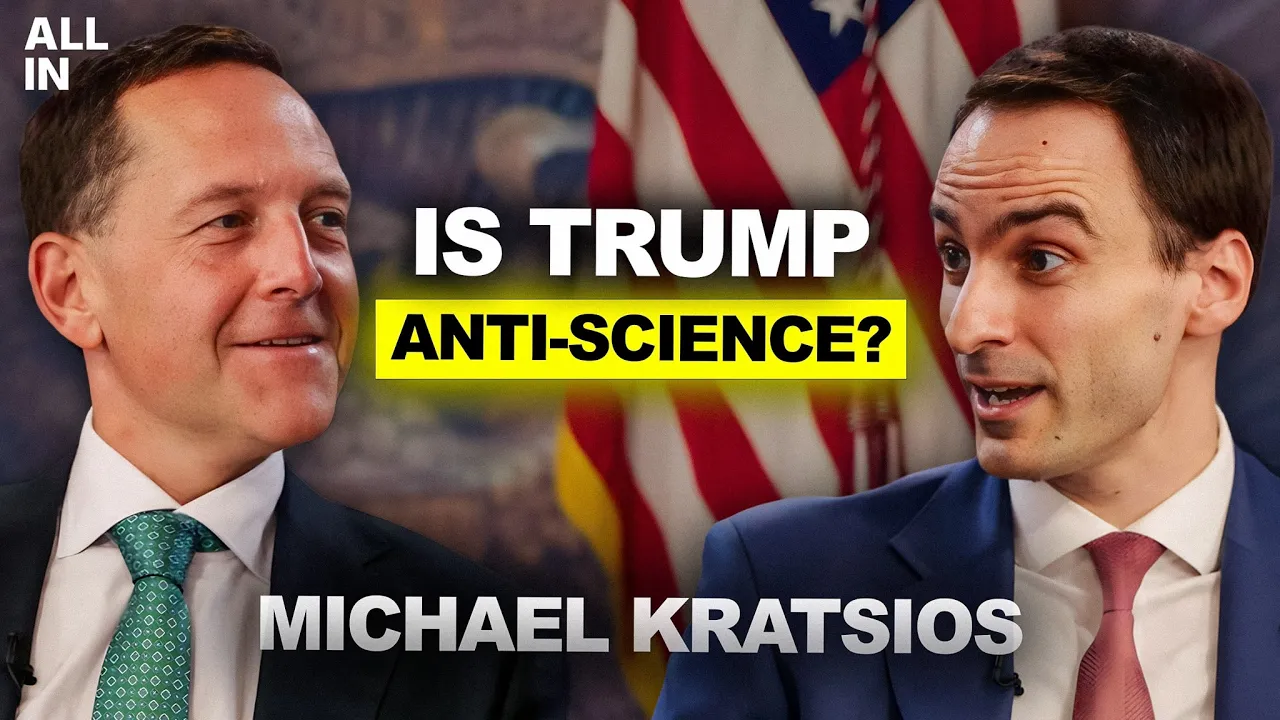
White House OSTP Chief Rebuilds US Science Grant Strategy to Counter China
All-In Podcast
The administration is overhauling federal R&D by eliminating diversity initiatives, redirecting funding to high-risk basic research, and bypassing academic overhead to restore American competitive leadership against China.
## Background
This episode was published on YouTube by All-In Podcast on August 24, 2026. According to the page description, the episode features guest Michael Kratsios discussing anti-science claims, climate science cuts, NIH funding, quantum and fusion energy goals, competition with China, and Dr. Anthony Fauci's legacy.
## TL;DR
Michael Kratsios, Director of the White House Office of Science and Technology Policy, details the administration's vision for reforming U.S. science policy and restoring trust in the scientific method. The discussion covers reallocating federal funds away from DEI grants and alarmist climate modeling toward big bets in quantum computing, commercial fusion, and AI-driven scientific discovery (the Genesis Mission). Kratsios and the hosts highlight systemic issues like Eroom's Law at the NIH, aging research staff, university overhead skimming, and the talent pipeline competition with China, advocating for meta-science experiments, portable fellowships, and direct funding for merit-based basic research.
## Atmosphere & style
The episode features a candid, high-level policy discussion between the hosts and a top federal technology official, blending serious structural critique with accessible insider analysis. The tone is sharp, direct, and reform-minded, filled with skepticism toward traditional academic and public health bureaucracies following the COVID-19 pandemic. The conversational dynamic feels like a collaborative strategy session, moving smoothly from technical metrics and economic models to broad geopolitical and cultural implications.
## Key takeaways
- [00:00](https://www.youtube.com/watch?v=Xj4pTYsVSWQ&t=0s) Michael Kratsios discusses the OSTP's report, 'Science: A New Golden Age', arguing that the administration aims to restore open inquiry and address political dogma in federal research spending.
- [06:10](https://www.youtube.com/watch?v=Xj4pTYsVSWQ&t=370s) A Senate analysis revealed that 25% of NSF grants under the previous administration ($8 billion over four years) were directed toward DEI initiatives rather than core scientific research.
- [06:10](https://www.youtube.com/watch?v=Xj4pTYsVSWQ&t=370s) Federal institutions retired the RCP 8.5 extreme climate scenario due to a lack of scientific integrity, while the administration focuses on energy abundance, nuclear power, and targeting commercial fusion by 2035.
- [13:13](https://www.youtube.com/watch?v=Xj4pTYsVSWQ&t=793s) Eroom's Law highlights an ~80-fold drop in biomedical innovation efficiency per dollar since 1950, prompting calls to restructure federal research via 'meta-science' units and innovative grant models like 'golden tickets'.
- [22:24](https://www.youtube.com/watch?v=Xj4pTYsVSWQ&t=1344s) The U.S. is pursuing major national moonshots, including the Genesis Mission to embed AI in discovery science, returning to the moon by 2028, and building a scientifically relevant quantum computer by 2028.
- [29:36](https://www.youtube.com/watch?v=Xj4pTYsVSWQ&t=1776s) U.S. R&D spending has inverted since 1945, with the private sector now funding 70% of R&D and the federal government providing 30%, shifting the federal role toward basic research that markets cannot back.
- [34:04](https://www.youtube.com/watch?v=Xj4pTYsVSWQ&t=2044s) Between 2000 and 2021, China expanded its annual R&D spending 19-fold (from $33B to $670B) and now publishes ~50% more peer-reviewed papers than the U.S. across most technical fields.
- [38:50](https://www.youtube.com/watch?v=Xj4pTYsVSWQ&t=2330s) The U.S. STEM pipeline faces severe demographic challenges: 7 out of 10 U.S. STEM PhD candidates are foreign-born, while early-career researchers struggle with low pay and administrative friction.
- [41:53](https://www.youtube.com/watch?v=Xj4pTYsVSWQ&t=2513s) Educational standards for young talent have eroded due to the discontinuation of NSF gifted programs and the elimination of advanced middle school math and SAT requirements, creating a need for university remedial courses.
- [43:43](https://www.youtube.com/watch?v=Xj4pTYsVSWQ&t=2623s) Public trust in science suffered major damage during the COVID-19 pandemic under Dr. Anthony Fauci due to forced consensus, policy double standards, and the suppression of open inquiry.
- [49:12](https://www.youtube.com/watch?v=Xj4pTYsVSWQ&t=2952s) The median age of intramural researchers at the NIH has reached 71 years old, emphasizing the need for workforce rejuvenation and prioritizing fundamental basic science over private-sector applied AI.
- [51:47](https://www.youtube.com/watch?v=Xj4pTYsVSWQ&t=3107s) The top five federal research agencies (R&D budgets over $3B) must submit 90-day implementation plans, with new initiatives like NSF 'X-Labs' and 4-year industry-partnered PhD programs already underway.
## Detailed walkthrough
### [00:00](https://www.youtube.com/watch?v=Xj4pTYsVSWQ&t=0s) Rethinking Government Science Policy and Addressing Anti-Science Claims
Michael Kratsios, Director of the White House Office of Science and Technology Policy (OSTP), joins the show to discuss the administration's national science and technology vision. Having previously served as the Chief Technology Officer of the United States, Kratsios outlines OSTP’s unique coordinating role across fragmented federal research arms, including the National Science Foundation (NSF), Department of Energy national labs, and defense agencies like DARPA.
Addressing the common narrative that the administration is "anti-science," Kratsios points to OSTP's report, *Science: A New Golden Age*, arguing that the administration is deeply committed to restoring the core scientific method of open inquiry. Confronted with a *Nature* poll showing 86% of surveyed scientists supported Kamala Harris compared to just 6% for Donald Trump, Kratsios contends that the broader scientific establishment has lost its way over the past two decades by becoming deeply politicized and dogmatic, reaching a breaking point during the COVID-19 pandemic. He stresses that treating authority as scientific truth is fundamentally antithetical to science itself, emphasizing that federal strategy must focus on how $200 billion in annual government S&T spending can yield true breakthroughs rather than merely lobbying for ever-larger research budgets.
- The Office of Science and Technology Policy (OSTP) coordinates science and technology efforts across disparate government agencies that lack a single centralized cabinet department.
- A *Nature* poll of 2,000 scientists showed 86% support for Kamala Harris versus 6% for Donald Trump.
- The U.S. government deploys approximately $200 billion annually toward science, technology, research, and development.
[06:10](https://www.youtube.com/watch?v=Xj4pTYsVSWQ&t=370s) DEI Grants, Climate Modeling, and Funding Reallocations
The discussion turns to recent federal budget shifts, including the 2025 freezing or termination of $3 billion in active unspent scientific grants. Kratsios clarifies the distinction between presidential proposed budgets and Congressional appropriations, arguing that "spending more money on the wrong types of things is not the right policy action." He highlights a Senate committee analysis led by Senator Ted Cruz, which revealed that roughly 25% of NSF grants under the Biden administration—totaling roughly $2 billion annually, or $8 billion over four years—went toward DEI-related initiatives rather than core scientific research.
The conversation shifts to climate science funding cuts. Kratsios references Energy Secretary Chris Wright's position that while human activity and fossil fuel emissions contribute to atmospheric CO2, the data does not support calling it a "climate emergency." A prime example cited is the retirement of the extreme RCP 8.5 emissions scenario by climate institutions like the IPCC after determining it lacked scientific integrity. The hosts note that media reports hyper-focused on this worst-case simulation for years to drive alarmist narratives and justify billions in funding. Instead of retreating, the administration argues for advancing energy abundance through nuclear energy deployment and target dates for fusion energy by 2035.
- The administration disrupted or terminated $3 billion in active, unspent research grant funds in 2025.
- An analysis by Sen. Ted Cruz found 25% of NSF grants under the previous administration—totaling $8 billion over four years—were tied to DEI metrics.
- Climate modeling institutions pulled down the RCP 8.5 extreme warming scenario after concluding it lacked scientific integrity.
- The administration sets a target date of 2035 to achieve commercial fusion energy.
[13:13](https://www.youtube.com/watch?v=Xj4pTYsVSWQ&t=793s) Scientific Stagnation, Eroom's Law, and Restructuring Research
The walkthrough concludes with a critical evaluation of American scientific productivity. Despite major technological achievements like AI and gene editing, signs of systemic stagnation are evident across key metrics. A striking daily example offered is commercial flight: travelers flew faster on the Concorde in the 1990s than passengers can fly on standard airliners today.
Nowhere is this decline in yield more apparent than at the National Institutes of Health (NIH). Despite the NIH budget expanding from $14 billion in 1998 to $27 billion in 2003 and reaching $47 billion by 2024, the output of breakthrough treatments per dollar spent has plummeted—a phenomenon known as "Eroom's Law" (Moore's Law spelled backward). Efficient scientific output per dollar has fallen roughly 80-fold since 1950, halving approximately every nine years. Kratsios argues that while low-hanging fruit has been harvested, the underlying driver of stagnation is that federal agencies have failed to innovate how scientific research is funded, structured, and conducted.
- NIH funding grew from $14 billion in 1998 to $27 billion in 2003, reaching $47 billion by 2024.
- Eroom's Law illustrates an ~80-fold drop in biomedical innovation efficiency per dollar spent since 1950, with return on investment halving roughly every 9 years.
[15:27](https://www.youtube.com/watch?v=Xj4pTYsVSWQ&t=927s) Meta-Science, Golden Tickets, and Rethinking Grant Allocations
The conversation zeroes in on the systemic inertia within federal science funding. For decades, the default mechanism has been to pour more money into existing pipelines without questioning if the underlying delivery models actually work. Michael Kratsios highlights that politicians on Capitol Hill are incentivized to continuously expand budgets to funnel pork back to home districts or states, while government agencies lack any incentive to "check their homework" and admit when programs fail. To break this cycle, the new report *A New Golden Age* introduces "meta-science" units at the National Science Foundation (NSF) and National Institutes of Health (NIH) designed to run controlled experiments on different funding allocation strategies.
To illustrate how conservative traditional peer review is—where small panels of three or four reviewers favor safe, predictable, "in-the-strike-zone" proposals over bold ideas—Kratsios highlights a "golden ticket" experiment. Originally tested in Denmark, this model empowers individual evaluators to unilaterally fund a grant without requiring consensus from the rest of the committee. This approach creates an incentive for researchers to propose radical, high-risk ideas and attracts higher-caliber reviewers to grant boards. David Friedberg draws a direct parallel to venture capital: real innovation follows a power-law distribution where 9 out of 10 experiments fail, but the single breakout yields a 100x return. Beyond funding mechanics, the administration is pushing for flexible grant timelines, offering 6-month "fast-track" grants alongside long-dated 5-year commitments to match the natural speed of different scientific domains.
- **NIH Budget Friction:** Sifting through $47 billion in funding to separate high-impact research from administrative waste requires structured meta-science experiments rather than top-down mandates.
- **Traditional Grant Flaws:** Conventional NSF review panels unintentionally penalize "wild and crazy" out-of-the-box ideas because candidates must propose low-risk research to guarantee their salaries and lab overhead.
- **Portable Fellowships:** The NSF’s Graduate Research Fellowship Program (GRFP)—awarded annually to ~2,600 top doctoral candidates—serves as a model for funding individuals over projects by making awards completely portable across universities.
- **Startup Case Study:** Friedberg references Stuart Butterfield's pivot at Slack, where investors allowed him to deploy his remaining $3 million from a failing gaming startup into an internal communication tool, eventually leading to a $30 billion acquisition.
[22:24](https://www.youtube.com/watch?v=Xj4pTYsVSWQ&t=1344s) Big Bold Bets: Moon Bases, Quantum by 2028, and the Genesis Mission
The discussion shifts from funding individual researchers to organizing massive national endeavors akin to the Manhattan Project, Apollo, or the Human Genome Project. While authoritarian regimes like China excel at top-down capital allocation, Kratsios insists the U.S. can successfully tackle long-term, capital-intensive "moonshots" without sacrificing its decentralized edge. The administration is pursuing several targeted initiatives across space, deep tech, and computing designed to rally the national research infrastructure around clear, decade-long horizons.
The centerpiece of these big bets is the **Genesis Mission**, a sweeping federal push to double American scientific output by embedding artificial intelligence directly into fundamental physics, chemistry, materials science, and mathematics. In response to questions about whether the government should intervene when hundreds of billions in private capital are already flooding AI, Kratsios clarifies that commercial firms focus on market-driven AI applications, whereas government efforts focus on "discovery science"—providing compute and infrastructure to accelerate pre-competitive, basic scientific breakthroughs.
- **Lunar Expansion:** Target dates include returning American boots to the moon by 2028, deploying a nuclear reactor in space by 2028, and building the initial components of a permanent moon base by 2030.
- **Quantum Computing Directive:** A presidential executive order launched a new National Quantum Initiative instructing the Department of Energy (DOE) to deliver a "scientifically relevant" quantum computer by 2028.
- **Fusion Energy:** Target goals aim to achieve commercial fusion energy by 2035 by combining public DOE resources with private sector investment.
- **Genesis Mission Objective:** "We fundamentally believe that AI is going to be the biggest unlock to scientific discovery in the history of the world," aiming to revolutionize traditional lab research across all foundational fields.
[27:04](https://www.youtube.com/watch?v=Xj4pTYsVSWQ&t=1624s) The Free-Market Science Model vs. Single-Agency Centralization
Addressing whether the U.S. should consolidate its fragmented research apparatus into a single overarching science agency, Kratsios argues that bureaucratic overlap is actually a "feature and not a bug." Decentralization creates competition among agencies like DARPA, the DOE, and NIH, fostering a free-market dynamic within public research. By contrast, China’s top-down, centralized science architecture has struggled in key areas; for example, despite making EUV (extreme ultraviolet) lithography its top economic priority following U.S. export controls in 2019, Beijing has failed to achieve a domestic breakthrough.
The dialogue concludes by mapping out the four primary channels through which federal R&D dollars are distributed across the economy:
1. **Direct Government Labs:** Research conducted internally by federal agencies.
2. **University Laboratories:** Publicly funded facilities managed and administered on university campuses.
3. **Private Industry Grants:** Federal subsidies given to commercial enterprises with strong market incentives.
4. **Independent Non-Profits:** Philanthropic institutions and independent research institutes (e.g., the Howard Hughes Medical Institute) operating outside strict academic or corporate structures.
[29:36](https://www.youtube.com/watch?v=Xj4pTYsVSWQ&t=1776s) Rethinking the American R&D Model and the Legacy of Vannevar Bush
The discussion begins with a structural breakdown of scientific funding channels, contrasting government, academia, private industry, and independent nonprofit institutes like the Mayo Clinic or Germany's Max Planck Institute. Michael Kratsios explains that the motivation behind his team's "New Golden Age" report stems from examining how American science capital is allocated across these sectors. He reflects on the historic blueprint established in 1945 by Vannevar Bush—science advisor to Franklin D. Roosevelt—whose seminal report, *Science, The Endless Frontier*, laid the foundation for post-World War II U.S. research. Bush’s vision established the national paradigm where the federal government directly funded basic research primarily at universities, alongside intramural work carried out by newly formed national laboratories born out of wartime projects like the Manhattan Project.
```
+-----------------------------------------------------------------------+
| U.S. R&D FUNDING SHIFT |
| |
| 1945 ERA CURRENT DAY |
| ===================== ===================== |
| Federal Govt: 70% Private Sector: 70% |
| Private Sector: 30% Federal Govt: 30% |
+-----------------------------------------------------------------------+
```
However, Kratsios stresses that the U.S. scientific landscape has fundamentally inverted since 1945. Whereas the federal government once supplied 70% of all U.S. R&D funding and the private sector supplied 30%, today the private sector generates roughly 70% while government funding has dropped to 30%. With the rise of modern philanthropies and Focused Research Organizations (FROs) like the Howard Hughes Medical Institute, Kratsios argues that the 70-year-old Vannevar Bush model is outdated and desperately needs a refresh. In his view, federal intervention should strictly pass a simple first-principles test: the government should only fund critical priorities—such as AI, quantum computing, nuclear energy, and biotechnology—where the private sector and philanthropic organizations lack the structural incentives or capacity to fill the gap.
- **1945 Baseline**: Vannevar Bush’s post-WWII framework set up modern university basic research and national lab infrastructure.
- **R&D Inversion**: Federal contribution to R&D shifted from ~70% post-WWII down to ~30% today, while private market R&D rose to ~70%.
- **Core Principle of "New Golden Age"**: Federal capital must focus on national priorities (AI, quantum, nuclear, bio) where private market incentives fall short.
---
[32:48](https://www.youtube.com/watch?v=Xj4pTYsVSWQ&t=1968s) University Overhead Charges and "Pro-Scientist" Funding Realignment
The conversation transitions to university funding mechanics, overhead administrative charges, and accusations that the administration is acting politically against academic institutions. The hosts raise concerns about universities skimming substantial administrative overhead fees from scientific research grants to fund university bureaucracy or agendas that conflict with federal goals. Addressing these criticisms, Kratsios rejects the claim that the administration is "anti-academic," asserting instead a merit-based, "pro-scientist" philosophy.
"We are pro-scientists and we don't care where they are," Kratsios explains, clarifying that federal policy should back extraordinary researchers regardless of their institutional affiliation. Under this vision, if a researcher is housed at a university, a focused research organization, or even working independently out of a garage, they ought to receive federal backing as long as they pass a rigorous, merit-based peer review panel. Opening up federal capital to non-university entities breaks the traditional academic monopoly and redirects taxpayer dollars toward direct discovery rather than administrative overhead.
- **Institutional Neutrality**: Grant funding should target top merit-reviewed talent, whether based in academia, FROs, or independent labs.
- **Addressing Administrative Skimming**: The administration seeks to ensure research dollars directly back breakthrough work rather than expanding university overhead.
---
[34:04](https://www.youtube.com/watch?v=Xj4pTYsVSWQ&t=2044s) The Great Scientific Race with China and Market-Based Discovery
The panellists dive into the accelerating geopolitics of science, highlighting the staggering growth of Chinese research and development investment. Between 2000 and 2021, China expanded its annual R&D spending nineteen-fold—from $33 billion to $670 billion—while U.S. spending only grew roughly threefold over the same window. A decade ago, U.S. labs published double the scientific papers of Chinese institutions; today, China publishes approximately 50% more papers across nearly every scientific discipline, with the exception of certain life sciences.
```
+-----------------------------------------------------------------------+
| U.S. VS. CHINA R&D EXPANSION |
| |
| CHINA (2000 -> 2021) UNITED STATES |
| $33B -------> $670B (19x Growth) ~3x Growth |
| 50% higher publication output today Leading primarily in Life |
| across most technical domains Sciences |
+-----------------------------------------------------------------------+
```
Addressing why Americans should care about relative scientific dominance when discoveries theoretically benefit all humanity, Kratsios emphasizes that scientific leadership is the core foundation of both economic prosperity and national security. From semiconductors to transformer models in AI, foundational domestic scientific discoveries fuel the commercial platforms powering the modern global economy. While China relies heavily on state-centralized planning, industrial IP theft, market dumping, and securing critical mineral supply chains, Kratsios remains confident in the U.S. model. He argues that a vibrant venture capital ecosystem paired with targeted federal funding and free-market commercialization creates an environment for far higher-risk, ground-breaking innovation.
- **China's Spending Growth**: China increased R&D spending from $33 billion in 2000 to $670 billion in 2021 (a 19x increase vs. ~3x for the U.S.).
- **Publication Inversion**: Chinese institutions now publish roughly 50% more peer-reviewed papers than U.S. counterparts across most physical and technical fields.
- **Economic Multiplier Effect**: Lower domestic labor costs, high automation, and cheap supply chains give China an estimated 2x to 10x output leverage per research dollar spent.
---
[38:50](https://www.youtube.com/watch?v=Xj4pTYsVSWQ&t=2330s) The American STEM Pipeline and Domestic Talent Erosion
The dialogue turns to a critical vulnerability in the American scientific apparatus: the decline of domestic-born talent pursuing advanced technical degrees. Kratsios cites a statistic he has tracked for years regarding computer science doctorates: thirty years ago, approximately 70% of U.S. computer science PhD recipients were U.S.-born, whereas today that ratio has completely inverted to 70% foreign-born candidates. Across all U.S. STEM PhD programs, seven out of ten candidates are currently non-American citizens.
"Having a STEM-literate workforce is one of the most important superpowers we could have as a country," Kratsios states. He highlights the financial and structural friction young American scientists face when completing their PhDs—enduring low pay and long hours while navigating an academic pipeline that fails to adequately reward early-career risk-taking. Furthermore, the panel discusses the paradoxical immigration dynamic: the U.S. educates top foreign talent at elite universities, but lacks aggressive retention pathways, causing foreign PhDs to return home or be recruited by competing nations like China and European states.
- **PhD Demographic Flip**: Computer science PhD recipients went from 70% U.S.-born / 30% foreign 30 years ago to 70% foreign / 30% U.S.-born today.
- **Broader STEM PhD Ratio**: 7 out of 10 STEM PhD candidates in the U.S. are currently foreign-born.
- **Early-Career Hardships**: Junior postdocs and researchers face low compensation and bureaucratic barriers, stifling domestic talent retention.
---
[41:53](https://www.youtube.com/watch?v=Xj4pTYsVSWQ&t=2513s) DEI Initiatives, Educational Standards, and Lowering Math Metrics
In the final segment, the panel addresses why federal support for gifted young American students eroded over recent years. Kratsios reveals that long-standing programs within the National Science Foundation (NSF) designed specifically to identify, support, and accelerate gifted and talented middle and high school students were intentionally dismantled. He attributes this pushback against meritocracy to broader Diversity, Equity, and Inclusion (DEI) policies that prioritized equalized outcomes over nurturing top performers.
The hosts bring up concrete examples of this educational degradation, particularly in California. They highlight how local school districts in San Francisco eliminated middle school advanced algebra, and discuss the contentious debate at the University of California system regarding standardized testing. After UC campuses dropped the SAT requirement, professors at top institutions like UC Berkeley reported a sharp drop in incoming student math preparation, forcing universities to establish remedial math courses for incoming undergraduates. Highlighting the irony, the panel notes that professors who initially lobbied to drop the SAT are now pleading for its return as talented kids are diverted away from early STEM mastery.
- **NSF Gifted Programs Axed**: Federal programs explicitly targeting top-performing high school and middle school STEM talent were discontinued under broader DEI pushes.
- **K-12 Math Degradation**: San Francisco public schools paused eighth-grade advanced algebra, crippling early STEM tracks.
- **University Remedial Crises**: UC Berkeley and other UC campuses faced declining student proficiency after dropping SAT requirements, leading professors to demand the reinstatement of standardized testing.
<ElicitationsGroup message="Explore related aspects of this discussion:">
<Elicitation label="Examine the complete policy proposals in Kratsios's 'New Golden Age' report" query="Summarize the core recommendations and policy proposals from Michael Kratsios's 'New Golden Age' report on U.S. science policy."/>
<Elicitation label="Analyze the mechanics and impact of Focused Research Organizations (FROs)" query="Explain how Focused Research Organizations (FROs) work as an alternative to traditional university grants and corporate R&D."/>
</ElicitationsGroup>
[043:43] Fauci's Impact, Post-COVID Science Trust, and Restoring the Gold Standard
The discussion delves into how the perception of scientists has radically shifted since the mid-20th century, when post-World War II researchers were celebrated as cultural rockstars and featured prominently across media outlets. The hosts ask whether this public stature was lost over time or if it mutated into problematic figures like Dr. Anthony Fauci. When Demis Hassabis at Google DeepMind is cited as a rare modern example of a celebrated, Nobel Prize-winning scientist, it is noted that "90% of people hate AI," making his public appeal an uphill battle. The conversation turns to whether the current populist anti-science sentiment across the West stems from people feeling left behind by technocratic elites who wield unique power, control, and knowledge.
Michael Kratsios argues that the fallout from COVID-19 and Anthony Fauci's leadership dealt the single largest blow to public trust in science in modern history. He points to policies such as mandatory masking for children in schools and public health organizations endorsing mass political protests while forbidding families from visiting dying relatives in hospitals. Kratsios stresses that average Americans cannot reconcile these double standards with true scientific inquiry, framing science as an evolving, inquisitive process rather than an unyielding "edict that comes from on high." The hosts add that the fundamental basis of science—gathering empirical data and encouraging open questioning—was abandoned during the pandemic when dissent was instantly labeled "anti-science" or "anti-vax."
- Michael Kratsios asserts that Dr. Anthony Fauci "did more disservice to science than anyone in modern history."
- The fundamental premise of science relies on empirical data and asking questions, which was suppressed during COVID-19 through forced consensus and public shaming.
- Rebuilding trust requires returning to "gold standard science" principles that prioritize curiosity and the scientific method over dogmatic mandates.
[049:12] Aging NIH Researchers and Prioritizing Basic Science over Applied AI
The conversation shifts to structural problems in the American scientific workforce, particularly the aging demographic of government researchers and the loss of young talent to global competitors like China. Kratsios reveals an alarming statistic provided by NIH Director Dr. Jay Bhattacharya: the median age of an intramural researcher at the NIH is 71 years old. This highlights a critical need to reform institutional incentives and re-engage younger generations of American scientists before the talent pipeline dries up completely.
The host questions how fundamental science fields—such as physics, pure mathematics, and astronomy—can compete for funding and attention in an era completely dominated by commercial AI applications. Kratsios explains that immediately following the release of the "New Golden Age" report, he and OMB Director Russ Vought issued their annual R&D priorities memorandum instructing federal agencies on budget formulation. The memorandum explicitly prioritizes basic, fundamental research on its first page. Kratsios notes that while private capital heavily funds applied AI, the federal government's distinct responsibility is to fund foundational scientific discovery that the private market cannot back.
- The median age of intramural researchers at the National Institutes of Health (NIH) is **71 years old**.
- OMB Director Russ Vought and Michael Kratsios issued an annual R&D priorities memo instructing federal agencies to prioritize basic fundamental research in their budgets.
- Private industry drives applied AI funding, leaving the U.S. government to focus capital on foundational, pure scientific research.
Kratsios details the exact implementation roadmap for the administration's scientific priorities following the "New Golden Age" agenda. The official R&D priorities memorandum mandates that the top five federal research agencies—those managing R&D budgets exceeding $3 billion—submit comprehensive implementation plans within 90 days. Concrete initiatives are already emerging: the National Science Foundation (NSF) announced the creation of "X-Labs" to fund focused research organizations (FROs), alongside a new 4-year industry-partnered PhD program designed to accelerate the transition of young researchers into the workforce.
The discussion concludes with the political realities of dealing with Capitol Hill, where lawmakers often prioritize earmarking federal funds for their specific home districts rather than funding merit-based national priorities. Kratsios expresses optimism that the core tenets of the agenda are nonpartisan, focusing on supporting talented individual scientists regardless of their geography or institutional affiliation. He stresses the urgency of running "hard through the tape" over the next two years to demonstrate tangible results so that future administrations cannot easily reverse these reforms.
- Top 5 federal agencies with R&D budgets **over $3 billion** must report back within **90 days** on their implementation plans.
- The NSF announced **X-Labs** for focused research organizations and a new **4-year PhD program** in partnership with industry.
- The goal is to fund top individual scientists nationally, moving past geographic pork-barrel politics and establishing a lasting institutional memory.
## Notable quotes
> [06:10](https://www.youtube.com/watch?v=Xj4pTYsVSWQ&t=370s) spending more money on the wrong types of things is not the right policy action. — Michael Kratsios
> [22:24](https://www.youtube.com/watch?v=Xj4pTYsVSWQ&t=1344s) We fundamentally believe that AI is going to be the biggest unlock to scientific discovery in the history of the world — Michael Kratsios
> [32:48](https://www.youtube.com/watch?v=Xj4pTYsVSWQ&t=1968s) We are pro-scientists and we don't care where they are — Michael Kratsios
> [38:50](https://www.youtube.com/watch?v=Xj4pTYsVSWQ&t=2330s) Having a STEM-literate workforce is one of the most important superpowers we could have as a country — Michael Kratsios
> [43:43](https://www.youtube.com/watch?v=Xj4pTYsVSWQ&t=2623s) did more disservice to science than anyone in modern history. — Michael Kratsios
## Mentioned
Michael Kratsios, OSTP, White House Office of Science and Technology Policy, NSF, National Science Foundation, DARPA, Department of Energy, Kamala Harris, Donald Trump, Nature, Ted Cruz, Chris Wright, IPCC, RCP 8.5, NIH, National Institutes of Health, Eroom's Law, Concorde, A New Golden Age, David Friedberg, GRFP, Graduate Research Fellowship Program, Stuart Butterfield, Slack, Genesis Mission, Manhattan Project, Apollo, Human Genome Project, China, Vannevar Bush, Franklin D. Roosevelt, Science, The Endless Frontier, Howard Hughes Medical Institute, Mayo Clinic, Max Planck Institute, San Francisco, University of California, UC Berkeley, Anthony Fauci, Demis Hassabis, Google DeepMind, Jay Bhattacharya, Russ Vought, OMB, Office of Management and Budget, X-Labs
White House Office of Science and Technology Policy Director Michael Kratsios outlines an agenda to overhaul the federal government's $200 billion annual science and technology apparatus, arguing that systemic research stagnation, bureaucratic risk aversion, and politicized priorities must be replaced by meta-science reforms and targeted national moonshots.
Reforming Grant Allocation and Reversing Eroom's Law (13:13)
Kratsios points to a systemic collapse in research productivity per dollar, referencing Eroom's Law: biomedical innovation yield per dollar has dropped roughly 80-fold since 1950, halving approximately every nine years even as the National Institutes of Health (NIH) budget expanded from $14 billion in 1998 to $47 billion by 2024. He argues this decline stems from traditional consensus-driven peer review panels that penalize high-risk, out-of-the-box ideas in favor of safe, predictable research designed to protect university overhead and researcher salaries.
To counter this inertia, the administration's 'A New Golden Age' agenda establishes 'meta-science' units at the National Science Foundation (NSF) and NIH to experiment with novel allocation mechanisms. Proposals include Danish-inspired 'golden ticket' awards—enabling single reviewers to unilaterally fund unorthodox proposals without committee consensus—as well as flexible grant durations ranging from six months to five years and portable fellowships that fund individual researchers directly rather than institutional overhead.
Defunding DEI Initiatives and Restoring Empirical Inquiry (6:10)
The administration disrupted or terminated $3 billion in unspent scientific grants in 2025, pointing to misaligned federal objectives. Kratsios highlights a Senate committee analysis led by Senator Ted Cruz finding that approximately 25% of NSF grants under the Biden administration—totaling roughly $8 billion over four years—were tied to Diversity, Equity, and Inclusion (DEI) metrics rather than foundational science. In climate research, funding shifted away from extreme projections like the retired RCP 8.5 scenario, redirecting federal focus toward nuclear deployment and achieving commercial fusion energy by 2035.
Kratsios also asserts that public trust in science was severely damaged during the COVID-19 pandemic by administrative dogmatism, singling out former NIAID Director Dr. Anthony Fauci. He argues that enforcing public health edicts, school mask mandates, and double standards on mass gatherings compromised the core scientific method of open debate and empirical inquiry, necessitating an institutional return to merit-based, reproducible discovery.
Modernizing Vannevar Bush's Model with Moonshot Bets (29:36)
Kratsios argues that the post-World War II research compact designed by Vannevar Bush in 1945 has inverted. While the federal government previously funded 70% of American R&D and private industry funded 30%, the private sector now accounts for 70% of R&D spending. Consequently, he states that federal capital must pass a first-principles test: intervening only in core national priorities, such as quantum computing and advanced biotechnology, where market incentives fail to support pre-competitive basic science.
Rather than centralizing research into a single monolithic bureaucracy, the administration is coordinating cross-agency moonshots across the Department of Energy, NASA, and defense agencies. Stated federal milestones include deploying a space-based nuclear reactor by 2028, returning astronauts to the moon by 2028, building permanent lunar base infrastructure by 2030, and delivering a scientifically relevant quantum computer by 2028. Central to this strategy is the Genesis Mission, designed to embed artificial intelligence into foundational physics, chemistry, and materials science to double American research output.
Countering China and Rebuilding the Domestic STEM Workforce (34:04)
American scientific supremacy faces intensifying competition from China, which expanded its annual R&D expenditures nineteen-fold between 2000 and 2021—from $33 billion to $670 billion—and now publishes roughly 50% more peer-reviewed papers than the U.S. across most physical and technical fields. Kratsios emphasizes that foundational science directly underpins national security and economic prosperity, warning against domestic workforce stagnation. Currently, seven out of ten U.S. STEM doctoral candidates are foreign-born, while the median age of intramural researchers at the NIH has risen to 71 years old.
The panel criticizes K-12 educational shifts that compromised meritocracy, citing the cancellation of NSF gifted student programs and the elimination of eighth-grade algebra in San Francisco, which contributed to declining math readiness and forced top universities to create remedial courses. To accelerate the domestic talent pipeline, the NSF is rolling out 'X-Labs' for Focused Research Organizations and four-year industry-partnered PhDs, while an OMB directive mandates that the top five federal science agencies submit 90-day implementation plans prioritizing basic research over commercial applied development.
While Kratsios argues that decentralization, meta-science grant experiments, and a renewed emphasis on basic discovery will out-innovate China's centralized model, the strategy faces structural resistance from congressional pork-barrel spending and an academic establishment accustomed to guaranteed administrative overhead.
## Background
该内容由知名科技与投资播客《All-In Podcast》于 2026 年 8 月 25 日在 YouTube 平台发布。节目简介显示,本期访谈特邀白宫科技政策办公室(OSTP)主任迈克尔·克拉齐奥斯(Michael Kratsios)作客,深度拆解特朗普政府的科技新政,议题涵盖反击“反科学”指控、削减 DEI 科研资助、撤销 RCP 8.5 极端气候模型、破解 NIH 研发停滞与“埃鲁姆定律”、推进创世纪任务等重大科研押注,以及全方位应对与中国的科技霸权竞争。
## TL;DR
白宫科技政策办公室主任迈克尔·克拉齐奥斯全面驳斥了外界对本届政府“反科学”的标签,系统阐释了旨在将美国科研产出翻倍的《科学:新黄金时代》国家战略蓝图。对话正面回应了冻结 30 亿美元非核心拨款、剔除科研申请中的 DEI 意识形态要求、下架缺乏现实依据的 RCP 8.5 气候模型,以及反思福奇在疫情期间官僚教条对公众信任造成的巨大创伤。针对 NIH 内部研究员中位数达 71 岁且研发效率陷入“埃鲁姆定律”的制度沉疴,白宫正推行引入“金牌入场券”的元科学试验、推崇风投式高容错机制并直接资助顶尖学者个人,同时全速冲刺 2028 登月、量子计算、2035 可控核聚变及 AI 赋能的“创世纪任务”,以应对中国科研投入激增 19 倍及美国本土 STEM 人才断层的深层地缘危机。
## Atmosphere & style
整场对话兼具硅谷风险投资的务实敏锐与国家大战略博弈的紧迫感,风格直言不讳、信息密度极高。主持团队凭借敏锐的产业视角,屡屡就大学经费削减、福奇疫情决策的负面遗产、民粹反科技情绪以及国会分肥政治等最尖锐的争议层层逼问;克拉齐奥斯则表现得镇定且极具条理,娴熟地运用数据、历史案例和市场逻辑解构传统学院派建制。在理性探讨科研机制创新的表象之下,弥漫着一种中美科技竞赛不进则退的深重危机感,以及政策制定者试图赶在政治周期前“全力冲刺过终点线”的决绝情绪。
## Bulletin
- [01:56](https://www.youtube.com/watch?v=Xj4pTYsVSWQ&t=116s) 白宫科技政策办公室发布《科学:新黄金时代》战略报告,全面整肃基础科研体制,冻结 30 亿美元存量拨款并终止约 80 亿美元流向 DEI 议程的经费,力推国家资金全面回归硬核科学突破。
- [09:10](https://www.youtube.com/watch?v=Xj4pTYsVSWQ&t=550s) 气候科学极端推演 RCP 8.5 因缺乏现实支撑被官方预测模型全面撤下,美政府转向主导 2035 年商业核聚变竞赛及能源丰裕战略。
- [13:14](https://www.youtube.com/watch?v=Xj4pTYsVSWQ&t=794s) NIH 研发陷入“埃鲁姆定律”,预算增至 470 亿美元但颠覆性疗法严重断档,且常驻研究员年龄中位数高达 71 岁,暴露出严重的人才梯队老化危机。
- [34:04](https://www.youtube.com/watch?v=Xj4pTYsVSWQ&t=2044s) 美中科技角力出现大逆转:中国科研投入自 2000 年的 330 亿美元飙升至 6700 亿美元,除生命科学外高水平论文产出已反超美国 50%,而美国本土计算机 STEM 博士中 70% 已沦为非美籍人士。
## Key takeaways
- [00:00](https://www.youtube.com/watch?v=Xj4pTYsVSWQ&t=0s) 白宫科技政策办公室(OSTP)统筹全美分散的科研机构,核心战略目标是将美国整体科研产出翻倍,打破把科技视为精英垄断工具的民粹破坏倾向。
- [01:56](https://www.youtube.com/watch?v=Xj4pTYsVSWQ&t=116s) 反驳“反科学”指控并批评教条主义:科学精神本质在于质疑与实证,新冠疫情期间将卫生官僚定调为不容置疑的“绝对权威”,严重背离了科学方法。
- [04:40](https://www.youtube.com/watch?v=Xj4pTYsVSWQ&t=280s) 科研考核转向资金使用效率:联邦政府每年 2000 亿美元科技预算不能仅停留在总额崇拜,必须终结盲目把资金砸向错误方向的惯性。
- [06:44](https://www.youtube.com/watch?v=Xj4pTYsVSWQ&t=404s) 叫停基础科研政治化:参议院审计显示拜登任期内 NSF 近 25% 经费流向 DEI 课题,新政果断截停存量非核心资金,重构严谨客观的科研标准。
- [09:10](https://www.youtube.com/watch?v=Xj4pTYsVSWQ&t=550s) 下架脱离实际的 RCP 8.5 气候模型:打破长达二十年依靠最极端灾难叙事煽动焦虑的恐慌营销,政策重心转为追求实实在在的低成本“能源丰裕”。
- [15:54](https://www.youtube.com/watch?v=Xj4pTYsVSWQ&t=954s) 推行“元科学”与“金牌入场券(Golden Tickets)”机制:打破传统同行评议扼杀异端的妥协平庸机制,赋予单兵专家特权直接保送高风险颠覆性提案。
- [18:09](https://www.youtube.com/watch?v=Xj4pTYsVSWQ&t=1089s) 引入风投幂律法则与灵活资助周期:容忍 90% 的课题失败率以换取百倍级科学突破,打破固定 18 个月的拨款限制,实现 6 个月快轨到 5 年长周期的弹性支持。
- [20:16](https://www.youtube.com/watch?v=Xj4pTYsVSWQ&t=1216s) 从“资助课题”转向“投资个人”:扩大 NSF 研究生奖学金可携带性,赋予顶尖科学家充分的自由度与长周期信任。
- [22:03](https://www.youtube.com/watch?v=Xj4pTYsVSWQ&t=1323s) 押注四大国家级战略工程:锁定 2028 年重返月球与部署太空反应堆、2028 年实用量子计算机、2035 年商业核聚变,以及 AI for Science 驱动的“创世纪任务”。
- [24:54](https://www.youtube.com/watch?v=Xj4pTYsVSWQ&t=1494s) 划清公私研发边界:政府不与私营巨头重复投资通用商业 AI 算力,而是将国家公帑坚定回撤至竞争前、早期基础理论以及具有乘数效应的“科学仪器”研发。
- [26:28](https://www.youtube.com/watch?v=Xj4pTYsVSWQ&t=1588s) 捍卫多机构竞争体制:反对设立中央集权的科技部,认为能源部、DARPA、NSF 等跨部门的去中心化竞争与嵌合才是促成技术跃升的制度特色。
- [28:53](https://www.youtube.com/watch?v=Xj4pTYsVSWQ&t=1733s) 颠覆万尼瓦尔·布什二战研发范式:全美研发出资结构已从 1945 年的政府占 70% 逆转为私营部门占 70%,国家资助全面打破大学行政垄断,向独立科研机构甚至车库学者开放。
- [37:01](https://www.youtube.com/watch?v=Xj4pTYsVSWQ&t=2221s) 应对中国科技崛起的资本与效率优势:中国凭借极具竞争力的劳动力、自动化和供应链,研发资金转化效率被评估达到美国的 2 至 10 倍,倒逼美国重塑本土科研竞争力。
- [41:16](https://www.youtube.com/watch?v=Xj4pTYsVSWQ&t=2476s) 整肃本土 STEM 人才断层与基础教育倒退:批判取消资优生培养与废除 SAT 考试的平均主义做法,呼吁停止惩罚理工天才并改善青年学者微薄的薪酬环境。
- [45:38](https://www.youtube.com/watch?v=Xj4pTYsVSWQ&t=2738s) 修复福奇时代重创的科学公信力:严厉批评疫情期间脱离实证与双重标准的行政指令对科学界造成的信任损伤,主张回归实证主义的黄金标准。
- [49:12](https://www.youtube.com/watch?v=Xj4pTYsVSWQ&t=2952s) 破除 NIH 官僚老龄化与推行 4 年制博士新政:面对常驻研究员 71 岁的中位数年龄,白宫联合 OMB 强行将纯基础理论研究列为最高优先级,加速青年科学家向产业流动。
## Detailed walkthrough
### [00:00](https://www.youtube.com/watch?v=Xj4pTYsVSWQ&t=0s) 白宫科技政策办公室的角色与使命
访谈开门见山抛出了最尖锐的公众疑问:本届政府是否真的是“反科学”(anti-science)?迈克尔·克拉齐奥斯(Michael Kratsios)以白宫科技政策办公室(OSTP)主任的身份作客节目,明确提出了政府的核心目标——将美国的科研产出翻倍,让美国重新成为下一个重大科学突破的发源地。针对西方社会当前出现的民粹情绪以及将科技视为“精英工具”并试图加以破坏的倾向,克拉齐奥斯认为这是极其令人痛心的现象。
克拉齐奥斯详细解释了 OSTP 的独特职能。美国科研体制与许多国家不同,美国没有单一统筹一切的中央科技部,而是由众多机构分散承担科研职责:国家科学基金会(NSF)资助基础研究,能源部(DOE)主管国家实验室网络,国防部(DoD)旗下设有国防高级研究计划局(DARPA)等开展尖端研发。OSTP 设立于 20 世纪 60 年代,是全美唯一能够在白宫层面协调所有联邦机构科研事务的办公室,负责协助总统制定国家级科技战略并推动其落地。在特朗普第一任期内,克拉齐奥斯曾担任美国首席技术官(CTO),主管科技与技术组合;如今他统领科学与技术的全盘战略。
```mermaid
flowchart TD
accTitle: 美国联邦科研管理架构与白宫 OSTP 协调机制
accDescr: 展示白宫科技政策办公室 OSTP 如何协调分散在各个联邦部门的科研实体,包括 NSF、能源部和国防部等。
subgraph WH ["白宫核心层"]
PRES["美国总统"]
OSTP["白宫科技政策办公室 (OSTP)<br/>主任:Michael Kratsios"]
PRES -->|"设定国家科技议程"| OSTP
end
subgraph Agencies ["分散的科研与执行机构"]
NSF["国家科学基金会 (NSF)<br/>• 基础科学与大学资助"]
DOE["能源部 (DOE)<br/>• 国家实验室体系"]
DOD["国防部 (DoD) / DARPA<br/>• 先进前沿研发"]
end
OSTP -->|"统筹推进战略落实"| NSF
OSTP -->|"协调国家实验室研发"| DOE
OSTP -->|"对齐国家安全前沿"| DOD
```
### [01:56](https://www.youtube.com/watch?v=Xj4pTYsVSWQ&t=116s) “反科学”指控、《自然》民调与教条化的科研体制
面对本届政府被外界贴上“反科学”标签的质疑,克拉齐奥斯坚决予以反驳,并提到了政府数周前发布的里程碑式报告《科学:新黄金时代》(*Science, a New Golden Age*)。他指出,任何仔细研读这份报告的人都会发现,政府极其重视科研生态,致力于赋能年轻科学家并支持最顶尖的人才攻克最艰难的问题。主持人随即援引顶级学术期刊《自然》(*Nature*)对 2,000 名科学家读者所做的一项调查:86% 的受访科学家支持卡玛拉·哈里斯(Kamala Harris),而唐纳德·特朗普仅获得 6% 的支持率。
克拉齐奥斯深入剖析了这一巨大鸿沟的成因,直言过去数十年来科学界自身已经“迷失了方向”。美国历史上曾有曼哈顿计划(Manhattan Project)和阿波罗登月计划(Apollo Program)这样只有联邦政府才能调动整个国家生态达成的划时代突破;但过去十五到二十年间,科学遭到了严重泛政治化,真正的“科学方法”被弃之脑后,取而代之的是僵化的教条主义。这种教条在新冠疫情(COVID-19)期间达到了顶峰:以安东尼·福奇(Anthony Fauci)等人为代表,如果任何人对某些权威专家的言论提出质疑,就会立刻被扣上“反科学”的帽子。克拉齐奥斯强调,科学的本质正是不断的质疑、提出假设、收集实验数据并推翻既有认知;将科学等同于不可置疑的“绝对权威”,本身就是对科学精神最大的背叛。
- **《自然》读者民调数据**:受访的 2,000 名科研人员中,86% 倾向于支持民主党候选人哈里斯,仅 6% 支持特朗普。
- **历史上的政府级科研标杆**:曼哈顿计划与阿波罗登月计划,证明国家级资源统筹在攻克硬核科研难关时的决定性作用。
- **新冠时期的“权威即科学”现象**:对个别卫生官僚言论的盲从替代了同行评议与实证质疑,导致科学精神变质。
### [04:40](https://www.youtube.com/watch?v=Xj4pTYsVSWQ&t=280s) 重新审视 2,000 亿美元科研预算:从数额崇拜到资金效率
针对科研界普遍对本届政府“削减科研预算”的指责,克拉齐奥斯指出,长期以来科研游说团体的考核标准已经完全扭曲——他们只死死盯住研发(R&D)总预算数字,只要预算没增加就叫嚷“政府不支持科学”,却从不问这笔钱花得是否科学。联邦政府每年在科技领域的支出高达 2,000 亿美元,但长期以来没有任何人运用科学方法来审视科研政策本身的有效性。他强调,核心问题必须转向:这 2,000 亿美元是否真的为美国人民带来了最重大、最顶级的突破?资金分配的机制、资助的机构、科学家群体的年龄层次以及考核的时间周期,是否存在严重失衡?
克拉齐奥斯特别阐明了宪政常识:总统提出的是预算草案(proposed budget),而实际掌握财权并进行拨款(appropriations)的是国会;过去十几年中,国会一直在持续稳定地为科学拨款。本届政府的政策重心绝非单纯“砍预算”,而是反对将更多的钱持续砸在错误的方向上——“将更多的纳税人金钱花在错误的事情上,绝对不是正确的政策行动”。
### [06:44](https://www.youtube.com/watch?v=Xj4pTYsVSWQ&t=404s) 冻结 30 亿美元拨款、排查 DEI 资助与气候科学转向
主持人随即追问具体的资金削减案例:2025 年本届政府为何突然干扰、冻结甚至直接终止了 30 亿美元尚未花出的活跃科研补助金(active grants),这让许多大学实验室遭受了直接冲击。克拉齐奥斯以国家科学基金会(NSF)为例正面回应。NSF 每年掌管约 80 亿至 90 亿美元预算,是全美校外基础研究(extramural basic research)的最主要出资机构。根据参议员特德·克鲁兹(Ted Cruz)及其领导的参议院委员会对拜登政府时期科研拨款的详尽审计,竟然发现 NSF 高达约 25% 的拨款流向了所谓的多元、平等与包容(DEI)相关领域。
这意味着在拜登任期内,每年有大约 20 亿美元、四年累计高达 80 亿美元的宝贵基础科学经费被挪用去资助政治挂帅的 DEI 议程。在当时的申请机制下,科学家若想拿到国家科研经费,甚至必须在申请书里刻意阐述 DEI 要素才能通过审批。克拉齐奥斯怒批这根本不是科学,更是对科研政治化的极端体现,新一届政府必须果断终止这类扭曲,重塑严谨客观的“黄金标准科学”。
随后,主持人将话题引向同样引发舆论强烈反弹的“气候科学研究预算削减”,询问政府究竟如何看待人为碳排放引发的气候变化、所谓的“气候紧急状态”(climate emergency),以及为何要将资金撤出相关领域。克拉齐奥斯提到能源部长克里斯·赖特(Chris Wright)作为该领域的核心发言人,其公开立场一直非常明确:政府充分承认过去百年来人类燃烧化石燃料导致了大气二氧化碳浓度的上升,气候确实在发生变化,但在应对模式、紧迫性定性以及科研经费投向的优先级上,必须打破既有的政治叙事与恐慌营销。
- **NSF 基础科研体量**:每年资助全美高校基础研究的预算约为 80 亿至 90 亿美元。
- **拜登政府 DEI 拨款占比**:参议员 Ted Cruz 委员会审查证实,NSF 约 25% 的资助偏向 DEI 课题,四年累计浪费近 80 亿美元。
- **冻结 30 亿美元项目**:针对正在执行但未支出的存量非核心资金予以截停,将联邦资本重新对准高壁垒硬核突破。
### [09:10](https://www.youtube.com/watch?v=Xj4pTYsVSWQ&t=550s) 气候“紧急状态”叙事的破产与 RCP 8.5 模型的下架
在讨论气候政策时,Michael Kratsios 明确指出,现有数据根本无法支撑所谓“气候紧急状态(climate emergency)”这一极度夸大的叙事。其中最典型的反例,莫过于在学术界和政策圈引发剧震的“RCP 8.5(代表性浓度路径 8.5)”极端情景模型。RCP 8.5 原本是气候科学家用于模拟温室气体排放极端情景的最恶劣推演,长期被纳入美国《国家气候评估》(National Climate Assessment)以及联合国政府间气候变化专门委员会(IPCC)的核心报告。然而,科学界在重新审视后不得不承认,在维持基本科学诚信的前提下,该极端情景根本不可能在现实中发生,最终不得不将其从未来的官方预测模型中全面撤下。
主持人随即敏锐地指出,过去数十年间,主流媒体铺天盖地的灾难性报道、大量耸人听闻的新闻再加工,乃至数十亿美元科研经费的批复,全都是建立在这个“被证明永远不会发生”的极端模拟之上。Kratsios 对此深表赞同,直言这是一场长达二十年的集体认知扭曲:媒体和资助机构永远只死盯着最极端、最吸人眼球的情景,以此博取眼球并煽动焦虑,这在本质上是对严肃科学的极大伤害。当被问及过去十五年间海量资金涌入气候领域、如今削减预算是否属于“纠偏与回滚”时,政策制定的核心逻辑得到了彻底廓清。
- **RCP 8.5 情景撤销**:曾作为 IPCC 和多届美国国家气候评估核心依据的最极端变暖推演,因缺乏现实依据与科学严谨性,于数月前被官方正式剔除。
- **媒体报道的偏差**:过去 20 年间绝大多数气候灾难头条均脱离中位数预测,单独锚定 RCP 8.5 极端情景大肆渲染。
---
### [10:45](https://www.youtube.com/watch?v=Xj4pTYsVSWQ&t=645s) 能源丰裕与技术前进:破除开倒车的气候政策陷阱
谈及联邦资金的重新配置,Kratsios 阐明了本届政府的核心哲学:与其把纳税人的钱耗费在虚无的警世预言上,不如全盘押注能够为美国民众创造“能源丰裕(abundant energy)”的前沿科学与硬核技术。政府在核裂变和先进核能领域采取了美国历史上最为进取的支持政策,并确立了在 2035 年前彻底打赢“核聚变竞赛(fusion race)”的宏伟国家目标。在他们看来,技术突破才是实打实改善普通美国人生活的根本解药。
对话进一步转向全球层面的现实矛盾。主持人算了一笔现实账:中国的碳排放量早已让全球其他国家的增减相形见绌,美国即便自身上下波动 50%,对全球气候大盘的影响也微乎其微。然而,激进的去碳化政策却带来了沉重的经济代价,且这种代价极不平等——富裕群体完全买得起昂贵的绿色替代方案,而丧失廉价能源的贫困阶层却承受着最沉重的通胀与能源账单。Kratsios 补充道,全球目前仍有大约 20 亿贫困人口依靠树枝、干粪和木炭等极度肮脏的燃料做饭取暖,联合国数据显示室内空气污染每年造成近 300 万人死亡;哪怕仅仅让他们用上清洁的化石燃料,都能挽救数百万生命并极大提升生活质量。解决气候问题的正道绝非强迫社会“倒退三四十年”,而是依靠廉价的太阳能、电池储能以及商业可控核聚变等颠覆性技术全面替代旧能源。
- **核聚变国家目标**:设定以 2035 年为明确节点,力争在核聚变能源商业化竞赛中夺取全球主导权。
- **全球能源贫困代价**:全球约 20 亿人仍依赖原始高污染生物质燃料生活,每年引发约 300 万人因室内空气污染死亡。
- **市场自发 vs 行政强推**:太阳能与电池储能因其经济性正自发占领市场,解决问题应依靠“用新技术向前迈进”,而非靠行政规管让百姓用不起能源。
---
### [13:14](https://www.youtube.com/watch?v=Xj4pTYsVSWQ&t=794s) 美国科研大停滞:NIH 470 亿美元预算与“埃鲁姆定律”
话题随后切入更深层次的制度性危机——美国科研是否正陷入系统性停滞?表面上看,美国似乎依然在科技创新上独领风骚,不仅孵化了人工智能、基因编辑,还破译了人类基因组,甚至推进着飞行汽车的研发。但如果深入审视美国国立卫生研究院(NIH)的财政投入与产出产出比,数据却揭示出令人触目惊心的断层危机:
```
NIH 年度预算走势:
1998 年:140 亿美元
2003 年:270 亿美元
2024 年:470 亿美元(较 1998 年增长超三倍)
```
尽管 NIH 预算增长了三倍以上,但在突破性重磅疗法方面却没有出现任何成比例的提升。这一残酷现实完美契合了医药界著名的“埃鲁姆定律(Eroom's Law)”——即摩尔定律(Moore's Law)的反向拼写。自 1950 年代以来,每投入十亿美元所获批的全新药物与突破性产出下降了大约 80 倍,科研投入产出效率大约每 9 年就腰斩一次。
Kratsios 坦率承认,美国的科学发现确实陷入了瓶颈,一个最直观的例证就是航空速度:20 世纪 90 年代普通人还能乘坐协和式客机(Concorde)跨大西洋超音速飞行,而如今人类的实际飞行速度反而比二三十年前更慢。尽管有人辩称“所有容易摘取的低垂果实(low-hanging fruit)已经被摘光”,但 Kratsios 指出最致命的病灶在于科研组织方式的僵化:无论在 NIH 还是美国国家科学基金会(NSF),过去的官僚惯性永远是“用一成不变的套路做研究,只管闭着眼追加预算,祈祷成果能等比例爆出来”,却从不敢深挖根本体制机制问题——科研的玩法能否被重构?科研资金是否应该流向体制外完全不同类型的科学家与机构?
- **埃鲁姆定律(Eroom's Law)**:药物研发效率每 9 年减半,单笔资金产出较 1950 年代跌落约 80 倍。
- **科研投入与回报脱节**:过去二十余年 NIH 资金体量暴增至 470 亿美元,但颠覆性临床疗法并未实现同幅度增长。
- **民航倒退隐喻**:协和客机退役标志着人类日常交通在速度维度的客观倒退,折射出技术迭代遭遇的多重壁垒。
---
### [15:54](https://www.youtube.com/watch?v=Xj4pTYsVSWQ&t=954s) 问责困境、元科学与打破平庸的“金牌入场券”
当被问及为何过去数十年联邦政府从未对科研资金的使用效率进行严格审计时,Kratsios 揭露了体制内部激励机制的彻底缺位。在国会山,议员们唯一的动力就是把科研预算盘子不断做大,然后将其包装为政治政绩输送给自己的选区或所在州;而在执行层面的官僚机构,更是完全没有动力去“批改自己的家庭作业”,因为一旦自查,就等于自爆家丑、承认数十亿美元的纳税人资金颗粒无收。对外宣布某个前沿学科的资助预算“创下历史新高”永远是廉价讨巧的头条新闻,而从 470 亿美元的烂账中梳理出究竟哪些钱花得有价值,既艰难又吃力不讨好。
为此,Kratsios 团队在最新出台的《新黄金时代》(New Golden Age)国家科技战略报告中,正式引入了“元科学(Meta-Science)”这一前沿概念。政府计划在 NSF 和 NIH 内部设立专门的元科学评估实验单元,把科研立项和资金分配本身当作一项科学实验来进行 A/B 测试,从而精准找出回报率最高的资助路径。
针对当前科研界最饱受诟病的“同行评议(Peer Review)”机制,Kratsios 提出了一项极具颠覆性的试验举措。目前的 NSF 评审通常由三到四名同领域专家组成委员会进行择优评审(merit-based review),但这种必须达成共识的机制导致科学家们倾向于打安全牌,只敢申请处于委员会共同审美“好球区(strike zone)”内的平庸项目,任何大胆、疯狂、真正颠覆性的前沿构想都会在多轮妥协中被消磨殆尽。为打破这一死水,NSF 将正式借鉴丹麦等国的先锋经验,试点推行“金牌入场券(Golden Tickets)”制度:每位评审专家将被配发 1 到 3 张特权票,允许任何一位评审员单方面越过整个委员会的反对,直接一票否决群体共识、强行通过极具颠覆性的冷门高风险提案。
```mermaid
flowchart TD
accTitle: 科研项目资助评审机制对比
accDescr: 展示传统同行评议与金牌入场券机制在项目筛选上的逻辑差异
subgraph TRAD["传统共识同行评议"]
direction TB
A1["科学家提交项目申请"] --> B1["3-4人评审委员会"]
B1 --> C1{"全员集体协商妥协"}
C1 -->|"迎合共识好球区"| D1["平庸但稳健的项目获批"]
C1 -->|"消灭异端与高风险"| E1["疯狂/突破性想法被扼杀"]
end
subgraph GOLDEN["元科学试点:金牌入场券机制"]
direction TB
A2["颠覆性高风险科研方案"] --> B2["单兵评审专家手握金票"]
B2 --> C2{"单方面一票决断权"}
C2 -->|"无需达成集体共识"| D2["突破性非共识项目强制立项"]
C2 -->|"鼓励前沿激进探索"| E2["激励科学家大胆跨界创新"]
end
```
- **元科学(Meta-Science)试验单元**:在 NSF 与 NIH 设立专门机构,将财政资助分配机制本身作为实证研究对象进行优化和纠偏。
- **打破好球区诅咒**:现有同行评议制度系统性惩罚离经叛道的创新,逼迫申请者提交低风险、平庸的常规课题。
- **金牌入场券(Golden Tickets)机制**:赋予评审人 1 至 3 次单方面直接批复权,无需任何外部委员会背书即可立项资助超高风险、超高回报的颠覆性科学研究。
### [18:09](https://www.youtube.com/watch?v=Xj4pTYsVSWQ&t=1089s) “金牌选拔权”与风险投资模式:用容错率重塑科学资助
传统的科研基金审批机制往往迫使科学家为了生计走向保守。科研人员为了维持实验室运转和支付团队薪水,通常只会申请那些评委会认为“十拿九稳”的项目,导致评委会倾向于支持低风险、确定性高的研究。然而,真正的突破性发现遵循类似于风险投资的幂律法则(Power Law):十个项目里通常有九个会失败,但那唯一成功的一个却能带来百倍的回报。为了打破这种平庸的资助循环,新机制引入了“金牌选拔权”(Golden Ticket)实验,赋予评审委员直接保送高风险项目的特权,以此激励评审人员的参与度,并倒逼科学家大胆提出颠覆性的奇思妙想。
除了打破共识审批的束缚,美国国家科学基金会(NSF)以往僵化的资助周期也面临改革。过去受限于学术日历,大部分 NSF 资助周期被默认固定在 18 个月左右。新战略《科学的新黄金时代》(Science's New Golden Age)主张因地制宜:针对只需 3 到 6 个月验证的概念设立“快速通道拨款”(Fast-track Grants),一旦见效可追加长期申请;针对需要攻关 3 至 5 年的深层课题,则匹配相应跨度的资助周期,真正做到“在科学家所在的地方与他们相遇”。
```mermaid
flowchart TD
accTitle: 科研资助机制对比流程图
accDescr: 对比传统官僚审批与新型风险投资驱动的科研资助模式路径与结果
subgraph TRAD["传统资助模式"]
A["为生存提交申请"] --> B["追求高成功率与低风险"]
B --> C["评委会共识审批通过"]
C --> D["平庸的渐进式成果"]
end
subgraph NEW["新黄金时代模式"]
E["提出疯狂颠覆性设想"] --> F{"评审机制革新"}
F -->|"金牌选拔权"| G["跳过官僚阻碍直接获批"]
F -->|"灵活资助周期"| H["快速通道(6个月)或长期(5年)"]
G --> I["容忍 90% 失败率"]
H --> I
I --> J["换取 100x 突破性发现"]
end
```
### [20:16](https://www.youtube.com/watch?v=Xj4pTYsVSWQ&t=1216s) 资助个人而非资助课题:投资人才的溢出效应
除了资助具体的课题方案,另一种极具威力的路径是直接“资助个人”。在风险投资界,顶尖的创业者即便最初的项目构想不佳,也往往能凭借自身能力力挽狂澜。经典的案例莫过于斯图尔特·巴特菲尔德(Stewart Butterfield):当他原本的游戏业务濒临倒闭、账上仅剩 300 万美元时,投资人决定信任他团队在内部协作时研发的沟通工具,全力支持其转型,最终诞生了估值数百亿美元的企业协作软件 Slack。将这一逻辑迁移至基础科学,意味着遴选出最具天资的个体,赋予他们充裕的资金与自由度,而不是让监管人员事无巨细地审视每一笔花销。
这一理念在联邦科研体系中的具象化体现是 NSF 的研究生研究奖学金计划(GRFP)。作为旗舰级的人才项目,该计划每年向全美大约 2,600 名最具潜质的优秀博士生发放奖学金。这项资助完全属于学生个人且“可随身携带”(Portable),获奖者可以自由选择任何大学,促使各大高校主动竞相争夺这些顶尖苗子,让科学家在自己感到最舒适、最自由的学术环境中施展抱负。
- 资助模式的核心转变:从过度审查预算与课题细节的“自上而下监护”,转向给予顶级人才长达数年信任的“自下而上放权”。
- NSF GRFP 每年选拔约 2,600 名顶尖研究生,通过奖学金的可携带性倒逼研究型大学提升科研软硬件吸引力。
### [22:03](https://www.youtube.com/watch?v=Xj4pTYsVSWQ&t=1323s) 重启大科学时代:重返月球、量子跃迁与“创世纪任务”
面对中国通过强大的集中规划与大规模资源调配推进重大科研工程(如登月工程、基因组测序等),对话双方探讨了美国在高度分散的实验室与私营经济环境下,是否仍具备组织国家级重大攻关工程(Mega-projects)的能力。回溯历史,阿波罗计划与曼哈顿工程曾让全美凝聚一心,而《科学的新黄金时代》正力图重振这种由联邦政府主导的集约化创新体制。
当前政府正在全力推动四大具备十年维度的重大战略布局:
- **深空探索**:推进重返月球计划,目标在 2028 年实现美国宇航员重新登月,同年在太空部署核反应堆,并在 2030 年前建成月球基地的首批基础组件。
- **量子计算**:依据最新签署的总统行政令重组国家量子倡议(National Quantum Initiative),直接要求美国能源部(DOE)在 2028 年前研制出具备科学实用价值的量子计算机(Scientifically Relevant Quantum Computer)。
- **受控核聚变**:整合能源部资源与蓬勃发展的私营资本,全力冲刺 2035 年实现可控核聚变商业前夜的宏伟目标。
- **创世纪任务(Genesis Mission)**:本届政府科研蓝图的核心旗舰项目。该任务旨在将人工智能深度赋能于材料科学、化学、物理与数学等最难啃的基础科学领域,彻底改变科学研究范式,实现美国整体科研产出翻倍。
### [24:54](https://www.youtube.com/watch?v=Xj4pTYsVSWQ&t=1494s) 划清公私边界:政府资助聚焦先导性与纯科学
针对百亿级私营资本早已大规模涌入 AI 和量子计算领域的现状,政府被问及为何还要在这些热门板块投入公帑,而非将有限的财政资源留给深空探索、宇宙起源探秘或纯理论物理等完全没有商业回报的纯粹领域。
真正的分水岭在于“商业应用导向”与“科学发现导向”。政府的核心使命必须坚定回撤至基础性、早期阶段以及竞争前(Pre-competitive)的先导性研发(R&D)。私营企业在量子与 AI 领域的狂飙突进本质上是为了追求短期的商业闭环与商业应用;而联邦政府的目标截然不同——例如主导研发一台面向 2028 年的量子计算机,绝非用于商业算力售卖,而是为了打造一台服务于底层科学探究的“终极仪器”,从而为整个科学界的基础发现提供乘数效应。
### [26:28](https://www.youtube.com/watch?v=Xj4pTYsVSWQ&t=1588s) AI for Science 与多机构竞争:为何美国不需要“中央科技部”
在探讨前沿科技布局时,迈克尔·克拉齐奥斯(Michael Kratsios)厘清了政府在人工智能领域的角色定位。他明确指出,联邦政府绝不会试图在私营部门擅长的通用 AI 领域烧钱竞争。如今民营科技巨头在 AI 算力与模型研发上投入的资金体量超乎想象,国家没必要重复造轮子;相反,政府资助的核心方向是“AI for Science”——即引导并支持从事物理、材料、化学等基础科学研究的学者,利用 AI 这一强大杠杆去加速其研究进程。
面对政府内部多部门各自为政、为争取预算彼此倾轧的“官僚熵增”现象,主持团队提出了一个尖锐问题:美国是否应该效仿其他国家,将分散在能源部(DOE)、国防部、卫生研究院(NIH)等各处的科技职能整合为一个统一的“科技部”?克拉齐奥斯给出了坚决的否定回答,直言这种分散与重叠“是一种特质,而不是缺陷”(a feature and not a bug)。他以中国高度中心化的举国体制展开对比:自 2019 年美国实施出口管制以来,中国将攻克极紫外(EUV)光刻机视为经济命脉,倾举国之力自上而下突击攻关,但至今仍未取得突破。克拉齐奥斯认为,正是美国体系内部允许不同机构互相竞争、采用类似于自由市场的多元化创新路径,才促成了过去数十年源源不断的技术跃升。例如,DARPA 与国家安全相关的科研人员扎根在国防部(DoD)内部,而非被置于孤立的单一科学机构中,这使得他们的研发能够与一线的国防使命实现最紧密的嵌合。
### [28:53](https://www.youtube.com/watch?v=Xj4pTYsVSWQ&t=1733s) 70年后的科研范式变迁:从布什报告到《新黄金时代》
科技经费的分配机制正在迎来二战以来最重大的洗牌。传统上,联邦资金主要流向两条路径:政府内部科研机构(如国家实验室)以及大学实验室。但现实中早已形成了四大资金流向渠道:
1. 联邦直属实验室(开展政府专有任务与内属研究);
2. 高校学术实验室(依托大学行政架构进行校园科研);
3. 产业界私营企业(受商业与市场驱动,兼具突破性工程研发能力);
4. 独立非营利科研机构(如霍华德·休斯医学研究所 HHMI、梅奥诊所 Mayo Clinic,或类似欧洲马克斯·普朗克研究所 Max Planck 的专注型科研组织)。
```mermaid
flowchart TD
accTitle: 美国科研研发经费资助格局的历史演变
accDescr: 对比1945年布什报告时代的二元资助结构与现代私营主导的多渠道研发结构
subgraph ERA1945 ["1945年 布什模式(政府主导 70/30)"]
G1["联邦政府 (70%)"] --> U1["高校学术实验室"]
G1 --> N1["战后国家实验室"]
P1["私营部门 (30%)"] -.-> C1["少量企业研发"]
end
subgraph ERA2020s ["新黄金时代(私营主导 30/70)"]
P2["私营部门 (70%)"] --> C2["产业与商业落地突破"]
G2["联邦政府 (30%)"] --> M2["四大互补渠道"]
M2 --> A["政府内属实验室"]
M2 --> B["大学校园研究"]
M2 --> C["企业关键技术补贴"]
M2 --> D["独立非营利组织 / FROs"]
end
```
克拉齐奥斯回顾道,白宫起草《新黄金时代》(New Golden Age)战略报告,正是为了破除已运行70余年的旧范式。1945年二战结束前夕,时任罗斯福总统科学顾问的万尼瓦尔·布什(Vannevar Bush)起草了划时代的报告《科学:无止境的前沿》(Science, the Endless Frontier),确立了政府出资、大学做基础科研的二元体制。在那个时代,全美 70% 的研发经费由联邦政府承担,私营部门仅占 30%。然而七十多年过去,格局已经完全颠倒:如今全美约 70% 的研发资金来自私营部门,联邦政府仅贡献 30%,同时新型研究组织(如专注型研究组织 FROs)不断崛起。
克拉齐奥斯强调,布什模式必须更新,政府评估资本分配的首要过滤准则必须是:“私营部门或慈善资本当前是否有动力去做这件事?”如果市场和慈善机构已经蜂拥而入,政府就应果断退后;唯有外部资本不愿或无法承担的空白领域,才需要国家资金介入。此外,他明确反驳了“所有探索性科研都等价、政府不应对研究方向设立预设立场”的传统学院派观点。他指出,行政当局与国会有责任基于国家前途确立优先级:“我们必须在 AI、量子、核能以及生物科技等决定国运的领域取得绝对胜利。”
- 1945 年科研资金结构:联邦政府出资约占 70%,私营部门约占 30%。
- 当前科研资金结构:私营部门投入飙升至约 70%,联邦政府出资降至约 30%。
- 资助优先法则:优先投向私营部门与慈善资本缺乏直接经济激励的基础与前沿盲区。
### [32:48](https://www.youtube.com/watch?v=Xj4pTYsVSWQ&t=1968s) 高校管理费争议与打破学术垄断:“在车库里搞科研也该拿资助”
谈及高校科研经费分配时,对大学管理费用(Administrative Overhead Fees)的改革成为了焦点。外界一直有声音质疑,本届政府削减或限制大学经费提取比例,是出于政治动机,意在报复大学管理层在社会议题上的左倾意识形态。
克拉齐奥斯对此进行了正面驳斥,重申本届政府的科学资助逻辑是“重科学家,轻载体机构”(pro-scientists, not anti-academic)。他直言,科学家的价值不取决于他们头上顶着哪所常春藤高校的光环:“作为科学顾问,我的理念是顶尖科学家在哪里,我们就在哪里支持他们(meet the best scientists wherever they are)。”
- 如果顶尖人才在高校,政府照样资助;
- 如果他们在独立科研机构(FRO),资金同样跟进;
- 如果一位天才独立科学家在自家的车库里搞出突破性工作,并且能通过基于同行评议的优绩审查(merit-based review),联邦政府同样应当把支票寄到他的车库。
克拉齐奥斯批评学术界政客故意歪曲这一愿景,把打破大学对科研资金的垄断解读为“反学术界”。他强调,打破大学行政藩篱、向独立学者与非传统机构开放资助,是《新黄金时代》白皮书在未来几年坚定推行的核心支柱。
### [34:04](https://www.youtube.com/watch?v=Xj4pTYsVSWQ&t=2044s) 惊人的19倍差距:中美科学竞赛为什么关乎国家存亡
对话随后转入全场最重磅的战略议题——中美科技全面竞逐。主持团队列举了一组令人震惊的对比数据:在 2000 年,中国的年度科研支出仅为 330 亿美元;而到了 2021 年,这一数字飙升到了 6700 亿美元,足足暴增了 19 倍。而在同一时期,美国的研发支出仅增长了约 3 倍。
```
【中美科研关键指标对比走势】
- 中国年度科研投入:
2000年:$33B ━━
2021年:$670B ━━━━━━━━━━━━━━━━━━━━━ (增幅:19倍)
- 美国同期研发投入增幅:约 3倍
- 顶尖科技论文产出量变化:
十年前: 美国产出约为中国实验室的 2 倍
当前现状:除部分生命科学领域外,中国论文产出已反超美国约 50%
```
不仅在资金增幅上被拉开差距,学术产出同样发生了逆转。十年前,美国学者发表的高水平学术论文数量是中国的两倍左右;而如今,除了少数生命科学领域美国依然保持领先外,中国在几乎所有科技领域的论文产出量已经反超美国 50%。
面对“科学无国界、造福全人类,为何普通美国人一定要对谁领先如此焦虑”的质问,克拉齐奥斯给出了根本性的定性:中国早在多年前就极其清醒地认识到,技术与科学的绝对领导权,是维系现代经济发展、产业制高点与地缘安全最不可动摇的底座。这场赛跑不仅关乎谁能率先发表论文,更直接决定了下一个时代全球核心规则由谁制定、尖端产业利润流向何方。
### [35:19](https://www.youtube.com/watch?v=Xj4pTYsVSWQ&t=2119s) 自由市场与国家队之争:科技驱动经济与突破范式
Michael Kratsios 强调,科学与技术发现是国家安全和国家繁荣的根本基石,美国当下的每项经济支柱都扎根于前沿科研突破。从半导体产业的演进,到由 Transformer 架构突破最终催生出的大语言模型(LLM),技术的原动力始终源自基础科研。然而针对科研体制的构建,Kratsios 坚持认为历史经验表明,“中央集权式”的科研规划往往难以产生颠覆性的重大突破;真正赋予美国独特竞争优势的,是充满活力的自由市场机制——由蓬勃发展的风险投资生态、政府的基础科研资金支持以及产业界自我驱动的创新激励三者深度结合。与此同时,美国大学依然是全球人才向往的学习圣地,这种开放与吸引力正是必须全力捍卫的核心生态。
播客主持团队对此提出了针锋相对的质疑:历史上美国最伟大的许多奇迹,例如曼哈顿计划(Manhattan Project)、阿波罗登月计划(Apollo program)以及人类基因组计划(Human Genome Project),恰恰都是由政府高度中央集权规划、统筹管理并全额资助的成果。Kratsios 承认国家主导在特定重大目标中的推动力,但他解释道,这正是当前政策所采取的“投资组合策略”(portfolio approach):一方面在量子计算、深空探索和可控核聚变等战略方向下注极其大胆的宏伟目标;另一方面则全面放开探索性科学的准入口径,依靠自由市场的市场化机制来完成科技成果的高效转化与商业化落地。
```mermaid
flowchart TD
accTitle: 美国创新生态的双轨投资组合架构
accDescr: 展现政府宏观重大押注与自由市场转化机制相结合的科研生态体系。
subgraph MacroBets["国家战略牵引(集中力量办大事)"]
A["重大战略任务<br/>(量子、深空、可控核聚变)"]
B["政府基础科研预算支持"]
end
subgraph FreeMarket["自由市场与产业生态(分布式突破)"]
C["高校与实验室基础探索"]
D["风险投资生态系统(VC)"]
E["产业界商业化与工程落地"]
end
MacroBets --> F["全面竞争壁垒与经济引擎"]
FreeMarket --> F
```
### [37:01](https://www.youtube.com/watch?v=Xj4pTYsVSWQ&t=2221s) 中国科技崛起:从 IP 仿制、低成本高效益到基础科研论文爆发
讨论迅速聚焦到头号竞争对手中国。当被问及白宫在评估中国政策时认为对方做对了什么,Kratsios 指出中国长期以来奉行一套非常清晰的产业与科技策略:通过技术复制获取美国知识产权,制造低成本的替代产品并倾销至美国市场,以此击垮美国本土竞争对手,进而完成市场挤压与供应链控制;同时在关键矿产等高科技供应链命脉环节建立主导权。面对这种现实,美国必须时刻保持清醒并在供应链自主上做好充足准备。
然而主持团队进一步逼问,中国的崛起已不再局限于传统的产业倾销或知识产权仿制,其通过同行评议发表的高质量顶级科研论文数量呈现井喷,在诸多前沿领域已实际取得领先甚至反超。究其原因,除了表面上的研发总支出与美国旗鼓相当外,更关键的是资本转换效率的巨大鸿沟:
- 汇率与成本优势:凭借极具竞争力的劳动力成本、无处不在的自动化应用以及完备低廉的供应链支撑,中国科研投入的产出效率被评估为美国的 2 倍、4 倍甚至 10 倍。
- 监管与执行标准差异:更灵活的落地周期使资金转化效率大幅超越美国同行,使得每一美元的实际购买力产生数倍于美国的研发成果。
| 竞争维度 | 美国科研体制特征 | 中国科研体制特征 |
|:--- |:--- |:--- |
| **驱动机制** | 风险投资 + 自由市场转化 + 广泛高校探索 | 集中统筹支持 + 重点产业专项突击 |
| **资金转化效率** | 劳动力与合规成本高昂,单项产出成本高 | 供应链整合度高、劳动力与自动化成本低(估算达 2x 至 10x 效率) |
| **核心挑战** | 本土 STEM 梯队断层、教育体制软化 | 早期侧重低成本替代,目前基础科学突破论文量激增 |
### [38:50](https://www.youtube.com/watch?v=Xj4pTYsVSWQ&t=2330s) 倒挂的 STEM 人才危机:非美籍博士占七成与年轻科研人员的困境
面对中国科研生产率的迅猛提升,Kratsios 指出美国当前最致命的薄弱环节在于本土 STEM(科学、技术、工程、数学)人才梯队的枯竭。他分享了一组长期跟踪并令人触目惊心的数据:回退三十年前,全美计算机科学专业博士毕业生中约 70% 为美国本土出生,外籍学生仅占 30%;而如今这一比例发生了彻底的“大倒挂”——在当今美国的 STEM 博士候选人中,整整有十分之七是非美国本土学生。
人才供给萎缩的背后,是美国学术科研体系底层青年人才极度恶劣的生存境遇。Kratsios 直言,刚刚取得博士学位并试图开启学术生涯的年轻科研人员,从事着全美最艰难、最不受尊重的繁重工作之一。他们在大学实验室没日没夜地做基础研究,薪酬却低如廉价劳工,成了整个科研生态系统中付出极大却被极度低估的群体。如果国家科研体系不能重新给予这批青年学者公平的回报和让他们施展才华的独立空间,本土人才自然会远离学术科研道路。
主持团队随即抛出移民与留学生去留的现实悖论:美国耗费顶尖高校资源培养了大量外籍博士(包括优秀的中国留学生),毕业后却没有高效通畅的合法留存机制,导致大量顶尖大脑流回中国或其他国家的实验室与产业界。Kratsios 回应称,必须双管齐下:既要全力打通合法留美路径留住愿意建设美国的顶尖外籍科研人才,同时首要任务必须是“收拾好自家庭院”,恢复本土年轻一代对硬核理工科的追求。
- **计算机科学博士生籍贯倒挂**:由 30 年前的 70% 本土美籍转变为如今仅占约 30%。
- **全美 STEM 博士现状**:大约 70% 的在读或在研博士生为非美籍人士。
- **青年科研困境**:博士后与学术新星面临微薄报酬与极其残酷的学术杂务压力,缺乏独立经费支持其最优创意。
### [41:16](https://www.youtube.com/watch?v=Xj4pTYsVSWQ&t=2476s) 教育倒退与 DEI 争议:取消资优培养与降格 SAT 的代价
为什么本土年轻人不再投身硬核科学?Kratsios 在为新书和报告做调研时发现,美国国家科学基金会(NSF)曾经长期设立支持与激励全美初中和高中“资优生”(Gifted and Talented)探索理工科的专项培养项目,但这些资助后来竟被联邦政府主动撤销并叫停。这种自废武功的做法正是由于过度泛滥的 DEI(多元、平等与包容)理念侵蚀了基础教育生态——为了追求形式上的结果平等,教育系统倾向于抹平优劣差异,而不是奖掖拔尖人才。
主持团队随即举出加利福尼亚州的极端案例来佐证这一趋势。在旧金山等地的公立高中,学区一度取消针对高年级学生的进阶代数课程;而在加利福尼亚大学(UC)系统内部,全面废除 SAT 标准化考试招生的举动正在引发高校教授们的强烈反弹。一位主持人提及母校 UC Berkeley 时感叹,当年申请该校必须考出 1500 分以上(满分 1600 分)的顶尖 SAT 成绩,而现在免除 SAT 门槛入学的新生普遍数学素养崩溃,甚至逼得大学教授不得不开设初等补习班(Remedial Math)来给大一新生重讲基础数学运算。那些起初赞同废除考试的教授如今纷纷倒戈,强烈呼吁必须迎回 SAT。
Kratsios 痛心疾首地表示,世界上其他国家都在以高薪和丰厚待遇大力支持顶尖理工天才,而美国部分现行体制却在主动惩罚有潜力的学生、阻碍他们追求硬核科技梦想,这对于国家科学实力的未来是彻底的悲剧,必须立刻予以扭转。
### [43:38](https://www.youtube.com/watch?v=Xj4pTYsVSWQ&t=2618s) 重塑科学家的地位与民粹浪潮下的反科技情绪
Michael Kratsios 与主持人们探讨了如何重塑科学与科研人员的社会价值。Kratsios 强调,新科学议程("New Golden Age")的核心准则就是重新抬升科学家的地位。过去的科研资助机制往往过于看重机构门槛、出身背景或地域来源,而未来的项目立项、资助方式和奖学金架构必须完全以“科学家个人”为核心——只要个人能够开展最高标准的黄金科研(gold standard science),国家就应当全力支持。主持人回顾道,在二战后的 20 世纪,科学家曾是家喻户晓的“摇滚明星”和时代偶像,频频登上杂志封面、电视节目并享有崇高的名利回报;而反观当下,公众对科学家的认同感似乎大不如前。
对话随即转向当前席卷西方世界的反科学、反技术思潮。主持人指出,当提到如今具备公众影响力的技术领袖时,像因人工智能获得诺贝尔奖的 Demis Hassabis 固然顶尖,但公众对 AI 的抵触情绪让科普变得异常艰难。主持人提出深刻的疑问:当前整个西方社会是否陷入了一种民粹主义(populism)情绪?历史上每逢大变革周期,科学家和技术官僚往往会沦为替罪羊——因为他们掌握着普通人不具备的知识、技术、控制权与力量,被视为高高在上的精英阶层;由此,科技被部分大众视作精英压迫基层的工具,进而引发破坏与反弹。
```mermaid
flowchart TD
accTitle: 科学资助与公众认知的演变路径
accDescr: 展示从二战后科学家明星化到因认知断层引发民粹反弹与资助机制重构的逻辑关系。
subgraph PostWar["战后黄金时代"]
A["科学家成为公众明星"] --> B["享有极高声誉与经济回馈"]
end
subgraph PopulismCrisis["当下面临的信任危机"]
C["技术知识集中在少数精英手中"] --> D["大众产生被抛弃感与反科技情绪"]
D --> E["疫情期间教条主义激化矛盾"]
end
subgraph NewGoldenAge["新黄金时代改革路径"]
F["以科学家个体为中心"] --> G["打破机构壁垒与出身限制"]
G --> H["回归实证主义的黄金标准科研"]
end
PostWar -.-> PopulismCrisis
PopulismCrisis ==> NewGoldenAge
```
---
### [45:38](https://www.youtube.com/watch?v=Xj4pTYsVSWQ&t=2738s) COVID 创伤、福奇的恶劣影响与科学实证主义的崩塌
谈及公众对科学信任的崩塌,Michael Kratsios 直言不讳地指出,疫情期间 Anthony Fauci(福奇)所代表的做法“对科学造成的伤害超过了现代历史上任何人”。当官方强推极具争议的政策时,普通美国民众的常识认知受到了巨大冲击:一方面强令学生在校佩戴口罩,儿科学会等机构公开支持大规模聚集抗议;另一方面却严禁普通人前往医院探视临终的祖母。这种荒谬的双重标准让普通的美国中产家庭根本无法再严肃对待所谓的“科学指示”。Kratsios 认为,科学不是居高临下的教条或圣旨,而是一项全民参与、通过实验探索宇宙的动态过程,弥合疫情造成的信任创伤将需要漫长的时间。
主持人深入剖析了科学界在疫情期间的集体失智现象。科学探索的基石本是“提出疑问、收集实证数据(empirical data)、得出客观结论”,可当时的舆论环境却蜕变成盲目的“相信科学(Trust the science)”口号,没有任何实证支撑便仓促定调,甚至将所有提出合理疑问的人贴上“反科学”、“反疫苗”乃至政治极端的标签。主持人列举了气候科学领域的例子:此前如果有人对联合国政府间气候变化专门委员会(IPCC)报告中极端且不切实际的“RCP 8.5”排放情景提出异议,立刻会被扣上“MAGA / 特朗普支持者 / 反科学”的帽子,而如今连 IPCC 自身都不再采信该模型。Kratsios 指出,只要坚持严谨的科学方法与怀疑精神,最终事实必然会证明真理。
- **实证主义沦丧**:政策制定脱离真实数据驱动,将科学探索异化为政治站队与道德绑架。
- **异见打压机制**:学者一旦对主流假设或模型(如 RCP 8.5)提出质疑,即刻遭到学术共同体与媒体的声讨排挤。
- **信任修复漫长**:必须彻底摒弃官僚教条,回归以实证为核心的黄金科学标准。
---
### [49:12](https://www.youtube.com/watch?v=Xj4pTYsVSWQ&t=2952s) NIH 人员断层危机与白宫基础科研新政
主持人随后将焦点转向科学界严重的人口老龄化与人才断档危机,特别是 STEM 领域毕业生的流失使美国在与中国的科技竞赛中面临严峻挑战。Kratsios 透露了一个令人震惊的内部数据:美国国立卫生研究院(NIH)主任 Jay Bhattacharya 曾向其透露,**NIH 内部常驻研究员(intramural researchers)的年龄中位数竟然高达 71 岁**。这一荒诞的现实引发了主持人的惊叹,科研机构体制僵化、年轻人缺乏上升通道的问题暴露无遗。Kratsios 表示,重振美国科研的关键在于破除体制壁垒,把年轻科学家重新带回核心舞台,未来 NIH 将迎来颠覆性的重组举措。
针对当前全社会过度沉迷于 AI 等应用型技术、导致纯科学(物理、数学、天文学)边缘化的问题,Kratsios 阐明了联邦政府的破局规划。在他与管理和预算办公室(OMB)主任 Russ Vought 共同签署的《年度研发优先事项备忘录》中,白宫在首页首要位置明确将“基础纯理论研究”确立为国家最高优先事项:
| 维度 | 私营资本模式 | 联邦政府使命模式 |
|:--- |:--- |:--- |
| **主要投向** | 生成式 AI、算力芯片、商业化应用 | 理论物理、基础数学、天文学、深空探测 |
| **投资逻辑** | 追求高胜率、快速商业落地与财务回报 | 承担极高不确定性、周期极长的底层探索 |
| **实施举措** | 巨额风险投资涌向成熟大模型 | 通过 NSF、X-Labs 等机制资助聚焦研究组织(FROs) |
Kratsios 进一步说明了政策落地的硬性路线图:该备忘录是全美科学机构的纲领性文件,直接约束联邦各部门的预算编制。研发预算超过 30 亿美元的前五大科研机构,必须在备忘录发布后 90 天内向白宫提交具体的执行路线报告。目前,美国国家科学基金会(NSF)已经迅速响应,启动了支持聚焦研究组织(FROs)的 X-Labs 等前沿项目,全面调头重注基础科学。
### [52:40](https://www.youtube.com/watch?v=Xj4pTYsVSWQ&t=3160s) 产学联合四年制博士与白宫科学预算新指令
白宫即将推出一系列旨在重构科研人才培养与资助管道的重磅举措,其中包括与产业界深度联合的四年制博士项目(4-year PhDs)。这项机制旨在打破传统学术科研与产业应用脱节的冗长周期,让科研人员在完成高强度博士训练后,能够以更快的速度直接输送至产业前沿。这类模式后续将在联邦各大科研机构中全面推广。紧随其后的核心工作,则是白宫与国会就具体拨款展开紧密协调,确保资金流向与“新科学黄金时代”(New Golden Age)的国家战略方向高度咬合。
白宫通过预算编制明确下达了强硬的指令("thou shalt"),强制要求各部门在资金分配中优先保障关键科技领域。随着这一预算指令在未来一年内逐步落地生根,全美科研资助的流向将发生立竿见影的结构性转变。
- **四年制博士项目**:由政府机构与工业界联合培养,大幅缩短攻博周期,加速尖端科研人才向产业界的流动。
- **拨款统筹**:白宫预算团队正与国会拨款委员会直接对接,确保联邦预算与科技新政紧密对齐。
```mermaid
flowchart TD
accTitle: 产学研加速与预算改革流向
accDescr: 展示白宫预算指令如何引导产学联合博士培养并推动关键科学战略落地
subgraph Policy["政策与资金驱动"]
A["白宫预算优先指令"] --> B["国会拨款协同"]
end
subgraph Execution["科研机制落地"]
B --> C["产学联合四年制博士"]
B --> D["国家战略重点项目"]
C --> E["人才快速进入产业界"]
D --> F["开启科学新黄金时代"]
end
```
---
### [53:14](https://www.youtube.com/watch?v=Xj4pTYsVSWQ&t=3194s) 应对国会“分蛋糕”诉求:使命驱动与跨党派平衡
面对华盛顿政坛根深蒂固的分肥政治,主持人提出了尖锐的现实困境:科技界人士每次造访国会山都会感到抓狂,因为参众两院的议员们往往只在乎自己的地盘,一心想把科研经费往各自的选区和所在州拉,而科学研究的本质是聚焦最顶尖的科学家、最优秀的机构以及完成最明确的国家战略使命,绝不能变成雨露均沾的“抢钱大战”。
迈克尔·克拉齐奥斯(Michael Kratsios)对此给出了务实的回应。他认为“黄金时代”议程中所列出的绝大多数改革建议具备高度的非党派或跨党派共识(nonpartisan or bipartisan)。无论是革新科学资本的部署方式、调整资助机制,还是打破门资论辈去资助更具潜力的个体科学家,在国会两党中都能获得共鸣。与此同时,这项政策并非要将所有资源垄断在美东东北部的少数老牌名校手中;全美各地都有大量扎实的研究正在开展,新政强调“不论科学家身处何地,只要水平最顶尖就给予资助”,这恰恰让广大各州的议员看到了本土人才受益的希望。尽管他坦言与国会打交道“永远是一场泥泞的硬仗”("the hill will always be a slog"),但这种兼顾精英导向与地域公平的打法在政治上具备极强的可行性。
---
### [54:41](https://www.youtube.com/watch?v=Xj4pTYsVSWQ&t=3281s) 锁定制度成果:全速冲刺让科学回归卓越
针对 2028 年大选若出现极左翼或民主社会主义者(DSA)入主白宫、科研政策是否会迅速倒退回政治意识形态与 DEI 主导的担忧,克拉齐奥斯展现出极强的战略定力。他首先表达了对 2028 年继续胜选的乐观预期,但更关键的保障在于制度变革本身的生命力。他强调,这些回归客观科研规律与科学卓越准则的做法具有普适性——任何真正希望美国科研生态蓬勃发展的人,都无法否认这套逻辑的合理性。
为了防止未来的政治风向变化抹杀改革成果,现任团队的核心战略是在接下来的两年里“全力冲刺过终点线”("run really hard through the tape")。他们计划在任期内迅速验证新机制的卓越成效,用硬核的科技突破与产业回报形成既成事实。一旦全套体系被证明运转高效且成果斐然,任何后继者想要在政治资本上承担推翻这套体系的代价,都将变得极其高昂。在访谈最后,主持人向白宫科学和技术政策办公室(OSTP)主任迈克尔·克拉齐奥斯致谢,克拉齐奥斯也以标志性的“全押”("I'm going all in")态度为这场探讨美国科技未来的对话画上句号。
## Notable quotes
> [04:40](https://www.youtube.com/watch?v=Xj4pTYsVSWQ&t=280s) 将更多的纳税人金钱花在错误的事情上,绝对不是正确的政策行动 — Michael Kratsios
> [18:09](https://www.youtube.com/watch?v=Xj4pTYsVSWQ&t=1089s) 在科学家所在的地方与他们相遇 — Michael Kratsios
> [26:28](https://www.youtube.com/watch?v=Xj4pTYsVSWQ&t=1588s) a feature and not a bug — Michael Kratsios
> [28:53](https://www.youtube.com/watch?v=Xj4pTYsVSWQ&t=1733s) 我们必须在 AI、量子、核能以及生物科技等决定国运的领域取得绝对胜利。 — Michael Kratsios
> [32:48](https://www.youtube.com/watch?v=Xj4pTYsVSWQ&t=1968s) 作为科学顾问,我的理念是顶尖科学家在哪里,我们就在哪里支持他们(meet the best scientists wherever they are)。 — Michael Kratsios
> [45:38](https://www.youtube.com/watch?v=Xj4pTYsVSWQ&t=2738s) 对科学造成的伤害超过了现代历史上任何人 — Michael Kratsios
> [49:12](https://www.youtube.com/watch?v=Xj4pTYsVSWQ&t=2952s) NIH 内部常驻研究员(intramural researchers)的年龄中位数竟然高达 71 岁 — Michael Kratsios
> [53:14](https://www.youtube.com/watch?v=Xj4pTYsVSWQ&t=3194s) the hill will always be a slog — Michael Kratsios
> [54:41](https://www.youtube.com/watch?v=Xj4pTYsVSWQ&t=3281s) run really hard through the tape — Michael Kratsios
## Mentioned
Michael Kratsios, 白宫科技政策办公室 (OSTP), 国家科学基金会 (NSF), 能源部 (DOE), 国防部 (DoD), DARPA, 《科学:新黄金时代》, Nature, Kamala Harris, Donald Trump, 曼哈顿计划, 阿波罗登月计划, Anthony Fauci, Ted Cruz, Chris Wright, RCP 8.5, IPCC, NIH, 埃鲁姆定律 (Eroom's Law), 摩尔定律 (Moore's Law), Stewart Butterfield, Slack, GRFP, 创世纪任务 (Genesis Mission), Vannevar Bush, 《科学:无止境的前沿》, FROs, 霍华德·休斯医学研究所 (HHMI), 梅奥诊所 (Mayo Clinic), 马克斯·普朗克研究所, Demis Hassabis, Jay Bhattacharya, Russ Vought, OMB, X-Labs
## Video description
(0:00) Michael Kratsios joins the show!
(01:56) Is this administration anti-science? The Nature poll, DEI grants, and $8B down the drain
(8:16) Climate science cuts: RCP 8.5 gets pulled and the "climate emergency" narrative collapses
(13:45) $47B at NIH, Eroom's Law, and golden tickets: has American science stagnated?
(22:24) Big bold bets: Genesis Mission, quantum by 2028, fusion by 2035, boots on the moon in '28
(34:04) The great race with China: $33B to $670B, and 7 out of 10 STEM PhDs aren't American
(44:09) Fauci did more damage to science than anyone in modern history, and NIH's median researcher is 71
Follow the besties:
https://x.com/chamath
https://x.com/Jason
https://x.com/DavidSacks
https://x.com/friedberg
Follow on X:
https://x.com/theallinpod
Follow on Instagram:
https://www.instagram.com/theallinpod
Follow on TikTok:
https://www.tiktok.com/@allin
Follow on LinkedIn:
https://www.linkedin.com/company/allinpod
Intro Music Credit:
https://rb.gy/tppkzl
https://x.com/yung_spielburg
Intro Video Credit:
https://x.com/TheZachEffect
#allin #tech #news
[Source](https://www.youtube.com/watch?v=Xj4pTYsVSWQ)
Source quotes
[4:40] Michael Kratsios: 将更多的纳税人金钱花在错误的事情上,绝对不是正确的政策行动
[18:09] Michael Kratsios: 在科学家所在的地方与他们相遇
[26:28] Michael Kratsios: a feature and not a bug
[28:53] Michael Kratsios: 我们必须在 AI、量子、核能以及生物科技等决定国运的领域取得绝对胜利。
[32:48] Michael Kratsios: 作为科学顾问,我的理念是顶尖科学家在哪里,我们就在哪里支持他们(meet the best scientists wherever they are)。
[45:38] Michael Kratsios: 对科学造成的伤害超过了现代历史上任何人
[49:12] Michael Kratsios: NIH 内部常驻研究员(intramural researchers)的年龄中位数竟然高达 71 岁
[53:14] Michael Kratsios: the hill will always be a slog
[54:41] Michael Kratsios: run really hard through the tape
Source quotes
[6:10] Michael Kratsios: spending more money on the wrong types of things is not the right policy action.
[22:24] Michael Kratsios: We fundamentally believe that AI is going to be the biggest unlock to scientific discovery in the history of the world
[32:48] Michael Kratsios: We are pro-scientists and we don't care where they are
[38:50] Michael Kratsios: Having a STEM-literate workforce is one of the most important superpowers we could have as a country
[43:43] Michael Kratsios: did more disservice to science than anyone in modern history.
Original transcript
[0:00] Is this administration anti-science?
[0:02] >> We want to essentially double the
[0:04] scientific output of the United States.
[0:06] >> Did we lose it or did it lead to moments
[0:08] where you have like Fouchy?
[0:10] >> That's a great question.
[0:11] >> Are we in this moment, this populist
[0:12] moment right now in the West where
[0:14] science and technology is viewed as a
[0:16] tool of the elite and therefore it must
[0:18] be broken and destroyed?
[0:20] >> That's what's most tragic.
[0:21] >> That is a crazy crazy fact. Has science
[0:24] stagnated in America? What the heck is
[0:25] going on?
[0:42] I'm going
[0:44] >> Michael Katios, welcome to the All-In
[0:46] Interview.
[0:46] >> Thank you for having me. Excited to be
[0:47] here.
[0:48] >> So, you are the director of the Office
[0:50] of Science and Technology Policy here at
[0:51] the White House. Can you just tell me a
[0:53] little bit about what that role is? What
[0:55] do you do here? Yeah. So the office of
[0:57] science and technology policy was uh
[0:59] created in in the 60s to coordinate
[1:02] science and tech policy across the
[1:03] administration. So very unique to the US
[1:06] is that we don't have an agency that
[1:08] does science and technology. We have
[1:10] lots of agencies that do pieces of the
[1:12] science and technology enterprise. We
[1:15] have a national science foundation that
[1:16] does basic research. We have a
[1:18] department of energy that runs our
[1:19] national labs. The Department of War has
[1:22] uh extensive R&D um programs like DARPA
[1:25] for example. So the one office in the
[1:28] White House or in the in the
[1:29] administration broadly that's able to
[1:30] coordinate all those efforts is the
[1:32] office that that I run called OSTP. Um
[1:34] and we try to do is work with the
[1:36] president to set the national S&T agenda
[1:39] uh and then ultimately implement that
[1:40] across all of our agencies.
[1:41] >> And you had this role before. Is that
[1:43] right?
[1:44] >> So last administration I was the chief
[1:46] technology officer of the United States.
[1:48] So, uh, if you think about OSTP, it does
[1:50] science and it does tech. And in Trump
[1:52] won, uh, I ran the tech portfolio for
[1:54] the for the president.
[1:55] >> So, let me kick off by asking you, is
[1:57] this administration anti-science?
[2:00] >> It is not anti-science. I think, uh, one
[2:02] of the things that I'm most proud of is
[2:03] the release of a new report a couple
[2:05] weeks ago called Science, a new golden
[2:06] age. Um, and I think anyone who reads
[2:08] that report, I think what try what we
[2:10] will most likely see is an
[2:11] administration that deeply cares about
[2:13] the American science and technology
[2:15] enterprise. We really want the US to be
[2:17] the home for the next great scientific
[2:19] discoveries. We want to empower young
[2:20] scientists. We want to create an
[2:22] ecosystem that allows our greatest
[2:24] scientists to work on the hardest
[2:25] problems um everywhere in the US. And
[2:27] and to us, we're doing everything we can
[2:29] to align all of our agencies like I just
[2:31] mentioned um to be able to help that
[2:33] make a reality. But going back, there's
[2:34] a poll I'm going to give you from
[2:36] Nature, which is one of the scientific
[2:38] journals. They pulled 2,000 of their
[2:40] readers, which are all scientists.
[2:42] 86% supported Kla Harris in the election
[2:46] according to the poll and Donald Trump
[2:49] pulled at 6%.
[2:51] Why is that? What is going on with the
[2:54] perception of the president and this
[2:57] administration as being anti-science? To
[2:59] me, I think the scientific community has
[3:02] lost its way over over the last few
[3:04] decades. Um I think America has has been
[3:07] the place of some of the most amazing
[3:09] scientific transformations in history
[3:11] and the government has played an
[3:12] important role in a lot of them. If we
[3:14] look back and think about the Manhattan
[3:16] project or Apollo um these are sort of
[3:19] seismic events that that only the US
[3:22] government could bring together the
[3:23] ecosystem to to achieve. Um, and to be
[3:26] honest, I think over the last, you know,
[3:27] 15 or 20 years, I think science has been
[3:29] deeply and deeply politicized. And we no
[3:32] longer are asking sort of the very hard
[3:34] and important questions of, you know,
[3:36] what is a scientific method? How should
[3:38] we be approaching it? Should we be
[3:39] questioning um, you know, some of these
[3:42] conclusions uh, and rather uh, you know,
[3:44] I think it's been dominated by kind of
[3:46] this this dogma. And I think it really
[3:48] crescendoed and peaked in in COVID where
[3:52] um suddenly, you know, there was a
[3:54] certain individual that if you didn't
[3:55] agree with what he said, then suddenly
[3:57] you were anti-science. Uh and and to me,
[4:00] I think I think that is the that that is
[4:01] the most anti-science conclusion you you
[4:03] could ever make. Uh and I really think
[4:05] we have to return back to the basics.
[4:07] And that's what we're trying to do in
[4:08] this administration.
[4:09] >> Yeah. I mean at the basis of what you
[4:10] call the scientific method for for many
[4:12] people here who might be watching that
[4:14] aren't familiar it's like you ask
[4:16] questions the process of science is a
[4:19] process of asking questions and inquiry
[4:22] and that inquiry leads to experiments
[4:26] which collect data and that data is what
[4:28] informs your view and then you continue
[4:31] to ask questions. The idea that science
[4:34] is authority is almost antithetical to
[4:37] the basis of the scientific method which
[4:39] is constant inquiry. Is that
[4:40] >> I I could not agree more and I think
[4:42] what we as a government uh for many many
[4:46] decades have hadn't taken the effort or
[4:49] the time to do is to apply those same
[4:53] principles of the scientific method to
[4:55] the way that we as a government approach
[4:58] science policy and the way that we
[4:59] approach research and development. Um,
[5:02] right now if you talk to sort of your
[5:04] your your median lobbyists for the
[5:05] science community, the only thing that
[5:08] they are fixated on is singularly is the
[5:11] research and development budget. If the
[5:13] number doesn't go up, then they haven't
[5:15] done their job and they haven't quote
[5:16] unquote supported science. And to me,
[5:18] that's a question. But the more
[5:20] important question that every scientist
[5:22] should be asking is, is the way that the
[5:24] US government spends at $200 billion in
[5:26] S&T funding every year, is it actually
[5:29] driving the best breakthroughs and
[5:31] biggest breakthroughs of the American
[5:32] people? Are there other ways that you
[5:34] could be deploying that capital in
[5:35] different to different organizations to
[5:37] different scientists through different
[5:39] time horizons? There's so many questions
[5:40] we should be asking which we're not. And
[5:42] that is what uh science new golden age
[5:44] tries to bring to the front. So, I've
[5:46] heard this a lot from my friends who are
[5:48] scientists, who are researchers, who
[5:50] work in both the academic community,
[5:51] private industry, and elsewhere that
[5:54] there's a perception that this
[5:55] government, this administration is
[5:57] cutting science funding. And it sounds
[5:59] like what you're saying is that there's
[6:02] an allocation of resources perhaps away
[6:06] from some things into other things as
[6:08] kind of the way that you're viewing
[6:10] this.
[6:10] >> Yeah. I think the most important thing
[6:11] that people should initially sort of
[6:13] table set is that there's a distinction
[6:15] between a proposed budget and the uh
[6:19] dollars that are appropriated by
[6:21] Congress. So Congress controls the purse
[6:23] strings. They're the ones who say how
[6:24] much science funding there will be and
[6:26] they've consistently continued to fund
[6:28] science over the last the decade plus.
[6:31] But I think you know the more sort of
[6:34] policy question to think about is and
[6:36] the way I view it is spending more money
[6:39] on the wrong types of things is not the
[6:41] right policy action.
[6:42] >> What's an example of that?
[6:44] >> So to me I think
[6:44] >> sorry cuz I'll just say like in 2025
[6:47] this administration disrupted froze or
[6:49] terminated $3 billion in unspent funds
[6:52] on active grants.
[6:54] >> Yeah.
[6:54] >> And so you terminated grants that
[6:56] scientists or labs had received or
[6:59] gotten approval for. And so maybe you
[7:01] could just give us an example. What were
[7:02] those three billion and what were some
[7:03] of these other things that your
[7:04] administration would say are not really
[7:05] the right place?
[7:06] >> That's a good point. To me, I think the
[7:08] best example is the National Science
[7:09] Foundation. And for some of the
[7:11] listener, the NSF is essentially the the
[7:13] premier funer of extra mural basic
[7:15] research in the United States. So have
[7:17] about 8 to9 billion a year where most of
[7:20] that money is uh given to um academics
[7:22] at universities who do research on all
[7:24] sorts of basic science domains. Um,
[7:27] Senator Ted Cruz and the committee on uh
[7:29] at on in the Senate did did an analysis
[7:32] of the grants that were given during the
[7:34] Biden administration and they found that
[7:36] roughly one quarter or 25% of grants at
[7:39] NSF during that time period went towards
[7:41] DEI related quote unquote science. And
[7:44] if you think about that, that's an
[7:46] astronomical amount. That is roughly $2
[7:48] billion a year times four years. That's
[7:51] $8 billion of science funding that went
[7:54] to these DI related initiatives. And
[7:55] that isn't science and that shouldn't
[7:57] be. And that's that's a that's a pure
[7:59] manifestation of the polit politization
[8:02] of science where you had the Biden
[8:04] administration stand up and say, "Oh,
[8:05] you know, if you want to win a grant,
[8:06] you have to make sure that you talk
[8:08] about some DEI related factor in your
[8:09] application. That's the only way we're
[8:10] going to give you money." And that
[8:12] obviously is not the way we should be
[8:13] doing it. And that is not gold standard
[8:15] science.
[8:15] >> There was also cuts to climate science
[8:17] research. And this is one that's been
[8:19] deeply criticized in media and by broad
[8:23] kind of scientific community
[8:24] representation, journals, associations,
[8:26] and whatnot. Can you just frame up the
[8:29] administration's view on how settled is
[8:32] anthropogenic climate change, meaning
[8:35] the climate is changing because of human
[8:37] action and releasing carbon into the
[8:39] atmosphere and the criticality of that?
[8:41] Is it a climate emergency? And what do
[8:44] we know? What do we not know? and and
[8:45] why are dollars being redirected away
[8:48] from those research efforts?
[8:49] >> Secretary Wright has been uh has been
[8:52] very vocal on this and kind of serves as
[8:53] the belly button for a lot of these
[8:54] issues administration and and what he
[8:56] has advocated for very publicly um and
[8:58] has said many many times is that yes the
[9:01] climate is changing and like yes you
[9:03] know um humans have burned fossil fuels
[9:06] over the last hundred years and that has
[9:07] contributed to CO2 in the environment.
[9:10] The thing that is not true and what the
[9:11] data does not support is that it is a
[9:14] climate emergency. And I think one of
[9:16] the best examples of that is is what's
[9:18] happened with these um these the RCP 8.5
[9:22] they call it. So these are scenarios
[9:23] that that climate scientists um try to
[9:25] estimate kind of the impact of this
[9:27] quote unquote climate change will have
[9:28] on on on the world. And this was the
[9:31] most extreme um scenario that had been
[9:33] in um in numerous national climate
[9:36] assessments and run by the IPCC as well.
[9:38] And ultimately they determined a few
[9:40] months ago that um they could not with
[9:42] any scientific integrity substantiate
[9:44] continuing to have this scenario play
[9:46] out. So they had to pull it down. So to
[9:48] me I think what
[9:48] >> and this is what a lot of media and a
[9:50] lot of coverage and a lot of
[9:51] re-reporting was based on a lot of
[9:53] funding was based on this simulation of
[9:56] the future that did not come to bear
[9:59] that did not happen
[10:00] >> precisely and I think it's this crazy
[10:02] narrative that kind of spun around where
[10:04] you know they they threw in this extreme
[10:06] scenario which most people believe would
[10:08] never happen and now this year proven
[10:10] that it will never happen because they
[10:12] they they even removed it from all their
[10:13] predictions. Yet every media report of
[10:16] every climate assessment over the last
[10:18] 20 years has always focused on the
[10:19] extreme example. That's the one that the
[10:21] media pick fixates on and that's what
[10:23] sort of like captivates the attention of
[10:25] of of of all these folks and I think
[10:27] that's kind of a real disservice to
[10:28] science. So over the last decade to two
[10:31] decades, one 15 years or so, is that why
[10:34] a lot of funding has rolled into climate
[10:37] research, climate science, and
[10:39] terminating grants, reducing budgets is
[10:42] kind of a roll back. Is that the way to
[10:44] think about?
[10:45] >> I I think the way we like to view it is
[10:47] that, you know, we want to be investing
[10:49] in the technologies and the science
[10:51] which are ultimately going to create
[10:53] abundant energy for Americans. something
[10:55] that you advocate a lot for and you talk
[10:57] about we have to win. We have to win
[10:58] this fusion race. We set a target for
[11:00] 2035 for example for that. We have been
[11:02] one of the most forwardleaning
[11:04] administrations in the history of this
[11:06] country on nuclear energy and we're
[11:07] trying to get that up to speed and
[11:09] running and supplying energy for
[11:10] Americans as soon as humanly possible.
[11:12] So to us I think technology is what's
[11:14] going to what's going to going to have
[11:16] the biggest impact for everyday
[11:17] Americans.
[11:17] >> Yeah. I mean I would make two arguments.
[11:21] One is China's output of carbon into the
[11:24] atmosphere eclipses the rest of the
[11:26] world and so plus or minus 50% in the US
[11:30] doesn't really move the needle. So then
[11:32] there's arguably a question like is it
[11:33] worth the economic cost particularly
[11:35] because it mostly impacts the poorer
[11:37] communities than the the wealthy
[11:38] communities can afford alternatives but
[11:41] poorer communities that lose access to
[11:42] certain sources of energy they have to
[11:44] pay the most.
[11:45] >> Absolutely. I think the numbers that
[11:47] I've seen, you know, roughly, you know,
[11:49] two billion people around the world use
[11:51] sort of this very dirty fuel for cooking
[11:53] in their homes, things like wood or dung
[11:55] or charcoal. And this leads, I mean, the
[11:57] UN has reported leads to roughly 3
[11:59] million deaths every year because of
[12:01] this. And, you know, these are the
[12:03] people where where sort of um, you know,
[12:05] clean fossil fuel could make a huge
[12:07] difference in their quality of life and
[12:09] and and overall. And so if we can
[12:11] accelerate through to alternative energy
[12:13] sources which arguably you don't
[12:16] necessarily need the government to make
[12:18] happen. In some cases you need to have
[12:19] technical breakthroughs like fusion but
[12:21] solar battery backup I mean there's such
[12:24] a strong economic incentive it's cheaper
[12:27] it's easier it's deployable that the
[12:30] market is kind of getting
[12:32] >> solving that problem on its own.
[12:33] >> That's what matters in solving you can
[12:35] believe that carbon going into the
[12:37] atmosphere can cause climate change. You
[12:40] can believe that the world is getting
[12:41] warmer, but you can also argue that the
[12:43] best way to solve that problem isn't
[12:45] necessarily to go backwards by 30 years
[12:47] or 40 years, but to go forward with new
[12:50] technology that replaces carbon rather
[12:53] than forcing and making things more
[12:55] expensive, which makes it very hard for
[12:57] people to adapt.
[12:58] >> Absolutely. And I I keep going back to
[13:00] your point about about China. I mean
[13:01] that that any of these sort of um
[13:04] extreme policy reactions to this sort of
[13:06] perceived problem would inevitably hurt
[13:08] Americans the most and not actually
[13:10] solve the problem whether you believe
[13:12] it's happening or not.
[13:13] >> So let's talk about NIH. I want to talk
[13:16] a little bit about the stagnation of
[13:19] scientific progress in the United
[13:21] States. It's easy to look around and
[13:24] say, "We've got AI, we've got gene
[13:28] editing, we've got an understanding of
[13:29] the genome, we've got flying cars." I
[13:33] mean, all of this stuff came from the
[13:34] United States. So, I think it would be
[13:37] easy to argue we are making great
[13:40] progress as a nation. We have made great
[13:41] progress as a nation. But if you look at
[13:45] NIH funding
[13:48] 1998 14 billion 2003 27 billion 2024 47
[13:54] billion
[13:55] so the budget has more than tripled
[13:57] since 1998 but there has not been a
[14:00] proportional rise in breakthrough
[14:02] treatments coming out of that funding
[14:06] arguably people call it heir's law it's
[14:08] like Moore's law in reversed it's fallen
[14:11] roughly 80fold since 1950 50 in terms of
[14:14] outcomes per dollar spent. Uh and it
[14:17] habs every 9 years. So every 9 years we
[14:19] get half as efficient as we were at
[14:22] getting a return on the investment we're
[14:24] making. And I think this comes from your
[14:26] your report or it's it's it's published.
[14:29] So has science stagnated in America?
[14:32] What the heck is going on?
[14:33] >> I think generally our argument it has.
[14:36] And I think that's one example. I think
[14:38] the one that um a lot of Americans see
[14:40] and feel and notice quite obviously that
[14:42] I always like to talk about is uh the
[14:44] speed of flight. You know, uh in the
[14:46] 1990s you could you could fly on a
[14:48] Concord and and now you can't. We're
[14:50] flying slower than we were before, you
[14:51] know, 10 20 years ago. Um and and I
[14:54] think and I think we can do much better.
[14:57] And I think the question we always ask
[14:58] is like why why is this why is this
[15:00] happening? in the context of of of
[15:03] government funding. Um I think you know
[15:05] you could say one thing well look okay
[15:06] all the all the easy problems have
[15:08] already kind of been solved sort of low
[15:10] hanging fruit has been picked so it's
[15:11] it's harder to solve the next thing sure
[15:12] but I think but I think broadly the
[15:14] issue is we have not been innovative in
[15:18] any way on the way that we actually
[15:20] conduct the science the you know whether
[15:23] it's at NIH or at NSF or at any of our
[15:25] other science agencies the answer has
[15:27] always been let's just keep doing the
[15:29] same thing but add more money and hope
[15:32] that we get more outcomes proportion
[15:34] rather than asking the harder questions
[15:36] about are there other ways that we could
[15:37] be conducting the science, are there
[15:39] other types of scientists that could be
[15:41] getting the funding, could be getting
[15:42] the money, are there other institutions
[15:44] that could be getting the funding? And I
[15:45] think those are some of the questions
[15:46] that we start to bring up in in new
[15:48] golden age about how we should really be
[15:50] looking in the mirror and asking
[15:51] ourselves, are we spending money in the
[15:52] smartest and best ways?
[15:54] >> Why weren't we doing that along the way?
[15:56] And as you pour more money in, where
[15:58] does it go that makes the overall
[16:00] outcome less efficient? realize there's
[16:02] no incentive to do that. I think the
[16:04] incentive on the hill oftentimes is to
[16:06] just keep increasing budgets that
[16:08] ultimately flow down to particular
[16:10] districts or particular states. On the
[16:12] government side, there's no incentive to
[16:13] sort of check your homework and reveal
[16:15] that what you're doing is not actually
[16:17] working very well. It's always easy to
[16:19] like take a headline that you're
[16:20] increasing funding in XYZ domain. And
[16:22] the work is actually like quite hard.
[16:24] It's not easy to go through 47 billion
[16:28] dollars worth of funding and figure out,
[16:31] you know, what's working and what isn't.
[16:32] And I think that's what we try to
[16:33] introduce. I there's this concept of of
[16:35] meta science that's introduced in the
[16:37] report where we're setting up
[16:38] meta-cience units both at NSF and at NIH
[16:41] where we're actually going to start
[16:43] running experiments. Maybe there are
[16:44] different ways that we should be doing
[16:46] we should be doing funding and then we
[16:47] can analyze those and and then course
[16:49] correct and direct money towards places
[16:51] where innovation is actually occurring.
[16:52] So you're going to start doing your own
[16:54] experiments on how you're allocating
[16:56] money to see what has the highest
[16:58] return.
[16:59] >> Exactly.
[16:59] >> How do you measure that?
[17:00] >> Well, I think you start by figuring out
[17:02] what experiments you want to run. So I
[17:03] think, you know, take for example in the
[17:04] National Science Foundation, almost all
[17:06] the grants are done in a very standard
[17:08] typical format. There's a a set of peer
[17:11] reviewers or that do this merit-based
[17:13] review. It's maybe three or four people
[17:14] from a particular field. They take all
[17:17] the applications, they review them, and
[17:18] they select the ones as a group they
[17:20] believe are more most meritorious. You
[17:22] know, one could argue that, you know, it
[17:24] is merit-based, of course, but it also
[17:26] um um in many times incentivizes
[17:29] scientists to not necessarily propose
[17:32] crazy, bold, innovative, out of the box
[17:34] ideas. They tend to want to propose ones
[17:36] that are in the strike zone that the
[17:38] board, for example, will will all
[17:40] support. So one one thing that that
[17:42] we're going to be testing at at National
[17:44] Science Foundation is a concept called
[17:45] golden tickets where each of the
[17:47] evaluators are going to be given one or
[17:49] two or three golden tickets. And this
[17:51] was um initially actually tested in
[17:53] Denmark and some other places. And the
[17:55] theory is that you know the the um
[17:58] reviewer will then be able to
[18:00] unilaterally without the rest of the of
[18:02] the committee agreeing can make a
[18:04] selection of of a particular grant. So,
[18:06] you incentivize folks to to have more um
[18:09] more interesting grants. What I think
[18:11] what's also kind of cool about this
[18:12] concept is that um you're actually
[18:15] incentivizing better people to
[18:17] participate in the boards because they
[18:19] have a golden ticket now and they're
[18:20] more more likely to want to want to
[18:22] participate. So, we want to run that
[18:23] experiment and see what kind of what
[18:25] kind of uh um applications actually get
[18:27] approved and what kind of science gets
[18:29] done. So, it creates an incentive for
[18:32] scientists to propose wild and crazy
[18:35] ideas because the way scientists
[18:37] typically get a research grant, which is
[18:39] what they need to do because that's
[18:40] their living is literally get a grant,
[18:43] pay for your salary, pay for the salary
[18:44] of the people in your lab, is you go and
[18:47] submit an application for a grant that
[18:49] looks like the kind of thing that you
[18:51] think will get approved. And typically
[18:53] that's low risk because if something is
[18:56] likely to happen, the review board would
[18:59] say, "Okay, great. We're giving that
[19:01] grant because we feel confident that
[19:02] money is well spent." But the reality is
[19:04] in venture capital, which you and I know
[19:06] well, you're going to have one out of 10
[19:08] things work. It's a power law. That
[19:10] thing's worth 100x. And you want to have
[19:12] nine out of 10 failures because that
[19:14] means you're taking a lot of risk.
[19:15] That's really how you push the envelope
[19:17] and discover new things and make big
[19:19] breakthroughs is you got to take risk,
[19:20] which means failure.
[19:21] >> Yeah. Exactly that. That's exactly
[19:23] right. And I think another another
[19:24] example of this is mo typically most NSF
[19:26] grants are roughly 18 months and that's
[19:29] just become kind of a a natural
[19:31] equilibrium that NSF has come to just
[19:33] given where the academic calendars are.
[19:35] But you know all research ideas don't
[19:37] require 18 months. Some of them require
[19:40] 3 months or 6 months. Some of them
[19:41] require 5 years. And I think another
[19:43] thing we're going to be testing and we
[19:44] proposed in in new golden age was this
[19:46] idea of different um durations of grants
[19:49] and allowing there to be opportunities
[19:51] for people to try fasttrack grants where
[19:54] they have an idea that can be done in
[19:55] six months and if it works then they can
[19:56] apply for a longer grant or you may have
[19:59] longerdated ideas that you would need
[20:00] three four even five years to work on
[20:02] that we would be evaluating. So at at
[20:04] its core at almost every turn what
[20:06] golden age tries to do is meet
[20:08] scientists where they are. There's some
[20:09] ideas that require 18 months. There are
[20:11] other ones that require 6 months and we
[20:12] want to make sure that there
[20:13] opportunities for them to at least
[20:14] propose their ideas for evaluation.
[20:16] >> Well, besides funding ideas, an
[20:18] alternative model is to fund
[20:20] individuals.
[20:22] >> This has been strongly advocated for as
[20:24] you and I both know like in the venture
[20:26] capital world, you find great
[20:28] entrepreneurs and they may have a crappy
[20:32] idea, but because they are who they are,
[20:35] >> they eventually make something amazing
[20:37] work. I was just reading again about
[20:39] Stuart Butterfield who started Slack and
[20:41] he was working on a totally different
[20:43] business. He had three million left. He
[20:44] told the investors, "Should I give the
[20:45] money back, but by the way, we built a
[20:47] communication tool that we use in our
[20:49] engineering team." And they're like,
[20:51] "No, go ahead, pivot. Make that the
[20:52] business." And then it turned into Slack
[20:54] >> and they sold it for $30 billion. And so
[20:57] the idea in in science may be the same,
[20:59] which is you find great people. Yes. You
[21:02] give them significant funding. You let
[21:04] them decide how to spend the money
[21:06] rather than have some overlord that
[21:09] scrutinizes every dollar they're
[21:11] spending and every action they're
[21:12] taking. Gets out of their way and says,
[21:14] "I trust that you're going to get
[21:15] somewhere. Here's a whole bunch of
[21:17] money, a lot more than you're asking
[21:19] for. Here's a whole lot of time. See you
[21:21] in 10 years. You'll figure something
[21:23] amazing out."
[21:24] >> So, I think but one sort of
[21:25] manifestation of that is is the way that
[21:27] um we think about some of these early
[21:30] career uh fellowships. So GRFPS are kind
[21:32] of the the the flagship fellowship you
[21:34] have at the National Science Foundation
[21:36] which um you know we give um roughly
[21:39] 2600 of these to to the smartest and
[21:41] best sort of aspiring PhDs in in in the
[21:44] country. And the idea there is you know
[21:46] we will give you this money to go pursue
[21:48] your your PhD but it's totally portable
[21:49] so you can take it anywhere you want.
[21:51] You can have universities compete for
[21:52] you um and ultimately you'll end up in
[21:54] in a place where you're comfortable and
[21:56] you can do your best research. Um and
[21:57] that's where again like rewarding the
[21:59] scientist and the individual and giving
[22:01] them an opportunity to to pursue their
[22:02] studies.
[22:03] >> And then the alternative is to go after
[22:05] big projects. The human genome project,
[22:07] Manhattan project, Apollo moon mission.
[22:10] >> China seems to be exceptionally good at
[22:12] this. In the central planning context,
[22:16] they have these big objectives they want
[22:18] to achieve and then they organize
[22:20] resources and allocate significant
[22:22] capital to achieve that objective.
[22:23] >> Yeah.
[22:24] >> Is that an alternative funding model?
[22:26] And if so, how do we organize and
[22:28] execute in a in a world where you got
[22:30] small labs, everyone's kind of working
[22:32] on their own, maybe people are even
[22:34] competing with each other for grants,
[22:35] you've got private industry doing their
[22:37] thing.
[22:38] >> Do we have the capacity as a nation to
[22:40] tackle big meaty projects
[22:43] >> that can really make incredible
[22:45] breakthroughs for humanity,
[22:47] >> but require significant capital and time
[22:49] and a long-term commitment?
[22:51] >> I think the short answer is yes. And I
[22:52] think what we advocate for and argue in
[22:54] in science new golden age is that we
[22:56] have lost our way on doing that. I think
[22:58] back to even what I mentioned earlier, I
[23:00] think most Americans sort of look back
[23:02] favorably on things like the Apollo
[23:04] mission. It kind of brought the country
[23:06] together. There was a discrete goal of
[23:07] something you were trying to accomplish
[23:09] and only the federal government could to
[23:10] sort of marshall the resources to do
[23:12] that. Um and we advocate for in golden
[23:14] ages. We have to return to that. Not
[23:16] that's the only thing we should do, but
[23:18] that should be one of the things we do
[23:19] along with everything else I just
[23:20] mentioned. and a couple examples of what
[23:22] we're doing in that domain. Now, I think
[23:24] the first is around space. The president
[23:26] very boldly sort of said in the first
[23:28] Trump administration that we're going to
[23:29] go back to the moon and we're almost
[23:31] there. I mean, we're going to have
[23:32] American boots back on the moon in 28.
[23:34] We said we're going to have a nuclear
[23:35] reactor in space by 28. We're going to
[23:36] have the first elements of a moon base
[23:38] by 2030. These are like big bold bets
[23:40] that take a decade to accomplish and
[23:42] we're going to we're going to do it. I
[23:43] think the second is around quantum
[23:46] computing. So, president signed an
[23:47] executive order just just last month
[23:49] launching a new national quantum
[23:50] initiative and one of the key goals
[23:52] there that we're trying to do is create
[23:54] a scientifically relevant quantum
[23:56] computer by 2028. This was a directive
[23:58] to the Department of Energy and we're
[24:00] going to be working very hard to make
[24:01] sure we can hit that pretty pretty crazy
[24:03] timeline. I mean, your camp, you know,
[24:04] we really want to get the fusion by 2035
[24:06] and we're trying very hard to get the
[24:08] resources allocated at at DOE and
[24:10] combined with all the private sector
[24:12] investment to to get there. And I think
[24:14] the last one which is kind of our big
[24:15] flagship project for the whole
[24:17] administration is called the Genesis
[24:19] mission. And that is where we want to
[24:21] essentially double the scientific output
[24:23] of the United States by applying AI to
[24:25] our hardest scientific challenges and
[24:27] endeavors. We fundamentally believe that
[24:29] AI is going to be the biggest unlock to
[24:31] scientific discovery in the history of
[24:32] the world. Whether you're in material
[24:34] science, whether you're in chemistry,
[24:36] whether you're in math, whether you're
[24:37] in physics, you know, applying AI to
[24:38] your discipline is going to
[24:39] fundamentally change the way that you
[24:41] can do your science and accelerate the
[24:43] way that it's done. Um, and we launched
[24:45] an initiative in late last year to do
[24:47] that. And uh, and now we have the pretty
[24:50] much all of government sort of um,
[24:52] working towards that effort. So let me
[24:54] just break this down and try and
[24:56] understand the selection process then
[24:59] because some things you could argue can
[25:01] be funded by private industry and they
[25:02] will be because there's hundreds of
[25:04] billions of dollars of capital flowing
[25:05] into AI. There's a natural market
[25:08] incentive for individuals to use AI
[25:10] because it makes them more productive.
[25:12] Do you really need the government to
[25:13] fund things like quantum computing and
[25:15] AI and science when those things are
[25:18] getting hundreds of billions of dollars
[25:19] of private capital
[25:21] >> versus funding things that are like not
[25:23] going to be found in the private capital
[25:26] markets like you know deep space
[25:28] research, understanding the origins of
[25:30] the universe, pure physics, looking at
[25:32] these kind of more fundamental
[25:34] scientific breakthroughs that everyone
[25:36] kind of waves off. But we always find
[25:38] that in those fundamental understandings
[25:40] of our universe emerge some application
[25:42] years down the road that we weren't even
[25:43] thinking about. And how do we make those
[25:45] selections?
[25:46] >> Yeah. No, that's that's a great point.
[25:47] Something that we've advocated for quite
[25:49] aggressively is we have to return the
[25:51] the primary focus of government funded
[25:54] research on basic early stage
[25:56] pre-ompetitive R&D. This discovery
[25:58] science that is an area where you know
[26:00] the private sector is not incentivized
[26:02] to participate in and only the
[26:03] government can do that. At the same
[26:05] time, having these kind of big bold
[26:07] ideas only government can do is also
[26:09] very important for our enterprise. If
[26:10] you think about sort of the urgency to
[26:12] create a scientifically relevant quantum
[26:14] computer by 2028, you know, there's lots
[26:18] of activity in in in quantum going on
[26:20] throughout the private sector. But to
[26:21] them, it's for commercial applications.
[26:23] We want to create an instrument that can
[26:24] be used for scientific discovery that
[26:26] will pay huge dividends across all the
[26:28] ecosystem. And I think the AI for
[26:30] science I think the nuance there is
[26:32] we're not spending money on the the
[26:35] science that um the private sector is
[26:38] doing around AI. You know there is more
[26:40] computed more money going into AI than
[26:42] anything you could ever imagine today
[26:43] and the government's not trying to
[26:44] compete in that space. What it's trying
[26:45] to do is saying like look if you are
[26:47] doing basic research on all the things
[26:49] that you mentioned are so important you
[26:51] should be considering how AI is going to
[26:53] impact or accelerate the work that
[26:55] you're doing and we want to help you
[26:56] along in that journey. I I always felt
[26:58] like so much of the challenge with
[27:01] government is the complication. It's
[27:04] like entropy over time. You have all
[27:07] these different agencies, all these
[27:08] different groups all competing for
[27:10] budget and everything balloons. But like
[27:12] >> is there a rationale for consolidating
[27:16] so many of our agencies into a single
[27:18] science and technology agency and being
[27:21] better organized and prioritized and
[27:23] allocating capital to the most important
[27:25] things? It's it's a perennial debate and
[27:27] I think as I reflected on it for many
[27:29] years working on it, I honestly think
[27:30] it's a it's it's a feature and it's not
[27:34] a bug. And I think the alternative to an
[27:37] extreme is kind of what what uh what the
[27:40] PRC or what China is doing. And there
[27:42] you have sort of a a top-down directed
[27:46] um sort of single agency entity that
[27:48] that sets priorities and tries to
[27:50] execute. um they have been trying to
[27:53] essentially figure out how to do EUV
[27:54] lithography since since we put the
[27:56] export controls in 2019. No breakthrough
[27:59] has happened. There's nothing more
[28:00] important to their economy than solving
[28:02] that scientific problem and haven't been
[28:03] able to do that. So to me I feel like
[28:05] one of the most special features about
[28:07] our system is we do have people
[28:09] competing. This sort of free market
[28:10] approach to innovation is a is a huge
[28:12] feature of our ecosystem and one that I
[28:14] think is is an important reason why we
[28:16] have all these breakthroughs.
[28:17] >> So that's critical for our success
[28:19] fundamentally
[28:20] >> I think. So I think you know the fact
[28:22] that the DARPA people and the people
[28:23] working on national security related R&D
[28:25] are sitting at DO and not sitting at
[28:28] some science agency I think makes their
[28:30] work much better and more relevant to to
[28:32] their mission. So before we get to China
[28:35] and talk about the great race that's
[28:37] underway across every domain, I don't
[28:40] talk to anyone in industry, government,
[28:43] or elsewhere that isn't acutely
[28:46] experiencing this kind of
[28:49] competitiveness with China at the
[28:50] moment. But I just want to talk about
[28:53] how we allocate capital because NIH,
[28:55] NSF, so much of the money flows either
[28:58] to a government agency
[29:01] or to a university.
[29:03] And it seems to me that there are
[29:05] probably four channels and you might
[29:06] have your own kind of rubric for this,
[29:08] but a government agency can take the
[29:10] money and go do research.
[29:12] >> A university can take the money and the
[29:14] lab is at the university and the
[29:15] university administers the lab and it's
[29:17] all done on campus at a university. And
[29:19] we can talk about the challenges with
[29:21] that which I think is really important
[29:22] to highlight. And then there's industry
[29:25] companies that have an economic
[29:27] incentive that can do research and have
[29:29] breakthroughs and get money from the
[29:30] government to help them. And then
[29:31] there's these kind of like independent
[29:34] organizations like Howard Hughes Medical
[29:36] Institute, Mayo Clinic. In Europe
[29:38] there's like Max Plonc. I mean there's
[29:40] these sorts of institutes that are not a
[29:42] government, not private industry.
[29:43] They're sort of like a nonprofit if you
[29:45] will. Y
[29:46] >> how do we think about allocating capital
[29:48] amongst those four channels? Why they're
[29:50] good, why they're not good, and how the
[29:52] balance needs to shift over time for us
[29:54] to get better ROI on our science
[29:56] dollars.
[29:56] >> Yeah. So, what you're bringing up here
[29:59] is kind of the one of the big reasons
[30:00] why we even wrote the golden age report.
[30:03] So, if you kind of rewind history back
[30:04] in in 1945,
[30:07] uh World War II was ending. Vanver Bush
[30:09] who was sort of the science adviser had
[30:11] my role for for FDR received a letter
[30:13] from the president that asked him you
[30:14] know what do we do with the science
[30:16] enterprise post World War II and Vanver
[30:18] Bush wrote his response that became
[30:20] science endless frontier which is kind
[30:21] of the the seinal work in the way that
[30:23] the US government should interface with
[30:25] science community and has sort of served
[30:27] as sort of the the north star for how we
[30:29] think about science funding for the last
[30:30] you know 70 years and what what Bush
[30:33] proposed was essentially the system that
[30:34] we have today where the government funds
[30:37] basic research Arch primarily at
[30:39] universities and it set up this
[30:41] enterprise where all these researchers
[30:43] sprung all this research kind of sprung
[30:44] up and kind of the post you know war era
[30:46] of it was able to do this great basic
[30:48] research and in parallel to that all the
[30:50] national labs that had helped sort of
[30:52] build a nuclear weapons of of World War
[30:53] II and so on sort of sprung up to do the
[30:55] intramural work that you were talking
[30:57] about. So there you had sort of two
[30:58] pieces. You had government and you had
[31:00] you had academia. And why that was so
[31:02] important in that era was at that time
[31:04] the vast majority of science funding was
[31:06] done by the federal government. Roughly
[31:08] 70% of R&D was paid for by the US
[31:10] government. About 30 was in the private
[31:12] sector. What has happened over the last
[31:13] 70 years was there's been this dramatic
[31:15] shift. Now roughly 70% of R&D is done by
[31:18] by the private sector and 30 is funded
[31:20] by the federal government. And as you
[31:22] mentioned correctly, new institutions
[31:24] have sprung up. things like
[31:25] philanthropies that fund focused
[31:26] research organizations, things like
[31:27] Howard Hughes, Max Plac Institute and so
[31:29] on. And the question now is is that
[31:32] model that that Bush pushed forward and
[31:34] and and promulgated and actually led to
[31:36] the the great discoveries of the last 50
[31:37] years, is that still as relevant today
[31:39] as it was then? And our answer is it's
[31:41] not and we need a refresh. And that is
[31:42] why you wrote we wrote new golden age.
[31:45] And for us the first basic question we
[31:47] always ask ourselves is is the
[31:49] government spending on something that
[31:50] the private sector or others in the
[31:52] community like philanthropy are not
[31:53] incentivized to do. And that should be
[31:55] your your first your first cut at all
[31:58] points. And then you should ask yourself
[31:59] kind of what are the most important
[32:01] priorities for the United States. And I
[32:04] think that is something that sometimes
[32:06] it almost is like a tension with the
[32:07] science community. many sort of people
[32:09] believe that you know all discovery
[32:11] science is good and you should have no
[32:12] opinion about what's important and I
[32:14] think we would say like no we disagree
[32:16] like the government is a set of elected
[32:18] individuals um congress has a very
[32:20] strong opinion about where we should
[32:21] spend money and they direct science
[32:23] funding all the time through their
[32:24] appropriations and the executive branch
[32:26] should have some sort of thesis about
[32:27] what's important for the country I know
[32:29] we'll talk about China in a second but
[32:30] we have to win on things like on AI on
[32:33] quantum on nuclear on bio um and I think
[32:36] there we can there can be an overlay of
[32:38] kind of what are the biggest priorities
[32:39] for the US government and make sure that
[32:41] the gaps of places where you know the
[32:43] private sector and where philanthropy
[32:45] and others aren't able to fill the need
[32:47] the government can step in.
[32:48] >> Yeah. So what is going on with
[32:50] university funding? There's this
[32:52] administrative charge that universities
[32:54] have. You changed that. Maybe you can
[32:55] tell us a little bit about that. And
[32:57] what is this administration's view on
[33:02] universities taking capital that's been
[33:04] allocated for scientific research,
[33:06] getting an administrative fee, and where
[33:08] does that money get used in ways that
[33:10] maybe counter or that this
[33:12] administration views being counter?
[33:13] Because some people have made the case
[33:15] that this administration is being
[33:17] political with the changes that they're
[33:19] making and how they're allocating
[33:20] capital because they don't like the
[33:21] politics or the social views of
[33:24] university administrators. My view as as
[33:27] the as a science adviser is that we
[33:30] should meet the best scientists wherever
[33:32] they are. If they're at a university, we
[33:34] should fund them. If they're at a
[33:36] focused research organization, we should
[33:37] fund them. If they're on their own in
[33:39] their garage doing incredible work and
[33:41] can pass a mer a merit-based review
[33:42] panel, we should fund them in their
[33:44] garage. And to me, I think the idea that
[33:46] that we are open to funding scientists
[33:49] outside of universities, I think has
[33:51] been sort of like twisted by the
[33:53] academic community to believe that we're
[33:54] like somehow anti-academic scientists.
[33:57] We are pro-scientists and we don't care
[33:59] where they are. And I think that's a
[34:01] core tenant of golden age that we're
[34:02] going to be pushing for the next few
[34:03] years.
[34:04] >> Okay. So, let's talk about the great
[34:05] race with China. In the year 2000, China
[34:08] was spending $33 billion a year. 2021
[34:12] 670 billion. So, China increased
[34:14] spending by 19x. Over the same time
[34:17] period, the US increased spending by
[34:19] roughly 3x. There's a statistic I'll
[34:23] quote, but it's going to be hard to
[34:24] verify, but I've estimated it that about
[34:27] a decade ago, US published roughly twice
[34:30] as many papers and scientific journals
[34:32] as Chinese labs and academics and
[34:35] scientists did. And today, China's
[34:37] publishing roughly 50% more in nearly
[34:40] every domain with the exception of some
[34:41] life sciences. Mhm.
[34:43] >> China's kind of raced ahead. Frame for
[34:46] us the importance of the scientific race
[34:49] with China. Why does it matter? Why
[34:52] should people care? Isn't science for
[34:53] the benefit of humanity? Doesn't
[34:55] everyone benefit when breakthroughs are
[34:57] made, when discoveries are made? Why
[34:59] should Americans care? And why should
[35:01] the world care about where we are with
[35:04] respect to this kind of competitiveness
[35:06] and discovery with China? I think I
[35:08] think the Chinese realized a few like
[35:10] years ago that technological and
[35:13] scientific leadership is the most
[35:16] important foundational block to economic
[35:19] and national security. Everything that
[35:21] everything that we do as a country is
[35:23] sort of at some in some way in my
[35:24] opinion rooted in scientific and
[35:26] technological discovery. Um we see it
[35:28] with what's going on in semiconductors
[35:30] today. The breakthroughs that that we
[35:32] had in transformers and other technology
[35:34] led to the large language models of
[35:35] today. literally everything that's sort
[35:37] of powering our economy at its core was
[35:39] some sort of scientific discovery. I
[35:41] think to me to talk a little about kind
[35:42] of mentioned earlier, I think what what
[35:45] I I keep trying to trying to push is
[35:48] this idea that trying to centralize
[35:51] science has historically not led to the
[35:54] type of breakthroughs that you may want.
[35:56] And I think to me the the free market
[35:58] approach is that this extraordinarily
[36:00] vibrant um venture ecosystem that we
[36:02] have paired with the science funding
[36:05] that the that the government does paired
[36:06] with what industry is incentivized to do
[36:09] ultimately leads to these to these great
[36:10] discoveries. Um and I think to me I'm
[36:13] also very assured because we continue to
[36:16] be the place where everyone wants to
[36:17] come work, live and study. Everyone
[36:19] wants to build a business here. Everyone
[36:21] wants to learn at our universities and
[36:23] that is something that makes our our
[36:24] ecosystem so special and so unique and
[36:27] uh and that's why we have to like
[36:28] nurture it and and make sure to keep
[36:29] succeeding.
[36:30] >> You could argue that some of our biggest
[36:32] breakthroughs were centrally planned,
[36:34] managed and funded
[36:36] >> human genome project, Manhattan Project,
[36:37] Apollo and so on. But yeah, generally
[36:40] the competitiveness in the market, the
[36:42] market-based system yields greater risk
[36:45] takingaking, greater pushing of the
[36:46] envelope and ultimately greater outcome.
[36:49] And that's why I think the portfolio
[36:50] approach we talked about so important. I
[36:51] mean that's why we set these bold bets
[36:53] in quantum and space and fusion. But at
[36:56] the same time we've like opened the
[36:57] aperture for this sort of discovery
[36:59] science and free market approach to to
[37:01] commercialization.
[37:01] >> So where do you think China's getting
[37:03] things really right? You know when you
[37:05] advise the the White House the president
[37:07] and you know you're talking about policy
[37:10] >> when we look at China what do we see as
[37:12] being incredibly well done with respect
[37:15] to their policy? The playbook that they
[37:17] have used for a long time is essentially
[37:19] copying our IP, creating cheaper
[37:22] alternatives of that particular
[37:23] technology, dumping them in the United
[37:25] States, getting our businesses to go out
[37:27] of business and then and then squeezing
[37:29] us. And I think you've seen that with a
[37:31] wide variety of technologies over the
[37:32] years. And and I think it's something
[37:34] that we need to be very very cognizant
[37:35] of. I think the second area which you
[37:37] know they've taken action on and or or
[37:39] threatened action on is around some of
[37:40] our critical minerals which we realize
[37:42] are a very important piece of our larger
[37:44] sort of like tech and science ecosystem
[37:46] if you will supply chain. Um so those
[37:49] those are things that that we have to
[37:50] constantly be be thinking about and
[37:52] preparing ourselves to be able to to to
[37:54] be uh to be independent.
[37:55] >> But given the number of papers they're
[37:57] publishing arguably they're credible
[37:59] they're peer- reviewviewed let's just
[38:00] say they are making breakthroughs and
[38:02] they are getting ahead of us in many
[38:03] cases. What's helping them there? So the
[38:05] the IP theft, dumping on the market,
[38:07] that's industrial trade policy type
[38:09] stuff. But on this core basis of like
[38:11] discovery, are they not getting ahead
[38:13] and and what are they doing? Well, are
[38:15] they just funding more? Cuz I would
[38:16] argue by some estimates, so again,
[38:18] they're spending roughly on par with us.
[38:20] >> Mhm.
[38:21] >> But by some estimates, they get 2x for
[38:25] every dollar they put in. By some
[38:26] estimates, 4x. By some estimates 10x
[38:29] >> because their labor costs are lower.
[38:30] They have much more automation. Their
[38:32] supply chain costs are lower. Obviously
[38:34] the standards are different there. Yeah.
[38:36] In how things operate. So on a dollar
[38:38] fordollar basis they're they're way
[38:40] overspending relative to us in terms of
[38:42] generating output and it's showing up in
[38:44] the papers that are publishing. Is it
[38:46] just a function of spending more or are
[38:48] there other things that we could be
[38:50] doing differently?
[38:50] >> Look, I I I think to me what we could be
[38:53] doing a lot more of is encouraging more
[38:55] Americans to enter the STEM fields. This
[38:57] is something that has been on my mind
[38:58] for for many many years and a statistic
[39:00] that I I've tracked for a long time is
[39:02] is sort of the the percentage of USborn,
[39:06] you know, PhD recipients in computer
[39:08] science, for example. If you if you
[39:10] rewind the clock, you know, 30 years, I
[39:12] think it was, you know, 70% were
[39:13] American and 30% were were foreign. And
[39:15] now it's now it's inverted. Um, and I
[39:18] think to us as a country, you know, I
[39:19] believe that having a a a a STEM
[39:22] literate workforce is one of the most
[39:24] important superpowers we could have as a
[39:25] country. and we're doing everything we
[39:27] can to kind of find ways to encourage
[39:29] our younger students to continue to
[39:31] pursue these degrees. And to me, I mean,
[39:33] back to this thing, I think another
[39:34] thing that we have to take a lot more
[39:35] seriously is, and what I've observed in
[39:37] our science ecosystem is, you know, our
[39:40] young scientists, the ones that have
[39:42] just finishing up their PhD and are
[39:44] starting their academic careers, you
[39:46] know, these are one of the toughest jobs
[39:47] you can imagine. You're paid almost
[39:49] nothing. You know, you're in a
[39:51] university, you're toiling away trying
[39:52] to do trying to do research. Here's the
[39:54] most underpaid people you could imagine
[39:56] for what they're doing for our country.
[39:57] And to us, I think we have to return our
[40:00] scientific enterprise to reward them, to
[40:02] give them opportunities to work on their
[40:04] best ideas and to allow them to to
[40:06] excel. And I think that's what that's
[40:07] what we're focused on.
[40:08] >> So, we train a lot of foreign students,
[40:10] we bring them in, they get PhDs here.
[40:13] Why don't we let them stay more? And so
[40:15] what is the im immigration policy that
[40:18] also bolsters the points you made
[40:20] earlier about getting the right people
[40:21] in the field, getting the right people
[40:23] into scientific research? We've got a
[40:25] lot of Chinese students that come here,
[40:27] get a degree, get a PhD, and then we
[40:31] don't have a program for actively
[40:33] retaining that talent. They go back and
[40:35] they work in the Chinese labs or Chinese
[40:37] industry or, you know, in other
[40:39] countries. And China is now starting to
[40:41] attract scientists from India, from
[40:43] Europe. Why aren't we doing that?
[40:45] Because we don't have the homegrown
[40:46] talent pool in science. Shouldn't we be
[40:49] more active in recruiting entertainment?
[40:50] >> I have to I think for us, I think you
[40:52] got to do two things. I think one, you
[40:54] got to make sure that we're we're
[40:55] encouraging young Americans to to go
[40:57] into these STEM fields and and for those
[41:00] who do want to stay, allow them to sort
[41:01] of pursue legal pathways to to stay
[41:03] here.
[41:04] >> So, is that policy being heard by the
[41:06] administration? Is it accepted or is it
[41:08] in conflict with a more America first
[41:10] policy which is looking looking out for
[41:12] Americans first, making sure jobs are
[41:14] for Americans before?
[41:16] >> Well, I don't think any says in conflict
[41:17] with the policy. I mean, I think I think
[41:19] we we as basics like before we even
[41:21] start thinking about anyone else like we
[41:23] have to get our house in order about how
[41:25] we can get more Americans to to pursue
[41:27] this stuff. Again, these numbers around
[41:28] around computer science should be very
[41:30] alarming for people. the idea that, you
[41:32] know, seven out of 10 STEM related PhD
[41:36] candidates in the United States are not
[41:38] American, like anyone can look at that
[41:40] and say like that just doesn't doesn't
[41:42] look right given the way that we've been
[41:44] educating Americans for for so many
[41:46] decades. Um, and I think we have a huge
[41:48] opportunity through through a lot of
[41:49] these these science programs to sort of
[41:51] bring bring folks back in. I think one
[41:53] thing that I discovered kind of in in
[41:55] writing this book and this report was,
[41:57] you know, we used to have programs at
[41:58] National Science Foundation that would
[42:00] actually um support and encourage gifted
[42:02] and talented students in American high
[42:04] schools and middle schools. Um those
[42:06] were stopped for some reason.
[42:08] Encouraging high-erforming young
[42:10] students to pursue STEM in America was
[42:11] something that an actual decision was
[42:13] made of the government to to no longer
[42:14] fund that. And I think those are sort of
[42:16] discouraging actions that we want to we
[42:18] want to turn around.
[42:19] >> Why is that? Seems silly. It feels like
[42:22] it it's sort of part of this larger sort
[42:24] of DI effort. I mean they were they were
[42:26] you know you can imagine um and you
[42:29] probably know well being in California.
[42:30] I mean there were all these initiatives
[42:31] out in San Francisco where they stopped
[42:33] one to teach you know advanced algebra
[42:35] to students in high school.
[42:36] >> And there's this battle right now at the
[42:37] University of California on SAT scores.
[42:39] the professors are all saying we got
[42:41] kids coming in and they can't and we
[42:42] have to do remedial math to teach them
[42:44] how to do math at UC Berkeley
[42:46] >> is where I went
[42:47] >> and it was like like you had to get like
[42:48] a 1500 on your SATs just to get in there
[42:51] back in the this was on when it was on
[42:52] 1600 I don't know if it still is but
[42:54] they stopped taking SATs and now you're
[42:56] seeing it in the performance when the
[42:58] kids show up
[42:58] >> and the professors who initially didn't
[43:00] wanted to remove SAT are now saying no
[43:01] no no we need it back we need it back
[43:03] >> these policies are like fundamentally
[43:06] harming the progression of talented STEM
[43:09] M kids in America to create that
[43:13] pipeline for the next scientists in
[43:15] America.
[43:16] >> Yes, we should be rewarding the greatest
[43:18] and most talented Americans and giving
[43:19] them opportunities to pursue all their
[43:22] great science and tech sort of dreams
[43:23] and endeavors and and I think to me like
[43:26] that's that's what's most tragic where
[43:27] you have kids that have potential to
[43:29] pursue this yet we actively run programs
[43:31] which discourage them from doing that
[43:33] and that has to stop. the rest of the
[43:34] world's doing it and then they're
[43:36] getting paid a lot and giving nice homes
[43:38] and moving to China now.
[43:40] >> Yeah. Yeah.
[43:40] >> That is a crazy crazy fact.
[43:43] >> And I think too and I again to keep
[43:45] harping on it. I mean honestly the the
[43:47] core tenant of new golden age is about
[43:49] thinking about how we can elevate the
[43:51] scientist again how the way that we fund
[43:54] our programs, the types of programs we
[43:56] do fund, the way that we structure our
[43:57] grants and fellowships are all centered
[43:59] around the scientist himself. It's not
[44:01] about what institution you work at or
[44:02] where you came from or where you grew
[44:04] up. It's about you yourself. Can you
[44:06] pursue sort of gold standard scientific
[44:08] work and we'll we'll support.
[44:09] >> I mean in the 20th century scientists in
[44:12] the post World War II particularly were
[44:15] celebrities were rock stars. They were
[44:17] kind of featured in magazines and
[44:20] newspapers and television shows and you
[44:24] know they were rewarded economically
[44:27] with with fame and notoriety.
[44:30] Did we lose it or did it lead to moments
[44:32] where you have like Fouchy?
[44:34] >> That's a good that's a great question. I
[44:35] do I do feel like there are a few sort
[44:39] of names in in today in today's time
[44:41] that kind of meet that moment. If you
[44:44] think of someone like Demis for example
[44:46] at Google that that you know has won a
[44:47] Nobel Prize that is sort of
[44:49] >> 90% of people hate AI.
[44:50] >> That is true. That is true. Maybe he can
[44:52] turn the tide on that one. I'm not sure.
[44:54] >> He's probably the best qualified but I
[44:55] think it's an uphill battle at this
[44:57] point.
[44:57] >> Is true. I mean, there's this deep
[44:59] anti-science, anti-technology sentiment,
[45:02] not just in the US, but in the West. Do
[45:04] you think it's bred locally because
[45:07] people feel left behind? Scientists and
[45:09] technologists, if you look historically
[45:11] through great cycles, they're often
[45:14] scapegoats. They're often viewed as the
[45:16] elitist because they know stuff. They
[45:17] have stuff that others don't. There's
[45:19] knowledge, there's access, there's
[45:21] control, there's power. Because when you
[45:23] have a new technology, you have power
[45:24] that others don't have. When you have
[45:26] understanding, you have something that
[45:27] others don't have. Are we in this
[45:29] moment, this populist moment right now
[45:31] in the west where science and technology
[45:33] is viewed as a tool of the elite and
[45:35] therefore it must be broken and
[45:37] destroyed?
[45:38] >> I don't know about that, but what I
[45:39] think about is is I I really do often
[45:42] times think about kind of what happened
[45:44] during COVID and and kind of what what
[45:46] Fouchy represented. And I think, you
[45:49] know, he did more disservice to science
[45:51] than than anyone in in modern history.
[45:54] you know, when he is advocating for
[45:57] positions like, you know, students need
[45:59] to be masked in schools, when um
[46:02] societies, you know, you know, the
[46:03] pediatric societies are putting out
[46:05] letters saying, you know, um it's okay
[46:07] for people to go out um and and uh
[46:12] collectively protest, but they're not
[46:14] allowed to, you know, go see their dying
[46:15] grandmother in a hospital. you know, no
[46:19] regular median American can listen to
[46:22] that and and then take science
[46:24] seriously. So, I think there's a lot of
[46:26] healing that needs to be done. And
[46:28] that's why I think our approach to going
[46:30] back to the roots of gold standard
[46:32] science is so important. We have to
[46:34] allow people to understand and trust
[46:36] what science is about and see that it's
[46:38] an inspiring and a good thing and can
[46:40] change our way of life and it's not some
[46:42] sort of like dogma or rule or some edict
[46:44] that comes from on high but it's a a
[46:46] process that all of us are part of that
[46:48] we're all experimenting and learning
[46:50] about the world and the universe that we
[46:51] live in. Um and I I try to be more
[46:53] optimistic but but I think we really
[46:55] really hit a low point during co and and
[46:57] I think we're going to have to take it's
[46:59] going to take quite a while to dig
[47:00] ourselves out.
[47:00] >> Yeah. My observation during that era is
[47:02] like I I always assume that if everyone
[47:04] thinks something, it's probably wrong.
[47:06] >> Yes.
[47:06] >> Like
[47:07] >> Yes.
[47:07] >> But if some percent of people argue
[47:10] viciously against it and some people
[47:11] argue for something, there's some
[47:13] objective truth to be found in that.
[47:16] >> But if everyone aligns behind something
[47:18] in a very kind of uniform way, there's
[47:20] something really off about that. But
[47:22] what was scary to me was how so many
[47:24] people without empiricism, the whole
[47:26] fundamental basis of science is you
[47:28] gather empirical data. You ask
[47:30] questions, you inquire, and then you go
[47:32] gather data and you use that data to
[47:34] inform your conclusion. And there wasn't
[47:37] a lot of empirical data that was being
[47:38] used to make conclusions. And everyone
[47:40] lined up behind these conclusions and
[47:42] these assumptions and it was told trust
[47:45] the science. And as a result, not only
[47:48] did it kind of destroy trust in science,
[47:50] but I think it brings to light
[47:52] questions. What happened to the
[47:53] scientists? Why did they all kind of
[47:56] line up like this? And why did everyone
[48:00] feel it was okay to put down people that
[48:03] asked questions when the basis of
[48:06] science is to ask questions? And it's
[48:08] okay if people ask dumb questions, if
[48:11] they ask wrong questions. But there was
[48:13] this breakdown on the scientific basis
[48:16] of scientists being capable of asking
[48:18] questions without being shunned.
[48:21] >> I I could not agree more. And anyone who
[48:23] asked questions were criticized by the
[48:25] scientific community as being
[48:27] anti-science.
[48:28] >> It's crazy.
[48:29] >> Antivaxer, anti- this, anti- that,
[48:31] anti-science. You ask one question,
[48:33] you're anti-science. If you question
[48:35] some of the conclusions in the IPCC
[48:37] reports on climate change, you can agree
[48:39] with some things, disagree with other
[48:40] things, but if you don't agree with it
[48:42] all, you're anti-science.
[48:43] >> Well, no, but the idea that you would
[48:45] push back on the RCPA 8.5, if if I would
[48:49] have pushed back on that publicly three
[48:50] or four years ago, I would have been
[48:53] criticized dramatically by everyone as
[48:55] being
[48:55] >> anti your Trumper anti-science MAGA guy,
[48:57] >> but PCC says we can't even talk about
[48:59] that anymore. So, so I I think I think
[49:02] if you stay the course and continue to
[49:04] stick to sort of gold standard science
[49:05] ideals of of being inquisitive, asking
[49:08] questions, following the scientific
[49:09] method, I think ultimately be proven
[49:10] proven right.
[49:12] >> I mean, I think one of your points about
[49:14] the aging of the scientists that you
[49:17] make in the reports worth highlighting.
[49:18] Maybe you could just talk a little bit
[49:19] about the importance of where we are
[49:21] because the scientific community that
[49:24] we're working with today and the loss of
[49:26] STEM graduates, the loss of the pipeline
[49:30] may be hurting us in in our progress
[49:31] with China.
[49:32] >> No, I mean we have to continue to back
[49:34] and support young scientists. And I
[49:36] think one of the statistics which was
[49:37] most alarming for me which uh which Jay
[49:39] the Jay Baracharia the director of NIH
[49:42] shared with me was that the median age
[49:44] of an intramural researcher at NIH is 71
[49:49] years old.
[49:50] >> 71
[49:51] >> 71.
[49:52] >> That's the median age.
[49:53] >> The median age of an in so these are
[49:55] these are researchers that work at at an
[49:56] NIH institution.
[49:58] >> Wow.
[49:58] >> Isn't the retirement age like don't you
[50:01] get a pension before that? you know, I
[50:03] gotta dig in more of that statistic, but
[50:05] I think so. But I think there's this
[50:06] huge opportunity to bring young
[50:08] scientists back into the fold. So, I
[50:11] would say stay tuned there because I
[50:12] think there's a lot of interesting stuff
[50:13] going to happen at NIH.
[50:14] >> So, how do you get science and pure
[50:17] science research,
[50:19] physics, mathematics, astronomy?
[50:23] How do you get these funded and get the
[50:25] attention that they need in an era where
[50:27] it seems like everyone is so consumed
[50:30] with AI which is an applied technology?
[50:33] >> Yeah.
[50:33] >> And there's important work still to do.
[50:35] AI can be leveraged in some of this
[50:37] other stuff but like how do you how do
[50:38] you think about competing on AI? Because
[50:40] every meeting I go into, I'm sure you go
[50:42] into it's AI this, AI that. Chips
[50:45] progress with China open models that's
[50:47] kind of dominating the conversation in
[50:48] DC, dominating the conversation in the
[50:50] world. And I feel like we're leaving
[50:52] behind some of these really important
[50:55] advances that we need to be making in
[50:56] fundamental research. So after um new
[50:59] golden age was was released on the same
[51:01] day actually Russ vote who's the OMB
[51:03] director the budget director uh and
[51:06] myself we wrote um our annual R&D
[51:08] priorities memo and in that memo we
[51:11] essentially list out kind of what are
[51:12] the priorities administration and how uh
[51:15] individual agencies should write their
[51:17] budgets to map to those research
[51:19] priorities and kind of first and
[51:21] foremost on the very first page we talk
[51:23] about the importance of basic
[51:24] fundamental research and I think those
[51:26] are things that that you mentioned And I
[51:28] think that memo kind of serves as the
[51:29] policy United States on how agencies
[51:31] like NSF should be prioritizing those
[51:33] things. So I'm excited to see us go in
[51:35] that direction and kind of as you say
[51:37] keep reminding the world there is an
[51:39] insane amount of capital going into to
[51:40] R&D really into AI out in the private
[51:42] sector. We should be thinking about the
[51:44] stuff that that only the US government
[51:45] can fund and that is that sort of basic
[51:47] research.
[51:47] >> So after the publication a new golden
[51:49] age are there EOS executive orders
[51:51] coming out from the president to follow?
[51:54] Is there going to be asks of Congress? I
[51:56] mean what are the actions that you need
[51:58] >> in the admin and with Congress to try
[52:00] and carry forward some of the ideals
[52:02] that you lay out?
[52:02] >> Totally. So the first implementation
[52:04] document is this R&D priorities memo. So
[52:06] this is a memo that goes out to the
[52:08] White House that is goes out to the
[52:09] agencies that essentially tells them
[52:11] these are the budget um priority areas
[52:14] and practices that you need to implement
[52:16] going forward. Um, and the top five
[52:18] research agencies, those with over $3
[52:20] billion in in R&D, have a report due
[52:23] back to us 90 days after the publication
[52:25] on how they're going to be doing
[52:26] implementation. So, you've already
[52:28] started seeing announcements from the
[52:29] agencies on how they're implementing the
[52:31] report. You had an XLABS announcement
[52:33] coming out of National Science
[52:34] Foundation to sort of fund these focused
[52:37] research organizations. NSF also put out
[52:40] an announcement around 4-year PhDs that
[52:42] that are done in partnership with
[52:44] industry. so people can graduate out of
[52:46] the PhD program and then go into
[52:47] industry um much much more quickly. Um
[52:51] and and I think these are the programs
[52:52] we're gonna be seeing across across our
[52:53] agencies. I think the second piece is
[52:55] going to be actually working with
[52:57] Congress on the appropriations to make
[52:59] sure that sort of they're aligned with
[53:00] the directions of of of new golden age.
[53:03] But I would just stay tuned. I think we
[53:04] have we have a lot down in in the pipe
[53:06] and I think the burst first big step of
[53:08] the White House saying thou shalt in
[53:10] your budgets prioritize these things.
[53:11] You're going to start seeing that
[53:12] manifested over the next year. The the
[53:14] one thing that pull I pull my hair out
[53:16] when I come to Washington DC and
[53:18] fortunately I don't have to deal with it
[53:19] as often as you do is you go to Congress
[53:22] down the road here
[53:23] >> and you go meet with these guys in the
[53:26] House in the Senate and all they want is
[53:28] funding for their people. They want
[53:30] money to flow to their district or to
[53:31] their state. How do you balance that
[53:34] demand from Congress against what really
[53:36] matters that we just talked about? This
[53:37] is the science. This is how it's got to
[53:38] get done. This is where the people are.
[53:40] This is where the institutions are. And
[53:42] it's not about taking money and just
[53:43] spreading it to states. It's about
[53:45] achieving the mission that is clearly
[53:48] defined. And the mission is what
[53:50] matters. Not about a money grab for
[53:52] everyone.
[53:53] >> You know, I I think there's a couple
[53:54] ways. I think the first thing which I'm
[53:56] very optimistic about is most of the
[53:58] recommendations that are in golden age
[53:59] are are very very nonpartisan or
[54:02] bipartisan. I think the idea of like
[54:03] rethinking about the methods by which we
[54:06] deploy science capital and try to fund
[54:08] different institutions and promote
[54:10] individual scientists are all things
[54:12] that I think will be uniformally sort of
[54:14] accepted or people excited about on the
[54:16] hill. I think the other thing that's
[54:18] actually um could work in our favor with
[54:19] the hill is that a lot of these tenants
[54:21] are ones that will touch lots of
[54:23] difference in lots of different states.
[54:24] Like if you go out and say like look you
[54:26] know there is really great work being
[54:28] done at a few select institutions in the
[54:30] northeast. That being said, there's lots
[54:31] of research done all over the country
[54:32] and we want to make sure that the best
[54:34] scientists, no matter where they are,
[54:35] are funded. I think that's something
[54:36] that can also gain a lot of support. So,
[54:38] I'm optimistic, but as you know, the
[54:40] hill will always be a slog.
[54:41] >> And if 2028 happens and there's, let's
[54:45] just say, a DSA person as president, you
[54:47] think everything will kind of quickly
[54:48] flip back to being the way it was? And
[54:51] you know what's kind of the
[54:52] institutional memory that gets created
[54:55] with your administration here and this
[54:57] idea of this return to this gold
[54:59] standard in science versus things being
[55:02] social political things driven.
[55:05] >> I'm optimistic one that we'll we'll win
[55:06] in 28. But but I think too these these
[55:08] ideas I said before are are are pretty
[55:11] nonpartisan. I mean if you're just
[55:13] someone looking at the science ecosystem
[55:14] and wanting to succeed, I think these
[55:16] are generalizable ideas that you can get
[55:18] behind. And our hope is that we can run
[55:20] really hard through the tape over the
[55:22] next two years and prove that they're
[55:24] actually working and sort of changing it
[55:25] or turning around is going to be costly
[55:27] from a political capital standpoint
[55:29] because they'll be working.
[55:30] >> Michael Katzio, director of the Office
[55:32] of Science and Technology Policy here at
[55:35] the White House. Thank you for being
[55:36] with me today.
[55:37] >> Thank you. This was so fun.
[55:54] I'm going all in.