Canva Cuts AI Costs 90% by Replacing Frontier Models With In-House Tech
Stripe
Canva Chief Operating Officer Cliff Obrecht says running third-party artificial intelligence models across 200 million free users broke company economics, forcing an in-house pivot to control quality and expenses.
## Background
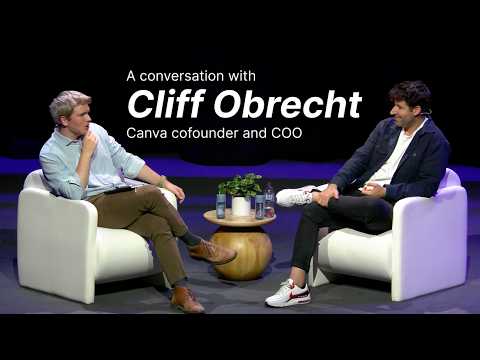
Published by Stripe on YouTube on August 25, 2026, this video records a fireside chat at Stripe Tour Sydney featuring Canva cofounder and COO Cliff Obrecht in conversation with Stripe president John Collison. According to the page description, the two leaders discuss Canva's evolution, business model, and strategic transition into the AI era.
## TL;DR
Cliff Obrecht traces Canva's journey from its origins as Fusion Books to becoming a global creative platform with over 200 million users. The conversation explores how Canva scaled through freemium models and SEO growth loops before pivoting its product development to navigate the high operational costs of AI. Obrecht emphasizes how bringing image generation models in-house, making strategic acquisitions like Leonardo AI, and empowering brand architects are central to Canva's future strategy.
## Atmosphere & style
The discussion is lighthearted, candid, and fast-paced, filled with warm humor and playful banter between the two executive peers. A relaxed, collaborative energy carries through as they trade jokes about workplace dynamics and misquote pop culture references alongside sharp operational insights. The atmosphere feels like an intimate, authentic fireside chat where complex business strategy is unpacked with grounded candor.
## Key takeaways
- [00:00](https://www.youtube.com/watch?v=4GmHpHyoKmo&t=0s) Canva is undergoing its largest operational evolution, transitioning from a pure SaaS creative tool into an integrated platform spanning creativity, productivity, and AI.
- [00:53](https://www.youtube.com/watch?v=4GmHpHyoKmo&t=53s) Canva's rapid initial scaling was driven by a generous freemium model, avoiding aggressive early monetization or intrusive watermarks to nurture organic viral growth.
- [02:21](https://www.youtube.com/watch?v=4GmHpHyoKmo&t=141s) Non-deterministic AI agentic loops significantly increased the cost to serve free users from fractions of a cent to many cents per month, changing the traditional freemium economics.
- [04:35](https://www.youtube.com/watch?v=4GmHpHyoKmo&t=275s) Rather than displacing human creative roles, AI is shifting designers toward becoming brand architects and custodians who maintain brand consistency against AI-generated 'slop.'
- [04:35](https://www.youtube.com/watch?v=4GmHpHyoKmo&t=275s) Canva compensates human creators when their original templates and assets are used to generate or guide new AI content.
- [09:54](https://www.youtube.com/watch?v=4GmHpHyoKmo&t=594s) Canva prioritizes a visual, template-first creation process over open text prompts, backed by a global creator economy hosting over 165 million assets.
- [12:41](https://www.youtube.com/watch?v=4GmHpHyoKmo&t=761s) To escape high third-party API costs, Canva brought model generation in-house, cutting AI operational costs by approximately 90%.
- [15:03](https://www.youtube.com/watch?v=4GmHpHyoKmo&t=903s) Strategic acquisitions like Austria's Kaleido (background removal) and Leonardo AI provided foundational in-house visual models required to manage quality, cost, and latency.
- [16:57](https://www.youtube.com/watch?v=4GmHpHyoKmo&t=1017s) Template exposure through search engines served as Canva's primary early growth engine, accounting for roughly 60% of early user acquisition.
- [19:23](https://www.youtube.com/watch?v=4GmHpHyoKmo&t=1163s) Canva utilizes a matrix structure with dynamic horizontal components, like Netflix-style personalized row systems, to manage global localized surfaces efficiently.
- [23:07](https://www.youtube.com/watch?v=4GmHpHyoKmo&t=1387s) Fusion Books served as Canva's self-funded, profitable predecessor in Perth, proving initial market demand in school yearbooks before launching Canva in 2013.
- [24:40](https://www.youtube.com/watch?v=4GmHpHyoKmo&t=1480s) After facing over 100 investor rejections, Canva raised a $1.5M seed round in Australia, supplemented by government grants that doubled its effective runway.
- [26:24](https://www.youtube.com/watch?v=4GmHpHyoKmo&t=1584s) Headquartering in Sydney shielded Canva from Silicon Valley distractions while helping it secure top-tier local tech talent as a dominant local brand.
- [29:32](https://www.youtube.com/watch?v=4GmHpHyoKmo&t=1772s) Canva streamlined its AI product development by discarding long approval loops in favor of rapid, prototype-driven iteration by small in-person teams.
- [33:34](https://www.youtube.com/watch?v=4GmHpHyoKmo&t=2014s) Internal AI tooling provides leadership with direct natural-language querying of core enterprise data repositories, though success depends on clean, standardized underlying data.
## Detailed walkthrough
### [00:00](https://www.youtube.com/watch?v=4GmHpHyoKmo&t=0s) Canva's evolution and the transition to AI
Stripe president John Collison opens the chat by asking Cliff Obrecht for a quick update on Canva's current state, noting they will spend a lot of time discussing AI. Cliff reflects on Canva's journey since its founding in 2013, warmly joking that he started the company with his wife, who is "my boss." This prompts immediate laughter and banter between the two, with John pointing out that building a business with a close partner is always the case, "whether you realize it or not."
Cliff describes the current era as the "biggest transition of our whole lives as a company." He explains that Canva is evolving from a pure creative platform in the SaaS world into a hybrid platform combining creativity, productivity, and intelligence in the AI era. He notes that this shift brings a lot of excitement and challenges, but enthusiastically calls it "super fun."
### [00:53](https://www.youtube.com/watch?v=4GmHpHyoKmo&t=53s) Scaling through freemium and organic growth
When John asks how Canva managed to get massive, Cliff credits a ruthless focus on solving customer problems with the best product in the world, alongside their freemium model. He notes that early on, they didn't try to "over monetize too early," offering a largely free platform where users could simply buy images for a dollar. Mid-explanation, Cliff gets pleasantly distracted by latecomers in the audience, warmly saying, "There's a lot of people over there. I didn't realize. Hey, everyone," to which John jokes, "They snuck in," drawing laughter from the crowd.
Cliff explains that subscriptions were added later and really fueled their takeoff. They never wanted to "watermark the product and deprecate the experience" for free users just to force brand awareness. Instead, their strategy was grounded in being "very generous." As they added more premium features, they observed a natural pattern: the more value free users derived over the years, the more willing they were to accept paying for an upgrade.
- Treated the free user base with deep respect, utilizing them as their primary word-of-mouth marketing channel.
- Built seamless sharing directly into the product to fuel organic virality.
- Kept the core experience entirely free of intrusive watermarks to protect the user experience.
### [02:21](https://www.youtube.com/watch?v=4GmHpHyoKmo&t=141s) How AI changed the cost to serve free users
John pivots to the delicate balance of migrating users from free to paid tiers, asking how they determine when a user is ready to "flap your wings and become a paying Canva subscriber." Cliff notes that historically, their free-to-paid monetization rates were very healthy and stable, with many education users remaining perpetually free until college. However, the advent of AI radically altered the fundamental dynamics of their business model.
Cliff breaks down the stark reality of running non-deterministic AI tools at scale. Previously, the cost to create a design was "essentially nothing"—amounting to fractions of a cent per month. Now, powering a full "agentic loop" that conducts web research, adheres to brand guidelines, generates multi-asset campaigns, and analyzes deployment performance requires complex intelligence and system connections. All those tokens cost real money, driving the cost to serve from mere cents to "many, many more cents per month," completely rewriting the graduation path from free to paid.
### [04:35](https://www.youtube.com/watch?v=4GmHpHyoKmo&t=275s) The future of design jobs in the age of AI
Addressing the common narrative of "robots eating the jobs," John asks for Cliff's "grand unified theory for design" in the AI era. Cliff draws a parallel to Canva's launch, when critics similarly warned they were destroying design jobs by democratizing access beyond the less than 1% of the internet that could afford and use complex Adobe products. Instead, Canva ultimately created "hundreds of millions of more designers."
Cliff argues that rather than replacing professionals, AI is elevating them to become "brand architects" and design system architects. In large organizations, designers now create foundational mood boards, brand kits, and styles, empowering the rest of the company to leverage those base bits of creativity using AI. Crucially, Canva pushes back against the trend of AI training exclusively on scraped internet content by paying real human creators when their templates and designs are referenced for generation.
- Professional designers submit templates to the platform, actively setting design trends.
- Users can generate new assets referencing these specific, human-made templates.
- Canva financially compensates the original creators for those input images, emphasizing that a "human in the loop is critical."
### [07:19](https://www.youtube.com/watch?v=4GmHpHyoKmo&t=439s) Avoiding AI "slop" with brand architecture
John presses Cliff on whether the persistent media headlines about AI threatening design jobs bother him. Cliff dismisses it, noting that the sentiment was actually heavier during Canva's initial launch. He emphasizes that in a world flooded with "AI slop," having on-brand content is more important than ever, making the role of human brand custodians increasingly valuable.
The conversation turns to the distinct aesthetic of AI models. John playfully roasts the repetitive writing style of LLMs, joking about their tendency to use phrases like "Here's the quietly load-bearing parts," and points out that AI-generated websites often default to a recognizable CSS style. Cliff agrees, explaining that generic output is exactly what Canva wants to avoid. He stresses that true creativity requires giving models guidance through a combination of strict brand architecture and human visual or written prompts, allowing users to safely guide the output away from "generic brand slop."
### [09:54](https://www.youtube.com/watch?v=4GmHpHyoKmo&t=594s) Template-first design and the creator economy
John raises the point that many users, much like home buyers touring properties, don't necessarily know how to describe what they want from a blank prompt box. Cliff enthusiastically agrees, asserting that the prompt box is not the right vector for visual content creation. Instead, Canva champions a "template first, content first" approach. A user might not know how to prompt for a "psychedelic retro '80s themed birthday party invitation," but they immediately recognize they want it when they see it in the library.
This visual library is powered by a massive creator economy. Cliff explains that Canva hosts over 165 million templates, images, and graphic assets, created by a mix of full-time professionals, side-hustlers, and graphic designers monetizing unused client work. Canva actively guides these creators by putting out calls to fill specific market gaps based on user search queries. John notes how this ecosystem provides incredible earning opportunities for young digital natives, to which Cliff adds that proficiency in Canva is now a critical, highly sought-after skill on platforms like Upwork, Fiverr, and LinkedIn, as clients increasingly demand deliverables in an editable Canva format.
### [12:41](https://www.youtube.com/watch?v=4GmHpHyoKmo&t=761s) Bringing AI models in-house to slash costs
To close out this segment, John steers the conversation to Canva's bold transition from a design tool to an "AI lab" developing its own image models. Cliff reveals the harsh economic realities they faced after launching their AI products at the Canva Create event in April. They initially relied heavily on third-party frontier intelligence—including external LLMs and image models. While these models were "amazing at what they did," they were simply too expensive to run at Canva's massive scale of over 200 million free users.
Cliff explains that relying on third-party models is fine for a company with 10,000 paying customers, but for Canva, the economics broke down. To sustain a generous free product while delivering high quality to their 30-plus million paying users, they had to slow down their rollout and bring core competencies—specifically image and design generation—in-house. By owning the agentic loops and managing their own inference, Canva successfully slashed their AI operational costs by about 90%, striking the essential "holy trinity" of quality, cost, and latency.
[15:03](https://www.youtube.com/watch?v=4GmHpHyoKmo&t=903s) Owning the AI Stack: From Background Removal to Leonardo AI
John Collison brings up Amazon's strategy of hosting third-party AI models rather than training their own, asking if Canva ever considered a similar path. Cliff Obrecht reveals that Canva actually started venturing into AI over six years ago with one of its most beloved features: the background remover. To build it, Canva partnered with an Austrian startup called Kaleido—a fitting choice given Obrecht's own grandfather was from Austria. The background removal tool drove so many subscription upgrades that Canva ultimately acquired the company to bring its visual AI lab and deep image decomposition research in-house.
Collison humorously interrupts to validate the feature's power, admitting that the need to remove an image background was the exact reason he first became a paying Canva subscriber. Obrecht agrees, noting that templates and background removal were historical top drivers for user upgrades. Building on that foundation, Canva later acquired local Australian company Leonardo AI to acquire their foundational image and design models. While running third-party model evals might work for LLMs, Obrecht emphasizes that controlling image and design generation models directly is essential to optimize quality, cost, and latency.
- **Kaleido Acquisition**: Austrian visual AI startup behind Canva's background remover, acquired after driving massive subscription conversion.
- **Leonardo AI Acquisition**: Local team brought on for their proprietary foundational models in image and design generation.
- **Strategic Thesis**: LLMs are largely fungible, but owning visual design models is required to manage cost and latency at scale.
[16:57](https://www.youtube.com/watch?v=4GmHpHyoKmo&t=1017s) Product Growth Loops and Strategic Discovery
Collison connects Canva's background remover to a broader pattern of scaling companies finding product-market fit: observing organic user behavior, standardizing it, and doubling down. He cites Twitter as a prime example, where community hacks like hashtags, replies, threads, and linked images were eventually built into core product features.
Obrecht adds that most tech companies rely on three or four core growth loops rather than infinite acquisition channels. For Canva, exposing their massive template library to SEO provided an enormous early engine. After starting small, Canva realized they were ranking number one on Google for terms like "business card templates." They systematically conducted SEO research to capture every niche search query, expanding into micro-categories like "three-year-old birthday" templates. This strategy accounted for roughly 60% of Canva's early growth. As users began collaborating on these designs, seamless sharing features became another major growth flywheel.
- **Growth Engine**: Exposing template libraries to SEO accounted for ~60% of early user acquisition.
- **Market Granularity**: Search optimization scaled down to highly specific long-tail query templates.
- **Flywheel Progression**: Template discovery drove user acquisition, which naturally led into collaborative sharing loops.
[19:23](https://www.youtube.com/watch?v=4GmHpHyoKmo&t=1163s) Matrix Organizations and Structuring Product Surfaces
Collison shares how Stripe identified early growth loops in the sharing economy (with clients like Lyft, Instacart, and DoorDash prioritizing scaled payout logic over simple card processing), which led directly to Stripe Connect. He asks Obrecht how to execute complex growth loops when the required execution spans across product, SEO, and content across seven different organizational siloes.
Obrecht acknowledges the challenge as a fundamental trade-off between self-contained product teams (which move fastest) and matrixed organizations. Canva manages this through a matrix structure where "verticals" represent a minimal set of product surface areas to prevent sprawl. "Horizontals"—such as content and personalization—feed directly into those surfaces. For example, the homepage uses configurable rows similar to Netflix, dynamically serving localized content depending on whether the user is a small business in Mexico or an enterprise in Japan.
- **Organizational Model**: Matrix structure balancing vertical product surface areas with horizontal capabilities (content, personalization).
- **Architecture Strategy**: Automated system driven by machine learning instead of ad-hoc fixes per market.
- **UI Framework**: Modular, configurable row layout on the homepage modeled after streaming platforms like Netflix.
[23:07](https://www.youtube.com/watch?v=4GmHpHyoKmo&t=1387s) Early Displacements, School Yearbooks, and Fusion Books
When asked what tools Canva displaced, Obrecht points out that before Canva, most non-designers relied on basic software like Microsoft PowerPoint, Microsoft Word, or Paint—pushing them past their intended limits—or attempted to pirate Adobe Photoshop.
Obrecht shares the story of Canva's origin, which began with Fusion Books. While Melanie Perkins was teaching university design courses on the complex Adobe suite, Obrecht was working as a school teacher. Recognizing that untrained teachers were routinely tasked with designing 200-page school yearbooks, they merged their ideas into Fusion Books out of Perth, Western Australia. Although their ultimate vision was always a broader design platform, they started with yearbooks to guarantee immediate profitability without outside funding.
- **Pre-Canva Landscape**: Non-designers defaulted to PowerPoint, Word, Paint, or pirated versions of Adobe Photoshop.
- **Fusion Books**: The self-funded predecessor to Canva created specifically to solve school yearbook design friction.
- **Initial Traction**: Scaled to over 1,000 schools, printing millions of pages and generating over $1 million in revenue with a 20-person team.
[24:40](https://www.youtube.com/watch?v=4GmHpHyoKmo&t=1480s) Pitching Silicon Valley and Navigating Rejections
After five years running Fusion Books, Obrecht and Perkins realized no one else had built their broader design platform, prompting them to travel to Silicon Valley in 2012 to pitch venture capitalists. Coming from Perth without formal startup experience, they received over 100 rejections.
The turning point occurred when a curious investor asked about their existing yearbook business. When they revealed Fusion Books was already profitable, generating over $1 million in revenue, and operating its own printing setups with 20 employees, the investor was stunned, telling them they were outperforming 90% of his portfolio. He advised them to "jazz it up a bit" and adopt a more confident American pitching style. The duo playfully joke about adopting exaggerated American accents and waving cowboy hats in subsequent pitch meetings, which immediately altered investor receptions.
- **VC Rejections**: Faced 100+ rejections from Silicon Valley investors who were hesitant about their background and location.
- **Pitch Pivot**: Shifted focus toward their existing $1M+ profitable revenue stream and traction with 1,000 schools.
- **Launch Era**: Canva formally launched in 2013 following their initial 2012 fundraising efforts.
[26:24](https://www.youtube.com/watch?v=4GmHpHyoKmo&t=1584s) Staying in Australia and Building a Global Company
Collison asks why Canva chose not to relocate to the US despite investor pressure. Obrecht recalls VCs explicitly saying they only invested in companies within biking distance—a steep requirement when based in Perth. The decision to remain in Australia came down to a "knife's edge" financial calculation: Canva raised a $1.5 million seed round at an $8 million valuation, which was doubled in effective runway through an Australian government commercialization grant and R&D tax concessions.
This funding enabled them to move from Perth to Sydney ("the big smoke"). Obrecht highlights that remaining in Sydney provided a massive strategic advantage: Canva became a large fish in a smaller pond, benefiting from top-tier local tech talent and media visibility while staying isolated from Silicon Valley chatter and Twitter hype. Today, Canva is fully global—the US is its largest market, followed by Brazil, with the majority of enterprise sales originates across North America and Europe supported by regional R&D hubs.
- **Seed Round**: Raised $1.5M at an $8M valuation in ~2012, matched by a $1M Australian government grant.
- **Relocation**: Moved operations from Perth to Sydney to establish their headquarters.
- **Global Footprint**: United States is Canva's largest market overall, Brazil is second, and enterprise growth is led by the US and Europe.
[29:32](https://www.youtube.com/watch?v=4GmHpHyoKmo&t=1772s) In-Person Collaboration and Deprogramming Product Workflows
Cliff Obrecht emphasizes Canva's push to centralize operations around a few core hubs, driven by the belief that the best work happens in person. While Canva doesn't strictly enforce return-to-office mandates, Obrecht works directly out of a shed—literally featuring a roller door—alongside Canva's AI team. He describes how refreshing it is to lock in with a team, yell across desks, and escape back-to-back Zoom calls.
John Collison pivots to how tech companies structure product development, noting a common need to "deprogram" new hires who bring overengineered processes from previous employers. Collison draws an analogy to early British Arctic expeditions: initial teams loaded massive galleons with fine China, libraries, and 100 men, only to freeze and die. Success came only when they switched to a streamlined approach—"two guys and a dog sled"—crossing Greenland to reach the North Pole. He argues product teams often over-complicate development with excessive UX research and endless documentation instead of shipping a rough prototype for quick user feedback. Obrecht completely agrees, admitting Canva has even had to deprogram its *own* past practices due to the fast pace of AI.
* Canva abandoned its legacy product approval loop—which involved extensive customer research, pitch decks outlining resource allocation, and multi-stage chronologies—in favor of deploying minimal viable prototypes built by tiny teams.
* Obrecht screens candidates during interviews by checking if they are "AI-pilled" regarding agile, prototype-driven product creation.
* Banter ensues over a culture reference: Collison makes a joke referencing Taylor Swift ("the old Canva can't come to the phone right now..."), which Obrecht mistakes for Justin Bieber's "Call Me Maybe," leading Collison to tease Obrecht that his cultural knowledge lies in visual arts rather than pop music.
[33:34](https://www.youtube.com/watch?v=4GmHpHyoKmo&t=2014s) AI as an Executive Superpower and Internal Data Intelligence
When Collison asks for generalizable advice for companies navigating major technology transformations, Obrecht highlights how AI grants leaders direct visibility into operational data. By connecting AI directly to core data repositories (such as Snowflake and Stripe), executives can bypass traditional hierarchy and extract insights instantly using natural language queries without relying on filtered manager reports or static dashboards.
Collison agrees that AI narrows the gap between executives and ground-truth execution, though he points out current limitations in model capabilities. While AI handles code generation well, models still struggle with precise numerical reasoning and parsing messy internal corporate context. Obrecht reveals that Canva previously encountered this issue with an internal tool called "Maestro," where incompatible data structures led to a "garbage in, garbage out" problem, prompting Canva to spend significant time standardizing its data layout.
* Obrecht uses Canva's custom, in-house system (built directly into Canva's codebase) to pull cross-functional data that is roughly 90% accurate on the first query.
* By using this system, Obrecht discovered Canva had over 400 active experiments running, several of which had been left active for over six months without deprecation.
* Collison highlights the internal data accessibility problem with a test question: asking whether a company has a simple text box where an employee can type, "How did my spend on airfares increase last year?" and receive an instant, permission-checked answer.
[39:50](https://www.youtube.com/watch?v=4GmHpHyoKmo&t=2390s) Expanding Payment Methods and Closing Remarks
As the chat wraps up, Collison asks Obrecht for direct feedback on what Stripe could improve to better support Canva as a longtime customer. Obrecht commends Stripe's performance but requests deeper coverage of regional payment methods across emerging international markets.
Collison jokes about Obrecht's request to address the "dark corners of payments," noting that obscure local payment rails often serve user bases exceeding 100 million people. He reassures the audience that expanding global payment methods and bringing products like Stripe Treasury to markets like Australia remain top priorities for Stripe.
* Canva relies heavily on Stripe to support payment processing across global consumer markets.
* Stripe is actively broadening international support for regional payment methods and expanding financial infrastructure tools in Australia.
## Notable quotes
> [00:00](https://www.youtube.com/watch?v=4GmHpHyoKmo&t=0s) my boss — Cliff Obrecht
> [00:00](https://www.youtube.com/watch?v=4GmHpHyoKmo&t=0s) biggest transition of our whole lives as a company — Cliff Obrecht
> [00:53](https://www.youtube.com/watch?v=4GmHpHyoKmo&t=53s) There's a lot of people over there. I didn't realize. Hey, everyone — Cliff Obrecht
> [00:53](https://www.youtube.com/watch?v=4GmHpHyoKmo&t=53s) They snuck in — John Collison
> [02:21](https://www.youtube.com/watch?v=4GmHpHyoKmo&t=141s) flap your wings and become a paying Canva subscriber — John Collison
> [04:35](https://www.youtube.com/watch?v=4GmHpHyoKmo&t=275s) robots eating the jobs — John Collison
## Background
该视频由 Stripe 官方频道于 2026 年 8 月 25 日发布在 YouTube 平台。根据页面简介,这是在 Stripe Tour Sydney 活动现场,Canva 联合创始人兼首席运营官(COO)Cliff Obrecht 与 Stripe 总裁 John Collison 进行的一场深度炉边对谈。
## TL;DR
对谈中,Cliff Obrecht 详述了 Canva 从早期依靠免费增值模式与 SEO 模板飞轮爆发,一路演进为“创意、生产力与智能”三位一体 AI 平台的创业历程。面对 AI 时代推理算力与代币(Tokens)成本暴增数十倍的严峻挑战,Canva 选择通过自研图像模型并将推理成本降低约 90%,同时借助收购 Kaleido 和 Leonardo AI 牢牢掌控核心技术闭环。此外,两位高管还深入探讨了“品牌架构师”对抵御劣质 AI 垃圾的重要性、极简敏捷的原型研发理念、打通企业多源数据的内部 AI 治理系统(Maestro),以及 Canva 对全球长尾本地化支付基础设施的迫切需求。
## Atmosphere & style
整场炉边对谈气氛轻松幽默却又干货密集,两位白手起家的创业者兼合作伙伴之间展现出极高的默契与互信,调侃妻子是老板、年少接私活赚外快、路演时夸张的“美式吹嘘”等段子频出,引得现场笑声不断。谈话既有从西澳偏远车库被硅谷拒绝百次、最终死里逃生的真实创业起伏,又有技术管理者挤在铁皮棚屋攻坚自研模型与算力账本的硬核实战感,给观众带来一种穿透公关话术、直面商业与工程真相的爽快与从容。
## Bulletin
- [00:00](https://www.youtube.com/watch?v=4GmHpHyoKmo&t=0s) Canva 正经历创立 13 年来最关键的转型,全面由传统 SaaS 创意工具升级为集创意、生产力与智能于一体的综合平台,但底层推理成本剧增迫使其放缓功能铺开并全面转向自研基座模型。
- [12:44](https://www.youtube.com/watch?v=4GmHpHyoKmo&t=764s) 为支撑 2 亿免费用户与 3000 万付费订阅用户的双层经济模型,Canva 通过自研底层图像模型与战略并购(Kaleido 及 Leonardo AI),成功将推理成本压低了约 90%。
- [04:33](https://www.youtube.com/watch?v=4GmHpHyoKmo&t=273s) 针对“AI 取代设计师”的争议,Canva 强调“人机协同”与模板优先策略,不仅为原作者提供版税分成,更推动专业设计师转型为制定规范与情绪板的“品牌架构师”。
- [30:18](https://www.youtube.com/watch?v=4GmHpHyoKmo&t=1818s) Canva 重构了产品研发范式,彻底摒弃撰写冗长报告与立项 PPT 的旧模式,改由极小团队利用 AI 极速构建原型与“探针功能”(spike)收集真实反馈。
## Key takeaways
- [00:00](https://www.youtube.com/watch?v=4GmHpHyoKmo&t=0s) Canva 从传统创意设计工具全面蜕变,构建集创意、生产力与 AI 智能于一体的三位一体架构平台。
- [00:53](https://www.youtube.com/watch?v=4GmHpHyoKmo&t=53s) 克制的免费增值(Freemium)模式与绝不打水印的克制体验,曾是 Canva 驱动口碑自然传播飞轮的核心引擎。
- [02:21](https://www.youtube.com/watch?v=4GmHpHyoKmo&t=141s) Agentic 循环与非确定性 AI 计算让单次服务成本暴增,颠覆了边际成本近乎为零的传统 SaaS 商业模型。
- [04:33](https://www.youtube.com/watch?v=4GmHpHyoKmo&t=273s) AI 时代的人机协同不可替代:Canva 坚持调用人类真实模板并分润版税,同时推动设计师向“品牌架构师”转型以对抗同质化的“AI 垃圾(AI slop)”。
- [09:01](https://www.youtube.com/watch?v=4GmHpHyoKmo&t=541s) 单纯的提示词框并非视觉创作的未来,“模板优先、内容优先”的庞大资产库才是用户构思与品牌落地的基石。
- [11:32](https://www.youtube.com/watch?v=4GmHpHyoKmo&t=692s) 在中小型企业日常协作与外包生态中,“可编辑的 Canva 格式”正在逐步取代 Adobe 源文件和死板图片,成为行业事实交付标准。
- [12:44](https://www.youtube.com/watch?v=4GmHpHyoKmo&t=764s) 为攻克“品质、成本与延迟”的不可能三角,Canva 从单纯采购第三方商用模型转向自研底层图像基座,单次推理成本大幅下降约 90%。
- [14:42](https://www.youtube.com/watch?v=4GmHpHyoKmo&t=882s) 核心图像能力必须自持:Canva 先后收购奥地利视觉实验室 Kaleido 与澳洲基座模型公司 Leonardo AI,彻底实现算力闭环。
- [16:58](https://www.youtube.com/watch?v=4GmHpHyoKmo&t=1018s) 顺应用户自发涌现的原生行为(如 Twitter 话题标签或一键抠图),是驱动企业实现 10 倍乃至 1000 倍跨越式增长的杠杆。
- [18:02](https://www.youtube.com/watch?v=4GmHpHyoKmo&t=1082s) 以“名片模板”切入的 SEO 策略曾一度贡献 Canva 整体增长的 60%,并与站内协同分享形成了无缝衔接的双重增长飞轮。
- [19:24](https://www.youtube.com/watch?v=4GmHpHyoKmo&t=1164s) 采用矩阵式组织架构,控制纵向产品表面蔓延,并通过横向中台提供类似 Netflix 的动态个性化内容分发流。
- [23:07](https://www.youtube.com/watch?v=4GmHpHyoKmo&t=1387s) 从 Fusion Books 年鉴制作工具白手起家,在被硅谷风投拒绝超百次后,凭借扎实的盈利数据与自信表达完成早期突破。
- [26:40](https://www.youtube.com/watch?v=4GmHpHyoKmo&t=1600s) 澳大利亚政府补助与税收优惠助力团队在生死边缘延长跑道,落户悉尼让 Canva 避开硅谷圈子的过度喧嚣,专注于打磨产品本身。
- [28:43](https://www.youtube.com/watch?v=4GmHpHyoKmo&t=1723s) 推崇线下高密度面对面协同,研发文化转向以最小敏捷团队、AI 极速原型与快速“探针功能”取代臃肿的调研和立项流程。
- [33:34](https://www.youtube.com/watch?v=4GmHpHyoKmo&t=2014s) 自研内部 AI 系统打通代码仓库、Snowflake 数据库与财务数据,使管理者能通过自然语言跨源直接穿透业务底层真相。
- [36:28](https://www.youtube.com/watch?v=4GmHpHyoKmo&t=2188s) 企业数据治理是 AI 落地的核心瓶颈,消除数据不兼容与权限壁垒才能真正实现“去年机票支出增长几何”式的自然语言精准查询。
- [39:50](https://www.youtube.com/watch?v=4GmHpHyoKmo&t=2390s) 全球化业务深水区迫切需要覆盖新兴市场的“长尾支付方式”,照亮全球支付的隐秘角落是平台出海扩张的底层诉求。
## Detailed walkthrough
### [00:00](https://www.youtube.com/watch?v=4GmHpHyoKmo&t=0s) Canva 的创立背景与向 AI 智能化平台的重大转型
访谈伊始,Stripe 联合创始人兼总裁 John Collison 与 Canva 联合创始人兼首席运营官(COO)Cliff Obrecht 展开对谈。John Collison 邀请 Cliff 分享 Canva 当前的发展现状以及他们正在经历的变革。Cliff 回顾道,Canva 创立于 2013 年,是他与妻子 Melanie Perkins 共同建立的,他开玩笑地调侃 Melanie 既是自己的妻子也是自己的“老板(boss)”,这引发现场一片笑声;John 也心领神会地表示,无论你是否意识到,跟亲密伴侣共事“往往都是这种局面”。
经过了 13 年令人兴奋的创业历程,Cliff 指出,Canva 当前正处于公司创立以来最为关键的一次重大转型之中。他们正全力推动 Canva 从传统 SaaS 时代的创意平台(creative platform),进化为深度融合“创意平台、生产力平台(productivity platform)与智能平台(intelligence platform)”的三位一体架构。这一全面拥抱 AI 世界的蜕变带来了巨大的工程与业务挑战,同时也充满了探索的兴奋感与乐趣。
```mermaid
flowchart LR
accTitle: Canva 的平台演进路径
accDescr: 展示 Canva 从早期的创意 SaaS 平台逐步演化为集创意、生产力与 AI 智能于一体的综合平台。
subgraph Past["传统 SaaS 时代"]
A["创意设计平台<br/>(Creative Platform)"]
end
subgraph Present["AI 新时代三位一体平台"]
B["创意平台<br/>(Creative Platform)"]
C["生产力平台<br/>(Productivity Platform)"]
D["智能平台<br/>(Intelligence Platform)"]
end
A --> B
A --> C
A --> D
```
---
### [00:53](https://www.youtube.com/watch?v=4GmHpHyoKmo&t=53s) 规模扩张的秘密:免费增值模式与“绝不打水印”的口碑飞轮
谈到 Canva 是如何一步步发展到如今的庞大规模时,Cliff 认为所有顶尖公司的核心都在于打造出全球最好的产品,并“冷酷无情地专注于解决用户痛点(ruthlessly focused on solving customer problems)”。Canva 当年的秘密武器正是其克制且极致慷慨的免费增值(Freemium)模式。在上线初期,Canva 绝不过早追求过度商业化;当时平台几乎完全免费,唯一的付费点是单张图片素材收费 1 美元。中途 Cliff 突然注意到侧台坐着大群观众,还热情地插话打招呼“Hey, everyone”,John 也打趣附和说他们是“偷偷溜进来的”。
直到平台运营一段时间后,Canva 才引入了订阅制模式,业务由此迎来爆发式增长。Cliff 强调,他们始终对免费用户群体保持最高程度的尊重,将其视作驱动公司增长的最核心口碑营销渠道(word-of-mouth marketing channel)。在解答 John 关于平台传播是刻意工程化制造还是自然有机生长的疑问时,Cliff 说明他们坚决不做破坏用户体验的事情——例如绝不给免费用户的设计作品强制添加品牌水印。Canva 的策略是以极大的慷慨满足用户所需,随着用户使用年限的增加以及平台不断推出更有价值的高级功能,用户会自发且乐意地完成从免费到付费的升级转化。
---
### [02:21](https://www.youtube.com/watch?v=4GmHpHyoKmo&t=141s) AI 带来的算力经济学震荡:从每位用户分钱成本到 Agent 时代的代币消耗
John 接着探讨了免费用户向付费用户转化的“毕业时刻(graduation point)”,询问用户何时才能“展翅离巢,成为 Canva 的付费订阅者”。Cliff 表示,过去 Canva 的免费到付费转化率一直非常健康且令人满意,对于庞大的教育类用户群体,除了升入大学阶段可能转化外,平台几乎一直提供永久免费服务。
然而,AI 的爆发彻底颠覆了这套底层商业逻辑与单位经济学模型。Cliff 指出,在过去提供一次设计服务所消耗的边际服务成本(Cost of Goods to Serve)几乎接近于零(以美分计);而在生成式 AI 与非确定性(non-deterministic)AI 产品的体系下,服务成本直接暴增了数倍乃至数十倍。John 深有共鸣地补充道,Stripe 和台下许多正在构建 AI 应用的同行都切身感受到了这一剧变,旧有的免费到付费路径已经无法直接照搬套用到 AI 驱动的新型产品上。
```mermaid
flowchart TD
accTitle: AI 时代设计全流程与 Agentic 循环的成本剧增
accDescr: 展示在 AI 驱动下,从需求调研到跨渠道部署与效果分析所经历的多系统交互及代币消耗。
subgraph Loop["AI Agentic 全流程循环"]
E["网络调研检索<br/>(Web Research)"]
F["品牌调性调取<br/>(Call the Brand)"]
G["生成多维度素材<br/>(图像 / 图表 / 复杂版式)"]
H["跨渠道全案投放<br/>(Campaign Deploy)"]
I["投放效果数据回流与洞察<br/>(Content Intelligence)"]
end
E --> F --> G --> H --> I
I -.->|"多系统串联与海量 Token 消耗"| E
```
Cliff 进一步算了一笔详细的成本账:过去在 Canva 制作一张图对于平台来说“几乎不需要成本”;但在今天的智能代理循环(Agentic loop)工作流下,用户只要发起一个全案营销需求,AI 就要自动展开网络调研、调取企业的品牌规范资产、生成包含多规格图片和图表的一整套完整营销活动(Campaign)、进行分发部署,随后还要对接后台数据系统分析投放后的实际转化表现。这一长串环节需要调动背后密集的智能计算系统与多平台打通,每一次交互都在消耗昂贵的代币(Tokens)。从过去的“微不足道”跃升至单次生成的“数美分”,一旦乘以 Canva 数亿级别的用户大盘,便产生了极其巨大的商业成本冲击,迫使他们必须对商业模式进行全方位重塑。
---
### [04:33](https://www.youtube.com/watch?v=4GmHpHyoKmo&t=273s) 应对“AI 抢夺饭碗”论调:人类参与、创作者分润与品牌架构师角色
John 指出,在宏观经济层面的 AI 讨论中,设计往往被视作“机器人吃掉人类饭碗”的首要风向标,但同时 AI 也赋予了大众无需专业设计师就能自主设计的能力。他询问 Cliff 对“AI 时代设计的终极统一理论(grand unified theory for design in the age of AI)”有何看法。
Cliff 强调,这一场景与当年 Canva 刚刚问世时所遭遇的舆论危机如出一辙。在 Canva 出现前,市场上几乎只有门槛极高、费用昂贵的 Adobe 系列软件,全球能够掌握设计软件的互联网用户甚至不足 1%。当时外界也纷纷惊呼“Canva 正在扼杀专业设计师的工作”,但最终的结果是 Canva 催生出了数以亿计的新创作者,并为专业设计师开辟了更加广阔的天地。Canva 建立了一套让专业设计师制作并提交模板的生态系统,并且是业内极少数(甚至可能是唯一)允许用户在使用 AI 生成内容时直接调用人类真实创作的模板,并为这些人类创作者的原型输入真实支付报酬的平台,而非一味在互联网上不加区分地抓取数据进行无偿训练。Cliff 坚信“人机协同(human in the loop)”在创意领域至关重要,平台必须为设定设计潮流的创作者提供坚实的经济回报。
- **专业设计师职责的升维转型**:在谈及全职设计师的工作变化时,Cliff 分析称,现在的设计师在企业内部已不再是单调地制作一张张传单或餐厅菜单,而是跃升为“品牌架构师(Brand Architects)”和“设计架构师(Design Architects)”。他们负责制定企业核心的 Mood Board 情绪板、设计风格系统以及各子资产规范;
- **全员创作与品牌守门人**:普通员工在日常工作中,既可以直接套用设计师做好的模板,也可以把这些底层品牌创意基调输入给 AI 进行灵活延展生成,但产出始终被框定在统一的品牌框架内;
- **抵御“AI 垃圾(AI slop)”**:面对持续存在的“AI 威胁设计饭碗”论调,Cliff 坦言这种声音虽然一直存在,但现实情况是,随着网络上充斥着越来越多的劣质 AI 内容(AI slop),企业对品牌合规性与一致性(on-brand content)的要求反而达到了前所未有的高度,企业内部比以往任何时候都更加迫切地需要人类设计师扮演“品牌守门人(custodians of the brand)”的角色;
- **AI 视觉与语言审美的同质化**:John 也对此深表认同,并指出目前的 AI 生成工具普遍存在某种高度定型化的默认美学特征——如同大语言模型(LLM)写文字时总会不自觉地带有特定的行文腔调(例如“你提到了一个极佳的观点”、“以下是看似平平无奇实则至关重要的支撑点”等高辨识度模板话术),Midjourney 等图像模型有其固有的图像质感,AI 自动生成的网页也总带着如出一辙的默认 CSS 样式风格。
### [09:01](https://www.youtube.com/watch?v=4GmHpHyoKmo&t=541s) 品牌架构与“模板优先”:为什么提示词框并非设计的未来
在谈及 Canva 试图在产品中贯彻何种视觉风格与设计价值观时,Cliff Obrecht 指出,Canva 的核心诉求是提供充分的“选择性”(optionality)。当前的生成式 AI 模型固然能创造出令人惊叹的成果,但前提是必须给予它们清晰的约束与引导。对于企业与品牌而言,最关键的命题在于如何搭建一套系统性的“品牌架构”,既能向模型注入明确的规范与边界,使其严格遵循调性,又能为人的创意表达留出充足空间。无论是借助视觉线索还是文字提示,品牌架构与人类互动的深度融合,直接决定了最终生成的作品究竟是毫无个性的“品牌垃圾”(generic brand slop),还是具备商业落地价值的高水准资产。
针对人机交互的形式,John Collison 提出了一个生动的类比:这就像线下买房看房,买家往往是在踏进某间房屋的一瞬间,才会顿悟“天哪,这就是我想要的风格”;但如果要让一个普通人凭空向建筑师描述自己想要的所有设计细节,绝大多数人根本无法准确表达。用户在设计时往往更倾向于“挑选”,而很难直接通过一段文字提示词(prompt)精准勾勒出需求。
Cliff 对此深表赞同,并直言单纯的“提示词输入框”(prompt box)根本不是视觉内容创作的最佳入口。Canva 平台沉淀了超过 1.65 亿个模板、图片和图形资产,其核心逻辑始终是“模板优先、内容优先”。普通用户在打开软件前,脑海中可能完全没有“我需要一张 80 年代复古迷幻风的生日派对邀请函”这种概念,但当他们在素材库中亲眼看到这个模板时,就会立刻被击中,进而顺理成章地将其作为创作底稿,填入自己的个人内容。此外,Canva 构建了健康的商业飞轮:只要用户采纳了某个创作者的模板,系统就会向原作者提供署名并支付相应的版权收益。
- **庞大资产壁垒**:平台拥有超过 1.65 亿项由模板、图像和矢量图形构成的庞大内容库。
- **创作者收益保障**:用户每次调用独立创作者的模板和素材,平台都会将收入合理分摊给对应的设计者。
---
### [11:32](https://www.youtube.com/watch?v=4GmHpHyoKmo&t=692s) 从兼职赚钱到行业标准交付物:Canva 驱动的自由职业生态
针对 John 提出的“平台创作者究竟是全职从业者、业余爱好者,还是兼职设计师”的疑问,Cliff 表示这些群体在 Canva 上完全兼而有之。除了全职在平台上供应素材的创作者,也有在闲暇时间赚取外快的人,还有大量专业平面设计师会将未被客户选中的闲置废稿上传变现。Canva 还会基于海量用户的搜索查询数据,主动挖掘平台内部的内容供给缺口(例如某类特定文档类型的模板稀缺),并向创作者社区发布定向征集令,引导他们精准补齐生态短板。
John 笑着回忆起自己年少时的经历:当年富有商业头脑的年轻人,热衷于帮那些不懂技术的小商户制作网站,一单能赚上 1000 欧元,对于中学生而言简直就是一笔“天文数字般的巨款”。他好奇今天的年轻人是否正把 Canva 作为进入设计世界与商业变现的跳板。
Cliff 证实了这一趋势。在 Upwork、Fiverr 以及 LinkedIn 等自由职业与招聘平台上,“熟练使用 Canva”已经成为一项高频刚需的核心技能。年轻群体不仅可以通过向平台素材库投稿赚取版税,也可以直接承接设计外包。更具颠覆性的是,当下越来越多的中小型企业在采买设计服务时,明确拒绝交付 Adobe Illustrator 源文件或死板的 JPEG 图片,而是指名要求交付“Canva 格式”。因为小企业主需要获得可编辑的源工程,以便后续在日常运营中反复复用和修改——无论是全套的品牌资产包(Brand Kit)、品牌模板,还是针对特定鞋履促销而制作的 20 组不同尺寸的 Facebook 与 Instagram 广告切片。
---
### [12:44](https://www.youtube.com/watch?v=4GmHpHyoKmo&t=764s) 算力账本与“三位一体”:从应用层被迫走向自研 AI 实验室
话题随后转向了 Canva 的深层技术蜕变:从大众熟知的轻量级在线设计工具,向自主研发底层图像模型的“AI 实验室”大步跨越。John 问及这种转型的底层逻辑。Cliff 毫不讳言地回顾了团队在现实算力成本面前撞上的高墙。在 2024 年 4 月举办的 Canva Create 大会上,公司高调发布了一系列全新的 AI 功能。彼时,底层完全依赖第三方的顶级前沿大模型与商用图像生成模型。这些外部工具效果虽然惊艳,但调用价格极其高昂。
Cliff 强调,如果要将 AI 功能铺开给数以亿计的用户,就必须把模型自研能力收拢到内部,尤其是涉及图像与设计生成这一命脉领域的核心模块。只有自主掌控生成链路的闭环与底层推理优化,才能真正把单次调用的边际成本打下来。事实上,在 4 月发布会之后,Canva 不得不主动踩下刹车,大幅放缓了这批 AI 功能的全量推广节奏,全力投入到“成本、质量与延迟”这三者的平衡攻坚中。
```mermaid
flowchart TD
accTitle: Canva 的 AI 成本与规模化平衡机制
accDescr: 展示 Canva 如何通过自研模型攻克品质、成本与延迟的不可能三角,进而支撑免费与付费双层经济模型。
subgraph Trinity ["核心平衡目标(Holy Trinity)"]
Q["高生成品质 (Quality)"]
C["极致推理成本 (Cost)"]
L["极低响应延迟 (Latency)"]
Q --- C --- L
end
subgraph Transition ["技术路线转型"]
ThirdParty["第三方顶级商用模型<br/>(高单价、不可控)"] --> InHouse["自研底层图像模型<br/>(推理成本降低约 90%)"]
end
subgraph Scale ["双层商业变现与反哺闭环"]
Paying["3000万+ 付费用户<br/>(获得丰厚高端权益)"]
Free["2亿+ 免费用户<br/>(获得高额度免费AI体验)"]
Paying -. "交叉补贴".-> Free
end
InHouse --> Trinity
Trinity --> Scale
```
Cliff 将“质量、成本与延迟”并称为规模化部署 AI 的“三位一体”(holy trinity)。如果 Canva 只是一家服务 10,000 名高客单价企业客户的 SaaS 厂商,完全可以直接向第三方模型付费;但在 Canva 当前的业务体量下——拥有超过 2 亿的免费活跃用户以及 3000 多万付费订阅用户——整个商业飞轮依赖付费群体对免费群体的交叉补贴。要为 2 亿多免费用户持续提供极度慷慨且顺畅的免费 AI 额度,外部采购 API 的账本根本无法跑通。最终,Canva 团队成功将底层推理成本压低了约 90%,这才获得了向全量用户全面铺开 AI 矩阵的底气。
---
### [14:42](https://www.youtube.com/watch?v=4GmHpHyoKmo&t=882s) 核心能力必须自持:从奥地利抠图神器到收购 Leonardo AI
John 提出疑问:业界许多巨头(例如亚马逊)面对 AI 浪潮时,都明确选择不从零训练前沿基座模型,而是搭建中立平台帮助客户调用第三方模型;Canva 为何认定自己必须亲力亲为、掌控专属模型?
Cliff 透露,Canva 涉足 AI 研究其实已有 6 年以上的历史,而最初的引爆点是一个看似简单却极度高频的功能——智能一键“背景移除”(Background Remover)。当时,他们与一家来自奥地利(Cliff 幽默地插话说自己的祖父恰好来自奥地利)名为 Kaleido 的技术先锋团队展开深度合作。这个抠图功能展现出了惊人的商业转化力,一举成为了整个平台最核心的用户付费转化驱动引擎。John 随即会心一笑,当场承认自己当年正是为了给图片抠图,才第一次掏出信用卡成了 Canva 的付费用户。
为了彻底吃透图像视觉解构、图层分离等底层研究,Canva 顺理成章地全资收购了 Kaleido,自此正式拥有了一支专注于计算机视觉的深度 AI 实验室。而随着生成式 AI 时代的全面爆发,团队清醒地意识到图像与设计生成正是自己的立足之本,于是又果断收购了澳大利亚本土的生成式 AI 独角兽企业 Leonardo AI,直接将自研的基础模型能力纳入麾下。
在 Cliff 看来,如果企业只是泛泛地做多模型评估(evals),试图在市场上筛选现成的最优组合,往往只能得到品质,却注定会在推理成本和延迟指标上彻底受制于人。对于通用型纯文本大语言模型(LLM),在各家厂商之间切换尚且具备较高的可替代性(fungible);但对于最核心的图像与设计模型,Canva 必须把命运牢牢掌握在自己手中。
- **早年转型支点**:模板素材与一键抠图工具曾并列为 Canva 历史上最高效的两大付费升级触发点。
- **技术资本整合**:先后将奥地利视觉实验室 Kaleido 与澳洲本土基座模型公司 Leonardo AI 招致麾下,完成了从模型自研到算力闭环的完整拼图。
---
### [16:58](https://www.youtube.com/watch?v=4GmHpHyoKmo&t=1018s) 洞察原生用户行为:规模化扩张中的 PMF 飞轮
从背景移除功能的巨大成功出发,John 提炼出了初创企业在跨越式扩张(Scale-up)过程中,如何持续迭代“产品与市场契合度”(PMF)的底层规律。他指出,创业最初固然需要打造出一款能打动某一细分群体的及格产品;但若要实现从 1 倍到 10 倍、乃至 1000 倍的超级跃升,最核心的机制在于搭建一套敏锐的反馈飞轮:捕捉平台上用户自发涌现的原生行为,并顺水推舟将其固化为平台的核心产品能力。
John 列举了他最推崇的经典案例——Twitter(现 X)。Twitter 发展史上几乎所有颠覆性的核心功能,最初都不是官方产品经理在办公室里规划出来的,而是由社区用户自发发明:
- 用户最早自行在文本中加入井号来归类话题,Twitter 团队发现后顺应趋势,将其做成了可点击、可检索的官方话题标签(Hashtags);
- 类似地,@ 提及回复、推文长串(Threads)以及在推文中嵌入图片,起初都是用户为了绕过平台限制而自创的替代方案(早先用户只能在推文里生硬地贴上第三方的图片链接)。官方团队察觉到这种强烈的诉求后,才果断将其收编为原生功能。
在规模化扩张的惊涛骇浪中,洞察并顺应真实用户的真实用法,往往才是撬动爆发式增长的隐形杠杆。
### [18:02](https://www.youtube.com/watch?v=4GmHpHyoKmo&t=1082s) 增长循环与 SEO 驱动:从名片模板到多品类飞轮
谈到驱动业务规模化的引擎,Cliff Obrecht 指出,大多数公司并没有无限的增长循环(growth loops),通常绝大部分的增长仅仅来自三到四个极其有效的核心抓手。以 Canva 为例,他们最初拥有一个庞大的模板库,团队灵机一动:“不如把这些模板直接暴露给搜索引擎做 SEO 吧。”他们从最小的切口做起,结果出乎意料地直接冲上了 Google“名片模板”(business card templates)搜索排名的第一名。这一突破确立了以 SEO 需求反哺内容供给的策略路径:通过深入分析大众在搜索什么,倒推平台应该产出什么内容,再把这些海量模板公开发布。
在相当长的一段时间内,这一模板 SEO 策略直接贡献了 Canva 全球增长的 60%。这不仅限于商务名片,而是迅速延伸到各种极度细分的利基品类,甚至是像“3岁小孩迷幻风格生日派对”(three year old birthday something in psychedelic)这样极其长尾的场景。当用户被模板吸引进平台并开始设计后,Canva 顺势激活了下一层增长飞轮——协同与分享。团队专注于打磨无缝的分享与协作体验,将个人创作者连接成团队网络,从而形成了滚雪球般的网络效应。
- **模板驱动 SEO**:先攻克“名片模板”占据 Google 搜索榜首,随后将策略复制到数万个细分子品类。
- **增长占比**:模板 SEO 构成的获客渠道曾一度支撑了 Canva 整体增长的 60%。
- **双重飞轮衔接**:从公域搜索获取流量(SEO),到站内协作分享裂变(Collaboration & Sharing),层层递进。
---
### [19:24](https://www.youtube.com/watch?v=4GmHpHyoKmo&t=1164s) 矩阵式组织与产品架构:横向服务与纵向场景的协同
John Collison 对此深有共鸣,并分享了 Stripe 早期的类似经历:在共享经济兴起时,Stripe 敏锐地发现 Lyft、Instacart 和 DoorDash 等平台对复杂的“资金分发/放款逻辑”(scaled payout logic)的渴求远超过传统的“收单网络”(pay-in nets),这一洞察催生了 Stripe 延续至今的市场与平台业务功能。随后 John 抛出了一个管理难题:“我是替一位朋友问的(Asking for a friend)”——企业通常按职能划分,但一个增长循环(例如“一键抠图背景移除”)往往横跨产品研发、SEO 排名攻坚、营销内容生产等七八个分散部门,如何避免部门割裂、协同落地?
Cliff 坦言,这正是管理大型复杂组织的永恒博弈:究竟是选择“端到端自闭环的垂直小团队”(交付速度极快,但容易各自为政),还是选择“矩阵式组织”(matrixed organization)。Canva 最终采用了矩阵模式,严格区分“纵向产品表面”(Verticals / Product Surface Areas)与“横向能力平台”(Horizontals):
1. **纵向表面极简控制**:Canva 极力限制纵向产品接触点的数量,防止表面蔓延(sprawl)引发横纵两向协同成本爆炸。
2. **横向能力统一供给**:将“内容库”与“个性化引擎”做成横向中台服务,统一为着陆页、应用市场、首页等所有纵向表面赋能。
3. **顶层清晰对齐优先级**:由于横向内容团队每天面对来自全公司上百个业务线的开发诉求,管理层必须自上而下明确全局北极星指标,确立需求排期。
在技术架构层面,Canva 的首页并不针对每个细分人群进行孤立的“打地鼠式”(whack-a-mole)定制开发,而是借鉴了 Netflix 的架构逻辑——以机器学习为内核驱动的可配置卡片流。系统根据用户属性(例如“墨西哥的夫妻小店”与“日本的跨国财团”)动态调用内容服务接口,精准下发差异化内容,实现了架构上的解耦与高伸缩性。
```mermaid
flowchart TD
accTitle: Canva 矩阵式架构与动态内容分发模型
accDescr: 展现横向支撑能力如何与纵向产品表面交叉,并以类似 Netflix 的架构向不同画像用户分发个性化内容。
subgraph Horizontals ["横向中台能力 (Horizontals)"]
H1["内容服务平台<br/>(Content Service)"]
H2["个性化与推荐引擎<br/>(ML Personalization)"]
end
subgraph Verticals ["纵向产品表面 (Verticals)"]
V1["营销着陆页 (Landing Pages)"]
V2["动态首页 (Configurable Rows)"]
V3["生态市场 (Marketplace)"]
end
subgraph PersonalizationFlow ["动态分发流 (Netflix 模型)"]
U1["墨西哥小微企业用户"] -->|属性匹配| H2
U2["日本大型企业用户"] -->|属性匹配| H2
H2 -->|驱动编排| V2
H1 -->|按需填充| V2
end
H1 -.->|中台服务接入| V1
H1 -.->|中台服务接入| V3
```
---
### [23:07](https://www.youtube.com/watch?v=4GmHpHyoKmo&t=1387s) 颠覆传统工具:从 Fusion Books 年鉴起步到硅谷百次被拒
谈到 Canva 取代了哪些传统工具,Cliff 表示在 Canva 出现之前,大部分普通人根本没有专业设计能力。大众的现状是被迫用最原始的工具死磕:微软 PowerPoint、Windows 自带画图软件(Paint)、甚至把 Microsoft Word 推向功能极限;极少数人则选择去网上下载盗版 Photoshop,然后在一头雾水中艰难摸索。
Canva 的技术原型源于 Cliff 和联合创始人 Melanie Perkins 在西澳大利亚珀斯创办的第一家公司——校刊年鉴制作软件 Fusion Books。当时 Cliff 是一名学校教师,Melanie 则在大学教授 Adobe 软件,她发现 Adobe 全家桶的学习门槛对新手而言高不可攀。两人身在远离科技中心的珀斯,手里身无分文,亟需一门能立刻盈利的生意。他们盯上了学校年鉴:每年总会有倒霉的学校老师被抓壮丁,在没有任何专业排版技能的前提下,痛苦地硬憋出一本长达 200 页的高标准专业画册。两人将简易设计理念与年鉴结合,创办了 Fusion Books。出乎意料的是,不仅学校大量采购,客户们还纷纷追问:“我们能不能用这套软件来做学校通讯、做邮件设计?”这坚定了他们“大众想要设计的绝不仅是年鉴”的初心。
五年自我造血(bootstrapped)跑通后,两人震惊于全行业竟然还没有巨头做出一款通用在线设计工具,便决定“进军顶级联赛”(take on the big league),前往硅谷寻求风险投资。然而,作为来自西澳、毫无风投常识的两个年轻人,他们在硅谷遭遇了极其残酷的闭门羹,连续被投资人拒绝了 100 多次。
- **原始替代品**:PowerPoint、MS Paint、Word 排版、盗版 Photoshop。
- **Fusion Books 验证**:精准切入 200 页学校年鉴制作痛点,完全通过自我造血实现盈利。
- **早期碰壁**:带着通用在线设计工具构想只身前往硅谷,遭遇超过 100 次风投机构无情拒绝。
---
### [25:02](https://www.youtube.com/watch?v=4GmHpHyoKmo&t=1502s) 扭转乾坤的“美式吹嘘”与留守澳洲的早期抉择
硅谷融资的转折点极具戏剧性。在一次又一次常规路演失败后,一位充满好奇心的投资人终于问了一句:“跟我多讲讲你们那个‘另一个业务’(Fusion Books)吧。”在此之前,谦虚低调的 Cliff 和 Melanie 甚至从未把既有业务当作路演重点。Cliff 回忆当时的回答:“呃,我们确实写了一套软件,目前大概有 1,000 所学校在使用,每年在上面生成超过 100 万页年鉴,年收入超过 100 万美元,公司已经盈利,团队有 20 个人,而且我们还自建了实体印刷生产线……”
那位投资人当场愣住,震惊地打断他们:“我的老天,你们的经营数据比我投资组合里 90% 的公司都要强得多!你们必须学会包装,必须更加‘美式’一点(more American)!”
恍然大悟的两位创始人在下一场会议中立刻切换风格,开始自信满满地大谈自己的硬核商业成绩:“没错老兄(yeah dog),我们这家初创公司年营收破百万,产品上线、团队齐整!”全场投资人的态度瞬间 180 度大反转。John Collison 忍不住笑着调侃 Cliff 是否在路演时就用了那种浮夸的口音,Cliff 戏谑地接话表示,当年恨不得“在路演时挥舞着牛仔帽”。
依靠真实的盈利基本盘,团队在 2012 年成功完成早期风险融资,并于 2013 年正式上线了 Canva。当 John 问及当年投资人是否逼迫他们必须搬到美国时,Cliff 证实了这一点:所有投资人都强烈希望他们把总部迁到硅谷。那是沙丘路风投们普遍秉持“只投骑自行车就能到董事会开会的地方”(investors need to ride their bike)的年代,不愿搬离澳洲也成了当年被上百家机构拒绝的罪状之一。
- **核心转折数据**:Fusion Books 服务 1,000 所学校、年生成超 100 万页年鉴、年收入超 100 万美元、盈利且拥有 20 人团队及自有印刷产线。
- **融资时间节点**:2012 年敲定早期风险投资,2013 年 Canva 正式推向全球市场。
- **地理执念**:拒绝迁往美国加州,打破了当时硅谷投资人“自行车通勤半径内投资”的成见。
### [26:40](https://www.youtube.com/watch?v=4GmHpHyoKmo&t=1600s) 命悬一线的抉择:政府资助与告别珀斯前往“大烟囱”悉尼
早年硅谷投资人曾傲慢地表示只投资“骑自行车就能到”的公司,但当时 Canva 的创始人团队身处西澳大利亚的珀斯——地球上最孤立的城市之一,除非自行车长了翅膀,否则根本不可能满足这一条件。当时团队走到了生死存亡的“刀刃边缘”(knife's edge),正纠结是否要彻底搬去美国。所幸澳大利亚政府提供了研发税收优惠(R&D tax concession)以及 Commercialisation Australia 创业补助金。团队以 800 万美元的估值完成了 150 万美元融资,在当时这是一笔巨款,政府随后追加的 100 万美元补助更是直接将他们的资金跑道(runway)延长了一倍。
这笔额外的资金成为了 Canva 留在澳大利亚的决定性契机。为了吸纳更多人才,他们从珀斯搬迁到了被戏称为“大烟囱”(the big smoke)的悉尼。约翰·科里森打趣调侃珀斯与悉尼之间的地域梗,克里夫则解释称,在珀斯人眼里,悉尼就是那个充满喧嚣的繁华大都市。在悉尼发展虽然是一把双刃剑(作为小池塘里的大鱼,常被当地媒体聚焦放大),但也让团队避开了美国推特圈(Twitter sphere)和硅谷名利场的过度喧嚣与干扰,得以专注于打磨产品本身。
- 早期融资以 800 万美元估值募集 150 万美元,随后获得澳大利亚政府 100 万美元专项补助,成功使 runway 翻倍。
- 留在澳大利亚避免了来自硅谷投资者和行业杂音的干扰,使团队能沉下心专注于为客户打磨核心产品。
- 告别最偏远的珀斯落户悉尼,凭借本地优秀人才库快速壮大研发实力。
---
### [28:43](https://www.youtube.com/watch?v=4GmHpHyoKmo&t=1723s) 全球化布局与“棚屋”里的面对面协作
谈及 Canva 如今在多大程度上仍算是一家“澳大利亚公司”时,克里夫直言,如今的 Canva 本质上是一家植根于澳大利亚的全球化企业。美国目前是其最大的市场,巴西位列第二;大部分企业级销售(enterprise sales)来自美国,其次是欧洲。为了服务好庞大的海外客户群,Canva 必须将业务触角延伸到一线,建立当地团队并展开跨国并购。随着全球化团队的壮大,公司正致力于将人员集中到几个核心枢纽,回归面对面线下办公的文化。
克里夫对线下协作有着极高推崇。他分享了自己近期的办公状态:他并没有坐在奢华的行政办公室里,而是与 AI 团队挤在一个带卷帘门的“小铁皮棚屋”(literally a shed with a roller door)里办公。他坦言,告别整天泡在 Zoom 视频会议里的日子,大家围坐在一起、抬头隔着办公桌大声讨论问题的沉浸感,是线上远程办公完全无法比拟的最高效工作方式。
---
### [30:18](https://www.youtube.com/watch?v=4GmHpHyoKmo&t=1818s) 产品开发重构:从臃肿的极地科考船到极简轻骑兵
约翰·科里森借用英国早期北极与格陵兰探险的历史做了一个生动的类比:最初英国人派出一艘满载三个月给养、精美瓷器、庞大科学藏书和上百人的巨型大帆船,结果全军覆没;后来人们才悟出,真正成功跨越冰原的,往往是两个人和一架狗拉雪橇、一艘皮划艇的极简轻装配置。很多新员工加入 Stripe 时也带着过往大公司的坏习惯,过度工程化(over-engineering)、耗费海量时间做冗长的前期调研和文档。产品开发最关键的是迅速造出最小可用原型,直接交到用户手上测试。
```mermaid
flowchart TD
accTitle: Canva 产品研发模式转变
accDescr: 对比传统冗长流程与 AI 驱动下的极速原型迭代流程
subgraph OLD["过去:繁复臃肿的产品闭环"]
A["大量用户调研"] --> B["制作立项 Pitch Deck"]
B --> C["排期/里程碑/资源规划"]
C --> D["大规模团队长期投入交付"]
end
subgraph NEW["现在:AI 驱动的极速刺猬战术"]
E["极小敏捷团队"] --> F["AI 辅助快速构建 Prototype"]
F --> G["发布 First Spike 收集真实反馈"]
G --> H["数据验证后按需横向放大"]
end
```
克里夫对此深表赞同,并指出 Canva 当前最重要的不是去纠正别人,而是主动打破并重构自己一年前的产品开发逻辑。在 AI 时代,过去那种“写好调研报告、做完 PPT 陈述、列出资源配置与里程碑”的旧范式已经被彻底淘汰。现在的要求是:以最小的团队编制,用原型和最快的“探针功能”(spike)迅速上线接受用户检验,效果好再追加资源扩建。Canva 在面试招聘中也会直接考察应聘者是否“AI-pilled”(完全拥抱 AI 理念),无法适应这种极速反馈流的人将被拒之门外。
---
### [33:34](https://www.youtube.com/watch?v=4GmHpHyoKmo&t=2014s) AI 赋予管理层的全知超能力:跨源自然语言穿透
针对台下众多成长型企业和成熟公司管理者,克里夫分享了他眼下最推崇的实战洞见:AI 赋予了管理者前所未有的全景洞察力。在传统管理模式下,若想搞清楚某个业务板块的底层逻辑,需要层层找负责人要数据、看报表,而商业智能看板往往无法将代码仓库、Snowflake 数据仓库与 Stripe 财务结算数据有机整合,导致信息严重割裂脱节。
Canva 打造了一套连接核心数据资产的内部 AI 系统,把业务底层的所有脉络彻底打通。管理者只需使用自然语言直接提问,系统就能迅速穿透代码、数据库和财务结算记录,梳理出问题根源并给出高达 90% 准确度的深度分析。借助这种工具,管理者不必再等待各层级漫长的层层汇报,便能带着精准的问题直插业务前线,帮助业务单元用最快速度找到正确的战略突破口。
- 将 AI 直接打通代码仓库、Snowflake 数据库以及 Stripe 财务数据,消除部门间的数据孤岛。
- 允许高管通过自然语言直接下钻到底层因果,获取兼顾财务表现与产品代码层面的综合洞察。
- 极大缩短了从发现问题到制定决策的周期,帮助管理者以极高的精准度去指导各条业务线向前推进。
### [35:27](https://www.youtube.com/watch?v=4GmHpHyoKmo&t=2127s) 数据作为管理核心:消除人为偏差与重获“地面真实”
Cliff Obrecht 深入探讨了现代数据基础设施如何彻底颠覆管理方式。在过去,管理层获取到的每一份数据报告,几乎都不可避免地被“人类的解释、主观意见、个人偏见以及各自的野心”所笼罩和修饰;而如今,未经粉饰的原始数据直接成为了一切决策的核心(nucleus),让管理层能够穿透层层过滤直接触及真相。这种能力并不局限于最高决策层,而是赋能给了组织内的所有 Leader。
John Collison 对此深有同感,指出这种能力“有效让大公司重新产生小组织的敏捷感”,因为管理者能够跨过中间汇报,无限贴近代码与业务一线的“地面真实”(ground truth)。Cliff 随即抛出了一个亲身经历的鲜活例子:他通过内部系统查看时赫然发现,Canva 内部竟然同时运行着超过 400 个实验,甚至其中不少实验已经连续跑了整整 6 个月。这种长期无人收尾的实验不仅早已失去测试意义,还在无形中拖慢系统性能。Cliff 感慨,能够拥有这种“无所不在的全知视角”(omnipresent view),在以往的组织规模下是不可想象的。
### [36:28](https://www.youtube.com/watch?v=4GmHpHyoKmo&t=2188s) 企业 AI 数据治理的硬仗与“机票支出”试金石
谈到数据与 AI 的结合,John 引用了当下 AI 行业一句略显老套却十分贴切的行话——“现在的模型是未来最差的模型”(the models are the worst they'll ever be)。尽管通用大模型在回答公网公开知识时表现亮眼,但让模型理解私有业务数据却极其困难。当前所有企业面临的共同瓶颈,都是如何将客户数据与核心商业指标清洗、转化为模型可结构化查询的形态。
听到这里,Cliff 忍不住插话分享了 Canva 踩过的坑:两年前他就对此极度兴奋,甚至亲自动手设计了一套名为 **Maestro** 的全能洞察系统。然而系统上线后立刻撞上了现实的高墙——各部门底层数据结构完全互不兼容,陷入了典型的“垃圾进,垃圾出”(shitty in shitty out)泥潭。团队不得不耗费巨量时间把数据底层管道彻底修顺,才让全局智能分析成为可能。
John 随后提出了一个衡量企业数据与权限治理成熟度的经典“试金石”问题:**公司里是否存在一个搜索框,任何员工在里面输入“去年我们在机票上的支出增长了多少?”就能直接得到准确答案?** 这看似简单的提问,实则考验着跨部门数据打通、差旅报销系统聚合以及精细的角色权限控制(比如普通员工应只能查自己的机票,而财务主管能查全公司)。John 直言绝大多数企业根本做不到,Stripe 自身也还在攻关。而 Cliff 兴奋地透露,Canva 过去几周刚刚上线了自研的次世代版本,甚至能直接响应此类自然语言查询。
```mermaid
flowchart TD
accTitle: 企业级自然语言数据查询链路与核心瓶颈
accDescr: 展示从自然语言提问到底层权限控制、结构化数据清洗及最终数值校验的完整流程架构。
subgraph UserInterface["交互入口"]
Q["自然语言查询: '去年机票支出增长几何?'"]
end
subgraph DataPlatform["Canva / Maestro 数据中台"]
Perm["权限与身份校验 (Wiring up Permissions)"]
Clean["结构化数据层 (解决 Incompatible Data)"]
end
subgraph AIChallenges["大模型落地核心挑战"]
Math["数值推理准确度 (避免计算幻觉)"]
Ops["代码维护与 DevOps 扩散"]
end
Q --> Perm
Perm --> Clean
Clean --> Math
Math --> Ops
```
John 幽默地要求活动后必须看看 Canva 这个纯手工自研(hand-built)系统的现场 Demo,并顺势指出了大语言模型目前在商业落地中的三大核心软肋:
- **数据结构化障碍**:非公开的企业私有上下文难以低成本转为可查询形态。
- **数学与数字极度迟钝(Innumerous)**:模型对真实世界的量级缺乏常识,如果让模型估算 Canva 全年机票花费,它可能会凭空捏造出一个“10 亿美元”的荒谬数字。
- **技术扩散不均衡(Diffusion Challenge)**:当前 AI 表现最出色的是“编写新代码”,但对软件企业日常运营所必需的代码维护、版本迁移与 DevOps 等复杂链路,依然尚处早期。
### [39:50](https://www.youtube.com/watch?v=4GmHpHyoKmo&t=2390s) 照亮“支付的隐秘角落”:全球化长尾支付的野望
对谈尾声,John 谈到 Canva 作为 Stripe 自创立初期的尊贵合作伙伴与忠实客户,诚恳询问 Canva 希望 Stripe 未来在哪些方向做得更多、更好。
Cliff 笑着坦言自己提前准备过这道“必答题”。随着 Canva 扩张至全球极度多元的市场,最迫切的需求在于对“长尾支付方式”(long tail of payment methods)的覆盖广度与深度。特别是在新兴市场,存在大量极为小众甚至名称晦涩的本地支付工具。Cliff 打趣说,很多支付方式自己听到名字时甚至怀疑“这玩意儿真的存在吗?值得专门做集成吗?”,但调研后才发现背后往往站着多达上亿的庞大用户群。他直言,希望 Stripe 能继续攻坚,深入那些全球“支付的隐秘角落”(dark corners of payments)。
John 随即幽默接梗:“Stripe 内部的官方品牌词典里可不叫‘支付的隐秘角落’!”引得全场大笑。随后 John 认真回应,拓展全球支付覆盖与本地化方案始终是 Stripe 的核心战役,随着诸如 Stripe Treasury 落地澳大利亚等关键基础设施的铺开,Stripe 承诺必将持续推进,切实“照亮这些隐秘的角落”。双方在轻松热烈的掌声与道谢声中结束了本场炉边对谈。
## Notable quotes
> [00:53](https://www.youtube.com/watch?v=4GmHpHyoKmo&t=53s) 冷酷无情地专注于解决用户痛点(ruthlessly focused on solving customer problems) — Cliff Obrecht
> [09:01](https://www.youtube.com/watch?v=4GmHpHyoKmo&t=541s) 单凭一个提示词输入框(prompt box)根本不是视觉内容创作的最佳入口。 — Cliff Obrecht
> [12:44](https://www.youtube.com/watch?v=4GmHpHyoKmo&t=764s) 质量、成本与延迟并称为规模化部署 AI 的三位一体(holy trinity)。 — Cliff Obrecht
> [25:02](https://www.youtube.com/watch?v=4GmHpHyoKmo&t=1502s) 沙丘路风投们普遍秉持只投骑自行车就能到董事会开会的地方(investors need to ride their bike)的年代。 — Cliff Obrecht
> [30:18](https://www.youtube.com/watch?v=4GmHpHyoKmo&t=1818s) 真正成功跨越冰原的,往往是两个人和一架狗拉雪橇、一艘皮划艇的极简轻装配置。 — John Collison
> [35:27](https://www.youtube.com/watch?v=4GmHpHyoKmo&t=2127s) 未经粉饰的原始数据直接成为了一切决策的核心(nucleus),让管理层能够穿透层层过滤直接触及真相。 — Cliff Obrecht
> [36:28](https://www.youtube.com/watch?v=4GmHpHyoKmo&t=2188s) 现在的模型是未来最差的模型(the models are the worst they'll ever be)。 — John Collison
> [36:28](https://www.youtube.com/watch?v=4GmHpHyoKmo&t=2188s) 公司里是否存在一个搜索框,任何员工在里面输入‘去年我们在机票上的支出增长了多少?’就能直接得到准确答案? — John Collison
> [39:50](https://www.youtube.com/watch?v=4GmHpHyoKmo&t=2390s) 希望 Stripe 能继续攻坚,深入那些全球‘支付的隐秘角落’(dark corners of payments)。 — Cliff Obrecht
## Mentioned
Cliff Obrecht, John Collison, Melanie Perkins, Canva, Stripe, Stripe Treasury, Adobe, Adobe Illustrator, Photoshop, Microsoft PowerPoint, Microsoft Word, Windows Paint, Midjourney, Kaleido, Leonardo AI, Fusion Books, Twitter, Netflix, Google, Upwork, Fiverr, LinkedIn, Lyft, Instacart, DoorDash, Snowflake, Maestro
## Video description
Canva cofounder and COO Cliff Obrecht joins Stripe president John Collison for a fireside chat at Stripe Tour Sydney.
[Source](https://www.youtube.com/watch?v=4GmHpHyoKmo)
Source quotes
[0:53] Cliff Obrecht: 冷酷无情地专注于解决用户痛点(ruthlessly focused on solving customer problems)
[9:01] Cliff Obrecht: 单凭一个提示词输入框(prompt box)根本不是视觉内容创作的最佳入口。
[12:44] Cliff Obrecht: 质量、成本与延迟并称为规模化部署 AI 的三位一体(holy trinity)。
[25:02] Cliff Obrecht: 沙丘路风投们普遍秉持只投骑自行车就能到董事会开会的地方(investors need to ride their bike)的年代。
[30:18] John Collison: 真正成功跨越冰原的,往往是两个人和一架狗拉雪橇、一艘皮划艇的极简轻装配置。
[35:27] Cliff Obrecht: 未经粉饰的原始数据直接成为了一切决策的核心(nucleus),让管理层能够穿透层层过滤直接触及真相。
[36:28] John Collison: 现在的模型是未来最差的模型(the models are the worst they'll ever be)。
[36:28] John Collison: 公司里是否存在一个搜索框,任何员工在里面输入‘去年我们在机票上的支出增长了多少?’就能直接得到准确答案?
[39:50] Cliff Obrecht: 希望 Stripe 能继续攻坚,深入那些全球‘支付的隐秘角落’(dark corners of payments)。
Source quotes
[0:00] Cliff Obrecht: my boss
[0:00] Cliff Obrecht: biggest transition of our whole lives as a company
[0:53] Cliff Obrecht: There's a lot of people over there. I didn't realize. Hey, everyone
[0:53] John Collison: They snuck in
[2:21] John Collison: flap your wings and become a paying Canva subscriber
[4:35] John Collison: robots eating the jobs
[4:35] Cliff Obrecht: brand architects
[4:35] Cliff Obrecht: human in the loop is critical
[7:19] John Collison: Here's the quietly load-bearing parts
[9:54] Cliff Obrecht: template first, content first
[12:41] Cliff Obrecht: holy trinity
[24:40] Investor: jazz it up a bit
[26:24] Cliff Obrecht: the big smoke
[29:32] John Collison: two guys and a dog sled
[29:32] John Collison: the old Canva can't come to the phone right now...
[39:50] John Collison: dark corners of payments
Original transcript
[0:00] Canva's an amazing story. I think
[0:01] everyone here is familiar with us. Uh is
[0:03] Do you want to give us just like the uh
[0:05] the quick update on where you guys are
[0:07] today? And in particular, I mean, we're
[0:08] going to spend a lot of time talking
[0:09] about AI, but uh but what you guys are
[0:12] in the middle of at the moment.
[0:13] >> Yeah, so we were born, I guess, as a
[0:16] company in 2013. Started the company
[0:18] with my wife, who's my boss. Uh It's
[0:21] always fun.
[0:21] >> I mean, that's always the case, whether
[0:23] it's
[0:23] >> [laughter]
[0:23] >> whether you realize it or not.
[0:25] >> You're in a similar situation building a
[0:27] business with someone you got close
[0:28] relationship with. Um but you know,
[0:30] we're we've had an exciting 13-year run.
[0:32] We're in the middle of a the biggest
[0:34] transition of our whole lives as a
[0:36] company in sort of taking Canva from a
[0:38] creative platform in the SaaS world to
[0:41] really being the combination of a
[0:43] creative platform, productivity
[0:45] platform, and intelligence platform in
[0:47] the AI world. So, that comes with a lot
[0:49] of challenges and excitement, and it's
[0:51] uh yeah, it's super fun.
[0:53] >> How did Canva get to scale? What's the
[0:56] backstory of
[0:58] how you guys got
[1:00] massive?
[1:01] >> I think
[1:02] all companies get massive by having the
[1:05] best product in the world that's
[1:07] ruthlessly focused on solving customer
[1:09] problems. And then part of the special
[1:11] sauce was really our freemium model. We
[1:13] didn't try to over monetize too early.
[1:15] We really when we first launched Canva,
[1:17] um There's a lot of people over there. I
[1:19] didn't realize. Hey, everyone.
[1:21] >> They snuck in.
[1:23] >> [laughter]
[1:23] >> Um yeah, you could only buy images for a
[1:26] dollar. So, it was very much a free
[1:27] platform with $1 purchases. And then
[1:29] after a while we realized we should add
[1:31] a subscription model to this.
[1:33] Um and that's when it really started to
[1:34] take off. But we really always respected
[1:36] that free user base. And we really saw
[1:38] that as our word-of-mouth marketing
[1:39] channel. And it's that channel that's
[1:41] really always growing the business.
[1:42] >> Did you do a lot to engineer the
[1:44] virality or did it come
[1:46] organically?
[1:48] >> Uh we I mean, we did all the basic
[1:50] things, you know? I mean, obviously
[1:52] really building in seamless sharing. We
[1:54] never wanted to watermark the product
[1:56] and deprecate the experience of our free
[1:57] users in order to get that brand
[1:59] awareness more externally. So, we
[2:01] actually thought that the whole strategy
[2:03] was being very free, being very
[2:05] generous, giving people what they
[2:07] wanted. And we saw a pattern over time
[2:09] and over the many years customers use
[2:11] Canva that more and more of them would
[2:13] upgrade, particularly as we added more
[2:14] premium features. Um the more value they
[2:17] got, the more acceptance they like they
[2:19] had to pay. And yeah.
[2:21] >> How do you think about where you should
[2:23] So,
[2:24] most of your users are free users, and
[2:27] then the business builds are paid by the
[2:30] paid users. And so, you're
[2:33] always drawing a graduation point,
[2:34] right? Where it's like, it's time to
[2:36] leave the nest, free user, and you know,
[2:38] become
[2:39] flap your wings and become a a paying
[2:41] Canva subscriber.
[2:43] So, when are they ready to leave the
[2:45] nest?
[2:45] >> We were we were very happy with our
[2:47] free-to-paid monetization rates forever,
[2:49] and and they've always been very very
[2:51] healthy. Um we also have a lot of
[2:52] education users that are essentially
[2:54] perpetually free. Um as other than when
[2:57] they upgrade coming into college. Um but
[3:00] AI has totally changed that because the
[3:02] cost of good to serve a user has gone
[3:04] from cents per month to now many many
[3:07] more cents per month. And so, that's
[3:09] really sort of changed the the dynamics
[3:12] of the cost to serve and also sort of
[3:14] the dynamics of the business.
[3:16] Um but yeah, it's a it's been an
[3:18] evolution.
[3:19] >> Um so, concretely, that means just
[3:23] for anyone I mean, we know this is a
[3:24] Stripe uh I'm sure a lot of you in the
[3:26] audience are are feeling this. Just
[3:28] building any kind of non-deterministic
[3:30] AI product that's a totally different
[3:32] kind of product than the free products
[3:34] that are replacing. And so, they come
[3:36] with a different monetization path, and
[3:38] you can't just naturally import whatever
[3:39] the graduation path was from free to
[3:41] paid
[3:42] uh
[3:43] in the old product. That has to be
[3:45] different in the AI powered product.
[3:47] >> Correct. Yeah, so the cost to create a
[3:49] design
[3:50] um historically, it cost us essentially
[3:52] nothing.
[3:53] Um, but now if you're to use a full
[3:55] agentic loop and you're to do web
[3:57] research, you're to call the brand,
[3:59] you're to create a whole campaign being
[4:01] many different designs that um include
[4:04] images, graphs, all types of things, and
[4:06] then you're to deploy it, then you want
[4:08] to understand how that content is
[4:10] actually performing once it's been
[4:11] deployed,
[4:12] intelligence needs to be run behind all
[4:14] of these things and many different
[4:15] systems need to be connected, and all
[4:17] those tokens uh cost money. And so the
[4:20] the cost to create a design before,
[4:21] which was
[4:23] essentially nothing, um has now turned
[4:25] into cents. And that at hundreds of
[4:27] millions of users scale really has a a
[4:29] fundamental sort of effect on the
[4:31] business that we've had to adapt to.
[4:33] >> Um,
[4:35] I feel like in the discussion about AI,
[4:37] you know, we we get asked about the
[4:39] effect of AI and payments, which, you
[4:40] know, we're happy to talk at length
[4:42] about, but um
[4:44] I feel like as people talk about the
[4:45] effects of AI in the economy generally,
[4:49] design is often one of the examples that
[4:50] people use, you know what I mean? Where
[4:52] it's like the uh the the robots eating
[4:53] the jobs example. Obviously, it's much
[4:55] more complex than that because also
[4:57] you're empowering people to do their own
[4:59] design where they don't need a designer
[5:00] anymore. You can just have much more
[5:02] design happening. What is your grand
[5:05] unified theory for design in the age of
[5:07] AI?
[5:08] >> I think it's very similar to when we
[5:10] launched Canva. Before Canva, you only
[5:12] had the Adobe products. They were very
[5:14] difficult to use. They were only
[5:15] accessible by cost and by the actual
[5:18] need to learn these tools to less than
[5:20] 1% of the internet using population. We
[5:23] introduced Canva and there was a lot of
[5:24] sentiment, "Oh, Canva's destroying
[5:26] design jobs." Ultimately, we created
[5:29] hundreds of millions of more designers
[5:31] and lots and lots of opportunities. And
[5:32] then we empowered those professional
[5:34] designers to build templates, submit
[5:36] them on our platform. And we are now one
[5:38] of the only platforms, if not the only
[5:40] platform, where you can generate with AI
[5:43] and reference templates created by real
[5:45] humans that we then pay those real
[5:47] humans for those input images, rather
[5:49] than just training on the internet. So,
[5:51] we really believe human in the loop is
[5:52] critical, particularly when it comes to
[5:54] creativity, and we really believe in
[5:56] paying our creators for the the
[5:58] beautiful content and the design trends
[6:00] that they're setting that people can
[6:01] leverage with AI.
[6:02] >> So, just maybe we could deep on this, um
[6:04] because I think again it's an
[6:05] interesting micro story for what's going
[6:07] on more broadly. I agree with you
[6:08] there's clearly the effect that
[6:10] um
[6:12] Canva is making much more design
[6:15] possible. So, for a given job,
[6:17] previously you needed to go get a
[6:19] designer to do it. Uh you know, if
[6:20] you're a restaurant looking for a menu
[6:22] designer or something, previously you
[6:23] needed to get a designer to do it. Uh
[6:25] now you do not.
[6:26] It's also the case that the number of
[6:28] design jobs has just gone up over time.
[6:31] And so, for those designers, how is like
[6:33] if you were previously designing
[6:35] restaurant menus, what are you doing
[6:36] now? Like, how has the design job
[6:37] changed? Are you now making Canva
[6:39] templates or just how has the for people
[6:41] whose full-time job as a designer, how
[6:43] has that work changed?
[6:44] >> Yeah, especially in large organizations,
[6:46] designers are really becoming the brand
[6:48] architects and the design architects.
[6:50] And so,
[6:51] similar to how designers in
[6:53] organizations they used to create
[6:54] templates, now they can create mood
[6:57] board styles, brands for all their
[6:59] different sort of sub assets within an
[7:01] organization. Every campaign has its own
[7:03] sort of brand. And then they can empower
[7:05] the rest of the organization to either
[7:07] create with those templates or leverage
[7:09] those base bits of creativity, feed that
[7:12] into AI to create things for whatever
[7:15] they want, but within that same brand
[7:17] framework.
[7:19] >> Despite this obviously being true and
[7:21] the numbers are being what they are,
[7:24] you you do still get this persistent
[7:26] robots are eating all the jobs, design
[7:28] jobs under threat from AI. You know, the
[7:29] headlines still are what they are. Does
[7:31] that bother you? Do you go trying to
[7:33] correct the record? Just how do you feel
[7:35] about the fact that
[7:37] people want to write a certain story.
[7:39] And again, I I I I presume in particular
[7:42] with
[7:43] um
[7:44] history, a lot of people have been
[7:45] writing the story of, you know, Canva
[7:47] replacing designers.
[7:49] >> It actually hasn't been too heavy
[7:51] recently. Um it was more so when we
[7:53] launched, but yeah, there certainly is
[7:54] that general sentiment, but just like
[7:56] with um
[7:58] when we launched Canva, we really think
[8:00] it does empower professional creatives
[8:02] to to do more, and actually with AI,
[8:05] having on-brand content is actually more
[8:07] important than ever. There is so much
[8:10] AI slop out there that you really need
[8:12] custodians of the brand within
[8:14] organizations, and so we I still think
[8:15] the role of designers, brand designers,
[8:17] and anyone in that space really as has a
[8:20] lot of value to add, and uh increasingly
[8:22] becoming more and more valuable.
[8:24] >> I feel like a lot of AI tools have a
[8:27] certain aesthetic. Like you um people
[8:29] talk about with um
[8:31] >> [clears throat]
[8:31] >> with uh
[8:33] uh you know, the
[8:35] LLMs, they have this very distinctive
[8:38] writing style, right? You know, you
[8:40] know, you've hit on a great point.
[8:41] Here's the quietly load-bearing parts,
[8:43] you know. Um uh just like it it it's so
[8:45] distinctive. And similarly with visual
[8:47] styles, um Midjourney, you know, one of
[8:50] the early image models had this like
[8:52] particular uh aesthetic that it went
[8:55] for. I noticed that whenever AI builds a
[8:56] website, you've probably noticed this
[8:58] like a default CSS that the AI-built
[9:01] websites really like going for.
[9:03] What do you think of as the visual style
[9:07] or kind of the design values that you're
[9:09] trying to inculcate in Canva's
[9:12] product?
[9:13] >> Well, really what we really want to give
[9:15] optionality, and these models can do
[9:17] amazing things, but they can do even
[9:18] better things if you give them guidance.
[9:20] So, if you're a brand, how do you set up
[9:23] the brand architecture to give the model
[9:24] that guidance so it adheres to what you
[9:27] want, but also expresses creativity, and
[9:30] the human can also express their
[9:31] creativity by adding more prompts, and
[9:34] they can be visual prompts or written
[9:35] prompts, and the combination of that
[9:37] brand architecture with the human
[9:39] interaction um can lead to better
[9:41] outcomes that you can guide or you can
[9:44] let it be sort of massively creative,
[9:46] and it's about the inputs to
[9:48] what is generated that ultimately guides
[9:50] it to being the generic brand slop or
[9:53] things that are brought to scale.
[9:54] >> But can't it all Can't it not always be
[9:56] in person? Like, you know, if you're
[9:59] you know, buying a house uh and you're
[10:00] touring different houses at a certain
[10:02] point you maybe say, "Oh, this is the
[10:03] one I really like this." But if you're
[10:06] asked been asked to specify the house
[10:08] that you want, you wouldn't necessarily
[10:10] have come up with all those, you know,
[10:12] design cues. And so, people may be some
[10:14] extent like picking and won't
[10:16] necessarily have They won't be able to
[10:18] prompt exactly what it is they want.
[10:20] >> That's exactly what we do. So, we really
[10:22] We've got over 165 million templates,
[10:25] images, and graphic assets on the
[10:27] library, and we really don't think the
[10:28] prompt box is the right vector for
[10:30] creating visual content. People want to
[10:33] Oh, they don't know they want a
[10:34] psychedelic retro '80s themed birthday
[10:37] party invitation, but when they see it
[10:39] they're like, "Oh jeez, I really like
[10:41] that." And they'll can use that as the
[10:42] input to then add their own content to
[10:44] and make it their own.
[10:45] >> I see. Yeah. So, you are
[10:47] >> It's template first, content first.
[10:49] >> space. Yeah, yeah, yeah. I really like
[10:50] that. And I guess we jump kind of into
[10:52] >> And we pay the creators. So, if you spot
[10:54] that psychedelic template, etc., etc.,
[10:56] then if you import that into your
[10:58] creation, then we also give the
[11:00] attribution and payment to that creator.
[11:02] >> Are those creators people who do this
[11:04] for fun? Is this people who it's their
[11:06] full-time job? Do they have some other
[11:07] business and they also put the stuff on
[11:10] Canva? How does the creator side of
[11:11] things work?
[11:12] >> It's all of the above. We have full-time
[11:14] creators. We have people doing it in
[11:15] their spare time. We have graphic
[11:17] designers that are adding their content
[11:19] that they don't use for a customer to
[11:20] it. So, yeah, all of the above. We
[11:22] really help them as well, guide them.
[11:24] Hey, there's a gap in this market for
[11:25] this particular doc type and put a call
[11:28] out, and then they they fill those call
[11:29] outs based on our search queries.
[11:31] >> Yes. Do you youngsters doing this? I
[11:33] remember like when I was growing up,
[11:35] like if you're an enterprising youngster
[11:37] designing websites and building websites
[11:39] for the olds who didn't really know who
[11:41] they are, but like you could, you know,
[11:43] work with a local business owner and,
[11:45] you know, help them build a website and
[11:47] they would pay you a thousand euros for
[11:48] it. And like to a teenager, that is like
[11:50] an infinite amount of money uh
[11:52] basically. And so, do you also see this
[11:55] as like how young people are getting
[11:56] into design and getting into
[11:58] >> Well, yeah. I mean, Canva Canva is a
[12:00] critical skill on Upwork, Fiverr,
[12:03] LinkedIn. And so, there's multiple
[12:05] things. You can be a youngster and
[12:07] contribute to our library and get paid.
[12:09] Or you can just do jobs on Canva. And
[12:11] most people, well, a lot of people now
[12:13] require their content to be delivered in
[12:14] Canva format cuz it's editable. They
[12:16] don't want an Illustrator file. They
[12:17] don't want just a JPEG. They want a
[12:19] Canva format cuz they want to then reuse
[12:21] that design within their small business.
[12:24] >> Do you find businesses wanting to like
[12:26] uh
[12:26] is a deliverable essentially a design
[12:28] language that the business can then
[12:30] >> work with? Sometimes. That's That's what
[12:31] we call a brand kit um and brand
[12:34] templates. Or it could just be, "Hey, I
[12:36] have a campaign. I want 20 different
[12:37] Facebook ads or Instagram ads
[12:39] advertising my new shoes."
[12:41] >> Um we can jump into all the AI stuff,
[12:44] but we have to back up a bit because you
[12:47] are broadly known as the um
[12:50] you know, as Canva the design tool. You
[12:53] are now becoming Canva the AI lab
[12:56] developing image models. Do you want to
[12:58] just talk about that transition?
[13:00] >> Yeah, I mean, we when we launched or
[13:04] tried to launch our AI product that our
[13:06] Canva created in April, um
[13:08] we launched it with a lot of frontier
[13:10] intelligence. So, third-party image
[13:13] models,
[13:14] uh third-party LLMs, um
[13:16] and they were amazing at what they did,
[13:18] but they're also very expensive. And if
[13:20] you want to deploy AI to hundreds of
[13:22] millions of people, you need to really
[13:24] in-source a lot of that model
[13:25] development, particularly core
[13:27] competency weeks around image and design
[13:29] generation. And you also need to own a
[13:31] lot of the gigantic loops and also
[13:32] manage the inferences well to get cost
[13:34] down. And so, since we launched in
[13:37] April, we actually had to really slow
[13:39] down that rollout whilst we get those
[13:41] costs in check, but whilst also hitting
[13:43] quality and latency um goals as well.
[13:45] And it's the combination of quality,
[13:47] cost, and latency that is the kind of
[13:49] holy trinity. Um and it's only when you
[13:51] get those three things right, you can
[13:53] actually afford to give a really great,
[13:55] generous free product to our free users,
[13:57] as well as a generous product to our
[13:59] paying customers.
[14:00] >> Okay, so you think it's just not
[14:01] possible to build the kind of Canva
[14:03] product that you want to build um
[14:06] when you are
[14:08] shelling out to someone else's image
[14:10] model.
[14:10] >> You can build it if we had 10,000
[14:12] customers that were all paying us the
[14:14] economic
[14:14] >> can be scaled.
[14:15] >> At our scale, when we've got sort of 200
[14:17] plus million free users and say 30 plus
[14:21] million paying users,
[14:23] the paying users need to subsidize the
[14:25] free users as well as get a generous
[14:26] product themselves. And so, to serve 200
[14:29] plus million users a very generous free
[14:31] AI product comes with a huge cost. And
[14:34] so, we needed to get that cost down and
[14:36] we've managed to do that by about 90%,
[14:38] which means
[14:39] um we can really sort of scale it up
[14:41] now.
[14:41] >> If you um
[14:44] just there are lots of people who do
[14:46] lots of AI who choose not to
[14:49] train their own,
[14:51] you know, frontier models. Um
[14:53] if you rewind to the Canva leadership
[14:57] team offsite in, I don't know, whatever
[14:59] year it was you guys were making that
[15:01] decision. What was it a decision where,
[15:03] you know, we could go the Amazon route
[15:05] where, you know, Amazon uh you know,
[15:08] does lots of AI with all their
[15:10] customers, but they choose to help
[15:12] customers use others AI models uh as
[15:15] opposed to uh to train their own. Like,
[15:17] was that a path you guys seriously
[15:20] um considered or was it just preordained
[15:23] by the the business logic that you're
[15:25] describing?
[15:25] >> We actually got into AI over 6 years
[15:28] ago. One of the most loved features in
[15:30] Canva, uh, was the background remover.
[15:33] So, you could essentially remove a
[15:34] background from anything. And so, we
[15:36] partnered with, um, a great company
[15:38] called Kaleido in Austria, of all
[15:40] places,
[15:41] um, where my grandfather was from. Um,
[15:44] and that product upgraded so many users,
[15:47] we decided to acquire that company. And
[15:48] that company had deep
[15:50] >> AI is how I ended up paying for Canva,
[15:52] now that you say it.
[15:52] >> Yeah. I need to remove the background
[15:54] from an image.
[15:54] >> Templates and background remover used to
[15:57] be our number one sort of drivers of
[15:58] upgrades.
[15:59] Um, and so, yes, that's exactly right.
[16:01] So, that was a visual AI lab that
[16:03] essentially had to do the deep research
[16:04] in order to figure out how to
[16:06] see an image and then compose decompose
[16:08] the different layers. And so, that kind
[16:10] of
[16:11] inadvertently got us into the AI space.
[16:13] We had a research team that constantly
[16:15] worked on that. And then, once we
[16:16] realized that image generation and
[16:19] design generation was such a core
[16:20] competency, we acquired a local company
[16:22] called Leonardo, who had also built
[16:24] their foundational model. And it's
[16:25] really you can take the scattergun
[16:27] approach of running e-vals, what's the
[16:29] best cost quality latency, but if you
[16:32] really want to own those two things and
[16:34] optimize those two three things, you
[16:36] need to own those models yourselves
[16:38] because you can probably get the
[16:40] quality, but the cost and latency you're
[16:42] going to lose out on. And only by
[16:43] building your own research team and
[16:45] training your own models, particularly
[16:46] for image and design, LLMs is a bit more
[16:48] sort of fungible. Um,
[16:51] but for those for for image and design,
[16:53] we really needed to be in control of our
[16:55] own destiny there.
[16:57] >> Um,
[16:59] I I want to go back to the background
[17:01] image removal because I think there's
[17:02] kind of a deep point there about
[17:05] iterating on product market fit as a
[17:07] scaling up company where you
[17:10] in [snorts] the beginning you have to
[17:11] make something that works for kind of
[17:12] some set of customers, but I feel like
[17:14] the, you know, 1x to 10x to to 1000x
[17:18] often comes from getting the loop right
[17:21] of seeing behaviors
[17:23] that
[17:24] work well on the platform and then
[17:27] extending the product based on them.
[17:29] Like my favorite example of this is
[17:30] Twitter where basically all of the
[17:33] Twitter features you can think of were
[17:35] invented by the community and then
[17:37] regularized by Twitter. So, the notion
[17:40] of like hashtags, just people started
[17:41] doing it in their tweets and they're
[17:42] like, "Oh, I guess we should make them
[17:44] clickable and searchable." Or replies or
[17:46] tweet threads or putting images in
[17:48] tweets or all this kind of stuff. People
[17:50] just started doing it and previously
[17:51] they would just have like an ugly
[17:52] looking URL uh in the image. It's like,
[17:54] "Oh, I got or in the tweet. It's like,
[17:56] "Oh, I guess we should actually put the
[17:57] image in the tweet." Anyway, so I think
[17:58] there's this like mechanic for scaling
[18:00] up companies where you want to see how
[18:02] people are using the product and then
[18:04] really go, you know, whole hog on
[18:07] supporting it and extending it. And so
[18:09] >> I think most growth loops in companies
[18:11] companies often don't have infinite
[18:14] growth loops and the majority of their
[18:16] growth comes from three or four key
[18:18] things that work really well for them.
[18:20] So, for example, at Canva we have a huge
[18:23] template library and we thought, "Well,
[18:24] let's expose these templates to SEO.
[18:27] Let's do it for
[18:28] you always start small, right? Holy
[18:30] this get we're number one on
[18:31] Google for
[18:33] business card templates. Then it's like,
[18:35] "Okay, well, how do I create like let's
[18:37] do the SEO research. Let's figure out
[18:38] everything everyone's looking for which
[18:40] then informs the strategy to actually
[18:42] create that content which people
[18:44] ultimately want in the platform."
[18:45] >> And then you expose that to the public
[18:47] and then you we ranked number one in all
[18:49] the categories the longest period of
[18:51] time and then that becomes essentially
[18:52] but that was 60% of our growth for a
[18:54] while. And then it's okay, people are
[18:56] designing
[18:56] >> being business card creation?
[18:58] >> Oh, no, no, no, the broad spectrum of
[18:59] all templates. So, every single template
[19:01] and then you go down to subcategories.
[19:03] You can go like
[19:04] three year old
[19:06] birthday something in
[19:09] >> psychodelic
[19:09] >> You know what I mean? Yeah, yeah, yeah.
[19:11] But then then you realize people are
[19:13] using your product, they're
[19:14] collaborating and sharing. So, how do
[19:15] you make that sharing collaboration
[19:16] feature really seamless so you can
[19:18] connect people, connect teams? And then
[19:20] that becomes another growth flywheel,
[19:22] um etc. etc.
[19:23] >> Um
[19:24] I feel like one of the challenges to
[19:26] Yeah, I I totally agree in these growth
[19:28] loops and we have had kind of similar
[19:29] growth loops at Stripe over time where
[19:31] an early version of this at Stripe was
[19:34] the sharing economy where we noticed
[19:35] that people wanted to like they cared
[19:37] about scaled payout logic more than pay
[19:39] in nets because they were building apps
[19:41] like, you know, Lyft and Instacart and
[19:43] DoorDash and all these kind of things.
[19:45] And so, that very quickly led us to
[19:47] building for kind of marketplace
[19:48] functionality and that's kind of true
[19:50] line has continued to this day. Okay. I
[19:52] feel like one of the challenges with
[19:53] these growth loops is companies are
[19:56] organized So, this is a bit complex, but
[19:58] I'm actually very curious.
[19:59] Companies are organized functionally.
[20:01] And so, when you say
[20:03] people are doing templates or people
[20:05] are, you know, want to remove image
[20:06] backgrounds, there's part of that that's
[20:08] product where you need like the image
[20:11] background removal to be good. There's
[20:13] part of that that's like SEO where you
[20:16] want you know, how do I remove the
[20:17] background to an image? You want to rank
[20:19] first on that and that could be like a
[20:20] huge source of traffic. There's content
[20:23] to drive the SEO. There's like a lot of
[20:25] other things that go into it. And so,
[20:26] how do you actually make these growth
[20:28] loops work when they live in seven
[20:30] different parts of the organization?
[20:33] >> So, as you know, this is the complexity
[20:35] of running a large organization.
[20:38] >> Yes, I'm I'm I want to know.
[20:40] Asking for a friend.
[20:40] >> It's a trade-off between sort of like
[20:42] deep alignment and self-contained teams
[20:44] with everything they need in order to
[20:46] deliver, which is always the fastest way
[20:48] to deliver a great product to your
[20:49] customers
[20:51] compared to a matrix matrixed product
[20:53] right? And so, now we kind of we have a
[20:55] matrixed organization and so, content is
[20:58] So, you have the verticals which all for
[21:00] us are the product surface areas and we
[21:02] want as few product surface areas as
[21:04] possible because having too many product
[21:06] services create sprawl and it creates
[21:08] even more alignment challenges between
[21:11] the horizontals and the verticals. And
[21:12] then you have the horizontals which may
[21:14] be content and personalization. And so
[21:16] content needs to show up in landing
[21:19] pages. It needs to show up in our
[21:21] marketplace. It needs to show up in the
[21:22] home page. It needs to also be deeply
[21:25] guided by personalization
[21:27] once it hits the home page. Are you a
[21:29] small business in
[21:31] Mexico? You need to see vastly different
[21:33] content than a large organization in
[21:35] Japan. And so it's how you kind of have
[21:38] the matrix work together, how you define
[21:42] priorities between because that content
[21:44] team has a million different teams
[21:45] asking for its services and you need to
[21:47] be really clear at defining the goals at
[21:49] the top of the organizational structure
[21:51] in order to define sort of how these
[21:52] goals fly to flow down and what sort of
[21:55] prioritized within the different teams
[21:56] and all parts of the org.
[21:58] Um that answer your question?
[22:00] >> It does. Okay, so you got this magic
[22:01] matrix like
[22:03] functions on one axis and then how
[22:06] granular do the product areas or I'm not
[22:09] sure what you call them, how granular do
[22:11] you get on on those other sides of the
[22:13] matrix?
[22:14] It sounds like pretty granular.
[22:15] >> surfaces?
[22:16] >> Product surfaces, that's
[22:17] >> Well, you need to architect your product
[22:19] and so it it all is
[22:22] essentially an integrated platform
[22:24] that's serviceable. So that's why I was
[22:26] talking about the intersection of
[22:27] personalization and content. [snorts]
[22:29] And then if you look at the home page,
[22:31] the home page isn't custom configured
[22:34] for every It's it's configured just like
[22:37] Netflix with a bunch of configurable
[22:40] rows. And based on sort of like the
[22:43] attributes we have on the customer, we
[22:45] feed content from the content service.
[22:47] So if you're that sort of small business
[22:49] in Mexico, we go call the Mexican small
[22:52] business content and then deliver it
[22:54] within the platform. So you need to
[22:55] architect it and so it's not just sort
[22:56] of
[22:58] like whack-a-mole in trying to fix these
[22:59] things per market per user intent. It's
[23:02] it's really a system that's led by sort
[23:04] of machine learning and and feedback and
[23:05] all that sort of stuff.
[23:07] >> What products did Canva displace
[23:10] as we talk about these use cases? Like
[23:11] you mentioned the Adobe suite as one,
[23:13] but in general, what were people using
[23:14] before that Canva was simplifying?
[23:17] >> No one really had the ability to create
[23:20] designs. Like people PowerPoint, Paint.
[23:22] Like the amount of people that were
[23:23] designing in PowerPoint and Paint, that
[23:25] was kind of the status quo. Or they or
[23:28] they would sort of figure out Photoshop,
[23:30] they'd go pirate Photoshop and they'd
[23:31] figure out how to get their job done,
[23:33] for example. Um Microsoft Word was also
[23:36] a big [snorts] sort of
[23:36] >> Yeah.
[23:37] >> pushing that to its absolute limits.
[23:38] >> Yes.
[23:39] >> I mean, we started Canva with a a school
[23:41] yearbook company. I used to be a school
[23:42] teacher. Um and Mel was at design teach-
[23:45] she was at university teaching design,
[23:47] teaching the Adobe suite, and realized
[23:49] this is really tough. But we're in
[23:50] Perth, Western Australia. We had no
[23:52] money. We were kind of how do we make
[23:54] money out of this thing? I was like,
[23:55] well, school yearbooks are something
[23:58] where some school teacher gets allocated
[24:00] this job to do, they hate it, and they
[24:02] have to create a 200-page essentially
[24:04] professional magazine with no design
[24:06] skills. And so, we took those two ideas,
[24:09] we merged them together, created a
[24:11] company called Fusion Books,
[24:13] which solved the yearbook problem. But
[24:15] then all these schools started saying,
[24:16] "Can we use it for newsletters? Can we
[24:18] use it for like email design?" All these
[24:20] different things. And we were like,
[24:22] "Okay, there's something beyond school
[24:24] yearbooks here." Which was the intention
[24:26] from the start.
[24:27] >> People wanted to design things more than
[24:28] school yearbooks.
[24:29] >> Yeah. Yeah, believe it
[24:30] >> or not.
[24:30] >> Yeah. And so, that's when So, we we
[24:32] self-funded that first business. And we
[24:33] always had the idea of Mel always had
[24:34] the idea for Canva, but we needed to
[24:37] deploy it to a market where we could
[24:38] make money and be profitable
[24:39] immediately.
[24:40] But it's 5 years into that journey, we
[24:42] were like, "Holy no one's done
[24:44] this yet. Let's go take on the big
[24:46] league." That's when we went to Silicon
[24:47] Valley for the first time, got rejected
[24:49] over 100 times cuz we were two
[24:52] people that didn't know what a startup
[24:54] was from Perth, Western Australia, um
[24:56] going to pitch these fancy investors in
[24:58] Silicon Valley. And we got rejected all
[25:00] these times until sort of there was one
[25:02] pivotal turning point where
[25:04] we said we've got this other business
[25:06] and this one curious investor and this
[25:08] was on us, right? We should have like
[25:09] led with this. The curious investor said
[25:12] tell me more about your other business.
[25:13] And we're like, well, we'll we'll show
[25:14] you like we've built this software.
[25:15] We're used by I think it was a thousand
[25:17] schools at the time. They've created
[25:19] over a million pages per year.
[25:21] It's making over a million dollars.
[25:23] We're profitable. We've got a team of
[25:24] 20. We run our own printers and stuff
[25:26] like that as well. And he stops in his
[25:28] tracks and he's like, holy You're
[25:30] doing better than 90% of my portfolio.
[25:32] And then he's like, you got to like jazz
[25:34] it up a bit. You got to be more
[25:35] American. And so
[25:37] and so then then the next meeting we
[25:39] went into we're like, yeah, we got this
[25:41] startup and it's doing a million bucks.
[25:43] We've built a product, got a team. And
[25:45] they're all like, yeah, dog.
[25:47] Um so
[25:48] >> Did you do the pitch in that accent?
[25:50] >> Yeah.
[25:51] >> [laughter]
[25:52] >> That probably helped a lot.
[25:53] >> Um
[25:55] I don't even know what accent that is.
[25:56] >> [laughter]
[25:57] >> It's like um
[25:57] >> American.
[26:00] >> Yeah, and you got to wave your cowboy
[26:02] hat around.
[26:03] Um
[26:04] but
[26:05] uh okay, very good. Um
[26:07] >> I've forgotten what that question was,
[26:08] but yeah.
[26:09] >> As do I.
[26:10] Uh
[26:12] So many places we could go from that.
[26:14] And sorry, this was what stage were you
[26:16] when you first raised raised venture
[26:18] money?
[26:18] >> Well, we launched in 2013, so that must
[26:20] have been 2012.
[26:21] >> Okay. Yeah, yeah. And
[26:24] did you ever consider moving to the US?
[26:26] >> Uh yeah, we did deeply. All our
[26:28] investors wanted to We got a
[26:30] >> That's why I asked, yeah.
[26:31] >> One of the many reasons we got rejected.
[26:33] That was the days where investors used
[26:35] to literally say we need to ride our
[26:37] bike and we heard this. I know it's like
[26:38] kind of been publicized, but we only
[26:40] invest in companies we can ride our bike
[26:42] to.
[26:43] I hope you got a good bike.
[26:45] We're in Perth, Western Australia. You
[26:48] know, I've got to have a bike with
[26:49] wings. Um
[26:51] and so yeah, so we thought deeply about
[26:54] it, but then we were literally on a
[26:56] knife's edge, but the Australian
[26:58] government had the R&D tax concession
[27:01] and they had a commercialization
[27:02] Australia grant. So, we raised 1.5
[27:05] million dollars on a 8 million dollar
[27:07] valuation, which seemed like tons at the
[27:09] time. Now, and now I don't think a
[27:11] startup raises under 50 mil val with
[27:13] just off a paper pitch deck, which is
[27:15] like the glory days.
[27:17] >> Look, I know we're both old. This is how
[27:19] you get into [laughter]
[27:20] a pill both ways to Sandhill Road. Yeah.
[27:22] >> But um, yeah, I'll forget what I was
[27:24] saying, but
[27:24] >> Um,
[27:26] okay, but so you're saying it was like
[27:28] it was very contingent. It was a real
[27:30] knife's edge.
[27:30] >> Oh, yeah, knife's edge. Yeah, yeah. But
[27:31] this is so we raised 1.5 million, but
[27:33] the Australian government gave us
[27:34] another million dollars. And so that
[27:36] essentially doubled our runway and we're
[27:38] like, well, that's the clincher to stay
[27:39] in Australia. So, we moved from Perth to
[27:41] Sydney, the big smoke.
[27:42] Um,
[27:43] and yeah, and then then we just love
[27:45] Sydney. We think there's a great talent
[27:48] like there's great talent here. We're
[27:50] sort of a bigger fish in a small pond,
[27:51] which is double-edged sword. We get
[27:53] written about in the press a lot. Um,
[27:56] where we wouldn't in the US, but um
[27:58] But no, the talent here is incredible
[28:00] and and we really saw it as a strategic
[28:01] advantage cuz we're a products company.
[28:03] We don't like sort of being distracted
[28:05] by all the
[28:07] the hubbub in the US, the the Twitter
[28:09] sphere and stuff. We kind of like to
[28:10] stay out of that and just keep building
[28:12] for our customers, which we think's an
[28:13] advantage.
[28:13] >> No investors trying to ride their bikes
[28:15] to your office. He's got his [laughter]
[28:16] books in building. Um, how is
[28:19] So, what's the big smoke reference?
[28:21] There's some Australian rivalry going
[28:23] on.
[28:23] >> But it's lovely. It's not smokey at all.
[28:25] What, you never heard the big smoke?
[28:26] Like moving to the big smoke? Like
[28:28] moving to the city?
[28:29] >> Okay.
[28:29] >> Okay.
[28:30] Is it just me that's common reference?
[28:32] It must be must be an Australianism.
[28:34] >> Well, I mean, I can imagine London being
[28:35] the big smoke, but Sydney's
[28:36] >> Well, from Perth I'm from most isolated
[28:38] city in Australia.
[28:39] >> Yeah, yeah, yeah, I know you can't ride
[28:40] your bike there.
[28:42] So,
[28:43] in what way
[28:45] is
[28:47] Canva now an Australian company? Like if
[28:50] you think about how the kind of the
[28:52] organization is and works and just yeah
[28:55] how how it functions and how
[28:58] that's different from when you
[29:01] had you built in the US. Or you can
[29:02] reject the premise of the question and
[29:03] say people get too much into these kind
[29:05] of
[29:06] >> No, no, no. Well, I mean we're a global
[29:07] team now. So, our largest market is the
[29:09] US, our second largest market is Brazil.
[29:11] We we we're very much a global company
[29:14] with a global team. For example, the
[29:15] majority of our enterprise sales comes
[29:17] from the US followed by Europe. And so,
[29:19] to serve the customers, we've had to get
[29:21] close to the customers, put boots on the
[29:22] ground.
[29:23] Um
[29:24] and so we've just evolved the business
[29:26] as it's needed to be evolved. Got sort
[29:28] of R&D hubs, we've acquired companies in
[29:30] different markets. And so, yeah, they've
[29:32] all added to the fabric of Canva. We're
[29:34] really trying to centralize around a few
[29:36] core hubs. Um very much coming back to
[29:38] the belief that like the best work is
[29:40] done sort of in person, which we're
[29:42] we're not enforcing in person work, but
[29:44] um
[29:44] >> Yeah.
[29:44] >> It it's just so much better. I'm I'm
[29:46] working in the shed. We've got this like
[29:48] tiny little office. Uh like no, it's
[29:50] literally a shed with a roller door. Um
[29:52] with the AI team. And just like locking
[29:54] in with the team, being able to yell
[29:55] across desks again and not be on Zoom
[29:57] all day is definitely the best way to
[29:59] work. Yeah.
[30:00] >> Uh and there's also a thing of um
[30:03] >> So, you want to put teams together.
[30:04] >> Exactly.
[30:05] >> Yeah.
[30:05] >> Um but okay, but it sounds like you
[30:07] think you describe Canva more as a
[30:09] global company than a culturally
[30:11] Australian company.
[30:13] >> Global company with an Australian
[30:15] >> Hm.
[30:16] Um
[30:18] as you think about how you build
[30:19] products,
[30:21] I find at Stripe that sometimes there's
[30:23] deprogramming of people that you need to
[30:24] do when they come in the door that
[30:26] they've picked up bad habits from other
[30:28] places. Like my classic one is I think
[30:30] people really overcomplicate and
[30:32] overengineer the product um
[30:35] development loop. Um it's a bit like the
[30:38] um you know, all the uh early British
[30:41] explorations of the Arctic and Greenland
[30:43] and the North Pole and everything. You
[30:45] know, they first tried loading up the
[30:46] great galleon with, you know, enough
[30:48] supplies for 3 months and, you know, the
[30:50] fine China and, you know, the library of
[30:53] scientific books they would need and,
[30:55] you know, 100 men and everything like
[30:56] that. And they go off in this
[30:57] expedition, they'd all die. Um and
[31:00] >> [laughter]
[31:00] >> then they figured out that it should be
[31:02] like two guys and a dog sled and, you
[31:05] know, a kayak and they, you know, cross
[31:08] Greenland and got to the North Pole and
[31:09] everything like that. And I think
[31:10] there's something similar in product
[31:12] development where people want to
[31:14] over-engineer a bit and do, you know,
[31:16] too much user UX research and, you know,
[31:19] a million documents and things like
[31:20] that. And you got to get something in
[31:21] You got to build a yearbook creator. You
[31:23] got to get something into the hands of
[31:24] users that they can like or not like and
[31:26] then kind of optimize from there.
[31:28] Anyway, that's my example of some of the
[31:30] deprogramming we try to do with people
[31:32] as they come into Stripe where you're
[31:33] trying to break the bad habits and nip
[31:34] them in the bud and kind of steer them a
[31:36] bit more in the right direction.
[31:38] Do you guys find there's ways that Canva
[31:41] works where you, you know, people come
[31:42] in the door, you're like, "Look,
[31:44] this is how we do it here." And you have
[31:46] to kind of steer them into the Canva
[31:47] direction of working.
[31:49] >> So, I've got a I mean, I don't think
[31:50] this is a spicy take, but um like
[31:52] absolutely that like without a doubt um
[31:55] what you said is true.
[31:56] We're also needing to deprogram for our
[31:59] from our old our own old ways of working
[32:02] and that's like how we used to do
[32:04] product a year ago. AI has totally
[32:06] transformed the way
[32:08] we do product and our expectations of
[32:11] that product loop. And so, we used to
[32:14] come with a customer research, here is a
[32:16] pitch deck that includes the why, how
[32:19] we're going to build it, the chronology
[32:20] of how we're going to build it, how many
[32:21] resources it's going to take, the
[32:23] different milestones, etc., etc. Like
[32:25] that's kind of the old way.
[32:26] Now it's come to me with a prototype and
[32:28] the smallest team possible to get a
[32:30] first spike out and get customer
[32:31] feedback and then if it's doing well, we
[32:33] can scale it from there. And that it's a
[32:35] lot faster, it requires a lot less
[32:37] people, and it definitely gets you
[32:38] closer to the customer a lot quicker
[32:40] getting real interactions. So, you're
[32:42] moving from a pitch deck and sort of
[32:44] hypothetical research to actual real
[32:46] implementation and and adding real
[32:48] value.
[32:49] Um and so, that we're deprogramming from
[32:51] our own old ways of doing things to
[32:53] adapt this AI world. And that's more
[32:55] important to us than sort of
[32:56] deprogramming elsewhere. Now, we filter
[32:58] it in the interview program like in the
[33:00] interview process. I AI peeled like like
[33:02] how do you think about building
[33:04] products? And if it's not that way, then
[33:06] they're not coming in.
[33:07] >> So, it's like Taylor Swift or Canva can
[33:09] come to the phone cuz all Canva's dead.
[33:11] Um I'm not my I'm I'm not a big enough
[33:13] Taylor Swift fan to get that reference,
[33:15] but
[33:16] Um is that the "Call Me Baby" song?
[33:18] >> No, that's Justin Bieber. I'm
[33:20] going to give up. I'm really old.
[33:22] Um
[33:24] Cliff's
[33:25] cultural knowledge is in the visual arts
[33:27] and not the
[33:28] >> [laughter]
[33:30] >> not the pop musical arts. Um so, okay,
[33:34] that's all very good. Uh we've a lot of
[33:36] folks uh I mean as larger companies, as
[33:39] earlier stage startups, a kind of a
[33:40] whole mix of firms in the audience. What
[33:43] advice would you give based on what
[33:45] you've seen for again, you guys are
[33:48] totally changing your product, totally
[33:50] changing your revenue model, totally
[33:51] changing how you work.
[33:53] Um
[33:54] uh like it's a pretty big transformation
[33:56] for everyone, but especially for you
[33:57] guys. What generalizable advice do you
[34:00] think you have or kind of as you look at
[34:01] other companies and what they're doing,
[34:03] where do you see people going a bit too
[34:05] slow or messing up or
[34:07] >> I think AI gives you superpowers as a
[34:10] leader to access insights you were never
[34:14] able to access before. If you've got AI
[34:17] connected to your
[34:19] code repository, all all of your data
[34:21] sources, like Snowflake in our case,
[34:24] into Stripe, so you're pulling all the
[34:25] financial data. If you've if you've
[34:28] connected all of your core data sources,
[34:31] you can essentially ask it any question
[34:34] and get really great guidance and and
[34:36] sort of get down to the root cause of
[34:38] the data and the issue or the
[34:39] opportunity that you were never able to
[34:41] do so directly before, which means you
[34:43] can just get into so many different
[34:45] things and understand how it's
[34:46] performing and what the opportunities
[34:48] are. And historically, that would have
[34:49] been I need to go talk to the leader of
[34:51] that space. I need They need to go pull
[34:53] the data or I need to go look at
[34:54] dashboards. The dashboards you can never
[34:56] marry up the financial data with the
[34:58] Snowflake data with this and this and
[34:59] this. And it used to be a real exercise
[35:01] to get deep insights into particular
[35:03] part of the business.
[35:05] Now I can just natural language query
[35:08] what We've got this internal system that
[35:10] spans all that data and I can pull out
[35:13] like really, really deep insights and
[35:15] they're generally 90% correct and then I
[35:16] can go into the team or the area or the
[35:18] opportunity and I can ask the right
[35:20] questions and I can also sort of like
[35:23] help guide it to a much faster path
[35:25] forward than what I was historically
[35:27] able to do because historically every
[35:29] bit of data you got was also sort of
[35:32] clouded with human interpretation, human
[35:35] opinions, biases, sort of like their own
[35:38] ambitions, etc., etc. And now being able
[35:40] to have the data as the the root sort of
[35:43] nucleus of everything
[35:46] um and being get access to that is just
[35:48] totally transformed the way we lead.
[35:50] What do you think about that?
[35:51] >> Oh, yeah. Well, I mean, we see that um
[35:52] effect uh as well where it's
[35:56] >> That's for all leaders, sorry. Like
[35:57] that's not just available to me. That's
[35:58] available to like
[35:59] >> effectively
[36:01] makes organization feel smaller cuz you
[36:03] can be closer to the the the the actual
[36:06] ground truth of the work or the the code
[36:08] or whatever it is.
[36:09] >> The code, exactly. Like I can see which
[36:11] Like I found out we have over 400
[36:13] experiments running and then like many
[36:16] of them have been running as experiments
[36:18] for like 6 months. Like you shouldn't
[36:19] have that many Like
[36:20] just things things of that nature and
[36:22] things that are deprecating performance
[36:23] or or this or that. And it's It's having
[36:26] that omnipresent view is just insane.
[36:28] >> I
[36:28] Yeah, I definitely notice that. I also
[36:31] think you know this is totally hackneyed
[36:33] cliché line that people in the AI
[36:35] industry use of like the models are the
[36:37] worst they'll ever be. Um but
[36:39] it is kind of true where I get more
[36:42] excited for what's to come because I
[36:43] think there's all this stuff that's um
[36:46] uh
[36:47] is
[36:49] clearly going to be much better in
[36:52] two or three years time where one in the
[36:55] data context is really hard where you
[36:57] know if you ask a model something where
[37:01] you know the answer exists on the public
[37:02] internet it does so much better and what
[37:05] everyone's trying to do now is get all
[37:07] the stuff that they need be it like kind
[37:09] of the relevant customer data or the
[37:10] business data or whatever into um
[37:13] uh inqueriable structure form.
[37:16] >> that's we've we've spent and so
[37:19] I sorry to interrupt but I I got super
[37:21] excited about this two years ago and I
[37:24] like design this system I used to call
[37:26] Maestro that gave me insights into
[37:27] everything but then we ran into the
[37:29] problem all our data structures weren't
[37:30] compatible and it was a bit of a mess
[37:32] and shitty in shitty out all that kind
[37:33] of stuff and so we spent a lot of time
[37:35] getting those structures correct that
[37:36] allows you to be able to
[37:37] >> Yes. And I think you know a a good
[37:40] example of this is um
[37:43] is there a text box text box at your
[37:46] company into which you can type
[37:49] um
[37:51] how did our spend on air fares increase
[37:53] last year?
[37:54] Uh or uh if you know you don't shouldn't
[37:57] necessarily have answer to um the uh you
[38:00] know the entire company thing how did my
[38:01] spend on air fares increase last year?
[38:04] And I think that's like
[38:06] an interesting example because it gets
[38:08] to like wiring up all the permissions
[38:10] and things like that. And basically I
[38:11] know very few companies that have a good
[38:13] answer to that like Stripe has a pretty
[38:14] good answer but again wiring up all the
[38:16] data to be useful is hard. That gets to
[38:18] kind of the second thing which is
[38:19] >> So we've We've had like we used to have
[38:23] a pretty good kind of version of it and
[38:26] only over the last kind of 6 weeks we've
[38:28] had the next level version.
[38:30] >> Is there a text box you can type that
[38:31] query into?
[38:32] >> exactly that.
[38:33] >> Exactly that. Yeah. Okay, I want to see
[38:34] a demo of this afterwards. Um but um
[38:36] that sounds very good. Secondly, the
[38:38] models are very bad at numbers.
[38:39] >> That's a good example of a phone call.
[38:40] >> Uh like if you ask the models to
[38:41] estimate what Canva um you know spent on
[38:45] air fares last year, it might say like
[38:47] a billion dollars. Uh like what's a
[38:49] normal number? Um and so that they're
[38:52] just kind of innumerous in a way that I
[38:53] think is um
[38:55] it it it is getting quite a bit better.
[38:57] Uh and so I think all these Oh, and then
[38:58] the last one is the there's clearly kind
[38:59] of a diffusion challenge where the eyes
[39:02] are getting much better at writing code.
[39:05] There's a lot of other things that go um
[39:07] into
[39:09] operating a software business. So, just
[39:11] maintaining code and devops and all
[39:13] these things. And I would say we're kind
[39:15] of furthest ahead in writing code. Uh
[39:17] and there are many other things that go
[39:18] into running a software business.
[39:20] >> And so I am actually very excited about
[39:21] the improvements yet to come because you
[39:24] can kind of see the potential. I don't
[39:26] really have any doubts that we will get
[39:28] there, but yeah, I'm I'm I'm kind of
[39:29] more excited about the future
[39:32] improvements.
[39:32] >> know if they're better than what we have
[39:33] today even though what we have today is
[39:34] very good.
[39:34] >> Yeah. Yeah.
[39:36] >> Um
[39:37] You really So, what what's your internal
[39:38] system?
[39:41] >> It's It's code Canva code, too.
[39:44] It's It's hand hand built.
[39:46] >> Okay. So, you guys built your own
[39:47] internal Okay.
[39:48] >> yeah.
[39:48] >> This is very cool. Um okay, we're almost
[39:51] out of time. So, I have to make sure Oh,
[39:53] um you mentioned your use of Stripe.
[39:54] Obviously, Canva a very valued partner.
[39:58] >> Very happy customer.
[39:58] >> Since um
[40:00] since the the the very beginning.
[40:02] What would you like to see us do better?
[40:04] Or more or different?
[40:06] >> Yeah, you told me you're going to ask
[40:08] this. So, I did have to think. You're
[40:09] doing an incredible job, but um I think
[40:11] it's we are in so many different
[40:14] markets. It's really getting more depth
[40:16] and breadth in the long tail of ways
[40:19] people want to pay and they get quite
[40:21] obscure in in a lot of the long tail
[40:24] particularly emerging markets there's
[40:26] there's payment methods
[40:27] >> There's stuff that I've never heard of
[40:28] I'm like is this a thing surely it can't
[40:30] be a big thing like why would we even
[40:31] bother?
[40:31] >> It's like 100 million users.
[40:33] >> Yeah exactly so so it's it's getting
[40:35] into those kind of dark corners of
[40:36] payments and the way what people want to
[40:38] pay in in different markets that I think
[40:40] you guys are making great progress but
[40:42] keep it up.
[40:42] >> The official branding at Stripe is not
[40:44] the dark corners of payments but you'll
[40:46] be glad to know that
[40:47] >> [laughter]
[40:49] >> you'll be glad to know that I mean
[40:51] people saw us in the keynote this is
[40:52] obviously kind of a huge focus for us in
[40:53] year after year we're adding kind of
[40:55] more international coverage both in the
[40:56] payment method side now with Stripe
[40:58] treasury coming to Australia and
[40:59] everything like that and so we will be
[41:01] lighting up the the dark corners. All
[41:03] right Cliff thank you.
[41:04] >> Thank you so much.
[41:05] >> Appreciate it.
[41:07] >> Cheers man.