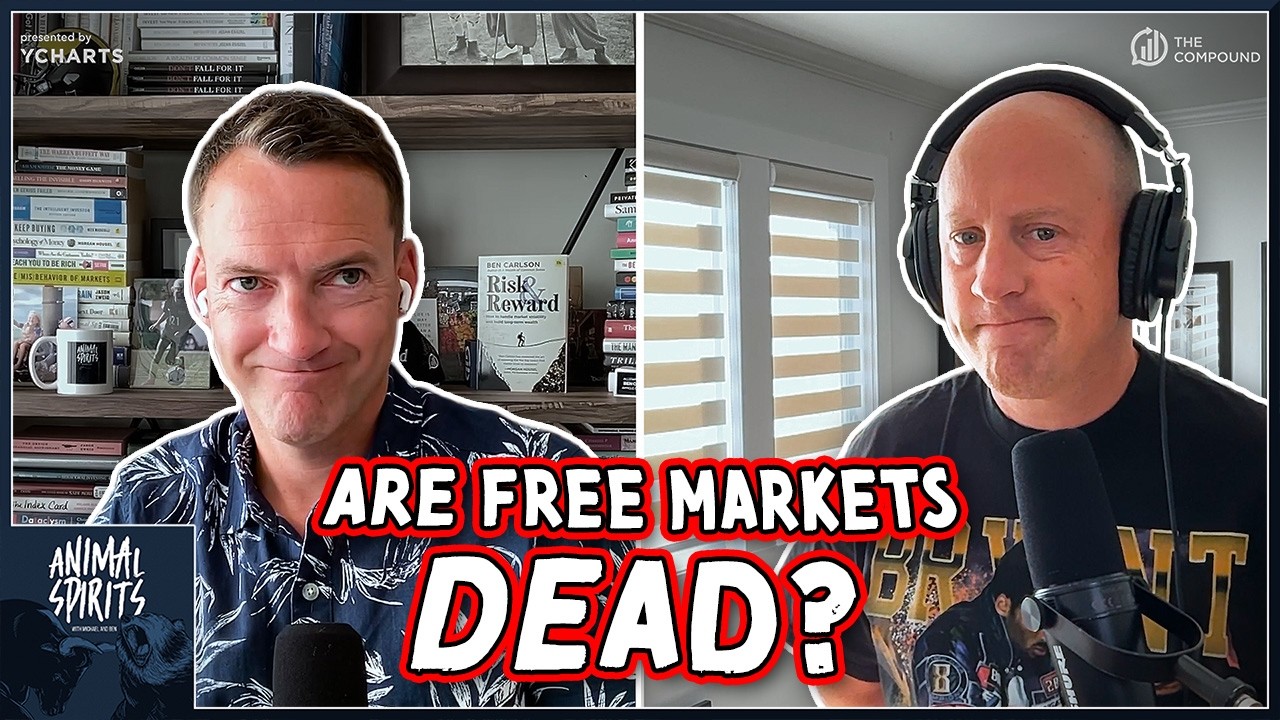
Treasury Bond Buybacks Fail To Mask Structural Fiscal Risks, Batnick Says
The Compound
Government intervention cannot lower long-term interest rates without halting tariffs and resolving geopolitical conflict, making rate-suppression efforts ineffective.
## Background
Published by The Compound on YouTube on August 26, 2026, episode 479 of Animal Spirits features hosts Michael Batnick and Ben Carlson. The episode covers a wide range of market and economic topics, including Treasury bond buybacks, Stanley Druckenmiller's op-ed, government debt risks, Bitcoin's rally, private market fraud, rising costs in housing and transportation, and entertainment recommendations.
## TL;DR
Michael Batnick and Ben Carlson debate the effectiveness and implications of Treasury Secretary Scott Bessent's proposed bond buybacks alongside Stanley Druckenmiller's AI-assisted op-ed on government debt. They analyze the resilience of the US dollar as a global reserve currency, asymmetric risk profiles in long-term Treasuries, and the end of hyper-growth 'Go-Go' years in corporate earnings. The discussion also touches on single-stock ETF pitfalls, housing market stagnation, surging used car costs, and classic 1990s action cinema featuring Jean-Claude Van Damme.
## Atmosphere & style
The episode maintains a casual, energetic, and witty tone, blending sharp financial analysis with lighthearted banter and self-deprecating humor. Michael and Ben engage in friendly debates—such as free-market principles versus pragmatic government intervention, or the absurdity of sponsored weddings—creating a conversational 'hangout' feel. The host dynamics transition seamlessly from rigorous economic and market breakdowns to nostalgic riffs on pop culture, 90s action movies, and personal anecdotes.
## Key takeaways
- [00:04](https://www.youtube.com/watch?v=XHKKOQNJsBU&t=4s) Skepticism surrounds Treasury bond buybacks and government interventions to artificially lower interest rates, with arguments that direct inflation drivers like tariffs and geopolitical conflict should be addressed instead.
- [03:30](https://www.youtube.com/watch?v=XHKKOQNJsBU&t=210s) Current 30-year Treasury yields (~5.2%) and Fed Funds spreads (~1.7%) align with long-term historical averages rather than signaling an immediate sovereign debt crisis.
- [10:38](https://www.youtube.com/watch?v=XHKKOQNJsBU&t=638s) The primary risk regarding U.S. debt is policy error from premature spending cuts, as the U.S. benefits from reserve currency status and flat total debt-to-GDP ratios over the past 20 years.
- [18:05](https://www.youtube.com/watch?v=XHKKOQNJsBU&t=1085s) Fixed-income assets present an asymmetric return profile, offering substantial potential gains if yields drop relative to limited downside risk at current coupon rates.
- [33:40](https://www.youtube.com/watch?v=XHKKOQNJsBU&t=2020s) Corporate profit growth rates are projected to decelerate through 2027, echoing historical market cycles where broad indices held up while individual high-flying stocks suffered heavy drawdowns.
- [39:40](https://www.youtube.com/watch?v=XHKKOQNJsBU&t=2380s) Leveraged single-stock ETFs have resulted in steep losses for retail investors, as daily reset decay erodes value even during broader market bull runs.
- [48:36](https://www.youtube.com/watch?v=XHKKOQNJsBU&t=2916s) While students complete coursework faster using AI tools, relying on automated shortcuts negatively impacts exam performance and retention of complex concepts.
- [49:22](https://www.youtube.com/watch?v=XHKKOQNJsBU&t=2962s) Housing and personal transportation costs remain severely constrained, with single-family housing starts hitting post-pandemic lows and used car prices up significantly since 2021.
## Detailed walkthrough
### [00:04](https://www.youtube.com/watch?v=XHKKOQNJsBU&t=4s) YCharts Sponsorship and Treasury Bond Buybacks
The episode opens with a promotion for YCharts and their upcoming session at Future Proof regarding client communication strategies and visual engagement. Transitioning to market news, Michael Batnick and Ben Carlson discuss Treasury Secretary Scott Bessent’s recent announcement regarding U.S. Treasury bond buybacks. Scott Bessent indicated that the government plans to intervene to bring down long-term interest rates, using a "bazooka" approach if necessary.
```
┌────────────────────────────────────────────────────────┐
│ U.S. TREASURY BOND BUYBACKS │
├────────────────────────────────────────────────────────┤
│ • Goal: Force down long-term interest rates │
│ • Initial Action: Minor bond buyback │
│ • Market Result: Brief dip, then rates rose next day │
│ • Next Step: Potential "bazooka" scale interventions │
└────────────────────────────────────────────────────────┘
```
Michael takes a strong stance as a "free markets guy," expressing deep skepticism over government intervention in the bond market. He argues that interest rates should be set by buyers and sellers rather than Treasury officials. Michael also lightheartedly remarks that Scott Bessent looks like a Will Ferrell *Saturday Night Live* character with "funky space hair." Ben counters Michael's free-market principles by noting that true free markets rarely exist in sovereign debt, pointing to government interventions during World War II and federal bond purchases in 2020.
- **Event:** YCharts session on "The Psychology of Persuasion and Client Meetings" at Future Proof (Wednesday at 12:30 p.m. on the Show and Tell Stage).
- **YCharts Discount:** 20% off an initial Professional subscription for new customers via the show notes link.
- **Key Figures:** Scott Bessent (U.S. Treasury Secretary).
- **Historical Context:** Government rate manipulation in World War II and the Fed's 2020 bond-buying programs.
[03:30](https://www.youtube.com/watch?v=XHKKOQNJsBU&t=210s) Band-Aids vs. Root Causes and the 30-Year Treasury
Ben and Michael debate the underlying causes of rising interest rates. Ben argues that trying to suppress rates via bond buybacks is akin to putting Band-Aids on a surgical patient rather than simply stopping the incisions. He asserts that if the government truly wanted to lower interest rates, it would focus on direct inflation drivers—such as ending geopolitical conflicts like the war in Iran and removing tariffs.
The conversation shifts to whether 20-year and 30-year Treasuries are even necessary, given that long-term debt accounts for only about 10% of total government borrowing. Michael emphasizes that while long-term bonds represent a small portion of overall issuance, their signaling power is vital for global financial markets. Both hosts agree that a 30-year Treasury yield of 5.2% is completely normal given current nominal economic growth and inflation rates.
- **Proposed Rate-Lowering Actions:** A 12-month moratorium on all tariffs and resolving the war in Iran.
- **30-Year Treasury Yield:** Currently around 5.2% (highest level since 2007).
- **Debt Issuance Share:** 20-year and 30-year Treasuries represent roughly 10% of total U.S. government borrowings.
[05:38](https://www.youtube.com/watch?v=XHKKOQNJsBU&t=338s) Stanley Druckenmiller's Op-Ed and the AI Writing Controversy
The hosts analyze a recent *Wall Street Journal* op-ed written by legendary macro trader Stanley Druckenmiller titled "Let the Bond Market Speak." Druckenmiller argued that the long-term Treasury yield is the most critical price in the world and serves as the last remaining fiscal disciplinarian against runaway government spending. While Ben agrees that the bond market provides crucial economic signals, he disagrees with Druckenmiller's apocalyptic premise that the bond market is signaling an imminent debt crisis.
The discussion takes a humorous turn as Michael reveals a viral controversy surrounding the op-ed. Observers on social media, including Joey Politano, pointed out that the article displayed telltale signs of being generated by artificial intelligence.
> "If the 30-year must trade at 5.5% to clear, that isn't a crisis. It is an invoice."
Michael shares a meme he created featuring Steve Buscemi ("How do you do, fellow kids?") to mock the distinctly AI-sounding phrasing of the piece. Despite the backlash from journalists over editorial standards, Michael remains indifferent about whether Druckenmiller used AI to draft his thoughts, while Ben finds the situation hilarious.
- **Author:** Stanley Druckenmiller (Founder of Duquesne Family Office, former manager of the Quantum Fund).
- **Op-Ed Title:** "Let the Bond Market Speak" (*Wall Street Journal*).
- **AI Detection Tool Cited:** Pangram (flagged the op-ed as 100% AI-generated).
- **Social Media Commentary:** Joey Politano highlighted structural artifacts such as the repeated "it's not X, it's Y" sentence construction in the first two paragraphs.
[10:38](https://www.youtube.com/watch?v=XHKKOQNJsBU&t=638s) Historical Yield Spreads and the U.S. Debt "Crisis"
Ben examines historical data from YCharts tracking the spread between the 30-year Treasury yield and the effective Fed Funds rate, which currently sits at approximately 1.7%. Analyzing data going back to the late 1970s, Ben notes that this spread is completely inline with historical averages. He argues that the current market anxiety stems not from an actual anomaly in rates, but from the fact that investors were conditioned by over 15 years of unnaturally low rates following the Great Financial Crisis.
```
┌────────────────────────────────────────────────────────┐
│ HISTORICAL RATE & SPREAD CONTEXT │
├────────────────────────────────────────────────────────┤
│ • Current 30-Yr Yield to Fed Funds Spread: ~1.7% │
│ • Long-Term Average Interest Expense / Spending: ~15% │
│ • Historical Baseline: Post-1970s historical median │
│ • Market Perception: Unprepared due to 2008–2021 low │
│ rate environment │
└────────────────────────────────────────────────────────┘
```
Referencing a chart from Team Exhibit A (Matt and Chart Kid), Ben highlights that U.S. federal interest payments as a percentage of total federal spending are currently around 15%, matching the long-term average. Michael pushes back, arguing that looking at interest relative to total spending obscures the problem, and that interest costs relative to the overall size of the economy look far more alarming.
Ben recounts a controversial tweet he posted stating his baseline assumption: the U.S. will not face a true sovereign debt crisis because it possesses the world's largest economy, the primary global reserve currency, the wealthiest population, and no viable substitute for Treasuries. However, Ben warns that the real risk is a policy error—politicians panicking over a hypothetical crisis and prematurely cutting entitlement programs like Social Security or Medicare. Michael stresses that the U.S. dollar reserve status is extremely sacred, and if investors flee Treasuries due to fiscal irresponsibility, capital must find an alternative home.
- **Data Source:** YCharts spread data dating back to the late 1970s.
- **30-Year Yield vs. Fed Funds Spread:** Currently ~1.7% (normal historical median).
- **Interest Expense Ratio:** Federal interest payments stand at ~15% of total federal spending.
- **Core Baseline Claim:** U.S. debt fears represent a political and policy-error threat rather than an immediate financial solvency crisis.
<ElicitationsGroup message="Explore related topics from this episode:">
<Elicitation label="Review the Stock Market and AI segments" query="Summarize the Stock Market and AI discussion from Animal Spirits episode 479."/>
<Elicitation label="Explore the Real Estate and Personal Finance breakdown" query="What were Michael and Ben's takeaways on Real Estate and Personal Finance in episode 479?"/>
</ElicitationsGroup>
[14:59](https://www.youtube.com/watch?v=XHKKOQNJsBU&t=899s) US Debt Trade-Offs and the Global Reserve Currency
Michael Batnick and Ben Carlson examine the position of the US dollar as the global reserve currency. While critics frequently warn of an impending dollar collapse, Michael points out that capital fleeing the dollar has nowhere else to go—it certainly isn't shifting en masse to the euro, the yuan, or the Swedish krona. In a ironic twist regarding cryptocurrency, Ben notes that while crypto was originally created by anti-system advocates expecting a dollar crash, the most impactful technological breakthrough in the space has been stablecoins—whose primary purpose is granting users access to the US dollar.
The hosts discuss a tweet from Morgan Housel highlighting that total debt (government plus private) as a percentage of GDP has remained flat over the past 20 years due to massive consumer deleveraging. Following the Great Financial Crisis and the COVID-19 pandemic, the Federal government absorbed structural economic shocks by taking on massive debt, allowing private household balance sheets to repair themselves. Both hosts view this handoff as a favorable trade-off compared to a pristine government balance sheet paired with fragile, over-leveraged households.
- **Total Debt Ratio:** Combined government and private debt as a share of GDP is flat over the last two decades.
- **Colin Roche's Analysis:** US public debt as a percentage of total financial assets sits at roughly 9%, up modestly from 5.5% in 2005, indicating debt levels remain within historical bounds relative to national wealth.
- **Munger's Law on Balance Sheets:** Citing Charlie Munger's wisdom that "liabilities are always good; it's the assets you have to worry about," Michael cautions that asset values (stocks and real estate) are currently elevated. A 30–40% drop in asset values would rapidly distort these ratios.
[18:05](https://www.youtube.com/watch?v=XHKKOQNJsBU&t=1085s) The Long-Term Treasury Context and the Bond Hater Narrative
Putting the scale of the debt market into perspective, Jesse Livermore noted that the total market value of outstanding US Treasuries with maturities of 10 years or longer is $4.3 trillion. By comparison, Apple alone has a market capitalization of $4.6 trillion. A single equity stock carries greater weight in global portfolios than the entire long-duration Treasury market, demonstrating how non-governmental asset values dwarf public debt liabilities.
Despite this backdrop, shorting bonds and buying gold has become the dominant consensus trade among high-profile macro investors like Ray Dalio and Stanley Druckenmiller. Pundits argue that persistent government spending and sticky inflation will keep interest rates high. Michael compares the current sentiment around fixed income to international equities in late 2024, declaring bonds to be "the most hated asset class in the world."
```
ESTIMATED 12-MONTH TOTAL RETURNS (10-YEAR & 30-YEAR TREASURIES)
┌───────────────────────────────┬───────────────────────────────┐
│ 10-YEAR TREASURY │ 30-YEAR TREASURY │
├───────────────────────────────┼───────────────────────────────┤
│ Rates Fall 1%: +12% Return │ Rates Fall 1%: +21% Return │
│ Rates Rise 1%: -2% Loss │ Rates Rise 1%: -8% Loss │
└───────────────────────────────┴───────────────────────────────┘
```
Data from FM Investments illustrates an asymmetric risk profile for bonds at current yields. For 10-year Treasuries, a 100-basis-point drop in rates yields a +12% return over 12 months, whereas a 100-basis-point increase results in only a -2% loss. For 30-year Treasuries, a 1% rate drop generates over +21% gains, against an -8% loss if rates jump to over 6%. Ben contends that with downside risk heavily capped by high baseline coupons, fixed income offers an appealing hedge—especially if AI-driven capital expenditures cool off, triggering a pullback in economic growth and inflation.
- **Asymmetric Risk:** Current bond yield levels offer disproportionate upside potential relative to downside duration risk over a 12-month holding period.
- **Macro Catalyst:** A slowdown in mega-cap tech AI capex could slow inflation and send bond yields lower while equity markets correction by 25%.
[23:26](https://www.youtube.com/watch?v=XHKKOQNJsBU&t=1406s) Generational Pushback and College Grade Inflation
Ben addresses the viewer feedback from his previous episode's commentary on younger generations. While listeners over 40 cheered his points, younger listeners accused him of sounding like a out-of-touch "boomer." Ben clarifies his core philosophy: individuals cannot control the economic hand they are dealt, but spending a lifetime complaining about it is counterproductive. Michael adds that those doing well financially telling those who struggle to "toughen up" rarely lands well, though every generation historically perceives the one following it as softer.
The discussion turns to an article detailing the University of Michigan's policy change to drop letter grades for first-semester freshmen, adopting a pass/no-credit system to mitigate mental health stress. Ben and Michael contrast this with their own college experiences, recalling their first-semester GPAs (Ben had a 2.5 and Michael had a 1.4, which dropped further to a 1.2 in his second semester). Rather than prompting a crisis, those academic stumbles served as a personal wake-up call to adjust their partying habits.
- **University Policy:** University of Michigan institutes pass/no-credit grading for first-semester students to ease the transition into higher education.
- **Host Transcripts:** Michael admits to getting a 1.4 GPA in his first semester and dropping to a 1.2 in his second semester before turning his studies around.
[25:52](https://www.youtube.com/watch?v=XHKKOQNJsBU&t=1552s) Sponsored Weddings and Social Media Capitalism
Michael brings up a *Wall Street Journal* report on how rising wedding costs—averaging $34,000—are prompting brides to seek corporate sponsorships for invitations, dresses, and bachelorette parties. Zola's Chief Marketing Officer, Brianna Severson, noted that the platform pays select brides up to $150,000 for commercial collaborations, treating engagement announcements as high-converting marketing channels. Michael expresses disgust at the trend, calling it an example of hyper-capitalism on steroids that strips intimacy from personal life events.
> "If you're turning your wedding into an advertisement, I think we've lost the plot."
> — **Michael Batnick**
Surprisingly, Ben takes the opposing view. Given that weddings are already commercialized and expensive affairs where thousands are spent on single-use items like dresses, he sees no issue with couples offsetting costs through brand deals. The debate ends on a lighthearted note about the absurd potential of best man speeches opening with product placements for brands like Miller Lite.
- **Average Wedding Cost:** $34,000 across the US in the previous year.
- **Influencer Payouts:** Zola pays up to $150,000 for wedding planning collaborations with high-following creators.
[28:07](https://www.youtube.com/watch?v=XHKKOQNJsBU&t=1687s) Market Narratives and Bitcoin's Sudden Surge
Transitioning to market behavior, Michael and Ben examine how financial commentators explain price action. Pundits often construct retrofitted narratives around daily market fluctuations. Michael notes that while 90% of daily price moves are noise, sharp trend shifts can be tied to clear catalysts.
A prime example was Bitcoin's sudden 20% surge in a single week after months of stagnant ETF flows. The rally accelerated following comments by fund manager Scott Bessent regarding fiscal deficits and interest rates. Investors suddenly refocused on government debt levels crossing key thresholds, driving renewed inflows into spot crypto ETFs. Michael concludes that in macro markets, the narrative that investors collectively choose to believe at any given moment becomes the self-fulfilling reality driving price action.
[30:36](https://www.youtube.com/watch?v=XHKKOQNJsBU&t=1836s) Narrative Trades, Market Dislocation, and the Edges of Market Efficiency
The conversation kicks off with a look at recent price surges in precious metals, with gold jumping 5% and silver rallying 7% in a single week. This sharp upward movement highlights how strongly the "anti-dollar debasement" narrative has taken hold. Echoing John Maynard Keynes’ famous beauty contest analogy, the dynamics of these rapid moves are driven less by individual conviction and more by anticipation of crowd behavior: savvy traders jump on board not necessarily because they believe a debt crisis or currency collapse is imminent, but because they know others will trade that narrative, causing it to self-reinforce.
Reflecting on how quickly collective market narratives can shift, the hosts point to a tweet by Michael Antonelli highlighting the resilience of payment giants Visa and Mastercard. Despite past fears that crypto or AI would disrupt their business models, both stocks recently broke out to all-time highs. A market-disrupting piece by "Catrini" that previously knocked 10% to 15% off credit card stocks—and hit American Express amid broader tech and software sell-offs—proved to be an exceptional buying opportunity. While critics often mock Efficient Market Theory during extreme dislocations, the core reality remains: pinpointing exactly when collective sentiment will overreact or underreact in real time is nearly impossible.
- **Precious Metals Rally:** Gold up 5%, Silver up 7% in a single week driven by debasement trade narratives.
- **Stock Breakouts:** Visa and Mastercard hitting new all-time highs despite past fears of crypto and AI disruption.
- **Market Dislocations:** Mention of the short-lived market disruption caused by the Catrini piece during a software sell-off, which the author later marveled at on *Odd Lots*.
---
[33:40](https://www.youtube.com/watch?v=XHKKOQNJsBU&t=2020s) Earnings Projections and the End of the "Go-Go Years"
Analyzing the trajectory of corporate profits, the discussion shifts to forward-path research from Duality Research through late 2027. While double-digit earnings growth remains plausible, the unsustainable nature of compounding 30% growth rates on top of previous 30% surges means growth rates must slow down. Rather than triggering a market crash, this slowing rate of growth appears already baked into current market valuations, meaning future market direction will hinge on major deviations from these baseline expectations.
Drawing historical parallels to frame how the current market cycle might resolve, the hosts revisit John Brooks’ classic book *The Go-Go Years*, which chronicles the underappreciated 1968–1970 bear market. Despite registering a overall index decline of 36% (standard for a recessionary bear market), the period saw high-flying glamour stocks and Nifty 50 staples like IBM, Polaroid, and Xerox plunge an average of 80%. Because broad retail participation was significantly higher than during the 1929 crash, some market historians argued the late-60s fallout was functionally more damaging to household wealth than the Great Depression. A similar internal destruction occurred in 2022, when the Nasdaq-100 fell 35% while individual tech darlings like Meta (down ~70%), Nvidia (down 66%), and hyper-growth stocks across the ARK complex collapsed 80% or more.
- **Duality Research Insights:** Year-over-year earnings growth rates projected to decelerate through 2027 while staying in double digits.
- **Historical Comparison:** The 1968–1970 bear market saw a 36% index decline, but top 30 glamour stocks dropped an average of 80%.
- **2022 Cycle Parallel:** QQQ fell 35%, while Meta (-70%), Nvidia (-66%), and speculative software/growth names dropped 80%+.
---
[38:16](https://www.youtube.com/watch?v=XHKKOQNJsBU&t=2296s) Private Equity Risks in Life Insurance
Looking ahead to potential systemic risks rather than a classic dot-com crash or broad financial meltdown, attention turns to the opaque intersect of private equity, private credit, and the life insurance industry. Highlighting an episode from Steve Eisman’s podcast, the hosts discuss how private equity firms have acquired life insurers and funneled policyholder reserves into riskier, illiquid assets.
The ongoing saga surrounding Mark Walter and Guggenheim Partners serves as a prime example of the potential regulatory and structural blind spots within these interconnected financial entities. Because private credit relies heavily on self-reporting and opaque asset valuations, significant underlying vulnerabilities could be masked until a broader shock occurs.
- **Steve Eisman Podcast Insight:** PE ownership of life insurance companies and allocation of reserves into higher-risk private credit assets.
- **Guggenheim / Mark Walter Case:** Highlighted as a narrative showcasing complex corporate structures and regulatory concerns in institutional insurance.
---
[39:40](https://www.youtube.com/watch?v=XHKKOQNJsBU&t=2380s) Single-Stock ETFs, the WZRD Debacle, and the "Finance Bro" Moment
Turning to retail product structures, a recent Morningstar report outlines the disastrous record of leveraged and inverse single-stock ETFs. Despite generating over $500 million in management fees for issuers charging ~75 basis points, the median single-stock ETF has lost 38%—even in the midst of an overall bull market. Everyday investors are taking on massive daily reset decay, while platforms like Robinhood introduce products allowing users to gamble on 15-minute Bitcoin price movements.
A striking example of product failure is the Opportunistic Trader ETF (ticker: WZRD). Created by a trader featured in Jack Schwager’s famous *Market Wizards* series, the fund has collapsed 96% in 2026 alone, making it the worst-performing US-listed ETF of the year. The fund's mandate—holding massive put and call options positions while keeping the remainder in cash—left observers baffled at how a strategy could lose nearly all its capital during a strong market environment, invoking Michael Mauboussin’s framework on the difficulty of losing on purpose in games of chance.
Closing out the segment, the conversation turns to a lighthearted media query from a *New York Post* fashion reporter asking if "finance bros" are having a cultural resurgence. The host posits that post-2008, finance workers were the primary economic villains, but public scrutiny has shifted toward tech founders blamed for social media harms and AI-driven job displacement. Paired with elevated economic pressures where high FICO scores and stable housing capabilities are prized, finance professionals may be regaining social cachet—though counter-arguments suggest recent high-profile private equity headlines (like Josh Kushner buying the LA Lakers) remain the true driver of media interest.
- **Single-Stock ETF Performance:** Median single-stock ETF down 38%; asset managers collected $500M+ in fees.
- **Opportunistic Trader ETF (WZRD):** Down 96% in 2026 alone; labeled the worst-performing US-listed fund of the year.
- **Cultural Shift:** Discussion on public perception moving from hating "finance bros" post-2008 to shifting blame toward tech industry figures.
---
[45:14](https://www.youtube.com/watch?v=XHKKOQNJsBU&t=2714s) AI Workflows: ChatGPT vs. Anthropic’s Claude
The section wraps up with a discussion on the evolving competitive landscape between major artificial intelligence platforms. While OpenAI’s growth metrics show signs of stabilizing, Anthropic's Claude continues to gain ground among finance professionals.
Despite rapid feature updates across all LLMs, everyday productivity defaults are becoming clear: Claude remains the top choice for financial research, document analysis, and work tasks, while ChatGPT is heavily relied upon for consumer applications, such as uploading home photos for visual landscaping ideas.
- **Platform Preferences:** Anthropic's Claude favored for work-related tasks and financial research; ChatGPT utilized for visual applications and everyday consumer queries.
[46:17](https://www.youtube.com/watch?v=XHKKOQNJsBU&t=2777s) AI Productivity, Call Centers, and the Human Element
The conversation pivots to artificial intelligence, beginning with a discussion on how tech giants are positioning themselves within the AI ecosystem. Microsoft’s strategy, as noted by Ben Thompson on a podcast, aims to position the company as a "middleman layer." In this setup, users input a query and Microsoft automatically routes it to the correct Large Language Model (LLM). This concept makes practical sense because selecting the ideal LLM currently relies heavily on user intuition rather than clear guidelines.
The discussion shifts to a tweet by Timothy Lee regarding public perceptions of an AI-driven future. Optimistic visions of AI tend to sound banally familiar: life mostly stays the same, but people become wealthier, live longer, and skip annoying chores like driving or filing taxes. Conversely, pessimistic visions grab headlines because they imagine apocalyptic scenarios like total job loss or extinction. However, the current status quo exists because people broadly prefer the way things are, meaning major disruptions often end up feeling like net negatives.
A chart shared by Torsten Sløk highlights a surprising labor dynamic: despite expectations that AI would immediately automate call centers, there has been no noticeable change in unemployment rates in countries like the Philippines or India. This outcome suggests that people may simply prefer interacting with human agents—even flawed ones—over cold automation. While automated phone trees leave customers feeling ignored, a helpful human agent booking or altering a vacation reservation remains a superior user experience.
- Microsoft aims to act as an intermediary layer that routes user queries to the most appropriate LLM automatically.
- Timothy Lee observed that optimistic AI visions are mundane (richer, longer lives, no tax filing), whereas pessimistic visions draw attention due to extreme scenarios.
- Torsten Sløk’s data shows call center heavy regions like India and the Philippines haven't seen a spike in unemployment despite advances in voice AI.
---
[48:36](https://www.youtube.com/watch?v=XHKKOQNJsBU&t=2916s) The Homework Trap: Short-Term AI Speed vs. Long-Term Skill
The hosts analyze an economics study tracking student performance before and after using AI for coursework. The data revealed a stark trade-off: while students completed their homework significantly faster when using AI tools, their subsequent exam scores suffered dramatically.
This outcome illustrates the risk of relying on technological shortcuts during the learning process. Using AI to breeze through practice problems deprives students of the cognitive effort required to master complex concepts. Consequently, individuals who maintain traditional habits—reading deeply and writing independently without leaning on AI assistance—will hold a significant competitive advantage in the future job market.
- Homework completion time decreased with AI assistance, but exam performance dropped sharply.
- The trend underscores how shortcuts weaken foundational comprehension and critical thinking skills.
---
[49:22](https://www.youtube.com/watch?v=XHKKOQNJsBU&t=2962s) Real Estate Stagnation and Proposed Mortgage Fixes
Turning to the real estate market, single-family housing starts for July broke below 70,000, representing the second-lowest monthly figure in the post-pandemic era (behind only November 2022). The ongoing housing crunch remains a primary source of economic frustration, creating a sharp divide between those who bought homes before rates spiked and those locked out of the market today.
```
+------------------------------------+--------------------------+
| Metric / Event | Value / Status |
+------------------------------------+--------------------------+
| Single-Family Starts (July) | Below 70,000 |
| Post-Pandemic Low Benchmark | November 2022 |
| Peak Homebuying Probability (NY Fed)| 68% |
| Current Homebuying Probability | 53% |
+------------------------------------+--------------------------+
```
To address this freeze, the Treasury should prioritize interventions that directly lower consumer borrowing costs rather than buying long-term Treasury bonds. Purchasing back mortgage-backed securities to offer target subsidies—such as a one-time 4% or 3% mortgage rate for first-time buyers—would reignite housing activity. Although critics argue this would drive home prices higher, the lower monthly payment would still yield a net benefit for buyers. Furthermore, the New York Fed’s Survey of Consumer Expectations shows that the average probability of purchasing a home dropped from a peak of 68% during the housing boom to 53%. Despite claims that the mortgage lock-in effect is overstated, high rates continue to prevent current homeowners from moving or upgrading.
- July single-family housing starts fell below 70k, marking one of the lowest prints since 2020.
- NY Fed survey data indicates the probability of buying a home has dropped from 68% at the peak down to 53%.
- Proposed intervention: Buy back mortgage bonds to provide 3% to 4% rates specifically targeted at first-time home buyers.
---
[51:33](https://www.youtube.com/watch?v=XHKKOQNJsBU&t=3093s) Surging Used Car Prices and the Orthodontics Racket
The cost of personal transportation highlights another area of financial strain, particularly for younger demographics. A story by Michelle Singletary in *The Washington Post* detailed the drastic drop in car-buying purchasing power:
```
+-----------------------------------+-----------------------------------+
| 2019 Buyer Budget ($10k - $15k) | Current Buyer Budget ($10k - $15k)|
+-----------------------------------+-----------------------------------+
| Average Age: 4.7 years old | Average Age: ~9 years old |
| Average Mileage: 58,000 miles | Average Mileage: ~100,000 miles |
+-----------------------------------+-----------------------------------+
```
Buying an older, high-mileage vehicle exposes buyers to steep ongoing maintenance costs. The average price of a three-year-old vehicle now exceeds $32,000, up 15.5% since 2021.
The conversation turns to another everyday expense: children's orthodontics. In contrast to past decades—when only a few kids in a classroom wore braces—it now seems virtually every child receives early intervention. Orthodontic treatment plans frequently begin as early as six years old with palatal expanders, followed by multiple phases of braces and retainers. While one host half-jokingly questions whether early orthodontic work has become an aggressive sales funnel targeting parents, the other frames universal dental care as a clear sign of societal progress.
- In 2019, a $10,000–$15,000 budget purchased a 4.7-year-old car with 58,000 miles; today, it buys a nearly 9-year-old vehicle with almost 100,000 miles.
- The average price of a 3-year-old used vehicle is over $32,000, representing a 15.5% increase relative to 2021.
- Early multi-stage orthodontics for children have become the baseline standard across households.
---
[53:54](https://www.youtube.com/watch?v=XHKKOQNJsBU&t=3234s) Streaming Shifts, 90s Nostalgia, and Running Mishaps
The entertainment discussion begins with movie distribution trends, noting that the *Masters of the Universe* movie bombed at the theatrical box office yet quickly became the most-watched title across all streaming platforms during its first week on Prime Video. This dynamic highlights how the loss of the physical DVD market reshaped Hollywood economics. In prior eras, theatrical flops routinely recouped their budgets and built cult followings through DVD sales.
This leads to personal recollections of physical media collections, from massive multi-disc CD binders filled at Blockbuster's "2 for $20" deals to the physical catalogs of the 1990s:
* **Eastbay Catalog:** A nostalgic staple for '90s kids who spent hours flipping through sneaker offerings.
* **Columbia House:** The mail-order music club that offered 10 initial albums for a fraction of a cent before requiring monthly purchases. Missing the opt-out mailers meant receiving unwanted CDs automatically.
```
+-------------------+------------------------------------+
| Media Nostalgia | Format / Platform Details |
+-------------------+------------------------------------+
| Live (Band) | "Throwing Copper" Cassette Tape |
| MC Hammer | "Please Hammer Don't Hurt 'Em" Tape|
| Action Film Reboot| "Cliffhanger" (Lily James, Pierce Brosnan) |
+-------------------+------------------------------------+
```
A comedic personal anecdote follows about a sudden fall during a outdoor jog caused by brand-new running shoes gripping an uneven sidewalk. The resulting spill required a quick shoulder roll into the grass to avoid serious injury, leaving behind only scraped palms, a sore wrist, and bruised ego.
- *Masters of the Universe* transitioned from a theatrical flop to a streaming hit on Prime Video.
- Columbia House music service operations are formally winding down.
- A reboot of the 1993 survival thriller *Cliffhanger* is in development starring Lily James and Pierce Brosnan, picked up by Neon.
---
[01:00:02](https://www.youtube.com/watch?v=XHKKOQNJsBU&t=3602s) Film Reviews: *The Devil Wears Prada 2* and *Speed*
The segment concludes with quick takes on recent film viewings and rewatches:
* ***The Devil Wears Prada 2* (Hulu):** Featuring the original cast—Meryl Streep, Anne Hathaway, Emily Blunt, and Stanley Tucci—the sequel trades heavily on pure nostalgia. While commercially successful, it feels somewhat unnecessary compared to the original classic.
* ***Speed* (Netflix):** A rewatch of the 1994 Keanu Reeves action hit confirms its status as an exceptionally well-paced thriller that holds up decades later.
* ***Speed 2: Cruise Control*:** Famously panned upon release—earning roughly a 10% rating on Rotten Tomatoes—due to the absence of Keanu Reeves and a flawed concept, serving as a reminder of pre-internet word-of-mouth movie reviews.
- *The Devil Wears Prada 2* relies on nostalgia, reuniting the core original cast.
- *Speed* remains a high-water mark for 1990s action cinema, whereas its sequel *Speed 2: Cruise Control* remains notorious for its sharp decline in quality.
[01:01:34](https://www.youtube.com/watch?v=XHKKOQNJsBU&t=3694s) Action Movies of the '90s and Jean-Claude Van Damme
Michael Batnick and Ben Carlson kick off by roasting Willem Dafoe’s villain role in *Speed 2: Cruise Control*, where his character used an AI system to remotely hijack a cruise ship. Michael marvels that if someone possessed that kind of tech today, they would be a billionaire rather than a movie bad guy. Shifting back to the original *Speed*, Michael shares that he rewatched it with his son Kobe after listening to *The Rewatchables* podcast. Kobe watched the entire movie—his very first "grown-up movie"—and was hooked. Michael points out that while Keanu Reeves was fantastic physically, his spoken dialogue was "comically bad," though audiences rightfully give him a pass.
To highlight how high-quality action cinema was during that era, Michael plays an audio clip from Sean Fennessey on *The Rewatchables*. Fennessey breaks down how Hollywood capitalized on the pacing and editing energy established by films like *Top Gun* and *Beverly Hills Cop*, leading to a golden decade of action films divided into distinct tiers.
Michael also shares a hilarious fan email with the subject line "EMERGENCY!", urging the hosts to watch *Hard Target* and *Nowhere to Run* because they "haven't even fully Van Dammed yet." Michael admits he is slowly making his way through Jean-Claude Van Damme’s filmography, noted for its peak '90s action absurdities. Ben recalls Van Damme's signature mullet in *Hard Target*, which was director John Woo's first American-made movie, packed with slow-motion shots and pure comedy. Michael also reflects on watching *Lionheart*, calling it complete garbage that made zero sense, before reminiscing about watching the trailer for *Nowhere to Run* featuring legendary voice-over artist Don LaFontaine and a bizarrely romantic scene involving Rosanna Arquette kissing JCVD's hairy chest.
* **Fennessey's Tier 2 Action Movies:** *Broken Arrow*, *Con Air*, *Independence Day*, *The Long Kiss Goodnight*, *Cliffhanger*, *True Lies*, *Last Action Hero*, *The Last Boy Scout*, *Demolition Man*, *The Fifth Element*, *Hard Target*, *Executive Decision*.
* **Fennessey's Tier 1 Action Movies:** *Die Hard*, *Crimson Tide*, *The Hunt for Red October*, *Terminator 2: Judgment Day*, *Point Break*, *The Matrix*, *Blade*, *Face/Off*, *Mission: Impossible*, *Lethal Weapon*, *The Fugitive*, *Heat*, *Under Siege*, and crowned at the top, *Speed*.
* **Van Damme's Legacy:** Ben notes it is incredible Van Damme pulled off around eight major Hollywood movies—including *Timecop*—despite an inability to act, essentially "out-kicking his coverage."
[01:05:53](https://www.youtube.com/watch?v=XHKKOQNJsBU&t=3953s) Do Movie Trailers Still Matter?
Michael mentions taking his sons to see the new *Spider-Man* movie. While he felt the first half dragged on endlessly, he highlights an impressive scene featuring Spider-Man, the Punisher, and the Hulk that served as a direct setup for *Avengers: Doomsday*. However, the previews shown before the movie left him thoroughly unimpressed: trailers for both *Avengers: Doomsday* and *The Social Reckoning* looked terrible.
This leads Michael to ask Ben whether movie trailers matter at all anymore, questioning if they provide any accurate representation of a movie's actual quality. Ben notes that bad movies often have incredible trailers—pointing to *Disclosure Day* as a prime example—making it hard to judge a film solely by its preview.
[01:07:35](https://www.youtube.com/watch?v=XHKKOQNJsBU&t=4055s) TV Recommendations, Market Dynamics, and Closing Remarks
Michael mentions binging season 2 of the comedy series *Tires*, describing it as an easy "great hang" with fast-paced 22-minute episodes. Switching gears to the financial markets, the hosts check on current movements: the stock market is up again, and the 10-year Treasury yield is pulling back significantly. Michael jokingly chants "Go Bessant! Team Bessant all the way," praising Treasury Secretary Scott Bessent for timing market interventions well, even as Ben teases him about abandoning his free-market stance.
Michael admits that the deep mechanics of government debt, quantitative easing, Fed liquidity, and Treasury repurchases remain an opaque "black box" to him, comparing it to the complexities of the semiconductor industry where "we owe the money to ourselves" anyway. They wrap up the show by reminding listeners to email them at `animalspirits@thecompoundnews.com` for personal responses.
## Notable quotes
> [05:38](https://www.youtube.com/watch?v=XHKKOQNJsBU&t=338s) If the 30-year must trade at 5.5% to clear, that isn't a crisis. It is an invoice.
> [05:38](https://www.youtube.com/watch?v=XHKKOQNJsBU&t=338s) How do you do, fellow kids? — Steve Buscemi
> [25:52](https://www.youtube.com/watch?v=XHKKOQNJsBU&t=1552s) If you're turning your wedding into an advertisement, I think we've lost the plot. — Michael Batnick
> [01:07:35](https://www.youtube.com/watch?v=XHKKOQNJsBU&t=4055s) Go Bessant! Team Bessant all the way — Michael Batnick
## Mentioned
YCharts, Future Proof, Michael Batnick, Ben Carlson, Scott Bessent, U.S. Treasury, Will Ferrell, Saturday Night Live, Stanley Druckenmiller, Wall Street Journal, Duquesne Family Office, Quantum Fund, Joey Politano, Pangram, Steve Buscemi, Matt, Chart Kid, Team Exhibit A, Morgan Housel, Colin Roche, Charlie Munger, Jesse Livermore, Apple, Ray Dalio, FM Investments, University of Michigan, Zola, Brianna Severson, Miller Lite, Bitcoin, John Maynard Keynes, Michael Antonelli, Visa, Mastercard, Catrini, American Express, Odd Lots, Duality Research, John Brooks, IBM, Polaroid, Xerox, ARK, Meta, Nvidia, Steve Eisman, Mark Walter, Guggenheim Partners, Morningstar, Robinhood, Opportunistic Trader ETF (WZRD), Jack Schwager, Michael Mauboussin, New York Post, Josh Kushner, LA Lakers, OpenAI, ChatGPT, Anthropic, Claude, Microsoft, Ben Thompson, Timothy Lee, Torsten Sløk, NY Fed, Michelle Singletary, The Washington Post, Prime Video, Eastbay, Columbia House, Blockbuster, Live, MC Hammer, Neon, Lily James, Pierce Brosnan, Hulu, Meryl Streep, Anne Hathaway, Emily Blunt, Stanley Tucci, Netflix, Keanu Reeves, Willem Dafoe, Kobe Batnick, The Rewatchables, Sean Fennessey, John Woo, Don LaFontaine, Rosanna Arquette, Jean-Claude Van Damme, Spider-Man, Punisher, Hulk, Tires
Batnick:美债回购难掩结构性财政风险
若不停止加征关税并化解地缘冲突,政府干预无法拉低长期利率,压制利率的举措也将难以见效。
Michael Batnick 和 Ben Carlson 围绕美国财政部长 Scott Bessent 提议的债券回购计划的有效性及影响,以及 Stanley Druckenmiller 借助 AI 撰写的政府债务专栏文章展开了讨论。他们分析了美元作为全球储备货币的韧性、长期美债的非对称风险特征,以及企业盈利超高速增长“繁荣期”的终结。此外,讨论还涉及单一股票 ETF 的隐患、房地产市场停滞、二手车成本飙升,以及由 Jean-Claude Van Damme 主演的 20 世纪 90 年代经典动作电影。
市场对财政部回购国债以人为压低利率的做法持怀疑态度,分析认为关税和地缘冲突等直接驱动通胀的因素才应被优先解决。 (3:30)
目前30年期美债收益率(约5.2%)与联邦基金利率利差(约1.7%)基本符合长期历史均值,并未释放迫在眉睫的主权债务危机信号。 (10:38)
美国债务真正的风险在于过早削减支出的政策失误;得益于储备货币地位及过去20年总债务占GDP比例持平,固收资产在当前收益率水平下展现出极具吸引力的非对称回报特征。 (18:05)
企业盈利增速预计将放缓至2027年,这一周期类似于历史上大盘指数维持坚挺但部分热门成长股遭遇大幅回撤的行情;与此同时,单只股票杠杆ETF因每日重置磨损给散户带来了惨重亏损。 (39:40)
住房与个人出行成本持续受压,7月单户住宅开工量跌破7万套创疫情后低点,而学生依赖AI工具完成作业虽提升了速度,却对核心概念掌握与考试成绩产生了负面影响。 (49:22)
Reading summary
Ben Carlson and Michael Batnick argue that mounting panic over U.S. sovereign debt and elevated yields reflects psychological conditioning from post-2008 low rates rather than an impending financial crisis, cautioning against artificial government interventions in bond markets.
Treasury Interventions and the Sovereign Debt Debate (0:04)
Treasury Secretary Scott Bessent's proposal to execute bond buybacks to suppress long-term interest rates draws skepticism from Michael Batnick, who argues bond pricing should be determined by free markets rather than Treasury engineering. Ben Carlson notes that true free markets in sovereign debt are historically rare, citing World War II interventions and 2020 central bank programs. Both hosts view current 30-year Treasury yields around 5.2% as historically normal given economic growth and inflation. Ben contends that if policymakers genuinely want lower yields, they should address root inflation drivers—such as tariffs and geopolitical conflict—rather than applying financial Band-Aids.
Analyzing Stanley Druckenmiller's op-ed framing the bond market as a vital fiscal disciplinarian, the hosts push back against apocalyptic debt narratives. YCharts data indicates the 1.7% spread between 30-year yields and the Fed Funds rate matches historical medians since the late 1970s, while federal interest payments stand at their long-term average of 15% of spending. Furthermore, Morgan Housel's research shows combined government and private debt-to-GDP has remained flat over 20 years because household deleveraging absorbed federal borrowing. With 10-year and longer Treasuries totaling $4.3 trillion—less than Apple's $4.6 trillion market valuation—Ben argues the primary risk is political panic triggering premature cuts to entitlement programs rather than actual sovereign insolvency.
Asymmetric Bond Risks and Chasing Narrative Trades (18:05)
Despite prominent macro investors like Ray Dalio and Stanley Druckenmiller shorting Treasuries, data from FM Investments indicates long-term bonds offer an asymmetric risk profile at current yield levels. A 100-basis-point drop in rates yields an estimated 12-month return of +12% on 10-year Treasuries and +21% on 30-year Treasuries, compared to losses of only -2% and -8%, respectively, if yields rise by 100 basis points. The hosts view fixed income as an overlooked macro hedge if economic growth decelerates or corporate capital expenditures cool.
Conversely, short-term momentum has clustered in debasement trades, evidenced by gold rallying 5%, silver climbing 7%, and Bitcoin surging 20% in a single week following fiscal deficit commentary. Michael emphasizes that daily market fluctuations frequently operate as Keynesian beauty contests, where traders front-run collective narratives regardless of underlying validity. Meanwhile, speculative retail vehicles continue to suffer severe structural drag: Morningstar data shows the median leveraged single-stock ETF has lost 38% despite generating $500 million in provider fees, while the Opportunistic Trader ETF (WZRD) collapsed 96% in 2026 alone.
Housing Market Freeze and Everyday Consumer Inflation (49:22)
The real estate sector remains deeply restricted, with July single-family housing starts dropping below 70,000—marking the second-lowest monthly level in the post-pandemic era. According to the New York Fed's Survey of Consumer Expectations, the perceived probability of purchasing a home fell from a peak of 68% down to 53%. The hosts argue that if the government intends to intervene in credit markets, purchasing mortgage-backed securities to offer targeted 3% to 4% mortgage rates for first-time buyers would generate far more tangible economic benefit than broad Treasury buybacks.
Everyday consumer purchasing power continues to show structural erosion. Reporting from *The Washington Post* illustrates that a $10,000 to $15,000 budget in 2019 secured a 4.7-year-old used vehicle with 58,000 miles, whereas that same budget now only buys a nine-year-old vehicle with nearly 100,000 miles, significantly increasing maintenance liabilities. Concurrently, the average price of a three-year-old vehicle has surpassed $32,000, up 15.5% since 2021, illustrating persistent inflation in household essentials.
AI Adoption Realities and Cognitive Trade-Offs (46:17)
While macroeconomic commentary frequently anticipates abrupt disruption from artificial intelligence, real-world adoption is following a more nuanced path. Data compiled by Torsten Sløk highlights that employment levels in call-center-heavy regions such as India and the Philippines have remained stable despite rapid advancements in voice AI, indicating continued consumer preference for human assistance. Within enterprise workflows, usage has segmented pragmatically: Anthropic's Claude is increasingly favored for financial research and complex document synthesis, whereas OpenAI's ChatGPT dominates general consumer tasks.
In educational settings, reliance on automated tools presents clear pedagogical trade-offs. The hosts examine an economics study demonstrating that although students completed homework assignments significantly faster when using AI, their subsequent exam performance dropped substantially. Skipping the cognitive friction required to solve complex problems impairs comprehension, leading the hosts to predict that individuals who maintain traditional, unassisted reading and writing disciplines will retain a strong competitive advantage.
The hosts conclude that while financial markets obsess over debt cataclysms and rapid technological displacement, real vulnerabilities lie in counterproductive policy interventions, speculative retail product design, and everyday cost-of-living freezes that national aggregates obscure.
精炼阅读摘要
Michael Batnick 与 Ben Carlson 围绕美国财政部干预国债市场、主权债务可持续性及实体经济承压展开讨论,指出当前利率水平与利差完全处于历史合理区间,所谓“债务危机”多属市场叙事恐慌,真正的系统性威胁在于政客应对失误及信贷层面的结构性扭曲。
美债干预与自由市场:降息手段与根源之辩 (0:04)
财政部长 Scott Bessent 宣布财政部计划通过回购国债压低长期利率,必要时不排除动用“火箭筒”式的激进干预。Michael Batnick 对此表达了强烈的自由市场立场,质疑政府官员人为干预债券定价,认为利率理应由买卖双方博弈决定。Ben Carlson 则反驳称主权债务领域几乎不存在绝对的自由市场,二战时期的利率控制与2020年美联储的大规模购债皆是先例。Ben 进一步指出,单靠债券回购压制利率无异于给正在动手术的病人贴创口贴,若真想压降利率,政策重点应转向终结关税及平息伊朗战事等直接推高通胀的根源。
针对传奇宏观交易员 Stanley Druckenmiller 在《华尔街日报》发表的专栏文章《让债券市场发声》,两位主持人审视了其关于长期国债收益率是约束政府开支最终纪律的论调。Druckenmiller 警告美债正发出逼近债务危机的警报,但两位主持人均认为,在当前名义经济增速与通胀背景下,30年期国债收益率维持在5.2%(即便升至5.5%)纯属正常的市场定价与出清发票,而非危机征兆。此外,社交媒体与检测工具指出该专栏具有明显的AI生成痕迹,亦引发了关于观点表达形式的趣味讨论。
主权债务审视:历史利差与负债转移 (10:38)
基于 YCharts 的长期历史数据,当前30年期美债收益率与有效联邦基金利率之间约1.7%的利差,完全符合1970年代末以来的历史中位数;联邦利息支出占总支出的比例约为15%,同样与长期均值持平。市场当下的恐慌,本质上是因为投资者在经历2008年金融危机后长达15年的超低利率环境后被过度“驯化”,从而对常态化借贷成本产生了适应不良。Ben Carlson 提出其基准预判:美国拥有庞大的经济体量、全球储备货币地位、富裕的国民资产以及无可替代的美债市场,发生实质性主权债务危机的概率极低;真正的风险是政客因无谓恐慌而过早削减社会保障或医疗保险等福利支出,从而酿成政策错误。
从宏观资产负债表来看,Morgan Housel 强调过去20年间政府与私人部门的综合债务占GDP比例大体保持平稳。2008年危机与新冠疫情期间,联邦政府通过大幅扩张自身负债吸收了宏观冲击,换取了家庭部门的大规模去杠杆与资产负债表修复。Colin Roche 的数据进一步佐证,美国公共债务占金融总资产的比重仅从2005年的5.5%温和上升至约9%,债务水平在国家整体财富体量中依然可控,尽管 Michael 提醒股票与房地产等资产端估值偏高仍构成潜在隐患。
叙事驱动、不对称收益与衍生品风险 (18:05)
随着 Ray Dalio 和 Stanley Druckenmiller 等巨头推动“做空美债、买入黄金”,反美元贬值的叙事交易盛行,带动黄金周涨5%、白银周涨7%,比特币亦在政策言论与ETF资金重燃下出现单周20%的异动。然而在情绪极度悲观之际,FM Investments 的数据揭示了固定收益资产极度不对称的收益风险比:若10年期美债利率下行100个基点,未来12个月总回报可达+12%,若利率上行100个基点,亏损仅为-2%;对于30年期美债,利率下降1%对应超过+21%的涨幅,利率升至6%以上时的亏损则被锁定在-8%左右。高额基准票息为债券投资者提供了充足的下行安全垫。
与此形成鲜明对比的是零售金融衍生品与影子信贷的暗雷。晨星报告显示,尽管单只股票杠杆及反向ETF为发行方带来了超过5亿美元的昂贵管理费,但其中位数产品在牛市环境中累计亏损高达38%;典型代表如 Opportunistic Trader ETF(WZRD)在2026年单年暴跌96%。与此同时,主持人援引 Steve Eisman 的分析警告,私募股权机构正密集收购人寿保险公司并将保费准备金注入缺乏流动性且依赖自评估值的私人信贷资产,这类不透明结构潜藏着被监管忽视的系统性隐患。
微观压力:住房冻结、通胀与AI应用权衡 (49:22)
在微观生活层面,高利率环境对普通家庭的挤压持续显现。7月份美国单户住宅开工量跌破7万套,创下疫情以来的第二低点;纽约联储调查显示消费者购房意愿概率从高点的68%骤降至53%。高企的抵押贷款利率造成了严重的“房贷锁定效应”,既阻碍现有业主换房,又将年轻一代拒之门外。对此,主持人建议财政部比起回购国债,不如优先回购抵押贷款支持证券,为首次购房者定向提供3%至4%的补贴利率以激活流动性。此外,交通出行成本同样恶化,当前1万至1.5万美元的预算只能购买车龄近9年、里程逼近10万英里的老旧二手车,而三年前车龄的二手车均价已突破3.2万美元,较2021年上涨15.5%。
针对技术应用,Torsten Sløk 的宏观就业数据表明,尽管语音AI技术飞速演进,印度和菲律宾等传统话务外包重镇并未出现失业率攀升,显现出人际沟通在复杂服务中的不可替代性。与此同时,一项关于大学生的经济学追踪研究发现,学生使用AI工具虽能显著缩短课后作业用时,但在随后的闭卷考试中成绩大幅滑坡。这一现象表明,依赖技术捷径会剥夺掌握复杂知识所需的认知训练,未来长期坚持深度阅读与独立写作的个体反而将建立更强的专业竞争壁垒。
本期节目总结指出,美国当前面临的挑战并非自由市场的终结或即刻的偿债危机,而是政策制定者试图用金融工程手段掩盖结构性通胀与实体供需失衡的副反应。在利率利差回归历史均态的背景下,投资者应理性穿透极端悲观的宏观叙事,正视高票息资产的防御价值,同时警惕高利率环境下房地产冰封与影子信贷不透明带来的微观压力。
Detailed notes — zh
## Background
本期视频由 YouTube 频道 The Compound 于 2026 年 8 月 26 日发布,为播客节目《Animal Spirits》第 479 期。节目简介显示,主持人 Michael Batnick 与 Ben Carlson 在本期深入探讨了财政部国债回购、Stanley Druckenmiller 的专栏文章、真实的政府债务风险、比特币暴涨背后的叙事、狂欢年代的终结、私募股权涉足寿险、高昂的住房与交通成本以及尚格·云顿(Jean-Claude Van Damme)动作老片等丰富议题。
## TL;DR
两位主持人首先聚焦美国财政部下场回购长端国债的罕见举动,抨击人为压制利率是治标不治本的政治干预,并结合德鲁肯米勒的专栏争议与历史利差数据,指出当前美债的真正隐患在于政客过度反应引发的政策误判而非单纯的违约风险。随后,节目分析了当下做空美债的拥挤共识、比特币与贵金属受抗通胀贬值叙事驱动的脉冲行情,并借历史镜像《Go-Go Years》预警高估值明星股泡沫出清的结构性回调风险。后半部分则横跨生活与流行文化,深入探讨了 AI 对实际认知能力的损耗、美国房地产冰冻与二手车通胀对年轻人的挤压,并在轻松欢乐的氛围中重温了 90 年代动作电影的黄金岁月。
## Atmosphere & style
整场对谈充满了华尔街资深从业者特有的敏锐风趣与松弛感,在硬核宏观剖析与生活化段子之间切换自如。两位老搭档默契十足、互相拆台,既有对财政部“简易按钮”政策与 AI 代笔专栏的犀利嘲讽,也有大方自嘲大一惨淡 GPA、奔跑摔跤出丑的日常爆笑。整期节目节奏明快、生动解渴,既像是一场兼具逆向思维的专业投资沙龙,又如同一对老友坐在酒吧里畅聊老电影与时代变迁,带给听众极为鲜活且解压的收听体验。
## Bulletin
- [00:47](https://www.youtube.com/watch?v=XHKKOQNJsBU&t=47s) 财政部介入超长端国债回购并扬言动用“火箭筒”强行按倒利率,引发关于破坏自由市场价格发现机制的剧烈争议;德鲁肯米勒等投资者警示长端美债收益率是约束财政赤字的最后纪律屏障,人为干预不过是掩盖通胀与政策切口的“创可贴”。
- [19:58](https://www.youtube.com/watch?v=XHKKOQNJsBU&t=1198s) 美债已沦为华尔街最遭痛恨的资产类别,但当前展现出绝佳的非对称风险收益结构:测算显示未来12个月10年期美债收益率若下行100个基点将斩获12%的总回报,即便上行100个基点亏损也仅为2%,下行风险已被高票息牢牢封死。
- [12:03](https://www.youtube.com/watch?v=XHKKOQNJsBU&t=723s) 美国债务风险的本质并非直接金融违约,而是决策者的“政治误判”;在利息支出占总支出比例(约15%)贴近长期历史均值且缺乏美债替代品的前提下,政客因过度焦虑而激进削减社保与医保福利才是最现实的宏观危机隐患。
- [33:42](https://www.youtube.com/watch?v=XHKKOQNJsBU&t=2022s) 美股牛市见顶路径或重演1968至1970年“奔腾年代”(Go-Go Years)的结构性去泡沫:在大盘指数表面仅经历普通熊市(如回撤30%多)的掩盖下,高估值热门明星股实际暴跌60%至80%,类似模式已在2022年部分科技股行情中初现端倪。
## Key takeaways
- [00:47](https://www.youtube.com/watch?v=XHKKOQNJsBU&t=47s) 财政部回购长端美债试图压制借贷成本,反映了决策层对“简易按钮”的病态依赖,忽视了通胀、地缘冲突和关税才是推升利率的真正病灶。
- [05:36](https://www.youtube.com/watch?v=XHKKOQNJsBU&t=336s) 斯坦利·德鲁肯米勒在《华尔街日报》专栏中强调,市场价格汇集了任何委员会都无法掌握的信息,长端美债是当前仅存的迫使政客正视失控赤字的最后防线。
- [10:36](https://www.youtube.com/watch?v=XHKKOQNJsBU&t=636s) 30年期美债收益率与有效联邦基金利率的利差目前约为1.7%,完全处于长期历史均值区间,市场的失控恐慌纯粹源于过去15年对超低利率环境的心理依赖。
- [12:03](https://www.youtube.com/watch?v=XHKKOQNJsBU&t=723s) 由于坐拥全球储备货币、最大经济体以及美债不可替代性,美国面临的真正宏观风险不是债务违约,而是政客为遏制债务而过激削减福利的“政策错误”。
- [14:03](https://www.youtube.com/watch?v=XHKKOQNJsBU&t=843s) 虽然居民去杠杆换取了家庭资产负债表修复,但查理·芒格的名言提醒人们“负债是实打实的,资产随时可能缩水”,高估值资产若出现大幅回调将迅速恶化债务比率。
- [17:56](https://www.youtube.com/watch?v=XHKKOQNJsBU&t=1076s) 苹果一家公司的市值(4.66万亿美元)已反超整个10年期以上超长美债市场的总规模(4.3万亿美元),资产端的庞大体量常被市场的悲观情绪所忽视。
- [19:58](https://www.youtube.com/watch?v=XHKKOQNJsBU&t=1198s) 科技巨头激进的 AI 资本开支正在推高通胀与债券供给,一旦 Capex 泡沫破裂引发股市大幅回调,长期国债将迅速释放强劲的避险对冲脉冲。
- [28:07](https://www.youtube.com/watch?v=XHKKOQNJsBU&t=1687s) 比特币单周飙升20%及金银上涨印证了凯恩斯的“选美比赛”理论,资产异动由“抗美元贬值”的市场叙事驱动,精明资金并非真信危机,而是在押注大众信念的共振。
- [33:42](https://www.youtube.com/watch?v=XHKKOQNJsBU&t=2022s) 标普500指数盈利增速的二阶导数正在放缓,当前市场繁荣若终结,更可能重演1968–1970年“漂亮50”明星股普遍深跌80%的个股出清行情,而非全局性系统性崩盘。
- [38:16](https://www.youtube.com/watch?v=XHKKOQNJsBU&t=2296s) 私募股权机构大举收购人寿保险公司并将保费注入高度依赖自评自报的私募信贷资产,底层资产缺乏透明定价,蕴含潜在的系统性暗礁。
- [39:40](https://www.youtube.com/watch?v=XHKKOQNJsBU&t=2380s) 单股票杠杆ETF在牛市中年化中位数亏损仍高达38%,而号称致敬《金融怪杰》的WZRD基金更是年内暴跌96%,证明高费率的复杂衍生投机工具往往具有毁灭性后果。
- [49:25](https://www.youtube.com/watch?v=XHKKOQNJsBU&t=2965s) 美国单户住宅开工跌至疫情后时代冰点,高房贷利率造成的“锁定效应”严重冻结了楼市流动性,财政部干预长端国债远不如直接定向补贴首套房按揭利率有效。
## Detailed walkthrough
### [00:00](https://www.youtube.com/watch?v=XHKKOQNJsBU&t=0s) 赞助商信息与开场:沟通投资策略的艺术
节目开场赞助信息由 YCharts 呈现。随着“Future Proof”行业大会临近,YCharts 宣布将在周三中午 12:30 的“Show and Tell”展台举办专场讲座,主题为“说服的心理学与客户会议”,探讨顾问如何通过精准的视觉化图表建立客户信心,并攻克投资沟通中最棘手的一环——清晰传递投资策略。YCharts 展位还将展示如何从风险匹配、投资方案建议书到会议中突发难题的处理,简化客户关系管理的全生命周期。
### [00:47](https://www.youtube.com/watch?v=XHKKOQNJsBU&t=47s) 财政部下场回购美债:自由市场真的已死?
节目正式切入正题,Ben Carlson 抛出了一个让他颇感惊奇的新鲜话题:财政部国债回购(Treasury Buybacks)。以往市场上常见的往往是美联储的量化宽松(QE)或者上市公司的股票回购,而财政部亲自入场操盘长端国债显得格外不寻常。事情的起因是财政部长候选人/官员斯科特·贝森特(Scott Bessent)公开发声,直言不满意当前长端利率的走向,声称人人都担忧利率过高,财政部必须竭尽所能将其打压下来。财政部随后尝试了小规模试探性买入,利率仅下跌了短短一天,次日便迅速反弹并回吐全部跌幅;面对反扑,官方更放话称若有必要将动用“火箭筒”(Bazooka)强行按倒长端借贷成本。
Michael Batnick 对此反应强烈,直言自己骨子里是个“自由市场派”,极其反感政府和财政部出于政治考量干预债券市场的举动。他认为利率应当由买卖双方博弈决定,其定价机制早已远超个人的掌控力;他还打趣调侃贝森特的长相酷似《周六夜现场》(SNL)里威尔·法瑞尔(Will Ferrell)留着奇特太空发型的 NASA 角色。尽管 Michael 承认眼下回购或许踩在一个关键的自然技术节点上,可能短期奏效,但他对这种破坏市场价格发现的做法嗤之以鼻。
```mermaid
flowchart TD
accTitle: 财政部干预长端国债利率的逻辑与争议
accDescr: 展示财政部干预长端利率的动机、手段及主持人指出的治标不治本之策
subgraph GovAction["财政部干预路径"]
A["长端国债利率过高<br/>(30年期达 5.2%)"] --> B["官方表态与试探性回购<br/>(扬言动用“火箭筒”)"]
B --> C["利率短期回落 24 小时"]
C --> D["次日市场迅速反扑走高"]
end
subgraph RootCauses["主持人指出的深层症结"]
E["地缘冲突与关税政策"] --> F["通胀预期居高不下"]
F --> A
G["停止关税与战事<br/>(真正的解决根源)"] -.->|降温效果| A
end
```
### [02:48](https://www.youtube.com/watch?v=XHKKOQNJsBU&t=168s) 治标还是治本:寻找降息的“简易按钮”
Ben 对所谓的“绝对自由市场”持怀疑态度,他指出历史上纯粹的自由市场根本不存在——二战期间美国政府为了筹措军费直接强行压低利率,2020 年疫情期间美联储同样大举买债干预。然而,Ben 敏锐地指出,财政部这一举动的深层悲哀在于当下社会对“简易按钮”(Easy Button)的病态依赖:当政者总想用扔钱的轻巧方式压制利率,却不愿解决真正的病灶。
在两位主持人看来,长端利率高企的核心诱因在于通胀顽疾、地缘紧张局势(如伊朗局势)以及激进的关税政策。Michael 打了一个生动的比喻:“这就像我们在给病人做外科手术,伤口一直在流血,我们却不停地往上贴创可贴,而不是立刻停下切口的手术刀。”如果白宫宣布对所有关税实施为期 12 个月的暂缓令并平息冲突,国债收益率必然瞬间暴跌。此外,长端利率处在当前位置本就属于健康常态:
- **正常经济周期的映射**:鉴于目前名义 GDP 增速和通胀水平,30 年期美债收益率达到 5.2% 完全合理,绝非失控灾难。
- **超长债发行体量有限**:20 年与 30 年期超长国债仅占美国政府整体借款额的 10% 左右,即使彻底取消此类发行,实际债务融资影响也微乎其微。
- **发债结构的替代方案**:如果政府纯粹为了削减名义利息支出,大可效仿极端策略,让美联储设定极低短端利率(如 0.5%)并全盘通过短期国库券(T-Bills)借债,但这必将引发不可承受的恶性宏观后果。
### [05:36](https://www.youtube.com/watch?v=XHKKOQNJsBU&t=336s) 斯坦利·德鲁肯米勒的告诫与“AI 撰写”疑云
传奇对冲基金巨头斯坦利·德鲁肯米勒(Stanley Druckenmiller)在《华尔街日报》发表的重磅专栏文章《倾听债券市场的声音》(Let the Bond Market Speak)将这场辩论推向高潮。作为公认的宏观对冲大师,德鲁肯米勒拥有史上最顶尖的长期投资记录,尽管 Ben 与 Michael 调侃他近 15 年来公开发表的宏观预测频繁翻车,但他极度自知且幽默(曾面对提问自嘲“你们为什么问我?我都好久没看对过了”)。德鲁肯米勒在文中强调了一个核心信念:
> “五十年交易生涯让我明白一个朴素的真理:市场汇集了没有任何委员会能够掌握的海量信息,而价格则是这些信息传达给决策者的唯一通道。”
德鲁肯米勒将长端美债收益率视作全球最重要的资产价格,并疾呼它是美国目前仅存的“最后财政纪律约束者”——鉴于民主、共和两党均无意触碰选票毒药般的福利改革,只有债券市场的暴跌与收益率飙升能逼迫政客踩下刹车。回顾数月前的“关税恐慌”(Tariff Tantrum),正是国债市场的剧烈崩盘迫使政府悬崖勒马。
- **德鲁肯米勒的核心论点**:长端国债利率不仅反映增长与通胀预期,更是对失控财政赤字的警报,试图人为掩盖借贷成本等同于掩耳盗铃。
- **关于文章由 AI 撰写的风波**:Michael 提到,该专栏刊发后引发了业界不小的争议,许多读者强烈质疑该文语调生硬、套话连篇,极可能是由 AI 工具(如 ChatGPT)代笔生成,导致人们对《华尔街日报》放行此类稿件产生非议。但无论措辞出自谁手,债券市场正在对宏观风暴进行定价的本质信号不容忽视。
### [09:01](https://www.youtube.com/watch?v=XHKKOQNJsBU&t=541s) 斯坦利·德鲁肯米勒的专栏文章与 AI 争议
迈克尔·巴特尼克(Michael Batnick)和本·卡尔森(Ben Carlson)聊起了近期金融圈关于传奇投资人斯坦利·德鲁肯米勒(Stanley Druckenmiller)在《华尔街日报》(The Wall Street Journal)上发表的一篇专栏文章的风波。金融博主 Joey Politano 在社交媒体上直言不讳地指出,这篇专栏明显是 AI 生成的,前两段都套用了极其典型的“不是 X,而是 Y”("it's not X it's Y")句式。AI 检测工具 Pangram 甚至判定其为 100% 由 AI 撰写。这引发了广泛质疑:一位顶级的亿万富翁投资人提交这样的稿件,《华尔街日报》居然直接刊登,传统媒体的审核标准到底去哪儿了?
迈克尔为此还做了一张史蒂夫·布西密(Steve Buscemi)“How do you do, fellow kids?” 的经典恶搞梗图,调侃德鲁肯米勒在文中的措辞——“如果 30 年期国债必须以 5.5% 的利率结算,那不是危机,那是一张发票(If the 30-year must trade at 5.5% to clear, that isn't a crisis. It is an invoice)”。两人笑称这读起来简直百分之百就是 AI 风格,仿佛德鲁肯米勒只是把几条笔记丢给 Claude,并附上指令:“以斯坦利·德鲁肯米勒的口吻写一篇表达我对债务担忧的专栏文章”。尽管媒体从业者对此大为光火,但迈克尔坦言自己并不在乎:“他是个大忙人,让人把要点扩写成文章很正常”。
- Joey Politano 指责德鲁肯米勒的专栏通篇充斥 AI 模板式句型。
- AI 检测程序 Pangram 判定该专栏为 100% 人工智能生成。
- 德鲁肯米勒在文中的核心金句之一为:“如果 30 年期国债必须以 5.5% 的利率结算,那不是危机,那是一张发票”。
---
### [10:36](https://www.youtube.com/watch?v=XHKKOQNJsBU&t=636s) 利率利差与“正常化”的恐慌
话题随后转向长短期国债利差的现状。本·卡尔森调取了 YCharts 追溯至 20 世纪 70 年代末的历史数据,分析了 30 年期美国国债收益率与有效联邦基金利率(Effective Federal Funds Rate)之间的利差。目前该利差约为 1.7%,从历史长河来看,这完全处于中位数或平均水平的“正常”区间,没有任何失控的迹象。
本解释称,长短期利差目前表现非常健康,真正“不正常”的其实是 2010 年代和 2020 年代大部分时期的异常超低利率环境。金融市场之所以对当前利率水平产生如此强烈的恐慌反应,纯粹是因为自 2008 年全球金融危机以来,市场经历了长达 15 年以上的非正常低息环境,投资者已经不再习惯历史上常见的正常利率水平。迈克尔则强调,虽然利差水平看似合理,但白宫和财政部频繁介入债券市场的动作表明,当局自身非常焦虑,利率变动的“方向和速度”对宏观市场有着不可忽视的影响。
- 30 年期美债收益率与有效联邦基金利率的利差当前约为 1.7%。
- 自 1970 年代末以来的历史数据显示,1.7% 的利差基本处于长期平均水平或中位数。
- 过去 15 年自金融危机以来的异常低息,导致投资者对正常利率水平产生了心理不适应。
---
### [12:03](https://www.youtube.com/watch?v=XHKKOQNJsBU&t=723s) 美国债务危机:金融风险还是政治风险?
针对市场上铺天盖地关于“美债危机”的惊呼,本·卡尔森提出了强烈反驳,并援引 Exhibit A 团队的研究指出:虽然名义利息成本创下纪录,但美国联邦利息支出占联邦总支出的比例实际上在 15% 左右,正好与长期历史均值吻合。迈克尔反驳道,不能用异常膨胀的总支出作为分母来淡化问题,如果将利息支出与整体经济规模(GDP)相比,走势显得要危险得多。
本在社交媒体上表达了更具争议性的逆向观点:他并不担心美国会出现真正的政府债务危机,因为美国拥有全球最大的经济体、全球储备货币、最多的富人群体,且市场上根本没有美债的替代品。本真正的担忧不在于金融系统崩溃,而在于“政治误判”。由于大量政客和公众对债务危机的焦虑被过度放大,决策者可能会过度反应,仓促削减社会保障(Social Security)或联邦医疗保险(Medicare),这种为了防范虚构危机而采取的激进政策失误,才是最可能引发动荡的现实隐患。
- 联邦利息支出占联邦总支出的比例目前约为 15%,贴近长期历史平均水平。
- 本的核心逆向论点:美国坐拥全球最大经济体、储备货币地位及缺乏美债替代品,真正的风险不是债务本身违约,而是政客为遏制债务而过激削减福利的“政策错误”。
---
### [14:03](https://www.youtube.com/watch?v=XHKKOQNJsBU&t=843s) 美元的无可替代性与资产负债表的资产端隐忧
迈克尔和本进一步探讨了美元霸权与全球资本流向。迈克尔强调,美元作为全球储备货币是全球经济运行的基础与最神圣的基石,哪怕只有微小的动摇风险都值得警惕。但现实的客观逻辑在于:企业、政府和个人的资产负债表上的巨额资金总需要有去处,如果因为财政不负责任而抛弃美债,资金还能流向哪里?欧元、人民币、瑞典克朗均无法承接如此体量。即使是初衷为了对抗法币体系、抵御美元崩溃的加密货币,其生态中最大突破依然是锚定美元的“稳定币(Stablecoins)”,试图颠覆系统的人最终还是不得不依赖美元。
本引用了 Morgan Housel 和 Cullen Roche 的观点佐证其立场:过去 20 年里,由于消费者经历了强烈的去杠杆过程,政府加私人部门的总债务占 GDP 的比例基本持平。在金融危机和新冠疫情期间,政府承担了巨额债务,换来了美国家庭资产负债表的显著修复,这是一个划算的交换。此外,美国公债占金融总资产的比例目前处于 9% 的高位区间(2005 年为 5.5%),但美债不仅是负债,更是其他主体的资产。迈克尔最后引用查理·芒格(Charlie Munger)的名言发出警示:“负债永远是实打实的,你需要担心的是资产(the liabilities are always good, it's the assets you have to worry about)”。当前该比例之所以平稳,是因为股市和房地产等资产价格处于历史高位,一旦遭遇 30% 到 40% 的熊市下挫,资产端缩水将导致该比例迅速恶化。
```mermaid
flowchart TD
accTitle: Macro Debt and Balance Sheet Handoff
accDescr: Diagram illustrating the handoff of debt from households to the US government and the market dynamic of US Treasuries.
subgraph MacroCrisis["宏观危机应对机制 (2008 & 2020)"]
G["联邦政府大幅加杠杆<br/>(承担巨额赤字与债务)"]
H["美国家庭去杠杆<br/>(居民资产负债表大幅修复)"]
G -.->|"资产负债表承接"| H
end
subgraph DebtPerspective["美债与储备货币现状"]
T["美国国债 (Treasuries)"]
A["一方的负债 = 另一方的金融资产<br/>(占总金融资产约 9%)"]
T --- A
D["全球储备货币地位<br/>(缺乏欧元、人民币等同级替代品)"]
D -->|"资金无处可去"| T
end
subgraph Vulnerability["潜在下行风险"]
M["资产价格高位 (房地产/股市)"]
C["查理·芒格警示:<br/>'负债始终存在,资产随时缩水'"]
M --> C
end
```
- Morgan Housel 指出,得益于消费者强劲的去杠杆,过去 20 年美国政府加私人部门总债务占 GDP 的比例基本走平。
- Cullen Roche 的研究表明,美国政府债务占社会总金融资产的比例约为 9%,2005 年时为 5.5%,过去 15 年基本维持在这一区间内。
- 迈克尔援引查理·芒格的投资格言:“负债永远是实打实的,你需要担心的是资产”,提醒高估值资产若大幅回调将迅速改变债务比率。
### [17:56](https://www.youtube.com/watch?v=XHKKOQNJsBU&t=1076s) 苹果市值反超长债与“全球最遭人恨的资产”
本·卡尔森(Ben Carlson)引述了知名匿名宏观博主杰西·利弗莫尔(Jesse Livermore)的一个独特视角:目前市场上所有剩余期限在10年以上的美国国债总市值约为4.3万亿美元,而苹果(Apple)一家的市值就已经达到了4.66万亿美元。换言之,美股市场里单单一只股票的市值和全球资产组合权重,就超过了整个美国长期国债市场的总规模。迈克尔·巴特尼克(Michael Batnick)打断并指出,国债的核心价值不在于单纯的存量规模,而在于其发出的定价信号;但本强调,这个对比极好地提醒了人们从资产端来思考问题——当下市场所有人都在死盯着美国的负债端怨声载道,却完全忽略了资产端不仅更加庞大,而且足以将负债远远甩在身后。
话题由此延伸到当前宏观交易的狂热共识。本指出,如果现在去问任何上 CNBC 的对冲基金经理,或者推特上的“宏观跟风客”(macro tourists),他们口中都会挂着同一套剧本:“买入黄金,做空美债。”迈克尔顺势提到雷·达利奥(Ray Dalio)最近也发表了类似言论,斯坦利·德鲁肯米勒(Stanley Druckenmiller)大概也是同道中人。这些人的看空理由看似无懈可击:美国政府开支彻底失控,即便把全美乃至全球公认最聪明的人埃隆·马斯克(Elon Musk)找来治理财政开支,对方试了三周也只能甩手放弃。通胀顽固高企,利率步步攀升。这让本联想到自己在2024年12月曾公开称国际股票是当时“全世界最遭人痛恨的资产类别”,而如今这个头衔显然已经被债券夺走——在华尔街专家和对冲基金圈子里,美债已沦为眼下最不受待见的资产。
- 10年期以上美债总市值约 4.3 万亿美元,低于苹果单家公司的 4.66 万亿美元。
- 对冲基金与宏观交易者眼下的高度一致共识:做多黄金、做空债券。
- 政府赤字开支被公认为无法遏制的“失控列车”,通胀粘性使美债面临巨大的情绪抛压。
---
### [19:58](https://www.youtube.com/watch?v=XHKKOQNJsBU&t=1198s) 债券非对称风险收益与 AI 资本支出的宏观推论
本展示了刚被普信集团(T. Rowe Price)收购的 F/m Investments(创办人亚历克斯·莫里斯 Alex Morris 曾多次做客播客)所提供的一组测算工具。该工具模拟了从2年期到30年期国债在利率不同变动下的未来12个月预估总回报。任何对冲基金经理挂在嘴边的圣杯都是“非对称风险收益结构”(Asymmetric Risk Profile)——下行风险被牢牢封死,而上行空间极为广阔。测算数据显示:如果10年期美债收益率未来一年下降 100 个基点,投资者将斩获 12% 的总回报;即便收益率逆势再飙升 100 个基点,总回报也不过是亏损 2%。迈克尔直呼:“这太棒了,赶紧给我来一份!”毕竟美股在行情不顺时一天就能跌去 2%。即使是波动最剧烈的30年期国债,收益率若暴涨 100 个基点(突破 6%),亏损为 8%;而一旦收益率下降 100 个基点,总收益将超过 21%。在当前收益率基数下,债券“几乎已经无法再重伤投资者”。
```mermaid
flowchart TD
accTitle: 长期美债12个月预期回报情景分析
accDescr: 展现基准利率变动对10年期和30年期美债总回报率的非对称影响
subgraph ShiftDown["收益率下行 100 bps (-1.00%)"]
D1["10年期美债总回报: +12%"]
D2["30年期美债总回报: +21%"]
end
subgraph ShiftUp["收益率上行 100 bps (+1.00%)"]
U1["10年期美债总回报: -2%"]
U2["30年期美债总回报: -8%"]
end
Base["当前高息票环境下的美债持仓"] --> ShiftDown
Base --> ShiftUp
```
面对本对债券非对称收益的看好,迈克尔提出了一个关键的思维实验:“除却经济陷入衰退,究竟还有什么场景能让利率显著下行?”本承认当前通胀必须实质性受控,但迈克尔认为高利率在结构上已经根深蒂固。随后两人谈到了宏观专栏作家康纳·森(Connor Sen)的一条推文:“想想过去15年里,人们一直断言人口老龄化必然导致低通胀和低利率。”迈克尔与本不禁自嘲当年也曾犯过同样的认知错误,曾坚信10年期美债收益率绝不可能重返 3% 以上,也曾误以为高额国债存量会逼迫政府死守低利率。关于未来利率因何骤降,本给出了一个反共识推论——“AI 资本支出泡沫破裂”:如今科技巨头激进的 AI 资本开支不仅推高了通胀,还带崩了发债供求结构;一旦扎克伯格宣布放弃军备竞赛、谷歌等巨头纷纷削减 AI 资本开支,通胀和收益率将急速断崖下跌,而美股可能应声大跌 25%,届时美债将成为无与伦比的优质对冲标的。
- 10年期美债未来12个月回报模拟:利率下行 1% 回报为 +12%,利率上行 1% 损失仅为 -2%。
- 30年期美债未来12个月回报模拟:利率下行 1% 回报为 +21%,利率上行 1% 损失为 -8%。
- 2010年代债券供需严重失衡(需求远大于供给),如今随着 AI 发债与赤字财政彻底逆转。
- 若科技巨头缩减 AI Capex,股市面临重挫(如回撤 25%),债券则将释放强劲避险脉冲。
---
### [23:26](https://www.youtube.com/watch?v=XHKKOQNJsBU&t=1406s) 批评年轻人的回响:密歇根大学取消大一成绩与代际差异
节目话锋转向上周本对年轻一代所做的“严厉说教”。不出所料,听众反响呈现极端两极化:40岁以上的人群纷纷拍手叫好,而年轻听众则在社交媒体上怒喷本“听上去就像个彻头彻尾的老古董婴儿潮(Boomer),赶紧滚去死”。迈克尔对此打趣道,现实中没有什么比那些日子过得顺风顺水的人跑去教育处于困境中的人“学会坚强”更遭人反感了。本辩解称,自己的初衷并不是落井下石,只是想表达“哪怕你抓到一手烂牌,也不能把整个人生都耗在抱怨环境和扮演受害者上”。
谈到两代人心理韧性的代际差距,本承认每一代年轻人都必然比前一代更加“软弱”,而这在某种程度上本就是社会进步的体现。本回忆起大学参加兄弟会时的往事:当时的大学教务长回到兄弟会演讲时直言,当年折磨他们入会的老会员全都是刚从二战战场爬回来的退伍老兵,那种经历地狱洗礼的严苛根本是和平年代无法企及的。然而,最近的一则新闻还是让本感到难以置信:密歇根大学宣布取消大学第一学期的传统字母评级,改为“及格/无信用”(Pass / No Credit),以此应对新生的“心理健康危机”。两人对此大开玩笑,回忆起各自惨不忍睹的大一学业成绩:本第一学期一周派对喝六天酒,GPA 只有惨淡的 2.5,但他并没有陷入心理崩溃,而是痛定思痛在第二学期将派对收敛到了“五天”;迈克尔更是自嘲自己的大一首学期 GPA 只有 1.4,第二学期不仅没反弹反而跌到了 1.2,甚至怀疑某学期成绩单上直接挂过 0.0。
- 本澄清对年轻一代的说教核心:“打好你手里的牌”,拒绝长期沉溺于受害者心理。
- 密歇根大学新政:大一第一学期推行 Pass/No Record 机制,旨在缓解心理健康危机与学业压力。
- 两位主播大学真实成绩调侃:本的大一 GPA 约 2.5,迈克尔第一学期 1.4、第二学期进一步下滑至 1.2 甚至 0.0。
---
### [25:50](https://www.youtube.com/watch?v=XHKKOQNJsBU&t=1550s) 婚礼“赞助化”:社交媒体与极致资本主义的荒诞结合
在切入具体的股市话题前,迈克尔提及了《华尔街日报》上周刊登的一篇奇闻报道,标题为《有人为婚礼背负债务,这些新娘却在赚钱》(*Some Take on Debt for Their Weddings. These Brides Are Making Money*)。报道披露,面对日益攀升的婚礼开销,不少准新娘开始直接照搬明星与网红的营销套路,四处拉赞助来报销婚礼的请柬制作、婚纱采购,甚至是单身派对的一切费用。
根据报道披露的数据,美国去年的平均婚礼成本已高达 34,000 美元(迈克尔惊呼这个数字竟然比他预想的还要低)。婚礼策划平台 Zola 的首席营销官布里安娜·塞弗森(Brianna Severson)在报道中直言不讳:新人公布订婚消息的那一刻,就如同在社交网络上竖起了一块巨大的商业广告牌;新娘的粉丝量越大,婚礼能变现的商业赞助合同就越丰厚,平台甚至能为促成品牌合作的新娘支付高达 15 万美元的报酬。迈克尔对此深感荒诞与幻灭,直言这种现象淋漓尽致地暴露了当今世界的病态面貌——这正是社交媒体泛滥与“注射了类固醇的极致资本主义”无底线合流的产物,把人生中最神圣私密的婚礼变成了一场彻头彻尾、不择手段的商业展销秀。
- 去年美国婚礼平均开支为 34,000 美元。
- 网红新娘向品牌招商以支付请柬、婚纱及单身派对账单,Zola 平台对部分新娘的合作赞助支出最高可达 150,000 美元。
- 迈克尔批判婚礼商业化:社交网络资本主义将个人重大里程碑事件彻底包装成流水线广告牌。
### [26:58](https://www.youtube.com/watch?v=XHKKOQNJsBU&t=1618s) 婚礼商业化争议:当赞助商走上婚礼红毯
两人的对话从一段关于商业赞助侵入私人生活的调侃开始。迈克尔·巴特尼克(Michael Batnick)认为,当婚礼变成行走的广告牌时,整件事就完全变味、“脱离主线(lost the plot)”了。然而本·卡尔森(Ben Carlson)却提出了完全相反的看法,坦言自己一点都不反感商业赞助。本解释说,他并不是故意当反向投资者(contrarian),但现实中婚礼的开销实在太惊人了——新娘们花成千上万美元买一件一辈子只穿一天的婚纱本身就是一件疯狂的事,而且婚礼本身早已被高度商业化。如果有服装品牌为了展示自家产品愿意免费赞助婚纱,或者甚至有企业愿意买单婚礼请柬的费用,以帮助新人减轻开支压力,他举双手赞成。
面对迈克尔难以置信的追问,本幽默地回应道,如果当时结婚时有人愿意承担开销,哪怕让伴郎在致辞环节站起来当众讲一句“今晚我的伴郎致辞由 Miller Lite 赞助”,他也觉得挺有意思且完全可以接受。迈克尔虽然承认婚礼确实昂贵,降低资金消耗(burn rate)有其合理性,但依然对这种极度商业化的趋势感到无奈又好笑。
---
### [28:07](https://www.youtube.com/watch?v=XHKKOQNJsBU&t=1687s) 市场叙事与价格驱动:比特币为何突然飙升20%?
话题随后严肃地转向了金融市场中的“叙事(Narratives)”。迈克尔指出,电视上的市场评论员和财经分析师往往是“抓着稻草当木桩”,天天在无事生非:道琼斯指数只要当天涨了30个基点,评论员就必须强行找出一个因果解释,这在明眼人看来极其荒谬。在对待市场涨跌的态度上,市场参与者通常分布在哑铃的两端:一端是那些对每一次微小波动都要强行赋予理由的电视名嘴;另一端则是像本这样坚信“根本没人知道市场到底因何而动,任何事后赋予意义的人都是在胡说八道”的怀疑论者。本澄清自己并没有那么极端,但确实认为大部分情况下,叙事只是事后强行套在价格变动上的解释而已。迈克尔表示自己处于两者之间,尽管市场上90%的动静都是噪音,但有时走势背后的因果关系是显而易见的。
```mermaid
flowchart TD
accTitle: 市场叙事自我强化机制
accDescr: 展示宏观事件触发资产反弹,随后叙事形成,引来投机交易者参与凯恩斯选美,最终推动价格进一步上涨。
subgraph MacroTrigger["宏观触发事件"]
A["贝森特发言 / 美债赤字与利率担忧"] --> B["黄金、白银、比特币脉冲式上涨"]
end
subgraph NarrativeLoop["叙事反馈与选美效应"]
B --> C["形成叙事: 抗美元贬值交易"]
C --> D["聪明的投机交易者进场<br/>(即便自己不信,也相信别人会信)"]
D --> E["现货加密 ETF 资金巨额流入"]
E --> B
end
```
迈克尔以加密货币市场为例:上周比特币在毫无预警的情况下突然暴涨20%,沉寂多日的现货加密 ETF 资金流动也在数月的极度冷清后瞬间爆发。这一波行情的触发点非常明确,直接源于斯科特·贝森特(Scott Bessent)的相关言论,以及市场对美元赤字和利率走势的剧烈反应。迈克尔提出一个值得深思的问题:为什么之前美债30年期收益率到5%时比特币毫无反应,到了5.2%就突然成了触发点?为什么国债达到39万亿美元时市场无动于衷,40万亿美元就变成了神奇的引爆点?
这说明关键不在于数字本身,而在于“市场在特定时刻选择相信什么样的故事”。上周黄金上涨了5%,白银飙升了7%,表明当前“抗美元贬值(anti-dollar debasement)”的交易叙事正在大行其道。本随即援引了约翰·梅纳德·凯恩斯(John Maynard Keynes)著名的“选美比赛”理论来剖析这种现象:聪明的交易员并不是在挑选自己认为最美的那个人,而是在押注“大众会认为谁最美”。很多精明的交易员心里或许根本不相信所谓债务危机或美元崩溃的鬼话,但他们知道市场上会有大量投资者相信这个逻辑,于是抢先顺势入场做多,促使叙事自我实现与强化。
- 资产异动表现:比特币单周暴涨 20%,黄金上涨 5%,白银攀升 7%。
- 资金流向转向:在经历了数月极度冷清的低迷期后,现货加密 ETF 迎来狂暴的资金净流入。
- 叙事本质:市场不会在所有时刻维持同一种相关性;很多时候起决定作用的不是基本面逻辑是否完全站得住脚,而是当下大众集体的信念共振。
---
### [31:13](https://www.youtube.com/watch?v=XHKKOQNJsBU&t=1873s) 叙事反转与市场错位:从 Visa、万事达卡到 AI 恐慌
迈克尔指出,市场叙事最大的危险在于它们往往是转瞬即逝的,甚至很快就会彻底走向反面。他引用了迈克尔·安东内利(Michael Antonelli)的一条推文:投资者不妨回头看看 Visa 和万事达卡(Mastercard)这两家巨头——几年前市场信誓旦旦地宣称加密货币将颠覆传统支付网络,后来又有人坚信人工智能会摧毁它们的护城河;然而如今,两家公司的股价却双双创下了历史新高。
本和迈克尔回顾了之前由 Citrini Research 撰写的一篇轰动一时的看空报告。该报告描绘了 AI 颠覆软件行业以及白领阶层陷入困境的暗淡前景,一度引发了市场的恐慌抛售,导致 Visa、万事达卡和美国运通(American Express)在一周内暴跌10%至15%。回过头来看,那场由小作文引发的剧烈震荡反而是极佳的买入良机。迈克尔感叹道,市面上探讨 AI 的分析文章成千上万,但那篇虚构推演之所以能在一周内掀起行业板块的血雨腥风,正是因为它恰好契合了当时软件股已经被惨烈抛售的市场脆弱情绪,市场借题发挥,将叙事推向了极致。
迈克尔总结道,虽然很多人嘲笑有效市场假说(Efficient Market Hypothesis),指出价格并非随时随地都完全正确,但在现实世界中,投资者几乎不可能在实时状态下持续、稳定地提前预判价格到底是反应过度还是反应不足。
---
### [33:42](https://www.youtube.com/watch?v=XHKKOQNJsBU&t=2022s) 盈利增速见顶与“繁荣”终结的历史镜像:《Go-Go Years》
随后,对话转向了企业盈利与当前市场周期的终局预测。迈克尔提到了来自 Duality Research 的最新图表:企业不可能在30%的高基数上永远保持30%的盈利年化增长,数学规律决定了增速的二阶导数必然下滑。模型预测显示,标普500指数的盈利同比增速将在2027年底前逐步放缓,尽管盈利总额仍在增加,但增速正在从高位回落。本认为,这种增速放缓已经在市场的普遍预期之内(baked into the cake),估值倍数的压缩恰恰反映了这一现实,未来真正重要的不是增速放缓本身,而是实际业绩与该预期的偏离程度。
谈到当前美股牛市最终将如何收场,本指出人们往往受到近因偏差(recency bias)的束缚,习惯性地拿2008年全球金融危机或2000年互联网泡沫破裂来作为唯二的参考坐标。然而,本提出了一个常被历史遗忘的另类类比——约翰·布鲁克斯(John Brooks)在名著《The Go-Go Years》中所记录的 1968 至 1970 年熊市。
本介绍道,这场发生在 1970 年代大滞胀与 1973–1974 年大崩盘前夕的熊市,往往被后世低估。尽管指数层面的最大回撤约为 36%,属于经济衰退期比较标准的平均跌幅,但这恰恰是盛极一时的“漂亮50(Nifty 50)”概念与一众高估值明星股的大洗牌。当时市场上集聚了像 IBM、宝丽来(Polaroid)、施乐(Xerox)等大约30家最受资金追捧的“魅力成长股(glamour stocks)”。在大盘表面只下跌30多点的温和掩盖下,这些昔日炙手可热的龙头个股实际暴跌了80%以上。本认为,当前以科技巨头为主导的市场繁荣如果走向终结,其演变路径很有可能会重演当年“Go-Go 时代”的惨烈结构性去泡沫过程。
### [36:39](https://www.youtube.com/watch?v=XHKKOQNJsBU&t=2199s) 1968–1970 奔腾年代的落幕与 2022 年暴跌的镜像
主持人探讨了 1968 年至 1970 年间“奔腾年代”(Go-Go Years)终结时的市场崩盘。当时挑选的 30 只热门投机股票平均跌幅高达 80%。由于那个时代参与股市的普通家庭远多于 1929 年大萧条前夕投资道琼斯指数的人群,因此有观点认为,这场暴跌对普通美国家庭财富造成的实际杀伤力甚至超过了大萧条。这种普遍指数仅经历普通熊市、但底层热门个股惨遭 60% 至 80% 屠杀的行情模式,被认为远比整齐划一暴跌 75%–80% 的极端崩盘更为常见且合乎常理。
事实上,这种剧本在 2022 年刚刚上演:
- 2022 年纳斯达克 100 指数(QQQ)整体下跌约 35%。
- 龙头科技股与成长股遭遇重创:Meta(Facebook)下跌约 70%,NVIDIA 下跌达 66%。
- 方舟投资(ARK Invest)重仓的成长科技股复合体,如 DocuSign、Teladoc、Peloton 等标的,跌幅均超过 80%。
- 2022 年无论在单一股票还是指数结构上,都精准复刻了“奔腾年代”末期的走势。
尽管未来可能再次出现个股大幅杀估值的周期,但主持人认为这并不意味着会爆发系统性金融危机。
---
### [38:16](https://www.youtube.com/watch?v=XHKKOQNJsBU&t=2296s) 私募股权侵入寿险业与古根海姆隐忧
对系统性风险的担忧正悄然转向私募股权与保险资金的深度绑定。近期关于马克·沃尔特(Mark Walter)及古根海姆(Guggenheim Partners)旗下保险实体的资本运作引发了关注。史蒂夫·艾斯曼(Steve Eisman,电影《大空头》原型之一)在 2026 年 6 月的一期播客中便发出警示:大量私募股权(PE)公司正大举收购人寿保险公司,并将保费资金导入自身设立的私募信贷等高风险资产中。
```mermaid
flowchart TD
accTitle: PE 与寿险资产运作结构
accDescr: 展示私募股权公司收购寿险资产并转移至非公开高风险信贷资产的链条
subgraph Acquisition["资金获取端"]
A["传统人寿保险公司<br/>(持有庞大客户保费)"] --> B["私募股权公司 (PE)<br/>进行并购整合"]
end
subgraph Allocation["资金运作端"]
B --> C["私募信贷 / 高风险另类资产"]
C --> D["自主估值与披露机制<br/>(透明度低 / 潜在系统性违约隐患)"]
end
```
这种模式的危险之处在于私募信贷与另类投资高度依赖机构自评自报(self-reporting),缺乏公开透明的市场定价。一旦底层资产出现裂痕,隐匿在表面之下的风险将集中爆发。主持人讽刺道:“如果未来政府不得不出手救助由私募股权控制的保险公司,那公众舆论场恐怕会彻底炸锅。”
---
### [39:40](https://www.youtube.com/watch?v=XHKKOQNJsBU&t=2380s) 创新型单股杠杆 ETF 的惨状与 WZRD 的极端崩盘
Morningstar 发布的一项报告指出,市场上蓬勃发展的单股票杠杆与反向 ETF 对投资者造成了灾难性后果。即便在美股处于牛市周期的背景下,单股票 ETF 的中位数损失仍高达 38%,而发行机构却凭借高达 75 个基点的费率从中攫取了超过 5 亿美元的管理费。伴随散户投机工具层出不穷,Robinhood 甚至上线了针对“未来 15 分钟内比特币价格走势”的下注功能,使原本就高风险的零日期权(0DTE)相较之下都显得保守。
更为荒诞的案例来自于由知名交易员发起的策略基金:
- **WZRD(The Opportunistic Trader ETF)**:该基金名称向杰克·施瓦格(Jack Schwager)的投资经典《金融怪杰》(Market Wizards)致敬,由书中所记录的资深交易员主导。
- **跌幅纪录**:该基金在 2026 年年内暴跌 96%,创下全美所有上市基金单年最大跌幅。
- **自相矛盾的招股说明**:其官方说明声称“将大量资金投资于看涨和看跌期权组合,同时将其大部分资产保留在现金或现金等价物中”,令主持人直呼无法理解其风控与策略逻辑。
主持人引用迈克尔·莫布森(Michael Mauboussin)在《成功等式》(*The Success Equation*)中的理论:区分纯运气与高技能活动的关键在于“你是否能故意输掉”。在充满不确定性的股市中,想在牛市环境中凭操作精准亏掉 96% 的本金,其难度甚至不亚于长期战胜市场。
---
### [43:23](https://www.youtube.com/watch?v=XHKKOQNJsBU&t=2603s) 金融男形象的反转:从次贷反派到择偶新宠
《纽约邮报》(New York Post)时尚版记者就一篇选题联系了主持人,询问“金融男(Finance Bros)是否正在迎来属于他们的高光时刻”。记者观察到社会风向正在改变,金融从业者不再被视作贪婪的化身,反而成为约会市场上备受青睐的结婚对象。
两位主持人剖析了这一公众心理的微妙演变:
- **反派角色的轮替**:2008 年次贷危机后,华尔街金融从业者承受了全社会的道德声讨;然而如今,科技圈(Tech Bros)取代了他们成为公认的反派。科技从业者已从早年穿着连帽衫的呆萌极客,演变为主导社交媒体侵蚀青少年心智、并凭借 AI 威胁数百万普通人饭碗的“行业破坏者”。
- **现实经济焦虑下的偏好**:在生活成本与购房门槛居高不下的当下,金融从业者注重体面着装、收入稳定且“拥有买得起房的现实经济能力”,让其社会吸引力显著回升。主持人开玩笑称,约会软件甚至应该引入 FICO 信用评分机制。不过,另一位主持人笑称这可能只是媒体对约书亚·库什纳(Josh Kushner)收购洛杉矶湖人队等标志性事件的过度解读。
---
### [45:17](https://www.youtube.com/watch?v=XHKKOQNJsBU&t=2717s) 大模型竞争格局与日常工作流分化
随着 OpenAI 最新财务数据的泄露以及其用户增长放缓,大模型赛道的竞争格局愈发激烈。Anthropic 正凭借其技术表现快速蚕食市场份额:
- **Claude(Anthropic)**:已成为金融研究与核心专业工作的绝对首选,处理复杂工作流时可靠性更强。
- **ChatGPT(OpenAI)**:尽管基础模型升级带来的体验边际改善让普通用户难以直观分辨,但由于其多功能生态成熟,仍被广泛用于日常生活与创意场景(例如协助家庭园艺设计方案构思等跨界任务)。
- **多模型混合模式**:日常使用习惯往往在 Gemini、Claude 和 ChatGPT 之间来回切换,垂直领域的专业需求由特定模型(如 Claude)承揽,其余发散性事务则由通用型模型承接。
### [46:13](https://www.youtube.com/watch?v=XHKKOQNJsBU&t=2773s) AI 路由层设想、对未来的乐观与悲观愿景及电话客服的不可替代性
Ben Carlson 提到著名科技分析师 Ben Thompson(Stratechery 作者)在播客中的观点:微软正致力于扮演 AI 领域的“中间商层”(Middleman Layer)。用户只需输入一个 Prompt 查询,微软的系统会自动匹配并调用最适合该任务的大语言模型(LLM)。Ben 认为这项服务非常实用,因为普通用户目前大多凭直觉猜测哪款模型适合写代码、哪款适合分析或日常写作。有时候模型还会询问“你更倾向回答 1 还是回答 2”,虽然 Michael Batnick 指出这主要是 ChatGPT 等模型的强化学习对比界面,但模型聚合路由确实击中了当下的选择困难症。
随后两人讨论了 Timothy Lee 的推文。该观点指出,之所以很少人描绘 AI 的乐观未来,是因为乐观愿景往往略显平淡无奇(Banal)——世界整体运转方式与现在大同小异,只是人们更富有、寿命更长,并省去了开车或报税等琐事。相比之下,悲观愿景充满末日感(所有人失业或走向毁灭),反而更具戏剧性和话题度;但现实世界之所以是现在的模样,是因为人们本质上喜欢现有的生活方式,任何翻天覆地的剧变对大多数人来说都难以接受。
德意志银行的 Torsten Sløk 发布的一张图表进一步印证了这一点:尽管外界普遍预测 AI 将迅速取代客服中心,但坐拥全球最大呼叫中心产业的菲律宾和印度,其失业率根本没有任何变化。Michael 甚至打趣呼叫中心是否就像不可动摇的政府债务一样难以被彻底重构。Ben 认为,很多人宁愿和一个效率不算特别高的真人沟通,也不愿面对冷冰冰的机器;Michael 对此深有同感,他吐槽最糟糕的是那些不好用、转人工失败的自动化语音系统,近期他在改签度假行程时,正是因为真人客服迅速接听并妥善办好,体验才极其顺畅。
---
### [48:36](https://www.youtube.com/watch?v=XHKKOQNJsBU&t=2916s) AI 作业神器与考试翻车:走捷径对真正认知能力的损害
话题转向 Stanley Druckenmiller 也关注过的一项关于教育与 AI 的经济学实证研究。该研究对比了学生在利用 AI 前后的作业耗时与考试表现:
```mermaid
flowchart LR
accTitle: AI使用对学生学业表现的影响对比
accDescr: 展示使用AI前后的作业完成速度与最终考试成绩对比变化
subgraph Before["未使用 AI"]
B1["作业耗时长"] --> B2["深入理解吸收"]
B2 --> B3["考试成绩优异"]
end
subgraph After["使用 AI 走捷径"]
A1["作业耗时大幅缩短"] --> A2["缺乏深度思考与内化"]
A2 --> A3["考试成绩大幅下滑"]
end
```
数据清晰表明,使用 AI 辅助确实能极大压缩写作业的时间,但到了独立闭卷考试时,这些学生的得分却出现大幅下滑。Ben 据此强调,依靠工具走捷径会削弱核心思考能力;在未来这个 AI 生成内容泛滥的世界里,那些依然坚持自主深度阅读和独立写作的人,反而将获得巨大的竞争优势。
---
### [49:25](https://www.youtube.com/watch?v=XHKKOQNJsBU&t=2965s) 凝固的美国楼市:跌入冰点的开工率、利率锁定效应与救市困境
Michael 援引 Warren Pies 的数据指出,美国 7 月单户住宅开工量已跌破 7 万套关口,创下疫情后时代的第二低单月水平,仅好于 2022 年 11 月,这简直是一场“国家紧急状态”。房地产市场彻底沦为以疫情前后购房为界的财富鸿沟:
- **买房概率触底**:纽约联储的消费者预期调查显示,普通人平均购房概率已从房市狂热期的 68% 骤降至当下的 53%,创十年来绝对低点。
- **锁定效应(Lock-in Effect)真实存在**:尽管业内分析师(如 Logan Mohtashami)常称锁定效应被夸大、人们依然会搬家,但 Michael 和 Ben 均认为锁定效应极其真实——在高房贷利率下,老业主换房将承受无法负担的月供暴增。
- **政策错位吐槽**:财政部回购长期美债对普通百姓的生活毫无助益。如果真想拉动首套房买家,政府不如直接买入抵押贷款支持证券(MBS),或者给首套房买家提供一次性的 3% 或 4% 特惠房贷利率。尽管有人会反驳补贴会导致房价进一步上涨 5%,但 Ben 强调,在当前阶段最要命的是每月的实际还贷月供(Monthly Payment),而非纸面总价。
---
### [51:37](https://www.youtube.com/watch?v=XHKKOQNJsBU&t=3097s) 青年生活成本危机:二手车价格暴涨与泛滥的儿童牙齿正畸
除住房外,年轻一代还承受着交通等基本生活成本的沉重挤压。《华盛顿邮报》专栏作家 Michelle Singletary 记录了为青春期女儿买车的经历,揭示了二手车市场的惊人通胀:
| 指标 | 2019 年(疫情前) | 2024 年前后(当下) | 变动幅度 / 影响 |
|:--- |:--- |:--- |:--- |
| **1万 ~ 1.5万美元预算** | 车龄 4.7 年 / 行驶里程 5.8 万英里 | 车龄近 9 年 / 行驶里程近 10 万英里 | 车龄翻倍、里程剧增,维修风险大增 |
| **3年车龄二手车均价** | — | 超过 32,000 美元 | 较 2021 年大涨 15.5% |
面对二手车价格的急剧膨胀,Michael 直言在这一方面完全同情年轻人。
随后 Ben 开启了另一项育儿花销的“暴论”——儿童牙齿矫正(正畸)是不是一门暴利行业?Ben 回忆自己小时候全班可能只有一两个孩子戴牙套,还会被取笑,但现在的孩子们几乎人均六岁就戴上扩弓器,接着上一整套牙套、戴保持器,甚至摘掉后还得二次正畸。Michael 幽默回应:“你难道没去过欧洲吗?”他认为一口整齐洁白的牙齿是文明进步的象征,绝非智商税;但 Ben 依旧坚持认为诊所是在孩子牙齿发育未定型前就制造焦虑、过早收割家长。
---
### [53:57](https://www.youtube.com/watch?v=XHKKOQNJsBU&t=3237s) 娱乐产业变迁:DVD 时代的消亡与动作经典《绝岭雄风》重启
讨论转向娱乐文化消费。电影《决胜宇宙》(Masters of the Universe)在院线票房遭遇惨败(Capital Bombed),然而在流媒体平台 Prime Video 上线的首周,它却一跃成为收视率最高的电影或剧集。Ben 感叹院线大片缺乏后劲,好莱坞经历的最糟糕事件就是 DVD 实体销售市场的彻底消亡。在过去,一部票房扑街的烂片可以通过 DVD 租赁和销售迎来第二春并赚得盆满钵满。
Michael 回忆起自己打理车库准备升级泥房(Mudroom 2.0)时,翻出了当年装在巨大 CD 包里的 DVD 收藏。那是他大学被劝退回家独处时最珍视的骄傲回忆,当时每周五他都会去百事达(Blockbuster)享受“20 美元买 2 张”的促销狂购。虽然现在他连 DVD 播放机都没有,但那些藏品依然舍不得扔掉。
最后,两人兴奋地讨论起经典动作片《绝岭雄风》(Cliffhanger)的重启版。这部投资 1 亿美元的野外生存惊悚片已被发行方 Neon 接手,定由 Lily James 与前任 007 扮演者 Pierce Brosnan 联合主演。Michael 忍不住吐槽:“皮尔斯·布鲁斯南演这个是不是有点太老了?他难道是演反派吗?”
### [55:42](https://www.youtube.com/watch?v=XHKKOQNJsBU&t=3342s) 90年代怀旧潮:史泰龙电影、Eastbay球鞋图录与Columbia House的终结
两人首先聊起了西尔维斯特·史泰龙(Sylvester Stallone)的老电影。Michael Batnick 提到约翰·利思戈(John Lithgow)在《巅峰战士》(Cliffhanger)中的反派表演,并回忆起自己大约一年前带着儿子补看史泰龙的一系列作品,重温了《巅峰战士》与《十万火急》(Daylight)。Ben Carlson 顺势问他有没有给儿子看经典掰手腕电影《超越巅峰》(Over the Top),Michael 恍然大悟称这确实是个好提议,必须补上。
随后话题转向了90年代的童年回忆。一位听众发来邮件透露,自己的父亲正是当年大名鼎鼎的球鞋邮购目录 Eastbay 的创始人。Michael 笑着回忆,作为90年代成长起来的孩子,当年年纪太小、口袋空空,根本买不起上面的名牌球鞋,但自己依然是一个极其狂热的“画册翻阅者”(enthusiastic peruser),纯粹靠看上面的图片过干瘾。
更引发两人感慨的是,实体唱片邮购俱乐部 Columbia House 竟然在2026年宣布关停。他们对这家公司能一直存活至今感到不可思议。Michael 向年轻听众解释,Columbia House 就像是“音乐界的 Eastbay”或早期纸质订阅版 Stitch Fix:每个月寄来印刷画册,注册时会用极低的价格赠送约10张专辑作为诱饵(teaser),但之后每月如果会员不把表单寄回去拒绝,公司就会自动扣款并强行寄来当月专辑。这常常导致大家因忘记寄回而收到一堆根本不想要的 CD。
两人还顺势追忆了自己的第一张正版音乐专辑:
- **Michael Batnick 的第一张专辑**:大概率是 Live 乐队的磁带版《Throwing Copper》。他在 eBay 上查到如今这张磁带能卖到100美元。
- **Ben Carlson 的第一张专辑**:同样是卡带,几乎确定是 MC Hammer 的红极一时神作《Please Hammer Don't Hurt 'Em》。两人爆笑调侃当年风靡一时的“锤子裤”(Hammer pants),人人都在模仿但谁穿都很难看。
---
### [58:45](https://www.youtube.com/watch?v=XHKKOQNJsBU&t=3525s) Ben的“海豹突击队式”跑步摔跤事故
Ben Carlson 分享了自己当周一段啼笑皆非的“惊魂经历”。他平时经常看自己的小儿子乔治(George)摔倒,手肘和膝盖总是磕得青一块紫一块且从不在意。然而这次轮到了他自己——Ben 穿着抓地力极强的新跑鞋在路面不平的行道上慢跑,脚下一绊,瞬间狠狠摔在地上。
在倒地的电光石火之间,Ben 迅速用双手支撑,并顺势做了一个极其丝滑的“肩部翻滚”(shoulder roll),直接翻到了旁边的草坪上爬起来。他打趣说这简直是一个“海豹突击队级别的特技动作”;尽管逃过一劫,他还是忍不住在草地上大爆粗口(F-bomb),路过的过路车主们显然目睹了全过程并在暗自发笑。虽然保住了骨头没骨折,但他的手掌依然被蹭出了大片擦伤(road rash),手腕也隐隐作痛了一整周。Michael 感叹成年人摔倒时的那种即时恐慌感(panic)十分真切,因为年纪越大,一次摔跤很可能就是伤筋动骨。
---
### [01:00:06](https://www.youtube.com/watch?v=XHKKOQNJsBU&t=3606s) 电影推荐与《生死时速》的黄金90年代
在影视推荐环节,Ben 谈到了 Hulu 上线的《穿普拉达的女王2》(The Devil Wears Prada 2)。他的妻子和女儿去影院看了这部齐聚梅丽尔·斯特里普(Meryl Streep)、安妮·海瑟薇(Anne Hathaway)、艾米莉·布朗特(Emily Blunt)和斯坦利·图齐(Stanley Tucci)的原班怀旧续集。尽管票房大获成功,但 Ben 认为全片充斥着刻意的怀旧感,实际上完全没有拍的必要。
随后他们深入探讨了90年代的动作经典。Ben 出差回家发现孩子们正在 Netflix 上看基努·里维斯(Keanu Reeves)主演的《生死时速》(Speed),虽然自己已经看过无数遍,但依然被后半段的高潮深深吸住。孩子们随后甚至跑去看了口碑极差的《生死时速2》(Speed 2: Cruise Control)。Ben 吐槽续集里威廉·达福(Willem Dafoe)饰演的反派在当年居然用一套类似 AI 的电脑系统远程控制整艘豪华邮轮,打趣称“他要是把这套控制软件拿去商业化,现在早成亿万富翁了,何必去抢劫”。
Michael Batnick 同样因为比尔·西蒙斯(Bill Simmons)的播客《The Rewatchables》刚做了一期《生死时速》专题而重温了该片。他拉着儿子 Kobe 躺在床上完整看完了这部电影,这是 Kobe 人生中看的第一部“成年人电影”。Michael 盛赞电影开场前25分钟的电梯救援戏节奏极佳,并锐评基努·里维斯:
- **台词表达**:单纯听台词和说话演技,在某些段落其实尴尬得搞笑(comically bad)。
- **身体动作戏**:肢体表演、动作调度与外形魅力无可挑剔,观众因此乐意无条件包容他的文戏。
为了佐证90年代动作片的不可替代性,Michael 在节目中播放了《The Rewatchables》主播肖恩·芬内西(Sean Fennessey)的一段精辟论述:芬内西认为从80年代末到90年代初,受《壮志凌云》和《比佛利山超级警探》等片影响,好莱坞彻底参透了高能量剪辑与商业片节奏,迎来了长达十年的动作片黄金盛世。
芬内西在节目中给出的90年代动作片两级梯队划分包括:
- **第二梯队(Tier 2)**:《断箭》(Broken Arrow)、《空中监狱》(Con Air)、《独立日》(Independence Day)、《特工狂花》(The Long Kiss Goodnight)、《绝岭雄风》(Cliffhanger)、《真实的谎言》(True Lies)、《幻影英雄》(Last Action Hero)、《终极尖兵》(The Last Boy Scout)、《超级战警》(Demolition Man)、《第五元素》(The Fifth Element)、《终极标靶》(Hard Target)、《最高危机》(Executive Decision)。
- **第一梯队(Tier 1)**:《虎胆龙威》(Die Hard)、《红潮风暴》(Crimson Tide)、《猎杀红十月号》(The Hunt for Red October)、《终结者2》(T2)、《惊爆点》(Point Break)、《黑客帝国》(The Matrix)、《刀锋战士》(Blade)、《变脸》(Face/Off)、《碟中谍1》(Mission: Impossible)、《致命武器》(Lethal Weapon)、《亡命天涯》(The Fugitive)、《盗火线》(Heat)、《潜龙轰天》(Under Siege),而高居金字塔顶端的正是《生死时速》(Speed)。
最后,Michael 分享了一封听众来信,对方急迫地警告他们:“如果你们还没看过《终极标靶》(Hard Target)或《地下特警》(Nowhere to Run),你们就根本还没有真正领略过尚格·云顿(Jean-Claude Van Damme, JCVD)的精髓!”Michael 坦言自己的 Instagram 算法如今全被尚格·云顿占领,目前正在按计划补全这位动作巨星的经典片单,并提到《终极标靶》是吴宇森(John Woo)进军好莱坞执导的首部美式动作大片。
### [01:04:41](https://www.youtube.com/watch?v=XHKKOQNJsBU&t=3881s) 怀旧尚格·云顿动作片与电影预告片引发的思考
迈克尔·巴特尼克(Michael Batnick)与本·卡尔森(Ben Carlson)聊起了动作巨星尚格·云顿(Jean-Claude Van Damme)当年的经典老片。迈克尔提到拉姆(Ram)发给他一段《终极标靶》(Hard Target)的电影片段,里面大量的慢动作镜头放到今天看简直就是“纯粹的喜剧效果”,让他忍不住想找时间重温。迈克尔又问本是否记得《地下拳击场》(Lionheart),本立刻回应道自己很喜欢那部电影,尤其是尚格·云顿在停车场等各种简陋场地肉搏的情节。不过迈克尔却毫不留情地吐槽这部电影“烂透了,完全该扔进垃圾桶,剧情根本前言不搭后语”,本笑着坦承自己大概从12岁起就没再看过了。
迈克尔接着回忆起另一部电影《无处可逃》(Nowhere to Run)的预告片,这部预告片瞬间把他带回了童年记忆。他提到当年被誉为好莱坞“上帝之声”的殿堂级预告片配音大师唐·拉芳泰(Don LaFontaine)。在《无处可逃》里,尚格·云顿饰演一名逃犯,偶遇罗姗娜·阿奎特(Rosanna Arquette)及其孩子,并在小镇上保护他们免受腐败警察的侵害。迈克尔觉得当年的预告片充满滑稽喜感,甚至直接剪辑了两人在床上即将发生关系时,女主角亲吻男主角浓密胸毛的特写镜头。
这番回忆让迈克尔联想到自己前一天晚上带孩子们去看《蜘蛛侠》(Spider-Man)的经历。虽然本的孩子们看完觉得挺不错,迈克尔却极为不满,直呼电影前半段“漫长得令人窒息、没完没了”。不过,电影中蜘蛛侠、惩罚者(The Punisher)与绿巨人(Hulk)同框的那场重头戏确实很出彩。整部影片在迈克尔看来更像是在为未来的《复仇者联盟:毁灭日》(Avengers: Doomsday)做铺垫。但在正片前播放的预告片却让他感到沮丧:《复仇者联盟:毁灭日》的预告片让人大失所望,另一部《社交清算》(The Social Reckoning)的预告片看起来也相当糟糕。这促使迈克尔向本抛出一个问题:在流媒体与信息爆炸的今天,电影预告片究竟还有没有参考意义?它们还能否准确预测电影的成色?而在过去信息匮乏的年代,预告片几乎是观众唯一的参考风向标。
- 讨论到的尚格·云顿代表作包括《终极标靶》(Hard Target)、《地下拳击场》(Lionheart)与《无处可逃》(Nowhere to Run)。
- 迈克尔吐槽《蜘蛛侠》前半段节奏过于拖沓,但对蜘蛛侠联手惩罚者、绿巨人的高光场景给予了认可。
- 本回忆道当年《天煞-地球反击战》(Disclosure Day / Independence Day类商业片)的预告片极其惊艳,正片却令人大失所望,但他依旧坦言自己非常享受看预告片的过程。
---
### [01:07:14](https://www.youtube.com/watch?v=XHKKOQNJsBU&t=4034s) 尚格·云顿的影坛奇迹、喜剧《轮胎》与市场收尾杂谈
两位主持人继续感慨尚格·云顿在好莱坞的职业生涯。本提到尚格·云顿后来还拍了穿梭时空的科幻片《时空特警》(Timecop),虽然迈克尔已经有整整30年没看过这部片子,但当时特别喜欢。两人惊叹尚格·云顿其实严重“超水平发挥”(way out kicked his coverage)——以他几乎谈不上有演技的水平,原本在好莱坞拍两部戏让观众看个新鲜就该退场,但他居然接连主演了七八部好莱坞主流大片,堪称一种独特的时代氛围(vibe)。随后,迈克尔推荐了自己一口气刷完的喜剧《轮胎》(Tires),盛赞这部每集只有22分钟的短剧节奏极佳、笑点密集,是让人极度放松的绝佳下饭剧;本也表示自己之前忘了更新,准备补上。
节目临近尾声,两人将视线拉回了当天的金融市场。美股市场再度走高,而10年期美债收益率出现显著回落。迈克尔半开玩笑地高呼“贝森特冲啊!我坚定支持贝森特队”(Team Bessant all the way),本则打趣迈克尔现在突然变成了“自由市场拥趸”。迈克尔解释道,自己并非盲目崇拜,也不确定斯科特·贝森特(Scott Bessent)的举措最终是否真能奏效;作为宏观对冲基金出身的老手,贝森特只是精明地等待利率攀升到震荡区间上轨、市场情绪来到自然回踩的临界点,随后顺水推舟推出政策。
两人坦言,关于财政部与美联储之间复杂的发债、国债回购(Treasury repurchases)以及量化宽松(QE)资金流向机制,市面上虽然总有人声称自己全盘掌握,但其运作模式盘根错节、如同“左手倒右手”、“自己欠自己钱”。迈克尔直言,去死磕政府债务与美联储机制的技术细节,难度就像完全搞懂半导体产业链一样复杂,普通投资者其实根本没必要强求搞懂底层所有的弯弯绕绕。最后,两位主持人向听众致谢,提醒大家可以通过邮箱互动,并在轻松的打趣声中结束了本期播客。
- 迈克尔与本调侃尚格·云顿凭借极差的演技却在好莱坞拍了大量商业大片,超额完成了职业生涯的寿命。
- 迈克尔推荐短剧《轮胎》(Tires),认为其短小精炼、笑点十足。
- 10年期美债收益率自高位明显回落,迈克尔认为贝森特善于利用对冲基金思维,卡在利率区间顶部顺应市场周期出手。
- 播客最后重申:宏观货币机制极其繁复,普通投资者无需为理解所有技术细节而过度焦虑。
## Notable quotes
> [02:48](https://www.youtube.com/watch?v=XHKKOQNJsBU&t=168s) 这就像我们在给病人做外科手术,伤口一直在流血,我们却不停地往上贴创可贴,而不是立刻停下切口的手术刀。 — Michael Batnick
> [05:36](https://www.youtube.com/watch?v=XHKKOQNJsBU&t=336s) 五十年交易生涯让我明白一个朴素的真理:市场汇集了没有任何委员会能够掌握的海量信息,而价格则是这些信息传达给决策者的唯一通道。 — Stanley Druckenmiller
> [09:01](https://www.youtube.com/watch?v=XHKKOQNJsBU&t=541s) 如果 30 年期国债必须以 5.5% 的利率结算,那不是危机,那是一张发票 — Stanley Druckenmiller
> [14:03](https://www.youtube.com/watch?v=XHKKOQNJsBU&t=843s) 负债永远是实打实的,你需要担心的是资产 — Charlie Munger
> [17:56](https://www.youtube.com/watch?v=XHKKOQNJsBU&t=1076s) 买入黄金,做空美债。 — Ben Carlson
> [23:26](https://www.youtube.com/watch?v=XHKKOQNJsBU&t=1406s) 哪怕你抓到一手烂牌,也不能把整个人生都耗在抱怨环境和扮演受害者上 — Ben Carlson
> [28:07](https://www.youtube.com/watch?v=XHKKOQNJsBU&t=1687s) 根本没人知道市场到底因何而动,任何事后赋予意义的人都是在胡说八道 — Ben Carlson
> [26:58](https://www.youtube.com/watch?v=XHKKOQNJsBU&t=1618s) 今晚我的伴郎致辞由 Miller Lite 赞助 — Ben Carlson
> [38:16](https://www.youtube.com/watch?v=XHKKOQNJsBU&t=2296s) 如果未来政府不得不出手救助由私募股权控制的保险公司,那公众舆论场恐怕会彻底炸锅。 — Michael Batnick
> [01:00:06](https://www.youtube.com/watch?v=XHKKOQNJsBU&t=3606s) 他要是把这套控制软件拿去商业化,现在早成亿万富翁了,何必去抢劫 — Ben Carlson
> [01:00:06](https://www.youtube.com/watch?v=XHKKOQNJsBU&t=3606s) 如果你们还没看过《终极标靶》或《地下特警》,你们就根本还没有真正领略过尚格·云顿的精髓! — 听众来信
## Mentioned
YCharts, Scott Bessent, Michael Batnick, Ben Carlson, Stanley Druckenmiller, Joey Politano, Pangram, Exhibit A, Morgan Housel, Cullen Roche, Charlie Munger, Jesse Livermore, Apple, Ray Dalio, Elon Musk, Alex Morris, F/m Investments, 普信集团 (T. Rowe Price), Connor Sen, Meta, Google, Mark Zuckerberg, 密歇根大学 (University of Michigan), Zola, Brianna Severson, Miller Lite, Michael Antonelli, Visa, Mastercard, American Express, Citrini Research, Duality Research, John Brooks, The Go-Go Years, IBM, Polaroid, Xerox, NVIDIA, ARK Invest, Mark Walter, Guggenheim Partners, Steve Eisman, Robinhood, WZRD (The Opportunistic Trader ETF), Jack Schwager, Market Wizards, Michael Mauboussin, Josh Kushner, OpenAI, ChatGPT, Anthropic, Claude, Gemini, Ben Thompson, Stratechery, Timothy Lee, Torsten Sløk, Warren Pies, Logan Mohtashami, Michelle Singletary, Masters of the Universe, Prime Video, Blockbuster, Lily James, Pierce Brosnan, Sylvester Stallone, John Lithgow, Cliffhanger, Daylight, Over the Top, Eastbay, Columbia House, Live, MC Hammer, The Devil Wears Prada 2, Meryl Streep, Anne Hathaway, Emily Blunt, Stanley Tucci, Keanu Reeves, Speed, Speed 2: Cruise Control, Willem Dafoe, Bill Simmons, The Rewatchables, Sean Fennessey, Jean-Claude Van Damme, Hard Target, Nowhere to Run, Lionheart, Timecop, John Woo, Don LaFontaine, Rosanna Arquette, Spider-Man, Avengers: Doomsday, Tires
## Video description
On episode 479 of Animal Spirits, Michael Batnick and Ben Carlson discuss: the Treasury bond buybacks, Stanley Druckenmiller's op-ed, the real government debt risk, the most hated asset class in the world, why Bitcoin woke up, the end of the Go-Go years, finance bros are having a moment, private market fraud, the high cost of housing and transportation, Jean-Claude Van Damme and more.
This episode is sponsored by YCharts. To learn more and get 20% off your initial YCharts Professional subscription, visit https://go.ycharts.com/future-proof-2026 (new customers only).
► 00:00 - YCharts Ad
► 00:47 - The Economy
► 28:05 - Stock Market
► 39:38 - Investor Behavior
► 45:14 - AI
► 49:22 - Real Estate
► 51:33 - Personal Finance
► 53:54 - Entertainment
► 1:00:02 - Recommendations
👕 Check out The Compound shop: https://idontshop.com
🎙️Listen to our podcasts:
TCAF: https://podcasts.thecompoundnews.com/show/TCAF/
Animal Spirits: https://podcasts.thecompoundnews.com/show/animalspirits/
Ask The Compound: https://podcasts.thecompoundnews.com/show/ATC/
The Compound Newsletter: https://www.thecompoundnews.com/subscribe
Linkedin: https://www.linkedin.com/company/the-compound-media/
Instagram: https://instagram.com/thecompoundnews
Twitter: https://twitter.com/thecompoundnews
Tik Tok: https://www.tiktok.com/@thecompoundnews
Investing involves the risk of loss. This podcast is for informational purposes only and should not be or regarded as personalized investment advice or relied upon for investment decisions. Michael Batnick and Ben Carlson are employees of Ritholtz Wealth Management and may maintain positions in the securities discussed in this video. All opinions expressed by them are solely their own opinion and do not reflect the opinion of Ritholtz Wealth Management. See our disclosures here:
https://ritholtzwealth.com/podcast-youtube-disclosures/
The Compound Media, Incorporated, an affiliate of Ritholtz Wealth Management, receives payment from various entities for advertisements in affiliated podcasts, blogs and emails. Inclusion of such advertisements does not constitute or imply endorsement, sponsorship or recommendation thereof, or any affiliation therewith, by the Content Creator or by Ritholtz Wealth Management or any of its employees. For additional advertisement disclaimers see here https://ritholtzwealth.com/advertising-disclaimers.
#thecompound #investing #stockmarket
[Source](https://www.youtube.com/watch?v=XHKKOQNJsBU)
Source quotes
[2:48] Michael Batnick: 这就像我们在给病人做外科手术,伤口一直在流血,我们却不停地往上贴创可贴,而不是立刻停下切口的手术刀。
[5:36] Stanley Druckenmiller: 五十年交易生涯让我明白一个朴素的真理:市场汇集了没有任何委员会能够掌握的海量信息,而价格则是这些信息传达给决策者的唯一通道。
[9:01] Stanley Druckenmiller: 如果 30 年期国债必须以 5.5% 的利率结算,那不是危机,那是一张发票
[14:03] Charlie Munger: 负债永远是实打实的,你需要担心的是资产
[17:56] Ben Carlson: 买入黄金,做空美债。
[23:26] Ben Carlson: 哪怕你抓到一手烂牌,也不能把整个人生都耗在抱怨环境和扮演受害者上
[28:07] Ben Carlson: 根本没人知道市场到底因何而动,任何事后赋予意义的人都是在胡说八道
[26:58] Ben Carlson: 今晚我的伴郎致辞由 Miller Lite 赞助
[38:16] Michael Batnick: 如果未来政府不得不出手救助由私募股权控制的保险公司,那公众舆论场恐怕会彻底炸锅。
[60:06] Ben Carlson: 他要是把这套控制软件拿去商业化,现在早成亿万富翁了,何必去抢劫
[60:06] 听众来信: 如果你们还没看过《终极标靶》或《地下特警》,你们就根本还没有真正领略过尚格·云顿的精髓!
Source quotes
[5:38] If the 30-year must trade at 5.5% to clear, that isn't a crisis. It is an invoice.
[5:38] Steve Buscemi: How do you do, fellow kids?
[25:52] Michael Batnick: If you're turning your wedding into an advertisement, I think we've lost the plot.
[62:34] EMERGENCY!
[67:35] Michael Batnick: Go Bessant! Team Bessant all the way
Original transcript
[0:04] Today's animal spirits is brought to you
[0:06] by Y Charts. Future proof is just around
[0:08] the corner and Y Charts will be there to
[0:10] help advisers with one of the hardest
[0:11] parts of their job, effectively
[0:13] communicating investment strategy. Y
[0:15] Charts is hosting a speaker session on
[0:16] Wednesday at 12:30 p.m. on the show and
[0:18] tell stage. Their session, the
[0:20] psychology of persuasion and client
[0:21] meetings, digs into how the right
[0:23] visuals build client confidence and keep
[0:25] conversations easily moving forward.
[0:26] After the session, stop by their booth
[0:28] to see how Y Chart simplifies every
[0:30] stage of the client relationship from
[0:31] risk alignment and proposals to tough
[0:33] questions that come up mid meeting. Sit
[0:36] in on their session, book a demo, and
[0:37] get 20% off your initial Y Charts
[0:39] professional subscription. Click the
[0:41] link in the show notes to learn more and
[0:42] get a 20% off your initial Y Charts
[0:44] professional subscription. New customers
[0:46] only. Welcome to Animal Spirits with
[0:48] Michael and Ben.
[0:51] Michael, I didn't know that treasury
[0:53] buybacks were a thing.
[0:56] like buying back shares of stock. I
[0:58] don't think this is a conversation we've
[0:59] ever had before.
[1:00] >> You ever hear quantitative quantitative
[1:02] easing?
[1:03] >> That's different though. That's the Fed.
[1:05] This is the Treasury. I know they're
[1:07] kind of all the same. Um
[1:10] what is your what is your initial
[1:12] feeling about this? So Scott Bessant
[1:13] last week said, "Hey, we don't like the
[1:15] way the direction of long-term rates.
[1:17] Everyone is worried about it. We don't
[1:18] want them to be higher. We think they
[1:20] should be lower. So the Treasury is
[1:21] going to do what we can to bring them
[1:23] down." and they made they made, you
[1:24] know, a drop in the bucket in terms of a
[1:26] purchase. Rates fell for a little bit,
[1:28] then they immediately rose back the next
[1:30] day, and now they're saying, "No, no,
[1:31] no. We're going to take the bazooka to
[1:33] this if we have to, and we're bringing
[1:35] long-term rates down."
[1:36] >> My knee-jerk reaction is
[1:39] I am a free markets guy.
[1:42] I don't like this.
[1:45] I don't think that there should be
[1:47] government treasury political
[1:50] interference
[1:52] with the bond market.
[1:55] This is a market of buyers and sellers.
[1:57] Interest rates are determined by things
[2:00] that are far outside
[2:02] the control of Mr. Scott Bessant, who
[2:07] looks like
[2:09] what's a character that Will Pharaoh
[2:10] plays in SNL when he's got like the he's
[2:14] like a Is he a NASA guy? He's got the
[2:16] funky space hair.
[2:18] >> Oh, you're right. He does kind of look
[2:19] like that. I could see that.
[2:20] >> I don't I don't think it's I don't think
[2:21] it's going to work. Now,
[2:22] >> girl can play good Scott Bessant. You're
[2:23] right.
[2:24] >> But I do feel like the timing might be
[2:27] good. Like I don't know if it's going to
[2:29] work. It worked for 24 hours.
[2:33] rates came down quite a bit the next
[2:36] day. Niched took it all back.
[2:39] But they're doing it at a place at a
[2:42] natural place. So it might work.
[2:45] It might work. Um but I don't like it.
[2:48] >> Okay. The free markets thing, I I I
[2:51] applaud you for taking a stand in
[2:53] principle. Like there's no such thing as
[2:55] free markets. Let's be honest about
[2:56] that. There's they've always controlled
[2:57] these rates. In World War II, the
[3:00] government put their foot on the rates
[3:01] and they said, "We're keeping rates low
[3:02] so we can borrow for the war." Okay. In
[3:05] 2020, the Fed was buying bonds to bring
[3:08] rates down. So, there's never really
[3:10] been free markets.
[3:11] >> Well, well, I completely reject that.
[3:13] There's never been free markets because
[3:14] two other times.
[3:16] >> Well, I'm just I'm just saying this
[3:17] isn't like it's not a new thing for the
[3:19] government to try to control rates. This
[3:20] is something that has happened before. I
[3:22] my thing is I feel like this is just
[3:25] kind of part and parcel of where we are
[3:28] in society. We just want there to be an
[3:30] easy button for everything. The way to
[3:32] really bring rates down would be to stop
[3:34] the war in Iran and take away all the
[3:36] tariffs. That's how you bring rates
[3:37] down. If they said, "Hey, listen. We're
[3:39] putting a 12-month moratorium on every
[3:42] single tar tariff there is. We're
[3:44] pulling out of the war in Iran."
[3:46] The rates would drop immediately.
[3:49] So instead of doing that, we've decided,
[3:51] no, let's just throw a bunch of money at
[3:52] it. I think that's just kind of
[3:54] >> You're right. So there's this is the
[3:57] first analogy that popped in my head.
[3:58] We're doing surgery on a patient and we
[4:01] keep putting band-aids on it to stop the
[4:03] bleeding. No, no, no, no. Just stop
[4:04] doing the surgery. That'll stop the
[4:06] bleeding,
[4:07] >> right? Quit making quit making
[4:08] incisions,
[4:09] >> right?
[4:11] And I I think neither president this
[4:14] decade has has really like said like I'm
[4:16] going to tackle inflation head on there.
[4:19] Like there are things that you can't
[4:21] completely fix inflation, but there's
[4:22] certainly things you can do. I also
[4:24] think
[4:25] I think that people pay way too much
[4:28] attention to long-term bond rates. Like
[4:29] I if we just decided to snap our fingers
[4:32] and we did away with 20 and 30-year
[4:34] treasuries, would the world really
[4:35] change that much? Would that would it
[4:38] really change financial markets if we
[4:40] said we don't need 30-year treasuries
[4:41] anymore. We don't need 20-year
[4:42] treasuries.
[4:44] >> I think
[4:46] but
[4:46] >> they exist. That argument is sort of
[4:48] neither here nor I don't I don't buy
[4:49] that.
[4:50] >> They account for like 10% of all
[4:52] borrowings. It's a small
[4:53] >> but for for the signaling I think it's
[4:55] super important. Here's to me the bigger
[4:57] the bigger bigger issue. I think this is
[4:59] normal. I don't think there's anything
[5:01] wrong with a 30-year Treasury to be at
[5:03] 5.2%.
[5:04] where nominal where nominal growth is
[5:06] and where inflation is. This is this
[5:08] you're right. This is a normal this is
[5:09] where rates should be.
[5:10] >> Yeah. What are they what are they trying
[5:12] to fix now? I understand that it's the
[5:14] highest it's been since 2007. I get
[5:16] that. I understand why there's a little
[5:18] bit of heartburn and indigestion, upset
[5:21] stomach diarrhea about what's happening,
[5:23] but it's normal.
[5:25] >> Yes, you're right. This I know mortgage
[5:27] rates are are worry, but this where
[5:30] inflation is. So, the point is you're
[5:32] right. you're you're treating the treat
[5:34] the patient, not this just these weird
[5:36] symptoms. U so Stanley Duck Miller wrote
[5:38] a an op-ed for the Wall Street Journal
[5:40] last night. He said, "Let the bond
[5:41] market speak." He said, "Oh, wait. First
[5:42] for for those who don't know, Stanley
[5:44] Ducken Miller is the greatest macro
[5:47] trader of all time. He's got the best
[5:49] long-term track record of any investor
[5:52] ever. He's an influential thinker,
[5:54] speaker, investor. So when he writes
[5:56] something in the Wall Street Journal,
[5:58] people pay attention." The funny thing
[6:00] is he pro you're right. He's probably
[6:01] the best macro trader of all time and
[6:03] his macro calls the last 15 years have
[6:05] been like an abomination. He's he's been
[6:08] wrong with everything. This one I I took
[6:10] piece of pieces of this that he's been
[6:12] right on and wrong on.
[6:13] >> Hold on. Credit to him. I I I saw him
[6:15] speak somewhat recently and he's very
[6:17] he's got a great sense of humor.
[6:19] >> Yeah. He's very self-aware. He was asked
[6:22] a question and he basically said, "Why
[6:24] you asking me? I haven't gotten anything
[6:26] right in a long time."
[6:27] >> Yes. except for his trades probably. Um
[6:30] he said, "I spent five decades trading
[6:32] on a simple premise. Markets aggregate
[6:34] information to no committee possesses
[6:36] and prices are how that information
[6:38] reaches decision makers." Correct.
[6:40] >> I wholeheartedly agree with that. You're
[6:41] right. Cuz so I thought about this in
[6:43] context with you and Josh talking to
[6:45] Michael Sani last week and you and Josh
[6:49] kind of made the case along with what
[6:50] Trump has been saying that listen, we
[6:52] are the biggest economy in the world. We
[6:54] should and we are we have the best
[6:56] markets. we have the biggest best
[6:57] companies. We should have the lowest
[6:59] borrowing rates of anyone. And you you
[7:01] and Josh kind of made that case to Santo
[7:03] and I felt like he kind of he kind of
[7:04] said, "No, I don't think so." And I
[7:06] think the the reason he said that is
[7:08] because of this, like you get
[7:09] information from the bond markets,
[7:11] right? Like
[7:12] >> yeah,
[7:12] >> if the my point about long-term rates
[7:14] not mattering, the government, if they
[7:16] wanted to, could say, "Okay, fine. We're
[7:18] going to have the Fed set rates at
[7:20] 0.5%." And we're just going to borrow
[7:22] using short-term paper. That's all. So
[7:25] if we want to effectively lower our
[7:26] borrowing rate, we could do it very
[7:28] easily. We could say we're not going to
[7:29] tap the bond market anymore. We're just
[7:31] going to but that has ramifications to
[7:34] it. And you're right, even so even if
[7:36] you took all those bonds away, we don't
[7:37] have those b like it would it would
[7:39] still have a meaning because the bond
[7:41] market sends signals about what
[7:42] inflation is doing and what rates are
[7:44] doing and what growth is doing. And the
[7:46] bond market is not always right. Of
[7:48] course, the bond market has been all
[7:50] over the place. But this is the thing
[7:51] now. He he's saying um the long-term
[7:55] Treasury yield is the most important
[7:57] price in the world. I don't really
[7:58] believe that, but he's saying it it is
[8:00] also the only fiscal disciplinarian the
[8:02] US has left. Neither party will run an
[8:04] entitlement reform. He's saying the bond
[8:06] market is saying that there is a storm
[8:07] coming. And this is the part where I I
[8:10] diverge from that and I don't agree with
[8:11] him. But I do agree that yes, the bond
[8:13] market gives gives you signals and you
[8:16] need that because if because that is
[8:19] it's telling you what's going on in the
[8:21] markets and what the market is expecting
[8:23] going forward.
[8:24] >> Well, think about what the bond market
[8:25] did to force the administration's hand
[8:29] in March and April.
[8:31] >> Yeah. The tariffs
[8:32] >> or was it Oh, I'm sorry. I'm sorry. My
[8:34] bad. I got that wrong. Uh during the
[8:36] tariff tantrum.
[8:38] >> Yeah. Bond market freaked out, right?
[8:40] Yes. They freaked out.
[8:41] >> By the way, you said Dra and Miller
[8:42] wrote this. Apparently, AI wrote this.
[8:46] There was a lot of people who were
[8:48] extraordinarily upset that the Wall
[8:50] Street Journal allowed somebody to
[8:53] publish what was so clearly written by
[8:56] AI. Now, I don't know if it was or if it
[8:59] wasn't or if parts of it were, parts of
[9:01] it weren't.
[9:01] >> I missed this discourse. I did not
[9:03] realize this.
[9:03] >> Did you? Okay, so Joey Palitano quote
[9:06] tweeted and he was not alone. I mean
[9:08] this this was he said sorry but this is
[9:11] the most obviously AI generated op-ed
[9:13] ever. It has quote it's not X it's Y
[9:16] construction in both the first two
[9:17] paragraphs. Pang Graham has it as 100%
[9:20] AI. Apparently that's a program that
[9:22] identifies as something's really not.
[9:24] >> One of the most prominent finance
[9:25] billionaires submitted this. The Wall
[9:27] Street Journal just ran it. Are there no
[9:29] standards anymore? So Dr. Miller wrote
[9:32] Ben. I made a meme. Look at this meme I
[9:34] made.
[9:36] For those of you who are listening, not
[9:37] watching, it's the Steve Bushi, how do
[9:39] you do, fellow kids? And Duck wrote, "If
[9:42] the 30-year must trade at 5.5% to clear,
[9:46] that isn't a crisis. It is an invoice."
[9:49] >> Now,
[9:49] >> okay, you're right. That is total AI.
[9:52] That Oh my gosh, you're right.
[9:54] >> All right, so I have to be honest.
[9:55] >> So, wait, he put in he put into Claude,
[9:57] write me an op-ed about me worrying
[9:59] about the in Stanley Drum Miller's voice
[10:01] essentially,
[10:02] >> allegedly.
[10:04] I don't care.
[10:06] I understand why journalists might be
[10:09] very upset about this. This is their
[10:10] profession.
[10:11] >> Hey, busy guy. He's a busy guy.
[10:14] >> I get it. I don't give a I really
[10:16] don't. I understand why some people do.
[10:18] Not me. Don't care.
[10:20] >> Okay. I I I do kind of care. And I I got
[10:23] more on this later about why I think
[10:24] people writing and reading. But you're
[10:26] right. He's probably a busy guy. He
[10:27] probably said, you know, he probably
[10:28] wrote some bullet points and he said,
[10:30] "Turn this into an op-ed.
[10:32] >> Write this in Stanley Ducken Miller's
[10:33] voice.
[10:34] Oh my. Okay. So, all right. That's
[10:36] pretty funny. So, you mentioned like
[10:38] this being normal. I took the 30-year
[10:40] Treasury rate and and subtracted the did
[10:42] the spread between the effective Fed
[10:44] funds rate, right? What the short-term
[10:45] and long-term what the difference is.
[10:47] It's about 1.7% now. And this data in Y
[10:50] charts goes back to the late 1970s. If
[10:52] you looked at this chart, you wouldn't
[10:53] say like, oh my gosh, this is this is
[10:56] going crazy. It's it's it's it looks
[10:58] pretty normal. It's probably basically
[11:00] average or median.
[11:02] >> Mhm. the the spread between long-term
[11:03] rates and short-term rates are pretty
[11:05] normal right now. They were actually
[11:07] abnormal through much of the 2020s and
[11:09] 2010s. Um, and I do think one of the big
[11:12] reasons we're seeing a freakout over
[11:14] rates where they are is just because
[11:16] it's been so long since we've had normal
[11:18] rates. Rates have been abnormal for 15
[11:21] plus years since the great financial
[11:22] crisis. So, people aren't used to them
[11:24] being where they are, where they were
[11:25] for most of history.
[11:27] >> I do think it is a big market story
[11:29] though. I like I'm not poo pooing this.
[11:32] I'm not pooing. If the White House and
[11:34] Treasury are getting involved, of course
[11:35] it's a big story. Yeah.
[11:36] >> I think the direction of rates, not just
[11:38] the level matters, as I've said a
[11:39] million different times. And I also
[11:41] think what the administration is doing
[11:42] is super noteworthy.
[11:45] >> Of course, cuz they're obviously
[11:46] worried, too. Yeah. They wouldn't be
[11:48] doing this if they weren't worried.
[11:50] >> Uh it it is funny though, last week you
[11:52] talked about the fact that if you think
[11:53] the market is wrong, you're probably
[11:54] wrong. They're best is saying the market
[11:57] is wrong. It's that that's a that's a
[11:59] very bold stance to take and usually
[12:01] you're the wrong one. Um, exhibit A
[12:03] chart of the week. I want to talk about
[12:04] a few things about this the debt crisis
[12:07] everyone's freaking out about and why I
[12:08] think it is more of a political crisis
[12:11] than an actual financial crisis.
[12:12] >> All right, I'm listening.
[12:14] >> Okay, so Chart Kid and Matt at team at
[12:16] exhibit A, they showed record US debit
[12:18] interest costs are in line with history.
[12:20] So they show US federal interest
[12:22] payments as a percent of total federal
[12:23] spending. It's kind of surprising. It's
[12:26] right at the long-term average of about
[12:27] 15%.
[12:28] >> Can I just say one thing?
[12:29] >> Yep.
[12:30] >> I think this is not the worry.
[12:32] >> I think the worry is the spending. So,
[12:35] you're normalizing for what people think
[12:36] is a very abnormal number. If you
[12:38] compare the spending on interest rates,
[12:42] the interest spending compared to the
[12:43] size of the economy, it's much more
[12:46] uhoh.
[12:47] >> So, there are a lot of people who get
[12:50] really angry about this stuff. And I
[12:52] think I think not that people are
[12:53] rooting for there to be a crisis, but
[12:55] they want to be proven right on this. So
[12:56] I put this on Twitter and I knew it was
[12:57] going to stir up a little bit, but I I
[12:59] couldn't believe how angry people got.
[13:00] So I here's my tweet. My most contrarian
[13:02] take right now is that I'm worried about
[13:04] a US that I'm not worried about a US
[13:06] government debt crisis. We have the
[13:07] biggest economy, the global reserve
[13:09] currency, the most rich people, and
[13:10] there's no substitute for treasuries.
[13:12] We'll keep spending and people will
[13:14] complain, but no crisis will occur.
[13:15] That's my baseline assumption.
[13:18] Okay. But here's my worry. My worry is
[13:22] there are enough people who are worried
[13:24] about this beingcoming a crisis that it
[13:26] will be a political thing. And so
[13:28] politicians will overreact and they'll
[13:30] cut Social Security or they'll cut
[13:32] Medicare or they they'll do something
[13:36] to try to get ahead of this. And I think
[13:37] that's the politics of this. That's
[13:39] where the true panic and crisis could
[13:42] come from. Not like this turning into a
[13:44] financial crisis. Is that fair? I think
[13:48] polit could be a policy error as a
[13:51] result of people worrying about a crisis
[13:53] that's coming.
[13:53] >> Well, you know, you you were kicking the
[13:55] hornets nest with this one, right?
[13:56] >> Of course, but I truly believe this is
[13:58] my baseline assumption that there's
[14:00] going to be no government debt crisis.
[14:01] Let me give you some more evidence. Let
[14:03] me give you some more evidence.
[14:03] >> Before you give the evidence, just two
[14:04] things here. Number one, the US reserve
[14:08] currency is what the world runs on and
[14:11] it is the most sacred thing that we and
[14:15] the globe has. It's extremely important.
[14:18] >> Yeah.
[14:18] >> Second. So I think I think it it's worth
[14:20] being concerned even if it's a small
[14:22] chance.
[14:22] >> But but what's the sub what's the
[14:24] substitute? There's
[14:25] >> so that's that's the second point.
[14:26] Whenever people get worried about the
[14:30] strength of the dollar and the dollar is
[14:31] weakening um there has to be an
[14:34] alternative. The money on corporate
[14:38] federal
[14:39] uh individual balance sheets has to go
[14:41] somewhere. And if it's not going into US
[14:44] government bonds because people are
[14:46] concerned about our fiscal
[14:47] irresponsibility,
[14:49] where's it going? Now, we'll talk about
[14:51] this later in the show. Bitcoin, gold,
[14:53] silver.
[14:55] >> It went there last week, but it h there
[14:57] has to be a secondary place for it to
[14:59] go. And it's not going to the euro, and
[15:00] obviously it's not going to the yuan,
[15:02] and obviously it's not going to the
[15:03] crona or any of these other currencies.
[15:06] We're fine for now. But the the reason
[15:08] people started crypto in the first place
[15:09] is they wanted to be they thought the
[15:11] dollar was going to crash and they
[15:12] wanted to be anti-system. The biggest
[15:14] leap forward in in crypto technology is
[15:16] stable coins. What do stable coins allow
[15:18] you to do? Access to the US dollar. The
[15:21] people who tried to buck the system
[15:23] couldn't get away from the dollar. Okay.
[15:26] So Morganold had a great tweet for me uh
[15:29] in response. He said, "There's been such
[15:30] a strong consumer deleveraging that
[15:32] total debt, government plus private, as
[15:34] a share of GDP is flat over the last 20
[15:36] years." So, here's the trade-off. Here's
[15:38] the trade-off we made.
[15:39] >> The government took on a massive amount
[15:41] of debt following the great financial
[15:42] crisis and the COVID pandemic. That
[15:45] allowed
[15:46] >> households to repair their balance
[15:48] sheets.
[15:49] >> Great handoff.
[15:49] >> As far as far as I'm concerned, that's a
[15:51] great trade-off. I would Would you
[15:52] rather have household balance sheets
[15:55] like as a mess, but the government is
[15:57] pristine and they're running a surplus?
[15:59] No,
[15:59] >> no, of course not. This has been a good
[16:03] for the situation we were in, the great
[16:04] financial crisis, the biggest financial
[16:07] crisis since the great depression and
[16:08] then the pandemic which we turned the
[16:11] economy off. Yes, we had to take on a
[16:12] much bunch of debt. And was it all
[16:14] useful? Of course not. But it allowed
[16:16] households to repair their balance sheet
[16:18] in a way that probably would have been
[16:20] people would have never believed you
[16:21] considering what happened. Okay, so I
[16:23] think that's a fair trade-off. Um,
[16:27] Colin Ro wrote about this. He he he he's
[16:30] also on my team, which makes me feel a
[16:32] little better. I feel like I've learned
[16:33] more from Colin than anyone on as far as
[16:34] macro goes, the way that he explains it.
[16:37] Um, he asked, "Is it time to panic about
[16:39] government bonds?" And his point, he he
[16:42] put this chart in here that shows uh US
[16:45] government's public debt, that's
[16:46] government debt, as a percentage of
[16:47] total financial assets, which is
[16:49] interesting because again, a treasury is
[16:51] an asset for someone,
[16:53] >> right? It's not just debt. Someone's
[16:55] debt is another person's asset. Um he
[16:57] said they're at the upper end of the
[16:58] range, but still at just 9% it was 5.5%
[17:01] in 2005. He's basically saying in the
[17:03] last 15 years it's pretty much in the
[17:04] range. So like he said if you're worried
[17:06] about a debt crisis in 2010 and you're
[17:08] still worried about that debt crisis
[17:09] today, then you'll probably have to keep
[17:10] waiting for that crisis. And I I am in
[17:12] agreement here. Like the crisis is is
[17:15] more in political sphere than it is in
[17:18] like this is like a thing we have to
[17:19] worry about now because it's financial.
[17:24] one minor asterisk and I agree with
[17:26] Colin and I agree with you. Charlie Mer
[17:29] said uh the liabilities are always good.
[17:33] It's the assets you have to worry about.
[17:36] >> Fair. So the asset levels are very high
[17:39] right now.
[17:40] >> So this of course yes that that helps.
[17:42] Housing prices have gone up a lot. Stock
[17:44] prices have gone up a lot. You're right.
[17:45] the
[17:46] >> so so if there's if there's a bare
[17:48] market and as this prices come in 30 40%
[17:52] this chart is going to look very
[17:53] different very fast
[17:56] >> that's fair that that's fair but that
[17:58] happens every time uh this speaking of
[18:00] like long-term rates not mattering so
[18:02] much I thought I just think this is
[18:03] interesting way to think about it Jesse
[18:05] Livermore says that take the out current
[18:06] outstanding supply at market value of US
[18:08] treasuries with maturity of 10 years or
[18:10] more
[18:10] >> it's $4.3 trillion he says Apple is
[18:13] worth $4.6 6 trillion. In other words,
[18:15] just one single stock in the US equity
[18:17] market is bigger and heavier in weight
[18:18] in the global portfolio than the entire
[18:20] long-term Treasury market. So again, the
[18:23] >> but it's not the size of the Treasury.
[18:25] It's not the size of
[18:26] >> You're right. It's the It's a signal,
[18:28] >> but I'm I think putting it in context
[18:30] like this goes to show you how
[18:34] you're right. The assets, yeah, if they
[18:35] come down 30 or 40%, that's a big like
[18:36] no one ever thinks about the asset side
[18:38] of the equation. Everyone only looks at
[18:40] the liabilities.
[18:41] >> True.
[18:41] >> That's the point. the assets dwarf the
[18:43] liabilities and it's not even close.
[18:45] >> Mhm.
[18:46] >> So, bringing this all full circle, if
[18:49] you talk to any hedge fund manager right
[18:51] now, they go on CNBC, any macro tourist
[18:53] on Twitter, what are they going to say?
[18:55] You should own gold and short bonds.
[18:57] Every every macro tourist on the planet
[18:59] is saying they hate bonds right now.
[19:01] >> I think Dallio just said that.
[19:03] >> Yes, of course. Every hedge fund manager
[19:04] is saying this. I'm sure Duck and Miller
[19:05] would say the same thing. And they the
[19:07] reasons they give are valid spending.
[19:10] We're no nothing stopping this train
[19:11] with government spending. I We took the
[19:13] smartest man on the planet potentially,
[19:14] Elon Musk, and said, "Hey, try to fix
[19:16] spending." What did he do? Literally
[19:18] nothing.
[19:19] >> Oh yeah. He gave it three weeks. He
[19:20] said, "Ah, never mind."
[19:22] >> Literally nothing is stopping this
[19:23] train. So spending is out of control.
[19:25] It's never going to be rained in. Let's
[19:26] be honest.
[19:27] >> Uh inflation is sticky and higher than
[19:29] we than we've had in a long time.
[19:31] Interest rates are rising. So everyone
[19:33] is saying, "I hate bonds. Let's short
[19:34] them." I I said this in December 2024.
[19:37] I'm not trying to pat myself on the
[19:38] back. I said international stocks are
[19:40] the most hated asset class in the world
[19:41] right now. I think you could make the
[19:43] same case about bonds right now. The
[19:45] bonds for the pundit and hedge fund
[19:48] investor class are the most hated asset
[19:50] in the world right now.
[19:52] Is that fair to say?
[19:53] >> Um
[19:56] don't know. I suppose you can make the
[19:57] case.
[19:58] >> Okay. So I pulled this chart from our
[20:00] friends at FM Investments which
[20:01] congratulations to them.
[20:03] >> Hell yeah.
[20:04] >> Just got taken over by T-roll price.
[20:06] >> Amazing.
[20:07] >> Yes. Uh we've had Alex Morris on Talk
[20:09] Your Book a number of times. Very happy
[20:11] for them. So they have this really cool
[20:13] tool where you can put in because they
[20:15] they do Treasury ETFs and they take
[20:18] every Treasury from the 2-year to the
[20:19] 30-year and they say what would happen
[20:21] over a estimated 12-month total return
[20:23] on these bonds if rates rose 100 basis
[20:26] points, fell 100 basis points, rose 200
[20:29] basis points, fell 200 basis points.
[20:30] Okay, so now you're a hedge fund
[20:31] manager. What do you want? What is the
[20:33] one thing you want that sounds really
[20:34] cool in a book or on CNBC? I want an
[20:37] asymmetric risk profile, right? If the
[20:40] gain is if the gain goes up, it's going
[20:41] to be way bigger than the loss is going
[20:42] to be on the way down, right?
[20:44] >> I have a I have a capped downside. I
[20:46] have a much bigger upside.
[20:48] >> This is these numbers are kind of crazy
[20:49] to me. So, it took the 10-year Treasury.
[20:51] If rates were to fall 1% from now, over
[20:54] the next 12 months, you'd get a 12%
[20:56] return. If rates were to rise 1% from
[20:59] here, you'd have a 2% loss over the next
[21:01] 12 months.
[21:02] >> Love it. Sign me up.
[21:04] I just I con I still think that I don't
[21:07] know what the timeline is because no one
[21:08] can predict the magnitude or the
[21:10] direction of interest rates. At some
[21:11] point people are going to go are going
[21:12] to be kicking themselves for not owning
[21:13] bonds or some bonds at these yield
[21:15] levels.
[21:17] >> I feel like bonds can't hurt you
[21:18] anymore.
[21:20] Now that's a that's a bit of a you know
[21:22] I don't literally mean that but if
[21:24] interest rates go up another 1% which
[21:26] would be a big move at this point. It
[21:28] would be a big big move.
[21:30] >> Your total return is negative -2%.
[21:33] Who cares? Stocks fall 2% in a day,
[21:35] >> right? Even the 30-year Treasury, which
[21:37] is the most volatile, if rates rose 1%
[21:40] from here, which would be that would put
[21:41] them at over 6%. You'd lose 8%.
[21:45] If rates were to fall 1% for 30-year
[21:48] treasuries, you're making over 21%.
[21:52] Like, the riskreward trade-off in bonds
[21:54] right now is way skewed to the upside
[21:56] than the downside.
[21:56] >> All right, so let me ask you this
[21:58] thought exercise. Under what scenario do
[22:00] rates fall outside of a recession?
[22:05] >> We have to get inflation reigned in. I
[22:07] guess
[22:07] >> I think I think rates are structurally
[22:09] higher.
[22:11] >> Which is a great segue to this tweet
[22:13] from Connor Sen. Connor Sen tweeted just
[22:16] thinking about how people spent 15 years
[22:19] saying aging societies would mean low
[22:21] inflation and interest rates.
[22:23] >> Guilty. That's pretty
[22:25] >> uh there's defin there's definitely
[22:27] clips of us in 2020 2021 saying
[22:30] >> I don't think 10 years ever gone above
[22:31] 3%. How wrong we were. Ben,
[22:34] >> I made the case that we have too much
[22:36] government debt now. There's no way they
[22:37] can allow rates to get this high as they
[22:39] are. Didn't matter. You're right. The
[22:41] bond market was the the signal. You're
[22:43] you're right. Um and it is funny because
[22:45] technology is supposed to be
[22:46] deflationary. You could argue all the
[22:48] spending from Okay, how about this? Why
[22:50] will rates fall? AI.
[22:53] The AI spend right now is powering
[22:55] inflation in a lot of ways. Think about
[22:57] >> it's also it's also powering a lot of
[22:59] bond issuance and there was a structural
[23:01] imbalance of supply and demand. Way more
[23:04] demand than supply of bonds in the 2010s
[23:06] and that is now going the other
[23:08] direction.
[23:08] >> So AI gets ahead of itself. Mark
[23:10] Zuckerberg finally says, "All right, I'm
[23:11] tapping out. We're pulling back the
[23:12] capex." Google says we're pulling back
[23:14] in the capex. Inflation falls. Bond
[23:17] yields drop hard in that scenario.
[23:18] >> Stocks fall 25%.
[23:21] >> Yes. And then bonds are a great hedge,
[23:23] right?
[23:23] >> Yeah.
[23:24] >> That that's that's the thing. All right.
[23:26] Uh a little feedback on my young person
[23:27] rant from last week.
[23:28] >> People must have loved that. No.
[23:30] >> Well, there was two different two
[23:32] different groups. People say
[23:33] >> young people and old people.
[23:35] >> People over 40 were applauding me. Now,
[23:36] I I went hard on that for a reason. Uh
[23:39] and a lot of young people basically
[23:40] said, "Hey, Ben, you sound like a
[23:41] boomer. Eat and die."
[23:43] >> Fair.
[23:45] Fair. Uh
[23:46] >> well, there is nothing there's nothing
[23:50] worse than people that are doing well
[23:54] telling people that are not doing well
[23:56] to uh toughen up. Doesn't land very
[23:58] well.
[23:59] >> I just I if if a if a few young people
[24:02] got the message that you play the hand
[24:03] you're dealt, that's my point. It your
[24:06] hand sucks sometimes, but you can't just
[24:09] spend your whole life complaining about
[24:10] it and being a victim. That's all I was
[24:11] trying to say. Now, how how a bunch of
[24:13] people sent me this. This is what I'm
[24:15] talking about from the from the and I
[24:17] don't I think I see young people being
[24:20] softer than older generations. Every
[24:22] every younger generation is softer than
[24:24] the generation that came before them.
[24:25] >> Of course.
[24:26] >> Right. We when I was in college, I was
[24:27] in a fraternity and we had a guy who was
[24:30] he was like the provost of the college
[24:31] or something. He came and gave a speech
[24:32] to our fraternity and he said, "I
[24:34] pledged this fraternity and the guys who
[24:37] who like brought me in for initiation
[24:39] went through World War II." He goes, "Do
[24:42] you realize how hard it was like what
[24:45] these guys did to us who came back from
[24:46] World War II?" Um, they'll people from
[24:49] that generation, anyone below them had
[24:51] to be softer. They had to, of course.
[24:54] >> So, I think I think it's a sign of
[24:55] progress. Still, un University of
[24:57] Michigan drops first semester grades to
[24:59] curb mental health crisis. So, they are
[25:02] going to instead of a letter grade, the
[25:03] first semester transcripts will have a
[25:04] pass or no credit because people they
[25:07] don't want to have people have a
[25:09] breakdown their first semester in
[25:10] college. You know what happened to me in
[25:11] my first semester in college? I partied
[25:13] six days a week. It was the worst GPA. I
[25:15] had like a 2.5 GPA. You know what? Did I
[25:19] have a mental health crisis because of
[25:20] it? No. I said, "Ben, what are you
[25:22] doing?" So, I partied five nights a week
[25:25] in the second semester.
[25:27] >> I went the other way. I think I got a
[25:29] 1.4 and then a then I f I think I got a
[25:32] I think my grades dropped in the second
[25:34] I think I got a 1.2.
[25:37] >> Yeah. Listen,
[25:38] >> by the way, literally I I I remember I
[25:40] think on the show I found my transcript.
[25:43] >> It's possible. Yeah.
[25:44] >> Yeah.
[25:45] >> 0.0.
[25:46] Uh anyway, I just thought that was kind
[25:49] of funny.
[25:50] >> All right, before we get to some stock
[25:52] market stuff,
[25:54] there was a article in the Wall Street
[25:55] Journal. Some take on debt for their
[25:58] weddings. These brides are making money.
[26:00] As wedding spending rises, brides are
[26:04] borrowing from their celebrity
[26:05] influencer playbook. Finding sponsors to
[26:08] pay for invitations,
[26:10] dresses, and bachelorette parties. Let
[26:13] me just read you two things from the
[26:14] article. Number one, weddings are
[26:16] expensive. The average cost was $34,000
[26:18] last year. Here's a quote.
[26:20] >> I'm surprised it's not higher than that.
[26:21] Here's a quote from Brianna Severson,
[26:24] the CMO of a wedding planning platform,
[26:27] Zola, which can pay brides up to
[26:29] $150,000 for collaborations. Okay. It's
[26:32] the most effective way of marketing.
[26:34] When a couple announces their
[26:36] engagement, it's like they've set up a
[26:37] giant billboard. The bigger a bride's
[26:40] following, the more lucrative their
[26:41] wedding can be. I get it. I understand.
[26:44] But this is about everything that's
[26:47] wrong with the world today in terms of
[26:50] social media, capitalism, steroids, at
[26:53] all costs.
[26:55] If you're turning your wedding
[26:58] into an advertisement, I think we've
[27:01] lost the plot.
[27:03] >> Okay, I I honestly am not trying to be
[27:05] contrarian here. I don't mind this.
[27:08] >> Really? I I you get someone to give you
[27:11] a wedding dress because they want to
[27:13] show off the brand and you um
[27:15] >> what if your what if your invitation is
[27:17] sponsored by uh I don't know
[27:21] brand XYZ.
[27:22] >> If someone wants to pay for your
[27:24] wedding, I don't hate this at all. I
[27:26] really don't. The it's you we're
[27:28] commercializing. Weddings are already
[27:30] commercialized.
[27:31] >> Come on. How
[27:33] >> what how it's it's like this it's a
[27:34] crazy thing. We people spend thousands
[27:37] of dollars on a dress that they wear
[27:38] once one day of their life.
[27:40] >> Interest did not expect that that one
[27:42] from you. Okay. Um
[27:43] >> because because weddings are are so
[27:45] expensive. Like if people have can get
[27:47] sponsors for them. Like if my wife said
[27:48] like listen
[27:50] >> sure fine. I'm sympathetic to that. I
[27:51] get it. Weddings are expensive. You can
[27:52] lower the burn a little bit.
[27:54] >> But we're doing this now.
[27:56] >> All right. I I just I don't care.
[27:58] >> It would be kind of funny if the best
[28:00] man got up and be like, "Hey, my speech
[28:01] is brought to you by Miller Light
[28:02] tonight."
[28:03] >> Yeah.
[28:06] It's kind of funny. I don't know.
[28:07] >> All right. I want to talk about
[28:08] narratives, Ben.
[28:09] >> Okay.
[28:10] >> So,
[28:12] very often, especially for talking
[28:14] heads, market commentators are are
[28:16] grasping at straws, right? Especially on
[28:18] a day-to-day basis. Oh, the Dow is up uh
[28:22] 30 basis points as as X, Y, or Z. Lol.,
[28:25] right? We laugh at this. It sounds
[28:27] totally ridiculous. And so, I think that
[28:29] there are it's like two sides of the of
[28:31] of the barbell. On the one end are
[28:34] people that ascribe a move to everything
[28:36] as people on TV have to do and on the
[28:39] other end are people like you who say
[28:42] nobody has any idea why the market did
[28:46] what it did and anyone who's trying to
[28:48] ascribe meaning to this is full of
[28:50] baloney right
[28:52] >> I don't I wouldn't go that far
[28:54] >> I'm more
[28:55] >> so but often times
[28:58] >> yeah oftentimes the narrative is is
[29:01] fitted to the price after it happens.
[29:04] >> I think I'm somewhere in the middle.
[29:05] Now, I'm more closer to you. Like, I
[29:07] think a lot of a lot of this is just
[29:09] let's say 90% of it is noise, but often
[29:12] times things happen and it's very
[29:14] obvious why it happened. So, why do I
[29:16] bring this up? Bitcoin gained 20% last
[29:20] week, seemingly out of nowhere.
[29:24] >> Crypto went nuts. Yeah.
[29:26] >> Why did it do that?
[29:28] It is obviously responding
[29:31] to the dollar deficit interest rate
[29:36] stuff.
[29:36] >> Yeah, it was after Scott Besson made all
[29:39] those comments.
[29:40] >> Of of course it is
[29:41] >> right.
[29:41] >> You saw you you have this chart from
[29:43] Todd S. You saw spot crypto ETF flows go
[29:46] wild after having been totally apathetic
[29:50] for for months and months and months.
[29:52] Um, so you might say to yourself, well,
[29:55] how come Bitcoin didn't care about the
[29:57] 30-year at 5%, but at 5.2% it does? Or
[30:01] how come it didn't care about government
[30:02] debt at 39 trillion, but $40 trillion is
[30:04] the magic number? And how come the last
[30:06] time Bitcoin it doesn't matter. So
[30:10] sometimes
[30:12] the stories that the market believes are
[30:14] the only thing that matters. And it's
[30:17] not to say that just because
[30:20] asset class X is responding to Y today
[30:25] that this means that going forward it's
[30:27] going to work. And I think this is the
[30:29] problem or this is what trips people who
[30:30] pull up always is they're looking at
[30:33] current relationships and current market
[30:36] moves and extrapolating this to the next
[30:39] time something like this happens. But
[30:40] you had gold up 5% last week. You had
[30:43] silver up 7%. Clearly right now the
[30:46] anti-dollar debasement trade is a thing
[30:50] >> and it's also this is also the John
[30:51] Maynard Kane's beauty contest. You're
[30:53] not voting on who you think the
[30:55] prettiest is. You're voting on who you
[30:56] think everyone else will think the
[30:57] prettiest is. And so what people did I'm
[31:00] sure a lot of smart traders go I don't
[31:02] believe that this is a dollar debasement
[31:04] thing. I don't believe this is a debt
[31:05] crisis but I know a lot of people will
[31:07] believe it. So I'm jumping on this trade
[31:09] too because I know people this will be a
[31:10] narrative. So the narrative feeds on
[31:12] itself.
[31:13] >> Yes. And of course, narratives are often
[31:15] wrong or ephemeral or go the other
[31:19] direction and then people like us say,
[31:21] "Ha, see." So, for example, Michael
[31:24] Antonelli tweeted, "I want you to take a
[31:26] look at Visa and Mastercard and remember
[31:29] that at one point it was thought crypto
[31:32] was going to disrupt them. Then it was
[31:35] thought that AI would disrupt them."
[31:36] There are absolutely times in the stock
[31:38] market where the collective wisdom makes
[31:40] zero sense. Duh. Of course. Yes. So, I
[31:44] understand why people laugh at efficient
[31:46] market theory and say that prices are
[31:48] always right. But as we spoke about last
[31:51] week, the point is not that prices are
[31:54] right at all times, always. It's just
[31:57] that in real time, it is incredibly
[31:59] difficult, dare I say impossible, to
[32:02] consistently
[32:04] say that prices are always right or
[32:07] always wrong.
[32:08] >> You don't know when people are going to
[32:10] over or underreact. That's the thing.
[32:12] You don't know when investors are going
[32:13] to overreact. And this is the thing with
[32:15] crypto that we talked a couple weeks
[32:17] ago. The sentiment is dead. This feels
[32:19] like a dead asset class. And it took
[32:21] this to get it to like it's you don't
[32:24] know when people are going to have that
[32:25] collective. All right, let's do it.
[32:26] >> Right.
[32:27] >> Now is the time to do this. It's funny.
[32:28] Yeah, you're right. Visa and Mastercard
[32:30] both were So, they're both breaking out
[32:31] to all time highs.
[32:32] >> All time highs.
[32:33] >> So, the what was the Catrini piece?
[32:36] Remember, they both fell 10 15% on that.
[32:39] Like that was a great buying opportunity
[32:40] for credit cards.
[32:41] Yeah, and American Express got clobbered
[32:43] too. I think I had concerns that white
[32:45] collar America was in deep deep trouble.
[32:48] So yeah, there are there are definitely
[32:49] times where there are severe market
[32:50] dislocations and very astute uh people
[32:55] can take advantage of that.
[32:56] >> I still can't believe that that think
[32:58] about it that piece caused a a big
[33:02] market disruption for like a week. Well,
[33:05] it was it was also it was also like on
[33:07] the tail end of software getting smoked
[33:10] >> and remember the person who wrote it
[33:11] went on odd lots and said like I can't
[33:13] believe that this is taken on I can't
[33:15] believe this has gotten as big as it has
[33:17] that that like there's been a million
[33:19] thought pieces written on AI. Why did
[33:21] the market decide collectively we're
[33:22] going to zero in on this one and this is
[33:24] going to have ramifications for certain
[33:26] stocks and sectors. Yeah, I think
[33:27] because the market was already
[33:29] destroying a lot of the software names
[33:32] and the narrative was already forming
[33:34] and he just did an incredible job
[33:38] fictionalizing the narrative.
[33:40] >> Yes.
[33:40] >> And the market just took it and ran with
[33:42] it.
[33:42] >> Yes. All right. Um we've been talking a
[33:45] lot about earnings and our every week
[33:47] now we have a chart from Duality
[33:49] Research. Great charts by the way. Um
[33:52] talking about like earnings growth can't
[33:53] possibly keep going as high as it has,
[33:55] right? like the the next derivative of
[33:57] it. You can't keep having 30% growth on
[33:59] top of 30% growth. It like the numbers
[34:00] get too big. So, Duality Research looked
[34:02] at okay, what's the forward path
[34:05] projection look like in terms of the
[34:07] year-over-year earnings growth and it's
[34:10] obviously coming down through so this
[34:12] goes through like 2027, I think end of
[34:14] 2027.
[34:15] >> What do you think the market does in
[34:17] this scenario which is fully reasonable?
[34:20] The earnings can continue to go higher,
[34:23] but the growth rate it's not
[34:25] sustainable.
[34:26] >> Yeah. Fill double digits.
[34:27] >> So in this, but here's the thing, like
[34:29] you would say, oh well, the market has
[34:31] to fall. I don't know. I think I think
[34:34] this is consensus, not in a bad way. I
[34:36] think everybody understand
[34:36] >> baked in, right?
[34:37] >> Yeah. That that's why the multiple has
[34:39] come down.
[34:41] >> Yeah, I think so too. I think this is
[34:43] this to me this is kind of baked into
[34:44] the pie already.
[34:45] >> Yeah.
[34:46] >> And so the the deviation from this is
[34:48] what matters more. Uh, we're getting
[34:50] we're getting into very third order
[34:52] effects here on today's show, right?
[34:53] We're going deep. It's not first order,
[34:56] second order. All right. So, I think one
[34:57] of the fun things that people love to do
[34:59] about market cycles like this is predict
[35:01] how it how it will end, right? And the
[35:03] the because we have recency bias, we
[35:05] look at the great financial crisis and
[35:07] the dot bubble and we say, "Okay, it's
[35:09] got to be one of those. When this thing
[35:10] ends, this boom ends, it's one of those
[35:12] two options."
[35:15] I want to put throw my head in the ring
[35:16] on how like I I think I'm trying to
[35:18] visualize how this thing will end when
[35:19] it ends because we know it will end.
[35:22] >> The go-go years by John Brooks.
[35:24] >> Fantastic.
[35:24] >> Great book.
[35:25] >> This is one of the bare markets that you
[35:28] look back historically and no one ever
[35:30] talks about.
[35:31] >> It was the end of the um Nifty50. It was
[35:35] before the 1970s. It was before the 7374
[35:38] crash which was bigger. So, no one
[35:39] really gives it its place. And this book
[35:42] does it. It gives the up and the down.
[35:44] It's great. Michael Lewis writes the
[35:45] forward for it. I remember reading this
[35:47] the first time and thinking like, "Wow,
[35:49] I never thought of it that way." And he
[35:50] they they talk about in the book that at
[35:52] the time, so this is 1968 to 1970, it
[35:55] was a 36% bare market, which is
[35:57] >> it's a lot.
[35:58] >> It's a decent, but that's that's average
[36:00] for a recession. A recession
[36:03] >> that was like it was called the go- go
[36:04] years, and there was a lot of
[36:06] high-flying names that got smoked 80%.
[36:09] So let me this is why I think this would
[36:10] be a very good analogy for what could
[36:13] happen to this stock market. So they say
[36:15] listen the great depression the stock
[36:17] market dropped like 90%. How could you
[36:19] possibly compare that to a 36% drop? So
[36:22] they said that there was a financial
[36:23] consultant who looked at the biggest
[36:25] stocks of the day all like the 30
[36:28] biggest glamour stocks that people were
[36:29] buying. IBM and uh Polaroid and Xerox
[36:34] and all these companies that everyone
[36:36] piled into. These were like part of the
[36:37] nifty50
[36:39] and the average decline of these stocks
[36:42] was like 80%.
[36:44] And the 30 the average decline of all 30
[36:45] stocks in this handmade I mean this is
[36:49] not like your DGEN Dow that you and Josh
[36:51] came up with and Sean but they said they
[36:53] fell 80%. And so they were saying and
[36:56] more people had money in the stock
[36:57] market then and more people had money in
[36:59] these names than they had in the Dow
[37:00] back in the day. And so this guy was
[37:02] trying to make the case that this 1968
[37:04] to 1970 crash, the end of the gogo
[37:06] years, was actually worse than the Great
[37:08] Depression because more households were
[37:10] investing in stocks. And I do think that
[37:12] you this this to me seems like a good
[37:15] way to think about this playing out
[37:17] where you have kind of a run-of-the-mill
[37:18] bare market, but there's plenty of
[37:20] stocks that fall 60 70 80%.
[37:23] Doesn't that seem like more plausible
[37:24] than a dot bubble blow up where the
[37:26] stock market falls 75 80%.
[37:29] >> Oh yeah. Can I can I say something?
[37:31] >> We just saw that in 2021,
[37:34] >> right?
[37:34] >> Do you know that in 2022 the cues fell
[37:38] 35%.
[37:40] >> And what happened?
[37:41] >> Facebook was on 70 and video was down
[37:43] 66. Yeah.
[37:44] >> The whole art complex, docuine,
[37:47] Teddoc,
[37:49] Palaton, those names fell 80 plus%.
[37:54] 2022 looked exactly like the go- go
[37:57] years both at the stock and the index
[37:59] level.
[38:00] >> Yeah.
[38:01] >> And could this next whenever be similar?
[38:05] Yeah. Listen, I think uh I think a
[38:08] financial what do I know? Nobody nobody
[38:11] could nail this. I don't think this ends
[38:13] with a financial crisis.
[38:16] Now I am very interested in the Mark
[38:22] Walter Guggenheim story and the web of
[38:26] chicanner and shenanigans that's
[38:28] happening with the insurance entities.
[38:30] >> So I put this in here for later. I about
[38:32] two months ago I started listening to
[38:33] the Steve Eisman podcast which I didn't
[38:34] even know he had one and I came across
[38:37] it for some reason and I listen it's
[38:38] really good and he had a guy on there
[38:41] talking about the life insurance
[38:42] industry and how this is a crisis that's
[38:44] brewing because all these private equity
[38:46] companies now own the life insuranceers
[38:48] and they're taking the this money from
[38:49] the life insurance and putting it in
[38:51] riskier assets. And I listened to the
[38:53] time and I thought that seems like
[38:55] something for like way out in the future
[38:57] maybe. But I I'm trying to think of like
[38:58] what are the ramifications for now and I
[39:00] couldn't come up with any. And then you
[39:02] start reading more about this Guggenheim
[39:03] situation and you go oh my gosh that
[39:06] this private equity and private credit
[39:08] are the perfect vehicles to do this in
[39:10] because it's a lot of self-reporting and
[39:13] it it does seem like there could be way
[39:16] way more under the hood than just this
[39:18] guy doing this.
[39:19] >> You know what the public would love if
[39:21] the government bails out private equity
[39:23] owned insurance companies. That would be
[39:25] fun.
[39:26] >> That would go over well.
[39:27] Yes, but it so anyway, if you can go
[39:30] back and find that Steve eyes, I think
[39:31] it was from June, that podcast about how
[39:33] the private equity industry has taken
[39:35] over life insurance. Uh, that's
[39:38] something to make yours perk up a little
[39:40] bit.
[39:40] >> All right. And not surprising news, I
[39:43] mean, I think this is well understood at
[39:44] this point. Morning Star had a report,
[39:47] these innovative ETFs have been
[39:48] disastrous for investors. The average
[39:50] leveraged and inverse single stock ETF
[39:53] has proved costly as regulators see
[39:55] comment on new table games possibly
[39:57] coming to the ETF casino. I mean, duh,
[39:59] no Do you know on Robin Hood now
[40:02] you can um gamble on what Bitcoin will
[40:06] do over the next 15 minutes?
[40:11] >> Remember zero date zero DTE options that
[40:14] expire the same day? That was quaint. Uh
[40:16] there was an article in
[40:18] >> ET this this the morning star the the
[40:21] I'm not surprised that these that people
[40:23] are having a hard time in them and
[40:24] they're not working for people like the
[40:25] the losses have been huge but the losses
[40:27] in the ETFs themselves are still pretty
[40:29] big considering we're in a bull market.
[40:31] Now some of these are inverse but it
[40:33] said the median single stock ETF has
[40:34] lost 38%.
[40:36] And the companies have earned over $500
[40:38] million in management fees because the
[40:40] management fees are higher on these.
[40:41] >> That that part doesn't bother me. I
[40:42] don't begrudge the companies. I think I
[40:43] think
[40:44] >> No, I don't. Yeah, you're right. I don't
[40:45] either. Like that was cute back in the
[40:47] day. It's 2026.
[40:50] >> Yeah. If you're if you're taking part in
[40:51] these and they're charging you 75 basis
[40:52] points on these because they're using a
[40:54] leverage and they're they're resetting
[40:56] these every day.
[40:56] >> Supply and demand. They're they're
[40:57] supplying your profit. That's on you.
[40:58] >> Yeah. Um there was an article in ETF.com
[41:02] uh about an ETF called the opportunistic
[41:07] trader ETF. The ticker is WZRD.
[41:11] >> I had to check this story to make sure
[41:12] this was real. I couldn't believe it
[41:13] when I read it
[41:14] >> because a market wizard
[41:17] uh and for those unfamiliar Jack
[41:19] Schwagger has written many many market
[41:22] wizard books and the first one and these
[41:24] are legendary trading books just
[41:26] fantastic stories about guys that uh had
[41:30] phenomenal success in the market and one
[41:33] of them came out with an ETF I forget
[41:35] his name doesn't matter um but it's down
[41:40] 96%
[41:42] in 2026 alone, the steepest decline of
[41:45] any US listed fund this year. And I'm
[41:48] reading the
[41:51] overview of the opportunistic trader ETF
[41:54] on the website. And it says fund invests
[41:57] significantly in a combination of put
[42:00] and call options
[42:02] while keeping most of the fund's assets
[42:06] in cash or cash equivalents.
[42:10] And I read that and I
[42:12] was just totally baffled. I don't know
[42:16] what that means.
[42:18] >> I I was looking I was looking in my
[42:21] bookshelf for Michael Moes's the success
[42:23] equation and do you remember his whole
[42:25] his definition of how do you tell
[42:27] success for like how do you tell someone
[42:28] who's really good at something or really
[42:29] bad and he said
[42:31] >> you lose lose on purpose and he was
[42:34] saying like losing on purpose in the
[42:35] market is really really hard to do. So,
[42:36] the fact that this person lost 96% in an
[42:40] ETF in a single year when we're in a
[42:42] bull market is honestly impressive.
[42:45] >> It's you know when when Burgundy says to
[42:48] Baxter, you ate a whole wheel of cheese.
[42:51] Uh I'm not even mad. That's amazing.
[42:53] Like how do you
[42:54] >> how do you do that?
[42:56] >> And I love Mobison's framing about uh g
[42:59] games of skill and games of chance.
[43:01] >> Yeah.
[43:01] >> And in a game of chance, it's very hard
[43:03] to lose on purpose. Could you lose to
[43:04] the stock market on purpose? I don't
[43:06] think so. I don't think I could. I don't
[43:08] think I can confidently say that I could
[43:09] underperform the market if I was trying
[43:10] to.
[43:11] >> Think about it if you took the inverse
[43:12] of this fund, how well you would have
[43:14] done.
[43:15] >> But if you look at the top 10 intraday
[43:17] holdings, it's just I mean I don't even
[43:20] know what's happening here. Anyway, wild
[43:22] stuff.
[43:23] >> Uh I got email every once in a while
[43:25] from media people. Hey Ben, would you
[43:27] like to comment on this story? Most of
[43:28] the time the story is not something I
[43:29] want to comment on because it's I don't
[43:30] know, you know, talk about the war in
[43:31] Iran or whatever. I got a I got a
[43:34] request from a reporter in the fashion
[43:36] magazine section of the New York Post.
[43:39] >> Your GQ subscription is finally paying
[43:41] off,
[43:41] >> right? It is. And she asked me, um, you
[43:45] know, we have this theory that we're
[43:47] working on in the Post. We're doing a
[43:48] story that finance people are having a
[43:50] moment and finance people are now not
[43:52] hated anymore. They're not the villains,
[43:54] but people like people look at them and
[43:55] they want to they want to date them.
[43:57] They want to marry them. Like are are
[43:59] finance people having a moment? like why
[44:00] are finance people more popular than
[44:02] ever now?
[44:02] >> Is that true?
[44:03] >> And I thought that was interesting and I
[44:04] thought about it and I said, "Okay, I've
[44:06] got some theories for you. Let me throw
[44:07] them out there." Okay.
[44:08] >> And I told her,
[44:09] >> listen, after the 2008 financial crisis,
[44:11] finance finance people were the villains
[44:14] definitely and for good reason.
[44:17] >> Now tech people are the villains, right?
[44:20] This they're not the lovable nerds
[44:22] anymore with the hoodie. They're the
[44:24] people that ruined our youth through
[44:26] social media and they're going to
[44:27] destroy all the jobs with AI. So tech
[44:28] people are by far the bigger villains in
[44:31] finance people now. And now money is so
[44:33] important to people that they look at
[44:35] finance bros as like, "Oh, that person
[44:38] actually has their stuff together. They
[44:39] can buy a house." They like,
[44:40] >> "Oh, I disagree."
[44:42] >> No.
[44:43] >> No. I think the story was written as a
[44:45] response to Josh Kushner buying the
[44:46] Lakers. I don't think finance bros are
[44:48] having a moment.
[44:51] >> Okay.
[44:51] >> Do you really? I thought it was a I
[44:53] thought it was a val I thought it was
[44:54] kind of a val it was it was looking at
[44:56] it through the lens of hey these people
[44:58] still kind of dress nice they uh they're
[45:00] more I I told her about my idea about
[45:02] having a FICO score for a dating site.
[45:05] They like that. Uh I'm just saying I
[45:07] kind of I I kind of liked it. I kind of
[45:09] like the theory that finance people are
[45:11] not the villains anymore.
[45:12] >> I do like that part.
[45:14] >> It makes sense to me.
[45:15] >> Um okay.
[45:17] All right. There was uh OpenAI's recent
[45:21] numbers leaked
[45:23] and
[45:24] Enthropic as we know is eating their
[45:27] lunch, but uh
[45:30] yeah, open as growth rate seems to have
[45:32] uh slowed for now.
[45:34] >> No, I find my I I I do find myself
[45:36] feeling like an idiot when like a new
[45:39] version of one of these comes out and
[45:40] they talk about how awesome it is.
[45:41] doesn't I know I'm not using the the
[45:43] highest tiered version but I really
[45:45] can't tell that much of a difference but
[45:47] I do find myself using chat GPT more and
[45:49] more for a while there I was going more
[45:50] toward Gemini for stuff and then I'd go
[45:52] to Claude for other stuff and Claude is
[45:53] still my favorite anthropic for all my
[45:55] finance research related stuff anything
[45:57] workrelated
[45:59] >> 100% Claude at this point
[46:00] >> I find for other any sort of other stuff
[46:03] I'm using chat GBT just as much and I I
[46:05] I'm going back and forth
[46:07] >> what are you using chat for
[46:09] >> so for instance uh my wife wants to do
[46:12] some new design landscaping stuff for
[46:13] the back of our house.
[46:14] >> It's uploads a picture. It's really good
[46:16] at that.
[46:17] >> Yeah, you're right. And so, but so Ben
[46:19] Thompson was talking on his podcast a
[46:21] couple weeks ago about how Microsoft
[46:23] wants to be the middleman layer where
[46:25] they want to be the one where you put a
[46:27] query in and they go find the right LLM
[46:29] for your query. And that to me make I
[46:32] think that's a that would be a good
[46:33] service because I think there's
[46:35] sometimes you don't know which one
[46:36] should I use because there I don't it's
[46:38] it's more of a feel thing to me that
[46:40] like it feels like I should use this one
[46:42] for this and this one for that.
[46:44] >> Yeah.
[46:44] >> I think it would be nice to you know how
[46:46] sometimes it'll say do you want response
[46:48] one or response two? Which one do you
[46:50] prefer?
[46:50] >> I don't I think that's chat only. I
[46:52] don't I'm
[46:53] >> It's possible.
[46:54] >> Okay. Uh Timothy Beley tweeted people
[46:57] say nobody has a positive vision for an
[46:59] AI future. The problem is that the
[47:01] optimistic version is a little benal.
[47:03] The world looks largely the same as it
[47:05] does now except that people are richer,
[47:06] we live longer, and we get to skip
[47:08] hassles like driving or doing our taxes.
[47:11] Pretty good. He's basically said, "Yeah,
[47:13] things are pretty good." Uh, pessimistic
[47:15] visions are more interesting because
[47:17] they envision dramatic stuff happening
[47:18] like everyone losing their job or dying,
[47:20] but the world is the way it is now
[47:22] because people mostly like it this way.
[47:23] Most of the big changes you can imagine
[47:25] would be bad for most people. Pretty
[47:27] profound.
[47:28] >> Uh, yeah. Torson Slack put a chart this
[47:31] week saying there there's no change in
[47:33] the unemployment rate in Philippines or
[47:35] India where they have the biggest call
[47:36] center
[47:38] like you'd think this would be an easy
[47:39] thing to automate immediately with AI
[47:41] call centers and there there's there's
[47:43] no change in the unemployment rate.
[47:44] >> Are call centers are call centers like
[47:47] government debt
[47:50] >> where they're just they're just
[47:51] impossible
[47:53] >> now? I I I can't believe that.
[47:57] >> Well, what if what if it is? So he Tim
[47:59] Tim Lee said um the world is the way it
[48:03] is because people like it this way. What
[48:04] if people just would rather talk to a
[48:06] human being even if that human being is
[48:08] kind of unhelpful sometimes.
[48:09] >> No no no no no. Callers are great.
[48:12] What's terrible are the automated
[48:16] >> Yeah.
[48:16] >> things that don't work. Fix that. I love
[48:18] talking to somebody. I booked a
[48:21] vacation. I needed to change the date. I
[48:23] spoke to somebody. They took care of it
[48:25] right away. It was great.
[48:27] >> Right. The automated feature makes it
[48:29] feels like you're being ignored and you
[48:30] get done with it and you go, "Did
[48:31] anything just happen there or not?"
[48:35] I agree.
[48:36] All right, here's a good one for AI I
[48:38] was talking about before and I guess
[48:40] this is a Stanley Duck and Miller thing.
[48:42] So, there was this this is an economist
[48:44] took this research and they showed test
[48:46] scores for people and they showed um
[48:48] your homework score with AI and without
[48:50] and without AI, right? Before AI, after
[48:52] AI and then they showed the time to
[48:54] complete your homework, right? And
[48:55] people who started using AI of course
[48:57] they finished their homework way faster
[48:59] but their exam time their exam scores
[49:01] were way worse.
[49:03] This is why so this is a great great
[49:06] chart before using AI and while using AI
[49:09] you completed your homework faster but
[49:10] your exam scores were way worse. So if
[49:13] you use the shortcuts and this is why I
[49:15] think in the future people who still
[49:16] read and who still write on their own
[49:18] are going to be at a huge advantage.
[49:22] >> Yeah I ag I I agree.
[49:25] All right, on to real estate. Warren
[49:26] Pies tweeted, "Housing starts July
[49:29] single family housing starts broke below
[49:30] 70K. This is the second lowest monthly
[49:33] print in the post-pandemic era. Only
[49:35] November 2022 has been weaker. This this
[49:38] continues to be like the national
[49:40] emergency.
[49:41] the line of of demarcation of people
[49:44] that got in before and people that are
[49:48] is
[49:50] is uh
[49:51] >> that's the one thing I heard over and
[49:52] over from my response to my young people
[49:53] rant is it's the housing market stupid.
[49:56] >> Yeah, that's it. I mean, that really is
[49:57] it. I I don't know what the solution is
[49:59] here. Um saying saying we feel bad is
[50:02] not is not the answer. I don't know what
[50:04] to do. So that's why buying treasury
[50:06] bonds, like if you want to actually have
[50:08] an impact on people's lives, don't buy
[50:10] long-term treasury bonds. That impacts
[50:12] no one. Buy back mortgage bonds. Give a
[50:15] one time 4% mortgage to first-time home,
[50:18] whatever. The like if you really wanted
[50:20] to help with bringing down the cost of
[50:22] stuff, that would be the way to do it.
[50:24] >> I know people are not into uh any more
[50:26] government subsidies these days. Not a
[50:28] popular idea I'm about to throw out
[50:30] here, but is there nothing we can do for
[50:32] the first-time home buyer that is
[50:33] completely and on the sidelines.
[50:37] I've thrown out this idea before.
[50:38] First-time home buyer, anyone 3%
[50:40] mortgage rate,
[50:41] housing activity would pick up really
[50:43] quick. And guess what people people
[50:46] would response to that would be? Yeah,
[50:48] well, guess what, dummy? Housing prices
[50:50] rise. You still get so much of a better
[50:51] deal even if housing prices rose 5% or
[50:54] something.
[50:54] >> It's the monthly payment at this point.
[50:56] I mean, listen, the price the prices for
[50:58] homes that that's what it is. There was
[51:00] a New York Fed survey of consumer
[51:02] expectations for the average probability
[51:03] of buying a new home, and not
[51:06] surprisingly, this is at the lowest
[51:08] level. I mean, obviously, by far, by far
[51:10] over the last decade,
[51:12] it was 68% at the peak during the
[51:14] housing mania. Now, it's down to 53%.
[51:19] >> And the lock in I I know some our friend
[51:20] Logan Moami always says the lock in
[51:22] effect is not real. People still move.
[51:24] There's a ton of people who the lock in
[51:26] effect is totally real.
[51:27] >> Oh yeah.
[51:28] >> And could not afford a similar house or
[51:30] a better house on the current mortgage
[51:32] rates. That's absolutely a thing.
[51:37] Okay. Speaking of uh expensive stuff,
[51:39] car prices, uh Michelle Singleary at the
[51:41] W at the Washington Post wrote a story
[51:44] about buying car for her teenage
[51:46] daughter. And this is really
[51:47] interesting. So, she wanted to look at
[51:48] what what how how what in terms of how
[51:51] how far of your money went in terms of
[51:52] mileage and age of a car pre2020 versus
[51:56] now. So, in 20 2019, a budget of 10 to
[52:00] $15,000 bought a 4.7y old vehicle with
[52:02] 58,000 m on it. That seems reasonable to
[52:05] me. Today, the exact same dollar amount
[52:07] gets you a car that's almost 9 years old
[52:09] with almost 100,000 miles on it.
[52:12] That's kind of that's brutal, right?
[52:15] That's a doubling. And obviously if you
[52:17] buy a car that's way older with that
[52:18] many more miles on it, doesn't have the
[52:20] same techn like you're going to be in
[52:22] the shop quite a bit probably.
[52:23] >> So this is the part of the economy where
[52:25] young people have my full sympathy.
[52:29] >> It's tough. So the average price of a
[52:31] three-year-old vehicle is over $32,000.
[52:35] >> Come on.
[52:37] >> 15.5% increase from 2021.
[52:41] It's uh
[52:43] that's tough.
[52:45] >> My goodness. Yeah.
[52:47] >> Okay. Speaking of prices, one more
[52:49] thing. I don't know if this has happened
[52:51] to your kids yet.
[52:53] My wife handles a lot of the dental
[52:55] visits and orthodontist visits for our
[52:56] kids. Are braces a racket these days?
[52:58] >> No.
[52:58] >> Literally, every kid gets a rack gets
[53:00] braces. When I was growing up, you'd
[53:02] have one kid in your class who got
[53:03] braces and had to wear head gear and
[53:05] you'd make fun of them all day and call
[53:07] them train track face or whatever. Every
[53:10] kid has braces now. And it starts out
[53:12] they get like they get them at like 6
[53:14] years old and like hey we're going to
[53:14] put an expander in and then we're going
[53:16] to top braces on my daughter I didn't
[53:18] realize my daughter had braces for like
[53:19] a whole year and finally got them off
[53:22] and had to wear retainer and now she
[53:24] went back and they had to do braces
[53:25] again.
[53:26] >> Are bra okay are braces a racket? Um
[53:28] have you been to have you been to
[53:30] Europe?
[53:31] >> I get it. Listen
[53:32] >> I'm for I'm for clean, healthy,
[53:35] beautiful smiles.
[53:37] Call me a contrarian.
[53:39] I just think that they're getting
[53:40] parents early when you can't tell where
[53:42] your kids's teeth have developed and
[53:43] they're getting everyone. I think that
[53:45] the sales on these things have to be
[53:47] through the roof.
[53:49] I think there's people who are getting
[53:50] through
[53:51] >> sign of progress.
[53:52] >> All right.
[53:53] >> Sign of progress, Ben. Um,
[53:55] >> everyone has braces. I think it's a
[53:57] racket.
[53:57] >> Masters of the Universe. This is very
[53:59] interesting. This movie Capital Bombed
[54:04] at the box office.
[54:07] It was the most popular film or show in
[54:12] all of streaming during its first week
[54:14] on Prime Video. Uh yeah, Logan has
[54:17] watched this movie four times.
[54:19] This is why the wor the worst thing to
[54:21] happen to Hollywood was the fact that
[54:22] DVD sales went away. It used to be that
[54:24] a movie could do nothing at the box
[54:26] office but have a a life of its own on
[54:28] DVD and make a ton of money.
[54:31] >> You know what I found?
[54:32] >> Send the streaming.
[54:32] >> As I was cleaning out my garage in
[54:34] preparation for my mudroom 2.0, You
[54:36] know, I found my DVD.
[54:40] I had a gigantic CD case, the biggest
[54:43] one possible. You know, the giant one.
[54:45] It's like It's heavy.
[54:47] >> Oh, yeah.
[54:47] >> So, my DVD collection was my pride and
[54:49] joy back in the day. It was all I had
[54:50] when I was kicked out of college at home
[54:52] by myself. That's all I had, man.
[54:53] >> Wait, did you have like the DVD stand in
[54:55] the corner that like went straight up?
[54:57] >> Hundreds. Every Friday I would go to
[54:59] Blockbuster. You can get two for 20.
[55:02] Screaming deal. Very proud of my DVD
[55:04] collection. Not throwing it away. I I
[55:07] have no use for it. I don't I don't have
[55:08] a DVD player. Do you?
[55:09] >> Right. No.
[55:10] >> But back in the day.
[55:13] >> I probably saw a handful, too.
[55:16] >> Uh all right. This is awesome.
[55:20] Cliffhanger is back. Let's go.
[55:24] Uh the reboot starring Lily James and
[55:27] Pierce Brosman finally has a release
[55:29] date. I had no idea that this was even a
[55:31] thing. Originally set for August 2026,
[55:34] the $100 million survival thriller was
[55:36] show All right. Neon Neon picked it up.
[55:38] >> Isn't Pierce a little old for this? Or
[55:40] is he the bad guy? Oh, he's got to be
[55:42] He's got John Lithggo. Okay.
[55:43] >> John John Lith. I mean, John Voy. Yeah,
[55:45] John.
[55:46] >> I obviously showed my son this movie. We
[55:48] We went through the Sly Stallone uh run
[55:51] about a year ago. We watched Cliffhanger
[55:52] and Daylight and uh
[55:54] >> Love saw that one in the theater. Did
[55:56] Did he see uh Over the Top?
[56:00] >> Oh, we didn't watch Over the Top yet.
[56:01] That's a good call.
[56:03] >> Arm wrestling.
[56:04] >> So, Ben, somebody emailed us. Um,
[56:08] oh yeah, somebody emailed us. So,
[56:10] speaking of the '90s nostalgia, one of
[56:12] our listeners dads was the founder of
[56:15] East Bay.
[56:16] >> Yeah.
[56:17] >> The sneaker book catalog. Now,
[56:20] like all ' 90s kids, I guess I was I was
[56:22] on the younger side. I had no money for
[56:24] this. So, I was a I was a very
[56:27] enthusiastic peruser.
[56:28] >> Hey, you just look,
[56:30] >> right? who had money for sneakers. I
[56:31] guess if you were like a teenager and
[56:32] you had a job or whatever, but I was 8
[56:34] years old back in the day. Um anyway,
[56:36] there's a book about that which I I plan
[56:38] to listen to. Um and in the same vein,
[56:44] uh Columbia House is shutting down. How
[56:47] is this still a thing?
[56:49] >> I can't believe
[56:49] >> in the year of 2026. For those of you
[56:51] who don't know what the hell Columbia
[56:52] House was, it's basically East Bay but
[56:55] for music. It was a a magazine, which is
[56:59] a thing. It's a magazine is is papers
[57:01] that were printed and you would get them
[57:03] delivered to your doorstep, probably on
[57:05] a monthly basis. And it was all of the
[57:08] new albums that you could buy,
[57:10] >> but you would get the first when you
[57:11] signed up, you would get like 10 albums
[57:14] for a really low price
[57:15] >> teaser. And then each month they would
[57:18] send you something that you had to sign
[57:19] back and you either took the album of
[57:20] the month or or you'd buy something and
[57:23] you had to
[57:24] >> had to hit a minimum of spending. I
[57:26] think
[57:26] >> it was like Stitch It was like Stitch
[57:27] Fix for music.
[57:28] >> Yes. But if you didn't send this form
[57:30] back every month, they would just charge
[57:32] you and send you back the CD. So I would
[57:34] always forget to send it back and then
[57:35] they'd send me a CD I didn't want.
[57:37] >> I think correct me if if my memory is
[57:40] wrong here. Was it like a sheet of like
[57:43] stamps kind of and the the cover albums
[57:47] were like on stamps?
[57:48] >> I don't know. That's sort of ringing
[57:49] your bell. Anyway, uh this got me
[57:51] thinking. My first my first album I'm
[57:55] pretty sure was a radio c was a tape
[57:58] cassette. Like 90% positive it was a
[58:00] tape cassette of throwing copper. And I
[58:04] googled it like throwing copper
[58:05] cassette. Like is that even a thing like
[58:07] or or was it a CD? It was a cassette.
[58:09] And uh you can buy it on eBay for 100
[58:12] bucks. Not going to, but still around.
[58:14] >> Great album. I owned it. You So you put
[58:15] this on here. So I I had to think back
[58:16] to mine. And my first was a cassette
[58:18] tape, too. And I'm almost positive my
[58:20] very first cassette tape was MC Hammer.
[58:24] >> That right.
[58:24] >> Please hammer. Please hammer. Don't hurt
[58:26] him.
[58:29] >> That was huge. MC Hammer was How do you
[58:31] even describe what MC Hammer was?
[58:33] >> Remember the big pants? Everyone tried
[58:35] to wear the Everyone tried to wear the
[58:36] pants like him and it just it didn't
[58:37] work. But uh yeah, I think that was my
[58:39] very first one. Like my brother was like
[58:41] Bobby Brown or Vanilla Ice. I think he's
[58:42] probably been on some reality shows over
[58:43] the years.
[58:45] >> All right, story time. Unless you got
[58:47] something else here.
[58:48] >> Go ahead.
[58:49] >> Uh I I fell hard this past week. Like a
[58:54] you know like your kids like my son
[58:56] George all the time he's got cuts on his
[58:59] elbows and his knees are always cut up
[59:01] and he's got you know cuz he's always
[59:02] falling and I'm like where where did you
[59:04] get that cut? I don't know.
[59:05] >> Did you kick a sidewalk? I was uh I was
[59:08] going for a jog and I had a new pair of
[59:09] shoes on so they were pretty you know
[59:11] they had a lot of traction and it was
[59:12] one of those uneven sidewalks and I went
[59:15] down the it was so fast and I'm I'm just
[59:18] jogging and I went down immediately and
[59:21] I caught myself with my hands and I
[59:23] think if this would have happened 20
[59:24] years from now I probably would have
[59:25] broken something and I you know that
[59:27] road rash you get on your hands you can
[59:28] still see it kind of and your my wrist
[59:30] has been sore all week.
[59:32] >> How long were you down for? To my
[59:34] credit, I mean, this was a pretty good
[59:36] like Navy Seal type of move. I went
[59:38] down, caught myself in my hands, did a
[59:40] shoulder roll and was up on the grass
[59:43] and pushed myself up and try and just I
[59:44] let out a huge fbomb and I saw all these
[59:47] cars going by probably seeing me
[59:48] laughing, but um I think I I saved it
[59:51] pretty good. I did a shoulder roll to
[59:53] kind of get out of there and not So,
[59:55] >> I haven't fallen in a long time. There's
[59:57] like that immediate like sense of panic
[59:58] that you feel.
[60:00] >> Yes. after I I'm like looking at myself
[60:02] to make sure. I'm like, did I break
[60:03] something else? No, I'm okay. All right.
[60:06] All right. Recommendations. Uh, Devil
[60:08] Wars Prada 2 is on Hulu. I tried it. My
[60:12] wife and daughter went to see it in the
[60:13] theater. Pure nostalgia kick, right?
[60:16] It's all It's Meil Streep and Anne
[60:17] Hathaway and Emily Blunt and Stanley
[60:20] Tucci and uh I'm sure a lot of people
[60:23] like this movie. To me, it was I enjoy I
[60:26] really enjoyed the first one. It was
[60:28] just too much of a nostal like it was
[60:29] just all nostalgia and it was like too
[60:32] much. I think the movie probably did
[60:33] pretty well.
[60:34] >> It did very well. Yeah.
[60:35] >> Okay. To me, it's like h probably didn't
[60:37] need to happen. Uh speaking of action
[60:39] movies, I was gone on a trip a a week or
[60:42] two ago and my kids my son is always
[60:45] looking for new action movies. You're
[60:46] even starting to give me like you like
[60:47] George has got to watch this movie,
[60:48] right? You're giving him some. So, I
[60:50] walked in and they were watching Speed
[60:52] on Netflix and I'm like I've seen it a
[60:54] million. I think I just rewatched it
[60:55] like a year ago and I'm like, I don't
[60:57] need to watch this. And I got pulled the
[60:58] last hour or so. I I'm like, all right,
[61:00] you know what? And I just sat down and I
[61:01] watched the the last hour and my god.
[61:04] And I saw that they just did it on the
[61:05] rewatchables, too. So, of course, my
[61:07] kids watched Speed Too, which at the
[61:09] time since Keanu didn't do it, I didn't
[61:10] watch it. And I had a one remember back
[61:12] in the day there was no way to get movie
[61:14] like you maybe there's one movie review
[61:16] with Sis Eert, but like it was all word
[61:18] of mouth. And I had one friend who went
[61:20] to see it and he goes, "It sucked. Don't
[61:21] go see it." So, I didn't I didn't see it
[61:22] for like 10 years.
[61:23] >> Famously sucked. I think it got like a
[61:25] 10 on Rotten Tomatoes. I didn't say it
[61:27] either. For the record,
[61:28] >> I watched it eventually and I totally
[61:30] forgot about it because it just, you
[61:31] know, Ke Reeves wasn't in. It's like it
[61:33] felt like an abomination.
[61:34] >> William Defoe was the bad guy
[61:36] >> and he could effectively he had his own
[61:40] AI system that he could control a cruise
[61:42] ship with like a remote control like and
[61:45] maybe instead of doing like he'd be like
[61:46] a billionaire now if he had this
[61:48] technology to totally control a cruise
[61:50] ship and do all these things with
[61:52] computers. Anyway, terrible, terrible
[61:54] movie. Can't believe Sandy Bulock even
[61:56] did it.
[61:56] >> So, I I also rewatched Speed because it
[61:59] was on the Rewatchables, my favorite
[62:00] podcast. And it's funny, Ben, I put it
[62:04] on, Kobe got into bed with me, and we
[62:07] watched the entire thing. And I haven't
[62:09] I I haven't seen Speed in a long time.
[62:11] It Speed was a phenomenon.
[62:14] >> Oh, yeah. Pop quiz Hot Shot was
[62:15] everywhere. Everyone would say that
[62:17] >> it was such a big movie when it came
[62:20] out.
[62:21] I forgot about the elevator scene in the
[62:23] beginning, which is like the first 25
[62:24] minutes of the movie. Awesome. Amazing.
[62:26] >> Yeah.
[62:27] >> So, Kobe watched the entire thing with
[62:29] me.
[62:30] >> It's the first grown-up movie he's ever
[62:32] watched, very proud. We had a great
[62:35] time. Keanu was very interesting because
[62:38] as amazing as he was in the movie, and
[62:41] he was amazing.
[62:44] his dialogue,
[62:46] the actual the the acting, the speaking
[62:48] was comically bad,
[62:50] >> but the physical stuff that he did was
[62:52] so good.
[62:55] >> Yeah, we I feel like we kind of give him
[62:57] a pass sometimes and it's rightfully so.
[62:59] >> So, I wanted to I want to play this clip
[63:01] for you
[63:03] >> just to show the youngans how good we
[63:06] had it
[63:08] back in the 90s. This is from uh this is
[63:11] Sean Fantasy on the Rewatchables.
[63:15] talking about the action movies back in
[63:19] the day
[63:20] >> in the late 80s, early 90s, something
[63:23] happens and it's kind of like this
[63:24] hangover effect from movies like Top
[63:26] Gun, Beverly Hills Cop, like Hollywood
[63:28] figures out a pacing and editing energy.
[63:30] >> Yeah.
[63:31] >> And then everything that comes in the
[63:32] wake of it is basically incredible for
[63:34] 10 years. Tier 2: Broken Arrow, Conair,
[63:37] Independence Day, The Long Kiss Good
[63:39] Night, Cliffhanger, True Lies, Last
[63:41] Action Hero, Last Boy Scout, Demolition
[63:44] Man, Fifth Element, Hard Target,
[63:46] Executive Decision. I'm sure I've
[63:47] forgotten some here and there, but
[63:48] that's mostly what I'm thinking. Tier
[63:49] one, Die Hard, Crimson Tide, Hunt for
[63:52] Red, October, T2, Point Break, The
[63:55] Matrix, Blade, Face Off, First Mission
[63:58] Impossible, Lethal Weapon, Fugitive,
[64:00] Heat, Under Siege, and I think at the
[64:02] top of the heap is Speed.
[64:06] Are youing kidding me?
[64:09] >> So, the best movie decade of all time.
[64:11] >> Holy So, I got an email that made
[64:14] me laugh. Somebody subject line
[64:16] emergency exclamation mark. Michael and
[64:19] Ben, if you haven't seen Hard Target or
[64:20] Nowhere to Run, you haven't even fully
[64:22] Vanammed yet. Please step up.
[64:25] So, I uh I'm slowly making my way
[64:28] through the Vanam catalog.
[64:29] >> Doesn't he have a mullet in one of
[64:30] those? I know. I've seen him.
[64:32] >> Hard Target.
[64:33] >> Okay, I know.
[64:33] >> So, Hard Target was John Woo's cuz now
[64:36] I'm being served up nothing but JCVD on
[64:38] Instagram. John Woo's first Americanmade
[64:41] movie. So, it was a lot of like slow
[64:42] motion. Ramp was Ram sent me a video um
[64:46] of uh he was watching of some of the
[64:48] stuff at Hard Target. It's it's pure
[64:50] comedy. So I I have I have to rewatch
[64:52] that. But I watched Lion Hart. Do you
[64:54] remember that one?
[64:55] >> Oh yeah, I like that one where he fights
[64:57] in like the parking lots and stuff.
[64:59] >> Yeah. Horrendous. I mean, put it in the
[65:03] garbage can. None of it made sense.
[65:05] >> I probably watched it since I was 12.
[65:07] >> Yeah, it was uh epic. So, I I rewatched
[65:09] the
[65:11] Nowhere to Run trailer because I'm like,
[65:12] "Wait a minute. I feel like I've I've
[65:14] seen this one." So, I watched the
[65:15] trailer and it took me all the way back,
[65:17] Ben. All the way back. There was a guy,
[65:20] I forget his first name. Last name was
[65:21] La Fontaine, who was the voice of God in
[65:23] the trailers. And in Nowhere to Run, I
[65:26] think he's an escape convict. And he
[65:29] somehow gets hooked up with Rosanna
[65:30] Arquette and her kids, and he's saving
[65:32] them from like corrupt cops and in a
[65:34] small town. And the trailer is so
[65:37] hilarious. Uh there's one part of the
[65:39] trailer where Rosanna Arette is uh
[65:42] they're in bed about to consummate the
[65:45] relationship and she's kissing his hairy
[65:48] chest in the trailer. Just hilarious
[65:50] stuff. So I I I was thinking about this
[65:53] last night as I took my boys to see
[65:55] Spider-Man, which by the way, have you
[65:57] seen it yet?
[65:58] >> No, my kids went to see it. They liked
[65:59] it. Okay.
[66:00] >> They really They really liked it.
[66:02] >> I hate I didn't like didn't care for the
[66:04] first half. It was so so so
[66:09] long.
[66:10] >> Really?
[66:10] >> It never ended. It never freaking ended.
[66:13] But there was one scene I know you don't
[66:16] care about. I'm talking to the audience.
[66:17] There's one scene with Spider-Man, the
[66:18] Punisher, and the Hulk that is
[66:23] quite good. So, the whole movie was a
[66:25] setup for Avengers Doomsday. And here's
[66:27] here's Let me bring this back to the
[66:29] trailer.
[66:30] There was so the trailer for Avengers
[66:33] Doomsday had me pretty worried. Looked
[66:35] terrible.
[66:36] Then there was a trailer for The Social
[66:38] Reckoning. Also looked terrible. So my
[66:42] question to you, Ben, is do trailers
[66:44] matter anymore at all? Do they tell you
[66:47] anything? Do they foreshadow any sort of
[66:49] accuracy one way or the other about the
[66:51] movie? Because I feel like back in the
[66:53] day that's all we had and the trailers
[66:56] were everything.
[66:57] >> That's true. because Disclosure Day
[66:59] trailer was really really good and the
[67:00] movie was not good.
[67:04] I don't know. I I love trailers though,
[67:05] so I can't It's hard to say.
[67:10] All right.
[67:10] >> All right. Non-committal answer. Okay.
[67:12] Um lastly,
[67:14] >> by the way, back to Vanam. The fact that
[67:16] he did he was in so many movies is kind
[67:18] of amazing. Like remember the last one
[67:19] was like Time Cop where he's like
[67:20] traveling back and forth and
[67:21] >> I love Time Cop. I haven't seen in 30
[67:23] years. The fact that he did he probably
[67:25] did eight Hollywood movies is kind of he
[67:27] way out kicked his cover. He should have
[67:29] done like two movies and be like, "All
[67:30] right, you know, we've seen this guy.
[67:32] >> He can't act."
[67:33] >> What a vibe. No, he can't act. Um, all
[67:35] right. I binged uh Tires season 3.
[67:38] >> Okay, I don't watch you.
[67:39] >> Freaking awesome.
[67:40] >> Funny. Just like second season. All
[67:42] right.
[67:42] >> It's just such a great hang. The the
[67:44] episodes are 22 minutes. Really funny.
[67:48] >> Fly through the season. You're right. I
[67:49] I forgot season 2 is out. I'll watch it.
[67:51] >> It's great. Um, all right. We did it
[67:54] again, Ben.
[67:57] >> Stock market's up again.
[68:00] >> Well, what's the tenure doing? It is a
[68:02] bull market. Uh, the tenure is uh all
[68:04] right. Down pretty good. Go Bessant.
[68:07] Team Bessant all the way.
[68:09] >> Now you're a free market guy.
[68:12] >> Well, I said I just think he happened to
[68:14] if he works. I don't know if he if this
[68:15] works. I don't know that he deserves
[68:17] credit because I think this was a
[68:19] natural point for yields to pull in. He
[68:22] waited cuz credit to him. He's a he's a
[68:24] hedge fun guy. He waited for for rates
[68:26] to get to the upper end of their range
[68:28] which they've come in previously and he
[68:30] said now
[68:32] >> I know that there are people who
[68:33] understand the mechanisms of the Fed and
[68:35] the Treasury and where all the money
[68:36] comes from.
[68:36] >> Not me.
[68:38] >> Where's the money coming from to buy
[68:39] these things?
[68:41] You know what? The the mechanics of
[68:43] government debt and QE from the Fed or
[68:47] Treasury repurchases. To me, that's like
[68:49] the semiconductor industry. I'm just
[68:50] never going to get it,
[68:51] >> right? It's a lot of back and forth
[68:53] stuff, too. We owe the money to
[68:55] ourselves.
[68:55] >> Yeah. You don't you don't need to
[68:56] understand. Uh, all right. Animal
[68:58] Spirits at the compoundnews.com.
[69:01] As always, personal emails, personal
[69:02] responses. Thank you for listening.
[69:04] We'll see you next time.
[69:08] Heat. Heat.