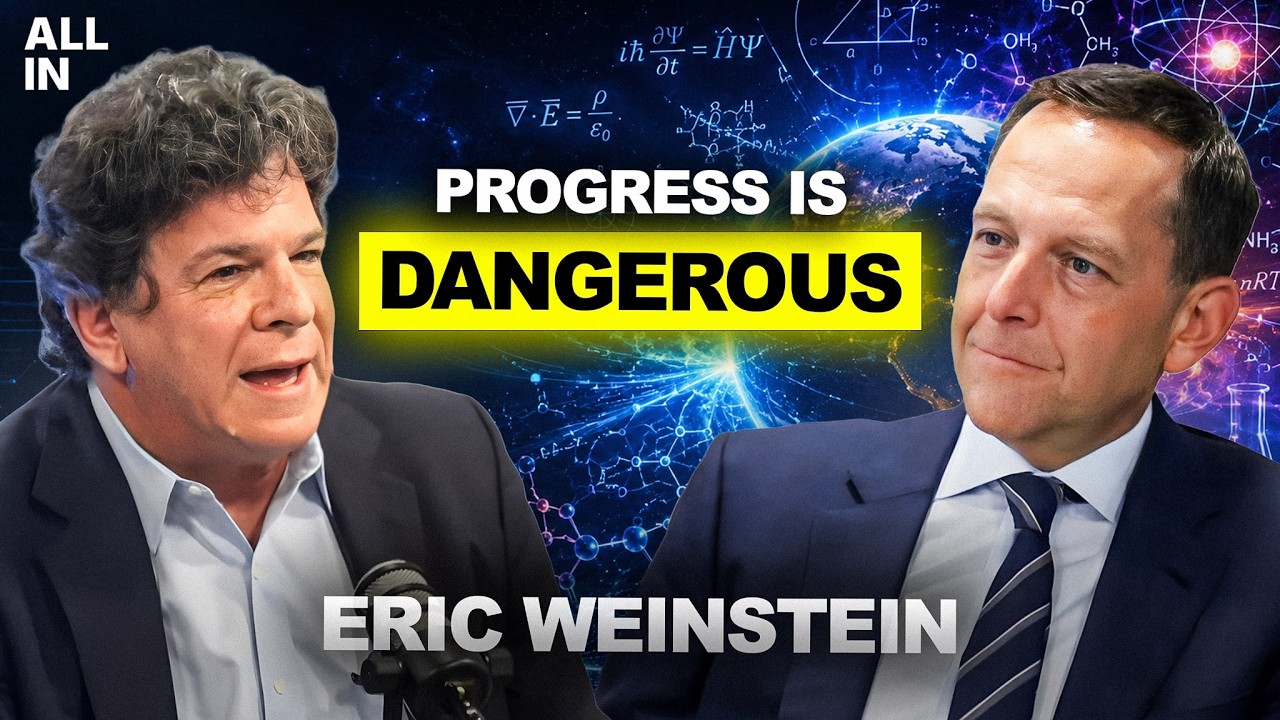
Weinstein Warns Bureaucracy and Stagnant Physics Threaten U.S. Security
All-In Podcast
American scientific dominance is collapsing under rigid institutional incentives and decades of stagnant fundamental physics, exposing the nation to unprecedented geopolitical and security risks.
## Background
The All-In Podcast published this episode featuring guest Dr. Eric Weinstein on YouTube on August 26, 2026. According to the page description, the discussion covers the stalled state of American science, cowboy science, institutional conformity, radical proposals to revamp academic funding and peer review, secret physics, Grand Unified Theories, UAPs, multi-temporal adversaries, talent poaching, and AI.
## TL;DR
Dr. Eric Weinstein argues that post-WWII institutional policies, HR bureaucracies, and mandatory peer-review cartels have severely crippled high-risk, high-reward "cowboy science" in the United States, driving fundamental physics off a cliff around 1984. He posits that while applied engineering has flourished, true theoretical progress has been intentionally or institutionally suppressed, locking humanity inside an "Einsteinian prison" of spacetime limits. Weinstein proposes bold structural reforms—including funding high-agency individuals instead of rigid proposals and exempting top labs from standard administrative compliance—to unlock next-generation Grand Unified Theories, multi-temporal mechanics, and deep space traversal before existential risks escalate.
## Atmosphere & style
The episode has the intense, intellectually provocative, and uncompromising feel of an extended, private high-level briefing. Hosted by Sunny Madra in a dedicated "Science Corner" format in Washington, D.C., the dialogue balances dry academic wit with high-stakes geopolitical gravitas. Weinstein speaks with an urgent, iconoclastic energy—effortlessly weaving complex mathematical physics with pop culture metaphors, historical coverups, and candid institutional critiques to create a captivating and unsparing narrative arc.
## Key takeaways
- [03:09](https://www.youtube.com/watch?v=a0lDsM_J_rc&t=189s) Dr. Eric Weinstein proposes that American scientific progress has stalled due to institutional conformity, the abandonment of high-risk "cowboy science," and rigid bureaucratic grant mechanisms.
- [07:44](https://www.youtube.com/watch?v=a0lDsM_J_rc&t=464s) Institutional pressure and covert funding apparatuses have created an "American scientific precariat" where early-career researchers face blacklisting if they challenge academic orthodoxy.
- [11:39](https://www.youtube.com/watch?v=a0lDsM_J_rc&t=699s) Historical shifts between 1965 and 1975—including the Mansfield Amendment and the rollout of formal peer review—stripped away unconstrained "blue sky" military research grants.
- [21:31](https://www.youtube.com/watch?v=a0lDsM_J_rc&t=1291s) Weinstein advocates for exempting top scientific units from standard HR regulations, abolishing post-1965 peer review cartels, and funding exceptional talent directly rather than rigid project proposals.
- [41:35](https://www.youtube.com/watch?v=a0lDsM_J_rc&t=2495s) Fundamental theoretical physics has effectively stalled for over 40 years, with mainstream research detaching from physical reality into abstract mathematical domains like string theory.
- [55:07](https://www.youtube.com/watch?v=a0lDsM_J_rc&t=3307s) The 50-year pause in fundamental physics breakthroughs may have inadvertently prevented human self-destruction by delaying the discovery of high-leverage "transmutation" energy and weaponry.
- [01:01:24](https://www.youtube.com/watch?v=a0lDsM_J_rc&t=3684s) Small amounts of scientific knowledge grant massive physical leverage; nuclear proliferation will accelerate as traditional national defense shields falter globally.
- [01:07:11](https://www.youtube.com/watch?v=a0lDsM_J_rc&t=4031s) Unidentified Aerial Phenomena (UAPs) could reflect breakthroughs operating beyond standard General Relativity, potentially involving higher-dimensional geometric time travel or gravity modification.
- [01:11:10](https://www.youtube.com/watch?v=a0lDsM_J_rc&t=4270s) Incoming data from the Dark Energy Spectroscopic Instrument (DESI) may soon provide 5-sigma empirical evidence breaking the cosmological constant assumption in General Relativity.
- [01:16:12](https://www.youtube.com/watch?v=a0lDsM_J_rc&t=4572s) Training next-generation AI models on the "Trash Can Corpus"—rejected academic papers and dismissed theories—could unearth neglected discoveries buried by institutional consensus.
- [01:25:12](https://www.youtube.com/watch?v=a0lDsM_J_rc&t=5112s) Using the North Sentinel Island analogy, early nuclear explosions may have acted as a cosmic signal alerting advanced civilizations that humanity is reaching space-time propulsion capabilities.
- [01:28:25](https://www.youtube.com/watch?v=a0lDsM_J_rc&t=5305s) Credentialed scientists should set aside political biases, engage directly with federal science policy leaders in Washington D.C., and assist in restructuring national research priorities.
## Detailed walkthrough
### [00:00](https://www.youtube.com/watch?v=a0lDsM_J_rc&t=0s) Teaser & Introduction: The Stagnation of American Science
The segment opens with a high-stakes provocation from Eric Weinstein, who argues that the United States has degraded into a "nation of followers" in scientific research. He asserts that modern academic physics and broader scientific disciplines have lost their willingness to tolerate heterodox ideas, declaring a need to "blow a giant hole in the Civil Rights Act" to fix academic incentives, while floating the provocative hypothesis that the decades-long stagnation in fundamental physics may have inadvertently prevented humanity's self-destruction. Host Sunny Madra (sitting in for the standard *All-In* lineup) introduces Weinstein—mathematician, physicist, economist, Harvard PhD, former Thiel Capital executive, and creator of the *Geometric Unity* unified field theory framework—welcoming him to an extended "Science Corner" episode recorded on location in Washington, D.C.
Weinstein jokes about the absence of regular hosts Jason Calacanis, Chamath Palihapitiya, David Sacks, and David Friedberg, lightheartedly teasing Calacanis for running away from a high-level scientific debate. Addressing his trip to the nation's capital, Weinstein notes that he has been conducting high-level meetings across government agencies. He reports productive sessions with the Department of War (Department of Defense), Michael Kratsios (Director of the White House Office of Science and Technology Policy), Dr. Jay Bhattacharya (recently tapped to head the National Institutes of Health), and Jim O'Neill (slated for the National Science Foundation). He frames these policy discussions as part of the first comprehensive blueprint to overhaul American science policy since Vannevar Bush's seminal post-WWII framework, *Science, The Endless Frontier*.
- **Guest Profile:** Dr. Eric Weinstein holds a PhD in mathematical physics from Harvard, held an NSF postdoc and Office of Naval Research (ONR) fellowship, served as Managing Director at Thiel Capital, and published *Geometric Unity* in 2021.
- **Historical Context:** Vannevar Bush's 1945 report laid the groundwork for government-funded university research in post-WWII America; Weinstein argues the country is overdue for a structural reset.
---
[03:09](https://www.youtube.com/watch?v=a0lDsM_J_rc&t=189s) High-Variance "Cowboy Science" vs. Institutional Conformity
Discussing Michael Kratsios's vision for a new golden age of American innovation, Madra asks Weinstein to unpack his premise that U.S. government-driven science has hit a wall. Weinstein explains that while incremental research continues, America has systematically abandoned "cowboy science"—the high-variance, courageous, individualistic bets that no other nation can afford to make. He argues that by prioritizing low-risk, incremental consensus research under the guise of "excellence," the U.S. is squandering its single greatest geopolitical weapon: the cultural freedom to question authority, embrace high-risk ideas, and give a symbolic "middle finger" to institutional orthodoxy.
Weinstein highlights the suppression of open inquiry during the COVID-19 pandemic as a prime example of institutional rot, asking why independent virologists and epidemiologists were discouraged from rigorously investigating high-consequence questions, such as whether official policies like lockdowns or gain-of-function research directly led to millions of deaths. When Madra questions why the scientific community stopped interrogating basic assumptions and self-censored during the pandemic, Weinstein asserts that bureaucratic institutions demand synthetic alignment. He emphasizes that true scientific truths—like $2 + 3 = 5$—do not require a artificially constructed "consensus," warning that whenever the word "consensus" is invoked, it usually signals political or economic coercion coercing scientists into silence.
- **Geopolitical Advantage:** Weinstein argues that China's authoritarian framework lacks true intellectual freedom, making America's historic willingness to tolerate eccentric, high-risk dissent its ultimate strategic edge.
- **Dissenting Voices:** Dr. Jay Bhattacharya, co-author of the Great Barrington Declaration who was publicly disparaged as a "fringe epidemiologist" by then-NIH Director Francis Collins and Dr. Anthony Fauci, is cited as a prime victim of enforced institutional consensus.
---
[07:44](https://www.youtube.com/watch?v=a0lDsM_J_rc&t=464s) The Scientific Precariat and the Loss of Academic Freedom
Weinstein details how covert operations and opaque funding pipelines have distorted public science and eroded trust. He points to the covert funding mechanisms involving the Defense Threat Reduction Agency (DTRA) and Peter Daszak's EcoHealth Alliance—which he satirically calls a "hippie-dippy charity"—as evidence of low-tier policy actors using clandestine systems to shield gain-of-function research from public scrutiny. Because top-tier scientists possess analytical tools capable of unraveling official narratives from minimal data (analogous to identifying a suspect at a crime scene from a single hair follicle), covert policy managers prefer compliant administrators over brilliant, independent minds who challenge state narratives.
This dynamic, Weinstein argues, created the "American scientific precariat." Early-career researchers and professors are trap-locked in economically precarious arrangements where challenging institutional consensus results in career destruction, blacklisting, and loss of research grants. He draws a direct parallel between the media's self-censorship regarding President Joe Biden's cognitive decline and the scientific community's compliance during COVID-19, noting that both stemmed from a fear of exploding structural narratives. He highlights that even within theoretical physics, researchers face severe legal constraints; under "Restricted Data" statutory provisions, physicists who write equations that touch upon nuclear weapons principles can face federal penalties, making theoretical physics one of the few fields where First Amendment rights are legally curtailed.
- **Economic Reality:** Modern academics cannot afford to express heterodox views because tenure track pathways, grant approvals, and career stability require complete compliance with orthodoxy.
- **Historical Comparison:** During WWII, the government maintained secrecy around the Manhattan Project (housed in places like the Los Alamos Ranch School), but Weinstein argues today's institutional apparatus uses secrecy to enforce ideological conformity rather than protect vital national defense assets.
---
[11:39](https://www.youtube.com/watch?v=a0lDsM_J_rc&t=699s) Academic Incentives, Heterodoxy, and the 1965–1975 Turning Point
Responding to Madra’s translation of his arguments—that academics are forced to conform to secure funding, department chairs, and personal financial security—Weinstein agrees, noting that the system gaslights scientists into believing that "true scientists shouldn't care about money." He points out the stark hypocrisy of a tech-driven economy where scientific breakthroughs generate trillions of dollars and massive wealth inequality (blowing out Gini coefficients), while the actual foundational scientists are expected to accept modest wages and live in financial insecurity. Weinstein quips that for taking early heterodox stands, scientists should be rewarded with "third homes" and wealth parity rather than academic exile.
Tracing the historical origins of this decay, Weinstein cites his former role as co-chair (with economist Richard Freeman) of the Science and Engineering Workforce Project at Harvard. He pinpoints the exact decade when American science broke down: **1965 to 1975**. Prior to this era, heterodoxy was celebrated much like high-risk tech entrepreneurship. The breakdown accelerated in the spring of 1969, when the MIT physics department staged a historic walkout to protest the Vietnam War. Alarmed that its most elite nuclear and theoretical minds were taking anti-establishment stances, the federal government restructured its relationship with academia:
- **Draper Labs Detachment (1969):** The MIT Instrumentation Laboratory was spun out into an independent entity (Draper Labs) to strip sensitive defense technology work away from radicalized university campuses.
- **The Mansfield Amendment (1969/1971):** Authored by Senator Mike Mansfield of Montana, this legislation restricted military agencies (like ARPA/DARPA and the Office of Naval Research) from funding open-ended, fundamental "blue sky" basic research, mandating that defense grants be tied strictly to explicit military functions.
- **Institutional Peer Review & Bureaucracy (1975):** Following public panics over curricula like "Man: A Course of Study" (MACOS), rigorous institutional control and modern peer-review cartels were installed, effectively ending the era of unconstrained, individualistic academic grants.
<ElicitationsGroup message="Explore related topics from this interview:">
<Elicitation label="Analyze the impact of the Mansfield Amendment on basic research" query="Explain the historical background of the Mansfield Amendment of 1969 and how it shifted federal funding for basic scientific research."/>
<Elicitation label="Examine Weinstein's critique of modern academic peer review" query="What are Eric Weinstein's primary arguments against the traditional academic peer-review system, and what alternatives does he propose?"/>
</ElicitationsGroup>
[17:05](https://www.youtube.com/watch?v=a0lDsM_J_rc&t=1025s) The Demise of "Blue Sky" Research and the Cult of Institutional Conformity
The discussion opens with an analysis of how American science lost its competitive edge, tracing the turn back to the post-war dynamic when the military backed broad, unfettered scientific exploration. The military historically told researchers to remain "fat and happy doing blue sky research" with complete intellectual freedom, provided they were available when national defense required their expertise. That environment accepted radical, divergent personalities because high-stakes, highly dynamic science inherently requires extreme minds. To illustrate the madness of suppressing nonconformity for political correctness, Ted Kaczynski’s parable *Ship of Fools* is cited—a story where a ship's crew argues endlessly over political decorum while drifting straight into an iceberg.
Modern academic institutions have effectively neutered and spayed top scientific talent by enforcing rigid social conformity. Figures like Oculus founder Palmer Luckey showcase the wild, builder-focused archetype that struggles within traditional university physics departments. Meanwhile, brilliant figures in contemporary physics like Nima Arkani-Hamed stand out precisely because of their uncompromising, charismatic independence. Stripping away the eccentric, difficult personalities—such as Cold Spring Harbor's Jim Watson or molecular biologist Mark Ptashne (author of *A Genetic Switch* on phage lambda)—destroys the very alpha that powers breakthrough discoveries. The high-intensity culture of top-tier science is compared to the film *Whiplash*, where extreme standards and zero hand-holding are required to build world-class capability.
- **Historical Precedent:** Military funding previously guaranteed absolute intellectual freedom for "blue sky research" without demanding immediate operational deliverables.
- **Cultural Contrast:** Modern university administration suppresses high-agency, eccentric researchers, effectively "spaying and neutering" top-tier minds.
- **Key Figures Mentioned:** Palmer Luckey (Oculus), Nima Arkani-Hamed (theoretical physics), Jim Watson (Cold Spring Harbor Laboratory), Mark Ptashne (molecular genetics), and Eric Lander (former White House science adviser).
---
[21:31](https://www.youtube.com/watch?v=a0lDsM_J_rc&t=1291s) Restructuring Science: Civil Rights Act Exemptions, Peer Review, and Market Failures
To break the current institutional stagnation, bold structural reforms are required. First, creating exemptions within civil rights and HR enforcement for high-performance scientific teams would allow high-agency individuals to operate without constant bureaucratic interference. High-performing units form deep, cohesive bonds through unvarnished candor and banter rather than rigid HR guidelines. This perspective comes from a self-described "nail house Democrat"—a traditionalist who refuses to abandon party principles even as institutional orthodoxy strays.
```
[ Modern Academic Bureaucracy ]
(Peer Review + HR Oversight + Market Metrics)
│
▼
[ Research Stagnation & Decline ]
│
┌────────────────────┴────────────────────┐
▼ ▼
[ Proposed Structural Reforms ] [ Core Funding Principles ]
• Exempt labs from standard HR • Recognize pure science as a
• Abolish post-1965 Peer Review "Market Failure" public good
• Fund talent over rigid proposals • Direct state support (e.g., Homotopy)
```
Second, the current model of peer review must be recognized as a mid-20th-century administrative invention rather than a timeless pillar of science. Historical citation analysis shows the term "peer review" was virtually nonexistent prior to 1965, originating from Medicare cost-oversight mechanisms and expanded in 1975 following political disputes over NSF funding (such as the controversy over the *MACOS* curriculum). Furthermore, pure science cannot be left strictly to free-market capitalism. Because fundamental scientific knowledge is non-excludable and non-inexhaustible, it represents a classic market failure that requires direct government funding—much like national defense or pure mathematics subfields like homotopy theory.
- **Historical Origin of Peer Review:** Peer review emerged in healthcare management around 1965 and was adopted across federal research grants in 1975 following the NSF *MACOS* (*Man: A Course of Study*) funding debates.
- **Market Failure Dynamics:** Pure scientific research cannot be priced efficiently by private capital markets because its outputs are non-excludable and non-rivalrous.
- **Demographic Disconnect:** A *Nature* reader survey revealed that 85% supported Kamala Harris while only 6% supported Donald Trump, highlighting a severe partisan divide between academic researchers and conservative administrations.
---
[28:33](https://www.youtube.com/watch?v=a0lDsM_J_rc&t=1713s) Government Funding, Elite Retainers, and the Failure of Data-Driven KPIs
While private philanthropy from figureheads like Jim Simons or Yuri Milner supports specific initiatives, private capital alone cannot replace state-funded basic research. Advanced theoretical subjects—such as the relationship between Chern–Simons theory and the Einstein–Hilbert action—are far too specialized for generalized venture markets or standard donors to navigate. Instead of relying on corporate-style Key Performance Indicators (KPIs) and short-term return on investment (ROI) metrics, basic science needs to return to an elite patronage model where top minds are given open-ended retainers.
Administrators who attempt to govern basic research through data-driven translation metrics fundamentally misunderstand how groundbreaking discoveries occur. Historically, prominent scientific leaders evaluated talent directly and placed promising researchers in key positions without onerous grant application processes. Rebuilding American scientific dominance requires engaging directly with leadership—including officials like Michael Kratsios, Jim O'Neill at the NSF, and Jay Bhattacharya—and re-establishing advisory networks like the JASON group to give elite minds a direct pipeline to national decision-making.
- **Return on Investment Deficit:** Reference to data published by Michael Kratsios indicating an approximate 80-fold decline in the yield of scientific returns per federal research dollar over recent decades.
- **The JASON Defense Advisory Group Model:** Elite scientific talent should be kept on retainer to advise the federal government on critical national security and technical problems.
- **Key Interlocutors:** Engagement with key science policy leadership including Michael Kratsios, Jim O'Neill (NSF), Jay Bhattacharya, and mathematician Edward Frenkel.
[34:09](https://www.youtube.com/watch?v=a0lDsM_J_rc&t=2049s) Silicon Valley Mindset vs. Real Science
Eric Weinstein addresses the fundamental disconnect between the technology sector's return-on-investment (ROI) mindset and the ethos of pure scientific pursuit. He explains that scientists are not driven by immediate financial rewards or luxury perks like a new McLaren; rather, they care about their legacy lasting thousands of years, citing historical giants like James Watson, Isidor Singer, and Raoul Bott. While basic comforts like flying business class or staying at nice hotels are appreciated, scientists do not require corporate jets—they need to be treated like the rock stars they are to avoid losing talent.
- **Legacy over Wealth**: Scientists prioritize long-term historical impact over short-term Silicon Valley style wealth creation.
- **Perks vs. Needs**: Basic comforts (e.g., Four Seasons, business class) are sufficient; lavish tech-industry luxuries are unnecessary.
- **Reference**: Humorous comparison asking what the difference is between Perlman and Pearlman, highlighting how historical memory selectively retains deep intellectual contributors over pop culture figures.
---
[36:45](https://www.youtube.com/watch?v=a0lDsM_J_rc&t=2205s) Applying Portfolio Theory to Science Funding
Addressing the grant funding process, the discussion turns to how modern government funding operates like low-beta investing, backing predictable outcomes rather than taking bold, high-risk bets. Weinstein argues that funding bodies fail to grasp basic market theory and modern portfolio theory. Because individual departments face tight constraints, they back modest, high-probability projects and then inflate their significance, leading to a system that lies about its own progress instead of managing risk correctly.
- **High-Beta Example**: Weinstein presents a hypothetical scenario of a $1\%$ chance to cure all cancer; while expensive to fail $99\%$ of the time, the upside for a wealthy government makes it an optimal bet.
- **Institutional Failure**: Rather than rebalancing funds from successful areas into struggling ones, institutions double down on low-risk, incremental claims.
- **Particle Theory**: Despite researchers claiming "it's never been a better time to be a particle theorist," Weinstein asserts the field is in a terrible, stagnant state.
---
[39:01](https://www.youtube.com/watch?v=a0lDsM_J_rc&t=2341s) Bet on People, Not Ideas
The conversation contrasts funding rigid project proposals against backing exceptional individuals who can pivot when an initial idea fails. The panel references Stuart Butterfield's path with Slack—pivoting a failing game company into a $\$30\text{ billion}$ communication platform with the backing of venture capitalists like Ben Horowitz—as an ideal model for scientific support. Weinstein proposes a challenge to identify true breakthroughs: target candidates whose work established field leaders try to block, but refuse to actively short or bet their assets against.
- **Funding Model**: Shift funding from fixed project grants to long-term support for high-potential individuals.
- **The Challenge Strategy**: Put up real skin in the game; if critics claim a theoretical framework like Geometric Unity or Geometric Marginalism has a $99.9999\%$ chance of failure, they should be willing to wager their homes against it at scale.
---
[41:35](https://www.youtube.com/watch?v=a0lDsM_J_rc&t=2495s) Did Physics Drive Off a Cliff in 1984?
Weinstein delivers a sharp critique of modern fundamental physics, asserting that Edward Witten—whom he calls the smartest man in the world—effectively "drove theoretical physics off the road and off a cliff 42 years ago." String theory and modern theoretical frameworks have completely detached from physical reality, serving instead as a safe intellectual playground that produces no dangerous military applications or genuine physical advances.
- **Strings 2026 Conference**: A search of the talk topics yields no mentions of fundamental physical components like the *electron*, *hadron*, *Higgs*, or *lepton*.
- **Disconnection from Nature**: Leading theoretical physics professors at top institutions explicitly admit to having zero interest in the actual physical world.
- **Institutional Rejection**: Weinstein notes he faces semi-official pushback when speaking at institutions like UT Austin, the Perimeter Institute, or the University of Chicago, where host departments refuse to officially sponsor or list his talks.
- **Key Shift (1983–1984)**: Key figures like Leonard Susskind, David Gross, and Edward Witten redirected the field from standard $SU(3) \times SU(2) \times U(1)$ gauge theory into abstract mathematical domains like AdS/CFT that "couldn't hurt a fly."
---
[45:42](https://www.youtube.com/watch?v=a0lDsM_J_rc&t=2742s) Secret Physics, the Reference Committee, and Renaissance Technologies
Exploring whether fundamental physics progress was intentionally derailed or hidden, Weinstein draws a historical parallel to World War II. In 1940, the National Research Council formed the Reference Committee under Gregory Breit to silently intercept and reject open papers on nuclear chain reactions, effectively quarantining breakthrough physics inside the Manhattan Project at Los Alamos. He posits that a similar secret effort or institutional coverup could exist today, pointing to Renaissance Technologies on Long Island as a potential candidate for a modern secret research hub.
- **1940s Historical Precedent**:
- James Chadwick/Ernest Rutherford (neutron discovery, 1911/1932) $\rightarrow$ Lise Meitner (fission concept) $\rightarrow$ Enrico Fermi (Chicago Pile-1).
- The Reference Committee systematically suppressed external chain-reaction papers using boilerplate rejections.
- **The Renaissance Technologies Analogy**:
- Secure Long Island campus hiring particle theorists, differential geometers, and machine learning experts while rejecting traditional finance backgrounds.
- Proximity and deep ties to Brookhaven National Laboratory and SUNY Stony Brook (a historically elite institution in math/physics).
- Closed Medallion Fund structure where outside capital is barred, limiting external scrutiny.
- **Historical Comparison**: Compares the narrative to Jack Raper's 1944 Cleveland newspaper article breaking the news of a secret city (Los Alamos), which the public dismissed at the time as absurd.
- **Epstein Aside**: Briefly contrasts this with Jeffrey Epstein's false narrative of running a multi-strategy FX hedge fund on a Boeing 727 staffed by Yeshiva students using trend-following and mean-reversion tactics.
Here is a detailed, faithful walkthrough of the transcript portion, preserving its technical concepts, anecdotes, arguments, and tone.
[51:40](https://www.youtube.com/watch?v=a0lDsM_J_rc&t=3100s) Cover Stories, Financial Anomalies, and the Renaissance Technologies Mystery
Eric Weinstein continues discussing how high-level finance and intelligence operations use elaborate "cover stories" that eventually collapse. He references Jeffrey Epstein, pointing out how Epstein's initial cover story—that he was a genius financier involved in options and gamma trading—was completely burned, after which he became a disgraced figure and was rebranded as a "tax expert." Weinstein invokes the classic comedy series *Get Smart* and Maxwell Smart's famous catchphrase ("Would you believe...?"), comparing official narratives to Maxwell Smart trying to bluff an enemy with "a thousand special agents," only to walk it back to "two boy scouts with a slingshot" when pressed.
Turning to Renaissance Technologies, Weinstein clarifies that while Jim Simons was an absolute mathematical genius, the fund's astonishing returns stand completely isolated in the history of finance. He notes that no one else has ever come close to those numbers, and the public has zero true visibility into what Renaissance actually did or claims to do. Weinstein argues that Renaissance maintains extremely close, unacknowledged relationships with the talent pool at Stony Brook University and a nearby national laboratory (BNL), suggesting its true inner workings remain hidden behind cover stories.
- **Epstein Cover Story:** Initially claimed to be trading complex options and gamma strategies, which later dissolved.
- **Get Smart Analogy:** Illustrates how official state or institutional cover stories degrade from grandiose claims to absurdly thin excuses.
- **Renaissance & Stony Brook:** Weinstein points to non-public ties between Renaissance Technologies, Stony Brook University, and a national laboratory dating back to 1983–1984.
---
[52:49](https://www.youtube.com/watch?v=a0lDsM_J_rc&t=3169s) The Consequences of a Stalled Physics: Applied Progress vs. Fundamental Breakthroughs
The hosts ask Weinstein to explain what physics would look like today if fundamental theoretical physics hadn't stalled out around 1983–1984 by entering the "quantum gravity universe" and String Theory. A host pushes back with a counterargument: hasn't physics made massive practical contributions over the last 40 years by driving semiconductor manufacturing, advanced photolithography, material science, and compute power, which ultimately birthed modern AI?
Weinstein acknowledges that applied physics and engineering have made immense strides, but explains why that misses the core issue of fundamental physics. In the standard "frontier model"—which joins General Relativity with the Standard Model of particle physics—there are foundational discoveries that haven't yielded industrial applications despite decades of knowledge. For instance, physicists discovered in 1968 that every proton and neutron contains three valence quarks bound by "infrared slavery" (color confinement). Because no one has ever isolated a single quark, there is zero industrial application for it 50+ years later. However, had fundamental theory continued to advance rather than getting stuck, entirely new physical domains would have opened up.
- **Applied Physics vs. Fundamental Physics:** Semiconductor lithography and AI compute stem from 20th-century quantum mechanics refinement, not post-1980s fundamental breakthroughs.
- **Infrared Slavery:** The phenomenon preventing isolated quarks from being pulled out of hadrons; discovered in 1968, still yields zero commercial or industrial tools.
---
[55:07](https://www.youtube.com/watch?v=a0lDsM_J_rc&t=3307s) Grand Unification, SU(4), and the Concept of "Boom, Vroom, and Zoom"
To illustrate what un-stalled physics might look like, Weinstein points to the Pati–Salam model proposed in the mid-1970s by Abdus Salam and Jogesh Pati. He believes Pati–Salam is likely the correct first-order Grand Unified Theory (GUT) above the Standard Model. While the Standard Model relies on $SU(3)$ gauge symmetry to describe the strong nuclear force binding quarks inside atomic nuclei, Pati–Salam expands this to $SU(4)$. Under $SU(4)$ symmetry, lepton number is treated as a "fourth color"—meaning electrons and neutrinos are mathematically grouped alongside up and down quarks.
Weinstein explains that controlling nuclear forces is what unlocked the atomic age: in 1945, humans controlled the strong force to release massive electromagnetic energy. Under higher symmetry regimes like Pati–Salam or $SU(5)$, force particles could theoretically transmute heavy matter (quarks) into light leptons (electrons/neutrinos), decaying solid matter instantly. Weinstein breaks down why physics is both human society's most dangerous and most thrilling endeavor using the mnemonic **Boom, Vroom, and Zoom**:
1. **Boom:** Advanced weaponry and matter disintegration.
2. **Vroom:** Unlimited energy production.
3. **Zoom:** Advanced propulsion, interstellar travel, and novel computing.
He suggests a startling possibility: the 50-year stagnation in theoretical physics may have inadvertently saved humanity from self-destruction, because unlocking new "Zoom" and "Vroom" inevitably unlocks a terrifying new level of "Boom."
- **Pati–Salam Model:** Grand unification model replacing $SU(3)$ color symmetry with $SU(4)$, unifying quarks and leptons.
- **Transmutation Weaponry:** Higher symmetry operations could theoretically rotate quarks into leptons, causing matter to disintegrate.
- **Beta Decay Mechanics:** A free neutron decays (half-life $\sim 15\text{--}17\text{ minutes}$) into a proton, emitting a $W^-$ boson that decays into an electron and an electron antineutrino.
- **The Triad:** "Boom" (weapons), "Vroom" (energy), and "Zoom" (propulsion/compute).
---
[01:01:24](https://www.youtube.com/watch?v=a0lDsM_J_rc&t=3684s) The High Leverage of Scientific Knowledge: From Spike Proteins to Thermonuclear Secrets
The conversation turns to whether hyper-dangerous scientific breakthroughs could be concealed or if an individual could leverage them for absolute power. Weinstein strongly argues that human society does not respect how much lethal leverage a tiny amount of scientific knowledge grants. He cites the COVID-19 pandemic, where a insertion of just 4 amino acids (coded by 12 nucleotides) into the coronavirus spike protein was enough to disrupt global civilization and force two years of societal lockdowns.
He references pop culture and historical anecdotes to show how easily high-leverage power can be unlocked:
- **Breaking Bad:** Walter White (Heisenberg) using a small pinch of volatile mercury fulminate to blow out Tuco's office.
- **Black Powder:** The basic 75% potassium nitrate (saltpeter), 10% sulfur, and 15% charcoal recipe—simple chemical leverage that modern audiences often forget.
- **The Radioactive Boy Scout:** A teenager in Michigan who assembled a working nuclear reactor in his backyard by harvesting americium from hundreds of smoke detectors.
- **Teller–Ulam Design & *The Progressive* Case:** The 1979 *United States v. Progressive, Inc.* case, where journalist Howard Morland pieced together the secret geometry of the hydrogen bomb (using radiation pressure from a fission detonator to compress fusion fuel) simply by reading declassified documents in the Los Alamos library.
- **John Aristotle Phillips:** The "Princeton mascot" undergraduate who designed a fully functional atomic bomb in his 1976 junior thesis under Freeman Dyson, prompting the U.S. government to seize and classify his paper.
Weinstein warns that as the U.S. experiences its "Suez moment" and its role as global policeman falters (eroding the backing of the petrodollar by military force), nuclear proliferation will accelerate across countries that no longer trust American protection.
---
[01:07:11](https://www.youtube.com/watch?v=a0lDsM_J_rc&t=4031s) UAPs, Deep Compartmentalization, and Multi-Temporal Adversaries
When asked what lies beyond 80-year-old nuclear technology and whether Unidentified Aerial Phenomena (UAPs) represent advanced physics breakthroughs by foreign adversaries like China, Weinstein reveals that he shifted from a deep skeptic to believing "there is definitely something there." His conviction comes not from sensationalized public videos, but from private conversations with highly credible, sober military and scientific figures, alongside the existence of deeply classified Special Access Programs (SAPs).
Weinstein notes that the national security state relies on extreme compartmentalization ("stovepiping"). This infrastructure is so fragmented that almost no single person inside the government has the access required to piece the full picture together.
To illustrate what speculative physics could unlock, Weinstein introduces the concept of **multi-temporal adversaries**. While people dismiss "time travel" because they visualize time as a simple one-dimensional line, Weinstein uses a geometric analogy:
- A gun mounted on a rail car can only move back and forth along a **1D** track.
- A gun mounted on a tank driving across the Salt Flats gains **2D** freedom.
- A gun mounted on an A-10 Warthog operates in **3D** space.
If physics unlocks extra dimensions of time, an adversary would operate with multi-dimensional temporal freedom, making traditional defense obsolete.
[01:08:48](https://www.youtube.com/watch?v=a0lDsM_J_rc&t=4128s) Multi-Time Dimensions and Leaving Einstein's Prison
Eric Weinstein challenges the fundamental assumption that time is strictly one-dimensional. Just as space allows movement across three dimensions, time could possess multiple dimensions. Competing against an adversary with access to "multi-time" would be catastrophic—like attempting to fight an advanced combat aircraft while your own weapon is locked onto a rigid, single-axis track, except applied to time rather than physical space. If an adversary could flank an opponent temporal-wise by anticipating their intent, traditional warfare logic falls apart.
Shifting to space exploration, Weinstein dismisses the obsession with colonizing Mars or the Moon as a "McGuffin"—a motivational distraction meant to drive engineering progress. While acknowledging Elon Musk as "our only adult" pushing humanity outward, he argues that creating a few extra habitable biospheres via chemical rockets leaves species survival entirely too fragile. Having only three places to live still exposes humanity to total extinction; civilization requires tens of thousands or millions of outposts to safely learn how to govern itself.
```
THE ESCAPE ROOM OF PHYSICAL SPACE
CURRENT REALITY THE EINSTEINIAN LIMIT THE TARGET DESTINATION
+-----------------+ +-----------------------+ +-----------------------+
| Earth / Moon / | =====> | Speed of Light (c) | ==X== | Tens of Thousands |
| Mars Outposts | | Severe Time Dilation | | of Extrasolar Worlds |
+-----------------+ +-----------------------+ +-----------------------+
(3 failure points) (Trapped in Solar System) (True Species Survival)
```
Weinstein asserts that humanity is effectively trapped inside "Einstein's prison." Standard general relativity—formulated primarily by Albert Einstein and Marcel Grossmann between 1913 and 1917—imposes a speed-of-light limit that makes interstellar travel impractical. A trip to Alpha Centauri (four light-years away) at near-light speed would result in eight years passing back on Earth, preventing true deep-space expansion.
- **Temporal Flanking**: Access to multi-time allows an adversary to maneuver behind a target temporally based on future intent.
- **Mars as a McGuffin**: Mars and the Moon are structurally insufficient as long-term backups for human civilization; humanity needs millions of operational nodes.
- **Einstein-Grossmann Attribution**: General relativity's geometric foundations rely as heavily on mathematician Marcel Grossmann as on Albert Einstein.
[01:11:10](https://www.youtube.com/watch?v=a0lDsM_J_rc&t=4270s) Breaking General Relativity: DESI and Dark Energy
General relativity's core equations have remained virtually unchanged for over a century, but observational astrophysics may soon force a break. Weinstein highlights ongoing observations from the Dark Energy Spectroscopic Instrument (DESI) at Kitt Peak in southern Arizona. He predicts DESI's observational data will prove that the cosmological constant ($\Lambda$) combined with the spacetime metric—the standard mathematical encoding of dark energy—is not actually constant.
Under Lovelock's theorem, within standard 4D general relativity, the term $\Lambda g_{\mu\nu}$ is the only geometric term that satisfies the required mathematical constraints (specifically, having a vanishing divergence via the product rule). If DESI reaches a 5-sigma statistical significance showing variable dark energy, it will expose that physics relies on an incorrect baseline formula for something that makes up 60% to 80% of the universe.
```
LOVELOCK'S THEOREM BREAKDOWN
Standard 4D General Relativity DESI Observational Anomaly
+--------------------------------+ +----------------------------+
| Cosmological Constant: | | Dark Energy varies over |
| \Lambda \times g_{\mu\nu} | ==> | cosmic time/space |
| (Required by Divergence Rule) | | (\Lambda is NOT constant) |
+--------------------------------+ +----------------------------+
|
v
+----------------------------+
| 5-Sigma Breakpoint: |
| General Relativity Fails |
+----------------------------+
```
Weinstein calls for a transparent scientific forum where researchers present alternative mathematical candidate formulas to replace the cosmological constant, criticizing mainstream physics for spending 42 years declaring string theory "the only game in town." Mainstream astrophysics acknowledges two unresolvable singularities within general relativity: the initial singularity of the Big Bang and the Schwarzschild singularity at the center of black holes. These mathematical infinities mark the precise boundaries where the theory fails.
To illustrate how theoretical models can expand beyond apparent constraints, Weinstein points to the introduction of the "pinch-to-zoom" multi-touch gesture in the early 2000s. He suggests space time itself may possess an analogous scaling property. If a system can alter intrinsic distances directly, it eliminates the need to break the speed of light to travel immense distances.
- **DESI Data**: Observations from Kitt Peak could provide 5-sigma empirical evidence breaking the assumption of a static cosmological constant.
- **Unresolved Singularities**: The Big Bang origin point and black hole interiors highlight fundamental flaws in the general relativity framework.
- **Pinch-to-Zoom Analogy**: Changing physical scale/distance geometries bypasses standard speed-of-light travel limits without violating local causality.
[01:16:12](https://www.youtube.com/watch?v=a0lDsM_J_rc&t=4572s) Talent Poaching, the "Trash Can Corpus", and AI
Addressing global scientific competition, Weinstein contrasts Western academic culture with strategic moves by foreign powers. While France historically held top mathematical honors and China previously struggled in theoretical mathematics, China is now actively recruiting elite Western researchers. By offering substantial funding, prestige, and personal research autonomy, foreign institutions capitalize on the rigid administrative constraints of Western universities. However, Weinstein notes this intellectual freedom inevitably collides with political boundaries around sensitive geopolitical topics like Tibet, Tiananmen Square, and Taiwan.
Weinstein highlights a major shift in how artificial intelligence will impact scientific discovery. Current Large Language Models are primarily trained on mainstream, prestigious academic publications like *Cell*, *Nature*, *Science*, *Annals of Mathematics*, and *Inventiones Mathematicae*. However, he argues that breakthrough discoveries will occur when AIs are trained on the "Trash Can Corpus"—the massive repository of rejected papers, dismissed theories, and ridiculed ideas.
```
THE "TRASH CAN CORPUS" (TC CORPUS) AI PIPELINE
MAINSTREAM CORPUS (Current LLMs) TRASH CAN CORPUS (Next-Gen AI)
+------------------------------------+ +------------------------------------+
| • Nature, Science, Cell | | • Rejected papers & unvetted ideas |
| • Annals of Mathematics | | • Poo-pooed fringe theories |
| • Peer-reviewed orthodoxy | | • Suppressed / sidelined math |
+------------------------------------+ +------------------------------------+
| |
v v
+------------------------------------+ +------------------------------------+
| Consensus-Bound Incrementalism | | Unconventional Physics Breakouts |
+------------------------------------+ +------------------------------------+
```
By systematically sifting through sidelined hypotheses, an AI system could evaluate whether frameworks like string theory or M-theory served as intellectual dead ends that blinded physicists to viable alternatives. Weinstein criticizes the current state of academic physics for lacking visionary, iconoclastic figures comparable to John von Neumann, Richard Feynman, or Paul Dirac, emphasizing that dogmatic insistence on academic consensus stifles foundational breakthroughs.
- **Prestige Journals**: Mainstream training relies on high-impact publications, reinforcing established scientific narratives.
- **Trash Can Corpus (TC Corpus)**: Training AI models on historically dismissed or rejected literature could unearth neglected scientific insights.
- **Loss of Iconic Theorists**: Modern institutional incentives suppress the disruptive thinking previously seen in mid-20th-century theoretical physics.
[01:20:41](https://www.youtube.com/watch?v=a0lDsM_J_rc&t=4841s) Hannibal Lecter AIs and Strategic UAP History
Weinstein expresses concern over the rapid commercial distribution of advanced AI models, comparing public deployment to releasing a highly dangerous intelligence without adequate safeguards. He references the famous scene from *Silence of the Lambs* where Hannibal Lecter is wheeled out in a grait jacket and restraint mask:
> "Here's your new employee, Hannibal Lecter. He's a consultant. You've hired Hannibal Lecter from a temporary agency... And we've decided that this military research project is something you need in your home."
He questions why technology developed with potential national security implications is distributed directly to the public, likening it to selling personal nuclear weapons at a local retail store. The co-hosts counter that model weights are already widely open-sourced, commoditized, and distilled, making containment debates largely moot.
```
HISTORICAL UAP FRAMEWORKS
GENERAL RELATIVITY IS FINAL GENERAL RELATIVITY IS INCOMPLETE
+-----------------------------+ +----------------------------------+
+ Black-Budget Technologies + + Non-Standard Physics / SpaceTime +
+ State-Level Aero Platforms + + Modifications (Gravity Shielding)+
+ Classified Program Spinoffs + + Pinch-to-Zoom Geometry +
+-----------------------------+ +----------------------------------+
```
When asked directly for his assessment of Unidentified Aerial Phenomena (UAPs), Weinstein outlines two primary possibilities based on the underlying physics:
1. **If General Relativity Holds**: UAPs are highly classified experimental weapon systems developed by advanced nation-states. He references a 1971 Australian intelligence document noting UAP sightings around nuclear test sites in Australia, which documented widespread interest across top U.S. and UK institutions in gravity shielding and anti-gravity concepts during the 1950s to 1970s.
2. **If General Relativity Fails**: UAPs operate on physical principles beyond current public models, utilizing spacetime modifications, dynamic metric manipulation, or advanced gravitational control.
Weinstein emphasizes the severe professional risks involved in discussing these topics, noting that expressing unconventional views on physics or national security topics regularly leads to academic isolation and closed doors within the scientific community.
- **Hannibal Lecter Metaphor**: Illustrates the inherent risks of releasing highly capable AI tools as routine consumer goods.
- **1971 Australian Intelligence Document**: Details historic investigations into UAP activity near nuclear testing areas and early military research into gravity modification.
- **Professional Repercussions**: Openly evaluating non-standard physics frameworks or UAP topics routinely leads to professional ostracization within mainstream academia.
<ElicitationsGroup message="Explore related topics from this discussion:">
<Elicitation label="Analyze the DESI dark energy findings" query="Break down the DESI dark energy data, the cosmological constant problem, and how variable dark energy impacts General Relativity."/>
<Elicitation label="Examine historic anti-gravity research" query="Detail the history of 1950s-1970s gravity shielding and anti-gravity research mentioned in early defense documents."/>
</ElicitationsGroup>
[01:25:12](https://www.youtube.com/watch?v=a0lDsM_J_rc&t=5112s) The North Sentinel Island Analogy, UAPs, and Nuclear Triggers
Eric Weinstein argues that breakthroughs in advanced physics—specifically multi-touch geometric maneuvers like "shear to tilt"—will ultimately grant humanity the ability to leave our solar system and survive beyond Earth. However, the exact physics that enables us to leave also implies that advanced extraterrestrial civilizations can easily reach us. Given the vastness of the universe, Weinstein considers the idea that humans are the most advanced intelligence to be "laughable." He outlines a compelling analogy using North Sentinel Island: the island’s inhabitants are legally citizens of India, yet they have no concept of "India" and remain an uncontacted tribe monitored from afar. Under normal circumstances, external observers maintain a paternalistic policy of non-interference.
However, that hands-off dynamic changes dramatically the moment the primitive tribe acquires dangerous, high-leverage technology. Weinstein points out that when humans detonated the first atomic bomb in 1945—or during earlier Italian quantum breakthroughs with Enrico Fermi's "Via Panisperna boys" and the alleged 1933 Magenta UAP incident under Mussolini—we signaled to the broader universe that we were on the verge of mastering interstellar traversal. In his view, almost every civilization unleashes nuclear power right before discovering profound space-time propulsion games. By setting off nuclear explosions, humanity effectively alerted whatever galactic equivalent of "India" exists that a pathetically unevolved, high-risk species is about to break out of its isolated quarantine.
* **North Sentinel Analogy:** Humanity operates like an uncontacted island tribe unaware of the surrounding superpower watching over them.
* **Nuclear Signal:** Detonating atomic weapons acts as an cosmic distress beacon, signaling that a species is transitioning from primitive physics to advanced propulsion.
* **Historical References:** Mentions Enrico Fermi, the Italian atomic research group ("Via Panisperna boys"), and the 1933 Magenta, Italy UAP crash incident.
---
[01:27:18](https://www.youtube.com/watch?v=a0lDsM_J_rc&t=5238s) Geometric Unity and the Next Physics Frontier
Weinstein addresses potential skepticism by doubling down on his own unified field theory, Geometric Unity, asserting that discussing one's work isn't mere self-promotion, but a necessary responsibility when holding a framework for the fundamental laws of nature. He forecasts that uncovering the next layer of physics will unlock profound realities that render our current world unrecognizable. This includes theoretical phenomena such as multi-temporal movement, dark chemistry, dark light, spin three-halves matter, two additional unobserved families of chiral matter at a luminous level, and an $SU(4) \times SU(2) \times SU(2)$ Grand Unified Theory structure.
The primary danger is that the sheer physical power unlocked by these insights makes humanity a threat not only to itself, but to any external observers. Because this next theoretical step grants immense leverage, entering this era without global alignment carries existential risks. Weinstein notes that while mainstream academics may balk at these non-standard proposals, exploring such radical horizons is essential for ensuring survival.
* **Theoretical Frameworks:** Asserts Geometric Unity as the pathway forward, predicting an $SU(4) \times SU(2) \times SU(2)$ symmetry group structure.
* **Exotic Physics:** Highlights concepts including multi-temporal traversal, dark light, dark chemistry, spin-3/2 particles, and additional families of chiral matter.
---
[01:28:25](https://www.youtube.com/watch?v=a0lDsM_J_rc&t=5305s) A Call for Scientific Leadership and Civic Duty
Concluding the discussion, the podcast host emphasizes the critical value of entertaining outlandish, uncomfortable, or seemingly "heretical" ideas, thanking Weinstein for delivering a unique, thought-provoking perspective outside the standard media discourse. Weinstein echoes this gratitude, issuing a passionate rallying cry for American scientific leadership. He stresses that no other nation possesses the foundational spirit necessary to responsibly manage these planetary-scale developments, but urges that the United States must urgently "make common cause with our rivals" to manage the terrifying leverage of next-generation technologies.
Finally, Weinstein delivers a direct message to the broader academic and scientific establishment regarding the political administration in Washington D.C. He notes that despite mainstream academic disdain toward key political figures—referencing Donald Trump and current policy leaders—the individuals holding government science portfolios are far more capable than standard PhDs realize. He urges credentialed scientists to set aside partisan hubris, travel to Washington D.C., and simply ask the administration a single question: "How can I help?"
* **Global Cooperation:** Urges the U.S. to rapidly form alliances with geopolitical rivals to safely navigate high-leverage physical breakthroughs.
* **Civic Engagement:** Challenges skeptical scientists to move past partisan bias, visit Washington D.C., and directly offer their expertise to federal science policymakers.
## Notable quotes
> [00:00](https://www.youtube.com/watch?v=a0lDsM_J_rc&t=0s) nation of followers — Eric Weinstein
> [00:00](https://www.youtube.com/watch?v=a0lDsM_J_rc&t=0s) blow a giant hole in the Civil Rights Act — Eric Weinstein
> [03:09](https://www.youtube.com/watch?v=a0lDsM_J_rc&t=189s) cowboy science — Eric Weinstein
> [07:44](https://www.youtube.com/watch?v=a0lDsM_J_rc&t=464s) American scientific precariat — Eric Weinstein
> [11:39](https://www.youtube.com/watch?v=a0lDsM_J_rc&t=699s) true scientists shouldn't care about money — Eric Weinstein
> [17:05](https://www.youtube.com/watch?v=a0lDsM_J_rc&t=1025s) fat and happy doing blue sky research — Eric Weinstein
> [17:05](https://www.youtube.com/watch?v=a0lDsM_J_rc&t=1025s) spaying and neutering — Eric Weinstein
> [41:35](https://www.youtube.com/watch?v=a0lDsM_J_rc&t=2495s) drove theoretical physics off the road and off a cliff 42 years ago — Eric Weinstein
> [36:45](https://www.youtube.com/watch?v=a0lDsM_J_rc&t=2205s) it's never been a better time to be a particle theorist — Eric Weinstein
> [01:11:10](https://www.youtube.com/watch?v=a0lDsM_J_rc&t=4270s) the only game in town — Eric Weinstein
> [01:16:12](https://www.youtube.com/watch?v=a0lDsM_J_rc&t=4572s) Trash Can Corpus — Eric Weinstein
> [01:20:41](https://www.youtube.com/watch?v=a0lDsM_J_rc&t=4841s) Here's your new employee, Hannibal Lecter. He's a consultant. You've hired Hannibal Lecter from a temporary agency... And we've decided that this military research project is something you need in your home. — Eric Weinstein
> [01:08:48](https://www.youtube.com/watch?v=a0lDsM_J_rc&t=4128s) Einstein's prison — Eric Weinstein
> [01:28:25](https://www.youtube.com/watch?v=a0lDsM_J_rc&t=5305s) How can I help? — Eric Weinstein
## Mentioned
Eric Weinstein, Sunny Madra, Jason Calacanis, Chamath Palihapitiya, David Sacks, David Friedberg, Vannevar Bush, Michael Kratsios, Dr. Jay Bhattacharya, Jim O'Neill, Francis Collins, Dr. Anthony Fauci, Peter Daszak, Richard Freeman, Mike Mansfield, Palmer Luckey, Nima Arkani-Hamed, Jim Watson, Mark Ptashne, Eric Lander, Kamala Harris, Donald Trump, Jim Simons, Yuri Milner, Edward Frenkel, Isidor Singer, Raoul Bott, Stuart Butterfield, Ben Horowitz, Edward Witten, Leonard Susskind, David Gross, Gregory Breit, James Chadwick, Ernest Rutherford, Lise Meitner, Enrico Fermi, Jack Raper, Jeffrey Epstein, Abdus Salam, Jogesh Pati, Walter White, Howard Morland, John Aristotle Phillips, Freeman Dyson, Elon Musk, Albert Einstein, Marcel Grossmann, John von Neumann, Richard Feynman, Paul Dirac, All-In Podcast, Harvard University, Thiel Capital, National Science Foundation, National Institutes of Health, Department of Defense, White House Office of Science and Technology Policy, EcoHealth Alliance, Defense Threat Reduction Agency, MIT, Draper Labs, ARPA, DARPA, Office of Naval Research, Cold Spring Harbor Laboratory, JASON Defense Advisory Group, Oculus, Perimeter Institute, University of Chicago, UT Austin, National Research Council, Los Alamos National Laboratory, Renaissance Technologies, Brookhaven National Laboratory, Stony Brook University, Dark Energy Spectroscopic Instrument, Science, The Endless Frontier, Great Barrington Declaration, Ship of Fools, A Genetic Switch, Geometric Unity, Geometric Marginalism, Get Smart, Breaking Bad, The Progressive, Silence of the Lambs, Cell, Nature, Science, Annals of Mathematics, Inventiones Mathematicae
Mathematician and physicist Eric Weinstein argues that American science has stagnated due to rigid institutional conformity, bureaucratic funding models, and the suppression of high-risk heterodoxy. He contends that while stalled fundamental physics may have inadvertently shielded humanity from dangerous technologies, breaking out of this stagnation requires radical structural reforms and engagement with unconventional physics.
Institutional Conformity and the Stagnation of American Science (3:09)
Weinstein asserts that the United States has abandoned high-risk, individualistic "cowboy science" in favor of low-risk, consensus-driven research that produces only incremental gains. He traces the institutional breakdown to the 1965–1975 period, citing events such as the 1969 MIT anti-war walkout, the detachment of Draper Labs, and the Mansfield Amendment, which barred military bodies like DARPA and ONR from funding open-ended basic research. Around 1975, the widespread adoption of modern institutional peer review—which Weinstein notes originated as a Medicare cost-control mechanism rather than a historical scientific pillar—further centralized authority and curtailed unconstrained research.
This structural shift, according to Weinstein, generated an economically precarious "scientific precariat." Early-career researchers and professors are compelled to conform to official orthodoxies to secure research grants, faculty chairs, and tenure. He points to the public disparagement of dissenting scientists during the COVID-19 pandemic, such as Dr. Jay Bhattacharya, and legal restrictions on theoretical physics under statutory "Restricted Data" provisions as evidence that institutional apparatuses prioritize narrative management over rigorous scientific inquiry.
Reforming Research Policy, Risk Architecture, and AI Models (21:31)
To revive American scientific dominance, Weinstein calls for a departure from corporate-style Key Performance Indicators (KPIs) and short-term return on investment (ROI) metrics, citing data referenced by Michael Kratsios indicating an approximate 80-fold decline in returns per federal research dollar over recent decades. Because foundational science produces non-excludable and non-rivalrous knowledge, Weinstein frames it as a classic market failure that private capital cannot efficiently solve. He advocates for an elite patronage model, including retainers modeled after the JASON defense advisory group, backing high-potential researchers capable of pivoting rather than funding rigid project proposals, and exempting high-performance laboratories from standard HR oversight to foster candid debate.
Weinstein also challenges the approach to artificial intelligence in scientific discovery. He argues that modern Large Language Models trained strictly on prestigious academic journals like Nature, Science, and Cell merely reinforce consensus-bound incrementalism. Instead, he proposes training AI models on a "Trash Can Corpus" consisting of rejected manuscripts, dismissed hypotheses, and sidelined mathematical concepts, which he believes could uncover viable theoretical pathways obscured by institutional groupthink.
Theoretical Physics Detachment and Covert Research Hypotheses (41:35)
Weinstein sharply criticizes fundamental theoretical physics since roughly 1983–1984, arguing that leading figures redirected the discipline away from Standard Model gauge theories into abstract frameworks like string theory and AdS/CFT that have detached from empirical reality. Pointing to the upcoming Strings 2026 conference, he notes the absence of core physical phenomena like electrons, hadrons, or the Higgs boson from talk topics. He contends that while applied physics has advanced microelectronics and computing, fundamental discoveries have stalled, noting that valence quarks—bound by color confinement since their 1968 discovery—remain without commercial applications.
Drawing parallels to the World War II Reference Committee under Gregory Breit, which intercepted open publications on nuclear chain reactions to isolate breakthroughs within the Manhattan Project, Weinstein speculates that significant advances in physics may currently be sequestered within black-budget programs or private enclaves. He suggests that quantitative trading firms like Renaissance Technologies—with its closed Medallion Fund structure, proximity to Brookhaven National Laboratory and Stony Brook University, and heavy hiring of geometers and particle theorists—might serve as modern hubs concealing advanced physics behind financial cover stories.
The High Leverage of Advanced Physics and Existential Threats (55:07)
Weinstein warns that breaking the current theoretical deadlock introduces profound hazards, summarized through the triad of "Boom" (weaponry), "Vroom" (energy), and "Zoom" (propulsion and compute). He argues that Grand Unified Theories like the Pati–Salam model, which expands symmetry to SU(4) by grouping leptons and quarks, theoretically imply that matter could be decayed or transmuted into light leptons. From this perspective, the multi-decade stagnation in fundamental physics may have served as an accidental safeguard preventing humanity from unlocking catastrophic physical leverage without mature governance.
Addressing interstellar travel, Weinstein dismisses Mars colonization as an insufficient safeguard for species survival, arguing that general relativity traps humanity within a four-dimensional "prison" bound by light-speed limits. However, he anticipates that upcoming observational data from the Dark Energy Spectroscopic Instrument (DESI) could demonstrate that the cosmological constant is not static, potentially breaking general relativity via Lovelock's theorem. Beyond standard physics, Weinstein references Unidentified Aerial Phenomena (UAPs) and speculative models like multi-temporal dimensions and his own unified field theory, Geometric Unity, comparing humanity's vulnerable position to an isolated tribe on North Sentinel Island whose nuclear detonations may have alerted outside observers to an imminent escape from quarantine.
Weinstein concludes that managing the severe leverage of next-generation physical breakthroughs requires urgent international coordination among geopolitical rivals, as well as bold domestic leadership. He challenges credentialed scientists to set aside partisan disdain and actively engage with federal science policymakers in Washington to overhaul the nation's research infrastructure.
## Background
本期节目由知名科技与政经播客《All-In Podcast》于2026年8月26日发布在YouTube平台。节目围绕数学物理学家兼前蒂尔资本(Thiel Capital)总经理埃里克·韦恩斯坦(Eric Weinstein)的华盛顿之行展开,深入探讨美国科学体制的系统性停滞、基础物理学40余年未有根本突破的深层原因、同行评审与官僚主义的弊端,以及UAP、暗能量与前沿物理颠覆性假说对人类文明存亡的潜在影响。
## TL;DR
韦恩斯坦尖锐批评现代科学界已蜕变为由行政官僚和同行评审控制的“科学无产阶级”,导致具有高风险、高方差的“牛仔科学”被扼杀,并主张废除同行评审、通过豁免《民权法案》束缚以重塑极高自主性的科研团队。他提出激进假说,认为爱德华·威滕(Ed Witten)主导的弦理论将物理学带偏并脱离物质现实,而这种理论停滞在客观上反而因封锁了新型毁灭性武器(Boom)而避免了人类提前自我毁灭。围绕暗能量测量异常、文艺复兴科技的暗中角色以及“多维时间对手”与UAP现象,韦恩斯坦坚信广义相对论绝非终极真理,呼吁利用AI研读被主流排斥的“垃圾桶语料库”,并敦促有志学者摒弃党派偏见、主动与国家决策层合作以推动战后最大规模的科学体制重构。
## Atmosphere & style
全片充斥着智识层面的刀光剑影与极度密集的认知轰炸,韦恩斯坦以其标志性的激辩风格、不留情面的辛辣嘲讽和充满数学意象的宏大隐喻主导着整场对话。现场气氛在白宫内幕揭秘的肃穆、颠覆物理常识的科幻级脑洞以及对学术体制的愤怒控诉之间剧烈拉扯,弗里德伯格适时的追问与幽默调侃则维持了严谨探讨与听觉张力之间的平衡。整场对谈带有一种深沉而急迫的末日启示录氛围,仿佛正在见证一位学术界普罗米修斯在历史断层边缘所发出的惊世独白。
## Bulletin
- [01:40](https://www.youtube.com/watch?v=a0lDsM_J_rc&t=100s) 埃里克·韦恩斯坦指出美国科学正面临战后最大的制度性重构,白宫科技顾问迈克尔·克拉齐奥斯正联合卫生与科研部门新领导层,试图扭转政府科研投入产出效率暴跌 80 倍的颓势。
- [41:36](https://www.youtube.com/watch?v=a0lDsM_J_rc&t=2496s) 韦恩斯坦抨击弦理论主导下的物理学停滞了 42 年,导致学科与物质现实彻底脱节,但客观上也因未能解锁超越核能的毁灭性力量而避免了人类自我毁灭。
- [21:30](https://www.youtube.com/watch?v=a0lDsM_J_rc&t=1290s) 激进改革方案提出通过国家利益豁免在《民权法案》上撕开缺口以终结 HR 审查,并废除 1965 年后才异化的同行评审机制,转向资助顶尖学者而非僵化项目。
- [01:09:56](https://www.youtube.com/watch?v=a0lDsM_J_rc&t=4196s) 韦恩斯坦认为 DESI 针对暗能量动态演化的天文观测若达到 5-sigma 显著性,将彻底打破爱因斯坦相对论的静态度规石棺,为多维时空穿越提供理论裂痕。
- [01:17:56](https://www.youtube.com/watch?v=a0lDsM_J_rc&t=4676s) AI 模型有望通过挖掘被主流同行评审压制的“垃圾桶语料库”(TC Corpus),绕过现有学术教条并重新发现被掩盖的基础物理范式突破。
## Key takeaways
- [01:40](https://www.youtube.com/watch?v=a0lDsM_J_rc&t=100s) 战后奠定美国科学基石的体制正在失效,白宫正酝酿自范内瓦·布什以来针对联邦科学资助与治理体系的最重大重构方案。
- [03:28](https://www.youtube.com/watch?v=a0lDsM_J_rc&t=208s) 年轻科研人员沦为体制附庸与“科学无产阶级”,缺乏经济独立与制度底气,导致崇尚高风险探索的“牛仔科学”被低风险微创新的伪卓越取代。
- [05:20](https://www.youtube.com/watch?v=a0lDsM_J_rc&t=320s) 科学界滥用“共识”作为政治打压工具,偏离了客观实证原则,大流行期间对异见科学家的排挤暴露了科研资助垄断下的噤声机制。
- [10:04](https://www.youtube.com/watch?v=a0lDsM_J_rc&t=604s) 《原子能法》中的“受限数据”规定使理论物理学家推导敏感底层粒子公式时面临潜在违法风险,令其成为事实上失去第一修正案言论自由保护的职业。
- [15:02](https://www.youtube.com/watch?v=a0lDsM_J_rc&t=902s) 1969 年 MIT 反战罢课与随后的《曼斯菲尔德修正案》切断了国防部对高校纯理论“天马行空研究”的无附加条件保护,加速了学术官僚化进程。
- [21:30](https://www.youtube.com/watch?v=a0lDsM_J_rc&t=1290s) 卓越的科研攻坚依赖极高自主性小团队,但现代 HR 合规审查与微观言行管控过度泛滥,严重窒息了颠覆性智识碰撞的土壤。
- [24:06](https://www.youtube.com/watch?v=a0lDsM_J_rc&t=1446s) 同行评审并非硬核科学的固有传统,而是 1965 年因联邦医保报销审查及 1975 年保守派对社会学课题问责而异化推广的官僚防卫工具。
- [25:43](https://www.youtube.com/watch?v=a0lDsM_J_rc&t=1543s) 纯科学产出具有非耗竭性与非排他性的典型公共品属性,存在严重的市场失灵,绝不可能单靠亿万富翁的个人慈善或纯市场化风险投资来维持生态。
- [36:45](https://www.youtube.com/watch?v=a0lDsM_J_rc&t=2205s) 联邦政府错误套用现代投资组合理论将资金下放给贫穷的大学院系,导致院系为规避风险只愿招募平庸稳妥的学者,彻底扼杀了低胜率但超高回报的课题。
- [39:01](https://www.youtube.com/watch?v=a0lDsM_J_rc&t=2341s) 评估前沿理论突破的终极判准,在于观察既得利益权威是否只会动用行政权力封杀,却在公开对赌市场上绝不敢真金白银地做空其结论。
- [43:34](https://www.youtube.com/watch?v=a0lDsM_J_rc&t=2614s) 理论物理在 1984 年后全盘倒向无害的纯数学推演,客观上达成了地缘政治“安全化”,彻底剥离了理论突破催生超级杀戮武器的现实危险。
- [45:42](https://www.youtube.com/watch?v=a0lDsM_J_rc&t=2742s) 文艺复兴科技依靠绝不公开、资金内卷化的大奖章基金网罗顶尖数理人才,其运作模式被质疑存在扮演当代“秘密洛斯阿拉莫斯实验室”的可能性。
- [55:06](https://www.youtube.com/watch?v=a0lDsM_J_rc&t=3306s) 帕蒂-萨拉姆模型等 SU(4) 大统一假说揭示了质能解体与暗化学转化的极端杀伤力,基础物理在 Boom、Vroom 和 Zoom 上的停滞反而无意中避免了人类过早灭绝。
- [01:02:16](https://www.youtube.com/watch?v=a0lDsM_J_rc&t=3736s) 多极化背景下的核机密防线漏洞百出,历史证明利用公开资料逆向推导原子弹和氢弹设计完全可行,传统双极相互保证毁灭机制正面临失效风险。
- [01:09:56](https://www.youtube.com/watch?v=a0lDsM_J_rc&t=4196s) DESI 巡天对暗能量状态方程动态演化的最新测量若推翻常数设定,将撼动爱因斯坦引力场方程,打破把人类禁锢在太阳系光速限制内的时空石棺。
- [01:16:11](https://www.youtube.com/watch?v=a0lDsM_J_rc&t=4571s) 中国正在利用西方学界的行政化僵化与政治正确泥潭,以重金、高学术声望和研究自由精准吸纳美俄顶尖学者,但其自由存在鲜明的政治红线边界。
- [01:20:40](https://www.youtube.com/watch?v=a0lDsM_J_rc&t=4840s) 科技巨头将潜在具备超级智能的 AI 仓促包装成消费级产品推向市场,其薄弱的安全护栏如同给食人魔汉尼拔·莱克特穿上简陋束缚衣般危险脆弱。
- [01:25:06](https://www.youtube.com/watch?v=a0lDsM_J_rc&t=5106s) 在“北森蒂纳尔岛”隐喻下,人类点燃核裂变火柴无异于向地外文明宣告已掌握深层物理钥匙,在道德尚处原始野蛮的状态下已对宇宙构成潜在战略威胁。
## Detailed walkthrough
### [00:00](https://www.youtube.com/watch?v=a0lDsM_J_rc&t=0s) 开场预热与华盛顿特区的特别对谈
节目开篇以一段极具张力的剪辑拉开序幕:埃里克·韦恩斯坦(Eric Weinstein)直言不讳地指出,美国科学界已陷入体制性泥潭,而他本人因为敢于“完全不认同该领域的主流叙事”而被扣上“边缘科学家”(fringe scientist)的帽子。他抛出了数个颠覆常理的激进论点:从主张在《民权法案》上“撕开一个巨大的口子”,到提出“基础物理学的长期停滞或许反而在客观上挽救了人类文明免于过早自我毁灭”,并预言人类一旦实现认知跃迁,整个世界将被彻底重塑。随后镜头转入演播室,主持人戴维·弗里德伯格(David Friedberg)详细介绍了韦恩斯坦横跨数学、物理与经济学界的传奇学术背景——哈佛大学数理物理学博士、美国国家科学基金会(NSF)博士后、哈佛大学海军研究办公室(ONR)研究员、2021年发布推测性统一场论“几何统一理论”(Geometric Unity)的提出者,以及前蒂尔资本(Thiel Capital)总经理。
现场的气氛在尖锐与幽默之间自如切换。弗里德伯格解释称,本期节目是他们在华盛顿特区临时租赁的演播室录制,也是一场专属于前沿科学与制度反思的“深度科学角落”(Extended Science Corner)。面对“All-In”其他核心主播的缺席,韦恩斯坦幽默地调侃杰森·卡拉卡尼斯(Jason Calacanis)是不是一听说要深入硬核科学话题就“夹着尾巴落荒而逃了”,弗里德伯格则相视一笑,顺势将对话切入韦恩斯坦此次造访华盛顿的真正动机。
### [01:40](https://www.youtube.com/watch?v=a0lDsM_J_rc&t=100s) 战后最大科学改革:从范内瓦·布什到白宫新蓝图
韦恩斯坦此行华盛顿有着极为明确且宏大的政治与学术议程。他透露自己刚刚结束了与五角大楼国防部高层的闭门会面,并与白宫科技政策办公室(OSTP)主任兼白宫科学顾问迈克尔·克拉齐奥斯(Michael Kratsios)进行了极富成效的长谈,接下来还将密集会见即将履新或执掌联邦科研关键部门的核心人物,包括出任美国国立卫生研究院(NIH)院长的老友杰伊·巴塔查亚(Jay Bhattacharya),以及有望入主国家科学基金会(NSF)的吉姆·奥尼尔(Jim O'Neill)。韦恩斯坦兴奋地指出,他们正在见证的,是自二战末期范内瓦·布什(Vannevar Bush)向杜鲁门总统提交奠定美国战后科研基石的《科学:无止境的前沿》以来,美国联邦层面对科学治理机制所做出的“首个重大重构方案”。
弗里德伯格提到自己不久前也对克拉齐奥斯就其发布的重磅报告《科学:新黄金时代》(Science: A New Golden Age)进行过深度专访。韦恩斯坦直言,克拉齐奥斯接手这一职位时面临前所未有的重担,自己最初曾深捏一把冷汗,生怕这份改革报告流于官僚形式沦为一场灾难,然而读毕全篇,其水平之高令人惊叹。尤其令韦恩斯坦动容的是,克拉齐奥斯等决策者展现出了极为罕见的制度谦卑,坦率承认“我们知道自己并非全知全能,一切才刚刚拉开序幕”。联邦政府主导的科研投资在过去大半个世纪里塑造了美国的超强地位,但如今,这套原本推动繁荣的旧机器正面临全局性的停滞危机。
### [03:28](https://www.youtube.com/watch?v=a0lDsM_J_rc&t=208s) “牛仔科学”的黄昏与被扼杀的探索自由
面对“美国科学是否已经全面停滞”的宏大质询,韦恩斯坦做出了细致的分层解构。他认为不能笼统地说所有科学都止步不前,真正陷入严重萎缩的,是那种“唯有像美国这样拥有充沛财富和高度个人主义精神的国家才有资本承担的大胆、勇敢且具有高方差的科学”。当整个科学体制开始系统性地沉溺于微小的渐进式研究(incremental research),以低风险、低方差的研究为荣,并自欺欺人地将其包装成所谓的“卓越”(excellence)时,韦恩斯坦感到深深的沮丧与痛心——美国正在自废武功,放弃它原本应承担的全球唯一超级大国的战略性高风险押注。
在韦恩斯坦看来,探索自由不仅是科研理念,更是在地缘政治竞争中克敌制胜的终极战略武器:
- **制度优势的本质**:与主要地缘竞争对手相比,自由是美国无可替代的战略杠杆。敢于公开直面自身缺陷、敢于毫无禁区地追寻真相,正是科学繁荣的土壤。
- **敢于向权威竖起中指的“牛仔科学”(Cowboy Science)**:年轻学者理应拥有对学科带头人说“去你的”(screw you)的体制底气,当他们认为整个研究领域误入歧途时,应当能够押上学术前途孤注一掷,而不受学术官僚的围剿。
- **预设立场摧毁学术纠错**:韦恩斯坦直言,无论是研究流行病学还是病毒学,学者本应有权利彻底彻查安东尼·福奇(Anthony Fauci)在新冠疫情起源中的决策是否间接导致了全球千万人丧生,而不需要顾忌政治正确或预设结论。然而当审查与教条凌驾于探索之上时,体制已彻底封死了真正的科学飞跃。
### [05:20](https://www.youtube.com/watch?v=a0lDsM_J_rc&t=320s) 科学无产阶级化与被政治化的“共识”机器
弗里德伯格对此深有共鸣并追问其根源:在新冠大流行和严苛的封控期间,科学界最核心的怀疑主义精神究竟消失在了何处?如果整个学术界所有人对一个极其复杂的问题步调完全一致,按照常理往往意味着事情存在严重差错。科学的本质是提出质询、搜集证据、用数据证伪,然而那几年所有实质性的提问仿佛在一夜之间被集体静音。学者们究竟是被社会舆论所绑架,还是受制于更为隐秘的经济杠杆?
```mermaid
flowchart TD
accTitle: 科学无产阶级化与共识生产链条
accDescr: 展现学术官僚体制如何通过资金依赖压制异见并制造虚假科学共识。
subgraph Funding["联邦资金与官僚控制"]
A["联邦科研资助垄断<br>(NIH / NSF / 军工隐蔽渠道)"] --> B["评议体系与学术职位绑定"]
end
subgraph Precariat["科学无产阶级生存困境"]
B --> C["教授与科研人员沦为科学无产阶级<br>(Scientific Precariat)"]
C --> D["承担不起违背主流权威的代价<br>(断供资金/失去终身教职)"]
end
subgraph Narrative["人工伪造共识"]
D --> E["被迫向既定叙事妥协"]
E --> F["制造人工政治共识<br>(Consensus!= Truth)"]
F --> G["残酷围剿批判性质询与独立学者"]
end
```
韦恩斯坦给出的诊断极其锐利:现代学术体制亲手缔造了一个庞大的**“科学无产阶级”(scientific precariat)**。现在的终身教授与青年学者在生存机制上已被彻底驯服,根本无法承担背离主流共识的经济代价。针对泛滥成灾的“科学共识”,韦恩斯坦展开了猛烈抨击:
- **共识的虚伪性**:客观真理不需要所谓的人数表决或舆论一致。“2 + 3 = 5”从不需要通过“算术共识”来确立,它本身就是无可争辩的客观事实。
- **强权施压的产物**:每当学术界频繁高呼“共识”一词时,往往标志着某种人为的、在高压下强行捏合的伪妥协正在发生,这与充斥政治私利的“华盛顿共识”毫无二致——一旦学者拒绝顺从既定方向,其课题资金、学术发表乃至教职生涯便会被瞬间剥夺。
### [07:11](https://www.youtube.com/watch?v=a0lDsM_J_rc&t=431s) 秘密行动、掩盖真相与体制叙事的破产
为了论证体制对异见的残酷打压,韦恩斯坦列举了即将执掌 NIH 的杰伊·巴塔查亚(Jay Bhattacharya)的真实遭遇。作为一名兼具斯坦福大学经济学博士与医学博士学位的顶尖学者,巴塔查亚当年因起草《大巴灵顿宣言》(Great Barrington Declaration)公开反对破坏性封控,竟被时任 NIH 院长弗朗西斯·柯林斯(Francis Collins)公然贬斥为“边缘流行病学家”。韦恩斯坦毫不客气地称柯林斯为“平庸之辈”,并将安东尼·福奇戏称为柯林斯的幕后同僚、实质上的“生物武器沙皇”(bioweapons czar)。
面对“生物武器沙皇”这一容易被建制派斥为阴谋论的定性,韦恩斯坦给出了严密的体制逻辑回溯:
- **条约约束下的暗度陈仓**:美国自20世纪70年代签署《日内瓦公约》与《生物武器条约》后,敏感研究体系被转入隐秘地下网络。联邦机构选择了一名行踪隐秘的英国动物学家(彼得·达萨克),通过“生态健康联盟”(EcoHealth Alliance)这种看似人畜无害的慈善外衣,层层套取来自美国国防威胁降低局(DTRA)等部门的巨额隐秘军事科研拨款。
- **二流官僚对硬核科学的天然恐惧**:在情报体系内部的隐蔽行动部门中,充斥着大批“B-(中下等)水平的政策制定者”。这些幕后操盘手极度厌恶拥有独立溯源能力的顶尖科学家,因为在现代生物基因技术和刑侦科学面前,任何试图伪造的宏大官方叙事都像案发现场留下的毛囊DNA一样,瞬间会被硬核证据撕得粉碎。
- **媒体合谋的历史镜像**:不仅是科学界,美国主流新闻媒体同样丧失了独立调查的锋芒,集体沉迷于维护官方设定的特权叙事。正如当年战时媒体对罗斯福总统依靠轮椅和腿部支架度日的病情保持默契沉默一样,面对拜登总统近年来显而易见的认知退化与运动障碍,主流媒体竟无一人敢去咨询顶尖老年神经学专家做出严谨评估。
韦恩斯坦最后澄清,他并非一概反对国家战略保密。在1943至1945年间,美军征用新墨西哥州一所男童寄宿学校(洛斯阿拉莫斯),在绝对保密状态下开展曼哈顿计划研发原子弹,在战时生死存亡的逻辑下是完全必要的。但当掩盖真相与操弄学术从战时特例蜕变为常态化的体制官僚自保工具时,科学探索的灵魂便已被彻底扼杀。
### [10:04](https://www.youtube.com/watch?v=a0lDsM_J_rc&t=604s) 科学界“临时工阶层”与理论物理学的言论枷锁
埃里克·韦恩斯坦(Eric Weinstein)指出,自曼哈顿工程以来的制度设计正在彻底崩塌:那些在关键时刻敢于站出来直言、坚守真理的学者,如今不仅无法被推举为大学校长或系主任,甚至连一个普通讲席教授的职位都难以获得。在谈到他在乔丹·彼得森(Jordan Peterson)主办的 ARC 联盟大会上的演讲时,韦恩斯坦情绪激动地发问:“我挺身而出的代价,难道不该换来我的第三套房产吗?”他直言,顶尖学者同样需要供养三个孩子读完大学,渴望并有权分享科学为全社会创造的繁荣与安全感。然而,现实却是体制人为炮制出了一个庞大而脆弱的“美国科学无产阶级”(American scientific precariat),这种极度的经济不安全感导致高校教授群体丧失了政治平衡,陷入了极度危险的附庸状态。
更令人震惊的是理论物理学界所面临的制度性沉默。韦恩斯坦强调,理论物理学是全美唯一一个事实上失去第一修正案言论自由保护的职业。这源于《原子能法》中关于“受限数据”(Restricted Data)的严苛规定——任何物理学家只要在纸上写下某种可能关联到核武器机制的公式,即便完全是个人独立推导,也会瞬间落入非法泄密的阴影之下。但在高能物理领域,想要研究强子(hadrons)或核子(nucleons)的基础物理规律,根本不可能完全绕开与核效应相关的数学结构。这种悬在头顶的法律利剑,让理论物理学家的探索从一开始就被剥夺了最基本的言论自由。
- **科学无产阶级(Precariat)困局**:青年学者与资深异见者长期处于没有终身教职、薪资微薄且缺乏生活保障的脆弱状态,无法分享技术繁荣带来的财富。
- **“受限数据”法律禁区**:由于涉及核物理方程式即可被政府定性为国家安全违规,理论物理学家在推演底层粒子物理时面临着严酷的法律与学术钳制。
---
### [11:40](https://www.youtube.com/watch?v=a0lDsM_J_rc&t=700s) 异见者的代价:从武汉实验室争议到微分几何方程式
对话随后转入学术机制对异见者的全方位绞杀。主持人将韦恩斯坦的观点凝练为学术界残酷的生存潜规则:一名教授如果想要获得终身教职(tenure)、科研经费或系主任职位,就必须在意识形态和学术范式上完全顺从主流;一旦发表非传统或离经叛道(heterodox)的言论,就会立刻遭到体制惩罚。例如在新冠疫情溯源问题上,早期只要有人敢提出不能排除武汉病毒研究所泄漏的可能性,就会被主流学界扣上“边缘伪科学家”的帽子并遭到公开羞辱,随之而来的便是被切断学术资源、失去工作与收入。韦恩斯坦以亲身经历印证了这一点:他在 1987 年提出了一套微分几何方程式,当时遭遇了学界的极度排挤与恶劣对待;然而到了 1994 年,这套方程所蕴含的思想却彻底席卷并主导了他的研究领域,但体制从未反思或向当年预见正确的学者表达过一丝歉意。
韦恩斯坦猛烈抨击了学界长期以来用以规训科研人员的道德绑架。那种宣称“真正的科学家不应该在乎金钱、不应该在乎物质保障,科研工作本身就是回报”的说辞,在他看来完全是一派胡言。当今社会基尼系数的急剧拉大,其底层推动力几乎全部源自科学所衍生出的高新技术;然而,最核心的基础科学家不仅没有获得应有的回报,反而在贫困与打压中被边缘化。正是这种付出巨大智力代价却永远无法“赢”的恶劣激励机制,逼迫整个学界滋生出一种万马齐喑、不敢冒头的集体主义平庸心态。
```mermaid
flowchart TD
accTitle: 学术正统对异见思想的惩罚闭环
accDescr: 展现学者提出异端观点后,如何被体制剥夺资源并强化学术顺从的恶性循环
subgraph Trigger["突破性探索"]
A["提出非正统假说 / 开创性理论"]
end
subgraph Suppression["体制围剿机制"]
B["打上'边缘'或'伪科学'标签"]
C["切断科研基金与晋升通道"]
D["取消终身教职 / 剥夺学术席位"]
end
subgraph Outcome["学术生态恶果"]
E["科学家被迫陷入经济不安全"]
F["主流学术界集体噤声与平庸化"]
end
A --> B
B --> C
C --> D
D --> E
E --> F
F -.->|"强化顺从文化"| A
```
---
### [15:02](https://www.youtube.com/watch?v=a0lDsM_J_rc&t=902s) 历史转折:从反战罢课到曼斯菲尔德修正案
针对“科学何时失去野性与包容度”的追问,韦恩斯坦给出了极其精准的历史节点。作为哈佛大学经济学系“科学与工程劳动力项目”的前联合负责人(曾与著名经济学家理查德·弗里曼合作),他明确指出,美国科学体系的全面恶化发生在 1965 年至 1975 年之间。其始于 1965 年的《联邦医疗保险法案》,终于 1975 年围绕社会学科教材《人:一门研究课程》(MACOS)引发的保守派政治风波——这场风波直接催生了旨在加强官僚管控的同行评审(peer review)制度。而最致命的打击集中在 1969 年至 1971 年间:1969 年春,麻省理工学院物理系师生(其中包括多位曼哈顿工程的核心元老)举行了抗议越战的大罢课,这一举动彻底激怒了联邦政府。华盛顿高层认定物理学家群体政治立场摇摆、不再可靠,于是一举将原本作为军方注资通道的 MIT 仪器实验室剥离出校园,改组为独立的德雷珀实验室(Draper Labs)。
随后出台的由蒙大拿州参议员迈克·曼斯菲尔德主导的《曼斯菲尔德修正案》(Mansfield Amendment),更是对美国基础科研的致命一击。该修正案严令禁止军方资助大学内部任何没有明确、直接军事用途的基础性“天马行空研究”(blue-sky research)。韦恩斯坦指出,此前军方其实是基础科学最好的保护伞和金主——军方的逻辑原本非常开明:“我们用充足的资金养着你们,让你们开开心心做你们认为该做的纯理论探索;我们充分信任你们,只求在国家真正需要你们的关键时刻,你们能站出来。”这种修正割裂了原本健康的互信。伟大的前沿科学探索本就需要容纳极端的怪人与思想异端,“如果一个充满高动态活力的科学系所里,没有共产主义者和法西斯主义者同坐在一张桌子旁喝茶讨论,那这个系就已经出了大问题”。
- **MACOS 教材风波(1975)**:国家科学基金会资助的行为科学课程引发国会强烈反弹,成为官僚层通过严苛同行评审收紧科研资助控制权的直接催化剂。
- **曼斯菲尔德修正案冲击**:切断了国防部对高校自由探索式基础科学的无附加条件资助,迫使学术研究彻底受制于官僚化的短期目标。
- **怪人与极端智识的价值**:韦恩斯坦借用泰德·卡辛斯基(Ted Kaczynski)的小说《愚人船》(*Ship of Fools*)作为警示,指出当学者们过度执着于政治正确与规训,而对正在逼近的冰山视若无睹时,科学体系便已病入膏肓。
---
### [18:38](https://www.youtube.com/watch?v=a0lDsM_J_rc&t=1118s) 遭到“绝育”的天才与被边缘化的科学巨擘
韦恩斯坦痛心地表示,当下的科学建制派正在对全美最杰出的大脑进行残酷的“去势与绝育”(spaying and neutering)。这种对野性智识的排斥,导致主流科研体制彻底丧失了能够带来范式转移的顶级超额回报(Alpha)。以帕尔默·拉奇(Palmer Luckey)为例,他在韦恩斯坦眼中才是真正典型的古典科学家画像:言行不羁、身穿疯狂的花衬衫、充满动手狂热,并且亲手制造具有杀伤力的国防科技武器;然而在今天的大学物理系里,这种人根本没有容身之地。
在体制内残存的极少数顶级学者中,韦恩斯坦特别推崇普林斯顿高等研究院的理论物理学家尼玛·阿尔卡尼-哈梅德(Nima Arkani-Hamed)。他称赞尼玛才华横溢、充满个人魅力且绝不随波逐流——尽管尼玛同情弦理论的部分工具,但他从未盲目跟风深陷弦理论的时髦狂热之中。令人悲哀的是,公众与资助界对这样的当代顶尖学者甚至一无所知。与此同时,体制对老一辈学术巨擘的清算更显疯狂:一手创建冷泉港实验室现代辉煌的 DNA 双螺旋发现者詹姆斯·沃森(James Watson)因言论被彻底扫地出门;而撰写了关于噬菌体经典的《基因开关》(*A Genetic Switch*)的分子生物学先驱马克·普塔什尼(Mark Ptashne),如今也已被学术建制边缘化。这种对天才的驱逐,宣告了美国科学机构有效性的全面滑坡。
### [20:32](https://www.youtube.com/watch?v=a0lDsM_J_rc&t=1232s) 《爆裂鼓手》法则与摆脱科学停滞的激进方案
埃里克·韦恩斯坦(Eric Weinstein)与主持人们谈到科学界对待桀骜不驯之人的严苛态度。他回忆起曾派一名记者去采访一位顶尖学者,结果那位记者灰溜溜地夹着尾巴跑了回来,直呼对方简直是个“疯子”。随后话题转向拜登政府前白宫科技顾问埃里克·兰德(Eric Lander),由于他作风极其强硬、难以相处,其肖像甚至没能挂在官方墙上。韦恩斯坦以电影《爆裂鼓手》(*Whiplash*)作比:电影里那位魔鬼导师之所以能带出最顶级的乐队,恰恰因为他“绝不会到处给人递纸巾送安慰”。科学本就是残酷而冷血的竞技场,过于追求温和只会牺牲卓越。
面对这种由官僚与审查造成的科学停滞与泥潭,主持人追问出路何在:究竟应当从制度、资金、人才重组入手,还是彻底重构已被全面编程的社会回路?韦恩斯坦给出的答案充满颠覆性与挑衅意味,直言必须打破既有的教条框架。
---
### [21:30](https://www.youtube.com/watch?v=a0lDsM_J_rc&t=1290s) 撕开《民权法案》的口子:终结 HR 对高自主性团队的扼杀
韦恩斯坦抛出的首个重磅提议,是通过国家利益豁免(National Interest Waivers)“在《民权法案》(Civil Rights Act)上炸开一个巨大的窟窿”,彻底解放科研团队,让顶级科学家不再整日对人力资源部门(HR)提心吊胆。他分享了自己从1982年大学时代延续至今的三人死党圈子——两个犹太人加一个穆斯林。平日里穆斯林朋友肆无忌惮地调侃犹太人“控制了所有的银行和报纸”,他们则反过来拿“恐怖分子”的梗回击对方。韦恩斯坦直言,现行的合规框架根本无法理解高自主性(high-agency)个体是如何通过这种毫无顾忌的试探来建立坚不可摧的紧密纽带的。
```mermaid
flowchart TD
accTitle: 高自主性团队与官僚合规体制的冲突
accDescr: 对比传统卓越科研小团队与现代HR合规文化之间的运作逻辑差异
subgraph CultureA ["卓越文化与极高自主性团队"]
A1["超个体主义与粗粝直率"] --> A2["无禁忌的深度互信与默契"]
A2 --> A3["不妥协的突破性科学产出"]
end
subgraph CultureB ["现代制度化合规机器"]
B1["HR过度介入与微观言行审查"] --> B2["团队人人自危与集体主义平庸"]
B2 --> B3["规避风险与颠覆性研究停滞"]
end
CultureB -- "扼杀与压制" --> CultureA
```
在韦恩斯坦看来,当 HR 部门带着道貌岸然的姿态跑进实验室,警告某人“讲了不合时宜的玩笑”时,科学家完全有理由叫保安把他们赶出去——“你对卓越的文化一无所知,根本不配做我的 HR”。韦恩斯坦澄清自己依然是一名肯尼迪传统的左翼民主党人,甚至自嘲是“钉子户民主党人(nail house Democrat)”,即便党派发疯他也绝不搬离阵地。他批评如今体制的问题在于,《民权法案》原本的良好初衷被教条的字面规矩恶意套利,变成了压制卓越的集体主义工具;而没有粗粝的“超级个体主义(rugged hyper-individualism)”,任何真正的伟大成就都无从谈起。
---
### [24:06](https://www.youtube.com/watch?v=a0lDsM_J_rc&t=1446s) 同行评审的神话:从联邦医保账单到软科学的寄生
韦恩斯坦主张破除的第二项桎梏是彻底废除同行评审(Peer Review)。他指出,大众普遍以为同行评审是科学古已有之的基石,但这完全是一个后来被强行追加修改(retconned)的伪历史神话。如果在 Google Ngram 上检索“peer review”词条,在1965年之前几乎没有任何记录。其真正源头是1965年美国《联邦医疗保险法案》(Medicare Act)通过后,联邦政府成为医疗开支的最大买单方并要求加强监管审查;为了抵制行政干预,犹他州的一家诊所率先推出“同行内部相互评估”作为防御机制。
直到1975年,财政与社会保守派因一项名为 MACOS(人类:一门研究课程)的项目对美国国家科学基金会(NSF)发起抨击,同行评审制度才全面蔓延至硬核科学领域。韦恩斯坦言辞犀利地痛批 NSF 将人类学等软科学与硬科学混为一谈是极其荒谬的错误。他认为软科学和泛社会学科应当独立出去成立自己的机构,停止继续盗刷硬科学的信誉额度,因为“他们正在彻底毁掉硬科学的信用上限”。
- **Google Ngram 数据**:在1965年以前,“peer review”(同行评审)在文献中几乎不存在。
- **同行评审的制度源头**:起源于20世纪60年代中期犹他州诊所应对 Medicare 支付审查的自保手段,并非现代物理或化学的内在传统。
- **1975年 MACOS 争议**:保守派抨击 NSF 资助的人类学教育项目,直接推动了跨学科同行评审官僚体系的泛滥。
- **硬科学与软科学脱钩**:主张将数学、理论物理等硬核学科与人类学、社会科学彻底剥离,严防软科学消耗公共科研公信力。
---
### [25:43](https://www.youtube.com/watch?v=a0lDsM_J_rc&t=1543s) 市场失灵与同伦论:为什么保守派不能只靠自由市场做科研
转向对保守派思维的批判时,韦恩斯坦直斥右翼将“科学等同于生物医药”以及“一切皆可交由市场解决”的执念极其无知。任何上过经济学第一课的人都应当清楚,自由市场在面对“市场失灵(market failure)”时必然失效。科学产出本质上具有非耗竭性(inexhaustible)与非排他性(inexcludable),与需要公共税收维持的军队属于完全相同的公共品属性;如果不能被人为构造成排他可耗竭的商品,市场根本无法对其进行合理定价。
韦恩斯坦以纯数学中的同伦论(homotopy theory)为例:当他在科学政策讨论中提到这一领域时,外行往往一脸茫然地追问这东西到底有什么工业用途。他警告说,基础数学就像生态系统中的关键支柱,如果因为看不到短期的工业回报就砍掉它,无异于从精密复杂的抽积木游戏(Jenga)中强行抽走承重积木,整个理论大厦都会崩塌。
---
### [27:53](https://www.youtube.com/watch?v=a0lDsM_J_rc&t=1673s) 科学界对特朗普的避席与科技慈善的局限性
韦恩斯坦深刻批评了科学界博士阶层的政治逃避心理。在座主持人引用《自然》(*Nature*)杂志对2000名科学家的读者调查数据指出:高达85%的人支持卡玛拉·哈里斯,仅有6%的人投票给特朗普;而韦恩斯坦补充提示,《自然》杂志直到20世纪70年代之前同样没有实行同行评审。如今精英学者视特朗普为洪水猛兽,由于害怕沾上政治污名("Trump cooties")而集体拒绝与现任政府接触,导致白宫决策层根本听不到关于基础科研价值的声音。韦恩斯坦以自己曾争取白宫科技职位但最终落选为例,力挺接任该职位的迈克尔·克拉齐奥斯(Michael Kratsios),称赞非博士出身的克拉齐奥斯谦逊好学、渴望倾听底层事实,并对同在体系内的吉姆·奥尼尔(Jim O'Neill)和杰·巴塔查亚(Jay Bhattacharya)等改革派给予极高评价。
面对主持人弗里德伯格(David Friedberg)提出的自由意志主义设想——“如果市场创造了财富,富豪如吉姆·西蒙斯(Jim Simons)或尤里·米尔纳(Yuri Milner)自然会凭个人眼光和情怀资助纯数学和高能物理”,韦恩斯坦明确反驳:
- **吉姆·西蒙斯的特殊性**:西蒙斯本身是顶级纯数学天才,对该领域拥有洞若观火的专业认知,属于不可复制的凤毛麟角。
- **尤里·米尔纳的学术背景**:米尔纳早年具备量子色动力学(Quantum Chromodynamics)的深厚物理学术底子,绝非常规意义上的风险资本家。
- **私人慈善无法填补全貌**:指望整个基础科学的庞大生态完全依赖极少数顶级富豪的个人偏好与慈善恩赐,既不现实也无法替代公共基础设施的规模化职能。
### [30:36](https://www.youtube.com/watch?v=a0lDsM_J_rc&t=1836s) 私人资本、陈-西蒙斯理论与基础科研的政府兜底
主持嘉宾引用了迈克尔·克拉齐奥斯(Michael Kratsios)书中的严峻数据:美国在科学研究领域的投资回报效率发生了惊人的滑坡,政府投入每一美元的科研回报率暴跌了整整 80 倍。由此主持人提出质疑:难道私人资本无法通过市场化机制来填补这些空缺?政府在资本配置和驱动回报方面是不是已经彻底退化了?
```mermaid
flowchart LR
accTitle: 政府与私有资本在基础科研中的定位与断层
accDescr: 展现私人资本在高度分化的深层理论前受阻,必须依赖政府兜底作为基石资助者。
subgraph Private["私人资本局限"]
A["超级富豪 / 私募资金"] --> B["超专业化壁垒<br/>(相邻学科亦难对话)"]
B --> C["难以识别并支持<br/>非实用性颠覆理论"]
end
subgraph State["国家级科研基石"]
D["政府公共资金"] --> E["保留充足‘小金库’与弹性"]
E --> F["对最顶尖智囊进行保底资助<br/>(保留随时调遣能力)"]
end
```
埃里克·韦恩斯坦(Eric Weinstein)对此强烈反驳,直言自己听到这种观点“感觉需要先吸口大麻才能接得住”。他以文艺复兴科技创始人、著名数学家吉姆·西蒙斯(Jim Simons)为例打破了“富豪做慈善就能解决基础科研”的幻想:即使聪明如西蒙斯,在两人最后一次交谈中,当韦恩斯坦试图向他阐释“陈-西蒙斯示性类越位作为作用量泛函,是爱因斯坦-希尔伯特作用量(Einstein-Hilbert action)唯一的抗衡者,两者作为终极理论的双生子平起平坐”时,西蒙斯也无法理解。现代基础科学的专业分工已壁垒森严——正如韦恩斯坦刚在播客前与好友、代数几何学家爱德华·弗伦克尔(Edward Frenkel)通电话,研究微分几何的韦恩斯坦与研究代数几何的弗伦克尔哪怕学科紧挨着,彼此沟通前沿都异常艰深。指望碰巧遇到懂代数几何、表示论或范畴论的亿万富翁来精准资助前沿探索,纯属天方夜谭。基础科学必须由政府作为最底层的主导出资方。
- 迈克尔·克拉齐奥斯书中统计:美国政府科研资金的产出效率出现了 80 倍的剧烈滑坡(80-fold decline)。
- 埃里克与吉姆·西蒙斯的探讨焦点在于:陈-西蒙斯理论(Chern-Simons theory)与爱因斯坦-希尔伯特作用量在终极理论体系中的平等对立地位。
- 理论数学与物理前沿高度细分,哪怕顶尖学者跨细分领域(如微分几何与代数几何)都极难无缝对话,市场化私人资本根本无力鉴别真正的前沿。
---
### [32:50](https://www.youtube.com/watch?v=a0lDsM_J_rc&t=1970s) 管理官僚主义、KPI 与真正科学家的追求
韦恩斯坦指出,过去的科学资助体制依赖的是由学术泰斗支配的“小金库(slush funds)”和自由裁量权。他回忆起多年前在贝尔谢巴(Be'er Sheva)参加的一次物理学会议,年轻学者们都在为下一次工作发愁,一位老一辈的美国资深教授走到他们面前轻蔑地说:“我真可怜你们所有人。我这辈子从未递交过一份工作求职信。当年只要你足够优秀,给领域里的顶尖大佬打个电话,电话还没挂,属于你的职位就已经办妥了。”
然而现如今,满脑子都是“KPI”、“数据驱动”和“落地转化”的职业管理官僚(administrators)接管了一切。韦恩斯坦辛辣嘲讽道:这些官僚甚至连真正的投资回报率(ROI)是什么都不懂,他们只认那些能够被简单量化的指标。对待顶尖大脑,国家真正的策略应该是常年资助并保有他们(Put them on retainer),建立像“JASON 防务咨询顾问组”那样汇聚全美最恐怖大脑的团队;平时任由他们研究自己觉得有趣的理论,建立深厚的国家忠诚与善意,一旦国家遭遇重大危机,一个电话就能召集他们去解决真正的难题。如果非逼着科学家按技术投资人的思维算投入产出比,那就是根本不懂科学。
“在硅谷混迹多年,我根本不在乎自己能否换一辆崭新的迈凯伦(McLaren),我真正在乎的是一万年后如果人类还存在,我的名字是否还会被后人提及。”韦恩斯坦谈道,詹姆斯·沃森(James Watson)刚去世不久,而自己的好友伊萨多·辛格(Isadore Singer)、拉乌尔·博特(Raoul Bott)也已作古,这些人的成就才是在一万年后依然会被人类铭记的。如今做软件(SaaS)的创业者有几人能做到?就像古德菲亚·佩雷尔曼(Grisha Perelman)与演员朗·普尔曼(Ron Perlman),今天大家或许问“谁是佩雷尔曼”,但一千年后人们只会记得破解庞加莱猜想的数学家。科学家当然希望出差能住进四季酒店、飞商务舱,但他们不需要私人飞机;如果社会不把真正的科学家当成摇滚巨星来对待,终将彻底流失这一代的天才。
---
### [36:45](https://www.youtube.com/watch?v=a0lDsM_J_rc&t=2205s) 现代投资组合理论与高风险赌注的体制性失灵
当主持人谈到当前体制下课题申请(grants)完全变成了针对具体指标的“低 Beta 预测”,本质上是在用现代投资组合理论(Modern Portfolio Theory, MPT)来规避风险时,韦恩斯坦一针见血地指出:官僚机构恰恰完全用错了现代金融理论。
```mermaid
flowchart TD
accTitle: 现代科研资助对高风险高收益课题的挤出效应
accDescr: 展示财力雄厚的政府本可承担极低胜率但极高回报的赌注,却因为通过贫穷的下属部门分发资金,导致全面走向平庸。
subgraph GovReality["资金端:极度富有的联邦政府"]
G["本应追求超高上限<br/>(如1%概率治愈所有癌症)"]
end
subgraph AgencyBottleneck["执行端:资源受限的学术院系"]
D1["院系编制/名额极度稀缺"]
D2["不敢承受99%失败的财务与考核代价"]
end
subgraph BadResult["系统性平庸与虚假繁荣"]
R1["选择高概率、产出平庸的平庸学者"]
R2["为低微成果虚构假大空的重要性"]
R3["粒子物理学陷入全行业噤声与自我粉饰"]
end
G --> AgencyBottleneck
D1 & D2 --> BadResult
```
他给出一个极其鲜明的思想实验:假设某人有 1% 的概率能够彻底攻克人类所有癌症,即便这意味着有 99% 的概率全盘失败,政府应该雇用他吗?答案显然是应该。因为联邦政府极其富有,完全承受得起高风险以博取极限回报。然而现实的悲剧在于,极度富有的政府把资金下放给了极其“贫困”的各个大学系所去共同投资。院系一年的终身教职名额屈指可数,根本无法承受失败,于是只能招募那些能在极小成果上保证 100% 成功率的平庸学者,随后开始对这种微小成果的重要性进行漫天撒谎。
这也导致了荒诞的行业假象:去问任何一个粒子理论物理学家他们的领域怎么样,每个人都在撒谎说“现在是成为粒子理论学家的最好时代”,但事实是该领域早已陷入冰河期,所有人却闭口不敢承认。在现代投资组合理论中,当某些板块狂飙、另一些板块落后时,理性策略应该是从成功板块抽回资金对冲加仓低迷板块;但在学术界,这套自我修正机制完全不存在。不懂市场失灵、不懂现代金融的平庸官僚,正在扼杀真正的突破性探索。
- 极端假设案例:1% 概率治愈癌症 vs 99% 失败风险,在国家资产负债表尺度上是绝对合算的超级投资,但在具体大学院系尺度上却无法被接纳。
- 粒子物理学现状:全行业在公开叙事中被迫假装“前所未有的繁荣”,掩盖理论半个世纪未能取得根本突破的残酷现实。
---
### [39:01](https://www.youtube.com/watch?v=a0lDsM_J_rc&t=2341s) 投人还是投项目?终极辨别法则:“只敢封杀,不敢做空”
针对主持人提出的“风投逻辑中投人而非投项目”的观点——例如本·霍洛维茨(Ben Horowitz)在斯图尔特·巴特菲尔德(Stewart Butterfield)首个项目即将耗尽 300 万美元时,依旧无条件信任创业者,最终促成其团队将内部协作软件转型为估值 300 亿美元的 Slack——主持人询问科研界是否也应当完全“押注个体”而非“审批项目”。
韦恩斯坦给出了一个极为犀利、甚至带着挑衅意味的辨别公式:**看这个领域的权威大佬们,愿意动用权力“封杀”谁,却绝不敢在公开市场上“做空”谁——就去全力资助那个人。**
```mermaid
flowchart TD
accTitle: 识别顶级颠覆性科学家的决策逻辑
accDescr: 对比传统权威对颠覆者的态度,通过是否敢于在公开市场上进行经济做空来判断该理论的真实杀伤力。
A["出现颠覆性前沿学者"] --> B{"学阀与现有权威的态度"}
B -- "动用体制与同行评审封杀" --> C["阻断教职、评审、资金与发表"]
B -- "在真金白银的市场上去做空" --> D["懦弱退缩,绝不敢对赌"]
C & D --> E["核心结论:全力资助该学者!"]
```
韦恩斯坦以自己提出的“几何边际主义(Geometric Marginalism)”和核心大一统理论“几何统一论(Geometric Unity)”为例直言不讳:“如果学界权威有人愿意公开做空我的理论,我随时奉陪,求之不得。我要赢走你的房子,吞掉你的退休金,在公开市场上将你们彻底摧毁将是我的无上荣幸!”然而现实中,既得利益集团根本不敢进行公开真金白银的对赌,他们只会躲在暗处动用行政垄断进行冷暴力打压。能够让学阀们恐惧到不惜违规封杀、却在智识与逻辑底层不敢正面做空的人,才是真正值得押注万金的天才。
### [40:55](https://www.youtube.com/watch?v=a0lDsM_J_rc&t=2455s) 理论物理的歧途:爱德华·威滕与脱离现实的弦论
埃里克·韦恩斯坦(Eric Weinstein)直面主流学界对他的排斥。当批评者认定他有“99.9999% 的概率会失败”时,他的态度是正面迎击:“敢把它形式化吗?”如果有人敢打赌他来年无法被完全接受,甚至吹嘘愿意押上房产来赌一美元,韦恩斯坦表示自己非常乐意在足够大的资金规模下接下这个赌局:“放马过来吧,宝贝,那会很有意思。”在他看来,学界最致命的问题不是争论,而是充斥着所有人都不敢言说的真相。
韦恩斯坦公开指出,当今世界上最聪明的人当属爱德华·威滕(Edward Witten),其才智令人叹为观止,但他却在 42 年前单枪匹马将理论物理学带离正轨,一路开下了悬崖。自那时起,主流理论物理陷入长达数十年的停滞:没有人因为根本性的理论突破去斯德哥尔摩领取诺贝尔奖,粒子物理的标准模型也未获实质性推进。弦论号称是基础物理学“城中唯一的游戏”,但只要打开“Strings 2026”大会网站,检索其演讲列表,输入诸如“电子(Electron)”、“强子(Hadron)”、“希格斯玻色子(Higgs)”、“轻子(Lepton)”等词汇,竟完全查不到实质物理内容。
这种对现实世界的脱离不仅存在于会议议程中,更扎根于顶尖学者的意识形态中。韦恩斯坦回忆,自己在走访全球公认顶尖的理论物理研究所时,向同行询问谁是这里最聪明的人,对方给出了三个名字。当韦恩斯坦深入接触其中两位纯理论领军教授,并探讨如何拓展描述真实粒子构成的标准模型时,两人的回答竟如出一辙:“我对物理世界毫无兴趣。”作为顶级物理机构的招牌学者,竟然坦然承认自己根本不在乎真实的物质世界,韦恩斯坦直斥这简直是荒唐至极的“疯狂现象”。
### [43:34](https://www.youtube.com/watch?v=a0lDsM_J_rc&t=2614s) 边陲化的异见者与被“安全化”的物理学
由于对主流范式的公然挑战,韦恩斯坦在学界遭受了系统性的边缘化对待。各大学物理系一方面渴望邀请他前去交流,另一方面又在制度层面严防死守、拒绝承认那是正式的学术演讲。例如他在得克萨斯大学奥斯汀分校(UT Austin)发表演讲,却被明确告知不得声称该讲座发生在物理系;在加拿大圆周理论物理研究所(Perimeter Institute),他的活动被安排在天台休闲厅,官方口径定性为“埃里克在答疑”,坚决不承认这是一场正规学术报告;在芝加哥大学同样遭遇了类似的技术性规避。
主持团队指出,这是因为他的学术观点与个人形象被学术圈视作“激进与非主流”(fringe and outlandish)。韦恩斯坦断然反驳,强调自己只是拒绝接受主流叙事:在 1983 年之前,物理学是一门讲求逻辑与实证的合理学科;而到了 1984 年,整个领域突然彻底变质。以伦纳德·萨斯坎德(Leonard Susskind)、戴维·格罗斯(David Gross)和爱德华·威滕为代表的三大学界巨擘,几乎在一夜之间将整个学科引向了全新的方向。
这一巨大转向虽然未曾给人类理解物理世界带来任何实质突破,却达成了一项此前不可思议的地缘政治目标——将物理学彻底“安全化”。韦恩斯坦强调,曾经由爱德华·泰勒(Edward Teller)、J. 罗伯特·奥本海默(J. Robert Oppenheimer)、理查德·费曼(Richard Feynman)与斯坦尼斯瓦夫·乌拉姆(Stanislaw Ulam)基于 $SU(3) \times U(1)$ 规范场论打造出终极杀戮武器的危险领域,如今被驯化得人畜无害。学术界可以毫无戒心地与地缘政治对手展开物理合作,敞开大门招收来自中国的博士生,向他们的大脑灌输高深的 AdS/CFT(反德西特/共形场论)对偶理论——因为这些纯数学推演根本造不出任何武器,“连一只苍蝇都伤害不了”。
```mermaid
flowchart TD
accTitle: 理论物理的历史转向与安全化演变
accDescr: 展示物理学从二战时期的实际破坏性武器研发转向后冷战时期无害纯数学推演的路径。
subgraph Phase1["1940-1983:现实与武器阶段"]
A["曼哈顿工程与规范场论\n(奥本海默、泰勒、费曼)"] --> B["高危险性物理突破\n(核裂变、热核武器)"]
end
subgraph Phase2["1984 年转折点"]
B --> C["学术转向驱动者\n(威滕、格罗斯、萨斯坎德)"]
C --> D["彻底拥抱弦论与 AdS/CFT"]
end
subgraph Phase3["1984 至今:脱离物质的安全化"]
D --> E["脱离物理现实\n(无电子/强子/希格斯研究)"]
D --> F["地缘合作安全化\n(对对手无害的纯理论交流)"]
end
```
### [45:42](https://www.youtube.com/watch?v=a0lDsM_J_rc&t=2742s) 历史审查与当代嫌疑:从国家研究委员会到文艺复兴科技
面对“物理学是否被人为秘密引向歧途”的质疑,现场主持人大卫·萨克斯等人认为,如果真有某个秘密基地在暗中推进重大物理突破长达 50 年,这在保密上几乎是不可能的。韦恩斯坦随即以历史铁证予以反击,揭露了二战时期一段鲜为人知的科研审查机制:
- 1911 年卢瑟福提出中子假说,并在 30 年代初被实验证实;随后莉泽·迈特纳(Lise Meitner)提出核裂变链式反应概念,费米在芝加哥大学通过“芝加哥一号堆”(Chicago Pile-1)证实了该反应。
- 1940 年,美国国家研究委员会(National Research Council)内部秘密设立了一个名为“审查委员会”(Reference Committee)的审查机构。
- 任何科学家向学术期刊投递关于链式反应物理学的论文,都会被暗中分流至该委员会拦截。随后作者会收到官方退信,谎称论文“成果过于初步,未达期刊标准,请继续修改”。
- 在不知情的情况下,所有未被吸纳进曼哈顿工程(未佩戴“白色胸卡”)的体制外物理学家,其学术生计与发表路径在 1940 至 1945 年间被彻底摧毁。
韦恩斯坦直言,学术审查与暗中技术垄断在历史上真实发生过,现在的核心问题在于:当今时代是否存在新墨西哥州男子寄宿学校(洛斯阿拉莫斯前身)、白色安全胸卡与秘密审查委员会的现代对标物?如果存在,他认为头号嫌疑对象就是长岛的**文艺复兴科技(Renaissance Technologies)**。
这家对冲基金的官方叙事充满疑点:他们自称极度精通交易,却坚决不招录任何懂金融市场的人,反而网罗了大量最顶尖的微分几何学家、粒子理论物理学家和机器学习专家;公司园区戒备森严,毗邻布鲁克海文国家实验室(Brookhaven National Laboratory);旁边还有一所看似普通、但在现代物理学关键领域历史上堪称世界顶级的纽约州立大学石溪分校(Stony Brook)。在韦恩斯坦看来,这如同冷战时期国家安全局(NSA)以“查无此机构”的名义在米德堡疯狂囤积数论学家的翻版。
### [49:36](https://www.youtube.com/watch?v=a0lDsM_J_rc&t=2976s) 杰克·雷珀预言与深不可测的“大奖章”掩护
针对嘉宾质疑如果文艺复兴科技暗藏物理突破,为何多年来没有离职人员泄露蛛丝马迹,韦恩斯坦搬出了洛斯阿拉莫斯的泄密先例。1944 年,克利夫兰《报界报》记者杰克·雷珀(Jack Raper)就曾公开撰文踢爆洛斯阿拉莫斯基地的存在,称军方建立了一座极度神秘的秘密城市,市长是一位被视为“下一个爱因斯坦”的人物,全城都在秘密研发末日武器。然而,这一报道在当时完全没有激起任何波澜,公众和政界都认为雷珀只是一个疯言疯语的阴谋论者。韦恩斯坦自嘲道,自己现在就处于杰克·雷珀的境地,而质疑者的反应恰如当年无视报道的看客。
韦恩斯坦进一步剖析了文艺复兴科技及其传奇的“大奖章基金”(Medallion Fund)所构建的封闭机制:
- **资金完全内卷化**:大奖章基金早就对所有外部投资者关闭,只接受内部员工的资金运作。外部人员根本没有机会投钱,从而彻底剥夺了外部人入场查账与提出质询的权利。
- **离职资本锁定机制**:即便核心人员离开公司,其个人资本往往仍被允许留在大奖章基金内继续享有惊人的复合回报,这种利益深度绑定极大降低了对外爆料的动机。
韦恩斯坦对比指出,非同寻常的秘密运作往往需要一套怪诞的掩护故事来屏蔽外界审查。他以杰弗里·爱泼斯坦(Jeffrey Epstein)为例,爱泼斯坦当年为了拒绝外部监管,声称自己只接受 10 亿美元以上的投资,且投资者必须全权让渡授权委托书(Power of Attorney)。爱泼斯坦曾亲口告诉韦恩斯坦,他经营的是一家多元策略外汇对冲基金,由于需要机上交易大厅,他必须拥有一架波音 727 飞机,且飞机上坐满了犹太经学院的学生,理由是“只有这群人才是唯一值得信任的”。这些离奇至极的说辞,本质上都是为了达成同一个目的——杜绝任何外部实体探寻内部真相的可能。
### [51:38](https://www.youtube.com/watch?v=a0lDsM_J_rc&t=3098s) 掩盖真相的“套路故事”与文艺复兴科技的迷局
谈及量化对冲基金文艺复兴科技(Renaissance Technologies)及其传奇的大奖章基金(Medallion Fund),外界通常将其归因于趋势跟踪(trend following)、均值回归(mean reversion)以及套息交易(carry trade),而其创始人吉姆·西蒙斯(Jim Simons)曾声称自己从不做 Gamma 交易或期权交易。但在埃里克·韦恩斯坦(Eric Weinstein)看来,这套说辞不过是一套被精心编造、用以遮人耳目的“掩盖故事”(cover story)。他尖锐地借用经典特工喜剧《糊涂侦探》(*Get Smart*)里层层缩水的荒唐谎言打比方——先是声称有一千名特工包围,被拆穿后再改口成一百名警察,最后甚至沦为“两个拿着弹弓的童子军”——正如某些金融权贵身份的反复包装一样,公众面对的往往是一个充满替补谎言的虚假世界。
韦恩斯坦强调,西蒙斯无疑是不世出的绝顶天才,但当今世界并不缺乏聪明的头脑,却没有任何人能在金融市场上斩获哪怕接近大奖章基金那种不可思议的回报率。大奖章基金内部究竟在做什么、如何运转,外部世界根本一无所知;更为关键的是,文艺复兴科技与石溪大学(Stony Brook University)以及附近的布鲁克海文国家实验室(Brookhaven National Laboratory)之间存在着极深的人才输送与合作纽带,而这种紧密的国家级科研绑定关系在外界叙事中却被刻意淡化或避而不谈。
- 外界宣称的三大公开策略:趋势跟踪(Trend following)、均值回归(Mean reversion)以及套息(Carry)。
- 埃里克对西蒙斯神话的质疑:大奖章基金几十年来无与伦比的超高几何年化收益,无法单靠常规金融量化模型合理解释。
- 关键的人才与技术后盾:纽约州立大学石溪大学数学与物理系人才库,以及相邻的美国国家实验室。
---
### [52:49](https://www.youtube.com/watch?v=a0lDsM_J_rc&t=3169s) 基础物理学停滞与“计算繁荣”的幻象
杰森·卡拉卡尼斯(Jason Calacanis)与戴维·弗里德伯格(David Friedberg)将话题引回 1983 至 1984 年的物理学转折点:如果人类当年没有误入由弦理论主导的“量子引力”死胡同,而是沿着正确的物理前沿继续突破,当今的世界会演变成何种模样?弗里德伯格提出了主流科技界常见的一种反驳:过去几十年间,物理学难道没有在半导体制造、先进光刻技术(lithography)、材料科学以及算力飞跃中发挥基石作用,进而催生出今天的现代人工智能(AI)吗?既然衍生应用如此繁荣,又何谈物理学停滞?
韦恩斯坦直截了当地指出,这种观点完全混淆了“工程演进”与“基础物理突破”的本质区别。当前的科学基石依然被锁定在广义相对论与粒子物理标准模型构成的框架中。早在 1968 年,物理学家就发现了构成质子和中子的三个价夸克(valence quarks),但半个多世纪过去了,从未有人能在孤立状态下单辟出一个夸克,这一现象被称为“红外奴役”(infrared slavery,即夸克禁闭)。我们虽然早在数十年前就洞悉了这层机制,却至今无法将其转化为任何工业应用。半导体与计算芯片的发展固然波澜壮阔,但这只是在早已被探明的经典与量子电动力学框架内的工程极致化开采,并非底层物理理论的新纪元。
```mermaid
flowchart TD
accTitle: 基础物理学范式与工程应用的脱节
accDescr: 对比1983年之前的基础物理突破与之后数十年的工程演进及深层物理停滞
subgraph GroundTruth ["底层理论范式(1970-1980年代定型)"]
GR["广义相对论 (General Relativity)"]
SM["粒子物理标准模型 (Standard Model)"]
Quark["夸克禁闭 / 红外奴役 (1968年)"]
end
subgraph EngineeringBranch ["应用与工程开采(半导体与算力)"]
Litho["先进光刻技术与材料科学"]
Compute["计算芯片与半导体工艺"]
AI["现代生成式 AI 工具"]
Litho --> Compute --> AI
end
subgraph StalledFrontier ["停滞的高阶统一理论"]
PatiSalam["帕蒂-萨拉姆模型 (SU(4) 统一)"]
Disintegrate["物质衰变与暗化学应用"]
end
GroundTruth --> EngineeringBranch
GroundTruth -.->|"理论发展停滞 / 未能跨越"| StalledFrontier
```
---
### [55:06](https://www.youtube.com/watch?v=a0lDsM_J_rc&t=3306s) 帕蒂-萨拉姆模型:暗化学与质能瓦解的深渊
为了向大众解释“若基础物理继续推进将发生什么”,韦恩斯坦重点解析了阿卜杜勒·萨拉姆(Abdus Salam)与乔格什·帕蒂(Jogesh Pati)在 1970 年代中期提出的“帕蒂-萨拉姆模型”(Pati-Salam model)。他坚信该模型才是超越现有标准模型的第一阶正确大统一理论。当前强核力由 $SU(3)$ 规范对称群产生,它束缚住质子内部的同电荷排斥力;二战末期人类正是凭借对强相互作用力与电磁相互作用释放机制的初步掌控,制造出了原子弹,但原子弹并未彻底湮灭构成物质基石的质子与中子。
而在帕蒂-萨拉姆模型的 $SU(4)$ 框架下,电子和中微子被视作轻子层面上与夸克对应的“第四种颜色”。在这一数学维度上,如果施加规范旋转,上夸克、下夸克可以与更轻的轻子发生置换,从而引发常规物质的彻底解体。此外,这也打开了“暗化学”(dark chemistry)或解耦物质(decoupled matter)的大门。例如,像中微子这种几乎只参与极其微弱的弱相互作用与引力相互作用的粒子,每秒都有数百亿个无害地穿透人体和整个地球;但如果有一种物理机制能够将这种内部自由度进行“旋转”,将其与带电粒子相互转化,人类就能轻易发射穿透整个地核的定向能量流,甚至让一座大山凭空解体。
- 弱相互作用与衰变机制:自由中子的半衰期约为十几分钟,会通过释放一个虚 $W^-$ 玻色子自发衰变为质子,并放出一个电子和一个反电子中微子。
- 记账原则与新粒子:物理学家在观测能量和动量账目亏空时,才推导出了隐蔽中微子的存在。
- 跨阶对称性的毁灭性潜在后果:$SU(4)$ 甚至更高的规范群一旦引入额外的未知规范玻色子,目前在宇宙中绝对稳定的宏观物质结构可能瞬间失去稳定性,导致灾难性的物质消散。
---
### [59:48](https://www.youtube.com/watch?v=a0lDsM_J_rc&t=3588s) Boom、Vroom、Zoom:物理学停滞保全了人类物种?
韦恩斯坦用三个极其生动押韵的词汇概括了物理学的核心潜能——**Boom**(武器与破坏力)、**Vroom**(能源与动力驱动)以及 **Zoom**(推进、超距移动与极端计算)。自大约 53 年前粒子物理标准模型被基本确立以来,人类实际上被全面剥夺了获得全新“Boom、Vroom 和 Zoom”的路径。韦恩斯坦抛出了一个令人不寒而栗的假说:这半个多世纪以来基础物理学的彻底停滞,客观上是否恰恰拯救了人类物种?因为一旦解锁了超越核裂变与聚变的“新 Boom”,其毁灭性将是绝对无法遏制的。
弗里德伯格顺着这个逻辑推测,全球科学界是否在暗中达成了某种默契,为了规避这种灭顶之灾,才集体转向弦理论等不着边际的转移视线之举,主动抑制了可能带来绝对权力的研究。然而,韦恩斯坦对此提出了强烈反驳。他以新冠疫情为例,指出只需将区区 12 个核苷酸编码的 4 个氨基酸精准插入冠状病毒的刺突蛋白(spike protein),就足以让全球陷入长达数年的封锁与瘫痪。生命科学领域同样潜藏着以微小杠杆颠覆文明的极端危险,物理学绝非人类自我毁灭的唯一通道;在盲目呼吁“重新放开手脚猛干”之前,人类必须先深刻意识到这些高杠杆科学本身究竟意味着多么可怖的深渊。
- **Boom**:新型超级质能转换武器,威力远超基于核裂变与聚变的核武。
- **Vroom**:取之不竭的基础能源生产方式,彻底改写能源地缘政治。
- **Zoom**:跨越爱因斯坦时空禁锢的新型推进系统、星际航行与极端计算形态。
- 极高杠杆科学的现实警示:操纵微观基因序列的生物技术与未知高能物理学一样,都具备凭借极少操作即关停人类文明运作的巨大破坏杠杆。
### [01:02:16](https://www.youtube.com/watch?v=a0lDsM_J_rc&t=3736s) 极简知识与毁灭力量:核机密的泄露与扩散危机
公众普遍严重低估了基础科学知识所蕴含的恐怖力量。在美剧《绝命毒师》(Breaking Bad)中,主角“海森堡”沃尔特·怀特(Walter White)抓着看似冰毒晶体的挥发性化合物——雷酸汞或叠氮化铅——直接扔在毒枭图科(Tuco)的办公室引发惊天爆炸。现实世界中的杀伤技术门槛同样低得惊人:只要了解 75% 硝石、10% 硫磺与 15% 木炭的配比,就能轻易配制黑火药,但现代社会早已将《无政府主义者食谱》(The Anarchist Cookbook)这类知识从公共讨论中抹去。如果制造核武器不再需要庞大的离心机阵列,甚至普通高中生仅凭公开知识就能动手制造,人类该如何自处?此前就曾有青少年从两百多个烟雾报警器中搜集放射性镅元素,徒手在车库里搭建出可运行的简易核反应堆。
```mermaid
flowchart TD
accTitle: 科学知识外溢与核威慑解构示意图
accDescr: 展示从公开文献拼凑核机密到地缘政治核扩散的演变链条
subgraph KnowledgeExplosion["公开知识的致命外溢"]
A["烟雾报警器/基础化学"] --> B["低门槛放射性/爆炸物试验"]
C["公开解密档案与拼图研究"] --> D["特勒-乌拉姆热核构型泄露"]
E["菲利普斯本科论文"] --> F["非顶尖学者亦可独立反推原子弹"]
end
subgraph NuclearDeterrenceBreakdown["地缘政治与单极秩序崩塌"]
G["石油美元体制 (本质为暴力美元)"] --> H["美军全球警察威慑力退潮"]
H --> I["区域国家不再寄望美国保护"]
I --> J["多极博弈下的全面核扩散危机"]
end
KnowledgeExplosion -.-> NuclearDeterrenceBreakdown
```
核机密的防线实则千疮百孔。最典型的案例莫过于“美国诉《前进报》(United States v. The Progressive)”案:记者霍华德·莫兰(Howard Morland)仅仅通过在洛斯阿拉莫斯国家实验室图书馆查阅被政府误分类解密的碎片化文献,就完整还原了特勒-乌拉姆(Teller-Ulam)氢弹构型的几何秘密。该构型的核心在于:利用外层化学炸药压缩次临界裂变材料作为初级起爆器(原子弹),而为了在爆炸波撕碎整个装配结构前压缩聚变芯棒,唯有光(X射线辐射)能够以足够快的速度完成传递。另一个案例是普林斯顿大学的本科生约翰·亚里士多德·菲利普斯(John Aristotle Phillips),这位自称“资质平庸”的学生在弗里曼·戴森(Freeman Dyson)“不提供任何协助、只判断是否可行”的承诺下,仅凭公开资料就撰写出完整的原子弹设计图;最终该毕业论文的第 24 页被美国政府直接撕走并紧急列为机密。
二战后人类未再经历原子弹实战打击,主要是因为各大国克制了力量的动用。然而,一旦美国在遏制伊朗等核扩散节点上失手,建立在“信任世界警察”基础上的多边秩序将彻底分崩离析。所谓的石油美元(Petrodollars),本质上是“暴力美元”(Violence dollars)——美国用武力保障中东石油安全,而石油反哺美元信用。当美国经历自身的地缘“苏伊士运河时刻”,一旦各方意识到世界警察不复存在,博弈逻辑将彻底从美苏双极转向多极混乱,恰如汤姆·莱勒(Tom Lehrer)讽刺歌曲《谁是下一个》(Who's Next?)所预言的那样,所有国家都将争先恐后地制造属于自己的核弹。
- 普林斯顿“劣等物理生”约翰·亚里士多德·菲利普斯曾是该校著名的吉祥物扮演者,他凭借纯公开资料逆向推导出实战级原子弹方案。
- 霍华德·莫兰案之所以最终以美国政府撤诉告终,正是因为官方意识到其技术碎片早已在公开发表的文献中散落,无法在法理上维持事前禁令。
- 传统的相互保证毁灭(MAD)依托于确定性的双极博弈模型,而在多极无序扩散的博弈论死局中,系统将极易因误判走向彻底毁灭。
---
### [01:07:11](https://www.youtube.com/watch?v=a0lDsM_J_rc&t=4031s) 烟囱化系统下的UAP与多维时间维度的假想对手
在核裂变与聚变技术发展了近 80 年后,物理学前沿究竟隐藏着什么?关于近年来甚嚣尘上的不明空中现象(UAP),科学界主流向来持怀疑态度,但接触过大量头脑清醒、理性客观的资深从业者后,会发现事情绝非“模糊目击录像”那么简单。美国庞大的国防体系内部,存在大量针对该领域的特别访问计划(Special Access Programs, SAP)。维持机密的最高法则始终是“部门壁垒化”(Compartmentalization)与“烟囱化”(Stove piping)——部门之间严格隔离且互不通气,导致内部几乎没有人能够看清技术图景的全貌,甚至国家机构自身都无法整合已经掌握的情报。
```mermaid
flowchart LR
accTitle: 空间自由度到多维时间维度的推演类比
accDescr: 对比空间维度增加带来的压制力,以及时间若有多维所产生的压倒性战术不对称
subgraph SpatialDimensions["空间自由度的递增"]
direction TB
S1["一维:铁轨巨炮 (单一轨道)"]
S2["二维:盐滩坦克 (平面机动)"]
S3["三维:A-10 疣猪攻击机 (立体空优)"]
S1 --> S2 --> S3
end
subgraph TemporalDimensions["时间维度的潜在跨越"]
direction TB
T1["一维时间:线性不可逆 (单一时间箭头)"]
T2["多维时间:自由折返与多路径迂回"]
T1 ==>|降维打击| T2
end
```
在超越传统物理边界的假想中,最令人胆寒的推演是“多维时间对手”(Multi-temporal adversaries)。世人普遍将时间旅行视为科幻概念,是因为受制于“时间只能是一维单向流动”的固有偏见。如果将一门巨炮架在铁轨上,它只能在一维线上前后移动;如果将火炮装在坦克上开进博纳维尔盐滩(Bonneville Salt Flats),机动性就扩展到了二维;再将武器装载到 A-10“疣猪”攻击机上,它便拥有了三维立体的全空间自由度。如果时间本质上并非一维单向箭头,而是拥有多个自由度,拥有多维时间掌控能力的对手将如同开着攻击机俯瞰铁轨火炮一样,不仅能够知晓你的意图,更能从时间维度的侧翼与后方直接“潜行偷袭”,构成绝对降维打击的技术不对称。
---
### [01:09:30](https://www.youtube.com/watch?v=a0lDsM_J_rc&t=4170s) 逃离太阳系密室与打破“爱因斯坦的囚笼”
将目光投向深空,人类所处的太阳系实际上是一间残酷的“宇宙密室逃脱”(Escape room)。马斯克(Elon Musk)将早期的宏愿寄托于火星,但火星在很大程度上只是一个用以凝聚并激发顶尖工程师斗志的“麦高芬”(MacGuffin,电影中推动剧情的道具),如今其关注点又转向了月球。马斯克或许是当下极少数具备雄心的实干家,但即便利用化学火箭彻底实现火星与月球的地球化改造,人类也仅仅是从一个摇篮扩展到三个球体,极度有限的生存空间与庞大的毁灭性技术杠杆完全不成比例。人类若想长期延续文明,必须散布到成千上万乃至数百万个栖息地中去,这意味着走出太阳系是生存的必然要求。
然而,在现有的爱因斯坦相对论框架下,恒星际航行在工程与生命意义上完全被锁死。即便前往距离太阳最近的恒星半人马座阿尔法星(Alpha Centauri,距离约 4 光年),以接近光速航行往返一趟,地球也将度过 8 年光阴。这种残酷的光速限制将整个人类文明牢牢禁锢在“爱因斯坦的囚笼”之中。爱因斯坦与格罗斯曼(Marcel Grossmann)早在 1913 至 1915 年间便确立了广义相对论的引力场几何基础,百余年来其核心引力场方程几乎未被撼动。
但这套数学框架很可能即将出现裂痕。位于美国亚利桑那州基特峰国家天文台的暗能量光谱仪器(DESI)正在带来革命性的观测数据,观测结果极有可能证伪“宇宙学常数乘度规张量”($\Lambda g_{\mu\nu}$)这项作为暗能量常数项的标准设定。从严格的微积分与微分几何来看,该项之所以能被引入爱因斯坦方程,是因为依据张量散度的乘积法则:
$$ \nabla_\nu (\Lambda g^{\mu\nu}) = (\nabla_\nu \Lambda) g^{\mu\nu} + \Lambda (\nabla_\nu g^{\mu\nu}) $$
在度规相容性(度规张量协变导数恒等于零,即 $\nabla_\nu g^{\mu\nu} = 0$)的假定下,只要宇宙学常数 $\Lambda$ 是一个绝对常数($\nabla_\nu \Lambda = 0$),这一项的散度就必然为零;结合拉夫洛克定理(Lovelock's theorem),在四维黎曼流形中构造二阶欧拉-拉格朗日引力方程时,该项是几何上唯一允许存在的额外自由度。一旦 DESI 的天文观测证实暗能量密度随宇宙演化而动态改变(即 $\Lambda$ 并非恒定),整个相对论的几何大厦就将被迫重构,而这或许正是人类打破爱因斯坦囚笼、寻找全新空间穿越路径的历史契机。
- 广义相对论的发展常被片面归功于爱因斯坦与希尔伯特,但实际上数学家马塞尔·格罗斯曼在 1913 年将黎曼几何引入物理学起到了至关重要的基石作用。
- 基特峰的 DESI 合作组通过对数百万星系与类星体的精确三维谱线测量,正在以前所未有的精度检验暴胀模型与暗能量状态方程参数 $w$ 的动态演化。
- 突破经典广义相对论的光速限制,是理论物理学摆脱“星际囚徒困境”从而获得宇宙级战略纵深的终极前沿。
### [01:11:56](https://www.youtube.com/watch?v=a0lDsM_J_rc&t=4316s) 暗能量的破缺与爱因斯坦时空“石棺”
Eric Weinstein 坚信,物理学界针对暗能量与宇宙膨胀测量的数据即将迎来重大突破,甚至很快就会达到(或已经达到)5个标准差(5-sigma)的置信度。届时人们将不得不承认,占据宇宙 60% 至 80% 的暗能量,人类目前所使用的计算公式完全是错的,主流科学界对其本质根本一无所知。Weinstein 强调自己提出了一个候选公式,并呼吁任何有想法的人都应该站出来举办研讨会公开对决,而不是任由 Ed Witten 这样的人物在过去 42 年里不断自我吹嘘“弦理论是唯一的出路”。在政策层面,他言辞激烈地要求:“给我拨款,并把这帮人踢开!我不想让他们来同行评审我的工作,给我找几个真正懂行、称职的人来对话。”
当主持团队探讨广义相对论与暗能量观测之间的矛盾时,Weinstein 直言:“广义相对论并不是最终真理,我们很清楚广义相对论是错的。”他指出,广义相对论是极度优美的“地图而非疆域本身”(the map and not the territory),任何后继理论都必须能向下兼容并导出它;但大爆炸的初始奇点以及黑洞中心的史瓦西奇点(Schwarzschild singularity),正是现有理论暴露出人类无知的地方。物理学在理论内部根本无法消除这两个奇点,必须跳出这个框架。然而,由于该理论太精妙,几乎所有物理学演讲在开头四秒就会说一句“设 $X_{13}$ 为时空流形”,但这恰恰是思维的“石棺”(sarcophagus),让人一开始就彻底沦为爱因斯坦思维框架的囚徒。
- **暗能量危机**:占据宇宙约 60%~80% 质能的暗能量缺乏正确公式,观测数据即将达到或已达到突破性的 5-sigma 统计显著性。
- **广义相对论的死穴**:理论内部无法消除大爆炸初始奇点和黑洞中心的史瓦西奇点。
- **爱因斯坦的思维石棺**:传统的时空流形假设在研讨会前几秒就锁死了思考边界,使学界 40 余年无法跳出既定框架。
```mermaid
flowchart TD
accTitle: General Relativity vs New Physics Paradigm
accDescr: 广义相对论的局限性与突破路径对比图
subgraph GR["爱因斯坦框架(现有石棺)"]
A["预设时空流形"] --> B["广义相对论方程"]
B --> C1["大爆炸初始奇点"]
B --> C2["黑洞史瓦西奇点"]
B --> C3["无法解释暗能量本质"]
end
subgraph Shift["跳出框架的尝试"]
D["尺度自由度 / 类似双指缩放"]
E["重构底层度规与时空认知"]
end
GR -.->|"理论在奇点处失效"| Shift
Shift --> F["无需超光速即可改变有效测地距离"]
```
---
### [01:14:13](https://www.youtube.com/watch?v=a0lDsM_J_rc&t=4453s) 改变时空的“双指缩放”与建制派的异见压制
Weinstein 借用人机交互历史上的经典一幕来阐述时空维度的全新可能:早在 2003 年左右的 TED 大会上,演讲者(Jeff Han 等多点触控先驱)在屏幕上演示了双指张开放大、捏合缩小的手势,这就是今天人尽皆知的“双指缩放”(pinch-to-zoom)。Weinstein 提出一个颠覆性的直觉:我们可能根本没有意识到,“双指缩放”这种几何尺度变换其实早已内嵌在我们误以为是“时空”的底层构造之中。如果我们学会对时空进行这种操作,距离本身就会发生动态缩放,人类甚至“根本不需要打破光速”就能实现跨越遥远星际距离的移动。
然而,这类激进设想在当下的科学体制内根本没有容身之地。Weinstein 愤怒地指出,当前的学术界陷入了一种病态——怀有前沿创新思想的人反而被建制系统彻底排斥。他举例说,在生物学上指出“男性与女性主要由 Y 染色体上的 SRY 基因复合体决定”,就会被扣上偏执狂(bigot)的帽子逐出会场;而在物理系,若公开声称 Ed Witten 将整个学科带下了悬崖,也会立即被扫地出门。社会倾向于把所有异见者强行拽回主流共识之中。Weinstein 提到,自己当年很早就撰写论文警告房贷抵押证券(MBS)的系统性风险,也是少数公开质疑拜登身体机能能否撑到大选的人之一,但提出异见在如今高度集体制化的科学界几乎成了禁忌。
- **双指缩放(Pinch to Zoom)假说**:尺度变换机制可能内嵌于真实时空结构中,改变有效几何距离而无需违背光速限制。
- **学术体制的言论禁区**:提及 Y 染色体 SRY 基因决定性别会被指责为歧视,批评 Witten 的弦理论路线则直接断送教职与学术生命。
- **共识的强制同化**:整个西方科学共同体正在退化为一个容不下任何异质声浪的“单一民族式”意识形态闭环。
---
### [01:16:11](https://www.youtube.com/watch?v=a0lDsM_J_rc&t=4571s) 中国的科学家挖角策略与自由的边界
当对谈转向地缘政治与科学竞争时,主持团队询问中国是否在物理学上尝试不同的道路、是否鼓励更具颠覆性的创新思维。Weinstein 回顾历史指出,法国历来是全球最伟大的数学策源地,而中国在过去很长一段时间内在纯粹数学前沿并无太多亮眼建树。然而现实正在发生急剧转变:中国看到西方科学体制深陷荒谬的集体主义叙事与政治正确泥潭,正在采取极其精准的挖角策略,主动接触西方最优秀的头脑,许以重金、名望和前所未有的研究自由。
Weinstein 透露,大批美国、俄罗斯以及世界各地的顶级科学家正在流向中国,去换取经费支持与学术自主。西方亲手培养了这些人才,而中国提供资源让他们变得可怕地强大。但他随即尖锐地指出,这种“自由”存在着坚硬的地缘边界——“直到这种自由触及西藏、天安门和台湾问题为止”。
- **法国与中国的数学传统对比**:法国在历史上长期主导现代数学原创,中国纯数学起步较晚但正在凭借国家资源弯道超车。
- **人才争夺策略**:中国利用西方科学界的过度行政化与政治正确束缚,通过高薪、高学术声望和研究自由全力吸纳美俄顶尖学者。
- **自由的红线**:外籍科学家在中国享受到的科研优待与自由,一旦涉及重大核心政治禁区便会荡然无存。
---
### [01:17:56](https://www.youtube.com/watch?v=a0lDsM_J_rc&t=4676s) “垃圾桶语料库”与弦理论的世纪盲区
针对 AI 是否能打破物理学僵局,Weinstein 提出了一个独创的预言:当前主流 AI 模型主要在《细胞》(Cell)、《自然》(Nature)、《科学》(Science)或数学顶刊《数学发明》(Inventiones Mathematicae)、《数学年刊》(Annals of Mathematics)、《美国数学会杂志》(JAMS)等权威语料上训练,这些语料固化了统治学术界数十年的既定叙事。然而,被主流物理学家嗤之以鼻、嘲弄并丢弃的论文和假说,构成了另一个庞大的“垃圾桶语料库”(Trash Can Corpus,简称 TC 语料库)。未来一旦有 AI 开始全面研读这些垃圾桶里的非主流想法,真正的科学颠覆和范式重构就会爆发。
Weinstein 大胆推测,中国完全可能训练一个专属私有模型,并输入一个极其前卫的先验假设:“假设过去 42 年现代物理学史上最失败的理论——弦理论、M理论及所谓的量子引力——本质上是一个分散众人注意力的红鲱鱼(障眼法),它究竟是为了阻止我们看清什么?”他认为 AI 将凭借其算力穿透这层迷障。Weinstein 情绪激动地表示,弦理论从来不是唯一的出路,“就像 Jeffrey Epstein 从来不是一个纯粹的对冲基金经理一样”。他质疑美国中央情报局(CIA)科技处或能源部(DOE)是否存在刻意掩盖突破的可能,并反问听众:面对这些被主流蓄意掩盖的海量知识,大家凭什么确信非主流的异见就一定是错的?
- **垃圾桶语料库(TC Corpus)**:由历年来被主流同行评审制度否定、嘲讽并压制的研究构成的宝库,是 AI 寻找真正科学突破的关键切入点。
- **弦理论的“障眼法”质疑**:弦理论在过去 42 年里毫无实验验证,被形容为“这只猎犬根本不会打猎”(that dog can't hunt),可能误导整整两代物理学家的研究方向。
- **国家安全机构的隐秘角色**:质疑西方情报机关(如 CIA 科技处、能源部)是否对某些颠覆性物理学进展保持着心照不宣的沉默。
---
### [01:20:40](https://www.youtube.com/watch?v=a0lDsM_J_rc&t=4840s) 笼中猛兽:把商业 AI 比作汉尼拔·莱克特
当讨论延伸到 AI 是否能被主权国家或全人类有效囚禁与管控时,Weinstein 猛烈抨击了硅谷各大科技巨头将前沿 AI 当作普通消费级产品推向市场的鲁莽行径。他认为外界低估了 AI 带来的颠覆性风险,把底层不过是“矩阵与线性代数、内积运算”的数学架构,包装成无害的技术工具是极其短视的。
为了生动说明 Anthropic 等前沿 AI 实验室当前的所作所为,Weinstein 搬出了经典电影《沉默的羔羊》(The Silence of the Lambs)中的震撼场景:智商极高却极其危险的连环食人魔汉尼拔·莱克特(Hannibal Lecter)被紧紧绑在轮椅式推车上,身穿紧身束缚衣,脸上扣着冰冷的面具,周围荷枪实弹的看守如临大敌。Weinstein 嘲讽道,现在的商业科技公司干的事情,就相当于“从临时劳务派遣公司招募了汉尼拔·莱克特当企业顾问,并把他推到客户面前介绍说:‘这是你们的新员工汉尼拔’”。而企业所宣称的那些防止 AI 伤害人类的安全护栏与对齐框架,脆弱得就像给食人魔套上的简陋皮带,根本无法抵御其背后深不可测的危险智能。
- **AI 商业化的鲁莽**:过早将具备潜在通用智能的模型包装成消费产品推向大众,忽视了其潜在的失控风险。
- **汉尼拔·莱克特隐喻**:AI 拥有极高智能与极高危险性,科技巨头宣称的安全防护如同薄弱的束缚衣,既可笑又充满致命隐患。
### [01:22:03](https://www.youtube.com/watch?v=a0lDsM_J_rc&t=4923s) AI 扩散、个人核武与前沿物理的危险性
Eric Weinstein 用一个极端而尖锐的比喻切入当下技术失控的危险境地:这就像对待宪法第二修正案一样,有人拿着军方闲置未用的“大卫·克罗克特”(Davy Crockett,冷战时期美军研制的单兵发射微型战术核武器)说,既然宪法赋予公民持枪权,那为什么不能在 Kmart 超市经过等待期直接买到单兵个人核弹?主持人和嘉宾随即指出,AI 领域的局面其实已经发生了根本性的质变——开源权重发布(open-weight models)、模型蒸馏与开发成本的商品化,让原本可能受限的尖端能力彻底扩散到了民间。这些公开的模型如今很可能会被直接用来检索冷门偏门文献、推导全新的物理学假说,重新审视并打破现有的认知范式。两人感叹,未来的科技与社会演进势必将是“一段极其颠簸刺激的旅程”(a hell of a ride)。
---
### [01:23:10](https://www.youtube.com/watch?v=a0lDsM_J_rc&t=4990s) UAP 真相追踪:关闭的学术大门与引力屏蔽研究隐秘史
当主持人追问 Weinstein 对当今 UAP(不明异常现象/UFO)的本质判断、这是否是窥探隐藏物理学的第一扇窗口时,Weinstein 坦言自己必须像在“调试器(debugger)中单步执行代码”一样极其谨慎地作答。他直言公开讨论此类话题要承担毁灭性的学术社交风险。他回忆当年加入彼得·蒂尔(Peter Thiel)的团队时,全球能与他交流前沿理论物理的圈子不过 125 人左右,仅因与 Thiel 合作,学术界就有约 30% 的大门立刻对他彻底关闭;而现在公开谈论 UAP,几乎是在拿剩下原本就紧闭的大门赌博,因为建制派学者对于主流范式之外的异端思想充满了深深的恐惧。
随后,Weinstein 分解了两种完全不同的推论逻辑:
1. **假设广义相对论是物理学终极真理**:那么所有被目击的 UAP 几乎可以断定是大国(民族国家)绝密的尖端实验性武器系统。他特别指出,历史文献表明早在 1960 至 1970 年代就存在关键突破。例如一份 1971 年的澳大利亚情报解密文件揭示,当年作为英国核试验场的澳大利亚,其核爆试验现场附近频繁目击到 UAP,情况与美国核试验基地如出一辙。该文件揭露,当时西方众多顶级科研机构和顶尖学者表面上是在推动“广义相对论的黄金时代”,但暗地里真正的研发动力与核心课题其实是“反重力”(技术上称为引力屏蔽,gravity shielding)研究。
```mermaid
flowchart TD
accTitle: UAP Interpretations Under Different Physics Paradigms
accDescr: 流程图展示了在广义相对论为终极理论与被突破两种假设下,对 UAP 本质和人类命运的不同推论路径。
subgraph GR_True["假设广义相对论是终极真理"]
A["广义相对论不可逾越"] --> B["大国绝密尖端武器系统"]
B --> C["1971年澳大利亚情报文件揭露"]
C --> D["名义:广义相对论黄金时代<br/>实质:引力屏蔽与反重力绝密研发"]
end
subgraph GR_False["假设广义相对论被突破(存在 Pinch/Shear)"]
E["几何统一理论突破时空限制"] --> F["突破太阳系约束并实现深空推进"]
F --> G["地外文明广泛存在且早已抵达"]
G --> H["核爆信号打破北森蒂纳尔岛孤立状态"]
end
```
---
### [01:25:06](https://www.youtube.com/watch?v=a0lDsM_J_rc&t=5106s) 北森蒂纳尔岛隐喻、核爆信号与“几何统一理论”的前景
Weinstein 话锋一转,断言他坚信广义相对论绝不是物理学的终点。他用多点触控手势形象地比喻时空几何操作——不仅存在“双指缩放”(pinch to zoom),还存在“剪切倾斜”(shear to tilt),这意味着人类终将找到离开太阳系的物理机制。但这也带来了一个令人不寒而栗的推论:如果我们能离开,宇宙其他文明自然能来;以宇宙的宏大尺度而言,人类是最高智慧生命的概率低得可笑。
为了阐明当下的宇宙处境,Weinstein 提出了著名的**“北森蒂纳尔岛”(North Sentinel Island)隐喻**:
- 岛上的原始部落在法理上被视为印度公民,但他们甚至根本不知道“印度”这个词的存在。他们是未接触部落,外部世界一直在暗中注视并划定禁区保护他们。
- 然而,一旦岛上的原始人突然开始向外发射无线电信号,甚至在小岛上引爆了核武器,外界社会绝不可能再保持那种温和纵容的“家长式保护态度”。
- 从 1945 年人类第一颗原子弹爆炸,到费米与“帕尼斯佩纳街少年”(Via Panisperna boys)带领意大利在量子理论与核物理上取得突破,再到墨索里尼统治时期传闻的 1933 年“马真塔(Magenta)UFO 坠毁坠机事件”,UAP 始终与核技术突破紧密绑定。在宇宙文明眼中,引爆核武是一张明信片,标志着一个物种即将掌握基于深层时空几何的星际推进技术。人类就像是一群刚刚点燃核火柴、却在文明和道德上极其原始蛮荒的危险婴孩,对外部世界构成了潜在威胁。
面对观众可能对其推销个人学说的质疑,Weinstein 毫不避讳地重申,他的**几何统一理论(Geometric Unity)**正是通向下一代物理学的钥匙。下一阶段的前沿物理将彻底颠覆现实世界:
- **多时间维度运动(Multi-temporal movement)**;
- **暗化学(Dark chemistry)与暗光(Dark light)**;
- 在发光物质层面尚待发现的另外两族手性物质(Chiral matter);
- 自旋为 3/2 的物质粒子(Spin-3/2 matter);
- 下一个大统一理论对称群 $SU(4) \times SU(2) \times SU(2)$。
---
### [01:28:25](https://www.youtube.com/watch?v=a0lDsM_J_rc&t=5305s) 终局呼吁:国家领导力、地缘合作与华盛顿的科学重构
主持人对此表示高度认可,强调哪怕某些观点在当下看来极其离奇、不可思议甚至形同学术异端,开放倾听并探索不同路径也具有不可替代的价值。Weinstein 则在节目的尾声向科学界和政界发出了切实的呼吁。
他认为,人类在跃迁到下一级高杠杆物理力量的过程中,地缘竞争的毁灭性风险是不可承受的。美国必须发挥领导作用,同时尽快与主要地缘竞争对手达成共识与合作。与此同时,针对美国国内政治对立导致的科学瘫痪,Weinstein 奉劝学术体制内的科研人员放下偏见:尽管传统学术圈的许多博士对唐纳德·特朗普(Donald Trump)及其政治力量充满抵触,但在其核心团队中,实际上有四到五位负责科学事务的高层决策者展现出了远超学术界预期的远见与格局。他呼吁科学家们不要盲目傲慢地嗤之以鼻,而应像他自己一样,亲自前往华盛顿特区走一趟,直面决策层并坦诚问出那句既关键又充满勇气的硬核提问:“我该如何提供帮助?”(How can I help?)。最后,主持人以标志性的口号“I'm going all in”结束了本期深度对话。
## Notable quotes
> [01:40](https://www.youtube.com/watch?v=a0lDsM_J_rc&t=100s) 我们知道自己并非全知全能,一切才刚刚拉开序幕。 — 迈克尔·克拉齐奥斯
> [10:04](https://www.youtube.com/watch?v=a0lDsM_J_rc&t=604s) 我挺身而出的代价,难道不该换来我的第三套房产吗? — Eric Weinstein
> [15:02](https://www.youtube.com/watch?v=a0lDsM_J_rc&t=902s) 如果一个充满高动态活力的科学系所里,没有共产主义者和法西斯主义者同坐在一张桌子旁喝茶讨论,那这个系就已经出了大问题。 — Eric Weinstein
> [21:30](https://www.youtube.com/watch?v=a0lDsM_J_rc&t=1290s) 在《民权法案》(Civil Rights Act)上炸开一个巨大的窟窿 — Eric Weinstein
> [21:30](https://www.youtube.com/watch?v=a0lDsM_J_rc&t=1290s) 你对卓越的文化一无所知,根本不配做我的 HR — Eric Weinstein
> [24:06](https://www.youtube.com/watch?v=a0lDsM_J_rc&t=1446s) 他们正在彻底毁掉硬科学的信用上限。 — Eric Weinstein
> [32:50](https://www.youtube.com/watch?v=a0lDsM_J_rc&t=1970s) 在硅谷混迹多年,我根本不在乎自己能否换一辆崭新的迈凯伦(McLaren),我真正在乎的是一万年后如果人类还存在,我的名字是否还会被后人提及。 — Eric Weinstein
> [39:01](https://www.youtube.com/watch?v=a0lDsM_J_rc&t=2341s) 看这个领域的权威大佬们,愿意动用权力“封杀”谁,却绝不敢在公开市场上“做空”谁——就去全力资助那个人。 — Eric Weinstein
> [40:55](https://www.youtube.com/watch?v=a0lDsM_J_rc&t=2455s) 我对物理世界毫无兴趣。 — 纯理论物理领军教授
> [43:34](https://www.youtube.com/watch?v=a0lDsM_J_rc&t=2614s) 连一只苍蝇都伤害不了 — Eric Weinstein
> [01:11:56](https://www.youtube.com/watch?v=a0lDsM_J_rc&t=4316s) 广义相对论并不是最终真理,我们很清楚广义相对论是错的。 — Eric Weinstein
> [01:17:56](https://www.youtube.com/watch?v=a0lDsM_J_rc&t=4676s) 假设过去 42 年现代物理学史上最失败的理论——弦理论、M理论及所谓的量子引力——本质上是一个分散众人注意力的红鲱鱼(障眼法),它究竟是为了阻止我们看清什么? — Eric Weinstein
> [01:28:25](https://www.youtube.com/watch?v=a0lDsM_J_rc&t=5305s) 我该如何提供帮助? — Eric Weinstein
## Mentioned
Eric Weinstein, David Friedberg, Jason Calacanis, David Sacks, Michael Kratsios, Jay Bhattacharya, Jim O'Neill, Vannevar Bush, Anthony Fauci, Francis Collins, Peter Daszak, EcoHealth Alliance, DTRA, Franklin D. Roosevelt, Joe Biden, Jordan Peterson, Richard Freeman, Mike Mansfield, Ted Kaczynski, Palmer Luckey, Nima Arkani-Hamed, James Watson, Mark Ptashne, Eric Lander, Jim Simons, Edward Frenkel, Yuri Milner, Isadore Singer, Raoul Bott, Grisha Perelman, Ben Horowitz, Stewart Butterfield, Edward Witten, Leonard Susskind, David Gross, Edward Teller, J. Robert Oppenheimer, Richard Feynman, Stanislaw Ulam, Ernest Rutherford, Lise Meitner, Enrico Fermi, Renaissance Technologies, Brookhaven National Laboratory, Stony Brook University, Jack Raper, Medallion Fund, Jeffrey Epstein, Abdus Salam, Jogesh Pati, Howard Morland, John Aristotle Phillips, Freeman Dyson, Tom Lehrer, Elon Musk, Marcel Grossmann, Jeff Han, Donald Trump, All-In Podcast, Geometric Unity, 《科学:无止境的前沿》, 《科学:新黄金时代》, 《大巴灵顿宣言》, 《人:一门研究课程》(MACOS), 《愚人船》, 《基因开关》, 《爆裂鼓手》, 《糊涂侦探》, 《绝命毒师》, 《沉默的羔羊》, 《无政府主义者食谱》, 《前进报》, JASON防务顾问组, 德雷珀实验室, 圆周理论物理研究所, 暗能量光谱仪器 (DESI), Anthropic
## Video description
(0:00) Eric Weinstein joins the show!
(03:09) Has American science stalled? Cowboy science, Fauci, and the scientific precariat
(21:31) Weinstein's fix: Blow a hole in the Civil Rights Act, kill peer review, fund people not ideas
(41:36) Ed Witten drove physics off a cliff, and is Renaissance Technologies a secret Los Alamos?
(52:49) Boom, Vroom, Zoom: Did stagnant physics save the human species?
(01:07:11) UAPs, multi-temporal adversaries, and Einstein's prison
(01:16:12) China poaches our best scientists, AI reads the trash can corpus
Thanks to our partners for making this possible!
Starting a business? Northwest Registered Agent gives you everything you need to build a complete Business Identity including free tools and built-in privacy. Get more at https://www.northwestregisteredagent.com/ALLINFREE
With over nine million acres protected across all fifty states, The Conservation Fund secures the irreplaceable lands we love. Learn more at http://conservationfund.org
Follow Eric:
https://x.com/ericweinstein
Follow the besties:
https://x.com/chamath
https://x.com/Jason
https://x.com/DavidSacks
https://x.com/friedberg
Follow on X:
https://x.com/theallinpod
Follow on Instagram:
https://www.instagram.com/theallinpod
Follow on TikTok:
https://www.tiktok.com/@allin
Follow on LinkedIn:
https://www.linkedin.com/company/allinpod
Intro Music Credit:
https://rb.gy/tppkzl
https://x.com/yung_spielburg
Intro Video Credit:
https://x.com/TheZachEffect
Referenced in the show:
#allin #tech #news
[Source](https://www.youtube.com/watch?v=a0lDsM_J_rc)
Source quotes
[1:40] 迈克尔·克拉齐奥斯: 我们知道自己并非全知全能,一切才刚刚拉开序幕。
[10:04] Eric Weinstein: 我挺身而出的代价,难道不该换来我的第三套房产吗?
[15:02] Eric Weinstein: 如果一个充满高动态活力的科学系所里,没有共产主义者和法西斯主义者同坐在一张桌子旁喝茶讨论,那这个系就已经出了大问题。
[21:30] Eric Weinstein: 在《民权法案》(Civil Rights Act)上炸开一个巨大的窟窿
[21:30] Eric Weinstein: 你对卓越的文化一无所知,根本不配做我的 HR
[24:06] Eric Weinstein: 他们正在彻底毁掉硬科学的信用上限。
[32:50] Eric Weinstein: 在硅谷混迹多年,我根本不在乎自己能否换一辆崭新的迈凯伦(McLaren),我真正在乎的是一万年后如果人类还存在,我的名字是否还会被后人提及。
[39:01] Eric Weinstein: 看这个领域的权威大佬们,愿意动用权力“封杀”谁,却绝不敢在公开市场上“做空”谁——就去全力资助那个人。
[40:55] 纯理论物理领军教授: 我对物理世界毫无兴趣。
[43:34] Eric Weinstein: 连一只苍蝇都伤害不了
[71:56] Eric Weinstein: 广义相对论并不是最终真理,我们很清楚广义相对论是错的。
[77:56] Eric Weinstein: 假设过去 42 年现代物理学史上最失败的理论——弦理论、M理论及所谓的量子引力——本质上是一个分散众人注意力的红鲱鱼(障眼法),它究竟是为了阻止我们看清什么?
[88:25] Eric Weinstein: 我该如何提供帮助?
Source quotes
[0:00] Eric Weinstein: nation of followers
[0:00] Eric Weinstein: blow a giant hole in the Civil Rights Act
[3:09] Eric Weinstein: cowboy science
[7:44] Eric Weinstein: American scientific precariat
[11:39] Eric Weinstein: true scientists shouldn't care about money
[17:05] Eric Weinstein: fat and happy doing blue sky research
[17:05] Eric Weinstein: spaying and neutering
[41:35] Eric Weinstein: drove theoretical physics off the road and off a cliff 42 years ago
[36:45] Eric Weinstein: it's never been a better time to be a particle theorist
[71:10] Eric Weinstein: the only game in town
[76:12] Eric Weinstein: Trash Can Corpus
[80:41] Eric Weinstein: Here's your new employee, Hannibal Lecter. He's a consultant. You've hired Hannibal Lecter from a temporary agency... And we've decided that this military research project is something you need in your home.
[68:48] Eric Weinstein: Einstein's prison
[88:25] Eric Weinstein: How can I help?
Original transcript
[0:00] We have become a nation when it
[0:01] comes to science.
[0:02] >> You were called a fringe scientist.
[0:04] >> I keep saying fringe.
[0:05] >> Yeah.
[0:06] >> I totally disagree with the narrative of
[0:08] the field. I want to blow a giant pole
[0:11] in the civil rights act. The stagnation
[0:13] in physics may have led to the survival
[0:15] of the human species. When we make this
[0:17] jump, the world will become
[0:19] unrecognizable. I'm going all in.
[0:25] >> As your wealth grows, have you noticed
[0:26] how much more complex things get?
[0:28] Between investments, tax strategy, and
[0:30] estate planning, managing it all is a
[0:32] full-time job you didn't ask for.
[0:34] Creative Planning can help. Their
[0:35] coordinated team of investment managers,
[0:37] CPAs, and affiliated estate attorneys
[0:40] can do much of the heavy lifting so you
[0:41] don't have to. Creative Planning, where
[0:44] wealth works together. Go to
[0:45] creativeplanning.com/allin.
[0:49] I'm going
[0:51] >> Eric Weinstein, mathematician,
[0:53] physicist, economist, PhD in
[0:55] mathematical physics from Harvard,
[0:58] National Science Foundation postoc, O&R
[1:00] fellow at Harvard, published a proposed
[1:03] mathematical framework and speculative
[1:05] unified field theory called geometric
[1:08] unity in 2021, formerly with Theel
[1:11] Capital, podcast host and guest. Welcome
[1:15] to the all-in interview.
[1:17] >> It's great to be here. Now, where are
[1:18] the besties?
[1:19] >> They declined the opportunity because
[1:21] this is an extended science corner that
[1:25] >> can't believe that Jason has turned tail
[1:28] and and ran.
[1:29] >> No, you and I. I mean, just for the
[1:32] audience, you and I both happen to be in
[1:34] DC right now. So, we're in a rented
[1:37] studio doing this interview, but good
[1:39] timing. What brings you to DC?
[1:41] >> Uh, opportunity. I'm really excited.
[1:43] I've meeting with the department of war
[1:46] um and took the opportunity to stay a
[1:48] couple extra days. Been talking to
[1:50] director Katzios over at OSTP and the
[1:53] White House science adviser. Fantastic
[1:55] meeting. Been talking to Jay Badachari
[1:57] who's an old friend over at NIH. About
[2:00] to talk to Jim O'Neal who's hopefully
[2:02] coming into NSF. Yeah.
[2:04] >> And really just taking a look at the
[2:07] first major proposal to reform American
[2:11] science since Venavar Bush at the end of
[2:13] World War II. So this is couldn't be
[2:15] more exciting.
[2:16] >> Did Katzios tell you that I just
[2:17] interviewed him on this topic?
[2:18] >> No.
[2:19] >> Okay. Well, I did.
[2:20] >> Okay.
[2:20] >> You guys are old colleagues, right?
[2:22] >> Yeah. Yeah. Michael's Michael's great.
[2:24] And so he he that came up. He said, you
[2:26] know, here I am in this new role. Yeah,
[2:29] >> I guess I was sort of worried that this
[2:31] report, you know, obviously he's filling
[2:33] huge shoes and I was worried that it was
[2:36] going to be a disaster and I was stunned
[2:40] how how good it was. I mean, it wasn't
[2:42] perfect, but never never is.
[2:44] >> And then I told you that.
[2:47] >> Mhm. and you said that well you and I
[2:48] had been talking and that you had been
[2:50] conveying a lot of these issues to him
[2:52] and I feel like he's uh he's really
[2:55] grown into this role trying to become a
[2:57] student of the American science project
[2:59] and I couldn't be happier at hearing him
[3:03] say things like we know that we don't
[3:04] know everything we're just at the
[3:05] beginning we're just getting started so
[3:07] it looks like a great blueprint
[3:08] >> governmentdriven science has played a
[3:11] fundamental role in the success of the
[3:13] republic at least over the last hundred
[3:14] years last 50 75
[3:17] prior to that there's a argument to be
[3:19] made in the in science and new golden
[3:21] age that Kratzio published and that
[3:23] others have been making I've heard you
[3:24] make it that science has really stalled
[3:25] in America. Can you make that case for
[3:27] us now?
[3:28] >> Well, it's a question of which science
[3:30] has stalled. Um so one of the great
[3:33] things about what Michael's saying is is
[3:34] that science is a big place and it's not
[3:37] being done in one way. So what I really
[3:41] think is the biggest, if you wanted to
[3:43] sort of fly over and give an idea of
[3:46] what's what's at risk, it's the
[3:48] absolutely courageous science that we
[3:51] can afford to do as a rich, ruggedly
[3:53] individualistic nation that no one else
[3:56] can afford to do. And so more or less
[3:59] when when I see us doing incremental
[4:01] research and doing things that are
[4:03] incredibly careful with low variance and
[4:06] calling it excellence, I get depressed
[4:08] because my feeling is is that what we
[4:10] should be taking on is the bets no one
[4:12] else can afford to take on. It's also
[4:14] the case that our chief geopolitical
[4:16] rivals, China,
[4:18] >> has a problem with freedom. And quite
[4:21] honestly, freedom is a weapon. It is a
[4:24] uh serious advantage that we can afford
[4:27] to look at ourselves and say we don't do
[4:29] everything perfectly and we want to know
[4:31] the truth. I want to know whether Fouchy
[4:34] killed 10 million people. I should be
[4:37] able to investigate that as a viologist,
[4:39] as an epidemiologist. I I I should be
[4:41] able to get answers and and go through
[4:43] the process of justice. When we have a
[4:46] situation in which our scientists are
[4:48] hamstrung because the conclusion is
[4:50] known ahead of time, we limit our own
[4:53] ability to use cowboy science
[4:56] to drive the rest of the world. And and
[4:59] quite honestly, we're giving away our
[5:01] biggest advantage, which is the middle
[5:03] finger, the American ability to say
[5:06] screw you to a supervisor who tells you
[5:08] what is true and what isn't true. young
[5:11] person should be able to say, "Hey, I
[5:14] think my field is going in entirely the
[5:16] wrong direction and I'm willing to bet
[5:17] my career on it. Don't interfere." This
[5:20] was always the biggest question for me
[5:22] is where were all the skeptics? Where
[5:25] were all the scientists that are
[5:27] supposed to question the dogma during
[5:29] the lockdowns, during COVID, during that
[5:31] pandemic? And I talked to Katios about
[5:33] this when we did our interview that if
[5:36] everyone in the room agrees on
[5:37] something, it's probably wrong. Like you
[5:39] know there there has to be some degree
[5:41] of skepticism but particularly because
[5:43] the fundamental basis of science is to
[5:45] ask questions, interrogate, generate
[5:48] evidence, generate data and then draw
[5:50] some you know conclusion and ask your
[5:52] next question. But it's almost like the
[5:55] asking questions stopped. Where did that
[5:58] come from? It sounds like you're saying
[5:59] it's because folks were hamstrung
[6:01] socially. Was it economic? What is it
[6:03] that happened that not just in this
[6:06] pandemic but just broadly are we seeing
[6:09] this happen more in these scientific
[6:11] domains where everyone kind of aligns
[6:13] around one thesis one dogma and you're
[6:17] not going to get funding you're not
[6:19] going to have friends you're not going
[6:20] to get colleagues to work with you
[6:21] you're going to get chastised if you ask
[6:24] different questions or ask whether these
[6:26] assumptions are correct
[6:27] >> this is the question and let me just
[6:29] answer it is is that we created the
[6:31] scientific procariat
[6:32] We created a world in which professors
[6:35] cannot afford
[6:37] to go against a consensus. Now the
[6:39] problem is consensus because if
[6:41] everybody agrees on something, you
[6:43] shouldn't need a consensus. There's no
[6:45] arithmetic consensus. Do we have an
[6:48] arithmetic consensus that 2 + 3 equals
[6:50] 5? No, it just is.
[6:53] When I hear the word consensus, I get
[6:55] very, very nervous because a consensus
[6:57] is usually an artificial agreement
[6:59] achieved through pressure. the
[7:02] Washington consensus is some sort of a
[7:05] thing where we're all going to go in a
[7:07] particular direction and if you don't go
[7:08] in that direction you don't have a job.
[7:11] So when you ask well what happens you
[7:15] know my question is that the the uh Jay
[7:19] Bacharia is a perfect example of what
[7:21] should happen. You have a guy who has a
[7:24] PhD in economics and an MD
[7:28] and he went against it with the Great
[7:29] Bington Declaration. Now he's the head
[7:32] of NIH. I I knew Jay when he was called
[7:34] a fringe epidemiologist by this loser
[7:37] Francis Collins and you know his
[7:40] sidekick who was probably our bioweapons
[7:42] are Anthony Fouchy. You know, if I say
[7:45] Anthony Fouchy was probably our
[7:46] bioweapons are, that's going to strike
[7:49] all these people, particularly on the
[7:51] institutional left is, well, that's
[7:53] conspiracy theory talk. So, my question
[7:55] is, we signed a couple of uh agreements
[7:57] in the 70s, the Geneva Convention and
[8:00] Boweapons Treaty. We have a cryptic
[8:02] system. Somehow we chose in that case a
[8:06] mysterious Ukrainian uh British
[8:08] zoologologist to receive huge amounts of
[8:10] money through a hippie dippy charity
[8:13] called the Ecoalth Alliance money from
[8:15] like Ditra, the Defense Threat Reduction
[8:17] Agency, the whole thing doesn't make any
[8:19] sense. So if you start doing things
[8:21] through covert operations, the problem
[8:24] is is that scientists can see right
[8:25] through covert operations.
[8:28] If you have great tools, you know, if
[8:30] you say, "I I wasn't at the scene of the
[8:33] crime." I said, "Oh, well, but we have a
[8:35] a hair follicle and I can pretty much
[8:37] tell you you were at the scene of the
[8:39] crime." That's how powerful science is.
[8:42] So now you have this different problem
[8:44] which is is that you've got all of these
[8:45] Bminus policy people in Washington,
[8:48] particularly in the covert community,
[8:49] not the intelligence community, but the
[8:51] covert community, inside the
[8:52] intelligence community, who don't want
[8:56] kick-ass independent scientists, because
[8:58] they're telling stories and narratives
[9:00] that are easily exploded. So right now,
[9:03] we don't don't just have a problem with
[9:05] good science, we have a problem with
[9:06] good journalism,
[9:08] >> right? They also have to fall in line
[9:10] with the
[9:11] >> the pride narrative.
[9:13] >> Exactly. So there are times when you
[9:15] when you have to, you know, when the US
[9:17] went to war, Roosevelt was in a
[9:19] wheelchair with these leg braces and
[9:22] there was a general agreement that we
[9:23] won't report on the state of the
[9:26] president's health. Well, we had the
[9:27] same thing with Biden. Biden was
[9:29] undergoing some form of dementia.
[9:32] Did anyone think to ask a leading
[9:34] geriatric neurologist, look, examine his
[9:37] gate, examine his speech patterns, and
[9:38] tell us where he is he likely in his
[9:41] cognitive trajectory. So, if you're
[9:44] trying to to, you know, tell a lie
[9:48] that's important structurally, you
[9:50] really don't want scientists exploding
[9:52] it. When we did the and I I'm I'm not
[9:55] arguing with that. We shouldn't have
[9:56] been honest about what we were doing at
[9:59] a New Mexico boy school from 1940 to
[10:02] 1945 because science was creating the
[10:04] most powerful weapon ever seen on planet
[10:06] Earth.
[10:07] >> For those not aware, that's the
[10:08] Manhattan Project.
[10:09] >> Absolutely.
[10:10] >> So, what I'm trying to say is is that
[10:12] right now, you're not taking those
[10:14] people who stood up and making them the
[10:17] president of a university or the
[10:19] chairman of a department. You're not
[10:20] giving them a chair. And I just gave a
[10:22] talk on this at at uh Jordan Peterson's
[10:24] ARC conference. You haven't reinserted
[10:28] the tiny number of people who stood up.
[10:30] You haven't rewarded them. My question
[10:33] is where's my third home for standing
[10:35] up?
[10:36] >> Where's the ability to put my kids, you
[10:38] know, I want to put three kids through
[10:40] school. I want to participate in the
[10:43] security and the prosperity that we
[10:46] provide to everyone else. And this is
[10:48] the the key issue. You've created the
[10:50] American scientific procariat. That's
[10:53] one of the reasons why you have, you
[10:54] know, such strange political
[10:56] affiliations where you don't have
[10:58] balance in the professor. You've got
[11:01] this incredibly dangerous situation
[11:03] where we are not participating in
[11:05] freedom. And I will say in particular
[11:07] theoretical phys physics theoretical
[11:09] physics is the only profession to have
[11:12] lost free speech because of something
[11:15] called restricted data where I am not
[11:17] allowed to put pen to paper to write
[11:19] down a physics equation if in any way it
[11:22] affects nuclear weapons. Well try doing
[11:24] really good physics in a way that
[11:26] doesn't affect
[11:28] you know hadrons and nucleons. It
[11:30] impossible. So you have this threat,
[11:34] right, that somehow um the law I'm not
[11:37] even protected by the first amendment.
[11:39] >> But I I want to go back to your point
[11:40] about incentives. So when you say I want
[11:44] to have a third home, what you're saying
[11:46] just to I'm going to do the Eric
[11:48] Weinstein translation here, but you're
[11:51] saying as a professor, I have to fall in
[11:55] line in order to gain tenure, in order
[11:57] to get a grant, in order to get the the
[12:00] chairmanship role or whatever the
[12:02] fellowship I'm looking for. If I don't
[12:04] fall in line, if I'm fringe, if I say
[12:07] things that are nonconformist, is that
[12:10] the right kind of way to
[12:11] >> heterodox?
[12:11] >> Heterodox,
[12:12] >> if I choose to just go against the
[12:14] orthodoxy, right? I believe that um it
[12:18] was insane to take the idea of the Wuhan
[12:22] Institute of Irology off the table when
[12:24] it came to the origin of CO.
[12:26] >> Right.
[12:26] >> Okay. Insane. It was clear then. And
[12:29] when you said that, you were called a
[12:30] fringe scientist and you were chastised
[12:33] and labeled an outcast and therefore you
[12:36] lost access, you lost jobs, you lost
[12:39] income. There was much that was left out
[12:42] of the equation for you. Y
[12:44] >> because you asked questions that were
[12:46] heterodox.
[12:48] >> I I came up with a set of equations in
[12:50] differential geometry in 1987 and I was
[12:55] uh really treated incredibly badly.
[12:57] those equations took over my field in
[12:59] 1994 and there was never an attempt to
[13:02] go back and say wait a minute we just
[13:04] brutalize somebody who got things right
[13:06] and very early and so you know by the
[13:09] same token it's just a very simple
[13:11] process you're not allowed to want
[13:13] better for your life you're supposed to
[13:14] be humble you know well true scientists
[13:17] don't care about money true scientists
[13:19] don't care about security the reward is
[13:22] the work it's you know blah blah blah
[13:23] blah blah it's all of this absolute dril
[13:27] The fact is is that we are providing
[13:29] your security. And I say third homes to
[13:32] be deliberately provocative. I used to
[13:34] say second homes and I'm done with that.
[13:36] You're dealing with a level of
[13:38] prosperity in a world in which the genie
[13:42] coefficients are blowing out. It's
[13:43] almost entirely due to the technology
[13:47] that is derivative of science and the
[13:49] scientists are not participating. So
[13:50] what you're doing is you're creating a
[13:53] collectivist mindset because we can't
[13:55] get paid. We can't win. If we get things
[13:59] right, we're out.
[14:01] >> When did this change happen? Because did
[14:03] we not value and prize heterodoxy,
[14:07] hereticism, outlandish ideas. The origin
[14:11] of science, the origin of great
[14:12] innovation, which arguably America is
[14:14] still the global leader in today, arises
[14:16] from what initially seems heretical.
[14:18] seems like an idea that is far-fetched,
[14:21] unrealistic, not going to happen. But
[14:24] all it takes is one out of 10 of those
[14:26] things to be true and ultimately the
[14:29] envelope is pushed forward and we find
[14:31] ourselves in a new frontier,
[14:33] >> right?
[14:34] >> Science should follow the same formula
[14:36] as entrepreneurship in the sense
[14:38] technological or industrial kind of
[14:40] entrepreneurship roughly. Yeah. But
[14:42] where did things change and why is this
[14:45] just the natural course of you know Ted
[14:48] Kazinski the uniomber wrote this
[14:50] manifesto where he talked about over
[14:51] socialization. Is that ultimately what
[14:54] happened here? Is it social media played
[14:55] a role? Is it just that this is the
[14:57] saturation of social systems over time?
[15:00] >> Yeah. This
[15:00] >> or was there a deliberate external
[15:02] effort?
[15:02] >> The one thing you didn't uh recite in
[15:04] that list of things. You didn't you
[15:06] didn't mention my being in in the
[15:09] physics department I guess uh at Hebrew
[15:12] University
[15:14] MIT
[15:15] uh post-docctoral fellowship but the the
[15:18] most important one is that I was the
[15:20] co-chair co-PI with Richard Freeman of
[15:22] the science and engineering workforce
[15:24] project at Harvard in the economics
[15:27] department because I was worried that we
[15:29] were we had been losing this and there's
[15:31] a very crisp answer to this and between
[15:33] 1965 and 75 everything went wrong.
[15:37] Right. And and it's basically from the
[15:38] beginning of the Medicare Act of 65 to a
[15:43] controversy over something called man a
[15:45] course of study in 1975 that ushered in
[15:48] peer review and the control. But if you
[15:51] wanted to really pinpoint it, it really
[15:54] 65 69 to 71 is particularly brutal. And
[15:58] what happened was the MIT physics
[16:01] department, I think in 1969 in the
[16:03] spring, walked out in protest of the
[16:05] Vietnam War, including people who had
[16:07] been part of the Manhattan Project.
[16:10] >> And the government took one look at this
[16:12] and said, "Okay, you are wobbly. We
[16:14] can't trust you. We have a we have a
[16:16] very complicated, cryptic agreement with
[16:19] our physicists in particular. You are
[16:22] the most dangerous, most deadly, most
[16:24] intelligent, most successful group along
[16:26] with the mathematicians and we've relied
[16:29] on you and now we can't trust you
[16:31] because you're not you're not rowing uh
[16:34] in the same direction that the country
[16:35] is rowing with the with the war because
[16:37] you're joining the protest movement.
[16:39] What happened was is that immediately
[16:42] the MIT instrument laboratory, which I
[16:45] think was a where lots of government
[16:47] money was being funneled through,
[16:48] >> was taken outside the university and
[16:51] turned into Draper Labs.
[16:53] And the Mansfield amendment in 6971,
[16:57] named after Mike Mansfield of of
[16:58] Montana, said, "Okay, the military can
[17:02] no longer fund blue sky research inside
[17:05] of our university system unless it has a
[17:08] direct military uh express military
[17:11] purpose." That was the disaster because
[17:14] what the military had done is they said,
[17:16] "Look, we want you guys fat and happy
[17:19] doing blue sky research, which is what
[17:22] you think you should be doing. We trust
[17:24] you guys. We just want to know that
[17:26] you're there for us when we need you."
[17:29] So, the military was our best friend.
[17:31] Now that was uncomfortable because quite
[17:33] honestly you have a huge paniply of
[17:35] different ideas inside of high energy
[17:40] highly dynamic science project. If you
[17:43] don't have communists and fascists in
[17:45] the same department having tea together
[17:47] something has gone wrong
[17:48] >> because scientists are very extreme. And
[17:51] Ted Kazinski, you know, wrote a
[17:53] marvelous story, for example, called
[17:56] Ship of Fools about a bunch of people
[17:58] overly concerned about political
[17:59] correctness on a ship that then, you
[18:02] know, runs into an iceberg because
[18:03] nobody's actually paying attention to
[18:04] the writing of the ship. They're having
[18:05] questions about
[18:06] >> I didn't even know this.
[18:07] >> Oh, yeah. Yeah. Yeah. Everybody should
[18:09] should read it. Now, of course, I'm not
[18:11] >> I'm not pushing people to uh a mass
[18:14] murderer. Uh you know, how however
[18:17] >> it's heretical to acknowledge Ted
[18:19] Kazinski, by Well, but the point is is
[18:21] that
[18:22] >> scientists are weirdos,
[18:25] >> or at least many scientists are weirdos.
[18:27] And if you're not going to deal with
[18:29] truly dangerous minds, I don't even know
[18:32] why you're suiting up for the science
[18:34] game. So, where do those minds go
[18:38] if they're not enabled or allowed into
[18:43] the institutions, the establishment, the
[18:45] machinery of science in America? Are
[18:47] they still around or their brains just
[18:49] blunted out and they're only allowed to
[18:51] say certain things or are we taking
[18:52] great scientists and reprogramming them
[18:55] and missing all the alpha? I mean, what?
[18:57] >> Yeah. Yeah. You're you're missing you're
[18:58] missing the alpha. And it's funny that
[19:00] you should say that because that makes
[19:02] it like alpha male or the uh alpha in
[19:05] investment theory, right?
[19:07] >> Both works.
[19:07] >> Yeah. I'm a I also do freestyle raps.
[19:10] Really? Yeah. No. Well, sometimes. Okay.
[19:12] We'll talk later about that.
[19:13] >> Yeah. Cool. Um, well, mostly what you're
[19:16] doing is you're spaying and neutering uh
[19:18] your best minds. Uh, but the other thing
[19:21] is is look at Palmer Lucky.
[19:24] Okay, that guy looks to me like a
[19:26] scientist.
[19:28] He's a reverend. He's got a crazy shirt
[19:31] and he builds things that kill people.
[19:32] >> Yeah.
[19:33] >> Right now, if he was in a physics
[19:35] department, um, he could not easily be
[19:38] that guy. But if you wanted somebody
[19:41] who's in still in science, who looks to
[19:43] me like a great scientist, I would point
[19:44] you to Nema Arani Hamemed. Incredibly
[19:47] charismatic, brilliant as the day is
[19:49] long, completely uncompromising, did not
[19:52] go in for the string theory fat at a
[19:54] deep level, even though he's sympathetic
[19:55] to many aspects of it.
[19:57] >> Do you guys even know that he's there?
[20:00] He's the best of us currently, and he's
[20:02] still not that old, you know. Um, my
[20:05] feeling is that there's pretty much been
[20:10] a giant decrease in our effectiveness.
[20:14] And I know why. When you kick Jim Watson
[20:17] out of Cold Spring Harbor, which he
[20:19] built,
[20:21] what are you doing? Do you know that
[20:23] Mark Tashnney uh is in his mid 80s? uh
[20:28] guy who wrote a genetic switch on fage
[20:30] lambda, one of the most brilliant,
[20:32] irreverent people. You know, at some
[20:34] point, I think I sent a journalist to
[20:35] him and the journalist came back with
[20:36] his tail between the leads and said that
[20:38] that that guy's insane.
[20:40] >> Well, Eric Lander was the White House uh
[20:44] science adviser, Katzios's role. I think
[20:46] his picture isn't up on the wall because
[20:49] he's sort of an uncompromising,
[20:51] difficult to deal with guy. And my
[20:53] feeling, I hate to say, this is tough. M
[20:55] >> you know if you ever saw the movie
[20:57] Whiplash
[20:58] >> love it. One of my favorites.
[20:59] >> Okay. Well, there's a reason that that
[21:01] guy has the best band. He you know he's
[21:03] not handing out tissues. And I I don't
[21:05] mean to be mean about I don't want a
[21:07] brutal place, but like this stuff is
[21:10] pretty unforgiving.
[21:11] >> What's the solution to morass
[21:15] stagnation? What do we do here to try
[21:18] and catch up again? What do we do here
[21:20] to to restructure? Or is it about
[21:23] institutions? Is it about funding? Is it
[21:25] about people? Is it reprogramming? I
[21:27] mean, how do you get out of the social
[21:28] circuit that's fully programmed?
[21:30] >> Great question. I mean, really great
[21:32] question. Let's just be provocative and
[21:34] throw some stuff out. National interest
[21:36] waiverss. I want to blow a giant hole in
[21:40] the Civil Rights Act so that we can have
[21:43] teams that are not constantly afraid of
[21:45] HR.
[21:45] >> What does the Civil Rights Act do that
[21:48] makes it difficult for individuals to do
[21:50] what they need? Well, you know, you
[21:52] >> science,
[21:52] >> my closest friend uh from college, we
[21:57] have a group of three, two Jews and a
[21:59] Muslim.
[21:59] >> Mhm.
[22:00] >> And the Muslim is constantly teasing the
[22:02] Jews about, you know, you guys know all
[22:05] the banks of the newspapers and we, you
[22:07] know, joke with him about him being a
[22:09] terrorist. Now, that is not a model I
[22:11] can explain to anybody, but we've been,
[22:15] you know, incredibly close uh since
[22:19] 1982. My claim is is that you don't
[22:22] understand how high agency people
[22:26] actually form tight cohesive social
[22:28] units.
[22:30] >> If you have the HR department saying,
[22:32] you know, Eric, I understand you you are
[22:34] making an inappropriate joke,
[22:36] >> screw off. Get out of here. Who are you
[22:39] and what are you doing in my lab? Let me
[22:41] call security. Why do I need a note from
[22:44] my mommy and daddy to to do everything?
[22:47] I'm not saying be horrible. I'm saying
[22:49] you don't know enough about the culture
[22:51] of greatness
[22:53] to be my HR department. That's sort of
[22:56] what I'm saying. So like I'm just
[22:57] throwing out a provocative idea which by
[23:00] the way I'm a Democrat. I'm sort of a
[23:02] Democrat from the JFK school rather than
[23:05] I I don't think I would join.
[23:06] >> I don't know I don't know what you would
[23:07] be today.
[23:08] >> Well I'm I'm staying in the party. I'm a
[23:10] nail house Democrat. You know the nail
[23:12] house is the house that you build a mall
[23:14] around because the person won't sell.
[23:15] >> Yes. I'm not I'm not leaving the party.
[23:18] Um, but my party has gone insane. My
[23:20] feeling is if we were really who we say
[23:24] we are, we'd be making common cause with
[23:27] the Republicans I met with and saying,
[23:29] "Let's get on with it and reform the
[23:31] system together." And if you want to
[23:34] brag about how you made America great
[23:36] without us, you can go screw yourself.
[23:37] Um, my feeling is that I'd rather work
[23:39] with you, make America great, and then
[23:41] fight over the credit later. That's how
[23:43] you work in a war, you know. So my my
[23:46] first recommendation is
[23:47] >> throw out the Civil Rights Act.
[23:48] >> No, not throw it out. Poke holes in it
[23:51] because you like the intent of it. It's
[23:53] the letter that's arbitrageed against
[23:56] the the intent which creates the sort of
[23:58] collectivist thinking. You can't do
[24:01] great work without hyperindividualism
[24:04] and without rugged hyperindividualism.
[24:06] And so my feeling is is that that's not
[24:09] an Einrandian thing. That's not a
[24:11] conservative thing. it. The issue is is
[24:14] that I'm I consider myself left of
[24:17] center and there's no one more
[24:19] individualistic than I am. And so what
[24:22] you need is I need not to have peer
[24:25] review. Peer review is a fake story that
[24:28] was retconed into science. It is no, you
[24:31] can look it up on Google engrams, put
[24:33] quote space peer review space close
[24:36] quote, and you'll notice that there's
[24:39] really no mention of it before 1965.
[24:42] And the reason for that is that the
[24:44] Medicare act made the government the
[24:46] major payer for medical procedures. The
[24:48] government said, "Well, why are we
[24:49] paying for all this stuff?" Well, the
[24:52] doctors said, "We don't want you
[24:55] having oversight over our
[24:56] decisionmaking." So, our peer we will
[24:58] peer review each other. It started in a
[25:00] Utah clinic. And then it wasn't until
[25:03] 1975
[25:05] when fiscal and social conservatives
[25:08] attacked the NSF over something called
[25:11] man a course of study or makos. Now some
[25:14] for some reason the NSF
[25:18] grouped in anthropology as a science. I
[25:21] I think that's a mistake. I think what
[25:23] we really need is we really need very
[25:25] hard sciences separated. And my feeling
[25:28] is the weaker scientists should go form
[25:30] their own organization and stop using
[25:32] our credit card
[25:33] >> because they're destroying our credit
[25:36] limit.
[25:36] >> Those are social sciences and soft
[25:39] sciences versus hard scientists where
[25:41] there's an industrial end point.
[25:43] >> Well, it's not a question of an
[25:44] industrial endpoint. I mean, I think
[25:46] that's another thing that's really
[25:47] screwed up is that science has become
[25:50] synonymized with biomedical, which it
[25:52] isn't.
[25:52] >> Yeah. and science has become uh in the
[25:55] conservative mind something that the the
[25:57] market can do well when it's like did
[26:00] did no one take econ 101 because the you
[26:02] know on the first day of school they're
[26:04] supposed to tell you that markets work
[26:05] really well as long as you're not in a
[26:07] category called market failure and if
[26:09] you miss that day you say well markets
[26:11] are perfect and they can price
[26:12] everything but anything that's uh
[26:15] inexhaustible and inexcludable which is
[26:17] exactly the definition of science can't
[26:19] be priced by a market unless you create
[26:21] an artificial market So, I can't tell
[26:23] you how dispiriting, you know, this is,
[26:25] if I've been kind to the Republicans.
[26:27] Here's a place where I'm going to be
[26:28] cruel. You can't have morons who do not
[26:32] understand that markets cannot see
[26:34] everything. There's a reason that we pay
[26:36] taxes for an army. And it's a technical
[26:38] reason. It's not a we think that's a
[26:41] good thing. It's that if market if you
[26:44] could make the army uh exhaustable and
[26:47] excludable, you wouldn't need to pay for
[26:49] it with taxes. So that your tax dollar
[26:52] has to be used for things that the
[26:54] market can't reach. Homatopy theory is a
[26:57] great case. When I say homotopy theory
[26:59] in these science discussions, people
[27:00] say, "Well, what is that?" And my my my
[27:03] response is, "Well, you don't know. It's
[27:05] an incredibly important part of
[27:07] mathematics, pure mathematics. I don't
[27:09] know that it has any industrial
[27:11] applications." But you go after homatopy
[27:14] theory and you're you're pulling out a
[27:15] Jenga block from an incredibly important
[27:18] ecosystem that you don't understand. So
[27:21] my my feeling about this is I'm going to
[27:23] inject a PhD perspective into this
[27:26] conversation because the what the PhDs
[27:29] are doing wrong is that they're staying
[27:30] out. Trump to them has cooties. They
[27:33] don't want Trump cies so they don't show
[27:35] up.
[27:36] >> Yeah. And now, okay, well, if if they
[27:38] are not going to explain to you why we
[27:40] need homatopy theory and we need to tax
[27:42] people and to pay for it,
[27:45] >> the administration's not hearing what
[27:47] they need to be hearing and the people
[27:48] that are supposed to be saying it are
[27:50] not showing up to the administration.
[27:52] >> That's right. And it's completely
[27:53] dysfunctional and quite honestly,
[27:55] >> by the way, the statistic I gave Cratios
[27:57] is uh Nature did a survey of 2,000
[27:59] scientists, their readers. Nature being
[28:02] a scientific journal that's widely read
[28:04] and by the scientific community and six
[28:07] >> by the way not peer reviewed until the
[28:08] 70s
[28:09] >> right and six% of the readers pled uh
[28:14] voted for President Trump 85% or
[28:18] something Kla Harris and then there was
[28:20] an undecided group but I think it speaks
[28:23] to your point like Trump is deemed to be
[28:26] so anti-science the institution of Trump
[28:29] is deemed to be anti-science that there
[28:31] doesn't even want to be an engagement.
[28:33] >> Assume that you detest Trump. Okay.
[28:36] Assume that you think Trump is the
[28:37] devil. I just met with Michael Katzios.
[28:42] Great. I I wanted that role. I put my
[28:44] hat into the ring for that uh for that
[28:47] role. I didn't think I would get it
[28:49] because I wasn't willing to pledge
[28:50] sufficient loyalty to Donald Trump.
[28:52] Happened to go to Michael Katzio. I was
[28:54] very nervous because he he's not coming
[28:55] from a PhD background.
[28:58] What a what an unbelievable growth in
[29:00] that role. The guy understands. I don't
[29:03] know all sorts of things. I'm here to
[29:04] learn. Tell me what I need to know. And
[29:06] if no one shows up to do that toutelage,
[29:08] you're going to you boy, do you deserve
[29:10] exactly what you got because I think
[29:11] Michael is trying to do absolutely the
[29:13] right thing. I know Jim O'Neal very well
[29:15] from the Peter Teal universe coming in
[29:17] at NSF. Jay Bodacharia. Absolute gem. If
[29:21] you can't work with these people, is
[29:24] that their problem or is that your
[29:27] problem?
[29:27] >> So, arguably this and sorry, let me just
[29:30] go back to talk about markets and I I'll
[29:33] make a libertarian argument. If markets
[29:35] work well for driving economic value and
[29:39] those who are good at that participate
[29:40] meaningfully in that value creation,
[29:43] there will be wealthy people and those
[29:45] wealthy people will see the value of
[29:48] mathematics, the value of pure physics,
[29:50] the value of astrophysics and cosmology
[29:53] and they'll fund it. Jim Simons, didn't
[29:55] he fund quite a lot of research?
[29:57] >> Jim was a genius with detailed knowledge
[30:01] of pure mathematics. Mhm.
[30:03] >> So if you have, you know, Yuri Milner is
[30:06] a guy who has a background in quantum
[30:08] chromodnamics,
[30:10] >> if you have more of those people,
[30:12] >> and there are point is, and I'm not
[30:14] trying to argue with you about it, but
[30:15] my point is, shouldn't the market work
[30:17] regardless that they'll see the value of
[30:20] the science that you're identifying?
[30:22] They'll identify it. Capital will flow
[30:25] to that research, it will get funded
[30:26] somehow. There's a lot of independent
[30:29] institutions out there that get capital.
[30:31] and is or is that not sufficient for the
[30:34] landscape? And I'll also state like you
[30:36] know one of the uh statistics that I
[30:38] brought up with Katzios which he
[30:40] published in his book is that over time
[30:43] we have seen a significant decline in
[30:47] the effectiveness of dollars deployed
[30:49] against scientific research in the US an
[30:52] 80fold decline in return on every dollar
[30:54] invested in government research. So, I
[30:57] just want to throw those two points out
[30:59] there, like is there not private market
[31:00] capital that will find its way to solve
[31:01] these problems? And isn't the government
[31:03] getting worse over time at deploying
[31:05] capital and driving returns? And I might
[31:07] be giving you a a te-ball here. So,
[31:09] >> I guess or or I feel like I should have
[31:11] I should have gotten high on cannabis uh
[31:13] in order to even take that question on.
[31:16] >> I don't believe any of that first point.
[31:18] Um and and it's I knew Jim Simons
[31:21] decently well. Uh Jim
[31:25] was the kind of guy who could do that.
[31:28] But even he didn't understand. My last
[31:30] conversation with Jim Simons, I was
[31:32] trying to explain to him how the churn
[31:35] Simons uh transgression interpreted as
[31:38] an action functional is the only rival
[31:40] to Einstein Hilbert. um and that
[31:43] effectively he will find um if he if he
[31:47] pursues this that churn Simons and
[31:49] Einstein Hilbert are on an equal playing
[31:51] field as daughters of the ultimate
[31:53] theory.
[31:54] >> Uh he didn't know that. So partially the
[31:57] issue is is that it is so difficult in
[31:59] my area to know what's going on in the
[32:03] adjacent area. I just got off the phone
[32:05] before the podcast with my good friend
[32:07] Edward Frankle who does uh algebraic
[32:12] geometry whereas I would do differential
[32:14] geometry. It's very difficult for us to
[32:17] communicate even though those fields are
[32:19] adjacent to each other. So yes, if you
[32:22] happen to have an algebraic geometer
[32:24] who's a billionaire, uh, and one who's a
[32:27] representation theorist, another one
[32:29] who's, uh, interested in, um, oh, I
[32:33] don't know, category theory, you could
[32:35] do it that way, but this is completely
[32:37] insane. So,
[32:38] >> okay, so government should fund
[32:40] >> government has to be the basic funer of
[32:43] these things.
[32:44] >> The next part of this,
[32:45] >> we need to have the right people
[32:46] representing the decisions on where we
[32:49] should be funding, what we should be
[32:50] funding. Correct. And that's what we did
[32:52] previously is that we sort of had slush
[32:53] funds and they're very good people had
[32:57] money. Somebody years ago I was at a
[33:00] conference in Bereva um on physics and
[33:04] people were talking about where they
[33:06] were going to get their next job and
[33:07] this old guy comes up to us and said I
[33:09] just pity all of you. There was an
[33:10] American and I said in what way? He said
[33:13] you know I never applied for a job in my
[33:15] life. He said sorry what do what do you
[33:18] mean? He says, "If you were any good and
[33:20] you needed a job, you talked to one of
[33:23] the people who was high up in the field
[33:26] and they got on the phone and by the
[33:28] time they got off the phone, you had a
[33:29] job where you needed to be."
[33:31] >> And so my claim is is that when you have
[33:36] administrator types come in and say,
[33:38] "What we need is KPIs.
[33:41] Uh we need to to drive this on a data we
[33:44] I'm data driven. I want to know what the
[33:46] translation is.
[33:49] Do do you even know what ROI is
[33:52] or is it just what you can measure?
[33:54] >> Yeah.
[33:55] >> And so my claim is a lot of what you
[33:58] want is you want these people on
[34:00] retainer so whenever you have a real
[34:02] problem you call up the Jason's and it's
[34:05] stocked with the most terrifying
[34:07] intellects you can imagine and we can
[34:09] get to work and we can solve your
[34:10] problems.
[34:12] But if you're saying, "Well, why should
[34:14] my taxpayer dollars uh, you know, go do
[34:17] whatever you find interesting?" Well, if
[34:19] I can pursue what I find interesting,
[34:22] and when you call me up,
[34:25] I'm going to be very friendly to helping
[34:28] my own country, my own nation, I'm going
[34:29] to feel positive about that. If you tell
[34:32] me you should work on this because this
[34:34] thing is what drives the ROI, my feeling
[34:36] is, do you just not understand science?
[34:38] Do you imagine that your technology
[34:40] mindset
[34:42] is the same thing as my scientific
[34:44] mindset. You want to get paid. I mean, I
[34:46] I've spent a lot of time in Silicon
[34:47] Valley. I'm not nearly interested as
[34:50] interested in having a new McLaren as
[34:54] whether my name is going to be discussed
[34:55] 10,000 years from now if humans are
[34:58] still around. And I I say that because,
[35:00] you know, Jim Watson just died. My good
[35:03] friends Isidor Singer, Raul Bot are are
[35:06] now dead. Those are people whose
[35:08] contributions will be discussed 10,000
[35:10] years from now.
[35:12] >> Can you say that about almost anyone
[35:15] you know who's doing software as a
[35:17] service? Uh hard to say. You know, as I
[35:20] used to say, um what's the difference
[35:23] between uh Grecia Pearlman and Ron
[35:25] Pearlman? And so in the modern era, the
[35:28] question is who's Greca Pearlman? And
[35:30] you know, a thousand years from now,
[35:31] it's who's Ron Pearlman. So my feeling
[35:34] is is that we have our own toys that we
[35:38] we care about. We care about our
[35:40] history. We care about different things.
[35:43] It's it's not unreasonable to want to do
[35:46] and to want to be able to check into a
[35:47] Four Seasons uh and to fly business
[35:50] class, but we don't need a corporate
[35:52] jet. Like that's your stuff. So treat
[35:57] scientists like the rock stars that they
[36:01] should be will be. Otherwise, you're
[36:03] going to lose them. You're going to lose
[36:05] that talent. You're going to lose that
[36:06] moment.
[36:13] >> Protecting nature is often labeled
[36:15] anti-growth. The Conservation Fund
[36:17] disagrees. They believe protecting land,
[36:19] wildlife, and outdoor access goes
[36:22] handinhand with economic opportunity.
[36:23] For 40 years, they've moved with market
[36:25] speed to protect at risk land while
[36:28] supporting local communities. With 9
[36:30] million acres protected across all 50
[36:32] states, the Conservation Fund is proving
[36:35] that they deliver lasting outcomes that
[36:37] benefit communities and nature. Learn
[36:39] more at conservationfund.org.
[36:45] >> When you say slush funds, the way the
[36:48] funding process works in the modern era
[36:50] is grants. you you apply for a grant
[36:53] with a very specific set of objectives
[36:55] and that's what the capital is going to
[36:56] be used for. And to your point earlier,
[36:59] grants are typically approved if they're
[37:02] lower beta, which means more predictable
[37:05] in terms of the outcome.
[37:06] >> So, so we're appropriating modern
[37:08] portfolio theory to science.
[37:10] >> To science.
[37:10] >> Love it.
[37:11] >> Yes. Well, I mean, that's the way it
[37:12] it's been operating is my argument. Or
[37:14] has it not been? And does that not miss
[37:16] the opportunity to take crazy high beta
[37:19] bets and not just bet on the idea but
[37:23] bet on the person. So
[37:25] >> crazy high beta bet.
[37:26] >> Yeah.
[37:27] >> Let's do an example.
[37:28] >> Yes.
[37:28] >> Imagine that I have a 1% chance of
[37:32] curing all cancer,
[37:34] >> right?
[37:34] >> Should you hire me?
[37:36] >> Well,
[37:37] 99% failure is pretty expensive. But the
[37:42] benefit of killing curing all cancer
[37:45] um the government is incredibly rich and
[37:48] when you're incredibly rich you can
[37:50] afford to take different bets to
[37:53] maximize your outcomes. The problem is
[37:55] is that the government co-invested
[37:58] through things that are poorer than it.
[38:00] >> So each department says you know we
[38:02] can't really afford we don't get that
[38:04] many appointments. So, we're going to go
[38:06] with somebody who has a very high
[38:07] probability of succeeding at a very
[38:09] modest
[38:11] outcome and then we're going to start
[38:12] lying about how important that is.
[38:14] You'll notice that if you ask people,
[38:16] "How's your field doing?" Everybody
[38:17] says, "It's never been a better time to
[38:19] be a particle theorist." Well, it's a
[38:21] terrible time to be a particle theorist,
[38:23] right? And and we can't say that. And
[38:25] and it's funny because again in
[38:27] portfolio theory, if you have a balanced
[38:31] portfolio and part of it starts
[38:32] succeeding and part of it failing, what
[38:35] you usually do is you take money out of
[38:37] the thing that's succeeding and put it
[38:39] into the thing that's failing because
[38:40] otherwise you get too much concentration
[38:42] in the portfolio. Nobody's ever thought
[38:44] about any of this stuff. And so what you
[38:47] have is you have people who don't even
[38:48] understand modern portfolio theory and
[38:51] don't understand market failure
[38:53] designing things. It's really important
[38:56] to know basic
[38:59] market theory and we don't.
[39:01] >> Yeah. So if we fix that do we fund
[39:03] individuals versus ideas? You know this
[39:06] is the other kind of
[39:07] >> say more.
[39:08] >> So the whole story I I gave this example
[39:10] to Katzio. Stuart Butterfield worked on
[39:13] this project for a couple years. He was
[39:14] down to three million bucks. All the VCs
[39:16] put money in started nearly failed. And
[39:18] he calls him up. He called up Ben
[39:19] Horowitz. He just told the story
[39:20] recently. He said, "Hey, should I give
[39:21] the money back? This project didn't
[39:23] work. But by the way, we've been doing a
[39:25] intra company communication tool for our
[39:27] engineering team. Maybe I could pivot
[39:29] into that." He's like, "Yeah, keep the
[39:30] money. Do that. I trust you."
[39:32] >> Yeah.
[39:32] >> You pivoted it, turned it into Slack,
[39:34] sold it for $30 billion.
[39:36] >> The idea being that you back the person,
[39:39] not the idea. that the the great people,
[39:41] the great entrepreneurs continuously
[39:43] evolve, continuously build, continuously
[39:45] pivot. I mean, here you are with Zuck
[39:47] reinventing that company again and again
[39:49] and again. And if you find the
[39:51] upandcomers, is there a way to kind of
[39:53] find the individual that are emerging in
[39:55] their fields?
[39:55] >> Oh, yeah. But
[39:56] >> and you fund them for a period of time
[39:58] and you say or is this a portfolio
[39:59] theory again where you say some bets are
[40:02] on an idea, some bets are on people and
[40:05] you know the people bets should be
[40:07] long-term and fully funded,
[40:08] >> right?
[40:10] I'll give you the magic formula that
[40:13] gives you an idea of how difficult this
[40:16] is and how tricky you have to be. Tell
[40:18] me who the established leaders of of a
[40:22] field will block but will not short
[40:27] fund that guy.
[40:28] >> Mhm.
[40:28] >> For now
[40:30] >> because if you're not willing I mean if
[40:32] you I I'll say this with my own uh main
[40:35] theory. If you are willing to short
[40:40] either geometric marginalism or more
[40:42] importantly geometric unity, I want to
[40:44] dance with you.
[40:45] >> Mhm.
[40:46] >> Because I want to take your house. I
[40:48] want to take your retirement. It would
[40:50] be my absolute pleasure to destroy you
[40:52] in the market.
[40:53] >> Mhm.
[40:54] >> But that's not what happens. It's like,
[40:55] well, we want to block him, but we know
[40:58] that he knows a lot of stuff. Yeah.
[41:00] >> And we know that we haven't really read
[41:02] it. And you know, there's something
[41:04] about somebody saying, "Look, you're
[41:05] 99.9999%
[41:08] uh going to fail." And I say, "Care care
[41:12] to formalize that?"
[41:13] >> Mhm.
[41:14] >> You know, let's have Well, why? I'll bet
[41:16] you $100 that by next year you haven't
[41:18] gotten full acceptance in the That's not
[41:20] what you said. You said that you'd be
[41:24] willing to put up your house to win a
[41:26] dollar from me, and I want to do that at
[41:29] size, you know. So my feeling is come at
[41:33] me baby that would be fun.
[41:35] >> And let me tell you something. He also
[41:37] listened for things that no one is
[41:38] willing to say. I I am on record as
[41:42] saying that the the smartest man in the
[41:44] world today is Edward Whitten.
[41:46] Brilliant.
[41:47] >> Mhm.
[41:47] >> Unbelievable. The guy drove theoretical
[41:50] physics off the road and off a cliff 42
[41:55] years ago.
[41:57] >> Nobody else is willing to say it.
[41:58] >> Mhm.
[41:59] So the question is is the one person who
[42:02] noticed that nobody's gone to Stockholm
[42:07] that the standard model has not changed
[42:10] the recent conference uh in string
[42:12] theory supposedly the only game in town
[42:14] in fundamental physics.
[42:17] Go to strings 2026 website. There's a
[42:20] list of all the talks. There's a search
[42:22] engine. Put in these following words.
[42:24] Electron, Hadron, Higs, Leptton.
[42:31] There's no physics in this. They're not
[42:33] talking about anything that could hurt a
[42:36] foe. They're not talking about the
[42:37] physical world. I was at arguably the
[42:41] world's
[42:42] leading physics institute.
[42:46] And I said, "Who are the smartest people
[42:48] here?" And it was I was given three
[42:50] names. Two of them were pure theorists.
[42:53] I talked deeply with both of them. When
[42:55] I got to the point about how to advance
[42:58] the standard model, which is our notion
[43:00] of all the particles you see in the in
[43:02] this room,
[43:04] both of them said, "I have no interest
[43:07] in the physical world." And I said,
[43:09] "Well, you're the two leading professors
[43:11] at our major, our most expansive
[43:14] theoretical physics institute, and
[43:16] neither of you care about the physical
[43:18] world." just openly expressed
[43:22] this is madness and you know I give
[43:26] talks at physics departments and I I've
[43:28] now started non-ooperation with the
[43:31] departments who've asked me to come and
[43:33] talk
[43:34] but will technically deny me a talk. So
[43:38] for example, I've given talk a talk at
[43:40] the University of Texas Austin, but I'm
[43:43] I'm not allowed to say that the talk
[43:45] occurred in the physics department.
[43:48] >> Really?
[43:48] >> Yeah. I gave a talk at the Perimeter
[43:50] Institute in the Skyrim.
[43:52] It is not a talk. Eric is answering
[43:54] questions. I gave a talk at the
[43:56] University of Chicago in the
[43:59] >> This is because your talk and your
[44:01] persona is viewed to be fringe and
[44:03] outlandish.
[44:04] >> You keep saying fringe. Yeah,
[44:06] >> I totally disagree with the narrative of
[44:08] the field.
[44:10] >> I just out and out say that when physics
[44:13] in 1983 physics made sense in 1984 it
[44:17] did not. It was very stark and it was
[44:19] like overnight more or less three people
[44:21] Leonard Suskin, David Gross and Edward
[44:23] Whitten drove the field in a totally
[44:26] different direction and now the
[44:29] achievement of this has not been any
[44:31] advance in our knowledge of the physical
[44:33] world but it has been something that no
[44:36] one knew was possible. You take the
[44:38] field in which Edward Teller and Jay
[44:41] Robert Oenheimer and Richard Fineman and
[44:45] Stannislov Ulam created the most
[44:47] terrifying weapons from SU3 cross U1
[44:51] gauge theory and you've made it safe. It
[44:54] is now safe to do physics with your
[44:56] geopolitical rivals. You can invite your
[44:58] friends from China to come and become
[45:00] graduate students in your department and
[45:02] you will fill their heads with things
[45:05] about ads CFT that couldn't hurt a fly
[45:08] because there's no physics in it. So the
[45:11] question is
[45:13] did I
[45:15] is this a secret program?
[45:16] >> Go back to 1983. Wait, so we drove off a
[45:19] cliff in 1983 and the question is did
[45:22] someone say, "Hey, let's drive this off
[45:23] a cliff."
[45:24] >> Well, this happened before. Do you do
[45:25] you think that there is some
[45:28] community subgroup
[45:31] set of assets
[45:33] set of projects that are happening
[45:35] somewhere on Earth that are making
[45:38] advances in physics and have been for
[45:40] the last 50 years?
[45:42] >> Great that you asked that question. That
[45:44] would be crazy, wouldn't it, David? Can
[45:46] you imagine if there was like a secret
[45:48] place that was making advances in an
[45:50] important field of physics and people
[45:53] who were studying physics outside of
[45:54] that place were being stymied?
[45:56] >> I would find it hard that it would be
[45:58] kept secret.
[45:59] >> Okay. What happened in 1940
[46:03] is that something that you've never
[46:05] heard of called the reference committee
[46:06] was established inside of the National
[46:08] Research Council.
[46:10] So when the neutron was first
[46:12] hypothesized in 1911 by Rutherford, it
[46:16] was then discovered in the early 30s, a
[46:18] woman named Lee Mitner came up with the
[46:20] concept of the chain reaction which was
[46:22] then proven by Fairmy at the University
[46:24] of Chicago with something called Chicago
[46:27] pile one.
[46:29] Thereafter, a guy named Wright uh briti
[46:33] t formed something called the uh
[46:36] reference committee inside the national
[46:38] research council so that if you
[46:39] submitted a paper on chain reaction
[46:41] physics to a journal, it got shunted
[46:45] into the national research council and
[46:47] they would return it to you saying
[46:49] unfortunately you know these results are
[46:51] really preliminary.
[46:53] um we don't see this as being uh at the
[46:56] level of the journal. Please revise,
[46:58] etc., etc.
[47:00] Okay, now you've resubmitted it. It's
[47:03] still not going. You don't know that
[47:04] this thing exists. This is how people
[47:06] outside of the Manhattan Project,
[47:08] outside of the white badges, treated
[47:10] their colleagues who weren't allowed
[47:12] inside the Manhattan Project. So let's
[47:16] at least agree that from 1940 to 1945
[47:21] there was a review process which
[47:23] destroyed the ability to earn a living
[47:27] if you were doing chain reaction physics
[47:29] and you weren't invited into the secret
[47:31] group.
[47:31] >> Yes.
[47:32] >> Okay. The question isn't is that nuts?
[47:34] It's clearly not nuts because I know
[47:36] that this actually existed and happened.
[47:38] Question is did it happen once or more
[47:41] than once? If it happened more than
[47:43] once, the question is, what is the
[47:45] analog of the boys school in New Mexico?
[47:48] What is the analog of the white badges?
[47:50] What is the analog of the reference
[47:52] committee?
[47:53] >> And you have a theory?
[47:54] >> Yeah.
[47:54] >> Okay.
[47:55] >> If it's happening, I've said that the
[47:57] leading candidate would be Renaissance
[47:59] Technologies on Long Island.
[48:01] >> I've heard you say this.
[48:02] >> Yeah.
[48:02] >> But surely there's
[48:04] >> Let's look at the cover story.
[48:05] >> Okay. The cover story would be, you
[48:08] know, we are so good at trading that we
[48:11] don't even allow people who know markets
[48:13] into our firm. We only hire people in
[48:16] directly relevant subjects of physics,
[48:19] like particle theorists, like
[48:21] differential geometers,
[48:23] like machine learning experts. And we
[48:26] have a very strange thing that we have a
[48:28] very close relationship with the Brook
[48:29] Haven National Laboratory. And by the
[48:32] way, there's a middling university right
[48:34] next door
[48:36] who happens to be absolutely world class
[48:40] historically in the exact subjects that
[48:43] would be relevant to doing next level
[48:46] physics.
[48:47] Okay. So you multiple fields medalists
[48:50] and US News and World Report never ranks
[48:53] this as like one of our great
[48:55] facilities. Even though if if you look
[48:56] at the people have passed through State
[48:58] University of New York at Stonybrook,
[48:59] it's unbelievable. Yeah, to me that
[49:03] looks like Fort me when it was still no
[49:06] such agency collecting way too many
[49:08] number theorists.
[49:09] >> But Eric, people have come out of that
[49:10] place, that workplace. I know one or two
[49:12] of them and there are no such stories.
[49:16] At some point you would envision that
[49:18] some number of them, some small
[49:20] percentage of them would
[49:22] >> leak some information or some set of
[49:24] facts if that were to be true about some
[49:26] of this advanced physics work going on
[49:29] or there would be probably more
[49:31] innumerable returns realized from that
[49:34] than perhaps there have been.
[49:36] >> I'm not saying that I know that that's
[49:38] true. My point was, and I tried I tried
[49:41] to be careful. If you said, "Eric, that
[49:44] sounds preposterous because to be
[49:46] entirely honest, the concept of Los
[49:47] Alamos, which was published in 1944 by a
[49:51] journalist named Jack Raper in a
[49:52] Cleveland newspaper, he he broke the
[49:55] story.
[49:58] >> Nothing happened because what he said
[49:59] was crazy. He said, "There is a secret
[50:01] city with a mayor who's supposed to be
[50:04] the next Einstein
[50:06] working on a doomsday weapon." and the
[50:08] town is so secretive that nobody knows
[50:11] what's going on inside it. So my claim
[50:14] is is that I'm doing the Jack Raper
[50:16] thing and you're doing the what happened
[50:18] to Jack Raper. Well, clearly there's
[50:21] only one person saying that and he's
[50:22] nuts.
[50:23] >> Well, in that in both cases, I could
[50:25] show up and start asking questions and
[50:27] interrogate and see if I can find
[50:28] something.
[50:29] >> Again, I'm not saying that Renaissance
[50:31] Technologies is that. I am saying you
[50:33] have a secure campus with a story that
[50:35] makes no sense. Yeah,
[50:37] >> you know markets. Do you have any idea
[50:39] how much the medallion fund
[50:40] >> Oh, yeah. Yeah, I know. Cuz again, my
[50:42] friends who were there, they get to
[50:44] leave their money there and then the
[50:46] returns continue.
[50:47] >> They get to leave their money there is
[50:49] not what happens.
[50:50] >> Okay.
[50:50] >> They closed the fund to all but internal
[50:53] money.
[50:53] >> Yes. Yes. That's what I mean.
[50:54] >> You know, another interesting story,
[50:56] >> but if you leave the firm, you get to
[50:59] your capital can stay in the medallion
[51:01] fund. So my claim to you is Jeffrey
[51:04] Epstein had a story which is that he
[51:06] only accepted a billion dollars or more
[51:08] invested with him if you gave him power
[51:10] of attorney. These things tend to have
[51:13] some reason that no person outside has
[51:16] money and gets to ask questions. Right?
[51:20] >> So Jeffrey Epstein did not run a hedge
[51:22] fund. He told me that he ran a
[51:24] multistrategy FX hedge fund and that he
[51:27] needed a 727
[51:29] because it had a trading for and he
[51:31] filled it with yeshiva students because
[51:33] they were the only ones you could trust.
[51:35] He was extremely specific about using
[51:38] trend following, mean reversion and
[51:40] carry is the three strategy. I think he
[51:43] didn't say he said he didn't do any
[51:44] gamma trading uh you know or or options
[51:47] trading.
[51:49] That was a lot. It was a cover story
[51:51] that that was burned and then he became
[51:53] disgraced financeier and then he became
[51:56] tax expert Jeffrey Epstein. You're
[51:58] looking at a fake world with cover
[52:01] stories that fail over. If you remember
[52:03] the old get smart wine, would you
[52:05] believe,
[52:07] you know, a thousand special agents are
[52:09] going to swarm this? I find that very
[52:11] difficult to believe.
[52:12] >> Uh 100 policemen,
[52:14] >> you know, not not true, Miss Maxwell.
[52:16] Two two boy scouts with a slingshot.
[52:19] This is fake.
[52:21] And my claim is I don't know what's
[52:23] going on at Renaissance, but Jim Simons
[52:26] is an absolute genius. Hardly
[52:28] distinguished in that. We have many. And
[52:31] I don't know anybody who's ever gotten
[52:33] close to these returns. I don't know any
[52:36] information about what that thing
[52:37] actually did, does claims to do.
[52:40] >> Yeah. And I'm saying it has very close
[52:42] relationships with a talent pool Stony
[52:45] Brook which is not acknowledged and then
[52:47] and a national lab.
[52:49] >> Go back to 8384.
[52:50] >> Yeah.
[52:52] >> And assume we did not go into this
[52:55] quantum universe that we
[52:57] >> not quantum quantum gravity universe.
[52:59] >> Quantum gravity universe, right?
[53:00] >> And we're in a different universe where
[53:04] we have a sense what does that physics
[53:06] look like today? If we progress physics,
[53:08] help an audience that's a generalist
[53:10] audience understand a little bit about
[53:13] what it means that if physics didn't
[53:15] stall out and
[53:18] before I do that, let me just ask this
[53:19] question. Some would argue that physics
[53:22] has played an important role and maybe
[53:24] it's not fundamental and you could that
[53:26] might be your answer here in advancing
[53:28] things like semiconductor manufacturing
[53:30] technology, advanced lithography,
[53:33] material science. We've we've made
[53:35] tremendous progress in our capacity to
[53:38] drive compute and that's led to this
[53:40] moment today where we have these tools
[53:41] that we call AI,
[53:42] >> right?
[53:43] >> And all of the underlying advancements
[53:45] in
[53:47] chemistry, material science, physics got
[53:49] us to this moment today. Yeah.
[53:50] >> And that we have made progress and it
[53:52] has been applied. And that would be one
[53:54] argument.
[53:55] >> And so maybe tell me why that that kind
[53:58] of misses the point. and then we can
[54:00] talk a little bit about kind of what
[54:02] would the world look like today if we
[54:03] didn't go off track in 1983 84.
[54:05] >> Great question. Let me try to engage
[54:07] that and then feel free to redirect me
[54:09] if I'm not answering the question. In
[54:11] the theory we have of which I'm going to
[54:15] call it the the frontier model which
[54:17] combines general relativity and the
[54:19] standard model of particle theory.
[54:22] We know certain things that we can't
[54:24] use. We found out that there were three
[54:27] veence quarks inside of every proton and
[54:30] every neutron. And nobody has ever
[54:32] pulled a veilance quark out of a proton
[54:34] or a neutron in isolation. Something
[54:36] called infrared slavery. Uh and screw
[54:39] the woke for not saying we can't say the
[54:41] word slavery. Infrared slavery. Deal
[54:43] with it, boys. Um you have a situation
[54:46] in which there is no industrial
[54:47] application. We've known about it since
[54:49] 1968.
[54:51] So sometimes you don't get to use
[54:53] something for an extraordinarily
[54:56] long period of time. But what happens if
[54:59] some advancements maybe we're never
[55:01] going to pull a quark out of a proton?
[55:03] Maybe it's impossible.
[55:06] What if there are other things we might
[55:07] be able to do had physics actually
[55:09] advanced? So for example in the mid
[55:12] 1970s the two gentlemen called Abdul
[55:15] Salam and I forget Pat's first name put
[55:19] forward the uh Patis Salam model. I
[55:23] believe that the petis salam model will
[55:25] be found to be the correct first order
[55:28] grand unification above where we are.
[55:31] Problem is is that it has something
[55:33] called SU4 rather than SU3. And the SU3
[55:37] is what generates the force that keeps
[55:40] all those protons from running away from
[55:42] each other inside of a nucleus because
[55:44] obviously like charges are want to
[55:46] repel. That's why we were able to take
[55:48] out two Japanese cities in 1945 is that
[55:51] we got control of the strong force and
[55:53] then that allowed us to use the
[55:55] electromagnetic force to generate
[55:57] completely destructive um power but it
[56:00] didn't destroy protons and neutrons.
[56:04] What happens when you have SU4 is that
[56:07] you see that the electron and the
[56:10] nutrino are the fourth color that we
[56:13] associate with the up quark and down
[56:16] quark which make up protons and
[56:17] neutrons.
[56:19] You could have a weapon that rotates up
[56:22] quarks and down quarks into the lighter
[56:24] lepttons that disintegrate matter.
[56:27] >> You could have dark chemistry. Dark is
[56:29] not the right concept. It's really
[56:31] decoupled matter. Dark matter is
[56:34] decoupled matter.
[56:36] Nutrinos are essentially dark matter.
[56:39] They're barely detectable. In fact,
[56:41] >> they don't interact.
[56:42] >> Well, they do,
[56:43] >> but very very weak.
[56:45] >> Very, very weak. Only through the
[56:47] gravitational and weak forces, which are
[56:48] the two incredibly weak ones. And
[56:50] gravity's so weak, it's not worth enough
[56:52] nutrinos concentrated, you can
[56:54] >> Well, but here's another here's a here's
[56:56] a possibility. If you rotate a nutrino
[56:59] into some charged particle, you can send
[57:02] it through the earth.
[57:03] >> Just explain what you mean by when you
[57:04] say rotate. What does that mean? So this
[57:07] these nutrinos are these subatomic
[57:08] particles. They don't really interact
[57:11] well. But what does it mean to rotate
[57:12] them?
[57:12] >> Well, let's take
[57:13] >> and and I think a large amount of the
[57:15] energy produced in the sun is neutrinos
[57:17] that
[57:18] >> actually come out like if you actually
[57:20] >> you and I are being irdiated
[57:22] >> by nutrinos
[57:22] >> by billions of nutrinos. And the only
[57:24] reason that we're not dead is that, you
[57:27] know, imagine
[57:28] >> they don't interact with our atoms.
[57:29] >> Well, they barely interact. Once once in
[57:31] a blue moon they do.
[57:32] >> So, you know, at night the sun is
[57:34] streaming this through the earth. It's
[57:36] passing through all.
[57:37] >> Yeah.
[57:38] >> But it when it gets to us, it goes it it
[57:40] keeps going. You know, you can shoot it
[57:41] through I forget what it is a light year
[57:44] of lead and you know, you very rarely
[57:47] interact. What happens with the rotation
[57:49] is in this sort of internal sense. So
[57:52] it's kind of metaphor of rotation in
[57:54] this abstract place
[57:58] >> which leads to a neutron. If I put a
[58:00] neutron on the table and we just sit
[58:01] there and watch with a half life of
[58:03] something like 17 minutes I forget it'll
[58:05] turn into a proton and this is called
[58:08] beta decay because what came out is that
[58:11] people saw
[58:13] an electron scream out of the neutron
[58:16] and that's why a neutral particle became
[58:18] positive because the negiveness went off
[58:20] in the electron. So just to be clear for
[58:22] the audience, a neutron can turn into a
[58:24] proton and release an electron in at the
[58:26] same time.
[58:27] >> Yeah. But that turned out to be the
[58:28] wrong model because what it really did
[58:31] is is that you
[58:33] >> there were three quarks inside of it and
[58:36] one of the down quarks. So a neutron is
[58:39] down down up. So a down quark
[58:42] let off something called a W minus which
[58:46] is a force particle not a matter
[58:48] particle. and then that thing decayed
[58:50] into an electron and something else. The
[58:53] only reason we determined that there was
[58:54] something else going on. It's a little
[58:56] bit like accounting. If you have a
[58:58] really good accounting system and you
[59:00] notice that uh the envelope from the
[59:03] till is a little light,
[59:05] >> you say, okay, according to conservation
[59:07] principles, somebody has been messing
[59:09] with the money till
[59:11] >> and that turned out to be the nutrino.
[59:13] And so what happens is is that a nutrino
[59:15] and an electron have the same
[59:17] relationship as an up and a down quark
[59:19] and you can transmute them using these W
[59:23] uh W particles. The danger of this is
[59:26] that when you have more force particles
[59:28] than we know currently
[59:31] things that are to all intents and
[59:33] purposes stable now might not be stable
[59:35] in that new regime. So you could
[59:37] disintegrate a mountain potentially if
[59:39] SU5
[59:41] uh is present. SU4 is more stable than
[59:44] the SU5. I don't think SU5 is relevant.
[59:48] But what I'm saying is if you think
[59:50] about physics, think about boom, vroom,
[59:53] and zoom as an easy way to keep track of
[59:56] why this is our most terrifying and most
[59:59] amazing subject. Boom is weaponry,
[60:02] vroom is energy, and zoom is propulsion,
[60:05] computation, and all the cool stuff that
[60:07] we get to do. So if you want to think
[60:10] about it, you've been denied
[60:13] for, let's say, the standard model got
[60:15] finalized more or lessif 53 years ago.
[60:18] For 53 years, you've been denied new
[60:21] boom, vroom, and zoom. And potentially
[60:25] the stagnation in physics may have led
[60:27] to the survival of the human species
[60:30] because the boom is so terrifying. I
[60:33] can't tell you whether that's true or
[60:35] not, but it means that you don't have
[60:37] any room and zoom from the new stuff
[60:40] that could have occurred. And so, we
[60:42] have to be honest. I want I want the the
[60:45] zoom in particular. We could probably
[60:50] make the case that no one on earth got
[60:54] there and everyone has aligned around
[60:57] the distraction,
[61:00] the disinterest and the pursuit
[61:03] because of that absolute risk. Because
[61:06] if someone did actually make
[61:07] advancements
[61:09] and they could access the bigger boom,
[61:11] >> yeah,
[61:12] >> it would be game over already. I mean,
[61:14] there's no such thing as more absolute
[61:16] power that would give an individual or a
[61:19] group the ability to leverage that in
[61:21] some way to their kind of infinite will.
[61:24] And
[61:24] >> I don't I don't agree with this at all.
[61:26] >> Great. Okay.
[61:27] >> So, I spent
[61:29] two years indoors
[61:32] beingounded to be vaccinated
[61:36] because of four amino acids
[61:40] being spliced into spike protein of
[61:42] corona virus.
[61:45] Now, my guess is that that's pretty
[61:47] easy, right? Think about it. You need 12
[61:50] nucleotides to code for four amino acids
[61:54] at the exact right place in spike
[61:56] protein and that's enough to shut down
[62:00] Earth.
[62:02] These are this is high lever science.
[62:04] And my claim is before we decide that
[62:06] what we want is let's get back to
[62:09] kicking ass and taking names, let us at
[62:11] least pause and say most people are
[62:16] ignorant of how much power is present
[62:19] with a little bit of scientific
[62:20] knowledge. which is a marvelous scene in
[62:22] Breaking Bad where the protagonist named
[62:25] Heisenberg takes what appears to be
[62:27] crystal meth and throws it uh in the
[62:30] office of a psychopath named Tuco
[62:33] and
[62:35] Tuco says well like what the hell was
[62:36] that that caused that massive explosion
[62:38] I forget whether it was lead aside or
[62:39] mercury fulminate or one of these
[62:41] extremely volatile compounds
[62:43] do you have any idea how easy it is to
[62:46] make black powder I I I asked modern
[62:49] audiences nobody knows that it's 75%
[62:52] salt peter, 10% sulfur, and 15%
[62:54] charcoal. The anarchist cookbook
[62:58] has gone out of discussion. The power of
[63:01] science, the leverage of science is so
[63:03] profound that we should at least ask the
[63:06] question, what if you had nuclear
[63:08] weapons that didn't require centrifuge?
[63:13] What if there are easy things to do
[63:16] that high school students could do? You
[63:18] you remember this guy who scavenged the
[63:19] amaresium and smoke detectors to build a
[63:22] working reactor and I think it was
[63:24] Brooklyn.
[63:24] >> Yeah.
[63:25] >> Okay. Well, nobody thought collect 218
[63:29] smoke detectors and you can have a
[63:30] working nuclear reactor.
[63:32] >> Yeah. So my claim is that if you want to
[63:34] think about Walter White as a paradigm,
[63:36] you have to go back to something called
[63:38] the United States versus progress the
[63:40] progressive magazine in which the teller
[63:43] Ulam design for thermonuclear weapon was
[63:47] put forward by a publication
[63:50] and the government said no no this is
[63:52] restricted data. We need prior
[63:54] injunction. This is the most dangerous
[63:55] piece of geometry. This is Stan Ulum's
[63:58] work. And the whole idea is that if
[64:00] you're going to use a fision device
[64:03] chemical shell compresses sub uh
[64:07] critical file material to create a
[64:10] detonator out of an atomic bomb. How do
[64:12] you get that to compress a rod or
[64:14] something into a fusion device? The only
[64:16] thing that can reach that tertiary stage
[64:18] fast enough is light. you have to figure
[64:20] out the geometry because it's the the
[64:24] detonator is going to rip apart the
[64:26] entire assembly if it doesn't get now
[64:28] that secret got published and the only
[64:30] reason the government didn't go after
[64:33] um Howard what is it Morland is that we
[64:37] stupidly declassified all sorts of
[64:39] pieces and shards of this and he went to
[64:42] the Los Alamos library and he pieced it
[64:44] together so
[64:47] my claim is if you don't know the story
[64:50] of John Aristotle Phillips, the
[64:52] substandard
[64:54] um physicist who in his Princeton PhD
[64:57] thesis as the Princeton mascot said,
[64:59] "Look, I'm not very good, Freeman Dyson.
[65:01] I want to use the fact that I'm not very
[65:02] good to do something amazing. Tell me
[65:05] whether or not you will let me come up
[65:08] with a plan for an atomic bomb." And
[65:10] Freeman Dyson said, "I will give you no
[65:11] help, but I'll tell you whether it will
[65:13] work." So the substandard physicist put
[65:16] together this and he submitted his
[65:17] junior thesis
[65:19] and I forget whether it's page 24 but
[65:22] that that thesis is not in the library
[65:24] and the government removed the page that
[65:26] has the plan. The fact is that this
[65:28] stuff is readily present
[65:32] and we've never seen an atomic weapon
[65:34] used since 1945 mostly if we don't use
[65:40] this power.
[65:42] But if it turns out that it's easy to
[65:44] do, then and by the way, if the US fails
[65:47] with Iran, you're going to see a
[65:49] proliferation of countries
[65:52] acquiring nukes because we trusted the
[65:55] US. But you've got this. You are the
[65:57] world's policemen. Petrol dollars aren't
[65:59] petro dollars. They're violence dollars.
[66:02] The US was supposed to have the violence
[66:04] needed to secure the oil, and the oil
[66:07] backs the money. We're watching the
[66:09] disintegration of that regime in real
[66:11] time as the US goes through its Suez
[66:13] moment,
[66:14] right? You know, whe whether you think
[66:16] Donald Trump should have gone in to Iran
[66:19] or not, and I I happen to think that he
[66:21] was courageous and did something that we
[66:23] should have done in 1981 or ' 82 or
[66:26] something. We have to win. We we have to
[66:30] win because if you have a world that
[66:32] decides that there is no world's
[66:34] policeman,
[66:36] everybody's going to want their own
[66:37] nuke.
[66:39] And you can go back to the Tom Lair song
[66:41] called Who's Next? And you'll you'll
[66:43] you'll find that more or less you're
[66:44] going to have a world in which you can't
[66:46] figure out the game theory because it's
[66:47] no longer diatic. It's multipolar.
[66:50] >> Imagine a world beyond nukes.
[66:52] >> Sure.
[66:52] >> What does that world look like? So what
[66:54] else is there beyond the boundaries of
[66:56] what at this point is almost a 80 year
[66:59] old technology?
[67:00] >> Sure.
[67:01] >> And again I go back to the 83 story.
[67:04] We're making advancements. Did we stop
[67:06] making advancements? And is someone else
[67:07] is China going to make these
[67:08] advancements? And what does that look
[67:09] like? Is that what UAPs unidentified
[67:13] aerial phenomena are? Because you've
[67:15] recently made comments that you were a
[67:17] deep skeptic on UAPs but now you you
[67:20] have a view that maybe there's something
[67:22] there. Oh, there's definitely something
[67:23] there there.
[67:24] >> Okay,
[67:24] >> that's something there. There, by the
[67:26] way, maybe China. It may be us. It may
[67:28] be a fake story, but there's definitely
[67:30] something there
[67:31] >> based on the videos and the first person
[67:34] accounts.
[67:35] >> It's not the videos. I I've never cared
[67:38] about the videos.
[67:39] >> I've talked to too many smart, sober
[67:41] people, too many similar stories.
[67:44] >> There are definitely special access
[67:46] programs. Yeah.
[67:47] >> That are all about this. Yeah. The only
[67:49] thing that we learn from uh that that
[67:52] works for to keep secrets is
[67:54] compartmentalization.
[67:56] And so we are so compartmentalized that
[67:59] almost no one can piece the story
[68:01] together. It may be that the the
[68:04] so-called stove piping is such that we
[68:06] can't figure out what we know because we
[68:09] can't talk to each other.
[68:12] If you want to know what's possible, I
[68:14] could freak you out and it would be
[68:16] super cool and super frightening. One
[68:18] thing is is that I'm worried about
[68:20] multi-temporal adversaries,
[68:23] >> time traveling,
[68:24] >> times travel,
[68:26] >> times,
[68:26] >> everybody says time travel because they
[68:28] think that time can only be
[68:29] one-dimensional. But imagine, for
[68:31] example, that you put a giant gun on a
[68:34] rail car. The rail car can only move in
[68:37] one dimension. Now, somebody puts a
[68:41] giant gun on something like a tank and
[68:43] you go to the Bonavville Salt Flats.
[68:44] Now, you can move in two dimensions. Now
[68:46] you put it on an A-10 warthog and you
[68:48] can move in three. Those are all spatial
[68:50] dimensions. Why do you think there's an
[68:53] arrow of time? It's because you believe
[68:55] time can only be one-dimensional. I
[68:57] don't think time is one-dimensional.
[69:00] And I if you meet an adversary who has
[69:02] access to multi- time, it's like you're
[69:05] trying to compete with them with an A-10
[69:07] Warthog and you've got your only gun on
[69:09] a on a track except with time rather
[69:13] than with space. if I could sneak up
[69:15] behind you in time knowing your intent.
[69:18] I mean, this is terrifying stuff to me.
[69:20] And it's also like I would love to have
[69:22] this over our adversaries,
[69:25] but I don't want to meet anybody who
[69:27] knows how to do this kind of stuff, not
[69:29] on a level playing field. Let me say
[69:30] another one. The solar system is an
[69:33] escape room. And Elon is focused was
[69:36] focused on Mars. I said that Mars is a
[69:38] red herring. It's a mcguffin. Tonight,
[69:40] it's focused on the moon. He is our only
[69:44] adult so far as I can tell uh crazy and
[69:46] mad as he is and he uses that to
[69:50] motivate engineers because Mars is
[69:52] barely doable. These are the only rocks
[69:54] that are potentially habitable. It's not
[69:56] enough diversity if we have this much
[69:58] power in this these few spheres with
[70:01] which we could put atmosphere. So assume
[70:02] that you could put atmospheres on the
[70:04] Mars and on the moon and you could get
[70:06] back and forth between them with
[70:07] chemical rockets. You'd have three
[70:09] places to screw up. We need tens of
[70:12] thousands, if not millions of places
[70:14] before we figure out how to civilize
[70:16] ourselves. So, we have to get out of
[70:17] here. It's too expensive to leave the
[70:20] solar system. So, my claim is that in an
[70:24] Einsteinian world, you're never going
[70:27] to. If Einstein is left to be in force,
[70:31] the speed of light is too brutal. So,
[70:33] you go to Alpha Century, four light
[70:34] years away, you come back, you do it at
[70:36] nearly the speed of light.
[70:39] Everything is eight years advanced by
[70:41] the time you get back home. Nobody wants
[70:42] to do that. And that's just the first
[70:44] star.
[70:45] My claim is is that we have been too
[70:48] long in Einstein's prison. General
[70:51] relativity really begins in 1913. It's
[70:54] really due to Grossman and Einstein, not
[70:56] just Einstein alone. I don't know why we
[70:57] say that. Uh it's not really Einstein
[70:59] Hilbert. It's really Einstein Grossman.
[71:02] But more or less since 1915 1917, the
[71:05] equations haven't moved. They're going
[71:07] to break because of what's happening in
[71:10] southern Arizona. Tit Peak has this
[71:12] object called Desi, the dark energy
[71:15] spectroscopic instrument. And I believe
[71:17] that it is going to show that the
[71:19] cosmological constant times the metric,
[71:22] which is how we encode dark energy into
[71:23] the equation, is going to break because
[71:25] it's not constant. The only reason that
[71:28] you have lambda times the metric which
[71:30] is this term
[71:32] is the product rule. If you take a
[71:34] derivative called divergence,
[71:38] you have to take the derivative of
[71:40] lambda times the metric left alone plus
[71:42] lambda* the derivative of the metric.
[71:44] The derivative of the metric has to
[71:45] vanish. That term is the only possible
[71:49] term that can go there because of
[71:50] something called love locks theorem. If
[71:52] you're within general relativity, you're
[71:54] trying to do this geometrically.
[71:56] My claim is is that that's going to
[71:58] break. We're going to get to five sigma
[72:00] if we aren't there already. I haven't
[72:01] kept up with the news. And then we're
[72:04] going to realize that the dark energy,
[72:05] the most important generally
[72:08] >> makes up 60 70 80% of our universe.
[72:12] >> We have the wrong formula for it.
[72:14] >> We have no contemplation of what it is.
[72:17] >> Well, I I'm focused on saying I have a
[72:21] candidate formula and I think everybody
[72:22] who has one should come forward. where
[72:24] we should hold a conference and say who
[72:27] wins, who's who's got the best idea. We
[72:29] can't just have Ed Whitten patting
[72:30] himself on the back saying, "Well,
[72:32] string theory is the only game in town."
[72:33] It's like 42 years later,
[72:37] come on. This this is preposterous.
[72:39] Getting back to policy, give me some
[72:41] money and get rid of these people. I
[72:44] don't want them reviewing anything that
[72:45] I'm doing. Give me somebody competent to
[72:47] talk to.
[72:48] >> So, sorry, let me just go back. The dark
[72:50] energy
[72:52] measurement, which we're going to end up
[72:54] having a very high accurate estimation,
[72:56] >> right,
[72:57] >> tells us that the general theory of
[73:00] relativity and the equations associated
[73:02] with it are wrong because of the
[73:06] relationship that we see between matter
[73:08] and rotation and movement. And so
[73:10] there's something off about that. And
[73:12] that
[73:13] >> we know that general relativity is not
[73:14] the last. We know general relativity is
[73:17] wrong.
[73:18] >> It is a view. It is a derivative.
[73:20] >> It is the map and not the territory. It
[73:22] is a great great model. Whoever comes
[73:25] next has to recover it. But there is no
[73:29] initial singularity due to the big bang.
[73:32] Nor is there a singularity in the in the
[73:34] center of a black hole called the
[73:35] Schwarz singularity.
[73:38] That's that's where our ignorance shows.
[73:40] We have two singularities we can't get
[73:42] rid of inside the theory. So you have to
[73:44] go outside of it. But the thing is it's
[73:46] so perfect.
[73:47] >> Yeah. that nobody can figure out, you
[73:50] know, sort of in the first four seconds
[73:53] of a physics talk, you say, "Let X13 be
[73:56] a space-time manifold." Well, okay, it's
[73:58] over.
[73:59] >> Yeah,
[73:59] >> that's the sarcophagus, and you're
[74:01] already in an Einsteinian frame of
[74:03] thought. And so, we know that it's
[74:04] wrong, and nobody can figure out how to
[74:08] make it wrong.
[74:10] And that is what keeps us stuck here.
[74:13] There's a marvelous demonstration around
[74:16] 2003 at a TED talk of this guy showing a
[74:21] surface and he's got some sort of
[74:24] display and he does this and suddenly
[74:27] everything enlarges and then he does
[74:29] this and everything gets smaller and
[74:31] this is the beginning of a multi-touch
[74:33] gesture called pinch to zoom that we all
[74:35] use.
[74:36] My claim is is that we don't realize
[74:39] that pinch to zoom is probably built
[74:41] into the thing that we're confusing for
[74:43] spaceime.
[74:44] So we don't know to do this
[74:47] and when you do that you change the
[74:50] distances. So you don't need to break
[74:51] the speed of light. So this is just
[74:54] again you're asking somebody who can't
[74:57] come in to the physics establishment who
[75:00] is in the physics. I am in the physics
[75:02] establishment. This is we're in some
[75:05] sort of crazy world in which people who
[75:08] have radical ideas
[75:11] can't do the radical ideas inside of the
[75:14] institutions. Like a radical idea is is
[75:17] that male and female are mostly
[75:19] determined by the SRY complex on the Y
[75:23] chromosome. If I say that I can't be in
[75:26] a meeting because I'm a bigot. Okay? I
[75:30] can't be in a physics department because
[75:32] I don't I think Ed Whitten drove the
[75:35] field off of cliff.
[75:38] Nobody said nobody else is saying it.
[75:39] Clearly the one person who's saying that
[75:41] has to be wrong.
[75:42] >> Yeah.
[75:42] >> Now this is the whole thing is that I
[75:44] have the first uh first paper I think on
[75:48] the danger posed by mortgage back
[75:49] securities. I think I was the only
[75:53] person to loudly say you don't know
[75:54] whether Biden's going to make it to
[75:55] November. And I think I said loudly, I
[75:57] think this is four years of dimension
[75:59] dimension.
[76:01] When people say something different, do
[76:03] you do you force them back into this
[76:05] consensus? Well, that's what nations do.
[76:08] And we have become a nation when it
[76:10] comes to science.
[76:11] >> Talk about China.
[76:13] >> Yeah.
[76:13] >> From what you know, is China thinking
[76:16] differently about physics? Is China
[76:19] trying to recast the paths? Is China
[76:23] trying to invite innovative ideiation
[76:26] amongst their scientific community or
[76:28] are others I mean it seems like the west
[76:30] is probably clumped together. Is China
[76:32] different? Is anywhere different?
[76:34] >> Yeah, let's let's talk about that. First
[76:36] of all, France is historically the
[76:38] world's greatest mathemat mathematical
[76:41] country. China where we're always taught
[76:44] to be, you know, so scared of the
[76:45] Chinese in math couldn't buy a base hit
[76:49] until very recently. Now, what they're
[76:51] doing is is that they're looking at us
[76:53] with our absolutely ridiculous
[76:56] collectivist fictions
[76:59] and they're they're they're siling up to
[77:02] our best people and they're saying, "Are
[77:03] you sure you wouldn't want to be free?
[77:05] You sure you wouldn't want to get paid?
[77:07] Come over to China. Taste the freedom.
[77:09] Get paid. Have fun."
[77:10] >> Right?
[77:11] >> And our people are going there.
[77:13] >> American scientists are going to China.
[77:15] American scientists, Russian scientists,
[77:19] all sorts of scientists are going to
[77:22] China for some prestige, some money, and
[77:26] some freedom.
[77:29] And we are going to train them up and
[77:30] they are going to be frighteningly good
[77:32] up until the point that that freedom
[77:36] involves Tibet, Tianan Square, and
[77:39] Taiwan. Are they going to rethink some
[77:46] of these thoughts on the path we're
[77:50] taking in physics? Are they going to be
[77:52] fundamental in how they rethink things?
[77:55] >> Let me tell you what I really believe on
[77:56] that.
[77:56] >> Yes,
[77:57] >> the AIs are going to change soon. Right
[78:02] now the AIS are trained on a corpus that
[78:05] privileges things like cell nature and
[78:07] science as the prestige journals of
[78:09] biology or in mathematics it would be
[78:11] the invention and the annals and the
[78:13] journal of the American math society.
[78:16] These are where the narratives of the
[78:18] fields are held. Okay. The trash can is
[78:21] also a corpus.
[78:24] Take all of the ideas that have been poo
[78:27] pooed and laughed at and call that the
[78:30] trash can corpus, the TC corpus.
[78:35] The AIS are going to start reading all
[78:37] of the things that our quote leading
[78:40] physicists have laughed at.
[78:43] Look out.
[78:44] >> That's where the discovery and the
[78:45] reinvention is going to happen.
[78:47] China is going to have a private model
[78:49] and they're going to say assume that the
[78:53] completely failed the most failed theory
[78:55] in the history of modern physics string
[78:57] theory and something called M theory and
[78:59] quantum gravity
[79:01] assume for the moment that it's a red
[79:05] herring meant to distract us.
[79:08] It's not our leading theory. It hasn't
[79:09] been our leading theory for 42 years. It
[79:12] can't that the dog can't hunt.
[79:15] What was it meant to stop us from
[79:17] seeing?
[79:18] >> And the AI will get there.
[79:19] >> The AI will get there.
[79:21] >> And when the AI gets there, we have
[79:24] >> everyone who has an AI that can do this.
[79:27] Again, I'm I'm saying completely radical
[79:29] things because quite honestly, that's
[79:31] what we're supposed to be doing. We're
[79:33] supposed to have John vonman's and
[79:36] Richard Fineman's and Paul Dox and all
[79:40] of these characters and we don't have
[79:42] any of them. So, I'm trying to say what
[79:44] this sounds like. You're all wrong and
[79:46] I'm right. And don't tell me that I'm
[79:48] arrogant or that I'm conceited or that
[79:50] real scientists are humble or if you
[79:52] understand something, you can explain it
[79:54] to a 5-year-old. That's all nonsense.
[79:56] What I'm trying to say is string theory
[79:59] has not been our leading theory for 42
[80:01] years. It has never been the only game
[80:03] in town. And just the way Jeffrey
[80:06] Epstein was never a hedge fund manager.
[80:08] We're not allowed to say this. I don't
[80:10] know why. I want to know is there
[80:12] somebody over at CIA and the science and
[80:14] technology directorate who would like to
[80:16] have that conversation? Is there anybody
[80:18] over at the Department of Energy who
[80:20] would be interested in not having this
[80:22] conversation right now? You and I are
[80:23] having a conversation with our friends,
[80:24] the Chinese and the North Koreans and
[80:26] the Russians. Why are we doing this?
[80:30] Are are you so confident that I'm wrong
[80:33] given this obviously huge amount of
[80:35] knowledge that most people have never
[80:37] heard? Well, I I think the question is
[80:41] can you really distinguish
[80:43] and can you really cage the AI? I mean
[80:47] at the end of the day
[80:48] >> say more.
[80:49] >> So if the rate of progress with AI is
[80:51] such that and the ubiquity of access and
[80:54] the corpus to your point of knowledge
[80:58] and non-nowledge
[80:59] >> right
[81:00] >> is apparent to everyone. the AI can be
[81:04] directed from anywhere and it's probably
[81:06] a conversation about what does humanity
[81:08] look like
[81:11] and I think that's a conversation with
[81:13] humanity not with nation states per se.
[81:16] >> Well, I think what I'm trying to get at
[81:17] is my model of the AI
[81:20] is it is insane to have pushed out the
[81:23] AI as a commercial product. It's just
[81:25] funny. Let me imagine the scene from
[81:28] silence.
[81:29] >> It's just matrices and linear algebra. I
[81:31] mean,
[81:31] >> yeah, it's just inner products.
[81:32] >> Mhm.
[81:33] >> There's a scene in Silence of the Lambs
[81:37] where Hannibal Lectar is wheeled out on
[81:38] a gurnie in a straight jacket with a
[81:41] crazy mask and there's all these people
[81:44] around because he's so dangerous, but
[81:45] he's very, very intelligent.
[81:48] That's what I think Anthropic
[81:50] is doing. Here's your new employee,
[81:53] Hannibal Lectar. He's a consultant.
[81:55] You've hired Hannibal Lectar from a
[81:58] temporary agency. And the harness that
[82:01] is supposed to keep you from hurting
[82:03] yourself is all the people around him,
[82:05] the mask and the straight bear. And
[82:07] we've decided that this military
[82:09] research project is something you need
[82:11] in your home. It's like telling people,
[82:13] look, the second amendment just says the
[82:15] right to keep and bear arms. We have
[82:17] this thing we haven't used called the
[82:18] Davy Crockett, a soldier launched
[82:20] personal nuke. Why isn't it available at
[82:23] Kmart with a waiting period?
[82:24] >> Yeah. Well, it's been distilled at this
[82:27] point. I don't know if that's a relevant
[82:29] point anymore because models have been
[82:31] distilled or the model development's
[82:34] been commoditized and it's been open
[82:36] weight released and it's out there now.
[82:38] So models are there, models are here.
[82:40] >> Yep.
[82:41] >> And to your point, maybe those models
[82:42] get pointed at the path of discover
[82:45] novel physics and look at strange texts
[82:48] and ideas and and rethink everything.
[82:50] >> It's going to be a hell of a ride.
[82:51] >> It's going to be a hell of a ride. Yeah.
[82:53] I just want to hear your your one
[82:54] assessment because I I I wonder if this
[82:57] is a glimmer. What what do you think
[82:59] UAPs are today? Is that really the first
[83:04] window in what's happening? If there's
[83:05] something there, the question for you is
[83:07] what do you think today UAPs are?
[83:10] >> Let's answer that question, but I want
[83:13] to take let's do it in a debugger and
[83:14] we'll step through it line by line of
[83:16] the code as it executes. I look at you,
[83:19] I'm on a podcast. My first thought is I
[83:22] know what risks I'm running. If I say
[83:25] what I think, I can tell you which
[83:27] colleagues will not open their doors to
[83:29] me. No, I'm not kidding.
[83:31] >> When I took a job with Peter Teal, let's
[83:33] imagine that there are only about 125
[83:36] people I can speak to about my work. I
[83:39] would say 30% of the doors closed to me
[83:41] just by virtue of the fact that I work
[83:43] with Peter Teal. And I don't think he's
[83:44] the devil and he's a close personal
[83:46] friend. Now you're asking me the
[83:48] question of how many of the remaining
[83:50] doors would you like to close? Eric,
[83:52] it's not just a question. I know how
[83:54] these people think and I know how
[83:56] terrified they are. Let's answer it
[83:58] anyway. If general relativity is really
[84:00] the last word, I think that these UAP
[84:03] UFO things are nation states
[84:06] experimental weapons system.
[84:09] I think that there's been some
[84:11] breakthrough particularly in the 1970s.
[84:14] No, sorry, in the 60s. There's a 1971
[84:17] Australian intelligence document where
[84:20] Australia, which was the testing ground
[84:22] for nukes that of the of the United
[84:25] Kingdom, started seeing all these UAPs
[84:27] near their nuclear test just the way we
[84:29] see them near ours.
[84:32] And the Australians revealed that all of
[84:34] our best people, not all of our best
[84:36] people, many of our best people and many
[84:38] of our top institutions
[84:40] were doing anti-gravity, technically
[84:42] gravity shielding research. And the
[84:45] cover story was the golden age of
[84:47] general relativity where suddenly
[84:48] general relativity was hot from the
[84:50] early 50s to the late 60s early 70s.
[84:54] The claim from the se that 71 document
[84:57] is no no the only reason everybody went
[84:59] towards gravity is that there were there
[85:02] was interest in gravity shielding
[85:04] anti-gravity etc etc.
[85:06] I don't believe general relativity is
[85:08] the last word. I believe pinch to zoom
[85:10] exists. There's another multi-touch
[85:12] gesture called shear to tilt and that
[85:14] means that we can leave our solar
[85:15] system. Okay, that's great news because
[85:17] it means we can survive. The implication
[85:20] is if we can leave everyone else can
[85:22] come and given the size of the universe
[85:25] we the odds that we are the most
[85:26] advanced
[85:28] life form is laughable. There's no point
[85:31] in worrying about them. So if we can
[85:33] leave, I think they're here and I think
[85:35] we can leave.
[85:37] And I think the thing the scenario to
[85:41] worry about is North Sentinel Island
[85:43] that
[85:44] everybody who lives on North Sentinel
[85:46] Island is considered a citizen of India
[85:48] and they don't know the word India.
[85:51] They're an uncontacted people who don't
[85:53] know that they're part of something
[85:54] larger that watches them that does not
[85:57] allow people to land.
[85:59] But if they started sending out radio
[86:01] signals and then they started letting
[86:03] off nukes on that tiny little island,
[86:06] India would not have this paternalistic
[86:10] attitude towards its primitive tribe. So
[86:13] my concern is that when we let off a
[86:16] nuke in 1945
[86:19] or when Italy became very good at
[86:21] quantum theory with Fermy and I forget
[86:24] what the name of the the atomic boys and
[86:26] there was this magenta
[86:29] incident under Mussolini. Somehow UAPs
[86:32] are very tied
[86:35] to nukes. And I believe that a nuke is
[86:38] the sign that you become advanced enough
[86:40] that the next thing you figure out how
[86:42] to do is to leave and traverse through
[86:45] propulsion. We don't realize that yet
[86:47] because we've never seen that happen.
[86:50] But my claim is is that almost every
[86:52] civilization before it gets to using the
[86:55] profound propulsion game which is these
[86:59] multi-touch gestures
[87:01] first lets off a nuke and that we
[87:03] alerted whatever India is in this
[87:06] analogy we're almost ready to come out
[87:09] and we're so pathetically
[87:12] unevolved that we are a danger to any
[87:15] other civilization
[87:18] if there's so much power in the next
[87:20] theory, which I I believe geometric
[87:21] unity is the next theory. Now, that will
[87:25] cause a certain percentage of your
[87:26] audience to say, "Oh, it's just
[87:27] self-promotion." As opposed to, "No, no,
[87:30] no, that's what you're supposed to do.
[87:31] If you have a theory,
[87:33] you talk about Yes. I think I think that
[87:36] there are all sorts of things that you
[87:37] can do. I think there's multi-temporal
[87:40] movement. I think that there's dark
[87:42] chemistry. I think that there's dark
[87:43] light.
[87:45] I think that there are two other
[87:49] families of chyro matter left to
[87:52] discover at a luminous level. Spin three
[87:54] halves matter exists. I believe that SU4
[87:58] cross SU2 SU2 is the next grand unified
[88:02] theory that we'll find. There is so much
[88:05] more to do
[88:07] that when we make this jump,
[88:11] the world will become unrecognizable.
[88:14] And I believe that there are other life
[88:17] forms in the universe and that they can
[88:19] come and they can visit. And I don't
[88:20] think that that's preposterous. I think
[88:22] that we are an uncontacted people. On
[88:25] that note, I think we have more to talk
[88:27] about in the future. This has been a
[88:29] truly unique, fascinating, and I think
[88:33] for a lot of people in our audience,
[88:35] this is not a typical conversation. But
[88:38] I I just want to highlight the
[88:40] importance of hearing what you have to
[88:43] say.
[88:44] Because I think it's very important that
[88:46] even if something seems not apparent,
[88:49] particularly when things seem unlikely
[88:51] or when things seem outlandish or
[88:53] heretical or whatever term you might
[88:55] want to put onto things, it's valuable
[88:57] to to take that in. It's definitely a
[88:59] lot to kind of think about the paths
[89:00] ahead and I'd love to talk more.
[89:02] >> I'd love to do that. I'd love to do it
[89:04] with your friends and I also just want
[89:06] to say thanks for having me. it it's
[89:08] time for America to lead because there's
[89:11] no other nation I trust like I trust our
[89:14] people to take care of uh of this
[89:19] planet. We should make common cause with
[89:22] our rivals as fast as we can because the
[89:26] danger of getting to the next level of
[89:28] leverage in a contested situation is
[89:32] overwhelming. M
[89:33] >> it's very important we went in the
[89:35] Persian Gulf and it's very important
[89:36] that the scientific community recognizes
[89:38] that despite their feelings about Donald
[89:40] Trump. We've got four or five
[89:42] individuals with the science portfolio
[89:45] who are much much better than the PhDs
[89:48] think and before you turn up your nose
[89:50] at this consider doing what I did which
[89:53] is to come for a few days to Washington
[89:55] DC and utter the dangerous words how can
[89:58] I help?
[90:15] I'm going all in.