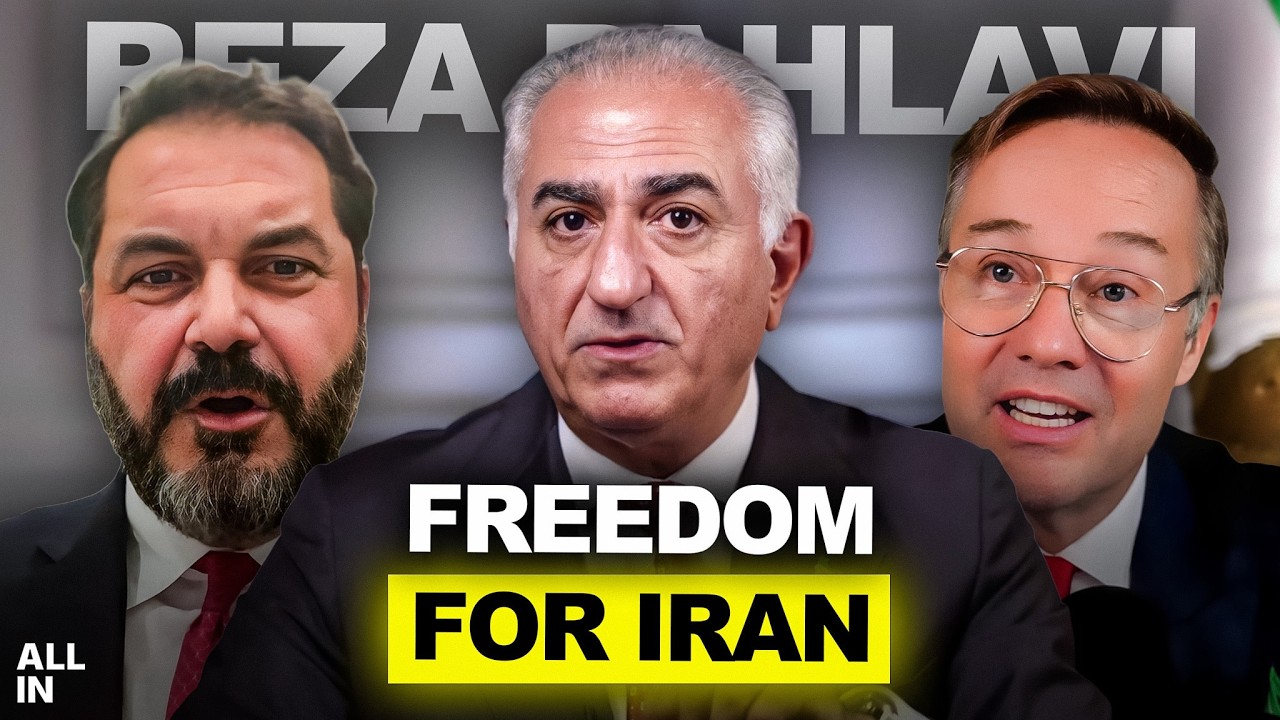
Pahlavi Outlines $1 Trillion Iranian Reconstruction Plan After Regime Collapse
All-In Podcast
Exiled Prince Reza Pahlavi and investor Shervin Pishevar assert that removing the Islamic Republic will unlock a $1 trillion economic windfall for international investors through a secular democratic transition.
## Background
The All-In Podcast published this interview episode on YouTube on March 7, 2026. According to the page description, the video features host Jason Calacanis alongside guest Shervin Pishevar interviewing Exiled Crown Prince Reza Pahlavi about his transition plan, vision for Iran's future democracy, leadership role, and the ongoing fight for Iranian freedom.
## TL;DR
In this episode, Crown Prince Reza Pahlavi outlines a structured transition plan for post-regime Iran, framing current military actions as a humanitarian intervention to rescue the population. He details core transitional principles—including secular democracy, territorial integrity, equal protection, and free elections—supported by a detailed 100-day economic stabilization blueprint called the Iran Prosperity Project. Following Pahlavi's remarks, investor Shervin Pishevar joins to discuss the severe domestic casualties under the current regime, the vast economic potential of a free Iran, and his family's personal exile story. Together, the hosts and guests project a future defined by regional stability, democratic governance, and deep U.S.–Iranian cooperation.
## Atmosphere & style
The dialogue carries a serious, highly focused, and historically weighty tone, balanced by moments of intense personal vulnerability and optimism. Jason Calacanis leads with a respectful, inquisitive interviewing style, giving space to both Pahlavi's measured, statesmanlike delivery and Pishevar's passionate, highly emotional testimony. The conversation moves fluidly between grand geopolitical strategy and intimate memories of escape, war, and cultural identity, giving the episode an urgent yet hopeful mood anchored in the prospect of national liberation.
## Key takeaways
- [00:00](https://www.youtube.com/watch?v=elhGYEiZ7fw&t=0s) Military operations in Iran should be viewed as a necessary humanitarian intervention and rescue mission to level the playing field against a regime that has killed tens of thousands of unarmed citizens.
- [00:00](https://www.youtube.com/watch?v=elhGYEiZ7fw&t=0s) A post-regime Iranian economic recovery could represent a $1 trillion opportunity for the U.S. market within the first 10 years, driven by secular democratic reforms and global trade.
- [03:00](https://www.youtube.com/watch?v=elhGYEiZ7fw&t=180s) Iran can avoid a post-war Iraq scenario due to its deep historical unity, surviving state institutions, and a broad national coalition uniting monarchists, republicans, and various ethnic groups.
- [07:03](https://www.youtube.com/watch?v=elhGYEiZ7fw&t=423s) Four non-negotiable core principles guide the political transition: territorial integrity, secularism (separation of religion and state), equal protection under the law, and democratic elections.
- [11:14](https://www.youtube.com/watch?v=elhGYEiZ7fw&t=674s) Prince Reza Pahlavi frames his role as a neutral facilitator and bridge to democracy rather than a candidate seeking political office, leaving the final choice of government to the electorate.
- [15:15](https://www.youtube.com/watch?v=elhGYEiZ7fw&t=915s) International allies, including the Trump administration, respect the right of the Iranian people to determine their own future leadership without foreign power imposition.
- [16:47](https://www.youtube.com/watch?v=elhGYEiZ7fw&t=1007s) The Iranian public has a long history of alignment with Western values and American citizens, highlighted by spontaneous public candlelight vigils following the 9/11 attacks.
- [21:33](https://www.youtube.com/watch?v=elhGYEiZ7fw&t=1293s) The Islamic Republic regime has used extreme, military-grade force against domestic protesters, resulting in over 43,000 casualties during recent crackdowns.
- [21:33](https://www.youtube.com/watch?v=elhGYEiZ7fw&t=1293s) Founding principles of the U.S. Constitution mirror ancient Persian governance concepts, such as Thomas Jefferson's study of Cyrus the Great's declaration of human rights.
- [29:39](https://www.youtube.com/watch?v=elhGYEiZ7fw&t=1779s) The Iran Prosperity Project (IPP) provides a 175-page technical blueprint outlining a month-by-month process for economic stabilization, governance, and national reconstruction.
- [34:29](https://www.youtube.com/watch?v=elhGYEiZ7fw&t=2069s) More than 50,000 members of the Iranian military have communicated through Prince Pahlavi's channels to coordinate defections and support a peaceful transition.
- [38:52](https://www.youtube.com/watch?v=elhGYEiZ7fw&t=2332s) Preserving the territorial integrity of Iran is a non-negotiable priority, rejecting any external efforts to support regional separatism.
## Detailed walkthrough
### [00:00](https://www.youtube.com/watch?v=elhGYEiZ7fw&t=0s) Introduction and the Humanitarian Intervention in Iran
Jason Calacanis opens part two of episode 263 of the *All-In Podcast*, thanking his friend Shervin Pishevar for arranging an historic interview with Prince Reza Pahlavi. Calacanis notes that Pahlavi, who left Iran at age 17 to train as a pilot, has been waiting nearly 50 years—47 years in exile—for this moment, as military operations raise the prospect of the Iranian people finally gaining their freedom.
Asked about his vision for post-conflict Iran, Pahlavi emphasizes that the ongoing military action should be understood as a necessary "humanitarian intervention" and a "rescue mission." He states that the intervention was essential to level the playing field against a brutal regime that has recently massacred tens of thousands of innocent, unarmed citizens.
Pahlavi outlines the broad goals for a post-regime transition:
* **Transition and Reconstruction:** Immediate stabilizing action followed by long-term redevelopment to address the basic needs of citizens.
* **The "North Korea" Contrast:** Had it not been for the 1979 revolution, Iran would be the "South Korea of the region" rather than its "North Korea." Pahlavi highlights that Iran's current state is not due to a lack of talent or resources, but bad management by a corrupt, mafia-like regime that took the country hostage to export an ideology.
* **Economic Potential:** A secular, democratic Iran will open the nation for global trade. Pahlavi estimates that rebuilding Iran could represent a $1 trillion economic opportunity for the U.S. market in the first 10 years alone, alongside massive international investments.
---
[00:03](https://www.youtube.com/watch?v=elhGYEiZ7fw&t=3s) Unifying a Nation: The Roadmap to Secular Democracy
Addressing the nation's demographics—where the average age is around 31 or 32—Calacanis asks about the timeline on the ground and how a transition away from autocracy toward democracy would unfold. Pahlavi explains that leveling the playing field allows citizens to reclaim the streets, supported by internal regime defections across military, security, and civilian bureaucratic sectors.
Unlike post-war Iraq, Pahlavi argues that Iran will avoid catastrophic state collapse:
* **Institutional Continuity:** Rather than full "de-Ba'athification," Iran boasts a multi-century history as a unified nation-state with administrative structures that can be preserved.
* **A Broad National Coalition:** The movement for change spans right, center, and left politics, uniting monarchists, republicans, diverse ethnic groups, and religious communities under a single national flag.
* **Widespread Domestic Support:** Pahlavi cites active backing from universities, the intelligentsia, the working class, and the global diaspora.
Pahlavi stresses that the ultimate destination must be a secular democracy defined by strict equality under the law. The exact constitutional model must be chosen by the Iranian electorate through free, fair elections.
---
[00:07](https://www.youtube.com/watch?v=elhGYEiZ7fw&t=7s) Conditions for Return and the Core Principles of Transition
Calacanis questions Pahlavi on the personal risks of returning home after 47 years in exile, asking what conditions must be met for him to step foot in Iran. Pahlavi acknowledges that while being in Iran is vital for leading effectively, he must wait until basic security measures are met, noting simply: "I'm no use to anyone if I'm dead."
Turning to U.S. President Donald Trump's demand for the regime's "unconditional surrender," Pahlavi aligns with the view that a clean break is required. After losing tens of thousands of lives, the Iranian public will not accept a recycled version of the current regime. He outlines four non-negotiable core principles for anyone participating in the transitional platform:
* **Territorial Integrity:** Preserving the unified nation-state across all ethnic and religious communities.
* **Separation of Religion and State:** Establishing a strictly secular government foundation.
* **Equal Protection and Rule of Law:** Guaranteeing fundamental civil rights for every citizen.
* **Democratic Elections:** Electing a constitutional assembly, passing a new constitution, and holding parliamentary elections before the transitional body hands over power to an elected government.
Pahlavi notes he has established the **Iran Prosperity Project (IPP)**, which focuses specifically on a detailed plan for the **first 100 days** to stabilize the economy and integrate defecting administrative elements.
---
[00:11](https://www.youtube.com/watch?v=elhGYEiZ7fw&t=11s) The Role of a Transitional Leader vs. Future Government
Addressing whether Iran could return to a monarchy or if he intends to run for president, Pahlavi makes a sharp distinction between the transitional process and its final outcome. He emphasizes that he views himself as a neutral arbiter and a bridge to democracy rather than a candidate seeking personal power or office.
* **Democracy Across Systems:** Pahlavi notes that successful democracies exist in both republican structures (such as the U.S., France, India, and Israel) and constitutional parliamentary monarchies (such as Japan, Sweden, Spain, and Canada).
* **Avoiding Past Mistakes:** Unlike the opacity surrounding Ruhollah Khomeini’s concept of *Velayat-e Faqih* (Guardianship of the Islamic Jurist) during the 1979 revolution, the upcoming process must offer complete transparency so citizens fully understand every proposed model before casting their vote.
* **Neutral Facilitator:** Pahlavi reiterates that his sole purpose is managing the transition so Iranians can exercise genuine sovereignty at the ballot box for the first time in half a century.
---
[00:15](https://www.youtube.com/watch?v=elhGYEiZ7fw&t=15s) Diplomacy, U.S. Relations, and Foreign Endorsements
Calacanis asks about President Trump's statements regarding selecting Iran's next leader and inquires about Pahlavi's direct communication channels with the U.S. administration.
Pahlavi confirms that his team maintains transparent communications with the Trump administration—specifically through special envoy **Steve Witkoff**, who has publicly acknowledged these channels—as well as key members of the U.S. Senate and House of Representatives.
Pahlavi refutes the idea that external powers will dictate Iran's future, stating that neither President Trump nor any other foreign leader presumes it is their role to select Iran's leadership. Democratic nations, he insists, will respect the fundamental right of the Iranian people to choose their own government.
[16:47](https://www.youtube.com/watch?v=elhGYEiZ7fw&t=1007s) Democratic Choice and the Iranian Diaspora
Crown Prince Reza Pahlavi re-emphasizes that the ultimate right to choose Iran's future leadership belongs exclusively to the Iranian people. Whether discussing transition plans with President Trump or other international heads of state, his consistent principle remains that foreign partners should only provide support while leaving the final choice to the nation's citizens. Turning to the cultural and social bonds between Iran and the West, Pahlavi highlights the deep integration of the Iranian diaspora—particularly across the United States. From intermarriages and business partnerships to the significant role Iranian entrepreneurs and tech professionals play in places like Silicon Valley, he outlines how the Iranian diaspora thrives while remaining deeply tied to their roots.
The Prince points out a striking historical contrast to remind Western audiences of the true nature of the Iranian people. Following the 9/11 terrorist attacks, while crowds in several regional countries celebrated the strikes against the United States, Iran was the only country in the region where citizens spontaneously gathered on the streets to hold candlelight vigils in solidarity with the American victims. For years, protesters inside Iran have openly rejected state propaganda, chanting slogans such as *"They lie to us! Our enemy is right here, not America!"* Pahlavi stresses that a free, democratic Iran will transform from a hostile actor into a stable, vital partner for global security. Host Jason Calacanis expresses hope for a democratic transition that could liberate 93 million people and establish the largest democracy in the Middle East, reminiscing warmly about the industrious and joyful Iranian community he knew while living in Los Angeles.
- **Diaspora Integration:** Vast connections through tech entrepreneurship, corporate leadership, academia, and intermarriage across the United States.
- **9/11 Solidarity:** Iranian citizens held spontaneous public candlelight vigils for American victims in 2001, contrasting with anti-American rallies elsewhere in the region.
- **Protest Slogans:** Domestic anti-regime slogans directly target internal leadership rather than foreign nations.
- **Demographic Scope:** A democratic transition directly impacts Iran's population of roughly 93 million people.
---
[21:33](https://www.youtube.com/watch?v=elhGYEiZ7fw&t=1293s) The Regime's Brutality and the U.S.–Iranian Historical Connection
After Crown Prince Reza Pahlavi departs the interview, Silicon Valley investor Shervin Pishevar joins Jason to discuss his personal involvement and the ongoing crisis. Pishevar praises the Crown Prince as a man of exceptional courage and integrity who has put everything on the line to lead a peaceful transition to democracy after 47 years of authoritarian rule. The conversation turns to the extraordinary violence of the Islamic Republic, which Pishevar notes recently gunned down more than 43,000 peaceful protesters using heavy, anti-materiel ammunition. To illustrate the scale of this force, he recalls posting a photo online comparing the massive physical size of those military-grade rounds directly to a standard Coca-Cola can. Calacanis underscores that the sheer scale of this domestic massacre has been drastically underreported by international media.
```
[ Coca-Cola Can ] <---> [ Anti-Materiel Round ]
(Standard size vs. Large-caliber military shell)
```
Pishevar, who historically supported Democratic political figures such as Barack Obama, commends President Trump's decisive actions against the regime, framing it as a vital matter of U.S. national security. He points out that an authoritarian apparatus willing to slaughter tens of thousands of its own citizens in 48 hours and launch attacks across 12 neighboring countries would not hesitate to deploy nuclear weapons if given the chance. Tracing the historic connection between the two cultures, Pishevar notes that U.S. Founding Father Thomas Jefferson studied Cyrus the Great, whose ancient cylinder is widely regarded as the first declaration of human rights. This shared heritage creates a deep, historical link connecting the American founding, Cyrus's liberation of the Jewish people from Babylon 2,500 years ago, and the modern push for Iranian freedom.
- **Casualty Figures:** Over 43,000 peaceful protesters killed by regime forces during recent crackdowns.
- **Munitions Visual:** Heavy anti-materiel rounds used against civilian crowds were physically larger than a standard Coca-Cola can.
- **Regional Hostilities:** The regime launched military strikes or proxy attacks affecting over 12 countries in the region during the crisis.
- **Historical Alliances:** Pishevar co-founded the Israeli-Iranian Alliance alongside Michael Eisenberg, Michael Broukhim, Jesse Maiman, and Shawn Rad.
- **Founding Heritage:** Thomas Jefferson's study of Cyrus the Great links the principles of the U.S. Constitution and Bill of Rights to ancient Persian statecraft.
---
[29:39](https://www.youtube.com/watch?v=elhGYEiZ7fw&t=1779s) The Economic Dividend and the "Iran Prosperity Project"
Comparing Iran's potential to the economic transformation of the Gulf Cooperation Council (GCC) nations, Pishevar notes how countries like the UAE, Saudi Arabia, Qatar, Oman, and Kuwait successfully leveraged their natural resources to modernize rapidly. Recalling his visits to Dubai in the early 2000s when it was mostly open land with a small cluster of buildings, he compares the GCC's recent infrastructure boom to America's post-WWII development under President Eisenhower's Interstate Highway System. Iran, blessed with vast oil and gas reserves alongside an exceptionally educated population, holds even greater growth potential once freed from authoritarian mismanagement.
Pishevar highlights the outsized economic impact of the Iranian diaspora in Silicon Valley, listing prominent business figures who have collectively generated trillions of dollars in enterprise value:
| Leader | Company / Role |
|:--- |:--- |
| **Dara Khosrowshahi** | CEO of Uber |
| **Shervin Pishevar** | Early Uber investor & entrepreneur |
| **Omid Kordestani** | Former Senior Executive at Google / Twitter |
| **Ali Ghodsi** | Co-founder & CEO of Databricks |
| **Pierre Omidyar** | Founder of eBay |
| **Emil Michael** | Former Chief Business Officer at Uber |
Unlocking that same entrepreneurial energy among 93 million people inside Iran would yield an unprecedented global peace and economic dividend.
To execute this vision seamlessly, an expert advisory team working with Crown Prince Reza Pahlavi authored the **Iran Prosperity Project**—a comprehensive 175-page technical blueprint detailing the month-by-month sequence for rebuilding the country's economy, infrastructure, and legal institutions:
```
[ Phase 1: Free Iran ]
│
▼
[ Month 0 - 4 ] ──► National Referendum on Form of Government
│
▼
[ Month 4 - 10 ] ──► Constitutional Assembly Drafts New Framework
│
▼
[ Month 10 - 24 ] ─► Finalize Draft & Hold National Vote on Constitution
```
- **Report Details:** The *Iran Prosperity Project* is a 175-page comprehensive roadmap designed to rebuild all economic and governance sectors.
- **Referendum Timeline:** A 4-month initial period following liberation to host a national referendum on the system of government.
- **Constitutional Framing:** A 6-month assembly process to draft the constitution, followed by a 14-month phase to finalize the legal text and hold a popular vote.
- **Emerging Tech Focus:** The plan integrates advanced technologies including Artificial General Intelligence (AGI) and quantum computing (referencing work with D-Wave) to accelerate economic modernization.
<ElicitationsGroup message="Explore related aspects of the transcript topic:">
<Elicitation label="Review Part 1 of the transcript" query="Provide a detailed walkthrough of Part 1 of this interview transcript, focusing on Prince Reza Pahlavi's initial vision and military transition plans."/>
<Elicitation label="Summarize the Iran Prosperity Project blueprint" query="Break down the specific economic and structural policies outlined in the 175-page Iran Prosperity Project report."/>
<ElicitationsGroup message="Explore related aspects of the transcript topic:">
<Elicitation label="Analyze the historical Cyrus the Great context" query="Explain the historical connection between Cyrus the Great, Thomas Jefferson, and the principles of the US Constitution mentioned by Shervin Pishevar."/>
</ElicitationsGroup>
</ElicitationsGroup>
Here is a detailed, faithful walkthrough based on the transcript segment provided.
[34:29](https://www.youtube.com/watch?v=elhGYEiZ7fw&t=2069s) The Iranian People's Call for Change and the Demise of the Regime
Shervin Pishevar emphasizes that the vast majority of the Iranian people want a clear separation of church and state—or as he frames it, "mosque and state." Pointing to the 47-year rule of the mullahs as a disastrous "A/B test" in contrast to Silicon Valley, he notes that it has resulted in nothing short of absolute evil, mayhem, and disaster. Across Iran, the public is calling out Crown Prince Reza Pahlavi’s name, echoing chants of "Javid Shah" seen in videos from January. When Pahlavi called for nationwide street protests at 8:00 p.m. on the 8th and 9th, millions turned out in response. The Iranian public is simultaneously calling on leaders like Donald Trump and Benjamin Netanyahu to save them from this terror regime, and Pishevar observes that their prayers are being answered in a "tremendous way."
The current military actions aim to dismantle and defang the regime's terror and military capabilities over an estimated four-week timeframe. Citing a leak in *The Washington Post* regarding the activation of the 82nd Airborne, Pishevar views this as a strong signal of escalating support for the liberation operation. Inside Iran, the Supreme Leader Ali Khamenei—an "absolutely evil man" who spent 47 years threatening the world—was eliminated in the first 60 seconds of the intervention, alongside the top leadership of the Islamic Revolutionary Guard Corps (IRGC) within 24 hours. The strategy relies heavily on military defections; over 50,000 military personnel have already responded securely to Crown Prince Pahlavi’s channels. For those who have not committed acts of genocide against the Iranian people, the transition plan offers either early retirement or the option to continue serving and receiving pay, ensuring the transition focuses on rehabilitation and peace rather than a general witch hunt.
- Over 50,000 Iranian military personnel have communicated securely via Pahlavi's channels.
- The military liberation operation is expected to last approximately four weeks.
- *The Washington Post* reported the activation of the 82nd Airborne as part of the broader signal of support.
- Iranian military members not guilty of violent atrocities will be eligible for early retirement or continued state service during reconstruction.
- Comprehensive mental health support will be required to address 47 years of multi-generational trauma.
[38:52](https://www.youtube.com/watch?v=elhGYEiZ7fw&t=2332s) Preserving National Integrity and the Personal Journey of Exile
Addressing reports of CIA backing for Western militias or regional Kurd dynamics, Pishevar asserts that maintaining the full territorial integrity of Iran is a non-negotiable red line for both the Iranian people and the Crown Prince. Having existed as a continuous civilization for 5,000 years, Iranians have outlasted past invaders like Genghis Khan, and Pishevar characterizes the 47-year regime merely as temporal occupiers. Supporting any separatist movement would destroy the goodwill of millions, as the ultimate goal remains a unified march on Tehran and the return of Prince Pahlavi to his homeland.
Sharing his own family's history of exile, Pishevar recounts leaving Iran after his birth in 1976. His father was part of an elite class of brilliant Iranians sent abroad on state scholarships by the last Shah to pursue higher education and return to build the country. While his father completed a master's degree at Catholic University in Washington, D.C. during the American Bicentennial, the family returned to Iran in 1978 just before the revolution. After his father was promoted to head radio and television for the Shah, the revolution struck. When Ayatollah Khomeini took power, Pishevar's father courageously aided foreign embassies by providing radio communication equipment and broadcasts to help foreign nationals evacuate.
This act placed his father, Abraham, on Khomeini and Khamenei's execution list, forcing him into hiding for 10 months. In a dramatic turn of events, a man whom his father had previously helped get a job in radio and television became the new head of security at Mehrabad Airport. Trusting this contact, his father was safely escorted directly onto an Air France flight to escape to the United States. Meanwhile, Pishevar, his mother, and his siblings remained trapped in Iran for two years amid the Iran-Iraq War, enduring nightly bombardments and air-raid sirens before escaping to America with only $35.
- Pishevar was born in 1976 and lived on 16th Street in Washington D.C. while his father attended Catholic University.
- His father went into hiding for 10 months after being placed on the regime's execution list for aiding foreign embassy evacuations.
- The head of security at Tehran's Mehrabad Airport personally escorted his father onto an Air France flight to save his life.
- Pishevar's family spent two years under bombardment during the Iran-Iraq War before escaping to the U.S. with $35.
- His father drove an orange and black taxi cab in Washington D.C. while pursuing his PhD, an experience Pishevar credits with giving him the perspective to win the early Uber venture investment against top VC competitors.
[44:11](https://www.youtube.com/watch?v=elhGYEiZ7fw&t=2651s) The Enduring Iranian Spirit and Looking Forward to a Free Tehran
Reflecting on the soul of the Iranian people, Jason Calacanis and Pishevar highlight their resilience, hospitality, and warmth, which have persisted despite decades of strict oppression. Calacanis references Anthony Bourdain's classic travel episode on Iran, which captured how ordinary Iranians express a profound love for life—enjoying pizza, music, VPN access, and late-night gatherings despite state restrictions on women, minority groups, and personal freedoms. Pishevar concurs, emphasizing that Iranians are fundamentally freedom-loving, warm hosts who welcome guests into their homes, making them "as American as you can be" in spirit.
Expressing deep gratitude to Donald Trump for taking on the regime, Pishevar looks forward to welcoming the podcast team to a liberated capital. Calacanis makes a commitment to host an episode of the *All-In Podcast* live in Tehran within a year, eager to experience authentic Iranian food and culture. Pishevar promises to share traditional dishes, noting that while Persian kebabs in Iran are unmatched, the true national dish is *Ghormeh Sabzi*—a slow-cooked lamb and herb stew that his mother used to prepare over three days. The conversation concludes on a warm, hopeful note regarding the shared culture between Greeks and Iranians, wishing safety and success for the critical transition weeks ahead.
- Anthony Bourdain's documentary segment is highlighted for showing the modern, vibrant, and freedom-loving spirit of everyday Iranians.
- The hosts set a tentative goal to record an episode of the *All-In Podcast* in Tehran one year from the interview date.
- *Ghormeh Sabzi* is celebrated as the signature national dish of Iran, traditionally slow-cooked for days.
## Notable quotes
> [07:00](https://www.youtube.com/watch?v=elhGYEiZ7fw&t=420s) I'm no use to anyone if I'm dead. — Crown Prince Reza Pahlavi
> [16:47](https://www.youtube.com/watch?v=elhGYEiZ7fw&t=1007s) They lie to us! Our enemy is right here, not America!
> [34:29](https://www.youtube.com/watch?v=elhGYEiZ7fw&t=2069s) mosque and state — Shervin Pishevar
> [34:29](https://www.youtube.com/watch?v=elhGYEiZ7fw&t=2069s) Javid Shah
## Mentioned
Reza Pahlavi, Shervin Pishevar, Jason Calacanis, Donald Trump, Steve Witkoff, Barack Obama, Benjamin Netanyahu, Ali Khamenei, Ruhollah Khomeini, Cyrus the Great, Thomas Jefferson, Anthony Bourdain, Dara Khosrowshahi, Omid Kordestani, Ali Ghodsi, Pierre Omidyar, Emil Michael, Michael Eisenberg, Michael Broukhim, Jesse Maiman, Shawn Rad, All-In Podcast, Iran Prosperity Project, Uber, Databricks, eBay, Google, Twitter, Islamic Revolutionary Guard Corps, IRGC, 82nd Airborne, Catholic University, Air France, D-Wave, The Washington Post, YouTube, Silicon Valley
Crown Prince Reza Pahlavi and investor Shervin Pishevar outline a post-regime roadmap for Iran, framing current military actions as a humanitarian intervention to dismantle the clerical autocracy and establish a secular democracy. Their proposal pairs an phased constitutional roadmap with economic reconstruction, relying on military defections and diaspora technical expertise.
Transition Roadmap and Institutional Continuity
Pahlavi outlines four non-negotiable principles for any transitional authority: preserving Iran's territorial integrity, enforcing a strict separation of religion and state, guaranteeing equal protection under the law, and conducting democratic elections. Contrasting the proposed transition with post-war Iraq, Pahlavi argues against widespread administrative purges, maintaining that Iran's established bureaucratic and institutional foundations should be preserved to prevent state collapse.
These governance steps are formalized in the Iran Prosperity Project, a 175-page technical blueprint authored by an advisory team. The roadmap schedules an initial 100-day stabilization period, followed by a national referendum on the system of government within the first four months. The subsequent phases allocate six months for a constitutional assembly to draft a legal framework and 14 months to finalize the draft and hold a nationwide popular vote.
Neutral Arbiter Role and Foreign Relations
Pahlavi describes his intended role as a neutral facilitator and temporary bridge rather than an aspiring head of state, leaving the constitutional structure to the electorate. He notes that viable democratic systems exist as both republics and constitutional monarchies, emphasizing that transparent civic debate must precede any vote to avoid repeating the political opacity that followed the 1979 revolution.
Addressing foreign relations, Pahlavi confirms active communication with the Trump administration through special envoy Steve Witkoff and members of the U.S. Congress. However, both Pahlavi and Pishevar insist that foreign partners must not select Iran's leadership, maintaining that full sovereignty rests with the 93 million Iranian citizens. They further reject external support for separatist movements, asserting that territorial integrity is essential to maintaining broad public consensus.
Economic Reconstruction and Modernization Plans (29:39)
Comparing Iran's trajectory to Gulf Cooperation Council states and South Korea, Pahlavi and Pishevar argue that domestic economic distress is caused by state corruption and ideological resource diversion rather than insufficient domestic talent. Pahlavi forecasts that post-transition reconstruction and access to global commerce could generate a $1 trillion economic opportunity for the U.S. market within the first 10 years alone.
The recovery strategy seeks to leverage the global Iranian diaspora, highlighting tech executives such as Databricks CEO Ali Ghodsi, Uber CEO Dara Khosrowshahi, and eBay founder Pierre Omidyar. The Iran Prosperity Project blueprint proposes modernizing the economy by deploying advanced technologies, citing early integration work with Artificial General Intelligence and quantum computing firm D-Wave.
Defection Strategies and Civilian Protection (34:29)
Addressing recent civilian crackdowns, Pishevar asserts that regime forces killed more than 43,000 peaceful protesters using heavy, military-grade anti-materiel ammunition. Transition organizers anticipate a four-week campaign to neutralize the regime's military command, depending heavily on encouraging internal armed forces to break ranks.
Pishevar claims that over 50,000 security and military personnel have already contacted Pahlavi's channels securely. The transition framework proposes that soldiers and officials not implicated in atrocities will be offered continued compensation or early retirement. While Pahlavi states that his physical presence in Iran will be necessary to guide the transition, he clarifies that his return depends on securing basic safety measures on the ground.
The presented transition model assumes that deep-seated regime institutions can be systematically defanged within weeks while administrative functions remain intact. However, the blueprint relies on untested assumptions regarding large-scale military defections, frictionless collaboration among disparate political factions, and the ability to maintain internal stability without sparking regional factionalism.
[7:00] Crown Prince Reza Pahlavi: I'm no use to anyone if I'm dead.
[16:47] They lie to us! Our enemy is right here, not America!
[34:29] Shervin Pishevar: mosque and state
[34:29] Javid Shah
[44:11] Shervin Pishevar: Ghormeh Sabzi
Original transcript
[0:00] All right, everybody. Welcome back to
[0:01] part two of the All-In podcast episode
[0:05] 263. We promised you a part two because
[0:08] we are very lucky that my dear friend
[0:10] Shervin Pishevar was able to set up a
[0:13] very important historic interview for us
[0:16] today.
[0:17] None other than Prince Reza
[0:20] Pahlavi is here.
[0:21] And we have a limited amount of time
[0:24] with you, Reza. And may I call you Reza
[0:27] or should I call you Prince Reza?
[0:29] >> Thank you.
[0:30] >> [laughter]
[0:30] >> Uh
[0:31] >> I can probably meet you on your program.
[0:32] It It's great to have you.
[0:35] And this is a moment I think you've been
[0:37] waiting 47, close to 50 years for it,
[0:40] which is we are at this moment in time
[0:44] looking at
[0:45] potentially the people of Iran being
[0:47] free. You left the country and
[0:50] when you were 17 years old to become a
[0:51] pilot. And now
[0:54] you are looking to help your people with
[0:57] a transition post this military
[1:00] activity, this operation,
[1:03] essentially a war that's going on right
[1:05] now that we all hope
[1:07] gets resolved quickly.
[1:09] I think people would love to know what
[1:11] is your vision for Iran
[1:16] post
[1:17] this military action.
[1:21] Well, thank you again for the
[1:22] opportunity. Before I get into that, I
[1:24] wanted to simply
[1:26] stress the importance of this
[1:28] intervention that it was like a rescue
[1:30] mission. It was literally an a
[1:33] humanitarian intervention to protect
[1:36] more lives that it would otherwise be
[1:38] lost under this extremely brutal and
[1:40] repressive regime that as you know has
[1:42] massacred as of late
[1:44] tens of thousands of innocent and
[1:46] unarmed citizens. In order to equalize
[1:49] the playing field, this was a
[1:50] much-needed
[1:52] intervention that a lot of Iranians
[1:53] asked for and fortunately it did happen.
[1:57] But what's the next step? Where are we
[1:59] headed to?
[2:00] The most obvious question would be once
[2:02] the regime collapses, how do we manage
[2:04] the transition? I've stepped in to lead
[2:06] this transition with the help of many of
[2:08] my compatriots from various sectors. We
[2:11] believe that a a stable transition will
[2:13] lead to a address the immediate needs of
[2:15] the country, but then set the country on
[2:18] a path of redevelopment and
[2:19] reconstruction, which is of course
[2:21] something that we were always hoping for
[2:24] that could not have a happened under
[2:26] this uh corrupt mafia-like regime. Iran
[2:29] should have been, had it not been for
[2:31] the revolution, today's South Korea of
[2:33] the region. Instead, it has become the
[2:35] North Korea of the region. Why? Not
[2:38] because our people are not gifted or
[2:40] talented or capable, not because we lack
[2:43] uh natural resources, it's simply
[2:45] because of a corrupt bad management and
[2:47] a regime that basically took our country
[2:49] hostage, used it as a launching pad to
[2:52] export an ideology, and that's why we
[2:54] are here today.
[2:55] A different Iran, a democratic secular
[2:57] Iran would first and foremost bring
[2:59] about the opportunities to our nation,
[3:02] but it will open Iran for business
[3:04] again.
[3:05] Iran is one of the most untapped uh
[3:07] uh economic um opportunities of the 21st
[3:10] century, and it could tremendously uh
[3:13] change the shape of our world in terms
[3:15] of what would be beneficial to the
[3:16] Iranian people, of course, but also uh
[3:19] from the advantage point of a country
[3:21] like the United States and billions of
[3:23] dollars that will be generated as a
[3:25] result of doing business in Iran. We
[3:28] figure about 1 trillion in the first 10
[3:30] years to the US market, but also
[3:33] billions of dollars that will be
[3:34] invested into Iran and everything that
[3:36] we need to have done in order to rebuild
[3:39] our country. These are crazy
[3:40] opportunities that uh we can look
[3:42] forward to, and it all starts with
[3:45] uh moving towards this recovery and
[3:48] transition.
[3:49] And
[3:50] when your father was in charge, it was a
[3:52] monarchy. Turned into a dictatorship.
[3:55] And to be clear, the hope now is to
[3:57] evolve into a democracy with free
[4:00] elections for the people. Average age of
[4:02] people in Iran now,
[4:04] early 30s, 31, 32 years old.
[4:07] What would that look like? What is a
[4:08] possible timeline? And you are have said
[4:11] on other programs and on your YouTube
[4:13] channel, which I suggest everybody go
[4:14] search for and follow right now because
[4:16] you're speaking directly to the people
[4:17] on X and on your YouTube channel.
[4:21] What is What is the
[4:23] condition on the ground from the people
[4:25] you're talking to? You said you've been
[4:27] talking to people in the military,
[4:30] civilians, and other leadership. They're
[4:32] ready to move on. What's the timeline?
[4:35] And what are they telling you is
[4:36] happening on the ground today as we sit
[4:39] here? Well, I think that now the playing
[4:41] field has been equalized, meaning that
[4:42] the people could finally, of course,
[4:45] awaiting the end of this campaign, have
[4:47] a better opportunity to reengage the
[4:49] streets and take over
[4:51] their homeland.
[4:52] Of course, part of the equation is how
[4:54] much implosion from within the regime
[4:56] and how much defection from the regime
[4:58] in the sense of joining with the people
[5:00] this time and not be an instrument that
[5:03] will halt the people's progress, but
[5:04] instead help the people in that
[5:06] transition. Meaning whether people are
[5:09] in the military or security forces, as
[5:11] well as a civilian bureaucracy. Unlike
[5:14] what happened after the fall of Saddam
[5:16] Hussein and the Ba'athification, the
[5:18] scenario of change in Iran is totally
[5:19] different.
[5:21] And let's not forget, Iran is a multiple
[5:24] century old nation-state. It's a country
[5:26] that is extremely unified and united for
[5:29] this common purpose.
[5:31] Under this tent, we have diverse groups
[5:33] that are joining in this national
[5:35] campaign. People who are on the right,
[5:37] the center, the left, monarchists,
[5:39] republicans, ethnic groups, religious
[5:41] groups. Every sector of society is
[5:44] engaged. I have had a tremendous amount
[5:46] of uh coming from inside Iran. We have
[5:48] the support of the uh intelligentsia. We
[5:52] have the support of universities. We
[5:54] have the support of the working class.
[5:56] We have the support of uh the diaspora
[5:58] that can bring a lot to this equation. I
[6:01] think this is a good recipe uh that will
[6:03] allow us to manage this uh transition,
[6:06] but set the country
[6:08] to clean up, be ready for business, and
[6:11] create the opportunities that will
[6:13] finally impact
[6:15] first and foremost Iranians who have
[6:17] been starving as a result of this
[6:18] regime's corruption, but have a true
[6:20] opportunity to get back on track and
[6:22] improve their livelihood. And I think
[6:24] it's also good for those who partner
[6:25] with us in this process cuz there's a
[6:27] lot to be uh done that will be win-win
[6:29] as opposed to be lose-lose to the
[6:31] benefit of this corrupt regime. That has
[6:33] been the story of the past almost five
[6:35] decades.
[6:36] So, the difference lies in but this
[6:38] change and how crucial it is. And of
[6:39] course, the reason we want to have a
[6:41] secular democracy, the final form to be
[6:44] determined by the people of Iran through
[6:46] free elections and a constitutional
[6:48] process, but most important is that
[6:50] under equality and the rule of law, all
[6:53] the opportunities that has been denied
[6:55] our nation as a result of its
[6:56] discrimination, as a result of uh
[6:59] pretty much disenfranchising the
[7:00] majority of Iranians, now it creates a
[7:03] true opportunity. And as I said earlier,
[7:05] I think Iranians are quite gifted. As
[7:07] much as it is attractive to uh um
[7:09] entrepreneurs in the outside world
[7:11] looking in, there's so many gifted and
[7:13] talented young Iranians who will have a
[7:15] fair chance this time, a true chance for
[7:18] being uh using all their creativity and
[7:20] genius uh to bring our country back
[7:22] online. This will be an excellent,
[7:24] fantastic partnership that we're looking
[7:26] forward to. So, you've spoken about
[7:29] wanting to be on the ground there. What
[7:31] conditions and what timeline do you have
[7:33] for yourself? And this seems like a a
[7:35] pretty high-risk thing to do. It'd be
[7:37] pretty brave of you to uh go to the
[7:40] country now. What conditions have to be
[7:42] met for you to
[7:45] go to Iran, to go home
[7:47] for the first time in 47 years? And how
[7:50] close do you think we are to the people
[7:52] taking the streets now and for starting
[7:54] this transition?
[7:56] Well, to be honest with you, it's very
[7:58] difficult to put an exact timeline.
[8:00] Factors that will expedite it is the
[8:02] level of separation from the regime, the
[8:05] level of defections,
[8:07] the strengthening of domestic
[8:09] organizations and structure. How can we
[8:11] partner with elements from within that
[8:13] are not joining this campaign? All of
[8:15] these are factors that will contribute
[8:17] to the rapidity of the of the
[8:19] transition. As far as myself being
[8:21] there, obviously there are security
[8:23] concerns to make sure that it's safe
[8:25] enough for me to go there. I'm no use to
[8:27] anyone if I'm dead. So, obviously we
[8:29] have to keep that in mind, but I would
[8:31] like to be able to be there as soon as
[8:32] possible to be able to help as much as I
[8:35] can in this process. Obviously, being in
[8:37] a country is an advantage. It's hard to
[8:39] do things from far away. I had no choice
[8:42] to be living in exile because of the
[8:43] circumstances, but I think that the
[8:45] opportunity is presenting itself and the
[8:48] first opportunity that is created for me
[8:50] to safely return to Iran, I will
[8:52] obviously be there. Just this morning,
[8:54] Trump said there will be no deal
[8:56] in Iran until unconditional surrender
[9:00] is given by whatever is left of the
[9:04] government there.
[9:06] What do you think of that condition? Is
[9:08] that the right move? Do you agree with
[9:09] Trump's ultimatum?
[9:11] Well, let me look at it from the
[9:13] domestic prism. In order for a
[9:15] successful transition to occur, it has
[9:18] ultimately to be something that is
[9:20] legitimate in the eyes of the Iranian
[9:22] people.
[9:23] We have lost so many tens of thousands
[9:25] of lives just to settle for a continuity
[9:29] of the remnants of this regime. That
[9:31] will not fly. People will want to have a
[9:33] clean break. The alternative will be for
[9:36] all those who align with the secular
[9:37] democratic alternative and are some four
[9:40] core principles that who whoever adheres
[9:43] to to that including people who may
[9:45] today peel away from the regime
[9:47] would be able to agree to work together
[9:49] on that platform. The first and foremost
[9:51] issue is of course Iran's
[9:54] territorial integrity. That's an issue
[9:56] that is very close to the hearts of
[9:57] millions of Iranians representing every
[10:00] aspect of our
[10:01] diversified country in terms of
[10:04] ethnicities, religions and what have
[10:06] you, but we find ourselves in this
[10:07] united
[10:09] cause under one flag and under one
[10:11] nation. The second element that is a
[10:13] prerequisite to democracy is a clear
[10:16] separation of religion from state.
[10:19] That's a critical element for a
[10:20] democracy to occur.
[10:22] Equality of all citizens under the law
[10:25] and the rule of law obviously is a
[10:26] critical aspect that guarantees all of
[10:28] the rights we're talking about and the
[10:30] democratic process itself meaning the
[10:33] fact that people can elect the
[10:34] representatives to go to this
[10:36] constitutional assembly to debate the
[10:38] issues of what the next system could
[10:40] look like and what its laws should be
[10:41] ratified by the people which would bring
[10:44] us to the election of the first
[10:46] parliament of this new democracy and of
[10:48] course the election of the first
[10:49] government of such democracy at which
[10:52] point the transitional government hands
[10:54] over power to the elected
[10:57] representative of the people in the
[10:58] future government. That's pretty much
[11:00] the the the direction that we hope to
[11:02] manage this transition and I'm playing a
[11:05] role in bringing about this transition
[11:07] with a very well crafted plan that is in
[11:11] detail explaining
[11:12] particularly focusing on the first 100
[11:14] days.
[11:15] I created an organization called IPP
[11:17] which is Iran prosperity project but its
[11:20] first focus is the first 100 days. How
[11:22] we immediately stabilize the situation
[11:23] in Iran, how can we maximize the
[11:26] remaining elements that will join with
[11:28] us to be able to survive regime change
[11:30] and have a place in the future. These
[11:32] are the first components and then we
[11:34] move forward with the plan.
[11:36] Two quick questions. Under no
[11:37] circumstances would that be a monarchy?
[11:40] Uh I think uh is a question everybody
[11:42] has for you because you're the prince.
[11:45] This is a democracy. We don't have
[11:47] princes in democracies.
[11:48] And then number two, what do you ideally
[11:50] see as your role in the transition?
[11:53] And then would you like to have the
[11:56] opportunity to run for president and to
[11:59] lead the country out of this
[12:01] horrific nightmare of 47 years?
[12:04] My focus is on the process, not the
[12:06] outcome. And in as a neutral arbiter,
[12:08] I'm not taking sides with one form
[12:11] versus the other. That's for the people
[12:12] of Iran to choose. And I think the world
[12:15] has seen successful models in both the
[12:17] Republican system and a monarchic
[12:19] system. Examples uh
[12:22] a republic that you have like in India
[12:24] or like in Israel or in France or the
[12:27] United States, they're not exactly the
[12:28] same. But that's on the of the
[12:30] Republican structure. In terms of
[12:33] parliamentary monarchies, we have the
[12:34] example of Japan, Sweden, Spain, other
[12:37] countries. So, I don't think that
[12:39] necessarily you can equate democracy
[12:41] with one outcome in particular. It could
[12:43] be both models that people can emulate.
[12:46] So, at the end of the day, you know,
[12:48] again, uh it's not for me to choose the
[12:50] outcome. I'm here to be a bridge towards
[12:52] that outcome. That's the function of a
[12:54] transitional leader, not to run for
[12:56] office
[12:57] or not to have an aim for personal uh
[12:59] position or power or authority, but to
[13:02] be the element that unites the country
[13:04] towards a common purpose and allow the
[13:06] nation to decide what is their preferred
[13:09] system. That's what elections and free
[13:11] elections should be all about. And the
[13:13] ballot box is the only means to measure
[13:15] uh people's uh opinion and the majority
[13:18] uh will decide on that and that's the
[13:20] process that I envisage to bring about.
[13:22] What do you believe the people of Iran
[13:24] want? And in that monarchy subset, there
[13:29] are the Gulf monarchies, the kingdom,
[13:31] UAE,
[13:33] Qatar.
[13:34] They are obviously distinctly different
[13:36] than a parliamentary
[13:39] you know, system. So,
[13:41] I assume you wouldn't want to see that.
[13:44] What do you think the people of Iran
[13:46] will vote for?
[13:47] But, just what you said. I mean, we
[13:50] a democratic system clearly outlines how
[13:53] it should be and and how it should not.
[13:57] I mean, if you want to look at the
[13:58] closest monarchy to the United States,
[14:00] technically speaking, it's Canada. And
[14:03] you know, if you want to look at that
[14:04] way. And I think Canadians are quite
[14:05] happy with a democracy that they enjoy.
[14:08] And again, we have very good models of
[14:10] republic. Case in point, the United
[14:12] States. At the end of the day, as I
[14:14] said, it's for the Iranian people to
[14:16] determine what would be in their best
[14:18] interest, having looked this time,
[14:21] unlike what happened, by the way, 50
[14:23] years ago. Nobody had a clear idea what
[14:26] Khomeini was suggesting
[14:28] in terms of this Velayat-e Faqih, as
[14:31] they call it, or the tutelage of the
[14:33] supreme leader. By the time he took over
[14:36] and power was established, it was too
[14:38] late. And since then, we've been
[14:39] hostages to this regime. This time, in
[14:42] full transparency, the Iranian people
[14:44] ought to have a clear idea of different
[14:47] models presented to them. And on that
[14:49] basis, having understood every aspect of
[14:52] what it could be, then they make their
[14:53] choice. This is a process that should be
[14:55] totally transparent, with enough time
[14:57] for debating different ideas. And again,
[15:00] as I said, let the democratic process
[15:02] unfold and let the people vote in
[15:04] majority what is their final
[15:06] choice. I'm not here to determine an
[15:08] outcome. Again, I stress, my role here
[15:10] is to manage this transition and create
[15:13] an opportunity that people have been
[15:15] deprived of for half a century to
[15:17] finally have a say as to what they they
[15:20] like to have for themselves in terms of
[15:22] sovereignty and determining their own
[15:24] future democratically. Final question
[15:26] and I'll get into a bunch of details
[15:28] with you Shervin as to the plan which I
[15:30] know you're helping construct and I'm
[15:33] assuming you'll help execute on.
[15:35] Trump
[15:36] says he's going to pick the next leader.
[15:38] Trump says a lot of things. He says them
[15:40] sometimes in a
[15:42] provocative way.
[15:44] But he said he's not sure how you would
[15:46] play within your own country. There's
[15:47] obviously people holding up your
[15:49] picture. There are people who are maybe
[15:52] vying to take control of this from the
[15:53] previous administration.
[15:56] Are you in touch with President Trump
[15:58] and what's your relationship with him
[15:59] today? What's your best
[16:03] plea to him or your argument to him
[16:07] to work with you? Look, there's nothing
[16:10] hidden in the agenda. Everything is
[16:11] transparent and I've been communicating
[16:13] with the administration by Steve Witkoff
[16:16] who announced it publicly. That's what
[16:18] was our channel to President Trump. And
[16:20] of course on the other side in the
[16:22] legislation with members of Congress,
[16:24] senators and congress people to
[16:27] understand a little bit from the
[16:28] American prism what it is that we are
[16:30] proposing here. I don't think that
[16:32] President Trump or any other leader in
[16:34] the this world would presume that it's
[16:36] his up to them to determine who should
[16:38] be the next leader in Iran. I'm sure as
[16:40] democracies they respect the right for
[16:42] people to make that choice. And as
[16:45] Western democracies it should be going
[16:47] without saying that they would believe
[16:49] that the the right to choose the future
[16:52] leaders is only up to the Iranian
[16:54] people. If the intention is to assist
[16:56] that process
[16:58] if the intent is to support the Iranian
[17:01] people in their democratic aspiration
[17:03] you provide them with the help but the
[17:05] choice should be theirs. That has been
[17:06] my position and I don't think there's a
[17:08] disagreement on that whether it is with
[17:10] President Trump or other world leaders
[17:12] that I've also talked to about this
[17:14] matter. As So you go, what should the
[17:16] American people know about the spirit,
[17:19] the culture, and the people of Iran,
[17:22] including the people who fled in 1979
[17:25] like you and your family?
[17:28] Well, I I know many Americans who have
[17:29] many Iranian friends. As a matter of
[17:31] fact, if you just look at the Iranian
[17:33] diaspora in the United States alone,
[17:36] you will see how much interaction there
[17:38] is between Iranians who are now Iranian
[17:41] Americans, if you will, many of them,
[17:43] and the kind of relationship that I've
[17:45] built with
[17:46] their American counterpart. And many
[17:48] people have
[17:50] connections via marriages. Many people
[17:52] have connections through business
[17:54] affiliations. Many people have worked
[17:56] with Iranians. Many of the high-tech
[17:58] companies, including Silicon Valley,
[18:01] employ so many Iranians or they are
[18:03] themselves entrepreneurs. This is the
[18:05] kind of potential, and I'm sure Shervin
[18:07] will talk to you more about that, but
[18:08] this is the kind of connections there
[18:10] is. And for Americans that have traveled
[18:12] to Iran or have known Iranians all these
[18:14] years, they know what what what country
[18:17] it represents, what amount of culture,
[18:19] arts,
[18:21] I mean, civilization in the true sense
[18:23] Iranians represent. And they've been
[18:25] completely suffocated under this regime.
[18:28] But once Iran is is you know, free from
[18:31] its shackles,
[18:33] I'm sure a lot of Americans know
[18:36] what difference there is between an Iran
[18:38] that wants to be friends with America,
[18:41] that is not the regime that has from its
[18:43] inception called death to America or
[18:45] death to Israel, for instance. But there
[18:47] are Iranians who actually love to
[18:50] America. Let me just give you a last
[18:52] parting thought, because I think every
[18:54] now and then I need to remind your
[18:56] audience and other audiences,
[18:58] we talked about other countries in the
[19:00] region. Remember 9/11?
[19:03] Yes.
[19:03] >> And how many people on the streets of
[19:05] many of the so-called allies of the
[19:07] United States were celebrating that
[19:09] attack on that sinister day?
[19:11] The only country in the entire world and
[19:13] the entire region
[19:15] that actually stood in candlelight
[19:17] vigils in sympathy to the victims of the
[19:19] 9/11 terrorist attacks were no other
[19:21] than the Iranian people themselves
[19:23] holding candlelight vigils in Iran.
[19:27] And they've been messaging America for
[19:29] years now. We are not your enemies. In
[19:31] fact, they would been chanting slogans
[19:33] in Iran
[19:34] saying, "They lie to us. It's America.
[19:36] Our enemy is right here." This is the
[19:39] Iran I'm talking about. This is the
[19:40] people I'm talking about. And I know
[19:42] many Americans, both in the civilian
[19:44] sector, including military forces in
[19:46] America, know that. And I think that's
[19:49] something that
[19:50] I'm sure I'm not the only one,
[19:52] you know, talking about this. You will
[19:54] hear from other Iranians who will pretty
[19:56] much confirm what I just said. That's
[19:58] why this partnership is so vital for us
[20:01] because together we'll be able to
[20:03] rebuild,
[20:04] you know, a different world. Iran will
[20:06] bring an element of stability to the
[20:08] region and beyond. And that can only
[20:10] play to the interest of
[20:12] America itself. We need to have this
[20:14] vital partnership. And I think we'll be
[20:17] able to succeed because I see everybody
[20:18] now is very much committed to work
[20:21] together towards
[20:22] bringing this agenda forward. Well,
[20:24] we're we're all praying for the people
[20:26] of Iran to have a democracy. And what an
[20:28] amazing moment will be when you get to
[20:31] return
[20:33] in whatever capacity and help this
[20:34] transition. And 93 million people who
[20:37] have been suffering will be living free
[20:40] in a democracy. And the impact that
[20:42] could have on the world and obviously
[20:44] that region would be by far the largest
[20:46] democracy in in
[20:48] the Middle East. And this could have
[20:51] ramifications in terms of humanity that
[20:53] would be absolutely stunning and
[20:55] beautiful. And the prosperity would be
[20:57] amazing.
[20:59] The Iranian people I met in my life,
[21:01] Prince,
[21:02] when I was living in Los Angeles, all
[21:04] these great Persians I would meet
[21:06] were some of the most joyful
[21:10] and industrious, beautiful individuals
[21:12] I've met. They remind me of my Greek and
[21:14] Irish heritage, including you, Shervin.
[21:15] So, Prince Reza, thank you so much for
[21:17] your time. I know you're extremely busy.
[21:19] It's very important for the All-In
[21:21] audience to hear from you
[21:22] and to understand what's going on and
[21:24] your vision, and we would love to have
[21:25] you back when you're on the ground with
[21:28] your people and that your people are
[21:30] free. Thank you again. Looking forward
[21:32] to it.
[21:33] All right, Shervin. Thank you so much
[21:34] for setting this up.
[21:36] I ask for very few favors from my
[21:37] friends, but as a good friend, you made
[21:40] this happen for the All-In community, so
[21:42] we I thank you for that. Of course. And
[21:44] as I as I said to to the prince, the
[21:46] people
[21:48] and then the Persians here in the United
[21:49] States, maybe you can tell us a little
[21:50] bit about your story and and what this
[21:52] means to you and then we can get into
[21:54] your involvement here and what you hope
[21:56] to see in those first 100 days. Of
[21:58] course. First of all, Jason, thank you
[22:00] for opening up this tremendous platform
[22:03] to the Iranian people and to the prince.
[22:06] As you can see,
[22:08] the Crown Prince Reza Pahlavi is a is a
[22:10] great man, the most courageous man that
[22:12] I've ever met
[22:14] and he's a the highest integrity human
[22:16] I've I've met as well. We're very
[22:18] blessed as a people to have a leader
[22:20] like him
[22:22] who has lived a very clean life and has
[22:26] stepped up in a very courageous way.
[22:28] He's put it all on the line for his
[22:30] people and his legacy to play this
[22:33] tremendous transitional role to evolve
[22:37] the Iranian
[22:38] nation to a democracy
[22:41] and this long nightmare of 47 years that
[22:44] all of my Iranian brothers and sisters
[22:46] have suffered through
[22:48] is almost over and also tremendous
[22:51] gratitude to President Trump for his
[22:55] courageous leadership on this matter. I
[22:58] don't think any other president uh, have
[23:00] the courage and the principle and the
[23:02] values to take on this Islamic regime of
[23:05] terror. As you saw last month, uh, they
[23:08] massacred uh, over 43,000 Iranians who
[23:13] were just peacefully protesting. They
[23:15] gunned them down with anti-material
[23:17] bullets. I I put a post of a Coca-Cola
[23:20] can next to these bullets. It was bigger
[23:22] than the can. Uh, that's what they
[23:24] >> And this is super important to to
[23:26] meditate on for a second here. This
[23:28] regime is a murderous and evil regime to
[23:31] turn those guns and mow down 40,000
[23:35] and over 40,000 individuals peacefully
[23:37] protesting is just an act of savagery
[23:39] and brutality that I think most people
[23:42] don't appreciate and
[23:44] uh, or don't fully appreciate. Um, and
[23:46] we there hasn't been enough coverage of
[23:47] that fact.
[23:48] >> No. And you
[23:50] are a bipartisan type person. I've known
[23:52] you for many years. You you were a
[23:54] super, uh, funder of Obama. He wasn't
[23:58] able to get this done. Biden wasn't able
[24:00] to get this done. Bush wasn't able to
[24:01] get this done. This has been something
[24:02] that presidents have struggled with.
[24:05] And you got to give Trump credit here.
[24:07] There's a lot of debate over why this is
[24:09] happening. Is it Israel driving it? Is
[24:11] it the relationship with China? We
[24:12] talked about on that in part one.
[24:14] At the end of the day
[24:16] as uh, a son of Iran what's matters is
[24:20] that the people are free. All these
[24:21] other conspiracy theories theories and
[24:25] motivations do not matter to you or the
[24:27] people, yeah? Absolutely not. I uh, But
[24:30] but one of my key principles is our our
[24:35] our secure our moral security presages
[24:37] our physical security. So, this has as
[24:40] much to do with Americans uh, security
[24:44] as it does Iranians security and
[24:47] livelihood. As you saw, this regime is
[24:49] not only uh, evil enough to mow down
[24:52] 43,000 innocent people in 48 hours.
[24:55] Their reaction to this liberation
[24:59] operation is to attack over 12 countries
[25:02] in the region. Imagine if they had a
[25:05] nuclear bomb, they would use it. They
[25:07] would use it. There's not even a doubt
[25:09] in my mind that they would have used it
[25:10] by now if they had it.
[25:13] So, this is incredibly important for
[25:15] America's national security.
[25:18] As the prince mentioned, 9/11 happened.
[25:22] That's the same kind of ideology except
[25:25] the problem we have in our modern time
[25:27] is that basically criminal and terrorist
[25:29] organizations have taken over sovereign
[25:31] nations with nuclear bombs or seeking
[25:34] nuclear bombs. We have Russia, China,
[25:38] you know, we have North Korea, and you
[25:40] have Iran. And then you have Venezuela.
[25:42] So, the president has not only
[25:44] gotten rid of the Maduro in in
[25:46] Venezuela, he has now begun this process
[25:49] of dismantling this this Islamic regime
[25:52] who is absolutely
[25:54] not a legitimate government and not a
[25:57] legitimate
[25:59] nation-state. And the only leader that
[26:03] is legitimate to lead us to a transition
[26:06] process to become a democracy is the
[26:09] Crown Prince Reza Pahlavi. We are very
[26:11] lucky I think in our modern times to
[26:14] have three leaders who are living at the
[26:16] same time and leading at the same time
[26:18] as President Trump, President Netanyahu,
[26:21] and Prime Minister Netanyahu, and and
[26:23] the Crown Prince Reza Pahlavi all in in
[26:26] this one moment in time. I think we're
[26:28] living in biblical times. When 10/7
[26:31] happened,
[26:33] I started the Israeli-Iranian Alliance
[26:35] with Michael Eisenberg, Michael
[26:36] Broukhim,
[26:38] Jesse Maiman, Shawn Rad,
[26:40] and we started to host these salons with
[26:43] the Crown Prince. One was in New York,
[26:45] Michael Eisenberg flew in, Dan Loeb, and
[26:47] lots of leaders came.
[26:50] And that was the beginning of the
[26:52] process uh that was seated with a
[26:54] breakfast with Michael Eisenberg as a VC
[26:56] and that number one VC in Israel
[26:59] 15 years ago where we said we have to do
[27:02] more between Israeli and Jewish
[27:04] community and the Persian Iranian
[27:06] community and someday we're going to
[27:08] have uh tea in Tehran. And we wrote an
[27:10] op-ed last year about this and we began
[27:13] to build these bridges uh and this
[27:15] connection
[27:16] between the Jewish people and the
[27:18] Iranian people goes back 2500 years.
[27:21] Cyrus the Great who's in the Bible uh
[27:24] freed the Jews from uh slavery in
[27:26] Babylon, returned them to their homeland
[27:29] in Jerusalem, and rebuilt their temple.
[27:32] Uh and that he is celebrated for that
[27:35] courageous act uh in the Bible and in in
[27:38] uh Jewish religious uh you know,
[27:40] holidays and and it is a tremendous
[27:43] connection that goes back now 2500 years
[27:46] later in kind of biblical symmetry. You
[27:49] have the Jewish people helping free
[27:51] Iranian people from their slavery. And
[27:53] at the same time there is a connection
[27:55] between America's beginning that many
[27:57] people don't know is that Thomas
[27:59] Jefferson was uh a student of Cyrus the
[28:03] Great who declared the first declaration
[28:05] of human rights. And a lot of the
[28:07] principles that went into the
[28:08] declaration of
[28:10] uh independence of America and the
[28:12] founding of America and the Bill of
[28:14] Rights and the Constitution have had its
[28:16] roots in Cyrus the Great and Persian
[28:18] history. And so this connection between
[28:21] America's founding and the principles
[28:24] that Iranians uh espouse for 2500 years
[28:28] uh is this beautiful connection between
[28:30] the Jewish people, the American people,
[28:32] and the Iranian people. And and this
[28:35] could have such a tremendous impact on
[28:36] the region. You have essentially a lone
[28:39] democracy in Israel uh and now to have
[28:42] 93 million Iranians in a democracy. If
[28:45] that can be achieved, and listen,
[28:46] there's a long way to go, this could
[28:48] spiral out of control. This was a very
[28:50] high risk
[28:52] move uh by Trump, President Trump. So,
[28:54] you give him a lot of credit for that.
[28:56] Uh but, he has to own this. So, let's be
[28:58] humble and and we got to pray for the
[29:00] best here. Things can spiral out of
[29:01] control in these kind of situations.
[29:04] But, let's hope that we do get to
[29:06] democracy there. I'm curious. Shervin,
[29:08] you spent a lot of time in the Middle
[29:09] East. I have over the last 3 years
[29:11] gotten myself educated and caught up, I
[29:12] hope,
[29:13] and have started doing business there
[29:15] and and really meeting a a larger swath
[29:17] of people. The Gulf monarchies have
[29:19] modernized incredibly, starting with the
[29:22] UAE, Saudi uh now the kingdom, and of
[29:25] course Qatar uh as well modernizing,
[29:28] Oman, Kuwait.
[29:30] What would Iran
[29:33] going straight to a democracy, if that
[29:35] is even possible, what would that do to
[29:37] the region in your mind?
[29:39] I think that uh everything it what what
[29:42] the Gulf countries have done uh is a
[29:44] tremendous case study of what the
[29:46] potential for the Middle East really is.
[29:49] Uh being blessed uh by God to have oil,
[29:53] gas the way the most GCC countries have,
[29:56] and Iran
[29:58] uh so has, uh gives them an advantage to
[30:01] be able to have the resources
[30:02] independently to develop themselves. And
[30:05] when you look at what happened in UAE
[30:06] over the last 25 years, I went to UAE in
[30:09] 2001, 2002, and there was a smattering
[30:12] of buildings there. Yeah, I've seen the
[30:14] pictures of Dubai then and now.
[30:16] >> it's it's incredible.
[30:18] It's incredible. And it it reminds me of
[30:21] what America was like in the 1950s, when
[30:23] they came from back from World War II,
[30:26] Eisenhower built built the Interstate
[30:27] Highway System, and America developed
[30:29] into this superpower.
[30:31] Uh and and in many ways the GCC
[30:34] countries espoused that American
[30:36] mentality of everything is possible,
[30:38] anything is possible. And they've
[30:41] manifested their greatness. And you look
[30:43] at Iran, you have 93 million
[30:46] unbelievably brilliant people who have
[30:47] been held back. You look at the Iranian
[30:50] diaspora in America, just our fellow
[30:53] friends who you may you know Dara
[30:56] Khosrowshahi at Uber,
[30:58] uh my myself at Uber,
[30:59] of course um Omid Kordestani at Google,
[31:03] and Ali at
[31:04] Databricks. Um you know, uh Pierre
[31:07] Omidyar at eBay. When you add up the
[31:09] numbers, it gets to trillions of dollars
[31:11] of value have been created by this small
[31:13] population of Iranians in America, and
[31:15] especially in Silicon Valley. And I've
[31:17] been blessed to be part of that circle.
[31:19] And you know, one thank God for America
[31:22] that we had a a safe sanctuary to come
[31:24] and develop our brilliance. But there
[31:27] are as many as there
[31:29] as many brilliant Iranians, way more
[31:31] brilliant Iranians
[31:32] >> Yeah, on a numbers basis it's it's a
[31:33] magnitude more. And so this will be a
[31:36] free democratic Iran will be the
[31:38] greatest peace dividend and economic
[31:41] dividend to be gifted to the world and
[31:43] to the region. So I think what will
[31:44] happen is
[31:46] we will have an acceleration of the
[31:48] Middle East becoming this unbelievable a
[31:51] place where innovation and investment in
[31:54] the future is happening. We're at the
[31:55] dawn of AGI and advanced
[31:58] superintelligence. We have quantum
[31:59] computing which you and I, you know, and
[32:01] Emil Michael and others have done with
[32:04] our you know, our
[32:05] SPAC. Um and D-Wave.
[32:08] These these technologies are are going
[32:11] to fast-forward humanity and being able
[32:15] to tap into the resources of the Middle
[32:18] East and Iran in in human capital and in
[32:21] the oil and gas wealth to be able to
[32:23] unleash an accelerated future is
[32:26] something that we all look forward to.
[32:28] And one of the things the team uh the
[32:30] Crown Prince's vision,
[32:32] uh this is a 175-page report right here,
[32:36] the Iran Prosperity Project. And I'm
[32:38] blessed to be an advisor there with many
[32:40] other very talented Iranians.
[32:43] And this
[32:45] piece by piece, month by month,
[32:48] has a sequence of of plans to rebuild
[32:51] Iran as the Crown Prince was talking
[32:53] about, so that when there is a free
[32:55] Iran, there will be a 4-month process to
[32:58] get to a referendum,
[33:01] and then a 6-month process to
[33:04] assemble Iranians to to write a
[33:07] constitution,
[33:08] and then a 14-month process to actually
[33:11] finalize the the the constitution, and
[33:14] then have a vote on the constitution.
[33:16] So, you'll have a sequence of events
[33:19] that will then lead to
[33:21] a legal framework where the the the new
[33:25] Iran will be able to actually execute on
[33:28] this on this tremendous plan,
[33:30] and rebuild all aspects and all sectors
[33:33] of the economy.
[33:34] And that'll lead to,
[33:36] you know, this new Iran that we're all
[33:39] have been dreaming and praying for.
[33:41] And and so, this plan's been worked on
[33:43] for some time. He seems like he's got,
[33:45] you know, a third or so of the
[33:47] constituents there who are in favor of
[33:49] him. There are some people who strongly
[33:50] opposed.
[33:52] Last time, his father was not perfect.
[33:54] He's answered many of the hard questions
[33:56] about his father's tenure. What are the
[33:59] chances that the existing regime, what's
[34:01] left of it, there are people in that who
[34:04] would collaborate on moving to a
[34:06] democracy where specifically religion
[34:10] and the government were separated. This
[34:12] was something MBS was able to do in
[34:14] Saudi, but not without strong resistance
[34:18] and great risk to himself.
[34:20] This is a high-risk thing, you know,
[34:22] with some of these radicalized
[34:25] individuals who want religion to rule
[34:27] over democracy. So, maybe you can unpack
[34:29] that a bit. Absolutely. The vast
[34:31] majority of Iranians want a a separation
[34:35] of
[34:37] church and state
[34:39] mosque and state
[34:41] and we've seen what 47 we've had an AB
[34:43] test
[34:45] in Silicon Valley speak of what happens
[34:47] when you have a system that is
[34:49] controlled by mullahs.
[34:51] It has led to absolute disaster and
[34:53] mayhem and evil
[34:56] and
[34:57] so the vast majority are out there and
[34:59] they're saying Reza Pahlavi's name. If
[35:01] you look at the videos from January,
[35:04] they're saying Javid Shah, they're
[35:05] saying his name to return. He called on
[35:08] them to come in the streets at 8:00 p.m.
[35:10] on the on the 8th and 9th and they came
[35:13] out in droves and by the millions in
[35:15] response to him. So the idea that we
[35:18] don't know who the Iranian people want
[35:21] to help lead this transition process.
[35:23] The proof is in the pudding. You just
[35:24] have to look at the videos and look at
[35:26] the the actual facts.
[35:28] That's the he's the only leader that
[35:31] Iranians are by name calling out for him
[35:34] to to come back and they're also calling
[35:36] for for Trump and Netanyahu to please
[35:39] help save them from this you know terror
[35:42] regime and as we've seen in the last
[35:45] week their prayers have been answered in
[35:48] a tremendous way and what is going to
[35:50] happen is basically a dismantling and a
[35:53] defanging of this regime's capabilities
[35:55] to use terror, to use their military
[35:58] capabilities and we have to let the that
[36:01] run its course. As the president said,
[36:04] this is probably about four weeks of
[36:07] work.
[36:08] There was a leak
[36:10] I think in the Washington Post today
[36:12] that the 82nd Airborne was activated and
[36:15] that's a signal
[36:17] that this is going to potentially
[36:21] lead to even more support in this
[36:24] liberation operation to completely
[36:27] dismantle this regime.
[36:29] Defections are a big part of the
[36:31] strategy. They
[36:32] >> Have the defection started yet or is
[36:33] that too risky for the individuals on
[36:35] the ground? What what what are you
[36:36] hearing through your back channels?
[36:38] Well, I I the the Crown Prince had a
[36:41] a
[36:42] system for people to communicate
[36:44] securely with him and his team and over
[36:46] 50,000 people in the military
[36:49] have actually responded to that. You saw
[36:51] some defections that were went viral
[36:55] during the protests and before the
[36:56] protests of of different military
[36:58] members. We expect that that as the
[37:01] dismantling process continues and many
[37:04] of the as you saw the
[37:06] top leadership of the IRGC was
[37:09] eradicated in the first 24 hours. The
[37:13] the supreme leader Khamenei was a just
[37:15] an absolutely evil man
[37:17] was gone in the first 60 seconds. He
[37:20] spent 47 years threatening the world. He
[37:22] lasted 60 seconds. Yeah. And that's
[37:25] going to continue.
[37:26] And so
[37:28] I think it's going to be a very rational
[37:30] thing for the rest of
[37:33] who remains to realize that if they
[37:35] don't actually have a complete surrender
[37:39] and you know, capitulate. And for the
[37:42] ones that haven't actually executed the
[37:44] orders of genocide against Iranian
[37:46] people, there'll be an opportunity for
[37:48] people to actually
[37:50] be a part of the reformation and the
[37:53] reconstruction of Iran. The plan
[37:56] actually says even people in the
[37:58] military will be able to one either have
[38:01] early retirement for the ones that
[38:02] didn't actually
[38:04] execute those you know,
[38:07] acts of terror against the Iranian
[38:09] people.
[38:10] And then others who are talented and
[38:12] have the the ability to to serve and
[38:14] want to serve, they'll also be able to
[38:17] show up at work and continue to get paid
[38:19] and have some role uh in the military
[38:22] and in the government. So, there's This
[38:23] isn't going to be a hunting down of
[38:26] people. The hunting down is happening
[38:27] right now. There'll be a process of
[38:30] peace and reconstruction,
[38:32] um and rehabilitation
[38:35] uh that'll happen. And we're going to
[38:36] also need to have a lot of like, um you
[38:39] know, specialists to come in and help
[38:41] people with the trauma that they've been
[38:43] through for 47 years. Uh this is going
[38:46] to be a multiple multi-threaded
[38:48] Multi-generational trauma, yeah.
[38:50] multi-generational. Yes. Uh tell me
[38:52] about uh the Kurd the Kurds being backed
[38:55] by Assad and um the CIA are uh backing,
[39:00] reportedly, militias in the West. And
[39:03] that's going to play a role, yeah?
[39:06] I think, you know, we we have to be
[39:07] very, very careful because uh a red line
[39:10] for the Iranian people is we have
[39:13] existed at a as a country for for 5,000
[39:16] years, as a people for 5,000 years.
[39:18] Wherever invaders came in or out, we
[39:20] always outlasted our invaders. These
[39:23] These people uh who have ta- had taken
[39:25] over for 47 years, were occupiers. They
[39:27] weren't really truly Iranians. They were
[39:30] occupiers of this country.
[39:32] Uh and they'll be booted just like
[39:33] Genghis Khan and everyone else who came
[39:36] into Iran were booted. Um and so, uh
[39:40] it's very important we if if if there's
[39:43] any kind of separatist movement, we will
[39:46] lose the goodwill and the support of
[39:47] millions and millions of Iranians. Um
[39:50] and so,
[39:51] >> to be one country, you know? It has to
[39:52] be one country. The territorial
[39:54] integrity of Iran must be protected.
[39:57] That's a red line for the Crown Prince.
[39:58] It's a red line for the Iranian people.
[40:02] Um and so, that's that's incredibly
[40:04] important uh to to uh project that.
[40:07] Wherever there's collaborations that can
[40:09] happen
[40:10] uh to to be able to work together
[40:13] uh to fight uh for uh the the
[40:17] to be completed and for a march on to
[40:19] Tehran and the Crown Prince being able
[40:22] to come back to lead this transition and
[40:24] physically come back to his homeland.
[40:26] You imagine that after 47 years of being
[40:29] away from his nation Yeah. we uh being
[40:32] away from my
[40:33] >> You've never been able to go back or
[40:34] have you snuck in and
[40:35] >> I I haven't been back for, you know, I
[40:37] left Basically, I was born in 1976.
[40:41] My dad, the the last Shah, was sending a
[40:44] lot of the top brilliant people on
[40:46] scholarships around the world. Iranian
[40:48] community and uh graduate school and
[40:50] universities was the largest population
[40:52] in 1970s. He was educating this whole
[40:55] um class of people and we were going
[40:57] back to to rebuild and build Iran into
[41:00] this great nation. We're at the cusp of
[41:02] greatness. So, my father came to
[41:04] Washington D.C. uh where I am right now
[41:06] and uh I grew up here uh on 16th Street
[41:10] in in in Washington
[41:12] uh and he got his master's degree at
[41:14] Catholic University. Uh 1976 to 1978.
[41:19] Uh and I remember when we first came it
[41:21] was a bicentennial of America. Now,
[41:24] it was our 200th anniversary. And so, he
[41:26] returned We returned to Iran 1978.
[41:30] Um right before the revolution, really
[41:32] bad timing. And my dad had been promoted
[41:35] to head of radio and television for the
[41:36] Shah and uh this all happened. The
[41:39] revolution happened. Khomeini was coming
[41:41] back and my dad made the courageous
[41:44] decision to help uh the US Embassy get
[41:47] the radio communications devices to
[41:50] them, do foreign language broadcasts to
[41:52] tell um uh foreigners in Iran how to get
[41:55] out of the country. This was from the
[41:56] different embassies. And Khomeini and
[41:58] Khamenei put my father, Abraham, on the
[42:01] execution list. So, he went into hiding
[42:03] for 10 months. I didn't see my dad for
[42:06] 10 months and uh and kind of a kismet
[42:09] moment, a someone he helped get a job in
[42:11] radio and television came to my our home
[42:14] and said to my mom, I want to help. And
[42:16] she didn't trust him and said, I don't
[42:18] know where he is, but she checked with
[42:19] my dad and and they came back and my dad
[42:22] said, no, you can trust him. And that
[42:23] guy was the new head of security for the
[42:27] Mehrabad Airport in Tehran. And he
[42:29] personally met my father. And I remember
[42:32] this moment I woke up to my brother
[42:34] crying and my dad was at the door after
[42:36] 10 months to say goodbye cuz he didn't
[42:38] know if he was going to survive. Uh and
[42:41] he went to the airport
[42:43] met his friend and he walked him onto
[42:45] the Air France flight and you know,
[42:48] crying he he flew out
[42:51] and came to America and the people he
[42:52] had helped helped him
[42:54] get his papers and everything in order.
[42:57] And then we were stuck in Iran for two
[42:59] years. Saddam invaded, bombs were
[43:01] falling on us every night and the sirens
[43:04] were going off. So then we escaped with
[43:06] my mom and my brother and sister came to
[43:08] America with $35.
[43:10] My dad was driving a taxi while getting
[43:12] his PhD. My dad A great paradox. My mom
[43:15] >> [laughter]
[43:15] >> was like, yeah, I did Uber. Actually
[43:17] helped Great irony. He loves irony.
[43:20] That was one of the things in my first
[43:21] meeting with Jason and with with Travis,
[43:24] I told him that story and I and I I know
[43:26] that like growing up in an orange and
[43:29] black taxi cab in in in Washington D.C.
[43:31] helped me win the Uber deal against all
[43:33] the greatest in venture. Yeah. You know,
[43:36] it's all full circle. Only in America
[43:38] would that be possible. You know, the
[43:40] the son of a taxi driver and a maid
[43:43] Yeah. you know, coming to America with
[43:45] nothing be able to have the blessing of
[43:47] the life that we've had and Fantastic.
[43:50] I've never forgotten those roots. I've
[43:52] tried to to serve America. Um and um
[43:57] I'm you know,
[43:59] now now helping in any way that I can to
[44:03] help the Crown Prince in this transition
[44:05] process for a free Iran and and rebuild
[44:08] Iran into
[44:09] something great. So, make Iran What's
[44:11] extraordinary to me about the Iranian
[44:13] people is they have maintained even
[44:16] under this oppression
[44:17] that spirit.
[44:19] 47 years later, I don't know if you've
[44:21] ever seen the Anthony Bourdain Yeah. uh
[44:24] you know, episode when he goes there.
[44:26] And it was always touched me. I don't
[44:28] know if this is like a decade ago when
[44:29] he did it.
[44:30] And he said, "I can't believe it. This
[44:31] These people are Americans. They're
[44:33] They're eating Pizza Hut. They're
[44:34] listening to music. They're having some
[44:35] beers on their back porch. They're
[44:36] dancing. They are on VPNs, you know,
[44:40] understanding culture and what's going
[44:42] on around the world even under the
[44:45] oppression. Women, gays, uh everybody in
[44:49] between, uh
[44:51] they're suffering and they still have
[44:53] that joy of life that every person I've
[44:56] ever met
[44:58] will stay with you like the Greeks or
[44:59] the Irish and they will close the
[45:01] restaurant. They will talk and the
[45:03] restaurant closes the door. They go on
[45:05] to the restaurant, sit down, and you
[45:06] just talk for another hour. Some of the
[45:08] most beautiful people I've ever met and
[45:10] uh it's just I'm so glad that you are
[45:11] engaged in this. Uh very much appreciate
[45:14] you bringing the prince
[45:14] >> Thank you, Jason. I didn't here today.
[45:16] understand the soul of the Iranian and
[45:18] that is exactly where they we love to
[45:20] host our friends on the sofa
[45:22] and uh and uh you know, uh uh
[45:25] there truly are as American as you can
[45:28] be. Uh we love our freedom. Uh we've
[45:30] suffered for so long uh and we're so
[45:33] thankful for uh President Trump uh
[45:36] having the having the courage to take on
[45:38] this evil regime and we look forward to
[45:40] uh hosting All In Pod in Tehran Um that
[45:44] would be sooner than later. one of the
[45:46] great bucket lists of my life to be able
[45:48] to go to Tehran and and host the podcast
[45:51] there and have tea with [clears throat]
[45:52] you in Tehran. We'll have Let's put it
[45:54] on the schedule a year from today. food
[45:56] in in the world. I can't wait to take
[45:58] you to Tehran.
[45:58] >> What's the signature for you? What's the
[46:00] signature dish? What's the Well, I mean
[46:02] What's your favorite? Everyone loves the
[46:04] the Persian kebabs, right? But the
[46:06] kebabs in Iran
[46:09] are something else. There's like it's a
[46:11] it's a tremendous uh you know, food
[46:14] culture. Uh and the national dish is
[46:17] called ghormeh sabzi,
[46:19] um which is a stew of lamb and and my
[46:22] mom was like the greatest Persian cook
[46:25] in the world and she would cook it for 3
[46:27] days.
[46:28] Uh and these foods I can't wait to to
[46:31] break bread with you in a free Iran.
[46:33] >> Incredible. It'll be a Yeah, I mean
[46:34] [clears throat] that's one of the things
[46:35] the Greeks
[46:36] and uh the Iranians share is that love
[46:38] of lamb. Cannot wait. Us. All right, my
[46:41] brother. Um Uh thank you. I'm so glad
[46:43] you're engaged in this. Gives me hope um
[46:45] and
[46:47] good luck in the next uh three, four,
[46:50] five weeks. Let's hope and pray for the
[46:52] best. Thank you.
[46:53] >> the All-In audience, we'll see you next
[46:55] time. Bye-bye.
[46:57] Let [music] your winners ride.
[47:00] Rain Man David Sacks.
[47:04] And I said [music] We open sourced it to
[47:06] the fans and they've just gone crazy
[47:08] with it. Love you, Sacks. My queen of
[47:10] quinoa.
[47:12] Chamath. [music]
[47:13] Let your freak flag Let your
[47:17] >> [music]
[47:17] >> Besties are ballers.
[47:20] That is my uh dog taking a dump in his
[47:21] neighbor's driveway.
[47:25] Oh man. I have a guy sure will meet me
[47:27] at the Olympics. We should all just
[47:28] [music] get a room and just have a one
[47:29] big huge orgy because they're all just
[47:31] useless. It's like this like sexual
[47:33] tension that they just need to release
[47:34] somehow.
[47:36] What? Let your freak flag
[47:37] Let your Let your freak flag
[47:40] Let
[47:41] >> [laughter]
[47:41] >> We need to get merch. Besties are
[47:42] ballers.
[47:45] >> [music]