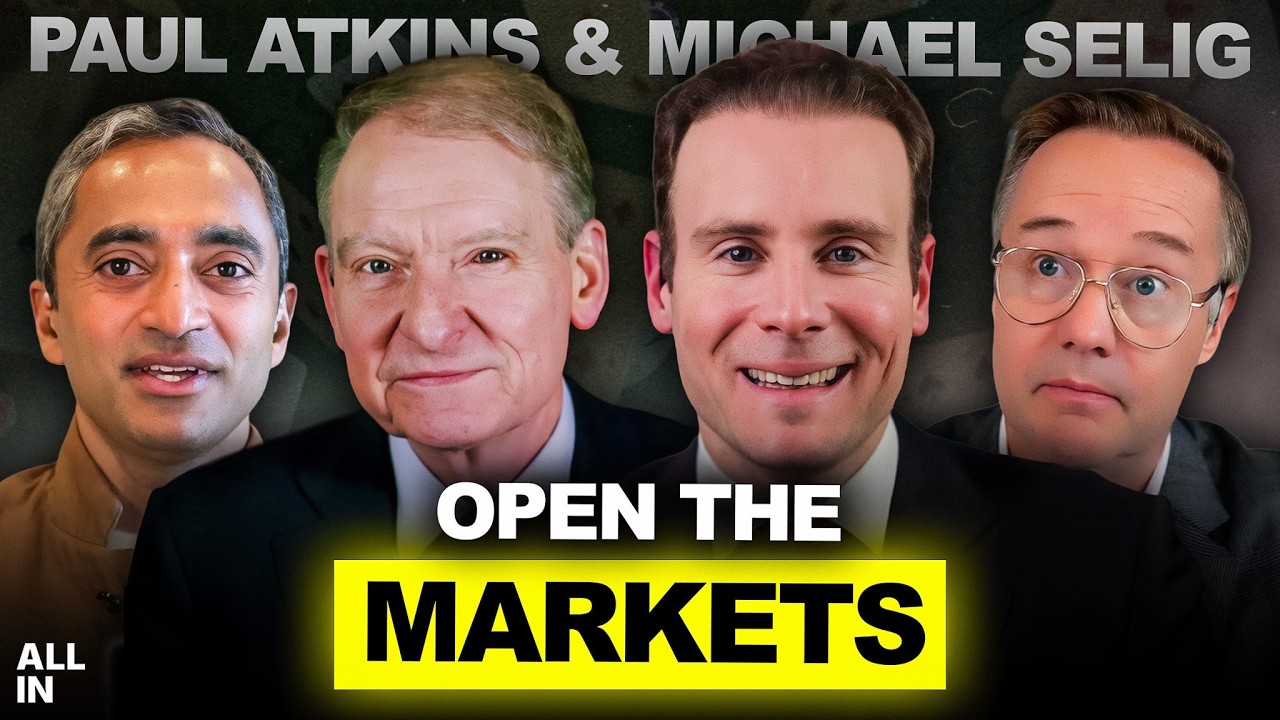
SEC, CFTC Harmonize Rules to Overhaul IPOs, Crypto Oversight
All-In Podcast
The SEC and CFTC plan to issue a joint Memorandum of Understanding to eliminate regulatory turf wars, modernize accredited investor standards, and establish clear digital asset frameworks to revive U.S. public market listings.
## Background
This video was published on YouTube by the All-In Podcast on March 11, 2026. According to the page description, hosts Jason Calacanis and Chamath Palihapitiya interview SEC Chair Paul Atkins and CFTC Chair Michael Selig about US capital market reforms, solving the IPO drought, crypto regulation, prediction markets, and retail investor accreditation.
## TL;DR
SEC Chair Paul Atkins and CFTC Chair Michael Selig outline a collaborative regulatory strategy aimed at revitalizing US capital markets, ending decades of inter-agency turf wars, and modernized disclosure standards. They discuss lowering barriers for retail investors by reforming accredited investor rules, moving past legacy registration models like the S-1 for digital assets, and establishing clear jurisdictional boundaries between securities and commodities. The conversation also addresses systemic risks, including high-frequency trading leverage, AI trading bots, offshore innovation flight, and the growing gambling dynamics among Gen Z traders.
## Atmosphere & style
The dialogue is collegial, forward-looking, and intensely policy-focused, driven by the pragmatic camaraderie between the two regulator chairs and the tech-investor hosts. The tone balances deep regulatory expertise with energetic banter around modernizing financial systems, making high-stakes institutional policy feel accessible and conversational. Across the episode, there is a distinct sense of urgency and optimism around dismantling outdated bureaucracy to keep capital formation and technological innovation on American soil.
## Key takeaways
- [00:00](https://www.youtube.com/watch?v=el6ObB60Fb4&t=0s) Historically, early-stage tech companies went public after four or five years to raise growth capital, whereas modern companies stay private much longer, transferring early growth ROI from public retail investors to private insiders.
- [03:04](https://www.youtube.com/watch?v=el6ObB60Fb4&t=184s) A primary objective for the SEC and CFTC in 2026 is addressing the IPO drought by lowering compliance burdens, limiting litigious friction, and modernizing corporate governance rules.
- [03:04](https://www.youtube.com/watch?v=el6ObB60Fb4&t=184s) Regulators are moving away from 'regulation by enforcement' to create clear, fit-for-purpose rules for digital assets, on-chain protocols, prediction markets, and AI trading systems.
- [08:16](https://www.youtube.com/watch?v=el6ObB60Fb4&t=496s) Distributed ledger technology offers immediate T+0 settlement potential, but 24/7 liquidity across automated venues requires new market guardrails, speed bumps, and smart contract audit capabilities.
- [11:34](https://www.youtube.com/watch?v=el6ObB60Fb4&t=694s) Legacy equity disclosure forms like Form S-1 are fundamentally incompatible with decentralized, leaderless protocols, necessitating new statutory frameworks like the Clarity Act.
- [13:06](https://www.youtube.com/watch?v=el6ObB60Fb4&t=786s) Unchecked leverage remains a primary driver of historical financial panics, requiring coordinated margin rules, position limits, and exchange circuit breakers to manage systemic risk.
- [15:30](https://www.youtube.com/watch?v=el6ObB60Fb4&t=930s) The SEC and CFTC are actively ending decades of inter-agency turf wars through a joint Memorandum of Understanding (MOU) to establish substituted compliance regimes and unified platform oversight.
- [19:15](https://www.youtube.com/watch?v=el6ObB60Fb4&t=1155s) When properly regulated, prediction markets function as efficient 'truth machines' that counter online hoaxes, though exchanges must strictly police insider trading and front-running risks.
- [26:56](https://www.youtube.com/watch?v=el6ObB60Fb4&t=1616s) The SEC is evaluating corporate reporting schedules, considering potential shifts from mandatory quarterly filings (Form 10-Q) back toward bi-annual or annual reporting models to counter short-termism.
- [30:40](https://www.youtube.com/watch?v=el6ObB60Fb4&t=1840s) Current accredited investor thresholds based on income and net worth lock out roughly 95% of Americans, prompting plans for knowledge-based qualification tests and professional credential waivers.
- [40:36](https://www.youtube.com/watch?v=el6ObB60Fb4&t=2436s) Venture capital accounts for a significant portion of US economic activity, but statutory investor limits on private funds constrain broader retail participation.
- [40:36](https://www.youtube.com/watch?v=el6ObB60Fb4&t=2436s) Regulators and federal agencies are exploring safe frameworks to open private equity and venture capital asset allocations to retail investors through 401(k) plans and pension funds.
- [45:31](https://www.youtube.com/watch?v=el6ObB60Fb4&t=2731s) U.S. capital markets derive their global dominance from strong legal enforceability, clear rules of law, and a widespread retail equity investment culture lacking in foreign markets.
- [49:05](https://www.youtube.com/watch?v=el6ObB60Fb4&t=2945s) Under unified SEC-CFTC guidance, tokenized securities fall under SEC jurisdiction, while functional digital commodities, utility tokens, and collectibles are governed by the CFTC.
- [52:15](https://www.youtube.com/watch?v=el6ObB60Fb4&t=3135s) A key systemic threat is driving financial innovation offshore to lenient jurisdictions due to regulatory uncertainty, which compromises domestic competitiveness and investor protection.
- [56:37](https://www.youtube.com/watch?v=el6ObB60Fb4&t=3397s) Addressing the surge in retail gambling behaviors among young adults requires a combination of broker suitability requirements, parent education, and mandatory platform-level instructional tools.
## Detailed walkthrough
### [00:00](https://www.youtube.com/watch?v=el6ObB60Fb4&t=0s) The Shifting Landscape of U.S. Capital Markets
SEC Chair Paul Atkins reflects on his 40-year career in financial regulation, tracking the evolution of capital markets from the corporate finance boom of the 1980s to today. In the early days of Microsoft, Apple, and AMD, young companies went public after four or five years as a primary fundraising step (akin to a modern Series C or D round). This structure allowed public retail investors to capture the lion's share of long-term return on investment (ROI).
Today, that dynamic has completely inverted: robust private capital markets allow companies to remain private for much longer, turning an initial public offering (IPO) into a liquidity event for corporate insiders, venture capitalists, and private equity firms rather than a growth engine for the public. With roughly half as many public companies today compared to 30 years ago, public investors are left buying into highly mature companies with limited upside.
- **40-Year Market Shift:** Transition from early-stage IPO public capital formation to long-term private equity growth.
- **ROI Distribution:** Historically skewed toward the public; today, skewed heavily toward early insiders and VC funds.
- **Data Highlight:** The U.S. currently has approximately half the total number of public companies compared to three decades ago.
---
[03:04](https://www.youtube.com/watch?v=el6ObB60Fb4&t=184s) Priority Agenda for 2026: Fixing the IPO Drought and Clearing Regulatory Clutter
Addressing the sharp decline in public listings is a core priority for both the SEC and the CFTC heading into 2026. SEC Chair Atkins outlines a comprehensive "spring cleaning" initiative to purge outdated or non-material disclosure rules from the SEC rulebook. He highlights three primary drivers keeping private companies from entering the public domain: high regulatory compliance costs (such as quarterly reporting and proxy statements that have strayed from core materiality), the constant threat of class-action and vexatious litigation following minor stock fluctuations, and the overall weaponization of corporate governance around shareholder proposals.
CFTC Chair Michael Selig shares a similar vision focused on reversing the prior administration’s "regulation by enforcement" approach. Selig notes that starting around 2021–2022, emerging crypto, AI, and financial technology firms faced constant subpoenas and rules unsuited for their operational structures. Selig’s primary objective for 2026 is creating clear, future-proof regulatory frameworks for digital assets, on-chain software, prediction markets, and artificial intelligence, alongside passing key spot-market legislation in coordination with Congress.
- **SEC's Three Main Inhibitors to IPOs:**
1. Compliance & Disclosure Burden: High cost of quarterly reporting, annual reports, and non-material disclosures.
2. Litigation Risk: Threat of class-action lawsuits and stock-dip litigation (discussing mechanisms like fee-shifting and mandatory arbitration).
3. Corporate Governance Friction: Weaponization of annual general shareholder meetings and proposal processes.
- **CFTC 2026 Focus:** Transitioning away from enforcement-first tactics to fit-for-purpose rules for crypto spot markets, blockchain infrastructure, and AI.
---
[08:16](https://www.youtube.com/watch?v=el6ObB60Fb4&t=496s) AI Trading Bots, Autonomous Hedge Funds, and Systemic Risk
The discussion moves to the intersection of tokenization, 24/7 trading, and systemic market risk—specifically the emergence of agent-based, fully automated autonomous hedge funds operating on distributed ledgers. Chamath Palihapitiya points out that these open-source, algorithmic trading protocols are democratizing access to complex strategies formerly reserved for institutional giants like Citadel or Millennium. However, this creates fundamental systemic questions regarding market guardrails, circuit breakers, and ultimate human oversight ("the kill switch").
CFTC Chair Selig emphasizes that regulators should not block emerging technology out of fear, advocating instead for a "build first, non-permissioned" paradigm paired with proactive risk modeling. He suggests regulators adapt by hiring technologists to inspect smart contract code directly or running operational nodes on blockchains. SEC Chair Atkins notes that distributed ledger technology brings immense opportunities—such as achieving immediate T+0 settlement (delivery vs. payment)—though rapid 24/7 liquidity presents unique challenges for maintaining best bid and offer execution, potentially requiring built-in speed bumps to mitigate fraud.
- **Autonomous Trading Infrastructure:** Algorithmic, agent-driven funds replacing legacy institutional market makers.
- **Settlement Modernization:** Moving toward instantaneous T+0 settlement on-chain while managing liquidity fractionalization across 24/7 venues.
- **Regulatory Adaptations:** Operationalizing regulatory node hosting and smart-contract code audits rather than forcing traditional legacy frameworks onto autonomous protocols.
---
[11:34](https://www.youtube.com/watch?v=el6ObB60Fb4&t=694s) Modernizing Disclosure: The Clarity Act and Tailored Regulation
SEC Chair Atkins highlights the absurdity of attempting to register new digital assets using legacy equity frameworks like Form S-1. Under prior SEC guidance, crypto projects were told to simply "fill out the form on the website," ignoring the reality that Form S-1 is designed for corporate entities with boards of directors, physical offices, and traditional balance sheets—structures completely absent in decentralized protocols.
Atkins and Selig stress the necessity of passing federal statutory frameworks, such as the Clarity Act currently being debated in Congress, to establish permanent legal definitions and prevent future regulatory backsliding. Atkins reiterates a core legal boundary: if an asset's underlying structure constitutes a security, federal securities laws apply, but the registration mechanics must be modified to fit the actual technological delivery mechanism.
> "Well, haha, it's called an S-1 and it takes lots of lawyers and accountants to try to figure out how to do it for an existing company, much less for a new digital asset..." — SEC Chair Paul Atkins
- **Legacy Form Incompatibility:** Traditional S-1 disclosures fail when applied to decentralized, leaderless protocols.
- **Statutory Mandates:** Legislative efforts like the Clarity Act aim to clarify jurisdictional boundaries between digital commodities and digital securities.
---
[13:06](https://www.youtube.com/watch?v=el6ObB60Fb4&t=786s) Managing Systemic Risk and Excess Leverage Across Markets
Jason Calacanis poses questions around the role of high leverage in financial instability, noting how retail and institutional market participants access 50x to 100x leverage across crypto, prediction platforms, and derivative exchanges. SEC Chair Atkins explains that excess leverage has historically triggered major market disruptions, citing the financial panics of 1929 and 2008, as well as 19th-century banking runs.
Managing leverage requires a tailored approach across different institutions—such as bank reserve requirements, broker-dealer capital rules, and exchange-level margin controls. Futures exchanges possess clear authority to adjust margin requirements or halt trading during high-volatility events (as demonstrated during COVID-19 market turbulence). The SEC, CFTC, and Federal Reserve must collaborate to establish consistent margining framework guidelines for new asset classes without suppressing trading volume or causing unintended liquidity freezes.
- **Historical Contagion Drivers:** Unregulated leverage identified as the core trigger in 1929, 2008, and historical panics.
- **Regulatory Toolkit:** Dynamic margin requirements, position limits, exchange-level circuit breakers, and capital adequacy reserves.
---
[15:30](https://www.youtube.com/watch?v=el6ObB60Fb4&t=930s) Ending the SEC-CFTC Turf War
For over three decades, inter-agency friction between the SEC and CFTC created a regulatory "no man's land" that stifled financial product innovation. Atkins compares the legacy relationship between the two regulators to two opposing fortresses firing across an open field, leaving innovative products—such as single-stock futures and portfolio margining—trapped and discarded in the crossfire between agency staff.
Chairs Atkins and Selig detail their unified effort to dismantle this historical rivalry. By establishing direct alignment at the leadership level, the SEC and CFTC aim to harmonize rules, streamline joint regulatory approvals, and offer clear jurisdictional certainty for multi-asset products, crypto derivatives, and unified trading platforms.
> "I compare it to two fortresses with a no man's land in between. And so, the no man's land is littered with the bodies of would-be products..." — SEC Chair Paul Atkins
- **Historical Bottlenecks:** Decades of jurisdictional disputes stalled products like portfolio margining and single-stock futures.
- **Harmonization Goal:** Aligning SEC and CFTC oversight to enable streamlined compliance for cross-market financial platforms.
[16:49](https://www.youtube.com/watch?v=el6ObB60Fb4&t=1009s) SEC-CFTC Harmonization, Joint MOU, and the "Super App" Vision
Michael Selig outlines the new direction for regulator harmonization, highlighting a forthcoming Memorandum of Understanding (MOU) between the SEC and CFTC. This agreement will enable information sharing and joint coordination to eliminate longstanding agency "turf battles." Selig emphasizes that close alignment is occurring at both top leadership and staff levels so market participants, exchanges, and brokers face a seamless registration and product-offering environment. Clear jurisdictional boundaries are especially vital for cross-market products such as prediction markets—which touch on public equities, sports, and politics—and crypto networks that feature both securities and non-securities trading on the same smart contracts. Selig notes that the agencies are exploring "substituted compliance" regimes to avoid duplicative regulatory burdens and prevent fragmenting blockchains into separate commodities-only and securities-only tracks.
Building on Selig’s points, SEC Chair Paul Atkins underscores that while statutory frameworks differ, the SEC possesses extensive flexibility through its exemptive authority. Atkins shares his vision of achieving a streamlined "super app" framework over the next couple of years to reduce friction for dually registered entities and foster peak market efficiency.
- **Information Sharing**: A formal MOU is being hammered out between the SEC and CFTC to align policy and staff-level decisions.
- **Substituted Compliance**: Primary oversight would be granted to one agency while eliminating redundant dual-registration burdens for hybrid assets.
- **Cross-Jurisdictional Scope**: Addresses complex products like prediction markets and multi-asset crypto protocols operating across securities and commodities.
[19:15](https://www.youtube.com/watch?v=el6ObB60Fb4&t=1155s) Prediction Markets, Insider Trading, and Truth Machines
Chamath Palihapitiya frames the core tension between investor protection and capital formation, drawing a line from rules like Regulation Fair Disclosure (Reg FD) to modern prediction markets. He notes that prediction markets frequently test these boundaries because their accuracy often relies on individuals possessing asymmetric information, citing comments by Coinbase CEO Brian Armstrong that certain prediction markets thrive on insider knowledge.
Michael Selig responds by explaining that prediction markets are not new; they originated in the 1990s with the Iowa Electronic Markets tracking election outcomes. He highlights that exchanges function as the first line of defense as Self-Regulatory Organizations (SROs). Exchanges must certify that listed contracts are not readily susceptible to manipulation or insider trading—such as wagers on the color of Gatorade dumped on a Super Bowl coach. Selig references Kalshi’s recent enforcement actions against insider trading involving a MrBeast YouTube video release date to illustrate that duties of care and insider trading prohibitions apply in commodity and prediction markets just as they do in securities. He asserts that while insider trading remains strictly illegal, prediction markets act as vital "truth machines" that counter online disinformation and fake polling, noting that the previous administration's attempt to ban political prediction markets prior to the 2024 election was misplaced.
- **Historical Precedents**: Prediction markets have been monitored and regulated since the 1990s (starting with Iowa Electronic Markets).
- **Recent Kalshi Enforcement**: Kalshi fined market participants for trading on non-public internal information regarding MrBeast YouTube content releases.
- **Information Value**: Properly regulated prediction markets serve as real-time accuracy checks against fake polls and media hoaxes, keeping liquidity and trading activity inside US-regulated venues rather than offshore markets like Russia.
[23:39](https://www.youtube.com/watch?v=el6ObB60Fb4&t=1419s) Defining Gray Areas: From Streakers to Contract Integrity
Jason Calacanis pushes for clarity on where regulatory lines are drawn for everyday scenarios: an employee trading on unreleased internal software metrics, a third-party reseller placing a wager based on channel check observations, or an individual betting on an outcome they plan to trigger directly, such as a Super Bowl streaker. He asks whether the onus falls on prediction platforms, federal regulators, or if explicit statutory codification and public education are required.
Selig clarifies that the rapid growth of these products over the past year requires clear guidance rather than "regulation by enforcement." Contracts must meet explicit standards of standardization, integrity, and fungibility, rather than operating like a casino bookie. If an outcome is directly vulnerable to manipulation—such as a streaker controlling the event outcome—exchanges must refrain from listing it. He adds that exchanges are actively reframing contracts to ensure integrity, such as changing wagers from whether a dictator is "executed" to whether a dictator is "deposed" or no longer in power.
- **Exchanges as First Line of Defense**: Exchanges must self-certify that derivative contracts cannot be easily front-run or manipulated before listing them.
- **Contract Framing Matters**: Geopolitical contracts avoid morbid or easily manipulated triggers (e.g., specifying "deposed" rather than physical harm).
[26:56](https://www.youtube.com/watch?v=el6ObB60Fb4&t=1616s) Rethinking Quarterly Reporting vs. Bi-Annual Filings
Chamath brings up former President Trump's suggestion to shift corporate reporting from a quarterly schedule to bi-annual (every six months) or annual filings, questioning whether the burden of short-termism has damaged public markets and suppressed IPO activity.
SEC Chair Paul Atkins highlights that the federal securities framework has not always mandated quarterly reporting. When the SEC was established in 1934, it largely adopted the New York Stock Exchange rules, which required only annual reports. The SEC moved to semi-annual reporting in 1955 (a timeline mirrored by the UK), and only instituted mandatory quarterly reporting (Form 10-Q) in 1970. Atkins points out that the UK reverted to a semi-annual requirement in 2014 while allowing voluntary quarterly updates. Atkins notes the SEC staff is reviewing "filer status" categories (such as large accelerated filers and emerging growth companies) to simplify reporting obligations. While reduced frequency might reduce short-term corporate pressure, he acknowledges the ongoing debate regarding whether smaller companies might struggle even more to attract research analyst coverage without quarterly data.
- **Historical Reporting Cadence**:
- **1934–1955**: Annual reporting (Form 10-K model).
- **1955–1970**: Semi-annual reporting (Form 10-Q introduced later in 1970).
- **2014 (UK)**: UK abandoned mandatory quarterly filings in favor of semi-annual disclosures.
- **Alternative Models**: Atkins references Barry Diller's commentary on moving past quarterly guidance gamesmanship, pointing out that modern tech enables continuous data streams where AI agents can process financial metrics in near real time.
The conversation shifts to private capital markets and investor access. Chamath and Jason note that when iconic companies like Microsoft and Apple went public, they had roughly 1,000 to 1,200 employees and approximately $400 million in revenue (in inflation-adjusted terms; around $120 million at the time). This allowed retail investors to participate early and build multi-generational wealth. Today, legacy SEC accreditation rules restrict private market investing to roughly the top 5% of wealthy households, locking out 95% of the public while companies stay private much longer.
Jason argues that the current net worth/income requirements are outdated and patronizing, allowing wealthy heirs to invest in early-stage startups while preventing everyday participants—such as gig drivers or enterprise software users—from investing in the platforms they help build. He proposes replacing strict wealth hurdles with a "sophisticated investor test" similar to a driver's license exam.
- **Legacy Thresholds**: Current rules block 95% of Americans from direct private market participation based on income and net worth criteria.
- **Historical IPO Benchmarks**: Early tech giants listed publicly at much smaller valuations, allowing public market investors to participate in their core growth phases.
- **Proposed Reform**: Introducing knowledge-based accreditation testing to replace pure financial net-worth requirements.
[32:30](https://www.youtube.com/watch?v=el6ObB60Fb4&t=1950s) Rethinking Accredited Investor Rules and Financial Knowledge
SEC Chair Paul Atkins addresses the long-standing debate surrounding accredited investor requirements, expressing a firm commitment to tackle the issue directly. Pointing to statutory roots, Atkins notes that the original definitions within the Investment Company Act of 1940 and Investment Advisers Act of 1940 explicitly incorporated concepts of "knowledge," rather than relying solely on wealth or net worth metrics. He questions the current system's logic, highlighting the absurdity where a finance professor earning $100,000 without substantial liquid assets is legally barred from investing in private funds or early-stage opportunities, while an heiress inheriting $10 million is immediately deemed qualified—despite the fact that her hired advisers might be completely incompetent.
To fix this imbalance, the SEC plans to introduce a proposed rule in 2026 aimed at modernizing investor standards. Atkins references historical precedent and public comments from his earlier tenure as a commissioner in the 2000s, where investors lamented losing access to private assets simply because net worth thresholds were arbitrarily raised. The agency is actively exploring test-based qualifications analogous to a driver's license exam or simplified versions of the FINRA Series 7 exam, alongside automatic recognition for certified professionals like CPAs and CFAs.
- **Statutory Basis:** The Investment Company Act of 1940 and Investment Advisers Act of 1940 include knowledge-based criteria that have been historically overlooked in favor of pure financial asset thresholds.
- **Proposed Alternatives:** Potential accreditation paths include a simplified financial literacy exam, driver's-test-style qualifications, or automatic eligibility based on professional credentials (CPA, CFA).
- **Target Timeline:** The SEC intends to take a fresh look at the rules and publish a formal proposed rule.
---
[34:56](https://www.youtube.com/watch?v=el6ObB60Fb4&t=2096s) High-Frequency Trading, Basis Discrepancies, and Futures Oversight
Addressing the mechanics of the derivatives and futures markets, CFTC Chair Michael Selig breaks down the three foundational pillars of market participation: hedgers, speculators, and market makers. In response to concerns regarding high-frequency trading (HFT) firms dominating futures volume and potentially causing spot-to-futures basis dislocations in commodity markets, Selig emphasizes that market liquidity relies on all three participant types acting in concert. While commercial entities enter cattle or credit default swap contracts to hedge operational risks, proprietary trading firms and market makers absorb that risk, supply critical liquidity, and earn the bid-ask spread.
The CFTC maintains rigorous surveillance to ensure market integrity and prevent manipulative practices like wash trading. Selig stresses that regulated exchanges serve as the primary line of defense by actively monitoring order flow on their platforms. The CFTC works in continuous coordination with these exchanges, regularly issuing formal information requests to proprietary traders to audit suspicious trading strategies and guard against systemic manipulation.
- **Market Participant Types:**
- **Hedgers:** Commercial entities managing business risk (e.g., cattle producers, corporate bond issuers).
- **Speculators:** Risk-tolerant capital takers operating on a proprietary basis.
- **Market Makers:** Liquidity providers capturing bid-ask spreads.
- **Regulatory Focus:** Ongoing policing against wash trading and cross-market price manipulation through exchange-level surveillance and direct CFTC subpoenas/information requests.
---
[37:08](https://www.youtube.com/watch?v=el6ObB60Fb4&t=2228s) Overhauling Swap Data Reporting and Regulatory Toolboxes
The conversation shifts to systemic risk in over-the-counter (OTC) bilateral swaps—a historic blind spot highlighted by the 2008 Global Financial Crisis. While acknowledging his general skepticism toward Dodd-Frank, Selig credits the post-crisis creation of Swap Data Repositories (SDRs) for providing daily transparency into bilateral derivative markets. However, he sharply criticizes the excessive complexity of the current swap reporting regime, pointing out that compliance has degraded into a hyper-technical trap for market participants. During his time in private practice, categorizing novel instruments like Bitcoin and crypto swaps against traditional frameworks built for wheat or cattle required exorbitant legal fees. Selig advocates streamlining these rules to establish a "minimum effective dose" of regulation that does not require hiring high-priced law firms just to execute basic risk management.
When comparing their respective agency toolboxes, Atkins and Selig share features they envy in each other's jurisdiction:
```
+-----------------------------------------------------------------------------------+
| CROSS-AGENCY TOOLBOX ENVY |
+--------------------------+--------------------------------------------------------+
| Agency / Chair | Desired Tool / Mechanism & Function |
+--------------------------+--------------------------------------------------------+
| SEC (Paul Atkins) | CFTC's Self-Certification Framework |
| | Allows exchanges/issuers to launch standardized |
| | products without undergoing lengthy staff approvals. |
+--------------------------+--------------------------------------------------------+
| CFTC (Michael Selig) | SEC's Alternative Trading System (ATS) Framework |
| | Creates an "exchange-light" regulatory structure |
| | for broker-dealers, avoiding full exchange overhead. |
+--------------------------+--------------------------------------------------------+
```
---
[40:36](https://www.youtube.com/watch?v=el6ObB60Fb4&t=2436s) Venture Capital Fund Formation and Private Market Access
Addressing the regulatory bottlenecks surrounding venture capital, Jason Calacanis highlights VC's immense impact on the US economy—noting that venture-backed companies generate 20% of US GDP and represent 40% of the S&P 500 market cap (heavily driven by the "Magnificent Seven"). Calacanis criticizes the outdated statutory limits on fund formation, recounting a personal example where he had over $100 million in demand from accredited investors wanting small allocations, yet statutory constraints capped his fund at accepting only 100 investors for a $10 million vehicle. Allowing more individuals to commit smaller check sizes would democratize startup investing while channeling crucial early-stage capital into the economy.
Atkins acknowledges the problem but points out that fund caps are hardcoded into statutory exemptions under the Investment Company Act of 1940 (specifically Sections 3(c)(1) and 3(c)(7)). However, the SEC is actively coordinating with the Department of Labor and the Department of the Treasury to explore expanding private asset access for retail investors through 401(k) plans and pensions under strict protective guardrails. Selig fully supports expanding access, drawing a direct parallel to the Initial Coin Offering (ICO) boom—where retail investors bypassed rigid securities laws to fund speculative token projects—proving that capital "finds a way" when legitimate public participation is overly restricted.
- **Venture Capital Economic Footprint:**
- Accounts for **20% of US GDP**.
- Represents **40% of the S&P 500** market valuation.
- **Statutory Bottlenecks:** Investment Company Act of 1940 limits investor counts (e.g., 100-investor cap under 3(c)(1)), constraining access for smaller accredited investors.
- **Proposed Reforms:** Income/net-worth percentage caps (e.g., limiting private investments to 5-10% of annual income or net worth) and establishing clear ERISA/401(k) private market allocation guardrails.
---
[45:31](https://www.youtube.com/watch?v=el6ObB60Fb4&t=2731s) Global Capital Dominance and the American Equity Culture
In a broader comparison of international financial centers, Calacanis notes that US capital markets maintain supreme credibility, whereas foreign alternatives face deep structural stagnation. He characterizes the UK market as a "disaster" for capital formation, notes European exchanges are practically impossible to innovate in, and views emerging venues in Abu Dhabi and Saudi Arabia (KSA) as upstarts attempting to capture global market share.
Atkins agrees that US capital markets remain the envy of the world, attributing America's structural edge to the rule of law, clear enforceability of contracts, and a uniquely ingrained "equity investment culture" that is largely absent in Europe and Japan. European and Japanese regulatory systems are burdened by rigid, narrowly constructed legal codes that hamstring innovation and restrict appetite for risk. To maintain this global dominance and attract trillions in offshore capital, Atkins emphasizes that the US must continually refine its market rules, fix accredited investor standards, and provide a welcoming onshore environment for novel financial products.
- **US Competitive Advantages:**
- Unmatched contract enforceability and judicial predictability (Rule of Law).
- Widespread retail and institutional risk appetite (Equity Culture).
- **International Vulnerabilities:**
- **UK / Europe:** Over-regulated, narrow legal codes, lack of growth capital.
- **Middle East (KSA/Abu Dhabi):** Rapidly innovating upstart venues attempting to draw international liquidity.
---
[48:05](https://www.youtube.com/watch?v=el6ObB60Fb4&t=2885s) Crypto Regulation, Meme Coins, and Token Classification
The discussion turns to the chaotic state of crypto markets—including NFTs, ICOs, and speculative meme coins (such as $TRUMP or $DOGE)—which trade with ticker symbols and real-time charts identical to traditional equities. Calacanis points out that everyday retail buyers treat these tokens like stocks, making them vulnerable to "sucker at the table" dynamics when projects lack fundamental backing. While acknowledging former SEC Chair Gary Gensler's poor execution and heavy-handed approach, Calacanis notes the underlying logic of enforcing registration rules so token issuers cannot operate under a regulatory free pass while traditional public companies face strict reporting obligations.
<ElicitationsGroup message="Explore related topics from this transcript section:">
<Elicitation label="Review the SEC's proposed changes to accredited investor rules" query="What specific changes are SEC Chair Paul Atkins and the SEC proposing for accredited investor standards in 2026?"/>
<Elicitation label="Examine the debate around private asset inclusion in 401(k) plans" query="How are the SEC, Treasury, and Department of Labor planning to safely integrate private equity and venture capital into 401(k) plans?"/>
<Elicitation label="Analyze the differences between SEC and CFTC market regulation tools" query="What are the key differences between SEC's ATS framework and CFTC's self-certification process, and how might they be unified?"/>
</ElicitationsGroup>
[49:05](https://www.youtube.com/watch?v=el6ObB60Fb4&t=2945s) SEC and CFTC Regulatory Boundaries on Crypto and Tokens
SEC Chair Paul Atkins and CFTC Chair Michael Selig address the long-standing vagueness surrounding crypto regulation. Atkins notes that ambiguity historically forced companies to spend massive amounts on legal fees; while some attorneys offered overly optimistic "happy talk" that got clients into trouble with the SEC, others simply advised founders to abandon the U.S. and operate offshore. To fix this, the SEC and CFTC are harmonizing their jurisdictions. Under this framework, tokenized securities remain strictly under SEC oversight. However, digital coins, digital tools, and digital collectibles fall under the CFTC’s rulebook, which Atkins describes as far more apposite for these asset types. Logical oversight is essential to prevent fraud, as foreign investors are primarily drawn to U.S. markets because they trust that fraudsters will be prosecuted and that rules against insider trading and material non-public information will be enforced.
Building on this distinction, CFTC Chair Michael Selig clarifies the boundary between capital raising and the underlying digital asset. He emphasizes that regulators must separate fundraising activity—where founders publish white papers, present business plans, and make promises to investors—from the actual asset being sold. In many cases, the tokens themselves are functional goods or digital commodities used within networks like Ethereum or Solana, or items like NFTs and software utility tools. Selig points out that neither agency regulates everyday product sales; while the SEC has prosecuted fraudulent capital raises involving everything from chinchillas to whiskey barrels, those physical items were never traded as securities, and digital assets should be treated with the same distinction.
- Tokenized securities fall strictly under SEC jurisdiction.
- Digital commodities, utility tools, and collectibles fall under CFTC oversight.
- Capital-raising activities involving promises and business plans are distinct from the underlying functional tokens or goods.
- Historically, SEC enforcement covered fraudulent fundraising schemes involving chinchillas and whiskey barrels without classifying the physical items as securities.
[52:15](https://www.youtube.com/watch?v=el6ObB60Fb4&t=3135s) Key Systemic Risks: Offshoring Innovation and Market Fraud
When asked about the major risks keeping them up at night as regulators over tens of trillions of dollars in U.S. capital markets, Selig identifies the offshore flight of American innovation as his top concern. He stresses that U.S. prosperity was built on unhindered innovation, noting that "Thomas Edison didn't have to go ask for permission to go innovate." The U.S. must provide clear rules so entrepreneurs building in blockchain, artificial intelligence, and prediction markets build domestically rather than fleeing to jurisdictions like the Cayman Islands, the Bahamas, or Russia. Selig's second major concern is market integrity; failing to stop manipulation, fraud, and insider trading risks destroying investor confidence. He stresses the absolute necessity of preventing another FTX-scale fraud on the American public.
Atkins agrees with Selig's focus on domestic innovation and points out an instructive detail from the FTX collapse: the single entity that did not implode was LedgerX, a CFTC-regulated swaps trading platform owned by FTX. Because LedgerX was supervised and required to keep customer accounts strictly segregated, no customers lost money through that platform. Looking forward, Atkins warns against "fighting the last battle"—comparing regulatory missteps to France building the Maginot Line prior to World War II. His primary operational concern centers on how bad actors leverage emerging technologies like AI to commit confidence fraud, tricking retirees into giving away passwords or draining their Coinbase accounts. The SEC's mandate is to serve as an active "cop on the beat" targeting bad actors without burdening legitimate innovators with overwhelming restrictions.
- Selig warns against driving tech builders to offshore jurisdictions like the Bahamas, the Cayman Islands, or Russia.
- LedgerX, FTX's CFTC-regulated swaps platform, survived the collapse without customer losses due to mandatory asset segregation.
- Atkins warns against regulatory "Maginot Line" thinking when adapting to AI-driven financial fraud and confidence scams targeting retail retirement funds.
[56:37](https://www.youtube.com/watch?v=el6ObB60Fb4&t=3397s) Addressing Gen Z Gambling Risks and Retail Trader Education
The discussion shifts to the societal risks of expanding access to trading, sports wagering, and prediction markets. Jason highlights data showing that among young men aged 18 to 30, 45% report having issues with wagering or gambling, 10% meet the clinical criteria for addiction, and a third have placed bets. While this environment creates a generation highly literate in financial markets and capital formation, it poses severe risks to young, developing brains. Asking how regulators plan to mitigate these downsides, Jason notes the delicate balance between market participation and consumer protection.
Selig emphasizes that user education and broker suitability controls are key tools. While federal regulators do not govern traditional casinos, derivative exchanges and brokers must ensure market participants are suitable and informed, advocating for voluntary platform-level educational initiatives alongside existing broker standards. Atkins agrees, adding that education must extend beyond young adults to include parents who are often unaware of their children's activities on mobile devices. Atkins notes that addiction risks exist across all forms of gambling, including state lotteries, and requires broader societal recognition. Jason concludes by highlighting interactive platform features, such as Robinhood’s required instructional wizards for complex option strategies (puts, calls, and spreads), as a positive model for platform-level investor education.
- Data cited shows 45% of young men aged 18–30 report wagering problems, with 10% meeting addiction criteria and one-third having placed bets.
- Selig highlights broker suitability standards and voluntary educational tools as primary lines of defense against retail over-leveraging.
- Jason cites Robinhood's mandatory interactive wizards for options trading (puts, calls, spreads) as an effective model of platform-level financial education.
## Notable quotes
> [11:34](https://www.youtube.com/watch?v=el6ObB60Fb4&t=694s) Well, haha, it's called an S-1 and it takes lots of lawyers and accountants to try to figure out how to do it for an existing company, much less for a new digital asset... — Paul Atkins
> [15:30](https://www.youtube.com/watch?v=el6ObB60Fb4&t=930s) I compare it to two fortresses with a no man's land in between. And so, the no man's land is littered with the bodies of would-be products... — Paul Atkins
> [52:15](https://www.youtube.com/watch?v=el6ObB60Fb4&t=3135s) Thomas Edison didn't have to go ask for permission to go innovate. — Michael Selig
## Mentioned
All-In Podcast, SEC, CFTC, Paul Atkins, Michael Selig, Jason Calacanis, Chamath Palihapitiya, David Sacks, David Friedberg, Microsoft, Apple, AMD, Clarity Act, Citadel, Millennium, Kalshi, Iowa Electronic Markets, Brian Armstrong, Coinbase, MrBeast, New York Stock Exchange, Barry Diller, FINRA, Department of Labor, Department of the Treasury, S&P 500, LedgerX, FTX, Gary Gensler, Robinhood, Ethereum, Solana, $TRUMP, $DOGE
SEC Chair Paul Atkins and CFTC Chair Michael Selig outline a coordinated regulatory shift for 2026, aiming to reverse the decades-long contraction of public capital markets, expand retail access to private assets, and end inter-agency jurisdictional friction across digital assets and emerging technologies.
Reversing the Public Market Contraction (0:00)
The United States currently has approximately half as many public companies as it did 30 years ago. Historically, tech pioneers such as Microsoft, Apple, and AMD launched IPOs within four to five years of founding at valuations around $120 million (roughly $400 million inflation-adjusted), enabling retail investors to capture substantial growth. Today, robust private capital markets permit firms to remain private far longer, effectively transforming modern IPOs into late-stage liquidity events for insiders and private equity funds while leaving public investors with mature companies offering limited upside.
To counter this IPO drought, SEC Chair Atkins identifies three core disincentives the agency intends to review: excessive compliance and disclosure burdens, class-action litigation risks following minor stock dips, and friction around shareholder proposals. This agenda includes reviewing corporate reporting frequency—such as evaluating bi-annual filings against mandatory quarterly Form 10-Q reporting—and reassessing filer status classifications to lower public market operational costs without compromising core materiality.
Modernizing Accredited Investor and Fund Standards (30:40)
Current SEC accreditation rules rely heavily on income and net worth thresholds, barring roughly 95% of Americans from directly participating in private market offerings. Atkins criticizes this standard for ignoring financial literacy, pointing out that original statutory frameworks under the Investment Company Act of 1940 and Investment Advisers Act of 1940 contemplated knowledge-based standards. Consequently, a finance professor earning $100,000 is legally barred from early-stage private deals, while an heir inheriting substantial wealth qualifies immediately.
For 2026, the SEC plans to propose rule changes introducing knowledge-tested qualifications, analogous to a driver's test or a simplified FINRA Series 7 exam, alongside automatic credentials for CPAs and CFAs. Additionally, regulators are exploring pathways with the Treasury and Department of Labor to allow capped retail allocations in private assets through 401(k) retirement accounts. Venture capital fund limits under Section 3(c)(1), which currently cap certain vehicles at 100 investors, were also identified as artificial barriers that restrict smaller accredited check writers.
SEC-CFTC Harmonization and Digital Asset Boundaries (16:49)
Atkins and Selig are working to end three decades of inter-agency turf battles that previously stalled hybrid products like single-stock futures and portfolio margining. Through a forthcoming Memorandum of Understanding (MOU), the SEC and CFTC plan to implement information sharing and substituted compliance, aiming to lay the groundwork for integrated, unified trading platforms or "super apps" without subjecting cross-market entities to duplicative oversight.
The agencies draw a distinction between capital raising and underlying assets. Tokenized securities remain under the SEC, while digital commodities, utility tools, and collectibles fall under the CFTC. Selig argues that fundraising promises and business plans must be separated from functional tokens, noting historical precedents where the SEC prosecuted fraudulent capital raises involving physical assets like chinchillas or whiskey barrels without treating the underlying goods as securities. Both chairs also support federal legislation, such as the Clarity Act, to establish durable jurisdictional boundaries.
Market Integrity, Technology, and Retail Risks (52:15)
Regulators emphasize establishing clear domestic frameworks to prevent financial innovation from migrating to offshore jurisdictions like the Bahamas, the Cayman Islands, or Russia. Atkins points to the FTX collapse to demonstrate the value of clear regulatory safeguards: LedgerX, FTX's CFTC-regulated entity, maintained customer asset segregation and survived without customer losses. To supervise automated hedge funds and 24/7 on-chain trading without stifling development, Selig suggests regulatory agencies run operational blockchain nodes and audit smart-contract code directly.
Regarding high-speed trading and prediction markets, Selig explains that exchanges act as self-regulatory organizations to prevent manipulation and insider trading, pointing to Kalshi's enforcement actions over non-public information concerning MrBeast video releases. Concurrently, regulators acknowledge the consumer risks of widespread wagering and retail trading—citing data showing 45% of young men aged 18 to 30 report wagering issues—and plan to rely on broker suitability standards and platform-level interactive education tools to manage over-leverage.
While the SEC and CFTC leadership are unified in their 2026 agenda to streamline rules and modernize access, durable implementation remains dependent on congressional action on statutes like the Clarity Act and the legal limits of statutory exemptions under the Investment Company Act of 1940.
## Background
本期内容由知名播客频道 All-In Podcast 于 2026 年 3 月 11 日发布于 YouTube 平台。节目特邀美国证券交易委员会(SEC)主席保罗·阿特金斯(Paul Atkins)与美国商品期货交易委员会(CFTC)主席迈克尔·塞利格(Michael Selig)做客,深入探讨扭转美股 IPO 枯竭现状、打破加密与预测市场监管僵局、改革过时的“合格投资者”准入门槛,以及终结两大机构多年地盘争夺战等重磅金融议题。
## TL;DR
访谈围绕美国资本市场的制度松绑与现代化改革全面展开。两位监管掌门人明确提出将终结过去“以执法代监管”的被动局面,计划推行跨部门备忘录(MOU)以消除 SEC 与 CFTC 的管辖内耗,并展望了聚合证券与衍生品的金融 Super App 愿景。SEC 主席阿特金斯承诺推进合格投资者规则改革,探索以轻量级专业知识测试替代冷冰冰的财富门槛,让大众共享早期股权红利,并重新审视财报申报周期;CFTC 主席塞利格则划清了预测市场反内幕交易的红线,明确将底层商品与融资行为剥离的数字资产监管哲学。同时,双方共同警示了高杠杆、AI 欺诈以及年轻一代面临的博彩化投机危机,致力于在激发本土创新活力与筑牢系统性风险底线之间寻求动态平衡。
## Atmosphere & style
整场对谈兼具华尔街内幕的坦率与顶层监管者的宏阔视野,两位监管一把手毫无官僚做派,言辞犀利幽默且极具变革决心。主持人 Jason 与投资老手 Chamath 的提问拳拳到肉,屡屡直击“100倍加密杠杆”、“预测市场裸奔套利”等灰色极端案例,逼出嘉宾诸多未经粉饰的真知灼见。现场氛围在高密度的制度思辨、对历史危机的深刻反思以及对技术创新的由衷拥抱中步步推进,既有打破既得利益壁垒的激昂交锋,又有直面底层散户被收割与博彩成瘾隐忧时的沉重审慎,给听众带来如同亲临资本权力中枢决策现场的智力震颤与通透感。
## Bulletin
- [03:04](https://www.youtube.com/watch?v=el6ObB60Fb4&t=184s) SEC 主席 Paul Atkins 明确表示将启动监管“春季大扫除”,重点削减上市公司披露负担、遏制滥诉及治理武器化,并就将财报周期从季度改为半年报或年报征求公众意见。
- [30:41](https://www.youtube.com/watch?v=el6ObB60Fb4&t=1841s) SEC 计划打破近百年来基于财富净值的“合格投资者”准入门槛,年内将提出新规,拟引入知识考核机制(如精简版 Series 7 或认可 CPA/CFA)向大众开放未上市股权投资。
- [15:30](https://www.youtube.com/watch?v=el6ObB60Fb4&t=930s) CFTC 与 SEC 正推进跨部门谅解备忘录(MOU)和“替代合规框架”,打破长达 30 年的管辖权争夺,目标在未来几年内促成融合证券与衍生品的金融 Super App 生态。
- [50:47](https://www.youtube.com/watch?v=el6ObB60Fb4&t=3047s) 监管层为加密资产划分清晰红线:将“资本募集行为”(适用证券法)与“底层代币资产本身”(若具备网络功能或效用则属数字商品/工具)严格剥离,避免将所有代币机械套用证券法。
## Key takeaways
- [00:00](https://www.youtube.com/watch?v=el6ObB60Fb4&t=0s) 美股上市公司数量较 30 年前缩水近半,巨额私募资本导致 IPO 异化为内部人套现工具,普通散户被剥夺了科技巨头早期的财富增长红利。
- [03:04](https://www.youtube.com/watch?v=el6ObB60Fb4&t=184s) 拯救枯竭的 IPO 需要降低披露成本、遏制股东集体滥诉,并治理激进股东将年度股东大会武器化的倾向。
- [06:31](https://www.youtube.com/watch?v=el6ObB60Fb4&t=391s) CFTC 强调终结“以执法代监管”的旧模式,确立“大胆去构建、无需事事请示许可”的新范式,主动推进规则适配链上协议与自主 AI 智能体。
- [10:07](https://www.youtube.com/watch?v=el6ObB60Fb4&t=607s) 分布式账本技术正在推动即时 T+0(券款对付/资金对付)结算变革,传统繁琐的 S-1 招股书对去中心化代币原生资产完全不适用。
- [15:30](https://www.youtube.com/watch?v=el6ObB60Fb4&t=930s) SEC 与 CFTC 签署跨部门 MOU 并引入替代合规机制(Substituted Compliance),旨在消灭“监管无人区”,避免创新产品因双重注册摩擦而被扼杀。
- [19:56](https://www.youtube.com/watch?v=el6ObB60Fb4&t=1196s) 预测市场被定性为标准化的金融衍生品而非博彩,CFTC 认定交易所须作为第一道防线严控操纵与内幕交易,同时视合规预测市场为不可替代的“真理机器”。
- [26:56](https://www.youtube.com/watch?v=el6ObB60Fb4&t=1616s) SEC 正在审查上市公司申报人资格,考虑将强制季度财报放宽为半年报,未来在 AI 智能体普及下有望直接过渡为企业底层财务数据流的实时透明化。
- [30:41](https://www.youtube.com/watch?v=el6ObB60Fb4&t=1841s) 现行合格投资者制度将 95% 的普通大众排除在早期未上市企业之外,SEC 拟推行“投资驾驶执照”等认知测试,重塑基于认知的公平准入渠道。
- [34:56](https://www.youtube.com/watch?v=el6ObB60Fb4&t=2096s) 健康的期货与衍生品市场需要套期保值者、投机者与高频做市商三者共振,CFTC 坚持在场外双边互换报告中追求“最小有效剂量”,清理冗余指标。
- [39:03](https://www.youtube.com/watch?v=el6ObB60Fb4&t=2343s) SEC 渴望借鉴 CFTC 的高效“自我认证”机制以加速新产品审批,CFTC 则希望借用 SEC 的“替代交易系统”(ATS)打造轻量级交易所。
- [40:36](https://www.youtube.com/watch?v=el6ObB60Fb4&t=2436s) 受限于《1940 年投资公司法》对基金人数的硬性上限(如 100 人),风投基金被迫拒绝小额散户,SEC 正在探索将私募资产合规引入 401(k) 退休养老体系。
- [45:31](https://www.youtube.com/watch?v=el6ObB60Fb4&t=2731s) 美国资本市场的核心护城河是法治契约精神与本土独特的股权冒险文化,过度监管的教训(如 ICO 狂潮时期)表明严苛封堵只会将创新推向海外灰色地带。
- [50:47](https://www.youtube.com/watch?v=el6ObB60Fb4&t=3047s) 监管机构需将发行代币的“融资行为”与“代币本身”明确剥离,正如同集资销售南美栗鼠或威士忌酒桶不能将底层商品直接定义为证券。
- [52:15](https://www.youtube.com/watch?v=el6ObB60Fb4&t=3135s) 两位主席共同的最大忧虑是美国创新力量外流以及重蹈类似 FTX 的系统性风险,防范欺诈绝不能演变为构筑迟滞僵化的“马奇诺防线”。
- [56:37](https://www.youtube.com/watch?v=el6ObB60Fb4&t=3397s) 面对年轻群体日益严峻的投机与博彩成瘾趋势,监管部门与平台必须在交互端(如期权交易向导引导)落实严格的适格性评估与投资者前置教育。
## Detailed walkthrough
### [00:00](https://www.youtube.com/watch?v=el6ObB60Fb4&t=0s) 资本市场的四十年变迁:从大众造富到内部人红利
All-In 播客迎来了两位左右未来几年美国资本市场走向的掌舵人——美国证券交易委员会(SEC)主席保罗·阿特金斯(Paul Atkins)与美国商品期货交易委员会(CFTC)主席迈克尔·塞利格(Michael Selig)。主持人 Jason 调侃现场坐着资本市场老手 Chamath Palihapitiya,并指出在这个剧烈变动的时代,机遇与防范系统性风险的护栏并存。谈话随即转向 Atkins 的职业生涯,这是他自 20 世纪 90 年代以来第三次在监管机构任职。当被问及过去 40 年资本市场发生了怎样的根本性变化时,Atkins 追溯到了自己在纽约担任企业融资初级律师的 1980 年代中期。
```mermaid
flowchart TD
accTitle: 资本市场演变对比
accDescr: 对比1980年代与现代初创公司在上市阶段、回报分配及公司数量上的巨大差异
subgraph Era1980s ["1980年代:公开发行作为融资节点"]
A1["年轻初创公司(成立4-5年)\nApple / Microsoft / AMD"] --> B1["早期 IPO 筹资用于研发扩张"]
B1 --> C1["内部人占小部分收益\n公众股东享受绝大部分长期 ROI"]
end
subgraph EraModern ["现代:私募市场繁荣与上市门槛提高"]
A2["成熟后期企业\n依赖巨额 VC / PE 资本"] --> B2["推迟上市,IPO 沦为流动性套现事件"]
B2 --> C2["大部分增值被内部人吸收\n上市公司数量缩减近半"]
end
```
在 80 年代,初创企业若想研发产品、扩大规模,唯一的途径就是上市融资,当时的 Apple、Microsoft 和 AMD 莫不如此。Atkins 引用了风险投资机构 Andreessen Horowitz(a16z)绘制的一张经典对比图表:早期企业上市时,由高管、董事构成的内部人(当时私募股权和风险投资规模极小)仅占利益蛋糕的相对薄弱一部分,绝大多数长线复合回报(ROI)由在二级市场买入股票的普通公众获得。然而四十年后的今天,格局彻底逆转。美国上市公司总数比 30 年前缩水了一半,极为庞大的私募资本让企业在成熟前无需进入公开市场,绝大部分增值红利被风险投资机构、私募股权基金、管理层以及早期员工尽数拿走,留给大众的只剩下回报空间被大幅压缩的成熟企业。
### [03:04](https://www.youtube.com/watch?v=el6ObB60Fb4&t=184s) 拯救枯竭的 IPO:阿特金斯的三大“大扫除”清单
Chamath 紧扣这一议题指出,过去的 IPO 本质上是一个融资时刻(Financing Moment),相当于如今的 C 轮或 D 轮融资,年轻公司上市不是为了让谁套现;而现在的 IPO 已经异化成纯粹的流动性套现时刻(Liquidity Event),迫使大量企业无限期推迟上市。Atkins 认同自由市场中投资者自寻回报无可厚非,但坦言当前的制度枷锁已严重阻碍了私有企业走向公开市场。为了“让 IPO 再次伟大”,Atkins 明确将对 SEC 的规章制度展开彻底审查,形象地称之为“必须给阁楼、地下室和车库来一次春季大扫除(spring cleaning)”,并列出了三大亟需整治的阻力:
- **披露成本与脱离“重要性”原则**:企业每年被年报、代理人说明书以及沉重的季度财报死死绑架,许多冗杂披露已彻底偏离对核心商业“实质重要性”(Materiality)的关注。
- **滥诉与集体诉讼威胁(Vexatious Litigation)**:股价只要出现波动,企业就会面临集体诉讼的围猎。特拉华州近期甚至禁止了“强制仲裁”(Mandatory Arbitration)和“败诉方承担诉讼费”(Fee-Shifting/Loser Pays)机制,极大地增加了上市公司的法律不确定性。
- **公司治理的武器化(Weaponization of Governance)**:激进股东滥用提案机制,把每年的年度股东大会(AGM)变成了企业疲于奔命、饱受折磨的公关擂台。
### [06:31](https://www.youtube.com/watch?v=el6ObB60Fb4&t=391s) CFTC 的 2026 优先议程:终结“以执法代监管”,拥抱链上创新
聚光灯随后转向 CFTC 主席 Michael Selig。Selig 回忆道,自己在进入政府前同样从事律所私人执业,在 2021 至 2022 年间,他的客户几乎每周都会收到来自 Gary Gensler 治下的 SEC 或 CFTC 的传票。前任政府推行的“以执法代监管”(Regulation by Enforcement)给行业带来了沉重打击,让加密企业、预测市场、AI 初创公司乃至传统金融机构无所适从,现行旧规则根本无法适配新兴商业模式。Selig 直言,自己履新的核心使命就是“拨乱反正”(right the ship),为尖端金融创新量身定制适用、明确的规章。
谈及 2026 年的战略重点,Selig 强调首先是与白宫人工智能与加密货币事务负责人 David Sacks 以及总统密切配合,力推数字资产立法落地,正式确立 CFTC 对加密现货市场的监管权限。即便立法进程受阻,CFTC 也绝不会原地等待,而是主动推进现有框架的现代化升级。Selig 指出,监管规则必须具备“面向未来”(future-proof)的延展性,无论是链上软件协议、去中心化区块链网络,还是人工智能在金融市场的深度应用,监管层都要做好底层基础设施层面的准入与适配准备。
### [08:16](https://www.youtube.com/watch?v=el6ObB60Fb4&t=496s) 代币化与自主 AI 对冲基金:系统性风险与监管护栏
Chamath 将话题引向代币化、全天候交易以及潜在系统性风险的交汇点。他兴奋地分享自己在社交平台 X 上深入研究自动化交易时发现的奇景:一批极具生命力的链上新兴项目正在构建由自主 AI 智能体(Autonomous Agents)驱动的对冲基金,它们全天候在各大跨链与金融市场中高频交易,正在实质性地冲击并试图取代传统多策略巨头 Citadel 和 Millennium。Chamath 感叹这种去中心化的极客实验无比迷人且极具市场民主化色彩,但作为一个深知金融脆弱性的投资人,他直截了当地抛出核心疑问:“在这个万物数字化、代币化和 24/7 运转的世界里,系统的紧急开关(Kill Switch)和熔断机制(Circuit Breaker)究竟在哪?”
Selig 赞同防范系统性风险必须贯穿规则制定的始终,但他明确反对过去那种“生搬硬套百年前旧规来扼杀一切创新”的懒政模式。他表示,监管机构必须全面拥抱市场的创新动力,建立起一种“鼓励大胆去构建、无需事事请示许可(go build, don't ask us for permission)”的新范式。CFTC 的职责不是当创新的拦路虎,而是深入一线与市场参与者共同研判底层风险,从技术和协议机制层面为自主交易和去中心化金融提前架设坚固的安全护栏。
### [10:07](https://www.youtube.com/watch?v=el6ObB60Fb4&t=607s) 自主 AI Agent、T+0 结算与让监管规则“适应新时代”
谈及自主 AI 智能体在金融市场中的渗透,CFTC 主席 Michael Selig 指出,当 AI Agent 具备自主配置资本的能力时,确实会给市场带来前所未有的独特风险,这在监管历史上是绝无仅有的全新课题。然而,这绝不意味着监管机构应当墨守成规、一味封堵。监管层需要真正摸透底层逻辑并设立清晰的护栏——无论是通过监管机构自身在区块链上运行验证节点,还是招揽专业技术人才直接深入智能合约与底层代码层面进行审查。Selig 强调,没有任何理由把这项变革性的技术推向海外,它理应在美国本土生根发芽。
SEC 主席 Paul Atkins 对此深表赞同,并指出分布式账本技术(DLT)对整个金融服务业蕴藏着巨大红利。当前行业正站在实现“T+0”即时结算(券款对付 Delivery versus Payment / 资金对付 Receipt versus Payment)的风口浪尖,链上结算为消除交易对手风险带来了无限可能。尽管为了防范欺诈可能不得不设置技术性“减速带”(speed bumps),且 24/7 全天候交易也给传统流动性评估以及“最优买卖报价”(Best Bid and Offer)的界定带来了理论与实操挑战,但这无疑是令人振奋的前沿方向。Atkins 强调,两家机构正全力推动政策调和,并期待国会推进中的《数字资产监管清晰度法案》(Clarity Act)能够出台正式立法,从法律层面确保监管框架“面向未来”,杜绝日后监管倒退。
对于资产属性,Atkins 阐明了基本立场:如果底层资产属于证券,哪怕经过代币化包装,其法律属性依然是证券,证券法依旧适用;但核心在于监管机构必须确保规则“适应其应用场景”(fit for purpose)。他毫不留情地讽刺了上届政府的教条式作风:“以前他们总说‘欢迎进来找我们聊聊,官网上有一份简单的表格填一下就行’——哈!那张表格叫 S-1 招股书,传统成熟企业都得动用大批律师和会计师才能勉强搞定,更别提那些根本没有董事会、没有实体办公网点的加密原生资产了。拿这种表格去硬套,完全是不搭调的无稽之谈。”他表示,当前的首要任务就是全面翻新陈旧的监管规章手册,让规则包容新技术。
- **T+0 链上结算变革**:实现链上即时券款对付(DvP / RvP),大幅压缩传统清算结算周期的对手方信用风险。
- **立法规制诉求**:寄望国会通过《Clarity Act》,将加密与数字资产分类规则法定化,防止未来政府换届带来监管反复。
- **表格适配悖论**:直指传统 S-1 注册文件要求披露公司董事会成员、各地办公室分支等信息,对去中心化代币协议完全不适用。
---
### [13:09](https://www.youtube.com/watch?v=el6ObB60Fb4&t=789s) 杠杆的诱惑与深渊:从百年金融危机到 100 倍加密杠杆
Jason Calacanis 将话题切入金融市场中最具杀伤力也最具争议的催化剂——杠杆。从对冲基金惯用的杠杆操作,到预测市场的新动向,再到加密货币领域屡见不鲜的 50 倍乃至 100 倍杠杆,每一次市场狂欢与崩盘似乎都“始于杠杆,终于杠杆”。面对这一现象,Jason 抛出核心问题:合理的杠杆上限到底是多少?谁又有权来制定这套游戏规则?
SEC 主席 Paul Atkins 回顾了漫长的金融史,指出杠杆机制取决于具体的市场类型与中介主体。从现代商业银行的部分准备金制度(fractional deposits)与信贷扩张,到 1800 年代频繁爆发的银行挤兑、1929 年大崩盘,再到 2008 年次贷危机,金融灾难的教训历历在目。现行体系下,经纪交易商(Broker-Dealers)、商业银行以及期货市场都有一整套由浅入深的杠杆上限、保证金机制(Margin rules)与透明度要求。
Atkins 强调,在期货市场中,交易所对旗下会员、保证金调用以及紧急休市拥有极高的自主管控权,这种防御机制在疫情爆发初期的市场巨震中发挥了关键维稳作用,美联储在证券市场的保证金规则上也扮演着举足轻重的角色。面对当前层出不穷的新型交易市场,监管层必须细致甄别哪些机制具有类比可借鉴性,理清现有管辖权限边界,在呵护交易活力的同时筑牢防线,绝不能任由失控的高杠杆在未来“炸在所有人脸上”。
---
### [15:30](https://www.youtube.com/watch?v=el6ObB60Fb4&t=930s) 终结三十年地盘争夺战:从“两座堡垒”到金融 Super App
在谈及 SEC 与 CFTC 两大监管机构的竞合关系时,Chamath 直击痛点:普通投资者根本分不清两者的分工边界,更不明白为何双方时常协调不畅。在两家机构周旋长达 30 余年的 Paul Atkins 做了一个极其生动的比喻:过去的 SEC 和 CFTC 就像“两座隔空对峙的防御堡垒,中间隔着一片凶险的无人区(no man's land)”。无数充满潜力的新型金融产品因为产权归属不明——究竟该归 CFTC 管还是归 SEC 管——在两大机构的官僚交叉火力中沦为炮灰,尸横遍野,例如个股期货(Single Stock Futures)以及具有巨大系统安全性与资金效率价值的组合保证金机制(Portfolio Margining),均深受其害。
```mermaid
flowchart TD
accTitle: SEC 与 CFTC 监管融合与 Super App 愿景
accDescr: 展示 SEC 与 CFTC 从以往各执一词的监管无人区,转向通过签署 MOU 和替代合规机制,协同支持跨品类金融 Super App。
subgraph Old["历史僵局:两大堡垒模式"]
A["SEC 证券监管壁垒"]
B["CFTC 大宗商品与衍生品壁垒"]
C["监管无人区 (No Man's Land)<br/>个股期货、组合保证金等创新产品被交叉火力扼杀"]
A -.-> C
B -.-> C
end
subgraph New["变革路线:跨部门协作与替代合规"]
MOU["签署跨部门谅解备忘录 (MOU)"]
SC["替代合规机制 (Substituted Compliance)<br/>设立单一主监管机构,互认合规"]
SUPER["未来愿景:金融 Super App<br/>无缝交易证券、商品与预测合约,消除双重注册摩擦"]
MOU --> SC
SC --> SUPER
end
Old ==> New
```
CFTC 主席 Michael Selig 坦言,两家机构在历史上极少能够顺畅协同,但当下双方正全力打破僵局,掀起一场大刀阔斧的“规则调和”。Selig 透露,两部门正紧锣密鼓地敲定一份全面的跨部门谅解备忘录(MOU),从机制上打通信息互通与专项协调渠道,彻底终结争权夺利的内耗。这种合拍不仅体现在 Atkins 与 Selig 两位机构一把手紧密统一的宏观政策把控上,更下沉到了基层职员的日常业务对接中。
Selig 进一步剖析了当下的跨界难题:预测市场产品往往纵横交错,有的标的直接绑定上市公司股价与财务数据(证券范畴),有的则挂钩体育赛事或选举政治(非证券/事件合约范畴);区块链与智能合约同样如此,一条公链上往往同时流转着证券类代币与非证券大宗商品。如果逼迫市场参与者为了一个混合产品分别向两家机构进行冗长繁复的重复注册,或者荒谬地要求为证券和商品分别建立互不相通的独立公链,整个生态都将陷入瘫痪。为此,双方正在探讨建立“替代合规框架”(Substituted Compliance),即明确指定一方为主监管机构,协调跨界规则,消除重叠摩擦。Atkins 更是描绘了未来蓝图:SEC 将充分运用豁免授权(Exemptive Authority)的灵活性,希望在未来几年内促成一种“金融超级应用”(Super App)生态的诞生,让双重注册的合规摩擦降到最低。
- **机构恩怨历史**:过去 30 年基层员工与中层审查常年存在摩擦,个股期货与组合保证金业务因管辖权扯皮被严重耽误。
- **签署跨部门 MOU**:从最高层至基层审查员全面贯彻联合协调机制,终结地盘争夺(Turf War)。
- **复合资产难题**:预测市场同时涵盖政治/体育事件与上市企业指标,公链协议同时承载各类性质代币,促使监管必须建立“一站式”替代合规机制。
---
### [19:16](https://www.youtube.com/watch?v=el6ObB60Fb4&t=1156s) 预测市场与公平披露原则的碰撞边界
随着议题深入,Chamath 将焦点引向更具争议的领域——预测市场的合法性与监管哲学。他梳理了资本市场自诞生以来便无法回避的核心内在张力:一面是针对公开上市流通证券、大宗商品或衍生品所必须实施的“投资者保护”,另一面则是企业为获取资金而展开的“资本形成”(Capital Formation)诉求。这两种力量始终处于拉锯与动态平衡之中。
为了阐释这种张力,Chamath 搬出了现代证券监管的基石规则之一——公平披露规则(Reg FD, Regulation Fair Disclosure)。Reg FD 的核心逻辑非常纯粹:在公开市场中,监管必须在信息不对称发生时踩下刹车,只要有一个人获取了某项实质性内幕信息,全市场的所有投资者就必须在同一时刻知晓这项信息。然而,当这种建立在消除信息差之上的监管原则遭遇旨在利用信息优势变现的预测市场时,二者的逻辑冲突正将金融监管推向未知的灰色地带。
### [19:56](https://www.youtube.com/watch?v=el6ObB60Fb4&t=1196s) 预测市场与内幕交易的博弈:真理机器还是内幕温床?
Chamath 抛出了一个极为尖锐的话题:当下预测市场的爆炸式增长正在将金融监管的基本假设推向极致。如今几乎隔三差五就能看到某家预测市场神准预言结果的新闻,或者某几个市场险些遭受人为操纵。更引人深思的是 Coinbase 首席执行官 Brian Armstrong 此前发布的一条推文——他指出,某些预测市场之所以能够繁荣,本质上恰恰依赖于“内幕信息”(Insider Information)。因为市场上某些人掌握着未公开的秘密,才使得市场得以形成流动性并逐步向真实结果收敛。Chamath 由此向两位监管掌舵人发问:预测市场究竟扮演着什么角色?监管机构该如何在资本形成与投资者保护、防范内幕交易之间取得平衡?
CFTC 主席 Michael Selig 回应称,预测市场绝非新鲜事物,早在 20 世纪 90 年代初,爱荷华大学建立的爱荷华电子市场(Iowa Electronic Markets)就已经在对选举等政治结果进行预测,监管部门对欺诈和操纵行为的监控与打击也持续了数十年。他以超级碗(Super Bowl)比赛中向教练头上倾倒什么颜色的佳得乐(Gatorade)为例指出,这类合约极易被球队内部掌握冷藏箱细节的人员操纵或进行内幕交易。因此,CFTC 设定了明确的标准,严防此类合约上市。交易所作为自律组织(SRO)是第一道防线,必须对每个合约进行严格评估,并向 CFTC 保证其不易受内幕交易、操纵和欺诈的影响。
Selig 提到,近期合规预测市场 Kalshi 就针对违规参与者采取了两次执法行动,其中一起涉及知名 YouTube 创作者 MrBeast(野兽先生)频道的合约——该团队的一名员工利用视频何时上线及内容的未公开内部信息进行了内幕交易。Selig 强调,员工对雇主的注意义务(duty of care)不仅适用于 SEC 的证券法管辖范畴,在 CFTC 的大宗商品与衍生品世界同样适用。尽管内幕交易在美国法律下绝对违法,但监管层坚定地认为“市场是真理机器(truth machines)”。在上届政府试图在 2024 年大选前封禁这些市场的背景下,预测市场不仅提高了选民参与度,更在虚假民调满天飞时给出了准确结果。Selig 警告称,如果美国本土压制预测市场,导致其流向俄罗斯等海外暗网,将彻底沦为虚假信息的温床。
- 爱荷华电子市场自 1990 年代起便开始运行政治选举预测,衍生品市场的反欺诈与防操纵监管已有数十年历史。
- Kalshi 近期查处了涉及 MrBeast 频道内部员工利用视频发布日程及内容进行内幕交易的违规案例,开出罚单并予以制裁。
- CFTC 认定在商品及衍生品市场中,违背对雇主保密义务获取利益同样构成内幕交易,必须受到严厉打击。
---
### [23:39](https://www.youtube.com/watch?v=el6ObB60Fb4&t=1419s) 监管红线与合约自律:从超级碗裸奔者到衍生品本质
Jason 紧接着追问了实操中的灰色地带与执法界限。如果在微软工作,掌握尚未发布的新软件动态或内部销售数据,交易相关股票必然要坐牢;但如果是微软的软件分销商,或是微软员工的朋友透露了一句“新产品反响极佳”,据此在预测市场上理性下注是否构成违规?再比如此前讨论的一个极端案例:如果一个人打算在超级碗比赛中跳入球场裸奔(streaker),并且在自己裸奔前先在预测市场上买入“会有裸奔者出现”的合约,这到底算内幕交易、市场操纵,还是完全合法的个人套利?这些规则究竟写在哪里?责任应当由预测市场平台承担,还是由 CFTC 兜底?
Selig 直言,过去几年的监管灰色地带主要归咎于上届政府一味寻求直接封禁,而非通过正规的规则制定(rulemaking)与合规指引来规范市场。在他履新前的代理主席任期内,各类预测衍生品迎来了爆发式增长,因此当务之急是通过发布指导方针来确立清晰的法定标准,摒弃过去的“以执法代监管”(regulation by enforcement)。他明确指出,现行成文法规定:任何容易被操控的合约都不得挂牌上市。针对裸奔者的假设,Selig 表示,如果一个人只要跳下看台裸奔就能直接兑现合约,这显然具备极高的人为操纵和欺诈风险,交易所绝不应允许此类合约上线;若交易所失职,CFTC 必将予以追责。
```mermaid
flowchart TD
accTitle: 预测市场合约审核与监管流程
accDescr: 展示预测市场交易所作为自律组织进行第一道合规把关并由 CFTC 进行二级监管的机制
subgraph ExchangeLevel ["交易所第一道防线 (SRO)"]
A["提出预测合约"] --> B{"合约可操纵性评估"}
B -- "高操纵风险 / 易内幕交易<br/>(如超级碗裸奔、饮料颜色)" --> C["拒绝上市 Listing Rejected"]
B -- "标准化 / 具可替代性 / 风险可控<br/>(如选举结果、经济指标)" --> D["合规认证与上市 Listing Certified"]
end
subgraph RegulatoryOversight ["CFTC 监管与追责"]
D --> E["实时监控与事后追责"]
E --> F["查处内幕交易与欺诈<br/>(如 Kalshi 处罚违规交易员)"]
E --> G["对失职交易所启动监管审查"]
end
```
Selig 强调,预测市场交易的是具备可替代性(fungibility)与高度标准化的金融衍生品合约,绝非赌场或地下庄家(bookie)的单纯赌博。市场在设计合约时必须极其严谨,例如针对地缘政治事件,合规平台绝不会挂出“某独裁者是否会被处决”的嗜血合约,而是严格界定为“某独裁者是否被废黜或失去政权”。交易所既要做好前置审核,也要在突发未曾预见的内幕交易行为时,果断对操纵者采取执法追索。
- 预测市场产品在法律上属于标准化金融衍生品,与赌场博彩具有截然不同的法律属性与监管架构。
- 交易所负有前置审查与认证责任,必须剔除所有极易诱发操纵行为(如自主决定结果的裸奔合约)的标的。
- 政治与地缘风险合约存在严格用词边界,合规市场仅允许挂牌“下台”、“解职”等客观政治变动,禁止设置涉及人身处决的暴力合约。
---
### [26:56](https://www.youtube.com/watch?v=el6ObB60Fb4&t=1616s) 季度财报是否扼杀了 IPO?特朗普提议与 SEC 的报告周期改革
Chamath 将话题引向了传统资本市场中操纵与投机最为严重的领域——上市公司季度财报披露。在现行制度下,每逢财报季,市场各方便千方百计抢跑抢单(front-run)、押注业绩预期,内幕交易的红线频繁被践踏。更重要的是,特朗普总统近期公开发文提议,应将美国上市公司的季度报告(quarterly reporting)改为半年报(6-month reporting)甚至年报(1-year reporting)。这一倡议获得了大量企业界的广泛好评。Chamath 询问 Paul Atkins:严苛繁琐的季度披露制度是否直接助长了资本市场的“短视主义”(short-termism),并成为近年来阻碍企业 IPO、让公开市场失去吸引力的罪魁祸首?
SEC 主席 Paul Atkins 首先补充了前述数字资产讨论的一点:只要某种资产被界定为代币化证券(tokenized security),联邦证券法就无条件适用,无论交易发生在链上、网络平台还是传统的证券交易所大厅,其内幕交易规则均毫无二致。随后针对财报披露频率,Atkins 透露,SEC 即将出台一份针对信息披露周期的拟议规则(proposed rule)并向公众公开征求意见。就个人立场而言,Atkins 表示自己对此持开放与不可知(agnostic)态度,因为从历史长河来看,季度财报远非资本市场不可动摇的铁律。
Atkins 梳理了美国证券报告制度的百年演变:在 1934 年 SEC 成立之初,法案本质上只是沿袭了当时纽约证券交易所(NYSE)的规则手册,当时全市场通行的仅仅是“年报制度”(annual reports)。年报体系一直维持到 1955 年,SEC 才首次将披露要求缩短为“半年报”(semi-annual reporting),当时的英国资本市场也步调一致;直到 1970 年,美国才正式全面转向如今的“季报制度”。反观英国,虽然一度跟随美国实行季报,但在 2014 年前后主动修改了规则,重新回到以半年报为主的框架,同时允许自愿披露季报的企业继续保留季报发布。Atkins 指出,正是鉴于总统对此项改革的呼吁,SEC 内部专业团队目前正在重点审查不同类型的申报人资格标准(filer status),重新审视各层级上市公司的合规负荷与披露频率。
- 1934 年 SEC 成立时仅要求上市公司提交年报,直至 1955 年才推行半年报,现行的强制季报制度实际上始于 1970 年。
- 英国曾同步实施季报制度,但于 2014 年左右修改法规,重新允许企业按半年周期披露财报,将季报改为自愿选择。
- SEC 正在针对上市企业的“申报人身份”(filer status)制定新规提案,拟重新评估季报对企业造成的短视压力与行政负担。
### [29:18](https://www.youtube.com/watch?v=el6ObB60Fb4&t=1758s) 财报披露简化:从季度博弈到 AI 时代的实时数据流
SEC 主席保罗·阿特金斯(Paul Atkins)详细讨论了目前上市公司极其繁琐的申报分类体系。现行制度将申报公司生硬地划分为大规模快速申报公司(large accelerated filers)、快速申报公司(accelerated filers)以及新兴成长型公司(emerging growth companies, EGC)等诸多梯队,每一类都对应着不同厚度的合规手册与披露规则。阿特金斯表示,SEC 的核心目标是彻底精简这套官僚结构。对于许多小型成长企业而言,降低申报频次(例如从季度财报转向半年度财报)理论上能大幅减负,但现实却面临另一重困境:小公司往往很难吸引华尔街分析师的追踪与覆盖,而缺乏曝光度恰恰是阻碍其走向公开市场的核心原因之一。分析师究竟渴望季度数据的指引,还是更偏好半年度的节奏,市场内部存在激烈争论。阿特金斯特别援引了媒体大亨巴里·迪勒(Barry Diller)特立独行的反向观点:迪勒直言自己早就厌倦了每个季度迎合华尔街搞业绩预测与指引博弈的游戏,他甚至主张干脆每月直接公开基础会计底稿,"你们大家爱怎么拿这些数字去玩就怎么玩去"。
杰森·卡拉卡尼斯(Jason Calacanis)对这种理念大加赞赏,并指出在技术飞跃的当下,这已经完全具备现实可行性。如今的代码与软件生态极其强大,企业完全能够直接发布未经冗余粉饰的数据流,而外界各类开发者构建的 AI 智能体(AI Agents)会实时抓取并解析这些财务底层数据,瞬间在仪表盘上生成动态洞察,整个过程几乎能够做到毫秒级甚至全实时的透明化。目前市场上虽然已有针对富裕数据采购者的同类服务雏形,但技术普及化必将彻底重塑传统财报的交付形态。
---
### [30:41](https://www.youtube.com/watch?v=el6ObB60Fb4&t=1841s) 颠覆“合格投资者”特权:向普通人开放未上市公司投资门槛
杰森调出了一组极具反差的历史数据:在阿特金斯职业生涯早期,微软(Microsoft)与苹果(Apple)上市时各自仅有约 1000 至 1200 名员工,按今天的货币价值计算,年营收不过 4 亿美元上下(当时约 1.2 亿美元)。在那个时代,普通散户只要拥有一个基础股票账户,就能在科技巨头腾飞前夜下注,依靠敏锐的眼光实现个人财富的阶层跃升,这构成了“美国梦”最坚固的基石。然而今天,绝大部分价值增量都被锁死在未上市的私有市场,而 SEC 沿用近一个世纪之久的“合格投资者”(Accredited Investor)规则,却将全美 95% 的普通大众挡在高回报投资的大门之外,仅允许 5% 的极少数富裕群体参与。现实极其荒诞:一个开优步的司机、做爱彼迎的房东、或者每天深度使用领英的普通 HR,他们往往最先洞察到这些平台的商业价值,但在制度上,他们被禁止购买这些处于私有阶段的股票;监管机制宁愿放任他们在拉斯维加斯玩 21 点赌博或在手机上下注体育博彩输光积蓄,也不许他们参与实体价值创造。
面对杰森关于“是否有 SEC 主席真正敢打破既得利益现状”的直接质询,保罗·阿特金斯果断回应:“站在这里的这位主席就会去啃这块硬骨头,我们正打算这么做。”阿特金斯指出,早在 1940 年代的相关法案(如《投资公司法》与《投资顾问法》)中,对合格标准的界定原本就包含“知识(knowledge)”这一维度,而绝不仅仅是资产和财力的硬性门槛。
```mermaid
flowchart TD
accTitle: 投资准入门槛改革路径对比
accDescr: 对比传统唯财富论的合格投资者标准与引入专业知识考核的新型准入模式
subgraph Legacy["传统机制(现行标准)"]
L1["95% 大众被排斥在外"]
L2["仅看资产净值 / 年收入"]
L3["荒谬案例:不学无术的亿万继承人合格<br/>懂金融却租房的大学教授被拒"]
L1 --> L2 --> L3
end
subgraph Proposed["改革提议(拟推进规则)"]
P1["引入能力与知识考核"]
P2["类似驾驶执照 / 轻量版 Series 7 考试"]
P3["互认注册会计师 CPA / CFA 专业资质"]
P4["赋予普通人参与早期造富的机会"]
P1 --> P2
P1 --> P3
P2 & P3 --> P4
end
```
阿特金斯透露,SEC 正在推动一项新规提案,探索类似“投资驾驶执照”的专业知识测试体系,或者直接承认 CPA(注册会计师)、CFA(特许金融分析师)等专业从业资质,以此代替冷冰冰的财富分割线。阿特金斯回忆起自己在 2000 年代担任 SEC 委员时收到的一封令人深思的公众意见信:
> “今天我还能购买对冲基金或私募资产,可明天一旦你们把资产或收入门槛再次拔高,我就丧失了资格。这期间我身上到底发生了什么改变?凭什么要夺走我的权利?”
他反问道:一位年薪 10 万美元、住在租来公寓里但理论精深的金融学教授,凭什么没有资格投资私募证券;而一个刚刚继承了 1000 万美元遗产、毫无商业常识的名媛千金,却能畅行无阻?“即便她可以花钱雇投资顾问,可谁能保证那些顾问不是草包?”阿特金斯明确强调,SEC 必须重新审视这一切,并在今年出台具体的修改提案。
- **历史上市对比**:苹果与微软上市时员工仅约千人规模,营收按当前通胀折算仅约 4 亿美元,散户在公开市场拥有极佳的早期参与窗口。
- **贫富机制失衡**:现行合格投资者门槛将 95% 的公众排除在私有股权之外,形成了以财富而非认知为壁垒的逆向保护。
- **制度改革路径**:通过低门槛知识测试(精简版 Series 7)及专业证书免试机制,让具备行业认知的普通从业者拥有买入早期公司的合法路径。
---
### [34:56](https://www.youtube.com/watch?v=el6ObB60Fb4&t=2096s) 期货市场的流动性真相:高频交易与三大市场角色
查马斯·帕里哈皮蒂亚(Chamath Palihapitiya)将话题引向衍生品与期货市场,提出了一个极具争议的核心痛点:当前期货市场的交易量几乎完全被极少数高频交易(HFT)巨头牢牢统治。查马斯直言发问:这些机构究竟是在为市场注入真实的流动性,还是在利用超高技术手段进行极端复杂的市场套利?在现货与期货的基差(basis)频频出现偏离正常轨迹的背景下,监管层该如何定性这些行为?
CFTC 主席迈克尔·塞利格(Michael Selig)为衍生品市场给出了清晰的解构框架。他指出,现代健康的期货市场由三类不可或缺的角色共同维系:
1. **套期保值者(Hedgers)**:实体经济的压舱石,从养殖活牛(cattle contract)的农场主到需要锁定信用风险的金融机构,他们入场的唯一目的是对冲业务中的核心价格波动。
2. **投机者(Speculators)**:承担对冲者转嫁出的风险,利用自有资本进行方向性博弈并承担市场风险。
3. **做市商(Market Makers)**:通过高频双向报价提供买卖流动性,赚取微小的买卖价差(spread)。
塞利格阐明,所谓的市场深度与流动性,正是这三类参与者博弈共振的产物。高频做市商的存在确实降低了交易摩擦成本,但监管机构的底线在于“交易的真实与公正”。CFTC 严密监控各类潜在的虚假自成交(wash trading)、拉抬打压以及市场操纵策略。与预测市场的逻辑一致,期货交易所自身是市场监控的第一道防线,CFTC 与交易平台保持着高频实时通讯,并频繁向机构交易员发出底层交易信息问询函(information requests),以确保不会发生系统性欺诈。
---
### [37:09](https://www.youtube.com/watch?v=el6ObB60Fb4&t=2229s) 双边互换与《多德-弗兰克法案》:追求监管的“最小有效剂量”
查马斯进一步触及了金融体系隐匿的深层盲区:2008 年全球金融危机(GFC)之后,全球监管机构大力推行中央清算机制,以评估系统性风险;然而市场中依然沉淀着极其庞大的场外双边互换协议(bilateral swaps)。查马斯坦言,自己在实操中就曾与特定对手方签署过非标准化的双边互换,连他自己都无法看清后端真实的敞口规模,这是否构成了令监管者彻夜难眠的系统性隐患?
迈克尔·塞利格给出了客观剖析。他坦言自己“并非《多德-弗兰克法案》(Dodd-Frank Act)的狂热拥趸”,但不可否认,该法案催生的“互换数据报告机制”(Swap Data Repositories, SDR)确实打破了过去的黑箱状态。如今几乎所有的场外双边互换合约(除极少数豁免情形外)都被强制要求向 SDR 第三方数据库每日报送交易细节,衍生品市场的透明度较金融危机前已有了质的飞跃。
然而,塞利格对现行申报制度的异化提出了尖锐批评:
- **繁复指标沦为执法武器**:报告系统内塞满了海量的技术性填写字段,极其微小的填报失误都会演变为执法部门挥舞罚单的工具。
- **新兴资产分类陷阱**:塞利格分享了自己在私人律所执业时的亲身经历——当客户尝试进行比特币等加密货币互换时,仅仅为了论证这种新型衍生品与传统的活牛、小麦等大宗商品互换在法规分类上有何异同,就不得不耗费数十万美元聘请顶级律所出具法律意见书,“坦率地讲,这纯粹是浪费金钱”。
塞利格提出了其执政的核心治理哲学:**“最小有效剂量”(minimum effective dose)**。衍生品与互换是实体企业不可或缺的风险对冲工具,监管框架绝不应该复杂到逼迫每一个普通市场参与者都必须雇佣昂贵的华尔街律所才能完成对冲。CFTC 正在逐条审查现有法规,坚决清理冗余指标,使互换数据报告回归合理、清晰、精炼的常识轨道。
### [39:03](https://www.youtube.com/watch?v=el6ObB60Fb4&t=2343s) 监管工具箱的互通有无:自我认证机制与替代交易系统(ATS)
当被问及如果能从对方机构的“监管工具箱”中借用一件工具最想要什么时,SEC 主席保罗·阿特金斯(Paul Atkins)与 CFTC 主席迈克尔·塞利格(Michael Selig)不约而同地指向了彼此制度中灵活性最高的部分。阿特金斯坦言,自己最渴望将 CFTC 的“自我认证(Self-Certification)”机制引入 SEC。在 CFTC 的管辖下,针对同类型的重复性衍生品,只要监管机构批准了通用框架,市场参与者和发行方就可以依据规则进行产品自我认证并直接推向市场。相比之下,SEC 除在 ETF 等少数领域建立了规则驱动的合规流程外,对绝大多数创新金融产品的审批仍停留在高度复杂、耗费大量人力的繁琐模式中,必须经过委员会与各级幕僚逐一审查批准,极度缺乏效率。
塞利格对此深有同感,并抛出了 CFTC 渴望向 SEC 借鉴的核心机制——“替代交易系统”(ATS, Alternative Trading System)。他指出,当前两家机构对全牌照交易所的注册要求都极其沉重且繁复。SEC 当年通过规则制定,允许经纪交易商(Broker-Dealer)设立 ATS,实际上构建起了一套高效灵活的“轻量级交易所”(Exchange-Light)监管框架。塞利格直言,自己非常希望将这种成熟的 ATS 制度复制到 CFTC 的商品与衍生品监管体系中,降低新型交易场所的准入门槛。
```mermaid
flowchart LR
accTitle: SEC与CFTC相互借鉴的监管机制对比
accDescr: 展示SEC与CFTC两位监管掌门人希望从对方工具箱借用的制度设计
subgraph CFTC["CFTC 优势机制"]
A["自我认证机制<br/>(Self-Certification)"]
A1["框架敲定后<br/>主体合规即上线"]
end
subgraph SEC["SEC 优势机制"]
B["替代交易系统<br/>(ATS)"]
B1["轻量级交易所构架<br/>(Exchange-Light)"]
end
A -->|"SEC 渴望借用<br/>加速新品审批"| SEC
B -->|"CFTC 渴望借用<br/>降低交易所门槛"| CFTC
```
---
### [40:36](https://www.youtube.com/watch?v=el6ObB60Fb4&t=2436s) 风险投资基金(VC)设立壁垒与合格投资者限制的改革构想
杰森·卡拉卡尼斯(Jason Calacanis)将焦点转向了驱动美国经济的核心引擎——风险投资(Venture Capital)。他列举数据指出,全美 20% 的 GDP 以及标普 500 指数中 40% 的市值(尤其是由美股“七巨头”贡献的核心份额)均源自风投支持的企业。然而,当前美国风投基金的设立规则却停滞在石器时代。卡拉卡尼斯分享了自己的亲身经历:在筹集上一期基金时,他遇到了超过 1 亿美元来自合格投资者(Accredited Investors)的认购意向,许多人都希望能拿出一笔小资金参与风投,但由于法律规定单只基金的人数上限仅为 100 人,他最终只能被迫缩减,仅接纳了 1000 万美元的资金规模。卡拉卡尼斯愤慨地表示,这种制度完全不合逻辑——“众人拾柴火焰高”("Many hands makes for light work"),允许更多人以更小的金额进场,既能为更多初创企业提供弹药,又能打破风投封闭排他的高门槛生态,让大众分享增长红利。
对此,保罗·阿特金斯回应称,基金参与人数的限制并非 SEC 凭空设立,而是具有严格的成文法依据,源于经国会反复辩论后写入的《1940 年投资公司法》(Investment Company Act of 1940)中的两项核心豁免条款(即 3(c)(1) 与 3(c)(7) 豁免)。修改这些法定上限难度极大,但 SEC 正在全面审视其法定豁免权(Exemptive Power),探寻破局路径。阿特金斯强调,除了梳理合格投资者(Accredited Investors)、合格买家(Qualified Purchasers)及合格机构买家(QIB)的多层级界定外,监管层正在联手美国劳工部(DOL)与财政部,探索将私募另类资产引入 401(k) 退休计划和养老金的规范通道。阿特金斯警示称,虽然普通散户早已通过保险公司和养老基金间接暴露于私募市场,但向大众放开“绝不能彻底洞开谷仓大门”,必须在资产透明度与底层合规方面建立极其严密的防护栏(Guardrails)。
- **风投在美股的权重**:全美约 20% 的 GDP 与 40% 的标普 500 指数成份股均由风险投资公司孵化。
- **现行基金人数硬顶限制**:针对普通合格投资者的风投资金受《1940 年投资公司法》第 3(c)(1) 条限制,自然人合伙人上限被卡死在 100 人(特定微型创投基金可放宽至 250 人),迫使 GP 必须抬高起投门槛拒散户于门外。
- **跨部门监管联动**:SEC 正在与财政部、劳工部紧密协作,评估如何安全地将私募股权/创投产品向个人养老金体系(如 401(k))适度开放。
---
### [43:50](https://www.youtube.com/watch?v=el6ObB60Fb4&t=2630s) 散户入场逻辑:从 ICO 乱象到设立常识性投资限额
卡拉卡尼斯进一步提出了极具可操作性的“常识性改革方案”:与其死守过时的资产净值门槛,不如设立按收入或净资产比例浮动的投资上限——例如允许个人每年将过去两年平均收入的 10%、或者总净资产的 5% 到 10% 投资于高风险的风投领域,或者直接划定每年 5000 至 15000 美元的硬性限额,并辅以基本的资质认知测试。他转而向塞利格发问:“在有基本风控的前提下,到底有什么理由继续将普通美国人挡在风险投资的大门之外?”
塞利格坚定地表示自己是自由市场的信徒,极力主张赋予普通美国人更平等的资本市场准入权:“如果监管把大门完全锁死,市场自然会另寻出路(The market always finds a way)。”他以当年轰轰烈烈的 ICO(首次代币发行)狂潮举例:大量资金之所以涌入加密领域,正是因为投资者渴望参与早期项目,项目方也为了规避繁冗的传统证券法而转向代币融资,这种结构性扭曲正是准入门槛过高催生的代偿。塞利格认为,放宽合格投资者认定能让普通人拥有切实的“参与感与利益绑定”(Skin in the game),“他们也许有时会亏损,但有时也能押中百倍收益,这对整个社会来说都是好事”。卡拉卡尼斯对此击节赞同,并回忆起当年自己和查马斯(Chamath Palihapitiya)审阅早期代币项目的荒诞场景:“当年我看过上百个 ICO,99% 的白皮书里甚至连错别字都没改干净,根本不是我们创投圈平时打交道的真正企业。”他直言,当年过于严苛的限制不仅未能真正保护投资者,反而把整个创新生态直接推向了海外和灰色地带。
---
### [45:31](https://www.youtube.com/watch?v=el6ObB60Fb4&t=2731s) 全球资本市场对比:美国制度优势、法治与风险偏好文化
谈及全球资本竞争格局,卡拉卡尼斯指出,当前正处于一个极度割裂的历史时刻——美国资本市场及其监管体系拥有无可比拟的公信力,而其他主流市场却步履维艰。他直言不讳地将英国资本市场形容为“一场彻底的灾难”,在伦敦筹资几无可能;欧洲大陆的交易所几乎扼杀了金融与科技创新;亚洲市场体系复杂且壁垒重重;唯有阿布扎比(ADGM)和沙特阿拉伯(KSA)等中东新兴交易所正在野心勃勃地推陈出新。他向阿特金斯请教:美国究竟该如何守护自身的绝对优势,并将全球下一批“数万亿美元”的增量资本吸引上岸?
阿特金斯深表赞同,并指出当他走访欧洲、日本、英国或中东时,各国监管者和资本无不对美国市场的深度与韧性充满羡慕:
> “我们的资本市场是全世界羡慕的对象(The envy of the world)……这最终要归功于我们的法治基础和合同的可执行性(Rule of law and enforceability of contract),这正是我们享有自由与不断催生金融创新产品的基石。”
除了制度底色,阿特金斯强调,美国最无可替代的护城河在于本土根深蒂固的“股权投资文化与风险偏好”(Risk appetite and equity investment culture)。这种拥抱不确定性、敢于押注创新的精神在欧洲和日本市场中是极其罕见的。欧洲往往陷入过度监管的泥潭,用条文极其狭隘严苛的法典将自己死死捆绑,毫无适应未来的弹性。阿特金斯总结道,只要美国能够加快产品自我认证、放宽过时的合格投资者认证,扫除阻碍创新的行政羁绊,就能形成强劲的飞轮效应,让全球资本继续蜂拥至美国本土。
---
### [48:05](https://www.youtube.com/watch?v=el6ObB60Fb4&t=2885s) 区分加密代币与公开股票:迷因币泛滥下的投资者保护界限
随着访谈深入,卡拉卡尼斯抛出了当下市场最尖锐的矛盾:加密货币市场宛如“狂野西部”,从 NFT、ICO 到形形色色的迷因币(Meme Coins),例如以政治或幽默命名的各类代币(如带有特定代码的代币或狗狗币)。在普通公众眼中,这些代币在交易界面上有行情图表(Chart)、有代码缩写(Ticker Symbol),交易方式和波动特征与传统公开股票毫无二致。卡拉卡尼斯直言:“在很多人眼里,它看起来像鸭子,走起路来像鸭子,叫声也像鸭子,于是大众就把它当鸭子买了;但实质上它根本不是鸭子,许多散户入场后沦为了赌桌上被收割的傻瓜(The suckers at the table)。”
针对代币发行与公开发行股票之间的清晰红线,卡拉卡尼斯指出,尽管前任 SEC 主席加里·根斯勒(Gary Gensler)在执法执行层面广受业内诟病,但其背后有一个合乎逻辑的底层诉求:如果守法企业都在严格遵循信息披露和登记规则,监管机构就绝不能坐视某些代币打着 Web3 的幌子公然践踏证券法底线。阿特金斯对此点头认同,准备深入阐述新一届委员会如何在划定欺诈界限与激发资产代币化合规创新之间建立务实平衡。
### [49:08](https://www.youtube.com/watch?v=el6ObB60Fb4&t=2948s) 明确监管边界:证券代币与数字商品的分野
谈及如何落实保护消费者的核心职责,SEC 主席保罗·阿特金斯(Paul Atkins)指出,过去真正的症结在于概念定义的模糊以及极其不清晰的监管界线。由于缺乏明确指引,市场参与者只能耗费重金咨询律师;部分律师只会一味讲好话报喜不报忧,导致创业者随后招致 SEC 的重罚,而另一些律师则索性劝告客户放弃美国本土市场、直接出海(go offshore)。阿特金斯强调,他和 CFTC 主席迈克尔·塞利格(Michael Selig)当前的核心任务之一就是实现监管协调(harmonize):如果某种资产属于代币化证券(tokenized security),理应遵循 SEC 的规则手册;但如果属于数字代币、数字工具或数字收藏品,则落入 CFTC 的监管管辖范围。CFTC 的规则体系在逻辑上对这类事物更为契合。确立清晰且合乎逻辑的监管框架至关重要,因为海外资金之所以青睐美国市场,最关键的基石正是美国市场拥有打击欺诈、严禁内幕交易和利用未公开重大信息牟利的强力保护机制。
```mermaid
flowchart TD
accTitle: SEC与CFTC对加密资产与融资的监管划分
accDescr: 展示融资行为与底层代币属性在SEC和CFTC之间的监管职责划分
subgraph Fundraise["融资行为(Capital Raising)"]
A["白皮书 / 商业计划 / 承诺回报"] --> B["资本募集行为<br/>由 SEC 统一依证券法监管"]
end
subgraph AssetNature["底层资产属性(Goods & Commodities)"]
C["代币与网络工具"] --> D{"资产实际属性划分"}
D -->|"代币化证券"| E["SEC 监管范围"]
D -->|"网络输入品 / 效用代币 / 数字商品"| F["CFTC 监管范围<br/>(如 ETH、SOL 等底层功能)"]
D -->|"数字工具 / NFT 收藏品 / 普通商品"| G["非证券/非衍生品<br/>(两家机构通常不直接作为证券监管)"]
end
```
### [50:47](https://www.youtube.com/watch?v=el6ObB60Fb4&t=3047s) 剥离“融资行为”与“底层资产”:从南美栗鼠到加密代币
针对名人频繁站台推广加密货币导致市场一度失控的乱象,迈克尔·塞利格为希望发行实用型代币(utility token)的加密社区划清了核心逻辑。他强调,监管层必须将“资本募集行为”(出具白皮书、展示商业计划、做出远期承诺以换取资金创立企业)与“投资者最终购买的具体物品本身”严格剥离。在许多场景中,代币本身仅仅属于商品或工具——正如阿特金斯主席所言,它们可能是数字商品,作为以太坊(Ethereum)或索拉纳(Solana)等区块链网络中运行命令的基础输入要素,亦或属于 NFT 收藏品。
塞利格打趣并回顾了监管历史:两家机构都不会去监管资本募集过程中作为附属产品销售的普通零部件(widgets)。在过去的几十年里,SEC 曾起诉过五花八门的非法集资案,集资标的甚至包括南美栗鼠(chinchillas)和威士忌酒桶(whiskey barrels),但监管机构绝不会因此把栗鼠或酒桶本身当作证券来交易。数字世界同样应当遵循这一原则,绝不能将所有代码和代币都机械化地套上证券的枷锁。
### [52:15](https://www.youtube.com/watch?v=el6ObB60Fb4&t=3135s) 掌舵数十万亿资本市场:两位主席夜不能寐的头号风险
查马斯·帕里哈皮蒂亚(Chamath Palihapitiya)提出了全场最具分量的深度提问:作为执掌全球最关键资本市场最高权力的监管者,两位主席肩负着数以几十万亿美元资金的流转与美国经济活力的兴衰。在高压的日常工作背后,究竟有哪些核心风险或在未来一到两年内必须妥善解决的致命议题,会让他们在深夜辗转反侧?
迈克尔·塞利格坦言,最令他担忧的两件事之一是“美国创新力量的外流”。过去几年大量项目被监管逼向离岸市场,但技术突破正是美国立国与繁荣的基石——“托马斯·爱迪生(Thomas Edison)搞发明时可不需要到处请示审批”。塞利格强调,监管层必须让区块链、人工智能(AI)和预测市场等领域的建设者、远见者与创业者重拾在美国本土创新的底气与信心,而不是眼睁睁看着所有人被迫逃往开曼群岛、巴哈马甚至俄罗斯。他的第二大担忧则是系统性风险与市场操纵:如果美国市场充斥着内幕交易与欺诈,投资者保护荡然无存,美国绝不能再承受一场类似 FTX 那样让本国公众资金化为乌有的系统性崩溃。
- **创新的离岸回流**:制定清晰透明的联邦规则,终止迫使本土科技团队前往海外避风港的被动局面。
- **防止下一场 FTX**:在释放金融创新的同时建立强有力的客户资产隔离与底线风控机制,捍卫金融体系的公信力。
### [54:26](https://www.youtube.com/watch?v=el6ObB60Fb4&t=3266s) 避免重筑“马奇诺防线”:AI 欺诈、资产隔离与监管平衡
保罗·阿特金斯对此完全赞同,并以极具历史感的视角进一步剖析。他特别指出,当年 FTX 帝国轰然坍塌时,唯独有一块资产毫发无损——那就是由 CFTC 严格监管并定期审查的掉期交易平台 LedgerX。正因为其客户资金被严格依法隔离存放,没有任由母公司挪用,投资者未遭受分毫损失,该平台至今仍在正常平稳运营。
阿特金斯警示,监管机构最大的盲区在于“总是在打上一场战争”,就像当年法国耗费巨资修筑马奇诺防线(Maginot Line),面对全新形态的战争却形同虚设;2008 年金融危机之后的监管反思同样存在这种迟滞性。当前面对人工智能(AI)的飞速迭代,最令人心碎的正是新技术被犯罪团伙高度武器化——大量普通百姓甚至一辈子的退休养老金被精密设计的电信诈骗与社交工程骗术洗劫一空,甚至许多受害者在诱导下主动向诈骗分子交出 Coinbase 账户和密码。监管者固然必须当好巡逻的警察(cop on the beat)、以雷霆手段抓捕罪犯,但绝不能因噎废食,施加压垮性的过度监管,从而束缚住合法创新者推出新产品的双手。
### [56:37](https://www.youtube.com/watch?v=el6ObB60Fb4&t=3397s) “下注世代”的隐忧:年轻群体博彩成瘾与投资者保护
讨论最后转向了市场开放后的次生风险。杰森·卡拉卡尼斯(Jason Calacanis)抛出一组严峻数据:随着股票、加密货币和博彩界限的日益融合,在 18 至 30 岁的年轻男性群体中,高达 45% 的人坦承自己受到赌博/押注问题的困扰,其中 10% 已达到临床成瘾的标准,超过三分之一的人曾参与下注。尽管这一“下注世代”(Generation Bet)对资本市场机制展现出了前所未有的理解度,但这群大脑发育尚未完全成熟的年轻人也面临着极高的财务反噬风险。
迈克尔·塞利格认为,防范此类风险的核心在于全方位的投资者教育(education)。虽然联邦监管机构不直接管辖传统赌场,但衍生品交易所与券商必须承担起告知义务,结合极其严格的合格性(suitability)评估标准,确保进入市场的交易者具备充分的风险承受力。保罗·阿特金斯对此表示认同,但他补充指出,教育绝不能仅局限于年轻人本身,父母与学校的意识普及更是迫在眉睫。许多家长对于自己的孩子整天在智能手机上操作什么金融应用一无所知;只有当家庭和学校及早识别出成瘾的早期信号,结合行业的前端防线,才能在激发年轻一代投资意识的同时,避免他们跌入不可挽回的财务深渊。
### [59:03](https://www.youtube.com/watch?v=el6ObB60Fb4&t=3543s) 投机与赌博泛化的监管挑战:平台端投资者教育与全场收尾
监管机构在面对投机狂潮时,关注的不仅是传统的证券与加密货币领域。发言者指出,这种带有强烈博彩属性的行为模式与彩票(Lottery)以及其他各类日常赌博本质相通,正日益渗透到大众的日常生活当中,这需要监管部门与社会保持高度警惕与审慎监控。
Jason Calacanis 对 CFTC 主席 Michael Selig 提出的建议表示极力赞同,并特别强调了“平台端投资者教育”的可行性与重要性。Jason 举例谈到,如今散户如果想在 Robinhood 等交易平台上尝试复杂的衍生品交易——无论是买卖看跌期权(Puts)、看涨期权(Calls)还是构建期权价差策略(Spreads)——平台都会强制用户走完一套交互式引导向导(wizard)。这道流程旨在确保交易者真正明白自己正在进行的操作以及潜在的杠杆风险,在交易发生前就完成最基础的教育阻断。Jason 强调,投资者教育绝不应停留在抽象的宣讲层面,在平台产品交互层直接落地才是最为关键的防线。
在长达一个多小时的深入探讨后,主持人对 SEC 主席 Paul Atkins 和 CFTC 主席 Michael Selig 的重磅做客表达了由衷感谢。两位掌舵人不仅清晰勾勒了新一轮金融监管放松与跨部门协同的蓝图,也直面了散户准入与技术革新背后的系统性风险。节目在轻松的告别声与经典的 “I'm going all in” 片尾乐曲中正式落下帷幕。
- **多场景投机渗透**:投机赌博倾向已超出加密货币和二级市场的单一边界,与乐透彩票等大众博彩形态合流,成为监管防范系统性行为风险的重点。
- **平台交互强制教学(Wizard)**:以 Robinhood 为范例,交易平台应针对看涨、看跌期权及价差组合等高风险、复杂产品设置前置认证向导,确保散户在交易前具备充分的认知。
- **全场圆满收尾**:SEC 主席 Paul Atkins 与 CFTC 主席 Michael Selig 完成了关于美股 IPO 改革、加密资产定性、预测市场边界、合格投资者门槛重构及跨机构联合监管等核心议题的一小时高密度对谈。
## Notable quotes
> [03:04](https://www.youtube.com/watch?v=el6ObB60Fb4&t=184s) 必须给阁楼、地下室和车库来一次春季大扫除(spring cleaning) — Paul Atkins
> [08:16](https://www.youtube.com/watch?v=el6ObB60Fb4&t=496s) go build, don't ask us for permission — Michael Selig
> [10:07](https://www.youtube.com/watch?v=el6ObB60Fb4&t=607s) 以前他们总说‘欢迎进来找我们聊聊,官网上有一份简单的表格填一下就行’——哈!那张表格叫 S-1 招股书,传统成熟企业都得动用大批律师和会计师才能勉强搞定,更别提那些根本没有董事会、没有实体办公网点的加密原生资产了。拿这种表格去硬套,完全是不搭调的无稽之谈。 — Paul Atkins
> [15:30](https://www.youtube.com/watch?v=el6ObB60Fb4&t=930s) 两座隔空对峙的防御堡垒,中间隔着一片凶险的无人区(no man's land) — Paul Atkins
> [19:56](https://www.youtube.com/watch?v=el6ObB60Fb4&t=1196s) 市场是真理机器(truth machines) — Michael Selig
> [30:41](https://www.youtube.com/watch?v=el6ObB60Fb4&t=1841s) 今天我还能购买对冲基金或私募资产,可明天一旦你们把资产或收入门槛再次拔高,我就丧失了资格。这期间我身上到底发生了什么改变?凭什么要夺走我的权利? — Paul Atkins
> [30:41](https://www.youtube.com/watch?v=el6ObB60Fb4&t=1841s) 站在这里的这位主席就会去啃这块硬骨头,我们正打算这么做。 — Paul Atkins
> [37:09](https://www.youtube.com/watch?v=el6ObB60Fb4&t=2229s) 最小有效剂量(minimum effective dose) — Michael Selig
> [43:50](https://www.youtube.com/watch?v=el6ObB60Fb4&t=2630s) The market always finds a way — Michael Selig
> [45:31](https://www.youtube.com/watch?v=el6ObB60Fb4&t=2731s) 我们的资本市场是全世界羡慕的对象(The envy of the world)……这最终要归功于我们的法治基础和合同的可执行性(Rule of law and enforceability of contract),这正是我们享有自由与不断催生金融创新产品的基石。 — Paul Atkins
> [52:15](https://www.youtube.com/watch?v=el6ObB60Fb4&t=3135s) 托马斯·爱迪生(Thomas Edison)搞发明时可不需要到处请示审批 — Michael Selig
## Mentioned
Paul Atkins, Michael Selig, Chamath Palihapitiya, Jason Calacanis, David Sacks, Donald Trump, Gary Gensler, Brian Armstrong, Barry Diller, MrBeast, Thomas Edison, SEC, CFTC, Robinhood, Coinbase, FTX, LedgerX, Kalshi, Iowa Electronic Markets, Andreessen Horowitz (a16z), Citadel, Millennium, Apple, Microsoft, AMD, Uber, Airbnb, LinkedIn, Ethereum, Solana, Dodd-Frank Act, Clarity Act, Investment Company Act of 1940, Regulation Fair Disclosure (Reg FD), S-1 招股书, ATS (Alternative Trading System), SDR (Swap Data Repositories), 401(k)
## Video description
(0:00) Jason and Chamath welcome SEC's Paul Atkins and CFTC's Michael Selig
(0:53) Atkins on how US markets have changed over his 40 year career
(3:04) Top priorities across both agencies: Fixing the IPO drought, crypto regulation, cutting unnecessary rules
(8:16) AI trading bots, autonomous hedge funds, and investing with leverage
(15:30) Ending the "Turf War" between the SEC and CFTC, super app vision
(19:15) Prediction markets, insider trading, gray area
(26:56) Trump advocates for changing quarterly earnings to bi-annual
(30:30) Changing the accreditation rules a priority for 2026
(34:56) HFT firms that dominate the futures markets, swap reporting
(40:36) VC fund formation
(46:18) US markets vs the world, crypto classification
(52:54) Biggest risks: Market manipulation, crypto scams, and the Gen Z gambling crisis
SEC Chair Paul Atkins:
https://x.com/SECPaulSAtkins
CFTC Chair Michael Selig:
https://x.com/ChairmanSelig
Follow the besties:
https://x.com/chamath
https://x.com/Jason
https://x.com/DavidSacks
https://x.com/friedberg
Follow on X:
https://x.com/theallinpod
Follow on Instagram:
https://www.instagram.com/theallinpod
Follow on TikTok:
https://www.tiktok.com/@theallinpod
Follow on LinkedIn:
https://www.linkedin.com/company/allinpod
Intro Music Credit:
https://rb.gy/tppkzl
https://x.com/yung_spielburg
Intro Video Credit:
https://x.com/TheZachEffect
#allin #tech #news
[Source](https://www.youtube.com/watch?v=el6ObB60Fb4)
Source quotes
[3:04] Paul Atkins: 必须给阁楼、地下室和车库来一次春季大扫除(spring cleaning)
[8:16] Michael Selig: go build, don't ask us for permission
[10:07] Paul Atkins: 以前他们总说‘欢迎进来找我们聊聊,官网上有一份简单的表格填一下就行’——哈!那张表格叫 S-1 招股书,传统成熟企业都得动用大批律师和会计师才能勉强搞定,更别提那些根本没有董事会、没有实体办公网点的加密原生资产了。拿这种表格去硬套,完全是不搭调的无稽之谈。
[15:30] Paul Atkins: 两座隔空对峙的防御堡垒,中间隔着一片凶险的无人区(no man's land)
[19:56] Michael Selig: 市场是真理机器(truth machines)
[30:41] Paul Atkins: 今天我还能购买对冲基金或私募资产,可明天一旦你们把资产或收入门槛再次拔高,我就丧失了资格。这期间我身上到底发生了什么改变?凭什么要夺走我的权利?
[30:41] Paul Atkins: 站在这里的这位主席就会去啃这块硬骨头,我们正打算这么做。
[37:09] Michael Selig: 最小有效剂量(minimum effective dose)
[43:50] Michael Selig: The market always finds a way
[45:31] Paul Atkins: 我们的资本市场是全世界羡慕的对象(The envy of the world)……这最终要归功于我们的法治基础和合同的可执行性(Rule of law and enforceability of contract),这正是我们享有自由与不断催生金融创新产品的基石。
[52:15] Michael Selig: 托马斯·爱迪生(Thomas Edison)搞发明时可不需要到处请示审批
Source quotes
[11:34] Paul Atkins: Well, haha, it's called an S-1 and it takes lots of lawyers and accountants to try to figure out how to do it for an existing company, much less for a new digital asset...
[15:30] Paul Atkins: I compare it to two fortresses with a no man's land in between. And so, the no man's land is littered with the bodies of would-be products...
[52:15] Michael Selig: Thomas Edison didn't have to go ask for permission to go innovate.
Original transcript
[0:00] All right, everybody. Welcome to the all
[0:02] in interview program. Today, we are
[0:04] delighted to have two of the most
[0:06] important individuals shaping capital
[0:09] markets over the next couple of years.
[0:11] SEC Chair Paul Atkins is with us as
[0:14] well, as CFTC Chair Michael Seelig.
[0:17] Welcome to the all in interview show,
[0:20] gentlemen. Glad to be here.
[0:21] >> much. Great to be here. Yeah. Also with
[0:23] me, my bestie, Chamath Palihapitiya, who
[0:26] is known
[0:27] to participate in capital markets.
[0:30] I think there's a great structure here
[0:31] for us to talk, many opportunities,
[0:34] and then guardrails and things that we
[0:37] should be concerned about in such a
[0:39] dynamic time. Chairman Atkins, this is
[0:42] your third tour of duty since the '90s.
[0:44] Things have changed dramatically, so
[0:46] maybe just to start us off here, and you
[0:48] know, Chamath's got a lot of great
[0:49] questions ready to go. I'm just curious,
[0:51] in your time,
[0:53] let's say the last 40 years or so,
[0:56] what has what have you noted here about
[0:58] capital markets and how they've changed,
[1:01] and what's important for us looking
[1:02] forward? Well, thanks. It's great to be
[1:04] here and see both of you all today.
[1:07] Well, so I started out as a young lawyer
[1:10] in New York City doing
[1:12] corporation finance work, you know, new
[1:14] offerings and that sort of thing in the
[1:16] mid '80s. And
[1:18] and it's and there, you know, to to be a
[1:21] startup company and to to build your
[1:23] products and do R&D and all that, you
[1:26] had to go public
[1:28] in order to so Apple and Microsoft,
[1:31] Advanced Micro Devices, all of those
[1:33] companies started off as as you know,
[1:36] IPOs.
[1:38] And so, Andreessen Horowitz has a
[1:40] really, I think, a really good
[1:42] bar chart where they compare the
[1:45] companies of the
[1:47] early and mid
[1:49] to late '80s to today, where I mean, it
[1:53] just basically demonstrates through the
[1:55] ROI that
[1:57] insiders versus the buyers of the public
[2:00] stock
[2:01] you know enjoyed from those early
[2:04] companies insiders being you know
[2:06] there's not much private equity or
[2:08] venture capital back then but the
[2:10] insiders meaning the officers directors
[2:13] and whatnot they had a relatively thin
[2:15] slice of the entire pie I mean everyone
[2:17] made out well obviously but the public
[2:20] purchasers of in the IPO you know made
[2:23] out very well over the years and then
[2:25] had the lion's share of that. You look
[2:27] at today the current situation where you
[2:30] know we have robust private capital
[2:32] markets and we have fully today half the
[2:35] number of public companies as we had 30
[2:37] years ago and it's completely reversed
[2:40] return on investment is
[2:42] you know mainly to the insiders private
[2:44] equity venture capital
[2:46] corporate officers and employees versus
[2:49] the the public because it's they're
[2:51] they're mature companies when they
[2:53] actually go public. So that's a huge
[2:55] change the private markets are
[2:58] very robust and and strong but but
[3:01] anyway but American capital markets are
[3:03] are very healthy I think. When you look
[3:05] at that back then
[3:07] there was a real requirement for
[3:10] everybody to do an enormous amount of
[3:13] work because to your point these
[3:14] companies were quite young. You'd be a
[3:16] four or five year old company
[3:18] and you'd go public because the going
[3:20] public was not about monetizing
[3:22] anything. It was actually a fundraising
[3:25] moment. It was like a series C or or a
[3:27] series D. I guess the answer is the
[3:29] reason it changed was probably because
[3:32] to your point there's all these returns
[3:34] and so investors said well let's go
[3:36] capture these in the private markets for
[3:38] us and our LPs. But what it also does it
[3:41] then change the nature of how these
[3:43] markets behave. Can you just comment on
[3:45] the amount of time companies are staying
[3:47] private the dearth of the IPO
[3:51] because it has become a liquidity
[3:52] defining moment and is much more so than
[3:54] the financing moment and whether things
[3:57] should change and if so, how do you want
[3:59] to change that and why?
[4:01] >> Yeah, well, it's a free market,
[4:02] obviously, so, you know, investors we
[4:05] should allow the market to develop as it
[4:07] will, but you're exactly right. So, now
[4:10] it's more of a liquidity event for
[4:12] insiders and
[4:14] and so what we are seeing now is
[4:18] in the private markets, you know,
[4:19] there's a lot of capital that's where
[4:21] people are willing to deploy it to
[4:23] companies at early stages and then to to
[4:26] stay on, but at the same time, there is
[4:29] there are inhibitions for
[4:31] for private companies to go public and
[4:34] one of them is the the the cost of our
[4:38] rules to comply with our rules and the
[4:40] disclosure ones, especially where you
[4:42] have all the annual report requirements,
[4:44] proxy statements and all of that. And
[4:47] so, and then quarterly reporting and and
[4:49] so forth. So, that is one big inhibition
[4:52] where things are not necessarily focused
[4:55] on materiality anymore. Are you allowed
[4:58] to convene a group of people and start
[4:59] to line item these rules out or change
[5:02] them or does it have to go through some
[5:04] much more robust process where
[5:06] there's a lot of competing reasons why
[5:08] some people, some lobbies maybe, may
[5:10] want these rules?
[5:11] >> Oh, for sure. I mean, there are vested
[5:12] interests in everything, but that is
[5:15] part of my program for this year and
[5:17] going into next is to go through our
[5:19] rule rule book. We need a spring
[5:21] cleaning. We need to clean out the
[5:22] attic, the basement and the garage and
[5:25] to really look at things
[5:27] unlike the agency has ever done before
[5:30] with a real focus on materiality. So,
[5:32] that's one. The second to make IPOs
[5:35] great again is to focus on litigation
[5:38] and and so that is another thing that is
[5:41] a key inhibition, I think, for people to
[5:43] go from the private markets to public,
[5:45] the threats of uh class action lawsuits
[5:47] and vexatious uh litigation with every
[5:50] dip in the um in the stocks. You have uh
[5:53] issues like mandatory arbitration, fee
[5:55] shifting, you know, loser pays, that
[5:57] sort of thing. Both of which Delaware
[6:00] has recently um outlawed for public
[6:02] companies, and but there are other
[6:03] states out there. And then the third is
[6:06] the weaponization of corporate
[6:07] governance around shareholder proposals,
[6:09] that sort of thing. So, it becomes a
[6:11] pain to deal with the annual general
[6:13] shareholder meeting and and that sort of
[6:15] thing. those three are maybe not the
[6:17] only inhibitions, but they're three key
[6:20] ones that I've heard over and over and
[6:22] over again over the last uh 30-some
[6:25] years from venture capitalists, private
[6:26] equity folks, investment bankers,
[6:28] lawyers, and etc. So. Mike, what are
[6:31] your top priorities for 2026 in the
[6:33] CFTC? Well, like Paul, I started off uh
[6:35] working in private practice at a law
[6:37] firm, and right around 2021, 2022, every
[6:42] week my clients would get a subpoena
[6:44] from Gary Gensler or CFTC, uh and were
[6:48] faced with this onslaught of regulation
[6:51] by enforcement. They were faced with
[6:53] regulations that did not work for their
[6:55] business models, and these were crypto
[6:57] firms, prediction markets, artificial
[6:59] intelligence firms, as well as our
[7:01] traditional financial market
[7:02] participants. They were just
[7:04] relentlessly attacked by the the federal
[7:06] government under the prior
[7:07] administration. So, I really came into
[7:09] government to help right the ship, to
[7:11] help make sure that we have purpose-fit
[7:13] rules and regulations for new innovative
[7:15] technologies and financial products. And
[7:18] so, a big piece of my agenda has been
[7:20] crypto. Uh our crypto asset markets, as
[7:22] as you all I'm sure are tracking,
[7:24] there's some legislation that we're
[7:26] really hopefully uh working with David
[7:28] Sachs to get across the finish line in
[7:29] the president. Um but but that's going
[7:31] to be a key piece. So, the CFTC would uh
[7:34] have amount of authority over the spot
[7:36] markets, and we're getting ready to to
[7:38] implement those rules should the
[7:40] legislation get across the finish line,
[7:42] another key piece of our agenda has also
[7:45] been modernizing and upgrading our rules
[7:47] and regulations for on-chain software
[7:50] systems, blockchain networks, and other
[7:52] types of digital asset products,
[7:54] regardless of legislation. It's really
[7:56] important that we have future-proof
[7:59] rules and regulations that are ready for
[8:01] the innovations of both today and
[8:02] tomorrow, and that's blockchain, but
[8:04] that's also artificial intelligence and
[8:06] and other areas of technology
[8:08] innovations. So, there's a lot of things
[8:10] we need to change within our regulatory
[8:12] framework to make sure that we're ready
[8:14] to accommodate that. Let me ask both of
[8:16] you guys a question. So, this sits at
[8:18] the intersection of tokenization,
[8:20] crypto, and what I would call systemic
[8:23] risk.
[8:25] So, if all if everything becomes
[8:27] tokenized and digitized and 24/7,
[8:31] what do you think needs to happen to
[8:34] make sure that the systemic risks to the
[8:36] system are managed? And here's what I
[8:38] mean. If you go on X,
[8:41] I've gone down the automated trading
[8:43] rabbit hole. So, I don't know if you
[8:45] guys know, but there are these
[8:46] incredible young, vibrant projects that
[8:50] are basically replacing a Citadel,
[8:52] replacing a Millennium, and they're
[8:54] building these automated, agent-based
[8:57] hedge funds that are transacting across
[8:59] all kinds of markets all the time.
[9:01] And on the one hand, I'm completely
[9:03] attracted to it. I think it's totally
[9:05] democratic. It's the free market. It's
[9:07] like, let's figure out what's going on
[9:08] there.
[9:09] And on the other hand, I ask question,
[9:12] where's the kill switch? Or where's the
[9:15] circuit breaker, if you will? And I just
[9:16] want to give you both the chance to talk
[9:18] about how you see these markets
[9:20] converge, and both the positives and the
[9:22] negatives of it.
[9:23] >> Absolutely. We need to be considering
[9:25] these risks as we're developing rules,
[9:27] and and this to me is is the whole
[9:29] reason we need to have a purpose-fit
[9:31] regulatory framework for these products
[9:33] and and autonomous agents and all of
[9:35] that.
[9:36] Up until now, I think the approach has
[9:38] always been let's apply the old rules
[9:41] and regulations and and that's going to
[9:43] work out and make sure that nobody can
[9:46] actually innovate and and create
[9:47] something new. So, we are embracing
[9:49] these opportunities in the market. We
[9:51] need to study them and make sure that we
[9:53] understand the risks, but we can develop
[9:55] rules that accommodate that. So, having
[9:57] a regime in place that says go build,
[10:00] don't ask us for permission, but we need
[10:02] to study that, work with the market
[10:03] participants, understand the risks and
[10:05] on our end we need to set up guardrails.
[10:07] So, I do think there are unique risks
[10:10] when you have the ability for an agent
[10:12] to go out and deploy capital on
[10:15] basically an autonomous basis
[10:17] and and that's going to be something
[10:18] that our markets we've really really
[10:20] never seen before as regulators, but
[10:22] that doesn't mean we have to stand in
[10:24] the way and block it. I I think we need
[10:25] to really understand the risks, make
[10:28] sure that we have the right guardrails,
[10:29] whether that is us operating nodes on
[10:32] blockchains or or really having
[10:33] technologists that are studying the
[10:35] contracts in the code, but I don't think
[10:37] there's any reason we can't have this
[10:38] technology built here in America.
[10:40] >> I agree with that and from from my point
[10:42] of view, there's so many benefits to
[10:44] come from distributed ledger ledger
[10:47] technology for the financial services
[10:49] industry where we're right at the cusp
[10:52] of achieving T0, basically, you know,
[10:55] immediate delivery versus payment,
[10:57] receipt versus payment on chain by you
[11:01] know, digital assets and so that's
[11:03] pretty exciting. What we may even have
[11:06] to build in speed bumps, you know, to
[11:08] prevent fraud and and things like that,
[11:10] but for many and for some instruments it
[11:13] might not be possible, but your
[11:15] discussion there with 24/7 and all that
[11:17] I think is is really an exciting
[11:20] prospect, but there are challenges from
[11:23] you know, the liquidity perspective, you
[11:25] know, having a you know, the whole
[11:26] concept of best bid and offer, what does
[11:28] that mean? So, you know, that's one that
[11:32] we will we will be wrestling with. But,
[11:34] ultimately, at least our approach is and
[11:37] and what Mike and I are striving to do
[11:41] in harmonizing the approach of our two
[11:43] agencies is to and hopefully we'll get a
[11:47] statute out of the whole Clarity Act
[11:51] discussions going on in the hill right
[11:53] now. That's really necessary to
[11:54] future-proof what we're doing so there
[11:57] is no backsliding in the future. But, we
[11:59] need to focus on, you know, if it's a
[12:01] security underneath and it's tokenized,
[12:03] it's still as a security and it's still
[12:06] the securities laws still apply. But,
[12:09] it's up to us to make sure that our
[12:12] rules are fit for purpose. And as the
[12:15] whole purpose changes and as the
[12:18] delivery mechanism changes, we need to
[12:21] accommodate that. Unfortunately, in the
[12:23] previous administration, you know, we
[12:25] said, "Oh, come in and talk to us. You
[12:27] know, we have a simple form for you to
[12:29] fill out. It's on our website." Well,
[12:31] haha, it's called an S-1 and it takes
[12:33] lots of lawyers and accountants to try
[12:36] to figure figure out how to do it for an
[12:38] existing company, much less for a new
[12:41] digital asset, a crypto sort of asset
[12:44] that you know, where the form is
[12:45] completely inapposite. There's no board
[12:47] of directors, there are no offices
[12:49] around the country, around the world, or
[12:51] whatever. It's you know, just the thing
[12:54] needs to be adjusted so that it is fit
[12:57] for purpose. So, that's what we're
[12:59] striving to do, going through our
[13:00] rulebook to make sure it can accommodate
[13:03] the new technologies. So, let's build on
[13:06] Chamath's conversation here and his
[13:08] points.
[13:09] One of the key dangers and innovations
[13:12] opportunities in the market is leverage.
[13:14] And we see it obviously, hedge funds
[13:17] have been doing this for a long time.
[13:18] We're starting to see it in prediction
[13:19] markets, Mike. And we're seeing it in
[13:22] crypto.
[13:24] What is the proper amount of leverage
[13:26] and who should set those rules.
[13:28] Obviously, you have Congress making
[13:30] laws, you're responsible for executing
[13:32] them, Chairman, in order to make sure
[13:35] the markets are orderly
[13:37] and that you protect investors. So, just
[13:39] walk us through what you think is the
[13:40] proper amount of leverage and your
[13:42] framework and you've been at this for a
[13:43] while as we mentioned. How has that
[13:46] changed over time? Educate us a bit on
[13:48] how we got to a world in which Bitcoin
[13:50] investors might be 100x or 50x and
[13:54] people might be leveraging their
[13:56] prediction market and seems like it has
[13:58] a function but it also seems like almost
[14:00] every story starts and ends with
[14:01] leverage. Right. Well, so I think it
[14:04] depends on the marketplace and and on
[14:06] the type cuz obviously you have banks
[14:07] and they're all about fractional
[14:10] deposits and and all of that and and
[14:12] lending. Um so, uh you know, so we we've
[14:16] gone through that back in 2008 and 2009
[14:19] in the financial crisis and going all
[14:20] the way back to 1929 and then even in
[14:23] the 1800s, obviously, all the repeated
[14:26] problems with um you know, financial
[14:28] disruption in financial markets. So, we
[14:31] have to be careful about that. There are
[14:32] all sorts of rules for broker dealers,
[14:34] for banks, for in the futures markets,
[14:36] for margin and all of that to um like
[14:40] put a lid on some of this and to have
[14:42] some controls around it and and uh
[14:44] transparency. You know, in the futures
[14:46] markets, the the uh the the exchanges
[14:50] have a lot of power, you know, over
[14:51] their members and over margin and you
[14:53] closing things down. We saw that even in
[14:56] the COVID time and and whatnot. So, when
[14:58] the markets got hairy there. So, um you
[15:00] know, those things are constantly looked
[15:02] at. The Fed plays a role as well, um you
[15:05] know, with margining in the securities
[15:07] markets. So, all that uh has to be
[15:09] adjusted and now we need to look
[15:11] carefully at these new markets and then
[15:14] see what's analogous and see what
[15:16] authority we have and uh and then make
[15:19] sure that, you know, we're not killing
[15:21] uh trading but we also have to keep an
[15:23] eye out for the future to make sure that
[15:26] we're not allowing things to then blow
[15:28] up in our face. Here's a question that
[15:30] may sound dumb, so I apologize if it
[15:33] does, and this is to both of you.
[15:35] I think a lot of people don't
[15:36] understand, or at least I don't, where
[15:39] the SEC and the CFTC cooperate most
[15:42] effectively,
[15:44] but then as with all things, where does
[15:45] coordination maybe break down? Could you
[15:48] just explain that to people so that we
[15:50] understand and level set about what the
[15:52] expectations of each organization are
[15:54] and how you guys actually work together
[15:56] day-to-day when you have to?
[15:57] >> Having been around the two agencies now
[15:59] for 30-some years, um I can really say
[16:02] that unfortunately the two um and not
[16:05] necessarily at the commissioner level,
[16:07] but uh certainly at the staff, there was
[16:09] a lot of sniping, uh you know, back and
[16:11] forth. So, I compare it to two uh
[16:14] fortresses with a no man's land in
[16:16] between. And so, the no man's land is
[16:19] littered with a bodies of would-be
[16:21] products that people were unsure like,
[16:23] is it CFTC? Is it SEC? crossfire between
[16:27] the two just killed the products. They
[16:29] never went to market. Single stock
[16:30] futures, portfolio margining, which has
[16:34] so much potential benefits for um
[16:37] making the financial markets safer and
[16:40] more efficient. But, Mike and I are
[16:42] setting out to change that, and I'll let
[16:43] you uh go forth on that one, Mike.
[16:45] Absolutely. The the two agencies have
[16:48] unfortunately rarely worked well
[16:49] together, and what we're really uh
[16:51] moving forward in a new direction with
[16:54] our harmonization efforts. We have a
[16:56] memorandum of understanding that the two
[16:58] agencies are working on, hammering out,
[17:00] and getting in place that will allow us
[17:02] to share information, coordinate on
[17:04] specific issues, and make sure that we
[17:06] don't have this turf battle between the
[17:08] two agencies going forward. And part of
[17:11] that starts, of course, at the top.
[17:13] Chairman Atkinson and I work very
[17:14] closely together to make sure that we're
[17:16] coordinated on policy, but also at the
[17:18] staff level. So, when exchanges and
[17:20] brokers and market participants are
[17:22] coming in to register or to offer new
[17:25] product, we need to make sure that
[17:27] there's not this fighting over where
[17:29] they're supposed to be registered and
[17:31] what they're able to offer. Some of
[17:33] these products cross jurisdictions. A
[17:35] great example are some of the prediction
[17:37] markets products. Some of them involve
[17:39] uh public companies and securities and
[17:41] others are related to things like sports
[17:44] and politics. And that crosses
[17:46] jurisdictions, so we need to make sure
[17:48] that we have clear lines and that our
[17:50] market participants aren't subject to
[17:52] duplicative regulatory frameworks. And
[17:54] Chairman Atkins and I have talked about
[17:56] substituted compliance regimes where you
[17:59] have a primary regulator at the SEC or
[18:01] the CFTC, but we work together to figure
[18:04] out the cross-jurisdictional products so
[18:05] that you don't get stuck with
[18:07] duplicative regulation registration.
[18:09] Another area is crypto where we've got
[18:12] blockchain networks, we've got smart
[18:13] contracts, we've got protocols that have
[18:15] both securities and non-securities
[18:17] trading on them cross-jurisdictionally.
[18:19] And and we need to make sure that the
[18:21] standards are consistent because it
[18:23] won't work if we've got one blockchain
[18:25] for securities and another blockchain
[18:26] for commodities and nothing in between.
[18:29] So, I think this is really critical that
[18:31] the agencies bury the hatchet and move
[18:33] forward with a harmonized and
[18:35] coordinated approach. As we look towards
[18:37] the future, I mean to build on you know,
[18:39] there two separate regimes and and there
[18:41] are differences in approaches based on
[18:45] statutes that govern us. But we also and
[18:48] speaking for the SEC, we have a lot of
[18:51] flexibility with respect to exemptive
[18:53] authority and whatnot. So, my dream is
[18:56] one day that and I hope we can achieve
[18:59] that here in the next couple years to
[19:00] have like a super app approach where,
[19:03] you know, there is okay, blurred lines
[19:05] between the two, but we've coordinated
[19:08] our approach, we've coordinated uh, you
[19:10] know, to reduce the friction between
[19:11] dually registered companies and and to
[19:14] make everything work very efficiently. I
[19:16] want to ask a question
[19:18] around prediction markets. Let me try to
[19:20] set this up the way that I think about
[19:21] it. So, I think that there is this
[19:25] inexorable tension that's always existed
[19:28] and will always exist between
[19:30] the investor protection that has to
[19:32] happen when you have publicly traded
[19:35] securities or commodities or
[19:36] derivatives.
[19:38] But then the capital formation process
[19:40] that on behalf of the company or
[19:41] whatever that wants to get access to
[19:43] this. And there's always been this kind
[19:44] of back and forth tension. The best
[19:45] example of this is Reg FD where we said
[19:48] at some point, "Hey, let's hold the
[19:50] trains. If one person knows something,
[19:52] every person needs to know that thing."
[19:54] Makes a ton of sense. When you get into
[19:56] prediction markets, I think that this is
[19:58] going to stress test this assumption to
[20:00] the nth degree. And the reason is that
[20:02] there are just certain things that some
[20:03] people know.
[20:05] And we see it now. Every other day
[20:06] there's an article about some prediction
[20:08] market that turned out to be right. Or a
[20:10] bunch of other markets that were almost
[20:12] manipulated. It seems like it's ripe for
[20:15] this question to come up all over again.
[20:18] The corollary to this is Brian Armstrong
[20:20] tweeted something which I thought was
[20:23] quite an interesting comment about
[20:24] prediction markets which is that certain
[20:26] prediction markets only thrive on
[20:29] insider information.
[20:31] Which is to say that they know a secret.
[20:34] And so that's how the market can exist
[20:36] and actually conform to an outcome. And
[20:38] that creates these two sides. I just
[20:41] want to get your thoughts on prediction
[20:44] markets. What role do they play? How do
[20:46] we balance the capital formation that
[20:48] the market creates versus the investor
[20:50] protection, the insider trading that may
[20:52] be happening?
[20:54] It's a very complicated space. I'm not
[20:55] going to hold you to any of it. I just
[20:56] want to think out loud.
[20:58] >> markets aren't new. We've had them since
[21:00] the '90s. They started off with the
[21:02] electronic market in Iowa where folks
[21:04] were predicting the political outcomes
[21:06] on elections. We've been surveilling and
[21:08] monitoring and and policing fraud and
[21:10] manipulation in these markets for a very
[21:12] long time.
[21:13] And to the extent that there are
[21:15] contracts in certain markets, for
[21:18] example, what color Gatorade's going to
[21:20] be, you know, dunked on the the coach at
[21:23] the Super Bowl. Some of this stuff is
[21:25] potentially at risk of being manipulated
[21:27] and there's a risk that somebody on the
[21:29] team is able to go trade because they
[21:32] have special information about the
[21:33] Gatorade they put in the cooler.
[21:35] We have standards to make sure that
[21:37] those contracts should not be listed and
[21:39] and it's on the exchanges as the first
[21:41] line of defense as self-regulatory
[21:43] organizations to evaluate each contract
[21:46] and certify to us, the regulator, the
[21:48] CFTC, that those contracts are not
[21:51] readily susceptible to insider trading,
[21:53] manipulation, fraud, and the like. And
[21:56] we saw actually recently Kalshi, one of
[21:59] the the prediction markets, brought two
[22:02] enforcement actions against
[22:03] participants. One involved a contract
[22:06] related to Mr. Beast's YouTube channel
[22:09] where one of his employees insider
[22:11] traded based on information of when a
[22:13] video was going to launch or what was in
[22:15] the video. And the same sort of
[22:17] authority that you have at the SEC
[22:19] around a duty of of you know, care to
[22:21] your employer is a prevalent in our
[22:24] markets. So, to the extent somebody
[22:26] insider trades on information, we police
[22:29] that. And and it's really important for
[22:31] folks to know, it's it's not just
[22:33] securities insider trading, we've got it
[22:34] in the commodities world as well. And
[22:36] the exchanges are policing that, we're
[22:38] policing that. And to the extent folks
[22:40] are listing contracts that are
[22:42] susceptible to manipulation, there's
[22:43] consequences to that. We can reject
[22:45] those contracts or we can police fraud
[22:47] on the back end, but there is a a cop on
[22:49] the beat there and I do
[22:52] want to caution that insider trading is
[22:54] is is not something that's necessarily
[22:56] allowed in our markets, but we do
[22:58] believe that markets are truth machines,
[23:00] that they do create a really powerful
[23:03] source of information. We've seen the
[23:05] hoaxes, the fake news, and the
[23:07] manipulation of the polls. The prior
[23:09] administration tried to ban these
[23:11] markets ahead of the 2024 election, and
[23:13] they really increased turnout. It showed
[23:15] that they were correct when a bunch of
[23:17] the fake polls were put out right ahead
[23:18] of the election. So, we really have to
[23:20] foster these markets here in the United
[23:22] States and make sure that they don't uh
[23:24] flourish in Russia or somewhere else
[23:26] where they really will turn out to be uh
[23:29] a source of disinformation. So, we do
[23:31] believe it's valuable to have that uh
[23:32] trading and information flowing through
[23:34] the markets, but insider trading is is
[23:37] still uh still legal here in the US.
[23:39] >> us through some examples there, Mike?
[23:41] Like, it's very obvious and clear to
[23:42] people who work at Microsoft if some new
[23:45] version of software's coming out or the
[23:46] sales are dynamic and the numbers
[23:48] haven't been released. Obviously, you
[23:50] can't trade on that. You're going to
[23:51] jail. It's insider trading.
[23:53] If I am a reseller of Microsoft software
[23:56] or a friend of mine works at Microsoft
[23:58] and says, "Hey, things are going great
[23:59] with this new product we have." And I
[24:02] make a thoughtful, you know, uh wager on
[24:05] a prediction market. Or
[24:07] if I intentionally do something like I'm
[24:09] a streaker at the Super Bowl was one
[24:11] that came up recently. And I actually am
[24:13] the streaker. Not that I'm planning any
[24:15] of this. To make the bet.
[24:17] Where are all those rules? Where do they
[24:19] live? And who's responsible? Is it the
[24:21] prediction market? Is it you? Or is it
[24:24] TBD? Because it does seem that there's a
[24:26] bit of gray area as Chamath was sort of
[24:28] alluding to here. And And does this need
[24:30] to be codified? And does it need to be a
[24:32] bit more education for the public on it?
[24:34] A lot of the gray started off with the
[24:35] prior administration really trying to
[24:37] ban these markets and not facilitating
[24:40] proper rule making and guidance in the
[24:42] markets. Over the past year, you know,
[24:44] I've been in the the office for a couple
[24:46] months now. For the past year under the
[24:48] acting chairman's leadership, a lot of
[24:50] these products have really exploded in
[24:51] popularity. And so, now is the time to
[24:53] put out guidance and make sure that
[24:55] we're not regulating by enforcement as
[24:58] the prior administration did, but we are
[25:00] setting standards. We are making clear
[25:02] what our statute says, and that is that
[25:04] these contracts cannot be listed if
[25:06] they're susceptible to manipulation. And
[25:09] we take that very seriously.
[25:10] >> standard. Yeah. Yeah. Yeah. So, the
[25:12] exchanges are responsible for policing
[25:14] that and reviewing the contracts, and
[25:16] they certify to us the regulator that
[25:18] they are free of the the risk of
[25:20] manipulation. And if there's
[25:22] manipulation in the markets, we're
[25:23] policing that. The exchanges are
[25:25] policing that. So, there are controls in
[25:26] place, but a lot of these questions as
[25:29] to what's susceptible to manipulation
[25:32] are are up for debate. And I think
[25:34] there's some wrestlers possibility. You
[25:36] know, your example of the streaker, if
[25:38] somebody can just jump out of the stands
[25:40] and go streak across and collect on the
[25:43] contract, I mean, that's something that
[25:45] does seem potentially at risk of
[25:46] manipulation and and fraud. And so, we
[25:49] need to be careful about that. The
[25:50] exchanges need to be on the lookout for
[25:52] that. And if they're not, you know,
[25:53] there's consequences with us as the
[25:55] regulator. The markets should take the
[25:58] first step and make sure they're
[25:59] thoughtful about which ones to fire up
[26:01] to begin with, and we have seen that.
[26:03] They are not saying, "Hey, this dictator
[26:05] is
[26:07] uh executed." They're saying, "This
[26:08] dictator is deposed or is no longer in
[26:11] power." That seems to be a very uh
[26:13] tricky one as well. Yes, Mike. Well,
[26:15] there's got to be integrity in the
[26:16] contracts. Our rules require that the
[26:19] contracts have, for example, certain
[26:21] fungibility and standardization. They're
[26:23] derivatives contracts. This isn't simply
[26:25] just betting at a, you know, with a
[26:27] bookie and a casino. And so, each
[26:29] contract that's that's correct. You
[26:31] would look for is it tied to an election
[26:33] or is it tied to a very specific event?
[26:36] Uh is there a risk that that event can
[26:37] be manipulated or insider traded? And
[26:39] the And the exchanges are evaluating
[26:41] that. And there are instances where
[26:43] something is insider traded, and it
[26:45] wasn't something they could have
[26:46] foreseen. It wasn't readily susceptible
[26:48] to manipulation. And so, they police
[26:49] that. They bring uh actions against the
[26:52] traders and KOSHE did just this with
[26:54] some of its fines in in the past few
[26:56] weeks. Let me ask a question about
[26:58] quarterly reporting because maybe where
[27:00] there was the most manipulation in the
[27:02] past was around that, right? People
[27:04] would try to front-run these quarterly
[27:05] reports. They would try to make guesses.
[27:07] Invariably you would find some people
[27:09] that had crossed the bright red line.
[27:11] But recently Paul President Trump said
[27:14] maybe we should move to 6-month
[27:16] reporting or 1-year reporting. And it
[27:19] was
[27:20] really well received by a lot of people.
[27:22] Do you think that quarterly reporting
[27:24] has sort of also killed the IPO? Meaning
[27:28] when we think about making an IPO great
[27:30] again
[27:31] just the complexity and the burden of
[27:33] such short-termism, has it made the
[27:35] markets better or worse do you think?
[27:37] Yeah, well that's a great point. And I
[27:38] just wanted to add one uh kind of
[27:42] a little uh note to the previous
[27:44] discussion there that, you know, if if
[27:46] something is a tokenized security, you
[27:48] know, the federal securities laws apply.
[27:51] And so that goes for insider trading,
[27:53] you know, with respect to uh trading
[27:56] securities uh wherever they may be, you
[27:59] know, on the online or or on an exchange
[28:02] floor or wherever. So anyway, but but
[28:04] then to your point about uh the cadence
[28:06] of
[28:07] uh reporting, I think that's an
[28:08] important one and we are going to come
[28:11] out with a a proposed rule and and seek
[28:14] comment on it. And I frankly am a bit
[28:16] agnostic myself personally because if
[28:19] you look at things uh we haven't always
[28:21] had quarterly reporting. In fact, when
[28:24] the SEC was uh you know, formed back in
[28:26] 1934, it basically codified the New York
[28:29] Stock Exchange rule book, which at the
[28:32] time called for annual reports. So
[28:34] annual reports prevailed until 1955 and
[28:37] the SEC went to semi-annual reporting.
[28:41] And by the way, the UK did the same
[28:42] thing around the same time. And then in
[28:45] 1970 only did things go to quarterly.
[28:48] And then the UK parted way they did
[28:51] quarterly as well, but then in 2014 or
[28:54] so, they
[28:56] they changed to go back to semi-annual,
[28:59] but if you wanted to still report
[29:01] quarterly, you know, God bless you and
[29:02] go ahead and and do that. So, we're
[29:04] still at quarterly and and so the
[29:07] president did send out a you know,
[29:09] electronic message about that. And so,
[29:12] but our staff was looking at we're
[29:14] looking at what we call filer status.
[29:17] There are all sorts of different
[29:18] categories of filers with different
[29:20] rules like large accelerated filers,
[29:23] accelerated filers, emerging growth
[29:25] companies, and so forth. So, we're
[29:27] looking to kind of simplify all of this.
[29:29] And part of that also is perhaps smaller
[29:33] companies could benefit from, you know,
[29:35] reduced
[29:37] you know, cadence of reporting, but
[29:39] maybe not. They they have trouble
[29:42] finding analysts to follow their stock.
[29:44] That's another thing that might be an
[29:46] inhibition to go public for small
[29:48] companies. And maybe analysts want
[29:50] quarterly, maybe they don't, maybe they
[29:52] would prefer semi-annual, too. So, I
[29:54] think this is a great debate to have
[29:56] right now. And you did have Barry Diller
[29:58] even taking the other side of it where
[29:59] he's like, "I'm just tired of giving
[30:01] predictions. I'm tired of playing this
[30:02] gamesmanship quarterly. I'm just going
[30:05] to release our accounting numbers every
[30:07] month and you all can have fun with the
[30:09] numbers as much as you like."
[30:11] >> But that's amazing because you can do
[30:12] that now, right? You can have software
[30:14] that's so vibrant that it can just Jason
[30:17] release a stream
[30:19] and there'll be people that have, you
[30:20] know, developed agents and developed
[30:22] these AIs that will just process all of
[30:24] that and they will then publish out a
[30:26] dashboard and the whole thing will be
[30:28] almost real time. It could be real time.
[30:30] Yeah, and there are services that do
[30:33] semi-interesting
[30:34] things already that you can buy that
[30:36] maybe people with budgets for data
[30:38] streams can do. Let's talk a little bit,
[30:41] Chairman Atkins, about the history of
[30:43] accreditation in this country. I think
[30:45] when you brought up Microsoft in the
[30:47] early part of your career watching these
[30:49] companies go public. I did a little
[30:50] research while we were here and you were
[30:52] speaking. Microsoft and Apple went out
[30:55] with a thousand and 1200 employees each
[30:58] and about 400 million dollars in revenue
[31:00] in today's dollars. 120 million in those
[31:02] dollars. So obviously there was this
[31:04] incredible opportunity for you to create
[31:06] and place a bet on these companies as an
[31:09] individual with a stock trading account
[31:11] and maybe move from you know one tier in
[31:14] societal wealth to another and that's a
[31:16] big part of the American dream.
[31:18] But as we talk about private markets,
[31:21] the SEC has ancient rules now going on
[31:24] close to a century old to protect
[31:26] investors called accreditation laws.
[31:29] They apply to 95% of the of the country
[31:32] apparently
[31:33] and about 5% of us get to trade in some
[31:35] way in private companies where the value
[31:38] is created. The SEC has been challenged
[31:41] and charged with changing these evolving
[31:43] these and it never seems to happen. My
[31:45] perception is which SEC chair is ever
[31:48] going to take this on because hey, it's
[31:50] just easier to keep the status quo. But
[31:53] is there not an argument I know there
[31:54] are some legislation now to create a
[31:56] sophisticated investor test. So instead
[31:58] of you inherited a million dollars
[32:00] you're qualified to buy stock in Uber
[32:03] when it's a private company.
[32:05] Why not a sophisticated test like a
[32:07] driver's license and you learn uh how to
[32:11] trade in private companies and you get
[32:12] to participate in that market.
[32:14] Instead of just saying to people well
[32:16] you can only participate in sports
[32:17] betting or blackjack in Vegas but you
[32:19] can't if you were an Uber driver or an
[32:22] Airbnb host or an HR person using
[32:25] LinkedIn as a private company buy those
[32:27] stocks. Well you have an insight and you
[32:30] have an instinct into maybe purchasing.
[32:31] So So talk about the accreditation test
[32:34] and sophisticated investor tests and and
[32:36] your personal view on Yeah, well, great
[32:38] point. And so, well, I here's one
[32:40] chairman who is going to tackle that
[32:42] issue. And so, we intend to do that. The
[32:44] accredited investor definition. And so,
[32:47] interestingly, I mean, to your point, in
[32:50] the statute, in the Investment Advisers
[32:52] Act of 1940, I believe, or Investment
[32:55] Companies Act of 1940,
[32:57] it there's a definition of that and it
[32:59] includes knowledge, not just,
[33:02] you know, wherewithal or sort of assets
[33:05] that you have. It includes it has the
[33:06] word knowledge in it. So, to your point,
[33:09] why can't we have, and people have
[33:10] suggested this over time,
[33:13] equivalent of a driver's test or
[33:14] something like that or recognize
[33:16] somebody who has a CPA or, you know, a
[33:19] CFA or whatever. But, you know, maybe a
[33:24] type of a series 7, but, you know, not
[33:27] so complicated as that that FINRA
[33:30] administers. So, part of the thing is
[33:32] like, who's going to make the test,
[33:34] who's going to administer it, and how do
[33:35] you get there? But, anyway, but we can
[33:38] Those are issues that we want to tackle.
[33:40] And I remember when this
[33:43] issue came up when I was a commissioner
[33:45] back in the aughts,
[33:47] there was one comment letter that came
[33:50] in that really struck me. And it said,
[33:52] "Today I am able to
[33:55] This is the comment letter commenter
[33:58] speaking. Today I am able to buy a hedge
[34:02] fund or private asset or whatnot. But,
[34:05] tomorrow, once you raise the standard
[34:08] of, you know, I have to have X amount of
[34:11] money of assets or income or whatever, I
[34:14] won't be able to. So, what's changed?
[34:16] Why Why are you going to take that away
[34:18] from me? So, why does a finance
[34:21] professor who makes a $100,000 and lives
[34:24] in an apartment and doesn't have any
[34:26] other assets, why is he not able, to
[34:28] your point, to invest in
[34:30] some of these types of securities,
[34:33] whereas an heiress who just came into
[34:36] $10 million or something like that
[34:38] suddenly is. Now, she can hire people to
[34:40] advise her, but they could be dummies,
[34:43] too. I mean, who knows what they are.
[34:45] But, so anyway, so I think we have to
[34:47] take a fresh look at all this and we are
[34:49] going to do that here this year and
[34:53] with a
[34:54] proposed rule to address that. I have a
[34:56] question around the derivatives markets.
[34:58] Well, actually, before I ask the
[34:59] question about it, I I want to ask about
[35:01] the futures markets, which is you have
[35:04] an enormous number of high-frequency
[35:06] trading firms that really dominate
[35:08] futures volume. Can you just tell us
[35:12] both
[35:13] the value that these folks are
[35:15] providing, is it truly liquidity,
[35:18] or is it, and there's been some
[35:19] speculation about this, very
[35:21] sophisticated market arb?
[35:24] And if it's the latter,
[35:27] where do you think we need to do
[35:29] necessarily a better job? I think the
[35:30] best example is if you look at this, the
[35:32] volume of futures activities and spot
[35:33] prices of certain commodities, the basis
[35:36] is starting to kind of get out of whack.
[35:38] So, just
[35:39] tell me about the market participants
[35:41] part of these derivatives and futures
[35:42] markets and
[35:44] what you think about what's going on.
[35:45] Our markets have three core types of
[35:48] participants. We've got the hedgers,
[35:49] we've got uh speculators, and we've got
[35:52] market makers, and the liquidity is
[35:54] really the the result of all three. So,
[35:56] there's going to be market participants
[35:58] that really rely on whether it's a
[36:00] cattle contract or a credit default swap
[36:03] product, they need to to enter into
[36:05] these agreements to hedge key risks in
[36:07] their business, and then you've got
[36:09] folks that are willing to provide
[36:10] liquidity, whether they're speculating
[36:12] and taking another position on that for
[36:14] for their proprietary basis, or they're
[36:16] doing so to make markets and earn a
[36:18] spread. And that's right. We we're
[36:21] regulating these markets, we're making
[36:22] sure that the trades that are going
[36:24] through have integrity and that folks
[36:26] aren't uh you know, wash trading and
[36:27] trying to manipulate markets. There are
[36:30] some strategies that raise particular
[36:32] risk of manipulation or fraud and we
[36:35] police that. We've taken actions in the
[36:36] past to make sure that the the exchanges
[36:39] are not subject to illicit behavior and
[36:43] and and trading and the exchanges
[36:45] similar to my point earlier relates
[36:47] prediction markets are first line of
[36:49] defense here as well. They surveil their
[36:51] markets and we're in constant
[36:52] communication with them as well as the
[36:55] traders were often times sending
[36:57] information requests to traders about
[36:58] their activity. So I do believe that the
[37:01] these all three participants are very
[37:03] important to make sure that our markets
[37:04] are liquid. So on that last point that
[37:07] you just made which I think is a very
[37:08] good one.
[37:09] Post GFC there was like these central
[37:11] clearing functions right to make sure
[37:13] that derivatives contracts were getting
[37:15] not getting out of control and we had a
[37:17] good sense of systemic risk but it turns
[37:19] out that one blind spot everybody has is
[37:21] to these bilateral swaps. I mean I've
[37:24] done certain bilateral swaps with
[37:25] certain counterparties. It's not clear
[37:27] to me that you know that on the back end
[37:29] of it. Can you talk about that and how
[37:31] you think that that should stay the same
[37:33] change what that is whether that keeps
[37:36] you up at night whether it should keep
[37:37] us up at night.
[37:38] >> Sure well I'm not a huge fan of
[37:39] Dodd-Frank but in the wake of Dodd-Frank
[37:41] we got swap data reporting and these
[37:44] bilateral over-the-counter swaps are now
[37:46] generally all there are some exceptions
[37:49] but sent to swap data repositories where
[37:51] we're getting
[37:53] information on a daily basis as well as
[37:55] these third-party repositories that
[37:57] compile that information. So the markets
[37:59] are much less opaque. We have
[38:01] transparency today but my concern about
[38:04] the swap data reporting regulations is
[38:07] that they have really been a tool for
[38:09] our enforcement divisions in the past
[38:11] where you've got so many different
[38:12] fields it's really difficult to
[38:14] characterize each different type of
[38:16] swap. I'll tell you when I was in
[38:18] private practice and folks started
[38:20] entering into Bitcoin swaps and in
[38:22] crypto swaps, characterizing that as a
[38:24] type of derivative relative to cattle
[38:27] and wheat and other commodities, really
[38:29] was a
[38:30] whole lot of legal advising and a a lot
[38:32] of wasted money, frankly. So, we need to
[38:34] simplify. We need to make sure that our
[38:36] swap data reporting regime is rational
[38:38] and coherent and makes sense for the
[38:40] everyday participant in the markets. You
[38:42] shouldn't have to go hire a high-priced
[38:44] law firm just to enter into a risk
[38:46] management tool. But, these markets
[38:48] these these developments post
[38:50] Dodd-Frank. Some of them make sense,
[38:52] some of them don't. A big priority of
[38:53] mine is going through
[38:56] rule by rule to make sure that all of
[38:57] our regulations are really the minimum
[38:59] effective dose. I have a question for
[39:01] both of you. Is there
[39:03] something that if you could borrow from
[39:05] the other person's regulatory toolbox?
[39:09] Mhm.
[39:09] >> [clears throat]
[39:09] >> Something that they can do that you
[39:11] cannot that you would love to also be
[39:13] able to do? From my perspective, one
[39:15] thing for new products that the CFTC has
[39:18] is called self-certification.
[39:20] So, for repetitive products that you
[39:23] know, once you go ahead and approve the
[39:26] general type of
[39:28] framework for it, then it's
[39:30] self-certification by the markets and by
[39:33] the people who are of course coming
[39:35] forward with the products. We don't
[39:37] necessarily have that kind of thing. We
[39:41] do for some things like for ETFs and
[39:43] whatnot where we've come up with rules
[39:46] that then you know, then it's up to the
[39:48] market participants to abide by the
[39:50] rules and have their product conform.
[39:52] But, on so many other products, we have
[39:55] a a much more complex
[39:57] you know, labor-intensive, let's just
[39:59] say, approach to it that requires
[40:03] approval by the staff and the commission
[40:05] and and that sort of thing. And whereas
[40:07] it's much more streamlined on the CFTC
[40:09] side. Well, on our side, there's there's
[40:12] one regulation that I think's been
[40:13] really effective on the SEC's
[40:16] uh
[40:17] and that's the alternative trading
[40:18] system. So, on both sides of the house,
[40:20] we have full-blown uh you know, very
[40:23] very intensive exchange registrations.
[40:25] Uh the SEC went ahead with a rulemaking
[40:28] that allows broker-dealers to then set
[40:29] up an alternative trading system, and
[40:32] it's really a an exchange-light
[40:33] framework, and I'd love to see that on
[40:35] the CFTC side as well. Chairman Gensler,
[40:37] I want to talk about fund formation in
[40:39] the the power of venture capital in the
[40:41] US economy. 20% of the GDP of this
[40:43] country comes from venture-backed
[40:44] companies. It is 40% of the S&P.
[40:47] Obviously, with the max 7 contributing
[40:48] heavily, uh comes from venture-backed
[40:50] companies that we all know and love
[40:52] their products.
[40:54] But, fund formation for venture capital
[40:56] is ancient, and there are massive
[40:59] limitations on it. There's two ways,
[41:01] obviously, to address this. One is the
[41:02] path to accreditation for people to
[41:05] become sophisticated. We just spoke
[41:06] about that. But, the other is how many
[41:08] people are allowed to participate in a
[41:10] fund. As but one example, when I raised
[41:13] my last fund, I had well over a hundred
[41:16] million dollars in accredited investors
[41:18] who wanted to have a small bite of the
[41:20] apple and get into venture capital, but
[41:22] I could only accept a hundred. I could
[41:23] only accept ten million.
[41:25] And
[41:26] doesn't make any logical sense because,
[41:28] in fact, it would be better if more
[41:31] people could put in smaller amounts.
[41:33] Many hands makes for light work, and
[41:34] more people could participate in this.
[41:37] This would have a dual impact on the
[41:39] economy. One, more startups would get
[41:40] funded, and two, more individual
[41:43] investors would get to participate in
[41:45] this very closed ecosystem known as
[41:47] venture capital. So, I was wondering
[41:49] your thoughts on venture capital
[41:50] specifically in formation
[41:53] of what is the driver of the US economy.
[41:56] Well, you raise a great point, but a lot
[41:58] of that that you're talking about with
[42:00] funds is statutorily
[42:02] uh mandated. And so, there are two big
[42:05] exemptions uh in the uh Investment
[42:08] Company Act of 1940 uh that are, you
[42:11] know, pertinent here. And so those were
[42:14] adopted by Congress with a lot of debate
[42:17] and and whatnot.
[42:19] And so so that is more difficult to
[42:23] change and there's certain ways that we
[42:24] can change them. And so we are going to
[42:27] look at this and there you have a lot of
[42:29] different types of accredited investors.
[42:32] You have qualified purchasers. You have
[42:34] you know, also qualified institutional
[42:36] purchasers and and and whatnot or buyers
[42:39] rather. And so you so all of these
[42:41] things need to be
[42:43] you know, I think looked at anew and
[42:45] where we have the authority through
[42:48] our exemptive power under the various
[42:51] statutes will be able to use that. But I
[42:54] do think that especially now as we talk
[42:56] about opening up private
[43:00] funds or or private types of products to
[43:04] a broader range of people including to
[43:07] you know, 401K plans and whatnot. We're
[43:10] we're working with the Department of
[43:11] Labor and the Treasury Department to
[43:14] address this and we all feel very
[43:16] strongly that here you have to have good
[43:18] guardrails. You just can't open up the
[43:21] barn door wide open that we have to have
[43:24] standards for what can go into these
[43:26] sorts of you know, plans 401K plans,
[43:29] pension plans. But retail investors are
[43:32] already exposed to the private markets
[43:34] through their pension funds, insurance
[43:36] companies and all that. So all of this
[43:38] needs to have a you know, fresh look and
[43:41] you know, come up with good new ideas to
[43:46] basically provide democratize it. And
[43:49] just as a quick follow up there, one
[43:51] that I think would be super easy is just
[43:53] hey, 10% of whatever your last two years
[43:55] average
[43:56] income was or you know, no more than 5
[43:59] or 10% of your net worth. Michael, there
[44:01] are some common sense ideas here that
[44:04] would would increase the the of
[44:05] participation. Can you think of Michael,
[44:07] any reason
[44:09] that we should restrict Americans from
[44:11] being able to participate in venture
[44:12] capital? Is there any argument here if
[44:14] there were some basic level controls as
[44:17] I've outlined here, sophistication,
[44:19] taking a test, or a cap, you can only
[44:21] put 5K in, you make 150K a year, you can
[44:24] put in 15K per year. What are your
[44:26] thoughts, Michael? I'm a believer in
[44:27] free markets and I really think that
[44:29] allowing more access to our capital
[44:31] markets is is really a powerful thing
[44:34] for everyday Americans. We saw the ICOs,
[44:37] you know, the initial coin offerings
[44:39] where things just kind of moved into
[44:41] crypto and you had all sorts of
[44:43] investments in different projects and
[44:45] they were attempting to get under the
[44:48] radar of the securities laws even though
[44:50] they were capital raises with different
[44:52] tokens and I think the market's always
[44:54] find a way. So, allowing for more
[44:56] access, decreasing some of the
[44:58] requirements around accreditation, I
[44:59] think that's a really great thing for
[45:02] the American people and and really will
[45:03] just allow for people to have some skin
[45:06] in the game and maybe they lose
[45:07] sometimes, but other times they really
[45:08] hit it big and it's a great thing for
[45:10] for everyone. So, nature finds a way,
[45:12] right? Like if Exactly.
[45:13] >> allow people to participate, they start
[45:14] doing ICOs and when I looked at them, I
[45:16] looked at 100, Chamath,
[45:18] I said, "Wow, 99% of these are white
[45:20] papers with spelling errors in them.
[45:21] These are not the real companies that
[45:22] you and I look at in our daily lives in
[45:24] venture capital." So, it's reminds me of
[45:26] what happened with crypto, which is,
[45:28] "Hey, it went offshore. It went to
[45:29] another stream." I want to talk about
[45:31] just the capital markets globally. We're
[45:33] in this very unique moment where there
[45:35] just seems to be this separation where
[45:38] the American capital markets and you two
[45:40] are tips of the spear have enormous
[45:42] credibility. And then when you look at
[45:44] some of these other capital markets,
[45:46] Paul, you mentioned the UK, but I hate
[45:47] to say it so bluntly, but the UK's a
[45:49] disaster. It is impossible to raise
[45:51] money there. It's impossible to raise
[45:52] money or innovate in a European
[45:55] exchange. It's a little bit easier in
[45:58] Asia, but it's complicated. But then you
[46:00] do see some of these upstart exchanges
[46:02] that are trying to push and innovate in
[46:04] Abu Dhabi and KSA etc. If you just take
[46:07] a step back for a second, I just love
[46:08] your perspective on what's going to
[46:11] happen to capital formation and
[46:12] specifically
[46:14] what does America need to do to get this
[46:16] next couple of trillion dollars to be
[46:19] brought on shore?
[46:21] Well, first of all, I think, you know,
[46:23] our our capital markets are the envy of
[46:24] the world. I mean, it really is amazing
[46:27] when I travel through Europe or Japan
[46:30] and uh and the UK and and and Middle
[46:33] East and whatnot. People really envy our
[46:37] huge capital markets and how robust they
[46:39] are, how fair they are, and it goes back
[46:42] to our rule of law and enforceability of
[46:44] contract, and that's the essence of what
[46:48] is the foundation
[46:49] of you know, our freedom and our ability
[46:52] to uh you know, do
[46:54] innovate and and have all these new
[46:56] products. So, they would love to have
[46:58] that plus the um
[47:01] you know, the I guess what they also
[47:03] really envy is our
[47:06] our risk appetite here in the United
[47:08] States, where people
[47:10] are have an equity investment culture,
[47:13] and that is really largely
[47:15] absent in Japan
[47:17] and in Europe. And the in a lot of ways
[47:20] they can't get out of their way because
[47:22] out of their own way because through
[47:24] their regulatory system and whatnot. I
[47:26] mean, ours is bad enough, but they in
[47:29] many ways take it to a different extreme
[47:31] with a very narrowly constructed code
[47:35] that really hamstrings them and is is
[47:37] not very flexible in the future. So,
[47:40] that's where as far as if we can
[47:42] open up our markets as far as you know,
[47:45] some of the things that we've been
[47:46] talking about here as far as new
[47:48] products, allow innovation to take place
[47:50] here on on shore, and then also to fix
[47:53] some of the things like the accredited
[47:55] investor investor standard and that sort
[47:58] of thing. I think we, you know, can then
[48:00] to your point, you know,
[48:03] turbocharge it to continue our growth.
[48:05] Crypto's been a bit of the wild west and
[48:08] we have things NFTs, ICOs, meme coins.
[48:11] They feel
[48:13] >> [laughter]
[48:13] >> they look like stocks to people, whether
[48:16] it's dollar sign Trump or dollar sign
[48:18] Doge, whatever it is. But they have a
[48:20] ticker symbol, they have a chart, they
[48:23] trade like a stock. What do we need to
[48:25] do in regards to crypto? What what
[48:27] should and where is the line between
[48:30] launching a a crypto token and the
[48:33] public being protected there, Chairman
[48:35] Akers, versus hey, it's a publicly
[48:37] traded stock. Because for a lot of them
[48:39] they get into it and they're the suckers
[48:41] at the table. It feels, it looks, it
[48:43] quacks like a duck, it looks like a
[48:44] duck, and so they buy it like it's a
[48:46] duck, but it's not a duck, obviously. So
[48:49] What do And And this was Gensler's, I
[48:51] think, you know, maybe a logical point,
[48:55] although his execution was poor.
[48:57] There was a logical point to hey, we
[48:58] have rules. We can't let you break these
[49:00] rules for your dollar sign whatever if
[49:04] everybody else is doing their company
[49:05] properly, you know, and following this
[49:08] set of rules. So So how do we evolve
[49:10] that to protect, which is the top
[49:12] mandate, the consumer? Well, that's a
[49:14] great question. I think the real problem
[49:17] has been definitionally and so the the
[49:20] kind of the very vague lines and so
[49:23] people weren't sure they were and as
[49:25] Mike was talking about, you know, people
[49:27] play paid lawyers a lot of money to try
[49:29] to do it. Some lawyers just gave happy
[49:31] talk and then people got in trouble with
[49:34] the SEC and other lawyers just said
[49:36] forget it, go offshore, you know, you
[49:39] there's no use to even trying here in
[49:41] the United States. So that's part of
[49:43] what, you know, Mike and I are trying to
[49:45] do as far as harmonize. So we're if it's
[49:48] a tokenized security, then that's one
[49:50] thing under the SEC's rule book, but if
[49:53] it's things like uh tokenized also
[49:56] digital coin a digital token sorry or
[49:59] digital tools or digital collectibles,
[50:02] then those sorts of things uh fall under
[50:05] the CFTC's
[50:06] oversight and their rule book is is
[50:10] really more apposite for these sorts of
[50:12] things than ours is, but you have to
[50:15] have a logical oversight over things
[50:18] like that to prevent fraud because the
[50:21] one thing that really
[50:23] you know attracts people to our markets
[50:26] from overseas is that they perceive that
[50:29] there is you know that fraudsters do get
[50:31] caught and you know we have protections
[50:33] around as we've been talking about
[50:35] inside trading and then as things like
[50:37] that trading on material non-public
[50:39] information by insiders. That is you
[50:41] know so we have a robust So thing for
[50:45] that. Mike, unpack that for us and maybe
[50:47] you could add to it the role of
[50:49] sometimes we see celebrities promoting
[50:51] these things and
[50:53] it just feels like it's a bit of it was
[50:55] a bit out of control there for a bit and
[50:57] and your job is to make it controlled.
[50:59] So so what should the crypto community
[51:01] that wants to release utility tokens and
[51:03] participate here? What do they need to
[51:05] know going forward? We have to separate
[51:08] the capital raising activity and selling
[51:11] something for the purpose of raising
[51:13] capital to form a business when you're
[51:15] going out there and giving folks the
[51:17] white papers and the business plans and
[51:19] making promises to them
[51:21] from the actual thing that people are
[51:23] buying. The tokens themselves in many of
[51:26] these cases are just goods. As Chairman
[51:29] Akon said they could be a digital
[51:30] commodity something that's an input for
[51:33] a network like Ethereum or Solana or
[51:35] anything else where you're using it for
[51:37] a function within the network.
[51:39] But the capital raise is something
[51:40] separate and they could be collectibles
[51:43] like an NFT or tool that you're using to
[51:46] run a
[51:47] command on a network, that sort of
[51:49] stuff. I mean, they're they're they're
[51:50] commodities or they're goods or or
[51:52] things that potentially neither of us
[51:53] regulate. We don't go out and regulate
[51:58] widgets that are sold as part of a
[51:59] capital raising. The The SEC has brought
[52:01] many cases over the years related to
[52:04] fundraising with chinchillas and whiskey
[52:06] barrels and all sorts of things, but
[52:08] we've not had those traded as securities
[52:11] in our markets and and we don't want
[52:13] that for the digital world, either. As
[52:15] we start to wrap here, I have a final
[52:16] question, which is
[52:18] both of you sit on top, again, as I
[52:20] said,
[52:22] the most,
[52:23] in my opinion, important capital market
[52:25] in the world. You guys are responsible
[52:27] for the well-functioning
[52:29] and the pass-through of literally tens
[52:32] and tens of trillions of dollars. You
[52:34] are responsible for enabling
[52:37] and not slowing down just the great
[52:39] vibrancy of the American economy as
[52:41] reflected in these markets.
[52:44] That's the upside. The downside is that
[52:46] that also comes with a lot of pressure
[52:47] when you're in the bowels of the job.
[52:49] And I obviously I don't know what that's
[52:51] like every day, but what are the couple
[52:52] of things that the two of you think
[52:54] about at night? What are the critical
[52:56] risks to this experiment that you just
[52:59] know you have to get right or the
[53:01] critical issues that in the next year or
[53:04] two you must get right for all of this
[53:05] to continue.
[53:07] Maybe Michael, start with you and then
[53:08] Paul. Two big things concern me. The
[53:10] first has been this push of innovation
[53:12] offshore. We've got to get it back here
[53:14] in the United States. That's really
[53:16] what's built this country over the
[53:18] years. Thomas Edison didn't have to go
[53:20] ask for permission to go innovate. We
[53:22] need to make sure that our builders, our
[53:25] visionaries, our entrepreneurs have the
[53:27] courage and and the confidence to come
[53:30] and and develop new things and build
[53:31] here in our financial markets. And that
[53:34] means blockchain, that means artificial
[53:35] intelligence, that means prediction
[53:37] markets. We'll set the rules for it,
[53:39] make sure that it's possible to do it,
[53:41] but we don't want everyone fleeing to
[53:43] the Cayman Islands and the Bahamas and
[53:45] and Russia to go do this stuff. So,
[53:48] that's really concerning to me. I want
[53:49] to make sure that the folks are back
[53:50] here in the US. The second piece, of
[53:52] course, is the the risk to our system.
[53:55] If we've got too much of manipulation
[53:57] and insider trading fraud, I mean, why
[53:59] not trade, you know, elsewhere? And and
[54:01] there's real risk to our investors. And
[54:03] so, making sure that we have the right
[54:05] controls, customer protections, we can't
[54:08] have another FTX in the United States
[54:10] where funds are lost and and there's an
[54:13] absolute fraud on on our American
[54:15] people. So, so that's a really critical
[54:18] concern. Balancing innovation with our
[54:21] financial system, the integrity of our
[54:23] markets, and we're going to do it, but
[54:25] it's it's definitely hard work ahead of
[54:26] us. And for me, so I mean, I I agree
[54:29] completely with the innovation point
[54:31] that, you know, we need to make sure
[54:34] that we are allowing people to innovate
[54:36] here on shore. And FTX one is a great
[54:39] point where
[54:40] there was one part of FTX that didn't
[54:43] implode with the rest of it, and that
[54:45] was their investment in
[54:47] a swaps trading platform called LedgerX,
[54:49] which which was supervised by the CFTC
[54:52] and examined, and they had
[54:55] they they had their
[54:57] accounts segregated and all that. So, no
[55:00] customers
[55:01] lost any money through that, and and it
[55:04] still lives on, you know, today. So, so
[55:08] my worry is that we're fighting always
[55:11] the last battle. You know, the French
[55:13] built the Maginot Line, and that didn't
[55:15] work very well. And then, so we had the
[55:18] same thing coming out of the financial
[55:20] crisis. So, we have to think ahead.
[55:22] We're confronting a lot of new
[55:23] challenges. So, artificial intelligence,
[55:26] of course, you know, is, you know,
[55:28] developing very quickly. And
[55:31] but we're also seeing it on the fraud
[55:32] side. I mean, the
[55:34] horrible stories I hear about people
[55:37] whose
[55:39] who've lost their entire retirement
[55:42] nest egg through fraud where there are
[55:45] confidence people who
[55:46] you know through all sorts of
[55:48] manipulative types of communications
[55:50] then
[55:51] draw people in and get them to
[55:54] you know send off their their money
[55:56] elsewhere or even their their Coinbase
[55:59] account or things like that where they
[56:01] give passwords away with you know these
[56:03] confidence artists out there. So, we
[56:06] have to be attuned to that. We have to
[56:07] be the cop on the beat because that's
[56:09] the real threat that will
[56:12] lead people not to necessarily
[56:16] you know invest their money here but but
[56:18] I think you know we are a cop on the
[56:19] beat and we're you know out to make sure
[56:22] that we can find the bad guys but we
[56:24] can't then put too much overwhelming
[56:28] you know restrictions on the good guys
[56:30] so that they can't innovate and can't
[56:32] come out with new products. Those are
[56:33] great answers. I think both opportunity
[56:36] and policing. I just want to end with a
[56:37] final thought. As these markets open up
[56:40] wagering, stocks, crypto,
[56:43] we do have a an issue a second order
[56:45] effect that's happening. Young men 18 to
[56:47] 30, 45% report that they've had a
[56:50] problem with wagering gambling and 10%
[56:53] meet the addiction criteria. A third
[56:55] have placed a bet. The upside to this in
[56:58] my mind is we have a generation,
[57:00] generation bet, that understands
[57:01] [clears throat]
[57:02] capital formation markets and how to
[57:05] participate in them but we do have a
[57:06] downside. Outcomes, yeah. Outcomes, yes.
[57:09] And to really think about that there's
[57:11] obviously a downside here which is a
[57:13] very young developing brain might not be
[57:16] ready for that. So, so Mike and then and
[57:18] then Chairman Atkins, what are your
[57:19] thoughts on how to protect these young
[57:21] men
[57:22] who you know they're they're excited
[57:24] about participating in these markets but
[57:25] maybe their brains aren't fully formed
[57:27] and ready to take on that
[57:28] responsibility. I think education's
[57:30] critical here. We need to make sure that
[57:33] our market participants are providing
[57:36] information to participants and we don't
[57:38] regulate the casinos and the gambling
[57:40] and all of that and and I but I do
[57:42] believe that that is a bit a key piece
[57:44] of their initiative as well to make sure
[57:46] that folks are informed when they're
[57:47] coming into to the casinos. We should do
[57:50] the same at the federal level, make sure
[57:51] that our participants voluntarily, of
[57:53] course, this isn't necessarily something
[57:54] that that we mandate on our derivatives
[57:56] exchanges, but I do think it's an
[57:58] important thing to be informing them
[58:00] public. Of course, we've got really
[58:02] robust standards on brokers and on our
[58:04] exchanges and they're making sure that
[58:07] there's
[58:08] the persons that are participating in
[58:09] the markets have the ability to
[58:11] participate, that they're suitable to
[58:12] invest and and participate in our
[58:14] markets and I think those controls
[58:16] combined with some education are really
[58:17] going to be important here.
[58:19] Chairman Ekins I agree with that and but
[58:20] it's not just education of the many
[58:23] cases children or and
[58:26] you know adult young men and and women
[58:29] too, but it's also their parents you
[58:31] know, especially for the children where
[58:33] I think there is a large ignorance on
[58:36] the parents part as to you know, what
[58:39] their kids are doing and with their
[58:40] phones or elsewhere and you know,
[58:42] getting involved in these things. So you
[58:45] know, I hear that from a lot of my
[58:46] friends so just
[58:48] you know, apocryphally there but so
[58:50] that's we we shouldn't forget that. The
[58:52] schools are important as well, but the
[58:54] signs of you know, that sort of
[58:57] addiction, you know, are really you
[58:59] know, important to to recognize that and
[59:03] then take action. But we have the same
[59:05] thing with other sorts of gambling,
[59:07] lotto or lotteries and and that sort of
[59:09] thing. So it's not just in the
[59:11] securities markets or crypto markets or
[59:13] elsewhere, but it's also on everyday
[59:16] things that we have to really watch out
[59:17] for.
[59:18] >> I love your suggestion Mike because
[59:20] I I noticed Robinhood now if you want to
[59:22] go trade something complex, puts, calls,
[59:24] you know, spreads, everything, it forces
[59:26] you to go through a little wizard to
[59:29] make sure you understand it and and to
[59:31] teach you what exactly you're doing. So,
[59:33] I think education so critical and it can
[59:35] exist at the
[59:37] platform level. This has been an
[59:39] incredible hour plus. Uh I want to thank
[59:41] you two gentlemen for joining us here on
[59:43] the All-in interview.
[59:45] And we'll see you all next time.
[59:46] Bye-bye. Thanks, gentlemen. I'm going
[59:48] all in.
[60:03] I'm going all [music] in.