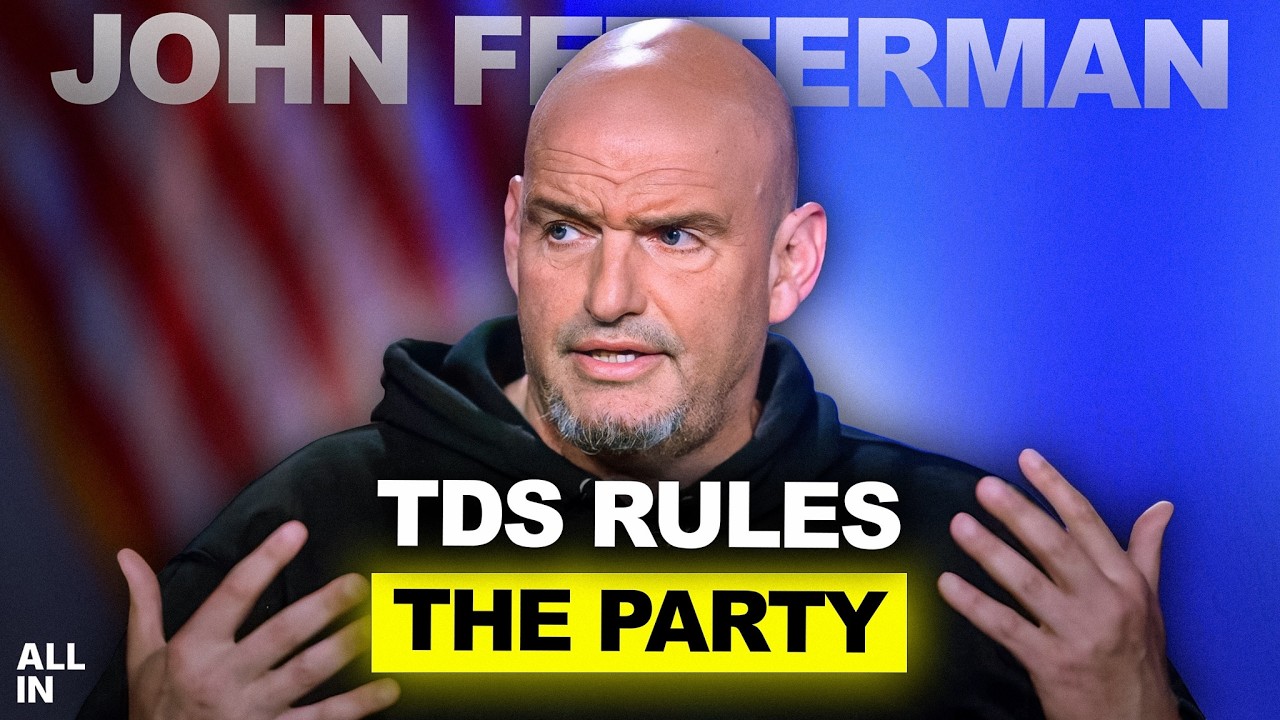
Fetterman Breaks with Democrats on Iran, Border, and Voter ID Laws
All-In Podcast
Senator John Fetterman argues that the Democratic Party has alienated working-class voters by prioritizing partisan purity over moral clarity on foreign policy, election security, and border enforcement.
## Background
This content was published on YouTube by the All-In Podcast on March 18, 2026. According to the page description, hosts David Friedberg, Chamath Palihapitiya, Jason Calacanis, and David Sacks welcome Senator John Fetterman to discuss a wide range of topics, including the SAVE Act, the state of the Democratic Party, foreign policy regarding Iran and Israel, government shutdowns, national debt, wealth taxes, and agricultural issues.
## TL;DR
In this interview, Senator John Fetterman outlines his distinct political identity, explaining why his independent positions on foreign policy, election integrity, and government funding often align more with Republicans than his own party's base. He strongly defends U.S. military action against Iran, unapologetic support for Israel, and common-sense voter ID requirements, while criticizing far-left progressive proposals like AI moratoriums and wealth taxes. Throughout the conversation, Fetterman emphasizes his commitment to governance with "moral clarity," prioritizing national interests and his constituents over partisan orthodoxy.
## Atmosphere & style
The interview features a candid, unscripted, and pragmatic tone where Senator Fetterman speaks directly without typical Washington talking points. The dynamic between Fetterman and the hosts is reflective and conversational, marked by mutual respect and lighthearted banter despite the heavy political topics. The atmosphere reflects a grounded sense of moral clarity and independence, as Fetterman thoughtfully navigates friction with his own party while maintaining a calm, authentic presence.
## Key takeaways
- [00:00](https://www.youtube.com/watch?v=3ZVqcW6Wwmg&t=0s) Senator Fetterman acknowledges his higher popularity among Republicans than Democrats, noting a shift from his former progressive label to identifying simply as a traditional Democrat.
- [00:00](https://www.youtube.com/watch?v=3ZVqcW6Wwmg&t=0s) Fetterman stands apart from his party by supporting Operation Epic Fury against Iran and opposing government shutdowns, specifically voting to fund the Department of Homeland Security.
- [04:24](https://www.youtube.com/watch?v=3ZVqcW6Wwmg&t=264s) He criticizes the Democratic Party's hyper-partisanship and 'Trump Derangement Syndrome' (TDS), arguing it prevents members from acknowledging positive outcomes like disarming Iran.
- [11:42](https://www.youtube.com/watch?v=3ZVqcW6Wwmg&t=702s) Fetterman strongly opposes national nation-building while advocating for strict military disarmament of Iran and its proxies to secure global maritime routes.
- [17:42](https://www.youtube.com/watch?v=3ZVqcW6Wwmg&t=1062s) He rejects claims that U.S. foreign policy is controlled by Israel or AIPAC, calling such rhetoric classic antisemitic tropes and warning against rising domestic antisemitism.
- [20:16](https://www.youtube.com/watch?v=3ZVqcW6Wwmg&t=1216s) While opposing the SAVE Act due to its broader additions, Fetterman supports basic voter ID requirements while debunking claims of widespread non-citizen voting or systematic fraud.
- [26:41](https://www.youtube.com/watch?v=3ZVqcW6Wwmg&t=1601s) Fetterman advocates for strict border enforcement and the deportation of criminal illegal immigrants, but calls for targeted protections for law-abiding agricultural labor and Dreamers.
- [32:49](https://www.youtube.com/watch?v=3ZVqcW6Wwmg&t=1969s) He expresses deep concern over the $40 trillion national debt and $1 trillion in annual interest payments, calling for pragmatic, bipartisan fixes to programs like Social Security.
- [36:24](https://www.youtube.com/watch?v=3ZVqcW6Wwmg&t=2184s) Fetterman praises whistleblowers exposing government waste and fraud, criticizing politicians who dismiss corruption or launch personal attacks against investigative reporters.
- [37:38](https://www.youtube.com/watch?v=3ZVqcW6Wwmg&t=2258s) He rejects progressive wealth tax proposals and attacks on high earners, arguing that ideologues from non-competitive states fail to understand how to win purple swing states.
- [40:23](https://www.youtube.com/watch?v=3ZVqcW6Wwmg&t=2423s) Fetterman warns against proposed moratoriums on AI data centers, noting that pausing tech development cedes critical technological leadership to geopolitical rivals like China.
- [43:00](https://www.youtube.com/watch?v=3ZVqcW6Wwmg&t=2580s) Addressing 2028 presidential speculation, Fetterman dismisses D.C. political math, choosing instead to focus on voting his conscience with moral clarity.
## Detailed walkthrough
Here is a detailed, faithful walkthrough of this section of the podcast transcript.
[00:00](https://www.youtube.com/watch?v=3ZVqcW6Wwmg&t=0s) Debate over the SAVE Act and Standing Out in the Democratic Party
Senate votes are currently underway on the floor, including early debate around the SAVE Act (Save America Act). While there is speculation that proponents may lack the necessary votes or top out at 51, Senator John Fetterman notes he has no special inside track on the outcome. He expresses disappointment that the legislation was not kept simple—strictly focusing on voter identification—and was instead turned into a "Christmas tree" packed with unrelated additions. Should the bill pass its initial procedural hurdles, Fetterman anticipates a major spectacle surrounding a potential talking filibuster.
Shifting to party politics and voter sentiment, Fetterman addresses recent polling metrics. While some surveys place his approval at 72% among Pennsylvania Republicans and 22% among Democrats, he notes other data like Morning Consult places him closer to 50/50 with Democrats and in the 60s with Republicans. He acknowledges that he is indisputably more popular with Republicans than with his own party base—a dynamic he finds mystifying, though he remains honored by support from any Pennsylvanian. Reflecting on his political identity since his first race in 2015, Fetterman explains that what defined a "progressive" a decade ago has fundamentally shifted. By his 2021–2022 Senate campaign, he had explicitly dropped the progressive label to identify simply as a Democrat.
Fetterman argues that the Democratic Party has moved away from non-controversial core principles, isolating him as he maintains what he views as "moral clarity." He highlights his stance as one of the few Democrats offering proud, unapologetic support for Israel. Pointing to polls showing deteriorating support for Israel within the Democratic Party, Fetterman emphasizes that he does not govern by poll numbers. He highlights key positions where he stands apart from his colleagues:
* **Support for Military Action Against Iran:** He frames himself as the only congressional Democrat voicing strong support for Operation Epic Fury to dismantle the Iranian military apparatus.
* **Funding Homeland Security:** He refuses to vote to shut down the Department of Homeland Security (DHS) over disagreements with ICE. Following a averted attack in Michigan where a suspect targeted 150 toddlers, along with mounting global threats, he argues it is reckless to shut down DHS and its cybersecurity infrastructure—actions that only benefit adversaries like China and Iran.
[04:24](https://www.youtube.com/watch?v=3ZVqcW6Wwmg&t=264s) The Demise of Bipartisanship and the Rise of "Trump Derangement Syndrome"
When asked what the Democratic Party currently stands for, Fetterman responds that he honestly does not know, urging listeners to pay close attention to high-profile Democratic Senate candidates. He observes an increasingly open hostility toward Israel that has become a mandatory purity test within the primary ecosystem. He criticizes candidates who reject support from pro-Israel groups and points out instances where the party appears willing to overlook extreme behavior in primary candidates—such as a candidate featuring a Nazi tattoo, holding avowed communist views, making offensive remarks about women and sexual assault, and dismissing rural voters as "stupid and racist."
In states like Michigan, Fetterman notes that political movements led by figures who refused to condemn Hamas organized the "uncommitted" voting bloc during the primaries. By withholding support from Kamala Harris, he argues these groups ultimately helped deliver Michigan to Donald Trump. He contrasts this rigid ideological enforcement with how politics used to operate, where opponents could agree on shared goals while disagreeing on specific policies.
Fetterman contends that the Democratic Party is currently governed by "TDS" (Trump Derangement Syndrome), which makes it politically dangerous for Democrats to acknowledge any positive outcome achieved by the opposing side. He points to Operation Epic Fury as a primary example: despite virtually every Democratic presidential candidate and member of Congress maintaining that Iran must never obtain a nuclear weapon, few are willing to celebrate or acknowledge the military operation disarming the regime simply because it occurred under a Republican administration.
- **Cross-Party Civility:** Fetterman stresses that he treats all constituents with respect, explicitly refusing to label Trump voters or MAGA supporters as "Nazis" or "fascists."
- **Core Democratic Inconsistencies:** He argues that shutting down the federal government runs counter to traditional Democratic values because it directly harms union members and everyday working Americans.
[11:42](https://www.youtube.com/watch?v=3ZVqcW6Wwmg&t=702s) Iran, Operation Epic Fury, and the Burden on Global Coalitions
Addressing the ongoing military actions in Iran, Fetterman defends the campaign, pointing out that only three weeks have elapsed since operations began. He mocks official Iranian narratives, noting that the media should be demanding "proof of life" from the Ayatollah. He characterizes Iran's leadership as running a "Weekend at Bernie's" routine to conceal the leader's actual status while key de facto leaders are systematically eliminated.
Fetterman argues that the Iranian military has been stripped of traditional combat capabilities, leaving them only able to launch cowardice-driven drone strikes against civilians and massacre tens of thousands of their own citizens to suppress internal uprisings. By crippling Iran's military capabilities and breaking its proxy network—including Hamas, Hezbollah, and the Houthis—the operation has made the world demonstrably safer. He rejects comparisons to long-term nation-building exercises:
* **Not Iraq or Afghanistan:** Fetterman insists the mission is strict disarmament and regime destruction, not nation-building.
* **Historical Parallels:** He compares disarming the Iranian regime to taking action against the Nazi regime in Germany before it could trigger wider destruction, arguing that avoiding action would have cost far more in lives and economic devastation.
On global trade and energy, Fetterman criticizes NATO allies and European nations for refusing to join U.S. efforts to secure and reopen the Strait of Hormuz. He points out that any nation that consumes oil shares a direct responsibility to keep global maritime straits open. He finds it baffling that Western allies expect the U.S. and Israel to carry out the heavy lifting of military intervention while refusing to participate in maritime security operations that directly affect their own energy supplies—leaving China and Russia as the primary beneficiaries of Western hesitation.
[17:42](https://www.youtube.com/watch?v=3ZVqcW6Wwmg&t=1062s) Israel's Influence and Pushing Back on Political Tropes
Addressing criticism from both sides of the political aisle that the U.S. government and President Trump are excessively influenced by Israeli Prime Minister Benjamin Netanyahu or pro-Israel lobbying groups like AIPAC, Fetterman rejects these arguments outright. He states that accusations of hidden hands "pulling all the strings" trade directly on classic antisemitic tropes.
Fetterman expresses concern that such rhetoric has become increasingly normalized within sections of the Democratic Party as well as on the fringe right. He dismisses figures like Tucker Carlson and Nick Fuentes, noting that "no one claims them" and that mainstream lawmakers do not take their conspiratorial talking points seriously. For Fetterman, standing with Israel remains a matter of straightforward moral clarity rather than political calculation or lobbyist influence.
Here is a detailed, faithful walkthrough of the transcript segment.
[18:42](https://www.youtube.com/watch?v=3ZVqcW6Wwmg&t=1122s) Anti-Semitism, Israel, and Extreme Rhetoric in Politics
Senator John Fetterman reflects on the rise of radicalism and anti-Semitism on both ends of the political spectrum. He expresses disgust at attempts to normalize extreme symbols, like brushing off a Nazi tattoo as a "one-off," or labeling Israel’s military action as a "genocide." Fetterman stresses how ignorant that framing is to the actual definition of genocide, insisting that Israel is engaged in a just war. He reminds listeners of how the conflict started and what Hamas continues to do, stating plainly that if Hamas sent everybody home, the war would end immediately.
Fetterman warns that anti-Semitism has gotten completely out of control across the world and on college campuses. He points to local incidents, including an attack in San Jose where a Jewish man was beaten simply while having dinner, and a dangerous incident where someone crashed into a synagogue—reminiscent of the Tree of Life synagogue shooting—who was fortunately killed immediately by armed security. He adds that he refuses to tune into extreme figures on either side for wisdom, noting specifically that he has never turned to Tucker Carlson for his views.
- **Tree of Life Analogy:** Fetterman references the Tree of Life tragedy when discussing a recent incident of someone crashing into a synagogue, expressing relief that armed security stopped the attacker immediately.
- **Position on Hamas:** Maintains that the war would end instantly if Hamas released all the hostages and sent everyone home.
---
[20:16](https://www.youtube.com/watch?v=3ZVqcW6Wwmg&t=1216s) The SAVE Act, Voter ID, and Election Integrity
Turning to the proposed SAVE Act and voter ID laws, Fetterman breaks down his perspective on election security. While 83% of Americans and 71% of Democrats support showing voter ID, he explains why he cannot support the SAVE Act in its current form. He criticizes Senate Republicans for failing to engage in genuine outreach or asking how to rework the bill. He suggests a straightforward compromise: requiring a standard Real ID to vote, keeping the process simple rather than turning the legislation into a "Christmas tree" packed with partisan boutique issues.
Fetterman rejects the extreme hyperbole surrounding voter ID, stating flatly that requiring an ID is not "Jim Crow" and is not an attempt to suppress American voters. At the same time, he pushes back hard against Republican smears of mail-in voting. Drawing on his experience as Pennsylvania's Lieutenant Governor during the 2020 election, he notes that 57 out of Pennsylvania's 67 counties are deep red and that mail-in voting was originally a Republican initiative in the state. He recalls that out of millions of votes, only six or seven individual instances of fraud were uncovered in Pennsylvania—coincidentally all involving Republicans attempting to vote for Donald Trump using dead relatives—proving that the state's elections are secure. Addressing claims about non-citizen voting, Fetterman cites the conservative Heritage Foundation's own database, which identified only 77 instances of non-citizens voting across the entire United States between 1999 and 2023.
> "I refuse the kind of extreme rhetoric about it's not Jim Crow. It is not trying to suppress Americans from voting. It's making it perhaps more secure."
- **Voter ID Polling Data:** 83% of overall Americans and 71% of Democrats support voter ID requirement.
- **Pennsylvania 2020 Fraud Stats:** Out of 67 counties (57 of which are deep red), only 6 or 7 cases of voter fraud were identified, mostly involving people using dead relatives to vote for Donald Trump.
- **Heritage Foundation Non-Citizen Voting Data:** 77 total instances of non-citizens voting nationwide between 1999 and 2023.
- **Wisconsin April 2025 Ballot Initiative:** A voter ID ballot measure passed by nearly a 2-to-1 margin on the exact same ballot where voters elected a liberal Supreme Court justice.
---
[26:41](https://www.youtube.com/watch?v=3ZVqcW6Wwmg&t=1601s) Government Shutdowns, ICE Enforcement, and the Border Crisis
Addressing government funding and immigration, Fetterman reiterates his firm stance against government shutdowns. He highlights that he was the only Democrat to vote to fund the Department of Homeland Security (DHS), calling out his party's hypocrisy for throwing a "freak out" when Senator Tommy Tuberville delayed military promotions, only to turn around and support shutting down the entire government over ICE funding. While Fetterman served as the Democratic lead on the Laken Riley Act alongside Republican Senator Katie Britt—helping break cloture to make it law—he believes ICE leadership under Kristi Noem lost the plot in Minnesota, prompting him to call for her resignation just as he previously called for Alejandro Mayorkas to step down.
On the operational role of ICE, Fetterman argues that the American public wants two main things: a secure border and the deportation of every criminal illegal immigrant. However, he warns against targeting otherwise law-abiding undocumented migrants, emphasizing that agriculture is Pennsylvania’s top industry and farmers face constant labor shortages. Mentioning that his own wife was once a Dreamer, he advocates for a balanced approach that protects people brought to the country as toddlers while maintaining strict border control. Reflecting on the Biden administration's immigration policy, Fetterman admits he was stunned when the administration dropped Title 42, pointing out that seeing 300,000 migrants arrive at the border in a single month—the equivalent of the entire population of Pittsburgh—was completely unsustainable and rightfully punished Democrats at the ballot box in 2024.
> "The size of Pittsburgh is showing up at the border, that's unsustainable... we were punished in '24. The border was a serious failure as Democrats."
- **Laken Riley Act:** Fetterman co-led the bill with Alabama Senator Katie Britt, gathering enough Democratic votes to break cloture and sign it into law.
- **DHS Funding Vote:** Fetterman was the sole Democratic Senator to vote to fund the Department of Homeland Security during the budget dispute.
- **Scale of Border Arrivals:** Monthly border arrivals peaked around 300,000 in late 2023, which Fetterman equates to the entire population of Pittsburgh arriving in 30 days.
---
[32:49](https://www.youtube.com/watch?v=3ZVqcW6Wwmg&t=1969s) National Debt, Government Fraud, and Political Hyper-Partisanship
The conversation shifts to the fiscal health of the United States, which faces $40 trillion in national debt and a $2 trillion annual deficit—$1 trillion of which goes strictly toward paying interest. Fetterman expresses deep concern over the staggering numbers, reminiscing about a time when a billion dollars was considered a lot of money. On the topic of Social Security, he argues that the program does not need radical overhauls; modest actuarial adjustments could extend its solvency well into the 2070s or 2080s if politicians would stop using it as a partisan weapon.
Fetterman laments that Washington D.C. has devolved into a "Jerry Springer show" or professional wrestling match. When asked what currently drives the Democratic Party leadership, Fetterman quips that it is simply "TDS" (Trump Derangement Syndrome), joking that if Donald Trump came out in favor of ice cream and lazy Sundays, Democrats would immediately organize to vote it down. Finally, the panel brings up investigative videos by activists like Nick Shirley exposing government program fraud in states like Minnesota and California. Fetterman commends fraud whistleblowers, arguing that any legitimate effort to expose and eliminate waste should be celebrated regardless of political party. He strongly condemns California Governor Gavin Newsom for releasing a video smearing an investigative journalist with disgusting personal implications instead of addressing the underlying waste.
> "If you turn Washington D.C. as the Jerry Springer show... you asked me earlier what's the leader of the Democratic Party right now? I would say it's TDS."
- **US Debt Metrics:** $40 trillion total national debt, $2 trillion annual deficit, and $1 trillion in annual interest payments.
- **Social Security Projection:** Fetterman asserts small technical/actuarial tweaks could extend Social Security's solvency into the 2070s or 2080s.
- **Exposing Fraud:** Fetterman defends independent journalists exposing government fraud and criticizes Governor Gavin Newsom for using ad hominem attacks against corruption investigators.
[036:24] Fraud, Party Mistakes, and Breaking News on the SAVE Act
The conversation opens with a discussion on government fraud and how political parties handle public accountability. Fetterman stresses that taxpayers should be furious when their money is lost to fraudsters, regardless of whether it happens in a blue state or a red state. He warns that when Democrats dismiss legitimate problems—telling voters "there's nothing here"—they end up losing elections, drawing a direct parallel to how the party mishandled the border crisis in 2023. Mid-conversation, a staffer interrupts Fetterman with breaking news from Capitol Hill: the SAVE Act (Safeguard American Voter Eligibility Act) just passed its initial procedural vote 51–50 to move to floor debate. The hosts express surprise at the sudden movement, asking Fetterman how he sees the upcoming debate playing out over the next few days or week. Fetterman candidly admits he has no idea how the immediate process will unfold, refusing to pretend he can predict the exact legislative sequence.
- Fetterman emphasizes that ignoring or minimizing systemic fraud loses voters and causes self-inflicted political peril.
- A staffer hands Fetterman a live update confirming the SAVE Act cleared a procedural threshold by a narrow 51–50 vote to move to debate.
[037:38] "Why I'm Still a Democrat": Independent Voice vs. Progressive Rhetoric
David Sacks returns to a fundamental question: given how sharply critical Fetterman is of Democratic Party leadership and their core positions, why does he remain a Democrat, and has he ever considered switching parties? Fetterman responds that he hasn't changed; rather, parts of the party moved away from him. He asserts that he intends to remain an independent voice, calling "balls and strikes" and prioritizing the country over party orthodoxy or the demands of his base. The discussion then shifts to wealth inequality, a defining theme heading toward the 2028 election. Fetterman rejects the far-left trope of villainizing high earners, stating plainly, "I don't hate billionaires." He points out that Democrats routinely embrace billionaires when they fund progressive causes, noting that Illinois Governor JB Pritzker is a billionaire without being labeled an "oligarch trying to destroy America."
When asked about proposals pushed by Senator Bernie Sanders and Representative Ro Khanna for a national wealth tax—as well as a proposed California ballot initiative introducing a 5% wealth tax on billionaires—Fetterman expresses deep skepticism. He notes that Bernie Sanders represents a small, non-competitive state, bluntly suggesting that progressive ideologues need to "win a competitive state" before lecturing the rest of the country on how to govern or win national elections.
- Fetterman asserts his identity as a traditional Democrat who chooses country over party base demands.
- Defends high earners and notes the party's double standard in accepting funding from billionaire donors and electing billionaire governors.
- Dismisses progressive wealth tax proposals, arguing leaders from dark-blue or small states lack the perspective needed to win purple swing states.
[040:23] AI Moratoriums, Party Extremes, and Agricultural Hardships
The host brings up Bernie Sanders' recent call for a moratorium on building AI data centers, noting that Silicon Valley insiders view such bans as a gift to geopolitical rivals: "China loves it." Fetterman agrees, warning that halting domestic technology infrastructure effectively hands the AI race to China. He vents his frustration at the hyper-critical, progressive wing of the party, linking their anti-tech stances to extreme slogans like "defund the police" and "abolish ICE."
Transitioning to his work on the Senate Agriculture Committee, Fetterman addresses the staggering economic reality facing American farmers, the vast majority of whom lost money in the previous year and relied heavily on federal support payments, crop insurance, and emergency bailouts. Fetterman expresses deep reverence for farmers, especially in Pennsylvania, highlighting that back-breaking agricultural labor literally feeds the nation. He points out that aggressive tariffs and severe labor shortages have devastated family farms—issues directly connected to the broader debates over trade policy and immigration reform.
- Warns that pausing AI data center construction surrenders critical technological leadership to China.
- Groups AI moratoriums with past progressive slogans like "defund the police" and "abolish ICE."
- Highlights the severe economic crisis facing U.S. agriculture, citing high labor costs and tariffs as primary pressures on Pennsylvania farmers.
[043:00] Approval Ratings, 2028 Speculation, and Moral Clarity
Addressing reports that his approval rating among Pennsylvania Democrats had plummeted to 22%, Fetterman pushes back, citing more recent polling that puts his support closer to 50/50. He insists he isn't losing sleep over 2028 political math or playing Washington "parlor games." Instead, he feels completely at peace voting his conscience and putting country over party. For Fetterman, maintaining "moral clarity" means taking unwavering stances on core international issues: standing firmly with Israel and the Jewish community post-October 7th, and supporting the destruction of the Iranian regime as the only true path to an enduring peace in the Middle East.
When Sacks asks directly whether a 2028 presidential run is on the table given widespread speculation, Fetterman demurs. He states he doesn't know what direction the country will want in 2028 and prefers to focus on doing his job today with moral clarity. The hosts close the interview by thanking Fetterman for his refreshing willingness to engage in an honest, unscripted conversation without resort to name-calling or partisan soundbites.
- Rejects low approval rating claims, pointing to current internal data showing a balanced 50/50 standing in Pennsylvania.
- Defines his core priorities as standing with Israel, supporting the Jewish community, and confronting Iran.
- Deflects 2028 presidential speculation, emphasizing his focus on voting his conscience in the Senate.
<ElicitationsGroup message="To explore more aspects of this interview and Senator Fetterman's platform:">
<Elicitation label="Analyze Fetterman's stance on foreign policy and Israel" query="Provide a detailed breakdown of Senator John Fetterman's views on Israel, Iran, and foreign policy based on his recent public statements."/>
<Elicitation label="Compare Fetterman's positions with the mainstream Democratic platform" query="Create a comparison table between John Fetterman's policy stances (immigration, voter ID, AI, wealth tax) and the standard national Democratic Party platform."/>
</ElicitationsGroup>
## Notable quotes
> [20:16](https://www.youtube.com/watch?v=3ZVqcW6Wwmg&t=1216s) I refuse the kind of extreme rhetoric about it's not Jim Crow. It is not trying to suppress Americans from voting. It's making it perhaps more secure. — John Fetterman
> [26:41](https://www.youtube.com/watch?v=3ZVqcW6Wwmg&t=1601s) The size of Pittsburgh is showing up at the border, that's unsustainable... we were punished in '24. The border was a serious failure as Democrats. — John Fetterman
> [32:49](https://www.youtube.com/watch?v=3ZVqcW6Wwmg&t=1969s) If you turn Washington D.C. as the Jerry Springer show... you asked me earlier what's the leader of the Democratic Party right now? I would say it's TDS. — John Fetterman
> [37:38](https://www.youtube.com/watch?v=3ZVqcW6Wwmg&t=2258s) I don't hate billionaires. — John Fetterman
## Mentioned
John Fetterman, David Friedberg, David Sacks, Kamala Harris, Donald Trump, Ayatollah, Benjamin Netanyahu, Tucker Carlson, Nick Fuentes, Tommy Tuberville, Katie Britt, Kristi Noem, Alejandro Mayorkas, Nick Shirley, Gavin Newsom, JB Pritzker, Bernie Sanders, Ro Khanna, SAVE Act, Department of Homeland Security, ICE, AIPAC, Hamas, Hezbollah, Houthis, NATO, Operation Epic Fury, Heritage Foundation, Laken Riley Act, Social Security, Senate Agriculture Committee
Senator John Fetterman argues that the Democratic Party has alienated working-class voters by succumbing to progressive purity tests, fiscal overreach, and reflexive opposition to Donald Trump. Defending his profile as an independent, purple-state Democrat, Fetterman calls for strict border enforcement, domestic technological dominance, and decisive military backing for Israel and Iranian disarmament.
Challenging Democratic Orthodoxy and Progressive Labels (4:24)
Fetterman explains that the definition of a "progressive" fundamentally shifted over the past decade, prompting him to drop the label during his 2021–2022 Senate campaign to run simply as a Democrat. He claims party leadership is currently consumed by "Trump Derangement Syndrome," which he argues makes it politically dangerous for Democrats to acknowledge any positive outcome achieved by Republicans, including military successes abroad. Emphasizing civility, Fetterman explicitly rejects labeling Trump supporters or MAGA voters as "Nazis" or "fascists."
Addressing his standing with voters, Fetterman notes that polling places his approval between 60% and 72% among Pennsylvania Republicans, compared to split support—ranging from 22% to 50%—among Democrats. He criticizes primary purity tests that penalize pro-Israel candidates while overlooking fringe rhetoric, asserting that progressive ideologues from safe, non-competitive states lack the standing to lecture purple-state lawmakers on how to win national elections.
Confronting Iran and Defending Israel (11:42)
Fetterman positions himself as an outlier within his party, claiming to be the only congressional Democrat voicing strong support for Operation Epic Fury to dismantle the Iranian military apparatus and its proxy network, including Hamas, Hezbollah, and the Houthis. Rejecting comparisons to past nation-building interventions in Iraq and Afghanistan, he characterizes the campaign as a targeted disarmament mission, likening it to confronting Nazi Germany early to prevent broader devastation. He also criticizes European NATO allies for expecting the U.S. and Israel to bear the military burden while refusing to help secure oil transit through the Strait of Hormuz.
Regarding the war in Gaza, Fetterman maintains that Israel is fighting a just war that would end immediately if Hamas released all hostages. He dismisses accusations that Israel is committing genocide or that American policy is controlled by pro-Israel lobbyists, labeling such arguments traditional antisemitic tropes. Citing violent attacks on synagogues and Jewish individuals, he warns that antisemitic radicalism is escalating across the country.
Border Realism and Homeland Security Funding (26:41)
Fetterman highlights that he was the sole Senate Democrat to vote to fund the Department of Homeland Security, refusing to support a government shutdown over disputes regarding Immigration and Customs Enforcement (ICE). He argues that shutdowns harm union workers and compromise national cybersecurity against adversaries such as China and Iran. While he partnered with Republican Senator Katie Britt to break cloture and pass the Laken Riley Act, Fetterman called for ICE leadership under Kristi Noem to step down over operational mismanagement, noting he had previously demanded Alejandro Mayorkas resign for similar failures.
Fetterman asserts that Democrats were rightfully punished in the 2024 elections for mishandling the southern border, pointing to late 2023 when monthly arrivals reached roughly 300,000—a volume equal to the population of Pittsburgh. He advocates a dual approach that secures the border and deports criminal non-citizens, while protecting Dreamers and preserving the agricultural workforce essential to states like Pennsylvania.
Pragmatic Election Security and Voter Identification (20:16)
While Fetterman opposes the SAVE Act because Senate Republicans loaded it into a partisan "Christmas tree" rather than a clean bill, he rejects Democratic rhetoric framing voter identification as modern "Jim Crow" or voter suppression. Noting that 83% of Americans and 71% of Democrats support voter ID, he advocates a straightforward compromise requiring a standard Real ID, pointing out that Wisconsin voters approved a voter ID initiative by a 2-to-1 margin on the same ballot where they elected a liberal Supreme Court justice.
At the same time, Fetterman dismisses claims of widespread voter fraud. Drawing on his oversight of Pennsylvania's 2020 election as Lieutenant Governor, he notes that across 67 counties, only six or seven individual fraud cases were identified, mostly involving Republicans voting on behalf of deceased relatives. He also points to Heritage Foundation data recording only 77 total instances of non-citizen voting nationwide between 1999 and 2023.
Technology Infrastructure, Fiscal Debt, and Agriculture (32:49)
Fetterman expresses deep skepticism toward progressive economic policies, including national wealth tax proposals championed by Senator Bernie Sanders and Representative Ro Khanna. He rejects the villainization of high earners, pointing out that Democrats routinely accept funding from billionaire donors and elect billionaire governors like JB Pritzker. Furthermore, he strongly opposes Sanders' call for a moratorium on AI data center construction, warning that halting domestic infrastructure would effectively surrender technological leadership to China.
Turning to the economy, Fetterman highlights the compounding risks of a $40 trillion national debt, a $2 trillion deficit, and $1 trillion in annual interest payments. He argues that modest actuarial adjustments could maintain Social Security solvency into the 2070s or 2080s if politicians stop weaponizing the program. Serving on the Senate Agriculture Committee, he also underscores the plight of Pennsylvania farmers struggling with tariffs and labor shortages, urging leaders to focus on systemic fraud and supply-chain realities rather than partisan theater.
Fetterman asserts that his willingness to vote his conscience and articulate uncomfortable truths represents a durable model for governing competitive swing states, though he demurs on 2028 presidential speculation. However, his platform leaves open the question of whether an independent-minded Democrat can successfully bridge deep internal party divides without permanently alienating the progressive base required for broad national coalitions.
[20:16] John Fetterman: I refuse the kind of extreme rhetoric about it's not Jim Crow. It is not trying to suppress Americans from voting. It's making it perhaps more secure.
[26:41] John Fetterman: The size of Pittsburgh is showing up at the border, that's unsustainable... we were punished in '24. The border was a serious failure as Democrats.
[32:49] John Fetterman: If you turn Washington D.C. as the Jerry Springer show... you asked me earlier what's the leader of the Democratic Party right now? I would say it's TDS.
[37:38] John Fetterman: I don't hate billionaires.
Original transcript
[0:00] John Fetterman, thank you for joining us
[0:01] here on the All-In podcast for this
[0:03] All-In interview. Very excited to have
[0:05] you here
[0:06] today. I know you're in the middle of
[0:07] voting today. Sounds like the Save
[0:10] America Act might be starting its debate
[0:12] on the floor. Is that correct? I don't
[0:14] know. Like what what I've heard recently
[0:17] that they don't have the votes, but we
[0:19] will find. But I don't have any special
[0:22] insight. I mean, it's it's going to be
[0:24] very close. I don't think it will If
[0:26] they do hit it, I don't see it more
[0:28] beyond 51. But I'm not I'm not really
[0:31] sure. It's a shame that they didn't make
[0:33] it more about just ID to vote. They they
[0:37] turned it into other things. They turned
[0:39] it into kind of a Christmas tree, and
[0:41] they're hanging all these things on it.
[0:43] But that's that's where we are, but
[0:45] we'll know uh and
[0:49] having someone follow that, too. I just
[0:51] He's going to let me know, in fact, cuz
[0:52] I'm really interested to see how it
[0:53] goes. Because if they do, then that's
[0:56] going to turn into a really uh
[0:59] a spectacle about what a a talking
[1:02] filibuster is. Yeah. Well, let's see
[1:05] what happens. I mean, it's a pretty
[1:07] dramatic week ahead. Let me just start I
[1:09] want to zoom out a little bit and talk
[1:11] about how you make policy decisions. And
[1:12] I want to just start with party.
[1:14] You ran as a progressive in 2016, lost.
[1:17] You beat Dr. Oz in '22. And now you have
[1:20] a 72% approval rating from Pennsylvania
[1:22] Republicans. And only 22% from
[1:25] Democrats.
[1:26] Are you a Republican or are you a
[1:28] Democrat senator? And kind of what's the
[1:31] way that you think about your party
[1:32] affiliation?
[1:34] Well, I actually I think the the more
[1:36] realistic the realistic numbers was like
[1:39] uh earlier in the morning console. And
[1:42] that had me at basically 50/50 with
[1:45] Dems. And I was I was in the the 60s for
[1:49] with Republicans. Without a doubt,
[1:51] without a doubt, that that I am more
[1:53] popular with with Republicans. And I
[1:56] mystified by that. I mean, I'm honored
[1:59] to to have support from any
[2:01] Pennsylvanian, but what I will say that
[2:03] um you know, [clears throat] I've just
[2:05] going to follow what I think is the
[2:07] moral clarity. And now, in my very first
[2:11] race back in 2015, over a decade ago, uh
[2:14] what used to be a progressive is
[2:16] definitely not what a progressive
[2:18] started to turn into and what it be
[2:21] became. And and even in my my race in
[2:24] '21 '22, I was announcing, I am no
[2:27] longer I I'm just a Democrat. I'm not a
[2:30] progressive. And now, there's been that
[2:32] evolution away from like those core
[2:34] principles that really weren't weren't
[2:36] controversial.
[2:38] And and now, I've isolated myself by
[2:42] following and standing and proud to be
[2:45] un
[2:46] unapologetically supporting Israel. And
[2:49] now, if you've seen that that poll came
[2:51] out yesterday that the standing in the
[2:54] Democratic Party continues to
[2:55] deteriorate, I've put that out on my
[2:58] social media, and I said, "I don't
[3:00] follow. I don't care about the polls.
[3:02] You know, there's a moral clarity here,
[3:04] and that should be where the rest of us
[3:05] should should be." Uh and now, it's been
[3:09] really easy for me to to lean in on it,
[3:13] and that I created the only Democrat
[3:16] that's very supportive about Epic Fury.
[3:20] And I'm also the only Democrat that
[3:22] refuses to shut down the Department of
[3:26] Homeland Security. Yes, as a Democrat,
[3:29] we would like to make some some reforms
[3:31] on ICE, but what I'm unwilling to do is
[3:33] shut it down. And after that horrific
[3:37] that attack in Michigan, where where he
[3:41] was looking to kill 150 toddlers, you
[3:44] know, and now there's more and more
[3:46] kinds of these these events. Why would
[3:49] [clears throat] you vote to shut our
[3:50] government down? and the cybersecurity
[3:53] agency, you know, that must be
[3:55] incredible for the Chinese and the
[3:58] Iranians that that we've shut that
[4:02] government down. So,
[4:05] that's that you know, I my core values
[4:08] haven't changed. If anything's changed,
[4:11] that's been kind of the core what what's
[4:13] required to be a Democrat and I'm going
[4:16] to follow what I think is true. What is
[4:19] the
[4:20] country over party, whether that's the
[4:22] right side of history.
[4:24] What do you think the Democratic Party
[4:26] used to stand for? What does it stand
[4:28] for today and what do you think it
[4:29] should stand for?
[4:31] I I I honestly I I I don't know. But,
[4:34] what I will say as I would refer to to
[4:37] your listeners is like
[4:39] listen to what the people that are
[4:41] running for the Senate as Democrats.
[4:44] Watch what they're saying and doing and
[4:48] it's becoming more and more anti-Israel,
[4:52] openly hostile to to Israel. And now
[4:56] that becomes part of the litmus litmus
[4:59] purity test. I'm not going to take any
[5:01] of their money. I'm going to denounce
[5:04] that and
[5:06] I was the only Democrat that's
[5:08] absolutely Netanyahu just done the right
[5:10] thing to to break the that access
[5:15] there Hezbollah and Hamas and now
[5:17] attacking also Houthis as well. So, I
[5:20] mean, so do you know where what
[5:22] Democrats stand for? See who's running
[5:26] for the Senate and now play it planner
[5:29] with the the Nazi tattoo guy.
[5:32] You know, on top of being a an about
[5:34] communist and I'll said
[5:37] >> [clears throat]
[5:37] >> incredibly offensive things about women
[5:40] and sexual assault
[5:42] and I'll refers to rural people as
[5:45] stupid and racist. And I was so and now
[5:49] and is that what Democrats want? Well, I
[5:51] guess we'll see that. But, you know, you
[5:53] see in all these different things also
[5:55] in Michigan, too. A guy that really as
[5:58] far I know has refused to condemn Hamas.
[6:00] And he led the, you know, no
[6:03] the the no
[6:05] What was the no committed? It's like the
[6:08] forget what that that stupid thing was
[6:09] called, but it was like you you know,
[6:11] you no vote no vote for uh uncommitted.
[6:13] Uncommitted, yeah. Uncommitted. Yeah.
[6:15] But, you know, we're not going to vote
[6:16] for
[6:17] Kamala Harris. And and now they helped
[6:19] deliver
[6:21] um Trump uh for Michigan. So, that's
[6:24] like look who's running. And look who's
[6:26] being competitive. So, that that's you
[6:28] want to know where Democrats are, look
[6:30] in those kinds of races.
[6:32] You know, it's interesting. We used to
[6:34] have
[6:35] the ability to agree on some things and
[6:37] disagree on other things. It seems
[6:39] nowadays
[6:40] whatever the other side is doing or
[6:43] saying,
[6:44] you have to take the opposing view. And
[6:46] in many cases, it seems like that might
[6:49] force folks to kind of contort into
[6:51] these weird positions that don't even
[6:53] make logical sense.
[6:55] Why did we get to this point? What
[6:57] happened that everything had to be
[6:59] polar? There was never the ability for
[7:01] us to There's no longer the ability for
[7:02] us to agree on some things while
[7:04] disagreeing on other things. What caused
[7:06] this change in this country? And can we
[7:08] get back from it?
[7:10] I I don't know. Like, part of my party's
[7:12] become so inflexible. What what I've
[7:15] discovered that, you know, you are not
[7:17] allowed to be a proud unapologetic
[7:19] standing uh with Israel, but it's it's
[7:23] okay. Uh it's not a big deal if you have
[7:25] a Nazi tattoo on your chest. And you
[7:28] have people in now in my party now are
[7:30] trying to normalize that or to excuse
[7:33] that. I mean, like it's
[7:35] that that's that's that's kind of where
[7:37] we are. And and now I know what's toxic
[7:41] as a Democrat to disagree with. But for
[7:45] me,
[7:46] those are I think our core values. You
[7:48] know, the kinds of values in Israel,
[7:50] kinds of the core value that we have
[7:52] always used to say, "Never ever shut our
[7:54] government down. That's always wrong.
[7:55] You're going to punish union members.
[7:58] You're going to punish, you know,
[7:59] everyday Americans." Now here we're
[8:01] doing those same things. Uh and now I
[8:04] think our border, for example, I think
[8:06] secure our border,
[8:08] deport all the criminals. But now, never
[8:11] ever have the kind of tragedies like we
[8:13] had in Minneapolis. That's not what
[8:15] anyone really voted for anything
[8:16] supports. So, you know, if I'm more
[8:19] popular than Republicans, I don't really
[8:22] know. But uh but I also thought I I
[8:25] treat everyone with respect and I don't
[8:28] refer to Republicans or members of MAGA.
[8:31] They're not Nazis. They're not fascists.
[8:33] They're not trying to destroy our
[8:35] country.
[8:36] Uh now I know and I love many many
[8:39] people that that voted for or support
[8:42] President Trump. I'm going to treat
[8:44] anybody with respect. I don't attack
[8:47] members of their families. I don't use
[8:50] and and those kinds of attacks. We have
[8:52] to find a better way forward and and
[8:55] that's what I've been maintaining.
[8:59] Who do you think leads the Democratic
[9:00] Party today?
[9:02] Oh, we don't we don't have one.
[9:04] >> [clears throat]
[9:04] >> I I think I think the the TDS that I
[9:08] think that's the leader right now. You
[9:10] know, right now our our party is is
[9:13] governed by the TDS and now it's made it
[9:16] virtually impossible without being
[9:18] punished as a Democrat to agree
[9:20] something's good or I agree with the
[9:23] other side. And I I would define that by
[9:26] epic fury. I am the literally the only
[9:28] Democrat in America uh in Congress that
[9:32] I've come across that's saying, "I think
[9:33] it's a great thing to break and destroy
[9:35] the Iranian regime. I think it's
[9:37] entirely appropriate to hold them
[9:39] accountable and what's strange to me
[9:43] that every single Democrat that's run
[9:45] for president and anyone that I know in
[9:48] Congress says we must never allow them
[9:51] to acquire a nuclear bomb. When that
[9:53] happens, why not celebrate that and or
[9:56] acknowledge that? I have only witnessed
[9:59] just criticism and these kinds of
[10:03] these kinds of attack. Like, yeah, you
[10:06] don't have to agree on every single
[10:08] thing, but when a good thing happens,
[10:12] just because it comes from a
[10:14] the different party,
[10:16] that that tells me that you're choosing
[10:19] the demand of the the base or the party
[10:21] over country or what what's really I
[10:25] think appropriate in that circumstances.
[10:27] Now, I I would say now, you know, to any
[10:30] country any country, do you consume oil?
[10:33] Yes, of course we do. Well, then that
[10:34] makes it your problem, too. That makes
[10:36] you part of your responsibility. I don't
[10:39] know why, you know, like
[10:41] Israel and and our nation did the heavy
[10:44] lifting. Excuse me, uh
[10:47] the the heavy
[10:49] the heavy work to to destroy the Iranian
[10:52] military apparatus. You know, now why
[10:55] not wouldn't you not, you know, help us
[10:58] to reopen
[11:00] the straits because you consume oil. You
[11:03] all could be
[11:05] the ability
[11:07] to why not par- participate? That that's
[11:10] that's strange to me.
[11:12] So, I think everyone, why can't you get
[11:14] behind? The only ones that aren't are
[11:17] China and Russia. Those are the same
[11:19] kinds of especially in Europe, you know,
[11:22] what they're doing to Ukraine for over 4
[11:24] years and we all know what the goals of
[11:27] China is. There's so You say it's not
[11:31] our war, it's like yeah, well, it's our
[11:33] cause. And if you consume oil, and you
[11:36] all do, you know, that effectively makes
[11:39] us all part of this responsibility.
[11:42] Right. Do you think uh
[11:44] there's a clear path to getting out of
[11:47] Iran for the United States at this
[11:48] stage? How do you view this exit
[11:50] happening? It seems like
[11:51] the president, to some degree, is
[11:53] declaring victory, but on the other
[11:55] hand, there seems to be continued
[11:56] activity and and push forward here.
[11:59] What's our exit path?
[12:02] I I don't know.
[12:04] But what I will say, what's undeniably
[12:06] been happening. Now,
[12:08] first, why aren't all of the media
[12:11] outlets demanding proof of life from
[12:13] from the Ayatollah?
[12:15] You know, ever since that first strike
[12:18] back in last month, not a peep, not a
[12:20] peep out of him. I mean, the the
[12:22] Iranians are doing kind of like Weekend
[12:25] at Italia's.
[12:27] >> [clears throat]
[12:27] >> You know, like they're just trying to
[12:28] pretend this guy is functional in any in
[12:31] any way. And now, just today today, you
[12:34] know, they just they just eliminated,
[12:37] you know, who was effectively the the de
[12:39] facto leader. You know, I think that's
[12:41] fantastic. Keep doing it for that. So,
[12:45] and without a doubt, they have no
[12:47] capabilities at this point otherwise
[12:50] than to
[12:51] to fire off a a drone at civilians at
[12:54] civilians. The Iranians have never done
[12:57] anything other than just attacking
[12:59] civilians. Abs- absolutely. That's a
[13:01] fact. You know, they can't engage in
[13:04] traditional kinds of of combat. So,
[13:08] those cowards, what they do is fire
[13:10] drones to create chaos. You know,
[13:12] they've been effectively neutered, and
[13:14] that's a wonderful thing. And that's
[13:16] also effectively broken the the proxies.
[13:20] And that's also made the world
[13:21] undeniably more secure. So, and this is
[13:25] not this is not a an
[13:27] uh
[13:28] I mean this war is only 3 weeks into it.
[13:31] This whatever you want to call it,
[13:33] whatever the semantics, it's 3 weeks.
[13:35] This is not like a Ukraine in war. You
[13:38] know, this is 3 weeks. It It's not you
[13:41] know, neat and it's not absolutely quick
[13:44] to to dismantle the entire Iranian
[13:49] apparatus for the thing. Holding them
[13:51] accountable is entirely appropriate. And
[13:55] every single president since the last 40
[13:57] some years wanted to do something about
[14:00] Iran. Finally, that's happened. It's a
[14:03] good thing. And now To your point about
[14:06] the straight and America looking for
[14:08] assistance to support the activities
[14:11] that the commercial oil activity through
[14:12] the straight, NATO allies have largely
[14:15] said no.
[14:17] Do you think that we're looking at the
[14:18] end of the NATO alliance? What does this
[14:21] speak to for the future
[14:24] both America's leadership with the in
[14:26] the West and this alliance that has kind
[14:29] of created a great power center that's
[14:31] created balance in the world. I mean, is
[14:33] NATO at risk?
[14:34] >> I'm proud to be an American and and I
[14:36] believe, you know, we are a force of
[14:38] good in the world and I don't truly
[14:42] don't understand why they don't want to
[14:43] join us to to reopen the straits. But if
[14:47] you consume oil, that makes it part of
[14:50] your your problem and that makes you a
[14:53] part of your responsibility to join us.
[14:56] So, we've done the hard work at this
[14:58] point and the horror of 10/7 was born by
[15:03] the Israelis, too. Now, they've done the
[15:06] appropriate thing to to destroy the
[15:08] proxies and to hold them fully
[15:10] accountable.
[15:12] And now why the world can't rally around
[15:15] this to just do that. Now, I do believe
[15:18] we will be successful with or without
[15:20] their help. But remind people that's
[15:23] been 3 weeks. And now for a nation
[15:25] that's 90 million that used to be this
[15:28] fearsome force of military in the entire
[15:30] region, just been pulverized into
[15:33] irrelevance other than just creating
[15:36] kinds of chaos, firing a drone there.
[15:40] And now they can't they can't even in
[15:41] fight with with honor. You know, they
[15:44] they attack civilians. They've massacred
[15:47] their own
[15:48] You know, there there would be more
[15:50] uprising because they're terrified
[15:52] because they've had to witness as
[15:54] they've killed up to 35,000 of them uh
[15:57] last time.
[15:59] So, they've been held accountable.
[16:02] We're as an American, hold them
[16:04] accountable. And that's a good thing.
[16:07] Yeah, I think the question a lot of
[16:08] people are asking again is what does
[16:10] success look like? What's it defined as?
[16:13] How do we get out of this and when do we
[16:14] walk away?
[16:16] And that uncertainty I think is what has
[16:18] a lot of folks saying
[16:19] I don't know if this is going to become
[16:21] another Iraq war or Afghanistan type
[16:24] situation. That's what makes folks
[16:25] concerned.
[16:27] Abs- absolutely absurd. This is not a
[16:30] nation-building thing. This is a
[16:32] destroying a terrible regime.
[16:34] Disarmament. Disarmament. You know, like
[16:38] if you live in Europe, remember what the
[16:40] you you like if you would have disarmed
[16:42] the the German Nazi regime before it it
[16:46] it really started. I mean, like have you
[16:49] forgot the lessons of history? When you
[16:52] have a regime that is committed to
[16:55] destroying,
[16:56] you know, the
[16:59] nations in the region. And now, like why
[17:02] is it wrong to hold them accountable?
[17:04] And now
[17:05] For critics
[17:06] Yeah, go ahead.
[17:07] Critics Critics are attacking, well, it
[17:10] cost us a billion dollars. It's like,
[17:12] well, you know, not stopping Iran would
[17:14] be a hell of a a more expensive in lives
[17:17] and economic impact. Uh Uh so that's
[17:21] that's the thing. You know, clearly if
[17:23] you even consider of the lessons from
[17:25] history of disarming a dangerous toxic
[17:29] regime the way they've done that
[17:32] why can't you be open to really
[17:35] participate but at least not just
[17:38] acknowledge that the world's made safer
[17:40] as a result? There's a lot of criticism
[17:43] from both sides of the aisle that
[17:45] perhaps the United States, President
[17:47] Trump were unduly influenced by uh
[17:49] Netanyahu and by the Israeli lobbyists
[17:52] in the United States. You know, maybe
[17:54] you can address that point. You've taken
[17:57] money from AIPAC and I know that you've
[17:58] kind of been uh that's been brought up
[18:00] before but how do you react to the
[18:02] argument that many are making that
[18:03] Israel has undue influence on our
[18:04] politics and our um our kind of uh
[18:08] global actions. Well, that that plays
[18:10] into the to the anti-Semitism and the
[18:13] tropes and it's like pulling all the
[18:15] strings and they're behind everything.
[18:18] It's just that's just part of the group.
[18:20] It's become more and more acceptable as
[18:23] a Democrat to say these things. You
[18:25] know, and it's like
[18:27] like Tucker Carlson and and Fuentes and
[18:31] these these people, you know, like no
[18:33] one claims them. No one claims them. You
[18:36] know, I promise you I know one at least
[18:38] I sit around wondering what those are
[18:40] the kind of individuals and their
[18:42] opinions on Israel or anything at that
[18:44] point. Same parts of my party as well,
[18:47] too. Now, if you if you want to
[18:50] normalize that a Nazi tattoo is kind of
[18:52] like a one-off, it's no not a big deal
[18:55] or if you think Israel engaged in a
[18:57] genocide, you know, that how ignorant
[18:59] that is to the actually what defines a
[19:02] genocide is is um
[19:06] the exact opposite. They were in a just
[19:08] war, you know, and I remember where it
[19:11] started and remember what Hamas
[19:13] continued to do. Send everybody home and
[19:16] there they would be the end of this. So
[19:19] so that's that's part of this and now
[19:23] how anti-Semitism out of control out of
[19:25] control, you know, on our college
[19:28] campuses and as well in in the world
[19:32] even in San Jose. You know,
[19:35] a Jew was beaten just having dinner. You
[19:37] know, you have people driving crashing
[19:40] into synagogue kind of like Tree of Life
[19:44] but thankfully he was immediately killed
[19:46] by the security. They had security
[19:48] because they had to provide those cuz
[19:50] they knew that's always an ever-present
[19:53] kinds of risk there. Thank God. Thank
[19:56] God what that could have made possible
[19:59] without them. So that's that's where we
[20:01] are and I don't listen to parts of
[20:04] whether it's my party or the extreme in
[20:06] the right. You know, I never turn to
[20:09] someone like Tucker Carlson for wisdom
[20:11] or their views on on this or anything.
[20:14] You know, honestly.
[20:16] Well, so let's talk about another
[20:17] controversial topic which we just hit on
[20:19] for a moment at the start of the show
[20:20] which is the Save Act. 83% of Americans
[20:23] support voter ID for elections. The
[20:26] Senate scheduled to take up the Save Act
[20:28] supposedly or potentially this week.
[20:31] You've said you don't support the Save
[20:32] Act in its current form. What do you
[20:34] think needs to be changed? Do you
[20:36] generally agree with the idea of using
[20:38] voter ID for elections?
[20:40] Well, the Republicans have never had any
[20:43] outreach or to engage.
[20:45] You know, they never said, "Hey, well,
[20:46] how can we rework it?" Or you know, what
[20:48] can we we offer? You know, and I'll make
[20:50] it, you know, real ID. Real real ID to
[20:54] vote. Keep it simple, you know? So like
[20:58] yeah,
[20:59] why not? Why not? You know, like it's
[21:01] like that that that would have I I am
[21:04] not outraged by providing ID to vote.
[21:07] 71% of Democrats are okay with that. 83%
[21:11] of Americans are okay with it. Make it
[21:13] that, then yeah, and I'm I'm interested
[21:16] to really to have that conversation.
[21:18] Another thing that they continue to do,
[21:20] they try to smear
[21:22] uh
[21:23] voting uh voting by mail.
[21:25] That's absolutely safe. And the red
[21:29] states in America like Florida, Ohio,
[21:31] and others,
[21:33] they rely on it. The more rural a state
[21:36] is, the they really use that, too. So,
[21:39] they've made it this uh Christmas uh
[21:41] tree of hanging all these these kinds of
[21:44] boutique and other issues. Now, if you
[21:47] are serious and like, "Hey,
[21:50] ID to vote." You know, you might bring
[21:52] some actual Democrats on that. I'm not,
[21:55] you know, ah, I refuse the kind of
[21:58] extreme rhetoric about it's not Jim
[22:00] Crow. It is not trying to suppress
[22:04] Americans from voting. It's making it
[22:07] perhaps more secure. Um
[22:09] and they'll have a serious conversation.
[22:11] And that's why I you know, I said I'm
[22:13] unwilling uh to support it in its
[22:15] current
[22:17] current form. And do you think there has
[22:19] been election fraud and to what extent?
[22:23] Uh well, I mean, in my experience as
[22:25] lieutenant governor uh in 2020, there
[22:27] was a lot of allegation that there was
[22:30] that and not one single remind people,
[22:33] roughly 57 out of Pennsylvania's 67
[22:37] counties are all deep deep red. Not one
[22:40] single one, there was no fraud. There
[22:43] was no fraud. And now, they we
[22:45] identified, I think believe it was six,
[22:48] six or seven. In fact, and now,
[22:50] coincidentally, they all happened to be
[22:52] Republicans that were voting for
[22:53] President Trump and mostly they used a
[22:55] dead relative to try to to to vote that,
[22:58] and they were caught. So, voter fraud,
[23:00] now, in Pennsylvania, it is absolutely
[23:02] secure. I can absolutely, you know, I've
[23:05] witnessed that. And now, in
[23:06] Pennsylvania, the Republicans drove that
[23:09] train of of voting by mail. That was
[23:12] their idea. That was what they demanded.
[23:15] And in return, we dropped the straight
[23:18] party voting by you just push a button
[23:20] to vote straight down the entire ticket
[23:22] ticket voting. And [clears throat] now,
[23:25] they had to turn their views because at
[23:27] that time, the president decided that
[23:29] that's a terrible thing. So, I mean, you
[23:32] know, two things must be true. It's not
[23:34] outrageous to show ID to vote, but
[23:37] voting by mail is an honorable, safe,
[23:39] and secure way that Republicans across
[23:42] our nation have been doing it and doing
[23:44] it some in the most secure ways as
[23:47] examples. Do you think there's
[23:49] non-citizen voting going on? One of the
[23:51] arguments that's made is that the
[23:52] Democrats opened the border, brought in
[23:54] a lot of non-citizens, gave them access
[23:57] to vote in some way, either mail-in
[24:00] ballots without showing proof of
[24:01] citizenship or whatnot, and that really
[24:03] boosted Democrat votes across blue
[24:05] states. Is that fair or is that
[24:07] unfounded and just
[24:09] >> That's that's a great that's a great
[24:10] point. And I am concerned about that.
[24:13] You know, hey, is there an issue? So, I
[24:14] just ran this.
[24:16] Uh that is the Heritage the Heritage
[24:20] founded
[24:21] Yeah, Heritage Foundation.
[24:22] >> Heritage Foundation. You know, they said
[24:24] that their database between 1999 to
[24:28] 2023, they identified 77
[24:31] instances of non-citizens voting between
[24:34] 1999 and 2023. That's the Heritage
[24:37] Foundation. You know, that's the you
[24:38] know, there. So, so for me, that that
[24:40] would identify that it doesn't seem
[24:42] that, you know, the Heritage Heritage
[24:44] Foundation doesn't claim that 70 there's
[24:47] more than 77. So, that's why I'm saying,
[24:50] if you're really serious and you want to
[24:51] have that, let's make it about ID, not
[24:54] all these other kinds of parts that this
[24:56] that uh
[24:58] it dilutes the core mission of like
[25:00] showing ID or making it more secure.
[25:04] So, why have Democrats been so opposed
[25:06] not just to this act, but generally to
[25:08] the idea of showing ID for voting? Many
[25:11] of the interviews and arguments that
[25:12] have been made by Democrat politicians
[25:14] in media have brought in ideas that
[25:17] well, not everyone has access to an ID
[25:19] and I mean I am not one of those
[25:20] Democrats I am not one of those
[25:21] Democrats. To to say that that's
[25:23] terrible it's evil. Why are they saying
[25:25] that? Cuz if it's such a an obvious
[25:27] common sense
[25:29] action, 83% of voters support it, why
[25:32] are so many in the party and this is
[25:33] where a lot of people have conspiracy
[25:35] theories that they're using it to
[25:36] harvest votes and and so on. Why are
[25:38] they opposing it? What is actually going
[25:40] on?
[25:41] I I I I I can't speak for them, but what
[25:45] I've saying is like I refuse to I'll
[25:47] never tell 83% of Americans that it's
[25:50] awful and terrible to show ID to vote.
[25:53] Mhm. You know? Yeah.
[25:55] I'm say I've said that publicly again
[25:56] and again and again. 71% of Democrats
[25:59] have no problem with it. And you want to
[26:01] know what really backed that up?
[26:03] Wisconsin.
[26:05] In April of 2025, they had a ballot
[26:08] initiative to show ID to vote. That
[26:12] passed nearly two to one. They also
[26:16] elected one of the most liberal members
[26:19] of now the Supreme Court in that same
[26:20] election. It's not controversial to vast
[26:24] majority of Americans. I'm never going
[26:26] to be in the business to tell 80-some
[26:30] percent of Americans that you're you're
[26:32] Jim Crow or you're trying to suppress
[26:34] votes.
[26:35] Fair enough. Uh well, let's come back to
[26:37] the DHS point you made earlier. You were
[26:39] one of the uh
[26:40] you were the only Democrat actually to
[26:42] vote to fund DHS.
[26:44] But you did say that agents in Minnesota
[26:47] lost the plot. What's your red line on
[26:50] immigration enforcement? So, what should
[26:53] ICE be doing and what should ICE not be
[26:55] doing?
[26:57] There should never be a red line.
[27:00] Never shut the government down. Just
[27:02] don't do that. We used to be the party
[27:05] that refused to do those things. We were
[27:08] outraged outraged when Tuberville was
[27:12] jamming up some of the military
[27:14] uh promotions. Freak out. Freak out.
[27:18] You know, and now here we're We shut the
[27:20] whole damn government down. I was one of
[27:23] only two Democrats to push back on that
[27:25] last year and now I'm on the only one.
[27:28] If it's wrong for them, then it should
[27:30] be wrong for us as as well, too. But
[27:32] just to focus on ICE. I mean, ICE's
[27:35] actions in Minnesota, where do you think
[27:37] ICE should be doing immigration
[27:38] enforcement and how versus what do you
[27:40] think they shouldn't have been doing?
[27:42] Yeah, I For me, you know, hey, I was I
[27:46] was the Democratic lead on Laken Riley
[27:48] bill.
[27:49] Because that was a serious bill. They,
[27:52] you know, Katie Britt called me up and
[27:54] saying, "Hey, what do you think?" And
[27:55] I'm like, "Yeah, 100%." Yeah, let's
[27:57] let's work together on it. That that's a
[27:59] serious that's a serious effort.
[28:02] Uh and now
[28:03] I led that and enough Democrats broke
[28:06] cloture on that. That's why it's a law
[28:08] in America right now. You know, I'd like
[28:11] to think that my credentials on border
[28:13] security as a Democrat is platinum, you
[28:16] know. Uh and I even I voted for Noem,
[28:18] one of the few Democrats to her. I met
[28:21] with her, treated her with respect, you
[28:23] know, refused to use the kind of sexist
[28:26] and gross terms like ICE Barbie and
[28:28] those kinds of thing. Refused to do
[28:30] that. She absolutely lost the plot. I
[28:33] called for her to resign. She became a
[28:35] Mayorkas.
[28:36] I was a Democrat calling out that
[28:38] Mayorkas was a disaster without a doubt.
[28:40] You know, we cannot This is
[28:41] unsustainable and this is uh
[28:44] damaging our nation and making it
[28:46] impossible to deliver an American dream
[28:49] for any migrants at that point.
[28:51] >> Do you think that ICE's mandate should
[28:53] be to remove every illegal immigrant
[28:56] from this country? Or do you think that
[28:58] they should be going after just one
[29:00] group and leave others and we have to
[29:02] legislate? What's the right way for ICE
[29:04] to operate? No, you know, you have the
[29:07] vast majority of Americans secure our
[29:09] border. They've done that without a
[29:12] doubt. And
[29:14] deport every criminal.
[29:16] They're they they they gone. And now
[29:19] you know, Pennsylvania, that's our top
[29:22] industry is is farming, agriculture.
[29:25] And constantly that's their issue.
[29:29] Labor, labor, labor. It's it's really
[29:31] problematic. You know, targeting
[29:34] otherwise lawful migrants, I don't think
[29:37] that's what America really wants. And
[29:39] honestly, that's not what America needs.
[29:41] You know, you know, we they are an
[29:42] important part of our economy and the
[29:46] finding a better way to address that.
[29:47] I'm I'm hey, I'm here for that
[29:49] conversation. My wife was a dreamer. You
[29:52] know, I I would love to work with the
[29:54] other side. You know, I shouldn't punish
[29:57] a two-year-old that was brought here,
[29:59] had no idea
[30:01] at that age. You know, so I think
[30:04] they've made you know, important
[30:06] contributions to our nation. I'm a I'm a
[30:08] pro-Democrat. I'm excuse me, I'm a
[30:11] pro-immigration Democrat, but I'm the
[30:12] also the only Democrat that views they
[30:14] shut our government down the way that's
[30:16] where at and I'm becoming the only
[30:20] very proud supporter of Israel. And I'm
[30:23] the only Democrat that's saying
[30:25] destroying a regime, you know, that like
[30:27] Iran is a good thing.
[30:29] So
[30:30] Do you think that that creates a bad
[30:32] incentive with the what people call
[30:34] anchor babies where an immigrant comes
[30:36] to the United States, has a baby and
[30:37] then stays and the baby has citizenship?
[30:40] That seems to be one of the the the kind
[30:42] of big debate points right now.
[30:45] Well, I mean for for for me I I
[30:47] I what what I will say is is like if you
[30:50] secure a border, that makes those kinds
[30:52] of things more and more difficult or
[30:55] unlikely to to happen. Now, I you know,
[30:58] back in 2023, you saw the numbers.
[31:02] 300,000 people showing up at the border.
[31:05] You know, that's the size of Pittsburgh.
[31:07] I describe that in terms of
[31:09] Pennsylvania. The the size of Pittsburgh
[31:11] is showing up at the border, that's
[31:13] unsustainable. You know, we have to do
[31:15] something about it. You know, Mayorkas
[31:17] had to go. He's been a liability. That's
[31:19] why I described Gnome and I called her
[31:22] to to go.
[31:23] >> What was Why did Why did President Biden
[31:25] open the border? What was the
[31:26] motivation? What have you heard from
[31:28] Democrats?
[31:29] >> I'll tell you that that the truth is I
[31:31] was shocked when when they dropped
[31:34] Article 42. You know, in my primary,
[31:37] it's like we all ran on that. That
[31:38] wasn't controversial. I was stunned when
[31:41] they dropped that and you could see this
[31:43] you know,
[31:44] right up after that. Was it to reduce
[31:47] labor costs or to bring in Democratic
[31:49] voters or what was the motivation do you
[31:51] think from the party? And you must speak
[31:53] to party leadership that tells you why
[31:55] they're justified or were justified for
[31:57] doing that when they did it.
[31:59] I I I
[32:00] don't know, but I was I was alarmed and
[32:03] I was honest. It's like, you know, for
[32:05] me like for any politician, if you are
[32:08] telling the people they're eyes that
[32:10] you're crazy or not right, you lose. You
[32:13] know, and we were punished. We were
[32:14] punished in 24. The border was a serious
[32:17] serious failure as as Democrats. So,
[32:21] it's like
[32:22] holding us accountable and now that's
[32:24] part of our responsibility to learn from
[32:27] from that situation. Now, and I do hope
[32:29] and I do hope the Republicans learn from
[32:32] Minneapolis doesn't help anybody. That
[32:34] that doesn't you know, it doesn't help
[32:36] your cause, you know, and it and then
[32:39] people that absolutely
[32:42] the optics, whether that's the optics or
[32:44] the kinds of tactics, any of that,
[32:46] you're not winning anybody over. Right.
[32:49] So, I want to
[32:50] switch gears to my favorite topic, which
[32:52] is the the fiscal condition of the
[32:54] United States government. We have $40
[32:56] trillion of debt, and we're going to
[32:58] have a $2 trillion deficit this year. A
[33:00] trillion dollars of that is just
[33:02] interest on the existing debt. That
[33:04] number is getting bigger and bigger
[33:05] every year. And a bunch of programs are
[33:06] going to run out of money, including
[33:08] Social Security, which is projected to
[33:10] run out of money sometime between, call
[33:12] it 5 and 10 years from now. This is a
[33:14] classic debt debt spiral problem.
[33:17] You know, what is how much does Congress
[33:20] pay attention to this problem? Is it
[33:21] something that's talked about? Because a
[33:22] lot of the conversation seem to be about
[33:25] what the polls say, so that people can
[33:27] get elected again the next cycle, versus
[33:29] looking at this big looming debt problem
[33:31] we're facing, and how we're going to
[33:33] address it.
[33:35] Yeah, debt debt's a huge concern for me.
[33:37] I mean, you know, I'm I'm old enough to
[33:39] remember when a billion dollars meant
[33:41] something, or that was a lot of money.
[33:43] And now the trillions are becoming more
[33:45] kinds of
[33:47] it's not kind of like Social Security.
[33:49] Social Security, for example, now they
[33:52] just need to make some small small
[33:54] adjustments for actual on the actuarial
[33:57] kinds of things, and that could extend
[33:59] it well into the 20
[34:01] 2070s to the 2080s. Just small small
[34:05] kinds of things. That wouldn't require
[34:07] real leadership, and that would require
[34:10] them to just put down the partisan guns
[34:12] and just stop attacking each other and
[34:14] find a real solution for all of
[34:15] Americans. And now you'll never address
[34:18] debt until you both sides agree
[34:21] we're going to stop tearing each other
[34:24] apart. We're going to find a way
[34:25] forward. You know, I hope I hope more
[34:28] Americans want my views of why just turn
[34:32] it into just
[34:34] a professional wrestling or do you
[34:36] really want to find a better way?
[34:37] >> [laughter]
[34:38] >> And you know, like effectively if you
[34:41] turn
[34:42] Washington D.C. as the Jerry Springer
[34:45] show,
[34:46] you know, you asked me earlier what's
[34:48] the leader of the Democratic Party right
[34:49] now? I would say it's TDS.
[34:52] That that is that's driving the
[34:54] conversation. If he supports, you know,
[34:58] he could come out for ice cream and lazy
[35:00] Sundays and now suddenly Democrats would
[35:02] hate it. We would want to vote it down.
[35:05] Yeah. Yeah. Well, there's there's also a
[35:06] lot of discussion right now about fraud
[35:08] in the government. I don't know if
[35:09] you've seen these videos out of
[35:11] Minnesota and this guy Nick Sherry doing
[35:12] them out of California.
[35:14] Yeah, let me let me say that. Let me say
[35:15] that. Yeah. Yeah. Yeah. Like I
[35:17] absolutely. Like why can't you celebrate
[35:20] any journalist or any, you know,
[35:22] activist doing that? And what you know,
[35:26] Governor Newsom put out a disgusting
[35:28] video implying that he's, you know, a
[35:31] pedophile or he's that that. Like why?
[35:34] You know, like I mean like that's like
[35:36] kind of a smear. You know, like you can
[35:39] you may you want to disagree or but to
[35:42] imply that someone someone in one of the
[35:44] most
[35:45] gross kinds of terms like that. Well,
[35:48] it's like hey,
[35:50] shouldn't we agree like, you know,
[35:52] eliminate all the waste? If it exists
[35:55] under under my purview, let's eliminate
[35:58] it. Let's call that what it is. You
[36:00] know, I'm not going to call someone or
[36:01] imply that you're you're a pedophile or
[36:05] you're, you know, going after kids in
[36:07] gross ways.
[36:09] But what's crazy to me and so many other
[36:11] people that have seen these videos, it's
[36:13] to then see reactions from leaders in
[36:15] the Democratic Party saying, "We don't
[36:17] have a problem. This is racist. This is
[36:19] whatever." And and denouncing that the
[36:21] reports of this
[36:22] but when you see this fraud, it angers
[36:24] everyone. You're spending money as a
[36:26] taxpayer and then you're giving the
[36:28] money away to fraudsters. It's It's
[36:29] >> It should It should It should. Yeah, it
[36:31] should It should You should be angry.
[36:33] And, you know, like fraud can happen on
[36:36] both sides, but when it's identified, I
[36:38] don't care if it's in a Democratic
[36:41] state, like we should all just
[36:42] acknowledge maybe there is a problem
[36:44] here. This is part of the thing. If you
[36:46] tell voters that you're wrong or, you
[36:48] know, hey, it's no problem, there's
[36:50] nothing here, then you lose. And now
[36:52] that you you want to turn that into If
[36:55] you want to turn that into like the
[36:57] border, you know, with Democrats as in
[36:59] 2023, you know, we do that at our own
[37:01] peril.
[37:03] You're You're so rightly critical of so
[37:05] many of these points, John. Why are you
[37:08] still a Democrat? It passed.
[37:10] Yeah, it So, save just passed. My
[37:12] staffer just handed it to me. 51
[37:14] >> kidding.
[37:15] Wow. They They went forward, huh?
[37:18] Yeah, it's going It's going forward.
[37:21] To debate, yeah. Yeah, it goes to the
[37:23] debate. Yeah. And so, what do you think
[37:25] will happen there? Will this last
[37:28] couple days, a week? I mean, how's this
[37:29] process going to go?
[37:31] I I have no idea. I I I am not going to
[37:34] pretend to know exactly how the next
[37:36] couple days are going to look. The
[37:38] question I asked just before that was,
[37:40] you know, you're rightly critical of so
[37:41] many of these positions that the
[37:43] Democratic Party leadership takes. Why
[37:45] are you still a Democrat? Have you
[37:46] thought about switching parties?
[37:48] Because I am a Democrat, and it's not
[37:51] because I've changed, it's because
[37:53] because, you know, parts of my party has
[37:55] changed right now.
[37:57] And that's that's where where I'm at.
[38:00] I'm going to continue to be an
[38:02] independent voice. I'm going to call
[38:04] balls and strikes. I'm always going to
[38:06] pick country over
[38:09] uh
[38:10] part of my
[38:13] base or what they demand.
[38:15] Yeah. One of the
[38:17] One of the clear rising themes right now
[38:18] in this country going into the the and
[38:20] probably going into '28 for the
[38:22] presidential election cycle is the
[38:24] massive wealth inequality in this
[38:26] country. Do you think we have massive
[38:28] wealth inequality and is it, you know,
[38:30] can you identify the origin? Where is
[38:32] this coming from?
[38:34] I don't I don't really know.
[38:36] But I I don't hate billionaires. I don't
[38:39] make them the problem. You know, that
[38:42] with Democrats we love billionaires if
[38:43] we're supporting our we're supporting
[38:45] our causes or they're they're
[38:48] underwriting, you know, things that are
[38:50] near and dear to us. In fact, we
[38:51] actually have a billionaire as a
[38:53] Democratic governor. You know, that
[38:55] doesn't mean he's an oligarch and trying
[38:57] to destroy America. You know, so like
[39:00] it's about trying to be more honest and
[39:01] stop attacking each other and find what
[39:04] we can agree on now. But we live in the
[39:07] kinds of attention economy and just
[39:11] you know, saying outlandish thing and
[39:14] making you know, crazy statements. You
[39:16] know, yeah, that drives the clicks, but
[39:18] that's not government. That's not
[39:20] government.
[39:21] >> it's on the ballot now in California to
[39:23] pass a wealth tax.
[39:25] And it starts as a one-time 5% tax for
[39:28] billionaires.
[39:30] But it gives the legislature in
[39:31] California the ability to lower the
[39:33] threshold and make it every year if they
[39:34] wanted to and change the percentage.
[39:37] Ro Khanna and Bernie Sanders have talked
[39:39] about passing a national wealth tax. Do
[39:41] you think we are going to find ourselves
[39:42] in that conversation in 2028 and we're
[39:44] going to have a national wealth tax?
[39:46] Where eventually, just like we started
[39:48] with a 1% income tax, eventually
[39:50] everyone will pay a significant
[39:51] percentage of their net worth every year
[39:54] to support government services.
[39:57] I mean,
[39:58] uh
[40:00] Senator Sanders has never represented
[40:03] more than a very small, you know, state,
[40:06] you know, like win win a competitive
[40:09] state.
[40:11] Uh so, you have your own ideas and, you
[40:14] know, like we'll see what really is
[40:16] required to to
[40:19] to win.
[40:20] You know. Yeah. Yeah. Well, so let me
[40:23] ask he's also recently called for a
[40:25] moratorium on building AI data centers.
[40:27] I work in Silicon Valley as do my
[40:29] co-host.
[40:30] >> China China loves it. China loves
[40:32] >> China loves it.
[40:33] Yeah, let's
[40:34] hand hand AI that race over to the
[40:37] Chinese. Why do you think leaders in the
[40:39] party are supporting this idea? It's so
[40:41] obvious what's going to happen if we do
[40:43] this.
[40:44] But um you know, do you think AI is
[40:46] going to increase wealth disparity in
[40:47] this country?
[40:48] >> Win win a real you know, competitive
[40:52] election. Win one. Then you can lecture
[40:54] me or you can tell me hey, what's the
[40:57] right direction. I otherwise you know,
[41:00] like
[41:02] it's it's like they are the they are the
[41:03] part of the party that's so hyper
[41:05] critical. You know, and those kinds of
[41:07] excesses like defund the police uh and
[41:11] and uh abolish ICE and these uh
[41:14] outlandish kind of thing. You know,
[41:16] they're the same part of the party now
[41:18] that loves the dude with the Nazi tattoo
[41:20] on his chest. Right. And then I I just
[41:23] want to cover agriculture real quick.
[41:24] I've heard reports that the vast
[41:26] majority of US farms lost money. You're
[41:28] on the Senate Ag Committee, which is why
[41:29] I'm asking this. And this is becoming I
[41:31] think a big national issue that the
[41:32] majority of US farmers lost money last
[41:34] year if not for the federal government
[41:37] providing support payments, crop
[41:38] insurance, and what have been one-time
[41:40] bailouts. Do you think we have a path to
[41:42] fixing agriculture in this country? And
[41:44] how do we get farmers back on track
[41:46] where they can earn a living without
[41:47] requiring checks from the government?
[41:50] Farming is such a hard job. I absolutely
[41:53] revere American farms, especially in
[41:56] Pennsylvania ones. Their job, you know,
[42:00] quite literally feeds us. I fully
[42:03] support all of their efforts. You know,
[42:05] I was deeply troubled by many many of
[42:07] those tariffs. And also the ones that I
[42:11] talked to, labor labor, labor has made
[42:13] that very, very difficult. I we know we
[42:16] should celebrate and support farmers
[42:19] because I know because I've visited
[42:21] enough farms to see how hard,
[42:23] back-breaking labor it is to just
[42:26] deliver food to your table. So, that's
[42:30] part that's part of it and that's kind
[42:33] of connected to things. Thankfully, we
[42:35] have the kinds of abundance in our
[42:37] nation for our food and I know why um
[42:41] that's why uh
[42:44] that's part of the immigration
[42:45] conversation, that's part of the tariffs
[42:47] and that wherever like that. So, so the
[42:49] kinds of things that are hurting a lot
[42:52] of the people that are just almost
[42:54] forming uh uniformly
[42:57] red
[42:58] parts of of my state.
[43:00] Yeah, and and and just to wrap up, I
[43:02] mean, you you've said you want to save
[43:04] the Democratic Party not abandon it,
[43:06] which you know, you repeated here today,
[43:08] you're Democrat, but you know, with only
[43:10] 22% approval rating among Pennsylvania
[43:12] Democrats, I mean, how do you carry this
[43:14] forward?
[43:15] And
[43:17] you know, what's the way to kind of
[43:19] bring this party out of the doldrums, if
[43:22] you will, that there's a lack of
[43:23] leadership and a lack of moral clarity,
[43:25] as you call it?
[43:27] Well, as as I said earlier, there was
[43:29] there was there was a poll out that was
[43:32] was current to that and it has me around
[43:35] 50/50.
[43:36] You know, that that's very more
[43:37] accurate. So, I'm not worried about 28.
[43:41] You know, we have Iran, we have a lot of
[43:44] other things right now. So, like I'm
[43:47] just I'm not I'm not uh you know, the
[43:50] parlor games about something, you know,
[43:52] like I've never felt better of just
[43:55] voting my conscience, voting country
[43:57] over party and just following the moral
[44:00] clarities in really, really important
[44:03] kinds of
[44:05] of of things like destroying Iran,
[44:08] securing Israel, and standing
[44:11] with
[44:12] the Jewish community and Israel after
[44:14] everything that they've been through and
[44:16] how close how much [clears throat]
[44:18] more
[44:20] optimism of of real peace. You know,
[44:23] yes, that's there's a lot of warfare
[44:25] now, but then I think that's a path for
[44:28] for more enduring peace. There's been a
[44:30] lot of genuine speculation that you
[44:31] might run for president in '28. Is that
[44:33] on the table?
[44:35] I'm I
[44:36] you know, it's like about '28.
[44:39] I I I don't know what what what America
[44:42] wants or the direction. You know, I'm
[44:45] following what I've just said that's the
[44:47] moral clarities and Well, thanks for
[44:49] speaking your voice. Senator John
[44:51] Fetterman, I appreciate you being with
[44:52] us on All In today.
[44:54] This has been great. Thank you. I I love
[44:56] conversations
[44:58] with anyone's that's just a real
[45:00] conversation. Yeah.
[45:02] >> Calling people names and saying
[45:03] outlandish thing Um that doesn't make
[45:06] anyone
[45:08] um
[45:09] I don't know. Like I refuse to engage
[45:10] in. So, thanks for
[45:11] >> It's it's it's a breath of fresh air,
[45:13] honestly, and I really appreciate it.
[45:14] Thank you, John.
[45:21] >> [music]
[45:22] >> I'm going all in.