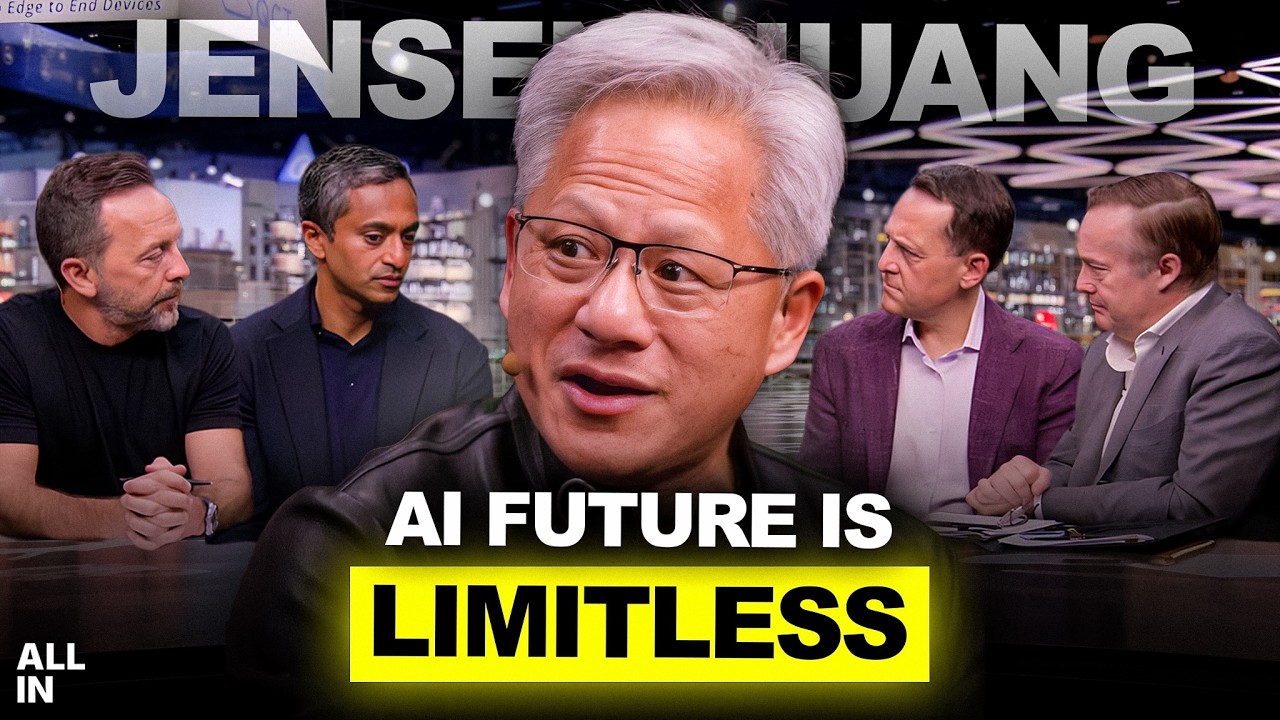
Nvidia CEO Defense of AI Investment Spans Groq Deal to Robotics
All-In Podcast
Jensen Huang argues that escalating compute demands from agentic AI will drive exponential token demand and lower total infrastructure costs despite massive upfront capital expenditure.
## Background
This video was published on YouTube by the All-In Podcast on March 19, 2026. According to the page description, Jensen Huang, CEO of Nvidia, joins the show to discuss acquiring Groq, physical AI, the agentic transition, refuting doomer narratives, supply chain dynamics, and career advice for the AI era.
## TL;DR
Nvidia CEO Jensen Huang joins the All-In Podcast to detail Nvidia's technological vision, including the Groq acquisition, the Dynamo operating system, and the Vera Rubin architecture designed for disaggregated inference and agentic workloads. He addresses Wall Street skepticism around hardware economics, arguing that token throughput efficiency drives profitability far more than upfront data center costs. Huang refutes AI doomerism and regulatory paranoia, advocating for U.S. tech leadership while outlining the vast opportunities in physical AI, digital biology, space-based compute, and robotics. Concluding on human agency, he explains how AI acts as a productivity multiplier that transforms job descriptions and expands industries rather than replacing human roles.
## Atmosphere & style
The episode opens with an energetic, playful banter between the hosts and Jensen Huang, setting a relaxed yet intellectually charged tone. The conversation flows naturally as a warm, peer-to-peer discussion where deep technical insights into data center architectures are seamlessly balanced with candid industry reflections. Throughout the interview, Huang maintains an optimistic, grounded, and pragmatic demeanor, pushing back against public alarmism with thoughtful humor and clear logic. Listening to the exchange feels engaging and inspiring, offering a rare glimpse into high-level strategic thinking delivered with infectious enthusiasm and accessible clarity.
## Key takeaways
- [00:26](https://www.youtube.com/watch?v=gwW8GKwHB3I&t=26s) Nvidia acquired Groq to advance its Dynamo OS architecture and disaggregated inference capabilities across heterogeneous computing systems.
- [03:32](https://www.youtube.com/watch?v=gwW8GKwHB3I&t=212s) The transition to agentic processing and multi-agent workloads requires unified, rack-scale data center architectures like Vera Rubin.
- [05:00](https://www.youtube.com/watch?v=gwW8GKwHB3I&t=300s) Solving real-world physical AI requires three interconnected systems: the AI factory for training, Nvidia Omniverse for simulation, and edge computers for field deployment.
- [06:36](https://www.youtube.com/watch?v=gwW8GKwHB3I&t=396s) Token economics—not initial capital expenditure—determine data center profitability, making higher-performing chips more cost-effective even at higher upfront prices.
- [08:52](https://www.youtube.com/watch?v=gwW8GKwHB3I&t=532s) Nvidia focuses its CEO strategy on historically unsolved, high-friction problems like Physical AI ($50T market) and Digital Biology.
- [12:06](https://www.youtube.com/watch?v=gwW8GKwHB3I&t=726s) OpenClaw represents a major milestone as an open-source agentic OS that coordinates memory, task scheduling, skills, and I/O communication.
- [16:38](https://www.youtube.com/watch?v=gwW8GKwHB3I&t=998s) Tech leaders must avoid apocalyptic doomer messaging, as fear-driven regulation risks paralyzing American industrial adoption while global competitors advance.
- [20:48](https://www.youtube.com/watch?v=gwW8GKwHB3I&t=1248s) The compute requirement jump from generative AI to reasoning models (100x) and then to agentic systems (10,000x) fuels explosive long-term revenue growth.
- [23:21](https://www.youtube.com/watch?v=gwW8GKwHB3I&t=1401s) Token usage should be treated as a core productivity driver, with high-performing engineers expected to manage fleets of software agents.
- [30:50](https://www.youtube.com/watch?v=gwW8GKwHB3I&t=1850s) Open-source and proprietary closed models will coexist, connected via strategic routers that bridge general intelligence with domain-specific enterprise IP.
- [33:40](https://www.youtube.com/watch?v=gwW8GKwHB3I&t=2020s) U.S. national security requires maintaining leadership across the full global AI stack to avoid supply chain vulnerabilities seen in other industries.
- [39:45](https://www.youtube.com/watch?v=gwW8GKwHB3I&t=2385s) Nvidia operates as an open infrastructure provider across all four pillars of autonomous driving (training, simulation, evaluation, and on-board compute) with platforms like Alpaca IO.
- [45:09](https://www.youtube.com/watch?v=gwW8GKwHB3I&t=2709s) Wall Street analysts misjudge Nvidia's growth potential by using legacy CPU market constraints rather than treating AI infrastructure as an expanding global necessity.
- [47:32](https://www.youtube.com/watch?v=gwW8GKwHB3I&t=2852s) Space-based orbital data centers face thermal radiation bottlenecks despite infinite energy potential, while real-time orbital imaging relies on embedded CUDA platforms.
- [51:13](https://www.youtube.com/watch?v=gwW8GKwHB3I&t=3073s) Physical AI and robotics are approaching a commercial tipping point, expected to scale broadly within 3 to 5 years.
- [56:01](https://www.youtube.com/watch?v=gwW8GKwHB3I&t=3361s) Application developers build defensible moats through deep vertical specialization and proprietary sub-agents embedded directly in specific domain workflows.
- [59:04](https://www.youtube.com/watch?v=gwW8GKwHB3I&t=3544s) AI transforms job descriptions rather than eliminating employment overall, requiring workers to become skilled operators who direct AI tools using natural language.
- [01:03:20](https://www.youtube.com/watch?v=gwW8GKwHB3I&t=3800s) The integration of AI into radiology demonstrates that automating tasks can increase overall throughput, drive revenue, and ultimately increase human headcount.
## Detailed walkthrough
### [00:00](https://www.youtube.com/watch?v=gwW8GKwHB3I&t=0s) Preempting the Show and the Groq Acquisition
The episode opens on an energetic note as the hosts reveal they have preempted their regular weekly schedule for Jensen Huang, CEO of Nvidia—joking that there are only three people they would ever clear the schedule for: "President Trump, Jesus, and Jensen." The banter quickly turns to Nvidia's acquisition of Groq and the lighthearted frustration the hosts experienced dealing with Chamath Palihapitiya during the fast-tracked closing process. Jensen laughs along, recounting how the intense deal came together in just two weeks while joking about the sheer "uncomfortable" energy Chamath brought to the table.
Beyond the podcasters' jokes, Jensen grounds the acquisition in Nvidia's long-term architectural roadmap, which he explains was outlined in plain sight years prior at GTC. He points to **Dynamo**, an operating system for the AI factory named after the historical Siemens dynamo that converted water into electricity during the first Industrial Revolution. The core technological vision behind Dynamo is **disaggregated inference**—a method designed to split up complex inference pipelines across heterogeneous computing systems.
* **Key Takeaways & Technical Concepts:**
* **Dynamo OS:** Designed 2.5 years prior to act as the operating system for modern AI factories, using disaggregated inference to manage complex processing pipelines.
* **Evolution of Hardware:** Nvidia's architectural evolution from standalone GPUs to an integrated ecosystem spanning CPUs, GPUs, scale-up/scale-out switches, Mellanox networking processors, and now Groq LPUs.
* **Heterogeneous Computing:** Matching specific mathematical workloads to specialized chips to maximize efficiency and total system throughput.
---
[03:32](https://www.youtube.com/watch?v=gwW8GKwHB3I&t=212s) Vera Rubin, Disaggregated Inference, and the Agentic Transition
Jensen details the shift from standard Large Language Model (LLM) processing to true **agentic processing**, where models constantly query working and long-term memory, utilize external tools, and hit storage systems extremely hard. In an agentic environment, diverse model architectures—ranging from tiny task-specific agents and autoregressive models to massive foundational systems and diffusion models—must run concurrently within the exact same data center footprint.
To address this shift, Nvidia designed the **Vera Rubin** architecture. By expanding the rack-scale infrastructure from single-rack designs to multi-rack clusters incorporating Groq processors, BlueField storage units, CPUs, and advanced networking, Nvidia expanded its total addressable market (TAM) by an estimated 33% to 50%. The hosts discuss allocating roughly 25% of Vera Rubin data center capacity specifically to Groq LPU and GPU combinations for high-value inference tasks.
* **Data Center Architecture Highlights:**
* **Agentic Workloads:** Characterized by high IOPS, complex multi-agent orchestration, and frequent calls to memory systems.
* **Vera Rubin Platform:** Built to unify disparate processing demands (prefill, decode, and agent execution) into a cohesive, disaggregated factory structure.
* **Core Components:** Combines Vera Rubin GPUs, Groq LPUs, BlueField data processing units (DPUs), custom CPUs, and scale-out networking hardware.
---
[05:00](https://www.youtube.com/watch?v=gwW8GKwHB3I&t=300s) The Three Computers: Training, Simulation, and Edge Infrastructure
Addressing embedded applications—such as a child's AI-enabled toy or industrial edge devices—Jensen outlines Nvidia's overall macro framework for the computing landscape. He posits that solving complex real-world AI problems requires three distinct, interconnected computing systems working in tandem.
1. **The AI Factory (Training & Inference):** Massive data center clusters built to train, evaluate, and scale foundational AI intelligence.
2. **The Simulation Computer (Nvidia Omniverse):** A digital twin environment operating under strict laws of physics. Robots, autonomous vehicles, and physical agents must be continuously evaluated in this "virtual gym" before deployment.
3. **The Edge Computer:** Embedded runtime platforms operating in the field, including autonomous vehicles, robotics, micro-controllers, and telecom infrastructure.
Jensen emphasizes the massive opportunity in telecommunications, predicting that the world's **$2 trillion telecom infrastructure** will progressively convert base stations and radio towers into distributed edge AI processing units, creating an omnipresent physical computing layer.
---
[06:36](https://www.youtube.com/watch?v=gwW8GKwHB3I&t=396s) Reframing the Inference Explosion and Token Economics
Addressing Wall Street skepticism surrounding the immense capital expenditure required for AI infrastructure, the hosts raise a common criticism: why buy a $50 billion Nvidia "inference factory" when custom ASICs or competitors like AMD market alternatives at $25 billion to $30 billion? Jensen refutes the idea that higher upfront capital expenditure implies lower profitability, insisting that token economics—not initial data center price tags—determine financial returns.
> "You should not equate the price of the factory and the cost of the tokens. It is very likely that the $50 billion factory—and in fact, I can prove it—will generate for you the lowest cost tokens."
Jensen breaks down the math of data center economics: a baseline cost of roughly $20 billion goes toward fixed physical assets like land, power, and shell construction, followed by essential costs for cooling, CPUs, storage, and networking. Because these base costs remain static regardless of which chips are installed, paying a premium for Nvidia GPUs yields a tenfold increase in total token throughput. In his view, when hardware generation efficiency scales at such dramatic rates, lower-performing chips fail to be cost-effective "even when the chips are free."
---
[08:52](https://www.youtube.com/watch?v=gwW8GKwHB3I&t=532s) CEO Decision-Making and the $50 Trillion Physical AI Opportunity
When asked how he steers Nvidia—a company generating over $350 billion in revenue and $200 billion in free cash flow—Jensen shares his core framework as CEO. His strategy focuses on identifying problems that are exceptionally hard, historically unsolved, and uniquely suited to Nvidia's engineering culture. He candidly notes that groundbreaking innovation inherently requires immense "pain and suffering," meaning teams must be deeply committed to the mission to survive the multi-year development cycles.
Looking ahead, Jensen identifies two key inflection points that fit this criteria:
* **Physical AI ($50 Trillion Market):** Bringing intelligence into physical industries (heavy equipment, manufacturing, robotics, and logistics) that historically lacked software integration. Nvidia began this journey a decade ago, and it has already grown into a near-$10 billion annual business for the company.
* **Digital Biology:** Reaching a "ChatGPT moment" in healthcare and life sciences. The industry is mastering tokenized representations of genes, proteins, cells, and small molecules, which Jensen predicts will fundamentally transform medicine within two to five years.
---
[12:06](https://www.youtube.com/watch?v=gwW8GKwHB3I&t=726s) Desktop AI, Open Source, and OpenClaw as the New OS
The conversation moves from cloud infrastructure to the desktop, focusing on developers, hobbyists, and power users running local models on high-performance workstations (such as the newly announced Dell 6800 with 750GB of RAM). The hosts discuss their own shift toward agentic tools like Claude Code and the explosive community adoption surrounding **OpenClaw**.
Jensen traces the rapid evolution of public AI awareness through three key milestones:
```
[ Phase 1: ChatGPT ] [ Phase 2: Reasoning Models ] [ Phase 3: OpenClaw ]
Generative interface brings Internal thinking (o1/o3) grounds Agentic OS emerges: schedules,
AI into public consciousness answers and stabilizes economics executes skills, manages memory
```
Jensen highlights OpenClaw as a cultural and technical milestone. By open-sourcing a complete agentic loop, OpenClaw acts as an operating system for personal AI computing. It manages short-term scratchpad memory, schedules cron jobs, delegates tasks to sub-agents, connects to I/O channels like WhatsApp, and executes specialized applications ("skills"). Jensen notes that these structural components—memory, resource management, scheduling, and I/O interfaces—define the fundamental building blocks of modern personal computing.
* **Core Components of the Agentic OS:**
* **Memory System:** Dynamic short-term scratchpads paired with long-term context storage.
* **Task Scheduler:** Autonomous capability to execute cron jobs, spawn sub-agents, and decompose complex tasks.
* **I/O Subsystems:** Direct integration with external communication channels and software environments.
* **Skill APIs:** Standardized interfaces allowing agents to execute external programmatic tools safely.
[16:23](https://www.youtube.com/watch?v=gwW8GKwHB3I&t=983s) Policy, Doomerism, and National Security Risks
Addressing the rapid evolution of agentic computing, Jensen Huang emphasizes that current legislative and regulatory frameworks are quickly rendered obsolete by the speed of technological shifts. Policy makers must be continuously educated on what AI is and is not—it is not a biological entity, alien, or conscious, but computer software. Nvidia works actively with leaders like Brad Smith to keep regulators informed, warning against allowing "doomerism and extremism" to dictate policy. The central national security threat is not AI itself, but the risk that paranoia and public hostility could prevent American industries from adopting the technology while foreign competitors move forward aggressively.
* **Software Nature:** AI is software, not an autonomous or biological lifeform.
* **Adoption Risk:** Fear-driven regulation risks paralyzing U.S. industry while international rivals adopt AI rapidly.
* **Public Perception:** AI currently suffers from low public trust, holding only a 17% popularity rating in the U.S.
* **Nuclear Cautionary Tale:** Oversimplified fears and overly aggressive regulations killed the U.S. nuclear industry, leaving the nation with zero new fission reactors under construction compared to approximately 100 being built in China.
---
[18:23](https://www.youtube.com/watch?v=gwW8GKwHB3I&t=1103s) Anthropic, Communication Mistakes, and Industry Moderation
Discussing the public backlash and friction between AI developers and government bodies—such as Anthropic's disputes involving the Department of Defense—Huang offers a balanced perspective on industry communication. While praising Anthropic’s technical excellence, security focus, and commitment to safety, he argues that technology leaders must exercise greater humility and restraint. Warning the public about powerful technology is important, but escalating warnings into apocalyptic scaremongering causes real economic and societal damage.
```
"Warning is good, scaring is less good... Our words do matter. And I think we have to be much more circumspect, we have to be more moderate, we have to be more balanced, we have to be more thoughtful."
```
- **Corporate Position:** Nvidia is a major customer of Anthropic and respects their safety-first engineering culture.
- **Communication Mandate:** Tech leaders must avoid unevidenced predictions of catastrophic scenarios that stoke public panic and provoke heavy-handed regulation.
---
[20:48](https://www.youtube.com/watch?v=gwW8GKwHB3I&t=1248s) The Compute Exploding Curve: Reasoning to Agentic Systems
The discussion turns to enterprise ROI and revenue scaling, challenging skepticism surrounding AI monetization. Pointing to massive enterprise demand and Anthropic's reported $5 billion to $6 billion run-rate month in February 2026, the panel highlights how compute requirements and revenue potential scale alongside model intelligence. While conversational chatbots provide information, users pay heavily for concrete *work*—a shift driven by agentic systems that run tools, write code, and conduct research independently.
```
"When we went from generative to reasoning, the amount of computation we needed was about a hundred times. When we went from reasoning to agentic, the computation is probably another hundred times. Now we're looking at in just two years computation went up by a factor 10,000X."
```
- **Product Visibility:** Nvidia projects over $1 trillion in visibility across its upcoming Blackwell and Vera Rubin chip architectures over the next few years.
- **Ecosystem Breakdown:** Proprietary market leaders (like OpenAI) lead usage, followed closely by open-weights models, with other specialized closed platforms forming a smaller percentage of broader industry workloads.
---
[23:21](https://www.youtube.com/watch?v=gwW8GKwHB3I&t=1401s) Token Allocation as the New Corporate Resource
Inside Nvidia’s 43,000-person organization (including 38,000 engineers), token usage is treated as a critical productivity metric rather than an expense to be minimized. Huang outlines a mental shift for modern knowledge work: just as high-performing athletes invest millions in physical maintenance, elite engineers must be supplied with massive compute resources to amplify their output.
```
"If that $500,000 engineer did not consume at least $250,000 worth of tokens, I am going to be deeply alarmed... This is no different than one of our chip designers who says, 'Guess what? I'm just going to use paper and pencil. I don't think I'm going to need any CAD tools.'"
```
- **Nvidia Workforce:** 43,000 total employees, with 38,000 focused directly on engineering.
- **Token Spend Target:** Nvidia expects high-value engineers to utilize hundreds of thousands of dollars in tokens annually to stay maximally productive.
- **Future Workflow:** Engineers will manage fleets of ~100 software agents each, shifting their focus from manual line-by-line coding to specifying architectures, setting evaluation criteria, and orchestrating execution.
David Friedberg shares practical examples of AI transforming workflows within his own operations, including zero-shot genomic modeling with Ohalo. He describes replacing an entire enterprise software stack in 90 minutes using Claude on a Sunday night, forcing his executive team to execute similar overhauls. Using Andrej Karpathy's open-source `autoresearch` project running on a local desktop, his team completed a complex data analysis project in 30 minutes—a task that would traditionally represent a seven-year PhD thesis suitable for publication in *Science*.
- **AutoResearch Efficiency:** An autonomous research run completed in 30 minutes using ~600 lines of code downloaded from GitHub, ingesting complex biological data locally.
- **Software Paradigm Shift:** Rather than destroying enterprise IT, agents will scale the usage of existing specialized software tools (SQL, vector databases, CAD, Blender, Photoshop) by acting as automated operators working at super-human speed.
---
[30:50](https://www.youtube.com/watch?v=gwW8GKwHB3I&t=1850s) Open Source Models and Distributed Compute Networks
Addressing the broader landscape of AI development, the discussion touches on the rise of high-performing open-weights models globally, including advanced releases from Chinese labs, and decentralized compute initiatives like the BitTensor network (Subnet 3), which successfully ran a fully distributed, stateful training run for a 4-billion parameter Llama model across independent contributors.
Huang stresses that the future of computing depends on a dual ecosystem where proprietary models and open-source models coexist as complementary layers rather than mutually exclusive choices.
- **Dual-Model Future:** Both closed proprietary platforms and open-source models are essential foundation layers for global computing.
- **Decentralized Compute:** Distributed networks operate as a modern equivalent to "Folding@home," pooling hardware to execute complex AI training runs across distributed networks.
---
<ElicitationsGroup message="Explore related topics from the interview:">
<Elicitation label="Examine physical AI and robotics market projections" query="What did Jensen Huang say about Physical AI's $50T market and the future of robotics on the All-In Podcast?"/>
<Elicitation label="Review the Groq acquisition and inference scaling" query="What were Jensen Huang's key points regarding Nvidia acquiring Groq and the inference explosion on the All-In Podcast?"/>
</ElicitationsGroup>
[32:11](https://www.youtube.com/watch?v=gwW8GKwHB3I&t=1931s) Open Models, Specialized AI, and Enterprise Control
Jensen Huang discusses the landscape of AI models, emphasizing that while frontier closed models like ChatGPT, Claude, Gemini, and X offer general intelligence with distinct personalities, enterprise domain expertise requires a different path. Companies need to channel and control their specialized IP through open models. NVIDIA contributes heavily to open-source models near the frontier, believing that "models-a-product" and "models-as-a-service" will continue to thrive in parallel.
Chamath Palihapitiya notes that most startups are now adopting an "open-source first" strategy before tapping into proprietary systems. Huang agrees, highlighting that router architectures allow developers to connect both approaches—providing immediate access to top-tier frontier capabilities while leaving room to fine-tune, specialize, and cost-reduce over time.
- General intelligence consumer tools (ChatGPT, Claude, Gemini, X) thrive on user preference and general problem-solving.
- Proprietary enterprise domain expertise cannot easily be fine-tuned onto closed horizontal models due to control and IP boundaries.
- Strategic routers bridge both worlds: instant frontier performance on day one alongside open-source specialization.
[33:40](https://www.youtube.com/watch?v=gwW8GKwHB3I&t=2020s) Global AI Diffusion, Geopolitics, and U.S. Tech Leadership
Brad Gerstner asks Huang to grade current global technology diffusion under the U.S. administration. Huang asserts that while President Trump wants American tech leadership to win and spread globally, policy shifts previously forced NVIDIA to forfeit a massive market position. Huang notes that NVIDIA fell from a 95% market share in the world's second-largest market down to 0%, but is currently securing licenses under Secretary Howard Lutnick to restore supply chain operations and fulfill purchase orders for approved Chinese companies.
Huang frames this through a national security lens: just as U.S. security is crippled when lacking control over miniature motors, rare earth minerals, telecommunication networks, or sustainable energy, losing global leadership in the AI stack represents a fundamental vulnerability. He argues that the U.S. tech stack—from chips to computing hardware to software platforms—should power 90% of global AI infrastructure.
> "Our national security is diminished when we don't have access to miniature motors, rare earth minerals... fundamentally diminished. Every single one of these industries is an example of what I don't want the AI industry to be."
- **Market share shift:** Drop from 95% down to 0% in China following previous regulatory restrictions, now moving to reactivate approved export licenses.
- **National Security Imperative:** U.S. technology stacks must form the backbone for global AI development to avoid supply chain traps similar to solar or rare earths.
[36:48](https://www.youtube.com/watch?v=gwW8GKwHB3I&t=2208s) Managing Geopolitical Conflicts and Supply Chain Resilience
Addressing worries over international flashpoints—specifically tensions between China and Taiwan, Middle East conflicts, and supply chain bottlenecks like helium availability—Huang reiterates NVIDIA's commitment to its global workforce. With over 6,000 families in the Middle East and many Iranian employees at NVIDIA, he stresses that the company is 100% committed to supporting its teams in Israel and across the region, while remaining optimistic about post-conflict stability.
To fortify hardware supply chains against geopolitical risk, Huang outlines a three-part strategy:
1. **Fast-track U.S. Re-industrialization:** Leveraging Taiwan's supply chain partnerships and manufacturing expertise to rapidly build out fabrication and assembly infrastructure across Arizona, Texas, and California.
2. **Global Diversification:** Expanding resilient manufacturing capacity into South Korea, Japan, and Europe.
3. **Strategic Restraint:** Exercising patience and thoughtful diplomatic restraint while building out alternative supply nodes.
Regarding rumors of helium shortages impacting semiconductor fabs, Huang indicates that while it poses potential risks, supply chains generally maintain sufficient buffer inventories to navigate short-term disruptions.
[39:45](https://www.youtube.com/watch?v=gwW8GKwHB3I&t=2385s) Autonomous Vehicles and Open Autonomous Platforms
Turning to autonomous driving, Huang highlights major partner expansions with companies like BYD, Mercedes, and Uber. NVIDIA views the self-driving landscape not as a vehicle manufacturer, but as an infrastructure provider across all four critical compute pillars: training computers, simulation systems, evaluation clusters, and in-car compute hardware.
Huang contrasts NVIDIA's open ecosystem model against vertically integrated closed stacks (such as Tesla or Waymo). Powered by their reasoning-based autonomous system, **Alpaca IO**, NVIDIA enables vehicles to break complex driving scenarios into simplified, navigable tasks. Car manufacturers can choose to buy training clusters from NVIDIA (as Tesla does), leverage their simulation architectures, or deploy the complete full-stack driving OS into production vehicles.
> "Everything that moves will be autonomous completely or partly someday... We don't want to build self-driving cars, but we want to enable every car company in the world to build self-driving cars."
- **Partner ecosystem:** Expanded deployments across BYD, Mercedes, and Uber.
- **Compute Stack:** Complete coverage across training, simulation, evaluation, and on-board car compute.
- **Alpaca IO:** Reasoning-based AI architecture designed to break down intricate traffic scenarios into executable driving decisions.
[42:01](https://www.youtube.com/watch?v=gwW8GKwHB3I&t=2521s) Navigating Competition from Active Customers
The podcast hosts press Huang on how NVIDIA handles customers like Google (TPUs) or Amazon (Trainium and Inferentia) who build custom ASICs to compete directly with NVIDIA. Huang emphasizes that NVIDIA's position is unique: they are an AI and foundation-model company operating at the frontier across every layer of the compute stack, yet they work openly with every competitor in the market.
Huang notes that NVIDIA continues to gain market share despite custom internal ASICs because building a custom chip is only a fraction of the challenge. Cloud hyperscalers, regional providers, and enterprises require unified full-stack infrastructure—which relies heavily on the CUDA ecosystem. As evidence, AWS recently committed to purchasing an additional 1 million NVIDIA chips over the next few years. Furthermore, the explosion of open models and regional enterprise deployments leans almost exclusively on NVIDIA hardware.
> "They never show me what they're building, and I always show them exactly what I'm building... Buying from NVIDIA still is one of the most economic things they could do."
- **Full-stack enterprise demand:** Approximately 40% of NVIDIA's business comes from non-hyperscale customers who need complete, ready-to-deploy AI factory infrastructure rather than raw chips.
- **AWS Commitments:** Major recent agreement announced by AWS to acquire 1 million additional NVIDIA chips.
- **Market Dynamics:** Customer expansion driven by models like Anthropic, Meta's open-source projects, and enterprise edge computing.
[45:09](https://www.youtube.com/watch?v=gwW8GKwHB3I&t=2709s) Refuting Slowdown Wall Street Forecasts
Gerstner questions why Wall Street analysts project growth slowdowns for NVIDIA (forecasts of 30%, 20%, and down to 7% by 2029) despite expectations of massive overall compute growth. Huang responds that analysts fundamentally misjudge the scale and reach of AI by assuming it is restricted to the top five hyperscalers.
Huang explains that historical comparisons to legacy data center hardware miss the mark entirely. Legacy CPU data center hardware was roughly a $25 billion annual market, whereas NVIDIA operates at a vastly different scale because it delivers entire AI infrastructures rather than individual processors. Analyst models fail due to conservative "law of large numbers" biases, failing to account for AI's expansion into enterprise sectors, physical automation, and national infrastructure.
- **Analyst Misconceptions:** Wall Street models incorrectly treat NVIDIA like a legacy chipmaker constrained by historical server CPU market limits ($25B total market size).
- **Scale of Demand:** Expansion goes far beyond top hyperscalers into regional clouds, specialized sovereign AI, enterprise software, and robotics.
[47:32](https://www.youtube.com/watch?v=gwW8GKwHB3I&t=2852s) Orbital Compute: Data Centers in Space
Asked about the viability of data centers in space, Huang confirms that NVIDIA hardware is already in orbit. Satellite networks across the globe currently run CUDA-enabled systems to execute real-time image processing and AI telemetry right on the hardware, eliminating the latency of transmitting raw data back to Earth.
While terrestrial data center build-outs remain the immediate priority, space offers infinite energy potential. However, the primary engineering hurdle in space is thermal management: space lacks air and physical mediums for conduction or convection, meaning cooling must rely entirely on radiation across massive surface areas.
- **Current Space Footprint:** Active deployment of radiation-hardened CUDA platforms on orbiting satellites for edge image processing.
- **Engineering Bottlenecks:** Dissipating heat requires vast radiative cooling arrays due to the absence of convective atmospheric cooling.
[048:34] Data Centers in Space and AI Breakthroughs in Healthcare
The conversation turns to the futuristic possibility of launching data centers into space. Jensen Huang explains that beyond offloading resource-heavy computations, space provides an ideal environment for imaging and other complex tasks. While developing space-based data center architectures will take years, Huang jokes that he has plenty of time.
The discussion then pivots to AI's impact on healthcare. The hosts note the huge spending in the U.S. healthcare system—often yielding sub-par returns—and highlight that large language models can already outperform human primary care visits in diagnostic consistency. Huang outlines three distinct pillars where Nvidia is actively driving healthcare innovation:
* **AI Biology / AI Physics:** Utilizing AI to predict, represent, and model biological behavior to revolutionize drug discovery.
* **Agentic Healthcare AI:** Deploying AI agents to assist with diagnoses and patient interactions, highlighting partners like OpenEvidence and Hippocratic AI.
* **Physical AI in Medical Devices:** Integrating physical AI—models that understand the laws of physics—into surgical robotics and medical instruments like ultrasound and CT scanners.
"OpenClaw, in a safe version, will be inside every single instrument," Huang notes, predicting that every hospital tool will eventually act as an agentic partner to medical staff.
---
[051:13] The Breakthrough Cycle of Physical AI and Robotics
Jason Calacanis contrasts the heavy investment in defense AI with the need for "AI EMTs and paramedics," transitioning the dialogue into robotics. After a relative "lost decade" for commercial robotics following early efforts like Boston Dynamics, Huang asserts that the physical AI moment has finally arrived. He believes American industry simply got tired five years before the enabling technology—the "AI brain"—was ready.
With high-functioning proof-of-concept models now active, Huang predicts it will take only two to three development cycles—roughly **3 to 5 years**—before robots are deployed broadly across industries and everyday life.
* **China's Supply Chain Dominance:** China holds a distinct advantage in microelectronics, motors, magnets, and rare earth minerals, forcing global robotics companies to rely heavily on Chinese supply chains.
* **Robot-to-Human Ratio:** Huang agrees with predictions that the robot population will eventually exceed the human population, driven by stationary factory automation and mobile humanoids.
* **Economic Mobility:** Chamath Palihapitiya argues that affordable personal robots will be the ultimate unlock for individual economic prosperity, allowing people to launch automated businesses and automate physical labor.
* **Virtual Telepresence:** Robots will enable virtual presence, letting users teleoperate a physical robot at home while traveling—whether to check on family or walk the dog.
---
[056:01] Model Revenue Growth and the Future of Software Moats
Addressing revenue expectations for foundational model companies, the hosts reference predictions from Anthropic CEO Dario Amodei forecasting hundreds of billions in model revenue by 2027–2028 and $1 trillion by 2030. Huang calls Amodei’s estimate "very conservative," projecting even higher growth. He explains that traditional enterprise software providers will act as massive value-added resellers (VARs) for token consumption and model code from companies like Anthropic and OpenAI.
When asked what moat remains for application developers when foundational models keep improving, Huang points directly to **deep vertical specialization**.
* **Vertical Sub-Agents:** Companies will succeed by training proprietary, highly specialized sub-agents embedded within domain-specific workflows.
* **The Customization Shift:** Traditional software focused on broad horizontal platforms that required third-party consultants to customize. AI inverts this model, enabling platform creators to directly deliver fully customized, vertical solutions.
* **Flywheel Advantage:** Connecting specialized agents to real customers creates a feedback loop that continuously sharpens the agent's domain expertise.
---
[059:04] AI Job Transformation and Career Advice for the Next Generation
Addressing concerns around job displacement, Huang maintains a pragmatically optimistic stance. While admitting that certain roles will be completely automated—such as human drivers—he emphasizes that technology shifts typically transform job descriptions rather than eliminate total employment. For instance, chauffeurs may evolve into multi-tasking "mobility assistants" who manage personal logistics while the vehicle handles navigation.
"The autopilot in planes created a lot more pilots and didn't take any of the pilots out of the cockpit," notes David Sacks, illustrating how automation expands industries rather than shrinking them.
For students and young professionals entering an AI-driven workforce, Huang offers clear strategic advice:
* **Become an Expert AI Operator:** Employers will actively seek candidates who master the artistry of directing AI—knowing how to specify goals without over-prescribing instructions.
* **Study Core Fundamentals:** Double down on deep science, mathematics, and strong language skills.
* **Language as Code:** Because natural language is now the primary programming language for software, Huang quips that "the English major could be the most successful."
* **Avoid Doomer Predictions:** Huang recalls early deep learning pioneers prematurely declaring that computer vision would completely eliminate human radiologists, proving that technological transitions are rarely as simple as pure displacement.
[01:03:20](https://www.youtube.com/watch?v=gwW8GKwHB3I&t=3800s) The Radiology Paradox and How AI Enhances Human Work
Jensen Huang addresses the widespread fear of AI job displacement by recounting a famous prediction from ten years ago, when an expert famously advised students never to pursue radiology because AI would make the field obsolete. A decade later, that prediction proved to be 100% accurate on a technical level—computer vision has been integrated into 100% of radiology platforms worldwide. However, the surprising real-world outcome was that the actual demand for radiologists skyrocketed and the number of practicing radiologists went up.
Huang explains that this counterintuitive trend stems from the critical difference between a job's *tasks* and its *purpose*. A radiologist's task is reading and studying scans, but their core purpose is helping doctors diagnose patients and manage health. Because AI dramatically accelerated the scan-reading process, healthcare systems began performing significantly more scans, accelerating overall patient onboarding and treatment. Since hospitals like to make money and provide better healthcare, the increased throughput drove higher revenues and created a need for *more* human radiologists to oversee the expanded care pipeline.
The hosts connect this dynamic to broader macroeconomic productivity. A wealthier, faster-growing country can afford to place more teachers in classrooms, not fewer, because AI acts as a multiplier. Giving every teacher a personalized AI curriculum for every student makes them "bionic," ensuring that while every single student is assisted by AI, every student will still need great human teachers.
- Computer vision technology is now integrated into 100% of global radiology platforms.
- Contrary to predictions of job extinction, the demand for human radiologists and overall employment in the field increased.
- Faster, AI-assisted scanning led to higher patient throughput, accelerated treatment times, and higher hospital revenues.
- High-productivity, wealthier economies leverage AI to increase human headcount in vital roles like teaching rather than eliminating them.
---
[01:05:00](https://www.youtube.com/watch?v=gwW8GKwHB3I&t=3900s) Reframing the AI Narrative: Human Agency vs. Doomerism
As the conversation draws to a close, the hosts express deep gratitude for Huang's uplifting and pragmatic outlook, praising him as "the steward we need" during a period dominated by fear-mongering and AI doomerism. Huang emphasizes the importance of maintaining perspective, noting with characteristic humility that at the end of the day, "we're making software, guys." Humanity has invented new industries and technological paradigms before, and there is no need to resort to scaremongering.
The group reflects on the idea that humanity maintains full autonomy and agency in determining how AI technologies are created and deployed. The hosts commend Huang for taking a grounded, vocal stance on the positive possibilities of artificial intelligence rather than leaning into apocalyptic narratives. The episode concludes with warm exchanges between Huang and the All-In hosts, highlighting the large crowd gathered behind them to catch a glimpse of the Nvidia CEO as they sign off.
- "We are making software, guys" — Jensen Huang highlights the importance of staying grounded and treating AI as an evolutionary software tool.
- Humanity possesses full "autonomy and agency" to dictate how AI gets developed and integrated into society.
- The hosts praise Huang's active pushback against AI doomerism in favor of a constructive, growth-oriented mindset.
## Notable quotes
> [06:36](https://www.youtube.com/watch?v=gwW8GKwHB3I&t=396s) You should not equate the price of the factory and the cost of the tokens. It is very likely that the $50 billion factory—and in fact, I can prove it—will generate for you the lowest cost tokens. — Jensen Huang
> [18:23](https://www.youtube.com/watch?v=gwW8GKwHB3I&t=1103s) Warning is good, scaring is less good... Our words do matter. And I think we have to be much more circumspect, we have to be more moderate, we have to be more balanced, we have to be more thoughtful. — Jensen Huang
> [20:48](https://www.youtube.com/watch?v=gwW8GKwHB3I&t=1248s) When we went from generative to reasoning, the amount of computation we needed was about a hundred times. When we went from reasoning to agentic, the computation is probably another hundred times. Now we're looking at in just two years computation went up by a factor 10,000X. — Jensen Huang
> [23:21](https://www.youtube.com/watch?v=gwW8GKwHB3I&t=1401s) If that $500,000 engineer did not consume at least $250,000 worth of tokens, I am going to be deeply alarmed... This is no different than one of our chip designers who says, 'Guess what? I'm just going to use paper and pencil. I don't think I'm going to need any CAD tools.' — Jensen Huang
> [33:40](https://www.youtube.com/watch?v=gwW8GKwHB3I&t=2020s) Our national security is diminished when we don't have access to miniature motors, rare earth minerals... fundamentally diminished. Every single one of these industries is an example of what I don't want the AI industry to be. — Jensen Huang
> [39:45](https://www.youtube.com/watch?v=gwW8GKwHB3I&t=2385s) Everything that moves will be autonomous completely or partly someday... We don't want to build self-driving cars, but we want to enable every car company in the world to build self-driving cars. — Jensen Huang
> [42:01](https://www.youtube.com/watch?v=gwW8GKwHB3I&t=2521s) They never show me what they're building, and I always show them exactly what I'm building... Buying from NVIDIA still is one of the most economic things they could do. — Jensen Huang
> [48:34](https://www.youtube.com/watch?v=gwW8GKwHB3I&t=2914s) OpenClaw, in a safe version, will be inside every single instrument — Jensen Huang
> [59:04](https://www.youtube.com/watch?v=gwW8GKwHB3I&t=3544s) The autopilot in planes created a lot more pilots and didn't take any of the pilots out of the cockpit — David Sacks
> [59:04](https://www.youtube.com/watch?v=gwW8GKwHB3I&t=3544s) the English major could be the most successful. — Jensen Huang
> [01:05:00](https://www.youtube.com/watch?v=gwW8GKwHB3I&t=3900s) we're making software, guys. — Jensen Huang
## Mentioned
Jensen Huang, Nvidia, All-In Podcast, Groq, Chamath Palihapitiya, Dynamo, Siemens, Vera Rubin, BlueField, Omniverse, AMD, Dell, Claude Code, OpenClaw, ChatGPT, Brad Smith, Anthropic, Department of Defense, Blackwell, OpenAI, Ohalo, Andrej Karpathy, autoresearch, BitTensor, Llama, Gemini, X, Brad Gerstner, Donald Trump, Howard Lutnick, BYD, Mercedes, Uber, Tesla, Waymo, Alpaca IO, Google, Amazon, CUDA, AWS, Meta, OpenEvidence, Hippocratic AI, Jason Calacanis, Boston Dynamics, Dario Amodei, David Sacks, David Friedberg
英伟达CEO为AI投资辩护,布局涵盖Groq交易至机器人领域
黄仁勋认为,尽管前期资本支出巨大,但智能体AI不断攀升的算力需求将推动Token需求呈指数级增长,进而降低整体基础设施成本。
英伟达CEO黄仁勋做客All-In播客,详细阐述了英伟达的技术愿景,包括对Groq的收购、Dynamo操作系统,以及专为解耦推理和智能体工作负载设计的Vera Rubin架构。针对华尔街对硬件经济效益的质疑,他指出Token吞吐效率对盈利能力的推动作用远大于前期数据中心成本。此外,黄仁勋驳斥了AI末日论和监管恐慌,主张确立美国的技术领导地位,并概述了物理AI、数字生物学、天基计算及机器人领域的巨大机遇。最后谈及人类能动性时,他解释了AI如何作为生产力倍增器重塑工作职责并拓展产业空间,而非取代人类角色。
Nvidia 收购 Groq 以加速推进其面向 AI 工厂的 Dynamo 操作系统架构与解耦推理(disaggregated inference)技术,并通过扩展至 Vera Rubin 机架级架构来承载计算需求暴增的多 Agent 工作负载。 (0:26)
黄仁勋重塑了推理投资与资本支出的逻辑,指出决定数据中心回报率的是 Token 经济学而非前期硬件价格,更高效的高性能芯片能带来指数级吞吐提升,反而是生成最低成本 Token 的选择。 (6:36)
Nvidia 重点押注规模达 50 万亿美元的物理 AI(Physical AI)市场与数字生物学,通过 AI 工厂、Omniverse 物理仿真平台与边缘设备的三位一体架构,预计机器人将在 3 到 5 年内迎来规模化落地。 (8:52)
算力需求从生成式 AI 跨越到推理模型跃升了 100 倍,再到自主 Agent 系统进一步跃升 100 倍(累计达 10,000 倍),而 OpenClaw 等开源框架正在演变成协调任务调度、记忆管理与工具执行的新一代个人计算操作系统。 (20:48)
针对行业公关危机与末日论叙事,黄仁勋强调 AI 本质是软件工具而非生物体,警示科技领袖避免散播恐慌,防止过度监管阻碍本国工业采用先进技术而落后于全球竞争者。 (16:23)
Reading summary
Nvidia CEO Jensen Huang argues that AI is rapidly shifting from informational chatbots to compute-intensive agentic and physical automation, requiring a structural reimagining of data center architecture and token economics. Grounding this transition in enterprise scaling, geopolitics, and labor history, Huang contends that AI represents an evolutionary software tool whose real-world benefits will expand human output if the industry avoids self-defeating scaremongering.
Token Economics and Disaggregated Data Center Architecture (6:36)
Huang counters Wall Street skepticism regarding infrastructure costs by arguing that data center investments must be evaluated against token generation cost rather than upfront hardware price tags. Because fixed foundational expenses—such as land, power, cooling, and basic shell construction—amount to roughly $20 billion regardless of which processors are chosen, deploying higher-throughput GPUs drastically lowers the ultimate cost per token. Under this throughput model, Huang claims lower-performing chips fail to be cost-effective even if acquired for free.
To accommodate evolving computing patterns, Nvidia acquired Groq and introduced the Dynamo operating system alongside the multi-rack Vera Rubin platform. This setup facilitates disaggregated inference, distributing prefill, decode, and multi-agent coordination across heterogeneous hardware, including GPUs, Groq LPUs, and BlueField DPUs. Huang projects that transitioning from basic generative models to reasoning models multiplies compute requirements by 100 times, while advancing to agentic systems increases demand by a factor of 10,000, underpinning Nvidia's reported visibility into over $1 trillion in future hardware demand across its Blackwell and Vera Rubin lines.
The Transition to Agentic Systems and Enterprise Workflows (12:06)
Computing is transitioning from interactive question-and-answer prompts into autonomous agentic systems that continuously access working memory, execute tools, and run scheduled background tasks. Huang highlights open frameworks such as OpenClaw as emerging personal computing operating systems, coordinating scratchpad memory, task schedulers, and application interfaces. Within enterprise software, Huang forecasts that developer moats will hinge on proprietary vertical sub-agents tailored to industry-specific workflows rather than generalized horizontal software platforms.
Internally, Nvidia treats token consumption as a mandatory productivity metric rather than an operating expense. Across its 38,000 engineers, the company expects high-value technical staff to consume hundreds of thousands of dollars in tokens annually while orchestrating fleets of approximately 100 software agents. Real-world examples discussed in the program, such as Andrej Karpathy's open-source AutoResearch tool completing biological data analyses in 30 minutes, illustrate how specialized agentic loops compress research and operational timelines that historically required years of manual effort.
Physical AI and the Three-Computer Framework (5:00)
Huang identifies physical AI—the deployment of intelligence into physical manufacturing, logistics, and heavy industry—as a $50 trillion commercial opportunity. Nvidia models this physical deployment across three interconnected computer systems: the centralized AI factory for foundational model training, the Omniverse simulation computer serving as a virtual physics-compliant testing gym, and the embedded edge computer operating inside robotics, autonomous vehicles, and industrial machinery. Huang also projects that telecommunications infrastructure valued at $2 trillion will progressively convert cell towers and base stations into distributed edge computing nodes.
Huang forecasts that commercial robotics will enter widespread deployment within three to five years. In the autonomous vehicle sector, Nvidia positions itself as an open horizontal infrastructure provider across training clusters, simulation, and on-board compute stacks rather than an automotive manufacturer, maintaining commercial deployments with partners including BYD, Mercedes, and Uber through its Alpaca IO reasoning architecture.
Geopolitics, Regulation, and the Labor Narrative (16:23)
Navigating international trade policy, Huang notes that previous regulatory shifts dropped Nvidia's market share in China from 95% to 0%, though the company is currently working with U.S. officials to fulfill approved export licenses. Huang argues that national security depends on American computing stacks powering 90% of global AI infrastructure to avoid strategic supply dependencies. To mitigate supply disruptions, Nvidia is pursuing manufacturing diversification across the United States, South Korea, Japan, and Europe.
Huang strongly cautions against catastrophic doomerism, noting that AI suffers from a low 17% public approval rating in the U.S. and warning that alarmist rhetoric risks regulatory paralysis similar to the stagnation of the American nuclear fission industry. Addressing workforce displacement concerns, Huang highlights the historical trajectory of radiology: despite 100% adoption of computer vision tools in medical imaging, radiologist employment increased because accelerated scan throughput drove higher aggregate patient demand and hospital revenue.
While Huang presents an expansive commercial thesis spanning agentic software, robotics, and biology, Nvidia's growth trajectory remains reliant on navigating stringent export regulations, complex geopolitical risks surrounding semiconductor fabrication, and widespread public skepticism toward AI adoption.
## Background
本期节目由知名科技商业播客《All-In Podcast》于 2026 年 3 月 19 日在 YouTube 平台发布。节目简介显示,英伟达首席执行官黄仁勋作为重磅嘉宾做客现场,围绕英伟达收购 Groq 后的推理算力大爆发、价值 50 万亿美元的物理 AI 市场、AI 智能体操作系统的诞生、行业公关危机与监管悖论,以及大模型商业化和给年轻一代的成长建议等议题展开了深度探讨。
## TL;DR
黄仁勋在节目中系统拆解了英伟达从芯片制造商向全栈“AI 工厂”系统转型的底层逻辑,指出从生成式到推理再到 Agent 让算力需求呈现万倍级扩张,并从总体拥有成本(TCO)角度论证了英伟达系统的代币生成经济学优势。他指出物理 AI、数字生物学与具身智能正迈向类似“ChatGPT 时刻”的爆发临界点,并预言企业软件公司未来将全面变身为前沿模型的增值转售商。面对公众恐慌与监管争议,黄仁勋以放射科医生岗位反增的历史事实有力驳斥了 AI 就业毁灭论,强调技术本质是计算机软件而非外星生物。最后,他建议初创企业深耕垂直领域以构筑护城河,并勉励年轻人掌握精准驾驭 AI 的协作艺术。
## Atmosphere & style
对谈在硅谷顶尖科技圈特有的幽默插科打诨与极其硬核的商业技术推演之间自如切换,主持天团与黄仁勋互动默契,黄仁勋在面对自研芯片竞争与华尔街看空时展现出极具说服力的从容与自信。随着对话从机架拓扑延伸至核能教训、地缘供应链与深空计算,现场氛围从随性的笑谈逐步升华至极具宏大叙事感的战略深思。整场节目洋溢着充满感染力与理性的科技乐观主义底色,给听众带来如同置身全球产业风暴核心般的震撼与启迪。
## Bulletin
- [00:51](https://www.youtube.com/watch?v=gwW8GKwHB3I&t=51s) 英伟达推出 AI 工厂操作系统 Dynamo 与“解耦推理”架构,结合收购 Groq 引入异构计算拓扑,使 Vera Rubin 架构目标市场规模提升 33% 到 50%。
- [06:36](https://www.youtube.com/watch?v=gwW8GKwHB3I&t=396s) 黄仁勋驳斥高造价劣势论,指出 500 亿美元数据中心总成本中基建与电力占近 200 亿美元,英伟达系统带来的 10 倍 Token 吞吐量使其实际单位推理成本处于业界最低。
- [21:32](https://www.youtube.com/watch?v=gwW8GKwHB3I&t=1292s) 从生成式到推理再到自主智能体,算力需求在两年内增长 10,000 倍;黄仁勋预计未来工程师麾下将管理上百个智能体,年薪 50 万美元的工程师每年应至少消耗 25 万美元 Token 预算。
- [56:01](https://www.youtube.com/watch?v=gwW8GKwHB3I&t=3361s) 企业软件巨头未来将全面转型为前沿大模型的增值转售商(VAR),应用层创业公司的真正护城河在于结合专有数据的“深度垂直专精”。
- [01:03:00](https://www.youtube.com/watch?v=gwW8GKwHB3I&t=3780s) 黄仁勋反驳技术性失业悲观论,援引放射科医生在阅片算法普及后需求反增的先例,指出 AI 将重塑职业形态并带来社会总生产力与总需求的成倍扩大。
## Key takeaways
- [00:51](https://www.youtube.com/watch?v=gwW8GKwHB3I&t=51s) AI 工厂的操作系统 Dynamo 通过将推理流水线的预填充(Prefill)与解码(Decode)阶段解耦,实现异构硬件与工作负载的最优调度。
- [03:17](https://www.youtube.com/watch?v=gwW8GKwHB3I&t=197s) 智能体处理对存储与工作记忆提出高吞吐要求,Vera Rubin 数据中心规划约 25% 的机架空间专门用于 GPU 与 Groq LPU 的解耦协同。
- [05:00](https://www.youtube.com/watch?v=gwW8GKwHB3I&t=300s) 物理 AI 的落地依托“三台计算机”架构:云端模型训练计算机、遵循物理定律的虚拟仿真计算机(Omniverse),以及边缘车载或具身控制计算机。
- [06:36](https://www.youtube.com/watch?v=gwW8GKwHB3I&t=396s) 数据中心 TCO 中土地、电力与基础网络构成巨额固定沉没成本,单纯削减芯片单价无法大幅拉低造价,决定经济效益的是系统级的 Token 吞吐倍率。
- [10:47](https://www.youtube.com/watch?v=gwW8GKwHB3I&t=647s) 体量达 50 万亿美元的传统实体工业几乎从未被现代高科技真正渗透,物理 AI 与数字生物学业务正在迎来爆发拐点。
- [12:06](https://www.youtube.com/watch?v=gwW8GKwHB3I&t=726s) 开源智能体架构 OpenClaw 具备记忆、调度、I/O 与技能 API 四大要素,定义了现代个人 AI 计算机的事实操作系统蓝图。
- [16:38](https://www.youtube.com/watch?v=gwW8GKwHB3I&t=998s) AI 行业应避免制造非理性恐慌与极端末日叙事,美国面临的最大国家安全风险是因过度恐惧而错失技术发展红利。
- [21:32](https://www.youtube.com/watch?v=gwW8GKwHB3I&t=1292s) 企业付费的底层逻辑是为“交付的工作成果”买单,从信息检索聊天走向自主智能体行动将推动算力需求走向百万倍扩张。
- [23:20](https://www.youtube.com/watch?v=gwW8GKwHB3I&t=1400s) 编程范式已彻底转向系统架构与目标规范设计,未充分利用大模型 Token 配额的知识工作者将被能够熟练驾驭 AI 的同行淘汰。
- [30:50](https://www.youtube.com/watch?v=gwW8GKwHB3I&t=1850s) 开源与专有闭源模型呈现共生格局,通用智能依靠专有服务,垂直专有知识沉淀与成本优化则高度依赖开源模型生态。
- [33:40](https://www.youtube.com/watch?v=gwW8GKwHB3I&t=2020s) 美国 AI 的真正地缘战略优势在于让包含芯片、系统到底层的“美国技术栈”占据全球 90% 市场,必须避免关键供应链重蹈稀土化边缘风险。
- [39:45](https://www.youtube.com/watch?v=gwW8GKwHB3I&t=2385s) 英伟达在自动驾驶领域推行横向开放的平台战略,通过 Alpaca 逻辑推理系统使车辆具备类人思考,并提供从云端到车载计算的模块化合作方案。
- [41:57](https://www.youtube.com/watch?v=gwW8GKwHB3I&t=2517s) 英伟达约 40% 业务来自非超大规模云厂商,交付的是包含 CUDA 软件在内的全栈 AI 工厂,系统工程整合构成了云巨头自研单一芯片难以逾越的壁垒。
- [47:32](https://www.youtube.com/watch?v=gwW8GKwHB3I&t=2852s) 太空数据中心面临真空环境下仅能依赖辐射散热的物理瓶颈,目前星载计算的实际落地场景主要为抗辐射加固版芯片在轨边缘图像与遥感推理。
- [48:34](https://www.youtube.com/watch?v=gwW8GKwHB3I&t=2914s) AI 医疗布局由三大支柱构成:生物分子动力学建模、临床诊疗辅助智能体,以及搭载物理 AI 的手术机器人与智能化医疗设备。
- [51:24](https://www.youtube.com/watch?v=gwW8GKwHB3I&t=3084s) 具身智能供应链在微电子、高精度电机与稀土永磁体制造等底层构件上高度依赖中国,商业实用化预计将在未来 3 至 5 年内全面铺开。
- [57:36](https://www.youtube.com/watch?v=gwW8GKwHB3I&t=3456s) 应用层软件公司的壁垒在于深度专精垂直领域知识并启动客户反馈飞轮,而非停留在容易被原生模型吞噬的通用水平层。
- [01:01:35](https://www.youtube.com/watch?v=gwW8GKwHB3I&t=3695s) 自然语言已成为 AI 的首要编程语言,年轻一代应当掌握“提要求的艺术”,在精准规范指导与赋予模型自主创新空间之间取得平衡。
## Detailed walkthrough
### [00:00](https://www.youtube.com/watch?v=gwW8GKwHB3I&t=0s) 特别节目开场与收购 Groq 的幽默调侃
本期《All-In Podcast》迎来了一场临时插播的重磅特别节目。主持团队一开场便半开玩笑地指出,节目组能够破例打破周播常规排期的对象全天下只有三位——特朗普总统、耶稣,以及英伟达首席执行官黄仁勋(Jensen Huang)。现场各行各业、主流科技公司与顶尖 AI 企业的齐聚,印证了英伟达眼下无与伦比的行业号召力。随后,话题迅速切入英伟达不久前收购推理芯片创企 Groq 的重磅交易。主持人调侃黄仁勋在拍板收购时,是否预料到了身为 Groq 投资人的 Chamath Palihapitiya 会变得多么“难以忍受”。在大家互相打趣原本漫长如今却仅花两周便闪电敲定的交易闭环时,黄仁勋也笑着接梗表示“那段回忆正涌上心头,让我感觉颇为不安”,现场气氛在一片欢声笑语中拉开了技术硬核对话的帷幕。
---
### [00:51](https://www.youtube.com/watch?v=gwW8GKwHB3I&t=51s) AI 工厂的操作系统 Dynamo 与“解耦推理”架构
黄仁勋指出,英伟达的许多战略布局早在数年前的 GTC 大会上就已公之于众。早在两年半前,他就首次提出了面向“AI 工厂”(AI Factory)的操作系统理念——Dynamo。该命名致敬了西门子在第二次工业革命时期发明的发电机(Dynamo),当年正是这项技术将水力等机械能转化为了电能,驱动了现代工厂的运转;而如今的 Dynamo 则旨在成为新一轮工业革命中 AI 工厂的核心操作系统。Dynamo 背后的底层核心技术便是“解耦推理”(Disaggregated Inference)。
推理的运算流水线是当今计算机科学中规模最庞大、数学形态最繁杂且最复杂的计算挑战。为了突破瓶颈,英伟达提出了阶段解耦的思路:将复杂推理任务的不同部分剥离出来,分别调度到最适合的不同 GPU 或专用计算单元上运行。黄仁勋解释道,正是这种对异构计算架构的追求,早先促使英伟达收购了 Mellanox;如今英伟达的算力版图已经横跨 GPU、CPU、Scale-up 与 Scale-out 交换机、网络处理器,并在引入 Groq 的 LPU 之后,进一步实现了“把最匹配的工作负载调度到最合适的芯片上”。英伟达早已脱离了单纯的显卡芯片供应商范畴,蜕变为一家构建全栈 AI 工厂的系统级企业。
```mermaid
flowchart TD
accTitle: 异构 AI 工厂计算与推理调度拓扑
accDescr: 展示英伟达 AI 工厂如何将预填充与解码解耦,并把异构硬件调度到不同任务中
subgraph FactoryOS ["AI 工厂操作系统: Dynamo"]
Scheduler["智能工作负载调度器"]
end
subgraph DisaggregatedInference ["解耦推理流水线"]
Prefill["Prefill 预填充阶段<br/>高并行大矩阵计算"]
Decode["Decode 解码阶段<br/>超低延迟自回归生成"]
end
subgraph HardwareFabric ["全栈异构硬件底座"]
GPU["Nvidia Vera Rubin GPU 阵列"]
LPU["Groq LPU 极速推理芯片"]
Network["Mellanox 交换架构与 BlueField DPU"]
end
Scheduler --> Prefill
Scheduler --> Decode
Prefill --> GPU
Decode --> LPU
Network -. 极速互联与存储访问.-> GPU
Network -. 极速互联与存储访问.-> LPU
```
---
### [03:17](https://www.youtube.com/watch?v=gwW8GKwHB3I&t=197s) 智能体时代的算力拓扑与 Vera Rubin 架构
讨论进一步深入到现代数据中心的实际落地架构。黄仁勋在演讲中曾建议高价值推理的客户将数据中心约 25% 的机架空间分配给 Groq LPU 与 GPU 的协同组合。他剖析了驱动这一变革的本质:计算范式正经历从“纯大语言模型(LLM)处理”向“智能体(Agentic)处理”的剧烈转变。运行一个自主智能体,意味着系统需要高频调度工作记忆(Working Memory)、读取长效记忆(Long-term Memory)、调用外部工具,并对底层存储系统施加极其严苛的吞吐压力。在多智能体协同环境下,既有扩散模型也有自回归模型,模型尺寸与计算特征千差万别。
为了驾驭这种极度异构的工作负载,英伟达推出了 Vera Rubin 架构。黄仁勋形象地比喻道,英伟达过去是一家只卖一种机架的公司,而现在通过引入异构互联,整个系统增加了四种全新的机架规格。这一演进直接让英伟达的目标市场规模(TAM)大幅跃升了 33% 到 50%。新增的这部分空间将全面部署 BlueField 存储处理器、Groq 专用推理芯片、高性能 CPU 以及顶尖的网络交换设备,它们共同构成了承载现代工业“智能体操作系统”的超级计算机。
- **多模型异构共存**:单一数据中心内部需同时支撑超大规模基座模型、轻量级模型、自回归生成与扩散模型等多模态流水线。
- **机架级空间重构**:约 25% 的 Vera Rubin 数据中心空间被规划用于搭载 Groq LPU 与 GPU 的解耦组合,专门消化海量低延迟解码与工具调用工作。
- **存储与互联压力**:智能体的高频状态读写,使得以 BlueField 为代表的存储和网络处理器成为系统拓扑中不可或缺的性能放大器。
---
### [05:00](https://www.youtube.com/watch?v=gwW8GKwHB3I&t=300s) 边缘与物理世界的“三台计算机”架构
当主持人问及智能硬件与边缘嵌入式设备(例如能够与孩子实时语音交互的智能泰迪熊玩具)究竟应该搭载定制 ASIC 还是专用边缘套件时,黄仁勋跳出微观的芯片形态,给出了一个宏观的体系化认知:解决现代 AI 实际落地问题,宏观上需要“三台计算机”的紧密协作。
第一台是位于云端的“AI 研发与训练计算机”,负责构建基础大模型;第二台是“物理仿真评估计算机”,例如英伟达打造的 Omniverse。黄仁勋强调,当 AI 走向具身智能、机器人与自动驾驶汽车时,绝不能直接放入现实世界盲目试错,必须先在一个严格遵循物理定律的虚拟数字空间(虚拟健身房)中进行大规模验证和对抗评测。第三台则是“边缘端的机器人计算机”,它负责实际控制物理实体,具体形态可以是一台全自动驾驶汽车、一个人形机器人,或者智能泰迪熊体内极小的嵌入式芯片。黄仁勋还特别指出,英伟达正致力于将全球价值 2 万亿美元的电信基础设施与无线基站直接升级为 AI 边缘计算节点,让无线电基站、无人工厂与智慧仓储无缝融入统一的 AI 算力骨干网中。
---
### [06:36](https://www.youtube.com/watch?v=gwW8GKwHB3I&t=396s) 推理算力大爆发与 500 亿美元 AI 工厂的成本经济学
针对黄仁勋过去预测推理需求将发生百万倍、十亿倍爆发的论断,对话转向了产业界最为关注的市场争议:如今英伟达下一代顶配推理工厂单体造价据传高达 400 亿至 500 亿美元,而采用定制 ASIC 或竞争对手 AMD 方案的替代数据中心造价仅需 250 亿至 300 亿美元,英伟达是否会因为高额溢价而丢失市场份额?
黄仁勋对此给出了极为犀利的底层经济学反驳。他强调,核心认知在于“绝对不能将建造工厂的成本与生成 Token 的成本画等号”("You should not equate the price of the factory and the price of the tokens")。他自信地表示可以从数学上严谨证明,500 亿美元的英伟达数据中心最终产出的单位 Token 成本反而是业界最低的:
```
真实数据中心总投资 (TCO) 拆解:
┌──────────────────────────────────────────────┐
│ 土地、电力供应、土建外壳 (Shell): ~200 亿美元 (固定沉没成本)│
├──────────────────────────────────────────────┤
│ 存储阵列、网络 Fabric、通用 CPU 服务器、液冷设施: (必选支出) │
├──────────────────────────────────────────────┤
│ 核心加速芯片 (GPU / ASIC 差异): 仅占总体 Capex 的一部分 │
└──────────────────────────────────────────────┘
```
黄仁勋拆解道,建一座超大型算力中心,仅土地、电力配套和土建厂房就要吃掉近 200 亿美元,再加上不可省略的存储、网络交换机、CPU 服务器和冷却系统,无论选用何种芯片,整体总造价的起步底线摆在那里。所谓的半价芯片,根本无法让 500 亿美元的整体造价断崖式降到 250 亿美元,顶多是在 500 亿与 400 亿之间微调。然而,英伟达高集成度的系统能够带来高达整整 10 倍的 Token 吞吐吞吐量。面对 10 倍的吞吐量鸿沟,微小的硬件采购差价瞬间被摊薄。黄仁勋掷地有声地总结道:“如果你的芯片无法跟上当前最新技术迭代的步伐,那么在这个算力赛道里,哪怕芯片白送给你,它都算不上便宜。”
---
### [08:53](https://www.youtube.com/watch?v=gwW8GKwHB3I&t=533s) 万亿巨头的战略决策逻辑:挑战极度艰难的技术高地
在梳理完惊人的技术参数与商业闭环后,主持人由衷感叹英伟达如今已成为全球市值最高的庞然大物,即将迈向年营收 3500 亿美元、自由现金流超过 2000 亿美元的复合增长神话。主持人好奇地向黄仁勋提问:在每天面对浩瀚的数据、全员向其汇报特定进展的机制下,他究竟是如何在瞬息万变的市场中形成商业直觉,决定何时加码核心领域、何时果断收缩、又何时开拓全新绿地战场的?
黄仁勋严肃而坚定地回应称,归根结底,“这就是 CEO 的天职”("In a final analysis, that's the job of the CEO")。首席执行官的核心使命,就是为整个组织定义清晰的宏伟愿景与前行战略。尽管身旁有全公司极其出色的计算机科学家、顶尖工程技术专家源源不断地提供前沿洞见,但他必须亲自为技术与产业描绘未来。而在英伟达评估每一个全新战略支点的底层滤网中,首当其冲的考量指标始终如一——“这件事情本身,是否极度艰难、难到匪夷所思?”("Is this something that's insanely hard to do?")唯有向最难的工业高地发起冲锋,才能构筑起英伟达不可逾越的技术壁垒。
### [09:46](https://www.youtube.com/watch?v=gwW8GKwHB3I&t=586s) 挑选最艰难的问题:英伟达的技术筛选法则
黄仁勋谈到了英伟达在决定技术攻坚方向时的底层逻辑:如果一件事做起来并不困难,英伟达就会主动选择放弃。因为凡是门槛不高、容易上手的事情,必然会涌入成群结队的竞争对手。英伟达的标准极为严苛——它必须是前人从未做过的事情、难度高到不可思议,并且能够精准调动英伟达独一无二的“超能力”。
这种战略选择必然伴随着巨大的痛苦与折磨。黄仁勋直言:“没有任何伟大发明的诞生是因为它做起来轻而易举、随随便便一试就能成功的。”既然选定了一条前无古人、极其艰深的技术路径,沿途就注定要经历无数的挫败与煎熬,因此团队唯一的应对方式就是“你最好享受其中”。面对主持人群关于车联网智驾(ADAS)、数字生物学以及太空数据中心等长尾业务曲线何时拐点的追问,黄仁勋以此为基底,展开了英伟达对未来几大长跑赛道的全盘思考。
---
### [10:47](https://www.youtube.com/watch?v=gwW8GKwHB3I&t=647s) 50万亿美元的物理AI与数字生物学的“ChatGPT时刻”
黄仁勋指出,“物理AI”(Physical AI)是一个规模难以想象的超级赛道。在人类经济社会中,存在着一个高达 50 万亿美元体量的庞大实体产业,而这个领域在历史上几乎从未被现代高科技真正渗透过。为了攻克这一领域,英伟达必须从零发明所有必要的计算系统与顶层软件栈。黄仁勋在十年前便判断这是一场至少需要耗费十年的长跑,如今这项业务正迎来关键的爆发拐点,年营收已逼近 100 亿美元,且仍呈现指数级扩张。
紧随其后的是数字生物学(Digital Biology)。黄仁勋断言,我们如今正站在数字生物学领域的“ChatGPT 时刻”前夕。人类此前已经掌握了理解化学分子的方法,而现在正逐步攻克如何用数字方式表征基因、蛋白质以及活体细胞的动力学规律。他坚信,在未来两到五年、至多五年之内,数字生物学必将重塑整个医疗健康产业;此外,农业等实体产业也在当下迎来了智能化的上扬拐点。
- **物理AI目标市场**:覆盖全球约 50 万亿美元规模的传统实体工业,英伟达围绕其布局的三套计算架构与全套软件平台现已接近每年 100 亿美元营收规模。
- **生物信息学突破**:从静态化学结构延伸至基因、蛋白质及活体细胞层面的动态表征,预计 2 至 5 年内迎来全面爆发。
---
### [12:06](https://www.youtube.com/watch?v=gwW8GKwHB3I&t=726s) 智能体浪潮与 OpenClaw:个人 AI 计算机与全新操作系统诞生
从数据中心回到个人桌面,现场主持人谈到英伟达最初也是由游戏玩家与硬件极客托举而起,如今开发者社区正掀起一股狂热的本地模型部署潮——包括配置高达 750GB 显存的 Dell 6800 工作站,以及被极客抢购一空的 Mac Studio。当话题切入 Claude Code 与近期在开源社区引爆全网的 OpenClaw 时,黄仁勋回顾了过去两年内驱动 AI 进化的三个关键拐点:
```mermaid
flowchart TD
accTitle: AI技术演进的三大拐点
accDescr: 展示从生成式AI到推理AI再到智能体操作系统的演进过程
subgraph Phase1["第一拐点:生成式 AI"]
A["底层技术成熟"] --> B["ChatGPT 界面封装"]
B --> C["外部 Token 输出<br/>大众认知普及"]
end
subgraph Phase2["第二拐点:推理与思考"]
D["内部 Token 消耗(思考链)"] --> E["o1 / o3 推理模型"]
E --> F["事实锚定与商业化变现爆发"]
end
subgraph Phase3["第三拐点:智能体与全新计算架构"]
G["企业级先驱:Claude Code"] --> H["开源破圈:OpenClaw"]
H --> I["个人 AI 计算机<br/>全新现代操作系统"]
end
Phase1 --> Phase2
Phase2 --> Phase3
```
黄仁勋分析道,第一个拐点是生成式 AI(Generative AI)。事实上在 ChatGPT 问世数月前技术就已摆在那里,但直到 ChatGPT 给它套上了一层极简的用户界面,才彻底将其推入大众视野。随后,AI 生成 Token 的机制分化为外部输出与内部消耗,内部消耗即思考与推理,进而催生了以 o1、o3 为代表的第二个拐点,让回答更具严密事实锚定,也让 OpenAI 的商业模型开始腾飞。第三个拐点则是智能体(Agentic systems),起初 Claude Code 仅在企业级圈子内展现出惊人的实用性,而开源的 OpenClaw 则彻底将 AI 智能体的概念烙进了大众的流行文化与技术认知之中。
更深层的意义在于,OpenClaw 重新定义了计算架构。它具备四大核心组件:
1. **记忆系统**:用于短期思维驻留与工作区上下文的文件记忆。
2. **资源调度器**:支持 Cron 定时作业、能够分解复杂任务、动态派生子智能体并调度系统资源。
3. **I/O 子系统**:处理全向输入输出,能无缝对接 WhatsApp 等主流通信渠道。
4. **技能 API(Skills)**:类似应用程序接口,支持调用不同技能执行多样化任务。
“这四大要素从根本上定义了一台计算机,”黄仁勋说道,我们迎来了人类历史上第一台“个人人工智能计算机”(Personal Artificial Intelligence Computer)。它是开源的,能在任何硬件上运行,成为了现代 AI 计算的事实操作系统蓝图。针对智能体必须面对的安全治理问题,黄仁勋强调,智能体往往手握三大敏感权限——访问私密数据、执行本地代码、发起外部通信。治理的核心原则是“绝不能同时赋予智能体全部三项权力,必须保持制衡”。英伟达已指派大批核心工程师与 OpenClaw 创始人 Peter Steinberger 合作,共同构建保障隐私与安全的代码治理机制。
---
### [16:38](https://www.youtube.com/watch?v=gwW8GKwHB3I&t=998s) 监管悖论、末日叙事与 Anthropic 的公关博弈
面对智能体计算范式对现存监管框架的冲击,主持人指出,这种底层突变让全美乃至全球大量正在立法的 AI 管制提案瞬间失去了针对性和现实意义。黄仁勋对此表示,技术从业者当前最重要的任务,就是积极主动地走在政策制定者前面,帮他们厘清技术的真实本质,驱散非理性的恐慌:
> “它不是一个生物,它不是外星异形,它没有意识,它是计算机软件……那种‘我们对它一无所知’的说辞完全不是事实,我们对这项技术有着非常深刻的理解。”
黄仁勋警告称,不能任由末日论(Doomerism)和极端主义思想左右立法者的判断,更不能让过于仓促的法案跑在飞速演进的技术之前。他明确指出,美国在 AI 领域面临的最高国家安全风险并非技术本身有多危险,而在于“当我们因为愤怒、恐惧甚至偏执而裹足不前时,其他国家却在全力拥抱这项技术,从而导致我们本国的产业与社会错失 AI 红利”。
在谈到 Anthropic 与美国战争部(国防部)此前引发的舆论风波和信任危机时,黄仁勋一方面称赞 Anthropic 拥有无可挑剔的顶级技术,英伟达自身也是其大客户,高度钦佩他们在安全保障和工程文化上的追求;但另一方面,他也委婉指出了公关传达层面的得失。他强调,向公众预警技术的强大潜能固然重要,但“预警(Warning)是好事,恐吓(Scaring)就不那么明智了”。AI 对于国家与产业的前途实在太过关键,过度制造恐惧感只会伤害技术的健康普及。
### [19:39](https://www.youtube.com/watch?v=gwW8GKwHB3I&t=1179s) AI 的公关危机与核能的前车之鉴
黄仁勋(Jensen Huang)谈到科技领袖在面对未来时应当保持审慎与谦逊。他强调,行业领袖无法完全预测未来,发表极端甚至毫无事实根据的灾难论调,对整个行业造成的实质伤害远超人们想象。在过去,科技行业边缘化时无人会在意这些声音,但如今科技已深深织入社会结构,不仅是庞大的支柱产业,更直接关乎国家安全。黄仁勋直言:“我们的言论至关重要,我们必须更加审慎、更加温和、更加平衡、更加深思熟虑。”
播客主持团队对此深表赞同,并指出当前 AI 在美国公众中的支持率仅有可怜的 17%,这与当年的核能产业陷入了极其相似的公关困境。美国曾因恐惧彻底搁置了核电发展,结果导致如今中国正在建造上百座核裂变反应堆,而美国本土的新建数量为零;当下甚至已有多个地方对数据中心建设颁布了禁令。主持人们呼吁整个科技界必须主动出击,扭转大众的恐慌叙事。话题随即转入英伟达内部真实的生产力爆发——面对外界关于“AI 到底有没有真实投资回报率(ROI)”的激烈辩论,以及市场上出现的 Anthropic 单月暴增等标志性转折,主持人询问黄仁勋:随着英伟达对 Blackwell 和 Vera Rubin 展现出高达上万亿美元的确定性前景,AI 行业的营收曲线是否真的正在像智力曲线一样爆发式增长?
- 美国当前 AI 公众好评率仅约 17%,暴露出严重的公关与认知危机。
- 核能历史教训:因恐慌导致产业停滞,如今中国在建约 100 座核反应堆,美国为 0 座。
- 英伟达对 Blackwell 及 Vera Rubin 架构未来两年的商业可见度达上万亿美元量级。
---
### [21:32](https://www.youtube.com/watch?v=gwW8GKwHB3I&t=1292s) 计算量爆发:从“生成”到“推理”再到“智能体”的万倍飞跃
在回应营收与商业价值时,黄仁勋首先纠正了一个认知误区:外界目光往往全被 OpenAI 和 Anthropic 吸引,但在真实的开发者生态中,开源模型(Open Weights / Open Source)占据了极为庞大的半壁江山。以生态规模来看,第一名是 OpenAI,位列第二的是开源模型集合,而 Anthropic 只能排在“非常遥远的第三位”。这意味着 AI 的实际落地场景远比两个明星闭源模型所展现的更为多样化与广阔。
谈及算力需求的真实演进逻辑,黄仁勋梳理了一条清晰的倍增路径:从“生成式(Generative)”迈向“推理式(Reasoning)”,所需的计算量直接提升了约 100 倍;而当系统进一步从推理迈向自主行动的“智能体(Agentic)”时,计算量又会在此基础上再飙升 100 倍。短短两年内,计算需求整整放大了 10,000 倍。黄仁勋深刻指出商业变现的核心分水岭在于:“人们会为了获取信息付费,但人们绝大多数时候是在为‘工作成果’买单。”聊聊天、搜集资料固然很棒,但真正让企业毫不犹豫掏钱的是“把工作切实交付”。随着智能体接管实际工作,当前的算力消耗已激增百倍,而通往百万倍(1,000,000x)算力消耗的扩张才刚刚揭开序幕。
```mermaid
flowchart LR
accTitle: AI 计算量演进路径
accDescr: 展示从生成式到推理式再到智能体阶段计算需求呈万倍爆发的演进流程
subgraph Phase1 ["基础阶段"]
A["生成式 AI<br/>Generative"]
end
subgraph Phase2 ["思考阶段 (+100x 计算)"]
B["推理模型<br/>Reasoning"]
end
subgraph Phase3 ["行动阶段 (+100x 计算)"]
C["智能体系统<br/>Agentic Systems"]
end
subgraph Phase4 ["价值交付"]
D["交付工作成果<br/>Work Done / 付费核心"]
end
A -->|"引入思考链 / 搜索"| B
B -->|"工具调用 / 自主执行"| C
C -->|"商业变现闭环"| D
```
- 计算需求扩张:生成式 $\rightarrow$ 推理模型($100\times$ 计算量)$\rightarrow$ 智能体系统(再增 $100\times$),两年实现 $10,000\times$ 飞跃。
- 商业价值逻辑:“聊天回答”仅属于信息交互,“完成工作”才是企业付费的刚需底色。
- 模型格局评估:第一为 OpenAI,第二为开源模型阵营,Anthropic 规模位列遥远的第三。
---
### [23:20](https://www.youtube.com/watch?v=gwW8GKwHB3I&t=1400s) 工程师的 Token 配额预算与一人指挥百名智能体
话题转向企业内部的生产力重构与 Token 预算分配。主持人调侃黄仁勋长达两个半小时的 GTC 主题演讲,黄仁勋幽默回怼:“如果真讲得好,它本来应该更短的!你们要知道,我完全没有彩排,就是直接上台开干(grip and rip),甚至是一边讲一边在脑子里写稿,非常抱歉。”现场随即爆发笑声。接着,主持团队抛出一个硬核问题:随着各家公司工程团队的 Token 消耗量飞涨,很多顶尖人才入职时甚至会问“我能分到多少 Token 配额?”——英伟达如今拥有 43,000 名员工,其中约 38,000 人是工程师,英伟达是否每年正为此砸下十亿甚至数十亿美元?
黄仁勋不仅毫不避讳,反而抛出了一个极具颠覆性的思想实验:如果公司给一位软件工程师或 AI 研究员开出 50 万美元的年薪,到了年底考核时一查,该员工一年只消耗了 5,000 美元的 Token,黄仁勋直言自己会“彻底暴怒(go ape)”。他明确强调:“如果一个年薪 50 万美元的工程师,一年消耗的 Token 价值没有达到 25 万美元以上,我会感到极度恐慌!”黄仁勋将这种行为比作芯片设计工程师宣称自己只用铅笔和白纸画图、拒绝使用 CAD 工具一样愚蠢荒谬。
主持人借此联想到 NBA 巨星勒布朗·詹姆斯(LeBron James)每年豪掷百万美元保养身体以维持巅峰状态——对于顶尖知识工作者,赋予其超人般的辅助工具理所应当。黄仁勋对此指出,这种转变将彻底粉碎过去的心理限制,“太难了”、“耗时太长”、“需要太多人手”等陈旧借口将彻底不复存在,如同工业革命后没有人会再抱怨建筑物太重或山峰太高一样。编程的本质已彻底改变:工程师不再需要逐行编写语法,而是负责提出构想、搭建系统架构、设计规范、组织团队协作,并确立“优质与劣质的评估标准”。黄仁勋断言,未来每位工程师的麾下都会掌管上百个自主协同的智能体。
- 英伟达团队规模:43,000 名员工中约有 38,000 名工程师。
- 算力配额标准:年薪 50 万美元的高级工程师,年 Token 消耗预算应至少达到 25 万美元。
- 编程范式转移:从编写传统代码转向架构设计、给智能体设定评价指标(Definition of Good vs Bad)与头脑风暴。
---
### [26:51](https://www.youtube.com/watch?v=gwW8GKwHB3I&t=1611s) 科学研发的范式巨变:30分钟完成7年博士论文级突破
播客主创之一的大卫·弗里德伯格(David Friedberg,农业基因组公司 Ohalo 创始人)从自身产业出发,证实了智能体带来的超现实冲击。弗里德伯格透露,就在前不久的一个周日深夜,他作为 CEO 在晚上 10 点打开 Claude 并启动智能体系统,仅用 90 分钟就彻底重构了公司的一整套企业软件栈与工作流,于 11 点半准时上床睡觉;周一上午整个管理团队完成类似操作后,大家都意识到“旧时代彻底结束了”。
更令人震撼的突破发生在生命科学领域。弗里德伯格提到,他的科研团队利用安德烈·卡帕斯(Andrej Karpathy)开源的 Auto Research 工具(仅约 600 行代码),在周五下载并部署到一台普通台式机上,灌入公司刚获取的大规模基因组数据集。仅仅运行了 30 分钟,系统便自主生成并发布了一份内部研究成果。
弗里德伯格激动地描述道:“那是一份通常需要攻读 7 年博士学位才能完成的课题成果,足以登上《科学》(Science)杂志并成为该领域最受赞誉的博士论文之一——而它在一台台式电脑上 30 分钟就跑完了。”全场科研人员当时目瞪口呆。弗里德伯格感慨,AI 正在以前所未有的速度拓宽所有人的认知边界与研发效率,他借此向黄仁勋提问:仅仅靠着几百行核心代码与自主研究循环,就能在极短时间内撬动传统科研数年才能达成的成果,这背后的效率跃进究竟意味着什么?
- 企业软件重构:CEO 利用智能体系统在 90 分钟内(周日晚 10:00 至 11:30)自主完成企业软件栈与工作流的全面重写并部署上线。
- 生命科学研究跳迁:依托仅约 600 行代码的 Auto Research 工具与本地台式机,30 分钟内跑出传统需要 7 年全职博士科研、足以发表在《科学》(Science)级别的基因组学研究成果。
- 认知与研发视野裂变:从繁琐的代码与实验试错中解放,将科研周期的量级由“年”直接压缩至“分钟”。
### [29:01](https://www.youtube.com/watch?v=gwW8GKwHB3I&t=1741s) OpenClaw 的爆发与企业软件的未来:Agent 时代的“人头税”颠覆
讨论从边缘本地运行模型的能力切入,指出当今算法和硬件在优化层面仍处于非常早期的阶段。黄仁勋深入分析了 OpenClaw 能够引发如此巨大轰动的底层逻辑:其一,是它与大语言模型突破性的技术交汇,时机拿捏得“完美无瑕”(impeccable);如果不是因为 Claude、GPT 以及 ChatGPT 的能力已经演进到极其出色的水平,像 Peter 这样的开发者大概率也无法创造出它。其二,它赋予了大模型使用工具(tool use)的崭新能力。
针对外界普遍猜测“AI Agent 将彻底摧毁传统企业级 IT 软件产业”的悲观论调,黄仁勋给出了截然相反的洞见。他直言,现有企业软件市场一直受限于“工位/人头数”(limited by butts and seats),而在未来,将会有百倍规模的 AI Agent 日夜不停地调用这些工具——成千上万的 Agent 将频繁敲击 SQL、向量数据库、Blender、Photoshop、Autodesk、Omniverse,以及芯片设计领域的 Synopsys 和 Cadence。
黄仁勋阐述了工具不可替代的两大核心支柱:
1. **工具本身极为优秀**:这些专业软件经过数十年的积累,功能极度成熟;
2. **工具是人类与系统沟通的界面纽带**:在最终分析与交付阶段,工作成果必须以人类可以控制的方式呈现出来。“当工作完成时,我需要一切都能放回 Synopsys,放回 Cadence,因为这才是我的控制方式,也是我确立基本事实(Ground Truth)的途径。”
```mermaid
flowchart TD
accTitle: AI Agent 与专业工具工作流
accDescr: 展示 AI Agent 如何驱动底层工具并最终交由人类掌握 Ground Truth
subgraph LLM_Layer["智能中枢"]
LLM["大语言模型 / Agent (Claude / GPT 等)"]
end
subgraph Tools_Layer["工具与专业软件 (企业生态)"]
T1["芯片设计: Synopsys / Cadence"]
T2["图形设计: Blender / Photoshop / Omniverse"]
T3["数据中台: SQL / 向量数据库"]
end
subgraph Human_Control["最终裁决与控制"]
Human["人类管理者 (Ground Truth 裁定)"]
end
LLM -->|"百倍于人类员工的 Agent 高频调用"| T1
LLM -->|"自动化生产与操作"| T2
LLM -->|"数据查询与处理"| T3
T1 -->|"标准工程数据与模型回填"| Human
T2 -->|"直观视效与设计产物交付"| Human
T3 -->|"结构化报告与检索结果"| Human
```
---
### [30:50](https://www.youtube.com/watch?v=gwW8GKwHB3I&t=1850s) 开源与闭源的共生格局:去中心化算力与模型产品化
主持团队谈及模型开源生态的飞速发展,特别是中国开源权重模型的惊艳表现,并提到前几天在去中心化加密项目 Bittensor(Subnet 3)上,散布在全球的志愿者贡献闲置算力,以分布式有状态(stateful)的方式完成了一个 4B 参数 Llama 模型的训练。黄仁勋将这种模式戏称为“现代版的 Folding@home”。面对主持人关于开源终局与算力去中心化的提问,黄仁勋明确指出:专有闭源模型产品(Models as a Product)与开源模型(Open Source Models)绝非非此即彼的排他关系,而是“A 且 B”(A and B)的深度共存。
黄仁勋解析道,模型从本质上说是一种“底层技术”(technology),而非单纯的产品或服务。对于绝大多数大众消费者和横向通用智能场景而言,大家根本不想费心去微调自己的模型,而是享受直接使用 ChatGPT、Claude、Gemini 或 xAI 的产品,并且根据个人心情与具体问题在不同性格的模型间切换。但对于千行百业而言,垂直领域的私有专有知识与专业深度必须沉淀在自主受控的环境中,这必然依赖开源模型。Nvidia 正在极大力度地向开源社区做贡献,开源模型的水平已经无限逼近前沿;但即便开源模型追平 Frontier 水准,提供卓越体验的模型即服务(MaaS)依旧会繁荣发展。
针对风投机构如今普遍采用的“开源优先,再对接专有模型”的投资策略,黄仁勋十分赞同:
- **第一天就具备顶级能力**:通过优秀的模型路由架构(Router),应用在上线首日即可调用全球最顶级的专有模型保证体验。
- **后续精细降本优化**:后续有充分的时间针对特定任务微调专有开源小模型,完成专业化与成本削减(cost reduce)。
---
### [33:40](https://www.youtube.com/watch?v=gwW8GKwHB3I&t=2020s) 全球技术扩散与美国国家安全:重夺芯片市场与避免“稀土化”宿命
话题随后转向地缘政治与美国 AI 技术在全球的扩散。主持人提到,一年前拜登政府时期的技术扩散限制规则在某种程度上阻碍了美国 AI 在全球的扩张,并询问黄仁勋如何评价当前新一届政府在推动技术全球扩散方面的进展。黄仁勋直言,特朗普总统极为渴望美国科技产业赢得全球领导地位,将美国技术扩散至全世界,使美国保持最富有国家的地位。
谈及具体的商业现实,黄仁勋披露了一个极其沉重的数据:**在以往占据 95% 市场份额的全球第二大市场(中国市场),Nvidia 的份额一度被压制归零(0%)**。而现在的进展是,特朗普政府与商务部长卢特尼克(Howard Lutnick)已经批准了相关的许可申请,许多中国客户已正式向 Nvidia 下达采购订单,Nvidia 正在全力开动供应链重新备货供货。
黄仁勋从国家战略安全的高度对技术扩散进行了宏观审视,发出警示:
- **历史维度的安全劣势**:当一个国家在微型电机、稀土矿产、电信网络、可持续能源等领域丧失主导权和供应链自主性时,国家安全将遭受根本性的削弱。
- **AI 产业决不能重蹈覆辙**:全世界不可能只使用某一种通用的 AI 大模型,这种垄断不切实际;但美国的真正战略胜利,在于让**从芯片、计算系统到底层平台的“美国技术栈”(American tech stack)占据全球 90% 的市场份额**。
- **警惕边缘化风险**:若美国技术栈在世界范围内被彻底替代,其下场将沦落为如同如今在太阳能、稀土、永磁铁、电动机和电信设备上的边缘化局面,这将对国家安全带来灾难性后果。
---
### [36:48](https://www.youtube.com/watch?v=gwW8GKwHB3I&t=2208s) 地缘冲突下的供应链韧性:中东布局与台美半导体协同
针对中东局势升级以及台海供应链风险(如半导体制造中极为关键的中东氦气供应等风险点),黄仁勋坦率分享了 Nvidia 的应对态度与全球战略布局。在中东地区,Nvidia 内部有约 6,000 个员工家庭深受局势牵动,其中大量伊朗籍员工的家人仍生活在伊朗,承受着巨大的恐惧与焦虑。黄仁勋强调,公司时刻在监控情况并给予受影响员工 100% 的支持。与此同时,黄仁勋打破外界疑虑,重申 Nvidia 对以色列市场以及整个中东地区是“100% 坚定投入”。他认为战争终将结束,战后的中东会走向比以往更稳定的局面,AI 技术的扩张计划绝不会因此退缩。
谈及台湾半导体供应链与供应链安全,黄仁勋指出了必须坚决推进的铁律:
- **加速美国本土再工业化**:全力推动芯片制造厂、整机系统制造厂和 AI 工厂(AI Factories)在美国本土落地生根。
- **视台湾供应链为真诚的战略盟友**:正是凭借着与台湾供应链深度互信的友谊与战略支持,美国才得以在亚利桑那州、德克萨斯州和加利福尼亚州以惊人的速度推进先进制造工厂的建设。
- **真诚对待伙伴**:台湾供应链是名副其实的战略伙伴,理应得到美国的全力支持、真挚友谊与慷慨互惠,他们正在倾尽全力协助加速制造进程。
### [38:58](https://www.youtube.com/watch?v=gwW8GKwHB3I&t=2338s) 供应链韧性与稀有资源缓冲
黄仁勋谈到了全球供应链的核心策略,认为当务之急是推进制造供应链的多元化,积极将产能拓展至韩国、日本和欧洲等地,以此增强整体抗风险韧性。与此同时,各方在提升韧性的过程中应保持战略克制与审慎,避免不必要地盲目施压。针对市场上关于氦气(Helium)等半导体关键耗材可能面临短缺的担忧,黄仁勋认为氦气确实可能成为潜在瓶颈,但半导体供应链体系内部通常具备相当充裕的缓冲储备,业内对类似资源波动的吸收能力往往比外界预期的更为从容。
- 供应链分散化布局以韩国、日本及欧洲为重点,旨在降低单点脆弱性并提高产业弹性格局。
- 关键工业气体与原材料存在较厚的供应链库存缓冲,短期内供应扰动处于可控区间。
### [39:45](https://www.youtube.com/watch?v=gwW8GKwHB3I&t=2385s) 自动驾驶平台战略与 Alpaca 推理系统
在谈到近期英伟达与比亚迪(BYD)深化合作、黄仁勋试乘奔驰自动驾驶车辆以及与 Uber 达成合作等动态时,主持人探讨了英伟达是否正在扮演类似智能手机领域的“Android”开放生态角色,与特斯拉或 Waymo 这种垂直整合的“iOS”模式并存。黄仁勋阐述了他的核心信念:“未来凡是移动的物体,终将全部或部分实现自主化。”他明确表态英伟达无意成为终端整车制造商,而是致力于赋能全球所有车企制造自动驾驶汽车。为此,英伟达打造了贯穿全流程的完整算力架构:训练计算机、仿真计算机、评估计算机以及车载计算机,并研发了高安全等级的驾驶操作系统与首个具备推理能力的自动驾驶系统架构(Alpaca),使车辆能像人类一样将复杂路况拆解为可操作的简单场景。
在商业模式上,英伟达采取了“纵向深度优化、横向开放创新”的灵活策略。客户可以按需自由组合采购层级:例如埃隆·马斯克(Elon Musk)与特斯拉主要采购英伟达的训练计算机,有些车企会同时采购训练与仿真计算机,而另一些合作伙伴则全面采用从云端三台计算机到车载电脑的全栈方案。黄仁勋直言:“我们的态度是去解决问题,我们乐意以客户感到最舒适的任何方式展开合作。”
```mermaid
flowchart TD
accTitle: Nvidia Autonomous Driving Architecture
accDescr: Three computers workflow covering training, simulation, and on-car computing with Alpaca reasoning.
subgraph Cloud["云端计算集群 (Cloud / Datacenter)"]
TC["训练计算机 (Training)"] --> SC["仿真与评估系统 (Simulation & Eval)"]
end
subgraph Edge["车载边缘端 (Vehicle)"]
CC["车载计算机 (Drive Orin / Thor)"]
Alpaca["Alpaca 逻辑推理系统"]
CC --> Alpaca
end
SC --> CC
TC -.->|"灵活采购 (如 Tesla 仅购训练)"| Ext["车企自主定制"]
```
- 核心产品线覆盖自动驾驶闭环:训练计算机、仿真计算机、评估计算机及车载智能计算平台。
- Alpaca 逻辑推理系统通过任务分拆机制,使车辆具备类人思考与复杂博弈处理能力。
- 商业合作极为开放,既支持纯芯片/算力采购,也支持软硬件一体化整体交付。
### [41:57](https://www.youtube.com/watch?v=gwW8GKwHB3I&t=2517s) 面对大客户的自研芯片竞争与全栈壁垒
针对谷歌研发 TPU、亚马逊推出 Trainium 与 Inferentia 等大客户“自研芯片反向竞争”的现象,黄仁勋展现出极强的技术自信。他指出,英伟达是全球唯一一家不仅自研前沿基础大模型、覆盖每一个技术栈层级,同时还与全球所有 AI 公司深度合作的企业。“他们从不向我展示他们在做什么,而我总是毫无保留地把我们在做的一切展示给他们。”黄仁勋坚信英伟达奔跑的速度足够快,能够确保客户采购英伟达产品始终是经济效益最高的选择。此外,英伟达架构是唯一能够横跨所有主流云厂商、本地私有数据中心、边缘端甚至车载平台的统一算力生态,具有无与伦比的通用性。
黄仁勋透露了一个外界鲜为人知的事实:英伟达约有 40% 的业务来自于非超大规模公有云客户。这部分客户根本无力自行从零构建底层软硬件,他们需要的不是一颗裸芯片,而是一个立即可用的完整“AI 工厂”(AI Factory)。英伟达交付的是包含 CUDA 软件栈在内的全栈基础设施,这也是英伟达市场份额不降反升的关键原因。尽管云厂商自研 ASIC,但近期 AWS 仍宣布将在未来几年内采购上百万颗英伟达芯片;同时 Meta、Anthropic 等前沿机构及开源模型生态全面基于英伟达构建,叠加区域主权 AI、工业与边缘计算的爆发,形成了自研单一芯片难以逾越的系统工程护城河。
- 约 40% 的业务来自传统超算中心、主权 AI、企业级专有云及工业边缘,这些场景高度依赖 CUDA 生态与系统集成。
- 强调“构建系统而非仅仅流片(System over Chip)”,大规模集群的互连、散热与通信构成了极高的工程门槛。
- AWS 在自研芯片背景下依然承诺采购百万颗量级的英伟达芯片,印证了其性价比与生态必要性。
### [45:09](https://www.youtube.com/watch?v=gwW8GKwHB3I&t=2709s) 华尔街的增长悲观预测与 AI 基础设施的真正体量
针对华尔街分析师认为算力即使增长百万倍、英伟达营收增速也将在数年内骤降至 30%、20% 乃至 7% 的保守共识,黄仁勋直言分析师完全低估了 AI 的规模与外延深度。分析机构习惯性受制于投行风控委员会的“大数定律”教条,无法想象市值从 5 万亿美元迈向更高维度的逻辑,更误以为 AI 仅仅局限于排名前五的云厂商巨头。
黄仁勋以数据中心的历史演变为例进行了生动对比:过去传统数据中心 CPU 的全行业市场规模每年仅约 250 亿美元,而有人曾质疑英伟达怎么可能比传统服务器芯片业务还要庞大。黄仁勋随即幽默地调侃道:英伟达在播客录制的这段时间里就能做完 250 亿美元的生意。现场主持人大笑,黄仁勋随即笑着澄清:“这可不是业绩指引(That was not guidance)!”他严肃指出,企业的市场规模取决于你真正生产的产品——英伟达生产的早已不是半导体芯片,而是复杂的 AI 数据中心系统。OpenAI 与 Anthropic 的规模固然庞大,但全行业数字智能的渗透范围将远远超越当下的前沿语言模型窗口。
- 华尔街分析师的低预期源于将 AI 狭隘地局限在头部云厂商以及传统硬件周期的估值模型中。
- 传统数据中心 CPU 年销售额约 250 亿美元,而现代化 AI 工厂的单季建设投入与产出已彻底打破该天花板。
- 英伟达将业务核心重新定义为“交付完整 AI 基础设施”,避开了通用半导体组件的零和竞争。
### [47:32](https://www.youtube.com/watch?v=gwW8GKwHB3I&t=2852s) 太空数据中心与轨道端侧边缘计算
关于在轨“太空数据中心”的远景构想,黄仁勋从物理学和工程学角度做出了冷静拆解。他认为现阶段人类显然应当优先在地面建设,因为基础设施已在地面就绪。尽管太空中太阳能资源取之不尽,但轨道计算面临一个致命的物理约束:在真空环境下无法利用传导(Conduction)与对流(Convection)进行散热,唯一的散热机制是热辐射(Radiation),而热辐射需要极其庞大的表面积散热板,这会带来巨大的发射与构造成本。
不过,黄仁勋透露英伟达的计算芯片早已进入太空。英伟达打造了经过抗辐射加固(Radiation Hardened)的计算单元,目前正搭载于环绕地球的多颗卫星上运行 CUDA。这些卫星无需将庞大的遥感原始数据全部回传地面,而是在太空中直接进行实时图像处理、遥感识别与 AI 视觉分析,开创了轨道级边缘计算的实际落地场景。
- 太空散热难题:真空中缺失介质传导与空气对流,全靠辐射散热导致散热器体积与结构重量剧增。
- 现有应用落地:抗辐射加固版英伟达平台与 CUDA 软件栈已部署于在轨卫星,专注进行星载即时图像与遥感 AI 推理。
### [48:34](https://www.youtube.com/watch?v=gwW8GKwHB3I&t=2914s) 空间数据中心展望与 AI 医疗的三大支柱
在展望完空间计算与在轨成像后,黄仁勋轻松地表示,探索太空数据中心的物理架构可能需要耗费数年时间,但他对此毫不焦虑,因为自己“有的是时间”("I got plenty of time")。随后,对话迅速转向医疗健康与人类寿命(health span / lifespan)。主持人打趣地探问黄仁勋保持年轻活力的“秘方”以及幕后绿室内是否藏有某种独门补剂,黄仁勋则大笑着回应他的养生法其实朴素得令人发指——就是“深蹲、俯卧撑和仰卧起坐”("Squats and push-ups and sit-ups")。回到正题,主持团队谈到美国医疗支出的巨大痛点:美国的人均医疗花费是其他地区的两倍,换来的成效却只有一半,其中 15% 到 25% 的资金消耗在初级全科医生(GP)的首次面诊上,而大语言模型在首诊咨询的稳定度与信息整合上甚至已经优于许多普通门诊。
黄仁勋随之系统地阐明了英伟达在医疗健康领域深度布局的三大核心支柱:
```mermaid
flowchart TD
accTitle: 英伟达医疗健康 AI 布局架构图
accDescr: 展示英伟达在医疗领域的三个主要板块:AI 生物物理、AI Agent 智能体以及物理具身 AI。
subgraph S1["生物与微观模拟"]
A["AI 物理 / AI 生物学"] --> A1["分子行为建模与药物发现"]
end
subgraph S2["医疗认知智能体"]
B["AI Agent 临床辅助"] --> B1["诊断支持与病患交互协作<br>(如 OpenEvidence, Hippocratic AI)"]
end
subgraph S3["物理具身与医疗设备"]
C["物理 AI (Physical AI)"] --> C1["机器人手术"]
C --> C2["设备智能化<br>(超声、CT 植入安全版 Agent 架构)"]
end
```
第一类是“AI 物理”(AI physics)或“AI 生物学”(AI biology),即利用深度学习表征并预测生物分子的动态规律,这已成为现代靶向药物研发的关键底座。第二类是 AI Agent(智能体辅助),聚焦于临床辅助诊断与患者随访沟通,黄仁勋盛赞了 OpenEvidence 与 Hippocratic AI 等合作伙伴,指出智能体技术将彻底重塑大众与医生及医疗体系交互的范式。第三类则是理解现实物理定律的“物理 AI”(Physical AI),主要应用于精密手术机器人。黄仁勋预测,未来的每一件医院设备——从超声波仪到 CT 机——都将具备自主智能,内部运行受控安全的智能体系统,以一种前所未有的敏锐方式辅助医护人员、关照病患。
- **健康维护秘方**:黄仁勋幽默透露日常仅依靠“深蹲、俯卧撑、仰卧起坐”等基础自体重训练保持充沛精力。
- **美国医疗痛点**:全美约 15%~25% 的医疗开支消耗在首次初级诊疗(GP visits)上,大模型在标准化初诊咨询层面已展现出强大的降本潜力。
- **设备具身化**:未来的医疗设备(CT、超声等)将全面搭载类似安全版 OpenClaw 的智能体内核,从冷冰冰的器械转变为协同作业的“AI 护理员”。
---
### [51:24](https://www.youtube.com/watch?v=gwW8GKwHB3I&t=3084s) 具身智能与机器人爆发:中美生态、劳动力解法与星际扩展
面对主持人关于 AI 资源过度流向军事武器的感慨,对话自然切入了能够救死扶伤、服务日常的机器人领域。过去数十年间,波士顿动力(Boston Dynamics)的屡次转手以及科技巨头频频收购又剥离机器人业务,让业界经历了一段漫长的“失落二十年”,直到特斯拉推出 Optimus 以及中国硬件团队的集体崛起,具身智能才真正迎来质变。黄仁勋回顾道,美国很早就开辟了机器人产业,但由于过早入局,行业在核心“大脑”(大模型多模态赋能)诞生前的大约五年时间里耗尽了耐心和力气。而如今,从高功能的原型验证机(existence proof)迈向成熟的商用消费产品,技术迭代通常只需要两到三个周期,这意味着“在 3 到 5 年内,机器人将遍布我们身边的每一个角落”。
在讨论全球供应链时,黄仁勋客观且坦率地强调了中国在具身智能硬件上的统治级优势。由于中国在微电子、高精度电机、稀土材料以及永磁体制造等底层物理构件上拥有全球最强产业链,美国以至全球的机器人企业在制造端都将深度依赖中国生态。针对埃隆·马斯克关于“人手一台机器人”(全球 70 亿至 80 亿台)的设想,黄仁勋甚至认为这个数字依然过于保守:“我希望比这个还要多。”工厂流水线上不知疲倦连轴运转的重型机械臂、固定工位与移动设备加在一起,未来几乎一切人造物体都将具备机器人属性。
主持团队进一步探讨了机器人的宏观红利:正如当年汽车普及带来了阶层跃升与经济流动性一样,机器人将赋予普通人前所未有的生产力。个人可以通过自己的机器人代工开设 Etsy 或 Shopify 网店,直接化解当前全球数以百万计的劳动力短缺危机。黄仁勋还描绘了极其生动的微观场景:人类可以实现“虚拟在场”(virtual presence)与“光速空间漫游”——当出差远在异地时,用户可以通过网络意识直接载入家中的人形机器人,在走廊里踱步、看家、与宠物狗聊天或是照看孩子;而在深空探索中,人类不必肉身涉险,只需将自己的 AI 与机器人先遣队送往月球或火星建造零能耗自循环工厂,真正跨越物理距离的藩篱。
- **商业化时间表**:从概念机验证到规模化实用产品仅需 2~3 个产品迭代周期,预计在未来 3 至 5 年内全面铺开。
- **中国供应链壁垒**:中国在稀土、磁铁、特种微特电机及微电子等具身智能底层供应链上处于全球领先地位,构建起难以替代的硬件壁垒。
- **社会分工转型**:全球劳动力缺口高达数百万人,机器人的充沛供给将是解决产能瓶颈、推动个人自主创业与财富跃升的最大解药。
---
### [56:01](https://www.youtube.com/watch?v=gwW8GKwHB3I&t=3361s) 万亿美元软件收入预测与应用层护城河之辩
对话随后深入探讨了模型与应用层的飞轮经济学:模型和智能体创造的商业变现越充沛,就有越多资本回流至底层算力基础设施,进而解锁下一代更强大的基础模型。Anthropic 首席执行官达里奥·阿莫代伊(Dario Amodei)曾在播客中预测,到 2027 至 2028 年,模型与智能体公司的直接收入将突破数千亿美元,到 2030 年更将达到 1 万亿美元(且不计入底层芯片与云基础设施开销)。然而,黄仁勋在现场直言阿莫代伊的预测“太保守了”("he's being very conservative"),Anthropic 和 OpenAI 的实际表现将会远超这一数字。
黄仁勋给出了极具穿透力的底层商业逻辑:阿莫代伊等研究者往往只从大模型提供商的直销渠道推算收入,却忽略了传统企业软件(Enterprise Software)渠道的裂变效应。黄仁勋指出,未来全球每一家企业级软件巨头都会转型为 Anthropic 或 OpenAI 的“增值转售商”(Value-Added Reseller, VAR)。各大 SaaS 软件为了维持竞争力,必须全面分销底层大模型的 Token、代码执行能力与推理服务。这带来的是销售渠道的“对数级扩张”(logarithmic expansion),模型能力将借助现存数十年的成熟企业销售渠道光速渗透到每一个垂直业务环节。
在此宏大前景下,主持人抛出了全场最具分量的问题:当英伟达凭借 CUDA 生态筑起了近乎不可逾越的底层硬件壁垒时,身处应用层的 AI 初创企业该如何自处?如果模型能力每一轮迭代都能轻易复制甚至颠覆上一代应用所构建的功能,应用层企业的真正护城河究竟何在?这一关于技术可替代性与企业持久竞争力的探讨,直接切入了 AI 产业最底层的战略博弈。
- **万亿市场激进预判**:黄仁勋判定达里奥·阿莫代伊关于 2030 年大模型应用端 1 万亿美元收入的预测依然过于谨慎。
- **渠道裂变机制**:企业软件公司将全面变身为前沿基础模型的增值转售商(VAR),带动前沿推理 Token 的全渠道爆发。
- **终极护城河叩问**:在底层模型能力快速迭代轮转的背景下,应用层开发者面临着功能随时可能被原生模型吸收或降维打击的生存考验。
### [57:36](https://www.youtube.com/watch?v=gwW8GKwHB3I&t=3456s) 打造 AI 护城河:垂直领域的深度专精与商业飞轮
当被问及创业公司和软件平台该如何建立差异化竞争优势时,黄仁勋斩钉截铁地给出了答案:“深度专精(Deep specialization)。”他解释道,未来的软件公司会拥有接入自身智能体(Agent)系统的通用模型;虽然其中许多是云端基础模型和专有模型,但也会有大量由企业自主训练的、高度专精的子智能体(sub-agents)。
主持人们对此进行了精辟的提炼与延伸:过去几十年的软件逻辑是“先构建通用水平软件,最大范围地向各行各业推销,再由外部顾问或全球系统集成商(GSI)围绕定制化赚钱”——事实上,定制化咨询服务本身的体量往往比底层通用平台还要大上五到六倍。而现在,AI 智能体时代正在带来一场彻底的逆向颠覆(inversion)。平台和初创团队可以直接成为各自垂直行业的最强领域专家。黄仁勋强调,对创业者的动员令非常明确:“深耕你的垂直领域,比任何人都理解得更深、更好。”越早将具备领域知识的智能体接入客户,客户数据与使用反馈形成的“飞轮效应”(flywheel)就会越快推动智能体持续进化,构建起坚不可摧的壁垒。
```mermaid
flowchart TD
accTitle: AI时代垂直领域智能体商业飞轮
accDescr: 展示深度领域知识如何与通用基础模型结合并通过客户互动形成飞轮优势
subgraph Core ["技术融合"]
A["通用基础模型<br/>(General Models)"] --> C["专精子智能体系统<br/>(Specialized Sub-Agents)"]
B["深度行业垂直知识<br/>(Domain Knowledge)"] --> C
end
subgraph Flywheel ["价值飞轮"]
C --> D["连接真实客户与业务场景"]
D --> E["生成高价值交互与业务数据"]
E --> F["智能体持续迭代强化壁垒"]
F --> D
end
```
- **深度专精为王**:通用模型由少数巨头提供,但软件企业的壁垒在于结合私有数据与业务逻辑训练的专精子智能体。
- **软件产业范式颠覆**:过去是“卖通用水平软件 + 外部集成商做定制化”;现在是软件企业直接化身为深度的垂直专家。
- **飞轮时机**:越早将垂直智能体推向客户,数据与场景的闭环就越早启动,形成后发者难以逾越的壁垒。
---
### [59:04](https://www.youtube.com/watch?v=gwW8GKwHB3I&t=3544s) 破除末日论与就业焦虑:从自动驾驶到汽车司机的角色演变
Jason Calacanis 提到了黄仁勋三年前的名言:“你不会被 AI 取代,但你会被使用 AI 的人取代(You're not going to lose your job to AI, you're going to lose your job to somebody using AI)。”现场随即引发了一阵关于 AI 末日论(doomerism)与岗位流失的激烈讨论与幽默调侃。大家打趣 Jason 总是陷入末日悲观循环(“spiral J-Cal”),甚至笑谈如果黄仁勋跟 Jason 走得太近,Jason 可能会天天早上跟着他吃早餐,并邀请黄仁勋一月份一起去日本滑雪。
回到严肃讨论,Jason 尖锐地指出,自动化不可避免地会带来阵痛:例如全自动驾驶实现后,美国 1000 万到 1500 万从事驾驶工作的人群该何去何从?黄仁勋对此提出了不同寻常的观察:**工作形态不会单纯消失,而是会发生转变**。他以专职司机(chauffeur)为例——司机的本质其实是客户的助手,帮忙搬运行李、协调行程、打理杂务。在未来的全自动驾驶汽车中,司机依然可能坐在车内,但汽车自己开,司机则升格为你的“出行移动助理”(mobility assistant),在车上使用手机帮你协调一大堆繁杂事务,甚至从事多份副业增加收入。Chamath Palihapitiya 也补充指出,飞机的自动驾驶仪普及后,飞行员并没有被请出驾驶舱,反而随着航空业的大规模扩张,培养了比过去多得多的飞行员。
- **工作性质迁移**:每一项职业都会被重塑,尽管部分传统任务会被淘汰,但整个经济蛋糕(the pie)会成倍扩大,催生海量全新岗位。
- **“出行移动助理”隐喻**:自动驾驶接管了纯粹的机械驾驶任务,释放了司机的注意力,使其升级为高附加值的综合服务人员。
- **航空业历史印证**:虽然飞机 90% 的巡航时间由 Autopilot 掌舵,但现代航空业对飞行员的需求反而达到了历史顶峰。
---
### [01:01:35](https://www.youtube.com/watch?v=gwW8GKwHB3I&t=3695s) 给年轻人的建议:掌握“提要求的艺术”,文科与数理同样重要
面对即将走出校园、对未来充满焦虑与迷茫的年轻一代,黄仁勋给出的首要建议是:“**成为驾驭 AI 的绝对专家(Be the expert of using AI)**。”他指出,企业极度渴求擅长使用 AI 的员工,但这绝非一件轻而易举的事。如何精准表达需求、如何避免“过度规定”(not to over-prescribe),并在引导 AI 走向预期目标的同时,留出足够的自由度让 AI 自主创新——“这一切都需要极高的艺术性(All of that requires artistry)。”
被问及高中毕业生现在应该学习什么专业时,黄仁勋回顾了自己在斯坦福大学演讲时曾说过的“祝你们经历痛苦与磨难(I wish to you pain and suffering)”,并指出深厚的数学基础、硬核科学以及**语言表达技能**至关重要。他特别提到一个看似反常识的现象:“现在语言本身就是 AI 的编程语言。”正因如此,善于精准组织概念和逻辑表达的英语或人文学科学生,未来完全有可能成为最具竞争力的群体。无论学习何种专业,底线都是必须在各自领域内成为深度调用 AI 的超级专家。
- **AI 协作的“分寸感”**:驾驭 AI 不仅是输入提示词,更是在精准规范与赋予创造空间之间取得平衡的指挥艺术。
- **语言即代码**:自然语言已成为人机交互和模型调用的第一编程语言,精准严谨的语言沟通能力身价倍增。
- **通才与专才统一**:无论是攻读基础数理还是人文学科,核心都是在自身学科背景下深度结合 AI 工具。
---
### [01:03:00](https://www.youtube.com/watch?v=gwW8GKwHB3I&t=3780s) 放射科医生的启示、社会生产力与乐观未来
为了强力反驳 AI 导致大规模失业的悲观论调,黄仁勋举了一个经典的医学案例:在十年前深度学习革命刚兴起时,全球最顶尖的计算机科学家曾预言,计算机视觉将在十年内彻底消灭放射科医生,甚至公开劝诫医学生不要再选择放射科。十年过去了,这个技术预测在技术层面上是 100% 正确的——计算机视觉已经 100% 渗透到了全世界所有的放射诊断技术和平台中。然而,现实的结局却令人大跌眼镜:**放射科医生的数量不仅没有减少,市场需求反而迎来了爆炸式增长**。
黄仁勋解释了其背后的深层经济学逻辑:
1. **任务与宗旨的剥离**:放射科医生的日常“任务”(task)是阅片,但其职业“宗旨”(purpose)是协助主治医生诊断病情、救治病人。
2. **效率催生更多服务**:因为 AI 能够神速完成影像扫描和初筛,医院能够以更低的成本开展远比过去密集的扫描检查。
3. **商业飞轮与人员扩招**:检查速度加快使得更多患者得到及时收治,医院业务规模扩张、利润上升,最终反而需要雇佣更多专业放射科医生来跟进诊断。
```mermaid
flowchart LR
accTitle: 放射医学领域AI技术推动的逆向就业增长闭环
accDescr: 展示AI提效降低成本后如何通过扩大医疗市场需求进而增加放射科医生就业
A["AI计算机视觉全量普及<br/>阅片任务自动化"] --> B["扫描效率飙升/单次成本下降"]
B --> C["医院开展更多检查/收治更多患者"]
C --> D["医疗体系收入与服务规模扩张"]
D --> E["放射科医生总需求激增"]
```
主持人们随即呼应道,同样的逻辑适用于整个社会的公共部门:生产力大幅提升、经济更加繁荣的富裕国家,不会削减课堂里的老师,而是能在教室里配备更多的老师;AI 赋予每位老师为班上每个孩子量身定制专属教案的“超能力”(bionic teachers),每一位学生在拥有专属 AI 助教的同时,依然离不开伟大老师的言传身教。
访谈在极其温馨高昂的氛围中收尾。全场盛赞黄仁勋是这个时代科技界最需要的卓越引领者(steward),兼具非凡的商业成就与脚踏实地的谦逊品格——“大家别被恐慌绑架,我们本质上只是在制造软件而已。”面对 AI 的未来,人类拥有完全的自主选择权与行动力(autonomy and agency),理应以开放积极的心态拥抱技术浪潮。黄仁勋热情回应,并以节目的经典口号“I'm going all in!”为这场里程碑式的深度对谈画上了圆满句号。
## Notable quotes
> [06:36](https://www.youtube.com/watch?v=gwW8GKwHB3I&t=396s) You should not equate the price of the factory and the price of the tokens — Jensen Huang
> [06:36](https://www.youtube.com/watch?v=gwW8GKwHB3I&t=396s) 如果你的芯片无法跟上当前最新技术迭代的步伐,那么在这个算力赛道里,哪怕芯片白送给你,它都算不上便宜。 — Jensen Huang
> [08:53](https://www.youtube.com/watch?v=gwW8GKwHB3I&t=533s) In a final analysis, that's the job of the CEO — Jensen Huang
> [08:53](https://www.youtube.com/watch?v=gwW8GKwHB3I&t=533s) Is this something that's insanely hard to do? — Jensen Huang
> [09:46](https://www.youtube.com/watch?v=gwW8GKwHB3I&t=586s) 没有任何伟大发明的诞生是因为它做起来轻而易举、随随便便一试就能成功的。 — Jensen Huang
> [16:38](https://www.youtube.com/watch?v=gwW8GKwHB3I&t=998s) 它不是一个生物,它不是外星异形,它没有意识,它是计算机软件……那种‘我们对它一无所知’的说辞完全不是事实,我们对这项技术有着非常深刻的理解。 — Jensen Huang
> [16:38](https://www.youtube.com/watch?v=gwW8GKwHB3I&t=998s) Warning is good, scaring is not as good — Jensen Huang
> [21:32](https://www.youtube.com/watch?v=gwW8GKwHB3I&t=1292s) 人们会为了获取信息付费,但人们绝大多数时候是在为‘工作成果’买单。 — Jensen Huang
> [23:20](https://www.youtube.com/watch?v=gwW8GKwHB3I&t=1400s) 如果一个年薪 50 万美元的工程师,一年消耗的 Token 价值没有达到 25 万美元以上,我会感到极度恐慌! — Jensen Huang
> [39:45](https://www.youtube.com/watch?v=gwW8GKwHB3I&t=2385s) 未来凡是移动的物体,终将全部或部分实现自主化。 — Jensen Huang
> [41:57](https://www.youtube.com/watch?v=gwW8GKwHB3I&t=2517s) 他们从不向我展示他们在做什么,而我总是毫无保留地把我们在做的一切展示给他们。 — Jensen Huang
> [57:36](https://www.youtube.com/watch?v=gwW8GKwHB3I&t=3456s) 深耕你的垂直领域,比任何人都理解得更深、更好。 — Jensen Huang
> [59:04](https://www.youtube.com/watch?v=gwW8GKwHB3I&t=3544s) You're not going to lose your job to AI, you're going to lose your job to somebody using AI — Jensen Huang
> [01:01:35](https://www.youtube.com/watch?v=gwW8GKwHB3I&t=3695s) 现在语言本身就是 AI 的编程语言。 — Jensen Huang
> [01:03:00](https://www.youtube.com/watch?v=gwW8GKwHB3I&t=3780s) I'm going all in! — Jensen Huang
## Mentioned
Jensen Huang, Chamath Palihapitiya, David Friedberg, Jason Calacanis, David Sacks, Nvidia, Groq, Dynamo, Vera Rubin, Blackwell, Mellanox, BlueField DPU, Omniverse, OpenClaw, Claude Code, Anthropic, OpenAI, Dario Amodei, Andrej Karpathy, Auto Research, Peter Steinberger, Synopsys, Cadence, Blender, Photoshop, Autodesk, Bittensor, Llama, AMD, Google TPU, AWS Trainium, Tesla Optimus, Alpaca, BYD, Mercedes-Benz, Uber, OpenEvidence, Hippocratic AI
## Video description
(0:00) Jensen Huang joins the show!
(0:26) Acquiring Groq and the inference explosion
(8:53) Decision making at the world's most valuable company
(10:47) Physical AI's $50T market, OpenClaw's future, the new operating system for modern AI computing
(16:38) AI's PR crisis, refuting doomer narratives, Anthropic's comms mistakes
(20:48) Revenue capacity, token allocation for employees, Karpathy's autoresearch, agentic future
(30:50) Open source, global diffusion, Iran/Taiwan supply chain impact
(39:45) Self-driving platform, facing competition from active customers, responding to growth slowdown predictions
(47:32) Datacenters in space, AI healthcare, Robotics
(56:10) OpenAI/Anthropic revenue potential, how to build an AI moat
(59:04) Advice to young people on excelling in the AI era
Follow the besties:
https://x.com/chamath
https://x.com/Jason
https://x.com/DavidSacks
https://x.com/friedberg
Follow on X:
https://x.com/theallinpod
Follow on Instagram:
https://www.instagram.com/theallinpod
Follow on TikTok:
https://www.tiktok.com/@theallinpod
Follow on LinkedIn:
https://www.linkedin.com/company/allinpod
Intro Music Credit:
https://rb.gy/tppkzl
https://x.com/yung_spielburg
Intro Video Credit:
https://x.com/TheZachEffect
#allin #tech #news
[Source](https://www.youtube.com/watch?v=gwW8GKwHB3I)
Source quotes
[6:36] Jensen Huang: You should not equate the price of the factory and the price of the tokens
[6:36] Jensen Huang: 如果你的芯片无法跟上当前最新技术迭代的步伐,那么在这个算力赛道里,哪怕芯片白送给你,它都算不上便宜。
[8:53] Jensen Huang: In a final analysis, that's the job of the CEO
[8:53] Jensen Huang: Is this something that's insanely hard to do?
[9:46] Jensen Huang: 没有任何伟大发明的诞生是因为它做起来轻而易举、随随便便一试就能成功的。
[16:38] Jensen Huang: 它不是一个生物,它不是外星异形,它没有意识,它是计算机软件……那种‘我们对它一无所知’的说辞完全不是事实,我们对这项技术有着非常深刻的理解。
[16:38] Jensen Huang: Warning is good, scaring is not as good
[21:32] Jensen Huang: 人们会为了获取信息付费,但人们绝大多数时候是在为‘工作成果’买单。
[23:20] Jensen Huang: 如果一个年薪 50 万美元的工程师,一年消耗的 Token 价值没有达到 25 万美元以上,我会感到极度恐慌!
[39:45] Jensen Huang: 未来凡是移动的物体,终将全部或部分实现自主化。
[41:57] Jensen Huang: 他们从不向我展示他们在做什么,而我总是毫无保留地把我们在做的一切展示给他们。
[57:36] Jensen Huang: 深耕你的垂直领域,比任何人都理解得更深、更好。
[59:04] Jensen Huang: You're not going to lose your job to AI, you're going to lose your job to somebody using AI
[61:35] Jensen Huang: 现在语言本身就是 AI 的编程语言。
[63:00] Jensen Huang: I'm going all in!
Source quotes
[6:36] Jensen Huang: You should not equate the price of the factory and the cost of the tokens. It is very likely that the $50 billion factory—and in fact, I can prove it—will generate for you the lowest cost tokens.
[18:23] Jensen Huang: Warning is good, scaring is less good... Our words do matter. And I think we have to be much more circumspect, we have to be more moderate, we have to be more balanced, we have to be more thoughtful.
[20:48] Jensen Huang: When we went from generative to reasoning, the amount of computation we needed was about a hundred times. When we went from reasoning to agentic, the computation is probably another hundred times. Now we're looking at in just two years computation went up by a factor 10,000X.
[23:21] Jensen Huang: If that $500,000 engineer did not consume at least $250,000 worth of tokens, I am going to be deeply alarmed... This is no different than one of our chip designers who says, 'Guess what? I'm just going to use paper and pencil. I don't think I'm going to need any CAD tools.'
[33:40] Jensen Huang: Our national security is diminished when we don't have access to miniature motors, rare earth minerals... fundamentally diminished. Every single one of these industries is an example of what I don't want the AI industry to be.
[39:45] Jensen Huang: Everything that moves will be autonomous completely or partly someday... We don't want to build self-driving cars, but we want to enable every car company in the world to build self-driving cars.
[42:01] Jensen Huang: They never show me what they're building, and I always show them exactly what I'm building... Buying from NVIDIA still is one of the most economic things they could do.
[48:34] Jensen Huang: OpenClaw, in a safe version, will be inside every single instrument
[59:04] David Sacks: The autopilot in planes created a lot more pilots and didn't take any of the pilots out of the cockpit
[59:04] Jensen Huang: the English major could be the most successful.
[65:00] Jensen Huang: we're making software, guys.
Original transcript
[0:00] Special episode this week. We've
[0:02] preempted the weekly show and there's
[0:04] only three people we preempt the show
[0:06] for. President Trump, Jesus, and Jensen.
[0:11] And I'll let you pick which order we do
[0:13] that. But what an amazing run you've had
[0:16] and and a great event. Uh
[0:18] >> Every industry is here. Every tech
[0:21] company is here. Every AI company is
[0:23] here. Incredible.
[0:24] >> Incredible.
[0:25] >> Extraordinary and one of the great
[0:27] announcements of the past year has been
[0:29] Grok. When you made the purchase of
[0:31] Grok, did you realize how insufferable
[0:33] Chamath Chamath would become?
[0:35] >> I had a I had an inkling that that that
[0:39] >> We're his friends. We have to deal with
[0:40] him every week.
[0:41] >> I know it.
[0:42] >> to deal with him for the 6-week close.
[0:44] >> I know it.
[0:45] >> 2 weeks.
[0:46] >> 2 weeks.
[0:46] >> It's all coming back to me now. It's
[0:48] it's making me rather uncomfortable. The
[0:51] The thing is
[0:53] many of our strategies are are presented
[0:56] in in broad daylight at GTC years in
[1:00] advance of when we do it. 2 and 1/2
[1:02] years ago, I introduced the operating
[1:05] system of the AI factory and it's called
[1:07] Dynamo. Dynamo, as you know, is a
[1:11] piece of instrument, a machine that was
[1:12] created by Siemens to turn essentially
[1:16] water into electricity. And Dynamo
[1:21] powered the factory of the last
[1:23] industrial revolution. So I thought it
[1:24] was the perfect name for the operating
[1:26] system of the next industrial
[1:28] revolution, the factory of that. And so
[1:31] inside Dynamo, the fundamental
[1:33] technology is disaggregated inference.
[1:37] Jason, I I know you're you're you're
[1:39] super technical.
[1:40] >> Absolutely.
[1:41] >> it.
[1:41] >> I'll let you take this one. Go ahead and
[1:42] define it for the audience. I don't want
[1:44] to step on you.
[1:44] >> Yeah, thank you. I I I knew you wanted
[1:46] to jump in there for a second. But it's
[1:48] it's disaggregated inference, which
[1:50] means the the pipeline, the processing
[1:53] pipeline of inference is extremely
[1:55] complicated. In fact, it is the most
[1:57] complicated computing problem today.
[1:59] Incredible scale, lots of mathematics of
[2:02] different shapes and sizes. And we came
[2:04] came up with the idea that you would
[2:07] change you would you would disaggregate
[2:09] parts of the processing such that some
[2:12] of it can run on some GPUs, rest of it
[2:15] can run on different GPUs, and that led
[2:18] to us realizing that maybe even
[2:21] disaggregated computing could make
[2:23] sense. That we could have different
[2:25] heterogeneous nature of computing. That
[2:27] same sensibility led us to Mellanox.
[2:30] >> Yep.
[2:31] >> You know, today Nvidia's computing is
[2:33] spread across GPU, CPUs, switches,
[2:37] scale-up switches, scale-out switches,
[2:39] networking processors, and now we're
[2:41] going to add Groq to that, and we're
[2:43] going to put the right workload on the
[2:44] right chips. You know, we just really
[2:46] evolved from a GPU company to an AI
[2:48] factory company.
[2:49] >> I mean, I think that was probably the
[2:51] biggest takeaway that I had. You're
[2:52] seeing this fundamental disaggregation
[2:54] where we've gone from a GPU, and now you
[2:57] have this complexion of all these
[2:59] different options that will eventually
[3:01] exist. The thing that you guys said on
[3:03] stage or you said on stage was I I would
[3:05] like the high-value inference
[3:08] people to take a listen to this, and 25%
[3:11] of your data center space you said
[3:12] should be allocated to this Groq LPU GPU
[3:16] combo.
[3:17] >> to about 25% of the Vera Rubins in the
[3:20] in the data center.
[3:21] >> So, can you tell us about how the
[3:23] industry looks at this idea of now
[3:25] basically creating this next generation
[3:27] form of disaggregated prefill, decode,
[3:29] disag, and how people do you think will
[3:31] react to it?
[3:32] >> Yeah. And take a step back and
[3:34] at the time that we added this,
[3:36] we went from large language model
[3:39] processing
[3:41] to agentic processing.
[3:44] Now, when you're running an agent,
[3:46] you're accessing working memory, you're
[3:49] accessing long-term memory, you're using
[3:51] tools, you're really beating up on
[3:53] storage really hard. You have agents
[3:56] working with other agents. Some of the
[3:58] agents are very large models, some of
[3:59] them are smaller models, some of them
[4:01] are diffusion models, some of them are
[4:03] auto auto regressive models. And so
[4:06] there's all kinds of different types of
[4:07] models inside this data center. We
[4:09] created Vera Rubin to be able to run
[4:11] this extraordinarily diverse workload.
[4:14] My sense is
[4:16] And so we added what used to be a one
[4:18] rack company, we now add a four more
[4:20] racks.
[4:21] >> Right.
[4:22] >> So Nvidia's TAM, if you will, increased
[4:25] from what it whatever it was to probably
[4:27] something call it, you know, 33% 50%
[4:30] higher. Now, part of that 33% or 50%, a
[4:34] lot of it's going to be storage
[4:36] processors, it's called Bluefield. Some
[4:38] of it will be a lot of it I'm hoping
[4:40] will be Groq processors, and some of it
[4:43] will be CPUs. And they're all going to a
[4:46] lot of it's going to be networking
[4:47] processors. And so all of this is going
[4:50] to be running basically
[4:52] the computer
[4:53] of the AI revolution called agents. The
[4:56] operating system of of
[4:58] modern modern industry.
[5:00] >> What about embedded applications? So,
[5:02] you know, my daughter's teddy bear at
[5:04] home wants to talk to her. What goes in
[5:06] there? Is it a custom ASIC or does there
[5:08] end up becoming much more kind of a
[5:11] broader set of TAM with developing tools
[5:13] that are maybe different for different
[5:15] use cases at the edge and in embedded
[5:17] applications?
[5:18] >> that there's three computers in the
[5:19] problem. At the at the largest at the
[5:22] largest scale when you take a step back.
[5:24] There's one computer that's really about
[5:26] training the AI model, developing,
[5:28] creating the AI. Another computer for
[5:31] evaluating it. Depending on the type of
[5:33] problem you're having, like for example,
[5:35] you look around, there's all kinds of
[5:36] robots and cars and things like that.
[5:38] You have to evaluate
[5:40] these robots inside a virtual gym that
[5:45] represents the physical world. So it has
[5:48] to be software that obeys the laws of
[5:50] physics.
[5:51] And that's a second computer. We call
[5:52] that Omniverse. The third computer is
[5:55] the computer at the edge, the robotics
[5:57] computer. That robotics computer, one of
[5:59] them could be self-driving car, another
[6:00] one's a robot, another one could be a
[6:02] teddy bear. Little tiny one for a teddy
[6:04] bear.
[6:05] One of the most important ones is one
[6:07] that we're working on that basically
[6:08] turns the telecommunications base
[6:11] stations
[6:12] into part of the AI infrastructure. So,
[6:15] now
[6:16] all of the It's a $2 trillion industry.
[6:19] All of that in time will be transformed
[6:21] into an extension of the AI
[6:23] infrastructure. And so, radios radios
[6:26] will become a edge devices. Factories,
[6:29] warehouses, you name it. And so, so
[6:31] there are three these three basic
[6:32] computers,
[6:34] all of them, you know, are going to be
[6:36] necessary.
[6:36] >> Jensen, last uh
[6:38] last year, I think you were ahead of the
[6:40] the rest of the world in in in saying
[6:42] inference isn't going to a thousand
[6:44] >> Just last year.
[6:45] >> Yes. Is it going to
[6:46] >> feelings.
[6:47] >> Is it going to 1 million X? Is it going
[6:49] to 1 billion X?
[6:50] >> Yeah.
[6:50] >> Right. And I think people at the time
[6:51] thought it was pretty hyperbolic because
[6:53] the world was still focused on
[6:55] pre-scaling, on training. Here we are.
[6:58] Now inference has exploded. We're
[6:59] inference constrained. Um you announced
[7:02] an inference factory that I think is
[7:04] leading edge that's going to be 10X
[7:06] better in terms of throughput to the
[7:07] next factory. But yet if you if I listen
[7:10] to what the chatter is out there, it's
[7:12] that your inference factory is going to
[7:14] cost 40 or 50 billion and the
[7:16] alternatives, the custom ASICs, AMD,
[7:19] others are going to cost 25 to 30
[7:21] billion and you're going to lose share.
[7:23] So, why don't you talk to us? What have
[7:24] you seen? How do you think about share?
[7:26] And does it make sense for all these
[7:28] folks to pay something that's a 2X
[7:30] premium to what others are marketing?
[7:33] >> The big takeaway, the big idea
[7:37] is that
[7:39] you should not equate
[7:41] the price of the factory and the price
[7:44] of the tokens, the cost of the tokens.
[7:47] It is very likely that the $50 billion
[7:51] factory, and in fact, I can prove it,
[7:53] that the $50 billion factory will
[7:55] generate for you the lowest cost tokens.
[7:59] And the reason for that is because we
[8:01] produce these tokens at extraordinary
[8:03] efficiency.
[8:05] 10 times, you know, the difference
[8:07] between 50 billion Now, it turns out 20
[8:11] billion is just land power and shell,
[8:12] right?
[8:12] >> Right.
[8:13] >> And then on top of that, you have
[8:15] storage anyways, networking anyways, you
[8:17] got CPUs anyways, you got servers
[8:19] anyways, you got cooling anyways. The
[8:21] difference between that GPU being 1X
[8:24] price or half X price
[8:25] >> Right.
[8:26] >> is not between 50 billion and 30
[8:28] billion. Pick your favorite number, but
[8:30] let's say between 50 billion and 40
[8:32] billion.
[8:32] >> Yeah.
[8:33] >> That is not a large percentage when the
[8:35] $50 billion data data center is actually
[8:38] 10 times the throughput.
[8:40] >> Right.
[8:40] >> Jensen, I want
[8:41] >> That's the reason why I said that even
[8:43] for most chips
[8:45] if you can't keep up with the state of
[8:47] the technology and the pace that we're
[8:48] running, even when the chips are free,
[8:51] it's not cheap enough.
[8:52] >> Yeah.
[8:52] >> Yeah.
[8:52] >> Can I Can I just ask a general strategy
[8:54] question?
[8:55] >> Yeah.
[8:55] >> I mean, you're running the most
[8:57] valuable company in the world. This
[8:59] thing is going to do 350 plus billion of
[9:02] revenue next year, 200 billion of free
[9:04] cash flow. It's compounding at these
[9:06] crazy rates.
[9:07] How do you decide what to do?
[9:09] Like, how do you actually get the
[9:11] information? I mean, it's famous now
[9:13] these sort of emails that are people are
[9:15] meant to send you, but how do you really
[9:17] decide to get an intuition of how to
[9:19] shape the market, where to really double
[9:21] down, where to maybe pull back, where to
[9:23] actually go into a green field? How How
[9:24] does that information get to you? How do
[9:26] you decide these things?
[9:26] >> In a final analysis, that's the job of
[9:28] the CEO.
[9:29] >> Yeah.
[9:29] >> And our job is to define the strategy,
[9:32] define the vision, define the strategy.
[9:34] We're informed, of course, by amazing
[9:35] computer scientists, amazing
[9:37] technologists, great people all over the
[9:39] company, but we have to shape that
[9:40] future. Well, part of it has to do with
[9:43] is this something that's insanely hard
[9:45] to do?
[9:46] If it's not hard to do, we should back
[9:48] away from it. And the reason for that is
[9:49] if if it's easy to do, obviously,
[9:52] >> Um lots of competitors.
[9:53] >> of competitors. Is this something that
[9:54] has never been done before that's
[9:57] insanely hard to do and that somehow
[9:59] taps into the special superpowers of our
[10:02] company?
[10:03] And so I have to find this confluence of
[10:05] things to that meets the standard. And
[10:09] in the end, we also know that a lot of
[10:11] pain and suffering is going to go into
[10:12] it.
[10:13] >> Yeah.
[10:13] >> There are no great things that are
[10:15] invented because it was just easy to do
[10:16] and just like first try, here we are.
[10:19] And so if it's super hard to do,
[10:21] nobody's ever done it before, it's very
[10:22] likely that you're going to have a lot
[10:24] of pain and suffering. And so you better
[10:25] enjoy it.
[10:26] >> So can you can you just look at maybe
[10:28] three or four of the more long-tail
[10:29] things you announced
[10:31] and just talk about the long-term
[10:33] viability of whether it's the data
[10:34] center in space or whether it's what
[10:36] you're trying to do with ADAS in autos
[10:38] or, you know, what you're trying to do
[10:39] on the biology side. Just give us a
[10:41] sense of like how you see some of these
[10:43] curves inflecting upwards and some of
[10:44] these longer tail businesses.
[10:46] >> Excellent. Um physical AI, large
[10:48] category.
[10:50] We believe, and as I just mentioned, we
[10:52] have three computing systems, all the
[10:53] software platforms on top of it.
[10:55] Physical AI as a large category.
[10:59] It's
[11:00] technology industry's first opportunity
[11:03] to address a $50 industry that has
[11:07] largely been, you know, void of
[11:09] technology until now. And so we need to
[11:11] invent all of the technology necessary
[11:13] to do that. I felt that that was a
[11:15] 10-year journey. We started 10 years
[11:17] ago. We're seeing inflecting now. It is
[11:20] a multi-billion dollar business for us.
[11:22] It's close to $10 billion a year now.
[11:24] And so it's a big business and it's
[11:25] growing exponentially. And so that's
[11:27] number one. I think in the case of
[11:29] digital biology, I think we are
[11:31] literally near the chat GPT moment of
[11:33] digital biology. We're about to
[11:35] understand how to represent genes,
[11:38] proteins, cells. We already know how to
[11:40] understand chemicals. And so, the
[11:42] ability for us to represent and
[11:44] understand the dynamics of the building
[11:48] blocks of biology, that's a couple of
[11:50] two, three, five years from now. In five
[11:52] years time, I completely believe that
[11:54] the healthcare industry where digital
[11:56] biology is going to inflict. And so,
[11:58] these are a couple of the really great
[12:00] ones, and you could see they're all
[12:01] around us.
[12:02] >> Agriculture.
[12:03] >> Agriculture.
[12:04] >> Inflecting now.
[12:05] >> No question. Yeah.
[12:06] >> Jensen, I
[12:07] I want to take you from the data center
[12:08] to the desktop. Uh
[12:10] the company was built in large part on
[12:12] hobbyists, video gamers, and and all
[12:15] those graphic cards in the beginning.
[12:17] And you mentioned in front of, I think,
[12:19] 10,000 people here,
[12:21] just Claude, uh open Claude, Claude
[12:24] code, and what a revolution agents have
[12:26] become. And specifically,
[12:28] the hobbyists, who are really where a
[12:30] lot of energy, um we see, you know, a
[12:33] lot of the innovation breaks, want
[12:35] desktops. You announced one here. Uh I
[12:38] believe it's the Dell 6800.
[12:40] Uh this is a very powerful workstation
[12:42] to run local models, 750 gigs of RAM.
[12:45] Obviously, the the Mac Studio sold out
[12:48] everywhere. In my company, we're moving
[12:50] to open Claude everything. Freeburg just
[12:52] got Claude peeled. You got Claude
[12:54] peeled, I understand, and you're
[12:55] obsessed with these.
[12:57] What is this
[12:58] from the streets movement of creating
[13:01] open source
[13:02] agents and using open source on the
[13:04] desktop mean to you?
[13:05] >> So great.
[13:06] >> Where is that going?
[13:07] >> Yeah, so great. First of all, let's take
[13:08] a step back.
[13:09] Um in the last two years, we saw
[13:11] basically three inflection points.
[13:14] The first one was generative.
[13:16] Chat GPT
[13:18] brought AI to the common
[13:21] everybody, to our awareness. But the
[13:24] fact of the matter is the technology sat
[13:25] in plain sight months before GPT.
[13:29] It wasn't until ChatGPT put a user
[13:32] interface around it, made it easy for us
[13:34] to use, that generative AI took off.
[13:36] Now, generative AI, as you know,
[13:38] generates tokens for internal
[13:40] consumption as well as external
[13:42] consumption. Internal consumption is
[13:44] thinking, which led to reasoning. 01 and
[13:47] 03
[13:49] continue that wave of ChatGPT grounded
[13:51] information, made AI not only answer
[13:54] questions, but answer questions in a
[13:55] more grounded way, useful.
[13:58] We started seeing the revenues and the
[14:01] the economic model of OpenAI start to
[14:03] inflect.
[14:04] Then the third one was only inside the
[14:07] industry that we saw, Claude Code, the
[14:10] first agentic system that was very
[14:12] useful, really revolutionary stuff. But
[14:15] but Claude Code was only available for
[14:18] enterprises. Most people outside never
[14:21] saw anything about Claude Code until
[14:24] Open Claw. Open Claw basically put into
[14:27] the pop popular consciousness
[14:30] what an AI agent can do.
[14:33] That's the reason why Open Claw is so
[14:34] important from a cultural perspective.
[14:37] Now, the second second reason why it's
[14:39] so important is that Open Claw
[14:42] is open, but it
[14:44] formulates
[14:45] it structures
[14:47] a type of computing model that is
[14:50] basically reinventing computer
[14:52] altogether. It has a memory system. It
[14:55] scratch is a short-term memory file
[14:57] system. It has It has It has scales.
[15:00] Did you say skills or scales?
[15:02] >> Skills.
[15:03] >> Oh, skills.
[15:03] >> have scales, theoretically, yeah.
[15:05] >> Yeah, scales. So So, the first thing
[15:07] first thing it it, you know, it has
[15:08] resources and manages resources. It's It
[15:11] does scheduling.
[15:12] >> Yep.
[15:13] >> Right? And cron jobs, it could it could
[15:16] spawn off agents, it could you know, it
[15:18] could decompose a task and and cause and
[15:21] solve problems as does scheduling. It
[15:23] has IO subsystems. It could, you know,
[15:25] input, it has output, it connect to
[15:27] WhatsApp. And also, it has a API that
[15:30] allows it to run multiple types of
[15:33] applications called skills.
[15:35] >> Yeah.
[15:35] >> These four elements fundamentally define
[15:38] a computer.
[15:39] >> Yeah.
[15:40] >> And therefore, what do we have? We have
[15:42] a personal
[15:44] artificial intelligence
[15:47] computer for the very first time.
[15:49] >> Open source.
[15:50] >> It's open source. It runs literally
[15:51] everywhere. And so, this is now the This
[15:54] is the This is basically the blueprint,
[15:56] the operating system of modern
[15:58] computing.
[15:59] >> Yeah.
[15:59] >> And it's going to run literally
[16:00] everywhere. Now, of course, one of the
[16:02] things that we have to help it do is
[16:04] whenever you have agentic software, you
[16:06] have to make sure that an agentic
[16:08] software has access to sensitive
[16:10] information, it could execute code, it
[16:12] could communicate externally. We have to
[16:14] make sure that all of it has to be
[16:16] governed, all of it has to be secure,
[16:18] and that we have policies that it that
[16:20] gives these agents two of the three
[16:23] things, but not all three things at the
[16:24] same time.
[16:25] >> Right.
[16:25] >> And so, the governance part of it, we
[16:27] contributed to Peter. Peter Steinberger
[16:29] was here, and and so, we've got a mound
[16:31] of great engineers working with him to
[16:33] help secure and keep that thing so that
[16:35] it could protect our privacy, protect
[16:37] our security.
[16:38] >> Jensen, that paradigm shift makes some
[16:40] of the AI legislation that has passed
[16:43] around the country to regulate AI, and a
[16:45] lot of the proposed legislation
[16:47] effectively moot, doesn't it? Can you
[16:49] just comment for a second on how quickly
[16:50] the paradigm shift kind of obviates a
[16:53] lot of the models for regulatory
[16:55] oversight of AI, which is becoming a
[16:57] very hot topic in politics right now?
[16:59] >> Well, this is This is the part that that
[17:02] you know, we just with policy makers, we
[17:04] need to we need to always get in front
[17:06] of them, and Brad, you do a great job
[17:07] doing this. We have to get in front of
[17:09] them and inform them about the state of
[17:10] the technology, what it is, what it is
[17:13] not. It is not
[17:15] a biological being.
[17:17] It is not
[17:19] alien.
[17:20] It is not conscious.
[17:23] Um it is computer software.
[17:26] >> Yeah, exactly.
[17:27] >> and it is not something that
[17:29] um we say things like we don't
[17:31] understand it at all. It is not true we
[17:34] don't understand it all. We understand a
[17:35] lot of things about this technology. And
[17:38] and so so I think one we have to make
[17:40] sure that we continue to inform the
[17:41] policy makers and not affect not allow
[17:44] doomerism and extremism to affect how
[17:48] policy makers think and understand about
[17:50] this technology. However however we
[17:52] still have to recognize this technology
[17:53] is moving really fast and don't get
[17:56] policy ahead of the technology too
[17:57] quickly. And the risk that we we run as
[18:01] a nation
[18:02] our greatest source of national security
[18:05] concern with respect to AI is that other
[18:07] countries adopt this technology while we
[18:10] are so angry at it or afraid of it or
[18:13] somehow paranoid of it that our
[18:16] industries our society don't take
[18:18] advantage of AI. And so I'm just mostly
[18:20] worried about the diffusion of AI here
[18:22] in the United States.
[18:23] >> Can you just double click if you were in
[18:25] the seat in the boardroom of Anthropic
[18:28] over that whole scuttlebutt with the
[18:30] Department of War? It sort of builds on
[18:32] this idea of people didn't know what to
[18:34] think. It's sort of added to this layer
[18:37] of either resentment or fear or just
[18:40] general mistrust that people have
[18:41] sometimes at the software levels of AI.
[18:44] What you would do you think you would
[18:46] have told Dario and that team to do
[18:47] maybe differently to try to change some
[18:49] of this outcome and some of this
[18:50] perception?
[18:51] >> The first thing that I I would I would
[18:53] say about Anthropic is first of all the
[18:54] technology is incredible. We are a large
[18:56] consumer of Anthropic technology. Really
[18:59] admire their focus on security. Really
[19:01] admires their focus on safety. Um the
[19:04] the the
[19:06] the culture by which they went about it
[19:08] the the technology excellence by which
[19:10] they went about it really fantastic. Um
[19:13] I I would say that that
[19:15] the the desire to warn people about the
[19:18] capability of the technology is is also
[19:21] uh really terrific. We just have to make
[19:23] sure that we understand that the world
[19:25] has a spectrum and that that warning is
[19:28] good, scaring is less good.
[19:31] >> Right.
[19:31] >> Um
[19:32] and because this technology is too
[19:34] important to us.
[19:35] >> Right.
[19:35] >> And and I think that it is fine to
[19:39] uh
[19:40] predict the future, but we need to be a
[19:42] little bit more circumspect. We need to
[19:44] have a little bit more humility that in
[19:47] fact we can't completely predict the
[19:49] future. And the ability and to say
[19:51] things that that are quite extreme,
[19:54] quite catastrophic, that there's no
[19:57] evidence of it happening um could be
[19:59] more damaging than people think. And and
[20:02] of course we are technology leaders.
[20:04] I
[20:05] There was there was a time when nobody
[20:07] listened to us.
[20:08] >> Yeah.
[20:08] >> Um but now because technology is so
[20:11] important in the social fabric, such an
[20:13] important industry, so important to
[20:16] national security, our words do matter.
[20:18] And I think we have to be much more
[20:20] circumspect, we have to be more
[20:21] moderate, we have to be more balanced,
[20:23] we have to be more for more thoughtful.
[20:24] >> Well, I you know, I would nominate you.
[20:27] I think the industry's got to get
[20:29] together.
[20:30] 17% popularity of AI in the United
[20:33] States. I mean, we see what happened to
[20:34] nuclear,
[20:35] right? We basically shut down the entire
[20:37] nuclear industry and now we have 100
[20:39] fission reactors being built in China
[20:41] and zero in the United States. Um we
[20:43] hear about moratoriums on data centers,
[20:45] so I think we have to be a lot more
[20:46] proactive about that. But but I want to
[20:48] go back to this agentic explosion that
[20:50] you're seeing inside your company, the
[20:52] efficiencies, the productivity gains
[20:54] inside your company. There's a lot of
[20:56] debate whether or not we're seeing ROI,
[20:58] right? And you and I entering to into
[21:00] this year, the big question was are the
[21:03] revenues going to show up? Are the
[21:04] revenues going to scale like
[21:06] intelligence? And then we had this kind
[21:08] of Oppenheimer moment of 5-6 billion
[21:11] dollar month by Anthropic in February.
[21:14] Um
[21:14] do you think as you look ahead, you
[21:16] announced a trillion dollar, you know,
[21:18] visibility into a trillion dollars of
[21:20] just Blackwell and Vera Rubin over the
[21:22] course of the next couple of years. When
[21:24] you see this happening at Anthropic and
[21:25] OpenAI, do you think we're on that curve
[21:28] now where we're going to see revenues
[21:30] scale in the way that intelligence is
[21:32] scaling?
[21:32] >> When you look around, when you I'll
[21:34] answer this a couple of different ways.
[21:35] When you look around this audience, you
[21:37] will see that Anthropic and OpenAI is
[21:39] represented here, but in fact, every but
[21:41] 99% of everything that is here is all AI
[21:45] and it's not Anthropic and OpenAI.
[21:46] >> Right. Right.
[21:47] >> And the reason for that is because AI is
[21:49] very diverse.
[21:51] I would say that the second most popular
[21:54] model as a category is open models.
[21:58] Number one is yeah, open right, open
[21:59] source. Open weights, open source.
[22:02] >> OpenAI is number one, open source is
[22:04] number two. Very distant third is
[22:06] Anthropic, and that tells you something
[22:08] about the scale of all of the AI
[22:10] companies that are here.
[22:12] And so so it's important to recognize
[22:15] recognize that. Um let me let me come
[22:17] back and say couple things. One, when we
[22:19] went from generative to reasoning, the
[22:22] amount of computation we needed was
[22:24] about a hundred times.
[22:26] >> Right.
[22:26] >> When we went from reasoning to agentic,
[22:29] the computation is probably another
[22:32] hundred times.
[22:33] Now we're looking at in just two years
[22:36] computation went up by a fact
[22:39] 10,000 X.
[22:41] Meanwhile
[22:43] people pay for information, but people
[22:46] mostly pay for work.
[22:48] >> Yes.
[22:50] >> Talking to a chatbot and getting an
[22:52] answer is super great.
[22:54] >> Right.
[22:54] >> Helping me do some research,
[22:56] unbelievable. But getting work done,
[22:58] I'll pay for
[22:59] >> Indeed.
[22:59] >> And so that's where we are. Agentic
[23:02] systems get work done. They're helping
[23:04] our software engineers get work done.
[23:06] And and so then you take that you got
[23:08] 10,000 x more compute
[23:11] you get probably at this point 100 x
[23:13] more consumption now. Yeah. And we
[23:16] haven't even started scaling yet.
[23:18] We are absolutely at a million x.
[23:20] >> Which is I think a great place to talk
[23:22] about the number of
[23:24] you have 20, 30,000 at the company
[23:26] something
[23:26] >> We have 43,000 employees. You know, I
[23:29] would say 30
[23:30] 8,000 are engineers.
[23:33] >> Conversation we've had on the pod a
[23:34] number of times is oh my god, look at
[23:36] the token usage in our companies. It is
[23:39] growing massively and some people are
[23:41] asking, hey when I join a company how
[23:43] many tokens do I get cuz I want to be an
[23:45] effective employee and you postulated I
[23:48] believe during your two and a half hour
[23:50] keynote.
[23:51] Pretty long keynote. Well done.
[23:54] That
[23:55] you were spending
[23:56] >> well done, it would be shorter.
[23:57] >> Yeah. You didn't have time to do a
[24:01] >> So so you guys so you guys know so you
[24:03] guys know there is no practice and so
[24:06] it's a grip and a rip.
[24:07] >> Yeah. Yeah.
[24:08] >> So so I just wanted to let you know I
[24:10] was writing the speech while I was
[24:11] giving the speech.
[24:15] >> But
[24:15] does that mean if we do
[24:16] >> I apologize.
[24:17] >> Do back of the envelope math 75,000 in
[24:20] tokens for each engineer something like
[24:22] that. So are you spending in Nvidia a
[24:24] billion, two billion dollars on tokens
[24:26] for your engineering team right now?
[24:27] >> We're trying to. Let me give you a
[24:29] thought experiment. Let's say you have a
[24:31] software engineer or AI researcher and
[24:33] you pay them $500,000 a year. We do that
[24:36] all the time.
[24:37] Okay, this is happening all of the time.
[24:39] Um that $500,000 engineer at the end of
[24:42] the year
[24:43] I'm going to ask him how many tokens how
[24:45] much did you spend in tokens and that
[24:46] person said $5,000 I will go ape
[24:49] something else.
[24:51] If that if that $500,000 engineer did
[24:54] not consume at least $250,000 worth of
[24:57] tokens, I am going to be deeply alarmed.
[25:01] Okay? And this is no different than one
[25:03] of our chip designers who says, "Guess
[25:06] what? I'm just going to use paper and
[25:08] pencil. I don't think I'm going to need
[25:09] any CAD tools."
[25:11] >> And this is a real paradigm shift in
[25:13] thinking about these all-star employees.
[25:15] It almost reminds me of of what we
[25:17] learned in the NBA when LeBron James
[25:19] started spending a million dollars a
[25:20] year just on his health of his body like
[25:22] in maintaining it. That's right.
[25:24] >> Here he is at age still playing. It
[25:26] really is, "Hey, if these are incredible
[25:28] knowledge workers, why wouldn't we give
[25:30] them
[25:31] superhuman abilities?"
[25:33] >> That's exactly what
[25:34] >> Where does that go if we if we
[25:36] extrapolate out two or three years from
[25:37] now, what is the efficiency of that
[25:40] all-star at an Nvidia and what they're
[25:42] able to accomplish?
[25:43] >> They're going to look like
[25:44] >> Well, first of all, things that the the
[25:47] um wow, this is too hard.
[25:49] That thought is gone. Uh this is going
[25:51] to take a long time. That thought is
[25:53] gone. Uh we're going to need a lot of
[25:55] people. That thought is gone.
[25:56] This is no different than in this in the
[25:59] last industrial rev- revolution,
[26:00] somebody goes,
[26:02] "Boy, that building really looks heavy."
[26:03] Nobody says that. Nobody "Wow, that
[26:06] mountain looks too big." Nobody says
[26:07] that. Everything that's too big, too
[26:10] heavy, takes too long,
[26:12] those thought those ideas are all gone.
[26:14] >> to creativity.
[26:15] >> That's right.
[26:16] >> What can you come up with?
[26:16] >> Exactly.
[26:17] >> Which means now the question is, how do
[26:19] you how do you work with these agents?
[26:21] >> Well, it's just a new way of doing
[26:23] computer programming. In the future
[26:24] >> In the past we code, in the future we're
[26:27] going to we're going to write ideas,
[26:29] architectures, specifications.
[26:32] We're going to organize teams. We're
[26:33] going to give them We're going to help
[26:35] them define how to evaluate the
[26:37] definition of good versus bad. What's
[26:39] the What does it look like when
[26:40] something is a great outcome? How to
[26:43] iterate with you, how to brainstorm.
[26:45] That's really what you're looking for
[26:46] and I'm I think that every engineer is
[26:48] going to have hundred a hundred agents.
[26:51] >> Back to the PR problem the industry has
[26:53] right now, you have executives
[26:56] like David Freiberg with Ohalo, who's
[26:59] looking at literally taking through the
[27:02] use of technology, your technology and
[27:03] AI, the number of calories produced and
[27:07] making high-quality cal- calories. What
[27:10] is the factor you think you can bring
[27:12] the cost down, Freiberg, and what impact
[27:14] does this vision have for what you're
[27:16] doing?
[27:17] >> zero-shot genomic modeling, and it
[27:19] works.
[27:20] >> Yeah.
[27:20] >> then you have that moment and you're
[27:21] like, "Holy sh-
[27:23] Honestly, like and and that's after
[27:26] people are replacing entire enterprise
[27:28] software stacks in a night. I did
[27:30] something in 90 minutes I was telling
[27:31] the guys about. Replaced the whole
[27:33] software stack and like a whole bunch of
[27:35] workload. 90 minutes on Claude, ran this
[27:37] agentic system, built the whole thing,
[27:39] deployed it,
[27:40] >> On a Sunday
[27:41] >> night.
[27:41] >> Sunday night. 10:00 p.m. I was done at
[27:42] 11:30, I went to bed.
[27:44] >> As the CEO, you replaced
[27:46] >> Yeah. And everyone on my management team
[27:48] had to do a similar exercise. Over the
[27:50] weekend, what we saw on Monday, I was
[27:52] like,
[27:53] "It's over." But, the technical stuff,
[27:55] the science stuff,
[27:57] we did something in 30 minutes using
[27:58] auto research, and I'd love your view on
[28:00] auto research and what that tells us
[28:02] about how far we still have to go in
[28:03] terms of efficiency. But, using auto
[28:05] research and a chunk of data,
[28:08] something was published internally that
[28:09] we said, "Oh my god." And that would
[28:12] normally be a PhD thesis that would take
[28:13] 7 years. It would be one of the most
[28:15] celebrated PhD theses we've ever seen in
[28:16] this field, and it would be in the
[28:18] journal Science, and it was done in 30
[28:20] minutes on a desktop computer running on
[28:22] auto research with all the data we just
[28:24] ingested. We got it on Friday, and we're
[28:25] like, "Hey, let's try it." Try it. Boot
[28:27] it up, went to GitHub, downloaded auto
[28:28] research, and ran it.
[28:30] And you see everyone's face just go like
[28:33] And then the potential of what this is
[28:35] unlocking for us is like the kind of
[28:37] thing that would take 7 years, and it
[28:39] happened in 30 minutes.
[28:40] And we're experiencing it in genomics,
[28:42] and we're like, "This is unbelievable."
[28:44] So, I I think like the acceleration
[28:47] is widening the aperture for everyone in
[28:50] a way that like you didn't imagine a few
[28:52] years ago. But just going back to the
[28:53] auto research point, can you just
[28:55] comment on what you think about the fact
[28:57] that this thing got published with 600
[28:59] lines of code in a weekend and the
[29:01] capacity that it has to run locally and
[29:03] achieve what it can achieve with all of
[29:04] these diverse data sets and what that
[29:06] tells us about the early stages we are
[29:09] in terms of optimization on algorithms
[29:10] and hardware.
[29:11] >> The fundamental reason why Open Claw is
[29:14] so incredible, number one, is it's com-
[29:17] it's confluence,
[29:19] it's timing with the breakthroughs in
[29:21] large language model.
[29:23] >> Yeah.
[29:23] >> It's timing was perfect. It was
[29:24] impeccable. Now, in a lot of ways, Peter
[29:27] wouldn't have come up with it probably
[29:29] if not for the fact that Claude and GPT
[29:32] and ChatGPT have reached a level that is
[29:34] really very good.
[29:35] >> Right.
[29:36] >> It is also
[29:38] a new capability that allows these
[29:39] models to tool use.
[29:42] The tools that we've created over time,
[29:45] web browsers and Excel spreadsheets and,
[29:48] you know, in the case of chip design,
[29:50] Synopsys and Cadence and uh
[29:52] Omniverse and Blender and Autodesk and
[29:56] all of these tools are going to continue
[29:57] to be used. There's some Some people say
[30:00] that that the enterprise IT software
[30:02] industry is going to get destroyed.
[30:05] There's
[30:05] it's
[30:06] There's a Let me give you the
[30:07] alternative view.
[30:08] The enterprise software industry is
[30:10] limited by butts and seats. It's about
[30:13] to get 100 times more agents banging on
[30:16] those tools. They're going to be agents
[30:18] banging on SQL, they're going to be
[30:19] agents banging on vector databases,
[30:21] agents banging on Blender, agents
[30:22] banging on Photoshop. And the reason for
[30:24] that is because those tools
[30:26] are first of all, do a very good job.
[30:28] Second,
[30:29] those tools are the conduit between us.
[30:33] In the final analysis, when the work is
[30:35] done, it has to be represented back to
[30:37] me in a way that I can control.
[30:39] >> Right.
[30:40] >> And I know how to control those tools.
[30:42] And so, I need everything to be put back
[30:44] into Synopsys. I want everything to be
[30:46] put put back into Cadence, because
[30:48] that's how I control it. That's how I
[30:49] ground truth.
[30:50] >> Let me ask you a question about open
[30:51] source. So, we have these closed source
[30:54] models, they're excellent. We have these
[30:56] open weight models, many of the Chinese
[30:58] models are incredible. Absolutely
[31:00] incredible.
[31:01] Two days ago, you may not have seen this
[31:03] cuz you were busy on stage, but
[31:05] there was a training run that happened
[31:07] in this crypto project called BitTensor
[31:09] subnet 3. They managed to train a 4
[31:11] billion parameter llama model totally
[31:14] distributed with a bunch of people
[31:16] contributing
[31:18] excess compute, but they were able to do
[31:20] it statefully and manage a training run,
[31:22] which I thought was like a pretty crazy
[31:24] technical accomplishment.
[31:26] >> Yeah.
[31:26] >> Because it's like random people, and
[31:28] each person gets a little share.
[31:29] >> Our our modern version of folding at
[31:31] home.
[31:31] >> Exactly. So, what what do you think
[31:34] about the end state of open source? Do
[31:36] you see this decentralization of
[31:38] architecture as well and
[31:39] decentralization of compute to support
[31:43] open weights and a totally open source
[31:45] approach to making sure AI is broadly
[31:47] available to everyone?
[31:48] >> I believe we fundamentally need
[31:51] models as a first-class product,
[31:54] proprietary product, as well as models
[31:57] as open source. These two things are not
[32:00] A or B, it's A and B. There's no
[32:02] question about it. And the reason for
[32:04] that is because models is a technology,
[32:07] not a product. Models a technology, not
[32:09] a service. For the vast majority of
[32:11] consumers, the horizontal layer, the
[32:14] general intelligence, I would really,
[32:16] really love not to go fine-tune my own.
[32:19] >> Right.
[32:19] >> I would really love to keep using
[32:21] ChatGPT. I love to use Claude. I love to
[32:23] use Gemini. I love to use X. And they
[32:26] all have their own personalities, as you
[32:28] know, which just kind of depends on my
[32:29] mood and depends on what problem I'm
[32:31] trying to solve. You know, I might, you
[32:32] know, do it on X or I might do it on on
[32:34] ChatGPT. And so, that that segment of
[32:37] the of the industry is thriving. It's
[32:39] going to be great. However,
[32:41] they're
[32:42] all these industries,
[32:44] their domain expertise, their
[32:45] specialization has to be channeled, has
[32:48] to be captured in a way that they can
[32:51] control.
[32:52] And that it can only come from open
[32:53] models. The open model industry we're
[32:56] contributing tremendously to. It is near
[32:58] the frontier.
[33:00] And quite frankly, even if it reaches
[33:03] the frontier,
[33:05] I think that products as a service,
[33:08] world-class products as as a models as a
[33:10] product is going to continue to thrive.
[33:12] >> Every startup we're investing in now is
[33:16] open source first and then going to the
[33:18] proprietary model.
[33:19] >> Yeah, and the beautiful thing is because
[33:20] you have a great router, you connect the
[33:22] two by on on first day, every single
[33:26] day, you're going to have access to the
[33:27] world's best model.
[33:29] And and then it gives you time to cost
[33:31] reduce and fine-tune and specialize. And
[33:34] so you're going to have world-class
[33:35] capabilities out to shoot every single
[33:37] time.
[33:37] >> Let
[33:38] >> Jensen, can I ask a question?
[33:40] >> Nobody wants the US to win the global AI
[33:42] race more than you. Right? But
[33:45] a year ago, the Biden era diffusion rule
[33:48] really was an anti-American
[33:50] diffusion of AI around the world. So
[33:52] here we are a year into the new
[33:54] administration.
[33:56] Give us a grade. Where is Where are we
[33:58] in terms of global diffusion and the
[34:00] rate at which we're spreading US AI
[34:03] technology around the world? Are we an
[34:05] A? Are we a B? Are we a C? What is
[34:07] What's working? What's not working?
[34:09] >> Well, first of all,
[34:11] President Trump wants American industry
[34:14] to lead. He wants American technology
[34:16] industry to lead. He wants American
[34:18] technology industry to win. He wants us
[34:21] to spread American technology around the
[34:23] world. He wants the United States to be
[34:25] the wealthiest country in the world. He
[34:27] wants all of that.
[34:29] At the current moment, as we speak,
[34:32] Nvidia gave up a 95% market share in the
[34:36] second largest market in the world
[34:38] and we're at 0%.
[34:40] President Trump That's right. President
[34:42] Trump wants us to get back in there and
[34:45] and the first thing is
[34:48] to get license license for the companies
[34:50] that we're going to be able to sell to.
[34:53] We've got many companies who have
[34:55] requested for licenses. We've applied
[34:57] for licenses for them and we've got
[34:58] approved licenses from Sec- Secretary
[35:01] uh Lutnick. Uh now we've informed the
[35:04] Chinese companies and many of them have
[35:06] given us purchase orders. And so we're
[35:08] going to we're going to we're in the
[35:09] process of cranking up our supply chain
[35:11] again to go ship.
[35:13] I think at the highest level, Brad, um
[35:16] I think one of the things that we should
[35:17] acknowledge is this.
[35:18] Our national security
[35:21] is
[35:22] diminished when we don't have access to
[35:25] miniature motors, rare earth minerals.
[35:29] It's diminished when we don't control
[35:31] our telecommunications networks. It's
[35:33] diminished when we can't provide for
[35:35] sustainable energy for our country. It
[35:38] is fundamentally diminished. Every
[35:40] single one of these industries is an
[35:42] example of what I don't want the AI
[35:45] industry to be.
[35:46] >> Right.
[35:46] >> When we look forward in time and we say,
[35:50] "What do we want What is the What does
[35:51] it look like when American technology
[35:54] industry, American AI industry leads the
[35:56] world?"
[35:57] We can all acknowledge that there is no
[36:00] way that AI models is won universally.
[36:05] It is We can all acknowledge that is an
[36:07] outcome that makes no sense. However, we
[36:09] can all
[36:10] imagine
[36:12] that the American tech stack from
[36:15] chips to computing systems to the
[36:18] platforms are used broadly by the world
[36:21] where they build their own AI, they use
[36:23] public AI, they use private AI,
[36:25] whatever, and they can build their
[36:27] applications in their society.
[36:29] I would love that the American tech
[36:31] stack is 90% of the world. Yes. I would
[36:33] love that. The alternative, if it looks
[36:37] like solar, rare earth,
[36:40] magnets, motors, telecommunications, I
[36:43] consider that a very bad outcome for
[36:45] national security.
[36:47] >> Agreed.
[36:47] >> Yeah.
[36:47] >> Yeah.
[36:48] >> How much are you monitoring the
[36:49] situation
[36:51] with the conflicts around the world
[36:52] right now, and how much does it worry
[36:53] you, Jensen? So, China and Taiwan, and
[36:56] then helium availability coming out of
[36:58] the Middle East, I understand, can be a
[36:59] supply chain risk to semiconductor
[37:01] manufacturing. How much do these
[37:03] situations worry you? How much are you
[37:05] spending on them?
[37:06] >> Well, first of all, I think the in
[37:07] Middle East, I have we have 6,000
[37:10] families there.
[37:11] Uh we have a lot of Iranians uh at
[37:13] Nvidia, and their families are still in
[37:15] Iran. And so, so we have we have a lot
[37:17] of families there. The first thing is is
[37:19] they're quite anxious, they're quite
[37:20] concerned, quite scared. Um we're
[37:22] thinking about them all the time. Uh
[37:24] we're monitoring and keeping an eye on
[37:26] them all the time. They have 100% of our
[37:27] support. Uh I've been asked several
[37:29] times, are we still considering uh being
[37:32] in Israel? We are 100% in Israel.
[37:35] We are 100% behind the families there.
[37:38] We are 100% in the Middle East. I was
[37:40] also asked, you know, given what's
[37:42] happening in the Middle East, uh is that
[37:44] an area where we believe that we can
[37:46] expand artificial intelligence to? Um
[37:50] I believe that the there's a reason we
[37:52] went to war, and I believe that at the
[37:54] end of the war, Middle East will be more
[37:56] stable than before. And so, if we were
[37:59] there if we're considering it before, we
[38:01] should absolutely be considering it
[38:02] after. And so, I'm 100% in on that. With
[38:05] respect to with with with with respect
[38:07] to to Taiwan,
[38:09] we have to do three things. One,
[38:12] we have to make sure that we
[38:13] re-industrialize the United States as
[38:14] fast as we can.
[38:16] >> Yeah.
[38:16] >> And whether it's the chip manufacturing
[38:18] plants, the the computer manufacturing
[38:20] plants, or the AI factories,
[38:22] >> on that?
[38:22] >> We're doing excellent.
[38:24] With by by gaining the strategic
[38:27] support, by gaining the friendship of
[38:29] the supply chain of Taiwan.
[38:32] By gaining their friendship, by gaining
[38:35] their support, we were able to build
[38:38] Arizona and Texas, California at
[38:41] incredible rates. They're
[38:43] They are genuinely a strategic partner.
[38:46] Uh we we
[38:48] we really they deserve our support, they
[38:51] deserve our friendship, they deserve our
[38:53] generosity. And they're doing everything
[38:55] they can to accelerate the manufacturing
[38:58] process for us. And so so I think that's
[39:00] number one. Number two, we ought to
[39:02] diversify the manufacturing supply
[39:04] chain. And whether it's South Korea,
[39:06] whether it's it's Japan, it's Europe, we
[39:09] ought to we ought to diversify the
[39:10] supply chain, make it more resilient.
[39:12] And number three, let's be let's let's
[39:16] demonstrate restraint.
[39:17] And while we're
[39:20] reducing
[39:21] increasing our diversity and resilience,
[39:23] let's not
[39:26] press, push
[39:28] um you know
[39:28] >> unnecessarily
[39:29] >> So we need to be patient.
[39:30] >> It's thoughtful. Is helium a problem?
[39:33] A lot of reports out there.
[39:34] >> I I think helium could be a problem, but
[39:35] it's also the case that the supply chain
[39:37] probably has a lot of buffer in it.
[39:39] Yeah. These kind of things tend to have
[39:41] a lot of buffer. Uh
[39:42] but but um
[39:44] you know.
[39:45] >> Yeah.
[39:45] >> You've um
[39:46] made massive progress in self-driving.
[39:50] Made a big announcement. You've added
[39:51] many more partners including BYD. There
[39:54] was just a video of you driving around
[39:55] in a Mercedes.
[39:57] And uh huge announcement uh with Uber
[40:00] that you're going to have a number of
[40:02] cars on the road from many different
[40:03] manufacturers. Your bet is I believe
[40:07] that there's going to be an Android
[40:10] type open-source platform that you're
[40:12] going to play a major part in with
[40:15] dozens of uh car providers. And then
[40:17] maybe on the other side there could be
[40:18] an iOS with Tesla or Waymo. What's your
[40:22] strategy thinking there and how that
[40:24] chessboard emerges because it feels like
[40:27] you have a a pretty deep stack, and in
[40:30] some ways you're competing, and in other
[40:32] places you're collaborative.
[40:34] >> Yeah.
[40:35] Um
[40:36] it's taking a step back, we believe that
[40:39] everything that moves will be autonomous
[40:41] completely or partly
[40:44] someday. Number one. Number two, we
[40:46] don't want to build self-driving cars,
[40:48] but we want to enable every car company
[40:50] in the world to build self-driving cars.
[40:52] And so we built all three computers, the
[40:54] training computer, the simulation
[40:55] computer, the evaluation evaluation
[40:57] computer, as well as the car computer.
[40:59] We develop the world's safest driving
[41:02] operating system. Uh we also created the
[41:05] world's first reasoning autonomous
[41:08] vehicle so that it could decompose
[41:11] complicated scenarios into simpler
[41:13] scenarios that it knows how to navigate
[41:15] through, just like us, reasoning
[41:17] systems. And so that reasoning system
[41:19] called Alpaca IO has enabled us to
[41:21] achieve incredible results.
[41:24] We
[41:26] open this we
[41:28] we vertical optimization, we
[41:30] horizontally innovate, and we let
[41:32] everybody decide. Do you want to buy one
[41:34] computer from us? In the case of Elon
[41:36] and Tesla, they buy our training
[41:37] computers. Um do they want to buy our
[41:39] training computer and our simulation
[41:41] computers? Or do you want to let us uh
[41:43] work with us to do all three and even
[41:45] put the car computer in your car? So we,
[41:47] you know, I our attitude is we want to
[41:50] solve the problem.
[41:52] We're not the solution provider.
[41:55] And we're delighted however you work
[41:57] with us.
[41:57] >> to build on this question because I
[41:59] think it's like it's so fascinating. You
[42:01] actually do create this platform. A
[42:03] thousand flowers are blooming.
[42:05] But it's also true that some of those
[42:07] flowers want to now go back down in the
[42:09] stack and try to compete with you a
[42:11] little bit. Google has TPU, Amazon has
[42:14] Inferentia and Trainium. You know,
[42:16] everybody's sort of spinning up their
[42:17] own version of I think I can out-Nvidia
[42:20] Nvidia.
[42:21] Even though they also tend to be huge
[42:23] customers. How do you navigate that? And
[42:26] what do you think happens over time and
[42:29] where do those things play in the
[42:30] complexion of this kind of video
[42:32] >> Yeah, really great. You know, first of
[42:33] all,
[42:34] um
[42:35] we're the only AI company We're an AI
[42:37] company. We build foundation models.
[42:39] We're at the frontier of many different
[42:41] domains. We build every single every
[42:43] single layer, every single stack.
[42:45] Um
[42:45] we're the only AI company in the world
[42:46] that works with every AI company in the
[42:48] world.
[42:49] They never show me what they're
[42:51] building, and I always show them exactly
[42:52] what I'm building.
[42:53] >> Right.
[42:54] >> Yeah.
[42:54] And so so the confidence comes from
[42:57] this. One,
[42:58] uh we are delighted to compete on what
[43:02] is the best technology. And to the
[43:04] extent that to the extent that we can
[43:06] continue to run fast, I believe that
[43:08] buying from Nvidia still is one of the
[43:11] most economic things they could do. And
[43:12] I see this incredible confidence there.
[43:14] Number one, number two, we're the only
[43:16] architecture that could be in every
[43:17] cloud, and that gives us some
[43:19] fundamental advantages. We're the only
[43:21] architecture you could take from a cloud
[43:23] and put into on prem, in the car, in any
[43:26] region.
[43:27] >> That's right, in space. And so there's a
[43:29] whole whole part of our market, about
[43:31] 40% of our of our business, most people
[43:33] don't realize this, 40% of our business,
[43:36] unless you have the CUDA stack, unless
[43:38] you can build an entire AI factory, you
[43:40] have the customers don't know what to do
[43:41] with you. They're not trying to build
[43:43] chips,
[43:44] they're not trying to buy chips, they're
[43:46] trying to build AI infrastructure. And
[43:48] so they want you to come in with a full
[43:49] stack, and we've got the whole stack.
[43:51] And so surprisingly, Nvidia's gaining
[43:53] market share.
[43:55] If you look at where we are today, we're
[43:57] gaining share.
[43:58] >> happens is these guys try and they
[43:59] realize, "Oh my god,
[44:00] it's too much." And then they come back.
[44:02] Is that why their share grows?
[44:04] >> Well, we're gaining share for several
[44:05] reasons. One,
[44:06] um our velocity has gone
[44:09] we help people realize it's not about
[44:11] building the chip, it's about building
[44:13] the system.
[44:14] And that system's really hard to build.
[44:16] Uh and and so their their their business
[44:18] with us is increasing. In the case of
[44:20] AWS, I think they just announced, I
[44:22] think it was yesterday, that they're
[44:24] going to buy a a million chips
[44:26] uh in the next couple years. I mean,
[44:28] that's a lot of chips from from AWS and
[44:30] that's on top of all the chips they've
[44:32] already bought. And so we're delighted
[44:33] to do that. But
[44:35] number one, we're gaining share this
[44:37] last couple years because we now have
[44:39] Anthropic coming to Nvidia.
[44:42] Meta SL is coming to Nvidia.
[44:45] And the growth of open models is
[44:48] incredible and that's all on Nvidia. And
[44:50] so we're growing in share because of the
[44:52] number of models. We're also growing in
[44:54] share because outs
[44:57] all of these companies are outside the
[44:59] cloud and they're growing regionally, in
[45:02] enterprise, in industries, at the edge.
[45:04] And that entire segment of growth is,
[45:07] you know, really hard to do if it's just
[45:08] building an ASIC.
[45:09] >> Brad, related to that um and not to get
[45:12] in the weeds on the numbers, but
[45:14] analysts don't seem to believe, right?
[45:17] So if you look at the consensus
[45:18] forecast, you said compute could 1
[45:21] million X, right? And yet they have you
[45:23] growing next year at 30%, the year after
[45:25] that at 20%, and in 2029, which is
[45:28] supposed to be a monster year, at 7%.
[45:31] Right? So if you just if you take your
[45:34] TAM and you apply their growth numbers,
[45:36] it suggests that your share will
[45:38] plummet. Do you see anything in your
[45:41] future order book that would make that
[45:43] correct?
[45:44] >> Yeah, first of all, they they just don't
[45:45] understand the scale and the breadth of
[45:48] AI.
[45:49] >> Yes. Yeah.
[45:50] >> I think that's true.
[45:51] >> Most people think that AI is in the top
[45:54] five hyperscalers.
[45:55] >> Right.
[45:56] >> That's right.
[45:56] >> There's also an orthodoxy around these
[45:58] law of large numbers where,
[46:00] you know, they have to go back to their
[46:01] investment banking risk committee and
[46:03] show some model.
[46:05] They're not going to believe in their
[46:06] minds that 5 trillion goes to 15
[46:09] trillion. They're like it can go to it
[46:10] can go to it can go to seven.
[46:12] >> Or they need to have a 10
[46:13] trillion-dollar company.
[46:14] >> It's all just CYA stuff that I think
[46:16] they're
[46:16] >> happened before, so you can't say it
[46:17] will.
[46:17] >> And and because because the you have to
[46:19] redefine what it is that you do. There
[46:21] was somebody who made an observation
[46:23] recently that Nvidia
[46:26] Jensen how can you be larger than Intel
[46:29] in servers?
[46:31] And the reason for that is because the
[46:33] CPU market of the entire data center was
[46:36] about 25 billion dollars a year.
[46:37] >> Right.
[46:38] >> We do 25 billion dollars a year, as you
[46:40] guys know, in a very in the time that we
[46:42] were sitting here.
[46:43] And so obviously obviously
[46:47] that was a joke.
[46:48] >> No, it's but it's
[46:49] >> All in podcast
[46:56] >> No, that was not guidance. But anyhow
[46:59] anyhow it the point is how big you can
[47:01] be depends on what is it that you make.
[47:04] >> Right.
[47:05] >> Nvidia is not making chips. Number one,
[47:08] making chips does not help you solve the
[47:10] AI infrastructure problem anymore. It's
[47:12] too complicated. Number three,
[47:14] most people think that AI is narrowly in
[47:17] the things that they talk about and hear
[47:19] and see.
[47:19] >> Right.
[47:20] >> It's AI is much Open AI is incredible.
[47:23] They're going to be enormous. Anthropic
[47:25] is incredible. They're going to be
[47:26] enormous. But AI is going to be much
[47:29] much bigger than that.
[47:30] >> Yeah.
[47:31] >> And we address that segment.
[47:32] >> Tell us about data centers in space for
[47:33] a second.
[47:34] >> Yep.
[47:35] >> Um
[47:36] >> We're already in space.
[47:37] >> How should the layman
[47:39] think about what that business is versus
[47:42] when you hear about these big data
[47:43] center build-outs that's happening in in
[47:45] on the ground?
[47:47] >> Well, we should definitely work on the
[47:48] ground first because we're already here.
[47:50] And number one, number two, we should
[47:52] prepare to be out in space and obviously
[47:54] there's a lot of energy in space. Um the
[47:57] challenge of course is that cooling
[48:00] you can't take advantage of
[48:01] conduction and convection. And so you
[48:03] can only use radiation. And radiation
[48:06] requires very large surfaces. And so now
[48:08] that's not an impossible thing to solve
[48:10] and there's a lot of a lot of space in
[48:12] space. Um, but nonetheless
[48:15] the expense is still quite there is is
[48:17] there. We're going to go explore it.
[48:19] We're already there. We're already
[48:20] radiation hardened. We have we have
[48:24] Kuda in satellites around the world.
[48:27] They're doing imaging, image processing,
[48:29] AI imaging. And and that kind of stuff
[48:31] ought to be done in space instead of
[48:33] sending all the data back here and do
[48:34] imaging down here. We ought to just do
[48:36] imaging out in space. And so there's a
[48:38] lot of things that we ought to do in
[48:40] space. In the meantime, we're going to
[48:42] explore what is the architecture of data
[48:43] centers look like in space. And it'll
[48:46] take it'll take years. It's okay. I got
[48:48] plenty of time.
[48:49] >> I wanted to double click on health care.
[48:51] I know you've got a big effort there.
[48:52] We're all of a certain age where we're
[48:54] thinking about lifespan, health span. I
[48:56] mean, we all look great, I think.
[48:59] Some better than others. I think some
[49:00] better than others. I don't know what
[49:01] your secret is, Jensen.
[49:03] >> Pretty good these these
[49:04] >> I mean,
[49:05] what what are you taking? What's off the
[49:06] menu? You got to talk to me when we're
[49:08] backstage. I want to know in the green
[49:09] room what you got going on.
[49:11] >> Squats and push-ups and sit-ups.
[49:12] >> Perfect. Okay. Um,
[49:14] but
[49:15] >> It works.
[49:16] >> what you know in terms of the build out
[49:19] in health care,
[49:21] where is that going? And what kind of
[49:24] progress are we making? I was just using
[49:26] Claude to do some analysis and saying
[49:28] like where are all these billing codes?
[49:29] We spend twice as much money in the US.
[49:31] We get seem to get half as much. It
[49:33] seemed like
[49:35] uh, 15 to 25% of the dollars spent were
[49:37] on these first GP visits. And I think we
[49:40] all know like
[49:42] chat GPT and a large language model does
[49:44] a better job more consistently today at
[49:47] a first visit. So, what has to happen
[49:49] there to kind of break through all that
[49:51] regulation and have AI have a true
[49:53] impact on the health care system.
[49:55] >> There's several several areas that we're
[49:57] involved in in
[49:59] in health care. One
[50:01] is AI
[50:04] physics.
[50:05] And and that's or AI biology. Using AI
[50:08] to understand, represent, predict
[50:11] biology behavior, biological behavior.
[50:14] And so that's one, that's very important
[50:15] in drug discovery. There's second, which
[50:17] is AI agents, and that's where the
[50:20] assistance in helping diagnosis and
[50:22] things like that. Open evidence is a
[50:24] really good example. Hippocratics is
[50:25] really good example. Love working with
[50:27] those companies. I really think that
[50:29] this is an area where agentic technology
[50:31] is going to revolutionize how we
[50:33] interact with doctors and how do we
[50:36] interact for health care. The third part
[50:37] that we're involved in is physical AI.
[50:40] The first one's AI physics, using AI to
[50:42] predict physics. The second one is
[50:44] physical AI, AI that understand the
[50:46] properties of the laws of physics, and
[50:48] that's used for a robotic surgery. Huge
[50:52] amounts of activities there. Every
[50:54] single instrument, whether it's
[50:55] ultrasound or you know, CT or whatever
[50:59] instrument we interact with in a
[51:00] hospital in the future will be agentic.
[51:02] >> Yeah.
[51:02] >> You know, open claw in a safe version
[51:05] will be inside every single instrument.
[51:07] And so in a lot of ways that
[51:09] instrument's going to be interacting
[51:10] with patients and nurses and doctors in
[51:12] a very unique way.
[51:13] >> so much investment in AI weapons. It
[51:15] would be wonderful to see some
[51:17] investment in AI EMTs and paramedics and
[51:21] saving lives, not just taking them.
[51:22] >> Yeah.
[51:23] >> Which I think is a great segue into
[51:24] robotics. You've got dozens of partners.
[51:28] We had this very weird
[51:30] I I don't know what to call a lost
[51:31] decade or 20 years of Boston Dynamics,
[51:34] Google bought a bunch of companies, they
[51:36] then wound up selling them and spinning
[51:37] them out, where people just thought
[51:39] robotics is just not ready for prime
[51:41] time. And now here we have the world's
[51:43] greatest entrepreneur at this time, uh
[51:45] tied with you.
[51:47] Uh Musk doing Well, that was a good
[51:49] save, I hope. Optimus,
[51:51] uh pretty impressive. And then, other
[51:53] companies in China
[51:54] How how close is that to
[51:57] actually
[51:58] being in our lives where we might see a
[52:01] chef, a robotic chef, a robotic nurse, a
[52:04] robotic housekeeper, you know, these
[52:06] humanoid factor actually working in the
[52:09] real world? Knowing what you know
[52:11] with those partners and the fidelity,
[52:13] especially in China where they seem to
[52:14] be doing as good a job as we're doing
[52:16] here, or maybe better?
[52:18] >> Um
[52:20] we invented the industry largely.
[52:22] America invented We could You could
[52:24] argue we got into it too soon.
[52:26] >> Yeah.
[52:26] >> And and we got exhausted. We got tired
[52:29] um about 5 years before the enabling
[52:33] technology appeared.
[52:34] >> brain.
[52:35] >> Yeah, yeah. And we we just got tired of
[52:37] it just a little too soon. Okay, that's
[52:40] number one. But, it's here now. Now, the
[52:42] question is how much longer from the
[52:44] point of high-functioning existence
[52:47] proof, high-functioning existence
[52:49] existence proof to
[52:51] reasonable products,
[52:53] technology never takes more than a
[52:55] couple two, three cycles. And so,
[52:58] a couple two, three cycles would
[52:59] basically be somewhere around 3 years to
[53:01] 5 years. That's it. 3 years to 5 years
[53:03] we're going to have robots all over the
[53:04] place. Uh I think I think um
[53:07] uh China is is a formidable. And the
[53:09] reason for that is because they're
[53:12] microelectronics, their um motors, their
[53:15] rare earth, their magnets, which is
[53:16] foundational to robotics,
[53:18] they are the world's best. And so, in a
[53:20] lot of ways, our robotics industry
[53:22] relies deeply on their ecosystem and
[53:25] their supply chain. Um and uh and and
[53:28] they're, you know, obviously moving very
[53:30] quickly. Uh we're going to, you know,
[53:32] our robotics industry will have to rely
[53:33] a lot on it. The world's robotics
[53:35] industry will have to rely on a lot of
[53:37] on it. And so, so I think um
[53:39] uh you're going I want some fast fast
[53:41] movements here.
[53:42] >> Ultimately, one for one, Elon seems to
[53:44] think we're going to have one robot for
[53:46] every human, 7 billion for 7 billion, 8
[53:48] billion for 8 billion.
[53:49] >> Well, I'm hoping more. Yeah, I'm hoping
[53:51] more. Yeah.
[53:52] Uh well, first of all, there's a whole
[53:53] bunch of robots that are going to be in
[53:55] factories working around the clock.
[53:57] There's going to be a whole bunch of
[53:58] factory robots that that don't move.
[54:00] They move a little bit.
[54:02] Uh almost everything will be robotic.
[54:04] >> What does the world look like?
[54:05] >> Sorry, let me say I think like this is
[54:06] one of the robotics for me is one of the
[54:08] pieces that I think unlocks
[54:10] uh economic mobility opportunities for
[54:12] every individual. Everyone now, like
[54:15] when everyone got a car, they could now
[54:16] go and do a lot of different jobs. When
[54:18] everyone gets a robot, their robot robot
[54:21] could do a lot of work for them. They
[54:22] can stand up an Etsy store or a Shopify
[54:24] store. They can create anything they
[54:27] want with their robot. They could do
[54:28] things that they independently cannot
[54:30] do. I think the robot is going to end up
[54:32] being the greatest unlock for prosperity
[54:34] for more people on Earth than we've ever
[54:36] seen with any technology before.
[54:38] >> Yeah, no doubt. I mean, just the
[54:40] the simple math at the moment is we're
[54:42] millions of people short in labor today.
[54:44] >> Right.
[54:45] >> Yeah.
[54:45] >> Right. We're we're we're actually
[54:47] really desperate in need of robotics.
[54:49] And so that all of these companies could
[54:52] grow more
[54:53] if they had more labor. I mean, we're
[54:55] we're no number one.
[54:57] Some of the things that you mentioned
[54:58] are super fun. I mean, because of
[55:00] robots, we'll have virtual presence.
[55:02] Uh you know, I'll be able to go into the
[55:05] robot of my house
[55:07] and virtually operate it. I'm on a
[55:10] business trip.
[55:11] >> Right.
[55:11] >> Tell it to walk around the house.
[55:12] >> And walk the dog.
[55:13] >> Yeah, walk the dog.
[55:14] >> Rake the leaves.
[55:15] >> Yeah, exactly.
[55:16] >> Rake up the dog.
[55:17] >> Maybe not quite that, but just, you
[55:18] know, just, you know, wander around and
[55:20] just see what's going on in the house,
[55:22] you know, chat with the dogs, chat with
[55:23] the kids. Yeah.
[55:24] >> Yeah.
[55:25] >> That's an
[55:26] >> Time travel is also we're going to be
[55:27] able to travel at the speed of light,
[55:29] you know, and so, you know, clearly want
[55:31] to send our robots ahead of us.
[55:33] >> Yeah.
[55:33] >> Not going to send myself. I'm going to
[55:35] send a robot.
[55:35] >> Right.
[55:36] >> You know.
[55:36] >> Check it out.
[55:36] >> Yeah, yeah. And then I'm going to upload
[55:38] my AI.
[55:39] >> Well, it's inevitable. It unlocks the
[55:40] moon and it unlocks Mars as targets for
[55:43] for colonization, which gives us
[55:45] infinite resources. Getting back from
[55:47] the moon is effectively zero energy cost
[55:49] to move material back cuz you can use
[55:51] solar and accelerate. So, you could have
[55:53] factories that make everything the world
[55:54] needs on the moon, and the robots are
[55:56] going to be the unlock for enabling
[55:57] that.
[55:58] >> This distance no longer matters.
[55:59] >> Distance doesn't matter.
[56:00] >> Yep.
[56:01] >> Yeah.
[56:01] >> The more the more revenue we get out of
[56:03] models and agents, the more we can
[56:05] invest in building the infrastructure,
[56:07] which then unlocks more capabilities on
[56:09] models and agents. Dario on Dwarkesh's
[56:11] podcast recently said, "By 2027-28,
[56:15] we'll have hundreds of billions of
[56:16] dollars of revenue out of the model
[56:18] companies and the agent companies." And
[56:20] he forecasts a trillion dollars by 2030,
[56:22] right? This is non-infrastructure AI
[56:25] revenue. Um
[56:27] >> I think he I think he's he's being very
[56:29] conservative. I believe Dario and
[56:31] Anthropic is going to do way better than
[56:33] that.
[56:33] >> Wow.
[56:34] >> Way better than that.
[56:35] >> Wow.
[56:35] >> Yeah, and then 30 billion to a trillion.
[56:37] >> Yep. And not And And the reason for that
[56:38] is the one part that he hasn't
[56:40] considered is that I believe every
[56:42] single enterprise software company will
[56:46] also be a reseller,
[56:48] value-added reseller of Anthropic code,
[56:51] Anthropic's tokens, value-added reseller
[56:54] of OpenAI.
[56:55] >> That's right. And they're going to that
[56:57] that that part of their
[56:59] >> Get this, logarithmic expansion.
[57:01] >> Yes.
[57:01] >> Yeah.
[57:02] >> Their go-to-market is going to expand
[57:04] tremendously
[57:05] >> you think
[57:06] What do you think in that world is the
[57:08] moat? What's left over? I mean, you have
[57:10] some moats that are frankly, I think, as
[57:12] this scales, almost insurmountable. The
[57:14] best one that nobody talks about is
[57:17] probably CUDA, which is just like an
[57:19] incredible strategic advantage.
[57:21] But in the future,
[57:23] if a model can be used to create
[57:25] something incredible, then the next spin
[57:27] of a model can be used to maybe disrupt
[57:29] it. Sort of in your mind, what do you
[57:31] think for these companies that are
[57:32] building at that application layer?
[57:34] What's their moat? Like, how do they
[57:36] differentiate themselves?
[57:37] >> Deep specialization.
[57:39] Deep specialization. I believe that
[57:43] um these models that they're they're
[57:44] going to have general general models
[57:46] that are connected into the
[57:48] software company's agentic system.
[57:51] Right. Many of those models are
[57:54] cloud models and proprietary models, but
[57:56] many of those models are specialized
[57:58] sub-agents that they've trained on their
[58:02] own
[58:03] >> Right. So, the call to arms for you for
[58:04] entrepreneurs is, look, know your
[58:06] vertical.
[58:07] >> That's right.
[58:08] >> Know it as deep and as better than
[58:10] everybody else.
[58:11] >> That's right.
[58:11] >> And then wait for these tools because
[58:12] they're catching up to you and now you
[58:14] can imbue it with your knowledge.
[58:15] >> That's right. And the sooner you connect
[58:17] your agent, the sooner you connect your
[58:19] agent with customers,
[58:21] that flywheel is going to cause your
[58:23] agent to get
[58:24] >> It very very much is an inversion of
[58:25] what we do today because today we build
[58:27] a piece of software and we say, what
[58:29] generalizes? And then let's try to sell
[58:31] it as broadly as possible and then sell
[58:32] the customization around it.
[58:34] >> And we trap In fact, in fact, with
[58:36] exactly right. We we create a
[58:37] horizontal, but
[58:40] notice there are all these GSIs and all
[58:42] of these consultants who are specialists
[58:45] who then take your horizontal platform
[58:47] and specializes it into
[58:49] >> Exactly. And that's arguably a five or
[58:51] six time bigger industry is the
[58:52] customization.
[58:53] >> It is. Absolutely.
[58:54] >> Yeah, the whole That very much is.
[58:55] >> That's right. So, I think that these
[58:58] platform companies have an opportunity
[59:00] to become that specialist, to become
[59:02] that vertical.
[59:03] >> Right.
[59:03] >> Yeah, domain expert.
[59:04] >> I just want to give you your flowers. I
[59:05] think it was three years ago you said
[59:07] you're not going to lose your job to AI,
[59:09] you're going to lose your job to
[59:10] somebody using AI. And here we are, the
[59:12] entire conversation has revolved around
[59:14] this concept of agents making people
[59:17] superhuman and the business opportunity
[59:20] expanding and entrepreneurship
[59:22] expanding. You actually saw it pretty
[59:23] clearly. Have you changed your view?
[59:26] >> Well, I I I got this is the the doomer
[59:28] doomer doomer doomer doomer I'm not a
[59:29] doomer.
[59:30] >> I DO HAVE NO,
[59:32] YOU CAN HOLD space for I think two
[59:33] ideas. One is there are going to be
[59:35] >> That's spiral J Cal we call it.
[59:36] >> No, no. There you can see
[59:37] >> Well, that's just because he doesn't
[59:39] hang out with me enough.
[59:40] >> Well, we I mean we talk a little bit.
[59:42] >> Be careful what you
[59:42] >> We don't talk about it.
[59:44] >> He will show up at your breakfast TABLE
[59:45] AND HE'LL FOLLOW YOU AROUND.
[59:47] >> I'M NOT asking for it. I'm just saying.
[59:48] >> He'll follow you around.
[59:49] >> I'm not asking for it.
[59:50] >> You can come with me and Tucker we ski
[59:52] in Japan every January. We love it.
[59:54] >> Me and Tucker
[59:55] >> road trip.
[59:56] >> Okay.
[59:57] >> There is going to be job displacement
[59:59] and then the question becomes
[60:01] you know, do those people have the
[60:02] fortitude, the resolve to then go
[60:05] embrace these, you know, technologies.
[60:07] We're We're going to see 100% of driving
[60:09] go away by humans. That's just
[60:12] It's a That's a beautiful thing and the
[60:13] lives saved, but we have to recognize
[60:15] that's 15 million people in the United
[60:17] States, 10 to 15 million who are
[60:19] employed in that way. And And so that is
[60:21] going to happen, yes?
[60:22] >> I I think I think that jobs will change.
[60:24] For example,
[60:26] um there are many chauffeurs today
[60:28] who drives the car. I believe that
[60:30] though many of those chauffeurs will
[60:32] actually be in the car
[60:34] sitting behind the drive the steering
[60:36] wheel while the car is driving by
[60:38] itself. And the reason for that is
[60:40] because remember what a chauffeur does.
[60:42] In the end these chauffeurs they're
[60:44] helping you they're your assistants,
[60:45] they're helping you with your luggage,
[60:47] they're helping you I mean they're
[60:48] helping you with a lot of things. And
[60:50] And so I would be surprised actually if
[60:53] the chauffeurs of the future become your
[60:55] mobility assistant and they are helping
[60:57] you do a whole bunch of other stuff.
[61:00] Yeah, and the car's driving by itself.
[61:02] >> The autopilot in planes created a lot
[61:05] more pilots and didn't take any of the
[61:07] pilots out of the cockpit even though
[61:09] the autopilot is flying the plane 90% of
[61:11] the time.
[61:11] >> And by the way, while that car is
[61:12] driving itself, that chauffeur is going
[61:14] to be doing a bunch of other work on his
[61:16] phone and he's going to be making money
[61:17] doing other things.
[61:19] >> doing other stuff. Coordinating a a of
[61:20] things for you, getting
[61:21] >> It's all the pie just grows in a way
[61:23] that
[61:24] >> So one of the things that that that
[61:26] yes, every job will be will be
[61:28] transformed. Um some jobs will be
[61:30] eliminated. However, we also know that
[61:32] many many jobs will be will be created.
[61:35] The one thing that I will say to young
[61:36] people who are coming out of school, who
[61:38] are concerned who are anxious about AI,
[61:40] be the expert of using AI.
[61:43] >> Yes.
[61:43] >> How much Look, we all want our employees
[61:46] to be expert at using AI, and it's not
[61:49] not
[61:50] not trivial. Not trivial. And so,
[61:53] knowing how to specify, not to over
[61:56] prescribe, leaving enough room for the
[61:59] AI to innovate and create while we guide
[62:02] it to the outcome we want, it All of
[62:05] that requires artistry.
[62:07] >> You had this great advice to when you
[62:09] were at Stanford, I think it was, which
[62:10] is, "I wish to you pain and suffering."
[62:12] Do you remember that?
[62:13] >> Yeah.
[62:13] >> Fantastic.
[62:14] What's your advice to young people
[62:16] around what they should be studying? So,
[62:17] if they're sort of
[62:19] about to leave high school.
[62:21] Because now those are the kids that are
[62:22] at this like really native They haven't
[62:24] made a decision about college,
[62:26] what to study, if at all go to college.
[62:28] How do you guide those kids? What would
[62:30] you tell them?
[62:31] >> I I still believe that deep science,
[62:33] deep math,
[62:36] language skills,
[62:37] you know, as you know, language is the
[62:40] programming language of AI now.
[62:43] >> programming language.
[62:43] >> And so, as it turns out, it could be
[62:46] that the English major could be the most
[62:47] successful. And and so, so I think I
[62:50] think
[62:52] I would just advise whatever whatever
[62:54] education you get, just make sure that
[62:56] you're deeply deeply expert in using
[62:58] AIs. One of the things that I wanted to
[63:00] say with respect to jobs, and I want
[63:02] everybody to hear it, that in fact, at
[63:04] the beginning of the deep learning
[63:06] revolution, one of the
[63:08] the finest computer scientists in the
[63:09] world deeply deeply I deeply
[63:12] deeply
[63:13] respect but
[63:15] that computer vision will completely
[63:17] eliminate radiologists.
[63:20] And and that the one at the one field he
[63:23] advises everybody to not go into is
[63:25] radiology. 10 years later
[63:28] his prediction was at 100% right.
[63:31] Computer vision has been integrated into
[63:34] all of the radiology technologies and
[63:36] radiology platforms in the world 100%.
[63:39] The surprising outcome is the number of
[63:41] radiologists actually went up and the
[63:43] demand for radiologists is skyrocketing.
[63:47] The reason for that is because
[63:48] everybody's job
[63:50] has a purpose
[63:53] and it's task.
[63:54] The task that you do is studying the
[63:57] scans.
[63:59] But your purpose is to diag- helping the
[64:01] doctors helping the patient diagnose
[64:03] disease. And so what's surprising is
[64:06] because the scans are now being done so
[64:08] quickly
[64:09] they could do more scans improving
[64:11] health care.
[64:12] >> Yes.
[64:13] >> But doing more scans more quickly allows
[64:15] patients to
[64:17] be
[64:18] onboarded a lot more quick treated a lot
[64:21] more quickly and as it turns out because
[64:23] hospitals enjoy making money too
[64:26] >> Yeah.
[64:26] >> Right.
[64:27] >> They're doing more scans.
[64:29] >> Reading more
[64:29] >> They're treating more customers and more
[64:31] and more patients. The revenue is going
[64:32] up and guess what? They need more
[64:34] >> And in a in a a country that grows
[64:36] faster productivity increases a
[64:39] wealthier country can put more teachers
[64:41] in the classroom not less teachers in
[64:43] the classroom. You just give every one
[64:45] of those teachers a personalized
[64:46] curriculum for every student in the
[64:48] room. It makes them all bionic and leads
[64:50] to a lot more.
[64:51] >> Every single student will be assisted by
[64:53] AI but every single student will need
[64:55] great teachers.
[64:56] >> Yeah.
[64:57] >> Yeah.
[64:57] >> Amazing. Uh Jensen, congratulations on
[64:59] all your success and really this is an
[65:01] incredibly positive uplifting
[65:03] discussion. We really appreciate you
[65:05] taking the time for us.
[65:06] >> He is the steward we need.
[65:08] >> You are
[65:08] >> You are the steward we need.
[65:09] >> I think you need to be more vocal about
[65:10] I'm I'm being very very vocal about the
[65:12] positive
[65:13] side of it. I think there's too much
[65:14] doomerism.
[65:14] >> But I also think it takes the humility
[65:16] to have this level of success and be
[65:17] humble about we're making software,
[65:19] guys.
[65:21] Yeah.
[65:22] And I think that that's actually really
[65:23] healthy for people to hear. We have done
[65:25] this before. We have invented categories
[65:28] and industries before. We don't need to
[65:30] go to this
[65:31] scaremongering place. It does nothing.
[65:33] >> And we get to choose, right? We have
[65:35] autonomy and and agency. We get to pick
[65:38] how to
[65:38] >> We sure do.
[65:39] >> deploy this. Okay, everybody. We'll see
[65:40] you next time
[65:42] on the All-In interview. Okay.
[65:44] Well done, brother.
[65:45] >> Thanks, man.
[65:46] >> Good job.
[65:47] >> Thank you, sir. That was awesome.
[65:48] >> Good. Good.
[65:49] >> You guys are awesome.
[65:50] >> Jason, thank you.
[65:51] >> Look at this. Look at this big crowd
[65:52] behind you guys.
[65:53] >> Man, I think they're here for you.
[66:01] >> I'm going all in.