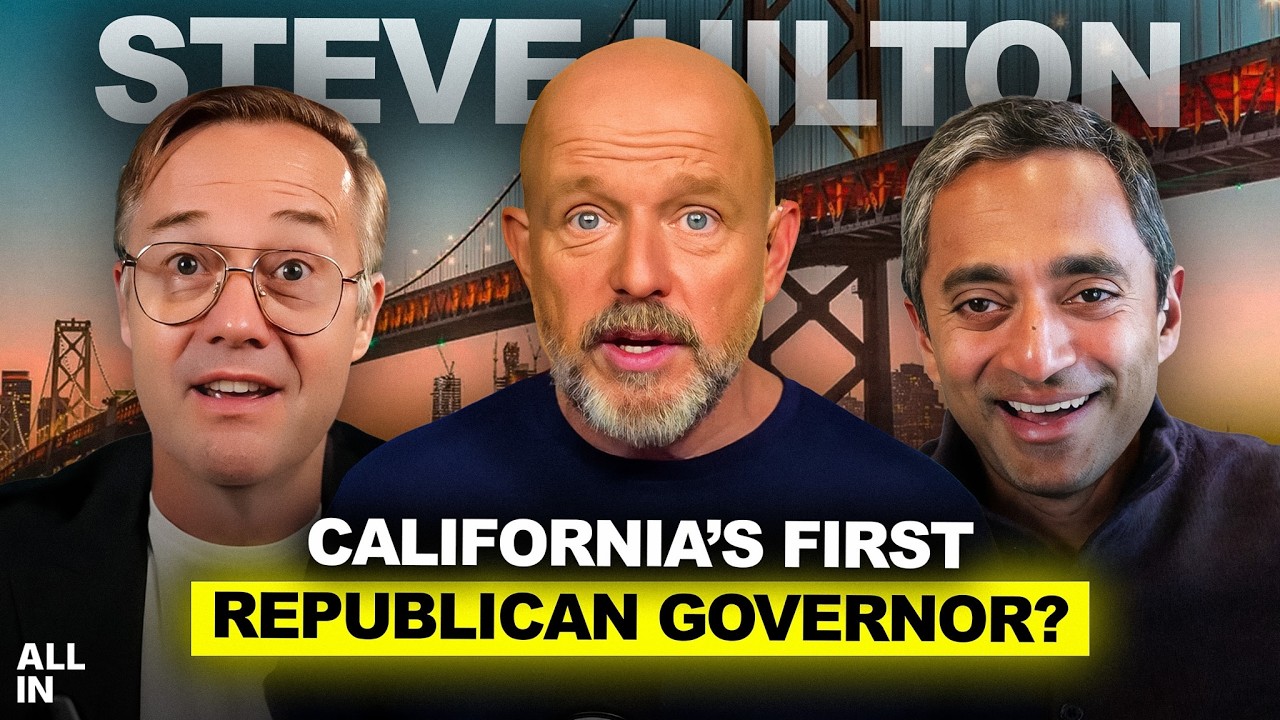
Hilton Targets $60B Tax Cut in California Governor Bid
All-In Podcast
Former Cameron advisor Steve Hilton argues a Republican can win California's governorship by enacting a $60 billion flat tax overhaul, reversing state prison closures, and eliminating CEQA rules to crush sky-high living costs.
## Background
The All-In Podcast published this interview on YouTube on April 29, 2026, featuring British-born Republican candidate Steve Hilton discussing his campaign for Governor of California. According to the page description, the episode covers Hilton's policy proposals—including eliminating income tax under $100k, reforming housing, CEQA, and public education—and explores whether a Republican can realistically win statewide in California.
## TL;DR
In this wide-ranging interview, California gubernatorial candidate Steve Hilton outlines his strategy to dismantle California's single-party Democratic dysfunction through sweeping tax, regulatory, and institutional reforms. Hilton presents proposals to eliminate state income tax for households earning under $100,000, establish a 7.5% flat tax, overhaul public education through universal school choice and phonics mandates, and repeal restrictive housing and energy regulations like CEQA. Backed by findings from his 'Cal DOGE' investigation into government waste, he argues that a pragmatic, working-class coalition can deliver a competitive path to victory in 2026.
## Atmosphere & style
The discussion carries a pragmatic, policy-focused tone that combines sharp political analysis with candid conversation between Hilton and the podcast hosts. The dynamic is structured yet conversational, moving smoothly from Hilton's personal background to intense debates over economic policy, housing costs, and Sacramento machine politics. Rather than relying on purely ideological rhetoric, the atmosphere is grounded in quantitative metrics and legislative realities, reflecting a shared sense of urgency regarding California's affordability crisis.
## Key takeaways
- [00:00](https://www.youtube.com/watch?v=9WQu7w1tII0&t=0s) Steve Hilton outlines his background as a naturalized U.S. citizen, former advisor to UK Prime Minister David Cameron, and the son of a Hungarian refugee, drawing parallels between 1970s British stagflation and modern California.
- [08:34](https://www.youtube.com/watch?v=9WQu7w1tII0&t=514s) Hilton proposes eliminating state income tax for households earning under $100,000 and establishing a flat 7.5% rate above that threshold, which would save 7 million households money while requiring a $60 billion spending reduction.
- [01:16:23](https://www.youtube.com/watch?v=9WQu7w1tII0&t=4583s) Through his Cal DOGE project with Herb Morgan, Hilton alleges that California lost $425 billion to waste, fraud, and non-profit diversion over five years, including hundreds of millions in Cap-and-Trade and Prop 64 funds redirected to political activism.
- [01:20:20](https://www.youtube.com/watch?v=9WQu7w1tII0&t=4820s) Despite a Democratic supermajority legislature, Hilton argues cross-party consensus is possible on affordability, noting Democratic candidate Katie Porter publicly agreed with his plan to make the first $100,000 of income tax-free.
- [01:26:02](https://www.youtube.com/watch?v=9WQu7w1tII0&t=5162s) Hilton warns that extreme tax proposals risk triggering an irreversible business exodus from California, citing a specialized Pomona HVAC manufacturer relocating due to the lack of local data center and chip factory construction.
- [01:27:54](https://www.youtube.com/watch?v=9WQu7w1tII0&t=5274s) California's housing crisis is driven by hyper-rigorous building codes, CEQA litigation (70% of which targets housing), and union Project Labor Agreements (PLAs) that inflate construction and labor costs to two to three times the national average.
- [33:14](https://www.youtube.com/watch?v=9WQu7w1tII0&t=1994s) Special interest influence, particularly from unions and trial lawyers, prevents Sacramento lawmakers from reforming CEQA and reducing local impact fees that add up to $30,000 per door.
- [33:38](https://www.youtube.com/watch?v=9WQu7w1tII0&t=2018s) California imports nearly 80% of its crude oil (primarily from Iraq and South America) due to CARB restrictions and CalGEM permit denials, driving gas prices up to $2.00 over the national average despite rich local reserves.
- [34:55](https://www.youtube.com/watch?v=9WQu7w1tII0&t=2095s) Despite spending over $27,000 per student annually, nearly two-thirds of California public school students fail state math standards and over half fail reading standards, leading Hilton to advocate for universal school choice and mandatory phonics instruction modeled after Mississippi.
- [49:36](https://www.youtube.com/watch?v=9WQu7w1tII0&t=2976s) To restore educational transparency and accountability, Hilton proposes publicly assigning letter grades to individual teachers and schools based on student performance.
- [50:02](https://www.youtube.com/watch?v=9WQu7w1tII0&t=3002s) California's violent crime rate remains 30% higher than the national average, driven by legislative overreach, reluctance to enforce voter initiatives like Prop 36, and the mass closure of state prisons.
- [53:08](https://www.youtube.com/watch?v=9WQu7w1tII0&t=3188s) Halting prison closures is essential to ending the mandatory 'catch and release' dynamic that forces local law enforcement to put repeat offenders back on the street due to a lack of jail capacity.
- [56:17](https://www.youtube.com/watch?v=9WQu7w1tII0&t=3377s) To solve homelessness, Hilton advocates utilizing the legal authority under *Grants Pass v. Oregon* to strictly enforce street encampment bans, mandate 100% sober addiction recovery, and eliminate wasteful $900,000 per-unit housing projects.
- [59:35](https://www.youtube.com/watch?v=9WQu7w1tII0&t=3575s) Between 50% and 70% of county jail inmates suffer from severe mental illness; Hilton calls for reforming psychiatric care by securing waivers for the federal Medicaid 16-bed IMD rule to build dedicated, large-scale treatment facilities.
- [01:01:34](https://www.youtube.com/watch?v=9WQu7w1tII0&t=3694s) Hilton views a Republican gubernatorial victory as mathematically realistic based on rising 'wrong track' polling, Donald Trump's 6.1 million 2024 California vote baseline, and a working-class coalition focused on his 'Californable' platform ($3 gas, cut energy bills, no state tax on tips).
## Detailed walkthrough
### [00:00](https://www.youtube.com/watch?v=9WQu7w1tII0&t=0s) Introduction and Steve Hilton's Background
Jason Calacanis opens the *All-In Podcast* interview with Steve Hilton, highlighting the unique nature of his run for Governor of California as a British-born Republican. After some lighthearted banter about the primary field and political maneuverings in Sacramento, the discussion shifts to Hilton’s backstory. Hilton emphasizes his working-class immigrant upbringing, explaining that his parents were refugees from Hungary following the 1956 Soviet invasion. His stepfather fled the country at age 14 after hearing broadcast warnings of the approaching Russian army, braving minefields and border guards in a escape effort where half the group did not survive.
After graduating from Oxford University, Hilton began his career in construction management before moving into political strategy. He helped lead David Cameron's campaign for leadership of the British Conservative Party and later served as a senior advisor in 10 Downing Street following the 2010 election, focusing primarily on UK government reform. Hilton relocated to California in 2012 when his wife, Rachel Whetstone, took a global communications and public policy leadership role at Google (and later Uber). Responding to common questions regarding his nationality, Hilton confirms that he is now a naturalized U.S. citizen and has officially renounced his British citizenship.
* **Immigration & Escape:** Hilton's stepfather fled Hungary during the 1956 Soviet invasion at 14 years old.
* **Education & Career Start:** Graduated from Oxford and initially worked as a project manager for a construction firm.
* **UK Government Role:** Served as a senior advisor to Prime Minister David Cameron at 10 Downing Street starting in 2010.
* **Silicon Valley Move:** Relocated to California in 2012; previously taught at Stanford University's public policy department and D.school, and was a fellow at the Hoover Institution.
* **Citizenship Status:** Naturalized U.S. citizen; fully renounced UK citizenship.
---
[05:02](https://www.youtube.com/watch?v=9WQu7w1tII0&t=302s) Political Evolution and the 1970s Parallel
Reflecting on his ideological development, Hilton points to the economic environment of late 1970s Britain and the rise of Margaret Thatcher as key influences. He contrasts the stagflation, heavy union control, and public-sector strikes of the 1979 "Winter of Discontent"—a period marked by uncollected garbage and unburied dead—with Thatcher’s emphasis on enterprise, individual accountability, and labor dignity. Recalling his stepfather's view that Thatcher was "for the workers" while opposition policy rewarded non-participation, Hilton argues that modern-day California faces near-identical structural conditions.
Hilton argues that California is currently experiencing high taxation rates, regulatory gridlock, and state-sanctioned inefficiency similar to 1970s Britain. He references a report shared by venture investor Michael Moritz outlining how regulatory bureaucracy stalls development in the UK, drawing a direct link to California's current economic policies and business environment.
> "Mrs. Thatcher's for the workers and Labour are for the layabouts."
---
[08:34](https://www.youtube.com/watch?v=9WQu7w1tII0&t=514s) Tax Reform Proposal: Zero Under $100K and a 7.5% Flat Rate
Hilton details his tax proposal, designed alongside Hoover Institution economists, intended to function as both a worker-relief initiative and a pro-growth overhaul. The plan eliminates state income tax entirely for households earning under $100,000 annually and replaces existing progressive tax brackets above that threshold with a flat 7.5% state income tax. Hilton points out that in several California counties, $100,000 is officially classified as low-income, yet households below this threshold still pay up to 9.3% state income tax alongside high gas taxes, sales taxes, and energy costs.
To finance this rate reduction, Hilton states the plan would require an estimated 18.5% reduction in overall state tax revenue, cutting baseline spending by approximately $60 billion. He notes that the California state budget expanded by nearly 75% over the past five years and nearly doubled over the past decade. Bringing expenditure back down toward pre-pandemic 2019–2020 levels would offset the revenue change without dismantling core services. Additionally, Hilton highlights his initiative—termed the California Department of Government Efficiency (Cal DOGE)—to identify systemic waste, fraudulent expenditures, and operational overlaps across state departments.
* **Tax Plan Structure:** 0% state income tax on household earnings under $100,000; a flat 7.5% rate for earnings above $100,000.
* **Population Reach:** Estimated to eliminate state income tax for roughly 7 million California households (over one-third of the population).
* **Fiscal Impact:** Net revenue reduction of roughly $60 billion, requiring an ~18.5% reduction in overall state spending.
* **Budget Context:** California's state budget expanded by approximately 75% over five years leading into 2026.
* **Comparative Rankings:** Cites *Chief Executive Magazine* ranking California 50th out of 50 state business climates for ten consecutive years.
[01:16:23](https://www.youtube.com/watch?v=9WQu7w1tII0&t=4583s) Uncovering Cal DOGE: Exposing Waste, Fraud, and Non-Profit Diversion
Steve Hilton details his grass-roots effort to systematically track and quantify government waste in California through an initiative called "Cal DOGE." Operating in close partnership with Herb Morgan—who is running alongside him for State Controller—the campaign has released four investigative reports on public spending. Hilton underscores that winning the governor’s seat is only half the battle; having an aligned, aggressive Controller is essential because that position holds the statutory legal authority to audit any entity receiving state dollars and immediately freeze funding upon suspicion of financial impropriety or fraud.
Three of the Cal DOGE reports zeroed in on specific, highly visible state programs where public funds were funneled away from their legally intended mandates and redirected into political advocacy:
* **Cap-and-Trade / Climate Change Mitigation Fund:** Over a 10-year period, $1 billion ($100 million annually derived from gas surcharges and electric utility taxes) was designated specifically to install solar panels on low-income apartment complexes. Using AI tools to analyze state spending reports, Cal DOGE discovered that only **$72 million** out of the $1 billion was actually spent on physical solar installations. The remaining **$928 million** went to non-profit entities involved in Democratic-aligned voter registration drives, environmental justice campaigns, and political activism.
* **Proposition 64 Cannabis Tax:** Out of the tax revenues designated under Prop 64 to fund substance abuse prevention, Cal DOGE tracked **$350 million** flowing into a network of over 500 non-profit organizations. Audit trails revealed that rather than funding rehabilitation or addiction prevention, the money was dispersed via small grants for activist organizing and voter outreach.
* **Project Homekey:** Set up after the COVID-19 pandemic to purchase or convert hotels and real estate for the unhoused, this **$3.8 billion** program saw the vast majority of its budget swallowed up by real estate developers and intermediaries without delivering proportional, trackable housing outcomes.
In their fourth report, Hilton and Morgan aggregated published data from the California State Auditor, Medicaid error rate audits, and agency filings to estimate total systemic waste. They concluded that over the past five years, California lost **$425 billion** to waste, fraud, and inefficiency—averaging roughly **$80 billion per year**, or nearly 20% of the state's annual budget (which stands at approximately $349–$350 billion).
[01:20:20](https://www.youtube.com/watch?v=9WQu7w1tII0&t=4820s) Navigating Sacramento’s Democratic Legislature and Bipartisan Realities
Jason Calacanis challenges Hilton on the political realities of governing California: with both houses of the State Legislature under supermajority Democratic control, how can a Republican governor enact sweeping spending cuts or tax overhauls without repeating the legislative gridlock that forced Governor Arnold Schwarzenegger to pull back to the center?
Hilton responds that while major tax reform requires legislative cooperation, broad public consensus is forming around California's affordability crisis. He notes that even Democratic candidates are recognizing the merit of his tax proposals. During a gubernatorial debate in Fresno, Democratic candidate Katie Porter publicly stated she agreed with Hilton’s tax relief framework, telling the audience she was "stealing Steve Hilton's tax plan" to make the first $100,000 of income state-tax-free.
Hilton argues that electing the first Republican governor in 20 years would fundamentally break the bureaucratic dynamic in Sacramento. Many moderate legislative Democrats privately acknowledge that state regulation and spending have spun out of control, but they feel constrained by machine politics. Drawing on his experience as a senior advisor to Prime Minister David Cameron in the UK—where he helped negotiate and execute a formal coalition government between the Conservatives and Liberal Democrats from inside 10 Downing Street—Hilton emphasizes his ability to build pragmatic, cross-party compromises to deliver structural reform.
- **California Annual Budget:** Approximately $349 billion to $350 billion.
- **Estimated Annual Waste/Fraud (Cal DOGE):** $80 billion per year (~20% of total state spending).
- **Historical Context:** Republicans held the California governorship for 16 of the 36 years prior (Pete Wilson and Arnold Schwarzenegger both served two terms).
- **Bipartisan Consensus on Issues:** Candidates across the aisle agree on the diagnosis—unaffordable cost of living, failing business climate, hyper-regulation, and sluggish development.
[01:26:02](https://www.youtube.com/watch?v=9WQu7w1tII0&t=5162s) The Business Exodus and California's High-End Manufacturing Drain
Addressing the state's tax strategy, Hilton counters Democratic proposals that seek to balance the budget by raising taxes on corporations and high earners. He warns that California is rapidly approaching a tipping point where aggressive tax initiatives—such as proposed wealth and billionaire taxes—threaten to dismantle the Silicon Valley tech ecosystem and spark an irreversible exodus of capital and job creators.
Hilton illustrates this risk with a recent site visit to an HVAC duct and sheet-metal manufacturer in Pomona, Southern California. Despite employing well-paid union labor and manufacturing specialized climate-control equipment vital for advanced microchip fabrication plants (such as TSMC) and AI data centers, the company is preparing to relocate out of state. Because high-tech manufacturing facilities and data centers are almost exclusively being constructed in low-tax, high-growth states rather than California, the factory can no longer justify the expense of operating locally.
[01:27:54](https://www.youtube.com/watch?v=9WQu7w1tII0&t=5274s) The Housing Crisis: CEQA, Union Power, and Climate Dogma
David Sacks shifts the discussion to the single largest driver of the cost of living for California's 40 million residents: the extreme cost of housing. Hilton outlines three structural forces that combine to choke housing supply and drive construction costs up to two or three times the rates of neighboring states:
1. **Climate Dogma & Building Codes:** California imposes hyper-rigorous construction standards that dramatically increase soft and hard development costs. Mandates requiring extensive EV charging infrastructure in parking structures force developers to widen bays, reinforce floor loads to handle battery weights, reduce total parking capacity, and integrate costly solar and high-grade insulation packages into all multi-family buildings.
2. **Litigation via CEQA:** The California Environmental Quality Act allows any private party to file lawsuits against proposed projects. Approximately **70% of CEQA lawsuits** are filed to block housing developments rather than combat genuine environmental damage.
3. **Union Power & Project Labor Agreements (PLAs):** Organized labor groups frequently leverage the threat of CEQA litigation to force developers into Project Labor Agreements. These agreements mandate a "skilled and trained workforce" (union-only closed shops) and "prevailing wage" rules, which push labor costs two to three times above market rates. Developers often face critical labor shortages and are forced to fly in out-of-state union workers and pay for their travel and lodging.
Adding to the problem, local government impact fees average roughly **$30,000 per door/unit** in California, compared to under **$1,000 per door** in Texas. Consequently, Texas produces three times as many new housing units per capita as California every year. Furthermore, aggressive local rent control regulations have incentivized landlords to keep thousands of existing units vacant rather than risk long-term tenancy disputes.
<FollowUp label="Explore Steve Hilton's policy proposals for housing reform and CEQA elimination" query="What are Steve Hilton's specific policy proposals for fixing California's housing crisis and reforming CEQA?"/>
[033:14] CEQA, Special Interest Corruption, and the Union "Leverage"
The panel debates why California's government refuses to address its housing crisis despite having the nation's highest rents, highest poverty rate, and lowest rate of unit growth. Chamath Palihapitiya questions why California has not confronted CEQA (California Environmental Quality Act) when state-to-state data shows air and water quality are not demonstrably better than in states like Texas with far fewer regulations. Steve Hilton argues that the failure to reform housing policy stems from systemic corruption and special interest capture in Sacramento.
Hilton shares an anecdote from his early days researching California policy when he attempted to qualify a ballot initiative to cap local impact fees (which account for up to 20% of housing construction costs) at 3% and eliminate CEQA's private right of action. After running out of time and money for the initiative, he took meetings with state legislators in Sacramento. During a meeting high up in a building overlooking the State Capitol, a legislator agreed that eliminating the private right of action would be "transformational" for housing construction, yet refused to support it publicly. Pointing out the window toward the Capitol, the lawmaker admitted, "The unions run this place." Taking away CEQA's private right of action strips labor unions of their primary leverage to force developers into costly labor agreements.
- **CEQA Exemption Loopholes:** Hilton points out that recent housing bills (such as AB 130 and AB 131) touted by Governor Gavin Newsom as "embracing abundance" only grant CEQA exemptions if developers agree to Project Labor Agreements (PLAs), closed-shop union labor, and prevailing wages—effectively reinserting the exact cost-inflating burdens that CEQA creates.
- **Newsom Campaign Donors:** Over the 16 years Gavin Newsom has run for statewide office, his top three political donation categories have been government unions (#1), trial lawyers (#2), and non-government unions (#3).
- **Environmental Comparison:** Jason Calacanis notes that while California suffers from severe air quality issues due to traffic and car dependency, Texas primarily faces localized industrial and chemical waste issues.
---
[033:38] Gas Prices, Foreign Oil Imports, and CARB Regulations
The conversation shifts to California’s exorbitant fuel costs, where gas prices routinely hover around $7 to $8 per gallon compared to a $3 national average. The panel expresses disbelief that California suffers the highest gas prices in the nation—surpassing even Hawaii—despite sitting on vast natural oil reserves. Hilton explains that California's reliance on foreign oil is a direct consequence of climate policies like the 2006 Global Warming Solutions Act (AB 32). While fossil fuel usage in the state has barely declined over two decades, local extraction has been severely restricted.
Hilton highlights the absurdity of current state energy policy: California now imports nearly 80% of its crude oil, with Iraq standing as its number one foreign supplier, followed by South America. Because California’s specialized refineries were built to process heavy crude, oil companies are actively expanding drilling in the Amazon rainforest to supply the exact grade of crude needed. Shipping this oil across oceans on crude tankers running on dirty bunker fuel creates massive carbon emissions, yet the California Air Resources Board (CARB) conveniently only counts transportation emissions once tankers come within 12 miles of the California coast.
- **State Gas Premium:** California's gas tax adds roughly 60 to 65 cents per gallon, but the majority of the state's ~$2.00-per-gallon premium over the rest of the country stems from regulatory mandates and CARB compliance costs.
- **Refinery Shutdowns:** California's active oil refineries have plummeted from roughly 40 down to just seven, primarily due to artificial constraints on in-state oil production and a complete lack of interstate crude pipelines.
- **Executive Permitting Power:** Hilton notes that the decline in local extraction was not enacted purely through legislation, but by administrative decree through CalGEM (California Department of Conservation Division of Geology and Energy Management), which systematically denies permits for well maintenance, sidetracking, and new drilling in existing fields.
- **Production Potential:** Energy industry experts tell Hilton that under a pro-energy governor who streamlines CalGEM permitting, California could double its domestic oil production every two years.
- **Air Quality vs. Carbon:** Responding to questions about smog, Hilton clarifies that California's air quality improvements over the past several decades were driven by automotive tailpipe standards and cleaner engine tech—not carbon offsets or EV mandates, which still represent only 4% to 5% of registered vehicles.
---
[034:55] California's Failing Schools and the Mississippi Education Miracle
Chamath turns the discussion to the collapse of public K-12 education in California, questioning why advanced academics like AP classes are being stripped away and why teacher pay cannot be tied directly to student literacy and math outcomes. Hilton details the staggering mismatch between educational spending and actual academic achievement across the state.
Hilton attributes the system's failure to the public school monopoly held by teacher unions, which he argues have abandoned educational standards in favor of ideological political agendas. During the COVID-19 pandemic, California enforced the longest and most damaging school shutdowns in the United States; when the Los Angeles teachers' union (UTLA) issued its demands for reopening classrooms, the list included a statewide wealth tax, Medicare for All, and foreign policy statements regarding Palestine. To fix the system long-term, Hilton advocates for universal school choice to break the union monopoly, though he acknowledges legislative resistance will be steep because teacher unions remain the single largest financial backer of California Democrats.
- **Per-Student Spending vs. Performance:** California spends over $27,000 per student per year—among the highest rates in the nation—yet yields abysmal student proficiency.
- **Statewide Academic Pass Rates:** Only 47% of California public school students meet basic state standards in English and reading, while a dismal 35% meet basic standards in math (meaning nearly two-thirds fail).
- **The Mississippi Model:** Mississippi spends roughly one-third of what California spends per student, yet has achieved dramatic, top-tier improvements in reading scores over the last decade through simple, evidence-based structural reforms.
- **Phonics Instruction:** Despite being universally recognized as the most effective method for teaching reading, systematic phonics is utilized in only a tiny fraction of California public schools. Hilton pledges to use the Governor's appointment power on the State Board of Education to mandate phonics statewide.
- **Third-Grade Reading Retention:** Mississippi instituted a strict policy requiring students to pass a basic reading proficiency test by the end of third grade—the critical transition point from "learning to read" to "reading to learn." Students who fail receive summer remediation and are held back if they still cannot read, a policy change credited with transforming the state's literacy outcomes.
[049:36] Teacher Accountability and Classroom Transparency
Steve Hilton argues that California must overhaul its public education system by bringing absolute transparency to school and teacher performance. Hilton proposes making student test scores publicly available and directly linked to individual educators. Under his campaign proposal, every school and teacher in California would receive a visible public letter grade, creating a clear mechanism to reward high-performing educators and replace underperforming ones.
- **Teacher & School Grades:** Every public school and individual teacher would receive a public evaluation grade to hold staff accountable and elevate educational standards.
---
[050:02] California's Crime Problem, Legislation Bloat, and Overturned Laws
Jason Calacanis pivots the conversation to crime and homelessness, pointing out that despite a nationwide 50-year decline in violent crime, California remains 30% more violent than the rest of the country. Hilton blames a deep-seated state government dysfunction: the legislature excels at churning out bureaucracy—passing 1,118 bills in a single legislative session—yet refuses to enforce existing laws.
Hilton criticizes progressive ideological shifts, such as mainstream media defending "micro-looting" as social justice. He notes that while Proposition 47 (which made theft under $950 a misdemeanor) was overwhelmingly rolled back by voters passing Proposition 36 with roughly 70% approval in 2024, Governor Gavin Newsom and state Democrats have actively resisted properly implementing the voters' mandate.
- **Violent Crime Rate:** California's violent crime rate sits 30% higher than the national average.
- **Legislative Overreach:** The state legislature passed 1,118 bills in a single session, which Hilton visually illustrated by printing them into a stack twice his height outside the Capitol.
- **Proposition 36:** Overwhelmingly passed by ~70% of voters in 2024 to overturn Prop 47's lenient theft provisions, though state leadership refuses to aggressively enforce it.
---
[053:08] The Prison Closure Crisis, Overcrowding, and the "Catch and Release" Loophole
Hilton pinpoints the state's prison closure program—initiated under Jerry Brown and accelerated by Gavin Newsom—as a primary driver of California’s crime wave. While the state slashed its prison capacity by nearly half, state spending on corrections ironically doubled. This mass decarceration released tens of thousands of violent offenders into local communities or transferred them to already bursting county jails.
This systemic bottleneck leaves local prosecutors, judges, and law enforcement paralyzed. Officers across the state voice frustration over a mandatory "catch and release" reality where criminals are processed and immediately put back on the street because no jail beds exist. Hilton promises to immediately halt and reverse prison closures to restore strict deterrence and establish genuine rehabilitation programs for literacy and dyslexia—pointing to Virginia’s low recidivism rate as a model California should replicate.
- **Prison Population Drop:** State prison numbers peaked at 165,000 inmates in 2006 and dropped to roughly 93,000 under recent decarceration policies.
- **Budget Irony:** Reducing the inmate capacity by half resulted in a doubled corrections budget.
- **Recidivism Benchmarking:** Hilton highlights Virginia's recidivism rate—which is less than half of California's—as proof that combining strict incarceration with focused rehabilitation works.
---
[056:17] Homelessness Strategy: Enforcing Encampment Bans and Ending the "Housing First" Dogma
Turning to homelessness, Hilton references his policy research platform, *Golden Together*, developed alongside homeless shelter operator Michelle Steeb and San Francisco recovery advocate Tom Wolf. Hilton breaks his actionable strategy down into three strict steps: enforcing existing encampment bans, mandating addiction recovery, and restructuring mental health infrastructure.
Hilton notes that the legal excuses local politicians relied on—such as the 9th Circuit Court's *Boise* decision requiring permanent housing before clearing streets—were completely erased by the Supreme Court’s 2024 *Grants Pass v. Oregon* ruling. As governor, Hilton would set a firm deadline for cities to clear all street encampments; if local officials refuse, he will deploy state law enforcement to clear them directly.
Furthermore, Hilton advocates dismantling the "homeless industrial complex" that squanders funds on $900,000-per-unit housing developments. He insists that state funding must mandate 100% sobriety and structured drug/alcohol recovery—criticizing Newsom for vetoing the bipartisan Sober Housing Act passed by the legislature.
- **Policy Platform:** Hilton's plans draw directly from his *Golden Together* organization report, "Ending Homelessness."
- **Addiction & Mental Illness:** Over 80% of California’s unsheltered population suffers from severe substance abuse or severe mental health conditions.
- **Housing Costs:** State-funded permanent supportive housing units regularly escalate to an absurd $900,000 per unit/door.
- **Legal Precedent:** *Grants Pass v. Oregon* (2024) overturned the *Boise* decision, giving state and local officials total legal authority to clear street encampments regardless of shelter availability.
---
[059:35] Mental Healthcare Reform and Overcoming the Federal 16-Bed Rule
Addressing the overlap between homelessness and mental illness, Hilton points out that county sheriffs report between 50% to 70% of jail inmates suffer from severe, unaddressed psychiatric disorders. Treating the mentally ill on sidewalks or inside penal facilities is fundamentally inhumane and stems from an outdated federal rule.
Hilton explains that Medicaid's 1965 Institutions for Mental Disease (IMD) rule prohibits federal reimbursement to facilities containing more than 16 beds. While the first Trump administration established IMD waivers allowing states to build cost-effective, large-scale psychiatric centers, California failed to take full advantage of it. Hilton promises to redirect money away from expensive apartment construction toward modern, large-scale psychiatric care facilities.
- **Jail Mental Health Statistics:** Between 50% and 70% of county jail inmates in California suffer from severe mental health issues.
- **Medicaid IMD Rule:** Enacted in the mid-1960s, this rule caps Medicaid reimbursements to mental health facilities with more than 16 beds, rendering large-scale treatment centers economically unviable unless waived.
---
[01:01:34](https://www.youtube.com/watch?v=9WQu7w1tII0&t=3694s) Hilton’s Electoral Math and Path to the Governor's Mansion
Looking ahead to the election, Hilton details his campaign strategy under California's top-two open primary system. Supported by an endorsement from Donald Trump, Hilton leads primary polling on the Republican side and anticipates advancing to a general election matchup against one of three prominent Democrats: Tom Steyer, Katie Porter, or Javier Becerra.
Addressing skeptics who view a Republican win in California as impossible, Hilton acknowledges that Democrats hold a 2-to-1 voter registration advantage. However, actual voting trends over the last two decades show a tighter 60–40 split, meaning a moderate shift in turnout and independent voter sentiment puts the governor's seat within reach. Hilton frames the race around one simple question: "Are you happy with the way things are going in California?"
- **Democratic Primary Rivals:** Hilton expects to face either Tom Steyer, Katie Porter, or Javier Becerra in the general election.
- **Voter Registration vs. Turnout:** While registered Democrats outnumber Republicans 2-to-1 in California, actual general election voting averages around a 60% to 40% split.
- **National Stakes:** Hilton emphasizes that "California means to America what America means to the world," making state-level policy restoration critical for the nation.
<ElicitationsGroup message="Explore more details from this interview:">
<Elicitation label="Review Hilton's housing and CEQA policy proposals" query="Provide a detailed walkthrough of part 3 of this transcript covering Steve Hilton's policy views on California housing costs, CEQA reform, and union labor regulations."/>
<Elicitation label="Analyze Hilton's tax reform and 7.5% flat tax model" query="Provide a detailed walkthrough of part 2 of this transcript covering Steve Hilton's economic proposals, zero tax under $100k, and the 7.5% flat tax."/>
</ElicitationsGroup>
[01:04:54](https://www.youtube.com/watch?v=9WQu7w1tII0&t=3894s) Electoral Dynamics and the Path to Victory in California
Steve Hilton breaks down the polling environment and mathematical math required for a Republican candidate to win the California gubernatorial election in 2026. He notes that public sentiment has shifted dramatically compared to four years prior: while the "wrong track" number previously hovered in the mid-to-high 40s, it has risen into the mid-to-high 50s. This creates a clear majority of voters actively seeking change, which offers a highly favorable backdrop for an outsider campaign.
Examining the actual turnout requirements, Hilton estimates that based on the average of the last two midterm elections (2018 and 2022), around 11.7 million total votes will be cast in 2026. Winning requires a simple majority of just over 5.9 million votes. He counters the common belief that there are not enough Republicans in California by pointing to Donald Trump’s performance in the 2024 presidential election, where Trump received 6.1 million votes without actively campaigning or spending heavily on advertising in the state. While midterm turnout is naturally lower than presidential turnout, this baseline proves that the sheer pool of voters exists to build a winning coalition.
Beyond core Republicans—who will be particularly motivated by a voter ID ballot measure qualifying for the November vote—Hilton outlines a multi-racial, working-class coalition strategy. He argues that working-class Californians are the ones hit hardest by the state's policies, making them highly responsive to practical relief proposals like ending state taxes on tips and cutting income taxes.
Hilton wraps up by detailing his core campaign platform, which he brands as making the state "Californable." The hosts thank Hilton for his candor, with one of the hosts offering a final endorsement of the need for political balance in California after having personally left the state due to single-party dysfunction.
- **"Wrong Track" Polling Shift:** Increased from mid-to-high 40s in the previous election cycle to mid-to-high 50s today.
- **Estimated Midterm Electorate:** ~11.7 million total votes projected for 2026 (based on 2018 and 2022 averages).
- **Votes Needed to Win:** ~5.9 million votes.
- **Trump’s 2024 California Baseline:** 6.1 million votes recorded without focused state-level ad spend.
- **Key Turnout Driver:** A voter ID initiative on the November 2026 ballot expected to drive Republican participation.
- **The "Californable" Policy Package:**
- $3 per gallon gas.
- Electricity bills cut in half.
- No state income tax on the first $100,000 earned.
- Elimination of state tax on tips.
- Policies targeted at making homeownership affordable.
## Notable quotes
> [05:02](https://www.youtube.com/watch?v=9WQu7w1tII0&t=302s) Mrs. Thatcher's for the workers and Labour are for the layabouts. — Steve Hilton's Stepfather
> [01:20:20](https://www.youtube.com/watch?v=9WQu7w1tII0&t=4820s) stealing Steve Hilton's tax plan — Katie Porter
> [33:14](https://www.youtube.com/watch?v=9WQu7w1tII0&t=1994s) The unions run this place. — California State Legislator
> [01:01:34](https://www.youtube.com/watch?v=9WQu7w1tII0&t=3694s) California means to America what America means to the world — Steve Hilton
## Mentioned
Steve Hilton, Jason Calacanis, Chamath Palihapitiya, David Sacks, All-In Podcast, David Cameron, Rachel Whetstone, Google, Uber, Oxford University, Stanford University, Hoover Institution, Margaret Thatcher, Michael Moritz, Herb Morgan, Katie Porter, Tom Steyer, Javier Becerra, Gavin Newsom, Jerry Brown, Arnold Schwarzenegger, Pete Wilson, Donald Trump, Michelle Steeb, Tom Wolf, Cal DOGE, Golden Together, CEQA, Cap-and-Trade, Proposition 64, Project Homekey, Proposition 47, Proposition 36, AB 32, AB 130, AB 131, CARB, CalGEM, UTLA, TSMC, Medicaid
California gubernatorial candidate Steve Hilton argues that single-party governance, bureaucratic growth, and special-interest capture have precipitated an acute affordability and institutional crisis in California. To counter this trajectory, he proposes sweeping state tax relief, aggressive deregulation of housing and energy markets, and structural overhauls to criminal justice, homelessness management, and public education.
Tax Reform and Government Spending Oversight (8:34)
Hilton proposes eliminating the state income tax for households earning under $100,000 and instituting a flat 7.5% rate above that threshold, which he estimates would remove roughly 7 million households from state income tax rolls. Financed by an estimated 18.5% ($60 billion) spending reduction, Hilton contends this can be absorbed without cutting core services by returning expenditures toward 2019–2020 levels, noting that California's state budget expanded by roughly 75% over five years to approximately $350 billion.
To identify targeted cuts, Hilton points to his 'Cal DOGE' initiative, which claims the state loses roughly $80 billion annually to waste, fraud, and inefficiency. Cal DOGE reports highlight program diversions, such as only $72 million of a $1 billion Cap-and-Trade allocation reaching low-income solar installations, while $928 million went to non-profit advocacy. Hilton also cites $350 million in Prop 64 substance abuse funds redirected toward activist organizing and asserts that the $3.8 billion Project Homekey yielded minimal verifiable housing outcomes relative to developer outlays.
Dismantling Housing and Energy Production Constraints (87:54)
Hilton identifies regulatory barriers and labor union influence as primary drivers of California's cost-of-living crisis. In housing, he asserts that roughly 70% of California Environmental Quality Act (CEQA) lawsuits are filed to block housing projects rather than prevent environmental damage. Organized labor, he argues, leverages CEQA litigation threats to mandate Project Labor Agreements (PLAs) that push labor costs two to three times above market rates. Compounded by local development impact fees averaging $30,000 per door—compared to under $1,000 in Texas—these constraints lead Texas to produce three times more housing units per capita than California.
In the energy sector, Hilton criticizes administrative restrictions under CalGEM that block drilling and maintenance permits despite California possessing substantial oil reserves. He reports that the state now imports nearly 80% of its crude oil—primarily from Iraq and South America—while active in-state refineries have fallen from roughly 40 down to seven. Hilton claims an executive approach that streamlines extraction permitting could double domestic oil production every two years, exerting downward pressure on gas prices that trade at a multi-dollar premium over the national average.
Public Safety, Homelessness Interventions, and Education
Hilton ties California's violent crime rate, which he states sits 30% higher than the national average, directly to state decarceration initiatives. As prison capacity was cut from 165,000 in 2006 to approximately 93,000 inmates, corrections spending doubled, forcing county jails into overcrowding and mandatory 'catch and release' cycles. On homelessness, Hilton repudiates the 'Housing First' doctrine and its $900,000-per-unit construction costs. Utilizing legal authority under the 2024 Supreme Court *Grants Pass* ruling, he plans to mandate the clearing of street encampments, make state funding conditional on complete sobriety, and seek federal waivers for Medicaid's 16-bed IMD limit to expand large-scale psychiatric care for county jail populations, where an estimated 50% to 70% suffer from severe psychiatric illness.
Addressing K-12 education, Hilton argues that despite annual per-student spending exceeding $27,000, only 47% of students meet state standards in English and 35% in math. Emphasizing the Mississippi model of education reform, Hilton advocates universal school choice, administrative mandates for phonics instruction, strict third-grade reading proficiency retention policies, and publicly visible performance letter grades for every school and individual teacher.
Electoral Math and Bipartisan Legislative Realities (64:54)
Evaluating his prospects in a state with a 2-to-1 Democratic voter registration edge, Hilton notes that 'wrong track' polling has climbed into the mid-to-high 50s. Assuming a 2026 midterm turnout of roughly 11.7 million voters, a winning margin requires just over 5.9 million votes. Hilton points to Donald Trump's 6.1 million California votes in 2024 as proof of an attainable numerical base, which he aims to expand via an anticipated 2026 voter ID ballot measure and a working-class economic package branded as 'Californable'—featuring reduced fuel costs, utility cuts, and untaxed tips.
Addressing governance under a Democratic legislative supermajority, Hilton draws on his experience structuring the UK Conservative–Liberal Democrat coalition government at 10 Downing Street. He argues that an outsider victory would recalibrate Sacramento's political dynamic, noting that Democratic gubernatorial contenders such as Katie Porter have already adopted elements of his proposal to exempt the first $100,000 of income from state taxation.
Hilton's policy proposals hinge on whether an economic platform centered on tax cuts and affordability can persuade a substantial portion of California's Democratic-leaning and independent electorate to cross party lines, and whether executive authority can overcome entrenched resistance from public-sector unions and a Democratic legislative supermajority.
## Background
本期节目由 All-In Podcast 于 2026 年 5 月 27 日发布在 YouTube 平台。页面简介显示,节目聚焦加州州长共和党候选人史蒂夫·希尔顿(Steve Hilton),深入探讨加州当前的治理失能与自我毁灭危机,涵盖年收入 10 万美元以下免税与 7.5% 单一税制、住房建设成本高企、教育与治安困境,以及共和党人如何在深蓝加州实现翻盘胜选的策略路径。
## TL;DR
加州州长参选人史蒂夫·希尔顿(Steve Hilton)做客节目,系统剖析了加州在高税负、住房短缺、能源自废武功以及教育与治安崩溃背后的深层制度病灶。希尔顿提出了极具冲击力的施政蓝图,主张年收入 10 万美元以下免征州所得税并实行 7.5% 单一税率,依托加州政府效率部(Cal DOGE)清理每年上百亿美元的财政渗漏与 NGO 利益输送。在规制改革上,他力主斩断 CEQA 环境滥诉与工会捆绑以成倍降低建房成本,撤换阻碍本土石油开采的官僚以腰斩油价,并效仿密西西比经验重塑基础教育考核。针对治安与游民危机,他提出重启监狱收容、依法清退街头帐篷并实行“戒毒或服刑”的强制医疗干预,试图通过凝聚多族裔工薪阶层联盟在 2026 年打破加州的一党绝对垄断。
## Atmosphere & style
整场对谈兼具硅谷科技圈的敏锐犀利与严肃的政策辩论色彩,气氛在开场的轻松调侃与随后密集的机制剖析之间无缝衔接。主持人们作为多位深感加州环境窒息并选择出走的资深投资人,在对希尔顿回归常识的经济主张抱以共鸣的同时,毫不避讳地对其能否突破萨克拉门托利益集团铁板提出层层逼问。希尔顿全程表现出极高的政治决断力与清晰的数据掌控感,以局内操盘者的坦诚层层剥开体制积弊,使整期节目充满了一种直面加州崩塌现实的紧迫感与渴望以常识打破政治僵局的激辩张力。
## Bulletin
- [09:32](https://www.youtube.com/watch?v=9WQu7w1tII0&t=572s) 共和党加州州长候选人 Steve Hilton 提出激进税改方案:加州年收入 10 万美元以下免征个人所得税,超过部分实行 7.5% 单一税率,预计导致州财政减收约 600 亿美元,但仅相当于将支出拉回至疫情前水平。
- [27:52](https://www.youtube.com/watch?v=9WQu7w1tII0&t=1672s) Steve Hilton 指责工会滥用 CEQA 私人诉讼权强迫开发商签署高价项目劳工协议,加之极端建筑规范与高昂影响费,致使加州建房成本达到邻近各州的 2 至 3 倍。
- [44:53](https://www.youtube.com/watch?v=9WQu7w1tII0&t=2693s) 加州公立教育生均年支出超过 2.7 万美元位居全美前列,但学生英语达标率仅 47%、数学及格率仅 35%;Hilton 主张借鉴密西西比州推行自然拼读法与三年级学力红线。
- [56:21](https://www.youtube.com/watch?v=9WQu7w1tII0&t=3381s) 面对治安与流浪汉危机,Hilton 主张依据联邦最高法院最新判例全面清理违规街头帐篷营地,恢复“要么戒毒要么坐牢”原则,并申请联邦 IMD 豁免以破除 16 床位精神治疗限制。
- [01:03:20](https://www.youtube.com/watch?v=9WQu7w1tII0&t=3800s) 2026 年加州州长选举中,选民认为加州处于“错误轨道”的比例已升至 55%-59%,中期选举胜选仅需约 590 万票,低于特朗普 2024 年在加州取得的 610 万票底盘。
## Key takeaways
- [04:49](https://www.youtube.com/watch?v=9WQu7w1tII0&t=289s) Steve Hilton 具有匈牙利难民家庭背景,曾任英国首相 David Cameron 高级顾问,其政治哲学深受撒切尔主义影响,认为当前加州与 70 年代英国受工会绑架、过度监管及惩罚性重税的病态如出一辙。
- [09:52](https://www.youtube.com/watch?v=9WQu7w1tII0&t=592s) 双层税制方案主张年收入 10 万美元以下个人所得税直接降为 0%,惠及约 700 万户家庭;超额部分实行 7.5% 单一税率,以扭转加州商业环境全美垫底的困境。
- [14:28](https://www.youtube.com/watch?v=9WQu7w1tII0&t=868s) 加州过去五年累计低效与浪费支出估算达 4,250 亿美元,平均每年约 800 亿美元;设立“Cal DOGE”监督机构并联手州审计长切断违规资金链,是减税同时平衡预算的关键路径。
- [17:46](https://www.youtube.com/watch?v=9WQu7w1tII0&t=1066s) 气候变化减缓基金、大麻税收与游民工程等专项资金存在严重异化,数十亿美元巨款大多被各类非营利组织作为政治游说或流向开发商,未能切实解决实际民生问题。
- [19:58](https://www.youtube.com/watch?v=9WQu7w1tII0&t=1198s) 即便面对民主党牢固控制的加州议会,免除 10 万美元以下所得税的提议在民主党内部也获得了 Katie Porter 等竞争对手的公开认可,存在跨党派共识空间。
- [25:11](https://www.youtube.com/watch?v=9WQu7w1tII0&t=1511s) 继续打压企业与推行“亿万富翁税”正将高端制造业和科技生态推向悬崖,由于缺乏本土芯片和 AI 基础设施投资,本地优质工会制造企业正加速迁往外州。
- [27:54](https://www.youtube.com/watch?v=9WQu7w1tII0&t=1674s) 加州住房短缺与天价建造成本的核心根源在于三大枷锁:工会垄断、以 CEQA 为武器的滥诉勒索,以及脱离现实的气候教条规范。
- [31:21](https://www.youtube.com/watch?v=9WQu7w1tII0&t=1881s) 全州约 70% 的 CEQA 诉讼被用于阻碍住房建设,工会以此强迫开发商签署高昂的项目劳工协议(PLA),且加州新建住宅行政影响费高达 3 万美元,远超得州水准。
- [37:05](https://www.youtube.com/watch?v=9WQu7w1tII0&t=2225s) 加州本土化石燃料消耗占比仍达 80%,但在激进环保政策下行政扼杀本土采油并关停大量炼油厂,反倒依赖伊拉克和亚马逊雨林的长途高污染海运原油填补缺口。
- [42:14](https://www.youtube.com/watch?v=9WQu7w1tII0&t=2534s) 限制加州原油开采的根源并非议会立法,而是加州地质与能源管理局(CalGEM)对日常技术改造和钻探许可的行政阻挠;新州长可通过换人直接绕过立法激活产能。
- [43:35](https://www.youtube.com/watch?v=9WQu7w1tII0&t=2615s) 加州空气质量的历史性改善本质上来自内燃机尾气净化技术的进步,与激进碳管制或仅占汽车保有量 4%-5% 的电动汽车无实质因果关系。
- [44:53](https://www.youtube.com/watch?v=9WQu7w1tII0&t=2693s) 加州公立教育被极端意识形态化的教师工会绑架,陷入“生均支出顶尖、成绩全美垫底”的绝境,应效仿密西西比州推行自然拼读法与三年级考核红线以实现自救。
- [49:34](https://www.youtube.com/watch?v=9WQu7w1tII0&t=2974s) 提倡推行教育透明度与教师问责制,效仿佛罗里达州为加州的每所学校评级、每位教师打分,将学生学业成绩与教师绩效直接挂钩。
- [53:08](https://www.youtube.com/watch?v=9WQu7w1tII0&t=3188s) 加州治理陷入“立法过度但执法瘫痪”怪圈,纽森政府推行的关闭州立监狱政策导致在押人数减半但预算翻倍,引发县级看守所爆满和警察“抓了就放”的治安恶性循环。
- [56:21](https://www.youtube.com/watch?v=9WQu7w1tII0&t=3381s) 最高法院推翻博伊西裁决后,加州各级政府已拥有充分法定权力清理街头帐篷营地;对流浪者群体必须恢复“戒毒或坐牢”的双轨强制干预机制。
- [58:56](https://www.youtube.com/watch?v=9WQu7w1tII0&t=3536s) 加州监狱在押人员中 50% 至 70% 患有严重精神疾病,加州应立即申请联邦 Medicaid IMD 豁免,打破 16 张床位报销上限,转而建设规模型现代化精神疗养中心。
- [01:03:20](https://www.youtube.com/watch?v=9WQu7w1tII0&t=3800s) 2026 年州长选举呈现“求变还是守旧”的二元对决,借助选民身份核验倡议(Voter ID)与多族裔工薪阶层联盟,共和党依靠减税与降生活成本的常识纲领完全具备翻盘可能。
## Detailed walkthrough
### [00:00](https://www.youtube.com/watch?v=9WQu7w1tII0&t=0s) 开场:英国面孔的加州州长共和党候选人
节目开场,主持人 Jason Calacanis 介绍了本期嘉宾——加利福尼亚州州长参选人 Steve Hilton。Jason 调侃道,Hilton 参选直接将“游戏难度”拉满了:首先他是一名共和党人,其次他还是个英国人。尽管面临极高的竞争门槛,Hilton 目前在初选民调中却位列第一,在五六名候选人的角逐中领跑。Jason 继续打趣称,等到民主党内部在“密室”里互相暗算、Nancy Pelosi 最终钦定出候选人并淘汰其他人之后,局势肯定会进一步收紧。
Hilton 笑着抗议 Jason 这番介绍简直是在“几句话内毁掉自己的竞选前途”。随后 Chamath Palihapitiya 接过话头,为 Hilton 认真做引荐。Chamath 提到,他早在 2012 至 2013 年间就结识了 Hilton 和他的妻子 Rachel Whetstone(曾先后在 Google、Facebook、Uber 等科技巨头负责公关与政策事务)。Chamath 指出,加州本质上是一片属于移民的土地,Hilton 本人拥有非常引人注目的成长故事,并邀请他分享自己的家庭背景以及他是如何一路奋斗并最终来到美国的。
### [01:44](https://www.youtube.com/watch?v=9WQu7w1tII0&t=104s) 从匈牙利难民家庭到唐宁街10号
Hilton 回顾了自己的早年生活,并表示随着时间推移,他越发意识到原生家庭对自己的世界观与执政理念产生了根本性的影响。他的父母是逃离共产主义政权的匈牙利难民。父母离异后,他的继父同样也是匈牙利难民。1956 年苏联入侵匈牙利时,当时年仅 14 岁(比 Hilton 目前的小儿子还小一岁)的继父在收音机里听到“苏联人来了”,便与兄弟和同学毅然逃跑奔向边境。他们在铁丝网、雷区与边防军士兵的子弹中逃命,同伴中有一半被射杀。继父最终逃入奥地利难民营,并辗转前往英国。这段家庭记忆让 Hilton 从小就对“自由”与“机会”抱有刻骨铭心的珍视。
Hilton 随后在英格兰南海岸的布莱顿(Brighton)长大,家庭属于典型的工薪阶层移民。凭借努力,他考入牛津大学(Oxford University),但他毕业后的第一份工作其实是一家建筑公司的项目经理,只为了能够赚钱谋生、靠双手立足。此后,他曾在英国保守党短暂工作,在跨国大型广告公司任职并奔走世界,自己创办过公司(包括开过餐厅)。后来,他协助挚友 David Cameron 竞选保守党领袖并取得胜利,又在 2010 年帮助 Cameron 赢得大选出任英国首相。Hilton 随后进入唐宁街 10 号担任英国首相高级顾问,负责主导政府的各项改革政策落地。2012 年,随着第二个儿子的出生,为了配合妻子负责 Google 全球公关和政策高管的工作,一家人决定迁居硅谷。
```mermaid
flowchart TD
accTitle: Steve Hilton 从难民后代到政界高层的成长轨迹
accDescr: 展现 Steve Hilton 从匈牙利难民家庭成长、考入牛津,再到任职唐宁街 10 号及移居加州的历程。
subgraph EarlyLife ["早年经历与成长"]
A["匈牙利难民家庭<br/>(1956 苏联入侵逃亡)"] --> B["布莱顿工薪阶层成长"]
B --> C["考入牛津大学 & 建筑项目经理"]
end
subgraph Career ["英国职业生涯"]
C --> D["跨国广告公司 & 创业经商"]
D --> E["协助 David Cameron 竞选"]
E --> F["唐宁街 10 号首相高级顾问<br/>(主导推行各项改革)"]
end
subgraph California ["移居加州与全心投入"]
F --> G["2012 移居硅谷<br/>(妻子就职科技巨头高管)"]
G --> H["放弃英国国籍,全心投入<br/>参选加利福尼亚州州长"]
end
```
### [04:49](https://www.youtube.com/watch?v=9WQu7w1tII0&t=289s) 政治信仰的演进:撒切尔主义与 70 年代英国阴影
针对 Chamath 提出的政治思想演进历程,Hilton 阐释了其保守主义理念的根源。在 20 世纪 70 年代的英国,经济陷入严重停滞与硬化(sclerotic),工会掌控着各行各业的方方面面。1979 年英国暴发著名的“不满之冬”(Winter of Discontent),全国性大罢工导致垃圾堆积如山、死者甚至无人掩埋,整个社会系统濒临崩溃。Margaret Thatcher 的上台改变了一切,她坚决反抗共产主义,大力推崇商业、企业与辛勤劳动。Hilton 表示,虽然他的家庭从不主动大谈政治,但继父的一句话深深烙印在他心中:“撒切尔夫人支持劳动者,而工党支持游手好闲之徒(Mrs. Thatcher's for the workers and Labour are for the layabouts)。”
Hilton 指出,今天的加州与 20 世纪 70 年代的英国存在惊人的相似之处:
- **工会过度掌权**:工会深度绑架公共政策的制定,导致行政系统失去灵活性。
- **过度监管与僵化**:过度监管导致任何工程建设和基础设施落地变得极其缓慢和艰难。
- **惩罚性重税**:加州正在逼近英国当年的高税负局面(当年英国叠加财富税后的最高税率曾高达 98%,最高边际税率也达到 60%)。
投资人 Mike Moritz 曾寄给他一份关于英国现状的研究报告,其描述的管制过度、阻碍建设的困境,简直与今天的加州如出一辙。谈及身份,Hilton 特别强调,他不仅早已归化成为美国公民,更已正式放弃了英国国籍,借用本播客的名字,他对自己所选的道路是真正的“All-In”。
### [08:32](https://www.youtube.com/watch?v=9WQu7w1tII0&t=512s) 竞选核心主张:10 万美元以下零州税与 7.5% 单一税
话题转向 Hilton 的经济与财税施政纲领。Jason 指出 Hilton 提出了一项极具民粹色彩、也相当激进的税改计划:年收入 10 万美元以下的群体免征任何加州州所得税;年收入超过 10 万美元的部分,则实行 7.5% 的单一税率(Flat Tax)。
Hilton 回应称,这项税改方案在竞选首日就已正式公布,其核心理念是“支持劳动者(pro-worker)与支持经济增长(pro-growth)”。他警告道,许多人被“加州是全球第四大经济体”的宏观光环所迷惑,忽视了表象下掩盖的深层经济灾难:
- 加州的失业率位居全美最高之列。
- 加州的贫困率在全美排名第一(与路易斯安那州并列)。
- 慈善组织 United Way 的报告显示,高昂的生活成本正将大量普通的劳动家庭压得喘不过气来。
Hilton 强调,如果不从根本上减轻普通工薪阶层的税负并释放商业活力,加州的经济增长模式将难以为继。
### [09:52](https://www.youtube.com/watch?v=9WQu7w1tII0&t=592s) 加州税改构想:10 万美元以下零所得税与 7.5% 单一税率
Steve Hilton 从加州严酷的生活成本现实切入,指出独立评估显示超过三分之一的加州人连基本生活需求都无法满足。在这座全美汽油价格最高、除夏威夷外电费最贵、住房与保险成本高居榜首的州,最受压迫的恰恰是那些不在传统福利体系兜底范围内、拼命工作的工薪穷人(working poor)。为了立竿见影地帮助普通百姓,Hilton 与斯坦福大学胡佛研究所(Hoover Institution)的经济学家们共同测算了税改方案。在加州许多县,“年收入 10 万美元”实际上已被官方划定为低收入门槛,但年收入在 7 万至 9 万美元区间的普通工薪阶层,目前却承受着高达 9.3% 的州个人所得税,这一边际税率甚至超过了全美绝大多数州的最高税率档位。
为了彻底扭转这种不合理现状并提振商业活力,Hilton 提出了一套极其激进的双层税收框架:
- **年收入 10 万美元以下**:州个人所得税直接降为 0%,预计将惠及约 700 万户家庭(占加州约 4000 万总人口的三分之一以上)。
- **年收入 10 万美元以上部分**:实行 7.5% 的单一税率(flat tax),终结现有极其繁琐、充满官僚消耗的累进税率阶梯。
Hilton 强调,《首席执行官》(Chief Executive)杂志连续近十年将加州商业环境评为全美倒数第一(第 50 位),畸高且复杂的税制是吓跑资本与企业投资的核心推手。他估算,该税改方案整体将导致州政府财政收入减少约 18.5%(约合 600 亿美元)。然而,加州财政预算在过去十年几乎翻倍,仅过去五年就膨胀了约 75%;削减 600 亿美元的规模,实际上只是将政府支出水平拉回至疫情爆发前的常态,完全在财政可承受范围之内。
```mermaid
flowchart TD
accTitle: Steve Hilton加州个人所得税改革构想
accDescr: 展示年收入以10万美元为分界点的双层税制方案及财政预算对应调整
subgraph TaxPlan["个人所得税改革方案"]
A["加州居民年收入"] --> B{"收入分界线<br/>$100,000"}
B -->|0 至 10 万美元| C["0% 州个人所得税<br/>(惠及约700万户家庭)"]
B -->|超过 10 万美元部分| D["7.5% 单一税率<br/>(Flat Tax)"]
end
subgraph BudgetImpact["财政收支平衡调整"]
E["财政收入减少约 18.5%<br/>(约 600 亿美元)"]
F["压缩非理性支出与官僚浪费"]
G["预算回归至疫情前水平<br/>(约 2019-2020 财年)"]
E --> F --> G
end
TaxPlan --> BudgetImpact
```
### [14:28](https://www.youtube.com/watch?v=9WQu7w1tII0&t=868s) 削减财政支出与设立加州政府效率部(Cal DOGE)
面对主持人关于“削减税收会导致公共服务受损”的质疑,Hilton 驳斥称,加州政府将疫情期间的非常规预算扩张直接沉淀为日常基准线(baseline),这在财政上完全不可持续。加州甚至在非经济衰退期出现巨额财政赤字,不得不频繁动用应急储备基金(Rainy Day Fund)拆东墙补西墙。他指出,即便完全不缩减核心公共服务,仅通过剔除腐败、浪费与滥用,就能腾出巨大的减税空间。
受全国范围内曝光欺诈行为的调查启发,Hilton 在数月前成立了名为“Cal DOGE”(加州政府效率部)的独立监督机构。为了确保政策落地,Hilton 改变了以往共和党人的竞选策略,提前组建全州公职竞选团队,其中竞选加州审计长(State Controller)的 Herb Morgan 扮演核心角色。加州审计长拥有审计任何接收州财政拨款机构的法定权力,一旦发现违规即可切断资金链。Cal DOGE 结合州审计长公开数据与 Medicaid 错误率,已连续发布了四份关于财政欺诈的深度报告,其中第四份全面测算了全州财政渗漏的总体规模。
- **预算激增现状**:从 2020 年至今,加州许多部门的花费近乎翻倍,但公共服务质量并无任何本质改善。
- **治理机制创新**:州长与独立审计长联手,利用法律赋权切断涉嫌欺诈项目的资金流。
### [17:46](https://www.youtube.com/watch?v=9WQu7w1tII0&t=1066s) 揭露三大财政黑洞:气候基金、大麻税收与游民工程
谈及具体审计发现时,Hilton 列举了 Cal DOGE 报告中触目惊心的资金挪用案例,指出大量打着高尚旗号设立的专项税收与公共基金,最终沦为了民主党附属非营利组织(NGO)的政治提款机:
- **气候变化减缓基金(Climate Change Mitigation Fund)**:这笔源自碳总量控制与交易体系(Cap-and-Trade)、附加在汽油税与电费上的基金,过去十年间按每年 1 亿美元的节奏累计拨付 10 亿美元,名义上用于为低收入公寓安装太阳能电池板。然而通过 AI 工具追踪全部审计报告后发现,真正花在太阳能电池板安装上的资金仅有 7200 万美元,剩余的 9.28 亿美元全部流入了各类非营利组织,被挥霍在选民登记、环境正义游说等政治活动上。
- **大麻税(64 号提案)**:加州通过 64 号提案使大麻合法化后征收的专项税款,依法应专项用于药物滥用预防。Cal DOGE 发现其中 3.5 亿美元被切碎成小额赠款,分发给 500 多家非营利组织,实际执行的业务大多仍是选民动员与政治激进运动。
- **“钥匙之家”计划(Project Homekey)**:疫情后州政府为解决游民危机设立的旗舰项目,耗资高达 38 亿美元用于收购酒店或兴建游民住所。调查显示,这笔巨资绝大部分直接流向了关系密切的地产开发商口袋,既缺乏透明度,也未能有效缓解加州的游民困境。
### [19:58](https://www.youtube.com/watch?v=9WQu7w1tII0&t=1198s) 预算浪费与两党立法的现实壁垒
加州当前预算规模高达约 3,500 亿美元。当主持人询问加州财政中究竟有多少属于低效、欺诈和浪费时,史蒂夫·希尔顿(Steve Hilton)给出了其团队的严谨估算:过去五年间,加州累计浪费与无效支出高达 4,250 亿美元,平均每年约 800 亿美元,占整个预算规模的 20% 左右。主持人杰森·卡拉卡尼斯(Jason Calacanis)随即抛出一个直面现实的质问:加州参众两院均由民主党绝对控制,州长无法单方面削减公共服务,当年阿诺德·施瓦辛格(Arnold Schwarzenegger)执政时也不得不向政治中间派妥协;即便州长手握单项否决权(Line-item veto),推行任何实质性的削减开支与减税政策,必然会在州议会遭遇激烈的两党交火。
希尔顿坦承这一现实,强调自己在税收改革方案上始终明确表示必须经由立法机关批准。然而,他坚信在部分核心议题上存在两党达成共识的土壤。一个标志性的例子发生在弗雷斯诺(Fresno)的一场州长竞选辩论中,他的民主党对手凯蒂·波特(Katie Porter)在谈及生活成本时当场表示:“我决定照搬史蒂夫·希尔顿的税收计划。我同意他的观点,收入前 10 万美元免税,好主意就应该被采纳。”尽管杰森随后打趣波特在赛后视频拍摄中爆粗口让希尔顿“滚出镜头”,但这一共识信号表明,免除基础所得税的构想即便在民主党内部也具备政治穿透力。
- **加州年度财政预算**:约 3,490 亿至 3,500 亿美元。
- **五年累计低效与浪费估算**:4,250 亿美元(年均约 800 亿美元,占比约 20%)。
- **立法机构现状**:民主党长期牢固掌控参众两院超级多数。
---
### [22:33](https://www.youtube.com/watch?v=9WQu7w1tII0&t=1353s) 跨党派执政经验与打破萨克拉门托僵局
希尔顿指出,无论在电视辩论还是闭门活动中,民主党与共和党候选人对加州病灶的诊断其实惊人地一致:物价贵到难以承受、民众生存挣扎、营商环境形同灾难、监管过度繁冗、基建项目寸步难行。分歧不在于问题本身,而在于民主党开出的药方往往是换汤不药的“老路”。希尔顿认为,如果加州时隔 20 年再度选出一位共和党州长,本身就会彻底改变萨克拉门托的政治格局。许多私下向他表达共识的民主党温和派议员,目前受困于加州民主党庞大政客机器的捆绑而不敢发声,新州长的当选将打破这层权力窒息感。
为了证明自己能够跨党派达成妥协,希尔顿提到了自己曾担任英国首相大卫·卡梅伦(David Cameron)高级顾问的经历。当时英国由保守党与自由民主党组成联合政府(Coalition government),希尔顿在唐宁街 10 号(10 Downing Street)与对立政党的幕僚共用同一间办公室,每日激烈交锋、讨价还价,最终起草并落实了跨党派联合执政协议。希尔顿强调,这种在尖锐分歧中凝聚共识并推动落地的政治手腕,正是当下打破加州立法僵局所迫切需要的能力。
```mermaid
flowchart TD
accTitle: 联合执政跨党派协作模型
accDescr: 展示两党如何在承认共同问题的基础上求同存异并推动施政突破。
subgraph Diagnosis["现状共识:病灶诊断一致"]
D1["物价高昂 / 民众生活艰难"]
D2["过度监管 / 基建严重滞后"]
D3["营商环境恶化 / 企业外迁"]
end
subgraph Approach["破局机制:唐宁街10号联合执政经验"]
A1["承认各自底线与分歧"]
A2["共处同一决策体系深层协商"]
A3["锁定10万美元免税等核心民生利益"]
end
subgraph Outcome["萨克拉门托政治再平衡"]
O1["释放温和派议员被压抑的诉求"]
O2["打破单一政党机器绝对垄断"]
O3["推动法案落地与结构性改革"]
end
Diagnosis --> Approach
Approach --> Outcome
```
---
### [25:11](https://www.youtube.com/watch?v=9WQu7w1tII0&t=1511s) 税负挤压、产业外迁与加州悬崖边缘
针对加州政坛格局,主持人指出共和党赢下州长并非天方夜谭——过去 36 年中,皮特·威尔逊(Pete Wilson)和阿诺德·施瓦辛格各自连任两届,共和党主政时间长达 16 年;而且不仅是希尔顿,包括凯蒂·波特和查德·比安科(Chad Bianco)在内的多名候选人都支持年收入 10 万美元以下免税。然而民主党的一贯主张是通过对企业和富人加税来维持公共开支,选民也往往更倾向于“让谷歌和苹果多交税,同时保留自身公共服务”。
希尔顿对这种加税逻辑进行了严厉反驳,直言不断榨取企业和高收入人群正在将加州推向就业枯竭的悬崖边缘。他警告,如果针对超级富豪的“亿万富翁税”(Billionaire Tax)通过,硅谷数十年建立的科技生态系统与就业引擎将被彻底摧毁。希尔顿分享了他在南加州波莫纳(Pomona)调研的真实案例:一家制造高级钣金与 HVAC 通风管道的优质工会制造企业,其生产的精密空调系统是台积电(TSMC)等半导体巨头及先进数据中心必不可少的基础设施。然而,因加州在 AI 和芯片制造领域的投资与新工厂建设全面输给其他州,该企业直言由于本地没有任何新厂动工,他们正准备将生产线整体迁往外州。希尔顿强调,继续打压企业只会让所有高薪实体岗位彻底流失。
---
### [27:54](https://www.youtube.com/watch?v=9WQu7w1tII0&t=1674s) 住房危机根源:工会、滥诉与气候教条的三重枷锁
讨论转向加州 4,000 万居民最深切的痛点——高不可攀的房价与房租。希尔顿指出,住房危机是解释加州一切运转失灵与高成本的终极缩影,其根本原因在于经典的供需失衡:新房建设速度远远赶不上人口增长与就业创造的需求。尽管极端化的租金管制导致大量房东因租客权益失衡而宁愿让房屋空置,但这只是次要表象。
加州住房供应陷入瘫痪、建造成本飙升的深层症结,是由三大深层结构性力量共同织就的死结,而这三大支柱也是民主党政客由于其基本盘利益捆绑而绝对不敢触碰的禁区:
1. **工会特权(Union Power)**:强势建筑工会对项目用工和劳工协议的强制捆绑,推高了人力成本与准入门槛。
2. **滥诉诉讼(Litigation)**:以《加州环境质量法案》(CEQA)为代表的法律武器被肆意滥用,将每一个建筑项目拖入旷日持久的官司泥潭。
3. **气候教条(Climate Dogma)**:脱离现实的激进环保减排规范与极端审批标准,让房屋建造的合规成本呈指数级攀升。
### [29:49](https://www.youtube.com/watch?v=9WQu7w1tII0&t=1789s) 严苛规范与“气候教条”:加州建房成本为何是邻州的 3 倍
在加州,建造任何建筑的成本都高得令人咂舌。无论是完全相同的户型、独栋住宅、公寓楼还是工业厂房,加州的建造成本都是相邻各州的 2 到 3 倍。Steve Hilton 指出,首当其冲的原因就是极端繁琐且苛刻的建筑规范(Building Codes)。这些标准表面上打着“气候教条”(Climate Dogma)的旗号,实际上并未带来多少具体的环境效益,反而演变成沉重的经济枷锁。
面对主持人关于“内华达干旱炎热、亚利桑那也面临环境挑战,为何偏偏加州特殊”的疑问,Steve 列举了数个具体案例:
- **电动车充电桩强制指标**:在规划公寓或停车结构时,加州法规对 EV 充电桩的配置规模要求极高。开发商不仅要掏巨资铺设电网,还必须大幅加固停车楼的地台承重,并强制放宽车位间隔。这导致单个停车楼的车位容量骤降,单个车位的造价飙升。
- **强制光伏配额与高能效规范**:从昂贵的屋顶太阳能板,到过度的保温层与极致能效指标,全由开发商自掏腰包承担。即便在政府税收补贴的低收入福利房项目中也是如此。
Steve 总结道,加州许多政策最初都有着良好的初衷,但在推行过程中被推向了不切实际的极端,最终彻底扼杀了普通人能够承受的住房供应。
---
### [31:21](https://www.youtube.com/watch?v=9WQu7w1tII0&t=1881s) CEQA 与工会杠杆:住房阻击战背后的利益链条
除了建筑规范,推高加州房价的另外两只幕后黑手是**环境诉讼**与**工会垄断**,而这两者在《加州环境质量法案》(CEQA)中找到了完美的结合点。CEQA 赋予了普通公民所谓的“私人诉讼权”(Private Right of Action),这意味着任何机构或个人都可以以环保为由提起诉讼并叫停工程。在全州范围内,高达 70% 的 CEQA 诉讼被专门用来阻碍住房建设。
尤为讽刺的是,这类环保诉讼的大多数发起方并不是真正的环保组织,而是工会。工会利用提起 CEQA 诉讼导致项目无限期停工的威胁作为谈判杠杆,强迫开发商签署所谓的“项目劳工协议”(PLA,Project Labor Agreements)。
```mermaid
flowchart TD
accTitle: CEQA与工会利益绑定机制
accDescr: 展示工会如何利用CEQA私人诉讼权强迫开发商签署高成本劳工协议
subgraph 诉讼威胁
A["提出建房/开发项目"] --> B["工会滥用 CEQA 私人诉讼权"]
B --> C["项目停摆、审查周期无限拖延"]
end
subgraph 利益妥协
C --> D["迫使开发商妥协签署 PLA(项目劳工协议)"]
D --> E["'受训劳动力'(封闭式纯工会用工)"]
D --> F["'现行工资'(市价 2-3 倍的高昂薪酬)"]
end
subgraph 最终恶果
E --> G["本地工会人手短缺,须跨州飞运工人"]
F --> H["建造成本翻倍,房价与租金失控飙升"]
end
```
这些协议通常包含两项听起来十分动听但代价极其沉重的条款:
1. **“技术熟练且受过培训的劳动力”(Skilled and Trained Workforce)**:本质上就是封闭式工会工厂(Closed Shop),严禁雇佣非工会劳工。加州本地工会技工经常严重短缺,许多开发商被迫花重金从外州乘飞机空运工会工人并包办食宿。
2. **“现行工资”(Prevailing Wage)**:名义上是标准薪资,实际支出却达到市场公允劳动力价格的 2 到 3 倍。
已搬迁至得克萨斯州的 Jason Calacanis 补充了直观的对比数据:得州根本没有类似 CEQA 的恶法;加州政府对每套新建住宅收取的各类行政与开发影响费(Impact Fees)高达 30,000 美元,而在得州每套住宅这笔费用低于 1,000 美元。其直接结果是,得州每年的人均新建住房套数是加州的 3 倍之多。
---
### [33:36](https://www.youtube.com/watch?v=9WQu7w1tII0&t=2016s) 沙加缅度的制度性腐败:谁在真正统治加州?
面对 Chamath Palihapitiya 的追问——“得州没有 CEQA,那里的水质和空气变差了吗?如果环境差不多,加州为何容忍全美最高的租金、最高的贫困率和最慢的住房增长?”Steve 坦言,这背后是深层而普遍的体制性腐败与利益集团绑架。
Steve 分享了自己涉足加州政界时的亲身经历:
- 他最初尝试推动一项全州公投倡议,核心包含两点:将目前高达建房总成本近 20% 的政府影响费设定 3% 的上限;彻底取消 CEQA 的私人诉讼权。后因未能在规定时限内筹集足够的资金而作罢。
- 随后他前往加州首府沙加缅度(Sacramento)游说立法机构。一位被公认“在住房议题上开明”的民主党资深议员在闭门会谈中对 Steve 的方案赞不绝口,直言这项改革将是“颠覆性、变革性的(Transformational)”。
- 但当 Steve 提议两党跨党派携手推进立法时,对方当即回绝并表示绝不敢公开支持。对方指着窗外高处的加州议会大厦,无奈地挥动手臂直言:"The unions run this place."(**工会统治着这里**)。一旦取消私人诉讼权,工会就失去了敲诈开发商的终极筹码。
这种利益盘根错节的现象在政策制定中屡见不鲜。州长加文·纽森(Gavin Newsom)曾大张旗鼓地宣扬 AB 130 与 AB 131 法案,宣称加州正在拥抱住房充裕时代,并为特定住房项目提供 CEQA 豁免。但翻开法案的细则便会发现,豁免的前提条件是必须签署工会 PLA、实行闭门用工并支付“现行工资”——兜兜转转,又把 CEQA 勒索出来的成本原封不动地写进了法律。
Steve 指出,翻看纽森竞选公职 16 年以来的政治捐款分类,排名前三的势力清一色是既得利益者:
1. **政府公共雇员工会**
2. **诉讼律师集团(Trial Lawyers)**
3. **非政府劳工工会**
正是这批利益集团出资赞助了制定规则的政客,才导致整个体系数十年来岿然不动。
---
### [37:05](https://www.youtube.com/watch?v=9WQu7w1tII0&t=2225s) 荒谬的气候政策与天价油价:加州竟然主要靠伊拉克供油
谈到环保实效时,Jason 指出加州的环境并没有因此变得更优越,由于对汽车文化的高度依赖和严重拥堵,加州至今仍承受着全美最恶劣的空气质量;而得州的主要环境问题则集中在重工业和化学加工废料。
随后话题转向加州民生最直接的痛点——汽油价格。加州拥有极其丰富的本土石油储量(主要分布在克恩县及贝克斯菲尔德周边),但加州的汽油价格却常年高达每加仑 7 至 8 美元,而全美大部分地区仅为 3 美元左右。加州油价甚至远远超过了孤悬太平洋中央、没有任何资源的夏威夷群岛。
Steve 揭示了隐藏在气候口号背后的荒唐真相:
- **化石燃料消耗并未显著下降**:自 2006 年加州通过标志性的《全球变暖解决方案法案》(Global Warming Solutions Act, AB 32)以来,加州整体能源中化石燃料的占比目前仍约占 80%,而全美平均水平约为 81%,两者的能源消费结构几乎没有本质差异。
- **扼杀本土生产,改为长途海运**:加州以应对气候变化为名,粗暴扼杀了本土油田的开采,导致目前全州近 80% 的所需原油必须依靠远洋进口。将原油从地球另一端运送过来,反而制造了更多的运输碳排放。
- **沦为伊拉克石油的依赖者**:当 Chamath 震惊地追问“加州经济难道高度依赖中东石油来维持运转吗”时,Steve 确认道,加州当前的原油最大单一供应来源正是**伊拉克**,其次是厄瓜多尔与巴西。加州用自我毁灭式的政策推高了居民生活成本,却将能源命脉拱手让人。
### [39:57](https://www.youtube.com/watch?v=9WQu7w1tII0&t=2397s) 加州能源自废武功:从本土开采到远赴亚马逊运油的荒谬循环
加州曾拥有极为强大的能源产业和基础设施,过去州内自产绝大多数所需的石油与天然气。全州曾建有约40座炼油厂,广泛分布在湾区与洛杉矶周边,用以将原油提炼为汽油及其他民用能源产品。然而,如今这一数字急剧萎缩至仅剩7座。炼油厂纷纷倒闭的关键诱因之一,正是加州人为限制了本可自给自足的原油开采。由于加州没有任何跨州输入的输油管道,一旦放弃本土开采,所有缺口必须完全依赖远洋油轮运入。
更荒诞的在于原油特性的匹配问题。加州的炼油设施最初是严格按照本地出产的“加州重质原油”(California heavy crude)量身定制的。为了与这些炼油厂的设备兼容,加州只能在全球范围内搜寻油质匹配的原油,目前主要的供应地是伊拉克和南美洲。由于民主党激进的气候政策,加州如今不得不变相鼓励在南美的亚马逊热带雨林中扩大石油开采,千里迢迢运来适配加州的炼油厂。这一政策不仅逻辑混乱,更伴随着巨大的生态代价:跨洋运输的油轮燃烧的是污染极高的“重油”(bunker fuel)。为了在账面上掩盖这一虚伪行径,加州空气资源委员会(CARB)采取了极为滑稽的双标手法——该机构对其他企业追溯全供应链碳足迹严苛至极,却奇迹般地规定,进口石油所产生的碳排放“只有在油轮航行至加州海岸线12英里以内时才开始计算”。
- **炼油厂剧变**:从鼎盛时期的约40座断崖式下跌至目前的仅剩7座。
- **运输短板**:加州缺乏外来输油管道,原油进口完全受制于高污染远洋油轮运输。
- **政策反噬**:本土停产迫使加州间接推动亚马逊雨林扩大石油钻探,以获取适配加州炼油厂的重质原油。
- **监管双标**:CARB仅从离海岸12英里处开始统计进口油轮的巨额碳排放。
```mermaid
flowchart TD
accTitle: 加州石油供应困境
accDescr: 描述加州抑制本土重油开采导致不得不从亚马逊进口原油并产生巨额碳排放的循环。
subgraph LocalSupply["本土原油生产链条(受阻)"]
A["加州重油储备"] -->|CalGEM拒绝发证| B["本土开采急剧萎缩"]
B -.->|无法满足| C["加州仅存7座炼油厂"]
end
subgraph GlobalLoop["海外原油代偿链条(荒谬)"]
D["南美亚马逊雨林钻探"] --> E["高污染油轮燃烧重油运输"]
E -->|离岸12英里外碳排免计| C
C --> F["加州高价车用汽油"]
end
```
### [42:14](https://www.youtube.com/watch?v=9WQu7w1tII0&t=2534s) 监管行政阻碍与翻倍潜能:绕过立法任命亲能源官员
针对坊间所谓“加州地下容易开采的轻质油早已采光,剩下的都是开采成本过高、油质过于肮脏黏稠”的说法,史蒂夫·希尔顿予以了断然反驳。他指出,在与业界一线专家的深入交流中可以得知,加州仍有大量油田具备极高的产油潜力,目前的产能萎缩纯粹是人为的行政扼杀。这一困局恰好证明了州长在无需州议会配合的情况下能够发挥何种关键作用。
长期以来,限制加州原油产量的并不是州议会的立法,而是隶属于州政府行政体系的专门机构——加州地质与能源管理局(CalGEM)。该机构正是通过直接拒绝批准各个生产阶段的许可证来卡死行业,包括阻止企业对现有油井进行常规维护、限制技术改造(例如利用“侧钻”技术将日产5桶的原油老井提升至100桶),以及全面叫停现有油田范围内的新井钻探。希尔顿直言,新州长完全可以在“一夜之间”扭转局面,只需直接撤换主管官员,任命支持能源发展、愿意依法核发许可的负责人。面对加州高昂的油价,只要秉持“只要加州还在消耗油气,就优先开采加州本土油气,而不是舍近求远去进口”的常识,并给予业界明确的政策绿灯,业内评估加州的原油产量完全可以在每两年内实现翻倍。
- **监管症结**:阻碍加州能源产能的核心障碍不是州立法,而是 CalGEM 恶意积压与拒绝审批常规作业许可。
- **技术升级受阻**:通过侧钻(sidetracking)等现代采油工艺本可实现老井产能数十倍的跃升,却被行政手段一律驳回。
- **产量前景**:一旦解除非理性监管限制,加州现有油田完全具备每两年将产能翻一番的潜力。
- **价格构成**:加州相比全美其他州约2美元的汽油溢价中,绝大部分来自沉重的规制成本,而非单纯的税负。
### [43:35](https://www.youtube.com/watch?v=9WQu7w1tII0&t=2615s) 澄清迷思:空气质量改善源于汽车技术进步,而非碳管制与电动车
在谈及恢复开采是否会恶化公众对空气质量的担忧时,节目指出了大众话语中长期存在的概念混淆。在历史上,加州特别是洛杉矶盆地曾经饱受恶劣雾霾的困扰,而如今公众确实感受到了蓝天重现、甚至能远眺鲍尔迪山(Mount Baldy)的明显变化。然而,许多人误将这种雾霾治理的成就归功于激进的减碳运动或电动汽车(EV)的普及。
事实上,“雾霾治理”与“二氧化碳排放”在环境科学上根本不是一回事。洛杉矶乃至全加州数十年来空气质量的飞跃式提升,根本动力在于汽车工业内燃机净化技术(如催化转化器、更严格的尾气排放控制系统)的巨大进步。反观电动汽车,尽管加州政府多年来推行了巨额的购车补贴与倾斜政策,但目前电动汽车在加州实际汽车保有量中的渗透率依然极低,大约仅在4%到5%左右。这种在整体车队中微乎其微的占比,在统计学与物理上都根本不可能是过去几十年空气质量发生根本性好转的原因。
- **概念厘清**:造成地面雾霾的空气污染物与温室气体碳排放有着本质区别,不可混为一谈。
- **成效根源**:过去数十年洛杉矶盆地空气指标的显著提升,核心归功于内燃机净化技术与现代汽车制造工艺的迭代。
- **数据现实**:即便享有长期且丰厚的政府补贴,电动汽车在加州的实际保有量比例仍仅徘徊在4%至5%左右,远未达到改变宏观空气质量的主导量级。
### [44:53](https://www.youtube.com/watch?v=9WQu7w1tII0&t=2693s) 高投入与低回报:被意识形态与教师工会绑架的公立教育
话题随后转向全加州家庭深感痛心的公立教育危机。播客主持人们感慨,几位合伙人当年都是优质、低门槛加州教育体系的受益者,那时学校提供丰富的大学先修课程(AP课程)让学生脱颖而出;然而现在的教育体制却在倒行逆施,甚至有剥夺AP优质课程的倾向。不仅如此,社会大众普遍愿意大幅提高优秀教师的待遇,但前提是必须将薪酬与教育产出挂钩,让孩子学会阅读、写作并具备全球竞争力,现实情况却是教学表现全面倒退。
希尔顿给出的加州公立教育数据令人触目惊心:目前加州在每个学生身上每年投入的公共预算超过2.7万美元,支出水平几乎位列全美最高,但换来的却是全美垫底的学业表现。全州只有47%的学生能够达到英语和阅读的基本标准,数学及格率更是只有可悲的35%——意味着整整三分之二的加州学生连基础数学都不达标。造成这套庞大系统彻底瘫痪的核心病灶,在于公立学校垄断体制已被教师工会牢牢焊死,而这些工会近年来越发走向极端的意识形态化。在新冠疫情期间,加州经历了全美最漫长、最具破坏性的学校关停,洛杉矶教师工会当时开出的复课条件竟充斥着极左政治口号,例如征收财富税、实行全民医保乃至就巴勒斯坦议题表态,完全蜕变为一个追求自身利益和宏大政治议程、将学生前途抛之脑后的政客集团。而工会通过巨额政治献金控制了民主党政客,使得从体制内部自我纠偏变得几无可能。
- **天价支出**:加州当前平均每年在每名公立学生身上的投入超过27,000美元,位列全美顶尖梯队。
- **灾难成绩**:全州学生英语阅读达标率仅为47%,数学及格率仅为35%,绝大多数学生无法跨越基础学力门槛。
- **利益绑定**:公立教师工会是加州民主党政客的首要资金来源,从而在州立法机关筑起了牢不可破的利益防火墙。
- **政治异化**:疫情复课谈判沦为工会推销财富税、全民医保等党派政治议题的工具,彻底背离了基础教育初心。
### [47:32](https://www.youtube.com/watch?v=9WQu7w1tII0&t=2852s) 教育破局之道:择校权愿景与效仿密西西比“识字革命”
要打破教师工会对教育的垄断,长远的结构性解决方案在于推行“择校权”(School Choice)改革,把教育资金的使用权从公立教育官僚手中夺回,交还给广大家长,允许家长用凭证选择私立、特许或传统公立学校。尽管这项改革在全美多州势如破竹且成效卓著,但在工会严密控制议会的加州,短期内要在立法上全面落地困难重重。
因此,希尔顿提出必须立刻采取行之有效的务实自救举措,而加州应当学习的榜样正是密西西比州。密西西比州在每名学生身上的预算仅有加州的三分之一,但在过去十年间通过两项极其朴素的常识性改革,实现了学业表现的惊人逆袭:
1. **普及自然拼读法(Phonics)**:重新确立早被教育科学证明最为高效的自然拼读教学法。这一科学方法在加州公立学校体系中几乎被长期边缘化,而州长完全可以通过全权任命的州教育委员会强制推行这一阅读教学大纲。
2. **设立三年级学力红线(3rd Grade Gate)**:教育界公认“三年级之前是学会阅读(Learning to read),四年级之后是通过阅读来汲取知识(Reading to learn)”。密西西比州规定,在三年级期末未能通过基础阅读能力测试的学生,在经过暑期强化辅导后若仍不达标,必须强制留级重修,绝不允许其在毫无识字能力的情况下“随波逐流”升入高年级。正是这种对基础底线的严格捍卫,造就了密西西比举世瞩目的教育奇迹,而这也是加州行政首长能够绕开议会阻挠即可迅速推动落地的救急良方。
### [49:34](https://www.youtube.com/watch?v=9WQu7w1tII0&t=2974s) 教育透明度与教师问责制
史蒂夫·希尔顿(Steve Hilton)指出,佛罗里达州在教育改革上的巨大转变,关键之一在于问责制度。加州完全可以效仿这一做法:将所有现成公开的学生统考成绩与教育数据,以极其直观、透明的方式直接关联到具体的学校和任课教师身上。希尔顿在其竞选纲领中明确提出,要为加州的“每一所学校评级、每一位教师打分”,建立清晰的绩效考核体系,从而能够精准奖励优秀教师,并坚决淘汰不称职的教师。
---
### [50:02](https://www.youtube.com/watch?v=9WQu7w1tII0&t=3002s) 加州治安恶化:立法泛滥与“微盗窃”闹剧
主持人转向加州居民最为关切的两个痛点——犯罪与无家可归问题。主持人指出,尽管过去四五十年间全美暴力犯罪呈现长期下降趋势,但加州的暴力犯罪率仍比全国平均水平高出约 30%。在旧金山、洛杉矶等大城市,此前涉案金额低于 950 美元的盗窃往往直接放人,药妆店商品全被锁在防盗柜里,甚至许多民众因失望而不再报警。
希尔顿对此回应称,加州政府陷入了一种典型的“治理怪圈”——极其擅长立法规管,却极其缺乏执法意愿。加州议会仅在一个会期内就通过了多达 1,118 项法案。希尔顿笑称,他们在州议会大厦前把这些法案全部打印出来堆在一起,“高度足足是我身高的两倍”。加州官僚体系在不断扩充保姆式国家条例的同时,对最基本的法律执行却视若无睹。
希尔顿进一步批评了左派在犯罪问题上的意识形态病态。在“削减警察经费”(Defund the Police)浪潮刚有退潮迹象时,媒体和左翼播客甚至开始发明“微盗窃”(micro-looting)这类荒唐概念,将其美化为某种“社会正义”,鼓吹“偷点东西没关系”,完全颠覆了社会的根本价值观与道德底线。虽然加州选民在 2024 年以约 70% 的压倒性多数通过了第 36 号提案(Prop 36),推翻了此前第 47 号提案(Prop 47)中将 950 美元以下盗窃实质轻罪化的部分条款,但州长加文·纽森(Gavin Newsom)和加州建制派民主党人此前极力反对该提案,导致目前在基层执法落地层面依然遭遇巨大的推诿与阻力。
---
### [53:08](https://www.youtube.com/watch?v=9WQu7w1tII0&t=3188s) 监狱关闭政策的恶果:“抓了就放”恶性循环
希尔顿剖析了加州治安崩溃的核心根源之一:从杰里·布朗(Jerry Brown)时期开始、并在纽森任内加速推进的“关闭州立监狱计划”。加州不仅关闭了四五所州立监狱,使在押囚犯人数从 2006 年峰值时的 16.5 万人锐减至目前的 9.3 万人,缩减近半,但监狱系统的总预算反而翻了一倍,极其荒谬。
```mermaid
flowchart TD
accTitle: 加州监狱关闭引发的执法失效恶性循环
accDescr: 流程图展示了州级削减监狱容量如何传递并瓦解基层治安体系的完整链路。
subgraph Policy ["政策源头与承载过载"]
A["关闭州立监狱<br/>囚犯人数从16.5万骤降至9.3万"] --> B["数万名暴力罪犯直接释放<br/>或转送至县级看守所"]
B --> C["县级拘留系统彻底爆满<br/>丧失收治容量"]
end
subgraph JusticeBreakdown ["司法与执法瘫痪"]
C --> D["法官与检察官明知监狱已满<br/>被迫放弃严厉量刑"]
D --> E["警方执法演变成'抓了就放'<br/>执法人员丧失办案动力"]
end
subgraph PublicDistrust ["社会信任瓦解"]
E --> F["公众对治安绝望<br/>遭遇犯罪不再报警"]
F -.->|逆向助长犯罪蔓延| B
end
```
这种所谓的“非监禁化”(decarceration)意识形态造成了严重的连带后果:
- **县级看守所承载超负荷**:数万名危险犯人被直接放回社区或转嫁给县级拘留所,导致地方羁押空间完全饱和。
- **司法与执法全面丧失威慑力**:法官和检察官深知监狱无处收押,只能对罪犯采取轻判或纵容;一线警察深感徒劳,全州执法人员普遍抱怨目前的执法就是“抓了就放”(catch and release),打击了从警士气。
- **公众信任崩塌与瞒报漏报**:民众目睹罪犯被捕后立即重返街头,逐渐放弃报警,使官方犯罪统计数据与民众的实际生活体验严重脱节。
希尔顿强调,州长手中拥有的直接权力就是立即停止并逆转监狱关闭计划,恢复加州的监狱收容量。唯有增加容量,才能为县级减压,让监狱发挥惩戒与改造(rehabilitation)的双重作用。加州目前的重新犯罪率位居全美最高之列,而表现优异的弗吉尼亚州其再犯率不及加州的一半。监狱中大量囚犯缺乏基本阅读能力甚至患有阅读障碍,加州政府本应认真落实教育改造,却沉迷于“监狱就是种族主义”的虚妄意识形态,最终牺牲了公众的切身安全。
---
### [56:21](https://www.youtube.com/watch?v=9WQu7w1tII0&t=3381s) 治理流浪汉危机:法律依据与清理路线图
在谈及看似顽疾的无家可归问题时,希尔顿表示该问题完全有解。过去三年里,他跑遍全州,并通过其政策智库“携手黄金之州”(Golden State Together)发布了专项政策报告《终结无家可归》(Ending Homelessness)。该方案由长期从事街头救助的前收容所运营者米歇尔·斯蒂尔(Michelle Steeb)以及旧金山戒毒倡导者汤姆·沃尔夫(Tom Wolf)共同协助制定。
希尔顿给出了清晰的三步走方案,并重点阐述了首要的前置前提:
1. **依法全面清除街头露营点**:在公共场所露宿与搭建帐篷自始至终都是违法的。多年来,加州地方政客一直拿联邦第九巡回上诉法院的“博伊西案裁决”(Boise ruling)当借口,声称“缺乏足够收容床位就不能驱赶露宿者”,甚至借机将收容床位捆绑为造价高达每套 90 万美元的“永久支持性住房”。然而,联邦最高法院在 2024 年的“格兰茨帕斯诉约翰逊案”(Grants Pass v. Johnson)中已经彻底推翻了博伊西裁决,地方政府如今拥有充分合法的行政权力清理所有违规营地。
2. **州级执法倒逼机制**:希尔顿承诺,一旦当选州长,他将给全州各市县设定明确期限,若地方政府继续拖延清场,州政府将直接调派州级执法力量进驻,强行将人员带离街头营地。
3. **精准救助与医疗介入**:超过 80% 的街头流浪者伴有严重的毒瘾、酗酒或精神疾患,必须以果断而兼具同情心的方式介入,提供实质性的戒毒戒酒康复与心理健康治疗,帮助他们重建正常生活轨迹。
### [58:56](https://www.youtube.com/watch?v=9WQu7w1tII0&t=3536s) 解决无家可归问题:恢复强制戒毒与打破 16 床位精神治疗限制
针对加州的无家可归危机,史蒂夫·希尔顿(Steve Hilton)指出必须让人们重返康复治疗。过去加州的原则非常明确,那就是“要么戒毒,要么坐牢”(rehab or jail),绝不能任由吸毒者将其视为可选项。州内拥有大量现成的专业服务机构,政府需要做的是强制要求戒毒。即便在民主党占绝对多数的加州州议会,去年也通过了一项名为《清醒住房法案》(Sober Housing Act)的提案,计划将一部分流浪者救助资金定向分配给要求保持清醒(戒毒/戒酒)的庇护所,然而州长纽森(Gavin Newsom)却令人难以置信地否决了该法案。希尔顿强调,加州必须对所有享受州政府无家可归救助服务的人群执行 100% 的戒断要求。
另一大核心症结在于精神健康治疗。与加州各地的警长交流便能发现,监狱中高达 50% 甚至 70% 的在押人员都患有严重的精神健康疾患。目前加州对待精神病患的方式极其野蛮——不是任其流落街头,就是将他们关进监狱。造成这一局面的制度根源之一是联邦医疗补助(Medicaid)体系在 1960 年代中期设立的“精神疾病机构规则”(Institutions for Mental Disease, IMD 规则)。该规定当年为了消除大型精神病院,明文禁止向床位超过 16 张的机构提供联邦精神治疗报销。希尔顿批评称,这一“16 床限制”让现代精神治疗设施在经济上极其低效,“想象一下如果综合医院限制只能有 16 张床,运转该有多荒谬”。虽然特朗普政府此前已设立了豁免机制(IMD waiver),允许各州申请绕过限制建设大型设施,许多州也纷纷跟进,但加州至今未予申请。希尔顿主张,加州并不缺钱,必须将资金从臃肿腐败的“流浪者产业复合体”(Homeless-industrial complex)中抽离出来,停止为本应接受精神或戒毒治疗的人修建昂贵的单体公寓,转而投建现代化的规模型精神健康疗愈设施。
- **戒瘾强制要求**:结束无条件街头救助,恢复“戒毒或服刑”的双轨执法,对州内庇护服务推行 100% 清醒标准。
- **监狱精神病患比例**:全州县警反映,当前监狱在押人员中约有 50% 至 70% 存在严重精神疾患。
- **废除 IMD 限制**:加州应立即申请联邦 IMD 豁免,打破 16 张床位的补贴报销上限,建设大规模现代化精神疗养中心。
```mermaid
flowchart TD
accTitle: 加州流浪者与精神健康危机改革路径
accDescr: 对比当前将资金投入无条件公寓与监狱收容,到未来实行强制戒毒与大型专业精神健康机构的改革逻辑。
subgraph Current["加州当前失败现状"]
A["街头流浪与吸毒者"] -->|缺乏强制戒瘾要求| B["街头恶性循环"]
A -->|触犯法律/病情恶化| C["被动收容于监狱<br/>(占比达 50%-70%)"]
D["流浪者产业复合体"] -->|斥巨资兴建| E["昂贵单体安置公寓"]
F["联邦 Medicaid IMD 规则"] -->|加州未申请豁免| G["限制机构床位 ≤ 16 张<br/>(极度低效)"]
end
subgraph Reform["希尔顿改革方案"]
H["重塑法治与干预规则"] -->|核心原则| I["要么戒毒,要么坐牢<br/>(100% 戒瘾清醒要求)"]
J["收回无效安置资金"] -->|申请 IMD 豁免| K["建立现代化、大规模专业精神医疗中心"]
end
B -.-> H
E -.-> J
G -.-> J
```
---
### [01:01:38](https://www.youtube.com/watch?v=9WQu7w1tII0&t=3698s) 通往萨克拉门托:初选格局与“变革 vs 守旧”的对决
在被问及竞选加州州长通往胜利的具体路径时,希尔顿剖析了加州独特的“前两名”(Top-Two)初选制度。这项制度原本的设计初衷是通过无党派限制的前两名出线机制催生温和派政治,但自推行以来加州政坛反而越发极端左倾。根据目前各项民调,希尔顿在所有参选人中领跑;在共和党阵营内部虽有一名竞争对手,但在获得唐纳德·特朗普(Donald Trump)的背选支持后,希尔顿对锁定前两名出线席位充满信心。选票将于 5 月初陆续寄出,接下来的一个月至关重要。
希尔顿预计最终将由他与一名民主党人展开 11 月决选。目前的民主党潜在对手主要集中在汤姆·斯泰尔(Tom Steyer)、凯蒂·波特(Katie Porter)或哈维尔·贝塞拉(Xavier Becerra)三人之间。在希尔顿看来,这三位候选人代表的要么是维持糟糕现状,要么是向更极端的极左路线滑坡。因此,整场选战的叙事逻辑非常纯粹直白——“你是满意加州的现状并希望继续沿这条路走下去,还是认为加州必须做出改变?”这是一场典型的“求变(Change)还是守旧(More of the same)”的民意对决。
---
### [01:03:20](https://www.youtube.com/watch?v=9WQu7w1tII0&t=3800s) 翻盘的算术逻辑:选民基本盘与 2026 年胜选模型
尽管外界普遍认为共和党人在加州胜选是“不可能的任务”,并指出当年阿诺德·施瓦辛格(Arnold Schwarzenegger)的当选依托于罢免选举与好莱坞巨星光环等特殊背景,但希尔顿坚称“极其艰难并不等于绝无可能”。他认为加州之于美国,正如美国之于世界,扭转加州的颓势关乎全美前途。从数据基本面来看,虽然登记选民中民主党对共和党呈现 2 比 1 的压倒性优势,但过去 20 年的实际投票中,共和党全州平均得票率维持在 40% 左右(60-40 分割),差距并非不可逾越。
更为关键的是 2026 年选情出现的两项重大转折变量:
1. **民怨指数攀升**:选民对加州现状的普遍不满已形成不可逆的质变。四年前州长选举时,认为加州处于“错误轨道”(Wrong track)的比例在 40% 中高位;而如今该数字已飙升至 50% 甚至接近 60%,渴望变革的人群在加州历史上首次占据了绝对多数。
2. **中期选举的票数门槛**:参考 2018 年与 2022 年加州中期选举,全州平均总投票数约为 1170 万张,这意味着候选人只需赢得约 590 万张选票即可过半胜选。而在 2024 年总统大选中,特朗普在几乎没有加州投放竞选广告和深入造势的情况下,依然拿下了 610 万张选票。这证明加州具备足够规模的反对现行政客的选民底盘。
此外,2026 年 11 月选票上将包含已经获得公投资格的“选民身份核验倡议”(Voter ID ballot measure),这项议题历来能够极大激发保守派与温和派选民的投票热情。
| 核心竞选指标 | 历史/基准参考 | 2026 希尔顿胜选模型与现状 |
|:--- |:--- |:--- |
| **全州方向民调 (Wrong Track)** | 约 45% - 48% (四年前州长选举) | **55% - 59%** (渴望改变者首次占多数) |
| **中期选举投票总量预估** | 1,170 万票 (2018 & 2022 平均) | 胜选线需过半:**约 590 万票** |
| **保守派选民基数潜能** | 2024 总统大选特朗普加州得票:**610 万票** | 超过胜选所需票数门槛 |
| **选民结构比** | 选民登记 2:1;实际普选约 60:40 | 依靠劳工阶层联盟压缩中立选票差距 |
---
### [01:06:43](https://www.youtube.com/watch?v=9WQu7w1tII0&t=4003s) “可负担的加州”:打造多族裔工薪阶层胜选联盟
希尔顿的最终决胜策略在于复制并升级一个“多族裔工薪阶层联盟”(multi-racial working-class coalition)。在加州严酷的高税收与激进监管下,承受最大生存压力的正是普通工薪家庭。希尔顿针对这一痛点推出了主打实用主义与常识治理的“可负担的加州”(Californable)施政方案,以直接击中民生软肋:
- **全面减税**:年收入前 10 万美元完全免征加州州个人所得税,同时在加州推行“小费免税”(No tax on tips)政策。
- **能源与生活成本腰斩**:推行常识性能源政策,将加州高昂的汽油价格压低至每加仑 3 美元($3 gas),并将居民电费账单削减一半。
- **住房负担回归**:破除过度监管,让工薪家庭重新买得起房。
在希尔顿看来,只要将竞选议题紧扣这些切实降低生活重担的民生方案,就能够跨越党派鸿沟,将饱受政策之苦的蓝领与中间选民团结在一起。播客主持人在节目尾声向希尔顿坦诚深入的交流表达了感谢与祝福;曾搬离加州的主持人亦半开玩笑地感叹,正是当年的种种窒息政策逼得大家出走,希尔顿的方案无疑直指加州顽疾。
### [01:07:59](https://www.youtube.com/watch?v=9WQu7w1tII0&t=4079s) 呼吁打破一党垄断与对史蒂夫·希尔顿的竞选祝福
主持人总结指出,加利福尼亚州目前正陷入极其严重的治理失能(dysfunction)之中。如果选民希望这种糟糕的现状继续维持,那么由单一政党绝对垄断、彻底失衡的政府结构无疑是通向这一结果的捷径。加州政坛迫切需要重新找回制衡机制,对于加州的选民而言,“为什么不试一试呢?如果你身处加利福尼亚,你已经没有什么可失去的了(you have nothing to lose)”,因为整个州早已滑入极度崩坏与失灵的困境。
基于打破一党专制、重塑政治平衡的紧迫性,主持人由衷祝愿史蒂夫·希尔顿(Steve Hilton)的州长竞选一切顺利。希尔顿随即向各位主持人和全场致谢,表示能够参与本期播客畅谈加州未来非常愉快。在友好的告别与经典的结束语“I'm going all in”中,本期节目在标志性的片尾音乐中正式落下帷幕。
- **政治失衡与现状反思**:主持人强调加州政府目前缺乏任何政治制衡力量,一党垄断正是加州陷入系统性功能失调的根源所在。
- **选民心理剖析**:面对积重难返的州政危机,选民选择支持不同政见的候选人几乎零风险,因为加州现状已跌至谷底,毫无损失顾虑。
- **真诚结语与致谢**:主持人为希尔顿的竞选之路送上祝福,希尔顿对 Besties 的对谈交流致以感谢,节目圆满收尾。
## Notable quotes
> [04:49](https://www.youtube.com/watch?v=9WQu7w1tII0&t=289s) Mrs. Thatcher's for the workers and Labour are for the layabouts — Steve Hilton 的继父
> [19:58](https://www.youtube.com/watch?v=9WQu7w1tII0&t=1198s) 我决定照搬史蒂夫·希尔顿的税收计划。我同意他的观点,收入前 10 万美元免税,好主意就应该被采纳。 — Katie Porter
> [33:36](https://www.youtube.com/watch?v=9WQu7w1tII0&t=2016s) The unions run this place. — 加州资深民主党议员
> [42:14](https://www.youtube.com/watch?v=9WQu7w1tII0&t=2534s) 只要加州还在消耗油气,就优先开采加州本土油气,而不是舍近求远去进口 — Steve Hilton
> [47:32](https://www.youtube.com/watch?v=9WQu7w1tII0&t=2852s) 三年级之前是学会阅读(Learning to read),四年级之后是通过阅读来汲取知识(Reading to learn) — Steve Hilton
> [50:02](https://www.youtube.com/watch?v=9WQu7w1tII0&t=3002s) 高度足足是我身高的两倍 — Steve Hilton
> [58:56](https://www.youtube.com/watch?v=9WQu7w1tII0&t=3536s) 要么戒毒,要么坐牢(rehab or jail) — Steve Hilton
> [01:07:59](https://www.youtube.com/watch?v=9WQu7w1tII0&t=4079s) 如果你身处加利福尼亚,你已经没有什么可失去的了(you have nothing to lose) — Jason Calacanis
> [01:07:59](https://www.youtube.com/watch?v=9WQu7w1tII0&t=4079s) I'm going all in — Steve Hilton
## Mentioned
Steve Hilton, Jason Calacanis, Chamath Palihapitiya, Rachel Whetstone, David Cameron, Margaret Thatcher, Mike Moritz, Herb Morgan, Katie Porter, Chad Bianco, Arnold Schwarzenegger, Pete Wilson, Gavin Newsom, Jerry Brown, Michelle Steeb, Tom Wolf, Donald Trump, Tom Steyer, Xavier Becerra, Nancy Pelosi, Google, Facebook, Uber, TSMC, Hoover Institution, United Way, Cal DOGE, CARB, CalGEM, Golden State Together, CEQA, Project Homekey, Prop 64, Prop 36, Prop 47, AB 32, AB 130, AB 131, Sober Housing Act, Grants Pass v. Johnson, Boise ruling, Medicaid IMD rule
## Video description
(0:00) Intro: Steve Hilton is a Republican Brit Running for CA Governor
(8:34) Zero Tax Under $100K and a 7.5% Flat Rate: Is It Fiscally Possible?
(27:52) Why CA Homes Cost 3x More to Build (Unions, CEQA, and Climate Dogma)
(44:50) Why CA Schools Spend the Most but Get the Worst Results
(50:02) Crime, Homelessness, and the Failure to Enforce Laws That Already Exist
(1:01:34) Can a Republican Actually Win California?
Follow Steve:
https://x.com/SteveHiltonx
Follow the besties:
https://x.com/chamath
https://x.com/Jason
https://x.com/DavidSacks
https://x.com/friedberg
Follow on X:
https://x.com/theallinpod
Follow on Instagram:
https://www.instagram.com/theallinpod
Follow on TikTok:
https://www.tiktok.com/@theallinpod
Follow on LinkedIn:
https://www.linkedin.com/company/allinpod
Intro Music Credit:
https://rb.gy/tppkzl
https://x.com/yung_spielburg
Intro Video Credit:
https://x.com/TheZachEffect
#allin #tech #news
[Source](https://www.youtube.com/watch?v=9WQu7w1tII0)
Source quotes
[4:49] Steve Hilton 的继父: Mrs. Thatcher's for the workers and Labour are for the layabouts
[19:58] Katie Porter: 我决定照搬史蒂夫·希尔顿的税收计划。我同意他的观点,收入前 10 万美元免税,好主意就应该被采纳。
[33:36] 加州资深民主党议员: The unions run this place.
[42:14] Steve Hilton: 只要加州还在消耗油气,就优先开采加州本土油气,而不是舍近求远去进口
[47:32] Steve Hilton: 三年级之前是学会阅读(Learning to read),四年级之后是通过阅读来汲取知识(Reading to learn)
[50:02] Steve Hilton: 高度足足是我身高的两倍
[58:56] Steve Hilton: 要么戒毒,要么坐牢(rehab or jail)
[67:59] Jason Calacanis: 如果你身处加利福尼亚,你已经没有什么可失去的了(you have nothing to lose)
[67:59] Steve Hilton: I'm going all in
Source quotes
[5:02] Steve Hilton's Stepfather: Mrs. Thatcher's for the workers and Labour are for the layabouts.
[80:20] Katie Porter: stealing Steve Hilton's tax plan
[33:14] California State Legislator: The unions run this place.
[61:34] Steve Hilton: California means to America what America means to the world
Original transcript
[0:00] All right, everybody. Welcome back to
[0:02] the All-In Interview Show. We're very
[0:03] lucky today to have a candidate for the
[0:07] governor of California who is extremely
[0:10] unique in a number of ways. First of
[0:12] all, he's a Republican. And second, he's
[0:14] a Brit. [laughter] Welcome to the
[0:17] program, Steve Hilton. You've decided to
[0:20] increase the degree of difficulty
[0:22] in two ways, but you're polling
[0:25] fantastic. You've got five or six people
[0:28] in the polls. So,
[0:28] >> he's leading the field.
[0:30] >> You're uh leading the field. Obviously,
[0:32] it's going to get narrowed a bit when
[0:33] the Democrats shiv a couple more people
[0:36] and get them out of the race and then
[0:37] pick their eventual winner in their
[0:39] cobble um whenever that happens when
[0:42] Nancy Pelosi picks who's running. But,
[0:44] uh Steve, [laughter] maybe you could
[0:45] start by
[0:47] Sorry guys, I got jokes. But, Steve,
[0:49] maybe you could introduce yourself a bit
[0:51] and tell us why you're running.
[0:53] >> Well, hang on. Can I just say just after
[0:54] that great intro where you just tried to
[0:56] kill my chances in just a couple of
[0:58] words. Thanks a lot, Jason. Really
[1:00] appreciate it.
[1:01] >> Let me actually tee this up. I've known
[1:02] Steve since 2012 2013 when he and his
[1:06] wife Rachel Wetstone moved to Silicon
[1:08] Valley. Rachel worked at Facebook
[1:10] initially and then she worked with you
[1:11] Jason at Uber and then has had a great
[1:13] run and then Steve similarly. And you
[1:16] said it in a funny way, but ultimately
[1:19] this is an incredible land of immigrants
[1:21] and Steve has a really compelling story.
[1:23] So before we jump into the questions, I
[1:26] know your background, Steve, but I do
[1:27] think it's important go back to your
[1:31] parents, your mom, how you grew up,
[1:34] >> and just set the stage for how you made
[1:38] it out from the way you started because
[1:40] I think that's important and then how
[1:42] you got to the United States and why.
[1:44] >> Thank you. Thank you. I appreciate that.
[1:46] And you're right. We've known each other
[1:47] a long time now. And it's a great joy to
[1:50] be here. By the way, just want to say
[1:51] it's a great joy to be on a show where I
[1:53] don't have to wear the the suit and
[1:55] shirt. And you know, that's one of the
[1:57] one of the things about running for
[1:58] governor that um I'm I'm loving most of
[2:00] it, but dressing up is not the favorite
[2:03] part for me. So, it's great to be with
[2:05] you. I thought for this show, you know,
[2:06] we got to get it right. I think that the
[2:09] back the more I think about my
[2:11] background, the more I think it is
[2:13] really important um in in terms of how I
[2:15] see things and what I want to get done.
[2:17] Um my parents are Hungarian. They were
[2:20] refugees from communism and I grew up in
[2:22] in England in a town called Brighton on
[2:24] the south coast and you know we just had
[2:26] a regular workingass
[2:29] um immigrant aspirational family story I
[2:33] guess. You know it was my my parents
[2:34] actually split up when I was young. My
[2:36] stepfather's also a Hungarian. He had an
[2:38] amazing story. He was um a refugee as
[2:41] well, but literally ran across the
[2:42] border. He grew up in a small village on
[2:45] the west side of Hungary. And in 1956
[2:47] when you had the Soviet invasion, he
[2:49] tells this amazing story. They heard on
[2:51] the radio, "The Russians are coming."
[2:53] And he and his brother and some friends
[2:54] from his school, he was 14 years old,
[2:56] like one year younger than my youngest
[2:58] son right now. Um and they just ran.
[3:01] They literally ran for they said,
[3:03] "Right, the we want our freedom." and
[3:05] they ran to the border, barbed wire
[3:07] fences, minefields got shot at by the
[3:09] guards. All that half of them were
[3:11] killed and he ended up in a refugee camp
[3:13] in Austria and from then to England. So
[3:16] all of that I guess just gives you that
[3:18] sense of real appreciation for actual
[3:21] for freedom for freedom and opportunity.
[3:23] And [snorts] I grew up in England,
[3:25] worked very hard, ended up at Oxford
[3:27] University, but my first job was project
[3:30] manager for a construction company. I
[3:33] just wanted to earn money. I just wanted
[3:34] to, you know, get out. I think that's
[3:36] exactly the right phrase that you used
[3:39] and um that's been the story. You know,
[3:42] after Oxford, I went to work for a
[3:44] little bit of the Conservative Party in
[3:45] England. Then I worked all I worked for
[3:48] an big ad agency, worked all around the
[3:50] world, started my own business, couple
[3:53] of um offshoots of that, including a
[3:55] couple of restaurants. then went back
[3:57] into politics when my friend David
[3:59] Cameron, who I'd met many years before,
[4:01] um had gone into politics, got elected
[4:04] to parliament. I helped run his campaign
[4:06] for the leadership of the British
[4:08] Conservative Party, won that election
[4:11] and then wor with him to get the
[4:12] Conservatives elected when he became
[4:14] prime minister in 2010. Uh joined him in
[4:17] 10 Downing Street. I was senior adviser
[4:19] to the prime minister. Most of my job
[4:20] was really focused on trying to
[4:22] implement our uh reform program. And
[4:25] then in 2012, that's when we met. We
[4:27] moved here because Rachel, actually
[4:28] before Facebook, she was at Google. Um,
[4:31] and she had this big global job at
[4:32] Google. She was running um comms and
[4:34] public policy for Google worldwide. I
[4:36] had my job in number 10. It was actually
[4:38] when our second son was born. Um, it
[4:40] just there was a lot, you know, the
[4:42] travel for her and the time difference.
[4:44] So that's why we moved here. And I don't
[4:47] know, should I stop there or do you want
[4:48] me to keep
[4:49] >> Well, you're also notably you became
[4:51] naturalized. You're a citizen of the
[4:52] United States now. So you have dual
[4:53] citizenship. less people are confused by
[4:55] the accent. You're running for governor
[4:58] and you're a citizen of
[4:59] >> Let's talk about your political setup.
[5:02] So, being a child of Hungarian
[5:05] immigrants raising communism, you're
[5:06] going to hear a certain version of what
[5:10] the role of the state is versus what the
[5:12] role of the family or the individual is.
[5:14] Then, growing up in the UK, I'm sure
[5:16] your attitudes either get cemented or
[5:19] change.
[5:21] >> Give us the setup. What is the political
[5:22] evolution of Steve Hilton? what did he
[5:25] believe and then what does he believe
[5:27] now and what has shaped these beliefs.
[5:29] >> It's really I think it goes back to just
[5:33] around the when I first really started
[5:35] thinking about it all it was just as
[5:38] Margaret Thatcher was coming to power
[5:40] and you'd had the 70s in England were a
[5:42] disaster and a decade that was just the
[5:46] the economy was completely stagnant and
[5:49] slurotic unions ran everything. Um there
[5:53] was this period called the winter of
[5:54] discontent in 1979 when you had massive
[5:59] strikes um famously you know the dead
[6:02] went unburied and trash was piled up in
[6:05] the street just real collapse of
[6:07] everything and that's what thatcher came
[6:09] in to fix and I really did identify with
[6:13] that as well as with the very clear
[6:16] stand against communism and so really
[6:18] she was funny enough when I was thinking
[6:20] about the the video that I made to to
[6:23] launch my campaign about a year ago now.
[6:26] We ended up putting that in there and I
[6:28] thought, well, actually that was the
[6:29] thing that got me going. I was totally
[6:31] inspired by her, but also the focus that
[6:33] she had on business and enterprise and
[6:37] hard work. And remember my stepfather, I
[6:40] mean, they weren't at all political, by
[6:42] the way. It wasn't like some household
[6:43] where we talked about politics. It
[6:44] really wasn't. But he had this thing
[6:46] that stuck in my mind when he talked
[6:49] about the like in in England you've got
[6:51] the Conservative Party equivalent of the
[6:52] Republicans and for the Democrats it's
[6:54] the Labor Party and I remember he just
[6:58] used to say Mrs. Thatcher's for the
[7:00] workers and labor are for the layabouts
[7:04] and I just this phrase stuck in my mind
[7:06] about the importance of work and hustle
[7:10] and I think about that all the time.
[7:11] >> Where do you think California is if you
[7:14] contrast? Well, this is the this is the
[7:15] point I was just about to get to is we
[7:17] really are there. There are so many
[7:19] things I see in California today that
[7:22] are exactly like the UK in the 70s.
[7:26] You've got the massive dominance of the
[7:28] unions in policym. You've got a slurotic
[7:32] economy. You've got massively high
[7:35] taxation. I mean it was higher then the
[7:37] at one point I think the top rate when
[7:39] you add in the wealth taxes in the UK
[7:41] was literally 98%. Um but you had that
[7:44] confiscatory taxation and top rate of
[7:47] 60% and so on. So very very similar and
[7:50] actually funny enough um someone Mike
[7:53] Moritz actually sent me a report that um
[7:56] someone had done about the UK today and
[7:59] and again there's just these eerie
[8:01] parallels with just how how impossible
[8:05] it is to do anything in the UK to build
[8:08] anything. the overregulation. When I
[8:10] read this report, it just is exactly
[8:12] like California today. By the way, one
[8:14] thing, Jason, just to be clear, I am a
[8:17] proud American now, but I'm not I
[8:19] actually renounced my UK citizenship. I
[8:22] did that because
[8:23] >> I just wanted to be clear that I'm just
[8:25] to borrow the title of the show,
[8:26] >> you be all in. All in. Literally, I re I
[8:29] think it's really important everyone
[8:30] knows that and I am.
[8:32] >> And you have some to get into some maybe
[8:34] some policy. Thanks for the background
[8:35] there. You have some unique uh policy
[8:38] positions. Taxes, I think, is the most
[8:41] unique and dare I say pretty populist.
[8:44] You want to have no state tax in
[8:47] California for people with under
[8:49] $100,000 in income and then a flat tax
[8:52] for everybody over 100K of but 7.5%.
[8:57] >> How is that possible? And is that
[9:00] something you've studied? And where did
[9:03] this come from? the tax plan that um
[9:06] that I put out there, that was the first
[9:07] day of my campaign. I think of it as
[9:09] proworker and prog growth. And I think
[9:11] we need both of those things because if
[9:13] you look at what's going on in
[9:14] California today, just big picture.
[9:17] Obviously, you can look at the data
[9:19] that's a real economic disaster. I'm not
[9:21] sure people appreciate just how bad
[9:23] things are because hiding behind that
[9:25] data point of having the fourth largest
[9:27] economy in the world, which is true, and
[9:29] obviously I'm proud of that. I want
[9:31] California to be big and successful and
[9:33] growing. But that fourth biggest economy
[9:36] data point underneath that you've got
[9:39] this with the state with the highest
[9:40] unemployment rate in the country and the
[9:42] highest poverty rate in the country tied
[9:45] with Louisiana. There's a United Way
[9:47] report just the other about about a year
[9:50] ago. They do it every two years. sort of
[9:52] an assessment of of of of living
[9:55] conditions in California. And they found
[9:57] that over a third of Californians cannot
[9:59] afford to meet basic needs. And so the
[10:02] starting point for my tax plan is what
[10:04] can we do quickly to help people who are
[10:07] really struggling. Um if you think about
[10:09] it, the working poor who aren't
[10:11] particularly um being taken care of by
[10:14] the welfare system. They're working
[10:15] incredibly hard, but they're they're
[10:18] being squeezed by all these costs. We
[10:20] have the highest gas prices in the
[10:22] country as you know the highest electric
[10:25] bills everywhere except for Hawaii. Um
[10:28] housing costs the highest in the country
[10:31] insurance all these costs are so high.
[10:32] So what can you do to help working
[10:35] people quickly and so the starting point
[10:38] was and what's affordable the $100,000
[10:41] mark. I remember when when we I I was
[10:43] just playing around with numbers
[10:44] actually I did it with um some
[10:46] economists from the Hoover Institution
[10:48] where I was a fellow the first couple of
[10:49] years that we moved to I taught at
[10:51] Stanford um including in the public
[10:54] policy department also the D school at
[10:55] Stanford but I was also a fellow at the
[10:57] at Hoover and so we did the math on the
[10:59] tax plan there just just about a year
[11:01] ago and so the that first part first 100
[11:05] grand taxfree actually in many counties
[11:07] in California today the def the official
[11:11] definition for low income is 100,000.
[11:14] Um, which so that number may sound very
[11:16] high to people in other parts of the
[11:18] country. It's actually the definition in
[11:19] in a lot of counties of low income. So
[11:22] you've got people earning 70 grand, 80
[11:24] grand, 90 grand in California. They are
[11:26] paying 9.3% state income tax. That rate
[11:30] is higher than the top rate in most
[11:33] states in America. So to me that's
[11:35] ridiculous when you've also got all
[11:37] these other taxes that those exact
[11:39] people are paying sales tax, property
[11:41] tax, gas tax, all of those are the
[11:44] highest in the country.
[11:45] >> So cutting taxes this significantly
[11:48] means you have to then also cut
[11:51] spending.
[11:52] >> Yes. But can I just do the other part of
[11:54] it?
[11:54] >> I just did the other part which is the
[11:56] 7.5% flat tax. I just thought, you know,
[11:59] when you look at the the the the facts
[12:02] about economic performance, the fact
[12:04] that, you know, for example, Chief
[12:05] Executive Magazine ranks us and has done
[12:07] for the last 10 years or so the 50th out
[12:10] of 50 for business climate. A big driver
[12:12] of that is tax. And I'm sure we'll get
[12:14] into the the insane proposed
[12:16] billionaires tax and you know, all these
[12:18] things that are driving wealth creation
[12:20] out of our state and business investment
[12:22] out of our state. So it's not enough
[12:24] just to take care of or give some relief
[12:26] to people who are on the lower end of
[12:29] the scale. You've got to actually have a
[12:31] pro-investment, progrowth tax framework.
[12:33] And so apart from anything else, the
[12:35] complexity is ridiculous of our tax
[12:37] system. These endless different rates is
[12:39] ridiculously complicated. Um and that
[12:42] itself is a cost. The bureaucracy and
[12:44] hassle associated with that. That's why
[12:46] I think a flat tax makes sense. Remember
[12:48] this is in you know in the context of
[12:50] federal taxes, all these other taxes.
[12:52] It's not the only component, but the
[12:54] cost is the to get to that cost, you've
[12:57] got to reduce spending exactly as you
[12:59] say. And basically the the the cost of
[13:03] that in total is about an 18.5%
[13:05] reduction in revenue, which takes us
[13:07] back it takes us down about 60 billion,
[13:10] something like that, which is not even
[13:12] going back to what the budget was just
[13:14] before the pandemic. They've actually d
[13:16] if you look at the budget of the state
[13:18] of California, it's nearly doubled in
[13:20] the last 10 years. is in the last 5
[13:22] years it's gone up something like 75%.
[13:24] And so this is just bringing the budget
[13:27] back to achieve that entire tax cut
[13:30] would bring the budget back just to
[13:32] where it was roughly before the
[13:33] pandemic.
[13:33] >> Let me just summarize. So if you make
[13:35] between 0 and $100,000 a year as a
[13:38] California resident under your plan, no
[13:41] tax,
[13:42] >> no state income tax.
[13:43] >> No state income tax. If you make
[13:46] $100,000 in a dollar and above, you pay
[13:50] 7.5% flat tax.
[13:52] >> Yes, that's the concept.
[13:54] >> Okay. How many Californians
[13:58] does that impact? So, what percentage of
[14:00] the population now get that affordance
[14:01] if you were to
[14:03] >> million the tax numbers usually only
[14:06] households and so it's about 7 million
[14:08] households would benefit from from the
[14:11] under 100,000.
[14:13] Do you know how many that is as a
[14:14] percentage?
[14:14] >> Well, working house, we got 40 million
[14:16] people. I think that's about um probably
[14:18] just over a third, something like that.
[14:20] >> Okay. So, a third of homes now
[14:22] essentially go to zero tax.
[14:24] >> State income tax. Yeah, there's all
[14:26] these other taxes that
[14:28] >> now the push back would be if we then
[14:30] take it dollar for dollar from the
[14:32] operating budget, programs will suffer.
[14:35] >> And to to your point, your comment is
[14:38] I'm putting words in your mouth, but you
[14:40] filled them in. Well, not really because
[14:42] we're just going to go back to 2019 2020
[14:44] budgets and the difference was we spent
[14:47] a dollar in 2020, we now spend $2 and
[14:49] nothing has changed. So, yeah, go from
[14:52] $2 back to $150 and everything should be
[14:54] fine is your point.
[14:55] >> Yes. And I'd actually go further than
[14:56] that. So, first of all, what we've seen
[14:58] happen to the budget is basically the
[15:01] expansion that we saw in in the in the
[15:04] pandemic and afterwards is gone baked
[15:06] into the baseline, which is totally
[15:08] unsustainable. And so we got to get back
[15:10] to even even without tax cuts, I would
[15:12] argue you've got to get back to a more
[15:14] reasonable growth in spending because we
[15:15] go bankrupt. Um, as we're seeing with
[15:18] these deficits that that we're getting
[15:19] even when in times when we're not in
[15:21] recession and taking money out of the
[15:23] reserves, out of the rainy day fund to
[15:25] plug the gaps, which is what they're
[15:26] doing, totally irresponsible fiscally.
[15:28] But actually, it's more than that. Even
[15:30] if you just if if you don't change
[15:32] anything in the composition of the
[15:34] spending and just get back to where we
[15:36] were, that gives you scope for a major
[15:39] reduction in tax. But the other part of
[15:41] it is what we're discovering in terms of
[15:44] where the money is actually going. And
[15:47] so obviously the whole fraud story has
[15:50] exploded as a national political and
[15:52] economic story um ever since Nick
[15:54] Shirley's first investigation in
[15:56] Minnesota just around the time of
[15:57] Thanksgiving last year. Well, we've been
[16:00] making our own um contribution to that.
[16:02] So, a few months ago, I set up our I
[16:05] literally called it Cal Do California
[16:07] Department of Government Efficiency. I
[16:09] know that's a controversial brand, but
[16:11] you know, then the idea of it efficient
[16:14] government is something I think everyone
[16:16] would support. So, I thought why not use
[16:18] that because everyone knows what it is.
[16:20] So we've been just looking at the
[16:23] published data on spending to find
[16:25] examples and to make an estimate of the
[16:28] total amount of of fraud, waste and
[16:31] abuse in the system. And we've now
[16:33] published four separate fraud reports
[16:36] out of Cal Doge. When I say we, by the
[16:38] way, it's I mean this is a longer story
[16:40] we can get into, but one of the ways I
[16:42] think I'm running this campaign
[16:43] differently is that I'm actually putting
[16:45] together a team uh before the election
[16:48] of the of in terms of others who will
[16:50] run with me for statewide office because
[16:52] you've got some very important positions
[16:54] alongside the governor that are going to
[16:56] be crucial in putting us back on track.
[16:58] In this instance, the state controller
[17:01] is very important because the state
[17:03] controller is an elected position has
[17:05] the legal power to audit any
[17:07] organization receiving state money and
[17:10] to stop the flow of money if there's any
[17:12] um suspicion of improper spending. So,
[17:14] there's a guy running with me called
[17:17] Herb Morgan and we've been doing this
[17:18] work together and we've published four
[17:21] reports now, three of them on individual
[17:25] examples of fraud. We can get into that
[17:26] in a second if you want to know some of
[17:28] the examples are really shocking. And
[17:30] then the fourth one was an estimate of
[17:32] the total and we just went through
[17:34] published data from the state auditor
[17:37] from Medicaid error rates and so on to
[17:40] make an estimate of the total amount of
[17:42] fraud.
[17:42] >> What did you find?
[17:44] >> Give us a couple of examples.
[17:46] >> Here's some specific examples. The
[17:47] second fraud report um with it's a
[17:50] classic $1 billion over the last 10
[17:54] years 100 million every year since 2015.
[17:58] This is from the climate change
[18:00] mitigation fund which is part of the cap
[18:03] and trade system. This is actually gas
[18:05] taxes and search charges on electric
[18:08] bills and so on. 100 million a year was
[18:12] allocated to be spent on climate change
[18:15] mitigation. In this case, it was solar
[18:18] panels for lowincome apartment
[18:20] buildings. So, we actually tracked that
[18:22] money and um with an AI partner that can
[18:25] get all the reports and of that 1
[18:28] billion total in 10 years, the actual
[18:30] amount spent on the purported benefit
[18:34] here solar panel installation was 72
[18:37] million. 928 million actually went to
[18:41] nonprofits doing all all the usual
[18:44] Democrat associated
[18:47] frankly, voter registration,
[18:50] um environmental justice campaigns, all
[18:53] that kind of stuff. The actual thing was
[18:55] mostly spent on that. That's $1 billion.
[18:58] The the first one was the cannabis tax,
[19:00] Proposition 64, legalizing cannabis.
[19:02] There's a tax associated with that
[19:05] supposed to be spent on um substance
[19:07] abuse prevention. We found $350 million
[19:11] that was supposed to be spent on
[19:12] substance abuse prevention. Again, going
[19:14] to this network of nonprofits, over 500
[19:16] of them and small individual grants.
[19:18] When you look at what each of those
[19:20] organizations does, it's all the usual
[19:22] stuff, voter registration, activism. So
[19:26] the the third one was project home key
[19:28] that we we looked into which was the
[19:30] homelessness thing that they set up
[19:32] after the pandemic which was buying up
[19:34] property for homeless people um and
[19:37] sometimes can building new property for
[19:39] homeless people or converting hotels 3.8
[19:42] 8 billion that was on that one that we
[19:44] found. I mean there others have found
[19:46] other amounts um most of which went into
[19:49] the pockets of developers without any um
[19:53] real
[19:53] >> the California budget if I'm not
[19:55] mistaken 350 odd billion
[19:58] >> 350 billion 349 this year. Yeah.
[20:01] >> What percentage of it in your best
[20:02] estimation with you and your team do you
[20:04] think is inefficient fraudulent wasted?
[20:07] Well, our number over the last five
[20:09] years total our estimate was 425
[20:12] billion. So averaged over the years it's
[20:14] about 80 billion a year. So that's so
[20:16] it's around, you know, 20% or so. That's
[20:19] unbelievable.
[20:20] >> Yeah. And now just to bring some reality
[20:23] to the situation, you would have to get
[20:26] through the legislature, which is both
[20:29] controlled by Democrats. You can't
[20:30] unilaterally as the governor just say,
[20:33] "Hey, we're cutting these services." And
[20:36] we had a governor Schwarzenegger who
[20:38] tried this very thing. He had to move to
[20:40] the center. You of course I believe in
[20:43] California have a line item veto. So you
[20:46] have some balance there.
[20:47] >> But this is fantastic for people to
[20:51] maybe get a reprieve from taxes. You're
[20:54] going to get a major fight with
[20:56] Democrats to cut any spending. What's
[20:59] your plan there if you were to win?
[21:02] >> So Jason, I a couple of things. You're
[21:04] right about that. Um, and I'm very
[21:06] thoughtful about the realities of these
[21:09] things and I always make clear that I
[21:11] think certainly on the tax plan that
[21:14] taxes definitely you can't do that
[21:16] without the legislature. I think that
[21:18] actually we'll get a we there's a
[21:21] possibility of a consensus around some
[21:22] of these items where we can actually
[21:24] work together with the legislature to
[21:26] make it happen. One indicator of that is
[21:29] actually one of my Democrat opponents in
[21:31] the governor's race, Katie Porter. Um,
[21:33] actually, you know, we were doing a
[21:35] debate the other week in Fresno and she
[21:38] just said, we were talking about
[21:39] affordability or whatever it was and she
[21:41] said, "Well, I'm I'm I've decided I'm
[21:42] stealing Steve Hilton's tax plan. I
[21:44] agree with him. First 100 grand
[21:46] tax-free, and I think we should take
[21:47] good ideas where we find them." So, this
[21:49] is an interesting example that I think
[21:51] that part of it I think we may be able
[21:54] to actually persuade the legislature to
[21:56] do.
[21:57] >> And then I noticed she yelled at you and
[21:58] said, "Get the hell out of her shot."
[22:00] >> [laughter]
[22:01] >> her video
[22:02] >> except a stronger word than eight.
[22:03] Exactly. Than hell. Um so the the
[22:07] attitude that I've got on that whole
[22:09] question of the legislature is that when
[22:12] I'm elected that's and I'm sure your
[22:15] eyebrows are raised and saying what are
[22:17] you talking about? It's impossible for
[22:18] Republicans to win and we'll get into
[22:19] that. But I'm I'm doing this on the
[22:21] basis that I will and I'm preparing to
[22:24] actually start implementing the big
[22:26] changes we need to make um in a
[22:28] thoughtful manner on day one because
[22:30] otherwise what's the point of doing
[22:32] this? Steve, do you think that there's
[22:33] legislative agreement or momentum to
[22:37] give you the win? Even though to your
[22:40] point, I think it's quite significant
[22:41] that the Democrats would signal that
[22:43] it's a legitimate policy proposal, but
[22:45] do you think that if you win, people
[22:48] would see the forest from the trees and
[22:50] realize how important it would be to
[22:51] take salaries under 100,000 to no state
[22:54] income tax? Look, the we have I've seen
[22:58] the, you know, the Democrat arguments
[23:00] now up front many many times. We've done
[23:03] a lot of events together, some of the
[23:04] televised debates, many more that aren't
[23:06] televised.
[23:07] We're literally all saying the same
[23:09] thing in all the in terms of the
[23:12] diagnosis of the problem.
[23:13] >> It's incredibly expensive to live here.
[23:16] People can't, you know, people are
[23:17] really struggling. The business climate
[23:19] is a disaster. We're massively
[23:21] overregulated. We can't build anything.
[23:23] everything takes too long, everything's
[23:25] too complicated. You know, there's a
[23:27] there's a real consensus about
[23:29] diagnosing the problem among all the
[23:31] candidates. And so I think that that
[23:35] doesn't mean that we agree, of course,
[23:36] on the solutions. I would argue that the
[23:38] Democrats all, you know, in some version
[23:41] of more of the same actually, despite
[23:43] what they say about the problems, but I
[23:45] think that um there are certain things
[23:48] where we will be able to get agreement.
[23:50] I also think that when you have a
[23:53] situation where you have the first
[23:54] Republican governor elected for 20
[23:56] years, that really will change the
[23:58] dynamic in Sacramento, I think it'll it
[24:01] actually may,
[24:02] >> you know, loosen things loosen things up
[24:05] a little bit because I think that there
[24:07] are people there in the legislature who
[24:10] really understand that things have gone
[24:12] too far. Some of them have said it to me
[24:13] personally, Democrats there, but they
[24:15] feel constrained by the current
[24:17] political situation, the machine being
[24:19] in control. They can't really move and
[24:21] and I think that'll shake things up a
[24:23] little bit. That's one point. Secondly,
[24:26] you know, I really do have experience
[24:28] working across party lines like this. I
[24:30] think that I'll be able to bring some of
[24:32] that into play. I mentioned earlier I
[24:34] worked in in 10 Downing Street, senior
[24:36] adviser to the prime minister. He was a
[24:37] conservative prime minister, but it was
[24:39] a coalition government. Um, and I
[24:42] literally shared an office in 10 Downing
[24:43] Street with my opposite number from
[24:45] another party and we would, you know,
[24:47] hash things out and argue and, you know,
[24:49] we were part of the team that negotiated
[24:51] a coalition agreement and then tried to
[24:54] implement it. And I think that those
[24:57] skills of actually putting something
[25:00] together where you don't agree about
[25:02] everything, but you can make some things
[25:04] happen. I think it'll be useful in this
[25:05] situation. And I think we can I mean,
[25:08] look, everyone agrees. we call going
[25:10] like this in California.
[25:11] >> And it's not farical to think a
[25:13] Republican can't win here. Pete Wilson
[25:15] did two terms. Schwarzenegger did two
[25:17] terms. That's 16, I guess, of the last
[25:19] 36 years. It is completely conceivable
[25:22] that a Republican could win. And you and
[25:24] Katie Porter have the same plan. I think
[25:27] Chad Biano has the same plan, which is
[25:29] under 100,000. All of you agree no
[25:31] taxes. That you're all attacking
[25:32] affordability. They don't believe in
[25:35] cutting services though. They want to
[25:37] increase taxes on businesses, if I'm
[25:39] correct. And so, why is that plan not as
[25:43] good as yours, I guess, is the question.
[25:45] Which one do you think would be more
[25:46] more appealing to the voters? Would the
[25:49] voters I think they'll all agree. Paying
[25:51] less taxes, fantastic. Makes you more
[25:53] competitive with Florida and Texas. But
[25:56] if they had their brothers, they're
[25:58] probably going to want to see Google and
[25:59] Apple pay more in taxes and not lose
[26:01] their services.
[26:02] >> Yeah. But we're losing jobs. And I think
[26:04] that that's the consequence of of of
[26:07] squeezing
[26:09] um businesses and high earners more and
[26:11] more. And you're seeing it right now.
[26:13] You're seeing the business exodus. Um if
[26:16] the billionaire tax proposal goes
[26:17] through, I mean that absolutely puts,
[26:20] you know, I think that's a just complete
[26:22] disaster for for the tech ecosystem and
[26:25] what we've built in Silicon Valley over
[26:27] the years and all the job creation and
[26:29] and wealth creation that comes with
[26:31] that. um you're seeing I mean I just
[26:33] it's not just everywhere you go in the
[26:36] state there are so many conversations
[26:37] you sit down with business people you
[26:39] know we we are we are on the brink of
[26:40] leaving I don't think people realize
[26:42] quite quite how near the cliff edge we
[26:44] are um and if and it's I give you
[26:48] another example we are I was just in
[26:50] Pomona the other day down in Southern
[26:52] California fantastic company sheet metal
[26:55] um it's an HVAC duct manufacturing it's
[26:57] exactly the kind of thing you'd want
[26:58] here they're union jobs actually it's a
[27:00] great um you know manufacturing facility
[27:04] they are making the these HVAC systems
[27:08] the air conditioning incredibly
[27:09] important as as you know for uh TSMC and
[27:12] these semiconductor factories and all
[27:14] these the high-end manufacturing that's
[27:16] happening in other states in and these
[27:19] these facilities now massive amounts of
[27:21] investment in the AI economy and and
[27:24] tech more broadly but none of it's
[27:26] happening in California I mean we just
[27:27] published our policy report on that
[27:29] today how we can get some of that that
[27:31] full stack of those jobs in California.
[27:33] But that company l they said to me since
[27:35] the the facilities are all now being
[27:38] built in other pl in other states. We're
[27:41] on the brink of moving our facility to
[27:43] be closer because what's the point of
[27:45] making this stuff in California. It's
[27:46] not going to be used because nothing's
[27:48] happening nothing's going to be
[27:50] happening in California. So you have to
[27:52] stop this squeeze on business. You
[27:54] really do.
[27:54] >> Let me ask about the broader cost of
[27:57] living for a second. Probably the most
[28:00] impactful cost to people's lived
[28:03] experience is the cost of housing.
[28:06] >> Yeah.
[28:07] >> Double click into that for a second. For
[28:10] the 40 million residents of California,
[28:13] what is going on? Why are rents so high?
[28:16] Why are homes so expensive? And what can
[28:21] actually be done to make the cost of
[28:25] living and rent cheaper? So the thing
[28:30] this particular issue I think almost
[28:32] captures better than anything else the
[28:34] underlying structural reasons why
[28:37] everything is so difficult in California
[28:39] and so expensive because you got these
[28:41] three structural forces that I think
[28:46] underpin the problem and show why a
[28:49] Democrat can't fix it. And the three
[28:52] things are union power, litigation and
[28:56] climate dogma. and they all come
[28:58] together in the housing story. The first
[29:02] part of the story is that we're just not
[29:04] building enough homes for the number of
[29:06] jobs that we're creating and the size of
[29:08] our population. It's a classic supply
[29:10] and demand situation. Now, within that,
[29:13] there are certain, you know, wrinkles.
[29:15] You could point out that because of rent
[29:17] control, which has got completely out of
[29:20] control, there are a lot of empty
[29:22] properties in California that could be
[29:25] used to house people, but they're not
[29:27] because landlords don't want to don't
[29:30] want to do it because the the rights
[29:31] have gone have swung so far in favor of
[29:33] tenants. But I don't think that's the
[29:36] major driver. The major driver is the
[29:38] fact that we just haven't built enough
[29:39] housing of different kinds. And if you
[29:43] go through the reasons for that and why
[29:44] it's so expensive, it brings into play
[29:47] these three factors. First of all, it
[29:49] just costs more to build anything in
[29:51] California. The same exact floor plan,
[29:54] house, apartment building, industrial
[29:55] building, whatever it is, cost cost two
[29:57] or three times more to build in other in
[30:00] in California than in neighboring
[30:02] states. The first reason is the building
[30:04] codes, the actual requirements for
[30:06] construction which is way more ownorous
[30:08] driven by climate dogma that actually
[30:10] doesn't really provide much specific.
[30:12] What does that mean climate dogma?
[30:14] >> Well, you have to install here we are
[30:16] >> because like Nevada's hot and
[30:18] droughtridden and Arizona has issues. So
[30:20] what is it that we say that those states
[30:23] don't say? So when you build apartments
[30:26] or when you when you build parking you
[30:29] have to put in EV charging
[30:32] um and the scale of what's required for
[30:36] the EV charging just makes it more
[30:38] expensive. You have to you know like you
[30:40] do a parking structure they have to
[30:42] reinforce the floors. The bays have to
[30:44] be wider just it adds you can have you
[30:46] you have fewer bays per structure. Um
[30:49] there's the specific cost associated
[30:52] with that. um solar panels, we talked
[30:54] about that earlier in terms of
[30:56] low-inccome apartments that the that
[30:58] taxes are paying for. Um developers have
[31:00] to pay for that as well. Um insulation,
[31:03] um energy efficiency, all these things
[31:06] are good. And I think that's pretty much
[31:07] the story of California, which is things
[31:09] that start with good intentions actually
[31:11] end up being taken to an extreme where
[31:14] it just makes it too expensive to build
[31:17] at a rate that people can afford to buy
[31:19] the properties. And the other two are
[31:21] really that SQA where anybody can sue on
[31:23] behalf
[31:24] >> exactly the private right of action
[31:25] under SQA. So that and and but let's
[31:27] unpack that because that brings together
[31:29] the three things climate um litigation
[31:32] and unions because see the California
[31:34] environmental quality act itself is is a
[31:37] nightmare in terms of this the amount of
[31:39] regulation you have to comply with the
[31:41] private right of action means anyone can
[31:42] sue 70% of SQA lawsuits are used to
[31:47] block housing most of those lawsuits are
[31:50] filed by unions they're used as leverage
[31:53] to negotiate pro what they call project
[31:55] labor agreement ments where you have an
[31:57] agreement for the site and usually they
[31:59] have one or one of both one or two of
[32:01] these components both of which sound
[32:04] great skilled and trained workforce
[32:07] which means union only so it's a closed
[32:09] shop and prevailing wage again sounds
[32:12] very good but it's two or three times
[32:14] market rate wages so both of those
[32:16] things inflate the cost often I've
[32:18] spoken to many developers there aren't
[32:20] enough union workers in in the area to
[32:24] actually do the job so They have to
[32:26] sometimes fly them in from other states
[32:28] to do the job and the cost of travel and
[32:30] accommodation. It's just
[32:32] >> this is the key. There's no equivalent
[32:34] to SQA in Texas uh where I now reside uh
[32:37] after 20 years in California. The other
[32:39] thing is the fees. It's 30,000 per door
[32:42] in fees to the government. Exactly.
[32:44] Yeah. To to build a door in California.
[32:46] It's under a thousand in Texas. And in
[32:48] California has three times the new units
[32:52] per capita than California. So every
[32:54] year we produce three times as many new
[32:56] homes per capita.
[32:57] >> Just a simple question though guys, put
[32:59] this into chat GPT or whatever.
[33:02] >> California's mandate with SQA is to
[33:05] protect the air, protect the water,
[33:08] protect the land by some measures.
[33:12] Texas doesn't have it. Is it the case
[33:14] that Texas's air is worse, the water is
[33:16] worse, and the land is worse?
[33:18] >> No, definitely not.
[33:21] >> Yeah.
[33:21] >> So is is it roughly the same? meaning
[33:23] the particulate count, the pollen count,
[33:26] is the air quality the same because if
[33:28] it is then what is SQA doing other than
[33:31] just slowing down and retarding the
[33:34] progress of housing? Why hasn't that
[33:36] study? Because I think again all of this
[33:38] guys comes back to when the data is
[33:40] presented in a way that's factual,
[33:43] there's very little room for people on
[33:47] both sides to argue it because they're
[33:49] all relatively smart. It's when it's
[33:51] presented either in a partisan way or by
[33:54] somebody who reeks of partisanship that
[33:57] I think people attack the messenger
[33:59] versus the message. So I'm just trying
[34:00] to understand why hasn't the California
[34:03] government confronted this? It has the
[34:05] highest rents in America. It has the
[34:07] highest poverty rate in America and it
[34:10] also has the highest regulation that has
[34:12] the lowest and the slowest unit housing
[34:15] growth. Steve, I guess what I'm asking
[34:18] you is how does that not get to the
[34:19] legislators more?
[34:21] >> Okay. Well, I'll tell you it's I'm
[34:23] afraid the answer is the corruption
[34:26] within the system and the interest
[34:28] groups that have taken over the system.
[34:30] I'll tell you a story which is my first
[34:32] I I know a lot about housing policy
[34:34] because the first area of policy I
[34:36] studied when I decided that I wanted to
[34:39] get into the whole world of policy and
[34:41] politics in California. I actually tried
[34:42] to get a ballot initiative qualified for
[34:45] the ballot that would have two elements
[34:47] to it. One is what Jason just mentioned
[34:50] capping impact fees which are now up to
[34:53] about 20% of the cost of housing. Um I
[34:56] wanted to do a statewide cap of 3% um of
[35:00] construction cost and the second
[35:02] component was eliminating the private
[35:03] right of action under secret. I didn't
[35:06] succeed in getting it on the ballot.
[35:07] Didn't raise enough money in time. So
[35:10] then I tried to pursue it through the
[35:12] legislature said well let's see if we
[35:13] can make some something happen in the
[35:15] legislature. So I went to Sacramento I
[35:17] took meetings with legislators started
[35:19] to engage with Sacramento. There was one
[35:22] meeting I had with the legislator who
[35:23] was described to him is good on housing.
[35:26] This is a person you need to talk to and
[35:28] we had a great meeting. They said this
[35:31] would be transformational.
[35:33] I said great let's work on it together
[35:35] bipartisan. You're Democrat. I'm a
[35:36] Republican. That'd be great. People like
[35:37] that. Oh, I couldn't support you
[35:39] publicly. Why not? Well, the unions
[35:42] would hate it. Why? Because if you take
[35:44] away the private right of action, you
[35:46] take away the union's leverage. And I
[35:49] said, "Yeah, but you just told me it
[35:51] would be transformational." We were
[35:52] sitting in an office. You could see the
[35:54] state capital down below, high up. They
[35:56] just waved their arm around like this
[35:58] and said, "Yeah, the unions run this
[35:59] place." And that's the real reason. If
[36:02] you look at for example Newsome touted
[36:04] these two bills last year AB130 AB131
[36:08] that were going to solve the housing
[36:09] crisis. He said this is the moment where
[36:12] we are embracing abundance and all the
[36:14] rest of it big squa exemptions for
[36:17] certain types of housing. But if you
[36:19] look at the fine print tucked away in
[36:21] it, you only get the exemptions if you
[36:24] have these project labor agreements and
[36:26] union union closed shop and prevailing
[36:29] wage. So you're just writing back in
[36:31] exactly the things that Sequ is causing
[36:34] the cost increases from. So because the
[36:36] UN and what let's follow all the way
[36:38] through. If you look at Gavin Newsome's
[36:41] political donations over the 16 years
[36:44] he's been running statewide just as a
[36:45] proxy for Democrat politicians by
[36:48] category. The number one category
[36:50] government unions, number two trial
[36:52] lawyers, number three non-government
[36:55] unions. So these are the that's why
[36:57] nothing changes because the the
[36:59] interests that benefit from this system
[37:02] are funding the politicians that make
[37:04] the decisions.
[37:05] >> Yeah. And Chamat to your other question
[37:06] of like is the environment better since
[37:08] 1970 when this regulation came into
[37:11] pass.
[37:12] >> California still has the worst air
[37:14] quality in the country largely because
[37:16] of the addiction to cars and traffic.
[37:20] And then Texas as a comparison just has
[37:22] industrial waste problems because we
[37:24] have a lot of chemicals here or chemical
[37:27] processing done here.
[37:28] >> So we have a car loving culture in
[37:30] California to your point Jason. It's
[37:32] part of our cultural fabric driving down
[37:34] Highway 1. It's just a very iconic thing
[37:36] that's embedded in this state. Steve, I
[37:38] have two questions. What has all of the
[37:40] incremental regulations
[37:43] done with respect to climate quality,
[37:47] whether it's EV mandates or the ice
[37:50] engine requirements? And then
[37:52] separately, just as a more general way
[37:53] to explain it,
[37:54] >> why is gas in California 7 8 gallon and
[37:58] why is it $3 everywhere else? Why is
[38:00] ours more than 2x that it costs
[38:03] everywhere else, including other states
[38:05] that are also quite expensive to live
[38:07] in? Well, also that they don't that we
[38:09] we have the highest gas in the country,
[38:12] including Hawaii in the middle of the
[38:13] Pacific Ocean, even though we have
[38:15] abundant oil reserves here. So, we have
[38:16] way higher gas prices than states that
[38:18] don't have oil reserves. We actually
[38:20] have very significant oil reserves in
[38:22] California. Um the the fundamental
[38:24] reason that gas prices are so high is
[38:27] because again in the name of climate,
[38:29] but without actually in this case, it's
[38:32] counterproductive to climate. um instead
[38:35] of using the production that we have
[38:37] here in California, I've been to the oil
[38:39] fields in Kern County mainly near
[38:41] Bakersfield. Um we are now importing
[38:44] nearly 80% of the oil that we use over
[38:47] the period of the since really this all
[38:50] started in 2006 with the passage of the
[38:52] global warming solutions act. That was
[38:54] the sort of foundational climate
[38:55] legislation in California. Over that
[38:57] period, our use of fossil fuels has
[38:59] declined by not that much. And the
[39:02] proportion of our energy that's coming
[39:03] from fossil fuels is is about 80% still.
[39:07] The rest of the country it's about 81%.
[39:09] So it's barely any different. But the
[39:11] difference is we used to produce most of
[39:13] what we use in state. Now we are
[39:16] importing nearly 80%. And that has
[39:19] driven up course you have to ship it
[39:21] from halfway around the world. Our
[39:23] number one provider is Iraq right now.
[39:25] That's the number one source of oil.
[39:28] >> Sorry, sorry.
[39:30] The state of California
[39:32] itself, we
[39:34] are the wholly dependent on Iraqi oil to
[39:38] sustain our economy.
[39:39] >> Not wholly, it's it's the number one
[39:42] provider. Yes. So if you look at the
[39:44] sources of oil, number one, Iraq, number
[39:48] two, I think it's Ecuador and Brazil.
[39:50] But the the the broader point on that is
[39:54] because the we used to have a let's just
[39:57] go back a few steps. We had a really
[40:00] strong energy industry and
[40:02] infrastructure in California where we
[40:03] produced most of the oil and gas that we
[40:05] use and we had refineries about 40 of
[40:08] them um around the state mostly in the
[40:10] Bay Area down near LA that refined and
[40:13] turned it into products that we use
[40:14] gasoline and so on. Um now we're down to
[40:16] seven refineries. One of the main
[40:18] reasons for that is that we're not
[40:20] producing what we what we what we could
[40:23] be refining. we're shipping it in
[40:25] instead because there are no pipelines
[40:28] of of there are no oil pipelines into
[40:30] California. Whatever we don't if we
[40:32] don't use our own, we have to bring it
[40:34] in by tanker. Um because of this and
[40:38] because of the the the fact that the
[40:40] refineries were built to to refine
[40:43] California crude, which is known as
[40:45] heavy crude. Um there different types
[40:47] around the world. You got to have a good
[40:49] match. Iraq provides Iraqi oil is a good
[40:52] match. The other place whose oil is a
[40:55] good match for our refineries is South
[40:58] America. And so as a result of Democrat
[41:01] climate policy, we are now expanding oil
[41:05] drilling in the Amazon rainforest in
[41:07] order to provide the right kind of oil
[41:10] for California's refineries. I mean,
[41:12] it's just so utterly insane and
[41:14] incoherent. And of course in the process
[41:16] we're spewing out carbon emissions
[41:18] because the tankers run on what's called
[41:21] bunker fuel which is the most polluting
[41:23] form of transportation there is. And
[41:25] just to make the whole insane scheme
[41:27] work carb the California Air Resources
[41:29] Board which is obsessed with having all
[41:32] other businesses account for their
[41:34] carbon emissions right down the supply
[41:36] chain. Miraculously the carbon emissions
[41:38] for the oil imports are only counted
[41:40] from when they're 12 miles off the coast
[41:43] of [laughter] California. It's just so
[41:44] crazy.
[41:45] >> Yeah. Change the finish line. Yeah.
[41:47] >> The taxes add like a dollar a gallon and
[41:50] then there's this carb standard.
[41:52] >> It's about 60. Yeah. It's just It's more
[41:54] like 61 I thought or 65. I can't
[41:56] remember exactly. It's just going up
[41:57] again. Yeah. Yeah.
[41:58] >> Most of the most of the in most of the
[42:00] $2 premium as it were for California is
[42:03] regulatory, not taxes.
[42:04] >> Yes. And most of the oil that's been
[42:07] pulled out of the ground in California,
[42:08] we got the easy stuff out. what's left
[42:10] is generally dirtier or thicker
[42:13] >> process. No, it's not right. I've had a
[42:15] lots of conversation with the industry
[42:16] on this and the the the problem is that
[42:20] you've got fields that could be
[42:23] producing but and actually it's a good
[42:25] example of what you can do as governor
[42:26] without the legislature because the way
[42:29] that they've been shutting down
[42:31] production is not legislatively is
[42:33] through an agency of the state
[42:34] government called Calgen the California
[42:36] Department of Geologic and Energy
[42:37] Management and it's simply a question of
[42:40] refusing to issue permits for the
[42:42] various stages of production including
[42:44] including maintaining existing wells or
[42:46] expanding. There's a process called
[42:47] sidetracking where you can take a well
[42:49] that's doing five barrels a day and
[42:51] increase it to 100 whatever um and then
[42:54] drilling new wells in existing fields
[42:57] and they're denying permits for all of
[42:58] that. Actually, you can pretty much turn
[43:01] that around overnight by appointing
[43:03] people who are pro- energy who will
[43:06] issue permits because I think there's a
[43:08] simple common sense rule here, which is
[43:10] as long as we're using oil and gas in
[43:11] California, let's use our oil and gas
[43:14] rather than importing it. But the my
[43:16] conversations with the industry is that
[43:17] I said, "Look, what could what could we
[43:19] do if we had a kind of green light from
[43:22] a governor that and and a regulatory
[43:25] framework that just says, "Let's do what
[43:28] we can. Let's produce what we can." The
[43:30] estimate that I've got from them is that
[43:32] we can double production every two years
[43:35] in California. If we're already one of
[43:37] the big gas burning states with the
[43:39] worst air or previously my state, you
[43:42] know, then you're gonna get into the
[43:43] circular conversation with the public of
[43:46] do we want the air quality to decrease?
[43:48] And most people would say the EV credits
[43:50] were actually a good thing because we
[43:51] had 20 years of smog going down. Even
[43:55] though we're still worse, it's gotten a
[43:57] lot better. So that smog is not to do
[43:59] with carbon, but that there's a real mis
[44:01] mis misunderstand. So the completely
[44:03] agree on air quality and and one of the
[44:06] major advances that has been made is on
[44:08] picking the LA basin is on smog.
[44:10] Obviously I wasn't here then but people
[44:12] say you know it's really bad and now
[44:14] it's not. You have clean skies and you
[44:16] can see Mount Baldi or whatever. You
[44:17] know it's like a really different world
[44:20] but that's nothing to do with carbon
[44:21] emissions. Um and so and that that's to
[44:24] do with actually the the main driver of
[44:27] this of the air quality improvements in
[44:30] California actually car technology. Um
[44:34] and if you look at EVs I mean EV
[44:35] penetration even with all the subsidies
[44:37] and so on. It's incredibly low in
[44:39] California. So you can't you can't um
[44:42] point it's about four or 5% something
[44:43] like that tiny. So actually the
[44:48] improvements in air quality, dramatic
[44:50] improvements that you saw in LA were
[44:52] nothing to do with EVs.
[44:53] >> Steve, I want to switch topics to
[44:55] education. This is a thing that
[44:57] we on the pod talk about a lot. We're
[44:59] all the byproduct of a pretty fantastic
[45:02] education system, affordable education,
[45:04] frankly, at every level. We had options
[45:06] to pay for it.
[45:08] >> We all had access to things like AP to
[45:10] really distinguish ourselves.
[45:12] >> Even Jason.
[45:13] >> Yeah. Um, [laughter]
[45:14] >> that's true.
[45:16] >> What's happening in the California
[45:18] education system? Why are we stripping
[45:19] away things like AP? And how do we tie
[45:25] compensation to outcomes? Because I
[45:26] think,
[45:27] >> yeah,
[45:28] >> a lot of us would want to pay teachers
[45:29] triple, but we'd want to tie it to
[45:32] something that says, "Wow, the test
[45:33] scores are going up. Our kids can read.
[45:35] Our kids can write. Our kids can compete
[45:36] on the global stage." And it just feels
[45:39] like we are moving backwards.
[45:41] >> We really are. And it's just I mean the
[45:43] numbers are horrific. I mean, you've got
[45:45] we first of all, we we spend nearly the
[45:47] most of any state per student right now
[45:50] in this year. It's about 27,000 just
[45:52] it's more than just over 27,000 per
[45:54] student per year in California. If you
[45:57] take the average out the money and we
[45:59] get some of the worst results in the
[46:01] country le I think the number for you
[46:03] know 40 it's 47% that meet basic
[46:05] standards in English and reading so less
[46:08] than half meet basic standards for math
[46:11] it's 35%.
[46:13] So twothirds do not meet the standards.
[46:15] It's just an insane level of failure
[46:18] considering we spend nearly the most.
[46:20] And I think again you've got to look at
[46:22] this in a practical way. There's a
[46:25] long-term structural reform that I think
[46:27] we need because the the driver of this
[46:29] is really the grip on the government
[46:32] school monopoly of the teacher unions
[46:34] who increasingly have been driven by
[46:36] ideological factors. You saw that for
[46:39] example in the pandemic when you saw the
[46:42] you know the longest and most
[46:43] destructive school closures in the
[46:45] country and I was always struck by LA
[46:49] the teacher union in LA when they put
[46:51] out their demands for reopening schools
[46:55] it was just a list of polit was a wealth
[46:57] tax Medicare for all something about
[46:59] Palestine you know it's just they've
[47:01] completely become an organized political
[47:05] interest group that's about their
[47:07] members and broader political goals
[47:09] rather than anything to do with the
[47:12] interests of students and kids in
[47:13] school. So I think that the fact that
[47:15] you got this monopoly is of of the
[47:18] public tool system controlled by the
[47:20] unions. They of course in turn control
[47:22] the politicians as I mentioned earlier
[47:25] the number one donor to democrat
[47:27] politicians of these government unions
[47:28] including the teacher unions. And so you
[47:30] got to break that grip. So I think that
[47:32] long-term the answer is to move in the
[47:34] direction of school choice which I've
[47:36] always been a strong advocate of. You're
[47:37] seeing that school choice revolution
[47:39] across the country now. many states
[47:41] moving very rapidly in the direction
[47:43] with really good results. It's not a
[47:45] panacea. Um but I think that that is the
[47:48] long-term structural change you need,
[47:50] but that takes a long time and it's
[47:52] going to be very very hard to get that
[47:54] moving in California given the fact that
[47:56] the teacher unions basically control the
[47:58] legislature through the Democrat
[48:00] politicians they put there. So there are
[48:02] some practical things that we've got to
[48:03] do immediately to improve these basic
[48:06] standards. And here we got to look at
[48:08] what works elsewhere. And you see a lot
[48:12] of lot of attention now on Mississippi.
[48:14] Rightly so, because for onethird of
[48:16] their spend per student than California,
[48:19] their results are spectacularly better.
[48:22] And it's really happened in the last 10
[48:23] years. And there's some simple practical
[48:25] things that they do. Number one is how
[48:28] you teach kids to read. There's a
[48:30] technique of to of reading instruction.
[48:33] I mean, this was a debate I remember
[48:35] having back in the day in England in the
[48:37] '9s, and it's pretty much settled then,
[48:39] which is there's a technique called
[48:41] phonics. It's a way to teach kids to
[48:43] read, and it's totally clearly
[48:45] established as the most effective. It's
[48:47] barely used in California schools at
[48:49] all. It's like in a very small
[48:50] proportion of schools of public schools.
[48:52] So, that's something that the governor
[48:54] can drive forward through the state
[48:56] board of education where you appoint all
[48:58] the members. Secondly, in Mississippi,
[49:01] they introduce something very common
[49:03] sense, which is, as everyone in
[49:05] education says, up to about third grade,
[49:07] you're learning to read. And then from
[49:10] fourth grade, you're reading to learn.
[49:11] And if you can't read, you can't learn.
[49:14] And so there's widespread consensus that
[49:16] reading by third grade, by the end of
[49:18] third grade, is incredibly important
[49:20] benchmark. In Mississippi, if you don't
[49:22] read by, you not don't pass the basic
[49:24] reading test by end of third grade. They
[49:26] give you a bit of help over the summer
[49:28] and if you still don't make it, you
[49:29] repeat the year. They don't let you go
[49:31] forward. That single change has
[49:34] transformed their results. And then your
[49:36] point about accountability also happens
[49:38] there where they give and and this is
[49:40] something else that we could implement
[49:42] here which is taking the publicly
[49:44] available test scores and data but
[49:46] really assigning it in a very visible
[49:49] way to individual teachers and
[49:51] individual schools. And that's one of
[49:53] the proposals I've got in my campaign,
[49:55] which is a grade for every school and a
[49:58] grade for every teacher so we can reward
[50:00] the good ones and remove the bad ones.
[50:02] >> Two more topics that Californians are
[50:05] very passionate about and have a lot of
[50:07] opinions about. I think one is pretty
[50:10] challenging and the other one seems
[50:12] pretty easy and other states have
[50:14] handled it where it's easier. Crime and
[50:16] then homelessness. uh crime obviously as
[50:20] a society we've seen violent crime go
[50:22] down over the long arc of our lifetimes
[50:24] in the last 40 or 50 years but
[50:26] California still 30% more violent than
[50:30] the rest of the country so we definitely
[50:31] have a violence problem specific to
[50:33] California and if you live in the major
[50:35] cities San Francisco Los Angeles they
[50:37] let people out for petty crimes under
[50:39] $850 there seems to and we see going to
[50:43] a drugstore everything's locked up so
[50:45] there is a feeling and a lot of debates
[50:47] over the numbers that there's a lot more
[50:49] property crime. Some people claim people
[50:52] don't report it anymore. That was my
[50:54] lived experience in California.
[50:57] What is your take on crime and then
[50:59] we'll go to homelessness?
[51:00] >> Yeah, I mean it's just it's this classic
[51:03] thing in California where they seem to
[51:05] be brilliant at passing laws, right?
[51:08] Every year more and more laws, more and
[51:09] more bloat and bureaucracy, more on
[51:12] nanny state nonsense. Last session, for
[51:14] example, they passed, this is one
[51:17] session, 1,118
[51:20] bills. One that that's the number of
[51:23] bills that the legislature passed. I we
[51:25] did an thing outside the state capital.
[51:27] I mean, I'm not very tall. We printed
[51:29] them all out. It's like double my
[51:31] height. I mean, just ridiculous. The
[51:34] point I'm making is really good at
[51:36] passing laws, but not very good at
[51:38] enforcing them. there's just something
[51:41] missing in terms of the app of the
[51:43] willingness to just enforce the law.
[51:45] That's going to be one of the main
[51:46] points I make in terms of homelessness.
[51:48] But when you get to crime, there's just
[51:50] this attitude. I mean, there's something
[51:53] off about how the left has has has seen
[51:57] this issue. And just when you think
[51:58] it's, you know, the worst excesses of
[52:01] defund the police and all that have
[52:03] receded, you've now got them popping up.
[52:06] What is it this new thing? microl
[52:08] looting, right? Oh, microl looting.
[52:10] Isn't the New York Times and Slack
[52:12] podcast are going on about, oh, it's
[52:14] fine cuz it's just social justice and we
[52:16] we're allowed to kind of basically steal
[52:18] things cuz it's okay. It's just
[52:19] unbelievable subversion of basic
[52:22] >> um values and morality. Just
[52:24] unbelievable on crime. It's very
[52:26] decentralized in terms I mean there's
[52:28] some state things that need to be d
[52:30] remember the law that you're talking
[52:31] about that legalized theft up to $950 a
[52:35] day that has that part has been
[52:37] overturned that was Prop 47 which was a
[52:40] few years ago has been overturned by
[52:42] Prop 36 which was overwhelmingly passed
[52:44] in 2024 by about 70% but of course it's
[52:47] not being properly implemented. Gavin
[52:48] Newsome was against it and so were most
[52:51] Democrats in the state. the people
[52:53] passed it anyway, but now there's real
[52:55] resistance to enforcing it, which is
[52:57] ridiculous in terms of the overall
[53:00] picture though, it is very localized.
[53:03] You know, you've got local police forces
[53:05] and sheriff's department and so on. So,
[53:08] my focus has been well, what can you do
[53:10] as governor? And the one of the biggest
[53:12] drivers I think that's that's caused the
[53:14] problem is is really started with Jerry
[53:17] Brown before Gavin Newsome. Gavin
[53:18] Newsome's accelerated it, which is the
[53:20] prison closure program. They've they've
[53:22] they've they've basically al also this
[53:25] is classic California. They've reduced
[53:27] the number of prison places by half.
[53:30] Guess what happened to the budget? It
[53:32] doubled.
[53:34] >> Not [laughter] quite not quite that bad,
[53:35] but like it's a classic. They double
[53:37] they cut the numbers in half. Double the
[53:39] budget. But the point, the serious point
[53:41] is that you've had tens of thousands of
[53:43] really dangerous violent criminals
[53:45] either released directly into the
[53:46] community or more or or more, you know,
[53:50] um destructively for this for the system
[53:52] transferred to county jails which are
[53:54] now completely overcrowded. Um and
[53:57] therefore at the local level, the whole
[54:00] system is aware that you've had all
[54:02] these transfers from state prison. the
[54:06] system is full and so there's no
[54:08] capacity and that really undermines the
[54:11] kind of accountability that judges and
[54:13] prosecutors would want to seek at the
[54:15] local level because they know the jails
[54:16] are full and so that in turns undermines
[54:18] law enforcement because they say what's
[54:21] the point I mean I hear this term all
[54:23] the time from law enforcement around the
[54:24] state I'm traveling the state the whole
[54:26] time they talk about catch and release
[54:28] as the basic operating rule for local
[54:31] for the kinds of crimes you're talking
[54:33] about you catch them they just release
[54:34] nothing happens
[54:35] And so that that undermines law
[54:38] enforcement. They think, why bother if
[54:40] we're just going to bring these people
[54:41] in and nothing's going to happen to
[54:42] them. And that in turn undermines public
[54:44] confidence because everyone sees that
[54:46] and then they, as you just said, don't
[54:48] bother reporting it. So a simple thing
[54:50] we can do that is completely within the
[54:52] governor's control is stop and reverse
[54:54] the prison closure program, which is
[54:56] what I've committed to doing is to
[54:58] increase prison capacity in California.
[55:01] That means that you can relieve the
[55:02] pressure on county jails, but also that
[55:04] means that you can use the prisons for
[55:06] what they should be doing. Not just
[55:07] bringing accountability. You commit a
[55:09] crime, you should be punished, but also
[55:11] rehabilitation. We've got one with not
[55:14] the worst, but one of the worst
[55:15] recidivism rates in the whole country.
[55:18] And if you had if you if we did one of
[55:20] the best one of the best states is
[55:22] Virginia, they're they're less than half
[55:24] what we have. that would massively
[55:26] reduce crime if you could just get, you
[55:27] know, there's that, you got to take
[55:29] seriously the rehabilitation part. I
[55:31] mean, a huge proportion of prisoners in
[55:33] these jails, they can't read properly.
[55:34] Many have dyslexia. You know, you you've
[55:36] got to have a really serious view on it.
[55:38] And they just don't. They have an
[55:40] ideological view. I think that is the
[55:42] problem with so many of these issues.
[55:44] It's ideology. In this case, it's
[55:46] decarceration. Can't have people in
[55:48] prison. Prison is racist. Criminal
[55:50] justice reform. All this ideology
[55:52] instead of just practical things to keep
[55:54] people safe.
[55:54] >> Newsome shut down four or five of the
[55:56] California state prisons. You're
[55:58] absolutely correct. Uh, according to my
[56:00] notes, and then it peaked in 2006.
[56:03] California had 165,000 people in state
[56:05] prisons. Now 93,000 people. So, it is
[56:08] definitely a trend. Uh, and I think a
[56:10] lot of folks who are living here or who
[56:12] were living in California where I used
[56:14] to live are not in favor of that. Uh,
[56:17] looking at homelessness, is it
[56:19] intractable in California?
[56:21] >> One thing I'll just point out if people
[56:22] are interested in digging in further to
[56:25] some of the things I've been saying.
[56:26] There's a couple of places you can go
[56:28] for real depth on this, which is the
[56:31] last three years, um, I've been
[56:32] traveling the state and kind of learning
[56:34] about this stuff and developing
[56:35] solutions. And I had a policy
[56:37] organization for that called Golden Toto
[56:39] together. goldento together.com and you
[56:42] can find policy reports on many of these
[56:44] areas we've discussed and more including
[56:47] one on homelessness called ending
[56:48] homelessness. And actually my real
[56:50] partner in developing that was someone
[56:51] called Michelle Ste who's done a lot of
[56:54] work on this. She actually run um
[56:56] homeless shelters and and really at the
[56:59] at the kind of street level of this for
[57:02] many many years. also someone called Tom
[57:03] Wolf who's given me a lot of great
[57:05] advice. He's in San Francisco, a
[57:06] recovering addict um a recovered addict
[57:09] who's who's just fantastic.
[57:10] >> He's very vocal on Twitter and uh very
[57:13] common sense approach. Yeah.
[57:15] >> Yeah. Exactly. Okay. So, it's very
[57:16] simply I'll try and sort of capture it
[57:18] simply. It's a it's three points. Number
[57:20] one, it actually already is illegal to
[57:22] live on and the homeless encampments
[57:24] already are illegal. They've always been
[57:26] illegal. Um it's another example of
[57:28] where we just got to enforce the law. Um
[57:30] for years local politicians in
[57:33] California hid behind a court ruling
[57:36] that is called the Boise ruling from
[57:38] many years ago which stated it's the
[57:39] ninth circuit ruling applies to the
[57:41] western states which is that the the
[57:44] statement there was you can you can't
[57:46] remove people from the street unless you
[57:48] have sufficient shelter available
[57:51] locally. And they used this to say we
[57:53] can't remove people because we don't
[57:55] have enough shelter. It didn't define
[57:56] what shelter was. They defined it as
[57:59] these permanent supportive housing units
[58:01] costing $900,000
[58:04] a door, but it could have been, you
[58:06] know, a camp with CS. You know, there's
[58:08] no reason. But even that excuse has been
[58:12] lifted because there's a Supreme Court
[58:13] case called Grants Pass versus Oregon in
[58:16] 2024 overturned that. So there's no
[58:19] excuse. you you these people running
[58:22] local governments what they they they
[58:24] have the power and the legal authority
[58:26] to remove every single homeless
[58:27] encounter and they should and my
[58:30] argument is I'll give that once I'm
[58:31] elected I'll give them a certain amount
[58:33] of time and if they haven't done it then
[58:34] I'll use state law enforcement resources
[58:37] to take people off the streets and then
[58:38] you get to point two and three of the
[58:40] plan which is what do you you got to
[58:42] give people help in a compassionate way
[58:43] help them get their lives back on track
[58:45] so over 80% of people who are homeless
[58:48] have drug or alcohol problems s
[58:50] addiction or me severe mental health
[58:52] problems. So you got to deal with that.
[58:53] So the second part is drug and alcohol
[58:56] recovery. Got to you got to get people
[58:57] into recovery. That used to be the rule
[58:59] in California, rehab or jail. And we got
[59:02] to get back to that. It can't be an
[59:03] option. You got plenty of service
[59:05] providers who can do it. You got to
[59:07] require it. I mean last year even the de
[59:10] going back to our point about the
[59:11] legislature even the democrat
[59:13] legislature passed a bill called the
[59:15] sober housing act which would have taken
[59:17] a certain proportion of homeless
[59:19] spending and allocated it to uh shelter
[59:22] where you had a requirement was
[59:24] sobbriety vetoed that bill. It's
[59:27] unbelievable. So we got to have it 100%
[59:30] um sober requirement for any kind of
[59:33] state services on homelessness. The
[59:35] third part is mental health where
[59:37] honestly going back to the jails
[59:38] conversation, you talk to sheriffs
[59:40] around the state, they the number
[59:43] varies, but they say 50 I've heard as
[59:46] high as 70% of the people in their jails
[59:49] have severe mental health problems.
[59:51] That's where we are actually treating
[59:53] people with mental health problems.
[59:54] Either they're on the street or they're
[59:56] in jail is totally barbaric. And one of
[59:58] the reasons is that we when you're
[60:00] talking about the homeless population,
[60:03] obviously low-income people. So it's
[60:04] very much entwined when you talk about
[60:06] mental health care with Medicaid, with
[60:08] the federal system. And there's a rule
[60:10] in Medicaid that was set up right at the
[60:12] beginning when it was founded in the
[60:14] mid60s called the IMD rule, institutions
[60:17] of mental disease. And this was a time
[60:19] when they didn't want large mental
[60:21] asylums and whatever. The idea was you
[60:23] have small facilities in the community.
[60:25] So the rule is there is no Medicaid
[60:27] reimbursement to the states for any
[60:30] mental health care provided in a
[60:32] facility with more than 16 beds. It's a
[60:34] 16 bed rule. Of course, that makes the
[60:37] whole thing incredibly uneconomic and
[60:40] inefficient. Imagine if hospitals could
[60:42] only be 16 beds. How inefficient that
[60:44] would be. The first Trump administration
[60:46] created a waiver, the IMD waiver that
[60:49] states could apply for so you could get,
[60:51] you know, get around the rule.
[60:52] California. A lot of other states have
[60:54] have taken that up. California hasn't.
[60:57] There's plenty of money in the system.
[60:58] Like we've been saying, the budgets have
[61:00] are there. They've just been diverted
[61:02] into the wrong places. So, the third
[61:03] part of the plan is to take the money
[61:06] that's currently going into the homeless
[61:07] industrial complex, these ridiculous
[61:09] apartment units for people who should be
[61:12] either getting mental health care or
[61:14] recovery treatment. Take that money and
[61:16] put it into modern largescale mental
[61:18] health facilities. And then we can treat
[61:20] people.
[61:21] >> That's broad work. That's a great place
[61:22] for you to put a big magnifying glass
[61:24] because that's where there's massive
[61:26] amounts of corruption. People cannot
[61:28] believe how much we spend in this
[61:30] >> or we spend in California on
[61:33] >> homeless and if you pay for something
[61:35] you will get more of it and they're
[61:36] getting a lot more of it. Yeah.
[61:38] >> Steve, as we wrap up, give us the
[61:40] quarterback view of your path to
[61:41] victory. Walk us through the sequence of
[61:44] events, the key moments leading up to
[61:46] the primary vote and then from primary
[61:48] to election day. what has to happen for
[61:50] you to get to Sacramento?
[61:52] >> So, we have the top two system. Um, for
[61:55] those who I mean, another crazy
[61:58] California thing where you end up with
[62:00] two candidates going through to the
[62:02] general election regardless of party.
[62:04] The idea of this was to have more
[62:06] moderate politics. Ever ever since it
[62:08] was introduced, the state's gone further
[62:10] and further to the left. Um, and so
[62:13] you've got various scenarios that are
[62:15] possible. Right now, I'm leading in all
[62:17] of the polls. Um, on the Republican
[62:20] side, there's one other candidate. I I
[62:22] think with the president with President
[62:23] Trump's endorsement of my campaign, I
[62:25] think we can expect um I'm pretty
[62:27] confident that we can make it into the
[62:30] top two. It's not certain. We we're
[62:32] we've got to, you know, fight very hard
[62:34] over the next month or so. The ballots
[62:35] go out next week, early May. Um, but I
[62:39] think that we're going to have a a top
[62:41] two with myself and one other Democrat.
[62:44] And right now it looks as if it's going
[62:46] to be one of Tommy Styer, Katie Porter,
[62:50] or Javier Basera. And all of those three
[62:54] represent either no change from what we
[62:56] have now or a move even further to the
[62:59] left in the wrong direction. So I think
[63:02] broadly the argument is going to be very
[63:04] straightforward, which is are you happy
[63:07] with the way things are going in
[63:08] California? Do you want more of it? And
[63:10] if you do, you vote Democrat or do you
[63:12] think we need a change? So that's it's a
[63:15] classic, you know, change versus more of
[63:17] the same election. Getting into the the
[63:20] numbers, it's I know a lot of people
[63:22] look at California and say it's
[63:23] impossible for a Republican to win. And
[63:25] Jason was pointing out we've had
[63:27] Republicans in the past, but that was,
[63:29] you know, a long time ago. And you could
[63:31] say special circumstances cuz Arnold
[63:33] Schwarzenegger was elected in a recall
[63:35] election and so on.
[63:37] >> And he was a celebrity who was highly
[63:39] and loved in Los Angeles, half the
[63:41] state.
[63:41] >> Exactly. All of those things are true.
[63:43] But and so I've always said from the
[63:45] beginning of this that it's not going to
[63:46] be easy to win. It's going to be very
[63:48] difficult because of the structural
[63:50] factors in California. But it's not
[63:51] impossible. And given the seriousness of
[63:54] our predicament and how much I think the
[63:57] whole country depends on a a successful
[63:59] growing thriving leading California,
[64:02] then we should go for it because getting
[64:04] things back in a common sense direction
[64:06] is just a really important thing. I
[64:08] always say California means to America
[64:10] what America means to the world. And so
[64:13] this matters. If you look at the numbers
[64:16] on the on the some people look at the
[64:18] voter registration numbers and they say
[64:20] Democrats outnumber Republicans 2 to1
[64:23] and that is true, but when you look at
[64:25] actual voting, the gap is a little bit
[64:27] closer. Over the last 20 years where you
[64:29] haven't had Republicans elected, the the
[64:31] the pretty much the average Republican
[64:34] vote has been just over 40%. So it's
[64:37] been like a 6040 split. Obviously,
[64:39] that's not close, but the gap is perhaps
[64:41] not as wide as some people might think.
[64:43] But then you look at a couple of factors
[64:45] that I really think are different this
[64:47] year. First of all, there's a
[64:50] dissatisfaction
[64:51] with the way things are going that
[64:53] wasn't there before. If you look at that
[64:54] basic number, is the state on the right
[64:56] track, wrong track? In the even four
[64:59] years ago in the last governor's race,
[65:01] the wrong track number was kind of mid
[65:03] to high 40s. Now it's mid to high 50s.
[65:07] So there's a majority for change in
[65:09] California, just put it that way, which
[65:11] is a good environment to be going into
[65:13] as a candidate representing change. The
[65:16] second point is if you look at the
[65:18] actual votes you're going to need to
[65:20] win, this is a midterm election 2026. If
[65:25] you try and get some kind of sense of
[65:27] how many votes will be cast in the
[65:30] midterm election this year, take the
[65:32] average of the last two, 2018 2022, you
[65:35] get a total of 11.7 million total votes
[65:38] as an estimate. So to win, you're going
[65:40] to need just over half of that. Call it
[65:42] 5.9 million. Now, when people say there
[65:44] aren't enough Republicans in California
[65:46] to win, in the in 2024 in the
[65:48] presidential race, President Trump in
[65:50] California, without even campaigning
[65:52] here or spending money on ads or
[65:54] anything, wasn't a targeted state, got
[65:57] 6.1 million votes. In other words,
[66:00] there's more than enough people who just
[66:02] voted Republican for President Trump.
[66:04] Now, of course, you're not going to get
[66:07] 100% of a presidential year turnout in a
[66:10] midterm election, but the reason I make
[66:12] that point is that the votes are there
[66:15] actually, even with just Republicans.
[66:17] Now, I don't think we're going to get
[66:19] there just with Republican votes, but
[66:21] that's the starting point is a strong
[66:23] campaign to turn out Republican votes.
[66:26] And a big driver for that this year that
[66:28] again is a unique feature this year is
[66:30] the fact that in November we're going to
[66:32] have voter ID on the ballot. that just
[66:34] qualified for the ballot. Um, and
[66:37] Republicans particularly are
[66:38] enthusiastic about voter ID. I'm going
[66:40] to help us get a big turnout. And then
[66:43] in terms of the coalition for victory, I
[66:45] think that you've got a real opportunity
[66:47] to put together the kind of multi-racial
[66:50] workingclass coalition that President
[66:53] Trump put together because it's as going
[66:56] right back to where we started. It's
[66:57] workingclass people who are really
[66:59] really struggling and being hammered the
[67:02] most by these policies. They get to vote
[67:04] directly for no taxes. No state income
[67:06] taxes.
[67:07] >> Exactly. Because that's my tax plan. I I
[67:08] just put this out there just the other
[67:10] day, which is no and and no tax on tips.
[67:13] That's the other part. I mean, which has
[67:14] been implemented at the federal level,
[67:16] but California won't do it at the state
[67:18] level. Just my whole plan is geared
[67:20] toward $3 gas. I call it Californable.
[67:23] $3 gas. Cut your electric bills in half.
[67:26] Your first 100 grand taxfree. A home you
[67:29] can afford to buy. really simple,
[67:31] practical, common sense things that
[67:33] particularly help the people who've been
[67:36] hurt the most over the last few years.
[67:39] And I think that's how we pull this off.
[67:40] >> Steve, on behalf of all, I just want to
[67:42] say thank you for being so incredibly
[67:44] candid and open with us. We're wishing
[67:47] you the best of luck.
[67:48] >> Thank you for joining us.
[67:50] And just from my seat, if if you want
[67:54] >> moving back. [laughter]
[67:55] >> No, I mean if you want it just I left
[67:57] for a reason and part of it was the
[67:59] dysfunction of the state and if you want
[68:02] things to continue I think you know
[68:04] having an unbalanced government that's
[68:06] all in one party is a way to do that.
[68:08] You got to try to find some balance here
[68:10] and I think why not give it a shot? If
[68:12] you're in California, you have nothing
[68:14] to lose. The state is in a massively
[68:16] dysfunctional
[68:18] situation. So, I wish you great luck,
[68:20] Steve Hilton.
[68:21] >> Thank you, guys. Great to be with you.
[68:23] >> All right. Cheers. Now,
[68:30] [music]
[68:36] [music]
[68:40] >> I'm going all in.