Koch Inc. Maintains Private Status as Revenue Ranks in Top 25 Fortune 500
All-In Podcast
Charles Koch attributes the firm's expansion to reinvesting 90% of profits and applying principle-based management over short-term Wall Street pressures.
## Background
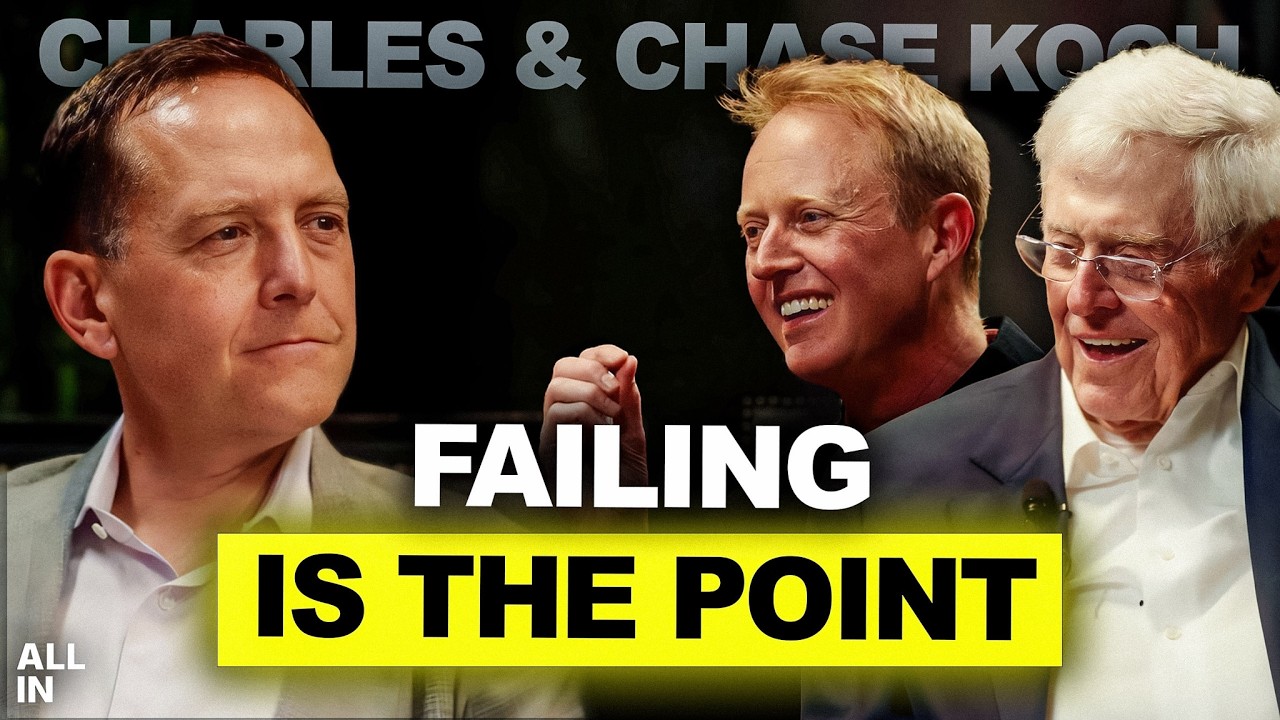
Published by All-In Podcast on YouTube on May 12, 2026, this episode features host David Friedberg interviewing Charles and Chase Koch. According to the page description, the episode covers the history, scale, culture, and business lines of Koch Inc., as well as failure, Principle-Based Management, education reform, and the future of capitalism.
## TL;DR
In this event recording, Charles and Chase Koch detail how Koch Inc. grew into a $150 billion enterprise by operating as a private business rooted in market principles rather than chasing Wall Street's short-term quarterly metrics. They reflect on major strategic failures, key acquisitions like Georgia-Pacific, and the development of Principle-Based Management across their business platforms. The discussion expands into their philanthropic initiatives through Stand Together, educational innovation via microschools, and their philosophy on bottom-up social change and individual self-actualization. Finally, they discuss leveraging modern AI tools like internal Socratic assistants while remaining committed to core entrepreneurial values.
## Atmosphere & style
The conversation carries a reflective, deeply philosophical, and candid tone, blending executive business strategy with personal legacy. Host David Friedberg facilitates an intimate dialogue that transitions smoothly from historical corporate challenges to broader societal and economic issues. Charles Koch brings sharp wit, self-deprecating humor, and foundational historical context, while Chase provides a grounded, contemporary perspective on operational leadership and modern technology.
## Key takeaways
- [00:00](https://www.youtube.com/watch?v=EIo3AuyvV84&t=0s) Koch Inc. employs over 120,000 to 130,000 people globally and reinvests 90% of its profits back into new business ventures and growth strategies.
- [02:21](https://www.youtube.com/watch?v=EIo3AuyvV84&t=141s) Under Charles Koch's leadership, the valuation of Koch Inc. expanded roughly 9,000x over his multi-decade tenure.
- [10:00](https://www.youtube.com/watch?v=EIo3AuyvV84&t=600s) Charles Koch advocates that businesses should be capability-bounded rather than industry-bounded, applying comparative advantage over pure vertical integration.
- [11:31](https://www.youtube.com/watch?v=EIo3AuyvV84&t=691s) Creative destruction requires embracing failure; valid experiments are defined as those where the educational value of failure exceeds its financial cost.
- [11:31](https://www.youtube.com/watch?v=EIo3AuyvV84&t=691s) Koch contrasts its corporate structure—an 'integrated set of capabilities' sharing enterprise-wide tools—with Warren Buffett's siloed Berkshire Hathaway model.
- [18:52](https://www.youtube.com/watch?v=EIo3AuyvV84&t=1132s) Koch prioritizes hiring for values first and capability second, strictly weeding out destructively motivated individuals to safeguard company culture.
- [22:31](https://www.youtube.com/watch?v=EIo3AuyvV84&t=1351s) The failed 'Gas-to-Bread' vertical integration strategy in the late 1990s demonstrated the fatal danger of deviating from core management principles and concealing emerging losses.
- [33:07](https://www.youtube.com/watch?v=EIo3AuyvV84&t=1987s) Acquiring Georgia-Pacific for $20 billion involved breaking down top-heavy executive hierarchies and transferring enterprise-wide consumer branding capabilities across Koch.
- [03:07:10](https://www.youtube.com/watch?v=EIo3AuyvV84&t=11230s) Executing Principle-Based Management and employee gain-sharing transformed the Pine Bend refinery into a top-performing facility following a violent 9-month strike.
- [03:44:45](https://www.youtube.com/watch?v=EIo3AuyvV84&t=13485s) Charles Koch famously stays committed to keeping Koch private ('over my dead body') to avoid Wall Street's short-term quarterly earnings pressures.
- [54:47](https://www.youtube.com/watch?v=EIo3AuyvV84&t=3287s) Applying the principle of comparative advantage led Chase Koch to recognize he was an innovator rather than an operational manager, prompting him to step down as President of Koch Fertilizer.
- [01:17:29](https://www.youtube.com/watch?v=EIo3AuyvV84&t=4649s) Stand Together operates like a venture fund for social entrepreneurs, shifting philanthropic efforts from political party dominance to bottom-up community solutions.
- [01:11:29](https://www.youtube.com/watch?v=EIo3AuyvV84&t=4289s) Stand Together and VELA Education Fund have helped launch thousands of microschools emphasizing AI integration and personalized learning over standardized tests.
- [01:24:02](https://www.youtube.com/watch?v=EIo3AuyvV84&t=5042s) Charles Koch argues that societal and economic distress stems from government trade barriers, licensing restrictions, and lack of individual self-actualization rather than capitalism itself.
- [01:28:39](https://www.youtube.com/watch?v=EIo3AuyvV84&t=5319s) Koch Inc. embraces modern AI by developing internal tools like the Principle Companion app to guide employees through complex problem-solving SOCRATICALLY.
## Detailed walkthrough
Here is a detailed, faithful walkthrough of this part of the conversation:
[00:00](https://www.youtube.com/watch?v=EIo3AuyvV84&t=0s) Introduction and Podcast Setting
David Friedberg opens the session by welcoming Charles Koch and Chase Koch to the stage at a Forbes event, noting that the conversation is being recorded for *The All-In Podcast*. Friedberg highlights his personal history with Chase, sharing that they have known each other since 2013 when both were working in the agriculture industry, leading to a long-standing business partnership. He also mentions having crossed paths with Charles multiple times over the years.
Friedberg expresses his long-held admiration for Koch Industries, framing it as the untold story of what is likely the most profitable private, family-owned business in the world. He points out that while Silicon Valley entrepreneurs and mature corporate CEOs constantly analyze corporate success stories, Koch’s evolutionary model stands apart.
- **Scale & Rank:** If Koch were publicly traded, its revenue would easily place it within the top 25 of the Fortune 500.
- **Founding & Base:** Founded in 1940 by Fred C. Koch, based out of Wichita, Kansas.
- **Diverse Business Lines:** Spans energy, agriculture, chemicals, building products, consumer products, cloud computing, and a very active minority investment portfolio.
- **Global Footprint:** Over 120,000 employees operating across 60 countries.
- **Capital Allocation & Philosophy:** Reinvests 90% of profits into new businesses and growth, driven by meritocratic values and principles of disruptive innovation.
---
[02:21](https://www.youtube.com/watch?v=EIo3AuyvV84&t=141s) Early History: Charles Koch Joins in 1961
Charles Koch outlines the staggering growth of the company since he joined full-time in 1961. At that time, the business had roughly 300 employees; today, it employs over 130,000 people across 60 countries, and the overall value of the company has increased by 9,000 times over that period.
Charles reflects on growing up on a farm and his father’s strict work ethic. When Charles was just six years old, his father told him he didn't want him growing up to be a "country club bum," forcing him to spend all his spare time working. Charles admits he hated the hard labor at the time and was frequently in trouble, but notes, "thank God he did." Years later, when Charles asked his father why he had been so much tougher on him than on his younger brothers, his father replied: "Son, you plum wore me out."
Before coming back to Wichita, Charles completed three engineering degrees at MIT and went to work at Arthur D. Little, a leading management consulting firm at the time. Laughing at the absurdity of doing management consulting at age 25, Charles notes, "they were paying me for it, believe it or not." When his father called to ask him to join the family business, Charles initially declined. A few weeks later, his father called back with an ultimatum: "Son, either you come back to run the company or I'm going to have to sell it because my health is bad and the companies aren't doing well and I don't have long to live."
Charles agreed to return for several reasons—chief among them being the realization that despite three MIT degrees, he "sucked as an engineer." While he excelled at mathematics, science, and theoretical concepts, he lacked a knack for practical manufacturing or physical operations. Realizing he wouldn't succeed as a traditional engineer, he decided to become an entrepreneur focused on foundational principles that could drive organizational success.
- **Employee Growth:** Scaled from ~300 employees in 1961 to over 130,000 today.
- **Value Creation:** Expanded company valuation by 9,000x over Charles's tenure.
- **Foundational Roots:** Fred C. Koch put Charles to work at age 6 to instill discipline.
- **Educational Background:** Earned three degrees from MIT before working at Arthur D. Little.
---
[06:35](https://www.youtube.com/watch?v=EIo3AuyvV84&t=395s) Overhauling the Initial Business Lines and Building Core Principles
When Charles returned to the company, it consisted of two main business lines: designing and manufacturing fractionating trays (which separate liquids based on boiling point differentials) and operating a crude oil gathering system in Oklahoma. The fractionating tray division (Koch Engineering) was suffering severe losses due to a top-down, hyper-controlling culture. The division president micro-managed employees with weekly demand memos detailing every expenditure, leading staff to eventually ignore management altogether.
The organizational culture was intensely protectionist. When customers bought fractionating tower internals, the company refused to share design specifications with them—even when customers needed the details to troubleshoot issues. Furthermore, to service the European market without building a local manufacturing plant, the company used multiple subcontractors to build individual components, assembling them through yet another contractor. Charles summarizes the operational disaster: "we were losing our ass, if you'll excuse the expression."
Taking action to rescue the failing business, Charles changed the management team and established three turnaround priorities:
1. **Customer Focus:** Focus intensely on creating real value for customers.
2. **Employee Empowerment:** Empower employees so they are intrinsically motivated to drive results.
3. **Dedicated Infrastructure:** Build a dedicated manufacturing plant in Italy to directly serve the European market.
The division quickly turned profitable and began expanding into related product lines. When Friedberg asks how a 25-year-old had the confidence to completely overturn management and strategy so rapidly, Charles replies that it was simply "life or death." His father had granted him total operational control, telling him the only thing requiring parental approval was a decision to sell the company. In 1970, Charles's younger brother, David Koch, joined the firm and continued driving that expansion.
- **Initial Core Assets:** Fractionating tray manufacturing and an Oklahoma crude oil gathering network.
- **Turnaround Actions:** Replaced top-down management, built an Italian manufacturing facility, and shared engineering designs openly with customers.
- **Executive Expansion:** David Koch joined the business in 1970 to help lead growth.
---
[10:00](https://www.youtube.com/watch?v=EIo3AuyvV84&t=600s) Capability-Bounded Growth vs. Industry Boundaries
Reflecting on the lessons learned during the early expansion, Charles introduces a foundational strategic concept: companies should be **capability-bounded, not industry-bounded**. Rather than following traditional corporate logic—which dictates that an oil gathering company must become an integrated oil major spanning all aspects of petroleum—Charles applied the economic principle of division of labor by comparative advantage. The company focused strictly on the specific links in the value chain where it could create superior value compared to competitors.
This approach gave birth to what Charles terms "creating virtuous cycles of mutual benefit"—a continuous engine of growth, innovation, and deliberate risk-taking.
- **Comparative Advantage Strategy:** Avoid vertical integration for its own sake; target specific value-chain steps where unique capabilities exist.
- **Virtuous Cycles:** A principle-driven loop where continuous innovation yields mutual benefits for customers, employees, and the company.
---
[11:31](https://www.youtube.com/watch?v=EIo3AuyvV84&t=691s) Creative Destruction, Embracing Failures, and the Koch Platform Today
Charles emphasizes that adopting creative destruction inevitably means enduring major failures. "If you're not failing in everything, you're not doing anything new," he observes.
Recalling an early failure, Charles notes that after Koch entered the refining space, they produced petroleum coke as a byproduct. He attempted to develop a proprietary process to convert that petroleum coke into activated carbon. The company poured significant capital into the effort before admitting defeat and shutting it down. When Friedberg asks how they determine when to walk away from a project, Charles explains that they cut their losses when it becomes clear they lack the capability to create superior, rewarded value for customers—or when the underlying industry structure works against profitability. As an example, he mentions iSiTEQ (Koch Disruptive Technologies portfolio step), which achieves incredible technological breakthroughs but operates within a challenging industry structure.
Charles and Chase map out the core pillars of Koch Inc.'s current business footprint:
- **Engineered Projects & Construction:** Industrial engineering, heavy construction, and solar plant installation.
- **Trading & Logistics:** Global commodity trading and distribution networks.
- **Chemicals & Refining:** Refined petroleum products, fertilizers, specialty chemicals, and polymers.
- **Forest & Consumer Products:** Georgia-Pacific (paper, building materials, consumer products).
- **Glass & Electronics:** Industrial glass (Guardian Industries) and electrical connectors (Molex).
- **Software & Systems:** Enterprise management software tools.
- **Investment Platforms:** Four distinct investment arms, each targeting different comparative advantages.
Chase Koch clarifies the core philosophical difference between Koch Inc. and traditional corporate conglomerates or holding companies like Berkshire Hathaway. While expressing deep respect for Warren Buffett's track record, Chase explains that Koch does not operate its business units as isolated, independent silos. Instead, Koch operates as an "integrated set of capabilities"—a framework he likens to a "republic of science."
Chase explains how capabilities stack over time: starting with core competencies in oil gathering, refining, logistics, and trading, Koch asked whether those same operational strengths could be applied to natural gas, chemicals, and fertilizers. When the opportunity to acquire Georgia-Pacific arose, despite wood products appearing completely unrelated to energy, the underlying logistics and manufacturing capabilities matched perfectly. In acquiring Georgia-Pacific, Koch unexpectedly acquired expertise in consumer branding, turning branding into a net-new capability that could be deployed across the wider enterprise.
Charles adds that acquisitions are often driven by applying their management system to underperforming assets. When Koch acquired Molex (an electrical connector manufacturer), the company initially struggled. However, by introducing Koch's principle-based management framework, they were able to dramatically turn the business around.
- **Failure Philosophy:** Failure is an essential indicator of active innovation and creative destruction.
- **Structure:** 8 wholly owned operating business platforms alongside 4 distinct investment arms.
- **The "Republic of Science":** Rejects siloed conglomerate structures in favor of an integrated network where shared capabilities and management principles flow across all business units.
[18:52](https://www.youtube.com/watch?v=EIo3AuyvV84&t=1132s) Motivating for Contribution vs. Destructive Behavior
When organizations simply adopt new management lingo without changing underlying behavior, employees continue doing what they have always done. Real operational breakthroughs only happen after changing management and ensuring leaders actively apply core principles. In reflecting on major corporate failures, Charles Koch emphasizes that the company’s biggest missteps stemmed directly from violating a foundational rule: **hire first on values, and second on talent**.
Charles jokes that if you ever decide to hire someone with poor values simply because you like them, "hire them slow and stupid" so you can catch their mistakes quickly and get them out of the company—or even better, "help them get a job" at a competitor.
The most damaging failures occurred when individuals with toxic values were elevated into leadership roles. Koch Inc. categorizes employees into two distinct motivational buckets:
* **Contribution Motivated:** Individuals driven to succeed by creating tangible value for customers and the company's future, seeking rewards strictly tied to their actual contributions.
* **Destructively Motivated:** Individuals seeking personal power and control, who routinely hide their failures while fabricating or taking false credit for successes.
Charles reflects candidly on his own learning curve, stating that "repetition penetrates even the dullest of minds," acknowledging that it took multiple severe failures for these hard lessons to fully take hold.
- **1973 Middle East Crisis Failure:** Reckless, unchecked trading by destructively motivated leaders nearly bankrupted the entire company during the 1973 oil crisis.
- **Late 1990s Near-Collapse:** Simultaneous leadership breakdowns in both the agriculture and refining divisions severely damaged earnings, nearly wiping out all of Koch Inc.'s net profits in the late 1990s.
---
[22:31](https://www.youtube.com/watch?v=EIo3AuyvV84&t=1351s) The "Gas-to-Bread Spread" Ag Debacle
In the late 1990s, Koch Inc. pursued an aggressive agriculture vertical integration strategy known internally as the "gas-to-bread spread." The goal was to control every single node of the agricultural value chain: extracting natural gas from the ground, converting it into nitrogen fertilizer, growing crops, and processing those crops into consumer foods like bread and pizza crusts. Chase Koch notes that employees lightheartedly dubbed it the "ass-to-bread spread."
The strategy aggressively violated core Koch principles, including experimental discovery, operating within known capabilities, and placing the right people in the right roles. Leadership succumbed to a "growth at all costs" mindset, mistakenly believing that top-down control of an entire value chain automatically guaranteed commercial success.
A prime example of this hubris was the acquisition of a large-animal feed business focused primarily on hog feed. The deal closed with virtually zero due diligence, directly violating the scientific method principle of attempting to disprove a hypothesis before committing capital.
- **Contract Liabilities:** Within days of closing the acquisition, Koch Inc. discovered it had inherited hundreds of millions of dollars in out-of-the-money hog contracts because nobody had reviewed the existing legal agreements.
- **Integrity Breaches:** Internal business leaders knew about severe emerging losses but deliberately concealed them from executive management to push the deals forward.
- **Founder Warning:** Chase Koch cautions that rapid growth mindsets often cause founders to stop asking critical "why not" questions, leading directly to catastrophic operational failures.
---
[24:34](https://www.youtube.com/watch?v=EIo3AuyvV84&t=1474s) Cultivating Culture and Rewarding Smart Failures
Instill principles across a massive enterprise cannot be done through superficial "sheep dipping"—taking employees into a room for a one-off seminar and expecting long-term behavioral change. Citing chemist and philosopher Michael Polanyi’s book *Personal Knowledge*, Charles explains that developing true personal knowledge requires literally rewiring the brain through intense, intentional effort over time. Just as a weightlifter must train with sustained intensity to transform into a marathon runner, an organization must intentionally retrain its mental habits.
Rather than forcing top-down mandates, Koch Inc. targets struggling groups actively seeking solutions, coaching them on core principles. When those initial groups succeed, social mimicry takes over, driving bottom-up demand across other business units for guidance from the Principle-Based Management (PBM) team.
Addressing the common corporate fear where salaried employees take low-risk paths to protect their jobs, Koch Inc. explicitly structures incentives to reward overall contribution to the company's long-term future:
* **Defining Good Experiments:** A valid experiment is one where the educational value derived from a failure strictly exceeds the total financial cost of the experiment itself.
* **Koch Disruptive Technologies (KDT):** Created out of "Koch Labs," KDT leverages Koch's vast physical footprint to test emerging technologies.
* **Long-Term Capital Horizon:** In early-stage technology investing, losing investments surface early while winning bets take years to mature. Judging KDT on short-term bottom-line metrics during its first three to four years would have led to shutting it down; evaluating it on experimental discovery and risk mitigation protected the firm from external market disruption.
---
[33:07](https://www.youtube.com/watch?v=EIo3AuyvV84&t=1987s) The Mega-Acquisition: Georgia-Pacific
In 2005, Koch Inc. executed a massive, company-altering acquisition by purchasing Georgia-Pacific for $20 billion, despite being a significantly smaller company at the time. The strategic thesis rested on applying "virtuous cycles of mutual benefit" to chemical process industries, specifically pulp and paper manufacturing. In a touch of historical irony, Charles later discovered that his father, Fred Koch, had written his MIT thesis on the exact process of pulping in Maine.
The deal originated when Georgia-Pacific sought to divest its commodity pulping assets to elevate its public market price-to-earnings (P/E) multiple from roughly 6x up to 9x by transforming into a pure-play consumer products business.
* **Initial Proposal:** Koch proposed acquiring only the commodity pulping assets at a premium. Georgia-Pacific's board rejected the partial sale out of fear of being sued for constructive fraud due to lingering corporate asbestos litigation.
* **Full Takeover:** Koch pivoted to bid for the entire company. With tight credit markets suppressing rival corporate suitors, Koch closed the deal uncontested.
* **Overhauling Bureaucracy:** Upon closing, Koch executive Joe Moller was installed as CEO of Georgia-Pacific to dismantle its rigid hierarchy. Georgia-Pacific operated out of a 51-story headquarters in Atlanta, where executive management resided isolated on the 51st floor, accessible only via a private elevator and requiring suit-and-tie attire. Moller immediately eliminated the executive floor, terminated non-performing executives, and reassigned leadership directly down into operational business units.
[03:07:10](https://www.youtube.com/watch?v=EIo3AuyvV84&t=11230s) Georgia-Pacific's Cultural Overhaul and the Pitfalls of Bureaucracy
Continuing the discussion on transforming acquired corporate cultures, Charles Koch illustrates how structural signals break down entrenched hierarchies. At Georgia-Pacific, executive entitlement was so pervasive that high-level management maintained private floors inaccessible to regular staff. To disrupt this dynamic, Koch Inc. eliminated the executive dining rooms and private floors, converting the entire layout into open meeting spaces accessible to every employee. Beyond physical workplace layout, cultural transformation required decisive talent decisions—specifically replacing executives who remained entrenched in bureaucratic, hierarchical thinking.
While public acquisitions often fail because acquiring entities struggle to transmit their culture, Koch Inc. approaches integration through active, principle-driven intervention. This contrasts sharply with models like Warren Buffett’s Berkshire Hathaway, where corporate parent management leaves existing leadership teams in place as long as a durable competitive moat exists. Charles notes that a hands-off strategy would not work for Koch's acquisition model, which relies on integrating capability networks rather than managing isolated stand-alone subsidiaries.
- **Georgia-Pacific Restructuring:** Eradicated physical symbols of executive privilege (private floors and dining facilities) to establish egalitarian, cross-functional collaboration.
- **Acquisition Strategy:** Unlike Berkshire Hathaway’s hands-off ownership style, Koch actively integrates acquired operations to realign them with its internal management system.
---
[03:08:17](https://www.youtube.com/watch?v=EIo3AuyvV84&t=11297s) Labor Relations and the Turning Point at the Pine Bend Refinery
Charles Koch recounts one of the most severe operational challenges in the company's history: turning around the Pine Bend refinery in Minnesota. Following his father Fred Koch's passing in 1967, Koch Inc. acquired full ownership of the underperforming facility two years later in 1969. The refinery suffered from severe operational inefficiencies stemming from restrictive union work rules. When Koch attempted to negotiate flexible work arrangements, unionized workers initiated a high-stakes, violent nine-month strike—which broke out right as Charles was starting his honeymoon.
During the strike, union members resorted to extreme measures: blocking refinery gates, firing high-powered rifles into the facility, and attempting to breach the perimeter by driving a switch engine locomotive into operational units. To keep the facility running safely, Koch airlifted non-union personnel from other plants via helicopter. Over the course of nine months, the temporary staff operated the refinery more efficiently than it had run under the old work rules.
Once the strike ended and new work structures were established, management introduced Principle-Based Management to empower the frontline workforce. Rather than treating workers like cogs, management actively sought employee input, formed problem-solving teams, and implemented gain-sharing structures. In one instance, a group of operators pointed out that purchasing spare parts from external vendors was overly expensive and slow; they proposed building an in-house machine shop, which ultimately saved substantial capital while speeding up maintenance. Over time, these practices completely transformed the facility's culture and performance.
- **Acquisition Date:** 1969 (two years after Fred Koch's passing in 1967).
- **Strike Intensity:** Lasted 9 months; featured direct sabotage, rifle fire, gate blockades, and a runaway switch engine.
- **Operational Tactics:** Staffed the plant using internal transfers transported via helicopter.
- **Capacity Impact:** Transformed Pine Bend into one of the highest-performing refineries in the U.S., increasing total processing capacity **tenfold**.
---
[03:41:08](https://www.youtube.com/watch?v=EIo3AuyvV84&t=13268s) The Molex Acquisition and Koch's Unique Talent Vision
Chase Koch explains that the cultural shift required at Georgia-Pacific mirrored the challenges faced during the 2013 acquisition of Molex, a massive global manufacturer of electronic connectors and cabling used in iPhones, medical devices, and automobiles. As a public company for over 30 years, Molex had been conditioned by Wall Street to prioritize top-line revenue growth over true economic value creation. Shifting a corporate mindset from top-line revenue chasing to bottom-line efficiency requires time and, crucially, leadership alignment.
Chase outlines Koch's strict three-part hiring hierarchy: **Values first, capability second, and credentials last**. Unlike companies that target Ivy League graduates with perfect GPAs—who often enter with an entitlement mindset—Koch actively seeks self-motivated individuals raised with a strong work ethic. A prime example is Koch's Chief Information Officer, Jared Benson. Benson began his relationship with Koch 20 years ago striping lines in the corporate parking lot. Possessing no college degree, he demonstrated self-taught data science skills, identified emerging cybersecurity risks early, built Koch's internal defense infrastructure, and ultimately rose to become global CIO.
- **Molex Acquisition:** Completed in 2013; shifted focus from short-term public revenue metrics to long-term value creation.
- **Molex Scope:** Global connector manufacturer supplying the automotive, medical, and consumer electronics (e.g., Apple iPhone) sectors.
- **Leadership Case Study:** CIO Jared Benson started out painting lines in the Koch parking lot without a college degree before building the company's cybersecurity division and taking over enterprise IT.
---
[03:44:45](https://www.youtube.com/watch?v=EIo3AuyvV84&t=13485s) The Wichita Advantage: Shielding Culture from Silicon Valley Monoculture
The hosts explore how Koch's geographic isolation in Wichita, Kansas serves as a distinct strategic shield against corporate groupthink. In innovation hubs like Silicon Valley, companies often fall victim to "over-socialization"—conforming to identical venture funding structures, equity vesting schedules, hiring filters, and management fads. Being located far from Wall Street and Silicon Valley enables Koch to maintain independent, long-term thinking without external pressure to mimic consensus corporate playbooks.
Charles and Chase clarify that while there are networking benefits to financial hubs like New York City, Koch’s private, owner-operated structure allows the company to make unconventional strategic moves. Public companies face constant analyst scrutiny, forcing them to fit into neat industry buckets to preserve high price-to-earnings (P/E) multiples. Because Koch is private, it can execute cross-industry, capability-bounded growth strategies that public markets would discount or misread.
- **Geographic Advantage:** Remaining in Wichita insulates Koch from corporate monoculture and over-socialization.
- **Private vs. Public Dynamics:** Avoids Wall Street's short-term earnings quarter-by-quarter treadmill and rigid industry classification.
---
[03:46:48](https://www.youtube.com/watch?v=EIo3AuyvV84&t=13608s) Why Koch Will Never Go Public: Resisting Wall Street Pressures
Charles Koch reflects candidly on internal and external pressure over the decades to take Koch Inc. public. Early in the company's expansion, certain executives and family members argued that an IPO would unlock massive public market valuations. Charles rejected these pushes outright, famously stating that the company would go public "over my dead body." He jokes about receiving hostile letters from critics hoping for his prompt demise, drawing parallels to the intense media spotlight surrounding modern political figures.
> "I said it'd be over my dead body, and some of them thought well that would be a good idea." — **Charles Koch**
Charles notes that going public would have permanently destroyed their ability to execute Principle-Based Management. Public market analysts demand simple, predictable, single-industry narratives. A complex conglomerate moving dynamically across diverse sectors based on internal capabilities—rather than staying inside standard sector boundaries—would have been punished with a depressed price-to-earnings ratio, much like Georgia-Pacific experienced prior to its acquisition.
- **Private Governance:** Resisting an IPO preserved the freedom to reinvest cash flows into multi-year capability builds without quarterly earnings pressure.
- **Strategic Flexibility:** Enables dynamic capital re-allocation across unrelated industries based on internal core capabilities rather than rigid market sectors.
---
[03:49:13](https://www.youtube.com/watch?v=EIo3AuyvV84&t=13753s) Operationalizing Values and Owner-Operator Alignment
Addressing how non-founder CEOs can maintain an entrepreneurial culture, Charles emphasizes that sustainable success depends on the alignment of ownership values. A durable partnership—whether in marriage, business, or employment—requires three indispensable pillars: **shared vision, shared values, and complementary capabilities**. If any one of these elements is missing, the partnership eventually collapses.
Charles recalls presenting his management framework to a Young Presidents' Organization (YPO) event in Wichita two decades ago. When an attendee questioned how such decentralized empowerment could function in a private company without becoming autocratic, Charles pointed out that it depends entirely on the character of the owners. While an autocratic business owner can stifle an organization, value-aligned private ownership provides a far superior environment for deep, long-term cultural transformation than standard public corporate governance.
- **Pillars of Partnership:** Shared vision, shared values, and complementary capabilities.
- **Governance Realities:** Principle-based management requires owners who value employee empowerment over centralized top-down control.
---
[03:51:12](https://www.youtube.com/watch?v=EIo3AuyvV84&t=13872s) Chase Koch's Early Career: From Tennis Courts to the Feedlot
The conversation turns to Chase Koch's personal trajectory within the family business. As a teenager, Chase was a nationally ranked competitive tennis player. However, by age 15, he burned out from playing six hours a day and began intentionally throwing matches to spend time with friends. Seeing his son's bad attitude, Charles delivered an ultimatum: commit 100% to tennis or get a job. When Chase chose to quit tennis, expecting a comfortable office job in Wichita, Charles arranged a far harsher lesson in work ethic.
Within 24 hours of quitting tennis, Chase’s gear was loaded into a pickup truck and he was driven six hours away to a remote cattle feedyard. He spent the entire summer living in a single-wide trailer with his supervisor, sleeping on the floor, working seven days a week for minimum wage, digging post holes, and shoveling manure. Despite the sudden shift from a privileged background to manual labor, Chase credits the experience as a life-changing turning point. It instilled a genuine sense of self-worth built on real physical contribution and teamwork rather than unearned entitlement.
- **Tennis Career:** Nationally ranked junior player who burned out at age 15.
- **Cattle Feedyard Job:** Worked 7 days a week at minimum wage, digging post holes and shoveling cow manure while sleeping on a trailer floor.
- **Personal Transformation:** Shifted Chase's mindset from entitlement to earned achievement and contribution.
[54:47](https://www.youtube.com/watch?v=EIo3AuyvV84&t=3287s) Life Lessons, Personal Strengths, and Firing Himself
Chase Koch reflects on a formative letter given to him by his father, Charles Koch, warning against squandering wealth and encouraging him to experience the "glorious feeling of accomplishment." Finding unexpected satisfaction while working low-level jobs at feed yards, gas liquids plants, and refineries during his youth transformed his outlook on work and personal drive. Charles highlights Chase’s exceptional people skills, comparing his natural ability to relate to anyone—from business partners to political adversaries—to Charles's late mother and former Koch President Sterling Varner. Varner was born in an oil field tent to a mule-driver father, had no college education, and built immediate trust with everyone he met.
Chase details a pivotal career moment when he applied the core principle of comparative advantage to his own career trajectory. While serving as president of Koch Fertilizer, he recognized nine months into the position that he was an innovator and builder rather than an operational manager. In a self-aware and humbling move, he walked into his supervisor's office and effectively fired himself from the role. Fulfilling his comparative advantage ultimately allowed the fertilizer division to thrive under new operational leadership while enabling Chase to help launch Koch Disruptive Technologies (KDT).
- **Early Work Experience:** Summer jobs across Koch's gas liquids plants and refineries through his junior year of college.
- **Sterling Varner:** Early Koch president born in an oil field tent without a college degree, known for his extraordinary interpersonal effectiveness.
- **Career Pivot:** Self-demotion/resignation from President of Koch Fertilizer after 9 months upon realizing he was a builder rather than an operator.
[01:01:05](https://www.youtube.com/watch?v=EIo3AuyvV84&t=3665s) Self-Actualization, Maslow, and Aristotle Tapes
The conversation turns to how individual employees and people in general can find purpose and fulfillment in a constrained world. Charles emphasizes that the core duty of Koch's 20,000+ supervisors is to help employees discover their unique capabilities and place them in roles where they can flourish, rather than forcing them into ill-fitted tasks. Referencing Abraham Maslow, Charles notes that failing to apply one's innate talents to create value for others leads to deep personal unhappiness, regardless of financial success. When asked why he does not retire at 90 to lie on a beach, Charles quips that he would "be dead in a week" because continuous conceptual thinking and problem-solving are fundamental to his nature.
Charles admits his own early parenting attempt to instill philosophical principles was somewhat rigid, recalling how he would gather his young children, Elizabeth and Chase, on Sunday evenings to listen to audio recordings of Aristotle. While Elizabeth engaged deeply and earned top marks, Chase would often fall asleep, prompting Charles to pause the tape every ten minutes to quiz him.
- **Supervisor Network:** Over 20,000 supervisors at Koch task-managed with aligning employee talents to optimal roles.
- **Five Dimensions of Principle-Based Management (PBM):** Vision, Virtue & Talents, Knowledge, Creative Destruction, and Motivation.
- **Philosophical Foundations:** Reliance on Abraham Maslow’s self-actualization framework and Aristotle's ethics in leadership and parenting.
[01:06:29](https://www.youtube.com/watch?v=EIo3AuyvV84&t=3989s) The Fifth-Grade Aristotle Paper and Education Reform
Chase shares a lighthearted story about a fifth-grade assignment to write a 500-word paper on a philosopher. With Charles's intense involvement, Chase turned in a deeply sophisticated paper on Aristotle, only to receive an "F" with a red-ink note from his teacher reading, "You did not write this." After Chase returned home crestfallen, Charles personally called the teacher (Dr. Cohen) to argue that parental guidance should be encouraged, not penalized. By the following day, the teacher had adjusted the grade to a 99.
Transitioning from this anecdote, Chase outlines the broader mission of Stand Together, a philanthropic network founded in 2003 that brings together nearly 1,000 business leaders to tackle systemic social barriers. A major priority of Stand Together is disrupting traditional "teach-to-test" schooling in favor of individualized learning tailored to each student's unique motivations. Stand Together's internal research revealed that while only roughly 20% of families were open to non-traditional education models prior to the COVID-19 pandemic, that number surged to 70–80% after parents witnessed the shortcomings of standard remote instruction.
- **Stand Together:** Social change philanthropic community established in 2003 involving nearly 1,000 business leaders.
- **Education Shift:** Public openness to alternative education models rose from ~20% pre-COVID to 70–80% post-COVID.
- **Educational Partners:** Highlighting initiatives by Joe Liemandt (Alpha School, gamifying instruction to close motivation gaps), Sal Khan (Khan Academy), and joint ventures with the Walton Family Foundation (such as the Vela Education Fund).
[01:11:29](https://www.youtube.com/watch?v=EIo3AuyvV84&t=4289s) Seeding Educational Innovation and Rethinking Social Change
Chase Koch breaks down how Stand Together applies venture capital principles to education through the VELA Education Fund. Emerging out of the COVID-19 pandemic, thousands of frustrated parents and teachers fed up with traditional schooling began launching small microschools. Over the past five to six years, Stand Together has helped seed and create more than 5,000 of these agile schools using a relatively modest amount of capital. Instead of a rigid "teach-to-the-test" model that leaves kids lacking interpersonal skills, these microschools emphasize project-based learning and early integration of AI tools. Rather than banning new technology, the goal is empowering students with AI so they learn the practical skills needed for the future economy.
David Friedberg redirects the conversation back to Charles Koch, asking him to reflect on decades of philanthropy and social change—specifically asking what worked, what failed, and how his perspectives evolved away from the public narrative surrounding the Koch name. Charles traces his journey back to core principles of human progress, admitting his initial mistake was a narrow insistence on ideological purity. Quoting Frederick Douglass ("I would unite with anybody to do right and with nobody to do wrong"), Charles explains how he initially restricted his partnerships to those who agreed with his entire philosophy, limiting his real-world impact.
- **VELA Education Fund:** Over 5,000 microschools seeded in 5–6 years following pandemic-era shifts in education.
- **Pedagogical Shift:** Moving from standardized test preparation to project-based learning and active AI adoption.
- **Ideology Pitfall:** Early social efforts were hindered by strict ideological filters, mirroring political factions that purge dissenters rather than build broad coalitions.
---
[01:13:34](https://www.youtube.com/watch?v=EIo3AuyvV84&t=4414s) Philosophical Foundations: Maslow, Frankl, and the Traps of Power and Pleasure
Reflecting on his early political involvement with the Libertarian Party, Charles Koch describes how internal purity tests ruined the movement's potential. Libertarian activists would draw strict "plumb lines" and purge anyone with minor disagreements. Charles compares this dynamic to Lenin's strategy within the Communist Party, noting that while totalitarians enforce compliance through coercion, a free society cannot be built on ideological purging. Realizing the limitations of pure political dogma, Charles turned to psychological frameworks, studying Abraham Maslow’s *Eupsychian Management* and Viktor Frankl’s seminal work on human meaning.
Viktor Frankl’s core insight—that modern society provides people with the means to live, but no meaning to live for—became the foundation of Charles’s mature worldview. When individuals fail to find a life of meaning by leveraging their unique gifts to help others succeed, they inevitably default to one of two destructive substitutes: power or pleasure. Politicians and dictators become addicted to power, while those who chase unearned pleasure fall into addiction, crime, and despair. A society driven primarily by power and pleasure creates a slippery slope straight toward authoritarianism and state control.
- **The Libertarian Party Experiment:** Charles concluded that using minor political parties to push purity tests failed because it mirrored totalitarian tactics rather than fostering open cooperation.
- **Viktor Frankl’s Diagnosis:** The central crisis of modern life is the absence of meaning, driving people toward the false gods of power (authoritarian control) or pleasure (short-term hedonism and addiction).
- **The Core Purpose:** True fulfillment comes from discovering one's unique talent and applying it to help others succeed, fulfilling the core promise of the Declaration of Independence.
---
[01:17:29](https://www.youtube.com/watch?v=EIo3AuyvV84&t=4649s) Political Realities, Ideological Myths, and Bottom-Up Solutions
Reflecting on his political engagement, Charles Koch admits that after avoiding major party politics for his first 50 years in business, his subsequent attempt to drive reform primarily through one political party was a mistake. Systemic policy failures cannot be solved through partisan entrenchment; real reform requires collaborating with anyone willing to advance principled solutions regardless of party affiliation. When asked where America currently stands in this cycle, Charles quips that the country isn't on an "upswing," invoking Thomas Jefferson’s quote on slavery: "If God is just, I despair for the future of our country." He cites destructive policies across the political spectrum—from excessive occupational licensing and poor immigration management to soft-on-crime policies—as evidence that elected officials prioritize political power over foundational principles.
To counter collectivist and communist fantasies—such as Leon Trotsky's notion that eliminating private property would transform every citizen into a Goethe or Beethoven—Stand Together focuses on showing rather than telling. Chase Koch notes that top-down engineering always fails because it treats people as problems to be managed. Instead, Stand Together operates like a venture capital fund for social entrepreneurs, betting on frontline innovators who have lived through problems and created bottom-up solutions.
> "If you believe that people aren't the problems to be solved, the people that are in the problem, they're the ones with the best ideas and they're the source of the solution."
- **Political Misstep:** Trying to drive systemic policy change through a single political party proved ineffective; broad coalition-building is essential.
- **Top-Down vs. Bottom-Up:** Government mandates fail because they treat individuals as passive problems; sustainable progress relies on empowering local leaders who understand community challenges.
- **Social Reform Literature:** Charles notes that his philosophy on driving societal change is detailed further in his book co-authored with Brian Hook (featuring a forward by Martin Luther King III).
---
[01:22:37](https://www.youtube.com/watch?v=EIo3AuyvV84&t=4957s) Case Study in Recovery: The Phoenix and Scaling Social Impact
Chase Koch illustrates Stand Together's bottom-up strategy through the story of Scott Strode, founder of The Phoenix. After struggling with severe addiction for much of his youth, Strode found recovery when a mentor introduced him to fitness and boxing. Realizing that physical discipline combined with a supportive community was key to his sobriety, Strode opened a single gym in Colorado to help others facing substance abuse.
When Stand Together partnered with Strode 7 to 8 years ago, his program was achieving dramatic results—maintaining long-term relapse rates below 10%, compared to high industry averages. Rather than inventing a new top-down government program, Stand Together invested capital and operational scale into Strode’s proven model. Over their partnership, The Phoenix expanded from a couple of local Colorado gyms serving a few thousand people to a national movement that has helped over one million individuals overcome addiction.
- **Founder:** Scott Strode transformed his personal battle with addiction into a peer-backed fitness community.
- **Efficacy:** The Phoenix achieved relapse rates below 10% by combining rigorous physical exercise with community support.
- **Scale:** Partnering with Stand Together allowed The Phoenix to scale from a local initiative serving thousands to a nationwide movement impacting over 1,000,000 people.
---
[01:24:02](https://www.youtube.com/watch?v=EIo3AuyvV84&t=5042s) Economic Mobility, Compounding Capital, and Systemic Obstacles
David Friedberg highlights the economic anxiety plaguing everyday Americans: soaring student debt, inaccessible healthcare, sky-high grocery bills, and zero upward mobility, with over 60% of citizens holding negative net equity. This distress leads many to demand government intervention. Furthermore, Friedberg challenges Charles on whether compounding market advantages naturally concentrate wealth into monopolies, making it harder for everyday people to compete in a capitalist system.
Charles Koch responds that the core issue is not capitalism, but the government-erected barriers that prevent individuals from entering the market and building wealth. Compounding success relies on mutual value creation, but modern state intervention actively protects incumbents. Restricting trade through tariffs destroys comparative advantage and inflates consumer costs, while excessive occupational licensing prevents lower-income individuals from starting businesses or entering trades. Rather than managing economic outcomes top-down, society must clear away artificial regulatory hurdles, welcome contributing immigrants, and incentivize contribution-motivated behavior over rent-seeking.
- **Economic Distress:** Roughly 63% of Americans face negative equity or crippling debt, fueling public demand for state intervention.
- **Occupational Licensing:** Hundreds of trades are blocked by artificial licensing barriers designed by incumbents to stop newcomers from building businesses from scratch.
- **Tariffs & Protectionism:** Charles argues that trade tariffs break down the international division of labor, directly driving up costs for everyday consumers and stifling mobility.
[01:28:39](https://www.youtube.com/watch?v=EIo3AuyvV84&t=5319s) AI Integration and the Principle Companion App
Chase Koch outlines the firm's philosophy on artificial intelligence, grounding it in the concept of permissionless innovation and bottom-up human empowerment. He explains that as the cost of AI drops to extremely affordable levels, the goal is to get these tools into everyone's hands so individuals can leverage their unique gifts and accelerate their learning curve by 10 to 100 times. Internally at Koch Inc., this approach is embodied in a newly developed mobile application titled **Principle Companion**—an interactive AI assistant powered by Chat GPT and Claude, built specifically to apply Market-Based Management (MBM) principles to complex problems in business, philanthropy, sports management, or personal life.
Charles Koch emphasizes that the app is designed not to hand users easy answers, but rather to prompt them using a Socratic approach to help them analyze the situation independently. He quips with a touch of dry humor that it uses the Socratic method, noting jokingly, "and we know what happened to Socrates."
- **Cosmos Investment:** Koch backs Cosmos to fund AI founders and initiatives aligned with Market-Based Management and principles of human progress.
- **Principle Companion App:** Designed to help users solve problems in 5 to 10 minutes by guiding them through structured Socratic questioning rather than providing direct answers.
- **Permissionless Innovation:** The core framework driving Koch's internal and external AI investments to maximize bottom-up human potential.
[01:30:53](https://www.youtube.com/watch?v=EIo3AuyvV84&t=5453s) Writing the Book Together and Principles in Action
As the conversation shifts to the experience of co-authoring their latest book, Chase reflects on working alongside his father, calling it the most important project of his career. He shares that he learned more over the 18-month writing process than he had in the previous 18 years, noting that true mastery of a subject comes only when you are tasked with teaching it to others. Charles treated the book as an opportunity to apply "creative destruction" to his previous four books, inviting Chase's fresh perspective to modernize the presentation and introduce digital tools like the companion app.
The process was not without family friction and humorous tension. Chase describes his father as an extreme stickler for precise language, joking that spending 18 months writing together gave him a sympathetic view into what his mother deals with daily. He points out that they went through roughly 27 drafts of a single chapter on stewardship, teasing his father for ignoring the economic principle of marginal analysis when version 26 was already "pretty damn good." Charles defends his perfectionism by taking issue with common idioms, pointing out that people constantly misquote phrases like "the proof is in the pudding" when it should properly be "the proof of the pudding is in the eating."
- **Co-Author Dynamics:** This is Charles's fifth book and Chase's first; Charles actively sought to creatively destruct his prior writings using Chase’s new tech-driven ideas.
- **Draft Revisions:** The chapter on stewardship went through 27 revisions, with Charles rewriting it personally around 15 times.
- **Linguistic Precision:** Charles regularly corrects phrasing and grammar in executive meetings, maintaining that "words have meaning."
[01:34:01](https://www.youtube.com/watch?v=EIo3AuyvV84&t=5641s) Father-Son Collaboration and Charles Koch's Legacy
Charles expresses immense pride in Chase's contributions, admitting that while he originally brought his son on to offer a younger perspective, Chase elevated the entire initiative far beyond his expectations by integrating AI platforms and digital companions. The discussion concludes with David Friedberg reflecting on Charles's multi-decade career spanning industrial growth, publishing, and philanthropic efforts, asking what he ultimately hopes his legacy will be. Without hesitation, Charles states that his ultimate goal is for the nation to more fully live up to the original promise set forth in the Declaration of Independence, closing out the interview to warm applause from the hosts.
- **Charles's Vision for Legacy:** A country that more completely realizes the foundational principles of equal rights and human flourishing outlined in the Declaration of Independence.
- **Closing Recognition:** The hosts thank both Charles and Chase Koch for sharing their management framework, organizational history, and personal reflections.
## Notable quotes
> [02:21](https://www.youtube.com/watch?v=EIo3AuyvV84&t=141s) son, you plum wore me out — Fred C. Koch
> [02:21](https://www.youtube.com/watch?v=EIo3AuyvV84&t=141s) they were paying me for it, believe it or not — Charles Koch
> [02:21](https://www.youtube.com/watch?v=EIo3AuyvV84&t=141s) sucked as an engineer — Charles Koch
> [06:35](https://www.youtube.com/watch?v=EIo3AuyvV84&t=395s) we were losing our ass, if you'll excuse the expression — Charles Koch
> [11:31](https://www.youtube.com/watch?v=EIo3AuyvV84&t=691s) If you're not failing in everything, you're not doing anything new — Charles Koch
> [18:52](https://www.youtube.com/watch?v=EIo3AuyvV84&t=1132s) repetition penetrates even the dullest of minds — Charles Koch
> [03:46:48](https://www.youtube.com/watch?v=EIo3AuyvV84&t=13608s) I said it'd be over my dead body, and some of them thought well that would be a good idea. — Charles Koch
> [01:06:29](https://www.youtube.com/watch?v=EIo3AuyvV84&t=3989s) You did not write this. — Dr. Cohen
> [01:11:29](https://www.youtube.com/watch?v=EIo3AuyvV84&t=4289s) I would unite with anybody to do right and with nobody to do wrong — Frederick Douglass
> [01:17:29](https://www.youtube.com/watch?v=EIo3AuyvV84&t=4649s) If you believe that people aren't the problems to be solved, the people that are in the problem, they're the ones with the best ideas and they're the source of the solution.
> [01:17:29](https://www.youtube.com/watch?v=EIo3AuyvV84&t=4649s) If God is just, I despair for the future of our country. — Thomas Jefferson
> [01:28:39](https://www.youtube.com/watch?v=EIo3AuyvV84&t=5319s) and we know what happened to Socrates. — Charles Koch
> [01:30:53](https://www.youtube.com/watch?v=EIo3AuyvV84&t=5453s) the proof of the pudding is in the eating. — Charles Koch
## Mentioned
David Friedberg, Charles Koch, Chase Koch, Fred C. Koch, David Koch, Joe Moller, Jared Benson, Warren Buffett, Sterling Varner, Elizabeth Koch, Dr. Cohen, Joe Liemandt, Sal Khan, Frederick Douglass, Vladimir Lenin, Leon Trotsky, Viktor Frankl, Thomas Jefferson, Brian Hook, Martin Luther King III, Scott Strode, Abraham Maslow, Aristotle, Koch Inc., Koch Engineering, Georgia-Pacific, Guardian Industries, Molex, Koch Disruptive Technologies, Koch Fertilizer, Berkshire Hathaway, Arthur D. Little, MIT, Pine Bend refinery, All-In Podcast, Forbes, Stand Together, Alpha School, Khan Academy, Walton Family Foundation, VELA Education Fund, Libertarian Party, Communist Party, Declaration of Independence, The Phoenix, Cosmos, Principle Companion, ChatGPT, Claude
Charles and Chase Koch attribute the growth of Koch Inc. from a 300-employee company in 1961 into an enterprise that increased its valuation 9,000-fold to a capability-driven operating model rather than traditional industry diversification. They contend that sustainable performance relies on continuous profit reinvestment, meritocratic internal principles, and maintaining private ownership to resist public market distortions.
Capability-Bounded Growth over Conglomerate Silos (10:00)
Charles Koch argues that corporate strategy must be capability-bounded rather than industry-bounded. Instead of pursuing vertical integration for its own sake, Koch Inc. applies comparative advantage to target specific value-chain segments where it holds distinct operational proficiencies. Chase Koch distinguishes this model from traditional conglomerates and holding companies like Berkshire Hathaway, describing Koch as an integrated 'republic of science' where capabilities such as logistics, refining, and commodity trading are redeployed across sectors including chemicals, consumer goods, and electronics.
Departing from this discipline produced significant failures. In the late 1990s, Koch pursued the 'gas-to-bread spread,' attempting to vertically control the agriculture supply chain from natural gas and fertilizer through to end-consumer food products. The effort ended in severe losses and unhedged hog contract liabilities after leadership neglected due diligence and bypassed internal capability limits. Conversely, strategic acquisitions succeeded by transferring capabilities: purchasing Georgia-Pacific for $20 billion in 2005 applied process manufacturing to pulp and added consumer branding, while the 2013 acquisition of Molex redirected an electronic connector business away from public-market revenue chasing toward bottom-line economic value.
Principle-Based Management and Culture Turnarounds (18:52)
Koch Inc.'s management framework enforces a strict talent hierarchy: values first, capability second, and credentials last. Charles Koch observes that the company's most acute operational crises—including near-insolvencies during the 1973 oil crisis and the late 1990s—stemmed from elevating 'destructively motivated' individuals who pursued personal authority and concealed operational shortfalls. To cultivate 'contribution-motivated' employees, Koch eliminates traditional hierarchies, exemplified by dismantling Georgia-Pacific's executive dining rooms and 51st-floor private offices in favor of open collaboration, as well as promoting non-degreed staff who demonstrate high-value problem solving, such as CIO Jared Benson.
Cultural realignment proved decisive during historic turnaround efforts. Following the 1969 acquisition of the underperforming Pine Bend refinery, Koch endured a violent nine-month union strike marked by rifle fire and sabotage. By staffing the facility via helicopter with non-union personnel who outperformed previous operating standards, management later established gain-sharing programs and operator-led problem solving. Frontline suggestions, such as building an internal machine shop to replace expensive vendor parts, ultimately turned the facility into one of the country's most efficient refineries and expanded its processing capacity tenfold.
Preserving Independence from Public Market Pressures (226:48)
Charles Koch has consistently rejected public offerings—stating that an IPO would happen 'over my dead body'—because public equity markets demand predictable, single-industry narratives. The Kochs argue that quarterly Wall Street expectations penalize multi-industry capability networks with depressed price-to-earnings multiples, as occurred with Georgia-Pacific before its buyout. Private ownership permits Koch to reinvest roughly 90% of profits back into long-term capital projects and early-stage experimental ventures without quarterly analyst scrutiny.
Operating from Wichita, Kansas, further insulates the leadership team from the corporate monoculture and 'over-socialization' characteristic of Silicon Valley and Wall Street. This isolation supports long-horizon platforms such as Koch Disruptive Technologies (KDT). Chase Koch points out that early-stage tech investing naturally reveals losses early while successful bets require years to mature; evaluating KDT on near-term profitability rather than risk mitigation and experimental discovery would have led to closing it down prematurely.
Bottom-Up Philanthropy and Social Mobility (71:29)
Through the Stand Together philanthropic community and the VELA Education Fund, the Kochs apply venture principles to social reform by backing frontline innovators rather than top-down policy mandates. Over five to six years, the initiative has funded more than 5,000 microschools utilizing project-based instruction and artificial intelligence to counter standardized 'teach-to-test' schooling. Similarly, Stand Together partnered with Scott Strode to scale The Phoenix—a peer-supported fitness community for addiction recovery maintaining relapse rates under 10%—expanding its reach from local Colorado facilities to over one million participants nationwide.
Charles Koch acknowledges that his early political efforts were hampered by counterproductive Libertarian purity tests and excessive partisanship. He maintains that current domestic economic distress, in which an estimated 63% of Americans face debt or negative net equity, is caused by government-imposed market barriers rather than capitalism. In his view, protectionist tariffs disrupt international trade and comparative advantage, while occupational licensing cartels block entry into trades, entrenching incumbents at the expense of aspiring entrepreneurs.
Charles Koch frames his broader legacy around enabling the nation to live up to the principles of equal rights and human flourishing expressed in the Declaration of Independence. The conversation leaves open whether Koch Inc.'s decentralized, capability-bounded model can be successfully implemented by conventional public companies that remain bound to quarterly earnings cycles and siloed industry structures.
## Background
本期视频由知名播客《All-In Podcast》于 2026 年 5 月 27 日发布在 YouTube 平台。节目由 David Friedberg 主持,特邀科氏工业(Koch Inc.)掌舵人 Charles Koch 及其子 Chase Koch 展开深度对谈,围绕科氏工业如何在不公开上市的情况下成长为 1500 亿美元体量的企业帝国、背后的基于原则的管理哲学(PBM)、企业文化再造、教育改革以及对未来资本主义与社会变革的思考展开讨论。
## TL;DR
访谈回顾了 Charles Koch 自 1961 年接手濒危家族企业并带领科氏工业实现 9000 倍价值增长的历程,阐述了其“以能力为边界而非行业为边界”和“坚持 90% 利润再投资且绝不上市”的核心战略。父子二人深入剖析了公司历史上因忽视价值观用人而经历的惨痛失败,以及收购佐治亚太平洋、莫仕等巨头时的激进文化重塑,并提出了“好实验”与“比较优势”等管理纪律。最后,对谈延伸至社会议题,分享了通过 Stand Together 推动个性化教育、运用 AI 工具 Principle Companion 赋能基层个体,以及跨越两党政治、践行《独立宣言》承诺以消除社会发展壁垒的终极愿景。
## Atmosphere & style
整场对话沉稳、睿智且充满反思精神,既有商业帝国操盘者的冷峻与严谨,又不乏两代人之间亲切幽默的家庭互动。90 岁高龄的 Charles 展现出令人惊叹的敏锐逻辑与直率自嘲,同深谙基层实战的 Chase 形成鲜明的代际互补;现场既有对数十亿美元失败与血泪教训的毫不避讳,又有对社会不公与意义缺失的深切关怀,整体氛围既像是一堂干货拉满的硬核商学院大师课,又是一场发人深省的人文主义哲学漫谈。
## Bulletin
- [00:00](https://www.youtube.com/watch?v=EIo3AuyvV84&t=0s) 科氏工业(Koch Inc.)自1961年以来资产价值增长了9,000倍,目前在全球60多个国家拥有超13万名员工,若上市营收可位列《财富》全球500强前25位;公司坚持不公开上市,每年将90%的利润持续用于再投资。
- [14:48](https://www.youtube.com/watch?v=EIo3AuyvV84&t=888s) 科氏确立了“以能力为边界,而非以行业为边界”(capability bounded, not industry bounded)的扩张战略,旗下一体化业务并非松散联合,而是像深度共享、相互赋能的“科学共和国”(Republic of Science)。
- [41:08](https://www.youtube.com/watch?v=EIo3AuyvV84&t=2468s) 公司推行“基于原则的管理”(Principle-Based Management, PBM),在选人上严格执行“价值观第一、技能第二、学历末位”,并开发了结合大语言模型的应用 Principle Companion 进行赋能式苏格拉底提问。
- [01:17:29](https://www.youtube.com/watch?v=EIo3AuyvV84&t=4649s) 查尔斯·科赫反思了数十年涉足政治的失误,指出单边押注共和党和追求意识形态纯洁性行不通,转而恪守弗雷德里克·道格拉斯法则——与任何人携手行善、不与任何人合谋作恶。
## Key takeaways
- [10:00](https://www.youtube.com/watch?v=EIo3AuyvV84&t=600s) 拒绝全产业链盲目纵向整合:科氏反对“从天然气到面包”的链条式全控狂热,强调企业必须依托比较优势,深耕自身具备差异化价值创造能力的环节。
- [14:48](https://www.youtube.com/watch?v=EIo3AuyvV84&t=888s) 企业最大的核心能力是管理哲学与原则:收购莫仕(Molex)与佐治亚太平洋(Georgia-Pacific)表明,即使缺乏行业相关性,凭借先进的底层运营原则与文化再造也能让标的爆发新生。
- [19:26](https://www.youtube.com/watch?v=EIo3AuyvV84&t=1166s) 用人原则“价值观第一、才华第二”:历史上重大经营危机皆因提拔了极聪明但价值观败坏、追逐权力与粉饰太平的野心家;宁招平庸的好人,绝不用聪明的恶人。
- [24:34](https://www.youtube.com/watch?v=EIo3AuyvV84&t=1474s) 告别集中灌输,转向“社会模仿”驱动文化重塑:放弃无效的“羊群浸洗”大班培训,转而贴身辅导求变的困境团队,用亮眼成果自发引发全组织的模仿追捧。
- [28:22](https://www.youtube.com/watch?v=EIo3AuyvV84&t=1702s) 重新定义“好实验”以破解职业经理人避险困境:只要从失败中汲取认知的价值远大于实验的金钱成本,并在长远上沉淀了核心能力,就属于组织应予重奖的优质探索。
- [44:23](https://www.youtube.com/watch?v=EIo3AuyvV84&t=2663s) 扎根威奇托与坚持非上市构筑了“反单一文化”护城河:偏居中西部免受硅谷或华尔街群体从众思维的侵蚀,非上市地位则隔绝了季度业绩短视与单一行业估值模型束缚。
- [46:18](https://www.youtube.com/watch?v=EIo3AuyvV84&t=2778s) 成功合作必须具备三大基石:无论是合伙还是雇佣,长久关系必须建立在共同的愿景(Shared Vision)、共同的价值观(Shared Values)与互补的能力(Complementary Capabilities)之上。
- [57:07](https://www.youtube.com/watch?v=EIo3AuyvV84&t=3427s) 知所进退的比较优势法则:蔡斯·科赫意识到自己长于开拓而非精细运营后主动“解雇自己”辞去化肥业务总裁,继而创办 KDT,为人岗精准匹配树立标杆。
- [01:01:05](https://www.youtube.com/watch?v=EIo3AuyvV84&t=3665s) 阻碍潜能发挥的核心症结在教育与管理机制:优秀的管理者应顺应天性赋能,通过愿景、品行才能、知识、决策权与激励五大维度激活内在驱动力。
- [01:08:02](https://www.youtube.com/watch?v=EIo3AuyvV84&t=4082s) Stand Together 倡导自下而上的社会变革:坚信深处困境中的人最懂解决方案,通过风险慈善资助数千所微型学校及草根戒瘾组织 The Phoenix,以事实成果撬动体系改变。
- [01:14:40](https://www.youtube.com/watch?v=EIo3AuyvV84&t=4480s) 现代社会的根本危机是“失去活着的意义”:当个体无法通过发挥天赋服务他人获取意义,就会退化为对“权力”成瘾或沉溺即时“享乐”,最终引致威权极权或个人毁灭。
- [01:25:24](https://www.youtube.com/watch?v=EIo3AuyvV84&t=5124s) 解决资本主义复利壁垒的钥匙在于彻底拆除体制阻碍:破除职业许可限制、关税保护主义及不合理的移民政策,让每个渴望通过贡献创造价值的普通人都能自由参与竞争。
- [01:28:18](https://www.youtube.com/watch?v=EIo3AuyvV84&t=5298s) AI 定位为“无需许可的底层赋能工具”:科氏通过 Principle Companion 应用引入苏格拉底式启发提问,将 AI 转化为员工基于原则自主决策、加速成长的普惠杠杆。
- [01:34:43](https://www.youtube.com/watch?v=EIo3AuyvV84&t=5683s) 商业终极传承在于社会理想:查尔斯·科赫将一生奋斗的终极遗产定位为推动国家真正践行《独立宣言》的承诺,捍卫每个个体的尊严、潜能与自由权利。
## Detailed walkthrough
### [00:00](https://www.youtube.com/watch?v=EIo3AuyvV84&t=0s) 访谈开场与科氏工业的庞大体量
本期《All-In Podcast》由 David Friedberg 主持,特邀嘉宾为科氏工业(Koch Inc.)掌舵人查尔斯·科氏(Charles Koch)及其子蔡斯·科氏(Chase Koch)。Friedberg 在开场时感慨,硅谷的创业者和成熟企业 CEO 总是渴望探寻成功商业故事背后的逻辑,而科氏工业正是全球商业史上极其罕见、甚至可能是全球盈利能力最强的私营家族企业之一。早在 2013 年,Friedberg 就因农业科技业务与 Chase Koch 结识,双方既是商业伙伴也保持着多年的私交。
科氏工业于 1940 年由弗雷德·科氏(Fred Koch)在堪萨斯州威奇托(Wichita)创立。如果科氏工业是一家上市公司,其庞大的营业收入将轻松跻身《财富》全球 500 强前 25 位。如今公司的业务版图极其多元,涵盖能源、农业、化工、建筑建材、消费品,甚至拓展至云计算,并拥有一支活跃的少数股权投资业务板块。公司在全球 60 多个国家拥有超过 13 万名员工,最为独特的运作机制之一是将每年高达 90% 的利润重新投入到新业务和扩张中,凭借颠覆性创新与英才管理机制,走过了一条独特的进化道路。
- **创办时间与总部**:1940 年由 Fred Koch 创立于堪萨斯州威奇托(Wichita)。
- **全球规模**:业务遍及 60 个国家,员工人数由 1960 年代初的约 300 人壮大至超 13 万人。
- **资本运作模式**:长期坚持不上市,将 90% 的利润持续进行再投资。
---
### [02:21](https://www.youtube.com/watch?v=EIo3AuyvV84&t=141s) 从麻省理工到家族危机:查尔斯·科氏接班始末
谈及商业规模时,查尔斯·科氏回顾道,自 1960 年代初接管企业以来,公司的整体价值在过去几十年中惊人地增长了 9,000 倍。这一切始于 1961 年他正式全职加入公司。查尔斯回忆自己的童年在农场度过,父亲弗雷德在他年仅 6 岁时就定下规矩,决不能让他变成整天无所事事的“乡村俱乐部游民”(country club bum),因而强制他在所有业余时间拼命干活。这段极其严厉的管教在查尔斯年少时曾让他苦恼不已、频频惹祸,但后来他对此充满感激。多年后查尔斯曾问父亲:“爸爸,为什么你管我比管弟弟们严厉得多?”父亲只风趣地答了一句:“儿子,那是因为你彻底把我折腾累垮了(You plum wore me out)。”
在加入家族企业前,查尔斯在麻省理工学院(MIT)连续拿下了三个工程领域的学位,但他却自嘲“自己做工程师简直烂透了”(sucked as an engineer)。查尔斯坦言,自己极擅长数学、科学与抽象理论,但在动手制造与具体设备操作上毫无天赋。意识到自己无法成为顶尖工程师后,他将目光转向商业与创业,并进入当时顶尖的管理咨询机构 Arthur D. Little 工作。他在 25 岁时便开始做管理咨询,自己现在回想起来都觉得荒唐可笑,但当时公司确实付给他优厚报酬。不久后父亲致电要他回威奇托接班,起初查尔斯一口回绝;几周后父亲再次来电下了最后通牒:自己身体状况恶化、时日无多,且公司运转糟糕,如果儿子不回来接手,他就只能将公司彻底卖掉。面对生死存亡的关头,查尔斯才终于决定回归。
- **成长烙印**:6 岁起在农场高强度劳作,父亲严苛训练以防其成为纨绔子弟。
- **求学与咨询经历**:麻省理工(MIT)三工科学位;25 岁在著名咨询机构 Arthur D. Little 从事管理咨询。
- **回归转折**:因父亲健康恶化并以“要么回来接班,要么卖掉公司”相逼,查尔斯于 1961 年全职加入。
---
### [03:57](https://www.youtube.com/watch?v=EIo3AuyvV84&t=237s) 整顿分馏塔盘业务:打破集权控制与意大利建厂转机
1961 年查尔斯接手时,公司规模仅有 300 人左右,核心支柱仅有两个:一是设计与制造用于根据沸点差异分离液体的“分馏塔盘”(fractionating trays),二是位于俄克拉荷马州的原油管网收集系统(crude oil gathering system)。查尔斯面对的首要难题就是濒临亏损的分馏塔盘业务。当时的业务总裁推行极端的自上而下集权控制,每周发备忘录严厉盘问每一笔开支细节,导致团队怨声载道并开始消极怠工。更致命的是闭门造车的保护主义文化——当客户购买分馏塔内件并需要了解内部设计以便纠错时,管理层竟以保密为由坚决拒绝提供图纸;而在开拓欧洲市场时,管理层宁愿找多家外包商拼凑零件、再交由另一家分包商组装,也不愿在当地自建工厂,导致交期漫长、成本奇高,业务亏得一塌糊涂。
年轻的查尔斯展现出非凡的决断力,彻底清洗并重组了管理团队,全面推行三项经营变革:
1. **转向以客户为中心**:一切以“为客户创造价值”为第一导向;
2. **员工赋能**:打破自上而下的微观管控,激发员工自主能动性;
3. **欧洲本土化自产**:果断在意大利投资建厂,自主把控全流程制造以服务欧洲市场。
这套组合拳迅速让该业务扭亏为盈。面对 Friedberg 关于“25 岁年轻人何来魄力撤换管理层”的提问,查尔斯直言当时是“生死存亡的关头”(life or death),并且父亲弗雷德在劝他回来时给了绝对信任——除了出售公司需要老父亲签字,日常经营的任何决定查尔斯都可以全权做主。1970 年,查尔斯的弟弟大卫·科氏(David Koch)加入公司,兄弟联手推动了该业务板块的持续繁荣。
```mermaid
flowchart TD
accTitle: 分馏塔盘业务变革路径
accDescr: 对比整顿前后管理模式、生产策略及经营成果的转变
subgraph Before["接手前:集权与亏损困境"]
A1["自上而下微观管控<br>周报严查开支细节"] --> A2["封闭保护主义<br>拒绝向客户公开设计图纸"]
A2 --> A3["欧洲多重外包拼装<br>交付慢、成本失控且严重亏损"]
end
subgraph Turnaround["整顿措施:重塑理念与运营"]
B1["管理层大换血<br>赋予查尔斯绝对经营权"] --> B2["确立客户价值第一<br>与充分赋能一线员工"]
B2 --> B3["重塑全球供应链<br>在意大利自建独资工厂生产"]
end
subgraph After["成效与扩张"]
C1["业务扭亏为盈"] --> C2["大卫·科氏1970年加盟"]
C2 --> C3["延伸相关产品线并启动全球化扩张"]
end
Before --> Turnaround
Turnaround --> After
```
---
### [10:00](https://www.youtube.com/watch?v=EIo3AuyvV84&t=600s) 经营哲学萌芽:以能力为边界与互利的良性循环
在力挽狂澜的过程中,查尔斯不断反思并提炼出贯穿科氏工业一生的底层原则。当时许多行业共识认为,既然从事原油集输业务,公司就应当效仿大型巨头,向全产业链纵向整合,做一家无所不包的“一体化综合石油公司”。查尔斯果断拒绝了这种教条。他引入了经济学中的“比较优势分工理论”(division of labor by comparative advantage),提出了革命性的战略定见:**“以自身能力为边界,而非以行业为边界”(capability bounded, not industry bounded)**。
查尔斯认为,企业不应迷信全产业链整合,而必须牢牢扎根于自身在价值链中最能创造差异化价值的环节;如果在该环节无法比竞争对手创造更多价值,最终必遭淘汰。基于对原则的追寻,查尔斯提炼出了“创造互利良性循环”(creating virtuous cycles of mutual benefit)的核心原则。科氏工业不再被特定行业标签所束缚,而是通过构筑自身核心能力,开启了一个包含“持续增长、创新探索、拥抱成功、承受失败并从错误中反思复盘”的无尽循环,让失败成为公司更好运用底层原则、持续创造社会价值的养料。
### [11:41](https://www.youtube.com/watch?v=EIo3AuyvV84&t=701s) 试错、创造性破坏与何时放弃
Charles Koch 谈到,创造价值的过程伴随着大量的失败,企业如果不经历失败,就说明根本没有尝试任何新事物。正如约瑟夫·熊彼特(Joseph Schumpeter)提出的“创造性破坏”理论,探索新领域必然要面对挫折。
当 David Friedberg 问及他人生中“第一记迎头痛击”式的失败以及创业者该如何克制对自研产品的过度迷恋、果断止损时,Charles 幽默地调侃道:“什么时候算够了?亏到底朝天的时候就够了。”但随即他严肃地指出,止损的核心标准在于:**企业是否真正具备为客户创造卓越价值并从中获得回报的能力**。如果缺乏这种能力,或者商业模式本身存在结构性缺陷,就必须果断抽身。例如 Chase Koch 早期参与投资的初创项目虽然技术惊艳,但商业结构却极难盈利。正是这些惨痛教训,促使公司总结出一整套原则——每次失败后都必须反思:“究竟是我们违背了哪条原则才导致了失败?”
```mermaid
flowchart TD
accTitle: 止损决策与反思框架
accDescr: 评估新业务价值创造能力并从失败中提取原则的闭环流程
subgraph Evaluate ["业务能力评估"]
A["新业务探索 / 实验"] --> B{"能否为客户创造<br/>卓越价值并获得回报?"}
B -- "是" --> C["持续扩大投入与规模"]
B -- "否 / 商业结构存在硬伤" --> D["果断止损,关闭业务"]
end
subgraph Learn ["反思与能力沉淀"]
D --> E["复盘失败根源:<br/>违背了哪些核心原则?"]
E --> F["沉淀管理原则,指导未来决策"]
end
```
---
### [13:31](https://www.youtube.com/watch?v=EIo3AuyvV84&t=811s) 庞大的商业版图:八大业务平台与四家投资公司
在主持人的追问下,Charles Koch 与儿子 Chase 梳理了当前 Koch Inc. 横跨全球的庞大业务版图。整个集团包含八个全资业务平台以及四家定位与比较优势各异的投资公司:
- **工程项目与工程建设**(Engineered projects, engineering & construction)
- **太阳能电站建设**(Solar plants)
- **大宗商品贸易与分销**(Commodity trading and distribution)
- **化肥与农业**(Fertilizers)
- **精炼石油产品**(Refined products)
- **特种化学品与高分子聚合物**(Chemicals and polymers)
- **玻璃制造**(Glass)
- **森林与消费品**(Forest and consumer products,如 Georgia-Pacific)
- **电子与电气连接件**(Electrical products,如 Molex)
- **企业管理软件与技术系统**(Software systems for management)
- **四大专业投资机构**(包含 Chase 牵头的 Koch Disruptive Technologies 等,各具独特的比较优势)
---
### [14:48](https://www.youtube.com/watch?v=EIo3AuyvV84&t=888s) 能力边界而非行业边界:“科学共和国”式的综合体
Chase Koch 强调,很多硅谷科技圈的人常问“Koch 到底是一家什么样的公司”。Koch 与几乎所有传统企业的根本区别在于:**以能力为边界,而非以行业为边界(Capability bounded, not industry bounded)**。
公司绝不把自己局限在某一个赛道,而是思考自身拥有哪些经过验证的核心能力,再将这些能力作为杠杆切入新行业,并通过“实验性发现(Experimental Discovery)”去验证客户是否买账:
1. **能力的起源与延展**:早年 Koch 只是俄克拉荷马州南部一家做原油集输的小公司,核心能力仅限于重资产运营、物流与贸易;随后他们将这套能力迁移到天然气管网,再顺势进入石化与化肥;
2. **通过并购补齐新能力**:收购林业与纸业巨头 Georgia-Pacific(乔治亚-太平洋)时,外界看似跨度极大,但其底层仍依赖大规模制造与供应链物流能力。而收购之后,Koch 意外习得了全新的“消费品与品牌塑造(Branding)”能力;
3. **并非传统的伯克希尔式控股**:面对是否像伯克希尔·哈撒韦(Berkshire Hathaway)的提问,Chase 解释称,巴菲特的模式是让旗下公司彼此独立、形成业务孤岛;而 Koch 更像是一个“**科学共和国(Republic of Science)**”——旗下所有业务不是松散的联合,而是一张深度共享、相互赋能的“集成能力网络(Integrated set of capabilities)”。
关于是否只收购具备业务相关性的公司,Charles 举了电子连接器巨头 Molex(莫仕)的例子。当时 Molex 并不契合已有行业,但 Koch 认为自身拥有一项杀手级核心能力——**先进的管理哲学与原则**。收购初期,Molex 高管学会了新管理哲学的整套黑话黑语(Lingo),表面上满口新名词,实际行动却照旧,导致业绩毫无起色。直到 Koch 彻底撤换管理层、真正落地这套原则,Molex 才迎来了爆发式增长。
---
### [19:26](https://www.youtube.com/watch?v=EIo3AuyvV84&t=1166s) 最大的惨败:价值观缺位与“野心家”带来的灭顶之灾
Charles 坦承,如果说公司最大的优势是什么,“从失败中学习”绝对名列前茅,而公司历史上最致命的失败全部源于**违背了“价值观第一、才华第二”的用人原则**。
Charles 幽默而辛辣地回顾道,多年来他一直告诫内部主管:“如果你实在想招一个价值观糟糕的人,那千万要找一个又慢又蠢的,这样我们能迅速抓住他并把他踢出门,甚至帮他到竞争对手那里找份工作!”然而,公司却屡次犯下大忌——把价值观败坏、极具才华的聪明人推上了领导岗位。
- **贡献导向 vs 破坏导向**:Koch 崇尚“贡献动机(Contribution motivated)”,即通过为客户创造实际价值来获取回报;而有些高管是“破坏动机(Destructively motivated)”,他们追逐权力与控制欲,“隐瞒失败,粉饰甚至编造成功”;
- **1973 年的中东危机**:高管私自进行疯狂且鲁莽的投机交易,几乎直接将公司推向破产边缘;
- **90 年代末的连环危机**:Charles 感叹“即便再迟钝的脑子,被重锤砸多了也能长记性”。90 年代末,农业和炼油业务的主管再次被权力型高管把持,险些将 Koch 整个集团全年的利润彻底抹平;
- **荒唐的“天然气到面包”全产业链策略**:Chase 补充指出,当时农业部门推行极其激进的“Gas-to-bread spread(天然气到面包价差)”战略,妄图掌控从地底开采天然气、合成氮肥、种植小麦、直到做成超市货架上的面包乃至披萨饼皮的整个链条。回看过去,这种脱离自身能力边界的盲目扩张显得极其荒谬。
### [23:06](https://www.youtube.com/watch?v=EIo3AuyvV84&t=1386s) 盲目全产业链扩张的惨痛教训:“从天然气到面包”与生猪饲料收购案
在回顾早期扩张的失误时,查尔斯·科赫(Charles Koch)与蔡斯·科赫(Chase Koch)提到了公司曾陷入的一种傲慢心态——管理层当时认为“我们无所不能”,只要控制整条价值链就能取得成功。查尔斯甚至将这种盲目打通产业链的构想戏称为“从天然气到面包”(gas to bread,内部也有人讽刺地称其为 ass to bread)。这种战略彻底违背了管理学原则,既忽视了自身的实际能力边界,也没有将合适的人放在合适的岗位上。更严重的是,它破坏了“诚信”(Integrity)这一根本原则:相关业务在已知亏损的情况下刻意隐瞒事实,执意推进项目。
其中最典型的教训发生在一笔涉及大型动物饲料(主要是生猪饲料)的并购案中(类似于普瑞纳 Purina 业务线)。收购团队在交易前几乎没有做尽职调查,直接抛弃了科学求证的方法——即不仅要证实假设,更要全力证伪假设。收购协议签署仅数天后,科赫公司就震惊地发现,账面上趴着价值数亿美元的深度价外(out-of-the-money)生猪采购合约,而团队此前甚至从未仔细审阅过这些合约条款。蔡斯指出,这对于所有渴望快速扩张的创业者都是一记警钟:当企业陷入“不惜一切代价追求增长”的狂热时,人们会停止追问“为什么不该做”,最终引火烧身。
### [24:34](https://www.youtube.com/watch?v=EIo3AuyvV84&t=1474s) 告别“拉群培训”:以波兰尼认知哲学与社会模仿重塑组织文化
针对大卫·弗里德伯格(David Friedberg)提出的“如何让员工真正践行这41项原则,而非仅仅印制一本发下去就落灰的员工手册”这一问题,查尔斯坦言科赫早期也走过弯路。他们最初尝试采用“羊群浸洗”(sheep dipping)式的集中轰炸培训——把所有员工拉进大型研讨会,灌输一套理论后就指望他们立刻照做,结果毫无成效。查尔斯指出,改变人的行为需要重塑大脑回路,正如化学家兼哲学家迈克尔·波兰尼(Michael Polanyi)在巨著《个人知识》(*Personal Knowledge*)中所阐述的,将知识转化为个人本能极具挑战性;这就像一个举重运动员想转型成为马拉松跑者,必须经历长期且高强度的刻意训练。
科赫随即调整了推行策略:不再搞全员强制灌输,而是先寻找那些正面临困境、渴望改变且主动寻求帮助的业务团队作为试点。基于原则的管理(Principle-Based Management, PBM)团队会深入一线进行贴身辅导,帮助他们运用这些原则扭转局面。一旦这支团队通过高强度实践取得商业成功,其他业务线便会自发产生强烈的“社会模仿”(social mimicry)效应,主动争抢 PBM 指导资源。蔡斯补充道,这一管理哲学的核心在于打破“自上而下、由某个自认最聪明的领袖发号施令”的传统模式,转而实现自下而上的赋能,让每位员工在没有指令的情况下也知道该做什么,充分激活全员的集体智慧。
```mermaid
flowchart TD
accTitle: 基于原则的管理推广模式对比
accDescr: 对比传统自上而下的强制培训模式与科赫自下而上的社会模仿试点模式
subgraph Old["早期失败路径:自上而下灌输"]
A["全员大班研讨会\n('羊群浸洗式' 培训)"] --> B["表面接受 / 缺乏深度理解"]
B --> C["行为回归旧习惯\n原则沦为空谈"]
end
subgraph New["成功推广路径:试点驱动与社会模仿"]
D["筛选面临业务困境、\n主动求变的试点团队"] --> E["PBM 专家深度辅导\n高强度刻意重塑工作习惯"]
E --> F["试点业务取得显著突破"]
F --> G["激发组织内部'社会模仿'\n其他部门主动争求赋能"]
end
```
### [28:22](https://www.youtube.com/watch?v=EIo3AuyvV84&t=1702s) 破解职业经理人的避险博弈:定义“好实验”与重塑激励机制
弗里德伯格指出了大型企业中普遍存在的委托代理困境:普通工薪阶层或职业经理人的首要目标往往是保住工作、拿年终奖、养家糊口。在没有创始人长期兜底的情况下,失败通常意味着丢掉饭碗或晋升受阻,因此经理人会本能地规避风险,拒绝激进的“创造性破坏”(creative destruction),选择最平庸却最安全的道路。这种自保心态会导致严重的逆向激励,使成熟企业逐渐丧失活力与创新能力。
查尔斯对此表示高度认同,并阐述了科赫解决这一矛盾的激励机制:科赫不以单次尝试的成败论英雄,而是依据员工为“科赫的长远未来”所创造的总体边际贡献来进行激励与奖惩。他特别厘清了“鲁莽的赌博”与“优质的实验”之间的本质界限:像在农业收购中缺乏风控而亏损数亿美元绝不是实验;一个“优质的实验”(good experiment),其核心特征在于**从失败中所汲取认知的价值,必须远大于进行该实验所付出的试错成本**。只要员工在实验中为组织构建了面向未来的核心能力,即使具体项目未达预期,也同样会得到认可与奖励。
### [30:40](https://www.youtube.com/watch?v=EIo3AuyvV84&t=1840s) 科赫颠覆性技术与科赫实验室:在传统产业腹地注入硅谷试错基因
蔡斯创立科赫颠覆性技术投资(Koch Disruptive Technologies, KDT)以及“科赫实验室”(Koch Labs)的历程,正是将“实验性探索”(experimental discovery)与防范“创造性破坏”落地的最佳实战范例。科赫利用自身触达全美经济方方面面的多元实体产业版图,把下属各个实体业务单元改造成前沿技术的试验田与传感器。这不仅为前沿科技初创企业提供了真实的落地应用场景,也使科赫能站在最前沿,及早洞察那些可能颠覆自身核心业务的新兴趋势,从而避免传统支柱产业沦为时代的“恐龙”。
在风险投资的运作中,蔡斯将硅谷的探索迭代精神引入科赫。风险投资的规律往往是“失败的项目最先暴露,而赢家需要漫长的时间才能兑现价值”。如果按照传统企业的短期利润指标或三四年的窗口期来考核,KDT 早就被叫停了。然而科赫着眼长远,高度看重该团队带回组织内部的技术认知与战略视野,并对引进这些前沿知识的人员给予丰厚回报。随着时间推移,早期的认知积累最终转化为了丰厚的投资回报。对话由此引向更深层的问题:在代价相对可控的内部创新之外,当面临动辄数十亿上百亿美元的大型外部并购时,企业又该如何界定与承担试错风险?
- **关于优质实验的判定标准**:实验的核心价值在于认知获取;只有当“失败带来的学习价值 > 实验的实际金钱成本”时,它才是被组织鼓励的健康探索。
- **KDT 的战略双重价值**:既作为资本投资获取长期超额回报,更作为科赫帝国的“科技雷达”,防止传统实体产业因技术盲区而被颠覆淘汰。
- **风险收益的时间错配**:早期风险投资中失败往往在前几年集中爆发,真正的赢家需要长期耐心培育,传统财务视角的短期考核会彻底扼杀颠覆性创新。
### [33:09](https://www.youtube.com/watch?v=EIo3AuyvV84&t=1989s) 豪赌200亿美元收购佐治亚太平洋公司(Georgia-Pacific)
主持人提到科氏工业(Koch Inc.)曾斥巨资 200 亿美元收购木制品巨头佐治亚太平洋公司(Georgia-Pacific),并请查尔斯·科赫(Charles Koch)向听众解释这家公司的业务构架。佐治亚太平洋主要分为建筑产品(Building Products)与消费品(Consumer Products)两大核心业务,同时也涉及纸浆制造等板块。2005 年完成这起收购时,科氏工业的整体体量远比现在小得多,这在当时是一场货真价实的“赌上公司命运”(betting the company)的巨额豪赌。
谈及交易的由头,查尔斯解释称,科氏工业当时正在实践“互利良性循环”(virtuous cycles of mutual benefit)理念,积极寻找化工加工产业链相关的机遇。木材蒸煮制浆(pulping)恰好属于这一范畴;查尔斯甚至笑着透露,他后来偶然发现父亲当年在麻省理工学院(MIT)的毕业论文,做的正是缅因州木浆蒸煮工艺的研究。起初,佐治亚太平洋试图剥离一部分纸浆业务,科氏便抱着“试验”的心态将其买下,结果运营成效斐然。
当时佐治亚太平洋作为一家上市公司,受大宗商品业务拖累,市盈率(P/E ratio)仅有约 6 倍左右;管理层迫切希望将其重塑为纯粹的消费品公司,以便将市盈率提升至 9 倍。科氏最初提议出资买下其全部大宗商品业务,让对方转型为消费品公司并获得高估值,但对方管理层苦于身上背负着沉重的诉讼包袱(如石棉等历史遗留诉讼),直言剥离会引发所谓“推论性欺诈”(constructive fraud)指控而无法操作。科氏团队随即决定索性全盘收购整家公司。当时恰逢几位高级管理人员临近退休,对出售套现非常赞成(这些高管随后被排除在相关董事会会议之外)。正赶上信贷紧缩时期,市场上没有其他竞标者出面抬价,科氏最终顺利拿下全盘业务。
```mermaid
flowchart TD
accTitle: 佐治亚太平洋收购逻辑与交易演进
accDescr: 展现从最初的纸浆试验性收购到最终200亿美元全盘收购的演进过程。
subgraph 契机与试验
A["评估化工与加工业务<br/>(查尔斯父亲MIT论文即研究制浆)"] --> B["试验性收购小部分纸浆业务<br/>(运营效果极佳)"]
end
subgraph 诉求冲突与转折
B --> C["佐治亚太平洋谋求剥离大宗品<br/>(目标:市盈率从6倍提至9倍)"]
C --> D["科氏提议收购其全部大宗商品业务"]
D --> E{"法律阻碍<br/>(面临历史诉讼与推论性欺诈风险)"}
end
subgraph 最终方案
E -->|调整策略| F["科氏以200亿美元全盘要约收购整家公司"]
F --> G["趁信贷收紧无竞争对手竞标<br/>成功私有化落地"]
end
```
### [36:13](https://www.youtube.com/watch?v=EIo3AuyvV84&t=2173s) 砸碎官僚主义象征:佐治亚太平洋的文化再造
收购完成后,最大的挑战是如何将一家沉疴遍地的传统官僚巨头改造成科氏体系的一员。查尔斯派出了原科氏工业总裁乔·莫勒(Joe Moeller)出任佐治亚太平洋的新 CEO。当时这家公司充斥着自上而下的官僚作风:其总部设在亚特兰大一座 51 层的高耸大厦中,最高管理层全部盘踞在顶楼第 51 层,不仅配有直达专梯,普通员工若想上楼汇报,必须穿戴整齐西装领带,并提前获得审批许可。
乔·莫勒上任后迅速施以雷霆手段打破特权:
- 果断解雇了一大批深陷等级制度、官僚气息严重的管理层人员;
- 勒令所有留任的高管全部搬出 51 层,下沉到各业务团队所在的普通楼层现场办公;
- 将象征特权的整整第 51 层改造成面向全体员工完全开放的公共会议室。
查尔斯指出,要在一家体量庞大的企业实现文化转型,这种极具冲击力的高调信号至关重要,特别是让那些官僚层亲眼看到“因搞层级制而丢掉饭碗”。如今佐治亚太平洋的运作模式已经完全与科氏工业的文化同频。
### [38:06](https://www.youtube.com/watch?v=EIo3AuyvV84&t=2286s) 明尼苏达炼油厂的殊死斗争与一线赋能
面对主持人提出“沃伦·巴菲特(Warren Buffett)习惯让优秀管理层留任自主运营,科氏这种改造文化几乎没人能做成”的感慨,查尔斯直言巴菲特的策略在科氏收购的标的上根本行不通。为了证明文化重塑的艰难,查尔斯讲述了一个甚至比佐治亚太平洋还要艰难数倍的经典案例——1967 年父亲去世后不久,科氏在 1969 年全资收购的明尼苏达炼油厂(Minnesota Refinery,即松弯炼油厂 Pine Bend Refinery)。
收购之初,原有管理层完全放任工会摆布,工厂效率极其低下。当科氏试图大刀阔斧改革工作规程(work rules)时,工会立刻发起大罢工——恰好赶在查尔斯度蜜月的第一天。罢工迅速演变成暴力冲突:工会成员开着调车机车(switch engine)企图撞毁装置单元、使用大威力步枪向厂内射击,并死死封锁所有大门。为了维持运转,管理层不得不租用直升机运送人员和物资,从其他工厂调配员工进厂顶替,在无工会工人的情况下坚持运转了长达 9 个月,甚至比罢工前的运转效率还要高。
在最终迫使对方修改工作规程后,科氏并未采取报复,而是启动了深度的员工赋能(empowerment):
- 倾听一线员工意见,推动团队协作,鼓励技术创新,并向一线分配实际成果与经济回报(连工会最终也表示赞同);
- 例如,一组工人提出外部采购备件成本高、周期长,提议由公司出资建立机加工车间,由他们自己制造备件。事实证明自制零部件不仅速度更快,而且为公司节省了巨额资金;
- 历经数十年演进,这座地处明尼苏达的炼油厂如今文化氛围极佳,加工能力较当初扩大了整整十倍,成为全美最高效卓越的炼油厂之一。
### [41:08](https://www.youtube.com/watch?v=EIo3AuyvV84&t=2468s) 莫仕(Molex)转型与“价值观优先”的用人哲学
查斯的儿子切斯·科赫(Chase Koch)补充道,科氏收购的许多业务都有着相通的脉络。例如 2013 年科氏以类似逻辑收购全球知名连接器及线缆巨头莫仕(Molex,其产品广泛应用于 iPhone、医疗设备及汽车)。作为一家上市超 30 年的科技企业,莫仕的问题在于沉迷于华尔街所奖赏的“营业额导向”(top line thinking)而非“利润价值导向”(bottom line thinking)。这印证了文化变革往往耗时远超预期,几乎每一次都需要撤换领导层,换上有自下而上赋能理念、能够彻底理解并实践科氏“以原则为本的管理”(Principle-Based Management, PBM)的人选。
在谈及科氏如何识别与招募真正具有这种思维的人才时,切斯深入阐述了科氏独特的引才三维法则:
| 选拔维度 | 科氏优先级 | 核心内涵 |
|:--- |:--- |:--- |
| **价值观**(Values) | **第一顺位** | 具备贡献驱动思维(contribution mindset),踏实勤奋,拒绝特权优越感 |
| **技能**(Skills) | **第二顺位** | 解决实际问题、胜任岗位所必备的专业实操能力 |
| **学历背景**(Credentials) | **末位考量** | 名校头衔、GPA 分数等纸面资质,在科氏眼中处于最不重要位置 |
切斯强调,多数大公司热衷于招收常春藤盟校 GPA 4.0 的名校生,而科氏更倾向于扎根堪萨斯州威奇托(Wichita)总部,招揽那些在农场长大、不抱优越感、一门心思创造贡献的“农场梯队”(farm team)。
切斯列举了科氏现任首席信息官(CIO)贾里德·本森(Jared Benson)的真实履历作为例证:
- 本森没有任何大学文凭,最初与科氏的交集是在公司停车场刷油漆画停车线;
- 大约 20 年前,他在工作中展现出对数据科学的自学理解,成功借此敲开科氏大门;
- 进入公司后,他凭借极致的价值创造导向碾压了众多名校精英,并以敏锐眼光提前洞察网络安全风暴的来临,主导为科氏筑起了完备的网络安全防御体系;
- 最终,这位无大学文凭、从划线工人起步的实干家,凭借实打实的贡献晋升为管理整家跨国巨头 IT 与数据命脉的 CIO。
### [44:23](https://www.youtube.com/watch?v=EIo3AuyvV84&t=2663s) 价值观先行的管理法则与威奇托的“反同质化”优势
谈及科赫公司(Koch Inc.)的人才愿景,蔡斯·科赫(Chase Koch)强调,公司始终坚持“价值观先行”(values first)的原则,寻找那些全心投入、热爱工作并渴望做出改变的人才。戴维·弗里德伯格(David Friedberg)追问,这些管理原则是否被编纂成内部员工手册,并在季度或年度绩效评估中执行。蔡斯解释称,这已经形成了一套严格的管理纪律(查尔斯已撰写了五本书阐述相关体系,包括《好利润》(Good Profit)与《成功的科学》(Science of Success)),但核心在于领导者必须以身作则,领导的首要职责就是成就其员工。
弗里德伯格随后从分析师视角抛出一个假说:科赫公司之所以能建立并坚守这套独特文化,很大程度上得益于其远离硅谷、扎根于堪萨斯州威奇托(Wichita)的地理位置,以及其作为私人控股、由所有者运营(owner-operated)的企业属性。硅谷的企业往往深陷严重的“过度社会化”(over-socialization)与单一文化(monoculture)陷阱——所有人都在按照相同的模式运作,采用完全一致的融资节奏、期权兑现时间表(vesting schedule)与股权架构,偏离常规就会被视为异类;而偏居威奇托使科赫免受群体从众思维的裹挟,能够独立思考、大胆辩论并形成自己的原则体系。
```mermaid
flowchart TD
accTitle: 科赫公司保持独立性与长期主义的核心支撑架构
accDescr: 展现非上市地位、威奇托地理区位与基于能力的整合如何共同维系科赫的长期价值创造模式。
subgraph GeographyAndStatus["制度与区位防线"]
Loc["威奇托总部<br/>(规避单一文化与过度社会化)"]
Priv["坚持非上市地位<br/>(隔绝短期财报压力与华尔街叙事)"]
end
subgraph BusinessPhilosophy["战略与文化支柱"]
CapBound["以能力为边界<br/>(超越单一行业限制跨界整合)"]
PRBM["基于原则的管理<br/>(PBM:价值观与长期利益绑定)"]
end
subgraph PartnershipFoundation["持久合作的三大基石"]
SV1["共同愿景 (Shared Vision)"]
SV2["共同价值观 (Shared Values)"]
CC["互补能力 (Complementary Capabilities)"]
end
Loc --> PRBM
Priv --> CapBound
SV1 & SV2 & CC --> PRBM
PRBM --> LongTerm["持续进行创造性破坏与长期价值创造"]
```
---
### [46:18](https://www.youtube.com/watch?v=EIo3AuyvV84&t=2778s) 誓死不上诉:拒绝华尔街与“能力边界”逻辑
查尔斯·科赫(Charles Koch)直言,公司从未考虑过将总部迁往纽约等大都市。回顾历史,公司面临的最大内部威胁恰恰是来自部分股东推动上市的巨大压力。查尔斯曾斩钉截铁地表示:“想让我们上市,除非从我的尸体上踏过去(over my dead body)。”当时甚至有人戏谑地盼着他早点去世;查尔斯苦笑着调侃,就像针对特朗普的极端言论一样,这些年他经常收到诅咒他暴毙的恶毒信件,甚至在兄弟去世时还有人发信称希望其过程漫长痛苦,且祝愿查尔斯遭受更惨的折磨。
查尔斯坚信,如果科赫当年屈服于上市诱惑,就绝不可能取得今天的成就。首先,上市公司受制于季度业绩考核,根本无法建立起基于原则的管理框架(Principle-Based Management);其次,华尔街分析师习惯用单一行业的框框来套用企业估值(例如像乔治亚-太平洋这类周期性资产往往被赋予极低的市盈率),完全无法理解科赫“以能力为边界”(capability-bounded)而非“以行业为边界”(industry-bounded)的跨行业整合模式。唯有巴菲特(Warren Buffett)凭借长期的个人声誉获得了公众投资者的信任,但巴菲特的策略是收购后放手让原管理层独立运作,并利用保险公司的浮存金提供充沛流动性,而科赫做的是深入底层的战略与运营赋能整合,这种模式在公开市场上根本讲不通。
针对所有者运营与委托代理问题的讨论,查尔斯指出,任何长久且成功的伙伴关系(无论在婚姻、友谊、雇佣还是合伙中)都必须同时满足三个不可或缺的核心要素:
- **共同的愿景(Shared Vision)**:对终极目标与前行方向拥有共识。
- **共同的价值观(Shared Values)**:具备一致的底层道德标准与行为底线。
- **互补的能力(Complementary Capabilities)**:彼此能运用差异化专长相互成就。
查尔斯回忆起约二十年前在青年总裁组织(YPO)演讲时的一件往事:当时一位成员询问如何在私人企业推行这套管理体系,查尔斯刚答道这比在上市公司容易得多,随即想起那位提问者的父亲是个彻头彻尾的家族独裁者。查尔斯由此总结,企业的命运根本上取决于所有者的价值观——如果拥有者专制独裁,再先进的治理原则也无法生根。
---
### [51:12](https://www.youtube.com/watch?v=EIo3AuyvV84&t=3072s) 蔡斯·科赫的少年蜕变:从全美网球新星到牛场清粪工
当话题转向蔡斯·科赫如何进入家族事业时,查尔斯与蔡斯展现出父子间风趣而温情的互动。查尔斯盛赞蔡斯的成长是“最了不起的蜕变”,直言儿子如今展现出的视野与才能已经远远超越了自己当年的想象。
蔡斯笑着回顾了自己的起点。他在青少年时期曾是一名全美排名的竞技网球选手,每天需要接受长达六个小时的高强度训练。然而到了15岁,正值青春期的蔡斯对枯燥的网球训练产生严重厌烦,一心只想和同龄朋友聚会享乐。为了摆脱网球,他甚至在比赛中故意输球消极怠工。查尔斯看穿了他的心思,严厉警告:“你的态度糟透了。你要么在球场上全力以赴,要么我就给你找份工作。”年轻气盛的蔡斯当即表示对网球彻底死心。
查尔斯识破了儿子打着“在威奇托找份轻松闲差、晚上继续花天酒地”的如意算盘,行事雷厉风行:第二天一大早,蔡斯的行李就被打包扔进卡车后斗,直接被送往六小时车程外的一处养牛育肥场(feedlot)。蔡斯在极其严酷的环境下度过了整个夏天:
- 与工头挤在一间单身活动板房(single-wide trailer)里,整整睡了一夏天地板。
- 每周连轴工作七天,拿着最低法定工资。
- 终日从事最脏最累的重体力劳动:清理牛粪、深挖栅栏桩孔,甚至还要帮牲畜处理脓疮(popping boils)。
这段在24小时内从“俱乐部富家子弟”坠入底层苦力的断崖式落差,成为蔡斯一生的转折点。干了一两个月后,蔡斯惊喜地发现自己的精神面貌彻底变了:他不再虚度光阴,而是融入团队、挥汗如雨、靠自己的双手创造实在的价值。蔡斯感慨,正是这份最底层的粗重劳作,让他第一次建立起对自我价值的认同,也深刻印证了当年祖父老弗雷德·科赫(Fred C. Koch)写给父辈四兄弟的那封家信所蕴含的深沉苦心。
### [054:42] 祖父的家书与 Chase 在科氏工业的底层历练
Chase Koch 谈起家族中流传的一封极为重要的信件。那是他的祖父 Fred Koch 在 Charles Koch 的长兄仅 3 个月大时写下的。信中坦诚地告诫后代:未来有一天当我离世,你们将会继承一笔看似庞大的财富;但我希望你们绝不要挥霍它,也不要沉溺于享乐,而是必须全心全意地去打拼、去追求,因为我希望你们能真正体会到那种“无与伦比的成就感”(the glorious feeling of accomplishment)。这封信至今仍装裱悬挂在墙上,深深影响了整个家族的教育观念。
正是这种价值观的驱动,让 Chase 放弃了可能一直在职业网球巡回赛上打球的道路。他从牛场打杂开始体会到靠自己双手劳动的踏实与自豪,自那年夏天起,他整个大学期间的每个暑假都在科氏工业基层度过。他去过液化气站,也下过炼油厂一线,一直干到大学三年级。这些底层经历彻底重塑了他的人生观。
Charles 随后补充称赞了儿子 Chase 的独特才能。Charles 自嘲自己擅长的是抽象思维和概念逻辑,而 Chase 随他的母亲,天生具备一种极高的人际交往天赋(gift for people)。Charles 将 Chase 与科氏早期的传奇总裁 Sterling Varner 相提并论——Sterling 出生于油田营地的帐篷里,父亲靠赶骡子运货为生,全家险些丧命,Sterling 从未上过大学,但无论谁与他交谈,最后都会无比渴望与科氏做生意。如今的 Chase 也是如此,无论走访哪里,他都能迅速将陌生人变成朋友,甚至在 Stand Together 这样的非营利机构中,很多原本排斥资本主义或自由市场理念的人,也能被 Chase 展现的原则价值所打动并站到同一战线。
- **信件核心警示**:财富不应被挥霍,唯有通过自我付出与奋斗获得的“成就感”才是人生无上至宝。
- **基层轮岗经历**:牛场、天然气液化厂、炼油厂,贯穿 Chase 整个大学阶段的暑期工作。
- **人际天赋传承**:对照早期元老 Sterling Varner 的草根经历,强调真诚连接人心的能力对商业合作至关重要。
---
### [057:07] 比较优势原则与 Chase 的“自我解雇”
谈及人际天赋与合作拓展,Chase 顺势讲述了一段对自己职业生涯和科氏工业都产生深远影响的经历——对“比较优势”(Comparative Advantage)原则的深刻领悟。在科氏化肥(Koch Fertilizer)业务板块,Chase 扎根深耕了整整 10 年,从一线运营、销售、市场营销,一路摸爬滚打到会计、财务与大宗贸易,几乎把业务链条上的每个环节都干了一遍,并掌管了多个下属小型业务单元。
后来由于战略调整,化肥业务准备整合天然气交易并成立母公司 Koch Ag & Energy Solutions,上级决定提拔 Chase 担任科氏化肥的总裁。然而,在上任大约 9 个月后,Chase 痛苦而清醒地意识到自己根本不适合这个岗位。他径直走进主管的办公室,做出了一个极其艰难的决定——“解雇自己”。身为大老板的儿子,承认失败并在众目睽睽之下辞职,在情感上是极其屈辱的;当时的业务运营数据并没有崩盘,但他深知自己不是一个擅长精细化运营、追求流程极致优化的“操盘手”(operator),他的核心优势在于开拓与构建(builder)。他渴望探索颠覆式创新、拥抱“创造性破坏”(creative destruction),而不是在成熟业务里进行日复一日的渐进优化。
```mermaid
flowchart TD
accTitle: 比较优势驱动的人岗重构
accDescr: 展示Chase通过自我解雇实现人岗匹配并催生新业务的流程
subgraph Problem["认知错位与自我解雇"]
A["担任科氏化肥总裁<br/>(要求精细化运营与持续优化)"] --> B["发现自身优势在创新开拓<br/>而非日常运营操盘"]
B --> C["主动走进主管办公室<br/>'解雇自己'退出总裁职位"]
end
subgraph Solution["人尽其才与双赢格局"]
C --> D["引入专业运营型总裁<br/>专注化肥业务精细化扩张"]
C --> E["释放开拓天性<br/>发起创立 Koch Disruptive Technologies"]
end
subgraph Outcome["业务成效"]
D --> F["科氏化肥发展成为<br/>集团最具活力与增长的板块之一"]
E --> G["构建集团前沿投资平台<br/>具备洞察未来技术周期的能力"]
end
```
事实证明,这一决定达成了巨大的双赢。科氏化肥迎来了更具比较优势的专业运营总裁,发展势头愈发强劲;而 Chase 得以抽身创办了科氏前瞻技术投资平台(Koch Disruptive Technologies, KDT),帮助集团提前感知行业巨变。科氏工业拥有多达 13 万名员工,Chase 指出,如果每位员工都能深刻理解“比较优势”并在组织中找到自己的“核心发力区间”(power alley),整个组织所释放的能量将无可估量。
---
### [01:01:05](https://www.youtube.com/watch?v=EIo3AuyvV84&t=3665s) 自我实现、马斯洛需求与管理赋能的五大维度
针对现代社会中许多普通员工感到迷茫、缺乏目标感与工作掌控力的问题,David Friedberg 提问:对于没有董事会权力的普通人,该如何在剧烈动荡且处处受限的现实中找到自我实现的路径?Charles 回应称,这正是科氏内部 2 万多名基层及中层主管(supervisors)的核心职责所在。
优秀的管理者不应逼迫员工做他们不擅长的事情。Charles 以自身为例形象地打趣道:“我擅长的是概念、逻辑与数学,如果你硬逼我去干完全不搭界的工作,我绝对会一败涂地;就算你拿鞭子抽我,抽到我变成地上的一滩油渍(grease spot on the floor),我也干不好。”如果主管只知道向员工施压,逼他们在错误的方向上盲目努力,只会让员工备受折磨,进而痛恨管理者、痛恨公司。
Charles 引用心理学家马斯洛的观点指出,每个人都拥有与生俱来的天赋与潜能;如果一个人未能挖掘自己的潜能,并将其转化为为他人创造价值的行动,哪怕他在金钱上赚得盆满钵满,终其一生也会深感痛苦与空虚,因为他背叛了自己的天性(nature)。当别人问及 90 岁高龄的 Charles 为何不退休去沙滩晒太阳时,他直言:“你们是想让我死吗?去沙滩待上一周我可能就没命了。”工作与创造正是他的天性所在。
谈到阻碍人们发挥潜能的根源,Charles 认为现行的教育体系和传统企业管理方式难辞其咎,它们往往在压抑而非激发人的主动性。科氏工业在推行基于原则的管理(Principle-Based Management)时,格外聚焦于系统赋能的五个维度:
1. **愿景(Vision)**:明确能为他人、为社会创造何种独特价值。
2. **品德与才能(Virtue and Talents)**:将个人的品行道德与真实禀赋置于核心考量。
3. **知识(Knowledge)**:构建崇尚事实、推崇“科学共和国”与鼓励创造性破坏的学习氛围。
4. **决策权(Comparative Advantage & Decision Rights)**:依据比较优势匹配岗位与授权(在具体实践中贯穿落实)。
5. **激励(Motivation)**:点燃内在驱动力。正如教育实践家 Joe Lamond 创办学校时所强调的,教育与成长中有 80% 至 90% 取决于动机。通过游戏化与激发兴趣的方式,才能让人们渴望探索并主动做得更好。
### [01:05:04](https://www.youtube.com/watch?v=EIo3AuyvV84&t=3904s) 育儿理念与五年级的亚里士多德论文事件
查尔斯·科赫(Charles Koch)坦言,自己在当年向孩子们传授管理与哲学原则时做得“糟透了”,缺乏趣味;反观儿子蔡斯·科赫(Chase Koch),如今在教育自己的孩子时更懂得寓教于乐——他不仅把书拆解成段落让孩子们阅读,还组织竞争游戏,比一比谁能把原则践行得更好,孩子们对此乐在其中。蔡斯开玩笑说,自己绝不会在孩子十岁时逼他们听米尔顿·弗里德曼(Milton Friedman)的有声书。
查尔斯接着分享了一段往事:当年每逢周日傍晚,他都会把蔡斯和女儿伊丽莎白(Elizabeth Koch)带到书房听哲学录音磁带,特别是亚里士多德的理论。因为深知蔡斯的注意力集中时间有限,查尔斯每次只播放 10 分钟。伊丽莎白在学校全拿 A,听得全神贯注;而蔡斯则听到睡着,查尔斯每隔 10 分钟就把他叫醒考问核心要点。
随后蔡斯回忆了五年级时的一件趣事。当时老师要求选一位哲学家写一篇约 500 字的期末论文,查尔斯便带着蔡斯一起研究亚里士多德并完成了写作。然而,老师科恩博士(Dr. Cohen)在卷子上批满了红字并直接给了“F”(不及格),批注写道:“这不是你写的。”感到万分尴尬的蔡斯回家对父亲说:“爸,咱俩的论文得了 F。”没想到查尔斯当场抓起电话打给科恩博士,蔡斯吓得直接钻到桌子底下躲起来。查尔斯在电话里据理力争:“科恩博士,是我帮儿子写了这篇论文,而且他从中获益匪浅。难道你不希望家长协助孩子学习吗?”老师最终被说服,第二天卷子发下来,分数直接被改成了“99分”。
---
### [01:08:02](https://www.youtube.com/watch?v=EIo3AuyvV84&t=4082s) Stand Together 的愿景与重塑教育体系
蔡斯将话题拉回到如何为更多人消除发展障碍,并深入阐述了他们发起的公益社群“Stand Together”。该组织源于查尔斯长达六十年的社会变革探索,于 2003 年正式成立。其核心洞察在于:如果慈善与社会变革各行其是、陷入信息孤岛,将永远无法形成撬动变革的杠杆。Stand Together 汇聚了近千名在愿景与价值观上高度一致的商业领袖,秉承一个朴素的信念——“每个人都拥有独特天赋,但现实制度中存在太多阻碍潜能释放的壁垒”,其关注领域涵盖刑事司法改革、破除阻碍创业与美国梦的陈旧政策,而其中最核心的支柱正是教育变革。
蔡斯指出,传统教育是一种“为考试而教(teach-to-test)”的灌输式模式,由教师站在讲台上面对全班单向输出,完全忽视了每个孩子的个体差异。Stand Together 的调研数据显示,在新冠疫情暴发之前,全美仅有大约 20% 的家庭对新型教育模式持开放态度。然而疫情期间,网课的混乱让家长们亲眼目睹了现行教育体制的弊病,甚至发现孩子在 YouTube 上自主学到的东西远多于传统课堂。疫情结束三到四年后,支持彻底重塑教育体系的家庭比例飙升到了 70% 至 80%。
```mermaid
flowchart TD
accTitle: Stand Together 教育重塑模式对比
accDescr: 对比传统填鸭式应试教育与 Stand Together 推行的新型个性化教育生态
subgraph OLD["传统教育模式 (疫情前约 20% 寻求改变)"]
A["中心化大班教学"] --> B["为应试而学 (Teach-to-test)"]
B --> C["忽视个体差异与学习动力"]
end
subgraph NEW["Stand Together 创新生态 (疫情后 70-80% 寻求改变)"]
D["微型学校 & 风险慈善 (Vela Fund)"] --> E["项目制与游戏化学习 (Alpha School)"]
E --> F["AI 与数字赋能 (拥抱技术而非封禁)"]
F --> G["以学生为中心的个性化自适应教育"]
end
```
- **Alpha School 与游戏化教学**:与乔·李·莫特(Joe Liemandt)合作,将类似《堡垒之夜》(Fortnite)的游戏化机制融入学习,解决孩子的驱动力缺口,成功在 3 个月内将许多濒临挂科的学生带入班级前列。
- **可汗学院合作**:与萨尔·可汗(Sal Khan)展开深度合作,拓展自适应数字化学习工具。
- **微型学校与风险慈善(Vela Fund)**:与沃尔顿家族基金会(Walton Family)携手设立 Vela Fund,以类似风险投资的机制资助教育创业者。过去五到六年中,以相对适度的资金成功孵化并资助了超过 5000 所微型学校(micro-schools),倡导拥抱 AI 技术而非围追堵截。
---
### [01:12:31](https://www.youtube.com/watch?v=EIo3AuyvV84&t=4351s) 社会变革探索的历史教训:从教条纯洁性到以人为本
大卫·弗莱德伯格(David Friedberg)指出,外界对“科赫”这一名字的认知往往被狭隘的政治叙事所定义,他向查尔斯提问:在数十年推动社会变革的历程中,究竟有哪些做对了,又有哪些做错了?
查尔斯反思道,这一切始于探索人类进步的底层原则,但他早期犯了一个严重错误。引用弗雷德里克·道格拉斯(Frederick Douglass)的名言——“我愿与任何人携手行善,绝不与任何人合谋作恶”,查尔斯承认自己最初却只愿意与那些“在所有理念上都完全一致的人”合作。他在自由意志党(Libertarian Party)时发现,组织内部迅速陷入对意识形态“绝对纯洁性”的偏执争斗,互相比拼谁的原则更纯正:
> “一位极聪明的人甚至说:‘我的自由主义是一根铅垂线,凡是不符合的都要被清洗。’这几乎就像列宁当年的共产党一样,他们甚至佩服列宁的组织策略。但这套行不通,你不可能靠消灭异见者来实现自由,那通向的是极权主义。”
查尔斯意识到意识形态纯洁性路线的破产,随后转向了心理学与人本主义管理学。他研读了亚伯拉罕·马斯洛(Abraham Maslow)关于优心理管理(Eupsychian Management)的论述,而真正彻底改变他认知模式的,是维克多·弗兰克尔(Viktor Frankl)关于生命意义与人性的深刻洞见,这促使他将推动社会进步的重心从党派与教条,转向了激发个人价值与寻找最大公约数的务实合作。
### [01:14:40](https://www.youtube.com/watch?v=EIo3AuyvV84&t=4480s) 人生意义的缺失:走向权力与享乐的滑坡
查尔斯·科赫(Charles Koch)分享了一条深刻的洞见:当今社会面临的核心问题在于,越来越多的人拥有了“生存的手段”(means to live),却失去了“活着的意义”(meaning to live for)。在他看来,人生的真正意义源自发掘自身天赋,并通过运用这种天赋去成就他人,在利他的过程中实现自我价值。然而,一旦个体找不到通往这种有意义生活的路径,便只剩下两种替代性选择:追逐“权力”(Power),或是沉溺于“享乐”(Pleasure)。
选择权力的人会不可自拔地对其成瘾,永远渴求并攫取更多支配权。查尔斯直言,这种现象不仅出现在商界,更在政客与独裁者身上体现得淋漓尽致;而选择享乐的人,若在放弃追求意义后不计长远后果地投身即时快感,最终难逃失败的结局,进而滑向药物成瘾、自杀或犯罪的深渊。查尔斯警告说,一个建立在“权力与享乐”基础之上的社会,必然会沿着下坡路一步步退化,最终倒退至极权主义、威权主义和狂热的社会主义。
```mermaid
flowchart TD
accTitle: 意义缺失与社会滑坡机制
accDescr: 展示当个体失去人生意义时选择权力或享乐导致威权极权,而找寻天赋并成就他人则通向繁荣自由。
subgraph CoreChoice ["人生的根本分歧"]
Meaning["获得人生意义<br/>发掘天赋并成就他人"]
NoMeaning["失去生活意义<br/>只有生存手段没有追求"]
end
subgraph DarkPaths ["替代路径与堕落循环"]
Power["追逐权力<br/>对控制与支配成瘾"]
Pleasure["沉溺即时享乐<br/>不计后果的快感"]
Downfall["成瘾、自杀、犯罪与社会失败"]
end
subgraph Outcomes ["终局结局"]
Totalitarian["滑向极权主义、威权主义与保姆式管制"]
Flourishing["践行《独立宣言》承诺<br/>自下而上的繁荣与社会进步"]
end
NoMeaning --> Power
NoMeaning --> Pleasure
Power --> Totalitarian
Pleasure --> Downfall --> Totalitarian
Meaning --> Flourishing
```
- 查尔斯认为解决之道在于回归《独立宣言》(Declaration of Independence)中的承诺,践行推动人类进步的基本原则,帮助每个人发掘自身天赋并服务社会。
- 权力与享乐的双重陷阱:追求权力带来政治家与独裁者的无休止扩张;沉溺享乐则带来成瘾危机与个人毁灭,二者合流便催生了对中央集权与管制力量的依赖。
---
### [01:17:29](https://www.youtube.com/watch?v=EIo3AuyvV84&t=4649s) 涉足政治的反思与弗雷德里克·道格拉斯法则
回顾自己超过60年的生涯,查尔斯坦诚承认自己在涉足政治方面“搞砸了”。在最初的50年里,他极力避开建制派主流政治;即便早年曾资助自由意志党(Libertarian Party),也从未幻想过真正胜选,仅仅是希望借竞选演讲的由头将自由理念抛入公众议程,结果非但未能奏效,“反而炸到了自己的脸”(blew up in our face)。随后,眼见充斥着权欲与享乐动机的破坏性政策不断出台,他们决定深入政治,但查尔斯检讨称,自己当时犯下的最大错误是“试图只通过一个政党(共和党)去推行变革”。
查尔斯指出,单押一个政党注定行不通。如今,他们严格奉行19世纪废奴领袖弗雷德里克·道格拉斯(Frederick Douglass)的名言:“与任何人携手行善,不与任何人同行作恶”(work with anyone to do right and no one to do wrong)。当戴维·弗里德伯格(David Friedberg)询问当前各级选举中自称“社会主义者”的官员频出、美国是否正处于某种意识形态“上升期”时,查尔斯幽默地反唇相讥:“什么上升?下地狱是往下走,可不是往上!”全场随即爆发出一阵笑声。
查尔斯悲观地援引托马斯·杰斐逊(Thomas Jefferson)面对奴隶制时的名言:“如果上帝是公正的,我为国家的未来感到绝望。”他痛陈两党政治的破败:不论是共和党还是民主党,在职业许可限制(occupational licensing)、非法移民的不当对待,还是放任犯罪滋生方面,都严重违背了基本常识,整个制度正急切呼唤超越“权力与享乐”之上的政治家。
- 政治策略演变:从自由意志党的边缘试探,到单边押注共和党的挫折,最终转变为超越党派立场的议题导向合作。
- 托洛茨基式的空想批判:共产主义者幻想消灭私有制就能消灭贪婪、让每个人都变成歌德(Goethe)或贝多芬(Beethoven),并由“好心人”填满取之不尽的物资仓库,历史已经反复证明这种乌托邦幻想彻底破产。
---
### [01:21:18](https://www.youtube.com/watch?v=EIo3AuyvV84&t=4878s) 改变认知的诀窍:Stand Together 与自下而上的社会变革
切斯·科赫(Chase Koch)与查尔斯进一步阐述了他们通过公益组织 Stand Together 改变社会范式的心得——“用事实展示,而非空洞说教”(show versus tell)。核心的指导思想是“自下而上的赋能”(bottom-up empowerment),坚决摒弃自上而下的行政控制。查尔斯提到,他与布莱恩·胡克斯(Brian Hooks)合著的著作《相信人》(*Believe in People: Bottom-Up Solutions for a Top-Down World*)推出了纪念美国建国250周年的新版本,并由马丁·路德·金三世(Martin Luther King III)作序,该书的核心观点正是:深陷困境的人从来不是“有待被解决的问题”,身处问题其中的人们往往才是最懂解决方案、最有智慧的变革力量。
切斯以风险投资的逻辑类比公益资助:寻找在基层摸索出有效解法的人,并重金支持他们。他以 The Phoenix 戒瘾互助健身房的创始人斯科特·斯特罗德(Scott Strode)为例:斯科特早年饱受成瘾困扰,后来在一位导师引导下戴上拳套走进拳馆,通过高强度体育锻炼成功戒瘾。斯科特敏锐地意识到这一模式的可推广性,创立了结合社区纽带与运动力量的互助健身房,将复吸率奇迹般压低至10%以下。
- 8年前 Stand Together 发掘斯科特时,The Phoenix 仅在科罗拉多州运营着几家拳馆,帮助数千人。
- 经过 Stand Together 过去7至8年的资源加持与规模化扩张,该项目已助力超过100万人战胜毒瘾,形成了一场自下而上的社会运动。
- 切斯强调,相比官方官僚机构冰冷低效的“自上而下戒毒计划”,直接下注有切身体会和有效成果的基层实践者,才是推动社会转型的终极答案。
---
### [01:24:01](https://www.youtube.com/watch?v=EIo3AuyvV84&t=5041s) 经济困局与“炒碎的鸡蛋”
在肯定了民间互助模式解决毒瘾和犯罪问题的成效后,弗里德伯格将焦点转向了美国普通家庭正经历的深层经济困局。他列举了一系列严峻现实:年轻人大学毕业即背负数十万美元的学生贷款,看病难、医疗账单高企,超市日用品与食品杂货价格飞涨;民调数据显示,超过60%(约63%)的普通美国人处于负资产状态,债务总额超过名下资产,底层阶级毫无向上流动的空间。更为撕裂的是,普通大众一边为下周的伙食费发愁,一边在电视上看到亿万富翁坐着火箭笑逐颜开地上太空。
弗里德伯格尖锐地指出,这种绝望情绪正将大量民众推向政府:“我需要政府来救我,我需要补贴,我要把能替我解决这些问题的政客选上去。”面对这道关于阶层流动性停滞与经济危机的难题,查尔斯由衷感叹:“这是个极好的问题。”随后他用了一个形象的比喻给出了初步判断:“鸡蛋已经彻底被炒碎了,而现在的任务是让你把炒蛋还原成生鸡蛋。”他直言,现代政治一旦通过政策确立了名目繁多的福利与法定权益(entitlements),几乎就再也无法收回或取消,由此埋下了系统性危机的祸根。
### [01:25:24](https://www.youtube.com/watch?v=EIo3AuyvV84&t=5124s) 资本主义的复利陷阱与打破壁垒
对谈从阿根廷近期的激进经济改革切入,随后 David Friedberg 向 Charles Koch 抛出了一个核心质疑:资本主义从长期来看真的行得通吗?Friedberg 分析指出,科氏工业(Koch Inc.)的巨大成功建立在一套算法与原则之上——通过适应这套算法来拓展业务、创造现金流并持续再投资,最终实现了惊人的 9000 倍规模扩张。然而,资本主义的内在逻辑就像复利一样,具有持续滚雪球的优势;这种机制的弊端在于,复利增长最终可能吞噬系统内的所有资源,形成赢家通吃的垄断终局,使得后来者几乎无法竞争或有效参与。针对当前社会上对资本主义加剧垄断与贫富差距的抨击,Friedberg 询问该如何让资本主义重新变得普惠且对所有人开放。
Charles Koch 回应称,解决这一问题的根本在于“清除一切阻碍人们施展潜能的壁垒”。社会的制度设计必须让每个人都能发掘自身天赋、发挥潜力并通过做出贡献来获得成功。他列举了当前体制下最典型的制度性障碍:
- **职业准入许可制度(Occupational Licensing)**:各行各业充斥着成百上千种不合理的准入门槛,本土既得利益群体利用执照法规锁死行业竞争,让一无所有的底层创业者根本无法入行。
- **对待移民的政策偏差**:对于那些在美国辛勤工作、创造社会价值的非法移民,体制不仅没有给予欢迎,反而频繁进行骚扰甚至驱逐;而真正应该驱逐的是那些从事不法行为的人。
- **关税与保护主义**:无论是哪一个政党上台,都在不断出台高额关税政策,这彻底破坏了基于比较优势的国际劳动分工体系,不仅让普通民众的生活成本急剧攀升,也扼杀了经济活力。
Charles Koch 强调,社会必须奖励那些渴望做出贡献的人,只有让人们以“创造价值与贡献”为导向,人生才会有真正的意义。他引用了维克多·弗兰克尔(Viktor Frankl)在《活出意义来》中的核心思想:一旦体制剥夺了绝大多数人追求有意义人生的机会,整个社会就会走向衰竭。
---
### [01:28:18](https://www.youtube.com/watch?v=EIo3AuyvV84&t=5298s) 人工智能与底层赋能:Principle Companion
面对当下关于 AI 监管的热烈争论——究竟 AI 会成为促进自我实现、赋能个人的杠杆,还是会进一步让少数科技寡头更富裕并剥夺大众工作,Chase Koch 与 Charles Koch 分享了科氏工业在 AI 领域的布局与哲学。Charles 提到他们资助的 Cosmos 机构,正是基于以市场为导向的管理模式(Market-Based Management)与人类进步原则来投资支持 AI 领域的探索。
Chase Koch 阐述了科氏对 AI 的核心立场——“无需许可的创新”(Permissionless Innovation)。随着 AI 部署成本断崖式下跌,科氏希望每个人都能廉价地获取并运用这一工具,将其与个人天赋相结合,实现 10 倍乃至 100 倍的学习与成长加速。在科氏内部,AI 被全面定位为“底层员工赋能”(Bottom-up Empowerment)的抓手:
```mermaid
flowchart TD
accTitle: 科氏 AI 赋能决策工作流
accDescr: 展示员工通过 AI 助手基于原则解决问题的苏格拉底式交互逻辑
subgraph UserInput["用户场景与输入"]
A["现实困境与挑战<br/>(商业管理 / 慈善运作 / 团队管理 / 育儿家庭)"] --> B["输入 Principle Companion 应用"]
end
subgraph Engine["原则驱动的核心交互"]
B --> C["底层大语言模型<br/>(ChatGPT / Claude)"]
C --> D["注入科氏原则算法<br/>(Socratic Method)"]
end
subgraph Outcome["反思与行动赋能"]
D -- "提出启发式反思问题" --> E["引导用户多维思考决策"]
E --> F["5-10 分钟快速拆解落地问题"]
end
```
为了让这套原则走出抽象的纸面,Chase 和团队基于新书内容开发了一款名为 **Principle Companion** 的应用程序,并在 App Store 正式上线。该工具以 ChatGPT 或 Claude 等主流大模型为底层,深度结合科氏的管理原则:
- **全场景问题求解**:无论是商业并购、慈善项目、运营体育团队,甚至是辅导孩子家庭教育中的棘手难题,员工只需输入遇到的情境,原本需要几天摸索的问题可以在 5 到 10 分钟内理清思路。
- **苏格拉底式提问**:Charles 特别强调,AI 绝不会直接给出死板的标准答案,而是通过苏格拉底式的连续反问——“鉴于你的现状,你是否考虑过这一因素?”、“你是否权衡过另一维度的代价?”,从而引导用户自行发现解决方案。Charles 还不忘幽默调侃一句:“这正是苏格拉底问答法,当然,我们也都知道苏格拉底最后的下场是什么。”
---
### [01:30:53](https://www.youtube.com/watch?v=EIo3AuyvV84&t=5453s) 父子共著背后的“创造性破坏”与严谨执念
在访谈尾声,David Friedberg 问及 Chase 与父亲共同撰写新书以及在科氏共事的体验。Chase 直言,这是自己职业生涯中接手过的“最重要的项目”。在过去 18 个月撰写新书的过程中,由于需要对过去几十年的企业历史故事进行深度复盘、并提炼成最能引发读者共鸣的形式,他学到的东西比过去 18 年加起来还要多。他感叹道:“除非你必须亲自去教授某件事,否则你永远无法真正掌握它;写书就是一种向他人传道的过程。”
Chase 还分享了与 Charles 共事时许多充满戏剧性和幽默感的幕后细节:
- **践行“创造性破坏”**:这是 Charles 出版的第五本书,却是 Chase 的第一本书。作为掌控千亿帝国的创始人,Charles 完全可以摆出“我是老板、我写过四本书、你懂什么”的傲慢姿态,但他反而全力践行管理原则中的“开放思维”(Openness),主动邀请儿子引入全新视角与数字技术,对前四本书建立的固有认知进行颠覆性的“创造性破坏”。
- **第 27 版的“管理权”章节与边际效益递减**:Charles 对字句的精准度有着近乎狂热的偏执。Chase 戏称自己在这 18 个月里彻底体会到了母亲平时忍受父亲吹毛求疵的痛苦。比如书中关于“管理权/托管”(Stewardship)的章节,两人反反复复修改了多达 27 个版本,Charles 自己就推翻重写了 15 次。Chase 甚至当场打趣父亲:“你根本没有遵守经济学中的‘边际分析原则’(Marginal Analysis),第 26 版已经好得无可挑剔了,完全足够了!”
Charles 则当场较真地辩护道:“文字本身具有精确的意义!很多人张口就是‘证据在布丁里’(The proof is in the pudding),这毫无意义!正确的说法是‘布丁好不好,吃了才知道’(The proof of the pudding is in the eating)——把脚伸进布丁里能证明什么?”Chase 笑着补充,Charles 几乎在每一次公司高管会议结束前都会纠正与会领导者的这个语法错误,过去甚至在公司的“发现董事会”(Discovery Board)上开语法辅导课。
谈及儿子的表现,Charles 给予了极高的认可。他坦言最初只指望 Chase 能提供一些年轻人的新鲜视角,但 Chase 彻底将项目带到了一个全新的高度——不仅系统性地将 AI 技术转化为陪伴书籍落地的数字化助手,更在公司各个关键维度推动了超越老一辈认知的创新跃迁。
### [01:34:43](https://www.youtube.com/watch?v=EIo3AuyvV84&t=5683s) 终极传承愿景与全场结语:践行《独立宣言》的承诺
在节目的尾声,主持人向查尔斯·科赫(Charles Koch)提出了一个关乎人生总结与历史定位的深刻问题:回顾其一生在社会变革与公民参与(civic engagement)中所倾注的非凡努力,他究竟希望给世人留下怎样的遗产(legacy)?面对这个宏大的提问,查尔斯·科赫并未列举具体的商业资产或慈善基金规模,而是给出了极具力量且坚定的回答:“我希望我们的国家能够更充分地践行《独立宣言》中所许下的承诺”("I want our country to more fully live up to the promise in the Declaration of Independence")。这一愿景凝聚了他数十年来所坚持的古典自由主义哲学与社会理想,即捍卫每个个体的尊严与潜能,让所有人都能享有平等追求幸福与自由的权利。
随着这一发人深省的回答落地,主持人郑重地向查尔斯·科赫以及一同出席的蔡斯·科赫(Chase Koch)致谢("Charles Koch, Chase Koch. Thank you. Thank you, sir."),现场随即响起了热烈的掌声。随后,在播客标志性的片尾主题音乐《I'm going all in》中,这场横跨企业管理创新、市场竞争与社会愿景的深度对话圆满落幕。
- **核心传承诉求**:查尔斯·科赫将毕生的终极目标归结为社会层面的制度与文化进步,期望国家能真正落实《独立宣言》中关于天赋人权、自由平等的立国承诺。
- **圆满闭幕致谢**:主持人向科赫父子致敬,感谢他们公开分享科赫工业(Koch Inc.)在不公开上市的情况下发展至1500亿美元规模的管理精髓与人生哲学。
## Notable quotes
> [02:21](https://www.youtube.com/watch?v=EIo3AuyvV84&t=141s) 儿子,那是因为你彻底把我折腾累垮了(You plum wore me out)。 — 弗雷德·科氏
> [10:00](https://www.youtube.com/watch?v=EIo3AuyvV84&t=600s) 以自身能力为边界,而非以行业为边界(capability bounded, not industry bounded) — 查尔斯·科氏
> [11:41](https://www.youtube.com/watch?v=EIo3AuyvV84&t=701s) 什么时候算够了?亏到底朝天的时候就够了。 — 查尔斯·科氏
> [19:26](https://www.youtube.com/watch?v=EIo3AuyvV84&t=1166s) 如果你实在想招一个价值观糟糕的人,那千万要找一个又慢又蠢的,这样我们能迅速抓住他并把他踢出门,甚至帮他到竞争对手那里找份工作! — 查尔斯·科氏
> [46:18](https://www.youtube.com/watch?v=EIo3AuyvV84&t=2778s) 想让我们上市,除非从我的尸体上踏过去(over my dead body)。 — 查尔斯·科氏
> [01:01:05](https://www.youtube.com/watch?v=EIo3AuyvV84&t=3665s) 你们是想让我死吗?去沙滩待上一周我可能就没命了。 — 查尔斯·科氏
> [01:12:31](https://www.youtube.com/watch?v=EIo3AuyvV84&t=4351s) 我的自由主义是一根铅垂线,凡是不符合的都要被清洗。 — 查尔斯·科氏
> [01:17:29](https://www.youtube.com/watch?v=EIo3AuyvV84&t=4649s) 与任何人携手行善,不与任何人同行作恶(work with anyone to do right and no one to do wrong) — 弗雷德里克·道格拉斯
> [01:17:29](https://www.youtube.com/watch?v=EIo3AuyvV84&t=4649s) 什么上升?下地狱是往下走,可不是往上! — 查尔斯·科氏
> [01:24:01](https://www.youtube.com/watch?v=EIo3AuyvV84&t=5041s) 鸡蛋已经彻底被炒碎了,而现在的任务是让你把炒蛋还原成生鸡蛋。 — 查尔斯·科氏
> [01:28:18](https://www.youtube.com/watch?v=EIo3AuyvV84&t=5298s) 这正是苏格拉底问答法,当然,我们也都知道苏格拉底最后的下场是什么。 — 查尔斯·科氏
> [01:30:53](https://www.youtube.com/watch?v=EIo3AuyvV84&t=5453s) 布丁好不好,吃了才知道(The proof of the pudding is in the eating)——把脚伸进布丁里能证明什么? — 查尔斯·科氏
> [01:34:43](https://www.youtube.com/watch?v=EIo3AuyvV84&t=5683s) 我希望我们的国家能够更充分地践行《独立宣言》中所许下的承诺(I want our country to more fully live up to the promise in the Declaration of Independence) — 查尔斯·科氏
## Mentioned
David Friedberg, Charles Koch, Chase Koch, Fred Koch, David Koch, Sterling Varner, Joe Moeller, Jared Benson, Joe Liemandt, Sal Khan, Scott Strode, Warren Buffett, Michael Polanyi, Abraham Maslow, Viktor Frankl, Frederick Douglass, Thomas Jefferson, Koch Inc., Georgia-Pacific, Molex, Arthur D. Little, Berkshire Hathaway, Koch Disruptive Technologies, Koch Labs, Stand Together, The Phoenix, Vela Fund, Alpha School, Principle Companion, 《个人知识》(Personal Knowledge), 《好利润》(Good Profit), 《成功的科学》(Science of Success), 《相信人》(Believe in People), 《活出意义来》(Man's Search for Meaning), 《独立宣言》(Declaration of Independence)
## Video description
(0:00) David Friedberg welcomes Charles & Chase Koch
(1:04) Koch Inc. Overview: Scale, Business Lines & History
(2:21) Building the Business: Early Days & Charles Koch Joins (1961)
(11:31) Failures, Creative Destruction & Learning from Mistakes
(19:22) Culture & Principle-Based Management
(33:53) Georgia-Pacific Acquisition & Culture Transformation
(56:17) Education Reform & Social Change
(1:12:37) AI, Economic Challenges & the Future of Capitalism
Thanks to our partner Axon.ai for making this possible.
Axon.ai — AppLovin's AI advertising platform reaches over a billion daily active users across mobile games. Full-screen video ads with a 35-second median watch time. Advertisers are profitably spending hundreds of thousands of dollars a day and advertiser access is still in closed beta. The window is open at https://axon.ai/allin
Follow the besties:
https://x.com/chamath
https://x.com/Jason
https://x.com/DavidSacks
https://x.com/friedberg
Follow on X:
https://x.com/theallinpod
Follow on Instagram:
https://www.instagram.com/theallinpod
Follow on TikTok:
https://www.tiktok.com/@theallinpod
Follow on LinkedIn:
https://www.linkedin.com/company/allinpod
Intro Music Credit:
https://rb.gy/tppkzl
https://x.com/yung_spielburg
Intro Video Credit:
https://x.com/TheZachEffect
#allin #tech #news
[Source](https://www.youtube.com/watch?v=EIo3AuyvV84)
Source quotes
[2:21] 弗雷德·科氏: 儿子,那是因为你彻底把我折腾累垮了(You plum wore me out)。
[10:00] 查尔斯·科氏: 以自身能力为边界,而非以行业为边界(capability bounded, not industry bounded)
[11:41] 查尔斯·科氏: 什么时候算够了?亏到底朝天的时候就够了。
[19:26] 查尔斯·科氏: 如果你实在想招一个价值观糟糕的人,那千万要找一个又慢又蠢的,这样我们能迅速抓住他并把他踢出门,甚至帮他到竞争对手那里找份工作!
[46:18] 查尔斯·科氏: 想让我们上市,除非从我的尸体上踏过去(over my dead body)。
[61:05] 查尔斯·科氏: 你们是想让我死吗?去沙滩待上一周我可能就没命了。
[72:31] 查尔斯·科氏: 我的自由主义是一根铅垂线,凡是不符合的都要被清洗。
[77:29] 弗雷德里克·道格拉斯: 与任何人携手行善,不与任何人同行作恶(work with anyone to do right and no one to do wrong)
[77:29] 查尔斯·科氏: 什么上升?下地狱是往下走,可不是往上!
[84:01] 查尔斯·科氏: 鸡蛋已经彻底被炒碎了,而现在的任务是让你把炒蛋还原成生鸡蛋。
[88:18] 查尔斯·科氏: 这正是苏格拉底问答法,当然,我们也都知道苏格拉底最后的下场是什么。
[90:53] 查尔斯·科氏: 布丁好不好,吃了才知道(The proof of the pudding is in the eating)——把脚伸进布丁里能证明什么?
[94:43] 查尔斯·科氏: 我希望我们的国家能够更充分地践行《独立宣言》中所许下的承诺(I want our country to more fully live up to the promise in the Declaration of Independence)
Source quotes
[2:21] Fred C. Koch: son, you plum wore me out
[2:21] Charles Koch: they were paying me for it, believe it or not
[2:21] Charles Koch: sucked as an engineer
[6:35] Charles Koch: we were losing our ass, if you'll excuse the expression
[11:31] Charles Koch: If you're not failing in everything, you're not doing anything new
[18:52] Charles Koch: repetition penetrates even the dullest of minds
[226:48] Charles Koch: I said it'd be over my dead body, and some of them thought well that would be a good idea.
[66:29] Dr. Cohen: You did not write this.
[71:29] Frederick Douglass: I would unite with anybody to do right and with nobody to do wrong
[77:29] If you believe that people aren't the problems to be solved, the people that are in the problem, they're the ones with the best ideas and they're the source of the solution.
[77:29] Thomas Jefferson: If God is just, I despair for the future of our country.
[88:39] Charles Koch: and we know what happened to Socrates.
[90:53] Charles Koch: the proof of the pudding is in the eating.
Original transcript
[0:00] What an honor to be here. Thank you for
[0:01] hosting us, Forbes, and welcome. This
[0:04] will be put out as the All-In interview,
[0:06] so I'm really excited to share this
[0:07] conversation with everyone on the world
[0:09] on the internet, and to get some time
[0:12] with Charles Koch, Chase Koch. Chase and
[0:15] I have known each other
[0:17] since 2013
[0:18] >> Yep. when we overlapped in the
[0:20] agriculture industry, got to know each
[0:22] other, we've been business partners, and
[0:24] Charles and I have gotten to know each
[0:26] other a few times over the years, but
[0:27] I'm really excited for this conversation
[0:29] tonight. So, Charles, thank you for
[0:30] being here. Thanks for having us. It's
[0:32] an honor.
[0:38] Every few years, a new ad channel opens
[0:40] before the market catches on. That's
[0:42] axon.ai right now. The AI ad platform
[0:45] behind one of the biggest runs in tech
[0:46] with access to over a billion daily
[0:48] active users. Full-screen video ads in
[0:50] mobile games watched for a median of 35
[0:52] seconds. Businesses are profitably
[0:54] spending hundreds of thousands of
[0:55] dollars a day on it, and most
[0:57] advertisers don't even know it exists
[0:58] yet. The window is open at
[1:00] axon.ai/allin.
[1:03] In Silicon Valley, entrepreneurs, and
[1:06] even mature company CEOs always like to
[1:09] learn about the story of other
[1:11] businesses and the success of those
[1:12] businesses, and I've always felt like
[1:14] Koch Industries was that untold story
[1:16] of probably the most profitable private
[1:19] family-owned business in the world.
[1:21] Maybe I'm off on a couple points, but
[1:23] certainly up there. And one of the most
[1:25] impressive business stories because of
[1:27] the evolution of the business, which I'm
[1:28] hopeful we can hear a little bit about
[1:30] how that evolution came to be
[1:33] tonight. And just for some statistics,
[1:35] if Koch were publicly traded, the
[1:37] revenue would put it easily in the top
[1:39] 25 of the Fortune 500. It's a
[1:41] family-owned business based out of
[1:43] Wichita,
[1:44] founded in 1940 by Fred Koch, with
[1:48] businesses ranging from energy,
[1:49] agriculture, chemicals, building
[1:51] products, consumer products, even cloud
[1:54] computing,
[1:55] and a very active minority investment
[1:58] portfolio with 120,000 plus employees.
[2:01] That statistic might be off across 60
[2:03] countries. Very unique operating model
[2:05] which we'll get into today including
[2:07] principles around disruptive innovation
[2:10] of the business, reinvesting 90% of
[2:12] profits in new businesses and growth,
[2:14] meritocratic values,
[2:17] and I'm hopeful that tonight we can take
[2:18] an opportunity to hear about the
[2:20] evolution of the business and talk about
[2:21] some of those principles. And maybe we
[2:23] can get started, Charles, if you could
[2:24] give us a sense of the scale of the
[2:25] business,
[2:27] what are the business lines that you
[2:28] operate today and and maybe, you know,
[2:30] provide a little more color to those
[2:32] high-level statistics I shared today. I
[2:35] can go back through some of the history
[2:37] and the failures and successes, but
[2:40] uh
[2:42] I'll go
[2:43] through what we've grown since um the
[2:46] early 1960s.
[2:48] And then we had uh
[2:51] 30,000 three 300 employees. Now we have
[2:54] more than 130,000.
[2:57] And uh in in 60 countries.
[3:00] And uh we have uh
[3:03] increased in value 9,000 times over that
[3:07] period.
[3:08] When did you join the business?
[3:09] >> 1961
[3:10] full-time. I've been working
[3:13] Well,
[3:14] my father uh
[3:16] we lived on a farm and and he told me at
[3:20] age six he didn't want me to be a
[3:22] country club bum.
[3:23] So made me work in all of my spare time,
[3:27] which I hated and and so I was always in
[3:30] trouble.
[3:32] And uh and so he was kind of tough on
[3:34] me, rightfully so. And and thank God he
[3:38] did.
[3:39] Years later I I asked him, "Pop, why
[3:42] were you
[3:43] so much tougher on me than you were on
[3:46] my younger brothers?" And he said, "Son,
[3:48] you plum wore me out."
[3:50] When you came into the business,
[3:53] what was the scope of the business? What
[3:55] was the business operating? We we had
[3:57] two main businesses.
[3:59] One was
[4:01] to
[4:02] design and make fractionating trays.
[4:06] That is that they separate liquids by
[4:09] differences in boiling points.
[4:12] And then our largest business was a
[4:16] crude oil gathering system in Oklahoma.
[4:20] And
[4:21] and so
[4:23] so my father
[4:25] and I I was
[4:26] I had finished just
[4:29] a few years earlier finished MIT.
[4:31] And I was uh
[4:33] I was working for Arthur D. Little, then
[4:35] a leading consulting firm, and and I was
[4:38] and and you'll think this is a joke at
[4:39] age 25, I was doing managing consult
[4:42] management consulting.
[4:44] >> [laughter]
[4:45] >> I have to laugh at the absurdity of
[4:47] that, but I
[4:48] >> [laughter]
[4:50] >> but they were paying me for it, believe
[4:53] it or not. So, my father called me and
[4:54] he said, "Son,
[4:56] uh
[4:58] I want you to come back and join the
[4:59] business." And as tough as he had been
[5:01] on me, and as I say, rightly so,
[5:04] uh
[5:05] I declined.
[5:06] So, he called me a few weeks later and
[5:09] he said, "Son, either you come back to
[5:11] run the company
[5:13] or I'm going to have to sell it because
[5:15] my health is bad and the companies
[5:17] aren't doing well and uh and I don't
[5:20] have long to live."
[5:23] Uh
[5:24] so, I agreed
[5:26] because
[5:28] uh
[5:30] I
[5:31] well, for for a number of reasons. One,
[5:33] the first one is
[5:35] uh I got three degrees at MIT in
[5:37] engineering and I sucked as an engineer.
[5:41] I mean, get that. And what So, how'd you
[5:43] get through MIT? Because [clears throat]
[5:44] I was real good at the math and the
[5:47] science and the theory.
[5:49] And I was no good at making or operating
[5:53] things.
[5:55] So, I figured out pretty quickly that I
[5:58] wasn't going to make it as an engineer,
[6:00] so I needed to be an entrepreneur.
[6:03] And uh
[6:04] and because I was good at principles,
[6:07] and that's why we led So, I was always
[6:10] looking for principles that would
[6:12] help me
[6:14] uh
[6:15] contribute and and succeed.
[6:18] And and and that's what uh
[6:22] that's what transformed our our company.
[6:24] So, you you come into the business
[6:26] couple hundred employees, you said, at
[6:27] the
[6:28] >> 300 employees.
[6:28] >> 300 employees.
[6:30] And how did you think was the mandate to
[6:32] grow the business? Was it just to keep
[6:34] it stable?
[6:35] >> it was it was Can I take a few minutes
[6:37] to go through those first two
[6:38] businesses?
[6:39] >> I'm listening. Okay, that sounds great.
[6:41] Okay, the first one was uh uh
[6:44] uh making uh fractionating trays.
[6:47] Designing those.
[6:49] Uh we had a president then who
[6:53] who was uh was one of our principles you
[6:56] don't want to be. The negative is
[6:58] top-down
[6:59] and obsessed with controlling everybody.
[7:03] So, he would send out uh memos every
[7:06] week demanding they
[7:08] on what they spent, what did you spend
[7:10] it on, what did you do, what how did you
[7:13] do this right?
[7:14] So, they were first matter of fact, they
[7:16] started uh ignoring him.
[7:18] And then the whole culture was
[7:20] protectionist.
[7:22] That is when you sold when they sold uh
[7:25] uh uh
[7:26] uh the internals for fractionating tower
[7:29] uh they wouldn't tell them the design.
[7:33] And well, we need to know the design so
[7:35] we can correct it.
[7:37] No, they wouldn't give it to them.
[7:39] And then and then what's even worse, uh
[7:42] to to satisfy the European market, they
[7:44] didn't even build a plant there.
[7:47] They
[7:48] they had a multiple sub contractors do
[7:51] parts of a tray and then bring them all
[7:54] together and assemble with another
[7:56] contractor. Now you can imagine how that
[7:59] was for speed and cost.
[8:03] So we were losing our ass, if you'll
[8:04] excuse the expression.
[8:07] And so I changed the the management
[8:11] and changed the philosophy. Okay, the
[8:13] first thing we're going to focus on
[8:16] is creating value for our customers.
[8:19] And then then the second thing we're
[8:20] going to empower our employees so they
[8:23] want to to to do this. And the third
[8:25] thing we're going to build do a plant.
[8:28] We're going to build a plant in Italy to
[8:31] satisfy the European market. We're going
[8:32] to do it all ourselves.
[8:35] And
[8:36] and so we got became profitable.
[8:39] And uh
[8:42] and and then we started
[8:45] adding
[8:46] uh related products.
[8:49] And and I'll get to that later, but
[8:53] uh
[8:54] and and and so we started growing. Can I
[8:58] ask a question?
[8:58] >> Yeah. You come in at 25, plus or minus a
[9:02] little bit, and you see the problems at
[9:04] the business. It's not profitable. It's
[9:06] not being well managed. And you overturn
[9:08] the management team.
[9:10] How did you have the confidence at this
[9:12] age, coming with the experience you had,
[9:14] to take that level of action that
[9:16] quickly?
[9:18] Well, I it was life or death.
[9:20] >> [snorts]
[9:20] >> And my father said, you can run this
[9:23] business any way you want. The only
[9:25] thing you need me of my approval on is
[9:27] to sell. That's the way he talked me
[9:29] into coming back
[9:31] after I said I didn't want to.
[9:34] Uh
[9:35] or I wasn't going to.
[9:37] And then and then in 1970, what really
[9:41] helped is my brother, younger brother
[9:43] David,
[9:44] uh
[9:45] joined the business and then and then he
[9:48] continued that growth.
[9:50] >> And then
[9:51] you're now
[9:53] running a profitable operation, you've
[9:54] got a European business, and at that
[9:57] point did you start to think about
[9:58] expanding into other products and other
[10:00] >> Well, that's it. And this is so
[10:02] I was learning all these different
[10:03] principles.
[10:05] And and what I saw we were doing, not
[10:08] here, not just here, but in other
[10:10] things, is we were
[10:13] uh building capabilities. That is
[10:16] I looked at it, we need to be capability
[10:19] bounded, not industry bounded.
[10:22] Like okay, you could say
[10:24] uh to a certain extent, cuz we were in
[10:26] crude oil gathering, we're in the oil
[10:28] industry. Oh, that means everybody would
[10:31] say you need to be an integrated oil
[10:33] company. You need to be in everything.
[10:35] And I was applying division of labor by
[10:37] comparative advantage. No, you need to
[10:39] be in the part of it
[10:42] of the of the industry, in the part of
[10:44] the value chain, where you can create
[10:46] more value than others. Otherwise,
[10:48] you're going to fail.
[10:49] And that's what we're seeing happen now.
[10:52] There's more specialization by
[10:54] comparative advantage.
[10:56] And so that's what so so I I I started
[10:59] this the created this principle
[11:02] called uh
[11:04] uh
[11:05] uh
[11:06] creating virtuous cycles of mutual
[11:08] benefit. And what that led us
[11:11] to do is to to
[11:14] to start this uh never-ending cycle
[11:19] of uh uh
[11:21] of growth,
[11:23] uh
[11:25] innovation, success, and failures.
[11:30] And failures that
[11:33] when we did it right that we learned
[11:35] from and made us better and taught us
[11:38] better how to apply principles to create
[11:41] value. And we're still going through
[11:43] that. We have a lot of failures.
[11:45] And that's when you when you apply
[11:47] creative destruction in your new things.
[11:49] If you're not failing in everything,
[11:51] you're not doing anything new.
[11:52] >> Where did you learn that lesson? So,
[11:54] what was the first major failure that
[11:56] you know, they always say you got to
[11:57] plan until you get punched in the face.
[11:58] What was the first punch in the face?
[12:00] >> had a bunch of them with with
[12:03] with with that company where it was
[12:05] called Coke Engineering then.
[12:07] And like like I said, okay, we're when
[12:11] we got into refining, we created
[12:12] petroleum coke. So,
[12:14] I said, well, let's come up with a
[12:17] a way to to use that as base to make
[12:20] activated carbon.
[12:22] And that was a fair we spent a fair
[12:24] amount of money on that. And I did we
[12:27] had a whole bunch of those.
[12:29] And we've had we've had many more. How
[12:32] did you make the decision to shut it
[12:33] down or walk away? Some point a lot of
[12:36] entrepreneurs have this problem. They
[12:37] they build something, they're too in
[12:38] love with it and they don't know when to
[12:39] say enough is enough. Yeah, well, that's
[12:43] when enough is enough when we lose our
[12:44] ass enough. No, it's it's when we decide
[12:48] we don't have the capability to create
[12:50] superior value
[12:52] for our customers and that we're going
[12:55] to be rewarded for. And sometimes it can
[12:57] be the structure
[12:59] of a of a business.
[13:01] Like like
[13:04] company that Case founded Coke Disrupted
[13:06] Technology Insight Tech, it's been
[13:10] it it does tremendous things, but it it
[13:13] is a structure that makes it hard to
[13:16] make it profitable.
[13:18] And so so that's the other thing is so
[13:21] so that's another these are principles
[13:23] that we've learned. Okay, we didn't
[13:24] apply that. What were the principles
[13:26] that we didn't apply that caused us to
[13:28] fail? That's what I mean we learn from
[13:30] failure.
[13:31] So, the businesses where you ask the
[13:33] businesses we're in now and Chase and
[13:36] there's Coke people here. You You all
[13:38] can catch me up if I
[13:40] the ones I missed, but uh we have uh
[13:43] uh
[13:44] engineered projects, engineering
[13:47] construction.
[13:48] We have uh
[13:50] uh
[13:50] we build uh solar plants.
[13:53] We have commodity uh trading and and
[13:57] distribution.
[13:58] Uh we have uh fertilizers. We have
[14:02] refined products. We have chemicals and
[14:05] polymers. We have glass. We have uh
[14:08] uh
[14:09] uh forest and consumer products. We have
[14:12] four different uh
[14:15] investment firms with different
[14:17] comparative advantages.
[14:20] Uh
[14:20] and we we have uh electrical products
[14:24] and we
[14:25] we have uh software uh
[14:28] systems
[14:29] uh
[14:30] uh for management.
[14:32] >> Dave, let me just hit one point.
[14:33] Something
[14:34] >> anything? No, you got it. You did a
[14:35] great job. Oh. Um I mean, basically,
[14:38] like um
[14:40] eight eight wholly owned um business
[14:43] unit platforms that he described and
[14:44] then four investment um uh different
[14:47] businesses. But, I just wanted to kind
[14:50] of really drill a point home because
[14:52] when I when I came out and when I
[14:53] started um really hanging out with you
[14:55] and the whole tech community and trying
[14:57] to like build that network, a lot of
[14:59] people have the same question that you
[15:01] did about who is Koch? What are you guys
[15:03] all about? You know, I know it's a large
[15:04] private business, but being in Wichita,
[15:06] you know, we don't know that much about
[15:07] it.
[15:08] I think this point that is so different
[15:10] about Koch um versus almost any other
[15:13] company out there is what my father said
[15:15] on um being capability bounded, not
[15:18] industry bounded.
[15:20] And, you know, how do you get from a
[15:22] small crude oil gathering company in
[15:25] southern Oklahoma to all of those
[15:27] businesses that he described? And
[15:29] there's I mean, the principles obviously
[15:31] throughout, which we'll be talking about
[15:33] um in this discussion, but one of the
[15:36] absolute core differences is that whole
[15:38] approach to capabilities. And um I would
[15:41] encourage anyone that's in a business
[15:43] and trying to scale, think about it from
[15:46] that lens. What capabilities have I
[15:48] demonstrated that I can add value to
[15:50] customers? And then um point it at new
[15:54] industries where I can experiment. This
[15:56] is one of our um
[15:57] one of our principles as well,
[15:58] experimental discovery. Not trying to do
[16:00] everything at once and trying to conquer
[16:03] the world, but experiment and test, does
[16:05] the customer value my product or not?
[16:08] Um and then along the way,
[16:10] you know, those those core capabilities
[16:13] for us started off as operations,
[16:16] logistics, trading. In the very early
[16:19] days of Koch, that's what we
[16:20] demonstrated we were we were good at. We
[16:22] were getting great customer feedback.
[16:24] But then when we had the capability
[16:26] approach to say, "Okay, we started in
[16:28] energy, we started in crude oil
[16:30] gathering and pipelines and refineries,
[16:33] can we point those same capabilities
[16:35] into natural gas? Can we point those
[16:39] into chemicals? Let's experiment there.
[16:41] Can we point those into fertilizers cuz
[16:43] then we learned about natural gas?" And
[16:45] then then the Georgia-Pacific
[16:47] opportunity comes along and it's like,
[16:49] "Hey, these are wood products. It
[16:51] doesn't seem similar to these other um
[16:53] businesses, but it's the same core
[16:56] capabilities."
[16:58] We buy Georgia-Pacific and along the way
[17:00] it was somewhat of a happy accident that
[17:02] we started learning learning about
[17:04] consumer products and branding. So,
[17:06] branding became a new capability for
[17:09] Koch through acquisition, but it started
[17:12] with where do we think we can add value
[17:14] and do a good job on that and collect
[17:16] new capabilities along the way. So, I
[17:18] think that's like a really simple way to
[17:20] think about Coke and it's
[17:22] over the course of time like how we're
[17:26] different. One other thing I'll mention
[17:27] too
[17:28] because I've been asked many times it's
[17:31] like well, so is it sort of like you
[17:34] know a Berkshire Hathaway where you have
[17:35] all these different businesses a
[17:36] conglomerate and I say no, I mean
[17:40] obviously Warren Buffett and his team
[17:41] have done an unbelievable job operating
[17:44] the business the way they have but we
[17:47] think about our business very
[17:48] differently instead of operating them
[17:50] all as independent businesses and almost
[17:53] like in silos think about it as a
[17:56] republic of science. We're not a
[17:58] conglomerate. We're an integrated set of
[18:00] capabilities. Would it fair to say that
[18:03] you wouldn't consider an acquisition or
[18:05] a new business line if there wasn't some
[18:07] relatedness to an existing competency at
[18:10] the company? It depends.
[18:12] I mean as you see when you read the book
[18:15] we went through uh
[18:17] one chapter on
[18:20] creative destruction.
[18:22] And
[18:23] and what Schumpeter called all the
[18:25] different ways
[18:26] to do that and one is to create a new
[18:30] management approach. Okay, that's our
[18:32] biggest one. So, the question is when we
[18:35] bought Molex
[18:37] makes electrical connectors
[18:39] which has done fantastic and at first it
[18:42] wasn't doing great. So, we said we think
[18:46] if we can get them to apply these
[18:49] principles it will turn them around and
[18:52] and we didn't
[18:54] we
[18:54] the problem when we do that they they
[18:57] they the tendency is to learn the lingo
[19:01] and so you can call everything
[19:03] by these by these names and you still do
[19:06] what you always did and that's what was
[19:07] going on there.
[19:09] And so finally we got in no we we had
[19:12] changed the management.
[19:14] And and once we did that and and and and
[19:19] and they started applying these
[19:21] principles,
[19:22] they took off and now they're knocking
[19:24] it out of the park.
[19:26] But let let me go back to failures. I
[19:28] cuz I'm I mean we're understating our
[19:32] our our great strength in failures.
[19:36] And that is I'll I'll give you our worst
[19:38] failures and what caused it. And it
[19:41] caused us by by violating
[19:44] the principle
[19:46] of of of hiring people first on values
[19:52] and second on talent.
[19:55] And and what I've for years I told our
[19:57] people, "Look,
[19:59] if you want to hire
[20:01] somebody
[20:03] with bad values cuz you like them or
[20:05] some, hire them slow and stupid and so
[20:08] we can catch them real quick and get
[20:10] them the hell out.
[20:12] Maybe get them to go to work for our
[20:13] competitors or something.
[20:16] >> [laughter]
[20:17] >> Maybe help them get a job. But anyway,
[20:20] that was huge and then
[20:22] we made that even worse
[20:24] by uh
[20:27] by taking people
[20:30] who were
[20:31] terrible values
[20:34] and made them leaders.
[20:36] And and so I what we call that is is
[20:40] rather than we want everybody in the
[20:42] company to be contribution motivated.
[20:45] That I want to succeed by by
[20:48] contributing. I want to be rewarded for
[20:49] my contributions, not for anything else.
[20:53] And the value I create for our customers
[20:55] or for the future.
[20:58] And and so they would some of these
[21:01] people were destructively motivated.
[21:04] What they wanted was power or control
[21:07] and and they would hide their failures
[21:11] and
[21:12] and make up their successes.
[21:16] And so I'll give you two examples. One
[21:18] goes back to 1973. You remember the war
[21:22] in the Middle East and everything.
[21:24] And they had gotten us into all kinds of
[21:27] wild reckless trade. So that could have
[21:30] bankrupted the the company.
[21:33] And then later
[21:35] cuz I mean much later
[21:37] shows you
[21:39] that
[21:40] that repetition penetrates even the
[21:43] dullest of minds. So I needed this to
[21:46] happen a bunch of times so it finally
[21:49] >> [laughter]
[21:49] >> Okay, I got it. I got it, God. Don't
[21:51] punish me anymore, please.
[21:53] For my stupid mistakes. So
[21:57] So this was we we did it about the same
[22:00] time our ag group.
[22:03] We heard
[22:04] we put leaders in who were destructively
[22:06] motivated. And in refining we we we got
[22:10] a leader and they were destroying those
[22:13] businesses.
[22:15] And uh
[22:17] and and so it it didn't almost bankrupt
[22:20] it but it almost wiped out all of Koch's
[22:23] earnings in the in the the late 1990s.
[22:28] You you'll appreciate
[22:29] >> that give you a flavor?
[22:30] >> Yeah.
[22:31] So you'll appreciate this being an ag
[22:32] guy to go a little deeper on what
[22:34] happened in the late 90s in our ag
[22:36] business.
[22:38] We we called it a strategy the gas to
[22:40] bread spread.
[22:42] So we wanted to basically be in every
[22:44] element of the value chain all the way
[22:46] from pulling the natural gas out of the
[22:48] ground, converting it into fertilizer,
[22:50] making the nitrogen products to grow the
[22:52] crops that would ultimately
[22:55] then end up on the grocery store shelves
[22:57] and being bread we got in pizza crust
[23:00] all this crazy stuff. When you look back
[23:02] on it you're what the hell were you
[23:03] doing, right? But Um it was it was what
[23:06] he was saying is like um like leadership
[23:09] thinking about we can do we can do
[23:11] anything. And if we get like basically
[23:13] kind of control the the entire value
[23:14] chain, like we can be make that
[23:16] successful. Completely violates probably
[23:19] all 41 principles in in the book, right?
[23:22] Experimental discovery, knowing where
[23:24] your capabilities are, right people, um
[23:27] right roles. And so the We Yeah, we
[23:30] called it the gas to Brad's bread. Some
[23:32] people called it the ass to bread
[23:33] spread, too. Um so
[23:35] >> And there's another one in here,
[23:36] integrity.
[23:38] >> [clears throat]
[23:38] >> Because when they knew there were losses
[23:41] in some of these, and then they wouldn't
[23:42] tell us. They wanted to go ahead anyway.
[23:44] We had a we had a deal within that. You
[23:47] know, like Purina dog food. So one of
[23:50] the thing one of the things that was
[23:51] acquired was the large animal um uh food
[23:55] uh feed business feed.
[23:56] >> Mainly hog. Yeah, so hog hog feed. And
[23:59] um did no diligence, and this is one of
[24:02] our principles to apply the scientific
[24:04] method. So disprove your hypothesis as
[24:06] much as you you try to prove it.
[24:08] And um And so we we closed that
[24:11] acquisition, and within days we found
[24:13] out that we had hundreds of millions of
[24:15] out of the money um hog contracts. Cuz
[24:18] we didn't didn't even look at the
[24:19] contracts. So I mean, that's when I
[24:21] think this is a really important for
[24:23] founders that want to grow, right? You
[24:25] have this growth at all cost mindset,
[24:27] and you start not like asking why not.
[24:30] And this is the kind of trouble that you
[24:32] get get yourself in. So let's go back to
[24:34] the management piece. How do you
[24:37] take these principles which you've
[24:38] applied successfully to I would use the
[24:41] term iterate cuz for me like failure is
[24:43] all about iteration to success and
[24:45] finding paths that work,
[24:47] finding businesses that work, and
[24:49] ultimately finding people that work. But
[24:51] how do you drive that culture that
[24:53] represents the principles? Because you
[24:55] could create a book and give it to all
[24:56] your employees and say guys here's 41
[24:58] principles.
[24:59] We've sat down, we've thought about it,
[25:01] we've written them, they're going to
[25:03] work. Yeah. But to actually live them,
[25:05] to realize them, to hold people not just
[25:07] responsible but accountable to them, how
[25:09] do you how did you do that as you
[25:11] develop these over the decades? Because
[25:13] at first we tried to get them to do it
[25:15] through sheep dipping.
[25:18] That is you take everybody in, you give
[25:19] them a big seminar, and now go do this.
[25:22] And from Polanyi we if you want to
[25:27] read a book that's hard to read, I mean
[25:29] if you want really hard one you can read
[25:31] human action. This is even harder, it's
[25:33] called personal knowledge
[25:35] by Michael Polanyi, who was a
[25:39] a chemist and and then became a
[25:41] philosopher.
[25:43] And uh
[25:45] and and he goes through what it takes to
[25:48] to to develop personal knowledge.
[25:51] It's it's you have to rewire your brain
[25:55] to have it work differently. Right? You
[25:57] have a habit,
[25:59] so you don't need to think about it, and
[26:01] then if you want to change like do I
[26:03] brush my teeth first or I comb my hair
[26:06] first? No, I want to start combing my
[26:08] hair first, and all of a sudden you're
[26:10] back brushing your teeth first, and you
[26:12] cuz you're not thinking about it.
[26:14] And so cuz your brain gets I mean you
[26:17] know your body, let's say you're
[26:19] you're a weightlifter and you want to be
[26:21] a marathoner. Okay, it's going to take
[26:24] work with intensity over time to change
[26:26] your body. Well, your brain's part of
[26:28] your body, so you've got to do the same
[26:31] thing. So, we said okay, we've got to
[26:33] start with okay, let's find a group
[26:37] that's really interested in this.
[26:38] They're struggling, they're having
[26:40] problems,
[26:41] and here are the principles, and we'll
[26:43] coach them, we'll help them
[26:46] start doing it, and if they work with
[26:48] intensity on it, and then they succeed,
[26:52] then we don't need ship to be because
[26:54] then the other
[26:56] uh
[26:57] businesses and capabilities says, "Gosh,
[26:59] I'd like to do that." So, you don't need
[27:02] to call them in. Then then we have more
[27:04] demand for people who can help them in
[27:06] the hardest thing is have our people in
[27:10] strategy or our our principle-based
[27:13] management group who are really good at
[27:16] helping them. And boy, they're in
[27:19] they're in more demand than anybody. So,
[27:21] the best thing is success will drive
[27:22] social mimicry. You'll see others
[27:24] >> That's it. Here's another um like take
[27:26] on what he's saying um that I think like
[27:28] really connects about culture to your
[27:31] question. And that is like the essence
[27:34] of like principle-based management and
[27:36] all the principles in this book as well
[27:38] is like what if you could um
[27:41] have a business and a culture, small,
[27:43] medium, or large, where everyone knew
[27:46] what to do without being told?
[27:48] And so, that's like hard to get your
[27:50] head around, right? Because I think most
[27:52] businesses come at it from top-down.
[27:55] There's the iconic leader that's the
[27:57] smartest guy in the room building the
[27:58] strategy and then telling everyone what
[28:00] to do.
[28:01] And so, I think one of the most
[28:03] important principles in this that we
[28:04] tell a lot of stories around is to flip
[28:06] that on its head and it's about
[28:08] bottom-up empowerment with principles
[28:11] and empowering your your talent, your
[28:13] team, your leaders with these principles
[28:15] so so that then you use the collective
[28:18] knowledge of everyone, not a couple
[28:20] smart guys at the top of the company.
[28:22] Most people in most enterprises that
[28:24] aren't owner-operators don't want to
[28:26] fail. They want to keep their job. They
[28:28] want to move up the ladder by being
[28:29] repeatedly successful. And if you want
[28:32] to create a culture of creative
[28:33] destruction, if you want to create a
[28:35] culture of failing and learning from
[28:36] failure, it's very hard to get
[28:39] individuals who live on an income, on a
[28:41] salary, to do that because if they make
[28:42] a mistake if they fail and then they
[28:44] fail again and they fail again, I'm
[28:46] worried about losing my job. So what you
[28:47] typically see in most scaled
[28:49] organizations is middle management and
[28:51] even senior management when founders or
[28:53] owners don't operate it anymore
[28:55] saying, I'm going to take the less risky
[28:57] path. I'm going to do the less
[28:59] creatively destructive thing. I'm going
[29:00] to do the thing that's least likely to
[29:02] fail because I don't want to lose my
[29:04] job. I want to keep my job, get my
[29:05] bonus, move on to year two and go home
[29:08] to my kids at and my wife and take care
[29:10] of the family or whatever the the family
[29:12] situation is and that's my that's my
[29:14] objective.
[29:14] >> that's and that's that that that
[29:17] approach creates perverse incentives.
[29:20] And so we we try to align our incentives
[29:24] that we want to reward people
[29:27] according to their overall contribution
[29:32] to Coke's future.
[29:34] So for example, if they have an
[29:36] experiment and that doesn't mean doing
[29:39] this thing in ag where you buy all these
[29:41] hogs and you lose hundreds of millions
[29:44] of dollars over what that's not an
[29:47] experiment.
[29:48] It's an experiment a good experiment is
[29:51] where the value you you what you learn
[29:55] from this
[29:56] is higher value from this failure
[30:00] than the cost of the experiment.
[30:03] And and so when we do that and we're
[30:07] we're evaluating what the person you are
[30:09] building capability for the future.
[30:12] That's why we're so
[30:14] we we put so much emphasis on are you
[30:16] building capability and capability part
[30:19] of it is the culture and what Chase did
[30:22] with with Coke Labs when he started Coke
[30:26] Disruptive, he said Coke Labs, I want
[30:28] every business to be a laboratory for
[30:31] what we find both to help us source
[30:34] these
[30:35] these opportunities, these tech
[30:37] opportunities
[30:39] and
[30:40] and then we'll let we'll we'll if
[30:43] they're just trying something, we'll try
[30:44] it out in that business. And being in
[30:47] all these different businesses that that
[30:49] touch almost every part of the economy,
[30:52] it gives us a big advantage in that. So,
[30:55] but that affected the whole culture. I
[30:57] mean, in your business, don't you want
[30:59] to be part of Coke Labs?
[31:02] We're we're an experimental discovery
[31:04] group. We're just not a bunch of grunts
[31:05] here grinding stuff out. Yeah, I think
[31:09] um the KDT examples are really good one
[31:12] cuz you asked about motivating and like
[31:13] what if you fail and then what if you
[31:15] get fired and and all that. Um we we
[31:18] tried to basically take a little bit of
[31:20] the Silicon Valley approach and bring
[31:22] the you know, of experimental discovery.
[31:24] You learn more and you can pivot and
[31:26] learn have a failure, but then now I
[31:28] know what I don't want to do. I'm going
[31:29] to pivot my strategy to what maybe we're
[31:31] going to keep trying. As long as you
[31:33] don't go sink the company with some
[31:35] massive bet, right? And I think um KDT
[31:39] was a
[31:40] a great experience. Like I call um you
[31:43] know, when when we did that um when when
[31:46] we made the those first investments, you
[31:48] know this adventure, um you're the the
[31:50] losers fall out first and the winners
[31:53] take a hell of a lot longer to to uh
[31:56] materialize. So, if we would have just
[31:58] judged it based on okay guys, you got
[31:59] three or four years to figure this out,
[32:01] we would have shut down KDT because we
[32:03] you had the but but it was that
[32:05] experimental discovery principle and
[32:07] mindset that we applied to it. And oh,
[32:09] by the way, we were learn we were
[32:11] learning so much as Coke from seeing the
[32:15] technologies that were coming around the
[32:16] corner that might disrupt our core
[32:18] business. And so, we value that learning
[32:22] and we rewarded the people that were
[32:24] bringing that knowledge in. If you just
[32:26] look at it on the bottom line basis in
[32:27] the first couple years, you'd say just
[32:29] shut this down, right? But then over
[32:31] time, like all these different things in
[32:33] that and then the returns are starting
[32:34] to come because we thought long-term
[32:36] about it. But it all came from that
[32:38] experimental discovery one principle and
[32:40] then creative destruction. It's like if
[32:41] we're not in the game on technology and
[32:44] we don't see what's coming, something's
[32:46] going to happen, especially with how
[32:47] fast technology's moving today.
[32:51] Some of our businesses are going to
[32:52] become dinosaurs. How much of that risk
[32:54] were you willing to take and did you
[32:56] take on acquisitions? So, doing
[32:58] homegrown experiments on new business
[33:00] ideas and strategies and products
[33:03] can be lower cost. But, if you're going
[33:04] to do an acquisition, do you have less
[33:06] room for failure?
[33:07] >> this? We were a much smaller company and
[33:09] we bought Georgia-Pacific for 20
[33:11] billion.
[33:12] Well, can you just tell us what
[33:13] Georgia-Pacific is for those who don't
[33:15] know? It's a wood products company and
[33:16] it's got two big
[33:19] pieces to it, building products and
[33:21] consumer products. Well, it's got it's
[33:23] got a third one, but
[33:25] yeah. Okay, I'm I'm generalizing.
[33:27] >> [laughter]
[33:27] >> But, go ahead.
[33:28] >> Sorry, no, no, no, no.
[33:30] I'll shut up. I'll shut up.
[33:31] Shut up, you old guy. No, no, no.
[33:35] Um
[33:35] but but anyway, but on on that one
[33:38] >> when did you buy it and how big of a
[33:40] betting the company move was it?
[33:42] Uh 2005.
[33:44] Well, that was we were much smaller in
[33:46] 2005.
[33:49] I can't remember how much smaller, but
[33:50] it was a lot smaller.
[33:51] >> a massive bet.
[33:53] >> it come up?
[33:54] Okay, we were
[33:56] like
[33:57] applying this virtual cycles of mutual
[34:00] benefit. We were saying,
[34:02] "Okay, what's
[34:03] one of these
[34:05] uh
[34:06] these cycles
[34:08] are chemical process industries.
[34:11] And and wood creating the pulp and stuff
[34:15] was
[34:16] Matter of fact, we found in my my my
[34:18] father's thesis,
[34:21] he he he did a
[34:23] a study in Maine
[34:25] on this very thing, on pulping.
[34:27] >> [laughter]
[34:27] >> I mean, I found it later, but that that
[34:29] didn't Hit that MIT thesis? Yeah, yeah.
[34:32] >> Wow.
[34:33] So, we said, "Okay, let's look at the
[34:35] Oh, and they were
[34:37] they were saying they need to spin off
[34:40] some of those parts of the pulping part.
[34:43] And we said, "Okay,
[34:46] let's buy that." And we bought that as
[34:48] an experiment. And we did real well with
[34:52] it.
[34:53] And so, we said,
[34:54] "Wow, they they have other
[34:57] because that was a commodity business
[34:59] and they were trying to get their price
[35:00] earnings ratio it was like
[35:03] six and if they became more of a
[35:04] consumer products, they could get it up
[35:06] to nine.
[35:08] So, we proposed
[35:10] we met with them and and proposed that
[35:14] uh we
[35:15] uh
[35:17] uh
[35:17] we buy the the uh the commodity part
[35:22] and we'll pay them a a high enough price
[35:24] that then they can
[35:26] be all
[35:27] uh consumer products and get their price
[35:30] and we showed them all the economics and
[35:31] they said, "That's fine, but we'll be
[35:33] cons- sued for constructive fraud
[35:36] because
[35:37] we we all have this all these
[35:40] lawsuits
[35:42] against us and and uh and so, we can't
[35:46] do it, but we like the value."
[35:48] And so, we went home and says, "Well,
[35:49] okay, what if we just offered the whole
[35:51] thing?"
[35:53] And the couple of them were getting
[35:54] ready to retire and and the senior
[35:57] officers, so they were really liking it.
[36:00] >> Uh
[36:01] And they were kicked out of all the
[36:02] board meetings from then
[36:03] >> [laughter]
[36:03] >> on, but anyway,
[36:06] so we we sold them and that was the time
[36:08] when money was tight and stuff, so
[36:10] nobody came in and and topped us. I'll
[36:13] give you just one funny story.
[36:16] We sent one of our people in to to be
[36:19] the CEO, Joe Moller, who had been
[36:21] president of the company.
[36:24] And uh
[36:26] and
[36:27] and and he
[36:30] They had
[36:31] it was totally top-down bureaucratic.
[36:35] They were
[36:36] in Atlanta, they had this 51-story
[36:39] building. Was it 51? You can correct me.
[36:42] That's right. Yeah, you got it.
[36:44] And and you they had a private elevator
[36:47] to get up there.
[36:49] And you didn't have to wear coat and
[36:50] tie, but if if you came up to visit all
[36:52] the management was on this 51st floor.
[36:56] And you had to put on a coat and tie and
[36:57] get permission to come up there.
[37:01] And so Joe immediately
[37:04] kicked them all out. Well, we fired a
[37:05] bunch of them. And then sent the
[37:07] remaining ones down to work with their
[37:10] groups.
[37:11] And
[37:12] >> floor.
[37:12] >> And and regular floor and then turned it
[37:14] all into offices. I mean, into meeting
[37:17] rooms open to anybody.
[37:19] And so that I mean, you ask about how
[37:21] you get culture change. A lot of it is a
[37:23] signals like that. Particularly when a
[37:26] bunch of them get fired for
[37:28] being so bureaucratic and hierarchical.
[37:30] >> say that that business unit operates
[37:32] like the rest of Koch Industries today?
[37:34] Oh, absolutely.
[37:35] >> But how long did it take
[37:37] I'll I'll just say like that is such a
[37:39] rare and difficult thing to pull off. I
[37:41] mean, there's just countless stories of
[37:43] acquisitions where the acquirer thinks
[37:46] that they have culture, thinks that they
[37:48] know how to transfer culture.
[37:50] And literally no one seems to be able to
[37:51] do it. This was one of the insights from
[37:53] Warren Buffett is you find great
[37:55] managers, you let them continue to
[37:56] operate as owners of that business and
[37:58] they get some profit share or whatnot.
[38:01] And they've got a durable moat, so he
[38:02] can make a long-term investment and he
[38:04] just leaves them in Yeah. Yeah, but
[38:06] that's to say that wouldn't work for us.
[38:07] The stuff we bought Let me let let me
[38:09] give give another one if I could that's
[38:14] was even more difficult. And that is
[38:17] uh
[38:18] uh sadly, my my father died not too long
[38:22] after I came with the company in 1967
[38:25] and we had owned an interest in a small
[38:28] refinery in Minnesota.
[38:31] And and so but 2 years later
[38:34] we were able to buy it.
[38:37] And uh
[38:40] and it was not being operated very well
[38:43] because the management had left the
[38:45] union control how it was run and so it
[38:49] was run very inefficiently.
[38:52] And so the first thing we tried to do is
[38:55] change the work rules.
[38:57] So they went out on strike.
[39:00] And by the way that was at the start of
[39:02] my honeymoon.
[39:05] Thanks a lot, guys.
[39:07] And it was violent. I mean they they ran
[39:10] a switch engine and tried to knock down
[39:12] one of our units. They shot high-powered
[39:14] rifles in there.
[39:15] And they blocked the gates.
[39:18] I mean it was impossible to get in
[39:19] there. We had to take helicopter but we
[39:24] we were successful in operating without
[39:27] the union
[39:29] workers
[39:31] for 9 months bringing people in from
[39:34] other plants
[39:36] and it operated better than they did.
[39:39] So finally we got the work rules
[39:41] changed.
[39:43] And then we
[39:44] uh then we said, "Okay, we're going to
[39:46] empower the employees. We're going to
[39:48] change the culture." Now you think the
[39:51] Georgia Pacific was tough
[39:53] this was much tougher than that. And
[39:57] and so we we we were worked and worked
[40:00] on it to try to make their jobs better
[40:03] get their opinions, get them to work as
[40:06] teams, get them to come up with
[40:08] innovations and when they did
[40:10] we would reward them and we got the
[40:12] unions to to agree with that. And and
[40:15] like like one they said a group of them
[40:18] said God, we're buying all these
[40:21] spare parts we need.
[40:23] Uh we can if you if you build a machine
[40:26] shop, we can do it cheaper and faster.
[40:28] And they did. And then other things they
[40:30] saved ton of money for us, made things
[40:33] more efficient. And now
[40:36] the culture there is fantastic. You I
[40:38] mean I mean we're talking about
[40:41] we're not talking about Wichita, we're
[40:43] talking about Minnesota.
[40:46] So I mean we're so proud of what they've
[40:49] done and it just uh
[40:52] it still blows me away how how much
[40:55] they've taken these principles to heart
[40:57] and using them
[40:59] to make that place so it's so we've
[41:02] increased the capacity tenfold
[41:05] and it's one of the best refineries in
[41:07] the country.
[41:08] >> Pop, wouldn't you say that um I mean the
[41:10] common theme on all these cuz we have
[41:12] the same story on Molex, you know,
[41:14] similar similar but different than
[41:16] Georgia Pacific. This was a
[41:18] technology company a
[41:19] connector and cabling and connector
[41:21] company one of the largest in the world
[41:24] um that makes products in your iPhone
[41:26] and medtech products, your automobile.
[41:29] And um when we bought that in 2013, it
[41:32] was a
[41:34] paradigm that needed to be changed. You
[41:35] know, you described Georgia Pacific
[41:37] top-down versus bottom-up. There was a
[41:39] lot of that too, but it was top line
[41:42] thinking versus bottom line thinking. It
[41:44] was all about revenue growth, right?
[41:45] This is a technology company and it was
[41:48] also a public company for 30 plus years
[41:50] as well. Cuz that was what the market
[41:52] rewarded them for. And so like the whole
[41:55] the stock price the public versus
[41:57] private uh discussion is interesting
[42:00] here and it just what we've learned is
[42:03] it takes a hell of a lot longer than you
[42:04] think to change the culture. And almost
[42:07] in every case, probably Pop, tell me if
[42:09] you agree with this, but in almost every
[42:11] case it requires changing leadership
[42:13] that has the paradigm of bottom-up
[42:16] empowerment and that learns and applies
[42:19] the principles. Almost every time when
[42:21] we fail, it comes down to ignoring the
[42:23] principles. You can that's what the the
[42:25] book is about. You can kind of reverse
[42:27] engineer these stories like well, we
[42:29] missed that principle, we missed this
[42:30] principle. Um but it comes down to
[42:32] talent and the right people with the
[42:34] right mindset. And I'll want to share
[42:36] just one story with you that really um
[42:38] shows like how we apply this at Coke. Um
[42:41] he talked about our talent vision being
[42:44] um you start with um basically culture
[42:48] first, you know, skill second, values
[42:50] first, skill second. I always add a
[42:52] third dimension to that as well. Values
[42:55] first, skill second, credentials last.
[42:57] And that is a very different a mindset
[43:00] than than most companies cuz most
[43:02] companies I think look at it and say I
[43:04] want I want the guys, you know, that
[43:05] have the 4.0 from the Ivy League school
[43:08] and all that. And there's some
[43:09] incredibly smart, obviously, folks from
[43:12] that, but by by our
[43:15] um experience and also is one of the
[43:18] reasons why we stayed in Wichita Kansas
[43:20] is that we can basically hire the farm
[43:22] team.
[43:23] Right, kids that have grown up on the
[43:25] farm that have that contribution
[43:26] motivated mindset that work their tails
[43:29] off and want to come in and make a
[43:31] contribution as opposed to coming in
[43:34] expecting all this stuff and coming in
[43:36] with more of an entitlement mindset. So,
[43:38] we um
[43:40] case in point, our CIO today is named
[43:43] Jared Benson. Um he start his first
[43:46] interaction with Coke was base striping
[43:49] lines in our parking lot.
[43:51] So, no college degree whatsoever, but he
[43:54] found his way into Coke cuz he
[43:55] demonstrated that hey, he knows a little
[43:57] bit about data science and he could help
[43:58] us. This is about 20 years ago.
[44:01] And then ultimately he came in, he
[44:02] proved himself. He was running circles
[44:04] around a lot of the team and like just
[44:06] to
[44:07] you know, contribution mindset,
[44:10] adding value. He saw the cybersecurity
[44:13] risk and that wave coming, built a whole
[44:15] capability to protect us from cyber
[44:18] attacks, and then now he's CIO of the
[44:21] company. Guy with no college degree. So
[44:23] I mean, that kind of mindset in terms of
[44:26] our talent vision and like that values
[44:29] first and someone that just wants to
[44:30] come in and they they just love the job
[44:33] and they want to make a difference.
[44:35] >> Do you actually codify these principles
[44:36] and everyone at the company has a
[44:38] handbook that lists them out and then
[44:40] they're part of the assessment process
[44:42] for quarterly or annual reviews with
[44:44] people?
[44:45] >> Yeah, I mean, obviously there's the book
[44:47] and he's this is his fifth book. It's my
[44:49] first, but but so
[44:51] good profit science of success. We have
[44:53] our values
[44:54] >> best book because of Jack.
[44:56] >> [laughter]
[44:56] >> Hey Brian, the one we did is pretty
[44:58] good, too. Hugs will like that. Right.
[45:01] Um
[45:02] But yeah, no, there is a there's a
[45:04] discipline, right? And and really it
[45:05] comes down to the leaders taking it
[45:09] seriously and their leaders first
[45:11] responsibility is to help their people.
[45:14] Okay, I'm going to put my analyst hat on
[45:16] for a second. And I'm going to say
[45:18] my observation would I would create a
[45:20] theory. We could test the theory right
[45:22] now that being in Wichita
[45:25] being founder or owner operated
[45:28] and
[45:30] you know, having this ability to be
[45:32] isolated from a monoculture. I just feel
[45:35] like
[45:36] Silicon Valley, a lot of companies
[45:38] replicate each other. You have to kind
[45:40] of
[45:40] there's this term that's being used a
[45:42] lot now, over socialization. You have to
[45:44] operate like everyone around you or
[45:46] you're not part of the you have to fund
[45:47] raise in the right way and do these
[45:48] deals. You have to
[45:50] hire people this way. You have to do
[45:51] this sort of vesting schedule, this sort
[45:52] of equity structure. Everyone's the
[45:53] same.
[45:54] And if you don't, you're kind of a
[45:55] weirdo, but by being in Wichita, you
[45:57] don't really have that problem. You can
[45:59] think your own way.
[46:00] You can challenge yourselves. You can
[46:02] debate. you can come up with your own
[46:04] principles without feeling like everyone
[46:06] else is conforming to the groups around
[46:08] you. But they can because there are a
[46:10] bunch in Silicon Valley that are.
[46:12] They're challenged.
[46:14] Yeah. So they're not all that way.
[46:15] >> They're not all. Yeah, and this is what
[46:18] >> it is it always been a competitive
[46:19] advantage? I mean, did you ever think to
[46:20] move the headquarters to New York City
[46:22] or
[46:22] >> No. No, but the main thing the
[46:24] we've we've never thought of that.
[46:26] But but what we've
[46:28] Sorry about that.
[46:32] I mean, there are advantages of being in
[46:33] New York City. I mean, you have a great
[46:35] mayor now, so
[46:37] we're good to go.
[46:39] But anyway,
[46:41] so we we that's a competitive
[46:43] competitive advantage of us.
[46:45] That'll be a competitive
[46:46] >> But but this is No, but the main the
[46:48] main threat we've had is we we had So I
[46:50] was wanting to go pop take us public.
[46:53] And I said it'd be over my dead body,
[46:56] and some of them thought well that would
[46:58] be a good idea.
[47:00] Just like they're thinking that about
[47:02] Trump. Well, a lot of people thought
[47:03] still think about I get a lot of nice uh
[47:06] notices of my imminent death.
[47:10] >> [laughter]
[47:11] >> And and they say, "Okay, your brother
[47:13] died. We hope it was
[47:15] uh I know it's painful, but I hope it
[47:18] was slow and painful, and I hope Charles
[47:20] is even worse." That's the kind of crap
[47:22] we get.
[47:24] Uh but anyway, what the the biggest is
[47:27] the
[47:28] uh push has been for us to go public.
[47:31] God, we'll be worth so much and stuff.
[47:34] And but it it
[47:37] And I I think our view
[47:40] we never could have accomplished what
[47:42] we've had. First of all, we never have
[47:45] would have built a principle-based
[47:47] framework. And then we we never would
[47:50] have been able to pull off this
[47:54] uh
[47:54] capability-bounded
[47:56] versus industry-bounded.
[48:00] Because then I mean people don't
[48:01] understand it. Now, if you're Buffett
[48:03] and you sold that long, then people
[48:06] okay, but but he wasn't trying to
[48:08] integrate them the way we do. No one
[48:10] would believe it.
[48:11] And and so what the what and and and
[48:15] that's because
[48:16] uh
[48:17] you've got to you've got to have a story
[48:19] that people the analysts can understand.
[48:22] Otherwise, we would like
[48:23] Georgia-Pacific, we would have a low
[48:25] price earnings ratio. And so being
[48:27] private,
[48:29] being in Wichita, competitive
[48:30] advantages, what about being
[48:32] owner-operated or founder-operated?
[48:34] There's this
[48:35] argument that the the the best Silicon
[48:38] Valley companies are those who are
[48:40] founder-led for as long as possible
[48:42] because the founders are willing to
[48:43] destroy the business creatively. They're
[48:45] willing to think about what's over the
[48:47] hill, make the tough decisions, reinvent
[48:49] the company, hire and fire as needed, be
[48:52] willing to take the short-term financial
[48:54] loss for the long term. Have you been
[48:56] able to get that to distill down into
[48:58] the organization because that's the
[48:59] thing that most public companies that
[49:01] are not owner-operated deal with and
[49:03] struggle with is managers that are
[49:05] short-term incentivized and and aren't
[49:07] and can't take the big risks and the the
[49:09] risk of failure that that you're able to
[49:10] embrace. No, but I
[49:13] I think it depends on the values of the
[49:15] owners.
[49:17] If
[49:18] like
[49:19] one of our principles is that
[49:21] any good partnership of any kind,
[49:24] whether it's marriage, friend, employee,
[49:28] partner requires three things. It
[49:30] requires shared vision, shared values,
[49:34] and having complementary capabilities
[49:36] that you use to to make each other
[49:38] better.
[49:40] And if you would miss any one of those,
[49:42] you're not going to have a lasting
[49:45] good partnership. And so I I remember I
[49:48] was I was to the YPO group in Wichita, I
[49:52] was presenting this is like 20 years ago
[49:55] presenting what we were doing and why,
[49:57] and one of them said
[49:59] "Well, how do you get that to work in a
[50:01] private company?"
[50:03] And
[50:05] and I answered, "Well, no, it's easier
[50:07] than in a public company, just like I
[50:08] did."
[50:10] And then I
[50:11] I thought who it was and
[50:14] he was talking about his father.
[50:16] His father was a total dictator.
[50:19] And there no way he could apply any of
[50:21] these principles
[50:23] in that. So, it all demand matters
[50:26] who the owners are and what their values
[50:29] are. Can a public CEO that doesn't have
[50:32] a big ownership stake in the company
[50:33] adopt these principles and transform the
[50:35] culture of that company?
[50:36] >> if you can get a
[50:38] if you can sell it like Buffett has
[50:41] but I mean he wasn't doing these
[50:42] principles, but he had a different
[50:44] principle and that is I'm going to buy
[50:46] companies I'm not going to take
[50:49] top price
[50:50] but what meaning what's meaningful to
[50:52] them is they run it, so I'm going to buy
[50:55] it and let them run it.
[50:57] And so that was his
[50:59] his value that he sold that made him
[51:01] tremendous. Well, that was the other one
[51:03] was buying insurance company, so you'd
[51:05] have a lot of liquidity to go do all
[51:07] these things and those two things are
[51:10] what made him successful. Right. Chase,
[51:12] I want to just go back to you getting
[51:13] involved in the business. We didn't get
[51:15] into that, but how did you get started
[51:18] at Coke? How did and were you always
[51:21] a believer in the principles from a
[51:22] young age? Were you around the
[51:23] organization around your dad?
[51:25] >> [laughter]
[51:27] >> I'm a chip off the old block, so
[51:30] it took me a while to come around.
[51:31] >> No, this is the most remarkable
[51:33] transformation. I've been talking about
[51:35] him all evening.
[51:36] This is the primo.
[51:39] >> Here we go. Unbelievable.
[51:41] >> Do I get to tell my story? The absolute
[51:43] bottom to the absolute top. He'll
[51:46] correct me.
[51:46] >> No, he's blown me. He's doing things I
[51:49] wouldn't even dream of or have the
[51:51] capability to do. So he'll correct he'll
[51:54] correct he'll correct me 10 times as I
[51:56] tell the story, but [laughter]
[51:58] Well, cuz you're too damn humble.
[52:01] Um so I didn't start when I was six. I
[52:03] started when I was 15. So you cut me
[52:05] some slack, but it's because I was a
[52:07] pretty competitive tennis player and
[52:09] >> He was nationally ranked. See the
[52:10] humility. He was nationally ranked.
[52:13] First first time.
[52:15] So um but at 15 I got burned out, you
[52:19] know, tennis like typical story where I
[52:21] wanted to hang out with my friends. I
[52:23] wanted to have a good time. I was tired
[52:24] of playing 6 hours a day. So I I started
[52:27] throwing tennis matches intentionally to
[52:29] get out of it out of these tournaments.
[52:30] So I go home and party with my friends
[52:32] and and he he said, "Look,
[52:35] your attitude is terrible. You can
[52:37] either
[52:39] give 100% on the tennis court and apply
[52:41] yourself or I'm going to get you a job."
[52:42] I said, "I'm sick of tennis. I'm done
[52:44] with it." And so I had his my the job
[52:48] was figured out the next morning for me.
[52:50] Yeah, but let me interrupt again cuz
[52:52] this is important. He thought he would
[52:55] get a nice cushy job in Wichita so he go
[52:58] out and party with his friends at night.
[53:00] Yeah. Well, you know, I'm
[53:02] I may be old and slow, but I'm not that
[53:06] slow.
[53:07] Yeah, he was kicked out of a number of
[53:08] schools which
[53:09] >> at night, but not last night.
[53:12] But yeah, so
[53:13] >> a parallel story movie that could be
[53:16] made.
[53:16] >> Yeah, no, seriously. There there really
[53:18] is. But basically all my was packed for
[53:21] me. Yeah. And it was thrown in the back
[53:23] of a truck and 6 hours later I showed up
[53:26] at a at a feed yard and I lived in a
[53:28] single wide trailer the whole summer
[53:30] with with my boss. I slept on the floor,
[53:32] worked 7 days a week and
[53:35] just shoveled cow and dug post
[53:37] holes. No, and the boils. Forgot about
[53:40] that. You're popping boils.
[53:42] >> manageable here. So um
[53:45] So anyway,
[53:47] but the the the interesting part of that
[53:50] story, even though I went from literally
[53:51] being like
[53:53] you know, kind of country club rich kid
[53:55] to
[53:56] to doing that within 24 hours, it was an
[54:00] absolute transformation for me. The the
[54:02] fact that he kind of he made me do that.
[54:05] And I chose, but I didn't know what I
[54:07] was exactly, you know, choosing.
[54:09] But by after, you know, I was like a
[54:12] month or two
[54:14] into this job, I started like actually
[54:16] feeling like better my better about
[54:18] myself. You know, I was like I hadn't
[54:19] really made a contribution up till that
[54:21] point in life. And then I'm actually I'm
[54:23] working with a team, getting paid
[54:25] minimum wage, I'm working my tail off,
[54:28] I'm adding value, even though it may be
[54:30] like you just menial work. Um
[54:33] And this is I go back to a letter that
[54:36] his father,
[54:38] you know, wrote to him and the and his
[54:41] other three brothers.
[54:42] >> No, no, my my older brother. Yeah, your
[54:44] older brother, sorry.
[54:45] >> was 3 months old when he wrote it.
[54:47] This letter about basically like when I
[54:51] pass on,
[54:52] um you're going to get what seems to be
[54:55] a large sum of money.
[54:57] I hope you don't squander it. I hope you
[54:58] don't use it for but I hope you actually
[55:01] apply yourself because I want you to
[55:03] feel the glorious feeling of
[55:04] accomplishment.
[55:06] And it's a it's a really amazing letter
[55:09] he has it hung in his um
[55:12] But I you know, that was the first time
[55:14] I felt that, even though I was working
[55:16] at a feed yard. I was like, this feels
[55:19] good, actually. You know, I could have
[55:21] gone down the path of you know, just
[55:23] kind of staying on the tennis circuit. I
[55:25] have no idea where I'd end up in life
[55:27] had I had I not gone down that path. And
[55:30] so I basically worked every summer for
[55:32] Coke from that summer on. I worked in
[55:34] the gas liquids plant, I worked in our
[55:36] refineries
[55:37] all the way through junior year in
[55:39] college, always had a Coke, you know,
[55:41] kind of summer job. But,
[55:43] another So, that was a an absolute like
[55:46] transformation for me in my life. Let
[55:49] let me let me give you one more credit
[55:51] here. See, what he he has great humor,
[55:54] which is great, but
[55:55] and that is Chase has I I have this gift
[55:58] for abstractions.
[56:00] He's he's like his mother. He has a gift
[56:03] for people.
[56:05] He understands people and can rate
[56:07] relate to them and he can go around
[56:09] uh like like she [clears throat] can or
[56:12] Sterling Varner, who was our president
[56:14] early days, who by the way
[56:16] uh
[56:17] was born
[56:19] his father had ran mules in an oil field
[56:23] camp and he was born in a tent and they
[56:26] damn near died.
[56:29] Uh never went to college and
[56:32] and
[56:35] he could Whoever he met with wanted to
[56:37] do business with us. And that's the way
[56:40] Chase is. He goes around, meets these
[56:42] people
[56:43] and all of a sudden they're friends and
[56:45] they want to do business, and that's
[56:47] true for Stand Together, too. Go people
[56:50] you think, "Oh, they don't they don't
[56:51] want these
[56:52] these capitalists or these free
[56:54] enterprise people to do business with
[56:57] them."
[56:58] And and and he gets them
[57:02] on our side and shows [clears throat]
[57:04] them the value of these principles.
[57:06] Well, let me let me make
[57:07] >> Is that fair? Um what whatever you said.
[57:10] >> [laughter]
[57:11] >> No, I mean, that's my job. That's what I
[57:13] do. Now, you know, origination of
[57:16] partnerships. And about the time I met
[57:18] you, that's when I started, you know,
[57:19] getting into technology and trying to
[57:21] build a new community so that we can get
[57:23] access to the most disruptive founders.
[57:26] But, one quick story I want to tell
[57:29] because I think it'll be helpful for for
[57:30] your audience as well that we haven't
[57:32] touched on yet is the principle of
[57:34] comparative advantage is another
[57:36] meaningful like total shift in my job at
[57:39] Koch and my role at Koch but also in my
[57:41] my personal life.
[57:43] Um was when I was running the AG
[57:46] business. This was This was later on. We
[57:49] talked about the late 90s the the gas to
[57:51] bread spread and all that. This is a
[57:52] separate business
[57:53] uh with Koch Fertilizer.
[57:55] I spent 10 years in that business really
[57:58] understanding the operations of the
[58:00] business. I worked in sales and and in
[58:02] marketing and um the accounting the
[58:04] finance like every piece of it the
[58:06] trading and um I ran a lot of the
[58:10] smaller business units but at one point
[58:12] um my boss at the time wanted to add a
[58:14] whole natural gas trading business to
[58:16] it. So he's like, "Hey, I got to want to
[58:18] put a parent company called AG and
[58:20] Energy Solutions and I want you I'm
[58:22] going to throw you the keys to the
[58:23] fertilizer business. You're ready to run
[58:25] it." And so I was promoted to president
[58:27] of Koch Fertilizer at that time and
[58:31] about 9 months in I realized that I was
[58:33] not the guy for the job and I walked in
[58:35] my boss my boss's office and fired
[58:37] myself.
[58:38] And the humiliating, right? It's like
[58:41] especially being the boss's son and like
[58:44] thinking about, "Oh my god, I'm a
[58:45] failure, you know, I could I couldn't
[58:47] make this work." The business was still
[58:49] doing fine but I wasn't doing a good job
[58:52] as a leader and I knew there was someone
[58:53] else that had the comparative advantage
[58:56] to be a great operator CEO, you know, a
[58:59] president type role. And so I learned
[59:02] through all that you call it a failure
[59:04] in in that job that
[59:08] um that I wasn't an operator and I
[59:11] wasn't a good optimization type leader.
[59:14] I was a builder. Like all I wanted to do
[59:17] was go work on the innovation stuff.
[59:19] That was about the time I met you and I
[59:20] learned about Climate Corp and all that.
[59:22] I just wanted to go focus on that and
[59:25] and go build the stuff you know this
[59:27] whole idea of creative destruction that
[59:28] would disrupt the core business that I
[59:31] was running. And so, that whole thing
[59:34] around like understanding your
[59:36] comparative advantage, what you're good
[59:37] at, and what you're not relative to
[59:39] others that could be doing that job, was
[59:42] a huge deal. And like my hope was that
[59:44] that was a little bit of an example for
[59:47] other like Koch leaders as well. It's
[59:49] like, if you're not in the right job,
[59:51] like
[59:52] you know, you don't have to like fire
[59:53] yourself, but
[59:55] but figure out where what your power
[59:58] alley really is, and where you can
[60:00] contribute, and and and add the most
[60:03] value. So, that experience for me, what
[60:06] was amazing, if you look at like what
[60:08] happened after that, we we got a great
[60:10] president to continue to transform the
[60:13] fertilizer business. It's one of our
[60:15] most exciting businesses today, and we
[60:17] keep we keep growing
[60:19] with it. So, that that did better than
[60:22] it would have done had I stayed in the
[60:23] role. But then all of this led to Koch
[60:25] Disruptive Technologies, which we talked
[60:27] about, which is a totally, you know, an
[60:29] innovation platform for Koch to to see
[60:31] around corners. So, like that one move
[60:35] made one large business much better, and
[60:38] and also created a whole new thing,
[60:41] right? And so, like I always think about
[60:43] it's like we have 130,000 employees.
[60:45] What if that one principle, comparative
[60:47] advantage, what if everyone like deeply
[60:50] understood that, and and redesigned
[60:53] their role to where they're truly like
[60:55] in their power alley? And what what what
[60:57] are the results of the business if we
[60:59] could do that? You're never you're never
[61:01] going to be perfect, but that's the
[61:02] vision that we have and how we apply
[61:04] >> For the organization.
[61:04] >> For the organization.
[61:05] >> So, think thinking about
[61:07] individuals,
[61:09] how do I
[61:10] self-actualize? [clears throat]
[61:11] How do I find my path of
[61:15] purpose, happiness, success in life by
[61:18] leveraging these sorts of principles in
[61:21] a world that feels radically
[61:23] transforming and continuously
[61:25] constrained. I don't have infinite
[61:28] flexibility. I'm not on the board of
[61:30] Coke. I'm not on the board of my my
[61:31] company that I'm employed by. How do I
[61:33] find a path in this world because I do
[61:35] think many people today are struggling
[61:38] for that sense of purpose, for that
[61:40] sense of identity, for that sense of
[61:43] realizing their their their potential
[61:46] and feeling fulfillment in work today.
[61:48] >> Well, that's
[61:49] I mean that's critical and that's
[61:52] that's what every all the we we have
[61:55] what
[61:56] 20-some thousand supervisors
[62:00] in the company and so this is one of
[62:02] their top jobs
[62:04] is is making sure
[62:07] that that each employee is in the right
[62:11] role. For example, they're working hard
[62:13] and trying and part of the work they're
[62:15] doing well in and others not. Well,
[62:18] rather than beating up you got to keep
[62:20] doing better. Like like there's certain
[62:22] things if you told me I had to do, I
[62:25] mean I'm I'm
[62:26] I'm good at at concepts and logic and
[62:29] math and to go do something else
[62:33] that's quite different, I mean I'd be a
[62:34] total failure and you could you could
[62:37] whip me till I was a grease spot on the
[62:39] floor and I I couldn't do better.
[62:42] And so that's the role of the
[62:43] supervisors to not go tell them, "Okay,
[62:46] your role is to go do this." and they're
[62:49] just trying harder and harder
[62:51] and so you're making them miserable and
[62:53] so they hate you, they hate the company.
[62:56] And so that's that's the way you empower
[62:58] them. That's what what Maslow said if he
[63:02] said that that if
[63:04] everyone has capability
[63:07] and and if if you don't develop it and
[63:11] apply it in a way that creates value for
[63:13] others
[63:14] you will be you you be successful
[63:17] monetarily or in some way, but you'll be
[63:21] deeply unhappy your whole life because
[63:23] you won't be fulfilling your nature.
[63:26] Your nature, and I know what mine is. I
[63:28] know what makes people say, "Well,
[63:30] you're 90. Why don't you go out lie on
[63:32] the beach?" I said, "What do you want me
[63:34] to die?
[63:35] I'd be dead in in
[63:37] in a a week." It's not your nature. No,
[63:40] it's not my nature. My nature is to
[63:43] is to I have this gift. And a lot of our
[63:47] people here may say, "Yeah, you damn
[63:49] right. You use it too damn much." So,
[63:51] What keeps most people from realizing
[63:53] their gift? Well, I I think part of it
[63:55] is the education system. So, the schools
[63:58] need to be set up, "Okay, we're going to
[64:00] help you find your gift and what you're
[64:02] passionate about." And and and and what
[64:06] is motivating to you. So, the whole
[64:09] system demotivates you, and that's what
[64:11] the way businesses are managed. You're
[64:13] demotivated. Our whole deal, that's why
[64:16] we we we have a five dimensions in the
[64:19] in the way we apply this.
[64:21] The first is vision. You got to get the
[64:23] right vision. Like what capabilities of
[64:25] creating value for others.
[64:27] Uh then then it's virtue and talents.
[64:30] We've we've talked about that. Then it's
[64:33] knowledge. That's Republic of
[64:35] of science.
[64:36] Uh
[64:37] creative destruction, all those things.
[64:39] And then the the final one is
[64:41] motivation.
[64:43] And so, that's what we need to do. And
[64:46] like Joe Lamond has created the schools.
[64:48] He says it's 90% or 80% motivation.
[64:52] And so, you have games. You have other
[64:54] things that the kids can do that they
[64:56] learn from and enjoy doing. They want to
[64:59] do more. And that's I mean, I raised our
[65:02] kids with these principles, and I made
[65:04] them do it. So, I was piss-poor at
[65:06] applying that my principles in in
[65:09] teaching him this. And he's doing it. He
[65:11] makes a game out of it. He has them
[65:13] reading the book
[65:15] and parts of it and then they have
[65:18] competition on who can do it better and
[65:20] who's
[65:21] who's living up to this better? Who's
[65:23] applying this principle better? And
[65:25] they're loving it. Yeah, I'm not having
[65:28] my kids listen to books on tape from
[65:30] Milton Friedman when they're 10 years
[65:32] old. No, Aristotle is the one that
[65:35] >> there's there's plenty of them.
[65:37] Um but
[65:38] but let let me just make a comment. You
[65:40] were told or suggested or encouraged to
[65:43] listen to Aristotle on tape as Yeah.
[65:46] >> Yeah.
[65:47] >> [laughter]
[65:48] >> No, he wasn't encouraged. No, we'd go
[65:51] Sunday evenings.
[65:52] >> I got to take a note from my
[65:53] >> Elizabeth and and Chase and I would go
[65:56] over to my library and I would play
[65:58] these tapes. I'd only play it for 10
[66:00] minutes cuz I knew Chase's attention
[66:02] span.
[66:03] Elizabeth was on it. Boy, she was on it.
[66:05] She was getting straight A's in
[66:08] everything and Chase would fall asleep
[66:10] and then I then I'd after 10 minutes I'd
[66:13] wake him up and okay, what what was his
[66:16] [clears throat] point here? Is it test
[66:18] every 15 minutes?
[66:19] >> and then you may have seen on on
[66:21] where was it where you talked about
[66:24] uh about you we we worked together to do
[66:27] your Aristotle term paper.
[66:29] >> Yes. And why don't you tell that story?
[66:32] >> Okay. Well, I mean we had a like a fifth
[66:35] grade paper. Like choose your
[66:36] philosopher, write about it. You know,
[66:38] it's got to be 500 words or whatever. So
[66:40] I came I was like, I don't know like
[66:41] what philosopher am I going to write
[66:43] about? And so he's like, you're going to
[66:45] write about Aristotle and we're going to
[66:46] work together on it. But I learned a
[66:48] hell of a lot about Aristotle in in
[66:51] fifth grade. And I turned in the paper
[66:54] and the professor
[66:57] had a lot of red ink all over it and
[66:59] said, "F.
[67:00] You did not write this."
[67:02] And I was and so I'm like, "Oh god, you
[67:04] know, this is so embarrassing." And so I
[67:06] took it back to him and I told him I
[67:08] said, "Pop, um we got an F on our
[67:11] paper."
[67:12] >> [laughter]
[67:13] >> I know you said you got an F.
[67:16] And um so and then I didn't think he was
[67:19] going to pick up the phone and call the
[67:20] the teacher.
[67:21] So he said, um you know, "Dr. Cohen,
[67:25] I'll never forget this." I was hiding
[67:27] under the table during this phone call.
[67:29] He said, "Dr. Cohen, um you know, I
[67:30] helped my son write this paper and he
[67:33] learned a lot from it. And yeah, you
[67:35] know, do you not want me to help my son?
[67:38] Do you not want any parents to help
[67:40] their kids like learn?" And
[67:42] and um
[67:44] he said, "You know, I think you have a
[67:45] point, uh Mr. Cohen."
[67:47] And so the next day
[67:49] the the next day I come back and it had
[67:51] 99 written on the top.
[67:53] >> [laughter]
[67:54] >> See? I I made a contribution.
[67:57] >> Yeah. Let me Let Let me Let me go back.
[67:59] It's a great story, I know. But um let
[68:02] me go back to something I think you were
[68:03] getting at um around how do you remove
[68:07] more barriers for more people? Um and
[68:10] this is really kind of the Stand
[68:12] Together story. He mentioned education.
[68:14] I just want to use one example of how
[68:16] important we feel like transforming
[68:18] education is. And we also feel like it's
[68:21] a movement with tremendous opportunity
[68:23] right now.
[68:25] And so um
[68:26] our vision for education
[68:28] is to go from a teach-to-test model,
[68:33] teacher at the front of the classroom,
[68:35] teach you know, talking at kids to one
[68:37] that's individualized education. Because
[68:39] we all as we we talked about, we all
[68:41] learn differently.
[68:42] >> Everyone learns differently.
[68:43] >> And our kid all all of our kids learn
[68:45] learn differently as well.
[68:46] So um we did the research at Stand
[68:49] Together and prior to COVID At Stand
[68:52] Together just Yeah, sorry. Stan So Stand
[68:54] Together for those that don't know, this
[68:56] is really um
[68:57] you know, comes from my father's efforts
[69:00] on social change which he's been working
[69:01] on for for 60 years. And Stand Together
[69:05] in 2003 was created that really I think
[69:09] we had the insight of we can do a lot
[69:11] more together versus do it alone. If we
[69:14] operate in philanthropy and social
[69:16] change in silos, we're just not going to
[69:18] get the leverage to drive the change
[69:20] that we want to.
[69:21] Um and so Stand Together is made up of,
[69:24] you know, close to a thousand business
[69:26] leaders. It's It's just like the name
[69:29] describes. It's a community of business
[69:31] leaders that align on vision and values
[69:34] on where you want to see the country.
[69:36] It's really around this this this pretty
[69:39] simple idea that every human has a gift,
[69:42] but there's so many barriers across all
[69:44] of our institutions,
[69:46] education,
[69:47] uh you know, broken education system, a
[69:49] broken criminal justice system, um bad
[69:53] policy holding people back so you can't
[69:55] chase the American dream and build a
[69:57] business. All of these things, right? So
[69:59] we're very broad in terms of the issues
[70:01] that we focus on, but education is
[70:04] the one of the biggest ones. And so I
[70:05] describe the vision of where where we're
[70:07] trying to help take it and be a catalyst
[70:10] for change. And one of the things that,
[70:12] you know, we do a lot of research on
[70:14] where public opinion is. And prior to
[70:17] COVID, roughly 20% of families were open
[70:20] to a new model of education. Very low,
[70:22] right? And then everyone saw during
[70:24] COVID how screwed up the system was. And
[70:27] they saw their kids come home and they
[70:28] learned a hell of a lot more on YouTube
[70:30] learning than they actually did in the
[70:31] classroom.
[70:33] So, after
[70:34] after COVID, three or four years later,
[70:37] you look at that same data and it's 70
[70:39] to 80% families are open to a
[70:41] completely, you know, to transform the
[70:43] education system cuz everyone now
[70:45] understands that it's just broken.
[70:47] So,
[70:49] we're we're supporting, we have these
[70:51] amazing preferred partnerships as my
[70:53] father described, whether it's Joe Lee
[70:55] Mott with what he's doing at the Alpha
[70:57] School, like closing the motivation gap
[70:59] and meeting kids where they are and
[71:01] bringing like gamification and like the
[71:03] principles of Fortnite into education in
[71:07] a way that kids are like he's taking
[71:09] kids that are failing students to top of
[71:12] the class in 3 months because he's
[71:14] meeting them where they're at. He's
[71:15] meeting them where they are they're at
[71:16] and solving the motivation gap and like
[71:18] making learning fun and cool, right? Sal
[71:21] Khan did the same he's a huge partner
[71:23] with Khan Academy. And a really
[71:25] interesting one uh that we we partnered
[71:27] with the Walton family on is the Vela
[71:29] Fund. Basically applying venture capital
[71:32] to education entrepreneurs. So coming
[71:34] out of COVID, there were
[71:37] thousands of pissed off parents and
[71:40] teachers that were just fed up with the
[71:41] system. Like, I'm just going to create
[71:43] my own school. You know, these small
[71:45] micro schools. And so with a relatively
[71:48] modest amount of money
[71:50] over the last 5-6 years, we've helped
[71:53] create and seed over 5,000 schools. So
[71:56] what's happening is there's this huge
[71:58] movement where people see it as like my
[72:00] kids are learning the the the skills of
[72:04] what the the future is going to be like.
[72:06] Not this teach-the-test model where you
[72:09] don't know how to interact with people.
[72:11] The reality is it's project-based
[72:13] learning. They need to have exposure to
[72:15] these AI models. You don't ban them. You
[72:18] empower them with these models, right?
[72:20] And so so we're it's one of the most
[72:23] exciting movements that I think Stand
[72:25] Together is really leading on. And yeah,
[72:27] we we need more partners that are are
[72:30] willing to to get behind this.
[72:31] >> I want to go back though, Charles. This
[72:33] work at Stand Together is like taking
[72:34] off. I know a lot of people that are
[72:35] engaging with you, Chase, on this work.
[72:37] And everything you say is so sensible
[72:39] and we're all it's also it always feels
[72:41] so obvious. Can we go back to the work
[72:44] you've done historically in social
[72:46] change and what you got right, what you
[72:47] got wrong? Cuz the the narrow view of
[72:50] the word Coke comes from a broad public
[72:53] perception of political activity that I
[72:55] think has been amplified and the
[72:56] narrative has been written for you. And
[72:58] I don't think I've personally seen a lot
[73:00] of conversation publicly from you about
[73:02] what you did
[73:04] when, how you were thinking about social
[73:06] change. Maybe you can go back to the
[73:07] origins of the work you started to
[73:10] engage in and try to drive social change
[73:12] and over time what you got right, what
[73:14] you got wrong. Well, it started with
[73:16] these these principles. I mean, the to
[73:19] me the the principles of human progress,
[73:22] but rather than
[73:24] than
[73:25] as Frederick Douglas said, I'll work
[73:27] with anyone to do right, no one to do
[73:29] wrong.
[73:30] I
[73:31] I was only working with
[73:33] uh
[73:34] the people who believe in all of these.
[73:39] And and so
[73:41] we were limited. I mean, with work I
[73:43] work with a limit libertarian party and
[73:46] that got so narrow and it and then they
[73:49] started fighting over who has bigger
[73:52] greater more purity in these principles
[73:55] to get in exactly like and that one
[73:57] brilliant guy, but but totally this way.
[74:01] He says, I he said, my libertarian is
[74:04] this plumb line. Anybody disagrees I he
[74:06] purged. So, it's almost like the
[74:08] Communist Party doing the same thing
[74:10] that Lenin did. And they and they
[74:12] admired Lenin. Yeah, he had the right
[74:13] strategy. Well, no, you can't go murder
[74:15] anybody that you don't like. So, it
[74:17] doesn't work for liberty, it works for
[74:19] totalitarianism.
[74:22] And so
[74:23] and then and then I started reading
[74:26] uh Maslow uh
[74:28] uh Eusychian Management and his
[74:30] strategy. And then Victor Frankl
[74:33] is the one that really got me going. And
[74:37] Victor Frankl
[74:39] uh this
[74:40] tremendous insight. He says, the
[74:43] the problem today
[74:45] is ever more people have the means to
[74:48] live and no meaning to live for.
[74:53] So, if you can't find a path to a life
[74:57] of meaning,
[74:59] which comes from
[75:02] as I said, from
[75:04] uh finding your gift
[75:07] and using it to succeed by helping
[75:10] others succeed in a way that gives your
[75:13] life meaning,
[75:15] then
[75:17] you have two choices.
[75:19] You can either choose
[75:22] to go for power
[75:24] or you could go for pleasure.
[75:26] And and you see this today and you see
[75:29] this through the the history of the
[75:30] world.
[75:32] So, if you if you choose power,
[75:35] then you're always going to want you
[75:37] become addicted to power. I want more
[75:40] power. I need more power. And we've seen
[75:42] that in our as I said, in our
[75:43] businesses. But you damn sure see that
[75:46] in politicians. And you see that in all
[75:48] the dictators in the world.
[75:51] Then, if you say if you if you've given
[75:54] up
[75:55] and you say, "Well,
[75:57] uh I've given up. I'm going to to go for
[76:01] for pleasure." And you and you you you
[76:05] dedicate yourself to to pleasure
[76:08] uh without considering the long-term
[76:11] consequences,
[76:13] then
[76:15] you have uh
[76:17] you're going to experience failure.
[76:20] You're also have a tendency
[76:22] to become addicted to an addict,
[76:26] to become suicidal,
[76:28] and to even
[76:30] engage in crime.
[76:32] And we see both of these today.
[76:35] So, the problem today
[76:37] is when you have a world
[76:40] that is based on power
[76:43] and pleasure, it's a slippery slope
[76:46] slope to to totalitarianism,
[76:49] authoritarianism, and socialism.
[76:53] And that's that's what we're saying
[76:55] today.
[76:58] So
[76:59] so that's the solution
[77:02] is to help people
[77:04] find their gift and a way to apply
[77:08] that enables them to succeed by helping
[77:10] others to succeed. And so what does that
[77:12] mean?
[77:13] That means we need to
[77:16] all of us more fully
[77:19] live up to the promise in the
[77:21] Declaration of Independence
[77:23] to better apply these principles of
[77:26] human progress.
[77:29] And then the other thing that I screwed
[77:32] up on
[77:33] is is
[77:36] uh for the first
[77:38] I've been at this
[77:39] more than 60 years
[77:42] and for the first 50 I avoided politics
[77:45] or major party politics. I mean, being
[77:47] in the Libertarian Party there was no
[77:50] thought of winning. The The only reason
[77:52] I got into that is, well, this is a time
[77:55] people are listening.
[77:57] They're interested in politics so we'll
[77:59] engage in that cuz people are talking so
[78:01] we'll throw that in the hopper in hopes
[78:03] it takes on. Well, the way that we did
[78:06] it it didn't take on at all. It blew up
[78:08] in our face. So then but we decided we
[78:10] needed to get in because we desperately
[78:13] needed some principle-based policies.
[78:16] Look at all the policies that we have
[78:18] today.
[78:19] They're destructive. They're leading to
[78:21] more and more power and pleasure,
[78:22] socialism and authoritarianism.
[78:26] And and the mistake we made or I made
[78:30] is trying to do it through one party.
[78:34] You can't do that. So now we we follow
[78:38] Frederick [clears throat] Douglass'
[78:38] advice
[78:40] to work with anyone to do right and no
[78:43] one to do wrong.
[78:45] Where are we in the cycle?
[78:47] So, there's a rising
[78:49] number of political leaders around the
[78:51] country.
[78:53] Initially, it was in local elections and
[78:55] now it's on kind of the national stage
[78:57] declaring themselves socialist or some
[78:59] form of socialism.
[79:01] Are we kind of on an upswing and what
[79:03] are
[79:04] >> What upswing? What what what are we
[79:05] talking about?
[79:05] >> is there a socialist
[79:06] >> hell was down, not up.
[79:11] Yeah.
[79:13] >> [laughter]
[79:13] >> So,
[79:14] where are we? I think we can continue
[79:16] this whether we're going to hell in a
[79:17] basket. It's what
[79:20] is what Thomas Jefferson said. He had
[79:22] slaves, but what he said about
[79:25] slavery, he says,
[79:27] "If if if God is just, I despair for the
[79:31] future of our country."
[79:33] That's kind of where I am. If God is
[79:35] just, I despair for the future of the
[79:37] country.
[79:38] The people we're electing, both
[79:40] Republicans and Democrats,
[79:43] I mean, and the the mistreatment you I
[79:45] mean, you look at
[79:47] at at at what's being done. I mean,
[79:51] occupational licenser,
[79:53] the way they're the the the the way
[79:56] they're treating illegal immigrants,
[80:00] you name it, across the board. And the
[80:02] socialists, the way they're they're
[80:04] treating all the the crime,
[80:07] all of that
[80:09] is uh
[80:12] it's what we
[80:13] we've got to elect people
[80:16] who have some
[80:19] principles beyond power and pleasure.
[80:22] What are your principles for changing
[80:23] people's minds? I It's it's what Chase
[80:26] says. We find them where we are, just
[80:29] like we have in the company, and we show
[80:31] them this doesn't get results. Now, if
[80:35] you're if you're a dedicated communist,
[80:39] if you're like like Trotsky is if we can
[80:43] get rid of private property, we'll get a
[80:46] we'll get rid of greed, and then every
[80:48] man every man will be a Goethe and a
[80:51] Beethoven, and we will
[80:54] uh
[80:55] or we will be able to create Everready
[80:59] warehouses
[81:00] of all the goods, and everybody can go
[81:03] in cuz out of their goodwill, they'll be
[81:05] making all this stuff. If people still
[81:07] have those fantasies, it's never worked
[81:09] in history.
[81:12] And so
[81:13] >> this time.
[81:14] Yeah. Yeah, that's well, that's right.
[81:16] And so
[81:18] that's what we're trying to do at Stand
[81:20] Together, and Dave, what what we've
[81:22] learned on this is that the you to to
[81:24] change minds and change paradigms, you
[81:26] show versus tell.
[81:28] And um going back to what we were
[81:30] talking about before, bottom-up
[81:32] empowerment as opposed to top-down
[81:34] control. I mean, I think that's like a
[81:36] overarching umbrella principle on all of
[81:38] these. So, our whole thing with Stand
[81:40] Together, and that's I think why it's
[81:42] growing exponentially is cuz we have
[81:44] stories of peop- we believe in people.
[81:47] We don't need top-down to come in and
[81:49] tell people how to to solve problems.
[81:52] >> that's the book that Brian Hook said I
[81:54] wrote, which we just
[81:56] Uh we we have a new edition based on the
[81:58] 250,
[82:00] and we got and Mar- Martin Luther King
[82:02] the Third wrote a forward to it, and
[82:06] And that's that's another book besides
[82:08] this one. If you're interested in the
[82:10] the very these ideas we're talking about
[82:12] on social change,
[82:14] there's much more in that on than than
[82:16] this book on that well, though we have
[82:18] quite a bit on this book.
[82:19] >> The one one of the key concepts in that
[82:21] is
[82:22] um if you believe that people aren't the
[82:24] problems to be solved, the people that
[82:26] are in the problem, they're the ones
[82:28] with the best ideas and they're the
[82:30] source of the solution.
[82:32] That's a totally different mindset,
[82:34] right? And I mean, that's what Stand
[82:35] Together does. We talk about venture
[82:37] capital a lot. We bet on people that
[82:39] have found something that works. I'm
[82:41] just give a quick example. Scott Strode
[82:44] from The Phoenix. We found Scott, um,
[82:47] his story is amazing. About 8 years ago,
[82:50] where he battled addiction most of his
[82:52] life. He had a mentor that put him in
[82:54] the in the gym and got him boxing gloves
[82:57] and like exercise was the thing that
[82:59] that helped him kick addiction.
[83:01] And what he did is like, "Well, if this
[83:03] helps me, I think I can help other
[83:05] people with this this same concept." He
[83:07] built a gym called The Phoenix, combined
[83:09] the power of community with others that
[83:12] are struggling with the same thing.
[83:14] Um, you know, multiplied by the power of
[83:17] um, of exercise and he was getting
[83:19] insane results. Like relapse rates that
[83:22] were below 10%. So, what we do is like,
[83:25] instead of like some top-down program to
[83:28] handle addiction, go bet on Scott.
[83:30] And that's what we've done the last 7 or
[83:32] 8 years as we've gone from he had a
[83:34] couple gyms in Colorado when we met him,
[83:36] you know, impacting a couple thousand
[83:38] people.
[83:39] He just hit a million people basically
[83:42] overcoming addiction in the last last
[83:44] year. That's a movement, right? And I
[83:46] mean, that's a key difference I think of
[83:48] Stand Together is like, how do you do it
[83:49] you're talking about at scale and help
[83:52] people change paradigms? You show them
[83:54] with stories like Scott that let's be
[83:56] let's believe in the people and let's
[83:57] bet on them to transform society.
[83:59] >> addiction and crime, that resonates
[84:02] wholeheartedly. Let me ask about the
[84:04] economic condition of America.
[84:06] Kids are graduating college, they got
[84:08] hundreds of thousands of dollars in
[84:09] student loan debt. No one can afford to
[84:11] go to the doctor. Grocery bills are too
[84:14] high. People are worried about paying
[84:15] for their next grocery bill. You look at
[84:17] the polling data, the survey data, the
[84:19] average American is really struggling. I
[84:21] think more than half of Americans 60
[84:23] plus percent maybe 63% have negative
[84:25] equity. They have more debt than they
[84:26] have assets.
[84:28] And everything's getting more expensive
[84:29] and no one's moving up the economic
[84:31] ladder. There's no mobility anymore.
[84:33] People are really struggling and then
[84:34] they're looking on TV and they're seeing
[84:36] spaceships launching up to space holding
[84:38] flowers out the window smiling and
[84:40] laughing. And it's a really dark time
[84:43] and it really leads people down this
[84:44] path of I need the government to help
[84:46] me. I need support. I need help. I need
[84:48] to elect the people that will fix this
[84:49] for me. How do we address the economic
[84:52] crisis that's facing the average person
[84:55] in America, the lack of economic
[84:57] mobility, the principles around these
[84:59] distraught situations?
[85:01] Fantastic, but this fundamental economic
[85:03] crisis that we're facing. That's a damn
[85:05] good question.
[85:07] It's it's like here's the question.
[85:09] Okay, the eggs have have been scrambled.
[85:11] It's your job to unscramble them. Right.
[85:14] So, that's the problem. Once you create
[85:17] these entitlements,
[85:21] I mean, you almost can never get rid of
[85:22] them. I
[85:24] you you almost need
[85:26] Well, maybe
[85:28] maybe Argentina if he can pull off what
[85:30] he's doing cuz they were in worse shape.
[85:34] But, they went through it. Yeah.
[85:36] >> gone through it. Well, we're
[85:37] >> Maybe we will.
[85:38] >> getting there. Well, let me ask a
[85:39] question. Does capitalism work long
[85:41] term? And let me give you a an argument
[85:43] why it might not. The success at Koch
[85:45] Industries is built on an algorithm,
[85:47] your principles, and you've been able to
[85:49] adapt that algorithm and as a result
[85:50] scale your business, generate cash,
[85:52] reinvest that cash, generate more cash,
[85:54] reinvest that cash, and so on, and
[85:56] you've scaled 9,000X. You've built a
[85:58] compounding advantage in your business.
[86:00] >> Right. As is the case with all
[86:02] successful capitalists, you build a
[86:03] compounding advantage. The problem with
[86:05] compounding in any system is it
[86:07] eventually eats all of the whatever's in
[86:09] the system or it makes it hard for
[86:12] others to compete in that system or
[86:14] participate effectively in that system.
[86:16] And that's the argument that's being
[86:17] made today against capitalism. How do we
[86:19] counter that idea and share that
[86:21] capitalism should be more accessible to
[86:23] all, that everyone can participate and
[86:25] everyone can benefit, that it doesn't
[86:27] end up in this monopolistic end state
[86:29] where no one Well, it starts from
[86:30] removing the barriers.
[86:33] That That's what I said. You We've got
[86:35] to work for a system
[86:38] where we remove the barriers they're
[86:41] holding people back
[86:43] from realizing their potential, finding
[86:46] their gifts, realizing their potential,
[86:48] and succeeding by contributing.
[86:52] Okay. So, I mean I mean
[86:55] So, we we should start like occupational
[86:57] licensing. All of this There are
[86:59] hundreds of hundreds, as you know, of
[87:02] occupations
[87:03] where they make it so tough. All the
[87:05] local people who are in that business
[87:07] make it impossible for anybody who
[87:10] starts with nothing to
[87:12] to do it. And then And then the way
[87:14] we're treating illegal immigrants, the
[87:16] one here are working and contributing,
[87:19] we harass them and are going to kick
[87:20] them out. No, we ought to welcome them
[87:22] and kick some of the others
[87:25] the bad ones out. But, I
[87:27] I mean, so some of this is is basic. And
[87:30] then we
[87:32] uh we we've got to reward people
[87:35] who want to contribute. That's why we
[87:37] keep You've got to get people to be
[87:40] contribution motivated. Then you're
[87:42] going to have a life of meaning.
[87:45] And And that's what Vic Victor Frankl
[87:47] was trying to tell us. And if we don't,
[87:50] we're going to we're going to fail. And
[87:52] we're failing because we're taking away
[87:55] the chance for most people to have a
[87:57] life of meaning because we're setting up
[88:00] all these obstacles.
[88:02] And And I'm not picking on one party or
[88:05] the other. They're both doing it. And
[88:06] then set up all these tariffs, which
[88:08] undermine the division of labor by
[88:10] comparative advantage, which makes
[88:12] everything more expensive.
[88:14] So, it's just
[88:16] I mean, everywhere you look, it's it's a
[88:18] tragedy. There's a debate happening at
[88:20] this moment on AI, regulating AI. How
[88:23] does AI become an enabler of
[88:25] self-actualization, giving every
[88:27] individual the capacity to develop
[88:29] themselves, accelerate, and succeed
[88:31] versus making a fewer number of people
[88:33] even more wealthy and taking jobs away
[88:35] from the masses. What's your view on
[88:37] where AI is taking us? Well, it's it
[88:39] depends on how it's done. I mean, that's
[88:41] why we back Cosmos,
[88:43] who is who is doing backing people who
[88:46] do AI based on these principles of
[88:49] market-based management by selling these
[88:52] these principles of human progress.
[88:54] And and and
[88:57] once you tell everybody what you've done
[88:59] in the in the book with AI. That I mean,
[89:01] it was just one principle on like our
[89:04] approach to AI is just simple concept of
[89:06] permissionless innovation. Hope I mean,
[89:08] the cost of AI to get it in people's
[89:11] hands is dropping
[89:13] it just to an incredibly cheap level
[89:15] that hopefully everyone can have access
[89:17] to that. And then combine that with
[89:19] their gifts to unlock their potential
[89:22] and learn 10 100x faster. That's I mean,
[89:25] from an AI standpoint, that's that's
[89:27] that's our mindset on it. But and that's
[89:29] what we're doing internally at Coke as
[89:31] well. Like I think one of the most
[89:33] exciting innovations that we have is all
[89:35] around human empowerment. Back to
[89:37] bottom-up empowerment with principles.
[89:39] So, not only are we, you know, trying to
[89:42] make sure that we have the right
[89:43] supervisors that are helping people, you
[89:45] know, understand their principles so
[89:47] they can apply them. Um you know, with
[89:49] the book, we've created an app. Um I
[89:51] sent it to you, Dave. I don't know if
[89:53] you you played with it or not, but it's
[89:55] called uh Principle Companion. You can
[89:57] download it in the App Store. And um
[89:59] it's really taking off within Coke
[90:02] because it's just another way to engage
[90:04] with principles in a very simple way and
[90:07] meeting people where they are Um whether
[90:09] it's chat GPT or Claude and solving a
[90:11] problem in 5 to 10 minutes that
[90:13] otherwise would have taken a long time.
[90:15] We're basically powering it with the
[90:16] principles that are in the book to like
[90:19] any problem. So it's one field, you
[90:21] know, whatever your problem is in
[90:23] business and philanthropy and if you run
[90:25] a sports team or you're having problems
[90:28] with your kids. It helps you with that,
[90:30] right? And so that I think that's just
[90:32] one example of how we're trying to like
[90:34] really drive human And it and it doesn't
[90:36] give you a net you can't say well, I got
[90:38] this problem. What's the answer? No, it
[90:40] asks you questions. Okay.
[90:43] Okay, given that have you thought about
[90:45] this? Have you thought about that?
[90:47] So it's a Socratic method and we know
[90:49] what happened to Socrates. So Yeah,
[90:51] >> [laughter]
[90:51] >> okay.
[90:53] So listen, we're going to need to wrap
[90:54] in a minute, but before we do Chase, you
[90:57] know, what was the experience like
[90:59] writing the book with your dad? What's
[91:00] it like working with your dad?
[91:02] >> Yeah. And
[91:03] >> of ways I can go with this.
[91:04] Lessons learned from that. Yeah. I want
[91:07] to give you that chance.
[91:08] >> yeah, absolutely incredible. I'd say
[91:10] it's probably the most important project
[91:12] that I've ever worked on.
[91:14] I'm getting invited into writing this
[91:16] book and I've said to many people, I've
[91:18] learned more in the last 18 months than
[91:20] I probably have in the last 18 years
[91:22] just because when you write something as
[91:24] you know, the the the depth of learning
[91:26] and going back into the details of the
[91:28] stories, figuring out how to tell that
[91:30] story in a book in a way that connects
[91:33] with as many people as possible.
[91:35] Um, I always say like you you really
[91:37] don't know something until you have to
[91:38] teach it and writing a book is a form of
[91:41] like trying to to teach others with it.
[91:43] So my depth of learning because I got to
[91:47] be right, you know, be alongside this
[91:49] guy and and there was many others across
[91:51] Coke that that contributed to this to
[91:53] this book as well. But um, learned a
[91:56] tremendous amount. Um, the other thing
[92:00] it doing this with him.
[92:02] Um he applied the principles to the book
[92:05] writing process. Right? So, it's like
[92:08] everything and he's so consistent. It
[92:11] almost like drives you nuts, right? In
[92:13] terms of of applying principles to
[92:15] everything, but principles like
[92:17] openness, creative He's written This is
[92:20] his fifth book. This is my first. But he
[92:22] wanted to drive creative destruction of
[92:23] his first four.
[92:25] Right? And so, I think bringing me in to
[92:28] it, just bringing a fresh perspective,
[92:30] bringing technology to it, and telling
[92:33] stories in a different way.
[92:35] Um that's an open mindset. He could have
[92:37] easily Look, I'm the boss. I've done
[92:38] this before. What the hell do you know?
[92:40] You know?
[92:41] Um but he he had that mindset to it. And
[92:44] you know, applied the principles to it.
[92:46] But I will say he's such a stickler with
[92:50] words.
[92:51] And um you should talk to my mother
[92:53] about this and how it drives her effing
[92:55] nuts.
[92:56] Um but I so I got I got kind of
[93:00] an 18-month window of what it's like to
[93:02] be mom, maybe. Um
[93:04] but um
[93:05] but the you know, we had one chapter in
[93:08] there on on stewardship. And I think
[93:11] we're on we're on version 27 of it or
[93:14] something like that.
[93:14] >> Yeah, I rewrote it a little bit.
[93:16] >> I like pop.
[93:17] >> 15 times myself.
[93:18] >> not applying the principle of marginal
[93:20] analysis.
[93:22] Version 26 was pretty damn good.
[93:25] >> [laughter]
[93:26] >> And so good enough. So, anyway, we but
[93:28] we had a lot of fun with it.
[93:30] >> Yeah. Of course, there was tension in
[93:31] terms of how you'd you'd write something
[93:33] or whatever, but overall, most important
[93:36] project I've ever worked on.
[93:37] >> Yeah, now words have meaning. I mean,
[93:39] people say, "The proof is in the
[93:41] pudding." No, the proof of the pudding
[93:44] is in the eating.
[93:46] >> [laughter]
[93:46] >> For God's sake. That means nothing. The
[93:49] proof is in the pudding? Yeah. What, you
[93:51] stuck your foot in it? Yeah. He corrects
[93:54] the co-leader on that in about every
[93:56] meeting before it ends, so.
[93:57] >> Oh, and then and then I used to give
[93:58] grammar lessons in our discovery board.
[94:01] What's it like working with Chase?
[94:03] What's it been like writing the book?
[94:05] It's I mean, he is I thought he'd help
[94:07] some with the book and he would get us a
[94:11] a perspective from perspective on how to
[94:13] reach young people and do some things
[94:15] and
[94:16] and improve it from his perspective, but
[94:19] he's taken it to a whole level. Like
[94:22] bringing in AI and have AI as the as a
[94:26] principal companion to the book and all
[94:29] of these that are way beyond me.
[94:32] So, he's taken the as he has in
[94:35] everything, taken it to a whole level
[94:37] beyond where I
[94:38] You've written a lot of books. You've
[94:40] built an unbelievable business, one of
[94:42] the greatest on Earth.
[94:43] You've engaged in extraordinary social
[94:47] and civic engagement. What do you want
[94:50] the legacy to be? I want us I want our
[94:53] country
[94:54] to more fully live up to the promise in
[94:56] the Declaration of Independence.
[95:00] Charles Koch, Chase Koch.
[95:02] Thank you. Thank you, sir.
[95:04] >> [applause]
[95:06] >> I'm going all in.
[95:18] >> [music]
[95:22] >> I'm going all in.