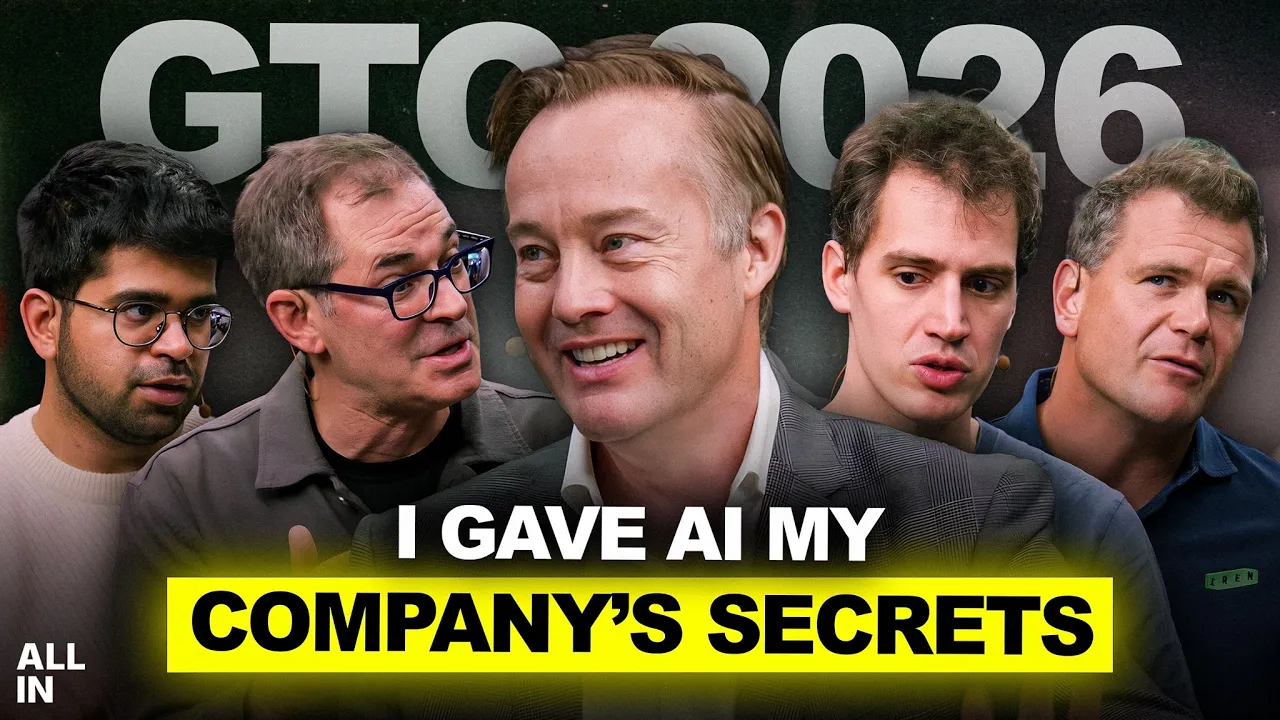
CoreWeave, Perplexity, Mistral, IREN Pivot to Scaled AI Infrastructure
All-In Podcast
AI leadership argues that physical energy capacity, multi-agent orchestration layers, and custom post-trained models will dictate the next phase of enterprise compute dominance.
## Background
This episode of the All-In Podcast was published on YouTube on March 23, 2026. Recorded live from Nvidia's annual GTC conference, the episode features host Jason Calacanis interviewing four prominent AI CEOs—Michael Intrator of CoreWeave, Aravind Srinivas of Perplexity, Arthur Mensch of Mistral, and Daniel Roberts of IREN—to discuss the future of AI compute, hardware supply chains, model orchestration, and data center infrastructure.
## TL;DR
The interview series explores the rapidly evolving AI ecosystem across compute infrastructure, model developer strategies, and dynamic software layers. CoreWeave and IREN detail the capital-intensive world of high-performance data centers, discussing GPU depreciation, multi-gigawatt power acquisition, and debt financing structures designed to scale AI clusters. Perplexity showcases its evolution into desktop-level multi-agent orchestration via Perplexity Computer, while Mistral highlights its strategy for enterprise post-training, data sovereignty, and open-weights models. Together, the leaders paint a comprehensive picture of an industry navigating explosive demand, supply chain bottlenecks, and the structural shift toward agentic AI.
## Atmosphere & style
The conversations capture a high-energy, technical, and insider-driven tone characteristic of a major industry conference. Jason Calacanis maintains an engaging, inquisitive, and practical dynamic with each CEO, blending direct tactical inquiries with lighthearted personal anecdotes about testing AI tools in real-time. The overall atmosphere feels like a front-row seat to high-stakes venture and infrastructure strategy, balancing intense commercial realism with forward-looking technical optimism.
## Key takeaways
- [00:00](https://www.youtube.com/watch?v=-JBhTBu9ZbA&t=0s) CoreWeave transitioned from an algorithmic natural gas hedge fund and crypto mining operation into an enterprise AI compute provider by prioritizing flexible GPU infrastructure over single-use ASICs.
- [03:05](https://www.youtube.com/watch?v=-JBhTBu9ZbA&t=185s) CoreWeave donated Nvidia A100 GPU clusters to open-source collective EleutherAI as 'tuition' to learn parallelized AI cluster operations without customer SLA pressure.
- [05:08](https://www.youtube.com/watch?v=-JBhTBu9ZbA&t=308s) CoreWeave positioned itself 'above the GPUs, below the models,' specializing in cluster software, observability, and networking rather than general web hosting.
- [08:35](https://www.youtube.com/watch?v=-JBhTBu9ZbA&t=515s) CoreWeave utilizes a conservative 6-year linear depreciation schedule backed by 5-year fixed customer contracts, refuting claims of rapid 16–18 month GPU obsolescence.
- [17:07](https://www.youtube.com/watch?v=-JBhTBu9ZbA&t=1027s) CoreWeave scaled debt financing by placing long-term enterprise customer contracts inside isolated, non-recourse financial entities ('the box') to collateralize GPU purchases.
- [34:09](https://www.youtube.com/watch?v=-JBhTBu9ZbA&t=2049s) Perplexity CEO Aravind Srinivas outlines the evolution from basic search to agentic browsing and Perplexity Computer, which acts as a virtual desktop orchestrating multi-step workflows.
- [36:53](https://www.youtube.com/watch?v=-JBhTBu9ZbA&t=2213s) Perplexity plans a 'Personal Computer' hybrid approach, pairing cloud delegation with dedicated local hardware (e.g., Mac Mini) to preserve data privacy and cut API costs.
- [46:36](https://www.youtube.com/watch?v=-JBhTBu9ZbA&t=2796s) Positioning itself as the 'Switzerland of AI,' Perplexity routes queries across competing third-party frontier and open-source models rather than relying on a single proprietary model.
- [50:14](https://www.youtube.com/watch?v=-JBhTBu9ZbA&t=3014s) Perplexity introduced 'Model Council' to automatically parse multiple AI responses, summarizing consensus, contradictions, and nuances without requiring manual cross-referencing.
- [57:36](https://www.youtube.com/watch?v=-JBhTBu9ZbA&t=3456s) Perplexity aims to enable autonomous one-person businesses by automating marketing, payments, SEO, user acquisition, and support workflows through AI agents.
- [01:07:14](https://www.youtube.com/watch?v=-JBhTBu9ZbA&t=4034s) Mistral AI partnered with Nvidia to train open-weights base models, which power its enterprise 'Forge' platform for domain-specific fine-tuning in industrial and financial sectors.
- [01:11:00](https://www.youtube.com/watch?v=-JBhTBu9ZbA&t=4260s) Mistral deploys training and optimization platforms directly into client private clouds alongside forward-deployment engineers to protect enterprise data sovereignty.
- [01:14:28](https://www.youtube.com/watch?v=-JBhTBu9ZbA&t=4468s) Addressing enterprise security concerns around autonomous frameworks like OpenClaw, Mistral emphasizes Context Engines with Role-Based Access Control (RBAC) to enforce regulatory guardrails.
- [01:19:21](https://www.youtube.com/watch?v=-JBhTBu9ZbA&t=4761s) IREN transitioned its business model from Bitcoin mining to AI data center infrastructure, controlling 4.5 GW of power capacity and signing a $9.7B contract with Microsoft.
- [01:25:46](https://www.youtube.com/watch?v=-JBhTBu9ZbA&t=5146s) IREN addresses power bottlenecks by co-locating data centers directly next to stranded renewable energy sources, such as West Texas wind and solar farms.
- [01:28:26](https://www.youtube.com/watch?v=-JBhTBu9ZbA&t=5306s) Invoking Jevons paradox, AI infrastructure leaders observe that software optimizations and lower token processing costs exponentially increase total compute demand rather than reducing it.
- [01:35:55](https://www.youtube.com/watch?v=-JBhTBu9ZbA&t=5755s) IREN disproves data center proximity myths by demonstrating that remote facilities in West Texas achieve sub-6 millisecond round-trip latency to major Dallas carrier hubs.
Live from Nvidia's annual GTC conference, host Jason Calacanis introduces an interview series with four leading AI CEOs: Michael Intrator of CoreWeave, Aravind Srinivas of Perplexity, Arthur Mensch of Mistral, and Daniel Roberts of IREN. Grounding the coverage with sponsorship support from the New York Stock Exchange, the segment immediately dives into the story behind CoreWeave, one of the defining infrastructure providers of the generative AI boom. CoreWeave CEO Michael Intrator reflects on how the company started not as a traditional cloud or a "neo-cloud," but as an algorithmic natural gas hedge fund. With natural gas trading models running predictably on automated systems, the founders found themselves with substantial downtime and turned their attention to cryptocurrency.
Upon looking under the hood of crypto infrastructure in 2017, they rejected Bitcoin mining due to its reliance on single-use ASICs, which left little competitive moat against chip manufacturers. Instead, they focused on GPUs for mining Ethereum because GPUs offered generic compute flexibility. Intrator and his co-founders viewed compute as an optionality engine—power that could easily be reassigned to other workloads if crypto proved volatile. After surviving multiple crypto winters thanks to strict financial risk management honed in their hedge fund days, the company aggressively began looking for non-crypto use cases.
[03:05](https://www.youtube.com/watch?v=-JBhTBu9ZbA&t=185s) The Up-Stack Progression: From CGI Rendering to EleutherAI
As crypto volatility remained a concern, CoreWeave progressively moved up the technological stack in search of harder computational problems. They transitioned from cryptocurrency mining into CGI rendering for visual effects and animated movies, before expanding into batch computing for scientific and medical research. Around 2020–2021, the team set their sights on understanding how to run neural networks on GPU clusters.
Because training deep learning models at scale was an unfamiliar domain, CoreWeave bought a cluster of Nvidia A100 GPUs and donated them directly to EleutherAI, an open-source research collective. Intrator calls this investment the "tuition" CoreWeave paid to learn how to operate large-scale, parallelized GPU infrastructure. Giving away the compute gave CoreWeave a safe environment to learn without customer SLA pressure, while EleutherAI's researchers provided relentless feedback on what large-scale AI cluster infrastructure required. When those volunteer researchers later returned to their full-time jobs at major tech companies and labs, they demanded the exact infrastructure setups they had experienced with CoreWeave, effectively launching CoreWeave's enterprise cloud business.
- **Use-Case Evolution:** Crypto Mining $\rightarrow$ CGI/VFX Rendering $\rightarrow$ Batch Medical Research $\rightarrow$ Neural Network Training
- **The EleutherAI Strategy:** Donated Nvidia A100 clusters to open-source researchers to master parallelized compute operations without initial SLA penalties.
[05:08](https://www.youtube.com/watch?v=-JBhTBu9ZbA&t=308s) Scaling Laws, Decommoditization, and Early Foundation Models
Long before ChatGPT created a mainstream cultural moment, CoreWeave recognized that AI scaling laws would fundamentally alter compute economics. Intrator points out that while individual GPUs are generic commodities, running massive multi-thousand-GPU clusters capable of training world-changing foundation models completely "decommoditizes" compute at scale. CoreWeave positioned itself specifically in the technical space "above the Nvidia GPUs, but below the models"—focusing exclusively on cluster software, observability, network integration, and specialized cloud operations tailored for AI rather than broad web hosting.
When foundation model builders began looking for massive scale, Inflection AI (co-founded by Mustafa Suleyman) became CoreWeave's first major commercial enterprise client. CoreWeave rapidly scaled to supply compute for OpenAI, hyperscalers, and leading model developers. Intrator notes that while early demand was driven almost entirely by pre-training, the market has rapidly pivoted toward massive inference workloads as models transition from research experiments into real-world enterprise deployment.
- **Market Positioning:** "Above the GPUs, below the models"—specializing exclusively in AI cluster hardware and orchestration rather than general web hosting (like AWS).
- **First Major Commercial Client:** Inflection AI, followed by OpenAI and hyperscalers.
- **Strategic Shift:** Rapid transition from training workloads to massive, revenue-generating inference workloads.
[08:35](https://www.youtube.com/watch?v=-JBhTBu9ZbA&t=515s) The Hardware Lifecycle and the GPU Depreciation Debate
Intrator directly addresses the ongoing industry debate around GPU depreciation and obsolescence, strongly dismissing claims by short-sellers that AI chips become obsolete in 16 to 18 months. Because CoreWeave is a "success-based business" operating against mega-cap competitors, clients sign long-term hardware contracts averaging five years in duration. CoreWeave accounts for its infrastructure using a 6-year linear depreciation schedule, which Intrator considers conservative given real-world hardware performance and customer demand.
CoreWeave has consistently served as the launch partner for Nvidia's bleeding-edge systems—deploying the H100, H200, GB200, and GB300 architectures at scale. However, older GPU generations remain highly active and commercially lucrative. As frontier labs migrate to next-generation chips for flagship pre-training, earlier generations (such as Nvidia Ampere/A100s) are reallocated to secondary experimentation and long-term inference workloads. Intrator notes that Nvidia A100 rental pricing actually *appreciated* over the past year due to overwhelming demand from lower-tier model builders and startups previously priced out of top-tier hardware.
[14:06](https://www.youtube.com/watch?v=-JBhTBu9ZbA&t=846s) Economic Obsolescence and Supply Chain Competition
When asked what will eventually determine the true end-of-life for GPU hardware, Intrator explains that physical failure or theoretical obsolescence is not the driver. Instead, economic obsolescence occurs when the power and data center space consumed by an older server can be repurposed for higher-margin next-generation chips. Until power constraints force a hardware swap, running legacy, fully paid-off infrastructure on multi-year contracts yields extraordinary profit margins.
Addressing the intense competition and supply constraints surrounding Nvidia GPU allocations, Intrator welcomes the influx of new "neo-cloud" competitors as validation of the massive AI infrastructure market. Rather than relying on special political backchannels for hardware, CoreWeave approaches Nvidia supply chains like any major enterprise client, issuing purchase orders and scaling out physical footprints to meet committed customer demand.
> "If people are willing to pay me for it, it still has value. It's a pretty simple way of approaching it."
- **Defining Obsolescence:** Driven by data center power capacity limits and margin trade-offs, not chip failure.
- **Hardware Lifespan Realities:** Legacy GPUs are often moved to secondary regions or sold into specialized markets once primary data center space is needed for higher-density racks.
<FollowUp label="Want to continue with Part 2 of the transcript covering the rest of the CoreWeave discussion?" query="Provide the next part of the transcript walkthrough covering Part 2 of the All-In Podcast Nvidia GTC episode."/>
[17:07](https://www.youtube.com/watch?v=-JBhTBu9ZbA&t=1027s) Nvidia's Queue System and Financing AI Infrastructure
The conversation touches on how Nvidia handles massive hardware demand from competing tech giants. The host references asking Jensen Huang how he manages large corporate egos clamoring for GPUs; Huang explained that Nvidia operates on a straightforward first-come, first-served order queue rather than playing favorites or running auctions. CoreWeave CEO Michael Intrator agrees that avoiding favoritism is crucial for long-term customer relationships, despite sovereign wealth funds occasionally offering to pay double to skip the line.
Intrator explains how CoreWeave finances infrastructure at scale using a specialized debt structure centered around an entity called "the box." CoreWeave secures long-term contracts with enterprise customers (such as Microsoft), places those contracts inside an independent financing vehicle (the box), purchases Nvidia GPUs, and arranges data center facilities. Revenue from the customer flows directly into the box to pay data center power costs, interest, and debt principal first. Any remaining cash flow returns to CoreWeave. Lenders gain immense confidence because the vehicle pays off both principal and interest within 2.5 years of a 5-year contract.
- CoreWeave raised $35 billion over an 18-month period using GPU-collateralized debt vehicles.
- CoreWeave reduced its cost of capital by 600 basis points over two years, bringing its rates closer to traditional hyperscalers.
- Debt vehicles are kept isolated and non-recourse to prevent financial contagion if a single project underperforms.
[22:26](https://www.youtube.com/watch?v=-JBhTBu9ZbA&t=1346s) Risk Management, Information Loops, and Hardware Bottlenecks
Risk management dictates which contracts CoreWeave accepts. Intrator notes that CoreWeave turns down short-term requests—such as a client wanting to rent GPUs for only a single year—because short timelines do not allow sufficient time to amortize infrastructure expenses. Building scale during a period of global GPU undersupply allows CoreWeave to drive down its cost of capital while gathering valuable real-time usage data across large language models, high-frequency trading, and search applications.
Addressing supply constraints across the industry, Intrator emphasizes that GPUs are not the only bottleneck; data center shells, power, memory, storage, optics, and networking also limit deployment. Memory, in particular, has become a major industry throttle due to its historical boom-and-bust capital cycles, where capital-intensive semiconductor fabs take years to build and routinely suffer from misaligned investment cycles.
- Intrator compares long-term AI compute contracts to Knicks season tickets during the Patrick Ewing era, where waiting lists stretched into the tens of thousands.
- Historical overbuilding of infrastructure, such as fiber-optic networks during the dot-com era, ultimately provided the low-cost foundation for modern internet streaming services like YouTube.
- OpenAI CFO Sarah Friar noted at a panel that the cost of processing one million tokens dropped from over $32 during the early ChatGPT/GPT-3 era down to roughly $0.09.
[31:23](https://www.youtube.com/watch?v=-JBhTBu9ZbA&t=1883s) AI Democratization and the Arrival of Perplexity CEO Aravind Srinivas
Intrator outlines how AI reduces operational barriers to execution. Individuals without formal computer science backgrounds can now "vibe code" or construct applications simply by prompting models with creative ideas, effectively extending advanced technical tools to a global population.
The focus shifts as Perplexity CEO Aravind Srinivas joins the program. Host Jason Calacanis breaks down the three stages of how he adopted Perplexity into his personal workflow:
1. **Model Aggregation & Real-Time Summaries:** Using Perplexity as a single front door to toggle between multiple underlying AI models (such as OpenAI and Anthropic's Claude), combined with real-time news summaries and sports tracking.
2. **Automated Browsing:** The launch of Perplexity's Comet browser, enabling autonomous multi-step instructions (e.g., scraping company contacts off LinkedIn into a structured Google Sheet).
3. **Advanced Integration:** Transitioning workflows around recent model capabilities and deep search features.
<ElicitationsGroup message="To explore the full context of this panel and episode:">
<Elicitation label="Read the summary of Part 1 (CoreWeave's founding & GPU infrastructure)" query="Provide a detailed walkthrough of Part 1 of the All-In Podcast featuring CoreWeave CEO Michael Intrator."/>
<Elicitation label="Read the summary of Part 3 (Perplexity's vision & search disruption)" query="Provide a detailed walkthrough of Part 3 of the All-In Podcast featuring Perplexity CEO Aravind Srinivas."/>
</ElicitationsGroup>
[34:09](https://www.youtube.com/watch?v=-JBhTBu9ZbA&t=2049s) Perplexity Computer and the Shift to Orchestrating AI Capabilities
Jason Calacanis initiates the conversation by highlighting how he has been using the newly launched Perplexity Computer, describing it as a powerful tool for executing repetitive tasks—similar to using Claude's co-working capabilities or working alongside a developer. He asks Perplexity CEO Aravind Srinivas how to view the company’s evolution in a rapidly crowding landscape alongside dominant players like OpenAI, Claude, Grok, and Gemini. Aravind responds by thanking Jason and framing Perplexity’s core mission around **accuracy** as the primary driver of user trust.
Aravind outlines the progression of Perplexity’s architecture from search to full desktop interaction:
* **Stage 1 (Perplexity Ask):** Providing AI with internet access to yield factual, up-to-date answers.
* **Stage 2 (Agentic Browsing):** Granting the model full access to a browser to complete web-based tasks on behalf of the user.
* **Stage 3 (Perplexity Computer):** Giving AI access to an entire virtual desktop environment to execute complex, multi-step workflows independently.
Rather than relying on a single underlying model, Perplexity Computer operates like a conductor orchestrating a full orchestra. In this analogy, the sub-agents are the musicians and the various frontier models (Claude, GPT, Gemini, specialized open-source models) are the instruments. By selecting the right tool for coding, writing, visual synthesis, image generation, or audio processing, the system focuses entirely on delivering the final output for the user.
- **Core focus:** Accuracy creates user trust, which encourages follow-up queries and expanded usage.
- **Architectural model:** Multi-agent orchestration combining specialized models across different modalities into a single seamless interface.
---
[36:53](https://www.youtube.com/watch?v=-JBhTBu9ZbA&t=2213s) Local Compute, Privacy, and the Hybrid Server/Local Architecture
Jason asks whether Perplexity has considered giving its agent root access to local desktop operating systems (e.g., Windows or Android), while noting the massive security and privacy hurdles involved. Aravind reveals their plan to address this: **Perplexity Personal Computer**. This approach bridges server-side execution with local hardware by synchronizing with a dedicated local machine—such as an Apple Mac Mini—which serves as the user's private local server.
Under this setup, highly sensitive personal data (tax returns, personal photos, private notes, local calendars) stays local, with orchestration handled entirely on the user's hardware rather than on Perplexity's or Anthropic's cloud servers. If the system needs to process heavily complex, long-running tasks or external data (like Gmail or Google Calendar), it can securely delegate those tasks to the server side with explicit user permission. Jason notes that spending money on a powerful desktop set up—like a $10,000 workstation or a high-end Mac Studio running local models (such as Kimi 2.5)—becomes extremely appealing if it cuts down hefty monthly cloud bills and guarantees privacy. Aravind compares these dedicated local AI boxes to household appliances like refrigerators or internet modems, predicting that every home will eventually run local orchestration loops connected to home sensors and mobile devices.
- **Perplexity Personal Computer strategy:** Local data execution powered by dedicated hardware (e.g., Mac Mini) paired with cloud delegation for heavy workloads.
- **Cost vs. Privacy benefits:** Replaces expensive monthly API/cloud fees ($500+/month) with local hardware investment while keeping private tokens off third-party training pipelines.
---
[41:54](https://www.youtube.com/watch?v=-JBhTBu9ZbA&t=2514s) AI as the Operating System and the Resurgence of Linux
When Jason asks what the ultimate operating system of these workstations will look like, Aravind argues that **"AI is the operating system."** In traditional OS environments, users execute exact programmatic instructions. In the AI-native paradigm, users specify high-level objectives (e.g., *"Build a website that tracks All-In podcast transcripts and charts Max 7 stock prices before and after each episode"*). The AI OS then operates at an abstraction layer above raw files, managing code sandboxes, file systems, HTML tools, and web connectors automatically.
Aravind notes that under the hood, all cloud-based Perplexity Computer instances run on Linux servers. He references a recent tweet from Mark Zuckerberg celebrating that desktop/server Linux is finally achieving its moment. Jason agrees, pointing out that Linux offers stability, deep customization, and complete independence from Apple's closed ecosystem or Microsoft's broad attack surface. Because users interact with the environment via abstract natural language prompts on their phones or browsers, the underlying OS does not even require a traditional visual desktop user interface.
- **Traditional OS vs. AI OS:** Shift from step-by-step programmatic commands to high-level objective-based execution.
- **Linux's advantage:** Provides a stable, highly customizable, sandboxable foundation without front-end overhead or platform lock-in.
---
[43:55](https://www.youtube.com/watch?v=-JBhTBu9ZbA&t=2635s) Enterprise Growth, Monetization, and Gross Margins
Jason shares an anecdote about telling two of his back-office employees at his venture firm to stop using raw OpenClaw and instead automate their firm's operations strictly through Perplexity Computer. He asks Aravind about enterprise integration, to which Aravind confirms that Perplexity Computer already operates natively as an interactive Slack bot for enterprise teams.
Aravind shares details on Perplexity’s rapid growth and financial model across consumer and B2B segments:
* **Consumer Base:** Tens of millions of monthly active users, following a growth trajectory similar to early Google or Yahoo.
* **Enterprise Segment:** Thousands of enterprise customers; revenue in this segment is growing faster than the consumer side.
* **Enterprise Pricing Tiers:** Enterprise Pro is priced at **$40 per month per user**, while Enterprise Max is **$400 per month per user** (with extra token usage billed separately once base credits are exhausted).
* **Gross Margins & Profitability:** Unlike simple wrapper startups, Perplexity maintains **positive gross margins on all revenue**. By leveraging Retrieval-Augmented Generation (RAG) and intelligent routing across models, they avoid unnecessarily inflating context windows, keeping token expenditures low relative to subscription pricing.
Aravind highlights that Enterprise Max customers have collectively saved over $100 million in operational overhead through automated workflows. While the company overall continues to reinvest heavily in growth toward net profitability, every dollar of top-line revenue generates a positive unit margin.
---
[46:36](https://www.youtube.com/watch?v=-JBhTBu9ZbA&t=2796s) Competing Against Big Tech as "The Switzerland of AI"
Addressing market rumors about acquisition offers from giants like Apple, Jason asks Aravind why he chose to remain independent and how a 400-person team can compete against tech giants spending tens of billions of dollars—such as Sam Altman raising massive capital rounds, Elon Musk expanding Grok with space data centers and X/SpaceX integration, and Google leveraging Gemini.
Aravind explains that Perplexity's defining strategic advantage is its position as the **"Switzerland of AI."** Because Perplexity does not train its own single flagship frontier model, it remains entirely neutral to which model provider wins. Whether GPT, Gemini, Claude, Llama, Kimi, Nematron, or Qwen comes out on top, Perplexity seamlessly routes queries to the single best model for the task.
> "We don't have to have one horse in the race. If GPT wins, Gemini wins, Claude wins, Llama wins, it doesn't matter to us."
Aravind references Anthropic CEO Dario Amodei’s observation that models are increasingly specializing rather than commoditizing. For instance, Perplexity’s internal iOS engineers prefer using OpenAI Codex, while their back-end engineers favor Claude Code. Because Big Tech platforms are constrained by their massive capital investments to push their own in-house models, none of them can offer an unbiased multi-model orchestra. By acting as the unified orchestration layer and abstracting away individual API keys, subscriptions, and billing across dozens of providers, Perplexity creates a distinct, defensible value proposition for the end user.
- **Team size:** Approximately 400 employees.
- **Underlying model stack:** Integrates proprietary and open-source models including DeepSeek, Kimi, Nematron, and Alibaba's Qwen under the hood.
- **Strategic positioning:** Aggregates and orchestrates third-party models wholesale, abstracting multi-model complexity away from consumers and enterprise clients.
[50:14](https://www.youtube.com/watch?v=-JBhTBu9ZbA&t=3014s) Model Orchestration and the "Model Council"
The conversation centers on how Perplexity handles model routing. Rather than forcing users to pick a specific model, Perplexity automatically routes queries to the optimal model while preserving a manual dropdown menu for flexibility. The host brings up how tech executives like Jensen Huang manually submit the same prompt across five different AIs to cross-reference responses. The host notes that this approach requires heavy "biological compute" to manually compare answers—similar to consulting five different doctors or lawyers and trying to parse where they disagree.
To eliminate that friction, Aravind Srinivas explains that Perplexity built a feature called **Model Council**. Instead of merely displaying individual model responses side-by-side, Model Council analyzes the outputs, explicitly highlighting where the models agree, where they diverge, and what nuances each one offers.
* **Auto-Routing vs. User Choice:** Perplexity dynamically selects the best underlying model per prompt, but retains the manual selection dropdown for user control.
* **Model Council Feature:** Automates the comparative analysis of multiple AIs, summarizing consensus, contradictions, and distinct nuances directly within the interface.
* **Engineering Cadence:** Perplexity relies on small team size and rapid shipping to maintain a competitive advantage over slower, highly bureaucratic tech giants.
---
[51:36](https://www.youtube.com/watch?v=-JBhTBu9ZbA&t=3096s) Shipping Speed and AI-Driven Development
Srinivas details Perplexity’s shipping philosophy, asserting that speed is their primary moat. Larger tech incumbents face immense structural friction when trying to simultaneously balance speed, quality, and trust—often taking prolonged periods to ship product updates or abandoning features shortly after launch events.
Perplexity accelerated its shipping velocity toward the end of the previous year by integrating internal AI coding tools. This shift enabled non-technical employees to ship code and fix bugs by querying a Slack bot, which in turn inspired the development of Perplexity Computer.
> "Our philosophy is like speed is our moat... one of the things that big companies cannot do is move at the speed we do, serve customers at the speed and quality—it's very hard to maintain quality, speed, and trust at the same time." — Aravind Srinivas
* **Slack-Based Engineering:** Non-engineers at Perplexity write and deploy code by instructing AI bots in internal Slack channels.
* **Context Management via Sandboxes:** Early models like Claude Opus and Phi marked an inflection point where AIs began excelling at orchestration, tool calling, and managing context dynamically inside sandbox environments.
* **CLI and Sub-Agents:** By organizing tasks around files, sub-agents, and command-line interfaces (CLIs), models can dynamically pull in or discard context without hitting context-window bottlenecks.
---
[52:29](https://www.youtube.com/watch?v=-JBhTBu9ZbA&t=3149s) Real-World Uses of Perplexity Computer and Automated Workflows
The host shares his "Claude-pilled" revelation: asking an AI to analyze 20 professional connections from a trip to Japan, map their secondary networks, and automatically generate a custom CRM system to store the data. Srinivas notes that Perplexity relies heavily on Perplexity Computer internally for operational tasks:
* **Board Meeting Memos:** Perplexity Computer generated the complete memo for an upcoming board meeting.
* **Partnership Decks:** Pitch decks that previously required dedicated design teams were single-shot generated by the system.
* **Press Briefings:** Instead of communications staff drafting media prep documents, the AI compiled complete journalist backgrounders based on past interactions and historical context.
The host describes running complex analytics across historical podcast data. He instructed the AI to process every transcript of the *All-In Podcast*, generate a histogram of public company mentions over time, chart those mentions chronologically, cross-reference them against stock price movements, and perform sentiment analysis—a project that previously would have taken a human researcher tens of hours.
---
[57:36](https://www.youtube.com/watch?v=-JBhTBu9ZbA&t=3456s) Autonomous One-Person Businesses and the Future of Work
Looking ahead over six-month horizons, Srinivas outlines Perplexity's core objective: enabling small businesses and solo entrepreneurs to run fully autonomous companies. Rather than relying on speculative "one-person billion-dollar startups," the goal is providing accessible infrastructure—such as running Perplexity Computer on a local Mac Mini or cloud server—so individuals can generate hundreds of thousands or millions in real revenue.
Computer is designed to handle the end-to-end operational stack of a business:
1. Running ad campaigns across Instagram and Google.
2. Integrating directly with SEM and SEO tools for user acquisition.
3. Managing payments via Stripe and deploying product feature updates.
4. Handling customer support via automated Intercom integrations.
The host contrasts this with traditional startup ops. Where founders 20 years ago had to secure office space, manage server racks, and hire PR or HR agencies, modern early-stage founders operate lean. HR screening, candidate ranking, initial outreach, and preliminary interviews are routinely automated using AI tools.
---
[01:00:14](https://www.youtube.com/watch?v=-JBhTBu9ZbA&t=3614s) Job Displacement, Entrepreneurship, and Mobile Orchestration
Addressing concerns surrounding job displacement, Srinivas acknowledges the transition but maintains a predominantly optimistic outlook (70–80% positive). He argues that traditional factory-style employment often limits individual agency, whereas AI tools democratize entrepreneurship, enabling workers to establish self-sustaining micro-businesses with strong work-life balance. The host agrees, noting that navigating this landscape requires individuals to adopt a mindset of self-reliance and resourcefulness.
The discussion shifts to product updates, specifically the release of the Comet browser on iOS and its integration with mobile ecosystems.
* **Comet Browser Integration:** Comet acts as a native browser control layer for Perplexity Computer, executing tasks that lack dedicated APIs—such as filling out complex web forms, navigating multi-tab workflows, and uploading files.
* **Walled Garden Challenges:** Web platforms like LinkedIn and Reddit increasingly restrict automated access, creating friction for user-delegated tasks like pulling messages or scraping company data.
* **Universal API Resolution:** Perplexity aims to work alongside major platforms to integrate official APIs directly into Computer while giving power users local flexibility via Comet.
<ElicitationsGroup message="Explore related topics from this transcript segment:">
<Elicitation label="Analyze Perplexity Computer's internal architecture" query="Explain how Perplexity Computer orchestrates sub-agents, CLI tools, and context sandboxes based on the transcript."/>
<Elicitation label="Review AI's impact on startup recruiting workflows" query="Detail how AI abstractions are replacing traditional recruiter tasks as discussed in the podcast."/>
</ElicitationsGroup>
[01:05:14](https://www.youtube.com/watch?v=-JBhTBu9ZbA&t=3914s) Monetizing AI Agent Access and Concluding with Perplexity
Jason Calacanis and Perplexity CEO Aravind Srinivas explore the business model opportunities around letting AI agents operate on paid subscription platforms. Jason argues that platforms like Reddit, LinkedIn, or *The New York Times* should allow users with paid subscriptions (such as $20/month for Reddit or $50/month for LinkedIn) to authenticate AI agents—like Perplexity or Computer—to perform read-only tasks within specified rate limits. For instance, an executive could task an agent to summarize customer feedback from subreddits like `r/thisweekinstartups` or `r/allinpod` without posting or voting on their behalf.
Aravind Srinivas agrees completely, noting that enabling user choice and creating win-win access models makes subscriptions stickier while creating new API revenue streams for content platforms. Jason closes the interview by urging viewers to try Perplexity’s "Computer" feature and the Comet browser, praising how much they have transformed his day-to-day business operations over the preceding two years, and jokingly invites Aravind back for when Perplexity inevitably launches its own operating system and desktop servers.
- **Reddit Use Case**: Authenticating a $20/month Pro account for an agent to run read-only sentiment and feedback summaries across specific subreddits a set number of times per day.
- **LinkedIn Proposal**: Pitching Satya Nadella directly to open up paid LinkedIn tiers to work seamlessly with third-party agents like Perplexity as a dedicated monetization stream.
- **Publisher Retention**: Giving paying subscribers (e.g., *The New York Times*) 100 automated queries per day/month to drastically increase subscription retention ("stickiness").
---
[01:07:14](https://www.youtube.com/watch?v=-JBhTBu9ZbA&t=4034s) Mistral AI’s Strategic Nvidia Partnership and Enterprise Post-Training
Jason welcomes Arthur Mensch, CEO of Mistral AI, live from Nvidia’s GTC conference. Mensch announces a major partnership with Nvidia to train next-generation frontier open-source models—continuing their collaboration following the release of Mistral NeMo roughly 18 months prior. Mensch explains that creating top-tier open models provides the essential base layer for Mistral’s proprietary enterprise tools, such as their **Forge** platform, which post-trains and customizes models for specialized industries including physics, engineering, science, regional languages, and government applications.
Addressing what it is like running a premier AI startup out of France and Europe, Mensch highlights that 25% of Mistral’s revenue and 25% of its research staff are actually based in the United States, alongside footprints in the UK and Singapore. While European manufacturing companies have leaned on Mistral to modernize, US enterprises in financial services are heavily utilizing Forge to specialize open base models with their proprietary post-training data.
- **Mistral NeMo Successor**: Mistral is leveraging massive Nvidia compute capacity to pre-train its next frontier open-weights model lineup.
- **General vs. Vertical Models**: General-purpose models handle orchestration, while domain-specific, post-trained models excel at enterprise workflows.
- **Open-Weights Advantage**: Open models allow enterprises to add new parameters, integrate deep proprietary IP, reduce ongoing inference costs, and deploy anywhere—on-premise, across multi-cloud environments, or directly at the edge.
- **Enterprise Case Study**: Heavy manufacturing giants like ASML utilize Mistral to connect decades of specialized hardware and photolithography data directly into tailored AI models.
---
[01:11:00](https://www.youtube.com/watch?v=-JBhTBu9ZbA&t=4260s) Secure Enterprise Data Segregation and the Role of Synthetic Data
When asked how Mistral safely handles domain-specific training for competing enterprises in sensitive fields like aerospace or fintech, Mensch emphasizes that total data isolation is foundational to their platform. Instead of forcing clients to transmit sensitive data to external servers, Mistral deploys a fully portable platform—comprising training, data processing, and optimization software—directly into the customer’s private cloud infrastructure.
To complete this process, Mistral sends forward-deployment engineers and scientists (holding PhDs) to work directly alongside client subject-matter experts—such as semiconductor engineers analyzing image defect detection at ASML. The team designs targeted data pipelines and transfers training capabilities so the client can independently maintain and update models in-house.
Regarding pre-training data limits, Mensch confirms that open web scraping has largely reached its natural boundaries. He outlines how synthetic data and human feedback interact in modern model development:
- **Synthetic Data for Model Compression**: Larger "teacher" models generate synthetic datasets to rapidly warm up and compress smaller, more efficient downstream models.
- **Human Expert Signal**: Synthetic data alone is insufficient; high-quality, high-cost domain feedback from real human experts remains essential for true domain mastery.
- **Data Sovereignty**: Zero data returns to Mistral's servers, eliminating corporate security and regulatory concerns for enterprise CIOs.
---
[01:14:28](https://www.youtube.com/watch?v=-JBhTBu9ZbA&t=4468s) The "OpenClaw" Explosion, Context Engines, and Enterprise Governance
Discussing the massive industry viral moment surrounding "OpenClaw" (an autonomous agent framework that surged to the top of GitHub), Mensch and Jason analyze what it signals for enterprise software. Mensch notes that while open-source hacker projects demonstrate the impressive autonomy of agents, they fall short of enterprise standards for security, observability, and deterministic control. For instance, global banking institutions like HSBC running KYC (Know Your Customer) workflows require strict, non-negotiable regulatory gates rather than unconstrained agent behavior.
Jason shares a personal caution story: after giving an autonomous agent root API access across his firm's G Suite, Google Docs, Notion, Zoom, and Slack accounts, he realized the agent could index and summarize highly confidential performance improvement plans (PIPs) and compensation discussions across the entire company.
Mensch explains that solving this requires a robust **Context Engine** combined with fine-grained Role-Based Access Control (RBAC):
- **Deterministic Frameworks**: Enterprise automation requires verifiable control planes and sandboxes to guarantee regulatory compliance before agentic execution.
- **Semantic Metadata & RBAC**: A context engine indexes corporate data while attaching granular metadata rules—ensuring an engineering prompt never pulls restricted HR or compensation data.
- **Organizational Restructuring**: Pervasive agentic integration fundamentally alters internal information flows, making traditional middle managers (whose primary role was relaying top-down and bottom-up information) obsolete and requiring a total redesign of departments like customer support.
Following the discussion, Arthur Mensch departs for his flight, and Jason introduces Daniel Roberts, co-CEO and co-founder of IREN (formerly Iris Energy), to discuss the transition from Bitcoin mining to AI data center infrastructure.
[01:19:21](https://www.youtube.com/watch?v=-JBhTBu9ZbA&t=4761s) The Shift from Bitcoin Mining to AI Compute
Daniel Roberts explains that IREN was founded seven to eight years ago on the core thesis that as the online world exploded, real-world infrastructure would struggle to keep pace. The company set out to build large-scale data centers, initially using Bitcoin mining to bootstrap the platform, generate strong cash flow, and build out power capacity. The long-term plan was always to layer in higher-value compute use cases as they emerged over time. Today, that vision has materialized as they actively swap out Bitcoin rigs for AI chips.
When asked about when demand pivoted toward AI workloads, Roberts recalls a false dawn around 2020 after signing a memorandum of understanding (MOU) with Dell, which proved to be ahead of its time. The real shift began accelerating about two years ago, leading to month-over-month escalation in demand. Early on, IREN took a unique approach by developing data centers directly—acquiring land, securing permits, and applying for grid connections at a scale that surprised traditional data center operators. For instance, their flagship Texas site boasts a 750-megawatt (MW) capacity, a scale virtually unheard of when initiated four years prior.
- IREN recently signed a $9.7 billion contract with Microsoft, though Roberts notes this represents only about 5% of their total potential capacity.
- The company controls roughly 4.5 gigawatts (GW) of power capacity—an amount nearly equivalent to the annual energy consumption of the entire San Francisco Bay Area.
---
[01:22:15](https://www.youtube.com/watch?v=-JBhTBu9ZbA&t=4935s) Real-World Bottlenecks: Labor, Supply Chains, and Remote Construction
While energy access is a major bottleneck for the broader tech sector, Roberts notes that IREN’s early strategy of tying up land and grid connections leaves them well-positioned on raw power. Instead, their primary constraint is "time to compute"—the physical friction of building out real-world infrastructure to match exponential digital demand. Bringing data centers online requires setting up man camps and trailer hubs in remote areas to house thousands of electricians, foundation crews, and construction workers.
Roberts highlights the logistical strain of managing these projects, describing it as a game of "permanent whack-a-mole" across supply chains, skilled trades, and local infrastructure. To address labor needs, IREN follows a policy of hiring locally before expanding the recruitment radius. They often build near legacy electrical infrastructure where old industrial or manufacturing plants have shuttered, allowing them to retrain local workers and revitalize economically depressed areas.
- IREN is reaching a cumulative $1 million in community grants, funding local projects such as playgrounds and fire department support.
- Due to intense demand for skilled trades, starting salaries for specialized electricians and construction personnel on these data center builds range from $150,000 to $300,000.
- IREN partners with local universities and trade colleges to build out a secondary generation of trade workers dedicated to high-performance compute infrastructure.
---
[01:25:49](https://www.youtube.com/watch?v=-JBhTBu9ZbA&t=5149s) Energy Strategy and Monetizing Stranded Renewables
Addressing energy sources, Roberts highlights that IREN has operated on 100% renewable energy since its inception. They utilize hydroelectric power for operations in British Columbia, alongside wind and solar power for their West Texas sites. In West Texas, there is roughly 45 to 50 GW of wind and solar capacity, but only 12 GW of transmission line capacity to export power to major urban load centers like Dallas and Houston.
Rather than building costly transmission lines over massive distances, IREN locates its data centers directly adjacent to excess generation capacity. This allows them to monetize stranded energy at the source and export it as digital tokens across the network. Regarding grid stability and variable weather conditions, Roberts explains that utility providers manage grid balancing, underwriting energy availability to deliver guaranteed 24/7 power to the data center facilities.
> "You go and locate to the close source of low-cost excess renewable energy, monetize it into this digital commodity, export at the speed of light as tokens."
---
[01:28:26](https://www.youtube.com/watch?v=-JBhTBu9ZbA&t=5306s) Jevons Paradox and the Appetite for Compute
Responding to speculation about whether AI capital expenditures are slowing down, Roberts emphasizes that industry demand remains at absolute maximum levels, with virtually zero idle GPUs sitting unutilized in global data centers.
Addressing software optimizations that lower token costs, Roberts argues that increased efficiency does not reduce demand, but instead accelerates it—illustrating Jevons paradox. Drawing an analogy to early dial-up internet or traffic congestion on newly expanded highways, he notes that as image and text generation speeds improve from minutes to seconds, total prompt volume will surge exponentially rather than contract.
- When asked about custom silicon from major cloud providers like Google, Amazon, and Meta, Roberts acknowledges their growth while noting that Nvidia maintains a decisive head start due to its deeply entrenched hardware and software ecosystem.
- The rise of localized AI software (such as OpenClaw) and high-end desktop setups (e.g., workstation configurations packing 750 GB of RAM) complements macro data center expansion by building consumer demand for agentic workflows, robotics, and local models.
---
[01:32:27](https://www.youtube.com/watch?v=-JBhTBu9ZbA&t=5547s) The Long-Term Horizon for Nuclear Energy
On the subject of nuclear energy and small modular reactors (SMRs), Roberts agrees that nuclear power is vital for meeting future energy needs. While large-scale nuclear commissioning projects typically take a decade or more to realize, he stresses that policy decisions, capital allocation, and infrastructure planning must happen immediately.
Roberts views the integration of nuclear power and distributed generation as a way to unlock high-density clean energy right at the source, reinforcing long-term economic competitiveness and supporting the continuous growth of AI and robotics.
- The historical correlation between human economic progress and per-capita energy consumption remains extraordinarily high over long time horizons.
- Co-locating small modular reactors directly alongside data center campuses could significantly expand the overall addressable market for domestic high-performance compute.
<ElicitationsGroup message="To explore more from this interview series:">
<Elicitation label="Summarize the key points from Perplexity CEO Aravind Srinivas" query="Summarize the main points and discussion from Perplexity CEO Aravind Srinivas in the All-In Podcast episode."/>
<Elicitation label="Summarize the key points from CoreWeave CEO Michael Intrator" query="Summarize the main points and discussion from CoreWeave CEO Michael Intrator in the All-In Podcast episode."/>
<Elicitation label="Summarize the key points from Mistral CEO Arthur Mensch" query="Summarize the main points and discussion from Mistral CEO Arthur Mensch in the All-In Podcast episode."/>
</ElicitationsGroup>
[01:34:17](https://www.youtube.com/watch?v=-JBhTBu9ZbA&t=5657s) Data Center Networking Architecture and Jevons Paradox
As hardware performance accelerates and compute becomes faster and more fluid, a positive feedback loop takes hold through Jevons paradox, where increased efficiency leads to exponential growth in demand. The underlying physical architecture that powers these AI clusters is undergoing a massive paradigm shift. Highlighting Jensen Huang’s insight that "the data center is the new computer," the entire building must now be conceptualized as an integrated desktop PC.
Within these massive facilities, every micro-level engineering detail becomes crucial to maximizing cluster efficiency. The physical cabling, networking fabrics such as InfiniBand and Ethernet, latency constraints, and the exact number of hops between individual GPUs dictate performance. Every single millisecond directly affects the compute throughput of the cluster.
- Jensen Huang’s core architectural thesis: "the data center is the new computer."
- Key networking bottlenecks: InfiniBand vs. Ethernet switching, cabling layout, hop counts between GPUs, and latency optimization.
[01:35:10](https://www.youtube.com/watch?v=-JBhTBu9ZbA&t=5710s) Orbital Data Centers and Elon Musk’s Vision
Addressing long-term frontier concepts, the discussion turns to the feasibility of putting data centers in space. While launching compute infrastructure into orbit presents immense technical hurdles—including astronomical launch costs and space radiation exposure—Elon Musk’s ambitious track record makes it hard to write off.
While engineering realities sitting on Earth today make orbital data centers seem exceptionally difficult, Musk has consistently tackled seemingly impossible engineering problems. As the hosts observe with a touch of humor, Musk is uniquely qualified and "inevitably right," even if his timeline means he "might be late to the party" or "show up at dessert."
- Primary space data center challenges: heavy payload launch costs and severe radiation protection requirements.
- Track record commentary: Acknowledgment of Elon Musk’s history of eventually delivering on ambitious long-term visions despite delayed timelines.
[01:35:55](https://www.youtube.com/watch?v=-JBhTBu9ZbA&t=5755s) Busting Latency Myths and IREN's Growth
A common misconception in AI infrastructure planning is that massive data centers must be located immediately adjacent to major metropolitan population centers to minimize latency. IREN’s experience building infrastructure out in West Texas completely debunks this myth. The region is already crisscrossed by massive underground fiber-optic networks, allowing data to move virtually instantaneously.
From IREN's remote site in the West Texas desert down to the primary carrier hotel in Dallas, the round-trip latency is a mere 6 milliseconds. Out of 1,000 milliseconds in a second, a 6 ms delay is practically imperceptible and completely immaterial for operational workloads. Concluding the interview live from Nvidia GTC, IREN is scaling rapidly to support this demand and actively recruiting across all departments.
- West Texas to Dallas carrier hotel latency: 6 milliseconds round-trip.
- IREN hiring spree: 129 open job advertisements currently listed on their website.
## Notable quotes
> [14:06](https://www.youtube.com/watch?v=-JBhTBu9ZbA&t=846s) If people are willing to pay me for it, it still has value. It's a pretty simple way of approaching it. — Michael Intrator
> [46:46](https://www.youtube.com/watch?v=-JBhTBu9ZbA&t=2806s) We don't have to have one horse in the race. If GPT wins, Gemini wins, Claude wins, Llama wins, it doesn't matter to us. — Aravind Srinivas
> [51:36](https://www.youtube.com/watch?v=-JBhTBu9ZbA&t=3096s) Our philosophy is like speed is our moat... one of the things that big companies cannot do is move at the speed we do, serve customers at the speed and quality—it's very hard to maintain quality, speed, and trust at the same time. — Aravind Srinivas
> [01:25:26](https://www.youtube.com/watch?v=-JBhTBu9ZbA&t=5126s) You go and locate to the close source of low-cost excess renewable energy, monetize it into this digital commodity, export at the speed of light as tokens. — Daniel Roberts
## Mentioned
Michael Intrator, Aravind Srinivas, Arthur Mensch, Daniel Roberts, Jason Calacanis, Jensen Huang, Mustafa Suleyman, Sarah Friar, Elon Musk, Dario Amodei, Satya Nadella, CoreWeave, Perplexity, Mistral AI, IREN, Nvidia, New York Stock Exchange, EleutherAI, Inflection AI, OpenAI, Anthropic, Microsoft, Dell, ASML, HSBC, Google, Apple, Stripe, Intercom, LinkedIn, Reddit, The New York Times, All-In Podcast, Nvidia GTC, Comet, Perplexity Computer, Perplexity Personal Computer, Model Council, Forge, Mistral NeMo, OpenClaw, ChatGPT, GPT-3, Claude, Claude Opus, Grok, Gemini, Llama, Kimi, Nematron, Qwen, A100, H100, H200, GB200, GB300
CoreWeave、Perplexity、Mistral 与 IREN 转向规模化 AI 基础设施
AI 领军人物认为,实体能源容量、多智能体编排层以及定制后训练模型将决定下一阶段的企业算力主导地位。
该系列访谈深入探讨了涵盖算力基础设施、模型开发者策略以及动态软件层的快速演进的 AI 生态系统。CoreWeave 与 IREN 详细剖析了高性能数据中心这一资本密集型领域,讨论了 GPU 折旧、数吉瓦级电力获取以及旨在扩展 AI 集群规模的债务融资结构。Perplexity 展示了其通过 Perplexity Computer 向桌面级多智能体编排演进的历程,而 Mistral 则重点介绍了其在企业后训练、数据主权和开放权重模型方面的策略。这些行业领军者共同勾勒出一幅完整图景:整个行业正在应对爆发式需求、供应链瓶颈以及向智能体 AI 迈进的结构性转变。
CoreWeave 从天然气对冲基金及加密挖矿转型为企业级 AI 算力提供商,早期通过向开源机构 EleutherAI 捐赠 Nvidia A100 集群学习集群运维,确立了“GPU 之上、模型之下”的专精定位。 (3:05)
针对 GPU 短期淘汰的质疑,CoreWeave 采用 6 年线性折旧并由 5 年期长期客户合同背书,同时借助隔离的无追索权债务实体(“the box”)以硬件抵押筹集了 350 亿美元。 (8:35)
Perplexity CEO Aravind Srinivas 详解了从基础搜索到 Perplexity Computer 的演进,该架构作为虚拟桌面能自主编排多模型与子智能体,执行端到端的复杂工作流。 (34:09)
为保障数据隐私并降低长期 API 支出,Perplexity 规划了“个人电脑”混合方案,将敏感数据与本地调度保留在专属硬件(如 Mac Mini)上,同时兼具云端算力委派能力。 (36:53)
Perplexity 将自身定位为“AI 领域的瑞士”,中立聚合与动态路由各大第三方前沿模型,并通过 Model Council 功能自动分析和提炼不同模型之间的共识与分歧。 (46:36)
Reading summary
AI industry leaders across compute infrastructure, model development, and application layers argue that the sector is shifting from speculative training toward sustained inference, capital-intensive physical buildouts, and specialized enterprise orchestration. Rather than converging on a single model or hyperscale cloud, executive perspectives from CoreWeave, IREN, Mistral, and Perplexity suggest that competitive moats depend on overcoming physical site bottlenecks, managing hardware depreciation cycles, and safeguarding proprietary data.
Hardware Lifecycles and Compute Financing Structures (8:35)
CoreWeave CEO Michael Intrator disputes claims that GPUs face functional obsolescence within 16 to 18 months, stating the company uses a conservative six-year linear depreciation schedule supported by five-year client contracts. As frontier labs migrate to next-generation architectures like Nvidia's GB200, legacy systems like Ampere A100s transition to secondary markets and inference, where rental rates have even appreciated. Intrator explains that economic obsolescence is governed by data center rack space and power margin trade-offs rather than physical chip degradation.
To finance infrastructure at scale, CoreWeave raised $35 billion over 18 months using isolated, non-recourse debt vehicles backed by customer contracts, reducing its cost of capital by 600 basis points. Addressing broader market demand, IREN co-CEO Daniel Roberts asserts that efficiency gains in software and token generation do not suppress compute needs but trigger Jevons paradox, compounding aggregate GPU demand across the sector.
Physical Constraints: Power, Transmission, and Construction Bottlenecks (82:15)
While macro discussions emphasize energy shortages, IREN's Daniel Roberts identifies "time to compute"—the physical friction of data center construction—as the primary operational barrier. Managing remote sites requires setting up temporary housing camps and securing specialized labor, pushing starting salaries for specialized electricians and construction personnel to between $150,000 and $300,000. Intrator similarly notes that memory semiconductor cycles, data center shells, and networking optics throttle cluster deployments just as much as GPU chip allocations.
To bypass regional transmission bottlenecks, IREN colocates facilities directly beside stranded renewable assets, such as West Texas wind and solar generation, which produces 45 to 50 GW against only 12 GW of export line capacity. Roberts disputes the necessity of building near metropolitan areas, observing that West Texas desert facilities maintain a six-millisecond round-trip latency to primary Dallas carrier facilities. For long-term multi-gigawatt scalability, Roberts advocates integrating small modular nuclear reactors (SMRs) directly into data center campuses.
Enterprise Sovereignty and Controlled Model Deployment (67:14)
Mistral CEO Arthur Mensch argues that general frontier models serve primarily for base orchestration, whereas enterprise value lies in vertical post-training on proprietary domain data through platforms like Forge. To address corporate compliance and regulatory requirements in sectors like aerospace and heavy manufacturing, Mistral deploys models directly into private customer clouds, preventing sensitive intellectual property from returning to third-party servers. Mensch notes that while web scraping has reached natural limits and synthetic data accelerates smaller model training, real-world domain mastery still requires costly human expert feedback.
Addressing the surge in autonomous agent frameworks like OpenClaw, Mensch warns that enterprise environments require deterministic guardrails and strict role-based access controls (RBAC). Unfettered agent indexing risks leaking confidential personnel or compensation data across internal enterprise platforms, requiring context engines that enforce compliance before execution.
Neutral Model Orchestration and Agentic Systems (46:36)
Perplexity CEO Aravind Srinivas frames his company’s strategy as the "Switzerland of AI," avoiding the heavy capital expense of training proprietary foundation models to instead dynamically orchestrate third-party models including Claude, GPT, Qwen, and DeepSeek. Srinivas contends that models are specializing rather than commoditizing, enabling Perplexity to route specific tasks to optimal engines while maintaining positive gross margins through retrieval-augmented generation and controlled context windows.
Srinivas projects that AI will function as the operating system, abstracting underlying Linux environments so users can direct complex workflows via natural language prompts. To address corporate and personal privacy, Perplexity is developing a hybrid architecture where dedicated local hardware—such as an on-premise Mac Mini—stores sensitive personal data, only delegating heavy compute tasks to cloud servers with explicit user authorization.
While the participating CEOs highlight rapid commercial adoption and expanding computational demand, structural uncertainties remain around long-term power delivery, the multi-year timelines required to build nuclear alternatives, and the governance frameworks needed to prevent autonomous agents from compromising enterprise security.
## Background
本期节目由知名科技商业播客《All-In Podcast》于 2026 年 3 月 23 日发布在 YouTube 平台。节目在英伟达年度 GTC 大会现场录制,由纽约证券交易所(NYSE)赞助播出。根据简介与导语,主持人 Jason Calacanis 在大会现场深度对话了四位代表当前 AI 基础设施、搜索代理、开源大模型与算力能源领域的核心领军 CEO,全面探讨人工智能生态的未来走向。
## TL;DR
节目围绕 AI 软硬件与能源基础设施全产业链展开密集对话:CoreWeave 联合创始人兼 CEO Michael Intrator 阐述了专属 AI 云的崛起、GPU 真实长尾寿命与首创的资产盒债务融资模式;Perplexity CEO Aravind Srinivas 拆解了从搜索到‘Perplexity Computer’多智能体操作系统的演进,并坚定将自身定位为生态中立的‘AI 瑞士’;Mistral CEO Arthur Mensch 介绍了与英伟达联合训练前沿模型的战略,以及企业级开源模型在严苛合规与确定性工作流中的落地;IREN 联席 CEO Daniel Roberts 则揭秘了西得州新能源套利、4.5 GW 电力储备优势以及打通物理世界算力交付与蓝领技工紧缺的关键瓶颈。
## Atmosphere & style
现场对话节奏紧凑明快、信息密度极高,处处洋溢着硅谷顶尖极客与资本推手碰撞的硬核工业感与兴奋情绪。主持人 Jason 展现出极富穿透力的提问风格与真诚的‘试用狂魔’视角,从具体的实操体验直接切入商业本质与行业隐忧。受访嘉宾们沉着自信、充满野心与战略定力,既有对物理现实中电网、机房与供应链复杂度的敬畏,又有对算力爆炸、单人创业时代与技术重构世界的炽热信念,让听众仿佛置身于全球 AI 工业革命最核心的动力引擎室。
## Bulletin
- [10:24](https://www.youtube.com/watch?v=-JBhTBu9ZbA&t=624s) CoreWeave 驳斥了关于“GPU 仅有 16 到 18 个月寿命”的做空言论,其以 5 年期长期大客户合同和硬件阶梯流转为支撑,开创单体独立“资产盒”债务融资,使综合借贷成本在两年内骤降 600 个基点。
- [34:58](https://www.youtube.com/watch?v=-JBhTBu9ZbA&t=2098s) Perplexity 推出全天候运行的 Perplexity Computer 与支持混合编排的 Personal Computer,将模型视为交响乐团乐器进行动态多模型调度,并在企业级订阅中实现正毛利运营。
- [01:07:14](https://www.youtube.com/watch?v=-JBhTBu9ZbA&t=4034s) Mistral AI 宣布与英伟达协同训练新一代前沿旗舰大模型,并强调面向 ASML、汇丰等企业落地时,开放可移植模型与具备确定性把关点的上下文引擎才是突破合规与数据主权的核心。
- [01:18:57](https://www.youtube.com/watch?v=-JBhTBu9ZbA&t=4737s) 数据中心运营商 IREN 凭借 8 年前锁定的 4.5 GW 绿色电力储备与 97 亿美元微软长期协议展开扩张,实测西得州基地至达拉斯网络往返延迟仅 6 毫秒,打破偏远算力中心部署的延迟迷思。
## Key takeaways
- [03:02](https://www.youtube.com/watch?v=-JBhTBu9ZbA&t=182s) CoreWeave 从天然气量化对冲基金转型,通过早期将 A100 GPU 免费捐赠给 EleutherAI 摸索超大规模并行计算架构,最终成长为聚焦 AI 专属架构的新型云厂商(Neo Cloud)。
- [05:08](https://www.youtube.com/watch?v=-JBhTBu9ZbA&t=308s) 算力在极度规模化时会去同质化(Computing decommoditizes at scale),行业重心正从前沿模型的基础预训练快速转向规模化推理(Inference),推理算力成为 AI 商业化投资回报的核心晴雨表。
- [09:18](https://www.youtube.com/watch?v=-JBhTBu9ZbA&t=558s) 通过“预训练-微调-推理”的梯次流转机制,老款 GPU(如 A100)由于中小企业和长尾负载需求激增反而出现租金升值,硬件真正退役的临界点取决于单位电力所创造的利润率机会成本。
- [18:21](https://www.youtube.com/watch?v=-JBhTBu9ZbA&t=1101s) CoreWeave 打造以 GPU 和高信用合约为质押的“盒子”(The Box)资产证券化融资架构,单项目 2.5 年即可全额收回还本付息,实现项目风险隔离并将融资成本压降 600 个基点。
- [26:12](https://www.youtube.com/watch?v=-JBhTBu9ZbA&t=1572s) 当前 AI 算力供应链的致命瓶颈正从单纯的 GPU 芯片转移至电力外壳(Power Shells)、变压器以及由于 2023 年资本开支滞后而严重缺货的高带宽内存(HBM)。
- [28:09](https://www.youtube.com/watch?v=-JBhTBu9ZbA&t=1689s) 重资产行业过度的繁荣与萧条周期恰是资本主义的自我出清机制,正如电信泡沫催生了 YouTube 与现代流媒体一样,加速计算的基础设施过建将孕育出颠覆性的商业新物种。
- [30:34](https://www.youtube.com/watch?v=-JBhTBu9ZbA&t=1834s) Token 推理成本已从早期每百万 Token 约 32 美元断崖式降至 9 美分,配合递归自优化与氛围编程(vibe coding),极大踏平了全社会的软件构建与业务创新门槛。
- [34:58](https://www.youtube.com/watch?v=-JBhTBu9ZbA&t=2098s) Perplexity 将自身定位为“AI 领域的瑞士”,将各大前沿基础模型视作交响乐团里的乐器,依靠底层多模型智能体编排与动态路由构筑核心竞争壁垒。
- [36:51](https://www.youtube.com/watch?v=-JBhTBu9ZbA&t=2211s) Perplexity 推行本地与云端混合编排的 Personal Computer 概念,通过 Mac mini 等本地硬件守护隐私数据,并认为结合命令行、沙盒与连接器的“AI 本身就是未来的操作系统”。
- [01:02:11](https://www.youtube.com/watch?v=-JBhTBu9ZbA&t=3731s) 针对网页交互场景,Perplexity 借助 Comet 浏览器赋予 AI 原生接管浏览器的能力,填补现实网络世界在未全面 API 化和标准化 CLI 之前的自动化操作断层。
- [01:03:52](https://www.youtube.com/watch?v=-JBhTBu9ZbA&t=3832s) 网络平台与 AI 代理应探索建立“付费 Agent 授权机制”(如 Reddit 或 LinkedIn 会员绑定),在保障平台商业收益与防范无序爬虫的前提下,实现用户个人 AI 代理的合法只读调用。
- [01:08:09](https://www.youtube.com/watch?v=-JBhTBu9ZbA&t=4089s) 相较于封闭黑盒模型,开源与开放可移植模型允许企业在私有云或本地硬件上注入专有数据实施深度微调,在保护知识产权的同时大幅压缩全周期拥有成本。
- [01:16:28](https://www.youtube.com/watch?v=-JBhTBu9ZbA&t=4588s) 企业级智能体落地亟需构建包含细粒度权限控制的“上下文引擎”(Context Engine),防止敏感数据越权暴露,单纯依靠传递信息的传统中层管理与客服岗位将面临全面重塑。
- [01:18:57](https://www.youtube.com/watch?v=-JBhTBu9ZbA&t=4737s) IREN 采取以比特币挖矿产生现金流并提前锁定土地与电网容量的先发策略,成功储备了 4.5 GW 绿电指标,并将西得克萨斯滞留的风光清洁能源就地转化为算力与 Token。
- [01:28:26](https://www.youtube.com/watch?v=-JBhTBu9ZbA&t=5306s) 根据杰文斯悖论(Jevons paradox),软件优化与算力成本大幅下降不仅不会抑制需求,反而会因生成延迟从分钟级压缩至秒级而刺激出成倍的指数级计算需求。
- [01:34:12](https://www.youtube.com/watch?v=-JBhTBu9ZbA&t=5652s) “数据中心即计算机”,集群内部基于 InfiniBand 与 Ethernet 的互联延迟决定了整体性能,而西得州至达拉斯核心机房往返仅 6 毫秒的实测延迟打破了必须靠近大都市部署的行业迷思。
## Detailed walkthrough
### [00:00](https://www.youtube.com/watch?v=-JBhTBu9ZbA&t=0s) 英伟达 GTC 现场开场与 CoreWeave 的诞生
主持人 Jason Calacanis 在英伟达年度 GTC 大会现场开启特别节目,预告本期将深度对话四位 AI 领域的领军企业 CEO(包括 CoreWeave、Perplexity、Mistral 和 IREN)。节目由纽约证券交易所(NYSE)赞助播出。开篇首位登场的嘉宾是 AI 算力基础设施独角兽 CoreWeave 的联合创始人兼首席执行官 Michael Intrator。Jason 盛赞 CoreWeave 是 AI 时代最具代表性的基础设施巨头之一,也是最早抢占 GPU 赛道的“原始新型云厂商(Neo Cloud)”。
谈及公司为何能如此之早洞察趋势,Michael 透露了一个充满反差的创业故事:CoreWeave 最初根本不是作为云服务公司设立的。创始团队原本运营着一家专注于天然气交易的算法对冲基金。在算法系统开发完毕并步入稳定监控与测试阶段后,团队拥有了大量空闲时间,这群对底层技术极度痴迷的“极客”开始深入研究加密货币的底层安全架构。他们研究了比特币网络和 ASIC 矿机,但很快放弃了这一方向——因为 ASIC 是专用集成电路,“总有才华横溢的工程师能做出更好的芯片,他们在运营 ASIC 方面肯定比我们强”。相反,他们把全部筹码押在了英伟达的 GPU 上。在他们看来,GPU 既可以挖掘以太坊,又具备极强的通用计算属性,本质上买入 GPU 算力就像持有一份“可以随时切换部署至不同计算场景的看涨期权”。
- CoreWeave 成立于 2017 年,前三年主要深耕加密货币算力。
- 创始团队深厚的对冲基金背景赋予了他们顶级的风险管理与资本配置能力,使他们能够从容度过多次剧烈的“加密寒冬”,并在市场低谷期持续低成本积累硬件资产与扩张规模。
---
### [03:02](https://www.youtube.com/watch?v=-JBhTBu9ZbA&t=182s) 算力演进阶梯:从渲染、医学研究到给 EleutherAI “交学费”
由于加密货币行情波动剧烈且前景未明,团队从第一天起就清醒地寻找 GPU 算力的其他多元化变现途径。他们沿着硬件复杂度和软件堆栈层层向上攀登:最初是从以太坊挖矿横向切入好莱坞电影制作中的 CGI 动画渲染,为视觉特效团队提供高并发渲染农场;随后进一步拓展到批量计算(Batch Computing),为医学研究等科学计算场景提供算力驱动,以此推动严肃科学突破。
到了 2020 年至 2021 年前后,团队开始尝试将 GPU 算力投入深度学习和神经网络领域。然而,大规模分布式并行训练在当时是一个技术壁垒极高的盲区。为了破局,CoreWeave 采取了一个极富戏剧性的策略:他们自掏腰包购买了一批英伟达顶级 A100 GPU,直接免费捐赠给知名的开源大模型研究组织 EleutherAI。Michael 幽默地回忆道,免费捐赠的妙处在于“既然是免费赞助,就算我们一开始干得磕磕绊绊,他们也没法对我们发脾气,不能拿 SLA(服务等级协议)来投诉我们”。EleutherAI 的研究员们不断提出严苛的反馈和改进需求,迫使 CoreWeave 团队以极快速度摸透了超大规模并行计算集群的底层网络架构、调度系统与运维瓶颈。Michael 将购买那批 A100 的成本形容为“学会运营这项业务所缴纳的学费”。
更具转折意义的是,这批 EleutherAI 的核心研究员平时都是在各大顶尖学术机构与科技大厂任职的全职科学家,仅仅以开源志愿者的身份参与项目。当他们结束业余开源探索、回归全职工作时,纷纷向各自的公司和机构极力推荐:“我们要的就是 CoreWeave 这种架构,这才是做前沿研究真正需要的基础设施。”CoreWeave 的企业级商业化大门由此彻底打开。
```mermaid
flowchart TD
accTitle: CoreWeave 业务演进与算力阶梯
accDescr: 展示 CoreWeave 从加密挖矿演进至 AI 超算云的发展路径
subgraph Phase1["第一阶段:算力起步 (2017-2019)"]
A["天然气量化对冲基金团队"] --> B["以太坊 GPU 挖矿"]
B --> C["CGI 图像渲染 / 批量科学计算"]
end
subgraph Phase2["第二阶段:AI 探索与破局 (2020-2021)"]
C --> D["采购 A100 算力免费捐助 EleutherAI"]
D --> E["无 SLA 压力下倒逼攻克并行计算架构"]
E --> F["开源学者回到各大机构反哺商业口碑"]
end
subgraph Phase3["第三阶段:大模型超算云 (2022至今)"]
F --> G["Inflection / OpenAI 等巨头商业订单"]
G --> H["前沿训练:H100/H200/GB200 集群"]
H --> I["规模化推理:算力商业化变现实体化"]
end
```
---
### [05:08](https://www.youtube.com/watch?v=-JBhTBu9ZbA&t=308s) 算力的“去同质化”与专注 AI 的专属架构
早在 ChatGPT 引发全球生成式 AI 狂潮之前的 2020 到 2021 年,CoreWeave 就敏锐地坚信“缩放定律(Scaling Laws)”将重塑整个数字世界。他们形成了一个核心认知:“算力在极度规模化时会去同质化(Computing decommoditizes at scale)”。Michael 强调,任何人都可以买几张显卡跑跑程序,但要搭建并稳定运行一个成千上万卡互联、能够训练出足以改变世界的大模型的超算集群,完全是另一维度的科学与工程挑战。
面对亚马逊 AWS 等老牌云计算巨头,Michael 表现出极高的敬意与战略清醒。他认为 AWS 等传统超大规模云厂商在通用 Web 服务器和微服务托管领域做到了极致,那是上一代互联网计算的完美解决方案;但分布式 AI 训练是完全不同的全新物种。CoreWeave 选择放弃万金油式的泛用性,不做杂乱的云产品,而是坚决聚焦在“英伟达 GPU 之上、上层 AI 模型之下”的这一垂直夹层,专精于超大规模 AI 集群的软件互联、网络调度、可观测性(Observability)以及自动化运维体系。
- 战略定位:只做专为 AI 极端并行计算量身定制的专属云(Purpose-built Cloud)。
- 发展重心:不仅解决单点算力交付,更是将工程试验项目升级为能够承载海量资本、对接最严苛企业客户的工业级商业实体。
---
### [07:04](https://www.youtube.com/watch?v=-JBhTBu9ZbA&t=424s) 商业化爆发与训练向推理的范式转移
在商业客户拓展上,除了开源先锋 EleutherAI,CoreWeave 迎来的第一个商业大单客户是由 Mustafa Suleyman 联合创立的 Inflection AI。此后,业务迅速向整个行业头部蔓延,全面渗透进 OpenAI 等顶尖基础模型实验室以及需要外扩算力的传统超大规模云厂商(Hyperscalers)。CoreWeave 的核心使命就是交付能“改变世界的超级计算机”。
随着技术演进,Michael 指出整个行业正从纯粹的基础科研训练快速迈入产品化与落地部署阶段。AI 算力消耗正从企业的边缘实验项目渗透进核心业务流程,最直观的指标便是 CoreWeave 基础设施上“推理(Inference)算力”的爆发式增长。Michael 给出精辟见解:“我始终将推理视作对人工智能巨额投资的真正商业变现。”当全球用户向模型提问、模型生成答案或驱动智能体执行具体任务时,推理算力正在真实世界中创造端到端价值。
- 客户矩阵扩展:从 EleutherAI、Inflection AI 到 OpenAI 及主流基础大模型公司。
- 算力形态跃迁:训练奠定模型能力上限,而规模化推理则是 AI 投资闭环和商业健康度的晴雨表。
---
### [09:18](https://www.youtube.com/watch?v=-JBhTBu9ZbA&t=558s) 英伟达最新硬件的“矛尖”与 GPU 的梯次寿命
在与英伟达的技术协同上,Michael 自豪地将 CoreWeave 称作英伟达将新架构芯片推向大规模商业化生产的“矛尖(Tip of the Spear)”。无论是早期的 H100、升级版的 H200,还是最新的 Blackwell 架构 GB200 以及更前沿的 GB300,CoreWeave 始终是全行业第一批完成大规模集群部署与商业交付的服务商。
面对硬件快速迭代带来的折旧疑虑,Michael 阐释了 CoreWeave 独特的硬件阶梯流转机制:客户通常会抢先使用最新、性能最强的“刀锋级”GPU 来进行最前沿的基础模型预训练;随着下一代架构面世,上一代芯片并不会退役,而是被无缝移入各种定向微调实验中;再经过一段时间,这些芯片会被整体部署到海量推理集群中,在推理端继续发挥极其长久且稳定的经济效益。对于市场上关于 A100 等芯片有效寿命的争论,Michael 认为这种阶梯式复用极大地拉长了 GPU 的实际商业生命周期。
### [10:24](https://www.youtube.com/watch?v=-JBhTBu9ZbA&t=624s) 驳斥 GPU 快速折旧论:长尾价值与真实寿命
关于市场热议的“GPU 在 16 到 18 个月内就会过时淘汰”的说法,CoreWeave 联合创始人兼 CEO Michael Intrator 直言这是无稽之谈("nonsense")。他指出,这类言论多半是由持有空头头寸、试图做空打压股价的交易员在推波助澜。现实情况是,CoreWeave 是一家以成果和需求为导向的公司,客户前来采购算力时签订的合同往往长达 5 到 6 年,平均合同期限正是 5 年。如果市场客户愿意为 5 年的算力真金白银买单,就证明这些硬件依然具备实打实的商业价值。
在财务折旧模型上,CoreWeave 采用了 6 年折旧期。Michael 坚信这些 GPU 的物理与经济寿命完全可以超过 6 年,在技术迭代如此迅猛的周期里,6 年是一个既公允又稳健的标准。市场上甚至出现了一个有趣的现象:基于 Ampere 架构的老款 A100 GPU,其租赁价格在过去一年里反而上涨了。这是因为随着整体装机容量上升,大量新创企业带着不同的模型尺寸与全新业务场景涌入市场,它们此前受限于预算或供应而无法用上最顶级的 H100,转而全力抢购 A100 这类性价比极高的算力。主持人随后做了一个生动的类比:这就好比人们换掉了 iPhone 12,觉得它已被淘汰,但在拉美或非洲,50 美元的二手 iPhone 12 或 Pixel 7 依然能发挥极大的剩余价值。
- 行业平均合同期限约为 5 年,与华尔街流传的“16 个月折旧废弃论”严重脱节。
- 绝大多数行业巨头(除亚马逊有不同处理外)普遍将 6 年作为服务器与算力资产的标准折旧年限。
- 随着算力供应的扩展,A100 价格出现反向升值,主要由被顶级芯片挤出的中小初创企业和多样化工作负载承接。
---
### [13:33](https://www.youtube.com/watch?v=-JBhTBu9ZbA&t=813s) 算力机会的扩展与硬件淘汰的真正临界点
芯片制程和摩尔定律的飞速演进并不等同于硬件有效寿命的缩短,反而是让算力应用的“表面积”成倍扩张。虽然聚光灯始终聚焦在最前沿芯片以及驱动前沿大模型训练的巨头身上,但在这些巨头内部,同样存在着庞大的长尾需求:日常模型推理、非顶尖学术实验、图形渲染,乃至像在 Nano Banana 这类平台上生成图像,全部需要巨量算力支撑。
对于数据中心运营商而言,硬件真正的淘汰临界点并非单纯的时间推移,而是由“电力与算力比”决定的机会成本。由于数据中心机房的供电容量极其稀缺,当机房单位电力如果换上新一代基础设施所能创造的利润率,显著超越继续运行老旧芯片的产出时,老硬件才会迎来真正的技术过时。届时,这些下架的硬件可以转售给爱好者、中小企业,或是搬迁到电费更充裕、空间更富余的其他数据中心二次利用。在当前的供求关系下,CoreWeave 许多运行了 5 年的机器在租期届满后,释放出的算力在现货市场上依然能以高于一年前的价格顺利出租,展现出极强的利润增厚效应。
---
### [15:54](https://www.youtube.com/watch?v=-JBhTBu9ZbA&t=954s) 算力争夺战、排队逻辑与英伟达的公平分配
随着生成式 AI 的爆发,整个算力基础设施赛道涌入了大量竞争者,争抢向模型层、推理层和应用层交付基础设施。面对激烈的行业竞争,Michael 认为这恰恰验证了业务赛道的健康度与巨大价值。他强调 CoreWeave 并不畏惧竞争,因为算力基础设施与软件栈的深度整合本身就具备极高的工程壁垒。
当谈及业内顶尖买家之间为了拿到英伟达配额(allocation)是否在上演激烈的暗箱政治博弈时,主持人提到曾向黄仁勋求证大客户如何排队,黄仁勋表示他们一视同仁,完全按照下订单的先后顺序(FIFO)交付。对此,Michael 证实了这一说法,指出英伟达确实秉持着透明合规的排队原则,既不会偏袒特定客户,也不会搞价高者得的现场拍卖模式——毕竟“拍卖算力”虽然能赚取短期暴利,却会彻底摧毁芯片巨头与客户之间的长期生态信任。主持人调侃称这些 GPU 犹如“算力界的法拉利”,偶尔会有主权财富基金跳出来喊出双倍价格截胡,Michael 笑称这些顶级芯片更像是布加迪(Bugatti),但规范的契约和交付排期依然是维系万亿美元生态运转的底线。
---
### [18:21](https://www.youtube.com/watch?v=-JBhTBu9ZbA&t=1101s) CoreWeave 的金融工程创新:“盒子”资产证券化架构
在规模达数十亿美元的基础设施扩张中,如何低成本调动巨量资金是核心命题。不同于传统的风险投资股权稀释,CoreWeave 率先开创了以 GPU 为底层资产的债务融资结构(GPU-backed loans),打造了一套被内部俗称为“盒子”(The Box)的结构化现金流载体。这套金融工具以极高信用度的商业合同为依托,打通了算力采购、数据中心托管与债务偿还的全流程。
```mermaid
flowchart TD
accTitle: CoreWeave The Box Financing Structure
accDescr: 结构化现金流分配机制示意图,展示合同资产如何进入载体并优先清偿成本
subgraph Inputs ["资产与合同质押(放入'盒子')"]
C1["大客户长期算力合约<br/>(如微软长期采购协议)"]
C2["英伟达 GPU 硬件资产采购单"]
C3["数据中心与场地电力租赁协议"]
end
Box["结构化 SPV / 离岸闭环载体<br/>('The Box')"]
Inputs --> Box
subgraph Waterfall ["现金流瀑布清偿机制 (Cash Flow Waterfall)"]
direction TB
W1["1. 支付数据中心机房与电费账单"]
W2["2. 偿还银团借贷本金与利息"]
W3["3. 剩余超额利润返还 CoreWeave"]
W1 --> W2 --> W3
end
Client["客户按期付款"] --> Box
Box --> Waterfall
```
这套被称为“盒子”的资产证券化载体运行机制极为严密:
- **资产注入阶段**:CoreWeave 首先与微软等高信用评级客户锁定长期算力服务合同,随后将该商业合同、从黄仁勋处采购的英伟达 GPU 资产,以及数据中心的场地租赁协议一并质押进这个独立的专用载体(SPV/盒子)中。
- **闭环回款机制**:当 CoreWeave 完成集群搭建并交付算力后,微软的资金不会直接汇入 CoreWeave 公司的普通银行账户,而是定向打入“盒子”受控账户。
- **现金流瀑布分配**:账户资金严格遵循现金流瀑布(Cash Flow Waterfall)顺序进行清偿——优先支付数据中心租金与机房电力账单;其次偿还出资方(银团或债务基金)的贷款本金与利息;扣除所有运营与资本成本后剩下的净超额现金流,才会最终分配给 CoreWeave。
- **低成本杠杆扩张**:凭借高信用等级客户的应收账款与高保值度硬件的双重抵押,CoreWeave 即使早期在科技行业之外声名未显,也得以成功跨过传统门槛,在资本市场借入数百亿美元级别的巨量廉价债务资本,支撑起前所未有的超大规模集群建设。
### [20:21](https://www.youtube.com/watch?v=-JBhTBu9ZbA&t=1221s) CoreWeave 的“独立资产盒”融资架构与资金成本狂降 600 个基点
在过去 18 个月内筹集 350 亿美元用于大规模构建 AI 基础设施,其底层依靠的是一种被称为“盒子”(box)的特殊项目融资结构。Michael Intrator 深入解释了这个金融模型的运转机制:在一个为期 5 年的合同周期内,项目运行仅 2.5 年即可全额收回包括本金与利息在内的所有前期投入;在“盒子”层面上,剩下的合同期将源源不断地为公司带来丰厚的超额净回报。对于全球最顶尖的银行和私募股权基金等机构放贷方来说,这一结构完美契合了借贷领域不可撼动的金科玉律——“把钱还给我”。
当出资方验证了这种机制的安全确定性后,他们不仅愿意继续投资,甚至主动寻求承接数十个类似的“资产盒”。该架构的核心优势在于完全隔离与离散化:每个盒子在财务和法律上都是独立核算的,即使其中一个盒子出现坏账或陷入困境,也绝不会发生跨项目交叉违约或在系统内扩散蔓延,风险被严格锁定在局部。伴随着这一机制的成熟运转,出资人对 CoreWeave 的信任度持续攀升,直接体现为贷款利率的断崖式下降——在短短两年时间内,CoreWeave 的综合资本成本(Cost of Capital)狂降了整整 600 个基点(6%)。这种惊人的降幅正推动其资金成本快速逼近科技巨头(Hyperscalers)的借贷水平,为其长期与巨头并肩竞争奠定了坚实的资本护城河。
```mermaid
flowchart TD
accTitle: CoreWeave 独立资产盒融资与成本下降机制
accDescr: 展示 CoreWeave 如何通过单体资产盒实现 2.5 年还本付息、风险隔离,并反哺企业推动资本成本下降 600 个基点。
subgraph FinancingBox ["独立资产盒 (5 年期项目结构)"]
A["机构放贷方资金注入"] --> B["采购 GPU 与数据中心硬件"]
B --> C["高信用大客户 5 年锁定合约"]
C --> D["前 2.5 年:全额清偿本金与利息"]
D --> E["后 2.5 年:产生净现金流收益"]
end
subgraph RiskIsolation ["风险隔离与评级提升"]
F["各资产盒独立核算<br/>零跨盒传染与违约"]
E --> G["放贷方信任度激增<br/>资金安全获得验证"]
F --> G
end
subgraph ScaleAdvantage ["飞轮效应"]
G --> H["资本成本 2 年骤降 600 个基点"]
H --> I["借贷成本逼近 Hyperscalers 巨头"]
I --> J["以更低成本推进百亿美元级基建"]
end
J -.-> A
```
- **偿债周期**:5 年期服务合同中,仅需 2.5 年即可将全部贷款本金及利息彻底清偿。
- **降本幅度**:过去 2 年内,CoreWeave 的融资成本累计下降了 600 个基点(600 bps)。
- **风险隔离**:单体资产盒之间无交叉抵押(no cross-pollination),单点违约不会引发系统性传染。
---
### [22:26](https://www.youtube.com/watch?v=-JBhTBu9ZbA&t=1346s) 严守纪律与非均衡时期的规模化:为什么必须拒绝短期交易
为了维持资本市场对这些“资产盒”的持续信任,CoreWeave 展现了极强的战略定力与纪律性。当一些客户希望仅租赁 1 年的 GPU 算力时,Michael Intrator 会毫不犹豫地拒绝。在他看来,1 年的租期根本无法平摊折旧昂贵的硬件和基础设施资本支出,这种交易会直接破坏资产盒的偿债安全垫;他宁愿让这些客户转向市场上那些拥有富余闲置算力、愿意承担高敞口风险的二线供应商。
CoreWeave 的战略核心是在当前全球 GPU 极度匮乏的“非均衡期”(Disequilibrium)通过严谨的风控实现极致的规模扩张。极大规模不仅能换取行业最低的资本成本,还能为公司构筑无价的“信息流壁垒”。当来自前沿大语言模型(LLM)开发商、高频量化交易机构(HFT)以及 AI 搜索等顶级团队的海量负载在 CoreWeave 的基础设施上运行时,他们的调用特征、扩展痛点以及对下一代算力规格的诉求会源源不断地反哺给公司。这种前沿信息输入,让 CoreWeave 能够比竞争对手更早、更准地定义下一代硬件与架构产品。
- **纪律性拒绝**:果断拒绝 1 年期等无法完整摊销固定资产成本的短期 GPU 采购诉求。
- **信息流反哺**:通过聚合 LLM、高频交易、AI 搜索等各领域头部工作负载,持续洞察最前沿的算力升级需求。
---
### [24:03](https://www.youtube.com/watch?v=-JBhTBu9ZbA&t=1443s) 永无止境的算力需求与防范“气穴”风险的长期契约
谈及市场各方对 AI 需求是否放缓的疑虑(例如传言中 Oracle 与 OpenAI 合作缩减,或者科技巨头之间资本开支的差异),Michael Intrator 态度极其坚定。他强调,过去整整四年中,全球对算力服务的真实需求深度始终是“残酷而压倒性的”(relentless),远远超过了全世界交付算力的极限能力。主持人 Jason 形象地将其比作 1990 年代帕特里克·尤因(Patrick Ewing)巅峰时期的纽约尼克斯队门票,排队候补名单一度高达 5 万人。
面对“如果突发战争、技术范式转移导致需求瞬间出现断层气穴(air pocket)该怎么办”的尖锐提问,Michael 从风控本源给出了解释:在商业世界里,去预测“意外为什么发生”毫无意义,企业唯一的职责是提前准备好“一旦发生后如何应对”。CoreWeave 抵御黑天鹅事件的核心盾牌,正是与拥有庞大资产负债表的巨头级客户签署长达 5 年的不可撤销合同。这种长约结构将算力资产的回收期锁死在大客户的信用背书之上,无论外部行业发生何种震荡,放贷方的资金回笼都受到合同的绝对保障,这也正是放贷机构愿意持续降低利息的底气所在。
- **需求量级对比**:实际算力需求持续击穿全球供应链交付上限,堪比尤因时代尼克斯门票 5 万人的超长候补名单。
- **抗风险契约**:依托与强劲资产负债表对手方签署的 5 年期长约,彻底对冲行业周期波动的潜在“气穴”风险。
---
### [26:12](https://www.youtube.com/watch?v=-JBhTBu9ZbA&t=1572s) 全球算力瓶颈转移:从 GPU 到内存晶圆厂与资本密集型繁荣萧条周期
当前制约 AI 扩张的绊脚石早已不仅是英伟达的 GPU 本身,而是整个系统级生态——包括电力供应、数据中心外壳(power shells)、存储、网络互联、光模块,以及当前最致命的瓶颈:高带宽内存(HBM)。
内存芯片本质上是一个极具周期性的行业。由于半导体制造晶圆厂(Fab)的资本开支极其沉重,历史上内存行业反复上演“繁荣与萧条”(Boom and Bust)的经典循环:市场需求高涨推高芯片价格,厂商蜂拥投资重金扩建晶圆厂,一旦需求微调便引发严重的产能过剩与价格崩塌。当前内存严重卡脖子是两大因素交织的结果:
1. **AI 爆发性需求**:生成式 AI 对高规格内存及周边配套算力资源的吞吐需求突破天际;
2. **投资周期的滞后**:原本应该在 2023 年启动的一轮晶圆厂重大资本开支,未能及时预判到这波由大模型驱动的技术井喷,导致如今新增晶圆厂产能彻底脱节,无法满足当下的爆炸式需求。正如当下的数据中心建设不再取决于传统地产,而是完全“逐电力而居”一样,重资产制造业的产能爬坡永远伴随着对不可预测需求的痛苦追赶。
| 限制维度 | 历史周期特征 | 当前核心卡点 |
|:--- |:--- |:--- |
| **内存 (HBM/DRAM)** | 典型的大起大落周期性行业,晶圆厂资本投入极大且投产周期长。 | 2023 年行业投资不足,产能爬坡滞后,叠加 AI 爆发式吞吐需求造成严重供给缺口。 |
| **基础设施配套** | 受制于本地土地与常规市电规划。 | 瓶颈转移至电力壳资源(Power Shells)、变压器、光互联与网络拓扑。 |
| **数据中心选址** | 靠近骨干网节点与核心都市地产。 | 不再以地价为中心,全面转向水电、风电等丰富能源富集区(逐能源而建)。 |
---
### [28:09](https://www.youtube.com/watch?v=-JBhTBu9ZbA&t=1689s) 资本主义的过剩之美:从光纤泡沫到 YouTube 与加速计算的时代跃迁
对话随后延伸到了资本主义周期规律的哲学层面:重资产行业周期性的过建(Overbuilding)与崩盘,从第一性原理来看,恰恰是资本主义体系最高效、最美妙的机制之一。繁荣与萧条的周期能够迅速扫清森林里的灌木杂草(clears out the underbrush),淘汰投机者,让最强大的企业留存下来收购廉价资产,并为下一代伟大商业生态埋下种子。
一个最具代表性的历史注脚就是 2000 年代初期的电信光纤泡沫。当时资本无节制地过度铺设了铺天盖地的地下暗光纤,泡沫破裂后光纤价格雪崩,但这批沉睡在地下的光纤却构成了现代数字社会的骨干网络——日后的流媒体、远程办公 Zoom、移动互联网以及疫情期间的全民线上生活,全部寄生在这批廉价过剩的基础设施之上。
Jason 分享了一段不为人知的早期内幕:YouTube 联合创始人 Chad Hurley 当年正是敏锐洞悉到了存储与网络带宽成本正在呈断崖式下跌,才敢于反其道而行之,率先推出“完全免费、无上限视频上传与分享”的划时代产品模式。在 YouTube 诞生前,任何人的个人网站如果视频爆火走红,服务器往往会因为承载不了巨额带宽账单而瞬间宕机,屏幕上只会弹出“该用户已欠费停机”的警告。后来已故的 YouTube 掌门人 Susan Wojcicki 也曾向 Jason 感叹过全球视频上传量之庞大,每分钟上传的视频时长远远超出人类直觉,直到大家意识到全球数十亿用户只要有 1% 产生上传行为就能创造奇迹。如今,正如黄仁勋所言,加速计算(Accelerated Compute)的进化斜率已经完全超越了传统摩尔定律的界限,这种基础设施的指数级爆发,必将孕育出比当年 YouTube 更加深刻颠覆人类社会的新物种。
- **周期价值**:光纤与数据中心基础设施的“过度建设”,在出清低效资本的同时,为未来几十年的数字经济筑牢了近乎零成本的底座。
- **YouTube 诞生秘密**:创始人押注带宽与存储成本暴跌的拐点,颠覆了过去“流量爆火即欠费宕机”的传统按兆计费模式。
- **超越摩尔定律**:当今加速计算的技术飞跃已超越传统摩尔定律演进速度,为 AI 原生时代的新商业帝国创造了历史性窗口。
### [30:34](https://www.youtube.com/watch?v=-JBhTBu9ZbA&t=1834s) 资本竞争与 Token 成本的暴跌:AI 门槛彻底被踏平
对话承接自此前关于 AI 算力与经济学的讨论。现场谈到了一个极具冲击力的对比数据:在近期一次行业论坛中,OpenAI 首席财务官 Sarah Friar 透露,当 GPT-3(或早期的 ChatGPT)刚面世时,每 100 万 Token 的推理成本高达 32 美元零几分;而如今,同样 100 万 Token 的成本已经骤降到了区区 9 美分。这种断崖式下跌清晰地展现了资本主义与自由市场机制的惊人推力——资本市场源源不断地注入动力,催生了极致的工程优化与白热化的行业竞争。
更为关键的是,这种进化过程已经具备了“递归性”(Recursive)。如果人类对模型发出指令:“去优化你自己,让推理变得更高效、更便宜、降低 Token 成本”,模型就会毫不犹豫地执行优化任务。Jason 提到了前不久 Andrej Karpathy 展示的递归应用案例:如今哪怕是从未接触过大语言模型、没有计算机科学背景的普通人,也可以在周末兴致勃勃地尝试搭建递归工作流。CoreWeave 首席执行官 Michael Intrator 对此深表赞同,他指出 AI 正在彻底击穿业务与创新的运营壁垒。任何人只要脑海中有一个绝妙的创意,就能直接打开模型进行“氛围编程”(vibe coding)或者快速构建。无论是尖端的医学研究,还是针对棒球卡收藏的垂直应用,人类八十亿人脑海中那些曾被技术鸿沟牢牢束缚的创造力,如今都能跨越曾经无法逾越的壁垒,直接落地为现实。
- **Token 成本暴降轨迹**:从早期每百万 Token 约 32 美元,降至目前的约 0.09 美元(9 美分)。
- **创新机制变革**:AI 自我优化的递归属性,加之“氛围编程”(vibe coding)等低门槛方式,让创意本身取代了代码工程能力,成为最核心的生产力要素。
---
### [32:58](https://www.youtube.com/watch?v=-JBhTBu9ZbA&t=1978s) Jason 与 Perplexity 的三阶段“恋爱史”:从模型聚合到 Agent 浏览器
送走 Michael Intrator 后,Jason Calacanis 热烈欢迎 Perplexity 首席执行官 Aravind Srinivas 登台。Jason 直言不讳地分享了自己如何一步步“彻底爱上”Perplexity 产品的三个递进演变阶段:
1. **第一阶段(统一前门与实时门户)**:用户可以在同一个界面内按需自由切换模型底座(无论是 OpenAI 还是 Claude),同时侧边栏巧妙融入了类似早期雅虎的垂直分类(如财经、体育)。当 Jason 调出纽约尼克斯队的比赛时,Perplexity 能直接输出实时战况;调出股票时,它能实时汇总最新资讯并提炼摘要,成为汇集各大前沿模型的高效聚合入口。
2. **第二阶段(Comet 智能体浏览器)**:随后 Perplexity 推出了代号为 Comet 的浏览器产品。Jason 惊叹于其跨网页、端到端的 Agentic 自动化执行能力。例如只需给它一条复杂提示词:“去我的 LinkedIn,找到来自某公司的所有员工,然后整理导出进一张 Google Sheets 表格”,它就能一气呵成搞定。
3. **第三阶段(Perplexity Computer)**:最近几周,原本沉迷于 Claude(被“Claude-pilled”)的 Jason 试用了 Perplexity Computer,发现其处理重复性任务的能力惊人地强悍,直逼各类专为开发者打造的尖端工作流工具。
Jason 抛出核心问题:当前巨头林立,Claude 势头凶猛,OpenAI 依旧底蕴深厚,Grok 与 Gemini 同样步步紧逼;在群雄逐鹿的格局下,Perplexity 究竟该如何定义自己?其背后的核心价值定位是什么?
---
### [34:58](https://www.youtube.com/watch?v=-JBhTBu9ZbA&t=2098s) 准确性与交响乐团:Perplexity Computer 的哲学
Aravind Srinivas 回应道,Perplexity 的初心从始至终都是为那些永远在探寻领先优势(extra edge)和充满好奇心的高价值硬核用户打造的。过去三年半来,贯穿 Perplexity 的核心主线始终只有一个词——“准确性”(Accuracy)。在回答用户问题时,唯有绝对的准确才能建立信任,而信任是用户愿意继续深入追问的前提:
- 为了准确回答事实性问题,他们决定让 AI 接入整个互联网,诞生了核心的“Perplexity Ask”搜索产品;
- 为了准确执行复杂的网络任务,他们决定赋予 AI 完整的浏览器操控权限,诞生了具备自主浏览能力的 Agent(Comet 浏览器);
- 最终的必然演进,则是赋予 AI 对计算机的完全控制权,从而诞生了 **Perplexity Computer**。
```mermaid
flowchart TD
accTitle: Perplexity Computer 架构比喻
accDescr: 将大模型、子智能体与最终用户任务比作交响乐团、乐器与乐章的关系
subgraph Orchestration ["交响乐总指挥:Perplexity Computer"]
A["最终交付物 / 音乐<br/>(用户的业务与复杂任务)"]
B["子智能体 / 音乐家 Sub-Agents<br/>(执行规划、调度与任务拆解)"]
subgraph Models ["模型池 / 乐器 Instruments"]
C["代码擅长模型<br/>(Coding)"]
D["长文写作模型<br/>(Writing)"]
E["多模态生成模型<br/>(Vision / Audio)"]
end
end
A --> B
B --> C
B --> D
B --> E
```
Aravind 用了一个极其生动的比喻来阐释 Perplexity Computer 的本质:它是一场集结了当代所有前沿 AI 能力的“交响乐团”。底层的数百个基础大模型(无论是 GPT、Claude 还是 Gemini)就像是**乐器**,各怀绝技——有的精于编写代码,有的长于逻辑写作,有的在多模态视觉或音视频生成上出类拔萃;而在系统内部自主运转的各个子智能体(Sub-agents)则是负责操纵这些乐器的**音乐家**。用户最终在乎的既不是乐器也不是乐手,而是演奏出来的**乐曲**——即高质量交付的工作成果。因此,AI 本身已经演变为计算机本身。
---
### [36:51](https://www.youtube.com/watch?v=-JBhTBu9ZbA&t=2211s) 本地化与 Personal Computer:打造“小白版 OpenClaw”
针对 Jason 提出的安全与信任顾虑——AI 进驻电脑是否需要桌面 Root 级底层权限,以及如何防止误删文件或系统被黑客攻击——Aravind 揭晓了他们刚刚发布的重磅方案:**Perplexity Personal Computer**。
很多用户担心数据隐私,不敢把完全私密的本地数据直接上传到云端服务器或 Anthropic 等第三方模型提供商。Perplexity 的破局方案是引入一种“本地与云端协同的混合运行机制”(Hybrid Orchestration)。他们正在推动与苹果 Mac mini 等本地设备的结合部署,将用户的 Mac mini 转变为私有本地服务器:
- **极简集成体验**:彻底告别复杂的配置,就像面向大众的“傻瓜版 OpenClaw”(OpenClaw for dummies)。用户完全不需要手动折腾 API Key,不需要管理上百个服务分散的账单,也不必痛苦地配置权限。Perplexity 借鉴了乔布斯式的端到端一体化整合哲学,用户只需安装一个可执行文件,即可一键开箱即用。
- **本地敏感数据自治**:用户手机发出指令后,涉及本地极度敏感的数据(如本地税表、私人相册、私人备忘录等),其调度循环和 Agent 运行完全限制在局域网内的 Mac mini 本地硬件上,绝对不经过云端服务器。
- **云端弹性分流**:对于极度消耗算力的复杂长周期任务,经用户授权后可委托给专属于该用户的云端隔离服务器;而对于本身就已经存储在云端服务里的数据(如用户的 Google Calendar、Gmail 等),AI 运行时直接通过官方 Connector 接口在云端完成交互,因为这部分数据本身就不在本地设备上。
针对 Jason 提到的本地大模型实践(例如在配有巨额显存的 Mac Studio 上离线运行 Kimi 2.5,虽不及最顶级的 Frontier 模型但能零成本解决 80% 的日常任务,以及 Dell 与 Nvidia 刚发布的 750GB 内存巨型工作站),Aravind 指出,桌面设备重新演变为个人工作站/服务器已是大势所趋。未来的架构绝非“纯本地”与“全云端”的非此即彼,而是由子智能体按需分工:涉及隐私令牌与本地私有文件的操作完全驻留本地,兼顾隐私安全;复杂的宏观规划与重型计算则动态调用云端尖端模型,达成兼顾成本、隐私与性能的完美平衡。
### [40:41](https://www.youtube.com/watch?v=-JBhTBu9ZbA&t=2441s) 本地硬件算力与面向目标的全新 AI 操作系统
在谈到端侧设备与云端算力的分工时,对话指出了当今用户的实际使用现状:当人们拿着手机时,根本不在意后端工作负载具体跑在哪台服务器上,因为很多超大型模型本来就无法直接在手机上运行。这类算力芯片必须部署在 Mac Studio、Mac mini、高性能服务器,或者是戴尔即将推出的全新强劲工作站上。主持人指出,花 10,000 美元购置一台顶配桌面工作站,如果能将每个月 500 美元的云端账单大幅降下来,对企业和高阶用户而言是非常诱人的算盘;此外,它还能换来绝对的数据隐私,不必用自己的私人数据去训练公有模型。
Aravind Srinivas 对此表示认同,并形象地将这类硬件比作未来的“家用冰箱”或“网络调制解调器(Modem)”——成本终将逐渐平民化,购买它绝非浪费金钱。家庭中的各种传感器和智能设备都可以被纳入这个本地编排闭环(Orchestration Loop),届时用户只需对着手机随口下达指令,本地硬件就能即时调度并控制整座房屋的运行。
```mermaid
flowchart TD
accTitle: AI 目标驱动操作系统架构
accDescr: 展示从用户高级目标输入,到 AI 操作系统抽象层,再到底层系统与硬件执行的分层交互架构。
subgraph UserLayer ["用户交互层"]
A["高层目标输入<br/>(如:抓取播客并绘制相关股票走势图)"]
end
subgraph AIOS ["AI 操作系统抽象层"]
B["AI 编排引擎<br/>(目标拆解与指令分发)"]
C1["代码沙箱 (Code Sandbox)"]
C2["文件系统 (File System)"]
C3["网络工具与连接器 (Connectors)"]
end
subgraph InfraLayer ["底座系统与硬件层"]
D["Linux 运行时环境<br/>(桌面端或云端服务器)"]
E["跨端呈现与交互<br/>(iOS / Android / 手机终端)"]
end
A --> B
B --> C1
B --> C2
B --> C3
C1 --> D
C2 --> D
C3 --> D
D -.-> E
```
当被问及未来这种工作站的操作系统会是什么形态时,Aravind Srinivas 明确提出:“AI 本身就是操作系统(AI is the operating system)。”传统操作系统要求用户按程序一步一步执行精确指令,而 AI 操作系统则完全由“高层目标(Objectives)”驱动:
- 用户只需要抛出一个宏观任务:“帮我做个网站,把 All-In 播客的所有文本整理出来,并把每期节目播出前后的美股七巨头(Magnificent Seven)股价走势画成图表。”
- 在底层,AI 自动调用文件系统、代码沙箱(Code Sandbox)、互联网访问权限、HTML 渲染工具与各类接口。
- 用户操作的抽象层级被大幅拔高,系统由“模型、系统、文件与连接器”紧密融合而成。
针对这是否会衍生出独立的桌面操作系统,Aravind 认为它可能被包装成全天候运转的“Perplexity Computer”,但其本质就是 Linux。Mark Zuckerberg 此前也曾发推感叹“桌面 Linux 电脑终于迎来了属于它的时代”。Linux 具备极其稳定的运行表现与高度可定制性,既不需要受制于苹果(Apple)严苛封闭的生态围墙,也不用面对微软(Microsoft)庞大暴露的受攻击面。真正的计算核心完全可以运行在 Linux 服务端上,用户通过手机(无论是 iOS 还是 Android)就能随意访问,甚至前端界面本身都变得不再不可或缺。
---
### [43:55](https://www.youtube.com/watch?v=-JBhTBu9ZbA&t=2635s) 从消费级破圈到企业级裂变:Perplexity Computer 与盈利模式
在消费级市场取得数以千万计(Several tens of millions)的月活跃用户、走势堪比早期的 Google 与 Yahoo 之后,Perplexity 正在企业级市场展开迅猛进攻。主持人分享了自己投资机构的真实案例:他直接勒令后勤团队停用其他工具,全面转向 Perplexity 运行日常自动化。起初团队抱怨在 Slack 中缺乏原生 Agent,而 Aravind 随即透露,Perplexity Computer 已经作为企业级 Slack 机器人全面上线,整个 Perplexity 内部团队如今在 Slack 上与该 AI 助手的互动频次甚至已经超过了人与人之间的沟通。
企业级业务目前已成为 Perplexity 增长最快的部分,收入增速直接超越了消费端。Aravind 指出,在最高档位的服务中,他们已为客户节省了超过 1 亿美元的开支。其商业模式与定价层次分明:
| 订阅层级 | 价格标准 | 核心权益与计费逻辑 |
|:--- |:--- |:--- |
| **Enterprise Pro** | $40 / 人 / 月 | 面向企业日常专业搜索与协作的基础套餐 |
| **Enterprise Max** | $400 / 人 / 月(约 $5,000 / 年) | 面向重度高阶业务,解锁全套 Perplexity Computer 能力;额度耗尽后按 Token 实际用量结算 |
面对“每人每年 5,000 美元的费用是否真正盈利”的疑问,Aravind Srinivas 强调,与市面上那些容易亏损的“套壳公司(Wrapper Companies)”截然不同,Perplexity 的每一笔营收都保持着“正毛利率(Positive Gross Margins)”:
- **收入结构健康**:绝大部分收入来自稳定的周期性软件订阅费,而非纯粹倒卖底层 Token。
- **高效模型路由**:通过自研的 RAG(检索增强生成)、任务编排与底层搜索技术,无须无节制地强行撑大模型的上下文窗口(Context Window),从而将 Token 消耗成本压制在极低水平。
- 虽然整家公司由于持续扩展在整体层面上尚未实现净盈利,但单位经济模型极其健康,“赚到的每一分钱在毛利层面都是盈利的”。
---
### [46:36](https://www.youtube.com/watch?v=-JBhTBu9ZbA&t=2796s) 拒绝收购诱惑:“AI 领域的瑞士”与多模型编排壁垒
伴随着约 400 人的精悍团队在市场上打出的声量,Perplexity 引来了各方巨头的收购传闻(包括苹果等),但团队均予以拒绝。面对外部惊人的军备竞赛——Sam Altman 动辄寻求千亿美元级别融资、Elon Musk 整合 SpaceX 与 xAI 并探索将算力送上太空、Google 凭借 Gemini 和无限资源穷追不舍、Amazon 持续加码,主持人提问:面对这些全球顶尖的“超级棋手”,Perplexity 作为一家独立企业该如何破局并保持胜算?
Aravind 给出的核心护城河是多模型编排(Multi-model Orchestration),并将 Perplexity 的生态定位形容为“AI 领域的瑞士”:
- **不押注单一赛马**:无论是 GPT、Gemini、Claude、开源的 Llama 胜出,还是像 DeepSeek、月之暗面 Kimi、英伟达 Nemotron、阿里巴巴通义千问(Qwen)这类模型各领风骚,Perplexity 都能在底层无缝吸纳接入。
- **巨头无法效仿的生态中立性**:那些背负沉重资本支出(CapEx)与自建超大规模数据中心的大模型厂商,绝不可能主动在自家产品中为竞对的模型做动态分流路由,因为那无异于向市场公开承认自研的模型未能全面胜出。
- **模型走向高度垂直与分工**:正如 Anthropic CEO Dario Amodei 所言,大模型非但没有同质化(Commoditize),反而分化出了强烈的专长。即便在编程场景中,OpenAI 的 Codex 与 Anthropic 的 Claude Code 就截然不同——Perplexity 内部的 iOS 工程师极度偏好 Codex,而后端架构工程师则更钟爱 Claude Code。
这种场景多元化与专长分工,让身为“交响乐指挥家(Orchestra Conductor)”的 Perplexity 占据了极佳的生态位。针对用户的具体计费形态,Aravind 澄清他们并不是在转售或打包外部 AI 的订阅服务,而是由 Perplexity 从底层直接批发采购 Token,并全权接管模型间的动态编排调度,让终端用户仅凭 Perplexity 一个订阅入口,即可获得多模型协同调用的综合计算体验。
### [50:13](https://www.youtube.com/watch?v=-JBhTBu9ZbA&t=3013s) 模型编排(Orchestration)与“模型委员会”功能
主持人和 Aravind Srinivas 讨论了 Perplexity 的核心价值主张。当底层的各个基础大模型逐渐走向垂直专业化时,最大的价值反而落在了懂得如何构建优秀编排框架(Harness)的一方身上——即能够取各家模型之长。当被问及当前 Perplexity 是自动路由还是依赖用户下拉菜单手动切换时,Aravind 表示,系统目前针对每个 prompt 都会自动路由到最匹配的模型上,但同时也保留了下拉菜单,让用户自由选择。
随后话题转向了许多初创团队都在尝试的多模型对比方案。Aravind 提到英伟达 CEO 黄仁勋曾在采访中表示,自己习惯把同一个 prompt 输入到 5 个不同的 AI 中看各自的回答。对此,主持人调侃道,这就像分别找 5 位律师或 5 位医生咨询遗产信托或病情,最后还是得靠自己的“生物算力”(Biological Compute)逐字比对它们的分歧。Aravind 直言这种做法非常低效,因此 Perplexity 开发了一项名为“模型委员会”(Model Council)的功能:它不仅直接呈现各个模型的答案,还会自动综合提炼出各家模型在哪些要点上达成共识、在哪些细节上产生分歧,以及彼此之间微小的逻辑差异。
```mermaid
flowchart TD
accTitle: Model Council Orchestration Workflow
accDescr: Diagram illustrating how Perplexity Model Council processes user queries across multiple LLMs and synthesizes answers.
subgraph Input ["用户查询"]
Q["用户 Prompt"]
end
subgraph Council ["模型委员会并发调度"]
M1["GPT-4"]
M2["Claude"]
M3["Mistral"]
M4["Gemini"]
end
subgraph Synthesis ["自动对比与提炼"]
Consensus["共识要点 (Agreements)"]
Divergence["分歧差异 (Disagreements)"]
Nuance["细节与边界 (Nuances)"]
end
Q --> M1
Q --> M2
Q --> M3
Q --> M4
M1 & M2 & M3 & M4 --> Consensus & Divergence & Nuance
```
---
### [51:27](https://www.youtube.com/watch?v=-JBhTBu9ZbA&t=3087s) 敏捷迭代哲学与由 AI 驱动的“Computer”
主持人惊叹于 Perplexity 极快的发版节奏,询问其背后的研发哲学与经验来源。Aravind 明确指出:“速度就是我们的护城河(Speed is our moat)”。大企业最欠缺的能力就是以初创团队的速度和质量去响应用户需求;在维持质量、交付速度和用户信任之间取得平衡极度困难。例如,苹果公司因害怕丧失用户信任,往往要花极长时间才发布功能;而某些官僚化的大公司虽然大张旗鼓地开发布会,发布后却根本不去维护,导致功能被彻底遗忘。
Aravind 透露,Perplexity 保持精简团队的同时,自去年年底起全面借助 AI 编程工具大幅加快了交付节奏。他们内部构建的“Computer”系统甚至让非工程技术人员也能通过向 Slack 机器人发送指令来直接修复 Bug、上线代码,实现了指数级的迭代效率提升。
- **大公司困境**:决策官僚、发版极其迟缓,或是发布后疏于运营维护,功能沦为摆设。
- **初创公司优势**:团队规模极小,借助 AI 工具赋能全员,连非研发人员都能随时在 Slack 中修 Bug 上线。
---
### [52:29](https://www.youtube.com/watch?v=-JBhTBu9ZbA&t=3149s) “Claude-pilled”时刻与即时定制软件(Bespoke Software)
主持人分享了自己被 AI 彻底震撼、进入“Claude-pilled”状态的亲身经历:他在一次日本商务旅行后,让 AI 分析同桌就餐的 20 位日本朋友的 LinkedIn 关系网并绘制人脉脑图,以便下次出差拓展联系。当 AI 问他“结果要存放在哪里”并给出 Google Sheets、Notion、PDF、CSV 等选项,最后补了一句“或者我可以现场给你写一个 CRM 系统”时,主持人当即同意,而 AI 随即就为他凭空写出了一个定制化的专属 CRM。
主持人感叹,可能一千人甚至一万人中只有一个人真正体会过这种“随需生成软件”的震撼——用户不再需要启动 Excel 或 Google Sheets,AI 随时可以按需构建工具。Aravind 极力赞同,并列举了 Perplexity 内部使用“Computer”的日常场景:
- **董事会备忘录**:面对第二天的董事会,Computer 直接自动生成了完整的董事会备忘录(Board Memo)。
- **商务演讲材料**:以往需要设计团队从头制作的一整套商务拓展(BD)PPT,现在 Computer 直接一次性生成(One-shot)。
- **媒体采访提纲**:公关负责人以往需要耗费大量心力准备的媒体对答简报,Computer 结合历次采访背景和记者以往的风格,一键完成输出。
---
### [54:28](https://www.youtube.com/watch?v=-JBhTBu9ZbA&t=3268s) 技术转折点:沙盒、CLI 与上下文编排的进化
Aravind 深入解析了这一能力飞跃的技术节点。他认为真正的质变点发生在 Claude 3 Opus 以及 Phi 等模型问世之时。彼时模型在复杂推理、任务编排(Orchestration)以及工具调用(Tool Calls)上取得了突破。
尤其是像 Claude Code 这类工具的出现,带来了一种全新的 AI 范式:一切操作都发生在由沙盒、终端与命令行组成的控制台(Console/Terminal)内。工具无需图形用户界面(GUI),全部被抽象为纯粹的 CLI 命令行工具。AI 通过对本地文件系统、子智能体(Sub-agents)、技能库(Skills)和命令行的高效组织,彻底消解了上下文窗口限制的瓶颈。模型按需将关键数据载入上下文,处理完即丢弃,从而在极长链条的复杂编排任务中表现出惊人的稳定性。
```mermaid
flowchart LR
accTitle: CLI Sandbox Orchestration Architecture
accDescr: Architecture diagram demonstrating how LLM agents interact with tools via a terminal sandbox and file system.
subgraph Agent ["Agent Core"]
LLM["模型推理与规划"]
Ctx["动态上下文管理<br/>(按需载入 / 释放)"]
end
subgraph Sandbox ["沙盒终端环境 (Sandbox/CLI)"]
CLI["命令行接口 (CLI Tools)"]
Files["本地文件系统"]
SubAgents["专业子智能体 (Sub-agents)"]
end
LLM <--> Ctx
LLM --> CLI
CLI --> Files
CLI --> SubAgents
```
---
### [55:27](https://www.youtube.com/watch?v=-JBhTBu9ZbA&t=3327s) 从播客数据挖掘到全自动企业运营的终极构想
为了验证这种强大能力,Aravind 自己做过一个深度实验:他让系统自动下载《All-In Podcast》创播以来的所有音频文稿,提取节目中提及的所有上市公司,绘制随时间变化的词频直方图,并与真实股价走势及嘉宾的情绪偏好进行交叉比对。结果准确抓取到了当年主持人在节目中大举公开看好谷歌股票、督促谷歌加快发版节奏的完整时间戳片段。主持人也附和称,自己日常采访前用 Prompt 调查嘉宾五年前甚至十年前的言论(例如挖掘 Michael Dell 在 90 年代讲过的话),以往需要付给年薪七八万美元的全职助理耗费一周时间才能完成,现在 AI 几分钟就能给出质量高出数倍的报告。
谈及未来半年,Aravind 描绘了 Perplexity 致力于实现的核心愿景:让小微企业实现完全自主化运转。社会上常有人炒作“AI 将催生单人 10 亿美元公司”,但当前许多案例只是投资层面的估值泡沫,并未真正推动 GDP 增长或创造实际产业增量。真正的变革是让原本只能通过开 Uber 赚取兼职外快的人,买一台 Mac Mini 安装 Perplexity Personal Computer(或部署在云端服务器),让 AI 代理全自动接管商业运营:
- 自动在 Instagram 和 Google 上投放并优化广告系列;
- 整合 SEM/SEO 工具精准获客;
- 接入 Stripe 处理收单结算;
- 联动 Intercom 处理全流程售后客服;
- 自动编写并上线新产品功能。
创始人只需坐在纳帕溪谷喝红酒,底层生意即可自主运转并带来数十万甚至数百万美元的稳定年收入。Aravind 强调,尽管外界以为这一天已经到来,但实际上底层工程极其复杂,仍需付出大量艰苦努力去真正打通。主持人对此深表认同,并对比了 20 年前创业必须租办公室、买服务器、雇佣 HR 和公关团队的繁琐流程,与如今拿到种子轮融资的 3 人团队的精益运作模式形成了鲜明对比。
### [59:23](https://www.youtube.com/watch?v=-JBhTBu9ZbA&t=3563s) AI 颠覆招聘流程与自动化工作流
在创业公司的实际运作中,AI 正在彻底重塑团队的扩张逻辑。Jason 分享了一个近期与创业者交流的真实案例:不少创始人坦言自己“根本不知道是否还需要招人”。当被问及如果招人会招谁、平时如何处理人事工作时,对方表示自己依靠 AI 工具处理 HR 事务——先发布招聘启事,随后由系统自动筛选并对候选人进行综合排序,接着自动向排名前十的候选人发送邮件并抛出一系列考察问题,最终创始人只需亲自面试最后筛选出的两位候选人。Jason 感叹道,这种流程已经完全将传统招聘专员(Recruiter)的核心职能抽象化并完全自动化,而像计算机级自主代理这样的工具,只会让这一过程变得更快。
Aravind Srinivas 指出,尽管前景广阔,但当下仍有大量的落地工作亟待完成。这需要构建海量的专用连接器(Connectors)与针对特定场景的端到端工作流。用户并不想被迫去学习如何撰写长篇大论的提示词(Prompts),交互体验必须足够轻巧、迅捷且高度自主——用户只需简单配置,系统即可自动运转。在这样的环境下,任何人只要拥有一个好点子,就能迅速将其转化为实际业务并开始实现盈利,一个“超级个体”能够极速落地的未来已经触手可及。
- **招聘职能的全流程自动化**:AI 接管发布职位、简历自动排序筛选、向候选人自动发信初试等环节,最终仅需人工介入最后两人的终面。
- **免除复杂 Prompt 门槛**:下一代生产力工具的核心在于开箱即用的工作流与底层连接器,摆脱繁复冗长的提示词工程。
---
### [01:00:14](https://www.youtube.com/watch?v=-JBhTBu9ZbA&t=3614s) 就业替代的隐忧与“超级个体”创业新浪潮
谈及能够让单打独斗的独立创业者(Solo Entrepreneur)做到百万美元年营收的技术,Jason 提出了萦绕行业心头的深层隐忧:当工具强大到企业无需雇佣基层员工时,是否会引发灾难性的岗位替代?Jason 坦言自己内心时刻在两个极端之间摇摆:一方面为技术能让人快速掌握任何技能、化繁为简而感到震撼;另一方面,约有 20% 的时间会对“大量人群可能在极短时间内失去饭碗”感到由衷的恐惧。
Aravind 对此持乐观与开拓视角。他回顾道,美国精神的核心始终在于冒险与企业家精神(Entrepreneurship),在于不断探索和构建新事物。回顾历史,亨利·福特(Henry Ford)建立流水线工厂、创造大量标准化就业岗位的同时,也把无数人锁死在固定工位的“格子间”里,而现实中多数人其实并不热爱、甚至厌恶自己的本职工作。AI 工具的爆发赋予了每个人重新掌控自己生活的契机——个人完全可以借助这些工具启动微型业务,保障自身数年的体面生计与高质量生活,获得真正的掌控感(Agency)、归属感与工作生活平衡。即便转型期伴随着不可避免的阵痛,这种激发个人韧性与创造力的“壮丽未来”(Glorious future)依然值得全力奔赴。
- **乐观与担忧的比例**:Jason 坦承自己 70% 到 80% 极其乐观,但仍有 20% 充满忧虑;Aravind 强调应更看重技术带来的自主权与生产力解放。
- **走出工业时代的流水线陷阱**:摆脱福特式流水线对人性的机械化束缚,从被动的螺丝钉转变为主动、坚韧的独立创业者。
---
### [01:02:11](https://www.youtube.com/watch?v=-JBhTBu9ZbA&t=3731s) Perplexity 的 Comet 与浏览器控制能力
随着 Perplexity 宣布推出 iOS 版 Comet,对话切入了移动端与自主执行能力的整合。Jason 自称是 Comet 的“超级粉丝”,回顾了其早期曾定价每月 300 美元的高门槛,而如今普通用户不仅能免费使用,Perplexity Pro 每月 20 美元(日均不足 1 美元)的定价更是性价比极高。然而 Jason 也提出了一个普遍痛点:目前的 Claude Code 或各家计算机控制能力,与移动设备之间的跨端协同依然不够顺畅。
Aravind 说明道,Perplexity 应用中已经集成了原生计算机代理能力,用户可以直接一键切换使用。而 Comet 在 Perplexity 产品矩阵与战略中占据独一无二的地位,其核心王牌在于**直接掌控浏览器**。在整个数字世界完全实现标准化命令行(CLI)和 API 化之前,大量现实任务依然不得不停留在网页端——包括手动打开浏览器标签页、填写复杂表格、点击交互按钮以及上传材料文件。Comet 赋予了 AI 在服务端原生控制浏览器的能力,将浏览器本身转变成供大模型调用的底层工具,这构成了 Perplexity 区别于市场上其他纯对话或工作空间工具的核心壁垒。
```mermaid
flowchart TD
accTitle: Comet 驱动的原生浏览器自动化架构
accDescr: 展示 AI Agent 如何在服务端直接调度浏览器工具,填补尚未开放 CLI/API 的 Web 交互断层。
subgraph UserInterface["用户交互层"]
A["移动端 / iOS 设备"] --> C["Perplexity 统一界面"]
B["桌面端工作台"] --> C
end
subgraph AgentCore["Agent 调度核心"]
C --> D["计算机控制代理 (Computer Agent)"]
D --> E["标准化 CLI / API 工具集<br/>(Google Workspace 等)"]
D --> F["Comet 服务端浏览器控制器"]
end
subgraph WebInteraction["现实网络交互层"]
F --> G["表单填写与按键点击"]
F --> H["非结构化网页数据提取"]
F --> I["跨标签页文件上传与流程审批"]
end
```
- **Comet 的核心技术定位**:不同于单纯基于文本交互的模型,Comet 聚焦于浏览器原生自动化,由服务端 AI 代理替用户完成复杂网页表单填写与点击操作。
- **跨端使用体验**:Perplexity 移动端与桌面端逐步打通,直接内置 Computer 能力以弥补移动设备自动化执行的断层。
---
### [01:03:52](https://www.youtube.com/watch?v=-JBhTBu9ZbA&t=3832s) 围墙花园与付费 Agent 授权模式的构想
针对当前 AI 代理在互联网上频繁碰壁的现实,Jason 抛出了一个极为尖锐的行业痛点:Reddit 和 LinkedIn 等主流网络平台为了防范无节制的爬虫,正变得越来越“吹毛求疵”,甚至误伤了真实付费用户的合理需求。作为 LinkedIn 的付费用户,Jason 常常仅仅需要 AI 帮自己整理 InMail 站内信,或者查找某个公司的几位特定联系人,却因平台的强力封禁而受阻。
为此,Jason 向 Reddit CEO Steve Huffman 和微软 CEO Satya Nadella 公开喊话,提出了一套兼顾各方利益的商业解决方案:平台应当设立“付费 Agent 授权机制”。例如,Reddit 用户每月支付 20 美元 Pro 会员费后,即可为自己的专属 AI 代理进行安全鉴权;该代理遵守严格的行为规范(非无限制抓取、不替用户发帖、不参与投票,仅执行每日有限频次的只读检索与观点总结,如汇总 subreddits 上的产品反馈);同样,LinkedIn 也应允许每月支付 50 美元会员费的用户将其账号与 Perplexity 等工具安全绑定。
Aravind 对这一提议深表赞同,强调为用户提供选择权、实现“平台盈利与用户提效的双赢”才是整个互联网的健康演进方向。无论是社交网络还是《纽约时报》等传统媒体,只要用户拥有合法付费订阅,平台就应当允许其授权的个人 AI 前往检索并提炼信息。这种模式不仅为平台开辟了全新的 API 变现渠道,更会成倍提升既有订阅服务的用户粘性。
- **Jason 的平台授权提议**:
- **Reddit 方案**:向 Steve Huffman 喊话,建议推出 20 美元/月的合法 Agent 授权,仅供个人只读汇总,绝不泛滥爬取或刷票。
- **LinkedIn 方案**:向 Satya Nadella 喊话,建议针对 50 美元/月的付费账户开放官方 AI 工具对接,将 API 授权打造为新增商业收入。
- **Aravind 的商业哲学**:让 AI 代理代表真实付费用户安全使用网络服务,是保障用户自主权与平台利益的最佳解法。
---
### [01:07:14](https://www.youtube.com/watch?v=-JBhTBu9ZbA&t=4034s) 对话 Mistral AI 创始人:与英伟达联合训练前沿模型
在结束与 Aravind 的交流后,节目迎来第二位重磅嘉宾——欧洲顶级大模型独角兽 Mistral AI 的联合创始人兼首席执行官 Arthur Mensch。在英伟达 GTC 大会现场,双方探讨了 Mistral 最新的战略动作与技术合作。
Arthur Mensch 在现场正式宣布,Mistral AI 正在与英伟达携手,共同训练其下一代前沿大模型(Frontier Models)。回顾双方的合作渊源,早在约 18 个月前,Mistral 就曾与英伟达联合打造过开源轻量化模型 Mistral NeMo。Arthur 表示,Mistral 的核心使命在于打造全球顶尖的开源基础模型,并基于这些开源资产,通过旗下定制平台 Mistral Forge 针对企业客户进行深度微调与专业化赋能——涵盖工程设计、理论物理、科学前沿研发,以及配合主权政府在多语言和特定合规场景下的技术定制。
- **前沿模型联合训练**:Mistral AI 正式宣布与英伟达在基础设施与算法层面协同训练新一代前沿旗舰模型。
- **技术沿革与合作背景**:继 18 个月前推出 Mistral NeMo 之后,双方合作进一步拓展至顶尖前沿算力集群。
- **商业化定制工具 Forge**:将开源基模能力下沉,面向工程、物理、尖端科学及主权政府客户提供模型深度专业化定制。
### [01:08:09](https://www.youtube.com/watch?v=-JBhTBu9ZbA&t=4089s) 欧洲根基与跨国布局:垂直化开源模型的战略突破
作为总部位于法国的 AI 领军企业,Mistral 经常面临关于欧洲严格监管(如隐私保护机制)与大模型研发环境差异的探讨。针对欧美两地发展环境的优劣势,Mistral 联合创始人兼 CEO Arthur Mensch 指出,Mistral 实际上是一家高度全球化的企业:其业务与研究人员均有约 25% 分布在美国,Mensch 个人也在法国、英国、美国和新加坡多地奔波。在欧洲市场,语言多样性以及庞大的制造业基础是极其鲜明的特色。许多曾被视作在数字化进程上稍显迟缓的欧洲老牌传统企业,当下正急切希望借助前沿技术实现弯道超车。Mistral 正通过“前沿部署工程”(Forward Deployment Engineering)服务,结合用于后训练和微调的 Forge 平台以及实现端到端自动化智能体部署的 Studio 平台,赋能这些大型企业。同时,Forge 等工具在美国客户中也引发了热烈反响,许多金融机构主动寻求合作,利用该技术对模型进行深度专项定制。
关于究竟是“通才式全能大模型”还是“行业垂直专用模型”能赢得未来的争论,Arthur Mensch 给出了极具辨证性的判断:尽管通用的基础模型依然不可或缺——尤其是在充当高层编排器(Orchestration)角色时——但现实中企业往往坐拥数十年沉淀的深厚专有知识产权(IP),涵盖来自物理系统、工厂制造设备和专业业务工具的海量信号。对于这些高度私密的深层资产,封闭式黑盒模型根本无法无缝衔接。相比之下,开源/开放模型允许企业注入新参数、实施深度微调,并对上层工作流框架进行彻底改造。这种开放架构赋予企业极大的掌控力:无论部署在任意公有云、本地裸金属硬件还是边缘端设备,都能有效压缩推理与拥有成本。例如在高端光刻制造巨头 ASML 的合作中,Mistral 正是将企业核心资产转化为极致贴合特定业务诉求的专属高精模型。
```mermaid
flowchart TD
accTitle: Mistral 端到端企业模型定制体系架构
accDescr: 展示 Mistral 如何结合开放基础模型、部署工程与私有基础设施,完成企业垂直场景落地。
subgraph CoreTech["Mistral 核心技术支撑"]
GModel["开源/开放大模型体系<br/>(作为 Orchestrator 核心)"]
Tools["Forge 平台 (微调/后训练)<br/>Studio 平台 (端到端智能体)"]
end
subgraph Deployment["前沿部署与协同"]
FDE["前沿部署工程师 (FDE / 博士科学家)"]
SME["行业领域专家 (SME 业务团队)"]
FDE <-->|"知识双向传递与数据治理"| SME
end
subgraph Infra["企业专属隔离环境 (On-Prem / 私有云)"]
Data["企业专有资产 (物理工厂/金融 IP)"]
VModel["垂直专用模型 (如 ASML 缺陷检测)"]
Data --> VModel
end
CoreTech --> FDE
FDE --> Infra
```
---
### [01:10:59](https://www.youtube.com/watch?v=-JBhTBu9ZbA&t=4259s) 驻场科学家、数据主权与人机协同的数据演进逻辑
在大模型行业从通用网络抓取转向高价值行业数据深耕的背景下,垂直领域模型训练与数据隔离成为企业关注的重中之重。针对企业客户(如航空航天或金融科技领域)对核心资产外泄或被用于训练竞品模型的深层担忧,Arthur Mensch 强调了 Mistral “可移植平台架构”的绝对隔离原则。Mistral 的全套微调、训练服务与数据处理工具皆可整体搬迁并私有化部署在客户自身的 IT 基础设施内部,数据流绝不回流至 Mistral 服务器,从而彻底打消企业首席信息官(CIO)对安全合规的顾虑。在此之上,Mistral 会派遣兼具工程实操与理论深度的驻场科学家及博士团队,与客户的业务领域专家(SME)紧密协作。以 ASML 的图像扫描与缺陷检测为例,科学家们同光刻检测专家面对面沟通缺陷识别逻辑,构建贴合特定任务的专有数据集与训练管道。在完成关键的知识沉淀与技能移交后,Mistral 团队逐步抽身,让企业具备独立微调与运维模型的完整能力。
在公网数据消耗殆尽后的数据来源选择上,针对合成数据(Synthetic Data)与人类专家标注的取舍,Mensch 阐释了其梯次使用逻辑:
- **合成数据的定位与优势**:合成数据适合作为模型“冷启动”和知识蒸馏的提效手段。企业可以利用性能更强大的教师大模型快速批量生产结构化合成数据,从而高效训练和压缩体积更轻便的学生小模型。
- **人类高质量反馈的不可替代性**:合成数据无法完全取代人类的直觉信号。在模型的最终打磨阶段,高成本的真实专家反馈是不可逾越的护城河,唯有专家与模型持续互动校准,才能让复杂行业决策达到可信度标准。
---
### [01:14:28](https://www.youtube.com/watch?v=-JBhTBu9ZbA&t=4468s) 从 OpenClaw 极客狂欢看企业级 Agent 的确定性约束
对话谈到了开源智能体 OpenClaw(在 52 天内以黑马之姿登顶 GitHub Star 榜首)所引爆的开发者狂潮。Arthur Mensch 指出,这一现象级事件与 Mistral 在企业端所经历的浪潮完全同频共振:全行业都清晰意识到,生成式 AI 若想兑现真正的商业生产力,必须走向能够自动化完整业务流程的端到端智能体。然而,面向个人极客的轻量开源工具在直接迁移至企业关键任务环境时存在严重局限——企业不仅受制于复杂的数据接口与治理合规,更面临执行黑盒与不可观测性问题。
Mensch 以汇丰银行(HSBC)的“了解你的客户”(KYC)合规反洗钱流程为例展开阐述:金融机构需要的是具备确定性把关点(Deterministic Gates)的系统架构。无论底层模型如何变化,合规审查必须按部就班走过确定性的安全栅栏,确保每一次调用完全可追溯、可审计,让企业管理层敢于为系统背书并安枕无忧。虽然开源黑客项目本身缺乏这种面向集体生产力与高可靠性系统的企业级基建,但它们生动地向产业界证明了自动化智能体的潜力。企业只要建立起完备的控制平面(Control Plane)、高隔离的沙箱环境、细粒度的数据源连接与严格的访问权限控制,就能真正释放智能体自主执行任务的巨大威力。
### [01:16:28](https://www.youtube.com/watch?v=-JBhTBu9ZbA&t=4588s) 企业数据孤岛、权限控制与中层管理重塑
谈到 AI Agent 在企业内部的实际落地,主持人分享了自己惊悚而真实的体会:当他给自己的 Agent 开放了 Google Docs、G Suite、Notion、Zoom 以及日历的根目录(root)最高访问权限后,原本只是想让它为旗下 21 人的投资公司自动总结 Gmail 和 Slack 中的所有工作对话并交叉比对。然而系统立刻抓取出了极其敏感的内容——员工的薪酬讨论、甚至正在执行的员工绩效改进计划(PIP)。这让他瞬间意识到,数据的完全打通固然赋予了 Agent 巨大的威力,但“能力越大,责任越大”(with great power comes great responsibility)。
Mistral CEO Arthur Mensch 对此深表赞同,并指出这正是当前企业级 AI 面临的核心瓶颈。企业数据绝不能被当成一个可以对所有人完全公开的单一数据池,系统必须具备一套能够深刻理解数据语义与分权边界的中间层,明确区分哪些数据属于人力资源、哪些属于工程研发。例如薪酬数据一旦泄露给全员,将引发巨大的人事灾难。因此,业界真正需要且极具挑战性的是构建所谓的“上下文引擎”(Context Engine)——它记录数据存储的位置,并附带详尽的元数据策略,在工程部门员工询问薪酬信息时能明确拒绝。Mensch 强调,企业不仅需要从底层重新思考沙箱(sandboxes)与基于角色的访问控制(RBAC)等 IT 基础设施,管理架构也将发生翻天覆地的重组:过去仅靠“自下而上搬运汇报信息”的中层管理者将不再被需要,甚至连整个客户服务部门也因不再需要大量人工流转信息而面临重构。
```mermaid
flowchart TD
accTitle: 企业AI数据访问控制流程
accDescr: 解释员工通过AI Agent调用上下文引擎进行权限校验与数据隔离的流程架构
subgraph Users["用户层"]
A["普通员工 / 工程师"]
B["HR / 管理层"]
end
subgraph Governance["控制层:上下文引擎与RBAC"]
C["上下文引擎 (Context Engine)"]
D{"语义与元数据权限校验"}
end
subgraph DataStore["数据源层"]
E["公开工作流\n(Slack / Docs / Notion)"]
F["高敏感数据\n(薪酬 / PIP 绩效记录)"]
end
A --> C
B --> C
C --> D
D -- "无权访问敏感字段" --> E
D -- "授权通过" --> F
```
- **数据隐私隐患**:若缺乏细粒度权限管控,Agent 在汇总全公司 Gmail 与 Slack 对话时,会不可避免地把薪酬谈判和 PIP 离职辅导等隐私信息暴露出来。
- **上下文引擎(Context Engine)**:结合数据语义与元数据标签,动态判定员工角色并拦截未授权请求。
- **组织结构冲击**:传统以信息传递、向上汇报为主要职能的中层管理岗,以及大量依赖人工流转信息的客服团队,将被端到端打通的数据智能体大幅精简。
---
### [01:18:57](https://www.youtube.com/watch?v=-JBhTBu9ZbA&t=4737s) 从比特币挖矿到算力基建:IREN 的电力储备先发优势
送走匆忙赶飞机的 Arthur Mensch 之后,主持人迎来了下一位重磅嘉宾——数据中心基建巨头 IREN(纳斯达克上市公司)联合创始人兼联席 CEO Daniel Roberts。Daniel 讲述了他和兄弟 7 至 8 年前在悉尼创立公司的前瞻构想:他们当时就笃定数字世界正在迎来指数级大爆发,而物理世界的真实基础设施迟早会跟不上节奏。为了应对未来的高密度算力需求,他们起步时将比特币挖矿作为早期应用场景,目的其实是借其产生充沛的现金流来启动平台,从而提前囤积土地与电网容量,再随着更高价值算力需求的爆发逐步替换升级。如今,他们正全面将比特币矿机更替为顶尖的 AI GPU 算力集群。
回溯这一转型过程,Daniel 坦言公司早在 2020 年就曾与戴尔(Dell)签署备忘录试图进军通用算力,但当时市场时机尚早;直到大约两年前,伴随着生成式 AI 的爆发,客户对 GPU 算力的需求才呈现出逐月翻倍的指数级激增。在四年前传统数据中心行业对他们的举动感到不可思议、质疑为何要在西得克萨斯沙漠深处圈地自建 750 MW(兆瓦)的超大型站点时,IREN 就坚持自主拿地、申请电网接入并获取审批。这种长远眼光在当下的算力荒中带来了难以企及的先发红利。
- **长期战略路径**:以高现金流的比特币挖矿作为“造血”工具,核心壁垒在于提前锁定重资产层面的土地、电网负荷与高规格变电设施。
- **旗舰资产规模**:IREN 位于西得克萨斯州的旗舰站点单体规模达 750 MW,在行业早期堪称天方夜谭。
- **巨额长单落地**:IREN 此前已与微软签订了一笔高达 97 亿美元的算力基础设施合作协议,而 Daniel 透露,这笔百亿级订单目前仅占他们整体储备容量的 5% 左右。
---
### [01:21:55](https://www.youtube.com/watch?v=-JBhTBu9ZbA&t=4915s) 物理世界的“打地鼠”困境:电网容量与蓝领技工荒
面对当前业界对 AI 基础设施的讨论,Daniel 明确指出,全行业现在最头疼的瓶颈往往被简单归结为“电力短缺”,但对 IREN 而言,电网指标并不是死穴——因为他们早在 8 年前就已锁定并掌握了高达 4.5 GW(吉瓦)的电力容量。作为参照,这一体量几乎等同于整个旧金山湾区全年的总用电量。对于 IREN 来说,真正的硬约束已经转移到了**“算力上线交付时间”(Time to Compute)**,这也是整个 AI 行业在物理世界撞上的硬墙。
将图纸上的算力转化为真实机房,本质上是一场残酷的硬核体力劳动。AI 需求的增长曲线是纯数字的、呈指数级且毫无实体约束的;但承接这种需求的物理世界却受制于方方面面:从高带宽内存(HBM)等元器件供应链的吃紧,到打地基、装配液冷系统、铺设高压电缆的蓝领工人和拖车营地,施工现场宛如一场永不停歇的“打地鼠”(permanent whack-a-mole)游戏,每天都在疲于扑灭供应链和工程现场冒出的新火苗。
- **4.5 GW 电力储备**:IREN 持有的电力资源体量相当于旧金山湾区一整年的总用电规模。
- **行业核心瓶颈切换**:行业限制从单纯的“能不能买到芯片”演变为“是否有变电站与供电”,进而在重资产落地端进一步收敛为“土建与工程交付周期(Time to Compute)”。
- **物理世界的硬摩擦**:液冷基础设施部署、高压电力配套建设以及核心零部件供应链交期,成为拖累算力投产的关键障碍。
---
### [01:23:08](https://www.youtube.com/watch?v=-JBhTBu9ZbA&t=4988s) 沙漠中的新淘金热:老旧工业重整与蓝领技术工人崛起
主持人将这些涌入偏远荒漠建设超级数据中心的热潮比作现代版的“淘金热”(Gold Rush)——往往在只有几百常住人口的西得克萨斯偏远小镇,突然涌入上千名外来技工。Daniel 笑着回应说“那里的烤肉确实很棒”,但更重要的是企业的本土化发展模式。IREN 一直推行“本土招聘优先”原则,累计已向当地社区发放超过 100 万美元的资助金,用于建设儿童游乐场和支持当地消防队。在招募电工和建筑工人时,他们采取同心圆策略,当地招满后再向外扩展 20 英里半径逐步招聘。
针对这种产业转移,Daniel 解释了一个鲜为人知的行业内幕:大型数据中心之所以选址在这些偏远乡镇,是因为这里往往保留着过去重工业、老旧制造业关闭后遗留的重型电力和变电基础设施。IREN 深入这些区域,不仅直接盘活了沉没的资本开支(sunk CapEx),还能够重新聘用并培训当地劳动力,为废弃工业区带去全新的高科技算力支柱产业。主持人感叹,当成千上万的大学生背负着每年 5 万美元甚至高达 20 万美元的巨额学贷去读哲学或文学等专业时,数据中心领域的电工、暖通和高压电技术人员的薪酬却在水涨船高,市场正迫切需要通过职业技术学校和高校合作,培养起投身基建一线的新一代“带工具带的年轻人”(Generation Tool-Belt)。
- **沉没基建再利用**:专攻过去关停的老工业基地,盘活既有的高压变电站与电网接入通道,大幅压缩接入周期。
- **社区反哺与用工**:实施阶梯式本土招聘半径政策,累计投入百万美元支持当地消防与民用公共设施建设。
- **蓝领技能价值重估**:数据中心电气工程等关键工种严重供不应求,薪资持续看涨,倒逼产业界联合职业院校加速技工培训。
### [01:25:27](https://www.youtube.com/watch?v=-JBhTBu9ZbA&t=5127s) 数据中心高薪人才缺口与西得州的能源套利
讨论由数据中心现场运维人员的紧缺现状切入。Jason 提到目前业内熟练运维人员的年薪普遍已飙升至 15 万到 30 万美元,Daniel Roberts 证实了这个区间,并指出实际起薪往往已经偏向该区间的高位。这种现象极具戏剧性——外界普遍忧心“AI 会抢走人类的饭碗”,而在基础设施建设这一侧,行业却陷入了找不到足够专业人才来支撑算力扩张的窘境。
话题随后转向数据中心最核心的命脉——能源。当 Jason 提及特朗普政府、能源部长 Chris Wright 从推崇“清洁美丽的煤炭”逐步转向“所有能源皆关键”并支持核能与天然气时,他特别指出得克萨斯州其实是全美太阳能装机容量第一的大州。Daniel Roberts 强调,IREN 自创立伊始就确立了 100% 可再生能源的原则:在加拿大不列颠哥伦比亚省全面采用水力发电,而在西得克萨斯州则完全依赖风能与太阳能。
```mermaid
flowchart LR
accTitle: 西得州新能源电力受阻与算力就地消纳套利架构
accDescr: 展示西得州45-50GW风光产能受限于12GW外送通道,IREN通过就地部署数据中心将其转换为Token向外输出的过程。
subgraph Generation["西得州可再生能源基地"]
P1["风电与光伏装机<br/>45 - 50 GW"]
end
subgraph Bottleneck["外送电网瓶颈"]
Grid["外送至达拉斯/休斯敦通道<br/>仅 12 GW 输电能力"]
end
subgraph DataCenter["IREN 就地消纳算力中心"]
IREN["超大规模数据中心<br/>锁定超额低成本绿电"]
Token["以光速输出数字产品<br/>(AI Token / 计算结果)"]
end
Generation -->|"严重受阻/弃电风险"| Grid
Generation -->|"就地直连低成本绿电"| IREN
IREN --> Token
```
西得克萨斯州存在一个巨大的能源空间错配:当地拥有 45 至 50 吉瓦(GW)的风电与光伏发电装机容量,然而将其电力向东输送到达拉斯、休斯敦等负荷中心的输电线通道容量仅有 12 吉瓦。由于缺乏足够的远距离输电走廊,建设更多的输电基础设施需要耗资数十亿美元且耗时漫长,导致荒漠中大量廉价清洁电力无法被城市消纳。IREN 的核心策略正是“直接去到低成本、过剩可再生能源的发源地”,通过数据中心就地将这些过剩电力转化为数字商品,再以光速将 Token 输送到全球。
- **现场运维薪资**:数据中心专业技术人员的年薪普遍落在 15 万至 30 万美元区间。
- **西得州输电瓶颈**:风光装机高达 45-50 GW,外送输电网络仅有 12 GW,形成极为显著的能源滞留与套利空间。
- **清洁电力足迹**:加拿大不列颠哥伦比亚省基地采用 100% 水电,西得州基地采用 100% 风电与光伏。
---
### [01:27:36](https://www.youtube.com/watch?v=-JBhTBu9ZbA&t=5256s) 电网互连的真正价值与 24/7 全天候电力保障
面对太阳能与风能天然存在的间歇性(即夜间无光照、无风日产量骤降等“鸭子曲线”问题),Jason 追问 IREN 是否必须在现场配置庞大的储能电池来平滑电力波动。Daniel 给出了一条反直觉的行业洞察:IREN 本身根本不需要自行建设昂贵的储能设施,因为电网公用事业公司(Utility)已经替他们承担了全部波动风险。
这正是优质电网接入许可(Grid Connection)在当下极为稀缺、寸土寸金的根本原因。一旦数据中心拿到了正式的电网并网协议,公用事业公司就通过整个大电网的综合调度,对所有间歇性与不可控波动提供兜底保障,承诺提供 24/7 全天候不间断的高可靠性电力。即便出现极端无风无光的天气,电网侧也会自行调用区域内的天然气等基荷备用电源来维持稳定供电,使得算力设施免去了自行承担离网平衡的沉重包袱。
---
### [01:28:26](https://www.youtube.com/watch?v=-JBhTBu9ZbA&t=5306s) 算力需求白热化、杰文斯悖论与定制芯片浪潮
对于市场上关于“AI 资本开支是否过度超前”、甚至传言 OpenAI 某些数据中心项目有所缩减的疑虑,当被问及 OpenAI 是否为 IREN 客户时,Daniel 守口如瓶表示“对此不予置评(I can't comment)”。但他明确打破了需求放缓的传言,断言整个算力市场依然处于“全速狂飙(gangbusters)”的极端紧俏状态,全球没有任何一台现代 GPU 会闲置在数据中心里,行业竞争的焦点完全被“获取算力的时间周期(Time to compute)”所主导。
针对黄仁勋在 GTC 主题演讲中提到“软件优化能让 Token 生成成本下降 50 倍”这一论点,许多人担忧成本下降会导致算力需求见顶,Daniel 则引用“杰文斯悖论(Jevons paradox)”与“诱导交通理论”予以驳斥:
- **延迟带来的体验抑制**:当前在 ChatGPT 生成一张图片动辄需要一两分钟,体验犹如当年的拨号上网,用户输入 Prompt 时战战兢兢、反复斟酌。
- **供给驱动需求的爆炸**:一旦算力规模增长 10 倍,生成时间压缩到 5 至 10 秒,用户生成图片和内容的频次将呈现指数级激增,就如同在海滩与市中心之间多修了几条车道,反而诱发了更多通勤需求。
在算力硬件层面,面对谷歌 TPU、亚马逊 Trainium/Inferentia 以及 Meta 等巨头纷纷自主研发定制芯片(Custom Silicon)并试图争夺数据中心机位,Daniel 承认市场上确实有多种非英伟达芯片在寻找落地空间。但英伟达凭借深厚的 CUDA 软件生态、长期培育的标准规范树立了坚不可摧的先发护城河,因此在当下追求大规模快速部署的最稳妥路径依然是紧跟英伟达的路线图,定制芯片的大规模渗透仍需要更长的演进过程。
---
### [01:31:20](https://www.youtube.com/watch?v=-JBhTBu9ZbA&t=5480s) 本地边缘算力崛起与小型模块化核反应堆(SMR)的未来
谈话随后延伸至端侧计算与桌面级 AI 的爆发。戴尔与英伟达联合推出了配备高达 750GB 内存的超强桌面工作站,配合开源模型生态(包括 OpenClaw 以及以 Kimi 为代表的中国开源模型浪潮),极客社区正掀起自建 1 万至 2 万美元本地高阶算力平台的狂热。Daniel 认为软件创新赋予了普通人极大的编程与交互能力,算力需求不仅没有被单一的云端垄断,反而在形成从“个人桌面端本地算力”到“超大规模数据中心集群”的全栈协同增长,尤其在未来智能体(AI Agents)、自动驾驶与机器人技术普及后,对能量与算力的索求将呈现复合型爆发。
最后,两人深入探讨了核电与小型模块化反应堆(SMR)的前景。与切尔诺贝利、福岛或三哩岛等老一代核电站截然不同,现代 SMR 采用了完全革新的固有安全架构,被视为最纯净、最稳定的基荷电力源泉。尽管大型商业核电项目的落地并网现实上仍需 10 年以上的建设与审批周期,但资本的调动、政策的松绑与战略布局必须在当下全面展开。历史长周期中,人类文明的进步与能源消耗量始终保持着高度正相关;一旦核能与 SMR 能够在数据中心旁成功部署,将彻底巩固并强化美国在 AI 与高端算力领域的全球长期竞争力。
### [01:34:12](https://www.youtube.com/watch?v=-JBhTBu9ZbA&t=5652s) 数据中心即计算机:网络互联架构与太空数据中心的未来构想
对话从分布式计算的降本增效展开。Daniel Roberts 指出,如果能将算力更贴近源头部署并实现算力的分布式扩展,之前探讨的各类前沿用例将变得更加顺畅、快速与低门槛,进而借助杰文斯悖论(Jevons paradox)触发算力需求的正向飞轮效应。
随后话题转向数据中心内部及数据中心之间网络架构的范式转变。正如黄仁勋(Jensen Huang)提出的经典论断——“数据中心就是新的计算机(The data center is the new computer)”,现在的整座超大型算力中心在物理和逻辑层面就等同于以往放在用户桌下的单台台式 PC。为了让这台“超级电脑”协同工作,所有的布线规划、传输延迟、GPU 之间的通信跳数(hops)以及基于 InfiniBand 和 Ethernet 的互联网络织构(fabric)都变得极其关键,因为在集群性能优化层面,“每一毫秒都至关重要”。
针对埃隆·马斯克(Elon Musk)以及其他初创团队提出的“将数据中心送入太空”这一宏大设想,Daniel Roberts 坦言,质疑马斯克历来都很困难,因为在很多极其超前的大方向上,马斯克最终都被证明是完全正确的。尽管从眼下看,将设备送入太空的发射成本和空间辐射防护面临极其艰巨的工程挑战,但这向来吓不倒马斯克。主持人笑称,马斯克往往能抓住最本质的趋势,但有时在时间进度上会略显延迟,“他可能会晚赴晚宴,甚至到吃甜点的时候才入场,但他总能把事情彻底搞定”。
```mermaid
flowchart TD
accTitle: 现代算力中心与互联架构逻辑图
accDescr: 展示从分布式算力源头到现代机房网络再到未来前沿构想的层级关系
subgraph ClusterArchitecture ["数据中心内部互联:数据中心即计算机"]
A["分布式算力源头"] --> B["底层互联 Fabric: InfiniBand / Ethernet"]
B --> C["最小化 GPU 间跳数与延迟 (每一毫秒都关键)"]
end
subgraph FrontierVision ["前沿扩展与长期构想"]
C --> D["算力正向飞轮效应 (Jevons Paradox)"]
D -.-> E["空间数据中心构想 (应对辐射/发射成本工程挑战)"]
end
```
### [01:35:55](https://www.youtube.com/watch?v=-JBhTBu9ZbA&t=5755s) 破除延迟迷思:西得克萨斯沙漠与数据传输现实
主持人提出许多人对选址西得克萨斯(West Texas)沙漠等偏远地区的顾虑:如何将处理好的数据顺畅传回终端消费者手中?光纤和网络出口是否会成为限制业务扩张的卡脖子瓶颈?
Daniel Roberts 表示,这正是 IREN 在创立初期必须破除的行业最大迷思之一。当时外界普遍认为,由于网络延迟的严苛限制,数据中心必须紧邻人口稠密的大都市区。然而实际情况是,美国特别是得克萨斯州的地下早已铺设了极其密集且富余的光纤网络。实际测试数据显示,从 IREN 位于西得克萨斯沙漠深处的基地,传输到位于达拉斯的核心电信级机房运营商设施(Carrier Hotel),往返延迟(round trip latency)仅有区区 6 毫秒。一秒钟包含整整 1000 毫秒,6 毫秒在实际应用场景中根本无伤大雅,完全不是实质性的阻碍。
最后,主持人祝贺 IREN 业务蓬勃发展并提到其正在大规模扩张团队。Daniel Roberts 透露,公司目前官网上挂出了 129 个开放招聘职位,主持人呼吁观众关注 IREN,并感谢 Daniel Roberts 莅临 Nvidia GTC 现场的 All-In Podcast 录制,访谈在全场互道“All-In”的热烈氛围与标志性片尾音乐中圆满收官。
- **实测网络延迟指标**:从西得克萨斯沙漠基地至达拉斯网络核心节点(Carrier Hotel)往返延迟仅为 6 毫秒(6 ms),证明偏远地区部署大型 AI 算力中心完全不存在网络瓶颈。
- **团队扩张规模**:IREN 目前正处于快速扩建阶段,公开招聘页面有 129 个职位正处于开放招募状态。
## Notable quotes
> [00:00](https://www.youtube.com/watch?v=-JBhTBu9ZbA&t=0s) 总有才华横溢的工程师能做出更好的芯片,他们在运营 ASIC 方面肯定比我们强 — Michael Intrator
> [03:02](https://www.youtube.com/watch?v=-JBhTBu9ZbA&t=182s) 既然是免费赞助,就算我们一开始干得磕磕绊绊,他们也没法对我们发脾气,不能拿 SLA(服务等级协议)来投诉我们 — Michael Intrator
> [05:08](https://www.youtube.com/watch?v=-JBhTBu9ZbA&t=308s) 算力在极度规模化时会去同质化(Computing decommoditizes at scale) — Michael Intrator
> [07:04](https://www.youtube.com/watch?v=-JBhTBu9ZbA&t=424s) 我始终将推理视作对人工智能巨额投资的真正商业变现。 — Michael Intrator
> [20:21](https://www.youtube.com/watch?v=-JBhTBu9ZbA&t=1221s) 把钱还给我 — Michael Intrator
> [40:41](https://www.youtube.com/watch?v=-JBhTBu9ZbA&t=2441s) AI 本身就是操作系统(AI is the operating system) — Aravind Srinivas
> [51:27](https://www.youtube.com/watch?v=-JBhTBu9ZbA&t=3087s) 速度就是我们的护城河(Speed is our moat) — Aravind Srinivas
> [01:16:28](https://www.youtube.com/watch?v=-JBhTBu9ZbA&t=4588s) 能力越大,责任越大(with great power comes great responsibility) — Jason Calacanis
> [01:34:12](https://www.youtube.com/watch?v=-JBhTBu9ZbA&t=5652s) 数据中心就是新的计算机(The data center is the new computer) — Daniel Roberts
## Mentioned
Jason Calacanis, Michael Intrator, Aravind Srinivas, Arthur Mensch, Daniel Roberts, 黄仁勋 (Jensen Huang), Mustafa Suleyman, Sarah Friar, Andrej Karpathy, Dario Amodei, Mark Zuckerberg, Steve Huffman, Satya Nadella, Elon Musk, Chad Hurley, Susan Wojcicki, CoreWeave, Perplexity, Mistral AI, IREN, 英伟达 (Nvidia), EleutherAI, Inflection AI, OpenAI, 亚马逊 AWS (Amazon AWS), 微软 (Microsoft), 谷歌 (Google), 苹果 (Apple), Meta, 戴尔 (Dell), ASML, 汇丰银行 (HSBC), Slack, Comet 浏览器, Perplexity Computer, Perplexity Personal Computer, Mistral Forge, Mistral Studio, Mistral NeMo, Claude (Anthropic), Gemini, Grok, DeepSeek, 月之暗面 Kimi, 通义千问 (Qwen), OpenClaw, H100, H200, GB200, GB300, A100, HBM, Linux, YouTube, 纽约证券交易所 (NYSE)
## Video description
(0:00) Intro live from Nvidia GTC
(0:37) CoreWeave CEO, Michael Intrator
(32:58) Perplexity CEO, Aravind Srinivas
(1:07:11) Mistral CEO, Arthur Mensch
(1:18:57) IREN CEO, Daniel Roberts
Our episode is sponsored by the New York Stock Exchange - a modern marketplace and exchange for building the future.
It all happens at the NYSE - nyse.com
Follow the besties:
https://x.com/chamath
https://x.com/Jason
https://x.com/DavidSacks
https://x.com/friedberg
Follow on X:
https://x.com/theallinpod
Follow on Instagram:
https://www.instagram.com/theallinpod
Follow on TikTok:
https://www.tiktok.com/@theallinpod
Follow on LinkedIn:
https://www.linkedin.com/company/allinpod
Intro Music Credit:
https://rb.gy/tppkzl
https://x.com/yung_spielburg
Intro Video Credit:
https://x.com/TheZachEffect
#allin #tech #news
[Source](https://www.youtube.com/watch?v=-JBhTBu9ZbA)
Source quotes
[0:00] Michael Intrator: 总有才华横溢的工程师能做出更好的芯片,他们在运营 ASIC 方面肯定比我们强
[3:02] Michael Intrator: 既然是免费赞助,就算我们一开始干得磕磕绊绊,他们也没法对我们发脾气,不能拿 SLA(服务等级协议)来投诉我们
[5:08] Michael Intrator: 算力在极度规模化时会去同质化(Computing decommoditizes at scale)
[7:04] Michael Intrator: 我始终将推理视作对人工智能巨额投资的真正商业变现。
[20:21] Michael Intrator: 把钱还给我
[40:41] Aravind Srinivas: AI 本身就是操作系统(AI is the operating system)
[51:27] Aravind Srinivas: 速度就是我们的护城河(Speed is our moat)
[76:28] Jason Calacanis: 能力越大,责任越大(with great power comes great responsibility)
[94:12] Daniel Roberts: 数据中心就是新的计算机(The data center is the new computer)
Source quotes
[14:06] Michael Intrator: If people are willing to pay me for it, it still has value. It's a pretty simple way of approaching it.
[46:46] Aravind Srinivas: We don't have to have one horse in the race. If GPT wins, Gemini wins, Claude wins, Llama wins, it doesn't matter to us.
[51:36] Aravind Srinivas: Our philosophy is like speed is our moat... one of the things that big companies cannot do is move at the speed we do, serve customers at the speed and quality—it's very hard to maintain quality, speed, and trust at the same time.
[85:26] Daniel Roberts: You go and locate to the close source of low-cost excess renewable energy, monetize it into this digital commodity, export at the speed of light as tokens.
Original transcript
[0:00] I'm here at Nvidia's annual GTC
[0:02] conference and I'm going to interview
[0:04] four amazing AI CEOs. Stick with us. I'm
[0:07] going all in.
[0:15] Our episode is sponsored by the New York
[0:17] Stock Exchange. Are you looking to
[0:19] change the world and raise capital? Do
[0:21] it at the NYSE. The NYSE is a modern
[0:25] marketplace [music] and a massive
[0:26] platform built for scale and long-term
[0:29] impact. So, if you're building for the
[0:31] future, the NYSE is where it happens.
[0:35] I'm going all in.
[0:37] One of the great companies of the AI era
[0:40] is, of course, CoreWeave. They're
[0:41] building massive infrastructure for
[0:43] these hyperscalers and in some ways,
[0:45] Michael, uh in trader, welcome to the
[0:46] program. You're
[0:48] the original hyperscaler. You guys got
[0:51] in very early and secured your
[0:54] I don't know which
[0:55] GPUs you wind up getting, but you were
[0:57] very early to this trend. And how did
[1:00] you
[1:01] get to it so early and how did you build
[1:03] out this, you know, first, I guess at
[1:06] the time, neo cloud? Yeah, so we we
[1:08] didn't really start it as a neo cloud
[1:10] and I I I was
[1:12] running an algorithmic hedge fund
[1:15] focused on natural gas and
[1:18] uh
[1:19] when when you build an algorithmic hedge
[1:20] fund,
[1:21] once the algorithms are built, you're
[1:23] really just monitoring it and testing
[1:25] different pieces and doing all that, but
[1:28] there's also a lot of downtime and we
[1:29] got super interested in crypto. Um and
[1:34] you know, we're pretty nerdy. We kind of
[1:35] dig under the hood and we started to get
[1:36] interested in the security layer.
[1:38] We looked at Bitcoin and the mining for
[1:41] Bitcoin and we didn't like it. We just
[1:43] thought that like there's some brilliant
[1:45] engineer that built the ASIC and they're
[1:47] probably going to be better at running
[1:48] it than we are. So, we really began to
[1:50] focus on the GPUs mostly because the
[1:54] GPUs were you can mine Ethereum with
[1:56] them,
[1:57] but you can also do all these other
[1:59] things. And really so right from the
[2:00] start, we looked at the compute as an
[2:05] option to be able to deploy our
[2:08] computing power to different use cases.
[2:10] And so, you know, began the company in
[2:12] 2017,
[2:14] you know, spent the first kind of 3
[2:18] years mining crypto, went through a
[2:20] couple of crypto winters
[2:23] because we had come from hedge fund our
[2:26] you know, we we have real chops in risk
[2:28] management and how we think about
[2:31] capital and risk exposure and allocation
[2:33] and all of that. And so we were really
[2:35] careful around that right from the
[2:36] start. So we weathered crypto winter
[2:38] really well
[2:39] and began to scale the company and
[2:41] immediately started to look for other
[2:43] use cases that you could use this
[2:45] compute for cuz crypto was pretty
[2:47] volatile. Yeah, and crypto was a
[2:49] question mark at that time. Absolutely.
[2:51] Yeah, I mean Bitcoin was speculative and
[2:53] there were many other speculative
[2:55] projects. The only other people using
[2:56] this type of hardware, quants,
[2:59] yeah, medical researchers. So a good way
[3:02] to think about it is like the
[3:03] progression of products that we kind of
[3:05] started to work on. You know, first was
[3:08] crypto, but we immediately moved from
[3:10] crypto to CGI rendering and we built
[3:13] projects that will let it allow
[3:16] folks that were trying to animate and
[3:18] render images,
[3:20] you know, kind of what makes the movies
[3:22] cool, right? And and we started to work
[3:25] on that and then we moved to batch
[3:26] computing and started to look at medical
[3:28] research and different ways of using the
[3:30] compute to be able to drive science.
[3:32] And we just kind of kept moving up the
[3:35] stack in terms of complexity
[3:38] on how GPUs could be used and ultimately
[3:41] in like call it like 20 20 2021, we
[3:46] started to really try to figure out how
[3:48] you can go ahead and use GPUs for neural
[3:51] networks and that was not something that
[3:53] we knew how to do. And so we actually
[3:56] went out and bought a bunch of A100s and
[3:58] donated them to a a group that was
[4:01] working on Luther AI. They were working
[4:03] on open-source project with the thought
[4:06] that
[4:07] these guys are
[4:09] taking the GPU compute because we're
[4:12] donating it, they can't really get
[4:13] pissed at us if we're not very good at
[4:14] it initially. And that worked out really
[4:16] well because
[4:17] >> They can't complain about the SLA.
[4:18] >> They kept telling us like we need more
[4:20] of this, you got to work on this. And
[4:22] that began to really
[4:24] give us an understanding of what was
[4:27] necessary to run
[4:29] scale parallelized computing. And you
[4:32] know, that that
[4:33] we went through it. I kind of feel like
[4:35] buying those initial GPUs was the
[4:37] tuition we paid to learn how to run this
[4:40] business. And then one of the
[4:41] interesting things is all of those guys
[4:43] went back to their day jobs because they
[4:45] were all volunteers working on this.
[4:47] They were like-minded scientists. And
[4:49] when they got to their day jobs, they
[4:51] were all like, I want that
[4:52] infrastructure. It's built the right
[4:54] way. That's the way that research is
[4:56] going to want to use it. And that
[4:57] launched our our business. It was an
[4:59] amazing story. And So you went from
[5:01] crypto to these researchers into
[5:03] academia and deep research. What's the
[5:06] next card to turn over in the poker
[5:08] game?
[5:08] >> Yeah, so so what became very clear to us
[5:12] very very early on was that the scaling
[5:15] laws were going to drive and remember
[5:18] this is really back in the you know,
[5:20] 2020, 2021 before
[5:23] chat GBT moment occurred. And we began
[5:26] to understand that like computing
[5:29] decommoditizes at scale. Right? Like
[5:31] when when you know, anybody can run a
[5:33] GPU, but can you run a cluster that's
[5:35] large enough to train a model that can
[5:37] change the world? And that's a different
[5:38] question. And so we really began to
[5:41] think about like how do you go about
[5:43] scaling up your delivery of this
[5:46] computing to clients, larger and larger
[5:49] clients. And that was the next card to
[5:51] turn is to think about it from a okay,
[5:53] you know, there's a component of this
[5:55] that is going to lean into
[5:58] uh our ability to access the capital to
[6:01] be able to deliver our solution to the
[6:03] broadest possible audience, to the most
[6:05] sophisticated consumers of this compute.
[6:07] And and that was really the next card is
[6:10] thinking about it as a business rather
[6:11] than as a engineering project to be able
[6:14] to deliver the the uh
[6:17] the infrastructure and the software and
[6:19] really everything between, you know,
[6:21] when you when you're thinking about what
[6:22] we do, we kind of live
[6:24] above the NVIDIA GPUs but below the
[6:27] models. And everything in there, all the
[6:29] software, the integration of software
[6:32] and operations, and uh observability,
[6:34] and all the things that you need to be
[6:36] able to build uh a cloud that's
[6:38] purpose-built for this one specific use
[6:41] case, right? So, we don't we don't do
[6:43] everything. We really focus on one use
[6:45] case, which allows us to
[6:46] >> web servers? It's different. You got
[6:48] AWS. You know what? They do a great job.
[6:50] It's like it's a it's a great solution.
[6:51] It was a brilliant solution to solve a
[6:53] problem. We just looked at it and said,
[6:55] "There's a new problem. And let's go
[6:57] about Let's go about looking at this
[6:58] problem and try and come up with a
[7:00] solution to deliver compute that solves
[7:02] that problem." And when did the language
[7:04] model start dialing and calling you for,
[7:07] you know, capacity? Yeah, so uh our our
[7:11] our first uh
[7:12] um well, our our first language model
[7:15] was really Eleuther. Yes. Um but uh our
[7:18] our first like large commercial
[7:20] uh was Inflection. Uh
[7:22] and so, you know, we work with Mustafa
[7:24] and and and Inflection, and then we we
[7:27] really diversified from there
[7:30] uh into the hyperscalers, into, you
[7:33] know,
[7:34] OpenAI across the the the the model
[7:37] uh the foundation models across
[7:40] um you know, and and just kept scaling
[7:42] scaling with the belief that, you know,
[7:44] once again, the the the
[7:47] decommoditization
[7:48] of compute, the ability to to deliver a
[7:52] solution, and the solution is building
[7:54] supercomputers that can change the
[7:56] world. And that's really what we began
[7:58] to focus on. That was the lead into
[8:00] training, and now the world has gone
[8:02] through, you know, this this moment
[8:04] where we've moved from research into the
[8:08] productization of this. It's it's it's
[8:10] beginning to work its way in from the
[8:12] the the the fringe of organizations into
[8:15] the core of what they do, and you can
[8:17] see that every day in the
[8:20] in the amount of inference compute that
[8:22] is being driven through, you know, our
[8:26] infrastructural layer, which is just
[8:27] massive, which is just like one of the
[8:29] massive
[8:30] >> are consuming it, not just building
[8:32] models, but they're deploying them and
[8:34] and utilizing them.
[8:35] >> I always think of inference as the
[8:37] monetization Yeah. of the investment in
[8:40] artificial intelligence. So, when when
[8:43] when we when we see our compute being
[8:46] used
[8:47] to stand up the massive scale of
[8:50] inference that's hitting our compute
[8:51] every day, and like, you know, inference
[8:53] is when people ask the model a question,
[8:56] it comes back with an answer. That's an
[8:57] inference. Or when you ask the model a
[9:00] question and then to go do something,
[9:01] that's inference, right? And that's
[9:02] actually where your your you have the
[9:04] opportunity to really drive value
[9:08] outside of the model itself, but into
[9:11] the real world. And
[9:13] that's really exciting for us. That's
[9:15] what we like to watch. That's what I
[9:16] like to watch in terms of gauging the
[9:18] health What chips are those? Um, so so
[9:22] really, uh, you know,
[9:24] we are we are the tip of the spear in
[9:27] bringing, um, the new architecture, uh,
[9:30] out of Nvidia,
[9:32] uh, into uh,
[9:33] into commercial production at scale.
[9:35] Yeah.
[9:36] uh, so when when, you know, we were the
[9:38] first ones to bring the H100s at scale.
[9:40] We were the first ones to bring the
[9:41] H200s at scale. First ones with the GB
[9:45] 200s and now you've got the GB300s. And
[9:47] one of the things that's that's that's
[9:48] amazing and really fascinating for us is
[9:51] is you know people are using the
[9:53] bleeding edge GPUs to train models
[9:57] as the new architectures come out and
[9:59] then they take those GPUs and they move
[10:02] them into different experiments and then
[10:05] over time they move them into inference
[10:08] and they continue to use them in
[10:09] inference for a very very long time.
[10:11] What is the shelf life of a 100 right
[10:13] now? That's been a big debate is I think
[10:16] for your company for Microsoft and I
[10:19] guess Michael Berry you're you know who
[10:21] you must have known when you were a
[10:22] quant you know saying oh my god the
[10:24] whole industry is the sky's falling and
[10:26] then we all know in the industry that
[10:28] people don't just throw this hardware
[10:29] away that they find uses for it the
[10:31] street finds its own use for technology.
[10:33] So what's the reality of the lifespan of
[10:36] these things?
[10:36] >> So so my my take on the the
[10:39] the GPU depreciation debate is that it's
[10:43] nonsense right? It's a debate that is
[10:45] being
[10:46] brought to the forefront by some traders
[10:48] that have a short position in the stock
[10:50] and they're trying to talk down. Look
[10:53] here's what we know right?
[10:55] Um
[10:56] when when we buy infrastructure we're a
[10:58] success based company right? We're a
[11:00] small company on a relative basis
[11:02] compared to the enormous companies that
[11:04] we're competing with. And so they come
[11:07] our clients come into us and they buy
[11:09] compute for five years for six years.
[11:11] Our average contract is five years. So
[11:14] any commentary by anyone either inside
[11:18] or outside of the industry that this
[11:19] stuff becomes obsolete in 16 months or
[11:21] whatever nonsense they're spewing it's
[11:23] it doesn't it doesn't in any way match
[11:26] up with the facts on the ground. The
[11:27] facts on the ground is they're buying it
[11:29] for five years right? If and my approach
[11:32] to this has always been if people are
[11:34] willing to pay me for it,
[11:36] it still has value. Correct.
[11:38] >> Pretty simple way of
[11:39] of approaching it. We use a 6-year
[11:41] depreciation.
[11:43] Um we believe that the GPUs will last in
[11:45] excess of 6 years, but we felt like that
[11:47] was a fair and reasonable approach to a
[11:49] technology cycle that's moving at this
[11:51] velocity. Um
[11:53] the A100s, the Ampere's, this year the
[11:56] price has appreciated through the year.
[11:57] Now, why's that? I I think it's because
[12:00] one of the things that happens is as
[12:03] more installed capacity becomes
[12:05] available, you have new companies that
[12:07] come into existence that have new use
[12:09] cases, that have different size models
[12:11] that are trying to
[12:13] build new commercial ventures that maybe
[12:16] have been blocked out of the H100s and
[12:18] never had an opportunity to run on that.
[12:20] >> to make a very simple example for the
[12:22] audience, like you when you trade in
[12:24] your iPhone after three or four years,
[12:26] you're like, "Who's going to use an
[12:28] iPhone 12?" And it's like, "Have you
[12:30] been to South America or Africa where
[12:33] you go to the store and you buy an
[12:35] iPhone 12 or you buy the Pixel 7 and it
[12:38] costs $50. That's still got great life
[12:41] left in it."
[12:42] >> Absolutely. Yeah, you know. Well, and so
[12:44] look, you know, we we find these amazing
[12:46] use cases, new companies that have come
[12:49] into existence or existing companies
[12:51] that have integrated new models into
[12:53] their workflow that are able to use
[12:57] the Ampere's. And so they keep buying
[12:59] any GPUs that we have available. And
[13:02] once again, you know, the concept that a
[13:04] GPU
[13:05] is no longer relevant or commercially
[13:07] viable after 16 more 18 months or 2
[13:10] years.
[13:10] >> Yeah, that's far as it goes. It's just
[13:11] It just doesn't make any sense.
[13:12] >> it goes, far as it goes. I think
[13:13] sometimes people get caught up in
[13:15] Moore's law or in just how fast our
[13:18] industry is growing and that there's so
[13:20] much at stake that big companies are
[13:23] demanding the most recent products.
[13:26] That doesn't mean that the lifespan has
[13:28] gotten shorter, it means the opportunity
[13:30] and the surface area of the opportunity
[13:32] has gotten much larger.
[13:33] >> Yeah.
[13:34] One of the things is is like, you know,
[13:36] the the
[13:38] the the industry has gotten so much
[13:40] attention for the
[13:42] unprecedented scale of capital that is
[13:45] coming to bear on this. And
[13:48] because of that, there tends to be a
[13:51] incredible focus on
[13:54] the companies that are building on these
[13:56] most advanced chipsets. And the truth of
[14:00] the matter is is, you know, even within
[14:03] those companies, they have a long tail
[14:05] of useful life
[14:06] to provide inference horsepower, to work
[14:09] on other experiments, to do
[14:11] less bleeding edge activity, but still
[14:13] needs to be done. And yeah, I mean,
[14:15] rendering comes to mind as well. Or
[14:18] yeah, we're making images on nano
[14:19] banana. Like there there there will be a
[14:21] use for it. There is a moment in time
[14:23] where maybe the compute to power ratio
[14:25] doesn't make sense. My My expectation is
[14:29] is obsolescence will be
[14:31] defined by the moment in time where the
[14:35] power
[14:37] in the data center
[14:39] for me will be able to be repurposed for
[14:42] a higher margin than the existing
[14:45] infrastructure provides. And, you know,
[14:47] like I said, I I fully expect this
[14:49] infrastructure to last in excess of 6
[14:52] years, but the the the standard in the
[14:55] in in in the space has really been used
[14:57] with one exception, which is Amazon,
[15:00] which is yeah, it's 6 years. That's that
[15:02] seems like the right schedule. I'm not
[15:03] making it up. That's what everybody's
[15:04] using. Yeah. And
[15:06] the energy cost is the opportunity
[15:09] because hey, it's just a we need that
[15:11] space. There's a better uh reward here,
[15:14] and that might get resold that hardware
[15:16] to somebody else who wants it, a
[15:18] hobbyist or something. It's Yeah. I
[15:20] mean, or it could be sent someplace else
[15:22] where they have more capacity when they
[15:24] can repurpose it there. But I I I
[15:27] I kind of feel like, you know, we'll
[15:28] we'll deal with that part of the
[15:30] business when we get there. What I know
[15:32] right now is it is extraordinarily
[15:35] profitable. It's very creative to my
[15:37] company to continue to keep the
[15:40] infrastructure that's been up and
[15:41] running, that's been on these long-term
[15:42] contracts. And as it rolls off, as it's
[15:45] been in use for 5 years, you know, as it
[15:47] becomes available, I'm still able to
[15:49] sell it at a higher price than it was at
[15:51] a year ago. There's competition now.
[15:54] When you were buying these from Jensen
[15:55] back in the day, yeah, you could buy
[15:57] them and have them shipped I would
[15:59] assume within 30 days or less.
[16:02] Nowadays, what's the wait like even for
[16:04] you, a a loyal old customer? And is
[16:07] there a bit of a battle? Is there
[16:08] politics to who gets the servers? Like
[16:11] I've you see some like very big names
[16:14] talking about they got to get an
[16:15] allocation. Is it still a little bit
[16:17] crazy? What's it like to be in that
[16:19] category having to buy something
[16:21] everybody wants? Look, you know, I
[16:24] I think of it as an affirmation of the
[16:26] business that we're in, right? Like the
[16:28] fact that we are attracting competitors.
[16:30] The means that the business is healthy
[16:32] and there's a lot of people trying to
[16:33] deliver this service because
[16:36] the need for this infrastructure, the
[16:38] need to integrate the infrastructure,
[16:40] you know, into the software layers to
[16:43] deliver it to artificial intelligence
[16:46] either at the model level or the
[16:47] inference level or the application level
[16:49] or whatever you know, level of the
[16:50] five-layer cake that Jensen's you know,
[16:53] focused on.
[16:54] The fact that there are more people
[16:57] coming into this it doesn't discourage
[16:58] me.
[16:59] As far as getting access to the GPUs, we
[17:02] show up like everybody else with a
[17:04] you know, we'd like to buy here's a PO
[17:07] and we're ready to pay.
[17:08] The one
[17:10] What's the wait time like and is it just
[17:13] really competitive or not? Because I
[17:15] talked to Jensen about it, said I said,
[17:17] "How do you manage all these like big
[17:19] egos and names and companies trying to
[17:21] buy stuff?" And he said, "Well, they
[17:23] order it and we give it to them in the
[17:24] order in which they order it." Is it
[17:26] really like that?
[17:27] >> It really is. Right? Like, you know,
[17:30] he doesn't want to be in the position of
[17:33] playing favorites or like that that just
[17:35] seems like a bad place to be with your
[17:37] clients. Or auctioning them off.
[17:38] >> Yeah, so yeah, that would that that
[17:41] That'd be crazy. Yeah,
[17:43] I don't I'm not sure that would be good
[17:44] for the long-term business.
[17:46] >> No. Yeah, so So our our our approach is
[17:49] >> get some sovereigns coming in and
[17:50] saying, "I'll pay double." They do that
[17:52] with Ferraris, too, sometimes.
[17:54] >> [laughter]
[17:54] >> Cuz these are the Ferraris of computing,
[17:56] right?
[17:56] >> way, they are. Yeah. They're the
[17:57] Bugattis. Our our approach is to work
[18:01] with
[18:02] clients across the entire space to find
[18:05] opportunities that are really
[18:07] interesting companies that can fit into
[18:09] our contraction
[18:10] contracting requirements where we're
[18:13] going to be able to go out and structure
[18:14] the debt that we require in order to go
[18:17] out and and build infrastructure at this
[18:19] scale. And um
[18:21] >> How does all that debt work? I That is
[18:23] something that you guys specialize in.
[18:25] Um corporate debt
[18:27] I'm in the venture business. People are
[18:29] like, "Why should I be in venture when
[18:30] corporate debt pays so well?"
[18:32] Corporate paper is so huge. I'm curious
[18:34] how this fits in and like what
[18:37] uh interest rate people are paying on,
[18:40] you know, a billion dollars in
[18:42] infrastructure. What do they pay on
[18:44] that?
[18:44] >> Yeah, so So Coreweave is
[18:46] really been the innovator around a lot
[18:50] of the financing engines that have come
[18:53] to bear on this. We did the first
[18:55] GPU-based
[18:56] uh loans.
[18:58] Um and like I I think it's important or
[19:00] I'm going to try to explain this in a
[19:01] way people can understand. So, what we
[19:03] do is we go out and we find a client.
[19:07] Let's use Microsoft. You brought them up
[19:08] before, right? And Microsoft comes to us
[19:11] and says, "We'd like to buy some thing."
[19:13] And we say, "Okay, great. We're going to
[19:14] sign a contract." Once I have a contract
[19:16] in hand,
[19:17] then what I do is I create something
[19:19] It's not a particularly creative name.
[19:21] It's called the box, yeah, right? And
[19:23] what I do with the box is I take my
[19:25] contract with Microsoft and I put it in
[19:27] the box. I go to Jensen and I buy the
[19:29] GPUs. I put it in the box. I take my
[19:32] data center contract, I put it in the
[19:34] box. And now the box governs cash flow.
[19:37] And it has a waterfall of cash flow that
[19:39] comes into it and goes out of it. And so
[19:41] the way it works is then I build the
[19:44] compute and then I deliver the compute
[19:46] to Microsoft and they pay the box. They
[19:48] don't pay me. Right. It goes into the
[19:50] box and the first thing it does is it
[19:52] pays the data center. It pays the power
[19:55] bill. It pays the interest and the
[19:57] principal.
[19:58] And then whatever's left flows back to
[20:01] us,
[20:02] right? And so it is an incredibly
[20:05] well-structured, time-tested,
[20:07] pressure-tested vehicle to be able to
[20:09] borrow money against client paper and
[20:13] all of the other
[20:14] collateral around the deal, which is why
[20:17] CoreWeave, which is a company that many
[20:19] people haven't ever heard of, was able
[20:21] to go out and raise $35 billion in 18
[20:24] months to build infrastructure at scale.
[20:27] But what's important to understand is
[20:29] the economics in this box are such that
[20:32] within 2 and 1/2 years of a 5-year deal,
[20:35] we have paid for everything. The
[20:38] principal's been paid off. Well,
[20:40] the principal's been paid off. The
[20:41] interest has been paid off. The return
[20:43] into the box is such that we are able to
[20:46] generate returns to our company at the
[20:49] box level, Right.
[20:51] >> which gives the most sophisticated
[20:54] lenders in the world,
[20:56] whether it's banks or private equity
[20:58] funds or
[21:00] um you know, whoever, confidence that
[21:03] they're going to
[21:05] be able to achieve the one rule of
[21:08] lending, which is give me my money back.
[21:10] Yes, and so it's better when that
[21:11] happens.
[21:12] >> So they look at this box and they're
[21:13] like, "Wow, we're really confident we're
[21:15] going to get our money back."
[21:15] >> And maybe they want 10 boxes. That's
[21:17] correct.
[21:18] >> And and if anyone box
[21:20] um goes upside down, you can uh deal
[21:23] with it and it's not as acute.
[21:25] >> That's correct. And they don't
[21:26] cross-pollinate, they don't cause
[21:28] uh a contagion across the boxes. They're
[21:30] all independent and discrete.
[21:33] One, and number two is as you do this
[21:36] and as you show the lenders how this
[21:39] financing tool and how this financing
[21:41] mechanism works, what they do is they
[21:44] continue to lend you money at
[21:46] progressively lower rates. And so when
[21:49] you think about our cost of capital over
[21:52] the last 2 years,
[21:54] we have dropped our cost of capital by
[21:56] 600 basis points. Wow. It is enormous,
[21:59] right? And so you're seeing a company
[22:01] that is driving its cost of capital down
[22:04] towards where the hyperscalers borrow,
[22:07] which will enable us to be able to be
[22:10] competitive with them
[22:12] over time. And we have been extremely
[22:15] uh militant and diligent about feeding,
[22:19] watering, and caring for those boxes so
[22:21] that we continue to have access to the
[22:23] capital markets in a way that allows us
[22:25] to build and drive our business.
[22:26] >> Means you have to say no you have to say
[22:28] no to maybe some people who want to be
[22:29] in the box? Yeah, so
[22:31] we we we look at some deals and we're
[22:33] just like, you know, they want to buy
[22:35] GPUs for a year and I look at it and
[22:36] say, "I I that's not a deal that I can
[22:38] do because it's too short for me to
[22:41] amortize the expenses." Or and so I
[22:44] won't do that, right? Like once again
[22:46] >> can go to another provider who maybe
[22:47] wants to take that risk on who has extra
[22:49] capacity.
[22:49] >> Absolutely, but our business is really
[22:51] built about around the risk management
[22:54] of being able to get to scale because in
[22:56] my mind
[22:59] during this period of disequilibrium,
[23:01] during this period where there were not
[23:03] enough GPUs in the world to provide the
[23:06] compute for all of the different use
[23:09] cases in artificial intelligence. The
[23:11] part that's important for me and for my
[23:13] company is to get enormously large so we
[23:16] can drive down our cost of capital so
[23:18] that we have information flow coming in
[23:20] from all different parts of the market.
[23:22] The large language models, high-speed
[23:24] trading,
[23:25] search, all of these things. They're
[23:27] feeding They're feeding information back
[23:29] in to us that is letting us know what
[23:32] the next product we need to build is or
[23:33] where, you know, they need help scaling
[23:37] or what type of compute they need. And
[23:39] all of that information flow is
[23:41] incredibly valuable to us. What what can
[23:44] you tell us about demand? There's been
[23:46] reports of, "Hey, maybe the Oracle star
[23:49] base thing with Open AI's been downsized
[23:53] or maybe not." And then, you know,
[23:56] other folks, Microsoft is going big and
[23:59] Google's going big, Meta is going big,
[24:01] and those people obviously have massive
[24:03] cash flow. Apple seems to be MIA. They
[24:05] don't seem to want to play. You you you
[24:07] you've you've named a lot of really big
[24:09] companies with really big balance sheets
[24:11] that have the capacity to drive a lot of
[24:12] demand. Look, I I have been
[24:15] truly steadfast in this
[24:18] for years now. For for for 4 years,
[24:21] the depth of the demand for the service
[24:23] we provide
[24:25] has been relentless and overwhelms the
[24:29] global capacity of the world to deliver
[24:32] enough compute to enable all of the
[24:35] demand for artificial intelligence to be
[24:38] stated. And that has been We have been
[24:41] relentless about that. We have
[24:42] >> Sounds like Knicks tickets during the
[24:43] Patrick Ewing era. Like they got up to
[24:46] 50,000 people on the waitlist. So, if
[24:49] magically the waitlist
[24:51] went away if the constraint went away
[24:53] and we just had a large amount of GPUs
[24:56] available, a lot of energy available, a
[24:58] lot of data center available.
[25:00] How much
[25:03] capacity would just all of a sudden come
[25:05] out of the system?
[25:05] >> So so Or would would be deployed, I
[25:08] should say.
[25:08] >> So
[25:09] Remember how we build our our business
[25:11] through this box.
[25:12] And it's a 5-year box. So if we had an
[25:15] air pocket
[25:17] if if demand were suddenly to disappear
[25:20] because of a technology breakthrough,
[25:22] because of a war
[25:24] a war, anything, right? Like like the
[25:26] why from a risk management perspective
[25:28] does not matter. You have to prepare
[25:30] your company for the what happens if it
[25:32] happens.
[25:33] >> Yeah. And so by entering into these
[25:36] long-term contracts, into entering into
[25:38] contracts with counterparties that have
[25:40] large balance sheets,
[25:42] you are or we are protecting ourselves
[25:45] and our lenders
[25:47] >> Yeah. so that we are confident and they
[25:49] are confident because you can see how
[25:51] confident they are by the rate that
[25:53] they're charging us continuing to
[25:54] decline that they're ultimately going to
[25:56] get their money back and that is the one
[25:58] rule of lending. Yeah. And so um you
[26:01] know
[26:02] if
[26:02] >> in terms of the capacity, if you were
[26:04] unconstrained and Nvidia Jensen says,
[26:06] "Hey, order as many as you want." What
[26:08] would happen? So um the the it's also
[26:12] important to understand the constraints
[26:14] aren't just GPUs.
[26:15] >> Right. Right. Electricity
[26:16] >> It's it's power shells, it's memory,
[26:19] it's storage, it's it's networking, it's
[26:21] optics, all of the things. And there's
[26:23] there's various throttles that will
[26:26] limit the
[26:27] >> Memory is the throttle right now, right?
[26:28] >> Oh, yeah, it is. Oh, yeah, it is.
[26:29] >> Why How did memory become the throttle?
[26:31] If um
[26:34] memory and
[26:36] it has historically been a cyclical
[26:39] business, right? We have seen these
[26:41] waves of demand driving up the cost for
[26:44] memory and then it collapses and then it
[26:46] drives it up. It's a very boom and bust
[26:48] business. It's cyclical in its nature
[26:50] because the fabs are so capital
[26:53] intensive that people invest in the
[26:55] fabs,
[26:56] build a ton of capacity, and then
[26:59] overbuild
[27:01] if there's any type of turn down. And
[27:03] that we've seen that cycle again and
[27:04] again. What's happening right now is the
[27:07] confluence of two things, right? One is
[27:10] is
[27:11] with all the demand for artificial
[27:13] intelligence and the corresponding
[27:15] demand for compute and the ancillary
[27:18] services around the GPU,
[27:21] the demand is through the roof. That's
[27:22] number one. Number two is is that
[27:25] there was probably an investment cycle
[27:27] that needed to happen back in 2023
[27:30] that would have brought on the necessary
[27:32] fab capacity to be able to serve
[27:35] Impossible to predict what just
[27:37] happened. Just with energy, it's
[27:38] impossible to predict what just
[27:39] happened, and now people are chasing
[27:41] energy. The data centers are going where
[27:43] the energy is. It's not based on real
[27:45] estate, it's based on It's And where
[27:47] there's some wind. And anytime you you
[27:50] have a uh very cap Not not every any
[27:52] time, but many times when you have a
[27:54] uh a capital intensive business like,
[27:57] you know, building fabs, you will get
[27:59] this boom and bust cycle. Just like in
[28:01] energy, they overbuild. And then, you
[28:03] know, Fiber. Yeah, I mean, there's
[28:05] there's there's a lot of examples of
[28:07] that. Our approach
[28:09] >> Some ways when you look at that, it's a
[28:11] beautiful aspect of capitalism that
[28:13] we're able to have a boom bust cycle,
[28:16] that we're able to weather it, right? If
[28:18] you think just at capitalism from first
[28:20] principles,
[28:21] something like that happens and we have
[28:23] too much fiber, it creates an
[28:24] opportunity for Google to buy it all up
[28:26] or the next person. Listen, the the the
[28:28] um um
[28:30] you know, it it does a it does a lot of
[28:31] things having a boom bust cycle. It
[28:32] clears out the underbrush. The strongest
[28:34] companies will be able to survive and
[28:36] take advantage of that. And it sows the
[28:38] seeds of future business. The other
[28:41] thing that it does is you put that
[28:43] infrastructure into the ground. You put
[28:45] the fiber into the ground, which became
[28:48] the backbone of how, you know, we watch
[28:51] movies every day and how we, you know,
[28:53] communicate and how we hop on a zoom
[28:56] and, you know, COVID and all of these
[28:58] things were based on that infrastructure
[29:01] that was available to be consumed. Yeah,
[29:03] people don't recognize this fact. If you
[29:06] the the premise of YouTube from the
[29:08] founders who I knew, Chad Hurley and his
[29:11] other partner, they basically had the
[29:13] realization at this curve, storage is
[29:16] coming down so quickly, we could offer
[29:18] free unlimited uploads and bandwidth is
[29:21] coming down, so I guess we don't have to
[29:23] charge people for sharing a video
[29:25] online. Before that, if your video went
[29:28] viral,
[29:29] people are going to have their minds
[29:31] blown, but your server would turn off
[29:33] and it would say, "This person, you
[29:34] know, needs to pay their bill." Yes. Cuz
[29:37] they were getting charged for carriage
[29:38] by the megabit going out. Yes. I mean,
[29:41] it look and and, you know, these these
[29:44] the business models change and evolve
[29:46] and, you know, like you said, Moore's
[29:48] law and and and certainly Jensen will
[29:50] talk about the fact that like what what
[29:52] is going on within the the the
[29:55] accelerated compute says dwarfs Yeah.
[29:57] Moore's law, right? And all of that is
[30:00] going to lead to
[30:03] more opportunity to build more companies
[30:05] that are going to do things like YouTube
[30:07] did, which has really changed the world.
[30:09] Yeah. Yeah. I mean, the the concept that
[30:12] I I don't know if it was like a million
[30:13] hours being
[30:15] loaded every hour or minute, but at some
[30:17] point Susan Wojcicki, rest in peace,
[30:19] said to me,
[30:20] just like
[30:22] how much was being uploaded every minute
[30:25] and it made no logical sense until she
[30:27] realized, well, there's
[30:30] 3 billion people out 2 or 3 billion
[30:31] people in the service and 1% upload or
[30:34] 10 bi- bips upload. It's like, okay, 1
[30:37] in a thousand people upload. It's a big
[30:39] It's a big denominator, like I I was uh
[30:41] sitting on a a panel uh with Sarah Fryer
[30:44] CFO of
[30:45] open AI and uh
[30:48] um
[30:50] she every once in a while
[30:52] she really puts out like interesting
[30:54] information and so she was talking about
[30:58] the cost of a million tokens when chat
[31:00] GP3 came out and it was $32 and change.
[31:05] And now a million tokens cost 9 cents.
[31:08] Yeah.
[31:08] >> Right and so you just see like like the
[31:11] incredible power of
[31:14] how the capital markets, how capitalism
[31:17] is
[31:18] uh
[31:19] fueling engineering and fueling
[31:22] competition and
[31:23] >> become recursive now too. I mean these
[31:25] models if you say to the model, "Hey,
[31:27] make yourself more efficient and spend
[31:28] less money and lower the cost of
[31:30] tokens." It'll be like, "Okay, Captain."
[31:32] Yeah. I don't know if you saw Karpathy's
[31:34] recursive thing last weekend but it's
[31:36] like now civilians who've never worked
[31:39] in a language model or done computer
[31:40] science are like, "I'm going to try to
[31:42] do something recursive this weekend."
[31:43] >> You know it's
[31:45] one of the things that I
[31:47] that uh
[31:48] uh I talked to you know
[31:50] the other founders about you know and
[31:52] it's like
[31:55] when you think about some of the things
[31:57] that AI does right? It's lowering the
[32:00] barrier to operations. So if you have a
[32:03] good idea or a great idea, you can
[32:06] open up your model and you can tell your
[32:10] model, you can vibe code it, you can do
[32:11] all kinds of different things and create
[32:14] things that never existed before. That's
[32:16] amazing right? Like that's bringing down
[32:18] this incredible barrier that kept human
[32:20] creativity contained and now all of a
[32:23] sudden this whole new vector of
[32:27] you know medical research or different
[32:29] approaches to you know baseball cards or
[32:31] whatever you want. If you've got a great
[32:34] idea, if you've got a new creative idea,
[32:36] that's the valuable kernel right now
[32:38] that allows you to to build new things
[32:40] and to create new things. And I just
[32:42] think that's incredibly exciting. Like
[32:44] you're bringing the minds of 8 billion
[32:47] people a tool that allows them to
[32:49] overcome what was insurmountable for
[32:52] forever. For humanity. Yeah. It's a
[32:55] bright new future, Michael. Appreciate
[32:57] you sharing the
[32:58] information with us and the vision. I am
[33:01] really delighted to have Aravind
[33:03] Srinivas on the program. Thank you for
[33:06] having me, your Jason. It's so great. I
[33:08] want to go through three stages in which
[33:11] I fell in love with your product. The
[33:13] first phase was
[33:15] I could go in, pick my language model if
[33:18] I wanted to use Open AI, if I wanted to
[33:19] use Claude, whatever it was. That was
[33:21] like a real unlock for me.
[33:24] And on the side bar side bar, I noticed
[33:27] you had done
[33:29] essentially like
[33:31] what Yahoo did in the early days.
[33:33] Finance, sports. And when I pulled my
[33:36] Nick game up, it gave me a live version
[33:39] of that. When I pulled my stocks up, it
[33:41] summarized the news in real time and I
[33:43] was like, "Wow, this execution's great."
[33:45] And I kind of made you my front door to
[33:48] different models and it made it easier
[33:49] for me to check it. Then you came out
[33:51] with the Comet browser.
[33:53] And I was like, "Holy cow, I can give
[33:55] this a series of instructions. Go to my
[33:56] LinkedIn,
[33:58] find everybody from this company, put
[34:00] them into a Google Sheet." And boom, you
[34:01] were the first out of the gate with
[34:02] that. And then just the last couple of
[34:05] weeks, I had been Claude pilled and
[34:07] using Open Claude, but you came out with
[34:09] computer.
[34:10] And I started using computer and boy,
[34:13] it's good.
[34:14] It's a really strong start
[34:17] allowing me to do repetitive tasks very
[34:20] similar in some ways to co-work from
[34:22] Claude or
[34:24] basically an engineer or developer using
[34:26] it. So,
[34:28] are these the evolution of the company
[34:31] and I should think about it that way,
[34:33] but how do you look at Perplexity now?
[34:35] You have a very loyal fan base. You're
[34:37] making a lot of money. I don't know if
[34:38] you disclose it, but I think it's
[34:40] hundreds of millions to billions. You
[34:42] can tell us.
[34:43] But what is Perplexity in the face of
[34:45] Wow, Claude's having a great run,
[34:47] opening eyes still doing strong, Grok
[34:49] doing very well, Gemini coming on
[34:51] strong. There's like six or seven of you
[34:53] and you just happen to be one of my top
[34:56] twos right now. Thank you. So tell me
[34:58] >> all, first of all, thank you. Thank you
[34:59] so much. Perplexity has always been
[35:01] built for people who are always looking
[35:03] for the extra edge, the curious people.
[35:06] So it's very natural that you are one of
[35:09] our power users.
[35:11] Uh
[35:11] one common theme for us uh for the last
[35:15] three and a half years is accuracy.
[35:18] Perplexity wants to be the company
[35:20] that's building the most accurate AI.
[35:22] So when you want to give somebody
[35:23] answers, accuracy is very essential for
[35:26] building trust cuz only then the user is
[35:28] going to ask the next set of questions.
[35:30] It turns out it was a great idea to give
[35:33] AI access to the internet to be
[35:34] accurate. So that's the Perplexity Ask
[35:37] product. It turns out it's a great idea
[35:39] for AI to have full access to a browser
[35:42] so that it can be accurate when you task
[35:44] it to go do something that you would do
[35:46] yourself on a browser.
[35:47] Agentic browsing, comment.
[35:49] Now, the last phase is it turns out it's
[35:52] a great idea for AI to give it be given
[35:54] a full access to a computer.
[35:57] So that it can do whatever you do on a
[35:59] computer on its own.
[36:01] Essentially becoming the computer
[36:03] itself.
[36:04] An orchestra of everything AI can do
[36:07] today, every single capability each
[36:09] individual AI model has, be it GPT or
[36:12] Claude or Gemini or anything else.
[36:15] An orchestra of all those capabilities.
[36:18] That what That's what Perplexity
[36:19] computer is.
[36:20] And all these sub-agents that are
[36:23] running inside computer are the
[36:24] musicians.
[36:26] The models are essentially the
[36:27] instruments.
[36:29] And there are like hundreds of models
[36:30] out there, each having their own
[36:32] specialization. Some are good at coding,
[36:34] some are good at writing, some are good
[36:35] at multimodal visual synthesis, image
[36:37] generation, video generation, audio.
[36:40] But what matters is the end output, the
[36:42] music you play. That's the work AI gets
[36:45] done for you, and that's what Perplexity
[36:47] computer is. The AI itself is the
[36:49] computer now.
[36:51] Still lives inside of a browser.
[36:53] Have you considered giving it desktop
[36:55] root access? That feels like the next
[36:57] place this is going, but
[36:59] that comes with a lot of security
[37:00] issues, a lot of trust issues. As you
[37:02] mentioned, trust is paramount, getting
[37:04] the right answer is what builds it, but
[37:06] also not getting hacked and not having
[37:08] it delete your files. So, how do you
[37:10] think about root access to my Windows
[37:13] machine? Obviously, iOS, they won't let
[37:15] you, but with an Android phone, it would
[37:17] let you. Yes. So, do you have that in
[37:19] the works? Yes, so we announced
[37:21] something called personal computer.
[37:23] Perplexity personal computer.
[37:25] That's essentially going to take all the
[37:26] trust and reliability and the
[37:28] server-side execution of Perplexity
[37:30] computer, but synchronize it with your
[37:33] local computer, so that you can use it
[37:36] from your phone. And we're going to do
[37:37] this with the Mac mini, where you
[37:40] synchronize your computer with the Mac
[37:41] mini, so that becomes your local server.
[37:44] All the agent orchestration that has to
[37:46] do with your local private data will run
[37:48] on that local orchestration loop, that
[37:50] runtime, with the Mac mini.
[37:52] >> Not on your servers, not on Anthropic's.
[37:55] Exactly.
[37:56] It could still ping frontier models if
[37:58] it needs to, with your permission,
[38:01] but it will be orchestrating everything
[38:03] on your local hardware. Yeah. And if it
[38:05] needs to run on the server-side
[38:07] hardware, if you don't want very
[38:09] complicated, long-running tasks to be
[38:12] running on your local hardware, Yeah.
[38:14] you can delegate it to run on your
[38:15] server-side computer, which is again
[38:18] only accessible to you and you alone.
[38:21] So, that way we're going to bring this
[38:23] perfect hybrid of trustworthy uh
[38:26] hybrid between local and server side.
[38:28] And you
[38:29] >> And you'll make it easy to do. It'll
[38:30] just be abstracted. You install one
[38:32] executable, boom, it's done.
[38:33] >> It's It's like open claw for dummies.
[38:35] Nobody needs to learn how to use it.
[38:36] Nobody needs to manage API keys. Nobody
[38:38] needs to manage separate billing across
[38:40] like 100 different services, figure out
[38:43] what you can give access to and not
[38:44] access to. We take care of that. So,
[38:47] it's the Steve Jobs way of doing it, you
[38:49] know, end-to-end integration. And And
[38:51] how do you think about local models?
[38:54] I have started running Kimmy 2.5 on a
[38:56] Mac Studio.
[38:58] It's not as good as Claude or Gemini or
[39:00] Grok, but you can probably do about 80%
[39:03] there for free.
[39:04] >> Yeah. Essentially. Yeah.
[39:06] >> Uh and so, that's quite compelling
[39:07] considering some of my other bills,
[39:09] Claude and and stuff were getting
[39:11] expensive. So,
[39:13] do you have one of those you started
[39:15] testing on your local Mac Studio? I
[39:17] assume you have a Mac Studio and you're
[39:18] doing this yourself?
[39:19] >> Yeah. So, or now, I don't know if you
[39:21] saw
[39:22] uh Dell and Nvidia announced a giant
[39:24] workstation. Um is it a 3800?
[39:27] Something like that.
[39:28] >> Something like that with 750 gigs of
[39:30] RAM. So,
[39:31] what do you think about the desktop
[39:34] going back to workstation {slash} server
[39:36] Yeah. status? I think it's very
[39:39] promising. Um my my prediction is it'll
[39:42] initially start off as a sub-agent.
[39:44] So, whatever you need to go uh like your
[39:48] tax returns, your personal photos, your
[39:50] emails, your your calendar, all that
[39:54] stuff, those local apps, your personal
[39:56] notes, very personal notes, you can make
[39:59] sure that the models that access those
[40:02] tokens will be running on your local
[40:05] hardware if you want to, if you're that
[40:07] privacy-conscious.
[40:08] Uh and more complicated stuff that
[40:11] accesses your data is already on the
[40:14] server side. Example, your Google
[40:15] Calendar, your
[40:17] >> Gmail. This is personal data still.
[40:20] But
[40:21] uh AI runtime can access that through
[40:24] your connector, your Google Calendar
[40:25] connector, your Google Workspace
[40:26] connector.
[40:27] And that could run on the server side
[40:29] because anyway the data's on the
[40:30] servers, it's not even lying on your
[40:31] device.
[40:32] >> So that sort of hybrid orchestration is
[40:35] where we are headed to. I don't think
[40:37] it's a dichotomy between fully local
[40:39] versus fully server. Uh it's all about
[40:41] choice. And anyway when you're on your
[40:44] phone, uh you want to you don't care
[40:46] actually which server that workload's
[40:48] running from because it's it's not going
[40:49] to be able to run on your phone anyway.
[40:51] The chips need to exist on a Mac Studio
[40:54] or a Mac mini
[40:55] and or on the server.
[40:56] >> new Dell that's coming out and I I
[40:58] really think the idea of
[41:01] spending $10,000 on a powerful desktop
[41:03] will appeal to people if it lowers their
[41:07] $500 a month Yes. cloud bill. Yes. This
[41:10] is an incredible savings plus you get
[41:12] the benefit
[41:13] >> Yes. of privacy and not educating the
[41:15] language models on your personal data.
[41:18] Yes. And it's going to be it's going to
[41:19] be like you're buying a refrigerator.
[41:21] Your your your your internet modem. Like
[41:23] the cost for these will eventually go
[41:25] down. Yeah. But it's not going to feel
[41:28] like you're wasting your money. Uh every
[41:31] every home has a lot of other sensors
[41:34] Yeah. that runs your home.
[41:36] They'll also be part of this
[41:37] orchestration loop.
[41:39] Yeah. So so that's where it gets
[41:41] exciting because now you can just
[41:42] dictate something to your phone and that
[41:45] can control your entire home.
[41:48] So that's the dream that everybody has
[41:49] and all that orchestration loop can run
[41:52] on your local hardware, no problem. And
[41:54] I'm curious what you think of the
[41:56] operating system. What's eventually
[41:59] going to be the operating system of this
[42:02] workstation? AI is the operating system.
[42:04] Like earlier in the traditional
[42:05] operating system you execute
[42:07] programmatically.
[42:09] Now you start with objectives, not
[42:11] specific instructions. Right. You come
[42:13] up with a high-level objective. Go build
[42:15] this website for me that you know, takes
[42:18] all the transcripts of all-in podcast
[42:21] and tracks the stock price just before
[42:22] the podcast and after. Yeah.
[42:24] >> And charted for the max 7. Yeah. And and
[42:27] charted over time. You can So, that's
[42:28] the objective. But, individually, it's
[42:31] running a file system, a code sandbox,
[42:33] access to the internet. It's having like
[42:36] its own HTML tools and like
[42:38] >> Yeah. So, I think that's basically
[42:39] where, you know, models, systems, and
[42:42] files, and connectors are all coming
[42:43] together. You would think of that as an
[42:45] OS. Mhm. Except you're operating at an
[42:48] abstraction above that where you're
[42:50] thinking in terms of objectives. Yeah.
[42:52] And does it need to eventually become
[42:55] its own operating system in your mind?
[42:58] It could be. Like, people could think
[42:59] about it as like, "Yeah, I have a my
[43:01] Perplexity computer running all the
[43:03] time." Whether it Essentially, it runs
[43:06] on Linux machines right now. Every
[43:08] server-side computer is a Linux Linux
[43:10] machine. Yeah. So, I think Mark
[43:12] Zuckerberg recently tweeted this right
[43:13] after our release that "Turns out Linux
[43:16] computers was the right idea. Desktop
[43:18] Desktop Linux computers are finally
[43:19] going to work." Yeah, I mean, they're
[43:21] stable. Yeah. They're customizable, and
[43:24] you're not at the mercy of Apple's
[43:27] desire to contain the experience
[43:29] >> Exactly. or Microsoft's surface area as
[43:32] for hackers. Exactly. You build
[43:34] something rock solid, and it does feel
[43:36] like Linux might actually become the
[43:38] Correct. the eventual winner. It may not
[43:40] need to have a front end.
[43:42] Right.
[43:43] >> thing. You could You could access the
[43:45] Linux machine on your phone. Right.
[43:47] >> running iOS or Android. It doesn't
[43:49] matter. Right. The actual valuable
[43:51] runtime is running on Linux on the
[43:54] server.
[43:55] You've done great as a consumer company.
[43:57] A lot of love there. Now, I'm starting
[44:00] to see uh corporations with computer ink
[44:04] starting engaging. it. fact, you'll be
[44:06] happy to know this. last week I took two
[44:08] people in my back office and I said,
[44:10] "Stop working on Open Claw.
[44:12] Your job is to do the back office
[44:15] automation at our venture firm only
[44:17] using Perplexity."
[44:19] And they were like Perplexity computer
[44:21] and they were like, "Oh, okay. Um it
[44:23] doesn't talk well in Slack. It doesn't
[44:26] have an agent in Slack." I was like, "It
[44:28] will."
[44:29] I'm going to see Aravind. [laughter]
[44:30] I'll talk to you about that. So, we need
[44:32] a really strong Slack connector.
[44:34] >> It's already out. It is. Okay, great.
[44:35] >> Our computer exists as a Slack bot right
[44:37] now. Okay.
[44:38] >> That you can add to your Slack workspace
[44:40] on the enterprise plan. And our entire
[44:42] company works like that. People are
[44:44] talking more to computer on Slack than
[44:46] other people.
[44:47] >> first volley, we were sending reports in
[44:50] but it wasn't interactive. That's
[44:51] perfect.
[44:54] So, now you've got your company going in
[44:56] two different directions. This
[44:57] incredible consumer run you have. How
[44:59] many people are using the product every
[45:00] month? Several tens of millions. So,
[45:02] tens of millions of people. That's very
[45:04] much similar to the trajectory of the
[45:06] Google and Yahoo consumer business. Now,
[45:09] you've got corporate. How are you doing
[45:11] on the corporate side? Thousands of
[45:12] companies?
[45:13] >> growing
[45:14] business for us. Ah. It's growing faster
[45:16] than the consumer in revenue. And things
[45:18] like computer unlock entirely new
[45:21] possibilities. For example, we've saved
[45:23] more than $100 million for our
[45:25] enterprise max customers who are on the
[45:27] highest tier of enterprise. Explain what
[45:29] that is. What does it cost? 200 a month
[45:31] per person?
[45:32] >> So, there are two tiers. One is the
[45:34] enterprise pro which is $40 a month. And
[45:36] there's the enterprise max which is $400
[45:39] a month. And that that and and and and
[45:41] on computer, after you run out of your
[45:43] credits, you would pay for the tokens.
[45:45] You pay for the usage.
[45:48] Are you making money on the $400 a
[45:50] month, $5,000 a year one or at this
[45:52] point in time are people going so crazy?
[45:54] Every
[45:55] One thing that Perplexity has is every
[45:57] revenue we make, unlike certain other
[45:59] wrapper companies, every revenue
[46:00] Perplexity makes has positive gross
[46:02] margins. Got it. Because uh we're not
[46:05] just selling tokens. Right. Most of our
[46:07] revenue is recurring because people are
[46:09] paying a subscription fee. And because
[46:12] we route through multiple different
[46:13] models, we're very efficient in terms of
[46:16] how we spend on the tokens. Because we
[46:18] have all this advantage with rag and
[46:20] orchestration and search, we don't
[46:22] actually need to blow up the context
[46:24] window of the models.
[46:25] >> Yeah. As a result of that, we have
[46:27] positive gross margins on all the
[46:29] revenue we make. Every single penny we
[46:30] make,
[46:31] we make profits on that. The Overall,
[46:33] the company is still yet to be
[46:34] profitable, but we're working towards
[46:36] that. You've had the opportunity to
[46:37] exit.
[46:39] A lot of rumors, Apple, other people
[46:40] were like, "Hey, this is a great team."
[46:42] How many people on the team now? About
[46:44] 400. Yeah, you you've got a very coveted
[46:46] team. You obviously understand consumer.
[46:48] You obviously understand business. It's
[46:50] a product-driven organization. Reports
[46:52] are you declined.
[46:55] But the world's getting
[46:56] hyper-competitive here. How do you keep
[46:58] up as a 400-person organization when you
[47:00] got Sam Altman over here racing a
[47:04] hundred billion dollars, you know, and
[47:06] then you have Elon putting data centers
[47:08] in space and merging with SpaceX and
[47:10] Twitter. You have Google with unlimited
[47:12] resources, Amazon getting in the game,
[47:15] and obviously Gemini,
[47:17] uh very strong product, and Google
[47:20] really good at consumer.
[47:22] I think we'd all agree Facebook and Meta
[47:24] haven't figured it out yet except maybe
[47:26] for
[47:27] serving us better ads, but they they
[47:28] haven't figured out the consumer case
[47:29] yet, but they'll copy it. They always
[47:31] do.
[47:32] How do you look at the playing field
[47:34] because
[47:35] the degree of difficulty, this isn't
[47:37] playing checkers or This is like playing
[47:40] against the 10 best
[47:42] chess players in the world. That's what
[47:44] you have to do every day. Yeah. So, how
[47:46] do you think about it? Long-term an
[47:47] independent company? Do you think you'll
[47:49] need to join forces at some point? Well,
[47:51] And why didn't you take the deal? This
[47:53] deals were incredible that you got
[47:54] offered. So,
[47:56] one advantage we have that all these
[47:58] companies you mentioned don't have is
[48:01] the multi-model orchestration.
[48:03] We're like Switzerland. We don't have to
[48:05] have one horse in the race.
[48:08] If GPT wins, Gemini wins, Claude wins,
[48:11] Llama wins, it doesn't matter to us.
[48:13] Uh or even open-source models can win,
[48:16] no problem.
[48:16] >> And you have them on the service. You
[48:17] have Deep Seek and Kimmy? We have Kimmy,
[48:20] we have Nematron, and we have uh a lot
[48:23] of usage of Quen. Ali Baba Quen? Yeah.
[48:26] Silently under the hood. So,
[48:28] for us like that advantage of being able
[48:31] to take the best in each model and give
[48:33] the user the orchestra of everything
[48:36] they can do,
[48:37] I don't think any of the companies you
[48:38] mentioned can do that. Right, nor would
[48:40] they. Nor would they. It makes no sense
[48:42] for them. It would be an admission that
[48:44] all the data centers and capex they've
[48:46] built out mean they still couldn't
[48:48] produce them the best model. And uh
[48:51] Dario, uh CEO of Anthropic, said
[48:53] recently in an interview uh that models
[48:55] are specializing.
[48:57] Towards the beginning of last year,
[48:59] people thought models are going to
[49:00] commoditize,
[49:01] but towards the end of last year, people
[49:04] models started specializing. Even within
[49:06] coding,
[49:07] uh
[49:08] Claude Code and Codex have very
[49:11] different capabilities. Our iOS
[49:13] engineers love using Codex. Our back-end
[49:15] engineers love using Claude Code. Yeah.
[49:17] So, even within a specialization like
[49:19] coding, models have their own unique
[49:22] specialties, and there are many other
[49:24] use cases outside coding where different
[49:26] models are good at different things,
[49:28] which means the orchestra conductor
[49:30] that has no one model to horse in the
[49:32] race can win by providing a very unique
[49:36] value and service to the customer that
[49:38] each of these
[49:40] amazing names that you mentioned cannot.
[49:41] And so, you're buying tokens wholesale
[49:44] from them, and then you'll charge
[49:47] customers to do it, or do you think it's
[49:49] all We're going to take care of all that
[49:51] orchestration. Yeah. So you don't have
[49:53] to manage tokens across different
[49:55] models. Cuz I authenticate a a couple of
[49:57] my different accounts, my pro accounts
[49:59] into Perplexity, but does it I I I don't
[50:02] have enough knowledge to know if you're
[50:04] abstracting that and people can just
[50:05] search across them and it's part of
[50:07] their Perplexity subscription?
[50:09] >> No, we're not bundling subscriptions
[50:10] from into other AIs. Yeah. We just ping
[50:13] the models directly.
[50:14] >> Got it. Uh what you get in us is the
[50:16] Perplexity or orchestration. Got it.
[50:19] >> Right.
[50:20] >> when when when when when models are kind
[50:22] of specializing, the there's a bigger
[50:25] value in the one who knows how to build
[50:27] a great harness. Right.
[50:28] >> That can take the best in each model.
[50:30] Does it auto route today or do you still
[50:32] have the drop down? Somebody's got to
[50:34] pick. It definitely auto routes the best
[50:36] model for each prompt. But we also give
[50:38] users the flexibility to pick whatever
[50:40] model they want. What do you think of
[50:42] I've seen a bunch of startups hack this
[50:44] together, but doing the same query
[50:46] across multiple We built a thing called
[50:48] model council. Model council, yeah.
[50:50] Yeah, so that's one of the one of the
[50:52] modes in Perplexity where I saw Jensen
[50:54] say in one of his interviews that he he
[50:57] puts the same prompt in five different
[50:58] AIs and sees what each of them says.
[51:00] Yes. Everybody does that, yeah.
[51:02] >> But then
[51:03] you still have to apply your biological
[51:05] compute to read every answer Yeah.
[51:07] >> and then figure out where they differ.
[51:09] >> to five lawyers about your trust or your
[51:12] >> Five different doctors.
[51:13] >> Five different doctors and [laughter]
[51:14] trying to figure it out.
[51:15] >> Exactly. It's dumb. So the model council
[51:17] is a feature we built where it will not
[51:20] just give you the answers of each model,
[51:21] but it'll tell you exactly where they
[51:22] agree, where they disagree, and where
[51:24] the nuances are.
[51:24] >> And that's in the interface? Model
[51:26] council? I didn't know it was there.
[51:27] It's there. I mean you you release
[51:29] product at a pretty great cadence, huh?
[51:31] How do
[51:32] >> Yes. Where did you learn that and what's
[51:33] your philosophy of shipping product? Our
[51:36] philosophy is like speed is our mode.
[51:38] Like, you know, again, one of the things
[51:40] that big companies cannot do is move at
[51:41] the speed we do, serve customers at the
[51:44] speed and quality it's it's very hard to
[51:45] maintain quality, speed, and trust at
[51:47] the same time. Yeah. Like Apple takes a
[51:50] long time to ship anything. Right.
[51:51] >> Cuz they're very worried about people
[51:53] not trusting them. Yeah.
[51:55] And so some companies are bureaucratic
[51:57] and they just take forever to ship
[51:58] something. They don't maintain what they
[52:00] ship. They may make a big deal about an
[52:02] event, but nobody even knows how to go
[52:04] and use that feature. Yeah, they get
[52:05] abandoned.
[52:06] >> Exactly. So, Perplexity has those
[52:08] advantages of being very small. And
[52:10] towards the end of last year, we found
[52:12] that like AI coding tools have made it
[52:14] much faster for us to ship things. Mhm.
[52:16] Which is honestly one of the reasons why
[52:18] we built computer because now even
[52:20] non-engineers are shipping code here by
[52:22] just pinging a Slack bot and asking it
[52:24] to fix bugs. Yeah.
[52:25] >> So, this the the iteration has just been
[52:27] like exponential.
[52:29] The moment I had where I became
[52:32] claw-pilled was when I was working with
[52:34] it and I was like, "Hey, I want to build
[52:36] my network. I know these 20 people in
[52:38] Japan. I had dinner with them during my
[52:40] recent trip. I want to know who they
[52:42] know. So, check out LinkedIn and other
[52:43] things and who they're associated with
[52:46] and make me like a mind map of it. And
[52:47] then the next trip, I want to meet with
[52:50] the next circle of you know, those
[52:52] connections. So, I started asking It's
[52:54] like, "Okay, I got the results." I was
[52:56] like, "Great."
[52:57] Um and it said, "Where do you want me to
[52:59] put them?" And uh I was like, "Well,
[53:01] where can you put them?" And it said,
[53:03] "Well, I could put it in a Google Sheet.
[53:04] I could put it in a Notion table. I
[53:05] could put it here. I could give you a
[53:06] PDF. I could give you a CSV file or
[53:08] I could write you a CRM." And I was
[53:11] like, "Yeah, sure. Make me a CRM
[53:13] system." And it made a CRM system.
[53:15] >> Yeah.
[53:15] And I think that becomes And I think
[53:18] maybe one out of a thousand people
[53:20] working with AI have had that
[53:21] experience. Yeah. Maybe it's one in
[53:22] 10,000. Yeah. Where your agent says,
[53:25] "I'll make you bespoke software." Yeah.
[53:28] Have you had that yet? And And do you
[53:30] see that as a part of computer that when
[53:32] a person needs a spreadsheet, you don't
[53:35] launch Excel or Google Sheets, you just
[53:38] pop up a spreadsheet? Yeah. Well, we
[53:41] have a board meeting tomorrow. Okay,
[53:42] I'll come. And and
[53:43] >> [laughter]
[53:44] >> So, pitch it to the board.
[53:45] >> Sure.
[53:47] Our computer computer made the memo.
[53:50] Oh, wow. Yeah. And
[53:52] we had a partner meeting to pitch a
[53:54] partnership idea and earlier we would
[53:57] have a design team do the whole deck.
[53:59] Computer just one shot at it.
[54:01] I had a press briefing with a bunch of
[54:03] journalists. My comms person would be
[54:05] like
[54:05] >> that.
[54:06] Brutal. And then my comms person would
[54:08] usually
[54:09] give me a memo what to say. Computer one
[54:12] shot it. So It's crazy and it's the
[54:15] context is so good because the memory is
[54:18] getting better, yeah?
[54:19] So it's like I know that journalist from
[54:22] the last time. I know the board meeting.
[54:25] I have all the previous decks. Yep.
[54:28] When did that happen? I think it it
[54:30] happened with Opus or Phi.
[54:32] Uh-huh. The the intro
[54:34] or Phi. That was the inflection point
[54:36] when
[54:37] models were
[54:39] started being amazingly good at
[54:40] orchestration and reasoning and tool
[54:42] calls and quad code brought in this new
[54:45] idea in AI that everything can happen
[54:47] inside a sandbox,
[54:50] a console, a terminal
[54:52] with access to tools where tools are
[54:54] just command line tools. Yeah. They
[54:56] don't even need to have graphical user
[54:58] interface. So when you did that and when
[55:00] you
[55:01] organize around files and sub agents and
[55:04] skills and CLIs
[55:06] the model started making becoming very
[55:08] good at handling the context. So the
[55:11] context window no longer became a
[55:12] problem. It just put whatever necessary
[55:15] into the context whenever it wanted to
[55:16] and dumped dumped them away when it
[55:18] wanted to.
[55:19] And that made it like suddenly so good
[55:21] at doing very
[55:23] long orchestration tasks. Yeah, it's
[55:27] it's pretty crazy. I have every episode
[55:29] of This Week in Startups, all the
[55:30] transcripts and then all of All-In
[55:32] >> one of the tasks I did by the way. I can
[55:33] send it to you. I asked it I want you to
[55:36] download every All-In podcast.
[55:38] >> Yeah. Uh
[55:39] since the beginning. And I want you to
[55:42] take a mention of all the public
[55:44] companies they mentioned during the
[55:45] episode.
[55:46] >> Yes. I want you to have a histogram of
[55:48] the counts.
[55:49] And I also want you to chart it across
[55:51] time. And then I want you to analyze the
[55:54] impact on the stock price. And the
[55:55] sentiment of what we said.
[55:57] >> Exactly. And it did. Like it clearly
[55:59] said
[55:59] >> moving stocks? around Google's stock
[56:02] going up. Yes. Prior to that, you guys
[56:04] were talking a lot about Google. Yes.
[56:06] And it clearly
[56:07] >> And I said I made a bet publicly on the
[56:08] thing. I said, "I am buying a bunch of
[56:10] Google because I believe, even though
[56:12] they're behind,
[56:13] it's because they're too precious." You
[56:14] were kind of mentioning a company that
[56:16] might be too precious at times and
[56:17] doesn't release. I was like, "That's
[56:19] that company. They need to release
[56:20] more." And uh I told Sergey, I was like,
[56:23] "Like
[56:24] give us the good stuff."
[56:25] >> Yeah. He started giving us the good
[56:27] stuff.
[56:27] >> It literally gives you the timestamps of
[56:29] every single And then I can go click on
[56:31] it and actually hear exactly
[56:34] >> Yeah. Sweet. Yeah. So, that's when
[56:36] that's when I was like, "Damn. Like
[56:38] this I would have had somebody do this
[56:40] as a week-long project."
[56:42] >> It would have been 10 hours a week of
[56:44] researcher. I I'm experiencing the same
[56:46] thing. When I do research notes, I've
[56:49] created my own
[56:52] like mega
[56:53] prompt. Yeah. And it will go and like
[56:56] tell me where you worked before and
[56:59] who's in your circle, who your
[57:00] competitors are, who your friends are,
[57:01] blah blah blah. And then go find I try
[57:04] to find old podcasts is one of my
[57:06] secrets if you're an interviewer
[57:07] watching. I try to find what was the
[57:09] person talking about 5 years ago, 10
[57:11] years ago, and then over 10 years ago.
[57:13] And I've gone into interviews now with
[57:15] Michael Dell and talked about things he
[57:17] was talking about in the '90s. Yeah. And
[57:19] it finds me some ancient stuff. Like you
[57:21] would pay a researcher, a producer,
[57:24] you know, $70,000 a year, $80,000 a year
[57:27] to do this, and they would have done a
[57:29] third of the job in 10 times longer.
[57:32] >> Yeah. It's really gotten weird just in
[57:34] the last 6 months. What do you think the
[57:36] next 6 months looks like? I think the
[57:38] the dream what we are going to try to do
[57:41] is help businesses run as autonomously
[57:44] as possible.
[57:45] You know, everybody talks about this AI
[57:47] is going to create this one person one
[57:48] billion dollar company.
[57:50] Some people say it's already happened
[57:52] because people pay researchers like one
[57:54] billion. But it's not truly moving the
[57:56] GDP by one billion. It's not truly
[57:58] creating new value. So, the best way to
[58:01] do that is to actually help a small
[58:03] business, people who would otherwise
[58:04] drive Ubers for like Yes. extra passive
[58:07] income to like buy like a Mac Mini, set
[58:10] up Perplexity personal computer, and run
[58:12] their business on that or like run it on
[58:15] the server, it doesn't matter. Uh
[58:17] and actually make real money. Yeah.
[58:19] Hundreds of thousands or even millions a
[58:20] year
[58:21] and uh grow it. Have computer go and run
[58:25] your ad campaigns on Instagram or
[58:26] Google. I mean Integrate with SEM and
[58:29] SEO tools, find new users, and
[58:33] uh integrate with Stripe, charge them,
[58:35] ship new features, have your own like
[58:37] Intercom integration for customer
[58:39] support, and like have this all working
[58:41] while you can be sipping wine in Napa.
[58:43] That's the dream that you know, it's uh
[58:45] it feels awesome to say. Everybody
[58:47] thinks AI is already there. It's not
[58:48] there yet. Someone has to do that hard
[58:50] work. Yeah. That's what we want to do.
[58:52] Yeah, it it's a great vision because
[58:56] when I watched startups 20 years ago,
[58:58] there were so many checkboxes they had
[59:00] to do. I have to find an office space. I
[59:01] got to put up a bunch of servers. I got
[59:04] to hi- hire an HR firm. I got to hire a
[59:07] PR person. All this stuff.
[59:09] And now I talk to young founders, they
[59:11] got a three-person team, they've come
[59:12] out of A16Z, my program launch
[59:15] accelerator, whatever it is, Y
[59:17] Combinator.
[59:18] And I'm like, "Okay, you raised a half
[59:19] million, you raised a million. Who are
[59:20] you hiring?" And they're like, "Um I
[59:23] don't know if we need to hire anybody."
[59:24] I'm like, "If you could hire somebody,
[59:25] who would you hire?" They're like, well,
[59:27] I do my own HR. I have this partner and
[59:30] They're I'm like, how are you doing
[59:32] hiring anyway? And they're like, well, I
[59:34] put out an ad and then it sorts and
[59:36] ranks
[59:37] the candidates and then it emails the
[59:40] top 10, asks them a bunch of questions
[59:41] and then I meet with the last two and
[59:43] I'm like, that's what a recruiter did.
[59:45] Yeah.
[59:45] >> Like the entire recruiting job has been
[59:46] abstracted and like a
[59:49] tool like computer is going to make that
[59:51] even faster.
[59:51] >> work to do.
[59:53] A lot of connectors. A lot of specific
[59:56] workflows. People don't want to like
[59:58] learn how to write like, you know, essay
[60:00] long prompts. You know, it needs to be
[60:02] so quick and fast and autonomous. You
[60:04] just set it up and done. And you have an
[60:06] idea, you can turn it into a business
[60:08] and start making money. Yeah, it's it's
[60:10] an incredible future and it feels like
[60:12] it's right here. Do you
[60:14] How do you think about job displacement
[60:16] cuz you're actually making the tool that
[60:18] enables people to be a solo entrepreneur
[60:21] and get to a million revenue, but it's
[60:23] also the same tool that doesn't require
[60:25] them to hire and we've had this debate a
[60:26] million times on the podcast. Do you
[60:29] I'm wondering if you like me, you have
[60:31] moments where you're like, oh my god,
[60:33] this is really terrifying.
[60:35] >> Yeah. A lot of people are going to lose
[60:36] their jobs really fast.
[60:37] >> Yeah. And then, oh my god, you can learn
[60:40] any skill you want and all the things
[60:42] that were hard are now easy.
[60:44] >> Yeah. I I go back and forth. I'm 70-80%
[60:48] super positive about this, but I do
[60:49] worry about like 20% of the time I'm a
[60:51] little worried. Where do you sit?
[60:53] >> I mean, America has always been about
[60:54] like entrepreneur entrepreneurship,
[60:57] right? Like we've been about like trying
[60:58] to build new things, discover new
[61:00] things, go explore. Uh, I think this
[61:03] whole like Henry Ford came and built
[61:05] factories and brought in jobs and things
[61:07] like that and like put people into a
[61:09] box. But, uh, I think the reality is
[61:13] people most people don't enjoy their
[61:15] jobs. They're doing it for
[61:16] >> hate them. Exactly. So, there is
[61:18] suddenly a new possibility, a new
[61:20] opportunity to go use these tools, learn
[61:23] them, and start your own mini business.
[61:25] And if it pays for your
[61:27] needs for a year or multiple years,
[61:29] and lets you have a high-quality life
[61:31] and good work-life balance, and true
[61:33] feeling of agency and ownership and
[61:35] passion to like get your ideas out
[61:37] there, I think that is
[61:39] even if there is temporary job
[61:41] displacement to deal with, that sort of
[61:43] glorious future is what we should look
[61:45] forward to. I I I think you're exactly
[61:47] right. If there will be some
[61:48] displacement, but then there's also
[61:50] going to be so many opportunities
[61:51] opening up, and it requires the
[61:53] individual to not be passive. Exactly.
[61:55] >> They have to be rugged individualists.
[61:57] They have to be resilient. Yeah. And
[61:59] they have to be resourceful. And I think
[62:01] once you start playing with these tools,
[62:03] that's what happens.
[62:04] >> Exactly. You You all of a sudden feel It
[62:06] brings out the best in you if you truly
[62:07] are in a good space. Yeah. Yeah. I I And
[62:11] then today uh Comet for iOS is out.
[62:14] >> Yeah. I'm a Comet super fan. I required
[62:16] everybody You were nice enough, but I I
[62:18] emailed you. I was like, "Can you send
[62:19] me some licenses?" You sent You don't
[62:20] may not remember. You sent me a bunch of
[62:21] licenses. I said, "Everybody put this
[62:24] on." Cuz it was $300 a month when you
[62:26] first came out with the Comet browser.
[62:27] Now it's free, I think, for all users.
[62:30] Highly recommend it. Highly recommend
[62:32] getting a Pro account. It's only 20
[62:34] bucks a month to get into Perplexity,
[62:35] which is a joke. So, you can get on
[62:37] board for nothing, less than a dollar a
[62:39] day.
[62:40] But what does iOS allow me to do? And
[62:43] And how does it connect to computer? Cuz
[62:46] that's another thing I'm having. Yeah.
[62:48] Cloud code uh computer There There's not
[62:51] a good enough integration with this
[62:52] mobile device yet. Yeah.
[62:54] So, computer is already on the
[62:56] Perplexity app, so you can just toggle
[62:58] to computer and start using it.
[62:59] >> Yes. Uh
[63:01] Comet's uniqueness in Perplexity for the
[63:03] company uh and and and the strategy is
[63:05] the fact that you can control the
[63:07] browser. So, the browser also becomes a
[63:10] tool
[63:11] for computer, yeah, just like your
[63:13] Google Workspace and all these other
[63:14] things. Uh until the whole world is
[63:17] organized around CLIs and tools, Yeah.
[63:20] there's still a lot of tasks we have to
[63:22] do manually on the web, on the browser,
[63:24] open tabs full of forms, click on
[63:26] things, upload stuff.
[63:28] All that stuff, if you want to automate,
[63:31] you need a browser. You need an AI that
[63:33] can natively control the browser. So,
[63:34] that is Comet. And that's why, no matter
[63:38] how many other tools in the market exist
[63:39] like Open Claw or like Claw Co-work,
[63:42] >> Yeah.
[63:43] executing tasks on a browser on the
[63:45] server side, along with all the other
[63:47] things, is something uniquely Perplexity
[63:49] can do. Yeah, my dream is that you'll
[63:52] create an Android app that roots my
[63:55] Android phone. Yeah. And that you just
[63:57] take over and see everything. Because
[63:59] one of the blockers I have now is a some
[64:01] of the websites have gotten a little
[64:04] persnickety. Yeah.
[64:06] I don't want to mention too many, but
[64:07] Reddit, LinkedIn, Yeah.
[64:09] and like they're just
[64:12] I I am a great Reddit user. I'm a great
[64:15] LinkedIn supporter. But sometimes like I
[64:17] need to get my in mail Yeah. from my
[64:19] LinkedIn. And I just need to, you know,
[64:22] find seven people at a company. I Is
[64:24] there going to be a solution
[64:27] between the LinkedIn and Reddits of the
[64:28] world and the Claws and Perplexities? Is
[64:31] How is that [clears throat]
[64:33] I mean, the negotiation going? Yeah. You
[64:34] don't have to speak about any specific
[64:35] ones unless you want to.
[64:36] >> Yeah. But it feels like there's got to
[64:39] be a solution. And I'm willing to pay
[64:41] for it as a user. I'm willing to pay
[64:42] Reddit to allow my bot to show up and
[64:45] behave properly.
[64:45] >> Yeah.
[64:46] Well, I I I cannot speak about any
[64:48] particular company, but uh, we are happy
[64:50] to work with anyone, right? So,
[64:52] uh, I think with Comet, our idea is to
[64:55] give people the flexibility to set
[64:57] things up on their own. Yeah. And uh,
[65:00] any um, official APIs that anyone's
[65:03] willing to offer, we're always happy to
[65:05] put that as part of computer.
[65:07] Here's what I think should happen. Let
[65:08] me see if you agree.
[65:10] Um, and this is for Steve Huffman at
[65:13] Reddit.
[65:14] I go on Reddit.
[65:16] I do a pro account for 20 bucks a month.
[65:19] And when I do that, I can authenticate
[65:22] whatever tool I want
[65:24] um, to do a series of well-behaved
[65:27] things a certain number of times a day.
[65:30] Yeah. So, it's not unlimited. I'm not
[65:31] going to scrape the whole site, but I
[65:32] would like it to just let Perplexity or
[65:36] computer go and just tell me, "Hey,
[65:39] what are people saying on this week in
[65:41] startups and all in subreddit? Summarize
[65:42] it for me so I get the customer
[65:44] feedback." And I would literally name my
[65:48] uh, agent. And I would say, "I It won't
[65:51] post on my behalf. It won't vote on my
[65:52] behalf. Just need it to do a couple of
[65:54] little read-only things." This would be
[65:55] an easy solution. Or LinkedIn, I would
[65:58] like if you I have I already pay
[65:59] LinkedIn like 50 bucks a month. Like,
[66:01] they should just let the $50 a month one
[66:03] work with computer. Yeah. Absolutely. I
[66:05] mean, Okay. This is for Satya Nadella.
[66:09] Let LinkedIn work with Perplexity and
[66:11] the other players, and we'll pay you
[66:12] extra.
[66:13] Perfect.
[66:14] >> It's a revenue stream. Don't you think
[66:15] API access for our customers is a
[66:17] revenue stream?
[66:18] >> so. I think so. Let I think I think
[66:20] fundamentally giving users a choice
[66:23] and setting it up as a win-win for both
[66:24] the business and the user
[66:26] is where the world should head to. Yeah.
[66:28] And and I I would say the same thing
[66:30] applies to any any website in the world.
[66:31] Like, if if you want an AI to use it on
[66:34] your behalf, it should be okay for cuz
[66:36] that's what the user wants. I mean, I
[66:37] have a paid New York Times subscription.
[66:40] Like, let me go in there and do, you
[66:43] know, whatever 100 searches a day, a
[66:46] week, a month, whatever you they choose.
[66:48] But, that would make the subscription
[66:49] that much more sticky. Exactly. Uh, all
[66:52] right. Arvind,
[66:53] love the product. Anybody at home,
[66:56] it's just tremendous. Go learn computer
[66:59] and get the Comet browser. It has
[67:01] changed my business for the last 2
[67:03] years. Love the product and we'll have
[67:05] you back soon when you launch your
[67:07] operating system and come up with your
[67:09] own server and desktop server, but
[67:11] business is the focus. Yeah. Yes. All
[67:13] right.
[67:14] Great seeing you. We have an amazing
[67:15] guest, Arthur Mensch is here, the CEO of
[67:18] Mistral AI. How are you doing, sir?
[67:20] Great. Thank you for having me. And so,
[67:22] you're here
[67:24] at uh Nvidia's big conference.
[67:28] Big announcement. You're going to be
[67:30] working with Nvidia to build models,
[67:33] uh to open source them. What is the uh
[67:36] big announcement here? Well, we're
[67:38] announcing that we are going to be
[67:39] training the next generation of frontier
[67:41] models with uh with Nvidia. Um
[67:44] it's something that we've been doing
[67:45] before with Nvidia with Mistral Nemo,
[67:47] something we did like 18 months ago. And
[67:48] [snorts] the point for us is really to
[67:50] be able to produce the best open-source
[67:52] models out there so that we can actually
[67:54] use those assets to specialize them
[67:56] through products that we do for our
[67:58] customers like Forge, that helps us
[68:00] customize the models for the enterprise
[68:02] we work with in engineering, in physics,
[68:04] in science, uh in making them better at
[68:06] certain languages when we work with
[68:08] governments, etc.
[68:09] And and Mistral obviously based in uh
[68:12] France,
[68:13] you're the leading AI company there.
[68:16] What's it like running the company and
[68:17] building a large language model in
[68:19] Europe? Obviously, there's regulations
[68:21] and
[68:22] all kinds of considerations, privacy.
[68:24] The French are known for protecting
[68:25] privacy. In the United States, we're
[68:27] known for taking it away.
[68:29] How is the landscape there and what do
[68:31] you have to deal with there that maybe
[68:32] you wouldn't have to deal with in
[68:33] America? And what's the pros and the
[68:35] cons? Let's say first uh we have 25% of
[68:37] our business in the US and 25% of our
[68:40] researchers are actually here. So, I
[68:42] actually spend a a lot of time here as
[68:44] well as in France, as well as in the UK,
[68:46] in Singapore, where we are. So, of
[68:48] course, it's it's different markets. Uh
[68:50] it's markets where you have language,
[68:52] which is a topic, uh where there's much
[68:54] more manufacturing manufacturing is a
[68:56] bigger piece of the cake than it is
[68:57] here.
[68:59] Uh and I'd say the our strength has been
[69:01] to also work with European companies
[69:04] that are a bit lagging behind and that
[69:06] wants to adopt the technology to to leap
[69:08] forward and we've been able to do that
[69:10] through a forward deployment engineering
[69:11] engagement through our forge product for
[69:13] our studio product that allows you to
[69:15] deploy agents that do end-to-end
[69:17] automation. But on top of that, the
[69:19] thing that we have announced today like
[69:20] forge is something that is actually
[69:22] being used today with customers in the
[69:24] US because they come to us with needs
[69:27] for post training for making more and
[69:29] specifically good at financial services
[69:31] and what's happening is that we have
[69:33] this product and we can bring the models
[69:34] to specialize them as well. And so your
[69:36] belief is specialized verticalized
[69:39] models, health care, finance,
[69:42] engineering, different verticals will
[69:44] win the day or a a global model will win
[69:47] the day that does everything? Well, you
[69:49] need general purpose models to do the
[69:51] orchestration part etc. But at some
[69:53] point you enterprises sit on a lot of
[69:56] intellectual property, on a lot of
[69:58] signals coming from physical systems,
[70:00] from factories, from tools and the it's
[70:03] actually not trivial to connect those
[70:04] systems, to connect those data to models
[70:07] that are closed source. If you have open
[70:08] models, you can actually add new
[70:10] parameters, you can make a lot of deeper
[70:13] things that you cannot do with closed
[70:14] models. You can also and that's what
[70:16] something that we do, we don't we not
[70:18] only do we work at the model side but
[70:19] also at the orchestration side. We sit
[70:21] with subject matter experts to
[70:23] understand their needs and we build
[70:24] business applications that are fully
[70:26] bespoke to their needs by modifying the
[70:28] models but also modifying the harness on
[70:30] top etc. So we believe that eventually
[70:33] building an open source technology is a
[70:34] way to save cost, is a way to have
[70:36] better control because you can see the
[70:37] thing on every cloud that you want, on
[70:39] your hardware if you want, you can
[70:41] deploy it on the edge if you want and
[70:42] eventually
[70:43] from a from a customization perspective
[70:45] and from leveraging your decades of IP
[70:48] that you've been accruing in financial
[70:49] services, in heavy manufacturing like
[70:51] companies like ASML for instance, they
[70:53] do benefit from working with us because
[70:55] we take their that and we build models
[70:57] that are specifically good for them for
[70:58] their purposes.
[70:59] >> um
[71:00] this training data using experts to come
[71:03] in and refine a model. Most people don't
[71:05] know this business that well, but this
[71:07] has become a very large part of the
[71:09] industry. Obviously, Scale AI was doing
[71:12] it. They went to Facebook, lost a lot of
[71:14] the customer base who didn't want to
[71:17] uh send their data, I guess, over to
[71:18] Meta. Uh we're investors in a company
[71:20] called MicroOne that's doing pretty well
[71:22] in this space. There's other folks doing
[71:23] it. Explain to the audience
[71:26] what you're doing specifically for
[71:27] companies and how this training works in
[71:30] a verticalized way, and then how you
[71:32] silo that data because if you're working
[71:34] with one customer
[71:35] in aerospace or fintech, they might have
[71:37] a need set, but they may not want that
[71:40] training to go to a competitor. I can
[71:43] [snorts] use you a few examples. I think
[71:45] overall, the data segregation is super
[71:47] important. And the way we have solved
[71:49] that is through a portable platform. So,
[71:50] our technology is a set of services, a
[71:53] set of training tools, a set of data
[71:55] processing tools that I can take and
[71:57] that I can put on the infrastructure of
[71:59] my customers. So, suddenly, from an IT
[72:01] perspective, and when we talk to the
[72:02] CIOs, they realize that from security
[72:04] perspective, the flow of data doesn't go
[72:07] There's no data flow coming back to
[72:08] Mistral cuz everything stays there. Now,
[72:10] uh
[72:11] the way we we then use that technology
[72:13] that has been deployed is that we're
[72:15] going to be working with uh the teams
[72:17] that is doing
[72:18] uh image scanning and default detection
[72:21] with ISML, for instance. And we're going
[72:23] to be sending forward deployment
[72:24] engineers, scientists. They're all PhDs.
[72:26] They know how to train models. And they
[72:28] spend some time with the subject matter
[72:30] experts that can explain how an image is
[72:32] being detected, what How do you detect
[72:34] defaults, etc. And based on that, we're
[72:36] going to work out what kind of data
[72:38] needs to be used to train the models
[72:40] that it's going to solve the task in in
[72:42] itself. And so, the
[72:44] we we send the technology. Typically, we
[72:46] send a little bit of scientists cuz
[72:48] uh you do need that expertise transfer
[72:50] and that knowledge transfer in between
[72:52] our teams and the vertical experts. And
[72:54] then we make sure that eventually our
[72:56] team no longer needs to be there to
[72:58] retrain the models to get more data
[72:59] access, etc. So, that combination of
[73:01] data segregation, expertise transfer,
[73:04] knowledge transfer is the one thing that
[73:06] makes us quite unique and allows us to
[73:08] serve the most critical use cases, the
[73:10] most critical processes in industries
[73:12] that actually need to take their data
[73:13] and put it into models for it to work.
[73:16] Yeah, this seems to be once the entire
[73:19] open web, what was available legally,
[73:23] gray market, etc. I wouldn't have you
[73:25] comment on that controversy, but we kind
[73:28] of exhausted what's in the open crawl,
[73:30] yeah? We have. And and it's time to
[73:32] actually
[73:34] either make synthetic data or actually
[73:37] use experts. Do you believe in synthetic
[73:39] data and where does that work and where
[73:41] does it fail?
[73:42] We use synthetic data as a way to warm
[73:45] up the models. It's a way to actually be
[73:47] quite efficient at the beginning. If you
[73:48] have a large model and you want to train
[73:49] a small model, you would you will use
[73:51] your large model to
[73:53] to process and to produce a lot of
[73:55] synthetic data at the beginning, and
[73:57] then but eventually you do need to have
[73:58] human signal. So, the human signal is
[74:00] something that is always a bit costly to
[74:02] acquire because you need to talk to the
[74:04] experts. They need to give feedback to
[74:06] the machines. And so, at the beginning
[74:08] synthetic data allows you to do the
[74:09] compression to to further compress the
[74:11] models. At the end you do need to go and
[74:13] get data that is produced by humans. So,
[74:16] yeah, it's a it's a way to have
[74:18] it's it's mostly an efficient way of
[74:20] training models to have big bigger
[74:22] models that are used as as teachers for
[74:24] smaller models, but it's not enough. And
[74:26] so, you also need human signal. Arthur,
[74:28] we've seen an incredible explosion.
[74:31] We're sitting here on AO 52, after open
[74:35] claw, the year of our Lord 52 days.
[74:39] When you first saw open claw and saw the
[74:41] reaction of hackers,
[74:44] founders, startup CEOs, just the amount
[74:47] of energy and it racing to the top of
[74:50] GitHub with the most number of stars and
[74:52] likes.
[74:53] And and all these contributors,
[74:55] what did that say to you as an executive
[74:58] in the space who's been grinding on this
[75:00] for many years? What what is that open
[75:02] claw moment mean? Well, it resonates a
[75:04] lot with what we are doing with our
[75:06] customers because pretty quickly
[75:09] enterprises realize that if they wanted
[75:10] to make some gains with artificial
[75:12] intelligence, generative AI, they would
[75:14] need to automate full processes. And to
[75:16] automate a full process as an
[75:17] enterprise, well, you can use open claw,
[75:19] but it's going to be it's actually not
[75:21] really enough cuz you you have data
[75:23] problems, you have governance problems,
[75:25] you can't observe the process that is
[75:27] running, and you can't can't control it
[75:29] in
[75:30] in many cases when you run a KYC
[75:31] process, if you're HSBC for instance,
[75:33] one of our customers, you will want to
[75:35] have deterministic gates that are going
[75:38] to always do the same thing in a way
[75:40] that is observable and that you can
[75:42] guarantee the CEO that it's always going
[75:44] to go through these gates. And that's
[75:46] not something that open claw is
[75:47] providing cuz it doesn't have its the
[75:49] kind of primitives that you need to work
[75:51] on collective productivity, observable
[75:53] productivity, and to work on
[75:55] mission-critical systems. On the other
[75:57] hand, the autonomy it gives and the
[75:59] autonomy it brings to to people that are
[76:01] just individuals that are hacking
[76:03] together things is a way to also show to
[76:05] enterprises that if you set up the right
[76:07] control plane, if you set up the right
[76:09] sandboxes, if you connect to the right
[76:11] data sources, if you make sure that you
[76:13] your access controls are well respected,
[76:15] then you can actually unleash the power
[76:17] of agents doing things for your
[76:18] employees, and that's going to work work
[76:21] on the platform cuz otherwise you will
[76:22] not be at ease when you're sleeping. It
[76:24] is
[76:25] definitely something you have to be
[76:26] thoughtful about. When I installed it, I
[76:28] gave it just for my agent root access to
[76:31] my Google Docs and my G Suite, my
[76:35] Notion, my Zoom,
[76:37] and my Notion and the Calendar,
[76:41] everything.
[76:42] And then I realized, "Wow, I can with my
[76:44] enterprise edition of Gmail,
[76:46] essentially,
[76:47] I can just summarize for my entire
[76:49] 21-person investment company every
[76:52] conversation going on in Gmail, and then
[76:54] correlate it with every conversation in
[76:56] Slack."
[76:57] And then I realized, "Oh my gosh,
[76:58] there's compensation discussions going
[77:00] on. There is a person on a PIP who we
[77:03] put them on a preferred performance
[77:05] improvement plan, perhaps, or something
[77:06] like that."
[77:08] Oh, I have to make sure nobody else can
[77:09] access this because the power comes from
[77:14] giving it access to data, but with great
[77:16] power comes great responsibility, and I
[77:18] think people are learning that in real
[77:20] time.
[77:20] Yeah, it's a big problem because the
[77:22] enterprise data is not a single thing
[77:24] that you want to put into a single
[77:25] system that is going to be accessible by
[77:27] by everyone. And so, you need to have
[77:29] this layer that actually understands
[77:31] what is the
[77:32] what is in the data. You need to have a
[77:33] semantic of what can actually be
[77:35] proposed to
[77:37] uh HR or what can be proposed to uh
[77:40] engineering. And typically, compensation
[77:42] is one of these things. You want to make
[77:43] sure that the compensation data does not
[77:45] flow back to all of the all of the
[77:47] enterprise cuz you're going to have a
[77:48] lot of problems uh if if that's the
[77:50] case. And so, what you actually need,
[77:52] and which is hard to do, is what we call
[77:54] a context engine. So, a mapping of where
[77:56] the data sits uh that comes with a
[77:58] certain number of metadata that is
[78:00] telling you that this data is actually
[78:01] not accessible to this part of the
[78:03] company. And if you actually have
[78:05] someone in engineering that is asking
[78:07] for something related to comp, the thing
[78:09] is actually going to tell you, "Look,
[78:10] you actually can't access that data."
[78:12] So, that's
[78:14] uh that's hard. It's actually hard. You
[78:15] need to rethink entirely the way your IT
[78:17] systems are being connected. And at some
[78:20] point, you also need to think about your
[78:21] management because your
[78:23] your information flow is completely
[78:25] different today uh if you're connecting
[78:27] agents together with your data sources
[78:29] than it used to be. And suddenly, maybe
[78:31] you don't need that manager whose only
[78:32] purpose was to take information from the
[78:34] bottom and put the information on the
[78:36] top, etc. So, there's so many problems
[78:38] to solve and you need the right
[78:40] primitives, you need sandboxes, you need
[78:43] role-based access control and these kind
[78:44] of things. And uh you have change to do.
[78:47] You you need to rethink your entire
[78:48] customer service uh department cuz
[78:51] suddenly you actually don't need that
[78:52] much transfer of information operated by
[78:54] humans. All right, uh you have to go,
[78:56] you got a flight to catch. It is so
[78:58] great to see you, Arthur. Continue
[78:59] success with Mistral. Thank you very
[79:01] much. Cheers. I'm really lucky to have
[79:03] Daniel Roberts here. He's the co-CEO and
[79:05] co-founder, along with his brother, of
[79:07] Iren. They uh are a publicly traded
[79:10] company. They started in BTC.
[79:12] Welcome to the All-In interview program.
[79:14] Thanks, Jason. Pleasure to be here.
[79:16] Yeah, and so you started in Sydney.
[79:19] You and your brother um
[79:21] it was 7-8 years ago and you got in
[79:24] early on Bitcoin and all these Bitcoin
[79:27] monitor uh miners wanted to have data
[79:29] centers, huh? Yeah, that's directionally
[79:32] right. So, the thesis we saw was this
[79:34] explosion of the digital world, the
[79:36] growth in the online, and at some point
[79:38] the real world was going to struggle.
[79:40] So, we set about to build out
[79:42] large-scale data centers. Yes, the first
[79:44] use case was Bitcoin mining, but as we
[79:46] said to our seed investors, use that to
[79:48] bootstrap the platform, generate cash
[79:51] flow, layer in higher and better use
[79:52] cases over time as they emerge. Here we
[79:54] are today with AI. We are swapping out
[79:56] all the Bitcoin for AI chips. When did
[79:58] you first start seeing the demand in the
[80:01] company shift from, "Hey, [snorts]
[80:03] Bitcoin miners, well, we need some
[80:06] H100s, whatever it is." Uh to, "Hey,
[80:09] we're this nonprofit Open AI. Hey, we're
[80:12] this research lab. We need some AI
[80:15] compute." When did that start hitting?
[80:17] Look, we had a bit of a false dawn, I
[80:19] would say, back in 2020. We signed an
[80:21] MOU with Dell to start bringing out
[80:22] customers and compute, but in hindsight
[80:25] it was too early. So, we went back to
[80:26] Bitcoin, kept bootstrapping the
[80:28] platform. Look, I would say about 2
[80:30] years ago, and month by month the demand
[80:32] just continues to escalate. And you were
[80:35] in so early that when you were looking
[80:37] at data center space in the United
[80:39] States,
[80:41] you were one of one looking at the
[80:43] space, one of two or three people
[80:45] looking at the space. They They were
[80:47] trying to sell you on space, yeah? Yeah,
[80:49] so we actually developed the data
[80:51] centers ourselves. So, we go and find
[80:53] the land, we go and get the permits, we
[80:54] go and apply for grid connections, and
[80:57] we were doing it at a scale that just
[80:59] amazed people at the time. Like, 750 MW
[81:02] is our flagship Texas site. 4 years ago
[81:04] was unheard of. In the middle of the
[81:06] desert, we're building these big data
[81:07] centers. The traditional data center
[81:09] industry going, "What are you guys
[81:10] doing?" We say, "We believe in the
[81:12] future digitization, high-performance
[81:14] computing, and obviously now today it's
[81:16] paying dividends." Yeah, I don't think
[81:18] anybody could have predicted when
[81:19] ChatGPT came out,
[81:21] Open Claw recently as a turning point,
[81:24] um and then, you know, Microsoft,
[81:27] Google, and everybody embracing this. Uh
[81:30] and that's your big partner, Microsoft.
[81:33] Yes, Microsoft's one of our early
[81:34] partners. We signed a $9.7 billion
[81:36] contract with them late last year. But,
[81:39] as I was explaining to you before the
[81:40] show, that's 5% of our capacity. So,
[81:43] things are busy at the moment. Yeah. And
[81:46] when you do these build-outs,
[81:49] the big conversation today is not is no
[81:52] longer the number of GPUs putting in,
[81:54] it's just power.
[81:55] Power is
[81:57] the uh constraint today, yeah?
[81:59] For many of the industry, it is. But,
[82:02] for us, because we started 8 years ago
[82:03] tying up all this land and power, it's
[82:05] not. So, we've got 4 and 1/2 GW. For
[82:08] context, that's almost as much power
[82:10] annually as the Bay Area uses in its
[82:13] entirety each year.
[82:15] It's huge. So, for us, the hurdle or the
[82:17] constraint is really time to compute,
[82:20] and that's emerging across the industry
[82:22] as well. And time to compute means
[82:25] trades people
[82:27] coming to West Texas
[82:29] living in a a trailer that you set up to
[82:33] then break ground on a data center,
[82:35] build foundations, build water cooling
[82:38] systems. Like this is hard manual labor
[82:41] going on, yeah? Exactly. And this is the
[82:43] whole real world challenge to respond to
[82:46] these digital exponential demand curves.
[82:48] They're unconstrained by the real world
[82:50] in terms of their appetite. And it just
[82:51] compounds. You need thousands of people
[82:54] out in these locations that haven't
[82:56] supported it. You put stress on supply
[82:58] chains. We're seeing what's happening
[82:59] with the memory. Every aspect of it. So
[83:01] it's just permanent whack-a-mole,
[83:03] permanent solving fires to try and be
[83:05] bring online this compute. And you get
[83:07] to spend time there.
[83:10] What's it like when you set up a town or
[83:13] you bring a thousand people or two
[83:15] thousand people to what's a pretty much
[83:18] remote small town? You I'm assuming that
[83:21] like when you bring a thousand there
[83:22] might only be
[83:23] 500 living there right now. So what are
[83:26] those towns like? I'm It sounds to me
[83:28] like something out of like the gold
[83:30] mining era when people first, you know,
[83:33] went and and were prospectors. Yeah,
[83:35] yeah. It's a prospecting town? Pretty
[83:37] pretty much. I mean, the barbecue's
[83:38] great. That was the draw card. Then part
[83:40] from that, look, we've always had a
[83:42] policy of hiring local, supporting the
[83:44] local community. This year we're hitting
[83:46] a million dollars in community grants
[83:48] cumulatively. That's things like local
[83:50] playgrounds, supporting the fire
[83:51] departments. But we will hire locally.
[83:54] Once we can't find that trade locally,
[83:56] we will expand the radius by 20 miles
[83:58] and hire out of that and so on and so
[83:59] on. For us That's very thoughtful. Yeah,
[84:01] it's and and these folks are coming, say
[84:04] an electrician or a construction worker,
[84:07] they're coming having built houses or,
[84:10] you know,
[84:12] maybe building um
[84:14] corporate offices. And now they come for
[84:17] a tour of duty here and the salaries go
[84:19] up massively, but they got to leave
[84:21] their family for a 3-month tour or
[84:24] something? Yeah, yes and no, because
[84:26] typically where we locate is where
[84:28] there's heavy electrical infrastructure.
[84:30] Where there's heavy electrical
[84:31] infrastructure is typically where old
[84:33] manufacturing and industry has closed
[84:36] down. Ah. So, we go down in, leverage
[84:38] that sunk CapEx, rehire, retrain local
[84:42] workforces, and bring a new industry to
[84:44] town in these data centers. Ha Ha Has
[84:46] that workforce
[84:47] now been completely depleted and we need
[84:50] to train another generation, a younger
[84:52] generation, to be generation two-belt
[84:54] and really embrace the trades? 100%.
[84:57] We're partnering with universities,
[84:59] trade colleges, absolutely.
[85:01] And you go to a trade school, you got
[85:04] You go to a college,
[85:05] people are getting degrees in philosophy
[85:07] and English literature.
[85:09] They're going 50K a year in debt, 200K a
[85:12] year [laughter] in debt. What's the
[85:13] starting salary for a tradesperson
[85:16] working on a data center doing
[85:17] electrical or construction or Exactly.
[85:20] What's the ballpark range? Ah, look, I
[85:23] won't talk specifics, but they they are
[85:25] going up. The price is going up. Depends
[85:27] on the level, but yes, there is a rush
[85:29] for good
[85:30] >> I'm hearing 150 to like 300K. Am I in
[85:32] the ballpark? The lower end
[85:34] directionally, you're right. Yeah. Yeah.
[85:36] I mean, it's incredible when you think
[85:37] about it. There's concern
[85:39] about, "Hey, AI taking jobs." And then
[85:42] on this other side of the ledger,
[85:44] can't find enough talent to to to
[85:47] service it. Talk to me about energy
[85:49] sources and how you think about that. Uh
[85:52] President Trump, Chris Wright, the
[85:54] administration, they kind of started
[85:56] with, "Hey, clean beautiful coal." Year
[85:59] two, they're like, "All sources matter.
[86:01] Nuclear."
[86:02] Obviously, nat gas is plentiful in that
[86:04] area. We obviously got a lot of oil.
[86:06] People don't know this about Texas. In
[86:08] the United States, the number one
[86:10] uh source of solar installations, yeah?
[86:14] Yes.
[86:14] >> Talk to us about energy.
[86:15] >> So, our our philosophy has been
[86:16] sustainability from day one. We have
[86:18] used 100% renewable energy since
[86:21] inception. What? 100%
[86:23] >> Wait, how is that possible? It's We use
[86:25] hydro in British Columbia. We use wind
[86:27] and solar in West Texas. In West Texas,
[86:29] where we're located, there's around 45
[86:32] to 50 gigawatts of wind and solar. Yeah.
[86:34] The transmission line to export that
[86:36] down to the load centers in Dallas and
[86:37] Houston is 12 gigawatts. Oh. So, you go
[86:40] and locate to the close source of
[86:42] low-cost excess renewable energy,
[86:44] monetize it into this digital commodity,
[86:46] export at the speed of light as token.
[86:49] >> Great arbitrage. And the wind is
[86:51] producing a lot, but it it's harder to
[86:53] get from those areas where people are
[86:55] willing to put up. I mean, people don't
[86:57] understand how big West Texas is. It is
[87:01] an incredible amount of land. And you're
[87:02] coming from Australia,
[87:04] where also on the west side, people
[87:06] don't understand exactly how much just
[87:09] pure nature land there is. Yeah,
[87:10] undeveloped.
[87:11] >> So much land. And the issue is distance.
[87:13] You've got to spend billions of dollars
[87:14] on this transmission connection
[87:16] infrastructure to move that power to
[87:18] where people actually want it. You can
[87:19] build wind farms, you can build solar
[87:21] farms, but if you build it in the desert
[87:23] and no one can use it, then what's the
[87:24] point? So, the whole opportunity for our
[87:26] industry is to go to the source of that
[87:28] power and monetize it.
[87:30] So, the data centers follow the wind
[87:32] turbines, the solar installations.
[87:36] How do you think about batteries? And
[87:38] are you able to put those online because
[87:40] obviously you're going to have periods
[87:41] where hey, it's not a windy day. In
[87:43] Texas, we have very few days when it's
[87:44] overcast. So, that problem's pretty much
[87:47] solved, but you're going to have 50 days
[87:48] where the sun's not beating down. So,
[87:51] how do you deal with the demand and and
[87:53] and softening that duck curve? We don't
[87:55] need to. Huh. The utility does that on
[87:57] our behalf. So, this is why these grid
[87:59] connections are so scarce, so hard to
[88:01] get, and so highly valued because once
[88:03] you get that grid connection, the
[88:05] utility underwrites all of that
[88:07] variability. They guarantee you 24/7
[88:10] reliable power.
[88:11] >> Got it. So, on their side, they're
[88:13] figuring it out something goes down and
[88:15] they could fall back even though you're
[88:17] 100% committed to renewables, if they
[88:20] needed to fall back to to gas or
[88:21] whatever, they have that ability out
[88:23] there. So, you have that as a backup.
[88:26] A lot of talk about or a debate, are we
[88:29] getting ahead of our skis?
[88:31] Are people slowing down? There was some
[88:33] talk about the Open AI project maybe
[88:35] downscaling a little bit. Is Open AI a
[88:38] partner as well or Uh I can't comment.
[88:40] Can't comment. Okay, so we'll we'll read
[88:42] into that whatever we want.
[88:44] But, [snorts]
[88:46] are there pockets where people are
[88:47] saying, "Hey, let's slow down." or is it
[88:49] still gangbusters?
[88:51] It's right up the end of the spectrum.
[88:53] It's gangbusters. We we cannot meet
[88:55] demand. That's why the whole industry
[88:57] now is around time to compute. There are
[88:59] no idle GPUs in the world sitting in a
[89:01] data center. Yeah. And what's your take
[89:03] on
[89:05] when software
[89:07] makes and this is a big
[89:10] discussion from Jensen himself during
[89:11] his 2 and 1/2 hour keynote yesterday. Uh
[89:14] we're sitting here Wednesday. I think he
[89:15] did his keynote on Tuesday. He was
[89:17] talking about, "Hey, software is going
[89:18] to make it 50 times more
[89:20] uh you know, lower the cost of tokens
[89:22] 50x." And then you have um
[89:25] transport also contributing to that.
[89:28] When do you think the curve goes from
[89:30] parabolic to simply growing at a
[89:33] ridiculous level? Is Is there a slowdown
[89:35] coming or how are you planning for the
[89:37] future? Look, I think it's actually the
[89:39] opposite. I think it feeds on itself.
[89:41] So, I'll give you one example. You go
[89:43] into ChatGPT today and you generate an
[89:45] image. You ain't to the prompt. It's
[89:47] like the dial-up internet days. It is.
[89:49] Right? It takes minutes and you're like,
[89:50] "I better get this prompt right." Yeah.
[89:52] Finally, 2 minutes later it comes. Now,
[89:54] I'll give you an example. If we 10x the
[89:56] amount of compute available, which is an
[89:58] enormous task from where we are today,
[90:00] and those images take 5 to 10 seconds,
[90:02] are we going to generate more or less
[90:04] images? Oh, many more. Uh this is Jevons
[90:07] paradox. This is the theory of induced
[90:09] traffic. You know, you build a couple
[90:11] more lanes, people start to think, well,
[90:13] maybe the distance from Bondi Beach to
[90:16] to the central business district in
[90:17] Sydney terms would be an acceptable
[90:19] commute.
[90:20] >> Love the analogy. Yeah.
[90:22] So,
[90:23] what do you think about or what are you
[90:25] seeing? I mean, we're here at NVIDIA.
[90:28] Obviously, they make the leading edge
[90:29] chips. They just bought Rocks, so now
[90:31] you've got, you know, two of the leading
[90:33] edge chips coming out of the same
[90:35] company.
[90:37] But custom silicon becoming a big
[90:39] discussion. Has that started to land in
[90:41] the data centers yet? Obviously, Google,
[90:44] don't know if they're a customer you can
[90:45] tell us, but they're making custom
[90:46] silicon. Amazon is making custom
[90:49] silicon.
[90:50] Meta is making custom silicon. Talk to
[90:52] me about that revolution and is it
[90:54] actually making it to the data centers
[90:55] yet? Look, it to various degrees it is.
[90:58] They're promoting their products.
[90:59] They're trying to tie up data center
[91:01] capacity. So, yes, there's multiple
[91:03] silicon looking for homes. I think I
[91:05] think it's fair to say NVIDIA has a
[91:07] massive head start. The ecosystem
[91:09] they've incubated, the standards that
[91:11] they're setting. So, I would say the
[91:12] safest pathway to build out at scale
[91:14] early is to follow the NVIDIA roadmaps,
[91:17] but absolutely over time we are seeing
[91:18] these chips emerge.
[91:20] And
[91:21] in terms of
[91:23] desktop computing
[91:25] I know there was a survey announcement
[91:27] that
[91:28] Dell
[91:29] and NVIDIA are making a really powerful
[91:31] desktop, 750 gigs of RAM, a lot of
[91:34] power. You're going to be able to run
[91:35] some local models. Open source and with
[91:39] open claw and open source coming from
[91:43] Kimmy and a bunch of the models out in
[91:46] China.
[91:47] Has the hacker group, which I think you
[91:49] started in like I did, probably in
[91:51] similar time periods,
[91:53] people are starting to get really
[91:54] obsessed with having a 10 or 20,000
[91:56] dollar desktop set up and running this
[91:58] local. What do you think of that trend?
[92:00] I'm curious.
[92:00] >> Yeah, I mean, the breakthroughs we're
[92:01] seeing in software, the way it's
[92:03] distributing power to every man and
[92:05] every woman in every house, and their
[92:07] ability to code and use products like
[92:09] Open Claw, the generation of demand and
[92:12] appetite for computer to local level all
[92:14] the way through to these mega data
[92:15] centers, it's absolutely real. And as we
[92:17] see the emergence of agents using more
[92:20] and more as we see autonomous vehicles
[92:22] and other automation, robotics, it's
[92:24] absolutely going to come compound. And
[92:27] what about nuclear? Uh the Trump
[92:29] administration
[92:31] really seemed to flip the switch on a
[92:35] growing
[92:36] uh belief that, hey wait, nuclear's
[92:38] pretty great. It's clean. It's the
[92:41] original renewable in a way. Uh and
[92:43] these new modular reactors have nothing
[92:45] to do with Chernobyl, Fukushima, or
[92:48] Three Mile Island. They're much safer.
[92:50] They're a completely different
[92:51] architecture. Have they have those
[92:54] started to land yet? And are you, since
[92:56] you followed correctly in in the great
[92:58] state of Texas where I'm from, you
[92:59] followed correctly that time, are you
[93:01] following nuclear? I I think you have
[93:04] to. I think the reality is it's going to
[93:06] take a decade, a bit longer by the time
[93:08] big projects can come into
[93:10] commissioning. But now is the time to
[93:11] start that conversation, put in place
[93:13] policies, mobilize capital, and start
[93:16] that ball rolling.
[93:17] Yeah, have you do you have a data center
[93:19] going up near nuclear? No, not at the
[93:21] moment. Not at the moment, but you're
[93:23] actively tracking that activity cuz
[93:26] >> Yes. Yeah, this seems
[93:28] uh
[93:29] pretty inevitable.
[93:30] >> Feels like it. And if that happens, what
[93:32] impact does it have on your industry? If
[93:35] if you could cuz obviously it's
[93:36] happening in China and people always put
[93:38] the Bitcoin miners, they were like the
[93:41] canary in the coal mine, near the hydro
[93:43] dams and near the nuclear where there
[93:44] was excess capacity.
[93:47] What impact do you think this has if you
[93:49] could actually have small modular
[93:50] reactors next to data centers? Well, I
[93:52] think it just opens up the market and
[93:54] enhances the US's competitive advantage
[93:56] in this space. Like, AI is inevitable,
[93:58] robotics is inevitable. The reality is
[94:01] the correlation between human progress
[94:03] and energy consumption is really, really
[94:06] high over a very long time period. So,
[94:08] if we can find a way to unlock new
[94:09] generation, clean generation as nuclear,
[94:12] and locate that more at the source and
[94:14] enable more compute on a distributed
[94:15] basis, all those use cases we just
[94:17] discussed become easier, more fluid,
[94:20] faster, and then you get that positive
[94:22] flywheel around Jevons paradox and
[94:24] demand.
[94:25] Talk to me about the architecture today
[94:28] of
[94:29] Ethernet and data moving between data
[94:33] centers, within data centers. That
[94:35] backbone is
[94:37] going through a paradigm shift as well,
[94:39] yeah? Yeah, yeah, it is. And Jensen
[94:40] coins coins the term the data center is
[94:43] the new computer. Yeah. So, you need to
[94:45] step back and you say, "Right, this big
[94:47] building is essentially the old desktop
[94:50] PC we had under our desk at home." You
[94:52] go, "Right, how does that work?" So, all
[94:54] the cabling, the latency, the number of
[94:56] hops between each GPU, how they talk to
[94:58] each other, the fabric around
[95:00] InfiniBand, Ethernet, it's absolutely
[95:02] critical because every millisecond
[95:04] matters in terms of performance of that
[95:06] cluster. Yeah. And where do you think
[95:10] uh or or what do you think of Elon's uh
[95:14] vision?
[95:16] It's obviously a a longer term vision of
[95:18] putting data centers in space, and
[95:20] there's a couple other people working on
[95:21] it as well. Yeah, I mean
[95:24] it's very hard to argue with Elon. He's
[95:26] been very right on a number of things
[95:27] for a very long time. I think sitting
[95:29] here today, it feels exceptionally
[95:31] difficult given the cost of moving
[95:33] things to space, the challenges around
[95:35] radiation. There's a huge amount of
[95:37] engineering challenges, but that's never
[95:39] scared Elon before, so He's uniquely
[95:41] qualified, and he's he he's inevitably
[95:44] right,
[95:46] but sometimes he's late. He might be
[95:48] late to the party, he might be late to
[95:49] the a party, he might show up at
[95:51] dessert, but generally uh he nails it.
[95:55] How much of an issue is getting the data
[95:57] out of the data center
[95:59] to consumers today? Is that not
[96:01] something people are worried about when
[96:02] you're building something out in West
[96:04] Texas? All that data, fiber, all that's
[96:08] been taken care of, or does that become
[96:10] a gating issue at some point?
[96:12] >> So, this was one of the big myths that
[96:13] we had to bust when we started this
[96:15] business, cuz everyone said, "Data
[96:16] centers must be located close to
[96:18] population centers, metropolitan areas.
[96:20] Latency is really important." And we
[96:22] said, "Yeah, that's right. Latency is
[96:23] important." But, the reality is, in the
[96:25] US, Texas especially, there is fiber
[96:28] everywhere underneath the ground. Lots
[96:30] and lots and lots of it. And when you
[96:32] look at latency from our site, in the
[96:34] middle of the desert, in West Texas,
[96:36] down to Dallas, the big carrier hotel,
[96:39] >> Yeah. 6 ms round trip latency. What's 6
[96:42] ms? There's a thousand seconds
[96:44] milliseconds in a second.
[96:45] >> Yeah. We're talking six. Yeah. It's fit
[96:48] It's adjacent. Yeah, it's it's It's not
[96:50] even
[96:51] uh yeah, it's definitely not material.
[96:54] Uh listen, continued success
[96:56] uh and uh
[96:58] you're hiring
[96:59] >> [snorts]
[96:59] >> a lot of people. Yeah. Yeah, I think
[97:01] we've got 129 job advertisements up at
[97:04] the moment. All right, so everybody go
[97:05] to the I ran website uh and listen,
[97:08] company's doing fantastic. Thanks for
[97:10] spending some time with us here at All
[97:12] In at GTC.
[97:16] Thanks, Jason. Appreciate it. I'm going
[97:18] all in.
[97:19] >> [music]
[97:29] [music]
[97:33] >> I'm going all in.