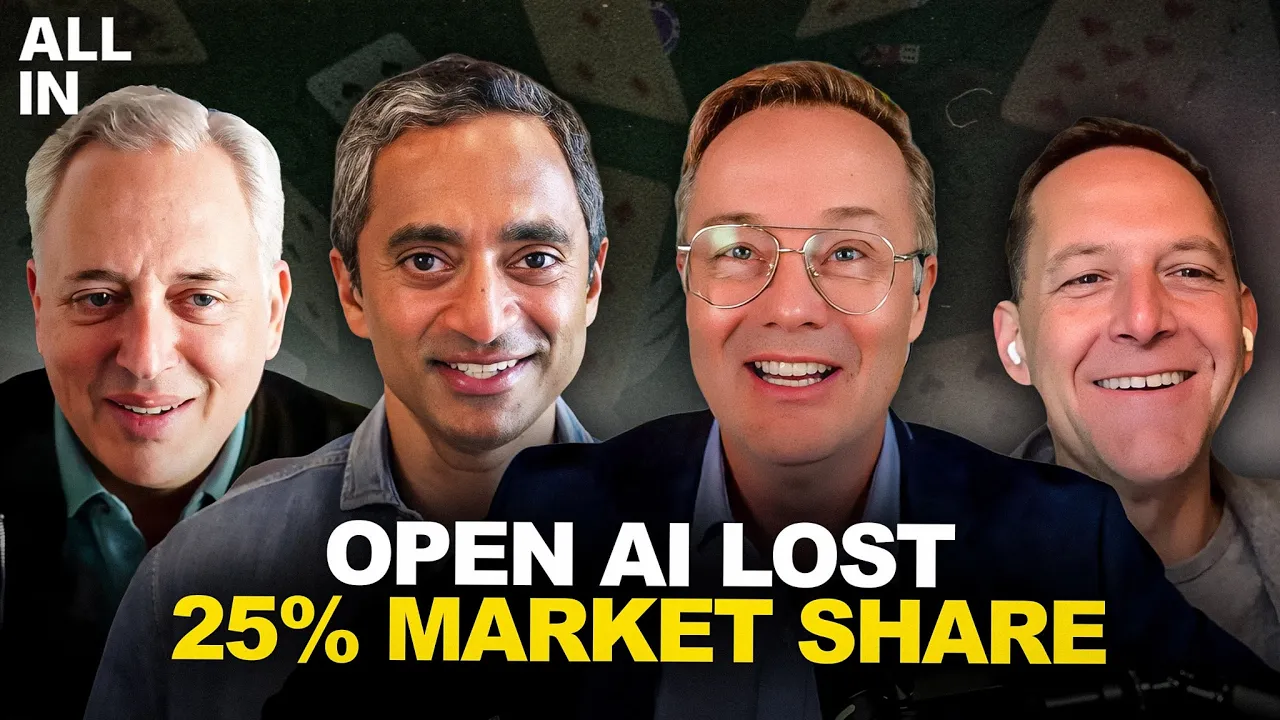
Anthropic Gains Ground as Meta Faces Landmark Jury Verdicts
All-In Podcast
Enterprise AI adoption and novel product-liability lawsuits are reshaping software valuations while stripping tech platforms of traditional Section 230 protections.
## Background
This video was published on YouTube by the All-In Podcast on March 27, 2026. According to the page description, the episode covers Anthropic's generational run, OpenAI's strategic focus, AI moats and valuation impacts, announcements for the Liquidity summit, landmark legal verdicts against Meta, and Sacks and Friedberg joining PCAST.
## TL;DR
The 'Besties' analyze Anthropic's rapid enterprise and product momentum in early 2026, contrasting it with OpenAI's realignment away from consumer side projects like Sora toward core market focus. They examine the macroeconomic compression of SaaS valuation multiples, the erosion of traditional brand moats, and the operational shift toward AI 'vibe coding.' The panel also debates the legal implications of multi-million dollar tort verdicts against Meta, parental controls versus platform liability, and concludes with David Sacks and David Friedberg discussing their official appointments to the President's Council of Advisors on Science and Technology (PCAST).
## Atmosphere & style
The episode features the signature banter, banter-driven political ribbing, and fast-paced venture capital debate typical of the 'Fantastic Four' hosts. The mood blends lighthearted humor—such as teasing Friedberg about a hypothetical California gubernatorial run and late-90s raves—with deep, intense technical analysis of macroeconomic tech trends and regulatory fights. Listening feels like sitting in on an insider Silicon Valley board discussion where high-stakes geopolitical strategy, personal accountability, and personal anecdotes seamlessly merge.
## Key takeaways
- [02:25](https://www.youtube.com/watch?v=4Gmd5UTF4rk&t=145s) Anthropic executes a massive operational and product run, adding roughly $6 billion in annual run rate in February 2026 driven by enterprise tools like Claude Co-work, Claude Code plugins, and Computer Use.
- [09:05](https://www.youtube.com/watch?v=4Gmd5UTF4rk&t=545s) OpenAI and Anthropic operate structurally inverse revenue models: OpenAI depends heavily on consumer ChatGPT subscriptions (~75%), whereas Anthropic derives the vast majority of its revenue (~75%+) from enterprise APIs and developer integrations.
- [16:18](https://www.youtube.com/watch?v=4Gmd5UTF4rk&t=978s) OpenAI consolidates product focus by canceling side projects—including its Sora short-video app and a planned $1B Disney integration—to aggressively defend and expand its enterprise market footprint against Anthropic.
- [27:01](https://www.youtube.com/watch?v=4Gmd5UTF4rk&t=1621s) Public software-as-a-service (SaaS) markets are undergoing a fundamental re-rating, shifting from long-dated speculative growth multiples toward strict free cash flow metrics due to the rapid disruption risks posed by agentic AI.
- [36:56](https://www.youtube.com/watch?v=4Gmd5UTF4rk&t=2216s) Traditional brand loyalty and complex software UI ecosystems face rapid erosion as consumer abundance and natural-language 'agentic shims' (strangulation as a service) replace single-purpose desktop applications.
- [46:57](https://www.youtube.com/watch?v=4Gmd5UTF4rk&t=2817s) AI product development is transitioning to high-velocity 'vibe coding,' compressing traditional multi-month software engineering cycles by multi-person teams down to hours or weekends for solo builders.
- [50:35](https://www.youtube.com/watch?v=4Gmd5UTF4rk&t=3035s) Meta suffers two landmark legal defeats in New Mexico ($375M) and Los Angeles, as plaintiffs' attorneys successfully bypass Section 230 immunity using product liability theories around algorithmic addiction and child exploitation.
- [58:51](https://www.youtube.com/watch?v=4Gmd5UTF4rk&t=3531s) The panel debates corporate product liability versus personal and parental agency, cautioning against excessive 'tort tax' litigation while examining global policy shifts like under-16 social media bans.
- [01:12:46](https://www.youtube.com/watch?v=4Gmd5UTF4rk&t=4366s) President Donald Trump officially appoints David Sacks (as co-chair) and David Friedberg to the President's Council of Advisors on Science and Technology (PCAST).
- [01:16:19](https://www.youtube.com/watch?v=4Gmd5UTF4rk&t=4579s) PCAST's industrial science strategy focuses on bridging the commercialization gap to counter China's rapid surge in peer-reviewed scientific output across physics, chemistry, and life sciences.
## Detailed walkthrough
### [00:00](https://www.youtube.com/watch?v=4Gmd5UTF4rk&t=0s) Bestie Intros and Friedberg for Governor
The episode kicks off with the four hosts—Jason Calacanis, David Sacks, Chamath Palihapitiya, and David Friedberg—reuniting for what Calacanis dubs the "Fantastic Four." Sacks is broadcasting from Texas after a whirlwind trip to Washington, D.C., where he got a mere three hours of sleep, teasing upcoming news regarding his role on the President's Council of Advisors on Science and Technology (PCAST) in the Trump administration. Calacanis pivots to Friedberg, whose virtual background resembles a scene straight out of *Thelma & Louise*. Calacanis jokingly connects the cinematic background to Friedberg's recent, widely retweeted rants over California's state budget and fiscal trajectory.
The hosts playfully banter about pushing Friedberg into California politics, labeling him "Dr. Doom" and urging him to consider running for governor of California. Calacanis argues that Friedberg could single-handedly rescue the fourth-largest economy in the world, while Chamath jokes that he is tempted to buy Friedberg's company, Ohalo, for $5 billion or $6 billion just to free up his schedule to run. Sacks chimes in on the dirty nature of state politics, lightheartedly offering "oppo research" on Friedberg: attending a rave in 1999 until 10:00 a.m., getting tilted during high-stakes poker games, stealing pistachios and Lactaid, and sprinting home.
---
[02:25](https://www.youtube.com/watch?v=4Gmd5UTF4rk&t=145s) Anthropic's Generational Run
The conversation transitions into core tech news, highlighting Anthropic's meteoric momentum over early 2026 compared to perceived stumbles at OpenAI. Calacanis lays out Anthropic's product timeline, noting how rapidly they have shipped significant enterprise features. In January, they launched *Claude Co-work* for business workflows—allowing users to automate background "cron jobs" directly across applications like Gmail and Notion—followed by the release of their flagship *Claude 3.5 Opus* / *Claude 4.6* models. Industry leaders like Jensen Huang and Michael Dell have praised the model, with Huang calling it a pivotal inflection point for agentic systems, and Dell noting it crossed a tangible productivity threshold for corporate engineering teams.
In February, Anthropic dropped a suite of Claude Code plugins that triggered sharp market reactions across software-as-a-service (SaaS) stocks—what the hosts label a mini "SaaS-pocalypse." Sacks quips that as a SaaS investor, his exit multiples felt the sting, though Calacanis notes Sacks likely divested at the right moment. Brad Gerstner had previously highlighted on the podcast that Anthropic added roughly $6 billion in annual run rate (ARR) in February alone. Anthropic then announced *Computer Use*, an enterprise-grade agentic system allowing users to remotely execute desktop tasks right from the mobile Claude app.
* **Product Rollouts**: Launch of Claude Co-work (January), major Opus model updates, Claude Code plugins (February), and mobile-to-desktop Computer Use.
* **Financial Velocity**: Added an estimated $6 billion in annual run rate during February 2026.
* **Industry Endorsements**: Jensen Huang designated their agentic architecture a major inflection point; Michael Dell validated enterprise team productivity gains.
---
[04:32](https://www.youtube.com/watch?v=4Gmd5UTF4rk&t=272s) Regulatory Capture, Ideology, and the Pentagon Clash
Sacks offers his perspective on Anthropic's run. While maintaining that he has always admired their engineering—crediting them for early innovations like the Model Context Protocol (MCP)—he analyzes their strategic bet on coding. Whether driven by AGI ideology or business savvy, focusing on code allowed Anthropic to pursue recursive self-improvement while simultaneously capturing lucrative enterprise IT budgets. Coding naturally expanded into broader productivity outputs (generating spreadsheets, slide decks, and agents), directly challenging single-desktop tools like OpenClaw.
However, Sacks reiterates his long-standing philosophical criticism regarding Anthropic's policy advocacy in Washington. He accuses them of pushing a heavy-handed "regulatory capture strategy" by advocating for strict government permissioning regimes around AI chips and model deployments. Sacks argues this creates artificial moats that protect incumbent frontier labs while pulling up the ladder on new entrants. Turning to Anthropic's recent public clash with the Department of War (Department of Defense), Sacks stresses that he stays out of military procurement matters, but quotes investor Emil Michael's pragmatic take: "If you as a company don't want your products to be used in war, don't sell to the Department of War." Calacanis and Sacks emphasize that Anthropic has been treated like any other supplier, despite political tensions between Anthropic's leadership and the Trump administration.
[07:19](https://www.youtube.com/watch?v=4Gmd5UTF4rk&t=439s) Talent War and Political Fracturing in AI
Calacanis brings up a popular Silicon Valley theory: Anthropic CEO Dario Amodei's vocal opposition to the current presidential administration might serve as a calculated talent retention play. Given that a vast majority of top-tier AI PhDs skew left-leaning, taking an overt anti-administration stance allows Anthropic to win over elite researchers. Friedberg agrees that the internal culture at Anthropic genuinely reflects these political views rather than being a superficial PR stunt, though it double-counts as a powerful recruiting mechanism.
Friedberg notes that AI is succumbing to the broader ideological polarization seen across modern society, where consumers and institutions split into left and right ecosystems. Just as media outlets, food brands, and consumer products have fractured along political lines, AI tools are developing political identities.
---
[09:05](https://www.youtube.com/watch?v=4Gmd5UTF4rk&t=545s) Revenue Recognition and OpenAI vs. Anthropic
Chamath pushes back against the narrative that OpenAI is falling behind, framing the tech media's framing as manufactured drama. While Anthropic dominates enterprise workflows (especially through platforms like 80/90), the two companies operate fundamentally different business models and revenue recognition methods. Chamath points out that comparing top-line figures without accounting for revenue mix creates an "apples-to-oranges" fallacy.
Referring to a breakdown of revenue structures, Chamath notes that OpenAI derives roughly three-quarters of its revenue from consumer ChatGPT subscriptions and one-quarter from API usage. Anthropic's revenue split is almost the inverse, powered heavily by API consumption, developer tools (Cursor, GitHub integration), and enterprise scale. Because consumer subscription models recognize revenue conservatively over time while API consumption metrics track gross volume run rates differently, head-to-head headlines mislead the public. Normalized, OpenAI remains the primary revenue generator in the space, even as Anthropic closes the gap rapidly.
[12:12](https://www.youtube.com/watch?v=4Gmd5UTF4rk&t=732s) Focus vs. Feature Creep and Media Hit Pieces
Chamath emphasizes the core lesson he, Sacks, and Friedberg give early-stage founders: relentless focus. He warns that when companies attempt to conquer every vertical simultaneously, they end up "smearing the peanut butter too far," risking operational friction and product fatigue.
Sacks highlights a recent media hit piece published in *The Lever* against Emil Michael, which alleged Michael had a conflict of interest in Department of War negotiations with Anthropic because he held shares in Perplexity. Sacks points out the claim makes zero technical sense, given that Perplexity is an LLM-agnostic search wrapper that routes queries across multiple underlying models and does not sell military hardware. Sacks notes that Michael's investment had already been cleared by the Office of Government Ethics, attributing the article to seasoned Washington political operatives hired by Anthropic to play "brass-knuckles" politics.
Calacanis highlights Perplexity's multi-model feature, "Model Council," which allows users to prompt three distinct LLMs simultaneously, compare variations in real time, and analyze discrepancies. Turning back to OpenAI, Calacanis examines their consumer market share trajectory. While OpenAI held 100% of the consumer LLM market in 2023, its market share dipped to 85% in 2024 and 75% in 2025. However, as Sacks and Chamath interject, because the overall pie of total global queries and users expanded exponentially over that period, OpenAI's absolute volume and revenue continue to climb sharply.
<ElicitationsGroup message="Explore related topics from this episode:">
<Elicitation label="Analyze Anthropic's Computer Use & Co-work impact on SaaS" query="Analyze how Anthropic's Computer Use and Claude Co-work tools are impacting SaaS companies and enterprise software budgets in 2026."/>
<Elicitation label="Deep dive into OpenAI vs Anthropic business models" query="Provide a deep dive breakdown comparing OpenAI's consumer subscription model against Anthropic's enterprise API revenue architecture."/>
</ElicitationsGroup>
[16:18](https://www.youtube.com/watch?v=4Gmd5UTF4rk&t=978s) OpenAI’s Consumer Market Pressures and the Cancellation of Sora
Jason Calacanis breaks down a strategic analysis from his *This Week in AI* team, arguing that ChatGPT’s consumer dominance is facing severe structural headwinds. While OpenAI is growing, three underrepresented tech giants—Apple, Meta, and Microsoft (Windows)—are positioned to intercept market share, likely dragging ChatGPT’s consumer share well below 50%.
Concurrently, OpenAI is shuttering side projects to consolidate focus. In major breaking news, the Sora short-video app has been canceled. This shift effectively kills a planned $1 billion investment and licensing arrangement with Disney, which intended to embed Sora into Disney+. Instead of spreading itself thin across consumer experiments, OpenAI is reputedly shifting resources toward chasing Anthropic’s footprint in the enterprise.
```
+-------------------------------------------------------------------------+
| OPENAI'S STRATEGIC REALIGNMENT |
+-------------------------------------------------------------------------+
| [ Sora Video App ] [ Disney Deal ] [ Enterprise Push ] |
| * Canceled * $1B deal voided * Direct focus to |
| * Side projects axed * Integration dead | chase Anthropic |
+-------------------------------------------------------------------------+
```
- OpenAI offered private equity investors a guaranteed minimum return of 17.5% in a joint venture designed to ease high upfront AI costs for services roll-ups.
- Private equity roll-ups are aggressively targeting sectors like accounting, legal, and business processing—a strategy championed by Josh Kushner, VC firms, and Chamath Palihapitiya’s software factory model at 80/90.
- OpenAI’s strategic tension centers on whether it is losing focus or prudently pivoting toward monetizable enterprise clients.
---
[18:36](https://www.youtube.com/watch?v=4Gmd5UTF4rk&t=1116s) Debate: Monetizing Consumer AI vs. Winning the Enterprise
Chamath Palihapitiya pushes back on the narrative that OpenAI is losing consumer mindshare, highlighting how habits form early. He observes his own children's reliance on ChatGPT for cold navigation queries, noting that even when nudged toward Google Gemini, they revert to ChatGPT due to brand familiarity. Conversely, enterprise teams naturally default to Anthropic when tackling complex workplace challenges.
Chamath believes segregating the market is natural and healthy. Winning consumer AI alone yields a multi-trillion-dollar business. However, competing everywhere risks operational confusion because enterprise and consumer products demand fundamentally different features, security guarantees, and execution models.
> "If I was OpenAI and you had to pick one thing, you would pick consumer because they're the juggernaut and they're the clear leader, and they have an enormous brand." — **Chamath Palihapitiya**
Jason counters that consumer AI queries could soon be driven to a zero-dollar marginal cost. With Apple, Google, Microsoft, and Meta poised to bundle free AI tools into their ecosystems, ChatGPT risks losing its subscriber monetization engine.
- **Paid Consumer Base:** ChatGPT commands roughly 50 million paid subscribers out of approximately 900 million to 1 billion overall users (a ~5% conversion rate).
- **Subscription Benchmarks:** Spotify counts ~290 million subscribers, while Netflix reaches ~325 million paid users.
- **Consumer Pricing Potential:** Chamath argues an all-in-one AI assistant (handling travel, email, calendar, and finances) could command $80–$100 a month—surpassing traditional mobile or cable bills in priority.
---
[23:03](https://www.youtube.com/watch?v=4Gmd5UTF4rk&t=1383s) Business Models: Ad-Supported Interfaces and Google’s Moat
David Sacks offers an investor’s perspective, noting a historical preference for B2B models over B2C due to higher stickiness, upsells, and net dollar retention exceeding 100%. Consumer models suffer from higher churn and lower willingness to pay. Nevertheless, consumer juggernauts like Meta, Google, and Apple demonstrate that consumer-first models create top-tier market caps when paired with ads or hardware ecosystems.
As AI search displaces traditional search engine result pages (SERPs), ad-supported models will evolve from "10 blue links" to direct in-chat monetization.
```
+-------------------------------------------------------------------------+
| EVOLUTION OF SEARCH MONETIZATION |
+-------------------------------------------------------------------------+
| Legacy Web Search (Google) ---> 10 Blue Links + Keyword Ads |
| AI Chat Interfaces ---> Contextual In-Chat Embedded Ads |
+-------------------------------------------------------------------------+
```
- Google holds a structural advantage in agentic AI because users already trust its ecosystem with their email, calendar, and documents.
- Google’s massive free cash flow allows it to separate Google Cloud Platform (enterprise) from Google Consumer without taking on the heavy dilution or fundraising burdens confronting AI startups.
- Google has launched *Workspace Studio* to directly counter open-source and third-party AI automation tools like OpenClaw.
---
[27:01](https://www.youtube.com/watch?v=4Gmd5UTF4rk&t=1621s) Private Equity, Change Management, and the SaaS Valuation Realignment
Addressing the growing involvement of private equity (PE) in AI deployment, David Sacks highlights that PE firms are attempting to capture the value of *change management*. A McKinsey study reveals that roughly 95% of enterprise AI pilots fail to achieve their intended targets. Merely throwing AI over the wall does not make a legacy company efficient; PE firms believe that by acquiring businesses directly (hospitals, accounting practices, business processing hubs), they can enforce operational transformation.
Chamath connects this to a larger macroeconomic thesis regarding public market valuations. If superintelligence is on the horizon, creating infinite abundance and continuous technological disruption, then long-term enterprise cash flows become fragile. Traditional Price-to-Earnings (P/E) ratios assume business stability 15 to 20 years out.
> "If every business gets disrupted every 5 or 6 years, all you're going to end up with is just the cash. And so what should employees do? The rational reaction from employees will say, 'You know what? I don't want your equity. Give me more money.'" — **Chamath Palihapitiya**
| Company | 2023 Market Cap / Free Cash Flow Multiplier | Current Valuation Status |
|:--- |:--- |:--- |
| **Snowflake** | ~100x | Cut in half |
| **ServiceNow** | Elevated growth multiple | Re-rating lower |
| **Atlassian** | High multiple based on equity growth | Re-rating lower |
| **Workday** | Extended cash flow payback window | Re-rating lower |
This compression in valuation multiples—dubbed the "SaaS Apocalypse"—reflects public markets adjusting from speculative earnings multiples toward tangible cash-on-hand metrics. As a consequence, startup employee compensation models may shift permanently away from long-dated equity upside toward immediate cash compensation.
<ElicitationsGroup message="Explore related topics from the All-In Podcast discussion:">
<Elicitation label="Analyze the SaaS valuation re-rating trend" query="Analyze the recent market valuation trends for SaaS companies, focusing on free cash flow multiples, enterprise disruption risks from AI, and employee compensation shifts."/>
<Elicitation label="Break down OpenAI's enterprise vs. consumer strategy" query="Provide a detailed breakdown of OpenAI's strategy competing against Anthropic in the enterprise while maintaining consumer market share against Google and Meta."/>
</ElicitationsGroup>
[32:16](https://www.youtube.com/watch?v=4Gmd5UTF4rk&t=1936s) AI Valuations, Market Reset, and the Search for Durable Moats
The discussion opens with an analysis of the public market reset as investors re-evaluate tech valuations in light of impending superintelligence. While high-margin hyper-performers like Nvidia are seeing their multiples compressed alongside SaaS companies like ServiceNow and Snowflake, the "Mag 6" mega-caps (Apple, Microsoft, Meta, Alphabet) continue to command a heavy premium based on the belief that their massive cash flows are monopolistically durable.
Friedberg points to the LP presentation deck from Thoma Bravo as evidence of selective market dispersion. Established enterprise incumbents with strong beachheads, existing customer relationships, and quality leadership are not sitting idly by to let AI delete their value; rather, they are aggressively embedding AI agents into their products. The real economic unlock will come from complex businesses using AI tools to achieve a 10x multiplier on operational output using their existing labor force and capital equipment.
- **Market Dynamics:** Discount rates across software and traditional tech have surged due to uncertainty surrounding terminal growth rates in an AI-dominated landscape.
- **HALO Portfolio:** Friedberg highlights the "High Asset, Low Obsolescence" strategy—investing in physical-world assets like natural gas production (e.g., Cheniere Energy) or real-world physical experiences like Disneyland that are insulated from AI disruption.
- **Lunar Economy:** Friedberg projects a $15 to $30 trillion annual economic opportunity on the Moon over the next several decades, positioning space exploration companies like SpaceX for massive valuation multiples.
[36:56](https://www.youtube.com/watch?v=4Gmd5UTF4rk&t=2216s) The Erosion of Brand Moats and the Shift to "Strangulation as a Service"
Sacks, Chamath, and Jason debate traditional competitive moats—brands, network effects, and management strength—in an era of digital abundance. Sacks references Warren Buffett’s principle that a truly great business must be strong enough to be run by monkeys, noting that agentic AI further tests the defense of management quality.
Chamath provocatively argues that traditional brand equity is headed to zero. As cheaper, faster, and superior alternatives emerge, consumer desire for abundance overrides brand loyalty. He points to how Tesla disrupted legacy automakers like BMW, Mercedes, and Porsche, alongside the aggressive expansion of Chinese EV makers like BYD and Geely. The decline in pricing power is visible even among elite luxury brands like LVMH and Ferrari.
The conversation pivots to the concept of "strangulation as a service." Enterprise software users no longer want to navigate complex UIs or walls of application icons; instead, they prefer an agentic shim where they simply state their intent, leaving autonomous background agents to handle the underlying complexity. Sacks notes that while simple interface points may replace dense app ecosystems, users will still require visual dashboards to monitor real-time outputs (such as viewing a map tracking an Uber ride).
- **Consumer Staples & Hardware:** Apple's recent hardware strategy highlights this shift toward accessible value, evidenced by the release of the $600 MacBook Neo.
- **Disruption Risks:** Search incumbents face constant shifts (e.g., Google’s Gemini adaptation), while mobile OS paradigms risk obsolescence if personal AI agents completely bypass native app navigation.
[43:58](https://www.youtube.com/watch?v=4Gmd5UTF4rk&t=2638s) The All-In Liquidity Summit Announcements
Transitioning from macro thesis to pod logistics, Jason and Chamath preview the upcoming *Liquidity* conference taking place from May 31st to June 3rd. The hosts share lighthearted banter over the venue's location in California, joking about state tax residency rules and avoiding overnight stays.
Chamath details the high-profile speaker lineup he curated for the event's ten featured slots. Joining previously announced guests Dan Loeb and Sarah Friar are Pershing Square's Bill Ackman and AI researcher Andrej Karpathy. Karpathy will deliver a presentation on the future of AI followed by a detailed fireside discussion, covering topics such as recursive AI loops and autonomous software development.
<ElicitationsGroup message="Explore related discussions from this All-In Podcast episode:">
<Elicitation label="Analyze Anthropic's generational run vs. OpenAI" query="What did the All-In Podcast hosts discuss regarding Anthropic's generational run and OpenAI's strategy in this episode?"/>
<Elicitation label="Summarize the Meta social media trial verdicts" query="What were the details and takeaways from the landmark social media verdicts against Meta discussed on the All-In Podcast?"/>
</ElicitationsGroup>
[46:57](https://www.youtube.com/watch?v=4Gmd5UTF4rk&t=2817s) The Shift to AI "Vibe Coding" and Sudden Compressed Timelines
The discussion kicks off with an illustration of how rapidly artificial intelligence is compressing product development lifecycles inside modern tech companies. Rather than spending months of planning and deploying entire teams, leaders are now using AI tools to build and optimize software in days or over a single weekend. One executive highlighted how he casually wrote a replacement for his company's internal HRIS system after having a glass of wine on a Sunday. When he later expressed dissatisfaction with their website being stuck in "80/90" status, his team "vibe coded" a brand-new website overnight. They subsequently fed it into automated optimization research, doubling the click-through rate almost immediately. Tasks that previously demanded tens of software engineers and many man-months of work are now executed instantaneously by small teams leveraging shared playbooks and open recipes, such as those published by growth leaders at OpenAI.
This operational shift has left the hosts feeling disoriented by the sheer pace of change. Jason Calacanis shared a personal anecdote about purchasing the domain name `annotated.com` fifteen years prior for $4,000 with the goal of building a highlight-and-comment web bookmarking service. After years of chatting with developers about building it, he sat down and vibe coded the entire Chrome extension himself over a single weekend. The besties described this new reality as feeling less like traditional software engineering and more like a "Star Trek replicator"—where simply stating an idea causes a fully functional product to manifest instantly.
Looking back at historical tech waves, the panel contextualized the magnitude of the current AI boom:
* **The First Internet Wave:** Chamath Palihapitiya recalled working as a derivatives trader in Toronto during the late 1990s, watching the dot-com boom from the outside. He landed a job at Winamp ("the original iTunes"), which got him "to the beach with a surfboard," even though it didn't yield a direct financial windfall.
* **The Mobile and Social Wave:** Chamath successfully capitalized on the shift to mobile and social media in the 2000s, but emphasized that the current AI wave feels **100 times larger**—describing it as a massive, intimidating tsunami akin to big-wave surfing at Nazaré, Portugal.
* **Historic Milestones:** Jason pointed to seeing a PC for the first time, encountering the Mosaic web browser in the early 1990s, and the launch of the original iPhone as the only equivalent inflection points in modern technology.
---
[50:35](https://www.youtube.com/watch?v=4Gmd5UTF4rk&t=3035s) Landmark Social Media Verdicts and the "Tort Tax" Debate
The conversation pivots to a rough week for Meta CEO Mark Zuckerberg, following two major legal losses for the tech giant in rapid succession:
1. **New Mexico Child Exploitation Verdict:** A New Mexico jury ordered Meta to pay **$375 million in damages** after finding the company liable for allowing child predators to target minors on Facebook and Instagram. The state Attorney General's office conducted an undercover operation creating fake child profiles that were rapidly contacted by predators. During the trial, a former Meta engineer testified as a whistleblower that his own 14-year-old daughter had received sexual solicitations on Instagram.
2. **Los Angeles Mental Health & Addiction Verdict:** An LA jury found both Meta and YouTube negligent for intentionally designing addictive platform features—such as push notifications and algorithmic feeds—that harmed a young user's mental health. The 20-year-old female plaintiff, who began using YouTube at age six and Instagram at age nine, testified that her compulsive use caused severe depression, anxiety, and body image issues, resulting in a multi-million dollar award.
> "Tort litigation costs our economy $900 billion a year in the United States... It's 3% of GDP and it's growing roughly 10% per year."
David Friedberg took a contrarian stance against the popular outrage, warning against the economic drag of runaway product liability litigation in America. He noted that tort litigation functions as an invisible "tort tax" that reduces R&D spending, stifles innovation, and restricts new product launches across all sectors. While acknowledging that social media can cause harm to minors, Friedberg argued that society systematically avoids discussing personal and parental responsibility. He questioned whether sugarcane farmers should be sued for diabetes or soda companies for obesity, arguing that parents must take ownership of their children's digital habits rather than blaming corporate liability or government failure.
Jason countered by citing historical corporate misconduct precedents—such as tobacco companies (RJR Nabisco) concealing cigarette addiction, auto manufacturers delaying seatbelt adoption, asbestos suppliers, and lead paint manufacturers. He asserted that when corporations knowingly suppress internal safety data and double down on addictiveness for profit, legal liability and strict regulation (such as age-gating to 16, explicit labeling, and warning signs) are entirely justified.
---
[58:51](https://www.youtube.com/watch?v=4Gmd5UTF4rk&t=3531s) Personal Responsibility vs. Corporate Liability: AI Chat Apps in Education
The besties debated the political dynamics driving massive legal payouts, with Friedberg highlighting that trial lawyers represent one of the largest political donor classes in the United States—funding local Democrats, national Republicans, and judicial election campaigns. He cautioned against creating a nanny state where regulations strip away personal agency, pointing out that learning to filter incoming digital noise is a core skill for human success in the AI age.
David Sacks noted that trial lawyers are actively trying to frame Meta as the next RJR Nabisco, but emphasized that social networking is fundamentally different from smoking, which is manifestly harmful to everyone regardless of age. Sacks argued that the benefits and harms of software platforms are far more subjective, making parental empowerment tools (such as native screen-time limits and app install controls) a superior solution to outright bans.
```
+-----------------------------------------------------------------------------------+
| THE REGULATORY FORK IN THE ROAD |
+------------------------------------+----------------------------------------------+
| LEGISLATED BANS & TORT LIABILITY | PARENTAL EMPOWERMENT & AGENCY |
+------------------------------------+----------------------------------------------+
| • Multi-million dollar jury awards | • Granular parental controls & screen limits |
| • Government-mandated age barriers | • Fostering early digital/AI literacy |
| • Risk of chilling product R&D | • Individual & family accountability |
+------------------------------------+----------------------------------------------+
```
The debate extended to emerging calls from parent groups attempting to ban teenagers from using AI chat applications following isolated cases of self-harm. Sacks strongly opposed restricting access to AI tools:
* **AI Literacy as an Educational Necessity:** Sacks highlighted that his own 10-year-old son uses ChatGPT for research, arguing that early exposure is vital for children to become "AI natives" equipped with 21st-century skills.
* **Global Geopolitical Stance:** Pointing to China's aggressive integration of AI into its K-12 education curriculum, Sacks warned that banning American youth from interacting with AI applications would be a disastrous mistake.
* **Causation Gaps:** He argued that trial lawyers are exaggerating platform harms for financial gain, noting that in the LA Meta trial, evidence showed the plaintiff came from a complex background with pre-existing personal issues that complicated claims of direct legal causation.
The Besties analyze Meta's recent double loss in court, debating whether these landmark cases signal a dangerous precedent set by aggressive trial lawyers or a necessary reckoning for tech platforms. David Sacks warns against turning social media into the "next big tobacco," arguing that suing platforms over free, voluntary services sets a slippery slope. If a platform is held liable for a user's emotional distress or body image issues, he asks, will Spotify soon be sued because a user created a sad playlist that worsened their depression? He points out that in the Los Angeles individual trial—where a 20-year-old plaintiff was awarded millions—the plaintiff's personal background included a history of being abandoned by her father and body-shamed by her mother, making it unfair to scapegoat social media entirely.
```
LEGAL & REGULATORY DASHBOARD (2026)
┌─────────────────────────────────────────────────────────────────────────┐
│ RECENT VERDICTS AGAINST META │
├─────────────────┬───────────────────┬───────────────────────────────────┤
│ Jurisdiction │ Award │ Primary Legal Vector │
├─────────────────┬───────────────────┬───────────────────────────────────┤
│ Los Angeles, CA │ $3M to $6M │ Product Liability / Body Image │
│ New Mexico │ $375 Million │ Child Exploitation / Platform Law │
└─────────────────┴───────────────────┴───────────────────────────────────┤
```
Chamath Palihapitiya counters by drawing a line between AI products and fast-switching social media algorithms. While AI chat applications can be architected with "cul-de-sacs" to safely handle topics like self-harm, social media algorithms are explicitly designed for hyper-engagement and rapid dopamine hits. The critical breakthrough for trial lawyers in these two cases was successfully navigating around Section 230 immunity by using product liability framing rather than content moderation claims. Chamath predicts this creates a roadmap for a "death by a thousand cuts" against mega-cap tech giants.
- **Los Angeles Trial:** Individual lawsuit resulting in a **$3 million to $6 million** payout to a young woman over social media's impact on her mental health.
- **New Mexico Verdict:** A massive **$375 million** penalty centered primarily on child exploitation issues.
- **Section 230 Evasion:** Plaintiffs' attorneys successfully utilized **product liability language** to circumvent historical tech protections.
- **Academic Correlations:** Extensive studies confirm that **2 to 3 hours per day** of social media usage correlates heavily with depression, anxiety, and eating disorders, particularly among teenage girls.
- **Chamath's Historical Warning:** Chamath references his famous 2017–2018 Stanford talk where he publicly stated he banned his own kids from social media, which lost him several friends at Facebook at the time.
> "If social media is making you feel bad, if listening to the wrong playlist is making you feel bad, then stop doing it. But what's going on here, I think, is the trial lawyers are trying to create the next big tobacco." — **David Sacks**
---
[01:06:44](https://www.youtube.com/watch?v=4Gmd5UTF4rk&t=4004s) The Parenting Battleground: Screen Time, Kill Switches, and School Backdoors
The discussion shifts to practical parenting challenges and the absolute failure of existing digital safeguards. Chamath calls COPPA (Children's Online Privacy Protection Act) compliance a complete "nothing burger," joking that a six-year-old can "vibe code their way around it" and noting that age verification systems are currently broken—it is ironically harder to get verified on adult sites than it is to bypass age restrictions on platforms like Facebook. The group expresses a desire for hardware-level "kill switches" for kids under 16 or 18, but acknowledges how hard it is to enforce rules inside the home when public schools mandate Chromebooks. Parents lock down personal devices only to find their kids using school-issued laptops as a backdoor to watch YouTube Shorts while claiming to do homework.
```
GLOBAL AGE RESTRICTION TRENDS (SOCIAL MEDIA UNDER 16)
┌────────────────────────────────────────────────────────────────────────┐
│ ENFORCED NATIONWIDE BAN │
│ ├── Australia │
│ └── Malaysia │
│ │
│ PENDING LEGISLATION │
│ ├── Spain │
│ ├── Germany │
│ └── United Kingdom │
└────────────────────────────────────────────────────────────────────────┘
```
Jason Calacanis advocates for structural solutions pushed down by handset manufacturers like Apple and Google, as well as phone lockers in middle and high schools (referencing guest Jonathan Haidt's recommendations). Meanwhile, Sacks highlights the extreme social pressure teenagers face. Despite setting strict family rules—no Instagram or TikTok until 16—he had to compromise on Snapchat when his kids reached high school to avoid complete social isolation. He also shares a practical tip for managing kids' headphone usage: replacing over-ear headphones with open-ear bone-conduction headphones like **Shox**, allowing kids to listen to audiobooks while remaining aware of their surroundings.
- **Global Policy Shifts:** **Australia** and **Malaysia** have already enforced strict under-16 social media bans, with **Spain, Germany, and the UK** moving in the same direction.
- **School Backdoors:** Mandatory school Chromebooks act as an unmonitored channel for algorithms, as students bypass home device restrictions via YouTube Shorts.
- **Social Compromise:** Sacks outlines his household tiering: **Snapchat allowed in high school**, but **Instagram and TikTok banned until age 16**.
- **Federal AI Framework:** Sacks reveals the White House's latest AI framework explicitly supports improved **age assurance technology** and standardized parental controls.
> "Our rule is you cannot get Instagram or TikTok until you're 16... But then high school comes around: 'Oh, we need Snapchat.' 'No, you don't.' 'Okay, great. We'll have no friends. Thanks a lot. We'll just sit here in our room dark in there.'" — **David Sacks**
The episode concludes with major political news: President Donald Trump has officially appointed **David Sacks** and **David Friedberg** to the **President's Council of Advisors on Science and Technology (PCAST)**. Sacks explains that his initial 130-day term as a Special Government Employee (SGE) advising on AI and crypto expired, leading to his new role co-chairing PCAST alongside **Michael Kratsios** (Director of the Office of Science and Technology Policy). While his previous scope was strictly AI and crypto, PCAST allows him to advise the President across a broader frontier, including nuclear power, quantum computing, advanced semiconductors, and biotechnology.
```
PCAST LEADERSHIP STRUCTURE
┌─────────────────────────────────────────────────────────────────────────┐
│ CO-CHAIRS │
│ ├── David Sacks (Tech Advisor) │
│ └── Michael Kratsios (Director, OSTP) │
│ │
│ NOTABLE MEMBERS & INDUSTRY BUILDERS │
│ ├── David Friedberg ├── Jensen Huang │
│ ├── Marc Andreessen ├── Lisa Su │
│ ├── Sergey Brin ├── Mark Zuckerberg │
│ └── Larry Ellison └── Michael Dell │
└─────────────────────────────────────────────────────────────────────────┘
```
Jason addresses minor public critiques that the council is heavily stacked with tech executives rather than pure academic scientists. Sacks vigorously defends the roster, emphasizing that having "doers and builders"—people like Marc Andreessen (who created the first web browser) and Jensen Huang (who invented the modern GPU)—is vital when shaping national policy around advanced hardware and commercialization. Friedberg traces PCAST’s historical roots back to Franklin D. Roosevelt during the dawn of nuclear physics and quantum mechanics, noting that America faces a strikingly similar inflection point today in its intense technological race against China.
- **PCAST Roots:** Traces back to FDR’s administration during the rise of quantum mechanics and nuclear physics.
- **Scientific Roster:** Sacks points out the council includes world-class experts, including a **Nobel Laureate in Physics**.
- **US vs. China Scientific Output:** Friedberg highlights the urgency of the moment, pointing out that 10 years ago, China was publishing only 50% of the volume of scientific research papers compared to the US, a gap that has rapidly closed today.
> "Look back at PCAST, it's kind of rooted in FDR when he formed this Council of Advisors on science when nuclear physics and quantum mechanics was starting to reinvent what was possible in the world. We're sort of at a similar era today because arguably AI is reinventing what is possible." — **David Friedberg**
<ElicitationsGroup message="Explore related topics from this episode:">
<Elicitation label="Analyze the legal mechanics of defeating Section 230 using product liability" query="Analyze the legal mechanics of how trial lawyers used product liability to defeat Section 230 protections in the 2026 Meta lawsuits."/>
<Elicitation label="Compare global social media age-restriction laws" query="Provide a detailed comparison of social media age-restriction legislation in Australia, Malaysia, the EU, and the US as of 2026."/>
</ElicitationsGroup>
[01:16:19](https://www.youtube.com/watch?v=4Gmd5UTF4rk&t=4579s) China's Scientific Surge and the Need for Industrial Science Policy
Addressing the rationale behind appointment choices for PCAST (President's Council of Advisors on Science and Technology), Bill Friedberg outlines the intense global competition facing the United States, particularly from China. He notes a stark shift in academic and scientific output: just eight years prior, the U.S. and China published roughly equal numbers of peer-reviewed journal papers. However, China published 50% more scientific papers than the U.S. across major domains including physics, chemistry, materials science, and life sciences.
Friedberg notes that the technological race extends far beyond basic discovery—it is now centered on the rapid industrialization of breakthroughs. While China was historically viewed as a copycat or manufacturing hub in sectors like biotechnology, it is rapidly establishing leadership in cutting-edge life sciences and AI. He warns that failing to lead could allow China to dominate global industries like pharmaceuticals and foundational computing technology. Placing industrial science and technology leaders on PCAST is framed as a crucial strategic choice to ensure America accelerates its deployment of critical technologies.
- **Scientific Output Disparity:** China's peer-reviewed journal publications outpaced U.S. volume by 50% in the preceding year.
- **Key Disciplines Impacted:** Physics, chemistry, materials science, biochemistry, and general life sciences.
- **D.C. Energy & Policy Shift:** Observations from the Hill and Valley Forum indicate an intense bipartisan focus in Washington on countering China's technological momentum.
[01:17:48](https://www.youtube.com/watch?v=4Gmd5UTF4rk&t=4668s) PCAST Structure, Future Appointments, and Sign-off
The conversation shifts into lighthearted banter as Jason Calacanis jokes about Chamath Palihapitiya joining a hypothetical "President's Advisory Council on Bomb Pots and Wagering," while Chamath quips about waiting for a "President's Council on Podcasting" featuring himself and Lex Fridman.
David Sacks returns to the serious framing of PCAST, expressing gratitude to the President for the appointment to co-chair the council. He provides historical context, noting that the modern formulation of the council traces back over 30 years to its creation under President George H.W. Bush in 1990. Sacks highlights that the current approach specifically favors practical "builders and doers" to address urgent gaps in national industrial policy. Out of a maximum capacity of 24 spots, 15 members have been named so far, leaving open the possibility of a second round of appointments by the President to cover remaining domain expertise. The episode concludes with the co-hosts wrapping up the broadcast over the show's signature outro track.
- **PCAST Historical Origin:** Re-established in its modern council formulation in 1990 under President George H.W. Bush.
- **Council Capacity:** 15 initial members named out of a maximum of 24 total advisory slots.
## Notable quotes
> [04:32](https://www.youtube.com/watch?v=4Gmd5UTF4rk&t=272s) If you as a company don't want your products to be used in war, don't sell to the Department of War. — Emil Michael
> [18:36](https://www.youtube.com/watch?v=4Gmd5UTF4rk&t=1116s) If I was OpenAI and you had to pick one thing, you would pick consumer because they're the juggernaut and they're the clear leader, and they have an enormous brand. — Chamath Palihapitiya
> [27:01](https://www.youtube.com/watch?v=4Gmd5UTF4rk&t=1621s) If every business gets disrupted every 5 or 6 years, all you're going to end up with is just the cash. And so what should employees do? The rational reaction from employees will say, 'You know what? I don't want your equity. Give me more money.' — Chamath Palihapitiya
> [50:35](https://www.youtube.com/watch?v=4Gmd5UTF4rk&t=3035s) Tort litigation costs our economy $900 billion a year in the United States... It's 3% of GDP and it's growing roughly 10% per year. — David Friedberg
> [01:01:42](https://www.youtube.com/watch?v=4Gmd5UTF4rk&t=3702s) If social media is making you feel bad, if listening to the wrong playlist is making you feel bad, then stop doing it. But what's going on here, I think, is the trial lawyers are trying to create the next big tobacco. — David Sacks
> [01:06:44](https://www.youtube.com/watch?v=4Gmd5UTF4rk&t=4004s) Our rule is you cannot get Instagram or TikTok until you're 16... But then high school comes around: 'Oh, we need Snapchat.' 'No, you don't.' 'Okay, great. We'll have no friends. Thanks a lot. We'll just sit here in our room dark in there.' — David Sacks
> [01:12:46](https://www.youtube.com/watch?v=4Gmd5UTF4rk&t=4366s) Look back at PCAST, it's kind of rooted in FDR when he formed this Council of Advisors on science when nuclear physics and quantum mechanics was starting to reinvent what was possible in the world. We're sort of at a similar era today because arguably AI is reinventing what is possible. — David Friedberg
## Mentioned
Jason Calacanis, David Sacks, Chamath Palihapitiya, David Friedberg, Anthropic, OpenAI, Meta, Google, Apple, Microsoft, Claude Co-work, Claude 3.5 Opus, Claude 4.6, Claude Code, Computer Use, OpenClaw, Jensen Huang, Michael Dell, Dario Amodei, Emil Michael, Perplexity, Model Council, Sora, Disney, Disney+, Josh Kushner, 80/90, Spotify, Netflix, Workspace Studio, McKinsey, Snowflake, ServiceNow, Atlassian, Workday, Nvidia, Thoma Bravo, Cheniere Energy, SpaceX, BYD, Geely, LVMH, Ferrari, MacBook Neo, Dan Loeb, Sarah Friar, Bill Ackman, Andrej Karpathy, annotated.com, Mosaic, iPhone, Facebook, Instagram, YouTube, RJR Nabisco, COPPA, Shox, PCAST, Donald Trump, Michael Kratsios, Marc Andreessen, Sergey Brin, Larry Ellison, Mark Zuckerberg, Lex Fridman
The All-In Podcast hosts argue that rapid advances in artificial intelligence are realigning tech business models and compressing software valuations, while tech giants confront mounting regulatory and legal challenges.
Anthropic's Enterprise Surge and OpenAI's Realignment (2:25)
Anthropic experienced rapid product momentum in early 2026, shipping enterprise tools such as Claude Co-work, Claude Code plugins, and desktop-controlling Computer Use, alongside adding an estimated $6 billion in annual run rate in February alone. In response to competitive pressures, OpenAI consolidated its focus by shuttering peripheral projects—including canceling its Sora short-video app and an associated $1 billion Disney partnership—to target monetizable enterprise customers.
Chamath Palihapitiya cautions against treating top-line comparisons as a direct horse race, noting structural differences in revenue recognition. OpenAI derives roughly 75% of its revenue from consumer ChatGPT subscriptions recognized over time, while Anthropic generates over 75% from developer APIs and enterprise tooling tracked via gross usage volumes. Jason Calacanis warns that OpenAI’s consumer share faces compression from ecosystem incumbents like Apple, Google, and Meta offering free bundled alternatives.
Multiple Compression and the SaaS Disruption Risk (27:01)
The rapid democratization of software creation—demonstrated by non-technical builders and lean teams rapidly deploying software via AI coding workflows—is destabilizing traditional software multiples. Multiples for high-flying cloud firms such as Snowflake, ServiceNow, Atlassian, and Workday have compressed downward as public markets adjust for shortened product life cycles and fragile terminal growth assumptions.
Chamath Palihapitiya highlights that if generative AI disrupts businesses every five to six years, long-term price-to-earnings valuations break down, pushing employees to prioritize immediate cash compensation over equity upside. Simultaneously, enterprise software is threatened by agentic shims that let users execute tasks via natural language rather than maintaining subscriptions across siloed graphical user interfaces, while private equity firms increasingly acquire legacy businesses to capture the operational gains of AI transformation directly.
Tort Liability Pierces Platform Defenses (50:35)
Meta suffered two landmark courtroom defeats: a $375 million verdict in New Mexico over child exploitation vulnerabilities, and a multi-million-dollar jury award in Los Angeles holding Meta and YouTube negligent for designing addictive algorithmic feeds that damaged a youth plaintiff's mental health. Plaintiffs' attorneys successfully bypassed historical Section 230 protections by framing their claims around product liability and design defects rather than content moderation.
David Friedberg criticizes the expanding scope of tort litigation, describing it as an annual $900 billion drag on the U.S. economy that chills research and diminishes personal and parental responsibility. Conversely, Calacanis compares the verdicts to historic corporate liability battles involving tobacco and lead paint, arguing that punitive damages are justified when companies knowingly optimize addictive platforms at the expense of minor safety.
National Science Policy and China Tech Competition (72:46)
President Trump appointed hosts David Sacks and David Friedberg to the President's Council of Advisors on Science and Technology (PCAST), alongside industry leaders including Jensen Huang, Lisa Su, Marc Andreessen, and Michael Dell. Sacks defended the selection of commercial technology executives alongside academic scientists, arguing that federal policy requires practical builders to steer advanced commercialization in semiconductors, quantum computing, and biotechnology.
Friedberg warns that the United States faces severe technological competition from China, which has transitioned from being a manufacturing copycat to publishing 50% more peer-reviewed scientific papers than the U.S. across physics, materials science, and biochemistry. He argues that securing national dominance requires an assertive industrial science policy focused on the rapid translation of lab breakthroughs into scaled production.
The hosts emphasize that the acceleration of agentic AI will dismantle traditional software moats and reshape enterprise workflows. However, the exact boundaries of platform liability remain unresolved as courts test product liability theories against tech platforms and federal advisors grapple with intensifying technological competition from China.
精炼阅读摘要
《All-In Podcast》四位主持人探讨了 Anthropic 凭借企业级落地与编程代理实现的势头逆转,分析了 OpenAI 收缩边缘项目、软件行业因智能体普及面临的估值重置,并辩论了 Meta 司法败诉引发的平台责任边界与白宫顾问委员会应对中美科技竞赛的布局。
AI双雄分化与商业模式之争 (2:25)
Anthropic 凭借 Claude Co-work、Opus 模型及 Claude Code 插件在企业端形成显著势头。据投资人 Brad Gerstner 在节目中提供的数据,该公司仅在 2026 年 2 月就新增了约 60 亿美元的年化经常性收入(ARR),英伟达 CEO 黄仁勋与戴尔科技 CEO 迈克尔·戴尔亦公开赞赏其智能体架构显著提升了研发效率。作为应对,OpenAI 正在收缩旁支业务以全力聚焦企业级市场,近期取消了 Sora 短视频独立应用,并中止了原计划与迪士尼价值 10 亿美元的授权整合交易。
针对两家巨头的长远竞争,Chamath Palihapitiya 指出双方商业模式与收入确认方式存在本质差异:OpenAI 约 75% 的收入来自消费级 ChatGPT 订阅,而 Anthropic 约 75% 以上来自企业 API 及开发者工具调用。Jason Calacanis 预测,随着苹果、Meta 与微软将免费 AI 嵌入操作系统生态,ChatGPT 的消费端市场份额或被压缩至 50% 以下;Chamath 则认为消费者已建立深厚品牌认知习惯,未来整合日历、邮件与财务的全能个人助手甚至具备每月 80 至 100 美元的定价潜力。此外,David Sacks 指责 Anthropic 在华盛顿推行严格的模型许可机制,涉嫌通过“监管俘获”构筑排他性行业壁垒。
智能体冲击与SaaS估值重构 (27:01)
以大模型为核心的自动化工具正在彻底重塑软件开发流程。主持人们指出,所谓的“氛围编程”(Vibe Coding)使小团队乃至非专业开发者能够在极短时间内构建功能性应用,大幅压缩了原本需要数月规划与庞大工程团队的项目周期。与此同时,企业级交互正经历向“扼杀即服务”(Strangulation as a Service)的转变:用户不再愿意在各个独立 SaaS 应用和复杂用户界面之间频繁切换,而是倾向于直接向自然语言智能体输入指令,由后台代理自主调度各底层系统的 API 完成任务,导致传统软件界面价值被急剧摊薄。
这种技术跃迁正在引发公开资本市场对 SaaS 软件估值倍数的深度重估。过去市场通常基于 15 至 20 年的稳定现金流预期赋予 Snowflake、ServiceNow、Workday 等企业高倍数估值,但在持续颠覆的预期下,此类长周期折现模型正面临严峻挑战。Sacks 援引麦肯锡数据指出,虽然约 95% 的企业内部 AI 试验未达预期,但私募股权基金正积极通过直接收购财会、医疗与外包服务公司,以强制推行 AI 组织变革来捕获超额现金流;Chamath 则预测在技术快速迭代环境中,科技从业人员的薪酬结构将从远期股权转向即时现金。
Meta败诉与平台责任司法突破 (50:35)
Meta 近期在两起具有风向标意义的法律诉讼中接连败诉。在新墨西哥州涉及未成年人保护的诉讼中,陪审团裁定 Meta 因未能有效防范儿童受侵害而需支付 3.75 亿美元赔偿金;在洛杉矶的一起诉讼中,陪审团认定 Meta 与 YouTube 故意设计易成瘾的推送与算法机制损害青少年心理健康,判令赔偿数百万美元。原告律师成功绕开了长期保护互联网平台的《通信规范法》第 230 条(Section 230),通过“产品责任”(Product Liability)视角确立侵权事实。Chamath 认为,这一法律维度的突破可能为后续针对科技巨头的集体诉讼开辟通道。
主持人们就此展开了关于企业法律责任与个人责任边界的激烈辩论。David Friedberg 警告称,全美侵权诉讼成本已占 GDP 的 3%(约每年 9000 亿美元),过度的司法诉讼相当于对全行业研发征收隐形“侵权税”,强调家庭与监护人应对未成年人的数字使用习惯承担主体责任。Calacanis 则将科技平台与早期隐瞒危害的烟草行业进行类比,支持推行 16 岁社交媒体法定准入门槛。针对部分家长团体试图全面禁止未成年人使用 AI 对话应用的动向,Sacks 表达了强烈反对,认为过早剥夺青少年的 AI 使用体验将削弱下一代在全球技术竞赛中的数字素养。
PCAST重组与中美科技竞争 (72:46)
节目确认 David Sacks 与 David Friedberg 已获任加入美国总统科技顾问委员会(PCAST),其中 Sacks 将与白宫科技政策办公室主任 Michael Kratsios 共同担任联席主席。Sacks 介绍,本届委员会的 24 个席位中已公布 15 位成员,名单大幅吸纳了黄仁勋、马克·安德森、迈克尔·戴尔、马克·扎克伯格与苏姿丰等业界实干家。面对外界关于委员会偏向产业领袖而非传统学术科学家的质疑,Sacks 强调在半导体制造、量子物理、核能及生物医药等前沿科技加速商业化落地的当下,具备实操与规模化落地经验的产业决策者不可或缺。
Friedberg 强调了该委员会重组面临的紧迫国际背景:数据显示,中国在物理、化学、材料科学及生命科学领域的同行评审论文发表量已较美国高出 50%,一改十年前科研产出基本持平的格局。竞争的前沿正在从基础理论发现转向关键技术的大规模产业化速度。主持人们认为,华盛顿在强化产业科学政策、加速前沿技术向工业生产力转化方面已形成明确的跨党派共识,以应对全球科技主导权的激烈争夺。
本期节目的核心分歧在于技术颠覆的速度与现有社会制度的承载力之间的张力:消费级 AI 助手能否在科技巨头的系统捆绑下建立独立商业闭环、传统 SaaS 护城河是否会被智能体完全瓦解,以及司法诉讼在界定科技平台责任时是否会演变为阻碍创新的过度干预,仍有待市场与监管环境的进一步演变来给出答案。
Detailed notes — zh
## Background
该内容由知名科技投资播客《All-In Podcast》于 2026 年 3 月 27 日发布在 YouTube 平台上。视频简介指出,本期节目四位常驻主持全员回归,重点聚焦 Anthropic 的现象级爆发与 OpenAI 的战略收缩、AI 对软件估值与护城河的颠覆性重构、Meta 遭遇的两起里程碑式侵权败诉,以及 David Sacks 与 David Friedberg 双双入选白宫总统科技顾问委员会(PCAST)等重磅科技与政经议题。
## TL;DR
四位主持人深入剖析了 Anthropic 凭借代码生成与底层协议在企业级市场引发的“狂飙”,以及 OpenAI 砍掉 Sora 副线、借力私募股权追赶 B 端背后两者的商业模式分歧。随着超级智能预期压缩软件生命周期,对话探讨了传统 SaaS 估值体系崩塌下 HALO 物理资产与能源标的的避险价值,并论证了品牌护城河瓦解与 AI 智能体对应用界面的“扼杀”。此外,节目围绕 Meta 连续败诉展开了企业隐瞒危害与监护人个人责任的激烈交锋,最后由 Sacks 和 Friedberg 揭秘履新白宫 PCAST 的内幕,呼吁通过工业界实干家打通成果转化以应对中美科技竞速。
## Atmosphere & style
整场节目充斥着硅谷顶级风投圈特有的高密度智识交锋与损友间肆无忌惮的插科打诨,节奏明快而极具张力。从开场调侃竞选加州州长与税务规避的爆笑互怼,到深入探讨侵权法与超级智能折现率时的针锋相对,情绪在尖锐思辨与戏谑幽默之间自如切换。听众仿佛置身于一场私密而顶级的德州扑克牌局,既能感受到四人对宏大产业浪潮与白宫决策内幕的从容洞察,又时刻被接地气的消音黑话和即兴包袱逗乐,充满极度真实的临场感。
## Bulletin
- [02:25](https://www.youtube.com/watch?v=4Gmd5UTF4rk&t=145s) Anthropic 凭借 Claude Code 与 Cowork 等功能迎来产品爆发期,2 月份新增年化经常性收入(ARR)达 60 亿美元,成功通过代码能力强势切入企业级 IT 预算。
- [15:45](https://www.youtube.com/watch?v=4Gmd5UTF4rk&t=945s) OpenAI 市场份额面临滑落,从最初的 100% 降至 2025 年的 75%,内部正全面收缩战线,取消了与迪士尼价值 10 亿美元的合作并下线 Sora 独立应用,调头全力追赶企业级市场。
- [29:00](https://www.youtube.com/watch?v=4Gmd5UTF4rk&t=1740s) 针对超级智能预期引发的资本市场震荡,SaaS 估值体系面临重估,投资者正转向 HALO 资产(高资产、低淘汰率)、关键能源基础设施以及受物理世界壁垒保护的重资产领域避险。
- [50:35](https://www.youtube.com/watch?v=4Gmd5UTF4rk&t=3035s) Meta 接连在加利福尼亚州与新墨西哥州输掉关于社交媒体成瘾与未成年人保护的关键侵权诉讼,原告成功绕开《通信端正法》第 230 条,判决金额分别达数百万及 3.75 亿美元。
- [01:12:46](https://www.youtube.com/watch?v=4Gmd5UTF4rk&t=4366s) 白宫正式宣布新一届总统科技顾问委员会(PCAST)名单,David Sacks 出任联合主席,David Friedberg、黄仁勋、苏姿丰及扎克伯格等知名科技与产业领袖入选。
## Key takeaways
- [02:25](https://www.youtube.com/watch?v=4Gmd5UTF4rk&t=145s) Anthropic 以代码(Coding)为核心切入点,不仅有望推动模型的递归自我改进,更在商业上精准撬动了企业级 IT 预算与自动化办公场景。
- [09:46](https://www.youtube.com/watch?v=4Gmd5UTF4rk&t=586s) OpenAI 与 Anthropic 的商业构成存在本质差异:OpenAI 约 75% 收入依赖消费端订阅(ChatGPT),而 Anthropic 绝大多数收入来源于开发者 API 调用与平台集成,外界直接对比营收缺乏统一口径。
- [12:35](https://www.youtube.com/watch?v=4Gmd5UTF4rk&t=755s) 针对 Emil Michael 涉 Perplexity 利益冲突的报道缺乏常识,Perplexity 属于模型无关的应用层产品,该事件反映出华盛顿政界针对 AI 监管的舆论操纵加剧。
- [15:45](https://www.youtube.com/watch?v=4Gmd5UTF4rk&t=945s) 随着苹果、Meta 与 Windows 生态潜在分发入口的挤压,OpenAI 面临消费端份额跌破 50% 的风险,正通过向私募股权机构开出保底年化收益等激进手段争夺企业市场。
- [21:11](https://www.youtube.com/watch?v=4Gmd5UTF4rk&t=1271s) 消费级 AI 作为终极“元服务”,因其强大的刚需替代性很难走向全面免费,未来极有可能演化为“高阶订阅 + 嵌入式意图广告”的双轨变现平台。
- [27:33](https://www.youtube.com/watch?v=4Gmd5UTF4rk&t=1653s) 由于高达 95% 的企业 AI 试点项目受阻于组织惰性,大型风投机构正转向 PE 式控股并购,通过掌握人事重组权来强行推行“变革管理”,以释放 AI 生产力。
- [29:00](https://www.youtube.com/watch?v=4Gmd5UTF4rk&t=1740s) 若超级智能使商业模式每五年就被颠覆一次,远期终值折现归零将导致员工拒绝期权、索要现金薪酬,进而对轻资产高倍数 SaaS 软件的估值逻辑造成毁灭性打击。
- [35:01](https://www.youtube.com/watch?v=4Gmd5UTF4rk&t=2101s) 应对 AI 颠覆的“反 AI 投资组合”应聚焦 HALO 资产(高资产、低淘汰率),包括沉浸式线下实体体验、关键能源基础设施、采矿以及太空登月经济等纯物理壁垒标的。
- [37:56](https://www.youtube.com/watch?v=4Gmd5UTF4rk&t=2276s) 极致性价比与物质丰裕(Abundance)正在消解传统消费品牌的定价权,无论是特斯拉 Model Y、中国廉价电动车还是入门款 MacBook 都在加速挤压传统高端品牌的溢价空间。
- [40:48](https://www.youtube.com/watch?v=4Gmd5UTF4rk&t=2448s) “扼杀即服务”(Strangulation as a Service)与个人智能体正在瓦解由满屏 App 构成的 UI 墙,未来的用户交互只需一层对话垫片即可在后台自动调用各类独立软件。
- [46:54](https://www.youtube.com/watch?v=4Gmd5UTF4rk&t=2814s) AI 氛围编程(Vibe Coding)与自动化调优将软件开发周期从“数月、多人”急剧压缩至“数天、单人”,带来了如同《星际迷航》物质复制机般的百倍级创新生产力突变。
- [51:55](https://www.youtube.com/watch?v=4Gmd5UTF4rk&t=3115s) 美国每年高达 9000 亿美元的侵权诉讼税客观上扼杀了企业研发创新,在追责产品有害设计的同时,个人选择与家庭监护责任同样不容忽视。
- [01:04:44](https://www.youtube.com/watch?v=4Gmd5UTF4rk&t=3884s) 原告律师团成功绕过《通信端正法》第 230 条、以“产品责任”让 Meta 败诉,这将向全行业开启“千刀万剐”式的集体诉讼洪流,倒逼平台建立真正的年龄确认机制与硬件端防护。
- [01:15:36](https://www.youtube.com/watch?v=4Gmd5UTF4rk&t=4536s) 新一届 PCAST 重点吸纳了黄仁勋、苏姿丰等“工业界实干家”,核心目的在于应对中国在全学科科研论文产出上的全面超越,加速美国从前沿科学发现到规模化产业落地的转化闭环。
## Detailed walkthrough
### [00:00](https://www.youtube.com/watch?v=4Gmd5UTF4rk&t=0s) Bestie开场寒暄:Sacks赴华盛顿归来与Friedberg竞选加州州长的调侃
节目开场,主持人 Jason Calacanis 热烈欢迎“全网第一播客”原班四人组回归。刚刚搬到得克萨斯州的 David Sacks 刚从华盛顿特区飞回,坦言前一晚只睡了大概三个小时,但过去一周新闻不断,涉及他在特朗普政府中加入总统科技顾问委员会(PCAST)的新角色等重大议题。
随后大家把镜头转向 David Friedberg。Friedberg 的视频背景换成了经典公路电影《末路狂花》(Thelma and Louise)的画面,Jason 调侃这是否是在暗指他最近公开抨击的加州财政赤字危机。现场顿时热络起来,Jason 和 Chamath Palihapitiya 借机起哄,怂恿这位“科学苏丹”(Sultan of Science)、“末日博士”(Dr. Doom)去竞选加州州长,拯救这个全球第四大经济体。
- 当被问及卖掉或离开公司后是否考虑从政时,Friedberg 果断拒绝,直言“没有离开后的说法”(There is no after Ohalo),加州政治过于肮脏。
- Chamath 开玩笑称愿意自掏 50 亿到 60 亿美元把 Friedberg 的公司买下来,免得他被推去参选。
- 随后几人调侃起针对 Friedberg 的“反对派黑料调查”(oppo research):爆料他 1999 年曾参加过一场锐舞派对(rave)并狂欢到早上 10 点;还有在私人德州扑克局上情绪失控(tilted),偷吃了一堆开心果和乳糖酶(Lactaid)后夺门而逃。
---
### [02:25](https://www.youtube.com/watch?v=4Gmd5UTF4rk&t=145s) Anthropic的“世代级狂飙”与代码切入企业市场的打法
寒暄过后,话题迅速切入核心:Anthropic 过去数月迎来了堪称“世代级狂飙”(generational run)的产品爆发期,而昔日领头羊 OpenAI 则显得略有慌乱。Jason 盘点了 Anthropic 近期密集落地的重大动作:1 月推出面向企业用户的 Cowork 功能,支持自动化周期任务(cron jobs),打通 Gmail 与 Notion;随后发布的 Opus 4.6 模型被黄仁勋(Jensen Huang)和迈克尔·戴尔(Michael Dell)等科技领袖盛赞为重大阶跃式提升,戴尔更直言该模型跨越了过往未见的团队实际生产力门槛;2 月上线的一系列 Claude Code 插件甚至在二级市场引发了 SaaS 板块震荡(被戏称为 SaaS-pocalypse),仅 2 月份一个月就新增了 60 亿美元的年化经常性收入(ARR);本周又推出了 Computer Use(电脑操控)功能,支持直接从手机端 Claude 应用远程接管并控制桌面电脑,产品形态直击 OpenClaw 生态。
David Sacks 从产品战略与政策监管两个维度进行了深入拆解。他表示自己从不否认 Anthropic 的产品力,早在去年就高度评价过其开源的 MCP(Model Context Protocol)协议。Sacks 认为,Anthropic 在业内属于对 AGI 信仰最深(AGI-pilled)的顶尖实验室之一,他们之所以把编程(Coding)作为核心突破口,最初可能是为了通过代码实现模型的“递归自我改进”(recursive self-improvement),但在商业上却歪打正着踩中了极其精准的切入点:代码正是撬动企业级 IT 预算的绝佳敲门砖,这也直接解释了为何其企业端收入能实现爆炸式增长。
```mermaid
flowchart TD
accTitle: Anthropic Product Expansion Flow
accDescr: 流程图展示了 Anthropic 从底层编程能力向企业办公全场景延伸的扩展路径。
subgraph Core["底层核心能力"]
A["Claude Code<br/>(代码生成与编程内核)"]
end
subgraph Expansion["产品外延拓展"]
B["Claude Cowork<br/>(定时任务与办公自动化)"]
C["办公输出生成<br/>(PPT/电子表格底层代码转化)"]
D["Computer Use / Agents<br/>(手机远程接管桌面端操作)"]
end
subgraph Outcome["商业与市场结果"]
E["撬动企业级 IT 预算"]
F["单月激增 60 亿美元 ARR"]
end
A --> B
A --> C
A --> D
B --> E
C --> E
D --> E
E --> F
```
- **产品延伸路径**:从 Claude Code 延伸到 Claude Cowork,背后的逻辑在于一旦具备生成代码的能力,就能通过运行底层代码来自动输出 PowerPoint 演示文稿、电子表格,进而顺理成章演变为具备自主操作能力的 Agent(如 Computer Use 远程操控桌面),Sacks 调侃称“Mac mini 的黄金一代狂飙期也差不多要被终结了”。
- **监管俘获(Regulatory Capture)的争议**:Sacks 澄清自己对 Anthropic 的唯一批评集中在政策层面。Anthropic 在华府积极倡导一套针对尖端芯片与模型的“准入与许可审批制度”(permissioning regime),即发布新模型或销售 GPU 均须获得政府许可。Sacks 认为无论其初衷是出于纯粹的意识形态还是商业目的,这种过度干预都构成了监管俘获,客观上抬高了行业壁垒,将初创企业拒之门外。
- **国防部(五角大楼)风波**:针对 Anthropic 与军方的纠纷,Sacks 表明自己作为政府顾问严格避嫌,不干预具体采购和正在诉讼中的个案;但他赞同 Emil Michael 此前的务实观点——如果一家科技公司不想让自身产品涉足战争,一开始就别卖给“战争部”(Department of War);既然选择签约,就必须接受产品被合法用于一切合规用途。
---
### [07:19](https://www.youtube.com/watch?v=4Gmd5UTF4rk&t=439s) 意识形态站队与双寡头的商业分野
Jason 与 Friedberg 进一步探讨了硅谷流传的“阴谋论”:Anthropic 首席执行官 Dario Amodei 展现出的反特朗普、反现任政府的左翼姿态,究竟是纯粹的意识形态信仰,还是一套精妙的招聘策略。在当前顶尖 AI 研发领域,全球仅有约三四千名顶尖 PhD 人才,而这一群体中绝大部分政治倾向偏左。Anthropic 塑造出的“负责任、偏左翼”的安全品牌形象,客观上使其在人才争夺战中占据了巨大吸附力。
Friedberg 认为,这种企业文化绝非虚伪的公关包装,而是公司创立伊始就根植于团队骨子里的真实信念;但放到当今宏观环境来看,一切领域都在被政治化撕裂——媒体、食品、消费品皆有左右之分,AI 市场出现“左派模型”与“右派模型”的对立只是社会分化的自然投射。
Chamath Palihapitiya 则从商业落地的务实角度为两家公司的竞争降温。他指出,外界试图制造的“你死我活”的戏剧冲突被夸大了,OpenAI 与 Anthropic 在商业模式(GTM Motion)上依然存在显著差异,各自在不同阵地开花结果。然而单就目前硅谷和各大企业的深层落地而言(特别是 Chamath 旗下的 80/90 业务线所观察到的现状),企业级市场几乎呈现出“全盘倒向 Anthropic”(all Anthropic all the time)的压倒性态势。即便管理层的意识形态和资本分配方式仍有讨论空间,但其技术与企业端交付能力在现阶段确实无人能及。
### [09:46](https://www.youtube.com/watch?v=4Gmd5UTF4rk&t=586s) OpenAI 与 Anthropic 的商业模式与收入确认差异:被夸大的竞争叙事
讨论首先聚焦于 Anthropic 技术团队的卓越表现。尽管其高昂的使用成本以及极快的 token 消耗速度确实存在压力,但这属于战术层面的小问题,其底层技术质量依然“高出其他所有人一大截”,为搭建高活力的业务提供了坚实基础。然而,外界媒体目前正极力将 OpenAI 与 Anthropic 塑造成一场充满戏剧性的你死我活的对决,这种比较在本质上其实是“拿苹果和橘子作对比”(apples-to-oranges)。
两家公司在根本的收入确认(revenue recognition / rev rec)规则与底层商业模式上截然不同,这也从源头决定了两者的增长逻辑:
```mermaid
flowchart LR
accTitle: OpenAI 与 Anthropic 商业构成与收入确认对比
accDescr: 对比两家公司在收入来源结构与财务确认机制上的本质区别
subgraph OpenAI["OpenAI 商业模式"]
OA_Rev["收入结构"] --> OA_C["75% 消费者订阅 (ChatGPT)"]
OA_Rev --> OA_A["25% 开发者 API"]
OA_Rev --> OA_Acc["保守型净额收入确认"]
end
subgraph Anthropic["Anthropic 商业模式"]
AN_Rev["收入结构"] --> AN_A["绝大多数为 API / 开发者渠道<br/>(直接调用 / GitHub / Cursor)"]
AN_Rev --> AN_C["极少数消费者端订阅"]
AN_Rev --> AN_Acc["按调用总量 (Gross Tonnage) 确认"]
end
```
- **OpenAI 的构成**:约 75% 的收入来自消费级订阅产品(ChatGPT),仅有 25% 来自企业级 API 接口。消费端占据绝对支配地位,其财务上的收入确认机制相对保守;在归一化口径后,OpenAI 依然是这一赛道中压倒性的收入龙头。
- **Anthropic 的构成**:模式几乎完全相反,绝大多数收入来自 API 管道,或是直接调用,或是通过 GitHub Copilot、Cursor 等第三方集成平台被开发者调用,其财务收入采用的是近似“调用总毛重”(gross tonnage)的口径计算。
因此,市场上流传的诸如“某家营收已达 200 亿美元而另一家只有 N 亿美元”的喧嚣,纯粹是媒体为博眼球制造点击量的公关叙事,完全忽略了两者业务本质的区别。两家公司本身都是极度优秀的企业,随着未来走向公开上市,两者的财务叙事和数据报表必然会经历统一标准的清洗与归一化。眼下外界生拉硬扯的数据对比不仅毫无意义,也脱离了两家公司的实际经营现实。
### [12:35](https://www.youtube.com/watch?v=4Gmd5UTF4rk&t=755s) 创业聚焦原则与针对 Emil Michael 的舆论抹黑争议
话题转向企业战略定位的底层铁律。无论是辅导初创公司的导师,还是管理庞大投资基金的合伙人,反复向创业团队强调的核心准则永远只有一条:“聚焦、聚焦、再聚焦”(Focus, focus, focus, focus)。一家公司应当倾尽全力做好一件或一件半的事情,并将其做到极致。一旦涉足过多战线,就会陷入 Brad Garlinghouse 所形容的“抹花生酱”(peanut butter)困境——将资源摊得太薄太开。对于任何一家正处于将战线推得过宽阶段的公司而言,眼下正是停下反思、收缩防线、重新校准聚焦的最佳时机。
顺着“抹黑与涂抹”(smear)的双关,大伙儿探讨了针对五角大楼科技事务关键人物 Emil Michael 的媒体攻击。Lever 等媒体刊发报道,指责 Emil Michael 因持有 Perplexity 的股份,在主导五角大楼与 Anthropic 的采购与技术谈判中存在利益冲突。
这一指控被嘉宾们一致斥为荒谬与缺乏常识:
- **模型中立定位**:Perplexity 本质上是一个应用层包装(wrapper),本身不依赖单一私有底层模型,具有模型无关性(LLM agnostic)。
- **非直接竞争对手**:Perplexity 既不向五角大楼销售模型底座,也算不上 Anthropic 的正面竞争者;更重要的是,Emil 对该公司的持股早已获得了美国政府道德办公室(Office of Government Ethics)的审查与批准。
David Sacks 指出,此类报道的时机极为可疑,其手法与此前自己公开反对 Anthropic 时遭到《纽约时报》撰文攻击的情形如出一辙。Anthropic 虽然一贯在公众面前标榜自己站在道德制高点、“站在天使的一边”,但其在华盛顿政界雇佣了多位经验老道、行事极其强悍的政治掮客和拜登政府前官员,Laura Loomer 当天也曝光了其中一名操盘手的背景。这表明其背后实际上是一套老练、狠辣甚至不择手段的政治运作机器,绝非单纯崇高的学术机构。
Jason 随即打趣 David Sacks 在 2026 年一个月仅有一次提拜登的名字配额,现在已把本月额度用完。随后众人还称赞了 Perplexity 优秀的产品力,尤其是其“模型委员会”(Model Council)功能——用户提出问题后,系统会同时分发给三款不同的主流模型(包括开源模型),不仅横向呈现回答差异,还会分析解释它们为何得出不同结论;即使没有自研基础模型,这种产品形态也展现出了极高的壁垒与价值。
### [15:45](https://www.youtube.com/watch?v=4Gmd5UTF4rk&t=945s) OpenAI 市场份额滑落、叫停 Sora 等副线项目与全面转向企业级
话题切回 OpenAI 在整体格局中的应对策略。尽管凭借 ChatGPT 占领了消费者的心智神坛,甚至成为了日常用语中的代名词(就像人们会说“Google 一下”或“打个 Uber”,如今所有人都会说“你查过 ChatGPT 了吗”),但 OpenAI 自身的市场份额正出现显著下滑:
- **市占率轨迹**:OpenAI 在 2023 年开创生成式 AI 品类时独占 100% 的市场份额;到了 2024 年下滑至 85%;而在 2025 年进一步被蚕食至 75%。虽然整体搜索与查询的市场大盘在急剧膨胀,其自身绝对业务量仍在增长,但竞争壁垒正面临巨大考验。
- **潜在巨头入场风险**:分析团队指出,苹果(Apple)、Meta 以及 Windows 生态这三大核心平台玩家目前在独立大模型层面的存在感依然微弱。一旦这些拥有海量入口的分发巨头各自切下哪怕半个百分点的份额,OpenAI 在消费端的市场份额很可能会直接跌破 50%,后续将面临极其严峻的分发拦截。
与此同时,OpenAI 内部正在发生急剧的战略转向:大举砍掉副线项目以对抗资源分散。其中最重磅的动作莫过于彻底叫停了 Sora 视频独立应用。此前,迪士尼(Disney)曾计划向 OpenAI 投资 10 亿美元,并已敲定知识产权授权合作,原定将 Sora 短视频能力全面整合进 Disney+ 流媒体平台。如今这项涉及 10 亿美元投资与授权协议的重大合作已被全盘撤销,相关应用宣告下线。
战略重心收缩的背后,是 OpenAI 正在全力调头,试图沿着 Anthropic 走通的企业级(Enterprise)赛道全力追赶。
### [17:49](https://www.youtube.com/watch?v=4Gmd5UTF4rk&t=1069s) 私募股权合作与模型心智壁垒:消费端 vs 企业端的格局分化
在向企业端全力冲刺的过程中,OpenAI 采取了激进的资本与商业举措。为了撬动大规模企业转型并缓解客户初期极高的大模型部署成本,OpenAI 与私募股权投资机构(PE)接洽建立合资企业(joint venture),甚至向私募股权投资者开出了高达 17.5% 的最低保障年化收益率。眼下大量 PE 机构(包括 Josh Kushner 旗下的基金等)正热衷于在专业服务、会计、法律等轻资产密集型行业展开兼并收购(roll-ups),试图通过 AI 全面重塑生产力流程。
针对 OpenAI 的这波战略收缩与企业级进击,Chamath 认为:
- **收缩战略方向完全合理**:聚焦少数几件事并做到登峰造极是正确的路径,砍掉杂乱的副线能够避免精力过度损耗。
- **消费端心智具有天然黏性**:用户在形成全新行为习惯时极度依赖最初的体验。OpenAI 拥有的消费者品牌心智深不可测,普通年轻群体(例如家中小孩)即使误打误撞使用 Gemini,在需要主动、冷启动(cold navigation)解决问题时,首选依然绝对是 ChatGPT。
- **企业级与消费级形成双极分化**:就如同消费者默认打开 ChatGPT 一样,在企业级工程和生产场景下,面对一个冷启动的复杂工程问题,当前开发者的第一反应则是优先选用 Anthropic。
这种市场格局的自然隔离(segregation)在商业上十分健康:OpenAI 牢牢锁死大众消费端,而 Anthropic 专注于深耕底层企业技术栈,这正印证了众人早在生成式 AI 爆发初期对市场走向的技术推演。
### [19:35](https://www.youtube.com/watch?v=4Gmd5UTF4rk&t=1175s) OpenAI 的两难抉择与 C 端商业化前景
在讨论模型公司的战略定位时,针对 OpenAI 的未来走向展开了深入推演。当前 OpenAI 面临着一个关键分歧:是全方位铺开战线,还是收拢战线聚焦于核心优势领域。企业级市场(B2B)与消费级市场(B2C)在功能集、用户预期及交付流程上截然不同。如果 OpenAI 必须在这两者中孤注一掷,明智之选必然是消费端。因为凭借其庞大的品牌认知度和先发优势,OpenAI 在 C 端是无可争议的巨擘(juggernaut)。
```mermaid
flowchart TD
accTitle: AI商业化路径选择
accDescr: 展示消费端AI与企业端AI在变现与商业模式上的对比路径
subgraph Consumer["消费级市场 (B2C)"]
C1["巨额流量入口 / 品牌认知"] --> C2{"变现路径探索"}
C2 --> C3["订阅制付费 (20美元/月)"]
C2 --> C4["对话内嵌入式广告 / 生态分发"]
C3 --> C5["超级元服务 (订票/日程/邮件)"]
C4 --> C5
end
subgraph Enterprise["企业级市场 (B2B)"]
E1["极高净收入留存率 (NDR > 100%)"] --> E2["深度变革管理 (Change Management)"]
E2 --> E3["PE / 资本收购传统业务注入AI"]
E3 --> E4["重塑高毛利业务流"]
end
```
然而,消费端是否能维持收费模式引发了激烈辩论。一种基准假设认为,未来的个人 AI 查询大概率会被巨头打到全员免费:Google 已经在搜索中免费提供,苹果(Apple)和微软(Microsoft)倾向于内置免费,Meta 也在紧随其后。此外,OpenAI 此前推迟了广告植入计划,还一度遭到竞品 Anthropic 超级碗广告的公开嘲弄。在传统消费互联网中,通常只有 5% 到 20% 的用户愿意为服务掏钱,其余全靠广告支撑。若苹果和 Google 彻底打响免费战,ChatGPT 的营收空间极可能被抽走氧气。
- **C 端订阅规模基数**:全球流媒体巨头已验证付费订阅空间,Spotify 拥有约 2.9 亿付费订阅用户,Netflix 拥有约 3.25 亿付费订阅用户。
- **ChatGPT 用户转化**:ChatGPT 当时正迈向 10 亿月活跃用户大关(数月前已达 9 亿),但付费订阅用户估算仅约 5,000 万,转化率大约在 5% 上下。
---
### [21:11](https://www.youtube.com/watch?v=4Gmd5UTF4rk&t=1271s) 消费级 AI 作为终极“元服务”与广告模式演进
面对“AI 必定走向免费”的观点,查马斯(Chamath Palihapitiya)表达了强烈的反对意见,坚信消费级 AI 绝不可能完全免费。在他看来,一个能够替你预订旅行日程、回答专业问题、管理日历甚至处理全部电子邮件的超级助手,将成为人类历史上最有价值的“元服务”(meta service)。这种不可替代的刚需属性,足以让数以亿计的消费者心甘情愿掏出钱包。查马斯回顾了新冠疫情期间的极端现象:人们宁可汽车贷款逾期违约,也绝不肯停机断网;当时唯二被视为生命线的支出,第一是手机账单,第二是电费。消费级 AI 未来也将跻身这一刚性支柱行列。
不仅如此,消费级 AI 应用有望演化为类似 iPhone 开启 App 经济那样的全新平台生态。未来的 AI 对话界面本身将成为超级流量入口,用户可以在其中直接调用视频流媒体,或是处理全套个人财务。传统广告主将不再以横幅广告的形式出现,而是花钱将自己的连接器和工具深度嵌入到 AI 助手中;消费端因此既可以通过高阶功能订阅变现,也可以通过精准意图驱动的嵌入式广告实现双向反哺。
萨克斯(David Sacks)对此分析指出,消费级 AI 极有可能形成“免费广告版 + 高端订阅版”的双轨制格局,未来可能催生数亿规模的付费会员。虽然许多人曾预言 AI 聊天将彻底敲响 Google 传统搜索的丧钟——毕竟没有人再愿意看过去的“10 条蓝色链接”——但在会话交互中重构的沉浸式广告系统,其转化价值反而可能远超传统搜索广告。
- **消费者心理防御底线**:普通家庭每月在手机通信费上的支出已达 50 至 60 美元,甚至上百美元,为终极数字助理支付 20 到 80 美元具有现实承受力。
- **投资偏好差异**:B2C 业务通常面临较高的用户流失率(churn)与较低的付费意愿;而 B2B 企业级业务具有极高的客户粘性,能轻松实现超过 100% 的净金额留存率(NDR),但 Google、苹果、Meta 等全球市值最高的企业无一例外均是“消费端优先”。
---
### [24:51](https://www.youtube.com/watch?v=4Gmd5UTF4rk&t=1491s) Google 的全面反扑与超级智能估值分歧
在巨头交锋格局中,Google 的反击被视为极具杀伤力的不可忽视力量。与在 AI 消费应用层面动作略显迟滞的 Meta 不同,Google 必须在 C 端拼死守住阵地,因为对话交互与通用搜索正在合二为一,直接关乎其广告帝国的生死存亡。更重要的是,Google 掌握着无与伦比的数据特权:绝大多数用户早已有数十年的日程表、文档与邮件存储在其云端生态中。类似 OpenClaw 这样的智能体(agent)如果来自第三方初创企业,很难打破用户的信任壁垒;而 Google 完全不需要重新建立信任,其推出的 Google Workspace Studio 等自动化 AI 工具已正式入局智能代理竞争。
此外,Google 坐拥令人艳羡的充沛自由现金流(FCF),能够同时维持双线作战且互不干扰:一边由 GCP(谷歌云)深耕企业级服务,另一边由消费级产品部门推进聊天机器人。相比之下,缺乏成熟造血引擎的初创 AI 公司必须频繁在资本市场融资续命,在估值支撑上承受着巨大的存续压力。
讨论随后延伸到了当前 AI 行业最根本的估值十字路口。面对私募股权(PE)与风险投资的疯狂押注,整个市场正站在一个关键的分水岭:
> “你到底相不相信我们正走在通往‘超级智能’(super intelligence)的道路上?在那个世界里,一切都不可思议,存在着无限的丰足,你只要用语言描绘,奇迹般复杂而突破性的事物就会瞬间显现?抑或,你仅仅相信它只是优秀的‘下一代软件’?”
整个资本市场目前完全是按照前者的“超级智能”神话在为项目定价与注资,一旦这一预言无法兑现,泡沫的破裂将不可避免。
---
### [27:33](https://www.youtube.com/watch?v=4Gmd5UTF4rk&t=1653s) 风险投资的 PE 化:重度掌控“变革管理”
针对 AI 技术在现实商业环境中的艰难落地,资本市场正发生剧烈的结构性演变。大型风险投资机构(如 General Catalyst)正在采取一种近乎私募股权(PE)并购的激进战术:直接出资控股传统的会计师事务所、医疗系统、医院以及印度的业务流程外包(BPO)中心,随后利用内部的 AI 能力对这些被收购资产进行彻底的业务重塑。
萨克斯深入剖析了这一商业策略背后的核心痛点:大众普遍误以为只要把 AI 工具像“扔过墙”一样抛给企业,传统企业就能自动理解并产生生产力效率。然而残酷的现实恰恰相反,麦肯锡(McKinsey)的研究数据显示,高达 95% 的企业 AI 试点项目最终都未能成功落地。AI 蕴藏着巨大的潜在价值,但由于传统组织的惰性,部署过程极其艰难。这些采用 PE 式战术的投资机构之所以下场重金买断企业资产,正是为了全权掌控企业的**变革管理(change management)**。只有掌控了业务所有权与人事重组权,才能强行打通组织阻力,将 AI 的潜能彻底转化为暴利的财务回报。正如讨论所言,这种业务模式直接将“攻克变革管理难题”上升为了生死存亡的必选题。
### [29:00](https://www.youtube.com/watch?v=4Gmd5UTF4rk&t=1740s) 超级智能阴影下的估值重置:当商业模式每五年被颠覆一次
查马斯(Chamath Palihapitiya)结合自己近期撰写的一篇随笔,向全场抛出了一个直击公开市场核心的思维实验:在传统估值体系中,市盈率(P/E)本质上是对“现金流持久度”的定价。投资者愿意为业务稳固的 Meta(Facebook)支付 30 倍市盈率,为高确定性增长的英伟达(Nvidia)支付 40 倍,为极具不对称向上弹性的特斯拉(Tesla)支付 200 倍,而对卡特彼勒(Caterpillar)或约翰迪尔(John Deere)这类周期性工业巨头只肯给 15 倍。公开市场买股票归根结底是在押注现金流何时枯竭。然而,一旦超级智能(Superintelligence)即将在可预见的未来降临,创造力与数字供给走向“无限丰裕”,一个根本性的哲学问题随之浮现:“在第 10 年、第 15 年或第 20 年,任何公司究竟还值多少钱?”如果每一家公司随时都面临颠覆,整个商业生态陷入五年一遇的毁灭性洗牌,公开市场该如何给资产定价?
```mermaid
flowchart TD
accTitle: 超级智能冲击下的资本市场估值逻辑重构
accDescr: 展现从超级智能预期导致终端价值崩塌,进而引发SaaS重估与员工薪酬变革的逻辑链条
subgraph Macro ["超级智能预期冲击"]
A["超级智能与无限丰裕降临"] --> B["业务生命周期骤缩至5-6年"]
B --> C["远期终端价值折现归零"]
end
subgraph Impact ["资本市场与用工模式重构"]
C --> D["SaaS估值体系崩塌 (重评倍数)"]
C --> E["期权造富神话破灭"]
E --> F["员工要求现金替代股权: 薪酬成本剧增"]
end
subgraph Allocation ["市场两极化资金避险"]
D --> G["追捧巨头永续垄断 (Mag 6)"]
D --> H["流向反AI与HALO资产 (能源/实体/重资产)"]
end
```
查马斯指出,SaaS 概念股正是这场估值剧震的“煤矿金丝雀”。外界开玩笑称之为“SaaS 启示录”,但其深层影响是全社会的:资本市场正在重新审视脆弱性,估值锚点已从基于远期股权价值(Price-to-Equity)粗暴切换为“收回初始现金成本需要多少年”。这一剧变将重创硅谷的立足之本——长期以来,初创公司向员工兜售“低薪水换大股权”的造富梦,其潜台词是公司在 15 到 20 年后依然值巨资;若企业每五六年就被颠覆,股权很可能化为废纸,理性的员工必然会当场拒绝股权,要求“多给现金”。一旦高额现金支出取代股权激励,企业估值模型与现金流将再度遭遇连环重创。
为了佐证这一现象,查马斯展示了一组自由现金流回本周期的对比数据:以市值除以年度自由现金流(FCF),计算投资者买入一股需要多少年才能通过自由现金流收回本金。
- **Snowflake**:在 2023 年估值顶峰时,自由现金流回本周期高达近 100 年,如今已被腰斩砍半。
- **ServiceNow、Atlassian、Workday** 等典型 SaaS 软件巨头的自由现金流折现倍数同样经历了大幅下挫。
- **Mag 6 / 巨头分化**:苹果、微软、Meta、Alphabet 的估值倍数反而被持续推高,市场给出的理由是相信它们拥有“永续的垄断性现金流”。
- **英伟达的悖论**:尽管英伟达利润率极高、具备强大的增厚效应且在朝着年入 2000 亿美元迈进,市场给它的估值待遇却更接近承压的 Snowflake 和 ServiceNow,表现出极其矛盾的谨慎。
---
### [33:14](https://www.youtube.com/watch?v=4Gmd5UTF4rk&t=1994s) 软件并非坐以待毙:Thoma Bravo 报告与 AI 带来的十倍生产力
杰森(Jason Calacanis)向众人发问:公开市场的这种分化究竟是单纯向高品质现金流资产(如巨额印钞的科技巨头)“避险飞升”,还是因为中小型软件公司的护城河更容易被 AI 颠覆?过去市场多年来一直唱衰谷歌、微软、苹果乃至 Meta 会被新浪潮颠覆,但事实证明,巨头们不仅没有倒下,反而极其擅长“像素级抄袭”或迅速将创新功能整合进核心产品。
查马斯回应称,整体软件行业虽然面临下行重估,但绝非一概而论,其中蕴藏着精细化的结构性机会。他援引了私募巨头 Thoma Bravo 在其 LP 年度大会上流出的一套演示文稿,指出优质的成熟软件企业绝不会坐以待毙,任由 AI 抹去自己的商业价值。优秀的软件企业拥有牢固的桥头堡——深厚的客户信任粘性、庞大的企业用户群与核心系统集成度。当这些企业由高质量团队掌舵、主动在工作流中内嵌 AI 工具与智能体(Agent)时,市场就会出现“选择性分化”(Selective Dispersion)。
这种生产力爆炸不仅限于软件工具增加几个酷炫功能,更会横扫工业供应链等全行业:想象一家复杂的现代企业,在不增加厂房设备和劳动力规模的前提下,仅凭 AI 工具与智能体辅助,就能将整体工作产出直接提高 10 倍。能够完成这种组织蜕变的企业,非但不会消亡,反而会赢家通吃。
---
### [35:01](https://www.youtube.com/watch?v=4Gmd5UTF4rk&t=2101s) “反 AI 投资组合”:HALO 资产、能源与登月经济
当被追问在超级智能的世界里究竟该给什么资产支付溢价时,弗里德伯格(David Friedberg)坦言这极其困难:“由于没人知道终值增长率(Terminal Growth Rate)是多少,大家只能疯狂推高折现率,这也是大批资产估值断崖式崩塌的根本原因。”面对这种不确定性,弗里德伯格透露了他在个人账户(PA)中的避险布局思路——构建“反 AI 投资组合”(Counter-AI Portfolio)。
杰森随即补充了一个华尔街术语——**HALO 资产**,即“高资产、低淘汰率”(High Asset, Low Obsolescence)。弗里德伯格深表赞同,并结合自己的实际仓位与见闻展开拆解:
- **不可替代的线下体验**:“迪士尼乐园哪儿都不会去”,现实生活中的沉浸式物理体验天然对数字智能免疫。
- **关键能源基础设施**:由于中东地缘局势动荡,加上此前与内政部前部长道格·伯格姆(Doug Burgum)实地考察的经历,弗里德伯格近期建仓了液化天然气出口龙头切尼尔能源(Cheniere Energy)。他感叹这是一家极其扎实且现金流稳定的实体基石企业,“除非设施被敌对势力炸飞,否则它的持久度极高”。
- **大宗采矿与实体开采**:物理世界资源的刚性需求无法被纯数字模型无中生有。
- **太空与地外经济**:弗里德伯格预测太空探索与月球经济蕴含着每年 15 万亿至 30 万亿美元的巨额商业潜力。像 SpaceX 这种未来即将 IPO 的标的,因其彻底打开了 AI 无法凭空模拟的物理边界,必将享有极其疯狂的估值溢价。
在超级智能重塑世界的过程中,资产正在被迅速归为三类:被高折现率无情碾压的不确定性软件业务、因 AI 赋能而爆发的新增长引擎,以及完全不受 AI 冲击的物理实体资产——而后者的稀缺性正吸引着避险资本蜂拥而入,推高其估值倍数。
---
### [36:56](https://www.youtube.com/watch?v=4Gmd5UTF4rk&t=2216s) 数字丰裕时代的真正护城河:管理层算不算护城河?
对话进一步深入到企业抵御颠覆的核心壁垒。杰森提出,传统商业中有公认的三大顶级护城河:**品牌(Brand)**、**网络效应(Network Effects)**和**管理团队(Management Team)**。在智能体时代,这三大要素是否依旧牢固?
萨克斯(David Sacks)对“管理团队算护城河”的观点提出了针锋相对的质疑。他直接搬出沃伦·巴菲特的名言反驳道:“巴菲特曾说过,你必须寻找那些连一群猴子都能经营的好业务,因为早晚有一天它们真的会被一群猴子接管。”在萨克斯看来,真正的护城河必须根植于业务结构本身,而不是过度依赖具体的管理层成员。
杰森随即反驳称,像埃隆·马斯克(Elon Musk)之于特斯拉这种具备极高创新密度的领袖,其领导力本身就是一道动态进化的壁垒。查马斯也附和称,在智能体时代,持续狂热的创新执念确实极为罕见。
萨克斯总结指出,抛开管理层的争论不谈,在即将到来的“数字丰裕”(Digital Abundance)时代,探寻商业模式的终极护城河确实是重中之重。虽然 AI 抹平了纯代码层面的壁垒,但现实世界中依然存在诸多极其微妙且坚韧的护城河——比如盘根错节的双边网络效应,以及在真实物理世界中生产高复杂度实体产品所面临的极高制造壁垒。越是面对虚拟世界的大爆发,物理世界与网络结构的硬性门槛就越是价值连城。
### [37:56](https://www.youtube.com/watch?v=4Gmd5UTF4rk&t=2276s) 品牌护城河的终结:性价比、极度丰富与高端定价权的瓦解
讨论从科技巨头的护城河切入。大家首先分析了苹果凭借其软硬件生态系统、自研芯片以及坚不可摧的品牌效应所构筑的极高防御壁垒;特斯拉则凭借埃隆·马斯克(Elon Musk)在硬核硬件领域的持续创新构筑壁垒,而 Meta 和谷歌同样拥有顶尖的管理团队和品牌影响力。然而,查马斯(Chamath Palihapitiya)随即抛出了一个极具颠覆性的论断:“如果让我下注,我会押注品牌的价值将归零(brands go to zero)。”
面对其他主持人的惊讶,查马斯深入解释了他的逻辑:当市场能够以更便宜、更迅速、更优质的方式制造出同等甚至更好的产品时,消费者对“物质极度丰富(abundance)”的渴望将彻底碾压对单一品牌的忠诚度与归属感。最典型的现实案例就是特斯拉对宝马(BMW)、奔驰(Mercedes)以及保时捷(Porsche)等传统豪华车企的冲击,以及比亚迪(BYD)和吉利(Geely)在整个中国汽车制造领域掀起的风暴。特斯拉 Model Y 之所以能横扫全球销冠,核心就在于其不仅价格更具优势,且在各项运营及性能维度上全面领先,消费者不会再为纯粹的品牌溢价买单。同样的情况也发生在海外市场——1.5 万美元的比亚迪电动车正遍布全球。查马斯甚至建议调出 LVMH 和法拉利(Ferrari)的股票走势图,指出这并非否定产品本身的品质,而是标志着顶级奢侈品牌的“定价权(pricing power)”正在被无情侵蚀。
针对这一趋势,嘉宾们达成共识:能够以相同甚至更低单位成本带来极致丰足感(abundance)的企业将抢占绝大部分市场份额。杰森(Jason Calacanis)补充道,各大品牌都在向下兼容以争夺大众市场,无论是捷蓝航空(JetBlue)这类高性价比品牌、特斯拉 Model Y,还是苹果最新推出的 600 至 700 美元区间的低门槛 MacBook Neo,都在试图通过“性价比定位”来占领市场,整个消费生态的降价趋势已不可逆转。
- 查马斯的核心论点:当性价比和产品力超越临界点,品牌溢价归零,消费者对“物质丰富(abundance)”的追求远超品牌标签。
- 汽车与奢侈品行业参照:特斯拉 Model Y 与中国车企(比亚迪、吉利)凭借极致制造效率打压传统德系豪华车;LVMH 与法拉利等股票走势反映出高端品牌定价权的松动。
- 科技硬件下沉趋势:苹果推出 600~700 美元的入门级 MacBook Neo,反映出巨头向下渗透争夺性价比市场的策略。
---
### [40:48](https://www.youtube.com/watch?v=4Gmd5UTF4rk&t=2448s) 平台颠覆论:从谷歌翻盘到“扼杀即服务”(Strangulation as a Service)与 App 墙的解体
谈及 AI 对科技巨头的颠覆,萨克斯(David Sacks)指出市场预测往往瞬息万变。仅在一年前,本节目中甚至有人预言谷歌“彻底完蛋了(toast)”,当时 ChatGPT 势头正盛,看似正在大规模蚕食谷歌搜索的市场份额,并让 AdWords 商业模式走向淘汰。然而,随着 Gemini 的强势崛起以及在个人数字助理领域的巨大潜力,谷歌股价在过去一年几乎翻了一倍,市场态度也迅速转为极度看多。
紧接着,萨克斯提出了一个针对苹果的“反事实假设”:如果未来的个人专属智能体(Personal Agent)强大到无所不能,用户无需再盯着手机屏幕,更无需在满屏的“App 墙(wall of apps)”中翻找,只需对智能体发号施令即可完成所有操作。例如打车不再需要手动点开 Uber 软件按几个按钮,而是由后台智能体全权接管,那么移动操作系统(iOS)的根基便可能遭到实质性颠覆。查马斯对这一观点表示高度赞同,并透露在自己面向大型企业的软件业务洽谈中,有八九成的大客户都提出了完全相同的诉求,他们私下戏称为“扼杀即服务(Strangulation as a Service)”:
> “把所有复杂繁琐的 UI 全都给我拿开,把所有独立的产品软件全都隔绝在视线之外。做一层垫片(shim),我只需要输入指令,让它在后台处理所有的复杂逻辑,我再也不想看到这些界面了。”
杰森随后补充道,当前诸如 Perplexity、Claude Computer Use 以及各类协作工作流已经呈现出这种趋势——用户不再需要分别打开 Notion、Gmail 或日历,只要询问“我这周有什么日程”,AI 就会直接汇总呈报。未来甚至一个售价 100 美元的无脑扁平终端(dumb terminal),只要具备对话接口,其工作表现就能与高端设备不相上下。不过萨克斯也提出了自我反驳的观点:即便智能体接管了操作,用户依然需要可视化看板(Dashboard)来查看状态,比如在地图上确认呼叫的车辆距离自己还有多远。目前围绕苹果的争议依然悬而未决:有人称赞苹果避免在数据中心和算力资本支出(CapEx)上过度挥霍是明智之举,也有人质疑苹果正在错失核心 AI 能力与集成先机。
```mermaid
flowchart TD
accTitle: AI 智能体对传统应用界面的层级替代
accDescr: 用户通过单一智能体接口下发指令,智能体屏蔽复杂UI并调用底层多款应用与数据完成闭环。
subgraph UserLayer["用户交互层"]
U["用户自然语言指令"] --> A["个人数字智能体 / AI Shim (扼杀即服务)"]
end
subgraph ServiceLayer["被屏蔽的底层复杂系统 (无感知后台调用)"]
A --> S1["企业级软件 / CRM / 数据库"]
A --> S2["日历 / 邮件 / 办公套件 (Gmail / Notion)"]
A --> S3["生活服务与支付 (Uber / Venmo / Amex)"]
end
subgraph OutputLayer["反馈展现"]
A --> D["极简可视化监控面板 (轻量化状态与地图看板)"]
end
```
---
### [43:58](https://www.youtube.com/watch?v=4Gmd5UTF4rk&t=2638s) Liquidity 大会重磅官宣、加州税务大逃亡玩笑与王牌嘉宾阵容
话题随后转向即将于 5 月 31 日至 6 月 3 日举行的 Liquidity 峰会。杰森开玩笑称,在 All-In 这个充满混乱伙伴关系的“权力的游戏”体系中,查马斯强势夺权,宣布接管大会的演讲嘉宾甄选工作。杰森调侃道:“Liquidity 原本只是我自己办的一个小会议,后来并入 All-In。我本来开始安排嘉宾了,结果查马斯直接说‘这帮人不够格,除非全让我来挑,否则我不去’。我和弗里德伯格(David Friedberg)一听,心想‘谢天谢地,这个瓜农(melon farmer)终于肯干活了!’”在查马斯一脸困惑地追问“你刚才叫我什么”时,杰森笑着解释这是 Quentin Tarantino 电影在电视台公开放映时的经典消音梗(用“melon farmer”替换脏话)。
随后几人针对大会在加州举办展开了极为接地气的税务吐槽。萨克斯坦言自己由于税务居民身份的限制,目前在加州必须维持“0天逗留记录”。几人随即为萨克斯出谋划策,调侃如何在法律红线内打“擦边球”:加州税务规则以过夜(head on pillow)为计算节点,会场离机场仅 10 分钟车程,萨克斯可以当天包机往返;或者在白天参会后,当晚直接飞往内华达州的太浩湖(Lake Tahoe)因克莱恩村(Incline Village)朋友家过夜,第二天再飞回来参会;甚至可以晚上直飞拉斯维加斯来一场二十一点(Blackjack)通宵通宵局,换身干净衬衫第二天早晨再飞回会场。
在插科打诨之后,查马斯正式宣布了 Liquidity 峰会的最新重量级嘉宾阵容。在前期已确认的第三点对冲基金创始人丹·勒布(Dan Loeb)和 OpenAI 首席财务官莎拉·弗里亚尔(Sarah Friar)之上,查马斯隆重官宣了另外两位“历史最佳(GOAT)”级别的巨头加盟:潘兴广场资本(Pershing Square)创始人比尔·阿克曼(Bill Ackman)以及前特斯拉 AI 总监、AI 领军人物安德烈·卡帕西(Andrej Karpathy)。查马斯透露,卡帕西已经答应将以 5 到 10 分钟的 PPT 分享开场,深度阐释他对 AI 驱动下未来世界的构想,随后进行炉边对谈;而阿克曼也将就资本运作与行业变革带来大量犀利观点。杰森更在现场隔空喊话,极力力邀 Anthropic 首席执行官达里奥·阿莫代伊(Dario Amodei)也来参会。
- Liquidity 峰会定档:2026 年 5 月 31 日至 6 月 3 日在加州举行。
- 核心嘉宾阵容:除 Dan Loeb 与 Sarah Friar 外,正式官宣 Bill Ackman 与 Andrej Karpathy 加入;总共 10 个核心演讲席位,后续还将有重磅神秘嘉宾揭晓。
- Karpathy 环节安排:计划进行 5~10 分钟关于 AI 改变未来世界的幻灯片演讲,随后展开深度炉边对话;现场还特别赞誉了卡帕西近期在 GitHub 上引爆技术圈的自研自动化研究项目(Auto-research)。
### [46:54](https://www.youtube.com/watch?v=4Gmd5UTF4rk&t=2814s) 氛围编程与“星际迷航复制机”:被压缩的创新周期
谈到 AI 带来的生产力跃迁,查马斯(Chamath Palihapitiya)分享了最近与黄仁勋(Jensen Huang)交流时的趣事:老黄在某个周日一边喝着红酒,一边自己手写了一套取代公司现有 HRIS(人力资源信息系统)的程序,并让全体团队也这么做。查马斯深受启发,回公司后对团队提了一句“我不喜欢 8090 的现有网站”,结果第二天团队就直接“氛围编程”(vibe coded)出了一个全新版本。当查马斯进一步询问是否满意页面的行动号召(CTA)与转化表现时,团队回应说他们已经跑了自动化研究(auto research),直接将点击率翻了一倍。
弗里德伯格(David Friedberg)指出,在以往这需要耗费数十人、长达数人月(man-months)的工期;而如今,类似 OpenAI 增长负责人在公开分享中公布的代码配方与操作指南(playbooks),让普通人也能完成过去大团队才能做到的事,正如大家所调侃的:“你被一击毙命了(one-shotted)”。杰森(Jason Calacanis)深有感触地附和,感叹如今每天一醒来就觉得天旋地转,“每一天都像是一个全新的时代”。
查马斯分析认为,这种眩晕感源于时间维度的剧烈折叠:原本需要规划在一两年后、按部就班逐步实施的目标,如今可以在三天之内搞定,甚至不需要增聘人手。原本耗时漫长的排期、分期推进全部被压缩,导致所有创意和想法一股脑儿涌到眼前,唾手可得。杰森随后分享了自己的切身体会:他在 15 年前花了 4,000 美元买下域名 annotated.com,一直想做一个类似书签的高亮注释工具(让用户在阅读《纽约时报》等网站时高亮段落并添加批注)。这个搁置了 15 年的开发构想,他在过去一个周末通过写 Chrome 插件直接“氛围编程”做成了。
这种前所未有的即时性让杰森感叹世界仿佛成了《星际迷航》里的“物质复制机”(Replicator)——就像皮卡德舰长随口说一句“格雷伯爵红茶,要这个温度”,系统立刻凭空合成出来;如今企业只需说一声“做套 CRM、搭建 annotated.com、为 8090 重构网站”,成品立刻呈现在眼前。
```mermaid
flowchart LR
accTitle: AI时代开发模式的范式转移
accDescr: 传统模式耗时数月并依赖大团队,AI驱动模式仅需数天甚至单人即可完成交付与优化。
subgraph TRAD["传统软件开发流程"]
A["创意与排期需求"] --> B["组建多人团队"]
B --> C["数人月开发与迭代"]
end
subgraph AI["AI / Vibe Coding 模式"]
D["创意与即时指令"] --> E["氛围编程 / 自动调优"]
E --> F["单人周末上线并倍增CTR"]
end
```
### [49:20](https://www.youtube.com/watch?v=4Gmd5UTF4rk&t=2960s) 跨越百倍的科技巨浪:从 Winamp 到纳扎雷百尺巨浪
对比当下这场技术浪潮,查马斯回顾了自己人生经历过的几次关键科技转折点。他坦言自己此前只感受过两次这种级别的浪潮:第一次他还是身在局外的旁观者,在多伦多担任衍生品交易员,看着第一波互联网(dot-com)泡沫呼啸而过。他当时下定决心必须投身其中,随后在传奇音乐播放器 Winamp 找到了一份工作。虽然那次他在财务上并没有捞到太多红利,但正如杰森所言,“你至少带着冲浪板赶到了沙滩上”。第二次则是移动互联网与社交网络的爆发,他彻底抓住了机会并取得了巨大成功。
然而查马斯断言,眼前这场 AI 浪潮的规模“比上一次还要大上 100 倍”,堪比冲浪圣地葡萄牙纳扎雷(Nazaré)那遮天蔽日、被快艇拖进巨浪深渊的百尺惊涛——稍有不慎就是彻底粉身碎骨。杰森也回忆起自己生命中三次类似的震撼瞬间:第一次见到个人电脑(PC)、在 90 年代初第一次连上互联网并看到 Mosaic 浏览器,以及第一次见到 iPhone。眼下的 AI 爆发,正拥有同样颠覆性的历史分量。
### [50:35](https://www.youtube.com/watch?v=4Gmd5UTF4rk&t=3035s) Meta 连吞败诉:社交媒体成瘾与侵权诉讼的争议
话题转向本周深陷泥潭的马克·扎克伯格(Mark Zuckerberg)与 Meta。Meta 在短短两天内连续遭遇两记司法重锤:
1. **新墨西哥州未成年人保护案**:陪审团裁定 Meta 放任儿童性侵掠食者在 Facebook 和 Instagram 上接触未成年人,判决其支付 3.75 亿美元赔偿金。该州司法部长办公室通过卧底调查,创建虚假儿童账号,结果这些账号迅速招致掠食者接触甚至线下跟踪;一名前 Meta 工程师作为举报人出庭作证,透露自己 14 岁的女儿也曾在 Instagram 上收到过性骚扰信息。
2. **洛杉矶成瘾设计过失案**:洛杉矶陪审团裁定 Meta 与 YouTube 存在过失,认定其算法推送与即时通知等机制故意设计成瘾,损害年轻用户的心理健康。该案原告从 6 岁开始接触相关平台,9 岁使用 Instagram,最终因强迫性使用患上了严重的抑郁与焦虑症。
杰森提到此前节目采访过的学者乔纳森·海特(Jonathan Haidt)及其呼吁——严格禁止 16 岁以下儿童接触智能手机与社交媒体。
### [51:55](https://www.youtube.com/watch?v=4Gmd5UTF4rk&t=3115s) 弗里德伯格的逆向思考:9000 亿侵权税与个体责任的缺失
面对舆论对判决的一片叫好,弗里德伯格提出了截然不同的逆向观点。他将目光投向美国庞大的侵权诉讼(tort litigation)体系:
- **侵权诉讼成本沉重**:在美国,诉讼费、和解金及判决赔偿每年消耗经济高达 9,000 亿美元,占美国 GDP 的 3%,且每年以约 10% 的速度持续增长。
- **“侵权税”对创新的扼杀**:这种被戏称为“侵权税”的机制,不仅仅针对科技巨头,同样打击餐饮、食品等各行各业。企业为了防范诉讼风险,不得不削减研发支出与产品创新,导致新品发布减少并催生大量荒谬的合规壁垒。
弗里德伯格强调,尽管他完全赞同社交媒体对儿童有严重伤害、16 岁以下不应使用,但核心问题在于:**伤害的最终责任究竟该由谁承担?**
- 难道全美的糖尿病要归咎于甜菜和甘蔗种植农户,或是汽水公司与零售商?
- 父母为何能免除自身责任?如果父母允许孩子玩枪、夜间独自游荡在危险社区、每周打 100 小时电玩,或者整天只吃薯片喝汽水,这本质上是监护责任的彻底失职。
弗里德伯格进一步将逻辑延伸到酒精、烟草和加工食品:虽然这些东西百害而无一利,但政府的职责在于充分公示其危害,成年人必须拥有自主选择的权利并承担后果。他批评当今社会总是沉溺于“政府监管不力”或“企业蓄意作恶”的受害者叙事,却绝口不提个人选择与责任。
在弗里德伯格看来,这一点在 AI 时代尤为关键:未来 AI 将全天候无休止地向人类推送海量信息与诱惑,**人类的主观能动性(human agency)——即如何在唾手可得的世界中保持克制、主动拒绝有害诱惑——将成为决定一个人成功与失败的核心分水岭**。杰森随即准备打断反驳,指出当企业明知自身产品有害却刻意隐瞒设计时,性质就完全不同了。
### [55:45](https://www.youtube.com/watch?v=4Gmd5UTF4rk&t=3345s) 企业隐瞒危害 vs. 个人选择:从大烟草到社交媒体的监管类比
在探讨科技平台的责任时,弗里德伯格(David Friedberg)提出质疑:一家威士忌公司把酒卖给酗酒者,或者薯片公司把薯片卖给肥胖症患者,是否也应承担法律责任?杰森(Jason Calacanis)反驳称,这些并非目前法庭辩论的核心先例。真正的先例在于历史上的重大企业侵权案:汽车行业早在多年前就知道安全带能挽救生命,却迟迟不肯安装;烟草巨头 RJR Nabisco 明知香烟会让人上瘾,甚至特意通过化学与产品设计强化其成瘾性,并向公众隐瞒健康风险;石棉、含铅油漆等行业亦是如此。企业为了追逐额外利润,系统性地隐瞒或歪曲危害信息。杰森强调,Meta(Facebook)案的核心也是同一个逻辑:管理层是否早已清楚该产品对未成年人的成瘾性与心理创伤?是否明知平台存在未成年人遭受性剥削的风险却选择袖手旁观?
弗里德伯格承认,企业明知危害却隐瞒数据、以及儿童遭遇侵害的行为极其恶劣,但他反问:如果一款产品合法,究竟该由谁来对使用行为负责?界限应该划在哪里?一家威士忌公司或赌场又能提供怎样的防护栏?杰森随即给出明确标准:
- **年龄限制(Age-gating)**:正如心理学家乔纳森·海特(Jonathan Haidt)所呼吁的,未成年人在 16 岁之前不应接触此类强成瘾性算法产品,如同赌场和酒精对年龄设限一样。
- **警示标签与风险披露(Labeling & Disclosure)**:上世纪 70 至 80 年代,由于酒精对胎儿发育的危害被长期淡化,后来酒吧和酒瓶上被强制贴满“孕妇饮酒有害”的警告标识。
- **透明度**:企业一旦掌握产品造成实质伤害的数据,必须主动公开,而非像当年烟草行业那样锁进抽屉。
### [58:14](https://www.youtube.com/watch?v=4Gmd5UTF4rk&t=3494s) 侵权诉讼产业链、个人选择与“父母赋权”原则
弗里德伯格指出,公众在讨论伤害时往往忽略了美国庞大的侵权诉讼产业(Tort law business)。诉讼律师群体是美国政坛资金最雄厚的捐赠阶层之一,他们在地方法官与检控官选举中投入巨资,在地方选举中主要资助民主党,在全国层面则资助共和党。这场针对科技巨头的诉讼狂潮本质上是一笔利润丰厚的生意。弗里德伯格强调,如果任由诉讼和政府裁决接管一切,社会将变成一个由官僚和法律勒索定义个人生活的世界,个人的自由选择权被彻底剥夺。
大卫·萨克斯(David Sacks)对此深表赞同,指出原告律师团的意图非常明显——他们正试图将 Meta 打包成下一个 RJR Nabisco 或大烟草公司,照搬当年的天价赔偿剧本。然而,萨克斯认为社交网络与吸烟有本质不同:
- 吸烟在任何年龄段都对人体造成客观且无可争议的生理损害,社会允许其存在仅仅基于“风险自担(Assumption of risk)”原则。
- 社交网络的好处与坏处是高度主观且复杂的,因人而异。
如果说社交网络的危害已经像香烟一样确凿无疑,立法机构大可直接立法禁止 13 岁或 16 岁以下人群使用。但由于事实并非如此清晰,最好的解决方案绝非让法庭代劳,而是推行“父母赋权(Parental empowerment)”:通过技术平台向家长提供屏幕使用时间管理、应用安装审批等控制工具,由父母决定适合自己家庭的规则。
### [01:00:08](https://www.youtube.com/watch?v=4Gmd5UTF4rk&t=3608s) AI 聊天工具的教育红利 vs. 洛杉矶诉讼案的因果难题
萨克斯进一步将话题引申到 AI 领域。目前部分家长团体正因极少数自残案例,呼吁全面禁止未成年人接触 AI 对话应用。萨克斯对此坚决反对。他以自己 10 岁的儿子为例:孩子使用 ChatGPT 查阅资料和寻找答案是一件极好的事。家长应该监督引导,而不是因噎废食,因为新一代人必须成为“AI 原生代(AI native)”,掌握适应 21 世纪生存的数字技能。特别是在中国已经积极将 AI 引入 K-12 基础教育的背景下,如果美国对青少年封杀 AI 工具,将铸成灾难性的战略错误。
对于 Meta 在加州洛杉矶输掉的里程碑式诉讼,萨克斯提出了严厉批评。该案中一名 20 岁女性指控 Meta 平台导致其患上抑郁症和身材容貌焦虑(Body image issues),最终获得了数百万美元的赔偿裁决。萨克斯分析指出,该案的因果关系极其牵强:
- 法庭证据显示,原告来自一个功能失调的虐待家庭,父亲遗弃了她,而她的亲生母亲长期对她进行言语上的外貌羞辱。
- 其心理创伤显然有深刻的家庭根源,社交媒体极有可能只是被推上前台的替罪羊。
萨克斯警告,这种判决设立了危险的司法先例:如果一个用户在 Spotify 上自己建立了一个悲伤音乐歌单,事后感到情绪崩溃,难道也能起诉 Spotify 索赔数百万美元?社交媒体是免费提供的产品,用户随时可以选择关掉手机;如果因为个人情绪失调就通过诉讼把科技公司告到破产,将彻底摧毁产品创新。
### [01:02:37](https://www.youtube.com/watch?v=4Gmd5UTF4rk&t=3757s) 算法优化陷阱与 Meta 两起标志性败诉的深层影响
杰森指出,大量流行病学与心理学调查已经证实,青少年每天使用社交网络超过 2 到 3 个小时,与焦虑症、抑郁症以及年轻女孩的进食障碍(Eating disorders)之间存在着极强的统计学正相关。杰森特别提及查马斯(Chamath Palihapitiya)早在 2017 至 2018 年在斯坦福大学发表的著名演讲——当时查马斯直言社交媒体正在撕裂社会结构,并坦承自己严禁亲生孩子使用这些应用。
查马斯坦言,当年说出这番大实话让他失去了许多在 Facebook 的老朋友,但他至今依然坚持这一立场:强交互的算法社交网络绝非未成年人成长过程中应摄入的“健康精神食粮”。谈及 AI 与社交媒体的区别时,查马斯与萨克斯达成共识:
- **AI 交互**:具备清晰的架构可控性,开发者可以通过安全护栏(Guardrails)设置“死胡同(Cul-de-sacs)”,一旦系统侦测到用户有自残或危险倾向,能立即阻断对话并进行干预。
- **社交网络算法**:本质上是一套“极速切换(Fast-switch)”的信息茧房推荐系统,其核心指标完全围绕用户留存与即时刺激进行优化。在底层的商业激励机制被颠覆之前,它所引发的心理负面效应只会持续复合叠加。
```mermaid
flowchart TD
accTitle: 社交网络算法与 AI 交互机制对比
accDescr: 对比社交媒体极速切换算法与 AI 聊天工具架构在面对未成年人负面情绪时的应对逻辑差异
subgraph SocialMedia["社交媒体推荐算法"]
A["高频内容极速切换"] --> B["追求最大化用户留存与停留时长"]
B --> C["被动滑入负面焦虑/外貌攀比内容"]
C --> D["情绪问题与成瘾性复合叠加"]
end
subgraph AIAssistant["AI 聊天产品架构"]
E["主动 Prompt 查询与对话"] --> F["语义分析与意图识别"]
F --> G{"是否触碰自残/危险边缘?"}
G -- 是 --> H["触发安全护栏拦截(Cul-de-sac 机制)"]
G -- 否 --> I["作为学习研究工具,培养 AI 原生技能"]
end
```
查马斯梳理了 Meta 本周连遭重挫的两场标志性裁决:
- **加利福尼亚州洛杉矶诉讼案**:个人索赔诉讼,原告因心理健康与身材焦虑问题胜诉,获赔数百万美元(约 300 万至 600 万美元)。
- **新墨西哥州诉讼案**:聚焦于平台上的未成年人剥削与保护不力,陪审团开出了高达 3.75 亿美元的巨额惩罚性罚单。
查马斯最后总结道,侵权诉讼律师盯上硅谷科技巨头已有多年,尽管过去科技公司凭借强大的法律团队屡屡击退原告,但这接连两起败诉标志着科技巨头的防线首次被实质性撕开,未来的司法诉讼风险将产生极为深远的外溢效应。
### [01:04:44](https://www.youtube.com/watch?v=4Gmd5UTF4rk&t=3884s) 绕过第230条与“千刀万剐”的诉讼洪流
在洛杉矶针对 Meta 和 Google 的诉讼中,原告成功绕过了科技巨头长期以来赖以护身的《通信端正法》第 230 条(Section 230),转而以“产品责任”(Product Liability)为突破口进行法律追责。Chamath 认为,虽然从根本上讲家长有责任管教好自己和孩子,但在现行产品责任法不修改的情况下,这次判决相当于“打开了一扇大门并画出了一张路线图”——向外界展示了如何绕开第 230 条击倒拥有巨额现金流的科技巨头。
这种针对巨头的法律判决将演变成“千刀万剐”(death by a thousand cuts)的局面,引发更多群体性诉讼效仿。判决涉及的赔偿金额令人咋舌——单是一位 20 岁女孩就获赔 600 万美元,甚至出现 3.75 亿美元的天价赔偿。这一判决直接打开了诉讼的闸门。Chamath 指出,虽然父母应承担更多看护责任,但他强烈希望这些平台能提供一套面对 16 岁或 18 岁以下青少年的“一键断网开关”(kill switch)。目前的年龄验证机制早已彻底失效,所谓的 COPPA(儿童在线隐私保护法)合规形同虚设,“一个六岁小孩靠瞎折腾(vibe code)都能绕过 COPPA 限制”。他调侃称,在色情网站做年龄认证都比在 Facebook 解除年龄限制要困难得多,引发全场一阵哄堂大笑。
- 洛杉矶诉讼绕开《通信端正法》第 230 条,直接以“产品责任”让 Meta 和 Google 败诉。
- 判决金额高达 600 万美元(单个案主)甚至 3.75 亿美元,将引发针对科技公司的诉讼狂潮。
- 现行的 COPPA 年龄验证机制形同虚设,缺乏对未成年人真正的防护能力。
---
### [01:06:44](https://www.youtube.com/watch?v=4Gmd5UTF4rk&t=4004s) 监管困局:技术断网与家长的“打地鼠”日常
David Sacks 随后提到了联邦政府最新发布的 AI 政策框架。他指出,目前社会最关注的焦点是在线儿童安全问题,该问题虽主要源于社交网络,但如今已被与 AI 绑定。白宫方面已表态愿意支持某种形式的“年龄确认技术”(age assurance technology)和更完善的家长控制工具。Sacks 认为,除非社会形成绝对共识、认定社交网络对青少年来说百害而无一利并彻底全面封禁,否则在利弊尚未定论之前,决定权依然应该留给家长,由平台提供工具交由父母自主决断。
然而,在实际育儿操作中,家长面临的却是一场精疲力竭的“打地鼠”(whack-a-mole)游戏。Chamath 表示自己并不认为社交媒体绝对有害,但只要孩子连续几天每天刷两三个小时,行为举止就会变得非常怪异,这完全与多巴胺机制有关。即便家长使用 Apple 的家人共享(Family Sharing)功能锁死手机、禁止带入卧室,学校的数字化教学又成了后门:学校强制配发 Chromebook 笔记本用于访问作业和 LMS 学习系统,而其中不可或缺的 YouTube 就成了漏洞。每当孩子声称在做作业时,转头就能发现他们正在偷偷刷 YouTube Shorts 短视频。
```mermaid
flowchart TD
accTitle: 家长对未成年人数字设备的管理困局
accDescr: 展示家长通过锁闭个人手机却因学校配发学习设备导致短视频破防的管控漏洞链条。
subgraph HomeControl ["家庭端管控"]
A["家用手机/平板"] --> B["Apple Family Sharing 管控"]
B --> C["禁止带入卧室 / 定时断网"]
end
subgraph SchoolLoophole ["学校与教育后门"]
D["学校强制配发 Chromebook"] --> E["访问 LMS 学习系统与作业"]
E --> F["必需工具: YouTube"]
F --> G["后门失控: 偷刷 Shorts 短视频"]
end
C -.->|"无法覆盖校用设备"| D
G --> H["多巴胺成瘾 / 打地鼠式管教困境"]
```
---
### [01:08:44](https://www.youtube.com/watch?v=4Gmd5UTF4rk&t=4124s) 手机锁、硬件级验证与校园同侪压力
Jason 认为科技行业由于追逐用户年轻时成瘾的商业利益,根本无法实现自我监管。国际上已有先例:澳大利亚和马来西亚已强制推行 16 岁社交媒体禁令,西班牙、德国和英国也紧随其后。Jason 主张美国应从硬件制造商(如 Apple 和 Google Android)入手,在激活手机时默认开启强制年龄验证,只有家长主动确认授权后孩子才能接触社交软件。他还极力推崇 Jonathan Haidt 倡导的“校园手机锁袋”(phone lockers / phone condoms),认为将手机锁起来能彻底改变校园风气。
Chamath 对此并不完全买账,他指出校园锁袋无法解决核心的“同侪压力”(social pressure)。在高中环境里,如果孩子没有 Snapchat,就会被同龄人彻底孤立。即便家长之间试图联合约定“全都不用 Snapchat”,也永远无法达成一致。Chamath 透露自己最初定下的底线是 16 岁前绝不碰 Instagram 和 TikTok,但面对孩子“不给用 Snapchat 就会没朋友只能一个人在黑屋子里待着”的哭诉,最终不得不妥协妥协:允许高一使用 Snapchat 维持社交,满 16 岁才放开 Instagram 和 TikTok。
针对未成年人整天戴耳机像“行尸走肉”一样沉浸在数字世界的问题,主持人还分享了自己的实用心得:将封闭式耳机全部换成骨传导或开放式耳机(如 Shokz 韶音),让孩子在听书听歌的同时耳朵依然保持对外开放,随时可以与现实生活交流。大家最后一致认同,原告在案发时年仅 6 岁到 10 岁就已沉迷,这其中家长的监护严重缺位,时隔多年成年后再借由“精神损害”向科技巨头索赔数百万美元在逻辑上极度荒谬。
- 国际监管动态:澳大利亚与马来西亚已将社交媒体禁令年龄划定为 16 岁,欧洲多国正跟进立法。
- Jason 提议由苹果和安卓在硬件及操作系统底层直接进行默认年龄验证。
- 高中校园内部存在巨大的社交隔离恐慌,导致家长的严格禁令往往难以抵挡同侪压力。
---
### [01:12:46](https://www.youtube.com/watch?v=4Gmd5UTF4rk&t=4366s) 特朗普任命 PCAST 新领导层
节目的最后阶段,话题转向白宫重磅人事任命。美国第 47 任总统唐纳德·特朗普(Donald Trump)正式宣布了新一届总统科技顾问委员会(PCAST,President's Council of Advisors on Science and Technology)的成员名单。
Jason 向 Sacks 提问,求证他是否已从“加密货币与 AI 沙皇”(Crypto and AI Czar)的角色转任为 PCAST 的负责人。David Sacks 确认了这一任命,表示总统已正式任命他为总统科技顾问委员会成员,并与相关领袖一同出任该委员会的联席主席(Co-chair)。
### [01:13:23](https://www.youtube.com/watch?v=4Gmd5UTF4rk&t=4403s) Sacks 与 Friedberg 入职 PCAST:从 AI/加密扩展至全方位硬科技
David Sacks 透露了自己职务的最新调整。白宫科技政策办公室(OSTP)主任由 Michael Kratsios 担任,而 Sacks 此前作为特别政府雇员(SGE)的服务时长已达到 130 天上限。鉴于此,总统直接任命他加入总统科技顾问委员会(PCAST)担任联合主席及科技顾问。与此前专注于人工智能(AI)和加密货币不同,PCAST 的职责范围更广,涵盖核能、量子计算、先进半导体以及生物技术等关键领域。
伴随这一任命,新一届 PCAST 的部分核心阵容也随之曝光,名单汇聚了硅谷顶尖科技领袖与企业家,包括 Marc Andreessen、Sergey Brin、Michael Dell、Larry Ellison、David Friedberg、Jensen Huang(黄仁勋)、Lisa Su(苏姿丰)以及 Mark Zuckerberg 等。面对 Jason 提出“商业与科技巨头过多、纯科学家比例偏低”的外界质疑,Sacks 作出坚决反驳。他指出委员会成员中包括诺贝尔物理学奖得主以及核聚变、量子计算和生物技术领域的资深学者;更重要的是,本届委员会特意吸纳了更多“实干家与建设者(doers and builders)”。Sacks 直言:“如果要针对先进半导体制定政策建议,难道不该邀请发明了 GPU 的黄仁勋吗?如果要谈论互联网,难道不该让写出首个网络浏览器的 Marc Andreessen 参与其中吗?”
对话中少不了好友间的调侃。Jason 拿播客节目里的“科学角(Science Corner)”打趣,质问 Sacks 面对硬核科学议题时打算如何保持清醒,毕竟平时一讲到科学话题 Sacks 就要去洗手间。Sacks 笑称委员会兼顾“科学与技术”,自己专门负责技术部分保持清醒,至于纯科学部分则完全交给 Friedberg 操心。
```mermaid
flowchart TD
accTitle: PCAST 架构与职能分布
accDescr: 展示新一届 PCAST 的领导层架构与涵盖的核心科技领域
subgraph Leadership ["领导与顾问架构"]
A["白宫 OSTP 主任<br/>Michael Kratsios"]
B["PCAST 联合主席<br/>David Sacks"]
C["生命科学顾问<br/>David Friedberg"]
end
subgraph Members ["核心产业与技术领袖"]
D["半导体与计算<br/>Jensen Huang / Lisa Su"]
E["互联网与软件<br/>Sergey Brin / Mark Zuckerberg / Marc Andreessen"]
F["企业级系统与基建<br/>Larry Ellison / Michael Dell"]
end
subgraph Scope ["战略攻关领域"]
G["人工智能 (AI)"]
H["先进半导体"]
I["量子计算与核能/聚变"]
J["生物医药与生命科学"]
end
Leadership --> Members
Members --> Scope
```
- **SGE 制度限制与任命背景**:特别政府雇员每年服务上限为 130 天,Sacks 用满期限后转任 PCAST 顾问,职权辐射范围随之大幅拓展。
- **委员会核心领袖名录**:公布的成员包括 Jensen Huang(Nvidia)、Lisa Su(AMD)、Marc Andreessen(a16z)、Sergey Brin(Google)、Mark Zuckerberg(Meta)、Larry Ellison(Oracle)、Michael Dell(Dell)与 David Friedberg 等。
---
### [01:15:36](https://www.youtube.com/watch?v=4Gmd5UTF4rk&t=4536s) 中美科技与产业化竞速:历史拐点与科学领导权转移
David Friedberg 对获得总统任命表示深感荣幸,并感谢 Sacks 和 Michael Kratsios 的引荐与领导。他回顾了 PCAST 的历史渊源:其雏形可追溯至富兰克林·罗斯福(FDR)总统时期,当时核物理与量子力学正在重塑人类认知边界;而当下 AI 正在颠覆全球生产力,人类再次站到了类似的时代拐点上。更为紧迫的是,美国正面临着与中国在科技主导权上的白热化竞逐。
Friedberg 引用了一组发人深省的关键数据:十年前,中国在同行评审期刊上发表的科研论文数量仅为美国的 50%;而到了去年,中国在所有学科领域(涵盖物理学、材料科学、化学、生物化学及广泛的生命科学)发表的论文总量已比美国高出 50%。他强调,这场竞逐不仅存在于基础科学研究与原始发现,更在于“新发现向工业化落地的转化速度”。刚参加完华盛顿“山谷论坛(Hill & Valley Forum)”的 Friedberg 直言,从国会山到硅谷,所有人目前都在高度关注中国科技的爆发式增长。过去人们常将中国生物医药视为“盲目跟风与代工制造”,但如今中国在多个生命科学细分领域已经开始取得科研领先地位,若这一势头持续,全球制药工业乃至底层的 AI 核心底座都可能被中国主导。
正因如此,Friedberg 坚决支持将具备工业实践经验的科技领袖引入委员会。他指出,当前的关键瓶颈在于“产业竞速”而非单纯的“实验室发现”,只有让真正懂得规模化生产与技术落地的工业界实干家参与决策,美国才能在与中国的产业政策对抗中扭转被动局面。
- **中美科研产出逆转**:10 年前中国学术论文发表量仅为美国的 50%,去年已达到美国的 150%,在物理、化学、材料和生物医药等全领域实现全面反超。
- **从山寨走向原创主导**:中国生物医药正在从“Me-too / 仿制”转变为部分前沿细分领域的全球领跑者,引发华盛顿与硅谷对制药供应链与技术霸权流失的高度警惕。
- **工业化胜于纸面发现**:委员会吸纳企业界掌舵人的核心战略目的,是打通从“前沿科学发现”到“大规模产业制造(Industrialization)”的全链路闭环。
---
### [01:17:48](https://www.youtube.com/watch?v=4Gmd5UTF4rk&t=4668s) 席位扩容空间与播客帮的幽默谢幕
严肃的政策讨论随后转向了 Besties 之间标志性的互相拆台与调侃。Jason 戏谑称,Chamath 即将出任“总统底池盲注与博彩顾问委员会”主席;而当自己看到 PCAST 的缩写时,还以为是“总统播客顾问委员会(President's Council on Podcasting)”终于向他发出了召唤,正准备拉上 Lex Fridman 一起奔赴华盛顿特区为国效力。Sacks 则笑着回应:“等真有这个委员会时我们一定通知你。”
Sacks 随后补充了 PCAST 的制度沿革。该委员会的现代建制是由老布什(George H.W. Bush)总统在 1990 年正式设立的,迄今已有 30 多年历史。本届委员会的法定编制上限为 24 人,目前第一批仅公布了 15 位成员,仍保留了 9 个空缺席位。Sacks 表示,未来白宫可能会视需求启动第二轮遴选,由总统亲自定夺增补名单,以便在特定专业领域进一步吸纳顶尖专家。
节目在轻松欢乐的气氛中收尾。Jason 宣布本期“全球第一播客”圆满结束,四位主播互道再见,背景音中穿插着粉丝自制的经典混音金句:“Let your winners ride”、“Rain Man David Sacks”、“Wet your beak”,为全期节目画上句号。
- **委员会编制规模**:PCAST 现代机制确立于 1990 年,编制上限为 24 席,目前首批公布 15 席,仍有 9 个席位待后续阶段补充委任。
- **四位主持人的告别**:在调侃与粉丝混音金句(包括著名的“Queen of Quinoa”和“Wet your beak”)中,本期讨论正式收尾。
## Notable quotes
> [00:00](https://www.youtube.com/watch?v=4Gmd5UTF4rk&t=0s) There is no after Ohalo — David Friedberg
> [12:35](https://www.youtube.com/watch?v=4Gmd5UTF4rk&t=755s) Focus, focus, focus, focus — David Sacks
> [24:51](https://www.youtube.com/watch?v=4Gmd5UTF4rk&t=1491s) 你到底相不相信我们正走在通往‘超级智能’(super intelligence)的道路上?在那个世界里,一切都不可思议,存在着无限的丰足,你只要用语言描绘,奇迹般复杂而突破性的事物就会瞬间显现?抑或,你仅仅相信它只是优秀的‘下一代软件’? — Chamath Palihapitiya
> [36:56](https://www.youtube.com/watch?v=4Gmd5UTF4rk&t=2216s) 巴菲特曾说过,你必须寻找那些连一群猴子都能经营的好业务,因为早晚有一天它们真的会被一群猴子接管。 — David Sacks
> [37:56](https://www.youtube.com/watch?v=4Gmd5UTF4rk&t=2276s) 如果让我下注,我会押注品牌的价值将归零(brands go to zero)。 — Chamath Palihapitiya
> [40:48](https://www.youtube.com/watch?v=4Gmd5UTF4rk&t=2448s) 把所有复杂繁琐的 UI 全都给我拿开,把所有独立的产品软件全都隔绝在视线之外。做一层垫片(shim),我只需要输入指令,让它在后台处理所有的复杂逻辑,我再也不想看到这些界面了。 — Chamath Palihapitiya
> [43:58](https://www.youtube.com/watch?v=4Gmd5UTF4rk&t=2638s) 谢天谢地,这个瓜农(melon farmer)终于肯干活了! — Jason Calacanis
> [46:54](https://www.youtube.com/watch?v=4Gmd5UTF4rk&t=2814s) 格雷伯爵红茶,要这个温度 — Jason Calacanis
> [01:04:44](https://www.youtube.com/watch?v=4Gmd5UTF4rk&t=3884s) 一个六岁小孩靠瞎折腾(vibe code)都能绕过 COPPA 限制 — Chamath Palihapitiya
> [01:13:23](https://www.youtube.com/watch?v=4Gmd5UTF4rk&t=4403s) 如果要针对先进半导体制定政策建议,难道不该邀请发明了 GPU 的黄仁勋吗?如果要谈论互联网,难道不该让写出首个网络浏览器的 Marc Andreessen 参与其中吗? — David Sacks
## Mentioned
Jason Calacanis, David Sacks, David Friedberg, Chamath Palihapitiya, Donald Trump, Michael Kratsios, Jensen Huang, Michael Dell, Emil Michael, Dario Amodei, Bill Ackman, Andrej Karpathy, Dan Loeb, Sarah Friar, Elon Musk, Mark Zuckerberg, Lisa Su, Larry Ellison, Marc Andreessen, Sergey Brin, Jonathan Haidt, Doug Burgum, Josh Kushner, Anthropic, OpenAI, Claude, Claude Code, Claude Cowork, Computer Use, MCP (Model Context Protocol), Opus 4.6, ChatGPT, Sora, Google, Gemini, Google Workspace Studio, Meta, Instagram, Facebook, Apple, Microsoft, Perplexity, Tesla, Disney, Disney+, Nvidia, Snowflake, ServiceNow, Atlassian, Workday, Thoma Bravo, Cheniere Energy, SpaceX, Spotify, Netflix, YouTube, YouTube Shorts, Snapchat, TikTok, Shokz, Winamp, Ohalo, 8090, PCAST, OSTP, Department of War, COPPA, Section 230, Liquidity Conference
## Video description
(0:00) Bestie intros!: Friedberg for Governor of California?
(2:25) Anthropic's generational run
(15:45) OpenAI: getting focused or panic mode?
(36:56) AI valuation impacts, moats, and disruption
(43:58) Liquidity speaker announcements, the 100x AI moment
(50:35) Two landmark social media verdicts against Meta
(1:12:46) Sacks and Friedberg join PCAST!
Follow the besties:
https://x.com/chamath
https://x.com/Jason
https://x.com/DavidSacks
https://x.com/friedberg
Follow on X:
https://x.com/theallinpod
Follow on Instagram:
https://www.instagram.com/theallinpod
Follow on TikTok:
https://www.tiktok.com/@theallinpod
Follow on LinkedIn:
https://www.linkedin.com/company/allinpod
Intro Music Credit:
https://rb.gy/tppkzl
https://x.com/yung_spielburg
Intro Video Credit:
https://x.com/TheZachEffect
Referenced in the show:
https://polymarket.com/event/which-company-has-the-best-ai-model-end-of-march-751
https://www.wsj.com/tech/ai/openai-chatgpt-side-projects-16b3a825
https://www.reuters.com/business/openai-sweetens-private-equity-pitch-amid-enterprise-turf-war-with-anthropic-2026-03-23
https://www.levernews.com/the-pentagons-ai-gatekeeper-holds-stock-in-anthropics-rival
https://x.com/LauraLoomer/status/2037111057701818519
https://x.com/chamath/status/2033385903520129161
https://x.com/TheIcahnist/status/2036902492080837015
https://www.google.com/finance/quote/GOOG:NASDAQ
https://www.google.com/finance/quote/LVMUY:OTCMKTS
https://x.com/cryptopunk7213/status/2023572182090109380
https://www.google.com/finance/quote/RACE:NYSE?comparison=OTCMKTS
https://x.com/Vjay031/status/1985631799448662441
https://www.latimes.com/california/story/2026-03-25/social-media-lawsuit-trial-meta-google-verdict
#allin #tech #news
[Source](https://www.youtube.com/watch?v=4Gmd5UTF4rk)
Source quotes
[0:00] David Friedberg: There is no after Ohalo
[12:35] David Sacks: Focus, focus, focus, focus
[24:51] Chamath Palihapitiya: 你到底相不相信我们正走在通往‘超级智能’(super intelligence)的道路上?在那个世界里,一切都不可思议,存在着无限的丰足,你只要用语言描绘,奇迹般复杂而突破性的事物就会瞬间显现?抑或,你仅仅相信它只是优秀的‘下一代软件’?
[36:56] David Sacks: 巴菲特曾说过,你必须寻找那些连一群猴子都能经营的好业务,因为早晚有一天它们真的会被一群猴子接管。
[37:56] Chamath Palihapitiya: 如果让我下注,我会押注品牌的价值将归零(brands go to zero)。
[40:48] Chamath Palihapitiya: 把所有复杂繁琐的 UI 全都给我拿开,把所有独立的产品软件全都隔绝在视线之外。做一层垫片(shim),我只需要输入指令,让它在后台处理所有的复杂逻辑,我再也不想看到这些界面了。
[43:58] Jason Calacanis: 谢天谢地,这个瓜农(melon farmer)终于肯干活了!
[46:54] Jason Calacanis: 格雷伯爵红茶,要这个温度
[64:44] Chamath Palihapitiya: 一个六岁小孩靠瞎折腾(vibe code)都能绕过 COPPA 限制
[73:23] David Sacks: 如果要针对先进半导体制定政策建议,难道不该邀请发明了 GPU 的黄仁勋吗?如果要谈论互联网,难道不该让写出首个网络浏览器的 Marc Andreessen 参与其中吗?
Source quotes
[4:32] Emil Michael: If you as a company don't want your products to be used in war, don't sell to the Department of War.
[18:36] Chamath Palihapitiya: If I was OpenAI and you had to pick one thing, you would pick consumer because they're the juggernaut and they're the clear leader, and they have an enormous brand.
[27:01] Chamath Palihapitiya: If every business gets disrupted every 5 or 6 years, all you're going to end up with is just the cash. And so what should employees do? The rational reaction from employees will say, 'You know what? I don't want your equity. Give me more money.'
[50:35] David Friedberg: Tort litigation costs our economy $900 billion a year in the United States... It's 3% of GDP and it's growing roughly 10% per year.
[61:42] David Sacks: If social media is making you feel bad, if listening to the wrong playlist is making you feel bad, then stop doing it. But what's going on here, I think, is the trial lawyers are trying to create the next big tobacco.
[66:44] David Sacks: Our rule is you cannot get Instagram or TikTok until you're 16... But then high school comes around: 'Oh, we need Snapchat.' 'No, you don't.' 'Okay, great. We'll have no friends. Thanks a lot. We'll just sit here in our room dark in there.'
[72:46] David Friedberg: Look back at PCAST, it's kind of rooted in FDR when he formed this Council of Advisors on science when nuclear physics and quantum mechanics was starting to reinvent what was possible in the world. We're sort of at a similar era today because arguably AI is reinventing what is possible.
Original transcript
[0:00] All right, everybody. Welcome back to
[0:02] the number one podcast in the world. The
[0:04] Fantastic Four, the original.
[0:06] >> Oh, the cast is back.
[0:08] >> The cast is back.
[0:10] >> in arms.
[0:10] >> Brothers in arms.
[0:12] >> Here we go, good boys. We've got a big
[0:14] news week. David Sacks is back.
[0:17] And he's in the great state of Texas.
[0:20] How's it been, Sacks? How's Texas been
[0:22] for you so far?
[0:23] >> It's been great. Although, I just got
[0:25] back from DC. I got like 3 hours sleep
[0:27] last night, so but we had a lot of news
[0:29] this past week.
[0:30] >> Mhm. Yes, and we'll be talking about
[0:32] P-cast and your role in
[0:35] the
[0:37] and your role going forward in the Trump
[0:39] administration. Big news that we'll be
[0:40] talking about today also relates to you.
[0:43] Oh, Sultan of Science, David Friedberg,
[0:45] with your background
[0:47] from the iconic film, for those not
[0:50] watching, looks like the iconic Thelma
[0:52] and Louise. I wonder if that has
[0:53] something to do with the budget of
[0:55] California, which you've been outspoken
[0:57] about recently.
[0:58] >> great rant.
[0:59] >> Which I retweeted with Molly.
[1:04] >> If only you were
[1:05] If only you could be allowed the time
[1:07] and space to do those kinds of rants on
[1:09] this pod.
[1:10] >> Yeah, thank you very much. If you kept
[1:12] [laughter]
[1:12] If you kept talking Jake and let him
[1:15] know. Here he is, he's going again. He's
[1:17] going again. It's Dr. Doom. Dr. Doom,
[1:19] your mayor and your new governor. Would
[1:22] you consider it, Friedberg, after a holo
[1:24] running for governor?
[1:25] >> There is no after a holo.
[1:26] >> Oh, please do it.
[1:28] Oh, please do it. Wow, that'd be so
[1:31] great.
[1:31] >> I'm tempted to buy a holo for like 5 or
[1:33] 6 billion so he just doesn't.
[1:34] >> It's a dirty game, Paul. It's California
[1:36] politics is dirty, man.
[1:37] >> I don't even know what it does. I'll
[1:38] just have somebody else deal with it.
[1:40] >> [laughter]
[1:40] >> the oppo research on
[1:42] Friedberg?
[1:43] >> No, no, no, no. We get him elected. He
[1:44] would do an incredible job. He would
[1:46] save the fourth largest economy in the
[1:48] world. It would be incredible.
[1:49] >> It'd be amazing.
[1:50] >> I would love the
[1:51] >> Here's the oppo research, Sacks. David
[1:53] Friedberg went to a rave in 1999
[1:56] >> [laughter]
[1:56] >> and stayed up until 10:00 a.m.
[2:00] We have witnesses. Once he he got tilted
[2:02] at the poker game, stole a bunch of
[2:04] pistachios and lactaid and ran home.
[2:06] >> [laughter]
[2:12] [music]
[2:17] >> We open sourced it to the fans and
[2:19] they've just gone crazy [music] with it.
[2:24] >> [music]
[2:25] >> Anthropic on a generational run. And
[2:28] OpenAI crashing out a bit, boys.
[2:31] Let's chop it up here.
[2:34] Just looking at Anthropic, pretty major
[2:37] heater this year.
[2:39] January, they launched co-work for
[2:41] business users. You know what that does?
[2:42] Cron jobs. You can connect to your
[2:44] Gmail, your Notion, whatever it is. And
[2:46] then Opus 4.6, which consensus-wise,
[2:49] everybody thought this is a major step
[2:51] function. Jensen, Michael Dell,
[2:53] everybody's called it out. Jensen
[2:55] actually called it back in November an
[2:57] inflection point and the first agentic
[3:00] model. And Opus 4.6
[3:05] has basically
[3:06] Dell said hit a threshold that we
[3:08] haven't seen before in terms of real
[3:10] productivity in teams. February, they
[3:12] dropped a bunch of Claude code plugins
[3:15] that caused the SaaS-pocalypse, not the
[3:17] SaaS-pocalypse, the SaaS, software as a
[3:20] service.
[3:20] >> Well, it was a SaaS-pocalypse, too.
[3:22] >> Yeah, there was a little bit of that
[3:23] back and forth, as well.
[3:25] >> No, I mean, as a SaaS investor, it was a
[3:27] SaaS-pocalypse.
[3:28] >> a bit of [laughter] it.
[3:30] You you you were the tip of the spear
[3:31] there. We'll get into it.
[3:32] >> My exit comps were affected, that's all.
[3:34] >> Yes.
[3:35] >> [laughter]
[3:35] >> It seems like you may have divested at
[3:38] exactly the right time.
[3:39] All right, $6 billion in annual run rate
[3:43] was added in February alone. Brad
[3:45] referenced a couple of weeks ago here on
[3:47] the pod. Earlier this week, they
[3:49] announced computer use, a new agentic
[3:52] system for enterprise grade kind of open
[3:55] claw functionality. Now you can use the
[3:58] Claude app from your phone to control
[4:00] your desktop computer. Really slick
[4:02] feature. Here's the calendar release
[4:05] over the past 2 months
[4:07] for the team at Anthropic. Dario, come
[4:10] on the pod anytime. Uh Sachs,
[4:13] you've had a couple of flare-ups uh and
[4:16] obviously the administration and the
[4:18] Department of War had their kerfuffle.
[4:21] But just,
[4:22] you know, looking at it objectively,
[4:25] what's your take on the the surging
[4:28] Anthropic
[4:29] generational run as I've described it
[4:31] here?
[4:32] >> Well, I've never been a critic of
[4:34] Anthropic's products. I've always been
[4:36] an admirer of their products. I think
[4:38] last year I gave them credit for MCP. I
[4:40] agree that they seem to be performing
[4:41] very well now.
[4:43] The company made a big bet on coding as
[4:46] the kind of big breakout use case.
[4:48] Whether that was done for business
[4:49] reasons or ideological reasons, I'm not
[4:51] sure.
[4:52] Anthropic is sort of the most AGI pilled
[4:54] of all the frontier labs and I think
[4:57] they made this bet on coding as their
[4:59] way to get to recursive
[5:00] self-improvement. As it turns out, it
[5:02] was a very good business move as well
[5:04] because code is the gateway into
[5:07] enterprise and enterprise IT budgets.
[5:10] And so they were able to grow revenue
[5:12] pretty quickly as a result of getting
[5:14] into enterprise. Also, coding seems to
[5:17] be the basis for these other product
[5:20] extensions. So like you said, they went
[5:22] from Claude code to Claude co-work. The
[5:25] idea being that, well, if you can
[5:26] generate code, you can also generate
[5:29] PowerPoints or spreadsheets.
[5:31] And you do that by generating the code
[5:33] to create that output.
[5:35] So that was the first extension. Now
[5:37] they are extending into agents.
[5:39] This computer use product is kind of
[5:41] like an open claw knockoff. So it looks
[5:45] like the generational run for Mac mini
[5:47] is just about over. Look, I think
[5:48] they're firing on all cylinders.
[5:51] My issues with them in the past were
[5:53] related to what I've have called the
[5:55] regulatory capture strategy. They do
[5:57] want a permissioning regime in
[5:59] Washington for chips and models, meaning
[6:02] you have to go to Washington to get
[6:03] permission to release new models or to
[6:06] sell GPUs anywhere in the world. I think
[6:08] that's excessively heavy-handed. Their
[6:11] motives for doing that may be pure. It
[6:12] may not be regulatory capture. It may be
[6:14] ideologically motivated. Regardless, I
[6:16] do think it is a form of regulatory
[6:18] capture because it plays into the hands
[6:21] of the big companies and creates motes
[6:23] that new entrants will not be able to
[6:25] overcome. So, I have, let's say,
[6:28] philosophical objection to that part of
[6:30] it. But again, I'm not a detractor of
[6:32] their products by any means. With
[6:33] respect to what happened between them
[6:34] and the Pentagon, I'm not involved in
[6:36] that. I've stayed out of military
[6:37] procurement. In general, I don't get
[6:39] involved in what are called party
[6:40] matters. I just focus on policy matters
[6:43] which affect the whole space. I saw Emil
[6:46] Michael making this point a couple weeks
[6:47] ago on our podcast that if you as a
[6:50] company don't want your products to be
[6:52] used in war, don't sell to the
[6:55] Department of War. It's in the name.
[6:57] But, if you do, [laughter] you know,
[6:59] if you do decide to sell to the
[7:01] Department of War, you should expect it
[7:02] to be used for all lawful uses. So,
[7:05] >> [laughter]
[7:06] >> I think that was a very pragmatic
[7:08] observation. Again, I just have to
[7:09] underscore this again. I'm not involved
[7:12] in that dispute. It's the base of a
[7:13] lawsuit right now. And I don't want
[7:16] someone trying to draw lines between
[7:17] dots that aren't there. So,
[7:19] >> Yeah. And in fairness,
[7:20] >> I'm staying out of that one.
[7:21] >> objectively, they've been treated the
[7:23] same as any other large language model,
[7:25] even though they're not fans of the
[7:26] administration, they're not donators to
[7:28] the administration. They have
[7:30] specifically been critical of the
[7:31] administration as a company, perhaps
[7:34] cynically, Friedberg, as a strategy to
[7:36] get uh, you know, it's one of the
[7:39] conspiracy theories here in Silicon
[7:41] Valley is Dario's taking the position of
[7:43] being anti this administration, anti
[7:47] President Trump in order to get
[7:49] all the PhDs, you know, there's like
[7:51] three or four thousand of these highly
[7:52] sought after PhDs and it's a way to have
[7:54] them, you know, vote with their presence
[7:57] to come work in Anthropic. Your thoughts
[7:59] on that and then just generally their
[8:01] generational one.
[8:02] >> believes it and I think they've actually
[8:04] created and fostered a culture of that
[8:06] since the beginning and I think that
[8:08] they're representing it as a branding
[8:10] exercise at this point, but I don't
[8:11] think it's made up. I think it's
[8:14] directly representation of the people
[8:16] that work there and what they believe.
[8:18] >> Yeah, and it's a strategic advantage
[8:20] because probably of those 3,000 PhDs,
[8:23] 90% of them are left-leaning uh and
[8:26] wouldn't want to work
[8:28] necessarily with Anthropic.
[8:29] >> like like most things we see in the
[8:32] world today, in economics today, in
[8:34] markets today, in business today,
[8:36] everything seems to be politicized and
[8:38] you have a left and a right version of
[8:39] everything. You have a left and a right
[8:40] version of media, you have a left and a
[8:42] right version of what food to buy, you
[8:44] have a left and a right version of what
[8:46] AI tool to use. So, you know, this
[8:48] effectively may just be the natural
[8:50] manifestation in the AI market of what's
[8:52] going on elsewhere in society as we all
[8:53] kind of fracture and hustle over to our
[8:56] side.
[8:57] >> All right, Chamath, before I go to
[8:58] OpenAI and their recent moves, any
[9:01] thoughts on Anthropic and Dario's
[9:03] positioning of the company?
[9:05] >> Look, I think both are incredible
[9:06] businesses. We're in the part of the
[9:08] cycle where
[9:10] we're trying to create drama where I
[9:12] don't think drama exists because they're
[9:15] still fundamentally in very different
[9:17] go-to-market motions. Now, they may
[9:20] converge and compete over time, but I
[9:22] think it's important to separate where
[9:24] each of them are good. From an
[9:26] enterprise lens, which is where I see
[9:28] most of the action,
[9:29] particularly through 80/90, it's all
[9:32] Anthropic all the time. And I agree with
[9:34] Sachs. My philosophical issues with the
[9:37] management aside
[9:39] around their ideology
[9:41] and sometimes how they use some of the
[9:42] capital for things other than tech and
[9:45] R&D.
[9:46] I have issues with those things.
[9:48] But in terms of the quality of that
[9:50] technical team and what they create
[9:52] it's head and shoulders above anything
[9:54] else. It allows us to build
[9:56] a vibrant business now.
[9:58] Do I have issues with how much it costs?
[10:00] Yes. Do I have issues with how fast
[10:01] we're consuming tokens?
[10:03] Also, yes. But I think those will get
[10:05] sorted out and those are really tactical
[10:07] issues. So, the reason why I think we're
[10:10] all breathlessly trying to pit Open AI
[10:13] versus Anthropic is because we want some
[10:15] drama.
[10:16] But the reality is these are very
[10:17] different businesses and Nick found this
[10:19] tweet which I thought was really
[10:20] interesting. And cuz even at the
[10:23] absolute highest level
[10:26] these things are sort of presented in an
[10:28] apples-to-oranges way.
[10:30] And there's like these very basic issues
[10:33] of rev rec
[10:34] that are fundamentally different. And
[10:36] you may say, "Well, who cares about
[10:37] revenue recognition?" Well,
[10:40] the people that are trying to write the
[10:41] headlines that say one is overtaking the
[10:43] other and this or that
[10:45] sort of miss the fact that they're in
[10:47] completely different businesses which
[10:49] has guided how they even think about
[10:50] growth. And so, if you normalize these
[10:52] two businesses, what you would see is
[10:54] Open AI is still the overwhelming
[10:56] revenue generator in this space.
[10:59] And that over time Anthropic is catching
[11:02] up. And so, this is this little diagram
[11:05] that tries to explain this. Open AI is
[11:07] 3/4 consumer subscriptions
[11:11] and a quarter API. Anthropic is almost
[11:14] the exact opposite.
[11:16] Open AI is used by consumers
[11:17] overwhelmingly. Anthropic is used either
[11:19] directly or through things like GitHub
[11:21] and Cursor.
[11:23] Open AI as a result has a very
[11:25] conservative way of recognizing revenue.
[11:28] Anthropic's, they sort of recognize
[11:31] gross tonnage as their revenue. And so
[11:34] when you start to hear these things
[11:35] about like, "Oh, this thing is at 20
[11:36] billion and Open AI is at N billion."
[11:39] They're two totally different
[11:40] conversations. And I think right now
[11:42] it's more about the press cycle of
[11:43] trying to create clicks than it actually
[11:46] is about the underlying quality of each
[11:48] business. Both are incredible businesses
[11:51] as this demonstrates. And by the time it
[11:54] goes public,
[11:55] both of these two businesses will have a
[11:57] very clean and I suspect normalized way
[12:01] of telling a story so that you can
[12:03] actually compare. But what I would tell
[12:04] people right now is
[12:06] everybody is running with numbers to try
[12:08] to create a narrative that I don't think
[12:10] makes sense or applies to either.
[12:12] >> Yeah, and there's been a lot of strategy
[12:13] change. Open AI
[12:15] some people are saying is crashing out
[12:17] in panic mode.
[12:19] Obviously, they own the consumer with
[12:20] ChatGPT. They are the verb like, you
[12:23] know, taking an Uber or Googling
[12:24] something. People Consumers always just
[12:27] say, "Hey, did you check ChatGPT?"
[12:30] But obviously, other large language
[12:32] models are catching up. Here's another
[12:35] >> Can we say something to that, Jason, cuz
[12:36] I look
[12:37] You mentor tons of startups. Sachs has
[12:40] done it. Freeberg has done it. I do it.
[12:43] What is the one thing we tell folks?
[12:45] Focus, focus, focus, focus.
[12:47] >> 100%.
[12:48] >> Do one, maybe one and a half things, but
[12:51] do it incredibly, incredibly well.
[12:55] And everything else you start to bleed
[12:57] and smear What was that Brad
[12:58] Garlinghouse term? Peanut butter. Yeah,
[13:00] you smear the peanut butter
[13:03] too far out. And so this is a good
[13:05] moment, by the way, if either of these
[13:07] two companies are in the smearing phase
[13:09] to recalibrate and reset because
[13:12] Yeah, you just can't do everything.
[13:14] >> Speaking of smears, I couldn't help but
[13:16] notice that Amiel Michael was smeared by
[13:21] an article, was it in Lever or something
[13:22] like that, accusing him of of having a
[13:25] conflict in the Anthropic
[13:28] dispute. Did you guys see that?
[13:30] >> I didn't. No.
[13:31] >> Yes. I saw the There was an article that
[13:33] said that he
[13:35] was an investor in Perplexity
[13:37] and therefore he's conflicted in his
[13:40] negotiation with Anthropic. That's what
[13:42] the article said pretty much.
[13:43] >> Perplexity is LLM agnostic. That's a
[13:46] stupid claim.
[13:47] >> Right. Well, it's obviously written by
[13:48] people who don't understand anything
[13:50] about AI really.
[13:51] >> Okay.
[13:52] >> Perplexity is a wrapper. You're like
[13:54] you're saying it uses multiple AI
[13:55] models.
[13:56] And I don't think they sell to the
[13:58] Pentagon. They're not a competitor to
[14:00] Anthropic. And moreover, as I understand
[14:03] it Emil's ownership of shares in that
[14:06] company was blessed by the Office of
[14:07] Government Ethics. Nonetheless, I think
[14:09] the timing of this is very suspicious.
[14:12] And it reminds me of what happened to me
[14:14] when I started opposing Anthropic and
[14:16] all of a sudden there was that hit piece
[14:18] in the New York Times accusing me of
[14:19] having conflicts. And I'll just say that
[14:22] Anthropic may pose as this company
[14:25] that's on the side of the angels, but
[14:26] they've hired a number of very seasoned
[14:29] brass knuckle political operatives in
[14:32] Washington.
[14:33] And you know, members of the Biden
[14:34] administration. Laura Loomer actually
[14:36] just had a piece today on one of them.
[14:37] I'm not going to rehash that. But the
[14:39] bottom line is this is I think frankly a
[14:42] political operation that's willing to
[14:44] get down and dirty. And they're not
[14:46] always on the side of the angels. I
[14:48] think they can be quite ruthless.
[14:49] >> Sacks, remember I told you you get one
[14:51] Biden mention a month in 2026. So you
[14:54] just used it up. So I don't want any
[14:55] more Biden Biden Biden. He's retired.
[14:57] >> That was not a Biden mention. [laughter]
[15:00] >> No, but the truth is
[15:03] these whoever wrote the story
[15:05] the actual best feature or amongst the
[15:07] best features of Perplexity, which
[15:10] is actually got a really great co-work
[15:11] competitor called computer I've been
[15:13] playing with. I'm not a shareholder to
[15:14] be clear. There's no book being pumped
[15:17] here. The model council is like the
[15:19] greatest feature
[15:21] >> Yeah.
[15:21] >> that they have. And what is really
[15:23] brilliant about it is you ask it a
[15:25] question, Sax.
[15:26] It will go to all three different major
[15:29] models and you can pick which ones
[15:30] including open source. Then it tells you
[15:32] where they differ and it tries to figure
[15:35] out why they differ. This is like one of
[15:37] the great features of the product. I
[15:38] think
[15:39] Perplexity is like could be a a really
[15:42] great company as well even without a
[15:43] language model.
[15:45] But let's talk a little bit more about
[15:46] OpenAI here
[15:48] and their market share because I think
[15:50] you're correct, Chamath, but they are
[15:52] getting off their game.
[15:54] Here's what's going on. Quick look at
[15:55] the consumer market.
[15:58] And
[15:59] obviously they started with 100% market
[16:01] share, right? They created the category
[16:02] in 2023.
[16:05] Drop down to 85% market share 2024, 75%
[16:09] market share 2025.
[16:10] >> But by how much has the market grown?
[16:13] >> Precisely. So
[16:14] the market is still growing. So in terms
[16:16] of number of searches and queries,
[16:18] they're obviously growing tremendously.
[16:20] But they have major, major competitors
[16:23] and the market share is going down. I
[16:25] had my team over at This Week in AI do a
[16:28] more thoughtful analysis of where this
[16:30] is going. And if you take a look at
[16:31] this,
[16:33] there's three
[16:34] players and I'd like to get your guys'
[16:36] take on this who really haven't shown up
[16:37] yet. Apple,
[16:40] uh Meta,
[16:42] and obviously Windows. All three of
[16:43] those under represented. If you give
[16:45] them credit for just getting, you know,
[16:48] a half point of market share here and
[16:49] starting to intercept, which I think
[16:51] those three players were here will be
[16:53] here. They're going to be well under 50%
[16:55] market share and I think
[16:57] ChatGPT is going to have some big
[16:58] challenges there on the consumer side.
[17:00] While they're doing this stuff in
[17:02] consumer,
[17:03] uh they uh are cutting back on all their
[17:05] side projects. So uh you probably heard
[17:07] about the Sora video app. That's been
[17:09] shut down. This is kind of major news
[17:12] because Disney
[17:14] was going to put a billion dollars into
[17:17] OpenAI's part of it and they had done a
[17:19] licensing deal and they were going to
[17:20] integrate Sora, this, you know, short
[17:23] video product, into Disney Plus. All of
[17:25] that's now been canceled.
[17:27] >> The billion is not going in.
[17:28] >> The billion's not going in, the
[17:30] licensing deal, all of that.
[17:33] And then in addition, there's supposedly
[17:35] at OpenAI a new found focus on
[17:38] chasing Anthropic down the enterprise
[17:41] path. So, getting off their game,
[17:43] getting a little discombobulated
[17:44] perhaps, or maybe getting on what
[17:46] matters, which is
[17:48] enterprise.
[17:49] Apparently in terms of revenue, OpenAI
[17:51] also offered private equity investors a
[17:54] guaranteed minimum return of 17.5%
[17:57] of as part of a joint venture that would
[18:00] help PE firms deploy
[18:02] AI
[18:04] and ease the high upfront cost of that.
[18:06] So, lots of questions here, Chamath. I
[18:08] don't know if you've tracked this PE
[18:11] uh model, but obviously a lot of people
[18:13] are doing roll-ups in services, uh
[18:16] accounting, legal. Uh Josh Kushner's got
[18:19] a big effort here. A bunch of private
[18:21] equity firms trying to essentially I
[18:24] guess end-run
[18:25] the transition process. And arguably
[18:29] what you're doing with the software
[18:30] factory at 80/90. So, your thoughts on
[18:32] OpenAI and this pivot and this private
[18:35] equity
[18:36] >> I think it makes a lot of sense for
[18:37] OpenAI to focus on a few things and do
[18:39] them exceptionally well.
[18:41] I disagree slightly with your first
[18:43] part, which is I think that people like
[18:45] to make new decisions about new
[18:47] experiences
[18:48] and I think that OpenAI has incredible
[18:52] consumer mind share. I just see like how
[18:54] my kids use it. They started there and
[18:56] it's very hard to get them to switch
[18:58] even when I say, "Hey, have you tried
[18:59] Gemini?" They use Gemini and to your
[19:01] point, the reason is because they
[19:03] stumble into it more.
[19:05] >> Yeah.
[19:05] >> But if you give them a cold navigation
[19:07] experience, they rely on ChatGPT.
[19:10] And it's the same by the way on the
[19:12] other side in the enterprise. If you
[19:13] give us a cold problem,
[19:17] my default reaction would be to use
[19:19] Anthropic. Now, I actually think that
[19:21] that's quite healthy because you're
[19:22] going to segregate the market. And I
[19:24] think, look, if you go into the Wayback
[19:25] Machine, when we first started talking
[19:27] about this thing,
[19:28] this is sort of how we all postulated
[19:30] this would work, where even if OpenAI
[19:32] just won the consumer business, it is a
[19:35] multi-trillion-dollar company
[19:37] with enormous scale and value.
[19:40] And I think that that's okay. So, I
[19:42] think that what they probably need to do
[19:44] is say, "Where are we the strongest?
[19:46] Where is there the most obvious
[19:48] traction?
[19:50] Can traction in another market, like an
[19:51] enterprise, bleed into consumer usage?"
[19:56] If it's true, then you have to win the
[19:57] enterprise.
[19:59] I think winning the enterprise, though,
[20:00] is a very different game
[20:02] than winning consumer. Very different
[20:04] set of features, very different set of
[20:05] expectations.
[20:07] So, I think people either have to decide
[20:10] you're going to compete everywhere,
[20:12] or pick one thing and just nail it. And
[20:14] if I was OpenAI and you had to pick one
[20:16] thing, you would pick consumer because
[20:19] they're the juggernaut and they're the
[20:20] clear leader, and they have an enormous
[20:23] brand.
[20:23] >> Chamath, let me pull you into this
[20:24] because my base case here is that
[20:28] all consumer queries are going to be
[20:30] free.
[20:31] Apple's going to make them free. They're
[20:32] already free for Google. I think Meta's
[20:34] going to make them free and actually
[20:36] have a decent product soon. And
[20:37] Microsoft, same thing.
[20:39] ChatGPT has decided to push off
[20:42] advertising. They were going to put
[20:43] advertising in it. You remember they got
[20:44] mocked by Anthropic with their Super
[20:46] Bowl ads.
[20:47] So, what do you think's going to happen
[20:49] on the consumer side? Consumers
[20:50] generally don't pay for services. That's
[20:52] usually 5 to 20% of the market is paid
[20:55] services, and everything else is free
[20:57] and ad-supported. But it looks like
[21:00] Apple and and Google are going to just
[21:03] let it rip. So, that could take the
[21:05] revenue oxygen away from
[21:07] uh ChatGPT. So, what is your thought
[21:09] here on who wins consumer?
[21:11] >> I don't think that it's going to be
[21:12] free.
[21:13] I think there's 290 million subscribers
[21:18] for Spotify. They're paying What are
[21:20] they paying? 20 bucks a month or
[21:21] something?
[21:22] >> Probably less on average cuz it's global
[21:23] number, but yeah.
[21:25] >> Netflix has 325 million paid
[21:27] subscribers.
[21:29] And AI that can book your travel, answer
[21:32] questions for you, track your calendar,
[21:34] do your email, etc. etc. etc.
[21:37] is likely going to be the most valuable,
[21:39] call it meta service that consumers have
[21:41] ever seen.
[21:42] >> Mhm.
[21:42] >> And I think it's very likely that we're
[21:44] going to end up seeing many more
[21:45] consumers subscribe to a consumer AI
[21:47] service than we've seen even with cable
[21:50] television. I mean, think about your
[21:51] cell phone. Everyone's paying 50, 60
[21:52] bucks a month for a cell phone.
[21:54] Why not pay 80 bucks a month?
[21:56] >> 100 bucks?
[21:57] >> You pay 100 bucks. And by the way, in
[21:59] the pandemic, remember what we saw? The
[22:01] two things that people refused to cancel
[22:04] was not payment or any car payment. You
[22:08] were willing to go into arrears and into
[22:09] default. The two things that people
[22:11] would would always keep was the cell
[22:13] phone number one, and then electricity
[22:15] number two. Chat GPT will be there.
[22:17] >> So, I think that's going to be the case
[22:18] with these consumer AI,
[22:21] ultra valuable and they're going to
[22:22] layer in services on top of them. Like,
[22:24] for example, do you want to watch video
[22:26] embedded in your consumer AI app? Do you
[22:29] want your consumer AI app to, you know,
[22:32] do your finances for you? And it could
[22:33] be that the consumer AI app becomes the
[22:36] new platform, much like the iPhone was
[22:39] for the app economy. There could almost
[22:41] be, whether it's through kind of
[22:42] connectors or embedded tools, an
[22:45] incredible ecosystem that were
[22:46] traditionally advertisers actually pay
[22:49] to be embedded and show up inside of the
[22:51] AI app, and the consumer can either pay
[22:53] for it or the advertiser can pay for it.
[22:55] So, I think there's going to be, um, a
[22:56] very different economic model, and still
[22:58] very early days.
[23:00] >> Sacks, the numbers
[23:03] right now would uh, be more in my
[23:06] estimation about 50 million people
[23:08] subscribe to chat GPT. They got a
[23:09] billion users or they're trended to a
[23:11] billion. I think they'll probably hit it
[23:13] in the next month or two.
[23:14] Certainly they had 900 million two or
[23:16] three months ago. So it's about 5%.
[23:18] Where do Where do you think this winds
[23:19] up? Do you think it becomes
[23:21] you know, 300, 400, 500 million
[23:24] consumers are willing to pay 20 bucks a
[23:25] month for this or do you think it's more
[23:27] free and the data and the ad supported
[23:30] ness of it go the meta
[23:32] and the Google route?
[23:33] >> I think it's possible that you could get
[23:35] a few hundred million subscribers for
[23:37] the premium tier. Look, I think most
[23:39] consumers will take the free service in
[23:40] exchange for advertising, right? Some ad
[23:43] supported model, which by the way, I
[23:45] think could be quite successful. When
[23:48] chat GPT started displacing Google for
[23:50] search, a lot of people were predicting
[23:52] the death of of Google's model because
[23:55] who'd want to look at 10 blue links? I
[23:57] think that's true, but I think you can
[23:58] do something much more compelling in AI
[24:01] chat compared to just the list of links.
[24:03] So in any event, I think ad supported
[24:06] models might make a comeback here in
[24:08] addition to premium models.
[24:11] All that being said though, you know, as
[24:12] an investor, I always liked B2B
[24:14] businesses better than B2C
[24:17] because it is hard to monetize
[24:19] consumers. Their willingness to pay is
[24:21] not that high and they tend to have high
[24:23] churn rates. Whereas businesses tend to
[24:25] be very sticky and you can upsell them
[24:28] and you can get more than 100% net
[24:31] dollar retention year over year. So if
[24:34] you can make an enterprise business
[24:35] work, it's always been a model I've I've
[24:37] liked, but
[24:39] you know, that being said, obviously
[24:40] some of the most valuable companies in
[24:41] the world are consumer companies, meta,
[24:44] Google, Apple. These are all consumer
[24:46] first companies. And
[24:49] look, I think ultimately both models can
[24:50] work.
[24:51] >> Obviously both can work. Question is
[24:52] which one?
[24:54] I guess it really comes down to how
[24:55] motivated do we think Google and
[24:57] Facebook will be to build that bridge
[25:00] from their ad networks
[25:01] to their AI offerings. Obviously,
[25:04] Facebook is kind of MIA in all of this,
[25:07] but Google is not.
[25:09] And I think that will be the determinant
[25:11] here is
[25:11] >> Well, Google is going to compete very
[25:13] vigorously
[25:14] for the consumer because it is
[25:15] existential to them. I mean, it's very
[25:17] clear that search and AI chat are kind
[25:21] of merging into one space.
[25:23] That means that ad links will kind of
[25:25] merge into being in-chat advertising.
[25:28] So, they have to adapt with that and
[25:29] compete for the consumer.
[25:31] I also think that Google is in an
[25:33] outstanding position to do the whole
[25:35] open claw thing because they already
[25:36] have access to your calendar, your
[25:38] documents, your email. So, the agent
[25:41] doesn't really have to earn your trust
[25:43] because you already trust Google with
[25:45] all of your stuff.
[25:46] >> Right. So, I'm kind of waiting for the
[25:48] Google version of open claw
[25:50] because I don't really want to share all
[25:51] my documents with
[25:53] some new service.
[25:54] >> They're the only one that has so much
[25:56] free cash flow
[25:57] that they can almost view it as two
[25:59] separate companies, which it effectively
[26:01] is. You know, GCP over here runs the
[26:03] enterprise play and then Google consumer
[26:05] over here runs the
[26:07] consumer chatbot play and they can keep
[26:09] them segregated. That's so much harder
[26:12] for a startup to do because on top of
[26:14] just keeping everybody organized, you
[26:16] have the financing problem of constantly
[26:19] having to raise more money because you
[26:21] don't yet have a profit engine that
[26:23] spits out cash. They're probably the
[26:25] only one. And you can see it in the
[26:26] valuations actually, which I'm going to
[26:27] get to in a second, but people believe
[26:29] the durability of Google more than they
[26:31] believe the durability of anything else.
[26:33] >> And Sachs, I think you weren't on the
[26:35] pod last week or maybe two or three
[26:36] weeks ago, but Google has announced
[26:38] Google work workspace studio to do AI
[26:42] automation and it's yeah, it's online
[26:46] and people are playing with it already.
[26:47] So, they have joined the open claw
[26:51] party.
[26:52] >> By the way, Jason Calacanis, asked a
[26:53] different question earlier as well,
[26:55] which is around the PE story and I think
[26:57] the PE story is a window into the rest
[26:59] of the broader market. The real open
[27:01] question is
[27:02] what are these companies worth? There's
[27:04] like a very threshold question.
[27:07] It's kind of like a very important fork
[27:08] in the road right at the outset, which
[27:10] is do you believe that we're on a path
[27:12] to super intelligence where
[27:15] everything is incredible, where there's
[27:16] infinite abundance, where you can
[27:18] magically describe things and beautiful
[27:20] things appear, complex things appear,
[27:23] groundbreaking things appear.
[27:25] Or do you believe that it's good next
[27:27] generational software? And the answer to
[27:29] that question is really important
[27:30] because we're financing things like it's
[27:32] the former.
[27:33] >> And GC has a big move in this. Chamath
[27:36] was on the program in January when we
[27:39] did the interview show and he's got GC
[27:41] buying up
[27:43] and rolling up accounting firms, etc.,
[27:45] healthcare firms, hospitals, etc. And
[27:47] this seems to be part of the future
[27:50] of venture capital is taking AI sacks
[27:53] and actually buying out or I should say
[27:56] big VC kind of starting to look like
[27:58] private equity, buying out hospitals,
[28:00] accounting firms,
[28:02] business processing firms in India,
[28:04] putting them all together and then
[28:06] running them with AI. So any any final
[28:08] thoughts on that sacks as a business
[28:10] strategy?
[28:11] >> Well, I think it's interesting. They're
[28:13] kind of betting on the idea that they
[28:16] can own the change management around AI.
[28:20] And this is the thing is everyone just
[28:22] kind of assumes that you throw AI over a
[28:24] wall and a business just automatically
[28:26] knows how to use it and drive efficiency
[28:28] from it. And what we're seeing is it's
[28:30] pretty difficult. Chamath, you've seen
[28:32] that. There's McKinsey studies showing
[28:34] that like 95% of enterprise pilots
[28:36] aren't successful. There's tremendous
[28:37] value, latent value in AI, but it's hard
[28:40] to know exactly how to deploy it at this
[28:43] point in time. So I I what these private
[28:45] equity firms are saying is that we know
[28:47] how to drive value from this and if we
[28:50] own the business and then own the change
[28:52] management, then we'll be able to,
[28:54] you know, create value that way.
[28:55] >> Their business model makes solving this
[28:57] problem existential.
[29:00] And this is sort of along the lines of
[29:02] this essay that I wrote. Let me just
[29:03] give you the thought exercise and you
[29:04] guys react. Today, we live in a world
[29:07] where the whole market is trying to
[29:09] debate what is the
[29:11] PE ratio that you'd be willing to pay.
[29:14] So,
[29:15] Facebook is durable. I'm willing to pay
[29:17] 30 times.
[29:19] Nvidia's really durable. I'm willing to
[29:20] pay 40 times. Tesla's incredibly
[29:23] asymmetric to the upside. I'm willing to
[29:24] pay 200 times.
[29:26] And then,
[29:27] Caterpillar or John Deere, I'm willing
[29:29] to pay 15 times. I'm just using these as
[29:31] an example.
[29:33] And what it's effectively
[29:35] signaling to you is how durable all of
[29:37] these cash flows are. And all we do in
[29:39] the public markets when we make an
[29:40] investment is we're just guessing
[29:43] when do the cash flows run out?
[29:45] And we try to say, well, here's how much
[29:47] it's worth and here's how much I'd be
[29:48] willing to pay for today.
[29:51] But if you go back to this example and
[29:52] you say, well, what if there's this
[29:54] super intelligence on the horizon,
[29:57] I think it's fair to ask the question,
[29:58] what is anything worth?
[30:01] And what is anything worth in year 10 or
[30:02] year 15 or year 20?
[30:04] Because if you have infinite abundance
[30:06] and you have all this creativity,
[30:08] won't all companies be disrupted?
[30:11] And won't we be in this constant churn
[30:13] of everything getting disrupted all the
[30:16] time?
[30:17] And if you were faced with that problem
[30:20] in the public markets, how would you
[30:21] react?
[30:23] And I think the canary in the coal mine
[30:25] are the SaaS stocks. Yes, we jokingly
[30:27] call it the SaaS apocalypse, but I think
[30:29] it's much more important. I think it's a
[30:31] big societal question. How do you view
[30:33] capital markets?
[30:35] How do you view the health of a company
[30:38] in a world where we've been told there's
[30:40] a super intelligence on the horizon that
[30:41] makes everything much more fragile than
[30:43] it was before. And the market reaction
[30:45] is to put all these companies on a
[30:47] spectrum, and they started here in
[30:49] software,
[30:50] and they're re-rating everything
[30:52] down.
[30:54] And they're changing the way that things
[30:57] are being framed from price to equity
[31:00] to a multiple of the cash that you have
[31:02] on hand.
[31:04] And I think that has huge implications
[31:05] mostly to Silicon Valley and largely to
[31:08] employees, because we all sell the
[31:10] dream. We start a company and we're
[31:12] like, "Okay, small salary, big equity
[31:15] upside." But that's implicitly saying in
[31:17] 15 or 20 years this thing is going to be
[31:18] worth some gigantic number.
[31:21] But if instead every business gets
[31:22] disrupted every 5 or 6 years,
[31:25] all you're going to end up with is just
[31:26] the cash. And so what should employees
[31:28] do? The rational reaction from employees
[31:29] will say,
[31:30] "You know what? I don't want your
[31:31] equity. Give me more money."
[31:33] And if all of a sudden you do that,
[31:36] the valuation multiples and the
[31:38] complexity changes again. So, I had my
[31:40] team put this chart together. Okay, what
[31:41] is this? Took a handful of SaaS
[31:43] companies
[31:45] and took the Mag 6.
[31:47] And I just said, "Okay, if you take the
[31:50] market cap and you divide it by the
[31:52] annual free cash flow, what that tells
[31:54] you is how many years does it take to
[31:55] get back if you bought a share of stock?
[31:57] How many years does it take from the
[31:58] free cash flow to come back so that
[32:00] you've earned back the cost of one
[32:02] share?"
[32:04] Snowflake, in 2023, it would have taken
[32:06] you almost 100 years.
[32:10] And where is it now? It's been cut in
[32:12] half.
[32:13] ServiceNow, Atlassian, Workday, you see
[32:15] it.
[32:16] And I think what this speaks to
[32:19] is the beginning of this
[32:20] re-rationalization in the public markets
[32:23] of saying,
[32:24] "If super intelligence is coming, we
[32:27] have to be very careful about what we're
[32:29] willing to pay for these things." But if
[32:30] you look on the right-hand side and the
[32:32] Mag 7,
[32:34] what's so interesting is
[32:36] Apple, Microsoft, Meta, and Alphabet,
[32:38] the market is completely flipped the
[32:40] other way. And what they're saying is,
[32:42] we believe that these cash flows
[32:45] are essentially monopolistically durable
[32:47] forever.
[32:49] That's the only reason why you would
[32:50] walk them up like this, except Nvidia.
[32:54] Which is the most unbelievably
[32:55] accretive, well-run company, highest
[32:58] margins, you know, making $200 billion.
[33:02] And they're treating it like they're
[33:03] treating ServiceNow and Snowflake. I
[33:05] just think it's so interesting what's
[33:07] happening. I can't explain this, but
[33:09] here this data sort of shows this reset
[33:11] that we're going through. A very
[33:13] complicated reset in the company.
[33:14] >> Chamath, what's your take on this reset
[33:17] as Chamath
[33:18] describes it? Do you think
[33:20] this is just a flight to the
[33:22] quality of the free cash flow of the MAG
[33:25] 6 and just how much cash they print?
[33:28] And then maybe the other ones are
[33:29] smaller footprints and they're just more
[33:31] disruptable. We had this discussion many
[33:33] years that Google and Apple, Microsoft,
[33:36] they would all be disrupted at some
[33:37] point, Facebook. And that just simply
[33:39] hasn't happened. They've gotten much
[33:40] more nimble at copying products or
[33:42] incorporating,
[33:43] you know, features and products into
[33:45] their core offering. So, your thoughts?
[33:47] >> It's probably generally
[33:50] correct that there will be a decline,
[33:51] but there's also the selective
[33:53] opportunity. Do you guys see the LP
[33:55] slides that went on the internet from
[33:57] Thoma Bravo's LP conference?
[33:59] >> Yeah, those are great.
[34:00] >> Nick, maybe you could find that. They
[34:01] kind of highlight that within the broad
[34:04] market scape, there are companies that
[34:06] are not just going to sit idly by and
[34:09] let AI kind of
[34:11] delete their business value, but they're
[34:13] integrating AI themselves and they've
[34:15] got high-quality people to do so, and
[34:17] they're reinventing their product
[34:18] themselves. So, they've already got a
[34:20] beachhead, they've already got customer
[34:21] access, they've already got enterprise
[34:23] users. And in fact, if they can
[34:24] integrate AI into their products and
[34:26] into their tools, there's almost this
[34:28] like selective dispersion that happens
[34:30] in the market. And so, the winners are
[34:32] going to win, I think truly in every
[34:34] market, not just in software, but across
[34:37] every market including in industrial
[34:39] supply chains on who is going to
[34:41] implement and utilize AI tools and
[34:43] agents uh to do work, and it's going to
[34:45] expand the work uh productivity of that
[34:48] organization, not just create new
[34:50] features, which is what we focus on when
[34:51] we talk about software companies. But
[34:53] really imagine a complex business being
[34:56] able to do 10 times the output it can do
[34:58] today with the same capital equipment
[35:00] and the same labor force.
[35:01] >> Freeberg, what do you pay for in a world
[35:03] of superintelligence versus in a world
[35:06] of non-superintelligence in terms of the
[35:08] durability of a business?
[35:10] >> Yeah, it's hard to say, man. I mean, we
[35:12] don't know, right? And that's why all
[35:13] the discount rates are going through the
[35:14] roof. And that's why the valuations are
[35:16] collapsing because we just don't know
[35:18] what multiple or what discount rate you
[35:20] apply or what terminal growth rate or
[35:22] which it which effectively implies.
[35:24] >> What do you do in your PA? Like do you
[35:25] say
[35:26] >> I don't think Disneyland is going
[35:27] anywhere. You know, I think there's some
[35:29] stuff that you could say is the counter
[35:31] AI portfolio. And the counter AI
[35:32] portfolio, I think it's like physical
[35:34] experiences.
[35:35] >> Halo. They call it halo. High asset low
[35:37] obsolescence.
[35:39] >> Okay, that's a great ex- Yeah, I'm not a
[35:40] big investor trader like you guys, but
[35:43] that makes a lot of sense. I mean, I
[35:44] think that's like intuitively to me,
[35:46] that seems to be an area where people
[35:47] are going to be spending a lot of time,
[35:49] and they're going to they're going to
[35:50] have durability in those businesses. I I
[35:53] think businesses like NatGas Production,
[35:55] you know, I just bought uh LNG, that
[35:57] Cheniere company.
[35:58] >> Cheniere? Yeah.
[35:59] >> Cheniere. [laughter]
[36:00] >> You've got Cheniere.
[36:01] >> I bought Cheniere given um all the
[36:03] craziness in the Middle East. And you
[36:04] know, I visited there with Doug Burgum.
[36:05] So it was the first time I'd ever been
[36:06] exposed to this business, and I checked
[36:08] it
[36:08] >> That's a great business. It's a great
[36:09] business. It's really well-run business.
[36:10] >> I think that's got durability, obviously
[36:12] unless it gets blown up by some enemy.
[36:14] Uh that would that would be a problem.
[36:16] >> So the Adam's thesis that TK share
[36:19] >> Adam's real life mining is a great one.
[36:23] Obviously, I think the space industry is
[36:24] going to be a a bigger than we
[36:25] recognize. I actually think there's
[36:27] probably a 15 to 30 trillion dollar a
[36:31] year economic opportunity on the moon.
[36:33] That kind of a business, like you're
[36:34] going to see with SpaceX's IPO, is going
[36:37] to have an insane multiple. So, I think
[36:39] to your point, Chamath, there's a lot of
[36:40] stuff getting steamrolled here with
[36:42] crazy high discount rates where you just
[36:43] don't know. And there's a bunch of stuff
[36:45] where the pathway over the next 15 to 30
[36:47] years is maybe independent or unlocked
[36:49] because of AI. And then there's a bunch
[36:51] of stuff that's just unaffected. That
[36:53] and that that starts to get a higher
[36:54] multiple because that's where capital
[36:56] starts to flow.
[36:56] >> Sacks, there are probably three things
[36:58] that we would agree are great moats for
[37:01] businesses: brands, network effects, and
[37:03] the management team. Those come into
[37:05] play here as well, yeah?
[37:07] >> I don't know if I would consider
[37:08] management team to be a moat. I mean,
[37:10] it's like Warren Buffett says that you
[37:11] want businesses that are so strong that
[37:13] they could be run by a bunch of monkeys
[37:15] because one day they probably will be.
[37:18] >> Well, I was thinking more like obviously
[37:20] Elon and Tesla is going to just
[37:22] relentlessly innovate.
[37:23] >> It's a great point, by the way, and it's
[37:25] true, especially in the age of agentic
[37:27] AI.
[37:27] >> Yeah, I mean, look, I think though that
[37:30] does up-leveling a bit, I think you are
[37:31] right that the key question is moats
[37:34] because I do think that there are still
[37:36] strong moats in a lot of different kinds
[37:37] of businesses, and a lot of them are
[37:39] very subtle. Like you said, some of them
[37:40] are network effects, some of them
[37:42] are the the difficulty of producing
[37:45] physical world products, things like
[37:47] that. So, there's a lot of different
[37:49] types of moats out there, and that is
[37:51] the key question as we enter a world of
[37:53] let's call it digital abundance.
[37:56] >> Yeah, the the network effect of Apple's
[37:59] ecosystem, and they have hardware,
[38:01] right? And they've been just on that
[38:03] path of making their own silicon. That's
[38:05] incredibly defensive. And they have
[38:06] brand, right? So, that that is pretty
[38:08] strong for Apple. And then you take
[38:09] Tesla, the same thing. You got Elon
[38:11] relentlessly innovating, and it's hard
[38:14] hardware stuff. And then if you look at
[38:16] Meta and Google, these are incredible
[38:17] brands with great management teams and
[38:20] and constantly innovating.
[38:21] >> If I had to bet, I'm going to bet that
[38:23] brands go to zero.
[38:25] >> Really?
[38:25] >> Yeah, because I think that when you can
[38:27] make things
[38:29] that are as good or better
[38:32] and you can make them in a cheaper,
[38:33] faster, better way,
[38:35] people want that abundance more than
[38:37] they wanted affiliation to a brand.
[38:39] >> Example?
[38:40] >> So, the perfect example is actually what
[38:42] Tesla did to BMW.
[38:45] You know, what Tesla did to Mercedes,
[38:46] what Tesla did to Porsche, what BYD and
[38:49] Geely have done to
[38:51] the car manufacturing cycle in China.
[38:54] This is a fundamentally cheaper, faster,
[38:57] better product.
[38:59] Yes, it's got a great brand, but
[39:00] nobody's going to pay a premium for
[39:02] these products. The reason why Y has
[39:04] outsold everything else is because the
[39:06] Model Y is priced better and it's
[39:08] superior on every operational dimension
[39:10] of comparison. That's also true for the
[39:13] cars in China. So, I think it's the
[39:16] opposite. I think that brands and the
[39:18] pricing power brands, other than maybe
[39:21] premium luxury goods, but even that's
[39:24] eroding. Like look at the stock like I
[39:26] don't know, Nick, show the stock chart
[39:27] of
[39:28] LVMH or Ferrari. This is not
[39:31] a commentary on the quality of the
[39:33] actual product, but what this shows an
[39:36] erosion of pricing power. All of these
[39:38] things are being eroded away.
[39:41] >> Yeah, this would be the value prop most
[39:43] people in brands would just say value
[39:45] propositioning. So, JetBlue is a value
[39:47] brand.
[39:49] The Tesla Model Y, perfect example of a
[39:50] value brand. And if you look at Apple's
[39:52] recent cohort, what did they focus on?
[39:54] The Apple MacBook.
[39:56] Neo, which is a value laptop, 600 bucks,
[39:59] 700 bucks. So, they're even going down
[40:01] market to try to capture that value.
[40:03] >> And to your point, maybe the right word
[40:04] is abundance. Like the brands that bring
[40:06] abundance, that bring more to the table
[40:10] than their competitors, and they're able
[40:12] to bring more at the same unit cost or
[40:15] less,
[40:16] capture share.
[40:18] That's probably true.
[40:19] >> You know what's interesting about that,
[40:20] Chamath?
[40:21] As we open up the aperture of this, if
[40:23] you one of the thesis we talked about
[40:25] here a couple years ago is say, "What
[40:27] happens with AI disruption, job
[40:29] disruption, etc.?"
[40:31] Cost coming down on cars with Model Y
[40:34] getting cheaper, cyber cab coming in,
[40:36] BYD, obviously, if you go to any foreign
[40:39] country, BYDs are everywhere and they
[40:40] cost 15 grand.
[40:42] Then you look at Apple making the Neo,
[40:44] that's a $600 laptop. Everything getting
[40:46] getting cheaper seems to be happening.
[40:48] >> I just think it's very hard to know
[40:49] which of these companies are going to be
[40:50] disrupted. A year ago on this pod, we
[40:52] were saying that Google was going to be
[40:54] toast, or some of us were saying it
[40:56] because it looked like
[40:57] >> Yeah.
[40:57] >> Okay, fine, but you know, it looked to
[40:59] us like ChatGPT was taking massive share
[41:02] from Google search and
[41:04] the AdWords model was becoming obsolete.
[41:08] Now, because of the success of Gemini
[41:10] and the potential for personal digital
[41:12] assistants, personal agents,
[41:15] I think we're probably pretty bullish on
[41:17] that company and look at their stock
[41:18] chart, it's reflects that. I mean, I
[41:20] think it's doubled in the last year.
[41:21] Now, you take something like Apple on
[41:23] the other hand, and I'm not saying this
[41:25] is going to happen, but I'll just throw
[41:26] out a counterfactual, which is what if
[41:29] your personal digital assistant or a
[41:31] personal agent gets so good that you
[41:34] don't need to check your phone, you just
[41:35] tell it what to do, and you don't need
[41:37] the wall of apps anymore. I mean, the
[41:38] way that you call an Uber won't be to
[41:41] punch a few buttons, you'll just tell it
[41:43] what to do. So, you could imagine the
[41:45] [clears throat] phone operating system
[41:46] getting disrupted if the agents are good
[41:48] enough.
[41:49] >> You're onto something huge because what
[41:50] you're saying is I can confirm this to
[41:52] you.
[41:54] 80, 90, we sell enterprise software.
[41:55] I'll tell you three conversations with
[41:57] huge enterprises asked exactly what you
[41:59] just said, and we jokingly called it
[42:01] strangulation as a service, which is
[42:04] they all say the same thing, what you
[42:05] just said. Okay, look, get all this
[42:07] complicated UI out of the way. Get all
[42:09] of these products out of the way. Find a
[42:11] way to create a shim where I can just
[42:13] write what I need, tell it what I need
[42:15] it to do.
[42:16] It deals with all this complexity in the
[42:18] background. I never want to see these
[42:19] things ever again.
[42:21] And that's what people want, to your
[42:23] point. They want They want to be able to
[42:24] like say, "Okay, pay this with my Venmo
[42:27] or use my MX in this situation or get me
[42:29] that flight in some way and have all
[42:32] these wonderfully smart agents do all
[42:34] the work behind the scenes."
[42:35] >> And that's actually tracks with exactly
[42:37] what I've seen with open claw perplexity
[42:40] computer claw co-work. Instead of going
[42:42] to your notion, instead of going into
[42:44] your Gmail, instead of pulling up your
[42:46] calendar, you ask it, "Hey, what's on my
[42:47] schedule this week?" It brings it to
[42:49] you. So, you could you could have a
[42:51] dumb, you know, flat terminal
[42:54] you know, chat interface on a $100
[42:56] device and it would do just as good.
[42:58] >> Just to make the counter argument
[42:59] against myself. I mean, even though I
[43:02] think that you'll just increasingly tell
[43:05] your agent what to do instead of be
[43:07] clicking around or, you know, touching
[43:09] the screen, you still need a a dashboard
[43:12] or a user interface to like check on it
[43:14] and just see readouts of information.
[43:16] You still need to be able to visualize
[43:17] it. Where is the Uber that I've asked to
[43:19] be sent to me? How far away is it? Still
[43:21] want to see it on a map. So, I could
[43:23] imagine that even if, let's say, you
[43:26] know, Siri++ becomes the dominant way of
[43:28] interacting with your iPhone, you'll
[43:29] still
[43:31] want that Apple user interface. Hard to
[43:33] say. I mean, I see a lot of people out
[43:35] there tweeting that Apple is brilliant
[43:38] for kind of missing the whole AI wave
[43:40] and not spending a lot of money on data
[43:42] centers or CapEx.
[43:44] And then there's other people who say,
[43:45] "Well, wait a second. They're
[43:47] they're missing critical capabilities."
[43:50] Then there's a question of, "Will they
[43:51] be able to make deals
[43:53] for, you know, an AI-powered Siri?" I
[43:55] don't know. I think this is very hard to
[43:56] know at this point in time.
[43:58] >> All right, and we will be discussing all
[44:00] these hard topics at Liquidity.
[44:03] May 31st through June 3rd. Chamath,
[44:07] some big announcements here from you.
[44:09] You have taken control. This is what
[44:11] happens in the Game of Thrones known as
[44:13] the All-In
[44:15] Corporation LLC. The partnership if we
[44:19] >> partnership
[44:20] >> the chaotic [laughter]
[44:21] partnership
[44:22] >> No mids.
[44:23] >> There literally is chaos.
[44:26] >> But wait, wait, wait, why are we doing
[44:27] this in California? I don't even think I
[44:28] can I can go back to the state at this
[44:29] point in time.
[44:30] >> You can come for 48 hours. Make an
[44:32] occurrence.
[44:33] >> By the way, there are some people taxed
[44:34] that have
[44:35] >> zero days in state at this point in
[44:37] time.
[44:37] >> it. I love it. You can do 48 hours. It's
[44:38] okay. Well, Gavin Newsom might meet you
[44:40] at the airport. You can get picked up at
[44:42] the airport.
[44:43] >> The air By the way, the airport is about
[44:45] 10 minutes from the venue. You can fly
[44:47] in and fly out same day and you don't
[44:48] have an overnight.
[44:49] >> No overnight. So, is that how it's
[44:50] counted?
[44:51] >> how it It's counted as an overnight in
[44:52] California.
[44:53] >> Head on pillow, yeah. You can come in on
[44:55] Monday
[44:56] then fly out Monday night fly out to
[44:58] Incline, sleep at you know, at our
[45:00] friend's house and then fly back in on
[45:01] Tuesday and then fly back out. You'll be
[45:03] fine.
[45:03] >> Or you could fly to Vegas
[45:05] >> do a blackjack run, overnight blackjack
[45:07] run, and then you come back in the
[45:08] morning, you just freshen up. You just
[45:10] get your fresh shirt.
[45:11] >> nice and rested
[45:12] >> Let me announce the next two speakers.
[45:14] >> Oh my god, I'm so excited. But just for
[45:15] background
[45:16] >> Chamath comes into this thing. Liquidity
[45:18] was this little conference I did. It's
[45:20] now part of All-In and I start setting
[45:22] up all the speakers and then Chamath
[45:23] goes, "Not good enough. I'm not showing
[45:25] up unless I pick all speakers." And you
[45:27] know what Friedberg and I did? Well,
[45:28] finally this this
[45:29] melon farmer is going to actually do
[45:31] some work. Great.
[45:32] >> What did you call me?
[45:33] >> Melon farmer. It's a Like when
[45:36] they play a Quentin Tarantino movie
[45:39] on like TV, instead of saying mother
[45:43] effer, Samuel Jackson says melon farmer.
[45:46] >> Oh, I see.
[45:47] >> So, this melon farmer
[45:49] took unilateral control of the 10
[45:51] speakers. 10 speaker slots very coveted.
[45:54] >> Okay, so we've announced Dan Loeb. We've
[45:56] announced Sarah Friar.
[45:58] >> incredible
[45:58] >> And I'm very, very, very honored and
[46:01] excited to announce that Bill Ackman
[46:04] and Andrej Karpathy
[46:06] will also be speaking at Liquidity.
[46:08] >> Four heavy hitters, six to go. Two more
[46:11] goats on the roster of goats.
[46:13] >> So goated.
[46:14] >> And we have a handful of other
[46:17] >> Yeah, there might be some surprise
[46:18] guests and unannounced guests show up.
[46:19] TVD.
[46:20] >> TVD. Can't can't say TVD.
[46:21] >> You know, TVD.
[46:22] >> More announced soon, but we're making
[46:24] >> Let's get Dario to show up. Dario, come
[46:26] to the show. Come hang out with the
[46:28] All-In boys.
[46:29] >> I'm really excited. You know what
[46:30] Andrej's going to do? What Andrej agreed
[46:31] to do is he's going to do like uh
[46:34] five or 10 minutes of slides on like the
[46:35] future of the world with AI and then
[46:37] we'll do a fireside.
[46:38] >> Love it. That's going to be tremendous.
[46:40] And you know, he's uh he's been on a
[46:42] heater himself with his recursive uh
[46:45] GitHub.
[46:46] >> Oh, dude. Auto research is incredible.
[46:47] And Bill Ackman has a ton of points of
[46:50] view on all of this stuff. So we'll get
[46:51] a lot of his thoughts. I want to give a
[46:52] shout-out to Freeberg because when we
[46:54] did the
[46:55] interview with Jensen,
[46:57] he's like, "Guys, I was like I like had
[46:59] a glass of wine on a Sunday." I'm like,
[47:01] "I wrote a replacement to my HRIS
[47:03] system." I asked all my team to do it.
[47:04] And then I was like, "Oh my god, this is
[47:06] incredible." So I asked our folks, I'm
[47:08] like, "Hey, I don't like the website is
[47:10] 80/90."
[47:11] And the next day they're like, "Yeah, we
[47:13] vibe coded a new one. We'll have it up."
[47:15] And then I'm like, "Well, do you like
[47:17] the CTAs and how it's doing?" They're
[47:18] like, "No, no, no, no. We put it into
[47:20] auto research and we doubled the
[47:21] click-through rate."
[47:22] And I was like
[47:24] to Freeberg's point, this was this would
[47:27] have been many man months,
[47:30] tens of people,
[47:32] and instead, all these recipes, by the
[47:34] way, these playbooks, you know, like the
[47:36] person that runs growth at OpenAI
[47:38] publishes his recipes.
[47:40] >> Yeah, you've been claw palled. That's
[47:41] it. You've been one-shotted.
[47:43] >> It's really incredible. This is why like
[47:45] I I mean, you commented on my post
[47:47] yesterday. I wake up every day and my
[47:48] head spins. I'm like, "What is What is
[47:50] going on in the world?"
[47:51] >> It's crazy. Like every day
[47:53] feels like a new era right now.
[47:55] >> Yeah.
[47:56] >> And it's disoriented.
[47:58] >> Because
[47:59] because I I think what's really
[48:00] interesting is you pull what would have
[48:02] normally been something that's call it a
[48:04] period of time out like a year out or
[48:05] two years out and you can pull it in and
[48:07] say I can get that done in three days
[48:09] and I don't need to hire people. All the
[48:10] sequencing and staging that would
[48:12] normally go into accomplishing something
[48:15] has been reduced and then the time
[48:17] rushes in. So all your ideas rush into
[48:19] you and they're all like immediately
[48:21] accessible and that's why it's like so
[48:22] every day is like oh my god like
[48:24] >> It's disoriented.
[48:25] >> Yeah, it is. I I have I bought the
[48:27] domain name annotated.com like 15 years
[48:30] ago for 4 grand and I wanted to create a
[48:32] service like a bookmark service Chamath
[48:35] where you like highlight a paragraph
[48:36] from the New York Times and then you
[48:37] write your comments on it saves it and
[48:39] you basically have the service.
[48:41] And I was talking to some developer
[48:42] about making it and I literally vibe
[48:44] coded it in the Chrome extension this
[48:46] past week and I was like okay, I've been
[48:49] sitting on this domain and project for
[48:51] like 15 years and I did it in a weekend.
[48:55] >> Isn't it crazy? Weird. It's like very
[48:57] weird what's happening. It just makes me
[48:58] feel like a simulation to me that
[49:00] everything can just manifest itself.
[49:03] It's the Star Trek version of the world.
[49:05] Like remember the replicator sacks where
[49:07] you just say Earl Grey tea at this
[49:08] temperature?
[49:09] That's happening in business now. You're
[49:11] like CRM system build annotated.com
[49:13] build this new website for 8090 boop and
[49:16] it's a replicator just gives it to you.
[49:19] It's very strange.
[49:20] >> I've only felt this
[49:23] feeling twice. Once I was on the outside
[49:25] looking in.
[49:27] I was a derivatives trader
[49:29] in Toronto.
[49:30] I was looking at the first dot com
[49:33] wave and I was like I got to be a part
[49:35] of this.
[49:36] How do I get to be a part of this and
[49:39] I got a job in but Winamp and kind of
[49:42] the rest was history.
[49:44] >> Winamp, the original iTunes.
[49:46] >> But I missed the wave. Financially it
[49:48] didn't do anything for me but I was in
[49:50] the right
[49:51] place.
[49:52] >> You got to the beach with a surfboard.
[49:53] That's all that matters.
[49:55] >> Then the second wave I crushed in the
[49:57] move to mobile and social.
[49:58] But this wave feels like a hundred times
[50:01] bigger than that.
[50:02] >> It's a tsunami by comparison. I I I had
[50:04] three of these.
[50:04] >> It's probably what it's like
[50:07] to be at Nazaré in Portugal. You guys
[50:09] ever see those clips of like that crazy
[50:10] place where like there's like a
[50:12] hundred foot waves or whatever and
[50:14] you're just towed in and you're like,
[50:15] "Okay, let's just
[50:17] >> This could end one of two ways.
[50:18] >> Let it go.
[50:19] >> Or see you goodbye. [laughter]
[50:22] No, I It was like literally when I first
[50:23] saw a PC,
[50:25] when I first got on the internet and
[50:27] then saw a Mosaic. Like those two
[50:28] moments in the early '90s and then
[50:31] seeing the iPhone. I think that like
[50:32] those three moments
[50:33] >> very special.
[50:35] >> All right, rough week for Zuck. Two
[50:37] verdicts went against Meta in two days.
[50:41] They were first found liable for
[50:42] allowing child predators to access
[50:45] minors on Facebook and Instagram. New
[50:46] Mexico jury ordered Meta to pay 375
[50:50] million in damages. The AG's office
[50:52] there ran an undercover investigation.
[50:53] They created fake child profiles.
[50:55] Facebook, Instagram, these accounts were
[50:56] contacted by predators.
[50:58] People showed up.
[51:00] Yada yada yada. A whistleblower and
[51:02] former Meta engineer testified that his
[51:04] own 14-year-old daughter received sexual
[51:06] solicitations on Instagram. Then on
[51:07] Wednesday, an LA jury found Meta and
[51:10] YouTube negligent for designing
[51:12] addictive platforms that harmed a young
[51:15] user's mental health. Basically, the
[51:17] plaintiff in this case, Zuck,
[51:19] said they started using at age six and
[51:21] Instagram at age nine.
[51:24] And she testified that features like
[51:25] notifications, algorithms made the apps
[51:27] so addictive that it caused depression
[51:30] and anxiety through that compulsive use.
[51:34] You have some thoughts on this and we we
[51:36] had um Jonathan Haidt, right? Didn't we
[51:38] do an interview together? Was that one
[51:39] of the first joint interviews? Free book
[51:41] >> I did. You and I did, yeah.
[51:43] >> Incredible book.
[51:44] Uh Yeah, things are obviously addictive.
[51:46] >> He had a very
[51:48] important point which is to try and keep
[51:49] kids cell phones and social media until
[51:51] they're 16 and he was kind of
[51:53] cheerleading this this verdict.
[51:55] >> [snorts]
[51:55] >> But, you know, I'll take a little bit of
[51:57] a contrarian to the popular kind of
[51:59] sentiment on this.
[52:01] And I'll just talk broadly about this
[52:02] idea of tort litigation. Tort
[52:04] litigation, you know, costs our economy
[52:06] 900 billion dollars a year in the United
[52:08] States. 900 billion a year. That's how
[52:11] much is spent on the litigation costs,
[52:13] the settlements, the judgments. It's 3%
[52:15] of GDP and it's growing roughly 10% per
[52:18] year. And these civil penalties decided
[52:20] by juries like they're, you know, going
[52:23] against big companies like Meta and
[52:24] YouTube, but it's also food companies,
[52:26] restaurants, everything. Anytime there's
[52:29] a window to sue someone and and extract
[52:31] uh value from them, tort firms are all
[52:34] over them. You know, it's called the
[52:36] tort tax now in America. It's not just
[52:38] losses paid by the companies cuz
[52:40] fundamentally when a big company pays
[52:42] out these tort taxes, they're going to
[52:44] invest less, there's less R&D, less
[52:46] product development, stay high, there's
[52:48] new fewer new product launches and
[52:50] there's all these crazy restrictions on
[52:51] stuff. So, you know, look, I I agree
[52:54] social media causes immense harm. It
[52:56] particularly causes harm for kids. Kids
[52:58] should not be on social media until
[53:00] they're 16. Absolutely agree. Maybe
[53:03] adults shouldn't either beyond it, you
[53:05] know, as adults. But fundamentally I
[53:07] think there's an important question that
[53:08] we often ignore which is who is
[53:10] fundamentally responsible for that harm.
[53:13] You know, should the sugar beet and
[53:14] sugarcane farmers be responsible for
[53:16] diabetes in America? Should the soda
[53:18] companies be responsible? The retailer
[53:20] selling the soda? The FDA for not
[53:22] stopping it all? And fundamentally I
[53:24] think we have to ask the question what
[53:26] role does individual choice play and
[53:28] individual responsibility play in this
[53:30] equation? If everything is a liability,
[53:33] what do you think? Anything Any I I
[53:34] think we have to take personal
[53:36] responsibility. I think the parents that
[53:38] are absent taking care of their children
[53:40] are responsible for harm to their kids.
[53:42] You shouldn't let your kid play with a
[53:44] gun. You shouldn't let your kid go to
[53:46] some sketchy neighborhood after hours by
[53:48] themselves. You shouldn't let your kid
[53:50] play video games 100 hours a week. You
[53:53] shouldn't let your kids eat nothing but
[53:54] soda and potato chips. You have
[53:56] responsibilities as a parent. And I
[53:58] think parents should keep kids off
[53:59] screens and keep kids off social media.
[54:02] Once the harms are known of excess use
[54:04] or the harms are known of exposure to
[54:05] the sort of thing, I think there's a
[54:07] responsibility that sits with the
[54:08] parents.
[54:09] >> What about things like tobacco or
[54:11] processed food or
[54:12] >> Yeah, this is the key.
[54:14] >> Yeah, and I look, I mean the same the
[54:15] same is true of alcohol. I mean, dude,
[54:16] like alcohol is terrible for you.
[54:18] There's nothing good about alcohol. But
[54:20] I think I should have a choice on
[54:21] whether or not I want to consume
[54:22] alcohol, whether or not I consume
[54:24] tobacco, whether or not I consume
[54:26] processed goods. And the recognition
[54:28] that it's bad for you should be
[54:29] publicized by the government, should be
[54:30] publicized by the government.
[54:31] >> Right. So, if I had to summarize, what
[54:33] you would say is product liability law
[54:36] makes no sense. There should be human
[54:38] liability and human responsibility
[54:40] expectations in the society.
[54:41] >> We never talk about responsibility. We
[54:43] always talk about where the government
[54:45] failed us and where these companies
[54:47] us. And we never talk about what
[54:48] did we individually do wrong? How did I
[54:51] individually choose to eat 100 sodas a
[54:53] week? How did I individually choose to
[54:55] get my kids addicted to social media?
[54:56] Where the was I as a parent? Like
[54:58] we don't talk about our responsibility.
[55:00] And by the way, this fundamentally
[55:02] addresses this point about human agency,
[55:04] which I think is more critical in this
[55:06] era than ever, because AI is going to
[55:08] flood us with everything all the time,
[55:11] non-stop. What we choose to do in a
[55:13] world where we're already getting
[55:14] everything, and how we choose to not
[55:16] take everything that's being offered to
[55:18] us, I think is a critical part of what's
[55:19] going to distinguish human success from
[55:21] human failure. And it's going to become
[55:23] more apparent in the future. And not
[55:24] everything is about liability, and not
[55:26] everything is about the government
[55:27] failing us. It's about people making
[55:29] choices. And we don't talk about it.
[55:32] >> What I'll counter, I I I agree, personal
[55:34] choice, super important. What you're
[55:37] probably leaving out here,
[55:39] uh which you're definitely leaving out
[55:40] here, is when these companies know
[55:43] they're doing something damaging and
[55:45] they do it anyway. That was the
[55:48] key to the RJR
[55:49] >> The the whiskey company? What about What
[55:51] about a whiskey company selling whiskey
[55:53] to an alcoholic?
[55:55] >> So,
[55:56] >> What about a potato chip company selling
[55:57] potato chips to an obese person?
[56:00] >> I'll put those two aside because I don't
[56:01] think we've seen major cases about that,
[56:03] but I will say the auto industry knew
[56:05] for a long time about seat belts. You
[56:07] remember that? And they didn't in deploy
[56:10] them. RJR Nabisco, they knew that these
[56:14] were addictive and they designed the
[56:17] cigarettes to become more addictive and
[56:19] they didn't tell people about the health
[56:21] risks. Asbestos, same thing. Lead paint,
[56:24] same thing. This has happened over and
[56:26] over again where corporations
[56:28] subvert the release of information to
[56:31] make additional profit. So, the question
[56:32] here with Facebook
[56:34] is did they know how addictive these
[56:36] were? Did they know kids were being
[56:38] assaulted sexually and and they could
[56:40] have done something about it or didn't
[56:42] they? And so, agree that there's too
[56:44] much litigation.
[56:45] >> absolutely true. The the kids being
[56:47] assaulted, absolutely true.
[56:49] Not releasing information about the
[56:51] level of addiction if they had it,
[56:53] that's certainly bad. Should the product
[56:54] be legal, number one. And if the product
[56:56] is legal, who's responsible for using
[56:58] it? You know, and and where do we draw
[57:00] the line? And if we don't want if we
[57:02] don't want people to make a choice, then
[57:03] we shouldn't put it out there.
[57:04] >> but if you as a corporation know it's
[57:05] dangerous and then you lean into that,
[57:08] if you know
[57:09] uh
[57:10] as the as the case with Facebook, that
[57:12] this is super addicting, super damaging
[57:14] to young girls and then you lean into
[57:16] making it more addictive and you don't
[57:18] put safeguards in place and you can
[57:19] prove that, like RJR,
[57:22] like asbestos, like many of these other
[57:24] products.
[57:25] >> What's the What What safeguards does a
[57:26] whiskey company put? What safeguards
[57:28] What safeguards does a casino put?
[57:30] >> Hold on. You asked the question. Age is
[57:32] one.
[57:32] >> it's
[57:32] >> not about age. Yeah.
[57:33] >> Second, it it after age, which is what
[57:36] we're really talking about with kids and
[57:38] Jonathan Haidt would agree that they
[57:39] shouldn't be using this until they're
[57:40] 16. So, I think that's a perfect
[57:41] analogy. Uh age-gating and then
[57:44] labeling. And then if they know of
[57:46] something that's really damaging,
[57:48] releasing that. So, there was a whole
[57:50] thing about alcohol and pregnancy and
[57:52] they covered up in the alcohol industry
[57:55] or didn't disclose exactly how damaging
[57:57] it was to drink alcohol on a on a fetus
[58:00] or a developing fetus. And then remember
[58:02] all those signs went up in bars in the
[58:03] '70s and '80s? That was directly because
[58:06] of that. So, labeling, information, and
[58:09] age-gating would be the logical things
[58:10] to do for social media and that's what's
[58:12] happened to PES. So, that that's the
[58:13] answer to your question.
[58:14] >> know about age-gating, but I think
[58:15] informing parents about the risks is
[58:17] fine. Like that should be a
[58:18] responsibility. But you know that the
[58:20] tort lawyers are one of the largest
[58:22] donors in political elections in the
[58:23] United States. They donate largely to
[58:26] Democrats in local elections and
[58:27] Republicans in national elections. And
[58:29] then they are the largest donor class to
[58:31] elections of judges.
[58:33] And it's it's a business and I think we
[58:35] don't talk enough about the business of
[58:36] tort law,
[58:38] um the business of litigation in this
[58:39] country, and we often ignore this
[58:42] question about choice. And I don't want
[58:43] to live in a world, J Cal, where the
[58:45] government and companies are telling me
[58:46] what to do and what not to do, how to
[58:48] live my life, etc. You know?
[58:49] >> let me jump in here. Personal
[58:52] freedom and personal um
[58:55] responsibility
[58:57] versus hey, corporations maybe knowingly
[58:59] doing things.
[59:00] >> responsibility, J Cal.
[59:01] >> Parental responsibility in there as
[59:02] well. Yeah. What do you think, Sachs?
[59:04] >> Well, look, there's no question that the
[59:05] trial lawyers want to turn Meta into RJR
[59:08] Nabisco and the cigarette companies and
[59:10] try to fit their fact pattern around
[59:12] that. I just think that the activity is
[59:14] fundamentally different than smoking. I
[59:15] mean, smoking is manifestly harmful to
[59:18] you regardless of what your age is. And
[59:21] the only reason we allow it is because
[59:22] of assumption of risk. It's a free
[59:24] country. I think in the case of social
[59:26] networking, it's much more unclear
[59:28] what the harms are and what the benefits
[59:31] are. And I think it's much more
[59:32] subjective and it's much more of a
[59:33] personal choice for adults and also for
[59:36] parents. Freeberg, I mean, one area
[59:38] where I disagree with you a little bit
[59:39] is you said the harms of this are
[59:41] immense and well-known and understood.
[59:44] If that's the case, then let's just ban
[59:46] it for under 13 or under 16 or whatever
[59:49] it is. But I don't think that's the case
[59:51] and because it's unclear, I think it's
[59:54] up to parents to decide what's for their
[59:56] families. And at the end of the day, I
[59:58] think the right way to deal with this is
[60:00] parental empowerment. You give parents
[60:02] the controls to set screen time limits
[60:04] or to decide what apps their kids
[60:06] install. Now, the debate has now moved
[60:09] over to AI apps and there's a lot of
[60:11] parents groups that want to ban kids or
[60:15] teenagers from being able to use AI chat
[60:18] apps because there was a couple of cases
[60:20] of self-harm. Now, my reaction to that
[60:23] is, "Look, I've got a 10-year-old and if
[60:27] he starts using ChatGPT to get answers
[60:29] to questions, I would consider that to
[60:31] be a good thing. I mean, I'll keep an
[60:32] eye on the usage, but I want him to be
[60:34] an AI native. I want him to be able to
[60:37] do research, you know, I want him to be
[60:38] able to know how to use these tools. I
[60:40] want him to get the right skills to be
[60:42] successful in the 21st century." In
[60:44] China, they're incorporating AI into
[60:46] K-12 education. Are we going to ban it
[60:49] for our kids and teenagers? I think
[60:51] that'd be a terrible mistake. So, I
[60:53] think when it comes to AI and AI chat
[60:55] apps, it has to be up to the parents
[60:57] because there's too much manifest good
[60:59] that can come out of kids learning how
[61:02] to use these apps. Maybe social
[61:04] networking is in a different category,
[61:06] but I got to say I do think that the
[61:08] harms have been exaggerated because the
[61:10] trial lawyers have an incentive. And
[61:11] just to give you some facts about that
[61:13] LA case, so just so you understand,
[61:17] in this LA case,
[61:19] they were sued by a 20-year-old woman
[61:22] who claimed that she became depressed
[61:25] because of using social media. And she
[61:28] apparently suffered body image issues
[61:31] because of social media, and she was
[61:33] able to win this judgment for millions
[61:35] of dollars. Look, I think there's big
[61:37] causation problems with that case. In In
[61:39] the case of that plaintiff, the evidence
[61:41] showed that she came from an abusive
[61:42] home. Her father had abandoned her. Her
[61:45] own mother had body shamed her. So, it
[61:47] was very unclear where her body image
[61:49] issues were coming from. I think it's
[61:51] possible that social media contributed
[61:53] to them, or it could just be that social
[61:55] media was a scapegoat. I also got to say
[61:57] that I do think it's it's a dangerous
[61:59] precedent. I mean, are we going to allow
[62:02] plaintiffs' lawyers to sue Spotify
[62:05] because you created a playlist of sad
[62:08] music and that music contributed to your
[62:11] emotional distress. I mean, that's kind
[62:12] of what we're saying. You got to
[62:13] remember, these are free services that
[62:16] people have a choice whether to use them
[62:18] or not. And if social media is making
[62:20] you feel bad, if listening to the wrong
[62:22] playlist is making you feel bad, then
[62:24] stop doing it. But what's going on here,
[62:26] I think, is the trial lawyers are trying
[62:28] to create the next big tobacco, and
[62:31] their goal is to try and sue these
[62:32] companies into oblivion. And I don't
[62:35] think that's the right answer, either.
[62:37] >> The consensus, Chamath, is kids who use
[62:40] this two or three hours a day, this has
[62:42] been across many um survey many research
[62:46] studies, is that it's
[62:48] massively correlated with depression and
[62:52] anxiety um and eating disorders
[62:54] specifically in young girls, like
[62:57] if you get to two or three hours a day
[62:59] of this. So, that correlation's I think
[63:01] pretty well established. You pretty
[63:03] famously said, "Hey, and you worked at
[63:06] Facebook, so you saw this coming, but I
[63:08] think at Stanford 2017-2018 time frame,
[63:10] you actually had some comments on this.
[63:12] We could either play the clip or you
[63:14] could just describe it, I guess.
[63:15] >> I said what was obvious to me then. I
[63:17] lost a lot of friends at Facebook when I
[63:19] said it, unfortunately, but essentially
[63:21] what I said was
[63:23] I don't let my kids use it and I don't
[63:24] think that this is a constructive part
[63:26] of a developing child's diet.
[63:30] I do think that Sachs is right that I
[63:31] view AI chat
[63:33] differently.
[63:34] There are different guardrails that are
[63:36] required so that if you go down some
[63:38] sort of, you know, dark corner.
[63:41] But that's possible to understand and
[63:43] the product is architected in a way
[63:46] to create cul-de-sacs. So if that if
[63:48] you're thinking about self-harm or
[63:50] you're thinking about these other
[63:51] things. Social media is very different.
[63:53] It's an incredibly fast switch algorithm
[63:56] and that's the optimization. And until
[63:59] the incentive for that optimization
[64:00] changes, these outcomes will continue to
[64:02] compound.
[64:04] I think the interesting thing is that
[64:05] the LA lawsuit
[64:07] was an individual lawsuit. The young
[64:10] woman I think was awarded three or six
[64:13] million dollars. Yeah. The other one
[64:15] though that they lost this week was in
[64:17] New Mexico and that was for 375 million
[64:19] dollars.
[64:21] And that was more around, I think, child
[64:22] exploitation. Yeah.
[64:24] The thing that I'll note is that these
[64:26] trial lawyers, which I'm not a fan of
[64:29] either, have been trying, as Sachs said
[64:31] and as Freeburg said, to make these
[64:32] folks a target because there's so much
[64:34] money on the line.
[64:35] And they've been batted back pretty
[64:37] successfully.
[64:39] But this was the first time
[64:41] where they were able to navigate
[64:44] the Section 230 protections that
[64:45] Facebook and Google have typically used
[64:48] to protect themselves because Google was
[64:50] a part of the LA lawsuit.
[64:54] And they were able to go down the
[64:55] pathway of product liability language.
[64:57] Now, to Freeburg's point,
[64:59] I think he's generally right. I think
[65:01] it's my responsibility as a parent to
[65:03] take care of myself and my children.
[65:06] But to the extent we don't change these
[65:08] product liability laws that are on the
[65:10] books,
[65:11] I think the door has been opened and a
[65:14] map has been drawn,
[65:16] which is this is how you navigate around
[65:19] Section 230,
[65:20] and you can get a decisive lawsuit in
[65:23] your favor
[65:25] against these large companies with
[65:27] enormous cash flows.
[65:30] And so I expect that this will be a
[65:33] death by a thousand cuts kind of
[65:35] scenario where folks are just going to
[65:38] rally around this. I don't think it's
[65:40] right, but I do think that that's the
[65:42] rational reaction to what just happened.
[65:43] I mean, look, $6 million to an
[65:46] individual 20-year-old girl or $375
[65:48] million.
[65:49] These are
[65:50] huge numbers. And the reality is that I
[65:53] think we've opened the floodgates.
[65:55] I do think there should be a better
[65:56] response. And I do think that parents
[65:58] should take a lot more responsibility,
[66:00] but I do hope
[66:01] that these products allow us
[66:04] a kill switch for when our kids are
[66:06] under the ages of 16. Frankly, I would
[66:08] love a kill switch under the age of 18.
[66:11] And there has to be simpler ways to age
[66:13] validate. You know, we used to work
[66:14] around this thing called COPPA
[66:16] compliance. COPPA's bull
[66:18] It's a nothing burger. Like a
[66:20] six-year-old can vibe code their way
[66:22] around COPPA.
[66:23] So, it doesn't do anything. And so, age
[66:25] verification is completely broken. It's
[66:27] harder to get age verified for a porn
[66:29] site than it is to get un-age verified
[66:31] for Face
[66:32] >> Chamath, how did you get around that?
[66:33] [laughter]
[66:33] >> Yeah, how do you know you know that?
[66:35] >> How do you know that?
[66:36] >> That's just for uploading. You were
[66:38] uploading at the time, Chamath. This is
[66:40] >> Not your only fans.
[66:41] >> Proof of proof [laughter] of age.
[66:44] >> We actually deal with this in our new AI
[66:47] framework that the administration
[66:49] released last week because the number
[66:51] one
[66:52] issue is around online child safety,
[66:54] which I think again is mostly about
[66:57] social networking, but it touches on AI
[66:59] and so it's kind of gotten lumped
[67:01] together.
[67:02] And I think we're I mean, I'm referring
[67:04] now to the White House has said it's
[67:06] willing to support some form of
[67:08] age assurance technology and
[67:10] parental controls. So, look, I think
[67:12] there needs to be a conversation around
[67:14] how true it is that social networking is
[67:17] just a fountain of ills for young
[67:18] people. If that's true, then
[67:21] why wouldn't you just disallow it,
[67:23] right? But if if it's unclear, and I
[67:25] think it's more on the side of unclear,
[67:27] that's just me,
[67:28] uh then it's up to the parents, and what
[67:30] you want to do is again have the age
[67:31] assurance technology and the parental
[67:33] controls and let the parents decide.
[67:35] >> don't think that social media is net
[67:39] bad, broadly speaking.
[67:42] But I will tell you that if my child
[67:44] uses it for two or three hours a day for
[67:46] multiple days in a row, they become
[67:49] >> Yes, they act weird.
[67:51] >> And so, I don't know what to tell you
[67:53] except I would love a kill switch until
[67:55] these kids turn 18, on all these
[67:56] products.
[67:57] >> Well, you can you should
[67:58] >> This has to do with dopamine, by the
[68:00] way. These what I do instead is I use
[68:02] Apple's family sharing,
[68:04] but it's hard, and I'll tell you how why
[68:05] it's hard. Our schools
[68:08] give our kids Chromebooks and say, "Use
[68:11] these Chromebooks because that's the way
[68:14] you're going to access your LMS, your
[68:16] information, your content, your
[68:17] homework." And you know what's an
[68:19] integral part of that? YouTube. And then
[68:21] now it becomes a backdoor. So, even when
[68:24] we take the devices, I take my devices,
[68:26] we lock them down, you can't bring them
[68:27] to your room, the whole thing.
[68:30] But if they need to do homework,
[68:32] and I catch them
[68:34] in a little break, I'm like, "What are
[68:35] you doing on YouTube?" They're looking
[68:37] at shorts.
[68:38] >> Of course. That's what they do.
[68:39] >> Yes.
[68:40] >> And so, it is a whack-a-mole problem for
[68:42] parents.
[68:44] >> I think I'll I'll just give myself the
[68:46] final word here on behalf of the group.
[68:48] It's obviously a dick thing.
[68:50] It's obviously the industry has not
[68:52] policed itself, nor would they police
[68:54] themselves because they want to get
[68:56] people addicted now, so they're addicted
[68:57] when they're adults.
[68:59] The rest of the world has realized this.
[69:01] Australia now has 16 in force, Malaysia
[69:04] 16, other countries are right behind
[69:06] them, Spain, Germany, UK.
[69:08] And what should happen here in the
[69:10] United States is this should be done
[69:12] with the handset manufacturers. If
[69:14] Android and Apple showed leadership with
[69:19] Facebook and said, "We're going to by
[69:21] default when you buy a phone, you're
[69:23] going to have to age verify, you know,
[69:25] kids under a certain age." Which you
[69:27] kind of do already when you create a
[69:29] family plan like you did.
[69:30] We could solve this problem and then
[69:32] parents would opt in to giving their
[69:34] kids access to this. No good comes out
[69:36] of kids under 16 using social media and
[69:40] Jonathan Haidt in our interview said you
[69:43] should be putting phone lockers in and
[69:45] our school is doing that, other schools
[69:47] are doing it. It is the greatest thing
[69:48] ever. Kids complain
[69:50] and then they love it.
[69:51] >> I don't think it's that great. I'll tell
[69:52] you why. Our school does the phone
[69:54] condoms, I don't know what they're
[69:55] called, but like you put them in the the
[69:57] bags and you
[69:58] whatever.
[70:00] The real problem is that there's
[70:01] enormous social pressure when you're in
[70:03] high school to use these products. I'll
[70:04] give you a specific example. Our rule is
[70:07] you cannot get Instagram or TikTok until
[70:09] you're 16.
[70:11] I would love it to be 18, but we all
[70:13] agreed 16 and we're able to maintain
[70:15] that rule.
[70:17] But then high school comes around and I
[70:18] have two kids in high school now. Oh, we
[70:20] need Snapchat. No, you don't.
[70:22] No, yes [clears throat] we do. No, you
[70:23] don't.
[70:24] Okay, great. We'll have no friends.
[70:25] Thanks a lot. We'll just sit here in our
[70:27] room dark in there. And you know,
[70:29] there's an enormous amount of social
[70:30] pressure. So, when you talk to the other
[70:31] parents, it's like, "Hey guys, can we
[70:32] all agree that we don't need Snapchat?"
[70:34] You just can't get uniform agreement
[70:36] across all parents because everybody
[70:38] views this problem differently.
[70:40] And so, I had to change the rule. Now,
[70:43] when you're get to high school, you're
[70:44] allowed Snapchat, but not Instagram. And
[70:46] you know, when you're 16, you get
[70:48] Instagram. And that's the best we could
[70:49] do. And TikTok and all that stuff, but
[70:52] it's an impossible task for a parent.
[70:54] >> I find it indispensable to be able to do
[70:56] iMessage with my kids and also I like
[70:59] the location awareness. You can track
[71:02] location.
[71:03] You compare iMessage those features to
[71:05] Snap, is it really that different? I
[71:07] don't think it's that different. So
[71:09] you're really going to ban you're going
[71:10] to ban you're going to ban Snap?
[71:13] >> No, I can't. My point is I had to give
[71:14] them Snap, but you're right. I was like,
[71:16] why can't you use iMessage? They're
[71:17] like, "Dad, don't be a loser."
[71:19] >> Yeah.
[71:21] No, I signed up for a Snap account just
[71:22] so I could iMessage them where they are,
[71:24] where they're messaging. I prefer they
[71:25] were just on iMessage, but anyway,
[71:27] that's the reality.
[71:29] So you talk about banning all these
[71:31] things, but again, I think you're on a
[71:32] slippery slope.
[71:34] And I got to I got to just point that
[71:35] out.
[71:36] >> as a parent ban them. No, I'm saying me
[71:38] as a parent
[71:38] >> Yeah, you're setting guidelines.
[71:40] >> house, this is the rules. When you
[71:41] become a freshman, I'll give you Snap.
[71:44] And when you're 16, I'll give you
[71:45] Instagram and TikTok. Otherwise, shut
[71:47] the up, put your head down.
[71:48] >> By the way, I also have a tip for
[71:50] parents.
[71:52] You know this issue with like kids in
[71:53] headphones where they want to be
[71:54] listening to stuff all the time and you
[71:56] have kids walking around like zombies
[71:57] with headphones? I replaced their
[71:59] headphones with over the
[72:02] these brand called Shox or something. It
[72:04] goes over your ear, but your ears open,
[72:06] so you can listen to an audio book or
[72:08] music and still be able to talk.
[72:11] And so since we did that, it's like much
[72:13] less drama around the over the ear
[72:16] headphone issue.
[72:17] >> Man, managing people's headphones
[72:18] >> Well again, it sounds like you're
[72:19] exercising parental supervision. Does it
[72:22] really make sense
[72:24] that the later when your kid turns 20
[72:29] they could sue these companies for
[72:31] >> Well, to your point
[72:32] >> it has to be emotional distress. It
[72:34] doesn't make sense.
[72:35] >> right, because to your point, that girl
[72:37] said she was using it from the age of
[72:38] like six and 10.
[72:40] >> Yeah, it's ridiculous.
[72:40] >> one product six and the other that's
[72:42] crazy.
[72:43] >> Crazy.
[72:44] >> I agree with you, Sachs. That's crazy.
[72:45] Where were the parents?
[72:46] >> All right.
[72:47] We got time for I think one more topic.
[72:51] Be amazing.
[72:53] President Donald Trump,
[72:55] 47th President of the United States,
[72:57] announced his Council of Advisors on
[72:59] Science and Technology. It's called
[73:01] PCAST.
[73:03] Sacks,
[73:05] you
[73:06] have now,
[73:08] am I correct in saying moved from the
[73:11] Tsar of crypto and AI to now the leader
[73:14] of PCAST? Is that the correct way to
[73:15] frame this?
[73:16] >> Well, the President has appointed me to
[73:18] be a member of his Council of Advisors
[73:20] on Science and Technology and to
[73:22] co-chair it uh along with Michael
[73:23] Kratsios, who's the director of OSTP.
[73:25] I'm still a AI advisor, but I do it on
[73:28] behalf of PCAST now. So, you remember
[73:31] last year I was in SGE, we got up to 130
[73:34] days. I used that time up and the
[73:37] President appointed me to this new role.
[73:38] Allows me to continue being a technology
[73:40] advisor. In fact, on a wider range of
[73:42] issues. So, before it was AI and crypto,
[73:45] now it's whatever PCAST wants to study
[73:48] or talk about or make recommendations. I
[73:50] think in addition to AI, other areas
[73:52] that are interesting are nuclear power,
[73:55] quantum computing, advanced
[73:57] semiconductors, all these different
[73:59] areas. I think we've got some biotech.
[74:01] Thank you, Friedberg.
[74:02] And we have some incredible people who
[74:04] are now on PCAST to kind of run with
[74:06] this.
[74:07] >> Yeah, I'm looking at it. Marc
[74:08] Andreessen, Sergey,
[74:10] Michael Dell,
[74:12] Larry Ellison, David Friedberg, Jensen,
[74:16] uh Lisa Su, Mark Zuckerberg, and some
[74:20] other folks there that uh maybe not as
[74:24] uh recognizable by the audience. How
[74:26] were they selected, Sacks? The only
[74:28] criticism I've seen of this is lots of
[74:30] business leaders, great.
[74:32] Lots of technology, great, but maybe a
[74:34] little light on the scientists.
[74:37] >> Well, I don't know. We have people
[74:38] who've won a Nobel Prize for physics on
[74:40] there.
[74:42] We're talking about people who are
[74:43] experts in, like I mentioned, quantum
[74:45] computing, fusion, nuclear,
[74:48] >> Mhm.
[74:49] >> biotech, pretty much everything across
[74:50] the board. I would say that one
[74:52] difference between this PCAST and
[74:54] previous ones is you have more doers,
[74:56] more builders, people who've actually
[74:58] created products or companies.
[75:01] We think that's a good thing. Why would
[75:02] it be a bad thing?
[75:04] >> Mhm.
[75:04] >> I mean, is it a bad thing that Marc
[75:06] Andreessen invented the first internet
[75:08] browser or Jensen invented the GPU? If
[75:11] you're going to make recommendations
[75:13] about advanced semiconductors, don't you
[75:14] want to have someone who actually
[75:15] invented some of the key products in the
[75:17] space?
[75:17] >> The big question, of course, Sachs is
[75:20] as we've seen here with Science Corner,
[75:21] is how do you plan on staying awake for
[75:23] these meetings if it's going to be like
[75:25] all science as usually when you take
[75:27] your your bio break or your
[75:28] >> Well, there's it's it's science and
[75:30] technology, so we're
[75:31] >> you'll be awake for the science
[75:32] >> on the tech stuff.
[75:34] >> Got it.
[75:34] >> And then we got Freeberg to focus on the
[75:35] science stuff.
[75:36] >> Got it. So, Freeberg, this is
[75:38] incredible. You've joined President
[75:40] Trump's
[75:42] administration now.
[75:43] >> I will say I'm honored to be invited and
[75:46] appointed by the president, and I
[75:47] appreciate [clears throat] Sachs and
[75:49] Michael Kratsios. You look back at
[75:50] PCAST, it's kind of rooted in FDR when
[75:53] he formed this Council of Advisors on
[75:55] science when nuclear physics and quantum
[75:58] mechanics was starting to kind of
[76:00] reinvent what was possible in the world.
[76:03] We're sort of at a similar era today
[76:04] because arguably AI is reinventing what
[76:06] is possible in the world. And I think
[76:08] there's this kind of acute moment that
[76:10] we find ourselves in in this
[76:11] extraordinary race against China. I'll
[76:13] give you a statistic. 10 years ago,
[76:15] China published 50% of the number of
[76:17] scientific research papers in
[76:19] peer-reviewed journals as the United
[76:21] States. Last year, they published 50%
[76:23] more than the United States. This is
[76:25] across all disciplines and domains,
[76:27] including physics, material science,
[76:29] chemistry, biochemistry, broad life
[76:31] sciences. There's this moment that we're
[76:33] in right now where both the world is
[76:34] being reinvented by AI,
[76:36] but there's this extraordinary race with
[76:38] China not just in fundamental research
[76:40] and discovery, but in the
[76:41] industrialization of new discoveries and
[76:44] new technologies. You could feel it in
[76:46] DC this week. I was at the Hill and
[76:47] Valley Forum, but literally everyone in
[76:50] Silicon Valley, everyone in DC is is
[76:53] like
[76:54] absolutely honed and focused in on what
[76:56] is going on in China. It used to be in
[76:59] biotechnology, for example, that China
[77:02] was kind of a copycat and a me too, or
[77:04] they were really good, for example, in
[77:05] manufacturing. But it is now the case
[77:08] that in many subdomains, China is
[77:10] becoming the scientific leader in
[77:13] biotechnology and in life sciences. And
[77:15] that is a scary thought because
[77:16] ultimately China could end up engulfing
[77:19] the entire pharmaceutical industry and
[77:21] basically becoming the leader in things
[77:22] like medicine, but most importantly,
[77:25] foundational things like AI.
[77:27] So, I just [clears throat] want to
[77:28] defend and speak for a moment about the
[77:30] choice about putting what I would say
[77:31] are like industrial science and
[77:33] technology leaders on this commission
[77:35] because this is a moment where there's
[77:37] an industrial race, not just a discovery
[77:39] race underway. That's why this moment is
[77:40] so critical. Anyway, I'm very
[77:42] appreciative to to have an opportunity
[77:45] to serve and thankful to David for his
[77:47] leadership.
[77:48] >> In related news, Chamath uh will be
[77:50] joining the President's Advisory Council
[77:53] on bomb pots and wagering. I'll
[77:55] [laughter] be
[77:56] joining that. And when I saw this axe, I
[77:58] saw P PC and I was like, "Oh, is it
[78:00] podcasting? I'm in. Finally, I've been
[78:02] invited to the President's Council on
[78:04] podcasting." So, big big news coming. I
[78:06] don't want to tip anybody's cards.
[78:08] >> We'll let you know when that happens.
[78:09] >> Yeah, absolutely. When the when the
[78:11] President's [laughter]
[78:11] Council on podcasting emerges,
[78:14] me and Lex Fridman will make our way to
[78:17] Washington DC.
[78:18] >> I want to thank the President as well
[78:20] and that's a great honor to be named to
[78:23] co-chair this. It is, like Friedberg was
[78:25] saying, this is a fairly august body
[78:27] that goes back a long time. I think the
[78:29] modern incarnation was created in 1990
[78:31] by George Herbert Walker Bush. So, this
[78:33] has been around for over 30 years in its
[78:35] current formulation. I think we have a
[78:37] slightly different take on it, which is
[78:39] we're going to have these these builders
[78:41] and doers on there.
[78:44] Like Freeberg said, we got some catching
[78:45] up to do on our industrial policy.
[78:47] We have named 15 people. There's still
[78:50] nine more slots. We can have up to 24.
[78:53] So, I think it's possible that at some
[78:54] point there'll be a second round and for
[78:56] missing some expertise they can be
[78:57] filled in. Obviously, that's up to the
[78:59] president. He can decide later who else
[79:01] might join this.
[79:02] >> All right, everybody. It's another
[79:03] amazing episode, the number one podcast
[79:05] in the world, the All-In podcast.
[79:08] Bye-bye.
[79:09] >> Love you boys. Bye-bye.
[79:12] >> Let your [music] winners ride.
[79:15] >> Rain man, David Sacks.
[79:19] >> And as I [music] said, we open sourced
[79:21] this to the fans and they've just gone
[79:22] crazy with it.
[79:23] >> Love you Wes. I see queen of quinoa.
[79:28] >> [music]
[79:32] >> Besties are back.
[79:36] >> [music]
[79:42] >> We should all just get a room and just
[79:44] have a one big huge orgy cuz they're all
[79:45] just useless. It's like this like sexual
[79:47] tension [music] that they just need to
[79:49] release somehow.
[79:50] >> Wet your beak,
[79:52] >> wet your beak.
[79:53] >> Wet your beak.
[79:55] >> Wet
[79:55] >> [laughter]
[79:56] >> We need to get merch.
[79:57] >> Besties are back.
[79:59] >> [music]
[80:05] [music]