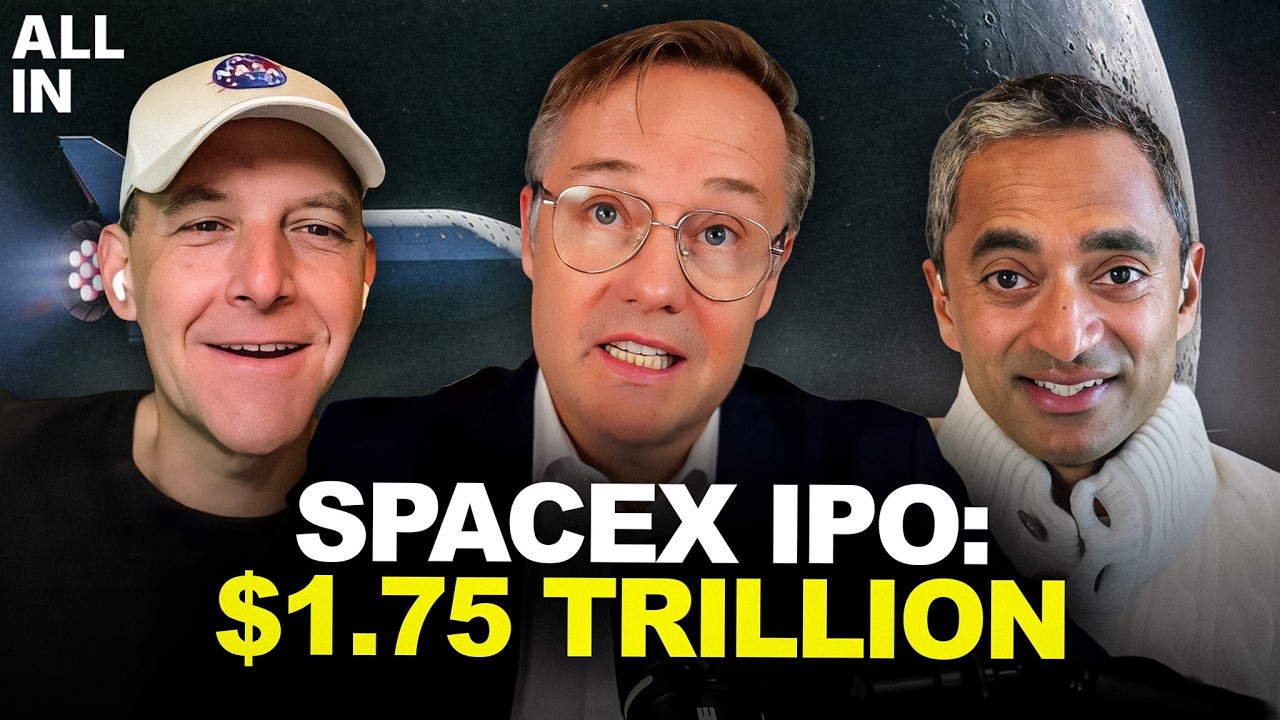
SpaceX Eyes $1.75 Trillion Confidential IPO as Musk Seeks Valuation Mark
All-In Podcast
Taking SpaceX public provides an objective market valuation to shield Elon Musk from shareholder lawsuits when combining his corporate entities into a $3 trillion conglomerate.
## Background
Published by the All-In Podcast on YouTube on April 3, 2026, this episode features hosts Jason Calacanis, David Friedberg, and Chamath Palihapitiya. According to the show description, the episode covers topics including SpaceX's confidential IPO filing and the space economy, the 2026 tech IPO pipeline, economic and geopolitical impacts of the war in Iran, and potential quantum computing threats to Bitcoin.
## TL;DR
The podcast opens with an analysis of SpaceX's confidential $1.75 trillion IPO filing, detailing how taking the company public creates a strategic valuation mark that protects against litigation and enables a potential $3 trillion megamerger with Tesla. The hosts then examine the 2026 IPO market and foundation AI dynamics, highlighting valuation pressures on OpenAI alongside a tightening global liquidity pool driven by Middle East conflicts. They also break down the escalating war in Iran—including its $2 billion daily cost, the resulting global fertilizer and helium supply chain crisis, and political fallout for the Trump administration—before concluding with discussions on quantum computing's threat to Bitcoin encryption and global talent arbitrage.
## Atmosphere & style
The episode blends high-energy venture capital analysis with loose, candid banter among long-time tech investors. While the hosts deliver sharp, data-driven breakdowns on macroeconomics, geopolitics, and frontier technologies, the conversation maintains a conversational, locker-room atmosphere punctuated by teasing and inside jokes. The mood shifts fluidly between analytical seriousness when dissecting military costs or supply chain vulnerabilities, and lighthearted ribbing during discussions on poker games, executive assistants, and viral internet trends.
## Key takeaways
- [00:00](https://www.youtube.com/watch?v=N-pust8qtGI&t=0s) SpaceX filed confidentially for a massive $1.75 trillion IPO, targeting a $75 billion raise that would instantly make it the 8th largest publicly traded company in the world.
- [02:16](https://www.youtube.com/watch?v=N-pust8qtGI&t=136s) Taking SpaceX public provides a continuous mark-to-market valuation, legally shielding Elon Musk from shareholder lawsuits if SpaceX and Tesla eventually merge into a $3.1+ trillion holding company.
- [06:54](https://www.youtube.com/watch?v=N-pust8qtGI&t=414s) The Moon represents the next major industrial frontier, where autonomous robots and solar-powered mass drivers could manufacture and ship materials to Earth at a lower net cost per kilogram than terrestrial transport.
- [21:00](https://www.youtube.com/watch?v=N-pust8qtGI&t=1260s) The anticipated wave of mega-cap 2026 tech IPOs faces severe digestion risk as limited public market liquidity and the AGI pricing paradox create potential downside re-pricing.
- [28:04](https://www.youtube.com/watch?v=N-pust8qtGI&t=1684s) Secondary market activity shows Anthropic's valuation doubling while OpenAI faces secondary market friction at an $850 billion valuation due to high burn rates and commoditization risks.
- [32:17](https://www.youtube.com/watch?v=N-pust8qtGI&t=1937s) Escalating war in the Middle East threatens to trigger a major tech liquidity crunch as sovereign wealth funds and family offices in the Gulf pull back primary and secondary allocations.
- [35:44](https://www.youtube.com/watch?v=N-pust8qtGI&t=2144s) The U.S. military operation in Iran has surpassed $70 billion in direct costs, burning roughly $2 billion daily while driving down President Trump's domestic approval ratings.
- [41:49](https://www.youtube.com/watch?v=N-pust8qtGI&t=2509s) A global fertilizer crisis has erupted due to severe damage at Qatar's primary urea facility and Chinese export bans, threatening crop yields and global food security.
- [48:22](https://www.youtube.com/watch?v=N-pust8qtGI&t=2902s) Critical single points of failure in global natural gas supply chains threaten essential high-tech inputs like helium, which is required for semiconductors and medical equipment.
- [01:04:14](https://www.youtube.com/watch?v=N-pust8qtGI&t=3854s) Advancements in quantum computing algorithms threaten to break standard elliptic curve cryptography within 5 to 7 years, posing an existential risk to Bitcoin and digital assets.
- [01:09:51](https://www.youtube.com/watch?v=N-pust8qtGI&t=4191s) Silicon Valley firms are increasingly turning to tech-enabled offshore executive assistants in countries like the Philippines to optimize operations at a fraction of domestic costs.
## Detailed walkthrough
### [00:00](https://www.youtube.com/watch?v=N-pust8qtGI&t=0s) SpaceX Confidential IPO Filing and the Vision for an Elon Musk Megamerger
The podcast opens with Jason Calacanis welcoming viewers to the show alongside "Sultan of Science" David Friedberg and Chamath Palihapitiya, noting that David Sacks could not make it for the episode. Jason introduces the massive news breaking in early April 2026: SpaceX has confidentially filed for an IPO targeting a staggering $1.75 trillion valuation. If SpaceX debuts at this price tag, it would immediately become the eighth-largest publicly traded company in the world—placed right behind TSMC and Saudi Aramco (both sitting at roughly 1.7x that mark) and ahead of Tesla, which ranks tenth with a $1.37 trillion valuation.
Jason points out that if Tesla and SpaceX were ever combined under a single stock ticker like `ELON`, the unified enterprise would boast a $3.1+ trillion market cap, eclipsing Microsoft to become the fourth-largest company on Earth. SpaceX is reportedly looking to raise $75 billion—by far the largest IPO raise in history—targeting a June rollout after missing a tongue-in-cheek target date of April 20th ("4/20"). The besties note that SpaceX recently acquired xAI for $250 billion (a deal encompassing X, Twitter, and the xAI large language model infrastructure). Starlink currently drives 50% to 80% of SpaceX's revenues—nearing $20 billion annually—while the core rocket launch business accounts for the remaining 40% ($5 billion in 2024, pushing total projected 2025 revenue to $15–16 billion with $8 billion in profit).
When Jason asks Chamath about the likelihood of Tesla and SpaceX eventually merging into one giant holding company, Chamath places the probability at an emphatic **99.999%**.
[02:16](https://www.youtube.com/watch?v=N-pust8qtGI&t=136s) Governance, Tort Law, and the Strategic Necessity of a Public Valuation Mark
Reflecting on corporate law advice he once received from senior Wachtell Lipton partners Ed Herlihy and Raj Narayanan, Chamath explains how American capital markets force high-profile founders to pay an inevitable "tax" to plaintiff attorneys. He highlights how trial lawyers manipulate shareholder class actions and exploit legal seams—pointing directly to the notorious Delaware Chancery Court case where a shareholder with just 10 shares managed to temporarily void Elon Musk’s Tesla compensation package.
```
┌───────────────────────────────┐
│ SpaceX Public IPO Mark │
│ (Real-time Market Value) │
└──────────────┬────────────────┘
│
Establishes Validated Ratios
│
┌──────────────▼────────────────┐
│ Tesla Public IPO Mark │
│ (Real-time Market Value) │
└──────────────┬────────────────┘
│
Eliminates Fiduciary & Valuation Lawsuits
│
┌──────────────▼────────────────┐
│ Clean $3T+ Combined Entity │
│ (Cross-Disciplinary AI & │
│ Robotics Manufacturing) │
└───────────────────────────────┘
```
By taking SpaceX public and obtaining a clean, continuous, market-validated mark-to-market valuation, Musk creates an objective valuation ratio against Tesla's live stock price. This structure legally neutralizes frivolous shareholder litigation when the two companies inevitably combine. Furthermore, unifying the enterprises silences critics who complain about Musk splitting his time across distinct ventures. Chamath notes that corporate executives at Meta, Google, Microsoft, or Nvidia are never criticized for allocating attention across internal divisions—especially when the underlying cross-pollination of technologies is so deep:
> "He's building the robots, but they're used inside of SpaceX. He's building a Terafab, they're used inside of Tesla. He's building xAI, they're used across both."
* **Legal Protections:** A validated public mark prevents claims that Musk invented merger valuations "out of thin air."
* **Cross-Disciplinary Synergies:** Shared advancements in advanced materials, manufacturing automation, and AI models flow seamlessly across Tesla, SpaceX, xAI, The Boring Company, and Neuralink.
* **Manufacturing Dominance:** Blending team talents unites two world-class manufacturing engineering teams under one roof.
[06:54](https://www.youtube.com/watch?v=N-pust8qtGI&t=414s) Artemis 2, Lunar Mining, and the Moon as the Next Industrial Frontier
Transitioning to space exploration milestones, Jason references the launch of NASA's **Artemis II** mission—sending four astronauts on a lunar flyby to prepare for a crewed moon landing within two years. Friedberg frames this return to the moon not merely as a geopolitical space race against China, but as the launch of humanity's next major industrial frontier.
[ Lunar Surface Mining & Fabrication ]
│
│ Uses Low Gravity (1/6th Earth)
│ & Frictionless Vacuum
▼
[ Magnetic Mass Driver / Rail System ]
│
│ Accelerates payload to ~100G
│ (No chemical rocket fuel needed)
▼
[ Atmospheric Re-entry to Earth Target ]
│
│ Simple Parachute Recovery
▼
[ Cost per kg < Boat / Rail / Air Freight ]
```
Because the moon possesses 1/6th of Earth's gravity and completely lacks an atmosphere, the energy requirements to transport processed raw materials or manufactured goods off the lunar surface are essentially zero compared to Earth launches. Rather than relying on expensive chemical rocket fuel, lunar operations can deploy electric **mass drivers**—magnetic levitation rails that launch raw materials and refined goods at 100 Gs directly toward Earth. The payloads re-enter Earth's atmosphere and land via parachute at exact coordinates at a lower net cost per kilogram than shipping via terrestrial cargo ships, airplanes, or freight trains.
* **Artemis II Launch:** Four-astronaut lunar flyby setting up a crewed moon landing in ~2 years.
* **Lunar Mass Driver Concept:** Electric maglev rails shooting materials off the moon without chemical propellants.
* **Autonomous Lunar Factories:** Robot-led lunar manufacturing bypasses terrestrial labor regulations and environmental restrictions.
* **Evolution of Tesla:** From electric vehicle manufacturer → autonomous car pioneer → general-purpose robotics powerhouse.
[11:17](https://www.youtube.com/watch?v=N-pust8qtGI&t=677s) Infrastructure in Orbit: Starlink's Parallel Internet and the Space Economy
Friedberg expands on SpaceX's broader structural value, explaining how **Starlink** has quietly built a complete, space-based fallback infrastructure for the global internet. Traditional internet architectures rely on terrestrial nodes connected by physical copper and fiber-optic cables, making them vulnerable to geopolitical conflict, government collapses, or infrastructure failures. By orbital-routing data through mass-deployed satellite constellations and space data centers, SpaceX has established an un-censorable, extraterrestrial communications grid.
Chamath compares SpaceX to the backbone logistics network of the new space age—the high-capacity container ships traveling between continents:
> "If you think of Elon as like the big container ships that go from China to America, once it gets to Long Beach, you need FedEx."
```
THE EMERGING EXTRATERRESTRIAL COMMERCIAL ECOSYSTEM
═══════════════════════════════════════════════════
Dropping a payload off at a 550 km Low Earth Orbit (LEO) is only the first step. A massive commercial ecosystem is emerging to handle the rest of the supply chain:
* **Last-Mile Logistics:** Transfer vehicles and orbital tugs moving payloads from insertion orbits to specific target planes or Geostationary Orbit (GEO).
* **Orbital Stations:** Private commercial space station developers (such as Jed McCaleb’s **Vast Space**) buying advance slots on SpaceX rockets to deploy modular station units for corporate clients like Google or Amazon.
* **Space Services & Power:** Specialized orbital garbage collection (using nets and magnetic capture) alongside ultra-thin, highly resilient solar power sheets capable of surviving micrometeorite impacts.
* **Resource Extraction:** Commercial ventures focusing on asteroid mining and microgravity pharmaceutical manufacturing (e.g., Varda Space Industries).
<ElicitationsGroup message="Explore related topics and analysis from the episode:">
<Elicitation label="Analyze the impact of the 2026 IPO surge and OpenAI down-round rumors" query="Walk me through the All-In Podcast discussion on the 2026 IPO market explosion and OpenAI down-round rumors."/>
<Elicitation label="Review the Iran war costs, fertilizer crisis, and economic downstream impacts" query="Summarize the All-In Podcast breakdown of the Iran war costs, fertilizer shortages, and global inflation impacts."/>
</ElicitationsGroup>
[16:13](https://www.youtube.com/watch?v=N-pust8qtGI&t=973s) The Lunar Industrial Frontier and Mass Drivers
David Friedberg outlines a pragmatic, industrial approach to lunar colonization and resource extraction. Rather than focusing on asteroid mining or bringing raw space rock back to Earth, he argues that building processing and refining infrastructure directly on the Moon is far more practical. The Moon lacks atmosphere-forming gases like carbon, nitrogen, hydrogen, and oxygen—which escaped during its early formation due to low gravity—but it is densely rich in structural and precious metals like aluminum, silicon, palladium, platinum, and gold.
[ Autonomous Mining ]
│
▼
[ On-Moon Processing ] ──► (Solar Powered / Turbine Heat Recycled)
│
▼
[ 4 km Mass Driver ] ──► (Launches cargo every 10–15 mins)
│
▼
[ Moon-Rock Heat Shield ] (15 cm sacrificial barrier burns on re-entry)
│
▼
[ Atmospheric Descent ] ──► (Parachutes down to shipyard)
```
Managing excess heat on the Moon is a key engineering challenge without an atmosphere, but Friedberg proposes capturing waste heat using helium gas to drive turbines and produce supplementary electricity. Solar power makes this infrastructure feasible: a 500-square-meter array of solar panels can generate enough power to run a 4-kilometer mass driver (an electromagnetic sled concept championed by Elon Musk), capable of launching refined payload packages back toward Earth every 10 to 15 minutes. For re-entry, the packages can be shielded using just 15 centimeters of raw moon rock, which burns up in Earth's atmosphere before the processed cargo parachutes down to an onshore industrial shipyard.
- **Missing Lunar Elements:** Carbon, nitrogen, hydrogen, oxygen (gaseous elements lost due to low gravity).
- **Abundant Lunar Elements:** Aluminum, silicon, palladium, platinum, gold.
- **Power & Launch Specs:** 500 m² of solar panels powering a 4 km mass driver.
- **Payload Cadence:** Cargo launches to Earth every 10 to 15 minutes.
- **Re-entry Shielding:** 15 cm sacrificial layer of moon rock.
---
[18:20](https://www.youtube.com/watch?v=N-pust8qtGI&t=1100s) Drawing Parallels to the American Frontier
Reflecting on the scale of lunar industrialization, the hosts compare this moment to the 18th and 19th-century expansion of the American West. Friedberg notes that early settlers traveling west could never have envisioned the infrastructure and cities that would exist 150 years later. Humanity is experiencing a similar inflection point where the orbital and planetary "railroads" are currently being laid.
Unlike historic expansions that relied entirely on human physical labor, the modern space frontier is uniquely enabled by the rise of robotics and artificial intelligence. Autonomous systems can endure the harsh realities of space, turning extreme environments into productive hubs. The panel emphasizes that space exploration is a non-zero-sum game that expands human production and potential, contrasting this mindset with Earth-bound political debates that treat growth as zero-sum. Wrapping up the space discussion with lighter banter, Jason Calacanis jokes about opening a gravity-free, tax-free casino and hotel in orbit, leading the group to joke about space "pleasure droids" and avoiding a "Donner Party" scenario on the way to the Moon.
> "And before, we would have never been able to tackle these great frontiers, but this magical new technology came about called robots. And these robots are going to allow us to actually make use of these frontiers and explore them and develop them."
---
[21:00](https://www.youtube.com/watch?v=N-pust8qtGI&t=1260s) The 2026 IPO Pipeline and Market Re-Pricing Risks
Transitioning to capital markets, Calacanis highlights expectations for a massive wave of mega-cap tech IPOs in 2026. Companies listed on Polymarket prediction boards include SpaceX (94% implied probability), Anthropic (41%), OpenAI (38%), and Databricks (32%), alongside a long tail of mature private unicorns like Stripe, Cerebras, Canva, and Discord. However, Chamath Palihapitiya warns of serious digestion risk for this flood of supply, likening investor appetite to a guest at a Thanksgiving dinner whose eyes are bigger than their stomach.
Chamath argues that being first out of the gate—like SpaceX—is critical because market liquidity is finite. Late arrivals face mounting tactical and structural risks:
1. **Liquidity Squeeze:** The public market cannot seamlessly absorb hundreds of billions in newly floated equity without investors rotating out of existing tech giants like Amazon, Google, or Disney.
2. **The AGI Pricing Paradox:** If AGI or Superintelligence (ASI) is achieved soon, the long-term durability of traditional software moats drops to near zero. Conversely, if AGI proves to be overhyped, the multi-billion-dollar capital expenditure and hyper-inflated valuations of foundation model companies will face severe scrutiny.
3. **Flight to Value:** Investors are increasingly moving toward "HALO" (High Asset, Low Obsolescence) businesses trading at 2–5x cash flow rather than paying 35x sales for speculative tech.
Friedberg seconds the concern, noting that early private investors holding shares for years will rush to lock in long-awaited liquidity. Without enough new marginal buyers on the public side, heavy institutional selling will drag share prices down rapidly post-listing.
---
[28:04](https://www.youtube.com/watch?v=N-pust8qtGI&t=1684s) OpenAI Secondary Discount and Model Moat Erosion
Examining the foundation model space directly, the panel discusses recent reports showing secondary market friction for top AI companies. While Anthropic is seeing secondary bids at double its previous valuation ($600 billion implied vs. $300 billion), OpenAI investors are struggling to find institutional buyers at its $850 billion valuation, with over $600 million in secondary shares seeking an exit.
Calacanis points out that at OpenAI's reported $24 billion revenue run-rate, an $850 billion valuation implies a steep 35x price-to-sales multiple. Such multiples become difficult to defend if model capabilities commoditize or if intellectual property cannot be protected. Bouncing off a recent incident where Anthropic's code was reportedly leaked and transpiled into another language on GitHub, Calacanis highlights the legal irony: if AI companies demand legal protection for their own code, it undermines their core legal defense that training models on un-permissioned web data is fair use.
Chamath concludes that despite these headwinds, both OpenAI and Anthropic are historic achievements that deserve multi-hundred-billion-dollar valuations. However, their primary objective must be to go public as fast as possible to fortify their balance sheets. As these frontier AI models enter the market, they will directly cannibalize and erode the moats of legacy software companies, forcing public software P/E multiples down to match non-tech industry baselines.
> "The combination of SpaceX, OpenAI, and Anthropic... all three are baking an AI technology that first and foremost will go after the tech sector. It will eliminate and it will cannibalize and it will erode most of the moats that support this differential trading."
[032:17] OpenAI, Anthropic, and the Looming Middle East Liquidity Crunch
Jason Calacanis and David Friedberg continue exploring whether secondary market movements are a canary in the coal mine for top-tier AI companies like OpenAI. While these businesses have seen staggering top-line growth and user affection, their eye-watering burn rates and reliance on circular financing remain serious vulnerabilities that will inevitably face public scrutiny once S-1 filings and quarterly earnings reports hit the street. As alternative players like Anthropic and Google's Gemini rapidly capture mindshare, capital dynamics could undergo a tectonic shift following major liquidity events like a SpaceX IPO.
Friedberg highlights a critical macro threat that the broader market is underestimating: a massive upcoming liquidity crunch for capital-intensive tech companies triggered by the escalating conflict in the Middle East. Historically, a substantial portion of the unencumbered, debt-free capital flowing into mega-funds—and ultimately into entities like OpenAI via SoftBank loans or direct primary deals—has originated from Middle Eastern sovereign wealth funds and family offices in Qatar, Saudi Arabia, the UAE, and Oman. With regional instability, these sovereign entities are pulling back on large primary and secondary allocations as well as LP commitments. While family offices in Europe and Singapore are attempting to absorb secondary demand, their capacity is limited. Friedberg warns that the market has not yet felt the full force of this shockwave due to lag times in fund deployment, giving China a distinct structural capital advantage over a U.S. ecosystem heavily dependent on Gulf money.
- Middle Eastern capital sources currently tightening up include sovereign wealth funds and family offices in Qatar, Saudi Arabia, UAE, and Oman.
- Secondary market demand is shifting toward family offices in Europe and Singapore, though overall global capital availability remains constrained.
- Event risks facing public equity markets: market participants largely view the Middle East conflict as manageable, considering the existential question of whether AI commercialization is real—and what these mega-caps are truly worth—as the real "sword of Damocles."
[035:44] The Iran War: Escalation, Military Costs, and Polymarket Expectations
After taking a week off from discussing the war in Iran—which Calacanis humorously takes the fall for, joking that he was simply "protecting Trump" and getting "cover for Trump's mistakes"—the besties dive into Day 34 of the U.S. military operation against Iran. President Trump addressed the nation in a brief 18-minute speech, declaring that while the U.S. is now energy independent and doesn't "need their oil," American forces are intervening to support allies and systematically dismantle the regime's capability to project power or acquire nuclear weapons, claiming these core strategic objectives are "nearing completion."
The human and financial toll of the conflict is mounting rapidly. On the coalition side, 13 American service members have tragically lost their lives and over 200 have been injured, with 50,000 U.S. troops deployed to the region. The death toll in Iran has surpassed 3,500 people (including 1,600 civilians and over 200 children), alongside 1,200 casualties in Lebanon due to Israeli strikes. Operationally, the war is burning through an estimated $2 billion per day, totaling over $70 billion so far, with the Pentagon requesting an additional $200 billion from Congress. For scale, Calacanis notes that the Ukraine war cost $113 billion in its entire first year.
- **Polymarket Ceasefire Odds:** 25% chance of a ceasefire by the end of April; 47% chance by the end of May.
- **Polymarket Ground Invasion Odds:** 63% chance of a ground invasion by the end of April; 71% chance by the end of December.
- **Energy Independence Dynamics:** Chamath Palihapitiya points out that European allies are finally realizing the dangers of energy dependence. While the Russia-Ukraine war exposed their vulnerability in natural gas, European nations are now pivoting back toward self-reliance: Italy and Spain are reintroducing investment tax credits for renewables, and Germany is restarting its nuclear program.
- **Regional Stakes:** Middle Eastern allies like the UAE, Saudi Arabia, Qatar, and Kuwait need a swift end to the war to safeguard and monetize their energy infrastructure, giving them a stronger incentive than the U.S. to put "boots on the ground."
[041:49] Global Fertilizer Crisis: Strait of Hormuz Chokepoint & Food Supply Shocks
Friedberg raises a alarming secondary consequence of the Iran war: an impending global agricultural and food security crisis driven by a catastrophic disruption in fertilizer supply chains. Nitrogen (N) accounts for 60% to 65% of global fertilizer usage and is the core driver of agricultural yields worldwide. Because atmospheric nitrogen must be synthesized into ammonia using natural gas under extreme pressure and temperature, production is tightly concentrated in major natural gas hubs—most notably Qatar. Approximately 35% of the world's nitrogen fertilizer is exported through the Strait of Hormuz.
The outbreak of war has triggered a double shockwave. First, the primary manufacturing facility in Qatar—the world's largest producer of urea (the solid form of nitrogen fertilizer)—suffered severe physical damage, rendering it incapacitated for an estimated 3 to 5 years (with brand-new plants taking up to 7 years to build). Second, the world's swing producer, China (which accounts for 15% of global production), immediately halted all fertilizer exports to preserve domestic supplies. Consequently, urea prices skyrocketed from $350 a ton prior to the conflict to over $700 a ton within days, causing severe artificial supply deficiencies across South Asia, Africa, and North America.
- **Impact on U.S. Agriculture:** American farmers growing corn require ~200 lbs of urea per acre. At current price spikes, corn production becomes completely unprofitable—a crisis compounded by China refusing to buy American corn exports.
- **Crop Pivoting:** While ~2/3 of U.S. farmers had secured fertilizer prior to the spring planting season, the remaining third are being forced to pivot to less nitrogen-intensive crops like soybeans. The upcoming fall planting season faces severe input costs.
- **Global Human Toll:** Following the Ukraine war, roughly 400 million people globally fell into severe malnutrition (defined as consuming 1,200 calories or less per day for over a year). Friedberg warns that this nitrogen crisis could trigger an even worse starvation event given that the global food system maintains less than 30 days of calorie reserves.
- **Strategic Policy Failures:** Both Friedberg and Palihapitiya argue that western nations must treat energy and fertilizer reservoirs as critical national security assets rather than sacrificing them to "luxury beliefs" around carbon regulation, noting that global fertilizer manufacturing plants operate at full 24/7 capacity with zero excess buffer capacity.
<FollowUp label="Want to continue to the next part of the transcript walkthrough?" query="Please provide the next part of the transcript walkthrough covering the remaining sections of the All-In Podcast episode."/>
[048:22] Critical Single Points of Failure: From Fertilizer to Helium Supply Shocks
David Friedberg warns that the globalized agricultural and industrial supply chain is far too fragile, relying on single points of failure that the world can no longer tolerate. As the geopolitical climate fragments into a multipolar world with reduced U.S. global policing, nations must secure domestic, excess capacity in essential inputs. Fertilizer is the prime example, but Friedberg highlights natural gas extraction as another critical vector due to a key byproduct: helium.
Beyond its popular association with birthday balloons, helium is indispensable for MRI machines, semiconductor manufacturing, and mass spectrometry instruments used in chemical analysis across high-tech industries. With nearly a third of the world's helium supply originating from Qatar, any regional disruption creates an immediate global shock wave. Friedberg points out that while the U.S. has vast natural gas reserves—referencing a site visit he made with Doug Burgum to Cheniere Energy's massive LNG export facility in Louisiana—many countries have turned a blind eye to developing their own reserves, exposing themselves to catastrophic supply chain vulnerabilities.
- **Helium applications**: MRI machines, semiconductor manufacturing, mass spectrometry in chemical analysis.
- **Supply concentration**: Roughly one-third of the world's helium supply comes out of Qatar's natural gas fields.
- **Key facility highlight**: Friedberg references visiting Cheniere Energy's LNG export facility in Louisiana with Doug Burgum.
---
[050:01] Domestic Pushback, Plummeting Approval Ratings, and the Political Cost of Iran
Jason Calacanis brings up Donald Trump's net approval rating chart, noting that it has reached an all-time low of -17. He attributes this sharp decline to a series of unpopular policies and controversies, including heavy-handed ICE operations, the fallout over the Epstein files, gas prices climbing past $4 a gallon, and the return of 3-handle inflation expectations. Calacanis highlights the rapid decline in public support, noting that massive "No Kings" protests drew an estimated 8 million people into the streets.
The political backlash is already spilling over into betting markets and cabinet appointments. Polymarket odds show an 86% chance of Democrats taking the House and a 51% chance of them capturing the Senate in the upcoming midterms, backed by $4.5 million in volume. Calacanis reports that Trump is already shedding key advisors, predicting that beyond Pam Bondi and Kristi Noem being moved aside, figures like Stephen Miller and Kash Patel are driving the administration's biggest missteps. Calacanis argues that unless Trump rapidly pivots and extracts the U.S. from the Iran conflict, the administration risks two years of constant congressional investigations and potential impeachment.
- **Trump Net Approval**: Dropped to -17, the lowest mark recorded in the podcast's tracking.
- **Polymarket Midterm Odds**: 86% probability for Democrats winning the House, 51% probability for the Senate ($4.5 million total volume).
- **Economic Metrics**: Gasoline exceeding $4/gallon; Polymarket predicting a return to 3%+ annual inflation.
- **Public Resistance**: An estimated 8 million people turned out for "No Kings" demonstrations across the country.
- **Key Administration Personnel Discussed**: Pam Bondi, Kristi Noem, Stephen Miller, Kash Patel, Scott Bessent, Howard Lutnick, J.D. Vance, Pete Hegseth, and David Sacks.
---
[053:58] The Intelligence Void and the Middle East Power Dynamic
The podcasters debate the strategic rationale behind striking Iran, admitting that the public lacks the classified intelligence that drove the decision. Calacanis and Friedberg highlight the stark disconnect between official messaging and reality: Americans were told Operation Midnight Hammer had decimated Iranian capabilities, yet military action escalated into a full-scale war targeting top Iranian leadership. The besties struggle to evaluate whether the U.S. was overconfident, strategically baited into conflict by Israel, or responding to an existential, unpublicized threat.
Chamath Palihapitiya balances this criticism by pointing out Trump’s historical track record as an anti-war president who avoids "forever wars." However, he stresses that Iran represents a unique danger to the entire region. Referencing an interview given by Saudi Crown Prince Mohammed bin Salman (MBS), Chamath notes that Saudi Arabia views the Iranian threat through the same lens as Israel. While the vast majority of Sunnis and Shias are peaceful, allowing an unpredictable, radical regime to obtain nuclear weapons is an unacceptable outcome for the region and the broader world order.
- **Operation Midnight Hammer**: Previous military strike originally framed as having crippled Iranian capabilities before full-scale hostilities erupted.
- **Regional Consensus**: Saudi Crown Prince Mohammed bin Salman (MBS) articulated a view of the Iranian nuclear threat that mirrors Israel's security concerns.
- **Nuclear Disarmament Norms**: Strong agreement among the hosts that incremental nuclear proliferation to unstable or fundamentalist regimes must be prevented at all costs, citing historical complications like the India-Pakistan nuclear dynamic.
- **Historical Policy Criticisms**: Chamath criticizes the Obama administration's handling of the Iran nuclear deal (JCPOA), asserting that keeping strict economic sanctions was the only effective mechanism for keeping the regime in check.
---
[059:55] Global Second-Order Effects: China, Energy, and Geopolitical Re-alignments
Expanding on the conflict's global reach, Chamath outlines how the Iranian war pressures China, setting the stage for a broader geopolitical re-alignment. With energy routes through the Strait of Hormuz disrupted, energy costs inside China are skyrocketing. Chamath asserts that delaying the U.S.–China summit by six weeks into mid-May severely hurts Beijing's position, forcing them toward a deal. The ultimate goal, Chamath argues, should be a stable, bipolar "Nash equilibrium" led by the U.S. and China that halts chaotic expansionism and restores predictability to international trade and security.
Meanwhile, Calacanis points out that Israel’s long-standing strategy of "mowing the lawn"—taking periodic military actions to set back Iranian and proxy progress by 30% to 40%—has officially tipped into outright regime change. This shift creates uncharted territory regarding control of global shipping lanes. In a lighter moment, the besties react to Trump's public assertion that the U.S. doesn't need Middle Eastern oil and that Europeans should secure the straits themselves, before riffing on a viral, absurd viral clip poking fun at mispronouncing the "Straits of Hormuz."
- **U.S.–China Summit**: Delayed six weeks into mid-May, putting significant economic pressure on China due to soaring energy import costs.
- **Strategic Doctrines**: Transition from Israel's traditional "mowing the lawn" containment strategy to active regime change in Iran.
- **Strait of Hormuz Economics**: Tensions escalate over potential transit fees or blockades, with Trump insisting European nations step up to secure their own energy shipments.
[01:04:14](https://www.youtube.com/watch?v=N-pust8qtGI&t=3854s) Quantum Computing's 5-to-7-Year Threat to Bitcoin
Chamath highlights research indicating that functional quantum computing is no longer 25 to 30 years away, but likely only 5 to 7 years out. He warns the Bitcoin ecosystem that their time to adapt is shrinking rapidly. If quantum chips become viable, non-state actors will target obvious, high-value "honeypots" first—draining crypto assets protected by standard elliptic curve cryptography (ECDSA) and SHA-256 before crashing market prices to buy up cheap physical assets. While the crypto community previously managed encryption migrations in its early days, redesigning modern wallets, transaction flows, and processing nodes is a massive technical undertaking that must be organized immediately.
Friedberg details the mathematical advancements accelerating this timeline, moving beyond Peter Shor's 1994 algorithm. He notes that NYU computer scientist Oded Regev published a paper in 2023 optimizing Shor's algorithm, dramatically dropping the required quantum operations. Market signals suggest industrial-scale quantum compute and low-latency cracking algorithms are on a collision course in the near term. The hosts draw a direct parallel between tech sectors: just as software stocks face existential questions from AGI and ASI, crypto projects face absolute disruption if quantum technology breaks traditional encryption.
- Oded Regev’s algorithm drastically reduced the required quantum operations to factor large integers from roughly 28 million down to 500,000.
- Modern encryption relies on the computational difficulty of factoring prime integers; breaking this renders standard internet and cryptographic security obsolete.
- Overhauling global communications and encryption standards over the next few years will create a massive, high-demand industry for quantum-resistant solutions.
[01:09:51](https://www.youtube.com/watch?v=N-pust8qtGI&t=4191s) Executive Assistant Arbitrage: Athena and Global Talent
The conversation shifts to executive productivity and administrative support. Jason and Chamath contrast the traditional Silicon Valley model of paying domestic Executive Assistants (EAs) $188,000 to $200,000 annually with offshore executive support services like Athena. Chamath shares his experience hiring a Philippine-based assistant named Lei—a math and computer science graduate who works Silicon Valley hours for $3,000 per month. Both hosts praise the capability of these offshore assistants, treating the setup as a massive efficiency hack that blends human expertise with emerging AI tooling.
The group debates the inflation of administrative titles in corporate tech, specifically taking aim at the overuse of the "Chief of Staff" title for roles that are essentially administrative assistance. Jason explains how his Athena EA manages everything from complex founder application workflows to hyper-local tasks like calling Abby Jane Bakery in Dripping Springs, Texas every Thursday morning to secure fresh baked goods delivered via Uber courier. They note that low domestic unemployment has pushed American workers away from administrative support roles, making tech-enabled offshore talent highly attractive.
- Chamath notes historically paying domestic EAs between $188,000 and $200,000 per year before transitioning to Athena.
- Athena provides specialized executive assistants based in the Philippines for $3,000 per month.
- Integration between human assistants and legal/workflow software like OpenLaw is allowing offshore EAs to handle increasingly complex operational tasks.
[01:14:09](https://www.youtube.com/watch?v=N-pust8qtGI&t=4449s) Ohalo Potato Progress, Poker Room Drama, and the All-In Summit
Friedberg provides a brief update on his agricultural venture, Ohalo, announcing that true potato seed is officially shipping to farmers across North America this week—including to the son of their poker buddy, "Roger the Dirt Farmer." This sparks a brief tangent about high-stakes poker games in the Valley, where Jason recounts getting squeezed out of a game by Chamath, squeaking in, doubling up his stack, and drawing passive-aggressive jabs from poker pro Phil Hellmuth over his growing podcast fame.
Jason transitions to event announcements, revealing that the upcoming All-In Liquidity Event (hosted at `[allin.com/events](https://allin.com/events)`) sold out in record time, prompting the team to look for 100 additional seats. The event will feature speakers Bill Ackman and Andrej Karpathy, alongside an "I, Russell"-style pitch competition where four top-performing fund managers will pitch their highest-conviction ideas in tech, healthcare, natural resources, and crypto. Finally, Jason addresses online commentary regarding his interview with NVIDIA's Jensen Huang, clarifying his small personal bet on the Bittensor (TAO) network and discussing the future of distributed compute projects like Folding@home.
- Ohalo is actively delivering its proprietary true potato seed technology to commercial growers across North America.
- The All-In Liquidity Event sold out immediately, representing attendees managing an estimated $7.7 trillion in capital.
- Jason clarifies his $500,000 to $600,000 personal position in Bittensor (TAO), highlighting interest in decentralized subnets and distributed compute infrastructure.
[01:18:34](https://www.youtube.com/watch?v=N-pust8qtGI&t=4714s) "Retardmaxxing" and Closing Banter
The conversation kicks off with high-energy banter about a viral content creator recommended by Marc Andreessen. The hosts describe this "genius" creator—identified in the show notes as Elisha Long—who posts videos about "maxing" while standing on his back deck, smoking a cigar, and grilling on a Weber grill. The group jokes that discovering this creator might be Marc Andreessen's greatest single contribution to American culture and society, eclipsing even his creation of the web browser. The core philosophy of these videos is simple: stop overthinking, stop ruminating, work hard, and just enjoy life.
The Besties turn this philosophy into playful teasing aimed directly at David Friedberg. They contrast his tendency to overanalyze, ruminate, and go to therapy with the simplistic "maxxing" mindset, lightheartedly telling him to "go sell software and go make better potatoes" instead of getting trapped in his own head. The segment wraps up with invitations for Marc Andreessen and Jason Calacanis to come back and "max" on the podcast anytime, before transitioning into the classic outro music and iconic soundbites from past episodes.
- **Viral Creator**: Elisha Long, known for his laid-back deck-and-Weber-grill advice videos on "maxxing".
- **Cultural Joke**: Marc Andreessen's curation of internet culture vs. his invention of Mosaic/Netscape.
- **Teasing Friedberg**: Advice for Friedberg to stop ruminating and focus on building software and agricultural innovations ("better potatoes").
- **Featured Outro Soundbites**: Classic show quotes referencing David Sacks as the "Rain Man," open-sourcing content to fans, and general banter between the hosts.
## Notable quotes
> [02:00](https://www.youtube.com/watch?v=N-pust8qtGI&t=120s) He's building the robots, but they're used inside of SpaceX. He's building a Terafab, they're used inside of Tesla. He's building xAI, they're used across both. — Chamath Palihapitiya
> [11:17](https://www.youtube.com/watch?v=N-pust8qtGI&t=677s) If you think of Elon as like the big container ships that go from China to America, once it gets to Long Beach, you need FedEx. — Chamath Palihapitiya
> [18:20](https://www.youtube.com/watch?v=N-pust8qtGI&t=1100s) And before, we would have never been able to tackle these great frontiers, but this magical new technology came about called robots. And these robots are going to allow us to actually make use of these frontiers and explore them and develop them. — David Friedberg
> [28:24](https://www.youtube.com/watch?v=N-pust8qtGI&t=1704s) The combination of SpaceX, OpenAI, and Anthropic... all three are baking an AI technology that first and foremost will go after the tech sector. It will eliminate and it will cannibalize and it will erode most of the moats that support this differential trading. — Chamath Palihapitiya
## Mentioned
Jason Calacanis, David Friedberg, Chamath Palihapitiya, David Sacks, Elon Musk, Ed Herlihy, Raj Narayanan, Jed McCaleb, Donald Trump, Pam Bondi, Kristi Noem, Stephen Miller, Kash Patel, Scott Bessent, Howard Lutnick, J.D. Vance, Pete Hegseth, Mohammed bin Salman, Oded Regev, Peter Shor, Phil Hellmuth, Bill Ackman, Andrej Karpathy, Jensen Huang, Marc Andreessen, Elisha Long, SpaceX, Tesla, TSMC, Saudi Aramco, Microsoft, xAI, Starlink, The Boring Company, Neuralink, Wachtell Lipton, Delaware Chancery Court, Meta, Google, Nvidia, NASA, Vast Space, Amazon, Varda Space Industries, Anthropic, OpenAI, Databricks, Stripe, Cerebras, Canva, Discord, Polymarket, SoftBank, Cheniere Energy, ICE, Athena, OpenLaw, Ohalo, All-In Podcast, Artemis II, Operation Midnight Hammer, Claude Code, Gemini, Bittensor, Folding@home
The All-In Podcast hosts argue that massive capital and infrastructure realignments—from SpaceX's potential public debut to Middle Eastern conflict and accelerating quantum timelines—are placing unprecedented pressure on global markets, supply chains, and technical architectures.
SpaceX IPO and the Logic of an Elon Megamerger (0:00)
SpaceX has confidentially filed for an initial public offering targeting a $1.75 trillion valuation and seeking to raise $75 billion, which would mark the largest IPO raise in history. The company projects 2025 revenue of $15 billion to $16 billion with $8 billion in profit, anchored by Starlink generating 50% to 80% of total revenue alongside a recent $250 billion acquisition of xAI. Chamath Palihapitiya estimates a 99.999% probability that SpaceX and Tesla will eventually merge into a single entity valued above $3.1 trillion, surpassing Microsoft.
Palihapitiya argues that establishing a live, continuous public market valuation for SpaceX is a legal necessity. Grounded in corporate law advice, he asserts that a market-validated trading price creates an objective ratio against Tesla's stock, neutralizing frivolous shareholder class actions and fiduciary claims by plaintiff attorneys when an eventual combination occurs, while formalizing the operational and manufacturing cross-pollination across Elon Musk's companies.
Lunar Industrialization and the Orbital Commercial Ecosystem (6:54)
Framed by NASA's Artemis II lunar flyby, David Friedberg outlines the Moon as an industrial frontier rich in structural and precious metals like aluminum, silicon, palladium, platinum, and gold. Because the Moon lacks an atmosphere and has one-sixth of Earth's gravity, processed materials could be launched directly toward Earth using electric magnetic mass drivers—such as a 4-kilometer track powered by 500 square meters of solar panels—every 10 to 15 minutes. Shielded by 15 centimeters of sacrificial lunar rock that burns upon atmospheric entry, payloads could land via parachute at lower per-kilogram costs than terrestrial rail, air, or ocean freight.
Beyond planetary extraction, the hosts identify an emerging commercial space ecosystem where SpaceX acts as the heavy-lift logistics backbone. Emerging private operators are developing complementary layers, including orbital transfer tugs for last-mile delivery to specific orbits, commercial space stations such as Vast Space to host enterprise clients, and orbital servicing operations ranging from space debris cleanup to microgravity pharmaceutical manufacturing.
2026 Tech IPO Pipeline and Secondary Market Friction (21:00)
Capital markets face serious digestion risks as a wave of mega-cap tech IPOs approaches, including implied listing probabilities on Polymarket for SpaceX (94%), Anthropic (41%), OpenAI (38%), and Databricks (32%). Palihapitiya warns that finite institutional liquidity cannot easily absorb hundreds of billions in newly floated equity without triggering capital rotations away from existing tech giants. He also highlights an AGI pricing paradox: achieving superintelligence threatens traditional software moats, while failing to reach it exposes aggressive capital expenditures and inflated multiples.
Secondary market data already reveals structural divergence among frontier AI developers. While Anthropic trades at secondary bids implying a $600 billion valuation, OpenAI faces resistance at an $850 billion valuation with more than $600 million in shares seeking exits. Jason Calacanis notes that OpenAI's $24 billion revenue run-rate commands a steep 35x price-to-sales multiple that is difficult to sustain if core models commoditize, legal defenses regarding training data face pushback, and Middle Eastern sovereign wealth funds pull back capital commitments due to regional conflict.
Iran War Shocks to Global Agriculture and Supply Chains
On Day 34 of U.S. military operations against Iran, the hosts evaluate escalating operational costs running at an estimated $2 billion daily, with the Pentagon requesting an additional $200 billion from Congress. Friedberg warns that the war has triggered an immediate crisis in global agricultural supply chains. Because 35% of the world's nitrogen fertilizer exports transit the Strait of Hormuz, damage to Qatar's primary urea plant—coupled with China halting domestic exports—caused global urea prices to surge from $350 to over $700 per ton in days.
This disruption imperils agricultural yields, forcing U.S. corn farmers to absorb severe input costs or pivot to less nitrogen-dependent crops like soybeans, while raising the risk of severe global malnutrition given that the world maintains less than 30 days of buffer calorie reserves. Friedberg also identifies single-point-of-failure vulnerabilities in high-tech manufacturing, noting that nearly a third of the global supply of helium—essential for MRI machines, semiconductor fabrication, and mass spectrometry—originates from Qatar's natural gas fields.
Accelerating Quantum Timelines and Cryptographic Vulnerability (64:14)
Palihapitiya warns that functional quantum computing represents a critical threat to Bitcoin and modern cryptography within 5 to 7 years, rather than the several decades previously projected. If quantum systems achieve the scale needed to crack standard elliptic curve cryptography (ECDSA) and SHA-256, bad actors could target concentrated crypto assets before asset values collapse.
Friedberg explains that mathematical optimizations have compressed this horizon significantly. Research by NYU's Oded Regev optimized Peter Shor's algorithm, reducing the required quantum operations to factor large prime integers from roughly 28 million down to approximately 500,000. The hosts stress that redesigning wallets, transaction rails, and global digital security standards will require an immediate, massive engineering overhaul to institute quantum-resistant protocols.
The hosts emphasize that whether in public equities, food production, or cryptographic security, systems built on thin margins, single points of failure, or unvalidated valuations face rapid repricing as geopolitical conflict and technological breakthroughs accelerate.
## Background
本期节目由知名科技商业播客《All-In Podcast》于 2026 年 4 月 3 日发布在 YouTube 平台。根据节目简介,本期核心议题涵盖了 SpaceX 秘密提交 IPO 申请与太空工业前沿机遇、2026 年超级独角兽上市潮及 OpenAI 估值回调风险、伊朗战事的巨额成本与下游化肥危机、特朗普政府的宣传统筹问题与内阁变动,以及量子计算破解比特币的潜在风险。
## TL;DR
节目首先深度剖析了 SpaceX 以 1.75 万亿美元目标估值秘密递表 IPO 的战略意图,指出公开市场定价将为其与特斯拉合并铺路,并畅想了机器人赋能下的月球工业化与地外“备用互联网”生态。随后,嘉宾探讨了 2026 年超级 IPO 狂潮中资金流动性承接不足的隐忧,指出 AGI 假说正在颠覆传统科技股估值,OpenAI 二级市场已现买盘疲态。在地缘政治方面,节目详述了伊朗战争在霍尔木兹海峡引发的连锁反应,包括占全球 35% 氮肥流通受阻、尿素价格翻倍导致的全球饥荒隐患与氦气断供危机,以及特朗普民调跌至谷底、帕姆·邦迪遭免职的政治反噬。最后,主持人们警告量子计算突破可能在 5 到 7 年内直击比特币公钥加密底层,并分享了利用 Athena 离岸高智力助手实现极致成本套利的运营实践。
## Atmosphere & style
整期节目展现了顶级硅谷风投圈标志性的智性碰撞与辛辣幽默,在硬核宏观洞察与毫无包袱的商业互怼间无缝切换。从对电磁轨道投射器、哈伯法合成氨和 Shor 破译算法的严谨推演,瞬间跳脱到“霍尔木兹海峡”英语双关梗引发的爆笑解构以及高端德扑私局的残酷厮杀,叙事节奏紧凑而富有张力。弗里德伯格的学者型深沉、查马斯的宏大资本叙事与杰森的调侃串场相得益彰,让听众在感受前沿科技与地缘危机严峻性的同时,又深切体会到硅谷精英面对不确定性时特有的敏锐与极致行动主义。
## Bulletin
- [00:00](https://www.youtube.com/watch?v=N-pust8qtGI&t=0s) SpaceX 已秘密递交 IPO 申请,目标估值高达 1.75 万亿美元并拟募资 750 亿美元,有望成为商业史上最大规模的上市案,Chamath 更预测其未来与特斯拉合并的概率达 99.999%。
- [22:26](https://www.youtube.com/watch?v=N-pust8qtGI&t=1346s) 2026 年超级独角兽排队上市面临资本流动性耗尽风险,OpenAI 二级市场转让已现买盘真空,叠加中东主权财富基金因战事收紧出资,高资本密度的 AI 模型创企将直面估值重构考验。
- [41:49](https://www.youtube.com/watch?v=N-pust8qtGI&t=2509s) 伊朗战事升级切断霍尔木兹海峡核心航运,引发基准尿素暴涨至每吨 700 美元以上并阻断全球三分之一氦气供应,直接重创全球粮食安全、美国农场收益及半导体制造产业链。
- [01:04:14](https://www.youtube.com/watch?v=N-pust8qtGI&t=3854s) 因数分解量子算法取得重大数学突破,将破解现代加密的预期时间缩短至 5 到 7 年,百亿美元规模的加密货币流动池面临被非国家黑客作为链上“蜜罐”优先洗劫的致命威胁。
## Key takeaways
- [00:00](https://www.youtube.com/watch?v=N-pust8qtGI&t=0s) SpaceX 秘密提交上市文件,目标估值 1.75 万亿美元直奔全球第八大公司,计划募资 750 亿美元打破历史纪录,内部已并表估值 2500 亿美元的 xAI 并拥有强劲的星链现金流。
- [01:54](https://www.youtube.com/watch?v=N-pust8qtGI&t=114s) Chamath 认为特斯拉与 SpaceX 未来合并概率高达 99.999%,通过公开市场确立按市值计价(Mark-to-Market)能彻底杜绝诉讼掮客碰瓷,并终结外界对马斯克精力分配的治理争议。
- [07:33](https://www.youtube.com/watch?v=N-pust8qtGI&t=453s) 低引力与无大气摩擦环境使月球具备极高工业价值,未来可借助太阳能驱动的电磁质量投射器(Mass Driver)以近乎为零的运输成本向地球反向投送精炼工业品与稀有金属。
- [09:57](https://www.youtube.com/watch?v=N-pust8qtGI&t=597s) 具身机器人技术的突破填补了月球缺乏劳动力的瓶颈,而星链数以万计的卫星与在轨数据中心正在构建一套平行于地球主干网的“地外备用互联网”。
- [22:26](https://www.youtube.com/watch?v=N-pust8qtGI&t=1346s) 资本市场流动性呈现“感恩节大餐”效应,处于 IPO 队伍末尾的公司极易遭遇资金枯竭,在 AGI 定价悖论与宏观动荡下,资金正加速流向高资产壁垒、低淘汰风险的 HALO 资产。
- [26:01](https://www.youtube.com/watch?v=N-pust8qtGI&t=1561s) OpenAI 在 8500 亿美元新估值下二级市场买盘遇冷,而 Anthropic 逆势受捧;SpaceX、OpenAI 与 Anthropic 抢先上市抽干流动性后,将严重挤压传统软件公司的估值倍数溢价。
- [32:27](https://www.youtube.com/watch?v=N-pust8qtGI&t=1947s) 海湾国家主权财富基金是过去流向重资产 AI 模型的核心资金源头,中东冲突引发的主权资本退潮正在给美元风投生态和 AI 算力军备竞赛带来延迟引爆的流动性紧缩。
- [41:49](https://www.youtube.com/watch?v=N-pust8qtGI&t=2509s) 中东冲突导致霍尔木兹海峡受阻叠加中国停止出口,掐断了占全球 35% 的氮肥流通,合成氨与尿素核心设施修复需数年周期,暴涨的肥价让美国农场大面积陷入亏损边缘。
- [48:21](https://www.youtube.com/watch?v=N-pust8qtGI&t=2901s) 卡塔尔供应中断引发全球氦气供应休克,严重威胁到医院 MRI 超导冷却、先进制程芯片特气供应及化学质谱分析,暴露出全球供应链脆弱的单点故障。
- [49:58](https://www.youtube.com/watch?v=N-pust8qtGI&t=2998s) 受伊朗战火蔓延、通胀重燃与内阁人事清洗影响,特朗普净支持率跌至历史低点 -17%,预测市场押注民主党中期选举夺回众议院的概率飙升至 86%。
- [55:54](https://www.youtube.com/watch?v=N-pust8qtGI&t=3354s) 对伊朗动武虽然代价高昂,但其底层战略核心在于遏制具有高度不可预测性的极端政权掌握核武器,这一防扩散诉求在中东核心大国与以色列之间存在深度共识。
- [01:07:17](https://www.youtube.com/watch?v=N-pust8qtGI&t=4037s) Regev 算法突破将破解公钥加密所需的关键量子操作量从 2800 万次削减至 50 万次,工业级量子破译窗口骤降至 5 到 7 年,倒逼区块链生态启动全方位的抗量子加密协议重构。
- [01:09:51](https://www.youtube.com/watch?v=N-pust8qtGI&t=4191s) 硅谷高管开始抛弃年薪 20 万美元的本地执行助理,转向以每月约 3000 美元成本雇佣高学历离岸助理并融合 AI 工具链,实现极具竞争力的企业运营成本套利。
## Detailed walkthrough
### [00:00](https://www.youtube.com/watch?v=N-pust8qtGI&t=0s) SpaceX 秘密递交 IPO 申请:1.75 万亿美元巨无霸来袭
节目开场,主持天团调侃这是“全球第一的播客”。本周 David Sacks 缺席,由 Jason Calacanis、David Friedberg(“科学苏丹”)以及 Chamath Palihapitiya 组成三人阵容。Jason 抛出了震惊科技界与资本市场的重磅头条:SpaceX 已于 4 月 1 日秘密提交上市文件,目标估值高达 1.75 万亿美元(“Trillion with a T”)。在 IPO 阶段就拿下万亿美元以上的估值,在商业史上闻所未闻。
以 1.75 万亿美元计,SpaceX 一旦挂牌,将瞬间成为全球第八大上市公司,市值仅次于台积电(TSMC)和沙特阿美(Saudi Aramco)——二者录制时的市值约为 1.7 万亿美元多。而特斯拉(Tesla)以 1.37 万亿美元排在第十位。Jason 算了一笔账:如果未来特斯拉与 SpaceX 合并为同一家公司,股票代码命名为“ELON”,总市值将直接跃升至 3.1 万亿美元,一举超越微软成为全球第四大公司。
SpaceX 本次计划募资高达 750 亿美元,远超历史上任何一家公司的 IPO 规模,预计将于当年 6 月正式挂牌(大家原本还打趣马斯克可能会想挑 4 月 20 日这种“420”玩梗吉日上市,但时间上已然来不及)。在业务与财务层面上,SpaceX 前不久刚以 2500 亿美元估值收购了 xAI(涵盖 X 社交网络平台及大语言模型业务)。Starlink(星链)贡献了其 50% 至 80% 的收入,年营收已逼近 200 亿美元;运载火箭发射业务则占另外约 40%,2024 年报道收入约为 50 亿美元。路透社数据显示,SpaceX 在 2025 年的总收入预计达 150 亿至 160 亿美元,净利润高达 80 亿美元。
- **目标估值**:1.75 万亿美元(与沙特阿美、台积电并肩,直奔全球第 8 大公司)。
- **募资规模**:计划募资 750 亿美元,创下全球历史之最。
- **内部资产**:已全资整合 xAI(含 X 平台与 AI 业务,并表估值 2500 亿美元)。
- **营收拆解**:Starlink 占比 50%–80%(约 200 亿美元/年),火箭发射占比 40%(2024 年约 50 亿美元),2025 年预估净利润达 80 亿美元。
---
### [01:54](https://www.youtube.com/watch?v=N-pust8qtGI&t=114s) Chamath:特斯拉与 SpaceX 合并概率为 99.999%
面对 Jason 抛出的核心疑问——如果 IPO 顺利,特斯拉和 SpaceX 最终合并的概率有多大,Chamath 毫不犹豫地给出了“100%”的判断,随后更精确地强调是“99.999%”。
Chamath 借用自己职业生涯的一段深刻经历解释了底层逻辑。当年他经 Thomas Laffont 介绍,结识了全美最负盛名、最具影响力的并购律所 Wachtell, Lipton, Rosen & Katz 的掌舵人 Ed Herlihy,其如今的常年代理律师 Raj Narayanan 也是该所高级合伙人。在处理复杂交易时,顶级律师曾告诫他:“在做创新交易的同时,你必须随时准备好交一笔‘敲诈税’(pay a tax)。”因为美国资本市场体制既支持惊人的创新,也滋生了大量伺机而动的诉讼掮客(tort lawyers)。在几乎所有 IPO 中,只要有风吹草动,集体诉讼就会蜂拥而至;原告律师利用董事及高管责任险(D&O 险)的漏洞碰瓷,迫使公司和解并从中抽取 40% 到 50% 的提成,而普通股东其实只能分得几个子儿。此前仅持股 10 股的散户就能推翻马斯克在特斯拉的数百亿美元薪酬方案,本质上就是诉讼律师钻空子敲诈的典型恶例。
在 Chamath 看来,SpaceX 此次 IPO 具有两大不可替代的战略价值:一是顶着外界的杂音,确立一个**经由公开市场实时按市值计价(mark-to-market)的公允估值**。有了公开市场的标杆,当未来 SpaceX 与特斯拉实施合并时,就能彻底堵死别有用心之人指责马斯克“凭空捏造估值”的借口,极大减少恶意诉讼的把柄;二是从公司治理层面,彻底终结外界对马斯克“精力分配”的喋喋不休。市场上从来没有人会去质疑扎克伯格(Mark Zuckerberg)、萨蒂亚·纳德拉(Satya Nadella)、桑达尔·皮查伊(Sundar Pichai)或黄仁勋(Jensen Huang)如何在各自公司内部的各项前沿项目上分配时间,而马斯克旗下制造的人形机器人用于 SpaceX、打造的芯片工厂服务于特斯拉、构建的 xAI 模型被两家共同调用,其底层业务重叠度和协同性早已密不可分。因此,走向一家合二为一的超级企业不仅合情合理,更将赋予马斯克前所未有的治理灵活性。
```mermaid
flowchart TD
accTitle: SpaceX IPO and Tesla Integration Strategic Logic
accDescr: Diagram illustrating how the SpaceX IPO provides mark-to-market pricing to enable a seamless merger with Tesla while mitigating legal risks.
subgraph Valuation ["公开市场定价机制"]
A["SpaceX 秘密提交 IPO\n(目标估值 1.75万亿美元)"] --> B["获取透明公允的\n公开市场估值 (Mark-to-Market)"]
C["特斯拉公开市场市值\n(实时浮动公允估值)"]
end
subgraph Defense ["法律与治理防御"]
B & C --> D["杜绝恶意诉讼借口\n(阻击敲诈型律师集团)"]
D --> E["终结管理层精力分配争议\n(如同 Meta/Google 内部协同)"]
end
subgraph Synergy ["最终超级合并 (ELON)"]
E --> F["业务终极闭环\n(机器人 + xAI + 星链 + 芯片工厂)"]
F --> G["合并为 ~3.1万亿美元巨无霸\n(全球第 4 大公司)"]
end
```
---
### [05:50](https://www.youtube.com/watch?v=N-pust8qtGI&t=350s) 奇点时刻:从特斯拉制造到全跨界技术沉淀
Jason 进一步指出,当前商业界正在迎来某种“奇点”(singularity)。过去人们认为汽车与太空是风马牛不相及的两个领域,但现在所有的底层技术已经彻底串联:AI 算力、太空数据中心、自研芯片供应链,乃至于产线一端进原材料、另一端直接出成品的尖端制造工艺。马斯克在特斯拉和 SpaceX 积累的先进材料工程经验,不仅能双向赋能,更可以辐射到 The Boring Company 和 Neuralink。两大核心团队的智慧库与高精尖跨学科学习能力,正在以惊人的速度复合增长(compound)。
论及超级工厂的制造能力,马斯克毫无疑问是全球顶尖的专家——或许只有富士康或中国少数制造巨擘能在特定工艺环节与之比拟。特斯拉与 SpaceX 之间频繁的技术互通与人才流动,已经为这种超级协同铺平了道路。随后,Jason 将话题转向拥有深厚 NASA 背景的 David Friedberg,请他以 20 年的跨度,展望在马斯克当下每两三天发射一次火箭的高频节奏下,未来的太空产业将是一幅怎样的图景。
---
### [07:33](https://www.youtube.com/watch?v=N-pust8qtGI&t=453s) Friedberg 畅想:月球作为人类下一座“零运输成本”工业前沿
Friedberg 指出,本周是人类太空探索史上里程碑式的一周——“阿耳忒弥斯 2 号”(Artemis 2)刚刚于前一天成功发射,4 名宇航员搭载飞船完成绕月轨道飞行并返回地球,为人类时隔半个世纪后在 2 年内重返月球表面奠定了基础。这不仅是中美之间激烈的太空地缘竞赛的关键节点,更预示着**月球将成为全人类的下一座“超级工业前沿”(the next industrial frontier)**。
Friedberg 详细拆解了月球不可替代的工业经济学逻辑:
1. **取之不尽的原生资源**:月球拥有极其丰沛的矿产储备,不仅可以在地外就地开采,还能直接在当地设立加工厂,将其冶炼制造为终端工业品与贵金属。
2. **近乎为零的反向运输成本**:将开采加工后的货物从月球运往地球特定地点的成本,未来将显著低于地球表面任何传统的物流运输方式——无论是轮船、飞机还是铁路。
3. **低引力与无摩擦环境优势**:月球表面重力仅为地球的六分之一,且几乎完全没有大气层,这意味着物质脱离月球时完全处于无空气阻力的无摩擦状态,且所需能量极低,根本无需像在地球上发射火箭那样消耗昂贵且危险的高能化学推进剂。
4. **电磁轨道“质量投射器”(Mass Driver)**:未来从月球运输物资的理想方案不是火箭,而是类似于磁悬浮列车轨道的全电动质量投射器。在月球表面利用电力将集装箱包裹加速到 100 个 G 的加速度,直接将其弹射回地球(甚至可以直接弹射向火星)。包裹受控进入地球大气层后,只需依靠简易降落伞减速,即可精准着陆在全球任意预定地点。
Friedberg 强调,人类由此可以在月球上以极低成本运行永不停歇的自动化采掘与工业制造流水线。过去最大的瓶颈在于“把人送去月球并维持生命支持”,而随着高智能机器人在未来几年的爆发,这个难题将被彻底化解。月球工业化的大门,正在由机器人与低成本发射运力共同彻底推开。
### [09:57](https://www.youtube.com/watch?v=N-pust8qtGI&t=597s) 特斯拉机器人与月球工业化:太空版“备用互联网”与工业边疆
弗里德伯格(David Friedberg)指出,当前人形机器人技术的突破正在与太空工业化以及重返月球的历史节点发生深度交汇。展望未来二十年,特斯拉(Tesla)无论是保持独立还是进行业务整合,都将展现出比现在远为宏大的格局。众人日后回望时,或许会付之一笑地感慨:“特斯拉最初居然只是一家造电动车的公司。”特斯拉从电动车演进为自动驾驶公司,而自动驾驶积累的全栈能力又直接引爆了具身机器人革命。弗里德伯格打趣道,退一步说,即便地球上的政策制定者或社会主义者全面封杀机器人,高呼“禁止机器人,它们抢光了所有人类工作”,人类也可以将成千上万的机器人直接打包运往月球。这些机器人将在月球建立起完全属于人类文明的全新制造边疆,在轨开采贵金属、制造半导体等高精密商品并运回地球。
月球表面万事俱备,唯一缺少的就是劳动力——即机器人本身。因此,向月球输送机器人,或者运送基础原材料让机器人在月球实现自我复制与组装,构成了这场跨星球产业转移的第一阶段;第二阶段则是就地建造庞大的工业设施。弗里德伯格强调,正如上一代跨大陆铁路彻底打通了美国西部边疆一样,SpaceX 正在向世人证明,它就是通往月球乃至火星的现代“太空铁路”。月球所蕴藏的工业生产潜力极其庞大,必将为人类社会释放出前所未有的物质丰裕。
除开辟制造边疆外,弗里德伯格提出了一个直接影响 SpaceX 估值逻辑的核心维度:SpaceX 正在构建一套平行于地球的“备用互联网”(backup to the internet)。地面互联网从根本上受制于物理节点及铜缆、光纤等有限连接,而随着星链(Starlink)数以万计的卫星升空,以及未来直接在轨节点上部署数据中心,SpaceX 实际上搭建起了一个完全独立的地外通信网络。该网络不仅能与地球主干网协同,更能在地面遭遇地缘剧变、政权崩溃或文明动荡时,成为独立存续的关键技术基础设施。
```mermaid
flowchart LR
accTitle: 特斯拉与SpaceX协同的太空工业化路径
accDescr: 展示了从特斯拉机器人到SpaceX物流运输,再到月球生产与星链备用互联网的完整产业闭环。
subgraph Earth["地球端核心能力"]
A["特斯拉自动驾驶技术"] --> B["具身机器人研发"]
C["SpaceX 星舰与发射能力"]
end
subgraph Space["太空基础设施"]
C --> D["轨道物流骨干网络"]
C --> E["星链轨道数据中心\n(地外备用互联网)"]
end
subgraph Moon["月球制造前哨站"]
B -.->|"大规模运送至月球"| F["全自主机器人集群"]
D --> F
F --> G["就地采矿、冶炼与芯片制造"]
G --> H["电磁质量投射器返回地球"]
end
```
- 特斯拉战略演进轨迹:电动汽车制造 $\rightarrow$ 自动驾驶全栈系统 $\rightarrow$ 具身通用机器人 $\rightarrow$ 地外无人制造集群。
- 星链的战略纵深:摆脱地面物理光缆与节点限制,构建拥有在轨算力与通信冗余的“地外文明容灾网络”。
---
### [12:20](https://www.youtube.com/watch?v=N-pust8qtGI&t=740s) 太空商业生态大爆发:从重型货运到“太空联邦快递”与轨道基础设施
卡拉卡尼斯(Jason Calacanis)补充强调,SpaceX 将每公斤入轨成本压低到前所未有的水平,这一创举彻底激活了全球创业生态。如今大量创业者纷纷涌入太空领域,涵盖小行星采矿以及像 Varda 这样开展太空微重力制药与材料实验的公司。卡拉卡尼斯分享了他参与后期辛迪加投资的案例:除了物流无人机独角兽 Zipline 外,他们还投资了由 Ripple 联合创始人杰德·麦卡勒布(Jed McCaleb)创办的 Vast Space。麦卡勒布个人自掏腰包数亿美元注入该公司,专门开发模块化商业空间站。Vast Space 的商业模式非常简单粗暴——直接提前向 SpaceX 购买运力舱位锁定排期,专注于设计空间站核心组件。其底层商业逻辑在于,未来 Google 或 Amazon 等科技巨头完全有可能渴望在轨道上拥有属于自己的专属空间站。
查马斯(Chamath Palihapitiya)对此感慨道,“有时候运气比实力更重要”,整个商业界与投资者都欠马斯克(Elon Musk)一声巨大的感谢。SpaceX 正在撬动一个体量大到难以想象的新经济系统,而人类目前所见到的不过是极其粗糙的起点。查马斯打了个生动的比方:如果把猎鹰 9 号(Falcon 9)或重型猎鹰(Falcon Heavy)比作横跨太平洋、将集装箱从中国运到长滩港的巨型远洋货轮,那么它们目前只负责把载荷“卸”在 500 至 550 公里的近地轨道(LEO)。
货运到港之后,进入地球同步轨道(GEO)或特定轨道平面的问题依然待解,这中间存在着巨大的产业空白——整个太空领域亟待诞生自己的“最后一公里”物流网络,即“太空版联邦快递(FedEx)”。此外,太空在轨垃圾清理至今仍未从工程上彻底解决,目前正在探索利用太空捕鱼网或磁性吸附板等方案。与此同时,太空能源革命也在发生,太空专用的光伏电池与地面截然不同,厚度仅约 1 毫米,徒手拿捏极易碎裂,但经过层压铺设后,即便遭遇微流星撞击也安然无恙。查马斯直言,地球经济运行的每一个维度都将在太空被重新复制一遍:未来的太空不仅会有太空马士基、太空联邦快递,还会涌现出太空垃圾处理巨头(如 Allied Waste)和太空矿业巨头(如 Freeport-McMoRan)。这一切商业宏图都将构筑在 SpaceX 的肩膀之上,现在仅仅是“起源的起源的起源”(the beginning of the beginning of the beginning)。
- **代表性创业公司及动向**:
- **Vast Space**:由 Jed McCaleb 自筹数亿美元创立,预订 SpaceX 运力,专注模块化商业空间站建设,服务潜在科技巨头(如 Google、Amazon)。
- **Varda Space Industries**:利用微重力环境在轨进行先导制药实验与特种材料加工。
- **亟待建立的轨道基础设施服务**:
- **轨道转运与最后一公里物流**:解决近地轨道(LEO 500-550km)到地球同步轨道(GEO)的姿态与轨道机动。
- **轨道碎片与垃圾清除**:开发网捕技术与磁性收集板,清除退役卫星与太空垃圾。
- **超轻抗冲击高转化光伏电池**:厚度仅 1 毫米级、具备极强微流星耐受度的新型层压太阳能板。
---
### [15:35](https://www.youtube.com/watch?v=N-pust8qtGI&t=935s) 月球采矿经济学:电磁弹射器、隔热盾与 19 世纪大西部拓荒的重现
面对卡拉卡尼斯关于小行星采矿与稀有铂族金属(PGM,如钯金)储量的提问,弗里德伯格给出了冷静的工程与商业视角。他认为,虽然从小行星带拖回整块原石开采的概念听起来很吸引人,但由于原石加工极为笨重耗能,更有可行性的路径是在月球表面就地建立精炼工业设施,直接将矿石转化为成品再送回地球。
弗里德伯格从元素组成上剖析了月球的本质优势:月球唯一匮乏的是碳、氮、氢、氧这四种构成地球生命的挥发性元素。这是因为在地球和月球形成的早期,这些轻元素主要以气体形态存在,而月球微弱的引力根本无法维持大气层,导致气体全部逃逸到外太空。然而,除挥发性气体之外,月球表面几乎富集了人类现代工业所需的一切重元素——铝、硅、钯、铂、黄金应有尽有。月球生产的核心物理挑战在于真空中无法通过空气对流散热,但工程上完全可以捕获废热,利用闭环氦气驱动微型涡轮发电机,实现二次电力回收。
根据弗里德伯格的量化推演,月球采矿与货运在工程参数上极其优雅可行:
| 工程与物资环节 | 实施参数与技术方案 |
|:--- |:--- |
| **地表供能** | 仅需铺设约 **500 平方米**的高效太阳能电池板 |
| **发射装置** | 驱动一条长约 **4 公里**的电磁质量投射器(Mass Driver / 轨道滑橇) |
| **返回频率** | 每隔 **10 至 15 分钟**即可将一整批高纯度工业成品投射回地球 |
| **再入防热盾** | 无需复杂防热瓦,直接利用包裹物前端约 **15 厘米**厚的月岩(Lunar Rock)作为烧蚀防热层 |
| **回收着陆** | 穿过大气层烧蚀减速后开启降落伞,精准落入预定的大型工业造船厂或地面接收区 |
这种月球自动化采矿车巡视、现场精炼提取、电磁轨道抛射并利用月岩天然隔热返回的工业图景,令全场惊叹不已。查马斯与卡拉卡尼斯感叹,若美国能在月球建立永久性工厂与基地,其意义非凡。众人回顾了 18 世纪末至 19 世纪初美国大西部拓荒的年代:当时背起行囊向西迁徙的先驱者们,根本无法想象 100 年或 150 年后那片荒野会诞生怎样的工业奇迹与繁荣帝国。如今人类面对深空与月球,正如当年站在西部边疆的起点,而横跨星际的“太空铁路”正在当下被一寸寸铺设完成。
### [19:04](https://www.youtube.com/watch?v=N-pust8qtGI&t=1144s) 太空经济学与太空赌场的玩笑
嘉宾们探讨了机器人技术与自主系统如何彻底改变太空前沿的开发可能。过去人类受限于生理极限无法涉足的恶劣环境,如今能够依靠机器人真正进行探索和工业化开发。这标志着自主技术、机器人与太空跨越交汇的历史性时刻,它代表着人类生产力和生存潜能的几何级数扩张。这种非零和博弈的发展逻辑,与地球上某些对抗技术进步的社会主义论调形成鲜明反差——后者总认为进步是一场零和争夺,而真实的商业探索则是人人建造新事物并共同受益。
在严肃探讨之余,现场随即开启了标志性的商业互怼与玩笑。Jason Calacanis 宣称自己打算在太空开一家“太空酒店兼赌场”,引得众人哄堂大笑;Chamath Palihapitiya 则打趣道,太空扑克最大的优势是“没有抽水、没有重力,赢钱还不交税”("no rake, no gravity, no tax")。随后话题进一步发散到太空红灯区、娱乐机器人(pleasure droids)和仿生人(replicants),众人调侃谁先在太空搞定这套生意谁就能成为万亿富翁。Jason 自嘲大家前往新前沿时千万别沦为当年的“唐纳大篷车队”(Donner Party,意指饥荒内讧的悲惨先驱),而 Chamath 则吐槽 Jason 只会安全地留在地面上搞他的天使投资银团(thesyndicate.com)。面对“是否拥有一枚火箭”的质问,Jason 幽默回应称自己依然在竞技场里拼搏,每天还在亲自做企业软件销售和客户拓展,大家都年过半百却依然保持着充沛的工作狂状态。
---
### [21:00](https://www.youtube.com/watch?v=N-pust8qtGI&t=1260s) 2026 年超级 IPO 狂潮与潜在宏观暗礁
话题转向资本市场,2026 年极有可能创下美股历史上最大规模的 IPO 纪录。市场上排队等待上市的独角兽阵容堪称空前,涵盖 OpenAI、Databricks 等估值达千亿美元甚至万亿美元级别的超级巨头,同时长尾名单上还挤满了 Stripe、Cerebras、Canva、Discord 等成熟明星企业。预测市场 Polymarket 上的押注数据清晰展现了市场对各家年内上市的概率预期:
```mermaid
flowchart TD
accTitle: 2026年独角兽IPO市场预期与阻碍因素
accDescr: 展示主流独角兽上市预期概率及可能阻碍IPO窗口的三大宏观风险
subgraph Predictions["Polymarket 2026 上市概率"]
A["SpaceX: 94%"]
B["Anthropic: 41%"]
C["OpenAI: 38%"]
D["Databricks: 32%"]
end
subgraph Risks["潜在宏观扰动因素"]
R1["伊朗战争冲突升级与地缘风险"]
R2["宏观经济陷入衰退"]
R3["中期政治变局(国会控制权更迭)"]
end
Predictions --> Risks
```
尽管华盛顿目前处于非常亲商的政策周期,但多重宏观阴霾依然笼罩:潜在升级的伊朗战争冲突、可能诱发的宏观经济衰退,以及民主党若重夺国会参众两院控制权可能带来的监管与税收变数。如果这批总价值数万亿美元的超级独角兽成功挂牌,将产生深远的市场涟漪效应:VC/PE 机构的有限合伙人(LP)将迎来久违的巨额流动性分配,员工期权套现将重塑财富格局,公开市场的“科技七巨头”(Magnificent 7)甚至可能直接扩容为“科技十七巨头”(Mag 17)。
---
### [22:26](https://www.youtube.com/watch?v=N-pust8qtGI&t=1346s) 感恩节大餐隐喻:Chamath 剖析抢跑上市与 AGI 定价悖论
Chamath Palihapitiya 提出了鲜明的逆向观点,认为当前市场正面临巨大的风险错配,埃隆·马斯克推动 SpaceX 抢先上市是极为明智之举。他用“感恩节大餐”生动比喻资本市场的流动性胃口:当食客们刚走进餐厅、面对满桌丰盛佳肴时,“眼睛比胃口大”,所有人争相大快朵颐;然而随着盘子逐渐被填满,后来的菜肴将面临无人问津的尴尬境地。因此在流动性有限的盛宴中,最聪明的策略永远是第一位被端上桌被资本消化,处于 IPO 队伍末尾的公司极易遭遇资金耗尽的绝境。
市场承接力迅速饱和的核心原因在于战术性事件风险引发的避险情绪,以及围绕 AGI/ASI 产生的根本性估值定价难题:
- **AGI 成立的假设**:若真正的人用人工通用智能(AGI)近期实现(如泄露信息显示 Anthropic 内部已在运行某种 AGI 雏形、Claude Code 隐藏了大量降维打击式的进阶特性),那么绝大多数现有纯软件公司的业务护城河与持久性将被瞬间归零。
- **AGI 不成立的假设**:若 AGI 只是炒作概念,那么当前这些动辄以数百亿、数千亿美元烧钱融资的模型公司的估值体系就存在致命泡沫,其巨额融资能力将面临毁灭性质疑。
- **资产避险大轮动**:市场资金并没有充裕的场外增量来消化数万亿美元的新供给,反而正在展开剧烈重构,涌向被称作“HALO”(High Asset, Low Obsolescence,高资产壁垒、低淘汰风险)的硬资产企业。这类每年拥有数亿美元稳定现金流的防御性资产在公开市场仅以 2 到 5 倍市盈率交易,投资者几乎没有动力去承担极端风险去追逐 200 倍市销率的科技泡沫。
---
### [26:01](https://www.youtube.com/watch?v=N-pust8qtGI&t=1561s) 估值再定价与二级市场降温:OpenAI 现抛售潮
David Friedberg 进一步从供需平衡剖析了上市后的估值破发风险。他指出,许多人盲目认为 IPO 是一场持续推高市值的胜利庆典,但这完全是一种错觉。这批超级独角兽的一级市场投资人与早期员工已深锁多年,内部积累了极度庞大的变现套现需求(数百亿美元市值的解禁抛压)。然而买盘端却极度匮乏——机构买家早在私募轮次就已深度参投,而散户的弹药库并非无穷无尽。在缺乏新边际买家接盘的情况下,市场必将通过暴跌来重新寻找真实的均衡价格。
```mermaid
flowchart LR
accTitle: 一级与二级市场供需错配
accDescr: 展现一级市场解禁抛压与买盘枯竭导致的再定价下行压力
subgraph Supply["抛盘压力 (Supply)"]
S1["被困多年的早期机构股东"]
S2["期权待兑现的员工持股"]
end
subgraph Demand["接盘资金 (Demand)"]
D1["已提前饱和建仓的公募/对冲基金"]
D2["弹药基本耗尽的散户群体"]
end
Supply -->|"海量抛售"| Market["二级公开市场"]
Demand -.->|"买盘严重不足"| Market
Market --> Result["价格均值回归 / 跌破 IPO 发行价"]
```
彭博社披露的最新二级市场交易动向印证了这一警讯:
- **OpenAI 遇冷**:此前高调传出的 8,500 亿美元新估值在二级老股转让市场遭遇买盘真空,机构投资者急于抛售价值 6 亿美元的老股以寻求流动性,却根本找不到对家接盘。
- **Anthropic 逆势获捧**:相较之下,当前估值约 3,000 亿美元的 Anthropic 在二级市场需求旺盛,甚至出现了按 6,000 亿美元估值扫货的买单。
- **德扑牌局隐喻**:Jason 与 Chamath 总结道,在这场资本博弈中,SpaceX 是第一张亮出的明牌(翻牌,Flop),而 OpenAI 和 Anthropic 则是紧随其后的转牌(Turn)与河牌(River)。一旦市场流动性被前序玩家抽干,这些估值被推至天际的人工智能巨头,极有可能在公开市场被无情打回 3,000 亿至 5,000 亿美元的原形,而非此前市场狂想的万亿美元神话。
### [28:55](https://www.youtube.com/watch?v=N-pust8qtGI&t=1735s) AI估值倍数之争与护城河危机:Anthropic代码泄露
Jason 计算了 OpenAI 惊人的估值倍数:如果以 240 亿美元的营收对应 8520 亿美元的估值,市销率(P/S)高达 35 倍。在增速能否持续仍存疑的情况下,这个数字显得极为夸张。Jason 指出,正如 Chamath 此前提到的一旦通用人工智能(AGI)到来,这些模型本身的护城河可能微乎其微甚至根本不存在。他随即抛出一个重磅八卦:Anthropic 刚刚遭遇黑客入侵,核心机密外泄,有人将其底层代码转换成另一种编程语言后公开发布在了 GitHub 上,根本无法被撤下。
这一事件引发了关于 AI 知识产权的尖锐讽刺:如果 Anthropic 出面抗议并声称对方侵权,那恰恰推翻了它们自身商业模式的立足之本——即它们有权抓取全网他人的版权数据进行训练,然后以全新形式吐出内容。当别人抓取其代码、转译格式并重新发布时,逻辑完全是对等的。Jason 直言,整个行业正处在一个极其诡异的时刻。
### [30:00](https://www.youtube.com/watch?v=N-pust8qtGI&t=1800s) Chamath的论点:万亿估值必须尽快IPO,科技股估值倍数面临收缩
Chamath 对此做出了多层次的回应。尽管估值高得令人咋舌,但他坚信 OpenAI 在 8000 亿美元的估值下依然存在买家,而且理应如此。他感叹自己一辈子从未见过像 OpenAI 和 Anthropic 这样规模的商业奇迹,称它们绝对是实至名归的“万亿美元级公司”。但他同时也坦承,这两家公司终局的盈利能力和终极市值如何,IPO 时公开市场到底愿意出多高的溢价,目前谁也无法给出确定答案。
正因如此,Chamath 强调这两家巨头必须紧随 SpaceX 之后以最快速度提交招股书上市,抢先抽干市场中的流动性。在未来的资本版图中,排在它们之后的普通软件公司既不具备同等的重要性,也没有如此迫切的资金渴求。Chamath 预测,SpaceX、OpenAI 和 Anthropic 的上市将直接蚕食并瓦解现有科技行业的护城河,引发传统科技股向非科技股估值倍数的剧烈收缩:
```mermaid
flowchart TD
accTitle: 巨头IPO对科技板块估值倍数挤压流程
accDescr: 描绘SpaceX、OpenAI和Anthropic上市抽干流动性并蚕食现有科技企业护城河的传导链条。
subgraph MegaIPOs["三巨头抢滩资本市场"]
A["SpaceX / OpenAI / Anthropic 竞相IPO"] --> B["抽干市场流动性,筑牢资产负债表"]
end
subgraph Disruption["AI生产力颠覆"]
B --> C["三巨头AI技术直击现有科技企业核心"]
C --> D["传统软件公司护城河被严重蚕食"]
end
subgraph MarketImpact["估值体系重塑"]
D --> E["科技股PE倍数大幅压缩"]
E --> F["科技股与非科技股估值倍数趋于收敛"]
end
```
- **科技股估值溢价终结**:投资者或许愿意买单前五六年的故事,但绝不会再为第15年的远景给出高倍数,因为这三家巨头将直接构建替代品。
- **抢滩上市的战略意图**:上市的核心不在于终局定数,而在于“抢钱”加固资产负债表;一旦这三家公司完成上市,科技股的估值溢价曲线(蓝线)向非科技股(橙线)的靠拢将变得极其血腥。
### [32:27](https://www.youtube.com/watch?v=N-pust8qtGI&t=1947s) 中东冲突与资本寒冬:主权基金退潮对AI融资的潜在冲击
面对二级市场对 OpenAI 需求的疲软信号,Jason 追问这是否是“煤矿里的金丝雀”,毕竟巨头们不仅面临着凶猛的烧钱率和循环融资问题,还面临着 Anthropic 和 Google Gemini 等对手的市场份额争夺。
Friedberg 提出了一个被广泛低估的系统性风险:中东冲突正对重资产、高资本密度的前沿科技企业带来严重的流动性紧缩。过去几年,大量流向顶尖 AI 企业的巨额资本,其底层源头都可以追溯至卡塔尔、沙特、阿联酋和阿曼等海湾国家的主权财富基金(SWF)或超大家族办公室。如今深陷中东战局,这些金主不再像以往那样积极向外大笔撒钱。即便资金通过摩根大通(JPMorgan)给软银(SoftBank)贷款、再由软银注资 OpenAI 的复杂链条流转,源头依然需要无负债的纯新增资本。
- **潜在的连带违约与承诺下调**:海湾主权基金若削减其对一线头部创投基金的 LP 认缴出资,或者暂停一级、二级市场交易,整个美元风投生态将遭受延迟引爆的冲击波。
- **地缘资本博弈**:欧洲和新加坡的家族办公室二级市场需求虽有支撑,但容量有限。相比之下,美国对中东资本的极高依赖度使其在此次危机中尤为被动,而中国在资本自主度上反而可能具备某种抗风险优势。
- **市场的核心焦虑**:Jason 提及战事恶化可能触发资本不可抗力条款(Force Majeure),但 Chamath 认为市场本身并不将伊朗冲突视为股市最大的悬顶之剑,最大的“达摩克利斯之剑”依然是:AI 的巨大颠覆到底是真还是假?如果是真的,这些公司的公允价值到底该是多少?
### [35:44](https://www.youtube.com/watch?v=N-pust8qtGI&t=2144s) 伊朗战争第34天:特朗普全国讲话、伤亡人数与高昂的战争账单
节目随后切入因上期议程延误而未能展开的焦点议题——伊朗战局。战事已进入第 34 天,特朗普总统在周三晚间发表了时长 18 分钟的全国电视讲话。在播出的讲话片段中,特朗普坚称美国虽然已经实现对中东的能源独立、不依赖其石油,但为了协助盟友并确保伊朗永不拥有核武器,必须采取坚决行动,并宣称“瓦解该政权对外力量投射与威胁能力”的核心战略目标已接近完成。
然而,各方正在为战争付出惨烈的代价,各项数据呈现出触目惊心的现实:
| 关键统计维度 | 具体数据 / 现状 |
|:--- |:--- |
| **美军伤亡及部署** | 13 名美军士兵阵亡,超过 200 人受伤;中东地区部署兵力达 50,000 人 |
| **中东各方伤亡** | 伊朗方面死亡 3,500 人(包括 1,600 名平民和 200 余名儿童);黎巴嫩因以色列空袭丧生 1,200 人 |
| **美军资金消耗** | 累计耗资达 700 亿美元(按国防部每日 20 亿美元消耗共识计算) |
| **后续军费申请** | 五角大楼已向国会紧急申请追加 2,000 亿美元拨款 |
| **战争成本对比** | 乌克兰战争第一年总支出为 1,130 亿美元,伊朗战事在第 50 天即可轻松超越该总额 |
| **Polymarket 停火预测** | 4 月底前停火概率仅 25%,5 月底前停火概率 47% |
| **Polymarket 地面入侵概率** | 美军发起地面军事行动的概率已飙升至 63% |
Jason 指出,尽管金融市场上的精明交易员一度预期战事能较快平息,但 Polymarket 上高达 63% 的地面入侵概率意味着战局很可能迈向规模更庞大、后果更深远的危险深渊。
### [38:44](https://www.youtube.com/watch?v=N-pust8qtGI&t=2324s) 能源独立性与中东地缘政治:战争带来的二阶效应
在讨论伊朗战争民调支持率低迷(4月底前停火概率极低,12月底前停火概率仅约71%)的背景下,Chamath Palihapitiya 深入剖析了这场极不受欢迎的战争带来的两大核心教训。首先,他强调**能源独立(Energy Independence)**是国家生存与安全的基石。如果俄乌冲突还没能给欧洲足够的警醒,那么当前的伊朗战局则在向全球敲响警钟:面对不可控的地缘动荡,无法掌控自身能源基础设施的国家随时会陷入被动。相比之下,美国坐拥能源独立优势,享有极高的地缘战略自主权。此前欧洲自废武功,关停核电、切断或损失天然气管道(如“北溪2号”的搁置与破坏),并削减了太阳能补贴,导致其能源严重依赖昂贵的外部进口和中国。然而危机也催生了逆转——意大利与西班牙相继重启投资税收抵免(ITC),德国也在重启核电,欧洲能源政策的务实转向是当前的积极成果。
```mermaid
flowchart TD
accTitle: 霍尔木兹海峡危机对全球农业与粮食安全的传导机制
accDescr: 展示从天然气减产、海峡封锁到全球化肥飙升、中美博弈及全球饥荒风险的连锁反应
subgraph EnergyToFertilizer["化肥生产与供应链中断"]
A["霍尔木兹海峡受阻 + 卡塔尔装置受损"] --> B["占全球 35% 氮肥流通中断"]
C["中国停止氮肥出口 (占比 15%)"] --> D["全球氮肥短缺与尿素价格暴涨 ($350 -> $700+/吨)"]
B --> D
end
subgraph ImpactUS["美国农业受冲击"]
D --> E["化肥种植成本飙升 (200磅/英亩)"]
F["中国暂停采购美国玉米"] --> G["玉米价格低迷,农场面临全行业亏损"]
E --> G
end
subgraph GlobalImpact["全球粮食安全危机"]
D --> H["亚非发展中国家缺乏化肥获取渠道"]
H --> I["全球热量产量断崖式下跌"]
I --> J["数百万人面临重度营养不良风险"]
end
```
Chamath 指出的第二点涉及中东核心国家(阿联酋、沙特、卡塔尔、科威特)的定位。这些海湾国家是西方未来极其关键的融资与银行业务伙伴。随着全球需求端因这场危机被迫加速摆脱对传统化石能源的依赖(尤其是快速部署太阳能来替代能源供给),长期来看全球碳氢化合物的需求将被永久性削弱。这意味着海湾国家未来将其油气资产变现的能力将大幅降低。因此,这些地区强国比美国更迫切需要和平与稳定,甚至比美军更有动力在地面部署作战力量("boots on the ground")以迅速平息冲突。
- **欧洲能源回归务实**:意大利和西班牙重新引入光伏投资税收抵免(Investment Tax Credits),德国重启核电考量。
- **海湾国家的焦虑**:全球可再生能源加速将压低长期油气需求,促使海湾主权基金与政府更有动力尽快促成停火以保住资产变现窗口。
---
### [41:49](https://www.youtube.com/watch?v=N-pust8qtGI&t=2509s) 氮肥危机与化肥科学:现代农业脆弱的底座
David Friedberg 从农业科技与全球供应链的微观底层切入,详细拆解了当前的化肥危机。肥料主要由三大核心元素构成:氮(N)、磷(P)、钾(K)。俄乌冲突初期引发的是钾肥(Potash)短缺恐慌,乌克兰是全球主要的钾肥生产国;但当前的中东冲突则直接卡死了化肥中最核心的成分——**氮肥(Nitrogen)**。氮肥占到全球化肥总施用量的 60% 至 65%,是全球农业提高单产、养活全球人口的核心驱动力。
氮肥无法凭空产生,其生产在物理上高度依附于天然气开采与加工基地。工业上通过哈伯-博施法(Haber-Bosch process),将天然气中的碳、氢、氧作为原材料,并将大气中占 70% 的氮气压缩至 200 个大气压,在金属催化剂与电流作用下打破 N₂ 分子键生成单原子氮,进而化合成氨(Ammonia),最终加工为固体氮肥——尿素(Urea)。因此,天然气储量极度丰富的中东地区(尤其是卡塔尔)顺理成章地成为了全球氮肥制造中枢。
- **海峡咽喉地位**:全球约 **35%** 的氮肥海运贸易必须通过霍尔木兹海峡(Strait of Hormuz)。
- **中国边际调控效应**:中国作为全球边际生产国(Swing Producer),通常供应全球约 **15%** 的氮肥。但在战争爆发数日后,中国宣布停止氮肥出口,彻底切断了填补外部缺口的可能性。
- **价格翻倍暴涨**:化肥基准商品尿素在战前约为 **$350/吨**,海峡危机爆发后短短两天内直线暴涨突破 **$700/吨**。
---
### [44:40](https://www.youtube.com/watch?v=N-pust8qtGI&t=2680s) 全球粮食危机与美国农场的灭顶之灾
尿素价格翻倍带来的灾难性二阶效应正迅速在全球农业网络中蔓延。对于非洲和南亚等依赖化肥进口的发展中地区而言,高昂的化肥价格与物理断供意味着农作物单产将大幅下滑。Friedberg 回顾指出,在俄乌冲突爆发后,全球有超过 4 亿人陷入严重营养不良(即整整一年内每日摄入热量不足 1200 卡路里);而此次氮肥危机的广度和深度很可能让全球粮食安全面临更加惨烈的局面。
对美国本土农业而言,形势同样极为严峻。美国最大的大田作物是玉米,每英亩土地通常需要施用约 200 磅尿素。当前化肥成本让种植玉米变得完全无法盈利。雪上加霜的是,中国在停止出口化肥的同时,也暂停了对美国玉米的进口采购,导致美国玉米价格被压制在低位,农场主深陷“化肥成本飙升、成品粮卖不出去”的双向挤压("American farmers are in a real pickle")。尽管当前春播已有约三分之二的美国农户提前锁定了化肥现货,但剩余三分之一农户被迫转向种植大豆等需肥较少的作物;而几个月后的秋播将直接暴露在暴涨的肥价之下。
与此同时,化肥产能存在极高的结构性刚性,短时间内根本无法扩产:
- **修复周期漫长**:卡塔尔的核心主营化肥生产设施在冲突中受损,而这类重工业装置一旦损坏,修复通常需要 **3 至 5 年**;从零新建一座合成氨/尿素工厂则需约 **7 年**。
- **无闲置产能**:全球尿素与氨生产设施全年 **365 天、24 小时**满负荷运转,不存在可以随时开机补充缺口的闲置产能。
- **储备极其脆弱**:全球全人类储存的食物热量储备仅仅够维持**不到 30 天**。
最后,主持人们呼吁美国必须像对待关键药品和个人防护装备(PPE)一样,建立国家化肥战略储备体系。Friedberg 尖锐地指出,全球各地其实都拥有丰富的天然气储量,但过去各方因气候变化和碳排放风险而极度排斥开发,如今这场迫在眉睫的粮食安全危机表明,某些无视底层能源与生存现实的环保诉求在很大程度上是“奢侈信念”(luxury beliefs),现实正在对这种盲目做出残酷的惩罚。
### [48:21](https://www.youtube.com/watch?v=N-pust8qtGI&t=2901s) 全球供应链单点故障:天然气副产物“氦气”危机爆发
大宗商品体系一旦遭遇冲击,人们才猛然惊醒:现代社会高度依赖的运转网络竟然存在如此脆弱的单点故障。大卫·弗里德伯格(David Friedberg)指出,在日益割裂且多极化的世界格局中,美国充当“全球警察”的意愿和能力都在下降,继续让整个地球的粮食供应系于几个脆弱节点完全是不可持续的。除了前述的化肥生产,各国不仅需要重新审视本土能源储备,还必须紧急建立起关键原材料的本地冗余产能。
弗里德伯格随手抛出一个公众鲜少关注、却致命关键的副产物案例——天然气开采中的“氦气”(Helium)。大众对氦气的认知通常仅停留在儿童生日派对上漂浮的气球,但其真正的战略价值在于高科技与现代医疗领域:
- 它是医院磁共振成像(MRI)超导磁体冷却的绝对刚需;
- 它是先进制程半导体制造过程中必不可少的特种气体;
- 它是全球化学工业和科研实验室广泛使用的质谱仪(Mass Spec)运行基石。
令人担忧的是,全球整整三分之一的氦气产能来自卡塔尔。随着中东地缘冲突爆发,霍尔木兹海峡及周边运输瘫痪,这部分关键供应瞬间被卡断,一场席卷全球的氦气供应休克已然降临。弗里德伯格回顾道,自己几个月前曾与道格·伯格姆(Doug Burgum)一同造访路易斯安那州的切尼尔能源公司(Cheniere Energy)大型液化天然气(LNG)出口终端,亲眼见证了壮观的基础设施。美国本身蕴藏着极为丰沛的天然气资源,全球许多地区同样资源丰富,但过去因过于依赖个别中东国家开采而自我荒废。这场突如其来的供应断裂,逼迫世界必须立刻正视并加速本土天然气与战略资源的全面开发。
```mermaid
flowchart TD
accTitle: 氦气断供对全球关键产业的连锁冲击
accDescr: 展示卡塔尔氦气断供后波及医疗、半导体和化学分析等核心领域的传导路径
subgraph Origin["供应源受阻"]
A["中东地缘局势冲突 / 运输受阻"] --> B["卡塔尔天然气田与氦气出口停滞<br/>(占全球约1/3供应)"]
end
subgraph Impact["下游战略产业冲击"]
B --> C["医疗体系:MRI 机器超导冷却停滞"]
B --> D["芯片制造:半导体核心制程特种气短缺"]
B --> E["分析检测:全球科研与质谱仪分析受限"]
end
subgraph Response["产业应对方案"]
C & D & E --> F["唤醒本土自给意识:加速美国等非中东天然气开采及氦气分离"]
end
```
---
### [49:58](https://www.youtube.com/watch?v=N-pust8qtGI&t=2998s) 特朗普民调断崖式下跌与人事震荡:中期选举亮红灯
杰森·卡拉卡尼斯(Jason Calacanis)神情严峻地第四次亮出特朗普的净支持率图表,断言特朗普政府将在极短时间内迎来剧烈的政治转向。数据显示,在一连串具有极高争议的决策——从移民与海关执法局(ICE)的激进执法、爱泼斯坦(Epstein)案卷宗风波,再到突袭伊朗的战火蔓延——多重重压之下,特朗普的净支持率已经一路暴跌至 -17%,创下其整个政治生涯的历史最低点。
卡拉卡尼斯指出,白宫内部的人事清洗已经全面拉开序幕:司法部长帕姆·邦迪(Pam Bondi)在节目录制时已被免职,正如他此前在播客中精准预测的那样,克里斯蒂·诺姆(Kristi Noem)和邦迪先后沦为了替罪羊。按照特朗普的行事惯例,通常是“为他们换个闲职、安排一个靠窗的冷板凳”。但民调的反噬远不止于内阁变动,一系列现实数据正敲响丧钟:
- **通胀重燃**:Polymarket 预测市场数据显示,通胀率“3字头”(3% 以上)正在死灰复燃,全美平均汽油价格再次突破 4 美元/加仑大关。
- **民怨沸腾**:全美席卷而来的“不要国王”(No Kings)抗议示威运动,吸引了惊人的 800 万民众走上街头,规模超乎想象。
- **国会选情告急**:在资金池高达 450 万美元的 Polymarket 预测池中,民主党在即将到来的中期选举中夺取参议院的概率飙升至 51%,夺回众议院的概率更是压倒性的 86%。
面对查马斯·帕里哈皮蒂亚(Chamath Palihapitiya)对预测盘口金额的追问,卡拉卡尼斯强调数百万美元的真实押注足以说明严肃性。不仅中间派和选民在流失,就连保守派阵营的核心话语权人物——塔克·卡尔森(Tucker Carlson)、梅根·凯利(Megyn Kelly)乃至乔·罗根(Joe Rogan)——都在迅速与其拉开距离。
卡拉卡尼斯尖锐地剖析了特朗普的权力班底,将其划分为泾渭分明的两个阵营:一派是斯科特·贝森特(Scott Bessent)、霍华德·卢特尼克(Howard Lutnick)、J.D. 万斯(J.D. Vance)以及在座的戴维·萨克斯(David Sacks)等履历亮眼、能力卓越的技术官僚与实务派;而另一派则是他认为德不配位的平庸弄权者,包括帕姆·邦迪、克里斯蒂·诺姆、斯蒂芬·米勒(Stephen Miller)和卡什·帕特尔(Kash Patel)。卡拉卡尼斯直言,导致支持率血崩的激进决策——如派遣 ICE 突袭明尼苏达、毫无铺垫地对伊朗大举动武——其祸根很大程度都指向斯蒂芬·米勒。如果特朗普不能尽快将剩余的无能幕僚清洗出门、及时从伊朗泥潭抽身,等待他的将是中期选举全面溃败、长达两年的弹劾与调查,甚至可能直接将政权拱手让给以 AOC 为代表的激进左翼。
---
### [53:46](https://www.youtube.com/watch?v=N-pust8qtGI&t=3226s) 扑朔迷离的伊朗战事决策:是情报驱动还是被盟友拖下水?
尽管对幕僚团队极其不满,但讨论转向对伊朗动武这一核心决策时,主持人们陷入了深思与信息迷雾。弗里德伯格与卡拉卡尼斯均强调,不管白宫如何粉饰用词,当一支军队定点清除了敌方前 100 号核心领导人物时,“这就是一场不折不扣的战争”。但最令全美公众和观察家困惑的是:在此之前,代号为“午夜大锤”(Operation Midnight Hammer)的军事行动本已被宣称为彻底摧毁了对手的能力,为什么美军会毫无预警地发动第二轮全面打击?
卡拉卡尼斯指出,白宫至今没有向美国民众给出令人信服的解释,沟通渠道的完全脱节直接导致了支持率的雪崩。外界充斥着各种极端猜想:
- 一种观点认为,这是白宫决策层的狂妄自大与过度自信导致误判;
- 另一种阴谋论调则认定,特朗普是被以色列情报机关和内塔尼亚胡当局诱导欺骗、“被当枪使”,甚至成了所谓的“满洲候选人”。
弗里德伯格对此保持了克制与谨慎,他坦言这种坐在扶手椅上的键盘批评毫无意义。在极其复杂的中东博弈中,“指责总统被以色列操纵”与“高喊赶紧去消灭那个拥有核武器的国家”同样轻率廉价。正如当初委内瑞拉局势一样,局外人既不在中情局(CIA),也不掌握摩萨德(Mossad)的绝密简报,在缺乏一线绝密情报的前提下,外界根本无从知晓特朗普到底看到了什么迫在眉睫的灭顶危机,才认定此战“必须打且不得不打”。这一切的核心内幕,或许唯有留待日后的国会调查才能大白于天下。
---
### [55:54](https://www.youtube.com/watch?v=N-pust8qtGI&t=3354s) 特朗普的反战底色与遏制核扩散的根本逻辑
查马斯·帕里哈皮蒂亚介入并给出了不同的定调。他认为,纵观美国现代历史,特朗普事实上是“表现最始终如一的反战总统”。在动用军事力量方面,特朗普以往展现出了异于常人的极大克制,其卷入实际冲突的门槛比任何一任建制派总统都要高得多。因此,必须承认存在外界完全未知的致命情报支撑着他的决定——特朗普绝不会容忍自己的政治遗产被拖入一场典型的美国式“无休止战争”(Forever war)。
查马斯指出,抛开以色列所承受的直接威胁不谈,伊朗核武化对于整个中东乃至全球秩序是不可承受的毁灭性隐患。他特别提到了沙特王储穆罕默德·本·萨勒曼(MBS)此前在沙特国家电视台接受的一场极具分量的阿拉伯语专访:
> 在该访谈中,MBS 对伊朗政权威胁的定性与描述,其严厉程度与警惕逻辑与以色列政界的研判惊人一致。中东这片复杂的“邻里街区”内部,对德黑兰不可预测性的恐惧具有高度共识。
查马斯总结道,核心逻辑在于人类不能承受让一个高度不可预测的政权掌控足以瞬间毁灭文明的“终极灾难性武器”(Cataclysmic weapon)。当下的军事干预代价纵然沉重且引发严重次生灾害,但如果这一敲打能确立底线、遏止新核武国家的诞生,将具有不可替代的战略必然性——全球现有拥有核武的六到九个既成事实国家已经足够危险,绝不容许再有不可控的力量踏过这条红线。
### [57:51](https://www.youtube.com/watch?v=N-pust8qtGI&t=3471s) 核不扩散底线与中美“纳什均衡”
全场围绕核武器扩散的历史教训与现实威胁展开了深入讨论。嘉宾们指出,回顾过去七十年,许多关于核武器分配的决策或许本该被改写,比如印巴核武对峙就是非常典型的负面案例;但眼下的底线是——全球绝对不能再有新的国家获得这种足以毁灭地球的终极武器。针对伊朗,大家讨论了其宗教极端主义政权带来的不可预测性,同时也强调应当将极端教士与绝大多数爱好和平的逊尼派及什叶派信众区分开来。查马斯(Chamath Palihapitiya)表示,西方社会在很大程度上完全低估了中东地缘政治的复杂性,若想理解其真实运行逻辑,更应该听听沙特王储穆罕默德·本·萨勒曼(MBS)这类当地领导人的现实经验。
查马斯进一步批评了奥巴马时期的伊核协议政策,认为当年解除对伊制裁是“极其愚蠢的决定”。在他看来,唯有保持高压制裁、让伊朗处于经济濒临破产的边缘,才能真正遏制其野心,一旦松绑,局面便彻底脱缰。眼下必须把“从魔瓶里放出来的精灵塞回去”,阻止具有毁灭性武器的泛滥。而更深层次的次生影响在于大国博弈的重塑:查马斯认为,全球秩序的最优解(纳什均衡)应当是由美中两国作为两大核心大国共同主导的双极世界。由于特朗普推迟了美中首脑峰会,中国在霍尔木兹海峡受阻导致能源价格飙升的背景下面临巨大压力,局势相当棘手(“no bueno”)。如果美中双方能在 5 月的峰会上确立新秩序、停止在彼此家门口盲目扩建军事基地的针锋相对,那么眼下的地缘危机反而可以转化为推动局势降温的契机。
- **核不扩散共识**:印巴核武对峙已成历史前车之鉴,全球不能再容忍任何新的核武器持有国出现。
- **制裁历史反思**:认为当年奥巴马政府解除协议约束导致伊朗重新膨胀,唯有经济制约能迫使其受控。
- **美中双极体系**:查马斯主张美中双极格局是当下维持稳定的“纳什均衡”,霍尔木兹海峡危机带来的能源压力或促使各方重返谈判桌。
---
### [01:01:24](https://www.youtube.com/watch?v=N-pust8qtGI&t=3684s) 从“割草”战术到政权更迭:霍尔木兹海峡的危局
讨论随后转向了以色列对周边敌对势力的军事哲学。主持人提到了一种被称为“割草”(mowing the lawn)的传统军事学说:无论是面对真主党、哈马斯还是伊朗,以往的策略只是定期实施定点打击,削除其走向核弹进程最后 30% 到 40% 的研发进展,从而将威胁长期压制在可控范围内。然而,当前的态势显然已经跨越了单纯的“割草”界限,实质性滑向了“政权更迭”(regime change)。
这种质变让所有人都陷入了未知的地缘政治盲区。如果伊朗彻底控制了霍尔木兹海峡,并开始向所有过往船只强行征收每桶石油 1 美元的过境费,甚至继续炸毁航道油轮,这种局面究竟能否维系?在如此高风险的僵局下,特朗普总统不仅重申美国本土并不依赖中东石油,还公开喊话欧洲盟友应该自己开拔舰队进入海峡去抢油,甚至声称海峡“自然而然就会重新开放”。
```mermaid
flowchart TD
accTitle: Middle East Doctrine Shift
accDescr: Diagram illustrating the shift from Israeli containment mowing the lawn to regime change and its downstream risks.
subgraph StrategyEvolution["战略模式转变"]
A["传统策略:割草模式<br/>(定期消除最后 30%-40% 核进程)"] --> B["当前现实:政权更迭<br/>(颠覆现有政权架构)"]
end
subgraph ChokepointRisks["霍尔木兹海峡连锁危机"]
B --> C["海峡控制权易手"]
C --> D["强征航运过路费<br/>(如每桶石油征收1美元)"]
C --> E["封锁航道与袭击油轮"]
D & E --> F["欧美能源供应链断裂与不确定性"]
end
```
---
### [01:02:11](https://www.youtube.com/watch?v=N-pust8qtGI&t=3731s) 政治口水与病毒式恶搞:“霍尔木兹海峡”谐音梗
在一片沉重的地缘政治危机讨论中,节目的气氛突然被杰森(Jason Calacanis)抛出的一个谐音梗打破。由于英文中海峡“Straits”与异性恋“straights”同音,杰森冷不丁调侃道:“为什么大家只关注霍尔木兹的‘异性恋’(Straits of Hormuz)?你完全忽略了那里的同性恋(gays)和非二元性别者(non-binaries)啊!”
现场顿时爆发出一阵大笑,嘉宾们顺着这个无厘头的梗展开了密集的喜剧互抛。原来这个恶搞源自网络上一段爆红的街访采访:一位年轻的印度裔女性在抗议活动中把“Straits of Hormuz”完全当成了性取向词汇,一本正经地在镜头前指责“只关注霍尔木兹的异性恋而不关注同性恋是恐同行为”。嘉宾们纷纷戏谑:“印度人平时智商那么高,这是上哪儿找来这么一位宝藏奇葩?”大家开始争相猜测她究竟毕业于哪所常春藤盟校——“肯定是布朗大学(Brown)或者哥伦比亚大学(Columbia)”,“瓦萨学院(Vassar)大概是她的保底学校吧”。弗里德伯格(David Friedberg)更是捏着嗓子即兴模仿起恶搞电影《布鲁诺》(Brüno)里的浓重欧洲腔:“为什么你这么弯?你种的土豆也是非二元性别的吗?”全场在一阵充满讽刺与笑声的政治不正确狂欢中,彻底解构了严肃的政治话题。
- **网络热梗起源**:网上一位常春藤名校风格的受访者因无知将“Straits of Hormuz”(霍尔木兹海峡)曲解为性取向歧视议题。
- **即兴喜剧模仿**:弗里德伯格惟妙惟肖地用萨莎·拜伦·科恩(Sacha Baron Cohen)在电影《布鲁诺》中的腔调搞怪调侃,成为本期节目的爆笑高潮。
---
### [01:04:14](https://www.youtube.com/watch?v=N-pust8qtGI&t=3854s) 量子计算迫近与比特币“蜜罐”危机
笑闹过后,查马斯将话题迅速拉回到极其严肃的硬核科技前沿——量子计算对比特币的潜在破局打击。查马斯直言,过去几个月来密集的顶尖科研突破表明,真正具备实战攻击能力的量子芯片不再是远在 25 到 30 年后的空中楼阁,其实现的时间窗口已经被大幅压缩到未来的 5 到 7 年之内。面对这个急剧缩短的倒计时,查马斯向比特币生态发出明确警示:核心领袖们必须停止逃避,立即着手解决“加密网络是否具备抗量子能力”的核心问题。
查马斯驳斥了币圈社区经常抱有的消极心态——“反正量子计算一旦实现,全球所有银行系统和传统机构全都会完蛋”。他分析指出,如果是非国家行为体(例如黑客组织或跨国网络犯罪集团)率先掌握了能破解 SHA-256 和椭圆曲线数字签名算法(ECDSA)等底层加密的量子技术,他们的行动逻辑绝不会是先搞垮银行,而是第一步先悄悄抽干区块链上最显眼、最容易变现的百亿美元级数字货币“蜜罐”,随后再公开宣布加密已被破解。届时所有代币价格瞬间归零,黑客却早已套现离场、坐拥巨额实体财富。
```mermaid
flowchart LR
accTitle: Non-State Actor Quantum Attack Vector
accDescr: Sequence diagram illustrating how a non-state actor with a quantum chip would exploit cryptocurrency before traditional finance.
A["突破传统加密算法<br/>(SHA-256 / ECDSA)"] --> B["洗劫显眼链上蜜罐<br/>(加密货币流动池与钱包)"]
B --> C["公开宣称加密已死"]
C --> D["币价瞬间暴跌归零"]
D --> E["攻击者套现获利<br/>传统银行与系统随后崩溃"]
```
查马斯承认,虽然比特币早期曾经成功自发组织过几次底层的加密方案迁移,但这一次是全方位的重构工程:涉及所有钱包体系的改写、整个交易流的重构以及全球每一个处理节点的升级。弗里德伯格随后接续讨论,指出目前所有的现代公钥加密体制本质上都依赖于大整数质因数分解这一经典数学难题,而这正是量子算法最擅长攻克的领域。查马斯最后强调:“加密社区只剩下 5 到 7 年时间来把这摊烂摊子收拾妥当。”
- **时间窗口剧变**:实用级量子计算突破的预期时间从 25~30 年急剧缩短至 5~7 年。
- **黑客变现逻辑**:拥有量子算力的非国家行为体会优先掏空区块链蜜罐并砸盘套现,传统金融系统的风险则滞后显现。
- **重构挑战巨大**:抵抗量子攻击需要对全网钱包架构、处理节点与交易流程进行不可逆的硬分叉式重写。
### [01:07:17](https://www.youtube.com/watch?v=N-pust8qtGI&t=4037s) 量子计算与加密算法:Shor 算法与 Regev 突破
讨论深入探讨了量子计算对现代加密体系构成的理论与现实威胁。核心原理在于,一旦有能力高效分解大整数,理论上就能破解现行的绝大多数加密体系。早在 1994 年,数学家彼得·肖尔(Peter Shor)就提出了著名的 Shor 算法(Shor's algorithm),这一算法至今仍是量子计算破解公钥加密的经典理论范式。而在 2023 年,纽约大学(NYU)计算机科学家奥德·雷杰夫(Oded Regev)发表了一篇突破性论文,对 Shor 算法做出了关键改进,通过全新路径大幅削减了因数分解所需的量子操作步骤。这一改进将所需的量子操作次数从 2800 万次断崖式减少到了 50 万次左右。
弗里德伯格(David Friedberg)指出,尽管工业级通用量子计算机尚未真正落地,但在纯数学与统计学底层,量子计算理论、模型与算法正在飞速进化。更关键的是,市场预期表明人类距离工业级量子计算机的出现已经近在咫尺。当低延迟、低算力需求的破译算法与硬件算力实现交汇,现代加密体系的破防将不再是理论推演,而是必然发生的现实。事实上,针对抗量子密码学(Post-Quantum Cryptography)的研究已经进行了二十余年,技术方案早已存在,核心难点在于全网迁移的工程量极为庞大("heavy lift")。恰恰是这种需要重构全网通信与加密协议的重负,将在未来几年催生极具吸引力的商业契机。
查马斯(Chamath Palihapitiya)随后将加密货币与传统 SaaS 软件做了一个耐人寻味的对照:传统软件行业正面临 AGI 与 ASI(通用人工智能与超级智能)的颠覆,如果 AI 革命成真,那些软件公司的真实估值将彻底缩水;同理,一旦量子计算实现突破,现存的大量加密项目亦将不再具有其声称的安全性与价值。"两头通吃是不可能的,大家必须做出选择。"
```mermaid
flowchart TD
accTitle: 量子加密攻防与技术演进流程
accDescr: 展示从经典 Shor 算法到 Regev 改进,再到工业级量子算力交汇破解加密及抗量子重构的过程。
subgraph Algo["理论算法演进"]
A["1994 年 Shor 算法<br/>(奠定因数分解破解加密基础)"]
B["2023 年 Regev 论文<br/>(操作从 2800 万次降至 50 万次)"]
A --> B
end
subgraph Hardware["硬件与工程落地"]
C["工业级量子计算机算力上线"]
D["低门槛算法与硬件交汇<br/>现代加密标准面临破解"]
B --> D
C --> D
end
subgraph Migration["防御与产业重构"]
E["后量子加密标准 (PQC)<br/>20 余年技术积累与全网重构"]
D --> E
end
```
- **Shor 算法(1994 年)**:彼得·肖尔提出利用量子并行性在大整数因数分解上实现多项式级加速的理论模型。
- **Regev 改进(2023 年)**:纽约大学 Oded Regev 提出的改进方案,将因数分解所需的关键量子操作量从约 2800 万次锐减至约 50 万次。
- **双重颠覆假说**:AGI/ASI 证伪软件巨头的溢价逻辑,量子计算则直接撼动公链及加密资产的数学底层。
---
### [01:09:51](https://www.youtube.com/watch?v=N-pust8qtGI&t=4191s) 离岸高智力助手与 Athena 模式的套利神话
话题转到了日常企业运营与高管生产力工具。萨克斯(David Sacks)分享了他放弃传统硅谷执行助理(EA)的戏剧性经历。此前他雇佣的本地 EA 年薪高达 18.8 万至 20 万美元,这让美国中部普通工薪族感到不可思议。后来在杰森·卡拉卡尼斯(Jason Calacanis)的极力推荐下,萨克斯尝试了由杰森早期投资的离岸助理平台 Athena。Athena 在菲律宾筛选吸纳顶尖人才,配备专门的 AI 与流程工具体系,每月仅收费约 3,000 美元。
萨克斯提到,他现在的助理是一位名叫 Lei 的菲律宾年轻男性,拥有数学与计算机科学背景,综合能力极强,甚至能承担许多复杂技术型工作,萨克斯盛赞这是他见过的"最不可思议的效率黑客与成本套利"("the most incredible hack and arbitrage I've ever seen")。通过低廉的月费配合年终丰厚奖金,不仅大幅压缩了管理成本,还能完全覆盖其工作时区。萨克斯坦言,自己其实从未真正需要过一个传统意义上的高薪行政助理,市面上充斥的"幕僚长"(Chief of Staff)职位更是名不副实——在萨克斯看来,全世界除了为美国总统效力的第二号强人外,普通企业高管根本不配设立幕僚长。
杰森随后补充了他自己使用 Athena 的生动案例。他目前雇佣的助理 RJ 既处理生活琐碎又深入核心业务:在生活中,德州 Dripping Springs 著名的 Abby Jane 面包房不接网络预订且每周更换菜单,助理便每周四早晨 8 点准时致电询问菜单、发给杰森选品并调度 Uber 快递上门取货;在业务上,团队原先雇佣昂贵的美国本土分析师筛选初创团队的 BP 申请,如今这项工作已完全移交给熟练掌握 OpenLaw 与 AI 工具的菲律宾助理处理。杰森指出,美国本土极低的失业率导致本土人才不愿从事基层助理工作,而海外高学历人才则视其为优质发展机会,形成了极具价值的跨国人才重组。
- **薪酬成本对比**:硅谷本地传统 EA 年薪约 18.8 万至 20 万美元;Athena 离岸高级助理月费仅 3,000 美元。
- **Abby Jane Bakery 自动化链路**:每周四人工电询每周特供菜单 $\rightarrow$ 微信/消息同步确认订单 $\rightarrow$ 调度 Uber 跑腿专送,填补第三方外卖配送空白。
- **业务筛选降本增效**:从美国本土研究员手动筛选创业者申请,平滑过渡至"Athena 助理 + OpenLaw 工具流"自动化初筛。
---
### [01:14:09](https://www.youtube.com/watch?v=N-pust8qtGI&t=4449s) Ohalo 农业进展与高端私局扑克江湖
节目最后,杰森向弗里德伯格询问其农业生物技术创企 Ohalo 的最新进展。弗里德伯格透露,公司正迎来重大里程碑:本周正式开始向北美各地的农场主规模化运送优质土豆种薯(seed potatoes),其中也包括知名农场主兼扑克老友"泥巴农夫罗杰"(Roger the Dirt Farmer)父子。
话题随即转向了硅谷顶流德扑私局的幕后趣事。弗里德伯格感叹,罗杰不仅是一名优秀的农场主,还是一位极具威胁的紧凶型(TAG,tight-aggressive)扑克高手,每次他与传奇狂人阿兰·基汀(Alan Keating)一同现身牌局,几乎都能横扫全场("ran over the game"),让同桌的查马斯等人苦不堪言。更不用说牌局里还坐着菲尔·赫尔穆斯(Phil Hellmuth)、昆(Jason Koon)以及罗伯(Robl)等殿堂级职业牌手,整个局堪称冷血的"杀手长廊"("murderer's row")。
杰森趁机爆料了自己最近杀入查马斯主局的一段戏剧性遭遇:杰森临时飞往湾区想蹭局,查马斯却无情告知他名单早已爆满(+2 候补)。好不容易挤上牌桌后,杰森迅速狂揽了 20 到 25 个买入的筹码。此时,扑克顽童菲尔·赫尔穆斯的心态彻底崩溃。杰森调侃道,赫尔穆斯完全无法接受现在这帮播客大佬比他本人更红的事实,脑子直接宕机,开始阴阳怪气地挑刺:"那个汽车经销商才该有座位,杰森凭什么坐这儿?"正当双方较劲时,已经把筹码翻倍的杰森见好就收,查马斯也顺水推舟让他锁定战果光荣离席。
- **Ohalo 业务节点**:本周起全面向北美农场主发货土豆新型种薯。
- **牌局全明星名单**:泥巴农夫罗杰(Roger the Dirt Farmer)、阿兰·基汀(Alan Keating)、菲尔·赫尔穆斯(Phil Hellmuth)、杰森·昆(Jason Koon)、安德鲁·罗伯(Andrew Robl)。
- **杰森牌局战绩**:临时补位入局,短时间内实现 20~25 倍筹码翻番并成功锁利离场。
### [01:15:42](https://www.youtube.com/watch?v=N-pust8qtGI&t=4542s) All-In 流动性峰会售罄与顶级基金经理投资策略竞赛
在节目临近尾声之际,主持人 Jason 宣布团队即将举办的流动性峰会(Liquidity Event,报名网址为 allin.com/events)门票已经彻底售罄,并且由于火爆程度创下纪录,官方已经正式开放了候补名单(wait list)。这是节目组有史以来门票售罄速度最快的一次活动。Jason 特别提到,他已经让团队的 Kimbra 和 Lisa 设法在现场再协调挤出 100 个席位,因为申请参会的人员所代表的资产管理规模据说高达 7.7 万亿美元。继上一周宣布对冲基金大佬比尔·阿克曼(Bill Ackman)以及 AI 顶尖学者安德烈·卡帕斯(Andrej Karpathy)作为重磅嘉宾加盟后,本次大会还将推出一场类似索恩投资大会(Sohn Conference)风格的精选投资标的路演大赛。
Chamath 详细介绍了这场路演的看点:团队邀请了四位当下业界业绩极度亮眼、手风正顺的明星基金经理。这些人近年来战绩斐然,甚至有人将 5000 万美元的初始盘子一路做到了 10 亿乃至 30 亿美元,正处于投资生涯的高光爆发期。他们将登台分别阐述自己当下最具信心、下注最重的一项投资主意(best ideas pitch)。届时三位主持人和现场观众将现场打分投票,团队甚至计划会后将这些投资观点公开,供大众参考并推敲验证。在公开舞台上亮出底牌下注需要极大的勇气,而这次路演覆盖的领域也极具多元化与攻击性,横跨自然资源、医疗健康、前沿硬科技以及加密资产等高 Alpha 市场赛道。
- **峰会热度**:门票秒罄并启动候补机制,申请参会者背后的资本体量据估计达 7.7 万亿美元,主办方正极力争取扩容 100 个额外席位。
- **重磅阵容与路演赛制**:继 Bill Ackman 和 Andrej Karpathy 确认参会后,四位处于巅峰状态的对冲基金经理将同台展开顶级投资策略竞赛。
- **覆盖核心赛道**:路演项目囊括自然资源、医疗健康、前沿科技以及加密货币等具有极高超额收益潜力的主流类别。
---
### [01:17:23](https://www.youtube.com/watch?v=N-pust8qtGI&t=4643s) TAO、分布式算力与黄仁勋采访引发的网络风波
话题随后转向近期在互联网上掀起不小波澜的一段插曲:Chamath 在此前专访英伟达 CEO 黄仁勋(Jensen Huang)时提到了去中心化 AI 协议 Bittensor(TAO)。Chamath 澄清道,自己当时只是抛出问题向黄仁勋请教,自己并没有做多 TAO,而黄仁勋则巧妙地将这一话题引申到了 Folding@home——这项通过汇聚全球分布式算力来攻克复杂生物与医疗计算难题的知名开源先例。Chamath 认为,无论 TAO 本身如何,这种分布式算力或开源算力协同网络必然代表着未来的一大方向,核心关键在于底层的技术架构与经济激励机制该如何科学设计,而这一点目前业内还没有人真正彻底参透。
黄仁勋专访引发的讨论热度让币圈许多投机者兴奋不已,而 Jason 此时也坦白了自己卷入其中的原因:他本人几周前就曾公开披露自己建立了一笔 TAO 的头寸,金额大约在 50 万到 60 万美元之间。Jason 解释道,自己之所以买入一笔仓位,纯粹是因为在研究后发现 Bittensor 上的“子网”(subnets)架构在分布式计算领域的探索确实非常迷人。Chamath 和 David Sacks 随即无情地打趣他是在搞“TAO 极致化(TAO maxing)”和“辛迪加极致化(syndicate maxing)”,调侃他又在跟风买入,Jason 则连忙自我辩解,称这笔钱对自己而言只是一笔不大的个人实验性下注,自己根本没有内省动摇,只是在持续支持优秀的创业者和有前景的项目。
---
### [01:18:31](https://www.youtube.com/watch?v=N-pust8qtGI&t=4711s) 安德森痴迷的“极致主义”与告别内耗的终场调侃
节目最后进入了欢脱的调侃氛围。几位主持人聊到了风投教父马克·安德森(Marc Andreessen)最近在社交媒体上疯狂转发和推崇的一位网络红人(Elisha Long,以“极致化 / maxxing”系列短视频走红)。这位博主经常端着雪茄、站在自家庭院的韦伯烤炉(Weber grill)旁录制视频,用最简单粗暴甚至粗俗的语言告诫人们:“听着,这一切都不重要,别想得太复杂了!”主持人们捧腹大笑,甚至开玩笑说,安德森发掘出这个博主并把他推介给大众,或许是他这辈子对美国文化和社会做出的最伟大贡献——影响力甚至超越了他当年发明网景浏览器(Netscape)。
Jason 和 Chamath 借用视频里的哲学,对身旁容易陷入沉思与焦虑的 Friedberg 展开了连珠炮式的爆笑调侃:“大家别再过度思考内耗了,好好享受生活,拼命工作就行。看看 Friedberg 变成了什么样——他就是想得太多、精神反刍过度了!”他们当场“勒令”Friedberg 停止心理治疗和反思内耗,“赶紧去卖你的软件,去地里种出更好的土豆吧,Friedberg!”在一片欢声笑语中,主持人们向观众道别,并热情邀请马克·安德森随时来节目里一起“极致化(max)”。节目最终在片尾精彩花絮、粉丝自创混音神曲以及标志性的相互吐槽中落下帷幕。
## Notable quotes
> [01:54](https://www.youtube.com/watch?v=N-pust8qtGI&t=114s) 在做创新交易的同时,你必须随时准备好交一笔‘敲诈税’(pay a tax)。 — Chamath Palihapitiya
> [07:33](https://www.youtube.com/watch?v=N-pust8qtGI&t=453s) 月球将成为全人类的下一座‘超级工业前沿’(the next industrial frontier)。 — David Friedberg
> [09:57](https://www.youtube.com/watch?v=N-pust8qtGI&t=597s) 特斯拉最初居然只是一家造电动车的公司。 — David Friedberg
> [12:20](https://www.youtube.com/watch?v=N-pust8qtGI&t=740s) 有时候运气比实力更重要……现在仅仅是‘起源的起源的起源’(the beginning of the beginning of the beginning)。 — Chamath Palihapitiya
> [19:04](https://www.youtube.com/watch?v=N-pust8qtGI&t=1144s) 太空扑克最大的优势是‘没有抽水、没有重力,赢钱还不交税’(no rake, no gravity, no tax)。 — Chamath Palihapitiya
> [22:26](https://www.youtube.com/watch?v=N-pust8qtGI&t=1346s) 当食客们刚走进餐厅、面对满桌丰盛佳肴时,‘眼睛比胃口大’,最聪明的策略永远是第一位被端上桌被资本消化。 — Chamath Palihapitiya
> [44:40](https://www.youtube.com/watch?v=N-pust8qtGI&t=2680s) 化肥成本飙升、成品粮卖不出去,美国农场主深陷‘双向挤压’(American farmers are in a real pickle)。 — David Friedberg
> [55:54](https://www.youtube.com/watch?v=N-pust8qtGI&t=3354s) 特朗普事实上是‘表现最始终如一的反战总统’,其卷入实际冲突的门槛比任何一任建制派总统都要高得多。 — Chamath Palihapitiya
> [01:04:14](https://www.youtube.com/watch?v=N-pust8qtGI&t=3854s) 加密社区只剩下 5 到 7 年时间来把这摊烂摊子收拾妥当。 — Chamath Palihapitiya
> [01:07:17](https://www.youtube.com/watch?v=N-pust8qtGI&t=4037s) 两头通吃是不可能的,大家必须做出选择。 — Chamath Palihapitiya
> [01:09:51](https://www.youtube.com/watch?v=N-pust8qtGI&t=4191s) 这是我见过的‘最不可思议的效率黑客与成本套利’(the most incredible hack and arbitrage I've ever seen)。 — David Sacks
> [01:18:31](https://www.youtube.com/watch?v=N-pust8qtGI&t=4711s) 大家别再过度思考内耗了,赶紧去卖你的软件,去地里种出更好的土豆吧,Friedberg! — Jason Calacanis
## Mentioned
Jason Calacanis, David Friedberg, Chamath Palihapitiya, David Sacks, Elon Musk, Donald Trump, Mark Zuckerberg, Satya Nadella, Sundar Pichai, Jensen Huang, Thomas Laffont, Ed Herlihy, Raj Narayanan, Jed McCaleb, Pam Bondi, Kristi Noem, Scott Bessent, Howard Lutnick, J.D. Vance, Stephen Miller, Kash Patel, Tucker Carlson, Megyn Kelly, Joe Rogan, Doug Burgum, Mohammed bin Salman, Peter Shor, Oded Regev, Phil Hellmuth, Alan Keating, Jason Koon, Andrew Robl, Bill Ackman, Andrej Karpathy, Marc Andreessen, Elisha Long, SpaceX, Tesla, xAI, Starlink, TSMC, Saudi Aramco, Wachtell, Lipton, Rosen & Katz, The Boring Company, Neuralink, NASA, Zipline, Vast Space, Varda Space Industries, Google, Amazon, OpenAI, Databricks, Anthropic, Stripe, Cerebras, Canva, Discord, Polymarket, SoftBank, JPMorgan, Cheniere Energy, Athena, Ohalo, Bittensor (TAO), Artemis 2, Haber-Bosch process, Shor's algorithm, Post-Quantum Cryptography (PQC), SHA-256, ECDSA, 霍尔木兹海峡 (Strait of Hormuz), 尿素 (Urea), 氦气 (Helium)
## Video description
(0:00) Bestie intros!
(0:12) SpaceX IPO, the economic opportunity of space: a new industrial frontier
(21:00) 2026 IPO explosion, OpenAI down round?
(36:33) Iran War costs, fertilizer crisis, downstream impacts
(49:58) Trump's Iran messaging problems, Bondi out, why the US is in Iran
(1:04:18) Quantum Bitcoin hack possibilities, how crypto should react
Retardmaxxing:
https://www.youtube.com/@ElishaLong
Follow the besties:
https://x.com/chamath
https://x.com/Jason
https://x.com/DavidSacks
https://x.com/friedberg
Follow on X:
https://x.com/theallinpod
Follow on Instagram:
https://www.instagram.com/theallinpod
Follow on TikTok:
https://www.tiktok.com/@theallinpod
Follow on LinkedIn:
https://www.linkedin.com/company/allinpod
Intro Music Credit:
https://rb.gy/tppkzl
https://x.com/yung_spielburg
Intro Video Credit:
https://x.com/TheZachEffect
Referenced in the show:
https://www.bloomberg.com/news/articles/2026-04-01/spacex-is-said-to-file-confidentially-for-ipo-ahead-of-ai-rivals
https://companiesmarketcap.com
https://www.youtube.com/watch?v=Tf_UjBMIzNo
https://courts.delaware.gov/supreme/oralarguments/download.aspx?id=5549
https://polymarket.com/event/ipos-before-2027
https://www.bloomberg.com/news/articles/2026-04-01/openai-demand-sinks-on-secondary-market-as-anthropic-runs-hot
https://x.com/DrewPavlou/status/2038967293343096896
https://polymarket.com/event/us-x-iran-ceasefire-by
https://polymarket.com/event/us-forces-enter-iran-by
https://tradingeconomics.com/commodity/urea
https://www.natesilver.net/p/trump-approval-ratings-nate-silver-bulletin
https://polymarket.com/event/march-inflation-us-annual-higher-brackets
https://www.instagram.com/reels/DWhj1SrjvTU
https://www.youtube.com/@ElishaLong
#allin #tech #news
[Source](https://www.youtube.com/watch?v=N-pust8qtGI)
Source quotes
[1:54] Chamath Palihapitiya: 在做创新交易的同时,你必须随时准备好交一笔‘敲诈税’(pay a tax)。
[7:33] David Friedberg: 月球将成为全人类的下一座‘超级工业前沿’(the next industrial frontier)。
[9:57] David Friedberg: 特斯拉最初居然只是一家造电动车的公司。
[12:20] Chamath Palihapitiya: 有时候运气比实力更重要……现在仅仅是‘起源的起源的起源’(the beginning of the beginning of the beginning)。
[19:04] Chamath Palihapitiya: 太空扑克最大的优势是‘没有抽水、没有重力,赢钱还不交税’(no rake, no gravity, no tax)。
[22:26] Chamath Palihapitiya: 当食客们刚走进餐厅、面对满桌丰盛佳肴时,‘眼睛比胃口大’,最聪明的策略永远是第一位被端上桌被资本消化。
[44:40] David Friedberg: 化肥成本飙升、成品粮卖不出去,美国农场主深陷‘双向挤压’(American farmers are in a real pickle)。
[55:54] Chamath Palihapitiya: 特朗普事实上是‘表现最始终如一的反战总统’,其卷入实际冲突的门槛比任何一任建制派总统都要高得多。
[64:14] Chamath Palihapitiya: 加密社区只剩下 5 到 7 年时间来把这摊烂摊子收拾妥当。
[67:17] Chamath Palihapitiya: 两头通吃是不可能的,大家必须做出选择。
[69:51] David Sacks: 这是我见过的‘最不可思议的效率黑客与成本套利’(the most incredible hack and arbitrage I've ever seen)。
[78:31] Jason Calacanis: 大家别再过度思考内耗了,赶紧去卖你的软件,去地里种出更好的土豆吧,Friedberg!
Source quotes
[2:00] Chamath Palihapitiya: He's building the robots, but they're used inside of SpaceX. He's building a Terafab, they're used inside of Tesla. He's building xAI, they're used across both.
[11:17] Chamath Palihapitiya: If you think of Elon as like the big container ships that go from China to America, once it gets to Long Beach, you need FedEx.
[18:20] David Friedberg: And before, we would have never been able to tackle these great frontiers, but this magical new technology came about called robots. And these robots are going to allow us to actually make use of these frontiers and explore them and develop them.
[28:24] Chamath Palihapitiya: The combination of SpaceX, OpenAI, and Anthropic... all three are baking an AI technology that first and foremost will go after the tech sector. It will eliminate and it will cannibalize and it will erode most of the moats that support this differential trading.
Original transcript
[0:00] All right, everybody. Welcome back to
[0:02] the number one podcast in the world, to
[0:03] you all-in podcast.
[0:05] David Sacks couldn't make it this week,
[0:06] but we have the trio. David Friedberg is
[0:10] here, your Sultan of Science, Chamath
[0:11] Palihapitiya, SpaceX filed
[0:14] confidentially to go public on April 1st
[0:18] targeting a 1.7
[0:21] 5 trillion with a T valuation. When
[0:24] SpaceX goes public, if it's at that 1.75
[0:28] trillion dollar valuation, so weird to
[0:30] say trillion dollar valuation for an
[0:31] IPO.
[0:32] They would be the eighth largest company
[0:34] in the world right behind TSMC and Saudi
[0:37] Aramco. They're both worth 1.7 X at the
[0:40] taping of this podcast. Tesla is number
[0:43] 10 with 1.37 trillion dollar valuation.
[0:47] Hey, if you were to combine those two as
[0:48] many people are speculating will happen
[0:50] at some point and you can buy the stock
[0:52] ticker E L O N, that would be a 3.1
[0:55] trillion dollar company and that would
[0:58] make them the fourth largest company
[0:59] ahead of Microsoft. They're aiming to
[1:01] raise Chamath 75 billion, which would be
[1:04] the by far the biggest raise ever in an
[1:06] IPO. Expected to go out in June.
[1:09] I think they were trying to hit the 420
[1:10] date cuz that would have been even more
[1:12] hilarious, but
[1:13] they're not going to be able to do that.
[1:16] SpaceX recently acquired X.AI for 250
[1:19] billion. That includes X and Twitter and
[1:23] the XAI large language model AI company.
[1:25] Starlink generating between 50 and 80%
[1:28] of SpaceX's revenue. We'll have all
[1:30] those details shortly. And it'll be
[1:33] close to 20 billion dollars a year
[1:35] according to reports.
[1:37] Launch of rockets is the other 40% of
[1:39] the business, 5 billion in 2024
[1:41] according to reports. Total revenue
[1:43] 2025, 15 to 16 billion with 8 billion in
[1:47] profit according to Reuters. So, let's
[1:49] stop there and we're going to talk about
[1:51] all the other IPOs that could be coming.
[1:54] Chamath
[1:55] I think people really want to know and
[1:57] you may have mentioned this on an
[1:58] earlier episode, what are the chances
[2:00] that Tesla, after if this IPO goes well,
[2:03] that Tesla and SpaceX could wind up
[2:04] being the same company. We saw they're
[2:06] collaborating on a fab. 100% is what
[2:09] you're putting it on? Okay. Okay, sorry.
[2:11] Let me Let me be clear.
[2:12] 99.999%.
[2:15] Okay.
[2:16] What will that [laughter] mean
[2:19] when if those two companies or when
[2:21] those two companies merge? One of the
[2:23] great
[2:25] things that happened in my career was
[2:26] there was a point where, you know how
[2:28] like you grind at a level and then, you
[2:30] know, you just get exposed to things at
[2:32] a different level. And then you grind
[2:33] for years and you get exposed to things
[2:35] at a yet another level.
[2:37] In one of those steps,
[2:39] I was very fortunate to be introduced
[2:42] by Thomas Laffont, actually, to the head
[2:44] of Wachtell Lipton.
[2:46] Is it a law firm? Law firm. And his name
[2:50] is Ed Herlihy.
[2:52] And he said, "This is the most
[2:55] important, well-known, well-run,
[2:58] powerful law firm in America." Then I
[3:00] looked at the transactions and they're
[3:01] just in the middle of everything. And
[3:02] now,
[3:03] you know, my lawyer, Raj Narayanan, who
[3:05] does everything for me, one of the
[3:07] senior partners at Wachtell,
[3:09] I can attest are incredible. And they
[3:10] said to me, in the middle of all of this
[3:14] stuff when I was doing a bunch of deals,
[3:16] they said, "Chamath, just get ready
[3:19] to pay a tax." And I said, "What does
[3:20] that mean?" They said,
[3:22] "The way that the American capital
[3:23] markets are set up is both that you can
[3:25] be incredibly creative and do incredible
[3:28] things.
[3:29] But, and we talked about this a little
[3:31] bit last week, there's a bunch of tort
[3:33] that allows folks to hang around the
[3:36] hoop and get paid no matter what. You
[3:38] see this in all IPOs, shareholder
[3:40] lawsuits abound.
[3:42] And they try to create a class out of
[3:43] it. And the reason they do that is that
[3:46] there's D&O insurance that then will pay
[3:47] out some number of millions of dollars.
[3:50] The attorneys take 40 or 50% and then
[3:52] these plaintiffs get a few bucks. You
[3:54] saw how egregious this court
[3:55] manipulation was when
[3:57] this guy with 10 shares sued Elon's comp
[3:59] package at Tesla and won. And what was
[4:02] that really? That was the trial lawyers
[4:05] trying to get paid hundreds of millions
[4:07] of dollars by exploiting a seam. It was
[4:09] a shakedown. Call it what It was a
[4:10] shakedown. Why am I bringing this up? If
[4:12] you take the the Raj and Ed example of
[4:14] this,
[4:15] this SpaceX IPO is going to set up a
[4:18] couple of things.
[4:19] The first is there's just going to be
[4:20] the natural noise in the market
[4:23] and Elon will have to sort through all
[4:24] of the little ticky-tacky things.
[4:26] But the most important positive thing
[4:28] that will happen from the IPO
[4:30] is a validated external mark-to-market
[4:33] valuation
[4:34] of SpaceX.
[4:36] And the market every day in real time
[4:38] gives you a valid mark-to-market
[4:41] assessment of the value of Tesla.
[4:44] And this allows you to put these two
[4:46] things together to minimize
[4:49] these losses.
[4:50] And I think that that's what Elon really
[4:52] needs. It'll make his life tremendously
[4:55] simpler from a governance perspective.
[4:58] It'll make the companies and this
[5:02] quibbling about his time a non-issue
[5:05] because again, nobody talks about Zuck
[5:09] or Satya or Sundar
[5:12] or Jensen
[5:14] allocating time across various projects
[5:16] inside of
[5:17] Meta or Google or Microsoft or Nvidia.
[5:20] Nor should they really
[5:21] make this claim from Elon because as
[5:24] you're seeing,
[5:25] there's actually an enormous overlap and
[5:28] commonality to the various things that
[5:30] he is doing. He's building the robots,
[5:32] but they're used inside of SpaceX. He's
[5:34] building a Terafab, they're used inside
[5:36] of Tesla. He's building xAI, they're
[5:38] used across both.
[5:40] So I think we need to do this. It'll
[5:42] minimize the shareholder noise because
[5:44] it'll give less room to somebody that
[5:45] says, "Hey, he set a valuation out of
[5:48] thin air." Well, and But, dollars to
[5:49] donuts, these things are going to merge.
[5:51] And it speaks to the singularity that's
[5:54] going on right now.
[5:55] You know, you had a car company, you had
[5:57] a space company. Okay, that was a pretty
[5:59] How do those two things overlap? And
[6:01] it's like AI, data centers in space,
[6:04] where do you get chips from? And then
[6:06] actually going to raw materials inside
[6:07] of one factory,
[6:09] going out the other, and having
[6:11] discussed with Elon many times, what he
[6:13] learned, you know, at Tesla or SpaceX
[6:16] about advanced materials informed
[6:19] different products at the different
[6:20] companies. And now you just You'll have
[6:22] all of that in one place. And then you
[6:23] think about the brain trust that he
[6:25] built at those two companies, plus
[6:26] Boring Company, plus Neuralink. If
[6:29] they're all in there, all this
[6:30] cross-disciplinary learning is going to
[6:33] compound and compound and compound. Elon
[6:36] knows more about factories than probably
[6:39] anybody. Like there's people in China
[6:41] who have, you know,
[6:42] Foxconn knows a lot about factories. You
[6:44] know, so there are some people who know
[6:46] as much or or probably even a little bit
[6:48] more about some aspects of it, but
[6:49] that's a a true advantage of bringing
[6:51] those two teams together. And you saw
[6:52] it, people would go from one company to
[6:54] the other. Freeberg, my question for
[6:56] you, very acutely with your NASA hat and
[7:00] uh you know, your your background today,
[7:02] is
[7:03] 20 years ago, he he started trying to
[7:06] get to space with SpaceX, and here we
[7:07] go, there's more rockets going off in a
[7:10] month now than there are days in the
[7:12] month for the for the entire country,
[7:14] and he's got rockets going up every two
[7:16] or three days. You can just basically
[7:18] hop on a SpaceX flight and get to space.
[7:21] Maybe you could just use
[7:23] your vision there to tell the audience
[7:26] what could things look like in another
[7:27] 20 years if SpaceX continues at this
[7:29] cadence or even, you know, goes faster
[7:32] because of AI.
[7:33] Well, this week's a pretty important
[7:35] milestone
[7:37] for that point because we just launched
[7:39] Artemis 2 yesterday,
[7:40] which is man's returning to the moon.
[7:43] So, the United States
[7:45] shipped
[7:46] this rocket with four astronauts on
[7:48] board. They're going to do an orbit
[7:50] around the Earth, head to the moon,
[7:52] come back around, and come back to Earth
[7:54] in anticipation of landing on the moon
[7:56] in about 2 years.
[7:59] And getting to the moon, I think, is
[8:00] going to be very important, not just
[8:02] because there's this important social
[8:05] milestone and race happening on right
[8:07] now with China,
[8:08] but I think the moon could end up being
[8:10] kind of the next industrial frontier for
[8:12] humanity.
[8:14] And the reason is if you can get to the
[8:16] moon, the moon has an extraordinary
[8:18] abundance of material that we can mine,
[8:21] process, and manufacture into goods, and
[8:25] ultimately the cost to ship those goods
[8:27] back to the Earth is zero.
[8:29] It will cost less to move goods,
[8:31] manufactured goods, processed or
[8:35] uh precious metals from the moon to a
[8:38] specific point on Earth. It will cost
[8:39] less to do that than to ship it using
[8:42] any other terrestrial conventional
[8:43] method, whether that's a boat, an
[8:46] airplane, or a railroad. And the reason
[8:49] is that on the moon, you can take
[8:51] advantage of the low gravity. It's about
[8:53] 1/6 the gravity and the complete lack of
[8:55] an atmosphere, meaning that it's
[8:57] frictionless to move material off of the
[8:59] moon, and very low energy to move it off
[9:01] of the moon. You do not need to use a
[9:04] rocket propellant with high energy like
[9:06] we have to do to move things off of the
[9:08] Earth. In fact, the design for moving
[9:11] material off of the moon is to use
[9:13] what's called a mass driver, which is
[9:15] like a a train track, like a rail, like
[9:16] an electric rail. You kind of see these
[9:18] in,
[9:19] you know, high-speed trains that work on
[9:21] kind of magnetic levitation, and you
[9:23] could put a package on that rail and use
[9:25] electricity to accelerate that package
[9:28] to a 100 G-force, shoot it back to the
[9:31] Earth, or theoretically shoot it to
[9:32] Mars, and it will go to the exact point
[9:35] on the Earth you want it to go to,
[9:36] reenters the atmosphere and lands with a
[9:39] a simple parachute where you wanted to
[9:40] go. So, we could run continuous mining,
[9:42] continuous manufacturing processes on
[9:44] the moon at a fraction of the cost of
[9:46] what it would take to do it here on
[9:47] earth. The biggest limiting factor,
[9:49] getting people to the moon. And that is
[9:51] largely solved or will be solved in the
[9:53] next few years by robotics. So, I think
[9:55] that there's this pretty profound
[9:57] intersection with what's going on in
[9:58] robotics with this moment for space
[10:01] industrialization and moving to the
[10:03] moon. So, you know, Tesla, I think 20
[10:06] years from now is actually a more
[10:07] interesting story whether they're the
[10:09] same independent company or the same
[10:10] company. I think we're going to look
[10:12] back one day and have this kind of
[10:15] laughing observation that Tesla started
[10:17] out as an electric car company. 100%
[10:19] >> Ended up ended up becoming an autonomous
[10:21] car company and the autonomous
[10:23] competency is what led to the robotics
[10:25] revolution. And the robotics revolution,
[10:27] even if the socialists ban robotics on
[10:30] earth and tell us no robots allowed,
[10:31] they're taking all the jobs, [laughter]
[10:33] you could ship all those robots to the
[10:34] moon and they could get to work and
[10:36] create an entirely new manufacturing
[10:38] frontier for our civilization, for
[10:41] humanity. That frontier can manufacture
[10:43] precious metals and other goods and ship
[10:45] them back. You could manufacture
[10:46] semiconductors on the moon. All that's
[10:48] missing is the robots. So, moving the
[10:50] robots to the moon or setting up the
[10:52] materials for robots to build themselves
[10:54] on the moon is kind of the first phase
[10:56] of this transition. You know, asking
[10:57] about 20 years from now and then the
[10:58] next phase is building stuff up. So,
[11:01] look, I mean, I think that this may not
[11:02] be and it certainly won't be limited to
[11:04] just SpaceX, but SpaceX is demonstrating
[11:06] its capacity at being effectively the
[11:08] railroads. You know, what the railroads
[11:10] were to the west and to the frontier in
[11:12] the west, you know, in the last
[11:13] generation, SpaceX will be to the moon
[11:15] and ultimately to Mars.
[11:17] And there's going to be an extraordinary
[11:19] abundance of production that's going to
[11:20] come out of the moon. The moon has
[11:21] everything, by the way, and I'll say one
[11:23] more thing about SpaceX. SpaceX has also
[11:25] created, and this is going to be a big
[11:27] part of the valuation analysis that many
[11:29] are doing, they've created a backup to
[11:31] the internet. You know, the internet is
[11:32] fundamentally limited by all of the
[11:34] nodes on the network and the
[11:35] connectivity amongst all those nodes.
[11:37] And that connectivity is largely driven
[11:39] by copper and fiber optic cable. So, in
[11:42] space, with the number of satellites
[11:44] going up with Starlink, and to actually
[11:46] deploy data centers that can output data
[11:49] on those nodes on that network, SpaceX
[11:51] has largely built a backup internet. And
[11:53] that backup internet can coincide with
[11:55] the Earth's internet, but it creates
[11:57] this extraterrestrial communication
[11:58] network that gives us theoretically the
[12:01] ability to think about, "Hey, if
[12:02] governments collapse, if there's
[12:03] civilizational upheaval, etc., etc.,
[12:06] etc." This becomes, I think, a
[12:07] fundamentally kind of important
[12:09] technology infrastructure that's going
[12:11] to exist in parallel. So, I'm pretty
[12:13] excited about like these two separate
[12:15] paths for SpaceX and where they
[12:17] intersect with Tesla,
[12:19] I think it's pretty profound at the
[12:20] moment. Yeah, and it can't be
[12:22] understated what
[12:24] lowering the cost per kilogram to get to
[12:26] space has done to entrepreneurs around
[12:29] the company. There's multiple
[12:30] entrepreneurs who are now doing asteroid
[12:33] mining or Varda doing experimentation in
[12:36] space, and I have a
[12:38] I've been doing some late-stage stuff
[12:39] Chamath with my syndicate, and one of
[12:41] the interesting companies we syndicated
[12:44] We we did Zipline, which is a great
[12:46] company, but we also did this company
[12:47] called Vast, Vast Space. Uh Jed is the
[12:50] founder. He He created uh Ripple and uh
[12:53] and and some other crypto projects, and
[12:55] he put a lot of his money, hundreds of
[12:56] millions of dollars, into this company
[12:58] Vast Space. And they're designing a
[13:00] space station. How did they do it? Well,
[13:03] they just bought carriage on
[13:06] SpaceX rockets, and they paid in
[13:08] advance, they have their slot, and now
[13:10] they're doing this massive innovation to
[13:12] make modular space station components.
[13:14] Here's what I'll And the thesis is,
[13:16] "Hey, what if Google or Amazon want to
[13:18] have a space station in space?" You
[13:20] know,
[13:20] completely possible they may want that.
[13:23] Here's what I'll say. I think
[13:25] sometimes it's better to be lucky than
[13:27] good. There are all of these ways that
[13:30] so many people will end up with
[13:32] participation into SpaceX. I think we
[13:34] all owe
[13:36] Elon an enormous thanks. I think that
[13:38] this is going to unleash
[13:40] just an unbelievably large economy of
[13:44] things
[13:45] that we have no idea about.
[13:48] And when I see
[13:50] this thing, that video that you just
[13:52] showed, what it reminds me is that we
[13:55] have a very rudimentary capability in
[13:57] space. What does that mean?
[14:00] If you take if you catch a ride on
[14:02] Falcon 9 or Falcon Heavy, basically it's
[14:04] dropping you off at 550 km, I think. You
[14:08] have a different sort of problem if
[14:09] you're trying to get to GEO.
[14:11] But even if you get dropped off at 500
[14:13] or 550,
[14:14] how do you get to your actual orbital
[14:15] plane?
[14:16] Right? So, meaning if you think of Elon
[14:19] as like the big container ships that go
[14:20] from China to America, once it gets to
[14:22] Long Beach,
[14:24] you need FedEx. There's an entire
[14:26] infrastructure there that's going to get
[14:28] all of this logistics built last mile.
[14:31] There's a huge garbage collection
[14:33] problem that's getting built up. We
[14:34] still haven't technically solved how to
[14:36] do garbage collection in space.
[14:38] There's nets, there's magnetic plates.
[14:41] All of that is getting fixed.
[14:43] Then there's going to be an explosion in
[14:44] actual power generation. The cell
[14:46] composition of solar cells up in space
[14:49] are materially different. It's a really
[14:50] incredible thing. You look at these thin
[14:52] sheets, they are like 1 mm thick. You
[14:55] could if you carried it on your hand,
[14:56] the glass breaks. Yet you can smash a
[14:59] meteor into it when it's laid and
[15:00] laminated and nothing happens. It's like
[15:03] the It's like
[15:04] So, my point is in every single
[15:06] dimension of what the
[15:08] earthly economy looks like,
[15:12] it's now going to go and get rebuilt in
[15:14] space.
[15:15] There'll be a FedEx of space. There'll
[15:17] be a Maersk of space. There'll be a I
[15:20] don't know what the garbage collection
[15:21] companies are, Allied waste of space.
[15:23] There's going to be everything of space
[15:25] that exists in the United States.
[15:27] Freeburg just talked about the Freeport
[15:29] Macaran of space. Like everything.
[15:33] And that we owe to him. Yeah.
[15:36] And I hope he gets that credit because
[15:39] the amount of businesses I think that
[15:41] can get created and the amount of value
[15:43] that will be created on top of SpaceX's
[15:46] shoulders
[15:47] is vast. It's the beginning of the
[15:49] beginning of the beginning. And it's
[15:51] going to create enormous opportunities
[15:53] for people who are smart and
[15:54] resourceful. And Freeburg, maybe you
[15:56] could comment on the PGMs, the palladium
[16:00] that's on asteroids, and just they're
[16:02] rare here on Earth. If we had an
[16:05] unlimited supply or a continuous supply
[16:09] of those minerals, you know, what what
[16:11] could the downstream effect of that be?
[16:13] And then what if we find things in space
[16:16] that we are unaware of? There are
[16:18] unknown unknowns, correct, Freeburg,
[16:20] when you start to conceptualize this? I
[16:21] do think like the asteroid mining is an
[16:23] interesting concept, but I do think it's
[16:25] going to be more likely that we'll have
[16:27] the need for infrastructure so we can
[16:29] produce ores and refine and so on
[16:32] versus, you know, bringing chunky rock
[16:34] back. I think that you could do this
[16:36] very effectively on the moon. The
[16:37] primary elements that are missing from
[16:40] the moon that we have on the Earth are,
[16:42] you know, carbon,
[16:44] nitrogen, hydrogen, and oxygen.
[16:46] Basically, these things that make life
[16:48] on Earth. But that's because they
[16:50] primarily exist in a gaseous form, and
[16:53] the Earth has enough gravity to retain
[16:56] those gases and have an atmosphere. The
[16:58] moon is too small to maintain an
[16:59] atmosphere. The gravity's too little, so
[17:01] those gases all kind of went away. They
[17:04] evaporated away in the early formation
[17:06] of the Earth and the moon. But on the
[17:08] moon, there's everything else. There's
[17:10] aluminum, there's silicon, there's
[17:12] palladium, there's platinum, there's
[17:14] gold. There's everything you possibly
[17:16] need. So I think as we do the calculus
[17:18] and all of this, we'll end up realizing
[17:20] that the moon is probably the best
[17:22] frontier. One of the biggest issues is
[17:24] dissipating heat because you don't have
[17:25] an atmosphere, but theoretically you
[17:26] could recapture that heat and use like
[17:29] helium gas or something to turn a
[17:30] turbine and actually run production of
[17:32] even more electricity. You just put a
[17:34] couple solar panels out. I did the math
[17:36] on this. It's like 500 square meters of
[17:37] solar panels will let you run a 4 km
[17:40] mass driver to ship material back to the
[17:43] Earth every 10 to 15 minutes. One kind
[17:45] of material every 10 to 15 minutes.
[17:47] >> sled you described earlier that Elon's
[17:49] been talking about as well, yeah.
[17:50] >> So you could think about having
[17:51] autonomous mining vehicles deployed on
[17:53] the moon, processing the ore, and then
[17:56] sending completely processed material
[17:58] back. And then for a heat shield for
[17:59] re-entry to the Earth, you just use moon
[18:01] rock. You only need about 15 cm of moon
[18:03] rock at the front of the package. And
[18:06] then that'll burn up when it re-enters
[18:07] the atmosphere and the package, you
[18:09] know, kind of parachutes down and lands
[18:11] where you want it to land in your
[18:12] industrial shipyard or whatever. So
[18:14] there's just like you know, I think
[18:15] we'll we'll continue to kind of iterate
[18:17] on this. I'm speculating in a bunch of
[18:18] different ways.
[18:19] >> the beginning of the beginning. Gosh, I
[18:21] mean, can you imagine having a moon base
[18:23] in America is just wow. Well, imagine
[18:26] permanently present on the moon is just
[18:29] and factories on the moon is just wild
[18:31] to consider.
[18:32] >> Wild. Can you guys just imagine like the
[18:34] middle or the early 19th century, like
[18:36] the late 1700s, early 1800s in America,
[18:39] and there's like all this land out on
[18:41] the west, and like whatever people were
[18:44] contemplating in that moment about what
[18:45] they were going to go do with that land
[18:47] on the west, and they started to travel
[18:48] west,
[18:49] their minds would have been blown to see
[18:51] what happened 100 years later, or now
[18:53] 150 years later. You know, like it's
[18:55] just That's the moment that we're at
[18:57] right now, and the railroads are being
[18:58] built to get us to this next great
[19:00] frontier. They're being laid out before
[19:02] us, and the opportunity is really
[19:04] limited only by our imagination. And
[19:07] before we would have never been able to
[19:09] tackle these great frontiers, but this
[19:11] magical new technology came about called
[19:13] robots. And these robots are are going
[19:15] to allow us to actually make use of
[19:17] these frontiers
[19:18] >> [clears throat]
[19:18] >> and explore them and develop them. And
[19:20] that's why this is such an incredible
[19:22] moment where this intersection of
[19:24] autonomy and robotics and space
[19:26] traversal kind of drive forward humanity
[19:29] into this new era. And it's Again, this
[19:31] is not a zero-sum game. This is
[19:33] expanding humanity's potential,
[19:35] expanding production, which is so
[19:37] different than the way the socialists on
[19:38] Earth are talking about it where
[19:39] everyone's fighting against progress
[19:41] because they think that progress
[19:43] And the truth is it's about everyone
[19:45] building stuff
[19:48] that's new and everyone benefiting from
[19:50] this. I'm going to open a hotel casino
[19:52] in the space.
[19:54] That'll be good. That'll be so good.
[19:55] >> No, I'm serious. Absolutely. You think
[19:57] it's funny, but I am.
[19:58] >> I would love that. Yeah, and then no
[20:00] rake, no rake, no gravity. No rake, no
[20:03] gravity.
[20:06] No tax, no tax or poker winnings. I love
[20:10] it. Whoever implements the red-light
[20:13] district in space is going to become a
[20:14] trillionaire. Oh, wow. That's Yeah, with
[20:17] the robotics and the pleasure droids,
[20:20] replicants. Oh man, it could get crazy.
[20:22] All right. Well, let's just hope you're
[20:23] we're not the Donner Party on the way
[20:25] there. Um
[20:27] 2026 Don't worry, you'll be you'll be
[20:29] safely on the ground.
[20:31] Schlepping syndicates.
[20:33] I'll tell you something.
[20:35] Thank you. Shout out the syndicate.com
[20:36] and flying [laughter] to join me in
[20:38] great companies.
[20:40] Do you own any rockets? You guys might
[20:42] be retired, but I'm in the game. I'm in
[20:44] the arena trying things. I'm selling I'm
[20:47] selling enterprise software every day.
[20:49] That's what I do.
[20:50] >> Chamath said, "Hey J Cal, can we get
[20:51] wrapped this up real quick cuz I got to
[20:52] get on a sales call. I got to get on a
[20:54] discovery call."
[20:55] Listen, I like the fact that we're all
[20:57] working. We're working into our 50s. I
[21:00] love it. Hey, 2026 could be an all-time
[21:03] record for IPOs. Looks like it will be.
[21:05] And PropTech,
[21:07] OpenAI, Databricks. I mean, these are
[21:09] all
[21:11] nine and possibly 10-figure IPOs in
[21:14] terms of the valuations. Long tail of
[21:16] other companies, Stripe, Cerebras,
[21:20] Canva,
[21:22] Discord. Lots of people waiting. Here's
[21:24] your Polymarket. SpaceX 94%, obviously.
[21:27] That looks like it's We just talked
[21:29] about that for 20 minutes. Anthropic
[21:31] 41%. People were saying 70% in February.
[21:34] OpenAI 38%, Databricks 32%.
[21:38] People are wondering what could derail
[21:40] this. Obviously, we we we have a very
[21:43] pro-business
[21:45] group of people in Washington, D.C., but
[21:47] you have potentially this Iran war.
[21:50] We'll talk about that later in the
[21:51] program.
[21:52] Could potentially push us back if God
[21:54] forbid it was to spiral or there was a
[21:56] recession. Maybe the Democrats,
[22:00] you know, taking control of Congress,
[22:01] Senate, etc. What are your thoughts here
[22:03] on the flurry of potential IPOs? We're
[22:06] talking about trillions of dollars of
[22:07] companies, Chamath. And if that does
[22:09] happen, let's start talking second and
[22:11] third-order impact of of that kind of
[22:14] distribution chain that could happen for
[22:17] LPs. And then just also all these
[22:19] employees,
[22:20] you know, and then a a currency for
[22:22] these companies. We'll go from a Mag 7
[22:25] to a Mag 17, it looks like.
[22:26] >> I think that we have a bit of a risk
[22:28] problem.
[22:30] And I think this is why it makes so much
[22:32] sense for Elon to get out first.
[22:35] If you think about appetite as
[22:38] equivalent to like a person at a
[22:40] Thanksgiving dinner, when you first come
[22:42] in and you see all of this stuff, it's
[22:43] so plentiful. Your eyes are bigger than
[22:45] your stomach.
[22:46] And I think in a moment like that, you
[22:49] want to be the one that is consumed
[22:52] first. Mhm. And I think the risk
[22:54] increases when you are at the tail end
[22:56] because the risk is that the diners will
[22:59] run out of space.
[23:00] And if you use that analogy,
[23:02] >> And if you use that analogy, I think the
[23:05] reason why people's plates will get full
[23:07] are
[23:09] probably twofold and maybe threefold.
[23:12] The first and most important thing is
[23:15] there's
[23:16] enough tactical event risk
[23:19] that people generally want to be risk
[23:21] off and have more margin of safety.
[23:25] I think the Iran thing is kind of in
[23:27] there, but I think the big tactical
[23:30] event risk is that
[23:31] we have a lot of these really important
[23:34] financial moments tied to this concept
[23:37] of
[23:38] AGI, ASI. I don't know if you saw the
[23:40] OpenAI
[23:42] announcement on their final terms, but
[23:44] you know, a huge slug of Amazon's
[23:46] capital is tied to a 2028 IPO or a
[23:49] moment that calls for this.
[23:51] Then there was a bunch of leaks,
[23:54] text messages or whatever that said that
[23:56] there's a version of some AGI running
[23:59] inside of Anthropic. Then there was the
[24:01] fact that, you know, the leak of Claude
[24:03] code basically demonstrated that they
[24:05] had feature flagged away a bunch of
[24:07] improvements. So, if you stack up all
[24:08] these improvements,
[24:10] they're actually much further ahead than
[24:12] the models realize. If you take all of
[24:14] that as a basket, it goes back to what I
[24:15] said last week, which is
[24:17] we have a real pricing problem.
[24:20] If AGI is real,
[24:22] the durability of most companies is slim
[24:24] to none.
[24:25] If AGI is not real,
[24:27] then the fundraising capacity of these
[24:29] companies that are now raising of
[24:31] billions of dollars needs to get
[24:32] questioned and inspected thoroughly.
[24:35] History will sort out which one is
[24:37] right, but both cannot be right. So, in
[24:39] that vein, I actually think J Cal, I
[24:41] don't think we're going to have like
[24:42] these quote-unquote blockbuster stream
[24:44] of IPOs. I think what happens is SpaceX
[24:46] is going to get out. They're going to do
[24:47] great.
[24:49] And then maybe the next one does good to
[24:52] great. Then the next one will do good.
[24:55] And then the appetite runs out because
[24:57] you just can't absorb incrementally
[25:00] trillions of dollars of new demand.
[25:04] And if you think about it, where is it
[25:05] going to come from? Is it going to come
[25:07] from the sidelines? I don't know. I
[25:08] think it's more of a reallocation
[25:10] exercise. But if you look at the S&P,
[25:12] well, most people are now defensively
[25:14] moving away from these kinds of things
[25:16] towards the things that are more
[25:18] protected, what the industry calls halo,
[25:19] right?
[25:21] High asset, low obsolescence kind of
[25:23] businesses.
[25:24] Those things trade for zero today,
[25:26] Jason. You could buy hundreds of
[25:28] millions of dollars of year of cash flow
[25:30] for two to five times right now in the
[25:32] stock market. And so, why are you going
[25:35] to go way out on the risk curve and buy
[25:36] something at 200 times
[25:39] revs, let alone earnings. Yeah, the the
[25:42] So, I don't know. I'm I'm more in the
[25:44] camp of
[25:46] I think it's good to be first.
[25:48] It's pretty decent to be second. But if
[25:50] I were you, I would get the heck out and
[25:53] get public and get your money and
[25:54] fortify your balance sheet ASAP because
[25:57] I think the risk builds
[25:59] the further down the IPO chain you're
[26:01] in. Yeah, there's going to be a
[26:02] competition
[26:04] for investor dollars, whether it's
[26:06] retail or it's institutional or
[26:09] sovereign wealth funds. They're going to
[26:11] have a lot of choices here. Do you want
[26:12] to be in Nvidia? Do you want to be in
[26:14] SpaceX? Maybe you have to rotate out of
[26:16] Amazon or Google or Disney in order to
[26:19] take on those opportunities. And that's
[26:21] going to be a a great competition
[26:22] probably.
[26:24] We could see a lot of these IPOs,
[26:26] Friedberg, trade below their IPO price
[26:29] in the year or two after they come out
[26:31] and get repriced, yeah?
[26:33] Like we've seen before. I think the
[26:35] market's going to need to find a price.
[26:36] Remember that the shareholders in a lot
[26:38] of these companies have held on to these
[26:41] shares for a long period of time. And
[26:43] the valuations are extraordinary. I
[26:45] mean, hundreds of billions of dollars in
[26:47] market value coming to market liquid for
[26:49] the first time. Some of these investors,
[26:52] regardless of whatever their entry price
[26:54] was, are going to be looking for
[26:55] liquidity. So, there's
[26:57] only so much capital to absorb those
[27:00] shares on the buy side.
[27:02] Meaning, if the buyers and the bid is
[27:03] not there to fulfill all of the selling,
[27:06] then you're going to see the share price
[27:08] decline. And the market's going to find
[27:10] a price. And so, I I think this idea
[27:12] that like an IPO
[27:14] is, you know, just a step in driving the
[27:17] price or value of a company up is a
[27:19] pretty false sense. And and I think
[27:21] we'll realize it's pretty false as some
[27:22] of these IPOs take place because there
[27:24] is so much pent-up selling demand. There
[27:26] is so much value that's been created.
[27:28] There's going to be so much selling
[27:30] pressure. And then there's going to be
[27:32] very little buying activity on some of
[27:34] these because anyone that could have
[27:35] bought at scale
[27:37] on the buy side post public were already
[27:40] in a lot of these companies pre-public
[27:42] as private companies. And so, I don't
[27:44] know who the big buyers are that
[27:45] everyone's expecting are going to show
[27:46] up. They're probably thinking it's going
[27:48] to be retail. Retail, yeah.
[27:50] Yeah, but how much money does retail
[27:51] have left? I mean, you if you look at
[27:53] retail investors, they have a certain
[27:54] amount of powder and it's probably
[27:57] deployed. It's not like they have
[27:59] unlimited places to look for that. And,
[28:01] you know, there's some evidence of this
[28:02] Blue Bloomberg ran an article on
[28:04] Wednesday. We tip on Thursday, folks.
[28:07] And you get to listen to the pod on
[28:08] Fridays. OpenAI is falling out of favor
[28:11] with secondary buyers. According to a
[28:13] report, OpenAI investors can't find
[28:15] buyers at the new $850 billion valuation
[28:19] that Chamath referenced earlier.
[28:21] Investors Bloomberg spoke to are looking
[28:22] to sell
[28:24] $600 million worth of shares. People are
[28:27] looking for liquidity
[28:29] and said they were institutional
[28:30] investors. Anthropic, currently valued
[28:32] at $300 billion, is seeing major
[28:34] secondary bids at a $600 billion
[28:35] valuation. So, I think Chamath, what
[28:38] this shows us is you're correct.
[28:40] They're, you know, OpenAI and Anthropic
[28:42] are the two next cards. That's your turn
[28:44] and river, folks. If SpaceX is the flop
[28:47] and maybe they're massively overvalued
[28:50] right now. Maybe they're three, four,
[28:51] 500 million billion dollar companies,
[28:53] not trillion dollar companies.
[28:55] And if you look at the amount of revenue
[28:57] 24 billion for OpenAI at 852 billion,
[29:01] that's 35 times price to sales ratio and
[29:04] that is a
[29:06] absurd price to sales ratio depending on
[29:08] if the growth keeps happening. And as
[29:09] you reference Chamath, what if we are at
[29:12] artificial general intelligence, AGI?
[29:15] And the moats on these things is de
[29:17] minimus or or there is no moat.
[29:20] Anthropic just got hacked.
[29:22] All their secrets are out. Somebody
[29:25] trans muted the code into another
[29:27] language, posted it on GitHub.
[29:30] Can't be stopped. I don't know if you
[29:31] saw that story, Freeberg, but this is
[29:33] kind of mind-blowing. Somebody took the
[29:35] Anthropic code, I don't know what it was
[29:36] written in, and then basically just put
[29:38] it into another language, reposted it.
[29:41] If Anthropic comes and says, "Hey, you
[29:43] can't do that." Well, that negates their
[29:46] argument, Chamath, that they're allowed
[29:48] to train on other people's data and then
[29:50] spit out a different output. So, this is
[29:53] a very weird moment in time, right? It
[29:55] is. I think you're you're bringing up a
[29:57] bunch of different points, so let me
[29:59] just sort them out in the order that I
[30:00] think is important. Is there a market
[30:02] for OpenAI at 800 billion? Yes, and
[30:05] there should be. When I read that press
[30:07] release
[30:08] my mind was blown. This is a
[30:11] I've never seen a business like this.
[30:13] And I'd say the same thing about
[30:14] Anthropic.
[30:15] What an incredible thing that both of
[30:17] these two companies have been able to
[30:18] create. Nobody in the history of the
[30:22] world
[30:23] has ever seen two businesses like this
[30:25] at this scale. Okay?
[30:27] It's unbelievable. These are trillion
[30:30] dollar companies.
[30:31] They both are. And they both deserve to
[30:34] be.
[30:35] How profitable they are
[30:37] I don't know. What their terminal
[30:38] valuation is I don't know. What will
[30:41] people pay for an IPO?
[30:43] I don't know. But Nick, I just shared
[30:45] something with you.
[30:46] These two companies need to get out as
[30:48] quickly as possible.
[30:51] And the reason is every single company
[30:53] that comes after it, all those companies
[30:55] that you just named Jason, are not
[30:57] nearly as important and do not need the
[30:58] money nearly as badly as these guys do.
[31:01] And where will it come from? The
[31:02] specific answer to your question when
[31:04] you look at this chart is
[31:05] the tech sector PE is going to shrink
[31:08] faster, in my opinion, than the non-tech
[31:10] PE.
[31:11] And the reason is because as these
[31:13] companies come out,
[31:15] the combination of SpaceX, OpenAI, and
[31:18] Anthropic, all three are baking
[31:21] an AI technology that first and foremost
[31:24] will go after the tech sector.
[31:26] It will eliminate and it will
[31:29] cannibalize and it will erode
[31:31] most of the moats
[31:33] that support this differential trading.
[31:36] So if I were a betting man, my first bet
[31:38] is as those three companies come out,
[31:41] these software businesses are going to
[31:43] approach the rest of the non-tech PE.
[31:46] Okay, that's the first step that has to
[31:48] happen. So the rate of change of of the
[31:51] multiple erosion
[31:53] will basically say to the world, "Hey,
[31:55] these tech companies are
[31:57] I don't know. I'll buy the first five or
[31:59] six years of this story, but I'm not
[32:00] buying year 15 of this anymore because
[32:02] these three guys are going to build
[32:04] something."
[32:05] So that's where the money comes from.
[32:06] That's why I think
[32:08] after SpaceX, these two guys need to get
[32:10] their act together, file quickly, get
[32:12] out, and just get the money, fortify
[32:14] their balance sheets, and be in a
[32:15] position. Everything Everything that
[32:17] happens after that is a total coin toss
[32:19] because once these three companies are
[32:21] public,
[32:22] I think the blue line will converge to
[32:24] the orange line and it's going to be
[32:25] nasty. Yeah, Freeberg, just looking at
[32:28] this, do you believe that secondary
[32:30] market is a canary in the coal mine here
[32:32] with OpenAI? Because if we we've and
[32:35] we've gone through this year after year
[32:36] here. These are exceptional businesses.
[32:38] They've grown incredible. Customers love
[32:40] their products, but the burn is brutal.
[32:44] The circle of financing problem is still
[32:46] out there. Like, what's reality here?
[32:48] The And that's going to all come out
[32:50] when these S-1s get filed and they're
[32:51] publicly traded companies and they have
[32:52] quarterly earnings reports.
[32:54] Market share
[32:56] for these could be flipping. Anthropic
[32:58] and and Gemini, other players coming
[33:00] into the market.
[33:02] What are your thoughts here on
[33:05] uh Anthropic and OpenAI post the SpaceX
[33:08] IPO? Like I said, there's only so much
[33:10] capital in the world.
[33:12] So, I do think one of the things that's
[33:14] probably being underestimated at the
[33:16] moment is the liquidity crunch that's
[33:19] ahead for capital intensive technology
[33:22] businesses given the conflict in the
[33:25] Middle East. I don't think that Qatar
[33:28] and certain Saudi offices and certain
[33:30] offices in UAE and Oman are as eager as
[33:35] they were or, you know, have been to
[33:38] provide large slugs of capital to
[33:40] support these initiatives. And remember,
[33:42] that capital moves its way through the
[33:44] markets, whether it's through JP Morgan
[33:46] and a loan to SoftBank, which then gets
[33:48] paid to OpenAI. At the end of the day,
[33:50] there has to be unencumbered debt-free
[33:52] capital that's being provided to these
[33:54] systems from somewhere in the world. And
[33:57] the If you trace all of it back, like a
[33:58] large chunk of it has historically in
[34:00] the last couple of years come from
[34:02] Middle East sovereigns and family
[34:04] offices. And I think that those are
[34:05] likely going to tighten up in the near
[34:07] term. That being the case, there's
[34:08] probably less demand. I do think that
[34:10] there's a lot of secondary demand coming
[34:12] from family offices in Europe and
[34:14] Singapore, places like that that that
[34:16] generally have not had great access or
[34:18] early-stage access to private companies.
[34:20] But at some point, there's only so much
[34:22] demand there. So, I don't know like how
[34:25] far this is going to go or when this
[34:27] capital crunch that's going to emerge, I
[34:28] think from the Middle East. I don't
[34:29] think we've really felt the shockwave
[34:31] yet on what's happening because remember
[34:32] a lot of these Middle East capital
[34:34] commitments were made in the last cycle
[34:36] as LP commitments or whatever.
[34:38] And you know, if they stop if they
[34:40] downscale LP commitments or they stop
[34:43] doing primary and secondary
[34:44] transactions, you know, it takes a
[34:46] little bit of time before the market
[34:47] feels that and then it's like, "Oh, the
[34:49] reliable go-to are gone." And a lot of
[34:51] the big funds the the mega funds that
[34:53] are out there totally that have Middle
[34:56] East LPs are gone and suddenly
[34:57] everyone's going to be like, "Whoa." And
[34:59] the shockwave will hit.
[35:00] So, let's see. It is a risk for the
[35:02] United States because China I don't
[35:05] think it's going to be as challenged.
[35:06] We're so dependent on Middle East
[35:08] capital but maybe that
[35:10] China has an a capital advantage
[35:12] actually going into this mess.
[35:14] >> I mean and we talked about force majeure
[35:17] to come into [clears throat] play here
[35:18] if this Iran thing spirals God forbid
[35:21] out of control
[35:22] or gets worse. People could say, "You
[35:24] know what? We're we're going to
[35:25] downscale our commitments and hey,
[35:26] there's a war so we don't have to fund
[35:28] this."
[35:29] >> I think the markets will shake that off,
[35:30] Jason. I don't think that they they view
[35:32] this Iran thing as a big thing. I think
[35:34] the big event risk in the market is is
[35:36] AI real or not real? And if it's real,
[35:39] what are all of these companies worth?
[35:40] That is the big sword of Damocles over
[35:42] the stock market. Yeah.
[35:44] All right. Well, that's a good segue I
[35:45] think into talking a bit about Iran. We
[35:49] took the week off from it last week.
[35:52] And we're going to catch up here
[35:53] >> way, not because we just to be clear not
[35:56] because we intended to which all the
[35:57] comments railed us on but we literally
[35:59] Jason did a terrible job moderating. It
[36:01] was on the freaking docket. We were
[36:03] supposed to talk about it. We didn't get
[36:05] to it and we went right up.
[36:07] That's it. It's it's clearly my fault.
[36:10] Um
[36:10] >> [laughter]
[36:11] >> He DM'd it. He you know, it's like
[36:13] >> Yeah, I know. I'm just protecting Trump.
[36:14] I'm out here getting cover for Trump's
[36:16] mistakes.
[36:17] >> Yeah. Yeah.
[36:18] Everybody knows I'm IN THE POCKET OF
[36:21] PRESIDENT TRUMP.
[36:21] >> a ticket. Take a ticket. Oh, you have an
[36:23] issue? Okay. Well, you're issue number
[36:24] 17. Trump DM'd me and said, "Can you
[36:27] please take this off the docket?" I was
[36:28] like, "You got a bus." And then you're
[36:30] like, "Oh, sorry, office is closed. Come
[36:32] back tomorrow." Today is day 34 of the
[36:36] Iran war {slash} military operation.
[36:39] Trump addressed the nation Wednesday
[36:40] night for a brisk 18 minutes. Here's a
[36:42] 40-second clip.
[36:43] >> We're now totally independent of the
[36:47] Middle East,
[36:48] and yet we are there to help. We don't
[36:51] have to be there. We don't need their
[36:52] oil. We don't need anything they have,
[36:55] but we're there to help our allies. For
[36:57] years everyone has said that Iran cannot
[36:59] have nuclear weapons, but in the end
[37:02] those are just words if you're not
[37:04] willing to take action when the time
[37:07] comes. Our objectives are very simple
[37:10] and clear. We are systematically
[37:11] dismantling the regime's ability to
[37:14] threaten America or project power
[37:16] outside of their borders. And then
[37:18] tonight I'm pleased to say that
[37:20] these core strategic objectives are
[37:23] nearing completion. All right, the costs
[37:25] here are mounting. A war is a very
[37:28] serious business. 13 American service
[37:30] members have tragically died. Over 200
[37:33] have been injured. On the other side of
[37:34] the ledger, 3,500 Iranians have died,
[37:37] including 1,600 civilians and over 200
[37:40] children. 1,200 people in Lebanon have
[37:43] died from Israeli strikes.
[37:45] And we now have 50,000 troops deployed
[37:48] to the Middle East.
[37:50] Chances of a
[37:52] ground invasion are increasing. War has
[37:56] cost $70 billion so far. That's assuming
[37:59] $2 billion a day, which there seems to
[38:01] be consensus on via the Department of
[38:03] War.
[38:04] Pentagon has asked Congress for another
[38:06] $200 billion.
[38:09] To put that in context, the
[38:12] war in Ukraine was $113 billion in the
[38:16] first year. This could quickly exceed it
[38:19] when we hit
[38:21] 50 days. This isn't cheap. There are a
[38:23] lot of costs. Here's uh your polymarket
[38:25] on a ceasefire, 25% chance of a
[38:28] ceasefire by the end of April, 47 chance
[38:31] by the end of May. The sharps are
[38:33] thinking this could wrap up, but ground
[38:35] invasion
[38:37] which would be just really
[38:41] impactful, I think. 63% chance by the
[38:44] end of April, 71% chance by the end of
[38:46] December. We're going to get into the
[38:48] second-order effects, but what do you
[38:50] think, Chamath?
[38:51] Uh
[38:52] this obviously is super unpopular war.
[38:55] I think two things, and
[38:57] the president kind of alluded to one
[38:58] that I think is very important, which is
[39:00] if you are not energy independent, you
[39:03] are at risk. And I don't know how many
[39:05] more examples now that world leaders
[39:08] need to be shown to get their acts
[39:10] together. So, if the Ukraine-Russian
[39:13] conflict didn't show Europe, then this
[39:15] should show not just Europe, but the
[39:17] rest of the world. You need to be in
[39:18] control of your own energy
[39:20] infrastructure and energy independence.
[39:23] Because stuff happens in the world, and
[39:25] you're not always in control or can
[39:27] shape how that stuff
[39:29] can indirectly or directly
[39:32] affect you. The United States has energy
[39:34] independence. It's an incredible
[39:35] situation. What was interesting to me is
[39:37] if you look at Europe,
[39:39] you know, they gutted
[39:41] a couple of their energy markets,
[39:43] and they essentially ceded control to a
[39:46] combination of very expensive imports
[39:50] and China. They did that in
[39:53] markets like nuclear, where they just
[39:55] went out of it. They did that in things
[39:56] like nat gas, where again, we can
[39:58] debate, but where where did Nord Stream
[40:00] 2 go? We don't know. And they did that
[40:01] in things like solar, where they just
[40:03] gutted all of the credits.
[40:05] But what's interesting is they're
[40:06] starting to turn that around.
[40:08] I think Italy just reintroduced
[40:11] effectively what's called investment tax
[40:13] credits.
[40:14] Spain just did as well.
[40:16] Germany is restarting nuclear. So, if
[40:18] you just look at the the last few
[40:21] months,
[40:22] just that change is incredibly important
[40:25] because our largest ally, Europe, should
[40:29] be fundamentally energy independent so
[40:32] that they preserve complete and total
[40:34] optionality like we do
[40:36] in how we respond to these situations.
[40:39] That I think I think is a is a critical
[40:41] thing that is a positive outcome of
[40:43] what's happening. And then Second,
[40:45] Jason, which I think is a huge question
[40:46] mark and it builds on what Friedberg
[40:48] said before,
[40:49] the Middle Eastern states, specifically
[40:51] the UAE and Saudi,
[40:54] Qatar, Kuwait,
[40:56] they are our most important financing
[41:00] and banking partner in the future.
[41:03] And I think we need to see a conclusive
[41:05] end to this war
[41:07] because they need to be in a position to
[41:09] monetize these critical assets. Because
[41:11] at the same time, if you see these big
[41:13] pools of demand
[41:15] start to become energy independent by
[41:18] either accelerating nuclear, but I
[41:19] again, that's just problematic and slow.
[41:22] But frankly, they're just going to ramp
[41:23] up solar. That's the only way that you
[41:25] can dispatch energy quickly.
[41:28] I think what that does is it decreases
[41:29] hydrocarbon demand over the long run.
[41:31] That then decreases the monetization
[41:33] capacity for these countries.
[41:36] So, if you put these two things
[41:37] together,
[41:38] all of these folks in the region want
[41:40] safety, security, and they need a quick
[41:42] end to this thing now.
[41:43] Okay. And I think that they're more
[41:45] incentivized to put boots on the ground,
[41:46] Jason, than America is. That's the point
[41:48] I was trying to make.
[41:49] Friedberg, let's talk a little bit about
[41:51] fertilizer.
[41:54] You had brought up
[41:55] when we had the start of
[41:57] the Ukraine war, hey, this is the
[41:59] breadbasket, we could have a massive
[42:01] famine. Thankfully, that was avoided.
[42:03] There were carve-outs for getting wheat
[42:06] and and other
[42:08] crops out of Ukraine, but here we are
[42:11] again
[42:12] with a significant amount of fertilizer
[42:15] comes out of that region and it's not
[42:18] flowing right now. Do you have concerns
[42:20] this time around that we could see
[42:21] something similar? Fertilizer is made up
[42:24] of three elements. There's different
[42:26] fertilizers. The one element is N for
[42:29] nitrogen, P for phosphorus, and K for
[42:31] potassium.
[42:33] Ukraine is the largest producer of the
[42:35] K, the potassium, the potash.
[42:39] But the N
[42:40] in fertilizer is nitrogen. And that is
[42:43] about 60% of what goes into the ground.
[42:46] That's 60 to 65% of global fertilizer is
[42:48] the nitrogen. That's what really drives
[42:50] agricultural productivity.
[42:53] And we need nitrogen fertilizer to grow
[42:55] crops everywhere on Earth that we're
[42:57] growing crops to feed people at scale.
[43:00] That nitrogen is primarily made where
[43:03] natural gas is produced and processed.
[43:06] And the reason is that they use the
[43:07] natural gas as an input to the
[43:09] production process. They get the the
[43:11] carbon, the hydrogen, the oxygen. And
[43:13] then they compress, remember 70% of our
[43:16] atmosphere is made up of nitrogen gas.
[43:18] So, they compress the nitrogen in the
[43:20] air to 200 times atmospheric pressure,
[43:23] run it over a electrical current with a
[43:26] metal catalyst and you break apart the
[43:28] N2s, so you have just single nitrogen
[43:29] atoms, and then you combine it back and
[43:32] you end up getting ammonia out of the
[43:34] other end. That's why nitrogen
[43:36] fertilizers are produced where natural
[43:39] gas is processed.
[43:40] So, the Middle East obviously is a
[43:42] massive producer, particularly in Qatar,
[43:44] of natural gas. And that's why so much
[43:46] of the world's nitrogen fertilizer is
[43:49] made in the Middle East. In fact, about
[43:51] 35% of the world's nitrogen fertilizer
[43:53] goes through the Strait of Hormuz. And
[43:55] it is then shipped to countries around
[43:57] the world that farm and that need it to
[44:00] grow their crops.
[44:01] The swing producer in the world is
[44:04] China. China historically makes about
[44:06] 15% of the world's nitrogen fertilizer.
[44:08] And when the war started, a few days
[44:10] after it began, China shut down exports
[44:13] of their nitrogen fertilizer. And so
[44:15] they basically choked out the rest of
[44:16] the world. And so when the Strait of
[44:18] Hormuz shut, the nitrogen stopped
[44:20] flowing. Here you can see the price
[44:21] spike that happened. So as the the war
[44:23] began, this is urea. Urea is the solid
[44:26] form of nitrogen fertilizer.
[44:29] So urea was trading at about 350 bucks a
[44:31] ton before the the conflict kind of took
[44:34] off.
[44:35] And it continues to spike up. Uh it
[44:36] reached over $700 a ton in the last 2
[44:39] days.
[44:40] And this is really, really, really
[44:42] impactful. It's not just like, "Oh, the
[44:44] price is double." Number one, there's a
[44:46] supply deficiency. So farmers in places
[44:48] like Africa and South Asia are not
[44:50] getting the urea that they need to farm.
[44:53] That is going to have a massive
[44:54] follow-on problem.
[44:56] And in markets where they have access,
[44:58] because the price has spiked, like in
[45:00] the United States, our biggest crop is
[45:02] corn. You need about 200 lb of that urea
[45:05] per acre for corn.
[45:07] And that cost basically makes you
[45:09] unprofitable. There is no way you can
[45:11] make a profitable crop of corn. The
[45:13] other thing that China did at the same
[45:15] time is they stopped buying corn.
[45:17] So corn prices would normally spike up,
[45:19] and corn prices have remained low while
[45:21] the input prices have spiked for
[45:23] American farmers. So American farmers
[45:25] are in a real pickle.
[45:26] Fortunately for this spring planting,
[45:28] which is happening right now, about 2/3
[45:30] of American farmers had already secured
[45:33] their fertilizer before the this began.
[45:36] But a third did not. And they're
[45:37] switching crops, typically to soybeans.
[45:39] But we have a fall planting coming up in
[45:41] a couple of months here. And the choke
[45:44] points on production is going to keep
[45:45] prices very high. In the United States,
[45:48] we make a lot of our own ammonia at our
[45:50] natural gas facilities in places like
[45:52] Oklahoma and Texas and Wyoming and other
[45:54] places. And then it ships directly to
[45:55] the farms. But the cost is so high
[45:57] because of the global market that it's
[45:59] going to become very hard for farmers to
[46:01] make a profit. And around the world,
[46:03] there are many farmers, millions and
[46:05] millions of farmers that can't access
[46:06] this fertilizer now. So, the choke point
[46:08] in the Strait of Hormuz is turning out
[46:10] to be a real critical global food supply
[46:12] crisis yet again, similar to Ukraine.
[46:14] And remember, there was about 400
[46:16] million people
[46:17] following the Ukraine war globally that
[46:19] we saw enter into a state of
[46:21] malnutrition. This means more than 1
[46:22] year
[46:23] of 1,200 calories or less per day for a
[46:26] year, 400 million people after Ukraine.
[46:29] So, coming out of this crisis, it could
[46:31] be even more severe given the
[46:33] criticality of nitrogen-based
[46:34] fertilizers and the shutdown of the
[46:36] strait. Let me make two more points on
[46:37] this. You would think, "Okay, we'll make
[46:39] more nitrogen fertilizer." The
[46:41] facilities take at least 3 to 5 years to
[46:43] fix when they break, which is what just
[46:45] happened in Qatar. That facility got
[46:46] damaged, the the main facility that's
[46:48] being used to make fertilizer. So, that
[46:50] is the largest producer of urea in the
[46:52] world that's now going to be
[46:53] incapacitated for 3 to 5 years. And if
[46:57] you want to build a new facility, it
[46:58] takes about 7 years.
[47:00] All the facilities around the world that
[47:01] make urea and ammonia, these nitrogen
[47:03] fertilizers, typically run 24/7 365 at
[47:07] full capacity. There is no downtime
[47:09] where you can just turn on excess
[47:10] production in the world. So, you know,
[47:12] the world is very delicate in its
[47:14] balance of inputs and food production
[47:16] and outputs. The whole world has like
[47:17] less than 30 days of food, of calories
[47:20] stored up. So, as these kind of supply
[47:22] chain problems start to percolate,
[47:24] there's shockwaves that start to get
[47:25] felt around the world. So, it's a pretty
[47:27] serious crisis ahead.
[47:29] And it'll take a few months before it'll
[47:30] be fully realized. In the meantime, US
[47:32] farmers are getting their asses handed
[47:34] to them. They can't make money, and
[47:36] China is using this as a moment for
[47:37] extraordinary leverage over America and
[47:40] taking advantage of the situation by
[47:42] shutting down exports of their
[47:43] fertilizer and at the same time not
[47:45] buying American production of corn. We
[47:47] probably need Friedberg to have some
[47:49] sort of resiliency here and address this
[47:51] like we did
[47:52] with pharmaceuticals, PPE, all these
[47:54] other things. Yeah, we should have some
[47:56] sort of stock pile of fertilizer.
[47:59] Chamath's point is absolutely correct.
[48:01] Natural gas reservoirs exist around the
[48:03] world. And we've been loath to exploit
[48:06] them or develop them because of the
[48:10] climate change carbon risk and issues.
[48:13] But I think what we're realizing is that
[48:14] those are luxury beliefs to an extent.
[48:17] You can only say let's not exploit
[48:19] carbon resources until you hit a
[48:21] shockwave like this and then people are
[48:22] like, wait a second. We really do need
[48:24] to have these systems up and running and
[48:26] we need to have excess capacity and
[48:28] local capacity in the system because
[48:30] single points of failure for the whole
[48:31] world's food supply is not going to cut
[48:33] it anymore. Particularly as the world is
[48:36] becoming more fragmented and multipolar
[48:38] and there's less US policing of the
[48:40] world that's going to happen and so on.
[48:42] It's going to be very critical that
[48:43] everyone starts to think about doubling
[48:44] down not just on energy production but
[48:46] some of these other critical inputs like
[48:48] fertilizer. And another output just as a
[48:50] quick side story
[48:52] on nat gas production is when you pull
[48:53] nat gas out of the ground, that's the
[48:55] primary place we find helium. And helium
[48:58] we're all waking up to the fact, you
[48:59] know, we never really think about
[49:00] helium. We think about kids balloons at
[49:02] birthday parties. But helium goes into
[49:04] MRI machines. Helium goes into
[49:06] semiconductor manufacturing. Helium goes
[49:08] into mass spec machines that are used in
[49:10] chemical analysis with a lot of
[49:11] applications around the world. Helium is
[49:14] a critical input to medical equipment,
[49:17] to manufacturing equipment and all of a
[49:20] sudden a third of the world's helium
[49:21] coming out of Qatar is not making it
[49:23] out. And so we're going to now going to
[49:25] have a helium supply shock that's going
[49:26] to affect the world. So we're starting
[49:28] to wake up to the fact that perhaps
[49:30] these nat gas fields that we've allowed
[49:32] to kind of turn a blind eye and say let
[49:34] one country exploit them and let them
[49:35] make all the nat gas. The US is actively
[49:38] developing, you know, I went down and
[49:40] visited that Cheniere facility in
[49:41] Louisiana with Doug Burgum a couple
[49:43] months ago which was an amazing site to
[49:44] see
[49:46] where we do all the LNG exporting.
[49:48] But the US has extraordinary nat gas
[49:50] reserves. So do many other places in the
[49:52] world that have failed to take advantage
[49:54] of developing them. And I think we're
[49:56] realizing the criticality of doing so at
[49:58] this moment. Looking at this, I think
[49:59] we'll have
[50:01] Trump pivot extremely soon. I brought
[50:04] this chart up now. This will be the
[50:06] fourth time you've brought this up.
[50:07] >> J. Cal? You think he's going to wrap
[50:08] this up? I mean He's 100% going to wrap
[50:10] this up and I and I can show why. I
[50:12] mean, this just basically look at the
[50:14] history of this.
[50:15] You guys remember I brought up this
[50:17] chart
[50:18] with
[50:20] Trump's net approval rating and you you
[50:23] look at how this has changed over the
[50:25] three times I brought it up. First time
[50:27] in June last year, then October, and
[50:29] again, I'm going to bring it up here.
[50:32] The stuff with ICE, then you know, the
[50:37] Epstein files, and just going right down
[50:39] the line of unpopular decisions, Trump's
[50:42] net approval rating now has just
[50:44] plummeted to -17. This is the least
[50:47] popular he's ever been. And he's had to
[50:50] pivot here. Pam Bondi at the time we are
[50:53] recording this, as I predicted on a
[50:56] previous episode that
[50:58] Kristi Noem and Pam Bondi would be
[51:01] fired, or and I guess in Trump's terms,
[51:04] he likes to get them a new job and give
[51:06] them a window seat.
[51:08] This is absolutely going to result in a
[51:12] quick pivot. Who knows what the
[51:13] downstream effects are, but the
[51:15] inflation three handle is coming back
[51:17] according to Polymarket. Gas is over $4
[51:20] a gallon. And then, you know, you can
[51:22] easily to mock like we did earlier these
[51:24] like no kings protests, but 8 million
[51:26] people came out for that. That's a large
[51:28] number. And if you look at the
[51:30] Polymarket for what's going to happen in
[51:32] the midterms, 51% chance now that the
[51:35] Dems take the Senate, 86% that they take
[51:38] the house. And you know, what you're
[51:40] going to take from that is
[51:41] >> Wait, sorry. Polymarket is now showing
[51:43] the Democrats winning both houses?
[51:45] >> Yeah, pull it up, Nick. Significant
[51:47] chance of that. And you know, when this
[51:49] happens, how much money is being bet on
[51:51] that? Let's just see. 51% they take the
[51:53] Senate, 86% they take the House, and 4
[51:56] and 1/2 million dollars on this.
[51:57] >> 4 and 1/2 million dollars on this?
[51:59] Oh, gosh. Yeah, it's I tend to I tend to
[52:02] filter how seriously I take Polymarket
[52:04] just based on the total quantum, but
[52:06] this is a big number. Yeah, and and I
[52:09] you know, listen, I this is not me
[52:10] trying to dunk on Trump and my personal
[52:13] beliefs. I think when you lose Tucker,
[52:15] when you lose Megyn Kelly, when you lose
[52:17] Joe Rogan,
[52:18] you know, and
[52:20] people are looking at who Trump
[52:22] surrounded him with, there's really just
[52:24] two groups. You have these super highly
[52:25] qualified people, Bessant, Lutnick,
[52:28] obviously David Sacks. You got You got
[52:30] really highly qualified people, J.D.,
[52:33] you know, who who I think the world of.
[52:34] I think these people are great. But then
[52:36] he puts some people in positions that I
[52:37] think weren't up to the task, Pam Bondi,
[52:41] Christie. I'll put Stephen Miller and
[52:43] Kash in that as well, my personal belief
[52:46] in that case. And those people have not
[52:48] served him well. And they need to get
[52:50] this presidency back on track because
[52:52] what's going to happen is we're going to
[52:53] have two more years of impeachments and
[52:56] investigations,
[52:57] and the whole thing's going to be
[52:58] derided. And we really need to start
[53:01] thinking about what who's making these
[53:03] decisions? Who Who made this decision to
[53:04] go into Iran and why? Who made these
[53:07] decisions to have ICE go into Minnesota
[53:10] and why? And I think a lot of it goes
[53:11] back to Stephen Miller. I got mocked a
[53:13] bit
[53:14] here on the pod for like blaming him,
[53:17] but you can correlate Stephen Miller,
[53:18] Kristi Noem, Kash Patel, and Pam Bondi
[53:21] with all of the downside of this
[53:23] presidency and the plummeting ratings.
[53:26] Trump's going to need to clear house.
[53:28] He's cleared out two of four. I predict
[53:30] he'll clear out the other two and get
[53:31] great leadership in there and turn this
[53:33] presidency around because listen, this
[53:35] is going to be socialism now and AOC's
[53:38] going to win. This is going to cause
[53:40] massive chaos if he doesn't get out of
[53:42] Iran and do it soon. Just my
[53:45] handicapping of the situation. Uh
[53:47] Hegseth, I'm not so sure. I'm not sure
[53:49] if I you know what I think of him yet,
[53:51] but
[53:53] you know, we don't have information on
[53:54] why Trump did this. That's going to be
[53:56] the next shoe to drop. On why why he did
[53:58] it? Freeberg, I think you know, this is
[54:00] the point I made the second this war
[54:03] happened
[54:04] or military operation. I mean, let's
[54:06] let's call it what it is. This is a war.
[54:07] When you kill the top 100 people, it's a
[54:09] war. I said, I don't have the
[54:11] information of why he did this. Like he
[54:13] might have information Freeberg that we
[54:15] don't have that made this an absolute
[54:17] must for us to do.
[54:18] But we haven't revealed that
[54:19] information. He hasn't explained it well
[54:21] to the American people. I think that's
[54:23] why the ratings are, you know, and I
[54:25] don't want to make the ratings like a TV
[54:27] ratings.
[54:28] His popularity is getting crushed here.
[54:30] The way this was explained to Americans,
[54:32] and again, I'm not inserting my position
[54:34] here. I'm just talking about the
[54:36] disconnect right now is that Operation
[54:38] Midnight Hammer was supposed to have
[54:41] just decimated this. So, why did we do
[54:43] this again? And
[54:44] we don't have the information. This is
[54:46] why I try to stay humble in this and say
[54:48] like what information does Trump have of
[54:52] that we don't have. Some people seem to
[54:54] think, Chamath, this was overconfidence.
[54:58] Uh there's obviously this debate, did we
[54:59] get baited into this by Israel and get
[55:01] pushed into it and is he a Manchurian
[55:04] candidate, etc.
[55:05] I that's above my pay grade, too. I
[55:07] don't have any information on that. I'm
[55:09] not in the CIA. It's hard to be a
[55:12] an armchair critic on this stuff in both
[55:14] senses. Like I think it's hard to say
[55:16] hey, this guy got talked into doing
[55:18] this. Israel manipulated him into it.
[55:20] You know, sorry, it's easy to say that.
[55:21] It's also easy to say, hey, we should go
[55:23] get rid of the country that's made all
[55:24] the nuclear weapons. Both of those are
[55:26] easy to say without all of the texture
[55:28] of the relationships and the details and
[55:30] what really went on. None of us know
[55:32] is the truth. That's literally the point
[55:35] I you know, I've been trying to make
[55:36] here It's like,
[55:37] how do the same thing with Venezuela?
[55:39] Like, how do we know we don't have any
[55:42] intelligence to map We we're not in the
[55:43] CIA. We don't have
[55:45] any of these insights that Mossad or the
[55:47] Israeli intelligence services have.
[55:49] How do we know how this was going to go
[55:51] down? And you know, that's all going to
[55:52] come out, I think, when this all gets
[55:54] investigated, yeah. I think Trump is and
[55:57] has been the most consistent anti-war
[56:01] president of modern history. Yes. And I
[56:04] think that it's fair to say
[56:06] that he has and has had
[56:09] and has demonstrated enormous restraint
[56:11] and has the highest bar thus far
[56:14] of folks for actually getting into
[56:16] conflict. So, I do think that what
[56:18] Freeburg says is very important. There's
[56:20] just so much we don't know.
[56:23] And I think that he doesn't want to
[56:25] stain his legacy
[56:27] with a typical American,
[56:31] you know, Forever war. Yeah. He doesn't
[56:34] want that. I don't think he doesn't need
[56:35] to be anywhere near that. So, there is
[56:37] obviously stuff that we don't know. I
[56:39] still think that there's
[56:42] a short-term problem,
[56:43] which is not just the threat that Iran
[56:45] poses
[56:46] to Israel, but there's a threat that
[56:48] Iran poses to the rest of the Middle
[56:50] Eastern community.
[56:52] Yeah.
[56:52] >> That neighborhood is a complicated
[56:54] place. There was an interview that MBS
[56:57] did on Saudi television. Nick, maybe
[57:00] maybe you can find it.
[57:02] It's in Arabic, but there's a good
[57:03] version of it that I saw with subtitles.
[57:06] And if you hear the MBS's telling
[57:10] of what the Iranian threat is, it's not
[57:14] dissimilar
[57:15] to how the Israelis would characterize
[57:17] the threat.
[57:19] And so, I think it's important to
[57:20] understand that unpredictable actors
[57:25] should not be given an opportunity to
[57:27] have a cataclysmic weapon
[57:30] that can just completely destroy the
[57:33] Earth as we know it. That just doesn't
[57:35] make sense. And I think if you can
[57:36] intervene to prevent that, we're now
[57:38] aware of the damages of what this can do
[57:41] to enough of a degree
[57:42] where
[57:44] there should be enough of nuclear
[57:45] disarmament from here on out.
[57:47] The six, seven, eight, nine countries
[57:49] that have it, okay. There's all kinds of
[57:51] reasons why maybe we could have remade
[57:53] those decisions over the intervening 70
[57:55] years.
[57:56] Maybe there's some that we never should
[57:57] have let have it. The Pakistan-India
[57:59] thing is a good example of one.
[58:01] But we are where we are.
[58:04] And I think we can all agree no more
[58:05] countries should incrementally get
[58:07] access to this thing. Absolutely not.
[58:08] And this regime specifically believes
[58:11] that anybody who is not part of this
[58:14] specific religion needs to die and the
[58:16] whole
[58:17] >> Well, that Islam needs to be reunited in
[58:20] order to take on anybody who's not part
[58:22] of
[58:22] >> Well, I and I would their version of
[58:24] radical Islam. Like it's a it's a if
[58:26] this is a religious
[58:28] lunacy in that country, I think
[58:30] everybody else should be murdered if
[58:32] they don't convert. I think it's
[58:33] important to say that the overwhelming
[58:36] majority of Sunnis and the overwhelming
[58:37] majority of Shias
[58:39] are peaceful, observant people. There
[58:41] are fringes in every religion.
[58:43] And in specifically this, I think the
[58:45] most important thing is to not take your
[58:47] word or anybody else's word.
[58:49] I do think it's important to listen to
[58:51] somebody like MBS because I think it's
[58:53] the lived experience of, you know,
[58:55] having to run a country in that
[58:56] neighborhood and what it means. And I
[58:58] think what you see is as you as you're
[59:00] articulating,
[59:02] many layers of complexity that again I
[59:04] think that most of us in the West have
[59:05] zero appreciation for.
[59:09] All of this goes to
[59:10] in the short term,
[59:13] I think that they forced themselves into
[59:15] a corner.
[59:16] I think we can go back and relitigate
[59:18] why did Obama let him out?
[59:21] That was a really, really stupid idea.
[59:22] We probably should have kept our thumb
[59:24] on the scale
[59:25] and had them close to teetering on
[59:29] economic insolvency. That's the only
[59:31] thing that has kept them in check. They
[59:33] veered wildly away the minute we let
[59:34] them out of the
[59:37] disarmament agreements that we had.
[59:40] But we are where we are. We got to put
[59:42] the genie back in the bottle and we
[59:43] cannot look to other countries and
[59:47] tolerate this idea that they also want
[59:49] to build the kinds of weapons that can
[59:51] literally destroy the face of the planet
[59:53] as we know it. It's a non-starter. And
[59:55] then the second order effect is
[59:58] how do we make sure
[60:00] that folks that are participating in all
[60:03] of this broader seeds of sowing chaos,
[60:06] how do we hem them in?
[60:08] And how do we create a more reasonable
[60:11] world order? And I think that the second
[60:13] order effects, and I've said this
[60:14] before,
[60:15] kind of bring this back to China. And I
[60:17] think a world where it's bipolar, where
[60:19] it's the United States and China roughly
[60:22] as the two leading
[60:24] statesmen of the world
[60:26] is probably the Nash equilibrium here.
[60:30] And so I think getting China in a
[60:33] position where they need to do a deal,
[60:36] and remember I said this,
[60:38] the worst thing that could happen for
[60:39] China was the president delaying the
[60:41] summit. And here we are, we're now it's
[60:43] delayed for 6 weeks, it's going to go
[60:45] into mid-May. If you think the Strait of
[60:47] Hormuz numbers
[60:49] as it relates to energy prices in Europe
[60:51] or anywhere else are crazy, look at
[60:53] what's happening inside of China right
[60:55] now.
[60:57] It is a no bueno situation.
[61:00] And so in May, if we can reestablish a
[61:03] set of operating criteria that keeps
[61:05] normalcy in check,
[61:08] no more of this rapid random expansion
[61:10] everywhere where the Chinese are trying
[61:12] to build bases in near us and, you know,
[61:15] now we have to have a point of view near
[61:17] them. We don't need any of that.
[61:20] So I think if we can use this as an
[61:22] opportunity to de-escalate, I think we
[61:23] should.
[61:24] Yeah. We we seem to have moved from I
[61:27] mean, I think this is the question.
[61:28] There's a a doctrine, I don't know if
[61:30] you guys heard this one before, of
[61:31] mowing the lawn,
[61:32] which is
[61:34] the Israeli's view of Hezbollah, Hamas,
[61:37] and even Iran, which is just, "Hey, we
[61:39] have to take away
[61:40] their progress, the last 30 or 40% of
[61:43] their progress towards nuclear bombs,
[61:45] and we just do that consistently, and we
[61:46] contain them." This has tipped over into
[61:48] regime change, and so I think that's the
[61:50] wild card that none of us can predict
[61:53] what happens from this point forward.
[61:55] And I I don't know how you leave Iran in
[61:57] this state if they're going to take over
[61:59] the the strait uh and charge everybody a
[62:02] dollar a barrel. Is that going to be
[62:03] tenable? Are they going to keep blowing
[62:05] stuff up? This is uncharted territory um
[62:08] and yeah.
[62:10] And very high stakes. President Trump
[62:12] also reiterated the US doesn't need
[62:15] Middle East oil, and that Europeans
[62:17] should go straight to the strait and
[62:19] just take it. He said that the strait
[62:21] will open naturally because, quote, Why
[62:23] do we always want to be able Why are you
[62:25] always focusing on the Straits of
[62:26] Hormuz, Jason?
[62:27] Why am I? I mean, you're overlooking I
[62:30] think cuz I'm your You're always
[62:32] overlooking the gays of Hormuz as an
[62:33] example. That's true. That and the
[62:35] non-binaries of Hormuz. They all count.
[62:38] >> Well, why is it all about the Straits of
[62:39] Hormuz all the time?
[62:41] >> it's I don't want to get canceled here
[62:43] because I'm talking about I don't know
[62:44] the pronouns to use for these straits of
[62:46] Hormuz, but yes,
[62:48] the straits in Hormuz I don't think
[62:50] you're allowed to be gay in Hormuz. I
[62:51] think you have to keep that pretty quiet
[62:53] there, don't you? That was the greatest
[62:54] clip ever. If you don't know what we're
[62:56] referring to, it's about
[62:57] >> [laughter]
[62:57] >> clip of It's incredible. of
[62:59] purple-haired people No, not
[63:01] purple-haired. This was a young Indian
[63:03] lady.
[63:05] Uh and she We all thought the same
[63:07] thing. Indians are so smart. How what
[63:09] happened to her?
[63:10] Well, what happened? She's the
[63:13] They found an Indian who didn't
[63:14] understand [laughter] I think that was
[63:16] the one. They found dumb Indian. They
[63:18] found Yes, exactly.
[63:21] Oh god. They found her.
[63:24] They found [laughter] her. This is She's
[63:25] been absolutely I mean this
[63:27] >> Isn't it a little bit homophobic that
[63:29] we're so focused on the straights of
[63:31] homos and not the gays of homos? [music]
[63:34] I agree. Yes, for sure. So why do you
[63:35] think we're running to leave the gays of
[63:37] homos behind?
[63:39] I think it's just
[63:41] history. Which Ivy League do you think
[63:42] she went to? Brown.
[63:43] >> Yeah. 100% Brown or Columbia. Okay.
[63:46] Oh yeah, that's that's a good call. I
[63:47] would say Columbia. She Yeah, she might
[63:49] have gone to Vassar actually. I think
[63:51] that would might have been her safety
[63:52] school. It That's the best
[63:56] not Borat not Borat um Bruno
[63:58] impersonation I've heard in a long time.
[64:00] Sacha Freeburg, why are you so gay? You
[64:03] think the straights [laughter] of homos
[64:05] Are you Are you making your potatoes
[64:07] non-binary?
[64:09] >> [laughter]
[64:09] >> It's like literally
[64:11] the Bruno.
[64:14] You you got to do 10 minutes to Matthew.
[64:15] You want to do your Bitcoin thing or you
[64:17] want to just break? The Bitcoin thing
[64:19] was interesting because I think in the
[64:20] last couple of
[64:23] months, what we've started to see is an
[64:25] increasing amount of
[64:28] research that says that
[64:31] the
[64:32] scheduled eventuality
[64:35] of a quantum chip
[64:37] a functional chip
[64:40] is probably not
[64:42] 25 or 30 years away.
[64:44] It's probably now in the next 5 to 7
[64:47] years if I had to guess.
[64:50] And I think that because that event
[64:52] horizon has moved in
[64:54] in these next 5 to 7 years
[64:57] for those that follow Bitcoin and care
[64:59] about it
[65:01] my only advice on this topic is that the
[65:02] leaders of the Bitcoin ecosystem
[65:05] need to organize themselves
[65:08] and need to make sure that they have an
[65:09] answer to the question
[65:12] of is this stuff quantum resistant?
[65:14] Because if the answer is no, they are a
[65:16] very visible and obvious honeypot.
[65:19] Now, there is the answer that then a lot
[65:21] of the Bitcoin community gives, which is
[65:23] well, everything is screwed.
[65:26] And my only advice is
[65:28] possibly, but if a non-state actor gets
[65:30] a hold of quantum technology that can
[65:33] defeat crypto as we know it today.
[65:37] SHA-256, you know, ECDSA, like the
[65:39] elliptical curve stuff, the
[65:40] run-of-the-mill stuff that we all rely
[65:42] on.
[65:44] A non-state actor's incentive
[65:46] will first be to drain the obvious
[65:49] honeypots, and then tell everybody that
[65:51] it's broken, so that then everything
[65:52] goes to all the prices go to zero,
[65:54] and then they have all the money, and
[65:56] then they can buy stuff. That would be
[65:57] the sequence of events if you were a
[65:59] non-state actor. So, yes, you're right,
[66:01] the banks get hacked. Yes, you're right,
[66:03] all this other stuff
[66:05] goes kaput.
[66:06] But, I think you first go and you
[66:08] exploit the obvious places, and I think
[66:10] crypto is the most obvious honeypot in a
[66:12] world where you can defeat encryption.
[66:15] Now, in fairness
[66:17] the crypto community, this was much,
[66:19] much earlier, had to deal with this.
[66:20] They had to migrate from different
[66:22] encryption schemes in the early parts of
[66:24] Bitcoin. And they were able to
[66:26] self-organize.
[66:27] The difficulty here is you're talking
[66:29] about a big technological lift. You're
[66:31] talking about all the wallets being
[66:33] re-architected. You're talking about all
[66:34] the transactional flows, all the
[66:35] processing nodes. These are complicated
[66:37] things that need to happen.
[66:40] And I would just tell the crypto
[66:41] community, you have 5 to 7 years to get
[66:43] your in order.
[66:45] That's it. Freeberg.
[66:47] Quantum computing, just generally
[66:48] speaking, you feel it's going to have a
[66:51] major impact in the short term? Do you
[66:53] think it's actually going to become
[66:56] viable in the mid term?
[66:58] Where where Where do you think about it?
[66:59] Cuz it's always been 10 years out, but
[67:01] it feels like we're making some
[67:03] progress. Yeah, there's a lot that's
[67:05] changed. I mean, so the
[67:08] the primary mechanism of modern
[67:09] encryption standards relates to
[67:12] factoring primes of a an integer.
[67:15] Discovering the prime factors of an
[67:17] integer would give you the ability to
[67:19] theoretically crack
[67:22] encryption. There was an algorithm that
[67:24] was theorized by a guy named Peter Shor.
[67:26] I think I talked about this in a prior
[67:27] episode back in 1994 called Shor's
[67:29] algorithm. Today, it's kind of the
[67:31] commonly well-known model for how you
[67:33] could do this. And it's a You could
[67:35] watch a YouTube video on it. There's
[67:36] some YouTube videos that explain it
[67:37] pretty clearly.
[67:39] Takes a bit of time to understand it.
[67:41] And then, a couple years ago, I think in
[67:43] 2023, there was another computer
[67:45] scientist
[67:47] named Oded Regev
[67:49] from NYU who published another paper
[67:52] that showed a faster, different approach
[67:55] to Shor's algorithm. It was an
[67:56] improvement on Shor's algorithm that
[67:57] basically reduced the number of quantum
[68:00] operations required to factor a large
[68:03] integer significantly. So, there's kind
[68:06] of Yeah, we
[68:06] >> Sorry, we went from 28 million of those
[68:08] operations down to 500,000.
[68:11] Yeah, and so, there's this a lot of work
[68:13] going on right now, even before we have
[68:15] industrial
[68:16] scale quantum computers, a lot of work
[68:19] going on in quantum computing theory and
[68:22] building models and algorithms. And a
[68:24] lot of this is rooted in in pure
[68:25] mathematics and statistics and whatnot.
[68:27] That work is making progress in building
[68:30] better algorithms even before the
[68:31] compute comes online. And then, there's
[68:33] the separate set of things that you can
[68:35] track, but you know, the market, if you
[68:38] want to
[68:39] trust the market, is betting that we are
[68:41] within spitting distance of quantum
[68:43] computers reaching the industrial scale
[68:45] at this moment. So, those two things
[68:47] intersect at some moment in the near
[68:49] term where you have algorithms that are
[68:52] low demand, low latency, that can crack
[68:55] modern encryption standards, and then,
[68:57] the computing comes online, and someone
[69:00] is going to execute. The The real thing
[69:03] is what do you do about it? There's a
[69:04] whole bunch of research that's been
[69:06] going on for 20 plus years on quantum
[69:08] algorithms quantum encryption standards.
[69:11] And so the to Chamath's point, these
[69:13] things exist.
[69:15] It's just a heavy lift. And so there's
[69:16] going to be this heavy lift. Probably,
[69:19] you know, pretty good business to be
[69:21] made in the next couple of years in
[69:23] uh all of the changes are going to need
[69:24] to happen across all encryption
[69:26] standards across the whole internet
[69:27] across how we do communications and so
[69:29] on. In a crazy way freeburg crypto's in
[69:31] the same place as all these software
[69:33] socks. Meaning if AGI and ASI are real,
[69:36] these software companies are not what we
[69:38] thought they were. Yeah. If quantum is
[69:40] real, a bunch of these crypto projects
[69:42] are not what we thought they were. And
[69:44] so you can't have both guys. You got to
[69:47] choose. Mhm.
[69:48] >> [clears throat]
[69:48] >> Pick one.
[69:50] Yeah.
[69:51] All right everybody. This has been Oh
[69:53] hey we listen um you know I have an
[69:55] incredible EA.
[69:57] Executive assistant.
[70:00] It's a really been like, you know,
[70:01] everybody talks about like agents agents
[70:03] agents agents. And this was the
[70:06] pre-agent agent. Mhm. You know, my my
[70:09] EAs averaged around
[70:11] 188 to 200k a year.
[70:15] And then
[70:15] >> People are right now their heads are
[70:16] exploding in middle America. Let's tell
[70:18] the truth. I was paying 188 to 200,000
[70:20] dollars a year. They were wonderful,
[70:22] okay? Right.
[70:24] And then I Jason was like try this try
[70:26] this thing called Athena. Athena Athena.
[70:28] I'm like what is it? So I called the
[70:29] guys and they're like yeah we have these
[70:31] really well-trained folks. They're like
[70:33] geniuses that work in the Philippines.
[70:36] It's 3,000 a month and we're building
[70:38] all this tooling. And so as all these
[70:41] agents get better and all these AIs get
[70:42] better, they'll get the advantage of
[70:43] that. I said, "Okay, I'll give it a
[70:44] try."
[70:46] This is the first time I've had a male
[70:47] assistant. His name is Lei.
[70:50] Lei's fabulous. He's a math grad math
[70:52] and computer science in the Philippines,
[70:54] okay?
[70:55] And he's excellent.
[70:57] I love Lei too.
[70:59] Uh somebody just put it in the chat. I
[71:00] love Lei. From Nick. Oh, yeah, Nick.
[71:01] Nick, you love Lei. Coming to NBC this
[71:03] fall. These guys are incredible. They do
[71:05] everything for me.
[71:07] It's like the most incredible hack and
[71:09] arbitrage I've ever seen. Then now then
[71:12] I can direct a bonus to Lei at the end
[71:14] of the year, which is great because then
[71:15] it allows me to feel like I'm giving him
[71:18] really, you know, good support. He works
[71:21] my hours from the Philippines.
[71:23] Have not looked back.
[71:25] Go, Athena. Yeah, that's great. I I I
[71:28] use it as well. I was the first investor
[71:30] in it.
[71:30] >> You're the first You're the first How
[71:31] many Athenas you have? One or two? I
[71:33] have one.
[71:33] >> two for a long time.
[71:35] >> second one.
[71:36] And uh then that person moved on. You
[71:39] split it between like work and personal
[71:41] or no?
[71:41] >> Yeah, it's work and personal. As an
[71:43] example,
[71:44] like there's an incredible bakery where
[71:47] I live, uh like out in Dripping Springs,
[71:49] uh called Abby Jane Bakery. They don't
[71:51] take orders. But every Thursday, uh my
[71:54] Athena assistant calls at 8:00 a.m.,
[71:57] asks them what's on the menu cuz they
[71:58] change the menu every week. [laughter]
[72:01] And then they send me the menu, I order
[72:04] the bakeries,
[72:05] and then he calls an Uber courier to
[72:07] pick it up and drop it off cuz they're
[72:08] not on DoorDash or UberEats. Just a
[72:10] stupid example of something that made
[72:11] our lives incredible to have the best
[72:13] bakery in all of Austin
[72:15] in the house every weekend for the girls
[72:17] and everything. And um
[72:19] Everyday problems. Yeah. Everyday
[72:21] problems. Anyway,
[72:22] it's it's a silly example, but I was
[72:24] having to go make that run and I did it
[72:26] every like fourth or fifth week as a
[72:27] treat. Now it's every week. So you just
[72:29] look at what you're doing.
[72:31] The other thing we're doing is they've
[72:32] been able to
[72:35] We we had Americans who were researchers
[72:38] sorting through the inbound applications
[72:40] from founders. We were able to put an
[72:42] Athena assistant on that and then define
[72:44] it and then we they're learning how to
[72:46] use Open Law. So the Athena Open Law
[72:48] merger is kind of happening in real
[72:50] time.
[72:50] >> Yeah, no, I have I have doing a bunch of
[72:52] advanced tasks that I typically wouldn't
[72:54] give to my EA. And then he also deals
[72:57] with sort of this the more practical
[72:59] day-to-day tasks, scheduling, all that
[73:00] stuff. Anyways, it's been it's been an
[73:02] incredible eye-opening thing because it
[73:04] sets a very good example where, you
[73:07] know, you can be cost-effective and
[73:08] still get your work done.
[73:10] Um
[73:11] and it was really bothering me actually
[73:12] because like the the amount of cost
[73:14] inflation for that role because I don't
[73:17] think I've ever needed an EA. I'll just
[73:19] be honest, I'm going to put it out
[73:20] there. I think I've always needed an AA.
[73:22] And I would title them differently and
[73:24] sometimes I would call you know, the I I
[73:27] mean I've said this before but like you
[73:28] know, even like roles like chief of
[73:29] staff, they just don't make sense. Like
[73:30] the chief of staff should be the second
[73:32] most powerful person in the world
[73:33] because they work for the president of
[73:34] the United States. Yeah.
[73:36] >> Everybody else should not have a chief
[73:37] of staff, in my opinion, okay?
[73:40] It's um it's a major unlock and the
[73:42] problem is we have the lowest
[73:43] unemployment of our lifetimes and it's
[73:45] just people don't want to take the EA or
[73:47] the administrative assistant position in
[73:49] America. They just don't. There's they
[73:51] want to do something higher up the stack
[73:53] but the people in the Philippines, you
[73:55] know, they do want that job.
[73:56] >> Lay's crushing. I love Lay. Uh RJ's my
[73:59] guy and uh yeah, first time
[74:01] >> got a guy, too? I got a guy, too, and he
[74:03] is also very technical. Uh so anyway,
[74:05] shout out to Athena. Uh shout out to
[74:07] Athena. Thank you, guys.
[74:08] >> Thank you. Thank you, Athena. Awesome.
[74:09] Yeah. Friedberg, yeah, I know you're
[74:11] making great progress. You showed me
[74:12] some pictures of potatoes
[74:15] from Ohalo. Um how's that going?
[74:18] Shipping seed this week to farmers all
[74:20] over North America. So, we're getting
[74:21] going. Are you sending seed to our
[74:24] friend Roger the Dirt Farmer? He is. His
[74:26] son, yeah. He's going to
[74:27] >> Oh, that's so great. And [snorts] Roger?
[74:29] Mhm. Yeah, I love it. Roger the Dirt
[74:31] Farmer is a phenomenal poker player. He
[74:33] and Keating often play in the game
[74:35] together.
[74:35] >> Uh-huh. How'd they do a couple weeks
[74:37] ago? They came up. They came and visited
[74:38] me the next day. Both of those two
[74:40] goofballs ran over the game. It's so
[74:41] frustrating. It's frustrating playing
[74:43] with Keating. Roger is much more
[74:46] of a tag, you know, a tight aggressive
[74:48] player. So, it's no picnic. There's no
[74:50] free lunch when both of those two guys
[74:51] are in the game. And then on top of
[74:52] that, you know,
[74:53] Helmuth Koon, Robo it's like it's not a
[74:56] winning game. It's murder's row. I got I
[74:58] made a late trip to the valley. I'm
[75:00] like, "Hey Chamath, Oh, Jesus.
[75:02] >> town. I get to play." Chamath's like,
[75:04] "Uh I got some bad news for you.
[75:05] You're no longer
[75:07] >> [laughter]
[75:07] >> on the list and I filled the game up
[75:09] plus two.
[75:10] So, I squeak into the game.
[75:13] I run up a quick 20 25 times skis and
[75:16] then Helmuth
[75:17] passive aggressive Helmuth
[75:19] who who cannot handle the fact that I'm
[75:21] more famous than him now. It's just
[75:23] totally tweaked him that Chamath and I
[75:25] and you Reeboks are so much more famous
[75:27] than him. It's broken his brain.
[75:29] He's like,
[75:31] "Uh okay, a car dealer? Car dealer,
[75:33] you're supposed to have a seat and Jake
[75:35] out doesn't." And I've literally just
[75:37] doubled up at that point. Chamath's
[75:39] like,
[75:39] "Okay, I guess you can book the win,
[75:41] Jake out, cuz you know, it's like poor
[75:42] taste to double up and then leave." How
[75:44] much you doing? 40 50k? It was only like
[75:46] 25 times. It was It's like a used Model
[75:49] Y. Yeah, yeah. Hey Chamath, uh we're
[75:51] here at the end of the show. I just
[75:53] wanted to make sure people know that the
[75:54] liquidity event that we're hosting, uh
[75:57] you can go to allin.com/events has sold
[76:00] out and we've started a wait list. So,
[76:02] this is the quickest we've ever sold
[76:03] out. I asked Kimbra and Lisa to try to
[76:06] find another 100 seats. I think there's
[76:08] like 7.7 trillion dollars of
[76:13] money that want to attend. We can't get
[76:16] everybody in, so we're trying to get
[76:18] everybody together. We announced Bill
[76:19] Ackman and Andre Carpathy last week.
[76:21] Incredible. We're going to do an I
[76:23] Russell like pitch competition. There's
[76:24] like
[76:25] four whiz-bang hot
[76:29] fund managers.
[76:30] >> is for folks who don't know, yeah? I
[76:31] know a bunch of these guys, but four of
[76:33] them in particular are running super hot
[76:35] right now. Like
[76:37] taken 50 million, run it up to a billion
[76:39] to three billion. They're just ripping.
[76:41] And, uh uh they're going to go on stage
[76:44] and they're going to give us their best
[76:45] ideas pitch. And, the three of us plus I
[76:47] think as many of the guests that can do
[76:50] it
[76:52] will vote. And then, maybe we can even
[76:53] publish these ideas so that folks can
[76:55] can try to
[76:57] follow them. They can vet them, right?
[76:58] It's like a really brave thing to do to
[77:00] get on stage and say, "Hey, I'm making
[77:02] this bet." Like, that's like
[77:03] >> I did it four times. Yeah. I mean, I
[77:05] just spanked it, but hopefully these
[77:07] guys can do the same thing. But, listen.
[77:09] We have a natural resources pitch. We
[77:10] have something in health care. We have
[77:12] something in tech. We have something in
[77:13] genius. It's great. It's like all the
[77:15] big categories, right? Something in
[77:16] crypto. So, it's you're going to get
[77:18] every shade of every whippy
[77:22] big
[77:23] alpha market. By the way, you created a
[77:26] bit of a storm on the interwebs with
[77:28] your Tao mention in the
[77:30] uh Jensen interview. I just asked Jensen
[77:33] a question. I'm not long Tao. He
[77:34] redirected it to something, which is
[77:36] folding at home, which is I think if you
[77:38] don't know it, you should look it up,
[77:39] but it's how you can allocate compute to
[77:41] helping solve health problems. The point
[77:42] is these open source projects or these
[77:44] distributed compute projects
[77:46] are the future. The real question is
[77:48] what is the architecture and the
[77:49] incentives? None of us knows that. Yeah.
[77:52] But, man, I think it's so important. And
[77:54] then, all these goons went crazy. went
[77:56] crazy. Well, I mean, the reason is
[77:59] because I did place a bet on Tao uh like
[78:02] a couple of weeks ago I went public
[78:03] with, "Hey, yeah, I've got a small bet
[78:05] here because I think these subnets are
[78:07] fascinating in distributed computing."
[78:09] >> Your Tao maxing.
[78:10] >> I mean, it's like I'm I might be five or
[78:11] six hundred thousand dollars. A tiny
[78:13] bet. Your syndicate maxing.
[78:15] >> No, I did it myself. I did it myself. I
[78:17] made a small bet on Tao because I
[78:19] watched exactly This is syndicate
[78:22] maxing.
[78:22] >> I'm it's not I'm not
[78:24] [clears throat] maxing here. But, I am
[78:26] certainly not doing any introspection. I
[78:28] am just doing deals on great founders
[78:30] and companies.
[78:31] >> Andreesen has been rage tweeting about
[78:34] this guy that he watches A genius. who
[78:37] posts these videos about maxing?
[78:39] Yes. I watched the videos. It's
[78:41] incredible. This guy is
[78:42] >> Fantastic. What is the guy's name? I
[78:43] don't know what the guy's name is.
[78:44] >> but he goes on his back deck. He's got a
[78:46] Weber grill.
[78:47] >> Smoking a cigar, smoking a cigar, and he
[78:49] says, "Listen, it doesn't matter." That
[78:51] may be the most incredible contribution
[78:53] of your life. That's the most incredible
[78:55] contribution and reason may be making to
[78:56] culture and society in America, not the
[78:58] browser. That he found this guy. I
[79:00] encourage you, Nick, find the video post
[79:03] the links. This guy is incredible.
[79:06] Because you're overthinking it, folks.
[79:08] Just enjoy your life and work hard and
[79:12] don't think it through because look what
[79:14] happened to Freeberg. He started
[79:16] ruminating. Love you, boys. Don't
[79:18] ruminate. Just go sell software and go
[79:20] make better potatoes Freeberg. No more
[79:22] ruminating and therapy for you,
[79:24] Freeberg. Come on the program anytime,
[79:26] Mark and Jason.
[79:27] They'll max with us here on the
[79:29] All-In pod. Love you, boys. Bye-bye.
[79:33] >> [music]
[79:35] >> Rain Man, David Sacks.
[79:40] And [music] I said, "We open sourced
[79:41] this to the fans and they've just gone
[79:43] crazy with it." Love you, guys. I swing
[79:45] a king kong.
[79:47] >> [music]
[79:53] >> Besties are back.
[79:55] That is my dog taking a dump in your
[79:57] driveway, Sacks.
[80:03] We should all [music] just get a room
[80:04] and just have one big huge orgy cuz
[80:06] they're all just useless. It's like this
[80:07] like sexual tension that they just need
[80:09] to release somehow.
[80:11] >> [music]
[80:16] [laughter]
[80:16] >> We need to get merch. Besties are back.
[80:20] >> [music]
[80:26] [music]