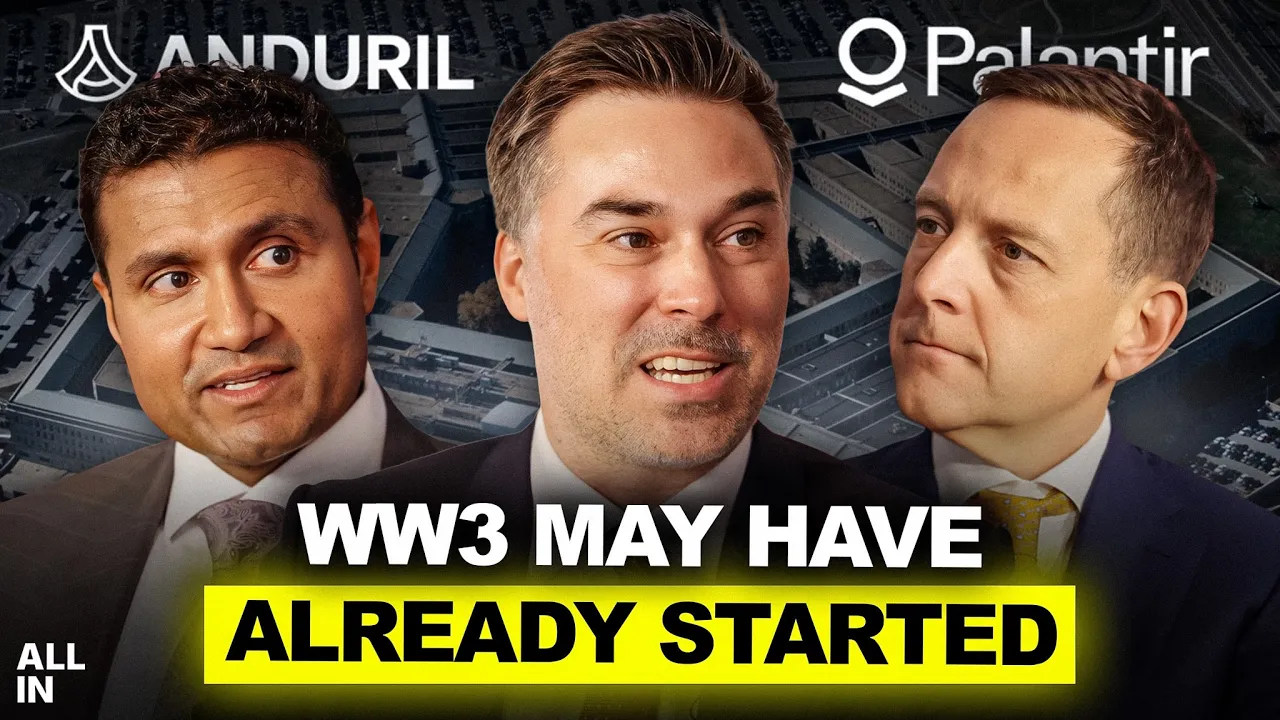
Palantir and Anduril Executives Call For Overhaul of US Defense Procurement
All-In Podcast
Bureaucratic inertia and reliance on legacy platforms threaten Western deterrence against China, requiring a immediate shift to mass-produced autonomous systems and resilient domestic supply chains.
## Background
published this episode on YouTube on April 6, 2026, featuring an in-depth conversation with Palantir CTO Shyam Sankar and Anduril co-founder Trae Stephens. According to the page description, the discussion covers the evolving state of modern warfare, focusing on autonomous drones, AI integration, fixing the U.S. defense supply chain, and addressing public debates over defense technology ethics and surveillance.
## TL;DR
Palantir's Shyam Sankar and Anduril's Trae Stephens argue that modern warfare requires a rapid shift from expensive, legacy military platforms to low-cost, mass-produced autonomous hardware and AI-driven decision tools. They detail structural bottlenecks in U.S. defense procurement and manufacturing compared to China's rapid industrial scaling, while confronting ethics concerns, corporate activism, and historical misgivings surrounding military tech partnerships. Ultimately, both leaders emphasize that maintaining American technological and defense dominance is vital to preserving global stability and preventing authoritarian hegemony by 2040.
## Atmosphere & style
The discussion carries a grave, urgent, yet deeply pragmatic tone, framed as an unfiltered insider look into the intersection of Silicon Valley venture capital and national defense strategy. Hosted by Brad Friedberg, the conversation moves seamlessly between high-stakes geopolitics and technical supply chain mechanics without dramatic sensationalism. The dynamic between Sankar and Stephens is collaborative and unapologetic, blending sharp historical analysis with candid critiques of government bureaucracy and tech-bro moralizing.
## Key takeaways
- [32:18](https://www.youtube.com/watch?v=mjNP5IOzCbA&t=1938s) US defense capabilities are constrained by significant supply chain vulnerabilities, including reliance on China for 80% of active pharmaceutical ingredients and heavy dependence on TSMC for semiconductors.
- [30:35](https://www.youtube.com/watch?v=mjNP5IOzCbA&t=1835s) Regulatory controls and ITAR restrictions prevented domestic drone makers from establishing a consumer market flywheel, effectively ceding the global consumer drone market to China's DJI.
- [38:47](https://www.youtube.com/watch?v=mjNP5IOzCbA&t=2327s) Bureaucratic entropy and compliance expansion have crippled military acquisition efficiency, replacing single decisive leadership with risk-averse committees.
- [41:55](https://www.youtube.com/watch?v=mjNP5IOzCbA&t=2515s) The U.S. defense posture faces a critical bottleneck where fragmented service demand forces minimum rate production instead of building high-capacity strategic deterrence.
- [45:45](https://www.youtube.com/watch?v=mjNP5IOzCbA&t=2745s) Modern conflict strategy requires shifting acquisition from high-cost, legacy exquisite platforms toward mass-produced, lower-cost, autonomous attritable systems.
- [47:18](https://www.youtube.com/watch?v=mjNP5IOzCbA&t=2838s) Tech executives framing defense refusal as a moral high ground is fundamentally flawed; democratic authority to set rules of engagement rests with elected representatives.
- [50:39](https://www.youtube.com/watch?v=mjNP5IOzCbA&t=3039s) Palantir refutes surveillance state accusations by operating as an enterprise software provider featuring strict access controls, row-level security, and complete data auditability.
- [55:57](https://www.youtube.com/watch?v=mjNP5IOzCbA&t=3357s) Silicon Valley's anti-defense sentiment stems from historic Vietnam-era fractures and a growing divide between civilians and active military service members.
- [58:55](https://www.youtube.com/watch?v=mjNP5IOzCbA&t=3535s) Foreign adversaries actively exploit domestic political fractures using proxy organizations and covert funding to weaken Western national defense consensus.
- [01:06:00](https://www.youtube.com/watch?v=mjNP5IOzCbA&t=3960s) Failing to achieve Western re-industrialization and military tech supremacy risks yielding global trade norms and rules of engagement to Chinese hegemony by 2040.
## Detailed walkthrough
Here is a detailed, faithful walkthrough of the provided transcript segment.
---
[00:00](https://www.youtube.com/watch?v=mjNP5IOzCbA&t=0s) Palantir Origins and the Meeting of Trae Stephens and Shyam Sankar
The conversation opens at the Hill & Valley Forum with hosts welcoming Trae Stephens, co-founder and Executive Chairman of Anduril Industries, and Shyam Sankar, Chief Technology Officer of Palantir Technologies. Host Brad Friedberg highlights their long shared history, prompting Sankar to recount how the two first met back when Palantir was a fledgling startup. In those early days, Sankar was traveling around demonstrating Palantir's software to anyone willing to see it. At the time, Stephens was working inside a government intelligence agency, sitting in a basement office frustrated by bureaucracy, doing little substantive work, and chatting about sports with colleagues.
Upon seeing Sankar's demo, Stephens realized the potential of Palantir's platform and decided to apply. However, coming from a rigid intelligence environment, Stephens committed a memorable fashion faux pas when he arrived for his interview in Palo Alto wearing a full suit, tie, and official CIA cufflinks. Palantir's office at the time consisted of around 20 employees who wore hand-me-down t-shirts. A protective receptionist intercepted Stephens in the lobby, instructing him to ditch the tie and dress down so he would not ruin his chances. The team loved him immediately, and he joined around early 2008 as one of the earliest team members to help build out Palantir's government business. Sankar notes that the company was founded around five co-founders, including Peter Thiel, who incubated the venture to resolve a post-9/11 dilemma: moving past the false dichotomy of privacy versus security by leveraging technology to expand both simultaneously.
- Palantir began with a narrow focus on solving specific counterterrorism problems for a small number of global institutions.
- Trae Stephens joined Palantir in early 2008 when the total company size was roughly 25 to 30 people.
---
[02:54](https://www.youtube.com/watch?v=mjNP5IOzCbA&t=174s) Deterrence, the Philosophy of War, and Silicon Valley's Defense Taboo
The hosts pivot to a fundamental question regarding the ethics of working in defense: "Is war good?" Sankar and Stephens explicitly reject any notion that war is desirable, noting that anyone who has experienced combat knows it is categorically awful. They argue that military technology is not about wanting conflict, but about achieving deterrence—ensuring a nation is so strong and capable that adversaries realize challenging it is unthinkable. Sankar emphasizes that no military leader wants to make phone calls to parents informing them of a child's death; the core mission of companies like Palantir and Anduril is to make war quick, decisive, or entirely uninviting to hostile powers.
Addressing why Silicon Valley treated defense tech as a taboo subject for decades, Sankar explains that it was an ironic byproduct of an extended era of global peace. Historically, Silicon Valley's origins were deeply rooted in defense; Lockheed was the largest employer in the area during the 1950s, and the Corona spy satellites were built locally. However, after the Cold War ended, a mindset of globalism took over, making national defense work appear cynical to tech workers. Stephens adds that the shift was also driven by large tech firms becoming multinational entities whose workforces were not exclusively American citizens. The dynamic changed dramatically when Russian tanks rolled into Ukraine, creating a clear geopolitical wake-up call for tech workers who realized national security threats were real and urgent.
- Historically, top American commercial companies were dual-purpose: Chrysler built the Minuteman ICBM alongside minivans, General Mills used grain-processing tech to design torpedo guidance systems, and Ford built satellites until 1990.
- In 1989, when the Berlin Wall stood, only 6% of major U.S. weapon system spending went to pure-play defense specialists, while 94% went to commercial dual-purpose companies. Today, that distribution is entirely inverted.
---
[08:39](https://www.youtube.com/watch?v=mjNP5IOzCbA&t=519s) US vs. China: Industrial Capacity, Munitions Gaps, and Deterrence Failures
The discussion turns to America's current defense posture relative to its chief adversaries. While the U.S. maintains the highest defense spending globally and boasts an apex joint military force, both executives warn of severe underlying structural vulnerabilities. The loss of a broad U.S. manufacturing base has crippled mass production, leading to alarming disparities—including a reported 10,000-to-1 drone production gap and a 223x shipbuilding capacity disadvantage compared to China. Additionally, national security analysts point to a critical 2027 window of danger regarding a potential conflict over Taiwan.
Sankar argues that empirical deterrence has already eroded over the last decade, citing events such as the 2014 annexation of Crimea, China's 2015 militarization of the Spratly Islands, Iran's 2017 nuclear breakout capabilities, the October 7 attacks in Israel, and the Houthis disrupting international shipping in the Red Sea. A core financial and logistical flaw in current U.S. strategy is relying on $2 million air defense interceptors to shoot down $20,000 hostile drones. When Ukraine burned through 10 years' worth of baseline munitions production within just 10 weeks of high-intensity combat, it revealed that stockpiles alone do not deter enemies; deterrence rests on active factory capacity and the velocity at which a nation can regenerate munitions.
- Stephens highlights how globalization gutted industrial communities across the American Midwest, recalling how his own family members lost manufacturing jobs as factories closed down in Ohio (including GM, Ford, Frigidaire, NCR, and Armco Steel).
- Over the last two decades, Tesla stands as the sole example of a modern, large-scale consumer manufacturing enterprise successfully built from scratch in the United States.
---
[12:27](https://www.youtube.com/watch?v=mjNP5IOzCbA&t=747s) Anduril's Arsenal-1 and Rebuilding the Defense Supply Chain
To address the severe bottleneck in U.S. defense manufacturing, Stephens explains Anduril's strategy with "Arsenal-1"—a massive 5 million square foot manufacturing factory campus being built in Columbus, Ohio. The objective is to revitalize the region's historical manufacturing talent while applying modern software techniques to hardware production. Powered by a specialized software operating system (developed in part using Palantir's Foundry platform), Arsenal-1 is designed to lower overhead costs, streamline supply chains, and enable rapid automation across product lines.
Stephens contrasts Anduril's flexible setup with traditional defense prime contractors. Standard defense lines build hyper-specific platforms; if a conflict demands a different item, those rigid assembly lines cannot adapt. Instead, Anduril borrows the modular model used by commercial electronics contract manufacturers (who produce VR headsets for Meta, Samsung, and Apple on shared core capabilities). This modularity allows Arsenal-1 to shift production lines on short notice—pivoting rapidly between autonomous systems like the Roadrunner or cruise missiles like the Barracuda based on real-time military needs. Stephens notes that when Ukraine requested additional Stinger and Javelin missiles early in the war, the U.S. struggled to supply them because the original assembly lines had been dismantled years prior and the specialized workforce had retired.
- Arsenal-1 spans 5 million square feet of manufacturing space located in Columbus, Ohio.
- The factory relies on software integration through Palantir Foundry to automate operations and manage flexible assembly.
- Modular production design allows rapid shifting of manufacturing lines between different hardware platforms based on battlefield demand.
[14:37](https://www.youtube.com/watch?v=mjNP5IOzCbA&t=877s) Funding Defense Innovation and the Power Law of New Primes
Addressing the massive capital requirements for standing up facilities like Arsenal-1, Trae Stephens outlines the fundamental difference between legacy defense primes and modern tech entrants. Traditional primes wait for explicit government requirements and cost-plus contracts, taking minimal risk forward of capability. Anduril operates on a venture-backed model, pouring private R&D investment upfront to build finished products and selling the output. However, Stephens cautions that this space requires immense capital and operational depth; the market cannot support a hundred new primes, even if healthy competition is desirable.
Shyam Sankar contextualizes this for tech audiences by highlighting the structural realities of defense. Unlike commercial software where companies invent new product categories, defense is a monopsony—a single-buyer market that holds immense power. Historically, this single buyer is often wrong about what it needs. Sankar shares the historical example of Winston Churchill using the Royal Navy's budget to invent the tank because the British Army was fixated on cavalry horses. Major innovations require "heretical" founders who push a vision forward despite government pushback, only to be validated when real combat hits.
```
+-----------------------------------------------------------------------------------+
| DEFENSE MODEL COMPARISON |
+------------------------------------+----------------------------------------------+
| Traditional Prime Model | Venture-Backed Defense Model (Anduril/Palantir)|
+------------------------------------+----------------------------------------------+
| • Responds strictly to gov specs | • Incur private R&D cost upfront |
| • Operates on cost-plus contracts | • Builds integrated products, sells output |
| • Low forward capital investment | • High capital density & fast execution |
| • Bureaucratic consensus driving | • Founder-driven "heretical" innovation |
+------------------------------------+----------------------------------------------+
```
Sankar notes that in peacetime, the government views competing programs as wasteful duplication, whereas severe threats force healthy redundancy. During the Cold War, the U.S. ran eight competing ICBM programs simultaneously. Today, capital is concentrating heavily into a select group of new-generation primes like Anduril, SpaceX, and OpenAI. Just like venture capital, defense tech follows a strict power law: a few dominant winners will capture the vast majority of the market, making "peanut-butter spreading" small amounts of capital across dozens of early-stage startups ineffective.
- **Historical Peak of Primes:** During the Cold War era, the U.S. had 51 major defense contractors.
- **Post-Cold War Consolidation:** The famous 1993 "Last Supper" meeting led by the Department of Defense reduced 51 contractors down to 5 or 6 major primes.
- **Attempted 1999 Consolidation:** The U.S. Department of Justice intervened in 1999 to block a proposed merger between Lockheed and Northrop.
- **Cold War Redundancy:** The U.S. ran 8 competing ICBM development programs simultaneously to guarantee strategic success.
---
[19:35](https://www.youtube.com/watch?v=mjNP5IOzCbA&t=1175s) The Post-Cold War Consolidation and Palantir's Field-First Battle
Reflecting on how defense contracting reached its modern state, the panel examines the 1993 post-Cold War "peace dividend." With the fall of the Soviet Union, the Department of Defense summoned 15 top prime executives to a famous dinner—often called the "Last Supper"—and bluntly informed them that budgets were being slashed, advising them to consolidate or face bankruptcy. This systemic contraction reduced over 50 prime suppliers to a oligopoly of five dominant players, crippling the industry's ability to innovate fast.
When asked what enabled companies like Palantir and Anduril to break open this closed ecosystem, Sankar dispels any romanticized vision of Silicon Valley being welcomed by Washington. "I can't tell you how many meetings even we had together where we walk out and be like, 'This is not going to work. This is very bad.'" Palantir was not greeted with open arms; the procurement apparatus actively blocked software-driven approaches, eventually forcing Palantir to sue its own primary customer just for the legal right to compete on merits.
Palantir survived by bypassing Washington bureaucrats and deploying directly into combat theaters. Warfighters on active rotations, desperate for tools that actually worked, adopted the software in the field. This bottom-up adoption created undeniable empirical facts on the ground, eventually forcing the Pentagon to recognize the technology. Stephens credits Palantir’s five-year grind to reach $10 million in annual revenue as the essential precedent that allowed Anduril to reach the same milestone in just 22 months.
> "Famously we had to sue our customer just for the right to compete. That's the strength of the monopsony, right? And really I'd say our entire business was validated from the field backwards... At the margin in the field where people are saying, 'What I'm being given doesn't work... how do I bend the rules, figure out how to get the software I need.'" — **Shyam Sankar**
- **Palantir's Revenue Scaling:** Took roughly 5 years to hit $10 million in annual recurring revenue due to structural procurement headwinds.
- **Anduril's Speed Advantage:** Reached the $10 million ARR mark in 22 months by leveraging lessons and legal precedents established by Palantir.
- **Field-Driven Validation:** Software adoption occurred at the operational edge during overseas deployments rather than through traditional procurement channels in Washington D.C.
---
[22:35](https://www.youtube.com/watch?v=mjNP5IOzCbA&t=1355s) Software vs. Hardware Economics and the Bob Noyce Playbook
Detailing Anduril's inception, Stephens recounts pitching Sankar before launching the company, jokingly claiming hardware would be easier than software because government officials understand physical objects. The Pentagon's procurement architecture was built for line-item factory audits—bill of materials, physical parts, and labor hours—dating back to government-owned munitions plants during the Cold War. Trying to sell high-margin, high-R&D software on a traditional "cost-plus" model remains fundamentally broken because procurement officers struggle to evaluate intangible IP value over lines of code.
Sankar draws a direct historical parallel between modern defense tech software models and Bob Noyce’s strategy at Fairchild Semiconductor in the late 1960s. In 1968, 96% of all integrated circuits were purchased by the Apollo space program, effectively giving the government a buying monopoly. Noyce recognized that accepting government R&D funding would trap his product roadmap inside slow bureaucratic requirements. He strictly capped government-funded R&D at 4%, funding the rest privately to aggressively pursue Moore’s Law. Decades later, that private commercial push gave the military the cheap microelectronics required for precision-guided munitions in the Assault Breaker program.
```
1968 (Fairchild / Bob Noyce) Modern Era (SpaceX / Anduril)
+----------------------------------+ +----------------------------------+
| Apollo Program buys 96% of chips | | Gov contracts pay for launch/gear|
| Noyce caps Gov R&D funding at 4% | | Private R&D drives Starship/Al |
| Chases commercial Moore's Law | | Rapidly drives down cost curves |
+----------------------------------+ +----------------------------------+
│ │
▼ ▼
+----------------------------------+ +----------------------------------+
| Result: Cheap precision guidance | | Result: Orbit drops from $50k/kg |
| ready for 1980s Assault Breaker | | to under $20/kg on Starship |
+----------------------------------+ +----------------------------------+
```
The discussion contrasts this cost-reduction model against traditional government programs. Under cost-plus contracts, if a contractor slashes internal manufacturing costs, they cut their own profit margin. True commercial models incentivize driving costs down aggressively while maintaining healthy margins. Sankar highlights SpaceX's revolution in launch economics: where the Space Shuttle cost roughly $50,000 per kilogram to reach orbit, fully reusable Starship flights aim for under $20 per kilogram—an improvement impossible within a cost-plus framework.
- **Fairchild Semiconductor Market Share (1968):** 96% of all integrated circuits produced were purchased by NASA's Apollo program.
- **Bob Noyce's Defense Cap:** Capped government-funded R&D at 4% to retain control over product development and relentlessly chase Moore's Law.
- **Launch Cost Scale:** Space Shuttle launch costs stood at ~$50,000/kg; SpaceX Starship heavy reuse targets <$20/kg.
- **Legal Precedents:** Both SpaceX and Palantir filed landmark lawsuits against military branches (Air Force and Army, respectively) under federal procurement laws to gain fair access to bid.
---
[24:16](https://www.youtube.com/watch?v=mjNP5IOzCbA&t=1456s) Founding Anduril and the Approaching Venture Shakeout
Stephens shares the accidental origins of Anduril while working as an investor at Founders Fund. Tasked by Peter Thiel to look into government technology, Stephens queried public federal contract databases and cross-referenced them against Crunchbase. Out of hundreds of outbounded meetings over three years, Founders Fund made only a single investment—KDM Analytics (later renamed Expanse and acquired by Palo Alto Networks). The landscape was an absolute wasteland of venture-backable defense software and hardware.
Realizing that no one was building a modern defense contractor—a "software-defined, hardware-enabled prime"—Stephens proposed the concept to his partners at Founders Fund, who promptly encouraged him to leave the side of the table and start it himself. Looking at the present influx of venture capital flooding into defense tech, Stephens and Sankar reflect on the coming market reality. With dozens of funds now pouring capital into hundreds of drone, satellite, and weapon startups, a major shakeout is inevitable as capital runs up against the harsh realities of defense procurement and power-law distribution.
- **Founders Fund Outbound Analysis:** Evaluated hundreds of federal contractors over a 3-year period, resulting in only 1 venture investment (Expanse/KDM).
- **Expanse Acquisition:** KDM/Expanse was eventually acquired by Palo Alto Networks.
- **Core Thesis:** Transitioning defense architecture from hardware-defined/software-enabled systems to software-defined/hardware-enabled platforms.
<ElicitationsGroup message="To explore these topics further:">
<Elicitation label="Analyze Palantir vs. Army 2016 Lawsuit" query="Provide a detailed breakdown of Palantir Technologies v. United States (2016), the legal arguments around FASA (Federal Acquisition Streamlining Act), and how it changed defense procurement."/>
<Elicitation label="Compare Space Shuttle vs. SpaceX Starship Costs" query="Compare the cost economics, engineering tradeoffs, and business models of the Space Shuttle program versus SpaceX Starship."/>
</ElicitationsGroup>
[28:13](https://www.youtube.com/watch?v=mjNP5IOzCbA&t=1693s) Valuation Inflation, Multiple Contrition, and Venture Discipline
Trae Stephens reflects on early days at defense tech companies like Palantir, recalling offer letters with tables projecting equity value under hypothetical company valuations of $1 billion, $5 billion, or $20 billion. At the time, employees scoffed at the idea of ever reaching $20 billion; today, seed-stage startups enter meetings casually expecting $20 billion valuation caps. While Stephens celebrates that successes like Palantir, SpaceX, and Anduril prove defense tech is no longer an impossible venture market, he warns of dangerous valuation inflation. Excess capital raises at bloated valuations introduce unnecessary structural risk to young companies.
Stephens references a famous scene from HBO's *Silicon Valley* where a founder is stunned to learn he could simply "raise less money at a lower price." At Anduril, Stephens implements a strict capital strategy: "climbing down the multiples tree" with each successive funding round. Rather than chasing peak revenue multiples, Anduril deliberately accepts lower multiples over time to maintain fiscal discipline as it approaches a public market listing.
- **Palantir Offer History:** Early offer letters used simple 1, 5, and 20x scenario modeling to demonstrate potential equity outcomes.
- **HBO’s *Silicon Valley* Analogy:** Founders often fall into the trap of over-capitalizing at unsustainable price targets instead of raising modest capital to de-risk operations.
- **Multiple Compression Strategy:** Anduril explicitly lowers its valuation-to-revenue multiple on successive funding rounds (e.g., from early rounds through Series G and into Series A follow-ons) to ensure readiness for an IPO environment.
[30:35](https://www.youtube.com/watch?v=mjNP5IOzCbA&t=1835s) Department of War Investments and the US Drone Gap
Addressing the Department of War's investment initiatives—and its internal team dubbed "Deal Team Six"—Shyam Sankar compares modern government capital injections to the US Air Force bootstrapping the national titanium supply chain during the 1950s and 1960s. Strategically placing capital at structural industrial bottlenecks enables private aerospace markets to thrive. Today, the Office of Strategic Capital must resolve single-point-of-failure dependencies across defense hardware, such as the domestic shortage of electric brushless motors for autonomous systems.
Sankar argues that the modern drone gap represents a massive historical policy error. The underlying invention of the modern autonomous drone was an "American birthright," pioneered by Abe Karem and developed at General Atomics with the Predator. However, regulatory overreach via ITAR (International Traffic in Arms Regulations) controls and strict FAA restrictions on Beyond Visual Line of Sight (BVLOS) operations dismantled early domestic commercial adoption.
> "There's a counterfactual world where General Atomics had a consumer subsidiary called DJI, and the consumer drone market was entirely owned by the US... writing us down the price production curve." — **Shyam Sankar**
- **Supply Chain Bottlenecks:** Dozens of competing defense hardware startups risk stalling at the exact same supply components, notably high-performance brushless motors.
- **Historical Analogy:** Government subsidies for integrated circuits and titanium paved the way for commercial markets; early defense adoption historically absorbs high upfront production costs.
- **Lost Consumer Advantage:** Export restrictions and domestic flight bans prevented US drone builders from establishing the massive commercial flywheel later captured by Chinese firms like DJI.
[32:18](https://www.youtube.com/watch?v=mjNP5IOzCbA&t=1938s) Strategic Vulnerabilities: Generic Pharmaceuticals and Semiconductors
Expanding beyond pure weapon systems, Sankar highlights deep supply chain risks that threaten national resilience and the domestic "will to fight." Generic pharmaceutical manufacturing is a major vulnerability, as 80% of active pharmaceutical ingredients (APIs) for US generic drugs are sourced directly from China. In a kinetic conflict, American citizens could be forced to weigh national defense objectives against acute shortages of basic, life-saving antibiotics for their families.
This gap stems from a flawed globalist philosophy that assumes America can focus strictly on high-level innovation while outsourcing heavy manufacturing overseas. Real innovation, Sankar argues, is a direct consequence of active productivity. For instance, Google's seminal 2017 AI paper *"Attention Is All You Need"* was driven by a mundane effort to achieve a 3% performance boost in Google Translate. Outsourcing production strips away the immediate operational problems that fuel breakthroughs. Meanwhile, China now hosts 50% of new global clinical drug trials. Stephens echoes these concerns regarding semiconductors, noting that after Taiwan's TSMC pulled ahead, the US failed to back domestic alternatives, leaving a critical structural risk that capital alone cannot resolve before 2027.
- **Active Pharmaceutical Ingredients (APIs):** China controls ~80% of the core active ingredients for US generic medications.
- **Clinical Trial Shift:** Half of all new clinical drug trials globally are currently conducted inside China.
- **Semiconductors:** Total reliance on TSMC leaves the US exposed to serious supply shock, with long fab buildout timelines offering little relief against near-term geopolitical windows.
[34:16](https://www.youtube.com/watch?v=mjNP5IOzCbA&t=2056s) Hardware, Software, and Decision Advantage
Discussing how hardware and software interlock on the modern battlefield, Sankar frames software as the engine of the "third offset." While the first offset centered on nuclear deterrence and the second on stealth and precision-guided munitions, the current paradigm is built entirely on *decision advantage*—the ability to out-think, process data faster, and out-execute an enemy in real time.
Sankar critiques the Department of Defense’s tendency to enforce rigid operational frameworks, such as Modular Open Systems Architecture (MOSA), to avoid software integration friction. Bureaucratic processes intended to guarantee order often stifle fast-paced software integration. Technical interoperability cannot be legislated by administrative mandate; it must be stress-tested and proven through combat trials and field exercises.
- **First Offset:** Nuclear weaponry capability and strategic deterrence.
- **Second Offset:** Stealth technology and precision-guided munitions (PGMs).
- **Third Offset:** Real-time decision advantage via networked hardware and artificial intelligence.
- **MOSA Critique:** Attempting to force software compliance through top-down architectural standards often stalls real-world deployment.
[35:45](https://www.youtube.com/watch?v=mjNP5IOzCbA&t=2145s) Shifting Procurement from Stockpiles to Consumables
Sankar highlights a shift in how defense officials view hardware acquisition: transitioning from permanent, long-term stockpiles to treating drones and munitions as consumable consumables. Under traditional models, weapons sat on shelves for decades until obsolete. The emerging model treats hardware as continuously consumable assets that are routinely expended during realistic training exercises, triggering predictable, recurring replenishment orders for defense prime contractors.
This perpetual procurement cycle gives hardware manufacturers a stable demand signal, allowing defense firms to iterate quickly on hardware revisions instead of maintaining legacy systems. Furthermore, procurement officers are gaining greater administrative flexibility. Rather than being bound to a fixed contract item specified years in advance, buyers can dynamically adapt their hardware selections to meet shifting operational objectives.
> "Can you imagine trying to run any private sector business without that degree of autonomy and flexibility in your decision-making?" — **Shyam Sankar**
- **Consumable Procurement:** Munitions and unmanned systems are designed to be cycled out and destroyed during active testing, sustaining high-volume industrial lines.
- **Flexible Buyer Mandates:** Acquisition executives are shifting from rigid item-level purchasing to outcome-based requirements.
[36:48](https://www.youtube.com/watch?v=mjNP5IOzCbA&t=2208s) Critical Minerals, Reform, and the Non-Partisan Reality of Defense
Stephens contrasts past government clean-tech funding missteps, such as Solyndra during the Obama administration, with recent direct engagements by the Office of Strategic Capital (OSC). Today, the OSC negotiates off-take agreements and co-invests alongside private venture capital to secure critical mineral extraction and refining pipelines, bypassing fragile foreign supply chains.
Addressing whether defense reform hinges on political control, both speakers emphasize that structural transformation is driven by individual leaders rather than party platforms. Defense modernization efforts were prioritized under Ash Carter during the Obama administration and accelerated under the Trump administration. The core challenge is overcoming the natural entropy of defense bureaucracy.
- **Office of Strategic Capital (OSC):** Coordinates directly with private investors to underwrite domestic critical mineral refining and mining off-take deals.
- **Cross-Party Continuity:** Defense innovation programs were led by figures like Ash Carter under Democrats and sustained through Republican terms.
- **Bureaucracy vs. Leadership:** Systems naturally atrophy into red tape unless clear-headed leadership actively strips away administrative bloat.
[38:47](https://www.youtube.com/watch?v=mjNP5IOzCbA&t=2327s) Bureaucratic Entropy, Skunk Works, and the Loss of "Founders"
Sankar details how administrative bloat expands over time, citing the acquisition guidelines established by former Deputy Secretary of Defense David Packard (co-founder of Hewlett-Packard). Packard’s original DoD 5000 series directive on defense acquisition was a crisp, 7-page document; over the decades, bureaucratic expansion ballooned that same framework into over 2,000 pages of compliance rules.
Stephens draws a parallel to Kelly Johnson, the legendary founder of Lockheed’s Skunk Works, who designed 41 aircraft—including the U-2 and the SR-71 Blackbird. Johnson succeeded because he actively blocked government bureaucrats from meddling in his engineering teams. Notably, the U-2 program was initially rejected by military leadership and was only funded after Johnson bypassed standard procurement channels to partner directly with the CIA. Similar historical breakthroughs—such as Admiral Hyman Rickover’s development of the nuclear navy and General Bernard Schriever’s ICBM program—relied on decisive individual leaders operating like startup founders. Today, key programs like the F-35 are managed by diffuse committees, distributing manufacturing across hundreds of political districts rather than focusing on rapid technical execution.
- **David Packard's DoD 5000:** Expanded from a 7-page operational guide into a 2,000-page bureaucratic manual.
- **Kelly Johnson's Track Record:** Built 41 airframes by insulating his engineering teams from government oversight.
- **Historical Founder-Led Programs:**
- **U-2 Reconnaissance Aircraft:** Funded through intelligence channels after military rejection.
- **Nuclear Navy:** Pushed through military resistance by Admiral Hyman Rickover.
- **US ICBM Program:** Accelerated under the leadership of General Bernard Schriever.
- **F-35 Political Sprawl:** Components are manufactured across 400 separate congressional districts to secure political backing, compromising design efficiency.
- **SLS vs. Starship Contrast:** NASA's Space Launch System (SLS) required subcontractors across all 50 states by political mandate, whereas SpaceX Starship relies on centralized commercial iteration.
[41:55](https://www.youtube.com/watch?v=mjNP5IOzCbA&t=2515s) Munitions Capacity and the Pentagon's Structural Bottleneck
Shyam Sankar provides a stark assessment of America's defense readiness when asked how close the U.S. is to sustaining multi-region conflicts. He visualizes the defense posture as a spear: while the tip of the spear is exceptionally sharp, the shaft requires immense work. The fundamental issue lies within the Pentagon itself, where supply and demand are structurally disconnected. Demand is dictated by real-world operational crises across combatant commands, while supply is fragmented across service branches and an industrial base tasked with manning, training, and equipping forces. Unlike a private enterprise that dynamically matches supply and demand, the Pentagon struggles to maintain agility or consensus.
This bureaucratic inertia locks the military into rigid procurement decisions that cannot easily adapt when threat realities change—such as shifting order volumes between Barracuda munitions and Fury autonomous aircraft. Over time, budget entropy forces programs into "minimum rate production," a survival mechanism meant merely to keep factory lines open rather than build true strategic deterrence. To fix this, Sankar argues that defense procurement must be tied directly to active consumption. Munitions need to be consumable and continuously replenished, providing prime contractors and "neo-primes" a stable demand signal that incentivizes cost reduction to drive profitability.
- Sankar rejects the cynical narrative that defense primes make excess profits, noting they often trade at low multiples (frequently under 2x revenue) due to structural under-profitability.
- The military's reliance on minimum rate production has incrementally "frog-boiled" the defense base into its current state of fragile readiness.
- A functional defense industrial base requires a continuous loop of consumption and replenishment to sustain production capacity.
---
[44:07](https://www.youtube.com/watch?v=mjNP5IOzCbA&t=2647s) High-Low Munition Mix and Anduril’s 18-Month Industrial Blueprint
Trae Stephens addresses the critical gap between current stockpiles and major conflict requirements. He highlights the necessity of balancing high-end, multi-million-dollar exquisite interceptors with lower-cost, unguided "dumb" munitions. While readiness varies across different weapon categories, overall capacity remains severely constrained. Describing Anduril’s aggressive expansion, Stephens notes that they had just opened their massive "Arsenal-1" manufacturing facility the previous day to scale production of their Fury autonomous aircraft.
Even with unlimited capital starting immediately, Stephens estimates it would take roughly 18 months of intensive scaling to place the national industrial base on a sustainable trajectory. However, because funding is trickled out incrementally, achieving true readiness will remain out of reach without decisive political leadership.
- U.S. munitions stockpiles are dangerously lean for a high-intensity war with China, contrasting sharply with the massive volume required for extended operations.
- Stood-up production lines face physical ramp constraints that take substantial time to clear, regardless of funding.
- Capital alone cannot solve the crisis; sustained executive and legislative leadership is required to overhaul defense procurement speed.
---
[45:45](https://www.youtube.com/watch?v=mjNP5IOzCbA&t=2745s) Autonomy in Modern Combat and the Shift to Attritable Mass
Reflecting on operational doctrine, Stephens observes a fundamental truth of warfare: "the wars of today are fought with the weapons of yesterday." While legacy exquisite platforms—such as B-2 stealth bombers, precision strikes in Iran, and Patriot missile defense batteries—perform with extraordinary precision and high target hits, they present a single critical vulnerability: they are prohibitively expensive and impossible to rapidly resupply.
To win future high-intensity conflicts, defense strategy must shift toward building attritable, mass autonomous systems. While a small percentage of Anduril's autonomous hardware is actively deployed in combat zones today, the broader force structure remains dominated by legacy hardware. Over the next 5 to 10 years, lessons from battlefields in Ukraine and the Middle East dictate that the high-low mix must shift dramatically toward affordable, scalable, and mass-produced autonomous assets.
- Exquisite systems hit targets effectively but leave the military "behind the eight ball" on rapid industrial resupply.
- Future inventory must prioritize high-volume, attritable systems alongside specialized high-cost platforms.
- Ukraine and Middle East combat operations demonstrate the urgent real-world shift toward autonomous mass.
---
[47:18](https://www.youtube.com/watch?v=mjNP5IOzCbA&t=2838s) The Ethics of Autonomous Weapons and AI Command Decisiveness
Addressing recent friction between AI labs like Anthropic and the Pentagon—specifically reports regarding Anthropic's resistance to unconstrained usage of its Claude model in Project Maven—Stephens clarifies the distinction between vendor ethics and democratic legitimacy. He argues that in a constitutional republic, elected representatives—not self-appointed tech executives—hold the authority to establish the rules of engagement. Fully autonomous defense systems are far from novel; platforms like the Navy's SeaRAM (Phalanx CIWS) have long operated with full autonomy to intercept incoming supersonic threats where human reaction time is insufficient. Crucially, human accountability remains intact because a designated commander retains responsibility for the weapon system's actions.
Stephens traces the moral evolution of warfare, noting that after human firepower escalated from primitive weapons to the nuclear plateau of World War II, combat evolved toward extreme precision. Modern warfare utilizes non-explosive kinetic warheads targeted directly at specific windows to minimize collateral damage. Far from being an ethical step backward, AI-enabled command centers enhance battlefield discrimination, reduce civilian casualties, and improve targeted accuracy compared to historic area-bombing campaigns.
- Refusing to build technology for national defense is not a morally neutral stance; abstention is itself an active moral decision.
- SeaRAM (CIWS) automated ship-defense systems prove that tactical operational autonomy has existed safely alongside human command accountability for decades.
- Advanced AI tools act as command-and-control accelerators, increasing targeted precision and lowering collateral damage.
---
[50:39](https://www.youtube.com/watch?v=mjNP5IOzCbA&t=3039s) Dissecting Surveillance State Claims and "Tyranny by Tech Bro"
Shyam Sankar directly rebuts recurring protests and media claims accusing Palantir of constructing a surveillance state. He notes that such criticisms stem from broad, sci-fi-inspired fears of technology rather than operational reality. Palantir does not collect, sell, or own data; it provides software infrastructure that enables customer organizations to process their own lawfully collected data. Sankar compares accusing Palantir of surveillance to accusing Microsoft Excel of being a surveillance tool—except Palantir enforces strict row-level security, immutable access controls, and full auditability. In Sankar's view, it is virtually impossible to use Palantir's platform for illicit surveillance because every action leaves an indelible digital footprint.
Sankar warns against tech companies independently dictating how lawful government agencies operate, labeling tech executive intervention over government contracts as "tyranny by tech bro." When a small group of non-elected tech leaders unilaterally restricts how democratically accountable institutions use technology, they usurp public governance. To illustrate the danger of individual tech workers appointing themselves geopolitical arbiters, Sankar cites Manhattan Project physicist Theodore Hall, who leaked atomic secrets to the Soviet Union in 1944 under the naive belief that creating a nuclear balance would ensure world peace.
- Palantir operates as an enterprise software layer, not a data aggregator or data broker.
- Cell-by-cell governance and comprehensive audit trails make illegal software usage instantly traceable within the platform.
- Theodore Hall’s 1944 atomic espionage to the Soviets serves as a historical warning against technocrats unilaterally deciding national security policy.
---
[53:28](https://www.youtube.com/watch?v=mjNP5IOzCbA&t=3208s) Civil Service Tools and Oversight Mechanisms
Trae Stephens highlights a core contradiction in public pushback against defense and civic technology: the paradoxical demand for government policies without equipping civil servants with the tools required to enforce them. Using the analogy of automated red-light and speed-enforcement cameras, he notes that while people may dislike automated enforcement, criticizing effective tech deployment often reveals a fundamental cynicism toward democratic institutions themselves. Disabling or withholding effective tools from public servants tasked with carrying out democratically enacted laws is ethically flawed.
When asked how their companies would respond if a government agency used their software illegally, both executives state unequivocally that they would report it to the Inspector General (IG). Stephens and Sankar outline the robust statutory framework governing federal agencies, where independent IGs possess sweeping authority to investigate internal misconduct based on anonymous or named complaints.
- Inspector General offices across federal departments (from the Department of War to HUD) hold statutory authority to investigate agency abuses unfettered.
- The IG complaint mechanism is actively utilized and strictly investigated by military law enforcement agencies like NCIS.
- Sankar references Colonel Drew Cukor, the visionary behind Project Maven, who faced and cleared rigorous IG investigations triggered by internal pushback.
---
[55:57](https://www.youtube.com/watch?v=mjNP5IOzCbA&t=3357s) [HH:MM:SS] Cultural Roots of Anti-Defense Tech Alignment
The discussion shifts to the origins of anti-defense sentiment within Silicon Valley and academia. Sankar identifies the Vietnam War as the historic catalyst that created a deep cultural rift between academic institutions and the defense establishment. Prior to Vietnam, top university research departments worked closely with national security leadership. The perceived deceptions and political fallout of that era fractured trust, establishing a legacy of skepticism toward military technology that persisted through the post-Cold War "peace dividend" and continues to influence modern tech culture.
[56:22](https://www.youtube.com/watch?v=mjNP5IOzCbA&t=3382s) Institutional Distrust, the Civilian-Military Divide, and the Legacy of Edward Snowden
The conversation delves into the deep cultural rift surrounding public trust in American institutions and defense technology. Shyam Sankar notes that society suffers from two distinct schisms: first, a pervasive, escalating distrust; second, an evaporating connection to people who have actually served in uniform. Because so few civilians understand how defense work gets done, what the actual terminology means, or how strict institutional oversight is, they substitute their own fears. The public ends up believing a "cartoon version" of defense operations—assuming work is done in a cowboy fashion without oversight or clear doctrine—making reconciliation nearly impossible.
Trae Stephens points to the aftermath of Edward Snowden's leaks 15 years prior as a prime example of narrative driving public perception over facts. At the time of the leaks, there was virtually no public discussion regarding whether data collection was actually being abused. Investigations revealed fewer than 12 documented cases of improper data access, and those rare instances stemmed from technical glitches rather than policy design. Despite ongoing debates about whether the intelligence community should collect such data, the underlying policy was repeatedly reauthorized across decades by both political parties and multiple presidential administrations.
Trae highlights the physical divide by sharing an observation from his guest lectures at Stanford University. When asking undergraduate classes if anyone has an immediate family member in the military, virtually no hands go up. While veteran representation exists in graduate programs like the Stanford Graduate School of Business (GSB), the undergraduate body is almost entirely disconnected from military life. This dynamic echoes criticisms raised by figures like Vice President J.D. Vance regarding out-of-touch American elites. Trae argues that the country is losing touch with the "salt of the earth" middle-American veteran community that was far more integrated into civic life during World War II and the Cold War.
- Edward Snowden's revelations yielded fewer than 12 documented cases of improper data access, driven by technical errors rather than intentional policy abuse.
- In guest lectures to Stanford undergraduates, Trae Stephens notes that virtually zero students raise their hands when asked if an immediate family member serves in the military.
[58:55](https://www.youtube.com/watch?v=mjNP5IOzCbA&t=3535s) Foreign Disinformation, Counter-Intelligence, and Reclaiming Defense Patriotism
The discussion shifts to external threats manipulating domestic social media and mainstream news to destabilize American progress. Host Brad Friedberg notes that he has seen clear traces of foreign entities stoking fear to slow down American scientific and industrial advancement. Shyam Sankar confirms that using proxy groups to sow division is a time-tested strategy for foreign adversaries, tracing it back to the Vietnam War when the Soviet Union spent $7 million (equivalent to modern 2026 dollars) funding the American anti-war and peace movement to inflame existing organic tension. Today, foreign adversaries like the Chinese Communist Party (CCP) funnel money to non-profit organizations and activist groups protesting defense companies like Palantir over domestic political issues.
Trae Stephens calls this foreign strategy brilliant, framing it as standard statecraft between strategic rivals. Shyam notes that the United States has historically engaged in its own counter-intelligence and cultural efforts worldwide; for example, the CIA covertly funded the modern art movement during the Cold War to undermine Soviet cultural control and project Western values without directly micromanaging artistic output.
When asked how the tech and defense sectors can recast their mission around patriotism, Shyam points to Trae's book writing efforts. Shyam emphasizes that if Americans take a clear-eyed look at how much deterrence the U.S. has lost, they might realize World War III has effectively already begun. Rebuilding a national consensus does not require convincing every single citizen, but rather reminding the public of what is at stake for their children's future.
- The Soviet Union spent $7 million (in 2026 dollars) to fund U.S. peace protests during the Vietnam War to sow internal division.
- CCP-linked funding currently flows to domestic protest organizations targeting modern defense technology companies like Palantir.
- The U.S. CIA historically funded modern art initiatives during the Cold War to counter Soviet artistic control and project open-society values.
- At the start of World War II, the United States maintained only the 17th largest army in the world before rapidly re-industrializing.
[01:02:38](https://www.youtube.com/watch?v=mjNP5IOzCbA&t=3758s) Internal Discord, Socialism, and the Friction Between Palantir and Anduril
Addressing the rise of domestic socialist movements, Shyam Sankar argues that the primary threat to the United States is internal "suicide" rather than external homicide. Movements calling for radical system overhauls are symptomatic of self-loathing, internal discord, and a failing leadership class. He criticizes past political decisions surrounding globalization, such as selling NAFTA under the promise of universal prosperity while telling displaced manufacturing workers to "just learn how to code." This callousness from governing elites broke the social contract, creating fertile ground for political nihilism.
Trae Stephens offers an optimistic counterpoint, noting that socialist policies fail rapidly when put into practice, leading voters back to pragmatic choices. Pointing to San Francisco, Trae notes how voters reached rock bottom before executing political course corrections—recalling District Attorney Chesa Boudin, removing ideological school board members, and electing Mayor Daniel Lurie. Trae predicts cities like Seattle and Washington state may endure a painful 7-to-10-year period losing major employers before economic realities force them back to sanity.
When asked what the two executives disagree on, Trae reveals a long-standing internal clash from their shared time at Palantir. Trae advocated for an aggressive, vocal communications strategy to publicize Palantir's contributions and counter false media narratives (such as claims that Palantir ran mass surveillance databases rather than serving as basic data integration software). Palantir's leadership preferred a quiet, reserved public relations posture. When Trae left to co-found Anduril, he explicitly built the company around an open, vocal public strategy. Trae notes with a laugh that Palantir has since come around to his side of the debate.
- Key San Francisco political turnarounds cited as evidence of practical course-correction include the recall of District Attorney Chesa Boudin, the recall of the Board of Education, and the election of Mayor Daniel Lurie.
[01:06:00](https://www.youtube.com/watch?v=mjNP5IOzCbA&t=3960s) Looking Ahead to 2040: Industrial Primacy vs. a Multipolar World
Looking toward 2040, Shyam Sankar warns of a bleak scenario if the U.S. fails to maintain military and technological dominance: a "Chinese century" where global nation-states become vassal states under Beijing's explicit goal of tearing down America. Shyam stresses that CCP aggression is zero-sum, contrasting standard trade competition (such as choosing between U.S. or Brazilian soybeans) with covert sabotage tactics (such as smuggling agricultural fungicides into the U.S. to destroy domestic crop yields).
If the West succeeds, 2040 will bring a massive re-industrialization of the United States and its allies. This shift would restore a thriving middle class—qualitatively defined as parents believing their children's lives will be better than their own—and renew public faith in democratic institutions. Trae Stephens adds that fixing the domestic educational pipeline is essential so young citizens are equipped for high-value technical and manufacturing roles, blunting China's decades-long Belt and Road initiative.
Rejecting the idea that the U.S. can comfortably settle into a multipolar global order shared with China or Russia, Trae warns that failing to lead means losing the power to set the rules of global engagement. Since World War II, U.S. dominance has guaranteed international trade norms, semiconductor standards, and open sea lanes. Yielding military and industrial primacy forces the West to play by adversaries' rules, rapidly dismantling the balance of power.
- A thriving middle class is qualitatively defined by Shyam Sankar as one in which parents firmly believe their children's economic future will exceed their own.
- Western re-industrialization is framed as the vital counterweight to China's global multi-decade Belt and Road strategy.
## Notable quotes
> [30:35](https://www.youtube.com/watch?v=mjNP5IOzCbA&t=1835s) There's a counterfactual world where General Atomics had a consumer subsidiary called DJI, and the consumer drone market was entirely owned by the US... writing us down the price production curve. — Shyam Sankar
> [35:45](https://www.youtube.com/watch?v=mjNP5IOzCbA&t=2145s) Can you imagine trying to run any private sector business without that degree of autonomy and flexibility in your decision-making? — Shyam Sankar
> [45:45](https://www.youtube.com/watch?v=mjNP5IOzCbA&t=2745s) the wars of today are fought with the weapons of yesterday — Trae Stephens
## Mentioned
Shyam Sankar, Trae Stephens, Brad Friedberg, David Sacks, Jason Calacanis, Chamath Palihapitiya, Palantir Technologies, Anduril Industries, Anthropic, General Atomics, DJI, TSMC, Google, Solyndra, Project Maven, Skunk Works, Office of Strategic Capital, Department of Defense, CIA, NCIS, Kelly Johnson, David Packard, Ash Carter, Hyman Rickover, Bernard Schriever, Theodore Hall, Drew Cukor, Edward Snowden, Chesa Boudin, Daniel Lurie, SeaRAM, Fury, Barracuda, B-2 Bomber, Patriot missile defense, F-35, U-2 Reconnaissance Aircraft, SpaceX Starship, SLS, Arsenal-1, Stanford University, Stanford Graduate School of Business
Palantir CTO Shyam Sankar and Anduril Executive Chairman Trae Stephens argue that U.S. military deterrence has critically deteriorated due to industrial de-manufacturing, bureaucratic procurement inertia, and a widening civil-military cultural divide. To counter adversaries like China, they contend the defense establishment must pivot from rigid legacy contracting toward software-defined manufacturing, continuous consumable procurement, and mass-produced autonomous systems.
Industrial Atrophy and Munitions Depletion (8:39)
Sankar and Stephens warn that despite leading global defense spending, the loss of domestic manufacturing has crippled U.S. defense readiness. China currently holds a reported 10,000-to-1 drone production advantage and a 223x shipbuilding lead over the U.S., with national security analysts pointing to a critical window of vulnerability around 2027 regarding Taiwan. The war in Ukraine exposed these supply bottlenecks when ten years of baseline munitions production were consumed in just ten weeks of combat. Sankar notes that relying on $2 million air defense interceptors to destroy $20,000 hostile drones creates an economically unsustainable defense model.
Beyond military hardware, Sankar highlights civil-industrial vulnerabilities that undermine national resilience. China controls approximately 80% of active pharmaceutical ingredients for U.S. generic medications and hosts half of all new clinical drug trials worldwide. Stephens emphasizes that domestic reliance on Taiwan's TSMC for advanced semiconductors leaves the U.S. exposed to severe supply shocks that private capital alone cannot resolve prior to 2027.
Software-Driven Factories and Consumable Hardware (12:27)
To counter foreign manufacturing advantages, Stephens points to Anduril's Arsenal-1 campus in Columbus, Ohio—a 5-million-square-foot facility using Palantir Foundry software to coordinate automated, modular assembly lines. Borrowing flexible production concepts from commercial electronics contract manufacturing, the facility is designed to rapidly switch production lines between autonomous systems like the Roadrunner interceptor and cruise missiles like the Barracuda based on operational demand. Stephens estimates that placing the domestic defense industrial base on a sustainable trajectory would require at least 18 months of intensive scaling, even with unlimited funding.
Both executives argue that defense procurement must transition away from dormant stockpiles toward continuous consumable replenishment. Peacetime "minimum rate production" merely keeps legacy assembly lines open without establishing true strategic capacity. Under a consumable model, autonomous systems and munitions are routinely expended during active training, generating predictable demand signals that incentivize contractors to lower unit costs. Stephens adds that future force structure must shift from low-volume, exquisite platforms toward affordable, attritable autonomous mass.
Reforming Procurement Monopsony and Bureaucratic Bloat (14:37)
The speakers criticize the Department of Defense's procurement structure, which consolidated 51 Cold War prime contractors down to five or six following the 1993 "Last Supper." Traditional primes operate on cost-plus contracts that reimburse expenses, which Sankar argues disincentivizes manufacturing cost reductions. In contrast, venture-backed primes fund R&D privately upfront, echoing Bob Noyce capping government R&D at Fairchild Semiconductor to 4% in 1968 to pursue commercial cost curves. Sankar contrasts this with SpaceX reducing launch costs from roughly $50,000 per kilogram on the Space Shuttle toward under $20 per kilogram on Starship.
Procurement guidelines have simultaneously become more cumbersome; David Packard's original DoD 5000 acquisition directive expanded from seven pages into a 2,000-page compliance manual. Stephens contrasts the political dispersion of the F-35—spread across 400 congressional districts to protect budget support—with historical breakthroughs like Kelly Johnson's Skunk Works and Admiral Hyman Rickover's nuclear navy, which depended on empowered leaders who bypassed bureaucratic consensus. Sankar recalls that Palantir had to sue the U.S. Army under federal procurement statutes merely to secure the legal right to compete against legacy systems.
Democratic Authority and the Civil-Military Schism (47:18)
Stephens rejects tech vendor interference in military operations, addressing friction over AI model integration in Project Maven by labeling unelected executive vetoes over lawful defense programs as antidemocratic. Both executives argue that in a constitutional republic, elected representatives establish rules of engagement. They point out that operational autonomy is well-established, citing automated ship-defense systems like SeaRAM that have operated with human command accountability for decades. Sankar also refutes allegations that Palantir operates a surveillance state, stating that it sells enterprise data-integration software with immutable audit controls rather than collecting or commercializing private data.
The speakers trace cultural skepticism toward defense technology back to political fallouts from the Vietnam War and subsequent globalization. Stephens observes an acute civilian-military divide at elite universities, noting that virtually no undergraduate students report immediate family members in uniform. Sankar adds that foreign adversaries exploit these domestic divisions, noting that the Soviet Union spent $7 million in modern equivalent dollars on Vietnam-era anti-war movements, while modern Chinese Communist Party-linked funding targets contemporary defense technology contractors.
Looking toward 2040, Sankar and Stephens warn that failing to re-industrialize and retain technological dominance risks a "Chinese century" in which adversaries dictate global trade norms and dismantle Western security guarantees. They conclude that restoring deterrence requires active factory velocity, aligned educational pipelines, and decisive political leadership to cut administrative red tape, cautioning that venture capital and elevated software valuations alone cannot compensate for missing physical production capacity.
[0:00] 特拉伊·斯蒂芬斯: 逃离那个浑浑噩噩的地下室,加入这场技术十字军东征
[3:10] 特拉伊·斯蒂芬斯与希亚姆·桑卡尔: 我从未见过任何一位将军会说:‘你知道我今天最想做的事是什么吗?我想给阵亡士兵的父母打电话,通知他们孩子在战斗中牺牲了。’没有任何人想面对那种局面。
[8:41] 希亚姆·桑卡尔: 你不可能长期用一枚价值 200 万美元的拦截导弹去击落一架 2 万美元的自杀式无人机
[12:27] 特拉伊·斯蒂芬斯: 把那些早已退休在家的老人重新请回工厂车间,教新人如何徒手组装这批冷战时期的老武器
[25:23] Bob Noyce(希亚姆·桑卡尔引述): 我发明了这套东西,凭什么让一个政府项目经理(PM)对我指手画脚制定研发路线图?
[30:28] 希亚姆·桑卡尔: 无人机本是美国的与生俱来的天赋特权(American birthright)
[32:18] 希亚姆·桑卡尔: 创新本质上是生产力实践的副产品(Innovation is a consequence of productivity)
[41:53] 希亚姆·桑卡尔: 矛头极其锋利,但矛杆却脆弱不堪,亟待重构
[45:44] 特拉伊·斯蒂芬斯: 今天的战争打的是昨天的武器(The wars of today are fought with the weapons of yesterday)
[47:18] 特拉伊·斯蒂芬斯: 在事关国家安全的技术研发面前,选择袖手旁观绝非一种道德中立的决定;当你选择弃权时,你同样是在做出道德选择。
[52:08] 希亚姆·桑卡尔: 自 1949 年以来死于共产主义暴政的无数生命,鲜血都沾在他手上
[60:45] 希亚姆·桑卡尔: 甚至可以说,第三次世界大战或许已经打响,只是我们可能要等到十年之后回望当下才能看清这一现实
[64:41] 希亚姆·桑卡尔: 对于他们而言,光是自己的繁荣还不够,美国必须倒下
Source quotes
[30:35] Shyam Sankar: There's a counterfactual world where General Atomics had a consumer subsidiary called DJI, and the consumer drone market was entirely owned by the US... writing us down the price production curve.
[35:45] Shyam Sankar: Can you imagine trying to run any private sector business without that degree of autonomy and flexibility in your decision-making?
[45:45] Trae Stephens: the wars of today are fought with the weapons of yesterday
Original transcript
[0:00] Trey Stevens, Shyam Sankar, welcome to
[0:02] the All-in podcast at the Hill and
[0:04] Valley Forum. Thank you guys for being
[0:05] here. What's up? How are you guys doing?
[0:06] >> having us. Doing great.
[0:08] >> to be here, too. You guys are friends,
[0:09] right? You guys go back all like a long
[0:11] time?
[0:13] Very long time.
[0:14] Okay, tell us how you guys know each
[0:15] other. Palantir anduril, what's the
[0:18] connection and the history? Well, I'll
[0:20] start. You can fill in all the gaps. I
[0:22] feel like I know the story you're going
[0:23] to tell, and it's going to be very
[0:24] uncomfortable.
[0:29] Every few years, a new ad channel opens
[0:31] before the market catches on. That's
[0:33] axon.ai right now. The AI ad platform
[0:36] behind one of the biggest runs in tech
[0:38] with access to over a billion daily
[0:40] active users. Full-screen video ads in
[0:42] mobile games watched for a median of 35
[0:44] seconds. Businesses are profitably
[0:45] spending hundreds of thousands of
[0:47] dollars a day on it, and most
[0:48] advertisers don't even know it exists
[0:50] yet. The window is open at
[0:51] axon.ai/allin.
[0:55] So, Trey, I think, you know, in the
[0:57] early days of Palantir, I was roaming
[0:59] around giving demos to anyone who could
[1:00] possibly want to see them.
[1:02] Trey was working in an intel agency and
[1:05] happened to see one of these demos, and
[1:07] he should tell you his version of it,
[1:09] his side of it, his frustration with
[1:10] bureaucracy. But, I think he he realized
[1:12] like, "Hey, this this might be really
[1:13] cool. Maybe I should leave the hellhole
[1:16] I'm in in the basement of this building
[1:18] getting nothing done, talking about
[1:19] sports with other people to to go join
[1:22] this crusade." So, Trey reached out and
[1:24] applied.
[1:26] Um he he made a big faux pas. He came
[1:28] all the way to Palo Alto, and he he wore
[1:30] a full-on suit, tie, cuff links, CIA
[1:34] cuff links, mind you.
[1:36] Coming to interview with I don't know,
[1:37] we probably 20 people, you know, who
[1:40] wore t-shirts and, you know, second-hand
[1:42] me-down clothes. Um and I you know, he
[1:45] was intercepted in the lobby by a
[1:46] receptionist who really cared about him
[1:48] and told him to get ditch the tie and
[1:50] try to dress down and don't screw it up
[1:52] too bad, but we loved him immediately,
[1:54] and he helped us build the uh the
[1:56] government business. So, this was at
[1:58] Palantir. You were there employee 13,
[2:00] 2006, right? So, this is pretty early
[2:02] on.
[2:03] Yeah, I I came in in early 2008, but
[2:06] there were uh still, you know, 25, 30
[2:08] people at that point. Pretty small. And
[2:11] Peter kind of incubated it, was involved
[2:13] at the beginning, right? Peter Thiel.
[2:14] Maybe you could just recap cuz I know a
[2:16] lot of folks know the history of
[2:17] Palantir, but just kind of like the
[2:18] early stand-up of Palantir and how
[2:20] things got going during that era with
[2:22] that small group, how you guys kind of
[2:24] figured out how to build the business.
[2:25] Yeah, it was it was one of these things
[2:26] that was kind of a slow start. It was
[2:28] there was a a real idea amongst the uh
[2:30] the five co-founders, including Peter,
[2:32] that um
[2:33] you know, it's kind of insane to live in
[2:34] a world post-9/11 where people are
[2:36] arguing about what's more important,
[2:38] privacy or security. Like, aren't they
[2:40] both really important? And who is
[2:41] actually spending time pushing out the
[2:44] efficient frontier? For any amount of
[2:46] given security, you should have more
[2:47] privacy than you had before. Or any
[2:49] amount of given privacy, you should have
[2:50] more security. Uh and and this sort of
[2:53] changing the dialectic there was really
[2:55] the the entire impetus of what we
[2:57] started with. And now there's a
[2:58] technical approach that follows from
[3:00] that. There's an approach to privacy and
[3:01] civil liberties that are around that. Um
[3:03] but really we started as a business that
[3:05] was pretty myopically focused on solving
[3:07] a handful of problems in
[3:08] counterterrorism for a handful of
[3:09] institutions in the world. Let me start
[3:10] by asking a question that I think is
[3:12] important to ask, particularly for a
[3:14] broad audience. And for the two of you
[3:16] to frame your personal philosophical
[3:19] views. Is war good?
[3:22] There's a lot of conversation about
[3:24] there are is a military industrial
[3:25] complex that has an incentive for war.
[3:28] What's your view, your philosophical
[3:30] motivation for why you do what you do,
[3:32] what your view is of war and defense and
[3:34] and the work that your business has kind
[3:37] of pursued? Well, any anyone who's been
[3:38] to war would tell you that war is awful.
[3:40] War is bad. Catorically bad. That
[3:42] doesn't mean it's always avoidable. And
[3:44] that um you know, there will
[3:47] there are people who will want to use
[3:49] might to make right. To define a set of
[3:51] rules. Um and you have to be in a
[3:54] position to protect your people and your
[3:56] interests accordingly. At the end of the
[3:58] day, it's all about deterrence. You
[4:00] don't want to go to war, but you want to
[4:02] be prepared so that if you do have to go
[4:04] to war, that you will win decisively and
[4:07] quickly.
[4:08] I've never met a general that has said,
[4:10] "You know what I really want to do
[4:11] today? I want to make phone calls
[4:13] letting parents know that their children
[4:14] have died in combat." Nobody wants to do
[4:16] that.
[4:17] And and I think that that's really the
[4:19] goal of everything we were working on at
[4:20] Palantir. That's what we're working on
[4:22] at Anduril, which is make it unthinkable
[4:24] to your adversaries that they should
[4:25] ever challenge you. Why do you think it
[4:27] became taboo and became so negative,
[4:29] particularly in Silicon Valley, that
[4:32] building a defense company or company
[4:33] building technology to service the
[4:35] defense sector was viewed with with such
[4:38] disdain and was untouchable sector for
[4:41] so long? I think it's a beautiful
[4:42] consequence, and I mean I mean it
[4:44] unironically, of kind of the peaceful
[4:46] world that we lived in. The origin story
[4:48] of Silicon Valley is actually defense.
[4:50] You know, Lockheed was the largest
[4:51] employer in in Silicon Valley in the
[4:53] 1950s. The Corona spy satellites were
[4:55] built there. So, in a world that was
[4:58] gripped by the threat of the Soviet
[5:00] Union, you know, you had a very
[5:02] different posture in Silicon Valley.
[5:03] But, in a world
[5:05] post the end of the Cold War, the end of
[5:07] history,
[5:09] kind of a view of globalism that it's
[5:11] all going to be great that we exist
[5:12] beyond the confines of our country,
[5:15] these things were viewed much more
[5:16] cynically, and the threats didn't seem
[5:17] very real. And I think you could even
[5:19] backtest this through the moment where
[5:21] Silicon Valley kind of really woke up
[5:22] and realized, "Hey, maybe these things
[5:24] are real." were when the Russian tanks
[5:25] rolled across the Ukraine border. You
[5:27] know, it's when they realized and there
[5:29] are a lot of Ukrainian, Eastern
[5:30] European, there are a lot of people who
[5:31] were affected by that in Silicon Valley
[5:33] who started to realize that
[5:36] maybe there's a more nuanced issue here
[5:38] than just simple the simple Eisenhower
[5:40] quote of the military-industrial
[5:41] complex. I think many of the people who
[5:43] were protesting Silicon Valley's
[5:45] involvement in working on national
[5:48] security priorities were the exact same
[5:49] people that had Ukraine flag in bio.
[5:52] Um, so there's clearly just like a
[5:54] policy mismatch, uh, or an understanding
[5:56] mismatch. The other thing that I would
[5:58] have mentioned is that these large tech
[6:00] companies, uh, unlike many epics prior,
[6:03] uh, were global technology companies.
[6:05] They didn't necessarily view themselves
[6:06] as American. Uh, and so if you go and
[6:08] you look at, you know, where these
[6:10] protests came from, you have to keep in
[6:11] mind that a lot of the signatures that
[6:13] they had on these, you know, protests,
[6:16] uh, were not coming from US citizens.
[6:17] And so there there was like a global
[6:19] character to these companies that
[6:21] probably was not the case during the
[6:23] Cold War. Given that's changed recently?
[6:25] I mean, to Sham's point, I think that
[6:26] there's just an increased awareness of
[6:28] the complexity of the geopolitical
[6:30] situation.
[6:31] Um, and I I I think it's certainly a lot
[6:34] less controversial work on these topics
[6:36] than it was in 2017, 2018. You know,
[6:38] it's a 20-year overnight success, right?
[6:40] And Anduril's now reportedly raising
[6:43] money at a $60 billion valuation, just
[6:46] landed a $20 billion army contract.
[6:48] Palantir today is worth $400 billion.
[6:51] The flip side of what I just said is
[6:54] that some people are saying that Silicon
[6:55] Valley is taking over
[6:57] defense, and Silicon Valley is the next
[7:01] story of the American war machine. This
[7:04] has become sort of a popular narrative.
[7:06] Can you just respond a little bit to
[7:08] kind of where we were coming out of
[7:10] World War II from a defense industry
[7:13] perspective, where we find ourselves
[7:15] where Silicon Valley seems to be at the
[7:16] center of this today? You know, the
[7:17] industrial base that won World War II
[7:20] and the early Cold War was not a defense
[7:22] industrial base. It was an American
[7:23] industrial base. You know, Chrysler made
[7:25] the Minuteman ICBM. They were the prime
[7:27] contract on it, and they make mini vans.
[7:29] So, missiles and mini vans. General
[7:30] Mills, the cereal company, had a
[7:32] mechanics division. Everything they
[7:33] learned doing R&D to process grains,
[7:36] they actually used to build torpedoes
[7:37] and inertial guidance systems. Ford
[7:39] built satellites until 1990. So, the
[7:41] entire economy was invested not only in
[7:44] economic prosperity, but also
[7:45] underwriting the freedom that allowed us
[7:47] to have economic prosperity. It's really
[7:49] a consequence of the end of the Cold
[7:50] War. So, when the Berlin Wall still
[7:52] stood in 1989,
[7:54] only 6% of spending on major weapon
[7:56] systems went to pure play defense
[7:58] specialists. 94% of it went to what I
[8:00] call as dual-purpose companies. You
[8:02] know, yeah, a missile is single use.
[8:04] It's not a dual-use product. You're not
[8:05] going to buy it at Walmart. But, that
[8:06] actually these companies were invested
[8:08] in both parts of this. That figure today
[8:10] is e 6% goes to defense specialists. So,
[8:14] we have a very different structure of
[8:16] the US economy as a result. And I I
[8:18] think it leads to very
[8:20] perverse narratives. So, what would it
[8:21] be like to mobile If things got really
[8:23] bad, we'll just flip a switch and our
[8:25] auto factories will magically turn into
[8:28] enabling us provide for our defense and
[8:30] security. And and I think a cold-eyed
[8:32] look at history is it took 18 months to
[8:34] do that. We actually started ramping up
[8:37] to provide this stuff for our allies,
[8:38] for the Brits and the Soviets in the
[8:40] context of World War II. And that we've
[8:41] actually missed some of those signals
[8:43] today. When when Ukraine went through 10
[8:45] years of production in 10 weeks of
[8:46] fighting, that probably should have been
[8:48] a five-alarm fire that we got the
[8:50] fundamental calculus on deterrence
[8:52] wrong. We thought the stockpile was
[8:54] going to deter our adversaries. It was
[8:55] always the factory. It was the ability
[8:57] to generate and regenerate the
[8:58] stockpile. Well, let's look at where we
[9:00] are today. So, in terms of defense
[9:03] readiness relative to our adversaries,
[9:05] 10,000 to one drone production gap
[9:07] versus China, 223x shipbuilding capacity
[9:11] disadvantage. And I think you've set a
[9:14] 2027 Taiwan window of danger.
[9:17] High level, we spend more than any other
[9:20] nation on defense. How ready are we?
[9:23] And how long will it take us? Well, our
[9:26] joint force is the best in the world.
[9:27] And so, I you know, I I think we have to
[9:29] couch the alarmism and commentary in
[9:31] that context here. But, I think if you
[9:33] look at like the the rate of change, our
[9:35] adversaries are moving very quickly. If
[9:37] you just look at the empirical loss of
[9:39] deterrence, you had the annexation of
[9:41] Crimea in 2014, the militarization of
[9:43] the Spratly Islands in 15, Iran with
[9:45] breakout capability to get the bomb in
[9:46] 17. You've had a pogrom in Israel. You
[9:48] have the Houthis holding trade hostage
[9:50] in the Red Sea, not to mention the
[9:52] present conflict. So, when you look at
[9:54] that, you how can you not feel that
[9:56] deterrence is eroding? To Trey's earlier
[9:58] point of having capabilities that are so
[10:00] scary that picking a fight isn't worth
[10:01] it. And people are investing
[10:03] significantly on the low end of the mix.
[10:05] Our high end is still unquestionably
[10:07] amazing. But, you know, you can't keep
[10:10] shooting $2 million interceptors at
[10:11] $20,000 drones and have that math work
[10:14] very long. I think the second part, like
[10:15] why does it matter that we lost the
[10:17] American industrial base and have a
[10:18] defense industrial base is you lose
[10:20] volume. You lose the R&D stimulus to
[10:23] come up with creative ideas like using
[10:24] the methodology of building a bathtub to
[10:26] build the next generation low-cost
[10:28] cruise missile, right? And you get stuck
[10:30] in these platforms that are absolutely
[10:32] eye-wateringly amazing, but are $2
[10:34] million a pop. And you just can't
[10:35] produce them at the scale or at with the
[10:37] speed that you really need to. Right.
[10:39] And Trey, you've talked about this. You
[10:41] wrote an article, "No Solvency, No
[10:42] Security." Just share with us your view
[10:44] on the importance of this industrial
[10:46] base and what it takes for us to have
[10:48] strong defense requisite in a strong
[10:51] manufacturing industrial base. I mean,
[10:53] we really kind of sent most of these
[10:56] capabilities away during the last 30
[10:58] years of globalization, and that gutted
[11:01] entire communities in the United States.
[11:03] You know, I mentioned in this article
[11:04] that just in my immediate family, like
[11:06] grandparents, aunts, uncles,
[11:09] I have family members that worked at GM,
[11:11] at Ford, at Frigidaire, at National Cash
[11:13] Register, at Armco Steel. Every single
[11:17] one of these factories in Ohio closed.
[11:19] Not a single one still exists. And they
[11:21] all have different places they've gone
[11:23] around the world.
[11:24] But, you know, one of the things we're
[11:25] doing with Anduril right now is we're
[11:27] building out a 5 million square foot
[11:28] factory campus in Columbus, Ohio, and we
[11:32] have the benefit of going back and
[11:33] tapping into that knowledge base that
[11:35] exists that's underemployed at the
[11:37] moment because this the factories that
[11:40] kept them busy for many, many years are
[11:42] closed.
[11:44] Um and I think this is the story all
[11:46] over America. Like if you think about
[11:48] the at scale manufacturing for a new
[11:50] company started in the this century uh
[11:54] in the 2000s,
[11:55] um there's really only one that comes to
[11:57] mind, just Tesla. That's it. And so we
[12:00] haven't really built any muscle around
[12:02] new manufacturing capacity. Um and and I
[12:05] think that as you spin things up to
[12:08] Shawn's point, we don't have the ability
[12:09] to do that quickly because we've
[12:11] atrophied massively by by turning all
[12:13] this away globally. So um I I think
[12:16] readiness is a real problem and uh we
[12:19] have to start investing ahead of the the
[12:21] you know, conflict being being there cuz
[12:24] you can't just start at the moment that
[12:26] it's absolutely needed.
[12:27] >> Tell us about the Arsenal One and then
[12:29] the manufacturing behind it. And then I
[12:31] want to just understand a little bit
[12:32] about is this product led or production
[12:35] capacity led? Do we need to make
[12:37] selections and have capital committed to
[12:39] bringing product to market before we
[12:41] start to build out the base or is there
[12:43] an alternative way to get ready? Arsenal
[12:45] One is our the factory campus that we're
[12:47] building in Columbus.
[12:49] Um the operating system for that, the
[12:50] Arsenal platform, um is really intended
[12:53] to reduce the uh the cost, the overhead
[12:56] that's required to
[12:59] uh automate and uh you know, handle
[13:01] these processes in the most efficient
[13:03] way possible. So there's like kind of
[13:04] the software layer that sits behind
[13:06] that. We're actually working with
[13:07] Palantir, uh the foundry platform, on
[13:09] some of these programs as well. And uh
[13:11] the idea behind this is that you want it
[13:12] to be as modular as possible. If we
[13:14] build out the factory campus and we
[13:16] said, "We're just going to build
[13:17] theories here or we're just going to
[13:19] build road runners here or just going to
[13:20] build barracudas here." That provides a
[13:23] tremendous limitation in a in the moment
[13:25] of a conflict to be able to be
[13:27] responsive to the demand for specific
[13:30] things that are relevant to that
[13:31] conflict. And so we're kind of thinking
[13:33] about this more like contract
[13:34] manufacturers think about building
[13:36] assembly capacity where they say, "Yep,
[13:39] we make, you know, this VR headset for
[13:42] Facebook. We make this VR headset for
[13:44] Samsung. We make this VR headset for
[13:46] Apple.
[13:47] We build a skill set around building
[13:49] optic systems,
[13:51] but we're going to build a bunch of
[13:52] them. And we're going to we're going to
[13:53] be much more effective at doing that by
[13:56] hitting the network of scale,
[13:58] you know, get lower costs on all the
[14:00] individual parts. You're going to build
[14:01] out a supply chain to to work through
[14:03] that. That's roughly what we're doing in
[14:04] this case is we're saying like a
[14:06] contract manufacturer, we want to be
[14:07] able to pivot on a dime into ramping up
[14:10] production of Roadrunners if we need
[14:11] Roadrunners or ramping up production of
[14:13] Barracudas if we need Barracudas.
[14:15] The counter example to this, of course,
[14:17] is what we saw in the early days of
[14:19] Ukraine where what they really wanted
[14:20] was more Stingers and Javelins. The
[14:22] problem is is that we once we burned
[14:25] through our inventory in the warehouse
[14:27] of the Stingers and Javelins, the
[14:28] assembly line to build Stingers and
[14:29] Javelins didn't exist.
[14:31] All the people that worked on those
[14:33] assembly lines were retired. And so the
[14:35] primes were literally calling people out
[14:37] of retirement to come back and teach
[14:39] them how to build Stingers and Javelins
[14:41] again. And so these are problems that
[14:43] we're trying to avoid by the design of
[14:45] the factory as a as an initial concept.
[14:48] >> Who funds it? So is there a government
[14:50] contract that supports the production of
[14:51] these facilities? And are multiple
[14:54] companies going to be able to afford to
[14:56] to stand these up to make these
[14:57] investments or is this just going to end
[14:59] up being an Anduril because you've got
[15:00] most of the capital and you guys are
[15:01] going to roll these facilities out? And
[15:03] how do we make this kind of a national
[15:05] interest? Well, our business model is
[15:06] definitely very different from the
[15:08] primes who are basically responding to
[15:10] things as requirements directly from
[15:12] their customer. So they're not really
[15:14] investing a whole lot forward of the
[15:15] capability.
[15:17] Anduril, on the other hand, we're doing
[15:18] all of this as private R&D investment
[15:21] and then we're selling the outcome, the
[15:23] output of that as a product. So, this is
[15:25] a fundamentally a different business
[15:26] model. Um, but I I do think that there's
[15:29] a tremendous amount of capital that's
[15:30] required to pull this off uh as a new
[15:32] entrant to the space. Um, I don't think
[15:34] that the market is going to support a
[15:36] hundred new primes or something like
[15:38] that. Uh, I'm hopeful that it's not just
[15:40] Anduril. I think it would be healthy if
[15:42] there was more competition in the space.
[15:44] Um, but, you know, being able to raise
[15:46] that amount of capital, hire the people
[15:47] that you need to actually pull it off.
[15:49] Uh, this is not It's not like building a
[15:52] a a normal tech company. It's not just
[15:54] the development of a product. It's, you
[15:56] know, there's a lot that goes into this.
[15:58] Tracepoint might seem kind of obvious or
[16:00] simple, particularly to an audience
[16:01] that's largely coming from tech or
[16:02] Silicon Valley, but that's not how
[16:04] defense works. People don't build
[16:06] products. People build to a spec that
[16:08] the government says, "This is what I
[16:09] want to buy." And then you kind of say,
[16:11] "Yes." You know, you have to think about
[16:13] defense as a monopsony, where there's a
[16:14] single buyer for the thing. And that
[16:16] concentrates an enormous amount of power
[16:18] in the buyer, whether they're right or
[16:19] wrong. And if you look at the history of
[16:21] defense innovation, typically the
[16:23] monopsony's wrong. You know, it was
[16:25] Churchill as the head of the Royal Navy
[16:26] who built the tank because the British
[16:28] Army was not smart enough to realize
[16:29] that in the next battle having horses
[16:32] was not going to work. So, every one of
[16:33] these innovations is kind of an act of
[16:35] heresy. There There's a founder-like
[16:37] figure who is so committed
[16:38] pathologically to a different heretical
[16:41] concept, they see it through and only in
[16:44] combat or only when it meets the moment
[16:46] is it actually validated. Now, a grave
[16:48] threat like the Soviet Union is a sort
[16:50] of forcing function that allow allows
[16:52] you to innovate. When we were building
[16:53] ICBMs, we had eight competing programs.
[16:55] Today in peacetime, that would be viewed
[16:58] facilely as wasteful. Why should you
[17:00] have eight competing things? Why can't
[17:02] you just pick the right one and put, you
[17:04] know, spend less or put all your wood
[17:05] behind one arrow. And of course, that
[17:07] kind of turns its back on our
[17:08] fundamental belief in America on the
[17:10] free market, that there's a competition
[17:11] of ideas, there's fundamental
[17:12] uncertainty, there's quality like
[17:14] variance in the quality of the
[17:15] execution, and that you need this
[17:17] competition. And it's not just
[17:19] principally competition amongst the
[17:20] primes or new entrants, it's also
[17:22] competition inside of government. And
[17:25] there were originally, I think or at one
[17:27] point, 51 major defense contractors. And
[17:30] just for the audience to understand,
[17:32] they reduced down to roughly five or six
[17:35] primes. That's That's the term prime.
[17:37] It's one of these prime contractors and
[17:38] then they make sub contract out to other
[17:40] companies to develop componentry parts.
[17:42] My understanding in Anduril was to do
[17:44] exactly this, build a product, show up
[17:46] with something that's cheaper, better,
[17:47] faster, and actually competes on the
[17:49] merits rather than be caught in this
[17:52] kind of prime landscape. And that worked
[17:54] clearly. But over time, there seems to
[17:56] be a lot of capital concentrating into
[17:59] the new primes. You guys, you guys,
[18:02] SpaceX, OpenAI, maybe one or two others.
[18:05] Is the landscape going to emerge that it
[18:07] We're going to just look like the same
[18:09] old way of operating where we have a
[18:11] handful of primes that all have these
[18:13] trusted relationships with the
[18:14] government agencies? Or how do we kind
[18:16] of create that competitive environment
[18:18] to continue to drive innovation and make
[18:21] things affordable for the US government
[18:22] and the taxpayer going forward? Well,
[18:24] just like uh and and I interview Trey in
[18:26] my new book on this, like just like
[18:28] venture, there's going to be a power law
[18:30] here. You know, so so one of the grave
[18:32] mistakes we've made as we think about
[18:33] innovation, which has resulted in
[18:35] essentially innovation theater, is this
[18:37] idea that you're going to just peanut
[18:38] butter spread around the capital you
[18:39] have for innovation. That, you know,
[18:41] every company's going to get roughly the
[18:43] same amount. It's not enough to hit
[18:44] scale. It doesn't reflect actually the
[18:46] relative performance differences cuz
[18:48] there's an authentic power law curve
[18:49] like any venture capitalist would would
[18:50] realize that, you know, your your
[18:52] biggest winners are going to return your
[18:53] whole fund. There's There's something
[18:55] authentic here as well, which is like,
[18:56] yeah, you may have 10 bets, but you at
[18:58] some point you're going to have to get
[18:59] smart about concentrating down on the
[19:01] things that are actually working. Yeah,
[19:02] I mean, this is a a kind of a great
[19:04] point about any category. It's like, if
[19:06] you're a space tech investor and you
[19:07] didn't invest in SpaceX, you probably
[19:09] lost money. If you're a crypto
[19:11] infrastructure investor and you didn't
[19:12] invest in Coinbase, probably lost money.
[19:14] If you're a social media investor and
[19:15] you didn't invest in Facebook, you
[19:17] probably lost money. And yet, for some
[19:19] reason, capital allocators have a very
[19:21] short memory. They don't have the
[19:23] ability to go back to the the prior
[19:26] boom cycle and say, "Oh, wait. I
[19:28] remember what happened that last time.
[19:30] We had to concentrate capital down to
[19:32] the winner." And I think that this is
[19:33] this isn't any different.
[19:35] >> was the motivator then for change in the
[19:37] construction of the landscape of defense
[19:39] contracting? Was it software that takes
[19:41] us from the old primes to the new
[19:42] primes? Is that really what kind of
[19:44] triggered this cascade evolution? So, in
[19:47] '93, having won the Cold War in '91, or
[19:50] I think more accurately, the Soviets
[19:51] lost the Cold War. You know, by '93, we
[19:54] expected as a nation a kind of peace
[19:56] dividend. We don't have an adversary
[19:58] now, we should be able to spend less on
[20:00] defense. And the department had this
[20:03] famous dinner where they brought 15 of
[20:05] the 51 primes together and said, "This
[20:07] is going to happen. The budget's going
[20:08] to get slashed. We're not going to save
[20:10] you guys. You have our permission to
[20:11] consolidate. Some of you are going to go
[20:13] out of business. Some of you should try
[20:14] to make a commercial business, which
[20:15] didn't really work." And that's what led
[20:18] down to five. It was actually there was
[20:19] going to be we were going to go from
[20:20] five to four in '99, the Justice
[20:22] Department put their foot down and said,
[20:23] "We're not going to let Lockheed and
[20:24] Northrop consolidate." Right. And then
[20:26] today, so the change over, what gave you
[20:29] guys the window, what gave you guys the
[20:31] window to build the business that you
[20:33] built? I mean, what did you see early on
[20:35] 20 years ago and continued forward in
[20:37] the hardware side that made you say,
[20:40] "This is This is the moment." Is it
[20:41] software that enabled this? Well, I'm
[20:43] going to throw you under the bus a
[20:44] little bit on this. It was not obvious
[20:46] in the beginning that this is going to
[20:47] work.
[20:50] I can't tell you how many meetings even
[20:52] we had together where we walk out and be
[20:54] like,
[20:55] "This is not going to work. This is very
[20:57] bad."
[20:58] We were not welcome with open arms.
[21:00] Right. You know, Early days at Palantir.
[21:01] Yeah. Early days, mid days, maybe even
[21:04] late days. Yeah, yeah. know, famously we
[21:06] had to sue our customer just for the
[21:08] right to compete. Uh that that's the
[21:10] strength of the monopsony, right? And
[21:12] and really I'd say our our entire
[21:14] business was validated from the field
[21:16] backwards, right? It was in DC that we
[21:19] the doors were closed to us. No one
[21:20] wanted to interact with us. The like the
[21:22] where the monopsony is strongest. At the
[21:23] margin in the field where people are
[21:25] saying like, "Well, I'm on this
[21:26] deployment. I'm on this rotation, and I
[21:28] I there is more free market system. Like
[21:30] what I'm being given doesn't work. I'd
[21:31] like to come home. How do I like bend
[21:33] the rules, figure out how to get the
[21:35] software I need." That allowed us to
[21:37] empirically show, you know, create facts
[21:38] on the ground that this stuff worked. It
[21:40] was a long road to hoe. I think this is
[21:42] part of why it took 20 years to kind of
[21:43] get to this sort of point here.
[21:45] And yeah, I I think that a lot of those
[21:47] lessons that were learned were not only
[21:49] like educational for Anduril, but it
[21:51] also created a precedence that already
[21:53] existed by the time that we showed up
[21:55] where we didn't have to go through all
[21:56] of those same growing pains. So, you
[21:58] know, what took Palantir I guess
[22:00] probably about 5 years to get to 10
[22:02] million annually in revenue, we did that
[22:04] in 22 months. But, I don't think that
[22:06] was a credit to Anduril. I think it was
[22:07] mostly a credit to me, Matt, and Brian
[22:09] lived the 5 years of Palantir. 5 years
[22:13] plus 22 months. Yeah, yeah, exactly. And
[22:15] so, we kind of had a bit of a cheat
[22:16] code, but yeah, I don't think it's like
[22:18] culturally shifted to the point where
[22:20] it's like actually just easy to do this
[22:22] now. It's not like the government has
[22:23] fixed all of their problems. I think
[22:25] it's just that there's enough people out
[22:27] there who have seen it that understand
[22:29] how to make it work. Um that you can
[22:30] work within the system rather than as
[22:32] Sham said trying to constantly fight
[22:34] from the outside in. Was there a view at
[22:36] that time in these years building
[22:37] Palantir where you saw an opportunity in
[22:39] hardware? Is that kind of the motivation
[22:41] for Anduril? That we've got software,
[22:44] but there's more to do and hardware
[22:46] could be reinvented and we could build
[22:47] systems. I mean, help us understand the
[22:48] connection. Yeah, in the very early days
[22:51] actually, I came by to pitch Sham uh it
[22:54] before we officially started the
[22:55] company. Uh and I think part of that
[22:57] pitch was we said,
[22:59] uh "We know how hard software is. We
[23:01] don't want to do that again. We believe
[23:03] hardware would be less hard. Uh
[23:05] And I think we ended up being right from
[23:07] like a getting going perspective.
[23:09] But yeah, it's just you know, the
[23:10] government doesn't know how to think
[23:12] about the value that's created by
[23:13] software. Maybe you feel like they're a
[23:15] little bit better now, but it was really
[23:17] hard in the early days of Palantir to
[23:19] convince them to think about it as
[23:20] anything other than lines of code, for
[23:22] example, or some like metrics that
[23:24] anyone that works in tech knows doesn't
[23:26] matter. But for hardware, they know
[23:28] there's a bill of materials. The In
[23:30] fact, the government made stuff for a
[23:32] long time. During the Cold War, there
[23:33] were literally ammunition factories that
[23:35] were owned and operated by the United
[23:36] States government. So they can kind of
[23:39] go through a spreadsheet and say, "Okay,
[23:41] I know how much it costs for you to
[23:42] build this. I know how much margin I'm
[23:44] comfortable paying you."
[23:46] And it's a much easier, you know,
[23:48] crossing over the Rubicon. With
[23:50] software, it never felt like that. Yeah,
[23:52] it's still very hard. I mean, people
[23:53] want to pay for software in government
[23:55] on a cost-plus basis, which doesn't make
[23:58] any sense if you think about it the R&D
[24:00] that you put into software. Like the
[24:01] marginal price you're paying is a small
[24:03] fraction of the R&D we're amortizing
[24:05] across commercial and government
[24:06] customers.
[24:07] And I think it may maybe Trey it's it's
[24:08] worth telling the story of how when you
[24:09] got to Founders Fund, you were looking
[24:11] for defense companies to invest in and
[24:13] hitting so many dry holes is is part of
[24:16] what led to the idea.
[24:17] >> Yeah. Yeah, I mean, I have no I had
[24:20] maybe still don't have any interest in
[24:22] venture capital. And so when Peter asked
[24:24] me to come over to Founders Fund, the
[24:25] only thing I knew to do was just to look
[24:28] at the category of things I felt like I
[24:30] understood pretty well, which was
[24:31] GovTech. And so I
[24:33] incidentally, you can look up who bids
[24:35] on federal contracts. And so I pulled
[24:37] that list and then at the time I was
[24:39] using Crunchbase. And then I just
[24:41] started outbounding to companies that
[24:43] were bidding on federal contracts. And I
[24:44] met with hundreds of companies in the
[24:46] first three years that I was at Founders
[24:48] Fund. We may ended up making one
[24:50] investment in KDM, which was renamed
[24:52] Expanse and acquired by Palantir
[24:54] Networks. But otherwise, that was it.
[24:56] There was nothing else. And even like
[24:58] looking in retrospect, like we didn't
[25:00] miss anything. There was just nothing
[25:01] worth investing in. It turns out no one
[25:03] was building in this category. Um, and
[25:06] so I I went back to the Founders Fund
[25:07] investment team and said, "Man, I feel
[25:09] like someone should be building a
[25:10] next-gen prime that builds hardware, but
[25:13] it's software-defined and
[25:14] hardware-enabled rather than being
[25:16] hardware-defined and software-enabled."
[25:18] Um, and uh to my surprise, the team was
[25:20] like, "Yeah, sounds like you're probably
[25:22] the guy that would know that that's the
[25:23] gap. And I don't know, maybe you should
[25:25] start a company." And I'm like, "Oh, no,
[25:27] you you guys hired me to work on the
[25:29] investment team at Founders Fund."
[25:31] They're like, "Yeah, that's fine. You
[25:32] can you can do that, too. It's all
[25:34] good." So, yeah, it was kind of an
[25:36] accidental founding in many ways. The
[25:38] capital requirements for hardware
[25:39] business are notably higher if you
[25:42] didn't have the success you had building
[25:43] the manufacturing facility you're
[25:44] building. And I'm assuming all the R&D
[25:46] cycles are longer and require more
[25:48] capital to get to a point of product.
[25:51] Does it make sense for venture capital
[25:53] to be the funder of the next gen of
[25:56] hardware defense tech companies? How
[25:58] does the economics and the capital
[25:59] markets I'll I'll give a take here and
[26:01] then you So, I think um if you back up a
[26:03] little bit, if you look at Fairchild, if
[26:06] you look at integrated circuits in 1968,
[26:09] 96% of all integrated circuits sold were
[26:12] sold to the Apollo program. There was
[26:13] effectively a monopoly. There was one
[26:15] buyer for this thing.
[26:16] But Bob Noyce, who was at Fairchild at
[26:18] the time and co-inventor of the
[26:19] transistor, he was so maniacally
[26:21] committed to a future that
[26:22] semiconductors, integrated circuits
[26:23] would be in everything that he never let
[26:26] more than 4% of his R&D be paid for by
[26:28] the government. He was going to be like,
[26:30] "Why should I have some PM tell me what
[26:31] my R&D road map? I invented the thing."
[26:33] So, he kept executing that. And that's
[26:36] he So, he chased Moore's law
[26:37] mercilessly. And that meant in the '80s,
[26:39] when the government needed
[26:40] precision-guided munitions for Assault
[26:42] Breaker to compete against the Soviets,
[26:44] we had the price-performance we needed.
[26:46] Uh so, this idea that, you know, cuz
[26:48] when you get stuck inside the government
[26:50] loop of what they want, you never hit
[26:52] the price-performance.
[26:52] >> By the way, there's a good modern
[26:53] analogy, which is Jensen and Nvidia,
[26:55] right? '93 graphics chips, sold them as
[26:58] an OE almost like an OEM type solution
[27:00] until
[27:01] here we are. The The one that speaks to
[27:02] my heart as a child who grew up in the
[27:04] shadow of the Space Coast is shuttle.
[27:06] You know, shuttle is is a It's
[27:07] beautiful, but it's $50,000 a kilogram
[27:10] to get to orbit. Starship heavy reuse
[27:12] will be under 20 bucks a kilogram. You
[27:15] know, and there's no way that you will
[27:16] achieve that vision if you're in a
[27:18] cost-plus world. Because every day
[27:20] you're actually deleting your costs,
[27:21] which means you'd be deleting your
[27:22] profit. Instead of deleting your costs,
[27:24] turning that into margin that you can
[27:26] provide a better price performance on
[27:27] and keep riding that curve down. Right.
[27:29] Although, to be fair, SpaceX sued their
[27:31] customer in the Air Force on the basis
[27:34] of the exact same federal procurement
[27:35] law
[27:36] that Palantir did. And so, you know,
[27:38] even with that massive costs
[27:41] costing down, they were in the same
[27:43] position as Palantir was in the early
[27:44] days. Let's go back to the venture
[27:46] capital. At this conference that we're
[27:48] at, there's dozens of VCs now. This has
[27:50] clearly become a hot space as defined by
[27:53] your successes.
[27:55] What's going to happen? So, these VCs
[27:57] are plowing money into hundreds of
[27:58] defense tech companies from drones to
[28:00] satellites to weapon systems to software
[28:03] tools. How does this going to play out
[28:05] over the next couple of years as a
[28:06] venture investor with your knowledge
[28:08] about Anduril? I remember when I first
[28:10] got my offer letter from from Palantir.
[28:13] There we had this kind of high-low mix
[28:16] of salary versus equity compensation and
[28:19] it gave three examples of how much your
[28:22] equity at your was on your offer will be
[28:24] worth at different valuations. It was I
[28:25] think it was 1, 5, and 10 maybe or 1, 5,
[28:29] and 20, something like that. And I
[28:30] remember talking to people around the
[28:32] company, they're like,
[28:33] "20? That's ridiculous. We're never
[28:36] going to be worth $20 billion.
[28:38] And uh
[28:39] you know, I feel like now it's like
[28:40] people are going out and they're like,
[28:42] "Our seed round will be priced at $20
[28:44] billion."
[28:45] So, I think there's a been a big shift
[28:47] in just like the way that people think
[28:49] about these things. Um, some of that is
[28:51] good, some of it's bad. I think on the
[28:53] good side there, you know, they're able
[28:55] to look at companies like Palantir, like
[28:56] SpaceX, like Anduril and say there is
[28:58] actually a path to success. This isn't
[29:00] like an impossible market to innovate
[29:02] in. But at the same time, um, you know,
[29:04] there's there's a real tension around
[29:07] amount of capital raised and the
[29:08] valuations that are being applied to
[29:10] these rounds that add a tremendous
[29:13] amount of risk to the company that
[29:14] doesn't have to exist. You know, there's
[29:16] this favorite there's this famous scene
[29:18] from HBO's Silicon Valley where a CEO
[29:21] gets fired, um, for uh, kind of
[29:23] underperformance on the plan that they
[29:25] had presented. Um, and uh, Richard
[29:27] Hendricks, the main character, says,
[29:28] "You know, you could have raised less at
[29:29] a lower price." And he said, "What do
[29:31] you mean? Haha. No one ever told me I
[29:33] could raise less at a lower price." And
[29:35] I think that's ultimately what my advice
[29:38] to these companies is is like, "Look,
[29:39] your product might be awesome. Seems
[29:41] like you're building a good team. I like
[29:43] the vision for what you're doing and the
[29:44] mission, but you can also raise less at
[29:47] a lower price. And I think that avoids,
[29:49] you know, playing chicken ultimately
[29:51] with trying to hit numbers that frankly
[29:54] don't even make sense." Um,
[29:56] one of the things that we've been
[29:57] focused on at Anduril that I think maps
[29:59] back to our experience at Palantir,
[30:00] actually, is climbing down the multiples
[30:04] tree uh, with every round. We never want
[30:06] to go and raise the next round at a
[30:08] higher revenue multiple than the prior
[30:11] round. Um, and even the Series A that
[30:13] you mentioned before uh, is is down
[30:15] pretty significantly from the Series G.
[30:17] And we're not doing that because
[30:18] investors wouldn't be willing to pay
[30:20] higher multiples. We're doing that
[30:21] because I believe the discipline is
[30:23] really, really important, especially
[30:25] heading into a a, you know, medium-term
[30:26] IPO. Emil Michael talked about the $200
[30:29] billion of capital he wants to deploy.
[30:32] It's been reported he's hiring bankers
[30:34] to help him deploy it. To counter your
[30:35] point, if there's a lot of capital
[30:37] flowing from the monopsony, if there's
[30:39] a, you know, a big market that's growing
[30:41] aggressively, you've got a $200 billion
[30:43] TAM to go after now. Shouldn't that
[30:45] justify the venture capital coming in,
[30:46] maybe even justify going at a higher
[30:48] price? Is this Department of War
[30:51] investment activity really going to kind
[30:52] of change the landscape and increase
[30:54] more venture capital flow? I think it's
[30:56] it's going to help out tremendously.
[30:57] First of all, I love the nickname that
[30:58] this team has, which is Deal Team Six.
[31:01] So, uh you know, I'd be honored to be
[31:02] part of that team. Uh but I I think if
[31:04] even if you look back at the titanium
[31:05] supply chain in the '50s, '60s, it was
[31:07] it was bootstrapped by the Air Force in
[31:09] a similar way where they strategically
[31:10] injected capital down the supply chain
[31:12] to enable the aerospace industry to be
[31:14] created. So, I think there's a
[31:15] tremendous opportunity with the Office
[31:16] of Strategic Capital to think about
[31:18] where are the structural bottlenecks in
[31:20] the production. You can have a lot of
[31:21] drone companies, and they're all going
[31:23] to bottleneck on brushless motors.
[31:24] There's going to be
[31:25] certain key parts of the supply chain
[31:27] that we don't have enough capacity to
[31:28] produce here in the US, and they're
[31:30] going to need a bolus of investment. And
[31:32] just like integrated circuits, the first
[31:34] customer is going to be less economical
[31:36] than the end customer. So, I think
[31:38] that's one part. Then I the other story
[31:39] that I love is where we really screwed
[31:40] this up. The drone is an American
[31:42] birthright. Abe Karem and the Predator,
[31:44] we we built it at General Atomics. But
[31:46] of course, then the government got in
[31:47] the way. The government said, "Hey, a
[31:49] drone is a flying missile. This thing
[31:50] needs to be ITAR controlled." Also, the
[31:52] FAA got in the way and said, "No beyond
[31:54] line of sight operations." Right? So,
[31:55] you basically killed the domestic drone
[31:58] market. There's a counterfactual world
[32:00] where General Atomics had a consumer
[32:03] subsidiary called DJI,
[32:05] and the consumer drone market was
[32:07] entirely owned by the US, and it
[32:09] provided for economic prosperity for
[32:11] America, and wrote us down the price
[32:13] production curve that we could be using
[32:15] these things in innovation for national
[32:16] security as well.
[32:18] What's the next market where you're
[32:19] worried that's going to happen? I have a
[32:20] lot of markets. So, I mean, we're we're
[32:22] we're talking a lot about um weapons of
[32:24] war here. I'm worried about things that
[32:26] go beyond weapons of war that affect our
[32:27] will to fight. Uh pharmaceuticals is one
[32:29] that's close to my heart. My father was
[32:31] a pharmacist, and one of the things he
[32:32] always wanted me to work on was bringing
[32:33] pharmaceutical production back home. 80%
[32:35] of APIs for generic drugs are produced
[32:38] by China.
[32:39] What do you think the American people
[32:40] are going to think when they have to
[32:41] choose between defending the free world,
[32:43] defending American sovereignty, and
[32:45] their 5-year-old dying of an ear
[32:47] infection that we would have thought of
[32:48] as trivially curable? So, I think there
[32:50] are these these things where we've just
[32:52] imbibed the globalist vision that hey,
[32:55] we'll do the innovation, they'll do the
[32:56] production without realizing that
[32:58] innovation is a consequence of
[32:59] productivity. Probably to put it in
[33:01] terms that the that the tech community
[33:02] would really understand is like what
[33:04] motivated Google to do the research in
[33:06] 2017 behind the paper attention is all
[33:08] you need. A desire for a 3% incremental
[33:11] improvement in Google Translate. You
[33:14] cannot think of something more banal
[33:16] leading to something more revolutionary.
[33:18] And we've seeded all of those
[33:19] opportunities to realize and harness
[33:21] that innovation. Now, if you we stick
[33:22] with pharmaceuticals, there's a reason
[33:24] 50% of all clinical trials new clinical
[33:26] trials are happening in China and not in
[33:27] the US. Do you have a view on a
[33:29] technology or product that's developed
[33:31] in the US that we're at risk of getting
[33:33] regulated
[33:34] out and we're or we kind of going in the
[33:36] right direction at this moment? I would
[33:37] say like semiconductors is actually
[33:39] really interesting one back to your your
[33:41] point about Fairchild is that you know,
[33:43] we were the the home of the
[33:45] semiconductor industry for many, many
[33:47] years. And
[33:48] you know, once TSMC got got you know,
[33:51] ahead of steam in Taiwan,
[33:53] they kind of ran away with it. And we
[33:55] didn't rather than investing in a
[33:56] domestic competitor, there are all sorts
[33:58] of reasons for this that we could spend
[34:00] hours talking about, we basically just
[34:02] allowed that to happen somewhere else.
[34:04] And now we're in a position where almost
[34:06] no amount of money is going to fix this
[34:08] problem for us. Certainly on a timeline
[34:09] of relevance as it pertains to the risk
[34:11] that Taiwan has
[34:13] in 2027. So, I would say that's like
[34:15] another really big one. Getting back to
[34:17] defense, how does the hardware and
[34:19] software fit together in this you know,
[34:21] kind of emerging war technology
[34:23] landscape? You guys are building
[34:25] software, you're building hardware, like
[34:26] help us understand a little bit about
[34:28] what the systems of war look like in the
[34:30] decades ahead. Well, I I think the the
[34:32] starting premise would be where does it
[34:33] give us an advantage? And you know, we
[34:35] had the first offset which was nuclear
[34:37] weapons, the second offset precision
[34:39] guided munitions and stealth. Really the
[34:41] the third offset is decision advantage.
[34:42] How can we out-think and out-execute the
[34:44] adversary? That's where these things fit
[34:46] together. That's like the thesis of even
[34:48] having them to begin with. And I think
[34:50] the reality is that there's kind of a
[34:51] messy overlap of these things. Like all
[34:54] innovation is messy and chaotic and
[34:56] maybe the department suffers at times
[34:58] because it tries to have a a
[35:00] framework-based approach. Like we're
[35:01] going to have MOSA, modular open
[35:03] standards architecture, something like
[35:05] that. You know, it's like we're going to
[35:06] avoid all of the pain and messiness by
[35:09] having some sort of process. But in
[35:11] reality, the process always destroys all
[35:13] of the innovation. And so there there's
[35:15] obviously a very tight thesis where
[35:17] these things need to coexist and build
[35:19] off one
[35:20] one another. They need to be
[35:21] interoperable. But you have to earn
[35:23] that. You have to earn that opinion in
[35:24] the exercises and the test and the
[35:26] evaluation in combat would be my my
[35:29] humble suggestion. Do you think that
[35:31] outside of what Anduril's building,
[35:34] there's
[35:35] actions that this administration should
[35:38] be taking or that the private market
[35:40] should be taking to solve this hardware
[35:43] manufacturing and capacity gap that we
[35:45] have right now? My view is they're
[35:47] actually taking a lot of actions. Not
[35:48] all of them have come to see the day of
[35:49] light here, but you know, even something
[35:51] as simple as reimagining munitions and
[35:53] drones as consumables. They're not
[35:55] things that you build and then stock on
[35:57] a shelf. They're things that you at the
[35:59] time of ordering them, you already have
[36:01] an exercise test plan where you plan to
[36:03] expend them, which means that you're
[36:04] going to have to replenish them, which
[36:05] means there's a demand signal to
[36:07] industry to keep going and and a buying
[36:09] cycle that means that you can buy the
[36:10] next generation rather than having the
[36:12] old generation. And I think this
[36:14] department sees that in a very
[36:15] clear-eyed way and is doing the yeoman's
[36:17] work of like stitching that through
[36:19] through all the services, all the
[36:21] portfolio acquisition executives. To the
[36:23] point of not believing in process,
[36:24] they've moved from a world where you
[36:26] have a very rigid, "Hey, I said I was
[36:28] going to buy X of Y and I can't change
[36:30] my mind." to a world where there's more
[36:32] autonomy and authority for the people
[36:34] who are buying things to say, "I told
[36:36] you I was going to buy something that
[36:37] accomplished this goal. I can change my
[36:39] mind about how I'm going to accomplish
[36:40] this goal." Which, you know, can you
[36:42] imagine trying to run any private sector
[36:43] business without that degree of autonomy
[36:45] and and flexibility in your
[36:47] decision-making? To echo Sham's point
[36:49] about what the administration is doing,
[36:50] there are a bunch of swings that they're
[36:52] taking. It wasn't that long ago that uh
[36:55] in the Obama administration there was
[36:56] kind of the Solyndra failure where they
[36:58] invested in this solar panel company and
[37:00] ended up being a bad investment for the
[37:02] US taxpayer. Um but now the Office of
[37:04] Strategic Capital is taking a really
[37:06] hard look at critical minerals. They're
[37:08] looking at, you know, refining of of
[37:10] minerals and uh they're engaging
[37:12] directly with the private sector to come
[37:14] alongside them in doing deals to get
[37:16] off-take agreements on these things. So,
[37:18] uh I think there is some really clever
[37:19] thinking going on. Um and then in
[37:21] addition to that, I think the
[37:22] procurement process is sort of up for
[37:25] revision constantly. Um and Ash Carter
[37:28] started pulling a lot of these threads
[37:30] during the Obama administration. That
[37:31] was the third offset initiative. Um but,
[37:34] you know, we're in a in a world today
[37:35] where there's kind of a renewed vigor
[37:37] around being asked, private industry
[37:39] being asked, "What do you need? Like,
[37:41] tell us what you need to be changed
[37:43] about the way that we do business in
[37:44] order to streamline this and make it go
[37:46] faster." So, I I I think there's a lot
[37:47] of positive momentum. Do you guys think
[37:49] these changes have been
[37:50] institutionalized or are they political
[37:53] party dependent? If the Republicans lose
[37:56] the midterms
[37:58] and there's a Democrat president in
[38:00] 2028, do you think that there's a
[38:02] reversion to the old way of operating
[38:05] that's going to have some political
[38:06] influence and change things or do you
[38:07] think we've really changed how things
[38:09] are are running in the government here?
[38:10] >> I don't think it's political, but I
[38:11] think it's people. So, you can go back
[38:13] to, again, Ash Carter, Democratic
[38:15] administration, highly focused on fixing
[38:17] these problems.
[38:19] The current Trump administration, highly
[38:21] focused on fixing these problems. And
[38:24] that you know, there are a lot of people
[38:26] that
[38:27] that were in the middle of that that
[38:29] didn't prioritize this. It wasn't you
[38:31] know, it didn't rise to the top of the
[38:32] stack. And so I think we always think of
[38:34] like the bureaucracy as being a
[38:36] political infrastructure or an
[38:37] institution or you know, a bureaucracy.
[38:40] I actually just think at the end of the
[38:41] day it's about leadership. It's just do
[38:43] we have the right people that understand
[38:45] the set of the problems that we're we're
[38:46] facing. I couldn't agree more. I mean I
[38:48] call them heretics and heroes. Like you
[38:50] you know, that the entropy of the
[38:51] bureaucracy is always towards some sort
[38:53] of sclerosis. It doesn't it's not a
[38:54] political statement. It's just is what
[38:56] bureaucracy does. When David Packard,
[38:58] who's probably the last major technology
[39:00] co-founder who served in the Department
[39:02] of Defense, when he came up with the
[39:03] 5000 series on acquisition, which today
[39:05] we view as just sclerotic BS that's
[39:09] that's tied us down. Well, he his
[39:10] document was seven pages long. In the in
[39:13] the years between when he wrote that and
[39:14] now it's 2000 pages. So did he really
[39:17] screw us or did just the entropy take
[39:20] hold and there was no strong leadership
[39:21] in between to go do the bushwhacking and
[39:23] mow the lawn and and and make the right
[39:25] decisions. Now, you know, this this
[39:26] administration's blown up JCS, which is
[39:28] kind of
[39:29] one of these insane bureaucratic
[39:31] processes. Like can you just take a
[39:33] forget a scalpel, take a machete and
[39:35] start clearing the jungle and re-earn
[39:37] some of these lessons as you go through
[39:38] it. If you look at Kelly Johnson, who
[39:39] was the founder of Skunk Works, he built
[39:41] 41 airframes in his career including the
[39:43] SR-71, still the fastest flying manned
[39:45] aircraft, and and the U-2 which we still
[39:48] fly. Like what you look at his rules.
[39:50] One of his rules was
[39:51] he had to play defense to keep the
[39:53] government bureaucrats out of his
[39:55] program. And I think you could you know,
[39:57] okay, it's not it's not a critique of
[39:58] government. You could think of big
[39:59] corporations. When the big corporations
[40:01] bureaucracy gets into the innovation
[40:03] folks, the innovation stops. And the
[40:05] heretics and heroes were really
[40:06] founders. They were founders. It's like
[40:08] from a tech perspective, that's exactly
[40:09] what they were. Like the to the Kelly
[40:11] Johnson point, the U-2 did not start as
[40:14] a US military aircraft because they
[40:17] didn't want it. He ended up going
[40:19] through the intelligence community to
[40:20] get his start there.
[40:22] And and it was kind of finding the right
[40:24] person that was willing to take the risk
[40:26] to do the thing rather than relying on
[40:28] the system or the institution to do
[40:29] that. This is the same with Benny
[40:31] Schriever with ICBMs, Admiral Rickover
[40:33] with the nuclear navy.
[40:35] It used to be about people. But today,
[40:37] if you were to go to
[40:39] the Pentagon and say who's responsible
[40:41] for the F-35? I'm not sure they even
[40:43] know. Who is responsible for the F-35?
[40:45] We're we're building systems by by
[40:47] committee rather than trusting the
[40:49] founders and people of the world.
[40:50] >> like a proclamation. It's so great. It's
[40:52] this X, Y, or Z project is built in all
[40:54] 50 states. Like the objective is it's
[40:56] it's being the money's being spread
[40:57] around versus
[40:59] How do you achieve the objective? The
[41:00] F-35 has components manufactured in 400
[41:03] congressional districts. Right. I mean
[41:05] that's like that's a political project.
[41:07] >> this AB test with SLS and Starship,
[41:10] right? Like SLS they had to have subs in
[41:12] all 50 states. But this AB test has been
[41:14] played out.
[41:15] >> I do think there's something about the
[41:16] kind of Calvinist spirit of America that
[41:18] sometimes gets us to misunderstand. You
[41:20] know, we call it the Apollo program, but
[41:22] it was probably it's it's really the
[41:24] Gene Kranz program. You know, it's the
[41:26] F-16, but it's really John Boyd's plane.
[41:28] And and there's like a humility where we
[41:30] never want to call it, you know, you
[41:32] wouldn't call it although I maybe the
[41:34] nuclear navy we kind of do call it
[41:35] Rickover's navy. But there's an element
[41:38] of like it's obviously both things. It's
[41:39] bigger than the person, but actually the
[41:41] starting conditions require the founder
[41:42] figure.
[41:43] >> So, tell me about where we are in the
[41:46] state of readiness. You know, we
[41:48] highlighted some of the statistics, but
[41:50] if you guys were to think about what we
[41:53] need to accomplish, the infrastructure
[41:55] we need to stand up to have production
[41:57] lines that can be turned on to support
[41:59] munitions capacity for conflict in, you
[42:02] know, pick your region. Let's say more
[42:04] than one region around the world, and
[42:06] the US needs to sustain those conflicts
[42:08] to defend the United States. How far are
[42:10] we from being ready based on what's
[42:13] going on in the investments that are
[42:14] being made today
[42:15] across the sector? I think the the way I
[42:17] think about it is if you thought about
[42:19] this as a spear, the tip of the spear is
[42:21] incredibly sharp. The shaft of the spear
[42:24] needs a lot of work here.
[42:26] The you know, the Department of Defense
[42:27] is such a big organization. It it it's
[42:30] structurally supply and demand is not
[42:32] integrated. You know, the the demand
[42:34] side is the real world events that
[42:35] happen at the combatant commands. The
[42:37] the supply side are what the services
[42:40] and the industrial base built. The man
[42:41] train and equipment how you're actually
[42:43] producing that material. And the ability
[42:45] to drive consensus, which is really the
[42:47] beating heart of any private sector
[42:48] company of like how do supply and demand
[42:50] come together what's our view of it is
[42:52] is kind of managed with with great
[42:55] difficulty in the Pentagon. And your
[42:56] ability your agility to respond to
[42:58] scenarios is is
[43:00] weak. That's that's where we can have a
[43:02] lot more precision because if you can
[43:03] start changing your mind and saying
[43:04] actually I thought I needed X barracudas
[43:06] but now I need Y barracudas and Z
[43:09] furies. How quickly does that take to
[43:11] percolate through the supply base? You
[43:13] know, instead we get locked into these
[43:15] like hey we've made a decision. The
[43:16] decision really can't be revisited. And
[43:19] then you start over time the entropy is
[43:21] like hey I need to I have an I have an
[43:23] unexpected bill. Let's just take a
[43:25] little bit of money away from these
[43:26] programs and everything starts getting
[43:28] down to minimum rate production which is
[43:30] this idea of what can I produce just
[43:31] keep the line open which is not
[43:33] deterrent. That's how we frog boiled our
[43:35] way here. And that this is where my my
[43:36] idea of like you got to tie this into
[43:38] consumption. Like everything you're
[43:39] building particularly on the munition
[43:40] side needs to be consumable such that
[43:42] you know you're going to replenish it
[43:44] such that the primes and the neo primes
[43:47] all have the demand signal they need to
[43:48] keep going and have a reason to produce
[43:50] them cheaper in order to make more
[43:52] money. My most contrarian idea is like
[43:53] the the the cynical view that like you
[43:55] have the military industrial complex and
[43:57] they're just in it to make money. Well,
[43:58] it's it's kind of a crappy business.
[44:00] Like you know, these companies trade at
[44:01] like less than two times revenue. The
[44:03] problem is it's not profitable enough
[44:04] actually. But Trey, Shawn said in the
[44:07] past, we have 8 days of munitions on
[44:10] hand for a major conflict with China
[44:12] versus 800 days needed. How far away do
[44:15] you think we are to having the supply
[44:17] chain built and the production capacity
[44:19] built to meet that objective?
[44:21] Well, I mean, one of the other things
[44:22] Shawn just said in this conversation is
[44:24] that there's a high-low mix question as
[44:25] well. Like, there are exquisite systems
[44:27] that are like the multi-million dollar
[44:29] interceptor missiles, and then you have,
[44:31] you know, dumb munitions, things like
[44:33] bombs that are being dropped and things
[44:34] like that. But, it's not the same across
[44:36] that entire stack. You know, there are
[44:37] some some munitions that are woefully
[44:40] under supplied, and we have very low
[44:42] readiness on, and there are others where
[44:43] I actually feel pretty good.
[44:45] From an Anduril perspective, you know,
[44:47] we're looking at ramping as fast as we
[44:49] can. We just opened our arsenal
[44:51] yesterday to start producing furies.
[44:53] And, you know, looking out over the next
[44:56] 18 months, we're not taking our our foot
[44:58] off the gas, and yet there's still a run
[45:01] rate capacity that we're running into as
[45:03] we ramp. Like, you it just takes time to
[45:05] get all these lines stood up.
[45:07] So, you know, if we were to start today
[45:10] with unlimited cash, I think over the
[45:12] next 18 months as a country, we could
[45:14] get to the point where we were on track
[45:16] for having a sustainable industrial
[45:19] base.
[45:20] But, we're not going to do that. We're
[45:21] going to trickle it out over time, and
[45:23] and I think that unless there's real
[45:26] political leadership that steps up to
[45:28] drive this forward, we will likely be in
[45:30] a similar situation for a long time. And
[45:33] so, I think we really need to to take
[45:35] advantage of this specific moment where
[45:37] there's clearly urgency that is
[45:39] understood by by leadership across the
[45:41] administration. How much of the spear is
[45:45] autonomous systems? Is everything going
[45:47] autonomous? Is it just drones, or is
[45:48] there on the ground autonomous?
[45:50] >> Right now. Well,
[45:52] I I would actually argue that like the
[45:53] wars
[45:54] >> you were to build for the 18-month out
[45:56] Yeah, I mean, the wars of today are
[45:58] fought with the the weapons of
[46:00] yesterday. That's like just a
[46:01] fundamental truth. And some of our
[46:03] weapons of yesterday are awesome. Like
[46:05] B-2s are incredible. Uh the bombs that
[46:08] we dropped last summer in Iran,
[46:11] incredible. Like these are very
[46:13] high-tech exquisite systems. Patriot
[46:15] missiles, incredible. They're very
[46:17] performant. Uh they hit their targets
[46:19] almost every time. I mean, these are
[46:21] great systems. The problem is is that
[46:23] they're incredibly expensive and we
[46:24] can't resupply. Like we're just we're
[46:26] way behind the eight ball on that. And
[46:28] so, uh you know, thinking about the wars
[46:30] of the future, it means that we need to
[46:31] start building these attritable mass
[46:33] systems today so that they're in
[46:36] inventory to be used for those complex.
[46:38] There are a number of Anduril systems
[46:40] that are at a readiness level at a level
[46:42] of deployment that they're active and
[46:44] being used in in combat today, but it's
[46:46] still a very small percentage of of the
[46:49] way that the wars are being waged. Um
[46:51] over, you know, the next 5 to 10 years,
[46:53] that high-low mix is going to have to
[46:55] shift massively. I mean, this is just
[46:57] like clearly evident in Ukraine. It's
[46:59] clearly evident in Iran. Uh and I think
[47:02] the department is making steps to
[47:04] ensuring that they have a better divide
[47:07] of low-cost attritable systems and those
[47:09] high-cost exquisite systems. Um but, uh
[47:12] you know, as I said, it's going to take
[47:14] political leadership to get there. Uh
[47:16] but we we have the ability to do it. The
[47:18] reason I ask is I want to talk a little
[47:19] bit about the ethics of technology to
[47:22] war, the Anthropic run-in with the
[47:25] Department of War recently. And I think
[47:28] you guys have both talked publicly about
[47:29] this.
[47:30] But Anthropic refused to let its Claude
[47:33] model be used in Maven without human
[47:35] oversight constraints. This is what's
[47:37] been reported, what Amiel Michael has
[47:38] said. And the Pentagon labeled them a
[47:40] supply chain risk. Both AI and generally
[47:43] autonomous systems beg the question,
[47:46] what role should humans have and who
[47:48] should have the right to play that role
[47:51] of hitting the kill switch?
[47:53] What's your view on the role of the
[47:55] technology vendor to the Department of
[47:57] War and where you guys draw your line on
[47:59] what your responsibilities are with
[48:02] respect to ethics.
[48:04] Well, my my view on my responsibility to
[48:06] ethics is a slightly different question
[48:08] than my belief in democracy, which is a
[48:10] different thing. Um so maybe starting on
[48:12] on the democracy point, um I believe
[48:14] that the people of America have elected
[48:16] representatives to make really hard
[48:19] decisions about how we engage in combat.
[48:22] Full stop. Um fully autonomous weapons
[48:24] are not new. We've had autonomous
[48:27] systems in operation like Sea Whiz,
[48:29] which is deployed on uh naval vessels,
[48:32] that shoots down aerial threats fully
[48:33] autonomously. You don't have time to
[48:35] make decisions about, you know, incoming
[48:37] missiles or threats to your ship. You
[48:39] just have to shoot it down. So that's
[48:41] what Sea Whiz does. Now, Sea Whiz has
[48:43] accountability in the system. There's a
[48:45] person on that boat that is responsible
[48:48] for whatever actions that weapon system
[48:50] takes. And I believe that this is the
[48:51] future of autonomous systems. Is that
[48:54] just like any other system, whether it's
[48:56] a soldier carrying a gun, they are
[48:57] accountable for what happens with that
[48:59] gun, or uh you know, the captain of the
[49:01] naval vessel, they are responsible for
[49:03] what happens with that Sea Whiz. All of
[49:05] your autonomous systems are going to
[49:06] have accountability baked in. Now,
[49:09] ethically, how do I think about this?
[49:11] You know, I believe that, you know, what
[49:13] Shawn was saying about the first offset,
[49:15] the second offset, and the third offset,
[49:16] um is, you know, we have we as a society
[49:20] we went from like rocks and sticks to,
[49:23] you know, knives to guns to bombs and
[49:27] then in, you know, World War we kind of
[49:29] plateaued with nuclear weapons. And we
[49:32] all looked around at each other and we
[49:33] said, "Wow,
[49:35] that's pretty crazy. I don't think we
[49:36] want to make more and more powerful
[49:38] nuclear weapons forever." And so
[49:40] actually our engagement in combat has
[49:41] come back down the chain. Uh we're you
[49:44] know, precision guided weapons. We're
[49:46] shooting non-explosive missiles into
[49:49] windows of apartment buildings,
[49:51] avoiding casualties, unintended
[49:53] casualties.
[49:54] And I think that's really the goal. And
[49:56] if you look at AI as the command center
[49:59] for making better decisions with better
[50:02] precision, with better discrimination,
[50:04] with
[50:04] less less
[50:06] civilian casualties, this is good. It's
[50:09] actually ethically far improved from
[50:11] just dropping dumb bombs on areas of
[50:13] cities to eliminate military facilities.
[50:15] So,
[50:17] I don't think abstention from
[50:18] participating in the building of
[50:20] technology for national security is a
[50:22] morally neutral decision. You are making
[50:24] a moral decision when you decide to
[50:26] abstain. And I am making a moral
[50:27] decision as a private citizen building a
[50:29] company in this space that I believe
[50:31] that this is ethically just. And I trust
[50:34] in our democracy to deploy those tools
[50:36] with the interest of the American people
[50:38] at heart. There's a lot that's said
[50:40] about Palantir enabling a surveillance
[50:42] state. We had the All In Summit in
[50:44] September. Alex Karp, your CEO, spoke.
[50:46] And there was a protest group outside
[50:48] protesting Palantir powering a
[50:50] surveillance state. I just want to give
[50:52] you a chance to respond to that. Number
[50:54] one. And number two, if you saw that
[50:57] Palantir's tools were being used in an
[50:59] illegal way, where's the responsibility
[51:01] for Palantir as a technology vendor in
[51:04] addressing those concerns? It's almost
[51:06] hard to respond to because it's very
[51:07] unclear what surveillance people think
[51:09] we're doing. You know, there's just
[51:10] there's like a broad almost maybe an
[51:12] outgrowth of Terminator fear around
[51:14] technology.
[51:15] >> to get into that cultural question next.
[51:16] I think it's like very important to
[51:17] understand.
[51:18] >> We don't collect data. We don't have any
[51:19] data. It'd be like It'd be like accusing
[51:21] Excel of being a surveillance tool,
[51:23] right? It's like this is a way of
[51:25] bringing your your own data that you
[51:26] have lawful authorities to collect
[51:28] together to make decisions.
[51:30] Sounds a lot like Excel. But it's, you
[51:33] know, because we are unabashedly
[51:35] patriotic and serve the US military, I
[51:37] think people have a kind of colored view
[51:39] of these things. I would argue that it's
[51:41] actually Excel with cell by cell
[51:44] >> With much more security. With
[51:45] auditability. You know, it'd be as Karp
[51:48] says it it's the most insane platform in
[51:50] the world to try to do something illegal
[51:51] in because you are going to be caught.
[51:53] You know, like that was part of the idea
[51:55] of how do you enhance privacy and
[51:56] security? How do you build more civil
[51:58] liberties protections in it? How do you
[51:59] have a normative view that enables a
[52:01] democracy say these are laws and rules,
[52:03] the system will enforce it. We're not
[52:04] just relying on people happening to do
[52:06] the correct thing.
[52:08] Uh so that's one piece of it. The other
[52:09] piece of it to come back to this broader
[52:10] point is the the need for epistemic
[52:13] humility. Like one of the Um to the
[52:15] point of we have elected officials, um
[52:17] they are accountable for these policy
[52:20] decisions. I think at the limit it's
[52:21] actually kind of indefensible to have a
[52:24] perspective other than lawful use
[52:26] because if you are salami slicing the
[52:28] policy, that's actually tyranny by tech
[52:31] bro. You know, a small number of people
[52:33] are constraining the maneuver space of a
[52:35] democracy with no accountability to the
[52:38] populace. So I I I think that's a pretty
[52:40] challenging perspective to be in. And
[52:41] we've been in this perspective where if
[52:42] you go back to how did the Soviets get
[52:44] the nuclear bomb? You know, there's
[52:45] really there's two sources of treason.
[52:48] One was committed communist like Klaus
[52:50] Fuchs who was who's always a spy, but
[52:52] the other were people like Theodore
[52:53] Hall. He was one of the youngest
[52:55] scientists in the Manhattan Project at
[52:57] 18 years old. His brother Edward Hall
[52:59] built the Minuteman missile. His brother
[53:00] was, you know, kind of a heritage and
[53:02] hero in my terms. But Theodore said, you
[53:04] know, I'm one of the best physicists in
[53:05] the world. I'm probably also one of the
[53:07] best geopolitical strategists in the
[53:08] world. And I think the only way to have
[53:10] world peace is if two countries have the
[53:12] bomb. So in 1944 Theodore Hall walked
[53:15] into the Soviet trade mission in New
[53:16] York and gave them critical secrets to
[53:18] the bomb. Now Theodore thought he was
[53:20] going to deliver world peace. Instead,
[53:22] every death from communism since 1949 is
[53:24] actually on his hands. And there's no
[53:26] accountability for that.
[53:28] Yeah, I think it one of the other things
[53:29] that comes up in these these
[53:31] conversations about powering the
[53:33] surveillance state is this belief that
[53:35] we have policies, but we don't actually
[53:38] want our civil servants to have the best
[53:39] technology to enforce those policies.
[53:42] And it's almost like a a lack of belief
[53:44] in the institution of democracy. It's
[53:45] like, you know, traffic cameras, for
[53:47] example. It's like, man, I'm sort of
[53:49] libertarian in some ways. I don't love
[53:51] traffic cameras, but if traffic cameras
[53:53] say, "I'm going to send a ticket to
[53:54] every single person that blows through
[53:56] this red light." I don't know, maybe we
[53:58] have to change the policy around red
[53:59] lights if you don't like that. Or
[54:01] >> I've gotten three speeding tickets in
[54:03] San Francisco from autonomous cameras in
[54:04] the last month.
[54:05] >> Well, they did ramp it up significantly,
[54:07] which is incredible that they're
[54:08] enforcing laws at all, if we're being I
[54:10] mean, like
[54:11] here's my ticket. And then I'm literally
[54:12] watching the guy while I'm doing 3 miles
[54:14] over the speed limit, you know, take
[54:16] heroin needles out of his arm and put it
[54:18] on the floor next to next to an
[54:19] elementary school.
[54:21] But it's the same thing with like, you
[54:23] know, using
[54:24] using tech for better enforcement of tax
[54:27] law or something like that. Like, do you
[54:29] Is what we're saying by criticizing what
[54:31] Palantir is doing, is what we're saying
[54:33] that we don't want our civil servants to
[54:35] have the best tools possible? Because
[54:37] you can have that position. I tend to
[54:40] think that that position is pretty
[54:41] morally bankrupt, but I guess you could
[54:43] have that position. But ultimately, I
[54:44] think that's what it is.
[54:45] >> So, scenario play this for me because
[54:46] there's a public perception, I don't
[54:47] know how far-reaching it is, that
[54:49] there's some tied corruption between
[54:51] government officials that use technology
[54:53] that's super advanced, that's hard for
[54:54] people to understand, and the technology
[54:56] vendors. If you saw government agencies
[54:59] using your technology, either of you, in
[55:00] illegal way that you knew broke the law,
[55:03] do you report it? 100%. Yeah, to the IG.
[55:06] There's an entire mechanism there. There
[55:07] is an IG in every agency.
[55:09] >> Right. So, can you just just explain
[55:11] that for a second? The Inspector General
[55:13] maybe Yeah. So, every agency has an
[55:14] Inspector General who's an independent
[55:16] organization that you can provide
[55:19] anonymous or non-anonymous complaints to
[55:21] that then have the ability, the
[55:22] statutory ability to do an investigation
[55:24] in unfettered way inside of that
[55:26] organization, whether it's the
[55:27] Department of War or
[55:29] Housing and Urban Development, like
[55:31] literally every single agency.
[55:33] And this mechanism is used. I actually,
[55:35] you know, in in it was weaponized
[55:37] against one of my favorite heretics and
[55:39] heroes Colonel Drew Cukor who invented
[55:40] Maven, the founder of Maven, really. But
[55:42] you know, people would file complaints
[55:44] claiming that he was
[55:46] hiding illegal immigrants in his
[55:48] basement, a basement that he doesn't
[55:49] really have. You know, but but all of
[55:51] those things were investigated. Naval
[55:52] Criminal Investigative Services went out
[55:53] to his house and actually looked into
[55:55] these things. So, people take this
[55:56] incredibly seriously. Where does the
[55:59] culture come from? The anti-defense tech
[56:02] alignment culture? Is it because of the
[56:04] peace era that we had and folks took for
[56:07] granted national security? I think the
[56:09] first schism was really during Vietnam
[56:11] where people felt like they were lied to
[56:14] about the war. It drove a fundamental
[56:16] schism between academia and defense. And
[56:18] that we've never really healed from that
[56:20] schism. And so, there's this this this
[56:22] kind of sense, this distrust that's
[56:24] that's brewed there and kind of
[56:25] escalates your society. The second
[56:26] schism is like the number of people who
[56:29] are prior service or or connected to
[56:31] this community who actually see these
[56:33] people as humans and have a fully
[56:35] informed mental model of how diligent
[56:36] they are, how the work actually gets
[56:38] done. What do these words actually mean?
[56:40] What is the process like? Is is is
[56:42] evaporated. So then, their own fears
[56:45] fill how they think it happens. And it
[56:47] seems like maybe it's happening more in
[56:49] a cowboy way. Maybe it's happening in a
[56:50] way without oversight that there is no
[56:52] such thing as doctrine. Like there is
[56:53] kind of a cartoon version of what's
[56:55] actually happening that I think
[56:58] you know, you're unable to reconcile.
[56:59] Yeah, I think if you even look back at
[57:01] what happened with Snowden,
[57:03] you know, what was that? 15 years ago
[57:04] now? Something like that. Um you know,
[57:07] that there was almost no discussion
[57:09] about the investigations that went into
[57:11] like was the data collection actually
[57:13] abused? And the answer was like
[57:14] basically not at all. There were like
[57:16] less than 12 documented cases where
[57:18] someone got access to data that they
[57:19] shouldn't have. And it was because of
[57:21] like technology errors, not because of
[57:24] the policies that were implemented.
[57:26] Um and so, you know, we can have
[57:28] disagreements about whether or not the
[57:30] intelligence community should have
[57:31] collected the data and stored it. Uh but
[57:35] that was that policy was renewed
[57:37] multiple times by multiple
[57:39] administrations, multiple political
[57:41] parties that had the majority in
[57:43] Congress over decades. And so apparently
[57:46] our elected representatives thought that
[57:47] it was important enough to keep in the
[57:49] system.
[57:50] Um so I think it ends up being this kind
[57:52] of weird policy discussion. Uh but the
[57:54] second point that you make I completely
[57:56] agree with about like the the kind of
[57:59] distrust of the institution uh in in
[58:01] creating the stories for themselves. Uh
[58:03] I oftentimes go and do uh guest lectures
[58:06] at Stanford and I always try to ask like
[58:08] raise your hand if you have an immediate
[58:10] family member that serves in the
[58:11] military. No one ever raises their hand.
[58:14] It's crazy. Like at Stanford, there are
[58:17] veterans that come in that go to the GSB
[58:19] and things like that. But in like the
[58:21] undergrad undergraduate student
[58:23] population, it's incredibly rare for
[58:25] anyone to have any connection whatsoever
[58:27] in their immediate family to the
[58:29] military. And I I think there's like,
[58:31] you know, some of this goes back to
[58:33] criticisms that people like J.D. Vance
[58:35] uh the vice president has made about,
[58:37] you know, elites in America and things
[58:39] like that. But there's just this
[58:40] incredible divide that has happened. Um
[58:42] and we're kind of losing touch with that
[58:45] kind of salt of the earth middle of the
[58:46] country, you know, veteran community
[58:48] that I I feel like was way more present
[58:51] during the the Cold War uh and and, you
[58:53] know, the World War II before that.
[58:55] >> Do you think that there's any external
[58:56] influence that's driving this culture?
[58:59] Are there influences on social media, in
[59:02] mainstream media? And maybe just talk
[59:04] about destabilization
[59:06] and the attack vectors. I've seen it in
[59:08] other areas of science. I don't want to
[59:10] spend time on this show talking about
[59:11] it, but there have been traces that I
[59:13] found on external folks that want to
[59:17] destabilize American science and
[59:19] industry progress. And they create fear,
[59:22] and they put out articles, and then they
[59:24] go social, and they they become viral,
[59:26] and suddenly everyone believes it even
[59:27] though it's not true. Do you see that
[59:29] and have you actually kind of seen that
[59:30] in the sense of like attacking the tech
[59:33] companies that are now supporting
[59:34] American defense? 100% even if you go
[59:36] back to let's stick with Vietnam.
[59:39] The Soviets spent $7 million in 2026
[59:41] dollars
[59:43] funding the peace movement, the anti-war
[59:45] protest. Now there's obviously some
[59:47] there is an organic element to it, but
[59:49] this is just dumping gasoline on the
[59:50] fire to sow division and discord. I
[59:53] think in the present day I I think you
[59:55] know certainly we see it against
[59:57] Palantir where there there's CCP money
[59:59] flowing to organizations that are
[60:00] protesting us for various domestic
[60:02] issues here. The it's not isolated. It's
[60:05] it's broadly a successful strategy for
[60:07] adversaries to sow division. No one will
[60:09] believe it because no one wants to
[60:10] believe that they're being influenced.
[60:12] Right but but I I think Shawn's point is
[60:14] exactly right. It's like it's actually
[60:16] a brilliant strategy. Like good for
[60:18] them. They are they are not our friends.
[60:20] They are adversaries. What would you do
[60:22] if you were in their shoes? It makes a
[60:23] ton of sense. Do we do that? I mean look
[60:26] we have we have all sorts of
[60:27] counter-intelligence operations
[60:28] operating around the world. The modern
[60:29] art movement was really funded by the
[60:31] CIA to undermine the kind of Soviet
[60:34] control of art. You know and it was it
[60:37] was broadly funded and it wasn't it
[60:38] wasn't directed by CIA but you you can
[60:40] see how we have cultural values that we
[60:42] want to inculcate and spread. Do you
[60:45] think we have a shot at recasting the
[60:48] defense industry, the tech industry
[60:50] that's addressing defense
[60:52] and aligning it with a notion of
[60:53] patriotism?
[60:55] And what is it going to take to make
[60:56] that happen?
[60:58] I don't know maybe writing a book.
[61:01] Oh yeah you have a book. That's right.
[61:02] That's right. I'm trying to do exactly
[61:04] that. You know look if if we look at it
[61:06] clear-eyed sense of the world and and
[61:08] how much deterrence we've lost you you
[61:10] could you could really say like maybe
[61:11] World War III has already started and 10
[61:12] years from now we'll look back and and
[61:14] and be able to perceive that. Right now
[61:16] I I think you don't need literally
[61:18] everyone to view this but if you can if
[61:20] you can create a more clear-eyed view of
[61:21] what's at stake here, not only for you
[61:23] but for your children and their future,
[61:25] I I think you can you can get people to
[61:26] show up and participate. And this is
[61:28] this has been America's story all the
[61:30] time, you know, and usually when we
[61:32] start these things, we are the underdog.
[61:35] All periods of American greatness have
[61:36] started when we realized that we're the
[61:38] underdog. We were the 17th largest army
[61:40] in the world at the beginning of World
[61:41] War II. You know, and what did a ragtag
[61:43] bunch of farmers and random tradesmen
[61:46] have taking on the world's largest army
[61:49] in the British during the Revolutionary
[61:50] War, you know, and and I I think um
[61:54] having some clarity about what's at
[61:56] stake, what the counterfactual is. It's
[61:57] so easy when you're successful to kind
[61:59] of let the nihilism grow and say like,
[62:01] "Look how imperfect we are." There's
[62:03] like the self-loathing creeps in. And
[62:04] this is where I take coming back to your
[62:05] point on the legitimacy of our
[62:07] institutions. Like, should these
[62:08] institutions work? Do they deserve the
[62:10] best software? I mean, look, if they're
[62:11] public or private, you can't have doors
[62:13] falling off planes. You you know, our
[62:15] our government organizations need to
[62:16] provide the basic services they've
[62:17] signed up to do without fraud, without
[62:19] corruption, in an efficient way. And the
[62:21] reason is not just an aesthetic. It's
[62:22] like in the absence of that, it breeds
[62:24] nihilism. And the younger generations
[62:26] look at that and say, "You know, we
[62:27] should just tear all this down." And
[62:29] things will absolutely get worse in a
[62:31] world that looks like that. So,
[62:33] it's incumbent on us to wake up every
[62:34] day and fight for the legitimacy of
[62:36] these institutions to make them more
[62:38] functional.
[62:38] >> America's story is never written. It's
[62:40] every chapter seems to be a whole new
[62:42] arc. And we're in one right now. There's
[62:45] a rising socialist movement in the
[62:47] United States. Can you guys just comment
[62:49] on how much you think that that
[62:51] socialist movement, cast with whatever
[62:53] term they want to use, is going to
[62:55] affect our capacity for defense and
[62:59] resiliency going into the next decade,
[63:01] particularly as our adversaries are
[63:02] rising? Well, the argument I've always
[63:04] made is I think our our greatest threat
[63:06] as a nation is not homicide, it's
[63:07] suicide. And it's it's in this vein.
[63:10] It's the internal discord, it's the
[63:11] division, uh it's the it's the
[63:13] self-loathing, it's uh
[63:16] you know, things like the socialist
[63:17] movement, which I think are symptomatic
[63:19] of this internal discord and ensuring
[63:21] opportunity for our people to the point
[63:23] of a functioning elite.
[63:24] If you were to go backwards and think
[63:26] about the root cause, like maybe we
[63:27] don't have an elite that cares enough
[63:29] about the prosperity of the American
[63:30] people.
[63:31] And we've made decisions through
[63:32] globalization. We were told NAFTA was
[63:34] going to be a great thing. That actually
[63:36] if you lost your job in manufacturing,
[63:38] why don't you just learn how to code?
[63:39] You know, there's a certain sort of
[63:40] callousness in that and you know, I'm
[63:43] not an unabashed free market I'm clearly
[63:45] not a communist, but there's a sense of
[63:47] where the decision on the margin
[63:48] actually really does matter and that
[63:50] comes down to leadership. I think one
[63:52] thing that makes me a little hopeful is
[63:54] that socialism literally doesn't work.
[63:56] Um and so, you know, you look at, you
[63:59] know, what happened in San Francisco
[64:00] even where, you know, we elect Chesa
[64:02] Boudin as the district attorney and then
[64:04] we're like, oh wow, this is not going
[64:06] well. Recall him. Yeah. We have the
[64:07] board of education
[64:08] >> Rooted in a selling point of empathy.
[64:10] Right. Right fundamentally. Yeah. Uh
[64:13] what happened with the board of
[64:13] education getting recalled, you know,
[64:15] Daniel Lurie coming in as the mayor. Uh
[64:18] you know, we felt like we kind of went
[64:19] into this valley and sort of hit rock
[64:21] bottom. Um but I do think that people
[64:23] eventually realize that it doesn't it
[64:25] just fundamentally doesn't work.
[64:26] >> Seattle and Washington state are likely
[64:29] going to lose a large number of their
[64:31] biggest employers and as that happens
[64:33] they'll come through on the other side
[64:34] probably. Might take them 7 to 10 years
[64:36] to get there. It might be painful and it
[64:38] might take them a long time, but I think
[64:40] they'll eventually come to their senses.
[64:41] >> What do you two disagree on?
[64:44] That's a great question. Yeah. Um we
[64:45] actually, I'll be honest, we bickered
[64:47] with each other quite a bit at Palantir.
[64:50] Um and usually it was Shawn being right
[64:52] about something and me taking a long
[64:54] time to come come along to his point of
[64:56] view. Um but uh
[64:59] yeah, I think, you know, any of these
[65:00] cultures that are like well functioning
[65:02] are rooted in debate. Um and you know,
[65:05] eventually But you're avoiding my
[65:06] question.
[65:08] Whether it's whether it's actions or
[65:11] outlooks. Whether you should show up to
[65:13] your interview at a tech company in a
[65:15] suit. Yeah, I know. Well, no, I I will
[65:17] say this because it actually is part of
[65:19] the story of Anduril. I thought that it
[65:20] was a bad decision at Palantir to be as
[65:24] quiet as we were. I thought that we
[65:26] needed to get out there and tell the
[65:27] story so that there would be data that
[65:30] says things like what Shawn said about
[65:32] like we don't have any data. We are
[65:34] Excel. Um and we had a very kind of
[65:37] quiet reserved comms strategy. Um And we
[65:40] went back and forth on that a lot. And
[65:42] when I started Anduril, I was like, you
[65:44] know, all the positive things we learned
[65:45] about uh doing business with the
[65:47] government from Palantir, the one lesson
[65:49] that I learned that we didn't implement
[65:50] at Palantir is we're going to go out
[65:52] there and tell our story. Um and I think
[65:54] that's worked for us incredibly well.
[65:55] And I'll be honest, I think Palantir has
[65:56] come along to to my my side of the of
[65:58] that debate. And last question, if we
[66:01] don't do things right, what does 2040
[66:03] look like? And if we do do things right,
[66:05] what does 2040 look like? Economic and
[66:07] defense. Well, the the economic part is
[66:10] I think the the critical one cuz
[66:11] national security is not an end unto
[66:12] itself. It's a means to an end. And that
[66:14] that end is economic prosperity, the
[66:16] prosperity of the American people. Um I
[66:18] you know, I think no country's done more
[66:19] to develop the world. Like how did
[66:21] integrated circuits and microelectronics
[66:23] get to Southeast Asia? We sent them
[66:25] there. Yeah, we benefited in terms of
[66:26] trade there, but you know, like which
[66:28] other
[66:29] winner in a war spent their own capital
[66:32] to rebuild the conquer conquered, you
[66:34] know, in Japan and Germany. And and now
[66:35] you have the stability as a result of
[66:37] it. So when I think about what could go
[66:38] wrong is you actually have a Chinese
[66:41] century that we never recover from. That
[66:42] literally everyone in the world is a
[66:44] vassal state to China and might makes
[66:47] right in their sort of world, you know?
[66:48] And we we shouldn't forget. It's like
[66:50] it's very clear even in the present
[66:51] moment that for the CCP, it's not enough
[66:53] for China to prosper. America must fall.
[66:55] That's an explicit part of the strategy.
[66:57] Look, it is a business decision if you
[66:58] want to buy American or Brazilian
[67:00] soybeans. I actually don't begrudge you
[67:01] one iota which decision you make there.
[67:03] It's an entirely different decision when
[67:05] you're smuggling agricultural fungicides
[67:07] into the US so that we can't grow
[67:08] soybeans. That's the sort of zero-sum
[67:11] frame that I think 2040 will look like
[67:13] if we get this wrong. And if we get it
[67:14] right, I think what we actually see is a
[67:16] massive re-industrialization of America
[67:19] followed by the West. Um we see a
[67:21] thriving middle class, which I define
[67:22] qualitatively as a middle class that
[67:24] believes their children's future will be
[67:26] better than their future, which is
[67:28] something that I feel is is a
[67:29] fundamental promise that's broken down
[67:30] over the last 30 years or so. Uh and a
[67:33] belief in our institutions once again.
[67:35] Yeah, no, completely agree with all
[67:36] those points. Uh I I think there's a big
[67:38] component here around education that we
[67:40] haven't talked about as well, where we
[67:42] figured out a way to educate and
[67:45] successfully enter our young people into
[67:47] a marketplace that uh needs them and
[67:50] that benefits from their services.
[67:52] Um and I I think that we we haven't
[67:54] quite nailed that. Um but I I do think
[67:56] that the re-industrialization point of
[67:58] this is going to be kind of the the
[68:00] central point of uh making sure that
[68:03] China's many many decade Belt and Road
[68:06] strategy is not going to put us in a
[68:07] position where we literally just can't
[68:09] do anything.
[68:09] >> Do we need
[68:11] military and industrial primacy or can
[68:14] we operate in a multipolar world where
[68:16] the US can share influence and economic
[68:20] prosperity with China, perhaps Russia,
[68:22] perhaps one or two other nation states?
[68:25] Well, the the challenge with not being
[68:26] the leader is that you don't get to set
[68:28] the terms of engagement. And so I think
[68:30] the the benefit that we have had uh
[68:32] since really the end of World War II is
[68:34] that we've had the primary seat at the
[68:36] table to say, "This is how we're going
[68:37] to do
[68:38] uh you know, semiconductors. This is how
[68:40] we're going to do supply chain. This is
[68:42] how we're going to protect trade lanes."
[68:44] And I think the moment that you step
[68:46] back from that uh and someone else has
[68:48] all those incentives, uh you start
[68:50] playing the rules of their game, and it
[68:52] doesn't stay multipolar for long. Well,
[68:54] I really appreciate the two of you being
[68:56] here. Trey, Shawn, thank you guys. This
[68:58] has been great. Thank you. Thank you,
[68:59] guys. I'm going all in.
[69:16] I'm going all in.