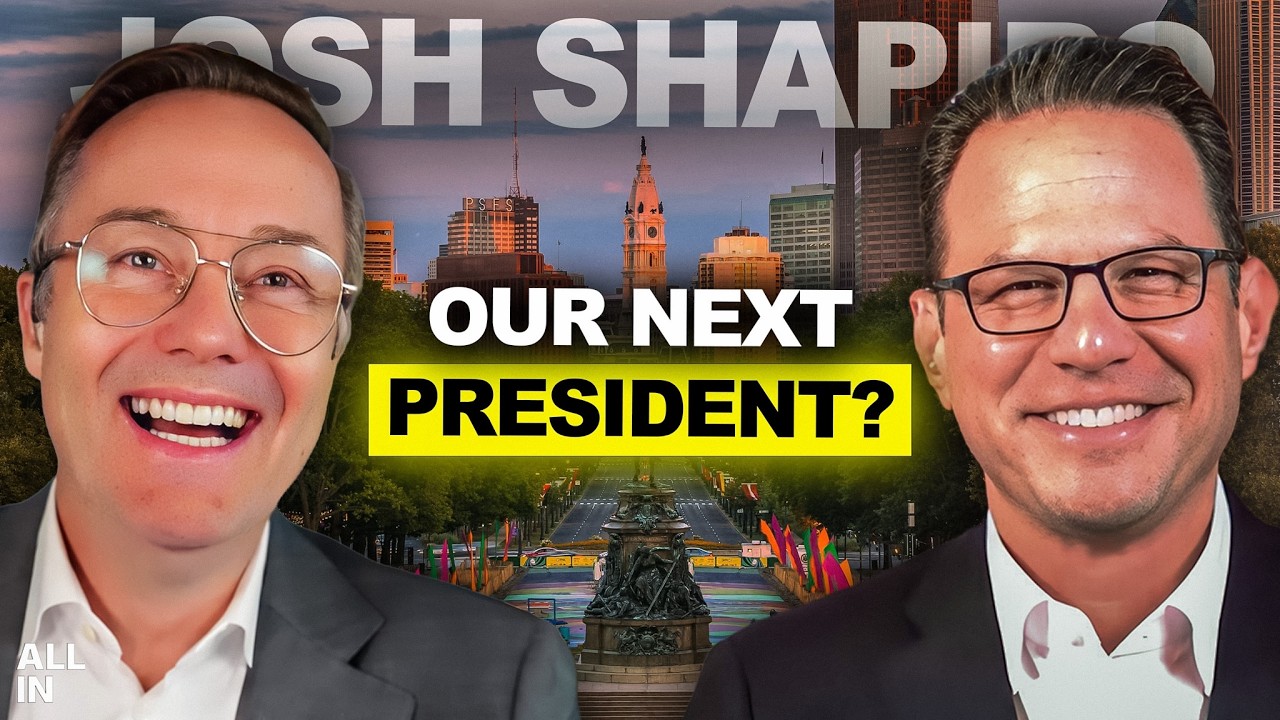
Shapiro Rejects Wealth Tax, Blames Trump Tariffs and Iran War for Inflation
All-In Podcast
Pennsylvania Governor Josh Shapiro argues federal tariffs and the war with Iran are driving up living costs while defending his state's pro-growth, bipartisan tax model.
## Background
The All-In Podcast published this episode on YouTube on April 8, 2026. According to the show notes, host Jason Calacanis interviews Pennsylvania Governor Josh Shapiro to discuss his economic blueprint for the state, tax and wealth policy, the aftermath of the 2024 Democratic collapse, congressional dynamics, antisemitism, and foreign policy chaos surrounding the war in Iran.
## TL;DR
Pennsylvania Governor Josh Shapiro outlines his pragmatic, pro-growth approach to governing, highlighting permitting reforms, tax cuts, and job creation in contrast to federal dysfunction. He candidly addresses the 2024 Democratic presidential nomination process, explaining why he voluntarily withdrew from VP consideration to focus on Pennsylvania, while sharply criticizing Trump-era tariffs, Medicaid cuts, and foreign policy in Iran. Throughout the conversation, Shapiro emphasizes rebuilding trust in democratic institutions, rejecting wealth taxes on unrealized gains, and separating legitimate foreign policy debate from antisemitism.
## Atmosphere & style
The conversation balances relaxed, collegial podcast banter with sharp, focused political discourse. Host Jason Calacanis and Governor Shapiro maintain an engaging, candid rapport—opening with lighthearted 1980s nostalgia and NBA playoff rivalries before seamlessly transitioning into dense policy discussions. Shapiro speaks with energetic, executive pragmatism, blending personal governance anecdotes with forceful critiques of federal leadership.
## Key takeaways
- [01:40](https://www.youtube.com/watch?v=MPAsUZEJHiM&t=100s) Governor Shapiro champions a pro-growth, pro-freedom blueprint designed to operate at the speed of business, featuring permitting overhauls with a money-back guarantee.
- [07:57](https://www.youtube.com/watch?v=MPAsUZEJHiM&t=477s) Streamlining administrative bureaucracy and expediting licensing processes directly rebuilds public trust in democratic institutions.
- [10:19](https://www.youtube.com/watch?v=MPAsUZEJHiM&t=619s) Government waste and fraud must be strictly prosecuted through post-reimbursement accountability rather than cutting essential public programs.
- [13:05](https://www.youtube.com/watch?v=MPAsUZEJHiM&t=785s) Shapiro opposes wealth taxes on unrealized capital gains, arguing they destroy the entrepreneurial pipeline, and instead promotes lower corporate tax burdens paired with flat personal income rates.
- [15:28](https://www.youtube.com/watch?v=MPAsUZEJHiM&t=928s) Targeted middle-class tax relief, such as state-level Earned Income Tax Credits, is critical to level the playing field and address wealth inequality.
- [20:17](https://www.youtube.com/watch?v=MPAsUZEJHiM&t=1217s) Shapiro directly refutes claims that he was passed over as Vice Presidential nominee due to his Jewish faith, revealing he voluntarily withdrew his name to focus on governing Pennsylvania.
- [25:18](https://www.youtube.com/watch?v=MPAsUZEJHiM&t=1518s) Public safety initiatives focused on expanded law enforcement hiring and community violence prevention yielded significant drops in violent crime.
- [28:09](https://www.youtube.com/watch?v=MPAsUZEJHiM&t=1689s) Broad trade tariffs and military actions in the Middle East drive direct inflationary pressures and increase everyday living costs for consumers.
- [33:01](https://www.youtube.com/watch?v=MPAsUZEJHiM&t=1981s) State-funded housing repair initiatives and the elimination of 4-year degree requirements for state government jobs expand economic mobility faster than traditional higher education paths.
- [36:51](https://www.youtube.com/watch?v=MPAsUZEJHiM&t=2211s) Congressional leadership faces sharp criticism for abdicating its constitutional duty as an independent check on executive power regarding war, trade, and oversight.
- [41:54](https://www.youtube.com/watch?v=MPAsUZEJHiM&t=2514s) Executive corruption and the transactional commercialization of presidential pardons severely erode ethical public norms.
- [47:05](https://www.youtube.com/watch?v=MPAsUZEJHiM&t=2825s) Condemnation of antisemitism and bigotry must be absolute, while separate critical debates regarding Israeli foreign policy and leadership remain legitimate.
- [52:49](https://www.youtube.com/watch?v=MPAsUZEJHiM&t=3169s) Military engagement with Iran represents an unjustified war of choice lacking clear strategic objectives or a viable exit strategy.
- [57:51](https://www.youtube.com/watch?v=MPAsUZEJHiM&t=3471s) Conflating Jewish identity with the foreign policy of the Israeli government revives harmful dual-loyalty tropes.
## Detailed walkthrough
### [00:00](https://www.youtube.com/watch?v=MPAsUZEJHiM&t=0s) Introduction and Courtside Basketball Banter
Jason Calacanis opens the episode by introducing Pennsylvania Governor Josh Shapiro, highlighting his record-setting popularity with approval ratings hovering at or above 60%. Jason framing Shapiro's moderate, results-driven governance—summarized by his core mantra "GSD" (Get Stuff Done)—and notes his top-ranking record in prosecuting Medicaid fraud alongside his pro-data-center stance. Before diving into policy, the hosts play a retro 1990 VHS tape of Shapiro playing point guard in high school, poking lighthearted fun at his late-80s-style short shorts and mid-range jumpers.
The conversation quickly turns to basketball rivalries. Shapiro is a die-hard Philadelphia 76ers fan, while Jason is a devoted New York Knicks fan. Shapiro jokingly warns Jason that if he shows up in Philadelphia wearing Knicks gear for a playoff matchup, they are not going to get along. Jason mentions that mutual friend Dave Blitzer—co-owner of the 76ers—egged Shapiro on to come on the podcast, which Shapiro confirms, sharing that Blitzer praised *All-In* as a venue for thoughtful, deep conversations.
[01:40](https://www.youtube.com/watch?v=MPAsUZEJHiM&t=100s) Building a Pro-Growth Blueprint: Permitting Reforms and Bureaucratic Speed
Jason pivots to Shapiro’s executive track record in Pennsylvania, pointing out a stark contrast between Shapiro's pragmatic approach and the more variable tenure of California Governor Gavin Newsom. While states like California, New York, and Massachusetts are seeing an exodus of business leaders and skyrocketing housing costs due to red tape and NIMBYism, Pennsylvania is scoring major economic wins. Asked how he turns state government around, Shapiro lays out his core philosophy: Pennsylvania is intentionally structured as a pro-growth, pro-freedom state designed to move at the speed of business.
Shapiro explains that when he took office, Pennsylvania's business permitting process ranked in the bottom five nationally. Recognizing that predictability is everything to a CEO deciding where to deploy capital, he overhauled the state's entire administrative approach to "get to yes" while still maintaining environmental and safety standards. He instituted a first-of-its-kind money-back guarantee: if state agencies fail to issue a permit within a strict timeframe, the application fee is refunded.
- Pennsylvania has cut taxes seven separate times during Shapiro's tenure to boost competitiveness for small businesses, working families, child care, and seniors.
- Out of 40 million permits issued during Shapiro’s time in office, only **five** refunds were ever issued due to missing a deadline.
- Pennsylvania is currently the only growing economy in the Northeastern United States.
- The state has maintained an unemployment rate consistently below the national average for 32 consecutive months.
- Shapiro tripled funding for vocational-technical (Vo-Tech) education and apprenticeship programs to support workers without four-year college degrees.
To illustrate how streamlining bureaucracy impacts ordinary citizens, Shapiro shares the example of licensing for local barbers. When he took office, it took 20 business days to obtain a barber's license in Pennsylvania. Under his administration's reforms, licenses are issued on the exact same day. "That barber cuts 10 heads a day at $20 a pop—that's $200 a day. Over 20 days, that's $4,000 kept in that barber's pocket," Shapiro notes, stressing that reducing bureaucratic friction directly transforms lives whether you are opening a high-tech manufacturing plant or cutting hair.
[07:57](https://www.youtube.com/watch?v=MPAsUZEJHiM&t=477s) Restoring Trust in Government to Combat Political Cynicism
Shapiro and Jason examine the deeper philosophical shift required to make state agencies responsive. Shapiro argues that when citizens encounter endless administrative delays—whether at the DMV, the airport, or trying to register a small business—they do not just get frustrated at a single agency; they become deeply cynical about democracy itself. This systemic distrust, Shapiro warns, creates an opening for "darker, extreme political voices" to exploit people's anger.
By contrast, when government functions efficiently and helps people succeed, it rebuilds fundamental trust in public institutions. Shapiro notes that achieving these reforms required navigating a tough political dynamic: he was the only governor in the nation governing alongside a strictly divided legislature, balancing a Republican-controlled Senate (by just two seats) and a Democrat-controlled House (by just one seat). Despite the tight margins, he brokered bipartisan consensus around regulatory and permitting relief.
[10:19](https://www.youtube.com/watch?v=MPAsUZEJHiM&t=619s) Cracking Down on Waste, Fraud, and Abuse
Addressing the broader national debate around government waste—referencing the "DOGE" (Department of Government Efficiency) effort popularized by Elon Musk—Jason asks Shapiro how he approaches eliminating fraud. Shapiro draws a sharp line between legitimate policy debates over budget allocations and the absolute necessity of prosecuting fraud. He argues that while parties can disagree on where to spend a dollar, everyone should agree that stealing that dollar from taxpayers cannot be tolerated.
Drawing on his background as Pennsylvania’s Attorney General, Shapiro recalls prosecuting widespread fraud involving COVID-era PPP (Paycheck Protection Program) loans intended for struggling businesses. As Governor, he empowered the state's Office of Inspector General to enforce strict post-reimbursement accountability across human services and healthcare programs. Rather than fronting cash blindly, vendors must prove service delivery before receiving funds. Under this policy, Pennsylvania has become one of the top states in the nation for investigating and prosecuting Medicaid fraud, keeping tax dollars flowing to legitimate healthcare recipients rather than corrupt bad actors.
[13:05](https://www.youtube.com/watch?v=MPAsUZEJHiM&t=785s) Wealth Taxes and Tax Burden: Keeping Pennsylvania Competitive
The conversation shifts to tax policy and the growing movement among progressive Democrats—such as Senator Elizabeth Warren, Senator Bernie Sanders, and legislators in California—advocating for wealth taxes on unrealized capital gains. Jason points out that aggressive tax schemes and wealth-confiscation proposals are driving prominent founders, venture capitalists, and business creators (citing figures like Sergey Brin and Travis Kalanick) to flee California for low-tax states like Texas.
Shapiro rejects wealth taxes on unrealized gains, confirming that such taxes are not on his agenda and do not belong in Pennsylvania's economic framework. He emphasizes that Pennsylvania boasts one of the lowest flat personal income tax rates in the nation and has repeatedly lowered its corporate net income tax rate. While maintaining that high earners must pay their "fair share" to fund core public infrastructure and education, Shapiro argues that punishing capital creators destroys the entrepreneurial pipeline. He reiterates his invite to Jason and other business creators to leave high-tax jurisdictions and bring their companies, investments, and jobs to Pennsylvania.
[15:28](https://www.youtube.com/watch?v=MPAsUZEJHiM&t=928s) Pro-Growth Tax Policies and Addressing Wealth Disparity
Governor Josh Shapiro highlights Pennsylvania’s economic strategy, emphasizing how the state has fostered a competitive environment for small businesses, particularly within the life sciences sector. Shapiro explains that by reducing corporate tax burdens and maintaining a pro-growth stance, Pennsylvania helps early-stage startups navigate the treacherous "valley" where many fledgling companies typically go out of business. However, Shapiro makes it clear that this support comes with a reciprocal expectation: once these companies receive state backing and succeed, they must pay their fair share back to the Commonwealth.
```
PA ECONOMIC & TAX STRATEGY
┌──────────────────────────────────────────────────────────────────┐
│ • Pro-Growth Environment & Reduced Corporate Tax Burdens │
│ • Targeted Support for Life Sciences & Early-Stage Startups │
│ • Working Pennsylvanians Tax Credit (Statewide EITC) │
└──────────────────────────────────────────────────────────────────┘
│
▼
┌──────────────────────────────────────────────────────────────────┐
│ REINVESTMENT & BALANCED DISPARITY │
│ Successful firms pay back fair share to fund targeted tax │
│ credits (~$800 relief for ~940,000 working Pennsylvanians). │
└──────────────────────────────────────────────────────────────────┘
```
Jason Calacanis pivots the conversation to the broader issue of wealth inequality, referencing recent economic statistics showing a surging upper-middle class alongside a declining middle and lower class. Calacanis notes that public frustration often stems from equity holdings growing significantly faster than traditional salaries, leaving the 40% to 50% of Americans who lack stock market exposure behind. He prompts Shapiro on how to handle individuals accumulating hundreds of billions or even a trillion dollars in unrealized equity without selling for decades. Shapiro responds by asserting three core principles:
* **Leveling the Economic Playing Field:** A national economy cannot function long-term if it only benefits the top 1%. While acknowledging natural income differences between someone earning $1,000,000 and someone making $50,000, Shapiro stresses that lower- and middle-income workers must be given genuine opportunity, a level playing field, and a fair tax system.
* **Targeted Middle-Class Tax Relief:** Pennsylvania implemented its first-ever "Working Pennsylvanians Tax Credit"—a state-level Earned Income Tax Credit (EITC). This policy delivers a tax credit averaging over $800 back into the pockets of roughly 940,000 working residents to combat rising living costs.
* **Criticism of Federal Tax Cuts:** Shapiro sharply criticizes President Donald Trump and congressional allies for passing federal tax legislation that he argues gave unnecessary tax cuts to the wealthy at the expense of safety-net programs.
> "The idea that Donald Trump thought it was smart economic policy to give a tax cut to those who don't need it and pay for it with those who are struggling... that is going to hold back our entire economy."
Shapiro highlights the downstream consequences of federal Medicaid cuts on Pennsylvania, detailing severe local impacts:
- **500,000 Pennsylvanians** risking the loss of their healthcare coverage (with 120,000 already losing coverage and another 320,000 at immediate risk of losing Medicaid).
- **26 rural hospitals** operating at a deficit facing potential closure due to reduced Medicaid reimbursements.
- **Cost-shifting onto private insurance holders**, as uncompensated care drives up healthcare costs across the entire middle class.
---
[20:17](https://www.youtube.com/watch?v=MPAsUZEJHiM&t=1217s) 2024 Democratic Collapse, internal Debate, and the VP Selection Process
Jason Calacanis shifts the discussion to national politics and the Democratic Party's strategy, describing his background as an Irish Catholic independent from Brooklyn who traditionally votes for moderate candidates. Calacanis characterizes the 2024 presidential election outcome as a "shellacking" for Democrats and questions why the party failed to conduct a "blitz" or mini-primary over the summer of 2024 after President Joe Biden withdrew from the race.
Shapiro reflects candidly on the 2024 election cycle, noting that he addressed this transition directly in his book. He shares that he spoke privately and bluntly with President Biden, advising him that seeking another term was not in the best interest of the country or the party. However, once Biden stepped aside with roughly 100 days remaining before Election Day, Shapiro argues there simply was not enough time to execute an open primary.
Shapiro rejects the premise that Democrats are in a terminal slump, pointing out strong Democratic performances in the 2025 off-year elections across Virginia, New Jersey, and Pennsylvania (where Democrats swept three state Supreme Court seats). He argues that internal debates over party platform and vision are a sign of political health rather than division.
```
2024–2025 ELECTORAL REALIGNMENT
┌────────────────────────────────────────────────────────────────────────┐
│ 2024 Presidential Election │
│ • Biden exits with ~100 days remaining; rapid nominee consolidation. │
│ • National headwind leads to Democratic losses at the top of ticket. │
└────────────────────────────────────────────────────────────────────────┘
│
▼
┌────────────────────────────────────────────────────────────────────────┐
│ 2025 Mid-Cycle & Off-Year Swing │
│ • State-level rebounds in New Jersey, Virginia, and Pennsylvania. │
│ • PA Democrats win three contested State Supreme Court seats. │
└────────────────────────────────────────────────────────────────────────┘
```
The conversation turns to the selection process for Kamala Harris's running mate in 2024. Calacanis raises the popular media narrative that Shapiro was passed over due to concerns surrounding his Jewish faith and potential pushback from the progressive wing of the party. Shapiro directly refutes this assertion:
* **Direct Refutation of VP Narrative:** Shapiro clarifies that he was not passed over by Harris due to his faith or anti-Semitism within the party.
* **Voluntary Withdrawal:** Shapiro reveals that roughly 48 hours before Tim Walz was announced as the Vice Presidential nominee, he called Harris to officially remove his name from consideration.
* **Focus on Pennsylvania:** Shapiro states that after a candid Sunday evening meeting with Harris, he concluded he could best serve the public by staying on as Governor of Pennsylvania, a role he loves and intends to seek re-election for.
> "This wasn't about her not picking me because of my faith. This was about me, in the end, not being interested in that job."
---
[25:18](https://www.youtube.com/watch?v=MPAsUZEJHiM&t=1518s) Midterm Strategy, Trump's Foreign/Domestic Chaos, and the Path to 2028
Calacanis explores Shapiro’s national ambitions for 2028, comparing his moderate appeal and state executive record against potential Democratic contenders like California Governor Gavin Newsom. While Calacanis treats Shapiro’s upcoming gubernatorial re-election bid as a given, he asks how the Democratic Party can build a winning coalition given the ideological divide between moderate voters and the democratic socialist wing of the party.
Shapiro cautions against skipping past the upcoming 2026 midterm elections. He framed the midterms as an urgent national referendum on the Trump administration's policies, characterizing D.C. governance under Trump as marked by "chaos and corruption." Shapiro argues that the Democratic platform must contrast national turmoil with calm, competent, and practical state-level governance.
To illustrate his governance record in Pennsylvania, Shapiro points to specific achievements across public safety, education, and economic development:
- **Public Safety:** Hired 2,000 additional law enforcement officers and expanded community violence prevention funding, contributing to a **12% overall decrease in violent crime** and a **42% drop in fatal gun violence** statewide.
- **Education Improvements:** Increased state funding for public schools, resulting in higher test scores, reduced truancy rates, and elevating Pennsylvania to **10th nationally in public education quality** according to Consumer Affairs rankings.
---
[28:09](https://www.youtube.com/watch?v=MPAsUZEJHiM&t=1689s) Economic Consequences of Tariffs, the Iran War, and Rebuilding the Democratic Tent
Shapiro delivers a detailed breakdown of how recent federal policies—specifically unilateral tariffs and international military actions—have directly increased consumer costs for ordinary Americans. He argues that while the administration's initial months enjoyed strong polling, the realities of broad trade tariffs and middle-eastern conflicts have created severe inflationary pressures across agricultural and consumer sectors.
```
FEDERAL POLICY IMPACT ON PENNSYLVANIA COST OF LIVING
┌─────────────────────────────────────────────────────────────────────────┐
│ AGRICULTURAL & CONSUMER TARIFFS │ WAR IN IRAN & ENERGY SHOCKS │
├──────────────────────────────────────┼──────────────────────────────────┤
│ • Coffee Prices: +30% │ • PA Gas Prices: ~$4.15 - $4.16 │
│ • Beef Prices: +19% │ per gallon │
│ • Orange Juice (OJ): +9% │ • Prolonged elevated fuel costs │
│ • Commercial Fertilizer: +36% │ impacting logistics & logistics│
└──────────────────────────────────────┴──────────────────────────────────┘
```
Shapiro outlines specific price hikes impacting Pennsylvanians due to trade tariffs:
- **Coffee:** Up 30%
- **Beef:** Up 19%
- **Orange Juice:** Up 9%
- **Agricultural Fertilizer:** Up 36%, directly squeezing local farming operations.
- **Gasoline:** Surging to $4.15–$4.16 per gallon in Pennsylvania following six weeks of escalating war with Iran, creating structural energy costs that could take years to normalize.
Calacanis presses Shapiro on how the Democratic Party can avoid alienating moderate voters, pointing to past missteps where mainstream figures, popular podcasters like Joe Rogan, or tech entrepreneurs like Elon Musk were sidelined by ideological purity tests (such as Musk's exclusion from the White House EV Summit despite pioneering the modern electric vehicle industry). Calacanis emphasizes that the Republican Party has actively courted independent voters, contrastingly opening its tent to disgruntled moderates. Shapiro agrees that Democrats must focus on delivering tangible results, lowering costs, and maintaining a pragmatic, broad-tent approach to governance rather than enforcing ideological litmuses.
[31:05](https://www.youtube.com/watch?v=MPAsUZEJHiM&t=1865s) Shapiro’s Blueprint for Pennsylvania: Education, Safety, Growth, and Freedom
Jason Calacanis probes Governor Josh Shapiro on how the Democratic Party can build a broad coalition, recalling how he was courted by the Trump ecosystem and told that agreeing with just 14% of their platform was enough to get under the tent. Shapiro demurs, emphasizing that regardless of courting efforts, life for average Americans has not improved after a year and a half of Trump's return to office. Defending his state as the ultimate battleground, Shapiro lays out his four-pillar blueprint for governing Pennsylvania: investing heavily in public education to give "every child of God an opportunity," prioritizing safe communities by driving down crime across the Commonwealth, fostering a pro-growth economy that generates jobs in rural areas left behind by globalization, and championing individual freedom.
Shapiro turns the traditional political narrative on its head by arguing that the modern Republican Party has completely abandoned its heritage as the defender of personal liberty. He criticizes conservative efforts to restrict reading materials in schools, control healthcare and reproductive choices for women, and dictate how parents raise their children, alongside efforts to tilt election rules. By contrast, Shapiro frames the Democratic Party's path forward around basic freedoms, quality schooling, public safety, and broad economic mobility.
- **Four Governing Pillars:** Public education, public safety/crime reduction, pro-growth economy (energy and rural jobs), and personal freedom.
- **Critique of the GOP:** Accuses the modern Republican Party of betraying its legacy as the "party of freedom" through book bans, reproductive restrictions, and voting rule manipulation.
---
[33:01](https://www.youtube.com/watch?v=MPAsUZEJHiM&t=1981s) Tackling Housing Costs and Rethinking Higher Education
Addressing two of the biggest grievances among younger generations—skyrocketing housing costs and overpriced higher education—Shapiro outlines concrete policy solutions implemented during his tenure. He notes that economic opportunity is meaningless if citizens cannot afford to live in their own communities. To combat Pennsylvania's housing crunch, he requested a $1 billion housing fund from the legislature aimed at constructing new units and repairing existing properties, highlighting that 50% of the state's housing stock was built prior to 1950. A few thousand dollars spent updating roofs, boilers, or windows, combined with rolling back restrictive zoning red tape, allows residents to stay in older homes faster and more cheaply than constructing new developments.
Turning to higher education, Shapiro highlights that his very first executive order as Governor eliminated college degree requirements for state government jobs. In Pennsylvania, where 62% of adults do not hold a college degree, this single move opened up tens of thousands of state positions. Shapiro points out that politicians in both parties long took an elitist approach, measuring success purely by degrees while ignoring skills acquired in the military, trade schools, or private industry.
> "You want to go learn to be a welder? You're going to make six figures working in a shipyard in South Philadelphia. You want to go and you want to work on HVAC systems? You're going to work in some of our most complex life sciences construction jobs and you're going to make six figures doing that."
- **Housing Investment:** Requested a **$1 billion fund** to repair legacy homes and build new units; **50% of PA housing** was built before 1950.
- **Degree Requirement Reform:** Removed degree prerequisites for state jobs on Day 1; now **60% of new state hires** lack a 4-year degree.
- **Workforce Training:** Tripled state funding for vocational-technical (Vo-Tech) education, Career and Technical Education (CTE), and union apprenticeships across Pennsylvania.
---
[36:51](https://www.youtube.com/watch?v=MPAsUZEJHiM&t=2211s) The Big Tent, Bipartisanship, and Congressional Collapse
When asked about the rise of democratic socialism and internal party dynamics represented by figures like Zohran Mamdani, Shapiro insists that maintaining a "big tent" requires robust internal debate. He explains that governing effectively requires working with people with whom you disagree. From his desk in Harrisburg, Shapiro notes that if he threw out every lawmaker who disagreed with him, the state government would grind to a halt. When negotiating state budgets with a divided legislature, he identifies common ground on three or four shared priorities rather than fixating on six or seven points of disagreement.
This spirit of pragmatism stands in stark contrast to his scathing assessment of the U.S. Congress. Shapiro lambasts Congressional leaders, specifically calling Speaker Mike Johnson and his allies "sad, pathetic people" for abdicating their constitutional duty as a co-equal branch of government. By surrendering their authority over tariffs, military actions, and oversight, Shapiro argues that Congressional Republicans have placed loyalty to Donald Trump above their oath to the Constitution.
> "Our founders always contemplated two things: one, that there would be honorable people in office; and two, that the people in office would exercise their power and be a check on one another... What Americans are confronting now is a realization that we don't really have all honorable people in positions of authority in the federal government."
- **Bipartisan Governance:** Focuses on negotiating shared outcomes with a divided legislature rather than enforcing ideological purity.
- **Constitutional Check:** Accuses House leadership of completely surrendering Article I powers (war powers, trade, oversight) to the executive branch.
---
[41:54](https://www.youtube.com/watch?v=MPAsUZEJHiM&t=2514s) Executive Corruption, Pardons, and the Erosion of Norms
The conversation shifts to ethical rot and corruption within the federal government. Shapiro points to blatant self-dealing in Washington, citing instance after instance of well-connected individuals securing presidential favors, family members enriching themselves, and lobbyists leveraging private club access at places like Mar-a-Lago to secure pardons. He brings up high-profile examples, including former Binance CEO Changpeng Zhao ("CZ") securing a pardon and reports of the administration accepting luxury assets like a multi-million dollar jet from Qatari officials.
While acknowledging public skepticism toward political pardons—including past criticism he directed at Joe Biden for pardoning his son Hunter—Shapiro emphasizes that the daily transactional nature of pardons under Donald Trump represents an unprecedented abuse of executive power. Having signed clemencies himself as a former prosecutor and governor, Shapiro notes the intense moral weight and agonizing care required for each decision. He stresses that while formal legal processes must investigate wrongdoing without politicizing the Justice Department, restoring ethical standards ultimately requires voters to demand honesty and integrity from elected officials across party lines.
- **Abuse of Pardons:** Criticizes the transactional grant of executive pardons to political donors, social acquaintances, and crypto executives like CZ.
- **Ethics & Norms:** Calls for bipartisan voter action to hold leaders accountable to ethical standards and prevent the weaponization or commercialization of public office.
---
<ElicitationsGroup message="Explore related topics from this episode:">
<Elicitation label="Discuss Pennsylvania's economic and energy initiatives" query="What specific energy and economic policies did Governor Josh Shapiro highlight for Pennsylvania in his All-In Podcast interview?"/>
<Elicitation label="Analyze Shapiro's strategy for the 2028 presidential cycle" query="How does Josh Shapiro frame the future of the Democratic Party and a potential 2028 presidential campaign based on his interview?"/>
</ElicitationsGroup>
[47:05](https://www.youtube.com/watch?v=MPAsUZEJHiM&t=2825s) Separating Antisemitism from Middle East Foreign Policy
Governor Josh Shapiro addresses the intersection of his Jewish faith and public service, emphasizing the critical need to separate discussions of antisemitism from debates surrounding Israeli foreign policy. Reframing the issue, Shapiro insists that combating antisemitism requires no nuance: hatred and bigotry directed at Jews, Muslims, Christians, or any group must be universally condemned across the political spectrum. He praises figures who call out bigotry within their own parties—referencing Senator Ted Cruz on the right and noting his own efforts on the left—while criticizing those who only address antisemitism when it is politically convenient to target opponents.
Moving to foreign policy, Shapiro frames his perspective not as a Jewish-American, but as an American seeking regional peace and stability. Long critical of Benjamin Netanyahu, Shapiro argues that the Israeli Prime Minister has driven Israel down an isolated path, fractured bipartisan support in the United States, and failed to protect the country on October 7. He reiterates his long-standing support for a two-state solution—with Israel and a peaceful Palestinian state living side-by-side—while emphasizing that Hamas cannot govern a future Palestinian nation.
- **Universal Condemnation:** Shapiro stresses that bigotry against any faith group directly compromises collective public safety.
- **Criticism of Netanyahu:** Shapiro states Netanyahu has systematically isolated Israel globally and undermined long-standing bipartisan consensus in the U.S.
- **Two-State Solution:** Long-term regional peace requires a legitimate Palestinian state, explicitly excluding Hamas.
---
[52:49](https://www.youtube.com/watch?v=MPAsUZEJHiM&t=3169s) Critical Assessment of the Escalation with Iran
The discussion turns to the expanding conflict with Iran and President Trump’s handling of foreign interventions. Shapiro characterizes the war with Iran as a "war of choice" initiated without clearly defined strategic objectives, leaving the nation with no coherent exit strategy. He heavily criticizes the administration's crude and offensive rhetoric surrounding human life and questions the President's resolve, pointing out how changing rationales—ranging from preempting Israeli action to stopping nuclear capabilities and seeking regime change—have created widespread confusion.
Host Jason Calacanis highlights the backlash among Trump’s core media supporters, noting that figures from Megyn Kelly and Tucker Carlson to various podcast hosts feel betrayed by an unnecessary intervention after promises to avoid Middle Eastern wars. Shapiro frames this as part of a pattern of broken administration promises, contrasting the rhetoric with economic consequences, including elevated consumer prices from tariffs and cuts to Medicaid.
- **Shifting Rationales:** The administration sequentially cited stopping an unilateral Israeli strike, targeting nuclear facilities, and pursuing regime change to justify actions in Iran.
- **Regime Change Outcome:** Shapiro notes replacing an 80-year-old Ayatollah with a hardline 60-year-old Ayatollah fails to meet the definition of a successful transition.
- **Military Impact:** Shapiro pays tribute to the 13 U.S. service members lost during the operation, arguing military personnel deserve a commander-in-chief who explicitly defines mission goals before deployment.
---
[57:51](https://www.youtube.com/watch?v=MPAsUZEJHiM&t=3471s) Tropes, Student Protests, and the Limits of Nuance
Calacanis questions whether anti-war sentiments and frustration over U.S. involvement in Israeli military actions are directly driving the rise of campus antisemitism. Shapiro cautions against equating Jewish identity with the policy decisions of the Israeli government, warning that assuming all Jewish people reflect or support foreign government actions revives the historical trope of "dual loyalty."
While defending the constitutional right of students to engage in peaceful protest against U.S. or Israeli policies, Shapiro warns against allowing protest movements to cross into overt intimidation or harassment. He emphasizes that public leaders must continuously distinguish between legitimate political debate over foreign policy and clear-cut antisemitism. The segment concludes with lighthearted sports banter regarding the NBA playoff matchup between Shapiro's Philadelphia 76ers and Calacanis's New York Knicks.
- **Dual Loyalty Warning:** Conflating Jewish citizens with the actions of the Israeli government reinforces classic antisemitic tropes.
- **Protection of Free Speech:** Shapiro advocates preserving space for peaceful public assembly and critique of foreign governments.
- **Closing Exchange:** The conversation concludes with a friendly exchange on the upcoming 76ers–Knicks playoff series.
## Notable quotes
> [15:28](https://www.youtube.com/watch?v=MPAsUZEJHiM&t=928s) The idea that Donald Trump thought it was smart economic policy to give a tax cut to those who don't need it and pay for it with those who are struggling... that is going to hold back our entire economy. — Josh Shapiro
> [20:17](https://www.youtube.com/watch?v=MPAsUZEJHiM&t=1217s) This wasn't about her not picking me because of my faith. This was about me, in the end, not being interested in that job. — Josh Shapiro
> [33:01](https://www.youtube.com/watch?v=MPAsUZEJHiM&t=1981s) You want to go learn to be a welder? You're going to make six figures working in a shipyard in South Philadelphia. You want to go and you want to work on HVAC systems? You're going to work in some of our most complex life sciences construction jobs and you're going to make six figures doing that. — Josh Shapiro
> [36:51](https://www.youtube.com/watch?v=MPAsUZEJHiM&t=2211s) Our founders always contemplated two things: one, that there would be honorable people in office; and two, that the people in office would exercise their power and be a check on one another... What Americans are confronting now is a realization that we don't really have all honorable people in positions of authority in the federal government. — Josh Shapiro
## Mentioned
Josh Shapiro, Jason Calacanis, Donald Trump, Joe Biden, Kamala Harris, Tim Walz, Elon Musk, Mike Johnson, Benjamin Netanyahu, Sergey Brin, Travis Kalanick, Elizabeth Warren, Bernie Sanders, Gavin Newsom, Dave Blitzer, Zohran Mamdani, Changpeng Zhao, Ted Cruz, Megyn Kelly, Tucker Carlson, Joe Rogan, All-In Podcast, Philadelphia 76ers, New York Knicks, Pennsylvania, Iran, Israel, Hamas, DOGE, Paycheck Protection Program
Pennsylvania Governor Josh Shapiro argues that sustainable political and economic success requires pragmatic, results-driven governance that accelerates bureaucracy, rejects ideological purity tests, and defends individual freedoms. Contrasting his state executive record with federal turmoil, Shapiro contends that Democrats must broaden their coalition by actively reducing living costs and rebuilding public trust in governing institutions.
Streamlining Bureaucracy and Expanding Workforce Opportunities (1:40)
Shapiro frames Pennsylvania's administration around a pro-growth model designed to operate at the speed of business. To resolve bureaucratic delays, his administration introduced a money-back guarantee for business permitting deadlines, resulting in only five fee refunds across 40 million permits issued. He cites administrative reforms that reduced barber licensing turnaround from 20 business days to same-day issuance as tangible proof of regulatory relief saving workers money. To expand workforce mobility, Shapiro signed an executive order removing four-year college degree prerequisites for state government jobs—leading to 60% of new state hires lacking a bachelor's degree—and tripled state investments in vocational-technical education and union apprenticeships.
To restore civic trust in public institutions, Shapiro emphasizes aggressive anti-fraud enforcement rather than across-the-board service cuts. Drawing on his tenure as Pennsylvania Attorney General, he directed the state's Office of Inspector General to enforce strict post-reimbursement accountability across human services. By requiring healthcare and human service vendors to verify delivery before receiving payment, Pennsylvania became one of the leading states nationally in investigating and prosecuting Medicaid fraud.
Tax Competitiveness, Middle-Class Relief, and Cost Pressures (15:28)
Rejecting wealth taxes on unrealized capital gains, Shapiro contends that penalizing capital creators dismantles the startup pipeline. He points to Pennsylvania's low flat personal income tax and repeated reductions in the corporate net income tax as key competitive advantages, arguing that while startups need early-stage support, established firms must pay their fair share. To support working households facing living costs, his administration created the Working Pennsylvanians Tax Credit, providing an average refund of over $800 to approximately 940,000 residents, and sought a $1 billion legislative fund to rehabilitate aging housing stock, noting half the state's homes were built before 1950.
Shapiro sharply criticizes federal economic actions under Donald Trump, arguing that federal tax cuts favored the wealthy while shifting costs onto vulnerable populations. He warns that federal Medicaid cuts threaten healthcare access for 500,000 Pennsylvanians and imperil 26 rural hospitals operating at a deficit. Furthermore, Shapiro attributes acute inflationary spikes to federal tariffs and military actions, citing state-level cost increases in agricultural fertilizer (36%), coffee (30%), beef (19%), and gasoline prices rising to $4.15–$4.16 per gallon amid conflict with Iran.
Democratic Coalition Strategy and Party Politics (20:17)
Shapiro rejects the narrative that the Democratic Party faces terminal decline after the 2024 presidential defeat, highlighting subsequent off-year electoral rebounds in Virginia, New Jersey, and a Democratic sweep of three contested Pennsylvania Supreme Court seats in 2025. Addressing the 2024 vice presidential selection, Shapiro refutes claims that he was passed over due to his Jewish faith, stating he voluntarily phoned Kamala Harris roughly 48 hours before Tim Walz's announcement to withdraw his name from consideration in order to remain focused on governing Pennsylvania.
Looking toward future elections, Shapiro cautions Democrats against enforcing ideological litmus tests that alienate mainstream voters, independent podcasters, and business leaders. Pointing to his record governing alongside a divided state legislature—balancing a Republican Senate and a Democratic House—he argues that effective governance relies on forging consensus around shared priorities. He contrasts this state pragmatism with Congressional leadership, accusing House Speaker Mike Johnson and federal lawmakers of surrendering constitutional war powers, trade authority, and executive oversight.
Foreign Policy, Iran Conflict, and Civil Liberties (47:05)
Critiquing federal foreign policy, Shapiro characterizes the military engagement with Iran as an unjustified "war of choice" launched without defined objectives or a coherent exit strategy, noting shifting rationales that ranged from deterring Israeli action to nuclear containment and regime change. He highlights the sacrifice of 13 fallen U.S. service members while arguing that military personnel deserve clear strategic missions from their commander-in-chief.
Addressing Middle East diplomacy, Shapiro criticizes Israeli Prime Minister Benjamin Netanyahu for isolating Israel internationally, eroding bipartisan American support, and failing to protect citizens on October 7. He reiterates support for a two-state solution that excludes Hamas from governance. Domestically, Shapiro stresses the necessity of divorcing legitimate foreign policy debates from antisemitism, cautioning that holding Jewish citizens accountable for Israeli state actions revives classic dual-loyalty tropes. While defending constitutional rights to peaceful student assembly, he insists that protests must never cross into targeted harassment or bigotry.
Shapiro offers Pennsylvania's centrist, pro-growth governance model as an alternative to both national polarization and progressive ideological litmus tests. However, whether his blend of regulatory speed, corporate tax competitiveness, and institutional pragmatism can unite a fragmented national party coalition remains an open question heading into the 2026 midterms and the 2028 presidential cycle.
[15:28] Josh Shapiro: The idea that Donald Trump thought it was smart economic policy to give a tax cut to those who don't need it and pay for it with those who are struggling... that is going to hold back our entire economy.
[20:17] Josh Shapiro: This wasn't about her not picking me because of my faith. This was about me, in the end, not being interested in that job.
[33:01] Josh Shapiro: You want to go learn to be a welder? You're going to make six figures working in a shipyard in South Philadelphia. You want to go and you want to work on HVAC systems? You're going to work in some of our most complex life sciences construction jobs and you're going to make six figures doing that.
[36:51] Josh Shapiro: Our founders always contemplated two things: one, that there would be honorable people in office; and two, that the people in office would exercise their power and be a check on one another... What Americans are confronting now is a realization that we don't really have all honorable people in positions of authority in the federal government.
Original transcript
[0:00] All right, everybody. We've got an
[0:01] incredible guest today. Governor Josh
[0:03] Shapiro is here. Obviously governor of
[0:06] Pennsylvania. He's got
[0:08] uh record-setting popularity in
[0:10] Pennsylvania right now. 60% approval, at
[0:13] least. He's a moderate. Uh he's focused
[0:15] on getting done, GSD. He's tough on
[0:17] crime. Ranked number one, according to
[0:20] my notes, on charging Medicaid fraud.
[0:23] He's pro data center. He's got a nuanced
[0:25] take on Israel. And he's a baller,
[0:28] apparently. Cuts the table.
[0:31] Got him.
[0:33] Very nice.
[0:34] >> god.
[0:35] >> There's your governor.
[0:36] >> Look at those short shorts. Holy cow.
[0:39] >> Got him. Wow. It's the late '80s.
[0:43] >> Man, based on the VHS tape, this looks
[0:45] like the '80s.
[0:46] >> Yeah, that was 1990, I think.
[0:50] >> Look at that, playing the point.
[0:51] >> There you go.
[0:52] >> Very nice. Very nice. All right.
[0:54] >> That was back when That was back when
[0:55] people shot mid-range jumpers. They
[0:57] don't do that anymore, man. They don't
[0:59] do that. They should.
[1:01] >> All threes. Yeah, I mean, we have a
[1:02] couple of players and and we were
[1:04] talking before the show started. You're
[1:05] a obviously a big Philly fan and I'm a
[1:07] big Knicks fan, so I will see you at the
[1:09] games. We're We're on a collision
[1:11] course.
[1:11] >> I, by the way, with all due respect, and
[1:13] I hope we have a good conversation here.
[1:15] I hope to never see you at the games.
[1:17] Cuz if you're showing up in Philly with
[1:19] all your Knicks crap on, I'm not going
[1:20] to be a happy guy.
[1:22] >> Oh, look at a selfie courtside
[1:24] with my friend
[1:26] Dave, who is one of the co-owners of the
[1:28] team, who's a mutual friend of ours. Um
[1:30] who I think egged you on a little bit to
[1:31] come on the program here.
[1:33] >> He did.
[1:34] He should go on All In. They have
[1:35] thoughtful conversations and anxious to
[1:38] have one with you. So, thanks for having
[1:39] me.
[1:39] >> Yeah. There's so much for us to talk
[1:41] about, but I I thought I would start
[1:43] with
[1:44] your track record in Pennsylvania. And
[1:45] the reason I wanted to start there is
[1:47] because there's a bit of a collision
[1:48] course happening right now between you
[1:50] and Gavin. Gavin's got what I would
[1:53] describe as a variable um tenure here in
[1:55] California. Um I left California for
[1:58] Texas cuz I just thought it was a bit of
[1:59] a disaster, but you're doing great in
[2:02] your state and
[2:04] that's in the face of New York, my
[2:06] hometown, New Jersey, Boston, like
[2:08] losing a lot of business leaders.
[2:10] And you've been scoring, you know, some
[2:12] big wins. So, when you look at your
[2:14] track record, maybe you could just
[2:16] educate the audience on what you've
[2:18] gotten done and maybe in comparison to
[2:23] what's happening in those other states
[2:25] with other democratic leaders cuz you
[2:27] seem to be
[2:29] maybe the exception to this rule that
[2:30] Democrats aren't getting it done on a
[2:32] business level.
[2:33] >> Look, I'm proud of what we've done. I'm
[2:35] not in comparison with Gavin or any
[2:37] other democratic governor. I'll just
[2:39] talk about what we've done here in
[2:40] Pennsylvania. We are a pro-growth state.
[2:44] We want businesses to come here and
[2:46] grow. I'm proud of the fact that we've
[2:48] created more jobs in all but two states
[2:50] in the entire country. We've cut taxes
[2:52] seven different times to be more
[2:54] competitive, cut taxes for small
[2:56] businesses, also for families trying to
[2:58] afford child care, for seniors, for
[3:00] working Pennsylvanians. We've taken our
[3:03] permitting process, that's the usually
[3:06] the ticket you need say to build your
[3:08] building, right? If you're trying to
[3:10] build something here in Pennsylvania, we
[3:11] were bottom five in the country. I think
[3:13] we're now a national model, easily top
[3:15] five in terms of speed. We've got a
[3:18] money-back guarantee on all of our
[3:20] permits. If we don't get you your permit
[3:22] in time, we'll give you your money back.
[3:23] And fun fact, we did issue 40 million
[3:26] permits during my time as governor.
[3:28] We've only had to issue five refunds,
[3:30] meaning only five of those permits were
[3:32] late. We are now the only growing
[3:35] economy in the northeastern part of the
[3:37] United States. At the same time, we're
[3:40] investing in workforce development,
[3:41] especially if you don't have a college
[3:43] degree, tripling funding for Vo-Tech and
[3:46] apprenticeship programs, and
[3:47] understanding the need to take the
[3:49] workforce we have today and prepare them
[3:52] for um jobs here in the Commonwealth of
[3:54] Pennsylvania. I'm proud that we've got
[3:56] an unemployment rate below the national
[3:58] rate consistently over the last 32
[4:01] months. I think it is really critical
[4:04] that every kid born in Pennsylvania gets
[4:06] a great quality education, that that kid
[4:08] has a safe street to walk down to get to
[4:11] school or wherever else they're going,
[4:12] and that they've got a job in the
[4:13] community that they love. Those to me
[4:16] are the core foundational principles.
[4:18] It's what we focus on every single day.
[4:21] Our mantra, as you said at the top, is
[4:23] GSD, get done. Those are the areas
[4:26] where we focus on getting done, and
[4:28] I think we're putting a lot of points on
[4:29] the board every single day that's having
[4:30] a meaningful difference in people's
[4:32] lives.
[4:33] >> How are you getting that done? Let's
[4:35] just take the permitting as an example.
[4:38] Why is it so dysfunctional in
[4:39] California? You know, obviously I'm an
[4:41] investor in technology companies, and we
[4:43] just saw red tape after red tape, then
[4:45] on housing.
[4:47] It's incredibly hard to build anything.
[4:49] The NIMBYism, you know, if you cast a
[4:51] shadow, nothing can be built, and then
[4:53] housing prices keep going up. And you
[4:55] know, if you want to hire a nanny or a
[4:57] teacher,
[4:59] or you know, if a firefighter moves in,
[5:01] they can't even afford a home in the
[5:02] community that they're servicing. So,
[5:04] how did you fix this?
[5:07] And why can't other states not fix it?
[5:11] >> I mean, look, I I can't speak to how
[5:12] it's done in California. I'll just tell
[5:14] you in Pennsylvania, the way we start
[5:16] the conversation is by recognizing
[5:19] permits are critically important to
[5:21] economic development and to creating
[5:22] jobs, right? If we, the government, can
[5:25] move at the speed of business, if I can
[5:28] give you as a CEO predictability to know
[5:31] your business is going to be open in 6
[5:33] months instead of 3 years, right?
[5:35] Because the permit took too long, then
[5:37] you're going to want to invest here. So,
[5:38] we sort of start with the important idea
[5:41] that permits matter. Second, when you
[5:43] come into our state government to get
[5:45] your permit, let's just use a building
[5:47] as an example, right? We want to get to
[5:50] yes. We still want to protect the
[5:52] environment and public health and public
[5:53] safety, and we do that, but we want to
[5:56] get to yes. So, our attitude has
[5:57] shifted.
[5:59] Third, we've got to have that money-back
[6:01] guarantee cuz that money-back guarantee
[6:02] holds the bureaucracy accountable. Now,
[6:05] I will tell you that some of this we've
[6:07] done administratively, meaning I've
[6:09] signed executive orders and we've made
[6:11] those changes. But, in other things,
[6:12] we've worked with the legislature to
[6:14] pass new laws to speed up our
[6:16] permitting. And it hasn't always been
[6:18] easy. Understand, I'm a Democrat as
[6:20] governor. I've got a divided
[6:22] legislature. I was the only governor for
[6:24] a while with a divided legislature, now
[6:26] there's one other. I've got a Senate led
[6:28] by Republicans by just two seats and a
[6:31] house led by Democrats by just one seat.
[6:33] But, this is an area where I've been
[6:34] able to bring Democrats and Republicans
[6:36] together in order to make progress in
[6:39] terms of passing this this permitting
[6:41] reform. And again,
[6:43] proof is in the pudding. What we are
[6:44] seeing is that businesses are coming
[6:47] here and the economy's growing. Let me
[6:49] give you one more example. This may seem
[6:51] really small to you, but it's a big
[6:52] deal, okay? When I talk about a permit,
[6:55] if you want to be a barber in
[6:57] Pennsylvania, you need a permit or
[6:59] technically it's called a license, but I
[7:01] put it all in one
[7:01] >> Yeah, some kind of certificate, yeah.
[7:03] >> Right. The day I took office, it took 20
[7:07] days for a barber to get their permit to
[7:10] be able to go out and cut hair. Today,
[7:12] you get it same day. You get it within
[7:14] that day. That may seem silly to you,
[7:16] but but it but I just I called my
[7:17] barber. I asked him, he said, "How many
[7:19] heads do you cut a day?" He said, "About
[7:21] 10 a day." At 20 bucks a pop, 200 bucks
[7:24] a day for two for 20 days. That's real
[7:27] money. That's thousands of dollars that
[7:30] we're putting into that barber's pocket
[7:32] just because we got them their permit
[7:35] more quickly. So, I know it may sound
[7:37] nerdy, it may sound wonky, but whether
[7:39] you're building some big building that's
[7:41] going to house hundreds of workers or
[7:43] thousands of people who are living
[7:45] there. Or whether you're the local
[7:47] barber that everybody needs to go to to
[7:49] get to get their haircut. This stuff
[7:51] matters. And the quicker you are, the
[7:53] more jobs you create and the more money
[7:55] you put in people's pockets.
[7:57] >> It also matters, I think, on a
[7:58] philosophical basis of who is the
[8:01] government working for? Themselves and
[8:03] their timelines or for the people who
[8:05] put them in office? And I think that's
[8:07] the philosophy just at least watching it
[8:10] happen in New York and California is the
[8:11] opposite of what you described. There's
[8:13] no sense of urgency and there's
[8:16] almost a situation where people believe
[8:18] it's intractable, that they can't change
[8:20] it. And so
[8:21] that's I think such an important point
[8:23] is that you actually made it happen.
[8:25] >> I think that's a great point. I want to
[8:27] focus on what you just said there. Um
[8:29] first off, I I start the conversation
[8:32] believing the government can be a force
[8:33] for good in people's lives. Second, that
[8:36] we got to figure out a way to get to
[8:37] yes. Whether it's building the building
[8:39] or whether it's getting that mom the
[8:41] support she needs for her kid with
[8:43] autism who needs support. We got to
[8:45] figure out a way to get to yes and get
[8:47] them um that help. And then you
[8:49] mentioned uh in your question the way
[8:51] people get I I I don't recall if you
[8:53] used the word frustrated or or they
[8:55] feel, you know, um that that
[8:57] government's sort of holding them back,
[8:59] right? Not trying to work with them.
[9:00] >> in a way, right? It's just if you have
[9:02] that experience three or four times,
[9:04] whether it's at the airport or getting
[9:05] your driver's license or getting the
[9:07] hair cutting you know, certificate. Like
[9:09] it's just oppressive over time. You just
[9:11] feel like the government's working
[9:12] against you.
[9:13] >> Yeah, and what does that what does that
[9:14] person feel after they try and get their
[9:16] permit, they can't get it. They try and
[9:18] open up their small business, it won't
[9:19] work. They get frustrated. By the way,
[9:21] they get pissed. And then not only are
[9:23] they pissed at that agency or that
[9:26] governor or they're pissed at, you know,
[9:29] that state government. They also grow,
[9:32] and this is an important point, a little
[9:34] more cynical about government and a
[9:36] little bit more frustrated about the
[9:39] process. And when that happens, I think
[9:41] that that creates more distrust in our
[9:43] system and it creates more opportunity
[9:46] for I think frankly dark voices on
[9:49] extremes to come in and take advantage
[9:52] of people. I I I find that, you know, if
[9:54] we get it done the right way, if we
[9:56] process things quickly, if we get people
[9:58] to yes, then maybe a byproduct of that
[10:01] is a little bit less cynicism in our
[10:03] system.
[10:04] >> Yeah, and and the horseshoe theory that
[10:06] you're kind of referencing there, these
[10:08] two extremes just taking over the
[10:10] conversation,
[10:11] that's not what the majority of the
[10:13] country wants. They they want to just
[10:14] live in a high-functioning society. I
[10:16] was curious how you look at fraud, um,
[10:21] waste, fraud, and abuse. My friend Elon,
[10:23] to drop a name, you know, did this doge
[10:25] thing, was a little controversial, but I
[10:27] think what we've seen is, hey, 20-30% of
[10:30] every tax dollar collected is wasted.
[10:34] Some of it's fraud, some of it's just
[10:36] incompetence. It could be anything on
[10:37] that spectrum. And this seems to be the
[10:39] Republican Party's rallying cry to beat
[10:42] the Democrats going into California, and
[10:44] prosecuting people, Michigan, etc. You
[10:48] have seem to have gotten ahead of this.
[10:50] You've been doing this for years. So,
[10:51] maybe you could explain your take on
[10:53] fighting fraud specifically, health
[10:56] care, or in other areas.
[10:57] >> Yeah. Look Look, I think we've got to
[11:00] focus on rooting fraud out of the
[11:02] system. Now, you and I may differ on,
[11:05] hey, should we spend a dollar on that
[11:07] initiative or not? And by the way, those
[11:09] are super healthy differences, and we
[11:10] should argue that out. We should debate
[11:12] that. But where we should have no
[11:14] difference is if someone's stealing that
[11:17] dollar instead of going to its intended
[11:19] purpose, we should be against that. And
[11:22] and I am. Prior to serving as governor
[11:24] and having the privilege of sitting
[11:25] here, uh, in this office serving the
[11:27] good people of Pennsylvania, I was the
[11:29] state's attorney general. And you'll
[11:31] remember back during COVID, there were
[11:33] those PPP loans to help our small
[11:36] businesses and other businesses stay
[11:37] afloat. We'd probably agree like good
[11:39] idea, right? We got to keep businesses
[11:41] afloat.
[11:43] But during that time I went out and
[11:44] prosecuted a whole bunch of people for
[11:46] stealing that PPP money, for not using
[11:48] it for its intended purposes. Here as
[11:51] governor, I've maintained a similar
[11:53] focus through my office of Inspector
[11:55] General, rooting out fraud through
[11:57] making sure by the way, we're not
[11:59] fronting you money when you're going out
[12:01] and providing say human services. You
[12:03] have to submit for reimbursements and
[12:05] you've got to make sure you prove that
[12:07] you did that work. When we find that
[12:09] someone took advantage of the system,
[12:11] we're referring them to prosecutors. I'm
[12:13] proud of the fact that we've had more
[12:15] Medicaid fraud prosecutions in
[12:17] Pennsylvania than I think any other
[12:18] state. Maybe there was one other. We're
[12:20] we're certainly toward the top of that
[12:21] list. Proud of the fact that we've
[12:23] identified that, we've sent it to
[12:25] prosecutors and and we've addressed it.
[12:27] If we can address it administratively,
[12:29] we do. If not, we understand that those
[12:31] things need to be prosecuted. We should
[12:32] have a zero tolerance policy for that.
[12:35] We should make sure that if we're going
[12:36] to utilize a hard-earned dollar of a
[12:39] taxpayer for a purpose like providing
[12:42] someone with health care that they need,
[12:45] we got to make sure that that dollar
[12:46] makes its way to that person so they get
[12:48] their health care. And you know, our
[12:50] folks are working really hard on that in
[12:51] Pennsylvania.
[12:52] >> So pro-business,
[12:55] uh less regulation, lowering taxes,
[12:58] eliminating fraud, um and all of this is
[13:02] just getting done in the state. And then
[13:05] you know, the next piece that in at
[13:07] least my community, people who are
[13:09] creators of businesses, venture
[13:10] capitalists, angel investors, founders,
[13:14] we pay our taxes, pay a lot of taxes uh
[13:17] depending on which state you live in.
[13:19] And then there's this movement
[13:20] >> paying more taxes in Pennsylvania, man.
[13:22] Stop paying them elsewhere.
[13:24] >> Yeah. It well, the and you know, we then
[13:27] get struck with this California law and
[13:30] a lot of my friends have moved to Austin
[13:31] where I live now. They just said
[13:33] suddenly, hey, we want to seize 5% of
[13:35] whatever you got. You already paid your
[13:37] taxes, you haven't paid capital gains on
[13:39] some of this equity you own in your
[13:41] company. Maybe it's paper wealth, maybe
[13:42] it's your company went public now and
[13:44] you could sell some of it, but you might
[13:45] crater the stock if you do. And
[13:47] Elizabeth Warren, Bernie Sanders,
[13:50] and California all trying to seize
[13:54] assets. And this has really hit the
[13:56] creator
[13:58] the business creators in a in a really
[14:00] offensive way
[14:02] to the point at which they're moving.
[14:04] We lost California lost Sergey, Travis
[14:08] from Uber just fleeing fleeing en masse
[14:11] in the last 12 months. Do you believe in
[14:14] these wealth taxes and do you believe in
[14:16] seizing people's assets on gains they've
[14:19] never received? It's It seems to be
[14:22] getting momentum.
[14:23] >> I mean, I'll just tell you we've cut
[14:24] taxes seven times in Pennsylvania. We've
[14:27] got one of the lowest income taxes in
[14:29] the entire country. It's why I'm joking
[14:31] with you you should come to Pennsylvania
[14:32] and
[14:33] locate here.
[14:35] And And look, I mean, that kind of tax
[14:37] that you're describing is not something
[14:39] we have here. It's certainly not
[14:40] something
[14:42] on on my agenda. I do think people need
[14:44] to pay their fair share. I think you'd
[14:45] agree with that. We need to make sure
[14:47] that we are easing the burden on those
[14:50] who are working and who are at the
[14:52] lowest, you know, sort of economic point
[14:54] on the scale. And we got to make sure
[14:55] that folks at the top are paying their
[14:57] their fair share
[14:59] in order to to sustain our society. And
[15:01] I think we've struck a a really good
[15:03] balance here in Pennsylvania. And I
[15:05] think our growth numbers
[15:07] bear that out. I think seeing more
[15:09] people coming to the state bears that
[15:11] out. And I think there's an important
[15:13] stat, one of the things you you cited in
[15:15] those
[15:16] entrepreneurs as as you were going
[15:18] through your question is
[15:20] you know, these are people who kind of
[15:21] started with a dream, with an idea that,
[15:24] you know, someone might have looked at
[15:25] and said, "Geez, I I don't know about
[15:27] that." But they stuck with it and and
[15:28] they built up their companies. We see
[15:31] here in Pennsylvania, particularly when
[15:33] it comes to life sciences, right? We're
[15:36] seeing people plant a flag here in
[15:38] Pennsylvania, start with an idea that
[15:40] others might think, "Boy, I I don't know
[15:42] about that." But then because of our tax
[15:45] environment in Pennsylvania, because of
[15:47] our pro-growth approach in Pennsylvania,
[15:49] we're seeing more of those small
[15:51] businesses, more of those small
[15:52] companies, especially in life sciences,
[15:54] survive that sort of valley where a lot
[15:57] of those companies go out of business
[15:59] and sustain themselves here because
[16:01] again, I think we're showing that we're
[16:03] pro-growth, we've got a smart tax
[16:05] environment for them. And by the way,
[16:07] after we invest in them, after we give
[16:09] them a shot, and after they do well, we
[16:11] expect them to pay their fair share back
[16:13] to the Commonwealth of Pennsylvania. And
[16:14] I think that's that's the approach we've
[16:16] taken and it's working.
[16:18] >> Yeah, and so if you're not in favor of a
[16:20] wealth tax, what would you do to deal
[16:24] with maybe this disparity in
[16:27] wealth that we're seeing? There was just
[16:28] some statistics that came out the other
[16:30] day, I'm sure you saw them. The upper
[16:32] middle class has just been surging,
[16:34] middle class going down a bit, and
[16:37] people in the lower wrongs going down as
[16:40] well. So,
[16:41] people may feel like they're not making
[16:42] enough money, but in reality what's
[16:45] happening is people feel other people
[16:47] have made a tremendous amount of money,
[16:48] which is true because of equity holdings
[16:51] are growing much better than salaries
[16:53] ever will, and only 40% only 50% of the
[16:56] country really participates in a
[16:58] meaningful way in equities. The other
[17:00] 40-50% don't have any exposure to that.
[17:03] So, how would you deal with somebody
[17:06] making, you know, a hundred billion
[17:08] dollars, five hundred billion dollars, a
[17:09] trillion dollars, and never selling
[17:11] their equity, or maybe not selling it
[17:13] for 20 years? How do you think about
[17:15] that?
[17:15] >> make sure three points, a Pennsylvania
[17:17] point and a couple broader points. One,
[17:19] you cannot have a national economy that
[17:22] works if it's only working for the 1%.
[17:25] And you pointed out in your question the
[17:27] wage disparity and the disparity of
[17:29] income. You have to make sure that there
[17:32] is opportunity for those at all
[17:34] different income levels. And look, as we
[17:36] sit here today, if you're making a
[17:38] million dollars
[17:39] versus $50,000, you make a million
[17:41] dollars, you're going to be able to buy
[17:42] some stuff that someone at $50,000 can't
[17:45] buy, right? We sort of understand that,
[17:47] but you got to have opportunity and
[17:50] you've got to have a level playing
[17:51] field. You got to have a fair shot and
[17:53] you got to have a tax system that works
[17:55] in a fair way. So, that's sort of point
[17:57] one. Point two is here in Pennsylvania,
[18:00] we've tried to address some of that
[18:01] economic disparity by passing the first
[18:05] ever working Pennsylvanians tax credit,
[18:07] sort of a state-side earned income tax
[18:10] credit. So, what we're saying is if
[18:12] you're working, if you're going out and
[18:13] busting your hump, we're going to put
[18:15] some money back in your pocket. About
[18:16] 940,000, almost a million Pennsylvanians
[18:19] are going to qualify for a little over
[18:21] 800 bucks back in their pockets. So,
[18:23] that's going to help not only today with
[18:26] rising costs due to a lot of these
[18:28] federal policies, but it's going to put
[18:29] money back in people's pockets, allow
[18:31] them to make, you know, the the the
[18:33] investments they need to make in their
[18:34] everyday lives. Here's the third point.
[18:37] What I would not do cuz you asked what I
[18:39] would do. What I would not do is what
[18:41] President Trump did at the federal level
[18:43] with an aid and assist from a whole
[18:46] bunch of sycophants in Congress by
[18:48] passing that budget bill or the
[18:49] beautiful budget bill or whatever the
[18:51] hell they call it. In effect, what they
[18:53] did was they gave a tax cut for those
[18:56] who simply do not need it, right? And by
[18:59] the way, you know, in the palace of
[19:01] truth and justice, you talk to those
[19:03] folks. They know that they didn't need
[19:05] that tax cut. And what happens as a
[19:08] result of that is I've got
[19:10] 500,000
[19:12] Pennsylvanians who are going to lose
[19:15] their health care. I've got 120,000 who
[19:18] have already lost their health care.
[19:19] About another 320,000
[19:21] or so were likely to lose Medicaid next
[19:24] year. I've got 26 rural hospitals that
[19:27] are likely to shutter because these are
[19:30] rural hospitals that are working at an
[19:31] operating deficit and they're relying so
[19:34] much on Medicaid which has been slashed
[19:36] by the federal government. So, the idea
[19:38] that Donald Trump thought it was smart
[19:40] economic policy to give a tax cut to
[19:42] those who don't need it and pay for it
[19:45] with those who are struggling where and
[19:47] create even greater economic
[19:49] disparities, that is going to hold back
[19:51] our entire economy. Just take those
[19:53] 500,000 people who aren't going to have
[19:55] health care. You're paying for that and
[19:57] I'm paying for that with our private
[19:59] insurance. So, what Donald Trump has
[20:01] done is shifted that burden onto those
[20:04] who are struggling, making it harder for
[20:07] them, adding additional cost to the
[20:09] middle class. And I think that that is
[20:11] that that lacks
[20:13] um frankly, it's just dumb economic
[20:15] policy. And I think it's going to set us
[20:17] back.
[20:17] >> Here we are. Politics is on the table.
[20:20] Incredible track record you have, but
[20:21] let's dive into the Democratic Party. Uh
[20:23] I'm an independent, but grew up Irish
[20:25] Catholic in Brooklyn, so grew up a
[20:27] Democrat. Probably have voted you know,
[20:30] 60/40 Democrat to Republican, but always
[20:33] for a moderate, somebody who can get
[20:34] stuff done. That's why I find you quite
[20:36] appealing. But, let's talk about the
[20:37] Democratic Party
[20:39] and the shellacking they got
[20:41] in the last election.
[20:43] And specifically, what really troubled
[20:46] me,
[20:47] Biden didn't look like he was all there
[20:49] and uh I think we've all come to some
[20:51] consensus that he probably should have
[20:52] dropped out earlier.
[20:54] But, what was really disheartening to me
[20:55] was that they didn't do the speed run
[20:57] primary. They didn't do, you know, a
[20:59] capsule primary over that July-August
[21:02] period and gave you a shot and other
[21:04] people a shot, Pritzker, Pete whoever to
[21:08] to compete for the nomination. Was that
[21:11] a huge mistake for the Democratic Party?
[21:13] And then when you look back on it, do
[21:15] you think that might have cost you all
[21:17] the election?
[21:17] >> Well, look. I mean, I actually wrote
[21:19] about this in in the book I I recently
[21:21] published where, you know, it it became
[21:23] clear to me that
[21:26] you know, Joe Biden seeking another term
[21:28] was probably not in the best interest of
[21:30] the party or or the country. And I spoke
[21:32] to him directly about that and and
[21:34] bluntly about that. Once he made the
[21:36] decision to drop out with a hundred and
[21:38] whatever days to go, you know, there
[21:41] there were not many opportunities, I
[21:43] think, to have the kind of primary
[21:44] process that you're talking about. I
[21:47] think it is important to look forward,
[21:49] right? And not look backwards. And you
[21:51] said in the last election Democrats took
[21:52] a shellacking. Actually, if you look at
[21:54] 2025, it was the opposite. I mean, the
[21:56] president's party, the Republican Party,
[21:58] got beat in New Jersey, got beat in
[22:00] Virginia, got beat here in Pennsylvania
[22:02] where we won three state Supreme Court
[22:04] seats. So, obviously, there's a pendulum
[22:06] in in American politics. And it's
[22:09] clearly
[22:10] swinging back. I think what's important
[22:12] is is that we look forward. And yeah, I
[22:15] think it's also really important for our
[22:16] party to have for my party to have a
[22:19] real debate and to have a real
[22:21] discussion about ideas. What are we for?
[22:23] And what are we willing to fight for?
[22:25] And I realize that process may at times
[22:27] look a little messy. I realize and I
[22:29] mean this with the utmost respect. It
[22:31] gives folks like you on a podcast or on
[22:32] a show the ability to sort of pick
[22:34] apart, maybe try and, you know, sort of
[22:37] parse words or point one Democrat at
[22:39] another and try and create conflict. But
[22:41] I would just say that overall, having
[22:44] this debate and having these issues
[22:46] being raised and having disagreements,
[22:48] that's healthy for our party. And
[22:50] ultimately, I think our party's poised
[22:52] to take back power. And that will make
[22:54] us better at governing. To me, the whole
[22:56] purpose of running in an election is
[22:58] getting the chance to govern, not just
[23:00] winning the election. And so, having
[23:02] these debates right now puts us in a
[23:04] better position when we win those
[23:06] elections. And I'm running for
[23:07] re-election right now in Pennsylvania.
[23:09] Going to work my ass off to win another
[23:11] term and earn the support of the people
[23:13] of Pennsylvania again. And I want to
[23:14] continue to deliver, continue to
[23:16] um you know, focus on these issues that
[23:18] matter most. And having that debate, I
[23:19] think is really healthy.
[23:21] >> I understand looking forward is most
[23:23] important, but I got I got to go one
[23:25] more time in the rearview mirror here,
[23:26] which is Kamala Harris was picked
[23:29] because Biden had put out a criteria,
[23:31] "Hey, I want to have a woman of color as
[23:33] my vice president." He was very explicit
[23:34] about that. She could be qualified,
[23:37] unqualified, you know, moderately
[23:39] qualified. But then when she went out to
[23:41] pick her VP, everybody was saying, "Hey,
[23:44] Josh Shapiro should be really in that
[23:45] running." And she didn't pick you
[23:47] specifically cuz she didn't think she
[23:48] could win with the Jewish vice
[23:50] president.
[23:51] >> Yeah,
[23:51] >> So,
[23:52] >> I don't respectfully I I got to push
[23:54] back on that. And again, I I've been
[23:55] very very open about this. Yeah.
[23:57] >> Let's do it.
[23:57] >> Yeah, and and I respectfully I'm not
[23:59] looking to, you know, be argumentative
[24:00] with you, but I I
[24:02] >> Be candid. Yeah.
[24:02] >> I was very very detailed and and and
[24:06] very specific in my book about this
[24:08] process. And I was very grateful to the
[24:10] vice president for being considered. And
[24:13] grateful to her for the candid dialogue
[24:15] we had. And about 48 hours before she
[24:17] picked Tim Walz, I pulled out and made
[24:19] clear that that was not something I was
[24:22] interested in doing. I thought I could
[24:23] serve the good people of Pennsylvania um
[24:26] and and do my best serving here as
[24:28] governor in a job that I absolutely
[24:30] love. So, this wasn't about her not
[24:32] picking me because of my faith. Uh this
[24:34] was about me um in the end not being
[24:36] interested in in that job.
[24:38] >> Really?
[24:40] Sincerely, yes. Uh cuz it did seem like
[24:42] you wanted to to be considered for that
[24:45] VP position.
[24:46] >> I called Sunday evening after she and I
[24:48] met and had a really candid conversation
[24:51] uh to inform her that I did not want to
[24:52] be considered. I thought she had some
[24:54] really good people to choose from.
[24:56] >> All right. So, let's move forward then
[24:57] looking at winning. You're going to run
[24:59] for governor again. Assume that's going
[25:01] to be a shoe-in.
[25:03] You know, you got to do the work, but
[25:04] it's pretty clear you're going to
[25:06] >> your your confidence there, my man.
[25:08] >> Yeah, no, it's it's clear. But let's
[25:09] talk a little bit about if you were to
[25:11] run for president, which people seem to
[25:14] think you've got a really good shot.
[25:16] But you're below maybe national
[25:20] recognition right now. You're a little
[25:22] bit far behind. Gavin has come out,
[25:24] "Hey, I'm running. I'm running. Here I
[25:26] am." He's obviously in the pole position
[25:28] for now. I want to understand the
[25:30] Democratic Party and how they should
[25:32] proceed because just like the right
[25:35] seemed to separate and you had this mega
[25:37] coalition
[25:38] and you had, you know, the traditional
[25:40] Republicans who were just aghast at
[25:43] Trump and his style and his behavior,
[25:45] etc.
[25:46] Now that seems to have fractured again.
[25:48] You have America first, America only.
[25:51] All the supporters who were supporting
[25:54] Trump now have
[25:56] come out vocally against him because of
[25:57] the war in Iran. And then you have on
[25:59] your side the socialist Democrat
[26:01] movement, which I think a lot of
[26:03] moderates are like, "Well, that's
[26:04] confusing. We don't want to have
[26:07] more Mondamis." And that doesn't seem
[26:09] super appealing to a lot of moderates.
[26:11] And the moderates are the ones who
[26:12] flipped this election and they went the
[26:14] last election, they went with Trump
[26:15] largely as opposed to going with Kamala.
[26:18] So
[26:18] handicap for me,
[26:20] what has to happen in the Democratic
[26:23] Party to win in 2028?
[26:24] >> I understand what you're asking and I I
[26:25] will answer your question. I don't think
[26:28] anyone should be looking past these
[26:30] midterms. And while I appreciate the
[26:32] confidence you you have in me and and
[26:35] and maybe in the the broader dynamics
[26:37] here, I think we need to have a national
[26:39] referendum in these midterms on what
[26:41] people see happening in Washington, D.C.
[26:44] The the chaos and the corruption that
[26:47] exists there. I think people need to
[26:48] show up in record numbers and vote their
[26:51] concerns. Since I'm not looking past the
[26:53] midterms, I do think it is important
[26:56] that we acknowledge Donald Trump has
[26:59] injected chaos and corruption into
[27:03] everything he touched. And I think it's
[27:05] important for me, for other Democratic
[27:08] leaders in this country, to be able to
[27:11] show what calm, competent governance can
[27:15] actually deliver for people. That's what
[27:17] I'm going to be talking about in these
[27:18] midterms as I seek re-election. I think
[27:21] it is important to paint an alternative
[27:23] picture to the chaos Donald Trump has
[27:25] created. One where you can actually grow
[27:28] the economy. You can make our
[27:29] communities safer. We didn't talk about
[27:31] this yet, but we've hired 2,000 more
[27:33] police officers, invested in community
[27:35] violence prevention, and violent crime
[27:37] is down 12%. Fatal gun violence is down
[27:40] 42% in our Commonwealth. Um we've
[27:43] invested in public education, and by the
[27:45] way, scores are up, truancy is down. Um
[27:49] we're moving up on the list. We're about
[27:51] 10th um according to Consumer Affairs in
[27:53] the quality of public education. I think
[27:55] we've got to show that there is an
[27:57] alternative to Donald Trump's chaos, to
[28:00] his cruelty, to his corruption. And
[28:02] you're seeing that, um I think certainly
[28:05] in my state. I think you're seeing it in
[28:06] other states as well. And we need to
[28:08] paint that alternative picture.
[28:09] >> So, 2026 is certainly going to be a
[28:11] referendum on the first 2 years of this
[28:14] presidency,
[28:16] which was extremely popular for the
[28:18] first 9 months or so. People felt really
[28:20] good about the economy.
[28:21] >> Some people.
[28:22] >> And that Well, I think the his polling
[28:25] was great. But there was this tinge, I
[28:28] think it's pretty accurate to say, the
[28:29] tariffs felt like those were chaotic.
[28:33] >> Yeah.
[28:33] >> Then you get the ICE situation. That
[28:35] feels very chaotic. Then you go to this
[28:38] war with Iran, and that feels like a
[28:40] peak chaotic moment that we're in here
[28:42] in week six of this. So, it's certainly
[28:43] going to be a referendum on Trump, and
[28:46] it feels like all the Democrats have to
[28:48] do is sit back and say like, "Look,
[28:51] is this what you want? Gas prices up,
[28:53] inflation." But you're saying they have
[28:55] to paint another picture. Paint that
[28:56] picture for me. What is that picture?
[28:58] >> I think
[28:59] on both sides of what you just said,
[29:01] Donald Trump chose to push the tariff
[29:04] button, right?
[29:05] >> Yeah.
[29:05] >> And as a result, here in Pennsylvania,
[29:07] what we're seeing is coffee prices are
[29:09] up 30%. Beef is up 19%. OJ, orange
[29:13] juice, is up 9%. The fertilizers my
[29:16] farmers rely on here in Pennsylvania up
[29:18] 36%.
[29:20] So, we're seeing whether you're a
[29:21] farmer, whether you're, you know, a dad
[29:23] just trying to cook dinner for his kids,
[29:25] whatever the case may be, everything
[29:28] costs more because of the the
[29:30] recklessness and the chaotic approach
[29:32] Donald Trump's taking on our economy
[29:34] with these tariffs. Obviously, this war
[29:36] has spiked gas prices. Up today about
[29:39] 415, 416 here in Pennsylvania, similar
[29:43] across the country. Probably years
[29:45] before those gas prices come down even
[29:48] if the war, you know, hopefully ends,
[29:50] you know, very very soon. And so, I
[29:53] think it is important, yes, to point
[29:55] that out the way Donald Trump's policies
[29:57] have hurt the American people, have hurt
[30:00] our farmers, have hurt our small
[30:02] businesses. The point I was making a
[30:04] moment ago is I think that's part of the
[30:06] conversation. The other part of the
[30:07] conversation is, "Okay, well, what are
[30:09] you doing to make people's lives
[30:10] better?"
[30:10] >> Yeah, well, so what what should the top
[30:12] three things be? Like, if you were
[30:14] running the Democratic Party and you and
[30:15] everybody got in a room and said, "You
[30:16] know what? We really are going to take
[30:18] winning seriously, not get into this
[30:20] like purity test for everybody in the
[30:22] party, and you know, everybody's got to
[30:26] be perfect, and Joe Rogan's not good
[30:28] enough to go on air with because he's a
[30:31] lifelong Democrat, but he said something
[30:33] about COVID we don't agree with.
[30:34] Therefore, he's out of the party. Elon
[30:36] Musk is a little bit weird on the Well,
[30:38] but but the Democrats did. And then, oh,
[30:40] Elon Musk waited hours to and and had
[30:42] Obama at SpaceX and then all of a sudden
[30:44] he can't come to the White House for the
[30:46] EV Summit, the category he created. Like
[30:48] it's pretty obvious the Democratic Party
[30:50] had some real dysfunction in there in
[30:52] terms of building a bigger tent. And I
[30:55] can tell you I have never felt
[30:57] more courted in my life
[31:00] than the Republican Party trying to get
[31:02] me to be part of the the Trump movement,
[31:05] which I demurred and declined. It wasn't
[31:07] my style. But they are trying to build
[31:11] the biggest tent possible. They're like,
[31:13] "Oh, you agree with 14% of what we do?
[31:15] You're in."
[31:16] >> Okay.
[31:17] >> Yeah, so walk me through what the top
[31:19] thing should be. Yeah.
[31:20] >> Let's dissect. First off, you attributed
[31:22] a number of things to Democrats that I
[31:24] didn't say. So, um we're you're here
[31:26] interviewing me, so let's focus on the
[31:28] things I say. Number two, um they went
[31:31] and they courted you
[31:32] uh and you demurred, but by the way, um
[31:35] even had you not demurred, had you
[31:36] signed up, I don't know that your life
[31:38] would be better off after a year and a
[31:40] half of Trump's policies. What I am for
[31:43] here in Pennsylvania, the ultimate swing
[31:45] state, the toughest state to win in, an
[31:48] incredibly tough state to govern in,
[31:50] particularly with a divided legislature,
[31:53] I'm for investing in public education,
[31:55] giving every child of God an
[31:56] opportunity. I'm for safe communities,
[31:59] and we're building that here, and we're
[32:00] reducing crime in all of our
[32:02] communities. I'm for a pro-growth
[32:05] economy, where we generate more energy,
[32:07] we generate more jobs, where we create
[32:10] more opportunities, particularly in our
[32:11] rural communities and forgotten
[32:13] communities that have been too often
[32:14] left behind. And here's the fourth thing
[32:16] I'm for. I am for freedom. And I'll tell
[32:19] you what, this president represents a
[32:21] party that used to be known as the party
[32:24] of freedom, and now they have turned
[32:26] their backs on that. They want to tell
[32:28] my kids what books they're allowed to
[32:29] read, they want to tell women what
[32:31] medicines they can take and what they
[32:33] can do with their bodies, they want to
[32:35] control the way I raise my child. They
[32:38] want to say,
[32:40] uh, you know, every day that, yeah, you
[32:42] can vote, but we're going to set the
[32:43] rules and try and rig them in a way
[32:45] where you're not going to be successful.
[32:47] They are not the party of freedom. And I
[32:50] think the Democratic Party has an
[32:51] opportunity to be the party of
[32:53] education, safety, economic opportunity,
[32:55] and freedom. That's what we're doing
[32:57] here in Pennsylvania, and that's what
[32:59] I'm going to continue to put forth.
[33:01] >> I think it's a great platform. I would
[33:02] add to it housing.
[33:04] The thing I hear about from young people
[33:05] all the time is that, you know, just
[33:07] I'll never be able to afford a house.
[33:09] The American dream's a bit of a scam,
[33:11] and college is overpriced. So, how do
[33:14] you think about housing? And And what do
[33:16] you Is that an issue in in your state?
[33:18] Or
[33:19] >> talk about housing. Let's also talk
[33:20] about college, cuz you raised both of
[33:21] them in your question. And
[33:23] >> And look, I mean, that has disinfected,
[33:25] by the way, just like two generations
[33:27] who are like, you guys tricked us on
[33:28] housing. You told us we'd be able to get
[33:30] home, and you won't sell your home,
[33:32] boomers. And And you told us we could
[33:35] always make more than our college
[33:36] education cost, and that was a lie, too.
[33:38] >> Yeah. When I was talking about economic
[33:40] opportunity, it's somewhat shorthand, if
[33:42] you will, for also being able to afford
[33:45] that community.
[33:46] Affording that community can be
[33:47] healthcare. It can be housing, right?
[33:49] But let's talk about housing. Here in
[33:51] Pennsylvania, I've asked the legislature
[33:53] for a $1 billion fund to be able to
[33:55] build more housing in Pennsylvania and
[33:58] repair existing housing. 50% of my
[34:01] housing was built prior to 1950. You can
[34:04] invest a few thousand bucks in a new
[34:06] boiler, a new roof, some new windows,
[34:08] actually keep people in their homes, and
[34:10] not have to build new homes. We also
[34:12] have to eliminate, or damn near
[34:14] eliminate, the red tape that exists when
[34:17] it comes to building housing. We got to
[34:19] be able to build this faster. And so, I
[34:21] put forth a regulatory reform plan to be
[34:24] able to build more housing. I think that
[34:27] is, um, really, really crucial. Let's
[34:29] talk about college for a minute. The
[34:31] first day I was governor, the first
[34:33] executive order I signed was to do away
[34:36] with the college degree requirement to
[34:39] work for state government. We have
[34:40] 80,000 employees, damn near all now you
[34:43] do not have to have a college degree
[34:45] other than say the doctors and lawyers
[34:47] and people like that who require
[34:48] advanced degrees. So now 60% 60 60% of
[34:53] all of our hires in state government
[34:55] don't have a college degree. We followed
[34:57] up on that by tripling our funding for
[35:00] votech and CTE in our high schools. Our
[35:03] dramatically increasing our funding for
[35:05] apprenticeship programs. 62% of my adult
[35:09] population here in Pennsylvania do not
[35:11] have a college degree. So we need to
[35:13] make sure we're investing in them so
[35:15] that they have opportunities. You want
[35:17] to go learn to be a welder? You're going
[35:19] to make six figures working in a
[35:20] shipyard in South Philadelphia. You want
[35:23] to go and you want to work on HVAC
[35:26] systems? You're going to work in some of
[35:28] our most complex life sciences
[35:31] construction jobs and you're going to
[35:32] make six figures doing that. So for us,
[35:36] we fundamentally believe that you've got
[35:38] many pathways to opportunity here in
[35:40] Pennsylvania. For some, it's going to
[35:42] college, great. And for others, if you
[35:44] choose not to go to college, that's also
[35:46] great. We're going to make sure that we
[35:48] pave the way for you and give you that
[35:50] opportunity.
[35:51] >> Yeah, the generation two about movement
[35:52] is
[35:53] well upon us. People are starting to
[35:55] figure out going in debt 100, 200k
[35:58] versus getting a plumber job, carpenter
[36:00] job, HVAC, whatever for six figures out
[36:03] of the gate is a much better
[36:04] opportunity.
[36:05] >> Yeah, and to be clear, I'm not
[36:07] on people that go to college. I went to
[36:08] college. I presume you went to go to
[36:10] college. But for too long, by the way,
[36:13] politicians in both parties defined
[36:16] success exclusively
[36:18] around the idea of you having to have a
[36:20] college degree and then set up arbitrary
[36:23] barriers to entry. Hey, if you don't
[36:24] have a college degree, you can't apply
[36:26] here. What about the skills that you
[36:27] developed in the military? What about
[36:29] the skills you developed at a trade
[36:31] school or the skills that you developed
[36:33] working in the private sector? Those
[36:35] skills should matter, and now they do in
[36:37] Pennsylvania. And we're no longer taking
[36:39] an elitist approach that shuts people
[36:42] out just because they don't have a
[36:44] college degree. We're giving them the
[36:46] keys to opportunity, and we're giving
[36:48] them opportunities to pursue more
[36:50] success here in Pennsylvania.
[36:51] >> Does the socialist democratic movement
[36:55] worry you, Mondami and the crew?
[36:58] And
[36:59] how do you think about that in terms of
[37:01] the party dynamics?
[37:02] >> I mean, remember the question you asked
[37:04] me out of three or four questions ago
[37:05] about you said, "Well, yeah, I only
[37:07] agree with 14% of what you agree with."
[37:10] You know, come join the party. Look, my
[37:12] view is that we got to have a big tent.
[37:14] And my view is that we've got to have a
[37:16] real debate around different ideas. And
[37:18] just because I might not agree with you
[37:20] on these three things, I might agree
[37:22] with you on something else. Listen,
[37:23] >> Yeah.
[37:24] >> I'm sitting behind my desk here in the
[37:25] governor's office. This is where I
[37:27] negotiate bills and budgets and other
[37:29] things. If I threw everybody out of my
[37:31] office that I didn't agree with 100% of
[37:34] the time, we'd never get anything done.
[37:36] When I sit down across the table from a
[37:38] Republican lawmaker, I say, "What are
[37:39] the 10 things you want to accomplish?" I
[37:41] tell him the 10 things I want to
[37:42] accomplish. And you know what? We're not
[37:44] going to agree on all 10, but if we
[37:45] agree on three or four, I'd rather focus
[37:48] on those three or four things where we
[37:49] can find common ground than the five,
[37:51] six, seven things where we're just going
[37:53] to disagree. And so, I think if you want
[37:55] to make progress, you got to figure out
[37:57] how to create, you know, majorities.
[37:59] Whether it's a majority in the
[38:00] legislature to get a bill to my desk, a
[38:02] majority come election time to win an
[38:05] election, you got to find ways to bring
[38:07] people together and find common ground
[38:08] and not just focus exclusively on our
[38:11] differences.
[38:12] >> What's your take on what's going on in
[38:13] Congress, Senate in terms of Trump and
[38:17] getting alignment there? Because, hey,
[38:19] when you go to war or you do tariffs,
[38:22] um this was something we had a
[38:23] consultation between these different
[38:25] branches of our government. And we had
[38:28] other presidents on the Democrat side,
[38:29] etc., you know, say, "Hey, we're going
[38:31] to just get rid of student loan. I'm
[38:33] doing an executive order." Curious your
[38:34] take on the balance of our of our
[38:37] different branches of government and the
[38:40] lack of collaboration because this is
[38:42] particularly disturbing. We're both Gen
[38:44] Xers. We grew up watching the Democrats
[38:46] and the Republicans argue, but then they
[38:48] all got together, had lunch, and they
[38:50] negotiated. Where is that esprit de
[38:52] corps of everybody rowing in the same
[38:55] direction uh for all Americans versus
[38:58] this toxic, you know, we're we're just
[39:01] going to block each other at and do
[39:03] character assassination at every single
[39:06] turn. It's it's the most polarized of
[39:07] our lifetimes, for sure.
[39:09] >> think the Congress of the United States,
[39:12] um the leadership there, I mean, they're
[39:14] frankly kind of sad, pathetic people.
[39:17] And let me explain why, right? You put
[39:21] um
[39:22] what's his name, Johnson in as a
[39:24] speaker,
[39:25] and he's effectively a rubber stamp for
[39:27] anything Donald Trump wants. And by the
[39:29] way, whether you agree with Trump or
[39:31] not, I think you can agree that you'd
[39:33] like your member of Congress
[39:35] to at least meet the burdens that they
[39:38] have on them in the Constitution of the
[39:40] United States, which is to be a check,
[39:42] which is to be a a separate branch of
[39:46] government, and a branch of government
[39:47] that has meaningful responsibilities
[39:50] here. When the Congress of the United
[39:52] States walks away from their
[39:53] responsibilities, whether on tariffs or
[39:55] whether on declaring war,
[39:57] and ultimately just kind of empower the
[40:00] president, again, agree or disagree.
[40:02] Obviously, I have profound disagreements
[40:04] from the president on on those things.
[40:06] Then what what you've really done is
[40:08] you've limited um the power of the
[40:11] Congress. And what you've really done is
[40:13] you've seen a whole bunch people that
[40:15] put Donald Trump before the oath of
[40:17] office they take to the Constitution.
[40:19] And I think that's just pathetic. By the
[40:21] way, why these people work so hard to
[40:25] get to Congress, to move up in
[40:27] leadership, to do all the things they
[40:29] got to do, and then give away their
[40:30] power to Donald Trump? That's pathetic
[40:33] and it's weak. And I think our country
[40:35] is suffering as a result of it. Look,
[40:38] I'm here in Pennsylvania where where it
[40:40] all began 250 years ago.
[40:43] And the brilliance of our founders
[40:46] um was that they left so much of the
[40:48] work
[40:50] to the next generation and the
[40:52] generation after that to pick up the
[40:54] baton and continue to perfect our union.
[40:58] Our founders though
[41:00] always contemplated two things.
[41:03] One, that there would be honorable
[41:05] people in office.
[41:07] And two, that the people in office would
[41:10] exercise their power and be a check on
[41:13] one another.
[41:15] And in some cases slow things down to
[41:18] make sure that bad things didn't occur.
[41:20] Bad things couldn't get through the
[41:21] process.
[41:23] I think what Americans are confronting
[41:24] now is a realization that we don't
[41:27] really have all honorable people in
[41:30] positions of authority in the federal
[41:32] government. And that that checks and
[41:34] balance system that was constructed here
[41:37] in Pennsylvania is not standing the test
[41:40] of time because you've got these
[41:42] profoundly and pathetically weak people
[41:44] like Johnson and others who just simply
[41:47] give away their power to folks who are
[41:50] corrupt and to folks who are not acting
[41:53] in an honorable way.
[41:54] >> You keep uh bringing up that corruption.
[41:56] Explain to me what corrupt things you
[41:59] know that the Trump administration has
[42:01] done.
[42:01] >> I think to me there has been an
[42:03] extraordinary amount of self-dealing.
[42:05] There there has been
[42:07] um a good bit of family members doing
[42:10] quite well in this uh in this
[42:13] environment. I think you're seeing more
[42:15] and more people who have the president's
[42:18] ear being able to lobby him at his swim
[42:20] club to get a pardon for someone that
[42:22] frankly doesn't deserve a pardon. I
[42:24] mean, I think the list goes on and on
[42:26] and on, but those are some examples that
[42:28] I think the American people see with
[42:31] their own eyes taking a you know, a
[42:33] billion-dollar jet from the Qataris and
[42:35] thinking there's nothing attached to
[42:37] that, right? I mean, I think that
[42:38] there's just a lot of that that moves so
[42:42] fast that the American people are having
[42:44] a hard time keeping up with it, but
[42:45] there will be a reckoning on this one.
[42:48] >> Yeah, I so on the pardons I'm strongly
[42:51] agreeing. Feels like the pardon power is
[42:53] super abused. Is is there a path to
[42:56] refine that tool cuz it relies on norms,
[43:00] right? And ever since Bill Clinton, you
[43:02] know, did some, you know, friends and
[43:04] then obviously Biden did his son and
[43:07] then Trump's doing his,
[43:10] you know, folks. It feels like now this
[43:12] is just a get out of jail card. You come
[43:14] into an administration and then
[43:16] everybody from Fauci to you know, Hunter
[43:19] Biden and everybody else is just going
[43:21] to get a pardon on the way out. How
[43:23] would you reshape that tool?
[43:25] >> Well, let let's be clear and I I don't
[43:26] think you're suggesting this, but and I
[43:29] was critical of Joe Biden when he
[43:30] pardoned his son, right? I was critical
[43:33] of him publicly. What we are seeing
[43:35] under Donald Trump, you have to admit,
[43:37] is next level when it comes to the
[43:39] abuse.
[43:40] >> it's yes, it's in the first year. It's
[43:41] not on the last day even. It's like an
[43:43] ongoing tool here. We had CZ
[43:46] who was a a crypto person who got
[43:48] pardoned and Trump didn't even know who
[43:50] he was. Right. He was just like, "Ah, I
[43:52] heard he's a good guy."
[43:53] >> I mean, I will tell I sit at this desk
[43:56] here
[43:57] and I sign pardons and clemencies.
[44:00] And I take that responsibility so
[44:02] seriously. And and I agonize over these
[44:05] decisions.
[44:07] And and I pray that I get these
[44:09] decisions right.
[44:11] And I believe I have. And I'm
[44:13] transparent about why I viewed someone
[44:16] as worthy to get a clemency and also
[44:19] worthy of not getting one or not worthy
[44:20] I should say but but also not earning
[44:23] one. And these are tough tough
[44:26] decisions. Goes back to what I said a
[44:28] moment ago. Our founders when they
[44:30] vested that kind of authority in an
[44:32] executive didn't necessarily do
[44:34] something wrong by giving the executive
[44:36] that power.
[44:37] But they were leaning on the assumption
[44:39] that the executive would be honorable.
[44:42] That the executive would would would do
[44:44] this with morality and real scruples in
[44:47] mind and and I think what we're seeing
[44:49] with the president is if you sidle up to
[44:51] him at his swim club
[44:53] you donate a certain amount of money
[44:54] maybe or you have his ear for some other
[44:57] social reason, you can usually get him
[44:59] to give a pardon to someone who's
[45:01] important to you.
[45:02] >> Yeah, the the pardons definitely are
[45:04] super troubling. How do you deal with
[45:06] the family members and the kids
[45:07] enriching themselves?
[45:10] Obviously
[45:11] nothing has been
[45:13] um
[45:15] done by a court or an investigation into
[45:17] Trump's kids at this point. Um so we
[45:19] just want to be clear about that. You
[45:20] know, we had uh Hunter Biden
[45:23] getting a ridiculous million-dollar
[45:24] board seat. I've never seen anybody get
[45:26] paid a million dollars to be on a board.
[45:27] That was obviously corrupt in some way
[45:30] or somebody trying to curry favor.
[45:31] Doesn't mean the president Biden was but
[45:34] definitely was corruption there.
[45:36] How do you deal with kids of and and
[45:39] this has been going on for a while um
[45:41] these kind of allegations.
[45:43] If we if we can't rely on honor and
[45:45] norms
[45:46] is there another proposal here that
[45:49] the kids of you know, people in office
[45:51] can't make money. Your kids can't make
[45:52] money. If I was running for office, my
[45:54] kids couldn't make money in the free
[45:56] market. How do you Is there any kind of
[45:58] solution you can think of?
[45:59] >> I think it is important. You you cited
[46:01] Hunter Biden. They went through a legal
[46:03] process. There was an investigation by
[46:04] the Department of Justice. I think there
[46:06] has to be a real look, I say this as a
[46:09] former prosecutor, a real look at some
[46:11] of this stuff and follow the evidence,
[46:13] follow the law. And if charges are
[46:14] warranted, bring them in. By the way, if
[46:16] charges are not warranted, don't bring
[46:18] them. Do not use the the rule of law as
[46:21] a tool to go against, you know,
[46:23] political opponents in in any way. But I
[46:26] think what you've got to have here are
[46:28] people who are operating with real
[46:31] morality. And you do have to figure out
[46:33] a way to operate within the norms again.
[46:35] I'm unwilling to accept that that is
[46:37] gone. It may be temporarily suspended
[46:39] under Donald Trump, but I'm hopeful that
[46:41] we can find our way back to that. Let me
[46:43] be clear about something else here. That
[46:45] finding our way back to that
[46:48] is a bipartisan exercise. It's going to
[46:51] require Republicans and Democrats and
[46:53] independents all demanding, when they go
[46:55] to the ballot box, that we want to
[46:57] elevate people who are ethical, people
[47:00] who are honest, people who are focused
[47:02] on doing their jobs with integrity. And
[47:05] then when those people are in office,
[47:07] rewarded with the votes of the public
[47:09] and in these positions of public trust
[47:11] to hold them accountable as well.
[47:13] >> And you believe that can can happen in a
[47:14] post-Trump world?
[47:15] >> I do. I do. I strongly agree. Hey, it's
[47:18] a year since your home was firebombed
[47:23] by
[47:24] an insane person who was anti-Semitic.
[47:27] Your faith comes up over and over again.
[47:29] I personally think people are a little
[47:31] obsessed with it, but here we are and
[47:34] the Democratic Party's been split apart
[47:36] as well over this support of Israel
[47:39] issue. You have a very nuanced position.
[47:41] Number one, how are you dealing with
[47:42] that personally, the anti-Semitism,
[47:44] which to me as somebody who grew up in
[47:46] Brooklyn with lots of Jewish friends and
[47:49] all kinds of different people, just
[47:50] insane to think that
[47:51] Jewish students are being or any
[47:54] particular group of students being
[47:55] chased by the other students at Columbia
[47:56] University because they're Jewish and
[47:58] this chaoticness um is just
[48:00] heartbreaking, but as a Jewish person
[48:03] and literally experiencing it firsthand,
[48:06] I mean, how are you doing with that?
[48:08] >> Yeah, I appreciate it. Look, we
[48:10] we should separate this and have two
[48:12] conversations. One about Israel and one
[48:13] about anti-Semitism because you kind of
[48:16] blurred both in that question. Let's
[48:17] focus first on anti-Semitism. I have
[48:19] been very outspoken
[48:21] about those who are engaging in
[48:23] anti-Semitism, peddling words that are
[48:26] anti-Semitic. And importantly, I've been
[48:28] critical of people on the political left
[48:30] and on the political right. And I think
[48:32] anti-Semitism is a problem in our
[48:34] society and is a problem on the left and
[48:37] it is a problem on the right. And I
[48:39] think it is important that we call it
[48:41] out. We call it out whether we're in an
[48:43] interview, not
[48:44] >> Yeah. A conversation.
[48:45] >> a conversation, yeah. Call it out when
[48:47] um you know, on on social media. And
[48:50] then we just call it out in our
[48:51] communities, in our daily lives where we
[48:54] see it. On that, there should be no
[48:56] nuance. We should be able to come
[48:58] together, people who are Jewish, people
[48:59] who are Christian, Muslim, and all agree
[49:02] that hatred, bigotry in any form
[49:05] directed at a Jew, a Muslim, Christian,
[49:06] anyone, it has no place. And by the way,
[49:09] it makes us all less safe. And so we
[49:12] have to focus on speaking out against
[49:15] that. No nuance on that.
[49:17] >> Yeah.
[49:17] >> On the issue of Israel, the Middle East,
[49:19] and the war in Iran, and Gaza, there's a
[49:21] lot of nuance there. I'm happy to answer
[49:22] your questions on that, but I think on
[49:24] the issue of anti-Semitism, we have got
[49:26] to be in a place where we universally
[49:29] condemn it. And I think what you're
[49:30] seeing from some folks on the right and
[49:33] some folks on the left is they'll only
[49:35] call it out if it's said by a political
[49:38] opponent or someone they disagree with.
[49:41] And I frankly respect people on the
[49:44] right like Ted Cruz who have called it
[49:46] out within the Republican Party. I've
[49:48] tried to call it out when it rears its
[49:51] ugly head in my party, it is important
[49:54] that it be universally condemned.
[49:56] >> So easy to do. Let's tackle the uh issue
[50:00] of Israel and I would say, yeah, every
[50:03] Jewish person, Jewish-American person
[50:05] who I know, when I ask them about this
[50:07] issue, obviously, incredible tragedy
[50:09] October 7th, going and collecting the
[50:12] hostages seems like a reasonable thing
[50:13] to do.
[50:14] I was there for 9/11, you know, seems
[50:17] like a pretty analogous situation.
[50:19] This has to be settled and the United
[50:22] States went and did what it had to do in
[50:23] Afghanistan and took out Iraq for extra
[50:26] measure. Um it's a whole other
[50:28] diversion. But, 100% of folks say they
[50:30] don't agree with Netanyahu's approach to
[50:33] what happened in Gaza. And then, folks
[50:35] feel a decent number of people, whether
[50:37] it's reality or not,
[50:39] that America's getting dragged into this
[50:41] war with Iran not under false pretenses
[50:45] uh and because Israel is pushing us to
[50:48] do it. So, let's take these two issues
[50:50] separately and I'm just curious in
[50:52] understanding your position on this. Are
[50:54] you part of the Jewish-American diaspora
[50:57] that believes, "Hey, Israel has a right
[51:00] to defend itself, but maybe Gaza went
[51:02] too far."
[51:03] >> Okay. Well, first off, um let me say
[51:05] this. I don't view this issue as a
[51:08] Jewish-American, as you said. I view
[51:10] this issue as an American. And I view
[51:13] this issue in a way of trying to
[51:15] understand what is the best thing for
[51:17] America, which to me is having peace and
[51:21] stability in the Middle East. Okay?
[51:23] That's how I approach these issues. It
[51:26] is um and I've been clear and consistent
[51:29] about this long before October 7th, that
[51:32] I think Netanyahu, the leader of Israel,
[51:36] um is someone who's been leading Israel
[51:38] down a dangerous and isolated path. I
[51:42] think he has made Israel um more
[51:45] isolated in the world community. He has
[51:47] fractured really what used to be a
[51:50] non-partisan or bipartisan
[51:53] um American support for Israel. And I
[51:56] think he has put Israel in a very
[51:58] dangerous place. And of course, he was
[52:00] the leader of Israel who wasn't minding
[52:03] the shop when October 7th happened. So,
[52:06] I've been very critical of Netanyahu for
[52:08] years and years and years.
[52:10] I've also for years made very clear that
[52:12] I think the America's interest in the
[52:15] region should be for stability and
[52:18] peace. And that it would be my hope that
[52:21] you would have two states living
[52:23] peacefully side by side, Israel and a
[52:27] Palestinian state. Now,
[52:29] I realize that is a long way off given
[52:31] where we are right now. But it is clear
[52:33] that we need to work toward that. And
[52:35] obviously, that Palestinian state cannot
[52:38] be led by Hamas, which is a terrorist
[52:40] organization. And there has to be some
[52:43] structure that is put in place in order
[52:46] in order to create that. As it relates
[52:49] to the war, which you also asked about
[52:51] in in your question, I mean, this was a
[52:53] war of choice. The president never
[52:55] defined the objectives. It is clear that
[52:58] I don't know how the hell to get out of
[52:59] this.
[53:00] Um we'll see what he ultimately does
[53:02] with his big threats. You know, we're
[53:04] we're recording this on the eve of his,
[53:07] you know, of his big uh threat um using
[53:10] language
[53:11] >> using language that was so
[53:13] offensive, you'll excuse my language,
[53:15] that diminished the value of human life.
[53:19] Um we'll see what he ultimately does.
[53:21] Does he chicken out as he usually does,
[53:23] or does, God forbid, he he go through
[53:25] with that? This was a war of choice. He
[53:28] didn't know why he got into it. He
[53:29] didn't know how the hell to get out of
[53:30] it. America's
[53:32] >> get into it, handicap?
[53:33] >> America's national security interests
[53:36] have not been well served by this. And
[53:38] economically, you've talked about this.
[53:40] Economically, we are worse off uh
[53:43] because of this war. I'm sorry. I didn't
[53:45] mean to speak over you.
[53:46] >> no, no. I mean, listen, I I appreciate
[53:48] your candidness, Governor. Why did he do
[53:50] it? If you had to handicap it, or what
[53:52] are you hearing when you talk cuz you
[53:53] have obviously a lot more information
[53:55] than the average
[53:57] American?
[53:58] >> Why now? Why did we do this now? We had
[54:00] done, you know, the strategic trimming
[54:03] of the hedges, mowing of the lawn,
[54:05] whatever the term is to get rid of the
[54:06] nuclear progress. That's containment
[54:09] seemed like a perfect strategy, and then
[54:12] all of a sudden we decide we're going to
[54:14] do regime change. This is after Trump
[54:16] promised that he would never get it in
[54:18] would do an intervention like this in
[54:20] the Middle East. This is after we were
[54:21] told by the Republicans do not vote for
[54:24] a crazy Democrat who will take us to war
[54:27] with Iran, and here we are in month 14
[54:30] or 13 of the Trump presidency, and he
[54:32] started a war.
[54:33] >> Yeah.
[54:34] >> His own biggest advocates, from Megyn
[54:36] Kelly to Tucker Carlson and, you know,
[54:38] people on the fringe, Alex Jones, and
[54:40] everybody in the middle, the comedians
[54:42] who supported him, the podcast diaspora,
[54:45] or the podcast bros, they're all fleeing
[54:47] the ship.
[54:48] They did not want this. So, here we are.
[54:51] Why did he do this? Why now? What is
[54:53] your handicapping of it?
[54:54] >> Well, I I'll answer that. I will just
[54:55] say it's yet another broken promise to
[54:58] the people who put him in power. He
[55:00] screwed over the farmers who put him in
[55:02] power. He told people he wouldn't slash
[55:04] Medicaid. He cut Medicaid. He told
[55:06] people he'd bring down prices. Prices
[55:08] have skyrocketed because of his tariffs.
[55:11] He He's got this long string of broken
[55:14] promises. Now, why did he break this
[55:16] particular promise?
[55:18] Let's Let's examine the record. First,
[55:20] Rubio went out and said he did it
[55:22] because if we didn't move then,
[55:25] Netanyahu was going to move and was
[55:26] going to force our hand. Then they
[55:28] walked it back. He said 7 or 8 months
[55:31] ago that they destroy their nuclear
[55:34] capabilities, and then came back 7 or 8
[55:37] months later and said, "We had to go in
[55:39] because we had to destroy their nuclear
[55:42] capabilities." I don't know. Then they
[55:43] said it was about regime change. Well,
[55:46] great. I mean, we went from like an
[55:47] 80-something-year-old Ayatollah to a
[55:49] 60-something-year-old
[55:50] Ayatollah who, by all accounts, um seems
[55:53] to be far more hardline. I'd hardly call
[55:56] that successful regime change. So, to
[55:59] me, it is hard to
[56:02] think you've seen I've been trying to be
[56:03] very forthright in answering your
[56:04] questions.
[56:05] >> You're doing good.
[56:05] >> know how you answer that question
[56:08] because the president never answered
[56:10] that question. He never sat in the Oval
[56:14] Office and looked the American people in
[56:15] the eye and said, "This is why we're
[56:18] going in." And you know what? This isn't
[56:20] semantics. This isn't politics. If you
[56:23] don't know why you're going in, you
[56:25] don't know how the hell to get out. You
[56:27] don't know how to instruct the military,
[56:28] our brave military, including those 13
[56:32] souls who did not make it home to their
[56:34] families because they went on a mission
[56:36] that the president never defined. And we
[56:38] mourn their loss. We thank our military
[56:41] heroes for what they did. We thank our
[56:43] military who are out working every day
[56:47] on behalf of our freedom, and our
[56:48] safety, and our security. But they
[56:49] deserve a commander in chief who would
[56:52] have defined the mission. And if you
[56:54] define the mission, you know how to get
[56:56] out. He never defined the mission. I
[56:58] don't know, ultimately, if he will
[57:00] follow through on his threat. Again,
[57:01] it's, you know, it's Tuesday afternoon
[57:03] you and I are talking. We'll see
[57:05] ultimately what he does here. But, um to
[57:07] me, this has been a failed and
[57:08] compromised mission from the beginning
[57:11] because he never made clear why he was
[57:14] going in.
[57:14] >> Yeah, and I know you got to go in a
[57:16] moment. It does seem to me that first
[57:18] explanation, sometimes people hear their
[57:20] first reaction and their first statement
[57:22] is the true statement, uh just in
[57:24] general. And it does seem like Israel
[57:26] was going to do this, and we joined
[57:27] them, and we didn't need to.
[57:29] And to your point about Afghanistan,
[57:31] should never pardon me, America should
[57:33] never be led around by any other nation.
[57:36] It should always be about America's
[57:38] interest, our national security
[57:40] interest, the interest of expanding
[57:42] freedom and opportunity for the American
[57:44] people. We should never, ever be bullied
[57:47] as maybe President Trump was by any
[57:49] other world leader.
[57:51] >> Back to the anti-Semitism we're
[57:52] experiencing now, you said, "Hey, let's
[57:54] address them separately." But I don't
[57:56] think you can separate them if
[57:58] we're getting pulled into this war by
[58:00] another nation and people believe, like
[58:03] you and I do, "Hey, Netanyahu maybe went
[58:05] a little too far here."
[58:07] That is what's causing the anti-Semitism
[58:09] in this country, don't you think? This
[58:11] relationship with Israel, the state of
[58:13] Israel and Netanyahu
[58:14] >> I think I think you have to be
[58:15] >> support for Netanyahu, that's not
[58:17] causing the anti-Semitism here. That's
[58:19] what these young people seem to be
[58:20] saying is, "We don't want to vote for
[58:23] somebody who supports Netanyahu."
[58:25] >> Well, I think you have to be real
[58:26] careful on that. You you the collective,
[58:29] not you individually. I mean, if you're
[58:31] suggesting say that Jews are Israel and
[58:36] reflect Israeli policies and support
[58:38] everything Israel does. I mean, that's
[58:40] one of the oldest anti-Semitic tropes
[58:42] out there, this sort of notion of dual
[58:44] loyalty. I think it is fair to vote on
[58:48] the issue of do we support what Donald
[58:52] Trump is doing relative to Netanyahu.
[58:54] That's fair. But to suggest that somehow
[58:58] it's, you know, because Jews are tied to
[59:01] Israel and that's why
[59:02] >> Well, you and I can parse this issue, I
[59:04] think, very easily. But young people at
[59:07] Columbia or Harvard, where all this is
[59:10] going on in these, you know,
[59:12] pro-Palestinian protests are going on,
[59:14] they don't seem to be able to make that
[59:16] parse. That seems to be one of the roots
[59:17] of the problems here that people do put
[59:19] together
[59:20] >> Yeah.
[59:21] >> These young people, they could be
[59:22] stupid, they could be misinformed, but
[59:23] they do put together what the state of
[59:26] Israel is doing and they equate it with
[59:28] Judaism. That's what I have tried.
[59:31] >> And that's why I'm trying to be so
[59:32] outspoken on this, and making clear that
[59:35] on anti-Semitism, there should be no
[59:36] nuance. And that's a conversation where
[59:38] we should all be able to unite, and that
[59:40] we have to protect a place for nuance
[59:43] when it comes to Mideast policy, when it
[59:45] comes to Israel, when it comes to Iran,
[59:47] and and and anything happening in the
[59:50] Middle East. And we need to give space
[59:53] for those who want to peacefully and I
[59:55] want to stress peacefully protest. We
[59:57] want to give space to those who differ
[59:59] from the administration, and frankly,
[60:01] those who support the administration to
[60:03] be able to go out and to protest
[60:05] peacefully. And that is I think an
[60:08] important part of the fabric of our
[60:11] American society. I just think it's
[60:13] important. I try and do this work every
[60:15] day as governor to keep those
[60:16] conversations separate, because when
[60:17] they get blended, that's where I think
[60:19] it gets dangerous, and that's where
[60:22] I think it it really crosses a line into
[60:24] something we don't want to see in our
[60:26] society.
[60:26] >> And you could be
[60:28] super critical of Israel, and you could
[60:31] love your Jewish
[60:33] neighbors and friends. These are these
[60:34] this is a very simple concept here.
[60:36] >> And I think that reflects where I am on
[60:39] many things. I've been super critical of
[60:40] the Israeli government, the Netanyahu
[60:42] government,
[60:44] and and I'm someone
[60:46] who who loves Israel, someone who has
[60:48] spent time in Israel. I wrote a whole
[60:50] book about
[60:52] proposed to my wife there, and and how I
[60:54] think the the idea of it is is
[60:56] important. We've got to figure out ways
[60:58] to keep those two conversations
[61:02] not not separate, but but blurring the
[61:04] lines in a way that creates some
[61:06] dangers. I think it's something we have
[61:08] to guard against.
[61:09] >> Yeah, lots of education, lots of
[61:10] opportunities. Josh Shapiro, thank you
[61:12] so much for coming on All In, and we
[61:14] look forward to having you on again, and
[61:16] good luck with your race, good luck with
[61:18] your 76ers. I will see you in the second
[61:21] round, it looks like.
[61:22] >> Next year or next time I'm on, I'll be
[61:24] wearing a Sixers hoodie, so
[61:26] >> Go Knicks.
[61:27] >> There you go.
[61:28] >> I'll see you court side, my friend. Do
[61:30] you go to the games?
[61:30] >> I'm going all in.
[61:46] I'm going all in.