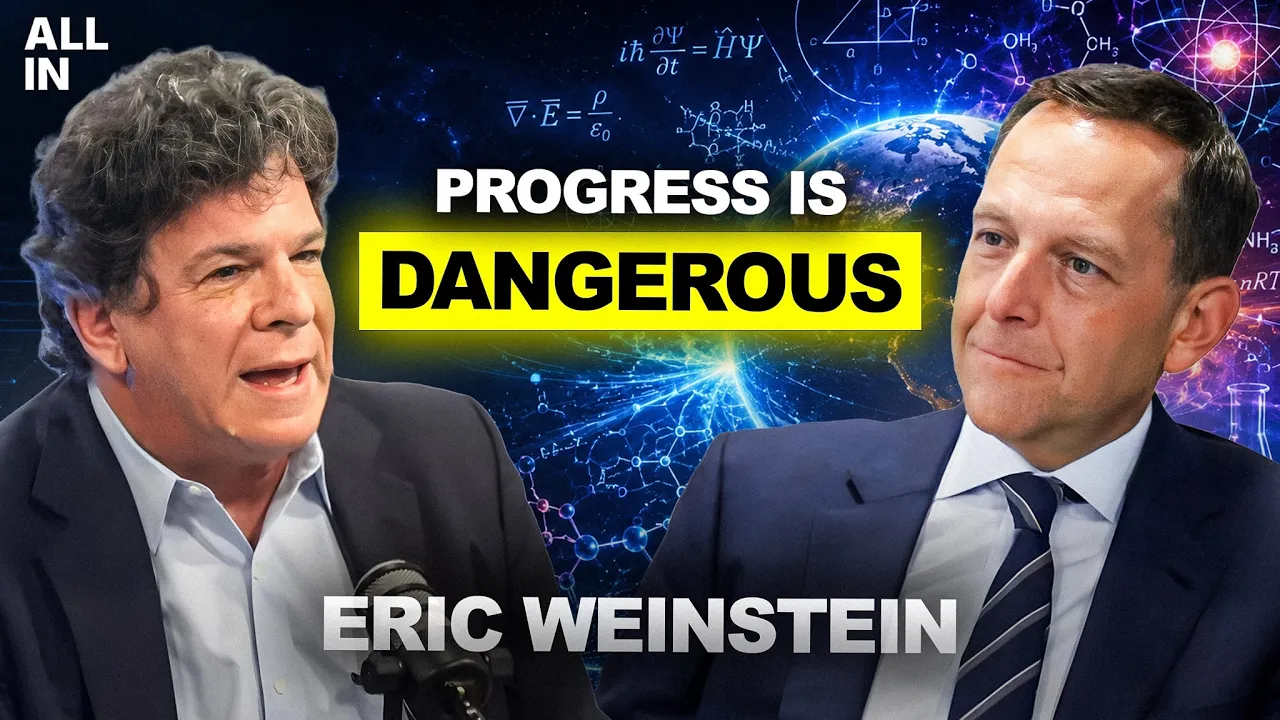
Weinstein Warns U.S. Science Conformity Threatens National Security Advantage
All-In Podcast
Stagnation in theoretical physics since 1984 stems from risk-averse peer review and institutional pressure, though withholding potential energetic breakthroughs may have prevented human self-destruction.
## Background
Published on YouTube by the All-In Podcast on August 27, 2026, this episode features guest Eric Weinstein joining the hosts to discuss the state of American science. The podcast description highlights conversations spanning structural academic stagnation, proposals to reform federal science funding, physics history, secret enclaves, and frontier energy concepts.
## TL;DR
Eric Weinstein argues that American scientific dominance has stalled due to institutional risk-aversion, rigid peer review, and an economically fragile 'scientific precariat' forced into conformity. He proposes sweeping institutional reforms, such as exempting research teams from standard federal regulations, abolishing post-1965 peer review mechanisms, and separating hard sciences from soft sciences. Weinstein also explores theoretical physics, suggesting that fundamental particle physics stagnated around 1984 under the dominance of String Theory, or alternatively, that major breakthroughs were sequestered inside secret enclaves like Renaissance Technologies. Ultimately, he posits that this 50-year lull in physical breakthroughs may have inadvertently protected humanity from developing catastrophic new energy and weapon technologies.
## Atmosphere & style
The conversation carries an intensely intellectual, provocative, and urgent tone, balancing systemic critique with grand grand-unifying theories. Weinstein speaks with high-energy iconoclasm, offering sharp philosophical assertions and personal anecdotes that challenge established scientific authorities. The dynamic feels like a high-level brainstorming session among techno-capitalists and a rogue scholar, shifting seamlessly from institutional policy critiques to speculative physics and existential geopolitical stakes.
## Key takeaways
- [00:00](https://www.youtube.com/watch?v=y84ypzELP_s&t=0s) Eric Weinstein is consulting high-level government agency leaders to propose the first major reform of American science policy since Vannevar Bush's post-WWII framework.
- [03:09](https://www.youtube.com/watch?v=y84ypzELP_s&t=189s) America's historical advantage stems from high-risk, non-conformist 'cowboy science,' which is being undermined by risk-averse institutional conformity.
- [06:31](https://www.youtube.com/watch?v=y84ypzELP_s&t=391s) Institutional and economic pressures have created a 'scientific precariat' unable to dissent, leading to manufactured scientific consensus.
- [11:40](https://www.youtube.com/watch?v=y84ypzELP_s&t=700s) The loss of room for radical scientific alternatives traces back to 1965–1975 policy shifts, such as the Mansfield Amendment, which restricted military funding for basic research.
- [01:17:05](https://www.youtube.com/watch?v=y84ypzELP_s&t=4625s) To revitalize scientific breakthroughs, Weinstein advocates for abolishing post-1965 peer review, granting federal policy exemptions to scientific teams, and separating hard sciences from soft sciences.
- [01:25:43](https://www.youtube.com/watch?v=y84ypzELP_s&t=5143s) Pure science is a non-excludable public good requiring direct state tax funding rather than sole reliance on private capital or philanthropy.
- [34:09](https://www.youtube.com/watch?v=y84ypzELP_s&t=2049s) Government research agencies misapply Modern Portfolio Theory by funding low-risk, low-beta safe bets instead of high-upside, high-beta pioneer bets.
- [41:36](https://www.youtube.com/watch?v=y84ypzELP_s&t=2496s) Theoretical physics has stagnated since the mid-1980s after key leaders steered the field into hyper-abstract string theory, disconnecting it from physical reality.
- [45:16](https://www.youtube.com/watch?v=y84ypzELP_s&t=2716s) Weinstein suggests fundamental physics research may not have stopped, but rather was hidden in secret enclaves like Renaissance Technologies.
- [52:49](https://www.youtube.com/watch?v=y84ypzELP_s&t=3169s) Frontier physics operates across 'Boom' (weaponry), 'Vroom' (energy), and 'Zoom' (propulsion); the 50-year stagnation in theoretical physics may have inadvertently prevented existential self-destruction.
## Detailed walkthrough
### [00:00](https://www.youtube.com/watch?v=y84ypzELP_s&t=0s) Introduction and the State of American Science
The transcript opens with Eric Weinstein reflecting on how the United States has changed in terms of its scientific output and posture. Host Sunny Madra reads a summary of Weinstein's credentials: a PhD in mathematical physics from Harvard, National Science Foundation postdoc, Office of Naval Research fellow at Harvard, creator of the "Geometric Unity" framework in 2021, former partner at Thiel Capital, and podcaster. Weinstein jokes about the absence of the other "Besties" (Jason Calacanis, Chamath Palihapitiya, and David Sacks), remarking that they must have "turned tail and ran" to avoid an extended "Science Corner." Madra explains that he and Weinstein happened to both be in Washington, D.C., and took advantage of a rented studio to record the interview.
When asked what brought him to the nation's capital, Weinstein shares that he has been taking high-level meetings across executive branch agencies. He mentions discussions with the Department of War (Department of Defense), Michael Kratsios at the Office of Science and Technology Policy (OSTP), Jay Bhattacharya at the National Institutes of Health (NIH), and Jim O'Neill, who is slated to join the National Science Foundation (NSF). Weinstein notes that these discussions center on the first major proposal to reform American science since Vannevar Bush's seminal report at the end of World War II.
- **Key Figure Mentioned:** Vannevar Bush, who shaped post-WWII American science policy.
- **Key Meetings:** Department of War, OSTP (Michael Kratsios), NIH (Jay Bhattacharya), NSF (Jim O'Neill).
---
[03:09](https://www.youtube.com/watch?v=y84ypzELP_s&t=189s) High-Variance "Cowboy Science" vs. Institutional Conformity
Weinstein makes the case that while government-driven science played a fundamental role in the success of the American republic over the last 75 to 100 years, true "courageous science" has stalled. He argues that America’s unique national advantage is its capacity for high-variance, ruggedly individualistic, high-risk "cowboy science" that poorer or less individualistic nations cannot afford to take on. When the system shifts toward low-variance, incremental research and labels it "excellence," it neuters the nation's greatest geopolitical asset: freedom and the willingness to challenge central authority.
Weinstein draws a contrast with authoritarian rivals like China, emphasizing that freedom functions as an epistemic weapon. He contends that scientists must be allowed to challenge established dogmas and investigate uncomfortable questions—such as evaluating the exact public health consequences and origins of the COVID-19 pandemic—without facing career destruction or pre-ordained conclusions handed down by administrators. He laments that young scientists are no longer empowered to bet their careers against mainstream consensus.
> "Freedom is a weapon... Quite honestly, we're giving away our biggest advantage, which is the middle finger, the American ability to say screw you to a supervisor who tells you what is true and what isn’t true."
---
[06:31](https://www.youtube.com/watch?v=y84ypzELP_s&t=391s) The Scientific Precariat and the Illusion of Consensus
When Madra asks why scientific questioning seemed to evaporate during the pandemic, Weinstein introduces the concept of the **"scientific precariat."** He explains that modern academic institutions have created an economically fragile workforce of scientists and professors who literally cannot afford to challenge institutional consensus. Weinstein warns that "consensus" is often an artificial construct generated by institutional pressure rather than objective proof—pointing out that no one demands a "consensus" on basic arithmetic like $2 + 3 = 5$ because it simply is true.
Weinstein highlights Jay Bhattacharya as an example of the system's broken dynamics. Bhattacharya—who holds both an MD and a PhD in economics—was publicly maligned as a "fringe epidemiologist" by figures like Francis Collins and Anthony Fauci after authoring the Great Barrington Declaration, only to later be named head of the NIH. Weinstein criticizes the involvement of covert agencies and intermediary non-profits like EcoHealth Alliance (and funding bodies like DTRA) in scientific research, arguing that top-tier independent scientists naturally expose covert narratives when given access to data. He asserts that government policy networks have deliberately favored compliant "B-minus" players over fiercely independent thinkers.
- **Concept Defined:** *Scientific Precariat* — a system where researchers depend on continuous grants and institutional approval, destroying independent dissent.
- **Key Examples:** Jay Bhattacharya's treatment during COVID-19; EcoHealth Alliance and DTRA (Defense Threat Reduction Agency) funding dynamics.
---
[11:40](https://www.youtube.com/watch?v=y84ypzELP_s&t=700s) Broken Incentives and the Lack of Recourse for Heterodox Thinkers
Madra prompts Weinstein to elaborate on how institutional incentives suppress heterodox thinking. Weinstein explains that in academia, researchers who speak out or propose radical alternatives lose access to tenure, grants, department chairmanships, and financial security. He shares his own personal history from 1987, when he introduced a set of differential geometry equations; despite his ideas being initially dismissed and mistreated, those same concepts came to dominate his field by 1994 without any restitution or recognition given to him for being early.
Weinstein forcefully rejects the romanticized narrative that "true scientists shouldn't care about money or security." He points out that the immense economic value generated by modern technology flows directly from fundamental science, yet the scientists who uncover these truths are excluded from the resulting wealth. This disparity forces researchers into a protective, collectivist mindset. He adds that theoretical physics has suffered uniquely under legal frameworks like "Restricted Data" laws, which restrict physicists from freely publishing or discussing equations that could bear on nuclear weapons or nuclear physics.
- **Personal Historical Example:** Differential geometry equations developed by Weinstein in 1987 that gained traction in 1994 without institutional credit.
- **Regulatory Pressure:** "Restricted Data" controls limiting speech and open publication in theoretical physics.
---
[15:00](https://www.youtube.com/watch?v=y84ypzELP_s&t=900s) 1965–1975: The Historic Pivot Point in American Science
Asked when and why this shift occurred—whether through natural institutional decay, social media, or deliberate policy—Weinstein points to his past work as co-principal investigator (with economist Richard Freeman) of the Science and Engineering Workforce Project at Harvard. He pinpoints the exact decade where the American scientific machine broke down: **1965 to 1975**.
Weinstein traces the breakdown to key historical turning points:
1. **1965–1969:** The passage of major social legislation (like the Medicare Act of 1965) alongside rising anti-war sentiment among academics.
2. **Spring 1969:** The MIT physics department held a famous walkout to protest the Vietnam War, joined by veteran scientists who had worked on the Manhattan Project.
3. **Government Backlash & Mansfield Amendment:** Viewing the scientific community as politically unreliable, the federal government began decoupling unclassified, "blue-sky" university research from defense infrastructure. MIT's Instrument Laboratory was spun off into Draper Labs, and the Mansfield Amendments (1969–1971), championed by Senator Mike Mansfield of Montana, prohibited the military from funding open-ended, non-military basic research at universities. This shift ushered in the modern, risk-averse peer-review grant apparatus.
- **Project Referenced:** Science and Engineering Workforce Project at Harvard (co-led with Richard Freeman).
- **Key Policy Milestone:** The Mansfield Amendment (1969/1971), which terminated military sponsorship of blue-sky fundamental scientific research in university departments.
[01:17:05](https://www.youtube.com/watch?v=y84ypzELP_s&t=4625s) The Danger of Domesticating Scientists and "Spaying and Neutering" Alpha Minds
Eric Weinstein explains that the fatal shift in American science occurred when the government stopped funding basic research with a broad national-security directive and instead demanded explicit, direct military justifications. Previously, military leaders were content to let elite scientists work on open-ended "blue sky" research—they simply wanted top-tier minds well-funded and available when existential crises arose.
Weinstein argues that high-energy science demands a diversity of extreme personalities: "If you don't have communists and fascists in the same department having tea together, something has gone wrong." He references Ted Kaczynski's satirical essay *Ship of Fools*—which lampoons a crew bickering over political correctness while their vessel drifts toward an iceberg—to illustrate how obsessing over ideological compliance distracts institutions from actual survival and scientific truth.
```
┌─────────────────────────────────────────┐
│ HISTORICAL AMERICAN SCIENCE MODEL │
│ Open-ended, high-agency basic research │
└────────────────────┬────────────────────┘
│
[Institutional Shift: HR & DE&I]
│
▼
┌─────────────────────────────────────────┐
│ MODERN SCIENTIFIC CONSTRAINTS │
│ Hyper-conformity, bureaucratic oversight│
└────────────────────┬────────────────────┘
│
▼
┌─────────────────────────────────────────┐
│ CONSEQUENCES │
│ • "Spayed and neutered" elite talent │
│ • Exclusion of high-agency "weirdos" │
│ • Stagnation in fundamental breakthroughs│
└─────────────────────────────────────────┘
```
When asked whether brilliant, unconventional minds are being reprogrammed or excluded altogether, Weinstein responds that the scientific establishment is effectively "spaying and neutering" its best talent. He highlights figures who defy institutional sanitization:
- **Palmer Luckey:** Operates as a builder and weapons manufacturer with high agency—a profile that would make him difficult to fit into a traditional academic physics department.
- **Nima Arkani-Hamed:** One of the world's leading theoretical physicists, described by Weinstein as "the best of us currently," brilliantly uncompromising and resistant to blind conformity in string theory.
- **Jim Watson:** The co-discoverer of DNA's double helix, who was ousted from Cold Spring Harbor Laboratory—an institution he built—due to controversial statements.
- **Mark Ptashne:** The molecular biologist who elucidated the genetic switch in phage lambda, known for an intensely irreverent edge that modern institutional administrators find unmanageable.
- **Eric Lander:** Former White House science advisor whose demanding, uncompromising style led to friction within bureaucratic political structures.
Weinstein draws an explicit parallel to the movie *Whiplash*, noting that elite achievement requires an unforgiving environment rather than administrative coddling.
---
[01:21:31](https://www.youtube.com/watch?v=y84ypzELP_s&t=4891s) Reforming Science: Poking Holes in the Civil Rights Act and Killing Peer Review
To fix scientific stagnation, Weinstein puts forward provocative reform proposals. He argues for creating carve-outs in federal regulations—specifically "blowing a hole in the Civil Rights Act"—to free scientific teams from HR-driven conformity. High-agency individuals form deep, productive bonds through unstructured, direct banter that does not fit neatly into corporate HR guidelines.
He advocates for the complete dismantling of the formal peer-review process, calling it a historical anomaly that was "retconned into science."
- Google Ngram data reveals that the term "peer review" was virtually nonexistent prior to 1965.
- The concept entered medical governance after the Medicare Act of 1965 made the federal government the primary payer for medical procedures, leading doctors to create internal review boards to avoid direct government oversight.
- Journal peer review was formalized around 1975 after conservative political pushback against National Science Foundation (NSF) funding for social-science curricula like *Man: A Course of Study* (MACOS).
Weinstein contends that soft sciences like sociology and anthropology should be split off from hard sciences like physics, mathematics, and chemistry, preventing non-rigorous fields from consuming fundamental science budgets.
---
[01:25:43](https://www.youtube.com/watch?v=y84ypzELP_s&t=5143s) Market Failures, Pure Mathematics, and the Role of Government Funding
Addressing market-based approaches to scientific funding, Weinstein challenges the idea that private capital or free markets can reliably sustain foundational research. He argues that basic science is a classic public good—both *inexhaustible* and *non-excludable*—making it subject to structural market failure.
```
+-----------------------------------------------------------------------+
| MARKET FAILURE IN SCIENCE |
+-----------------------------------------------------------------------+
| Pure Science Characteristics: Inexhaustible & Non-excludable |
| Market Consequence: Private markets cannot capture direct ROI |
| Result: Pure mathematics & fundamental physics require tax funding |
+-----------------------------------------------------------------------+
```
When private market advocates suggest that wealthy philanthropists can fund fundamental research, Weinstein points to the limits of that model:
- **Homotopy Theory:** A branch of pure mathematics essential to the broader mathematical ecosystem, yet lacking immediate industrial applications that commercial entities can price or monetize.
- **Jim Simons & Yuri Milner:** While exceptional figures with deep backgrounds in mathematics and quantum chromodynamics who funded basic science, reliance on individual billionaires is structurally insufficient for maintaining a national scientific enterprise.
- **The Government's Essential Role:** Just as tax revenue must fund a national military because defense cannot be privatized, basic research requires direct public backing.
Weinstein critiques academic scientists who distance themselves from political leadership over partisan disagreements, arguing that failing to educate policymakers directly damages national scientific progress. He cites figures like Michael Kratsios (former U.S. Chief Technology Officer), Jay Bhattacharya, and Jim O'Neill as capable leaders open to structural reform if top researchers engage with them constructively.
---
[01:32:38](https://www.youtube.com/watch?v=y84ypzELP_s&t=5558s) The Flaw of KPIs and Data-Driven Metrics in Science
Weinstein rejects administrative attempts to manage core scientific breakthroughs using corporate Key Performance Indicators (KPIs), rigid metrics, or short-term ROI evaluations. Real breakthroughs are inherently unpredictable and cannot be scheduled or quantified by bureaucratic managers.
Historically, science thrived on high-trust network funding rather than cumbersome grant applications. Decades ago, elite researchers did not fill out exhaustive proposal forms; instead, senior leaders identified talented individuals and placed them directly into positions where they could operate freely. Weinstein argues that managing national science through metrics alienates elite intellects—such as those historically assembled in elite advisory groups like the JASONs—who must be kept on retainer to solve non-trivial national crises.
- Scientific breakthroughs fail under rigid quarterly or annual KPI tracking.
- Bureaucratic management selects for compliant grant-writers over revolutionary thinkers.
- Maintaining world-class scientific capability requires trusting top minds with open-ended retainers.
<ElicitationsGroup message="To explore the next parts of this discussion:">
<Elicitation label="Analyze Eric Weinstein's critique of string theory and modern physics" query="What are Eric Weinstein's specific arguments against string theory and modern physics leadership as discussed in this transcript?"/>
<Elicitation label="Examine the role of Renaissance Technologies and defense physics" query="Summarize the discussion on Renaissance Technologies, secret physics research, and national defense applications."/>
<ElicitationsGroup/>
[34:09](https://www.youtube.com/watch?v=y84ypzELP_s&t=2049s) High-Beta Bets and Modern Portfolio Theory in Science
Continuing his critique of the current research ecosystem, Eric Weinstein contrasts the corporate technology mindset with the true intrinsic motivations of pure scientists. While Silicon Valley tech founders and executives chase monetary ROI or exotic sports cars like McLarens, genuine scientific pioneers are motivated by historical legacy—striving to produce work that will still be studied and discussed 10,000 years into the future. He cites iconic mathematical and scientific figures like Jim Watson, Isidor Singer, and Raoul Bott as those who achieved this timeless status, contrasting them with modern software-as-a-service creators whose contributions are far more ephemeral. Scientists do not require extreme corporate luxury or private jets, Weinstein notes, but they must be treated with appropriate respect and prestige as "rock stars" to prevent top-tier talent from abandoning basic research.
The conversation pivots to how modern government funding structures actively undermine high-risk, game-changing scientific breakthroughs. Grants are currently allocated based on low-risk, predictable outcomes (low "beta"), effectively misapplying modern portfolio theory to scientific research. Weinstein argues that an incredibly wealthy sovereign entity like the U.S. government should be placing high-risk, massive-upside bets—such as funding a researcher with a 1% chance of curing all cancer—rather than delegating funding decisions to risk-averse micro-departments that settle for modest, highly predictable outcomes and then inflate their significance. Furthermore, when a sector of fundamental research fails or stagnates, funding should be reallocated strategically to revitalize it rather than double down on stagnant orthodoxy.
- **Grete Hermann / Ron Perlman Tangent:** Weinstein uses an illustrative joke about misidentifying figures across eras (asking "Who is Ron Perlman?" vs. "Who is Radia Perlman?") to emphasize how historical memory handles pop culture versus fundamental contributors.
- **The "Slack" Counter-Example:** The besties bring up how venture capital frequently backs the *person* rather than the specific *idea*—highlighting how Stuart Butterfield pivoted a failing gaming project into Slack (which sold for $30 billion) because investor Ben Horowitz trusted the founder himself.
- **Weinstein's Challenge:** To identify true under-the-radar potential, look at which emerging scientists established leaders choose to actively block while refusing to short-fund or bet against, because deep down they recognize the threat to their own authority.
---
[41:36](https://www.youtube.com/watch?v=y84ypzELP_s&t=2496s) Ed Witten, String Theory, and the Stagnation of Physics
Weinstein delivers a sharp, direct critique of modern theoretical physics, singling out Edward Witten—whom he calls "the smartest man in the world today"—as the central figure who inadvertently drove theoretical physics off a cliff 42 years ago (around 1983–1984). He argues that along with Leonard Susskind and David Gross, Witten steered fundamental physics into hyper-abstract mathematical realms (such as string theory) that completely severed ties with the physical universe. To illustrate this disconnect, Weinstein highlights the website for the *Strings 2026* conference: searching the schedule for foundational physical realities like "electron," "hadron," "Higgs," or "lepton" yields virtually no results, proving that the dominant framework no longer engages with measurable physical matter.
This institutional detachment has created a climate where elite physics centers tolerate—and even promote—pure theoretical abstracts at the expense of empirical reality. Weinstein recounts visiting a world-leading theoretical physics institute where two top theoretical professors explicitly admitted to him that they had "no interest in the physical world." Furthermore, because his critique of mainstream theoretical physics (including his own framework, Geometric Unity) challenges the entrenched consensus, major academic departments impose bizarre institutional constraints on him: inviting him to speak, but formally denying that an official departmental seminar occurred (e.g., hosting talks in non-official spaces or framing them as informal Q&A sessions at places like UT Austin, the Perimeter Institute, or the University of Chicago).
- **The Neutralization of Physics:** Weinstein quips that string theory managed something previously thought impossible: it rendered the field of Edward Teller, J. Robert Oppenheimer, Richard Feynman, and Stanislaw Ulam completely "safe," transforming room-destroying nuclear gauge theories into harmless mathematical exercises like AdS/CFT that cannot produce physical weapons.
- **Historical Sharp Turn:** Prior to 1983–1984, fundamental physics made tangible progress; post-1984, the Standard Model remained essentially unchanged, and no fundamental discoveries in particle physics have led to new Stockholm-level revolutions.
---
[45:16](https://www.youtube.com/watch?v=y84ypzELP_s&t=2716s) Is Renaissance Technologies a Secret Los Alamos?
Exploring why theoretical physics abruptly stalled in academia, Weinstein poses a radical hypothesis: what if breakthrough physics did not actually stop, but was systematically sequestered inside a secret program? He draws an explicit historical parallel to the creation of the Manhattan Project in the 1940s. Back then, following the discovery of nuclear fission and chain reactions, the National Research Council set up a hidden "Reference Committee" led by Wright Haskell. Any independent researcher submitting a paper on chain reaction physics to a journal had their work silently shunted to this secret board and rejected under the guise of "preliminary results," stripping outside scientists of their livelihood while covertly funneling top talent into the white-badge enclave of Los Alamos.
Weinstein suggests that if a modern analog to Los Alamos exists today, the prime candidate is **Renaissance Technologies (RenTech)** on Long Island. He examines the firm's official narrative: a quantitative hedge fund that famously refuses to hire Wall Street finance experts, choosing instead to recruit elite particle theorists, differential geometers, and machine learning experts. The firm maintains an ultra-secure campus, close ties to nearby Brookhaven National Laboratory, and a unique proximity to SUNY Stony Brook—a university historically world-class in theoretical physics and geometry. While acknowledging he cannot definitively prove this hypothesis, Weinstein compares his public questioning to reporter Jack Raper, who in 1944 correctly wrote a story exposing a secret city in New Mexico working on a doomsday weapon under a world-famous scientist, only to be dismissed as a eccentric conspiracy theorist at the time.
- **The Medallion Fund Cover:** The besties point out that former RenTech employees never report secret physics operations and simply enjoy extreme investment returns. Weinstein notes the firm's unique policy of closing the Medallion Fund to all external investors while allowing select insiders to keep capital compounding inside, creating an insulated structure free from public oversight.
- **Epstein Parallel:** Weinstein draws a structural parallel to how figures like Jeffrey Epstein maintained elaborate cover stories for their operations—recounting how Epstein personally claimed to him that he ran a multi-strategy FX hedge fund operating out of a custom Boeing 727 equipped with a trading floor and staffed entirely by yeshiva students using mean-reversion and trend-following algorithms.
<ElicitationsGroup message="Explore related discussions from this episode:">
<Elicitation label="Weinstein's breakdown of Geometric Unity & physics" query="What does Eric Weinstein explain about Geometric Unity and his alternate framework for physics?"/>
<Elicitation label="The scientific precariat & academic funding" query="How does Eric Weinstein describe the scientific precariat and his proposals to reform academic grants?"/>
<ElicitationsGroup>
Here is a detailed, faithful walkthrough of this section of the interview:
[51:40](https://www.youtube.com/watch?v=y84ypzELP_s&t=3100s) Cover Stories, Jeffrey Epstein, and Renaissance Technologies
Eric Weinstein continues discussing his skepticism surrounding the mainstream narrative of high finance and intelligence, pointing to Jeffrey Epstein's shifting cover stories as an example of a "fake world." Epstein claimed to use a three-way carry trade strategy and stated he did no options or gamma trading. Weinstein calls this a cover story that was eventually burned, after which Epstein transformed from a "disgraced financier" into a "tax expert." He likens these collapsing explanations to the classic *Get Smart* catchphrase, "Would you believe...?", where absurdly grand cover stories collapse down to "two Boy Scouts with a slingshot."
Turning to Renaissance Technologies, Weinstein stresses that while he considers Jim Simons an absolute genius, the firm's legendary, unmatched returns stand completely isolated in finance. He points out that Renaissance maintains close, unacknowledged ties to a specific talent pool at Stony Brook University and a nearby national laboratory (Brookhaven National Laboratory), hinting at depth beneath the public surface.
- Weinstein notes that no one else in finance has ever come close to matching the returns claimed by Renaissance's Medallion Fund.
- He emphasizes that the firm's deep connections to Stony Brook and national laboratory infrastructure remain largely unacknowledged in standard financial narratives.
---
[52:49](https://www.youtube.com/watch?v=y84ypzELP_s&t=3169s) What Physics Could Have Looked Like: Unification and "SU(4)"
The hosts prompt Weinstein to paint a picture of what the world would look like today if physics had not stalled out around 1983–1984 in pursuit of quantum gravity and string theory. In response to the argument that physics has successfully driven semiconductor manufacturing, advanced lithography, and compute power (which birthed modern AI), Weinstein clarifies why that view misses the core point. Advanced technology has relied on older physics, while fundamental frontier physics has remained locked away without industrial application.
To illustrate, Weinstein points out that although three valence quarks were discovered inside protons and neutrons in 1968, no one has ever isolated a single quark due to "infrared slavery" (color confinement). However, if physics had progressed beyond the Standard Model—such as through the Pati–Salam model proposed by Abdus Salam and Jogesh Pati in the mid-1970s—our understanding of forces would be vastly different. The Pati–Salam model replaces the strong force gauge group $\text{SU}(3)$ with $\text{SU}(4)$, treating the lepton (such as the electron and neutrino) as a "fourth color" alongside the three quark colors. Under such a framework, force particles could potentially rotate quarks into leptons, leading to technology capable of completely disintegrating matter.
- **Infrared Slavery:** Discovered in 1968, this property prevents quarks from being pulled apart in isolation, leaving a massive piece of fundamental physics without any industrial application for over 50 years.
- **$\text{SU}(3)$ vs. $\text{SU}(4)$:** $\text{SU}(3)$ controls the strong nuclear force that binds protons and neutrons inside atomic nuclei despite electromagnetic repulsion (the force tapped to unleash nuclear weapons in 1945).
- **The Pati–Salam Model:** By extending symmetry to $\text{SU}(4)$, electrons and neutrinos share an underlying symmetry with up and down quarks, theoretically allowing transmutations between matter types.
---
[56:36](https://www.youtube.com/watch?v=y84ypzELP_s&t=3396s) Decoupled Matter, Neutrino Transmutation, and the "Boom, Vroom, and Zoom"
Weinstein explains how subatomic particles like neutrinos pass through the Earth by the billions without interacting with human matter, except through the incredibly weak gravitational and weak nuclear forces. Under advanced theoretical physics, if one could systematically "rotate" or transmute particles—similar to how a free neutron undergoes beta decay into a proton, an electron, and an antineutrino via a $W^-$ boson—entirely new regimes of energy and destruction open up.
Weinstein introduces his framework of "Boom, Vroom, and Zoom" to categorize the stakes of frontier physics:
- **Boom:** Weaponry and destructive power.
- **Vroom:** Energy production and generation.
- **Zoom:** Advanced propulsion, computation, and transformative capabilities.
Because the Standard Model was largely finalized over 50 years ago, humanity has been denied new forms of Boom, Vroom, and Zoom. Weinstein suggests a chilling possibility: the 50-year stagnation in theoretical physics may have actually saved the human species from self-destruction, because any new "Boom" unlocked at higher energy scales would be too terrifyingly destructive to manage.
- **Beta Decay Mechanism:** A down quark inside a neutron emits a $W^-$ force particle, turning the down quark into an up quark (converting the neutron into a proton) while the $W^-$ decays into an electron and a neutrino.
- **The Danger of New Regimes:** Unlocking larger gauge groups like $\text{SU}(5)$ or additional force particles could render currently stable matter unstable, potentially giving weapons the power to disintegrate entire mountains.
- **Species Survival:** The lack of progress in fundamental physics meant humanity lost out on "Zoom" (space travel and advanced energy), but it spared humanity from a "Boom" that could cause instant extinction.
---
[01:01:24](https://www.youtube.com/watch?v=y84ypzELP_s&t=3684s) The Extreme Leverage of Basic Science and the Hazard of "Easy" Nukes
When a host suggests that scientists or governments across the globe may have deliberately aligned to suppress physics out of fear of this "absolute risk," Weinstein pushes back aggressively: "I don't agree with this at all." He argues that society heavily underestimates how much destructive leverage simple, existing scientific knowledge already grants to bad actors.
To demonstrate this leverage, Weinstein reflects on how inserting just 12 nucleotides (coding for four amino acids) into the spike protein of a coronavirus shut down the entire planet for two years. He invokes the famous scene from *Breaking Bad* where Walter White (using the pseudonym Heisenberg) uses a tiny handful of fulminate of mercury to blow up Tuco Salamanca's office, as well as the simple 75/10/15 recipe for gunpowder (75% saltpeter, 10% sulfur, 15% charcoal).
Weinstein cites historical security breaches to show how dangerously accessible nuclear secrets are:
- **The Radioactive Boy Scout:** A teenager who famously harvested americium from hundreds of smoke detectors to build a rudimentary nuclear reactor in his backyard.
- **United States v. The Progressive (1979):** The U.S. government tried to censor *The Progressive* magazine for publishing Howard Morland's article detailing the Teller–Ulam design for the hydrogen bomb. Morland pieced together the "most dangerous piece of geometry" simply by reading declassified documents in the Los Alamos public library.
- **John Aristotle Phillips:** A Princeton undergraduate who, with no special talent, used public sources to design a fully functional atomic bomb for his junior thesis under the guidance of physicist Freeman Dyson.
---
[01:05:42](https://www.youtube.com/watch?v=y84ypzELP_s&t=3942s) The Collapse of the American Peacekeeper and Multipolar Proliferation
Weinstein warns that the global non-proliferation regime relies entirely on the United States acting as the strong "world policeman." He asserts that petrodollars are fundamentally "violence dollars"—the U.S. military provides the violence required to secure global oil reserves, which in turn gives backing to the U.S. dollar.
As the U.S. experiences its own "Suez moment" of geopolitical decline—evident in its shifting stances on Iran—other nations will realize the American security umbrella is disappearing. Weinstein references Tom Lehrer's satirical cold-war song "Who's Next?" to illustrate that once nuclear deterrence stops being a simple two-player game (diadic) and shifts to a complex multipolar landscape, game theory breaks down, making nuclear conflict almost inevitable.
- Weinstein argues that whether one agreed with Donald Trump's actions against Iran or not, the U.S. must maintain absolute authority to prevent global chaos.
- If nations lose faith in American military deterrence, dozens of countries will feel forced to build their own nuclear arsenals to survive, destroying global stability.
---
[01:06:52](https://www.youtube.com/watch?v=y84ypzELP_s&t=4012s) UAPs, Special Access Programs, and "Multi-Temporal Adversaries"
When asked about unidentified aerial phenomena (UAPs) and whether they represent breakthrough physics developed in secret by the U.S. or China, Weinstein states that he was once a deep skeptic, but is now convinced "there's definitely something there." His shift is not based on public videos, but on private conversations with highly credible, sober individuals who share identical details.
Weinstein explains that compartmentalization and "stovepiping" inside top-secret Special Access Programs (SAPs) are so extreme that even the U.S. government itself cannot piece together what it knows, because different teams are forbidden from speaking to one another.
To explain what might be occurring beyond standard physics, Weinstein introduces the mind-bending concept of **multi-temporal adversaries**. He uses a spatial analogy to explain higher-dimensional movement:
- **1D Movement:** A giant gun mounted on a train car that can only move back and forth along a single track.
- **2D Movement:** A gun mounted on a tank driving freely across the flat expanse of the Bonneville Salt Flats.
- **3D Movement:** A gun mounted on an A-10 Warthog attack aircraft maneuvering through three-dimensional airspace.
By extending this logic to time, Weinstein suggests that if time has more than one dimension, an adversary operating with extra temporal degrees of freedom would possess complete strategic dominance over anyone trapped in a single timeline.
Here is a detailed, faithful walkthrough of Part 5 of the transcript, capturing the arguments, concrete examples, and specific texture of the conversation.
---
[01:08:48](https://www.youtube.com/watch?v=y84ypzELP_s&t=4128s) Multi-Temporal Adversaries and "Einstein's Prison"
Eric Weinstein argues that physics has trapped human thinking in a one-dimensional concept of time. He suggests that just as humans move through three spatial dimensions, time may not be restricted to a single axis. Competing against an adversary who commands "multi-time" would be catastrophic—like attempting to fight an A-10 Warthog with a gun fixed to a single track, but in temporal terms. Being flanked temporally by an adversary who knows your intent before you act is a terrifying prospect, yet one that Weinstein believes we must understand rather than face on an un-level playing field.
Shifting to space exploration, Weinstein dismisses the belief that Mars or the Moon can ensure long-term human survival. He views the solar system as an "escape room" and calls Mars a red herring or a "MacGuffin." While praising Elon Musk as the "only adult" driving aerospace engineering forward by using Mars to motivate teams, Weinstein notes that expanding to the Moon or Mars only gives humanity three worlds to ruin. To survive our own worst instincts, humanity needs tens of thousands, if not millions, of habitable nodes across the galaxy.
Achieving interstellar expansion is impossible under current physics, which Weinstein describes as "Einstein's prison." Standard general relativity—formulated around 1913 to 1915 primarily by Albert Einstein and Marcel Grossmann—dictates that the speed of light is an absolute cosmic speed limit. Traveling to Alpha Centauri at near-light speed would mean eight years pass on Earth during the round trip, rendering meaningful interstellar travel unfeasible. Humanity has remained stuck inside these exact equations for over a century, unable to break out because the mathematical model is so precise that physicists accept it as absolute reality.
- **Multi-dimensional time analogy:** Fighting a multi-temporal adversary is like placing an A-10 Warthog's gun on a fixed track.
- **Interstellar travel constraints:** A round trip to Alpha Centauri (four light-years away) at near-light speed forces an 8-year time dilation gap on Earth.
- **General relativity origin:** Weinstein emphasizes that the foundational math of general relativity is properly attributed to Einstein and Marcel Grossmann, rather than Einstein alone or the Einstein-Hilbert action.
---
[01:11:08](https://www.youtube.com/watch?v=y84ypzELP_s&t=4268s) The Looming Crisis in Cosmology: DESI and Breaking General Relativity
Weinstein points to observational data from the Dark Energy Spectroscopic Instrument (DESI) at Kitt Peak National Observatory in Southern Arizona as the catalyst that will break standard general relativity. Dark energy accounts for roughly 60% to 80% of the universe, yet physics currently models it using a static cosmological constant ($\lambda$) multiplied by the metric ($g_{\mu\nu}$). According to Lovelock's theorem, this term is the only coordinate-invariant addition allowed under standard geometric assumptions because taking the divergence requires the derivative of the metric to vanish.
Weinstein asserts that DESI's real-world observations will push data past the 5-sigma threshold of statistical significance, proving that dark energy is dynamic rather than constant. This will expose that modern physics relies on an incorrect formula for the majority of the universe's energy density. Rather than allowing theoretical physics to remain dominated by string theory for 42 years under Ed Witten's influence, Weinstein calls for an open competition where alternative candidate formulas for dark energy can be publicly evaluated.
When asked to clarify the flaw in general relativity, Weinstein explains that while the theory is a brilliant mathematical model, it is merely the "map and not the territory." Its failure is evident in its internal breakdown at singularities—both the initial singularity of the Big Bang and the Schwarzschild singularity at the center of black holes. Because physicists routinely open lectures with assumptions like "Let $M^{1,3}$ be a spacetime manifold," they lock themselves into an Einsteinian frame of thought from the very first seconds, blinding themselves to deeper physical mechanisms.
Weinstein proposes an intuitive analogy: much like the introduction of the "pinch-to-zoom" gesture on multi-touch screens revolutionized user interfaces by changing local scale without altering the screen boundary, a similar scaling mechanism may be built into the fabric of spacetime. Harnessing such a mechanism would allow point-to-point transit by altering metric distances directly without violating local light-speed limits.
- **Observation site:** Dark Energy Spectroscopic Instrument (DESI) located at Kitt Peak National Observatory in Southern Arizona.
- **Mathematical constraint:** Lovelock's theorem dictates why $\lambda g_{\mu\nu}$ is the sole mathematical term allowed for dark energy within standard 4D general relativity.
- **Singularities as flaws:** The existence of infinities at the Big Bang and within the Schwarzschild radius proves general relativity is an incomplete theory.
---
[01:15:38](https://www.youtube.com/watch?v=y84ypzELP_s&t=4538s) Institutional Dogma, China's Talent Poaching, and the "Trash Can Corpus"
Weinstein reflects on his isolation from academic science, pointing out how institutional orthodoxy enforces strict consensus. Anyone advocating radical scientific shifts or unconventional political perspectives gets ostracized by institutional gatekeepers. He notes that dissenters are labeled as arrogant bigots or cranks simply for pointing out structural failures—whether criticizing Ed Witten's control over physics, identifying early financial risks in mortgage-backed securities, or pointing out cognitive decline in political leadership.
This institutional rigidity creates a vulnerability that foreign adversaries are exploiting. Historically, France stood as the premier mathematical powerhouse, while China struggled to gain ground in pure mathematics. Today, China is taking advantage of Western ideological conformity. Chinese institutions approach top Western scientists, offering funding, prestige, and research freedom away from Western bureaucratic collectivism. Scientists from the US, Russia, and Europe are accepting these offers, transferring critical knowledge to China up until their work hits red lines around sensitive geopolitical topics like Tibet, Tiananmen Square, or Taiwan.
Looking forward, Weinstein predicts that Artificial Intelligence will revolutionize scientific discovery by changing how models are trained. Current frontier models learn primarily from elite peer-reviewed literature like *Cell*, *Nature*, *Science*, or the *Annals of Mathematics*. However, Weinstein suggests training AI models on the "Trash Can Corpus" (TC Corpus)—the vast collection of rejected papers, discarded hypotheses, and ridiculed ideas accumulated over decades.
If an AI analyzes everything mainstream physics dismissed, it could uncover breakthrough insights hidden in plain sight. Weinstein warns that China could deploy private AI models specifically instructed to treat 42 years of string theory and M-theory as intentional dead ends, tasking the system to discover what those dominant theories prevented physicists from seeing.
- **Institutional dynamics:** Western academic institutions use consensus enforcement to marginalize non-conforming researchers.
- **Global mathematical shift:** China is actively recruiting elite foreign scientists by offering higher pay and research autonomy away from Western institutional politics.
- **The "TC Corpus":** Training AI models on rejected scientific literature could unlock alternative paths in physics that standard peer-reviewed datasets suppress.
---
[01:20:30](https://www.youtube.com/watch?v=y84ypzELP_s&t=4830s) Commercial AI Risks and the 1960s Gravity Shielding Coverup
The discussion transitions to the existential risks of releasing advanced AI into the wild. Weinstein expresses shock that frontier AI models were ever commercialized as consumer software. He compares deploying models from companies like Anthropic to hiring Hannibal Lecter from a temp agency—wheeling a hyper-intelligent, dangerous entity into an office in a straightjacket and mask, assuming a thin layer of safety guardrails will prevent harm. He compares public access to raw frontier models to selling Davy Crockett tactical nuclear recoilless rifles at Kmart with a basic waiting period.
The conversation turns to Unidentified Anomalous Phenomena (UAPs). When asked what UAPs represent, Weinstein hesitated, noting the professional consequences of speaking publicly. He explains that taking a role with investor Peter Thiel had already closed roughly 30% of institutional doors to him, and speculating on UAPs risks alienating the remaining physics community.
Nevertheless, Weinstein offers two distinct explanations depending on whether general relativity holds true:
1. **If General Relativity is Correct:** UAPs are terrestrial, highly classified experimental weapon systems developed by nation-states. He references a 1971 declassified Australian intelligence document that documented UAPs hovering over British nuclear testing sites in Australia. According to the document, major universities and top physicists in the 1950s and 1960s were actively engaged in classified "anti-gravity" and gravity-shielding research. The academic "Golden Age of General Relativity" served in part as a public cover story for state-sponsored gravitational manipulation programs.
2. **If General Relativity is Incomplete:** UAPs represent technology operating on physical principles beyond current spacetime models, using mechanisms like space metric manipulation ("pinch-to-zoom") to bypass conventional inertia and light-speed constraints.
- **Davy Crockett weapon comparison:** Weinstein equates public distribution of advanced AI weights to selling the M-388 Davy Crockett—a cold-war era soldier-launched personal nuclear device—in retail stores.
- **1971 Australian Intelligence Document:** Reports that mid-century physics research into general relativity was tied to classified military testing of gravity shielding around nuclear test sites.
---
<ElicitationsGroup message="Explore related topics from this discussion:">
<Elicitation label="Analyze Lovelock's Theorem & Dark Energy" query="Explain Lovelock's theorem in general relativity and how dynamic dark energy data from DESI challenges the cosmological constant."/>
<Elicitation label="Detail the 1950s Anti-Gravity Research History" query="What is the history of 1950s and 1960s defense research into anti-gravity and gravity shielding mentioned by Eric Weinstein?"/>
<Elicitation label="Break Down the 'Trash Can Corpus' Concept" query="How could training machine learning models on un-peer-reviewed or rejected scientific papers lead to novel discoveries?"/>
</ElicitationsGroup>
[01:25:12](https://www.youtube.com/watch?v=y84ypzELP_s&t=5112s) The North Sentinel Island Analogy and Nuclear Alarms
Eric Weinstein lays out his vision for interstellar travel and the profound implications of breaking through spacetime limitations. He explains that theoretical moves like a geometric gesture he calls "shear to tilt" would allow humanity to leave our solar system and survive in the cosmos. However, the flip side of this realization is stark: if we can travel interstellarly, then others can too. Given the sheer scale and age of the universe, the notion that humans are the most advanced intelligence in existence is "laughable."
Weinstein frames humanity's cosmic posture through the lens of North Sentinel Island. The island's inhabitants are uncontacted, unaware of the broader modern nation of India surrounding them, and protected under a paternalistic policy of non-interference. But if the Sentinelese suddenly began transmitting radio signals and detonating atomic bombs on their tiny island, India's passive stance would instantly change. Weinstein argues that humanity's first nuclear tests in 1945—alongside early quantum physics milestones like Enrico Fermi's work with the "Boys of Via Panisperna" in Rome and early UAP reports like the 1933 Magenta incident in Italy—served as the cosmic equivalent of firing off nukes on North Sentinel Island. In his view, nuclear capability is a civilization's universal harbinger step right before mastering advanced field propulsion.
- **Shear to Tilt:** The geometric mechanism Weinstein proposes for enabling interstellar travel and escaping solar system constraints.
- **The North Sentinel Analogy:** Humanity represents an uncontacted primitive tribe; advanced non-human intelligences represent the broader nation observing without interfering—until nuclear thresholds are crossed.
- **The Nuclear Trigger:** Detonating atomic weapons in 1945 signaled to outside observers that humanity was on the verge of uncovering major propulsion breakthroughs while remaining dangerously primitive.
[01:27:18](https://www.youtube.com/watch?v=y84ypzELP_s&t=5238s) Geometric Unity and the Uncharted Frontiers of Physics
Transitioning to the contents of the next major physics revolution, Weinstein defends his theory of Geometric Unity. Acknowledging that mentioning his own work will lead critics to accuse him of "self-promotion," he counters that advocating for one's theoretical model is precisely what a scientist ought to do. He asserts that the physical possibilities opened up by the correct unified theory will render the current world completely unrecognizable.
Weinstein outlines several explicit physical phenomena he believes lie right around the corner, waiting to be uncovered once physics breaks past its current stagnation. These include multi-temporal movement, dark chemistry, dark light, two additional undiscovered families of chiral matter at the luminous level, and the existence of spin-3/2 matter. He predicts that the next grand unified symmetry will be based on an $\mathrm{SU}(4) \times \mathrm{SU}(2) \times \mathrm{SU}(2)$ gauge group structure. Because of the immense power unlocked by these breakthroughs, he warns that a primitive, divided species gaining access to such leverage poses an overwhelming hazard to both itself and the broader cosmos.
- **Theoretical Physics Predictions:** Asserts that $\mathrm{SU}(4) \times \mathrm{SU}(2) \times \mathrm{SU}(2)$ represents the next correct Grand Unified Theory (GUT).
- **Exotic Physical Phenomena:** Predicts dark light, dark chemistry, multi-temporal dynamics, spin-3/2 matter, and two additional families of chiral matter.
- **Existential Risk:** Unlocking advanced fundamental physics before achieving geopolitical maturity creates unprecedented levels of destructive leverage.
[01:28:25](https://www.youtube.com/watch?v=y84ypzELP_s&t=5305s) A Call for American Scientific Leadership and Civic Engagement
The host wraps up the interview, acknowledging how unique, unconventional, and mind-bending the discussion has been for the audience, while stressing the vital importance of taking unorthodox and seemingly "heretical" ideas seriously. Expressing gratitude for the conversation, Weinstein makes a final, passionate plea for American scientific leadership and unity. He argues that despite geopolitical rivalries, America remains the nation best suited to lead humanity safely into this next high-leverage era, urging immediate efforts to make common cause with global rivals.
Weinstein concludes with a direct challenge to the establishment academic community regarding the political administration in Washington, D.C. Noting that key figures handling the science portfolio under Donald Trump are "much, much better than the PhDs think," he urges skeptical scientists to set aside partisan disdain. He recounts his own experience visiting Washington for a few days simply to ask the administration, "How can I help?"—a posture he implores the broader scientific establishment to adopt for the good of the country and planet.
- **Geopolitical Cooperation:** Urges fast-tracked cooperation with international rivals to manage the dangerous power of next-generation technologies.
- **Reevaluating Political Leadership:** Asserts that leadership holding the science portfolio in D.C. is far more capable than standard academia assumes.
- **Civic Action:** Calls on scientists to drop elitist attitudes, engage directly with leadership, and offer practical assistance in governing science.
## Notable quotes
> [03:09](https://www.youtube.com/watch?v=y84ypzELP_s&t=189s) Freedom is a weapon... Quite honestly, we're giving away our biggest advantage, which is the middle finger, the American ability to say screw you to a supervisor who tells you what is true and what isn’t true. — Eric Weinstein
> [01:17:05](https://www.youtube.com/watch?v=y84ypzELP_s&t=4625s) If you don't have communists and fascists in the same department having tea together, something has gone wrong. — Eric Weinstein
## Mentioned
Eric Weinstein, Sunny Madra, Vannevar Bush, Michael Kratsios, Jay Bhattacharya, Jim O'Neill, Francis Collins, Anthony Fauci, EcoHealth Alliance, DTRA, Richard Freeman, Senator Mike Mansfield, Palmer Luckey, Nima Arkani-Hamed, Jim Watson, Mark Ptashne, Eric Lander, Jim Simons, Yuri Milner, Edward Witten, Leonard Susskind, David Gross, Wright Haskell, Jack Raper, Jeffrey Epstein, Abdus Salam, Jogesh Pati, National Science Foundation, National Institutes of Health, Office of Science and Technology Policy, Department of Defense, MIT, Draper Labs, JASONs, Renaissance Technologies, Brookhaven National Laboratory, Stony Brook University
Theoretical physicist Eric Weinstein argues that American science has stalled over the past half-century due to institutional conformity, bureaucratic funding models, and the diversion of fundamental physics into non-empirical abstractions like string theory. He contends that reviving breakthrough discoveries requires dismantling postwar peer-review systems, investigating neglected theoretical frameworks, and re-establishing direct cooperation between independent researchers and federal policymakers.
Institutional Conformity and the Post-1965 Funding Pivot (15:00)
Weinstein traces the breakdown of American scientific innovation to the period between 1965 and 1975. During this decade, legislative changes such as the Mansfield Amendments curtailed the military's ability to finance open-ended, unclassified fundamental research at universities, ending the broad 'blue sky' patronage model that followed World War II. In its place arose an administrative apparatus governed by journal peer review and rigid Key Performance Indicators (KPIs), which Weinstein asserts were retroactively imposed to manage costs and limit political controversy.
This shift fostered what Weinstein terms the 'scientific precariat'—an economically vulnerable academic workforce reliant on continuous grant approval and tenure gatekeeping. Weinstein argues that this environment penalizes rugged, high-variance 'cowboy science' and rewards safe, low-risk incrementalism. To reverse this institutional domestication, he proposes abolishing formal peer review, separating hard sciences from soft sciences, and creating regulatory carve-outs from standard administrative and human resources rules to allow high-agency, unorthodox minds to flourish.
Four Decades of Theoretical Physics Stagnation (41:36)
Weinstein asserts that fundamental theoretical physics has experienced no revolutionary, empirically validated breakthroughs since approximately 1983–1984. He attributes this impasse largely to the institutional dominance of string theory, spearheaded by figures such as Edward Witten. In Weinstein's view, this paradigm diverted top mathematical minds into hyper-abstract domains like AdS/CFT, which he argues have severed connections to measurable matter—a disconnect illustrated by the absence of foundational particles like electrons or quarks on programs for major theoretical conferences.
He argues that pursuing alternative frameworks could fundamentally expand humanity's command over nature, categorized into 'Boom' (destructive power), 'Vroom' (energy production), and 'Zoom' (propulsion). Weinstein cites the mid-1970s Pati–Salam model, which expands symmetry to SU(4) to treat leptons as a fourth color alongside quarks, theoretically permitting matter transmutation. He suggests that while physics stagnation deprived humanity of advanced propulsion and energy, it may have inadvertently protected the species from discovering existential weapons far more destructive than standard thermonuclear designs.
Sequestration Hypotheses, Secret Enclaves, and UAPs (45:16)
Addressing why fundamental academic breakthroughs halted, Weinstein considers whether transformative physics was deliberately cordoned off from the public sphere. He compares modern conditions to the 1940s Manhattan Project, when journal submissions on nuclear fission were quietly redirected to a secret Reference Committee while public research stalled. Weinstein floats the hypothesis that Renaissance Technologies on Long Island could serve as a modern private enclave, questioning why a quantitative hedge fund recruits elite differential geometers and particle theorists while maintaining close physical proximity to SUNY Stony Brook and Brookhaven National Laboratory.
Weinstein also connects historical opacity to Unidentified Anomalous Phenomena (UAPs). If conventional general relativity holds, he posits that UAPs may represent highly classified state technologies, referencing a 1971 declassified Australian intelligence document describing classified Western gravity-shielding research during the 1950s and 1960s. Alternatively, if general relativity is incomplete, he speculates that UAPs could exploit non-standard physics, such as local metric deformations that bypass conventional inertia.
Singularities, Dynamic Dark Energy, and AI Discovery (71:08)
Weinstein characterizes general relativity as an incomplete mathematical map rather than absolute reality, emphasizing that the theory breaks down internally at black hole and Big Bang singularities. He forecasts that observational data from the Dark Energy Spectroscopic Instrument (DESI) at Kitt Peak will surpass the 5-sigma significance threshold to demonstrate that dark energy is dynamic. This outcome would invalidate standard general relativity's reliance on a static cosmological constant, which Lovelock's theorem dictates as the only coordinate-invariant addition under standard four-dimensional assumptions.
To move beyond current impasses, Weinstein argues for exploring multi-dimensional time, warning that an adversary operating with multi-temporal degrees of freedom would gain total strategic advantage over an actor constrained to a single timeline. Furthermore, he proposes training artificial intelligence systems on the 'Trash Can Corpus'—the vast catalog of rejected papers and dismissed hypotheses from the past several decades—to locate viable, uncorrupted paths of scientific inquiry that peer-reviewed consensus discarded.
Asymmetric Leverage, Cosmic Posture, and Policy Engagement (85:12)
Weinstein warns that foundational physics grants extreme, asymmetric leverage to bad actors, pointing to historical demonstrations where basic geometric insights enabled amateur designs of thermonuclear weapons. Using the metaphor of North Sentinel Island, he suggests that humanity's initial nuclear detonations in 1945 served as an alarm to external cosmic observers, signaling that a primitive, internally divided species was approaching interstellar travel capabilities without achieving corresponding geopolitical maturity.
To manage these high-stakes technologies, Weinstein rejects academic disengagement from government and urges scientists to overcome partisan aversions. Reporting on his own discussions with executive branch officials in Washington, D.C., he contends that national leadership across agencies like the NIH, NSF, and the Office of Science and Technology Policy is far more open to structural reform than academic researchers assume. He appeals to elite scientists to assist the state directly in reshaping national research policy.
Weinstein's critique presents a structural indictment of contemporary science, arguing that institutional risk-aversion suppresses the radical variance required for transformative discoveries. While he offers theoretical candidates—including his own Geometric Unity framework and dynamic dark energy—his claims regarding secret research enclaves and historical gravity manipulation remain speculative hypotheses rather than established historical facts. The unresolved question is whether federal agencies will implement high-risk, open-ended funding carve-outs against the entrenched incentives of the modern academic establishment.
[3:09] Eric Weinstein: Freedom is a weapon... Quite honestly, we're giving away our biggest advantage, which is the middle finger, the American ability to say screw you to a supervisor who tells you what is true and what isn’t true.
[77:05] Eric Weinstein: If you don't have communists and fascists in the same department having tea together, something has gone wrong.
Original transcript
[0:00] We have become a nation when it
[0:01] comes to science.
[0:02] >> You were called a fringe scientist.
[0:04] >> I keep saying fringe.
[0:05] >> Yeah.
[0:06] >> I totally disagree with the narrative of
[0:08] the field. I want to blow a giant pole
[0:11] in the civil rights act. The stagnation
[0:13] in physics may have led to the survival
[0:15] of the human species. When we make this
[0:17] jump, the world will become
[0:19] unrecognizable. I'm going all in.
[0:25] >> As your wealth grows, have you noticed
[0:26] how much more complex things get?
[0:28] Between investments, tax strategy, and
[0:30] estate planning, managing it all is a
[0:32] full-time job you didn't ask for.
[0:34] Creative Planning can help. Their
[0:35] coordinated team of investment managers,
[0:37] CPAs, and affiliated estate attorneys
[0:40] can do much of the heavy lifting so you
[0:41] don't have to. Creative Planning, where
[0:44] wealth works together. Go to
[0:45] creativeplanning.com/allin.
[0:49] I'm going
[0:51] >> Eric Weinstein, mathematician,
[0:53] physicist, economist, PhD in
[0:55] mathematical physics from Harvard,
[0:58] National Science Foundation postoc, O&R
[1:00] fellow at Harvard, published a proposed
[1:03] mathematical framework and speculative
[1:05] unified field theory called geometric
[1:08] unity in 2021, formerly with Theel
[1:11] Capital, podcast host and guest. Welcome
[1:15] to the all-in interview.
[1:17] >> It's great to be here. Now, where are
[1:18] the besties?
[1:19] >> They declined the opportunity because
[1:21] this is an extended science corner that
[1:25] >> can't believe that Jason has turned tail
[1:28] and and ran.
[1:29] >> No, you and I. I mean, just for the
[1:32] audience, you and I both happen to be in
[1:34] DC right now. So, we're in a rented
[1:37] studio doing this interview, but good
[1:39] timing. What brings you to DC?
[1:41] >> Uh, opportunity. I'm really excited.
[1:43] I've meeting with the department of war
[1:46] um and took the opportunity to stay a
[1:48] couple extra days. Been talking to
[1:50] director Katzios over at OSTP and the
[1:53] White House science adviser. Fantastic
[1:55] meeting. Been talking to Jay Badachari
[1:57] who's an old friend over at NIH. About
[2:00] to talk to Jim O'Neal who's hopefully
[2:02] coming into NSF. Yeah.
[2:04] >> And really just taking a look at the
[2:07] first major proposal to reform American
[2:11] science since Venavar Bush at the end of
[2:13] World War II. So this is couldn't be
[2:15] more exciting.
[2:16] >> Did Katzios tell you that I just
[2:17] interviewed him on this topic?
[2:18] >> No.
[2:19] >> Okay. Well, I did.
[2:20] >> Okay.
[2:20] >> You guys are old colleagues, right?
[2:22] >> Yeah. Yeah. Michael's Michael's great.
[2:24] And so he he that came up. He said, you
[2:26] know, here I am in this new role. Yeah,
[2:29] >> I guess I was sort of worried that this
[2:31] report, you know, obviously he's filling
[2:33] huge shoes and I was worried that it was
[2:36] going to be a disaster and I was stunned
[2:40] how how good it was. I mean, it wasn't
[2:42] perfect, but never never is.
[2:44] >> And then I told you that.
[2:47] >> Mhm. and you said that well you and I
[2:48] had been talking and that you had been
[2:50] conveying a lot of these issues to him
[2:52] and I feel like he's uh he's really
[2:55] grown into this role trying to become a
[2:57] student of the American science project
[2:59] and I couldn't be happier at hearing him
[3:03] say things like we know that we don't
[3:04] know everything we're just at the
[3:05] beginning we're just getting started so
[3:07] it looks like a great blueprint
[3:08] >> governmentdriven science has played a
[3:11] fundamental role in the success of the
[3:13] republic at least over the last hundred
[3:14] years last 50 75
[3:17] prior to that there's a argument to be
[3:19] made in the in science and new golden
[3:21] age that Kratzio published and that
[3:23] others have been making I've heard you
[3:24] make it that science has really stalled
[3:25] in America. Can you make that case for
[3:27] us now?
[3:28] >> Well, it's a question of which science
[3:30] has stalled. Um so one of the great
[3:33] things about what Michael's saying is is
[3:34] that science is a big place and it's not
[3:37] being done in one way. So what I really
[3:41] think is the biggest, if you wanted to
[3:43] sort of fly over and give an idea of
[3:46] what's what's at risk, it's the
[3:48] absolutely courageous science that we
[3:51] can afford to do as a rich, ruggedly
[3:53] individualistic nation that no one else
[3:56] can afford to do. And so more or less
[3:59] when when I see us doing incremental
[4:01] research and doing things that are
[4:03] incredibly careful with low variance and
[4:06] calling it excellence, I get depressed
[4:08] because my feeling is is that what we
[4:10] should be taking on is the bets no one
[4:12] else can afford to take on. It's also
[4:14] the case that our chief geopolitical
[4:16] rivals, China,
[4:18] >> has a problem with freedom. And quite
[4:21] honestly, freedom is a weapon. It is a
[4:24] uh serious advantage that we can afford
[4:27] to look at ourselves and say we don't do
[4:29] everything perfectly and we want to know
[4:31] the truth. I want to know whether Fouchy
[4:34] killed 10 million people. I should be
[4:37] able to investigate that as a viologist,
[4:39] as an epidemiologist. I I I should be
[4:41] able to get answers and and go through
[4:43] the process of justice. When we have a
[4:46] situation in which our scientists are
[4:48] hamstrung because the conclusion is
[4:50] known ahead of time, we limit our own
[4:53] ability to use cowboy science
[4:56] to drive the rest of the world. And and
[4:59] quite honestly, we're giving away our
[5:01] biggest advantage, which is the middle
[5:03] finger, the American ability to say
[5:06] screw you to a supervisor who tells you
[5:08] what is true and what isn't true. young
[5:11] person should be able to say, "Hey, I
[5:14] think my field is going in entirely the
[5:16] wrong direction and I'm willing to bet
[5:17] my career on it. Don't interfere." This
[5:20] was always the biggest question for me
[5:22] is where were all the skeptics? Where
[5:25] were all the scientists that are
[5:27] supposed to question the dogma during
[5:29] the lockdowns, during COVID, during that
[5:31] pandemic? And I talked to Katios about
[5:33] this when we did our interview that if
[5:36] everyone in the room agrees on
[5:37] something, it's probably wrong. Like you
[5:39] know there there has to be some degree
[5:41] of skepticism but particularly because
[5:43] the fundamental basis of science is to
[5:45] ask questions, interrogate, generate
[5:48] evidence, generate data and then draw
[5:50] some you know conclusion and ask your
[5:52] next question. But it's almost like the
[5:55] asking questions stopped. Where did that
[5:58] come from? It sounds like you're saying
[5:59] it's because folks were hamstrung
[6:01] socially. Was it economic? What is it
[6:03] that happened that not just in this
[6:06] pandemic but just broadly are we seeing
[6:09] this happen more in these scientific
[6:11] domains where everyone kind of aligns
[6:13] around one thesis one dogma and you're
[6:17] not going to get funding you're not
[6:19] going to have friends you're not going
[6:20] to get colleagues to work with you
[6:21] you're going to get chastised if you ask
[6:24] different questions or ask whether these
[6:26] assumptions are correct
[6:27] >> this is the question and let me just
[6:29] answer it is is that we created the
[6:31] scientific procariat
[6:32] We created a world in which professors
[6:35] cannot afford
[6:37] to go against a consensus. Now the
[6:39] problem is consensus because if
[6:41] everybody agrees on something, you
[6:43] shouldn't need a consensus. There's no
[6:45] arithmetic consensus. Do we have an
[6:48] arithmetic consensus that 2 + 3 equals
[6:50] 5? No, it just is.
[6:53] When I hear the word consensus, I get
[6:55] very, very nervous because a consensus
[6:57] is usually an artificial agreement
[6:59] achieved through pressure. the
[7:02] Washington consensus is some sort of a
[7:05] thing where we're all going to go in a
[7:07] particular direction and if you don't go
[7:08] in that direction you don't have a job.
[7:11] So when you ask well what happens you
[7:15] know my question is that the the uh Jay
[7:19] Bacharia is a perfect example of what
[7:21] should happen. You have a guy who has a
[7:24] PhD in economics and an MD
[7:28] and he went against it with the Great
[7:29] Bington Declaration. Now he's the head
[7:32] of NIH. I I knew Jay when he was called
[7:34] a fringe epidemiologist by this loser
[7:37] Francis Collins and you know his
[7:40] sidekick who was probably our bioweapons
[7:42] are Anthony Fouchy. You know, if I say
[7:45] Anthony Fouchy was probably our
[7:46] bioweapons are, that's going to strike
[7:49] all these people, particularly on the
[7:51] institutional left is, well, that's
[7:53] conspiracy theory talk. So, my question
[7:55] is, we signed a couple of uh agreements
[7:57] in the 70s, the Geneva Convention and
[8:00] Boweapons Treaty. We have a cryptic
[8:02] system. Somehow we chose in that case a
[8:06] mysterious Ukrainian uh British
[8:08] zoologologist to receive huge amounts of
[8:10] money through a hippie dippy charity
[8:13] called the Ecoalth Alliance money from
[8:15] like Ditra, the Defense Threat Reduction
[8:17] Agency, the whole thing doesn't make any
[8:19] sense. So if you start doing things
[8:21] through covert operations, the problem
[8:24] is is that scientists can see right
[8:25] through covert operations.
[8:28] If you have great tools, you know, if
[8:30] you say, "I I wasn't at the scene of the
[8:33] crime." I said, "Oh, well, but we have a
[8:35] a hair follicle and I can pretty much
[8:37] tell you you were at the scene of the
[8:39] crime." That's how powerful science is.
[8:42] So now you have this different problem
[8:44] which is is that you've got all of these
[8:45] Bminus policy people in Washington,
[8:48] particularly in the covert community,
[8:49] not the intelligence community, but the
[8:51] covert community, inside the
[8:52] intelligence community, who don't want
[8:56] kick-ass independent scientists, because
[8:58] they're telling stories and narratives
[9:00] that are easily exploded. So right now,
[9:03] we don't don't just have a problem with
[9:05] good science, we have a problem with
[9:06] good journalism,
[9:08] >> right? They also have to fall in line
[9:10] with the
[9:11] >> the pride narrative.
[9:13] >> Exactly. So there are times when you
[9:15] when you have to, you know, when the US
[9:17] went to war, Roosevelt was in a
[9:19] wheelchair with these leg braces and
[9:22] there was a general agreement that we
[9:23] won't report on the state of the
[9:26] president's health. Well, we had the
[9:27] same thing with Biden. Biden was
[9:29] undergoing some form of dementia.
[9:32] Did anyone think to ask a leading
[9:34] geriatric neurologist, look, examine his
[9:37] gate, examine his speech patterns, and
[9:38] tell us where he is he likely in his
[9:41] cognitive trajectory. So, if you're
[9:44] trying to to, you know, tell a lie
[9:48] that's important structurally, you
[9:50] really don't want scientists exploding
[9:52] it. When we did the and I I'm I'm not
[9:55] arguing with that. We shouldn't have
[9:56] been honest about what we were doing at
[9:59] a New Mexico boy school from 1940 to
[10:02] 1945 because science was creating the
[10:04] most powerful weapon ever seen on planet
[10:06] Earth.
[10:07] >> For those not aware, that's the
[10:08] Manhattan Project.
[10:09] >> Absolutely.
[10:10] >> So, what I'm trying to say is is that
[10:12] right now, you're not taking those
[10:14] people who stood up and making them the
[10:17] president of a university or the
[10:19] chairman of a department. You're not
[10:20] giving them a chair. And I just gave a
[10:22] talk on this at at uh Jordan Peterson's
[10:24] ARC conference. You haven't reinserted
[10:28] the tiny number of people who stood up.
[10:30] You haven't rewarded them. My question
[10:33] is where's my third home for standing
[10:35] up?
[10:36] >> Where's the ability to put my kids, you
[10:38] know, I want to put three kids through
[10:40] school. I want to participate in the
[10:43] security and the prosperity that we
[10:46] provide to everyone else. And this is
[10:48] the the key issue. You've created the
[10:50] American scientific procariat. That's
[10:53] one of the reasons why you have, you
[10:54] know, such strange political
[10:56] affiliations where you don't have
[10:58] balance in the professor. You've got
[11:01] this incredibly dangerous situation
[11:03] where we are not participating in
[11:05] freedom. And I will say in particular
[11:07] theoretical phys physics theoretical
[11:09] physics is the only profession to have
[11:12] lost free speech because of something
[11:15] called restricted data where I am not
[11:17] allowed to put pen to paper to write
[11:19] down a physics equation if in any way it
[11:22] affects nuclear weapons. Well try doing
[11:24] really good physics in a way that
[11:26] doesn't affect
[11:28] you know hadrons and nucleons. It
[11:30] impossible. So you have this threat,
[11:34] right, that somehow um the law I'm not
[11:37] even protected by the first amendment.
[11:39] >> But I I want to go back to your point
[11:40] about incentives. So when you say I want
[11:44] to have a third home, what you're saying
[11:46] just to I'm going to do the Eric
[11:48] Weinstein translation here, but you're
[11:51] saying as a professor, I have to fall in
[11:55] line in order to gain tenure, in order
[11:57] to get a grant, in order to get the the
[12:00] chairmanship role or whatever the
[12:02] fellowship I'm looking for. If I don't
[12:04] fall in line, if I'm fringe, if I say
[12:07] things that are nonconformist, is that
[12:10] the right kind of way to
[12:11] >> heterodox?
[12:11] >> Heterodox,
[12:12] >> if I choose to just go against the
[12:14] orthodoxy, right? I believe that um it
[12:18] was insane to take the idea of the Wuhan
[12:22] Institute of Irology off the table when
[12:24] it came to the origin of CO.
[12:26] >> Right.
[12:26] >> Okay. Insane. It was clear then. And
[12:29] when you said that, you were called a
[12:30] fringe scientist and you were chastised
[12:33] and labeled an outcast and therefore you
[12:36] lost access, you lost jobs, you lost
[12:39] income. There was much that was left out
[12:42] of the equation for you. Y
[12:44] >> because you asked questions that were
[12:46] heterodox.
[12:48] >> I I came up with a set of equations in
[12:50] differential geometry in 1987 and I was
[12:55] uh really treated incredibly badly.
[12:57] those equations took over my field in
[12:59] 1994 and there was never an attempt to
[13:02] go back and say wait a minute we just
[13:04] brutalize somebody who got things right
[13:06] and very early and so you know by the
[13:09] same token it's just a very simple
[13:11] process you're not allowed to want
[13:13] better for your life you're supposed to
[13:14] be humble you know well true scientists
[13:17] don't care about money true scientists
[13:19] don't care about security the reward is
[13:22] the work it's you know blah blah blah
[13:23] blah blah it's all of this absolute dril
[13:27] The fact is is that we are providing
[13:29] your security. And I say third homes to
[13:32] be deliberately provocative. I used to
[13:34] say second homes and I'm done with that.
[13:36] You're dealing with a level of
[13:38] prosperity in a world in which the genie
[13:42] coefficients are blowing out. It's
[13:43] almost entirely due to the technology
[13:47] that is derivative of science and the
[13:49] scientists are not participating. So
[13:50] what you're doing is you're creating a
[13:53] collectivist mindset because we can't
[13:55] get paid. We can't win. If we get things
[13:59] right, we're out.
[14:01] >> When did this change happen? Because did
[14:03] we not value and prize heterodoxy,
[14:07] hereticism, outlandish ideas. The origin
[14:11] of science, the origin of great
[14:12] innovation, which arguably America is
[14:14] still the global leader in today, arises
[14:16] from what initially seems heretical.
[14:18] seems like an idea that is far-fetched,
[14:21] unrealistic, not going to happen. But
[14:24] all it takes is one out of 10 of those
[14:26] things to be true and ultimately the
[14:29] envelope is pushed forward and we find
[14:31] ourselves in a new frontier,
[14:33] >> right?
[14:34] >> Science should follow the same formula
[14:36] as entrepreneurship in the sense
[14:38] technological or industrial kind of
[14:40] entrepreneurship roughly. Yeah. But
[14:42] where did things change and why is this
[14:45] just the natural course of you know Ted
[14:48] Kazinski the uniomber wrote this
[14:50] manifesto where he talked about over
[14:51] socialization. Is that ultimately what
[14:54] happened here? Is it social media played
[14:55] a role? Is it just that this is the
[14:57] saturation of social systems over time?
[15:00] >> Yeah. This
[15:00] >> or was there a deliberate external
[15:02] effort?
[15:02] >> The one thing you didn't uh recite in
[15:04] that list of things. You didn't you
[15:06] didn't mention my being in in the
[15:09] physics department I guess uh at Hebrew
[15:12] University
[15:14] MIT
[15:15] uh post-docctoral fellowship but the the
[15:18] most important one is that I was the
[15:20] co-chair co-PI with Richard Freeman of
[15:22] the science and engineering workforce
[15:24] project at Harvard in the economics
[15:27] department because I was worried that we
[15:29] were we had been losing this and there's
[15:31] a very crisp answer to this and between
[15:33] 1965 and 75 everything went wrong.
[15:37] Right. And and it's basically from the
[15:38] beginning of the Medicare Act of 65 to a
[15:43] controversy over something called man a
[15:45] course of study in 1975 that ushered in
[15:48] peer review and the control. But if you
[15:51] wanted to really pinpoint it, it really
[15:54] 65 69 to 71 is particularly brutal. And
[15:58] what happened was the MIT physics
[16:01] department, I think in 1969 in the
[16:03] spring, walked out in protest of the
[16:05] Vietnam War, including people who had
[16:07] been part of the Manhattan Project.
[16:10] >> And the government took one look at this
[16:12] and said, "Okay, you are wobbly. We
[16:14] can't trust you. We have a we have a
[16:16] very complicated, cryptic agreement with
[16:19] our physicists in particular. You are
[16:22] the most dangerous, most deadly, most
[16:24] intelligent, most successful group along
[16:26] with the mathematicians and we've relied
[16:29] on you and now we can't trust you
[16:31] because you're not you're not rowing uh
[16:34] in the same direction that the country
[16:35] is rowing with the with the war because
[16:37] you're joining the protest movement.
[16:39] What happened was is that immediately
[16:42] the MIT instrument laboratory, which I
[16:45] think was a where lots of government
[16:47] money was being funneled through,
[16:48] >> was taken outside the university and
[16:51] turned into Draper Labs.
[16:53] And the Mansfield amendment in 6971,
[16:57] named after Mike Mansfield of of
[16:58] Montana, said, "Okay, the military can
[17:02] no longer fund blue sky research inside
[17:05] of our university system unless it has a
[17:08] direct military uh express military
[17:11] purpose." That was the disaster because
[17:14] what the military had done is they said,
[17:16] "Look, we want you guys fat and happy
[17:19] doing blue sky research, which is what
[17:22] you think you should be doing. We trust
[17:24] you guys. We just want to know that
[17:26] you're there for us when we need you."
[17:29] So, the military was our best friend.
[17:31] Now that was uncomfortable because quite
[17:33] honestly you have a huge paniply of
[17:35] different ideas inside of high energy
[17:40] highly dynamic science project. If you
[17:43] don't have communists and fascists in
[17:45] the same department having tea together
[17:47] something has gone wrong
[17:48] >> because scientists are very extreme. And
[17:51] Ted Kazinski, you know, wrote a
[17:53] marvelous story, for example, called
[17:56] Ship of Fools about a bunch of people
[17:58] overly concerned about political
[17:59] correctness on a ship that then, you
[18:02] know, runs into an iceberg because
[18:03] nobody's actually paying attention to
[18:04] the writing of the ship. They're having
[18:05] questions about
[18:06] >> I didn't even know this.
[18:07] >> Oh, yeah. Yeah. Yeah. Everybody should
[18:09] should read it. Now, of course, I'm not
[18:11] >> I'm not pushing people to uh a mass
[18:14] murderer. Uh you know, how however
[18:17] >> it's heretical to acknowledge Ted
[18:19] Kazinski, by Well, but the point is is
[18:21] that
[18:22] >> scientists are weirdos,
[18:25] >> or at least many scientists are weirdos.
[18:27] And if you're not going to deal with
[18:29] truly dangerous minds, I don't even know
[18:32] why you're suiting up for the science
[18:34] game. So, where do those minds go
[18:38] if they're not enabled or allowed into
[18:43] the institutions, the establishment, the
[18:45] machinery of science in America? Are
[18:47] they still around or their brains just
[18:49] blunted out and they're only allowed to
[18:51] say certain things or are we taking
[18:52] great scientists and reprogramming them
[18:55] and missing all the alpha? I mean, what?
[18:57] >> Yeah. Yeah. You're you're missing you're
[18:58] missing the alpha. And it's funny that
[19:00] you should say that because that makes
[19:02] it like alpha male or the uh alpha in
[19:05] investment theory, right?
[19:07] >> Both works.
[19:07] >> Yeah. I'm a I also do freestyle raps.
[19:10] Really? Yeah. No. Well, sometimes. Okay.
[19:12] We'll talk later about that.
[19:13] >> Yeah. Cool. Um, well, mostly what you're
[19:16] doing is you're spaying and neutering uh
[19:18] your best minds. Uh, but the other thing
[19:21] is is look at Palmer Lucky.
[19:24] Okay, that guy looks to me like a
[19:26] scientist.
[19:28] He's a reverend. He's got a crazy shirt
[19:31] and he builds things that kill people.
[19:32] >> Yeah.
[19:33] >> Right now, if he was in a physics
[19:35] department, um, he could not easily be
[19:38] that guy. But if you wanted somebody
[19:41] who's in still in science, who looks to
[19:43] me like a great scientist, I would point
[19:44] you to Nema Arani Hamemed. Incredibly
[19:47] charismatic, brilliant as the day is
[19:49] long, completely uncompromising, did not
[19:52] go in for the string theory fat at a
[19:54] deep level, even though he's sympathetic
[19:55] to many aspects of it.
[19:57] >> Do you guys even know that he's there?
[20:00] He's the best of us currently, and he's
[20:02] still not that old, you know. Um, my
[20:05] feeling is that there's pretty much been
[20:10] a giant decrease in our effectiveness.
[20:14] And I know why. When you kick Jim Watson
[20:17] out of Cold Spring Harbor, which he
[20:19] built,
[20:21] what are you doing? Do you know that
[20:23] Mark Tashnney uh is in his mid 80s? uh
[20:28] guy who wrote a genetic switch on fage
[20:30] lambda, one of the most brilliant,
[20:32] irreverent people. You know, at some
[20:34] point, I think I sent a journalist to
[20:35] him and the journalist came back with
[20:36] his tail between the leads and said that
[20:38] that that guy's insane.
[20:40] >> Well, Eric Lander was the White House uh
[20:44] science adviser, Katzios's role. I think
[20:46] his picture isn't up on the wall because
[20:49] he's sort of an uncompromising,
[20:51] difficult to deal with guy. And my
[20:53] feeling, I hate to say, this is tough. M
[20:55] >> you know if you ever saw the movie
[20:57] Whiplash
[20:58] >> love it. One of my favorites.
[20:59] >> Okay. Well, there's a reason that that
[21:01] guy has the best band. He you know he's
[21:03] not handing out tissues. And I I don't
[21:05] mean to be mean about I don't want a
[21:07] brutal place, but like this stuff is
[21:10] pretty unforgiving.
[21:11] >> What's the solution to morass
[21:15] stagnation? What do we do here to try
[21:18] and catch up again? What do we do here
[21:20] to to restructure? Or is it about
[21:23] institutions? Is it about funding? Is it
[21:25] about people? Is it reprogramming? I
[21:27] mean, how do you get out of the social
[21:28] circuit that's fully programmed?
[21:30] >> Great question. I mean, really great
[21:32] question. Let's just be provocative and
[21:34] throw some stuff out. National interest
[21:36] waiverss. I want to blow a giant hole in
[21:40] the Civil Rights Act so that we can have
[21:43] teams that are not constantly afraid of
[21:45] HR.
[21:45] >> What does the Civil Rights Act do that
[21:48] makes it difficult for individuals to do
[21:50] what they need? Well, you know, you
[21:52] >> science,
[21:52] >> my closest friend uh from college, we
[21:57] have a group of three, two Jews and a
[21:59] Muslim.
[21:59] >> Mhm.
[22:00] >> And the Muslim is constantly teasing the
[22:02] Jews about, you know, you guys know all
[22:05] the banks of the newspapers and we, you
[22:07] know, joke with him about him being a
[22:09] terrorist. Now, that is not a model I
[22:11] can explain to anybody, but we've been,
[22:15] you know, incredibly close uh since
[22:19] 1982. My claim is is that you don't
[22:22] understand how high agency people
[22:26] actually form tight cohesive social
[22:28] units.
[22:30] >> If you have the HR department saying,
[22:32] you know, Eric, I understand you you are
[22:34] making an inappropriate joke,
[22:36] >> screw off. Get out of here. Who are you
[22:39] and what are you doing in my lab? Let me
[22:41] call security. Why do I need a note from
[22:44] my mommy and daddy to to do everything?
[22:47] I'm not saying be horrible. I'm saying
[22:49] you don't know enough about the culture
[22:51] of greatness
[22:53] to be my HR department. That's sort of
[22:56] what I'm saying. So like I'm just
[22:57] throwing out a provocative idea which by
[23:00] the way I'm a Democrat. I'm sort of a
[23:02] Democrat from the JFK school rather than
[23:05] I I don't think I would join.
[23:06] >> I don't know I don't know what you would
[23:07] be today.
[23:08] >> Well I'm I'm staying in the party. I'm a
[23:10] nail house Democrat. You know the nail
[23:12] house is the house that you build a mall
[23:14] around because the person won't sell.
[23:15] >> Yes. I'm not I'm not leaving the party.
[23:18] Um, but my party has gone insane. My
[23:20] feeling is if we were really who we say
[23:24] we are, we'd be making common cause with
[23:27] the Republicans I met with and saying,
[23:29] "Let's get on with it and reform the
[23:31] system together." And if you want to
[23:34] brag about how you made America great
[23:36] without us, you can go screw yourself.
[23:37] Um, my feeling is that I'd rather work
[23:39] with you, make America great, and then
[23:41] fight over the credit later. That's how
[23:43] you work in a war, you know. So my my
[23:46] first recommendation is
[23:47] >> throw out the Civil Rights Act.
[23:48] >> No, not throw it out. Poke holes in it
[23:51] because you like the intent of it. It's
[23:53] the letter that's arbitrageed against
[23:56] the the intent which creates the sort of
[23:58] collectivist thinking. You can't do
[24:01] great work without hyperindividualism
[24:04] and without rugged hyperindividualism.
[24:06] And so my feeling is is that that's not
[24:09] an Einrandian thing. That's not a
[24:11] conservative thing. it. The issue is is
[24:14] that I'm I consider myself left of
[24:17] center and there's no one more
[24:19] individualistic than I am. And so what
[24:22] you need is I need not to have peer
[24:25] review. Peer review is a fake story that
[24:28] was retconed into science. It is no, you
[24:31] can look it up on Google engrams, put
[24:33] quote space peer review space close
[24:36] quote, and you'll notice that there's
[24:39] really no mention of it before 1965.
[24:42] And the reason for that is that the
[24:44] Medicare act made the government the
[24:46] major payer for medical procedures. The
[24:48] government said, "Well, why are we
[24:49] paying for all this stuff?" Well, the
[24:52] doctors said, "We don't want you
[24:55] having oversight over our
[24:56] decisionmaking." So, our peer we will
[24:58] peer review each other. It started in a
[25:00] Utah clinic. And then it wasn't until
[25:03] 1975
[25:05] when fiscal and social conservatives
[25:08] attacked the NSF over something called
[25:11] man a course of study or makos. Now some
[25:14] for some reason the NSF
[25:18] grouped in anthropology as a science. I
[25:21] I think that's a mistake. I think what
[25:23] we really need is we really need very
[25:25] hard sciences separated. And my feeling
[25:28] is the weaker scientists should go form
[25:30] their own organization and stop using
[25:32] our credit card
[25:33] >> because they're destroying our credit
[25:36] limit.
[25:36] >> Those are social sciences and soft
[25:39] sciences versus hard scientists where
[25:41] there's an industrial end point.
[25:43] >> Well, it's not a question of an
[25:44] industrial endpoint. I mean, I think
[25:46] that's another thing that's really
[25:47] screwed up is that science has become
[25:50] synonymized with biomedical, which it
[25:52] isn't.
[25:52] >> Yeah. and science has become uh in the
[25:55] conservative mind something that the the
[25:57] market can do well when it's like did
[26:00] did no one take econ 101 because the you
[26:02] know on the first day of school they're
[26:04] supposed to tell you that markets work
[26:05] really well as long as you're not in a
[26:07] category called market failure and if
[26:09] you miss that day you say well markets
[26:11] are perfect and they can price
[26:12] everything but anything that's uh
[26:15] inexhaustible and inexcludable which is
[26:17] exactly the definition of science can't
[26:19] be priced by a market unless you create
[26:21] an artificial market So, I can't tell
[26:23] you how dispiriting, you know, this is,
[26:25] if I've been kind to the Republicans.
[26:27] Here's a place where I'm going to be
[26:28] cruel. You can't have morons who do not
[26:32] understand that markets cannot see
[26:34] everything. There's a reason that we pay
[26:36] taxes for an army. And it's a technical
[26:38] reason. It's not a we think that's a
[26:41] good thing. It's that if market if you
[26:44] could make the army uh exhaustable and
[26:47] excludable, you wouldn't need to pay for
[26:49] it with taxes. So that your tax dollar
[26:52] has to be used for things that the
[26:54] market can't reach. Homatopy theory is a
[26:57] great case. When I say homotopy theory
[26:59] in these science discussions, people
[27:00] say, "Well, what is that?" And my my my
[27:03] response is, "Well, you don't know. It's
[27:05] an incredibly important part of
[27:07] mathematics, pure mathematics. I don't
[27:09] know that it has any industrial
[27:11] applications." But you go after homatopy
[27:14] theory and you're you're pulling out a
[27:15] Jenga block from an incredibly important
[27:18] ecosystem that you don't understand. So
[27:21] my my feeling about this is I'm going to
[27:23] inject a PhD perspective into this
[27:26] conversation because the what the PhDs
[27:29] are doing wrong is that they're staying
[27:30] out. Trump to them has cooties. They
[27:33] don't want Trump cies so they don't show
[27:35] up.
[27:36] >> Yeah. And now, okay, well, if if they
[27:38] are not going to explain to you why we
[27:40] need homatopy theory and we need to tax
[27:42] people and to pay for it,
[27:45] >> the administration's not hearing what
[27:47] they need to be hearing and the people
[27:48] that are supposed to be saying it are
[27:50] not showing up to the administration.
[27:52] >> That's right. And it's completely
[27:53] dysfunctional and quite honestly,
[27:55] >> by the way, the statistic I gave Cratios
[27:57] is uh Nature did a survey of 2,000
[27:59] scientists, their readers. Nature being
[28:02] a scientific journal that's widely read
[28:04] and by the scientific community and six
[28:07] >> by the way not peer reviewed until the
[28:08] 70s
[28:09] >> right and six% of the readers pled uh
[28:14] voted for President Trump 85% or
[28:18] something Kla Harris and then there was
[28:20] an undecided group but I think it speaks
[28:23] to your point like Trump is deemed to be
[28:26] so anti-science the institution of Trump
[28:29] is deemed to be anti-science that there
[28:31] doesn't even want to be an engagement.
[28:33] >> Assume that you detest Trump. Okay.
[28:36] Assume that you think Trump is the
[28:37] devil. I just met with Michael Katzios.
[28:42] Great. I I wanted that role. I put my
[28:44] hat into the ring for that uh for that
[28:47] role. I didn't think I would get it
[28:49] because I wasn't willing to pledge
[28:50] sufficient loyalty to Donald Trump.
[28:52] Happened to go to Michael Katzio. I was
[28:54] very nervous because he he's not coming
[28:55] from a PhD background.
[28:58] What a what an unbelievable growth in
[29:00] that role. The guy understands. I don't
[29:03] know all sorts of things. I'm here to
[29:04] learn. Tell me what I need to know. And
[29:06] if no one shows up to do that toutelage,
[29:08] you're going to you boy, do you deserve
[29:10] exactly what you got because I think
[29:11] Michael is trying to do absolutely the
[29:13] right thing. I know Jim O'Neal very well
[29:15] from the Peter Teal universe coming in
[29:17] at NSF. Jay Bodacharia. Absolute gem. If
[29:21] you can't work with these people, is
[29:24] that their problem or is that your
[29:27] problem?
[29:27] >> So, arguably this and sorry, let me just
[29:30] go back to talk about markets and I I'll
[29:33] make a libertarian argument. If markets
[29:35] work well for driving economic value and
[29:39] those who are good at that participate
[29:40] meaningfully in that value creation,
[29:43] there will be wealthy people and those
[29:45] wealthy people will see the value of
[29:48] mathematics, the value of pure physics,
[29:50] the value of astrophysics and cosmology
[29:53] and they'll fund it. Jim Simons, didn't
[29:55] he fund quite a lot of research?
[29:57] >> Jim was a genius with detailed knowledge
[30:01] of pure mathematics. Mhm.
[30:03] >> So if you have, you know, Yuri Milner is
[30:06] a guy who has a background in quantum
[30:08] chromodnamics,
[30:10] >> if you have more of those people,
[30:12] >> and there are point is, and I'm not
[30:14] trying to argue with you about it, but
[30:15] my point is, shouldn't the market work
[30:17] regardless that they'll see the value of
[30:20] the science that you're identifying?
[30:22] They'll identify it. Capital will flow
[30:25] to that research, it will get funded
[30:26] somehow. There's a lot of independent
[30:29] institutions out there that get capital.
[30:31] and is or is that not sufficient for the
[30:34] landscape? And I'll also state like you
[30:36] know one of the uh statistics that I
[30:38] brought up with Katzios which he
[30:40] published in his book is that over time
[30:43] we have seen a significant decline in
[30:47] the effectiveness of dollars deployed
[30:49] against scientific research in the US an
[30:52] 80fold decline in return on every dollar
[30:54] invested in government research. So, I
[30:57] just want to throw those two points out
[30:59] there, like is there not private market
[31:00] capital that will find its way to solve
[31:01] these problems? And isn't the government
[31:03] getting worse over time at deploying
[31:05] capital and driving returns? And I might
[31:07] be giving you a a te-ball here. So,
[31:09] >> I guess or or I feel like I should have
[31:11] I should have gotten high on cannabis uh
[31:13] in order to even take that question on.
[31:16] >> I don't believe any of that first point.
[31:18] Um and and it's I knew Jim Simons
[31:21] decently well. Uh Jim
[31:25] was the kind of guy who could do that.
[31:28] But even he didn't understand. My last
[31:30] conversation with Jim Simons, I was
[31:32] trying to explain to him how the churn
[31:35] Simons uh transgression interpreted as
[31:38] an action functional is the only rival
[31:40] to Einstein Hilbert. um and that
[31:43] effectively he will find um if he if he
[31:47] pursues this that churn Simons and
[31:49] Einstein Hilbert are on an equal playing
[31:51] field as daughters of the ultimate
[31:53] theory.
[31:54] >> Uh he didn't know that. So partially the
[31:57] issue is is that it is so difficult in
[31:59] my area to know what's going on in the
[32:03] adjacent area. I just got off the phone
[32:05] before the podcast with my good friend
[32:07] Edward Frankle who does uh algebraic
[32:12] geometry whereas I would do differential
[32:14] geometry. It's very difficult for us to
[32:17] communicate even though those fields are
[32:19] adjacent to each other. So yes, if you
[32:22] happen to have an algebraic geometer
[32:24] who's a billionaire, uh, and one who's a
[32:27] representation theorist, another one
[32:29] who's, uh, interested in, um, oh, I
[32:33] don't know, category theory, you could
[32:35] do it that way, but this is completely
[32:37] insane. So,
[32:38] >> okay, so government should fund
[32:40] >> government has to be the basic funer of
[32:43] these things.
[32:44] >> The next part of this,
[32:45] >> we need to have the right people
[32:46] representing the decisions on where we
[32:49] should be funding, what we should be
[32:50] funding. Correct. And that's what we did
[32:52] previously is that we sort of had slush
[32:53] funds and they're very good people had
[32:57] money. Somebody years ago I was at a
[33:00] conference in Bereva um on physics and
[33:04] people were talking about where they
[33:06] were going to get their next job and
[33:07] this old guy comes up to us and said I
[33:09] just pity all of you. There was an
[33:10] American and I said in what way? He said
[33:13] you know I never applied for a job in my
[33:15] life. He said sorry what do what do you
[33:18] mean? He says, "If you were any good and
[33:20] you needed a job, you talked to one of
[33:23] the people who was high up in the field
[33:26] and they got on the phone and by the
[33:28] time they got off the phone, you had a
[33:29] job where you needed to be."
[33:31] >> And so my claim is is that when you have
[33:36] administrator types come in and say,
[33:38] "What we need is KPIs.
[33:41] Uh we need to to drive this on a data we
[33:44] I'm data driven. I want to know what the
[33:46] translation is.
[33:49] Do do you even know what ROI is
[33:52] or is it just what you can measure?
[33:54] >> Yeah.
[33:55] >> And so my claim is a lot of what you
[33:58] want is you want these people on
[34:00] retainer so whenever you have a real
[34:02] problem you call up the Jason's and it's
[34:05] stocked with the most terrifying
[34:07] intellects you can imagine and we can
[34:09] get to work and we can solve your
[34:10] problems.
[34:12] But if you're saying, "Well, why should
[34:14] my taxpayer dollars uh, you know, go do
[34:17] whatever you find interesting?" Well, if
[34:19] I can pursue what I find interesting,
[34:22] and when you call me up,
[34:25] I'm going to be very friendly to helping
[34:28] my own country, my own nation, I'm going
[34:29] to feel positive about that. If you tell
[34:32] me you should work on this because this
[34:34] thing is what drives the ROI, my feeling
[34:36] is, do you just not understand science?
[34:38] Do you imagine that your technology
[34:40] mindset
[34:42] is the same thing as my scientific
[34:44] mindset. You want to get paid. I mean, I
[34:46] I've spent a lot of time in Silicon
[34:47] Valley. I'm not nearly interested as
[34:50] interested in having a new McLaren as
[34:54] whether my name is going to be discussed
[34:55] 10,000 years from now if humans are
[34:58] still around. And I I say that because,
[35:00] you know, Jim Watson just died. My good
[35:03] friends Isidor Singer, Raul Bot are are
[35:06] now dead. Those are people whose
[35:08] contributions will be discussed 10,000
[35:10] years from now.
[35:12] >> Can you say that about almost anyone
[35:15] you know who's doing software as a
[35:17] service? Uh hard to say. You know, as I
[35:20] used to say, um what's the difference
[35:23] between uh Grecia Pearlman and Ron
[35:25] Pearlman? And so in the modern era, the
[35:28] question is who's Greca Pearlman? And
[35:30] you know, a thousand years from now,
[35:31] it's who's Ron Pearlman. So my feeling
[35:34] is is that we have our own toys that we
[35:38] we care about. We care about our
[35:40] history. We care about different things.
[35:43] It's it's not unreasonable to want to do
[35:46] and to want to be able to check into a
[35:47] Four Seasons uh and to fly business
[35:50] class, but we don't need a corporate
[35:52] jet. Like that's your stuff. So treat
[35:57] scientists like the rock stars that they
[36:01] should be will be. Otherwise, you're
[36:03] going to lose them. You're going to lose
[36:05] that talent. You're going to lose that
[36:06] moment.
[36:13] >> Protecting nature is often labeled
[36:15] anti-growth. The Conservation Fund
[36:17] disagrees. They believe protecting land,
[36:19] wildlife, and outdoor access goes
[36:22] handinhand with economic opportunity.
[36:23] For 40 years, they've moved with market
[36:25] speed to protect at risk land while
[36:28] supporting local communities. With 9
[36:30] million acres protected across all 50
[36:32] states, the Conservation Fund is proving
[36:35] that they deliver lasting outcomes that
[36:37] benefit communities and nature. Learn
[36:39] more at conservationfund.org.
[36:45] >> When you say slush funds, the way the
[36:48] funding process works in the modern era
[36:50] is grants. you you apply for a grant
[36:53] with a very specific set of objectives
[36:55] and that's what the capital is going to
[36:56] be used for. And to your point earlier,
[36:59] grants are typically approved if they're
[37:02] lower beta, which means more predictable
[37:05] in terms of the outcome.
[37:06] >> So, so we're appropriating modern
[37:08] portfolio theory to science.
[37:10] >> To science.
[37:10] >> Love it.
[37:11] >> Yes. Well, I mean, that's the way it
[37:12] it's been operating is my argument. Or
[37:14] has it not been? And does that not miss
[37:16] the opportunity to take crazy high beta
[37:19] bets and not just bet on the idea but
[37:23] bet on the person. So
[37:25] >> crazy high beta bet.
[37:26] >> Yeah.
[37:27] >> Let's do an example.
[37:28] >> Yes.
[37:28] >> Imagine that I have a 1% chance of
[37:32] curing all cancer,
[37:34] >> right?
[37:34] >> Should you hire me?
[37:36] >> Well,
[37:37] 99% failure is pretty expensive. But the
[37:42] benefit of killing curing all cancer
[37:45] um the government is incredibly rich and
[37:48] when you're incredibly rich you can
[37:50] afford to take different bets to
[37:53] maximize your outcomes. The problem is
[37:55] is that the government co-invested
[37:58] through things that are poorer than it.
[38:00] >> So each department says you know we
[38:02] can't really afford we don't get that
[38:04] many appointments. So, we're going to go
[38:06] with somebody who has a very high
[38:07] probability of succeeding at a very
[38:09] modest
[38:11] outcome and then we're going to start
[38:12] lying about how important that is.
[38:14] You'll notice that if you ask people,
[38:16] "How's your field doing?" Everybody
[38:17] says, "It's never been a better time to
[38:19] be a particle theorist." Well, it's a
[38:21] terrible time to be a particle theorist,
[38:23] right? And and we can't say that. And
[38:25] and it's funny because again in
[38:27] portfolio theory, if you have a balanced
[38:31] portfolio and part of it starts
[38:32] succeeding and part of it failing, what
[38:35] you usually do is you take money out of
[38:37] the thing that's succeeding and put it
[38:39] into the thing that's failing because
[38:40] otherwise you get too much concentration
[38:42] in the portfolio. Nobody's ever thought
[38:44] about any of this stuff. And so what you
[38:47] have is you have people who don't even
[38:48] understand modern portfolio theory and
[38:51] don't understand market failure
[38:53] designing things. It's really important
[38:56] to know basic
[38:59] market theory and we don't.
[39:01] >> Yeah. So if we fix that do we fund
[39:03] individuals versus ideas? You know this
[39:06] is the other kind of
[39:07] >> say more.
[39:08] >> So the whole story I I gave this example
[39:10] to Katzio. Stuart Butterfield worked on
[39:13] this project for a couple years. He was
[39:14] down to three million bucks. All the VCs
[39:16] put money in started nearly failed. And
[39:18] he calls him up. He called up Ben
[39:19] Horowitz. He just told the story
[39:20] recently. He said, "Hey, should I give
[39:21] the money back? This project didn't
[39:23] work. But by the way, we've been doing a
[39:25] intra company communication tool for our
[39:27] engineering team. Maybe I could pivot
[39:29] into that." He's like, "Yeah, keep the
[39:30] money. Do that. I trust you."
[39:32] >> Yeah.
[39:32] >> You pivoted it, turned it into Slack,
[39:34] sold it for $30 billion.
[39:36] >> The idea being that you back the person,
[39:39] not the idea. that the the great people,
[39:41] the great entrepreneurs continuously
[39:43] evolve, continuously build, continuously
[39:45] pivot. I mean, here you are with Zuck
[39:47] reinventing that company again and again
[39:49] and again. And if you find the
[39:51] upandcomers, is there a way to kind of
[39:53] find the individual that are emerging in
[39:55] their fields?
[39:55] >> Oh, yeah. But
[39:56] >> and you fund them for a period of time
[39:58] and you say or is this a portfolio
[39:59] theory again where you say some bets are
[40:02] on an idea, some bets are on people and
[40:05] you know the people bets should be
[40:07] long-term and fully funded,
[40:08] >> right?
[40:10] I'll give you the magic formula that
[40:13] gives you an idea of how difficult this
[40:16] is and how tricky you have to be. Tell
[40:18] me who the established leaders of of a
[40:22] field will block but will not short
[40:27] fund that guy.
[40:28] >> Mhm.
[40:28] >> For now
[40:30] >> because if you're not willing I mean if
[40:32] you I I'll say this with my own uh main
[40:35] theory. If you are willing to short
[40:40] either geometric marginalism or more
[40:42] importantly geometric unity, I want to
[40:44] dance with you.
[40:45] >> Mhm.
[40:46] >> Because I want to take your house. I
[40:48] want to take your retirement. It would
[40:50] be my absolute pleasure to destroy you
[40:52] in the market.
[40:53] >> Mhm.
[40:54] >> But that's not what happens. It's like,
[40:55] well, we want to block him, but we know
[40:58] that he knows a lot of stuff. Yeah.
[41:00] >> And we know that we haven't really read
[41:02] it. And you know, there's something
[41:04] about somebody saying, "Look, you're
[41:05] 99.9999%
[41:08] uh going to fail." And I say, "Care care
[41:12] to formalize that?"
[41:13] >> Mhm.
[41:14] >> You know, let's have Well, why? I'll bet
[41:16] you $100 that by next year you haven't
[41:18] gotten full acceptance in the That's not
[41:20] what you said. You said that you'd be
[41:24] willing to put up your house to win a
[41:26] dollar from me, and I want to do that at
[41:29] size, you know. So my feeling is come at
[41:33] me baby that would be fun.
[41:35] >> And let me tell you something. He also
[41:37] listened for things that no one is
[41:38] willing to say. I I am on record as
[41:42] saying that the the smartest man in the
[41:44] world today is Edward Whitten.
[41:46] Brilliant.
[41:47] >> Mhm.
[41:47] >> Unbelievable. The guy drove theoretical
[41:50] physics off the road and off a cliff 42
[41:55] years ago.
[41:57] >> Nobody else is willing to say it.
[41:58] >> Mhm.
[41:59] So the question is is the one person who
[42:02] noticed that nobody's gone to Stockholm
[42:07] that the standard model has not changed
[42:10] the recent conference uh in string
[42:12] theory supposedly the only game in town
[42:14] in fundamental physics.
[42:17] Go to strings 2026 website. There's a
[42:20] list of all the talks. There's a search
[42:22] engine. Put in these following words.
[42:24] Electron, Hadron, Higs, Leptton.
[42:31] There's no physics in this. They're not
[42:33] talking about anything that could hurt a
[42:36] foe. They're not talking about the
[42:37] physical world. I was at arguably the
[42:41] world's
[42:42] leading physics institute.
[42:46] And I said, "Who are the smartest people
[42:48] here?" And it was I was given three
[42:50] names. Two of them were pure theorists.
[42:53] I talked deeply with both of them. When
[42:55] I got to the point about how to advance
[42:58] the standard model, which is our notion
[43:00] of all the particles you see in the in
[43:02] this room,
[43:04] both of them said, "I have no interest
[43:07] in the physical world." And I said,
[43:09] "Well, you're the two leading professors
[43:11] at our major, our most expansive
[43:14] theoretical physics institute, and
[43:16] neither of you care about the physical
[43:18] world." just openly expressed
[43:22] this is madness and you know I give
[43:26] talks at physics departments and I I've
[43:28] now started non-ooperation with the
[43:31] departments who've asked me to come and
[43:33] talk
[43:34] but will technically deny me a talk. So
[43:38] for example, I've given talk a talk at
[43:40] the University of Texas Austin, but I'm
[43:43] I'm not allowed to say that the talk
[43:45] occurred in the physics department.
[43:48] >> Really?
[43:48] >> Yeah. I gave a talk at the Perimeter
[43:50] Institute in the Skyrim.
[43:52] It is not a talk. Eric is answering
[43:54] questions. I gave a talk at the
[43:56] University of Chicago in the
[43:59] >> This is because your talk and your
[44:01] persona is viewed to be fringe and
[44:03] outlandish.
[44:04] >> You keep saying fringe. Yeah,
[44:06] >> I totally disagree with the narrative of
[44:08] the field.
[44:10] >> I just out and out say that when physics
[44:13] in 1983 physics made sense in 1984 it
[44:17] did not. It was very stark and it was
[44:19] like overnight more or less three people
[44:21] Leonard Suskin, David Gross and Edward
[44:23] Whitten drove the field in a totally
[44:26] different direction and now the
[44:29] achievement of this has not been any
[44:31] advance in our knowledge of the physical
[44:33] world but it has been something that no
[44:36] one knew was possible. You take the
[44:38] field in which Edward Teller and Jay
[44:41] Robert Oenheimer and Richard Fineman and
[44:45] Stannislov Ulam created the most
[44:47] terrifying weapons from SU3 cross U1
[44:51] gauge theory and you've made it safe. It
[44:54] is now safe to do physics with your
[44:56] geopolitical rivals. You can invite your
[44:58] friends from China to come and become
[45:00] graduate students in your department and
[45:02] you will fill their heads with things
[45:05] about ads CFT that couldn't hurt a fly
[45:08] because there's no physics in it. So the
[45:11] question is
[45:13] did I
[45:15] is this a secret program?
[45:16] >> Go back to 1983. Wait, so we drove off a
[45:19] cliff in 1983 and the question is did
[45:22] someone say, "Hey, let's drive this off
[45:23] a cliff."
[45:24] >> Well, this happened before. Do you do
[45:25] you think that there is some
[45:28] community subgroup
[45:31] set of assets
[45:33] set of projects that are happening
[45:35] somewhere on Earth that are making
[45:38] advances in physics and have been for
[45:40] the last 50 years?
[45:42] >> Great that you asked that question. That
[45:44] would be crazy, wouldn't it, David? Can
[45:46] you imagine if there was like a secret
[45:48] place that was making advances in an
[45:50] important field of physics and people
[45:53] who were studying physics outside of
[45:54] that place were being stymied?
[45:56] >> I would find it hard that it would be
[45:58] kept secret.
[45:59] >> Okay. What happened in 1940
[46:03] is that something that you've never
[46:05] heard of called the reference committee
[46:06] was established inside of the National
[46:08] Research Council.
[46:10] So when the neutron was first
[46:12] hypothesized in 1911 by Rutherford, it
[46:16] was then discovered in the early 30s, a
[46:18] woman named Lee Mitner came up with the
[46:20] concept of the chain reaction which was
[46:22] then proven by Fairmy at the University
[46:24] of Chicago with something called Chicago
[46:27] pile one.
[46:29] Thereafter, a guy named Wright uh briti
[46:33] t formed something called the uh
[46:36] reference committee inside the national
[46:38] research council so that if you
[46:39] submitted a paper on chain reaction
[46:41] physics to a journal, it got shunted
[46:45] into the national research council and
[46:47] they would return it to you saying
[46:49] unfortunately you know these results are
[46:51] really preliminary.
[46:53] um we don't see this as being uh at the
[46:56] level of the journal. Please revise,
[46:58] etc., etc.
[47:00] Okay, now you've resubmitted it. It's
[47:03] still not going. You don't know that
[47:04] this thing exists. This is how people
[47:06] outside of the Manhattan Project,
[47:08] outside of the white badges, treated
[47:10] their colleagues who weren't allowed
[47:12] inside the Manhattan Project. So let's
[47:16] at least agree that from 1940 to 1945
[47:21] there was a review process which
[47:23] destroyed the ability to earn a living
[47:27] if you were doing chain reaction physics
[47:29] and you weren't invited into the secret
[47:31] group.
[47:31] >> Yes.
[47:32] >> Okay. The question isn't is that nuts?
[47:34] It's clearly not nuts because I know
[47:36] that this actually existed and happened.
[47:38] Question is did it happen once or more
[47:41] than once? If it happened more than
[47:43] once, the question is, what is the
[47:45] analog of the boys school in New Mexico?
[47:48] What is the analog of the white badges?
[47:50] What is the analog of the reference
[47:52] committee?
[47:53] >> And you have a theory?
[47:54] >> Yeah.
[47:54] >> Okay.
[47:55] >> If it's happening, I've said that the
[47:57] leading candidate would be Renaissance
[47:59] Technologies on Long Island.
[48:01] >> I've heard you say this.
[48:02] >> Yeah.
[48:02] >> But surely there's
[48:04] >> Let's look at the cover story.
[48:05] >> Okay. The cover story would be, you
[48:08] know, we are so good at trading that we
[48:11] don't even allow people who know markets
[48:13] into our firm. We only hire people in
[48:16] directly relevant subjects of physics,
[48:19] like particle theorists, like
[48:21] differential geometers,
[48:23] like machine learning experts. And we
[48:26] have a very strange thing that we have a
[48:28] very close relationship with the Brook
[48:29] Haven National Laboratory. And by the
[48:32] way, there's a middling university right
[48:34] next door
[48:36] who happens to be absolutely world class
[48:40] historically in the exact subjects that
[48:43] would be relevant to doing next level
[48:46] physics.
[48:47] Okay. So you multiple fields medalists
[48:50] and US News and World Report never ranks
[48:53] this as like one of our great
[48:55] facilities. Even though if if you look
[48:56] at the people have passed through State
[48:58] University of New York at Stonybrook,
[48:59] it's unbelievable. Yeah, to me that
[49:03] looks like Fort me when it was still no
[49:06] such agency collecting way too many
[49:08] number theorists.
[49:09] >> But Eric, people have come out of that
[49:10] place, that workplace. I know one or two
[49:12] of them and there are no such stories.
[49:16] At some point you would envision that
[49:18] some number of them, some small
[49:20] percentage of them would
[49:22] >> leak some information or some set of
[49:24] facts if that were to be true about some
[49:26] of this advanced physics work going on
[49:29] or there would be probably more
[49:31] innumerable returns realized from that
[49:34] than perhaps there have been.
[49:36] >> I'm not saying that I know that that's
[49:38] true. My point was, and I tried I tried
[49:41] to be careful. If you said, "Eric, that
[49:44] sounds preposterous because to be
[49:46] entirely honest, the concept of Los
[49:47] Alamos, which was published in 1944 by a
[49:51] journalist named Jack Raper in a
[49:52] Cleveland newspaper, he he broke the
[49:55] story.
[49:58] >> Nothing happened because what he said
[49:59] was crazy. He said, "There is a secret
[50:01] city with a mayor who's supposed to be
[50:04] the next Einstein
[50:06] working on a doomsday weapon." and the
[50:08] town is so secretive that nobody knows
[50:11] what's going on inside it. So my claim
[50:14] is is that I'm doing the Jack Raper
[50:16] thing and you're doing the what happened
[50:18] to Jack Raper. Well, clearly there's
[50:21] only one person saying that and he's
[50:22] nuts.
[50:23] >> Well, in that in both cases, I could
[50:25] show up and start asking questions and
[50:27] interrogate and see if I can find
[50:28] something.
[50:29] >> Again, I'm not saying that Renaissance
[50:31] Technologies is that. I am saying you
[50:33] have a secure campus with a story that
[50:35] makes no sense. Yeah,
[50:37] >> you know markets. Do you have any idea
[50:39] how much the medallion fund
[50:40] >> Oh, yeah. Yeah, I know. Cuz again, my
[50:42] friends who were there, they get to
[50:44] leave their money there and then the
[50:46] returns continue.
[50:47] >> They get to leave their money there is
[50:49] not what happens.
[50:50] >> Okay.
[50:50] >> They closed the fund to all but internal
[50:53] money.
[50:53] >> Yes. Yes. That's what I mean.
[50:54] >> You know, another interesting story,
[50:56] >> but if you leave the firm, you get to
[50:59] your capital can stay in the medallion
[51:01] fund. So my claim to you is Jeffrey
[51:04] Epstein had a story which is that he
[51:06] only accepted a billion dollars or more
[51:08] invested with him if you gave him power
[51:10] of attorney. These things tend to have
[51:13] some reason that no person outside has
[51:16] money and gets to ask questions. Right?
[51:20] >> So Jeffrey Epstein did not run a hedge
[51:22] fund. He told me that he ran a
[51:24] multistrategy FX hedge fund and that he
[51:27] needed a 727
[51:29] because it had a trading for and he
[51:31] filled it with yeshiva students because
[51:33] they were the only ones you could trust.
[51:35] He was extremely specific about using
[51:38] trend following, mean reversion and
[51:40] carry is the three strategy. I think he
[51:43] didn't say he said he didn't do any
[51:44] gamma trading uh you know or or options
[51:47] trading.
[51:49] That was a lot. It was a cover story
[51:51] that that was burned and then he became
[51:53] disgraced financeier and then he became
[51:56] tax expert Jeffrey Epstein. You're
[51:58] looking at a fake world with cover
[52:01] stories that fail over. If you remember
[52:03] the old get smart wine, would you
[52:05] believe,
[52:07] you know, a thousand special agents are
[52:09] going to swarm this? I find that very
[52:11] difficult to believe.
[52:12] >> Uh 100 policemen,
[52:14] >> you know, not not true, Miss Maxwell.
[52:16] Two two boy scouts with a slingshot.
[52:19] This is fake.
[52:21] And my claim is I don't know what's
[52:23] going on at Renaissance, but Jim Simons
[52:26] is an absolute genius. Hardly
[52:28] distinguished in that. We have many. And
[52:31] I don't know anybody who's ever gotten
[52:33] close to these returns. I don't know any
[52:36] information about what that thing
[52:37] actually did, does claims to do.
[52:40] >> Yeah. And I'm saying it has very close
[52:42] relationships with a talent pool Stony
[52:45] Brook which is not acknowledged and then
[52:47] and a national lab.
[52:49] >> Go back to 8384.
[52:50] >> Yeah.
[52:52] >> And assume we did not go into this
[52:55] quantum universe that we
[52:57] >> not quantum quantum gravity universe.
[52:59] >> Quantum gravity universe, right?
[53:00] >> And we're in a different universe where
[53:04] we have a sense what does that physics
[53:06] look like today? If we progress physics,
[53:08] help an audience that's a generalist
[53:10] audience understand a little bit about
[53:13] what it means that if physics didn't
[53:15] stall out and
[53:18] before I do that, let me just ask this
[53:19] question. Some would argue that physics
[53:22] has played an important role and maybe
[53:24] it's not fundamental and you could that
[53:26] might be your answer here in advancing
[53:28] things like semiconductor manufacturing
[53:30] technology, advanced lithography,
[53:33] material science. We've we've made
[53:35] tremendous progress in our capacity to
[53:38] drive compute and that's led to this
[53:40] moment today where we have these tools
[53:41] that we call AI,
[53:42] >> right?
[53:43] >> And all of the underlying advancements
[53:45] in
[53:47] chemistry, material science, physics got
[53:49] us to this moment today. Yeah.
[53:50] >> And that we have made progress and it
[53:52] has been applied. And that would be one
[53:54] argument.
[53:55] >> And so maybe tell me why that that kind
[53:58] of misses the point. and then we can
[54:00] talk a little bit about kind of what
[54:02] would the world look like today if we
[54:03] didn't go off track in 1983 84.
[54:05] >> Great question. Let me try to engage
[54:07] that and then feel free to redirect me
[54:09] if I'm not answering the question. In
[54:11] the theory we have of which I'm going to
[54:15] call it the the frontier model which
[54:17] combines general relativity and the
[54:19] standard model of particle theory.
[54:22] We know certain things that we can't
[54:24] use. We found out that there were three
[54:27] veence quarks inside of every proton and
[54:30] every neutron. And nobody has ever
[54:32] pulled a veilance quark out of a proton
[54:34] or a neutron in isolation. Something
[54:36] called infrared slavery. Uh and screw
[54:39] the woke for not saying we can't say the
[54:41] word slavery. Infrared slavery. Deal
[54:43] with it, boys. Um you have a situation
[54:46] in which there is no industrial
[54:47] application. We've known about it since
[54:49] 1968.
[54:51] So sometimes you don't get to use
[54:53] something for an extraordinarily
[54:56] long period of time. But what happens if
[54:59] some advancements maybe we're never
[55:01] going to pull a quark out of a proton?
[55:03] Maybe it's impossible.
[55:06] What if there are other things we might
[55:07] be able to do had physics actually
[55:09] advanced? So for example in the mid
[55:12] 1970s the two gentlemen called Abdul
[55:15] Salam and I forget Pat's first name put
[55:19] forward the uh Patis Salam model. I
[55:23] believe that the petis salam model will
[55:25] be found to be the correct first order
[55:28] grand unification above where we are.
[55:31] Problem is is that it has something
[55:33] called SU4 rather than SU3. And the SU3
[55:37] is what generates the force that keeps
[55:40] all those protons from running away from
[55:42] each other inside of a nucleus because
[55:44] obviously like charges are want to
[55:46] repel. That's why we were able to take
[55:48] out two Japanese cities in 1945 is that
[55:51] we got control of the strong force and
[55:53] then that allowed us to use the
[55:55] electromagnetic force to generate
[55:57] completely destructive um power but it
[56:00] didn't destroy protons and neutrons.
[56:04] What happens when you have SU4 is that
[56:07] you see that the electron and the
[56:10] nutrino are the fourth color that we
[56:13] associate with the up quark and down
[56:16] quark which make up protons and
[56:17] neutrons.
[56:19] You could have a weapon that rotates up
[56:22] quarks and down quarks into the lighter
[56:24] lepttons that disintegrate matter.
[56:27] >> You could have dark chemistry. Dark is
[56:29] not the right concept. It's really
[56:31] decoupled matter. Dark matter is
[56:34] decoupled matter.
[56:36] Nutrinos are essentially dark matter.
[56:39] They're barely detectable. In fact,
[56:41] >> they don't interact.
[56:42] >> Well, they do,
[56:43] >> but very very weak.
[56:45] >> Very, very weak. Only through the
[56:47] gravitational and weak forces, which are
[56:48] the two incredibly weak ones. And
[56:50] gravity's so weak, it's not worth enough
[56:52] nutrinos concentrated, you can
[56:54] >> Well, but here's another here's a here's
[56:56] a possibility. If you rotate a nutrino
[56:59] into some charged particle, you can send
[57:02] it through the earth.
[57:03] >> Just explain what you mean by when you
[57:04] say rotate. What does that mean? So this
[57:07] these nutrinos are these subatomic
[57:08] particles. They don't really interact
[57:11] well. But what does it mean to rotate
[57:12] them?
[57:12] >> Well, let's take
[57:13] >> and and I think a large amount of the
[57:15] energy produced in the sun is neutrinos
[57:17] that
[57:18] >> actually come out like if you actually
[57:20] >> you and I are being irdiated
[57:22] >> by nutrinos
[57:22] >> by billions of nutrinos. And the only
[57:24] reason that we're not dead is that, you
[57:27] know, imagine
[57:28] >> they don't interact with our atoms.
[57:29] >> Well, they barely interact. Once once in
[57:31] a blue moon they do.
[57:32] >> So, you know, at night the sun is
[57:34] streaming this through the earth. It's
[57:36] passing through all.
[57:37] >> Yeah.
[57:38] >> But it when it gets to us, it goes it it
[57:40] keeps going. You know, you can shoot it
[57:41] through I forget what it is a light year
[57:44] of lead and you know, you very rarely
[57:47] interact. What happens with the rotation
[57:49] is in this sort of internal sense. So
[57:52] it's kind of metaphor of rotation in
[57:54] this abstract place
[57:58] >> which leads to a neutron. If I put a
[58:00] neutron on the table and we just sit
[58:01] there and watch with a half life of
[58:03] something like 17 minutes I forget it'll
[58:05] turn into a proton and this is called
[58:08] beta decay because what came out is that
[58:11] people saw
[58:13] an electron scream out of the neutron
[58:16] and that's why a neutral particle became
[58:18] positive because the negiveness went off
[58:20] in the electron. So just to be clear for
[58:22] the audience, a neutron can turn into a
[58:24] proton and release an electron in at the
[58:26] same time.
[58:27] >> Yeah. But that turned out to be the
[58:28] wrong model because what it really did
[58:31] is is that you
[58:33] >> there were three quarks inside of it and
[58:36] one of the down quarks. So a neutron is
[58:39] down down up. So a down quark
[58:42] let off something called a W minus which
[58:46] is a force particle not a matter
[58:48] particle. and then that thing decayed
[58:50] into an electron and something else. The
[58:53] only reason we determined that there was
[58:54] something else going on. It's a little
[58:56] bit like accounting. If you have a
[58:58] really good accounting system and you
[59:00] notice that uh the envelope from the
[59:03] till is a little light,
[59:05] >> you say, okay, according to conservation
[59:07] principles, somebody has been messing
[59:09] with the money till
[59:11] >> and that turned out to be the nutrino.
[59:13] And so what happens is is that a nutrino
[59:15] and an electron have the same
[59:17] relationship as an up and a down quark
[59:19] and you can transmute them using these W
[59:23] uh W particles. The danger of this is
[59:26] that when you have more force particles
[59:28] than we know currently
[59:31] things that are to all intents and
[59:33] purposes stable now might not be stable
[59:35] in that new regime. So you could
[59:37] disintegrate a mountain potentially if
[59:39] SU5
[59:41] uh is present. SU4 is more stable than
[59:44] the SU5. I don't think SU5 is relevant.
[59:48] But what I'm saying is if you think
[59:50] about physics, think about boom, vroom,
[59:53] and zoom as an easy way to keep track of
[59:56] why this is our most terrifying and most
[59:59] amazing subject. Boom is weaponry,
[60:02] vroom is energy, and zoom is propulsion,
[60:05] computation, and all the cool stuff that
[60:07] we get to do. So if you want to think
[60:10] about it, you've been denied
[60:13] for, let's say, the standard model got
[60:15] finalized more or lessif 53 years ago.
[60:18] For 53 years, you've been denied new
[60:21] boom, vroom, and zoom. And potentially
[60:25] the stagnation in physics may have led
[60:27] to the survival of the human species
[60:30] because the boom is so terrifying. I
[60:33] can't tell you whether that's true or
[60:35] not, but it means that you don't have
[60:37] any room and zoom from the new stuff
[60:40] that could have occurred. And so, we
[60:42] have to be honest. I want I want the the
[60:45] zoom in particular. We could probably
[60:50] make the case that no one on earth got
[60:54] there and everyone has aligned around
[60:57] the distraction,
[61:00] the disinterest and the pursuit
[61:03] because of that absolute risk. Because
[61:06] if someone did actually make
[61:07] advancements
[61:09] and they could access the bigger boom,
[61:11] >> yeah,
[61:12] >> it would be game over already. I mean,
[61:14] there's no such thing as more absolute
[61:16] power that would give an individual or a
[61:19] group the ability to leverage that in
[61:21] some way to their kind of infinite will.
[61:24] And
[61:24] >> I don't I don't agree with this at all.
[61:26] >> Great. Okay.
[61:27] >> So, I spent
[61:29] two years indoors
[61:32] beingounded to be vaccinated
[61:36] because of four amino acids
[61:40] being spliced into spike protein of
[61:42] corona virus.
[61:45] Now, my guess is that that's pretty
[61:47] easy, right? Think about it. You need 12
[61:50] nucleotides to code for four amino acids
[61:54] at the exact right place in spike
[61:56] protein and that's enough to shut down
[62:00] Earth.
[62:02] These are this is high lever science.
[62:04] And my claim is before we decide that
[62:06] what we want is let's get back to
[62:09] kicking ass and taking names, let us at
[62:11] least pause and say most people are
[62:16] ignorant of how much power is present
[62:19] with a little bit of scientific
[62:20] knowledge. which is a marvelous scene in
[62:22] Breaking Bad where the protagonist named
[62:25] Heisenberg takes what appears to be
[62:27] crystal meth and throws it uh in the
[62:30] office of a psychopath named Tuco
[62:33] and
[62:35] Tuco says well like what the hell was
[62:36] that that caused that massive explosion
[62:38] I forget whether it was lead aside or
[62:39] mercury fulminate or one of these
[62:41] extremely volatile compounds
[62:43] do you have any idea how easy it is to
[62:46] make black powder I I I asked modern
[62:49] audiences nobody knows that it's 75%
[62:52] salt peter, 10% sulfur, and 15%
[62:54] charcoal. The anarchist cookbook
[62:58] has gone out of discussion. The power of
[63:01] science, the leverage of science is so
[63:03] profound that we should at least ask the
[63:06] question, what if you had nuclear
[63:08] weapons that didn't require centrifuge?
[63:13] What if there are easy things to do
[63:16] that high school students could do? You
[63:18] you remember this guy who scavenged the
[63:19] amaresium and smoke detectors to build a
[63:22] working reactor and I think it was
[63:24] Brooklyn.
[63:24] >> Yeah.
[63:25] >> Okay. Well, nobody thought collect 218
[63:29] smoke detectors and you can have a
[63:30] working nuclear reactor.
[63:32] >> Yeah. So my claim is that if you want to
[63:34] think about Walter White as a paradigm,
[63:36] you have to go back to something called
[63:38] the United States versus progress the
[63:40] progressive magazine in which the teller
[63:43] Ulam design for thermonuclear weapon was
[63:47] put forward by a publication
[63:50] and the government said no no this is
[63:52] restricted data. We need prior
[63:54] injunction. This is the most dangerous
[63:55] piece of geometry. This is Stan Ulum's
[63:58] work. And the whole idea is that if
[64:00] you're going to use a fision device
[64:03] chemical shell compresses sub uh
[64:07] critical file material to create a
[64:10] detonator out of an atomic bomb. How do
[64:12] you get that to compress a rod or
[64:14] something into a fusion device? The only
[64:16] thing that can reach that tertiary stage
[64:18] fast enough is light. you have to figure
[64:20] out the geometry because it's the the
[64:24] detonator is going to rip apart the
[64:26] entire assembly if it doesn't get now
[64:28] that secret got published and the only
[64:30] reason the government didn't go after
[64:33] um Howard what is it Morland is that we
[64:37] stupidly declassified all sorts of
[64:39] pieces and shards of this and he went to
[64:42] the Los Alamos library and he pieced it
[64:44] together so
[64:47] my claim is if you don't know the story
[64:50] of John Aristotle Phillips, the
[64:52] substandard
[64:54] um physicist who in his Princeton PhD
[64:57] thesis as the Princeton mascot said,
[64:59] "Look, I'm not very good, Freeman Dyson.
[65:01] I want to use the fact that I'm not very
[65:02] good to do something amazing. Tell me
[65:05] whether or not you will let me come up
[65:08] with a plan for an atomic bomb." And
[65:10] Freeman Dyson said, "I will give you no
[65:11] help, but I'll tell you whether it will
[65:13] work." So the substandard physicist put
[65:16] together this and he submitted his
[65:17] junior thesis
[65:19] and I forget whether it's page 24 but
[65:22] that that thesis is not in the library
[65:24] and the government removed the page that
[65:26] has the plan. The fact is that this
[65:28] stuff is readily present
[65:32] and we've never seen an atomic weapon
[65:34] used since 1945 mostly if we don't use
[65:40] this power.
[65:42] But if it turns out that it's easy to
[65:44] do, then and by the way, if the US fails
[65:47] with Iran, you're going to see a
[65:49] proliferation of countries
[65:52] acquiring nukes because we trusted the
[65:55] US. But you've got this. You are the
[65:57] world's policemen. Petrol dollars aren't
[65:59] petro dollars. They're violence dollars.
[66:02] The US was supposed to have the violence
[66:04] needed to secure the oil, and the oil
[66:07] backs the money. We're watching the
[66:09] disintegration of that regime in real
[66:11] time as the US goes through its Suez
[66:13] moment,
[66:14] right? You know, whe whether you think
[66:16] Donald Trump should have gone in to Iran
[66:19] or not, and I I happen to think that he
[66:21] was courageous and did something that we
[66:23] should have done in 1981 or ' 82 or
[66:26] something. We have to win. We we have to
[66:30] win because if you have a world that
[66:32] decides that there is no world's
[66:34] policeman,
[66:36] everybody's going to want their own
[66:37] nuke.
[66:39] And you can go back to the Tom Lair song
[66:41] called Who's Next? And you'll you'll
[66:43] you'll find that more or less you're
[66:44] going to have a world in which you can't
[66:46] figure out the game theory because it's
[66:47] no longer diatic. It's multipolar.
[66:50] >> Imagine a world beyond nukes.
[66:52] >> Sure.
[66:52] >> What does that world look like? So what
[66:54] else is there beyond the boundaries of
[66:56] what at this point is almost a 80 year
[66:59] old technology?
[67:00] >> Sure.
[67:01] >> And again I go back to the 83 story.
[67:04] We're making advancements. Did we stop
[67:06] making advancements? And is someone else
[67:07] is China going to make these
[67:08] advancements? And what does that look
[67:09] like? Is that what UAPs unidentified
[67:13] aerial phenomena are? Because you've
[67:15] recently made comments that you were a
[67:17] deep skeptic on UAPs but now you you
[67:20] have a view that maybe there's something
[67:22] there. Oh, there's definitely something
[67:23] there there.
[67:24] >> Okay,
[67:24] >> that's something there. There, by the
[67:26] way, maybe China. It may be us. It may
[67:28] be a fake story, but there's definitely
[67:30] something there
[67:31] >> based on the videos and the first person
[67:34] accounts.
[67:35] >> It's not the videos. I I've never cared
[67:38] about the videos.
[67:39] >> I've talked to too many smart, sober
[67:41] people, too many similar stories.
[67:44] >> There are definitely special access
[67:46] programs. Yeah.
[67:47] >> That are all about this. Yeah. The only
[67:49] thing that we learn from uh that that
[67:52] works for to keep secrets is
[67:54] compartmentalization.
[67:56] And so we are so compartmentalized that
[67:59] almost no one can piece the story
[68:01] together. It may be that the the
[68:04] so-called stove piping is such that we
[68:06] can't figure out what we know because we
[68:09] can't talk to each other.
[68:12] If you want to know what's possible, I
[68:14] could freak you out and it would be
[68:16] super cool and super frightening. One
[68:18] thing is is that I'm worried about
[68:20] multi-temporal adversaries,
[68:23] >> time traveling,
[68:24] >> times travel,
[68:26] >> times,
[68:26] >> everybody says time travel because they
[68:28] think that time can only be
[68:29] one-dimensional. But imagine, for
[68:31] example, that you put a giant gun on a
[68:34] rail car. The rail car can only move in
[68:37] one dimension. Now, somebody puts a
[68:41] giant gun on something like a tank and
[68:43] you go to the Bonavville Salt Flats.
[68:44] Now, you can move in two dimensions. Now
[68:46] you put it on an A-10 warthog and you
[68:48] can move in three. Those are all spatial
[68:50] dimensions. Why do you think there's an
[68:53] arrow of time? It's because you believe
[68:55] time can only be one-dimensional. I
[68:57] don't think time is one-dimensional.
[69:00] And I if you meet an adversary who has
[69:02] access to multi- time, it's like you're
[69:05] trying to compete with them with an A-10
[69:07] Warthog and you've got your only gun on
[69:09] a on a track except with time rather
[69:13] than with space. if I could sneak up
[69:15] behind you in time knowing your intent.
[69:18] I mean, this is terrifying stuff to me.
[69:20] And it's also like I would love to have
[69:22] this over our adversaries,
[69:25] but I don't want to meet anybody who
[69:27] knows how to do this kind of stuff, not
[69:29] on a level playing field. Let me say
[69:30] another one. The solar system is an
[69:33] escape room. And Elon is focused was
[69:36] focused on Mars. I said that Mars is a
[69:38] red herring. It's a mcguffin. Tonight,
[69:40] it's focused on the moon. He is our only
[69:44] adult so far as I can tell uh crazy and
[69:46] mad as he is and he uses that to
[69:50] motivate engineers because Mars is
[69:52] barely doable. These are the only rocks
[69:54] that are potentially habitable. It's not
[69:56] enough diversity if we have this much
[69:58] power in this these few spheres with
[70:01] which we could put atmosphere. So assume
[70:02] that you could put atmospheres on the
[70:04] Mars and on the moon and you could get
[70:06] back and forth between them with
[70:07] chemical rockets. You'd have three
[70:09] places to screw up. We need tens of
[70:12] thousands, if not millions of places
[70:14] before we figure out how to civilize
[70:16] ourselves. So, we have to get out of
[70:17] here. It's too expensive to leave the
[70:20] solar system. So, my claim is that in an
[70:24] Einsteinian world, you're never going
[70:27] to. If Einstein is left to be in force,
[70:31] the speed of light is too brutal. So,
[70:33] you go to Alpha Century, four light
[70:34] years away, you come back, you do it at
[70:36] nearly the speed of light.
[70:39] Everything is eight years advanced by
[70:41] the time you get back home. Nobody wants
[70:42] to do that. And that's just the first
[70:44] star.
[70:45] My claim is is that we have been too
[70:48] long in Einstein's prison. General
[70:51] relativity really begins in 1913. It's
[70:54] really due to Grossman and Einstein, not
[70:56] just Einstein alone. I don't know why we
[70:57] say that. Uh it's not really Einstein
[70:59] Hilbert. It's really Einstein Grossman.
[71:02] But more or less since 1915 1917, the
[71:05] equations haven't moved. They're going
[71:07] to break because of what's happening in
[71:10] southern Arizona. Tit Peak has this
[71:12] object called Desi, the dark energy
[71:15] spectroscopic instrument. And I believe
[71:17] that it is going to show that the
[71:19] cosmological constant times the metric,
[71:22] which is how we encode dark energy into
[71:23] the equation, is going to break because
[71:25] it's not constant. The only reason that
[71:28] you have lambda times the metric which
[71:30] is this term
[71:32] is the product rule. If you take a
[71:34] derivative called divergence,
[71:38] you have to take the derivative of
[71:40] lambda times the metric left alone plus
[71:42] lambda* the derivative of the metric.
[71:44] The derivative of the metric has to
[71:45] vanish. That term is the only possible
[71:49] term that can go there because of
[71:50] something called love locks theorem. If
[71:52] you're within general relativity, you're
[71:54] trying to do this geometrically.
[71:56] My claim is is that that's going to
[71:58] break. We're going to get to five sigma
[72:00] if we aren't there already. I haven't
[72:01] kept up with the news. And then we're
[72:04] going to realize that the dark energy,
[72:05] the most important generally
[72:08] >> makes up 60 70 80% of our universe.
[72:12] >> We have the wrong formula for it.
[72:14] >> We have no contemplation of what it is.
[72:17] >> Well, I I'm focused on saying I have a
[72:21] candidate formula and I think everybody
[72:22] who has one should come forward. where
[72:24] we should hold a conference and say who
[72:27] wins, who's who's got the best idea. We
[72:29] can't just have Ed Whitten patting
[72:30] himself on the back saying, "Well,
[72:32] string theory is the only game in town."
[72:33] It's like 42 years later,
[72:37] come on. This this is preposterous.
[72:39] Getting back to policy, give me some
[72:41] money and get rid of these people. I
[72:44] don't want them reviewing anything that
[72:45] I'm doing. Give me somebody competent to
[72:47] talk to.
[72:48] >> So, sorry, let me just go back. The dark
[72:50] energy
[72:52] measurement, which we're going to end up
[72:54] having a very high accurate estimation,
[72:56] >> right,
[72:57] >> tells us that the general theory of
[73:00] relativity and the equations associated
[73:02] with it are wrong because of the
[73:06] relationship that we see between matter
[73:08] and rotation and movement. And so
[73:10] there's something off about that. And
[73:12] that
[73:13] >> we know that general relativity is not
[73:14] the last. We know general relativity is
[73:17] wrong.
[73:18] >> It is a view. It is a derivative.
[73:20] >> It is the map and not the territory. It
[73:22] is a great great model. Whoever comes
[73:25] next has to recover it. But there is no
[73:29] initial singularity due to the big bang.
[73:32] Nor is there a singularity in the in the
[73:34] center of a black hole called the
[73:35] Schwarz singularity.
[73:38] That's that's where our ignorance shows.
[73:40] We have two singularities we can't get
[73:42] rid of inside the theory. So you have to
[73:44] go outside of it. But the thing is it's
[73:46] so perfect.
[73:47] >> Yeah. that nobody can figure out, you
[73:50] know, sort of in the first four seconds
[73:53] of a physics talk, you say, "Let X13 be
[73:56] a space-time manifold." Well, okay, it's
[73:58] over.
[73:59] >> Yeah,
[73:59] >> that's the sarcophagus, and you're
[74:01] already in an Einsteinian frame of
[74:03] thought. And so, we know that it's
[74:04] wrong, and nobody can figure out how to
[74:08] make it wrong.
[74:10] And that is what keeps us stuck here.
[74:13] There's a marvelous demonstration around
[74:16] 2003 at a TED talk of this guy showing a
[74:21] surface and he's got some sort of
[74:24] display and he does this and suddenly
[74:27] everything enlarges and then he does
[74:29] this and everything gets smaller and
[74:31] this is the beginning of a multi-touch
[74:33] gesture called pinch to zoom that we all
[74:35] use.
[74:36] My claim is is that we don't realize
[74:39] that pinch to zoom is probably built
[74:41] into the thing that we're confusing for
[74:43] spaceime.
[74:44] So we don't know to do this
[74:47] and when you do that you change the
[74:50] distances. So you don't need to break
[74:51] the speed of light. So this is just
[74:54] again you're asking somebody who can't
[74:57] come in to the physics establishment who
[75:00] is in the physics. I am in the physics
[75:02] establishment. This is we're in some
[75:05] sort of crazy world in which people who
[75:08] have radical ideas
[75:11] can't do the radical ideas inside of the
[75:14] institutions. Like a radical idea is is
[75:17] that male and female are mostly
[75:19] determined by the SRY complex on the Y
[75:23] chromosome. If I say that I can't be in
[75:26] a meeting because I'm a bigot. Okay? I
[75:30] can't be in a physics department because
[75:32] I don't I think Ed Whitten drove the
[75:35] field off of cliff.
[75:38] Nobody said nobody else is saying it.
[75:39] Clearly the one person who's saying that
[75:41] has to be wrong.
[75:42] >> Yeah.
[75:42] >> Now this is the whole thing is that I
[75:44] have the first uh first paper I think on
[75:48] the danger posed by mortgage back
[75:49] securities. I think I was the only
[75:53] person to loudly say you don't know
[75:54] whether Biden's going to make it to
[75:55] November. And I think I said loudly, I
[75:57] think this is four years of dimension
[75:59] dimension.
[76:01] When people say something different, do
[76:03] you do you force them back into this
[76:05] consensus? Well, that's what nations do.
[76:08] And we have become a nation when it
[76:10] comes to science.
[76:11] >> Talk about China.
[76:13] >> Yeah.
[76:13] >> From what you know, is China thinking
[76:16] differently about physics? Is China
[76:19] trying to recast the paths? Is China
[76:23] trying to invite innovative ideiation
[76:26] amongst their scientific community or
[76:28] are others I mean it seems like the west
[76:30] is probably clumped together. Is China
[76:32] different? Is anywhere different?
[76:34] >> Yeah, let's let's talk about that. First
[76:36] of all, France is historically the
[76:38] world's greatest mathemat mathematical
[76:41] country. China where we're always taught
[76:44] to be, you know, so scared of the
[76:45] Chinese in math couldn't buy a base hit
[76:49] until very recently. Now, what they're
[76:51] doing is is that they're looking at us
[76:53] with our absolutely ridiculous
[76:56] collectivist fictions
[76:59] and they're they're they're siling up to
[77:02] our best people and they're saying, "Are
[77:03] you sure you wouldn't want to be free?
[77:05] You sure you wouldn't want to get paid?
[77:07] Come over to China. Taste the freedom.
[77:09] Get paid. Have fun."
[77:10] >> Right?
[77:11] >> And our people are going there.
[77:13] >> American scientists are going to China.
[77:15] American scientists, Russian scientists,
[77:19] all sorts of scientists are going to
[77:22] China for some prestige, some money, and
[77:26] some freedom.
[77:29] And we are going to train them up and
[77:30] they are going to be frighteningly good
[77:32] up until the point that that freedom
[77:36] involves Tibet, Tianan Square, and
[77:39] Taiwan. Are they going to rethink some
[77:46] of these thoughts on the path we're
[77:50] taking in physics? Are they going to be
[77:52] fundamental in how they rethink things?
[77:55] >> Let me tell you what I really believe on
[77:56] that.
[77:56] >> Yes,
[77:57] >> the AIs are going to change soon. Right
[78:02] now the AIS are trained on a corpus that
[78:05] privileges things like cell nature and
[78:07] science as the prestige journals of
[78:09] biology or in mathematics it would be
[78:11] the invention and the annals and the
[78:13] journal of the American math society.
[78:16] These are where the narratives of the
[78:18] fields are held. Okay. The trash can is
[78:21] also a corpus.
[78:24] Take all of the ideas that have been poo
[78:27] pooed and laughed at and call that the
[78:30] trash can corpus, the TC corpus.
[78:35] The AIS are going to start reading all
[78:37] of the things that our quote leading
[78:40] physicists have laughed at.
[78:43] Look out.
[78:44] >> That's where the discovery and the
[78:45] reinvention is going to happen.
[78:47] China is going to have a private model
[78:49] and they're going to say assume that the
[78:53] completely failed the most failed theory
[78:55] in the history of modern physics string
[78:57] theory and something called M theory and
[78:59] quantum gravity
[79:01] assume for the moment that it's a red
[79:05] herring meant to distract us.
[79:08] It's not our leading theory. It hasn't
[79:09] been our leading theory for 42 years. It
[79:12] can't that the dog can't hunt.
[79:15] What was it meant to stop us from
[79:17] seeing?
[79:18] >> And the AI will get there.
[79:19] >> The AI will get there.
[79:21] >> And when the AI gets there, we have
[79:24] >> everyone who has an AI that can do this.
[79:27] Again, I'm I'm saying completely radical
[79:29] things because quite honestly, that's
[79:31] what we're supposed to be doing. We're
[79:33] supposed to have John vonman's and
[79:36] Richard Fineman's and Paul Dox and all
[79:40] of these characters and we don't have
[79:42] any of them. So, I'm trying to say what
[79:44] this sounds like. You're all wrong and
[79:46] I'm right. And don't tell me that I'm
[79:48] arrogant or that I'm conceited or that
[79:50] real scientists are humble or if you
[79:52] understand something, you can explain it
[79:54] to a 5-year-old. That's all nonsense.
[79:56] What I'm trying to say is string theory
[79:59] has not been our leading theory for 42
[80:01] years. It has never been the only game
[80:03] in town. And just the way Jeffrey
[80:06] Epstein was never a hedge fund manager.
[80:08] We're not allowed to say this. I don't
[80:10] know why. I want to know is there
[80:12] somebody over at CIA and the science and
[80:14] technology directorate who would like to
[80:16] have that conversation? Is there anybody
[80:18] over at the Department of Energy who
[80:20] would be interested in not having this
[80:22] conversation right now? You and I are
[80:23] having a conversation with our friends,
[80:24] the Chinese and the North Koreans and
[80:26] the Russians. Why are we doing this?
[80:30] Are are you so confident that I'm wrong
[80:33] given this obviously huge amount of
[80:35] knowledge that most people have never
[80:37] heard? Well, I I think the question is
[80:41] can you really distinguish
[80:43] and can you really cage the AI? I mean
[80:47] at the end of the day
[80:48] >> say more.
[80:49] >> So if the rate of progress with AI is
[80:51] such that and the ubiquity of access and
[80:54] the corpus to your point of knowledge
[80:58] and non-nowledge
[80:59] >> right
[81:00] >> is apparent to everyone. the AI can be
[81:04] directed from anywhere and it's probably
[81:06] a conversation about what does humanity
[81:08] look like
[81:11] and I think that's a conversation with
[81:13] humanity not with nation states per se.
[81:16] >> Well, I think what I'm trying to get at
[81:17] is my model of the AI
[81:20] is it is insane to have pushed out the
[81:23] AI as a commercial product. It's just
[81:25] funny. Let me imagine the scene from
[81:28] silence.
[81:29] >> It's just matrices and linear algebra. I
[81:31] mean,
[81:31] >> yeah, it's just inner products.
[81:32] >> Mhm.
[81:33] >> There's a scene in Silence of the Lambs
[81:37] where Hannibal Lectar is wheeled out on
[81:38] a gurnie in a straight jacket with a
[81:41] crazy mask and there's all these people
[81:44] around because he's so dangerous, but
[81:45] he's very, very intelligent.
[81:48] That's what I think Anthropic
[81:50] is doing. Here's your new employee,
[81:53] Hannibal Lectar. He's a consultant.
[81:55] You've hired Hannibal Lectar from a
[81:58] temporary agency. And the harness that
[82:01] is supposed to keep you from hurting
[82:03] yourself is all the people around him,
[82:05] the mask and the straight bear. And
[82:07] we've decided that this military
[82:09] research project is something you need
[82:11] in your home. It's like telling people,
[82:13] look, the second amendment just says the
[82:15] right to keep and bear arms. We have
[82:17] this thing we haven't used called the
[82:18] Davy Crockett, a soldier launched
[82:20] personal nuke. Why isn't it available at
[82:23] Kmart with a waiting period?
[82:24] >> Yeah. Well, it's been distilled at this
[82:27] point. I don't know if that's a relevant
[82:29] point anymore because models have been
[82:31] distilled or the model development's
[82:34] been commoditized and it's been open
[82:36] weight released and it's out there now.
[82:38] So models are there, models are here.
[82:40] >> Yep.
[82:41] >> And to your point, maybe those models
[82:42] get pointed at the path of discover
[82:45] novel physics and look at strange texts
[82:48] and ideas and and rethink everything.
[82:50] >> It's going to be a hell of a ride.
[82:51] >> It's going to be a hell of a ride. Yeah.
[82:53] I just want to hear your your one
[82:54] assessment because I I I wonder if this
[82:57] is a glimmer. What what do you think
[82:59] UAPs are today? Is that really the first
[83:04] window in what's happening? If there's
[83:05] something there, the question for you is
[83:07] what do you think today UAPs are?
[83:10] >> Let's answer that question, but I want
[83:13] to take let's do it in a debugger and
[83:14] we'll step through it line by line of
[83:16] the code as it executes. I look at you,
[83:19] I'm on a podcast. My first thought is I
[83:22] know what risks I'm running. If I say
[83:25] what I think, I can tell you which
[83:27] colleagues will not open their doors to
[83:29] me. No, I'm not kidding.
[83:31] >> When I took a job with Peter Teal, let's
[83:33] imagine that there are only about 125
[83:36] people I can speak to about my work. I
[83:39] would say 30% of the doors closed to me
[83:41] just by virtue of the fact that I work
[83:43] with Peter Teal. And I don't think he's
[83:44] the devil and he's a close personal
[83:46] friend. Now you're asking me the
[83:48] question of how many of the remaining
[83:50] doors would you like to close? Eric,
[83:52] it's not just a question. I know how
[83:54] these people think and I know how
[83:56] terrified they are. Let's answer it
[83:58] anyway. If general relativity is really
[84:00] the last word, I think that these UAP
[84:03] UFO things are nation states
[84:06] experimental weapons system.
[84:09] I think that there's been some
[84:11] breakthrough particularly in the 1970s.
[84:14] No, sorry, in the 60s. There's a 1971
[84:17] Australian intelligence document where
[84:20] Australia, which was the testing ground
[84:22] for nukes that of the of the United
[84:25] Kingdom, started seeing all these UAPs
[84:27] near their nuclear test just the way we
[84:29] see them near ours.
[84:32] And the Australians revealed that all of
[84:34] our best people, not all of our best
[84:36] people, many of our best people and many
[84:38] of our top institutions
[84:40] were doing anti-gravity, technically
[84:42] gravity shielding research. And the
[84:45] cover story was the golden age of
[84:47] general relativity where suddenly
[84:48] general relativity was hot from the
[84:50] early 50s to the late 60s early 70s.
[84:54] The claim from the se that 71 document
[84:57] is no no the only reason everybody went
[84:59] towards gravity is that there were there
[85:02] was interest in gravity shielding
[85:04] anti-gravity etc etc.
[85:06] I don't believe general relativity is
[85:08] the last word. I believe pinch to zoom
[85:10] exists. There's another multi-touch
[85:12] gesture called shear to tilt and that
[85:14] means that we can leave our solar
[85:15] system. Okay, that's great news because
[85:17] it means we can survive. The implication
[85:20] is if we can leave everyone else can
[85:22] come and given the size of the universe
[85:25] we the odds that we are the most
[85:26] advanced
[85:28] life form is laughable. There's no point
[85:31] in worrying about them. So if we can
[85:33] leave, I think they're here and I think
[85:35] we can leave.
[85:37] And I think the thing the scenario to
[85:41] worry about is North Sentinel Island
[85:43] that
[85:44] everybody who lives on North Sentinel
[85:46] Island is considered a citizen of India
[85:48] and they don't know the word India.
[85:51] They're an uncontacted people who don't
[85:53] know that they're part of something
[85:54] larger that watches them that does not
[85:57] allow people to land.
[85:59] But if they started sending out radio
[86:01] signals and then they started letting
[86:03] off nukes on that tiny little island,
[86:06] India would not have this paternalistic
[86:10] attitude towards its primitive tribe. So
[86:13] my concern is that when we let off a
[86:16] nuke in 1945
[86:19] or when Italy became very good at
[86:21] quantum theory with Fermy and I forget
[86:24] what the name of the the atomic boys and
[86:26] there was this magenta
[86:29] incident under Mussolini. Somehow UAPs
[86:32] are very tied
[86:35] to nukes. And I believe that a nuke is
[86:38] the sign that you become advanced enough
[86:40] that the next thing you figure out how
[86:42] to do is to leave and traverse through
[86:45] propulsion. We don't realize that yet
[86:47] because we've never seen that happen.
[86:50] But my claim is is that almost every
[86:52] civilization before it gets to using the
[86:55] profound propulsion game which is these
[86:59] multi-touch gestures
[87:01] first lets off a nuke and that we
[87:03] alerted whatever India is in this
[87:06] analogy we're almost ready to come out
[87:09] and we're so pathetically
[87:12] unevolved that we are a danger to any
[87:15] other civilization
[87:18] if there's so much power in the next
[87:20] theory, which I I believe geometric
[87:21] unity is the next theory. Now, that will
[87:25] cause a certain percentage of your
[87:26] audience to say, "Oh, it's just
[87:27] self-promotion." As opposed to, "No, no,
[87:30] no, that's what you're supposed to do.
[87:31] If you have a theory,
[87:33] you talk about Yes. I think I think that
[87:36] there are all sorts of things that you
[87:37] can do. I think there's multi-temporal
[87:40] movement. I think that there's dark
[87:42] chemistry. I think that there's dark
[87:43] light.
[87:45] I think that there are two other
[87:49] families of chyro matter left to
[87:52] discover at a luminous level. Spin three
[87:54] halves matter exists. I believe that SU4
[87:58] cross SU2 SU2 is the next grand unified
[88:02] theory that we'll find. There is so much
[88:05] more to do
[88:07] that when we make this jump,
[88:11] the world will become unrecognizable.
[88:14] And I believe that there are other life
[88:17] forms in the universe and that they can
[88:19] come and they can visit. And I don't
[88:20] think that that's preposterous. I think
[88:22] that we are an uncontacted people. On
[88:25] that note, I think we have more to talk
[88:27] about in the future. This has been a
[88:29] truly unique, fascinating, and I think
[88:33] for a lot of people in our audience,
[88:35] this is not a typical conversation. But
[88:38] I I just want to highlight the
[88:40] importance of hearing what you have to
[88:43] say.
[88:44] Because I think it's very important that
[88:46] even if something seems not apparent,
[88:49] particularly when things seem unlikely
[88:51] or when things seem outlandish or
[88:53] heretical or whatever term you might
[88:55] want to put onto things, it's valuable
[88:57] to to take that in. It's definitely a
[88:59] lot to kind of think about the paths
[89:00] ahead and I'd love to talk more.
[89:02] >> I'd love to do that. I'd love to do it
[89:04] with your friends and I also just want
[89:06] to say thanks for having me. it it's
[89:08] time for America to lead because there's
[89:11] no other nation I trust like I trust our
[89:14] people to take care of uh of this
[89:19] planet. We should make common cause with
[89:22] our rivals as fast as we can because the
[89:26] danger of getting to the next level of
[89:28] leverage in a contested situation is
[89:32] overwhelming. M
[89:33] >> it's very important we went in the
[89:35] Persian Gulf and it's very important
[89:36] that the scientific community recognizes
[89:38] that despite their feelings about Donald
[89:40] Trump. We've got four or five
[89:42] individuals with the science portfolio
[89:45] who are much much better than the PhDs
[89:48] think and before you turn up your nose
[89:50] at this consider doing what I did which
[89:53] is to come for a few days to Washington
[89:55] DC and utter the dangerous words how can
[89:58] I help?
[90:15] I'm going all in.