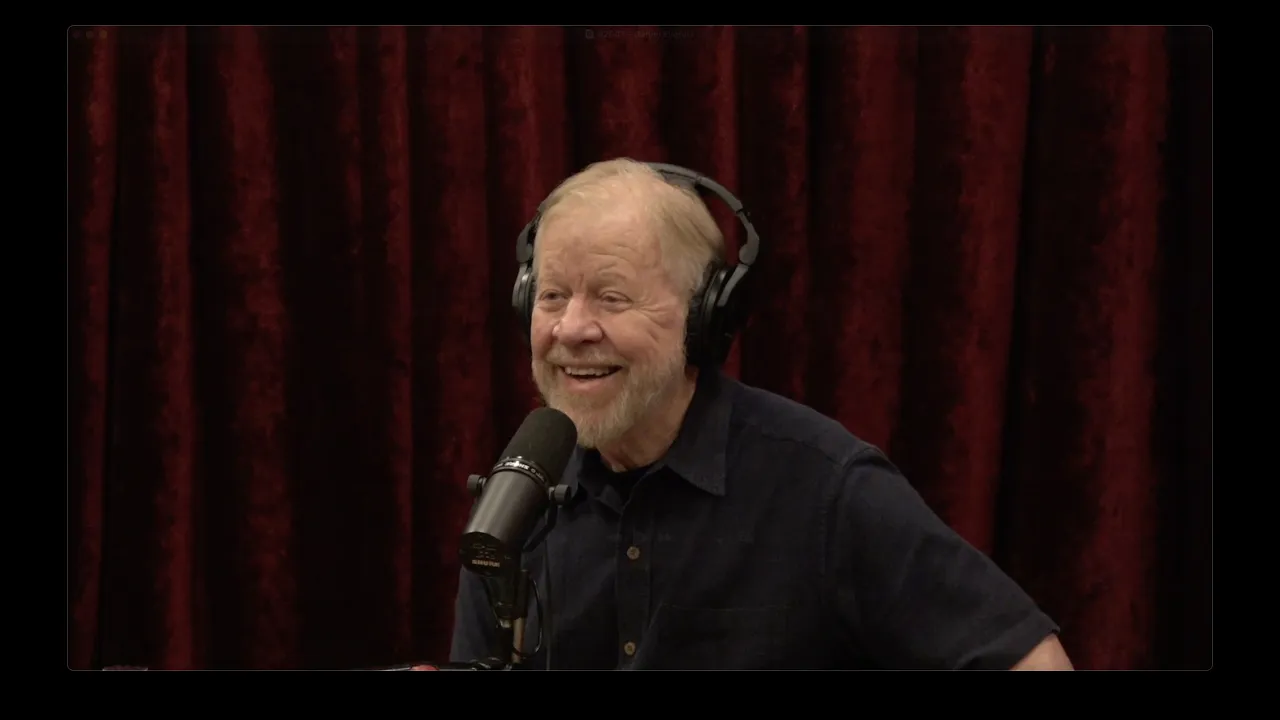
Linguist Daniel Everett Rejects Universal Grammar After Amazon Studies
PowerfulJRE
Fieldwork with the Pirahã tribe disproves Noam Chomsky's theory of universal grammar because their language completely lacks recursive structures, numbers, and color terms.
## Background
Published on YouTube by PowerfulJRE on August 27, 2026, this episode of the Joe Rogan Experience features linguist and college professor Dr. Daniel Everett. According to the show description, Everett is the author of several books, including "Don’t Sleep, There Are Snakes: Life and Language in the Amazonian Jungle" and "How Language Began: The Story of Humanity’s Greatest Invention."
## TL;DR
Linguist Daniel Everett details his transformation from a devout Christian missionary living with the Amazonian Pirahã tribe into an atheist whose field research directly challenged Noam Chomsky's foundational linguistic theories. He explores how the Pirahã's unique language lacks recursive structures, numbers, and abstract color terms, operating instead on a strict empirical standard of direct observation that reshaped his own worldview. Everett also discusses ancient hominin language origins, jungle survival perils, unique Amazonian cultural customs like ritual cannibalism among the Wariʼ, and the tragic rate at which global indigenous languages are disappearing.
## Atmosphere & style
The conversation carries a captivating, intellectual, and deeply introspective vibe, blending wild jungle survival stories with rigorous academic debate. Everett speaks with the relaxed, candid authority of a veteran field researcher, reflecting openly on intense personal health crises, loss of faith, and intense academic feuds. Rogan acts as an engaged and curious dynamic partner, allowing the narrative to effortlessly shift between shocking indigenous customs, humor, and profound reflections on human nature.
## Key takeaways
- [00:00](https://www.youtube.com/watch?v=EmgKSK-YMOU&t=0s) Before becoming a linguist and Bible translator in the Amazon, Daniel Everett underwent rigorous jungle survival training, including a 10-day solo exam with minimal tools.
- [12:52](https://www.youtube.com/watch?v=EmgKSK-YMOU&t=772s) The Pirahã operate under a strict system of immediate communal food sharing rather than storing food, expressing this philosophy as 'preserving it in the belly of my brother.'
- [17:50](https://www.youtube.com/watch?v=EmgKSK-YMOU&t=1070s) The Pirahã language is a unique isolate with tonal distinctions that lacks abstract color terms, relative directions, numbers, and recursive grammatical structures.
- [29:30](https://www.youtube.com/watch?v=EmgKSK-YMOU&t=1770s) Everett's findings on Pirahã grammar directly challenged Noam Chomsky's theory of Universal Grammar, sparking a decade-long scientific and personal feud.
- [36:44](https://www.youtube.com/watch?v=EmgKSK-YMOU&t=2204s) Research into Homo erectus seafaring and ancient joinery suggests early human ancestors possessed speech and maritime technology far earlier than previously thought.
- [53:40](https://www.youtube.com/watch?v=EmgKSK-YMOU&t=3220s) The Pirahã demand direct empirical observation as evidence, which ultimately led to Everett failing to convert any tribe members to Christianity.
- [01:07:00](https://www.youtube.com/watch?v=EmgKSK-YMOU&t=4020s) Influenced by the Pirahã's empirical standards and peaceful culture, Everett abandoned his fundamentalist Christian faith and became an atheist.
- [01:09:33](https://www.youtube.com/watch?v=EmgKSK-YMOU&t=4173s) Despite extreme environmental hazards, the Pirahã exhibit high levels of happiness and emotional well-being within their hunter-gatherer subsistence lifestyle.
- [01:41:28](https://www.youtube.com/watch?v=EmgKSK-YMOU&t=6088s) In Pirahã culture, raising one's voice or displaying anger is viewed as a major social transgression, with family harmony prioritized over retribution.
- [01:48:52](https://www.youtube.com/watch?v=EmgKSK-YMOU&t=6532s) The Pirahã's extraordinary navigation and tracking skills rely on lifelong hyper-developed pattern recognition rather than superior physical attributes.
- [01:50:30](https://www.youtube.com/watch?v=EmgKSK-YMOU&t=6630s) Modern processed foods, sugarcane, and alcohol introduced by external traders have caused severe health declines among the Pirahã, including dental decay and liver disease.
- [01:34:16](https://www.youtube.com/watch?v=EmgKSK-YMOU&t=5656s) Loss of faith resulted in Everett's immediate divorce and excommunication from the missionary community after decades of living and working in the Amazon.
- [02:12:15](https://www.youtube.com/watch?v=EmgKSK-YMOU&t=7935s) The Wariʼ tribe of the Amazon historically practiced ritual endocannibalism to honor deceased relatives until Brazilian authorities ended the tradition in 1962.
- [02:30:05](https://www.youtube.com/watch?v=EmgKSK-YMOU&t=9005s) Languages around the world are dying at an alarming rate, taking with them vast, irreplaceable systems of ecological knowledge and cultural taxonomies.
## Detailed walkthrough
### [00:01](https://www.youtube.com/watch?v=EmgKSK-YMOU&t=1s) Becoming a Missionary & Jungle Survival School
Joe Rogan opens the conversation with linguist and former Christian missionary Daniel Everett, highlighting his incredible journey from being a street minister to living in the deep Amazonian jungle with the Pirahã people for roughly eight years over a forty-year span. Rogan asks how Everett transitioned into religion in the first place, given his non-religious background. Everett explains that in 1968, he was standing outside a Jimi Hendrix concert trying to sell LSD to buy a ticket. He approached a straight-laced classmate and his sister, whom Everett recognized from high school. Although she hated the concert, Everett was smitten and tracked her down at school the following Monday, sitting with her during lunch. He discovered that she had grown up in Brazil as a missionary’s daughter. Intrigued by the idea of avoiding a mundane American life and living in the Amazon, Everett quickly threw himself into the faith, going to Bible college, becoming an ordained Wesleyan minister, and preaching on street corners.
Everett’s sudden conversion stunned his father, a hard-drinking construction worker who viewed getting loaded and roughhousing as essential rites of passage. His father was baffled that his son went from dodging the police to attending church every Sunday. After four years of Bible college, Everett joined a missionary organization to become a Bible translator and underwent grueling training in Chiapas, Mexico. The final exam involved a ten-day solo survival exercise in the jungle with no food or supplies, equipped with only a machete and a film canister containing 10–15 matches. He had to forage for edible plants, construct a shelter, harvest water from jungle vines, and improvise fishing lines using sharpened sticks to catch three-inch fish.
- Everett spent a total of roughly 8 years living directly with the Pirahã in the jungle, maintained a 40-year research relationship, and ultimately became an atheist.
- His conversion began in 1968 outside a Jimi Hendrix concert while trying to sell LSD.
- His father would have preferred him getting loaded over joining a church, seeing drinking and manual labor as part of the "masculine experience."
- During survival training in Chiapas, Everett was dropped into the jungle for about 10 days with no food, relying on water from cut vines and keeping a fire burning continuously.
[09:04](https://www.youtube.com/watch?v=EmgKSK-YMOU&t=544s) Encounters with Predators: Jaguars and Poison Darts
During his survival test in Chiapas, Everett kept a fire burning constantly to ward off wildlife, recounting a tense night when he heard heavy footsteps around his camp and frantically blew on the embers to reignite the flames. Reflecting on that night, he acknowledges that his machete would have been utterly useless against a full-grown jaguar, which can weigh up to 400 pounds and often hunts in pairs. While the Pirahã occasionally hunt or defend themselves against jaguars using bows and arrows, Everett describes another Amazonian tribe he spent time with—the Banawá—who hunt using seven-to-eight-foot blowguns and poisoned weapons.
Everett recalls a harrowing story told by a Banawá hunter who encountered a deer fleeing wildly through a jungle clearing, followed closely by an aggressive jaguar. The jaguar bypassed the deer and pounced directly onto the hunter. The man held his heavy blowgun out horizontally to shield his face while the jaguar’s hind claws tore the flesh off his legs. When the jaguar jumped back to flank him, the hunter managed to stab and then shoot the cat with a poisoned arrow. Though the hunter collapsed and lay infected in the jungle for two days before his family rescued him, he survived. Everett notes that he has actually eaten jaguar meat alongside the Pirahã after they killed a rabid or starving jaguar that threatened a village woman. He jokes that the meat was incredibly tough and sinewy, but tolerable if doused in Tabasco sauce.
> "I reached a clearing in the jungle and I saw a deer come out running straight for him. And at first he was happy... then he realized deer don't just come running out of the jungle towards people. And then right behind the deer came a jaguar."
- Jaguars are the third-largest cat species in the world, reaching up to 400 lbs, and are known to hunt in pairs.
- The Banawá tribe uses 7-to-8-foot blowguns with poisoned arrows and darts for hunting and self-defense.
- Everett always carried a bottle of Tabasco sauce in the field to make tough, sinewy meats like jaguar or monkey palatable.
[12:52](https://www.youtube.com/watch?v=EmgKSK-YMOU&t=772s) Food Sharing and the Impact of Modern Dams
Unlike many indigenous groups that smoke, salt, or dry meat to preserve it, the Pirahã do not store food for future consumption. Everett explains that when he asked a Pirahã hunter why he didn't preserve his excess meat, the man simply replied, "I preserve it in the belly of my brother." The culture relies on total communal sharing: whoever slaughters game shares it with the rest of the village, operating under the expectation that others will return the favor when they have a successful hunt. This system worked effortlessly for centuries because the Pirahã lived in complete isolation along a 300-mile stretch of the Maici River, a tributary that spans a couple hundred yards across and reaches depths of 75 to 100 feet during the rainy season.
However, this delicate balance has been severely disrupted in recent years. The Brazilian government sanctioned the construction of hydroelectric dams on nearby river systems about ten years ago, altering water flows and drastically reducing the fish population in the Maici River. For the first time in their estimated 300-year history along the river, the Pirahã are unable to maintain protein self-sufficiency. Driven by hunger, some Pirahã have resorted to raiding local Brazilian farms for food, resulting in deadly conflicts. Everett highlights the tragedy of a self-sustaining tribe being devastated by distant infrastructure built for electricity—a concept the Pirahã barely comprehend beyond seeing Everett's gas generator powering lightbulbs.
- The Pirahã reside along a 300-mile stretch of the Maici River in the Amazon basin.
- In the rainy season, the Maici River can reach depths of 75 to 100 feet.
- Hydroelectric dams constructed approximately 10 years ago altered regional ecosystems, starving the river of fish and making the Pirahã non-self-sufficient for the first time in 300 years.
<ElicitationsGroup message="Explore more from this interview with Daniel Everett:">
<Elicitation label="Read the next part of this transcript breakdown" query="Please provide the detailed walkthrough for part 2 of the transcript for Joe Rogan Experience #2547 with Daniel Everett."/>
<Elicitation label="Learn about the Pirahã language and culture" query="What are the unique linguistic features of the Pirahã language according to Daniel Everett?"/>
</ElicitationsGroup>
[15:51](https://www.youtube.com/watch?v=EmgKSK-YMOU&t=951s) Ecological Crisis and the Struggle of Amazonian Tribes
The construction of hydroelectric dams and changing weather patterns along Amazonian tributaries—such as the Maici River—have drastically disrupted local ecosystems and Indigenous communities. Even far downstream from these dams, water levels drop precipitously during the dry season. Historically, the river bottom remained hidden even at its lowest point, but in recent years, sections of the river have dried up to the point where people can simply walk across. This severe reduction in water volume has driven away fish populations and forced jungle game to migrate far from traditional hunting grounds.
As a result, Indigenous communities like the Pirahã face unprecedented hardship. Traditional hunting trips that once required walking just a mile into the forest now demand treks of many miles, often yielding no game at all. This environmental strain is tearing communities apart, forcing families to abandon their ancestral territories and relocate to larger rivers. However, these moves push them into proximity with mainstream Brazilian society, disrupting their traditional way of life. While tribes historically avoided urban integration—choosing instead to live in jungle settlements on the peripheries of cities—the absolute scarcity of food is now driving them to learn Portuguese and integrate into regional towns out of sheer survival.
- **Maici River changes:** Historically deep year-round, but recent dam-related water reductions allow people to walk across during dry seasons.
- **Hunting displacement:** Hunters must travel many miles into the jungle instead of their usual one-mile radius, often returning empty-handed.
- **Shift in integration:** Prior to recent years, the Pirahã lived isolated in the surrounding jungle; severe food shortages now force them into nearby towns to learn Portuguese.
---
[17:50](https://www.youtube.com/watch?v=EmgKSK-YMOU&t=1070s) The Initial Mission and Historical Accounts of the Pirahã Language
In 1977, linguist and missionary Daniel Everett first journeyed to the Amazon basin under the auspices of the Wycliffe Bible Translators. His original objective was not purely academic; he was tasked with translating the Bible, planting a church, and converting the tribe to Christianity. When presented with assignment options in New Guinea, Mexico, or Brazil, Everett selected the Pirahã in Brazil specifically because two previous missionary teams had failed to decode their language, which is an isolate unlinked to any other known living language family.
```
1784: Early Portuguese explorers make initial contact; record basic descriptive notes.
1821: German explorer compiles the first extensive vocabulary list without formal linguistic training.
1920: Founder of Brazilian anthropology (German-born naturalized Brazilian) collects a larger, highly accurate word list.
1977: Daniel Everett arrives with no prior knowledge of the spoken language to begin field translation.
```
Despite historical contacts dating back to 1784, no comprehensive grammar or pronunciation guides existed when Everett arrived in December 1977. Early word lists collected by 19th- and 20th-century visitors lacked any representation of the language's tonal system, leaving Everett to figure out the phonetics and grammar entirely from scratch.
- **Wycliffe Bible Translators choices:** Offered field assignments in New Guinea, Mexico, or Brazil.
- **Language classification:** Pirahã is a language isolate with no known living linguistic relatives.
- **Tone distinction example:** In Pirahã, "friend" (*míi*) and "enemy" (*máagí*) are distinguished purely by pitch contours, which can be whistled.
- **Accidental profanity:** The word for "me" (*ti*) and an explicit vulgarity (*tí*) differ only by tone, leading to frequent early misunderstandings for non-native speakers.
---
[22:25](https://www.youtube.com/watch?v=EmgKSK-YMOU&t=1345s) First Contact, Field Dynamics, and Jungle Survival
Upon arriving at the remote village via a bush plane that landed directly on the river, Everett was forced to establish immediate rapport without any shared spoken language. Armed only with a notepad, a pen, and a few trade goods, he began using basic monolingual field methods. He would point at objects like sticks, pronounce the English term, write down the Pirahã response, and then perform simple actions—such as dropping the stick—to transcribe verbs and sentence structures as the villagers described what occurred.
Everett's integration into the community was aided by his distinct appearance and strategic gifts. As a white man with bright red hair, he was an immediate object of curiosity. To build goodwill, he handed out candy to children and distributed a traditional nine-foot roll of cured tobacco wrapped in latex, slicing off portions for adults who assisted his research. He also traded canned food for fresh fish, living directly inside the village footprint.
"I took in a big long horn of tobacco... probably 8 feet or 9 feet long, just rolled up tight tobacco wrapped in latex. You just cut it off for them and they chew it."
Initially staying for a 10-day exploratory visit, Everett returned shortly after with his wife and three young children (aged nine, six, and one) to reside in the jungle for a full year. The transition brought severe medical peril. His son contracted meningitis, both daughters contracted malaria, and Everett himself caught all three South American strains of malaria simultaneously—a diagnosis later verified at University Hospital in San Diego. During one severe crisis, his wife's weight plummeted from 115 pounds to 76 pounds due to malaria. Lacking emergency transport, Everett borrowed a narrow aluminum canoe powered by a 6-horsepower Johnson outboard engine from a visiting Catholic priest to evacuate his dying family downriver to medical care.
- **Family age at arrival:** Daughters aged 9 and 6, son aged 1; the older daughters learned fluent Pirahã rapidly.
- **Medical complications:** Family experienced meningitis, typhoid fever, snake encounters, and severe malaria relapses.
- **Malaria treatment regime:** Included Daraprim, primaquine, and straight quinine, which induced days of severe physical distress before recovery.
---
[29:26](https://www.youtube.com/watch?v=EmgKSK-YMOU&t=1766s) Unique Features of the Pirahã Language and the Recursion Debate
Living among the Pirahã continuously for three to six months every year between 1977 and 2013 completely reshaped Everett's religious and linguistic worldview. As he attempted to translate the Greek New Testament into Pirahã, he ran into profound cultural and linguistic barriers. Abstract concepts central to Western thought and Biblical narratives were entirely absent from the language. The Pirahã have no words for abstract colors, no relative spatial directions like "left" or "right," and no concept or word for a supreme deity. Furthermore, they possess no numbers or counting system whatsoever, utilizing only general quantifiers indicating relative amounts like "a lot" or "a little."
These radical linguistic gaps sparked major scientific debates. While psycho-linguists and cognitive scientists conducted field experiments to test the absence of counting and color terms, Everett's most influential and contentious claim targeted Noam Chomsky's theory of Universal Grammar. Chomsky had long asserted that all human languages share a fundamental, innate structural rule known as **recursion**—the ability to embed linguistic units (such as noun phrases or clauses) inside other units of the same type indefinitely (e.g., "John said that Bill spoke").
Everett's empirical field research demonstrated that Pirahã completely lacks recursive structures. Sentences in Pirahã are simple, discrete assertions without embedded sub-clauses or complex compounding, directly challenging the core premise that recursion is an obligatory genetic blueprint for all human speech.
- **Linguistic absences:** No numerical terms, no counting, no color words, no left/right directional terms, and no concept of God.
- **Definition of recursion:** The embedding of a phrase or sentence inside another structure of the same category (e.g., combining "truck" and "driver" into "truck driver," or embedding clauses).
- **Chomskyan debate:** Everett argued that Chomsky generalized recursion as a universal property of human language without analyzing non-Western, isolated languages like Pirahã.
Here is a detailed, faithful walkthrough of this part of the conversation between Joe Rogan and Daniel Everett.
---
[32:50](https://www.youtube.com/watch?v=EmgKSK-YMOU&t=1970s) The Backlash from Noam Chomsky and the Linguistic Establishment
Daniel Everett explains that Noam Chomsky's universal grammar theory contained core structural principles that strictly required recursion. When Everett published his research stating that the Pirahã language completely lacks this feature—and noted that other languages also lack it—it was directly interpreted as telling the most famous linguist in history that he was wrong. Chomsky had previously been dubbed "the most important intellectual alive" by *The New York Times*, so the linguistic community viewed a relative unknown challenging him as problematic, erratic, or heretical. Joe Rogan expresses disgust at this academic gatekeeping and appeal to authority, pointing out that intellectuals ought to be excited when a discovery challenges established paradigms.
Everett notes that while some linguists were thrilled by the data, many others were deeply angered. Rogan questions how anyone could claim to know the universal rules governing all languages when there are approximately 8,000 spoken languages on Earth. Everett confirms that linguists only have solid data on roughly 1,200 of them. Rogan brings up the Indigenous Australian tribes (referred to locally as "mobs"), where communities separated by only 30 kilometers speak completely unwritten, distinct languages that neighbors cannot understand. Everett agrees, adding that Australian fieldwork has uncovered unique linguistic properties unlike anything else known to science, making it wildly premature to write universal laws for all human speech.
- Out of roughly 8,000 distinct world languages, linguists only possess detailed data on about 1,200.
- A follower of Chomsky in Brazil wrote to FUNAI (the Brazilian Indigenous Affairs Agency) accusing Everett of being a racist who was "trying to reduce the Pirahã to primates."
- Everett countered that humans are all primates, but noted the circular logic used against him: if Chomsky claims all human languages have recursion, and Everett claims Pirahã lacks it, the critic's logic dictates that either Chomsky is wrong or the Pirahã are not human.
- Everett emphasizes that among scientists who do not make large salaries, ego serves as the primary currency and medium of exchange.
---
[36:44](https://www.youtube.com/watch?v=EmgKSK-YMOU&t=2204s) Deep History, *Homo erectus*, and the Oldest Wooden Structure
The discussion shifts to cognitive capability in human ancestors. Everett argues against the long-held belief that *Homo erectus* lacked speech, pointing to their extensive maritime travel as evidence of complex communication. Ocean barriers never stopped *Homo erectus*, leading Everett to co-author a paper on the subject with an archaeologist from the University of Liverpool specializing in *Homo erectus*. Shortly after publishing, that same archaeologist excavated a 500,000-year-old wooden structure in Zambia—the oldest known wooden structure in human history. The build features interlocking joinery that architects confirmed was remarkably sophisticated for constructing walkways or shelters.
Rogan mentions his conversation with researcher Michael Button regarding evidence that early hominids were seafaring as far back as one million years ago. Everett cites work by Australian archaeologist Robert Bednarik, who conducted experimental trials testing how much language is required for a group to build a sea-worthy vessel capable of carrying food, water, and around 20 people. Because *Homo erectus* artifacts are found on islands that were never connected to the mainland, accidental strandings on natural rafts cannot account for their populations; deliberate group colonization was required. Rogan notes a NASA study calculating that a minimum of 500 individuals is necessary to establish a genetically viable colony on a new planet without severe inbreeding.
- Modern human brain capacity averages roughly 1,200 cc for men and 950 to 1,000 cc for women; because intelligence does not differ between the sexes, absolute brain volume is not the sole determinant of intellectual capability.
- *Homo erectus* brain volume ranged from 950 to 1,000 cc, falling directly within the standard range of modern human females.
- Brain volume in skulls is historically measured by filling the cranial cavity with sand and measuring the volume of the sand.
- The 500,000-year-old Zambian wooden structure made by *Homo erectus* featured shaped, interlocking timber joints.
---
[41:10](https://www.youtube.com/watch?v=EmgKSK-YMOU&t=2470s) Academic Character Assassination vs. Empirical Testing
Everett recounts the intense media storm and professional hostility following his publication in *Current Anthropology*. At the time, he was working at the Max Planck Institute for Evolutionary Anthropology alongside Svante Pääbo (who later won the Nobel Prize for decoding the Neanderthal genome). A reporter from *Der Spiegel* interviewed Everett after visiting Pääbo, triggering widespread press coverage, including a profile in *The New Yorker*. Everett expected fellow scientists to respond with skeptical empirical tests—predicting what data should or should not appear if recursion were absent. Instead, critics resorted to personal attacks, calling him a liar who was merely seeking media attention.
When independent cognitive scientists from top institutions—including MIT's Department of Brain and Cognitive Sciences, Stanford's Department of Psychology, and Columbia University—conducted rigorous experiments in the Amazon, their findings repeatedly validated Everett's claims. Despite this, diehard Chomsky loyalists dismissed the independent researchers as simply being "anti-Chomsky" and ignored the experimental results. Everett even offered to debate Chomsky publicly at the Linguistic Society of America to settle the matter, but Chomsky declined.
- Chomsky gave interviews to Brazilian and Spanish media calling Everett a "100% charlatan" and claiming his linguistic contributions amounted to "nothing, nothing, nothing."
- Everett invited Chomsky to travel with him directly to the Pirahã village to ask any linguistic questions he wanted; Chomsky refused, stating, "I don't do field work."
- Rogan jokes about Chomsky avoiding tropical diseases like "typho-fever," malaria, snakebites, and jaguar attacks.
- Rogan and Everett contrast Chomsky's early brilliant works—such as *Aspects of the Theory of Syntax* and *American Power and the New Mandarins* (both published in 1965), as well as his classic debates against William F. Buckley Jr.—with his later dogmatic behavior, stance on COVID-19 vaccines, and personal ties to Jeffrey Epstein.
<ElicitationsGroup message="To explore more aspects of this interview or topic:">
<Elicitation label="Explore the linguistic details of the Pirahã language" query="What are the specific features of the Pirahã language mentioned by Daniel Everett, such as the lack of numbers, colors, or recursion?"/>
<Elicitation label="Examine the evidence for early hominid seafaring" query="What evidence exists for Homo erectus seafaring and island colonization a million years ago?"/>
<Elicitation label="Summarize Everett's missionary past and loss of faith" query="How does Daniel Everett describe his transition from a Christian missionary in the Amazon to an atheist?"/>
</ElicitationsGroup>
[048:48] Noam Chomsky, Ego, and the Recursion Controversy
Daniel Everett recalls how Noam Chomsky initially served as a mentor and key academic supporter, writing letters of recommendation for Everett's first U.S. job as well as his tenure promotion at the University of Pittsburgh. Joe Rogan quips that Everett only "became an idiot" in Chomsky’s eyes the moment he dared to publicly disagree with him. Everett explains that after decades of debate with Chomsky and his followers, he can predict every objection before it is asked: "I'll be surprised if anybody asks me a question that I haven't heard from Chomsky."
When Everett first discussed Pirahã syntax with Chomsky in 1984 as a visiting scholar at MIT—noting that the language appeared to lack recursion—Chomsky was initially intrigued, casually pondering the consequences over coffee at his blackboard. However, once Chomsky later declared recursion to be a universal, mandatory component of human language, Everett's empirical counterevidence transformed him into an academic persona non grata. Rogan laments how fragile egos can corrupt even the sharpest minds, to which Everett shares his long-standing conclusion: "Intelligence is no antidote for stupidity."
```
- Recommendations: Chomsky wrote Everett's career recommendations for his first U.S. post and his tenure application at the University of Pittsburgh.
- 1984 MIT Visit: Everett's office was adjacent to Chomsky's when he first raised the absence of recursion in Pirahã.
- The Feud in Pop Culture: Author Tom Wolfe highlighted the academic feud between Everett and Chomsky in his final book, *The Kingdom of Speech*, comparing it to the historic debate between Charles Darwin and Alfred Russel Wallace.
- Personal Estrangement: After years of easy access in Cambridge, Chomsky stopped meeting with Everett, eventually calling him a "charlatan" in a São Paulo newspaper interview.
```
---
[053:40] Failed Conversion and the Pirahã Standard of Evidence
Rogan asks Everett how many Pirahã people he managed to convert to Christianity during his decades as a missionary. Everett responds with a flat "NOBODY." The Pirahã completely rejected Christian proselytizing because the claims failed to satisfy their rigorous, direct-observation standard of evidence.
> "They have a high standard of evidence and I didn't meet that standard."
---
[055:08] Forest Beings, "Fastmouths," and the Fluidity of Identity
The Pirahã categorize entities into distinct groups beyond standard human classifications. They viewed Everett—a white American—as a distinct entity without blood who aged unnaturally slow. Because Everett had graying hair at age 45, the Pirahã assumed he was on the verge of death, describing him with the phrase *máo-ápaití* ("almost about to fall to the ground").
Among the entities inhabiting the forest are "fastmouths"—beings described as speaking in high-pitched falsetto voices, remaining completely naked, and acting with extreme sexual promiscuity. Everett shares a bizarre incident where a visiting German journalist from *Geo* magazine asked to see a fastmouth. A Pirahã man walked into the jungle, stripped off his clothes, and returned speaking in falsetto while aggressively attempting to hump the uncomfortable reporter. Upon putting his clothes back on, the man completely denied any memory of the encounter.
```
- Human Classifications: The Pirahã distinguish between fellow Pirahã, Brazilians, and white Americans (whom they historically associated with bloodless, long-lived beings).
- Fastmouth Characteristics: Identified by a high falsetto voice, total nudity, refusal to wear clothes, and sexually aggressive behavior.
- Perception of Reality: The boundary between performance, ritual, and literal manifestation is liminal; the Pirahã view the individual as temporarily replaced by the entity rather than possessed.
```
---
[059:52] Name Changes, Jaguar Attacks, and Identity Over Time
The Pirahã deny the concept of a static identity over time. Adults frequently abandon their names after unusual or traumatic life experiences—such as surviving an encounter in the forest—and adopt entirely new ones, completely disowning actions committed under their former identities. Everett recalls returning to the village after six months away and addressing his long-time language teacher by his former name, *Eaíbí* ("blood eater"). The teacher ignored him entirely until Everett used his newly adopted name, *Kapali*.
Rogan asks about physical dangers in the Amazon, including jaguar attacks. Everett notes that while no one has been killed by a jaguar in his nearly 50 years of visiting, many have been ambushed. In one instance, a hunter carrying a 60-pound basket of Brazil nuts via a tumpline was pounced on from a tree; the jaguar caught the basket instead of the man. The hunter immediately shot the jaguar with an arrow, explaining that once a jaguar is struck, it focuses entirely on removing the arrow, allowing the hunter to land multiple lethal shots.
```
- Name Fluidity: Names are abandoned when they become "rotten" (spoiled like bad food) or after significant life events; past actions belong exclusively to the former name.
- Honorific Naming: On one occasion, a fierce Pirahã hunter gave Everett his deceased father's name after declaring that Everett was old enough to match his late father's generation.
- Survival Tactics: Pirahã hunters use heavy bows to shoot jaguars, taking advantage of the animal's instinct to pull out the first arrow before firing subsequent shots.
```
[01:04:32](https://www.youtube.com/watch?v=EmgKSK-YMOU&t=3872s) Attempting to Convert the Pirahã with the Gospel of Luke
Daniel Everett shares that his native name among the Pirahã has remained the same for roughly 15 years, though names can shift depending on which village or individual one encounters. When he first arrived in the Amazonian jungle, the Pirahã population was under 200 people. Over the course of the two decades that he and his wife provided basic medical assistance, the population grew to between 700 and 800.
Despite his initial mission as a Christian missionary, Everett's efforts to convert the tribe yielded bizarre and unexpected results. While working on linguistic analysis and translating the Gospel of Luke, he showed the villagers film strips featuring a Westernized, bearded portrayal of Jesus. Because the Pirahã made no distinction between drawings, photographs, and historical reality, they presumed Everett was showing them a real man he had personally seen.
That night across the river, chaos broke out in the neighboring village, filled with shouting, screaming, and laughing. When Everett's informant returned the following morning, he nonchalantly explained that "Jesus came to our village." According to the villager, Jesus was attempting to assault the women with a three-foot-long penis. Everett explains that this surreal fabrication was the tribe's unique way of outright rejecting the religious narrative, an outcome no amount of Bible college training could have prepared him for.
- Population growth: The Pirahã grew from under 200 to around 700–800 people, largely aided by 20 years of medical care from Everett and his wife.
- Visual interpretation: The Pirahã did not distinguish between drawings, film strips, and photographs, assuming any image was a direct visual depiction of a living person the speaker had met.
[01:07:00](https://www.youtube.com/watch?v=EmgKSK-YMOU&t=4020s) Loss of Faith and the Direct Empirical Standard
The Pirahã's rejection of Christianity was rooted in a strict demand for immediate, firsthand evidence. Villagers frequently pressed Everett with direct questions about Jesus's appearance, asking whether he was brown-skinned like them or white like Everett. When Everett admitted that he had never seen Jesus, nor had his father or anyone else alive because Jesus lived thousands of years ago, the Pirahã immediately shut down the conversation. They argued that if Everett had never personally witnessed Jesus, he had no business talking about him continuously, declaring, "We don't want to hear about this anymore."
This line of questioning struck a deep chord with Everett, who was a devout believer at the time. His gradual shift toward atheism was fueled both by his immersion in rigorous linguistic science and his profound respect for the Pirahã's intelligence. He realized that inside religious communities—much like closed academic circles—people surround themselves with like-minded believers until considering alternatives becomes impossible. Returning to the skepticism of his youth, Everett eventually admitted to the tribal men that he no longer believed the stories either, prompting them to laugh and announce, "Now you're like us."
- "You don't know anyone who's ever seen him, and you're just talking about him the whole time... We don't want to hear about this anymore."
- The Pirahã observed that only Americans seemed to care about Jesus, noting they had never met a Brazilian who held those beliefs.
- When Everett confessed his loss of faith, the men joked that they were never interested in Christianity anyway because Christians couldn't drink or sleep with other women.
[01:09:33](https://www.youtube.com/watch?v=EmgKSK-YMOU&t=4173s) The "Ultimate Zen Masters" and Skepticism of Miracles
Reflecting on what finally broke his faith, Everett notes that despite knowing devout Christians and top-tier missionaries, he had never met anyone as well-adjusted, content, or capable of coping with life as the Pirahã. He describes them as the "ultimate Zen masters." An MIT PhD student visiting the field once observed that they appeared to be the happiest people in the world, measuring their joy by how much of their day was spent laughing and smiling compared to any other culture.
Everett also found it increasingly difficult to reconcile scientific principles with religious claims. While he did not dismiss personal claims of spiritual healings, he noted their lack of statistical relevance and objective proof. He recalled a Bible school instructor pointing out that faith healers notoriously avoid attempting obvious physical impossibilities, such as regenerating lost limbs on amputees or raising the dead at cemeteries.
- Quality of life: Everett viewed the Pirahã as possessing a higher quality of spiritual peace and contentment than any Christians he had encountered.
- Empirical standard: Everett concluded he could no longer urge the Pirahã to accept faith-based claims when their empirical objections were entirely logical.
[01:12:40](https://www.youtube.com/watch?v=EmgKSK-YMOU&t=4360s) Historical Records, Flood Myths, and the Limits of Science
Joe Rogan and Everett discuss how ancient religious texts often represent distorted documentations of actual historical events. Rogan brings up the apostle Paul, noting how shocked many people are to discover that Paul never met the living Jesus and derived his entire authority from a vision on the road to Damascus. They compare widespread ancient flood myths to historical records of actual geological catastrophes. Everett shares a childhood memory of driving through the mountains from Imperial Valley to San Diego, where his mother explained a line of white stones near the mountain tops as proof of Noah's flood.
While acknowledging that religious systems provide valuable moral scaffolding and produce extraordinarily kind individuals, Rogan points out the absurdity of taking ancient stories like Adam and Eve literally. Everett shifts the conversation to the limits of scientific knowledge, noting that even fields like paleoanthropology rely heavily on educated guesses. Until geneticist Svante Pääbo successfully decoded ancient hominin genomes—a feat previously thought impossible—debates over whether there were 20 distinct species of *Homo* or merely three (*Homo erectus*, Neanderthals, and *Homo sapiens*) were largely speculative.
- Historical Paul: Paul never met Jesus in person, claiming his authority through a vision on the road to Damascus.
- Geological myths: Widespread flood narratives in ancient texts likely stem from real prehistoric natural disasters, later embellished with theological interpretations.
- Paleoanthropology: The work of Svante Pääbo in ancient DNA changed the field, replacing pure speculation about early human species with hard genetic evidence.
[01:17:56](https://www.youtube.com/watch?v=EmgKSK-YMOU&t=4676s) Religious Dogma vs. Scientific Progress
The conversation shifts to the inherent contradiction of holding fundamentalist religious views while engaging in scientific inquiry. Everett highlights how living as a fundamentalist requires constant cognitive dissonance—believing in unrepeatable ancient miracles while demanding empirical proof for everything else in daily life.
Rogan points out that texts like the Bible explicitly condone human institution practices like slavery, which modern societies have rightfully rejected. Everett references Mark Twain's satirical writings on religion, specifically Twain's joke that religion began "when the first con man met the first sucker." He also recalls Twain's humorous critique of the Noah's Ark narrative, pointing out that Noah's family would have needed to be horribly infested with every disease germ in existence to preserve them for future generations, and questioning how animals instantly migrated from Mount Ararat to Australia.
- "Religion started when the first con man made the first sucker." — Mark Twain
- Literal interpretations of ancient texts collapse when examined through basic geography, biology, and historical progress.
- Science requires formulating good hypotheses, testing them rigorously, admitting errors, and discarding disproven ideas.
[01:19:31](https://www.youtube.com/watch?v=EmgKSK-YMOU&t=4771s) Religious Hypocrisy and the Hod Carrying Days
The discussion opens with Daniel Everett reflecting on how rigid religious doctrines often ignore historical and factual reality. While Joe Rogan notes that ancient flood stories—such as the *Epic of Gilgamesh* mirroring Noah's Ark—suggest some actual catastrophic historical event likely occurred, Everett points out the intellectual dishonesty of total dogmatism. When Everett was a Christian missionary, he used to tell believers that the strongest evidence for God should be a visibly transformed, moral life. If a person claims that Christ changed their life but continues to behave immorally, their testimony completely falls apart.
To illustrate this hypocrisy, Everett shares a vivid memory from 1968 when he was still in high school. Through his Christian missionary father-in-law, he got a union construction job in California as a hod carrier—which he describes as the hardest physical labor he ever performed in his life. The union wage was $8.25 an hour, a substantial sum at the time. However, his employer, a devout, church-going Christian contractor, explicitly told him that despite union rules, he was only going to pay him for four hours of work while forcing him to work eight. Seeing supposedly pious Christians cheat their workers and lie on tax forms deeply disillusioned Everett. He questioned why the Holy Spirit failed to make a tangible moral difference in these believers' lives compared to ordinary non-religious people living honest lives down the street.
- In 1968, union hod carriers earned $8.25 per hour, which was considered significant pay.
- Everett's Christian boss evaded union wages by falsifying timesheets to pay four hours for eight hours of hard labor.
- Everett notes that Jesus's commandments are harder to follow than Old Testament laws because they demand internal control over thoughts rather than just external actions.
---
[01:22:07](https://www.youtube.com/watch?v=EmgKSK-YMOU&t=4927s) The Pirahã: Happiness and the Subsistence Lifestyle
Turning to his field work in the Amazon, Everett describes the subsistence lifestyle of the Pirahã tribe, connecting it to psychological studies on human happiness and fulfillment. Rogan notes that modern societal stress, bills, and office jobs often lead to misery, whereas hunter-gatherers focus purely on immediate needs and community. Everett monitored the Pirahã's labor habits and calculated that hunters only work roughly 15 to 20 hours a week to sustain themselves—provided fish are plentiful. The rest of their time is spent lounging by the fire, telling jokes, and playing with their children.
This pure subsistence existence means the Pirahã do not preserve or store food; if they do not catch food on a given day, they simply go hungry. Rogan references Werner Herzog's documentary *Happy People: A Year in the Taiga*, which highlights a similar phenomenon among Siberian trappers who derive immense joy from living in harmony with nature. Everett mentions *The Grammar of Happiness*, a film produced about his work with the Pirahã by the Smithsonian and other institutions. The small documentary crew and visiting psychologists were consistently stunned by the tribe's profound peace and contentment—once they got past the brutal heat and primitive living conditions.
- Pirahã hunters work approximately 15 to 20 hours per week when food is abundant.
- The Pirahã do not use outhouses; they simply walk ten feet into the bush. They use sticks, leaves, or corn cobs instead of toilet paper.
- *The Grammar of Happiness* is the title of the documentary covering Everett's linguistic and anthropological work with the Pirahã.
---
[01:24:40](https://www.youtube.com/watch?v=EmgKSK-YMOU&t=5080s) Pain, Resilience, and Death in the Jungle
The Pirahã exhibit an extraordinary pragmatism toward death and physical suffering. When Everett asked them what happens after a person dies, they pointed to a dead monkey brought back for dinner and remarked, "He's dead. What else is there? We die." They construct no supernatural narratives to console themselves or assuage a fear of death. Living naked in a hazardous jungle environment, they frequently endure horrific injuries—including snakebites from bushmaster or jararaca pit vipers that rot away flesh, leaving legs looking like bare bone covered in thin skin.
Physical resilience is cultivated deliberately from childhood through a cultural practice they refer to as "wanting to be hard." Individuals will intentionally sleep less than needed or fast to condition their bodies for severe hardship. Everett recalls watching a woman calmly pull a wasp stinger out of her face mid-conversation without breaking her sentence; when asked if it hurt, she simply replied, "I'm not a baby." Children grow up tough, scooting around on their bare rear ends until their skin develops thick, solid calluses.
Despite their physical toughness, the Pirahã are remarkably gentle parents who never hit or discipline their children. Everett recalls a visiting guest who was kept awake by a crying baby and asked why the parents didn't slap the child to make it quiet down. Everett warned the man that if he ever laid a hand on a Pirahã child, the villagers would kill him on the spot.
- Bushmaster and jararaca snakebites cause severe tissue necrosis, often leaving victims with exposed bone and withered limbs.
- Pirahã feet and rears develop thick, leather-like calluses from walking barefoot over thorns and scooting across rough ground.
- "He wants to be hard" is a Pirahã expression describing deliberate self-hardening through sleep deprivation and fasting to build resilience.
---
[01:30:10](https://www.youtube.com/watch?v=EmgKSK-YMOU&t=5410s) Health, Diets, and the Intrusion of the Western World
Prior to environmental disruption along their rivers, roughly 70% of the Pirahã diet consisted of fish, supplemented by fresh water and jungle nuts. Historically, an average Pirahã man weighed around 155 pounds, possessed a 25-to-26-inch waist, and carried a mere 4% body fat. When Everett brought a dentist to the village 25 years ago to inspect every living tribe member, the dentist was disappointed to find zero cavities across the entire population.
However, Western contact drastically altered their health profile. When Brazilian government officials began distributing processed rice, community members began gaining weight from the unfamiliar starches. Later, sugarcane was introduced to their crops, driving cavity rates to nearly 100%. Processed sugar and soda ("sweet water") proved irresistibly addictive to people whose evolutionary history never prepared them for concentrated sweets. Everett recounts watching a native man trade a hand-woven basket for a large can of peaches in syrup and consume the entire contents in one sitting, while others would eat a whole kilogram (2.5 lbs) of pure table sugar with a spoon.
- Natural Pirahã physical metrics: ~155 lbs body weight, 25-26 inch waist, and ~4% body fat.
- Initial dental survey revealed zero cavities across the entire tribe before sugarcane was introduced.
- Introduced items like rice, sugarcane, soda, and tobacco created unprecedented health issues and addictions that did not exist in their native hunter-gatherer state.
---
[01:33:51](https://www.youtube.com/watch?v=EmgKSK-YMOU&t=5631s) [01:33:51](https://www.youtube.com/watch?v=EmgKSK-YMOU&t=5631s) The Beginnings of Everett's Deconversion
Rogan asks Everett to trace the step-by-step process of how he evolved from a devout Christian missionary attempting to convert the Pirahã into an atheist who abandoned his faith entirely. Everett explains that the transition was a long, painful journey involving both practical challenges and deep intellectual doubts. It was not an overnight realization, but a gradual breakdown of his theological framework that took place over several years living among people who had no conceptual need for his religion.
- The process of losing his faith took 5 to 6 years of intense internal questioning while living in the Amazon.
[01:34:16](https://www.youtube.com/watch?v=EmgKSK-YMOU&t=5656s) Losing Faith, Divorce, and Excommunication from Mission Life
Daniel Everett recounts his gradual departure from Christianity, which began in the early 1980s and culminated in a public declaration around 2001. His turning point came when he heard Christians describing military members sent to the Iraq War as "blessed peacemakers of the Gospel," an assertion he found unconscionable. He outlines the psychological progression of deconstruction: initial doubt is followed by desperate prayer—invoking the Apostle Thomas's cry, "Lord, I believe; help my unbelief"—which leads to studying Christian apologetics. Finding those apologetic defenses deeply unsatisfying, he realized he could no longer pretend to hold beliefs he had lost.
When Everett finally confessed his loss of faith to his wife, the reaction was immediate and severe. She walked out of their home, leading to a swift divorce. In addition to losing his marriage, declaring his loss of belief stripped him of his livelihood as a Christian missionary. While his wife attributed all their marital friction to his declining faith, Everett notes that returning to secular interests—such as listening to Jimi Hendrix and rock music after years of abstinence, or drinking socially with Brazilian friends—were viewed by her as alarming signs of spiritual backsliding.
Everett reflects on a conversation with his atheist father, who once told him that religious people are constantly searching for exemptions to avoid doing the unpleasant things their religion demands. Everett compares the situation to the interplay between justice and mercy: people demand justice for others while begging for mercy for themselves. Ultimately, despite having graduated at the top of his class from Bible college and possessing deep knowledge of scripture, Everett decided he would no longer let a book govern his choices. When Christians attempt to reconvert him, he respectfully clarifies that while he knows the Bible thoroughly, it simply no longer works for him.
- Daniel Everett began doubting his faith around 1982–1983 and publicly announced his departure from Christianity in 2001.
- His loss of faith resulted in an immediate divorce and the loss of his income as a missionary.
- Everett graduated number one in his class from Bible school, which allows him to engage with Christian apologists on equal textual footing.
---
[01:38:08](https://www.youtube.com/watch?v=EmgKSK-YMOU&t=5888s) Morality, Conflict, and Banishment in Pirahã Culture
Joe Rogan points out how disorienting it must be to witness a thriving moral framework among people who have no concept of God, challenging the assumption that religion is necessary for morality. Everett illustrates the Pirahã's unique temperament with a story about a severe rainstorm in the Amazon. When a semi-nomadic Pirahã hut collapsed in the pouring rain, the occupants did not panic or become angry; instead, they burst into laughter, sought temporary shelter in neighboring huts or at Everett's home, and rebuilt the house the next day. The Pirahã maintain extreme emotional composure, viewing anger as the ultimate social transgression—there is no shouting or physical aggression against one another.
Everett highlights the absolute priority the Pirahã place on familial and community bonds over retribution through a tragic incident involving a dog. A Pirahã man got drunk on alcohol obtained from Brazilian traders and shot his brother's dog with a shotgun. Despite his deep grief over the loss of his pet, the brother refused to retaliate, stating: "I miss my dog, I love my dog, but I love my brother. I'm not going to hurt my brother. He was drunk and his head wasn't working." Everett emphasizes that while every Pirahã hunter possesses lethal marksmanship with a bow and arrow, they strictly distinguish between necessary hunting and unnecessary murder.
The ultimate punishment in Pirahã society is reserved for actions that pose an existential threat to the entire village, and that punishment is total banishment. Everett recounts an incident detailed in his book *Don't Sleep, There Are Snakes* (and his upcoming work *Born of the River*), where a young Pirahã man was bribed with alcohol and a shotgun by an outsider to murder a non-Pirahã man upstream. Recognizing that the murder would draw military or police retaliation upon the whole tribe, the village banished the young man into the jungle with no supplies, food, or community support. Deprived of communal survival, the young man died roughly two months later.
- The Pirahã consider anger and raising one's voice to be the closest equivalent to a concept of "sin."
- Banishment is the maximum sentence in Pirahã culture, enforced only when an individual's actions endanger the survival of the group.
- Daniel Everett's books detailing these events include *Don't Sleep, There Are Snakes* and *Born of the River*.
---
[01:42:31](https://www.youtube.com/watch?v=EmgKSK-YMOU&t=6151s) Navigating Jungle Perils and the Spirit World
Everett and Rogan discuss the harsh, violent atmosphere of the surrounding Amazon region, where non-indigenous river traders and riverfront residents routinely engage in lethal knife and gun fights. Everett recalls a situation where he threatened to punch a confrontational, intoxicated man who was harassing his teenage daughters, only to be warned by a Brazilian local that striking someone in the back country meant embarking on a fight to the death. Both men agree that avoiding violence is the only logical path in an environment where people do not fight fair.
Moving back to the Pirahã mindset, Everett notes that the tribe lives completely free from fear of death, hell, or the unknown. They are intensely observant of their environment. Sitting on the riverbanks at night, the Pirahã frequently spot satellites passing overhead—noticing subtle shifts in the night sky that outsiders miss—and ask Everett technical questions about who built them and put them into orbit. While they respect human ingenuity, they display no interest in supernatural explanations for physical phenomena.
The Pirahã do, however, hold complex beliefs regarding shape-shifting entities, such as the spirit known as *Igagá* (or *Kagá*), which they believe can embody animals like jaguars. Everett recalls being woken up in the middle of the night by villagers insisting that *Igagá* was right behind his house. Equipped with a machete, Everett walked out to investigate, only to realize the Pirahã had stayed far behind him because they suspected a real, physical jaguar was stalking the perimeter. Everett emphasizes that the Pirahã possess extraordinary sensory awareness in the rainforest—such as spotting a camouflaged bushmaster snake on a trail before stepping on it—a stark contrast to their complete disorientation when brought into modern cities.
- The Pirahã possess hyper-acute visual tracking skills, allowing them to spot hidden bushmaster snakes on trails or small satellites moving across the night sky.
- Shape-shifting beliefs among the Pirahã include *Igagá*, a entity/spirit associated with the form of a jaguar.
- When taken into urban environments for medical care, the Pirahã experience extreme navigational confusion due to the absence of natural environmental cues.
[01:48:52](https://www.youtube.com/watch?v=EmgKSK-YMOU&t=6532s) Sensory Perception and Pattern Recognition in the Jungle
The discussion opens with Everett addressing whether the Pirahã possess sensory abilities that outsiders lack. Before analyzing their descriptions of spirits, Everett initially considered that they were perceiving physical phenomena invisible to him, as the entire community would simultaneously react to the same sighting. Rogan questions if they possess heightened physical senses, to which Everett explains that their ability is rooted in deep contextual training rather than supernatural perception. Growing up in the Amazonian rainforest, the Pirahã read subtle environmental shifts that an untrained eye completely misses.
Everett illustrates this distinction using concrete environmental indicators. A shifting branch might signal wind, a monkey, or a snake, but while a visitor barely notices the movement, a Pirahã instantly knows the exact source. Similarly, bubbles breaking the surface of a river are meaningless to an outsider, but to the Pirahã, the size and rhythm of the bubbles indicate whether a rock, an alligator, or another aquatic creature lies beneath. Rogan summarizes this ability as hyper-developed pattern recognition rather than extra senses, a distinction Everett agrees with while noting that rigorous psychological testing under controlled conditions would be required to fully map these perceptual differences.
- The Pirahã interpret environmental cues—such as moving canopy branches or river bubbles—with instant, precise accuracy.
- Everett attributes their apparent sensory superiority to lifelong pattern recognition rather than unique physical faculties.
- Spirit entities like *Xigagaí* or *Igaigai* take various physical forms in Pirahã accounts, including a long-toothed creature (*xipoi*) or a naked, high-voiced figure.
- Everett views their spirit taxonomies as a functional form of empirical science: a structured framework used to reduce unexplained observations to recognizable categories.
---
[01:51:49](https://www.youtube.com/watch?v=EmgKSK-YMOU&t=6709s) Navigation, Absolute Direction, and the Hospital Incident
The conversation shifts to how the Pirahã’s oral culture and language structure shape their spatial navigation. Because their world is defined without written history or traditional abstract terms, their cognitive model relies entirely on absolute, geography-based coordinates rather than egocentric terms like "left," "right," "front," or "back." Instead, they orient everything relative to static natural markers: upriver, downriver, toward the jungle, or away from the jungle.
To illustrate their navigational abilities, Everett shares an extraordinary anecdote about bringing a Pirahã man suffering from liver cirrhosis to the regional capital of Porto Velho. The man had never left the jungle before. After arriving at Everett’s home on a missionary compound, Everett drove him to a hospital 30 kilometers (about 18 miles) away and left him under medical care. At 6:00 AM the following morning, Everett heard a knock on his door. The patient was standing on the doorstep barefoot, wearing nothing but an unfastened hospital gown.
```
[ Porto Velho Hospital ]
│
│ (Walked ~30 km barefoot overnight in a hospital gown)
▼
[ River Orientation Point ] ──► [ Everett's House on Compound ]
```
When Everett asked how he managed to navigate an unfamiliar city to find the house, the man explained that he simply asked where the river was upon leaving the hospital. By establishing the river's flow direction, he reconstructed an absolute spatial map of the entire area based on his single drive the previous afternoon. He had walked 30 kilometers through the night with zero urban navigation experience. When Everett informed him that he needed to return to the hospital or risk dying, the man adamantly refused, declaring, "I'm going to die then, because I'm not going back... I would rather go back and die with my people." Everett transported him back to the village, where he died a few days later.
- The Pirahã language lacks egocentric directional words ("left" / "right") and cardinal points like "north," relying entirely on absolute riverine coordinates (*upriver* / *downriver*).
- The patient navigated 30 kilometers overnight through Porto Velho without shoes or clothing, using only the river's current as an absolute reference point.
- Studies demonstrate that speakers who use absolute spatial coordinates outperform users of relative terms when navigating unfamiliar terrain.
---
[01:54:46](https://www.youtube.com/watch?v=EmgKSK-YMOU&t=6886s) Alcohol, Health Concepts, and Cultural Perspectives on Mortality
Rogan asks whether the man's condition was caused by alcohol consumption, prompting Everett to detail the impact of external trade on the tribe. Before Everett assisted the Brazilian Indian agency (FUNAI) in demarcating and securing the Pirahã reservation, external traders frequently navigated the rivers to harvest jungle products such as Brazil nuts, latex, *sorva* (a tree resin used in chewing gum), and *copaiba* (an oil used in cosmetics). Traders routinely paid the Pirahã in cheap sugarcane rum (*cachaça*), which cost around 30 cents a bottle, because it was inexpensive for traders and highly sought after by the locals.
Everett explains that as former pure hunter-gatherers, the Pirahã lacked cultural strategies to manage a continuous supply of addictive substances. When alcohol was only available once every six months, heavy drinking posed little long-term health risk; however, once traders provided a steady supply, chronic liver disease emerged. When Everett attempted to explain the causal link between alcohol or tobacco and terminal illness, the Pirahã rejected his explanations. They noted that many Brazilian traders drank heavily without dying, treating Everett's warnings as unproven assertions.
Rogan observes that their reasoning appears "childlike," leading Everett to explain that the Pirahã require direct, repeatable empirical evidence before accepting a premise. Furthermore, their worldview does not include anxiety over mortality. They possess no organized religious worship, creation myths, or belief in an afterlife; their life purpose centers entirely on contributing to the immediate social group while alive.
- External traders exchanged *cachaça* (sugarcane rum) for raw materials like rubber, Brazil nuts, *sorva*, and *copaiba* oil.
- The Pirahã rejected medical advice regarding alcohol and tobacco due to a lack of observable, uniform outcomes among all drinkers.
- The Pirahã exhibit no fear of death or formal religious worship; individual purpose is derived strictly from active participation in the immediate community.
- When extreme environmentalists advocate for living without impacting nature, Everett notes they would rarely survive more than a few days under actual Pirahã conditions.
---
[01:59:11](https://www.youtube.com/watch?v=EmgKSK-YMOU&t=7151s) Wilderness Skills and the Construction of Bows and Arrows
Everett reflects on his own time in the Amazon, acknowledging that while he loved living among the Pirahã, he maintained safety nets they lacked—including a motorboat, a two-way radio, and a satellite phone. Although he briefly considered abandoning his academic career to stay permanently in the jungle during his early years, he realized he could not deprive his children of broader educational and life choices. Furthermore, he admits he lacked the physical skills required to survive as a traditional Pirahã hunter, noting that a Pirahã woman would never have married him because his poor hunting would have left them to starve.
```
┌─────────────────────────┐
│ Pirahã Bow Making │
└────────────┬────────────┘
│
┌───────────────────────┴───────────────────────┐
▼ ▼
[ Male Contribution ] [ Female Contribution ]
• Harvests red wood (*piraña-food*) • Strips bark into fine strands
• Crafts 7 ft bow (2" wide x 1.5" thick) • Twists strands into heavy bowstring
• Harvests arrow shafts & feathers • Crafts thread to bind arrow components
│ │
└───────────────────────┬───────────────────────┘
▼
[ Completed Hunting System ]
```
The discussion shifts to the craftsmanship behind their hunting weapons. Pirahã men construct bows that stand around seven feet tall—taller than the archers themselves—carved from a dense, bright red timber known locally as "piranha food" (*piraña-food*), named because the tree's falling flowers attract piranhas along the riverbanks. Using machetes, bone, or wood tools, men shape the wood into a bow roughly two inches wide and an inch and a half thick.
The production of hunting gear is a collaborative effort between sexes:
- **Men's Role:** Selecting the wood, carving the bow frame, collecting arrow shafts, and sourcing bird feathers.
- **Women's Role:** Gathering inner tree bark, stripping it into strands, and twisting it into a thick bowstring. Women also craft the binding thread used to secure arrowheads and fletching to the shaft.
The resulting bows possess high draw weights and shoot exceptionally long arrows, including specialized, extended shafts designed for fish hunting. Because Pirahã children practice with miniature bows starting at two years old, their accuracy and strength by adolescence are unmatched.
- Pirahã bows are approximately 7 feet long, made from a dense red wood whose falling flowers attract piranhas.
- Bow and arrow construction requires gender-based collaboration: men carve the wooden elements while women spin the bark bowstrings and binding threads.
- Hunting skills are developed from age two, making adult Pirahã archery exceptionally accurate.
---
[02:02:54](https://www.youtube.com/watch?v=EmgKSK-YMOU&t=7374s) Monkey Consumption and Cultural Parallels
Rogan raises the topic of consuming monkeys, asking if the Pirahã find it unsettling given the physical similarities between primates and humans. Everett recalls asking a Pirahã man whether monkeys look like people, to which the man replied with confusion, pointing out that monkeys are covered in fur while humans are not. To the Pirahã, monkeys hold no special conceptual status and are viewed similarly to dogs or standard game animals.
Everett shares a story from his early travels along the Trans-Amazonian Highway. While hitchhiking, he stayed at the home of a Brazilian settler and asked for cold water from a kerosene-powered refrigerator. Upon opening the bottom compartment, he was startled to see what appeared to be four small human corpses. When he asked the host in shock, the man casually replied, "Oh, it's just some monkeys. I skinned them." Everett notes that while a skinned monkey bears a striking physical resemblance to a human infant, hunters and locals view them strictly as a primary meat source, with the brain considered the ultimate delicacy.
- The Pirahã do not view monkeys as human-like, comparing them conceptually to dogs or standard game.
- Skinned monkeys closely resemble human infants, a sight that frequently shocks outsiders unfamiliar with jungle game.
- Among the Pirahã and other local Amazonian hunters, animal brains are considered the most prized portion of the kill.
[02:04:11](https://www.youtube.com/watch?v=EmgKSK-YMOU&t=7451s) Cultural Perceptions of Food and Prion Diseases
Linguist Daniel Everett and Joe Rogan reflect on how vastly different cultures perceive edible food, highlighting the cultural relativity of disgust. Everett shares a memorable story from his first day in the field, where he was squeezing a noisy mustard bottle to make a lunch sandwich. A local indigenous woman overheard the squirting sound, mistook the mustard for bird feces, and publicly shamed him for eating "bird shit." Meanwhile, Everett looked over to see that she was contentedly sucking the cooked brains out of a rat's head. The contrast illustrated a classic anthropology lesson: what is repulsive to one person is a delicacy to another.
The discussion pivots to whether consuming brain tissue poses severe health risks, such as prion diseases. Rogan brings up Creutzfeldt-Jakob disease and "Mad Cow Disease," noting that transmissible spongiform encephalopathies usually arise when animals ingest neural tissue from their own species (such as cattle fed recycled bovine tissue). Everett notes that while cannibalistic ritual consumption of human brains in Papua New Guinea famously transmitted the prion disease Kuru, he is unaware of indigenous populations contracting prion diseases from consuming the brains of monkeys, deer, or rodents.
- **Brain Nutrition:** Brains and organ meats are densely packed with saturated fats and critical micronutrients necessary for survival in hunter-gatherer environments.
- **Fish Heads:** Indigenous Amazonian groups prefer trading for canned meats (for shelf stability) while keeping fish heads to make stews, relishing the eyeballs, cheeks, and brain tissue.
- **Predatory Behavior:** Wolves in the wild demonstrate an instinctual drive for organ meats; the alpha wolf typically claims the nutrient-dense liver first.
---
[02:07:09](https://www.youtube.com/watch?v=EmgKSK-YMOU&t=7629s) Traditional Organ Meats and Brazilian Churrascarias
The conversation turns to how modern Western diets have moved away from organ meats, whereas traditional cultures prioritize every part of the animal. Rogan points out that dishes like Mexican *menudo* (made with beef tripe) and *pozole* made with cow feet remain staples in Latin American cuisine. Everett recalls his late Mexican brother-in-law insisting that his sister learn to cook authentic *menudo* every Saturday, complete with hooves and joints simmered all day.
Everett explains that authentic *churrascarias* (Brazilian steak-houses) serve a wide assortment of offal alongside standard cuts of meat. He notes that the ultimate litmus test for an authentic Brazilian steakhouse is whether they serve grilled chicken hearts (*coração de frango*). If a *churrascaria* inside the U.S. lacks chicken hearts, Everett considers it overly Westernized. Both hosts praise the rapid service and high nutritional density of Brazilian *churrascaria* dining.
- **Churrascaria Dining:** Customers flip a token to green, and servers continuously carve various meats at the table until the diner is full.
- **Post-Jungle Feasts:** After spending six months in remote Amazonian villages, Everett would ride out on his motorcycle and head straight to the first *churrascaria* he found, eating until he could barely move.
---
[02:09:05](https://www.youtube.com/watch?v=EmgKSK-YMOU&t=7745s) Jungle Delicacies, Fermented Saliva Beverages, and Illness
When Rogan asks if Everett ever ate monkey in the jungle, Everett confirms that he did. However, preparing monkey meat requires overcoming a visual hurdle: inside a pot, a pre-cooked monkey body unnervingly resembles a human infant. To make it palatable and tender, Everett cooked the meat over a campfire in a manual pressure cooker until it fell off the bone, then served it mixed with manioc meal (*farinha*) and topped with Tabasco sauce.
Everett then recounts a disastrous experience during field research among the Tzeltal (Seltal) Maya people in Chiapas, Mexico. To fit in during a festival, he drank a traditional fermented beverage prepared by chewing up ingredients and spitting them into a communal bowl, allowing human saliva to drive the fermentation process. Trying to act tough, Everett told his hosts he loved it, prompting them to hand him a giant bowl.
> "That night I was up with things coming out of both ends all night long. And the next morning my blood pressure was 60 over 40. And I had to be flown out. They had to get me on a mule and get me out to the nearest airstrip."
- **Saliva Fermentation:** Enzymes in human saliva (such as amylase) break down complex starches into simple sugars, initiating alcohol fermentation.
- **Gut Immunity:** Indigenous hosts possessed local gut microbiomes capable of handling the beverage's bacteria, whereas Everett suffered severe gastroenteritis and near-fatal dehydration.
---
[02:12:14](https://www.youtube.com/watch?v=EmgKSK-YMOU&t=7934s) Endocannibalism and Exocannibalism Among the Wariʼ
Everett details his extensive linguistic fieldwork co-writing a 540-page grammar on the language of the Wariʼ (Wari) people, an Amazonian tribe that practiced ritual cannibalism until 1962. He explains that the Wariʼ made a strict distinction between *exocannibalism* and *endocannibalism*:
- **Exocannibalism:** Slain enemies were treated like game animals, chopped up, grilled over fires, consumed, and their bones discarded into the forest.
- **Endocannibalism:** Deceased family members were treated with deep funerary reverence. When a villager died, runners were dispatched across the region to gather relatives. The body would sit in the humid Amazon heat for up to three days until everyone arrived. Relatives then slowly roasted the body over a grill, cutting it into small pieces to consume every part—including the bones and brain tissue.
According to Wariʼ oral history, the purpose of endocannibalism was spiritual: consuming loved ones ensured that their spirit lived on inside their kin rather than rotting in the ground. Rigid etiquette governed the ritual: eaters were forbidden from expressing enjoyment or saying the meat tasted good. However, elderly Wariʼ men quietly admitted to Everett in interviews that infants were considered the most tender.
- **Prohibition:** The Brazilian government and Christian missionaries forcibly halted Wariʼ cannibalism in 1962.
- **Physical Toll:** Because bodies sat in the sun for days, the smell of decomposition was severe, and accounts describe relatives vomiting after every bite while completing the ritual.
---
[02:16:15](https://www.youtube.com/watch?v=EmgKSK-YMOU&t=8175s) Amazonian Acculturation and Missionaries
Addressing whether cannibalism still exists in the Amazon, Everett doubts it occurs openly today, though he notes that isolated or uncontacted tribes may still practice ancient rites away from foreign eyes. A fellow missionary who worked with indigenous groups in the 1950s believed some remote tribes continued secret endocannibalistic practices when outside observers were absent.
However, since the 1980s, contact with modern Brazilian society has led to rapid acculturation for most Amazonian groups, including the Pirahã. Everett shares that his ex-wife still lives in a small wooden shack along the Trans-Amazonian Highway right next to the Pirahã. She sends him videos showing that the villagers now wear Western clothing and speak basic Portuguese.
Despite decades of living alongside the Pirahã, Everett's ex-wife has failed to convert a single tribe member to Christianity. Everett admires her unwavering resolve, describing her as a first-century New Testament Christian who fears nothing in life-threatening situations because of her profound belief that God protects her.
<ElicitationsGroup message="Explore more from this interview with Daniel Everett:">
<Elicitation label="Explore Pirahã language quirks" query="What are the most unique features of the Pirahã language according to Daniel Everett?"/>
<Elicitation label="Learn about Everett's debate with Chomsky" query="Summarize Daniel Everett's debate with Noam Chomsky over universal grammar and recursion."/>
<Elicitation label="Read about Amazonian survival stories" query="What are some of the most dangerous situations Daniel Everett faced in the Amazon rainforest?"/>
</ElicitationsGroup>
[02:18:45](https://www.youtube.com/watch?v=EmgKSK-YMOU&t=8325s) Theological Conviction, Divorce, and "Helicopter Science"
Daniel Everett shares his ex-wife's unshakeable theological conviction, recalling how she holds the belief: "I'm immortal until my task is done. God will protect me until He's done with me." Joe Rogan notes the immense psychological relief and power in living without existential anxiety. Everett agrees, noting that this clarity of purpose was a major part of what initially drew him to her—along with the fact that she was "really cute." However, when Rogan asks if Everett was bummed out when she wanted a divorce after he lost his faith, Everett admits that their relationship had already deteriorated. Beyond their religious differences, his ex-wife was deeply critical of academic "helicopter science." She grew frustrated watching linguists and anthropologists parachute into indigenous communities like the Pirahã for brief stints, only to publish questionable doctoral dissertations that no one would ever re-tested or verify.
Everett explains that whenever he tries to critique these flawed dissertations publicly, he gets dismissed as just a "gringo" who is jealous because the data disagrees with his own findings. Rogan questions why academics do this, prompting Everett to clarify that many fieldworkers realize too late how brutal immersion really is. When researchers land in the field and realize they have no words to navigate the environment, many cut corners or fabricate findings rather than doing the arduous, ground-level work required.
- **Monolingual Fieldwork:** Everett explains that you cannot simply ask a Pirahã person "What is this?" in English. To learn the Pirahã phrase *hi xai xai*, a researcher must observe speakers reacting to a completely novel object, write down the phrase, and then test it across multiple contexts.
[02:20:52](https://www.youtube.com/watch?v=EmgKSK-YMOU&t=8452s) Translating the Gospel and the Pitfalls of Academic Fieldwork
Achieving true fluency in an isolate language like Pirahã requires years of grueling practice. Everett recounts his early attempt to translate the Gospel of Mark into Pirahã, believing initially that he had done a "marvelous job." Although native speakers could repeat bits back to him, they were completely lost when he read larger continuous sections. Everett realized he had mistakenly structured the translation using English grammatical logic rather than authentic Pirahã syntax. Humbling as it was after years of effort, he had to throw out his work and start over from scratch. As Everett puts it, "Before you can learn a language, you have to murder it," accepting that fieldworkers must look like idiots for years before making real progress.
Everett stresses that a typical one-to-two-year PhD timeline is grossly inadequate for learning an indigenous language. Many academics who publish on Amazonian languages can barely speak a word of them, making it impossible for them to test subtle semantic differences with native informants. Furthermore, young researchers often enter the field fixated on confirming a specific theory they learned in graduate school. Quoting Paul Simon ("a man hears what he wants to hear and disregards the rest"), Everett cautions that theoretical bias leads researchers to misinterpret native responses. In his own early work, Everett initially assumed informants were being dense or uncooperative, only to realize later that they were giving him exact, profound answers that he was simply too ignorant to understand yet.
- **Monolingual Fieldwork Demonstrations:** Everett regularly demonstrates his field method before live audiences of up to 500 linguists. By switching to a language the subject doesn't know, he can map out basic grammar and vocabulary within 20–30 minutes, though he notes the intense concentration gives him a severe headache.
[02:26:12](https://www.youtube.com/watch?v=EmgKSK-YMOU&t=8772s) Funding, Missionary Motives, and Cultural Misunderstandings
When Rogan marvels at the physical and mental commitment required to live in the jungle under threat of malaria and jaguars, Everett notes that funding is the primary bottleneck for long-term fieldwork. While agencies like the National Science Foundation (NSF) and its British and Brazilian counterparts have funded parts of his research, the vast majority of his decades-long work was made possible through missionary support. Independent church funding allowed him to remain embedded in the Amazon far longer than standard one-year academic grants permit.
However, funding through religious organizations created its own absurd tensions. Everett recalls presenting slides of the Pirahã to a church in Dallas, Texas, only to watch congregants walk out in anger. When he asked what was wrong, they complained that he was a terrible missionary because the Pirahã were not wearing clothes. They cited the Genesis story of Adam and Eve's nakedness as proof that clothing was a mandatory prerequisite for Christianity. Everett reflects on the absurdity of trying to explain to Western churchgoers that a loincloth in the jungle is worn solely to protect against physical hazards—like stick pokes—rather than out of moral modesty.
- **Attitudes Toward Nudity:** Among the Pirahã, exposed breasts carry no sexual connotation; Everett notes that to an average Pirahã man, a woman's breast is as unstimulating as an elbow.
- **Granting Limitations:** The National Science Foundation typically rejects five-year language immersion proposals in favor of single-year grants, severely undermining the quality of linguistic research.
- **Academic Trends:** Out of an estimated 5,000 linguists worldwide, very few choose long-term field immersion. Most favor Noam Chomsky's desk-bound approach to universal grammar or statistical database analysis.
[02:30:05](https://www.youtube.com/watch?v=EmgKSK-YMOU&t=9005s) Language Birth, Death, and the Loss of Human Knowledge
Addressing the diversity of global tongues, Everett notes that while scholars in the 1980s estimated around 5,000 active languages, modern counts place the total closer to 8,000. Languages die at an alarming rate of roughly one every two weeks, permanently erasing unique human knowledge systems. At the same time, new languages continuously form whenever human populations become geographically or socially isolated. Just as geographic barriers like the Ebro River helped split Latin into distinct Romance languages, populations that stop communicating inevitably experience rapid linguistic divergence. While modern mass media helps keep dialects like British and American English from splitting completely, isolated groups naturally evolve entirely unique languages.
Everett estimates that there are a couple thousand indigenous tribes worldwide whose languages and cultures have never been documented by a single scientist. He argues that society should be just as concerned about language extinction as it is about species loss. Every language functions as an irreplaceable library of ecological and environmental knowledge. For example, while Westerners default to generic labels like "tree," every Pirahã child and adult knows the specific species name for every plant and animal in their surroundings. When a community shifts to a dominant language like Portuguese, that granular botanical and zoological knowledge is permanently lost.
<FollowUp label="Want to dive deeper into Everett's discovery that Pirahã lacks recursion and numbers?" query="Tell me more about Daniel Everett's controversial findings regarding the Pirahã language lacking numbers, recursion, and color terms."/>
[02:33:33](https://www.youtube.com/watch?v=EmgKSK-YMOU&t=9213s) Loss of Language, Academic Realities, and Fieldwork Technique
Daniel Everett reflects on how Amazonian cultures classify birds based on their diets rather than their anatomical structures—the latter being the standard in Western science. This practical taxonomy means that embedded within the language itself is crucial ecological knowledge regarding how to track, capture, or manage local bird species. When a language goes extinct, all of that accumulated knowledge vanishes with it, which Everett likens to the Library of Congress being destroyed. This raises fundamental questions about why new languages form, the conditions that trigger them, and what this reveals about the human species as a whole.
Everett highlights the difficulties in convincing young academics to pursue fieldwork. Telling a 24- or 25-year-old PhD student to spend four years in the jungle is a hard sell when they can secure a comfortable academic position without that hardship. While professorships are demanding in terms of hours, Everett notes from personal experience that it is far easier than physical labor like running a jackhammer. Paradoxically, he notes that anthropologists are often much better prepared for fieldwork than linguists, observationally noting that more anthropologists end up speaking indigenous languages fluently than linguists do—a phenomenon he blames on "the pernicious influence of certain theories in linguistics" that lead scholars to believe they do not actually need to speak a language to understand its grammatical structure.
When conducting fieldwork, Everett advises researchers to dedicate their first six months solely to learning the spoken language without getting bogged down in extensive note-taking. His personal strategy involved setting a target to learn 10 new words daily, using a small spiral notebook clipped to his belt buckle. He would practice these words in sentences, relying on the local community's reactions to gauge accuracy—often learning through laughter when he made errors. Navigating sensitive vocabulary, such as body parts, required reliance on deep relationships. When asking an adult male for the word for male genitalia, the man declined to answer directly but called over a young boy to demonstrate bodily terms, explaining that words for anatomy change once a person reaches puberty and grows body hair.
* **Amazonian Bird Taxonomy:** Classified strictly by food sources/dietary habits rather than physical or anatomical features.
* **Daily Vocabulary Strategy:** Kept a belt-clipped spiral notebook with a daily goal of learning and practicing 10 new words.
* **Anatomical Shifts:** Words for male and female genitalia change between childhood and adulthood once body hair grows.
* **Verbatim Quote:** "Don't sleep, there are snakes." — The literal nightly farewell phrase used among the Pirahã, which inspired the title of Everett's book *Don't Sleep, There Are Snakes: Life and Language in the Amazonian Jungle*.
[02:36:51](https://www.youtube.com/watch?v=EmgKSK-YMOU&t=9411s) Closing Remarks and Book Recommendation
Joe Rogan praises Everett for his incredible life story and expresses gratitude for the fascinating conversation. He asks his producer, Young Jamie, to bring up Everett's books on screen, specifically highlighting *Don't Sleep, There Are Snakes: Life and Language in the Amazonian Jungle*. Everett explains that the title comes from the literal phrase community members say to one another every night before going to sleep. Rogan wraps up the episode with final thanks before signing off to the audience.
## Notable quotes
> [09:04](https://www.youtube.com/watch?v=EmgKSK-YMOU&t=544s) I reached a clearing in the jungle and I saw a deer come out running straight for him. And at first he was happy... then he realized deer don't just come running out of the jungle towards people. And then right behind the deer came a jaguar. — Daniel Everett
> [22:25](https://www.youtube.com/watch?v=EmgKSK-YMOU&t=1345s) I took in a big long horn of tobacco... probably 8 feet or 9 feet long, just rolled up tight tobacco wrapped in latex. You just cut it off for them and they chew it. — Daniel Everett
> [53:40](https://www.youtube.com/watch?v=EmgKSK-YMOU&t=3220s) They have a high standard of evidence and I didn't meet that standard. — Daniel Everett
> [01:07:00](https://www.youtube.com/watch?v=EmgKSK-YMOU&t=4020s) We don't want to hear about this anymore. — Pirahã villagers
> [01:07:00](https://www.youtube.com/watch?v=EmgKSK-YMOU&t=4020s) Now you're like us. — Pirahã men
> [01:17:56](https://www.youtube.com/watch?v=EmgKSK-YMOU&t=4676s) Religion started when the first con man made the first sucker. — Mark Twain
> [01:24:40](https://www.youtube.com/watch?v=EmgKSK-YMOU&t=5080s) He's dead. What else is there? We die. — Pirahã villagers
> [01:24:40](https://www.youtube.com/watch?v=EmgKSK-YMOU&t=5080s) I'm not a baby. — Pirahã woman
> [01:34:16](https://www.youtube.com/watch?v=EmgKSK-YMOU&t=5656s) Lord, I believe; help my unbelief — Apostle Thomas
> [01:38:08](https://www.youtube.com/watch?v=EmgKSK-YMOU&t=5888s) I miss my dog, I love my dog, but I love my brother. I'm not going to hurt my brother. He was drunk and his head wasn't working. — Pirahã man
> [01:51:49](https://www.youtube.com/watch?v=EmgKSK-YMOU&t=6709s) I'm going to die then, because I'm not going back... I would rather go back and die with my people. — Pirahã patient
> [02:09:05](https://www.youtube.com/watch?v=EmgKSK-YMOU&t=7745s) That night I was up with things coming out of both ends all night long. And the next morning my blood pressure was 60 over 40. And I had to be flown out. They had to get me on a mule and get me out to the nearest airstrip. — Daniel Everett
> [02:33:33](https://www.youtube.com/watch?v=EmgKSK-YMOU&t=9213s) Don't sleep, there are snakes. — Daniel Everett
## Mentioned
Daniel Everett, Joe Rogan, Noam Chomsky, Pirahã, Banawá, Wycliffe Bible Translators, Maici River, Homo erectus, Svante Pääbo, Michael Button, Robert Bednarik, Tom Wolfe, The Kingdom of Speech, Max Planck Institute for Evolutionary Anthropology, FUNAI, Geo magazine, University of Pittsburgh, MIT, Stanford University, Columbia University, Jesus, Mark Twain, Werner Herzog, Happy People: A Year in the Taiga, The Grammar of Happiness, Don't Sleep, There Are Snakes, Born of the River, Epic of Gilgamesh, Smithsonian, Igagá, Xigagaí, Porto Velho, Wariʼ, Tzeltal Maya, Trans-Amazonian Highway, Chiapas, Mexico, Papua New Guinea, Brazil, National Science Foundation, Paul Simon, Young Jamie, PowerfulJRE, AG1, BlueChew, Perplexity, Don't Sleep, There Are Snakes: Life and Language in the Amazonian Jungle, How Language Began: The Story of Humanity's Greatest Invention
Linguist and former Christian missionary Daniel Everett argues that the Amazonian Pirahã people challenge core Western assumptions regarding language, religion, and human happiness through a culture rooted in direct empirical experience. Based on decades of jungle fieldwork, Everett asserts that Pirahã syntax disproves Noam Chomsky's Universal Grammar framework, while the tribe's strict demand for eyewitness evidence ultimately caused Everett to abandon his own Christian faith.
Linguistic Recursion and the Universal Grammar Debate (29:26)
Everett's linguistic research among the Pirahã revealed properties that directly contradicted Noam Chomsky's foundational theory of Universal Grammar, which posited that recursion—the capacity to embed linguistic phrases inside phrases of the same type indefinitely—is an innate, mandatory component of human speech. According to Everett, Pirahã completely lacks recursive structures, along with numbers, counting systems, abstract color categories, and relative directions like "left" and "right." Sentences are formulated as independent strings of direct observations rather than nested clauses.
While Chomsky initially engaged Everett's findings in 1984, the publication of Everett's data in Current Anthropology triggered fierce professional blowback. Chomsky publicly dismissed Everett as a "charlatan" in foreign press interviews. However, Everett notes that independent researchers from MIT, Stanford, and Columbia University conducted field experiments in the Amazon that repeatedly substantiated his empirical claims regarding the absence of recursion and numbers.
Strict Empiricism and Everett's Deconversion
Arriving in 1977 under the Wycliffe Bible Translators, Everett spent decades attempting to translate the New Testament into Pirahã but failed to convert a single individual. The Pirahã rejected Christian theology because it failed their empirical standard: they required firsthand, witnessed verification. When villagers asked Everett whether he or anyone alive had personally seen Jesus, his admission that Jesus lived thousands of years ago prompted them to dismiss the narrative entirely, stating they had no interest in stories not verified by direct observation.
Observing that the Pirahã exhibited extraordinary emotional adjustment, peace, and daily laughter—describing them as the "ultimate Zen masters"—Everett found it impossible to reconcile their pragmatic skepticism with Christian apologetics. Over a five-to-six-year period of questioning, Everett abandoned his faith, announcing his atheism around 2001. This theological shift led to a swift divorce from his missionary wife and the loss of his livelihood and standing within the evangelical missionary community.
Subsistence Economics and Fluid Personal Identity (82:07)
Pirahã society operates on immediate subsistence rather than long-term accumulation. Everett observed that hunters work only 15 to 20 hours per week when game and fish are abundant, spending the remaining time socializing. The Pirahã do not preserve food, practicing absolute communal distribution under the principle that excess meat is preserved "in the belly of my brother." The culture strongly discourages internal conflict; accidental damage and collapsing shelters are met with laughter and collective repair rather than anger.
The tribe's worldview rejects static identity and egocentric spatial frameworks. Adults discard names when they become "rotten" or after transformative life events, disclaiming responsibility for actions associated with former identities. Similarly, Pirahã navigation relies entirely on geographic coordinates—such as upriver, downriver, or toward the forest—rather than relative directions. Everett recounts an Amazonian man who, after being hospitalized 30 kilometers away in an unfamiliar city, successfully walked back overnight to Everett's house by simply orienting his direction relative to the river.
Environmental Disruption and Accelerating Language Extinction (15:51)
For roughly 300 years, the Pirahã maintained protein self-sufficiency along the Maici River. However, hydroelectric dams constructed by the Brazilian government over the past decade disrupted river flows, drying sections of the riverbed during the dry season, driving away fish, and pushing game deeper into the forest. This ecological shock has forced previously autonomous families to seek food near Brazilian settlements, triggering deadly conflicts and compelling integration into regional towns.
This outside contact also introduced refined sugar and alcohol, causing severe tooth decay and chronic liver disease in a population that previously exhibited zero cavities and low body fat. Concurrently, Everett warns that global linguistic diversity is collapsing at a rate of roughly one lost language every two weeks. Because isolate languages encode granular ecological taxonomies—such as classifying birds by diet and behavior rather than morphology—language extinction permanently destroys irreplaceable empirical libraries of the natural world.
Everett argues that understanding human cognition requires long-term linguistic immersion rather than brief academic "helicopter science." However, with thousands of indigenous languages still undocumented and dying at rapid rates, the empirical evidence needed to understand human linguistic diversity remains under severe threat from encroaching development and academic theoretical dogmatism.
[9:04] Daniel Everett: I reached a clearing in the jungle and I saw a deer come out running straight for him. And at first he was happy... then he realized deer don't just come running out of the jungle towards people. And then right behind the deer came a jaguar.
[22:25] Daniel Everett: I took in a big long horn of tobacco... probably 8 feet or 9 feet long, just rolled up tight tobacco wrapped in latex. You just cut it off for them and they chew it.
[53:40] Daniel Everett: They have a high standard of evidence and I didn't meet that standard.
[67:00] Pirahã villagers: We don't want to hear about this anymore.
[67:00] Pirahã men: Now you're like us.
[77:56] Mark Twain: Religion started when the first con man made the first sucker.
[84:40] Pirahã villagers: He's dead. What else is there? We die.
[84:40] Pirahã woman: I'm not a baby.
[94:16] Apostle Thomas: Lord, I believe; help my unbelief
[98:08] Pirahã man: I miss my dog, I love my dog, but I love my brother. I'm not going to hurt my brother. He was drunk and his head wasn't working.
[111:49] Pirahã patient: I'm going to die then, because I'm not going back... I would rather go back and die with my people.
[129:05] Daniel Everett: That night I was up with things coming out of both ends all night long. And the next morning my blood pressure was 60 over 40. And I had to be flown out. They had to get me on a mule and get me out to the nearest airstrip.
[153:33] Daniel Everett: Don't sleep, there are snakes.
Original transcript
[0:01] Joe Rogan podcast. Check it out.
[0:04] >> The Joe Rogan Experience.
[0:06] >> TRAIN BY DAY. JOE ROGAN PODCAST BY
[0:08] NIGHT. All day.
[0:12] >> Rolling. Good to see you, sir.
[0:14] >> Good to be here.
[0:15] >> Thank you very much for doing this. I'm
[0:16] really excited to talk to you. I've been
[0:18] looking forward to this a lot.
[0:19] >> Yeah. Thanks very much for having me.
[0:21] >> You have a very very unique life story.
[0:24] Um, so I want we're I want to start with
[0:28] how did you be you became let's lay it
[0:31] out for people. What got me interested
[0:33] in you is you became a Christian
[0:36] missionary and then went to the jungle
[0:40] and met these people. Let me say this
[0:42] right. The pahai
[0:43] >> paha
[0:44] >> paha paha
[0:46] >> and stopped being a missionary and lived
[0:49] with them for how long? Well, the total
[0:52] time that I lived with him is about
[0:54] eight years in the jungle with them o
[0:56] over a period, but I've been working
[0:57] with him for 40 years. I go back a lot.
[1:00] >> Wow. And but you lived with them for
[1:03] eight years. And during that 8-year time
[1:05] period, you kind of would you is it safe
[1:09] to say you're an atheist?
[1:10] >> Yes, it's safe to say that.
[1:11] >> And so for let's take it back to the
[1:13] beginning. How did you become a
[1:14] missionary? Were did you come from a
[1:16] religious family?
[1:17] >> No, I came from a very unreligious
[1:20] family. I was um in fact I was standing
[1:23] out in front of a Jimmyi Hendricks
[1:24] concert in 1968 trying to sell LSD to
[1:27] get in and uh and this guy that I knew
[1:31] from high school that was really
[1:32] straight lace came up with his sister
[1:33] and she was very cute and so I went up
[1:36] to try to sell them some LSD. They
[1:37] didn't use drugs and so I said, "Well,
[1:39] you got any change? I need to get some
[1:41] money to get into the concert." And I I
[1:43] saw that she went to the same high
[1:45] school that I did. So, uh, after the
[1:48] concert, which she didn't like, but I
[1:49] loved, uh, I I went to see her in high
[1:52] school. I went sat by her during
[1:53] lunchtime and, uh, found out that she
[1:56] was a missionary and had been raised in
[1:58] Brazil. And that really intrigued me
[2:01] because it was the 60s and I was, you
[2:04] know, didn't want to have just the
[2:06] typical US life and living in the Amazon
[2:10] sounded really cool. But then I became,
[2:12] you know, a genuine, strong, believing
[2:14] Christian. uh went to Bible school. I
[2:17] did my undergraduate degree in Bible and
[2:19] theology and I was an ordained minister
[2:22] in the Wesleyan church and very active
[2:25] in church and um was preached on street
[2:28] corners and did all that kind of thing.
[2:30] Um,
[2:30] >> how did you make that this transition
[2:33] from being a guy with a bag of acid in
[2:35] front of a a Jimmyi Hendricks concert to
[2:38] >> Well, her father, who had been a
[2:40] missionary now for 20 years, was the
[2:42] most influential person outside my
[2:45] family in my life. And he and I would
[2:47] sit up late at night talking. And, you
[2:50] know, I was 17 and I found everything he
[2:53] said to be very convincing and very
[2:55] interesting. But mainly I loved his
[2:57] stories of the jungle and what it was
[2:59] like to live in the jungle and I wanted
[3:01] to do that and I became a believer. Um
[3:05] it was a gradual process. Well actually
[3:07] no it wasn't that gradual. It was my
[3:09] father was just astounded. He said you
[3:11] know from one minute I'm worrying about
[3:13] you getting arrested and now you're
[3:15] going to church every Sunday with these
[3:16] people I don't even know. He wasn't that
[3:18] happy about it. Um
[3:20] >> he'd rather you just get loaded in front
[3:21] of the Hendricks concert. Yeah, he would
[3:24] have actually because he was a heavy
[3:25] drinker and a construction worker and he
[3:27] considered that to be part of the
[3:29] masculine experience, you know,
[3:31] >> but acid was acid okay with him.
[3:33] >> I don't think he knew I was doing acid,
[3:35] but he knew I was doing, you know, weed
[3:37] and and things like that, but
[3:39] >> and he didn't mind that.
[3:40] >> No, that was he didn't want me doing it
[3:42] in the house, which I did. But, uh,
[3:44] >> so your rebellion was to become an
[3:46] outstanding citizen and a Christian
[3:49] missionary,
[3:49] >> right? That was my greatest form of
[3:51] rebellion against the life I had been
[3:53] leading. Yeah.
[3:53] >> Interesting.
[3:55] >> Yeah. That's what happens when parents
[3:56] push their kids into a certain
[3:57] direction.
[3:59] Little people don't like being told what
[4:01] to do.
[4:01] >> Yeah.
[4:02] >> So, um so you immediately, it seems like
[4:07] >> go become a Christian and and then how
[4:10] long before you were actually doing
[4:11] missionary work in the jungle?
[4:13] >> Well, there's a lot of training you have
[4:14] to do. So, first I had to do four years
[4:16] of college, uh, Bible and theology, and
[4:19] then I had to do some linguistics
[4:20] training. Um, and then, uh, not not a
[4:24] graduate degree or anything like that,
[4:26] just some linguistics training from the
[4:28] missionary organization because I wanted
[4:29] to be a Bible translator.
[4:31] >> And then we did jungle training in
[4:33] southern Mexico. So, we went to the
[4:35] jungles of Chiapas and had to do
[4:37] survival training and all of this.
[4:39] >> Whoa. What do you have to do there?
[4:41] >> Well, there are several phases to it.
[4:43] the family goes and the family's part of
[4:45] it, but the hardest thing is um to
[4:47] really see how much you've learned. They
[4:49] take you on what's called survival hike
[4:51] and they leave you alone for about a
[4:52] week in the jungle. You don't not
[4:54] allowed to take any food or any supplies
[4:57] of any kind
[4:58] >> for a week.
[4:58] >> Yeah. For a week or more. You don't
[5:00] know. It's going to be at least a week.
[5:02] Uh in my case, it was about 10 days. Um
[5:06] and uh you've got to set up your camp
[5:09] how best you can figure out how to get a
[5:11] fire going. Do they teach you how to do
[5:13] all this stuff? They don't just like
[5:14] figure it out.
[5:15] >> This is like the final exam. So, you've
[5:17] had you've had almost four months of
[5:19] training
[5:20] >> before they finally take you out on
[5:22] their survival.
[5:23] >> Do you have water?
[5:25] >> You you have maybe a a quart of water
[5:27] when you leave, but you're going to be
[5:29] out there for 10 days, so you've got to
[5:30] find water. So, we learned which vines
[5:32] have water and how to cut the vines. We
[5:34] did have a machete, so I was able to
[5:37] jump up and cut a vine uh at the top
[5:39] first and then at the bottom. And
[5:41] >> and no one's monitoring you. They're
[5:43] just leaving you out there and they're
[5:44] not making sure you're okay.
[5:46] >> No, they just come along when the time's
[5:47] up and if you're there, you're there,
[5:49] you know.
[5:49] >> Oh boy. And if you're not, you're dead.
[5:52] >> You could be. Uh
[5:53] >> so they didn't even That's insane.
[5:56] >> Yeah. Well, this is what happens when
[5:59] you live by faith. You know, you're
[6:00] you're out there um and God's supposed
[6:03] to be supervising your training, but
[6:05] it's really rigorous training. So by the
[6:07] time I actually got to the Amazon, which
[6:09] was eight years after I converted, took
[6:11] that long. Um,
[6:14] it felt like I was coming home. I wasn't
[6:15] surprised by things.
[6:17] >> Well, the training was good then. I
[6:18] mean, I would I would imagine if you
[6:20] really want someone to be able to
[6:21] survive alone in the jungle. Best way to
[6:23] do it is to test them by making them
[6:25] survive alone in the jungle so that you
[6:27] get an actual version of the experience.
[6:30] It's not simulated. You're actually you
[6:32] actually are getting water from vines.
[6:34] What were you eating? Um, well, I
[6:36] learned different kinds of plants that
[6:38] you could eat. And then I learned how to
[6:41] make um with a stick, you know, with
[6:44] like to, you know, make a stick the size
[6:46] of a toothpick sharpened on both ends.
[6:48] And and I did have some fishing line and
[6:50] I would attach that to that. And I was
[6:53] so proud of myself because I brought up
[6:55] two fish that were about three inches
[6:57] long and I ate those and ma most of the
[7:00] time I ate plants and went hungry. So
[7:02] when I see the programs like alone, um
[7:06] I'm that that wouldn't bother me. That's
[7:09] the kind of stuff we had to do.
[7:11] >> They didn't even give you fish hooks.
[7:13] >> No, you're not. You can't have that kind
[7:15] of stuff. You have to learn to cope on
[7:17] your own. You got to make your own.
[7:18] You've got to be able to recognize the
[7:20] plants, which ones are poisonous, which
[7:21] ones are not poisonous. And
[7:23] >> did you try to make like a bow and arrow
[7:24] or anything?
[7:25] >> Yeah. Yeah. And you did. I did. I made a
[7:27] bow and arrow. Um
[7:28] >> how did you do that? Um, well, I had a
[7:30] machete and that's what I had.
[7:33] >> It's crazy. They give you a machete,
[7:34] they won't give you a fish hooks. Like,
[7:36] come on, guys.
[7:36] >> Yeah. Well, machetes are so much easier
[7:38] to carry,
[7:39] >> right? But the machete you need for
[7:41] firewood, you need for lots of things.
[7:43] Um,
[7:44] >> you know, when I got to the Amazon, what
[7:46] >> do you have a lighter?
[7:47] >> Uh, no.
[7:48] >> How you making fires?
[7:49] >> Well, I had just there they let me take
[7:52] just a few matches.
[7:53] >> Oh, Lord. And so no lighter but a few
[7:57] matches which you kept in a 35mm film
[8:00] >> uh those little people know about those
[8:03] things those little containers.
[8:04] >> Yeah.
[8:04] >> How many matches they give you for 10
[8:06] days?
[8:07] >> Well that you had one of those little
[8:09] containers with about 10 15 matches in
[8:12] it at the most.
[8:12] >> Oh boy.
[8:14] >> So you got a match a day.
[8:15] >> You got to keep your fire going all the
[8:16] time. You always have to keep that fire
[8:18] going. So before you start it you spend
[8:20] half the day just cutting firewood. And
[8:22] I would imagine it's very wet.
[8:25] >> It's all wet. So, you've got to find
[8:27] something dry to get it going. And as
[8:31] they told us,
[8:32] >> keep it going.
[8:32] >> Yeah. They said once it's hot enough,
[8:34] it'll burn anything. But until it gets
[8:36] hot, you can't just throw that wet wood
[8:38] on there. It'll put it out. Uh, so you
[8:41] know, you have to spend a lot of time
[8:42] exploring, trying to find dry, crackly
[8:45] wood and leaves and things and get it
[8:46] going and then slowly introduce the
[8:48] thinner pieces of wet wood until finally
[8:51] you can throw on a sping log on there.
[8:53] >> So, a big part of your day essentially
[8:55] is making sure that fire stays lit.
[8:57] >> Yeah,
[8:57] >> that's a big part of your day. And you
[8:59] can't get too far from it.
[9:00] >> No, you have to stay fairly close to it.
[9:02] And at night, you definitely want to
[9:04] keep it going. So, I remember one night
[9:05] waking up and hearing
[9:07] >> heavy steps around my camp and uh I was
[9:11] up immediately blowing on that fire for
[9:14] everything I was worth to get that thing
[9:16] up.
[9:16] >> Yeah. Was it Jaguars?
[9:20] >> I suspect that it could have been,
[9:21] although I didn't see it. I had my
[9:23] machete, which when I got to the Amazon
[9:26] and actually saw Jaguars, I realized
[9:28] that would have been a pretty pathetic
[9:30] thing to try go against a Jaguar with a
[9:33] machete. They would rip your head off
[9:35] before
[9:35] >> everybody likes to think they have a
[9:37] chance though.
[9:37] >> Yeah. Yeah. But what I found out is
[9:39] jaguars, you know, they get up to 400
[9:42] pounds and they're the third biggest cat
[9:44] in the world after the lion and the
[9:45] tiger. And they often hunt in pairs.
[9:49] >> And so you don't you wouldn't have a
[9:51] chance against a jaguar unless you were
[9:53] one of the peda. I've I know that guys
[9:56] alone by themselves have killed jaguars.
[9:58] But uh
[9:58] >> really?
[9:59] >> Yeah.
[9:59] >> What are they using to kill a jaguar?
[10:02] Well, they're always with their bows and
[10:03] arrows. Um, I I
[10:06] >> bow and arrow range for a jaguar. That's
[10:08] crazy.
[10:08] >> Well, you better have it ready because
[10:10] it sneaks up on you. There's another
[10:11] group that I worked with for quite quite
[10:13] a while, several months called the
[10:15] Bonawa, and they use poison darts and
[10:18] poisoned arrows. So, there's this story
[10:20] of this guy, he went out hunting um and
[10:24] uh he he reached a clearing in the
[10:26] jungle and he saw a deer come out
[10:28] running straight for him. And at first
[10:30] he was happy and he was going to kill
[10:31] the deer. Then he realized deers don't
[10:33] just come running out of the jungle
[10:34] towards people. And then right behind
[10:36] the deer came a jaguar. And the jaguar
[10:40] saw him, the guy, and he was bigger than
[10:42] the deer. So the jaguar just took off
[10:44] straight for him and jumped up. And the
[10:46] guy got his bow, his blow gun out in
[10:49] front of him. They're about seven or
[10:51] eight feet long, these big blow guns.
[10:53] And it's they're very sturdy. And the
[10:55] jaguar, he holds it away. The jaguar's
[10:58] back legs are tearing this meat off of
[11:00] his legs. And the jaguar's head just
[11:02] keeps snapping at his face trying to get
[11:04] his face. And what saved his life was
[11:06] the jaguar jumped off to go around the
[11:09] back and try to get him from the back.
[11:11] But he had a poisoned arrow and he
[11:13] stabbed the jaguar with it and that
[11:14] hurts. And the jaguar started to run off
[11:16] and then he shot it with a poisoned
[11:17] arrow and but he it took he fell he
[11:21] passed out and the fam his family found
[11:24] him a couple of days later with his uh
[11:27] legs just infected and
[11:29] >> torn to pieces but he survived.
[11:33] And so these pita, would they go hunt
[11:36] the jaguars?
[11:37] >> If they saw that it was um a danger, if
[11:40] if a woman went out and a jaguar or a
[11:43] mountain lion
[11:45] scared her, the men would go out to kill
[11:47] it. So I've eaten jaguar. Uh
[11:50] >> what does it taste like?
[11:51] >> Uh well um this one was sort of uh this
[11:55] was a sick jaguar, but it's stringy
[11:57] meat. I mean it's very muscly meat. It's
[11:59] not tender.
[12:01] Yeah, they that's how they wound up
[12:02] killing it. I I found out later. I was
[12:04] really impressed. You know, they killed
[12:05] the jaguar, but and they have killed
[12:07] many jaguars, but this one turned out to
[12:09] be a sick jaguar, which is why he
[12:10] attacked the woman
[12:12] >> like he was starving to death or
[12:13] something.
[12:14] >> Yeah, he was starving. So, the men
[12:15] killed it and ate it. But I did, my
[12:17] children were with me this whole time.
[12:19] So, I told my children, I said, "Just
[12:21] remember who's eating whom?"
[12:24] >> What? So, do you remember what it tastes
[12:26] like?
[12:27] >> Well, it's a it's a stringy meat. It's
[12:29] really hard to describe all the all the
[12:31] tastes. Monkey
[12:32] >> like very sen tough. Yeah. Senoy and
[12:34] very tough. Um and uh my general rule of
[12:39] thumb I I eat anything that they kill.
[12:41] But my general rule of thumb is I
[12:42] usually have a bottle of Tabasco sauce
[12:44] and and if you put Tabasco sauce on it,
[12:47] it's okay.
[12:48] >> And so these uh pah, am I saying it
[12:51] right? Paha.
[12:52] >> That's right.
[12:52] >> Um
[12:53] >> they don't preserve anything, right?
[12:55] They just
[12:56] >> kill things and cook them. Yeah, they
[12:59] they don't, you know, many many
[13:00] different groups smoke the meat or salt
[13:02] the meat if they have salt uh or dry it.
[13:06] And the pahas know how to do that. I
[13:08] don't know where they learn how to do it
[13:09] because they never do it except if they
[13:11] want to trade the meat with Brazilian
[13:13] boats who come up.
[13:14] >> But among themselves, they don't
[13:15] preserve any meat. You know, I was
[13:17] talking to a guy one time and you know,
[13:20] why don't you preserve your meat? And he
[13:21] says, oh, I preserve it in the belly of
[13:23] my brother. Uh, so they share it and if
[13:27] I get meat, I give you some and if you
[13:29] get meat, you give me some. So why would
[13:30] I,
[13:31] >> right? So there's no need to store and
[13:33] also I guess it's very abundant. There's
[13:35] a lot of life where they live like in
[13:37] terms of fish and game.
[13:39] >> There have been. Yeah. I mean they live
[13:41] on this river, the my river and they're
[13:44] the only humans that live along the
[13:46] river for almost 300 miles of the curvy
[13:50] river. And it's a relatively large river
[13:52] by US standards. In Brazil, it doesn't
[13:54] even make many of the maps, but it's a
[13:56] couple of hundred yards across, and in
[13:59] the rainy season, it can be as much as
[14:02] 75 ft deep, 100 ft deep. Uh, so there's
[14:06] plenty of fish for them. In recent
[14:08] years, that's changed because the
[14:10] Brazilian government has allowed the
[14:12] construction of dams across various
[14:15] rivers. Not their river, but they affect
[14:17] the water level so much that it's taken
[14:19] all the fish, most of the fish out of
[14:21] their river. So now they're starving and
[14:24] this has led to conflict with Brazilians
[14:27] who live not too far away and they've
[14:29] killed a few people stealing food from
[14:31] their farms and things.
[14:33] >> Oh man,
[14:35] you imagine you just have this kind of
[14:38] harmonious existence with nature and
[14:40] someone just decides to make a dam.
[14:42] >> Like you've got it so dialed in that you
[14:44] don't need to preserve your food, right?
[14:46] Because everyone's just like happy and
[14:48] eating fish right out of the river,
[14:50] >> right? And you know that's um they don't
[14:54] know where the dam is. They've never
[14:55] seen the dam. I told them that they
[14:57] built something that crosses the river
[14:59] like a wall. And um they say why do they
[15:02] do that? And I said well they want
[15:04] electricity which they barely
[15:05] understand. They've seen I have a
[15:07] generator. I I never had one for the
[15:09] first 20 years I was working with them.
[15:12] But I eventually got a generator and
[15:13] they could see what electricity was and
[15:15] I said so that's where they get the
[15:17] lights. Um but they don't understand it
[15:20] and it's affect you know it's for the
[15:22] first time in their history and they've
[15:24] been living there as far as I can tell
[15:25] for almost 300 years um on this one
[15:28] river um for the first time in their
[15:31] history they can't um be self-sufficient
[15:35] in protein.
[15:37] That's crazy. And how long ago did they
[15:40] build this dam?
[15:42] >> I think it was about 10 years ago. Um
[15:45] but they didn't when it first went into
[15:47] operation then it flooded the entire
[15:51] lots of farmland lots of settlements and
[15:53] things up on the MA. But what was
[15:55] shocking was that way down river from
[15:58] the dam it affected the water level so
[16:01] much that the when their river the my
[16:04] sea goes to its lowest point um in the
[16:09] dry season there's still only a few
[16:12] places where you can see the bottom of
[16:14] the river. Most of the places even when
[16:16] it's at its lowest you can't see the
[16:18] bottom of the river but in the last
[16:20] couple of years it's gotten so low you
[16:22] can walk across.
[16:23] >> Oh wow. So, and the fish don't stay
[16:25] there.
[16:28] So, what are these people eating?
[16:30] >> Well, they go hunting, which they don't
[16:32] like to do. But, of course, when the
[16:34] when the fish are gone, and when the
[16:36] river's gone, uh you lose a lot of the
[16:38] game from the jungle. So, they have to
[16:39] go instead of going a mile into the
[16:42] jungle, they have to go many miles into
[16:44] the jungle, and they're still not
[16:46] successful. So, it's busting up
[16:49] communities. Some people are moving out
[16:50] of their normal area to other areas to
[16:53] try to, you know, back on the on bigger
[16:55] rivers, but then that means they're
[16:57] surrounded by Brazilians and they're no
[16:58] longer leading the life that they used
[17:01] to lead.
[17:04] >> So when they move into these
[17:06] civilization areas, are they integrating
[17:09] or are they trying to like stay as a
[17:12] tribe removed from urban society? Like
[17:15] how are they doing it? Well, up until
[17:17] about five years ago, um they would
[17:20] never have thought about integrating.
[17:22] They would live in like ghettos. If they
[17:24] if they were out near some town, they
[17:27] would live in the jungle away from the
[17:28] town because that whole part of Brazil
[17:30] is covered in jungle. Even the cities
[17:32] are bordered by jungle.
[17:33] >> Uh but nowadays,
[17:36] because there's no food anywhere,
[17:37] they're trying to integrate more.
[17:39] They're trying to learn Portuguese. And
[17:41] um uh it's um it's a very unfortunate u
[17:46] situation for them right now. God,
[17:48] that's such a bummer.
[17:50] That sucks so hard. So when you first
[17:53] got there, your aim was
[17:57] to try to convert them to Christianity.
[17:59] >> That's right. I went there to translate
[18:01] the Bible and plant a church and get
[18:03] everybody believing.
[18:04] >> And why Peter? Why did you go to those
[18:06] people? Well, we were in our training
[18:08] and the missionary organization, the
[18:10] Wickliff Bible Translators, uh, offered
[18:13] us three three areas. They said, "You
[18:14] can go to New Guinea. We need people in
[18:16] New Guinea. You can go to Mexico or you
[18:19] can go to Brazil." And in Brazil,
[18:21] there's this tribe called the Paha that
[18:23] we've had two teams assigned to, and
[18:26] nobody's been able to figure out the
[18:27] language because it's not related to any
[18:29] other known living language. And so they
[18:32] said, "If you're up for that challenge,
[18:33] and we know you did well in linguistics,
[18:35] uh, we'd be happy to have you take that
[18:37] group." So I thought, "Well, sure. I'm
[18:40] up for a challenge." So we took that.
[18:42] >> And so this was 1977.
[18:46] >> 1977.
[18:47] >> We were assigned there in 76 and I made
[18:50] my first trip in in December of 1977.
[18:53] >> And so how much of the language did you
[18:55] know before you got there?
[18:57] >> Nothing.
[18:58] >> Nothing.
[18:58] >> No. Is it what what do we know in terms
[19:00] of like before you got there? Was it
[19:03] recorded? Was it something that people
[19:05] understood? Take your training to the
[19:07] next level with AG1's new product, AG1
[19:10] Pro. It's back and it's already sold out
[19:12] once, so get it now. AG1 Pro takes the
[19:16] original nextG formula, the vitamins,
[19:19] minerals, adaptogens, pre and
[19:21] probiotics, and more, and packs in even
[19:24] more support for physical performance.
[19:26] It adds 5 g of creavitalis creatine
[19:29] monohydrate and HMBB to reduce protein
[19:33] breakdown and support recovery. They've
[19:35] also added zinc carnosine for even more
[19:38] gut support. It's one drink more
[19:40] effective and it's NSF certified for
[19:42] sport so you know exactly what's in it.
[19:45] The training's only half of it. Recovery
[19:47] is where the gains actually compound.
[19:50] AG1 Pro is built for both. Go to
[19:53] drinkagg1.com/joan
[19:56] to get a free AG1 Proshaker in your
[19:59] ProWelcome kit. That's
[20:01] drinkagg.com/joengan.
[20:05] Yeah. Uh in 1784,
[20:08] Portuguese explorers uh made contact and
[20:11] they didn't take lists of words. They
[20:13] they wrote a few descriptive things
[20:15] about the language and about the people.
[20:18] Um and those things still fit them
[20:20] today. Um and then in 1821 a German
[20:24] explorer went there and he took a long
[20:26] list of words which was amazing because
[20:28] he didn't have linguistics or anything
[20:30] like that and um his list of words is
[20:34] pretty good. Uh and then in 1920
[20:38] um another German who naturalized
[20:40] Brazilian uh the the founder of
[20:42] Brazilian anthropology uh went there and
[20:45] took a much larger word list and that
[20:48] one is very good. And so I had those
[20:50] little word lists. They're not much and
[20:52] there's no how does the grammar work or
[20:54] anything like that. It's just lists of
[20:56] words. So I had looked at those but they
[20:59] it's a tone language and so they hadn't
[21:02] written the tone. So I had no idea how
[21:03] to pronounce the words. You know to give
[21:06] you an example of what a tone language
[21:07] is. Um so if I want to say friend I say
[21:12] mi and if I want to say enemy it's magi.
[21:16] Uh, and uh,
[21:18] >> what's the difference?
[21:19] >> So, if I whistle it, friend is,
[21:22] and if I whistle enemy, it's
[21:26] if you can't hear the tones, you don't
[21:28] know what's going on. So, the word for
[21:31] for me is u ch. And the word for [ __ ] is
[21:36] ch. Uh, so, you know, you can be talking
[21:39] about yourself and everybody starts
[21:41] laughing because you've called yourself
[21:43] >> [ __ ]
[21:43] >> [ __ ] um
[21:44] >> because you have the wrong tone.
[21:46] >> Because you have the wrong tone. So, you
[21:48] know, there are a lot of tone languages
[21:49] in the world. Mandarin's tonal, Korean
[21:51] somewhat tonal, and many languages of
[21:53] Africa are tonal. But for those of us
[21:56] who speak European languages, this is
[21:58] just really weird and it's hard to hear.
[22:01] Uh
[22:01] >> like a complete mind shift.
[22:03] >> Yeah. So, you've got to you've got to be
[22:06] able to pay attention to those tones.
[22:08] And so, um but the first thing you have
[22:11] to do is start just collecting words. So
[22:13] I would point at things my first day, my
[22:15] first hour, I was pointing at things and
[22:17] writing down what they said. And that
[22:19] was the basic linguistics I had had,
[22:21] phonetics, how to write down sounds of
[22:24] the world's languages.
[22:25] >> And when you got there, so on day one,
[22:29] how do you make a connection? Do you
[22:31] just show up? Hey, brought you the
[22:32] Bible. Everyone have a seat. How do you
[22:34] do this?
[22:35] >> Well, I I got off and I started handing
[22:38] candy to the kids. Um, good move.
[22:40] >> That works. Um, and the people were very
[22:43] curious because I'm this white guy with
[22:47] red hair. At that time, I had bright red
[22:49] hair and uh they found me curious to
[22:52] look at. And uh so they came around,
[22:54] they could tell, you know, at least I I
[22:56] think they thought they could tell that
[22:57] I was no danger to them. Um they know
[23:00] how to deal with that very quickly if
[23:02] they sensed danger. But um uh so then I
[23:05] would just start pointing at things. I
[23:06] had I had my pen and paper and I would I
[23:10] would get a stick and I would say in
[23:12] English, you know, stick and they know
[23:15] that I'm trying to communicate
[23:16] something. So they would say back and I
[23:18] thought it probably means stick and I
[23:20] would write that down and then I would
[23:22] take the stick and drop it and they
[23:24] would say
[23:26] and that means stick fell to the ground
[23:28] and that's what I thought it meant. So
[23:30] that's how I started.
[23:32] >> That's what you thought it meant. Um,
[23:34] what is the reaction to this person
[23:36] coming in and demanding that they teach
[23:38] the language?
[23:40] >> Well, I didn't demand
[23:42] >> well that you know you you have a
[23:44] requirement. You can't communicate, but
[23:46] you're there. So, they're kind enough to
[23:48] welcome you.
[23:49] >> Yes.
[23:49] >> Are you in the actual camp with all
[23:51] these people?
[23:52] >> Yeah, I'm in the middle of their
[23:53] village. The plane let me off on, you
[23:55] know, landed on the river. I got out.
[23:57] >> You don't even ask. You just like wander
[23:59] into their camp.
[24:00] >> There's no way to contact them ahead of
[24:01] time.
[24:02] >> This is crazy. Yeah.
[24:03] >> And you're just assuming they're not
[24:04] going to kill you. Is this you?
[24:06] >> This is the paha. This is a paha
[24:08] village. Yep.
[24:08] >> And so this is what it looked like when
[24:10] you showed up. You're like, "Hi, what's
[24:12] a stick?"
[24:12] >> Yeah. Yeah. You land you land on the
[24:14] river and and you get there and that is
[24:17] uh that's the pita.
[24:18] >> Wow.
[24:19] >> And um
[24:20] >> Wow.
[24:20] >> So they're very friendly and they start
[24:22] talking. Um but of course I don't know
[24:26] what they say. They just see me as a
[24:27] very
[24:28] >> He's got a Ferrari t-shirt on. What's
[24:30] up?
[24:30] >> Yeah. They uh river boats go in and give
[24:34] clothes. If if a river boat hasn't been
[24:36] there in a long time, they'll all be
[24:37] naked.
[24:38] >> Oh, wow.
[24:39] >> So,
[24:40] >> and so
[24:42] like day one, they just accept the fact
[24:46] that this red-headed dude just showed up
[24:49] and is hanging out with us now.
[24:50] >> Yeah, there were a couple of things that
[24:52] counted in my favor. I was all by myself
[24:54] and so um giving out candy was a big
[24:56] factor. Uh they like to chew tobacco. Uh
[25:00] and I had been told this by somebody who
[25:02] had been there. So I took in a big long
[25:05] horn of tobacco. I don't know if you
[25:07] ever This is really oldfashioned way
[25:08] >> a horn like a like an animal horn.
[25:11] >> No, it's it looks like an animal horn,
[25:12] but it's um it's probably 8 feet 9 ft
[25:16] long just rolled up tight tobacco
[25:18] wrapped in latex. And uh Really?
[25:21] >> Yeah. And you just cut it off for them
[25:22] and they chew it and they like it. So,
[25:25] >> um, I would, uh, you know, the ones who
[25:28] would help me, I would give them a
[25:30] little bit of tobacco or candy. Um, and
[25:33] I also brought canned food for me. Um,
[25:37] and I would trade that to them for fish
[25:39] and other things that they got. Uh, and
[25:42] they like that.
[25:43] >> How long did you stay initially?
[25:45] >> The first time was just to see what it
[25:47] was like before I brought my family. So
[25:49] I stayed 10 days and then I came back
[25:52] with my family and we stayed a year at
[25:54] that time. We just stayed there the
[25:55] whole year.
[25:56] >> When you say your family, so your wife
[25:58] and how many kids?
[26:00] >> Three kids. There they are.
[26:00] >> How old were the kids when you got
[26:02] there?
[26:02] >> Well, um my oldest daughter who there
[26:04] was about 12 was uh nine and the middle
[26:07] daughter was six and then the my son was
[26:10] u one year three years old. So this is
[26:13] around that time. Um, and so my kids
[26:16] grow grew up among the Pahhan. Both my
[26:19] older daughters learned to speak the
[26:21] language fairly quickly.
[26:22] >> Wow, that's a risky move.
[26:26] >> You brought your little kids to the
[26:27] jungle.
[26:28] >> Yeah. So my son,
[26:29] >> what is that decision like? Was that a
[26:31] difficult decision?
[26:32] >> Well, today it would be, but I was a
[26:34] Christian and I believed in miracles and
[26:36] I believe God would take care of us. And
[26:38] so I went there and figured he was in
[26:41] charge. He would take care of us. So my
[26:43] son got menitis.
[26:44] >> Uh my my two daughters got malaria. Um I
[26:49] got malaria. In fact after a few years I
[26:52] went to San Diego and I I came down with
[26:54] malaria and in University Hospital San
[26:57] Diego. They were thrilled because I was
[26:59] the only person that ever seen with all
[27:01] three strains of South American malaria
[27:03] at the same time. Did you have a relapse
[27:07] of malaria or was that because I have a
[27:09] friend who got malaria in the Congo and
[27:12] it came back?
[27:14] >> It can come back and I've had relapses
[27:16] but it's been a long time now that I
[27:18] haven't had relapses. I've taken so much
[27:20] medicine that supposedly it won't come
[27:23] back anymore. But I can never give blood
[27:25] because it's always in my blood.
[27:27] >> What do they give you? Like what
[27:29] medicine they giving you? Well, dera
[27:30] prim primmaquin u straight quinine. Uh
[27:34] when my wife almost died, uh she weighed
[27:37] 115
[27:40] pounds and then she got malaria and
[27:42] almost died. She got down to 76 pounds.
[27:45] And uh and the doctor told me she's
[27:48] going to die tonight. We don't have any
[27:49] way to keep her alive.
[27:50] >> Oh my god.
[27:51] >> And uh they they put her on blood
[27:53] transfusions because you lose a lot of
[27:54] blood. It kills the blood cells. And uh
[27:57] they put her on uh you know blood
[27:59] transfusions and also straight quinine
[28:01] which caused her to be in agony for
[28:04] several days of just constant wretching
[28:06] and it's just quinine is a really bad
[28:08] experience.
[28:10] >> But at the end of it she pulled through.
[28:11] >> She pulled through.
[28:12] >> Oh my god.
[28:13] >> Yeah. Yeah. We all pulled through.
[28:15] >> You had to be like questioning your
[28:17] decisions. I mean this has to be a
[28:19] triing you know very difficult time
[28:23] because you're you chose to be there.
[28:26] Yeah. And and so we were leaving the
[28:28] village to find help because my wife and
[28:31] daughter were dying of malaria at this
[28:33] time where she got down to 76 pounds.
[28:34] And my daughter lost a lot of weight,
[28:37] too. She was just skin and bones. And uh
[28:40] I'm I'm getting my boat out of there.
[28:42] And I had never been out by boat. In
[28:43] fact, I didn't have a boat. We were I
[28:45] had no idea how to get out of there. So
[28:47] this Catholic priest came up to see what
[28:49] the Protestant missionaries were doing.
[28:52] And I said, "Can I borrow your boat? I
[28:53] got to get my family out of here." He
[28:55] had this very narrow aluminum canoe with
[28:57] a six horsepower Johnson and uh I got my
[29:00] whole family in there and he just stayed
[29:02] there in the jungle and let my family
[29:04] take off in his boat and uh I didn't
[29:07] know where we were but I was thinking
[29:09] you know I've read all these books about
[29:10] missionaries and uh now I'm having a
[29:12] missionary experience but it wasn't fun.
[29:16] It was really uh
[29:17] >> Sounds horrific.
[29:18] >> It was horrific experience and I just
[29:20] didn't know what was going to happen.
[29:23] So your goal was to convert these people
[29:26] and how long were you there for?
[29:29] >> Well, I was there um in 1980 I spent the
[29:32] whole year there. In n in all the other
[29:35] years from 1977 to 2013 I was there for
[29:39] three to six months every year. So I was
[29:42] there a lot and um got sick every time I
[29:46] went. when I had typhoid fever and all
[29:48] this stuff,
[29:49] >> but um uh attacked by snakes and stuff
[29:53] like that, but um
[29:56] >> it was um it was just a mindaltering
[29:59] experience. Things didn't go the way I
[30:01] thought. Uh and uh the people started
[30:04] questioning me, you know, they you know,
[30:06] they were started asking me about why do
[30:08] you believe in this Jesus you keep
[30:10] telling us about what's he like?
[30:12] >> And you're doing this also. You're
[30:14] translating these concepts from English
[30:17] to paha
[30:18] >> from Greek to paha. Uh going from the
[30:21] Greek New Testament because I was
[30:22] translating the New Testament. So going
[30:24] from Greek
[30:25] >> uh to peda but I'm referencing English
[30:28] and Portuguese at the same time. Oh my
[30:30] goodness.
[30:30] >> I'm staying in there
[30:31] >> and you expect these people to
[30:33] understand what you're saying.
[30:34] >> Yeah. So you know if you're in the
[30:36] middle of the jungle and and Jesus does
[30:38] something out in a desert um how do you
[30:41] describe desert? Isn't their language a
[30:44] completely different language than ours?
[30:46] Like in terms of like they they have no
[30:48] words for color, right?
[30:50] >> They have no words for direction. They
[30:51] don't have a left or right,
[30:52] >> right?
[30:54] >> So, and this all takes time to find out
[30:56] because when I went there, I thought
[30:57] everybody had words for colors.
[30:59] Everybody had words for numbers.
[31:00] Everybody had a concept of God,
[31:02] >> right? They don't have words for
[31:03] numbers. That's so crazy.
[31:05] >> Yeah. They don't have
[31:06] >> Do they have numbers? Do they
[31:08] >> No numbers. They don't count.
[31:10] >> How many fish did you catch today, Mike?
[31:12] A lot.
[31:13] >> That's it.
[31:14] >> That's it.
[31:14] >> A lot or a little.
[31:15] >> A lot or a little
[31:17] >> or a good amount.
[31:18] >> Yeah. Yeah. So, in fact, that claim was
[31:22] really controversial. I've had psycho
[31:24] linguists and cognitive scientists come
[31:26] down with me to do experiments.
[31:28] >> Didn't you get into it with Chsky about
[31:30] that?
[31:31] >> Well, I got into it with Chsky about
[31:33] their grammar.
[31:35] >> Yes. Because that's right.
[31:36] >> Chsky made this claim. I've gotten other
[31:38] people. There are people who find every
[31:41] claim controversial. So there's some
[31:42] people can't believe they don't have
[31:43] numbers. Some people who don't believe
[31:45] they don't have a concept of God. Other
[31:47] people who believe they don't who don't
[31:49] believe they don't have colors. Um but
[31:52] um Chsky claimed that all languages are
[31:55] built on a common property called
[31:58] recursion. And recursion is this English
[32:02] has it all over the place. So it's the
[32:04] ability to put one unit inside another
[32:08] unit of the same type. So take a noun.
[32:10] If I take the noun truck and the noun
[32:13] driver and I put them together, I can
[32:15] form a third word, truck driver. And and
[32:18] so that's recursion. I put one noun
[32:20] inside another and I get a third noun.
[32:21] Or with a sentence, I can say John
[32:24] spoke. There's no recursion there. I can
[32:26] say John said that Bill spoke and now
[32:29] that's got recursion because Bill spoke
[32:33] is a sentence inside John said that. M
[32:35] >> and so Chsky um claimed and in my
[32:39] opinion without doing a lot of homework
[32:41] on this I mean he just was basing it on
[32:44] languages that he happened to know uh
[32:46] which aren't many um that all languages
[32:49] were built on this it made sense and he
[32:50] had a principles built into his theory
[32:53] that required this. So when I came along
[32:55] and said they don't have it and now I I
[32:58] know there are other languages that
[32:59] don't have it. Um, this was like saying
[33:03] you're wrong.
[33:05] And for me, a relative nobody to tell
[33:08] the most famous linguist in history,
[33:11] somebody that Chomsky was called by the
[33:13] New York Times the most intent
[33:14] intellectual alive. Um, to tell him that
[33:17] he's wrong.
[33:19] A lot of people found that very weird,
[33:22] you know, unatic. Yeah. Problematic.
[33:25] Problematic. But facts are facts.
[33:27] >> Yeah. I mean, it should be exciting for
[33:29] a linguist to look at something that
[33:31] violates all the laws of other known
[33:33] languages.
[33:34] >> It was exciting for some linguists and
[33:36] really off pissing for a lot of other
[33:38] linguists.
[33:39] >> Isn't that gross? That's so gross.
[33:41] >> Yeah,
[33:41] >> that is one of the grossest things about
[33:43] intellectuals, the this gatekeeping of
[33:45] information and this the appeal to
[33:47] authority that they're the only person
[33:49] who could possibly know.
[33:50] >> Especially when you're talking about
[33:52] languages. Like, how many languages are
[33:54] there? There are about 8,000 separate
[33:56] languages in the world.
[33:58] >> Okay. How the [ __ ] could you know all
[34:02] the rules to 8,000 languages?
[34:04] >> We don't have data on more than about
[34:06] 1,200 or so.
[34:07] >> Well, isn't there also an issue with the
[34:09] Aboriginal tribes of Australia? Um my
[34:12] good friend Adam Greenree uh he's from
[34:14] Australia and he was running a mine
[34:17] there for a while and worked with a lot
[34:19] of Aboriginal people and really learned
[34:21] a lot about their cultures and
[34:24] >> they they're called mobs like their
[34:26] tribe is called they call it a mob and
[34:28] there could be a mob that's just like 30
[34:31] kilometers over that way. They have no
[34:33] idea what they're saying. They don't
[34:34] know the language and it's not written
[34:36] anywhere and there's hundreds of these.
[34:38] They're all over the place.
[34:39] >> Right. and the and the bit of field work
[34:41] that has been done, there are some
[34:42] really good Australian linguists trying
[34:44] to figure out these things, but the
[34:46] fieldwork that has been done has found
[34:47] properties that aren't like anything
[34:50] else we know about. Um, so languages can
[34:53] vary so much that it's really premature
[34:56] in my opinion to be writing laws that
[35:00] languages are supposed to follow all
[35:02] 8,000 of these languages.
[35:04] >> Well, all you'd have to do is say as far
[35:06] as we've observed, and then you're okay.
[35:09] But as soon as you say it has to have
[35:11] this and if someone says actually a
[35:13] language that doesn't have this and then
[35:15] there's a controversy, you're a bad guy
[35:17] for pointing this out and you're you
[35:19] know
[35:20] >> well I had a heretic.
[35:21] >> I had one of Chsky's followers who was
[35:24] Brazilian write to the Brazilian Indian
[35:26] Agency which is where I get my
[35:28] authorization to visit these tribes and
[35:31] say this Dan Everett guy he's a racist
[35:34] and um
[35:35] >> that's what they always say.
[35:36] >> Yeah.
[35:36] >> Isn't that the fun one? Yeah, they
[35:38] always the moment they want to get rid
[35:39] of you, you're a racist.
[35:40] >> Yeah. Well, she was silly because she
[35:42] said he's trying to reduce the pahas to
[35:44] primates. And I said, well, in fact, I
[35:46] am because we're all primates. I'm a
[35:48] primate. You're a primate. But
[35:50] >> but it's the thing if Chsky says that
[35:52] all languages have X. Yes.
[35:55] >> And I say, "Here's a language that
[35:56] doesn't have X." Then either A, Chsky's
[35:58] wrong, or B, these aren't humans. And so
[36:01] the only person who would claim
[36:02] >> claim they're not humans is a racist.
[36:04] >> That's such a crazy way to put it. Yeah,
[36:07] >> it's so stupid.
[36:08] >> Yeah, this is typical in science. As I
[36:11] got more and more into science,
[36:13] >> it's it's very unfortunate.
[36:14] >> It's men.
[36:16] >> It's men and their egos. That's what it
[36:18] is. It's and I'm sure women as well, but
[36:20] it prim primarily men.
[36:22] >> Well, it what you know, you don't get a
[36:24] lot of money when you're a scientist.
[36:26] It's not a money-making profession. You
[36:27] go into the what is the biggest rate of
[36:30] exchange among scientists? It's ego,
[36:32] >> right? But it's just so crazy to think
[36:34] that if it doesn't have this one
[36:36] characteristic of language that you're
[36:38] calling them primates. That's not a
[36:40] value judgment. You're saying it's a
[36:41] different kind of language. And this is
[36:43] fascinating.
[36:44] >> Exactly. That's my take. And many
[36:46] anthropologists took that. Um this um
[36:50] you know, so for example um they
[36:53] originally said that Homo erectus had no
[36:56] capability for human speech. And I
[36:58] thought that was kind of a questionable
[37:00] statement since you know I've read a lot
[37:02] on Homoctus wrote a book about it and
[37:04] they don't um
[37:07] um
[37:09] they all their accomplishments they had
[37:11] to have pretty advanced language to
[37:13] account for the fact that the ocean was
[37:14] never a barrier for them and so I said
[37:17] that Homo erectus had language and I
[37:20] think the evidence supports that but
[37:21] they don't have the kind of language
[37:23] Chsky says necessarily
[37:25] and um so an AR archaeologist in at the
[37:28] University of Liverpool wrote me and he
[37:30] says my specialty is homo erectus and I
[37:32] think you're right. So we wrote a paper
[37:34] together
[37:35] >> and then after we wrote the paper he
[37:37] discovered last year the oldest wooden
[37:40] structure known in all of human history.
[37:43] 500,000year-old
[37:45] structure built by Homo erectus in
[37:47] Zambia. And he showed that it has
[37:50] interlocking pieces and parts that
[37:54] nobody ever expected Homo erectus to be
[37:56] able to do. And their brains weren't
[37:57] that much smaller than ours. You know,
[37:59] the average size of a modern human's
[38:02] brain is about 1,200 cc's for men and
[38:06] about 950 to,00 cc's for women. And
[38:10] since we know that men aren't more
[38:12] intelligent than women, the size of the
[38:13] brain can't be what's determining that.
[38:16] Uh, Homoctus had brains of 950 to a,000
[38:19] cc's, uh, you know, cubic centimeters.
[38:22] You measure that by taking the skull and
[38:24] filling it full of sand and seeing how
[38:26] much sand fits in there. Um, and so they
[38:30] were able to make these complex
[38:32] structures and they were able to make
[38:33] boats and they were able to do all these
[38:35] things. Uh, yeah, that's that's what
[38:37] Larry Barham from the University of
[38:39] Liverpool discovered uh, this structure.
[38:42] You see the cross piece and he recently
[38:44] gave a talk to uh, an association, a
[38:47] world association of archaeologists uh,
[38:50] to get their judgment on what this could
[38:51] be and not archaeologists but um,
[38:53] architects uh, to get their professional
[38:56] judgment. They were really impressed by
[38:58] this. They said that's actually a pretty
[38:59] advanced structure for building um you
[39:02] know a walkway or a house or
[39:04] >> we actually discussed this yesterday. I
[39:07] had a guy on named Michael Button. He's
[39:09] got a fantastic YouTube channel. It's
[39:10] all about like sort of the mysteries of
[39:12] human history. And um we we talked about
[39:15] the seafaring aspect and how much
[39:17] evidence there is that these people were
[39:19] seafaring as much as a million years
[39:21] ago.
[39:21] >> Yeah. Yeah. And and in my book, How
[39:24] Language Began, I have uh
[39:25] >> they had to be communicated.
[39:26] >> Yeah. You can't There's an archaeologist
[39:29] in Australia, uh Bedner is his name, and
[39:33] he um showed by he did experiments and
[39:37] and they're not exact because you can't
[39:40] find humans today that don't have any
[39:41] language, normal humans. Um but he got
[39:44] humans from different languages who
[39:46] didn't couldn't communicate with each
[39:47] other that well to see if they could
[39:49] build a boat. And and then another
[39:51] linguist wrote a paper based on some of
[39:53] this called how much language does it
[39:55] take to build a boat? And it turns out
[39:57] you've got to have language to build a
[39:59] boat. And so if they were building these
[40:01] boats that could carry water and could
[40:03] carry as many as 20 people because you
[40:05] got to have enough to if you find a
[40:07] colony of Homo erectus on an island that
[40:10] was always an island. It was never
[40:11] connected by land. Um there had to be
[40:15] more than one person that washed up
[40:17] there on some vegetation. There has to
[40:19] have been a community.
[40:20] >> Yeah, Michael brought up that the what
[40:23] was it? The what organization that did
[40:26] it? Was it NASA? NASA did a study
[40:28] because they were trying to figure out
[40:29] how many people you need to colonize
[40:32] another planet. And um they they came up
[40:35] with the number 500. You need a minimum
[40:37] of 500 to begin a colony,
[40:40] >> right?
[40:40] >> In order to have genetic diversity, make
[40:42] sure you're not having sex with your
[40:43] cousin, that that kind of jazz.
[40:45] >> Yeah. So you can't just send a couple
[40:48] over there, Adam and Eve, right?
[40:49] >> And expect this to happen.
[40:51] >> Yeah. How did you feel about that story
[40:52] when you first heard it? Adam and Eve.
[40:54] >> Yeah. When you when you were converting,
[40:56] you're saying you do an acid.
[40:58] >> I mean, I was one of these guys who I
[41:00] believe the Bible cover to cover and
[41:01] even the covers.
[41:02] >> Uh so
[41:03] >> we'll get to that in a minute. So, but
[41:05] go back to how this is all going down
[41:08] >> with uh the the controversy.
[41:10] >> Yes. So I started getting hate mail and
[41:12] then um uh the the article came out when
[41:17] I first proposed this in the major
[41:19] journal of anthropology, current
[41:21] anthropology.
[41:23] I was in Germany at the time at the Mox
[41:25] Blanc Institute for Evolutionary
[41:27] Anthropology and right down the hall
[41:30] from me was Fonte Po who just won the
[41:32] Nobel Prize for decoding the genome of
[41:34] Neanderthalss.
[41:36] and there was a reporter, a German
[41:38] reporter from Derpiegel to talk to him
[41:42] and she found out about my article. So
[41:43] she walked down the hall after she
[41:45] interviewed him and interviewed me and
[41:46] this came out and it started to get
[41:47] picked up in the press in a lot of
[41:50] places and so the New Yorker did a big
[41:53] profile. But then the reaction came and
[41:56] it wasn't what I expected. I expected
[41:58] that if you make a proposal that other
[42:01] scientists, if they're skeptical, which
[42:02] they have every right to be, are going
[42:04] to propose experiments to test what
[42:06] you're saying. And they're going to say,
[42:08] "Well, if they don't have recursion, you
[42:09] should find this and you should not find
[42:11] that and you should get this and this
[42:12] and this." And I tried to anticipate
[42:15] that, but that's the kind of objection I
[42:17] expected. But instead, they said, "I'm a
[42:19] liar. I'm trying to get publicity." You
[42:22] know, I had a New York Times reporter.
[42:24] She called me and she said, "Are do you
[42:26] try to get publicity?" I said, "Did I
[42:28] ask you to call me?" I said, "I'm, you
[42:30] know, you called me." I said, "You know,
[42:32] I it's an interesting story. If people
[42:34] want to talk to me, I'm here to talk to
[42:35] them, but I'm not." I said, 'If I wrote
[42:37] you at the New York Times and said, "I'm
[42:39] an interesting person. Interview me."
[42:40] Would you would that make any
[42:42] difference?
[42:42] >> That's not They're not mutually
[42:43] exclusive. Like, you could be trying to
[42:45] get attention and publicity because
[42:47] you've discovered something that's very
[42:49] important. The idea that you're just
[42:51] trying to get attention. Are you trying
[42:52] to get attention?
[42:53] >> What? What are you talking about? Yeah.
[42:56] Did that's such a it's so weird that the
[43:00] intellectuals the the people who are
[43:03] literally professional thinkers would
[43:05] fall into these like common human traps
[43:08] of ego.
[43:09] >> Yeah. Well, it was a it was a mind uh
[43:13] blowing u mind um expanding experience
[43:16] for me to see that intellectuals that I
[43:19] otherwise admired as deep thinkers about
[43:22] their subject would not think otherwise
[43:25] and you know I mean intellectuals it
[43:28] >> did they ever engage you on the actual
[43:30] information? Yeah, I had I had um people
[43:34] from MIT, Department of Brain and
[43:36] Cognitive Sciences, from Stanford
[43:38] Department of Psychology, uh from
[43:40] Columbia University came down at
[43:42] separate times to run experiments, and
[43:44] they were well-designed experiments to
[43:46] test what I said. And um they all came
[43:49] away saying, you know, it looks like
[43:51] Dan's right. So, where's the reaction
[43:55] then? And what is the what do they say
[43:59] about that? like the people that are
[44:00] negative about this and the people that
[44:01] are calling you a racist and all this
[44:04] saying you're trying to get attention.
[44:05] What do what are they saying about these
[44:07] results?
[44:08] >> They don't refer to them directly, but
[44:11] if asked they often say that these
[44:13] people don't like Chsky.
[44:16] >> U so
[44:17] >> all of them?
[44:18] >> Yeah.
[44:18] >> All of those individual scientists that
[44:20] are running these studies for you don't
[44:21] like Chsky and that's why they have
[44:23] these skewed results.
[44:24] >> That is one of the many objections that
[44:26] people raise but by and large they
[44:28] ignore it. Well, they ignore it. Yeah.
[44:30] So, they ignore the studies.
[44:32] >> Yeah. I had Chsky write me some really
[44:34] nasty emails.
[44:36] >> You got them? Do you got them still?
[44:37] >> I have one. Yeah, I do have one. And I I
[44:39] I
[44:41] asked him um I said, "Why don't we
[44:42] debate at the Linguistic Society of
[44:44] America?" I said, "You think I'm an
[44:46] idiot?" So, here's your chance. You can
[44:48] show that I'm an idiot. Just we'll
[44:49] debate and you'll make a fool of me in
[44:51] five minutes.
[44:52] >> He's saying he thinks you're an idiot
[44:54] when you're explaining a language that
[44:55] he doesn't know.
[44:56] >> I'm an idiot or I'm a liar. Oh my god.
[45:00] >> He gave an interview to a Brazilian
[45:01] newspaper who and he said Dan used to be
[45:04] a fairly good linguist, but um he is a
[45:07] charlatan. He's just a 100% charlatan.
[45:10] And he was interviewed on a Spanish
[45:12] station and they said, "What do you
[45:13] think of the contributions of Dan Ever?"
[45:15] And he said, "They're nothing, nothing,
[45:17] nothing." And oh my god,
[45:19] >> he's really popular, you know. So
[45:21] >> I used to really admire him.
[45:23] >> Yeah.
[45:23] >> I used to really admire him. Then I
[45:24] found out I was close homies with
[45:26] Jeffrey Epstein. that kind of
[45:28] >> threw a lot of water on that like what?
[45:30] >> Yeah.
[45:30] >> Um but then it was the stance during the
[45:32] vaccines when he was like people that
[45:34] weren't vaccinated should be round up
[45:35] and put into camps. So he had some crazy
[45:37] positions.
[45:38] >> Yeah. on the unvaccinated people and
[45:40] very just misinformed, just completely
[45:44] misinformed about
[45:47] whether it was natural immunity or there
[45:49] was other medications that were treat
[45:51] that you could use to treat
[45:53] >> COVID 19 or even the the efficacy of the
[45:56] vaccine. It was crazy. But that was just
[45:59] one thing about him. There's just like
[46:01] his earlier debates like he's got these
[46:03] fantastic debates. I think it's him and
[46:06] William F. Buckley.
[46:07] >> Yeah. Have you ever seen those? I have.
[46:08] He's so good in those. He's so brilliant
[46:11] in those. It was a young Chsky and it
[46:15] like his intellect and his reason. It
[46:18] was like a breath of fresh air. It was
[46:20] like super wellinformed and every time
[46:23] Buckley tried to catch him on something,
[46:25] he juded him. It was amazing.
[46:27] >> Yeah. Well, the first two books of Chsky
[46:29] I read when I started stud, you know,
[46:32] doing graduate work in linguistics.
[46:33] >> I read the medium one.
[46:35] >> Uh what is it? Oh. Um,
[46:38] a manufacturer of consent.
[46:40] >> That's right.
[46:40] >> Yeah. But he had
[46:42] >> the first book of his I read it was in
[46:44] linguistics as aspects of the theory of
[46:46] syntax. And if you're a linguist and
[46:48] you're studying linguistics, that's just
[46:50] genius. It is just brilliant. And then
[46:53] the next book which he published the
[46:54] same year was American Power and the New
[46:58] Mandarins which was about Vietnam. And
[47:00] that was also brilliant. And you know
[47:02] for one person to publish two books like
[47:05] that in one year.
[47:06] >> Wow.
[47:07] >> I mean that's just first order genius.
[47:09] So I admired him.
[47:10] >> What goes wrong with a guy like that
[47:12] though? If a guy can be that smart, how
[47:14] could he not be curious? How could he
[47:17] not like when you say something that
[47:19] flies in the face of everything that
[47:21] he's taught? How could he not be curious
[47:24] and want to talk to you? And if you're
[47:26] right, why would he not want to like do
[47:28] something with you? Like if I found
[47:30] someone like you and I was I mean I
[47:32] would have hoped that I would be the
[47:33] same way as I am now. And I had an
[47:35] opportunity I would say we should do a
[47:37] podcast together. We could explain this.
[47:39] This is crazy.
[47:40] >> Right. I invited him to the paha. He was
[47:42] coming to Brazil. And I said hey why
[47:44] don't you come with me to the paha and
[47:46] I'll ask them any question you want me
[47:47] to ask them. We can talk about it there.
[47:49] And he said I don't do that kind of
[47:51] thing. I don't go I don't do field work.
[47:53] Uh so he didn't come.
[47:54] >> Good move. You don't want typo fever and
[47:56] [ __ ] malaria bit by snakes st by
[47:59] jaguars. True. You know,
[48:00] >> see, he's smart.
[48:02] >> It's just very disappointing when people
[48:04] are really brilliant. He's a brilliant
[48:06] guy and essentially I mean, especially
[48:09] rather was really brilliant when he was
[48:11] young. It's just so sad when you see
[48:14] someone like that just behaving with ego
[48:17] because he was the the expert. He was
[48:19] the foremost linguist on planet Earth.
[48:21] when the New York Times is saying things
[48:23] like you're the most important
[48:24] intellectual alive and you have people
[48:27] hanging off every word as though it
[48:29] comes from, you know, the Oracle of
[48:31] Apollo. Yeah. Um
[48:33] >> I I assume that it affects your ego to
[48:36] some degree.
[48:36] >> 100%. Most people, especially back then
[48:39] when there's no internet to check you,
[48:41] you know, you can get a really distorted
[48:43] perception of how you stand. Also,
[48:46] everyone's kissing your ass. you're
[48:48] surrounded by other people that are
[48:50] trying to climb the same ladder you're
[48:51] on. You're in a very lofty position of
[48:53] authority and power.
[48:55] >> You know, he wrote letters of
[48:57] recommendation for me for my first job
[48:59] in the US.
[49:00] >> Really?
[49:00] >> And he wrote a letter of recommendation
[49:01] when I came up for promotion to tenure
[49:03] at the University of Pittsburgh.
[49:05] >> Why would you do that if you're an
[49:06] idiot?
[49:07] >> But I hadn't been an I wasn't yet an
[49:08] idiot.
[49:10] >> I became an idiot.
[49:12] >> You became an idiot when you disagreed
[49:13] with him. Yeah. Meanwhile, haha, you're
[49:15] right. That's what's funny. In the end,
[49:18] you're right.
[49:19] >> Yeah. Well, he um you know, I've I've
[49:22] had so many exchanges in journals and
[49:25] magazines and things with his followers
[49:27] over the years and with him um that um
[49:31] you know, I go give a talk somewhere and
[49:33] people say, you know, I hope you're
[49:34] ready because there's a lot of skeptic a
[49:36] lot of skeptics in this audience. And I
[49:38] say, yeah, I don't think they're going
[49:39] to ask me any new questions. I've done
[49:41] this so much now that they're going to
[49:42] ask me.
[49:44] I said, I'll be surprised if anybody
[49:46] asks me a question that I haven't heard
[49:48] from Chsky.
[49:50] >> And when you have these conversations
[49:52] with Chsky and you lay out how the peda
[49:56] use their language and what they and how
[49:58] it works, what was his reaction to that
[50:00] that you're just incorrect?
[50:02] >> Well, the first time I talked to him
[50:03] about it, he had not made this claim
[50:05] about recursion. This was in 1984.
[50:08] >> Oh. I was a visitor at MIT linguistics
[50:11] and my office was next to his and so I
[50:14] talked to him several times that year
[50:16] and I said um I don't think their
[50:20] language has this property and he said
[50:23] you know he was drinking coffee and
[50:25] looking at the board he had a blackboard
[50:26] right by his desk and he said hm wonder
[50:28] what the consequences of that are and
[50:30] then one of his PhD students told me oh
[50:32] you really got known thinking what is
[50:34] this uh he he found that very intriguing
[50:36] but then when he came out with the
[50:38] proclamation that all languages had to
[50:40] have it. Then I became an idiot.
[50:41] >> Oh god, that's so disappointing.
[50:47] >> [ __ ] people.
[50:48] >> Yeah,
[50:48] >> [ __ ] people. Even the brightest
[50:51] minds, they're just Ego is such a
[50:54] [ __ ]
[50:55] >> Yeah. Well, it's it's really
[50:57] disappointing because, you know, he was
[50:58] like my idol for the first part of my
[51:00] linguistic career
[51:01] >> and I wasn't
[51:03] >> Did you try to have a conversation with
[51:04] him after he denounced you? Did you try
[51:06] to like oneon-one get together with him?
[51:09] >> Well, we exchanged emails. So, for
[51:11] example, in in his face, like right in
[51:13] front of him. Did you try to do that?
[51:15] >> Uh, he never had I had always told him
[51:17] when I was going through Cambridge that
[51:20] I was coming and maybe he and I could
[51:22] talk and he always made time and we
[51:24] talked, you know, I I'd be living
[51:26] somewhere else and I'd come to MIT and
[51:27] he'd talk to me. And my first PhD
[51:29] student uh is a full professor at MIT
[51:32] and he started off in linguistics. uh
[51:34] he's in co he's in brain and cognitive
[51:36] sciences now but so I had a good
[51:38] relationship with Chsky but then
[51:39] suddenly he never had time to meet with
[51:41] me
[51:42] >> so after his proclamation
[51:43] >> right
[51:44] >> okay
[51:45] >> he had no time to meet with me his wife
[51:47] died and I wrote him a letter saying I'm
[51:49] so sorry that Carol died this is really
[51:51] terrible I know you guys have been
[51:52] together for so long and he wrote back
[51:55] and said thank you so much that means a
[51:57] great deal to me and then I saw this
[51:59] article in a S Paulo paper where he
[52:00] called me a charlatan so I wrote him
[52:02] right back and I did you call me a
[52:04] charlatan? And he said, "Yeah, you are a
[52:07] charlatan." I said, "You should be
[52:08] ashamed of yourself." He said, "No, you
[52:10] should be ashamed of yourself for saying
[52:11] things, you know, that can't be right."
[52:13] >> Oh,
[52:14] >> so that was the last exchange we had.
[52:16] >> Silly gnome. You should have had that in
[52:18] front of them. I mean, just I think
[52:21] people say things in emails that I think
[52:24] it's a terrible way to communicate.
[52:25] >> I agree completely.
[52:27] >> You know, that's
[52:28] >> especially with insults. It's just like
[52:30] it's such a
[52:31] >> waiting and then you're waiting on the
[52:32] other person's insult in return like
[52:34] >> God stop it. Are you [ __ ] 12 years
[52:37] old?
[52:37] >> Yeah.
[52:38] >> Stop.
[52:39] >> So the the author Tom Wolf um the last
[52:42] book he wrote was called Kingdom of
[52:44] Speech. And he talked about two
[52:47] controversies. Darwin versus Alfred
[52:49] Russell Wallace and me versus Chsky.
[52:52] >> Oh wow. And so he has a very he has some
[52:56] bizarre absolutely wrong ideas about
[52:58] where language came from. He's not a
[53:00] linguist, but he did cover that
[53:02] controversy extremely well. And um you
[53:05] know, Tom used to call me every week
[53:07] when he was writing the book. I didn't
[53:08] even know what it was about to ask to
[53:10] get the details right, but he was just
[53:13] shocked how this happened.
[53:15] >> Yeah. Again, it's disappointing, but
[53:18] even the most brilliant humans are just
[53:20] human,
[53:21] >> right? Right. And they're subject to all
[53:23] the flaws and all the traps that the
[53:25] human mind could fall into.
[53:27] >> Yeah. I've I've often said uh after long
[53:30] experience that intelligence is no
[53:32] antidote for stupidity,
[53:34] >> right?
[53:34] >> You can be both.
[53:36] >> Oh, 100%. Absolutely. Especially when
[53:38] ego is involved.
[53:39] >> Yeah.
[53:40] >> So, how many people how many of the pira
[53:43] did you convert?
[53:45] >> NOBODY
[53:48] >> in in decades. They weren't interested.
[53:50] They were they were so totally because
[53:53] my claims did not meet their standard of
[53:55] evidence. They have a high standard of
[53:57] evidence and I didn't meet that
[53:59] standard.
[54:00] >> This episode is brought to you by Blue
[54:02] Chew. Man, let's talk about Blue Chew.
[54:04] They're already the number one brand for
[54:06] better sex, but what they're doing with
[54:08] Blue Chew Gold is completely next level.
[54:11] Gold is a 4in-one formula designed to
[54:14] make your bedroom noisy again.
[54:17] Obviously, it gets you hard like you're
[54:19] back in your 20s, and everything is
[54:22] handled 100% online. But Gold boosts
[54:25] your arousal, getting you ready for sex
[54:28] physically and mentally. Plus, it
[54:30] dissolves under your tongue for faster
[54:32] absorption, so you get that spontaneous
[54:35] energy back. Look at the stats. Gold is
[54:39] three times stronger, five times faster,
[54:40] and eight times longerlasting than old
[54:43] school methods. Blue Chew Gold is the
[54:46] real deal. Right now, buy two months of
[54:49] Blue Chew Gold and get the third free
[54:52] with my code Rogan. You will also
[54:54] receive free overnight shipping. Head
[54:56] over to bluechw.com for details and
[54:59] important safety information. Check it
[55:01] out. This ad and the products being
[55:04] advertised are intended for a United
[55:06] States audience.
[55:08] >> But don't they have like mystical
[55:10] creatures and stuff that they believe
[55:12] live in the forest?
[55:13] >> They do. And when I first got there as a
[55:16] Christian, I called these things spirits
[55:20] because that's all I knew how to care
[55:21] about.
[55:22] >> How do they describe them?
[55:23] >> They describe them as distinct beings.
[55:26] They don't say they're spiritual or
[55:27] anything like that, but they you see
[55:29] something like you see maybe there's
[55:32] another Indian hunting, you know, from a
[55:34] different tribe hunting in your jungle
[55:35] because there are some that are close
[55:37] enough to be hunting in the same area.
[55:39] You see them, but you don't see them.
[55:41] Well, they go behind a tree or
[55:42] something.
[55:44] So, you say, "Oh, that's one of these
[55:45] things. I just saw one of these things."
[55:48] Um,
[55:50] they don't put it to the test
[55:51] necessarily, but they
[55:53] >> these things.
[55:54] >> So, they have three major types of
[55:56] entities besides humans. Uh, and they
[55:59] have different types of humans. I'm one
[56:01] type and they're another type. Um, and
[56:04] so they have things.
[56:05] >> How do they make the distinction? Is it
[56:07] the appearance
[56:08] >> for for humans? Yes, it's it's
[56:10] appearance. Uh well, actually for the
[56:11] other entities, it's appearance, too.
[56:13] So, for me, I'm white. And white means
[56:17] you don't have blood. So, they've asked
[56:19] me, they said, "So, you do you have
[56:21] blood?" And they they asked me one time
[56:24] after I've been there for years, they
[56:25] said, "Do Americans die?" And I said,
[56:27] "Yeah, we die." But you're really old
[56:30] and you haven't died yet, you know. And
[56:32] and so I cut my
[56:33] >> How old were you at the time?
[56:35] >> Probably 45.
[56:37] >> And they thought you were a goner.
[56:38] >> Yeah. because we aged differently. I was
[56:40] already had gray hair, you know, not all
[56:42] over,
[56:42] >> right? They look a lot different when
[56:44] they're 45.
[56:45] >> Yeah. Yeah. They're all still 100% black
[56:47] hair and
[56:47] >> Oh, they thought you were a goner with
[56:49] the white hair.
[56:50] >> So, uh they have an expression ma almost
[56:54] about to fall to the ground. And that's
[56:56] the way they described me. Wow.
[56:58] >> But um so Americans are one way,
[57:00] Brazilians are another way. But then
[57:02] there are these things. Some of them are
[57:03] called fast mouths. And so they they
[57:06] talk in a high-pitched voice and at
[57:09] night you hear somebody, you know, a
[57:11] creature talking in a high falsetto
[57:13] voice into the village. And I say,
[57:15] "What's that?" They said, "Oh, that's a
[57:16] fastmouth." They they I said, "But I I'm
[57:20] seeing it and it looks like a pita." Oh,
[57:21] yeah. They look just like us, but
[57:22] they're not. They're not us. And um so
[57:26] this is where we come to the border of
[57:28] fact and fiction. And we draw fairly we
[57:31] try to draw a fairly rigid line between
[57:34] fact and fiction in our society and in
[57:37] most European societies. But to them um
[57:41] they don't have to um have the full
[57:44] range of experience with this um to
[57:47] describe it. And so a fastmouth is just
[57:50] a fastmouth and they talk in a and you
[57:52] know who they are because they talk in a
[57:53] high falsetto voice and they go naked.
[57:56] Whereas pahas if often go naked but if
[57:58] they have clothes they'll wear them and
[58:00] the fast mouths will never wear clothes.
[58:02] Um and the fast mouths are also sexually
[58:05] promiscuous. So I had a reporter with me
[58:08] in the jungle from Guo magazine in
[58:10] Germany and he said can I see one of
[58:12] these fast mouths? And I told I told one
[58:15] guy I said he wants to see a fastmouth.
[58:17] And he said I'll go get one. and he
[58:19] walks off into the jungle and then he
[58:20] the same guy comes back in naked um
[58:24] talking in this falset subtto voice and
[58:26] starts trying to hump the reporter
[58:31] and the reporter says oh I'm feeling
[58:33] very uncomfortable I don't like I said
[58:34] you asked for it I mean you know I mean
[58:36] that's the way they are and so I finally
[58:38] told the guy I said you know he doesn't
[58:39] he doesn't want this he doesn't want to
[58:41] see the fast mouth anymore so he talks
[58:43] me in a high falsetto and he walks off
[58:44] and he comes back on with his clothes on
[58:46] and I said, "Uh, did you see the fast
[58:50] mouth?" He said, "Was there a fast mouth
[58:52] here?" I was gone. You know
[58:53] >> what?
[58:54] >> But it's the same guy.
[58:56] >> What did you take of that? Like what did
[59:00] you think that they were playing a prank
[59:02] on you? Did you think that this is like
[59:04] some sort of a psychotic state that they
[59:06] fall into? It is a liinal area between
[59:11] being say theater and being reality. And
[59:16] I don't know if they feel possessed. I
[59:18] don't think they have a concept of
[59:19] possession. I've I've asked them and
[59:21] I've investigated this and I've never
[59:23] seen that. But they definitely believe
[59:26] that they're gone and this other
[59:28] creature is there in their place.
[59:31] >> Do they have memory of when they become
[59:33] a fastmouth?
[59:34] >> They deny it. I've tried to get them to
[59:36] talk about it. I don't know. I wasn't
[59:38] here.
[59:38] >> Everyone denies it.
[59:40] >> Everybody denies it.
[59:41] >> Wow. Do you think that being a fastmouth
[59:44] is like almost like a license to go and
[59:47] do stuff you're not supposed to do? Go
[59:49] [ __ ] everybody and
[59:50] >> Yeah.
[59:51] >> You think that's what it is?
[59:52] >> Yeah. Because they change they also
[59:53] change names very frequently. So if I go
[59:56] back there now, all my old friends will
[59:58] have different names and anything done
[60:00] under the old name is, you know, you'll
[60:02] say, "You remember when you did this?"
[60:04] Well, I didn't do that. That was the guy
[60:06] with this name. So they don't even
[60:08] claim. So the concept of constancy of
[60:11] identity throughout time
[60:14] >> they deny this.
[60:15] >> So when do they choose to make a new
[60:17] name or do do they get a new name
[60:19] assigned to them?
[60:20] >> They can um children often get new names
[60:24] for different phases of life. But adults
[60:27] if you if you're out in the jungle and
[60:28] you think you saw something and you
[60:30] can't explain it, you might take a new
[60:31] name.
[60:35] >> So
[60:36] >> not a bad idea, right? This is a way of
[60:38] coping with things.
[60:39] >> Yeah. I mean, it kind of makes sense. If
[60:41] something really traumatic happens to
[60:43] you and you want to like reclaim your
[60:45] life, you change your name, start over
[60:47] from scratch,
[60:47] >> right? And and some of us do it in
[60:49] American culture, but it's a lot harder
[60:52] legal process to change your name.
[60:53] >> How often do they get killed by jaguars?
[60:56] >> U nobody's ever been killed in my almost
[60:58] 50 years coming and going, but they've
[61:01] many of them have been attacked.
[61:02] >> Really?
[61:03] >> Yeah. Like one guy was coming back and
[61:06] um from getting Braz Bra Brazil nuts and
[61:08] so he had a big basket and so his head's
[61:11] down a bit with the tump line and the
[61:13] basket probably weighs, you know, 60
[61:15] lbs. Um and suddenly a jaguar jumps out
[61:19] of the tree right on his back, but it
[61:21] got the basket and not him and it pulled
[61:23] the basket off his head and um he shot
[61:26] it with an arrow.
[61:28] >> Oh my god. But they tell me that when
[61:30] you shoot a jaguar with an arrow, the
[61:32] jaguar forgets about you and keeps
[61:33] trying to get the arrow out. Um, and by
[61:36] that time you've got three or four more
[61:37] arrows in it.
[61:40] >> So these guys are deadly accurate with
[61:42] with bows and arrows.
[61:43] >> So if they did that and like maybe they
[61:47] got attacked, would they change their
[61:48] name after that?
[61:49] >> They could. And I So I don't completely
[61:51] have it down to a formula. Oh,
[61:53] >> okay. So it's not it's not like when
[61:55] they're uncomfortable. Sometimes it's
[61:57] just like it's time. Tom that Bob
[61:58] becomes
[61:59] >> it's a subjective reaction to objective
[62:01] experience that causes them to do this
[62:03] >> and they do they announce it to the
[62:05] village
[62:06] >> um they announce it to their like their
[62:08] spouse or their kids and then the word
[62:10] spreads and so I'll come back in I came
[62:13] back in after six months and my buddy my
[62:15] main language teacher um his his name
[62:19] was when I left it was
[62:22] which means blood eater and when I got
[62:25] back I said you know and the nickname is
[62:27] co Hey co, you know, I asked him, "How
[62:29] you doing?" And nobody responds. He
[62:30] didn't turn and look at me or anything.
[62:32] And I called him again and again. He
[62:33] said, "You talking to me?" I said,
[62:35] "Yeah." He said, "That's not my name."
[62:37] And uh so I had to learn his new name
[62:38] was Kapali. Uh you know, which u and he
[62:42] was serious about it. He wouldn't
[62:44] respond anymore to that old name.
[62:46] >> Wow.
[62:47] >> How odd. The first time that happened,
[62:49] were you like, "Oh my god, these people
[62:51] are [ __ ] crazy."
[62:52] >> No, I thought I'm pretty stupid. I did
[62:54] can't even remember their names.
[62:55] >> Wow. That was my first reaction.
[62:57] >> How how quickly did the this happen from
[62:59] you first like encountering these
[63:01] people?
[63:02] >> Well, I um I would be gone for three or
[63:05] four months at a time and then come back
[63:07] cuz I was I was doing linguistic.
[63:10] >> Oh, so you never experienced it like as
[63:12] it was happening. You only
[63:14] >> one time there was you you really need
[63:16] to spend at least a full year there so
[63:18] you can see all the seasons and all the
[63:20] changes. Then I saw some of the stuff
[63:22] but many of the name changes happened
[63:24] when I was out of the village. Some of
[63:25] them happened when I was in the village,
[63:27] but my best friends, their name changes
[63:29] seemed to happen when I was out of the
[63:31] village. And they were very serious
[63:33] about enforcing those new name changes.
[63:38] So if you ask them to tell stories about
[63:41] their childhood, you get these very
[63:42] vague stories and they'll say, you know,
[63:45] but I'm talking about this person, you
[63:47] know,
[63:48] >> or they'll tell me, you know, they
[63:49] changed my name twice, you know, and so
[63:52] they name me and they so a guy comes up
[63:54] to me and he says that name is rotten,
[63:57] which is the same word you use for
[63:59] spoiled food. You know, your name is
[64:01] spoiled. Um, so I'm going to give you
[64:04] this name. And then I got then one time
[64:06] I was in there and was staying with this
[64:08] guy. He's just wearing a loin cloth and
[64:10] uh the other pet fearing because he's
[64:12] this fierce guy and uh he says you're
[64:16] really old. I you know they always tell
[64:18] me that. He said you're really old. And
[64:20] I said I'm not that old. He said yeah
[64:22] you are. My dad's dead and you're about
[64:24] the same age as he was. You know they
[64:25] don't know what the age is. Um so he
[64:27] said I'm going to give you my dad's name
[64:29] and I which is just the name of his dad.
[64:32] So that's been my name ever since. I've
[64:34] had that name now for about 15 years.
[64:36] >> And when you go back, what happens if
[64:38] they want to switch it up again? You
[64:40] have to learn a new name.
[64:41] >> Yeah. Yeah.
[64:42] >> It could easily happen, right?
[64:43] >> Yeah, it could easily happen. It just
[64:44] depends on which village you go to and
[64:46] which person you're talking to.
[64:47] >> How what was what is the population of
[64:49] these people?
[64:50] >> When I first got there, it was under
[64:51] 200. Uh, and now it's around 700 to 800.
[64:55] Uh, they've grown because they've had
[64:57] more medical assistance. I gave them
[64:59] medical assistance, my wife and I, for,
[65:01] you know, 20 years. And so your goal was
[65:05] to convert them to Christianity, right?
[65:08] And when it's so no one's buying it. So
[65:12] what are you doing?
[65:13] >> What is what do your days consist of
[65:15] while you're there?
[65:15] >> Well, my days consist of um linguistic
[65:18] analysis and uh translation effort. So
[65:22] I'll work with somebody and so I so I
[65:24] work with this guy for example and uh we
[65:27] went through the story of Jesus. I had
[65:29] translated a large part of the Gospel of
[65:31] Luke and I tell him this story and then
[65:33] I showed film strips, you know, made by,
[65:37] you know, where Jesus looks like an
[65:38] American and has a beard and all this
[65:40] stuff and I and I explained it. They
[65:43] don't make a difference between drawings
[65:45] and photographs. So they figured, well,
[65:47] this must be Jesus. He saw Jesus. So
[65:49] that night after I had told him all this
[65:51] and we had seen the film strips, uh, his
[65:54] village was across the river. I lived in
[65:56] one village and across the river was
[65:57] another village and they went across the
[65:59] river and all night long I heard
[66:01] screaming and yelling and people running
[66:03] around and women laughing and then women
[66:05] screaming and the next morning he comes
[66:08] back to work with me and I said so what
[66:09] was going on all night he said oh Jesus
[66:12] came to our village
[66:14] I said what he said yeah he came to our
[66:16] village you know and he had a penis
[66:17] three feet long they don't have words
[66:20] for feet so he just I'm just going by
[66:22] his hand thing he said and he was trying
[66:23] to stick it in all the women And so uh
[66:26] you know the women don't want to know
[66:27] anymore about Jesus.
[66:29] >> What
[66:30] this is their way of rejecting it. Um so
[66:34] I never expected that when I in all my
[66:36] Bible training and things
[66:38] >> did they say so they won't wouldn't
[66:40] admit if one of them became like they
[66:43] become a fast talker if they just became
[66:45] Jesus.
[66:46] >> Right.
[66:46] >> But that could have been what happened.
[66:48] One guy
[66:48] >> I'm sure that's what happened.
[66:49] >> So one guy just decided I'm Jesus.
[66:51] >> Yeah.
[66:52] >> But everybody took him. You're Jesus.
[66:54] Yeah.
[66:55] >> And this is what Jesus is trying to do.
[66:57] >> Oh boy.
[66:58] >> But they they would ask questions like,
[67:00] um, you know, hey Dan, uh, what does
[67:02] Jesus look like? Is he brown like us or
[67:04] is he white like you? And I say, well,
[67:06] you know, some people say he was brown
[67:07] like you and some people say he was
[67:09] white like me. And they said, yeah,
[67:10] yeah, but you've seen him. What did he
[67:11] look like? And I said, well, I never saw
[67:14] him. Well, your dad saw him. No, my dad
[67:17] never saw him. He lived a long time ago.
[67:18] I don't know anyone who's ever seen
[67:19] Jesus. And they said, you don't know
[67:21] anyone who's ever seen him. and you're
[67:22] just talking about him the whole time,
[67:24] telling us about him. They said, "We
[67:26] don't want to hear about this anymore."
[67:29] And and that was like,
[67:31] >> but you at the time were a believer.
[67:32] You're a true believer.
[67:34] >> Yeah.
[67:35] >> So, when did that start to slip away?
[67:38] >> It started to slip away uh from two
[67:41] sides. One, I was spending a lot of my
[67:43] time in the intellectual world and
[67:45] trying to do serious linguistic science.
[67:48] And it slipped away mainly, however, by
[67:51] constant interaction with the pita
[67:53] because as I gotten to know these people
[67:54] over the years, uh these are really
[67:57] smart people. They're very intelligent
[67:59] people. They they had me figured out
[68:02] before I had them figured out. And they
[68:03] can predict my behavior better than I
[68:05] can predict theirs even today. And so,
[68:09] um, they would come to me and they would
[68:10] say this, you know, they say, "Dan, you
[68:11] keep telling us about Jesus." Uh, but it
[68:14] seems that only Americans believe in
[68:16] Jesus because we don't know any
[68:17] Brazilians that we've ever met that
[68:19] believe in Jesus. And so this seems like
[68:21] an American thing, but we're not
[68:22] Americans. And then they would say, you
[68:25] know, where did you get your evidence?
[68:26] And I began to think, you know, these
[68:28] are good questions. I can't just throw
[68:30] these questions off. What is my
[68:31] evidence? You know, I I went to Bible
[68:33] school. I've been surrounded by
[68:34] Christians. I've been I've surrounded
[68:36] myself by people who believe. And this
[68:38] is what happens in linguistic theory or
[68:40] other scientific theories. you surround
[68:42] yourself with a community that believes
[68:44] the same thing. And pretty soon it's
[68:46] hard for you to consider alternatives.
[68:50] >> And and so I started considering the
[68:51] alternatives and I realized, you know,
[68:54] because I was I was an atheist back when
[68:56] I, you know, met my uh first wife in
[68:59] front of a Jimmyi Hendricks concert. I
[69:00] was an atheist and then I became a
[69:02] Christian and then I thought, you know,
[69:04] maybe I was right to begin with. Um, and
[69:09] so eventually I told them I said, "You
[69:10] know, I don't believe this stuff anymore
[69:12] either." And they started laughing. All
[69:13] the guys started laughing. I said, "Why
[69:14] are you?" They said, "Oh, now you're
[69:16] like us, you know."
[69:18] >> But um, but then they they told me one
[69:20] time, they said, you know, from what we
[69:22] understand, Christians don't drink and
[69:24] they don't sleep with other women and,
[69:26] you know, we like to do those things,
[69:30] so we're not interested.
[69:33] What was convincing for you though? If
[69:35] you're a true believer, you think your
[69:37] path is the right way. When you're
[69:39] hanging out with these people, what is
[69:40] what is making you question it?
[69:42] >> Well, several things. Uh, one of the
[69:44] most important things was that having
[69:47] spent so many years as a Christian and
[69:48] knowing Christians both in the US and
[69:51] missionaries who are the cream of the
[69:52] crop supposedly. Um, I didn't know
[69:55] anyone in the Christian faith who was as
[69:57] well adjusted, who could cope with life
[69:59] as well, who was as satisfied and
[70:01] content with their lives as the peda.
[70:03] They were like the ultimate Zen masters
[70:06] and the ultimate, you know, if you if
[70:08] you thought what is Jesus supposed to do
[70:10] for your life, they already had it. Uh,
[70:12] and I didn't know many Christians who
[70:14] did. So, first it was quality of the
[70:16] spiritual life. They seem to me to have
[70:17] the highest quality of spiritual life.
[70:19] So, one MIT guy who came down, an MIT
[70:22] PhD student said, "These look like the
[70:25] happiest people in the world." And I
[70:26] said, "Well, what kind of statement is
[70:28] that? How would you measure who's
[70:30] happiest?" He said, "Well, I would spend
[70:32] time I would see how long they smile and
[70:35] laugh every day and compare it to others
[70:37] and how much time they spend laughing
[70:39] and smiling and I'll guarantee you I've
[70:41] he seen a pita here who's not smiling or
[70:44] laughing at frequently."
[70:46] >> Yeah.
[70:47] So it was that quality of character and
[70:50] it was also just the fact that I began
[70:52] to realize that the scientific
[70:54] principles that I've been learning and
[70:56] that I'm applying in linguistics
[70:58] almost have to be suspended to apply
[71:01] them to the faith. Um because you know
[71:05] for example I've heard a lot of stories
[71:07] of people being healed um and and u but
[71:12] this is anecdotal evidence and I'm not
[71:14] going to deny anybody's experience. if
[71:16] you tell me you had inoperable cancer or
[71:19] or
[71:21] but now you're you don't something
[71:23] happened and I can't tell you what it
[71:25] was. But at the same time there's no
[71:28] statistical relevance to that. Um it's
[71:31] also the case that even when I was in
[71:33] Bible school um one of my teachers said
[71:37] I wonder why healers faith healers never
[71:40] start with amputees. You know they
[71:42] always start with diseases you can't see
[71:44] like cancer. um and explain how it went
[71:47] away. But I said they said also in the
[71:50] Bible and the Bible itself, you know,
[71:51] says this, Jesus not only healed people,
[71:54] he raised them from the dead. So if
[71:56] somebody claims to be a healer in the
[71:58] same vein as Jesus, I'd like to see them
[72:01] start at cemeteries uh and start raising
[72:04] people from the dead. We're not seeing
[72:05] that. And we don't see amputees healed.
[72:07] Um we see things that are sort of
[72:09] subjective experiences. So that and I'm
[72:12] not claiming that nobody has a right to
[72:13] believe what they believe or that I'm
[72:15] right about all these things but these
[72:16] are the reason this is part of the
[72:18] reasoning process that went through my
[72:20] mind and I thought
[72:22] >> yeah I just can't I just can't uh do
[72:25] this anymore. I cannot tell these people
[72:27] to believe something that they have
[72:29] reasonable objections against and I
[72:32] don't have reasonable answers for.
[72:34] >> So to me they made more sense than I
[72:36] did. Well, there's so many of these
[72:40] ancient religions that have very similar
[72:43] stories to the Jesus story.
[72:46] >> Yes,
[72:46] >> it seems like a very old story. And I'm
[72:51] of the opinion that what you're getting
[72:54] with all of these religious texts is
[72:58] there were some events and there's some
[73:01] sort of a documentation of this events,
[73:04] but it's very hard to figure out what
[73:07] exactly happened, right?
[73:09] >> Like for instance,
[73:11] >> Paul never met Jesus.
[73:12] >> No.
[73:14] >> When most people find that out, they go,
[73:15] "Wait, what?" So all that stuff that
[73:17] Jesus said, Paul's writing down and
[73:20] well, how does Paul know this? And then
[73:22] you go, "Oh, well, Paul met Jesus in a
[73:25] dream." Like, "Hold the [ __ ] on."
[73:28] >> Right. See, ironically, the Pahas might
[73:30] actually take that as evidence, right?
[73:32] But
[73:32] >> I mean, Jesus came back to their camp as
[73:34] a fast war.
[73:35] >> But we said, you know, I learned in in
[73:37] in uh in Bible school that all the
[73:40] apostles had to have met Jesus. And Paul
[73:42] was an apostle. Therefore, he had to met
[73:43] Jesus. And so I said, "Well, when did he
[73:45] meet Jesus?" And they said, "On the road
[73:46] to Damascus." He had the revelation of
[73:49] Jesus on the road to Damascus. So he met
[73:51] him.
[73:51] >> But um
[73:52] >> it's tricky.
[73:53] >> It's tricky.
[73:54] >> It's tricky. It's also um again
[73:58] when you get especially to the Old
[74:00] Testament, like what were they
[74:03] documenting? What what what are what are
[74:05] these events? What happened there? You
[74:08] know, there's some there's some stories
[74:10] that you say, okay, like the flood story
[74:12] for example. Boy, there's a lot of
[74:14] those. There's a lot of those in all
[74:15] sorts of ancient religions. It seems to
[74:18] be a some sort of a historical record of
[74:21] some sort of a catastrophe,
[74:23] >> right? All the other stuff that's
[74:25] attached to it, you just got to go, I'm
[74:27] not sure what this means,
[74:29] >> right? You know, when I was a little
[74:31] boy, you know, my mother died when I was
[74:32] very young, but when I was a little boy,
[74:33] we would drive up from Imperial Valley,
[74:35] California to San Diego, and you got to
[74:37] go through the mountains, and there's
[74:39] this line of white stones that I noticed
[74:41] near the top of the mountains. And I
[74:43] said, you know, what caused that? And my
[74:46] mother said, the flood. And I thought,
[74:48] whoa, that makes sense. Must be the
[74:50] flood. I'm like seven, you know. And so
[74:54] this is the some of this stuff gets
[74:56] started this way and it becomes truth.
[74:58] Well, I mean, it's certainly when you're
[75:00] talking about a time,
[75:02] thousands of years ago where just the
[75:05] ability to read was very limited and
[75:08] then you're translating things from
[75:09] languages that we don't even speak
[75:11] anymore. It's it's it's it gets real
[75:13] squirrely when you try to figure out
[75:15] what these events actually were that
[75:17] they were documenting.
[75:19] It's it it's the having a belief system.
[75:22] I think there's a lot of value to it. I
[75:24] think it gives you a moral scaffolding,
[75:27] gives you structure in your life, and
[75:28] that alone is like super beneficial to
[75:31] people. And the people that I know that
[75:32] are like true Christians, really follow
[75:34] the teachings of Jesus Christ, they're
[75:37] some of the nicest people I've ever met.
[75:38] I think there's really great benefit to
[75:40] that.
[75:41] >> The problem is like what what are we
[75:43] saying? You know, what what exactly like
[75:46] do you the Adam and Eve one, it's like,
[75:48] okay, what do you think happened?
[75:50] >> Do you think there's two people that's
[75:51] the only two people on earth? And then
[75:52] where do the other people come from? The
[75:54] brothers and sisters just have sex with
[75:56] each other,
[75:57] >> right?
[75:57] >> What?
[75:58] >> Yeah. I mean, evolution explains that
[76:00] obviously very well, but Adam and Eve,
[76:03] you know, I I remember when my mother
[76:04] told me the story of eating the apple
[76:08] and betraying God.
[76:09] >> And Adam is hiding out and God says,
[76:13] "Where are you?" And I told I asked my
[76:16] mother, I said, "I thought God knew
[76:17] everything. Why is he asking him
[76:19] >> where he is? I don't understand that."
[76:21] Uh and she said, 'Well, he wants him to
[76:22] confess it. Well, there's always that
[76:24] kind of answer. You can always give that
[76:26] kind of answer, but we, you know, you
[76:28] don't have to focus on religion. You can
[76:30] even go to paleo anthropology and you
[76:33] can look at are there 20 species of homo
[76:36] that used to exist in the past or more?
[76:38] Or were there just three, erectus,
[76:40] Neanderthal, and sapiens? Um, and what
[76:43] does it mean to be a species? And how
[76:46] can we really prove some of that stuff
[76:48] before the work of Svante PBO and the
[76:51] decoding the DNA the genome of uh of
[76:56] ancient creatures doing this thing that
[76:58] people thought was impossible. That was
[76:59] speculation. That was it was really hard
[77:01] to tell. Um and and there were a lot of
[77:05] controversies. And now we can look at
[77:08] the genetic record and we can look at
[77:09] the genome, but that still doesn't tell
[77:12] us everything. So, a lot of straight
[77:14] history and a lot of paleo uh
[77:17] anthropology and paleo archaeology, all
[77:19] of these things always involve, as any
[77:22] theory does, speculation. You're in um
[77:25] you're guessing and then trying to test
[77:28] your guess. And some things are easier
[77:30] to test than other things. And so
[77:32] science is a community of people who
[77:37] believe they can work towards the truth,
[77:38] but the only way to do that is to have
[77:41] good guesses and know how to test them
[77:43] and be willing to admit that you're
[77:46] wrong and then move on to the next best
[77:48] guess.
[77:48] >> Right.
[77:49] >> Um and and every scientist recognizes
[77:52] this, but in practice it's really hard.
[77:56] >> Well, it's certainly hard if you're also
[77:57] a fundamentalist Christian.
[77:58] >> Oh, yeah. That makes it much harder
[78:00] >> cuz then you you're living in conflict
[78:02] all the time. You believe a guy came
[78:03] back from the dead, but show me proof
[78:05] for everything else.
[78:05] >> Yeah. Yeah. You believe in miracles, but
[78:07] you can't they certainly can't be
[78:09] produced on demand anymore.
[78:11] >> You also believe that people tell the
[78:13] truth. That's that's part of the
[78:15] problem. Part of the problem with all
[78:16] this stuff is like look, the the Bible
[78:18] condones slavery. Talks about slavery in
[78:21] multiple passages.
[78:23] >> Yeah.
[78:24] >> Um that's a person thing. That's a
[78:26] people thing,
[78:26] >> right? That's
[78:28] >> yeah the Bible talks about um all sorts
[78:30] of things that you know we don't uh
[78:32] agree with uh today but we try to um
[78:37] interpret it in such a way that we can
[78:39] live with it
[78:39] >> right exactly
[78:41] >> uh you know so God I mean if you read
[78:43] anything by Mark Twain about God which
[78:45] is not only brilliant but funny uh you
[78:48] know um he he just makes fun of the
[78:52] whole notion that um
[78:54] >> says religion started when the first Con
[78:56] man made the first sucker.
[78:58] >> Yeah. And you know how many germs? He he
[79:01] has this story about Noah's arc about
[79:03] how Noah's family had to be so infested
[79:05] with germs so they could survive
[79:08] the flood, you know. Um when when you
[79:11] stop and think about I mean like you
[79:14] know the the ark came to rest on Mount
[79:17] Ararat and then all these creatures had
[79:19] to boogie on down to Australia almost
[79:21] immediately. And so you get these
[79:24] stories and people don't want to talk
[79:26] about those things. They Well, I don't
[79:27] know how God did it.
[79:28] >> I think there was an event and I think
[79:31] this this version of it, this doctrine
[79:34] that you're supposed to adhere to is
[79:38] woefully uninformed about the actual
[79:42] like real facts of the event.
[79:44] >> I don't think anybody could possibly
[79:46] know. But I think when you have the epic
[79:47] of Gilgamesh, which mirrors the story of
[79:50] Noah's arc, which mirrors the story of
[79:53] other religions that have similar flood
[79:55] myths or flood stories, it's probably
[79:57] something happened.
[79:58] >> Yeah.
[79:58] >> Yeah. It's probably one of the things
[80:00] that happened,
[80:01] >> right? I mean, you can you can tell
[80:04] people it would be intellectually
[80:07] dishonest to tell people that all the
[80:09] claims of their religion are false. How
[80:11] do you know that? You don't know that.
[80:13] And I used to tell Christians, I said,
[80:15] you know, when I was a Christian, the
[80:17] best evidence for God is what he's done
[80:19] in your life. And are you living a
[80:22] better life? And if you're not living a
[80:23] better life, then why are you saying
[80:24] that he saved you,
[80:26] >> right?
[80:26] >> And if you can't live a moral more moral
[80:29] life than people who don't know Christ,
[80:32] then what are you saying? You claim that
[80:34] he changed your life for the good, but
[80:36] you're not living a life for the good.
[80:38] You know, I I worked I went to work in
[80:40] construction when I was still in high
[80:42] school for a Christian contractor and I
[80:46] was in the union. I joined the laborers
[80:47] union which meant that as a hod carrier
[80:49] that's the hardest job I ever did that
[80:52] um you got paid $8.25 an hour and this
[80:55] is 1968 and that was a lot of money in
[80:57] 1968. And the guy told me when I got
[81:00] hired he said the union says I got to
[81:03] pay $8.25 an hour but I'm not going to
[81:05] pay you that. I'm going to write you
[81:06] down as only working four hours a day,
[81:08] but you're going to work eight. And
[81:10] that's how he got around it. And I
[81:11] thought, this guy's a Christian and he's
[81:14] lying on these forms and on his taxes,
[81:16] and he's going to church. And um I got
[81:20] the job through my Christian missionary
[81:21] father-in-law who knew this guy. And and
[81:24] I saw that happening time and time
[81:26] again. Um, so very often, unfortunately,
[81:30] people who claim to be religious and
[81:32] follow the commandments of Jesus, which
[81:34] are much more difficult to follow than
[81:36] the commandments of the Old Testament,
[81:38] um, because they affect your thoughts
[81:40] and not just your overt action.
[81:43] >> Um, when you don't see consistency, the
[81:46] answer could be, well, we're just
[81:47] humans. We can't, we're not perfect. And
[81:49] that's true. But why doesn't the Holy
[81:52] Spirit that you say you believe in make
[81:54] a bigger difference in your life than he
[81:56] does in Joe Schmo down the street who
[81:59] doesn't claim anything and he's leading
[82:01] a more moral life than you are.
[82:02] >> Especially if you're robbing laborers.
[82:04] >> Yeah. Exactly. You know,
[82:05] >> and lying on your taxes. Yeah.
[82:07] >> Yeah. And so when you're with the peda
[82:11] um they live a subsistence lifestyle,
[82:14] >> right? And there's been a lot of
[82:16] evidence that subsistence lifestyles are
[82:20] some of the most compatible lifestyles
[82:24] in terms of like people's happiness and
[82:27] peace and and having like a sense of
[82:31] a sense of meaning. Like your your life
[82:34] is wrapped around the gathering of food
[82:36] and community and spending time
[82:37] together. And they're the happiest
[82:39] people in the world,
[82:40] >> right? I you know I I monitor them for a
[82:42] while. How many hours a week does a
[82:44] hunter work?
[82:46] >> And I came up with about 15 or 20 hours
[82:48] a week.
[82:48] >> Yeah.
[82:49] >> To and and so
[82:50] >> unless it's not going well.
[82:51] >> Yeah. And then Yeah. Like now they're
[82:53] doing they're doing it all the time. But
[82:54] when the fish are jumping,
[82:56] >> it's it's that and then so what do you
[82:58] do with the rest of your time? You lay
[82:59] around the fire and tell jokes and talk
[83:01] to people and play with your kids. You
[83:03] know, the men love to play with their
[83:04] everybody
[83:05] >> better in pure subsistence, too, because
[83:07] they're not even preserving food,
[83:09] >> right? If they don't find food today,
[83:11] they go hungry today.
[83:12] >> Have you ever seen the Warner Herszog
[83:14] documentary, Happy People?
[83:16] >> I haven't seen that. I did meet him
[83:18] once, but uh I haven't um I haven't seen
[83:21] that documentary. He's really big into
[83:24] these kinds of societies. I know that
[83:26] >> that's what Happy People's about. It's
[83:27] about these people that live in Siberia,
[83:29] >> right?
[83:30] >> They're hunters and trappers that live
[83:32] in Siberia and they're all happy,
[83:34] >> right?
[83:34] >> Yeah. And they they basically just spend
[83:36] most of their time gathering food.
[83:38] gathering food and then spending time
[83:40] with the communities.
[83:41] >> Yeah. Well, the documentary that was
[83:42] made about the peta by the Smithsonian
[83:44] and a couple of other institutions
[83:48] uh it's called the grammar of happiness
[83:50] because the film crew that went with me
[83:54] was very small like three people but um
[83:56] they were deeply impressed by what they
[83:58] saw and the level of happiness and all
[84:00] the psychologists that I've taken and
[84:01] linguists have also been very impressed
[84:04] by the level if they get past the heat
[84:06] and they get past the confrontation with
[84:09] your body and you know The peda don't
[84:12] have outouses. They don't have, you
[84:14] know, I mean, if somebody needs to take
[84:15] a dump, they walk off 10 feet into the
[84:17] bush and do it. Um, and so we have to
[84:21] have
[84:21] >> Do they have toilet paper?
[84:23] >> No.
[84:23] >> What do they do?
[84:24] >> A stick or leaves.
[84:26] >> Oh, sticks. Hey.
[84:27] >> Or if you have corn cobs, that's great.
[84:29] But they don't have corn.
[84:30] >> Cobs. Good lord.
[84:32] >> Yeah. So,
[84:34] >> so yeah, but it's just not a big deal.
[84:36] They grow up that way. It's just a a
[84:38] function, you know. Oh, and so you ask
[84:40] them things about life. What happens to
[84:41] you after you die? What do you mean?
[84:44] Well, when you're dead, what happens?
[84:45] Well, you're dead. Um, you and so
[84:48] there's like a dead monkey that somebody
[84:49] just brought back and they're going to
[84:50] eat. And he says, "He's dead. What? What
[84:52] do you What else is there? What? Why are
[84:54] you asking this question? We die. We
[84:56] die." And they don't fear death. They
[84:59] don't have to They don't make up a story
[85:00] to make themselves not fear death. They
[85:02] just
[85:02] >> Were there a lot of them injured?
[85:04] >> Oh, yeah. They get they they live a
[85:06] violent life. They get I have people
[85:07] who, you know, people bitten by snakes,
[85:10] cut I had had people who split their
[85:12] hand almost in two with a machete, run
[85:14] arrows all the way up their arm, uh,
[85:17] step on sticks that go all the way
[85:19] through their foot. I mean, these are
[85:20] people who are naked running through the
[85:22] jungle and they get scratches and you
[85:25] know, you know, if you get bitten by a
[85:27] by a snake that's hemattoxic, like it's
[85:32] a
[85:33] jaradaka, I don't know what it is in in
[85:35] it's a bushmaster. When you get bit by
[85:38] one of those things, even if you
[85:40] survive, a lot of the flesh is going to
[85:42] come off whatever they bit. So you see
[85:44] people with one leg normal and one leg
[85:46] that looks like bone because it's
[85:48] basically bone with a little bit of
[85:49] muscle covered in skin
[85:51] >> because the flesh all fell off after the
[85:52] snake bite.
[85:55] >> So they they know what it is to suffer
[85:58] and they're tough. You know, if you get
[85:59] a toothache, how do you fix it? Well, if
[86:02] I'm there, I have some things that can
[86:03] help with the pain or I can pull the
[86:05] tooth, but most of the time it rots out.
[86:09] That's how they deal with it. So they
[86:12] learn, you know, I I was talking to a
[86:14] woman one time, you know, really for,
[86:17] you know, pina looking, very
[86:18] feminine-looking woman, and she gets bit
[86:20] by a wasp on the face while I'm talking
[86:22] to her. And she pulls the stinger out
[86:24] and she doesn't, it doesn't stop her
[86:26] conversation. And I've been stung by
[86:28] those wasps and I know they hurt like
[86:29] hell. And I said, "Didn't that hurt?"
[86:32] Yeah. Well, you didn't say anything. She
[86:34] says, "I'm not a baby." You know, so
[86:37] this is the way they are.
[86:39] >> Wow. From the time they're children,
[86:40] they learn to deal with pain. They learn
[86:42] to be tough. In fact, they have an
[86:44] expression for that. He wants to be
[86:45] hard. And that means you deliberately
[86:48] sleep sometimes less than you need. You
[86:50] go hungry on purpose and you put
[86:52] yourself in hard situations because you
[86:54] want to be tough because that's what the
[86:56] environment demands.
[86:58] >> So, they build their resilience on
[87:00] purpose.
[87:00] >> Yes.
[87:02] >> Voluntarily. Well, I would imagine
[87:04] that's like the most important thing to
[87:06] have. If you're running around naked in
[87:07] the jungle, you have to be tough,
[87:09] >> right? You you have to be. And uh you
[87:11] know, like I I was I go barefoot
[87:13] sometimes in the village. I'm you know,
[87:15] I get you can get parasites that way,
[87:18] but you know, I do it anyway. And um but
[87:21] when I go to the jungle, I always put on
[87:23] shoes because my feet can't take all the
[87:25] thorns and everything. And theirs are
[87:27] covered with like a whole layer of
[87:30] callus all around their foot.
[87:32] >> They have those crazy spled out toes as
[87:34] well.
[87:34] >> Yeah. Yeah. And that's the way feet are
[87:36] supposed to look really. You know, ours
[87:38] don't look that way because we protect
[87:40] them. But their feet are tough. You
[87:42] know, their hands are tough, their skin
[87:44] is tough. It's like leather. Even a
[87:46] little kid, they they're little kids. Uh
[87:48] rather than crawl, they scoot around on
[87:51] their butt. And um so you pick a little
[87:53] kid up and you look at their butt and
[87:54] it's just callous.
[87:56] >> It's just solid callous. And these kids
[87:58] are tough.
[88:01] But um they take they they by their
[88:04] standards they're very gentle to their
[88:06] kids. I had a guy with me one time and
[88:08] he was trying to sleep at night and a
[88:10] baby was screaming all night. And he
[88:12] said why don't they tell that baby to
[88:14] shut up? And I said why? I said they
[88:17] don't need to tell it to shut up. That's
[88:18] just part of life. You know they don't
[88:20] have a schedule to keep tomorrow. He
[88:21] said what would happen if I went over
[88:23] and swatted it on the behind? I said
[88:24] they'd kill you. They'd kill me. I said
[88:27] yeah you don't hit kids. They don't
[88:28] believe in hitting kids. swat a baby to
[88:31] get it to does he think that's how
[88:32] babies stop screaming?
[88:34] >> I don't know. I mean,
[88:35] >> does he have any kids?
[88:37] >> I don't think this guy did, but
[88:39] Christians often believe really believe
[88:41] spare the rod and spoil the child. And
[88:44] they believe very much in corporate
[88:46] >> back then at least, right?
[88:47] >> Yeah. Back then, I don't know today, but
[88:49] um
[88:50] >> you know, so the Peter never believed
[88:52] this.
[88:54] They don't accept it.
[88:56] >> Well, I think they're probably correct.
[88:58] It's it is interesting how those people
[89:00] are happier. Like we've done something
[89:02] to ourselves by forcing ourselves into
[89:04] cities and jobs and constant stress and
[89:08] bills and taxes and all these external
[89:11] things that we've attached to our lives
[89:12] that we think are 100% necessary.
[89:15] >> Yeah.
[89:15] >> Don't bring anybody any happier. Not
[89:18] don't bring anybody any more happiness.
[89:20] In fact, make you way more miserable.
[89:23] Make you susceptible to a bunch of
[89:25] stress related illnesses.
[89:26] >> Yeah. I've had friends visit me in the
[89:29] jungle. I mean researchers who are
[89:30] friends and they'll say things like,
[89:34] "I've never seen you so relaxed. You
[89:36] know, you seem tense when you're at the
[89:38] university, but down here you just seem
[89:39] totally laidback." And I said, "Well, I
[89:42] didn't notice it, but that makes perfect
[89:44] sense to me because all these people are
[89:46] laid-back. There's Peta that I go to
[89:47] talk to the guy and I find myself
[89:49] nodding off and I'm not even sleepy and
[89:52] when I go over there, but he's just so
[89:54] laidback and talks so calmly and softly
[89:57] and telling jokes and things that it
[90:00] just puts me to sleep. God,
[90:01] >> it's such a bummer that those people
[90:02] have to struggle now.
[90:03] >> Yeah, it's terrible.
[90:07] >> It's um
[90:08] >> What did they hunt? What do they eat?
[90:10] >> 70% of their diet before they started
[90:12] having river problems was fish. So the
[90:16] average diet of a pita family is uh fish
[90:20] and water and jungle nuts and things you
[90:23] get from the jungle. Hunter gatherers,
[90:25] which they are, have healthier diets
[90:28] than agriculturalists because, you know,
[90:30] we had this um this outbreak of disease
[90:33] from lettuce recently in this country.
[90:37] >> They don't grow vegetables, so they're
[90:39] never going to get that kind of thing.
[90:40] They don't get that in naturally
[90:41] occurring things out in the jungle,
[90:43] >> right? So, their diets are healthier.
[90:46] They're eating protein. Um, I know, for
[90:49] example, that I could take any pita man
[90:51] out of the jungle at random. And if I
[90:54] weigh him, he's going to be 155 pounds.
[90:57] He's going to have about a 25 inch
[91:00] waist, 26. He's going to um have about
[91:04] 4% body fat and he's just going to be
[91:07] lean mean machine. and they don't they
[91:11] do try to harden themselves but that's
[91:13] just what the life does to you
[91:16] >> but they're not overweight they're not
[91:17] dealing with obesity diabetes
[91:20] >> only when outsiders uh you know
[91:24] representatives of the Brazilian
[91:25] government thought it would be good to
[91:27] give them something to rely on so they
[91:29] brought in a lot of rice and they
[91:31] started letting the people feed the
[91:33] people don't grow rice but the
[91:34] government would supply it so now all of
[91:36] a sudden you see people overweight
[91:40] because they're eating starch which they
[91:42] never used to eat that much of or I took
[91:44] a dentist in once about 25 years ago and
[91:48] we inspected the mouth of every living
[91:50] paha and not one cavity. He he was
[91:53] disappointed. He said, "I thought I was
[91:54] going to be able to do some free dental
[91:56] work here and nobody has a cavity."
[91:58] Well, then somebody introduced sugar
[92:00] cane into their fields from the outside
[92:03] world and now it's almost 100% cavities.
[92:06] Everybody has cavities uh because they
[92:08] eat sugar cane.
[92:09] >> Wow.
[92:10] >> So, you keep away the sweets, you keep
[92:11] away the starch, and you get healthier
[92:14] people. This is just living proof of
[92:15] what we often read about diets,
[92:19] but that we're so tempted by uh that we
[92:21] don't normally follow.
[92:22] >> I heard another issue with them is when
[92:24] they get introduced to soda.
[92:27] >> Yeah. That's bad.
[92:28] >> Yeah.
[92:29] >> Also whiskey, but that's a different
[92:30] matter.
[92:31] >> Sure.
[92:32] >> But they're both bad. Soda is Yeah. I
[92:34] mean, they love it. They call it, you
[92:36] know, sweet water and they will drink
[92:38] the hell out of that. If they got, you
[92:40] know, five gallons, they'll drink it
[92:41] all. I had a guy once who wo a basket
[92:44] for me. And I said, you know, what what
[92:46] do you want for it? And he and he knew
[92:48] that I had some canned fruit that I used
[92:51] on Sundays for my kids when we were all
[92:53] living there. And he said, I want a can
[92:55] of uh those I want a can of this stuff,
[92:56] which is peaches and sweet syrup. And uh
[93:00] it was a big can. And he ate that whole
[93:02] thing, you know. And the kids came
[93:03] around. And I've seen guys trade with a
[93:05] boat and they'll get like a kilo of
[93:07] sugar, two and a half pounds of sugar,
[93:09] and they just sit down with a spoon and
[93:11] eat it.
[93:11] >> Oh boy.
[93:12] >> And so if they have it, they eat it. And
[93:14] if they don't have it, they don't.
[93:15] >> And they have no idea that it's bad for
[93:16] them because it tastes good. Why would
[93:17] it be bad?
[93:18] >> Right? You can eat anything you find as
[93:21] a hunter gatherer and you're not going
[93:22] to have enough of it to be bad for you,
[93:25] >> right?
[93:25] >> Because you're going to get something
[93:26] else the next day. Or like tobacco. I
[93:28] can take in tobacco, but they're not
[93:30] going to get addicted to it. They're not
[93:31] going to, you know, they even when they
[93:33] roll cigarettes, they like them, but
[93:35] they don't they only have it like once
[93:37] or twice a year, so you don't have to
[93:38] worry about it.
[93:40] >> You know, if they had it all the time,
[93:41] they would have serious issues.
[93:43] >> So, they've only developed addictions
[93:45] based on what they've been introduced
[93:47] from the Western world,
[93:48] >> right? 100%.
[93:51] >> So, tell me about this conversion that
[93:53] you have. Tell me about how you like how
[93:56] what are the steps to go from being a
[93:58] true believer living with the peta and
[94:01] then changing your opinions. How how
[94:03] many steps did it take?
[94:05] >> It took some practical steps and it took
[94:08] a lot of mental steps. Um
[94:10] >> how much time?
[94:12] >> I would say that I started seriously
[94:14] doubting my faith about five or six
[94:16] years into my time. So about 1982, 1983
[94:21] and I did not announce that I was not a
[94:23] Christian until 2000.
[94:25] >> Um and um
[94:29] because Christians were saying things
[94:31] about actually it was 2001. Christians
[94:33] were saying things about the war in Iraq
[94:36] about how the the soldiers that we send
[94:38] over there are the blessed peacemakers
[94:40] of the gospel. And uh
[94:43] >> I didn't like that. And so uh what the
[94:46] first step is you start to doubt. Then
[94:48] you pray so that you won't doubt because
[94:51] the apostle Thomas said Lord I believe
[94:54] help my unbelief.
[94:56] But then after a certain point that
[94:58] doesn't work so well. So you start to
[95:00] read literature from apologetics trying
[95:03] to defend these you know defend your
[95:06] mind against these things that you're
[95:07] thinking and then you realize I'm not
[95:09] satisfied with those answers either. So
[95:11] finally one day you reach the conclusion
[95:14] that I just I just can't do it anymore.
[95:17] I can't sustain
[95:20] this belief. I can't pretend that I have
[95:22] something that I'm not. And so uh then
[95:25] eventually I told my wife, I said, "I
[95:28] just don't believe this stuff anymore. I
[95:30] can't believe it." And um
[95:34] pretty much instantaneously she walked
[95:36] out of the house and we got a divorce.
[95:38] >> Wow.
[95:38] >> That was the end of that. Also, if
[95:40] you're a Christian missionary and you're
[95:41] getting your income from being a
[95:43] missionary and then you tell people,
[95:44] "Oh, I don't believe anymore." Then you
[95:45] you're unemployed.
[95:46] >> Did you have any other issues in the
[95:48] marriage other than that?
[95:49] >> Yeah, it wasn't uh that wasn't the only
[95:51] issue. But she tracked up all the issues
[95:53] we had to what she perceived as my
[95:56] declining faith.
[95:57] >> Oh,
[95:58] >> because
[95:59] >> of course
[96:00] >> um you know, I um
[96:04] I loved rock music before we met. We met
[96:06] at a Jimmyi Hendris concert and I went
[96:07] many years without listening to rock
[96:09] music and I love rock music and so I
[96:12] finally started listening to it again
[96:14] and um
[96:15] >> she got upset.
[96:16] >> That was a sign that I was starting to
[96:18] fade away in my faith.
[96:20] >> Um and you know so and I'm not a perfect
[96:23] person. You know I would go out with
[96:25] Brazilian friends uh drinking and that's
[96:27] definitely a no no.
[96:29] >> Um and um
[96:31] >> any religion that tries to keep you from
[96:33] Hrix
[96:34] >> Yeah. Yeah. It can't be can't be a real
[96:36] religion.
[96:36] >> My dad said to me when I first became a
[96:38] Christian, you know, he was the epitome
[96:39] of an atheist, you know, and he he said,
[96:42] um, the one thing about religions is
[96:45] they're always trying to beat their own
[96:47] system. They're always trying to find an
[96:49] exception so they don't have to do the
[96:51] unpleasant things the religion tells
[96:53] them they need to do.
[96:54] >> Yeah.
[96:54] >> And uh I thought, "Oh, you don't know
[96:56] anything. You know, you're you don't
[96:58] know anything about religion. You've
[96:59] never been in part of a church." But
[97:01] it's not entirely false. People are
[97:04] always trying to make, you know, it's
[97:05] like um another expression that comes to
[97:08] mind when you're if you see somebody who
[97:11] says they're a believer and now they
[97:12] start doing things you don't think they
[97:14] should do, there's one there are two
[97:16] reactions you could have. One is justice
[97:17] and one is mercy. And everybody wants to
[97:20] give justice and get mercy uh for their
[97:23] beliefs and uh for their transgressions.
[97:26] >> Um and so I was giving myself mercy and
[97:30] my wife was giving me justice. But in
[97:33] the end, I realized I'm not going to be
[97:35] bound by these rules anymore. I'm just
[97:37] going to live my life according to my
[97:39] best lights and according to the best
[97:40] decisions, and I'm not going to let this
[97:42] book tell me anymore. And the ironic
[97:44] thing is, you know, I graduated number
[97:45] one in my class at a Bible school, so I
[97:47] know the Bible really well. And and when
[97:49] people try to reconvert me, I've had
[97:51] many Christians try to reconvert me. I
[97:53] said, "That's not going to work, you
[97:54] know, because I know the Bible probably
[97:56] better than you do. So, you're not going
[97:57] to give me a verse I don't know." I
[97:59] said, "I'm not telling you you're wrong,
[98:01] and I'm not even telling you your
[98:03] interpretation is wrong. I'm just saying
[98:04] it doesn't work for me, and I can't I
[98:06] can't pretend that it does."
[98:07] >> Right?
[98:08] It's uh it's got to be weird to have
[98:13] your beliefs confronted by a group of
[98:15] people where as you're learning their
[98:18] language, you're realizing that this
[98:22] moral framework and the scaffolding that
[98:24] you've only attributed to Christianity
[98:26] and you think that it's just
[98:28] Christianity and religion that makes
[98:30] people good people and then there here's
[98:32] people that don't have any God.
[98:34] >> Right. Yeah. So like you know you're in
[98:36] a big storm. The Amazon has storms in
[98:38] the rainy season. So, somebody's house
[98:40] blows over because their houses, they're
[98:42] hunter gatherers and they're
[98:43] semi-nomeatic, so they don't build the
[98:45] best houses. So, it's pouring rain and
[98:47] somebody's house blows over and they're
[98:49] just stuck there in the rain. What is
[98:51] their reaction? They start laughing like
[98:54] it's the funniest thing that ever
[98:55] happened. And they will go off into
[98:57] other people's huts and sleep on the
[98:59] ground or get near the fire or they
[99:00] might come to my house. That's very
[99:01] common. And want to sleep with me and
[99:03] then the next day they'll rebuild it.
[99:05] There's nothing except for fear of
[99:07] immediate threat from the outside or
[99:10] from animals that gets them to lose
[99:12] their cool. And when they do lose their
[99:14] cool, it's not really losing their cool.
[99:17] It is calculated defense. They know how
[99:22] to take care of themselves. You know,
[99:23] somebody's when I mentioned to this guy
[99:25] that they would kill him, they said I
[99:27] said they kill for a living. Don't
[99:28] forget that. That's how they make their
[99:30] living. Every man there, every boy here
[99:33] could shoot you through the eye at 50
[99:35] yards with one of those arrows. They're
[99:37] not going to miss. If they decide to
[99:39] kill you or me, we're dead. Um, so they
[99:43] don't because they make a difference
[99:44] between killing out of necessity and
[99:46] killing to murder. But if they think
[99:49] they have to defend their family, you're
[99:51] dead.
[99:51] >> But their culture doesn't encourage
[99:53] squables. Like they just they're
[99:55] easygoing. They take everything. The
[99:57] biggest if there's a concept of sin
[99:59] among the paha, it is anger. You don't
[100:02] raise your voice in anger. You don't hit
[100:04] another paha in anger. You know, I I saw
[100:07] a guy get drunk. When they get alcohol,
[100:10] they get drunk. And he took a shotgun
[100:12] that he had gotten from a Brazilian and
[100:14] he shot a dog that belonged to his
[100:17] brother.
[100:17] >> Oh.
[100:18] >> And his brother runs up to the dog and
[100:21] he's just sobbing because they love
[100:23] their dogs. And he's just crying that
[100:24] his dog's dead. And I went up to him and
[100:26] I thought, 'Oh god, there's going to be
[100:28] some violence here. I got to get ready
[100:29] for this. And I said, 'What are you
[100:31] going to do?' He said, 'What do you
[100:32] mean?' I said, 'Are you going to do
[100:34] anything to your brother? He shot your
[100:36] dog. He said, I don't do anything to my
[100:38] brother. He's my brother. He shouldn't
[100:39] have shot my dog, but he's drunk and his
[100:41] head's not working. You know, I miss my
[100:43] dog. I love my dog, but I love my
[100:45] brother. I'm not going to hurt my
[100:46] brother. So, they just don't react that
[100:48] way.
[100:48] >> So, do they have punishment for crimes?
[100:52] They have punishment if it threatens the
[100:54] survival of the village. So, there was
[100:56] one young man, a teenager, and I talk
[100:59] about him in um in both my book, Don't
[101:02] Sleep, There Are Snakes, and in the new
[101:03] one that's coming out next year, Born of
[101:06] the River. um who was paid in alcohol
[101:10] and a new shotgun to kill somebody who
[101:13] was um living up the river who wasn't a
[101:17] peda living on the same river and he
[101:20] killed him and the paha saw this as an
[101:24] existential threat to the whole
[101:25] community because they knew that the
[101:27] police could come up they knew that
[101:28] soldiers could come up they knew that
[101:31] many paha could be killed if if this
[101:33] wasn't handled so they didn't hurt him
[101:35] but they kicked him out of the village
[101:36] She had to live on his own and he died
[101:39] about two months later. He was dead.
[101:41] It's hard to live on your own in the
[101:42] middle of the jungle with no community
[101:43] and nobody who has anything to do with
[101:45] you just shot.
[101:46] >> Wow.
[101:47] >> So, um that's the worst punishment they
[101:50] have.
[101:50] >> Banishment.
[101:51] >> Banishment.
[101:52] >> Banishment. The jungle's crazy.
[101:55] >> Yeah.
[101:55] >> What did they give him to survive? Was
[101:57] it like you when you were learn
[102:00] >> nothing?
[102:00] >> Yeah. Get out. He could take what he
[102:02] had,
[102:02] >> but nobody gave him anything else. So,
[102:04] he had a bow and arrow, no food, no
[102:06] clothes.
[102:07] >> How did he die?
[102:08] >> Um, well, that I don't know because I
[102:11] just know that when I came I I would ask
[102:14] about him and then they said, "Oh, he's
[102:16] dead." So, there's two possibilities. He
[102:18] died naturally death, which I think is
[102:20] probably what happened or somebody
[102:22] killed him.
[102:23] >> And then changed their name. I didn't do
[102:25] it.
[102:25] >> Yeah. Yeah. That's easily that could
[102:27] have easily happened. Um, because
[102:29] >> the change of the name gag is awesome.
[102:31] >> Yeah. Everybody up there is violent. You
[102:33] see Brazilians coming up in these boats.
[102:35] Many of them are like pirates. I mean,
[102:37] they don't practice piracy now. Some of
[102:39] them do. But you you go on a boat with
[102:42] these guys and these are some tough
[102:44] looking guys. They got scars on their
[102:45] faces and scars on their these are knife
[102:47] fights. These are guys who, you know,
[102:51] like I I got really mad at somebody once
[102:54] and I mentioned to another Brazilian, I
[102:56] said, you know, if he keeps doing that,
[102:58] I'm going to punch him in the face. And
[102:59] he says, if you punch him in the face,
[103:01] he's going to kill you. you know, he'll
[103:03] either get a knife or he'll get a gun.
[103:04] So, if you decide you're going to hit
[103:06] somebody, you better be armed because
[103:07] they're going to come at you with
[103:08] whatever weapon they can get their hands
[103:09] on.
[103:10] >> You really thought that you were just
[103:11] going to be able to punch him?
[103:13] >> I was just talking, but I you know,
[103:15] obviously didn't have a lot of you know,
[103:17] my dad liked to fight a lot, but um you
[103:20] know, he like
[103:20] >> Were you guys drunk at the time when you
[103:22] were doing this?
[103:23] >> Oh, no. I wasn't drunk. I this guy was
[103:26] drunk and he was pushing and he was
[103:28] giving my daughters who were by that
[103:30] time were pretty little blonde teenagers
[103:32] a hard time and I told him to get away
[103:36] >> and he wanted to fight and I got it
[103:39] calmed down but I thought you know if he
[103:41] keeps trying I'm going to punch him in
[103:42] the face and I told this guy that and he
[103:44] said yeah you don't do that out here
[103:46] unless you're willing to kill him right
[103:48] now don't do that cuz he's not going to
[103:51] fight you fair he's going to come at you
[103:53] when you're not expecting it and you're
[103:54] going to die. So
[103:56] >> this is it's just a different concept.
[103:58] So avoiding violence has lots of reasons
[104:02] to be done. You you
[104:04] >> I agree with that at all times.
[104:07] >> Yeah,
[104:07] >> I think people should constantly avoid
[104:09] violence.
[104:10] >> Yeah, I I completely agree too. And the
[104:12] PTA house show you that these are people
[104:14] who are much better at violence than
[104:16] most people in this country without
[104:19] guns. Um
[104:20] >> and they avoid it at all cost.
[104:21] >> And they avoid it at all costs.
[104:23] >> Yeah. wise.
[104:24] >> Yeah, very wise.
[104:25] >> Um, what did you think when you were
[104:27] just looking at the framework that they
[104:30] live by that these people don't have a
[104:32] god?
[104:33] >> That they don't have like someone
[104:35] watching over making sure they're doing
[104:37] the right thing all the time or this
[104:39] punishment of being burning forever in
[104:42] hell. None of that is motivating them.
[104:44] >> No. And I also thought that they would
[104:46] be afraid of death. They're not. I
[104:48] thought they would be afraid of the
[104:51] unknown. They're not. They're willing to
[104:53] learn. I sit outside on the riverbank
[104:56] with them and they point out satellites
[104:59] going overhead because they know the
[105:01] they know the sky so well that they say,
[105:03] "What's that?" And I look and it's like,
[105:05] "Must be a satellite." I said, "It's
[105:07] like a radio thing." Because they have
[105:08] radio. I mean, I they don't have radios,
[105:10] but I have radio. And um they said,
[105:13] "Well, who put that up there?" I said,
[105:15] "I don't know." I said, "Americans." Um
[105:18] I think. And they said, "You know how to
[105:21] do that?" And I said, "No, I don't know
[105:22] how to do that." So they said, "Some
[105:23] other Americans know how to do that." I
[105:24] said, "Yeah, I I don't know how to do
[105:26] that."
[105:26] >> Um, but they're they're very conscious
[105:29] of their environment and and they're
[105:32] very curious and they want to learn
[105:33] these things, but if I told them that
[105:35] God put it up there, they wouldn't pay
[105:37] attention.
[105:37] >> Now, they have these spirits that we
[105:41] talked about earlier where they believe
[105:44] a thing embodies a spirit. Like it could
[105:47] be like a jaguar embodies a spirit.
[105:49] >> Yes.
[105:50] So uh they have some spirits. So that's
[105:53] a spirit we haven't talked about yet. So
[105:54] they have this spirit I gaga which they
[105:57] believe
[105:58] you know so they might see a man and
[106:00] then they might see a jaguar and then
[106:02] they say that must be the same thing you
[106:03] know this man became a jaguar or the
[106:05] jaguar became a man. And this is a
[106:08] belief that is in fact
[106:10] uh shapeshifting is a not an uncommon
[106:13] belief in the Amazon among even
[106:15] Brazilians that live there. So, one time
[106:19] uh I got up in the morning and everybody
[106:21] was yelling and pointing at the beach on
[106:23] the other side and I said, "Um, what are
[106:27] we looking at?" They said, "Can't you
[106:29] see it?" I said, "I don't see anything."
[106:31] And they said, "That's IGA." And I
[106:34] didn't see anything. Then later, um, a
[106:37] few nights later, somebody said, "We've
[106:38] seen IgA. It's dark. It's night." And
[106:41] the guy wakes me up. He says, "We've
[106:42] seen. He's not far behind your house.
[106:44] would you come with us because we know
[106:46] you're not afraid of him, you know, and
[106:48] I fail for that. And um so we go out
[106:51] there and then I turn around and they're
[106:52] not by me because can also refer to the
[106:56] jaguar shape. So there's a jaguar out
[106:58] there and I just won't go walking out
[107:00] there with a machete, you know, and then
[107:02] I realize they're not with me and I go
[107:04] back and they said, "Did you see it?" I
[107:05] said, "No, I didn't see anything." Hm.
[107:08] But uh they if they see a jaguar, they
[107:12] believe that it could be a jaguar or it
[107:14] could be eag.
[107:17] But when they were seeing this eag and
[107:19] you couldn't see anything, they were
[107:20] seeing it.
[107:21] >> Yes. And I was looking for a humanl
[107:25] looking creature. But there's it's very
[107:28] possible that there was a jaguar just
[107:30] inside the forest that I didn't see it
[107:33] and you couldn't.
[107:34] >> Yeah. Because Well, yeah. But if you
[107:36] walk around with them in the jungle, you
[107:37] find that they can see a lot of things
[107:39] you can't see. So once I was walking
[107:41] with a guy down a path and he said, "Oh,
[107:43] don't step on that snake. It's a
[107:44] bushmaster." And I said, "What?" And I'm
[107:47] looking down. I'm looking at the path. I
[107:49] don't see anything.
[107:50] >> And uh I said, "What snake?" And he
[107:52] takes his bow and he shoots and this
[107:54] arrow starts flacking around like that
[107:56] and he pulls it up and there's a
[107:58] bushmaster at the end. He said, "That
[107:59] one. Don't step on that one." And I
[108:02] didn't see it. I was and I've almost put
[108:04] my hand on snakes. Um I don't know why
[108:08] I'm still alive because they can they
[108:10] they it's like I'm a special needs
[108:13] person. I I you know they have to watch
[108:15] out for me when I'm in the jungle cuz it
[108:17] takes a lot of skill to be able to see
[108:19] these things. Just like when I take them
[108:21] to the city for like medical work, they
[108:24] get totally lost. They can't they it's
[108:26] hard for them to understand how I can
[108:27] find my way around a city. Um because
[108:30] the cues that I'm using are totally
[108:33] different than the things they're used
[108:34] to.
[108:35] >> So this ega guy, this thing that they
[108:37] said they saw, they could have just been
[108:39] seeing an animal and saying it was ego
[108:42] and agreeing that it was
[108:43] >> yes
[108:44] >> a spirit
[108:44] >> and and that's not
[108:45] >> it's not like they're seeing a spirit
[108:47] that you're not seeing. Did you ever
[108:49] take that into consideration that
[108:50] perhaps they can see things you can't
[108:52] see? Yes, that is another possibility
[108:54] and I definitely took that in. In fact,
[108:56] for the first several years before I had
[108:58] really investigated the different
[109:00] shapeshifting of Igagayi, I thought
[109:02] that's all it could mean. They were
[109:03] seeing something and I couldn't see it.
[109:06] They were all seeing it. So, may
[109:07] >> So, you took that into consideration
[109:09] that maybe they have a sense that you
[109:11] don't have.
[109:12] >> Yes. And I and it's clear that they have
[109:15] senses in the jungle. They're able to
[109:17] sense things that I cannot.
[109:18] >> Like how? Well, it's like I say, they
[109:21] they've grown up learning. So, so let's
[109:24] say that um let's say that you see a
[109:27] branch move in a tree. Was that the
[109:30] wind? Was that a monkey? Was that a
[109:33] snake up in the tree? What was it? I
[109:36] don't know. I barely noticed that the
[109:38] branches make moving, right?
[109:39] >> But they know ex not only that it's
[109:41] moving, but exactly what caused it. I
[109:43] can see bubbles coming out of the water
[109:45] from the river.
[109:47] They're just bubbles to me, but to them
[109:49] they represent either a rock underneath
[109:52] or a or an alligator or or some other
[109:56] creature that's under the water. And
[109:58] they can tell by the bubbles that I
[110:00] can't. So, they've learned to interpret
[110:03] their world in a way that I can't.
[110:06] >> So, it's not that they don't have senses
[110:08] that you don't that they have senses
[110:10] that you don't have, but that they have
[110:12] pattern recognition.
[110:13] >> That's the way I would put it. Um, but
[110:17] again, you would need to do some sort of
[110:20] um psychological testing and much more
[110:23] controlled conditions than I've ever
[110:25] been able to do to sort those things
[110:27] out. But my my view now is that they
[110:30] simply have the ability to recognize and
[110:33] and perceive things that they've grown
[110:36] up with that I miss entirely.
[110:39] And this spirit thing, does it always
[110:43] embody a creature that they're that
[110:46] they're that's common like a jaguar or
[110:48] does it sometimes take on another form?
[110:54] It can take these these um entities that
[110:57] I've talked about. So there's another
[110:59] one um u I I which is um has long teeth.
[111:06] And so they see these different
[111:08] creatures. One's naked, talks in a high
[111:10] voice. Um,
[111:13] and and so they're they're putting
[111:15] experiences they can't explain into the
[111:18] shapes of these entities that they can
[111:20] explain. Um, so just like us, we see so
[111:23] many things in the world we don't
[111:25] understand. That's what science is all
[111:26] about. So we create theoretical entities
[111:29] to be able to explain those observations
[111:32] that we otherwise have no explanation
[111:34] for. So in a sense these separate
[111:38] entities are a primitive form. I
[111:40] shouldn't even use the word primitive.
[111:42] They're a form of science given what
[111:44] they have. They're reducing the
[111:47] unexplained to the explainable.
[111:49] >> And their audit of the jungle is limited
[111:53] to the places that they've traveled.
[111:55] >> Right?
[111:55] >> So their ver their version of the world
[111:58] is entirely limited to the language they
[112:00] possess. Is it written at all? I
[112:03] developed a writing system for them.
[112:04] Yes.
[112:05] >> Before you know, before non-written
[112:08] language, verbal language with no
[112:10] historical database to draw from,
[112:12] >> right? But this they actually get some
[112:15] really good skills out of this. So I
[112:16] took a guy to the nearest town, a big
[112:19] town, Porto Value. It's the capital of a
[112:21] Brazilian state because he had cerosis
[112:24] of the liver, however he got that. And I
[112:27] took him to the hospital. First, we went
[112:28] to my house that I had in that city on
[112:31] the missionary compound. He had never
[112:34] been out of the jungle before in his
[112:35] life. So, we go there and we have lunch
[112:37] and I said, "Now, it's time to go to the
[112:39] hospital." So, I take him to the
[112:40] hospital and he says, "I don't want to
[112:42] stay here." I said, "The doctors say you
[112:44] have to stay here so they can make you
[112:46] feel better." And so, then I drive off
[112:48] after I spent a couple of hours with
[112:49] him.
[112:51] And um the next morning about 6:00 a.m.
[112:55] there's this knocking on my door. So,
[112:57] this is 30 miles away. The hospital's 30
[112:59] miles away. And he's standing there
[113:01] wearing a hospital gown with no
[113:03] underwear or anything on. And uh I said,
[113:06] "How did you find my house?" He said,
[113:08] "Well, I just walked here." I said, "But
[113:10] how did you know how to walk here?"
[113:12] "Well, I saw it yesterday." But all he
[113:14] had to do was get the river where the
[113:15] river is and and then mentally compute
[113:19] where we're at. So he it many
[113:21] experiments have shown that people who
[113:23] don't have right and left front and back
[113:25] but use absolute directions like up
[113:27] river down river to the jungle away from
[113:29] the jungle are better at finding their
[113:32] way in new places than we are. You know,
[113:35] I can tell you turn north and you might
[113:37] know what I'm talking about. For the
[113:39] average person, I say turn north. If
[113:41] your life depends on it, you don't know
[113:42] which way to turn,
[113:43] >> right?
[113:43] >> U but they would know. And so that gives
[113:46] them a better sense of a map of where
[113:49] they're at.
[113:49] >> So do they have a word for north?
[113:52] >> No, they only use up river down. So the
[113:55] first thing they have to do, the first
[113:56] thing he did when we got him out to town
[113:58] was where's the river? And I showed him
[114:01] the river. And now he knew where
[114:03] everything was.
[114:05] Oh,
[114:06] >> because he got the river and so he's got
[114:07] my house. He now he knows where
[114:09] everything is
[114:10] >> 30 miles away.
[114:11] >> Yeah. 30 miles away.
[114:12] >> Is the But doesn't the river wind and
[114:14] isn't it?
[114:14] >> Yes. But they know how rivers work and
[114:16] they can tell by the direction which way
[114:18] it's flowing. And when he looks at it,
[114:19] he knows which way is up river and down
[114:21] river based on the way the water is
[114:22] flowing. And he walked out barefoot with
[114:25] nothing but a hospital gown on uh 30
[114:27] kilometers. And so he must have he left
[114:29] at night and he got there first thing in
[114:31] the morning.
[114:31] >> Wow.
[114:32] >> And I said, "Well, we have to go back."
[114:33] He said, "I am not going back." I said,
[114:35] "Well, the doctor says you'll die if you
[114:37] don't go back." He says, "I'm going to
[114:38] die then because I'm not going back." He
[114:40] said, "I would rather go back and die
[114:42] with my people." And so I took him back.
[114:44] And a few days later, he was dead.
[114:46] >> Did Was he a drinker?
[114:48] >> He had been. Yeah. Uh there was a time
[114:51] before I helped the Indian agency
[114:54] demarcate their reservation so it could
[114:56] be controlled that boats came up and
[114:58] down all the time when the Brazil nuts
[115:00] were falling and when the um there were
[115:04] other jungle products like latex and
[115:06] sorva which is a product used to make
[115:08] chewing gum and all sorts of other
[115:09] things and copaiba which is used for
[115:12] suntan lotion. So the Brazilian boats
[115:13] would come up and trade for all these
[115:15] things and they always traded with
[115:16] whiskey because that's the I mean uh uh
[115:19] sugarcane rum kashasa which is the
[115:22] cheapest thing you know it's 30 cents a
[115:24] bottle it was a lot easier to give them
[115:25] that and the pah like it you know I told
[115:27] him one time I said this stuff's really
[115:29] cheap it doesn't cost he said not for us
[115:30] it isn't we don't otherwise get it and
[115:32] we like it so
[115:35] you know they like to drink
[115:36] >> did they understand the concept of
[115:38] health of the the consequences of
[115:40] drinking alcohol
[115:41] >> no Because if you're a hunter gatherer
[115:43] and you're not used to having something
[115:45] in constant supply, you don't have to
[115:47] worry about it. But once it comes in
[115:49] constant supply, then you do have to
[115:51] worry about it. And when these guys keep
[115:53] coming up giving leaving this stuff off,
[115:55] then it becomes a serious health
[115:57] problem. Whereas before it was like, I
[115:59] got drunk 6 months ago,
[116:00] >> right?
[116:01] >> You know, it's not a big deal,
[116:02] >> right? So once it became commonplace.
[116:04] >> Yeah.
[116:04] >> And did do they adjust their behavior
[116:07] based on people dying of like liver
[116:09] sclerosis? Not that I've ever seen. They
[116:12] They don't I can tell them till I'm blue
[116:15] in the face that it's the alcohol that's
[116:17] doing this or the tobacco that's doing
[116:19] this.
[116:21] Why would they believe me? They know a
[116:23] lot of guys who's who have drunk a lot
[116:24] of whiskey and they don't have it, you
[116:26] know? So these couple of guys got it.
[116:28] How how do I know that's what caused it?
[116:31] You know, so they don't take my word on
[116:34] >> childlike.
[116:36] It is childlike in the sense that um
[116:38] children learn by evidence and if
[116:41] children don't have evidence for
[116:42] something.
[116:44] I mean and it takes a while for the
[116:46] evidence to start to sink in. You got to
[116:47] repeat the experiment,
[116:48] >> right? But you would imagine that if
[116:50] they're intelligent people, you could
[116:52] explain
[116:54] this consumption of alcohol when done
[116:57] infrequently, it's okay, but the
[116:59] everyday consumption of alcohol because
[117:01] you have an endless supply of it now is
[117:03] becoming a real problem. That's a very
[117:05] good point and I have brought that up
[117:06] with them before and they say, "Yeah, we
[117:10] know a lot of Brazilians that drink and
[117:11] they don't get that sickness, you know,
[117:13] so they come right up. It's like it's
[117:15] like I could tell you that um the COVID
[117:17] vaccine is really good for you." And you
[117:20] can say, "Well, I know a lot of people
[117:21] didn't get it and they didn't get COVID
[117:22] either, you know, they didn't where
[117:24] weren't vaccinated, they didn't get
[117:25] COVID." So, you have to look at the
[117:27] statistics and and even there it's hard,
[117:30] you I mean, that was
[117:31] >> They just don't seem very concerned with
[117:33] dying anyway.
[117:35] >> They're not um They don't want to die
[117:38] right now, but it happens and they're
[117:40] not worried about it.
[117:42] >> What do they think? Do they have a
[117:45] purpose for life? Do they have a thing
[117:48] they worship at all?
[117:50] >> No, they don't worship anything. They
[117:52] The community is everything. You You
[117:55] make a contribution to the community
[117:57] while you're alive. And and that's your
[117:59] purpose.
[118:00] >> That's it.
[118:01] >> That's it. And and uh it doesn't take
[118:03] any thought. You don't need somebody to
[118:05] give a lesson. This is what our purpose
[118:07] is, folks. You just see everybody living
[118:09] and that's how you live.
[118:10] >> Isn't it odd that that's not the primary
[118:13] way people live if that that makes you
[118:16] so happy? It's interesting because even
[118:18] me, I'm hearing this, I'm like, God,
[118:20] it's so appealing. But part of me is
[118:22] like, I'm not [ __ ] living like that.
[118:23] You know, nobody wants to live like
[118:25] that. just seems too crazy, too
[118:27] difficult, too daunting. I don't want to
[118:29] get bit by a snake and have my bones
[118:31] exposed.
[118:32] >> Well, I often think this when I talk to
[118:34] people who are extreme ecologists who
[118:36] think we need to not affect the
[118:38] environment. And I'm thinking, yeah,
[118:39] well, go live with the paha. You know,
[118:41] you're not going to last three days
[118:42] there with them.
[118:44] >> Um maybe a few days more, but not much.
[118:47] Um so
[118:49] it is very appealing. and I lived there
[118:52] and enjoyed it. But while I was living
[118:53] there, I had things they didn't have
[118:55] access to. So I I can't fairly say that
[118:57] I live just like them. I have
[118:58] >> And you could always leave.
[119:00] >> And I can always leave. Yeah. I mean, I
[119:02] can get in my motorboat and take off.
[119:04] Yeah.
[119:04] >> Um or in the worst case, I can get on my
[119:08] two-way radio or satellite phone and
[119:10] call for help.
[119:11] >> Did you ever think about just saying,
[119:12] "Fuck it. Stay there forever."
[119:14] >> Yeah. In the early years, I did think
[119:16] about it. I thought about not pursuing
[119:18] any kind of graduate degree, not
[119:20] worrying about ever coming back to the
[119:22] US or and I was really loving it there,
[119:25] but then I realized my kids wanted a
[119:28] wider experience. Um, and they it would
[119:31] I didn't have the right to deprive them
[119:32] of that.
[119:32] >> So, you think if you were single, you
[119:34] would have just integrated?
[119:35] >> It's very possible. Yeah. I mean, um,
[119:37] that would have been easy to do.
[119:39] Although, I would have had to get become
[119:41] much better at outdoor skills, right,
[119:44] >> than I ever was. I mean, I would not
[119:46] stand up to a pita's standards of
[119:48] hunting and fishing and no woman would
[119:50] have married me because they would have
[119:52] starved to death.
[119:54] >> Did you ever get better at those things?
[119:56] >> Uh, not really. Um, no. You I have,
[120:00] >> for one thing, you know, I I I like to
[120:02] hunt. I used I started hunting when I
[120:04] was like 10 years old, feeasant hunting,
[120:06] dove hunting, and so I do enjoy that,
[120:09] but um I've never given it the time to
[120:13] become really good at it. Now, if I were
[120:15] abandoned in the jungle, I probably
[120:17] would, but it would take me a long time.
[120:19] I mean, these guys are using bows and
[120:21] arrows from the time they're two years
[120:22] old. So, by the time they get to be
[120:25] teenagers, they're perfect. They are
[120:27] absolutely unmatchless in their skill.
[120:29] And I've done little archery contests
[120:31] before to see how good they are. And
[120:33] it's just astounding. Um, so I would
[120:36] have to spend, you know, many years
[120:38] practicing to get as good as they are.
[120:40] And then I in the meantime I would
[120:42] starve to death because they're not
[120:43] going to feed me.
[120:45] >> How are they making their bows? Um
[120:48] there's a couple of different kinds of
[120:50] wood that they use, but there's one that
[120:52] is it's a bright red wood and it's
[120:55] called um peda food, uh piranha food, um
[121:01] because it grows near the um edge of the
[121:04] river and it drops flowers off the tree
[121:07] into the river and the piranhas love to
[121:08] eat those flowers.
[121:10] >> Uh so if you see a lot of those flowers
[121:12] in the water, probably not good to swim
[121:13] there. Um, but they take a section of
[121:16] the bark, a big section, you know, it
[121:18] might be like u 4 in by 4 in or 6 in and
[121:23] it's just a hard piece uh maybe um 8 ft
[121:28] long and they bring that back and they
[121:31] have a special tool and it could be wood
[121:34] or bone or if they have a machete they
[121:36] use that and they just start shaping it
[121:38] until finally they get a bow that's
[121:40] probably
[121:42] um 2 in wide.
[121:44] and an inch and a half thick and it's
[121:47] taller than they are. It's about 7 feet
[121:50] long. And um then they get the bark from
[121:54] a tree, a certain kind of tree, and they
[121:56] give that to and they they get it off in
[121:58] strands. And so a man uh a brother or a
[122:02] father or a husband will give it to
[122:04] their closest woman relative and she
[122:07] takes those strands and she makes a bow
[122:09] string. So the bow represents man and
[122:12] woman working together. A man can make
[122:14] the wood. A woman makes the string. Then
[122:16] they get the arrows. A man gets the
[122:18] feathers. A man gets the shaft. The
[122:19] woman makes the strings that tie
[122:21] everything on. So she's the glue. Um and
[122:25] once you get that that thing Yeah.
[122:27] There's there's one right there. This
[122:29] guy. U
[122:32] those the arrows really long.
[122:33] >> Yeah. Yeah. Those are the arrows. And
[122:34] that these are fishing arrows. So
[122:36] they're much longer, but actually
[122:38] they're not both fishing arrows. One of
[122:39] them is just a regular arrow. So their
[122:40] arrows are quite long. And that thing is
[122:44] a very powerful bow. And you can see the
[122:46] thickness of the string
[122:48] >> there. Um, so, um,
[122:52] yeah, that's the bow, uh,
[122:54] >> they eat a lot of monkeys.
[122:56] >> Yeah, they eat a lot of monkeys.
[122:57] >> Isn't that weird?
[122:59] >> Um, no. I asked him once, I said, um,
[123:02] do, um, do monkeys look like people? And
[123:06] they say, no. Why would you ask that? I
[123:08] said, they look like people to me. And
[123:10] he said, "No, no, they get they're
[123:11] covered in hair. You're not covered in
[123:12] hair." You know, so I saw I I I went to
[123:16] the Trans Amazon road. I was I was
[123:18] traveling out all by myself,
[123:20] hitchhiking, and I stayed with this
[123:22] Brazilian uh and I said, "You have any
[123:25] cold water?" He said, "And he had a
[123:27] kerosene u refrigerator." And so I went
[123:30] over and I opened it to get his cold
[123:31] water and at the bottom it looked like
[123:33] there were like four dead babies. And
[123:36] I'm thinking, "Oh my god, what is that?"
[123:38] I said, "What is this?" He said, "Oh,
[123:40] it's just some monkeys. I skinned them."
[123:41] You know, and a monkey that's been
[123:44] skinned does look a lot more human. Uh,
[123:47] and uh, but nobody thinks twice about
[123:49] it, you know. Um, I said, "Are the
[123:52] monkeys more like us or are they more
[123:55] like dogs?" Oh, they're like dogs.
[123:57] They're much more like dogs than they
[123:58] are like us. So, they just don't see the
[124:00] problem.
[124:01] >> It's just food.
[124:02] >> Yeah, it's just food. Um and uh so you
[124:05] know and they love the the favorite part
[124:07] of any animal is the brains. Boy
[124:09] >> and one reason the brains are so good is
[124:11] because brains are have a lot of
[124:13] saturated fat and it's a great source of
[124:16] saturated fat and if you don't know
[124:17] otherwise
[124:17] >> monkey brains
[124:18] >> yeah they monkey brains. So the favorite
[124:20] thing I I was talking to a woman one
[124:22] time and I was I was making a sandwich.
[124:25] I had brought in some lunch meat and
[124:27] bread. I had just gotten there. It was
[124:28] my first day there and so I had a little
[124:30] bit enough to make a sandwich for that
[124:31] night and I'm squirting mustard and you
[124:35] know when you get to the end of the
[124:36] mustard bottle and you're squeezing it
[124:37] makes a sound like somebody who's got
[124:41] diarrhea and um she says what is that
[124:45] bird [ __ ] stuff you're eating and I said
[124:48] well it's good it's mustard. You want to
[124:50] try some? Oh no. And um she said look at
[124:54] this bird [ __ ] He's eating birdshit.
[124:56] And um then I look at her and she's
[124:58] eating the brains out of a rat. Uh and
[125:02] she's got this rat head and she's
[125:04] sucking the brains out. And um they're
[125:06] cooked of course, but uh she's sucking
[125:09] the And I'm thinking this is a great
[125:12] example for an introductory class in
[125:14] anthropology. You know, how different we
[125:17] perceive things. That's great to her.
[125:19] This is great to me, but it grosses the
[125:21] other one out.
[125:22] >> That's wild. Mustard's disgusting. Rat
[125:24] brain's great.
[125:25] >> Yeah. And isn't there an issue with uh
[125:29] eating primate brain tissue? Is there
[125:31] can you get pron diseases?
[125:33] >> Well, there are diseases uh that they
[125:35] discovered in New Guinea from cannibals
[125:36] who were eating human brains, right?
[125:38] >> Um but I'm not aware of any diseases
[125:42] that are passed by eating monkey brains
[125:44] or or other kinds of brains. They'll eat
[125:46] any animals brains. Um
[125:49] >> so the pron diseases that you get are
[125:51] from animals eating the same animal,
[125:53] right? like mad cow disease is because
[125:55] they serve cows literal brain and neural
[125:58] tissue from other cows,
[126:00] >> right? So, I'm not not an expert on
[126:02] that, but um I do know that I've never
[126:04] seen a case of them getting disease from
[126:06] that. And the the superficial reading
[126:08] that I've done on it suggests that
[126:10] humans get it from eating human brains.
[126:12] >> Interesting. So, they can eat deer
[126:14] brains,
[126:15] >> rat brains, no problem.
[126:17] >> Right. So, the favorite part of any
[126:19] animal is the head. So, if they bring me
[126:21] a fish, they'll give me a fish. Um, they
[126:24] like to trade fish for canned meat
[126:26] because canned meat keeps. But, um, I
[126:30] like fish cheeks, but my my wife hated
[126:33] the fish heads. She didn't want the fish
[126:34] heads around. So, they would be happy to
[126:37] keep the fish heads, and they just make
[126:38] a big stew of fish heads, and they eat
[126:40] the brains and the eyeballs and
[126:41] everything. Those are really tasty bits.
[126:43] Um,
[126:44] >> and probably rich in nutrients.
[126:46] >> Yeah, they are rich in nutrients. They
[126:47] know what they're doing. They love all
[126:48] the internal organs. Yeah. It's so weird
[126:50] how we've moved away from all that
[126:52] stuff, right?
[126:53] >> I mean, that's one of the things that
[126:55] happens with wolves. The alpha in the
[126:57] pack is the one that eats the liver,
[126:59] >> right?
[126:59] >> They they know something's going on.
[127:01] There's a lot of nutrients in these
[127:02] organ meats, and we've moved away from
[127:04] that in a very strange way, right?
[127:06] >> People are disgusted by the idea of
[127:08] liver.
[127:09] >> Yeah. So, you know, you go to some, if
[127:11] you go to northern Brazil and you go to
[127:12] one of these shuhas, Brazilian steak
[127:14] restaurants,
[127:16] >> um, love those. If you're in an everyday
[127:19] person's, you're going to get a lot of
[127:21] heart
[127:22] >> and you're going to get liver,
[127:23] >> kidney,
[127:24] >> kidney, you're going to get all that
[127:25] stuff. Um, you know, so um that is stuff
[127:30] they they love to eat.
[127:31] >> Sure. Well, a lot of cultures, Mexicans,
[127:33] menudo,
[127:35] >> it's got tripe in it and organ meat and
[127:38] >> Right. And you know, my my
[127:40] brother-in-law u deceased now, but he
[127:43] was Mexican. And that's the first thing
[127:45] he insisted that my sister learn how to
[127:47] make in terms of true Mexican food was
[127:49] menudo. And uh he wanted that every
[127:52] Saturday and she loved to make it for
[127:54] him. So u then she made this p so with
[127:57] cow feet in it. Uh you know um and you
[128:00] know got the hooves and everything in
[128:02] the pole but um cooks all day.
[128:05] >> I remember when I was a kid pickled
[128:06] pig's feet was a big thing.
[128:08] >> Yeah. Yeah. Yeah. And so internal organs
[128:11] are really good. You know, you you know
[128:12] that a Brazilian chosia is authentic if
[128:15] they serve chicken hearts, right? You
[128:17] know, and and so if I go to one and they
[128:19] don't have chicken hearts, I'm I'm quite
[128:21] disappointed.
[128:21] >> It's westernized.
[128:22] >> Yeah. Yeah.
[128:23] >> They're still great, but Yeah. I know
[128:25] what you mean.
[128:25] >> Yeah.
[128:26] >> Yeah. I went to one when I was in
[128:27] Brazil. It was awesome.
[128:29] >> Oh, yeah. Those are
[128:30] >> It's Brazilian fast food.
[128:32] >> Yeah. And it is fast and it's amazing
[128:34] food, too. It's like they know how to
[128:35] eat. If you're in a rush, a chaser is
[128:37] the best place to eat. Yeah. Because you
[128:39] sit down, you flip that card over to
[128:41] green, the food keeps 20 minutes later,
[128:42] you're stuffed.
[128:43] >> Exactly. Exactly. And you you ate much
[128:46] more nutrition than having a McDonald's
[128:48] Big Mac or something like that.
[128:49] >> Sure. And it's all you can eat.
[128:50] >> Yeah.
[128:51] >> Yeah. It's awesome.
[128:52] >> Yeah. I used to come out of the village
[128:54] and uh go straight to one of those. I've
[128:56] been out of the village for 6 months and
[128:57] I was really hungry and I was coming out
[128:59] on my motorcycle and the first one I saw
[129:02] I pulled over and that's and I ate till
[129:03] I could barely move.
[129:04] >> Did you eat monkey when you were in the
[129:06] jungle?
[129:06] >> Yeah. Yeah. I I didn't eat the brains,
[129:08] but they didn't offer them either
[129:10] >> because that's the best part. So, they
[129:12] would
[129:12] >> Would you have if they offered you some?
[129:14] >> Yeah, I would have. I would have. I've
[129:16] tried a lot of stuff there. And when I
[129:18] was doing my field experience in
[129:20] southern Mexico in Chiapas, I I spent
[129:22] some time with the Seltales, the Seltal
[129:24] people, descendants of the Mayas. And um
[129:28] you know, I eat I eat this stuff they
[129:30] chew up and spit out and let ferment and
[129:32] >> Oh, I've heard of that. That's that's a
[129:35] beverage. Is that like an alcoholic
[129:37] beverage?
[129:37] >> Yeah. And so I was trying to fit in and
[129:39] so they gave me just a little bit and
[129:42] they said, "What'd you think?" And I I'm
[129:44] trying to be this cool guy and I said I
[129:47] loved it. I hated it, but I said I loved
[129:49] it. And so they bring me a big bowl.
[129:51] >> Oh.
[129:52] >> And so
[129:53] >> drinking people spit.
[129:54] >> Uh that night I was up uh with um things
[129:59] coming out of both ends all night long.
[130:02] And the next morning my blood pressure
[130:04] was 60 over 40. And I had to be uh flown
[130:07] out. They had to get me on a mule and
[130:09] get me out to the nearest airirstrip and
[130:11] out. And uh but I did my bit. I was
[130:14] accepted as a great great gringo for
[130:16] eating this stuff, you know, for
[130:17] drinking it.
[130:18] >> What happened to you?
[130:20] >> I Well, um
[130:23] whatever it was, my body didn't like it.
[130:25] Uh so it's
[130:26] >> So is it just like the bacteria in it?
[130:28] You think?
[130:28] >> Uh it probably I think it had to be that
[130:31] because it didn't gross me out. I didn't
[130:32] like the taste of it, but it wasn't
[130:34] grossing me out. And it was a happy
[130:35] time. We had little ribbons and stuff.
[130:37] We were having a festa and I was sitting
[130:39] with the men at the table and
[130:41] >> and their gut bacteria just knows how to
[130:43] handle it. Is this it? Oh,
[130:45] >> there you go, boy.
[130:46] >> Yeah. There you go.
[130:47] >> So, they just Oh, throw up.
[130:50] >> It says that the human saliva like
[130:52] creates the fermentation.
[130:53] >> Yeah, that's right.
[130:54] >> Oh, come on, people.
[130:56] >> Isn't there a better way to get drunk?
[130:58] Good lord. Well, if you want to get
[131:00] drunk, um, and you want it bad enough,
[131:02] there it is.
[131:03] >> Oh, and I bet that stuff you're not
[131:04] going to drink every day cuz it's so
[131:06] disgusting.
[131:07] >> Yeah. Well,
[131:07] >> it's not going to become a problem.
[131:09] >> Once it's fermented, nobody really
[131:11] cares, you know, who's around that
[131:13] culture.
[131:13] >> Boy,
[131:14] >> you know, but um boy,
[131:16] >> what does the monkey taste like?
[131:18] >> Well, there again, I don't have a
[131:20] vocabulary to describe all these meats.
[131:22] It's a It's a tough meat, but I pressure
[131:24] it. I put it I put the
[131:26] >> a crock pot. Yeah, I put it in a
[131:28] pressure cooker over a fire. I take in a
[131:30] pressure cooker, you know, not an
[131:31] electric pressure cooker. Obviously, one
[131:33] of these pressure cookers you can sit on
[131:34] top of the fire and after I pressure it,
[131:36] it's falling off the bone and I take the
[131:39] meat off and I throw it in a bowl and I
[131:41] put some manio meal on top of that and
[131:43] then I cover it in Tabasco and uh it's
[131:45] great. It's very filling and it tastes
[131:47] really good.
[131:48] >> Wow. Did you feel weird eating a monkey?
[131:51] Um, when you see the monkey and you put
[131:55] the little monkey body inside the
[131:56] pressure cooker and it looks like a
[131:58] baby, it doesn't look too good. But once
[132:01] you open up the pressure cooker and it's
[132:02] all cooked and the bones are separated
[132:04] from the meat and then it's just meat
[132:05] floating in there, you know, and and
[132:08] when you're out in the jungle and you've
[132:09] been out there long enough, um, just
[132:11] about any kind of meat sounds pretty
[132:13] good.
[132:14] >> I worked with a group um called the
[132:16] Wadi. I I actually wrote a 540 page
[132:19] grammar of their language, co-wrote it.
[132:21] And um they were cannibals up until
[132:23] 1962.
[132:25] >> Yo.
[132:26] >> And they they had two they had endocan
[132:29] cannibalism and exocanibalism. Exocism
[132:32] was eating their enemies and
[132:34] endocanibalism was eating their people.
[132:36] And so if you die in the village at that
[132:39] time up until 1962,
[132:42] um they keep your body. They call all
[132:45] the relatives. Your body might sit there
[132:46] in the Amazon sun for 3 days and your
[132:49] relatives come from all over and then
[132:52] they cook you over a grill and uh slowly
[132:56] they roast the body and then they cut it
[132:59] into chunks and they eat them with like
[133:01] little toothpicks and u they eat it till
[133:04] everything's gone. They eat the bones,
[133:06] they eat the brains, they eat
[133:07] everything.
[133:08] >> They eat human brains.
[133:09] >> Yeah. And the purpose uh as best I've
[133:12] been able to figure out anthropologists
[133:14] have tried to answer this. So my answer
[133:15] might not be theirs, but it's based on
[133:17] interviews with the people is to give
[133:19] your relatives eternal life because they
[133:23] live in you and you're going to live in
[133:24] somebody else. So you just continue
[133:26] living. But exocnibalism, I kill a guy
[133:29] in warfare. I'm going to eat him like an
[133:31] animal. I just chop him up and grill him
[133:33] and eat it and throw the bones off into
[133:34] the forest.
[133:35] >> Boy,
[133:36] >> so that's totally different.
[133:37] >> Some Native Americans practiced that.
[133:40] >> Yeah. Um,
[133:44] >> eating the brain though, wouldn't that
[133:45] What is that disease? What is this
[133:47] called? Yuckabrzfeld. Is that what it's
[133:49] called?
[133:49] >> Yeah, something like that. I should know
[133:51] that. But
[133:52] >> but it's mad cow disease essentially.
[133:53] >> It's like that. Yeah. So, but they don't
[133:57] eat people all the time. They eat dead
[133:59] relatives. And if anybody's ever gotten
[134:02] that disease, it's never been
[134:03] registered.
[134:04] >> That's crazy. But I mean, even if you're
[134:07] eating dead relatives, you eat a dead
[134:09] relative, I would imagine you can get
[134:10] pron disease.
[134:12] >> Yeah. But um it depends on how many die.
[134:15] There's a whole etiquette about it.
[134:16] You're never allowed to say that the
[134:18] this tastes really good. You know, for
[134:19] example, you can't say that.
[134:20] >> You can't say delicious, Uncle Thomas.
[134:23] Yummy.
[134:23] >> And I've talked to I've talked to some
[134:24] of the older men who have eaten their
[134:26] dead
[134:27] >> and they say, "Oh, the the babies taste
[134:30] really good." But you can't you can't
[134:31] say that
[134:33] >> the babies taste really good. That is
[134:35] rough.
[134:36] >> It's like human deal. Uh but the the
[134:40] Brazilian government and missionaries
[134:42] put a stop to that in ' 62.
[134:44] >> Good move. Why do they let Why do they
[134:46] let it sit for 3 days before?
[134:48] >> Because it takes that long for the
[134:49] relatives to come because they might be
[134:51] in other villages. So they've got to
[134:52] send runners out to bring the whole
[134:54] family.
[134:54] >> Start rotting.
[134:55] >> Yeah. It starts to smell pretty bad. And
[134:57] there are a lot of stories about people
[134:59] puking after every bite. Oh,
[135:02] >> but these are people that can drink that
[135:04] puke beer.
[135:05] >> Yeah. Yeah.
[135:05] >> Oh my god.
[135:07] >> Yeah.
[135:08] >> Oh.
[135:09] >> So,
[135:10] >> you realize cultural differences aren't
[135:13] uh that superficial.
[135:14] >> Well, it's also probably meat is
[135:16] probably extremely valuable to them and
[135:18] they just probably think, look, there's
[135:19] no reason for this to go to waste when
[135:21] it can sustain us.
[135:22] >> It would be very interesting to go back
[135:24] in time and see how the customs started.
[135:27] uh they could have started out of hunger
[135:29] and then you dress it up with some
[135:30] religious beliefs
[135:32] >> or the religious beliefs could have come
[135:34] first and you started doing it. But
[135:36] >> um they do have oral histories about it
[135:39] but the oral histories
[135:41] never say we we were short of meat so we
[135:44] ate Joe. We ate our buddy. Um but they
[135:47] do say um we want to help them live in
[135:51] us and we will live in somebody else. So
[135:53] that's this explanation you get.
[135:55] >> Wow. or that I got.
[135:57] >> Wow. Well, when you got there, a few
[136:00] years after it was at
[136:02] >> Yeah. I I didn't start working with them
[136:04] until 1985.
[136:05] >> Okay.
[136:06] >> So, it was 20 something years ago,
[136:07] >> but they still had stories about
[136:09] >> Oh, yeah. They still had a lot of
[136:10] stories about it. And, you know, anybody
[136:12] over 30 had had done it, you know.
[136:15] >> Is there any kind of cannibalism that
[136:17] goes on in the Amazon still?
[136:19] >> Probably, but none that I know of. Um,
[136:22] but there are still some unconted tribes
[136:25] and there are still tribes that behave
[136:26] one way when foreigners around and
[136:28] another way when they're not.
[136:30] >> Well,
[136:30] >> I have a friend, she she died last year,
[136:33] but she was a missionary among those
[136:35] people from the 50s. So, she remembers
[136:39] the cannibalism and she told me,
[136:42] although some anthropologists deny this,
[136:44] but I think she knows them better than
[136:45] any anthropologist ever been there, that
[136:48] she said, "I think when nobody's around,
[136:49] they still do that.
[136:52] Yeah.
[136:53] >> So,
[136:53] >> I bet they do, too.
[136:54] >> They don't have warfare to someone else.
[136:56] They don't have warfare.
[136:57] >> Not anymore. They did, but that's been
[137:00] stopped. And they have they're isolated
[137:02] from other groups that they used to be
[137:04] enemies with. But there are still some
[137:06] who believe the old time religion, you
[137:09] know, and the old time religion says eat
[137:11] your dead,
[137:13] you know. So, that probably it's quite
[137:16] possible that it happens. But what you
[137:18] find is that since the 80s, most of the
[137:22] groups that have regular contact with
[137:23] the outside have undergone a very rapid
[137:27] process of inculturation into Brazilian
[137:30] society. M
[137:33] >> so even among the Peta Hosnau in the in
[137:36] the decade since I was there regularly I
[137:39] see pictures of them because my ex-wife
[137:41] still lives right next to them and she
[137:44] she sends me short videos and pictures
[137:46] of them when they come up to her little
[137:49] wooden shack on the Trans Amazon Highway
[137:51] by their river and they're dressing very
[137:54] differently now and some of them are
[137:56] speaking some Portuguese not not very
[137:58] well but they're speaking some
[137:59] Portuguese
[138:00] >> and your ex-wife is still a missionary.
[138:02] >> Yeah, she's still trying to convert
[138:03] them.
[138:04] >> No, no conversions. Um, they're not
[138:07] going to convert.
[138:08] >> Boy, you got to give it up to her for
[138:09] having like stick tuitiveness. I mean,
[138:13] that's uh that's really determined.
[138:15] >> She is absolutely a New Testament first
[138:19] century Christian in terms of her faith.
[138:21] >> Wow.
[138:22] >> And she doesn't deviate and she's not
[138:23] afraid of anything. I mean, she h I
[138:26] we've been in many life-threatening
[138:28] situations and I don't tend to get
[138:30] afraid and she definitely is not afraid.
[138:32] Not ever.
[138:33] >> So, is that because of her belief that
[138:35] she believes that God is looking out for
[138:37] her and if she dies, she's going to go
[138:38] to heaven anyway?
[138:39] >> Yeah. That the the constant a common
[138:42] refrain among Christian missionaries is
[138:45] I'm immortal until my task is done.
[138:49] God will protect me until he's done with
[138:51] me. And so, if he's not done with me, I
[138:53] don't have to worry about it. And if he
[138:54] is, great.
[138:55] >> Wow. There's a lot of power in that,
[138:58] too. I mean, how many people just live
[138:59] in this constant state of existential
[139:02] angst?
[139:03] >> Yeah. That's something she's never had.
[139:05] >> Wow.
[139:05] >> She doesn't have that.
[139:06] >> There's a lot of value to that.
[139:08] >> It's what attracted me to her so much.
[139:10] Besides the fact that she was really
[139:11] cute, that that attracted me to her a
[139:14] lot when we first
[139:14] >> Were you bummed out when she wanted a
[139:16] divorce because you lost your faith?
[139:18] >> Well, by that time, we weren't getting
[139:20] along that well because she's very anti
[139:23] She's not anti-science per se, but she's
[139:26] anti-
[139:28] uh helicopter science. She feels that
[139:31] too many people who do studies of
[139:33] indigenous groups and languages come in
[139:36] for a short time, go out and just speak
[139:38] a lot of [ __ ] that nobody's ever
[139:40] going to test.
[139:41] >> And so she hates that. And she's seen it
[139:42] happen with the PTA. I've seen it happen
[139:44] with the PTA. I've seen I've seen a
[139:46] couple of anthropologists and linguists
[139:48] go in and do doctoral dissertations on
[139:49] them that are like totally ridiculous.
[139:52] But if I say something, I'm a gringo.
[139:55] Um, and I'm jealous because it disagrees
[139:57] with me.
[139:58] >> Do you think that they do that because
[140:00] no one's going to check and so they just
[140:02] say, "I want to just write whatever I
[140:04] want to write."
[140:05] >> That does happen. That definitely
[140:07] happens. It's also because people
[140:10] realize that it sounds really good to go
[140:11] study an indigenous culture or an
[140:13] indigenous language. When you get there
[140:14] and you find out this is so damn hard. I
[140:17] had no I have no words to put in
[140:20] >> how hard this is.
[140:21] >> So they [ __ ]
[140:22] >> Yeah. Because you know you you want to
[140:25] say to a peda what is this? And so how
[140:28] do you ask that? Well the phrase in
[140:30] pahan is
[140:33] but where do you get that phrase? You
[140:35] can't ask somebody how to ask what is
[140:37] this right
[140:38] >> if you don't know the language. So you
[140:40] have to watch them very carefully and
[140:42] somebody might get something new or you
[140:44] might even give them something new that
[140:46] they've never seen. hoping somebody's
[140:48] going to ask them what is this so you
[140:49] can write it down and then test it and
[140:51] that's how I got it.
[140:52] >> And so now you're fluent in pira.
[140:55] >> Yes.
[140:55] >> So you can go and have a conversation
[140:57] with them so you can explore some of
[140:59] these more nuance subjects and do it in
[141:02] their language.
[141:03] >> Yes.
[141:04] >> So you can kind of translate things in a
[141:06] way that they're going to understand
[141:07] what you're saying.
[141:08] >> Yes. And that's what takes the most
[141:10] practice. So when I first translated uh
[141:12] the Gospel of Mark into Paha, I thought
[141:15] I had done a marvelous job and I would
[141:18] read bits out to the pita and they could
[141:20] explain it to me and it seemed like they
[141:21] were understanding it. But I used a
[141:25] grammar that was largely based on
[141:27] English. So when when I read to them
[141:28] large sections, they were totally lost.
[141:30] They couldn't understand it at all. And
[141:32] what does that mean? It means I got it
[141:34] wrong. It means that I haven't figured
[141:36] out the language as well as I thought I
[141:38] did. And that's very humbling when you
[141:40] spent so many years trying to do it. So
[141:42] I had to start from the ground up again.
[141:46] And these are all, you know, before you
[141:48] can learn a language, you have to murder
[141:49] it. And before you can carry on a
[141:52] conversation, you just feel like an
[141:54] idiot for years.
[141:56] >> And
[141:58] for one thing, people who go in to do a
[142:00] PhD or citation on a language like this
[142:02] are going to take one to two years of
[142:04] their life and that's it. And that's not
[142:06] enough time. It takes a year to get
[142:08] fluent in the language. And I know many
[142:10] people who've written about many
[142:11] different Amazonian languages who can't
[142:14] speak a word of the language or speak
[142:15] very little of it. They'll tell people
[142:18] they speak it, but you take you go with
[142:20] them and you realize they don't speak it
[142:21] that well. So if you don't speak it that
[142:23] well, how can you ask them to
[142:25] distinguish subtle meaning differences?
[142:28] You can't. M
[142:29] >> and that means that a lot of you know
[142:33] this kind of fieldwork is which is so
[142:35] vital is not as reliable as we would
[142:38] like to think it is.
[142:40] >> That's unfortunate.
[142:41] >> Yeah.
[142:42] >> Especially if a young student is coming
[142:44] along and they're interested in pursuing
[142:46] it further and they're starting off with
[142:48] some faulty assumptions.
[142:51] >> Yes. And the other problem is people
[142:53] learn a theory in graduate school and
[142:57] they're they take it as their job of
[142:59] their dissertation and this isn't
[143:01] limited to just linguistics and
[143:03] anthropology but they take it as the job
[143:04] of their dissertation
[143:06] to support that theory. So you know it's
[143:10] like Paul Simon says a man sees what he
[143:12] wants to hear and disregards the rest.
[143:15] when you're when you're trying to do
[143:16] theoretical research, uh field research
[143:19] shouldn't be that theoretically
[143:21] motivated. It should be basically
[143:23] descriptive and then you can do the
[143:24] theory later, but most people bring the
[143:26] theory into it and um you can't totally
[143:30] divorce those two. Um but
[143:33] you see a fact. So, for example, I've
[143:35] worked with Peter Ha and I'm asking for
[143:37] a certain kind of data and they don't
[143:39] give me what I wanted. And I thought,
[143:43] this guy's this guy's not giving me what
[143:44] I want. What's wrong with him? What am I
[143:46] saying wrong? What is he stupid? You
[143:48] know, and then as I learned to speak the
[143:50] language better, I realized, oh, he's
[143:52] giving me exactly what I needed, and I
[143:54] was too stupid to know it. And so,
[143:57] that's hard. You're the one working for
[143:58] the PhD. He's just a hunter gatherer.
[144:00] And it turns out he's at least as smart
[144:02] as you are. And often he's able to know
[144:04] what you need better than you do. And
[144:06] that's another another part of the
[144:08] humbling experience of doing field
[144:10] research.
[144:11] >> Wow. The amount of commitment that's
[144:14] involved in going as deep as you went
[144:16] with this is really crazy.
[144:18] >> Yeah. I give demonstrations and you can
[144:20] find some on the internet where I take a
[144:23] language that I know nothing about and I
[144:25] switch to paha which I know they know
[144:27] nothing about and within 20 or 30
[144:29] minutes I'm able to explain to the
[144:31] audience some basic facts about how
[144:33] their grammar works and what their basic
[144:35] vocabul you know a lot of basic
[144:36] vocabulary and I do this to linguists
[144:38] I've done it in front of as many as 500
[144:40] linguists at a time um and um then I
[144:45] tell them that a lot of people think
[144:46] this is magic this is really cool I
[144:49] What you're seeing here is me working
[144:51] for about an hour now. You just do that
[144:53] every day for two years and you're in,
[144:56] you know, and that's the part it's
[144:58] intensive. I I get a headache when I do
[145:00] these demonstrations because my
[145:02] concentration is so hard and you know um
[145:06] you miss obvious things and you say bad
[145:08] things and um you're just
[145:11] self-correcting all the time. You're
[145:13] just constantly you start off this wide
[145:14] and you're trying to get this narrow,
[145:16] get down to this point of what it
[145:18] actually means, what this and as you
[145:20] work through that there there are no
[145:22] shortcuts. There's no shortcut to doing
[145:24] that. And you need to be well trained
[145:26] and you need to be very committed and
[145:28] you need to have a little bit of talent
[145:30] and work really hard. And when people
[145:33] see how it easy it looks and then they
[145:36] try it, they realize they're seeing me
[145:39] at 20 years down the road from when I
[145:41] started. Um but yeah, there are methods
[145:45] to use to learn a language where there's
[145:47] no language in common.
[145:49] >> But it's got to be very difficult to
[145:52] achieve
[145:54] a a fluent understanding of their
[145:56] language and the way you did it from the
[145:58] ground literally from starting from what
[146:01] is this? How do you say that? And then
[146:04] remembering it, piecing it together and
[146:06] then you have to write it down. Then
[146:07] you're writing it down,
[146:08] >> right?
[146:09] >> Oh my goodness. And then like imagine if
[146:12] a guy like you didn't do that. Like how
[146:14] many people are willing to do that?
[146:16] Especially how many people that are, you
[146:19] know, you're a linguist. You want to be
[146:21] you you're you want to be a working
[146:23] intellectual. You don't necessarily want
[146:25] to get in malaria. You don't want to get
[146:27] eaten by a jaguar. You don't want to
[146:28] live in the jungle.
[146:30] >> But so so there are people who would
[146:32] like to spend that much time, but they
[146:34] don't have the funding,
[146:36] >> you know. So, you know, the the National
[146:38] Science Foundation and the Brazilian
[146:40] National Science Foundation and the
[146:42] British equivalent of the National
[146:44] Science Foundation have all funded my
[146:46] research over the years, but the bulk of
[146:49] my research was funded by being a
[146:50] missionary.
[146:52] >> Wow.
[146:52] >> And so, I had all these years because
[146:54] churches were supporting me. But today,
[146:56] >> Well, did they ever ask, "How come you
[146:58] haven't converted anybody yet?"
[146:59] >> Well, they ask me that all the time.
[147:01] I've had people I showed slides of the
[147:03] pita to a church here in Texas in Dallas
[147:07] and um the people started getting up and
[147:10] leaving and I thought they were
[147:12] interested. They gave me money to work
[147:14] in these people and I said what's the
[147:16] problem and they said you're no good at
[147:18] all. And I said well what are you seeing
[147:20] that you don't like? They said these
[147:21] people are naked and if you're a
[147:24] Christian missionary why haven't you
[147:25] taught them to wear clothes? And I said
[147:28] well they don't want to wear clothes. I
[147:30] said, 'What in the Bible says you have
[147:31] to wear clothes? They said, Adam saw
[147:34] Eve's nakedness and he they were ashamed
[147:36] of each other. You must wear clothes.
[147:39] You're not even teaching them the basics
[147:40] of Christianity. And I thought, yeah, I
[147:43] guess I'm not. You know, I didn't real
[147:45] That's not part of the basics of
[147:46] Christianity for me. Um but um you know,
[147:50] how do you tell a guy who wears a loin
[147:51] cloth that it's three inches too short?
[147:57] you know, something's peeking out there.
[147:59] So, it's not they don't wear it for
[148:01] modesty, you know, right?
[148:02] >> They wear it to keep from sticks getting
[148:04] poked in your penis,
[148:05] >> right?
[148:06] >> Uh and so modesty has nothing to do with
[148:08] it. Why would you you know, to to the
[148:11] average paha, a woman's breast is about
[148:13] as erotic as an elbow. You know, you
[148:16] know, you see a woman, she's nursing her
[148:18] baby and then the baby stops nursing and
[148:21] she's still talking to you and her her
[148:22] tits hanging out and it doesn't mean
[148:24] anything to her and after a while it
[148:25] doesn't mean anything to you either. You
[148:27] know what's the big deal? And so to get
[148:30] across the idea that it may be clothes
[148:32] that's causing this problem instead of
[148:34] going naked which then eliminates the
[148:36] problem of lust. Um I mean it's hard
[148:40] concept for some churches but churches
[148:42] tend to get very impatient. But then the
[148:44] National Science Foundation, for
[148:45] example, if I say, "I'm going to go
[148:47] study language X and I need funding for
[148:50] five years." Oh, no. We fund those and
[148:52] that's a year's funding. Yeah, but
[148:54] nobody who goes out for a year really
[148:56] learns it that well. I need to learn it
[148:58] a lot better. Oh, yeah. We'll go
[148:59] somewhere else. We're not giving you the
[149:01] money for that.
[149:02] >> Oh, that's ridiculous. Is are there
[149:04] really a lot of people that are willing
[149:05] to do that kind of extensive work?
[149:07] >> I wouldn't say a lot. Um,
[149:08] >> but enough to to do it? Well, there's
[149:10] 8,000 languages and um there's maybe
[149:15] 2,000, 3,000, let's say 5,000 linguists
[149:18] in the whole world and not and only a
[149:21] small percentage of them want to do this
[149:22] kind of work. The rest of them, most of
[149:24] them want to do Chsky's kind of work
[149:26] where you sit at your desk and you say
[149:28] language has this property and it must
[149:30] also have this property. And so the
[149:33] rubber is never meeting the road, you
[149:35] know. M
[149:36] >> I mean you if you can do your field
[149:37] research on database I shouldn't say
[149:40] that cuz that's what my son does. He's
[149:42] also a linguist and he grew up in an
[149:44] Indian tribe and you know the paha and
[149:46] he also did a dissertation on another
[149:48] tribe that he learned to speak the
[149:49] language but nowadays he goes through
[149:51] databases and comes up with statistical
[149:52] generalizations and it's pretty
[149:55] interesting but um he'll tell me flat
[149:57] out he said yeah I don't want to do that
[149:59] fieldwork anymore that's really
[150:00] demanding even though he grew up there.
[150:02] So and that's the way most people are.
[150:05] How many more cultures that have
[150:07] completely different languages and
[150:10] completely different sets of rules and
[150:13] structure are out there that we're not
[150:15] aware of?
[150:17] >> Well, there when I was and back in the
[150:20] 80s there used to say there's about
[150:22] 5,000 languages. So 20 years later um or
[150:25] 21 years later we're saying um or 31
[150:28] years later we're saying there are 8,000
[150:32] um languages die out at the rate of
[150:34] about one every two weeks. So they're
[150:36] dying and once they die we can never
[150:39] recover that information. But also
[150:41] languages are being born on a regular
[150:44] basis because you talk like who you talk
[150:47] with. So why are Portuguese and Spanish
[150:49] separate languages? because you've got
[150:52] the Eber River and you've got natural
[150:54] divides between in that part of the
[150:56] Iberian Peninsula and so they stop
[150:58] talking to each other and so their
[151:00] speech diverges. That's how Latin became
[151:02] French and Romanian and
[151:05] Germanic became English and so they stop
[151:07] talking to each other. So as soon as
[151:10] people stop talking their language
[151:12] evolves and they have different
[151:14] languages. So British English and
[151:15] American English have evolved apart and
[151:18] yet at the same time we have television
[151:20] and movies and things that keeps them
[151:22] sort of together.
[151:24] >> Um but if you don't have media and you
[151:28] don't have that then eventually they're
[151:30] talking
[151:31] they're not talking with each other at
[151:32] all and they become different languages
[151:35] and that's where most languages come
[151:36] from.
[151:37] >> Wow. And there's got to be a lot of
[151:40] these tribes that aren't talking to each
[151:42] other. And how many of these tribes have
[151:44] been investigated? And how many people
[151:46] have been embedded in the are there are
[151:48] there tribes out there where there's no
[151:49] one has ever examined the language? No
[151:51] one's ever embedded themselves in their
[151:53] culture.
[151:55] >> There are tri there probably are over a
[151:57] thousand where no one's gone there, but
[151:59] there are there are a couple of thousand
[152:01] where no scientist has gone there to
[152:03] study their language or their culture.
[152:05] >> Couple thousand.
[152:06] >> Yeah, a couple thousand, I would say.
[152:07] Wow.
[152:08] >> If not more. And they probably have
[152:10] completely different languages.
[152:12] >> Yeah. You know, we're we're worried and
[152:14] we should be about the disappearance of
[152:16] certain bird species and all these other
[152:19] kinds of species. And we should be
[152:21] concerned about that, but we're not
[152:23] concerned enough about the disappearance
[152:25] of these languages and the and how the
[152:28] new languages are arising. And why
[152:30] should we be concerned? Well, for one
[152:31] thing, every language is like a library.
[152:34] It's a repository of information that is
[152:37] lost when they switch to Portuguese
[152:40] because Portuguese doesn't have all the
[152:42] same knowledge embedded in it. It
[152:43] doesn't have the same way of talking
[152:44] about the world. There's a lot that's
[152:46] missing. Every pahana, every child,
[152:49] every woman, every man knows the name of
[152:52] every species of plant and animal in
[152:55] their environment. They will never just
[152:57] say tree. Like I walked with the pita to
[152:59] the jungle and they said, "This is what
[153:02] we call this." And so I write it down.
[153:04] What do you call it? Tree. What do you
[153:06] call that over there? Tree. And what's
[153:08] that over there? Tree. They said, you
[153:10] just have one word for all these things.
[153:12] But they're calling them by the species
[153:13] name. And I'm thinking, well, I I told
[153:16] them, I said, well, there's some
[153:17] Americans who do know all the different
[153:18] names, but I'm just not one of them. But
[153:20] they find it hard to believe that any
[153:22] American could get by without that
[153:23] knowledge of their environment. Um, so
[153:27] when that language goes, we've lost the
[153:30] different. So, a friend of mine did a
[153:31] study on how to how a group in the
[153:33] Amazon classify birds and they don't
[153:36] classify them based on their anatomy
[153:38] like western science. They b they
[153:41] classify them based on what they eat.
[153:43] And so, if you know their
[153:45] classification, you know what all these
[153:46] birds eat and you know how to deal with
[153:48] those birds to capture them or to follow
[153:51] them. And when that language is gone,
[153:53] that all that knowledge is gone. So
[153:57] it's it's like you know the the Library
[154:00] of Congress has been blown up or
[154:01] something when you when you lose a
[154:03] language and why do new languages come
[154:05] into being? What are the conditions and
[154:06] what does all this mean for us being
[154:08] human beings? How do we know ourselves
[154:10] better? How are we to understand our
[154:12] species if we don't study all the
[154:15] different exemplars of our species? And
[154:17] and that's the challenge and that's what
[154:20] keeps the work exciting. But it also is
[154:23] what makes it a challenge because you
[154:24] tell you tell uh a a really bright 25
[154:28] year old or 24 year old PhD student,
[154:31] okay, now you have to take off to the
[154:33] jungle for three years or four and
[154:36] they're thinking I could get a job
[154:38] without doing that. You know, I don't
[154:40] need to go spend four years in the
[154:41] jungle to get a job. And a you know,
[154:43] professor is a pretty cushy job. It
[154:45] doesn't pay well, but it's also it's not
[154:47] like, you know, it's it's not like real
[154:49] labor. And I told people tell me how
[154:52] hard professors work. I said, 'Yeah,
[154:53] well, you know, it does take a lot of
[154:54] hours, but I'd rather do this than run a
[154:56] jackhammer because I ran a jackhammer.
[154:57] And I'll tell you, this is a lot easier
[154:59] than running a jackhammer. So, um,
[155:03] but you go off to the field and you
[155:04] spend this time, ironically,
[155:06] anthropologists seem more prepared to do
[155:08] this than linguists. And the other
[155:09] ironic thing is I know this is anecdote.
[155:12] I know more anthropologists who speak
[155:14] the language fluently than I know
[155:16] linguists who speak the language
[155:17] fluently. Which I I have to put down to
[155:21] the pernitious influence of certain
[155:23] theories and linguistics that makes
[155:25] people think they don't have to learn a
[155:26] language to know how it works.
[155:29] >> And I tell people when you're going off
[155:30] to do fieldwork, I did write a field
[155:32] manual and I say the first six months
[155:34] just work on learning the language.
[155:36] Don't take many notes. you know, take
[155:38] notes of words and stuff. So, I had a
[155:40] goal where I wanted to learn 10 new
[155:41] words a day and I kept a little spiral
[155:44] notebook clip in my belt buckle and I
[155:48] would walk around learning these things
[155:49] and I would learn new words and write
[155:50] those down and uh then I would spend the
[155:53] evening memorizing those words and I
[155:54] would try them out again the next day
[155:56] and I try to make sentences with them
[155:58] and when people start laughing at you,
[155:59] you know that I didn't get that right.
[156:01] And sometimes they like to teach you
[156:02] dirty words, right? I mean, they think
[156:04] that's hilarious. you know, the Alaska.
[156:07] So, then I you know, you you want how do
[156:09] you learn the words for genitals, for
[156:11] example? That's kind of an embarrassing
[156:13] thing if you stop and think about it.
[156:15] So, I asked I started to ask the guy. I
[156:17] said, "What do you call that?" You know,
[156:18] pointed to his dick. And he he said,
[156:21] and he calls he, you know, he says, "I'm
[156:22] not going to tell you." But he calls a
[156:23] little boy over who's naked. And he
[156:25] shows me every part of his body. And he
[156:26] said, "You call this this and this that
[156:28] and this that." And then he says, "But
[156:31] the names change once they start to grow
[156:33] hair.
[156:35] So penis as a boy is different from
[156:37] penis as a man and vagina as a girl is
[156:40] different from vagina as a woman. And so
[156:43] you know how do you get those words? Um
[156:46] you got to count on close friendships.
[156:51] >> Well like I said at the beginning of
[156:52] this man you've had a fascinating life.
[156:54] You really have. It's very very
[156:57] interesting and I I really appreciate
[156:58] you sharing everything today. It was
[157:00] really really fun.
[157:02] >> Thank you very much for having me.
[157:03] >> I enjoyed it. Uh Jamie pull up his book.
[157:06] >> Um
[157:08] >> well books I should say. Um this one
[157:11] Daniel Everett don't sleep there are
[157:14] snakes.
[157:17] The life and language in the Amazon
[157:19] jungle. Amazonian jungle.
[157:21] >> That's what they say to each other each
[157:23] night before they go to bed.
[157:26] Don't sleep. There are snakes.
[157:30] >> Amazing. Thank you very much. Really
[157:32] appreciate it. Thank It was awesome. Bye
[157:34] everybody.