Meta Deploys AI Agent Swarms to Cut Network Design Time
@Scale
Deterministic grounding rules and multi-agent coordination reduce network topology drafting times from six weeks to minutes while keeping human architects in the loop for final approval.
AI-assisted summary of Lightning Talk: 10x Network Design Engineer | Maaz Mohiuddin, Meta — original source. Check the original for full context.
Source published:
Detailed notes
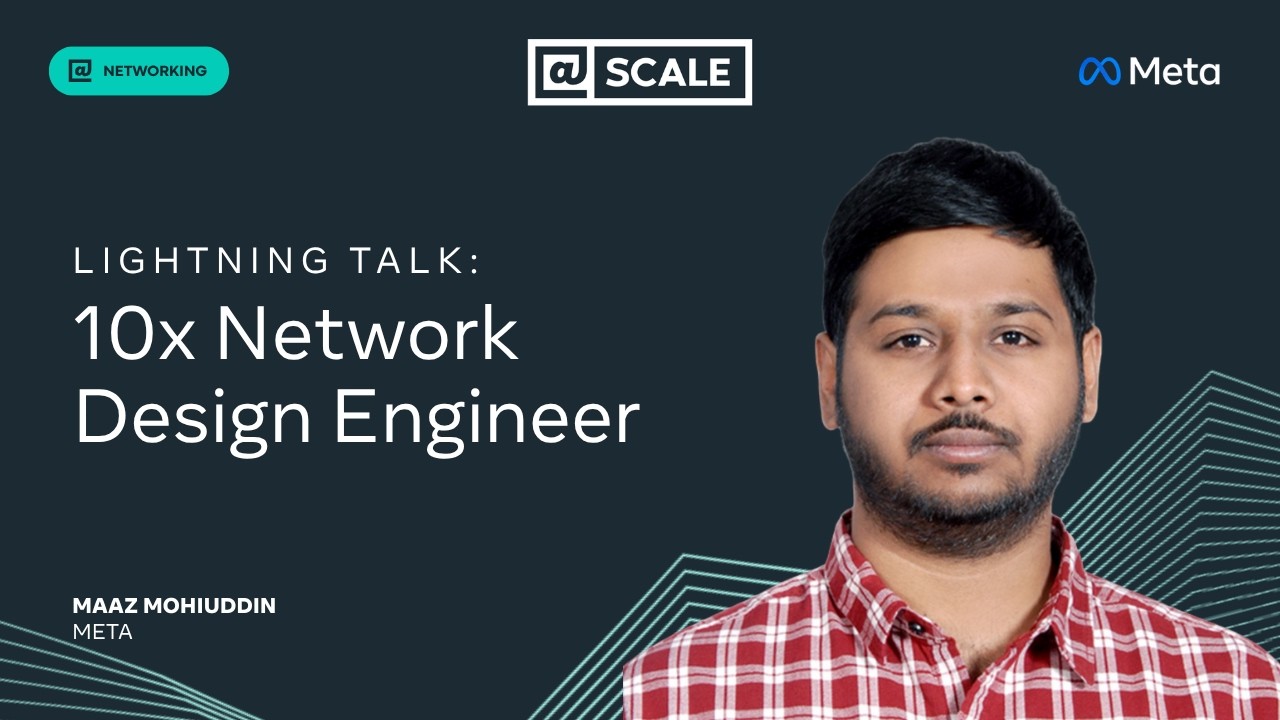
## Background Published by @Scale on YouTube on August 27, 2026, this video features a lightning talk by Maaz Mohiuddin from Meta. According to the page description, the presentation explores how network design engineering is evolving from a fragile, judgment-heavy manual process into an agent-assisted workflow, shifting the engineer's role from author to approver.
## TL;DR Maaz Mohiuddin breaks down why traditional, sequential network design handoffs lead to silent errors and how generic LLMs fail without strict grounding in deterministic network rules. To solve this, Meta utilizes a swarm of specialized AI agents—ranging from code search to config rendering—backed by RAG and strict validation layers. This architecture accelerates tasks like network sizing from six weeks down to minutes while handling low-level IP addressing and complex dynamic scenario planning. Ultimately, while human architects remain essential for final approval, AI automation is driving a 10x to 20x productivity boost with the long-term goal of 100x end-to-end orchestration.
## Atmosphere & style The presentation carries a pragmatic, focused, and forward-looking technical energy typical of a high-level engineering conference. Maaz delivers a realistic assessment of complex network architecture, balancing a candid acknowledgment of past operational headaches with compelling enthusiasm for multi-agent workflows. Watching the talk feels like a sharp, efficient deep-dive into the practical future of datacenter engineering, demystifying AI hype with concrete architectural realities.
## Key takeaways - [00:04](https://www.youtube.com/watch?v=dNssrB_-Wxk&t=4s) Designing datacenter network infrastructure requires translating business requirements into physical topologies, low-level IP addressing, and a bill of materials. - [00:04](https://www.youtube.com/watch?v=dNssrB_-Wxk&t=4s) Traditional network engineering handoffs suffer from uncodified tribal knowledge, slow serial execution, and silent errors that propagate into turn-up failures. - [01:52](https://www.youtube.com/watch?v=dNssrB_-Wxk&t=112s) Generic coding LLMs fail at network architecture because networking demands absolute correctness and global connectedness across the entire bill of materials. - [01:52](https://www.youtube.com/watch?v=dNssrB_-Wxk&t=112s) Grounding AI models with deterministic platform constraints, historical RAG retrieval, natural language intent, and continuous validation eliminates hallucinations. - [04:27](https://www.youtube.com/watch?v=dNssrB_-Wxk&t=267s) A specialized agent swarm—spanning code search, config rendering, wiki reading, and diagram digestion—handles modular tasks to draft unified designs. - [06:27](https://www.youtube.com/watch?v=dNssrB_-Wxk&t=387s) Automated network sizing reduces the cycle time for transforming capacity demands into validated topologies from six weeks to a matter of minutes. - [06:27](https://www.youtube.com/watch?v=dNssrB_-Wxk&t=387s) AI agents manage low-level deterministic addressing and execute complex dynamic 'what-if' forecasting scenarios across datacenter rack expansions. - [08:39](https://www.youtube.com/watch?v=dNssrB_-Wxk&t=519s) AI shifts the network engineer's role from manual draft author to strategic reviewer, driving a 10x to 20x speedup with a 100x end-to-end orchestration target.
## Detailed walkthrough ### [00:04](https://www.youtube.com/watch?v=dNssrB_-Wxk&t=4s) From High-Stakes Blueprints to Fragile Handoffs
Maaz Mohiuddin introduces the reality of network architecture: taking a high-level plan and transforming it into a complete, build-ready design artifact. While being a network architect looks glamorous on the surface—drawing diagrams that turn into hundreds of millions of dollars in physical hardware handling real-world traffic—the actual underlying engineering process is a vulnerable chain of sequential handoffs. A business requirement is sized into a capacity demand, which translates into a network topology, undergoes low-level design (such as IP addressing), produces a detailed bill of materials (BOM) specifying what, where, and when to ship, and finally culminates in on-site physical rack-and-stack, cabling, and configuration.
Every arrow in this workflow represents a handoff, and every handoff is fundamentally fragile due to three critical structural problems:
* **Tribal Knowledge:** The core rules governing network correctness remain uncodified, living inside engineers' heads or scattered across disparate wiki pages rather than in executable code. * **Serial Execution:** The sequential nature of the process makes it exceptionally slow, preventing any meaningful parallelization across stages. * **Silent Error Propagation:** Mistakes introduced in the earliest design steps often remain hidden until final turn-up on site, resulting in catastrophic network outages or weeks of delayed capacity delivery.
[01:52](https://www.youtube.com/watch?v=dNssrB_-Wxk&t=112s) Why Generic LLMs Fail and the Power of Grounding
Generic or off-the-shelf coding LLMs cannot solve network architecture out of the box because networking is not traditional code. In software development, code is often "close enough," backed by unit tests that catch errors during compilation or build cycles. In network engineering, however, there is a strict correctness bar alongside complex global connectedness criteria—modifying a single port or role can trigger a ripple effect across the entire bill of materials. The solution lies in grounding LLMs using deterministic rules (like port budgets, routing aggregation logic, and hardware platform limits) that act as strict integration tests.
To ground AI agents in reality and eliminate hallucinations, the engineering framework relies on four core pillars:
* **Domain Context & Codified Rules:** Explicitly defining platform constraints into the models (e.g., establishing that a specific 4RU switch strictly has 128 ports). * **Historical Design Retrieval (RAG):** Indexing hundreds of battle-tested prior designs into a high-performance database so agents can retrieve proven patterns without performance penalties. * **Natural Language Intent:** Enabling engineers to converse naturally with the system during design, keeping creative flow intact rather than losing momentum writing manual documentation. * **Validation Layer:** Enforcing a rigorous verification step with concrete rules to catch omissions or structural errors automatically.
[04:27](https://www.youtube.com/watch?v=dNssrB_-Wxk&t=267s) The Multi-Agent Ecosystem and Institutional Memory
To navigate network design under the hood, institutional memory is explicitly structured into modular scopes and formal naming conventions. Network domains are compartmentalized into aggregation layers (with fabric cross-connects), edge connections to the backbone, backbone planes, mesh groups, and standardized rack specifications. Core variables are explicitly typed—device names follow a structured `[Prefix]-[Plane]-[Index]-[Site]` format, circuit roles map A-endpoints to Z-endpoints, and IP addressing schemes strictly adhere to block, prefix, region, metro, and plane rules.
``` [ Engineer Intent / Natural Language ] │ ▼ ┌─────────────────────────────────┐ │ Specialized Agent Swarm │ ├────────────────├────────────────┤ │ Deep Tech / │ Config Render │ │ Repo Search │ │ ├────────────────├────────────────┤ │ Wiki Reader │ PDF / Diagram │ │ │ Digest │ └────────────────┴────────────────┘ │ ▼ ┌─────────────────────────────────┐ │ Grounding & RAG Retrieval │ │ (Historical Designs & Rules) │ └────────────────┴────────────────┘ │ ▼ ┌─────────────────────────────────┐ │ Validation Engine │ │ (Deterministic Integration Test)│ └────────────────┴────────────────┘ │ ▼ [ Human Architect: Review & Approve ] ```
Instead of relying on a single monolithic model, the system uses a coordinated swarm of specialized agents: * A **Deep Tech Agent** to search internal code repositories. * A **Config Rendering Agent** to generate final device configurations. * A **Wiki Reading Agent** to extract context from internal documentation. * A **Document Digest Agent** to parse large technical PDFs and diagrams into structured data. * A **Visualization Agent** to render network topologies, dashboards, and visual artifacts.
Working together, these agents take intent, retrieve grounded data, draft a design, validate constraints, and present the final proposal to a human engineer. This workflow transforms the engineer's role from manual author to strategic approver, yielding a **10x productivity speedup** by turning an hour of manual drafting into a two-minute review.
[06:27](https://www.youtube.com/watch?v=dNssrB_-Wxk&t=387s) Production Wins: Sizing, Addressing, and Scenario Planning
The framework's primary production use case is autonomous network sizing. Previously, translating business demands into a verified topology was a chaotic web of manual scripts and spreadsheets taking up to **6 weeks**. With AI agents driving underlying mathematical capacity models via natural language queries, engineers can generate complete, production-grade fabric topologies in just minutes. Over a six-month period, hundreds of these automated capacity analyses were successfully executed and validated in real production environments.
Beyond high-level sizing, the agents excel at deterministic low-level design tasks and complex dynamic forecasting:
* **Deterministic Addressing:** Automatically allocating subnets, device IPs, and interface prefixes across regions, metros, and planes in strict compliance with top-level IP hierarchy rules. * **Complex "What-If" Analysis:** Evaluating major structural modifications—such as calculating the operational, stack, and tooling trade-offs required to expand data center network rows from 38 to 44 racks.
[08:39](https://www.youtube.com/watch?v=dNssrB_-Wxk&t=519s) The Road Ahead: From 10x Drafting to 100x End-to-End Orchestration
AI-driven network design is currently in the second phase of its technological maturity: six months ago it could only assist; today it can draft complete designs. However, full end-to-end autonomous validation remains an unsolved challenge. Because the real-world cost of network failure is exceptionally high, human engineers must remain directly in the loop to review and validate outputs.
Despite this limitation, replacing manual toil with AI-driven retrieval, draft generation, and automated analysis has delivered a **10x to 20x speedup** across key design tasks, freeing engineers to focus on high-level strategic decisions. The ultimate goal is unlocking automated end-to-end checking and orchestration—moving network design from a drafting tool to an autonomous conversational partner that will ultimately yield a **100x productivity boost**.
## Notable quotes > [00:04](https://www.youtube.com/watch?v=dNssrB_-Wxk&t=4s) drawing diagrams that turn into hundreds of millions of dollars in physical hardware handling real-world traffic — Maaz Mohiuddin
> [00:04](https://www.youtube.com/watch?v=dNssrB_-Wxk&t=4s) vulnerable chain of sequential handoffs — Maaz Mohiuddin
> [00:04](https://www.youtube.com/watch?v=dNssrB_-Wxk&t=4s) Tribal Knowledge: The core rules governing network correctness remain uncodified, living inside engineers' heads or scattered across disparate wiki pages rather than in executable code. — Maaz Mohiuddin
> [00:04](https://www.youtube.com/watch?v=dNssrB_-Wxk&t=4s) Serial Execution: The sequential nature of the process makes it exceptionally slow, preventing any meaningful parallelization across stages. — Maaz Mohiuddin
> [00:04](https://www.youtube.com/watch?v=dNssrB_-Wxk&t=4s) Silent Error Propagation: Mistakes introduced in the earliest design steps often remain hidden until final turn-up on site, resulting in catastrophic network outages or weeks of delayed capacity delivery. — Maaz Mohiuddin
> [01:52](https://www.youtube.com/watch?v=dNssrB_-Wxk&t=112s) networking is not traditional code — Maaz Mohiuddin
> [01:52](https://www.youtube.com/watch?v=dNssrB_-Wxk&t=112s) modifying a single port or role can trigger a ripple effect across the entire bill of materials — Maaz Mohiuddin
> [01:52](https://www.youtube.com/watch?v=dNssrB_-Wxk&t=112s) keeping creative flow intact rather than losing momentum writing manual documentation — Maaz Mohiuddin
> [04:27](https://www.youtube.com/watch?v=dNssrB_-Wxk&t=267s) transforms the engineer's role from manual author to strategic approver, yielding a 10x productivity speedup by turning an hour of manual drafting into a two-minute review. — Maaz Mohiuddin
> [06:27](https://www.youtube.com/watch?v=dNssrB_-Wxk&t=387s) 6 weeks — Maaz Mohiuddin
> [08:39](https://www.youtube.com/watch?v=dNssrB_-Wxk&t=519s) six months ago it could only assist; today it can draft complete designs. — Maaz Mohiuddin
> [08:39](https://www.youtube.com/watch?v=dNssrB_-Wxk&t=519s) 10x to 20x speedup — Maaz Mohiuddin
> [08:39](https://www.youtube.com/watch?v=dNssrB_-Wxk&t=519s) 100x productivity boost — Maaz Mohiuddin
## Mentioned Maaz Mohiuddin, Meta, @Scale
[Source](https://www.youtube.com/watch?v=dNssrB_-Wxk)