Meta, Google, Microsoft Left-Shift AI Supply Chain to Secure Power
@Scale
Hyperscalers are abandoning just-in-time procurement for multi-year factory allocations and pre-integrated racks to overcome raw material, optical, and grid power bottlenecks slowing gigawatt-scale AI expansion.
## Background
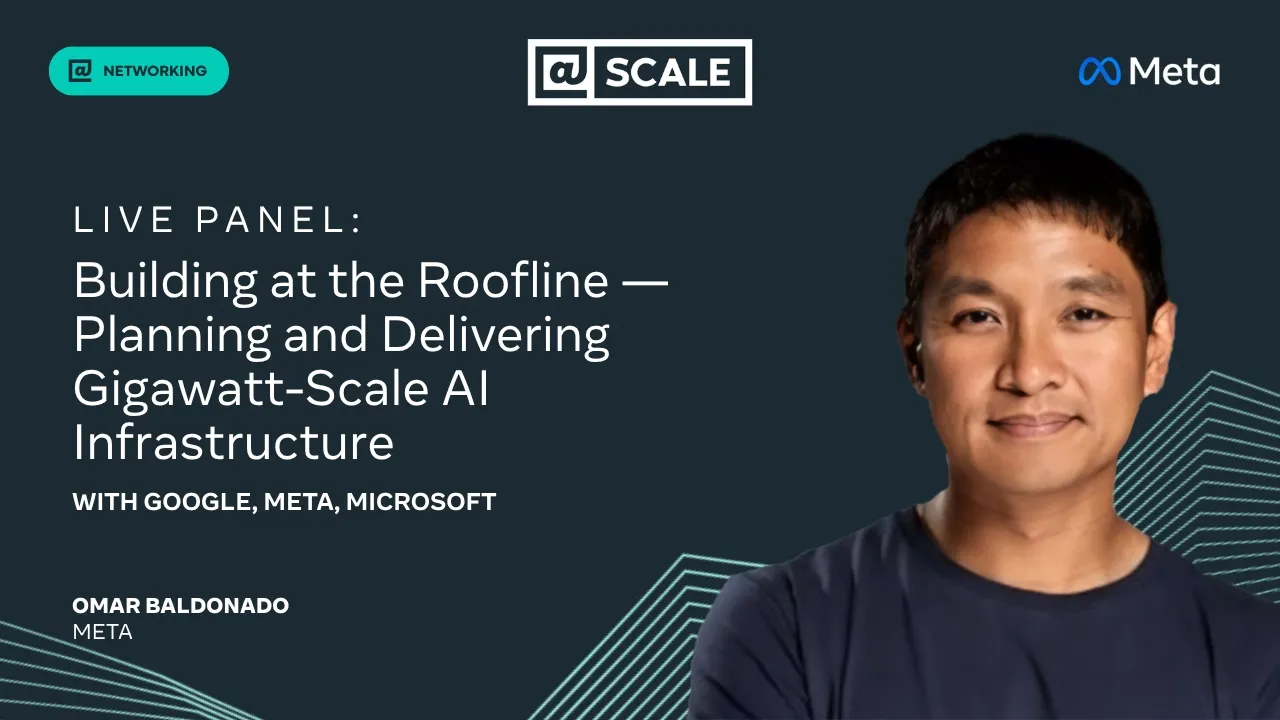
Published by @Scale on YouTube on August 27, 2026, this panel video features hyperscaler leaders from Google, Meta, and Microsoft discussing gigawatt-scale AI infrastructure planning. Moderated by Omar Baldonado, the session explores long-range fleet strategy, multi-vendor orchestration, and the engineering realities of operating at the peak of industry capacity.
## TL;DR
Hyperscaler procurement and sourcing leaders explain their shift from short-term, just-in-time sourcing to 3-to-5-year capacity forecasting to meet the immense scale of modern AI fleets. The panel highlights severe supply chain bottlenecks in optical fiber, leading-edge silicon wafers, advanced packaging, and power infrastructure, while stressing the need to shift toward pre-integrated racks and multi-tiered bill-of-materials resiliency. To overcome these constraints and keep pace with 12-to-18-month product cycles, the speakers advocate for open industry standards, shared co-development models, and deeper cross-domain engineering collaboration across the supply base.
## Atmosphere & style
The panel carries a candid, pragmatic, and highly collaborative tone, reflecting the shared intensity of managing supply chains that rival national economies. The dynamic between moderator Omar Baldonado and panelists Nikita Parikh, Amrita Kenue, and Lucas Benson is conversational yet authoritative, grounded in real-world field anecdotes—such as calculating fiber lengths that could reach the Moon. Viewers experience a sense of urgency paired with deep gratitude for the global engineering workforce delivering next-generation hardware under extreme pressure.
## Key takeaways
- [00:03](https://www.youtube.com/watch?v=HfJ9sKRepkA&t=3s) Hyperscalers like Google, Meta, and Microsoft are investing in AI infrastructure at a scale rivaling national GDPs (such as Taiwan's projected 2027 GDP), causing unprecedented friction across global supply chains.
- [01:34](https://www.youtube.com/watch?v=HfJ9sKRepkA&t=94s) Infrastructure procurement has abandoned 'just-in-time' models for dual planning cycles: a short-term 0–18 month operational window and a long-term 3–5 year capacity allocation window.
- [01:34](https://www.youtube.com/watch?v=HfJ9sKRepkA&t=94s) Hyperscalers now directly compete with public energy utilities for heavy electrical equipment like data center transformers, requiring long-range demand signaling and co-investments in supplier manufacturing capacity.
- [05:09](https://www.youtube.com/watch?v=HfJ9sKRepkA&t=309s) Scaling AI clusters introduces massive physical constraints, including fiber optic cabling requirements that can stretch the distance from the Earth to the Moon and back.
- [05:09](https://www.youtube.com/watch?v=HfJ9sKRepkA&t=309s) Scaling legacy data centers (e.g., Meta's Altoona facility from 24,000 to over 100,000 GPUs) requires rapid architectural pivots, such as shifting from InfiniBand to RoCE to maximize hardware reuse.
- [05:09](https://www.youtube.com/watch?v=HfJ9sKRepkA&t=309s) Deploying long-haul backbones for modern AI training requires redesigning legacy infrastructure, such as expanding remote amplifier huts by 4x in floor space and 32x in rack power density.
- [09:14](https://www.youtube.com/watch?v=HfJ9sKRepkA&t=554s) Critical supply chain bottlenecks span multiple layers, led by optical fiber (24-month glass manufacturing cycles), leading-edge TSMC wafer fabrication, HBM, flash storage, and advanced CoWoS packaging.
- [09:14](https://www.youtube.com/watch?v=HfJ9sKRepkA&t=554s) Sourcing teams must operate like industry analysts, investigating two to four layers deep into raw material inputs (such as indium phosphide and silicon photonics) to prevent upstream stalls.
- [15:14](https://www.youtube.com/watch?v=HfJ9sKRepkA&t=914s) Proprietary, vertically integrated networking stacks create single points of failure; open standards and collaborations (e.g., Ultra Ethernet Consortium, OCP, SONiC, FBOSS, and 400G-per-lane MSAs) are essential for ecosystem interoperability.
- [17:36](https://www.youtube.com/watch?v=HfJ9sKRepkA&t=1056s) True supply chain resiliency requires auditing subcomponents down to 'T-minus 3' suppliers rather than relying on false dual-sourcing security at the Tier 1 level.
- [20:20](https://www.youtube.com/watch?v=HfJ9sKRepkA&t=1220s) Suppliers must transition from traditional vendor-buyer relationships to strategic co-development models, escalating component shortages and risks early so hyperscalers can help unblock them.
- [21:18](https://www.youtube.com/watch?v=HfJ9sKRepkA&t=1278s) Hyperscalers are moving away from 'stick-built' data center assembly to pre-integrated racks equipped with switches, optics, and fiber shuffles, requiring suppliers to develop cross-domain expertise.
- [22:56](https://www.youtube.com/watch?v=HfJ9sKRepkA&t=1376s) Modern AI architectures (such as NVIDIA GB200 systems) tightly integrate compute and networking side-by-side with 200G SerDes and direct-to-chip liquid cooling.
- [22:56](https://www.youtube.com/watch?v=HfJ9sKRepkA&t=1376s) Compressed 12 to 18-month hardware product lifecycles place severe operational pressure on end-of-life management, qualification, and inventory obsolescence.
## Detailed walkthrough
### [00:03](https://www.youtube.com/watch?v=HfJ9sKRepkA&t=3s) Operating at the Scale of National Economies
Moderator Omar Baldonado kicks off the panel by emphasizing the staggering footprint of modern AI infrastructure. Combining the capital expenditure of Meta, Microsoft, and Google reveals an investment profile comparable to the total Gross Domestic Product of an entire country. Omar notes that looking out toward 2027 capex projections, the combined spending of these three hyperscalers rivals the GDP of Taiwan. Operating at this scale creates unprecedented friction across global supply chains.
The panelists introduce themselves and detail their roles in managing these vast procurement ecosystems:
* **Nikita Parikh**: Global Strategic Sourcing for Network Infrastructure at Google.
* **Amrita Kenue**: Strategic Sourcing Manager for GPUs and Networking at Meta.
* **Lucas Benson**: Head of Sourcing for AI Networks and Backend Connectivity at Microsoft.
[01:34](https://www.youtube.com/watch?v=HfJ9sKRepkA&t=94s) The Shift from Just-in-Time Sourcing to Multi-Year Horizons
Nikita Parikh outlines how hyperscalers have completely abandoned traditional "just-in-time" lean manufacturing models characterized by low inventory levels and short lead times. Instead, infrastructure procurement now relies on a dual planning cycle system:
* **Short-Term Cycle (0 to 18 Months)**: Dedicated to purchase order placement and immediate execution.
* **Long-Term Cycle (3 to 5 Years)**: Focuses on forecasting factory-level capacity allocations rather than specific product SKUs. This allows hyperscalers to lock in long-term supplier commitments while preserving the optionality to shift product mixes or adjust volume ramps.
Amrita Kenue explains that hyperscalers are no longer just competing with tech peers, but with state and national power grids for heavy electrical equipment like data center transformers. Because energy utilities plan several years out, hyperscalers must "left shift" all demand signals to offer partners extended joint roadmap visibility. Operating at gigawatt scale requires actively co-investing in suppliers' manufacturing capacity rather than expecting off-the-shelf delivery.
Lucas Benson emphasizes that while systemic planning is essential, exact forecast precision is impossible. Sourcing teams must determine whether to pin network demand to gigawatt capacity, GPU counts, or alternative metrics. "It's better to be wrong than to be absent," Lucas quips, acknowledging that suppliers often chuckle at changing forecasts, but actionable directional signals remain critical to enabling massive buildouts.
[05:09](https://www.youtube.com/watch?v=HfJ9sKRepkA&t=309s) Anecdotes from the Front Lines of Scaling
The panelists share vivid field stories that illustrate the unexpected challenges of scaling AI clusters:
* **Project Alai and Moon-Shot Fiber (Lucas Benson)**: About four years ago, while planning a 300,000-GPU cluster using early Nvidia accelerators, Lucas's team calculated the raw quantity of fiber required to connect the fabric. They realized the required optical cabling could stretch from the Earth to the Moon and back.
* **The Altoona Data Center Retrofit (Amrita Kenue)**: Meta scaled up its Altoona, Pennsylvania data center from what was then considered a "large" cluster (24,000 GPUs) to over 100,000 GPUs. In less than six months, the team had to retrofit the entire installation—pivoting from InfiniBand to RoCE (RDMA over Converged Ethernet) to reuse on-hand hardware. The intense push reinforced that procuring component supply is merely table stakes; ensuring full optics interoperability across multi-vendor fabrics is the true operational challenge.
* **The Amplifier Hut Bottleneck (Nikita Parikh)**: Building long-haul backbones for AI training clusters at Google hit an unexpected roadblock in remote amplifier huts. Originally designed for legacy telecom gear, these small remote huts suddenly needed four times the floor space and a 32-fold increase in rack power density, forcing a complete architectural redesign of Google's Hyper Rail line systems.
[09:14](https://www.youtube.com/watch?v=HfJ9sKRepkA&t=554s) Critical Supply Bottlenecks: From Glass to Silicon
When asked about the most constrained components in the ecosystem, the panelists point to foundational raw materials and complex manufacturing processes:
* **Optical Fiber**: Nikita points out that without fiber, top-tier GPUs and silicon are useless. Manufacturing optical fiber from raw glass requires a 24-month lead-time cycle, forcing hyperscalers away from spot purchase orders toward long-horizon planning.
* **Leading-Edge Wafers**: Amrita highlights leading-edge TSMC wafer fabrication as the single tightest point in the supply chain, impacting everything from custom accelerators to switch silicon and NICs. Memory (HBM), flash storage, and advanced packaging processes like CoWoS (Chip-on-Wafer-on-Substrate) follow right behind.
* **Deep-Supply-Chain Intelligence**: Lucas explains that sourcing managers must operate like industry analysts, investigating two to four layers deep into the supply chain. Teams monitor raw material inputs such as indium phosphide and silicon photonics to prevent unexpected material resource planning (MRP) stalls upstream.
[15:14](https://www.youtube.com/watch?v=HfJ9sKRepkA&t=914s) Open Standards and Ecosystem Interoperability
Addressing the suppliers in the room, Amrita makes a direct appeal for true multi-vendor interoperability across optical and switching layers. Proprietary, vertically integrated stacks create single-point supply failures and stall generation-over-generation upgrades.
Amrita points to open industry collaborations, such as Meta's joint work with Microsoft on the 400G-per-lane optical Multi-Source Agreement (MSA) and scale-up Ethernet standards (like the Ultra Ethernet Consortium), as vital paths forward. Meta has anchored its fleet architecture around open ecosystems through Open Compute Project (OCP) hardware designs, Switch Abstraction Interface (SAI), and its home-grown FBOSS network operating system.
Omar Baldonado and the panel conclude that open standards grow the overall market pie. Reducing single-vendor lock-in mitigates supply chain risk and enables all players to deploy gigawatt-scale capacity faster.
[17:36](https://www.youtube.com/watch?v=HfJ9sKRepkA&t=1056s) Open Standards and Deep Bill-of-Materials (BOM) Resiliency
The panel delves into software standards and supply chain depth, starting with Microsoft's perspective on SONiC (Software for Open Networking in the Cloud). Investing in and contributing to open-source software like SONiC allows vendors to push standards forward, accelerate deployment across multi-vendor fleets, and actively participate in debugging down the pipe. From there, the conversation shifts to what hyperscalers truly need from their hardware suppliers: authentic, multi-tiered BOM resiliency.
A panelist stresses that simply dual-sourcing at the Tier 1 level is a false security blanket if both suppliers source their subcomponents from the exact same Tier 2 or Tier 3 vendors. To achieve true BOM resiliency, suppliers must map risks at the "T-minus 3" level to eliminate shared bottlenecks. Additionally, suppliers must maintain active, scalable production lines rather than idle lines that require an 18-month ramp-up time when demand surges.
- **SONiC Ecosystem:** Ecosystem participation is mandatory for suppliers to enable rapid multi-vendor deployments and collaborative bug fixing.
- **T-Minus 3 BOM Visibility:** Dual-sourcing at Tier 1 is insufficient; vendors must analyze risk three tiers down to avoid hidden subcomponent bottlenecks.
- **Capacity Readiness:** Active production models must replace idle lines to ensure volume commits can scale immediately without long ramp-up delays.
- **Operational Shift:** Hardware qualification requires moving away from legacy paper-checklist audits to active joint monitoring and direct supplier-to-hyperscaler communication.
---
[20:20](https://www.youtube.com/watch?v=HfJ9sKRepkA&t=1220s) Co-Development and Partnering Over Vendor Relationships
The panel discusses a common pitfall in hardware sourcing: suppliers often attempt to resolve component shortages secretly to avoid raising alarms, only to report the issue after it is too late to fix. The speakers urge suppliers to pivot from a traditional "customer versus producer" transaction model to an open co-development partnership.
Under this co-development approach, suppliers are encouraged to bring risks, investment needs, and unblocking requests to hyperscalers early. By sharing the burden of supply constraints and engineering challenges, both sides can unblock bottlenecks faster.
- **Cultural Shift:** Transitioning from "buyer-supplier" transactions to genuine strategic co-development.
- **Early Escalation:** Suppliers are encouraged to flag risk early so hyperscalers can leverage their buying power or resources to unblock supply constraints.
- **Shared Investment:** Shared opportunities and joint investments are increasingly necessary to secure critical subcomponents.
---
[21:18](https://www.youtube.com/watch?v=HfJ9sKRepkA&t=1278s) Shifting Engineering Left: The Era of Pre-Integrated Racks
Addressing the hardware side of scaling, the discussion pivots to architectural shifts highlighted at recent OCP (Open Compute Project) summits. Hyperscalers no longer ship individual switches, optics, and cables separately to data centers to be assembled on-site ("stick-built"). Instead, hardware is delivered as pre-integrated racks equipped with switches, optical transceivers, and fiber shuffles already attached.
This shift requires moving development and qualification processes "left" (earlier in the cycle). Switch vendors must gain deep optical expertise to assist with optic qualification, optics companies must understand switch internals, and System Integrators (SIs) and Original Design Manufacturers (ODMs) must master both alongside fiber shuffles. This parallel qualification model unloads pressure from internal hyperscaler engineering teams and drastically speeds up fleet bring-up.
- **Integrated Delivery:** Shipping fully integrated compute and network racks with optics, switches, and fiber shuffles pre-installed instead of piecemeal components.
- **Cross-Domain Expertise:** Switch vendors need optical expertise, optics vendors need switch expertise, and ODMs/SIs must master both.
- **Parallel Testing:** Shifting qualification "left" allows parallel validation rather than sequential testing, speeding up deployment across technology generations.
- **Resource Scaling:** Suppliers must sustainably staff their engineering and qualification teams to handle continuous integration demands.
---
[22:56](https://www.youtube.com/watch?v=HfJ9sKRepkA&t=1376s) High-Density Integration, Architectural Merging, and Rapid Lifecycles
The panel explores why pre-integrated networking racks present a greater challenge than legacy compute racks. Modern AI clusters demand massive density—utilizing 200G SerDes, dense liquid cooling, and complex fiber topology like moving away from traditional end-of-row designs. In architectures such as the NVIDIA GB200 system, compute and network racks are tightly coupled side-by-side, blurring the boundaries between networking and compute systems.
Furthermore, hardware generations are cycling at an unprecedented pace. Product lifecycles have compressed to 12-18 months, forcing hyperscalers and ODMs to flip entire rack designs every year to year-and-a-half. This rapid iteration creates severe supply chain pressure around component end-of-life (EOL) management and inventory obsolescence.
- **Architecture Convergence:** Systems like NVIDIA GB200 blur the line between compute and networking, placing them into tightly integrated adjacent rack systems.
- **Dense Technologies:** Widespread adoption of high-speed SerDes (200G), direct-to-chip liquid cooling, and complex optical fiber shuffles within tight rack envelopes.
- **Compressed Lifecycles:** Rapid generation shifts every 12 to 18 months create operational hurdles around product obsolescence and continuous qualification.
---
[25:58](https://www.youtube.com/watch?v=HfJ9sKRepkA&t=1558s) Closing Remarks and Industry Gratitude
Moderator Omar Baldonado and the panelists wrap up the discussion with closing reflections on the state of AI infrastructure. The panelists reflect on how drastically the industry has evolved: a decade ago, infrastructure sourcing professionals would rarely share a stage at a technical conference, whereas today sourcing and engineering operate side-by-side to deliver gigawatt-scale fleets.
The speakers express gratitude to their engineering partners, suppliers, and manufacturing workforces laboring 60+ hours a week behind the scenes to keep up with unprecedented AI growth. The panel concludes with an invitation to the broader supply chain ecosystem to partner closely as the industry navigates this intense growth curve.
- **Strategic Elevation:** Sourcing and procurement now sit alongside hardware engineering as core drivers of AI infrastructure strategy.
- **Ecosystem Gratitude:** Acknowledgment of the supply base and workforce dedicating 60+ hours a week to deliver gigawatt-scale infrastructure.
- **Final Message:** AI scale is continuing to grow exponentially, requiring deep, transparent industry-wide collaboration to keep execution smooth.
## Notable quotes
> [17:34](https://www.youtube.com/watch?v=HfJ9sKRepkA&t=1054s) It's better to be wrong than to be absent — Lucas Benson
## Mentioned
Omar Baldonado, Amrita Kenue, Lucas Benson, Nikita Parikh, Google, Meta, Microsoft, TSMC, Nvidia, Project Alai, Hyper Rail, Altoona Data Center, FBOSS, SONiC, Ultra Ethernet Consortium, Open Compute Project, NVIDIA GB200
Infrastructure leaders from Google, Meta, and Microsoft state that scaling artificial intelligence to the gigawatt level requires treating capital procurement like national economic planning, abandoning just-in-time supply chains for multi-year factory commitments and deep co-development.
Transitioning from Just-in-Time to Multi-Year Sourcing (1:34)
Hyperscaler capital expenditures have reached unprecedented levels, with moderator Omar Baldonado noting that the projected 2027 capex of Meta, Microsoft, and Google rivals the GDP of Taiwan. Operating at this scale has forced hyperscalers to abandon traditional lean, just-in-time manufacturing. Nikita Parikh of Google outlines a split planning model: a short-term 0-to-18-month cycle for purchase orders, and a long-term 3-to-5-year horizon focused on securing factory-level capacity allocations rather than rigid product SKUs.
Amrita Kenue of Meta explains that data center developers now compete directly with municipal electric utilities for critical electrical infrastructure such as transformers, requiring demand signals to be shifted years in advance. Rather than expecting off-the-shelf fulfillment, tech companies are directly co-investing in supplier capacity. While exact projections are difficult, Lucas Benson of Microsoft emphasizes that suppliers require actionable directional signals—anchored to metrics like GPU counts or gigawatts—arguing it is better to provide imperfect forecasts than no visibility at all.
Physical Constraints from Raw Glass to Silicon (9:14)
Procurement teams face extreme bottlenecks extending several layers deep into the manufacturing base. Parikh highlights that raw glass fabrication for optical fiber requires a 24-month lead time, leaving high-end accelerators unusable if cabling is unavailable. Field deployments illustrate these physical demands: Benson recalls planning a 300,000-GPU cluster where required optical cabling could span from the Earth to the Moon and back, while Parikh notes that Google had to redesign its Hyper Rail line systems after remote amplifier huts experienced a fourfold footprint expansion and a 32-fold surge in rack power density.
At the silicon layer, Kenue identifies leading-edge TSMC wafer fabrication as the supply chain's tightest choke point, impacting accelerators, switch silicon, and network interface cards. Advanced packaging methods like CoWoS (Chip-on-Wafer-on-Substrate) and High Bandwidth Memory (HBM) remain heavily constrained. In response, sourcing managers monitor subcomponents two to four tiers deep—including materials like indium phosphide and silicon photonics—to intercept upstream resource stalls before they cascade into system assembly delays.
Deep Supply Chain Resiliency and Open Standards (15:14)
Panelists warn that dual-sourcing components at Tier 1 provides false security if competing vendors rely on identical Tier 2 or Tier 3 sub-suppliers. Hyperscalers urge partners to map supply risks down to the "T-minus 3" level and maintain actively running production lines rather than mothballed facilities that require 18 months to restart. Sourcing leaders also advocate shifting away from transactional vendor relationships where suppliers hide component shortages until failure is unavoidable; early escalation allows hyperscalers to deploy their purchasing power to clear supplier bottlenecks collaboratively.
To prevent single-point failures, Meta and Microsoft champion open hardware and software ecosystems. Initiatives such as the 400G-per-lane optical Multi-Source Agreement, the Ultra Ethernet Consortium, Open Compute Project designs, Meta's FBOSS, and Microsoft's SONiC facilitate multi-vendor interoperability. Kenue highlights an operational retrofit at Meta's Altoona facility, which expanded from 24,000 to over 100,000 GPUs in under six months by switching from InfiniBand to RoCE (RDMA over Converged Ethernet), demonstrating that open interoperability is necessary to repurpose available inventory rapidly.
Pre-Integrated Racks and Compressed Technology Lifecycles (21:18)
Data center construction has shifted away from on-site, piece-by-piece assembly toward pre-integrated racks delivered with switches, optics, and fiber shuffles already installed. This shift moves qualification earlier in the manufacturing cycle, demanding that switch vendors master optical engineering, optics suppliers understand switch internals, and system integrators manage complex fiber topologies alongside direct-to-chip liquid cooling and 200G SerDes.
This integration is further complicated by generational lifecycles that have compressed to 12 to 18 months. In dense architectures like NVIDIA's GB200, compute and networking enclosures sit adjacent and function as single converged units. Flipping entire rack architectures every year to year-and-a-half places immense pressure on original design manufacturers and suppliers, creating ongoing operational risks around component obsolescence, end-of-life transitions, and continuous engineering qualification.
The panel concludes that delivering gigawatt-scale AI infrastructure requires sourcing specialists and hardware engineers to operate as unified strategic partners alongside global suppliers. However, the rapid 12-to-18-month hardware refresh cycle leaves hyperscalers and equipment manufacturers facing unresolved supply chain friction around inventory obsolescence and long factory lead times.
## Background
该视频由 YouTube 频道 @Scale 于 2026 年 9 月 3 日发布。根据页面简介,本场圆桌论坛由 Omar Baldonado 主持,汇聚了来自 Google、Meta 和 Microsoft 的基础设施规划与战略采购负责人,共同探讨跨代技术并存、供应链触及极限背景下,超大规模厂商如何规划与交付吉瓦级(Gigawatt-Scale)AI 基础设施。
## TL;DR
圆桌探讨了面对媲美中等国家 GDP 体量的庞大资本支出,超大规模云厂商如何重构 AI 基础设施供应链。嘉宾们指出传统 JIT 精益采购已彻底失效,行业全面转向锁定 3 至 5 年产能与 0 至 18 个月下 PO 的‘双规划周期’,并把需求信号前移以与公用事业电网争夺核心电力资源。讨论通过 30 万 GPU 集群‘地月往返’光纤量、6 个月将 10 万卡集群从 InfiniBand 改装为 RoCE 等真实工程战役,剖析了光纤拉丝周期、CoWoS 封装及底层激光芯片等瓶颈,强调通过深入 T-3 层的物料审查、开放互操作标准、整机柜预集成与验证‘左移’来破解单一供应商锁定的系统性风险。
## Atmosphere & style
整场对话务实而硬核,剥离了生成式 AI 常见的宏大叙事与商业吹嘘,直切全球重工业制造与物理交付的残酷现实。三位分别掌管数千亿资本支出的采购领袖语气坦诚且极具共鸣,既有幽默自嘲‘每次向供应商做出的预测其实都是错的’的松弛感,又在讲述偏远中继站遭遇 32 倍功耗冲击或 6 个月完成网络大重构时流露出深厚的工程敬畏心。现场弥漫着技术采购与底层工程高度共生、直面‘规模化已无可逆转’历史洪流的紧迫感与坚定感。
## Bulletin
- [00:03](https://www.youtube.com/watch?v=HfJ9sKRepkA&t=3s) Meta、微软与谷歌在 2027 年的资本支出总额预计将比肩中等发达国家 GDP,这迫使超大规模云厂商将供应链从传统准时制(JIT)转向 3-5 年长期锁产能与 0-18 个月短期执行的双规划周期。
- [05:08](https://www.youtube.com/watch?v=HfJ9sKRepkA&t=308s) 吉瓦级 AI 集群的互连密度引发物理瓶颈:单一 30 万张 GPU 集群内部所需光纤总长相当于地月往返,而光纤基础制造从二氧化硅拉丝到建厂扩产周期长达整整 24 个月。
- [11:53](https://www.youtube.com/watch?v=HfJ9sKRepkA&t=713s) 超大规模采购团队全面“行业分析师化”,审查物料清单(BOM)需深挖至 Tier 3 层级,以破除两家整机供应商抢购相同底层先进制程晶圆或激光器芯片的“伪双源”幻觉。
- [21:21](https://www.youtube.com/watch?v=HfJ9sKRepkA&t=1281s) AI 基础设施迭代周期已被疯狂压缩至 12 至 18 个月,促使交付方式全面转向预集成整机柜,并将兼容测试与验证流程强力“左移”至上游供应商与 ODM 厂商。
## Key takeaways
- [00:03](https://www.youtube.com/watch?v=HfJ9sKRepkA&t=3s) Meta、微软与谷歌三巨头在 2027 年的 Capex 规模预计将堪比中国台湾地区的 GDP 总量,AI 建设已上升为国家级工业竞争范畴。
- [01:23](https://www.youtube.com/watch?v=HfJ9sKRepkA&t=83s) 传统以低库存为核心的精益 JIT 供应链模式彻底失效,云厂商转向“0-18 个月短期执行 PO + 3-5 年长期锁定工厂产能”的双规划周期。
- [01:23](https://www.youtube.com/watch?v=HfJ9sKRepkA&t=83s) 吉瓦级数据中心开始与公用事业电网争夺大型变压器与重型电力设备产能,迫使云厂商将需求信号大幅“左移”并进行联合投资。
- [01:23](https://www.youtube.com/watch?v=HfJ9sKRepkA&t=83s) 面对高不确定性,采购团队遵循“宁错勿缺”的准则,即使预测有偏差也必须提前给出基准数字以驱动上游工厂产能建设。
- [05:08](https://www.youtube.com/watch?v=HfJ9sKRepkA&t=308s) 微软早期规划的 30 万卡 GPU 超级集群所需光纤总长足以实现“地月往返”,AI 后端互连物料强度远超传统商用云。
- [05:08](https://www.youtube.com/watch?v=HfJ9sKRepkA&t=308s) Meta 在阿尔图纳数据中心仅用不到 6 个月即将 10 万级 GPU 集群从 InfiniBand 改造为 RoCE 架构,凸显了多厂商光模块互操作性的极端严苛要求。
- [05:08](https://www.youtube.com/watch?v=HfJ9sKRepkA&t=308s) 谷歌在荒野沿线的中继放大器机房因骨干网络吞吐暴增面临高达 32 倍的机架功率密度冲击,倒逼底层传输架构重构为 Hyper-rail 系统。
- [09:14](https://www.youtube.com/watch?v=HfJ9sKRepkA&t=554s) 光纤成为底层关键卡脖子耗材,从高纯玻璃预制棒拉丝到建厂扩产需要 24 个月,推动采购模式从即时现货转向 2-3 年长期战略预订。
- [10:27](https://www.youtube.com/watch?v=HfJ9sKRepkA&t=627s) 除了前沿晶圆代工产能紧缺外,台积电 CoWoS 先进封装与 HBM 内存已成为整条 AI 硬件链条的战略核心瓶颈。
- [11:53](https://www.youtube.com/watch?v=HfJ9sKRepkA&t=713s) 采购团队需要穿透 3 至 4 层供应链,下潜至硅光子、磷化铟(InP)激光材料等底层环节,避免整机系统因微小辅料短缺而全面停滞。
- [14:40](https://www.youtube.com/watch?v=HfJ9sKRepkA&t=880s) 巨头极力推崇单通道 400G 光模块 MSA、OCP、SAI 和 SONiC 等开放标准与互操作规范,主张通过破除私有锁定来做大市场并平抑单点供应风险。
- [18:14](https://www.youtube.com/watch?v=HfJ9sKRepkA&t=1094s) 行业普遍存在“伪双源”陷阱:看似拥有两家整机供应商,实则在底层争夺完全相同的二级或三级代工产能,审查必须深潜至 Tier 3 级别。
- [18:14](https://www.youtube.com/watch?v=HfJ9sKRepkA&t=1094s) 供应商必须具备热备产线与快速爬坡能力,并打破“闷头排障”的报喜不报忧心态,尽早暴露底层断供风险以寻求巨头的资金与杠杆协同。
- [21:21](https://www.youtube.com/watch?v=HfJ9sKRepkA&t=1281s) 行业交付模式从分散配件现场组装演化为“出厂预集成整机柜”,推动交换机、光模块与光纤重洗组件的测试验证全面“左移”。
- [22:56](https://www.youtube.com/watch?v=HfJ9sKRepkA&t=1376s) 受 200G SerDes、液冷改造及计算机柜/网络机柜深度融合(如 GB200)影响,系统生命周期被压缩至 12 至 18 个月,带来严峻的物料过时与 EOL 风险。
- [25:58](https://www.youtube.com/watch?v=HfJ9sKRepkA&t=1558s) 硬件采购(Sourcing)与系统工程团队深度融合走向前台,全产业链需要以深度联合开发(Co-development)共同应对不可逆的大规模算力时代。
## Detailed walkthrough
### [00:03](https://www.youtube.com/watch?v=HfJ9sKRepkA&t=3s) 媲美国家 GDP 的算力资本支出与嘉宾介绍
大会全天都在探讨各种系统的运行与维护,而本场讨论则切入硬核的幕后底座——如何驾驭全球最庞大的基础设施供应链。主持人 Omar Baldonado 抛出了一个令人震撼的宏观视角:如果把 Meta、微软(Microsoft)和谷歌(Google)三家公司联合起来看,它们在 2027 年的资本支出(Capex)规模,已经相当于一个中等发达国家或地区的 GDP(堪比中国台湾地区的 GDP 总量)。在这样庞大的资金与工业体量下,AI 基础设施的构建早已超越了普通企业采购的范畴。
随后,来自三家超大规模云厂商(Hyperscalers)的关键负责人依次进行了自我介绍:
- **Nikita Parikh**:负责 Google 全球网络基础设施的战略采购(Global Strategic Sourcing);
- **Amrita Kenue**:Meta 的战略采购经理,统管 GPU 算力芯片与网络硬件采购;
- **Lucas Benson**:负责微软 AI 网络及后端互联(Backend Connectivity)的采购团队。
---
### [01:23](https://www.youtube.com/watch?v=HfJ9sKRepkA&t=83s) 告别精益敏捷:双规划周期与“左移”的供应链范式
谈及 AI 基础设施迭代对供应链模式的颠覆,三位嘉宾一致认为,过去的规则已经彻底失效。Nikita 指出,整个行业已经彻底告别了传统以“低库存、短交付周期(Lead Times)”为核心的准时制(Just-In-Time, JIT)精益供应链模式,全面转向**“双规划周期(Two Planning Cycles)”**:
1. **短期交付周期(0至18个月)**:聚焦于采购订单(PO)的下达、物料排期与交付执行;
2. **长期战略周期(3至5年)**:不再针对具体的某款产品做预测,而是直接锚定工厂级别的产能配额(Factory-level Allocations)。面对供应商生态,云厂商必须做出跨年度的长期产能承诺,同时在协议中保留在不同产品组合之间平移、根据研发节奏扩产或减产的“选择权(Optionality)”,唯有如此,上游供应商才有底气去锁定更上一层的原料供应。
```mermaid
flowchart TD
accTitle: AI 基础设施双规划周期模型
accDescr: 展示0-18个月短期执行周期与3-5年长期产能规划周期的分工与协同
subgraph ShortTerm ["短期执行周期 (0 - 18 个月)"]
PO["下发实际采购订单 (PO)"]
Delivery["产品交付与库存调配"]
PO --> Delivery
end
subgraph LongTerm ["长期战略周期 (3 - 5 年)"]
Signal["需求信号大幅‘左移’"]
CapAlloc["锁定工厂级产能配额 (Factory Allocations)"]
CoInvest["联合投资与跨代产品弹性配比"]
Signal --> CapAlloc
CapAlloc --> CoInvest
end
CoInvest -.->|"为短期订单提供产能保障"| PO
```
Amrita 紧接着补充了另一个维度的严峻挑战:当建设规模迈入**吉瓦级(Gigawatt Scale)**时,超大规模数据中心面对的竞争对手不再仅是同行,而是国家或各州的电网公司(Grids)。电网采购大型变压器(Transformers)和重型电力设备时,往往提前数年进行规划。为了不被挤出市场,云厂商必须把自身所有的需求信号大幅“左移(Left-shift)”,将规划视野拉长数年,与供应商开展联合技术路线图规划。思维模式必须彻底扭转:“你不能再指望供应链按照你的时间表凭空变出设备,你必须深入产业链,亲自帮他们把产能建起来”,这甚至意味着超大规模厂商要直接出资与供应商进行联合投资(Co-investments)。
Lucas 坦言,六年前与今天的最大分歧在于规划的颗粒度(Grain)。工程团队渴望系统化、逻辑严密的预测模型,但在狂飙突进的 AI 时代,精准预测几乎是不可能的。采购团队每天都在纠结:到底是按规划的吉瓦数(GW)乘以网络附着率(Attach Rate)来推算,还是按 GPU 芯片数量直接换算?但无论如何,必须给供应商一个明确的锚点:“宁可给出错误的数字,也绝不能缺席(It is better to be wrong than to be absent)。”看到台下许多核心供应商代表在会心微笑,Lucas 幽默地承认:“台下很多供应商伙伴肯定在偷笑——因为我们的预测其实每一次都是错的!但即使明知不准,我们也必须先定一个基准,才能驱动这一场前所未有的产能大建设。”
- **传统 JIT 模式瓦解**:低库存与快速响应不再适用,转向 3–5 年锁产能与 0–18 个月下 PO 的并行结构。
- **电网级工业竞争**:数据中心电力与变压设备与公用事业电网争夺核心产能,倒逼需求信号极限前移。
- **宁错勿缺的采购哲学**:在极高不确定性下,用大致准确的颗粒度锁定工厂产能,优于等待精确需求而导致产能踏空。
---
### [05:08](https://www.youtube.com/watch?v=HfJ9sKRepkA&t=308s) 规模带来的震撼:地月往返的光纤、六个月 RoCE 大重构与放大器机房危机
主持人 Omar 请大家分享在 AI 狂潮中最颠覆认知或猝不及防的真实经历。三位嘉宾给出了令人咋舌的具体工业案例:
Lucas 回忆起大约四年前微软内部代号为“Project Alley”的一个早期 AI 项目。当时团队在规划一个规模达 30 万张 GPU(300k GPU)的超级集群,选用的正是早期一代的 NVIDIA GPU。当工程团队拉出物料清单,计算该集群内部互联所需的光纤总长度时,全员倒吸了一口凉气——**连接这一个集群所需的光纤总长,竟然足以从地球拉到月球,再从月球拉回地球**。这一极其夸张的物理密度,让采购和工程管理层彻底意识到:AI 后端集群的物理互联强度与物料吞吐量,与以往常规商业云(Commercial Cloud)的前端网络完全不在同一个数量级。
Amrita 则分享了 Meta 在宾夕法尼亚州阿尔图纳(Altoona, Pennsylvania)数据中心的突击战役。早些年业界普遍认为 24k GPU 集群就已算得上“庞然大物”,而当 Meta 首次向 10 万级(100k+)GPU 集群迈进时,遭遇了严峻的工程转向:由于需要充分复用手头现有的庞大网络资产,他们不得不将原本采用 InfiniBand 架构构建的整座集群全面改装(Retrofit)为基于以太网的 RoCE(RDMA over Converged Ethernet)架构。整场涉及海量设备迁移与系统重构的“心脏手术”,被压缩在短短不到 6 个月内全部攻坚完成。Amrita 感慨道,这次战役让团队刻骨铭心的一点是:**把硬件买回来仅仅是交了“入场券(Table stakes)”,真正的挑战是让所有零件能够在一起严丝合缝地协同工作**。尤其是不同厂商光模块(Optics)之间的互操作性(Interoperability),必须确保它们能在同一张网络织网(Fabric)中稳定通信。
Nikita 则揭示了 Google 在建设超大规模 AI 训练集群时遇到的“隐形暗礁”。所有人都在关注庞大的数据中心园区和算力核心,但真正的物理瓶颈却出人意料地卡在沿线偏僻荒野中的光纤放大器机房(Amplifier Hut)。这些中继机房最初是按传统低功耗网络设备设计的,如今要支撑海量 GPU 互联的超大骨干网络,所需的物理空间和电力暴涨了 4 倍,局部机架功率密度甚至飙升到了原来的 32 倍(32x Rack Density)。一个名不见经传的小城市沿线机房,险些瘫痪了整个 AI 网络的上线节奏。这一极端挑战直接倒逼 Google 彻底重构了骨干传输网络的设计逻辑,催生出了新一代的 Hyper-rail 线路系统。
- **光纤密度质变**:300k GPU 集群光纤需求量达到“地月往返”级别,彻底重构了后端连接物料供应链。
- **架构硬切换考验**:Meta 在 6 个月内完成 100k 级集群从 InfiniBand 到 RoCE 的高压重构,凸显光器件互操作性与多厂商兼容的技术挑战。
- **边际基础设施瓶颈**:偏远中继放大器机房遭遇 32 倍机架功耗密度冲击,逼出骨干传输网架构(Hyper-rail)的底层革新。
---
### [09:14](https://www.youtube.com/watch?v=HfJ9sKRepkA&t=554s) 核心瓶颈部件:从 24 个月拉丝周期的光纤到前沿晶圆产能
当主持人将话题收拢到具体的短缺元器件时,Nikita 毫不犹豫地把首个焦点对准了看似基础却极易致命的物料——**光纤(Fiber)**。
Nikita 强调,算力芯片(Silicon)和 GPU 就算全部备齐就位,只要缺少光纤,所有的算力节点就只是一座座孤岛,根本无法组网运行。正如 Lucas 所算出的地月往返距离,AI 数据中心需要成千上万公里的光缆。但光纤绝非短期下单就能凭空交付的耗材:从基础原材料二氧化硅高纯玻璃预制棒进行拉丝(Draw fiber from glass),到新建成套制造工厂,其产能爬坡周期长达整整 **24 个月**。正因如此,云厂商针对光纤的采购策略经历了底层重塑——从过往依据项目随用随买的即时采购订单(Spot POs),转变为长达两三年的超长期战略产能锁定。
接续光纤的底层物理瓶颈,Amrita 随即指出了位于供应链金字塔尖端的终极挑战——**先进制程晶圆产能(Leading edge wafer capacity)**……
### [10:27](https://www.youtube.com/watch?v=HfJ9sKRepkA&t=627s) 战略级产能瓶颈:从晶圆代工到先进制程封装
在当前千兆瓦(Gigawatt)规模的 AI 算力集群建设中,供应链所面临的产能限制正在横扫所有关键硬件环节。这种瓶颈涵盖了 AI 加速卡(Accelerators)、网络交换机(Switches)、智能网卡(NICs),并迅速传导至紧随其后的存储与内存(Storage & Memory)。面对这些具有战略意义的硬性受限组件,超大规模云厂商(Hyperscalers)不得不彻底重塑其传统的采购模式。过去常规的即时订购或短期规划已无法应对现实,如今必须提前 5 年甚至更久开展长期战略规划,签订长期供货协议(LTA),并执行极其超前的产能预留(Capacity Reservations)与锁定机制。
不仅是前端晶圆制造紧缺,紧随其后的后道先进封装工艺也成了重灾区。台积电的 CoWoS(Chip-on-Wafer-on-Substrate)封装以及高带宽内存(HBM)的供给,当前正处于极度紧俏的“风口浪尖”(Hot seat)。主持人 Omar Baldonado 随即追问:各大超大规模企业(如 Meta、Google、Microsoft)在自身业务中既大量采购现成商用芯片产品,又同时在推进自研定制芯片(Custom Silicon)项目;那么在台积电等晶圆代工厂产能面前,团队究竟该如何在商用供应商与自研芯片直采之间平衡并双向管理晶圆配额?
- **战略受限核心部件**:AI 加速卡、高速网络交换机、智能网卡(NICs)、存储与内存芯片。
- **全新采购锁定机制**:跨度达 5 年以上的长期供货协议(LTA)、远期产能预留与提前锁定机制。
- **先进封装瓶颈**:台积电 CoWoS 封装与 HBM 供应链成为卡脖子关键环节。
- **双重角色平衡**:既作为采购现成硬件的最终客户,又作为直接锁定晶圆的自研芯片(Custom Silicon)开发者。
---
### [11:53](https://www.youtube.com/watch?v=HfJ9sKRepkA&t=713s) 采购团队“行业分析师化”:下钻穿透三至四层供应链
针对晶圆配额的双向平衡问题,嘉宾们普遍认同,当超大规模厂商向下游发出需求信号时,整个供应链生态内部其实正在多个不同层级发生着三到四轮的相互交叉验证。这种复杂的网状依赖要求工程采购团队不仅关注自己的直接供应商,更要主动化身为“跨领域的行业分析师”(Industry analysts outside of our own domains)。以交换机采购团队为例,他们表面上负责采购整机组装(Switch Assembly)和光模块(Optics),但由于底层涉及硅光子(Silicon Photonics)、磷化铟(Indium Phosphide, InP)激光器材料,以及最前沿的先进制程晶圆产能(Leading-edge wafer capacity),团队必须垂直穿透下潜两到四层供应链深度,去精准捕捉潜在瓶颈。
这种向下钻研的穿透力至关重要。如果超大规模厂商已经将供需排期看远到两年的交付周期(Lead time),而直接合作伙伴的物料需求计划(MRP)系统却缺乏对应的长周期规划能力,那么这种远期需求信号就无法有效向下游层层传导。因此,团队必须退后一步,从全局审视内部所有需求组合的核心依赖项——比如整机系统看似齐备,但底层是否可能因为一个激光器(Laser)或泵浦源(Pump)的短缺而全面停工。在此背景下,技术采购团队与硬件工程团队之间的内部协作达到了前所未有的紧密程度,采购团队能够实时将供应链最前沿的产业动态脉搏与风险洞察反馈给工程端,实现协同破局。
```mermaid
flowchart TD
accTitle: Supply Chain Penetration
accDescr: 超大规模厂商从顶层需求穿透多级供应链直至底层晶圆与原材料
subgraph Tier0["顶层采购与集成"]
A["整机系统采购<br/>(交换机 / NIC / 加速器)"]
B["光模块采购<br/>(Transceivers)"]
end
subgraph Tier1_2["二级/三级组件"]
C["交换硅片 / 自研芯片 ASIC"]
D["硅光子 / 磷化铟激光器 (InP)"]
end
subgraph Tier3_4["底层制造与封装"]
E["先进制程晶圆代工<br/>(TSMC Leading-edge Wafers)"]
F["先进封装与堆叠<br/>(CoWoS / HBM)"]
end
A --> C
B --> D
C --> E
C --> F
D --> E
```
- **三到四轮交叉验证**:任何单一需求信号都会在整条供应链的各个关键节点被反复验证与核实。
- **穿透式供应链溯源**:深入硅光子技术、磷化铟(InP)材料、激光器泵浦源以及最先进先进制程节点。
- **MRP 协同断层风险**:客户规划长达 2 年,若供应商的 MRP 工具链不匹配,会导致整条传导链瘫痪。
- **跨职能高度融合**:技术采购(Technical Sourcing)与硬件工程团队实时联动,将供应链风险提前内置到系统架构评估中。
---
### [14:40](https://www.youtube.com/watch?v=HfJ9sKRepkA&t=880s) 消除单点故障:开放互操作规范与“做大蛋糕”逻辑
面对台下大量的硬件设备与零部件供应商,主持人抛出一个核心问题:“大家都在向我们销售产品,你们希望供应链合作伙伴集体改进或攻克的核心挑战是什么?”Amrita Kenue 首先指出,最大的诉求是**在光通信与交换网络层实现真正的多厂商互操作性(Multi-vendor Interoperability)**。目前网络技术栈中仍有太多部分呈现高度垂直绑定的封闭状态,深度受制于个别供应商的专有演进路线图。这种单边依赖不仅造成严重的单点供应失效风险(Single-sided point of failure),更使得跨代际硬件升级困难重重。
打破这种锁定的良方是全行业加速采用开放标准与互操作技术规范,例如 Meta 与微软联合推进的单通道 400G 光模块多源协议(400G per lane optics MSA),以及在 Scale-up 互联领域(如 Ultra Ethernet / Scale-up 架构)所开展的标准化工作。Meta 整个算力集群基础设施都是基于这一理念构建的——从开放计算项目(OCP)硬件设计,到交换机抽象接口(SAI),再到自研的 FBOSS 交换机网络操作系统。
主持人指出,许多传统供应商本能地想推销专有技术,但开放标准绝非零和博弈;具备真正的互操作性反而能够“把蛋糕做大”(Grows the pie for everybody)。当部署风险因拥有多元化选择而降低时,超大规模厂商才能真正放开手脚全速推进算力交付;反之,若被单一供应商绑死,“你只有一种选项,那实际上会拖慢速度并放大风险,我们甚至不知道自己敢推进多快”。来自微软的嘉宾进一步补充,基于开源标准的协作开发(如 SONiC 网络操作系统)是生态的核心支柱:它要求供应商不仅参与标准定义,更要主动贡献代码、协助线上调试与排障,这不仅能加快交付,也是加入微软基础设施生态的硬性前提。
- **垂直绑定的核心痛点**:全栈专有化导致供应商单点故障,使得代际迭代成本高昂、周期冗长。
- **前沿开放标准倡议**:Meta 与微软携手推进的 400G/lane 光学 MSA,以及面向 AI Scale-up 网络的开源尝试。
- **Meta 开放架构基石**:开放硬件规范(OCP)、交换机抽象接口(SAI)、自研网络操作系统(FBOSS)。
- **共同做大市场规模**:解除单一供应商风险后,超大规模厂商的采购速度与交付体量将呈倍数级释放。
- **生态共建的强制门槛**:以 SONiC 为代表的开源网络生态,要求供应链上下游共同开发新特性并联合排障维护。
---
### [18:14](https://www.youtube.com/watch?v=HfJ9sKRepkA&t=1094s) 虚假的双源保障:BOM 韧性需深挖至 T-3 层级
Nikita Parikh 深入剖析了硬件物料清单(BOM)中的安全幻觉。很多厂商认为只要实现了“双重采购源”(Dual source),供应链风险就已经化解,但现实往往极其骨感:“在当前紧张的供需环境下,很多时候即使你拥有两家整机供应商,它们底层却在追逐抢购完全相同的二级或三级受限子部件(Chasing the same subcomponents)”。因此,必须将物料审查机制一路深挖至 Tier 1、Tier 2 乃至 Tier 3(T-3)级别。这种向下穿透三级的深入审查绝不能是走过场的“纸面勾选打勾”(Checklist item),而必须是强制性的底层风险对齐。
```mermaid
flowchart TD
accTitle: Dual Sourcing Illusion vs True BOM Resiliency
accDescr: 对比表面双源采购遭遇底层单一瓶颈,与真正的穿透式物料多样化
subgraph Illusion["表面上的双源采购 (脆弱结构)"]
A1["供应商 A"] & A2["供应商 B"]
A1 --> C1["共同底层瓶颈 (如单一激光芯片/晶圆厂)"]
A2 --> C1
end
subgraph TrueResilient["真正的 T-3 深度韧性 (稳固结构)"]
B1["独立供应链 A (Tier 1-3 独立)"]
B2["独立供应链 B (具备热备产线与多样化配额)"]
end
```
除了深层物料的多样化,第二大要求是建立切实的**产能承诺与热备机制**。供应商必须具备能够随时启动、迅速爬坡的生产线,而不是将产线闲置并在突发需求面前声称需要 18 个月才能扩产,因为这种滞后会彻底抹杀供应链韧性。
当主持人询问如何将这项多年来反复强调的要求真正落到实处时,嘉宾们强调,五年前评估 BOM 韧性通常只是一项单纯统计单源与双源物料比例的“纸面作业”(Paper exercise),如今必须升级为实时监控机制。更关键的是,伙伴之间要建立“主动求助与信息透明”的文化:许多供应商往往出于面子或惯性思维选择“闷头解决”,不断试图在内部摆平风险而不对外通报,直到彻底无力回天、延误交期才告知客户。超大规模厂商呼吁供应链:一旦在深层物料上遇到卡点,应第一时间主动带着方案前来寻求共同投资或资源协同,利用巨头的行业杠杆与资源联合破局,而不是隐匿风险直至全面失控。
- **“伪双源”陷阱**:表面上有两家独立供应商,深层却共享同一紧缺代工厂或关键原材料,脆弱性未变。
- **向下穿透三层(T-3)审查**:全面排查底层晶圆、核心光电组件与关键辅料的重叠度,告别纸面合规。
- **产线热备与快速爬坡**:杜绝需要 18 个月以上漫长复苏的“僵死产线”,要求供应商具备弹性动员能力。
- **打破“报喜不报忧”恶性循环**:供应商必须克服“试图自行搞定却拖到为时已晚”的心态,及时上报风险,利用超大规模厂商的资金与杠杆共同化解底层断供危机。
### [20:41](https://www.youtube.com/watch?v=HfJ9sKRepkA&t=1241s) 从买卖关系转向深度联合开发(Co-development)
在超大规模 AI 基础设施的构建过程中,传统的采购模式正在经历根本性颠覆。专家们指出,面对极其复杂的供应链与技术挑战,行业必须转向更深入的“联合开发”(Co-development)与紧密合作模式。这要求供应商与超大规模云厂商(Hyperscalers)打破单纯的“客户与战略供应商”或“买方与卖方”思维定式,以真正的合作伙伴心态共同攻关。尽管这种心态的转变需要时间,但双方正在加快开放沟通的步伐。
```mermaid
flowchart LR
accTitle: 基础设施交付模式的转变
accDescr: 展示从传统串行采购交付模式向生态联合开发与左移验证模式的演进路径。
subgraph OLD["传统交付模式(串行)"]
direction TB
A1["独立采购交换机与光模块"] --> A2["现场机房逐个插线组装"]
A2 --> A3["数据中心内部串行测试验证"]
end
subgraph NEW["现代交付模式(并联与左移)"]
direction TB
B1["跨领域协同研发与预集成"] --> B2["出厂整机柜预集成(含光纤重洗)"]
B2 --> B3["左移至供应商与 ODM 并行验证"]
end
OLD ==>|架构与工艺演进| NEW
```
- 面对吉瓦(GW)级规模的复杂度,单向的“需求提出—产品交付”已无法支撑快速迭代,唯有共担研发风险与技术探索。
- 供应商与云厂商之间需要建立高度互信的对等合作机制,尽早暴露技术堵点,共同设计解决方案。
---
### [21:21](https://www.youtube.com/watch?v=HfJ9sKRepkA&t=1281s) 预集成机柜普及与“左移”验证挑战
近年来在开放计算项目(OCP)峰会上,一个极为显著的趋势是数据中心交付单元的转变:超大规模厂商不再将交换机和光模块单独分批发运到数据中心现场组装,而是直接交付“预集成整机柜”(Integrated Rack),机柜内已预先组装好网络交换机、光模块以及复杂的光纤重洗组件(Fiber Shuffle)。这种整机柜集成交付方式显著加速了机房部署与扩容速度,但背后却对上下游生态提出了前所未有的技术要求。
为了配合整机柜的快速投产,整个研发与验证流程必须全面“左移”(Shift Left)。各技术领域的壁垒被强行打破:交换机厂商必须深度理解光模块并协助完成兼容性测试;光模块厂商必须精通交换机特性并在交换机上完成验证;两方同时都必须成为光纤重洗布线的专家。此外,系统集成商(SI)与 ODM 厂商更需全面掌握跨领域知识。这种“左移”使得原本串行的单组件逐级测试转变为端到端全流程并行验证,从而大幅降低了云厂商内部工程团队的负荷,让多代硬件能够以极快速度并行部署上线。Lucas Benson 呼吁业界伙伴不仅要建立跨领域的全栈技术实力,还要保证充足且可持续的团队资源配置,以应对高强度的交付挑战。
- **预集成整机柜交付**:出厂即集成交换机、光模块与光纤重洗单元,消除数据中心现场手工插线的瓶颈。
- **验证流程全面左移**:由供应商和集成商在出厂前完成交叉验证,将测试周期从“串行等待”变为“并行推进”。
- **全栈专业能力要求**:交换机厂商、光学厂商及系统集成商需具备彼此领域的底层专业知识,共同分担系统级稳定性责任。
---
### [22:56](https://www.youtube.com/watch?v=HfJ9sKRepkA&t=1376s) 网络机柜复杂化与 12 至 18 个月的极速生命周期
在探讨预集成网络机柜与传统计算服务器机柜的差异时,小组展开了深入探讨。长期以来,行业对计算整机柜的预集成已有丰富经验,但网络机柜的集成难度呈指数级上升。核心原因在于当前网络技术正处于极速飞跃的前沿:单通道 200G SerDes 技术的引入、GPU 对网络吞吐的严苛要求、超高密度的布线结构,以及伴随而来的液冷(Liquid Cooling)改造,使得网络机柜不仅结构紧凑,物理与信号完整性挑战也更为极端。
更严峻的是产品迭代周期的疯狂压缩。过去计算系统演化相对平缓,而现在技术方案在 18 个月甚至 12 个月内就必须全盘更迭一代。与此同时,算力与网络机柜的界限正在迅速模糊,例如以 NVIDIA GB200 系统为代表的最新 AI 架构,计算机柜与网络机柜并排紧密编排,原本的行末(End of Row)拓扑结构被打破,二者高度捆绑融合。这一变革对 ODM 厂商提出了全新要求,集成商必须迅速提升自身在光纤组装、精密线缆布设及故障预判上的硬核实力。然而,产品生命周期压缩至 12 至 18 个月也给供应链带来了残酷的运营挑战:技术快速过时(Obsolescence)与生命周期终结(EOL, End-of-Life)的管理变得异常棘手,对物料规划与产能预测提出了近乎严苛的要求。
| 演进维度 | 传统数据中心部署模式 | 现代 AI 基础设施部署模式 |
|:--- |:--- |:--- |
| **设备边界** | 计算机柜与网络设备各自独立采购、分别部署 | 计算与网络机柜深度绑定(如 GB200),整系统并排部署 |
| **迭代节奏** | 周期较长、演进平稳,生命周期通常数年 | 12 至 18 个月即彻底翻新一代系统架构 |
| **物理密度与散热** | 低密度风冷,线缆与接口布局较宽松 | 极高布线密度、200G SerDes 高频信号互连,全面转向液冷 |
| **供应链风险** | 零部件淘汰周期平缓,库存缓冲相对安全 | 极短周期面临硬件过时(Obsolescence)与 EOL 处置压力 |
---
### [25:58](https://www.youtube.com/watch?v=HfJ9sKRepkA&t=1558s) 结语:供应链与工程协同迈向吉瓦级新纪元
在讨论接近尾声时,主持人 Omar Baldonado 邀请嘉宾总结发言。嘉宾们回顾了十年前的行业格局:在当时,硬件采购(Sourcing)团队很难走上核心技术大会的舞台中央;而如今,采购与工程团队已经紧密绑定、并肩作战,共同解决行业最底层的基础设施挑战。
Lucas Benson、Amrita Kenue 与 Nikita Parikh 先后向全产业链伙伴表达了诚挚的感谢。面对爆发式的 AI 基础设施需求,全球供应链基层的工程师与产线人员往往每周工作超过 60 个小时,支撑起超大规模厂商的算力飞跃。嘉宾们一致强调,大规模算力时代的来临已不可阻挡,“Scale is here to stay”(规模化时代已经到来且不可逆转),未来的扩容旅程将更加充满挑战与不可思议,唯有整个生态深度结盟、通力合作,才能将这场波澜壮阔的变革平稳推进。
## Notable quotes
> [01:23](https://www.youtube.com/watch?v=HfJ9sKRepkA&t=83s) 你不能再指望供应链按照你的时间表凭空变出设备,你必须深入产业链,亲自帮他们把产能建起来 — Amrita Kenue
> [01:23](https://www.youtube.com/watch?v=HfJ9sKRepkA&t=83s) It is better to be wrong than to be absent — Lucas Benson
> [01:23](https://www.youtube.com/watch?v=HfJ9sKRepkA&t=83s) 台下很多供应商伙伴肯定在偷笑——因为我们的预测其实每一次都是错的!但即使明知不准,我们也必须先定一个基准,才能驱动这一场前所未有的产能大建设。 — Lucas Benson
> [05:08](https://www.youtube.com/watch?v=HfJ9sKRepkA&t=308s) 连接这一个集群所需的光纤总长,竟然足以从地球拉到月球,再从月球拉回地球 — Lucas Benson
> [05:08](https://www.youtube.com/watch?v=HfJ9sKRepkA&t=308s) 把硬件买回来仅仅是交了“入场券(Table stakes)”,真正的挑战是让所有零件能够在一起严丝合缝地协同工作 — Amrita Kenue
> [11:53](https://www.youtube.com/watch?v=HfJ9sKRepkA&t=713s) Industry analysts outside of our own domains — Lucas Benson
> [14:40](https://www.youtube.com/watch?v=HfJ9sKRepkA&t=880s) Grows the pie for everybody — Omar Baldonado
> [14:40](https://www.youtube.com/watch?v=HfJ9sKRepkA&t=880s) 你只有一种选项,那实际上会拖慢速度并放大风险,我们甚至不知道自己敢推进多快 — Amrita Kenue
> [18:14](https://www.youtube.com/watch?v=HfJ9sKRepkA&t=1094s) 在当前紧张的供需环境下,很多时候即使你拥有两家整机供应商,它们底层却在追逐抢购完全相同的二级或三级受限子部件(Chasing the same subcomponents) — Nikita Parikh
> [25:58](https://www.youtube.com/watch?v=HfJ9sKRepkA&t=1558s) Scale is here to stay — Nikita Parikh
## Mentioned
Google, Meta, Microsoft, TSMC, NVIDIA, Omar Baldonado, Amrita Kenue, Lucas Benson, Nikita Parikh, Project Alley, NVIDIA GB200, InfiniBand, RoCE, Hyper-rail, CoWoS, HBM, SONiC, FBOSS, SAI, OCP, 400G per lane optics MSA, Ultra Ethernet
## Video description
Live Panel with Google, Meta, Microsoft
Moderated by Omar Baldonado
Speakers: Amrita Kenue, Lucas Benson, Nikita Parikh
Today's largest AI fleets span multiple generations of technology — from power and buildings to fiber and accelerators — and must be delivered at a pace that pushes the entire supply ecosystem to its limits. This panel brings together leaders from hyperscaler infrastructure planning and technical sourcing organizations to discuss how they navigate this complexity.
The conversation will explore long-range fleet strategy, multi-vendor orchestration, and the engineering realities of operating at the roofline of industry capacity. Expect a candid discussion on what it takes to plan and deliver AI infrastructure at gigawatt scale.
Learn more about the @Scale conferences here: atscaleconference.com
[Source](https://www.youtube.com/watch?v=HfJ9sKRepkA)
Source quotes
[1:23] Amrita Kenue: 你不能再指望供应链按照你的时间表凭空变出设备,你必须深入产业链,亲自帮他们把产能建起来
[1:23] Lucas Benson: It is better to be wrong than to be absent
[1:23] Lucas Benson: 台下很多供应商伙伴肯定在偷笑——因为我们的预测其实每一次都是错的!但即使明知不准,我们也必须先定一个基准,才能驱动这一场前所未有的产能大建设。
[5:08] Lucas Benson: 连接这一个集群所需的光纤总长,竟然足以从地球拉到月球,再从月球拉回地球
[5:08] Amrita Kenue: 把硬件买回来仅仅是交了“入场券(Table stakes)”,真正的挑战是让所有零件能够在一起严丝合缝地协同工作
[11:53] Lucas Benson: Industry analysts outside of our own domains
[14:40] Omar Baldonado: Grows the pie for everybody
[14:40] Amrita Kenue: 你只有一种选项,那实际上会拖慢速度并放大风险,我们甚至不知道自己敢推进多快
[18:14] Nikita Parikh: 在当前紧张的供需环境下,很多时候即使你拥有两家整机供应商,它们底层却在追逐抢购完全相同的二级或三级受限子部件(Chasing the same subcomponents)
[25:58] Nikita Parikh: Scale is here to stay
Source quotes
[17:34] Lucas Benson: It's better to be wrong than to be absent
Original transcript
[0:03] Throughout the day, we've been talking
[0:04] about, hey, different systems running,
[0:06] operating. What what we're going to
[0:08] cover right now is, you know, how do we
[0:11] deal with the supply chain to build out
[0:15] some of the largest infrastructure in
[0:18] the world, right? What we have here is
[0:20] the if if you all look about think about
[0:23] this between Meta, Microsoft, Google, we
[0:28] represent GDP of of a country, right? In
[0:33] terms if I look at our 2027 capex, uh
[0:36] it's it's something like the GDP of
[0:38] Taiwan, right? If if you think about
[0:40] that. And so, thank you all for joining
[0:42] us. Um really excited for this. Maybe we
[0:46] could just go through a round of intros
[0:48] and um talk about your role in the
[0:51] company, but also how have you been
[0:54] dealing with this rapid pace of change
[0:57] in the AI infrastructure supply chain.
[1:00] >> Awesome.
[1:00] >> Y
[1:01] >> Hi, I'm Nikita. I do global strategic
[1:04] sourcing for network infrastructure at
[1:06] Google.
[1:08] >> Hi, good evening everyone. My name is
[1:10] Amitita and I'm a strategic sourcing
[1:12] manager at Meta for GPUs and networking.
[1:16] >> Hi, I'm Lucas Benson. I run our uh
[1:18] sourcing team for AI networks and uh
[1:21] backend connectivity.
[1:23] >> Okay, great. Right. So, what do we go
[1:25] through like what has it been like to
[1:27] deal with this uh this rapid pace of
[1:29] change? Um it's it's very different now
[1:32] with AI infrastructure builds, right?
[1:34] >> Yeah. So I think we have moved away from
[1:37] this just in time traditional lean model
[1:41] where you have low inventory
[1:43] shorter lead times to this whole two
[1:47] planning cycle mode where you basically
[1:49] have two planning cycles a short
[1:51] planning cycle which is like 0 to 18
[1:53] months which is your PO placement etc to
[1:57] a long-term cycle where you have a 3 to
[2:00] 5 year forecasting horizon. not
[2:02] forecasting based on products but based
[2:04] on capacity on factory level
[2:07] allocations. And what we're seeing is
[2:10] that we're looking at more longerterm
[2:12] commitments with our supplier ecosystem
[2:14] where you have the optionality to, you
[2:17] know, move within product mixes, ramp
[2:20] up, ramp down, and kind of look at it
[2:22] from a longerterm time horizon. And so
[2:25] you're trying to secure that kind of
[2:26] supply so that they have the ability to
[2:29] secure their supply upstream.
[2:31] >> Right. Right.
[2:32] >> Yeah. And you know, timing in to
[2:34] Nikita's point, we're also competing
[2:36] with uh industries like uh the national
[2:39] or state grids when it comes to
[2:41] equipment like data center transformer
[2:44] equipment or power equipment and those
[2:46] industries, you know, plan out several
[2:47] years in advance. So um to her point we
[2:50] have essentially had to left shift all
[2:52] of our demand signals and give our uh
[2:55] partners longer term horizon to which to
[2:58] plan for do joint roadmap planning. Um
[3:01] really the mental model shift has been
[3:04] that when you operate at the gigawatt
[3:07] scale that we're operating in now, you
[3:10] can't expect supply to land uh based on
[3:13] your timelines. you have to actually
[3:15] help build that capacity out. Um, and so
[3:18] that can take the form of, you know,
[3:20] maybe co-investments or, um, like I
[3:23] said, long-term planning horizons that
[3:26] we give our partners visibility to.
[3:28] >> Wow. Wow. Yeah.
[3:30] >> Yeah. I think the, you know, the the
[3:32] biggest difference between six years ago
[3:34] and today is the grain at which we need
[3:38] to plan or that we have the capability
[3:40] to plan at. Um, you know, we want to be
[3:43] systemic about our planning. We want to
[3:45] be systemic about our signal. Uh, but
[3:47] it's impossible, right? So, we need to
[3:50] think about, okay, do we pin the network
[3:53] off of the number of gigawatts and just
[3:55] do a tatch rate? Do we do it off the
[3:56] number of GPUs and just do a tatch rate?
[3:58] Do we need to um do some other grain and
[4:01] be able to explain to our supply base,
[4:03] hey, this is how we're thinking about
[4:04] it. This is the capacity that you need
[4:06] to go reserve. And you know, it's better
[4:10] to be wrong than to be absent, right?
[4:13] So, we need to make sure that we're
[4:15] comfortable being wrong. And I know I
[4:17] see some of our critical suppliers here
[4:20] who are probably laughing, but we're
[4:21] always wrong, right? But at least we
[4:23] need to be able to get somewhere in
[4:25] order to enable uh this massive
[4:27] buildout.
[4:28] >> Yeah. Yeah. No, I think I'm glad you
[4:30] pointed that out because probably
[4:31] there's a lot of folks in the room that
[4:33] sell you sell something to us, one of us
[4:35] here, if not to all of us. So um I know
[4:38] the the perspective is going to be
[4:39] interesting and also as you all shared
[4:41] right the what I find interesting is
[4:43] even though the the cadence and the the
[4:45] speed with which AI needs to come out is
[4:48] so fast but it's caused our timelines to
[4:50] go out even further right and maybe to
[4:53] your point about I started off with
[4:54] comparing to the GDP of nations but if
[4:57] we're competing with nations also for
[4:59] grid and uh and raw capacity and the
[5:02] materials for that kind of makes sense
[5:04] given the size of of what we drive,
[5:06] right? Okay. So, let's see another
[5:09] another set of um the questions I
[5:12] thought would be interesting to folks.
[5:13] Maybe each of you could share a story,
[5:16] you know, from the from when you've been
[5:19] trying to work through all of this, like
[5:21] what was something that really surprised
[5:23] you or took you off guard and and just
[5:25] share a little bit about your
[5:26] perspective there. Who wants to to go
[5:28] first?
[5:29] >> Sure, I'll go first. Um I think you know
[5:32] there was a time about four years ago
[5:35] there was a project
[5:37] the the code name on it was project Aly.
[5:40] Um but the the realization for us and
[5:44] our leadership about how complex and how
[5:47] big GPU and AI buildouts are. Uh we did
[5:51] the math to look at how much fiber uh is
[5:55] going to be in I think a 300k GPU
[5:57] cluster at the time. Um it was one of
[6:00] the early uh Nvidia Nvidia GPUs and we
[6:04] realized that the amount of fiber needed
[6:06] was uh able to get from Earth to the
[6:08] moon and back for a 300k cluster. And
[6:11] that kind of just set us all back. We're
[6:13] like, "Oh, this is so much different
[6:14] than what we've been doing for front-end
[6:16] networks uh for just our commercial
[6:18] cloud networks. It's just so much more
[6:20] intensive uh from a supply standpoint."
[6:23] >> The density kind of how much you need.
[6:25] Exactly. Incredible.
[6:27] Mine is somewhat similar also going back
[6:29] a few years to when we had our first
[6:31] sort of 100k plus GPU cluster build out
[6:35] at Meta at our uh Altuna Pennsylvania
[6:38] data center. It was um and I laugh now
[6:42] because back in those days we would
[6:43] think a 24K cluster was a large cluster.
[6:46] So for us to scale from 24K to 100K was
[6:49] a big deal. Um, we actually had to
[6:51] retrofit the whole cluster because it
[6:53] was built using um, Infiniband and we
[6:56] had to essentially pivot over to um,
[6:59] Rocky because we were trying to use all
[7:01] of the equipment that we had on hand
[7:03] that used Rocky. So, uh, the entire
[7:06] massive scale of that transformation
[7:08] that involved a lot of, you know, uh,
[7:11] moves and it happened over a very fairly
[7:14] short time frame over a six-month period
[7:16] if not less. Um and I think the sort of
[7:20] main thing that we realized is that you
[7:22] know getting the supply is just table
[7:25] stakes. Making sure all of it actually
[7:27] works together is the real job. So that
[7:30] really hit home things like optics
[7:32] interoperability and you know making
[7:34] sure that uh different uh components
[7:37] from different uh partners can operate
[7:39] within the same fabric and that's really
[7:42] key. Yeah, that one I do remember being
[7:45] with you. The the speed of the
[7:47] migration, the speed of change, bring it
[7:49] up, change it, move it, do do
[7:51] everything. Uh it was like a life cycle
[7:53] compressed into into a quarter practice.
[7:56] Yep. So,
[7:58] >> oh good story.
[7:59] >> Yeah. similar to theirs for the AI
[8:01] training clusters. We realized that you
[8:03] know you need this strong backbone to
[8:06] connect these and who would have thought
[8:07] that you know the problem could be
[8:09] sitting in like a remote amplifier hut.
[8:13] So these huts were built to you know
[8:15] hold legacy gear which was you know now
[8:17] you need four times the space and power.
[8:20] So I think it kind of forced us to kind
[8:22] of redesign the way we think about it
[8:24] and so that came into it at Google for
[8:27] the new hyper rail line systems like
[8:29] fundamentally shift the way in which we
[8:31] plan so you can actually you know
[8:33] imagine the scale at which these
[8:34] clusters are built. So it kind of helped
[8:36] innovate and go along those lines.
[8:39] I think that works well, you know,
[8:41] because we've been talking about some of
[8:42] the the scale across and backbone that's
[8:44] needed for AI and you're trying to do
[8:46] all of this and you're lining it all up
[8:48] and you're like, wait a minute, it's an
[8:50] amplifier hut somewhere some some small
[8:53] city that you didn't even know was in
[8:54] the path and
[8:55] >> you're like a 32 times rack density. So
[8:57] like you can imagine the scale at which
[8:59] the operation was. So I think it gives
[9:01] you like you know a simple you know
[9:03] amplifier hut you wouldn't even imagine
[9:05] that that could be an interesting
[9:06] problem to solve and it's completely
[9:08] changed the way we would design that
[9:09] backbone network.
[9:11] >> Yeah. Yeah. Okay. Perfect. All right. So
[9:14] little surprising stories. How about um
[9:17] let's talk about some of the specific
[9:18] components right where what are some
[9:21] examples of maybe you can share some
[9:24] examples of specific components now that
[9:26] where you say hey there was there was
[9:27] some supply challenge there that we had
[9:29] to work through with partners um we can
[9:32] go back sort of banana
[9:35] start off with that
[9:36] >> for us I think for I'm going to say
[9:38] fiber because you can have all of you
[9:40] know the silicon and all your GPUs but
[9:43] if you don't have fiber you can't
[9:44] actually connect anything you know you
[9:46] need thousands and coming to Lucas's
[9:48] point you need thousands and thousands
[9:50] of kilometers of fiber so to have that
[9:54] shortage you basically need to go back
[9:55] because at a raw material level you need
[9:57] to have manufacturing facilities you
[10:00] know to draw that fiber from the glass
[10:02] and that's a 24 month cycle so like the
[10:05] fundamental shift has been you know
[10:06] moving from spot POS to actually looking
[10:09] at fiber in terms of a longer time
[10:11] horizon and how do you plan for it how
[10:13] do you forecast those numbers was to
[10:14] Lucas's point of all you put a number
[10:16] out there it could be wrong but how do
[10:18] you do that has been a big challenge
[10:22] >> for me specifically the pointy end
[10:24] really is uh leading edge wafer capacity
[10:27] and that impacts everything right
[10:29] whether you're talking about
[10:30] accelerators whether you're talking
[10:31] about network switches or nicks um and
[10:34] then followed very closely by storage
[10:36] and memory um the these are strategic
[10:40] capacity constrained components that
[10:43] you've had to essentially think very
[10:45] differently on how to source them. So
[10:47] whether it's long-term agreements,
[10:49] whether it's capacity reservations that
[10:52] we do way ahead u you know looking out 5
[10:56] years or more or um uh signing up for uh
[11:00] like I said uh other forms of capacity
[11:04] uh booking that we do. Um we've had to
[11:07] plan and think differently on how we
[11:09] secure this capacity. Um followed very
[11:12] closely right on the heels of that is
[11:14] advanced packaging like Kovos or HBM
[11:17] supply which is also very much in uh hot
[11:20] seat right now.
[11:21] >> So on on this one let me follow up a
[11:23] little bit. So on the on the wafer TSMC
[11:25] side right if this is our companies alto
[11:29] together like we are doing a number of
[11:30] we we get silicon uh product but we also
[11:34] drive our own custom silicon programs. I
[11:36] saw nodding all along. Is that something
[11:38] that that you all are having to kind of
[11:40] balance between and and making sure that
[11:42] hey as I work through a provider or a
[11:45] vendor, but then I also have to work
[11:47] direct like is that something that
[11:49] you're kind of managing both sides of
[11:50] the of the wafer supply?
[11:53] >> Yeah, I think I think that's a fair fair
[11:56] assessment. you know the when we signal
[11:59] or any of us signals there's always
[12:01] three or four degrees of validation for
[12:04] that signal happening at different
[12:06] points along the supply chain
[12:08] >> um you know from
[12:10] from at least our team standpoint and I
[12:13] think at both Meta and Google as well
[12:16] our teams have had to almost become
[12:18] industry analysts outside of our own
[12:20] domains right so on on my team
[12:23] specifically because we do the switch
[12:25] assembly We buy the switch and we also
[12:27] buy the optics. Um, we're exposed to
[12:31] silicon photonics. We're exposed to
[12:34] indium phosphide. We're exposed to wafer
[12:36] capacity or leading node uh leading edge
[12:39] wafer capacity. Um, so the expectation
[12:44] is that we're going down two or three or
[12:46] four layers deeper to try and figure out
[12:49] strategically where those constraints
[12:51] are going to hit us um and make sure
[12:53] that we're responding appropriately. Um,
[12:56] and also that, you know, our suppliers
[12:58] are thinking through that in the same
[12:59] way as well, right? Because if we're
[13:01] thinking about that and let's say we go
[13:02] out two years in terms of lead time, but
[13:05] their MRP is not set up to do that, then
[13:07] they're not going to be in turn creating
[13:09] that signal down the road.
[13:11] >> Yeah. Yeah. I think that's something
[13:12] that when we were preparing for this, we
[13:14] were talking about just how much there's
[13:16] this you you may ask and partner with
[13:18] with one uh vendor, but then you it
[13:21] there's such a a chain, right, that you
[13:23] have to go go work with to make sure uh
[13:26] that you're helping out wherever we can,
[13:28] but then also, of course, you're
[13:30] expecting the the partner to to manage
[13:32] that as well. So I think it's also to
[13:34] his point where you step back and you
[13:36] basically internally align your entire
[13:38] demand portfolio to see those core
[13:41] dependencies. You know whether our team
[13:43] does finished products and systems but
[13:45] where do you get you know is there a
[13:47] laser shortage or a pump shortage. So I
[13:49] think it's to his point industry experts
[13:51] like you go down three levels below the
[13:53] supply chain to see where the overlaps
[13:55] are and where the true constraints lie.
[13:57] Yeah, I really like the the the industry
[14:00] analysts uh narrative on that because
[14:02] I'll say we even though our companies we
[14:05] all have different slightly different
[14:06] organizations I would say the
[14:08] partnership that we've had you know from
[14:11] with engineering and sourcing
[14:13] engineering but the partnership our our
[14:15] teams have internally right it's it's
[14:19] been unbelievable I spent I spent a lot
[14:22] of time with you know with Amriita and
[14:24] the and the whole sourcing team our
[14:26] engineering team spends a lot of time
[14:28] and we're I just feel like we're we're
[14:30] all trying to solve this together
[14:31] especially as you all bring the that
[14:33] industry pulse um on direction or or on
[14:37] risk. So
[14:40] >> uh so you know maybe talking a little
[14:43] bit about risk
[14:46] you know I said I hate the the audience
[14:48] here um is is probably selling some
[14:52] product to all of us right and so this
[14:54] is your chance to address the supply
[14:56] chain right they're all out there right
[14:59] something that you would ask them to
[15:02] collectively fix collectively work on
[15:04] like what's a challenge that you'd say
[15:05] hey multiple partners and vendors out
[15:08] there
[15:10] spend some more time on this and and
[15:11] it'll be good for us.
[15:14] >> I can go first. Okay. So, um I think in
[15:17] our case I would say um having um true
[15:21] multi- vendor interoperability in the
[15:23] optical and switching layer is really
[15:26] key to the way forward. Um because right
[15:29] now too much of the stack is still very
[15:31] vertical and tied to like one you know
[15:34] any particular supplers's uh road map.
[15:37] And so that creates a single-sided point
[15:40] of failure for supply and um also makes
[15:43] it very hard to uh move from one
[15:46] generation to the next. So um the fix
[15:49] here is essentially adopting open
[15:52] interoperable specs and uh this is why
[15:55] the work that's going on right now for
[15:57] example what we're doing with Microsoft
[15:58] on the 400 gig per lane optics MSA or
[16:01] like our work on scale up in EON is
[16:04] really important but obviously the
[16:06] challenge here is make you know uh
[16:08] ensuring that everybody across the
[16:10] industry adopts it because once that
[16:12] happens then you have a you can use any
[16:15] qualified partners um opt optic or
[16:18] switch silicon or software in your uh
[16:22] and plug it in your fabric and meta sort
[16:24] of bet its entire fleet on this
[16:26] philosophy right with our OCP designs
[16:29] our um switch abstraction interface and
[16:32] our fboss software
[16:35] >> so I'm let because I as I'm hearing you
[16:38] say this right sometimes when I have we
[16:40] have those conversations there is this
[16:42] hey this is what we're selling and this
[16:44] is this is our technology but the way I
[16:47] also look at it. I wanted to get your
[16:48] opin opinion on this the the panel. In a
[16:51] way, the more you have those open
[16:54] standards or the you you work together,
[16:57] right? It sort of grows the pie for
[16:59] everybody, right? We will be able to go
[17:01] faster and deploy more if um if we have
[17:05] that sort of uh more of that
[17:07] interoperability. Uh we all want to
[17:09] deploy capacity fast. And so if we only
[17:11] have only one option that it it actually
[17:13] slows us down to makes us gives us risk
[17:15] or like well I only have one option
[17:17] there so I don't know how fast I can go.
[17:20] Um
[17:21] does that make sense? Is it kind of that
[17:23] that risk or that the pie gets bigger
[17:26] the risk goes down the more we have
[17:27] that?
[17:27] >> Yep. Absolutely.
[17:28] >> Yeah. I think the the other piece to
[17:30] that is the collective development. So
[17:33] if you look at like an open standard
[17:36] take sonic for example if the supply
[17:38] base is contributing to that and doing
[17:40] development for that that pushes that
[17:42] standard forward and helps us deploy
[17:44] faster and across multi vendor. So the
[17:47] the contributions for that I mean for
[17:49] Microsoft that is a mandatory that it's
[17:52] hey we're developing we're investing in
[17:54] Sonic so that when you're in our
[17:56] ecosystem you not only know what the
[17:58] features that are coming down the pipe
[18:00] are you can help us debug and fix when
[18:02] something goes wrong.
[18:03] >> Yeah to that point of going faster or
[18:05] keeping up the the cluster.
[18:08] So other other asks to the to the supply
[18:13] chain there
[18:14] >> for me the um you know true bomb
[18:16] resiliency when you know you say
[18:18] resilient bomb you think okay dual
[18:20] source that's mitigated risk that's not
[18:22] true because you need to go down to your
[18:24] tier one tier 2 tier three level because
[18:27] you could be dual sourced and you could
[18:30] have two suppliers but they both could
[18:31] be still constrained at the same on a
[18:33] component level basis. So true true bomb
[18:36] resiliency by going tminus 3, you know,
[18:39] that's what we need to do and that
[18:40] should not just be like a checklist
[18:42] item. It should be something that's
[18:44] mandatory to have it down so you truly
[18:46] truly have a resilient bomb because as
[18:48] we've seen in these constraint times.
[18:51] The second is both your suppliers there
[18:53] should be some sort of volume commit or
[18:55] some sort of model where you can
[18:56] actually have supplier with the
[18:58] production line ready to go. It
[19:00] shouldn't be there sitting idle and it's
[19:01] going to take you 18 months to ramp up
[19:03] because then again that doesn't make you
[19:04] very resilient. So you know this open
[19:07] transparent true tminus 3 looking taking
[19:09] it seriously is there truly risk
[19:12] diversification on a bum level is super
[19:14] critical right now.
[19:16] >> So the bomb resiliency again I I feel
[19:19] like we've we've been conveying that
[19:21] message a lot over the last few years.
[19:25] Um, what do you think? What do you think
[19:28] like would really make that I don't know
[19:30] what what is it a standard of of dealing
[19:32] with that? Is how do you kind of push
[19:33] that because a lot of the vendors we
[19:35] work with who are out here today I feel
[19:37] like we've been asking for that for a
[19:39] while. Any any way that besides
[19:42] repeating it over? No, no, I think there
[19:44] should be a mechanism where you monitor
[19:45] that and also open come come to us with
[19:48] ideas saying you know you want to look
[19:50] at this or you need you know investment
[19:52] or you know shared opportunity on a true
[19:55] you know if you're stuck or you're gated
[19:57] leverage us to help unblock I think
[20:00] that's something you know just versus
[20:02] like you know okay is it resilient is it
[20:04] just a paper I think 5 years ago it was
[20:05] just a paper exercise percentage of your
[20:07] bomb that was single sourced dual
[20:09] sourced and now it's more critical than
[20:11] ever you know two suppliers with both
[20:13] are chases chasing the same
[20:14] subcomponents. So you basically are
[20:16] still stuck in the same position, right?
[20:18] Even though you're dual sourced or
[20:19] multource.
[20:20] >> This is a really good point. I think
[20:21] sometimes ask being open for help. The
[20:25] thing that that I think we've seen also
[20:27] maybe that resonates this is sometimes
[20:30] it's like we were trying to take care of
[20:31] it. We were trying to take care of it so
[20:32] we didn't tell you and then we we told
[20:34] you when now it's too late, right? So
[20:36] just being open to say hey this is where
[20:39] we feel there's some risk. Is that
[20:41] >> I think it's more changing the model
[20:43] which is more like more co-development
[20:46] right it is more working together it's
[20:48] more of a partnership model and I think
[20:50] that mindset shift has to happen which
[20:52] it is but it's taking time so you know
[20:54] coming and approaching and asking for
[20:56] that being open I think that comes with
[20:57] the partnership mindset versus customer
[21:00] and strategic supply
[21:02] >> that's great again the co-development
[21:04] because of the scale that we drive with
[21:07] with many of you with the complicated
[21:09] the chain
[21:11] um viewing as more of a partnership and
[21:13] not just like a consumer producer, you
[21:15] know, that that makes a lot of sense.
[21:18] >> There was an ask to the last.
[21:21] >> So, you know, many of us have are go to
[21:23] OCP and the last couple years the the
[21:26] theme on OCP is, you know, we're we're
[21:29] no longer
[21:31] uh shipping switches and optics
[21:34] separately to our data centers. Now what
[21:36] we're shipping to a data center is a
[21:38] rack, an integrated rack with optics and
[21:40] switches and fiber shuffles already
[21:42] attached, right? Because that that helps
[21:44] us scale and deploy a lot faster. But I
[21:48] think the what not many or what some but
[21:52] maybe not many people really understand
[21:54] is
[21:56] we have to shift our development process
[21:58] left, our qualification process left.
[22:00] So, you know, switch companies need to
[22:02] become optical experts because now you
[22:05] need to help us qualify that optic.
[22:07] Optics companies, you need to be switch
[22:09] experts because now you need to qualify
[22:11] your optic on that switch. Both of you
[22:13] need to be shuffle experts. You need to
[22:16] have SIS that are expert on all of them,
[22:19] right? Because what that does is that
[22:21] that helps our engineering team. That
[22:23] reduces our load uh for our individual
[22:26] qualification processes. And now we're
[22:29] going in parallel instead of serial. Um,
[22:31] and we're able to deploy, you know,
[22:33] multiple generations of hardware faster,
[22:35] which is better for the entire industry.
[22:37] It helps us bring up capacity a lot
[22:39] faster as well. So, I would just
[22:41] continue to urge your teams not only to
[22:43] have that expertise, but also to staff
[22:45] them to a level that is sustainable,
[22:48] right? And to make sure that you have
[22:49] the people and you have the resources
[22:51] and you have the right resources to be
[22:52] able to support that because it's it's
[22:54] very challenging. So this one also on
[22:56] the integrated because on kind of
[22:58] pre-integrated racks right I'm curious
[23:01] if you have any view on that because I
[23:03] feel like we've been doing you know
[23:05] networking at scale right but I feel
[23:07] like we've been doing compute integrated
[23:09] racks for many years right but but
[23:13] somehow it's I don't it's felt different
[23:16] than the pre-integrated network racks is
[23:18] that is that true and if so why like why
[23:22] is why is a pre pre-integrated network
[23:24] rack so much different than a
[23:25] pre-integrated computer?
[23:28] >> Uh, I actually don't know the answer to
[23:29] that question.
[23:30] >> Okay. Okay.
[23:31] >> Um, I mean the it's very I mean from a
[23:34] switch standpoint um and from an optic
[23:36] standpoint it's all cutting edge
[23:38] technology it's 200 gig 30s you know on
[23:41] the GPU side and on compute in the past
[23:44] it's probably slower it's simpler it's
[23:46] less dense it's less compact less liquid
[23:48] cooling less fiber. Um but now you have
[23:52] one design and then in 18 months you
[23:55] have to flip to another design and then
[23:56] in 12 months you have to flip to another
[23:58] design. So that that acceleration is
[24:00] very quick.
[24:00] >> Yeah. I think the density uh is is a
[24:03] good point.
[24:04] >> I think the worlds are also now merging
[24:06] a lot more closely. Like you used to be
[24:07] able to order your network gear
[24:09] separately and then you would stick
[24:10] build it into your network racks. But
[24:12] now the world of the compute racks and
[24:14] network racks you know a lot of for
[24:16] example when you look at the Nvidia
[24:18] GB200 system the that's all bunched
[24:21] together. So you have a comput rack and
[24:22] a network rack you know next to it.
[24:25] also like we've moved for example from
[24:27] um end of rope topology right to
[24:30] different ones and um it's I think it's
[24:34] getting more and more imperative that
[24:36] all of the ODMs for example that we use
[24:39] to build these things have the relevant
[24:41] expertise and so that expertise level
[24:43] has to also been grown on how you
[24:45] actually do all of the optics
[24:47] integrations and the cables and all of
[24:49] that so that expertise is growing um and
[24:52] I think it will become the norm probably
[24:54] moving forward here in the next year or
[24:56] two.
[24:56] >> Yeah. Yeah. I think like you were saying
[24:58] you the individual component experts
[25:00] Lucas like you were saying the
[25:01] individual component experts have to
[25:02] kind of be able to talk to each other
[25:03] and understand that because it's all
[25:05] coming together into this the ODM is
[25:08] integrator but it's really the
[25:10] integrator is an expert across multiple
[25:12] different components and and knows where
[25:14] it's going to fail. uh probably in the
[25:16] networking rack there is a lot of that
[25:18] different technologies and uh coming in
[25:21] very densely
[25:22] >> that does create an operational
[25:24] challenge right because you're
[25:25] compressing your product life cycle to
[25:27] 12 to 18 months and so you if you look
[25:30] at it from a supply chain perspective
[25:32] you have to look at you know
[25:33] obsolescence and end of life and all of
[25:36] that so I think that creates a lot of
[25:37] operational tone and challenge as well
[25:40] >> w that's that that brings up a whole
[25:42] other set of okay but uh because yeah
[25:45] this sort of uh end of a life kind of
[25:47] managing through the life cycle I don't
[25:49] think we have time for that but that is
[25:51] that is definitely a reality we're all
[25:53] facing so um did you want to add on
[25:55] something I saw you okay um any any
[25:58] closing remarks here as we're um we're
[26:01] wrapping up you want to to share just um
[26:05] um
[26:07] at scale kind of thinking about the the
[26:10] supply
[26:12] >> I think I mean uh first of all Thank you
[26:15] right for the opportunity for all of us
[26:16] to be here. Um you know 10 years ago
[26:19] sourcing pie wouldn't be on a stage like
[26:21] this but it's uh you know partnerships
[26:23] with engineering have been really really
[26:25] strong um across all of our companies
[26:27] but also thank you for to our supply
[26:29] base and the people who work you know 60
[26:32] plus hours a week to deliver what we
[26:34] need um and we you know appreciate
[26:36] everything you do.
[26:38] >> Definitely. Definitely.
[26:39] >> Yes. And I would echo that as well.
[26:41] Thank you everyone for your time today
[26:42] for having us on the panel. We look
[26:45] forward to sourcing a lot more supply
[26:47] from you.
[26:49] >> Yeah, thank you for having us and yes,
[26:52] scale is here to stay. It's
[26:53] unimaginable. It's going to be a crazy
[26:55] ride and so let's partner together to
[26:58] make it as smooth as possible.
[27:00] >> There's a lot ahead. So, please help me
[27:02] thank the panelists.