Meta Uses AI Agents to Generate Code for Data Center Switches
@Scale
Meta replaces manual human translation of design documents with AI agents to automate Routing Policy Language generation and scale data center network deployment.
AI-assisted summary of Live from SCCC: AI-Native Network Capacity Management | Mohab Gawish, Meta — original source. Check the original for full context.
Source published:
Detailed notes
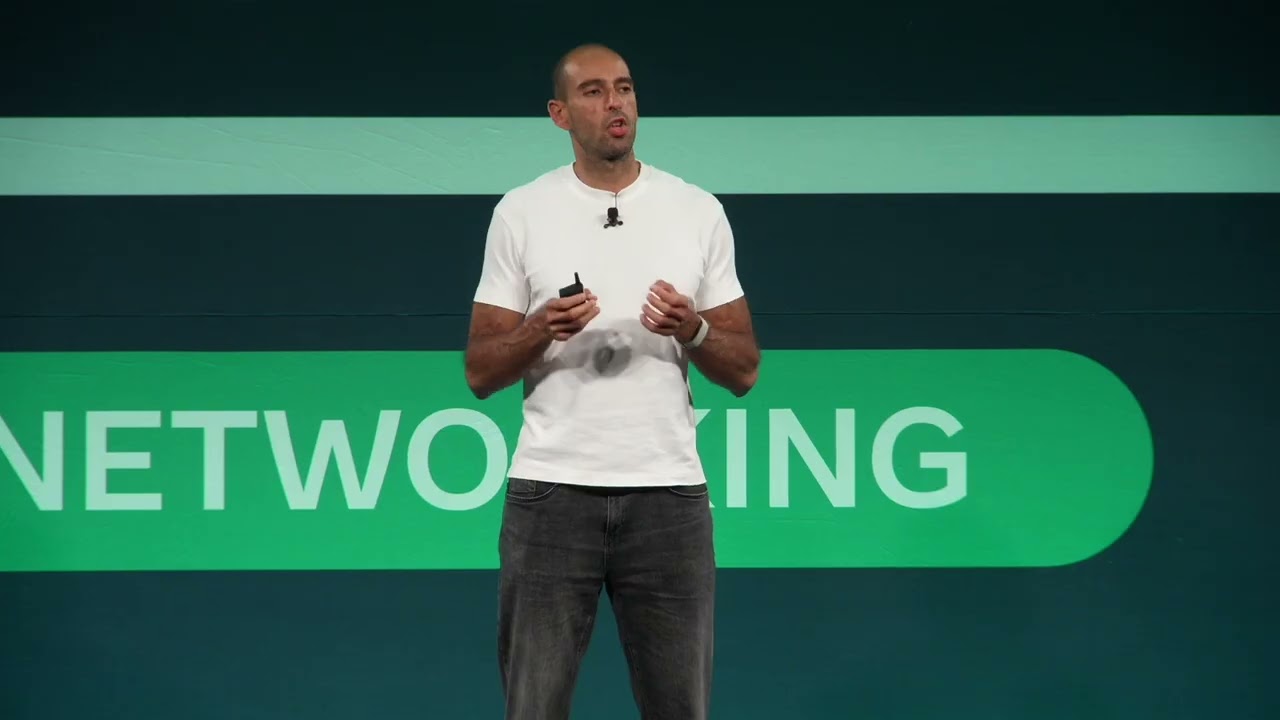
## Background Published by @Scale on YouTube on August 31, 2026, this video features Mohab Gawish presenting his Lightning Talk live from the Santa Clara Convention Center. According to the page description, the talk covers "AI-Native Network Capacity Management," focusing on how integrating AI agents as first-class participants into every stage of the network capacity pipeline acts as a force multiplier to automate tasks and close operational feedback loops.
## TL;DR The presentation explores the transition from network design blueprints to operational physical delivery in modern AI data centers, highlighting the challenge of managing exponential hardware and design variance. Gawish explains how Meta bridges the friction point between unstructured design documents and structured delivery engines by using AI agents. Specifically, AI agents extract routing intent from multi-format design specifications to automatically generate Routing Policy Language (RPL) code for policy compilers. This shift evolves the human engineer's role from a manual translation bottleneck into a high-level supervisor overseeing an autonomous agent fleet.
## Atmosphere & style The presentation carries a focused, technical, and forward-looking tone characteristic of an expert conference lightning talk. Delivered live from the Santa Clara Convention Center, Gawish presents a pragmatic yet ambitious architectural narrative that moves steadily from real-world operational friction to systemic AI integration. The dynamics feel professional, highly structured, and grounded in production realities, conveying a sense of authoritative innovation as it maps out the transition toward self-deploying AI infrastructure.
## Key takeaways - [00:00](https://www.youtube.com/watch?v=gZLP7u501ug&t=0s) The network capacity management lifecycle functions as an interdependent pipeline, where errors in early stages compound downstream into operational fragility. - [00:04](https://www.youtube.com/watch?v=gZLP7u501ug&t=4s) The presentation focuses specifically on the network delivery phase, emphasizing the software-driven activities of configuration and validation over physical rack deployment. - [01:30](https://www.youtube.com/watch?v=gZLP7u501ug&t=90s) Rapid variance in modern AI hardware and GPU demands causes significant design ripple effects across network delivery workflows. - [01:30](https://www.youtube.com/watch?v=gZLP7u501ug&t=90s) Engineering teams adopt a defensive strategy, assuming any design variant can introduce unexpected disruptions to downstream automation. - [01:30](https://www.youtube.com/watch?v=gZLP7u501ug&t=90s) Traditional hardware abstraction models fail to fully capture the complex, multi-format, and unstructured nature of modern design inputs. - [04:24](https://www.youtube.com/watch?v=gZLP7u501ug&t=264s) A major operational friction point has been the manual translation required to convert unstructured design documents (text, diagrams, tables, DB queries) into structured automation inputs. - [04:24](https://www.youtube.com/watch?v=gZLP7u501ug&t=264s) Context-aware AI agents solve this bottleneck by parsing fragmented design sources and generating machine-readable inputs automatically. - [07:16](https://www.youtube.com/watch?v=gZLP7u501ug&t=436s) Meta leverages AI agents to parse unstructured design documentation and directly generate Routing Policy Language (RPL) files. - [07:16](https://www.youtube.com/watch?v=gZLP7u501ug&t=436s) Generated RPL code feeds straight into policy compilers to produce low-level device configurations, creating an end-to-end automated software pipeline. - [09:25](https://www.youtube.com/watch?v=gZLP7u501ug&t=565s) The role of human network engineers is evolving from direct execution bottlenecks into supervisors overseeing fleets of AI agents. - [09:25](https://www.youtube.com/watch?v=gZLP7u501ug&t=565s) Pairing human supervisors with autonomous AI agents enables scaling of network deployment capacity without increasing operational overhead. - [09:25](https://www.youtube.com/watch?v=gZLP7u501ug&t=565s) The AI-native network management vision culminates in next-generation AI physical and digital infrastructure being directly deployed by AI systems.
## Detailed walkthrough ### [00:04](https://www.youtube.com/watch?v=gZLP7u501ug&t=4s) Transitioning from Design Blueprint to Physical Delivery
Mohab Gawish steps up to the stage to present the next critical phase in the AI network management pipeline: the **delivery** phase. Having established the initial plan and design blueprints, the team faces the challenge of translating abstract architecture into a tangible, fully operational network.
``` [Design Phase] ──► Design Blueprint ──► [Delivery Phase] ──► Operational Network │ ▼ Focus: Config & Validation ```
Network delivery encompasses a broad range of physical and software-driven tasks. While the physical side requires rolling racks into data centers, running optical fiber, and setting up physical cabling, the software side focuses on powering up devices, provisioning, configuration, and validation. For this talk, Gawish narrows the focus to **configuration and validation activities**.
- **Phase Objective**: Translate static design blueprints into active, production-ready network deployments. - **Physical Scope**: Rack deployment, fiber laying, cabling, and device powering. - **Software Scope**: Device provisioning, configuration management, and post-deployment validation.
---
[01:30](https://www.youtube.com/watch?v=gZLP7u501ug&t=90s) Managing Exponential Variance and Design Ripple Effects
In modern AI data center infrastructure, constant innovation introduces frequent hardware and demand variants. A single shift in design requirements—such as a new network feature or specialized demands from a new generation of vendor-specific GPUs—causes ripple effects across the entire delivery chain. Engineering teams must adapt configurations, verify that legacy automation pipelines can handle the new specifications, and evaluate the downstream impacts on the ecosystem.
To manage this unpredictable environment, the engineering team operates under a deliberately **defensive assumption**: *any new variant introduced during the design phase has the potential to cause outsized or unexpected disruptions during delivery.*
``` [Design Variant] (e.g., New GPU Demands / Routing Features) │ ▼ (Ripple Effect) [Automation Check] ──► [Ecosystem Impact] ──► [Delivery Complexity] ```
Traditionally, network operations relied on abstraction models to standardize hardware differences across vendors. However, as the velocity and scale of AI hardware iterations accelerate, traditional abstractions alone prove insufficient. Gawish notes that while modeling remains essential, it cannot handle the multi-format, unstructured nature of modern design inputs.
- **Primary Challenge**: Containing and abstracting rapid variance without breaking downstream automation. - **Root Cause of Complexity**: Frequent introduction of new vendor GPUs, routing capabilities, and traffic management rules. - **Operational Stance**: A defensive strategy assuming every upstream design change threatens downstream workflow stability.
---
[04:24](https://www.youtube.com/watch?v=gZLP7u501ug&t=264s) Bridging Unstructured Design Documents and Structured Automation
A primary friction point in network delivery occurs at the interface between human design output and automated software pipelines. A finished design blueprint does not exist as a single structured database; it consists of a fragmented collection of documents containing plain text, architecture diagrams, data tables, database query strings, and cross-referenced documentation.
``` [Unstructured Design Sources] (Text, Diagrams, Tables, DB Queries) │ ▼ [Human Context & Tribal Knowledge] │ ▼ [Structured Input Format] ──► [Delivery Automation Engine] ```
Historically, bridging the gap between unstructured design documents and structured automation required human intervention. Engineers relied on personal experience, context, and tribal knowledge to manually process unstructured design files into structured inputs for the delivery engine. This manual step created a major operational bottleneck in the delivery pipeline.
AI agents change this dynamic by offering human-like judgment, pattern recognition, and long-term context retention. AI models parse multi-format design documents, extract the underlying architectural intent, and generate structured data inputs for automated systems without manual intervention.
- **Design Inputs**: Heterogeneous formats including architectural text, flow diagrams, data tables, and database queries. - **Legacy Bottleneck**: Manual human translation required to turn messy design documents into structured automation inputs. - **AI Solution**: Context-aware AI agents parse unstructured specifications and output machine-readable configurations automatically.
---
[07:16](https://www.youtube.com/watch?v=gZLP7u501ug&t=436s) Automating Routing Policy Language (RPL) Generation
Gawish illustrates this workflow using Meta's approach to network routing. Routing dictates how the network directs packet traffic across internal switches, selects path options, and balances workload loads across available hardware links. At Meta, routing behavior is defined using a high-level configuration format known as **Routing Policy Language (RPL)**.
``` [Unstructured Intent Docs] │ ▼ [AI Agent Fleet] │ ▼ [Structured RPL Document] ──► [Policy Compiler] ──► [Device Configuration Files] ```
In the traditional pipeline, an engineer reviewed region-specific design documents and manually authored the corresponding RPL files. Once created, a specialized **policy compiler** processed the RPL file into low-level configuration files for deployment to network switches.
Meta replaced this manual step with an AI agent. The agent parses design documents, extracts the intended routing parameters, and generates valid RPL code directly. This output feeds directly into the policy compiler, completing a fully machine-driven pipeline from design intake to hardware deployment.
- **Core Technology**: Meta's **RPL (Routing Policy Language)** for defining high-level network traffic patterns. - **Compilation Flow**: High-Level RPL Document $\rightarrow$ Policy Compiler $\rightarrow$ Low-Level Device Configuration. - **AI Integration**: AI agents extract traffic intent from raw design text and automatically output validated RPL code.
---
[09:25](https://www.youtube.com/watch?v=gZLP7u501ug&t=565s) The Shifting Human Role: From Bottleneck to Supervisor
Automating RPL generation reflects a broader trend across infrastructure management: the human role is transitioning from direct execution to supervisory control. Rather than manually translating design requirements into configuration files, engineers now oversee groups of AI agents that handle the translation process automatically.
> "The human role in this whole loop is evolving. It's morphing from one block in a machine in an otherwise end-to-end machine-driven pipeline into more of a supervisor."
``` Legacy Workflow: [Design] ──► [Human Execution (Bottleneck)] ──► [Automation] AI-Native Workflow: [Design] ──► [AI Agent Fleet] ──► [Human Supervisor (Approver)] ──► [Automation] ```
By pairing a single engineer with a fleet of autonomous AI agents, organizations scale network deployment capacity without increasing operational overhead. Humans act as reviewers and final approvers, ensuring overall quality while letting AI manage the mechanical execution steps. Ultimately, this approach fulfills the core mission of the AI-native network vision: **the physical and digital infrastructure powering next-generation AI is now directly built and deployed by AI systems.**
- **Role Shift**: Engineers move from manual data translators to high-level supervisors and approvers. - **Efficiency Gains**: A single human supervisor can oversee multiple parallel autonomous agent workflows. - **Core Vision**: Scaling AI infrastructure through self-deploying, AI-driven automation pipelines.
## Notable quotes > [09:25](https://www.youtube.com/watch?v=gZLP7u501ug&t=565s) The human role in this whole loop is evolving. It's morphing from one block in a machine in an otherwise end-to-end machine-driven pipeline into more of a supervisor. — Mohab Gawish
## Mentioned Mohab Gawish, Meta, Scale, Santa Clara Convention Center, Routing Policy Language (RPL), GPU
[Source](https://www.youtube.com/watch?v=gZLP7u501ug)