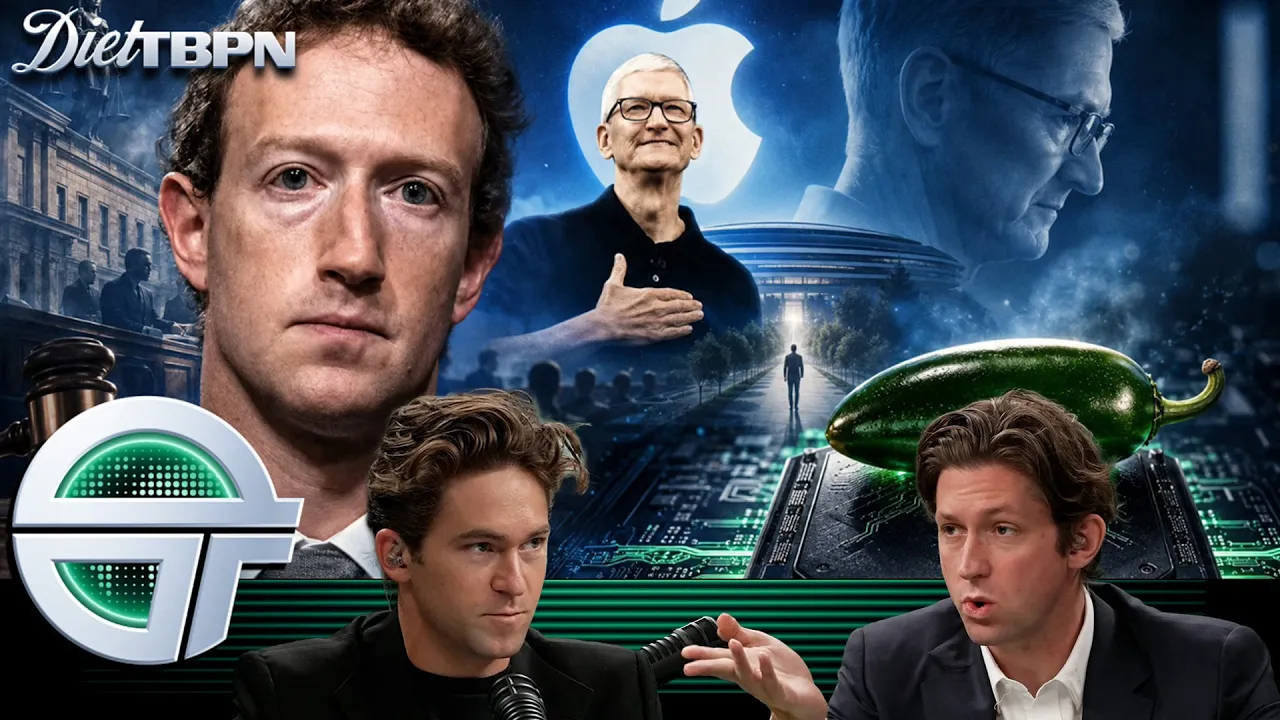
Meta Pays $12.7B to Settle Youth Addiction Lawsuits
TBPN
Meta's $12.7 billion settlement amounts to just 2.4% of its domestic revenue, placing far less financial drag on the tech giant than the 1998 Master Settlement Agreement imposed on Big Tobacco.
## Background
Diet TBPN is a tech commentary show hosted by John Coogan and Jordi Hays, published on YouTube by TBPN on September 1, 2026. According to the page description, the episode delivers a 30-minute condensed breakdown of the day's top technology news, covering Meta's addiction settlement, Tim Cook's exit from Apple, OpenAI's custom hardware, and major venture investments.
## TL;DR
After a two-week break, the hosts analyze Meta's historic $12.7 billion youth addiction settlement, detailing why its financial impact pales in comparison to the 1998 Big Tobacco agreement. The episode tracks Tim Cook's final day as Apple CEO after a 15-year tenure alongside Apple's local M-series AI strategy, then breaks down leaked performance metrics of OpenAI's custom 'Jalapeño' inference chip. Finally, they examine consumer AI startup Instinct's $2.5 billion valuation, highlight regional differences in humanoid robotics from the World Humanoid Robot Games, and review Kevin Durant's 467x return on his early Hugging Face investment.
## Atmosphere & style
The show opens with casual, lighthearted banter as the hosts joke about relapsing into gaming marathons and pizza during their time off before shifting into rapid-fire, expert commentary. The tone is sharp, analytical, and distinctly Silicon Valley—blending quantitative financial breakdowns and technical hardware analysis with sarcastic humor about tech trends and venture capital hype. Listening feels like sitting in on an insider tech debrief that effortlessly balances serious industry metrics with casual banter.
## Key takeaways
- [00:01](https://www.youtube.com/watch?v=JrrgGwnwGV4&t=1s) Meta agreed to a historic $12.7B settlement over 10 years with 48 states, D.C., and territories over youth social media addiction claims.
- [05:12](https://www.youtube.com/watch?v=JrrgGwnwGV4&t=312s) Analysis shows Meta's settlement represents only ~2.4% of domestic revenue without inflation tracking, making it far less financially impactful than the 1998 Big Tobacco Master Settlement Agreement.
- [09:00](https://www.youtube.com/watch?v=JrrgGwnwGV4&t=540s) Meta launched an aggressive PR campaign pushing rivals to adopt mandated teen safeguards, including 2-hour daily limits, night lockouts, and school-hour notification muting.
- [13:00](https://www.youtube.com/watch?v=JrrgGwnwGV4&t=780s) Tim Cook concluded his 15-year tenure as Apple CEO, leaving a legacy defined by operational mastery, supply chain navigation, and massive expansion of Apple Services.
- [13:00](https://www.youtube.com/watch?v=JrrgGwnwGV4&t=780s) As Tim Cook departs, Apple is reallocating resources away from broad Vision Pro teams toward specialized AI hardware development.
- [15:51](https://www.youtube.com/watch?v=JrrgGwnwGV4&t=951s) Apple relies on powerful M-series chips for local on-device AI inference, avoiding massive cloud AI infrastructure spending or costly AI studio acquisitions.
- [19:24](https://www.youtube.com/watch?v=JrrgGwnwGV4&t=1164s) OpenAI's internal inference chip, codenamed Jalapeño, delivers 1.5x–1.9x higher throughput per watt than Nvidia GB200/GB300 systems.
- [19:24](https://www.youtube.com/watch?v=JrrgGwnwGV4&t=1164s) OpenAI partnered with Broadcom to deploy a massive 10-gigawatt AI chip footprint starting in late 2026.
- [22:46](https://www.youtube.com/watch?v=JrrgGwnwGV4&t=1366s) Consumer AI startup Instinct reached a $2.5B valuation in four months, sparking debates over privacy risks and deep access to user data.
- [26:51](https://www.youtube.com/watch?v=JrrgGwnwGV4&t=1611s) Global humanoid robotics development shows clear regional divergence: Chinese firms focus on high-speed kinetic performance while American firms emphasize fine-motor precision for manufacturing.
- [26:51](https://www.youtube.com/watch?v=JrrgGwnwGV4&t=1611s) Kevin Durant achieved a 467x return on his 2017 seed investment in Hugging Face, yielding a $46.7 million payout following Nvidia's acquisition.
Hosts John Coogan and Jordi Hays return after a two-week break, remarking on how long the time away felt—comparing it to two months rather than two weeks. After thanking the Microsoft and Activision teams for sending review codes for *Modern Warfare 4*, the hosts joke about relapsing into gaming marathons, pizza eating, and surfing. This sparks a humorous debate over whether pizza, surfing, or scrolling social media feeds could be scientifically proven as addictive as nicotine in laboratory mice. They react to a viral video of a chimpanzee using Instagram Reels, pointing out that intuitive UI design allows the product to easily cross species barriers.
Turning to serious news, Meta announced a historic settlement with attorneys general representing 48 U.S. states, the District of Columbia, and three U.S. territories over allegations that Facebook and Instagram intentionally harmed children and teens. Under the terms of the deal, Meta will pay $12.7 billion over 10 years, an amount that could rise to $18 billion if other social media platforms elect to join the settlement. While state legislators view this as a massive windfall to fund education and healthcare, Texas and New Mexico were notably the only two states to hold back from signing the agreement.
- **Settlement scope**: Covers 48 states, D.C., and 3 U.S. territories (with Texas and New Mexico holding out).
- **Financial terms**: Meta to pay $12.7B over 10 years, potentially increasing to $18B if peers join.
- **State funding**: Proceeds will be distributed directly to state budgets for education, healthcare, and infrastructure.
---
[00:05](https://www.youtube.com/watch?v=JrrgGwnwGV4&t=5s) Is Meta’s Settlement Really a "Big Tobacco" Moment?
Analysing the deal, the hosts reference a deep-dive by Eric Seufert of *Mobile Dev Memo*, who argues that Meta’s settlement is "no Big Tobacco moment." When the Master Settlement Agreement (MSA) was signed with cigarette manufacturers in 1998, total annual U.S. consumer spending on tobacco stood at roughly $57 billion. Over 25 years, tobacco companies paid an average of $10 billion per year, representing roughly 17.5% of their domestic top-line revenue—a perpetual, inflation-adjusted tax tied to unit sales.
In contrast, Meta’s projected domestic revenue for full-year 2025 is approximately $75 billion. Spread over a decade, its maximum $1.8 billion annual payout represents just 2.4% of domestic revenue. Furthermore, unlike the Big Tobacco MSA, Meta's agreement lacks an inflation-adjustment mechanism or unit-sale tracking, meaning its relative financial drag will shrink over time as the company grows. The hosts note that while $1.8 billion a year sounds large, it amounts to roughly $100 million a month—a fraction of Meta's massive capital expenditure budget for AI infrastructure and GPUs.
- **Tobacco MSA baseline (1998)**: $250B paid over 25 years (~$10B/year), equal to 17.5% of domestic tobacco expenditure ($57B/year).
- **Meta settlement relative size**: $1.8B/year against ~$75B in U.S. revenue equals ~2.4% of domestic revenue (an order of magnitude smaller than Big Tobacco).
- **Financial mechanics**: Meta’s settlement lacks inflation adjustments or sales tracking, diminishing its long-term impact compared to the MSA.
---
[00:09](https://www.youtube.com/watch?v=JrrgGwnwGV4&t=9s) Meta's Public Relations Blitz & Teen Product Restrictions
Following the settlement, reporter Mike Isaac reported that Meta initiated an aggressive public relations campaign aimed at pushing rivals like TikTok, YouTube, and Snapchat to adopt identical product safeguards. Meta booked full-page print advertisements in *The Washington Post*, *The Los Angeles Times*, and *The New York Times*, inviting other tech firms to join them in supporting youth well-being.
The product changes mandated by Meta's agreement introduce strict default settings for teenage accounts: a 2-hour daily time limit, turning off app access at night by default, muting notifications during school hours, issuing continuous screen-time prompts every 15 minutes, and expanding parental supervision controls. While these default settings are powerful, the hosts expect the direct impact on Meta's advertising revenue to be minimal since younger demographics generate far less commercial conversion than older cohorts. However, the hosts emphasize that Meta's primary strategic risk is user loss to unconstrained competitors like TikTok or YouTube, which could capture the long-term attention of younger generations.
- **Mandated teen app features**:
- 2-hour daily screen-time limit.
- Nighttime app lockout by default.
- Notification suppression during school hours.
- Periodic screen-time reminders every 15 minutes.
- Enhanced parental controls.
- **Strategic landscape**: Meta's campaign seeks to enforce an industry-wide standard so competitors cannot win over younger audiences with unrestricted feeds.
---
[13:00](https://www.youtube.com/watch?v=JrrgGwnwGV4&t=780s) Tim Cook’s Final Day as Apple CEO & His 15-Year Legacy
The focus shifts to Apple CEO Tim Cook sending his final memo to employees on his official last day leading the company, writing, "I will miss this work in ways I can only begin to imagine, even as I remain completely at peace with my decision." The hosts reflect on Cook's remarkable 15-year tenure following Steve Jobs, praising his extraordinary operational mastery in navigating geopolitical tensions, managing complex supply chains, and building Apple Services (App Store, subscriptions, advertising) into a high-margin money machine.
The hosts poke fun at Cook's executive compensation packages over the years—joking that top MLB athletes sometimes earned more than the head of the world's most valuable company—while acknowledging his political savvy. A standout accomplishment was managing relationships in Washington without drawing severe political fire or having Apple's global supply network disrupted.
- **Tenure**: 15 years as CEO of Apple following Steve Jobs.
- **Key achievements**: Expanded Apple Services into a multi-billion dollar recurring revenue engine and flawlessly navigated global supply chain and political challenges.
- **Vision Pro shift**: As Cook steps down, Apple is reported to be paring back broader Vision Pro teams—including layoffs across audio engineering, device security, Siri integration, and OS development—to pivot resources toward specialized AI hardware devices.
<ElicitationsGroup message="Explore related topics from this episode:">
<Elicitation label="Summarize Apple's AI hardware shift and the Jalapeño chip" query="Summarize part 2 of this episode covering Apple's AI strategy, OpenAI's Jalapeño chip, and Instinct's valuation."/>
<Elicitation label="Analyze the legal mechanics of the Meta settlement" query="Analyze the legal mechanics and financial comparisons between the Meta social media settlement and the 1998 Tobacco Master Settlement Agreement."/>
</ElicitationsGroup>
[15:51](https://www.youtube.com/watch?v=JrrgGwnwGV4&t=951s) Apple’s AI Strategy and the Charleston AI Franchise Concept
The hosts express strong optimism regarding Apple's upcoming M6 chip, highlighting how its local processing capabilities continue to create a winning AI narrative without forcing the company to engage in traditional AI hyper-spending. Unlike competitors burning billions on data centers or massive AI acquisitions, Apple remains strictly a hardware manufacturer benefiting from "computer use" agents getting faster on powerful consumer devices. The hosts debate whether Apple would ever pull the trigger on acquiring a specialized AI laboratory—a "NeoLab"—noting how a talent-focused acquisition ranging from $500 million to $1 billion felt likely a year ago, but now seems entirely unnecessary for Apple's hardware-centric playbook.
```
┌─────────────────────────────────────────┐
│ Apple’s Hardware-First AI Model │
└────────────────────┬────────────────────┘
│
┌──────────────────────┴──────────────────────┐
▼ ▼
┌───────────────────────────┐ ┌───────────────────────────┐
│ On-Device Inference │ │ Avoid Direct AI Spend │
│ M-Series Chips (M6) │ │ No Data Centers Needed │
│ Computer Use Acceleration│ │ No "NeoLab" Acquisitions │
└───────────────────────────┘ └───────────────────────────┘
```
The conversation pivots humorously to a local startup called **Charleston AI**, which the hosts highlight through a promo clip showing an actual physical store where individuals and local business owners can walk in, sit down in a conference room, and discuss how to implement AI tools. John recounts actually calling Charleston AI and being answered by an AI-generated clone of the founder that sounded identical to him. While acknowledging the comedic nature of the store setup, the hosts argue that a physical "Geek Squad for AI" franchise model actually makes immense commercial sense, offering a welcoming, local environment for AI-curious freelancers and small business owners who feel intimidated by the technology.
- **Geek Squad Acquisition Comparison:** Best Buy acquired Geek Squad in 2002 for $3 million, which the hosts joke equates to around $400 million in today's inflated currency.
- **Charleston AI Value Proposition:** Physical office space, dedicated conference rooms, and hands-on consulting to rapidly deploy custom AI automations for local entrepreneurs.
---
[19:24](https://www.youtube.com/watch?v=JrrgGwnwGV4&t=1164s) OpenAI's Mac Mini Clusters and the "Jalapeño" AI Chip
OpenAI has reportedly purchased tens of thousands of Mac Minis and Mac Studios to build clusters for reinforcement learning and training computer-use agents, while Anthropic rents Mac Minis directly via AWS. Reflecting on personal experimentation with computer-use models over the break, one of the hosts describes setting up Codex to play the PC poker-style game *Balatro*. While slow and unable to clear a full run, it performed impressively—similar to widely circulated demos of AI conquering complex deck-builders like *Slay the Spire*. The hosts note they want to see latency collapse to the point where AI agents can play high-speed competitive shooters like *Call of Duty: Modern Warfare* in real time against human players.
Transitioning to hardware performance, tech analyst Dylan Patel reported that OpenAI's custom internal inference chip, codenamed **Jalapeño**, delivers unprecedented results that leapfrog existing market hardware. Breaking with the industry standard where first-generation silicon lags behind, Jalapeño is outperforming Nvidia's Blackwell and upcoming Rubin architectures in targeted LLM inference efficiency. Designed specifically as a rack-scale data center accelerator for inference rather than model training, the chip achieves 1.5x to 1.9x higher useful inference throughput per watt than Nvidia GB200/GB300 systems while slashing end-to-end latency by 1.7x to 3.6x.
- **Broadcom Partnership Deal:** Covers a massive 10-gigawatt rollout of OpenAI-designed accelerator hardware (across generations) produced in partnership with Broadcom, scheduled to start deploying in the second half of 2026.
- **Compute Scale:** 10 gigawatts represents roughly 5x the total operational compute footprint of OpenAI's entire existing infrastructure.
---
[22:46](https://www.youtube.com/watch?v=JrrgGwnwGV4&t=1366s) Instinct’s $2.5B Valuation and the Always-On AI Companion
The hosts turn their attention to **Instinct**, an ambitious consumer AI startup that recently closed a $350 million funding round at a massive $2.5 billion valuation despite only being in development for roughly four to five months. The core appeal driving this viral momentum is a seamless, "magical" onboarding moment where the assistant autonomously handles high-friction real-world tasks like booking popular restaurant reservations or purchasing event tickets. However, privacy concerns remain significant: Instinct requires deep access to personal communications, saving user data in clear-text databases accessible to the system to operate effectively.
The debate centers on whether Instinct can successfully transition out of the traditional VC hype cycle or if it faces the saturation traps that historically plagued consumer apps like Clubhouse or Superhuman. The hosts explore the philosophical design of AI assistants: should an agent possess total root access to a user's personal iMessage and email, or is it better to maintain an "embodied" digital distance? They discuss the concept of a "Guardian Angel" or "John Doe" proxy—an autonomous agent given its own distinct phone number and email address that acts strictly on delegated read-only access and explicit instructions rather than merging entirely with the user's personal digital identity.
- **Valuation Context:** At $2.5B, four-month-old Instinct is already valued at roughly one-third the market capitalization of Snapchat.
- **Historical VC Benchmark:** In past funding cycles, a top-tier consumer tech startup earning elite venture attention typically secured a "$25M on $150M post-money" deal from Benchmark.
---
[26:51](https://www.youtube.com/watch?v=JrrgGwnwGV4&t=1611s) Humanoid Robot Games, AI M&A Wave, and Kevin Durant’s Bet
A clip from the World Humanoid Robot Games showcases the **KGX1 DAX AI Robotics** rideable "horse-dog," featuring custom high-torque electric joint motors powered by a high-voltage battery pack. While joking that this form factor could serve as a future autonomous land-jet-ski for daily commuting, the hosts also review footage of high-speed robot racing crashes and chaotic structural failures. They highlight a compelling comparison regarding regional robotics focus: Chinese robotics firms prioritize kinetic, high-speed physical performance (fighting, sprinting, dancing), whereas American firms concentrate heavily on precise fine-motor manipulation tailored for factory assembly and industrial manufacturing.
```
┌──────────────────────────────────────────────┐
│ Global AI Robotics Trajectories │
└──────────────────────┬───────────────────────┘
│
┌──────────────────────┴───────────────────────┐
▼ ▼
┌───────────────────────────┐ ┌───────────────────────────┐
│ Chinese Focus │ │ American Focus │
├───────────────────────────┤ ├───────────────────────────┤
│ High-Kinetic Dynamics │ │ Fine-Motor Skill Sets │
│ Sprinting & Martial Arts │ │ Precision Manufacturing │
│ Visual Spectacle / Games │ │ Factory Floor Assembly │
└───────────────────────────┘ └───────────────────────────┘
```
The episode concludes with an overview of an unprecedented wave of consolidation and M&A across the AI landscape, highlighted by investor Samir Kaji's assessment that massive liquidity is on the horizon. High-profile valuations and acquisition numbers are floating across the tech ecosystem, with Cursor eyed around $60 billion, Hugging Face at $15 billion, OpenRouter at $8 billion, and Daycart in the $6 billion to $7 billion range alongside public IPO paths for SpaceX, Anduril, Anthropic, Ramp, OpenAI, and Databricks. Even with stock-heavy deals, large tech incumbents spend ~1% of their market caps to acquire pre-built business lines, validating early seed valuations near $1 billion.
Highlighting this venture boom, NBA star **Kevin Durant** scored a legendary return on his early 2017 investment in Hugging Face prior to its acquisition by Nvidia. Having written a $100,000 seed check and publicly sharing his excitement for the product on social media back in 2017, Durant turned that initial check into an estimated $46.7 million payout—proving his famous 2010 thesis that "investing is better than going to the club."
- **Kevin Durant Investment Return:** 467x return on a $100k seed check into Hugging Face, translating to a $46.7 million payout.
<ElicitationsGroup message="Explore related topics from this episode:">
<Elicitation label="Analyze OpenAI's Jalapeño chip specs" query="Analyze OpenAI's Jalapeño AI chip performance metrics, architecture, and its Broadcom manufacturing partnership."/>
<Elicitation label="Review Apple's M-series AI hardware strategy" query="Explain Apple's M-series chip AI strategy and why they avoid direct spending on cloud AI infrastructure."/>
<Elicitation label="Examine the current wave of AI M&A deals" query="Summarize the latest major AI acquisitions and valuation metrics including Hugging Face, Cursor, and OpenRouter."/>
</ElicitationsGroup>
## Notable quotes
> [13:00](https://www.youtube.com/watch?v=JrrgGwnwGV4&t=780s) I will miss this work in ways I can only begin to imagine, even as I remain completely at peace with my decision. — Tim Cook
> [05:12](https://www.youtube.com/watch?v=JrrgGwnwGV4&t=312s) no Big Tobacco moment — Eric Seufert
> Silicon Valley’s newest obsession
> [26:51](https://www.youtube.com/watch?v=JrrgGwnwGV4&t=1611s) investing is better than going to the club — Kevin Durant
## Mentioned
TBPN, John Coogan, Jordi Hays, Meta, Tim Cook, OpenAI, Jalapeño, Instinct, Kevin Durant, Ramp, Public, Cisco, Console, CrowdStrike, Figma, MongoDB, NYSE, Railway, Shopify, Microsoft, Activision, Modern Warfare 4, Instagram, Instagram Reels, Texas, New Mexico, Eric Seufert, Mobile Dev Memo, Big Tobacco, Mike Isaac, The Washington Post, The Los Angeles Times, The New York Times, TikTok, YouTube, Snapchat, Apple, Steve Jobs, Vision Pro, Siri, Charleston AI, Best Buy, Geek Squad, Anthropic, AWS, Codex, Balatro, Slay the Spire, Call of Duty: Modern Warfare, Dylan Patel, Nvidia, Broadcom, Clubhouse, Superhuman, KGX1 DAX AI Robotics, Samir Kaji, Cursor, Hugging Face, OpenRouter, Daycart, SpaceX, Anduril, Databricks
Meta支付127亿美元和解青少年成瘾诉讼
Meta这笔127亿美元的和解金仅占其国内收入的2.4%,对这家科技巨头造成的财务负担远小于1998年《主和解协议》对大型烟草公司产生的影响。
在休整两周后,主持人在本期节目中分析了Meta创纪录的127亿美元青少年成瘾和解案,详细阐述了为何其财务影响远不如1998年大型烟草公司的和解协议。节目还追踪了Tim Cook在任职15年后作为Apple CEO的最后一天,以及Apple基于M系列芯片的本地AI战略;随后梳理了OpenAI定制“Jalapeño”推理芯片泄露的性能指标。最后,他们探讨了消费级AI初创公司Instinct高达25亿美元的估值,重点指出了世界人形机器人运动会(World Humanoid Robot Games)所展现的地域差异,并回顾了Kevin Durant在早期投资Hugging Face中获得的467倍回报。
Meta 就青少年社交媒体成瘾指控与美国 48 个州、哥伦比亚特区及属地达成 127 亿美元的 10 年期历史性和解,若其他平台加入该金额可能升至 180 亿美元。 (0:01)
分析显示 Meta 每年 18 亿美元的赔付仅占其国内营收约 2.4%,且缺乏通胀调节机制,财务冲击远低于 1998 年烟草行业和解协议(MSA);Meta 随后发起公关宣传,敦促对手跟进防沉迷措施。 (5:12)
蒂姆·库克(Tim Cook)结束了长达 15 年的苹果 CEO 生涯,随着他的离任,苹果正在削减 Vision Pro 团队规模,并将资源重新转向专用 AI 硬件研发。 (13:00)
苹果继续坚持依托 M 系列芯片发展端侧 AI 推理,避开自建云端 AI 基础设施和高成本收购;与此同时,OpenAI 和 Anthropic 正部署大量 Mac 迷你集群用于强化学习与智能体训练。 (15:51)
OpenAI 代号为 Jalapeño 的自研推理芯片表现亮眼,每瓦推理吞吐量较 Nvidia GB200/GB300 系统提升 1.5 至 1.9 倍,并已携手博通规划于 2026 年底开始部署 10 吉瓦级 AI 芯片网络。 (19:24)
Reading summary
TBPN reviews Meta’s $12.7 billion youth safety settlement and its comparatively light financial impact relative to historical corporate accords, alongside Apple's post-Tim Cook pivot toward local AI hardware and OpenAI's emergence as a custom silicon developer.
Meta Settlement Mechanics and Competitive Youth Safeguards (0:01)
Meta agreed to pay $12.7 billion over 10 years—potentially rising to $18 billion if peer platforms join—to resolve claims across 48 states, the District of Columbia, and three territories that Facebook and Instagram harmed minors, with Texas and New Mexico holding out. Despite comparisons to the 1998 Big Tobacco Master Settlement Agreement (MSA), analyst Eric Seufert of Mobile Dev Memo notes that Meta’s maximum annual payout of $1.8 billion represents roughly 2.4% of its projected $75 billion domestic 2025 revenue, compared to the tobacco industry paying 17.5% of domestic sales over 25 years. Without unit-sale tracking or inflation adjustments, the financial drag of the deal will diminish over time, amounting to a small fraction of Meta's capital expenditure for AI infrastructure.
Following the agreement, Meta launched a public relations campaign in major newspapers urging competitors like TikTok, YouTube, and Snapchat to adopt identical safeguards. The settlement mandates strict default settings for teens, including a two-hour daily screen-time cap, nighttime app lockouts, notification silencing during school hours, and 15-minute reminders. While teen accounts contribute little direct advertising revenue, the hosts emphasize that Meta's core strategic vulnerability is the risk of losing youth market share to unconstrained rival platforms.
Apple’s Executive Transition and On-Device Hardware Focus (13:00)
Tim Cook issued his final memo to employees after 15 years leading Apple, marking the end of a tenure defined by global supply chain management, political maneuvering in Washington, and transforming Apple Services into a high-margin recurring revenue engine. Concurrently, Apple is reducing headcount across Vision Pro engineering teams—spanning audio, device security, Siri integration, and OS development—to redirect resources toward specialized AI hardware.
Unlike tech peers committing massive capital expenditures to cloud data centers or pursuing $500 million to $1 billion acquisitions of dedicated AI research labs, Apple is leaning on its silicon advantages. The hosts highlight that processors like the upcoming M6 allow Apple to benefit from local 'computer use' agent inference directly on consumer devices without hyper-spending on infrastructure. This pragmatic, accessible deployment model is reflected commercially by emerging concepts like Charleston AI, a physical walk-in consulting storefront helping local businesses set up practical automations.
OpenAI’s Jalapeño Accelerator and Mac Infrastructure Clusters (19:24)
Tech analyst Dylan Patel reports that OpenAI has developed a custom internal inference chip codenamed Jalapeño that outperforms current market alternatives. Tailored for rack-scale data center inference rather than model training, Jalapeño reportedly achieves 1.5x to 1.9x higher useful throughput per watt than Nvidia's GB200 and GB300 architectures while cutting end-to-end latency by 1.7x to 3.6x. In partnership with Broadcom, OpenAI plans to deploy 10 gigawatts of custom accelerator capacity starting in late 2026 through 2029, a scale representing roughly five times its current operational compute footprint.
In parallel, major AI labs are using clustered consumer hardware to train reinforcement learning and computer-use models. OpenAI has acquired tens of thousands of Mac Minis and Mac Studios for agent training, while Anthropic rents Mac Mini capacity directly through AWS. As experimental computer-use agents tackle complex, UI-driven tasks like strategy games, developers are prioritizing latency reduction to enable real-time interaction in competitive, fast-paced environments.
Consumer Agent Architecture and AI Consolidation Waves (22:46)
Consumer AI startup Instinct secured a $350 million funding round at a $2.5 billion valuation within four to five months of development, driven by automated execution of high-friction tasks like reservation booking. However, the system's reliance on storing clear-text communications has raised data privacy concerns. The hosts question whether agents should possess root access to personal communications or instead operate as distinct 'Guardian Angel' proxy personas with dedicated contact details and strictly delegated read-only access.
This capital intensity is mirrored across the broader ecosystem. Investor Samir Kaji projects substantial liquidity ahead, citing lofty valuations including Hugging Face at $15 billion and Cursor at $60 billion, alongside anticipated public offerings for firms such as SpaceX, Anduril, Anthropic, Ramp, and OpenAI. Demonstrating the magnitude of early-stage venture windfalls, NBA player Kevin Durant realized an estimated $46.7 million payout on a $100,000 seed check written into Hugging Face in 2017 prior to its acquisition by Nvidia, representing a 467x return.
The program underscores a widening divergence in AI strategies: while hyperscalers push into multi-gigawatt custom silicon and massive venture rounds, consumer adoption still hinges on resolving basic privacy trade-offs and navigating device-level execution.
## Background
该视频由科技脱口秀频道 TBPN 于 2026 年 9 月 1 日发布在 YouTube 平台,属于其 30 分钟精简版节目《Diet TBPN》,由 John Coogan 与 Jordi Hays 共同主持。节目简介将其描述为被《纽约时报》誉为“硅谷新执念”的每日科技对谈节目,本期精选集中聚焦了 Meta 青少年成瘾诉讼和解、蒂姆·库克卸任苹果 CEO、OpenAI 自研芯片 Jalapeño 以及当下火热的 AI 投融资动态。
## TL;DR
节目首先深入分析了 Meta 针对青少年社交成瘾达成的 127 亿美元巨额和解协议,指出其年均支出仅占美国营收的 2.4%,影响远不及当年的烟草大和解,并剖析了 Meta 试图拉竞品下水的公关策略与注意力外溢风险。接着探讨了蒂姆·库克执掌苹果 15 年后卸任的政商遗产,以及苹果收缩 Vision Pro 团队转向端侧 AI 硬件与线下服务试验的战略调整。随后,主持人详述了 OpenAI 采购 Mac mini 训练智能体以及其与博通合作的自研低延迟推理芯片 Jalapeño,并审视了 4 个月估值飙至 25 亿美元的 AI 助理 Instinct 的隐私边界。最后,节目点评了世界机器人大赛中的中美技术路线分歧、未上市独角兽估值暴涨对 VC 承销逻辑的重塑,以及球星杜兰特投资 Hugging Face 斩获 467 倍收益的神话。
## Atmosphere & style
整场节目节奏飞快、对话极富信息密度且充斥着硅谷从业者特有的辛辣幽默与内行黑话。两位主持人在休假归来后展现出绝佳的默契与充沛的表达欲,从黑猩猩熟练刷短视频的荒诞现象,一路行云流水地切入万亿巨头的并购算盘与能耗账单。听感上既有对芯片跑分、机器人极限竞速和巨额资本回报的前沿兴奋,也始终贯穿着对估值泡沫、巨头公关洗白套路以及用户核心隐私出卖的清醒审视与冷嘲热讽。
## Bulletin
- [01:44](https://www.youtube.com/watch?v=JrrgGwnwGV4&t=104s) Meta 与全美 48 个州及领地达成最高达 180 亿美元(基础 127 亿美元)的青少年成瘾诉讼和解,但年均赔偿仅占其本土营收的 2.4%,影响远不及 1998 年烟草业 MSA 协议。
- [13:00](https://www.youtube.com/watch?v=JrrgGwnwGV4&t=780s) 蒂姆·库克向全员发送备忘录正式卸任苹果 CEO,结束长达 15 年的掌舵生涯;苹果随后削减 Vision Pro 团队资源,将重心全盘转向端侧 AI 与 M6 芯片。
- [20:24](https://www.youtube.com/watch?v=JrrgGwnwGV4&t=1224s) OpenAI 自研推理 ASIC 芯片“Jalapeño”曝光,其每瓦吞吐提升最高 1.9 倍,并与博通敲定至 2029 年部署高达 10 吉瓦(10 GW)的算力协议。
- [29:10](https://www.youtube.com/watch?v=JrrgGwnwGV4&t=1750s) 万亿美元科技巨头激进的十角兽级别收购重塑了风投承销逻辑,而 NBA 球星杜兰特凭借 2017 年投资 Hugging Face 种子轮斩获 467 倍超额回报。
## Key takeaways
- [01:44](https://www.youtube.com/watch?v=JrrgGwnwGV4&t=104s) Meta 达成巨额青少年社交成瘾和解,未来十年向各州支付 127 亿至 180 亿美元,但缺乏通胀调整与销量挂钩机制,财务烈度远低于 1998 年烟草大和解。
- [05:12](https://www.youtube.com/watch?v=JrrgGwnwGV4&t=312s) Meta 的年均赔付金额折合每月仅约 1.5 亿美元,在当前庞大的 AI 算力采购和技术资本开支面前影响微乎其微。
- [09:28](https://www.youtube.com/watch?v=JrrgGwnwGV4&t=568s) Meta 采用公关策略呼吁行业共同落地青少年限制,其真正商业风险并非短期广告受挫,而是防范年轻用户注意力外溢至 TikTok 或 YouTube 等无限制平台。
- [13:00](https://www.youtube.com/watch?v=JrrgGwnwGV4&t=780s) 库克卸任苹果 CEO 标志着一个时代的落幕,其历史功绩在于卓越的供应链管理、将服务业务打造成高利润印钞机以及高超的政商博弈手腕。
- [16:00](https://www.youtube.com/watch?v=JrrgGwnwGV4&t=960s) 苹果收缩 Vision Pro 团队并重组技术线,押注 M6 芯片的本地计算性能,试图在不依赖自建庞大数据中心的情况下依靠硬件终端主导 AI 时代。
- [16:00](https://www.youtube.com/watch?v=JrrgGwnwGV4&t=960s) Charleston AI 等实体 AI 实验室展示出面向大众与中小企业的线下咨询价值,具备复制昔日百思买 Geek Squad 特许经营模式的商业化潜力。
- [19:26](https://www.youtube.com/watch?v=JrrgGwnwGV4&t=1166s) OpenAI 采购数万台 Mac mini 用于强化学习与 Computer Use 智能体训练,推动 AI 直接操作图形界面的能力演进。
- [20:24](https://www.youtube.com/watch?v=JrrgGwnwGV4&t=1224s) OpenAI 首款自研专用推理芯片 Jalapeño 能效与延迟表现超越英伟达同级系统,计划于 2026 年下半年量产并部署 10 GW 级规模。
- [22:46](https://www.youtube.com/watch?v=JrrgGwnwGV4&t=1366s) AI 助手初创企业 Instinct 成立四个月估值达 25 亿美元,但全天候读取个人核心数据的隐私权限要求引发了产品安全隐忧与行业争议。
- [26:51](https://www.youtube.com/watch?v=JrrgGwnwGV4&t=1611s) 中美机器人研发呈现路径分化:中国团队擅长展现高动能与极致动态性能,而美国团队更聚焦于工厂环境下的高精细零部件装配与抓取。
- [29:10](https://www.youtube.com/watch?v=JrrgGwnwGV4&t=1750s) 随着头部独角兽估值屡破百亿美元及重磅 IPO 推进,万亿美元巨头动用 1% 市值进行大宗并购的趋势倒推了早期风投的高估值合理性。
- [30:17](https://www.youtube.com/watch?v=JrrgGwnwGV4&t=1817s) 凯文·杜兰特 2017 年对 Hugging Face 的 10 万美元种子轮投资随英伟达收购获得 467 倍超高退出回报,凸显了长期科技投资的前瞻价值。
## Detailed walkthrough
### [00:01](https://www.youtube.com/watch?v=JrrgGwnwGV4&t=1s) 节目回归与“成瘾性”闲聊:从《现代战争》、披萨到刷 Reels 的黑猩猩
休播两周后节目正式回归。两位主持人感叹两周的假期漫长得不可思议,感觉像是过了两个月,戏称他们“操控了时间”,甚至无法理解孩子们怎么能连续放假几个星期甚至几个月。休假期间,微软和动视团队给他们寄送了《使命召唤:现代战争 4》(Modern Warfare 4)的游戏兑换码,评测体验非常出色、打磨极佳。聊到休假是否会导致游戏“旧瘾复发”时,主持人调侃称自己虽然没有从早到晚打游戏,但确实陷入了另一种“复发”——狂吃披萨(有时一天吃两次)以及疯狂冲浪。
这引发了一场关于“成瘾性”的轻松讨论。主持人探讨披萨是否具有成瘾性、未来是否也会面临诉讼与和解。他们对比了香烟与普通消费品:尼古丁的成瘾性早已被科学严密证实,在小鼠实验中只要摄入尼古丁就会不断主动索取,完全是生化层面的机制。相比之下,披萨、冲浪甚至社交媒体此前更偏向心理依赖。过去人们常质疑社交媒体是否真能像化学物质一样让人上瘾,但现场展示的一段视频打破了疑虑:一只黑猩猩正极其自然、熟练地在手机上刷着 Instagram Reels 短视频,算法甚至还精准地为它推荐其他猴子的视频。主持人开玩笑称,这证明了产品 UI/UX 设计得过于优秀,连灵长类动物都能无障碍沉浸其中,甚至跨越了物种界限。
- 微软与动视向节目组赠送《现代战争 4》代码,游戏体验获得高度好评。
- 主持人调侃披萨和冲浪在个人体验上也具备类似尼古丁的“绝对成瘾性”。
- 现场展示黑猩猩自然流畅刷 Instagram Reels 短视频,印证了推荐算法与触屏交互跨物种的强大吸引力。
---
### [01:44](https://www.youtube.com/watch?v=JrrgGwnwGV4&t=104s) Meta 达成 127 亿美元青少年社交成瘾巨额和解
关于社交媒体成瘾的诉讼终于迎来了标志性时刻。过去业内普遍认为社交媒体由于不具备化学成瘾性、且涉及言论自由与多重社会效益,很难达成超级巨额和解,顶多是各地分散的小额索赔。然而,Meta 正式宣布与全美各州达成重磅和解方案。该协议由代表 48 个州、华盛顿特区以及 3 个美国领地的总检察长联合达成,仅有得克萨斯州和新墨西哥州两个州未加入,诉讼指控 Facebook 和 Instagram 的产品机制对儿童及青少年的身心健康造成实质伤害。
这项和解涉及庞大的资金规模:Meta 同意在未来 10 年内向各州支付 127 亿美元;如果有其他社交平台后续加入该和解框架,总金额最高可升至 180 亿美元。这笔资金将直接分配给各州政府,用于州内的公共教育、医疗等各项财政预算。对于各州议员和立法机构而言,这无疑是一笔巨大的财政进账。
- 和解覆盖范围:全美 48 个州、哥伦比亚特区(华盛顿特区)及 3 个美属领地,仅得克萨斯州与新墨西哥州暂未加入。
- 和解核心金额:Meta 将在 10 年内支付 127 亿美元基础赔偿;若其他平台加入,总额上限可达 180 亿美元。
- 指控核心:Meta 旗下产品(Facebook 与 Instagram)故意设计成瘾机制,损害青少年和儿童的心理与身体健康。
---
### [05:12](https://www.youtube.com/watch?v=JrrgGwnwGV4&t=312s) 对标烟草业 MSA 协议:为何 Meta 的和解金只是“九牛一毛”
外界普遍将 Meta 此次和解与 1998 年烟草行业的《大和解协议》(Master Settlement Agreement, MSA)相提并论,因为那是历史上针对“成瘾危害”由企业向全美各州支付数百亿美元的先例。但分析机构 Mobile Dev Memo 的知名分析师 Eric Seufert 指出,“Meta 的和解绝非大烟草时刻”,两者的经济烈度存在量级差异。根据美国农业部(USDA)引用的劳工统计局(BLS)数据,1998 年烟草业签署 MSA 时,美国消费者全年的烟草总支出约为 570 亿美元;而烟草行业在 25 年内累计支付的约 2500 亿美元,折合每年约 100 亿美元,相当于当年全美烟草总营收的 17.5%。更重要的是,烟草协议是按每包售出烟草直接抽成,且包含通胀调整机制。
反观 Meta,其 2025 财年 10-K 年报显示的美国本土营收约为 750 亿美元。按照最高 180 亿美元、分 10 年支付来算,Meta 平均每年只需承担 18 亿美元,仅占其美国本土营收的 2.4%(若按全球数千亿美元营收计算,占比更是微乎其微)。此外,Meta 的协议没有绑定通胀调整机制,也没有按用户或使用量动态缩放。若未来十年 Meta 营收翻倍或美国经历高通胀,每年 18 亿美元的固定支出对 Meta 的财务影响将被进一步稀释。
主持人还从当下人工智能资本开支(AI Capex)的视角进行讽刺性对比:每年 18 亿美元折合每月仅 1.5 亿美元左右,这与扎克伯格每个月采购英伟达 GPU 或支撑 AI 算力的大规模开销相比,甚至只够付他们一个月的“Token 账单”。
```mermaid
flowchart LR
accTitle: 烟草 MSA 协议与 Meta 社交成瘾和解对比
accDescr: 对比 1998 年烟草业 MSA 协议与 Meta 本次和解在年均支出占本土营收比例上的巨大差异
subgraph Tobacco["1998 年烟草大和解 (MSA)"]
T_Rev["全美烟草年营收\n~$570 亿"]
T_Pay["年均赔付\n~$100 亿"]
T_Ratio["营收占比\n17.5%(按包计费/抗通胀)"]
T_Rev --> T_Pay --> T_Ratio
end
subgraph Meta["Meta 2026 年社交成瘾和解"]
M_Rev["美国本土年营收\n~$750 亿"]
M_Pay["年均赔付\n~$18 亿 (分10年)"]
M_Ratio["营收占比\n仅 2.4%(固定金额/无通胀调节)"]
M_Rev --> M_Pay --> M_Ratio
end
```
- 烟草行业 MSA 赔偿比例:年均支付约 100 亿美元,占 1998 年全美烟草营收的 17.5%,且具备通货膨胀自动调节与单位销量挂钩机制。
- Meta 和解赔偿比例:年均支付约 18 亿美元,仅占其 750 亿美元美国本土营收的 2.4%,两者相差近一个数量级。
- 财务冲击对比:1.8 亿美元/月的支出在 Meta 庞大的 AI 算力采购和技术开销面前无足轻重,被调侃为“扎克伯格本想把这笔钱直接交给黄仁勋(Jensen Huang)买算力”。
### [09:28](https://www.youtube.com/watch?v=JrrgGwnwGV4&t=568s) Meta 达成成瘾诉讼和解与其公关公报应对
围绕 Meta 的巨额社交媒体成瘾和解协议,主持人讨论了其对公司的财务与战略影响。尽管和解金额高达数十亿美元(对话中提及近 170 亿美元),但从整体体量来看,对 Meta 庞大的支出预算而言影响有限,不过在支出高于收入的时期,这笔罚款确实让人感到肉痛。科技记者 Mike Isaac 报道指出,Meta 正全力以赴推行一项公关策略:拉其他社交媒体平台下水,要求它们也对应用增加同样的限制措施。为此,Meta 计划在《华盛顿邮报》(The Washington Post)、《洛杉矶时报》(Los Angeles Times)以及 Mike Isaac 供职的《纽约时报》(The New York Times)刊登整版平面广告。主持人调侃这算不算是给自家记者的报纸送业务的隐形循环交易。
针对 Meta 这一手“公关操作”,两位主持人犀利评价其为“堪称绝妙的公关洗白(chef's kiss)”——先是因导致青少年沉迷产品而被罚巨款,转头却发起公开信倡议其他社交媒体平台“与我们一起支持青少年”。根据和解协议与公开信,Meta 承诺并呼吁行业落地一系列保护举措:
```mermaid
flowchart TD
accTitle: Meta 青少年保护与限制措施架构
accDescr: 展示 Meta 在和解协议中针对青少年用户设定的五大核心限制
subgraph Limitations ["青少年默认限制策略"]
A["每日 2 小时使用上限"]
B["夜间默认关闭访问权限"]
C["上课时间禁用通知推送"]
D["连续使用 15 分钟触发提醒"]
E["强化家长监管与控制工具"]
end
```
主持人指出,默认设置(defaults)的力量极其强大,哪怕部分有熬夜折腾新账号创作需求的青少年能让家长放宽限制,大部分用户依然会被框在默认规则里。从直接商业利益来看,青少年由于缺乏汽车等大宗商品的消费能力,对 Meta 的短期广告变现贡献微乎其微,核心购买力仍掌握在千禧一代、X 世代和婴儿潮一代手中。然而,潜在的长期隐患在于注意力的外溢——一旦在 Instagram 上用满了 2 小时配额,青少年可能会把多出来的 1 到 2 小时注意力转移到没有这些限制的 TikTok 或 YouTube 上。如果竞品借机抢占新一代年轻人的心智并形成终身使用习惯,Meta 就会丧失整整一代用户,这正是当年 Instagram 威胁 Facebook、Snapchat 崛起时 Meta 极力防范并最终靠收购或像素级抄袭化解的生存危机。值得玩味的是,Meta 的公开倡议信中并未提及 Snapchat,被主持人戏称为一次微妙的暗讽。
- Meta 和解条款中的青少年机制包括:每日 2 小时上限、夜间默认禁用、上课时间禁发通知、连续亮屏 15 分钟提示,以及更全面的家长控制。
- 核心风险并非短期广告收入受挫,而是防范年轻用户因限时而转移至 TikTok 或 YouTube 等无限制平台,形成不可逆的长期用户流失。
---
### [13:00](https://www.youtube.com/watch?v=JrrgGwnwGV4&t=780s) 库克卸任苹果 CEO:十五年传奇遗产与政治手腕
话题转向科技界的一颗重磅炸弹:蒂姆·库克(Tim Cook)向苹果全体员工发送了卸任 CEO 最后一天的告别备忘录。库克在信中写道,自己对这一决定内心平静,但“将以难以想象的方式思念这份工作”。主持人感叹库克是个不折不扣的工作狂,原以为他能像沃伦·巴菲特(Warren Buffett)和查理·芒格(Charlie Munger)那样干到 90 多岁,没想到 15 年后便选择退场。两人随即开启了反讽与幽默的调侃:库克卸任或许是因为“薪酬太低”——堂堂历史顶级商业巨擘的掌门人,年薪才刚过 7400 万美元,竟然和美国职业棒球大联盟(MLB)的顶尖球星挣得差不多,库克显然是用脚投票了。
回归严肃评价,主持人高度肯定了库克无可替代的历史功绩。虽然外界常抱怨库克时代缺乏革命性的硬件形态(如 Vision Pro 并未复制 iPhone 级别的爆款成功,很多核心硬件底色仍来自史蒂夫·乔布斯时代),但库克一手将苹果服务业务打造为无可匹敌的印钞机,更重要的是他在政商博弈中的绝佳手腕:
- **地缘与政治驾驭力**:在长达十余年极度动荡的政治风暴与华盛顿纷争中,库克游刃有余地穿梭其中。唐纳德·特朗普(Donald Trump)惯于给政商对手起难听的绰号,却从未把蒂姆·库克叫作“蒂姆·小偷(Tim Crook)”,足见其沟通与公关艺术的高超。
- **供应链韧性**:在全球供应链面临各种潜在打击和关税挑战的情况下,库克保证了苹果机器的高效运转,让公司始终全速前行。
---
### [16:00](https://www.youtube.com/watch?v=JrrgGwnwGV4&t=960s) 苹果 AI 战略、Vision Pro 裁员与线下落地服务(Charleston AI)
库克离职之际,苹果正在经历战略重心的大幅调整。最新的裁员潮波及了 Vision Pro 团队的多条技术线,不仅包含原有的视频和游戏部门,还延伸至设备安全、音频工程、Siri 整合、测试以及操作系统等广泛岗位。苹果正将全部精力转移至 AI 设备领域。市场对即将到来的 Mac M6 芯片寄予厚望,认为其强大性能将天然适配本地 AI 计算,从而让苹果在没有像其他大厂那样狂掷数十亿采购 Neolab 算力实验室或自建庞大数据中心的情况下,依靠硬件终局通吃。
谈及外界对苹果为何不收购新型 AI 实验室(Neolab)的疑惑,主持人指出苹果骨子里始终是一家硬件公司,硬件优势在 AI 自动化操作电脑(Computer Use)的时代只会更加坚挺。话题随后转到了一个接地气的对照样本——Charleston AI:
- **Charleston AI 模式**:这是一家位于南卡罗来纳州查尔斯顿的本地化实体 AI 实验室,口号是“帮助人类用 AI 帮助人类”。他们拥有临街办公室和会议室,专门面向当地小企业、自由职业者和教师等群体,提供面对面咨询,承接以前需要数月才能完成的定制化业务。
- **AI 前台接电体验**:主持人拨打 Charleston AI 的官方电话时,接电话的并非创始人本人,而是用其声音克隆的 AI 语音助理,拟真度极高,令人印象深刻。
- **商业化潜力**:主持人看好这种本地线下实体店模式,认为面对复杂且令人望而生畏的前沿 AI 技术,普通大众和小商户极度需要一个能亲自走进去、与真人交流答疑的场所。这种模式完全可以像百思买(Best Buy)当年收购并运营“极客帮(Geek Squad)”那样,打造成面向全球快速扩张的特许经营连锁业务。
### [18:50](https://www.youtube.com/watch?v=JrrgGwnwGV4&t=1130s) 极客救助队的历史收购与移动数据中心遐想
主持人回顾了一则科技收购旧事:百思买收购极客救助队(Geek Squad)究竟花了多少钱?现场查证发现,在 2002 年这笔收购仅仅花费了 300 万美元。面对如此低廉的数字,大家打趣称这在当年可是一笔巨款,“相当于今天的 4 亿美元,毕竟那会儿泰勒都还没出生呢”。
由此大家联想到如果把类似服务与现代技术结合,做成一个“装在轮子上的 Charleston AI”或者可以开到客户家门前提供本地算力支持的移动数据中心,倒是一个颇具复古极客风格的有趣构想。
### [19:26](https://www.youtube.com/watch?v=JrrgGwnwGV4&t=1166s) OpenAI 的 Mac mini 大军与“电脑使用”智能体
根据 The Information 的报道,OpenAI 被曝购入了数万台 Mac mini 和 Mac Studio,专门用于强化学习(RL)以及训练能够操作电脑界面的“电脑使用(Computer Use)”智能体。与此形成对比的是,Anthropic 则选择直接通过 AWS 租用 Mac mini 实例——这甚至让主持人都感到意外,此前并不知道 AWS 还提供 Mac mini 租赁服务。
谈到让 AI 操作电脑的实际体验,主持人分享了自己假期的试玩经历。他尝试用搭载 Codex / ChatGPT 的电脑操作智能体去玩 PC 上的热门扑克构筑游戏《小丑牌》(Balatro),虽然模型表现尚可,但运行速度依然偏慢,最终也没能完全打通通关。不过,此前社区中演示的 AI 成功通关高难度卡牌游戏《杀戮尖塔》(Slay the Spire)则令人印象深刻。主持人表示,目前这类游戏智能体最需要攻克的痛点是降低延迟;他非常期待 AI 能够快速到可以流畅对战《使命召唤:现代战争》(Modern Warfare)的程度,从而来一场人类与 AI 之间的正面枪战较量。
### [20:24](https://www.youtube.com/watch?v=JrrgGwnwGV4&t=1224s) OpenAI 杀手级自研芯片“墨西哥辣椒”曝光
SemiAnalysis 知名分析师迪伦·帕特尔(Dylan Patel)爆料称,OpenAI 自研的首款专用芯片“墨西哥辣椒”(Jalapeño)表现极为火辣惊艳。行业通常认为第一代自研芯片往往缺乏竞争力,但 OpenAI 甚至已经展示出了超越英伟达 Blackwell 架构乃至下一代 Rubin 架构的强劲指标。分析师得以进入 OpenAI 实验室深入剖析该芯片的软硬件架构与真实跑分。
OpenAI 随后发布了官方技术博文厘清细节:Jalapeño 是一颗专门针对大语言模型推理优化的专用 ASIC,并非设计用于模型训练,但其实测能效极具压倒性。它是专为数据中心机架级规模设计的系统,虽然大家渴望未来能在消费级设备中看到微缩版本,但当务之急仍是机房的大规模落地部署。更令人震撼的是其背后的博通(Broadcom)代工与合作规模:
```mermaid
flowchart TD
accTitle: OpenAI 自研芯片 Jalapeño 与英伟达对比及算力扩建
accDescr: 展示 Jalapeño 芯片相比英伟达系统的吞吐能效与延迟优势,以及博通 10GW 合作规模
subgraph Benchmark["Jalapeño vs 英伟达 GB200 / GB300"]
direction LR
A["每瓦推理吞吐量<br>提升 1.5 - 1.9 倍"]
B["端到端推理延迟<br>降低 1.7 - 3.6 倍"]
end
subgraph Expansion["博通合作与扩容计划 (2026-2029)"]
direction TB
C["博通代工 OpenAI 设计加速器"]
D["2026 下半年正式投入量产投产"]
E["至 2029 年部署总规模达 10 吉瓦 (GW)"]
C --> D --> E
end
Benchmark -.-> Expansion
```
- **推理吞吐优势**:在每瓦有效推理吞吐量(throughput per watt)上,比英伟达 GB200 和 GB300 系统高出约 1.5 到 1.9 倍。
- **超低端到端延迟**:将端到端延迟显著削减了 1.7 到 3.6 倍。
- **10 吉瓦算力体量**:OpenAI 与博通敲定了高达 10 吉瓦(10 GW)的自研加速器部署协议,相当于 OpenAI 当前全公司运行总算力的约 5 倍之多。
- **投产周期神速**:该芯片预计在 2026 年下半年就将正式上线投产。这打破了传统芯片往往需要长达数年漫长研发周期的行业惯例,不仅将大幅节约能耗与数据中心开销,也将直接拉高毛利率。
### [22:46](https://www.youtube.com/watch?v=JrrgGwnwGV4&t=1366s) Instinct 估值飙至 25 亿美元与全天候 AI 助理的隐忧
聊天室观众提到了近期火爆的初创公司 Instinct:该公司仅成立了四五个月左右,便以 25 亿美元的惊人估值完成了 3.5 亿美元的巨额融资。这种在短短数月内斩获海量关注并完成火箭式融资的现象引发了广泛讨论。虽然用户在获得餐厅订位或抢购电影票等“魔法时刻”时反响热烈,但主持人表示自己仍不敢亲自体验,原因在于极其严苛的数据权限条款——为了实现全天候助理功能,用户几乎必须把个人邮箱、短信等全部核心隐私拱手相让,数据甚至近乎以明文形式储存在其数据库内。
这种爆火也让投资人联想到昔日的消费级科技风向标。过去像 Benchmark 领投这类消费级新星,估值通常也就“投 2500 万美元、估值 1.5 亿美元”,如今仅四个月大的产品估值已相当于 Snapchat 的三分之一。风投界存在一个经典魔咒:往往 VC 圈越是狂热吹捧的个人消费品类(如当年的 Clubhouse 或 Superhuman),在大众市场的真正扩张可行性就越存疑。
对于 AI 助理的产品形态,主持人延伸讨论了萨姆·奥特曼(Sam Altman)曾撰写的文章《融合》(The Merge):
- **完全融合还是保持距离**:未来的 AI 助手究竟是应该彻底读取个人的 iMessage 和私人邮箱充当数字分身,还是应该拥有一台独立的手机号和独立邮箱作为“外置助手”?
- **代办任务的实体隔离**:许多人可能更倾向于“只读权限”,如果 AI 要去帮用户打电话订餐,它应该报出自己的独立身份,而非全权冒充主人本身。
- **Guardian Angel 模式**:正如初创项目 Guardian Angel 所设想的那样,AI 并非主人的直接镜像,而是一个理解主人偏好但保持边界的独立实体,从而规避隐私失控的心理负担。
### [26:51](https://www.youtube.com/watch?v=JrrgGwnwGV4&t=1611s) 世界人形机器人大赛与中美机器人技术路线差异
话题切入备受关注的世界人形机器人大赛。在比赛中,KGX1(大克斯 Dax AI Robotics)旗下的四足/骑乘式机器马狗创造了极速世界纪录。这台机械坐骑采用自主研发的高扭矩电动关节电机,由高压电池供电。虽然它没有使用好莱坞式的假皮毛来装扮成真正的克莱兹代尔马(Clydesdale),身形也略显低矮,但其充满工业感的机械躯干被戏称为未来的自主通勤工具——“陆地水上摩托(Land Jet Ski)”。然而,另一段视频也记录下了其在高速飞奔中失控倾覆、火花四溅的“车祸惨剧”,引得全场惊呼。
随后,主持人引用了关于中美机器人发展路线差异的独到观察:中国机器人目前的大量演示往往集中在极富视觉冲击力的“高动能展示”上,例如翻跟头、舞蹈、搏击或是极限速度狂奔;相比之下,美国的机器人研究更偏向于精细动作操作(Manipulation),专注于工厂里微小零部件的精确拾取与装配流水线作业。这一差异引发了对两国制造文化与评价维度的趣味探讨,究竟是极致动态表现更具突破性,还是精密工业抓取更能代表底层实力。
### [28:50](https://www.youtube.com/watch?v=JrrgGwnwGV4&t=1730s) 疯狂吸金的 AI 并购潮与一二级估值泡沫
AI 领域的收并购与私募估值狂潮已全面爆发。知名创投人萨米尔·卡吉(Samir Kaji)公开发推指出,目前的这波超级估值膨胀甚至还远未见顶。根据他的梳理,市场中各大头部未上市独角兽的身价已经进入了天文数字区间:
- **Cursor**:估值传闻达到 600 亿美元。
- **Hugging Face**:估值攀升至 150 亿美元。
- **OpenRouter**:估值达到 80 亿美元。
- **Daycart(Descartes)**:估值达到 60 至 70 亿美元。
- 与此同时,SpaceX、Anduril 以及 Anthropic 等硬科技与 AI 巨头的私有市场流动性和资本吸纳量亦在同步刷新历史高度。
### [29:10](https://www.youtube.com/watch?v=JrrgGwnwGV4&t=1750s) IPO 浪潮、巨头并购与风投逻辑重塑
随着 Ramp、OpenAI、Databricks 等头部科技公司稳步迈向 IPO 进程,未来几年科技创投领域将迎来前所未有的历史级流动性释放。尽管部分收购交易主要采用换股形式,对于被上市公司收购与初创公司间的合并各有不同(例如像 OpenRouter 相关的交易在短期内或许不会释放大量现金流动性),但整体注入市场的资本规模依然极其惊人。这种充沛的流动性在经历长期的市场沉寂之后,极大地延长了当下的市场狂热期,让原本低迷的退出通道重新焕发生机。
与此相伴的是独角兽(Unicorn)与十角兽(Decacorn)级别企业并购(M&A)胃口的显著回暖。如今多家市值突破数万亿美元的科技巨头,只需拿出自身市值的 1%(约合 100 亿美元),就能买下一条有望演变成全新支柱业务的产品线。这种算账方式不仅逻辑通顺,更从底层深刻改变了风险投资(VC)的承销定价逻辑。如果市场上能够出现 10 个以百亿美元退出的标杆案例,那么即便在种子轮给出 10 亿美元的估值,投资机构依然能保留获取 10 倍回报(10x)的数学合理性。
```mermaid
flowchart LR
accTitle: VC并购与估值循环逻辑
accDescr: 展示万亿美元巨头收购初创公司对风投早期承销估值的传导链路
subgraph MegaCaps["万亿美元科技巨头"]
A["动用 1% 市值<br>(约 100 亿美元)"] --> B["收购具备潜力业务线<br>(独角兽 / 十角兽)"]
end
subgraph VCLogic["VC 承销逻辑演变"]
B --> C["树立 100 亿美元退出标杆"]
C --> D["支撑 10 亿美元种子轮估值"]
D --> E["维持 10 倍回报退出模型"]
end
```
- **上市管线标杆**:Ramp、OpenAI、Databricks 等重磅企业持续推进 IPO 步伐,预示着接下来数年内将产生规模空前的资本退出。
- **巨头 M&A 算盘**:对于数万亿美元市值的超级科技巨头而言,支付相当于自身市值 1% 的对价即可吞并潜在的新业务引擎,性价比极高。
- **风投定价倒推**:百亿美元并购标杆的大量出现,为早期动辄数亿美元甚至十亿美元估值的“天价种子轮”提供了纸面上的合理解释。
---
### [30:17](https://www.youtube.com/watch?v=JrrgGwnwGV4&t=1817s) 凯文·杜兰特的 467 倍投资神话与节目收尾
在这一轮火热的 AI 并购与退出潮中,NBA 球星凯文·杜兰特(Kevin Durant)的商业投资版图再次引发惊叹。杜兰特早在 2017 年就是开源 AI 社区 Hugging Face 的种子轮投资人。随着英伟达(Nvidia)对 Hugging Face 的收购推进,据估算杜兰特当时开出的 10 万美元投资支票,如今获得了高达 467 倍的惊人回报,套现金额约合 4670 万美元。早在 2010 年,杜兰特就曾公开发表过一句名言:"investing is better than going to the club"(投资比去夜店更好玩),而他在 2017 年更是在社交媒体上以骄傲投资人的身份积极推广 Hugging Face 的新版本。
在节目的尾声,主播们对杜兰特精准的前瞻眼光赞叹不已,并向观众致谢。经历短暂休整后重返演播室的主播们表示非常想念观众,并预告秋季将带来更多独家重磅内容,随后与观众道别,结束了当期节目的录制。
- **杜兰特投资战绩**:向 Hugging Face 注入 10 万美元种子轮资金,最终凭借被英伟达收购斩获约 467 倍回报,变现达 4670 万美元。
- **早期敏锐布局**:早在 2010 年发表“投资胜过逛夜店”的投资哲学,并早在 2017 年就公开力挺 Hugging Face,展现出极具前瞻性的科技投资嗅觉。
## Notable quotes
> [00:01](https://www.youtube.com/watch?v=JrrgGwnwGV4&t=1s) 操控了时间
> [05:12](https://www.youtube.com/watch?v=JrrgGwnwGV4&t=312s) Meta 的和解绝非大烟草时刻 — Eric Seufert
> [05:12](https://www.youtube.com/watch?v=JrrgGwnwGV4&t=312s) 扎克伯格本想把这笔钱直接交给黄仁勋(Jensen Huang)买算力
> [09:28](https://www.youtube.com/watch?v=JrrgGwnwGV4&t=568s) 堪称绝妙的公关洗白(chef's kiss)
> [09:28](https://www.youtube.com/watch?v=JrrgGwnwGV4&t=568s) 与我们一起支持青少年 — Meta
> [13:00](https://www.youtube.com/watch?v=JrrgGwnwGV4&t=780s) 将以难以想象的方式思念这份工作 — Tim Cook
> [13:00](https://www.youtube.com/watch?v=JrrgGwnwGV4&t=780s) 蒂姆·小偷(Tim Crook)
> [16:00](https://www.youtube.com/watch?v=JrrgGwnwGV4&t=960s) 帮助人类用 AI 帮助人类 — Charleston AI
> [18:50](https://www.youtube.com/watch?v=JrrgGwnwGV4&t=1130s) 相当于今天的 4 亿美元,毕竟那会儿泰勒都还没出生呢
> [26:51](https://www.youtube.com/watch?v=JrrgGwnwGV4&t=1611s) 陆地水上摩托(Land Jet Ski)
> [30:17](https://www.youtube.com/watch?v=JrrgGwnwGV4&t=1817s) investing is better than going to the club — Kevin Durant
## Mentioned
TBPN, John Coogan, Jordi Hays, Meta, Facebook, Instagram, TikTok, YouTube, Snapchat, Tim Cook, Steve Jobs, Apple, Vision Pro, Mac mini, Mac Studio, M6 芯片, Siri, Donald Trump, Warren Buffett, Charlie Munger, Eric Seufert, Mobile Dev Memo, Mike Isaac, The New York Times, The Washington Post, Los Angeles Times, The Information, Charleston AI, Geek Squad, Best Buy, OpenAI, Sam Altman, Jalapeño, Broadcom, Nvidia, Jensen Huang, GB200, GB300, Blackwell, Rubin, Dylan Patel, SemiAnalysis, Anthropic, AWS, Codex, ChatGPT, Instinct, Benchmark, Clubhouse, Superhuman, Guardian Angel, KGX1, Dax AI Robotics, Samir Kaji, Cursor, Hugging Face, OpenRouter, Daycart, SpaceX, Anduril, Ramp, Databricks, Kevin Durant, 使命召唤:现代战争 4, 小丑牌 (Balatro), 杀戮尖塔 (Slay the Spire)
## Video description
Sign up for TBPN’s daily newsletter at TBPN.com
Diet TBPN delivers the best of today’s TBPN episode in 30 minutes. TBPN is a live tech talk show hosted by John Coogan and Jordi Hays, streaming weekdays 11–2 PT on X and YouTube, with each episode posted to podcast platforms right after.
Described by The New York Times as “Silicon Valley’s newest obsession,” the show has recently featured Mark Zuckerberg, Sam Altman, Mark Cuban, and Satya Nadella.
TBPN is made possible by:
Ramp - https://ramp.com
Public - https://public.com
Cisco - https://www.cisco.com
Console - https://www.console.com
CrowdStrike - https://www.crowdstrike.com
Figma - https://www.figma.com
MongoDB - https://www.mongodb.com
NYSE - https://www.nyse.com
Railway - https://railway.com
Shopify - https://www.shopify.com/
Follow TBPN:
https://TBPN.com
https://x.com/tbpn
https://open.spotify.com/show/2L6WMqY3GUPCGBD0dX6p00?si=674252d53acf4231
https://podcasts.apple.com/us/podcast/technology-brothers/id1772360235
https://www.youtube.com/@TBPNLive
Chapters:
00:00 Meta’s $12.7B Social Media Addiction Settlement
05:12 Is Meta’s Settlement Really a “Big Tobacco” Moment?
13:00 Tim Cook’s Final Day as Apple CEO + His Legacy
16:00 Apple’s AI Strategy, Vision Pro Pullback + Charleston AI
19:24 OpenAI’s Mac Mini Army + The Jalapeño AI Chip
22:46 Instinct’s $2.5B Valuation + The Always-On AI Assistant
26:51 Humanoid Robot Games, AI M&A + Kevin Durant’s 467x Bet
[Source](https://www.youtube.com/watch?v=JrrgGwnwGV4)
Source quotes
[0:01] 操控了时间
[5:12] Eric Seufert: Meta 的和解绝非大烟草时刻
[5:12] 扎克伯格本想把这笔钱直接交给黄仁勋(Jensen Huang)买算力
[9:28] 堪称绝妙的公关洗白(chef's kiss)
[9:28] Meta: 与我们一起支持青少年
[13:00] Tim Cook: 将以难以想象的方式思念这份工作
[13:00] 蒂姆·小偷(Tim Crook)
[16:00] Charleston AI: 帮助人类用 AI 帮助人类
[18:50] 相当于今天的 4 亿美元,毕竟那会儿泰勒都还没出生呢
[26:51] 陆地水上摩托(Land Jet Ski)
[30:17] Kevin Durant: investing is better than going to the club
Source quotes
[13:00] Tim Cook: I will miss this work in ways I can only begin to imagine, even as I remain completely at peace with my decision.
[5:12] Eric Seufert: no Big Tobacco moment
Silicon Valley’s newest obsession
[26:51] Kevin Durant: investing is better than going to the club
Original transcript
[0:01] We are back and we missed you. Two weeks
[0:04] is a crazy amount of time to be away.
[0:06] >> I don't understand how children
[0:09] >> do this for weeks or months at a time.
[0:12] >> It's wild. It's wild.
[0:13] >> It's crazy.
[0:13] >> There's a lot of video games.
[0:14] >> I was sitting there uh had somebody this
[0:16] morning say, "It feels like uh it must
[0:19] have gone by so fast." Oh.
[0:20] >> And I and I was thinking, "No, it
[0:22] absolutely didn't go by. It felt like it
[0:25] felt like two months. Two months. We
[0:27] manipulated time."
[0:28] >> Yeah. But uh thank you to the Microsoft
[0:30] team, the Activision team. They sent us
[0:33] codes for Modern Warfare 4. My review is
[0:36] in. It's fantastic. I love it. It's a
[0:38] really good game. Really polished. And
[0:41] the kill block.
[0:41] >> Did you revert back at all? No. To
[0:44] >> didn't really have the opportunity. I I
[0:46] was I was joking about full relapse just
[0:48] gaming from dusk till dawn. Um but that
[0:51] is in fact
[0:52] >> I had a relapse.
[0:52] >> Not in the cards these days.
[0:54] >> Uh pizza. I was eating pizza like twice
[0:57] a day at times. Was eating a lot of
[0:59] pizza,
[1:00] >> surfing a lot.
[1:01] >> That's good. Do you think pizza is
[1:02] potentially addictive?
[1:04] >> I do.
[1:04] >> You think that there could be a
[1:05] settlement?
[1:06] >> I do think I I don't think there could.
[1:08] I think there should be.
[1:09] >> There should be. I I do wonder like uh
[1:12] cuz cigarettes it was very cigarettes
[1:14] were very uh scientifically proven to be
[1:17] addictive. Like you can give nicotine to
[1:19] a mouse and it will like go and try and
[1:21] get more nicotine. Like it's the most
[1:23] cut and dry. You can run the experiment
[1:25] with, you know, any animal
[1:28] in the blood.
[1:29] >> Based on my own personal experience,
[1:31] pizza and surfing would fall into that
[1:33] same bucket.
[1:33] >> Oh, you give a mouse pizza.
[1:35] >> Yeah.
[1:36] >> If you give a mouse a cookie,
[1:37] >> you give a mouse a barrel.
[1:38] >> Barrel,
[1:40] he was going to want to with a lime.
[1:42] Yeah.
[1:43] >> Yeah,
[1:43] >> for sure.
[1:44] Um, but uh it it will be interesting to
[1:47] see where the addiction stuff goes
[1:49] because when when all this came up, you
[1:51] know, uh the meta social media
[1:53] addiction, I was kind of like give a
[1:55] mouse to scroll
[1:56] >> like I understand that people were
[1:57] trying.
[1:59] I don't know. Can you get mice or
[2:01] monkeys addicted to reals? Maybe.
[2:04] >> I'm sure. Almost certainly.
[2:06] >> You think you could get a monkey
[2:07] addicted to Instagram reels?
[2:09] >> I I think 100%.
[2:11] >> We got 100%. We're going to find out.
[2:14] Um,
[2:14] >> we can't get any monkeys cuz they're
[2:16] they're sold out.
[2:17] >> No, no, you can get a monkey. You just
[2:18] have to pay top dollar. Okay.
[2:20] >> They're expensive, but you can you can
[2:22] buy one. It did seem like it was a it
[2:24] was a tougher cell because it was not a
[2:26] chemically addictive product. It was
[2:28] more of a psychological thing. There's a
[2:30] benefit to it. There's a free speech
[2:31] element. All very complicated. I was not
[2:34] expecting to see a big settlement uh
[2:36] when this first came up years ago. Uh I
[2:39] thought it was going to be uh more
[2:41] nickel and dimming little case by case
[2:43] things but in fact there has been a huge
[2:44] settlement uh by Meta uh two days ago or
[2:48] this was when this was written. This was
[2:50] August 26th. Meta announced settlements
[2:52] with attorneys general representing 48
[2:54] states and the District of Columbia and
[2:57] three US territories. So there were only
[2:59] two states that held back. I believe
[3:00] it's Texas and New Mexico over
[3:02] allegations that Facebook and Instagram
[3:03] harmed children and teens. So, uh, this
[3:07] has been boiling up for a while. There
[3:08] were smaller settlements. This is the
[3:10] big one. And so, uh, the highlevel
[3:13] numbers here. Meta will pay the states
[3:16] 12.7 billion over 10 years. And it could
[3:20] go up to 18 billion if other platforms
[3:24] join the settlement.
[3:27] >> It is a big number.
[3:29] >> It is a big number. And honestly, if you
[3:31] are a state legislator or you care about
[3:33] having your state funded for a variety
[3:35] of things, this is good. This is a size
[3:37] gong moment for the states because they
[3:39] will be getting this money distributed
[3:40] to them and they can use that to do
[3:42] whatever states do from education to
[3:44] healthcare. There's a lot of different
[3:45] things that states can do. I know
[3:47] Tyler's pissed because he doesn't like
[3:48] the government getting a dime, but but
[3:51] it is a size moment for them.
[3:53] >> I did find a video of a chimpanzeee
[3:55] hitting reels. If we can pull this
[3:56] >> Let's pull this up. Let's pull this up.
[3:58] This is uh
[3:59] >> this is key.
[3:59] >> This is important.
[4:00] >> This is very
[4:01] >> definitely more important than
[4:03] >> Ooh. Okay. Yeah, this looks okay. Maybe
[4:06] maybe maybe social media is addictive
[4:08] now that I'm seeing this. This is uh
[4:11] Yeah, it might be universal if it
[4:13] crosses. Wow.
[4:15] >> Using it so intuitively.
[4:17] >> Yep. Yep. I mean, that's just good UI
[4:19] design. Come on. You got to give the the
[4:21] UX engineers some credit here. Uh,
[4:25] make it so easy to use that even a
[4:27] monkey could use it. That was the
[4:29] prompt. If it crosses species barriers,
[4:31] I'm much more likely to agree that
[4:34] something could be addictive. Um, but
[4:37] >> well, and here especially, you know,
[4:38] he's looking at
[4:41] other monkeys.
[4:42] >> Oh, okay. That's a little I don't know.
[4:44] Yeah.
[4:45] >> No, I know. But an algo feed, it's going
[4:47] to naturally start a lot of those
[4:49] videos.
[4:50] >> Yeah. Yeah. Makes sense. Anyway,
[4:51] everyone has been drawing uh analogies
[4:54] to the tobacco industry's master
[4:56] settlement agreement around this because
[4:57] that's the last time there was a huge uh
[4:59] multi-billion tens of billions of dollar
[5:01] settlement between a large organization
[5:03] around addiction and a bunch of states.
[5:05] That's what's happened when cigarette
[5:07] companies uh signed the master
[5:09] settlement agreement. All the companies
[5:10] agreeing to pay all the states, but the
[5:13] structure was a little bit different and
[5:15] there's some nuance there. And so Eric
[5:17] Suford over at Mobile Dev Memo, friend
[5:18] of the show, he said, "Meta's settlement
[5:21] is no big tobacco moment." That was his
[5:23] takeaway in Mobile Dev Memo. You should
[5:25] go subscribe because this uh post is a
[5:27] paid uh paid post. But uh I'll take you
[5:30] through some of the interesting analysis
[5:31] that he put together. I was debating
[5:32] with a lawyer friend of mine about this
[5:34] over the weekend and uh and and have
[5:36] some interesting details here. So the
[5:38] headline here is that what Meta is going
[5:40] to pay as a percentage of revenue or
[5:43] what the social media industry will pay
[5:45] as a percentage of revenue relative to
[5:47] what the tobacco industry paid as a
[5:49] percentage of revenue is off by almost
[5:51] an order of magnitude. So let's put them
[5:53] in context here. So uh he says Meta's
[5:55] settlement is comparatively poultry. A
[5:58] white paper from the USDA using BLS data
[6:00] estimates that the total US consumer
[6:02] expenditure on tobacco products in 1998
[6:07] when the master settlement agreement was
[6:09] signed was roughly 57 billion a year.
[6:12] Annualizing the roughly 250 billion in
[6:15] combined tobacco settlement payments
[6:17] over 25 years produces an average of 10
[6:21] billions per 10 billion per year is what
[6:23] they've been paying. And so that was
[6:25] equivalent to 17.5% in 1998 grow
[6:29] domestic expenditure. So you can think
[6:31] about it as like when tobacco got hit
[6:33] with like you're addictive, what did the
[6:35] government say you got to pay? They
[6:37] asked for 17.5%.
[6:39] >> Very very
[6:40] >> very meaningful. Very very meaningful.
[6:42] >> And that's that's off the top, right?
[6:43] >> Yes. Yes. This is revenue.
[6:45] >> It's it's not like, hey, you got to give
[6:46] us a percentage of your profits.
[6:48] >> Yes. And so it's calculated in a more
[6:51] complicated way. It's not exactly a
[6:52] percentage. It's on a per pack sold, but
[6:55] it is inflationadjusted. And so there's
[6:57] a whole bunch of other mechanics that
[6:59] really have have allowed the master
[7:01] settlement uh agreement to deliver tens
[7:03] of billions of dollars on an ongoing
[7:05] basis. Even while now tobacco sales are
[7:08] are slumping, cigarette sales are
[7:10] declining. And so that does create more
[7:12] complex dynamics for the states. But
[7:14] still, it's 17.5% of the industry's
[7:17] revenue coming to states as effectively
[7:19] an extra tax on top, which I think a lot
[7:22] of people would agree is good because
[7:23] cigarettes are bad, right? But um what's
[7:26] going on with Meta and social media? So
[7:29] given Meta's full year 2025 US revenue
[7:32] of 75 billion roughly uh per the
[7:34] company's 10K, its average annual
[7:37] payment if they pay the full 18 billion
[7:39] because they're paying that over 10
[7:40] years, it's 1.8 billion. So what is 1.8
[7:43] 8 billion of 75 billion it's 2.4%. So
[7:47] instead of 17.5%
[7:48] >> sorry where are you getting the 75
[7:50] billion
[7:51] >> 75 billion was their US revenue
[7:53] >> US US globally globally it was like
[7:56] couple hundred
[7:56] >> yeah bigger bigger but but you have to
[7:58] comp it to domestic because that's where
[8:00] this is taking effect right it would be
[8:02] even lower if you look at overall
[8:03] revenue for which is a good point but
[8:05] you can think about it as tobacco had to
[8:07] pay 17.5% of domestic revenue uh social
[8:11] media 2 and a.5% of domestic revenue so
[8:14] not quite no order of magnitude but a
[8:16] significant ificant gap significant gap
[8:18] there. Uh and so um it's important to re
[8:21] reiterate here says Eric Seurt over at
[8:23] mobile dev memo that the MSA payment the
[8:25] master settlement agreement payment
[8:27] schedule is inflationadjusted and tracks
[8:29] unit sales. Meta's statement uh
[8:32] settlement has no such mechanism. So
[8:33] let's say that Meta doubles revenue.
[8:36] Their percentage they'll pay is lower
[8:38] and then let's say inflation kicks in.
[8:40] They're still going to be paying you
[8:42] know this $1.8 8 billion a year 10 years
[8:44] from now could be could be pennies if if
[8:47] if hyperinflation happens. Who knows?
[8:50] >> Yeah. The only reason it felt somewhat
[8:52] significant from a dollar standpoint is
[8:55] because men met Meta is just spending so
[8:57] much money on AI, right?
[8:59] >> Oh, interesting.
[9:00] >> You can just imagine Zach being like, I
[9:03] really wish I could have g given that to
[9:04] Jensen, right?
[9:05] >> So, I had the opposite. I had the
[9:07] opposite read which was I saw 18 billion
[9:10] and I was like ah that's like you know a
[9:12] month of AI spend for them and I was
[9:14] like ah this is not that much money and
[9:16] then of course it's over 10 years and so
[9:18] when you think about it as uh it's it's
[9:22] uh $1.8 8 billion a year. So that's a
[9:25] 100 mil a month. That's their token
[9:28] budget right now. I don't know, maybe
[9:29] less.
[9:32] It
[9:33] >> over overall it's it's it's uh
[9:35] insignificant. But uh when when they are
[9:38] spending more money than they are making
[9:40] it it hurts a little bit more.
[9:42] >> Mike Isaac's been reporting on this. He
[9:44] says Meta is going full bore with
[9:46] pushing other companies to add the same
[9:48] restrictions it will add to its apps as
[9:50] part of the settlement. Meta plans to
[9:52] run this copy as a full print full page
[9:55] print advertisement in the Washington
[9:56] Post, the Los Angeles Times, and the New
[9:58] York Times tomorrow morning. Wow. Little
[10:00] back, a little circular deal for Mike
[10:03] promoting the New York Times. He works
[10:04] there, man. Undisclosed. What's going
[10:07] on?
[10:08] >> No. Uh
[10:09] >> uh Yeah. And it and and it is just a
[10:12] very a wonderful spin to get uh to to be
[10:17] forced to pay $17 billion settlement for
[10:20] getting uh children addicted to your
[10:22] product and then tell other social other
[10:25] addictive social media companies to join
[10:28] us in supporting teens. It's just uh
[10:31] chef's kiss uh from
[10:33] >> You think it should be like join us in
[10:35] apologizing as well basically. Well, I I
[10:38] I I just think it's a good spin. That's
[10:40] >> okay. Well, here here's what they said.
[10:42] Through this agreement, they've set out
[10:44] a path toward industrywide commitments
[10:46] to further empower parents by
[10:47] introducing a 2-hour daily time limit,
[10:49] turning off access to our apps at night
[10:51] as as a default. Uh, no notifications
[10:54] during school hours, clear prompts and
[10:55] notifications to teens every 15 minutes
[10:57] of continuous screen time, new parental
[10:59] supervision control so parents can
[11:01] decide how their teens use their apps.
[11:03] Uh, I think all this makes sense.
[11:05] defaults are powerful. So, even if uh
[11:07] you know, a parent wants to go in and
[11:09] and and allow their kid because they got
[11:11] a night owl who's uh cooking up an
[11:14] incredible new uh IG account and is
[11:17] printing or something. I don't know. I
[11:18] mean, there are plenty of good reasons
[11:20] to use social media even while you're
[11:21] young. But, um but defaults are powerful
[11:24] and I think this is a good thing. I
[11:25] don't think it affects the business that
[11:26] much. I don't think they make that much
[11:27] money from young people uh because kids
[11:30] don't buy cars on Instagram and like
[11:33] expensive things whereas a lot of
[11:35] millennials and uh even Gen Xers and
[11:37] boomers are on there shopping all the
[11:39] time. So uh the immediate revenue impact
[11:41] of any of these is minimal. Uh you just
[11:43] don't want to wind up in a situation
[11:45] where you lose ground to Tik Tok and
[11:47] YouTube because they become the
[11:48] kid-friendly one that the kids are like,
[11:50] "Oh well Tik Tok doesn't have any of
[11:51] these stupid restrictions, so I'm going
[11:52] to use that." and then they remain a
[11:55] user for their entire life and you lose
[11:58] an entire job.
[11:58] >> Yeah. I mean the the main Yeah. I mean
[12:00] if if somebody is primarily addicted to
[12:03] Instagram and they get their two 2hour
[12:05] budget and historically they would have
[12:08] used the product for 3 4 hours you have
[12:10] that spillover attention. So it will
[12:12] potentially help less addictive
[12:15] >> addictive social media platforms uh get
[12:17] more get more user minutes.
[12:19] >> Yeah. Exactly. And and and this was the
[12:21] original Instagram threat was that a
[12:24] younger generation was using Instagram
[12:26] and Facebook was going to become like
[12:27] the what do they call it? The blue app
[12:29] or the old old book or something. I
[12:31] don't know. It was going to only
[12:32] maintain the the older cohort. And
[12:35] that's sort of what happened. But it
[12:36] didn't matter because Meta bought
[12:37] Instagram. Then Snapchat was even like
[12:39] the younger crowd. They tried to buy it.
[12:41] They couldn't. They wind up cloning it.
[12:43] They were successful. And so the the the
[12:45] company maintained, but they can't let a
[12:47] new social media app come up and
[12:49] dominate kids. Not for the short-term
[12:51] monetization, for it's for the
[12:52] long-term.
[12:53] >> They don't mention Snap in the open
[12:55] letter. Is that a Is that a shots fired?
[12:58] >> It's a dig.
[12:58] >> A subtle dig?
[12:59] >> I think so. I don't know. Tim Cook sent
[13:02] a final memo to Apple employees on his
[13:05] last day as CEO. He said, "I will miss
[13:08] this work in ways
[13:09] >> I can only begin to imagine
[13:12] >> even as I remain completely at peace
[13:15] with my decision
[13:16] >> just reading the entire
[13:18] >> regretting it, but I will miss it. He's
[13:20] a workaholic. He doesn't want to he
[13:22] doesn't want to retire." I was really
[13:24] hoping he would have another 30-year run
[13:27] in him. You know, like if if Warren
[13:30] Buffett and Charlie Mer can work till
[13:32] they're in their 90s, why can't Tim
[13:34] Cook? Like what fundamentally how is the
[13:36] job?
[13:37] >> I think he was unhappy with the pay.
[13:41] >> Yeah.
[13:41] >> I mean when you have when you have when
[13:43] you have uh MLB players making as much
[13:46] money as you while you're running
[13:48] >> one of the largest companies in history
[13:50] when you're one of the greatest CEOs
[13:52] >> in history period. Yeah.
[13:54] >> And you can barely
[13:56] >> 75 74.3. They couldn't even get him over
[13:59] 75.
[14:00] >> Yeah. and no and and not enough people
[14:02] were willing to march on Certino in
[14:05] protest of this. Right. And so I think
[14:07] at some point he's like
[14:08] >> look if people if you know shareholders
[14:11] I'm voting with my feet.
[14:12] >> I'm voting with Exactly.
[14:13] >> I'm voting with my feet.
[14:15] >> I'm out. I'm out. In the news today in
[14:17] in the Wall Street Journal, uh booming
[14:19] corporate earnings fuel lofty outlooks.
[14:22] The economy is doing very well. A lot of
[14:23] that's driven by tariff refunds. Tim
[14:25] Cook. I mean, people people lament like
[14:28] the lack of like an entirely new form
[14:30] factor. The Vision Pro wasn't a breakout
[14:32] success. Like a lot of the great devices
[14:35] still came from the Steve Jobs era and
[14:37] Tim Cook merely managed and carried
[14:40] everything along. Obviously did so much
[14:42] on the services side that no one really
[14:44] gives him credit for with advertising in
[14:46] the app store and just money printing
[14:48] machine working flawlessly. But he also
[14:50] negotiated like a very tumultuous
[14:52] political con uh environment for a
[14:56] decade or more essentially flawlessly.
[14:59] Like the fact that Donald Trump has
[15:01] never called Tim Cook Tim Crook is a
[15:04] huge huge feather in his cap.
[15:07] >> I agree
[15:08] >> because it was sitting right there as a
[15:10] as a Trump style dig.
[15:13] >> Never had to never had to go for it.
[15:14] >> He never had to go for it. And so he was
[15:17] able to negotiate Washington and all of
[15:20] the different uh you know quagmireers
[15:23] that are there, not get his supply chain
[15:26] nuked, keep the keep the products
[15:28] flowing. There were little little
[15:30] hiccups here and there, but overall the
[15:32] company has been firing on all
[15:34] cylinders. So what a great sendoff. You
[15:36] can go read the full letter. Apple
[15:38] Vision Pros layoffs went beyond video
[15:40] and gaming. It included employees across
[15:41] the company including people working on
[15:43] device security, audio engineering, Siri
[15:44] integration, testing and the products
[15:46] operating system. Uh they are focused on
[15:49] AI devices and people are really
[15:51] optimistic about the new Mac uh M6 uh
[15:55] chip like just being really good for AI
[15:57] and being something that continues to to
[16:00] drive value for the company and creates
[16:01] the like an AI winner narrative in the
[16:04] face of not really spending any money on
[16:06] AI in the traditional sense. not not
[16:08] buying a Neolab, not buying a bunch of
[16:10] data centers, staying out of the weeds,
[16:12] um, but still benefiting because these
[16:14] powerful computers get only more
[16:16] powerful when you have computer use.
[16:17] >> It still is so crazy they haven't pulled
[16:20] the trigger on a Neolab.
[16:21] >> I don't think they need to
[16:22] >> like
[16:22] >> I don't think they will. I think they're
[16:24] just going to be a hardware company.
[16:25] That's what they do. Like Neolab is
[16:27] software. They don't need software
[16:29] >> now. I I I think the strategy is
[16:30] working. Yeah. But if you ask me a year
[16:32] ago, will Apple make a$500 to1 billion
[16:36] dollar acquisition of a Neolab? Just a
[16:40] talent acquisition.
[16:40] >> Is that a Neolab for ants? What are you
[16:43] talking about?
[16:43] >> Yeah. What Neolab for 500?
[16:45] >> $500 million Neolab.
[16:48] >> I'm not going to name names, but there's
[16:50] been some Neolabs that would raise a
[16:51] hundred on 500.
[16:53] >> Isn't there a Neol that you were just on
[16:55] the phone with that they could maybe
[16:56] pick up?
[16:57] >> Oh, yeah.
[16:57] >> Charleston.
[16:58] >> Charleston AI. Do we have video of
[16:59] Charleston AI? Yeah, let's pull up
[17:01] Charleston AI.
[17:02] >> Certino, Charleston. I think there's
[17:05] something there potentially.
[17:06] >> I actually think that you could rapidly
[17:09] scale a franchise business that takes
[17:11] the Charleston AI concept, give somebody
[17:14] all the programming and all the
[17:15] different product offerings and then
[17:17] helps local entrepreneurs set up their
[17:19] own.
[17:19] >> I think that's what Charleston AI does.
[17:21] >> No, I know. But I think Charleston AI
[17:23] needs to go global. AI. I'm one of the
[17:25] co-founders of Charleston AI. We're
[17:27] local to Charleston and we're here to
[17:30] help humans help humans with AI.
[17:34] And here is our lab. This is where AI
[17:37] comes alive. What used to take months to
[17:40] get accomplished, we can do in hours for
[17:42] you. Here we have an empty office
[17:44] available for somebody that wants to
[17:46] make Charleston AI their home.
[17:49] Charleston AI's conference room where
[17:51] our clients come in, individuals and
[17:53] small businesses come in and we discuss
[17:55] what it is they'd like to do with AI in
[17:57] their business or personally. We listen
[17:59] very carefully, take notes and make sure
[18:02] we get it right and then we offer them a
[18:05] way to make it work. AI is not
[18:08] >> Now, you called Charleston AI, correct?
[18:11] >> Correct.
[18:12] >> Who answered the phone? So, uh, yeah,
[18:14] one of the founders answered the phone,
[18:15] but it was an AI version of him, and it
[18:17] sounded exactly like his voice.
[18:18] >> That's pretty impressive. Why
[18:20] >> I Yeah, it's a very funny video, but I'm
[18:24] I I think it's actually
[18:25] >> a good business.
[18:26] >> A good business. And I think it should
[18:28] exist. Like, some people, they're
[18:30] curious about AI. Maybe they're running
[18:32] a small business, maybe they're a
[18:33] freelancer, maybe they're a teacher,
[18:35] whatever. It's nice to just drive by
[18:37] something and go in somewhere and talk
[18:39] to real people that are in your
[18:40] community to learn about something
[18:42] that's complicated and sometimes scary.
[18:44] So, very in favor of it.
[18:45] >> Didn't Best Buy build a whole like Geek
[18:47] Squad team for Exactly.
[18:48] >> I think they acquired They acquired Geek
[18:50] Squad, didn't they?
[18:51] >> Was it over or under 500 million? Let's
[18:54] find out. Uh anyway, there's an
[18:57] interesting story.
[18:58] >> Acquired. Acquired. Wow. Geek Squad.
[19:00] >> That would be cool.
[19:02] >> New Charleston AI on wheels. on wheels.
[19:05] Oh, they come to you.
[19:06] >> Mobile data centers that can come to
[19:10] >> local is only 3 million.
[19:12] >> What?
[19:12] >> 3 million.
[19:13] >> 3 million.
[19:14] >> 2002.
[19:15] >> It's not bad for back then.
[19:16] >> That's like 400 million in today's
[19:19] dollars, Tyler.
[19:20] >> I know it was before you were born, but
[19:22] that was a lot of money back then.
[19:24] >> Yeah.
[19:26] >> OpenAI has reportedly bought tens of
[19:28] thousands of Mac minis and Mac Studios
[19:30] for reinforcement learning and training
[19:32] computer use agents. Well, Anthropic
[19:34] rents Mac minis through AWS. Oh, you can
[19:36] rent Mac minis through AWS. That's
[19:38] interesting. I didn't know that. Uh, the
[19:39] information reported this. Um, I was
[19:42] playing around with computer use over
[19:43] the break. Had a lot of fun. I had
[19:46] Codeex try and beat Bellatro, this uh
[19:50] poker style game that I like to play on
[19:52] on PC. Uh, it did okay. It wasn't. It It
[19:56] was a little slow still and I don't
[19:58] think it I don't think it actually won
[19:59] the full game, but it's fun watching it
[20:02] like play a new game. I saw that demo of
[20:04] uh it beating Slay the Spire, which is
[20:06] pretty impressive because it's a hard
[20:07] game. I I like the uh I like the codeex
[20:10] uh or or Chat GPT playing the game. I
[20:14] want to see the latency come down. I
[20:17] want to see it play Modern Warfare
[20:20] because I want to play against it and I
[20:21] want to see who's better, me or the AI.
[20:24] In uh somewhat related news to the um to
[20:28] the speed of inference, OpenAI's
[20:31] jalapeno is spicy, says Dylan Patel.
[20:34] Dylan Patel says OpenAI's jalapeno is
[20:36] spicy. Usually first generation chips
[20:39] aren't competitive, but OpenAI is
[20:41] beating Nvidia Blackwell and even
[20:43] Reuben. This is huge news. We got to go
[20:46] into OpenAI's lab to dissect their new
[20:48] chip and dive into the software
[20:49] architecture and performance. Incredible
[20:52] work. There's a bunch of interesting
[20:54] details about this chip. Um, opening I
[20:58] put out a whole blog post, but to
[20:59] clarify some uh some important points,
[21:01] it's an LLM inference chip. Uh, not
[21:04] designed for training, but the results
[21:05] are really good. So, uh, roughly 1.5 to
[21:08] 1.9x
[21:10] more useful inference throughput per
[21:12] watt than Nvidia GB200, GB300 systems
[21:16] while simultaneously cutting endto-end
[21:17] latency 1.7 to 3.6x. So, faster
[21:21] inference, less latency, but also just
[21:24] your dollars and your energy, your watts
[21:26] are going to go a lot further, which is
[21:28] very, very good. Uh, it's a data center
[21:30] rack scale system. Uh, I would love to
[21:33] get this in the consumer device, shrink
[21:35] it down, do something there, but uh,
[21:37] it's going in the data center and
[21:38] they're going to do a lot of them. Did
[21:40] you know the size of the Broadcom deal?
[21:43] 10 gigawatts of this chip. Uh, it might
[21:46] not be exactly this chip. It could be
[21:48] the Gen 2, the Gen 3. Uh, but the
[21:51] pre-existing Broadcom Open AI,
[21:53] >> put it into context, that's roughly five
[21:55] times more compute than the whole
[21:57] company currently has operational.
[22:00] Roughly.
[22:00] >> Yeah. But it this is by this is through
[22:02] 2029. But that's aggressive. That's
[22:04] that's like three years, three months
[22:06] away. I guess you could do the end of
[22:08] the year. Yeah. 10 10 gigawatts of open
[22:10] AI designed accelerator systems
[22:12] manufactured by Broadcom or in
[22:14] partnership with Broadcom deployed from
[22:16] the second half of 2026. And the crazy
[22:18] thing is that like they're on track for
[22:20] this second half of 2026. Like the the
[22:23] it is going into production. Um and uh
[22:26] it's a lot faster than most people
[22:28] thought. the the the previous like
[22:31] industry knowledge was yeah any new chip
[22:33] is going to take years and uh this
[22:35] happened very very quickly. So uh good
[22:37] to stretch that energy further. You need
[22:39] less data centers to do more inference.
[22:41] That's good good for gross margins and
[22:44] also just good for the narrative of of w
[22:47] K says please tell me y'all are going to
[22:50] touch address on instinct and the $350
[22:53] million raise at 2.5 billion. Yeah,
[22:55] super uh impressive how much uh
[22:59] attention and traction Instinct has
[23:01] received uh after just they've been
[23:04] building the company for like four or
[23:06] five months it seems. It's like very
[23:08] recent. Um I haven't used the product
[23:11] yet uh just because uh giving that level
[23:15] of access to this new startup and I
[23:18] looked at I looked I mean their terms
[23:20] and conditions were floating around and
[23:21] it kind of seemed like you're giving
[23:23] away the
[23:24] >> I mean everything you get is all of your
[23:27] data is going to be saved like pretty
[23:29] much in like a clear text database.
[23:30] It'll be secure but uh like they will
[23:33] have access.
[23:33] >> Yeah. I wasn't ready to to try it yet,
[23:35] even though uh it seems like uh it seems
[23:38] like a lot of people what's cool is it
[23:41] seems like people are quickly having
[23:43] like a magical moment, right? Whether
[23:44] it's like getting a reservation for a
[23:48] restaurant or movie tickets or things
[23:50] like that.
[23:51] >> And I think that's super super important
[23:53] for um like a consumer product to have
[23:56] that sort of like short timeline. I I
[23:58] was reflecting on the instinct round and
[24:02] and my immediate thought was well back
[24:04] in my day when a hot consumer tech
[24:07] company like caught a little bit of
[24:09] attention, they would get like a 25 on
[24:12] 150 from Benchmark and that was seen as
[24:15] like, oh wow, this is this is this
[24:18] company has um some meaningful traction
[24:21] and potential. But it's just crazy to
[24:23] see this quickly um a a company uh get
[24:28] the the two and a half billion dollar
[24:30] round. And I think I there's some I
[24:33] think that uh there's reasons to be a
[24:36] little bit uh wary. I want to see I want
[24:39] to see them break out of like the the VC
[24:42] >> hype uh cycle with this product. So when
[24:45] when historically when we've seen uh
[24:48] consumer products or proumer products,
[24:51] you know, I'm thinking of uh Clubhouse
[24:53] or Superhum when that there's somewhat
[24:56] of a question of like the more a VC
[24:58] likes something potentially the less
[25:00] viable it is at a at a massive massive
[25:03] scale, right? So, it's possible that it
[25:06] it can um but again, if they can solve
[25:09] the always on digital assistant, it is a
[25:13] massive massive opportunity. But I'm
[25:14] just saying they're pricing a lot of
[25:15] that in right now when this company is 4
[25:17] months old and valued at like a third of
[25:20] the of what Snapchat is, right?
[25:22] >> Sure. Sure. Sure. The other the other
[25:24] interesting I question I had was like
[25:26] going back to Sam's post about the
[25:27] merge. Sam Alman wrote the merge about
[25:29] how like uh in the future you might
[25:31] merge with AI and I'm wondering about
[25:34] like at least in the short term uh is it
[25:36] better to have a product like instinct
[25:39] where it has your email it has your
[25:42] iMessage or is it is it actually going
[25:46] to be more receptive for many people to
[25:49] have a degree of separation there and
[25:52] say okay I effectively have a an
[25:54] assistant that has its own phone and its
[25:56] own email and if I want to share an
[25:58] email, I'll forward my email there. And
[26:01] maybe it has readonly access to my
[26:03] email. But then if it if it's going to
[26:05] go book me a reservation, I want it to
[26:06] call from its phone number and identify
[26:08] itself as someone else because it's like
[26:11] there's a little bit of distance there.
[26:13] I be like, "Oh, I'm still in control of
[26:15] sharing certain things. Maybe I share
[26:17] more stuff over time." And I'm wondering
[26:19] if there's there's more of like should
[26:21] should your AI agent be Jordy or should
[26:23] it be like John Doe? and and it's and it
[26:26] it's embodied. I don't know. Gets to the
[26:29] question of
[26:30] >> it. That's the idea of the the Guardian
[26:32] Angels like company, right? Basically,
[26:34] you have like it's not
[26:36] >> John's agent. It's like a copy of John.
[26:38] >> Okay.
[26:39] >> And then it's like a it's still a
[26:40] separate being, but it it acts it has
[26:41] like your preferences, whatever, but
[26:43] it's still like a separate thing. It's
[26:44] not using all of your emails, text
[26:46] messages, stuff like that.
[26:47] >> Very, very interesting. Yeah. I don't
[26:49] know. I mean, I can see I can see why
[26:50] the
[26:50] >> value intelligence. We got to talk about
[26:54] the world humanoid robot games.
[26:56] >> Let's do it. They set a world record,
[26:58] right? They broke the speed record or
[27:02] something like that. This is the KGX1
[27:06] DAX AI robotics. This is the one.
[27:08] Rideable horse dog. Its legs use
[27:12] self-developed high torque electric
[27:15] joint motors powered by a high voltage
[27:18] battery. This we've seen so many AI
[27:21] videos. did not use like, you know,
[27:23] Hollywood, you know, fake flesh to make
[27:26] this look like Clydesdale.
[27:28] >> Okay.
[27:28] >> Uh I think
[27:29] >> be a little low to the ground.
[27:30] >> Well,
[27:33] make the legs a little bit bigger. Okay.
[27:35] Um anyways, I'm very excited to the uh
[27:38] about, you know, this form factor. I
[27:40] expect to be, you know, riding
[27:42] autonomously to work. I expect this to
[27:45] be a a commuter product. At least a land
[27:48] jet ski. Davis in the in the X.
[27:51] ski is calling it. Here's another uh
[27:54] video of one crashing and burning at
[27:57] high speed.
[27:58] >> Oh, wow.
[27:59] >> I didn't see this. I thought it only
[28:02] broke the record, but that's really
[28:04] sparking.
[28:06] >> That is crazy.
[28:08] >> Absolute chaos. Run had a good uh like
[28:10] take about the robotics thing which is
[28:12] where like all the Chinese robots the
[28:13] demos are all these like kinetic
[28:15] displays of like doing these like crazy
[28:18] dance moves or fighting or running
[28:19] really fast and all the US ones are
[28:21] basically manipulating like small things
[28:23] that you would do in a factory.
[28:24] >> Interesting.
[28:25] >> Um so it's like
[28:25] >> seems seems like America prides like the
[28:29] the 100 meter dash more than the the
[28:32] fine motor skill manufacturing of
[28:34] things.
[28:34] >> Yeah. So, so I mean it's like
[28:36] >> swap
[28:37] >> in some way it's like oh we're so far
[28:38] behind the Chinese and robotics but like
[28:40] maybe on the actual things that that
[28:41] really matter for you know manufacturing
[28:42] whatever I think it's unclear that's
[28:44] good cope that's good cope
[28:47] >> I like that cope let's lean in there
[28:49] >> and cope harder
[28:50] >> uh AI M&A is in full effect we were
[28:54] asking questions about this uh maybe a
[28:57] year ago Samir Kaji says I don't think
[28:59] we're close to done cursor 60 billion
[29:01] open router 8 billion hugging face 15
[29:04] billion, Daycart 6 to7 billion along
[29:07] with SPX, SpaceX, Anderol, Anthropic,
[29:10] Ramp, Open AI, Data Bricks, and others
[29:12] on the IPO path. And the next few years
[29:14] will bring historic amounts of
[29:16] liquidity. Although a lot of those deals
[29:18] have to be for stock, of course, if
[29:19] you're getting bought by a public
[29:20] company, it's different, but uh for some
[29:22] of those for some of those deals uh like
[29:24] the open router, it's probably not that
[29:26] much liquidity in the short term, right?
[29:28] Um but uh still, it's a lot. And so he
[29:31] says uh this also likely prolongs the
[29:34] level of front of froth I imagine he's
[29:36] saying we are seeing today but after a
[29:38] long stretch of nothing this is
[29:40] seriously incredible. There's been a ton
[29:42] of M&A uh and the appetite for M&A in
[29:45] the unicorn decacorn category has been
[29:49] uh remarkably resilient and uh and
[29:52] significant. But it makes sense with so
[29:54] many trillion dollar companies paying 1%
[29:56] of your market cap for something that
[29:57] could be an entirely new business line
[29:59] sort of lines up. But it does change the
[30:01] venture capital underwriting pretty
[30:03] significantly. And I mean it justifies
[30:04] it justifies a seed at a billion dollars
[30:07] if if there's a if there's 10 comps that
[30:10] sold for 10 billion. Your 10x is still
[30:13] there intact today. So I don't know. Uh
[30:17] also I mean Kevin Durant is doing well.
[30:19] He was a seed investor in Hugging Face.
[30:21] He made an estimated 467x
[30:24] return on that investment of the company
[30:26] acquired by Nvidia. He invested 100k
[30:29] check. That would equate to $46.7
[30:31] million.
[30:33] And uh really
[30:35] wild
[30:36] >> investing is better than going to the
[30:38] club. He said in 2010. Wow.
[30:42] That is right. What a good And he was
[30:45] posting he was posting uh back in 2017
[30:48] exciting for the new excited for the new
[30:50] release of huggingface. And here's a
[30:53] durant.
[30:54] Link proud investor durant.
[30:58] We'll see you tomorrow. Thank you for
[30:59] watching the show. Great to be back.
[31:01] Missed everyone here. Uh we will see
[31:04] tomorrow. Uh we have a very special show
[31:06] for you and many more throughout the
[31:09] fall.
[31:09] >> And an honor and a privilege.
[31:10] >> We'll see you tomorrow. Goodbye.
[31:12] >> Cheers.