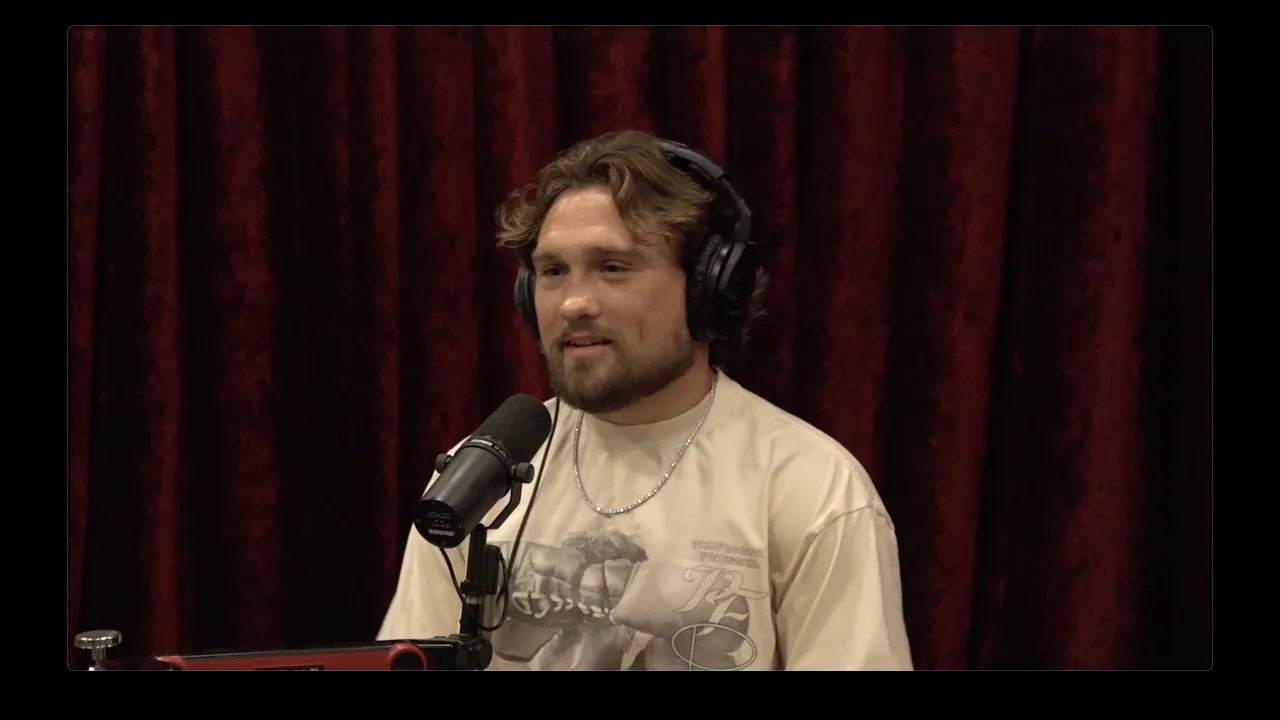
UFC's Ethyn Ewing Rejects Brawl-Heavy MMA for Technical Avoidance
PowerfulJRE
Ethyn Ewing argues that brawl-heavy fighting styles shorten fighters' careers and contribute to long-term neurological damage, emphasizing that true championship success relies on spatial control and technical precision.
## Background
Published by PowerfulJRE on YouTube on September 2, 2026, this episode of the JRE MMA Show (#185) features host Joe Rogan sitting down with Ethyn Ewing. According to the page description, Ewing is a professional mixed martial artist currently competing in the UFC's bantamweight division.
## TL;DR
UFC bantamweight Ethyn Ewing joins Joe Rogan to dissect the technical nuances of modern mixed martial arts, emphasizing damage avoidance and tactical ring control over hyper-violent brawling. Ewing reflects on his transition from Iowa-style wrestling to high-level striking, detailing his recent short-notice UFC debut and his physical recovery strategies, including knee rehabilitation without surgery and extreme weight-cutting methods. The conversation spans a broad range of topics, from historical MMA rules and co-promotional business models to samurai philosophy, bow hunting, and the mechanics of knockout power.
## Atmosphere & style
The conversation carries a relaxed yet deeply analytical atmosphere, characterized by an enthusiastic mutual respect for combat sports technicality. Rogan acts as the curious, experienced commentator, drawing historical parallels from early UFC eras, while Ewing speaks with the calm, reflective confidence of a young martial artist committed to continuous self-improvement. The dialogue smoothly shifts between granular breakdowns of striking mechanics and casual, engaging tangents on samurai philosophy, wilderness hunting, and physical longevity.
## Key takeaways
- [00:00](https://www.youtube.com/watch?v=efwqfxt717Q&t=0s) Ethyn Ewing argues that brawl-heavy fighting strategies are reckless and that true championship-level fighting relies on defensive spatial control and minimizing return fire.
- [08:12](https://www.youtube.com/watch?v=efwqfxt717Q&t=492s) Ewing transformed his combat approach by blending his foundational Iowa-style wrestling background with refined boxing technique and disciplined sparring.
- [12:05](https://www.youtube.com/watch?v=efwqfxt717Q&t=725s) Joe Rogan and Ewing observe that natural elite grapplers like the Ruotolo brothers stand out in a BJJ landscape heavily saturated with performance-enhancing drugs.
- [19:26](https://www.youtube.com/watch?v=efwqfxt717Q&t=1166s) Extreme single-shot knockout power often stems from anatomical muscle insertion points, whereas volume strikers inflict cumulative damage over time.
- [20:54](https://www.youtube.com/watch?v=efwqfxt717Q&t=1254s) Conor McGregor's optimal stamina and pacing occurred at featherweight, whereas moving up weight divisions placed new strains on his cardio and recovery.
- [27:33](https://www.youtube.com/watch?v=efwqfxt717Q&t=1653s) Ilia Topuria's success at featherweight highlights the effectiveness of fundamental boxing setups, clean distance control, and jab combinations.
- [30:30](https://www.youtube.com/watch?v=efwqfxt717Q&t=1830s) Fighters taking severe head damage require prolonged recovery periods to avoid compromised durability from returning to action too early.
- [01:27:58](https://www.youtube.com/watch?v=efwqfxt717Q&t=5278s) Severe weight cutting, overheating, and rapid weight drops severely drain the central nervous system and degrade athletic performance.
- [01:14:14](https://www.youtube.com/watch?v=efwqfxt717Q&t=4454s) Rehabilitating knee injuries using backward sled pulls, Poliquin step-downs, and targeted mobility drills builds joint resilience more effectively than premature surgery.
- [01:23:23](https://www.youtube.com/watch?v=efwqfxt717Q&t=5003s) In-and-out point karate movement and precision body kicks demand exact spatial timing and distance management to bypass defensive cover.
- [02:06:36](https://www.youtube.com/watch?v=efwqfxt717Q&t=7596s) Early ground-and-pound and bare-knuckle fighting rules demonstrate how physical positioning and grappling control systematically break down pure strikers.
- [02:06:56](https://www.youtube.com/watch?v=efwqfxt717Q&t=7616s) Rogan opposes referee stand-ups in modern MMA, emphasizing that controlling an opponent on the ground is a core component of winning.
- [02:14:01](https://www.youtube.com/watch?v=efwqfxt717Q&t=8041s) The UFC's promotional model strictly limits co-promotions with outside organizations to protect brand value and maintain competitive dominance.
- [02:21:40](https://www.youtube.com/watch?v=efwqfxt717Q&t=8500s) As fighters age, relying solely on raw athletic explosiveness becomes unsustainable, making jab-heavy tactics and efficient movement essential.
## Detailed walkthrough
### [00:01](https://www.youtube.com/watch?v=efwqfxt717Q&t=1s) "Professor Finesser" and the Art of Longevity
Joe Rogan opens the podcast admiring Ethyn Ewing's signature apparel line, pointing out the cross-guard design and discussing his fight moniker, "Professor Finesser." Ewing explains that the nickname naturally grew into a guiding philosophy for his approach to martial arts. Rogan brings up Ewing’s striking debut in the UFC—taking a fight on just two days' notice, stepping up a weight class from bantamweight to featherweight, and facing the heavily hyped KO artist Malcolm Wellmaker. Rather than getting drawn into a wild brawl, Ewing stood out for his calm composure, fluid footwork, and tactical intelligence.
The conversation pivots to why hit-and-not-get-hit technical mastery is essential for career longevity. Ewing argues that standing in front of an opponent to trade brain damage is "silly" and that true champions do not take return fire. Rogan shares a recent conversation he had with world-class pool player Fedor Gorst while visiting the Ways to Well clinic with Brigham Buhler. They discussed how athletes across sports—whether pool, golf, or fighting—must continually refine fundamental technique rather than rely on raw grit. Rogan and Ewing agree that while fans cheer for face-first brawlers, that style is a trap that shortens careers and leads to sad, CTE-plagued retirements encouraged by negligent coaches and promoter matchmakers.
- **Guest:** Ethyn Ewing (UFC Bantamweight).
- **Debut Details:** Took a 145 lb (featherweight) fight on 2 days' notice against Malcolm Wellmaker.
- **Wellmaker's Background:** Came off Dana White’s Contender Series hype, including KO wins (such as his knockout over Chris Moutinho).
- **Key Quote:** *"To watch guys go in there and just brawl it out and say let's see who can take more punches before the other guy drops is just silly to me... hit and not get hit and champions don't take return fire."* — Ethyn Ewing
---
[05:43](https://www.youtube.com/watch?v=efwqfxt717Q&t=343s) Tactical Precision vs. "Educated Street Brawls"
Ewing notes how frustrating it can be that the general public feeds off chaotic violence rather than technical mastery. He points to a recent Dana White’s Contender Series bout involving Roman Puga—a fighter from his local area—where both combatants battered each other so severely they ended up straight in the hospital. While thrilling for spectators, Ewing views it as an "educated street brawl" that strays from the true goal of martial arts: absolute spatial control, angle-cutting, head movement, and damage avoidance.
Rogan draws a parallel to Israel Adesanya in his prime, describing how Adesanya controlled opponents like a choreographer, feeding reactions into a mental computer before executing precise counters. Ewing adds that casual fans often fail to realize MMA is a "smart man's game, not a tough man's game." Rogan expresses his wish that young, up-and-coming fighters would emulate high-IQ technicians like Ewing instead of taking unnecessary beatings that leave their faces as "road maps of scars."
- **Contender Series Example:** Roman Puga's recent war on DWCS left both fighters hospital-bound.
- **Prime Stylist Reference:** Israel Adesanya's faint-heavy, distance-controlling style.
- **Core Concept:** Overloading an opponent's nervous system with constant movement, counters, and range management rather than relying on pure physical durability.
---
[08:12](https://www.youtube.com/watch?v=efwqfxt717Q&t=492s) Evolving from Iowa-Style Wrestling to Technical Balance
Reflecting on his martial arts journey, Ewing describes his athletic origins in Iowa-style wrestling—a relentless, grind-it-out philosophy focused on heavy hand fighting, snap-downs, breaking an opponent's spirit, and forward pressure. Early on, this aggressive mindset held back his striking finesse. When he shifted toward pure striking, he swung to the opposite extreme: dancing on the outside, using flicker jabs, Ali shuffles, and actively avoiding physical grinding.
Now, Ewing feels he has reached a mature middle ground by letting his ego go in the gym. Instead of hyper-focusing on looking perfect or avoiding all physical scrambles, he combines relentless pressure with refined boxing technique. Rogan agrees that checking one's ego in sparring is crucial; training must be a laboratory for exposing and fixing personal weaknesses rather than trying to "win" every practice session.
- **Stylistic Evolution:** Iowa-style heavy pressure $\rightarrow$ Pure distance-striking finesse $\rightarrow$ Integrated technical pressure.
- **Gym Mindset:** Sacrificing aesthetic perfection in training to become comfortable in uncomfortable, high-physicality situations.
---
[12:05](https://www.youtube.com/watch?v=efwqfxt717Q&t=725s) Training with the Ruotolo Brothers & Steroids in Jiu-Jitsu
Ewing highlights his time training at CSW under Erik Paulson alongside Kade and Tye Ruotolo. Rogan and Ewing praise the Ruotolo brothers for their hyper-kinetic, relentless, and scramble-heavy grappling style. Ewing jokes about their unusually long arms wrapping up D'Arce chokes from anywhere, comparing their wild wall-jumps and athletic double-legs to a high-octane WWE match. Both express excitement for the Ruotolos' ongoing transition into MMA in ONE Championship and their prospective future in the UFC.
The discussion shifts to how rare it is that the Ruotolo brothers perform at an elite level entirely natural. Rogan and Ewing talk candidly about how competitive Brazilian Jiu-Jitsu is heavily enhanced, noting that because major organizations like ADCC do not conduct rigorous drug testing, elite grapplers frequently use performance-enhancing drugs to gain an edge.
- **Featured Gym & Coaches:** CSW (Combat Submission Wrestling), Erik Paulson.
- **Athletes Discussed:** Kade and Tye Ruotolo, Khamzat Chimaev, Marcelo Garcia/RDA-style long-arm choke specialists.
- **Grappling Dynamics:** Using relentless, chaotic scrambles as an offensive weapon to force mistakes.
- **Industry Insight:** ADCC's lack of strict testing renders top-tier submission grappling an largely "enhanced" sport, making natural elite athletes exceptional anomalies.
---
<ElicitationsGroup message="Explore related MMA and training topics:">
<Elicitation label="Break down Ethyn Ewing's UFC debut against Malcolm Wellmaker" query="Break down Ethyn Ewing's UFC debut fight against Malcolm Wellmaker in detail, including key exchanges and tactical adjustments."/>
<Elicitation label="Analyze the transition of BJJ champions to MMA" query="Analyze how world-class BJJ champions adapt their grappling styles to MMA, focusing on space control and striking setup."/>
</ElicitationsGroup>
[15:10](https://www.youtube.com/watch?v=efwqfxt717Q&t=910s) Steroids, Technical Prowess, and the "Great Eraser"
The conversation opens with a discussion on performance-enhancing drugs and raw technical skill, pointing to BJJ legend Gordon Ryan as the ultimate case study. Rogan and Ewing observe that while critics claim Gordon's dominance is purely due to steroids, he was already winning tournaments and tapping world champions when he was completely natural as a younger, smaller athlete. Ewing emphasizes that at the elite level, if everyone else is taking gear, you are at a massive disadvantage if you don't. However, supreme technical mastery remains the ultimate equalizer—it can negate both a opponent's size and strength.
On the flip side, power is its own unique anomaly in combat sports. Ewing notes that a fighter with a "one-hit quitter" can get beaten up for two straight rounds, but if they land a single clean shot and put their opponent to sleep, all previous sins are forgiven in the eyes of the audience. Rogan adds that while a fighter who blends elite power with high technical proficiency is terrifying, power and raw talent are often a curse. Gifted fighters tend to work less hard because they dominate gym rounds with pure physicality.
Rogan brings up former heavyweight boxing champion Deontay Wilder as the quintessential example of relying strictly on power over fundamental boxing technique. Calling Wilder the greatest one-punch knockout artist in heavyweight history, Rogan recalls Teddy Atlas’s famous description of Wilder’s right hand: "It’s the great eraser." No matter how many technical mistakes he makes throughout a fight, one landed punch erases every single one of them.
- **Gordon Ryan:** Dominant in submission grappling; praised for his unquestionable technical prowess, which existed well before his physical transformation.
- **Deontay Wilder:** Referenced as the ultimate example of raw knockout power overriding technical flaws; described by Teddy Atlas as possessing "the great eraser."
---
[19:26](https://www.youtube.com/watch?v=efwqfxt717Q&t=1166s) The Physics of Knockout Power vs. Volume Striking
Speculating on hypothetical fighting scenarios, Rogan notes that if a pure power-puncher like Deontay Wilder possessed the movement and footwork of Oleksandr Usyk or Tyson Fury, or if Francis Ngannou's one-shot power were paired with high-level boxing technique, it would be "game over for everybody." Ewing brings up a physiological concept he discussed with Conor McGregor regarding how muscle heads connect—differing insertion points dictate whether an athlete possesses short-burst explosive power or long-lasting cardiovascular endurance.
The two discuss how knockouts actually happen, agreeing that absolute power isn't always required; it is usually the shot a fighter doesn't see coming that puts them out. Ewing explains that fighters who master feints and create deceptive angles can achieve devastating knockout finishes without possessing innate "one-punch" power. Rogan points to Max Holloway as the perfect example of a volume striker who accumulates damage over time rather than relying on single nuclear shots.
```
+-----------------------------------------------------------------------+
| STRIKING MECHANICS |
+-----------------------------------------------------------------------+
| ONE-PUNCH POWER VOLUME & DECEPTION |
| - Explosive muscle composition - Hidden shots / setup feints |
| - High energy expenditure - High output over time |
| - Early-round threat - Accumulation of damage |
| - Example: Deontay Wilder, Ngannou - Example: Max Holloway |
+-----------------------------------------------------------------------+
```
---
[20:54](https://www.youtube.com/watch?v=efwqfxt717Q&t=1254s) Examining Fight Cardio and McGregor vs. Aldo
Ewing and Rogan dissect the nuances of cardiovascular endurance in the octagon, specifically analyzing how Conor McGregor and José Aldo managed their energy output. Ewing challenges the popular narrative surrounding McGregor's cardio, pointing out that when Conor fought at 145 pounds (featherweight)—such as in his fight against Chad Mendes—he stayed calm under heavy grappling exchanges and never truly gassed out. It was only after moving up in weight to fight Nate Diaz that his cardio seemed to wane, likely due to changes in his training discipline, diet, and weight-cutting regimen.
Similarly, Ewing questions criticisms of José Aldo's gas tank, pointing out that Aldo was an undefeated champion for ten years who rarely showed fatigue during his prime. Rogan adds that during Aldo's legendary reign, he was almost always the "hammer" and rarely the "nail." He highlights Aldo’s brutal leg-kick clinic against Urijah Faber, praising Faber’s incredible toughness for refusing to quit despite taking career-altering leg damage.
- **Conor McGregor vs. Chad Mendes:** McGregor remained composed under pressure and grappling strain at 145 lbs without gassing out.
- **José Aldo vs. Urijah Faber:** Aldo delivered legendary leg kicks, while Faber showed legendary durability by fighting through total leg compromise until the final bell.
---
[24:27](https://www.youtube.com/watch?v=efwqfxt717Q&t=1467s) Max Holloway's Pressure and the Realities of Weight Cutting
Rogan explains that Max Holloway's success stems from his ability to pace himself, gauge when to hit the gas, and apply relentless pressure until opponents fade. Holloway's pace remains identical from the first round to the fifth, as demonstrated in his chaotic BMF title war against Justin Gaethje. Ewing notes that high-output fighters build their conditioning around short bursts—similar to track sprints—maintaining active movement even when "resting" inside the cage.
The conversation turns to Holloway’s featherweight title loss to Ilia Topuria. Rogan argues that Holloway made a critical mistake by bulking up significantly to fight Gaethje at 155 pounds and then trying to cut back down to 145 pounds shortly after. Starving his body to make 145 pounds left Holloway depleted, leading to a brutal weight cut right before facing a hyper-technical power-puncher like Topuria.
> "That last cut to 45 was a nightmare. It was a horror show. And so when he got in there with Ilia and then you're fighting El Matador... you want to talk about technique, right? Technique and his striking, the smoothness and efficiency, and the one-punch go-night power."
---
[27:33](https://www.youtube.com/watch?v=efwqfxt717Q&t=1653s) Ilia Topuria's Technical Dominance and the Lost Art of the Jab
Ewing and Rogan express awe at Ilia Topuria's skill set, highlighting his victories over Charles Oliveira and Max Holloway. Despite being smaller than lightweight opponents like Gaethje, Topuria possesses explosive power combined with pristine boxing fundamentals. Ewing notes that Topuria stands out in MMA because he remains completely composed, sits on his back foot, controls distance with a sharp jab, and sets traps rather than wildly throwing overhands.
Ewing criticizes the general state of striking in MMA, expressing frustration with fighters who neglect basic boxing fundamentals. He points out that too many UFC athletes rely entirely on loading up big overhand rights instead of establishing distance and setting up combinations behind a jab.
- **MMA Striking Flaw:** Over-reliance on wild overhand rights instead of fundamental jab work and distance control.
- **Ilia Topuria:** Combines extreme power with composure, technical pocket control, and precise jab setups.
- **Justin Gaethje's Power:** Topuria took severe damage in his war with Gaethje, including two fractured orbitals, showing the physical toll required to fight at the absolute top.
<FollowUp label="Want to break down how Ilia Topuria's boxing stance compares to traditional MMA striking?" query="Break down how Ilia Topuria's boxing stance, jab setup, and distance control differ from traditional MMA striking styles."/>
[30:30](https://www.youtube.com/watch?v=efwqfxt717Q&t=1830s) Recovery Time and the Mental Toll of Big Knockouts
Joe Rogan and Ethyn Ewing emphasize the critical need for adequate recovery time after taking severe damage in a fight, particularly following a knockout. Rogan notes that a fighter needs to be fully recovered before even considering returning to sparring or taking punches to the face again. Discussing a recent June fight (with their conversation occurring at the end of August), Rogan points out that the fighter likely needs a full six months before stepping back into light contact, let alone hard sparring.
Ewing reflects on the psychological weight that undefeated fighters carry when they suffer their first devastating loss. He notes how being undefeated breeds a sense of invincibility, making the eventual fall from grace far more damaging. He points to legendary featherweight José Aldo as a prime example—someone who came back and fought courageously after losing his throne, but was never quite the same "untouchable" force again. Ewing stresses that returning successfully requires an almost impenetrable mental indestructibility to convince yourself that one loss does not define your identity.
- **José Aldo Example:** Ewing cites Aldo's post-loss career as a cautionary tale of a fighter who remained tough but lost his aura of invincibility.
- **The Damage Realities:** Rogan stresses that only the fighter knows the true physical and mental toll a war takes on their body.
---
[32:05](https://www.youtube.com/watch?v=efwqfxt717Q&t=1925s) Alexander Volkanovski and the Perils of Coming Back Too Soon
Rogan singles out Alexander Volkanovski—whom he considers arguably the greatest featherweight of all time—as the ultimate modern example of a fighter rushing back too quickly after severe trauma. Volkanovski took a short-notice rematch against Islam Makhachev, suffered a head-kick knockout, and then turned around just four months later to defend his belt against Ilia Topuria, who Rogan calls "the scariest challenger that he's ever had to face."
Rogan criticizes the initial decision to take the Makhachev rematch on short notice in the first place, pointing out that Volkanovski was out of camp, hanging out, drinking beer, and eating fish and chips. Physically, Volkanovski looked noticeably smoother and less conditioned than his usual hyper-chiseled self. Ewing agrees, emphasizing the night-and-day difference between maintaining general fitness and going through an intense two-to-three-month fight camp with strict diet and hyper-focused discipline.
- **Volkanovski's Timeline:** Took a head-kick KO against Islam Makhachev on short notice and fought Ilia Topuria just four months later.
- **Out-of-Camp vs. In-Camp:** Ewing highlights how two-to-three daily practices and structured nutrition during camp cannot be replicated by casual off-camp training.
---
[33:33](https://www.youtube.com/watch?v=efwqfxt717Q&t=2013s) Ethyn Ewing's 48-Hour UFC Call-Up and Short-Notice Victories
Rogan asks Ewing about his own experience taking a short-notice fight when he stepped in on just 48 hours' notice to face the 10-0 undefeated prospect Malcolm Welmaker at MSG. Ewing jokes that his preparation consisted of "food eating championship training" where he was "killing double-doubles and 3x3s" at In-N-Out. In reality, Ewing had stayed strict and kept a fight-camp mentality all year long despite multiple opponent pull-outs.
Ewing explains that he had just fought on November 7th in a title fight for A1 Combat, scoring a knockout in just 90 seconds. Because he took virtually zero damage, he took a short week off to relax, enjoy a few drinks at a casino, and eat whatever he wanted. Just as he was taking that breather, the UFC called with the 48-hour short-notice offer against Welmaker. Rogan agrees that fighting so recently was actually a massive advantage because the intensity of the cage closing, the crowd energy, and the weight cut were fresh in Ewing's muscle memory—unlike a fighter like Conor McGregor taking multi-year layoffs.
> "I was doing food eating championship training... killing double doubles and 3x3s." — Ethyn Ewing
- **A1 Combat Title Fight:** Fought November 7th, scoring a 1:30 first-round knockout before taking the UFC short-notice call.
- **UFC Short-Notice Matchup:** Accepted a fight on 48 hours' notice at MSG against 10-0 Malcolm Welmaker.
- **Ring Rust vs. Activity:** Rogan compares Ewing's quick turnaround to Conor McGregor's five-year layoffs, noting how extended breaks disrupt a fighter's timing and mindset.
---
[36:34](https://www.youtube.com/watch?v=efwqfxt717Q&t=2194s) Israel Adesanya's Title Defense Work ethic and Activity vs. Burnout
Rogan pulls up statistics on former UFC Middleweight Champion Israel Adesanya, praising his unmatched activity during his title reign. Rogan highlights that Adesanya was the ultimate company man, stepping up whenever the UFC needed a main event and even defending his world title three times in a single calendar year. Rogan notes how stark the contrast is compared to the middleweight division after Adesanya lost the belt, where title fights became far more sporadic among champions like Sean Strickland, Dricus du Plessis, and Khamzat Chimaev.
However, the conversation shifts to the fine line between staying active and burning out. Rogan and Ewing discuss Merab Dvalishvili's hyper-active schedule and his rematch against Petr Yan, debating whether an overly demanding strength of schedule eventually becomes a detriment. Ewing notes that only the fighter knows deep down when they are truly ready, and that coaches cannot always gauge a fighter's inner exhaustion or minor injuries.
- **Israel Adesanya's Title Run:** Defended the middleweight title 3 times in 1 year.
- **Middleweight Title Turnover:** Rogan notes only roughly 5 middleweight title fights occurred in the prolonged stretch following Adesanya's initial belt loss, involving Strickland, Du Plessis, and Chimaev.
- **Merab Dvalishvili vs. Petr Yan:** Mentioned as a case study for whether extreme fight frequency eventually drains an athlete's physical peak.
---
[38:36](https://www.youtube.com/watch?v=efwqfxt717Q&t=2316s) MMA vs. Boxing: Business Mindsets, Injuries, and Freak Accidents
Ewing admires the business mindset prevalent in professional boxing, pointing to Floyd Mayweather as the master of controlling variables—selecting gloves, fight dates, and conditions to maximize safety and success. In contrast, MMA fighters often lean into a reckless "fight anyone, anytime, anywhere" toughness, frequently stepping into the cage carrying severe injuries that end up damaging their career records. Ewing argues that fighters need smart teams to protect them from their own warrior instincts.
To illustrate how easily injuries occur in MMA compared to boxing, Ewing reveals that right before his April fight against Rafael Estevam, he tore his meniscus in a freak accident during a light warmup round with heavyweight Callum Bisping. Ewing tried to elevate his hips from a butterfly guard to scramble safely under Bisping's heavy weight, and his meniscus popped immediately on the very first round of the day. As a result, he was unable to grapple for the entire final month of his training camp leading into the Estevam fight.
- **Floyd Mayweather's Business Model:** Ewing highlights how boxing elites treat fight selection, gear, and scheduling strictly as a business.
- **Freak Knee Injury:** Ewing tore his meniscus in February while light sparring/grappling in butterfly guard with heavyweight Callum Bisping.
- **Pre-Fight Compromise:** Ewing could not do any grappling training during the final month leading up to his April fight against Rafael Estevam.
---
[43:04](https://www.youtube.com/watch?v=efwqfxt717Q&t=2584s) The Modern Evolution of MMA and Anderson Silva's Alien Era
Rogan highlights how drastically MMA skill levels have evolved over two decades. Looking at Ewing's back-to-back victories over undefeated, highly skilled opponents like Malcolm Welmaker and Rafael Estevam, Rogan remarks that if Ewing had fought 20 years ago during *The Ultimate Fighter* Season 1 era, he would have looked like an "alien" because no one possessed that level of dynamic, multi-disciplinary striking and grappling.
Rogan notes that it wasn't until Anderson Silva arrived in the UFC shortly after TUF Season 1 that the sport witnessed true elite-level striking artistry. Rogan recalls watching Silva in his absolute prime—specifically his iconic UFC debut against the brutal knockout artist Chris Leben. While many doubted Silva against Leben's raw power, Rogan advised his friend to "bet the house on the Brazilian." The two recount Silva's magical run through Cage Rage (highlighting his famous reverse elbow knockout of Tony Fryklund) and his early Pride and Rumble on the Rock appearances, including the famous illegal upkick DQ against Yushin Okami.
- **TUF Season 1 Comparison:** Rogan asserts that modern fighters like Ewing represent a massive technical leap from fighters 20 years ago.
- **Chris Leben Debut:** Rogan accurately predicted Silva would dismantle the heavy-hitting Leben upon entering the UFC.
- **Anderson Silva Highlights:**
- *Cage Rage:* Reverse elbow KO against Tony Fryklund.
- *Rumble on the Rock:* Upkick disqualification against Yushin Okami from guard.
[45:50](https://www.youtube.com/watch?v=efwqfxt717Q&t=2750s) Anderson Silva’s Innovation and the Bank Robber Elite Fighter
Joe Rogan and Ethyn Ewing reflect on Anderson Silva’s groundbreaking creativity, highlighting how he was a true pioneer who invented moves on the fly without relying on video study or YouTube tutorials. A prime example was Silva’s iconic reverse upward elbow knockout against Tony Fryklund. Rogan recounts the famous backstory: Silva’s coach told him the technique was completely impractical and forbade him from practicing it in the gym, so Silva went home and made his wife hold pillows for him so he could perfect the mechanics.
The conversation transitions to Silva's bout in Pride and Cage Rage against Lee Murray, the infamous British fighter who went on to mastermind the Securitas depot robbery—the largest cash heist in UK history. Rogan and Ewing marvel at Murray’s bizarre dual life: a legitimate, terrifying criminal with knockout power who was simultaneously an elite professional fighter capable of submitting Jorge Rivera with a triangle choke. Silva, however, dismantled Murray using pure, artistic Muay Thai and devastating leg kicks.
- **Silva's Peak:** Rogan emphasizes that legacy fighters must be judged by their "highest RPM"—the peak multi-year stretch where they were completely unstoppable.
- **Lee Murray:** A real-life movie character archetype—an elite UFC/Cage Rage competitor who was also a top-tier organized crime figure.
---
[48:31](https://www.youtube.com/watch?v=efwqfxt717Q&t=2911s) The Evolution of the Front Kick and Calf Kick Mechanics
Rogan highlights Silva’s iconic front kick knockout of Vitor Belfort as a watershed moment in MMA history, marking the first time a front kick to the face produced a knockout in the UFC. Rogan recalls an old video of himself with Eddie Bravo hitting a "Bob" dummy, where Rogan doubted the front kick to the face, considering it inferior to body kicks. Today, the technique is a staple because strikes coming straight up the center blind spot are nearly impossible to track when a fighter expects roundhouse trajectories.
Ewing breaks down his own tactical preparations, noting how he utilizes front kicks and side kicks aimed at the liver. He explains how he trained a lead-leg front kick specifically to intercept opponents who heavy-plant their weight to land calf kicks—such as his opponent Fa. By leaning back onto the rear leg when an opponent opens up, a fighter alters the distance frame and snaps a front kick up the middle. Rogan and Ewing detail the mechanics of the Dutch-style calf kick, which relies on a vertical lifting motion without a hip pivot, driving the hard shinbone directly into the soft calf muscle.
- **Yukio Yoza:** Highly praised by Rogan and Ewing as the gold standard for technical, explosive calf kicks thrown without a tell and integrated into rapid striking combinations.
- **Defending the Calf Kick:** Ewing notes that while fighters take calf kicks casually in sparring with shin guards, unpadded calf kicks ruin a leg instantly. Effective defenses require picking up the lead leg, changing stances, or stepping in with knees.
---
[52:28](https://www.youtube.com/watch?v=efwqfxt717Q&t=3148s) Jonathan Haggerty vs. Yuki Yoza: A Masterclass in Movement
Analyzing kickboxing masterclasses, Rogan references ONE Championship and the fight between Jonathan Haggerty and Yuki Yoza. Yoza’s relentless leg-destroying style was neutralized by Haggerty’s constant fluid stance switching, lateral movement, jab volume, and push-knees to the body, preventing Yoza from ever setting his feet to plant low kicks.
Rogan praises ONE Championship for housing the highest caliber of pure strikers in combat sports. The discussion turns to Dagestani striking, highlighting fighters like Asadula Imangazaliev and Amru Magomedov in the PFL. Ewing and Rogan discuss how Dagestani fighters are no longer just pure wrestlers; many come from backgrounds like Sanda (Sanshou) or Muay Thai, allowing them to throw spinning wheel kicks and high-level combinations.
- **Jonathan Haggerty's Blueprint:** Used constant motion, switch-knees, and active stance changes to out-point and neutralize Yoza's devastating low-kick arsenal.
- **Dagestani Striking Evolution:** Modern Dagestani fighters blend world-class wrestling with long-range, artistic striking disciplines like Muay Thai and Sanda.
---
[56:52](https://www.youtube.com/watch?v=efwqfxt717Q&t=3412s) Reach, Body Types, and Mike Tyson’s Elusiveness
Addressing physical frames in combat sports, Rogan and Ewing debate the advantages of different body types. While casual fans often associate fighting prowess with heavily muscled physiques, the long, lean, tall build with an oversized reach offers massive advantages in MMA, enabling long-range strikes, leverage for triangles, and tight D'Arce or guillotine chokes. Ewing notes a recent interaction with a fighter sporting a massive 78-inch reach, which acts like a light heavyweight's reach in lower weight divisions.
Ewing, who possesses a shorter, stockier build, explains that his style requires playing "all the way out or all the way in," using inside boxing to negate long-limbed opponents. Rogan brings up prime Mike Tyson as the ultimate example of a shorter fighter (5'11", ~215–220 lbs) dominating tall heavyweights. Ewing quotes Tyson on his true greatest asset: "It wasn't my physicality that was my greatest asset. It was my elusiveness." They conclude that high-level fighting is an intricate chess match of distance and positioning, often mistaken by casual viewers for a simple brawl.
- **Reach Advantage:** Long arms allow fighters to strike from safe distances and apply submission locks with minimal effort.
- **Inside vs. Outside Mechanics:** Shorter fighters negate long limbs by slipping inside, while long fighters win by maintaining distance control through jab and teep management.
- **Mike Tyson's Mastery:** Used peek-a-boo bobbing and weaving to turn a size disadvantage into explosive inside power entries.
<ElicitationsGroup message="Explore more topics from JRE MMA Show #185:">
<Elicitation label="Summarize Ethyn Ewing's training routines and fight prep" query="Summarize Ethyn Ewing's training routines, weight cutting, and fight prep discussed in JRE MMA Show #185."/>
<Elicitation label="Analyze the mechanics and defense of calf kicks in MMA" query="Provide a detailed breakdown of calf kick mechanics, setups, and effective defense strategies in MMA."/>
</ElicitationsGroup>
[01:00:16](https://www.youtube.com/watch?v=efwqfxt717Q&t=3616s) Levels of Understanding and the Reality of Fighter Fatigue
Joe Rogan and Ethyn Ewing discuss the stark difference between casual fight fans and true students of mixed martial arts. Rogan highlights that real satisfaction for a fighter comes when a peer or knowledgeable observer appreciates the technical nuances of their game—praising specific setups or techniques—rather than just reacting to big, chaotic moments. Casual spectators often misunderstand what is happening inside the Octagon, mistaking a missed strike or tactical pause for lack of skill simply because they have never stepped into a cage or sparred.
Ewing admits that he used to have a similar casual perspective when watching UFC fights with his father growing up. He used to sit on the couch wondering why a fighter didn't just capitalize on an obvious opening. However, gaining firsthand fighting experience completely transformed his perspective. He now recognizes that viewers sitting at home cannot feel the immense fatigue, the hidden pre-existing injuries, or the sensory overload of competing inside a cage before thousands of fans.
- Elite fighters gain the most validation when fellow high-level martial artists acknowledge specific technical maneuvers.
- Passive viewers lack insight into the physical tax, tactical pressure, and hidden injuries fighters manage in real time.
[01:02:00](https://www.youtube.com/watch?v=efwqfxt717Q&t=3720s) Reevaluating Early Career Losses and Lifestyle Changes
Rogan questions whether losing his first two professional fights ultimately served as a blessing in disguise for Ewing. Rogan points out that many undefeated fighters—like Ewing's former opponent Malcolm Wellmaker—build massive hype around their perfect records and knockout streaks, making an eventual loss far more disruptive. Ewing strongly agrees, reflecting on how his undefeated 6-0 amateur run gave him a false sense of security and led to an undisciplined lifestyle.
Ewing reveals that during his early career, he was far from living like a dedicated athlete. After tearing his meniscus in college and feeling let down by his wrestling coach, Ewing turned to partying, drinking, smoking, and general delinquency—a stark contrast to his strictly religious, highly disciplined high school years where wrestling was his sole focus. He notes that experiencing those early professional setbacks forced him to eliminate negative habits and restructure his life. This overhaul laid the groundwork for his current ten-fight win streak.
- Ewing was 6-0 as an amateur before suffering back-to-back losses at the start of his professional career.
- Early success masked poor lifestyle choices, including heavy partying and lack of training discipline.
- Overhauling his personal habits directly enabled his current 10-fight winning streak.
[01:04:14](https://www.youtube.com/watch?v=efwqfxt717Q&t=3854s) College Wrestling, Injuries, and Personal Faith
Ewing details the turning point in his young adult life when he moved from Southern California to Bristol, Tennessee, at age 19 to wrestle in college. Being away from home for the first time presented major culture shock, which was compounded when he tore his meniscus during a dual meet. His coach dismissed the injury, telling him to "suck it up" and forcing him to play through the pain for the rest of the season.
Having previously achieved major athletic success—placing 8th in California state, 5th at national tournaments, and winning the US Open in his age division—the sudden physical limitation and lack of support left Ewing feeling completely abandoned. Feeling as though God had turned away from him, he began drinking and partying for the first time immediately after his college finals. Looking back as a mature adult, Ewing realizes that the hardship was a essential test of faith designed to build his character. Rogan concurs, emphasizing that early failure forces a person to rebuild their identity on a stronger foundation.
- **High School Achievements:** 8th place in California State wrestling, 5th at the national tournament, and US Open division champion.
- **College Setback:** Suffered a right knee meniscus tear at age 19 while wrestling in Bristol, Tennessee.
- **Perspective Shift:** Rebuilt his Christian faith, coming to view early setbacks as necessary character-building tests rather than abandonment.
[01:10:14](https://www.youtube.com/watch?v=efwqfxt717Q&t=4214s) Meniscus Surgery vs. Rehabilitation and Knee Recovery
Ewing recounts having an arthroscopic scope on his right knee to shave down his damaged lateral meniscus—a decision he now regrets. The surgical removal of tissue left a permanent void, causing the joint to occasionally catch and lock up during specific grappling movements like inverted triangle chokes. In his second professional fight, Ewing suffered another severe injury to the same lateral area when caught in an outside reap; despite fighting through the pain, his opponent transitioned to a heel hook, popping Ewing's ankle twice before forcing a tap. Instead of getting an MRI, Ewing rehabilitated the knee using knees-over-toes exercises and mobility work, finding that the un-operated knee ultimately recovered better than the scoped one.
Rogan agrees with avoiding knee scopes, referencing modern medical studies that indicate physical rehabilitation and non-surgical therapies often yield superior long-term outcomes compared to partial meniscectomies. Rogan shares his own struggle with a bucket-handle meniscus tear that used to lock his knee joint until he manually popped it back into place. Both advocate for conservative recovery methods, such as light-resistance stationary cycling to promote blood flow, targeted range-of-motion work, and regenerative treatments like stem cell therapy.
- **Surgical Complications:** Ewing's right knee lateral meniscus scope created a lasting mechanical issue where the joint catches during inverted grappling setups.
- **Rehabilitation Strategy:** Ewing successfully recovered from a subsequent knee and ankle injury using knees-over-toes training and targeted strengthening without surgical intervention.
- **Rogan's Advice:** Recommends high-repetition, low-resistance stationary cycling to circulate blood flow through knee tendons without excessive joint loading.
[01:14:24](https://www.youtube.com/watch?v=efwqfxt717Q&t=4464s) Poliquin Step-Downs and Backward Treadmill Walks
Ethyn Ewing and Joe Rogan dive deep into specialized knee rehab and joint longevity, addressing how compromise occurs in complex positions like a wizard (whizzer) or when the knee gets awkwardly popped. Rogan recommends Poliquin step-downs—named after legendary strength coach Charles Poliquin—as one of the absolute best exercises for knee stability and quad engagement. Performed either on an incline board or a simple stack of weight plates, the movement requires lowering oneself controlled on one leg just 10 inches or so.
```
[Elevated Step / Plates]
| (Standing Leg)
|---[Knee Extended]
|
v (Lowering Leg down 10")
[Floor/Ground]
```
Rogan also champions backward walks, either pulling a light sled with a waist harness or walking backward on a turned-off treadmill using one's own legs to drive the belt. He notes this "knees over toes" protocol boosts blood flow and builds critical backward-pushing strength that most athletes neglect. Ewing adds a variation he uses with a resistance band anchored in front: stepping forward into a lunge with the knee over the toes and extending against the band's forward pull, which targets the knee joint similarly.
- **Poliquin Step-Down:** Performed on a step or incline board, lowering the non-working foot ~10 inches to train knee stability and patellar health.
- **Backward Treadmill Push:** Walking backward on a manual or unpowered treadmill by pushing the belt with leg strength to build circulation and knee resilience.
- **Backward Sled Pull:** Using a waist strap and light weights to drag a sled backward, prioritizing blood flow over heavy resistance.
- **Front-Anchored Band Extension:** Lunging with the knee over the toe while a band pulls forward, forcing the quad and knee structure to extend under direct tension.
[01:17:14](https://www.youtube.com/watch?v=efwqfxt717Q&t=4634s) Lateral Movement, Band Work, and the Marinovich Method
Ewing discusses expanding his training beyond straight-line movements into lateral explosion and sand-based footwork to strengthen the side ligaments and stabilizing muscles. Rogan recalls how former UFC lightweight champion BJ Penn used unconventional resistance band training to develop freakish strength and flexibility from strange angles. Ewing references similar fascia-focused training used by fighters like Rafael dos Anjos.
Rogan explains that Rafael dos Anjos trained with Nick Curson, a pupil of Marv Marinovich. The Marinovich brothers’ methodology with BJ Penn during his peak was famously radical: assuming the fighter already possessed elite skills, they eliminated traditional fight sparring and focused almost entirely on grueling plyometrics and extreme conditioning. Though BJ hated the grueling process, it gave him an legendary gas tank that made him virtually unstoppable.
> "Their approach was, 'You already know how to fight, so forget about fight training. We're just going to give you the most insane gas tank you've ever had.'" — Joe Rogan
[01:18:47](https://www.youtube.com/watch?v=efwqfxt717Q&t=4727s) Merab Dvalishvili and the Mental Crucible of Wrestling Cardio
The conversation transitions into the nature of cardio and how certain athletes redefine human physical limits. Rogan points to UFC Bantamweight Champion Merab Dvalishvili as a prime example of superhuman endurance, breaking top-tier fighters under constant pressure, relentless takedowns, and unmatched wrestling stamina that takes years—not a single fight camp—to cultivate.
Ewing reflects on his own background as a high-level wrestler, agreeing that wrestling cardio is a unique, grueling energy system where muscles remain perpetually tensed and colliding. Rogan emphasizes that elite wrestlers entering MMA hold a massive psychological and physical edge because wrestling forces every athlete through an unavoidable "hell."
- **Cardio Foundations:** Wrestling cardio involves continuous anaerobic/aerobic strain, isometric muscle tension, and zero opportunities to rest compared to Jiu-Jitsu guard or striking range.
- **The Wrestling Advantage:** Wrestlers develop unmatched mental toughness because there are no shortcuts to earned spots on a wrestling team; practices consist of intense grind, live wrestling, and finishing sprints.
- **Fight Control:** High-level wrestling allows an MMA fighter to dictate exactly where the bout takes place—whether standing or on the canvas.
[01:23:15](https://www.youtube.com/watch?v=efwqfxt717Q&t=4995s) Point Karate, Savate, and Precision Toe Kicking
When discussing foundational styles for MMA, Ewing suggests combining wrestling with solid boxing, but Rogan offers a controversial alternative for young strikers: Point Karate. Point karate teaches specialized distance management and dynamic in-and-out blitzes. Rogan cites Michael "Venom" Page (MVP) and Stephen "Wonderboy" Thompson as master practitioners whose movement leaves opponents entirely baffled—pointing out how MVP completely stumped veteran striker Kevin Holland.
```
[Point Karate Stance]
(Wide, In-and-Out Blitzing)
|
+---> "Blitz & Evade" (Hard to locate/hit)
|
v
[Opponent Stumped on Distance]
```
Ewing shares his interest in incorporating faster, snappy sidekicks into his game, drawing comparisons to Savate (French kickboxing). This leads to a discussion on body kicks: while traditional Muay Thai uses the shin or ball of the foot, some fighters—like Yoza—utilize toe kicks directly into the liver and solar plexus. However, Rogan and Ewing caution that striking with toes requires immense conditioning and extreme precision; catching an opponent's elbow can instantly break multiple toes.
> "With MVP, [Kevin Holland] was just stumped... 'What the fuck am I doing? I can't even touch this guy.' That is a giant skill set." — Joe Rogan
[01:25:51](https://www.youtube.com/watch?v=efwqfxt717Q&t=5151s) Devastating Foot Injuries and Massive Bantamweight Weight Cuts
Rogan brings up the horrific condition of Gregory "Robocop" Rodriguez's foot after his fight against Gregory "Fluffy" Hernandez, asking producer Jamie to pull up the picture from Instagram. Ewing and Rogan discuss how damaging toes on elbows severely compromises a fighter's ability to push through the remainder of a fight or transition into their next training camp. Ewing recounts snapping his own pinky toe completely sideways while running in his yard prior to a major wrestling camp.
The section wraps up with astonishment over how massive middleweights and bantamweights cut weight. Rogan expresses disbelief over how Gregory Rodriguez successfully cuts down to 185 lbs despite walking around at a shredded 220 lbs. Ewing notes that larger, muscular fighters have significantly more water weight to shed, referencing former bantamweight champion Aljamain Sterling, who used to walk around at 175 lbs before making the move up to featherweight (145 lbs) for a healthier, more sustainable cut.
- **Gregory Rodriguez's Foot:** Smashed toes from throwing body kicks into elbows, leaving severe bruising and foot distortion.
- **Toe Fractures in Camp:** Ewing's anecdote of dislocating his toe sideways right before a high-intensity wrestling camp.
- **Extreme Weight Cuts:** Fighters like Aljamain Sterling cutting from ~175 lbs down to 135 lbs, eventually necessitating a division move to 145 lbs for better performance and health.
Here is a detailed and faithful walkthrough of Part 7 of the episode.
---
[01:27:58](https://www.youtube.com/watch?v=efwqfxt717Q&t=5278s) Weight Cuts, "Weight Bullies," and the Science of Saunas
Ethyn Ewing laughs off comments on his Instagram calling him a "weight bully" and jokes about a comment telling him to "hire a nutritionist ASAP" after seeing a training photo where he looked a bit out of fight shape. While fans accuse fighters of ballooning in size, Ewing explains that most fighters cut a similar amount of weight relative to their division. Outside of camp when he is "full of food and being a delinquent," he can get as heavy as 175 to 178 lbs, but during fight week he prefers to start his cut around 150 lbs.
The two discuss how experience refines the weight-cutting process. Ewing recounts cutting 11 lbs in a single night cleanly, stressing that wisdom taught him not to blast the body with extreme heat. He utilizes portable infrared/red-light saunas (which max out around 150°F) wrapped in emergency thermal blankets. Crucially, Ewing incorporates cool-down periods with ice between sauna rounds. Rather than treating the cut like a sprint and maintaining constant sweat, he prioritizes keeping core body temperature down—arguing that dehydration is far easier for the human body to handle than overheating. Joe Rogan agrees, noting that overheating drains a fighter's central nervous system and ruins their recovery and performance for fight night compared to a controlled, lower-temperature cut.
- **Peak Off-Camp Weight:** 175–178 lbs.
- **Fight Week Cut Starting Weight:** ~150 lbs.
- **Recent Single-Night Cut:** 11 lbs done smoothly.
- **Sauna Setup:** Portable sauna set to 150°F combined with sweet sweat, sauna suits, and emergency blankets, interspersed with ice breaks to lower core temperature.
---
[01:32:00](https://www.youtube.com/watch?v=efwqfxt717Q&t=5520s) Analyzing Moses Itauma vs. Filip Hrgović: The Danger of Gas Tank Depletion
Rogan shifts the conversation to boxing, asking Ewing if he saw the recent title fight featuring young heavyweight prospect Moses Itauma against Croatian contender Filip Hrgović. Prior to this bout, the 21-year-old Itauma was hailed as the most promising heavyweight in over a decade, with commentators speculating he could break Mike Tyson's record as the youngest heavyweight champion in history. Itauma had blitzed through his previous competition—including stoppage wins over veterans like Dillian Whyte and Germaine Franklin—without ever being pushed into deep water or fighting through long, grueling rounds.
Against Hrgović, Itauma started fast, showcasing elite hand speed and technique. However, as the fight dragged past the mid-rounds into the eighth, Itauma blew out his gas tank trying to force a knockout rather than out-boxing his opponent. Hrgović weathered the storm and ultimately finished an exhausted Itauma, who was stumbling around the ring. Ewing and Rogan reflect on a face-to-face sit-down interview before the fight where Hrgović invoked a classic *Rocky* line—claiming fighting is about how many hits you can take and keep moving forward—which Itauma mocked as "the stupidest thing I've ever heard." Ewing points out the irony: while martial arts ideally revolves around technical finesse and "hit and don't get hit," sometimes raw toughness and grit overcome superior speed, making experience and pacing essential combat skills.
- **Moses Itauma:** 21-year-old heavyweight prodigy; boasted a string of early TKO victories prior to facing Hrgović.
- **Filip Hrgović:** Veteran Croatian heavyweight who absorbed Itauma's early onslaught to win via late stoppage due to exhaustion.
---
[01:37:00](https://www.youtube.com/watch?v=efwqfxt717Q&t=5820s) UFC vs. Boxing Culture: Short-Notice Risks and Promotional Models
The conversation pivots to comparing how boxing and MMA handle fighter development and matchmaking. In boxing, promoters carefully build up prospects over dozens of padded fights before putting them against top-tier opponents. In contrast, MMA fighters are far more willing to accept high-risk, short-notice opportunities against world-class opposition—sometimes fighting for a world title in their very first UFC appearance if they have a decorated background in wrestling, kickboxing, or regional promotions.
Rogan explains that this cultural difference stems from the structural business models of the sports. In boxing, events are built around individual star fighters regardless of the promoter; a Canelo Álvarez fight happens whenever Canelo is ready. In the UFC, the brand dictates the schedule: the promotion books an arena in a city for a specific date and fills the card with whoever is available. This system pressures MMA fighters to seize short-notice opportunities to advance their careers, even if it risks their records.
- **Boxing Model:** Athlete-driven schedule; careful long-term record building across competing promotional bodies.
- **UFC Model:** Brand-driven schedule; centralized management booking fixed event dates and offering rapid title opportunities to proven external talent.
---
[01:41:00](https://www.youtube.com/watch?v=efwqfxt717Q&t=6060s) Samurai Philosophy and *Hagakure*
Rogan asks Ewing if he reads literature on psychology, strategy, or warrior philosophies like Miyamoto Musashi's *The Book of Five Rings*. Ewing shares that he is currently reading *Hagakure* (written by Yamamoto Tsunetomo), which was gifted to him by his boxing coach during a transitional period in his career.
Ewing explains the historical backdrop of the book: Tsunetomo was a samurai servant whose master passed away during a peaceful era when the samurai class was no longer needed for constant warfare, and ritual suicide (*seppuku*) was forbidden by decree. The text explores how a warrior should maintain a Bushido lifestyle, discipline, and purpose when there is no active battle to fight—a lesson Ewing directly applies to his life outside the octagon.
<FollowUp label="Want me to break down Part 8 of the transcript?" query="Write a detailed, faithful walkthrough for Part 8 of JRE MMA Show #185 with Ethyn Ewing."/>
[01:42:21](https://www.youtube.com/watch?v=efwqfxt717Q&t=6141s) Samurai Mindsets, Screen Time, and the Impact of Social Media
Ethyn Ewing and Joe Rogan reflect on the books Ewing reads about samurai culture and ancient warriors, admiring how historical figures offer diverse perspectives on mindset and combat philosophy. Ewing notes that he likes sifting through these differing views to apply what works best for his own training and life. However, he admits to struggling with phone usage and screen time. While he consumes a lot of outdoor, hunting, spear fishing, and gun channels on YouTube, he is actively striving to be more present in the real world by reading more books instead of staring at screens.
Rogan draws a sharp distinction between YouTube and traditional social media, arguing that YouTube acts more as an educational tool and a way to wind down—such as watching ancient history documentaries or professional pool matches—without feeling like wasted time. In contrast, Ewing views social media as a business tool that requires careful management: he needs to produce content to build his platform without falling into the trap of consuming mindless short-form media. They both criticize short-form content for destroying attention spans and keeping dopamine firing continuously, which robs people of deep, meditative self-reflection.
- Ewing notes his favorite YouTube topics include fighting, gun channels, hiking, camping, hunting, and spear fishing.
- Both agree that short-form media destroys attention spans, lowers focus, and prevents deep internal contemplation.
---
[01:45:40](https://www.youtube.com/watch?v=efwqfxt717Q&t=6340s) Shore Diving, Spear Fishing, and Bow Hunting vs. Rifle Hunting
The discussion turns to spear fishing, a hobby Ewing used to practice regularly off California's coast with a friend who has since moved to Washington. Ewing describes shore diving around Corona del Mar and hidden local beaches with plenty of underwater structure, as well as diving the kelp forests off Laguna Beach to grab lobsters by hand during lobster season. Rogan compares spear fishing to "hunting underwater," pointing out that choosing specific fish and diving into their habitat makes it feel far more interactive than traditional hook-and-line fishing.
This primitive aspect naturally leads to a comparison between bow hunting and rifle hunting. Ewing expresses a strong fascination with bow hunting over rifle hunting, noting that sitting hundreds of yards away with a high-powered rifle requires technical prowess, whereas stalking an animal down to 30 yards with a bow demands real physical skill, scent management, and stealth. Rogan—an avid bow hunter—agrees that while rifles are the most efficient way to secure meat, bow hunting requires immense preparation, practice, and mental discipline. Rogan recounts a pig hunt in California where, despite not shooting a rifle for almost two years, he easily dropped a wild pig at 90 yards—something that would be unthinkable with a bow without months of dedicated practice on form and execution.
- **Spear fishing spots mentioned:** Corona del Mar beaches and Laguna Beach kelp forests (for lobster hand-grabbing).
- **Stalking distance:** Ewing highlights getting within roughly 30 yards of an animal when bow hunting compared to shooting at 500 yards with a rifle.
- **Rogan's hunting example:** Easily took down a pig at 90 yards with a rifle after a two-year hiatus from rifle shooting, contrasting it with the strict daily regimen required to hunt with a bow.
---
[01:49:52](https://www.youtube.com/watch?v=efwqfxt717Q&t=6592s) Feral Swine Infestation and Eradication Methods
Ewing recounts hiking Mount Whitney in August 2025 as another example of his love for the outdoors. Rogan points out that California has a massive feral pig population, and Ewing shares that pig hunting is one of the few instances where he would gladly ride in a helicopter with a rifle to cull them due to the ecological destruction they cause. Rogan explains that the problem is even more severe in Texas, where millions of wild pigs tear up farms, destroy habitats, and reproduce up to two or three times a year.
Rogan describes walking through the woods on his hunting lease in Texas and hearing wild pigs fighting in the brush, sounding like "demons" or "monsters." Landowners and farmers across the country are forced to bring in outside hunters to manage the destruction. Rogan mentions a friend with a large ranch near Fort Worth who brought in a team of Navy SEALs to run tactical operations against the pigs as a training exercise. Due to the billions of dollars in agricultural damage pigs inflict annually, landowners employ aggressive eradication tactics, including exploding targets like Tannerite.
- **Mount Whitney:** Ewing backpacked Mount Whitney in August 2025.
- **Reproduction rate:** Feral pigs can breed up to three times a year, producing multiple litters annually.
- **Agricultural damage:** Wild pigs cause billions of dollars in crop and habitat damage every year across affected states.
- **Eradication tactics:** Methods range from helicopter culling and military-style training operations to using Tannerite.
---
[01:52:43](https://www.youtube.com/watch?v=efwqfxt717Q&t=6763s) Feral Swine Distribution and the Biology of Pig Metamorphosis
Curious about how widespread the pig issue is across the United States, Rogan uses Perplexity to search for official statistics on feral swine populations. Before checking the results, Rogan guesses that 30 out of 50 states have documented feral pig populations. The search reveals that 35 states have documented feral swine presence, with the heaviest concentrations in the Southwest and Southeast, including Texas, Oklahoma, Louisiana, Florida, Georgia, Arkansas, Mississippi, Alabama, and South Carolina.
The conversation shifts to the biology and adaptability of pigs. Ewing and Rogan discuss how domestic farm pigs transform when they escape into the wild. Rogan explains that feral pigs are not a separate species from domestic pigs, but rather domestic animals that revert to a wild state. When farm pigs escape, they quickly adapt to foraging, become nocturnal, grow thicker hair and larger tusks, and undergo physical changes over time. Rogan checks Perplexity again to clarify the timeline of this transformation, noting that while behavioral feralization happens within weeks to months, dramatic morphological features develop over generations through natural selection and environmental pressure. They close the topic by referencing famous giant pig urban legends like "Hogzilla."
- **Perplexity query result:** 35 states have documented feral swine presence.
- **Highest density states:** Texas, Oklahoma, Louisiana, Florida, Georgia, Arkansas, Mississippi, Alabama, and South Carolina.
- **Behavioral shift:** Escaped domestic pigs adapt to feral survival, becoming nocturnal, elusive, and self-sufficient within weeks to months.
<ElicitationsGroup message="Explore related topics from the conversation:">
<Elicitation label="Discuss Ethyn Ewing's training and UFC bantamweight career" query="What details were discussed about Ethyn Ewing's MMA career, bantamweight division background, and training routine?"/>
<Elicitation label="Detail Joe Rogan's archery setups and bow hunting experiences" query="What specific bow hunting gear, technique tips, and stories has Joe Rogan shared on the podcast?"/>
</ElicitationsGroup>
Here is a detailed, faithful walkthrough of this section of the transcript, capturing the facts, arguments, stories, and nuance of the conversation.
---
[01:56:25](https://www.youtube.com/watch?v=efwqfxt717Q&t=6985s) Massive Wild Hogs and Misleading Perspectives
Joe Rogan and Ethyn Ewing examine photos of legendary massive wild pigs, including "Hogzilla," debating whether the photographs rely on forced perspective. Ewing points out how photographers stand far behind the animals to make them look ten times larger than they actually are. However, Rogan brings up a photo of a hog hanging from a tractor, noting that regardless of perspective, some of these creatures grow to truly terrifying sizes. Rogan compares them to giant crocodiles in Africa that reach over 20 feet in length.
Looking through images on the screen, they dissect a 2004 photo of a reported 1,200-pound boar that was initially dismissed as a hoax. Rogan points out a British newspaper article mentioning a "36-stone" pig and asks Jaime to look up the largest wild hog ever recorded in Texas. Rogan guesses 500 pounds, but the documented record blows his estimate away: a 790-pound wild boar captured near De Leon in Comanche County, Texas, in January 2015 and weighed on certified mill scales. Rogan expresses disbelief at the sheer scale of the animal, marveling at how dangerous it would be if millions of nearly 800-pound pigs were roaming the American countryside.
- **Hogzilla Documentary:** Originating around 2004–2005, detailing famous massive boar sightings.
- **Texas Record Wild Hog:** 790 lbs, captured near De Leon in Comanche County (January 2015), weighed on certified scales.
---
[02:00:02](https://www.youtube.com/watch?v=efwqfxt717Q&t=7202s) Bow Hunting and Performance Archery
Ewing admits that while he has never been big-game hunting—only shooting birds with a pellet gun as a kid—he would love to go hunting for deer. When asked about his archery skills, Ewing shares that he regularly shoots a recurve bow rather than a compound bow and recently did quite well in an archery competition. Rogan strongly advises him against hunting with a recurve bow right away, warning that it requires immense experience and precision, and suggests he transition to a compound bow instead.
Since Ewing lives in Southern California, Rogan highly recommends he visit **Performance Archery** in San Diego, calling it one of the best archery shops in the country. Rogan explains how critical proper bow fitting is, using an example that he could never shoot Jon Jones’s bow because Jones’s draw length and peep sight alignment are tailored to his much taller frame. Drawing a parallel to martial arts, Rogan emphasizes the importance of learning proper archery mechanics from elite professionals right from the start so you don't have to unlearn bad habits later.
- **Shop Recommendation:** Performance Archery in San Diego, California (Rogan notes visiting it previously with archer John Dudley).
- **Technique Parallel:** Bow fitting and form mimic martial arts—learning incorrect mechanics early makes them hard to unlearn later.
---
[02:02:27](https://www.youtube.com/watch?v=efwqfxt717Q&t=7347s) The Warrior Mindset and Self-Reliance
When Rogan asks if learning diverse skills is a deliberate strategy to enhance fight performance or just a hobby, Ewing explains that it comes down to personal enjoyment and a drive for self-reliance. Ewing describes how he makes his own Kydex and leather holsters at home and plans to rebuild an old truck from the ground up to learn mechanics. For him, being a true warrior extends far beyond hand-to-hand combat; it encompasses survival, perseverance, and being prepared "when the shit hits the fan."
Rogan agrees on the value of self-reliance, suggesting that growing a personal garden is another essential step to avoid eating food covered in pesticides and herbicides. Ewing shares his ultimate dream: while his wife loves Southern California, he wants to acquire a few acres of land in Wyoming, Montana, or Idaho. He envisions setting up a self-sustaining compound with crops, fishing in stocked rivers, and hunting on his own land alongside family and close friends to escape the daily hustle and bustle.
---
[02:04:41](https://www.youtube.com/watch?v=efwqfxt717Q&t=7481s) Training Gyms and the Legend of Erik Paulson
Rogan asks Ewing if he stays in California solely for his wife or if he keeps his training base there. Ewing clarifies that his main reason for staying is his fight team and coaches. He splits his training across several locations, including **The Den Training Center** in Yorba Linda and **CSW (Combat Submission Wrestling)** in Fullerton under legendary martial artist Erik Paulson. Rogan enthusiastically praises Paulson as an "OG" of the sport, and Ewing notes that his father, Ben Ewing, originally trained under Paulson as well.
The two reminisce about Paulson's fighting career, specifically his famous long ponytail during the early No-Holds-Barred era. Ewing tells the story of Paulson cutting his long locks after a bare-knuckle fight against Sean Sherk (or early rules fights), where his opponent continuously grabbed his ponytail to control him on the ground. Rogan brings up Royce Gracie pulling Kimo Leopoldo’s hair at UFC 3, arguing that long hair or loose fight shorts are huge liabilities in a fight. Rogan questions why modern fighters still choose loose shorts over spandex when opponents frequently grab them.
- **Ewing's Training Hubs:** The Den Training Center (Yorba Linda, CA) and CSW Fullerton (under Erik Paulson).
- **Historical Reference:** Royce Gracie vs. Kimo Leopoldo at UFC 3 (hair pulling).
---
[02:06:36](https://www.youtube.com/watch?v=efwqfxt717Q&t=7596s) Early UFC Rules, Headbutts, and Forced Stand-Ups
Watching vintage footage of an early World Combat Championships (WCC) fight involving Erik Paulson, Rogan and Ewing marvel at the brutal early ruleset, which featured bare-knuckle striking, headbutts, and groin strikes. Rogan points out how terrifying high-level wrestlers like Mark Coleman were when headbutts were legal, as they could break an opponent's defense simply by smashing head-first from inside the guard.
They notice a 60-second "floor time countdown" clock on the WCC screen, forcing fighters to stand up if there was no submission or finish within a minute. Rogan strongly voices his hatred for referee stand-ups in modern MMA, arguing that if a fighter can hold someone down or pin them against the cage, they are winning the fight. In Rogan’s view, stand-ups should only occur as a penalty for explicit fouls, not to cater to impatient crowds.
> "I hate standups. I hate them. I hate them with all my heart. I don't think if in a five-minute round you should ever be stood up... If a guy can hold you down and you can't get up, if you don't like it and you can't get up, then he's winning, right?" — **Joe Rogan**
---
[02:09:02](https://www.youtube.com/watch?v=efwqfxt717Q&t=7742s) Renzo Gracie vs. Ben Spijkers at WCC
Rogan directs Jaime to pull up a classic WCC bout featuring Renzo Gracie against Dutch judoka Ben Spijkers. Rogan shares the wild backstory behind the fight: Spijkers had been harassing Renzo by calling his hotel room every ten minutes throughout the night to disrupt his sleep. Driven by vengeance, Renzo took Spijkers' back during the fight and repeatedly smashed him with brutal downward elbows to the back of the head from rear mount.
As they watch the finish, Rogan explains that fights like this were precisely why strikes to the back of the head were later outlawed. After forcing Spijkers to tap out, Renzo notoriously stepped on Spijkers' neck as he got up. Discussing elbow strikes in general, Ewing offers a fighter's perspective on the newly legalized 12-to-6 elbow rule, noting that while vertical elbows are good for slicing skin, traditional angled elbows actually allow a fighter to generate far more rotational power.
- **Bout:** Renzo Gracie vs. Ben Spijkers (World Combat Championships).
- **Tactical Insight:** Ewing notes that angled/rotational elbows deliver far more force than strictly vertical 12-to-6 elbows, even though 12-to-6 elbows excel at cutting.
[02:10:38](https://www.youtube.com/watch?v=efwqfxt717Q&t=7838s) The Origin of the 12-to-6 Elbow Ban and Bizarre MMA Rule Experiments
Joe Rogan and Ethyn Ewing delve into the ridiculous origins of past mixed martial arts regulations, focusing specifically on the infamous ban on 12-to-6 elbows. Joe retells a classic story from legendary referee Big John McCarthy about athletic commission members watching early-morning ESPN karate breaking demonstrations. Commission officials saw martial artists smashing through stacks of bricks with vertical downward strikes and mistakenly concluded that a "12-to-6" elbow was a lethal strike that could kill a person inside the Octagon. Joe vents his frustration over the absurdity of banning vertical downward strikes while permitting angled or rotating strikes that generate far more rotational power.
The discussion shifts to oddball regional promotions attempting to differentiate themselves from early UFC events in the mid-1990s. Ewing highlights the World Combat Championship (WCC) from 1995, which featured split brackets separating grapplers and strikers. Grapplers were permitted 10-minute ground rounds, whereas striker-bracket bouts capped ground action at just two minutes and entirely outlawed submissions, with the intent of having the tournament bracket winners face off at the end. Joe notes how regional promotions continue attempting hybrid or striking-centric formats today, though he praises ONE Championship for successfully running distinct Muay Thai, kickboxing, and MMA fights under one banner.
- **Big John McCarthy's 12-to-6 Story**: Athletic commissions banned downward elbows after watching late-night ESPN martial arts demonstrations where practitioners chopped through concrete bricks.
- **Biomechanical Reality**: Rotating the shoulders in a hook or swinging elbow path generates significantly more power than a straight downward vertical drop.
- **World Combat Championship (WCC)**: A short-lived 1995 tournament that split fighters into grappler and striker brackets with differing rulesets and round lengths.
- **UFC Rule Proposals**: Joe mentions he has repeatedly urged UFC President Dana White to incorporate striking-only matches on UFC cards to eliminate crowd boos during prolonged grappling exchanges.
- **Historical Kickboxing Stigma**: Dana White's historical hesitation stems from the legacy of 1970s and '80s American PKA (Professional Karate Association) kickboxing, which banned leg kicks and failed to achieve mainstream boxing-level popularity despite stars like Rick Roufus.
---
[02:14:01](https://www.youtube.com/watch?v=efwqfxt717Q&t=8041s) Promoting Regional Talent, Mergers, and the Business of MMA
The conversation turns to the necessity of alternative MMA promotions to support the global talent pool. Joe notes the recent structural shifts across the landscape, such as the PFL (Professional Fighters League) merging with Bellator and partnering with Jake Paul’s Most Valuable Promotions (MVP) alongside major broadcast deals. They emphasize that the talent pool outside the UFC is exceptionally deep, packed with elite fighters from Russia, Brazil, and across the globe who simply lack a major American platform.
While Ewing expresses a fighter's desire to see cross-promotional "champion versus champion" super-fights, Joe frankly explains why the market leader will almost never agree to co-promotions. For the UFC, being the undisputed market brand—where "UFC" functions as a generic trademark for MMA much like "Q-tip" does for cotton swabs—means the potential downside of losing to an outside champion far outweighs any promotional benefit. Joe contends a cross-promotional event would only make financial sense if a competing entity built a brand and roster equal to the UFC, creating a massive pay-per-view spectacle akin to Floyd Mayweather Jr. vs. Manny Pacquiao.
- **Global Talent Depth**: Joe brings up high-level foreign competitors like Dagestani fighter Magomed Magomedkerimov, emphasizing how many elite martial artists exist outside the mainstream UFC radar.
- **UFC Business Model**: The UFC avoids cross-promotion because a loss damages their dominant brand supremacy without adding proportional upside.
- **Co-Promotion Threshold**: Cross-promotional fights require two historic crossover stars—at the level of a Conor McGregor—to make the financial split worth the operational risk.
---
[02:16:30](https://www.youtube.com/watch?v=efwqfxt717Q&t=8190s) Assessing Conor McGregor's Career Trajectory and Physical Toll
Ewing and Rogan analyze Conor McGregor’s potential return to the Octagon and whether the former two-division champion can ever recapture his peak athletic performance. Joe highlights McGregor's legendary performance against Eddie Alvarez at UFC 205 in November 2016, describing Conor as being "in the Matrix" with his instantaneous counter-striking and flawless spatial distance management. However, Joe acknowledges the immense physical toll McGregor's body has endured over the past decade, including torn ACLs, blown-out menisci, and severe leg trauma.
Beyond the physical injuries, both speakers address the psychological challenges of returning to elite combat sports after acquiring immense wealth and living a lifestyle filled with luxury and partying. Ewing notes that early in his career, McGregor drew fans in through his philosophical, stoic, and hyper-focused approach to the "warrior lifestyle." Replicating that level of obsessive daily discipline becomes exponentially harder when a fighter no longer needs money to survive.
> "A guy like Conor is a special guy... To be there live when he was doing that against Eddie Alvarez, I was like, 'Good lord.' He was countering instantaneous with perfect precision. He was on fire."
- **Peak Conor McGregor Era**: December 2015 (knocking out Jose Aldo in 13 seconds at UFC 194) through November 2016 (stopping Eddie Alvarez at UFC 205).
- **Physical Wear and Tear**: Multiple major knee injuries (torn ACLs and menisci) combined with a decade of aging and high-profile lifestyle changes drastically complicate a elite-level comeback.
- **Ideal Comeback Matchup**: Joe and Ewing agree that a welterweight (170 lbs) fight against Michael Chandler makes the most structural sense, given their history coaching *The Ultimate Fighter* together.
---
[02:21:40](https://www.youtube.com/watch?v=efwqfxt717Q&t=8500s) Matchup Analysis: Chandler, Holloway, and the Evolution of Strikers
Evaluating potential opponents for McGregor, Joe warns against matchups at 170 pounds against natural, towering welterweights like Carlos Prates, Sean Brady, or Ian Machado Garry. They note that McGregor's natural physical frame is best suited for 155 pounds, but making a grueling weight cut at age 38 after years away from competition is unlikely.
Analyzing a potential rematch with Max Holloway, Joe notes that Holloway presents a nightmare stylistic matchup. Holloway’s strategy of relentless pressure and unmatched cardio volume poses an extreme threat to a fighter who hasn't completed a full training camp in years. In contrast, Michael Chandler represents an explosive, high-profile opponent who relies heavily on wild power shots rather than calculated distance management. They advise fighters like Chandler—and martial artists in general—to transition from relying purely on youthful athleticism to adopting a more measured, jab-heavy, tactical approach as they age.
- **Welterweight Size Disparity**: Modern 170-pounders walk around significantly larger than Conor McGregor, who looked physically undersized when sparring larger welterweights like Ian Machado Garry.
- **Max Holloway's Strategy**: Holloway's pressure-heavy "drown them in late rounds" style makes him one of the most dangerous matchups for aging or returning fighters.
- **Michael Chandler vs. Eddie Alvarez**: Joe recommends fans revisit Chandler's classic, back-and-forth wars against Eddie Alvarez in Bellator (from 2011 and 2013) to see Chandler's explosive physical prime.
- **Aging Fighter Reality**: As explosive power and speed diminish with age (similar to elite boxers like Roy Jones Jr.), fighters must shift their reliance toward technical setup, defense, and high fight-IQ to remain effective.<Elicitation label="Explore the next section of the transcript walkthrough" query="Provide the next section of the transcript walkthrough (Part 11) using the same format and level of detail."/>
[02:24:14](https://www.youtube.com/watch?v=efwqfxt717Q&t=8654s) Striking Masterclass, Mauricio Ruffy, and Arman Tsarukyan
Joe and Ethyn analyze lightweight standout Mauricio Ruffy, marveling at his striking fluidness and artistic creativity inside the octagon. Ethyn highlights Ruffy's ability to pull off wild techniques in close quarters, such as landing crescent kicks when standing just inches away from his opponent, as well as seamless spinning backfists. They agree that on a pure striking level, very few fighters can match him unless they take him to the canvas.
The discussion shifts to Ruffy's upcoming matchup against Arman Tsarukyan. Joe notes that Tsarukyan is one of the premier wrestlers in the entire sport, making takedown defense and getting back up off the mat the ultimate litmus test for Ruffy. They also admire Tsarukyan's unique lifestyle and mindset. Despite growing up exceptionally wealthy and driving rented Lamborghinis to training sessions in Los Angeles, Tsarukyan fights with relentless grit, having pushed Islam Makhachev to one of the hardest fights of his career on short notice.
- Mauricio Ruffy is praised for his highly creative, "work of art" striking style and close-range kickboxing skills.
- Ethyn points out that strikers in MMA do not need elite offensive wrestling, but they must possess a few reliable get-up escapes and sweep options to avoid being trapped on the bottom.
- Arman Tsarukyan's ability to maintain top-tier fight hunger despite his wealthy background earns him the nickname "the UFC Bruce Wayne."
---
[02:28:23](https://www.youtube.com/watch?v=efwqfxt717Q&t=8903s) Ciryl Gane, Heavyweight Movement, and Psychological Pressure
Ethyn and Joe evaluate how elite strikers adapt after experiencing a harsh wake-up call on the ground, citing Ciryl Gane's evolution after being submitted by Jon Jones and out-grappled by Francis Ngannou. They emphasize that Gane's footwork and movement at heavyweight are unmatched, attributing his unique agility and direction-changing ability to his background in playing basketball and his karate/savate bounce style.
They also discuss how psychological pressure and trash talk can break an opponent before they even step into the cage. By getting opponents riled up and angry—much like Conor McGregor or Joaquin Buckley do—fighters force their rivals to enter the cage tense, tight, and seeking one big reckless shot rather than executing a technical game plan.
- Ciryl Gane is described as the gold standard for mobile heavyweights who hit without getting hit.
- Travis Browne in his prime is mentioned as one of the few past heavyweights who exhibited similar light-footed agility.
- Fighting angry strips away technique, ruins sleep, and makes fighters overly cautious or overly aggressive.
---
[02:32:19](https://www.youtube.com/watch?v=efwqfxt717Q&t=9139s) The Mental and Spiritual Dimensions of Fighting
Ethyn breaks down how he cultivates his own mental toughness and peace of mind, emphasizing that the psychological aspect of MMA must be trained like its own discipline. Rather than relying solely on sports psychologists, Ethyn draws deep spiritual and mental strength from his boxing coach, Dale Royal. Training out of Royal's garage and front yard, they spend extensive time discussing the gospel, philosophy, warrior psychology, and emotional regulation before even wrapping hands or warming up.
Ethyn credits his well-rounded corner team—including MMA legend Erik Paulson and the intensely motivating Ben Jones—for preparing him both mentally and physically for the hardships of combat. He stresses that the ultimate sign of mastery is remaining entirely unfazed when absorbing a hard shot, keeping the heart rate low, and continuing the game plan without giving in to the emotional urge to retaliate wildly. Joe closes out the interview by praising Ethyn's mindset and wishing him success in his upcoming UFC fights.
- Ethyn trains boxing in a front yard and garage with coach Dale Royal, combining boxing drills with recurve archery, leather working, and spiritual conversations.
- Erik Paulson provides legendary veteran wisdom and mindset training, while Ben Jones brings high-intensity pressure in the gym corner.
- Ethyn highlights that the best fighters do not let their heart rate spike or deviate from their game plan when hit cleanly.
## Notable quotes
> [00:01](https://www.youtube.com/watch?v=efwqfxt717Q&t=1s) To watch guys go in there and just brawl it out and say let's see who can take more punches before the other guy drops is just silly to me... hit and not get hit and champions don't take return fire. — Ethyn Ewing
> [24:27](https://www.youtube.com/watch?v=efwqfxt717Q&t=1467s) That last cut to 45 was a nightmare. It was a horror show. And so when he got in there with Ilia and then you're fighting El Matador... you want to talk about technique, right? Technique and his striking, the smoothness and efficiency, and the one-punch go-night power. — Joe Rogan
> [33:33](https://www.youtube.com/watch?v=efwqfxt717Q&t=2013s) I was doing food eating championship training... killing double doubles and 3x3s. — Ethyn Ewing
> [01:17:14](https://www.youtube.com/watch?v=efwqfxt717Q&t=4634s) Their approach was, 'You already know how to fight, so forget about fight training. We're just going to give you the most insane gas tank you've ever had.' — Joe Rogan
> [01:23:15](https://www.youtube.com/watch?v=efwqfxt717Q&t=4995s) With MVP, [Kevin Holland] was just stumped... 'What the fuck am I doing? I can't even touch this guy.' That is a giant skill set. — Joe Rogan
> [02:06:36](https://www.youtube.com/watch?v=efwqfxt717Q&t=7596s) I hate standups. I hate them. I hate them with all my heart. I don't think if in a five-minute round you should ever be stood up... If a guy can hold you down and you can't get up, if you don't like it and you can't get up, then he's winning, right? — Joe Rogan
> [02:16:30](https://www.youtube.com/watch?v=efwqfxt717Q&t=8190s) A guy like Conor is a special guy... To be there live when he was doing that against Eddie Alvarez, I was like, 'Good lord.' He was countering instantaneous with perfect precision. He was on fire. — Joe Rogan
## Mentioned
A1 Combat, ADCC, Alexander Volkanovski, Ali AlQaisi, Aljamain Sterling, Amru Magomedov, Anderson Silva, Arman Tsarukyan, Asadula Imangazaliev, BJ Penn, Bellator, Ben Ewing, Ben Jones, Ben Spijkers, Big John McCarthy, BlueChew, Brigham Buhler, CSW, Cage Rage, Callum Bisping, Canelo Álvarez, Carlos Prates, Chad Mendes, Charles Oliveira, Charles Poliquin, Chris Leben, Chris Moutinho, Ciryl Gane, Conor McGregor, Dale Royal, Dana White, Dana White's Contender Series, Deontay Wilder, Dillian Whyte, Dricus du Plessis, ESPN, Eddie Alvarez, Eddie Bravo, Erik Paulson, Ethyn Ewing, Fedor Gorst, Filip Hrgović, Floyd Mayweather, Francis Ngannou, Germaine Franklin, Gordon Ryan, Gregory 'Fluffy' Hernandez, Gregory 'Robocop' Rodriguez, Ilia Topuria, Ian Machado Garry, Islam Makhachev, Israel Adesanya, Jaime, Jake Paul, Jamie Vernon, Joaquin Buckley, Joe Rogan, John Dudley, Jon Jones, Jonathan Haggerty, Jorge Rivera, José Aldo, Justin Gaethje, Kade Ruotolo, Kevin Holland, Khamzat Chimaev, Kimo Leopoldo, Lee Murray, Magomed Magomedkerimov, Malcolm Wellmaker, Marcelo Garcia, Mark Coleman, Marv Marinovich, Max Holloway, Merab Dvalishvili, Michael 'Venom' Page, Michael Chandler, Mike Tyson, Miyamoto Musashi, Moses Itauma, Most Valuable Promotions (MVP), Mauricio Ruffy, Nate Diaz, Nick Curson, ONE Championship, Oleksandr Usyk, PFL, Performance Archery, Perplexity, Petr Yan, Professional Karate Association (PKA), Rafael Estevam, Rafael dos Anjos, Renzo Gracie, Rick Roufus, Roman Puga, Roy Jones Jr., Royce Gracie, Rumble on the Rock, Sean Brady, Sean Sherk, Sean Strickland, Securitas depot robbery, Stephen 'Wonderboy' Thompson, Superpower, Teddy Atlas, The Den Training Center, The Ultimate Fighter, Tony Fryklund, Travis Browne, Tye Ruotolo, Tyson Fury, UFC, Urijah Faber, Vitor Belfort, Ways to Well, World Combat Championships (WCC), Yamamoto Tsunetomo, Yoza, Yukio Yoza, Yushin Okami
UFC fighter Ethyn Ewing and commentator Joe Rogan argue that sustained success in mixed martial arts depends on technical damage avoidance, rigorous physical rehabilitation, and structured personal discipline rather than relying on crowd-pleasing brawls or reckless activity.
Prioritizing Spatial Control Over Disabling Brawls (5:43)
Ewing and Rogan contend that treating combat sports as an exchange of trauma damages longevity, warning that crowd-pleasing, face-first brawls inevitably result in CTE and premature retirement. Highlighting bouts like Roman Puga's Contender Series war that sent both fighters to the hospital, Ewing characterizes such fights as 'educated street brawls' that stray from spatial control, head movement, and calculated angles. He and Rogan point to prime Israel Adesanya as an example of choreographing reactions and overloading an opponent's nervous system through distance management.
While explosive one-punch knockout power—exemplified by heavyweight Deontay Wilder—can erase earlier rounds, Rogan and Ewing agree it often functions as a developmental trap that discourages technical mastery. Instead, they assert that deceptive feints and unexpected trajectories, rather than raw physical power, produce effective knockouts. Rogan identifies Max Holloway as a premier volume striker who breaks opponents down over time, illustrating that tactical positioning and deceptive angles outlast mere physical strength.
Trauma Recovery, Burnout, and Short-Notice Risk (32:05)
Rogan and Ewing criticize the practice of rushing back into competition after suffering head trauma. Rogan points to Alexander Volkanovski defending his title against Ilia Topuria just four months after a head-kick knockout loss to Islam Makhachev as a primary cautionary tale of inadequate recovery. Ewing notes that once an undefeated fighter suffers a severe loss, the psychological illusion of invincibility shatters, citing José Aldo’s post-reign career to illustrate the difficulty of recapturing peak aura and form.
Conversely, Ewing’s acceptance of a UFC debut on 48 hours' notice against the 10-0 Malcolm Welmaker succeeded because he took virtually zero damage during a 90-second title knockout for A1 Combat just days prior. Rogan observes that the UFC's promotional structure—where the brand controls scheduled event dates and fills cards with available talent—rewards short-notice opportunism far more than the athlete-driven boxing model. However, both speakers warn that high activity risks severe burnout unless fighters honestly gauge their physical depletion.
Joint Rehabilitation and Temperature-Controlled Weight Cuts (70:14)
Ewing expresses regret over an earlier arthroscopic surgery that shaved his damaged lateral meniscus, stating the tissue loss created permanent joint catching during grappling scrambles. After suffering subsequent knee trauma, Ewing opted for conservative physical rehabilitation, noting that knees-over-toes conditioning and mobility exercises healed his un-operated joint more effectively than surgery. Rogan supports non-surgical alternatives, advocating Poliquin step-downs and backward treadmill walking to strengthen patellar health and restore blood flow.
On weight management, Ewing rejects rapid, high-heat dehydration methods that drain the central nervous system. Walking around between 175 and 178 pounds off-camp, he enters fight week near 150 pounds and conducts sauna sessions using infrared units capped around 150°F wrapped in thermal blankets. Ewing prioritizes mandatory cooling intervals with ice between sweat rounds, asserting that lowering core temperature minimizes systemic fatigue because dehydration is far easier for the body to manage than overheating. Rogan contrasts this with Max Holloway's draining cut back to 145 pounds against Topuria after competing at 155 pounds.
Warrior Philosophy, Self-Reliance, and Habit Restructuring (62:00)
Ewing traces his current ten-fight winning streak to restructuring his daily habits following consecutive professional losses. After an undefeated 6-0 amateur run, a torn meniscus and collegiate disillusionment in Tennessee led him into drinking and partying. Ewing credits returning to Christian faith and accepting early failures as character development that exposed the risks of athletic overconfidence.
Outside the gym, Ewing applies principles from Yamamoto Tsunetomo’s *Hagakure*—a text examining how samurai maintain discipline during peacetime—to fight camps and daily life. Ewing and Rogan criticize short-form social media for eroding focus, with Ewing deliberately limiting screen time in favor of self-reliant pursuits such as hand-crafting Kydex holsters, bow training, and long-term plans for a self-sustaining homestead. Ewing balances this mindset in training under veteran coach Erik Paulson and boxing trainer Dale Royal, who emphasizes mental grounding and philosophy before physical sparring.
While Rogan and Ewing agree that disciplined finessing, self-reliance, and patience extend fighting careers, the centralized economics of modern MMA continue to incentivize high-risk brawls and rapid turnaround times. The program leaves unresolved whether future promotional business models will evolve to better protect athlete health, or if the burden of career longevity will remain entirely on the individual fighter's technical restraint.
[87:56] 伊森·尤因: 尽快聘请专业营养师(hire a nutritionist ASAP)。
[87:56] 伊森·尤因: 减重是一场马拉松,而不是短跑冲刺。
[91:31] 乔·罗根: 要更聪明地减重,而不是盲目蛮干(work smarter, not harder)。
[103:23] 伊森·尤因: 看别人潜水打鱼的视频,永远无法替代肉身跳入冰冷海水中的真实体验。
[117:12] 乔·罗根: 用反曲弓去狩猎太轻率冒险了(It's too frisky)。
[120:48] 乔·罗根: 人在极度紧张时,永远会退回到最初形成、但最舒适的错误动作中。
[122:14] 伊森·尤因: 必须做好充分准备,以防极端灾难降临(when shit hits the fan)。
[128:00] 乔·罗根: 我打心底里强烈痛恨裁判强行叫起选手(I hate stand-ups with a passion)。
[136:30] 乔·罗根: 在坐拥巨额财富与奢靡生活后,极难重拾当年全神贯注的禅宗武士心境(zen of bushido)。
[142:20] 乔·罗根: 老将的爆发力衰退后,必须学会用头脑作战。
[155:00] 乔·罗根: 在八角笼里受到挑衅或打击就发怒盲动,如同幼儿园孩子般幼稚。
Source quotes
[0:01] Ethyn Ewing: To watch guys go in there and just brawl it out and say let's see who can take more punches before the other guy drops is just silly to me... hit and not get hit and champions don't take return fire.
[24:27] Joe Rogan: That last cut to 45 was a nightmare. It was a horror show. And so when he got in there with Ilia and then you're fighting El Matador... you want to talk about technique, right? Technique and his striking, the smoothness and efficiency, and the one-punch go-night power.
[33:33] Ethyn Ewing: I was doing food eating championship training... killing double doubles and 3x3s.
[77:14] Joe Rogan: Their approach was, 'You already know how to fight, so forget about fight training. We're just going to give you the most insane gas tank you've ever had.'
[83:15] Joe Rogan: With MVP, [Kevin Holland] was just stumped... 'What the fuck am I doing? I can't even touch this guy.' That is a giant skill set.
[126:36] Joe Rogan: I hate standups. I hate them. I hate them with all my heart. I don't think if in a five-minute round you should ever be stood up... If a guy can hold you down and you can't get up, if you don't like it and you can't get up, then he's winning, right?
[136:30] Joe Rogan: A guy like Conor is a special guy... To be there live when he was doing that against Eddie Alvarez, I was like, 'Good lord.' He was countering instantaneous with perfect precision. He was on fire.
Original transcript
[0:01] Joe Rogan podcast. Check it out.
[0:03] >> The Joe Rogan Experience.
[0:06] >> TRAIN BY DAY. JOE ROGAN PODCAST BY
[0:08] NIGHT. All day,
[0:12] >> man. Good to see you.
[0:13] >> It's good to be here.
[0:14] >> I like your shirt.
[0:15] >> I appreciate it.
[0:16] >> Professor Finesser. Is that your
[0:18] Professor Finesser line?
[0:19] >> This is one of my designs of my uh
[0:21] Professor Finesser line. Got the cross
[0:23] guard there.
[0:24] >> I like it.
[0:24] >> Little dope.
[0:26] >> We got a couple different symbols.
[0:28] Something that I'm building up. I want
[0:29] to get out to the people.
[0:30] >> It's a cool nickname.
[0:32] >> It's uh it's unique for sure. It's It
[0:35] came about a funny way, but I like it.
[0:38] It's the mantra that it brings to the
[0:40] fight game and to who I am is is
[0:42] perfect.
[0:43] >> Well, it's finesse and you fight with a
[0:45] lot of finesse, you know. Um so, we
[0:47] should start from your UFC debut because
[0:51] uh that was when you really burst onto
[0:52] the scene. You fought this guy Malcolm
[0:55] Wellmaker who's a killer, vicious
[0:57] knockout puncher and had a ton of hype
[1:00] behind him because of his performance.
[1:02] Was it the Contender Series where you
[1:03] had the big performance?
[1:04] >> Uh it was all three of them.
[1:06] >> Contender Series. He knocked that dude
[1:07] out flat and then uh
[1:09] >> I don't remember who it was second, but
[1:11] then it was Chris Moutino was the third
[1:12] one
[1:13] >> that that he knocked out like that.
[1:15] >> And um you put on a show, man, and
[1:17] nobody had heard of you. And that's one
[1:19] of the craziest things about this sport
[1:21] is that there can be a guy like you
[1:23] that's learning and growing on in the
[1:25] shadows and then they get the call and
[1:28] on I think it was two days notice.
[1:31] >> Yeah.
[1:32] >> So two days notice you fought above your
[1:34] weight cuz you're bantamweight normally
[1:36] and you fought a featherweight and dude
[1:39] you just it wasn't just that you fought
[1:42] a guy who was this vicious striker. It
[1:44] was the calmness and the technique and
[1:46] the smoothness of it all that was so
[1:48] impressive. And I was like, "This guy's
[1:51] different." Like you, the way you fight
[1:52] is very intelligent. And I love that. I
[1:56] love watching a guy who's just all
[1:58] technique and and movement. And you're
[2:01] you're the epitome of that.
[2:03] >> Ah, I appreciate it. Um, that's
[2:05] something I pride myself on. That's I
[2:07] think
[2:09] maybe it's because I've I've delved into
[2:11] more of a boxing realm with perfecting
[2:14] the striking and and really focusing on
[2:17] um that that technical aspect, that
[2:20] style. But yeah, it's to me to watch
[2:23] guys go in there and just brawl it out
[2:25] and say uh you know, let's see who can
[2:27] take more punches before the other guy
[2:29] drops is is just silly to me. It's it's
[2:32] like you said, I like to fight with
[2:34] finesse. I like to hit and not get hit
[2:36] and champions don't take return fire.
[2:38] So, um I hope to have a lot of longevity
[2:41] with this game and uh yeah, that's why I
[2:43] fight that way.
[2:44] >> That is the formula for longevity. I was
[2:46] having a conversation with Fedor, the
[2:48] guy who was sitting next to us, who's uh
[2:50] one of the best pool players in the
[2:52] world, and he's getting we just got back
[2:53] from ways to well, so shout out to
[2:55] Brighgam and all the people at Ways to
[2:57] Well for taking care of us. Um, but he
[3:00] uh and I were talking about fighters and
[3:02] about it's very similar to I think
[3:05] everything whether it's pool or golf or
[3:08] and there's the people that really focus
[3:10] on technique and fundamentals and and
[3:14] really objectively look at what they're
[3:16] doing and refine it. And we were talking
[3:18] about guys who just stand in front of
[3:20] each other and blast each other. I'm
[3:21] like, look, the crowd will cheer. They
[3:24] will love to see you, but your career
[3:26] will be shorter. And the end will be
[3:28] bad.
[3:29] >> The end will be bad and and then you'll
[3:32] probably fight past the time where you
[3:34] should and no one's going to stop you.
[3:36] They're going to maybe you have one or
[3:38] two close friends that'll tell you when
[3:39] are you going to hang them up, but a lot
[3:41] of coaches let guys fight way too long.
[3:44] And I think the organization lets guys
[3:46] fight way too long. There's a few guys
[3:48] that in the past at least I' I've see
[3:50] them on the lineup in a upcoming fight.
[3:52] I'm like, "Oh god." And then I see who
[3:54] he's fighting. I'm like, "Oh god."
[3:55] >> Yeah. like I don't want to see this guy
[3:57] take any more punishment. I don't, you
[3:58] know, enough is enough. And those styles
[4:01] of just face first just attacking. Boy,
[4:04] the audience loves you. And that's a
[4:06] trap,
[4:07] >> right?
[4:07] >> That is a real trap.
[4:09] >> Yeah. I mean, 100%. And I think that's
[4:13] it's almost a little frustrating that
[4:15] the like general public gives that kind
[4:17] of energy to that kind of a match. Sure,
[4:20] I get it. It's exciting. You want to see
[4:21] blood spill. like people just really
[4:24] enjoy the chaos of all that and all the
[4:25] movement and the energy that goes into
[4:27] it. But yeah, you're you're foregoing
[4:30] that whole technical aspect like the
[4:32] perfection of controlling the dance from
[4:35] the beginning to the end and everything
[4:37] in between, you know, it's and it's
[4:39] almost just like a like an educated
[4:41] street brawl. You're getting in there
[4:42] and just swinging and going crazy. And
[4:44] to me, that's not what martial arts is.
[4:46] I mean, it's it literally is the the
[4:49] chase of perfection to it of, you know,
[4:51] like the the hit and don't get hit. That
[4:54] is the art of of boxing, but the art of
[4:57] striking and martial arts. You know, you
[4:59] want to be Yeah. near near perfect in
[5:03] the way you engage in this is land the
[5:05] damage and be able to cut those angles,
[5:08] move your head, pull out the distance,
[5:11] and not take any of that in return. And
[5:13] uh yeah, a lot of guys get get cheered
[5:16] on initially and so it's unfortunate
[5:17] that um maybe it's not unfortunate, but
[5:20] you just you just see it a lot that
[5:22] yeah, those guys get hyped up off the
[5:24] beginning and then all the other things
[5:25] happen like you said.
[5:26] >> Well, I mean look, they are exciting. I
[5:28] love when guys fight like that cuz it's
[5:30] just crazy to watch, but I have to set
[5:33] aside the rational part of my brain that
[5:35] says this is not smart. It's not a good
[5:36] thing for them, right?
[5:38] >> And this is there's no future in this.
[5:40] Eventually, it's going to catch up to
[5:41] you.
[5:41] >> Yeah. No, for sure. I mean, if I watch
[5:43] these guys, you know, get after it, like
[5:44] Roman Puga versus uh his opponent on the
[5:47] Dana White Contender Series this last
[5:49] Tuesday, I believe it was.
[5:50] >> Oh, that was crazy,
[5:50] >> dude. I mean, I've trained with Roman a
[5:52] little bit here and there. He's from the
[5:54] same area as me. And uh yeah, the guys
[5:57] the guy's very skillful, but at the end
[5:58] of the day, both those guys walked out
[5:59] of there just busted up. I mean, they
[6:01] went straight to the hospital. and it's
[6:03] fantastic to watch. But from a fighter
[6:05] perspective, at least from someone who's
[6:07] engaging in this on the same level as
[6:09] they are, yeah, I uh I don't know,
[6:12] that's why I like, you know, a little
[6:14] bit more of that precise style with the
[6:16] boxing specifically. I guess I've really
[6:18] drawn a lot of aspects from it.
[6:21] >> Oh, for sure. I mean, there's there's an
[6:25] art to like a fighter that fights with
[6:28] style and a a fighter that fights with
[6:30] finesse. Like I always go to Izzy in his
[6:32] prime, Adisana in his prime when when he
[6:36] was just styling on dudes. I mean it was
[6:39] a beautiful thing to watch. It was it
[6:41] was it was like a dance. It was almost
[6:44] like he was coordinating them, you know?
[6:46] He was moving them into his strikes and
[6:49] everything was like faints. They were
[6:50] all like very specific to gauge
[6:53] reactions and he'd put it all into the
[6:55] computer and the next thing you know
[6:57] he's tuning you up,
[6:58] >> right? Yeah. I mean, uh, he's dancing
[7:00] his way out.
[7:01] >> Yeah.
[7:02] >> Into the octagon and then he's dancing
[7:03] in there, you know.
[7:04] >> Yeah.
[7:05] >> Yeah. It's, um,
[7:07] >> and I think the other thing that the
[7:09] general public doesn't understand about
[7:10] this game is that it's a smart man's
[7:11] game.
[7:12] >> Yes.
[7:12] >> It's not a tough man's game.
[7:14] >> Well, that's one of the reasons why I
[7:15] wanted to talk to you because I've seen
[7:16] a lot of your quotes online. I've seen
[7:18] you talk. You're obviously a thoughtful
[7:20] person and I think you have to be to
[7:22] have that kind of a style because it
[7:24] does take a lot of thinking. It takes a
[7:26] lot of like what you're doing in there
[7:28] by constantly overloading overloading
[7:31] your opponent's nervous system with
[7:33] movement and and and constant counters
[7:36] and being like right out of range but
[7:38] then right in range and then right out
[7:40] of range there's a lot of intelligence
[7:42] involved in that. And for someone like
[7:44] me who really loves the art of it, I
[7:47] love watching a guy like you fight
[7:48] because I really wish young fighters
[7:50] would emulate people like you. Young
[7:52] fighters would see a guy like that like
[7:53] that's what I want to fight like. I
[7:55] don't want to be this guy who goes in
[7:57] there and the end of my career, my face
[7:58] is just a road map of scars and I got
[8:01] CTE, but boy, people remember back in
[8:04] the day when I knocked that guy out or
[8:05] when we had this fight of the night and
[8:07] >> Yeah. Yeah. And um it's taken a lot of
[8:12] experience, a lot of growth, a lot of
[8:13] seeing different things cuz when I was a
[8:15] wrestler, it was the Iowa style of
[8:18] wrestling that I emulated and that I
[8:20] hope to emulate, which is it's just get
[8:23] in your face. It's break you down, break
[8:25] your spirit, break you physically, just
[8:27] completely wipe you out with just
[8:29] outstanding pressure, you know. And I
[8:31] think I suffered with the finesse, with
[8:34] a little bit of the technicality of of
[8:35] setting things up and being smooth
[8:37] because I was just clubbing on your
[8:39] head, snapping people down, going going.
[8:42] And I I've refined that. I've I've
[8:44] pulled back from that almost almost too
[8:47] much, I would say, to where if I'm if
[8:50] I'm striking with someone, I don't even
[8:51] want to engage in like a battle of
[8:52] physicality. These guys try to push and
[8:54] move and get up and I'm like, you know,
[8:57] I'll sit and I'll dance and I'll roll up
[8:59] and I'll I'll shut them down real quick
[9:01] and I'm steering them off and I'm
[9:02] throwing really quick and they try to
[9:04] get physical where they're really trying
[9:05] to make it, you know, a high pace and
[9:07] and and
[9:09] just more physical. I don't want to
[9:11] engage with that at all. I want to steer
[9:13] from beginning to the end. I want to
[9:15] keep my heart rate as low as possible. I
[9:17] want to land shots and then I want to be
[9:19] back to sitting and and like you said,
[9:21] covering a distance, controlling
[9:23] everything where I can sit, I can take
[9:25] my breath and I can see what's coming
[9:27] next and then I can move accordingly.
[9:29] And so, you know, after being out for a
[9:32] little bit of time, I'm now even
[9:34] elevated another um yeah, to to another
[9:38] greater extent in my own mind that I'm
[9:40] now starting to combine the two things
[9:42] to where before I I wouldn't say I shied
[9:44] away from it. You know, I'm I'm a tough
[9:46] guy. if if we want to get physical and
[9:47] if it needs to go to that, I'm there all
[9:49] day, you know, don't get me wrong with
[9:51] that. But, um, I'm I'm finding that
[9:55] middle ground where I was I was too much
[9:58] of that Iowa style without the finesse.
[10:02] Now, I was trying to be all skillful,
[10:04] all finesse, dance around the Muhammad
[10:06] Ali shuffle, throw that flicker jab, be
[10:08] out of range, you know, and and not want
[10:11] to engage in the physicality too much.
[10:13] And now I've elevated once again to
[10:14] where I'm finding that perfect middle
[10:16] ground that you know my I'm letting my
[10:18] ego go in the gym to where if we do get
[10:20] into that physicality or someone gets me
[10:22] with something, if it doesn't look
[10:24] perfect, I'm not sitting there thinking,
[10:25] "Oh, I need to look perfect and and
[10:26] avoid these things." Now I'm just
[10:29] sending it and getting after it. So
[10:30] yeah, it's it's an ever evolving game
[10:33] and uh I'm just getting better all the
[10:35] time with everything. So you'll never
[10:37] see me go in there and brawl anybody,
[10:39] but you'll see less hesitation. you'll
[10:42] see uh more precise shots and then all
[10:44] the other finesse will always be there.
[10:46] >> Well, it is a constant work in progress,
[10:48] right? And I think that's one of the
[10:49] more interesting things about MMA is
[10:51] that you see a fighter when they first
[10:53] start fighting in the UFC and then you
[10:55] see as fights go on, they get more
[10:58] fights, they get more confidence, they
[10:59] get more experience, and they also get
[11:02] significantly better. You know, it's
[11:04] it's kind of rare that you see athletes
[11:06] in a sport, generally speaking, when
[11:08] they get to a certain professional
[11:10] level, they're kind of already at their
[11:12] peak and they might get a little better,
[11:15] but in MMA in particular, you see
[11:17] dramatic improvement in fighters over
[11:19] the course of four or five years,
[11:21] especially if they have good management
[11:23] and good training.
[11:24] >> And one of the things that you're
[11:25] talking about is like letting your ego
[11:27] go in the gym. That that is so
[11:28] important. It's so important to
[11:30] recognize that training is for learning.
[11:32] It's not you're not trying to win every
[11:34] training session. You're not trying to
[11:35] win fights. You're trying to get better
[11:36] at winning actual fights. And sometimes
[11:38] getting better at winning actual fights
[11:40] is addressing whatever weird weaknesses
[11:43] or weird places where you're not as
[11:45] comfortable and getting comfortable
[11:47] there. And the best way to do that is to
[11:49] just force yourself into those
[11:50] situations.
[11:51] >> Yeah, 100%.
[11:51] >> It's hard to do though because guys want
[11:53] to be dominant. They want to, you know,
[11:55] you don't want to lose a training
[11:56] session. You don't want to give, you
[11:58] know, this guy that you're sparring with
[11:59] the impression that he can kick your
[12:01] ass,
[12:01] >> right? So, you want to get it back on
[12:03] them, but sometimes it's smart to not.
[12:05] >> Yeah, 100%. I mean, I'm I'm over there
[12:08] uh the Rola Brothers are training over
[12:10] there at CSW with Eric Pollston right
[12:11] now, and Yeah, it's like
[12:14] >> those guys are phenomenal.
[12:16] >> Yeah, they're the best in the world at
[12:18] what they do.
[12:19] >> They're so fun to watch. Those guys
[12:20] could put jiu-jitsu on the map.
[12:22] >> Oh, yeah. Cuz the Routollo brothers,
[12:24] like when they do jiu-jitsu, it is like
[12:26] this chaotic, exciting, like very
[12:31] kinetic, very technical
[12:34] path to your neck,
[12:35] >> right?
[12:35] >> You know, that's what it is. It's just
[12:37] this constant path to your neck,
[12:38] >> dude. And they got these monkey arms
[12:41] that it can just wrap around your neck
[12:42] and get that dar choke from anywhere,
[12:44] man. It's ridiculous.
[12:45] >> Long arms are awesome.
[12:46] >> Long arms are insane.
[12:47] >> Such an advantage. Like Hodra Gracie had
[12:49] that. A lot of guys have that. A lot of
[12:50] like the best Dar guys. Hamzad has that,
[12:53] >> right?
[12:53] >> Those long armed guys. [ __ ] man.
[12:55] >> Yeah. And then like you said, like their
[12:57] their ability to
[12:59] >> they they almost like enforce the chaos
[13:02] because that's where they they thrive
[13:03] at, you know, all that scramble
[13:04] situation.
[13:06] >> They're they're running doing crazy
[13:07] jumps, like crazy sweep setups. Uh was
[13:11] it Kate or Tai? I think I say it was Tai
[13:14] when he ran and he bounced off the cage
[13:15] or the ropes and he runs back in and
[13:17] double legs like the dude. Like it's
[13:19] like a WWE match, you know? They're like
[13:21] thriving off of that chaotic energy.
[13:23] Scrambles. Yeah, they they they're so
[13:25] good in scrambles, you know, and it's
[13:27] really interesting watching it. Is it
[13:30] Tai that's doing one FC that is doing
[13:32] MMA fights now?
[13:33] >> They're both fighting.
[13:34] >> They're both fighting now.
[13:35] >> And that's it's going to be exciting to
[13:38] have those guys enter into the UFC
[13:40] someday. Hopefully they will. Yeah,
[13:41] >> cuz uh
[13:41] >> Oh, for sure. That they're they're just
[13:44] freak athletes, you know? It's something
[13:45] that they've been around since they were
[13:48] super super young. And uh yeah, I mean
[13:53] even even their striking, you know, it's
[13:55] not super technical quite yet. They're
[13:57] very brand new in it, but they're just
[13:59] they got long reach. They're very
[14:01] methodical. They're athletic. They
[14:02] understand distances from the jiu-jitsu
[14:05] world of setting up takedowns and, you
[14:06] know, closing closing that distance. So,
[14:09] um, but yeah, what I was saying is like
[14:11] going with that kind of a guy, it's like
[14:13] the last thing I want to do is engage in
[14:15] like a grappling position with them in
[14:18] the jiu-jitsu or in the MMA. And uh, but
[14:22] it's like, yeah, the more I do that, I'm
[14:24] only going to get better at doing that
[14:26] kind of stuff, you know,
[14:27] >> kill the ego, engage full headon into
[14:30] what you're bad at. That's the only way
[14:32] to get good at anything.
[14:33] >> Another great thing about those guys is
[14:34] they're totally natural. And in the
[14:37] jiu-jitsu world, that's rare,
[14:38] >> right?
[14:39] >> That's really rare. Jiu-jitsu is a dirty
[14:41] sport, man.
[14:42] >> Yeah.
[14:42] >> Or, you know, I mean, is it dirty if
[14:44] everyone's doing it? No. Let me say it
[14:46] this way. It's an enhanced sport,
[14:48] >> right?
[14:49] >> For the most part, the elite guys are on
[14:51] some Brazilian supplements.
[14:53] >> Yeah. It's It's legal, but they're all
[14:56] doing it. Yeah. They're all juiced up.
[14:57] So,
[14:58] >> I mean, it's kind of legal. Like Abu
[15:00] Dhabi doesn't test. A lot of places
[15:01] don't test, right? So it's like and you
[15:04] see these guys and there's no way some
[15:06] of them and you know kudos to guys like
[15:08] Gordon like Gordon Ryan who talks very
[15:10] openly about it. He's like everybody's
[15:12] on performance-enhancing drugs. Why
[15:14] would I be on performance-enhancing
[15:15] drugs? My goal is to be the absolute
[15:17] best that I could be period.
[15:19] >> Right? You know, and the idea that the
[15:21] only reason why he's so good is because
[15:23] of steroids is also equally ridiculous
[15:25] because when he was younger and when he
[15:27] was much smaller, he was winning
[15:29] tournaments left and right and beating
[15:31] world champions,
[15:32] >> right?
[15:32] >> And he was totally natural.
[15:34] >> Yeah. I mean, there's there's no way you
[15:36] can say someone like Gordon Ryan isn't
[15:38] the highest prowess of skill set for
[15:41] jiu-jitsu, you know, like his technical
[15:43] technicality and his abilities there are
[15:45] unquestionable. Yeah. Yeah. What I mean,
[15:47] what are you going to do if everybody
[15:48] else is is on that level? You're now at
[15:52] a deficit if you're not taking it. So,
[15:54] um
[15:54] >> there's a few guys that don't. Um
[15:56] >> and and maybe I don't know. Obviously,
[16:00] there's maybe some strength skill or
[16:02] strength deficit there, but
[16:04] that's that's why again going back to my
[16:07] style and and what I like to do, like
[16:09] the technicality and having that
[16:11] ability, there's there's there's just so
[16:14] many aspects to everything. But if
[16:16] you're that much more technical than
[16:18] someone, then that can negate size to
[16:20] some extent. That can negate
[16:22] >> um strength to some extent. Like there's
[16:24] there's there's a lot of equalizers
[16:26] there. Now,
[16:27] >> you know, on the on the opposite end,
[16:29] someone who's got that one hit or
[16:30] quitter, they could be less technical,
[16:32] but they're always dangerous. If they
[16:34] hit you one time and you go to sleep,
[16:35] then all sins are forgiven. They could
[16:37] have got beat up for two rounds straight
[16:40] and they knock you out. That's all the
[16:41] the crowd remembers. So, uh, there's a
[16:44] there's a lot that goes into it. But if
[16:46] you're that much more, you know,
[16:49] skilled in your technicality, that's
[16:52] that's you're going to to me that's the
[16:54] best you can do. That's that's what
[16:56] you're chasing.
[16:57] >> For sure. The really dangerous guys are
[16:59] the guys who have that one hit or
[17:00] quitter power and then they get real
[17:02] technical.
[17:02] >> Yeah.
[17:03] >> Those are the scary guys.
[17:04] >> Oh, for sure. I mean,
[17:05] >> yeah,
[17:05] >> that's then now you have it all. You
[17:07] know, that's that
[17:10] >> often not the case though. That's what's
[17:11] interesting is power can be a curse as
[17:14] can talent. Talent can be a a curse too
[17:16] because you don't work as hard because
[17:18] you [ __ ] everybody up in the gym and so
[17:20] you don't show up for practice
[17:21] sometimes. You still [ __ ] these guys up.
[17:23] They're just not on your level
[17:24] physically or for whatever reason.
[17:26] >> Yeah.
[17:26] >> And then there's guys that have that
[17:28] power that always just rely on that
[17:30] power and never really develop the
[17:32] fundamentals. And so like Deontay Wilder
[17:35] is a great example of that. Deontay
[17:37] Wilder, who I think is the greatest one
[17:38] punch knockout artist in the history of
[17:40] the heavyweight division. That [ __ ]
[17:42] guy.
[17:43] >> Whoa. And not a big guy.
[17:45] >> Yeah.
[17:45] >> But his power is nuts. And Teddy Atlas
[17:47] has the greatest uh definition of it,
[17:50] description of it. He said it's the
[17:52] great eraser. Any mistakes he makes, one
[17:56] shot erases them all.
[17:58] >> Yeah,
[17:58] >> it's so true.
[17:59] >> Oh, 100%. Yeah, it's uh I agree. I mean,
[18:04] >> but could you imagine if Deontay could
[18:07] move like Tyson Fury,
[18:08] >> right?
[18:08] >> If Deontay could box like Tyson Fury
[18:11] with also with that crazy insane power.
[18:13] >> Yeah, it's it's game over for anybody.
[18:14] >> It's game over for everybody in front of
[18:16] that guy. Not a single person, you know.
[18:18] >> This episode is brought to you by Blue
[18:20] Chew. Man, let's talk about Blue Chew.
[18:22] They're already the number one brand for
[18:24] better sex, but what they're doing with
[18:26] Blue Chew Gold is completely next level.
[18:29] Gold is a 4in-one formula designed to
[18:32] make your bedroom noisy again.
[18:35] Obviously, it gets you hard like you're
[18:38] back in your 20s, and everything is
[18:40] handled 100% online. But Gold boosts
[18:43] your arousal, getting you ready for sex
[18:46] physically and mentally. Plus, it
[18:49] dissolves under your tongue for faster
[18:50] absorption, so you get that spontaneous
[18:53] energy back. Look at the stats. Gold is
[18:57] three times stronger, five times faster,
[18:59] and eight times longerlasting than old
[19:02] school methods. Blue Chew Gold is the
[19:05] real deal. Right now, buy two months of
[19:07] Blue Chew Gold and get the third free
[19:10] with my code, Rogan. You will also
[19:12] receive free overnight shipping. Head
[19:15] over to bluechw.com for details and
[19:17] important safety information. Check it
[19:20] out. This ad and the products being
[19:22] advertised are intended for a United
[19:24] States audience. Yeah, if he could move
[19:27] like us, I mean, it's a tall [ __ ]
[19:28] order because no one can move like Usyk
[19:30] other than Usyk, but imagine if he could
[19:32] move like Usyk,
[19:33] >> right?
[19:34] >> You know, I mean, N has that crazy stop.
[19:36] Bang. One shot, you're in another
[19:39] [ __ ] dimension.
[19:40] >> Yeah. And that's, you know, there's and
[19:42] then
[19:44] um that's that's obviously like at a
[19:46] personal level like it some people are
[19:48] blessed with that talent like you said
[19:50] or a skill set or athleticism.
[19:52] >> Well, the power thing is just it seems
[19:54] like it's a gift.
[19:55] >> Yeah. No, it is. I mean I mean I think
[19:57] it was for us I was talking about Connor
[19:59] and he was talking about how the the
[20:01] muscles connect to the muscle head
[20:03] differently. It's like a long or short
[20:04] once and then you either have like that
[20:06] real explosive power but then your your
[20:07] cardio suffers. Whatever it is, he's
[20:10] going into it. It's a gift. I mean, can
[20:12] you develop it to some extent? Yeah, of
[20:14] course. Now,
[20:18] the other thing with with punching, with
[20:19] with striking is it's not always like
[20:21] power that knocks people out. It's the
[20:23] shot that you don't see coming that
[20:24] knocks you out.
[20:25] >> Sure.
[20:25] >> You know, and so
[20:27] >> it you know, then you can kind of
[20:29] equalize on on that playing field, I
[20:31] suppose, to some extent. If you're
[20:34] getting people guessing, you're getting
[20:35] people fainting, you're hitting them
[20:36] with shots that they're not seeing, then
[20:38] you're going to get similar, you know,
[20:40] knockout finishes like that.
[20:43] >> There's a lot of guys that knock a lot
[20:44] of people out that don't have one punch
[20:46] power for sure. Max Holloway is a great
[20:47] example of that. Like Max has never,
[20:49] even though he has knocked guys out with
[20:50] one shot, it's generally like after a
[20:52] bunch of damage,
[20:53] >> right?
[20:54] >> But I mean, Max talked about it pretty
[20:56] openly about guys like Connor, Jose
[20:57] Aldo, and he's like they just get tired
[21:00] quicker because of the speed and power.
[21:01] They're so explosive and it's so much
[21:03] energy to try to close the distance that
[21:06] quick and land those big nuclear bomb
[21:08] shots, but you only have a few of those
[21:10] in a whole fight.
[21:12] >> Yeah, I I feel like uh Max's
[21:15] um perspective on those two guys may be
[21:18] construed just because of I mean he
[21:21] fought Connor the first time I guess
[21:22] when Connor was in his prime, you know,
[21:25] and he was coming up.
[21:26] >> It was almost before his prime.
[21:27] >> It was it was on that rise.
[21:28] >> They were both kids. I think Max was 20
[21:30] at the time. Yeah, he was I think he was
[21:32] like the youngest UFC USC fighter at
[21:34] that time or something close to.
[21:35] >> He was a different human back then
[21:37] >> for sure. But I just think so like cuz
[21:39] Conor's cardio is something that I have
[21:42] noticed.
[21:43] It wasn't it wasn't super poor like
[21:46] initially when he was fighting at 145. I
[21:48] mean to me he never like Chad Mendes
[21:50] they had a lot of grappling exchanges.
[21:52] Chad took him down. Chad hit him with
[21:53] shots. you know, Connor just stayed
[21:56] nice, calm, cool, and collected and uh
[21:58] he he got back to the striking where he
[22:01] could do that, but to me, he never was
[22:03] like gassed out. But then you watch the
[22:05] second Diaz fight and he's running
[22:07] around the cage for five rounds. Now
[22:09] he's gone up in a weight class. So then
[22:11] it goes back to, you know, what's his
[22:13] what's his training regimen look like?
[22:15] He's he's not cutting as much weight, so
[22:16] he doesn't have to be as much as
[22:18] disciplined. His diet changes.
[22:20] >> There's a lot of aspects. So, like I
[22:23] don't know. Con that the Connor one was
[22:25] was weird to me just because I saw I saw
[22:27] a change in it when he was at 145. He he
[22:30] didn't have poor cardio. As soon as he
[22:32] left that weight class, his cardio
[22:34] waned. And then Jose Aldo, I mean, that
[22:37] guy was undefeated for what, 10 years, a
[22:40] champion for 10 years, and you never saw
[22:42] him get tired. And I never saw him get
[22:45] tired. Yeah, Max fought him at a certain
[22:47] point when he's a little bit older, this
[22:48] and that. So, I don't know. Maybe that's
[22:50] just Max's perspective on that. I'm not
[22:52] saying Max is incorrect in what he's
[22:53] saying, but um
[22:56] I don't know. There's there's to me
[22:59] there's just I haven't um pinpointed
[23:03] exactly what's the right and wrong way
[23:05] to do everything just because there's so
[23:06] many variables especially in MMA. I
[23:07] mean, we were kind of discussing a
[23:09] little bit earlier is it's not just
[23:11] solely that you have like good cardio
[23:13] that allows you to
[23:16] continue to perform in that fight.
[23:18] There's another aspect of how calm,
[23:20] cool, and collected you can be because,
[23:22] you know, like we were talking hitting
[23:23] the mids and something, if you're real
[23:25] tense and you're just trying to kill
[23:26] them, yeah, you're going to burn
[23:27] yourself out. But if you're fast and
[23:29] snappy, you're producing just as much,
[23:31] if not more power, and now you're being
[23:34] more efficient with it, you know? And
[23:35] so, um, I don't know. The cardio one is
[23:39] is a is a funky one in combat sports to
[23:42] me.
[23:43] >> It really is. But I think if you look at
[23:45] Jose Aldo, Jose Aldo when he was on top,
[23:49] when he was the king,
[23:50] >> he was wrecking everybody and he was the
[23:53] hammer most of the time and he was so
[23:56] athletic and so fast and had some of the
[23:58] best leg kicks we had ever seen. Like
[24:00] the Uriah Faber fight, how [ __ ] tough
[24:02] is Uriah Faber? Yeah,
[24:03] >> cuz like that guy, many, many, many
[24:06] humans would have been stopped a long
[24:07] time ago just from those leg kicks. And
[24:09] Uriah just kept trying to the very last
[24:13] second of the even though he was way
[24:14] behind the scorecards, never folded up
[24:16] his tent, he was still trying. But Aldo
[24:19] wasn't the nail. You know what I'm
[24:21] saying? Like there was there was very
[24:22] few moments in a fight where someone had
[24:24] really started overwhelming him. And one
[24:27] of the things that Max has always been
[24:28] so good at is knowing when to hit the
[24:31] gas and knowing when to just slowly ramp
[24:34] up the pressure. And you see guys start
[24:36] to fade. And Max is a cardio [ __ ]
[24:38] machine. I mean, super disciplined guy,
[24:41] right?
[24:42] >> And great camp. Those guys in Hawaii
[24:44] really prepare him well. He is always
[24:47] like 100. It's like the fight with Gachi
[24:50] fighting in the fifth round of a [ __ ]
[24:52] crazy chaotic war just at the same exact
[24:55] pace he was fighting in the first round,
[24:56] >> right?
[24:57] >> So, it's the experience of knowing what
[24:59] your body can do, when you can hit the
[25:00] gas, when you need to back off, when to
[25:02] move, when not to, and when you feel
[25:04] your opponent start to fade a little
[25:06] bit. You see the mouth being open a
[25:08] little bit more. You see the movement
[25:09] looks a little sloppier,
[25:11] >> right? Oh, 100%. That's Yeah. Knowing
[25:13] when to rest is is a big aspect of that
[25:15] as well because you go and you that's
[25:17] why a lot of the training you do is is
[25:19] that short burst. You know, you hit like
[25:21] your sprints. Um you know, you might
[25:23] maybe hit the straightaway on on the
[25:24] track and then you jog and maintain cuz
[25:26] in a fight you're never completely
[25:28] resting. You're always moving a little
[25:29] bit. Um so yeah, I mean that's that's a
[25:33] huge thing. the experience. I think his
[25:35] his style and and just what he's
[25:37] created, like you said, in his camp is
[25:39] is a high output, high volume
[25:41] individual. So, you know, his body's
[25:43] probably um
[25:46] become used to that and that's that's
[25:49] how he performs normally.
[25:51] >> Yeah, I was shocked that Connor wanted
[25:52] to fight him in his first fight back
[25:55] after years off. I mean, five years is a
[25:58] long time to not fight. And then to come
[26:00] back and fight a guy like Max who's been
[26:02] constantly fighting the best guys in the
[26:05] world and knowing that Max is a guy who
[26:08] never fades and he's in very diff gotten
[26:12] him out of there is Ilia
[26:13] >> and you know Ilia caught Max when Max
[26:16] went down from 55 down to 45 which I
[26:18] think was a a mistake. He was so big. He
[26:21] got so big to get up to 55 to fight
[26:23] Justin and he did it over a long period
[26:26] of time. Put a lot of mass on and then
[26:28] you essentially you're starving yourself
[26:30] to get down to 45 again. Your body's
[26:31] going to be weak no matter what you do.
[26:33] It's not like he was when he was
[26:35] fighting at 45. He maintained a lower
[26:37] weight class, knew exactly when to cut
[26:39] and would make it no problem each time.
[26:42] That last cut to 45 was a nightmare. It
[26:44] was a horror show. And so when he got in
[26:47] there with Ilia and then you're fighting
[26:49] El Matador, that [ __ ] you want
[26:52] to talk about technique, right?
[26:53] >> Technique and his strike, the smoothness
[26:56] and efficiency and the one punch. Go
[26:59] night power.
[27:00] >> I mean, that guy has it above. Who the
[27:02] [ __ ] did that to Charles Olivera the way
[27:03] that guy did? Yeah.
[27:04] >> I mean, that's nuts. He's got And up at
[27:06] 55 when Oliver is a big 55, too.
[27:09] >> Yeah. I mean, yeah, him moving up to 55.
[27:12] Those are some those are some big dogs
[27:14] right there. big. Especially when you
[27:16] look at him and Justin. When him and
[27:17] Justin were like facing off each other,
[27:18] I'm like, that's a way bigger dude.
[27:21] >> Like Justin's bigger than me and Ilia is
[27:23] smaller than me. When I stand next to
[27:24] two of them, like this is crazy that
[27:26] Ilia has the kind of power that he's
[27:28] just wrecking guys even that are way
[27:30] bigger than him,
[27:31] >> right? Yeah. I mean, his his skill set
[27:34] is is amazing combined with the power.
[27:37] That's that's someone you talk about has
[27:38] a skill set and the punching power, you
[27:40] know, and encompasses both those things.
[27:42] It's Yeah, he's he's got it all. I mean,
[27:45] um and and the thing with him, too, is
[27:48] he's just so he's so calm, cool, and
[27:50] collected. I think that's also
[27:53] something. I mean, I I do a lot of like
[27:55] comparison from
[27:57] from Muay Thai boxing to the MMA world
[28:00] because, you know, I'm I'm in MMA, so I
[28:03] understand that there's so many
[28:03] different aspects to it where like
[28:05] someone could take you down and that's
[28:06] going to affect your your striking skill
[28:09] set. You know, if you got someone who's
[28:11] real dumb wrestler and you're and you're
[28:13] way better striker, if you're sitting
[28:14] there and worried about them taking you
[28:16] down and smothering you, your striking
[28:18] goes out the the window a little bit
[28:19] because now you have a whole different
[28:21] set of weapons that you're worrying
[28:22] about. Um
[28:24] >> and you can get caught easier.
[28:25] >> Yeah. Especially if you're like just
[28:27] loading up on them. Yeah. You're going
[28:28] to get ducked under and double egged and
[28:30] and then taken down. And that's that's
[28:33] the whole thing. But um
[28:37] I forgot where we even started this
[28:39] train of thought. But uh yeah, I mean I
[28:42] think it's his his collectness too, but
[28:45] I was I was saying there's comparisons
[28:46] to all these and that's what like boxing
[28:48] you see these guys. They might have a
[28:49] couple more rounds, but they come out
[28:51] and like the first round, maybe uh the
[28:53] second round is is a feeling out round.
[28:55] you know, it's it's a slow
[28:58] buildup where they're they're collecting
[29:00] data, they're setting traps, they're
[29:02] they're doing a lot of that. And you see
[29:04] that in MMA, just not at the same level.
[29:06] Obviously, there's a there's a greater
[29:08] skill set. There's more weapons to worry
[29:09] about. It is different. Um, but I don't
[29:13] know. I obviously I'm reaching for peak
[29:16] perfection with everything. So, if we're
[29:18] coming and we're looking at distance
[29:19] control, I think the boxers do it
[29:21] better. you know, if we're looking at
[29:22] setting up faints and and working off a
[29:25] jab, especially, I think that's I think
[29:27] that's the most frustrating thing when I
[29:29] watch MMA or UFC fights and watch the
[29:33] majority of the guys never never ever
[29:35] use a jab and it's always just this big
[29:37] overhand right. I'm like,
[29:39] >> like what are you doing? Like you have
[29:40] two hands like you have the jab, set it
[29:42] up. Now, I'm not saying that's
[29:43] everybody, but I see I see many people
[29:46] doing that. But that going back to
[29:48] Taporia, that's one thing that he does
[29:50] so well is he's a shorter guy. He sits
[29:52] back on that back foot. He's throwing
[29:54] that jab. He's he's understanding your
[29:56] distance control so he can get in and
[29:58] then that's where he's got that power
[29:59] and he lets that go.
[30:00] >> It's going to be interesting to see how
[30:01] he rebounds because that was a uh a lot
[30:04] of damage. He two fractured orbitals,
[30:08] you know, they had to stop the fight in
[30:09] between rounds.
[30:10] >> Yeah.
[30:11] >> And uh he took big punches from a guy
[30:13] who's got [ __ ] rocks in his hands.
[30:15] >> Yeah. I mean, Justin can crack.
[30:17] >> He Well, they call him what, the most
[30:19] violent most violent in the in the game,
[30:21] and I think that stands true. Uh, yeah,
[30:24] that's that's a hard one to bounce back
[30:25] from. It's going to take extra time of
[30:28] him really letting all his injuries heal
[30:30] and and be fully recovered before he
[30:32] even thinks about sparring again, you
[30:34] know, ever getting touched in the face
[30:35] again.
[30:36] >> Yeah, I don't know where he's at now,
[30:38] you know. Um, but I know that he's still
[30:40] recovering and it'll be a while. I mean,
[30:42] the fight was in June. We're doing this
[30:43] right now. It's August 30th. Was it 30th
[30:46] or 31st?
[30:46] >> 31st. Yeah.
[30:47] >> 31st.
[30:48] >> So, you know, he's had a couple of
[30:50] months, but you know, that he probably
[30:51] needs like six months before he's even
[30:54] sparring again.
[30:54] >> Oh, yeah. For sure. Yeah. I mean, it's
[30:57] going to take some time. It's going to
[30:58] take some time. I mean, the thing that I
[31:00] really hate to see is when you guys you
[31:01] have undefeated individuals like that
[31:04] who have gone undefeated their whole
[31:05] career, feel invincible, and then it
[31:08] sometimes that one takes them off their
[31:10] pedestal, you know, like Jos Aldo's a
[31:12] great example of that of I mean, and he
[31:14] came back and he fought tough, but he
[31:16] just never was the same, right?
[31:17] >> He was never that untouchable. Um,
[31:20] you know, there's probably many people
[31:22] that I can touch back on, but yeah, hope
[31:25] I think hopefully that's that's the main
[31:28] thing that he's going to need is that
[31:30] that mental um indestructibility and to
[31:34] come back and just be like, I'm the same
[31:36] person. That one fight doesn't change
[31:37] anything and I'm ready to go do it
[31:39] again.
[31:39] >> Well, he's a very mentally strong guy
[31:41] and I think he will bounce back in that
[31:44] regard. It's just there's also the just
[31:47] the reality of how much damage and only
[31:49] he knows how much damage he actually
[31:51] took in that fight. Yeah.
[31:52] >> You know how that affects him as well
[31:54] because you know as well as anybody that
[31:56] there's only a few of those kind of
[31:58] fights that you could have in your
[31:59] career and you got to be very careful
[32:02] how you recover from those. And uh a lot
[32:05] of fighters, a lot of great fighters
[32:06] have made a mistake of coming back too
[32:08] soon. Uh Vulcganowski is one that I
[32:10] point to all the time who's arguably the
[32:12] greatest featherweight of all time. He
[32:14] is one of the most masterful fighters in
[32:16] the game. He took a short short notice
[32:19] fight with uh Islam uh in the rematch
[32:22] and got head kicked and then I think it
[32:24] was only four months later that he was
[32:26] fighting Ilia. And that is crazy. That's
[32:29] a crazy thing to do. He took a full head
[32:31] kick, shinned the dome, gets KO'ed, and
[32:34] then four months later he's fighting the
[32:36] [ __ ] scariest challenger that he's
[32:37] ever had to face,
[32:38] >> right? Yeah. 100%. You you can't rush
[32:41] back into those things. I mean,
[32:42] especially when you're that cemented,
[32:44] you don't really need to rush back into
[32:46] it, right? You know, you you have your
[32:47] legacy behind you.
[32:48] >> Well, you shouldn't have even taken that
[32:50] fight with Islam. There's no way you
[32:52] should take a world championship fight
[32:53] when you're hanging out with your
[32:55] buddies, drinking beer, you know, eating
[32:57] fish and chips or whatever the [ __ ] he
[32:58] was doing. And then
[33:00] >> hunting with Vul over there, you know,
[33:01] >> he's having a good time, but he wasn't
[33:02] in training. He said there's no way he
[33:04] was in train. He didn't look like he was
[33:05] in training physically. Like his body
[33:07] didn't look the same. did not like he
[33:08] looked out of shape, but he definitely
[33:10] looked smoother and less ripped than he
[33:13] usually does.
[33:13] >> There's a there's a difference to being
[33:15] in a two or three month fight camp of
[33:18] day in day out, two, three practices a
[33:19] day, the diet's set, the the mentality
[33:22] is set versus I'm just training.
[33:25] >> On the outside of that,
[33:26] >> when you came in on two days notice to
[33:28] fight Wellmaker, were you in training at
[33:30] all? Like what was your scenario?
[33:33] >> Uh I was doing uh food eating
[33:35] championship training. was killing uh
[33:37] double doubles and 3x3s. No, but with
[33:40] that one, I was I was fortunate because
[33:43] uh I I stayed strict pretty much year
[33:46] round. So, I had fought fought in
[33:47] January um at the beginning of the year
[33:50] and then I was supposed to fight
[33:52] multiple times and I just had I had two
[33:53] or three opponents pull out and then I
[33:56] fought November 7th for the title fight
[33:58] for the A1 combat which was Lydia of the
[34:00] weekend before. though. Fortunately, I
[34:02] did I was even though people were
[34:05] falling out, I I kept to the course. I
[34:07] stayed strong. I stayed in a fight camp
[34:09] mentality. That November 7th fight ended
[34:13] up happening. So, I had a strong two
[34:15] months. Now, still, even that one week
[34:19] difference of going being in a fight
[34:21] camp, and then I have a couple drinks at
[34:23] the casino, I'm eating food. And I
[34:26] thought to myself because January was it
[34:29] was a similar thing where they said
[34:32] February Australia
[34:34] get ready, get your passport, let's look
[34:36] into this, blah blah blah. You know, I
[34:38] had a had a nice knockout finish there.
[34:41] Um, but then yeah, just that one week of
[34:44] being off of of eating whatever I wanted
[34:46] to and just kind of doing whatever. I I
[34:49] ran once. I showed up to sparring and
[34:51] light touch sparred. Um, I had gone to
[34:54] one other practice cuz in my mind I was
[34:55] like, I need to be somewhat ready for
[34:58] this. Like I can have I can have a week.
[35:00] I've been in fight camp all year long. I
[35:01] can have one week and then that's the
[35:03] week that they call and say 48 hour
[35:05] notice MSG 10 and0 undefeated Malcolm
[35:08] Welmaker. You want it? And uh and then
[35:11] of course I'm going to can't say no to
[35:12] that one.
[35:13] >> So you fought the weekend before the
[35:14] Wmaker fight.
[35:15] >> I fought November 7th. Yeah.
[35:17] >> Wow. That's actually good.
[35:20] >> If you didn't get hurt.
[35:21] >> Yeah. Well, it was a minute and 30
[35:24] seconds. I knocked him out in the first
[35:26] round. So, it was it was to me it's just
[35:28] the stars aligned. I mean,
[35:30] >> don't you think it's also good that you
[35:32] just had the experience like seven days
[35:34] prior to the whole thing getting in the
[35:36] cage, cage shuts, you just fought. So,
[35:39] it's much more comfortable for you than
[35:41] if you had like Connor taking five years
[35:43] off. as elite as Connor is, double
[35:46] champ, one of the greatest of all time
[35:48] for that. Even a guy like that, you take
[35:50] five years off and you could see like
[35:52] what it did to him. It's like it [ __ ]
[35:54] with his head.
[35:55] >> Oh, yeah. You could you could see it. It
[35:57] there wasn't the same Connor energy
[35:58] going into it. Uh, of course, I I always
[36:03] want a quick turnaround like after I
[36:05] fight just for that very reason. I I I
[36:08] cut the weight. I know what that's like.
[36:10] I
[36:12] warmed up in the back with all the
[36:14] anticipation, you know, and that energy
[36:16] flowing through my body. I walked out in
[36:18] front of the crowd. They announced my
[36:20] name. I got in there. I I actually
[36:22] fought someone. So, yeah, if you have
[36:24] that going for you, then that's Yeah,
[36:27] it's way way better. For sure.
[36:28] >> Yeah. The more active you can be, the
[36:30] more comfortable you can be with the
[36:31] experience as long as you're not getting
[36:33] hurt. Yeah. Here's a stat that I was uh
[36:35] reading about Izzy. Um and people forget
[36:38] about this. when he was the champion, he
[36:40] defended his title a lot, man. He was
[36:43] the guy that they can go, "Hey, we need
[36:45] someone to headline this card." And Izzy
[36:47] would step in. And I think he fought
[36:49] three time he defended the world title
[36:51] three times in one year, which is crazy
[36:54] cuz I don't think the middleweight title
[36:56] since he's gone has even been contweight
[37:02] fights have there even been for the
[37:04] title since he's been gone. There's only
[37:06] been a few fights. I think there's only
[37:09] been
[37:09] >> I mean there's Sean and and
[37:11] >> and Drius Shawn and Drius two uh Drius
[37:15] and Hamzot
[37:17] >> and then Sean and Hamza
[37:18] >> and Sean and Hamza I mean it might
[37:20] literally be like maybe five fights
[37:23] since he's lost the title and [ __ ] he
[37:26] defended it more than anybody
[37:28] >> right yeah which is crazy he defended it
[37:29] three times in one year
[37:31] >> and then you have
[37:32] >> this you know huge span of time in
[37:34] between defenses
[37:35] >> but then there's a question of like What
[37:37] is the when does it become a benefit and
[37:40] when does it become a detriment? Like
[37:42] when when you're fighting too many times
[37:44] a year like the Morab Davish Willie
[37:46] fight um one of the things that a lot of
[37:49] people talked about after Per Yan beat
[37:52] him in the rematch was what about the
[37:54] strength of schedule? I mean Morab was
[37:56] fighting constantly. He was fighting. He
[37:59] fought so often and for so many years
[38:01] that you got to think that at a certain
[38:03] point in time maybe he's doing himself a
[38:06] disservice by being so active.
[38:08] >> Yeah. I mean, for sure. Um I don't know.
[38:12] I mean, that's
[38:14] it's something you got to feel out for
[38:15] yourself, you know? It's it's something
[38:17] that you have to know in your heart of
[38:19] hearts. And
[38:20] >> nobody else can tell you that. Your
[38:21] coach can't be like, "No, you're
[38:22] training really well these days. You're
[38:24] super sharp. This and that." like if
[38:26] something's off realistically,
[38:29] you should be perfect going into your
[38:30] fight, especially at a at a world
[38:32] championship caliber. Um, it's just I
[38:36] mean, I keep making these comparisons,
[38:37] but it's another thing that I I go back
[38:39] to with the boxing world is these guys
[38:41] look at it as a business. Like, look at
[38:43] Floyd Mayweather. Like, everything was
[38:45] like he he made sure that the the cage
[38:47] was his side. He picked the gloves. It
[38:49] was certain people at certain times. And
[38:51] there's there's some things to be said
[38:53] about that, but it's a business mindset.
[38:54] It's a very smart approach to it. You
[38:56] know, I'm fighting when I'm ready. I'm
[38:58] not fighting injured, which is which is
[38:59] more of the main thing is like people go
[39:01] in there with injuries and, you know,
[39:04] get hurt or or lose even. It's like
[39:06] that's that could be detrimental on your
[39:08] record. I think the MMA guys are a
[39:10] little bit more on the the tough side
[39:12] instead of the the business side of
[39:13] things where they'll they'll fight
[39:15] anyone any time, which I mean, that's
[39:17] how you got to be, but that's how you
[39:19] build your team around you. you have a
[39:21] team that tells you, hey, you know, this
[39:23] time isn't isn't necessarily the best to
[39:25] go into it and this and that and just
[39:27] being a little bit smarter about your
[39:29] schedule. It's like, yeah, us fighters
[39:31] are going to sit there and go, I'll
[39:32] fight anyone any given time. Um, doesn't
[39:35] matter, but yeah, this is this is a
[39:38] business. It's not just um fighting like
[39:42] getting in that cage solely. It's it's a
[39:44] lot of aspects that go into it. Don't
[39:45] you think it's way more difficult to go
[39:48] into a fight perfect in MMA than it is
[39:50] in boxing, though? In boxing, it seems
[39:52] like it's much easier to avoid injuries.
[39:54] >> For sure. There's there's there's
[39:55] differences. I just I reflect back to
[39:58] that. I like the way that they conduct
[39:59] themselves. I think it's it's and and
[40:01] there's a lot that's to be said to that
[40:03] cuz it's it's a longer standing sport.
[40:06] >> There's been more time and experience
[40:08] into it.
[40:09] >> But yeah, 100%. I mean, you know, I I
[40:12] was before this April fight, I the first
[40:16] round of the day of sparring, I was just
[40:19] going light with Callum Bisping for
[40:22] literally one second and we moved around
[40:24] and he's a heavyweight. We moved around.
[40:26] He took me took he tried to take me
[40:27] down. I stuffed. He took me down and I
[40:29] kind of just sat with it because I
[40:30] didn't want to get caught in any, you
[40:32] know, knee tweaking positions or
[40:33] anything cuz he's just so much heavier
[40:34] than I am. And I sat into a butterfly,
[40:36] which is typically how I would do that.
[40:38] elevate the hips immediately and try to
[40:40] make a scramble and my my meniscus just
[40:44] popped instantly right then and there.
[40:45] First round of the day, barely barely
[40:48] had done anything. Barely started and it
[40:50] wasn't even like a a crazy position, but
[40:53] yeah, now I sustained injury. Now I
[40:56] don't go against heavyweights anymore
[40:57] because
[40:57] >> you should never be doing that as a
[40:59] bantamweight. You should not be sparring
[41:01] with heavy.
[41:02] >> Well, that's why I go the first day I'm
[41:03] or not the first day but the first round
[41:04] and I'm just trying to warm up. There's
[41:06] there's a lot of things to be said. I I
[41:07] grow and I and I learn and I get smarter
[41:09] every time.
[41:10] >> I think you should only spar with guys
[41:11] that are reasonably close to your
[41:12] weight, period.
[41:13] >> 10 10 pounds is probably a maximum above
[41:16] you. You know, you shouldn't be going
[41:17] with anybody more than that.
[41:18] >> Yeah, I get I get smarter with these
[41:20] things. I I do dumb things and uh
[41:22] >> I figure
[41:24] for the for the most of my history, I've
[41:27] had to learn the hard way with things.
[41:29] So, uh I'm getting better at it. I'm
[41:30] getting smarter. So, but like I said, it
[41:32] was just a freak thing. It wasn't like
[41:33] we were going crazy hard or anything
[41:35] like it just was the first round I just
[41:38] trying to move and and then some little
[41:39] thing happened.
[41:41] >> Uh it wasn't a full full tear but it
[41:43] happened back in like Februaryish right
[41:46] before that that April one. So leading
[41:48] up to the Estabon fight it's like I
[41:49] didn't grapple till the last maybe maybe
[41:53] month of it maybe.
[41:54] >> Oh so it was bothering you even before
[41:55] that fight.
[41:56] >> It was all the way up to it. I mean like
[41:57] that's that's when it happened was the
[41:58] April fight which was the Eston fight.
[42:00] >> Wow. Wow. So yeah, it's it's very
[42:04] difficult to avoid everything, you know,
[42:06] like there's a lot of different things
[42:08] that won't even seem like a detrimental
[42:10] position, but yeah, you got grappling,
[42:12] which can tweak all sorts of different
[42:14] parts of the body. Uh a simple cut from
[42:17] from striking can happen very easily. So
[42:20] for sure, it's it's much more abundant
[42:22] in the MMA world because there are more
[42:24] weapons. There's a lot of variations of
[42:26] things to watch out for. Um, but that
[42:30] being said, I like to carry, like I
[42:32] said, this is a smart man's game. I like
[42:33] to carry a a level of of business-wise
[42:36] and and smartwise to this. And that's so
[42:39] though the
[42:42] um exact functions may differ. It's it's
[42:45] the mindset that I like to carry from
[42:47] it.
[42:47] >> Right. It's a Well, it what you said is
[42:49] perfect that it's a long business.
[42:51] Boxing's been around for a long time and
[42:53] the really elite trainers, the re the
[42:55] really elite coaches, they know how to
[42:57] prepare their fighters and they know
[42:59] what fights to take and when to take
[43:01] them, right?
[43:01] >> And unfortunately with the UFC, like
[43:04] sometimes
[43:06] you get a call like the Malcolm
[43:08] Wellmaker fight, you know, and you're
[43:10] like, "Oh [ __ ] it would have been nice
[43:12] to get two months to prepare for
[43:13] Malcolm, but I have two days, right?
[43:17] >> And I just fought. [ __ ] it. Roll the
[43:20] dice." And you also were coming out of
[43:23] nowhere and I don't think a lot of
[43:25] people had time to prepare for you cuz
[43:27] as good as you are when you fought
[43:29] Wellmaker when you fought uh how do you
[43:31] say his name? Estavan. What is his
[43:33] >> Raphael Estan?
[43:34] >> Rav Estan. He was also undefeated and
[43:39] super skillful. He was a really good
[43:41] fighter and still is. But um to have
[43:44] those two performances in a row, the way
[43:47] you looked, you looked like a guy like
[43:48] if you were
[43:50] 20 years ago, you would have been a
[43:52] [ __ ] alien. Like no one had seen
[43:54] anybody like you before. That's how much
[43:55] this sport has grown just in 20 years.
[43:58] If you go back to like Ultimate Fighter
[44:00] season 1, there was [ __ ] nobody like
[44:02] you. Nobody like you back then,
[44:04] >> right? You know, it really wasn't until
[44:06] Anderson burst onto the scene shortly
[44:08] after that that we really got to see
[44:11] that kind of elite level of striking.
[44:14] >> Yeah. I mean,
[44:16] >> yeah, talk about an alien for that time.
[44:18] That was Anderson Silva. That's that's
[44:20] one of the top to ever do it. There's
[44:21] there's no question.
[44:22] >> Oh my god. People forget because maybe
[44:24] they see his later fights in his career,
[44:27] >> but you go back and watch him when he
[44:28] was in his prime. I remember when when
[44:30] he fought Chris Leeben, and Chris Leeben
[44:32] is a murderous puncher. like one of the
[44:35] hardest punchers that's ever fought in
[44:36] the UFC. He's he's one of those guys
[44:38] that's got that [ __ ] god-given crack,
[44:41] >> right?
[44:41] >> And he's just such a warrior. I mean,
[44:43] wades into the storm, you know,
[44:46] >> but that style is tailorade for him. And
[44:49] when I was looking at the odds, a friend
[44:50] of mine was there. I go, "Bet the house
[44:53] on the Brazilian." I go, "Bet the
[44:55] house." I go, "Listen to me. This is a
[44:58] [ __ ] dude. Just wait." because
[45:00] that's when he really came into his own
[45:03] uh over in Cage Rage
[45:05] >> when he that's when he really became
[45:07] Anderson Silva.
[45:08] >> That was a yellow cage. Was that Cage?
[45:10] Yes. That's when he did that
[45:11] >> the the elbow. The crazy elbow.
[45:13] >> Yeah. Tony Frricklin.
[45:16] >> Yeah. What was the It was like a upkick.
[45:19] Like a crescent up kick. Was that Pride
[45:20] or was that the cage rage?
[45:22] >> He was on the bottom and he whipped his
[45:24] leg over the top. It wasn't like a
[45:25] straight up kick. He He kind of like
[45:27] brought it over. Oh, I don't remember
[45:29] that one.
[45:29] >> Yeah, I don't I don't recall either.
[45:31] >> Who Who was he fighting?
[45:32] >> I don't know. I'm not I'm not good at
[45:34] names always.
[45:34] >> So, in Pride, it was uh who was he
[45:37] fighting here, Jamie?
[45:38] >> Uh Japanese gentleman.
[45:41] >> Y Nokami. Oh, Yushkami. This was Rumble
[45:44] on the Rock. This is BJ Penn's
[45:46] promotion. Look at that. Oh,
[45:48] >> yeah. He's just doing things that like
[45:50] >> you nobody had ever thought of at that
[45:52] time.
[45:53] >> He gets that right leg loose, ties his
[45:55] hands up. Bow. That's crazy. And Okami
[45:59] was a beast. And they fought again in
[46:01] the UFC later and he he KO'ed Okami.
[46:04] >> Yeah. Stuff like that. The elbow you're
[46:06] talking about just like
[46:08] >> just a pioneer for it. You know, it's
[46:10] not like he's watching film. He's not
[46:11] sitting on YouTube watching
[46:13] >> people do these things prior. He's the
[46:15] one that's coming up with this.
[46:16] >> Yeah. This is the crazy elbow. You know
[46:17] what the the funny story about this
[46:19] elbow? He was training that and his
[46:21] coach told him, "Stop doing that. You're
[46:22] not going to do that." And
[46:24] >> so he made his wife hold pillows at home
[46:26] >> and he was he was practicing it at home.
[46:29] He was having her hold a pillow and he
[46:30] was just working on the mechanics of
[46:31] that elbow. It's like he wanted to prove
[46:33] his coach wrong, right?
[46:34] >> And he wanted to get the knockout with
[46:36] that that technique
[46:37] >> and lo and behold, he did it.
[46:40] >> Well, he had some great fights over
[46:41] there. Um particularly the um uh the Lee
[46:45] Murray fight. Did you ever see that
[46:46] fight?
[46:47] >> Um probably I Murray is right. He's the
[46:50] the British dude that
[46:52] >> became a bank robber.
[46:53] >> He was the bank robber. Correct. Yeah.
[46:54] >> Biggest heist in UK history.
[46:57] >> Yeah.
[46:57] >> Yeah.
[46:57] >> And that was a bad dude, too.
[46:59] >> Oh, he was a bad mother.
[47:00] >> Everybody was scared of that dude.
[47:01] >> Well, that guy could crack. He was
[47:03] another guy. Had crazy power and just a
[47:05] vicious dude. Just an absolutely vicious
[47:07] guy who was legitimate criminal.
[47:09] >> Yeah, exactly. He had that like that
[47:11] whole aura and persona to him.
[47:12] >> Yeah. He was a real gangster.
[47:14] >> Yeah. That that brings a little bit more
[47:15] of like this, you know, I don't want to
[47:17] say fear, but like, oh, who's this guy?
[47:19] You know,
[47:20] >> the [ __ ] guy was an elite fighter and
[47:22] he was also a elite criminal,
[47:25] >> right? Yeah. He's multi-talented.
[47:28] >> I mean, that's something in a movie.
[47:30] Like a guy like who's a top tier
[47:33] criminal who also competes and wins in
[47:36] the UFC,
[47:37] >> right? Yeah.
[47:38] >> And won by triangle. He beat uh Jorge
[47:41] Rivera by triangle.
[47:43] >> Yeah. And it's crazy. I know. And you
[47:46] have Anderson come in and just demolish
[47:48] this dude. Yeah.
[47:49] >> Just wrecked him. And he wrecked him
[47:50] with technique. And it was a lot of it
[47:51] was leg kicks.
[47:52] >> Yeah.
[47:53] >> He just Anderson's Muay Thai was at such
[47:55] a different level. It was so artistic.
[47:58] >> Yeah. I think that's the perfect word to
[48:00] describe that was artistic cuz just
[48:02] beautiful the way he set things up. I
[48:04] mean, he made elite guys look
[48:07] >> very brand new in the cage. And uh
[48:10] >> I I didn't see very many close fights
[48:11] with him till later in his career.
[48:13] >> Yeah, it's a later in his career thing.
[48:15] And I always say that with fighters, you
[48:17] really have to look at them when they
[48:18] were at their highest RPM, whatever.
[48:21] It's you generally it's only a few
[48:22] years,
[48:23] >> but that few years like judge them by
[48:25] that. Judge them by those performances
[48:27] when they were just on fire.
[48:29] >> And I I tell people you have to always
[48:32] go back and watch those Anderson fights
[48:34] when he front kick Vtor in the face,
[48:36] >> right?
[48:37] >> First time anybody had ever won by
[48:38] knockout with a front kick to the face
[48:40] in the UFC. Now people do it all the
[48:42] time,
[48:42] >> right?
[48:42] >> But I didn't even think that was a good
[48:44] option. Like there's a video of and I
[48:46] grew up kicking. There's a video of me
[48:49] and Eddie Bravo. We're working with
[48:50] those Bob one of those Bob dummies and
[48:52] he's like, "What do you think about a
[48:53] front kick to the face?" I'm like, "It's
[48:55] better to the body. I mean, you could
[48:57] land it to the face, but you know, I
[48:58] don't really see very many guys do it.
[49:00] It's much more wrong."
[49:02] >> Yeah,
[49:03] >> it's perfect.
[49:03] >> Just watch the Anderson Silva fight.
[49:05] >> And everybody does it now. So many guys
[49:07] get knockouts with a front kick to the
[49:08] face because you don't see it coming
[49:09] when it comes straight up the middle. If
[49:11] everything's coming around and all a
[49:13] sudden something comes straight up the
[49:14] middle and catches the bottom of your
[49:15] chin.
[49:16] >> For sure. I I like um I I like that side
[49:20] kick to the body to the liver, throwing
[49:21] that heel in the liver. I think that's
[49:24] >> more of a natural motion, but I have
[49:26] been working with the front kicks. I
[49:27] like them a lot. Uh especially with that
[49:29] with the weight on the back leg a little
[49:31] bit and especially with these calf
[49:32] kicks, people are really trying to bear
[49:35] down and throw the calf kick hard.
[49:37] That's that's uh was going to be my
[49:40] technique in my last one was when that
[49:41] when that calf kick comes off the very
[49:43] beginning because that's what Fa does is
[49:46] comes out he control looks for his
[49:48] distance and he bases down he throws
[49:50] that calf kick almost every single time
[49:52] against every opponent and I was like
[49:54] you know especially because I was
[49:55] planning on going there one-handed and I
[49:58] was like I just going to pull this front
[50:00] leg up front front kick to the face and
[50:02] it's going to land. It's going to be
[50:04] beautiful. But yeah, I started to work
[50:05] that like you you put all that weight on
[50:07] that back leg. This one comes up fast
[50:09] and the one I like better, especially
[50:10] with the boxing as I come down here is
[50:13] uh kind of getting that lean forward and
[50:15] you're stepping back and then when
[50:16] people think your face is in range
[50:18] forward, you just pull back and throw
[50:19] that one straight up the middle
[50:21] >> and you're talking off the front leg
[50:22] >> off the back leg on this on the second
[50:24] one. You're kind of basing out here and
[50:25] you're you're stepping back onto the to
[50:27] the back leg and when they open up like
[50:29] they're going to throw something,
[50:31] >> you lean back and throw it up the
[50:32] middle.
[50:32] >> Yeah. changing the distance there so
[50:35] people don't expect it.
[50:36] >> For the calf kick, you're just light on
[50:38] the front leg and you're throwing it off
[50:39] the front leg. Are you sliding forward?
[50:41] Are you just picking it up and stabbing?
[50:43] >> I just pick it up and stab it cuz they
[50:45] got to close a little bit of distance to
[50:46] get that calf.
[50:47] >> Mhm.
[50:47] >> That one's um you know, the kick is a
[50:49] longer range, but that one you have to
[50:50] come a little bit closer
[50:52] >> for me to throw it appropriately. Some
[50:54] people smack it with the the foot or
[50:55] whatever it is. I don't like that. I
[50:57] like that Dutch style almost like a
[50:59] soccer kick. just you're you're raising
[51:00] it straight up and that shin bone is
[51:02] touching that soft calf. And so to do it
[51:05] that way, I get a little bit closer
[51:07] distance, but then that's where, you
[51:08] know, you set it up and all the other
[51:09] stuff. You be a little safer doing it
[51:12] that way.
[51:12] >> Yeah, the calf kick is interesting
[51:14] because a lot of guys are kind of just
[51:16] going straight up,
[51:18] >> right?
[51:18] >> You know, like you ever see Yukioza
[51:20] fight?
[51:21] >> He's one of my favorite guys to watch
[51:23] fights. That's That's probably like the
[51:24] perfect example of throwing a very um
[51:28] deliberate and and technical calf kick
[51:31] is how he does it.
[51:32] >> He destroys people's legs. Destroys
[51:34] them. And he's kicking up. He's kicking
[51:36] up all the time. And there's no pivot.
[51:38] And it's so fast.
[51:39] >> It's so fast. And there's no tell. And
[51:41] he's throwing it in every combination.
[51:43] So he's hitting you with a jab. He's
[51:45] inside low kicking you. The left hook,
[51:47] he's outside low kicking you.
[51:49] >> Yeah. He's smacking you from all the
[51:50] different levels
[51:51] >> constantly and taking out your base
[51:53] every time. Every time you're close
[51:54] enough, he's taking out your base every
[51:56] time. Every time from all angles. I love
[51:58] watching this guy fight. He does that
[51:59] cool thing, too. Like what he just did.
[52:01] Check out that. Watch that. They gave
[52:03] him trouble for that cuz you're not
[52:04] supposed to do that in kickboxing. See,
[52:05] he does that. He hooks the guy's leg.
[52:07] >> So, he throws like a halfspeed kick.
[52:09] Show back it up again so you can see
[52:11] that. He throws like a half speed kick,
[52:12] holds it,
[52:13] >> and then trips him.
[52:14] >> My dad was actually just talking about
[52:16] that one with me. That's That's very
[52:18] clean technique.
[52:19] But he is such a wild guy to watch
[52:22] because of the damage that he does to
[52:25] guy's legs.
[52:26] >> So this is what I love about the
[52:28] artistic aspect of it and the technical
[52:30] aspect. When people figure out, okay,
[52:31] what do you do when you're fighting a
[52:33] guy like this? Well, Jonathan Hagerty
[52:34] figured it out. It's constant switch
[52:37] stances, constant knees to the body,
[52:40] moving, jabbing, constant movement. You
[52:42] never let him get set up for those, you
[52:44] know, and he took a lot of leg kicks and
[52:46] that, but he landed way more than he
[52:47] took. and he won the decision against
[52:49] Yozos. It was a big win, but it was also
[52:52] like a blueprint. Like if people got to
[52:54] see that fight, they see it. See you can
[52:55] find that fight. Jonathan Hagerty and
[52:57] Yuki Yoza.
[52:58] >> He did a really good job of picking that
[52:59] front leg up. That's And that's going
[53:01] back to MMA is something that it's still
[53:02] developing, but I don't see a lot of
[53:04] guys defend the calf kick. I see a lot
[53:07] of guys willingly eat them. Yes.
[53:09] >> And it's like you do that with the
[53:10] shining guards on, you could probably
[53:12] spar all day and take calf kicks, you
[53:14] know,
[53:14] >> sort of
[53:15] >> if they're landing clean, like really
[53:17] clean. Yeah, you're gonna feel it. Yeah.
[53:18] But for the most part, you pick the leg
[53:20] up, you pull it back a little bit, it
[53:21] doesn't land super flush. You could take
[53:23] it with shin guards on. You take you
[53:25] take one good one with no shinguards on,
[53:27] it's a completely different game. It it
[53:29] takes, you know, you're that leg away
[53:30] from you.
[53:31] >> This episode is brought to you by
[53:32] Superpower. Your doctor spends eight
[53:34] minutes with you and your insurance
[53:36] decides what blood work you get. That's
[53:39] not healthcare. It's a broken system.
[53:41] With Superpower, you take control. It
[53:43] starts by testing over
[53:46] 150 biomarkers. But what really sets
[53:48] Superpower apart from other blood
[53:50] testing companies is what comes next.
[53:53] They connect your blood work with real
[53:55] time wearable data, health history, and
[53:58] genetics to uncover patterns others miss
[54:01] and deliver personalized guidance you
[54:03] can't get anywhere else. This is
[54:05] healthcare built for individuals, not
[54:08] institutions. Go to superpower.com/rogan
[54:12] to save $50 on your membership. Yeah.
[54:14] So, look how Jonathan is never
[54:16] stationary. Constantly switching
[54:18] stances. Look, I mean, literally
[54:20] constantly and constant movement. And
[54:22] then when you're thinking about the
[54:23] legs, the jab, the step forward, knee,
[54:26] everything is constant movement. There's
[54:28] never a chance for Yoza to set up. And
[54:31] nice spinning back kick to the body
[54:32] there.
[54:33] >> So close, too.
[54:33] >> Yeah, I know. He's He's wicked, man.
[54:35] This dude's wicked. But Hagerty figured
[54:37] him out, man. Look at that outside low
[54:39] kick on a hop. I mean, in constant
[54:42] stance switches and that switch knee to
[54:44] the body. Look, Yoza is looking for
[54:45] those, man. If you you could only take
[54:48] so many of them from this guy, too. He's
[54:49] got [ __ ] stones for shins.
[54:51] >> Yeah. Yeah. He's got no nerve endings on
[54:54] anything below the knees.
[54:56] >> It's really incredible, man. Watching
[54:58] this fight is uh a real masterclass in
[55:01] striking. And this one thing that I
[55:02] always give credit to one for. I think
[55:05] one has the absolute best strikers when
[55:08] it comes to just pure striking, right?
[55:10] And the exciting guys that they have
[55:13] over there. Uh
[55:14] >> Azadullah Iman Gazalia, have you seen
[55:16] that guy fight?
[55:17] >> Yeah.
[55:17] >> He's my favorite. That I [ __ ] love
[55:20] watching that guy fight. Like it's like
[55:21] Jesus Christ, he's good.
[55:23] >> And one of the guys that he trains with
[55:25] just fought in the PFL, Mega Med. Did
[55:27] you see that fight?
[55:28] >> No.
[55:29] >> I forget how to say his name. It's like
[55:32] I think it's Abu or a I forget his name
[55:34] but uh he put on a masterclass in
[55:37] striking and he looked just like I uh
[55:39] like uh Azadullah Iman Gazalia like the
[55:42] way he was fighting like that style long
[55:44] tall striker and these Dagistan guys man
[55:48] you got Dagistan's got elite Muay Thai
[55:50] too that's crazy. Yeah that's a dude uh
[55:53] Amruu Amu Magamemedov. Well, speaking of
[55:56] that,
[55:56] >> show me a little bit of that cuz this
[55:57] cat, he fights just like Acadullah, like
[56:01] very similar. And I know they're from
[56:03] the same place.
[56:04] >> You talk about artistic, that's like
[56:05] Zabarov
[56:07] is another one.
[56:08] >> Yes. Yeah. He and he was kind of the
[56:10] first of those guys that you go, "Oh, I
[56:12] I think of these guys as wrestlers." But
[56:15] look at this guy. He's throwing 360
[56:17] roundhouse kicks and wheel kicks.
[56:18] >> Well, he was doing like I don't know,
[56:20] not kung fu, but one of those practices
[56:23] before he was ever wrestling.
[56:26] Yeah, it was like Sancheu or something.
[56:28] >> But you watch this cat fight. He fights
[56:30] just like Azadullah. He's got that long
[56:32] reach,
[56:34] slick striking, wicked kicks. He he
[56:37] throws a lot of high kicks.
[56:40] And that dude Alvarez that he's fighting
[56:42] was tough as [ __ ] dude, cuz he he he
[56:44] took a lot before he finally wilted.
[56:46] >> You could see he's hurting from the leg
[56:48] kicks already before that. Oh,
[56:49] >> he's getting destroyed.
[56:52] >> Vicious. Being a long guy like that is
[56:54] just so much more beneficial. That's why
[56:56] everybody thinks it's all these big
[56:57] muscle heads like like the OG UFC that
[57:00] that's that's the fighter build.
[57:02] >> The guy on the the guy on top of the
[57:04] world with his fist.
[57:05] >> It's like it's the tall long like skinny
[57:07] guy that can strike. Well, like that's
[57:09] the perfect like MMA build.
[57:10] >> Yeah, because they can strike you from
[57:12] six inches away from where you can
[57:14] strike them. That's a crazy advantage.
[57:16] Yeah, that's a back to where was with
[57:19] Tai on Thursday, whatever it was. And
[57:21] he's like I want to say he said 78 inch
[57:24] reach.
[57:25] >> Wow.
[57:25] >> He's like he's like I have a 78 inch
[57:28] reach. He's like so I can touch you guys
[57:29] from this and that and southpaw and blah
[57:31] blah blah. But I'm like well yeah like
[57:33] >> that's like a light heavyweight reach.
[57:34] >> Yeah. It's like well no dude they both
[57:36] of those guys have crazy long reach.
[57:38] It's ridiculous.
[57:39] >> Real real long arms, real long legs.
[57:40] Perfect for triangles. Perfect for for
[57:42] any kind of dar guillotines anything.
[57:45] rear nakeds. Rear naked with an arm in.
[57:47] >> Yeah. And then you fight southpaw like
[57:48] this.
[57:49] >> It's like you can touch from a million
[57:50] miles away. That's what me I'm the
[57:52] opposite. My whole style is all the way
[57:54] out or all the way in. I I got to get in
[57:56] and get to work in there, you know? And
[57:58] and there's something to be said about
[57:59] that, too, because those two styles
[58:01] cancel each other out. If you have a
[58:03] long guy, he's not going to fight as
[58:05] well on the inside. It's not saying that
[58:06] he can't, especially with the Muay Thai,
[58:09] the way they clinch is actually very
[58:11] efficient. And and with the boxing
[58:14] stuff, opening stuff up and being able
[58:15] to get your your longer limbs in there
[58:17] is is perfectly viable as well. It's
[58:20] just you got to play off of your of you
[58:23] know, your god-given talents and your
[58:25] assets. And so the shorter guy is going
[58:28] to negate the long guy by getting
[58:29] inside. And if the long guy can maintain
[58:31] the distance and keep him there, then
[58:33] he's going to win that.
[58:34] >> Yeah, there's benefits to all body
[58:36] types. It's just knowing what to do with
[58:38] that body type. Like look, Mike Tyson is
[58:41] arguably the greatest heavyweight of all
[58:43] time. He's in the in the conversation
[58:45] with Ali and Joe Lewis and
[58:49] there's a few guys that you could like
[58:51] put into that that category as the
[58:53] greatest heavyweight of all time. And I
[58:56] think Mike Tyson certainly in his prime
[58:58] was right there.
[58:59] >> Yeah.
[58:59] >> You know, Lennox Lewis, you got to put
[59:01] Lennox Lewis in that conversation. Even
[59:04] prime time Larry Holmes, you got to put
[59:06] him in that conversation, right? But
[59:07] Mike Tyson was 5'11, you know, as a
[59:11] heavyweight. That's crazy. And he was
[59:12] only like 215, 220 in his prime. But
[59:15] that bombing and weaving and constant
[59:17] movement, he would just overwhelm guys.
[59:19] You see the tall guys putting their
[59:20] hands out, they just they were just
[59:22] dealing with this [ __ ] Wolverine that
[59:24] was running towards them.
[59:25] >> Yeah. And and I had just seen something
[59:28] from him or read a quote and he he said
[59:30] it wasn't my physicality that was my
[59:32] greatest asset. It was my elusiveness.
[59:34] It was that I was so elusive that I
[59:36] could get in and I could get to work,
[59:38] you know.
[59:38] >> Yes.
[59:38] >> And
[59:40] a lot of people, unless you're like a
[59:42] real um practitioner or, you know, a
[59:46] student of the sport, they don't see
[59:47] that. They just see they just see the
[59:49] bombs coming and they attribute that to
[59:52] he's got punching power. He's this
[59:53] monster. But there's just so much more
[59:55] intricate. You know, it's like you said
[59:58] about Anderson, like this is an art
[60:00] form. This is it's a game of of setting
[60:04] things up. It's a chess match. You know,
[60:05] everybody looks at it like it's
[60:06] checkers, but it's there's so many more
[60:08] moves that could be made and that need
[60:10] to be made to be the best at this.
[60:12] >> And you really want to be appreciated by
[60:14] the people that understand that. You
[60:16] don't want to be the guy that gives into
[60:18] the the howls and the the cheers of the
[60:20] casuals. The the real feeling, the good
[60:23] feeling that fighters get is when
[60:25] someone is a true student of the game,
[60:27] who really understands what they like, I
[60:29] love it when you're doing this. I love
[60:31] that thing you do when you do. There's
[60:33] those that's what guys want to hear.
[60:34] They want to hear like from their fellow
[60:37] fighters. Like if you know a like when
[60:39] an elite fighter goes up to another
[60:40] elite fighter, it's like, "Bro, I
[60:42] [ __ ] love what you're doing." You
[60:44] could see they're like, "Thank Like it's
[60:45] like hits different% means more when
[60:49] when you know that a guy is really
[60:50] operating at a very high level,
[60:52] >> right? Yeah. Cuz the rest of the people
[60:54] have never stepped room into even a gym
[60:56] to spar or like go a couple rounds of
[60:58] grappling, you know? So it's
[60:59] >> they often times they don't know what
[61:01] they're seeing.
[61:01] >> They have no understanding.
[61:02] >> Sometimes they think when the guy's
[61:03] missing it's cuz he sucks, you You know
[61:05] what is funny is that
[61:08] even I have had that realization cuz
[61:10] like growing up it was like me and my
[61:11] pops watching UFC and to me I you know
[61:14] that was that was my thing. But I would
[61:16] always sit there and go well why doesn't
[61:18] this guy do this? It's right there. Just
[61:19] do that. It's right there. It's like
[61:21] dude you're not standing in a cage
[61:23] surrounded by thousands of people. You
[61:25] don't have the same fatigue. You don't
[61:26] know injuries you're going into with it.
[61:28] you don't know what you practiced
[61:30] leading up to it that you even have the
[61:32] capacity to think about and to act on.
[61:35] It's like there's just so many things.
[61:36] So like I watch stuff now and I'm so
[61:39] much better at that because I'm sitting
[61:41] there going he could do that but I don't
[61:43] know what he's seeing, you know? I don't
[61:44] know what's going on in his mind. So
[61:46] >> yeah, there's there's different levels
[61:47] to it.
[61:48] >> Yeah, for sure. It's I mean it's a very
[61:51] complex game. It really is. I wanted to
[61:54] ask you a question. Do you think that it
[61:56] was a benefit for you to lose your first
[61:58] two fights? Do you think there's maybe
[62:00] something to that? Cuz we were talking
[62:02] about your first two opponents in the
[62:03] UFC being undefeated until they fought
[62:05] you. They had never experienced loss as
[62:09] a professional before and then they get
[62:11] on this crazy big hype thing. And
[62:13] there's something about being undefeated
[62:15] as well, especially when you're a guy
[62:17] like Wellmaker who's not just
[62:18] undefeated, but a knockout artist. Like
[62:20] people get really really jazzed up and
[62:22] excited about that.
[62:24] Do you think that maybe having that bad
[62:26] feeling of loss earlier in your career
[62:29] maybe grounded you more?
[62:31] >> Yeah, certainly. I uh I went six and0
[62:34] undefeated as an amateur, but I can tell
[62:37] you at that time I was not living a
[62:40] fighter's lifestyle to the fullest. You
[62:42] know, at that time I would literally go
[62:45] to practice in the morning and then I
[62:47] had to go to work at night or whatever.
[62:49] But I was like, man, fighting is the
[62:50] best. You just go wake up, practice
[62:52] once, you get to kick it. the whole rest
[62:54] of the day you get to go fight and make
[62:55] all this money and and live your dream.
[62:57] That's all it takes. This is this is
[62:59] cool and all and I'm winning all these
[63:00] amateur scene fights which that's what
[63:02] the amateurs are for for learning and
[63:05] getting your experience. But um yeah, it
[63:09] really showed me that there was change
[63:11] that needed to be be made in what I did
[63:15] with with fighting and what I did
[63:17] outside of fighting. And outside of
[63:19] fighting was was arguably more
[63:21] important. you know, there was a lot
[63:22] that I needed to change, uh, a lot that
[63:25] I needed to refocus on and and make
[63:27] right by. And it wasn't until I did
[63:30] those things that I saw this this
[63:34] drastic change. You know, it wasn't
[63:35] until I that I erased all the negatives
[63:38] and then filled it with all the
[63:39] positives that I'm able to be on a
[63:42] 10ight win streak doing what I'm doing
[63:44] now because who knows? I mean, maybe
[63:47] maybe I would have changed that, but I
[63:49] don't think it would have been as
[63:51] drastic if I hadn't experienced those
[63:53] two losses the way I did.
[63:55] >> So, before those two losses, your first
[63:58] two professional fights, were you kind
[64:00] of [ __ ] off?
[64:01] >> Yeah, for sure.
[64:02] >> Yeah. What were you doing?
[64:04] >> Just everything. I mean,
[64:06] >> drinking, partying,
[64:07] >> smoking, drinking, being a delinquent,
[64:09] being
[64:10] >> not the best partner. Um,
[64:12] >> how old were you back then? Uh, I came
[64:14] back from college in 2017. I, uh, tore
[64:18] my meniscus in a dual meet and then my
[64:21] coach was
[64:22] >> same knee.
[64:22] >> Uh, my right knee, different knee. Coach
[64:25] is an [ __ ] about it. I snap, crackle,
[64:27] popped all the way through the rest of
[64:28] the season. Wasn't until after an
[64:30] [ __ ] about in what way? Like you
[64:31] didn't want to make
[64:32] >> He just ignored it like completely. He
[64:33] just pretty much told me suck it up.
[64:35] Like,
[64:36] >> oh, what a great coach.
[64:37] >> And uh, yeah, exactly. That's why I
[64:39] didn't go back. I mean, it was a lot of
[64:41] things. I was in Bristol, Tennessee. So,
[64:43] it's like there's not a whole lot to do
[64:45] out there coming from SoCal. So, that
[64:47] was a a culture shock. I was on my own
[64:50] for the very first time. And then, yeah,
[64:52] I got hurt. So, then I started I don't
[64:54] know, everybody else is out there
[64:55] partying and stuff. I never partied. I
[64:56] grew up very religious. I was very
[64:58] strict. I all throughout high school, I
[65:01] didn't I didn't touch anything. I didn't
[65:02] look anything. I didn't wanted to
[65:04] partake in anything. I I just wrestled.
[65:06] That was my only drug was wrestling back
[65:08] then, you know? Like, that's all I did.
[65:10] And I had a lot of success then. And it
[65:11] wasn't until I deviated from that course
[65:15] and I started finding
[65:18] fun or enjoyment or just maybe just
[65:21] trying to fill time and and numb some of
[65:24] the things that I was thinking about or
[65:25] worrying about or like that wrestling
[65:27] thing. It might not have been the
[65:29] biggest thing to people, but for me like
[65:30] that was my first time experiencing
[65:32] where I had just placed like eighth in
[65:35] California State. I was fifth at the
[65:37] national tournament. I was just just
[65:39] doing everything right. you know, I had
[65:40] won the US Open for my age division and
[65:43] then I go to this and I'm on my own for
[65:45] the first time and I have all this
[65:46] adversity and it's just like I don't
[65:48] know, I just felt like like why is this
[65:51] happening to me? You know, I felt like
[65:53] uh I I had been abandoned at that point
[65:56] and maybe maybe other people would have
[65:58] recovered from it better, but that was a
[65:59] first time experience for me. So, but
[66:01] yeah, I was barely 19 years old around
[66:03] that time. I think I probably started
[66:04] fighting around in the amateurs around
[66:06] 20. So, I was I was relatively young,
[66:09] but
[66:09] >> So, that's when you started partying.
[66:10] >> I was as soon as I tore my meniscus, I
[66:13] finished out the wrestling season and
[66:15] then I remember like even school like
[66:18] slouched off. Like I didn't I wasn't
[66:19] really caring about school too much. We
[66:21] had finals. I didn't really even try too
[66:24] hard and then I went I remember that day
[66:26] as soon as the last final was done, we
[66:28] all went to the my buddy's house and
[66:31] that's the first time I ever got drunk
[66:32] like ever. And so, and it's not to say
[66:35] that those things are like the end of
[66:36] the world if if you're controlling them,
[66:38] but I certainly wasn't. You know, I had
[66:39] like a lot of compounding things being
[66:41] first time. And uh that carried over. It
[66:44] was like that all the way up until
[66:48] Yeah. Uh it was after that second loss,
[66:52] I was probably still not doing what I
[66:55] needed to be doing to be a disciplined
[66:57] athlete. Um a respectable just like, you
[67:01] know, good person really. I wasn't I
[67:03] wasn't being a good person. And uh yeah,
[67:06] there was there was a lot of change, a
[67:08] lot of growth. You know, I had a lot of
[67:09] people guide me back into that. And as
[67:13] soon as I made those changes, yeah, now
[67:15] now I'm here having been able to live
[67:18] and experience it cuz that's the best
[67:20] teacher out of all of them. You know,
[67:22] you can go and watch a YouTube video on
[67:24] how to do something, right? Like fix a
[67:26] car. Oh, I know exactly where the
[67:27] alternator is. I know where this this
[67:29] pump is. I know how this connects to
[67:31] this. Then the second you open it up,
[67:33] it's like, okay, well, I didn't know I
[67:35] needed this tool. And wow, this is
[67:37] really way harder to pull off. And and
[67:39] it's the experience. It's it's the
[67:40] hardship and experience that teaches you
[67:42] things. So 100%. If I hadn't gone
[67:44] through that, who knows where I'd be and
[67:47] what I'd be doing right now. you when
[67:49] you hurt your knee in uh college, was
[67:52] that the first time you'd ever done
[67:54] where you had an injury where it
[67:55] completely compromised your ability to
[67:57] perform where you realize like, oh, like
[68:00] my body's very vulnerable.
[68:03] Um, so I I had actually sprained my
[68:06] ankle. It was it's called the OC DS.
[68:08] It's like the number one and number two
[68:10] in Orange County face off. and uh I had
[68:14] tore up my ankle pretty good and that
[68:16] was going into league and then CIF and
[68:19] all that stuff and I had almost worried
[68:21] that I wouldn't be able to wrestle which
[68:23] is a big thing. Luckily I was able to
[68:25] wrestle on that but yes I guess the
[68:28] meniscus was probably the first time
[68:29] where it really took me out of my game
[68:31] like that and to me it was more of a I
[68:35] don't know if it was a vulnerability of
[68:36] the body. I like I
[68:40] had come to terms with that. I I
[68:42] understood that. Um
[68:46] I don't know. I maybe I I thought there
[68:48] was a higher power like protecting me
[68:50] and at that moment like I was no longer
[68:51] protected and I had been abandoned and
[68:53] that's kind of what got to me honestly
[68:55] is I thought like God had
[68:59] abandoned me essentially at that time.
[69:01] >> Really? You didn't think like maybe God
[69:03] would did you even consider that it was
[69:05] a challenge that it was something?
[69:06] >> I can look back on it and say with
[69:08] certainty that it is. And that's
[69:10] >> You were young. I was young and that's
[69:11] that's why I said I clouded my mind with
[69:13] a bunch of other things and instead of
[69:14] focus on it and thinking about it
[69:16] clearly I just just moved farther away
[69:19] from the issue. So like at that time
[69:21] that's what I thought. Now being a
[69:23] mature man having grown my relationship
[69:25] with God having read and studied and and
[69:29] understanding that like I said that
[69:30] those hardships are what build us is
[69:33] that that's what tests our faith and
[69:34] what really brings us closer to God. Now
[69:37] I see that it it wasn't as big as I had
[69:39] made it, you know, but I learned and and
[69:43] maybe falling farther down the path
[69:45] taught me even more.
[69:46] >> Yeah, I think it does. I think fall I
[69:48] think failing is actually a very good
[69:50] teacher. I really do. I think in all
[69:52] aspects of your life and uh especially
[69:55] when you're a young person, you have
[69:56] this idea of who you are. Having that
[69:58] get knocked down where you have to
[70:00] rebuild is very important because once
[70:02] you rebuild and you realize like, okay,
[70:06] now I know what I'm capable of. Now I
[70:08] know that there's this is there's going
[70:10] to be ups and downs, but I must maintain
[70:12] the path,
[70:13] >> right?
[70:14] >> Did you have to get your knee fixed? Did
[70:15] you have to do anything to it?
[70:16] >> Yeah, they did a scope on it. So they
[70:18] they shaved uh the part that was hanging
[70:20] away, which to me I wish I had never
[70:23] done.
[70:23] >> Yeah,
[70:23] >> because that knee gave has gives me
[70:25] issues to today. like any of this
[70:27] inversion like a triangle choke with a
[70:29] right leg going over that meniscus. It
[70:32] was my lateral meniscus outside. It
[70:33] rolls over and it catches. So then I got
[70:35] to bring my leg straight and pop it back
[70:36] into place. And uh it's gotten better.
[70:40] You know, I I get through it quicker
[70:42] these days. But
[70:43] >> they tell you to not even get that
[70:45] surgery now. Well, so my my second
[70:48] professional fight where I got ankle
[70:50] locked. I got uh
[70:53] I think it was like an outside reap and
[70:55] I went to sit up to to grab it and he
[70:58] had the position locked and my knee just
[70:59] went like eight times in my ear real bad
[71:02] and it was in the same exact spot that
[71:04] lateral meniscus that outer which uh I
[71:07] don't know what what other ligament is
[71:09] on the outside there. But uh to me it
[71:12] was like exactly where the the meniscus
[71:14] on the right leg had happened. But I
[71:16] grabbed up or sat up. I grabbed his
[71:18] arms. I kept trying to fight through it
[71:20] and then he switched it over to the to
[71:22] the heel hook on the other side. My
[71:23] ankle popped twice as I rolled and I
[71:25] finally tapped in. But I didn't I didn't
[71:27] even get an MRI on that one. I tried to.
[71:30] It took so long that I was doing the
[71:32] knees over toes and strengthening and I
[71:34] was starting to move on it that by the
[71:36] time they're like, "Okay, we can get
[71:37] your MRI in a week." I'm like, "Dude,
[71:39] I'm already moving and exercising and
[71:40] doing stuff on this." Like I was cool.
[71:43] But yeah, I never did anything with
[71:44] that. And that knee's really never given
[71:47] me any issues. And then the one I got
[71:49] the scope on still bothers me to today.
[71:52] >> Yeah. They don't recommend that anymore
[71:54] because they did a study of people that
[71:56] have had meniscus surgery versus not not
[71:59] having meniscus surgery and just
[72:01] rehabilitation. And it shows that
[72:02] rehabilitation seems to be the better
[72:04] path.
[72:05] >> Yeah.
[72:05] >> I mean, especially for like there's I
[72:07] have one that's been scoped and it
[72:09] bothers me all the time. That's the one
[72:10] I got shot up today.
[72:11] >> Okay.
[72:12] >> It always bothers me. It's like there's
[72:14] missing padding on one side of it. It's
[72:16] missing. But I had a bucket handle tear
[72:18] and in jiu-jitsu it would lock and my
[72:21] leg would be stuff like stiff and I
[72:23] could I have to like push it back into
[72:25] place. It was excruciating.
[72:26] >> It was like stuck locked out.
[72:28] >> Yeah. Yeah. It would go back eventually
[72:31] but it would take sometimes it would
[72:33] take a day before and it would swell up,
[72:35] you know. But if I knew, first of all,
[72:38] this is a long time ago. Unfortunately,
[72:39] there was no stem cells available back
[72:41] then. I would have 100% just done stem
[72:43] cells and now I would have done the
[72:44] knees over toes stuff and a lot of
[72:46] cycling like stationary box bike cycling
[72:50] at not high resistance is a fairly low
[72:53] resistance is just repetitive motion.
[72:55] It's really good for getting the blood
[72:57] flow to the knees and really good for
[72:59] strengthening up the tendons and the
[73:01] ligaments and everything but without
[73:03] load. You you know it's just you do it
[73:05] at like a very low resistance and just
[73:07] for a long time and that's really good
[73:09] for your knees.
[73:10] >> Sweet. Yeah. Yeah, I mean there's
[73:11] there's so many things like I think even
[73:13] like leg extensions would probably be
[73:14] like a good little exercise for the
[73:16] knees. I mean
[73:18] >> it's a pretty deliberate spot. I think
[73:19] you know like backpacking
[73:21] >> I think I think like a controlled
[73:22] version of that because there's a lot of
[73:24] times you know you're dropping down like
[73:25] pretty heavily
[73:26] >> this and that which is probably not the
[73:28] best impact on the knee. Yeah.
[73:30] >> But if you were doing it like because
[73:32] that's kind of the knees over toes is
[73:33] he's doing some similar motions. If you
[73:35] had some maybe not as much weight,
[73:38] >> some weight on your back, you could
[73:39] slowly kind of find that and then have a
[73:41] soft landing like right
[73:42] >> I don't know. I was backpacking recently
[73:44] and I was just thinking about this. I'm
[73:45] like like in a controlled setting like
[73:46] in a gym like on a machine that I'm like
[73:48] maybe not as much as like a steep
[73:50] incline or a decline like something like
[73:52] that would be really good. And then the
[73:53] range of motion stuff is I I've had, you
[73:56] know, with with my injury and stuff and
[73:59] time to step away, I've had like a lot
[74:00] of opportunity to think and I I feel
[74:03] like I've I've grown tremendously. And
[74:05] it's like, yeah, all the little tiny
[74:06] things like the knees, like they're
[74:08] fine. Like I I do it. I really don't
[74:11] have an issue too much. Like maybe if I
[74:13] get into that position, it'll do it. But
[74:15] it's like, you know, what happens when I
[74:17] do get into like a position, let's say a
[74:19] leg lock position for example, or like a
[74:22] a straight knee bar, and you know what?
[74:24] If my my flexibility is an issue there,
[74:26] or just simply like a wizard position
[74:28] where the knees getting popped up, like
[74:30] just any there's there's a million in
[74:31] one positions that the knees could be
[74:33] compromised there. And so, yeah, it's
[74:35] going back doing a lot of range of
[74:36] motion stuff, a lot of strengthening on
[74:38] the knees. Um,
[74:39] >> do you do uh Polloquin step downs? Do
[74:42] you know those?
[74:43] >> No. Uh Charles Polloquin seem to find
[74:46] pollin simple. You're essentially doing
[74:49] it either you're doing it from um an
[74:51] incline board with like a little bit of
[74:53] elevation or you're just doing it from a
[74:55] straight up step. And what you're doing
[74:57] is you're just lowering yourself down.
[75:00] So one foot is above on the step and the
[75:02] other foot you're lowering like that.
[75:04] Like there. There you go. He's doing it
[75:05] on plates. Very simple. Very simple,
[75:09] right? I mean, you're literally only
[75:10] going like 10 inches,
[75:12] >> but you're going up and down like that,
[75:14] and it's just controlling the body
[75:16] weight like that. Phenomenal for knee
[75:18] strengthening and for knee stability.
[75:20] It's excellent. It's one of the best
[75:22] exercises.
[75:23] >> Sweet.
[75:24] >> You doing uh backwards pulls with like
[75:26] either a sled or on a treadmill. Do you
[75:29] walk backwards doing that? I I'm not
[75:31] doing like really any exercises uh
[75:35] weight and like I mean I do little
[75:37] things but for strength and conditioning
[75:40] after boxing but I stay away from the
[75:41] weights
[75:42] >> but it's not even for the weights. I'm
[75:43] talking you do it on a treadmill.
[75:45] >> Okay,
[75:46] >> you do on a treadmill just basically
[75:47] keep the treadmill off and just with
[75:49] your own resistance you step backwards.
[75:51] Okay.
[75:52] >> So, you put your back to the screen and
[75:54] hold on to the bars and you're basically
[75:56] just pushing with your legs going
[75:58] backwards and it's really good for
[76:00] strengthening your knees and also for
[76:01] blood flow. That's a knees over toes guy
[76:03] thing.
[76:03] >> Okay. All right.
[76:04] >> His his page is phenomenal. That guy
[76:06] >> I'll go to the Yeah. the 24-hour fitness
[76:08] and burn out their treadmill.
[76:09] >> Yeah. Yeah. You can do that or you could
[76:10] use a sled. You know, we do it with a
[76:12] sled here.
[76:13] >> You know, you put the sled you put like
[76:14] a waist strap and you just back up and
[76:17] pull the sled. It doesn't have to be a
[76:18] lot of weight. It's not It's not a
[76:19] weight thing. Right. It's really just a
[76:21] circulation thing and a strengthening
[76:23] thing.
[76:23] >> He has another one that
[76:25] uh you get the band around your back and
[76:29] then you're kind of
[76:31] I forgot how he did it. You're you're
[76:33] essentially like uh leaned over and then
[76:35] straightening the leg. It's got it's
[76:36] you're like in a lunge, I guess.
[76:38] Actually,
[76:38] >> you're in a lunge. The knee goes over
[76:40] the toes. You have the resistance on the
[76:42] back and then you're pushing and
[76:44] essentially doing the same thing as
[76:45] probably walking back with this leg.
[76:47] >> The band is attached in the front or in
[76:49] behind
[76:49] >> attached in the front. So resistance is
[76:51] pulling you forward. Okay.
[76:52] >> And you're you're lunged over the knee
[76:54] the knee over the toe
[76:56] >> and then you're you're extending that
[76:58] that leg and it's just hitting that knee
[77:00] perfectly.
[77:01] >> It's it's very similar to the one you're
[77:02] talking about, I'm sure.
[77:03] >> Yeah. because so much time you spend
[77:05] pushing forward and not a lot of people
[77:07] spend much time pushing backwards, but
[77:09] pushing backwards is really important.
[77:11] It's really important to just overall
[77:14] knee strength,
[77:14] >> right? I think I think the side to side
[77:17] stuff too is like I was almost like let
[77:19] me get in the sand and I do a lot of
[77:21] like working out in the sand just for
[77:22] the boxing for the for the footwork and
[77:25] being able to stay in a stance. But like
[77:27] that little like side explosion stuff
[77:28] would probably start strengthening those
[77:30] those muscles on the side and the
[77:32] ligaments going that way.
[77:33] >> And then I'm trying to think like, you
[77:36] know, how do you get that that motion? I
[77:38] mean, you could get a band and probably
[77:40] like do kind of like a lateral extension
[77:42] or pull it up into your like an inward
[77:45] extension.
[77:46] >> You know who used to do a lot of weird
[77:47] [ __ ] with bands? BJ Penn.
[77:49] >> Oh yeah. He did a lot of weird [ __ ] in
[77:51] his prime with like flexibility stuff
[77:53] and developing strength from weird
[77:55] positions with bands.
[77:57] >> Yeah. I see. Uh
[78:00] I don't know if BJ was was a part of
[78:02] that program, but like the Raphael dos
[78:04] all the the fascia kind of stuff.
[78:06] >> Yeah.
[78:07] >> Yeah. Well, Rafael Dos Anjos was
[78:09] training with Nick Kers. Nick Kersan was
[78:11] a student of Marv Marinovich.
[78:14] >> Okay.
[78:14] >> And Marv Marino is the guy who trained
[78:16] BJ when he was like in his prime. Okay.
[78:18] when he when he really got super serious
[78:20] about cardio, but it's a very
[78:22] controversial approach. The Marinovich's
[78:24] approach was, you already know how to
[78:26] fight, so forget about fight training.
[78:29] We're just going to give you the most
[78:30] [ __ ] insane gas tank you've ever had,
[78:32] and that way you'll be able to execute
[78:33] everything you want. And so, the primary
[78:35] focus was just plyometrics
[78:38] >> and their conditioning program. And it
[78:40] was hell,
[78:41] >> right?
[78:41] >> And BJ did not like going through it,
[78:43] but when he went through it, he was like
[78:44] unstoppable cuz he just never gassed,
[78:47] >> right? And it's that's the interesting
[78:49] thing about conditioning in general is
[78:52] we have these ideas of what the
[78:55] threshold is like what a human body's
[78:57] capable of doing for five minutes for
[78:59] three rounds or five rounds like in
[79:01] terms of what kind of pace that you
[79:02] could put up. And then you have certain
[79:04] guys that come along that sort of
[79:06] redefine what the threshold is like
[79:08] Morab. Rob comes along and here you got
[79:11] some guy whose gas tank is [ __ ]
[79:13] superhuman and he makes the best
[79:15] fighters in the world just wilt under
[79:18] the this constant pressure being taken
[79:20] down and his strength and his his his
[79:23] skill as a wrestler. It's just this
[79:26] constant attack, constant constant
[79:28] constant constant. And you wonder like,
[79:30] okay, what how long did it take to build
[79:32] up that reserve? How long did it take to
[79:34] build up that gas tank? That's not
[79:36] something you can achieve in just one
[79:37] camp, right? Like that's that's
[79:39] something that takes literally years to
[79:41] develop.
[79:42] >> Oh, for sure. That's why I mean, like I
[79:44] said, going back to wrestling, my my
[79:47] what what I would say my superpower, my
[79:50] most utilized skill set was my my
[79:53] cardio, my gas tank, you know. Um, and I
[79:55] don't know, I what is it? Anabolic
[79:57] versus anorobic, like the striking
[79:59] versus the grappling cardio.
[80:01] >> Mhm.
[80:03] I think there's something to be said
[80:04] about that wrestling cardio, like just
[80:08] that like strict, you're just grinded
[80:10] out 24/7, you know, you're always
[80:12] colliding, your muscles are always
[80:13] tensed up. I think there's something to
[80:15] be said about that that if you had great
[80:17] wrestling cardio, you could do almost
[80:19] anything in the world.
[80:19] >> Yeah. It builds up a a foundation that's
[80:22] kind of unstoppable,
[80:23] >> right?
[80:24] >> If you can maintain that kind of work
[80:26] ethic cuz it's it's a it's an insane.
[80:28] That's the other thing about it is the
[80:30] mental toughness that comes from
[80:31] wrestling, right?
[80:32] >> There's some like when a guy has like an
[80:34] elite wrestling background and he enters
[80:35] into the UFC, I always say they have an
[80:38] advantage. They have an advantage over
[80:39] everybody else because
[80:41] >> whether or not you choose to put
[80:43] yourself or you get coached by someone
[80:44] who puts you through hell in camp. With
[80:46] wrestling, you don't have a choice. Like
[80:48] everyone's going through hell, right?
[80:49] >> There's no one get there's no easy path
[80:52] to get on a [ __ ] wrestling team
[80:53] anywhere in the country,
[80:54] >> right?
[80:56] >> You have to wrestle for your your
[80:57] position. It's literally
[80:59] >> you got to battle for that that spot,
[81:01] you know, and then the practice is once
[81:03] or twice a day of just purely grinding
[81:05] it out. Staying in a wrestling stance
[81:07] alone is extremely tough to do. Now
[81:09] you're doing it at elevated pace. Now
[81:12] you're doing it with someone snapping on
[81:13] your head. Now you're just like, and
[81:14] then you go and you you do live
[81:15] wrestling and then finish it up with
[81:17] sprints. Yeah. To me to me there's
[81:19] nothing that beats that. Like and and I
[81:22] think
[81:23] the the style of it is like go go go.
[81:26] Like even jiu-jitsu, you're finding
[81:27] places to rest. You know, you can throw
[81:29] on in the guard and and you can you can
[81:32] rest in certain entanglements. Striking
[81:34] is all about being able to have an
[81:37] explosive motion and then find your way
[81:39] to to be defensive to slow down what
[81:41] they're doing. You're either you're
[81:42] getting in stuffing it, you're at a
[81:44] distance where you can be a little bit
[81:46] relaxed because they can't reach you or,
[81:48] you know, you're you're moving off
[81:49] making them miss where there's no
[81:51] resistance there. You know, I just with
[81:54] wrestling, you don't have any of that.
[81:55] there's there's no chance for a break,
[81:57] especially if you got someone like Morab
[81:58] who's just on you 247. And so to me,
[82:02] that's, you know, back to the cardio
[82:03] thing we talked about earlier. I don't
[82:05] know. I I think if you got Yeah. elite
[82:08] wrestling cardio, then you could do all
[82:10] the rest of it. You'd be able to strike,
[82:11] you'd be able to do the jiu-jitsu and
[82:13] take homes, like you can hang for that
[82:16] duration of time with great cardio.
[82:18] >> It's also if you could figure out how to
[82:20] be a great wrestler, you can kind of
[82:21] figure out anything. It's just a matter
[82:24] of taking that same focus that turned
[82:25] you into a great wrestler and applying
[82:27] it to whatever it is, MMA, whatever,
[82:29] whatever else you're trying to do. If
[82:32] you're willing to go through what it
[82:33] took to become a great wrestler, that's
[82:34] an extraordinary human. That's very few
[82:37] people ever reach a very high level of
[82:39] wrestling. It's just too [ __ ] hard.
[82:41] >> Yeah.
[82:42] >> And it's the best foundation for combat
[82:44] sports, for sure, for MMA. Because if
[82:47] you could take a guy down and he can't
[82:48] take you down, that's a massive
[82:50] advantage, right?
[82:51] >> Massive. You dictate where the fight
[82:52] takes place. And if you develop elite
[82:54] striking on top of that, it's a perfect
[82:57] combination.
[82:57] >> Oh, for sure. I mean, anybody asking me
[83:00] personally, I would say get a wrestling
[83:03] background, get some boxing, you can
[83:06] figure out the rest of it. You can
[83:07] figure out how to check kicks, block
[83:08] kicks,
[83:09] >> you can you can do the rest of it. But
[83:10] if you have those two fundamental core
[83:12] bases, yeah, you're you're pretty good
[83:14] against most people.
[83:15] >> I would say that, too. But I would say
[83:16] another thing is, and this is very
[83:18] controversial, if I was to teaching a
[83:21] young kid, I would say get into point
[83:23] karate. Learn point karate because if
[83:27] you could learn how to move the way
[83:28] those guys move, the things that those
[83:30] guy when you see like Michael Venom
[83:32] Paige just stump people, they're just
[83:34] stumped. Like I don't have any like
[83:37] Kevin Holland who is fights everybody.
[83:39] He's [ __ ] competitive with everybody
[83:41] he fights.
[83:42] >> With MVP, he was just stumped. like what
[83:44] am I g what the [ __ ] am I doing? I can't
[83:46] even touch this guy.
[83:47] >> Right?
[83:47] >> That is a giant skill set. And I always
[83:50] said before MVP came onto the scene, I'm
[83:52] like one of these guys, one of these
[83:54] really elite point fighter guys is going
[83:57] to come in and start [ __ ] everybody
[83:58] out because you can't hit them.
[83:59] >> Yeah. Yeah. And that goes back like him
[84:02] and like Wonderboy are both the prime
[84:04] examples of a karate style individual.
[84:07] >> Yes. Um, and they're really long, so,
[84:10] you know, they can utilize that a little
[84:11] bit to their advantage with that that
[84:13] lungey in and out.
[84:14] >> But to be honest, yeah, that's something
[84:16] that like I've wanted to delve into a
[84:18] little bit more with myself cuz I like I
[84:20] can throw kicks really well. Honestly, I
[84:23] have I have good flexibility. I have the
[84:25] ability to throw them with with speed,
[84:27] with power. Um, but having something
[84:30] like that where you can throw it nice
[84:32] and fast and snappy, those little
[84:33] sidekicks and the way that they throw
[84:35] the kicks is great cuz
[84:37] >> I mean the only other relation I would
[84:38] have to that is the the Savat style. I
[84:41] like the way the Savat style guys throw
[84:42] their kicks.
[84:43] >> I'm not very familiar with Savat.
[84:45] >> The only thing that I I don't utilize
[84:47] myself is a lot of the toe stuff because
[84:49] I'm not wearing shoes to kick to the
[84:52] body.
[84:53] >> They're they're like stabbing you with
[84:54] their toes. Everything like they'll even
[84:56] they're even kicking like your leg. Yoza
[84:58] does that.
[84:58] >> Yeah.
[84:59] >> He stabs guys in the body with his toes.
[85:01] >> It's like the ball of his foot, right?
[85:02] But like
[85:02] >> Well, he's going in with the toes, man.
[85:04] There's a lot of like slow-mo videos of
[85:07] him stabbing guys in the liver with his
[85:09] [ __ ] toes.
[85:10] >> You know who else is
[85:11] >> conditioning their toes.
[85:12] >> Yeah. Well, that's the thing is you
[85:14] better have some You'll probably have
[85:16] many multiple breaks on each toe leading
[85:18] up to that. Yeah. Yeah, cuz it's just
[85:20] that's why we were talking about the
[85:21] front kick to the body is good if you do
[85:24] it like a traditional Muay Thai where
[85:25] you're going up and and out which is
[85:27] fantastic. You can produce a lot of
[85:29] speed and power but I think everybody
[85:31] does this this kind of shovel up toes
[85:34] into the body kick nowadays in the MMA
[85:36] world. That's what I see more so. I mean
[85:38] Connor Connor utilized the heck out of
[85:40] that. Uh most guys bring the toes up.
[85:44] It's And you better be very precise with
[85:47] that cuz all it takes is one elbow
[85:48] blocking down and your toes in half out.
[85:50] Yeah.
[85:51] >> Did you see um Rodriguez's toes after he
[85:55] fought Fluffy?
[85:55] >> Yeah.
[85:56] >> Do you see that picture, Jamie? Pull
[85:57] that picture up. It's off Gregory
[85:59] Rodriguez his uh Instagram page
[86:02] >> after he beat Fluffy. Uh he showed a
[86:04] photo of his You haven't seen it?
[86:06] >> I haven't seen it, actually.
[86:06] >> Oh, you're going to cringe. It's hell.
[86:09] >> Is it like like a Jon Jones break where
[86:11] the
[86:11] >> worse bones are sticking out? The bones
[86:13] aren't sticking out, but it's it's
[86:15] hilacious. You look at what happened to
[86:17] his toes,
[86:17] >> dude. And that one like that takes it
[86:19] out of you. You start smashing your toes
[86:20] like that and you got to continue
[86:21] fighting.
[86:22] >> Oh, yeah.
[86:22] >> Or you got to continue into a fight camp
[86:24] with like broken toes.
[86:26] >> Yeah.
[86:26] >> Yeah. That's what one of my wrestling
[86:28] camps, I was chasing my brother in the
[86:29] front yard the day before and his heel
[86:31] came back and my pinky toe was like
[86:32] this, straight sideways. Went to the
[86:35] family doctor.
[86:37] Oh yeah. I have a picture just like that
[86:39] actually with my fingers, my toes
[86:41] throwing westside.
[86:42] Oh, look at that. Jesus.
[86:45] Ow.
[86:46] >> Yeah, that's that's terrible.
[86:48] >> Those feet have seen some elbows, son.
[86:50] >> Right. He's got a big old bunny
[86:52] everything on there.
[86:54] >> Wow.
[86:54] >> Yeah, that's that's
[86:57] uh he did in really good fashion, too.
[87:01] >> Yeah. There's a guy that's just I don't
[87:03] understand how he makes 185, right? I
[87:06] don't understand it.
[87:07] >> Whenever I interview him, I'm like,
[87:09] you're 220 lbs, sir. Yeah. How are you?
[87:12] You're at least 220 and shredded.
[87:15] >> I know. I mean, it's like I guess the
[87:17] bigger guys have a little bit more to
[87:19] lose. There's they probably
[87:21] >> definitely do all that muscle. You have
[87:23] water to lose for sure,
[87:24] >> right? If you're shredded, I mean,
[87:26] that's one thing to be said, but
[87:27] especially like heavyweights like the
[87:29] Alex Pedas, I'm sure he he gets a little
[87:31] bit looser, goes up to 220 and then But
[87:34] that's but that's still 40 pounds. I
[87:35] mean, that's a lot of weight.
[87:37] >> Yeah, it's a lot of weight to lose. And
[87:39] but
[87:40] >> but I don't know. I mean, look at Aljo
[87:43] cutting to 135.
[87:45] >> Yeah.
[87:46] >> He's like walk 175 lbs.
[87:48] >> Yeah.
[87:49] >> You know, I mean, I think
[87:50] >> but he doesn't do it anymore and he
[87:51] feels way better at 45
[87:53] >> for sure. And he had to move up because
[87:55] of that. I think a lot of the
[87:56] bantamweights get up to relatively that
[87:58] weight. I think everybody I think that's
[88:01] why I I've started seeing people try to
[88:05] comment the the whole weight bully
[88:06] thing. They've said it to me on
[88:08] Instagram this and that. They saw one of
[88:10] my training pictures where I was a
[88:11] little a little loose and uh they're
[88:13] like the funniest comment was someone
[88:15] was like like hire a nutritionist ASAP.
[88:18] Like and I was just cracking up at that.
[88:20] Like these guys are roasting me. But um
[88:23] yeah, I think everybody cuts relatively
[88:25] the same amount of weight. Like
[88:26] >> how big do you get? Like what's the
[88:27] heaviest you get in between?
[88:30] >> 135.
[88:31] >> No, that's what you weigh, son. What do
[88:33] you weigh when you
[88:34] >> when you thicken up? What's the heaviest
[88:36] you've ever done?
[88:36] >> 175 is probably give or take. Maybe like
[88:39] 178 if I'm just full of food eating and
[88:41] being a delinquent, but yeah, I get up
[88:44] there pretty big. So,
[88:45] >> but when you're in camp, like the week
[88:47] before, what do you like to be at?
[88:49] >> Uh, I've had all my cuts right around
[88:51] 150. I don't really get much lower than
[88:53] that.
[88:54] >> That's not too bad.
[88:55] >> It's not the end of the world. I mean,
[88:58] 149, 148, 145 would be beautiful. If I
[89:01] could just do 10 be no problem. But, uh,
[89:04] this last time we did 11 in one night
[89:06] and it was smooth sailing. You know, I
[89:09] just keep, that's another thing. You
[89:10] experience it more, you get better and
[89:11] better at it. And, uh, I've gotten wiser
[89:14] that the the sauna doesn't have to be a
[89:16] million 10 degrees, you know, like
[89:19] the the USC portable saunas, I think it
[89:22] like maxed out at 150, it said.
[89:24] >> And I could send that for 22.
[89:26] >> Is that a red light sauna?
[89:29] >> The portable ones. It probably is,
[89:31] right? probably is. I don't recall, but
[89:34] I'm sure it is. But that with the
[89:36] emergency blankets and then cooling off
[89:38] in between, that's something that I had
[89:41] to get wiser to as well, you know, like
[89:43] cuz everybody tries to tell you, you're
[89:45] already there. You're already sweating.
[89:46] Like, don't don't lose the heat. And
[89:48] it's like, no, dude. This isn't a
[89:50] sprint. This is a marathon. Like, we're
[89:51] taking this nice and easy. So, like this
[89:53] last time I was taking all my gear off,
[89:55] putting ice on the body, cooling the
[89:56] body temperature back down, which is is
[90:00] arguably the most important aspect of
[90:02] the whole weight cut is the body
[90:03] temperature versus the dehydration cuz
[90:05] the body gets dehydrated and it has more
[90:08] of a capacity to deal with that than it
[90:10] does to overheat. If you overheat,
[90:12] you're done for. Like, that's it is what
[90:14] it is.
[90:14] >> So, is the overheating does that drain
[90:16] you more in terms of like your ability
[90:18] to recover for the next day? Like so
[90:20] when you're cutting weight if you're
[90:21] doing it at like 180 or something like
[90:23] that something high and is it that like
[90:25] because it does wear you out obviously
[90:27] like if I do a sauna session for 20
[90:29] minutes when I get out I'm tired.
[90:31] >> Yeah.
[90:31] >> So you've got to think if you're doing
[90:33] multiple ones of those if you're trying
[90:34] to make weight and then you have to
[90:35] fight the next day you went through a
[90:37] lot physically
[90:38] >> right
[90:39] >> as opposed to what you're doing. Like if
[90:40] you got it at 150 it's not that bad.
[90:43] It's just just sucks a little.
[90:45] >> Yeah. cuz cuz I've I've done both like
[90:48] >> and and and that's you're throwing a
[90:50] sauna suit on as well, you know, the
[90:51] sweet sweat, the sauna suit and then you
[90:53] get in that that portable sauna, but
[90:55] it's like before I was I was doing that
[90:57] with a pair of of I don't know like uh
[91:01] spandex, you know, like top and bottom
[91:03] and then a jacket and then sweats and
[91:05] then a big jacket and then I'm getting
[91:07] in the 180 190°ree 24-hour sauna and
[91:10] sitting there for 15 minutes. It's like
[91:12] it's like, dude, yeah, I felt there's
[91:14] there's been weight cuts where I just
[91:15] feel like like terrible, atrocious. I
[91:17] look terrible, you know? And then I have
[91:19] some of these more recent ones where I I
[91:21] lower the temperature down. I I extend
[91:25] the duration of of how long the the
[91:27] weight cut is itself. And there's
[91:29] there's a major difference in it for
[91:30] sure.
[91:31] >> That's really good advice. Work smarter,
[91:33] not harder.
[91:34] >> Oh, dude. You've trained for two months
[91:36] over just pushing your body to the
[91:38] absolute limit. you're going to go fight
[91:39] somebody for 15 minutes, you know,
[91:42] possibly 25 minutes. You're there's all
[91:44] this hard stuff already happening. You
[91:46] know, that that part should not be hard.
[91:48] That should be the It's It's going to be
[91:50] hard, but you should make it as easy as
[91:51] possible. That should be the mindset to
[91:53] it.
[91:54] >> Yeah, it makes sense. It makes a lot of
[91:55] sense. Did you see the Moses Itama fight
[91:58] this weekend?
[91:59] >> Uh, I don't think so.
[92:01] >> Do you know who he is, right?
[92:02] >> No.
[92:02] >> No. Okay. He up until this fight was
[92:06] probably the most promising prospect in
[92:08] the heavyweight division in more than a
[92:11] decade. He is uh a young guy. He's only
[92:15] 21 years old and people were talking
[92:17] about him being uh able to break Mike
[92:20] Tyson's record of being the youngest
[92:21] ever heavyweight champion.
[92:22] >> So he missed that mark and then he
[92:25] finally got a title fight this weekend.
[92:28] looked phenomenal for the first few
[92:30] rounds. And
[92:31] >> oh, he I know exactly what you're
[92:33] talking about.
[92:33] >> Yes. Y
[92:34] >> and uh he was fighting this big Croatian
[92:37] cat. I I forget his name.
[92:39] >> Yeah. Yeah.
[92:39] >> Uh Philillip Herrosovich.
[92:42] And uh he
[92:45] >> stunted on him at first.
[92:46] >> Yeah. In the beginning, you mean he was
[92:47] tuning this guy up. I mean, he's so fast
[92:50] and so elite, but he had never been into
[92:52] deep water before. every one of his
[92:54] fights he'd been able to stop people and
[92:56] he hadn't had any like real good
[92:59] decision wins where he fought a big and
[93:01] he's not the biggest heavyweight but
[93:02] he's wicked fast. I mean, just wicked
[93:05] fast and beautiful technique. But as the
[93:08] fight went on, he started to fade. And
[93:11] in the eighth, you could see him like
[93:12] really slowing down and just really
[93:15] trying to take this dude out, but
[93:17] couldn't and thought he could. It was
[93:19] emptying the gas tank instead of boxing
[93:22] him and just uh outpointing him and
[93:24] being skillful. He just was
[93:26] inexperienced and he emptied the gas
[93:28] tank and then Philip came back, man.
[93:31] >> Yeah. And he finished him.
[93:33] >> Yeah. Well, he finished him in a weird
[93:34] way. It's like it was almost exhaustion.
[93:36] >> Yeah. He's just stumbling over himself
[93:38] at that point
[93:38] >> cuz they're both exhausted cuz it was a
[93:40] war. There's a nice right hand and he
[93:42] stung him there.
[93:42] >> Well, did you see their little like
[93:44] table talk where they're
[93:45] >> Mhm.
[93:45] >> sitting across from each other.
[93:47] >> And uh
[93:48] >> he's all like, "It's not about, you
[93:51] know, like how many times you can get
[93:52] hit or you can hit somebody, it's about
[93:53] how many times you can get hit and keep
[93:55] coming forward."
[93:56] >> Yeah.
[93:56] >> And then that Moises is like that's the
[93:58] stupidest thing I've ever heard. He's
[93:59] like, "Why would you base your fighting
[94:00] style off like how many times you can
[94:02] get hit
[94:03] >> and then lo and behold, you know, like
[94:04] this comes across." That's why, you
[94:06] know, I talk about technicality and
[94:09] finesse and skill set and it's a game of
[94:11] hit and don't get hit,
[94:12] >> but dude, you could just have someone
[94:14] who's just so tough and just so willing
[94:17] that this is a perfect scenario of that.
[94:19] That's that's why there is so many
[94:21] aspects to this fight game.
[94:23] >> Well, it was really funny because he was
[94:24] basically quoting Rocky.
[94:26] >> Yeah. Yeah,
[94:27] >> he really did grow. It ain't about how
[94:29] hard you hit. It's about how hard you
[94:31] can get hit and keep moving forward.
[94:33] Exactly.
[94:34] >> And he, you know, and
[94:35] >> and he pulled a rocky.
[94:36] >> He literally did exactly what he said he
[94:38] was going to do. But it's all these
[94:39] things. It's like youth and hubris and
[94:42] thinking you're the greatest of all time
[94:44] and and looked like the greatest. Go
[94:46] pull up a Moses Itama highlight reel cuz
[94:49] if you look at his highlight reel,
[94:50] you're like, "This guy's the second
[94:52] coming." Like he's this guy is something
[94:54] really special, man. when you watch how
[94:56] he fights, I mean, his his hand speed,
[94:59] his knockout power, and for a young guy,
[95:02] you know, this this fight, I think he
[95:04] was 20, and you look at his highlight
[95:06] reel, you're like, "Oh my god, the sky's
[95:08] is the limit for this kid. He's just
[95:09] putting everybody out."
[95:11] But, you know, he wasn't really being
[95:13] tested, you know, and then he finally, I
[95:15] think, was it Derek Chisora? Who did he
[95:18] fight before this fight? he finally beat
[95:22] a top level guy but and he took him out
[95:26] and so but you know it was a guy who's a
[95:28] real veteran been around a long time
[95:31] >> and he kind of thought that he could put
[95:34] it on everybody and knock everybody out
[95:37] but you know this is like one of the
[95:39] things about any combat sport is you you
[95:42] have to know when to hit the gas when
[95:44] not to and you have to have those
[95:46] experiences of these long grueling
[95:48] fights and he really didn't have that
[95:50] yet.
[95:51] >> So, his first experience with a a Yeah,
[95:53] Dillian White. That's who it was.
[95:55] >> And his long his first experience with a
[95:59] real No, it was it was Chisora, I think,
[96:01] cuz I think it was Dillian White first
[96:04] and then Chisora was the next fight
[96:05] afterwards. Am I right about that?
[96:07] >> No, it's just his KOs on this video.
[96:11] >> What is it? Blow up his record. Who is
[96:12] his last fight before Hergo?
[96:18] But I mean, I still think he's got
[96:20] potential to be a world champion for
[96:21] sure. I mean, the kid's only 21 years
[96:23] old.
[96:25] >> Germaine Franklin.
[96:26] >> Dillian White right there. That's what
[96:28] it was. It wasn't Derek Chisor, it was
[96:30] Dillian White. Um, and Germaine Franklin
[96:33] was right after that. So, every fight
[96:35] has been TKO, TKO, TKO, TKO, TKO. I
[96:40] mean, if you watch his fights, I mean,
[96:42] they're [ __ ] stunning performances,
[96:45] but wasn't really being tested in that
[96:48] way with a really big, durable
[96:51] heavyweight who could take a shot, who,
[96:53] you know, has a ton of experience and,
[96:56] you know, now he's got his first loss,
[96:59] but he'll be back.
[97:00] >> Yeah.
[97:00] >> He's only 21.
[97:01] >> Well, that's, you know, on the
[97:04] that's that's how they do it in boxing.
[97:06] They feed these guys, build them up, and
[97:08] then when they're solidified now, now
[97:10] you fight somebody who's substantial,
[97:12] you know. Um,
[97:14] >> and that's, you know, I've done a lot of
[97:16] comparisons, but that's to me where the
[97:18] MMA guys are just more down to go and do
[97:20] their thing. They'll fight anybody at
[97:21] any given time.
[97:23] >> By decision, though, or is that by
[97:25] necessity? Because the UFC, you know, if
[97:28] they call you up and say, "Hey, uh, in
[97:31] four weeks, do you want to fight for the
[97:33] world title? I know you've never fought
[97:34] in the UFC before,
[97:36] but that's in boxing that's unheard of.
[97:38] That would never take place,
[97:39] >> right?
[97:40] >> But in the UFC, if you're a pretty good
[97:42] fighter and you're doing well and you
[97:44] win a bunch of championships in other
[97:46] organizations and all of a sudden this
[97:49] opportunity arises, we've had guys with
[97:51] their first fight in the UFC fight for
[97:53] the world title.
[97:55] >> That is true. I mean, that's what you
[97:57] get when you have a like a melting pot
[97:58] of things, though, because those guys
[98:00] are like well established in their own
[98:03] personal careers. Maybe wrestling or
[98:07] >> kickboxing or whatever it is
[98:09] >> or rising or
[98:10] >> Yeah. It's not like you're pulling out
[98:11] like the local kid and tell telling him,
[98:13] "Let's go fight for a world title." I
[98:15] mean,
[98:15] >> but they would put out pull out the
[98:17] local kid and fight a guy who has 10 15
[98:19] fights in the UFC. That does happen.
[98:20] That happens all the time. Well, that's
[98:22] what I'm saying is like
[98:24] >> I I I think that the boxers would be
[98:28] more hesitant to take something like
[98:29] that like you're saying, but the MMA
[98:31] guys are always down to do that kind of
[98:32] stuff.
[98:33] >> Well, the boxers though,
[98:33] >> it's a different it's a different
[98:34] culture. I suppose
[98:35] >> it is, but it's also the fact that no
[98:38] one gives a [ __ ] who the promoter is in
[98:39] boxing. No, if if someone's going to
[98:41] watch Jervante Davis fight, they don't
[98:43] say, "Well, who's promoting that? Hold
[98:44] on. Is this for Bob Arum? Is this for
[98:47] Golden Boy?" Like, no one cares, right?
[98:49] It's just who are the fighters? With the
[98:51] UFC, it's a very different animal. So,
[98:54] if you get a call for the UFC, like, oh
[98:55] my god, we're in the big leagues,
[98:57] >> right?
[98:57] >> And that's different.
[98:58] >> 100%. Yeah. They have all sorts of
[99:01] different promotions and different
[99:02] people you can fight for in boxing. But
[99:04] UFC is is the pinnacle. It's
[99:06] >> Yeah. If you get the call from the UFC,
[99:08] that's where you want to go. So, there's
[99:09] there's a whole lot of differences to
[99:11] it. I just think um whatever it is that
[99:14] Yeah. Yeah, the MMA guys are are more
[99:16] willing to step in on their short notice
[99:18] and and put their careers at risk and
[99:20] put their, you know, opportunities to to
[99:24] continue fight streaks or whatever at a
[99:26] risk. So, that's that's how I see it.
[99:29] That's what I picked up from those two
[99:31] different things.
[99:32] >> Yeah, it's definitely a different
[99:33] culture, right? It's a culture of
[99:34] accepting those risks and also of
[99:37] probably people that are just
[99:41] they're they're much more willing to
[99:42] take a chance, it seems. Yeah, exactly.
[99:45] That's why I think like that's us a
[99:47] little bit more padded up to
[99:48] >> a little bit more wild to be fighting
[99:50] MMA anyway. You know,
[99:52] >> that's it's a little bit more wild for
[99:54] sure. And that's that's a little bit uh
[99:57] >> more of a business I would say in my
[100:00] opinion.
[100:01] >> The boxing
[100:01] >> the boxing is
[100:03] >> which
[100:03] >> Well, you got a lot of like very smart
[100:05] people involved in boxing that are like
[100:07] managers and trainers that are like
[100:09] really working to build a guy and turn
[100:11] him into a prospect, turn him into a
[100:13] contender. Yeah.
[100:14] >> And then turn him into a champion.
[100:15] >> In the UFC, you only have the one
[100:16] organization doing that and they're
[100:18] managing all the weight classes and all
[100:20] the prospects and they're picking and
[100:22] choosing
[100:24] >> they schedule fight card. They schedule
[100:28] fights around cards. They don't schedule
[100:30] cards around fights. Right. So if you
[100:33] like say if Canelo Alvarez is fighting
[100:35] someone, it is whenever Canelo is ready
[100:38] to fight, that's when the card takes
[100:39] place. Yeah.
[100:40] >> Right. So Canelo Alvarez wants to fight
[100:41] September 12th. Okay, great. September
[100:43] 12th, let's put together a fight card
[100:45] around Canelo Alvarez. With the UFC,
[100:47] it's like the UFC is coming to Salt Lake
[100:48] City October 3rd. Who's there?
[100:50] >> Right.
[100:50] >> Who wants a fight? Like, we're going to
[100:52] have a fight. Who's going to be on the
[100:53] fight?
[100:54] >> Who's going to be on the card? And then
[100:55] you put the card together. So, it's a
[100:57] different animal.
[100:57] >> Yeah. No, they're they're different for
[100:59] sure. I mean, I try to draw wisdom from
[101:02] all all aspects of everything. So, I'm
[101:04] constantly delving into all the
[101:06] different realms myself.
[101:07] >> Do you uh read a lot? Are you a guy who
[101:12] do you like read anything on on
[101:14] psychology or on warrior tactics? You
[101:17] ever get into like book of five rings or
[101:19] any of that [ __ ]
[101:20] >> For sure. I'm reading uh it's called
[101:22] Hogakari right now and it's essentially
[101:25] um it's a it's a single individual
[101:27] Yamamoto.
[101:30] It's like Tun Tunishi or something. I
[101:32] forget his name exactly but um he served
[101:36] for like the the reigning leader at the
[101:39] time. His leader passed away. He wanted
[101:42] to commit sepeku because he was of that
[101:45] that mentality that warrior mentality
[101:47] but um his leader had had commanded like
[101:50] that no one was allowed to do that this
[101:52] and that. But he's taken a lot of
[101:55] storylines, inspirations from all these
[101:57] samurai cuz it's going into a time
[101:59] period where the samurai weren't a
[102:01] necessity anymore. And so the ideology,
[102:04] the lifestyle, what it meant to to live
[102:07] that bushidto lifestyle had changed a
[102:09] different a little bit and their purpose
[102:11] was different. And uh my boxing coach
[102:13] gave it to me actually when I was kind
[102:15] of in this limbo state of like it's
[102:18] essentially saying how should a warrior
[102:20] live outside of the fight, you know,
[102:21] like what does he need to be doing on a
[102:23] daily basis? And but then it's it's I
[102:26] like the real life uh like storyline
[102:29] because now you're getting a bunch of
[102:30] different perspectives from all these
[102:32] people that were samurai, all were
[102:33] warriors, who lived that who, you know,
[102:36] fought in battle and now you get to see
[102:38] like a lot of different things. like
[102:39] someone says you should do this and
[102:40] someone says no, don't do that. And to
[102:42] me, I like that because I get to kind of
[102:45] delve through all the mindsets and then
[102:47] apply what works best to me, you know,
[102:49] but uh I love I love reading all that
[102:52] stuff. I'm not been so good at staying
[102:54] off the phone and and you know, I watch
[102:56] a lot of YouTube, which is it's always
[102:58] fighting or
[103:00] >> some kind of gun channel or hiking or
[103:02] camping or hunting or spear fishing or
[103:04] something. But um yeah, I I'm trying to
[103:07] get way better at that. trying to stay
[103:08] off the screens like I I want to be more
[103:11] interactive with the world around me,
[103:13] learning things constantly and so
[103:15] picking up a book and reading it is
[103:18] along along that set of goals that I
[103:20] have is continuously be doing that.
[103:23] >> Yeah, I think there's benefits to a lot
[103:25] of stuff on YouTube. I think YouTube is
[103:27] not social media. And I think I learn a
[103:30] lot on YouTube. And I just get it's for
[103:33] me, I like to wind down on YouTube, just
[103:35] watch some ancient history thing or
[103:37] watch a professional pool match or
[103:38] something like that. It's just wind down
[103:40] time, but it doesn't feel like I'm
[103:42] wasting time. Whereas if I'm looking at
[103:44] Instagram or Twitter or whatever, it's
[103:47] it feels like I'm doing something I
[103:49] shouldn't be doing. That's not
[103:50] beneficial.
[103:51] >> Oh, 100%. That's to me as I'm building
[103:54] up my platform and whatnot. I understand
[103:56] it as a business and so I understand
[103:58] there's some necessity for me to be into
[104:00] it producing content, not necessarily
[104:02] taking in content. Uh but yeah, 100%
[104:05] it's it's something that has uh affected
[104:09] our culture in a large way. It's all the
[104:12] the
[104:15] uh what's it called? Like the short term
[104:17] like media, you know, where you're
[104:18] clicking through it, it's just
[104:19] >> it's killing our attention spans. It's
[104:21] it's just
[104:24] uh like you know your dopamine is is
[104:27] firing at all times going crazy.
[104:30] >> Problems you're a focus.
[104:31] >> Yeah. You're getting this like
[104:33] >> that's where that's where I love the
[104:35] YouTube but I almost have to recognize
[104:37] that just because I'm watching a spear
[104:39] fishing video doesn't mean I'm getting
[104:40] in the water and going and spear
[104:41] fishing. Cuz sometimes I feel like I get
[104:43] my fix a little bit by doing that. But
[104:46] then I have to remind myself it's like
[104:48] no life is lived in in your actions and
[104:51] and and your experiences. So sitting and
[104:53] watching the the TV screen, somebody
[104:55] else experienced that, you know, you you
[104:57] get the inside scoop. You get to kind of
[104:58] be there under the water, watch what's
[105:00] going on, but yeah, you're not actually
[105:02] living it. So I like it. I love I love
[105:04] to to learn from that social media.
[105:07] Yeah, it's it sucks. It's just zapping
[105:09] everybody. And uh
[105:10] >> it's certainly not a part of the warrior
[105:12] lifestyle as you were talking about as
[105:14] samurai
[105:15] >> because then like you want to think
[105:16] about like your your meditative aspects
[105:19] of like how often are you delving deep
[105:21] into your own brain and just figuring
[105:23] out things about yourself and asking
[105:24] those questions and pushing beyond and
[105:26] when you got a phone screen stealing all
[105:28] your attention how are you ever doing
[105:30] that
[105:30] >> right? Yeah. Absolutely. You're not
[105:34] you're not you know if you're if you're
[105:36] spending so much time doing that. You're
[105:37] a spear fisher guy huh? You really like
[105:39] spear fishing?
[105:40] >> I like to spearfish. I uh it's been some
[105:43] time since I've been back in the water.
[105:44] I had a buddy that we used to go all the
[105:45] time and then he moved up to Washington
[105:48] and uh I don't know. I
[105:49] >> Where were you guys spear fishing?
[105:51] >> Uh we go local like uh there's a
[105:54] chronodmar beach and then there's a
[105:55] smaller kind of hidden beach that you
[105:57] walk down and it's got plenty of
[105:59] structure and all sorts of fish out
[106:01] there. Uh Laguna's got the kelp forest.
[106:04] So, I just been going shore diving and
[106:07] uh going over there grabbing lobster
[106:09] when it's lobster season, grabbing down
[106:11] to the honey holes and just grabbing
[106:12] them with our hands. So, just it's all
[106:15] the shore stuff right now. I haven't
[106:16] been off a boat.
[106:18] >> It's uh for my friends that have been
[106:20] hunting that they say they love it
[106:22] because they say it's like hunting
[106:23] underwater,
[106:24] >> right?
[106:24] >> It's not really like fishing. It doesn't
[106:26] You call it spear, but it feels like
[106:28] you're hunting.
[106:29] >> It's it's
[106:31] Yeah, it's you're in the action, you
[106:32] know? You get to pick and choose which
[106:34] fish you're going to take, which one to
[106:36] let to let go. And uh yeah, you're also
[106:39] I like it because I like the primitive
[106:41] aspects. Like we talked about like a
[106:44] little bit of bow hunting before. I I'm
[106:46] really enthralled with the bow hunting
[106:47] stuff over the rifle hunt cuz dude, you
[106:49] can sit at like three, four, sometimes
[106:51] guys are shooting them out like a 500
[106:52] yards with this big old rifle and you're
[106:55] just smacking something. It's like that
[106:56] thing didn't even like ever know you
[106:58] were there, you know? you're just like
[107:00] propped up and there's a place for it, I
[107:02] suppose. But having a bow and have to
[107:04] get up 30ish yards, give or take, and
[107:07] having to make sure they're not catching
[107:08] your scent and having to to perform the
[107:11] stock. I like the primitive stuff. I
[107:13] like a I like something that involves a
[107:14] skill set instead of just like a
[107:16] technological uh prowess.
[107:19] >> No, I agree with you. Obviously, I I'm a
[107:21] big bow hunter. I don't think there's
[107:23] anything wrong with rifle hunting and
[107:24] it's definitely the best way to acquire
[107:26] meat. If you're just going on a meat
[107:28] hunt and you just want to get your meat
[107:30] for the next few months, a rifle is the
[107:32] way to go. But if you want a real
[107:35] challenge, there's something that's way
[107:37] more special about a bow hunt. It's more
[107:40] difficult. It requires more practice.
[107:42] Requires more of you. Like uh I went on
[107:45] a pig hunt um about a year or so ago
[107:48] with a friend of mine in California
[107:50] where we had uh had a successful elk
[107:52] hunt and then we went pig hunting and I
[107:54] hadn't shot a rifle in two years, a year
[107:58] and a half, two years, like not one shot
[108:00] with a rifle.
[108:02] >> Aced this pig at like 90 yards like it
[108:04] was nothing. Boom. Dropped him in his
[108:05] tracks. Like that was so easy
[108:08] >> in comparisons
[108:11] on them. Don't flinch. Squeeze the
[108:13] trigger slowly. Make sure you're in a
[108:15] good position.
[108:16] >> Yeah.
[108:16] >> And know how to shoot a rifle. And once
[108:18] you know how to shoot a rifle, you kind
[108:19] I mean, I'm not taking thousand yard
[108:21] shots, but you know how to shoot a
[108:23] rifle. It's pretty easy. Compared. If I
[108:25] was bow hunting, I wouldn't even imagine
[108:27] if I hadn't shot a bow in a year and a
[108:29] half of even thinking about shooting
[108:30] something with a bow,
[108:31] >> right?
[108:32] >> Not a chance in hell. I wouldn't even
[108:34] think about it for like months. I would
[108:36] say, I need to practice. I need to hit
[108:38] targets all the time. I need to make
[108:39] sure my shot is act. I knew get my
[108:41] technique down. I'd want to film myself,
[108:43] make sure I'm not doing anything stupid
[108:45] like, let me look at my form. Why Why is
[108:47] my elbow to the right? It should be
[108:49] above. I would I would never imagine.
[108:52] Rifle's way easier. But the feeling of
[108:54] taking an animal down with a bow is a
[108:57] completely different feeling. It's so
[108:58] much harder to do. It's so much more
[109:00] exciting. And if you fail, it doesn't,
[109:03] you know, I many a hunt where you seven
[109:05] days nothing happens. Okay, that's just
[109:08] part of the thing, right? But at least,
[109:10] you know, we're out here getting after
[109:12] it and trying and you succeed or you
[109:15] fail, but at least you're in nature and
[109:19] the experience of it is still really
[109:21] fun. Even if you're totally
[109:22] unsuccessful.
[109:23] >> Yeah. No, for sure. I mean, that's why
[109:25] with the spear fishing stuff like these
[109:26] free divers that can hold their breath
[109:28] up to four or five minutes, you know,
[109:30] and they're diving 40, 50, 60, 70 feet.
[109:33] some of these guys out there in the
[109:34] middle of the blue water and they're
[109:36] going down to shipwrecks or whatever
[109:38] structure is down there and they're
[109:40] shooting these big old fish. It's like
[109:41] yeah, there's like there has to be a
[109:44] skill set to that. It's something you
[109:46] had to work for to achieve, you know?
[109:47] Oh, yeah.
[109:47] >> It's something you had to to build up
[109:49] to. So, yeah, I I love all that stuff. I
[109:52] haven't been like bow hunting. I haven't
[109:54] even been rifle hunting. It's something
[109:55] that I really want to get into. I like
[109:57] all that outdoor stuff. I'm
[109:59] >> We can help you. We can help you get
[110:00] into that. Yeah, definitely. I'll
[110:02] connect you with some people.
[110:03] >> No, I I love all that, you know. I like
[110:04] I took a backpack. I just did uh Mount
[110:07] Whitney last year in August and uh I
[110:10] just love being out there in nature. So,
[110:12] you know, being able to engage in it
[110:14] that way, too, is like you said, the
[110:16] excitement, the the buildup, the work
[110:18] you have to put into it, the knowledge
[110:20] you have to acquire, the people you have
[110:21] to bump into. Um
[110:23] >> the meals are a lot different, too. When
[110:25] you eat a meal that you prepared
[110:27] yourself that you went and hunted, it's
[110:29] just a completely different feeling.
[110:30] >> Oh, for sure. And you're living in
[110:32] California now and California has a
[110:34] giant pig population.
[110:36] >> There's a lot of pig hunting to be had
[110:37] in California pretty much all year
[110:39] round. Yeah.
[110:40] >> Yeah. Because they're invasive species.
[110:41] Like that's one that I I'll get in the
[110:45] helicopter with the rifle and just take
[110:47] those guys out cuz I know they're just
[110:49] destroying animal like you know like
[110:51] habitat and eating all the food and and
[110:53] destroying the geography of most places
[110:55] they are. So
[110:56] >> millions of them here in Texas.
[110:58] Literally millions.
[110:59] >> Yeah. And they they breed like no other,
[111:01] too. You know, they just multiply.
[111:02] >> Three times a year, they have litter
[111:03] sometimes. Wow.
[111:04] >> At least twice a year.
[111:05] >> Um I have uh some friends of mine and I
[111:08] we have a hunting lease out here and as
[111:11] you're walking through like the woods,
[111:14] you hear them. They sound like demons.
[111:16] >> Yeah.
[111:19] >> You hear them like fighting with each
[111:20] other in the bushes and [ __ ] You're
[111:21] like, "What the [ __ ] am I getting into?"
[111:23] They sound like monsters, man. And
[111:25] they're
[111:26] >> everywhere.
[111:27] >> Yeah. Like you go to the every one of
[111:29] these ranches out here is infested with
[111:31] pigs.
[111:32] >> Yeah. They're just destroying.
[111:33] >> They have to hunt them. They bring in
[111:34] people to hunt them. A friend of mine
[111:35] has a huge ranch in uh uh out near Fort
[111:39] Worth
[111:40] >> and he brought in a bunch of Navy Seals
[111:42] to kill pigs and they set it up like an
[111:45] operation. They literally decided to use
[111:46] it for training. Yeah.
[111:47] >> And so they, you know, and you can blow
[111:50] them up with like thermite. You can do
[111:52] all kinds of Not thermite. What's that
[111:53] [ __ ] that they use?
[111:55] >> Tannerite.
[111:55] >> Tannerite. That's it. Thank you. I've
[111:57] seen that video.
[111:58] >> Yeah. Oh, it's crazy.
[111:59] >> Just fly flying through the air.
[112:01] >> It's ridiculous. Yeah. But they you can
[112:03] basically do whatever you want to them
[112:04] because they they're just encouraging
[112:07] people. They're saying, "Listen,
[112:09] >> other than like declaring war on the
[112:13] pigs and bringing in the military and
[112:14] literally going through every state and
[112:16] trying to kill them." Like, we've got an
[112:17] economic war where these pigs are
[112:19] destroying people's crops, right? I
[112:21] mean, literally billions of dollars
[112:23] worth of damage every year they're doing
[112:25] to these farms. Yeah.
[112:27] >> And they just keep there's more of them
[112:28] every year. More of them every year.
[112:30] They're not going to stop [ __ ] just
[112:32] going to keep reproducing.
[112:34] >> Just going to keep reproducing. And
[112:36] it's, you know, really been a few
[112:38] hundred years since they been introduced
[112:40] to this country. And
[112:41] >> boy, they're in every state now.
[112:43] >> Yeah. I mean, and what are you going to
[112:45] do? Just let them continue to roam?
[112:47] >> They're in every state. They like New
[112:49] York State and places like that. They
[112:50] have wild pigs. How many states have a
[112:52] wild pig population? Let's put that into
[112:55] perplexity and see what they say. Our AI
[112:58] sponsor, I I'm going to guess. Let me
[113:00] say 30. I say 30 states have a wild pig
[113:05] population. That's my guess. 30 out of
[113:07] 50.
[113:07] >> Close.
[113:08] >> Am I close?
[113:09] >> Yep.
[113:10] >> How many?
[113:12] >> 35.
[113:13] Uh figure refers to states with
[113:15] documented feral swine presence. I like
[113:17] that term. Feral swine presence. does
[113:20] not necessarily mean that every one of
[113:21] these states has a large self-
[113:23] sustaining population.
[113:25] 35 states,
[113:28] the population established numbers could
[113:30] be lower. Some states have only have
[113:31] occasional sightings, small localized
[113:33] groups. Well, it really depends on where
[113:36] they have farms. States with farms have
[113:38] the real problem in the southwest,
[113:40] especially Texas, Oklahoma, Louisiana,
[113:42] Florida, Georgia, Arkansas, Mississippi,
[113:44] Alabama, and South Carolina.
[113:47] Yeah. wild.
[113:50] It's It's such a crazy animal, too,
[113:52] because they're, you know, they're so
[113:55] smart. They're so smart and they're very
[113:58] durable,
[113:59] >> right? Yeah. Some of them get gigantic,
[114:00] like thousand pounds, right? I mean,
[114:02] you've seen
[114:03] >> Not really. See, I used to think that,
[114:05] too. Those are not really the wild pigs.
[114:08] What those are is domestic pigs that got
[114:10] loose.
[114:11] >> And you know the thing about domestic
[114:12] pigs, when they get loose, they kind of
[114:14] become wild. their their nose lengthens,
[114:16] their their fur gets like thicker and
[114:20] >> bushier and their their talons or their
[114:23] their rather tusks rather actually grow
[114:25] >> which is nuts. Like they actually
[114:27] metamorphosize.
[114:28] >> That's I mean that's what like a a
[114:29] fereral pig is, right?
[114:31] >> Was a domesticated animal that became
[114:33] wild.
[114:33] >> The opposite. It was a wild animal that
[114:36] they took and domesticated, but then
[114:37] when you let them loose in the wild,
[114:39] then they become wild again. Oh,
[114:40] >> okay.
[114:40] >> That's was weird. It's like they
[114:42] originally were wild animals and
[114:44] >> it's such a like crazy transformation,
[114:46] you know, all covered in hair and big
[114:47] tusks and stuff and then
[114:49] >> like the pigs you see in the farm like
[114:52] >> same animal.
[114:52] >> Yeah.
[114:53] >> What's nuts is it happens quick.
[114:55] >> Apparently this the metamorphosis starts
[114:57] to take place. Look this up. See how
[114:59] long it takes before pigs start
[115:01] transforming. I think it's like six
[115:02] weeks or something crazy like it starts
[115:04] to begin. Yeah.
[115:05] >> Where six weeks where they have to feed
[115:07] themselves where they have to forge for
[115:09] themselves. They're like, "All right, I
[115:10] guess I'm wild." And then they just
[115:13] >> start the transformation. Yeah.
[115:14] >> It's It's a very weird animal. I don't
[115:17] know of any other animal that we Well,
[115:19] we'll ask perplexity that I don't know
[115:21] if there's any other animal that does
[115:22] that. Domestic become feral in behavior
[115:25] within weeks to months of escaping,
[115:27] becoming wary of people, nocturnal,
[115:29] mobile, and able to forge and survive
[115:31] without care. But it does not literally
[115:32] turn into a wild boar in one lifetime.
[115:35] pop, but it does have physical um
[115:38] changes.
[115:39] What is the physical change?
[115:43] Uh
[115:46] radically different skull is overstated.
[115:49] Adult pigs can become tougher, leaner,
[115:50] hairier, and more elusive as conditions
[115:53] change, but major inherited traits
[115:55] become more common when the animals
[115:56] survive and breed pass on uh
[115:59] advantageous variance over successive
[116:01] litters. Evidence on fereralization
[116:04] emphasizes that these changes are shaped
[116:06] by both environments and multigeneration
[116:09] gener generational selection, not an
[116:11] instant biological reversal. Not
[116:13] instant, but they do physically change.
[116:17] I don't think this is totally accurate,
[116:18] but if you see the biggest pig that they
[116:20] ever shot that was a wild pig, I think
[116:22] it's called Hogzilla. Have you ever seen
[116:24] that picture?
[116:24] >> I think so. Yeah.
[116:25] >> It looks like a domestic pig. M.
[116:27] >> It looks like someone was feeding that
[116:30] thing a lot and then it got out and
[116:32] became a wild pig.
[116:33] >> Right.
[116:33] >> I don't know how big that was.
[116:35] >> This is a photo of it, but the It's one
[116:37] of those perspective shots where the
[116:38] guy's like behind it.
[116:39] >> Stand all far behind it.
[116:40] >> Yeah.
[116:41] >> Yeah. Make it look 10 times larger.
[116:43] >> Yeah. It But it looks cra See, there's
[116:45] one of them where one of them is hanging
[116:47] from a tractor.
[116:48] >> Uhhuh.
[116:49] >> And I don't give a [ __ ] how close you
[116:52] are to that thing. That thing's giant.
[116:53] >> Yeah.
[116:53] >> Like how big is Hogzilla? That's like
[116:56] some of the gators or the crocodiles, I
[116:59] mean, that they're finding in like
[117:00] Africa and stuff.
[117:02] >> They have the pictures sit next to those
[117:03] things and they're like
[117:05] >> 20 plus feet long, you know, like
[117:07] ridiculous.
[117:07] >> Yeah, crocodiles get big. I think the
[117:09] biggest ones they've gotten are like
[117:11] close to 20.
[117:12] >> See, that's the one thing about spear
[117:13] fishing is
[117:14] >> you there, you know, the sharks are
[117:16] there, you know. Um,
[117:18] >> I've have not seen I've seen leopard
[117:21] sharks, but that's nothing crazy.
[117:23] >> You never saw a great white?
[117:24] >> I've never seen a great white. If you
[117:25] do, would that be the last time you go
[117:27] spear fishing?
[117:28] >> I want to say no, but I don't know. I'll
[117:30] have to get there first.
[117:31] >> Hit one on the nose.
[117:32] >> Yeah. If it's like getting crazy, it's
[117:34] probably like, all right, I'm I'm cool
[117:36] on that. But they they have uh they have
[117:39] all sorts of different things like Ocean
[117:41] Guardian.
[117:42] >> Okay. That guy's definitely behind that
[117:44] thing. But that [ __ ] looks like he's
[117:46] got tusks.
[117:47] >> Look at that one to the left. The giant
[117:48] 36 stone.
[117:50] >> Yeah.
[117:50] >> Oh, you that one too.
[117:51] >> They said this one was maybe,200 lb. It
[117:54] was originally thought of to be a hoax.
[117:56] There's a documentary about it. This is
[117:58] back in 2004 and five, though.
[118:01] >> What's that one on the upper left?
[118:04] That dude's resting his arm. Is that a
[118:06] real picture?
[118:07] >> That's like a little kid, though.
[118:08] >> The upper But the upper left. The kid.
[118:10] >> That's way too close for that guy.
[118:12] >> Yeah, that one's closer than the guy.
[118:13] The guy's behind it. But that kid.
[118:15] >> Well, that looks like Oh, he's not
[118:17] resting his arms on it. He's resting his
[118:18] arms. Yeah, it is the same. That's a fat
[118:20] [ __ ] though. Look at the size of that
[118:22] thing. That looks more like a domestic
[118:25] pig though. Like that one right there.
[118:27] That's a good example. Go back up a
[118:29] little so I could make it smaller. Yeah.
[118:32] Look at his snout. Ah, it's actually
[118:33] kind of long.
[118:34] >> They're also still behind it, too.
[118:36] >> Yeah.
[118:37] >> Hard to tell how far, but
[118:38] >> why do people do that?
[118:40] >> Make it look cool, man.
[118:42] >> I know. But it's big.
[118:44] I like how that one says 36 stone.
[118:48] That must be an English. Yeah, it's the
[118:51] mirror.
[118:52] That's crazy. That's a big pig, but it's
[118:54] not like What is the biggest reported
[118:57] wild pig that was shot in Texas? Let's
[119:00] ask that. I think that's a porno. Turn
[119:02] that off.
[119:03] >> It's on IMDb.
[119:06] >> The other white meat.
[119:07] >> Biggest one shot in Texas.
[119:08] >> Yes. What is the biggest wild hog that
[119:10] was shot in Texas? Let's guess.
[119:16] I'm going guess like 500 pounds.
[119:21] That's my guess.
[119:26] That's just a guess though.
[119:29] No official. Largest ever shot. Most
[119:31] credible. 790 lb boore. Holy [ __ ]
[119:36] Captured not shot. Near Deion in
[119:39] Comanche County,
[119:42] January 2015. Weighed on certified mill
[119:44] scales. That's [ __ ] crazy big. 790 is
[119:48] nuts.
[119:49] That's so big.
[119:53] You imagine millions of 790 lb wild pigs
[119:57] running through this country.
[119:58] >> Yeah,
[119:59] >> that would uh not be
[120:01] >> not ideal.
[120:02] >> Yeah.
[120:02] >> Um so never went never been hunting.
[120:05] >> I've
[120:07] shot some birds with a pellet gun or
[120:09] something. That's about it.
[120:10] >> But you want to?
[120:11] >> I would love to. Yeah.
[120:12] >> What what would you want to go hunting
[120:13] for? Do you have a thing in your mind
[120:15] that you think would be
[120:16] >> um I think something like a like a deer
[120:18] is probably like a good starting
[120:19] starting point.
[120:20] >> Do you know how to shoot a bow
[120:22] >> or would you want to use a rifle?
[120:23] >> I haven't shot compound too often. I
[120:25] shoot recurve. Um it's definitely not
[120:28] something I'm uh super practiced with,
[120:31] but I'm pretty good with it. I went to
[120:32] archery competition pretty recently and
[120:34] did pretty good with it. So,
[120:34] >> did you really with a compound bow?
[120:36] >> With the recurve bow.
[120:37] >> A recurve bow. Um don't hunt with that.
[120:39] >> Yeah.
[120:40] >> It's too frisky. You're not going to
[120:42] >> That would be You got to get real good.
[120:44] >> You'd have to. Yeah. A lot of practice,
[120:46] >> a lot of hunts, and a lot of experience.
[120:48] >> How far are you from San Diego?
[120:51] >> Uh, hour, two hours if there's traffic.
[120:53] >> There's a really good archery shop in
[120:55] San Diego. I think it's Performance
[120:57] Archery. Is that the name of the place?
[120:59] Um, but it's one of the best shops in
[121:01] the country. Okay.
[121:02] >> Yeah. If you want to get a compound bow
[121:04] and want to get someone to um really uh
[121:08] make sure that it's sized correctly,
[121:09] that the draw length is correct and
[121:11] everything like that. Yeah. Performance
[121:13] archery.
[121:17] >> Why are you showing me
[121:19] >> on the map where it is?
[121:20] >> Yeah, just go back to the
[121:21] >> Doesn't show you anything there.
[121:23] >> Yeah, it's in I've been there before
[121:24] with uh John Dudley. It's a great place.
[121:26] Like really elite. 4.6 stars on Google.
[121:30] Yeah,
[121:30] >> it's it's you want to go to a really
[121:33] good place, so they make sure they set
[121:34] you up correct. Like that's a big thing
[121:36] with bows. It's like um you know, I
[121:39] couldn't shoot Jon Jones bow. You know,
[121:41] he's really tall. I'm short. It the
[121:43] length would be different. My where my
[121:46] peep sight would be different. It has to
[121:48] all be measured out to your size. And
[121:51] everyone's different. So, it's
[121:52] >> Yeah,
[121:53] >> you'd have to really make sure that your
[121:55] bow is set up for you correctly. And
[121:57] it's just like martial arts in that you
[121:59] want to learn correctly first. You don't
[122:01] want to unlearn it and try to learn
[122:03] something the right way because you're
[122:04] always going to fall back on the way you
[122:05] got comfortable with doing it the first
[122:07] time.
[122:07] >> Right.
[122:08] >> So, that's a good thing to do.
[122:10] >> Nice.
[122:11] >> Set you up.
[122:11] >> I've uh I shot a compound bow here or
[122:14] there, but I like all that stuff. I'm
[122:16] really, like I said, I'm I'm uh big into
[122:20] continuing to learn lots of different
[122:22] skills, especially in that realm. And uh
[122:25] yeah, I'm I'm all about it.
[122:27] >> Do you think do you think of that as a
[122:29] way to like just advance your your
[122:32] mental function in just in all of life
[122:35] that will help your fighting? Like the
[122:37] more different things you learn, the
[122:39] more different things you do that you
[122:40] can like take things from that and apply
[122:42] it to fighting?
[122:44] >> Um
[122:45] >> or do you just do it because you enjoy
[122:47] it?
[122:48] >> I have to say I I do it because I enjoy
[122:50] it. Um, it's probably not directly
[122:53] related to fighting, but more of the um,
[122:57] self-reliance and the self-perseverance.
[122:59] Like to me, like I'm like at home making
[123:02] my own like Kaidex holsters and my
[123:04] leather holsters and doing all that kind
[123:05] of stuff is a good start. My I have this
[123:08] old truck that I want to tear apart and
[123:10] and learn how to work on it from the
[123:11] ground up. Um, being able to hunt and
[123:14] provide like just I'm always thinking
[123:17] like when [ __ ] hits the fan, I better be
[123:19] ready for it, you know? And so being a
[123:21] martial artist, being a warrior
[123:23] encompasses a lot of aspects. You know,
[123:24] hand to hand combat is only one of those
[123:26] things. There's a lot of different
[123:27] aspects to uh self self-perseverance. So
[123:31] I think about it a little bit that way.
[123:33] Um I do it because it's fun and it's
[123:36] it's just exciting to learn a new skill
[123:39] and then have a an end product,
[123:41] something that you made yourself.
[123:43] >> Yeah, for sure. I mean, it's it's always
[123:45] a good idea to be self-reliant. And also
[123:47] like if you have a garden, that's
[123:49] another great thing. like have a place
[123:51] where you can grow your own food.
[123:52] >> Yeah.
[123:52] >> So you're not getting any pesticides or
[123:54] herbicides or [ __ ] on your food.
[123:56] >> 100%. I mean the the end goal for me is
[123:59] to have probably would not be the only
[124:02] property cuz my wife just loves Southern
[124:04] California so much. But, uh, Wyoming,
[124:07] Montana, Idaho, go get a couple acres up
[124:09] there, move the family, maybe some close
[124:12] friends, and just have have our own
[124:14] little self-reliant thing up there with
[124:16] some some crop, some wildlife, the
[124:19] ability to hunt up there on our land. A
[124:22] lot of the stuff I'm seeing up there,
[124:23] they have stocked lakes and the rivers
[124:25] have fish as well. So, something like
[124:27] that is
[124:28] >> You're really thinking about a possible
[124:30] catastrophe.
[124:32] >> It's always on my mind. No, I just I
[124:34] want to get away from the hustle and
[124:36] bustle of everything. Just be out there
[124:38] in nature is really kind of the the
[124:40] hopes for that. And
[124:41] >> are you stuck in California because of
[124:43] your wife and what you do outside of MMA
[124:46] or have you ever thought about moving to
[124:48] a different place to train?
[124:50] >> Uh well, training is kind of the the
[124:52] main thing that keeps me there honestly.
[124:55] >> My my team is there, all my coaches are
[124:57] there. Of course, I I can bounce around.
[124:59] And
[124:59] >> what gym are you out of now?
[125:01] >> I'm all over the place. Yes, I trained
[125:02] at the Den Training Center uh in
[125:04] Yolinda. I trained at CSW Fullerton with
[125:06] Eric Pollson and then uh
[125:08] >> I love Eric.
[125:09] >> Yeah, he's
[125:09] >> Didn't your dad train with Eric?
[125:12] >> He did. That's how I got over there in
[125:13] the first place cuz Ben was Ben was
[125:15] running the fight practice at CSW then.
[125:18] >> Bro, Eric's an OG.
[125:20] >> He's he's an OG, dude.
[125:22] >> He's a He's such a cool guy.
[125:24] >> Eric Pollson was I remember back in the
[125:26] day when he had like a crazy ponytail
[125:29] in the days where you could grab hair.
[125:31] >> Yeah. Well, that's why that's why he cut
[125:33] it off. I think it was Sean Sherik who
[125:35] >> he was fighting him bare knuckle and
[125:37] homie kept grabbing his ponytail and and
[125:39] holding him there and that's the only
[125:41] reason why. And I think right after that
[125:43] fight, he went and chopped it off and
[125:45] had short hair from that point.
[125:46] >> I know it's nice to be good-looking with
[125:48] long flowy locks, but that [ __ ] is uh
[125:51] especially back in those days when you
[125:52] when you could grab hair. You remember
[125:54] Hoist Gracie versus KMO? Well, hoist had
[125:57] a [ __ ] handful of hair when he was on
[125:59] top and just blast them,
[126:01] >> you know?
[126:02] >> That's I mean to me, cut the hair, man.
[126:04] Cut it or braid it.
[126:05] >> Especially if it's the old UFC days
[126:07] where you could actually grab hair.
[126:09] >> Grab it. Yeah.
[126:10] >> Yeah. You know, people complain all the
[126:12] time about guys grabbing their shorts.
[126:14] And it does happen all the time. Grab
[126:16] guys grab shorts. I'm always like, "Why
[126:19] are you wearing shorts?"
[126:20] >> Right.
[126:20] >> I don't know if you wear shorts. Do you
[126:22] wear spandex? You wear shorts?
[126:23] >> Spandex? Yeah.
[126:24] >> Yeah. Why are you wearing shorts? Why
[126:26] are you wearing anything someone can
[126:27] grab?
[126:27] >> And especially like everybody likes the
[126:29] loose like like the high slate cut
[126:31] shorts nowadays. So I mean more to grab
[126:33] onto. Yeah.
[126:34] >> Yeah. I just don't understand it. Here
[126:35] it is.
[126:36] >> Crazy head butts and [ __ ]
[126:38] >> Yeah. Oh yeah, man. This is bare knuckle
[126:40] headbutts.
[126:41] >> Yeah. And then you could kick him in the
[126:42] nuts and all that stuff back then,
[126:44] >> bro. Wrestlers were a [ __ ] nightmare
[126:47] when you could headbutt. If you go go
[126:50] back and remember like the Mark Coleman
[126:52] days, he would get in your guard and
[126:54] headbutt the [ __ ] out of you,
[126:56] >> right?
[126:56] >> Yeah. And what how are you getting off
[126:58] of the off your back against a high
[126:59] level wrestler like that?
[127:00] >> I know.
[127:01] >> Grabbing his hair like it's a wrist
[127:03] lock.
[127:03] >> I know. It's crazy.
[127:05] >> He had his hair and then uh
[127:07] >> I don't know if Eric escapes or if the
[127:08] time goes out, but Eric ends up
[127:10] finishing him.
[127:10] >> God, he got cut here.
[127:12] >> What is this? A floor time count. You
[127:14] had to get up if you're on the ground
[127:15] for too long.
[127:16] >> Is that what it is?
[127:18] WCC. That's crazy.
[127:21] >> I wonder like how much time Oh, it's
[127:23] counting down.
[127:24] >> I want to see what happens if it gets up
[127:25] here. It's about to
[127:26] >> Right. Do they stand him up?
[127:29] >> Yeah.
[127:29] >> Wow. Stand up. You get a minute on the
[127:31] ground.
[127:32] >> Crazy.
[127:34] >> Wow.
[127:34] >> Yeah. But Eric Paulson is such a legend
[127:35] of the game.
[127:36] >> Oh, yeah. He is,
[127:37] >> dude. His his There's not a day that I
[127:39] go in there and learn submission flows
[127:41] from him that I'm not just like blown
[127:42] away.
[127:43] >> That's crazy. I forgot they did that.
[127:47] >> Interesting. Well, I think back then in
[127:49] the early days of fighting, there was a
[127:51] lot of promoters that were trying a
[127:52] bunch of different tactics to try to
[127:54] make the fights more interesting,
[127:55] >> right? That would be the only reason.
[127:56] Like they don't want you to sit and lay
[127:58] there anymore and get up and start
[127:59] throwing face again.
[128:00] >> I hate standups. I hate them. I hate
[128:02] them with all my heart. I don't think if
[128:04] in a fiveminut round you should ever be
[128:08] stood up.
[128:09] >> There's a there's a lot that can go on
[128:11] there. I mean, especially if you're
[128:12] holding position, you're regaining like
[128:14] your your breath a little bit, you're
[128:16] setting up a pass or something, you
[128:17] know, it doesn't always look apparent to
[128:18] the crowd or to the ref. So,
[128:20] >> even if you could hold him down, like,
[128:22] who cares? You could hold a guy up
[128:24] against the cage, right? Okay. And all
[128:26] you have to do is like land a few knees
[128:28] and a few punches occasionally and
[128:29] they'll let you stay in that position.
[128:30] >> I feel like they're breaking that up
[128:31] even more and more.
[128:32] >> I don't think you should break up
[128:33] anything. I think it should be reserved
[128:35] for fouls. I think if someone commits a
[128:38] foul, then you stand them up and then
[128:39] you assess whether or not someone gets a
[128:41] point taken away or whether or not that
[128:43] person needs time. But if if it's a
[128:45] place where you don't want to be and the
[128:47] guy's putting you in a place where you
[128:49] don't want to be, he's winning that
[128:50] exchange, right?
[128:51] >> If a guy can hold you down and you can't
[128:53] get up, if you don't like it and you
[128:54] can't get up, then he's winning,
[128:56] >> right? Yeah.
[128:57] >> We lose as an audience, the audience
[128:59] loses.
[128:59] >> 10 minute limit for ground time.
[129:02] >> What fight was this? This is WCC.
[129:04] >> What was it called? the
[129:06] >> World Combat Championships. Is that the
[129:09] one where Henzo Yes. Henzo Gracie fought
[129:12] Ben Spikers? Do you remember that one?
[129:15] >> Oh, dude. This is one of the reasons why
[129:17] elbows to the back of the head are
[129:19] illegal on his head. He played
[129:21] >> cuz Henzo, this guy was calling Henzo.
[129:25] There's you, dog. Look at that.
[129:27] >> Look at that guy. Um, Henzo uh was uh in
[129:30] his hotel room and this guy was calling
[129:32] him every [ __ ] 10 minutes like to try
[129:36] to wake him up and Henzo had to take the
[129:38] phone and shove it in a drawer like he
[129:40] was [ __ ] with him constantly and
[129:42] Henzo got his back and elbowed the
[129:46] [ __ ] [ __ ] out of him from rear mount.
[129:52] >> So this isn't the same fight.
[129:53] >> I think it is. Yeah, right here.
[129:55] >> Oh, here it is. This is That's it. So
[129:57] this Henzo gets his back and here it is.
[129:59] Look at these elbows, dude.
[130:02] >> Just ferocious elbows.
[130:07] >> So this dude was a judo champion.
[130:09] >> I was going to say, why would you wear a
[130:11] ghee against
[130:12] >> against a guy like Henzo? And Henzo
[130:13] doesn't have a ghee on. And then Henzo
[130:15] steps off and then gets on his neck.
[130:17] >> Oh [ __ ]
[130:18] >> Yeah.
[130:19] >> Ow. That was crossing the line. Oh.
[130:21] After he just elbowed the [ __ ] out of
[130:23] him.
[130:23] >> See that? You know what's funny is like
[130:24] the 12 to six rule. Everybody uh
[130:27] fantasizes about like how how much
[130:30] better that is. And sure, you got some
[130:32] cutting, but your your force that you
[130:34] can deliver in my perspective straight
[130:36] down with an elbow like that is so much
[130:38] more tremendous than you doing this.
[130:40] >> Yes. This was only, you know, why it was
[130:43] outlawed, right?
[130:44] >> Why?
[130:45] >> Big John McCarthy has got a great story
[130:47] about this. When the ESPN people or the
[130:50] athletic commission people rather were
[130:52] first uh deciding whether or not they
[130:54] were going to sanction MMA, they had
[130:56] seen these ESPN karate breaking
[130:59] demonstrations at like 2:00 in the
[131:01] morning WHEN THESE [ __ ] GUYS AND THEY
[131:04] BREAK A BUNCH OF bricks and they're
[131:05] like, "You have to outlaw that. That
[131:07] should be illegal. People could die."
[131:08] That's literally what they thought was
[131:10] the most powerful strike was the 12 to6
[131:13] elbow. So you couldn't even do a 12 to
[131:15] six elbow standing, which is crazy. You
[131:19] couldn't tomahawk. So you couldn't come
[131:20] down with a tomahawk 126. It had to be
[131:23] at a slight angle. It had to be some
[131:26] kind of angle, which is the [ __ ]
[131:27] dumbest thing ever.
[131:28] >> Chop them in half.
[131:29] >> This by far across like it's rotating
[131:32] your shoulders to do it like a punch.
[131:33] It's the most power.
[131:34] >> Yeah, for sure. Yeah, you might get more
[131:36] cutting. I mean,
[131:37] >> it's available if a guy's doing this.
[131:39] You know, if a guy's covering up like
[131:41] that and you go straight down, it's a
[131:42] good but to eliminate it as an option,
[131:44] the only reason why was
[131:46] >> missed this. So, the WCC had two
[131:48] different brackets. Grapplers bracket,
[131:50] striker bracket. Grapplers could be on
[131:52] the ground for up to 10 minutes.
[131:53] Strikers only had two minutes.
[131:57] >> Submissions were illegal.
[131:58] >> What? In a striker fight?
[132:00] >> Yeah. So, it said and then the idea was
[132:02] the winner of both brackets would fight
[132:04] at the end.
[132:05] >> Oh, that's so crazy.
[132:06] >> Yeah. It only made it that one
[132:07] tournament. That's so crazy. What year
[132:10] was that?
[132:10] >> Uh 94
[132:13] or five 95 maybe.
[132:14] >> Okay, so this is right after the UFC
[132:17] burst onto the scene. That's UFC was 93.
[132:20] >> It just says they were trying to be
[132:21] different than the UFC with different
[132:22] rules.
[132:22] >> Yeah,
[132:23] >> they're doing something like that again
[132:24] where it's like striking only MMA where
[132:28] I don't know if you go back to the
[132:29] ground, they stand you back up or
[132:30] something.
[132:30] >> Where's this?
[132:31] >> I don't know. I saw it on Instagram.
[132:33] >> I mean, what is one FC's doing it the
[132:35] right way where they just have striking
[132:36] fights? Yeah,
[132:37] >> they have MMA fights and striking
[132:38] fights,
[132:39] >> right?
[132:39] >> Dude, I've been trying to talk Dana into
[132:41] doing that for years, you know, because
[132:43] I know they got into Zu for boxing,
[132:44] which is great,
[132:46] >> you know? I'm like, why not? Like, when
[132:48] people boo when things go to the ground,
[132:50] how about have striking fights? Just
[132:52] have But in his mind, kickboxing in
[132:55] America has a stink on it
[132:57] >> from the PKA karate guy days,
[133:00] >> you know, which just wasn't that good.
[133:02] They weren't allowed to leg kick. It was
[133:04] all above the waist,
[133:05] >> right? And you know, there was great
[133:07] fighters back then like Rick Rufus and a
[133:09] few guys that were like really elite,
[133:10] but for the most part, the skill level
[133:13] wasn't that high and people never really
[133:14] got into PKA karate. They never really
[133:17] got into kick. It never really became
[133:18] the kind of success that boxing was. And
[133:20] so I think in his mind, that's how
[133:22] people look at kickboxing,
[133:23] >> right?
[133:24] >> I think it's the most it has the most
[133:28] possibility in terms of like a sport
[133:30] that is not being taken advantage of.
[133:32] like that has the most potential by far.
[133:35] >> I mean, like you said, you look at the
[133:36] one championship guys that are over
[133:38] there kickboxing Muay Thai and they're
[133:40] they're even doing hybrid fights for
[133:42] that that DJ versus Rottweing
[133:44] it up all crazy and
[133:46] >> yeah,
[133:46] >> I don't know. I mean, it's that's
[133:48] getting pretty good traction over there.
[133:49] So,
[133:50] >> it is I I I heard, you know, they they
[133:53] they have some difficulties and I hope
[133:56] they do really well. The world needs
[133:58] more organizations. The MMA world needs
[134:00] a bunch of options,
[134:01] >> right? And you know this PFL merger
[134:03] where PFL has merged with um what is it?
[134:07] >> MVP.
[134:08] >> Yeah, Jake Paul's production company
[134:10] MVP. Yeah, that's great. We need more of
[134:13] that. Netflix is involved. Fantastic.
[134:15] Need more. You need more more options,
[134:18] more fights, and it's just going to make
[134:21] more MMA fans,
[134:22] >> right?
[134:23] >> Just for me, when you see a guy like
[134:24] that cat that I was telling you about,
[134:25] Mega Med, who uh fought for PFL, like
[134:29] more people need to know about these
[134:30] guys. Like there's so many guys out
[134:32] there that are [ __ ] killers, man.
[134:34] >> No, that the talent pool is so deep.
[134:36] Like outside of the UFC, it's extremely
[134:38] deep. You got people out of coming out
[134:41] of Russia, these Brazilians, like people
[134:43] all over the world that
[134:45] >> nobody's ever heard of just because they
[134:46] haven't been on that big stage quite
[134:47] yet.
[134:48] >> So, I mean, exactly.
[134:49] >> I think uh I think it would be really
[134:51] cool that we did like champion versus
[134:54] champion kind of fights.
[134:55] >> It's never going to happen.
[134:56] >> Yeah.
[134:57] >> The UFC would never do that. Why would
[134:58] What if their guys win? [ __ ] you. It's
[135:00] No,
[135:01] >> the the benefit of it for the UFC is
[135:04] like it's so outweighed by the
[135:06] negatives,
[135:07] >> right?
[135:07] >> Especially since they're number one.
[135:09] >> Yeah.
[135:09] >> And they're not number one like a little
[135:10] bit, you know?
[135:12] >> Like for the casual, MMA is UFC,
[135:15] >> you know? It's like Q-tips.
[135:17] >> It's not a cotton swab. It's a [ __ ]
[135:18] Q-tip.
[135:19] >> Yeah. From a business perspective, I
[135:20] understand it. I think as a fighter, it
[135:22] would be cool to challenge yourself once
[135:24] you
[135:24] >> once you get to that pinnacle if you
[135:26] have title defenses and you're kind of
[135:28] taking everybody out. It's like, hey, I
[135:30] really want to be the best in the world.
[135:31] Let me fight
[135:32] >> all the top guys in the world. So,
[135:35] >> it it may never happen, but
[135:36] >> the only way it could happen if
[135:38] something like MVP
[135:41] um got to a level of prominence in the
[135:44] public eye where they developed a roster
[135:47] of champions that was equal to the UFC,
[135:49] then it would make sense. Then no one's
[135:51] losing.
[135:51] >> Yeah. Yeah. Because then it brings in
[135:53] all the crowds from everywhere.
[135:54] everybody gets
[135:55] >> and then you do a co-promotion for like
[135:56] a gigantic super fight like you know the
[136:00] UFC's version of Floyd Mayweather versus
[136:02] Manny Pacquiao, right?
[136:03] >> You know, you have something where these
[136:05] guys are so huge it's just like let's
[136:08] make this happen. Everyone's going to
[136:09] get rich. Let's go.
[136:11] >> Yeah. No, for sure.
[136:12] >> It has to be something of that caliber.
[136:13] like it has to be a Conor McGregor level
[136:17] champion where that you know people are
[136:20] coming from all over anywhere to sign on
[136:22] to to buy the fight at home or to show
[136:24] up in person and I think you'd have to
[136:26] have two level two guys of that level to
[136:29] bring some of that traction to it.
[136:30] >> Do you think Connor fights again?
[136:32] >> Um I don't know. It sounds like he he
[136:35] sounds like he's going to.
[136:37] >> I think he does.
[136:38] >> I think he does the one more and then
[136:40] he's done with it. Yeah. I hope you know
[136:42] it just that's what like you say guys
[136:44] stay in it too long it's like and some
[136:47] of these guys that's all they know it's
[136:48] the only thing they've ever found
[136:50] success in or found the ability to to
[136:52] put food on the table or provide for
[136:54] their families and so like what else do
[136:56] they know they they gave everything to
[136:57] fighting
[136:58] >> well with Connor it's not that
[137:00] >> but that's not Connor he's
[137:02] >> he went from such a high place to like
[137:04] doing what he's doing now in the
[137:05] fighting world and it's just like why
[137:07] even step in and do that anymore
[137:09] >> I think it just cuz He still can for a
[137:12] little bit more time. I mean, he's 37,
[137:15] 38 now. Realistically, he's got 2 years
[137:19] left. Maybe, you know, if everything if
[137:22] you really take care of yourself and we
[137:23] both know he's
[137:25] >> Yeah.
[137:25] >> parted a little bit a little bit.
[137:27] >> It's going to get back to that level of
[137:28] training and like mindset to it though.
[137:31] >> You know, it's very difficult to know
[137:33] because he was capable of doing it at
[137:35] one point in his life and it doesn't
[137:37] mean that he can never do that again
[137:39] just cuz he's rich. Right.
[137:40] >> And I think you can underestimate a
[137:41] man's character and say that he can't
[137:44] ever reach those heights again.
[137:47] >> A guy like Connor is a special guy. A
[137:50] special it takes a special type of
[137:51] person to put on a performance like he
[137:53] did against Eddie Alvarez.
[137:55] >> Like that was he was in the [ __ ]
[137:57] Matrix, man. To be there live when he
[138:00] was doing that. I was like, "Good lord."
[138:02] >> That was special.
[138:03] >> Yeah. He's pulling and Eddie Eddie's
[138:05] like scanning his nose, blah blah, and
[138:07] coming back
[138:07] >> just countering instantaneous with
[138:09] perfect precision. He was on fire.
[138:12] >> If he can reach that height, as long as
[138:14] his body holds up, but here's the the
[138:16] problem is both of his ACL's been torn.
[138:20] Both of his meniscus has been blown out.
[138:22] You know, now with this the crazy one
[138:24] with that crazy jumping roundhouse kick,
[138:26] like who knows, man, right? Who knows
[138:28] what he could still do?
[138:29] >> There's I will never say never. It's not
[138:31] that he couldn't do it, right?
[138:33] >> It's just that will he do it? Will he
[138:34] put that time and effort to to recollect
[138:37] and to be of that zen of that bushidto
[138:40] like he used to be? Because like the way
[138:41] he used to talk and be philosophical and
[138:44] stoic about training, the way he
[138:45] explained it and delved into it, that's
[138:48] what that's what drew people to Connor
[138:49] before anything. The way he talked about
[138:51] the warrior lifestyle and and he didn't
[138:53] care about anything else and and he lost
[138:55] his mind to it. Those are the things
[138:57] that intrigued the people. this real
[138:59] true warrior persona.
[139:01] And
[139:03] that that was the biggest question with
[139:05] this last one. Everybody's like, "Oh, do
[139:06] you think Connor is going to do it? Do
[139:07] you think Connor?" And it was the same
[139:09] answer. Do I think he can do it? For
[139:12] sure.
[139:12] >> But the problem with that is Connor's so
[139:15] good at talking that he can convince you
[139:17] that he's doing he's doing anything, you
[139:19] know?
[139:20] >> So, I'm like, I'm not there in his camp.
[139:22] I'm not seeing what he's doing behind
[139:23] the scenes.
[139:24] >> I really can't I really can't make that
[139:27] guess, honestly. Yeah. And much like
[139:29] you, I want to believe. You know, you
[139:31] hear him talk, you're like, I want to
[139:33] believe. I want to see him pull it off.
[139:34] >> Of course.
[139:35] >> Yeah. We all did. You know, it's a he
[139:38] was a very important part of fighting.
[139:39] He was a really um a special person that
[139:43] came along and brought a lot of
[139:45] attention to the sport that would not it
[139:48] wouldn't have been the same without him.
[139:50] that whole era of time from 10 years ago
[139:53] or whatever it was when he really burst
[139:55] more than that but I think he won his
[139:57] what year would he win his first title?
[139:59] When was it against Jose Aldo? What year
[140:01] was that?
[140:06] >> At the end of 2015. It was December
[140:08] 2015.
[140:08] >> Yeah. So 11 years ago really when he
[140:11] became Connor, you know that one punch
[140:13] knockout of Jose Alder was really when
[140:15] he became that guy. I mean, he was huge
[140:18] before that, but that was the one. And
[140:21] then, of course, the Eddie Alvarez fight
[140:23] was another one. I mean, it's 10 years,
[140:25] man. That's a long time,
[140:27] >> right?
[140:28] >> A lot of booze, a lot of partying, a lot
[140:31] of [ __ ] off, you know.
[140:33] >> Yeah. A lot of luxury, you know, not
[140:35] waking up. That's
[140:36] >> Mhm.
[140:36] >> It's hard to hard to go running.
[140:38] >> Also, the difference, as you said
[140:39] before, between 45 and, you know, and
[140:42] going all the way up. Now, he wants to
[140:43] fight at 70, you know.
[140:45] >> Yeah. And he's also That's a
[140:47] weight class of killers right there. He
[140:49] was talking about Carlos Proes and these
[140:51] and this that I'm like
[140:52] >> Morales, bro.
[140:53] >> Yeah. Yeah. Morales.
[140:55] >> That guy's giant.
[140:56] >> Those guys are all huge.
[140:57] >> Huge.
[140:57] >> Even Ian Gary, you saw him sparring
[140:59] Connor and
[141:00] >> Mhm.
[141:00] >> He's far bigger than Connor is. Conor is
[141:02] not
[141:03] >> Connor is not that ginormous of a guy
[141:05] from my understanding. He gets like
[141:07] pretty like thick, but
[141:09] >> he's not really like that that big of an
[141:11] individual. Now 55 is really probably as
[141:13] heavy as he should be fighting at
[141:15] realistically when you think about those
[141:17] guys.
[141:17] >> Yeah. But then is he going to cut the
[141:18] weight to do that? Like
[141:19] >> it's hard.
[141:20] >> Is he going to do all that stuff?
[141:21] >> Well, if he doesn't want to do that, he
[141:22] really probably shouldn't be fighting.
[141:24] >> I mean, he the only thing with that is
[141:26] that he can kind of pick who it is he's
[141:29] fighting to an extent and so
[141:31] >> he can get away with the weight class
[141:32] thing a little bit.
[141:33] >> He can he can do whatever the [ __ ] he
[141:35] wants. But, you know, if I was in his
[141:38] it's it's also at his age. Should he
[141:40] even be cutting that kind of weight
[141:41] anymore? Right.
[141:41] >> Maybe just pick the the real fight is
[141:44] 170 with Michael Chandler. Like, have
[141:46] that fight. You want to have one more
[141:47] fight and go out, you know?
[141:49] >> That would be beautiful for him. Yeah,
[141:50] >> cuz Max is a tough It's a tough matchup
[141:53] for him. It's tough if he doesn't get
[141:55] Max out of there in the first two rounds
[141:56] and good luck with that. Like, Max is
[141:59] gonna I mean, Max's whole strategy was
[142:01] we're going to drown him.
[142:02] >> Yeah. That's like those right
[142:04] >> that's what his thoughts were.
[142:06] >> Yeah. And you Yeah, that's a tough one.
[142:09] Max is uh as tough as they come and and
[142:11] he's fighting the top of the top
[142:13] consistently. So
[142:14] >> yeah,
[142:15] >> he's only getting better. He's only
[142:16] getting more experienced. I think
[142:18] Michael Chandler would be
[142:20] great regardless. I think it draws the
[142:21] crowd. I think it brings the energy to
[142:23] it. I think that's a good skill level.
[142:26] >> They went through the whole Ultimate
[142:27] Fighter thing together and talked all
[142:29] the [ __ ] to each other. It's like
[142:30] >> it's crazy that Chandler sit sat in the
[142:32] shell for like two years waiting for
[142:34] that fight and then finally he's like,
[142:36] "All right, I guess it's not happening,
[142:37] >> right?"
[142:38] >> Yeah,
[142:38] >> he got [ __ ]
[142:40] >> He did. And uh
[142:43] Chandler to me is like he's he's very
[142:46] physically tough. I just, you know, I
[142:48] don't think he is as skillful as Max or
[142:50] some of these other guys. So, I think
[142:52] that's a great fight for Connor. I think
[142:53] that's a good one for him to come back
[142:54] on.
[142:55] >> Yeah. I mean, Chandler's a wild dog. He
[142:57] is a wild dog, but he relies on that too
[142:59] much is what I've seen is like he comes
[143:00] out all crazy
[143:02] >> and it's just like dude like that's the
[143:04] same thing. Start with a jab. Start Oh,
[143:06] and it's who am I to say it quite yet.
[143:08] You know, he's he's there doing his
[143:10] thing. But from my perspective, you
[143:12] know, there needs to be a little bit
[143:13] more calculation there.
[143:14] >> Well, it's not going to happen at this
[143:16] stage of his career. But yeah, if you go
[143:18] back and watch his Eddie Alvarez fights
[143:20] back when he was fighting in Bellator,
[143:21] those
[143:22] >> Yeah, that was that's like a war back
[143:23] and forth, you know, like both those
[143:24] guys hit the canvas like insane
[143:26] >> three or four times each, you know? So
[143:28] >> those fights were insane.
[143:29] >> Yeah.
[143:29] >> Some of the like like for people that
[143:32] like you want to see a great fight that
[143:33] you probably never saw before. If you
[143:35] only watch the UFC, go back and watch Ch
[143:38] Michael Chandler versus Eddie Alvarez
[143:40] one and two.
[143:41] >> Those fights are nuts,
[143:43] >> right? Yeah. Yeah, like I said, it's
[143:44] just like a like a war
[143:45] >> war back and forth. But that's that's
[143:47] also Chandler is a very physical guy.
[143:50] He's very explosive and just think like
[143:54] back at his prime, you know, how much
[143:56] more explosive he was, how much power he
[143:57] had, how much energy he was delivering
[143:59] to that fight. So, and that's that's why
[144:02] he was performing like that. But like
[144:04] like a lot of fighters, you know, like
[144:05] the Roy Jones and stuff is you can't
[144:07] always rely on that, especially in your
[144:08] later years. Like that's back to this.
[144:10] you got to be thinking with with this,
[144:12] especially as your body starts to get a
[144:14] little bit slower and not as explosive.
[144:17] So, I don't know. He He's He's over
[144:19] there getting after it. I mean, that GI
[144:22] fight, he was definitely not on the
[144:23] winning end of it, but he stayed in it
[144:25] and and fought hard. And then
[144:27] >> the Pouyet fight, he's had some great
[144:29] fights.
[144:30] >> He's had some great fights for sure. Uh
[144:31] I mean, you fight a guy like Ruffy,
[144:33] Ruffy's just on a tear right now. if you
[144:34] don't take him down to the ground,
[144:36] there's not a lot of people that beat
[144:37] him on a pure striking match right now
[144:40] anyway. So,
[144:41] >> he's so good.
[144:42] >> Yeah, he's See, that's another one
[144:43] that's another like individual that you
[144:46] look at it like like a work of art, you
[144:48] know, someone who really understands
[144:50] >> uh what it means to be a striker.
[144:52] >> Yeah. And super creative. Like he does a
[144:55] lot of wild stuff in sparring. There's
[144:56] some awesome sparring footage of him
[144:58] like pulling off crescent kicks when
[144:59] he's like two inches from you.
[145:01] >> Yeah. He's like back fist, spinning back
[145:02] fist. He's artistic. I mean, he's very
[145:05] creative when he's in there. It's
[145:06] beautiful to watch. He's got a great
[145:09] fight coming up. Um, who is he fighting?
[145:13] Why did I blank on it? He's fighting
[145:18] someone. Oh, Arman Sarukian.
[145:20] >> Oh, yeah.
[145:21] >> Yes.
[145:23] >> Two or three weeks.
[145:24] >> Yes. Arman Sukian. And they're fighting
[145:27] in LA. That's a That's a good fight.
[145:30] That's a really good fight.
[145:31] >> And that's Yeah, that's that's the whole
[145:34] thing with him. He's got to like make
[145:35] sure he doesn't get taken down against
[145:36] someone like Arman Sarukqi. That's uh
[145:39] that's a tall task right there.
[145:40] >> Yeah, absolutely. That guy's one of the
[145:42] best wrestlers in the sport. It's
[145:44] interesting to see him stay relevant
[145:46] outside the UFC when the UFC hasn't been
[145:48] offering fights. That's great.
[145:49] >> Yeah,
[145:50] >> very smart.
[145:50] >> He's doing his thing.
[145:51] >> He's doing his thing. It's very smart
[145:52] what he's doing and and you know getting
[145:54] into the RAF matches and doing a bunch
[145:57] of different things on social media. He
[145:59] just stays out there.
[146:00] >> Yeah. He's hanging out with all the
[146:01] Twitch streamers and stuff. Mhm.
[146:02] >> It's not like he needs money, you know?
[146:04] >> He's good on that part.
[146:06] >> That's weird. It's weird for a guy to be
[146:08] that good who's rich,
[146:09] >> right?
[146:10] >> He's so good. He's so tough.
[146:12] >> Yeah. Two trains of thought there. It's
[146:13] like you either have all the amenities
[146:14] to do so or like you have all the
[146:16] amenities. So then you're
[146:18] >> you just you're a [ __ ] You don't need
[146:19] to do anything. You just sit around. But
[146:22] not him. He's [ __ ] shredded and he
[146:24] grew up rich.
[146:25] >> Yeah.
[146:25] >> Yeah. Like stupid rich.
[146:27] >> Literally Bruce Wayne.
[146:29] >> He's the UFC Bruce Wayne. He's Bruce
[146:31] Wayne. I mean, he's always got Ferraris
[146:33] and [ __ ] you know. You ever watch his
[146:35] video series on YouTube? His training
[146:37] series.
[146:38] >> Um, which one? Like the
[146:40] >> Yeah. So, they roll into a town like he
[146:42] rolls into LA.
[146:43] >> First thing he does is goes and rents a
[146:45] Lamborghini.
[146:46] >> So, when he shows up at training, he's
[146:48] driving around a rented Lamborghini
[146:50] everywhere. He's got that kind of
[146:51] scratch,
[146:51] >> right?
[146:52] >> And yet he's training like a [ __ ]
[146:54] absolute animal. And he's a great
[146:57] fighter, right?
[146:58] >> I mean, he has no flaws in his game. no
[147:00] flaw in terms of heart. He doesn't quit.
[147:01] It's like that his first fight with
[147:03] Islam was [ __ ] chaos. He gave Islam
[147:06] one of the toughest fights of his
[147:07] career,
[147:07] >> right? I think that's I think that's
[147:10] probably the closest I mean besides
[147:12] obviously Islam's loss. Yes.
[147:13] >> That he really got tested like that, you
[147:15] know.
[147:15] >> Absolutely.
[147:16] >> And that was a short notice, wasn't it,
[147:17] for
[147:17] >> Arman? Yes. Yeah.
[147:19] >> So, he's he's got all the skills. He's
[147:21] he's a top contender for sure. And when
[147:23] you think about uh Ruffy uh the the real
[147:26] problem that he had in the UFC was that
[147:28] one fight with Benoisen who got taken
[147:31] down and
[147:32] >> you know Benois is obviously very elite
[147:35] grappler. So it'd be interesting to see
[147:38] right
[147:38] >> if he can avoid uh Arman.
[147:40] >> That's that's the big question right
[147:42] there for sure. Uh I I would think that
[147:45] that's what his camp is surrounded
[147:48] around is take down defense getting up
[147:50] off the bottom.
[147:51] >> Yeah. blocking some uh chokes and being
[147:55] able to get back to the feet. I mean,
[147:56] that's the thing. That's, you know, for
[147:59] the MMA striker guys, it's not like you
[148:01] have to be like the dopest wrestler like
[148:03] all around, but you do need to be really
[148:06] good at defending takedowns. Yeah.
[148:07] >> And you do need to have one, two, three
[148:11] escapes off the bottom, a sweep, some
[148:13] kind of ability to stand up. Um, you
[148:16] know, and then, yeah, get back to your
[148:18] feet and make this make this a close
[148:19] fight. If you get stuck on the bottom,
[148:21] then you're you're done for. You're
[148:22] screwed.
[148:23] >> And I think for a lot of these guys that
[148:25] are elite strikers, it takes that one
[148:27] fight where you do get dominated on the
[148:29] ground to really have a wakeup call.
[148:31] >> And uh I think a good example of that
[148:33] might be Sirill Gone when Serial Gan
[148:35] fought Jon Jones. Yeah. You know, and
[148:37] also Francis. Francis beat him up on the
[148:40] ground as well, right? But the Jon Jones
[148:41] one was, I think, a real humbling wakeup
[148:43] call because Jon essentially avoided
[148:46] getting hit completely, took him down,
[148:48] and strangled him. Yeah. real quick,
[148:49] >> right?
[148:50] >> And then he's sitting there like,
[148:51] "Fuck." And from that moment on, that
[148:54] dude's been on a tear, right?
[148:56] >> I mean, and you you see how he performed
[148:58] on the White House lawn against,
[149:01] >> you know, what we thought is arguably
[149:04] one of the greatest strikers that's ever
[149:05] fought in the UFC, Alex Pereira, and he
[149:07] certainly was at middleweight and light
[149:09] heavyweight, but
[149:10] >> zero gone at heavyweight is something
[149:12] special, man. Yeah.
[149:13] >> There's a good example of a guy that you
[149:15] were talking about who hits and doesn't
[149:16] get hit. We've literally never seen him
[149:18] get rocked,
[149:18] >> right? Well, that's like which is crazy.
[149:20] >> And he's he's got that savantish style.
[149:23] I wouldn't say it's completely savant,
[149:24] but he bounces. It's almost like that
[149:26] karate savvat. He moves really well in
[149:28] and out. Dude, if you can do that at
[149:30] heavyweight, you're that big and you can
[149:31] move like that, it's going to be very
[149:33] difficult for a lot of those guys to
[149:34] track you and keep
[149:35] >> Absolutely. And you know, we were
[149:37] talking about like point fighting, like
[149:38] how point fighting has like such a like
[149:40] I think it's it's a great skill to
[149:42] learn. Another great skill to learn is
[149:45] basketball. And that's what Sirro Gan
[149:47] did. He played a lot of basketball. And
[149:49] if you think about a big guy where
[149:51] you're constantly exploding and moving
[149:53] and all this different changing
[149:55] directions.
[149:56] >> Yeah.
[149:56] >> That would definitely benefit you with
[149:58] footwork.
[149:58] >> Yeah. There's all sorts of hand eye
[150:00] coordination. You got to be very quick
[150:01] and yeah. Be able to move your hands and
[150:02] your feet in succession. So
[150:04] >> cuz look, nobody no heavyweights move
[150:06] like that guy, right?
[150:07] >> He's he is the gold standard for like
[150:09] elite moving heavyweights in the UFC.
[150:11] It's serial gone. And then there's no
[150:13] close second. Like think who's a close
[150:15] second at heavyweight.
[150:17] >> You got to go back like that.
[150:19] >> Travis Brown when he was in his prime.
[150:21] Travis Brown when he's in his prime was
[150:22] very light on his feet and moved very
[150:24] well.
[150:25] >> But I think Serial Gone is like a new
[150:27] level, a new level of like elite mo
[150:30] mobile heavyweight who also has
[150:32] ridiculous knockout power.
[150:33] >> Yeah, for sure. I mean, I would I would
[150:35] say the only person that rivals his
[150:37] speed and agility would be maybe like a
[150:39] Hokit. I don't I haven't really seen um
[150:42] >> Hok's fast. But don't you think he's got
[150:44] that kind of footwork speed that?
[150:47] >> No, not at all. Like there's no
[150:48] comparison on on the skill levels of
[150:50] that movement in the striking.
[150:52] >> He just has similar speed and agility.
[150:54] That's all.
[150:55] >> What Hogan has is elite wrestling
[150:56] though. And uh a lot of [ __ ] talking.
[150:59] >> Lot of [ __ ] talking. He gets people
[151:01] riled up.
[151:02] >> I don't know. I think I think that's
[151:04] also something that Connor did really
[151:05] well is that you got these guys going
[151:06] into a fight going, I cannot get beat by
[151:09] this guy. He just did. He said this and
[151:11] this and this and I have all this
[151:12] pressure and you could see it like you
[151:14] saw it on Jose Aldo. Um
[151:17] um what's the other Brazilian he fought?
[151:20] Um
[151:22] I don't know. It starts with a an R.
[151:25] You've spot him before. Maybe it was a
[151:28] second fight.
[151:29] I don't know why I'm blanking on his
[151:31] name. But
[151:31] >> yeah, I know who you're talking about.
[151:32] I'm seeing
[151:33] >> he comes out. He runs out all crazy like
[151:35] just everybody. everybody.
[151:36] >> He gets them wild though.
[151:38] >> If you have that added pressure, it's a
[151:39] psychological effect. And I think Hok
[151:42] does the same thing. You know, he takes
[151:43] takes people out of their comfort zone.
[151:45] Now everything's extra tense.
[151:46] Everything's guarded. Every you're not
[151:48] making any like
[151:49] >> uh you're not taking any chances or
[151:52] risks or stepping out of line. You're
[151:54] just you're very very safe and secluded
[151:57] and fighting. You know, you have to be
[151:59] loose when you're fighting. You can't be
[152:00] thinking that.
[152:01] >> And you probably didn't sleep good the
[152:02] night before cuz you [ __ ] hate this
[152:03] guy.
[152:04] >> Yeah. And then you're and then you're
[152:05] like, yeah, riled up, pissed off. All I
[152:07] want to do is take his head off. You're
[152:09] not thinking about technique. You're
[152:10] thinking about taking his head off.
[152:11] That's it. One big overhand. It's like,
[152:13] dude, when you fight angry, then you're
[152:16] you had all this skill and your emotion
[152:18] could take it like right out of you.
[152:19] See, that's another aspect of of this
[152:21] striking game, of this MMA game. Do you
[152:23] think that that should be taught more
[152:25] that the that the mental aspect of the
[152:27] game of just being able to stay in your
[152:30] own head and not get affected by these
[152:33] outside influences, not get affected by
[152:35] and understand what these things are? So
[152:37] when you encounter them, you you know,
[152:40] like have a coach, I think, that could
[152:42] teach you not just how to fight, but
[152:44] also how to maintain your peace of mind
[152:47] and how to maintain your focus and not
[152:49] get distracted.
[152:50] >> Oh, 100%. I uh I don't know like
[152:53] everybody's individual, you know. It's
[152:54] hard to have a program because you have
[152:57] guys that go to like uh athletic
[153:00] therapists or whatever, like uh
[153:01] performance therapists and they sit and
[153:03] they do all that stuff.
[153:05] >> I think a little bit is you're you're
[153:06] born with it. You have the ability to
[153:08] control like emotions better than
[153:09] others. Some people go through again
[153:12] back to like just hard life experiences
[153:14] is is the best teacher. So, a lot of
[153:16] people learn that way. Um I don't know.
[153:19] I don't know what it is for like each
[153:21] individual person. Me like the the third
[153:24] person I train with is my boxing coach
[153:26] Dale Royal out of his we literally train
[153:28] out of his garage in his front yard, you
[153:30] know. And uh like we we talk spiritually
[153:35] beyond like just boxing. We talk about
[153:37] the world. We we delve into the
[153:40] spirituality of of the gospel and God,
[153:43] what that means to us. Um he he's a big
[153:47] time recurve guy. That's who I went and
[153:48] did my archery competition with. He's
[153:49] the big time leather working guy. Like
[153:52] um and so we we just sit and talk about
[153:54] like what it means to be a warrior, the
[153:56] the philosophy and the psychology behind
[153:58] that. What it means to control your
[153:59] emotions when you're engaged with
[154:01] certain aspects uh in life. How do you
[154:03] come out on the other side of it? Like
[154:05] every day. I mean oftent times we just
[154:07] we stop and we're just sitting and
[154:09] talking about things. And you know my
[154:11] wife's always like you're just sitting
[154:12] there talking hanging out with them.
[154:13] Like this is part of training babe. We
[154:15] talking psychology. you know, like it's
[154:17] something we got to spend extra time
[154:18] doing. And uh but I do like I get there
[154:21] and we'll sit and talk for 30 minutes
[154:23] sometimes before we even warm up. I'm
[154:25] stretching and we then we get into he
[154:27] starts wrapping hands. Like we're always
[154:28] just like adjusting and constantly
[154:30] talking about it. Um
[154:32] >> so that's a great resource
[154:34] >> to me. That's that's fantastic. Like
[154:36] it's it's a it it makes fighting
[154:38] spiritual to me. It makes it like it
[154:40] takes it another level up, you know? And
[154:42] so and then yeah, I mean I got him. We
[154:44] really connect on a lot of things. Eric
[154:46] Pollson is an absolute legend of the
[154:48] game. I have a lot of experience that I
[154:50] learned from him, a lot of mindset. He's
[154:52] he's the same way. Uh Ben Jones, he's
[154:55] he's the guy that you want to go into
[154:57] battle with. He's the one that you guys
[154:58] hear in the corner that's super loud.
[155:00] He's the kind of guy that Yeah. He's
[155:02] he's he's putting you through that
[155:03] hardship mentally and physically in the
[155:06] room. And uh if you can endure that,
[155:08] then you can go out and fight. So, I
[155:10] think there's different levels to it.
[155:12] You got to get it in different ways, but
[155:14] uh
[155:16] uh it's interpersonal, you know, and you
[155:17] gota you gotta delve into that and it's
[155:19] got to be its own practice, its own
[155:21] training for the day. So 100%. I mean,
[155:23] yeah, if you get riled up by the
[155:24] littlest thing and you go out there and
[155:26] you try to go crazy now, you're just
[155:28] you're just like a kindergarter in this
[155:30] fight game. You've lost everything. And
[155:31] emotion can do that to you. So yeah, I
[155:34] mean, you you have to be on top of that.
[155:35] It's you know, I I say there's so many
[155:37] levels to this. There's the cardio,
[155:39] there's skill set, there's
[155:42] being relaxed, there's an emotional
[155:44] aspect that you have to think about
[155:45] like, you know, cuz everybody gets hit
[155:47] and like what's the natural reaction?
[155:48] I'm going to get you right back. But the
[155:50] the best fighter can get hit and just
[155:52] not even think about it. Not even get
[155:54] riled up one heart, you know, their
[155:56] heart their heartbeat doesn't even go up
[155:57] one level. Bam. The game plan stays the
[156:00] same. Bam, bam, bam. I'm intelligently
[156:01] blocking. I'm doing my stuff. I've I've
[156:03] never deviated from what I'm doing. And
[156:05] if you could do that, beautiful. You got
[156:07] it.
[156:08] >> That's an awesome mindset, brother. I
[156:09] can't wait to see you inside there
[156:11] again. And thank you much very much for
[156:13] being here. It was a lot of fun. I
[156:14] really enjoyed it.
[156:15] >> Thanks for having me. It was a great
[156:16] experience.
[156:16] >> My pleasure. Good luck in the future.
[156:18] I'm sure I'll be calling one of your
[156:19] fights soon.
[156:20] >> Yes, sir.
[156:20] >> All right. Beautiful. Bye, everybody.