Sequoia's Huang Urges AI Startups to Own Model Weights Over APIs
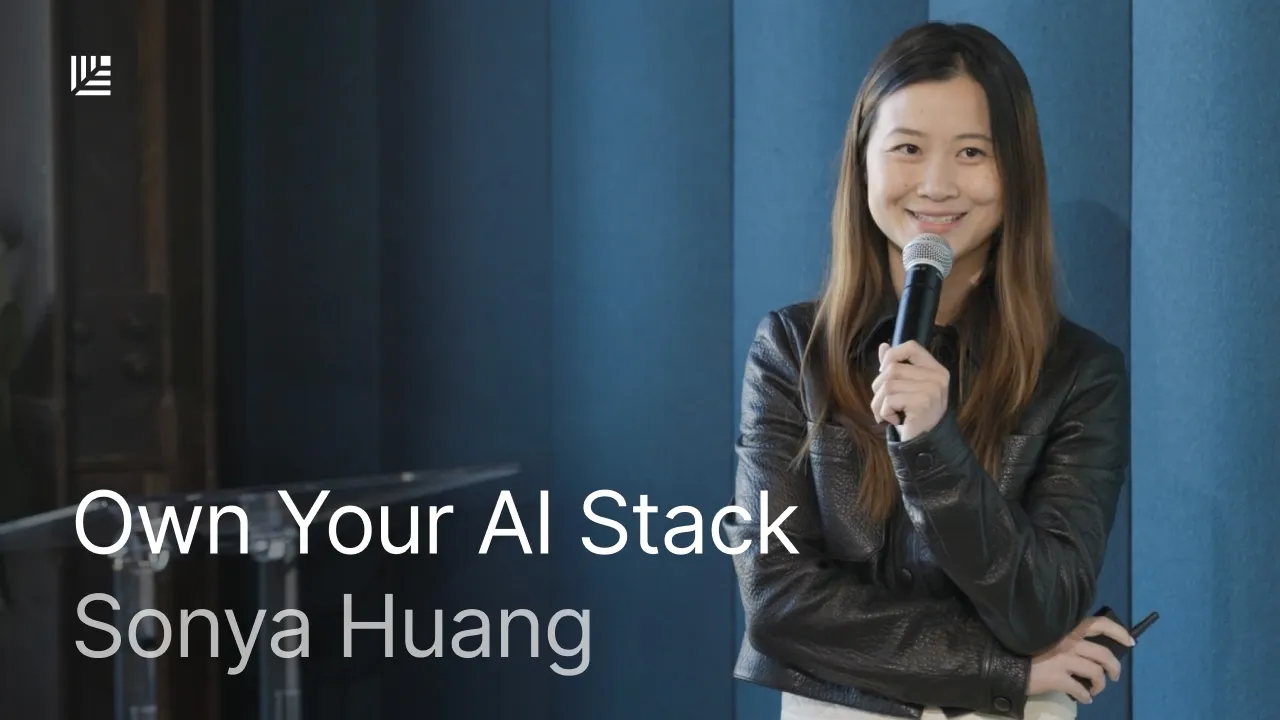
Sequoia Capital
Open-weight models combined with domain-specific fine-tuning now outperform closed frontier APIs while lowering long-term compute costs and platform risk.
AI-assisted summary of How Companies Are Building Their Own Intelligence | Sonya Huang, Sequoia Capital — original source. Check the original for full context.
Source published:
Detailed notes
## Background Published on YouTube by Sequoia Capital on August 11, 2026, this video features partner Sonya Huang opening the "Own Your Intelligence" event. According to the page description, Huang presents the strategic and technical case for why companies are increasingly choosing to own their AI intelligence down to the model weights, driven by cost, speed, performance, and controlling their own destiny.
## TL;DR Sonya Huang outlines an opinionated framework for tech companies to transition from renting closed AI models to owning custom, sovereign model weights. She explains how decentralized intelligence and open-weight models allow domain-specific applications to achieve better-than-frontier performance. The talk details a practical four-step execution roadmap covering strategic selection, specialized staffing, research legibility, and technical stack architecture. Ultimately, Huang argues that owning the intelligence layer is essential for controlling product experience and building long-term competitive advantage.
## Atmosphere & style The presentation carries an energetic, rallying, and highly pragmatic tone, blending the conviction of an industry manifesto with the rigor of an executive technical briefing. Sonya Huang speaks with direct, confident authority, setting a high-substance mood focused on actionable strategy rather than empty hype. The experience feels like an exclusive insider masterclass for founders, balancing strategic vision with grounded technical blueprints.
## Key takeaways - [00:00](https://www.youtube.com/watch?v=bMMv0bZzONg&t=0s) Sovereign AI means a company owns its own intelligence down to the model weights without external dependencies, though it coexists alongside closed frontier APIs used for general desktop or coding tasks. - [01:24](https://www.youtube.com/watch?v=bMMv0bZzONg&t=84s) Industry leaders like Alex Karp, Satya Nadella, and Jensen Huang advocate for corporate AI sovereignty under the belief that intelligence is too core to be completely outsourced. - [01:24](https://www.youtube.com/watch?v=bMMv0bZzONg&t=84s) Decentralized intelligence represents an optimistic future where companies build bespoke AI tailored to their unique data and workflows rather than relying on a single black-box provider. - [02:54](https://www.youtube.com/watch?v=bMMv0bZzONg&t=174s) The four main drivers for transitioning from renting to owning model weights are reducing compute/inference cost, improving speed and latency, maximizing domain performance, and controlling company destiny. - [04:22](https://www.youtube.com/watch?v=bMMv0bZzONg&t=262s) The competitive landscape has shifted from controlling user interfaces to competing for the intelligence layer itself, summarized by the mantra 'Not your weights, not your product.' - [05:32](https://www.youtube.com/watch?v=bMMv0bZzONg&t=332s) Applied AI application startups (such as Harvey, Factory, Glean, and Ramp) are becoming the new 'neo labs,' conducting frontier-level research in domain-specific AI. - [07:05](https://www.youtube.com/watch?v=bMMv0bZzONg&t=425s) Deciding what to own versus rent depends on evaluating four variables: cost sensitivity, latency demands, domain-tuned performance potential, and proprietary data confidentiality. - [09:51](https://www.youtube.com/watch?v=bMMv0bZzONg&t=591s) Sovereign AI teams should be built de novo as small, dedicated research units rather than retrofitting existing platform infrastructure teams. - [11:17](https://www.youtube.com/watch?v=bMMv0bZzONg&t=677s) Legibility—making technical research visible through high-taste papers, custom benchmarks, and dedicated branded labs—is crucial for winning enterprise customers. - [12:33](https://www.youtube.com/watch?v=bMMv0bZzONg&t=753s) A complete technical roadmap progresses from defining strategy and building evals to implementing prompt harnesses, post-training open weights, and setting up automated data feedback loops. - [12:33](https://www.youtube.com/watch?v=bMMv0bZzONg&t=753s) Recent open-weight models like Kimi k3 and GLM-52 enable companies to start near frontier capability and achieve better-than-frontier performance through domain customization. - [13:56](https://www.youtube.com/watch?v=bMMv0bZzONg&t=836s) Moving to a sovereign AI stack unlocks a significantly higher performance ceiling than closed APIs by leveraging proprietary production data, despite higher operational complexity. - [15:36](https://www.youtube.com/watch?v=bMMv0bZzONg&t=936s) Advanced context and memory management involve vector databases, enterprise knowledge graphs, open connectors like MCP, and novel research into encoding context directly into model weights. - [15:36](https://www.youtube.com/watch?v=bMMv0bZzONg&t=936s) Establishing a production development stack requires robust evaluation frameworks, real-time drift monitoring, and rich post-training pipelines using expert trajectories, synthetic data, and RL environments.
## Detailed walkthrough ### [00:00](https://www.youtube.com/watch?v=bMMv0bZzONg&t=0s) What Is Sovereign AI (and What It Isn't)
Sonya Huang, partner at Sequoia Capital, opens the "Own Your Intelligence" event welcoming approximately 80 portfolio company founders and AI leaders. She frames the gathering as half a rallying call and half a technical "how-to," structured around high-substance talks and demos to move beyond theoretical discussions into practical execution. Setting the stage, Huang defines **sovereign AI** as a company owning its own intelligence down to the model weights without relying on external dependencies—drawing an analogy to a sovereign state that maintains total self-governance.
Huang stresses a critical nuance: Sequoia is *not* advising companies to abandon closed frontier models like Claude 3.5 Opus or GPT-4. Closed-model APIs remain wonderful for tasks like general desktop work or coding agents. However, Sequoia has observed a growing trend of companies wanting to vertically integrate and build proprietary AI capabilities into core parts of their products.
- **Event scale:** ~80 portfolio company founders and AI leaders in attendance. - **Sovereign AI definition:** Owning complete intelligence capabilities without external dependencies, down to the model weights. - **Coexistence of models:** Closed APIs (e.g., Opus, GPT) remain ideal for general desktop work and coding agents; sovereign models are built for core proprietary product features.
[01:24](https://www.youtube.com/watch?v=bMMv0bZzONg&t=84s) Centralized vs. Decentralized Intelligence
The shift toward sovereign AI has gained massive momentum across the tech industry. Huang points out that over the past month, leaders like Alex Karp (Palantir) and Satya Nadella (Microsoft) have voiced support for corporate AI sovereignty. Furthermore, Jensen Huang (NVIDIA) recently led the effort to ensure open-weight models remain accessible in the United States, receiving near-unanimous industry support. The consensus is clear: intelligence is too fundamental a property for a company to outsource entirely.
Huang contrasts two visions of the future of AI:
1. **Centralized Intelligence:** A single, all-powerful AI operating as a black box that powers an increasing portion of global GDP while absorbing all the data exhaust and flywheels from the rest of the world. 2. **Decentralized Intelligence:** The world builds on top of a shared solid core, but every individual and company creates bespoke intelligence tailored to their own data, industry requirements, workflows, and taste.
Huang argues that decentralized intelligence offers a far more optimistic world view where individuality triumphs and no single tech giant swallows the entire market.
- **Key industry figures supporting sovereign AI:** Alex Karp, Satya Nadella, and Jensen Huang. - **Core philosophical argument:** Intelligence is too core and fundamental to be treated as a purely outsourced property.
[02:54](https://www.youtube.com/watch?v=bMMv0bZzONg&t=174s) Four Reasons Companies Own Their Models: Cost, Speed, Performance, Destiny
Working with dozens of companies building their own AI, Sequoia highlights the four primary drivers behind the transition from renting to owning model weights:
* **1. Cost:** For low-, zero-, or negative-margin businesses, sovereign AI is a necessity rather than a luxury. Ironically, as an AI product becomes more successful, its compute and inference costs skyrocket. Consequently, the most advanced AI deployers are often the first to build custom models. * **2. Speed and Latency:** In latency-sensitive domains such as interactive coding or real-time cybersecurity, a small, distilled custom model can consistently outperform a large general-purpose model simply because inference speed is paramount. * **3. Performance:** Unlike last year, when companies rarely chose open weights for superior performance, open-weight models tuned on proprietary domain data can now outperform closed frontier APIs on specific tasks. * **4. Controlling Your Own Destiny:** While foundation model labs like Anthropic and OpenAI have been great partners, companies increasingly want independent technical foundations rather than total platform risk.
> "Sovereign AI isn't a nice-to-have, it's a must-have... Ironically, the more successful your AI product is, the higher your AI COGS tend to be."
[04:22](https://www.youtube.com/watch?v=bMMv0bZzONg&t=262s) "Not Your Weights, Not Your Product"
Referencing a slide presented by Pat Grady at Sequoia's AI Ascent event regarding the "race for the application layer," Huang explains how the competitive landscape is shifting. Historically, foundation model labs (building top-down) and application software companies (building bottom-up from the user experience) were competing to own the end-user interface.
Today, that battleground has evolved into a **race for the intelligence layer itself**. Product and intelligence have merged: the product *is* the intelligence. To truly own the user experience and shape product capabilities, companies must control the underlying intelligence rather than just offering a UI wrapper or go-to-market layer.
Drawing a parallel to the classic crypto DeFi meme—*"Not your keys, not your crypto"*—Huang introduces the AI equivalent: **"Not your weights, not your product."**
[05:32](https://www.youtube.com/watch?v=bMMv0bZzONg&t=332s) Application Companies Are the Newest Neo Labs
Huang asserts that the hottest new research labs are not just the traditional AGI research institutions, but rather the applied research groups emerging within leading AI application companies. These teams are conducting frontier-level work across evals, custom benchmarks, harness engineering, and novel algorithmic fine-tuning techniques.
Examples of companies operating as these "neo labs" include: * **Harvey** (legal AI) * **Factory** (software engineering agents) * **Glean** (enterprise search and knowledge) * **Open Evidence** (medical AI) * **Semgrep** (code security) * **Ramp** (financial automation)
These democratized intelligence efforts demonstrate that applied domain focus can yield research breakthroughs competitive with major foundation labs.
[07:05](https://www.youtube.com/watch?v=bMMv0bZzONg&t=425s) Step 1: Deciding What to Own vs. Rent
Huang outlines an opinionated framework for going from zero to one in building sovereign intelligence, emphasizing that sovereignty is not binary (0% or 100%). Companies must strategically draw lines around which AI capabilities to own versus rent based on four primary variables: **Cost**, **Speed/Latency**, **Performance**, and **Proprietary Data**.
``` ┌─────────────────────────────────────────────────────────┐ │ SOVEREIGN AI STRATEGY FRAMEWORK │ └─────────────────────────────────────────────────────────┘ │ ┌───────────────────┬──────────────┴──────────────┬───────────────────┐ ▼ ▼ ▼ ▼ [ COST ] [ SPEED ] [ PERFORMANCE ] [ PROPRIETARY DATA ] How critical is Is low latency Can domain-tuned open Does the domain rely this line item to a P0 requirement weights outperform on highly secret or overall COGS? for the UX? closed APIs? bespoke data? ```
- **Coding (Agents vs. Auto-complete):** Coding agents are largely rented via closed APIs today because out-of-the-box reasoning is critical and latency is less constrained. Conversely, **Tab auto-complete** models rely on sovereign intelligence because sub-100ms speed is essential and API volume makes closed models cost-prohibitive. - **Cybersecurity:** Companies (such as stealth portfolio startups like Alon's) own their models primarily for extreme speed, tailored post-training, and domain-specific detection performance. - **Bio & Life Sciences:** Companies build sovereign models due to the extreme value and confidentiality of proprietary biological and chemical data.
[09:51](https://www.youtube.com/watch?v=bMMv0bZzONg&t=591s) Step 2: Build the Team (and Don't Shoehorn Your Platform Team)
When staffing a sovereign AI initiative, there is no single archetype for a labs leader. Huang highlights two different profiles: * **Nico** (Research-led background): Former researcher at Apple and Google Brain. * **Alex** (Engineering-led background): Engineering background across Microsoft and Ramp.
Crucially, Huang warns against forcing an existing **AI Platform Team** (which traditionally operates in a hub-and-spoke model servicing various product features) to handle sovereign model development. A infrastructure platform team is structured to service internal requests, whereas a sovereign AI team needs to play offense and drive frontier research.
- **Team structure advice:** Start de novo (from scratch) with a small, focused unit rather than retrofitting platform engineers. - **Efficiency example:** Harvey achieved significant research output and published benchmarks with a focused team of just **seven people**.
[11:17](https://www.youtube.com/watch?v=bMMv0bZzONg&t=677s) Step 3: Legibility – Why Your Research Has to Be Visible
Huang stresses that **legibility**—making internal technical capabilities visible to the outside world—is deeply underrated. She cites Winston Weinberg's perspective that a CEO has two main responsibilities: driving substantive results and controlling the narrative around what is being built.
In the current enterprise landscape, buyers are actively selecting their long-term AI vendors. Because every startup pitches similar claims, buyers look for clear markers of technical depth to determine who can actually execute. Achieving legibility requires: * Executing high-quality technical marketing. * Establishing dedicated, branded research groups or labs (e.g., "Company Labs"). * Publishing high-taste research papers, evals, and engineering blogs.
[12:33](https://www.youtube.com/watch?v=bMMv0bZzONg&t=753s) Step 4: The Technical Roadmap
The technical journey toward owning intelligence generally follows a structured multi-step sequence:
1. **Strategy:** Define which model capabilities to build versus rent. 2. **Evals:** Build robust, domain-specific evaluation suites. *(Huang notes this is unglamorous, tedious work, but foundational to all downstream success).* 3. **Harnesses & Model Routers:** Implement routing logic and specialized prompting harnesses around models. 4. **Training (Post-Training $\rightarrow$ Mid/Pre-Training):** Fine-tune open weights via post-training; transition into mid-training or pre-training only if required by the domain. 5. **Data Feedback Loops:** Set up automated pipelines so live customer interaction data continuously feeds back into model retraining.
Recent open-weight models—specifically **Kimi k3** and **GLM-52**—have shifted what is possible. Because open weights are fully malleable, teams can start near frontier-level quality and layer on domain post-training, prompt harness engineering, and online learning to ultimately **exceed frontier API performance**.
> "You start with a baseline that's already close to frontier, and then with a good enough technical roadmap... you can actually reach better than frontier performance by owning your stack. This is new for 2026."
[13:56](https://www.youtube.com/watch?v=bMMv0bZzONg&t=836s) The Stack: Production vs. Development
Huang illustrates the infrastructure architecture required for sovereign AI, dividing it into two parallel stacks:
* **Production Stack (User-Facing):** The real-time inference pipeline that generates every token seen by the end user. At its core, it consists of a **harness on top of a model**. * **Development Stack (Offline/Research):** The internal tooling, evaluation frameworks, and data pipelines used to train, refine, and test intelligence before deployment.
``` ┌────────────────────────────────────────────────────────────────────────┐ │ CLOSED MODEL STACK (Renting) │ │ High floor, lower performance ceiling due to lack of data customization│ ├──────────────────────────────────┬─────────────────────────────────────┤ │ PRODUCTION STACK │ DEVELOPMENT STACK │ │ • Closed API (e.g., Opus, GPT) │ • Basic prompt engineering │ │ • Basic out-of-the-box harness │ • Standard eval scripts │ └──────────────────────────────────┴─────────────────────────────────────┘
┌────────────────────────────────────────────────────────────────────────┐ │ SOVEREIGN AI STACK (Owning) │ │ Requires higher complexity, but unlocks uncapped performance edge │ ├──────────────────────────────────┬─────────────────────────────────────┤ │ PRODUCTION STACK │ DEVELOPMENT STACK │ │ • Open-source base weights │ • Fine-tuning & post-training │ │ • Custom open/configurable │ • Synthetic data generation │ │ harness (logic, tools) │ • Continuous feedback loops │ └──────────────────────────────────┴─────────────────────────────────────┘ ```
Moving from a closed API to owning the stack is like "opening Pandora's box": while closed APIs offer a simple setup with a high floor, they capped performance because teams cannot utilize proprietary online production data to continuously improve the core weights. Owning the stack requires managing base model selection, post-training pipelines, harness logic, tool integration, and context window optimization—unlocking a significantly higher performance ceiling.
[15:36](https://www.youtube.com/watch?v=bMMv0bZzONg&t=936s) Opening Pandora's Box: Context, Memory, and the Development Stack
Sonya Huang transitions into discussing the foundational technologies that power modern AI architectures, specifically emphasizing that context management requires going beyond simple prompt engineering. She highlights components like Turbopuffer for vector database infrastructure, Glean for enterprise knowledge graphs, and open-source connectivity enabled through the Model Context Protocol (MCP). Huang also calls attention to cutting-edge developments in model memory, citing Dan Biederman from N-Gram, who is present at the event, for his company's novel research into encoding context directly into model weights rather than relying solely on context windows. She encourages attendees interested in memory architecture to seek out Biederman during break sessions.
Beyond the real-time production stack, Huang underscores that owning your intelligence elevates the development stack to a critical strategic asset. Companies must implement rigorous evaluation frameworks to measure their custom intelligence against baseline benchmarks and actively monitor for model drift in production environments. Fueling these models demands high-quality post-training data, which can take the form of expert trajectories, synthetic data, or specialized reinforcement learning (RL) environments. Ultimately, the end goal is establishing continuous online learning feedback loops, ensuring that the system's underlying intelligence improves natively with every user interaction.
- Core components of the expanded context and memory architecture include vector databases like Turbopuffer, enterprise knowledge graphs like Glean, and open-source MCP connectors. - Advanced research from N-Gram involves encoding context directly into model weights to evolve memory management. - Production readiness requires real-time monitoring of evals and model performance drift. - Model post-training relies on three main data pipelines: expert trajectories, synthetic datasets, and RL environments. - Continuous online learning is highlighted as the mechanism that guarantees compounding intelligence from everyday user behavior.
[16:35](https://www.youtube.com/watch?v=bMMv0bZzONg&t=995s) Agenda and Workshop Lineup for Building Sovereign AI
Huang concludes her opening presentation by walking through the event's hands-on workshop agenda, which has been explicitly designed to cover every technical layer of owning an AI stack short of pre-training models from scratch. She introduces a sequence of technical deep dives delivered by key industry leaders and ecosystem partners. Lin Qiao from Fireworks AI leads a workshop dedicated to post-training techniques, while Harrison Chase from LangChain hosts a session on orchestration harnesses and evaluation strategies. Brendan Foody from Mercor covers the intricacies of RL environments and synthetic data generation, and the team from Trajectory leads a deep dive into implementing online learning systems.
To tie all these individual architectural pieces together into a cohesive strategy, legal AI company Harvey presents a masterclass on how they designed and built their end-to-end intelligence stack. Huang notes that Harvey had announced "Harvey Research" just the day before the event, with several of their primary technical partners participating directly in the day's workshop schedule. She wraps up her remarks by expressing pride in assembling top-tier speakers from both within and outside the Sequoia Capital portfolio to give founders a practical blueprint for owning their intelligence layer.
- Lin Qiao (Fireworks AI) leads the session on post-training models. - Harrison Chase (LangChain) runs the workshop covering execution harnesses and evals. - Brendan Foody (Mercor) guides the workshop on synthetic data and RL environments. - Trajectory conducts the deep dive into setting up online learning frameworks. - Harvey delivers a comprehensive case study on full-stack AI strategy, following the fresh announcement of Harvey Research.
## Notable quotes > [04:22](https://www.youtube.com/watch?v=bMMv0bZzONg&t=262s) Not your weights, not your product — Sonya Huang
> [02:54](https://www.youtube.com/watch?v=bMMv0bZzONg&t=174s) Sovereign AI isn't a nice-to-have, it's a must-have... Ironically, the more successful your AI product is, the higher your AI COGS tend to be. — Sonya Huang
> [12:33](https://www.youtube.com/watch?v=bMMv0bZzONg&t=753s) You start with a baseline that's already close to frontier, and then with a good enough technical roadmap... you can actually reach better than frontier performance by owning your stack. This is new for 2026. — Sonya Huang
## Mentioned Sonya Huang, Sequoia Capital, Claude 3.5 Opus, GPT-4, Alex Karp, Palantir, Satya Nadella, Microsoft, Jensen Huang, NVIDIA, Pat Grady, Anthropic, OpenAI, Harvey, Factory, Glean, Open Evidence, Semgrep, Ramp, Apple, Google Brain, Winston Weinberg, Kimi k3, GLM-52, Turbopuffer, Model Context Protocol (MCP), Dan Biederman, N-Gram, Lin Qiao, Fireworks AI, Harrison Chase, LangChain, Brendan Foody, Mercor, Trajectory
[Source](https://www.youtube.com/watch?v=bMMv0bZzONg)